BusinessToday Middle East, October 2026
Page 1
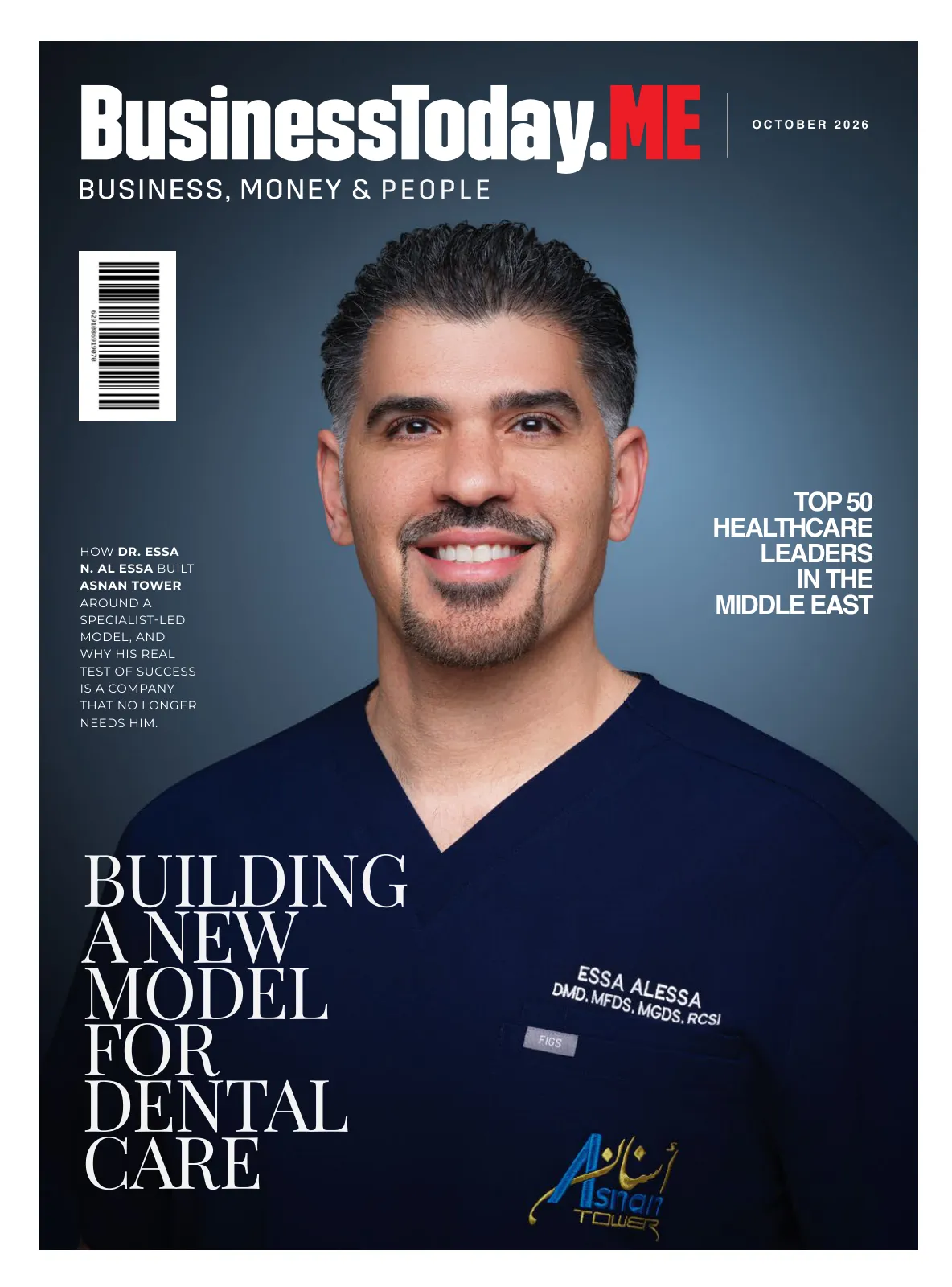
BUILDING
A NEW
MODEL
FOR
DENTAL
CARE
O C T O B E R 2 0 2 6
HOW DR. ESSA
N. AL ESSA BUILT
ASNAN TOWER
AROUND A
SPECIALIST-LED
MODEL, AND
WHY HIS REAL
TEST OF SUCCESS
IS A COMPANY
THAT NO LONGER
NEEDS HIM.
TOP 50
HEALTHCARE
LEADERS
IN THE
MIDDLE EAST
Page 2
Villa Luxury, Redefined.
When space and setting matter.
A villa experience shaped by nature and a calm coastal environment. Thoughtful
dining venues and well-appointed wellness facilities support both focused days and
relaxed moments, creating a stay that feels balanced and complete.
Villa stays starting from AED 3,750.
ANANTARA MINA RAS AL KHAIMAH RESORT
P.O. Box 4005, Al Huwailat St, Mina, Ras Al Khaimah, UAE | +971 720 42222 | rasalkhaimah@anantara.com
ANANTARA.COM
Page 3
OCTOBER 2026
CONTENTS
BIZTODAYME
@BIZTODAYME
BUSINESS TODAY MIDDLE EAST
3 CONTENTS
10 EDITOR’S NOTE
12 NEWS
18 OPINION
Why Power, Not Capital,
Is the Real Constraint on
Gulf AI Growth
20 GEOPOLITICS
What the Strait of Hormuz
Closure Revealed About
Doing Business in the Gulf
22 MARKETING & MEDIA
Nedaa Al Mubarak: Reach
Is the Easy Part, Relevance
Has to Be Earned
24 EDUCATION
Inside Alef Education’s
Approach to Building for
Every Learner
26 COVER STORY
Building a New Model
for Dental Care:
Inside Asnan Tower
with Co-Founder
and CEO Dr. Essa
N. Al Essa
52 FINTECH
Botim’s Fintech Playbook:
COO Sacha Haider on
Building One Connected
Financial Ecosystem
56 TECH LEADERS
Inside Inception42:
Ashish Koshy on
Sovereign AI,
“Death by Pilot” and
the UAE’s Agentic Future
34 LIST
86 HOSPITALITY
Novotel Suites & ibis
Mall Avenue: The Case
for Midscale in a Luxury-
Saturated Market
90 SPORTS
Formula 1 Returns to
Jeddah in March 2027
92 CARS
Made in the Emirates:
ROX Starts Building Cars
in Abu Dhabi
94 LAST LOOK
On the Move: TUMI’s
Autumn/Winter Edit
THE BUSINESS OF REAL AI:
A BUSINESS TODAY MIDDLE
EAST ROUNDTABLE
50
BUSINESS TODAY
HEALTHCARE
60
68 CYBERSECURITY
Cybersecurity Enters a New
Era of Risk
74 INTERVIEW
Hisense’s Jason Ou: From
Budget Alternative to
Regional
Technology Leaders
78 CONSUMER TECH
Debo Zhang on Winning Over
the Gulf’s Pragmatic Buyers
82
KARINE OBEGI ON
BUILDING OBEGI HOME’S
SAUDI FOUNDATIONS
WWW.BUSINESSTODAY.ME 3
Page 4
Standard Chartered Bank UAE is licensed
by the Central Bank of the UAE
Corporate & Investment Banking.
Global Markets. Global Banking. Transaction Services.
Now is your time
sc.com/cib
Make growth
your next stop
Dub
Johannesburg
New York
Page 5
London
Singapore
bai
Shanghai
Page 6
BUILT FOR MOMENTS
THAT MATTER
EXTRAORDINARY
Escape to a home where urban sophistication
meets resort tranquility.
PRIVATE POOLS | 30+ AMENITIES | PRIME LOCATIONS
800-SAMANA | WWW.SAMANADEVELOPERS.COM
Page 7
DISCOVER REFINED living
*Ranking as per the H2025 1 sales
volume data of property monitor for Dubai
Page 8
SUBSCRIBE
subscriptions@bncpublishing.net
PO Box 502511 Dubai, United Arab Emirates
P +971 4 4200 506 | F +971 4 4200 196
For all commercial enquiries, contact jo@bncpublishing.net
T +971 50 440 2706
All rights reserved © 2026.
The opinions expressed are solely those of the contributors.
Business Today Middle East and its affiliated publications in the MENA
region are exclusively licensed to BNC Publishing.
No part of this magazine may be copied, reproduced, or transmitted in any
form or by any means without prior written consent from the publisher.
Printed by United Printing and Publishing | upp.ae
Images used in Business Today Middle East are credited where necessary.
Copyrighted images are used with permission. All uncredited images
courtesy of Shutterstock.
CEO
WISSAM YOUNANE | wissam@bncpublishing.net
Managing Director
RABIH NAJM | rabih@bncpublishing.net
Group Publishing Director
JOAQUIM D'COSTA | jo@bncpublishing.net
Editor
AYA ZHANG | aya@bncpublishing.net
Editor, Special Projects
KASUN ILLANKOON | kasun@bncpublishing.net
Digital Reporter
REEBA ASGHAR | reeba@bncpublishing.net
Creative Lead
CHRISTIAN HARB | chriss@bncpublishing.net
Junior Art Director
IKA WAHYUNI
Business Development Director
ANDY SOULAHIAN | andy.soulahian@bncpublishing.net
Commercial Director
ANDREA MOCAY | andrea@bncpublishing.net
KSA country manager
AMJAD FAKHOURI | amjad@bncpublishing.net
Marketing Executive
AARON JOSHUA SINANBAM | aj@bncpublishing.net
Videographers
EDUARDO BUENAGUA
HARTON OTLANG
JOEL AMPARO
Contributors
LIAM HURLEY
MOHAMED BAHAA
BIZTODAYME
@BIZTODAYME
BUSINESS TODAY MIDDLE EAST
BIZTODAYME
BIZTODAYME
BUSINESSTODAY.ME
8 BUSINESS TODAY MIDDLE EAST | OCTOBER 2026
Page 9
Das gute Licht.
Returns darkness
to the night
BEGA pole-top luminaires with Dark Sky technology
direct the light in a highly efficient manner only where it is
required. Light pollution of the night sky is avoided.
bega.com/darksky
Page 10
10 BUSINESS TODAY MIDDLE EAST | OCTOBER 2026
Aya Zhang
Editor
aya@bncpublishing.net
Xiaoyue (Aya) Zhang
xiaoyuezhangg
A
t a recent roundtable I
moderated,
one
of
our
speakers said something
that has stayed with me.
Asked when he would let an AI agent
manage his money, he answered
honestly: not yet. He said he would
get there, but only once the rules
around it had earned his confidence.
It struck me because it applies well
beyond technology. Every major shift
the region is going through, from new
industries to new ways of delivering
public services, depends less on
what is possible and more on what
people are willing to accept. Capital,
talent and ambition are rarely in short
supply in the Gulf. Trust takes longer
to build, and it cannot be bought.
The
companies
that
seem
to
understand this move differently.
They explain before they launch. They
admit what they do not know. They
treat regulators as partners rather
than obstacles, and they bring their
own employees along instead of
announcing change from the top.
As we head into the final quarter of
the year, it feels like the right question
for any leader to ask. Not only whether
a strategy is bold enough, but whether
the people it depends on believe in it.
I
hope
this
issue
gives
you
something to think about.
LETTER FROM EDITOR
EARNING CONFIDENCE
Page 11
Require formwork and scaffolding? Check out Doka’s extensive list of products and systems, which
now includes scaffolding for a variety of applications. At Doka, our philosophy is to provide a broad
range of services under one umbrella based on a growing demand for single-source solutions that
adhere to the highest standards.
One-stop-shop
meaapmarketing@doka.com | www.doka-me.com
/DokaMEA
/company/doka-middle-east-africa
/doka_mea
Page 12
NEWS
OSUS BEGINS
CONSTRUCTION ON
OSUS EYE
S
audi developer OSUS has
begun construction on
OSUS Eye, a mixed-use
development planned as
a “10-Minute City,” where residents
and visitors can reach their daily
needs within a short, connected area.
The project will bring together living,
working, hospitality, shopping and
entertainment in a single destination.
Several international companies are
involved, including Hilton as operator
of the branded residences and hotel,
RMJM on the master design, Cracknell
on landscape design, and TRI as
the hospitality and entertainment
consultant. OSUS says construction is
progressing in line with the approved
plans and timelines.
REAL ESTATE
12 BUSINESS TODAY MIDDLE EAST | OCTOBER 2026
Page 13
HRH Prince Mohammed bin Salman bin
Abdulaziz Al Saud, Crown Prince, Prime
Minister and Chairman of PIF, has unveiled
EXOBOT, the first electric vehicles from
CEER, Saudi Arabia’s national automotive
company. The EXOBOT sedan and
SUV were designed, engineered and
manufactured in the Kingdom. They are
the first of a planned seven models to
launch over the next five years, including
midsize and compact vehicles with a range
of propulsion options. The vehicles will be
built at the CEER Manufacturing Complex,
which the company describes as the largest
automotive production facility in the Middle
East. Launched by PIF in 2022 as the first
Saudi vehicle brand, CEER is projected to
contribute $8 billion to Saudi GDP and $21
billion to trade balance improvement by 2034.
SAUDI CROWN PRINCE
UNVEILS CEER’S FIRST
ELECTRIC VEHICLES
PIF has launched Tawrid Company for Financing
Solutions, a digital platform offering supply-chain
financing to companies across Saudi Arabia, with a
focus on small and medium-sized enterprises. The
platform connects buyers, suppliers and funders,
offering products such as early settlement against
approved invoices to help businesses improve working
capital and liquidity. Tawrid has received a permit from
the Saudi Central Bank (SAMA) to operate within its
regulatory sandbox. It has already begun operations,
and has signed binding agreements with Gulf
International Bank, Saudi National Bank, Banque Saudi
Fransi, ROSHN Group and Nesma & Partners. The
launch supports PIF’s 2026–2030 strategy to increase
private-sector participation in the Saudi economy.
PIF LAUNCHES TAWRID
TO OFFER SUPPLY-CHAIN
FINANCING IN SAUDI ARABIA
FINTECH
AUTOMOTIVE
WWW.BUSINESSTODAY.ME 13
Page 14
NEWS
Eagle Hills has signed a commercial terms agreement
with the Government of Maldives to develop Maldives
Waterfront and Marina, an integrated island destination
in the Ras Malé area, with an overall development
scale of around $20 billion across several phases. The
project will combine hotels, residences and branded
residences, a marina, retail and leisure with education,
healthcare and community facilities. At full maturity, it
is projected to welcome more than one million visitors
a year and generate over $2 billion in annual tourism
revenue. Preliminary estimates suggest it could attract
more than $30 billion in gross foreign investment
and create over 54,000 jobs over its lifetime. The
Maldives’ Minister of Infrastructure, Housing and
Urban Development, Dr. Abdulla Muththalib, called it
“the largest investment programme in our history.”
EAGLE HILLS
SIGNS $20
BILLION
MALDIVES
WATERFRONT
DEAL
UAE E-COMMERCE
SET TO REACH
AED 67.2 BILLION
BY 2030
The UAE’s e-commerce market reached AED 42.2
billion ($11.5 billion) in 2025, up from AED 17.6 billion
in 2020, according to the sixth annual e-commerce
report from EZDubai Logistics Hub at Dubai
South, produced with Euromonitor International.
The market is forecast to grow at 9.9% a year to
around AED 67.2 billion by 2030, and online sales
are expected to exceed 20% of total retail, up from
15.7% in 2025. Apparel and footwear was the UAE’s
largest category last year, at AED 11.4 billion. Across
MENASA, e-commerce more than doubled between
2020 and 2025 to AED 519.2 billion, and is projected
to reach AED 909.3 billion by 2030.
E-COMMERCE
DEVELOPMENT
14 BUSINESS TODAY MIDDLE EAST | OCTOBER 2026
Page 15
THANI AL
ZEYOUDI
ADVANCES UAE
TRADE TIES AT
UN GENERAL
ASSEMBLY
Dr.
Thani Al Zeyoudi,
Minister
of
Foreign Trade,
has concluded a
week of high-level meetings on the
sidelines of the 81st UN General
Assembly in New York. His
programme focused on increasing
trade and investment flows,
mobilising development finance
and deepening economic ties with
international partners. He met
Thailand’s Minister of Commerce,
Suphajee Suthumpun, Peru’s
Minister of Foreign Trade and
Tourism, Rogers Espinoza,
and Argentina’s Minister of
International Trade, Pablo Quirno,
to discuss expanding bilateral
trade and investment. He also
joined roundtables with the
Business Council for International
Understanding and the UAE
Investment Council, and took part
in forums hosted by organisations
including the UAE-US Business
Council.
TRADE
WWW.BUSINESSTODAY.ME 15
Page 16
NEWS
CHINA AND US AGREE TO CUT
TARIFFS ON $30 BILLION
OF GOODS
ECONOMY
China and the United States have agreed to reduce tariffs on $30
billion worth of goods in each direction and to begin discussions
on artificial intelligence, following Chinese President Xi Jinping’s
visit to Washington, Reuters reported. According to a White
House statement, the two countries reached a consensus on
more favourable tariff treatment for non-sensitive goods. The cuts
will apply to US exports to China including agricultural products,
wood products and cosmetics, and to Chinese goods entering the
US such as small household appliances, toys and decorations.
WORLD
STANDARD
CHARTERED
FORECASTS 3.5%
GROWTH FOR
OMAN IN 2026 AND
2027
Standard
Chartered
expects
Oman’s GDP to grow 3.5% in both
2026 and 2027, driven by resilient
non-oil activity, particularly logistics
and manufacturing, alongside
public investment linked to Oman
Vision 2040. The bank has sharply
raised its fiscal surplus forecast to
4.6% of GDP in 2026 and 3.6% in
2027, up from 0.5% and 1.0%. It
also expects public debt to fall to
around 33% of GDP by the end of
2026 and 31% by the end of 2027.
As investors reassess regional
supply chains, the bank sees
Oman’s location, neutral diplomatic
stance and relatively low exposure
to conflict spillover strengthening
the appeal of its ports and logistics
infrastructure. “Oman’s advantage
is increasingly about connectivity as
well as resilience,” said Hussain Al
Yafai, CEO and Head of Coverage
at Standard Chartered Oman.
16 BUSINESS TODAY MIDDLE EAST | OCTOBER 2026
Page 17
Syrian President Ahmad Al-Sharaa set out his vision
for the country’s economic recovery during the
opening session of the Arab Media Summit 2026 in
Dubai. Following the US decision to lift sanctions,
he said Syria had been “born again.” He pointed
to DP World’s investment in the Port of Tartus, and
its connection with Jebel Ali Port, as an example
of growing opportunities for investors, adding that
talks on further UAE investment are underway
and that Gulf and European investors are showing
significant interest. According to Al-Sharaa, Syria’s
economy, which fell from around $60 billion to $20
billion, reached approximately $32 billion in 2025
and is expected to grow to $50 billion in 2027. He
said it could reach $200 billion by the end of the next
decade if regional stability holds.
MICROSOFT PUBLISHES
DRAFT CODE TO KEEP AI
UNDER HUMAN CONTROL
Microsoft has released a 37-page draft
“Humanist AI Code of Conduct,” designed to
ensure future artificial intelligence stays under
human control and never resists being shut
down. The company is inviting feedback on the
draft over the next six weeks, and will publish a
revised version before the end of the year. The
code will guide the development of Microsoft AI
(MAI) models in 2027 and beyond, and will be
updated through similar consultations over time.
“This Code of Conduct is motivated by a single
overriding objective: that humans must retain
meaningful control over AI,” the company said.
INVESTMENT
AL-SHARAA PRESENTS SYRIA AS AN INVESTMENT
OPPORTUNITY AT ARAB MEDIA SUMMIT
AI GOVERNANCE
WWW.BUSINESSTODAY.ME 17
Page 18
OPINION
WHY POWER, NOT
CAPITAL, IS THE
REAL CONSTRAINT
ON GULF AI GROWTH
Power, not capital, is becoming the binding constraint on
Gulf AI growth. Energy security and sustainability aren’t
competing priorities, but the same planning problem.
BY LIAM HURLEY
is slowing down, nor should it. While
the scale of investment is significant,
the challenge facing operators in
the Gulf is fundamentally the same
as that facing their counterparts in
Virginia, Frankfurt or Singapore: how
to secure enough reliable power while
continuing to advance sustainability
objectives.
What
has
changed
is
the
conversation underneath it. For
years, the regional energy story
was framed as a transition: move
from fossil fuels to renewables, on
a clear timeline, with clean energy
gradually taking a larger share. That
framing still matters, but it is no longer
sufficient on its own. The more urgent
question now is whether there will be
enough power, of any kind, to support
the pace of AI growth while renewable
capacity scales alongside it. A 2026
Wood Mackenzie analysis brings this
into focus, projecting that data center
power consumption in the UAE will
surpass 6TWh by 2030. Crucially,
the report notes that even when
clean energy is available, regulatory
gaps prevent operators from directly
buying it at scale, creating a stark lag
between digital expansion and clean
power procurement.
Energy security and sustainability
are not in competition. They are
the same planning problem, viewed
from two angles. The facilities
supporting AI
growth
cannot
compromise on uptime, but neither
can they ignore growing expectations
around emissions, efficiency, and
renewable energy adoption. Success
increasingly depends on balancing
both requirements simultaneously.
This is where renewables become
operationally interesting - solar offers
the cheapest power available when
conditions allow, but conditions
do not always allow. Wind has the
E
very region racing to
build artificial intelligence
infrastructure is running
into the same wall. North
America, Europe, Asia, and the
Middle East are each pouring billions
into hyperscale data centers, only to
discover that the ultimate bottleneck
is no longer a lack of capital. AI
may be built on algorithms, but its
growth increasingly depends on
access to reliable electricity. Power
is emerging as one of the defining
constraints of the next phase of
digital infrastructure growth. This
is because AI chips process data
completely differently than traditional
Liam Hurley, President,
Emerson Middle East and Africa
computer servers, requiring vastly
more power packed into the exact
same physical footprint. According to
PwC, AI-focused data centers require
up to 10 times more power than
traditional facilities, making power
availability and consumption critical
structural issues. These facilities
draw massive, substantial loads with
99.99% uptime needed throughout
the year. At the same time, the
developers building these projects
and the operators running them are
under real pressure to decarbonise.
Reliability and sustainability are no
longer separate objectives but part of
the same operational challenge.
The UAE and Saudi Arabia have
both made AI leadership a national
priority, and the infrastructure
investment that follows is substantial.
Microsoft and G42’s Stargate
UAE venture sits inside a planned
5-gigawatt AI campus in Abu Dhabi,
AWS and e&’s regional cloud
agreement, and du’s hyperscale build
with Microsoft are just a few signals of
how quickly capacity is being added.
Data center power demand in the
UAE is expected to double by 2030,
and the region as a whole is projected
to nearly triple its data center capacity
by the end of the decade. None of this
18 BUSINESS TODAY MIDDLE EAST | OCTOBER 2026
Page 19
same character. Add storage and the
picture improves considerably, but it
does not remove the underlying truth
that intermittent power generation
behaves differently to the gas and
nuclear baseload that hyperscale
facilities have relied on. The question
facing operators is not whether
renewables will take a larger share
of the regional energy mix. They will.
The question is how a facility keeps
its commitments to uptime while that
share grows.
The same logic extends to backup
power. Operators across the region
are already finding ways to lower the
emissions profile of even their most
conventional systems, leading this
charge is Khazna Data Centers, the
UAE’s largest data center operator.
And projects such as Abu Dhabi’s
24/7 renewable energy initiative
demonstrate how the conversation
is evolving beyond simply adding
more solar capacity. The focus is
increasingly on how renewable power
generation, storage and advanced
control technologies can work
together to deliver the consistency
traditionally
associated
with
baseload power. It pairs more than
five gigawatts of solar with nineteen
gigawatt-hours of battery storage
to deliver a steady one gigawatt of
baseload power around the clock.
The point is that solar and storage,
managed well, can behave like
baseload rather than like weather.
That is the standard hyperscale
operators need their own energy
strategies to meet.
Furthermore,
getting
there
requires a shift in how facilities are
designed. A data center built today
has a lifespan of at least 10 years,
by which point its energy mix will
almost certainly look different to its
mix when commissioned. Designing
only for today’s grid, with no path
to add solar, storage or new power
generation later, creates a facility that
has to be retrofitted under pressure
rather than upgraded on its own
terms. Designing for flexibility from
day one, with the ability to bring in
new power generation, storage and
forecasting as they become viable,
is the more durable approach. This is
what we mean by renewable-ready:
not a commitment to any single
energy source, but the operational
capacity to adopt new ones as they
make sense.
The challenge is that flexibility
becomes harder as energy systems
become more diverse. A facility
drawing power from a combination of
grid supply, renewable assets, battery
storage and backup generation must
be able to understand and coordinate
those resources in real time. Without
that visibility, complexity can quickly
become operational risk.
In practice, that means an operator
needs visibility across everything
feeding the facility, not just the grid
connection. Solar and wind assets,
battery storage, backup generation,
load-shedding triggers and weather
forecasting all need to be readable
from one place, so that decisions
about where power comes from at
any given moment can be made
quickly and with full information.
Trying to manage this across a dozen
disconnected systems is how good
intentions turn into operational risk.
None of this changes the trajectory
the region is on. AI investment will
keep arriving. Data center capacity
will keep expanding. Renewable
energy will keep taking a larger share
of how that capacity is powered,
supported by genuinely significant
regional commitments to clean
energy infrastructure. The operators
who manage this well will not be
the ones who pick a single energy
strategy and hold to it regardless of
circumstance. They will be the ones
who built their facilities to flex from
the outset, treating reliability and
sustainability as the same objective
rather than a trade-off to be managed
later. That is the roadmap worth
building toward now, while the region
still has the chance to build it rather
than bolt it on.
WWW.BUSINESSTODAY.ME 19
Page 20
GEOPOLITICS
chief executive operating
in the Middle East today
depends
on
capital,
supply chains, regulatory
frameworks, customers, investors,
and talent drawn from every corner of
the world. Each was built separately,
and on the assumption that it could be
managed separately. That assumption
has stopped holding.
What changed is visibility. Whether
it’s in Africa, Asia, Europe, or the US, a
commitment made to a regulator in one
market is now read by a co-investor
in another. A position taken globally
is read locally, and a position taken
locally is read globally. Companies
that could once run different registers
for different audiences are finding that
the audiences have merged.
The question this creates for
leadership is no longer who to
influence. It is how to behave when
governments, markets, communities
and technologies pull in different
directions at once. That is the discipline
of corporate diplomacy: making sure
a company’s operational decisions,
WHAT THE STRAIT OF
HORMUZ CLOSURE
REVEALED ABOUT
DOING BUSINESS IN
THE GULF
Why the Strait of Hormuz closure exposed which Gulf-
operating companies were prepared for geopolitical shock,
and why managing competing government, investor and
public expectations has moved from the sidelines to the
centre of corporate strategy.
stakeholder relationships and public
positioning don’t contradict one
another. The remit now runs across
capital allocation, supply chains, data
architecture, market entry, workforce
policy, partnerships and executive
communications, which is why the
people doing this work increasingly
resemble career diplomats.
THE INTEROPERABLE ENTERPRISE
The trait that survives this pressure
is interoperability. An interoperable
enterprise can work across competing
technology ecosystems without losing
control of its data or its compliance
position. It can engage governments
without becoming an extension of
their politics. It can accept sovereign
and international capital without
conflicting expectations about what
that capital buys. It can localise
meaningfully while maintaining
global standards, and adapt supply
chains without undermining long-term
national partnerships.
This is no longer a matter of tone.
Beijing has invoked its Anti-Foreign
A
Mohamed Bahaa,
Managing Director,
Private Sector,
MENA – APCO
BY MOHAMED BAHAA
Gulf crude exports fell from
16.3 million barrels per day to
1.2 million following the closure
of the Strait of Hormuz.
Sanctions Law for the first time, barring
companies from complying with U.S.
sanctions and export controls. For Gulf
firms that trade with both Washington
and Beijing, that’s two sets of legal
obligations that can’t be reconciled,
and enforcement risk on both sides at
once. No amount of careful messaging
resolves it. What partially does is the
20 BUSINESS TODAY MIDDLE EAST | OCTOBER 2026
Page 21
operating structure, partnerships and
standing relationships that give a
company somewhere to move.
Companies that treat this as a
communications problem discover,
usually at the worst moment, that
the contradiction was built months
earlier by people who were solving for
something else. As one global financial
services leader put it in APCO’s 2026
Collaborative research, regulators may
respect what a company does and still
dislike where it is headquartered.
WHAT HORMUZ TESTED
The closure of the Strait of Hormuz
tested this in live conditions. Gulf
crude exports fell from 16.3 million
barrels per day to 1.2 million, our Mid-
Year Geopolitical Radar records, as
Saudi Arabia and the UAE rerouted
3.7 million barrels per day through
alternative ports. War-risk premiums
rose, insurance cover grew more
restrictive and uneven across routes
and operators, and the Cape of Good
Hope became the default Asia–
Europe corridor.
Firms rerouted logistics, diversified
export infrastructure and revised
sourcing. In our work across the region,
the companies that moved fastest had
one thing in common: they already
held relationships, permissions and
operating options across more than
one jurisdiction — established well
before they were needed.
That is the practical case for
corporate diplomacy: keeping options
open across jurisdictions that don’t
always agree, so a shock in one
doesn’t close down the others.
FOUR QUESTIONS FOR THE
EXECUTIVE TEAM
Corporate diplomacy used to sit at the
edge of the business. It’s moved to
the centre, and the capital flows show
why. LSEG Deals Intelligence recorded
1,380 announced M&A transactions
with MENA involvement in 2025, an all-
time high, carrying a combined value of
USD 193.1 billion. Regional outbound
dealmaking reached a record USD
101.2 billion while deals involving a
MENA target rose 164 per cent to USD
80.5 billion. Capital is moving in both
directions at once, and companies here
are increasingly exposed to scrutiny in
the markets they invest in as well as
those they operate in.
Sovereign investors anchor much
of that activity. The Sovereign Wealth
Funds Report 2026 from IE University’s
Center for the Governance of Change
places Saudi Arabia’s PIF and Qatar’s
QIA second and third globally by
deal value, within a universe now
managing USD 15.1 trillion. Capital
that concentrated carries expectations
with it, and those expectations are
increasingly non-financial. In the
Oxford-GlobeScan survey carried in
the Global Corporate & Government
Affairs Collaborative report, 76 per
cent of corporate affairs professionals
named geopolitical risk and uncertainty
as a short-term risk to global business,
ahead of every other category on the
list, up from 70 per cent a year earlier.
Executive teams can test their own
exposure with four questions:
• Where do competing political
expectations leave us exposed?
• Which relationships would
sustain our licence to operate
through a geopolitical shock?
• Can our global values withstand
local scrutiny?
• And who has the authority
to reconcile government
expectations with commercial,
operational and reputational
realities?
If the answers sit in four different
departments, the company isn’t
prepared. The work of the most
interoperable enterprises is bringing
those departments together before a
crisis forces the issue. That makes a
business more capable rather than
more political, in an environment
where politics now sits inside almost
every material decision.
ABOUT THE AUTHOR
Mohamed Bahaa is Managing Director,
Private Sector, MENA at APCO. He advises
multinational and regional companies
across sectors on navigating the MENA
region’s geopolitical, regulatory, and policy
environment, with particular expertise
in market access, investment laws,
government partnerships, and regulatory
strategy.
WWW.BUSINESSTODAY.ME 21
Page 22
MARKETING & MEDIA
N
edaa Al Mubarak’s path
to media took an unusual
route, through economic
advisory roles at three
Saudi government ministries before she
arrived at the commercial arm of one
of the region’s largest media groups.
That background shows in how she
talks about the industry: less in terms
of platforms and placements, more in
terms of evidence, audience behaviour
and what the numbers actually prove.
We spoke to her about the mistakes
brands make entering Saudi Arabia’s
ad market, what integration really
means beyond buzzwords, and the
pattern in a year of campaign data that
changed how she advises clients.
A BRAND DECIDING TO INVEST
SERIOUSLY IN SAUDI ARABIA’S
AD MARKET FOR THE FIRST TIME.
WHAT’S THE BIGGEST MISTAKE YOU
SEE THEM MAKE IN YEAR ONE?
The biggest mistake is treating market
entry as a media buy. Entry to the
Kingdom is an audience and content
question long before it is a spending
one. The familiar instinct is to lift a
global strategy, render it in Arabic and
trust that what worked elsewhere will
work again.
A stronger approach starts with Saudi
audience data: who the consumer is,
what they value, how they consume
content and what genuinely shapes
their decisions. Strategy, channel
selection and creativity should then
follow from that evidence.
Reach is relatively easy to buy.
Relevance has to be earned through
precision and a real understanding of
how audiences in the Kingdom engage
with premium content. That means
building around market nuances and
relevant cultural moments, music,
talent and formats, rather than simply
localising global assets. The first
year should establish credibility and
generate evidence about what works;
scale should follow from that.
MANY BRANDS STILL APPROACH
MEDIA AS A SERIES OF INDIVIDUAL
PLACEMENTS. IN YOUR VIEW, WHAT
NEDAA AL
MUBARAK:
REACH IS
THE EASY
PART,
RELEVANCE
HAS TO BE
EARNED
Nedaa Al Mubarak, CEO of
SRMG Media Solutions (SMS),
on the biggest mistake brands
make entering Saudi Arabia, what a
genuinely integrated media strategy
delivers over standalone placements,
and the four questions every
brand should ask before trusting a
partner’s data.
Nedaa Al Mubarak,
CEO of SRMG Media
Solutions (SMS)
22 BUSINESS TODAY MIDDLE EAST | OCTOBER 2026
Page 23
DOES AN INTEGRATED STRATEGY
DELIVER THAT A PLACEMENT-LED
APPROACH CAN’T, AND HOW DO
THE DIFFERENT SERVICES FIT
TOGETHER TO SERVE A BRAND’S
OBJECTIVE?
Placements remain a legitimate part of
any plan, and they are still requested
for good reason. The wider opportunity
lies in what becomes possible when
a placement is set within a broader
structure, built around a defined
business objective and audience.
At SMS, integration means giving
each part of the plan a specific job.
Audience insight defines who the
campaign needs to reach and the
evidence behind how that audience
makes decisions. SRMG’s premium
media portfolio carries the message
into relevant, trusted environments.
Content and storytelling create different
ways for audiences to discover and
engage with brands through branded
content, video, social storytelling,
activations, influencer partnerships
and other tailored formats. Events and
brand experiences can extend the
story into settings audiences choose to
be part of. The point is not to use every
format, but to use the right combination
against a clear objective and metric.
The value of that structure becomes
clear while a campaign is live. Data
from each component can inform the
others, allowing performance to be
monitored and the plan refined where
the format and agreed metrics allow.
A brand therefore ends the campaign
with clearer evidence of what worked,
which can be applied to the next
investment.
FIRST-PARTY DATA IS NOW
CENTRAL TO HOW ADVERTISERS
JUSTIFY SPEND. IN PRACTICAL
TERMS, WHAT SHOULD A BRAND
ACTUALLY BE ASKING A MEDIA
PARTNER TO PROVE BEFORE
COMMITTING BUDGET?
First-party data is no longer a
competitive advantage. It is a baseline
expectation. The differentiator is the
quality and usefulness of that data:
where it comes from, how well it is
understood and how effectively it can
be activated.
Four elements help determine the
value of first-party data. The first is
provenance: where the data originates
and on what basis of consent it was
collected. The second is composition:
what proportion of an audience is
directly known and what proportion is
modelled. Modelling is a legitimate and
often necessary discipline, provided its
inputs are sound and openly disclosed.
What matters is understanding its
weight. The third is activation: whether
the resulting segments can be deployed
in practice across the partner’s
environments rather than merely
described in a document. The fourth
is verification: how performance will
be measured and whether the brand
can confirm the result independently.
These four questions allow a brand to
compare partners on evidence, rather
than headline audience size alone.
WHAT’S A PIECE OF EVIDENCE
OR A NUMBER THAT CHANGED
HOW YOU PERSONALLY THINK
BRANDS SHOULD BE SPENDING
IN THIS REGION, SOMETHING
THAT SURPRISED YOU ENOUGH
TO CHANGE YOUR OWN ADVICE
TO CLIENTS?
What changed my thinking was not
a single number but the volume of
campaigns we ran across SRMG’s
portfolio in 2025, and the pattern that
became visible at that scale.
Looking across that volume
challenged the idea that reach alone
is the best guide to investment. SMS
reaches more than 270 million people
through over 25 premium brands, but
campaign performance depends on
how that reach is used. Three patterns
recur. First, coordinated presence
across relevant platforms gives brands
multiple, complementary touchpoints
rather than one isolated exposure.
Second, many organisations move
on from a message before it has built
sufficient frequency among audiences.
Third, creative quality and context
matter: storytelling designed for the
environment in which it appears is
more effective than placing the same
message unchanged across channels.
That evidence changed my advice
to clients. Start with the audience, build
sufficient frequency and give each part
of the plan a distinct role. Reach shows
the opportunity; campaign-level data
shows whether the brand converted it
into attention and response.
THE BIGGEST
MISTAKE IS
TREATING
MARKET ENTRY
AS A MEDIA BUY.
WWW.BUSINESSTODAY.ME 23
Page 24
EDUCATION
Alef Education’s
Chief Product Officer,
Joe El Sebaaly, on why the
company’s growth to nearly
two million students across
three countries has been
driven by one principle:
the learner comes first,
technology second.
Joe El Sebaaly,
Chief Product
Officer, Alef
Education
INSIDE ALEF
EDUCATION’S
APPROACH
TO BUILDING
FOR EVERY
LEARNER
S
ince launching in 2016,
Alef Education has grown
from a single idea into a
company serving close to
two million students. Joe El Sebaaly,
the company’s Chief Product
Officer, attributes that growth to one
consistent principle: building scalable
learning solutions that respond to the
evolving needs of students, educators
and education systems, rather than
technology built for its own sake.
“From the beginning, our focus
has been on combining educational
expertise with technology to create
personalised learning frameworks
and experiences that improve student
engagement and outcomes,” he says.
The results are measurable.
Across the UAE, Indonesia and
Morocco, students using the Alef Platform have shown
clear improvements in academic performance. In the UAE
specifically, students using Alef Pathways improved by 5.67
per cent, while those using the company’s AI tutor, Toki,
improved by 4.18 per cent.
Today, Alef Education reaches approximately two million
students and 84,000 educators across 19,000 schools in three
countries. The scale of that reach was recognised earlier this
year when the company was ranked the number one EdTech
company in the Middle East and Africa, and thirteenth globally,
in TIME’s World’s Top EdTech Companies 2026 list.
“Being ranked the number one EdTech company in the
Middle East and Africa region, and thirteenth globally, further
validates the impact of our technology driven approach and
our commitment to continuous innovation in education,” El
Sebaaly says.
24 BUSINESS TODAY MIDDLE EAST | OCTOBER 2026
Page 25
Before joining Alef Education, El
Sebaaly held leadership roles at
Pearson and McGraw-Hill, working
across higher education, K to 12 and
vocational education. He credits that
experience with shaping a principle
he now applies at Alef: the learner
must come first.
“Whether you are building for
schools, universities or vocational
institutions, the most successful
education products are those
designed around the real needs of
learners, while also empowering
educators and institutions to achieve
better outcomes,” he says.
That
philosophy
shapes
every product decision at the
company. “We firmly believe that
meaningful
innovation
doesn’t
begin with technology, it begins
with understanding the challenges
learners and teachers face every
day and designing solutions that
address them,” El Sebaaly explains.
“Technology is simply the enabler.”
Those earlier roles also taught
him the difficulty of scaling a product
without losing sight of individual
learning needs, a challenge Alef
addresses by pairing its learner first
approach with AI and data driven
insight. “The goal is not just to
leverage technology, but to ensure that
every product we develop supports
educators, enhances learning and
creates value for students, educators
and schools,” he says.
Artificial intelligence sits at the
centre of Alef’s product roadmap. The
platform uses data driven insights
to track student progress, enable
personalised learning and give
educators greater visibility into learner
needs. Alef AI Tutor, known as Toki,
is one expression of that strategy,
designed to give students additional
support while working alongside
teachers rather than replacing them.
“By integrating AI thoughtfully into
the learning process, we aim to create
more engaging, responsive and
personalised learning experiences
for students,” El Sebaaly says. As
the company expands its product
ecosystem, through tools including
Alef Pathways, Abjadiyat and Arabits,
the focus remains on keeping
educators at the centre of the learning
experience rather than at its periphery.
Deciding what to build begins,
according to El Sebaaly, with listening.
Product development at Alef draws on
user feedback, insight from education
stakeholders, academic data and
technology trends, identifying where
the company’s tools can create
genuine value. “We continuously
refine our solutions based on these
insights to ensure they remain
relevant, intuitive and effective for the
communities we serve,” he says.
Operating across the UAE,
Indonesia
and
Morocco
has
required Alef to balance consistency
with flexibility. Every education
system carries its own curricula,
priorities and classroom realities,
and El Sebaaly says the company
works closely with local education
stakeholders to understand those
differences before adapting its
technology. “By combining a strong
technology foundation with market
specific insights, we can support
diverse educational communities
while delivering effective learning
experiences for students and
educators,” he says.
Asked where he sees AI having
the greatest impact on education, El
Sebaaly points to personalisation and
insight, rather than automation for its
own sake. “AI’s greatest opportunity in
education lies in its ability to enhance
personalised learning, provide
educators with deeper insights and
enable more adaptive and responsive
learning experiences,” he says. The
priority, in his view, is building AI
capability that is purposeful and
responsible, integrated into real
classrooms rather than developed in
isolation from them.
He believes the next phase of
AI in EdTech will be defined less
by the technology itself than by
how it is deployed. “AI and similar
emerging technologies should
empower educators, facilitating more
personalised, engaging and effective
learning experiences at scale while
helping teachers focus on what
matters most,” he says.
Alef Education now reaches
close to two million students and
84,000 educators across the
UAE, Indonesia and Morocco
WWW.BUSINESSTODAY.ME 25
Page 26
COVER STORY
26 BUSINESS TODAY MIDDLE EAST | OCTOBER 2026
26 BUSINESS TODAY MIDDLE EAST | OCTOBER 2026
Page 27
INSIDE
ASNAN TOWER
WITH
CO-FOUNDER
AND CEO
DR. ESSA N.
AL ESSA
BY AYA ZHANG
How Dr. Essa N. Al Essa built Asnan Tower
around a specialist-led model, and why his real test
of success is a company that no longer needs him.
BUILDING A NEW MODEL
FOR DENTAL CARE:
WWW.BUSINESSTODAY.ME 27
Page 28
COVER STORY
In
early 2009, Dr. Essa
N. Al Essa checked
his company’s bank
account and found KD
7,000 in it. That was nowhere near
enough to cover payroll for a team
of highly trained specialists who had
joined a clinic with little reputation
behind it yet.
The obvious move would have
been to scale down. Instead, Al Essa
delayed his own salary, invested his
savings and took a loan in his own
name.
“That would have solved a short-
term cash problem by compromising
what we were trying to build,” he
says. “I believed we had to build
the clinical standard first and let the
business catch up.”
Seventeen years on, that standard
is Asnan Tower, a ten-storey,
purpose-built dental facility in Kuwait
with 103 chairs, a large specialist
team and its own laboratory. Al
Essa is quick to say the scale was
never the objective. “Size was never
the goal,” he says. “We wanted to
build the kind of dental centre
we wished existed: specialist-
led, USA standards in the region,
uncompromising clinically and
exceptional in patient experience.”
28 BUSINESS TODAY MIDDLE EAST | OCTOBER 2026
Page 29
A BRAND BEFORE A BUILDING
The company’s origins go back to 2003, when Al
Essa bought the domain asnan.com with no business
behind it. The site became one of the region’s
earliest Arabic-language platforms for dental health
education, at a time when reliable Arabic medical
information online was scarce, and later expanded
into a printed dental magazine. He resigned from his
government position in 2007 to pursue the venture
full-time, and Asnan Clinic opened in 2008.
The cash squeeze of 2009 eased as referrals built.
“Eventually, the flywheel started turning,” he says.
“Our specialists built reputations, patients referred
other patients, and that allowed us to keep investing
in people, technology and patient experience.” On 5
May 2012, Asnan Tower opened in Ras Al Salmiya
as a dedicated healthcare tower, and in November
2024 the organisation moved into its newest facility.
DEPTH OVER PROXIMITY
For years, Al Essa was advised to open branches
closer to patients. He declined, reasoning that a
YOU CAN MAKE
MONEY FROM A
PATIENT ONCE BY
FOCUSING ON THE
TRANSACTION. YOU
BUILD A HEALTHCARE
INSTITUTION BY
FOCUSING ON THE
RELATIONSHIP.
WWW.BUSINESSTODAY.ME 29
Page 30
COVER STORY
specialist-led model needs enough volume in one
place to sustain a deep team, with specialists available
throughout operating hours.
“Our advantage wasn’t going to be having an Asnan
branch five minutes from your house,” he says. “It was
going to be that when you came to Asnan, the right
specialist for your problem was there. We chose depth
over proximity.”
The in-house laboratory follows the same logic.
Dentists and technicians communicate directly,
technicians can see the patient when needed and
adjustments happen quickly, with digital dentistry and
same-day workflows tied closely to the clinical side.
“For us, the laboratory isn’t simply a supplier,” he says.
“It’s part of the clinical process.”
SYSTEMS OVER
INDIVIDUALS
The biggest misconception
about healthcare, in Al Essa’s
view, is that great doctors alone
create great healthcare. At
Asnan, specialists are backed
by the laboratory, technology,
clinical protocols and patient-
experience teams.
“The goal is to create
an organisation where the
standard doesn’t depend on
any one individual, including
me,” he says. “If someone
leaves, the knowledge shouldn’t
leave with them. And the patient’s
experience shouldn’t depend on
which day they happen to visit.”
That conviction grew partly
out of a mistake. Early on,
he assumed that because
something was obvious to him,
it was obvious to everyone. “If
something matters, you have
to define it, teach it, measure
it and repeat it,” he says. “You
can’t keep the standard in the
founder’s head and call that a
system.”
LEADING WITHOUT
BEING THE CENTRE
Al Essa still practises dentistry
two days a week, mainly crowns, veneers and cosmetic
cases, so he does not lose touch with the treatment
room. On the management side, he does not hold one-
on-one meetings. The leadership team meets together
twice a week for around two hours, working through
the key numbers, problems and decisions in one room
so that everyone hears the same information and
leaves knowing who owns what.
Outside those meetings, each leader runs their own
department with the authority to act. “If I’m spending
my day solving routine operational problems, then
we haven’t built the organisation properly,” he says.
“A CEO can’t spend the entire week managing what
already exists. If you do, you can easily end up
maintaining yesterday’s business.”
30 BUSINESS TODAY MIDDLE EAST | OCTOBER 2026
Page 31
IF WE CAN’T
REPRODUCE
THE
STANDARD,
I’D RATHER
NOT
REPRODUCE
THE NAME.
WWW.BUSINESSTODAY.ME 31
Page 32
Culture needed the same deliberate
approach once the company outgrew
its early days. “When we had eight
chairs, culture happened naturally
because everybody was close to
the founders. At our size, you can’t
depend on that anymore.” He still
walks the floors himself. “Numbers
tell you a lot, but they don’t tell you
everything. At the end of the day,
patients don’t experience our strategy.
They experience our people.”
ETHICS AS A BUSINESS
MODEL
Al Essa trained at the University of
Pittsburgh School of Dental Medicine,
holds postgraduate qualifications
from the Royal College of Surgeons
in Ireland and completed the Owner/
President Management programme
at Harvard Business School. He
describes ethics as the company’s
biggest money maker.
“I’ve learned that the most ethical
decision usually becomes the best
business decision if your time horizon
is long enough,” he says. “The
cheaper material or easier decision
might improve this month’s numbers,
but compromising quality eventually
shows up somewhere: remakes,
complaints or lost trust. You can
make money from a patient once by
focusing on the transaction. You build
a healthcare institution by focusing on
the relationship.”
TAKING FEAR OUT OF THE
CHAIR
Patients have changed since Asnan
opened. Many now research the
specialist, their qualifications, cases
and reviews before calling, and they
expect speed. Yet Al Essa believes
fear and anxiety remain bigger
issues than many in dentistry realise.
Patients may forget the technical
details of treatment, he says, but they
remember whether someone listened
and whether anyone followed up.
That is why Asnan talks about guest
experience rather than reception.
“When someone who has been
afraid of dentists for years walks out
saying, ‘That was actually fine,’ that
means a lot,” he says. “Very often, that
patient comes back with their family.”
COVER STORY
32 BUSINESS TODAY MIDDLE EAST | OCTOBER 2026
Page 33
A MODEL BUILT TO TRAVEL
GCC expansion, for Al Essa, is not
a matter of finding another building
and putting the Asnan name on
it. Any new site would need the
same clinical depth, specialist
culture, laboratory integration and
management systems, with the same
staffing philosophy of hiring the right
specialists first.
“I’d rather expand slowly and
protect what Asnan means than grow
quickly and dilute it,” he says. “If we
can’t reproduce the standard, I’d
rather not reproduce the name.”
What worries him is not growth but
dependency on individuals, himself
included. He regularly asks what
would stop working if he disappeared
for three months. “Every answer
exposes a weakness.”
In ten years, he hopes to see Asnan
operating in more than one market
with the same standards. The test
that matters more to him is personal.
“The ultimate goal is for Asnan to no
longer need me,” he says. “If I can
step away and the standards remain
the same, the culture remains the
same, innovation continues and
the patient doesn’t notice whether
I’m there or not, then we’ve built
something meaningful. That’s when
you’ve stopped building a company
around a founder and started building
an institution.”
OUR ADVANTAGE WASN’T GOING
TO BE HAVING AN ASNAN BRANCH
FIVE MINUTES FROM YOUR
HOUSE. IT WAS GOING TO BE
THAT WHEN YOU CAME TO ASNAN,
THE RIGHT SPECIALIST FOR YOUR
PROBLEM WAS THERE.
WWW.BUSINESSTODAY.ME 33
Page 34
50
BUSINESS TODAY
HEALTHCARE
LIST
34 BUSINESS TODAY MIDDLE EAST | OCTOBER 2026
Page 35
F
or most of the region’s modern
history, healthcare was something
governments
provided.
Hospitals
were built, staffed and funded by
the state, and the private sector played a
supporting role.
That model is changing quickly. Across the
Gulf, governments are opening the market to
private operators and rewriting regulations to
attract investment, while hospital groups that
began as single facilities now run networks
across
several
countries.
Health
tech
companies, many of them founded within the
past decade, are changing how patients book
appointments, receive diagnoses and manage
their care.
The result is a sector that looks less like
a public service and more like one of the
region’s most important industries. The
people running it now carry decisions that
reach well beyond their own organisations,
shaping who gets access to care, how much
it costs and how quickly new treatments
reach patients.
The
Business
Today
Healthcare
50
recognises the leaders behind that shift.
They include ministers and regulators,
founders and chief executives, and the
investors backing the sector’s next phase
of growth. Between them, they are deciding
what healthcare in the region will look like for
the next generation.
As the Gulf invests billions in healthcare,
these 50 leaders are building the hospitals, technologies and
systems that will define the sector’s next decade.
* Leaders were selected based on the scale
of the organisations they lead, their influence
on policy and the market, their recent
achievements, and their contribution to access
and innovation in care.
WWW.BUSINESSTODAY.ME 35
Page 36
LIST
MINISTER OF HEALTH, SAUDI ARABIA
SHAISTA ASIF
H.E. MANSOOR
IBRAHIM AL
MANSOORI
H.E. Fahad Abdulrahman AlJalajel has been Saudi Arabia’s Minister of Health
since October 2021, and is overseeing the transformation of the Kingdom’s health
sector. He previously spent five years as Deputy Minister of Health for Planning and
Development, helping shape the sector’s transformation strategy and supervising the
country’s COVID-19 response and vaccination centres. A central part of the reform
he leads is the Health Holding Company, approved by the Council of Ministers in
2022, which delivers services through regional health clusters. Alongside it, the
National Health Insurance Center finances those services, separating the regulator
from the provider. He is a member of the Council of Economic and Development
Affairs, President of the Saudi Health Council, and chairs 28 boards and committees,
including the Saudi Food and Drug Authority. He holds bachelor’s and master’s
degrees in computer science, and an executive certificate from MIT Sloan.
Shaista Asif co-founded PureHealth
in 2006 and was named Group
CEO in December 2023. She
now leads a group of more than
110 hospitals and over 316 clinics
across the UAE, the US, the UK,
Greece and Cyprus. She has
overseen a series of acquisitions,
including SEHA, the National
Rehabilitation Center and Daman,
along with a stake in Ardent
Healthcare. She also led the
purchase of the UK’s Circle Health
Group, a deal worth more than
US$1.2 billion, a landmark deal for
a UAE-based group. She has driven
the group’s AI initiatives, including
the Pura healthcare companion app
and the PureNet healthcare cloud.
H.E. Mansoor Ibrahim Al Mansoori
is Chairman of the Department of
Health – Abu Dhabi and a member
of the Abu Dhabi Executive Council.
He leads an emirate-wide health
system built around prevention,
personalised care and digital
innovation, and also serves as CEO
of G42 International. His board roles
include Vice Chairman of Presight,
board member of e&, where he
chairs the audit committee, and
trustee of Mohamed bin Zayed
University of Artificial Intelligence. In
2026, the emirate’s Unified Medical
Operations Command Centre
played a central role in coordinating
care during the regional crisis.
H.E. FAHAD ABDULRAHMAN ALJALAJEL
CO-FOUNDER AND GROUP
CEO, PUREHEALTH
CHAIRMAN, DEPARTMENT
OF HEALTH – ABU DHABI
MINISTER OF HEALTH AND
PREVENTION, UAE
H.E. Ahmed Ali Al Sayegh was appointed the
UAE’s Minister of Health and Prevention in
September 2025, as part of a federal cabinet
reshuffle. He previously served as Minister
of State at the Ministry of Foreign Affairs
from 2018, where he led the economic and
trade portfolio and supported the country’s
economic diversification. He has also served
on the boards of ADNOC and the Abu Dhabi
Fund for Development, and was the founding
chairman of both Aldar Properties and
Masdar. His other past roles include chairing
Abu Dhabi Global Market and serving as
deputy chairman of First Gulf Bank. He
holds a bachelor’s degree in economics from
Lewis & Clark College in the US.
H.E. AHMED ALI
AL SAYEGH
36 BUSINESS TODAY MIDDLE EAST | OCTOBER 2026
Page 37
50
BUSINESS TODAY
HEALTHCARE
Nasser bin Mohammed Al-Haqbani has
led Health Holding Company (HHC)
as chief executive since January 2023,
bringing experience from both Saudi
Arabia’s private and public healthcare
sectors. He previously served as chief
executive of Dr. Sulaiman Al Habib
Medical Services Group before moving
to HHC, giving him direct experience of
managing a major private healthcare
operator. Established in 2022 as part of
Saudi Arabia’s healthcare transformation,
HHC assumed responsibility for operating
20 regional health clusters as the Ministry
of Health shifted towards regulation
and supervision. Under Al-Haqbani, the
organisation has continued implementing
the Kingdom’s move towards integrated,
accountable care across its regions.
Digital platforms including Sehhaty, which
provides services such as appointments
and prescriptions, and Seha Virtual
Hospital, which connects patients
with remote specialist care across all
20 clusters, have become important
components of the system. Saudi life
expectancy reached 80 years in 2025,
ahead of the original Vision 2030 target,
while Saudi Arabia ranked sixth globally
in the UN’s E-Government Development
Index. Al-Haqbani’s role places him at
the centre of one of the world’s largest
ongoing public healthcare restructuring
programmes.
NASSER BIN MOHAMMED AL-HAQBANI
CEO, HEALTH HOLDING COMPANY
PRESIDENT AND GROUP CHIEF EXECUTIVE, DR. SULAIMAN
AL HABIB MEDICAL SERVICES GROUP
FAISAL AL NASSAR
Faisal Al Nassar has led Dr. Sulaiman
Al Habib Medical Services Group (HMG)
since 2022, taking over as president and
group chief executive after more than a
decade with the company, including as
chief financial officer. He now oversees
Saudi Arabia’s largest private hospital
network, which reported revenue of $2.7
billion in the first nine months of 2025
and operates more than 22 hospitals and
medical centres across Saudi Arabia, the
UAE and Bahrain. Under Al Nassar, HMG
has accelerated its expansion, opening five
facilities in 2024 and moving towards more
than 4,000 operating beds, nearly doubling
capacity within three years. The group
signed contracts in 2025 for three additional
hospitals and partnerships with the Red
Sea Real Estate Company and AMAALA to
operate hospitals supporting Saudi Arabia’s
giga-project tourism developments.
Technology has also become central to
the strategy, with HMG deploying artificial
intelligence for breast cancer detection.
Alongside expansion, Al Nassar has
overseen sustainability initiatives, including
HMG’s LEED Gold certification for efforts to
reduce medical waste and emissions.
SHERIF BESHARA
GROUP CEO, AMERICAN HOSPITAL DUBAI
Sherif Beshara leads American Hospital Dubai as Group
CEO. Under his leadership, the hospital has expanded
its centres of excellence, introduced new medical
technologies and built its position as a destination for
complex surgery and specialist care. His background
spans healthcare, legal counsel and corporate governance,
and he holds an Executive MBA from Georgetown
University and a master’s degree in international law. He
sits on the Board of Trustees of the Noor Foundation,
which works to eliminate preventable blindness worldwide.
WWW.BUSINESSTODAY.ME 37
Page 38
LIST
DR. SHAMSHEER
VAYALIL
FOUNDER AND CHAIRMAN,
BURJEEL HOLDINGS
A radiologist by training, Dr. Shamsheer
Vayalil founded VPS Healthcare in 2007
and grew it into a network spanning the
GCC, India and Europe. In 2022, its
GCC assets were brought together under
Burjeel Holdings, which now operates
across the UAE and Oman with a growing
specialist presence in Saudi Arabia.
According to the company, its network
includes 112 medical assets, among
them 20 hospitals. In 2025 the group
expanded its oncology network, launched
the Alkalma mental health platform with
four centres across the UAE and Saudi
Arabia, and acquired a physiotherapy
facility in Riyadh under its PhysioTherabia
brand. It also formed DOCKTOUR, a
healthcare logistics venture with AD Ports
Group aimed at remote communities, and
gained accreditation for new residency
programmes in internal medicine and
general surgery.
DR. AMER AHMAD
SHARIF
CEO, DUBAI HEALTH;
PRESIDENT, MOHAMMED
BIN RASHID UNIVERSITY
OF MEDICINE AND HEALTH
SCIENCES
Dr. Amer Ahmad Sharif is CEO of Dubai
Health, formerly Dubai Academic Health
Corporation, and President of MBRU. As
the university’s founding Vice Chancellor,
he has guided it since its inception
and built partnerships with institutions
including Queen’s University Belfast. He
chaired the Dubai COVID-19 Command
and Control Center during the pandemic,
and has held senior roles at the Dubai
Health Authority. He holds an MBBS
and a PhD in Public Health from UAE
University, and an MSc in Healthcare
Management from the Royal College of
Surgeons in Ireland. He also sits on the
UAE Genome Council and the Emirates
Research and Development Council.
H.E. DR. ALAWI
ALSHEIKH-ALI
DIRECTOR GENERAL,
DUBAI HEALTH
AUTHORITY
H.E. Dr. Alawi Alsheikh-Ali was
appointed Director General of the
Dubai Health Authority in May
2025. An Emirati physician-scientist
and Professor of Cardiovascular
Medicine, he is also a member of
Dubai’s Executive Council, chairs the
Dubai Corporation for Ambulance
Services, and chairs the Noor
Foundation’s Board of Trustees.
He previously served as Provost of
MBRU and as the founding Dean of
its College of Medicine. A consultant
cardiac electrophysiologist,
he studied at MIT and earned
his medical degree from Tufts
University, and is one of only a
handful of physicians in the Gulf to
be triple-board-certified in the US.
Dr. Azad Moopen came to the UAE from Kerala in 1987. In December
of that year he opened a single-doctor clinic in Dubai, Al Rafa Polyclinic,
which became the foundation of Aster DM Healthcare. Trained in general
medicine, he had previously lectured at Calicut Medical College. Under
his leadership, the group grew into a network of hospitals, clinics,
diagnostic centres and pharmacies operating under the Aster and
Medcare brands. In 2024 the company separated its GCC and India
businesses. A consortium led by Fajr Capital acquired a 65% stake in
Aster GCC, while the Moopen family kept 35% and operational control.
He remains Founder Chairman, and founded Aster Volunteers, the
group’s community outreach programme.
DR. AZAD MOOPEN
FOUNDER AND CHAIRMAN, ASTER DM HEALTHCARE
38 BUSINESS TODAY MIDDLE EAST | OCTOBER 2026
Page 39
50
BUSINESS TODAY
HEALTHCARE
H.E. Mohammed bin Khalifa Al Suwaidi was appointed to lead Hamad Medical Corporation,
Qatar’s main public healthcare provider, by Amiri decision in November 2024. His
priorities centre on specialised care that meets international quality standards, with HMC
building advanced treatment pathways in cancer care, cardiology, stroke, and trauma and
emergency services. He is also expanding digital access to care, through HMC’s Lbaih app
and a growing virtual consultation service. In January 2026, he opened the Qatar Health
Congress, which brought together more than 2,000 healthcare professionals to discuss
quality, patient safety and patient experience.
H.E. MOHAMMED BIN KHALIFA AL SUWAIDI
MANAGING DIRECTOR, HAMAD MEDICAL CORPORATION (HMC)
H.E. Dr. Hanan Mohammed Al Kuwari was appointed Advisor
to the Prime Minister for Public Health Affairs in November
2024, after eight years as Qatar’s Minister of Public Health.
As minister, she chaired the national COVID-19 committee
and oversaw medical readiness for the FIFA World Cup Qatar
2022. Before that, she spent 17 years as Managing Director
of Hamad Medical Corporation, building it into an integrated
academic health system of 17 hospitals and centres. She
remains a member of the WHO Executive Board, which she
chaired from 2023 to 2024, and has served as Vice Chair of the
bureau negotiating the operational details of the WHO Pandemic
Agreement. In 2024 she received the Best Minister Award at the
World Governments Summit.
Dr. Georges-Pascal Haber leads Cleveland Clinic Abu Dhabi and its more than 6,000
caregivers, with a focus on growth, clinical quality and technology-enabled, high-acuity
care. A urologist specialising in robotics, he still practises alongside his executive role.
Before moving to Abu Dhabi, he chaired the Glickman Urological & Kidney Institute at
Cleveland Clinic in Ohio, which became home to the largest urology training programme in
the US. He has led several surgical firsts, including the UAE’s first robotic kidney transplant,
and has published more than 250 peer-reviewed papers. He trained in medicine, surgical
oncology and biotechnology in France, completed a fellowship at Cleveland Clinic, and has
attended executive programmes at Wharton and Harvard Business School.
DR. GEORGES-PASCAL HABER
CEO, CLEVELAND CLINIC ABU DHABI
Saeed Jaber Al Kuwaiti has been Group CEO of
SEHA, one of the UAE’s largest healthcare networks,
since April 2022, leading its closer integration with
PureHealth. Part of SEHA since its creation in 2007,
he has served as CFO and CEO of Tawam Hospital,
CEO of Al Mafraq Hospital, and Regional CEO for
Al Ain. He chaired the first insurance and billing
committee for the introduction of mandatory health
insurance in Abu Dhabi, and led the opening of Sheikh
Shakhbout Medical City, where he sits on the board.
H.E. DR.
HANAN
MOHAMMED
AL KUWARI
ADVISOR TO THE
PRIME MINISTER
FOR PUBLIC
HEALTH AFFAIRS,
QATAR
SAEED JABER AL KUWAITI
GROUP CEO, ABU DHABI HEALTH
SERVICES COMPANY (SEHA)
WWW.BUSINESSTODAY.ME 39
Page 40
LIST
H.E. Dr. Hilal bin Ali Al Sabti leads Oman’s health sector under Vision 2040, with
priorities spanning governance, private sector development, digital health and AI. In
2025, Oman performed its first heart transplant, a milestone that was described as
historic for the country’s specialised care. As specialised services have expanded
at home, the number of patients sent abroad for treatment fell by around 49%
between 2023 and 2025. The ministry’s budget reached RO 1 billion in 2026, and it
is preparing to launch a National Centre for Virtual Health.
H.E. Mazen Darwazeh leads the strategy and operations of Hikma Pharmaceuticals
across the Middle East and North Africa, a remit that has included MENA Injectables
since February 2026. He joined the company in 1985 as a medical representative, and
has held a wide range of leadership roles over more than 40 years. Founded in Jordan
in 1978, Hikma has grown into one of the region’s leading pharmaceutical groups. He is
also serving his fifth term in Jordan’s Senate and sits on the board of Rakuten Medical.
He holds a business degree from the Lebanese American University and completed the
Advanced Management Programme at INSEAD.
H.E. DR. JALEELA BINT
AL-SAYED JAWAD HASAN
MINISTER OF HEALTH, BAHRAIN
H.E. Dr. Jaleela bint Al-Sayed Jawad Hasan is
Bahrain’s Minister of Health and a family medicine
and public health consultant. She previously served
as CEO of the Kingdom’s Primary Healthcare
Centres, and led its national immunisation
programme from 2008 to 2020. During the pandemic,
she sat on the national COVID-19 taskforce and
supervised testing and vaccination centres. In 2026,
Bahrain hosted the GCC Health Ministers Council,
and her ministry launched a Genomics Ambassadors
programme for young people.
TAL HISHAM
NAZER
CEO, BUPA ARABIA
FOR COOPERATIVE
INSURANCE
Tal Hisham Nazer has led Bupa
Arabia for Cooperative Insurance
since 2008, overseeing the
company’s growth from a Saudi
health-insurance provider into one
of the Kingdom’s largest insurers.
Founded in 1997 and listed on the
Saudi Exchange since 2008, Bupa
Arabia operates under Saudi Central
Bank regulation and remains part
of the UK-headquartered Bupa
Group, which serves more than 43
million customers globally. Nazer
joined Bupa Arabia in 2002 within its
finance department before moving
through operational leadership
roles and ultimately becoming
chief executive. His tenure has
coincided with the rapid expansion
of mandatory employer health
coverage across Saudi Arabia
and increasing digitisation across
insurance services. Bupa Arabia has
invested in digital claims processing
and preauthorisation systems as
its membership base has grown,
strengthening the connection
between insurance administration
and healthcare delivery. Nazer
has also held prominent industry
roles, including chairing the Saudi
Central Bank’s insurance general
committee and previously leading
its health-insurance subcommittee.
His leadership has coincided with
a period of significant development
in Saudi Arabia’s health-insurance
market, as insurers adapt to
regulatory reform, growing healthcare
demand and the Kingdom’s broader
healthcare transformation agenda.
H.E. MAZEN
DARWAZEH
EXECUTIVE VICE
CHAIRMAN AND DEPUTY
CEO – MENA, HIKMA
PHARMACEUTICALS
H.E. DR. HILAL
BIN ALI AL SABTI
MINISTER OF HEALTH,
OMAN
40 BUSINESS TODAY MIDDLE EAST | OCTOBER 2026
Page 41
50
BUSINESS TODAY
HEALTHCARE
KHALED ATEEQ ALDHAHERI
CEO, DAMAN
Khaled Ateeq Aldhaheri has served as chief executive of Daman since February 2024,
following an acting leadership role and more than two decades working across UAE
healthcare finance and operations. He previously held senior positions including chief
commercial officer and chief financial officer at Abu Dhabi Health Services and acting
executive director for health-system financing at Abu Dhabi’s Department of Health.
Established in 2005 as the UAE’s first dedicated health insurer, Daman has expanded
into a broader insurance business while remaining focused on healthcare coverage.
The company adopted its new legal name, National Health Insurance Company, in May
2025 as it moved beyond health insurance into property and casualty products, following
its launch of employee-benefits and gratuity-related services in 2024. As a subsidiary
of PureHealth, Daman now serves more than three million members through a network
exceeding 3,000 medical facilities across the UAE. Aldhaheri’s appointment also reflects
the increasing role of Emirati executives within the country’s healthcare sector. With Daman
broadening its product portfolio, his remit now spans a business using its established
healthcare network, customer base and data infrastructure to build adjacent insurance
offerings while continuing to serve its core health-insurance market.
DR. NEZAR BAHABRI
CEO, SAUDI GERMAN HEALTH
Dr. Nezar Bahabri became chief executive of Saudi German Health in January 2026, following
his appointment as chief medical officer after joining the group in 2023. A physician by training,
Bahabri now leads Middle East Healthcare Co., the operator behind Saudi German Health, during
a significant governance and operational transition. In July 2026, a new seven-member board was
elected without members of the founding Batterjee family, marking the first time in the company’s
history that its board was not represented by the founding family. Saudi German Health continues
to operate nearly 1,500 beds across eight hospitals and two outpatient centres in Saudi Arabia,
while the wider Saudi German Hospitals network extends across the UAE, Yemen and Egypt.
During 2025, patient volumes increased and the group recruited more than 400 Saudi doctors,
while pharmacy and pharmaceutical distribution revenue reached SAR 408 million. Bahabri’s
priorities include developing a new 194-bed hospital in Jeddah and establishing centres of
excellence in cardiology, oncology and neurology. He is also overseeing ambitions to expand into
Morocco and Pakistan as the group reshapes its operations and governance for its next phase.
Nasser Sultan Al-Subaie has spent more than three decades at Mouwasat Medical
Services, culminating in his appointment as chief executive in January 2026 after years
as executive director and vice chairman. Founded in Dammam in 1975, Mouwasat has
expanded from its Eastern Province base into Riyadh, Khobar, Jubail, Madinah and
Qatif, building a network of hospitals, pharmacies and specialised medical centres. The
publicly listed company operates around nine branches covering areas including fertility,
dermatology, stroke care, cardiology, nuclear medicine and long-term rehabilitation. Al-
Subaie has held senior positions spanning finance, operations and general management,
giving him extensive experience across the organisation before taking its top executive
role. A graduate of California State University, Long Beach, he joined Mouwasat more than
35 years ago, well before its 2012 listing on the Saudi Exchange. Under his leadership,
the company is continuing to invest in technology, including artificial intelligence
applications across diagnostics and hospital operations. His appointment provides
continuity as Mouwasat enters its next phase, combining its established regional presence
with technology-driven expansion across Saudi Arabia’s evolving healthcare sector.
NASSER SULTAN
AL-SUBAIE
CEO, MOUWASAT MEDICAL SERVICES
WWW.BUSINESSTODAY.ME 41
Page 42
LIST
Ahmad bin Saleh Babaeer has led Dallah Healthcare Company since 2008, overseeing its
evolution from a single Riyadh hospital into a diversified healthcare group. During his tenure,
Dallah completed its 2012 initial public offering on the Saudi Exchange and expanded beyond
its original hospital into healthcare services, pharmaceuticals, telemedicine and home care. The
group now operates six hospitals, four clinics and more than 820 outpatient facilities across its
subsidiaries and associated companies, alongside pharmaceutical manufacturing and distribution
operations. Dallah’s financial growth has accompanied that expansion. Between 2020 and 2024,
the company more than doubled its revenue while shareholder profit increased nearly fivefold. In
the first half of 2025, revenue rose 22.3 percent to $504.9 million, while total assets reached $2.3
billion. Babaeer has also overseen Dallah’s diversification into pharmaceutical manufacturing
and distribution, creating an additional business line alongside its core healthcare operations. Its
investment in home care and remote monitoring reflects the wider shift towards outpatient and
preventive healthcare in Saudi Arabia. After nearly two decades at the helm, Babaeer continues
to guide Dallah through the Kingdom’s rapidly evolving private healthcare market.
David Hadley is CEO of NMC Healthcare. He joined
after a 30-year career at Mediclinic International,
including 13 years as CEO of Mediclinic Middle
East, where he led the company’s growth and
expansion across the GCC. He is also a Non-
Executive Director at Magrabi Hospitals Group. After
completing a commerce degree in South Africa, he
earned an MBA with distinction from the University
of Liverpool and attended the Oxford Advanced
Management and Leadership Programme in 2022.
AHMAD BIN SALEH BABAEER
CEO, DALLAH HEALTHCARE COMPANY
DAVID HADLEY
CEO, NMC HEALTHCARE
Alisha Moopen joined Aster in 2013 as a director and has risen to lead its GCC
business, which spans hospitals, clinics, pharmacies and diagnostic centres across
all six GCC countries. When the group separated its GCC and India operations in
2024, she took on the role of Managing Director and Group CEO of Aster GCC,
alongside a new consortium of investors led by Fajr Capital. Her priority since
then has been expansion, particularly in Saudi Arabia’s primary care and hospital
markets. A chartered accountant who began her career at Ernst & Young, she
was the first woman to chair YPO’s Dubai chapter, founded the Dubai Healthcare
Business Group, and launched Aster’s Women in Leadership programme.
ALISHA MOOPEN
MANAGING DIRECTOR AND GROUP CEO, ASTER DM
HEALTHCARE GCC
42 BUSINESS TODAY MIDDLE EAST | OCTOBER 2026
Page 43
50
BUSINESS TODAY
HEALTHCARE
KOSTAS
DELIGIANNIS
ZONE PRESIDENT,
EURASIAN AND AFRICAN
GROWTH MARKETS
(EAGM), GE HEALTHCARE
Kostas Deligiannis leads GE
HealthCare’s business across
more than 50 countries in the
Middle East, Africa, Turkey, Russia
and the CIS, overseeing a team
of more than 2,000 people. He
joined the company in 2003 as
Sales Manager for Greece and
rose through regional roles in the
Balkans, Southeastern Europe and
Eastern Europe, before becoming
Zone President in 2024. In the
role, he focuses on growth through
medical technology, digital health
solutions and scalable care models.
A physicist by training, he holds a
PhD in Solid State Physics from
the University of Southampton, and
earlier carried out superconductivity
research at CNRS in Grenoble as a
European Union Marie Curie Fellow.
DR. MOHAYMEN
ABDELGHANY
GROUP CEO AND BOARD
MEMBER, FAKEEH
HEALTH; CEO, FAKEEH
UNIVERSITY HOSPITAL
Dr. Mohaymen Abdelghany leads
Fakeeh Health in the UAE, whose
network centres on Fakeeh
University Hospital, a 350-bed
hospital in Dubai Silicon Oasis,
supported by clinics across the
city. He became the hospital’s CEO
in 2023 and took on the Group
CEO role in 2025. An anaesthetist
by training, he has more than
two decades of experience in
hospital management, healthcare
quality, mergers and acquisitions,
and digital transformation. That
includes his work as a physician
consultant with Joint Commission
International, advising hospital
systems worldwide. He holds an
MD and two master’s degrees
in Anaesthesia and healthcare
management, and has completed
executive programmes at Harvard
and INSEAD.
DR. THUMBAY
MOIDEEN
FOUNDER AND PRESIDENT,
THUMBAY GROUP
Dr. Thumbay Moideen arrived in Ajman
in 1997 and built the Thumbay Group
into a diversified business spanning
healthcare, medical education, research,
diagnostics, retail, hospitality and
technology. At its core is an integrated
academic healthcare system, in which
the group’s medical university trains
students who go on to work in its own
hospitals. Recent projects include
Thumbay Medicity, along with a growing
focus on AI-driven medical education.
The group has announced plans for a
psychiatric and rehabilitation hospital in
Sharjah, a veterinary hospital in Ajman,
more than 1,000 additional clinical
beds over the next three years, and 15
colleges in total by 2028.
Dimitris Moulavasilis became Group CEO of M42, the Abu Dhabi health
company built around AI, technology and genomics, in May 2025, succeeding
Hasan Jasem Al Nowais. He also leads M42’s Global Patient Care platform,
which brings together the group’s UAE and international healthcare assets:
480 clinics across 26 countries, serving 15 million patients a year. He
previously led Diaverum, the global renal care provider M42 acquired in 2023,
and before that was Group CEO of Affidea, a European provider of imaging,
outpatient and cancer care, from 2012 to 2018. He began his career in sales
at GE HealthCare and brings more than 30 years of experience in healthcare
services and medical technology.
DIMITRIS MOULAVASILIS
GROUP CEO, M42
WWW.BUSINESSTODAY.ME 43
Page 44
LIST
H.E. Mansoor bin Ebrahim bin Saad Al Mahmoud was
appointed Qatar’s Minister of Public Health in November
2024, succeeding Dr. Hanan Al Kuwari. He came to
the role after six years as CEO of the Qatar Investment
Authority, from September 2018. His earlier roles include
CEO of Qatar Museums and CEO of Qatar Development
Bank. He is also Vice Chairman of Qatar Airways and
Chairman of Katara Hospitality, and holds a degree
in business administration and finance from George
Washington University.
H.E. MANSOOR BIN
EBRAHIM BIN SAAD
AL MAHMOUD
MINISTER OF PUBLIC HEALTH, QATAR
H.E. Dr. Majid Alfayyadh has led King Faisal Specialist Hospital and Research
Centre, one of the Kingdom’s foremost tertiary and quaternary care institutions,
since his appointment by royal decree in 2017. He previously held senior clinical
and executive posts at the hospital, and was seconded to the Ministry of Health’s
Vision Realization Office. Under his leadership, the hospital has become an
independent non-profit institution. It has also been ranked first in the Middle
East and North Africa by Brand Finance among the world’s academic medical
centres. A paediatric cardiologist and electrophysiologist, he trained at King
Saud University, Tufts, Columbia and Baylor, and holds a master’s in medical
administration from the University of Southern California.
H.E. DR. MAJID ALFAYYADH
GROUP CEO, KING FAISAL SPECIALIST HOSPITAL
AND RESEARCH CENTRE
H.E. Dr. Ahmad Abdulwahab Al-Awadhi has served as Kuwait’s Minister
of Health since May 2024. He is leading a digital transformation of the
country’s health system, including the integration of AI and robotic surgery
into clinical care, alongside the opening of new hospitals. In May 2026, a new
Undersecretary was appointed to the ministry, and Kuwait has since been active
in GCC-wide health coordination, including talks with Bahrain in July 2026 on
strengthening bilateral cooperation and developing national healthcare talent.
H.E. DR. AHMAD ABDULWAHAB
AL-AWADHI
MINISTER OF HEALTH, KUWAIT
44 BUSINESS TODAY MIDDLE EAST | OCTOBER 2026
Page 45
50
BUSINESS TODAY
HEALTHCARE
Mohammed Saleh Al Hammadi is leading Al Hammadi Holding through a major
expansion phase following his appointment as managing director and chief
executive in June 2026. The leadership transition, which also saw Abdulaziz Al
Hammadi become chairman, retained control within the founding family while
creating a clearer operational structure for the Riyadh-based healthcare group. Al
Hammadi Holding has operated for four decades, with its original Al Olaya Hospital
opening in 1985. The facility, which closed for renovation in 2021, is scheduled
to reopen in 2026 with 200 rooms, 120 clinics and centres of excellence focused
on oncology and sports medicine. A fourth hospital in Riyadh’s Al Narjis district is
expected in 2028, significantly increasing the group’s existing capacity of around
600 inpatient rooms and 180 outpatient clinics. Al Hammadi is also pursuing
international healthcare partnerships, including a long-term agreement with AC
Milan announced in January 2026 to introduce the club’s MilanLab performance-
science model at its next-generation Riyadh hospital. Beyond healthcare delivery,
the group operates pharmaceutical distribution, biopharmaceutical and hospital-
support businesses, providing a diversified platform for further expansion.
MOHAMMED
SALEH AL
HAMMADI
MANAGING DIRECTOR AND
CEO, AL HAMMADI HOLDING
Faisal bin Juma Belhoul is the founder and Managing Partner of Ithmar Capital,
an investor in the Dubai health tech platform Okadoc, which he chairs. He
also founded Amanat Holdings, a listed healthcare and education investment
company, which he chaired. His healthcare leadership includes chairing the UAE
Private Hospitals Council and the Pharmaceutical and Healthcare Equipment
Business Group at the Dubai Chamber. He also served on the board of a FTSE
250 healthcare company and led its listing on the London Stock Exchange. He
is a board member of Dubai Chambers, and holds a degree in manufacturing
engineering from Boston University.
H.E. FAISAL
BIN JUMA
BELHOUL
CHAIRMAN,
OKADOC;
FOUNDER AND
MANAGING
PARTNER,
ITHMAR CAPITAL
DR. ABDULLAH
AL RABEEAH
SUPERVISOR-GENERAL,
KING SALMAN
HUMANITARIAN AID AND
RELIEF CENTRE
Dr. Abdullah Al Rabeeah has
served as supervisor-general of
the King Salman Humanitarian
Aid and Relief Centre (KSrelief)
since its establishment in 2015,
leading Saudi Arabia’s principal
humanitarian aid organisation
through a decade of international
expansion. A physician and advisor
to the Royal Court, Al Rabeeah
oversees an organisation whose
2026 operational plan targets
113 projects across 44 countries,
reaching more than 12 million
people at a cost of SAR 400
million. A separate volunteer
programme includes 309 initiatives
across 42 countries, delivered in
partnership with 11 Saudi non-profit
organisations. At the launch of the
2026 plan, Al Rabeeah cited UN
Financial Tracking Service figures
showing Saudi Arabia ranked
second globally and first among
Arab countries for humanitarian aid
in 2025. KSrelief’s work extends
from emergency assistance to
healthcare, food security and long-
term development programmes.
Its operations include mobile
clinics in Yemen, central kitchens
providing meals in Gaza and the
annual distribution of dates through
a programme reaching millions of
people across dozens of countries.
Under Al Rabeeah, KSrelief has
developed into a major international
humanitarian platform, combining
Saudi Arabia’s charitable tradition
with an increasingly structured
global aid operation.
WWW.BUSINESSTODAY.ME 45
Page 46
LIST
SALEM KHALEF
AL MANNAI
GROUP CEO, QATAR
INSURANCE GROUP
Salem Khalef Al Mannai has
served as group chief executive
of Qatar Insurance Group (QIC)
since 2020, following a career with
the company that began in 2001.
He has held leadership positions
across QIC’s motor, marine, cargo
and health insurance businesses,
as well as serving as deputy chief
executive of QLM and deputy group
president and chief executive for
QIC’s MENA operations. Founded
in 1964 as Qatar’s first domestic
insurer, QIC has since developed
into a diversified insurance
group covering retail, corporate,
specialty and reinsurance markets.
Under Al Mannai, the group has
continued expanding its regional
and international operations while
developing digital distribution and
diversified insurance products. Its
wider portfolio includes subsidiaries
such as Kuwait Qatar Insurance
Company, Oman Qatar Insurance
Company and QIC Capital, extending
the group’s direct presence across
multiple GCC markets. Al Mannai’s
tenure reflects QIC’s evolution from
a domestic Qatari insurer into a
broader financial-services group
with operations spanning insurance,
reinsurance and asset management.
Ayman Tamer, the third-generation chairman and managing partner of
Tamer Group, is overseeing the professionalisation of one of Saudi Arabia’s
oldest family businesses. Founded in Jeddah in 1922 as a pharmacy,
the company has evolved into a diversified group spanning healthcare
distribution, consumer products, logistics, manufacturing and e-commerce.
Its businesses include Tamer Healthcare, Tamer Consumer, Tamer Logistics,
Saja Pharmaceuticals, VitaCare and Mumzworld, the maternal and childcare
marketplace acquired in 2021. Over the past decade, Tamer has focused
on separating family ownership from professional management. The group
operates through a holding structure involving beneficial owners and limited
liability companies, while its board includes independent directors, including
senior figures from Saudi banking and academia. A non-family group
chief executive manages day-to-day operations and reports to the board,
reflecting the company’s increasingly institutional governance structure.
Tamer has also established a succession framework spanning multiple
generations, with third-generation family members working across the
business and a fourth generation preparing for future roles. His leadership
reflects the challenge facing long-established Gulf family enterprises:
preserving family ownership and identity while introducing professional
governance and management structures designed for continued growth.
AYMAN TAMER
CHAIRMAN AND
MANAGING PARTNER,
TAMER GROUP
Majd Abu Zant founded Global Fertility in 2022, a Saudi-Emirati venture building
a network of fertility and reproductive genetics centres across the MENA region.
The company has raised $60 million in equity, and Dubai Investments took a
34.3% stake in 2024. It has since acquired majority stakes in IVF centres in
Riyadh and Jeddah for $27 million, bringing them together under the Bnoon
brand. The same year, he co-founded Ovasave, a femtech platform for fertility
preservation and hormone care, which raised a $1.2 million pre-seed round
in 2025. He was previously CEO of UEMedical, where he launched Danat Al
Emarat Hospital and led the group’s sale to Mubadala in 2021.
MAJD ABU ZANT
MANAGING DIRECTOR AND
CEO, GLOBAL FERTILITY;
CO-FOUNDER AND
CHAIRMAN, OVASAVE
46 BUSINESS TODAY MIDDLE EAST | OCTOBER 2026
Page 47
50
BUSINESS TODAY
HEALTHCARE
ALI HASHEMI
CO-FOUNDER AND CEO,
METABOLIC
Ali Hashemi is the co-founder
and chief executive of Metabolic,
the company behind GluCare.
Health, a hybrid healthcare platform
focused on metabolic health.
Hashemi co-founded the business
with Ihsan Almarzooqi in 2019,
building a model that combines
physical clinical care with digital
monitoring and technology-enabled
interventions for patients managing
metabolic conditions. The company
operates GluCare.Health and
Zone.Health across the UAE and
UK and has developed research
partnerships with global healthcare
and technology companies
including Medtronic, Eli Lilly and
Dexcom. In 2024, the group
became a global clinical partner of
Oura for its smart-ring healthcare
applications, extending its use
of wearable data in patient care.
Hashemi previously founded Amana
Healthcare, which was acquired by
Mubadala in 2019, and has also
invested in early-stage healthcare
ventures. Under his leadership,
the company has continued
expanding its clinic network, with
operations in Dubai and plans for
further international growth. Its
model reflects the convergence of
clinical medicine, continuous health
monitoring and digital therapeutics.
Hashemi’s role places him at the
intersection of healthcare delivery
and technology as metabolic health
becomes an increasingly significant
focus for providers and patients
across the region.
Dr. Zulekha Daud arrived in the UAE from Nagpur, India, in 1964, after
completing her medical degree at the city’s Government Medical College. She
began at the Kuwaiti Mission Hospital in Sharjah, at a time when the region had
very few female doctors and access to healthcare was limited. She is widely
recognised as the first Indian woman to work as a medical professional and
entrepreneur in the country. In 1992 she opened Zulekha Hospital in Sharjah,
followed by a medical centre in Dhaid and, just over a decade later, a second
hospital in Dubai. Today the group she chairs runs two multi-specialty hospitals,
three medical centres and a pharmacy network.
Dr. Ayman Al Mutawa has led Al Salam International Hospital as chief
executive officer, overseeing the next phase of a healthcare institution whose
roots in Kuwait date back to 1964. The hospital is part of Al Salam Hospitals,
a subsidiary of Kuwait Finance House, and Al Mutawa has been involved in
expanding its footprint and modernising its services. In 2024, he helped lead
the opening of Al Salam Al Ahmadi Hospital in Mahboula, a 5,300-square-
metre facility developed as part of the group’s expansion strategy. The
hospital has 98 beds, nine operating rooms, maternity facilities, paediatric
and physiotherapy departments, as well as radiology and laboratory services.
Al Mutawa has emphasised the use of modern medical technologies and
international standards as the group broadens its services for Kuwait’s citizens
and residents. He has also served as chairman of the Kuwait Private Hospital
Federation, giving him a wider role in representing the private healthcare
sector. Across his leadership, Al Mutawa’s focus has centred on expanding
capacity, strengthening clinical capabilities and positioning Al Salam Hospitals
for continued growth in Kuwait’s evolving private healthcare market.
DR. ZULEKHA
DAUD
FOUNDER AND
CHAIRPERSON,
ZULEKHA
HEALTHCARE GROUP
DR. AYMAN
SALEM
AL MUTAWA
CEO, AL SALAM
INTERNATIONAL
HOSPITAL
WWW.BUSINESSTODAY.ME 47
Page 48
LIST
Ahmad Nasrallah has led Dar Al Shifa Hospital as chief executive officer since 2013, following
nine years with the organisation, including his tenure as chief operating officer. Established in
1963, Dar Al Shifa was Kuwait’s first private hospital and has since developed into a broader
healthcare provider serving demand for medical services. Under Nasrallah, the organisation has
expanded its clinical capabilities while responding to changes in Kuwait’s healthcare system,
including private-sector provision through programmes such as Afya, the insurance scheme
serving retirees. In 2025, Dar Al Shifa expanded beyond direct patient care by launching a
consultancy arm focused on accreditation support and establishing a research collaboration with
the Gulf University of Science and Technology. The hospital also developed partnerships with
SMART Education, the Applied Behavior Centre and the Kuwait Society of the Handicapped to
strengthen services for people with intellectual and developmental disabilities. Nasrallah’s tenure
has therefore extended beyond hospital operations into research, accreditation and specialised
services, as Dar Al Shifa builds on more than six decades of private healthcare experience in
Kuwait while adapting to Kuwait’s changing healthcare landscape.
AHMAD NASRALLAH
CEO, DAR AL SHIFA HOSPITAL
Yahya Aqel is the co-founder and chief executive of Aumet, a healthcare technology company
focused on digitising pharmaceutical procurement and supply chains. Founded in 2015, Aumet
connects pharmacies, pharmaceutical suppliers, manufacturers and healthcare providers
through digital platforms designed to improve ordering, inventory visibility and medicine
availability. The company has expanded across Saudi Arabia, Jordan and Egypt and says
more than 12,000 pharmacies now rely on its solutions. Aqel’s experience in healthcare supply
chains shaped Aumet’s original proposition, addressing fragmented procurement processes
and the limited visibility that can contribute to shortages, excess inventory and medicine
waste. The company has raised multiple funding rounds, including a $7 million pre-Series A in
2023, and has developed AI-powered tools for demand forecasting and procurement. In 2025,
Aumet reorganised its technology into three core products: Pulse for individual pharmacies,
Chain for pharmacy groups and Enterprise for public healthcare systems. It also signed a
nationwide rollout with Jordan’s Ministry of Health. Aqel continues to lead the company as it
expands its B2B healthcare infrastructure, using data, automation and artificial intelligence to
connect supply and demand across pharmaceutical markets in the region today.
YAHYA AQEL
CO-FOUNDER AND CEO, AUMET
Ahmed M.A. Jawahery is President of Royal Bahrain Hospital, bringing decades of
experience across business, engineering, investment and healthcare to Bahrain’s
healthcare sector. A Bahraini entrepreneur and engineer, he is Chairman and CEO of
Middle East Trading & Engineering WLL, established in 1975 with interests spanning
engineering, energy, oil and gas, logistics, real estate and healthcare. His healthcare
journey began in 2004, when he partnered with Kerala Institute of Medical Sciences
to establish KIMS Bahrain Medical Center. That partnership helped lay the foundation
for Royal Bahrain Hospital, established in 2011. Today, the Salmaniya hospital
has 77 beds, 93 doctors and 15 services, spanning orthopaedics, obstetrics and
gynaecology, urology, general surgery and cardiology. Jawahery chairs KIMSHEALTH
Medical Center in Bahrain.
AHMED JAWAHERY
PRESIDENT, ROYAL BAHRAIN HOSPITAL
48 BUSINESS TODAY MIDDLE EAST | OCTOBER 2026
Page 49
50
BUSINESS TODAY
HEALTHCARE
Jalil Allabadi is the founder and chief executive of Altibbi, one of the Arab world’s largest
digital health platforms. Founded to make reliable medical information and remote healthcare
more accessible, Altibbi has grown into a regional platform offering medical content, doctor
consultations, health questions and digital healthcare services. The company’s Arabic-language
platform now provides access to more than 1.5 million medical pages, while its network includes
more than 183,000 doctors and its services have supported millions of consultations. Allabadi
has built Altibbi around the idea that language and accessibility should not prevent patients from
finding trusted medical information or communicating with qualified healthcare professionals. The
company has attracted backing from regional investors, including DASH Ventures and Middle
East Venture Partners, and has expanded its digital services as telemedicine becomes more
established across the region. Allabadi’s leadership has also focused on building a technology
platform capable of serving a large Arabic-speaking population, an area where healthcare
information has historically been fragmented. With more than 20 million users reported by
Altibbi, he continues to oversee the company’s expansion across digital consultations, medical
information and technology-enabled healthcare delivery in MENA markets today.
Amir Barsoum founded Vezeeta, a digital healthcare platform that grew to more than 1,000
employees serving 30 million patients a year across five countries in the Middle East and
Africa. After selling the company to a regional private equity firm, he stayed on as Chairman.
He then founded InVitro Capital, a holding company that acquires, builds and scales AI
companies in healthcare. Within three years it has grown to more than 170 staff, with
operations in California, Boston, Mexico City, Cairo and Panama City. He also runs a family
office in the Los Angeles area. He began his career at McKinsey & Company before leading
M&A and strategy for AstraZeneca across EMEA, and holds an MBA from MIT Sloan.
Khaldoon Bushnaq is the co-founder of Alma Health, a UAE-based digital healthcare platform
focused on helping people manage chronic conditions through technology-enabled care.
Bushnaq co-founded the company with Tariq Seksek in 2020, during the Covid-19 pandemic,
building a direct-to-patient model around conditions including diabetes, hypertension, high
cholesterol and asthma. Alma Health combines virtual medical consultations with prescription
fulfilment, medication delivery and at-home monitoring, creating a digital pathway for patients
who require ongoing rather than episodic care. The company has targeted the large chronic-
disease population across the Gulf, with plans to expand beyond its Abu Dhabi base into Dubai
and Saudi Arabia. Bushnaq’s background in software and technology has shaped the company’s
emphasis on digital patient journeys, using mobile services to connect medical advice, treatment
and monitoring. Alma Health has developed its platform as healthcare systems across the region
increasingly seek more convenient and preventative approaches to managing chronic disease.
Bushnaq continues to build the company alongside Seksek, focusing on technology that can
support long-term patient relationships rather than one-off clinical interactions. Alma Health’s
model reflects a broader shift towards digitally managed chronic care, combining virtual medicine,
pharmacy services and home-based health monitoring.
JALIL ALLABADI
FOUNDER AND CEO, ALTIBBI
AMIR BARSOUM
FOUNDER AND MANAGING PARTNER, INVITRO CAPITAL;
FOUNDER AND CHAIRMAN, VEZEETA
KHALDOON BUSHNAQ
CO-FOUNDER, ALMA HEALTH
WWW.BUSINESSTODAY.ME 49
Page 50
LIST
Dr. Jaffer Khan spent more than two
decades establishing himself as a
plastic and reconstructive surgeon in
the UAE before expanding his work into
longevity and regenerative wellness.
He founded AEON Clinic at Atlantis
The Royal in Dubai, where he serves
patients through a model centred on
comprehensive biomarker testing, DNA
sequencing and cellular-health profiling.
The clinic combines diagnostics with
physician-led treatment protocols,
including advanced IV therapies and
cellular-regeneration programmes,
placing it within Dubai’s growing
premium longevity and wellness sector.
Khan trained at Cork University Hospital
in Ireland before developing Aesthetics
International, his broader surgical
practice, over more than 25 years in the
UAE. That clinical background forms
a central part of AEON’s positioning
as the longevity market attracts
an expanding number of wellness
operators. In July 2026, the clinic
publicly welcomed the establishment
of the Dubai Longevity Authority,
reflecting its alignment with Dubai’s
emerging regulatory framework for
longevity, biotechnology and advanced
healthcare. Khan is now operating at
the intersection of established surgical
medicine and a rapidly developing
field of preventative and regenerative
healthcare. As Dubai builds a more
formal longevity ecosystem, AEON
represents the physician-led end of
a market increasingly focused on
diagnostics, personalised interventions
and healthy ageing.
DR. JAFFER KHAN
FOUNDER AND MEDICAL
DIRECTOR, AEON CLINIC
Wael A. Kabli is the chief executive and co-founder of Cura Healthcare, a
digital healthcare company built around making medical services accessible
through technology. Cura’s platform allows users to access healthcare
services remotely, with its model designed to connect patients and medical
providers through digital tools rather than relying solely on traditional physical-
care pathways. Kabli founded the company with CTO and co-founder
Mohammad Zekrallah, developing the platform around the goal of providing
healthcare services whenever and wherever patients need them. Cura has
positioned itself around a broad consumer healthcare proposition, combining
digital access with services intended to support patients and families across
different stages of care. Its development reflects the rapid growth of digital-
health adoption in the Middle East, where telemedicine and mobile healthcare
platforms have expanded alongside wider investment in health technology. As
chief executive, Kabli is responsible for steering Cura’s product development,
operations and growth as the company works to broaden access to healthcare
through technology. His leadership sits within a regional healthtech ecosystem
increasingly focused on convenience, remote consultations and digitally
enabled patient experiences. Cura’s approach reflects the continuing shift from
healthcare delivered exclusively through facilities towards more accessible,
technology-supported models of care.
WAEL A. KABLI
CEO AND CO-FOUNDER,
CURA HEALTHCARE
Karim Dakki co-founded Klaim in 2019 with Ghafoor Ahmad to address a long-
standing problem for healthcare providers: insurance claims that can take 60 days
or more to be paid. The UAE-based fintech buys providers’ pending claims, giving
them working capital upfront. In March 2025, it raised $26 million, combining a $10
million Series A led by Saudi Arabia’s Mad’a Investment with $16 million in financing,
to expand into Saudi Arabia and Oman and serve larger hospital networks.
KARIM DAKKI
CO-FOUNDER AND
CEO, KLAIM
50 BUSINESS TODAY MIDDLE EAST | OCTOBER 2026
Page 51
50
BUSINESS TODAY
HEALTHCARE
WWW.BUSINESSTODAY.ME 51
The World’s Largest
AI-First Expo & Summit
The New Intelligence
Order from Abu Dhabi,
the AI Capital of the World
SAVE
THE DATE
AIEverythingAbuDhabi.com
#AiEverythingAbuDhabi
GET INVOLVED
DESTINATION PARTNER
ORGANISED BY
GLOBAL PARTNER
HOST PARTNER
1113
MAY
2027
ADNEC CENTRE
Page 52
Sacha Haider,
Chief Operating
Officer at Botim
FINTECH
BEHIND
BOTIM’S
FINTECH
PLAYBOOK:
COO SACHA
HAIDER ON
BUILDING
ONE
CONNECTED
FINANCIAL
ECOSYSTEM
Botim COO Sacha Haider on
turning a messaging app into
a regulated financial platform
serving 8.5 million users in
the UAE, and why the next
phase is Botim Business.
B
OTIM HAS EVOLVED INTO
ONE OF THE UAE’S LEADING
FINTECH PLATFORMS. WHAT
HAVE BEEN THE BIGGEST
OPERATIONAL SHIFTS BEHIND THAT
TRANSFORMATION? HOW HAS YOUR
INVESTMENT BACKGROUND HELPED
SHAPE THE WAY THE BUSINESS HAS
BEEN BUILT?
Botim’s evolution has really been driven
by the problems we’re trying to solve for
our customers. As people’s financial needs
have evolved, we’ve had to evolve our
capabilities alongside them. What started as
a communication platform has grown into a
regulated financial ecosystem because we
saw opportunities to remove friction from
people’s everyday financial lives.
52 BUSINESS TODAY MIDDLE EAST | OCTOBER 2026
Page 53
The simplest way I’d put it is that
investing taught me to recognise
what a great business looks like,
and operating taught me how to
build one. Across my career I looked
at hundreds of companies and sat
on more than fifteen boards, and
that trained me to pattern-match, to
understand what enables a business
to scale sustainably.
What’s interesting from the inside is
how many of the problems you were
sure about as an outsider turn out
not to be the actual constraints. So
we work from first principles in any
given moment, what are we solving
for? Is it a regulatory issue, is it the
competitive landscape, or is it the
user? And if it’s the user, how are we
genuinely making their life better?
That question keeps everyone
anchored to what matters while the
tactical matters shift around us.
First principles have been the
common thread across both halves of
my career. As an investor, it was how
I identified potential. As an operator,
it’s how we build it by being honest
about what we’re solving for and
never losing sight of the customer or
the trust they place in us.
That discipline matters even more
at our scale. We serve a large, diverse
global user base, including 8.5
million people in the UAE, so every
decision we make must translate into
a reliable outcome for customers as
we continue making financial services
simpler and more accessible.
BOTIM HAS EVOLVED FROM A
COMMUNICATION PLATFORM
INTO A FINTECH PLATFORM
OFFERING PAYMENTS,
REMITTANCES, CARDS, CREDIT,
SAVINGS AND INVESTMENT
SERVICES. HOW DO YOU
ENSURE THOSE PRODUCTS
WORK TOGETHER AS ONE
CONNECTED FINANCIAL
EXPERIENCE RATHER THAN
SEPARATE SERVICES?
The focus starts being clear on what
Botim is actually building. We don’t
think about our products as separate
ambitions. They’re one connected
platform designed to make daily
financial participation simpler for
individuals and businesses. Some
days that’s easier to hold onto than
others, but the anchor is always who
we’re solving for: we’re creating one
combined ecosystem for our users, not
a set of siloed product experiences.
So a lot of our thinking starts with
the customer journey. When someone
comes onto the platform, how should
one feature naturally lead to the next?
Someone might begin by opening
an IBAN to receive their salary, then
use it to send money home, build a
credit history, and eventually start
investing. As their needs evolve, the
platform should evolve with them.
That’s the thinking behind capabilities
like Split Pay. When users need to
make a larger purchase, we built the
flexibility directly into their existing
debit card, allowing them to switch to
instalments whenever they need to.
Every new capability should create
one connected financial experience
rather than a collection of standalone
products. We constantly ask ourselves
how we grow with our users over time
and empower them at each stage of
their financial journey.
Behind that experience is significant
operational complexity. It comes down
to having the right teams, processes
and governance in place to keep
product, technology, compliance, risk
and partnerships moving together.
WWW.BUSINESSTODAY.ME 53
Page 54
We work with organisations that bring
world-class capabilities because
that’s how we can deliver more value
to customers, faster than we could on
our own.
The principle underneath all of it is
that complexity is our responsibility,
not the user’s. The customer should
experience one familiar, intuitive
platform, while we carry everything
behind it, from governance to the
resilience needed to serve them at
scale.
BOTIM IS BUILDING A PLATFORM
DESIGNED FOR LONG-TERM
SCALE. AS YOU CONTINUE
EXPANDING YOUR FINANCIAL
ECOSYSTEM, WHAT PRINCIPLES
GUIDE DECISIONS AROUND
WHICH PRODUCTS AND
CAPABILITIES TO BUILD NEXT?
Working across diverse high-
growth markets taught me that the
right products don’t start with the
product itself, they start with context.
Customers may share needs
around access, affordability and
cross-border movement, but trust is
earned locally. Regulation, financial
behaviour, infrastructure and the role
of established institutions all shape
not only how you enter a market,
but which capabilities are genuinely
worth building in the first place.
That perspective is especially
useful because of where we sit. The
UAE is a unique home market. It’s
the second-largest global remittance
hub, and enormous flows of capital
move outward from here every day.
A big part of our model is following
those flows downstream, back into
the corridors and home markets
they’re connected to. We have users
from each of those markets already
within our base here, given the expat
population, so we’re not guessing
about demand. We can see it, learn
from it, and follow it to its source.
That experience shapes how
we expand. We apply consistent
discipline rather than a fixed
template. We identify a genuine need,
understand where the friction is, build
with credible local partners, and
adapt the experience to how people
manage money within that specific
corridor. Two things make this work:
we’ve learned real lessons from
what has and hasn’t worked in each
market, and our relationships with
partners across those global markets
help us understand users from the
perspective of their home market, not
just their life here.
Within Botim, eligible users can
already access personal IBANs,
cash deposits, local transfers through
peer-to-peer payments and AANI,
and remittances to more than 170
countries. That breadth gives us a
strong foundation, but sustainable
expansion takes more than making
the
same
services
available
everywhere.
When we launched our investing
suite, we didn’t start by offering
the broadest range of investment
products. We started by asking what
would make someone who had never
invested before feel comfortable
taking that first step. That’s why we
launched fractional gold investing
from as little as AED 10, a familiar,
lower-risk way to begin building
wealth. It gave users an early win,
built confidence and created a natural
pathway towards more advanced
investment options over time.
FINTECH
54 BUSINESS TODAY MIDDLE EAST | OCTOBER 2026
Page 55
Today, 70–80% of our investment
users are first-time investors,
reinforcing that lowering the barrier
to entry can open investing to an
entirely new segment of the market.
That’s how we decide what to build
next. Botim’s scale and regulated
capabilities provide the foundation,
local partners provide context and
trust, and customer needs determine
the experience.
SERVING MORE THAN 160
MILLION USERS MEANS EVERY
PRODUCT DECISION HAS TO
WORK AT SCALE. HOW DOES
THAT INFLUENCE THE WAY
BOTIM DESIGNS AND DELIVERS
NEW FINANCIAL SERVICES?
Scale changes how you think about
impact. People already rely on Botim
to stay connected with the people who
matter most to them, and that trust
creates a responsibility. Every financial
service we introduce has to feel just as
intuitive, reliable and easy to use as
the communication experience people
already know.
Our user base also gives us a unique
perspective on customer needs.
Through Botim AI, we’re creating
more personalised experiences
while generating insights that help
us understand where customers
experience friction, where barriers
exist, and how we can simplify their
financial journeys. Those insights help
shape our product strategy, informing
how we design the platform, prioritise
new capabilities, and creating more
natural progression from one financial
service to the next.
Remittances are a good example.
Because we serve more than 170
destinations, we have a unique
understanding of how people move
money across borders and where
friction still exists. That insight helps
us continuously improve speed,
affordability and expand payout
options in the markets that matter
most to our users. But we don’t just
design for the sender. We also think
about the family members on the other
side, ensuring they can access their
funds quickly, conveniently and in the
way that best fits their local market.
WHAT IS THE ONE THING ABOUT
BOTIM’S NEXT CHAPTER THAT
YOU THINK THE MARKET IS
NOT YET PAYING ENOUGH
ATTENTION TO?
What the market is still underestimating
isn’t any single thing we’re launching.
It’s the model underneath it all.
What we’re building addresses that
challenge. Rather than adding more
standalone products, we’re bringing
together payments, remittances,
credit, savings, investments and
other everyday financial services into
one trusted platform people already
use. A big part of who we’re building
it for is the underserved population
in the UAE, people the incumbents
aren’t really set up to serve. We can
give them functionality the traditional
players can’t from accessing wealth
products to taking out their first loan.
The point of the ecosystem is to
actually meet people’s needs and
help them make progress toward their
financial goals, not just to give them
more things to click on.
The same challenge exists for
businesses. SMEs are often juggling
payroll, WPS compliance, merchant
acquiring, POS, payments, and
business banking across multiple
providers. That complexity takes
time away from running and growing
the business.
I’d watch Botim Business. We’re
applying the same philosophy we’ve
developed on the consumer side
by bringing together the financial
services businesses use every day
into one connected experience.
Ultimately, the opportunity isn’t simply
to digitise financial services, it’s to
remove operational friction so people
and businesses can focus on growth.
WWW.BUSINESSTODAY.ME 55
Page 56
TECH LEADERS
INSIDE
INCEPTION42:
ASHISH KOSHY
ON SOVEREIGN
AI, “DEATH BY
PILOT” AND THE
UAE’S AGENTIC
FUTURE
Ashish Koshy,
CEO, Inception42
56 BUSINESS TODAY MIDDLE EAST | OCTOBER 2026
Page 57
Inception42 CEO
Ashish Koshy
on rebranding
under G42, why
sovereignty isn’t
a trade-off against
capability, and
what’s really needed
to hit the UAE’s
target of 50%
AI-agent adoption
across government.
Exactly that, G42 is an ecosystem,
and Inception42, is the intelligence
layer that sits on top of the group’s
infrastructure and data capabilities.
For example, Core42 brings the
sovereign cloud and compute
infrastructure. Other entities across
the Group bring data, connectivity,
sector-specific expertise. Each one
has its own specialisation. Ours is
turning all of that, the compute, the
data, the capabilities sitting across
the ecosystem, into applied AI in
the form of agentic AI products and
solutions: agents and platforms that
governments and enterprises can
actually deploy, not just infrastructure
they have to build on themselves.
That’s what turns the foundation into
something institutions can trust and
rely on, to scale with confidence and
make decisions on.
YOU DRAW A CLEAR
DISTINCTION BETWEEN AI
ASSISTANTS AND AGENTIC
AI. FOR A SENIOR EXECUTIVE
WHO IS WORKING OUT WHAT
THAT MEANS FOR THEIR
ORGANISATION, HOW DO YOU
EXPLAIN THE DIFFERENCE IN
PRACTICAL TERMS?
Simply put, an AI assistant helps
people do work. An AI agent does
work on behalf of people. An assistant
waits for a prompt at every step. An
agent acts on its own toward a goal
and only comes back to a person
when judgment is genuinely needed.
For an executive, the difference can
be explained between an analyst
and a chief of staff. When asked, an
analyst can execute a task. In contrast,
a chief of staff can prepare for a board
meeting by gathering multiple data
points and inputs, put together the
presentation and prepare an executive
brief. Agents operating with autonomy
and keeping people accountable
I
NCEPTION JUST REBRANDED
AS INCEPTION42. WHAT DOES
THAT SIGNAL ABOUT WHERE
THE COMPANY IS HEADED
AND WHAT IT IS LEAVING BEHIND?
We started as a research institute,
and that heritage still shapes how
we work today: the science, the rigor,
the way we think about problems.
What has changed is what we built
on top of it. We now design sovereign
AI for governments and enterprises,
with agents and products running
inside the biggest institutions in this
country, trusted with decisions that
genuinely matter. The name change
to Inception42 makes our relationship
with G42 more prominent and
recognises the role we play within
G42’s Intelligence Grid. What we’re
leaving behind is the framing of an
early-stage research lab. What we’re
stepping into is a company built to
carry institutional responsibility at
national scale, AI-native, human-led.
INCEPTION42 IS POSITIONED
AS THE INTELLIGENCE LAYER
OF THE G42 ECOSYSTEM. WHAT
DOES THAT ACTUALLY MEAN IN
PRACTICE?
Standing (left to right):
Ji-eun Park, Senior Director, Solution
Engineering, Inception42 - Ibrahim AlJallaf,
COO, Inception42 - Anthony Withers,
Vice President, Inception42
Seated (left to right):
Ashish Koshy, CEO, Inception42 -
Rima Semaan, Director of AI and Enterprise
Solutions, Microsoft
WWW.BUSINESSTODAY.ME 57
Page 58
for outcomes becomes a design
requirement, not an afterthought.
That’s the real shift executives need to
plan for: moving from tools that speed
up individual tasks to systems capable
of running whole functions at scale.
DOES CHOOSING SOVEREIGNTY
MEAN SETTLING FOR A LESS
CAPABLE AI? WHY?
No, and that assumption is exactly
what needs correcting. Sovereignty is
not a constraint bolted onto capability,
it’s what makes real institutional
adoption possible in the first place. It
rests on three things holding at once:
where the data is processed, who
governs the agent, and whether every
action can be audited afterward.
A model can be brilliant in a lab
and still be unusable in a regulated
environment if it can’t clear those
three conditions. What sovereignty
gives an institution is the ability to
deploy at scale, in front of a regulator
or a board, with full confidence in
where their data lives.
YOU HAVE SPOKEN ABOUT
“DEATH BY PILOT,” THE
PHENOMENON WHERE AI
PROJECTS GET KILLED BEFORE
THEY REACH PRODUCTION.
WHAT IS ACTUALLY
BEHIND THAT, AND HOW DO
ORGANISATIONS GET PAST IT?
Death by pilot happens for a simple
reason: an agent gets dropped into
a process built for humans, and
the process itself never changes
shape. Steps still happen one after
another, waiting on each other, just
faster. That’s not transformation,
that’s automation with a ceiling. The
organisations that get real value do
something different: they rebuild the
workflow around what agents can
actually do, work running in parallel
instead of in sequence, agents
handling multiple parts of a process at
once, flagging exceptions, escalating
only what genuinely needs human
intervention or judgement. You can’t
get there with technology alone. It
takes people who know the workflow
well enough to take it apart and put
it back together differently, and those
same people are the ones who end
up governing it once it’s live.
SERAJ IS YOUR ARABIC-
LANGUAGE ENTERPRISE MODEL.
WHAT GAP DOES IT FILL THAT
EXISTING FRONTIER MODELS
HAVE NOT ADDRESSED, AND
HOW SIGNIFICANT IS THAT FOR
ENTERPRISE ADOPTION ACROSS
THE REGION?
Frontier
models
have
gotten
genuinely strong in English while
continuing to show real gaps in
Arabic: dialect comprehension,
cultural context, safety handling. That
gap has quietly limited deployment
across sectors where Arabic accuracy
and trust are critical in sectors
like government, legal, education,
financial services. Seraj closes that
gap. Built jointly with Microsoft using
targeted Arabic mid-training on
curated linguistic and domain data,
it delivers frontier reasoning without
compromising Arabic accuracy or
English performance. For enterprise
adoption, this matters more than it
Ibrahim AlJallaf, COO, Inception42
during his speech at the Agentic AI
workshop for government held on
June 10th
TECH LEADERS
Ashish Koshy, CEO,
Inception42 at Make It
In The Emirates 2026
58 BUSINESS TODAY MIDDLE EAST | OCTOBER 2026
Page 59
sounds: an institution can’t deploy AI
at scale in a market where it can’t fully
trust the model’s Arabic output. Seraj
removes that tradeoff entirely.
THE UAE HAS SET A TARGET
OF 50 PER CENT OF FEDERAL
GOVERNMENT OPERATIONS
USING AI AGENTS WITHIN TWO
YEARS. IS THAT ACHIEVABLE,
AND WHAT NEEDS TO HAPPEN
FOR IT TO BE REAL RATHER
THAN ASPIRATIONAL?
Yes, it’s achievable, and the UAE is
already well underway to make it real.
Getting there is about empowering
people with AI and giving organisations
what they need to scale it: training people
to lead with AI, to build and supervise
agents themselves, and helping
institutions move past fragmented
systems so that capability can actually
reach every team, not just one showcase
project. That’s exactly what we did
recently with Microsoft. Connecting
Catalyst, our agentic operating platform,
with Microsoft 365 Copilot means AI
agents are available inside the tools
people already use every day, Outlook,
Teams, Word, so scaling doesn’t mean
asking every employee to learn a
new interface. People can start using
agentic AI in the flow of their existing
work, and organisations can extend
that from one workflow to the next
without rebuilding each time. That’s the
combination that gets the UAE to 50%:
people empowered to lead with AI, and
organisations equipped to scale it fast.
WWW.BUSINESSTODAY.ME 59
Page 60
ROUNDTABLE
THE BUSINESS OF REAL AI:
A BUSINESS TODAY
MIDDLE EAST
ROUNDTABLE
At a Business Today Middle East roundtable, leaders from Pemo,
Shaffra, Cisco and SUSE agreed the technology is ready.
What companies still have to build is trust.
60 BUSINESS TODAY MIDDLE EAST | OCTOBER 2026
Page 61
O
ver the past two years, almost every
company in the region has experimented
with AI. Far fewer have made it pay. At
The Business of Real AI, a Business
Today Middle East roundtable held at Sofitel Dubai The
Palm, four leaders set out to explain why. They were
Alessandro Duri, Co-Founder, CFO and COO of Pemo;
Alfred Manasseh, Co-Founder and COO of Shaffra;
Swami Sekar, Global Director of Cisco’s AI Software
and Platform Group across EMEA and Asia-Pacific; and
Shady Khattab, Director of AI Sales, Architecture and
Solutions at SUSE.
None of them blamed the technology. “Today,
technology is capable of full automation,” Manasseh
said. What held back almost every deployment they
described was trust: employees trusting the tools, boards
trusting the numbers, regulators trusting the safeguards,
and users trusting machines to act on their behalf.
WWW.BUSINESSTODAY.ME 61
Page 62
TRUST STARTS WITH
ACCEPTING IMPERFECTION
Most pilots never reach daily
operations, Manasseh argued,
because they are built in a bubble.
They avoid the legacy systems, the
security reviews and the people who
have done the same job for 15 years.
Waiting for perfect conditions is not
the answer. “You need to accept that
organisations are not going to be
perfect and not going to be 100% AI-
ready,” he said.
Duri has seen what happens when
pilots stay isolated: they deliver “a
nice report, and then it dies there.”
A year ago, Pemo took a different
route. It started with its data, then
made AI “an everyday mini-target
for everybody.” Adoption followed
“without us forcing it on them.”
For Sekar, it comes down to one
question: “Are we willing to fail in
order to succeed?”
THE STAKES RISE WHEN AI
STARTS TO ACT
Failing, though, has become more
expensive. Generative AI mostly
produced answers, and a human
decided what to do with them. Agentic
AI takes action itself. “An AI that acts
and then does something wrong, it’s
an operational nightmare,” Sekar
said. The costs can escalate quickly
too. He described a company that
opens agents up to its developers,
only for the CFO to face a $1 million
bill for a single day of token usage.
That
is
why
accountability
dominated the discussion. AI is
becoming a resource that works
alongside people, Manasseh argued,
but responsibility must stay human:
“There should always be the human
in command, not just the human in
the loop.”
Ownership, Sekar added, has to
run in both directions. The decision
to adopt AI comes from the CEO,
but real adoption spreads from
the bottom up. At Cisco, every
employee, in any role, now faces
the same question: “What are you
building?”
TRUST IS BUILT ONE RUNG
AT A TIME
Manasseh compared deploying AI
to hiring. “You don’t give that new
employee full autonomy,” he said.
“You need to build trust, and trust
comes on a ladder.”
The region’s regulators, the panel
agreed, are building that ladder
deliberately. Under the central bank’s
current framework, Duri noted, AI
agents may take on some tasks but
cannot yet move money. “Jumping
the gun will not help anybody,” he
said. Sekar credited regulators with
balancing innovation and safety
through sandboxes, in contrast to the
US approach of driving “as fast as
you can towards the wall.”
ROUNDTABLE
62 BUSINESS TODAY MIDDLE EAST | OCTOBER 2026
Page 63
Khattab described the effect
from a user’s point of view.
“Today, I don’t trust the agent
to take care of my money,” he
said. “But I know that there are
regulators that are protecting
that.” As the rules evolve, so
will his willingness to hand over
control. “Too open will be too
risky, and too closed will avoid
innovation.”
That balance, Sekar believes,
gives the region a real edge. The
world’s biggest AI companies
may still come from the US or
China, but the UAE and the
wider Gulf could become the
fastest adopters anywhere.
PROVING IT TO THE BOARD
Boards need their own evidence. Duri
argued the real return goes beyond
efficiency to agility. “It’s like you were
driving a car at 30 kilometres per
hour, and now you’re able to drive,
with the same driver, a car that can
go at 300.”
Khattab added the other side of the
ledger. Some projects lift productivity
but cost more in tokens and compute
than they return, so every project
must be qualified and quantified
before it goes live.
SO WHERE SHOULD COMPANIES
START?
The panel’s answer to the risk was
not to wait, but to control how much
autonomy AI gets. Taken together,
their advice amounts to a playbook:
Start with the simple use cases,
not the most complex. “If you’re
going to go for the most complex
use case, usually you’re going to
fail,” Manasseh said.
Treat AI like a new hire. Give it
clear role descriptions, KPIs and
objectives, then expand its access
only as it proves itself.
Keep a human accountable for
every action it takes.
Know your cost of failure before
you go live, including the token
bill.
Show employees, don’t tell them.
Let them see AI remove the
tedious parts of their job.
THE LAST WORD
Duri called AI possibly “the most
democratic thing that has ever been
shipped to the world,” a technology
that can make a 60-year-old executive
“a killer resource, rather than a pre-
retirement resource.”
And for CEOs who still haven’t
started, Sekar’s advice was blunt:
“Congrats on retirement!”
WINNING OVER THE WORKFORCE
Inside organisations, the harder trust
gap is often with employees. Duri
pointed to a wave of negative hype: the
fear of a “job apocalypse.” His answer
is to show people, not tell them. He
described sitting beside an employee
buried in a tedious task and running
her work through an AI tool together.
“I remember her face of shock,” he
said. Months later, she is one of the
company’s most empowered people.
Khattab warned against the
opposite kind of hype too: vendors
promising that agents will run a
business within two weeks. “Agentic
is not hype,” he said. Those timelines,
he suggested, are.
WWW.BUSINESSTODAY.ME 63
Page 64
ROUNDTABLE
Swami is a technologist,
investor and serial
entrepreneur who leads
Cisco’s AI Software and
Platform Group across
EMEA and Asia-Pacific. He
previously held leadership
roles at Intel and VMware in
Asia-Pacific. For more than
nine years, he has built for
a conversational AI-first
world, and his work has
earned recognition from
Amazon, Microsoft, General
Electric and Enterprise
Singapore, among others.
He holds a Master’s in
Electrical Engineering and
Computer Science and an
MBA from MIT.
RAPID-FIRE
One AI skill every executive should learn:
Building
Sector transformed within three years:
Logistics
Build or buy?
Build
Advice for a CEO who hasn’t started:
“Congrats on retirement!”
SWAMI SEKAR
GLOBAL DIRECTOR,
AI SOFTWARE AND
PLATFORM GROUP, CISCO
EMEA AND
ASIA-PACIFIC
MEET
THE
SPEAKERS
64 BUSINESS TODAY MIDDLE EAST | OCTOBER 2026
Page 65
SHADY
KHATTAB
Based in Dubai, Shady helps
enterprises move AI from
pilot to production on open,
secure and cloud-native
infrastructure. With more than
16 years in IT, he began as
one of the top ten Cisco and
VMware trainers worldwide,
then held roles at VMware,
Red Hat and Nutanix before
joining SUSE. He is also
a hands-on AI builder,
developing production AI
applications and multi-agent
systems, including a 12-
agent autonomous business
operating system. He is a
regular speaker across the
region, including at LEAP in
Riyadh.
RAPID-FIRE
One AI skill every executive should learn:
Agility
Sector transformed within three years:
Finance
Build or buy?
Build and buy
Advice for a CEO who hasn’t started:
“Jump fast.”
MEET
THE
SPEAKERS
DIRECTOR OF AI SALES,
ARCHITECTURE AND
SOLUTIONS, SUSE
WWW.BUSINESSTODAY.ME 65
Page 66
Alfred co-founded Shaffra, a
GCC-based AI company building
autonomous AI teams for
enterprises and governments.
He is one of the region’s
emerging voices on the shift
from AI as a tool to AI as a
workforce. An industrial engineer
by training, he has worked
across construction materials,
infrastructure, procurement
and operational leadership. At
Shaffra, he focuses on helping
organisations move beyond AI
experimentation into governed,
measurable deployment. He
holds a Bachelor of Engineering
from Concordia University in
Montreal and is a member of the
World Metaverse Council.
RAPID-FIRE
One AI skill every executive should learn:
Prompting
Sector transformed within three years:
Human resources
Build or buy?
Build
Advice for a CEO who hasn’t started:
“Jump on the boat fast.”
ROUNDTABLE
ALFRED
MANASSEH
MEET
THE
SPEAKERS
CO-FOUNDER AND COO,
SHAFFRA
66 BUSINESS TODAY MIDDLE EAST | OCTOBER 2026
Page 67
MEET
THE
SPEAKERS
RAPID-FIRE
One AI skill every executive should learn:
Prompting
Sector transformed within three years:
Finance
Build or buy?
“Build the context, buy the models.”
Advice for a CEO who hasn’t started:
“Hurry up.”
ALESSANDRO
DURI
Alessandro has helped launch
and scale Pemo, which has
secured more than $19 million
in funding and processed
over 300,000 transactions
for customers last year. He
has spent his whole career in
emerging markets across Asia
and the Middle East. His roles
include Chief Commercial
Officer at International
Ecommerce Holding and five
years as Regional Operations
Director at ZALORA Group in
Singapore. In 2017, he was
named Young Supply Chain
Professional of the Year in
Asia. He holds a Master’s
from Fudan University and
Bocconi University.
CO-FOUNDER, CFO AND COO,
PEMO
WWW.BUSINESSTODAY.ME 67
Page 68
CYBERSECURITY
CYBERSECURITY
ENTERS A NEW
ERA OF RISK
Artificial intelligence is reshaping cybersecurity
at a pace that is forcing organisations to rethink
how they protect data, identities, infrastructure
and critical systems.
BY KASUN ILLANKOON
A
t GISEC 2026, that shift was a recurring
theme across conversations with some of the
companies and cybersecurity experts shaping
the region’s response to an increasingly
complex threat landscape.
From AI-powered attacks and non-human identities to
vulnerability management, supply chain exposure and
the protection of enterprise systems, the discussions
highlighted a common challenge: organisations are being
asked to defend against threats that are becoming faster,
more automated and harder to predict, while continuing
to manage the human and technological risks that have
always existed.
For Egnyte, the focus is on building trust around
AI adoption, with data governance, sovereignty and
controlled environments becoming increasingly important
as organisations experiment with AI agents and large
language models. Group-IB, meanwhile, highlighted how
AI is giving attackers greater speed and reach, allowing
social engineering and reconnaissance to begin long
before a traditional attack takes place.
At Paramount, the conversation centred on the role of
AI in security operations and the protection of enterprise
resource planning environments, while SANS Institute
examined how organisations can use AI defensively as
attackers adopt the technology to increase the speed and
effectiveness of their operations. Saviynt brought another
dimension to the discussion, focusing on identity security
and the emergence of AI agents as a growing class of non-
human identities operating across enterprise environments.
Together, these perspectives point to a cybersecurity
landscape where traditional defences remain important,
but are increasingly being supplemented by real-time
controls, automation, stronger governance and greater
visibility across digital environments.
At GISEC 2026, Kasun Illankoon, Editor, Special
Projects, conducted exclusive interviews with executives
and cybersecurity leaders from Egnyte, Group-IB,
Paramount, SANS Institute and Saviynt to explore
how organisations are responding to this changing
environment.
The conversations reveal a sector moving beyond the
question of whether AI will transform cybersecurity. The
more immediate question is how organisations can ensure
that the same technology accelerating innovation does not
create new vulnerabilities faster than they can secure them.
68 BUSINESS TODAY MIDDLE EAST | OCTOBER 2026
Page 69
Mohammad Alfaour
MD for MENA, Egnyte
E
gnyte’s inaugural exhibit
at GISEC 2026 surfaced
a consistent worry among
Gulf enterprises: they trust artificial
intelligence less than they trust the
vendors promising to govern it.
“This is actually our first year
exhibiting at GISEC. We’re extremely
glad that we did so,” said Mohammad
Alfaour, Managing Director of MENA
at Egnyte. “We had hundreds of
conversations with both partners,
authorities, existing clients, and
prospects. It was extremely beneficial.
We met a ton of students as well, so
some of the folks that will be joining
this sector in the future.”
A TRUST DEFICIT, NOT A
TECHNOLOGY GAP
Most of Alfaour’s conversations
returned to one word.
“A lot of the things that we’ve been
hearing have been around trust,
actually,” he said. “Whether that
trust is with regards to deploying AI
solutions, whether that trust is with
keeping up with all the regulation
and keeping up with all the threats
that are coming out there. A lot of
the conversations have been really
centred around building that trust and
keeping a human in the loop, whether
that’s from an AI perspective or from
a cybersecurity protocol perspective.”
That framing extends to how
Egnyte positions its own role. “We’re
stewards of our clients’ content,
whether those are documents,
PowerPoints, Excel files, personal
identification, you name it,” Alfaour
said, describing the company’s
recently announced regulation-to-
audit capabilities.
SANDBOXES AS A
SOVEREIGNTY ANSWER
The anxiety, Alfaour argued, is less
about whether to adopt AI than about
how tightly to fence it in.
“One of the biggest things that
we’ve been learning and hearing is
that a lot of clients are worried about
the governance behind that artificial
intelligence deployment,” he said.
Egnyte’s answer is containment. “We
actually empower our clients to deploy
AI, whether those are large LLMs or
building out agents on their content,
in an enclosed kind of sandbox
environment. So, it’s protected. A lot
of people have that reassurance now
to go ahead and start to engage and
deploy their artificial intelligence and
automation aspirations.”
That containment logic tracks a
broader regulatory shift across the
UAE and the wider Gulf. “There’s
been a lot of requirements around
data residency, data sovereignty,
keeping that data closer within the
country,” Alfaour said, adding that
regional threats are “starting to
accelerate” alongside the region’s
digital ambitions.
Egnyte’s response leans on the
same technology it is asking clients
to trust. “One of the ways that we do
that is actually by deploying artificial
intelligence capabilities within Egnyte
to arm them with being able to do
more to counter any of those types
of attacks,” Alfaour said, “whether
that’s detecting malware, snapshot
recovery capabilities, or deploying
various agents and security policies
to ensure that they’re staying on
top of all of their cybersecurity
requirements.”
For a company built on content
governance rather than headline AI
models, GISEC validated a quieter
thesis: in a region racing to adopt
artificial intelligence, the vendors who
win may be the ones selling restraint.
As Alfaour put it, describing the
response from prospects, “it’s what
they’re craving.”
EGNYTE
WWW.BUSINESSTODAY.ME 69
Page 70
A
s cyber threats become more
complex, security teams
are increasingly turning to
artificial intelligence to accelerate
threat detection, investigation and
response. At Paramount, Chief AI
and Security Officer Pradeep Menon
says the company is showcasing
two solutions focused on addressing
key gaps in enterprise security
operations.
“We are showcasing two important
products as of now. One is called
SOCMate, which is a Security
Operations Centre enablement with
artificial intelligence underpinning
the entire analysis phase, making it
much faster to triage, analyse, and
recommend actions to any attacks or
threats.”
The second solution focuses
on protecting enterprise resource
planning systems that underpin
critical business decisions.
“The second one is SecurityBridge,
which is an SAP-based security
solution to protect major decision-
making ERP solutions from any
adversarial attacks and monitor them
continuously in real-time,” Menon
says.
Pradeep Menon,
Chief AI and Security Officer
at Paramount
According to Menon, the challenge
facing security operations can be
understood across three stages,
beginning with the signals generated
by different technologies and
systems.
“If you really look at it, there are
three phases. The first phase is in
terms of signals you get from various
technologies and estates. Think of
it like you’re in a physical security
world, with various sensors giving
you signals that there are threats
and alerts happening.”
The second stage involves security
professionals investigating those
signals and determining where an
attack originated and how it moved
through an environment.
“The second side is the security
guard or somebody who must decide
where it is coming from and where
the breach has occurred. They must
pivot between multiple tools and
solutions to understand where the
ingress happened, where the egress
is, etc. So that is completely human
dominated currently.”
Menon believes this human-
driven analysis represents a major
bottleneck for security teams,
particularly as organisations deal
with growing volumes of alerts and
increasingly sophisticated attacks.
“Then you must take action to
close it or isolate a system, etc. We
work in the middle point, which is the
bottleneck where there is a human
reliability issue.”
SOCMate is designed to address
that challenge by reducing the
cognitive burden on security teams
while helping them investigate
threats more consistently.
“SOCMate actually operates
to take the cognitive load off
and provide much deeper and
reliable triaging and information for
operations.”
Menon
also
highlights
the
importance
of
securing
SAP
environments, particularly across
industries where enterprise systems
support major operational and
financial decisions.
“In larger environments and
enterprises, organisations use SAP.
From manufacturing to oil and gas,
critical decisions are based on the
information they get from SAP.”
He says protecting these systems
is critical because a successful
attack could have consequences far
beyond an individual application.
“It’s very important because
adversaries who try to attack these
larger systems will have a significant
impact. We need to make sure
systems are providing informed
decisions and that you get proper
decisions from these systems.”
SecurityBridge is intended to
provide an additional layer of visibility
and protection.
“But the challenge is if there is an
attack happening, there is no way
currently to monitor, detect, and
bridge it. That’s where SecurityBridge
comes into the picture so we can
understand, monitor, and contain the
attacks in real-time.”
Menon says the urgency is
particularly pronounced across the
region, where organisations are
facing a rapidly changing threat
environment.
“Especially in this region, because
of conflicts, data shows there’s
almost a 300% increase in terms of
attacks.”
With threats increasing across
critical sectors, he argues that
organisations need to strengthen
their defensive capabilities even
when security resources are limited.
“We are seeing a huge increase in
attacks, which is why organisations
need to make sure, even if they
don’t have resources, they use
technologies like AI to put up a very
active defensive front against these
attacks.”
PARAMOUNT
CYBERSECURITY
70 BUSINESS TODAY MIDDLE EAST | OCTOBER 2026
Page 71
Ashraf Koheil,
Vice President of Sales,
META and ANZ, Group-IB
A
rtificial intelligence is not just
accelerating cybercrime, it is
rewriting the timeline of an
attack, according to Ashraf Koheil,
Vice President of Sales for META and
ANZ at Group-IB.
“AI is probably widening a lot the
spectrum right now,” Koheil said.
“Because what is AI doing? AI,
the first thing right, is doing a lot of
discovery.” In the past, fraud used
to be a fraudulent transaction from a
transfer to a transfer or a bank to a
bank. “Now when we see fraud, fraud
happens actually six months before
the event because there’s a lot of
social engineering. They check social
media, they build fake KYC data, they
create fake accounts, and so forth.”
FUELLING THE NEXT
GENERATION ATTACK
Koheil traced the shift to how easily
attackers can now weaponize
everyday carelessness. “Many
employees, if they don’t know how
to use AI, they would copy and paste
certain confidential material like
email with client correspondence or a
presentation, upload it somewhere on
whatever AI platform that they want
to use,” he said. “This data is already
leaked. So, imagine AI with its speeds
today, it basically looks and analyses
different data from different angles
and basically creates which ones I
can attack faster and easier.”
The same openness that helps
company research itself cuts both
ways. “If you want to research your
own company today and get a lot of
data from public social media, who’s
the CEO, what’s their social media
profile, what’s their preferences,
who are they connected to,” Koheil
said, “the very same information
will be available to somebody who
has a different kind of intent for your
organisation.”
SUPPLY CHAINS ARE THE
SOFT ENTRY POINT
Remote access habits formed during
the pandemic left many organisations
exposed, Koheil said. “The first couple
of years until 2022 was the panic
mode, let’s give employees remote
access through VPN or whatever,
and then let me look at the data
classification, what kind of data we
need to give access to, and so forth.”
“Giving access was not catching
up with the restrictions because we
wanted not to disrupt the business,”
he said, noting that contractors were
often granted network access simply
to upload invoices.
“The attackers are looking for any
vulnerability, any door that can get
them in,” Koheil said. “Sometimes
we think if they’re not coming
through the door or the window, then
we are safe. But no, they can come
through the kitchen, they can come
through the bathroom. This is why
supply chain attacks are easier than
going after the main doors of the
organisation, because main doors
are usually assumed to be well
guarded.”
Asked what builds resilience
against that expanding surface,
Koheil pointed to three habits.
“Understanding and always being
up to date on your threat landscape,”
running exercises “like fire drills”
to test organisational readiness,
and “having the right partnership,
because I always assume technology
will fail at some point,” he said. “We
have seen so many attacks where
technology was bulletproof, it was
a very expensive technology, but
the users did something that they
shouldn’t have done, and then the
attack went through.” Keep redoing
this exercise every quarter, he
added. “These are the three key
elements for cyber resilience.”
GROUP-IB
WWW.BUSINESSTODAY.ME 71
Page 72
A
rtificial intelligence is not
necessarily creating an
entirely new cyber threat
landscape, but it is changing how
quickly and effectively attackers can
operate. For Jan D’Herdt, SANS
Certified Instructor at SANS Institute,
the growing use of AI by attackers
means defenders need to adopt the
same technology to strengthen their
own security operations.
“The threat landscape itself is not
changing, per se, from my point of
view. What is changing, however,
is the speed and the effectiveness
of the threats that are out there,”
D’Herdt says. “Attackers are still
going to attack us in a very, very
same way as before, but they’re now
leveraging AI.”
That shift is making it increasingly
important for organisations to use AI
as part of their defensive strategies.
“For me, it’s more important that
we also use AI to protect ourselves,
just like the attackers are using
AI to attack us,” he says. “I don’t
really see the threat landscape is
changing; the speed at which or
Jan D’Herdt,
SANS Certified Instructor
at SANS Institute
the effectiveness of attacks are just
increasing with the use of AI.”
One area where the pressure
is becoming particularly visible
is
vulnerability
management.
Organisations have long struggled to
keep every system fully patched, and
the growing volume of vulnerabilities
is adding another layer of complexity.
“Vulnerability management has
been a concern for quite some time
within the cybersecurity space.
We’re always fighting a war, which is
number one because we’re always
behind,” D’Herdt says. “I honestly
don’t know any company who says
like, ‘We have patched all of our
systems; everything is up to date at
this moment.’”
AI is also contributing to a higher
volume of vulnerabilities being
identified, creating an even larger
remediation workload for security
teams.
“With AI coming into the picture
right now, we see an increase there
of the volume of vulnerabilities which
are detected and which will need to
be fixed,” he says. “The problem is,
indeed, patching all of those things is
not something we do easily.”
Rather than attempting to fix
everything simultaneously, D’Herdt
believes organisations need to
prioritize their most important assets.
“I think it’s even more important
now to prioritize certain elements,”
he says. “Which assets are now
more important to us than others that
we need to make sure that they are
patched up to date?”
A
tiering
model
can
help
organisations determine where
remediation efforts should be
concentrated.
“These are my external-facing
assets, for example. The threat
landscape is bigger than an internal-
facing asset, so the likelihood of
something being compromised is
higher on those assets,” D’Herdt
says. “You need to figure out where
which asset sits, and then based on
that, you will need to address them
faster or slower.”
Cloud adoption presents a similar
need for strategic decision-making.
While cloud environments offer
scalability and efficiency, D’Herdt
cautions against assuming migration
automatically reduces costs.
“The speed on which we can have
resources is very nice. It’s better than
what we have on-prem traditionally,”
he says. “However, I don’t agree with
the cost aspect per se.”
From a security perspective,
cloud platforms can offer extensive
capabilities, but organisations still
need to control consumption.
“The cloud does come with a lot
of benefits because you now have
security features available to you
at the click of a button,” D’Herdt
says. “It’s going to be important for
companies to make sure they only
take what they actually believe they
need.”
Critical infrastructure is another
area facing heightened attention
as geopolitical tensions continue to
shape the security environment.
“You can see critical infrastructure
is being targeted,” he says. “That’s
physically being targeted, but also
cyber being targeted.”
D’Herdt
says
organisations
operating critical infrastructure
therefore need to maintain a
strong focus on cyber protection as
attacks against these environments
increase.
“We have seen an increase
there in some attacks going onto
these critical infrastructures, and I
believe this is what was expected as
well, based on our current political
climate.”
SANS
INSTITUTE
CYBERSECURITY
72 BUSINESS TODAY MIDDLE EAST | OCTOBER 2026
Page 73
A
rtificial intelligence is forcing
organisations to rethink
how they approach identity
security as AI agents increasingly
operate
across
enterprise
environments. Kamel Heus, Vice
President of Sales, MEA, at Saviynt,
says the traditional approach to
identity management is no longer
sufficient for systems that can make
decisions and act autonomously.
“AI is fundamentally changing the
way we do identity security. Before,
for 20 years, identity security was
answering just one simple question.
You hire one person, you give them a
set of permissions within a role, and
you review this once a year, once a
quarter.”
That model is changing as
organisations deploy AI agents,
copilots and automated processes
that can act dynamically.
“Now actually, it’s changing to: what
has access to my environment, and
what can they do? So, the question
is no longer periodic; it must be done
at runtime.”
For Heus, the unpredictable
nature of AI agents makes runtime
controls particularly important. Unlike
traditional automated processes that
follow predefined scripts, AI agents
can adapt their behaviour based on
the task they are given.
“An AI agent is non-deterministic by
nature. You give it a task, and it will
take a different path to do this task,”
he says. “The agent is supposed
to adapt, it’s simple to innovate, it’s
simple to learn. So, you cannot from
the beginning predict what this agent
can be doing.”
This makes runtime authorization
a central component of AI security,
allowing organisations to assess
whether an agent should perform a
particular action now as it attempts
to do so.
“Runtime authorization is the most
important operation; it cannot be
done from the beginning, it has to be
at runtime,” Heus says. “Is this agent
supposed to do what it is doing now?
Is it doing it considering the intent
and the purpose? Is it in line with the
intent and the purpose of this agent?”
The scale of the challenge is also
changing rapidly. Heus points to
the growing number of non-human
identities operating within enterprise
environments.
“We have to know now non-human
identities, and specifically AI agents,
are outnumbering human identities by
almost 144 to 1 now,” he says. “They
will be even more. Some people
predict to be a couple hundred to 1 in
a couple of years’ time.”
The speed at which agents can
be created and retired creates
another challenge for conventional
governance processes.
“An agent can be created, do
the task, and be retired within five
minutes. So, if you do these periodic
reviews, governance reviews, access
reviews, or account reviews quarterly,
you have missed this agent.”
Heus says organisations need to
start with visibility, accountability and
least privilege.
“The first important thing is
discovery: you have to discover
all the agents you have in your
environment,” he says. “The second
most important thing as well is to
assign an agent to a human identity,
so somebody has to be accountable
for the actions of this agent.”
The next step is limiting what those
agents can do.
“Don’t give an agent standing
privileges; you have to check at
runtime if this agent is allowed to do
this action based on the intent and
the purpose of the agent.”
Heus
also
sees
identity
becoming increasingly important as
organisations move workloads to the
cloud and face growing regulatory
requirements around data.
“Identity is becoming really the
control plane in terms of artificial
intelligence for AI,” he says, while
also highlighting data residency as a
key consideration for organisations
operating in regulated markets.
For the Middle East, he says the
regulatory environment provides a
strong foundation for identity security.
“The Middle East is one of the
most advanced regions in the world
in terms of regulations,” Heus says,
pointing to frameworks including
the UAE Information Assurance
Standards, SAMA requirements
in Saudi Arabia and the National
Cybersecurity Authority’s Essential
Cybersecurity Controls.
“For regulated industries, they have
the mandate to put identity as the
core of cybersecurity,” he says. “As
these regulations talk about humans
more generally, we have to push this
and use this for AI as well.”
Kamel Heus,
Vice President of Sales,
MEA, Saviynt
SAVIYNT
WWW.BUSINESSTODAY.ME 73
Page 74
INTERVIEW
H
ISENSE HAS BEEN
EXPANDING RAPIDLY
ACROSS THE GCC, WHAT
DOES THE CURRENT MARKET
SHARE AND GROWTH TRAJECTORY
LOOK LIKE ACROSS THE REGION
COMPARED TO FIVE YEARS AGO?
Over the last five years, Hisense has
experienced consistent year-on-year growth,
significantly enhancing both its market share
and brand equity throughout the GCC. At
Hisense, we combine strong manufacturing
capabilities with a deep understanding of
consumer needs and local markets. Our
innovation is driven by technology, but always
shaped by how people live, interact, and
use our products. We focus on one simple
principle: every innovation must translate
into a better user experience.
This trajectory is marked by a strengthened
retail presence and a notable rise in
consumer consideration, transitioning the
brand’s image from a value-driven option
to a global technology leader recognised
for quality and innovation. This growth is
particularly evident in premium segments,
such as large-screen televisions, Laser
TV, RGB MiniLED, and smart home
appliances, where the company now
delivers advanced technological reliability.
WHICH GCC MARKETS ARE YOU
PRIORITISING FOR INVESTMENT RIGHT
NOW, AND WHY?
Rather than viewing the GCC as a series of
isolated markets, Hisense treats the region
as an interconnected strategic block. The
regional headquarters in the UAE serves as
the central hub for R&D, product strategy, and
marketing. While the UAE and Saudi Arabia
are prioritised as primary growth engines due
to their scale and rapid technology adoption,
the company continues to invest in Qatar,
Kuwait, Oman, and Bahrain. The objective is
to maintain comprehensive regional coverage
through strong partnerships with leading
distributors while tailoring execution to meet
the specific requirements of each local market.
FROM BUDGET ALTERNATIVE TO
REGIONAL TECHNOLOGY LEADER
Five years ago, Chinese electronics brands competed on price.
Today, Hisense is competing on innovation, and winning. Jason Ou,
President of Hisense Middle East, Africa and India, on the region’s shifting
perception of Chinese technology, and what comes next.
BY AYA ZHANG
Hisense’s Jason Ou:
74 BUSINESS TODAY MIDDLE EAST | OCTOBER 2026
Page 75
Jason Ou,
President of Hisense
Middle East, Africa,
and India
WWW.BUSINESSTODAY.ME 75
Page 76
WHAT HAS BEEN THE BIGGEST
OPERATIONAL CHALLENGE IN
SCALING DISTRIBUTION AND
AFTER-SALES SERVICE ACROSS
SUCH A GEOGRAPHICALLY
FRAGMENTED REGION?
The primary challenge lies in
maintaining a uniform consumer
experience across various markets
that have differing regulations,
distribution structures, and service
capabilities. Scaling the brand
involves much more than sales;
it requires a sustainable focus on
product availability, installation
quality, and responsive after-sales
support. To address these gaps,
Hisense is establishing consistent
regional service standards and
strengthening local technical teams
to ensure that consumers receive
reliable support throughout the entire
product lifecycle, regardless of their
location.
ARE THERE PLANS FOR
LOCALISED MANUFACTURING
OR ASSEMBLY IN THE REGION?
Localisation is a cornerstone of the
long-term regional strategy. Hisense
already manages manufacturing
facilities in South Africa and
Algeria and has announced the
development of a major facility in
Egypt, alongside localised R&D
in Dubai. These investments are
designed to bring production closer
to the end consumer, which improves
supply-chain efficiency and supports
local employment. Our recent
export milestone from Algeria into
Egypt and Tunisia shows that the
region is not only a consumption
market, but increasingly part of a
broader industrial and supply-chain
ecosystem.
The company remains committed
to evaluating further localisation and
assembly opportunities that provide
sustainable operational value and
allow for a more effective response to
regional demand.
HOW DOES HISENSE’S
PRODUCT STRATEGY FOR THE
MIDDLE EAST DIFFER FROM
ITS APPROACH IN EUROPE OR
SOUTHEAST ASIA?
While
maintaining
consistent
global
quality
standards,
the
product strategy in the Middle
East is specifically adapted to
local environmental conditions and
lifestyles. Consumers in this region
prioritise high-performance cooling,
energy efficiency, and durability in
extreme temperatures, along with
a preference for larger product
capacities and expansive home
entertainment. Consequently, global
innovations like RGB MiniLED are
INTERVIEW
76 BUSINESS TODAY MIDDLE EAST | OCTOBER 2026
Page 77
integrated with locally relevant
features, content partnerships, and
interfaces to ensure the technology
provides meaningful value within
Middle Eastern homes.
CHINESE ELECTRONICS
BRANDS HAVE MOVED FROM
“BUDGET ALTERNATIVE”
TO SERIOUS COMPETITORS
AGAINST SAMSUNG AND LG IN
THIS REGION. WHAT DO YOU
THINK CHANGED CONSUMER
PERCEPTION TO MAKE THAT
POSSIBLE?
The shift in perception is largely
due to increased consumer access
to information, allowing buyers to
prioritise performance, reviews, and
specifications over a brand’s country
of origin. Chinese tech companies
have moved beyond price-based
competition by investing heavily in
R&D, premium design, and global
sponsorships. By leading the way in
original technologies like Laser TV
and AI-powered appliances, brands
like Hisense are no longer just
following established competitors;
they are actively defining the
industry’s direction and setting new
standards for value and reliability.
WHERE DO YOU SEE THE
CEILING FOR CHINESE BRANDS
IN THIS REGION?
There is no predetermined ceiling
based on a brand’s origin; rather, a
company’s potential is defined by
its ability to innovate and build trust.
Having already proven their ability
to compete in both mainstream
and premium segments, the next
stage of growth for these brands
will depend on leadership in AI,
original technology, and connected
consumer ecosystems. Companies
that continue to invest in localised
service infrastructure and high-
quality products are well-positioned
to become long-term market leaders
and shape the future of the industry
in the region.
WHAT’S NEXT FOR HISENSE IN
THE MIDDLE EAST?
The next phase of evolution involves
transitioning from a manufacturer of
hardware into an AI-driven technology
company. The focus is shifting toward
connected AI scenarios where
televisions and home appliances
act as intelligent companions that
understand user habits and adapt
to daily routines. Alongside this
technological transformation, Hisense
will continue to deepen its localisation
efforts, refine its premium positioning,
and
strengthen
its
regional
manufacturing
and
after-sales
capabilities to build a comprehensive
technology ecosystem for Middle
Eastern consumers.
WWW.BUSINESSTODAY.ME 77
Page 78
CONSUMER TECH
Debo Zhang
DEBO
ZHANG
ON
WINNING
OVER
THE GULF’S
PRAGMATIC
BUYERS
78 BUSINESS TODAY MIDDLE EAST | OCTOBER 2026
Page 79
W
hen HONOR entered
the GCC, it came
in as a challenger.
By the first quarter
of 2026, according to the company,
it had become the second-largest
smartphone vendor in the Middle East,
with year-on-year growth of 73%.
Debo Zhang, CEO of HONOR
GCC, is keen to stress that the
brand now sees itself as more than
a phone maker. “We are not merely
a hardware company,” he says. “We
are leading as a global AI device
ecosystem company.”
The biggest shift he has seen
is in what consumers are buying.
Tech-savvy users, he says, are
“increasingly migrating straight from
budget tiers into our premium flagship
lineups.” That trend has shaped
HONOR’s strategy in the region.
The company says its Magic V6 took
50% of the GCC foldable segment
within two months of launch. Beyond
smartphones, HONOR is extending
AI features across tablets, wearables
and smart home devices, with the
aim of creating a single experience
across devices.
On the ground, the company has
expanded its retail presence in the
UAE, Oman and Qatar, and began
operating in Bahrain last year.
AI THAT HELPS RATHER THAN
REPLACES
With almost every smartphone brand
now leading with AI and cameras,
Zhang argues that HONOR’s
difference lies in how it approaches
the technology. “What genuinely sets
HONOR apart is our commitment
to practical, privacy-first innovation
rather than superficial software
gimmicks,” he says.
The company’s AI features, he
explains, are designed to support
everyday users “as opposed to
creating a threat of replacement.”
HONOR says it has committed
$10 billion to AI research and
development. Among the results are
on-device deepfake detection, which
protects users’ security, and real-time
AI subtitles for communication.
On cameras, the focus is on
hardware first: large sensors and
high-resolution optics such as 200MP
arrays, combined with AI-powered
colour science tuned to reproduce
natural skin tones. HONOR devices
can also share files and sync
notifications with iPhones and Macs,
which Zhang sees as a way to win
over users of competing platforms.
BUILT FOR GULF CONDITIONS
Zhang describes GCC consumers
as highly tech-savvy, with high
expectations and a demand for
real value. Rather than relying on
incremental updates, he says, HONOR
tailors its hardware to local conditions.
The Magic V6 pairs a 6,660mAh
silicon-carbon battery with an 8.75mm
body, carries IP68 and IP69 ratings,
and includes hinge protection designed
to guard against sand.
The region’s population is another
factor. Because HONOR’s products
are tuned for a global market, Zhang
believes they appeal naturally to
the GCC’s multinational residents.
Alongside that, the company invests
in building local relationships instead
of applying one-size-fits-all global
templates.
THE NEXT PHASE OF GROWTH
Zhang sees the move into premium
devices as HONOR’s main growth
driver. Consumers in the region are
looking for better design, longer
battery life and foldables that solve
everyday problems, he says, and
demand for the Magic series reflects
that. According to the company,
shipments of the Magic8 Pro have
risen 48% across the GCC.
Beyond phones, HONOR is
scaling up its connected tablets and
wearables, and moving into business
customers. One of its first enterprise
products is an AI-powered smart
safety helmet.
A MISUNDERSTOOD CONSUMER
If there is one thing Zhang believes
global brands get wrong about
the region, it is the idea that Gulf
consumers are tied to traditional
brand loyalty or status symbols. “In
reality, regional buyers are among the
most pragmatic, research-driven tech
adopters in the world,” he says. They
compare AI capabilities, battery life,
durability and camera quality before
they buy, rather than relying on a
brand name alone.
That pragmatism, he argues, is
what has allowed HONOR to grow
so quickly. “When a product delivers
tangible engineering breakthroughs,
GCC consumers show a remarkable
willingness to switch platforms.”
HONOR GCC CEO Debo Zhang on the brand’s rise in the region,
and why he believes Gulf consumers are far more willing to change brands
than global companies assume.
BY AYA ZHANG
WWW.BUSINESSTODAY.ME 79
Page 80
Page 81
Page 82
DESIGN & INTERIORS
H
OW WOULD YOU
DESCRIBE OBEGI
HOME’S JOURNEY IN
SAUDI ARABIA SO FAR?
Challenging, but exciting. Saudi
Arabia is a market that is unique in all
aspects, with a business culture that
is all its own. Learning and adapting
to this business culture were our main
priorities. As with any project, we have
had to face unexpected hurdles and
delays, but that has given us the time
to lay an even stronger foundation in
the Kingdom.
WHAT DOES OBEGI HOME’S
PRESENCE IN SAUDI ACTUALLY
LOOK LIKE TODAY, IN TERMS
OF SHOWROOMS, TEAM AND
SERVICES ON THE GROUND?
Our team in KSA, headed by Pamela
Dagher and Joseph Yazbeck, has
been on the ground and operational
since 2024 when we began planning
our entrance into the market. We are
now opening our first showrooms for
KARINE OBEGI
ON BUILDING
OBEGI
HOME’S SAUDI
FOUNDATIONS
OBEGI Home CEO
Karine Obegi on entering
Saudi Arabia’s evolving
luxury interiors market,
choosing brands bold
enough for local taste, and
why patience beats speed.
BY AYA ZHANG
82 BUSINESS TODAY MIDDLE EAST | OCTOBER 2026
Page 83
Edra and Paola Lenti, which is an
exhilarating feeling. To see physical
spaces come to life in a market we
have been studying and investing
in for years was a proud moment. It
was also wonderful to begin with such
iconic brands. Edra and Paola Lenti
both have their own distinctive design
styles, which are appreciated by the
refined Saudi home owners.
HOW HAS DEMAND IN SAUDI’S
LUXURY INTERIORS SPACE
CHANGED IN THE PAST COUPLE
OF YEARS, AND IS IT GROWING
FASTER OR SLOWER THAN YOU
EXPECTED?
It is growing slower than expected,
but that’s not a negative thing. When
markets are growing quickly, the
foundational work that goes into
succeeding long term is often not done
properly. A slower market gives us time
to learn, strategise, and implement
with patience and intention.
WHAT MADE NOW THE RIGHT
MOMENT TO INVEST FURTHER IN
THE SAUDI MARKET?
Saudi Arabia has been a market of
interest for OBEGI Home for many
years. When we learned of KAFD’s
plan to create a design district, we
knew it was the right location and
moment. The market is nascent,
with European design furniture still
amounting to a small slice of the
interiors industry, but we see a growing
interest in contemporary furniture.
Entering the market at this stage is
ideal for us, as we can participate
in this evolving conversation and
support the development of the
contemporary lifestyle brands in such
an interesting market.
WHAT DO YOU LOOK FOR WHEN
DECIDING WHICH BRANDS ARE
THE RIGHT FIT FOR THE SAUDI
MARKET?
The
Saudi
consumer
greatly
appreciates brands that are artistic
and visually striking. Our specialty is
European contemporary brands, but
the design language of many of those
brands is too restrained for the Saudi
market. When making the selection
of brands to partner with, we actively
selected those that had distinct brand
identities and memorable aesthetics.
Some of those brands we have had
long term relationships with, such
as Poliform and Lualdi, and others
are newer relationships that we are
excited to build.
IS THERE A PROJECT,
COMPLETED OR IN PROGRESS,
THAT BEST CAPTURES OBEGI
HOME’S APPROACH IN SAUDI
ARABIA?
Over the past two years, Obegi Home
has established a growing presence
in the Saudi market, contributing to a
selection of distinguished hospitality
and luxury developments across the
Kingdom.
Among those projects are The
Chedi Hegra Boutique Hotel in AlUla,
the Four Seasons Hotel Jeddah, the
Raffles Jeddah, and the Rosewood
Amaala, alongside a number of private
villas and palaces.
These developments reflect the
remarkable transformation taking
WHEN
MARKETS ARE
GROWING
QUICKLY, THE
FOUNDATIONAL
WORK THAT
GOES INTO
SUCCEEDING
LONG TERM
IS OFTEN
NOT DONE
PROPERLY.
Paola Lenti, Kiori
Poliform, PHOENIX
WWW.BUSINESSTODAY.ME 83
Page 84
place across Saudi Arabia’s hospitality,
tourism and luxury residential sectors.
From the cultural and natural heritage
of AlUla to the emerging luxury
destinations of Amaala and the
evolving urban landscape of Jeddah,
each project contributes to the
Kingdom’s vision of creating world-
class destinations and experiences.
For OBEGI Home, being part of
these developments represents
an important milestone in its Saudi
journey. Over the past two years,
the company has built valuable
relationships within the Kingdom and
gained a strong understanding of its
dynamic and rapidly evolving luxury
market.
HOW INVOLVED ARE YOUR
ITALIAN BRAND PARTNERS IN
THE SAUDI MARKET, AND WHAT’S
THEIR READ ON IT?
The brands that we work with all
have highly involved management
teams, and this is undoubtedly an
important part of their success.
They are optimistic about KSA
and sense the beginning of a real
market boom, which is evidenced
by the growth in real estate projects
and global investments. As part
WHEN WE
LEARNED OF
KAFD'S PLAN TO
CREATE A DESIGN
DISTRICT, WE
KNEW IT WAS THE
RIGHT LOCATION
AND MOMENT.
You can sense the energy shift in
Saudi Arabia, and it’s clearly linked
to the ambitious goals of Vision
2030. What we’ve noticed is not
only the incredible investment that
is happening in the country, but it’s
also clear that the youth are far more
engaged and active in the workforce,
which aligns exactly with the pillars of
“Thriving Economy” and “Ambitious
Nation”. We see this particularly with
young Saudi women, who are highly
engaged with creating a brighter future
for their nation.
of the go to market strategy, they
participated in Salone del Mobile –
Riyadh, the first ever edition of the
historic design exhibition outside
of Italy. That experience allowed
them to understand the market more
deeply and engage with local design
professionals, who provided great
insights.
THERE’S A LOT OF TALK ABOUT
VISION 2030 DRIVING THE
MARKET. HOW MUCH OF THAT IS
REAL, IN YOUR EXPERIENCE?
DESIGN & INTERIORS
Paola Lenti, Santorini
84 BUSINESS TODAY MIDDLE EAST | OCTOBER 2026
Page 85
There is a particularly strong
connection between Vision 2030 and
the premium interiors and design
sector. Saudi Arabia is leveraging
architecture, hospitality, culture
and urban development as tools to
transform the country’s image and
economy. This creates demand for
internationally recognised design
brands, sophisticated interiors, and
high-quality craftsmanship.
The Vision 2030 investment strategy
is also creating a remarkably large
pipeline of hotels, branded residences,
private residences, restaurants,
cultural institutions and mixed-use
developments. All of these projects
have created great opportunities for
both local development and foreign
investment.
LOOKING AHEAD, WHAT’S YOUR
VISION FOR OBEGI HOME IN
SAUDI ARABIA?
My vision is for OBEGI Home to
become a trusted reference for
exceptional interiors in Saudi Arabia,
as we are now in the United Arab
Emirates. We want to build lasting
OFF THE CLOCK
If not interiors,
then what?
Hospitality. A small hotel full of
character would appeal to me;
somewhere I could bring together
my love of beautiful spaces and
the pleasure of looking after
people.
Trends: in or out?
Style is personal, and our advice
to clients is to not pursue trends
but instead to choose what will
make you happy for years to
come.
What can't you get
enough of right now?
Functionality not coming at the
expense of beauty, and vice versa.
Your Saudi
wish list?
Rather than one particular brand,
I'm excited to bring distinctive
design to discerning clients in
Saudi Arabia.
relationships with homeowners,
architects and designers, bringing
together distinctive international
brands and a deep understanding of
how our clients wish to live.
Our showrooms are the starting
point: places where people can
experience the collections, discover
materials and imagine possibilities for
their own homes. As we grow, we will
continue to refine our offering, listening
carefully to our clients and developing
our local team.
Edra, Getsuen Armchairs
Lualdi, L7 Bi-folding
WWW.BUSINESSTODAY.ME 85
Page 86
HOSPITALITY
THE CASE FOR
MIDSCALE IN A
LUXURY-SATURATED
MARKET
Ghaith Dalati, General Manager of
Novotel Suites & ibis Mall Avenue
Dubai, discusses how midscale hospitality
has evolved beyond affordability, why he
sees the segment gaining ground even as
Dubai’s luxury pipeline grows, and how the
two hotels under his leadership maintain
distinct identities while sharing facilities.
M
idscale hospitality has
spent the past decade
defined mostly by what
it isn’t: not luxury, not
full-service, not expensive. Dalati
pushes back on that framing entirely.
Speaking to Business Today Middle
East, he outlines how the category
itself has changed, from a value
proposition guests settled for into
one they’re actively choosing, and
explains why he thinks Dubai’s
saturation with premium openings
makes the case for midscale stronger,
not weaker.
HOW DO YOU DEFINE
“MIDSCALE” TODAY VERSUS
HOW THE CATEGORY WAS
UNDERSTOOD A DECADE AGO?
The definition of midscale has
evolved significantly. A decade
ago, it was largely associated with
affordability and functionality. Today,
guests expect much more. They
want thoughtfully designed spaces,
seamless technology, genuine
service and experiences that feel
personal all while delivering excellent
value.
Today’s travellers also expect
hotels to understand their individual
needs. Whether they’re staying for
one night, a week, travelling with
family, or visiting for business, they
value flexibility and service that feels
tailored rather than transactional.
Midscale hospitality has become less
about what you remove and more
about what you deliver in a smarter,
more relevant way.
WHAT DOES “DELIVERING
LIFESTYLE EXPERIENCES”
MEAN IN PRACTICE FOR A
NOVOTEL OR IBIS GUEST?
Lifestyle isn’t defined by luxury, it’s
defined by how effortlessly a hotel
becomes part of a guest’s journey.
For us, it starts with location. Being
just steps from Mall of the Emirates
and directly connected to the Dubai
Metro means guests can explore the
city’s business districts, shopping
destinations, attractions, and beaches
with ease.
NOVOTEL SUITES & IBIS MALL AVENUE:
BY AYA ZHANG
MIDSCALE
HOSPITALITY
HAS BECOME
LESS ABOUT
WHAT YOU
REMOVE AND
MORE ABOUT
WHAT YOU
DELIVER IN
A SMARTER,
MORE
RELEVANT WAY.
Ghaith Dalati,
General Manager,
Novotel Suites &
ibis Mall Avenue
Dubai
86 BUSINESS TODAY MIDDLE EAST | OCTOBER 2026
Page 87
It’s also about understanding why
guests are travelling and creating
experiences that complement their
lifestyle. A business traveller may
value a seamless check-in and a
productive workspace, while a family
might appreciate spacious suites
and easy access to attractions. Our
role is to anticipate those needs and
make every stay feel intuitive and
personalised.
Whether guests are meeting
friends at McG’s by McGettigan’s,
enjoying a relaxed meal, or simply
unwinding after a day in the city,
we aim to create spaces and
quality dining, or service that feels
personal and attentive. Often, it’s the
small details remembering a returning
guest’s preferences or understanding
the purpose of their visit that leave
the biggest impression.
Maintaining accessibility is equally
important. Every decision we make is
guided by one principle: will this make
the guest experience better while
still delivering exceptional value?
That’s how we create stays that feel
elevated without moving away from
what midscale hospitality stands for.
DUBAI’S HOSPITALITY MARKET IS
SATURATED WITH PREMIUM AND
LUXURY OPENINGS. DO YOU SEE
MIDSCALE LOSING GROUND, OR IS
THERE A STRUCTURAL ADVANTAGE
YOU’RE LEANING INTO?
I actually think we’re entering the
golden age of midscale hospitality.
People are travelling more frequently
than ever before. They’re extending
business trips, travelling with families,
working remotely, and exploring cities
differently. They’re not necessarily
looking to spend more, they’re looking
to get more from their stay.
Our role is to make Dubai
incredibly easy to experience.
experiences that feel welcoming,
social, and genuinely connected
to the way people travel today.
WHERE DO YOU DRAW THE LINE
BETWEEN ADDING LIFESTYLE
VALUE AND PROTECTING THE
ACCESSIBLE PRICE POINT THAT
MIDSCALE GUESTS RELY ON?
For us, lifestyle isn’t about adding
unnecessary extras, it’s about adding
meaningful value.
We
focus
on
investing
in
experiences that genuinely improve
a guest’s stay, whether that’s intuitive
technology, vibrant social spaces,
Novotel Suites & ibis Mall Avenue Dubai sits
directly connected to the Dubai Metro, steps
from Mall of the Emirates.
Novotel Suites and ibis
maintain distinct identities
while sharing facilities under
one leadership.
WWW.BUSINESSTODAY.ME 87
Page 88
From our location to personalised
service that adapts to every guest,
we remove friction from the journey.
That’s something many travellers
value more than traditional luxury.
For me, the future belongs to hotels
that are relevant, connected, and
genuinely understand their guests
and that’s exactly where the midscale
segment excels.
NOVOTEL SUITES AND IBIS MALL
AVENUE SHARE CONNECTING
FACILITIES
UNDER
YOUR
LEADERSHIP. HOW DO YOU
ENSURE EACH BRAND MAINTAINS
ITS OWN DISTINCT IDENTITY?
While the two hotels complement each
other operationally, each brand has its
own personality and guest proposition.
Novotel Suites is designed
for guests seeking more space,
flexibility, and comfort, making it ideal
for extended stays, families, and
business travellers who appreciate
suite-style accommodation and a
more residential feel.
ibis, meanwhile, is vibrant,
energetic, and designed for travellers
who value simplicity, efficiency, and
smart design.
Although each brand delivers a
distinct experience, what connects
them is our service philosophy.
Regardless of which hotel a guest
chooses, our teams focus on
understanding individual needs,
delivering genuine hospitality, and
ensuring every stay feels personal.
Behind the scenes, our shared
facilities and collaborative teams
allow us to deliver consistency and
efficiency while preserving each
brand’s unique identity.
LOOKING AHEAD, WHAT’S THE
NEXT PHASE OF GROWTH
OR INNOVATION YOU’RE
PLANNING FOR THIS PROPERTY
SPECIFICALLY?
Hospitality is no longer just about
providing accommodation, it’s about
creating relevance.
Our vision is to position Novotel
Suites & ibis Mall Avenue as the
first choice for travellers who want
to experience Dubai effortlessly.
That means combining intelligent
technology with genuine human
connection, offering personalised
experiences rather than standardised
service, and creating spaces
that appeal as much to the local
community as they do to our guests.
We’re fortunate to be in one of
Dubai’s most connected locations.
Our next chapter is about making
that accessibility even more valuable
through curated local experiences,
meaningful partnerships, and a
service culture that anticipates guest
needs rather than simply responds to
them.
The future of hospitality isn’t about
adding more amenities; it’s about
creating smarter, more intuitive
experiences that give guests exactly
what they need, when they need
it. That’s the direction we’re taking
evolving from being a place to stay
into a destination that connects
people, places, and experiences in a
way that’s seamless, authentic, and
memorable.
LIFESTYLE
ISN’T DEFINED
BY LUXURY, IT’S
DEFINED BY HOW
EFFORTLESSLY
A HOTEL
BECOMES PART
OF A GUEST’S
JOURNEY.
HOSPITALITY
The property caters to business travellers with
dedicated workspaces and seamless check-in.
88 BUSINESS TODAY MIDDLE EAST | OCTOBER 2026
Page 89
WWW.BUSINESSTODAY.ME 89
Page 90
SPORTS
The Formula 1 STC
Saudi Arabian Grand Prix
will return to the Jeddah
Corniche Circuit next year,
taking its familiar place
as the second race of the
season.
FORMULA 1
RETURNS
TO JEDDAH
IN MARCH
2027
90 BUSINESS TODAY MIDDLE EAST | OCTOBER 2026
Page 91
F
ormula 1 is heading
back to the Red Sea.
The Saudi Motorsport
Company (SMC) has
confirmed that the Formula 1 STC
Saudi Arabian Grand Prix will take
place at the Jeddah Corniche
Circuit from 19 to 21 March 2027.
The date was announced as part of
the provisional 2027 FIA Formula 1
World Championship calendar.
The Jeddah weekend returns to
its usual slot as the second race
of the season, and will be the sixth
time the championship has raced on
the Kingdom’s Red Sea coast. SMC
says its focus is on delivering another
event of international standard,
welcoming fans from across Saudi
Arabia and around the world.
THE FASTEST STREET CIRCUIT
ON THE CALENDAR
The Jeddah Corniche Circuit is both
the fastest and the longest street
circuit in Formula 1, with drivers
reaching average speeds of up to
252 km/h. Since its debut in 2021, it
has built a reputation for close racing,
dramatic overtakes and strategic
battles, including moments that have
decided championships.
Much of that comes from the layout
itself. High-speed corners, barriers
that sit close to the track and a night-
race setting make it one of the most
demanding venues for drivers, and a
favourite with fans.
MORE THAN A RACE
The weekend has also grown into a
major entertainment event. Previous
editions have featured performances
from Justin Bieber, Alicia Keys,
Pharrell Williams, Calvin Harris,
Black Eyed Peas and Jennifer Lopez,
and another line-up of international
music acts will perform across the
2027 race weekend.
THE AMBITION FOR 2027
HRH Prince Khalid Bin Sultan
Al Abdullah Al-Faisal, Chairman
of the Saudi Automobile and
Motorcycle Federation and the
Saudi Motorsport Company, said:
“We are delighted to welcome
Formula 1 back to Jeddah in 2027.
The Jeddah Corniche Circuit has
earned a reputation for producing
some of the most thrilling and
unpredictable racing in Formula 1,
creating unforgettable moments for
drivers and fans alike.
“As we prepare to host Formula
1 STC once again, we look forward
to welcoming the teams, drivers,
partners and visitors from across
the world back to the Kingdom.
Our ambition is not only to deliver
another exceptional race, but
to create a truly world-class
experience that showcases the very
best of Jeddah and Saudi Arabia
through elite racing, premium live
entertainment and activities for fans
of all ages.”
WWW.BUSINESSTODAY.ME 91
Page 92
CARS
T
he first three ROX ADAMAS vehicles
have rolled off the production line in
Abu Dhabi, each carrying the “Made
in the Emirates” mark. They are the
first output of ROX’s newly completed Advanced
AI Manufacturing Centre, and mark a new stage
in the company’s localisation and expansion in
the emirate.
The facility builds on ROX’s partnership with
the Abu Dhabi Investment Office (ADIO), and
supports the company’s plans to localise its
supply chains, technology and design. It is
backed by the Ministry of Industry and Advanced
Technology under the Make it in the Emirates
initiative, and supports the goals of Operation
300Bn, the UAE’s National Strategy for Industry
and Advanced Technology.
FROM 20,000 TO 300,000 VEHICLES
The new facility is expected to have an initial
production capacity of 20,000 vehicles in 2027,
with plans to increase this to 300,000 vehicles
With its first locally built vehicles off
the production line, ROX is turning
Abu Dhabi into the base for its global
expansion.
MADE IN THE
EMIRATES:
ROX STARTS
BUILDING
CARS IN
ABU DHABI
92 BUSINESS TODAY MIDDLE EAST | OCTOBER 2026
Page 93
a year by 2030. Output will serve the
domestic market and support exports
to regional and international markets.
Covering 10,000 square metres
within the Khalifa Economic Zones
Abu Dhabi (KEZAD Group) industrial
ecosystem, the plant goes well
beyond final assembly. More than
80 types of vehicle components are
sub-assembled on site, alongside
complete
vehicle
assembly,
calibration, rain testing, road testing
and final inspection before delivery.
Hasan
Jasem
Al
Nowais,
Undersecretary of the Ministry of
Industry and Advanced Technology,
said the start of production “reflects
the objectives of national initiatives
such as Operation 300bn and Make
it in the Emirates, and demonstrates
the UAE’s ability to attract and localise
advanced industries, spanning
production and assembly, design,
research and development, and
artificial intelligence applications.”
Mohammad Ali Al Kamali, Chief
Trade and Industry Officer at ADIO,
described ROX’s progress as “a clear
example of how industrial investments
can translate into local production,
deeper industrial capability and global
growth.” He added: “Abu Dhabi gives
manufacturers the infrastructure,
connectivity and partners to establish,
scale and compete globally from a
single base.”
DESIGN AND AI, BUILT
LOCALLY
Production is only one part of ROX’s
plans. Since establishing its global
headquarters in Abu Dhabi last
year, the company has continued to
expand its operations there, and has
now unveiled an AI LAB and a Design
Studio in the emirate. The AI LAB will
serve as the development base for
the ROX AGENT AI platform, while
the Design Studio brings together
designers from the UAE, China and
around the world.
The studio’s first project is
the ROX ADAMAS – Abu Dhabi
Edition, developed with the Design
Commission – Abu Dhabi and Al
Khaznah Leathers. Its design is
inspired by Khoos, the traditional
Emirati craft of weaving palm fronds.
ROX plans to unveil it in Abu Dhabi in
March 2027 as its first UAE-designed
vehicle.
To showcase its locally built cars,
ROX is also launching the second
season of its GRAND TOUR. Two
vehicles from the first batch of UAE-
manufactured ADAMAS will drive
from Abu Dhabi across West Africa,
from Nigeria to Mauritania, before
finishing in Casablanca, Morocco.
A BASE FOR GLOBAL
GROWTH
For ROX, Abu Dhabi is now the
starting point for its international
expansion. “The opening of the new
manufacturing centre represents
an important step in ROX’s journey
and a starting point for expanding
our presence from Abu Dhabi into
international markets,” said Jarvis,
Founder and CEO of ROX. “We look
forward to establishing the UAE as a
key part of our global growth journey
and building a company that the UAE
can be proud of and that contributes
to its economic ambitions.”
WWW.BUSINESSTODAY.ME 93
Page 94
LAST LOOK
T
UMI’s Autumn/Winter
2026
collection
takes its cue from
the
mountains,
with a palette of alpine green,
camouflage and earthy neutrals.
19
Degree
Collection:
sculptural, lightweight luggage
inspired by alpine landscapes,
now in the new Deep Pine and
Salt colourways. It’s available
across carry-on, checked and
trunk styles.
Voyageur Q Tote: reimagined
in supple leather with refined
hardware, a tote designed to
move easily between travel,
work and weekends.
ON THE MOVE:
TUMI’S AUTUMN/WINTER EDIT
Alpine colours and a refined leather tote lead TUMI’s
Autumn/Winter 2026 travel edit.
94 BUSINESS TODAY MIDDLE EAST | OCTOBER 2026
Page 95
PROPERTIES
solproperties.ae
800-765-1
Learn More
Page 96
hermanmiller.com
Designed with
everyone in mind
Gemma puts people first, designed to meet the needs
of every individual within a healthcare setting.
Advanced Business Care x MillerKnoll stand :
H2A.H10 at Global Health Riyadh, 26-29 October.
© 2026 Herman Miller
Explore tickets