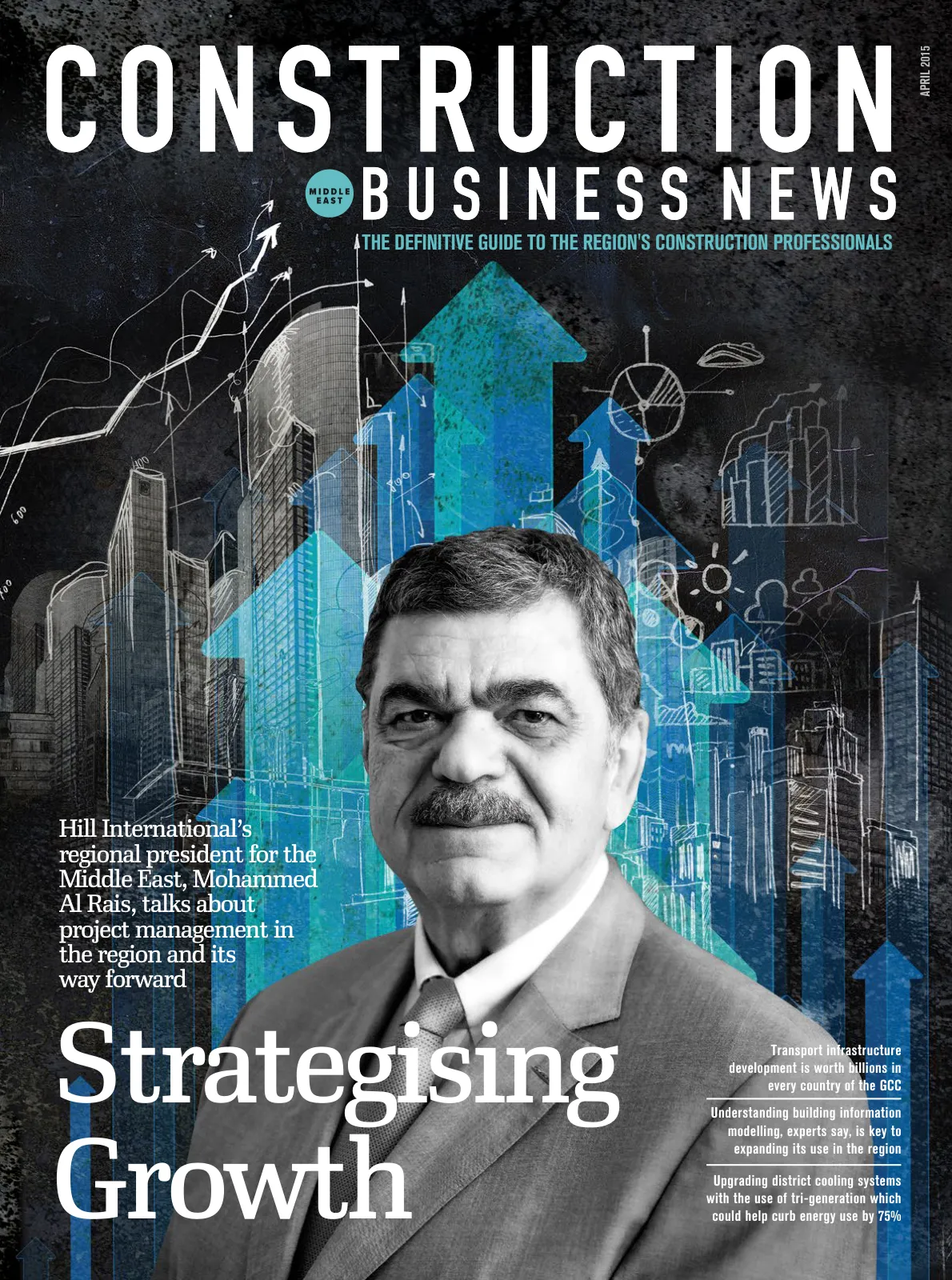
Construction Business News, April 2015
Page 1
Strategising
Growth
Hill International’s
regional president for the
Middle East, Mohammed
Al Rais, talks about
project management in
the region and its
way forward
Understanding building information
modelling, experts say, is key to
expanding its use in the region
Upgrading district cooling systems
with the use of tri-generation which
could help curb energy use by 75%
Transport infrastructure
development is worth billions in
every country of the GCC
APRIL 2015
THE DEFINITIVE GUIDE TO THE REGION'S CONSTRUCTION PROFESSIONALS
Page 2
OHSAS 18001 certified
ISO 9001, 14001 and
130+years of
project experience
LEED Platinum, LEED Gold
and LEED Silver Capability
End to End Integrated Solutions
Pioneering Engineering Construction since 1881
www.drakescull.com
700+
Projects Delivered
For over 130 years, Drake & Scull International PJSC has been shaping skylines and transforming the lifestyle of
communities around the world.
Drake & Scull is an industry leader, with a proven history of delivering more than 700 projects through its General
Contracting, Engineering, Rail, Oil & Gas, Water and Wastewater Treatment and Infrastructure development business
streamlines across the region.
Page 3
construction business news me APRIL 2015
3
14
Strategising Growth
Hill International’s regional president for the
Middle East talks about the project management
sector in the region and its way forward
24 SPECIAL FEATURE
Construction Business News ME looks into
the regional trends for developing transport
networks, including ports and airports
news
analysis
The effect of Shams
Dubai on solar power
providers in the
emirate and possible
opportunities for
contractors and
consultants
in the field
SDIC showcases
innovative designs,
landscapes and
architecture at the
upcoming Hidd Al
Saadiyat project
comment
Andrew Sibley
writes about indoor
air quality and
its importance in
building design and
functionality
sustainability
CEO of DC PRO
Engineering speaks
about upgrading
the district cooling
systems with tri-
generation and the
use of renewables
“At the end of
the day, the
client and
the project
is the target,
and achieving
quality on the
project is the
most important
thing for us”
ABOVE: HOW THE DUBAI SEVEN-STAR HOTEL WORKS
8
18
30
34
36
cover story
24
9
Mohammed al Rais
contents
Page 4
construction business news me APRIL 2015
4
S U B S C R I B E
c o n t r i b u t o r s
subscriptions@bncpublishing.net
Managing Director
Walid Zok
walid@bncpublishing.net
Director
Rabih Najm
rabih@bncpublishing.net
Director
Wissam Younane
wissam@bncpublishing.net
Group Publishing Director
Diarmuid O'Malley
dom@bncpublishing.net
Features Editor
Lorraine Bangera
lorraine@bncpublishing.net
Business Development Director
Rabih Naderi
rabih.naderi@bncpublishing.net
Sales Manager
Elly Shirkhan
elly@bncpublishing.net
Marketing Executive
Mark Anthony Monzon
PO Box 502511 Dubai, United Arab Emirates
P +971 4 4200 506 | F +971 4 4200 196
For all commercial enquiries related to
Construction Business News ME contact
Elly@bncpublishing.net T +971 55 339 5097
All rights reserved © 2015.
Opinions expressed are solely those of the contributors.
Construction Business News ME and all subsidiary
publications in the MENA region are officially licensed
exclusively to BNC Publishing in the MENA region by
Construction Business News ME.
No part of this magazine may be reproduced or
transmitted in any form or by any means without
written permission of the publisher.
Printed by International Printing Press www.ippuae.com
Stuart Matthews
Marlow McGuinness Ltd
architecture
Construction Business News ME analyses the
use of BIM in the region and why is it taking so
long to be embraced by the industry
construction machinery
India’s latest “world truck” enters the Middle
Eastern market
comment
Craig Gibson writes about how the regional
construction industry often relies on the
idea that gooD faith will protect it from a
contractual deviance
event preview
This month we feature the longest running
exhibition in the uae –Middle East Electricity
save the date
editor's pick
48
52
54
56
60
62
40 q&a
Faizal E. Kottikollon, Chairman of KEF Holding
on why offsite construction is the future
44 project review
This month we look at Alila Jabal Akhdar,
recently awarded as the first LEED certified
project in Oman
48
18
CONTENTS
Page 5
Porto Arabia Towers
Doha, Qatar
©2014 Hill International, Inc.
Hill International
The Global Leader in Managing Construction Risk
www.hillintl.com
For nearly four decades, owners and developers in the Middle East have
turned to Hill International to manage their construction projects and
programs throughout the region. Hill is proud to have helped our clients
turn their most challenging visions into realities. We have participated
in over 10,000 projects with a total construction value in excess of $500
billion, managing all phases of the construction process from concept
through completion.
Hill is also the leading construction claims firm in the world, having helped
resolve problems on some of the most complex projects throughout the
Middle East and around the world. To minimize risk and maximize results
on your next project, turn to Hill International
Dubai Office: 971 4 227 0078
Doha Office: 974 4 435 8381
Corporate HQ: 800 283 4088
If you can imagine it, we can manage it.
Qatar National Museum
Doha, Qatar
Mall of Qatar
Doha, Qatar
Viva Bahriya Towers
Doha, Qatar
Page 6
construction business news me APRIL 2015
6
Enabling efficiency in
the Middle East
IN PROCESS
This month Construction Business News ME
concentrates on ways to derive the most ef-
ficient solutions. Efficiency is a word used
to describe a performance done in the best
possible manner with the least waste of time
and effort. In construction, as the industry
progresses day by day, there are over a hun-
dred ways to be more efficient.
Our cover story follows Hill Interna-
tional’s new regional president for the Mid-
dle East, Mohammed Al Rais. The regional
manager talks about the project manage-
ment sector and how it could move forward
in the region. He talks about how knowl-
edge transfer is key, training is unavoidable
and how “giving back” leads to success.
We also speak with industry experts to
crack the code about why the adoption of
building information modelling (BIM) in
the region is dawdling compared to the UK
and the US. Experts emphasise that under-
standing BIM is the first step, which is why
this month we’ve looked into what BIM re-
ally is and how applying it could change the
way buildings function forever.
We also analyse the new solar initiative
in the UAE, Shams Dubai, and how it will
change the way firms work, now that re-
newables are officially on the table. We look
at upcoming opportunities for contractors
and consultants as the emirate will provide a
new electricity feed-in tariff structure.
Our special feature covers transport infra-
structure, which is key to building an effi-
cient urban space. A report released by Ti-
metric suggests that an estimated US$300
billion will be spent in transport in the
GCC over the next five years. The invest-
ment will surely derive opportunities for
construction contractors and those in the
project management and consultancy areas.
Keeping efficiency in mind, we also have
a look at new trends to watch out for such
as offsite construction. Working through
offsite construction, not only requires less
manpower but also takes almost half the
time to complete any building project.
We also observe the adoption of LEED
certification by US Green Building Coun-
cil in GCC countries. Our site visits cover
projects including Oman’s first LEED certi-
fied building, Alila Jabal Akhdar Resort and
SDIC’s Hidd Al Saadiyaat.
Finally, we discern the use of tri-genera-
tion with renewable sources for cooling is
much more efficient compared to district
cooling which according to the CEO of DC
Pro Engineering is “outdated.”
editor's note
Page 7
Page 8
construction business news me APRIL 2015
8
Hansgrohe, a German bath-
room specialist, showcased
its latest range for kitchens
and washbasin, Axor Citte-
rio E and Axor Starck V at
the ISH show organised by
Messe Frankfurt this March.
“Our innovations for bath-
rooms and kitchens give
our
customers
genuine
added value,” said Rich-
ard Grohe, Deputy CEO of
Hansgrohe SE. “After all,
they make everyday life in
kitchens and bathrooms
easier and enable us to use
water more efficiently. They
intensify the water expe-
rience and provide com-
pletely new solutions in the
field of shower design.”
The Axor Citterio E is de-
veloped by the designer
brand of Hansgrohe SE in
collaboration with Antonio
Citterio. The Axor Starck V
has a glass mixer featuring
a visible water vortex and
is more of a fountain than
a faucet.
Nshama
launched
Zahra
Townhouses,
a
residential
community, in its flagship proj-
ect, Town Square, in Dubai this
March. Town Square is spread
over 750 acres, with a central
space spread out as far as 16
football fields.
The Zahra Townhouses are
the first residential phase in
Town Square, and offer 3 to 4
bedroom houses. Nshama has
joined hands with three lead-
ing financial institutions – Noor
Bank, First Gulf Bank, ADIB –
for home finance services.
Town Square will feature
over 3,000 townhouses and
18,000 apartments as well
as substantial retail, hospi-
tality and commercial space.
With a total area of 31 million
square feet, it will have a high
land-to-building ratio, thus
opening up more spaces for
a greener community.
Last month, Nakheel delivered 90 new
villas at the Jumeirah Village Circle
(JVC) in Dubai. The sell-out JVC villas
project launched in December 2013
sold for a combined value of AED275
million. It consists of homes built in
a circular pattern at the heart of Na-
kheel’s JVC master community. The vil-
las are 3,655 square feet each consist-
ing of four bedrooms with an extensive
indoor and outdoor living space, includ-
ing an expansive roof terrace. Other
Nakheel-constructed developments at
JVC include 615 villas and townhouses,
which were delivered in 2013, and the
upcoming one million square feet Circle
Mall, a new retail, dining and entertain-
ment hub due for completion in 2017.
Hansgrohe showcases
new products at ISH 2015
Nshama launches
Zahra Townhouses
NEWS
Nakheel
delivers new villas at JVC
Model of Town Square
Nakheel Jumeirah Village
Circle Villas
Axor Citterio E washbasin mixer
Page 9
construction business news me APRIL 2015
9
Habtoor Leighton Specon
and Drake & Scull Engineer-
ing have announced their
agreement to jointly deliver
the AED395 million MEP
contract on the Jewel of the
Creek Package 8 complex.
HLS has been nominated
by Dubai International Real
Estate (DIRE) as the MEP
contractor of the project.
The package forms a signifi-
cant part of the AED 4 billion
Jewel of the Creek project
being developed by Dubai
International
Real
Estate.
Construction work on Jewel
of the Creek Package 8, a
mixed-used
development
designed by Kling Consult
and Kieferle & Partner Joint
Venture, has commenced
and completion is targeted
for Q2, 2017.
The marine and infrastructure works for AED1 billion Falcon Island development at
Al Hamra Village in Ras Al Khaimah has been awarded to China Harbour Engineer-
ing Company under the AED 150 million contract. The China Harbour Engineering
Company will be responsible for landscaping private and public beaches, and power,
sewage, and road networks. The work would also include a built central canal which
will split the island into two. The marine features are said to be the main attraction of
the island. The existing beaches at Al Hamra Village will also be enhanced as part of
the contract.
China Harbour wins
contract for marine works
Oil price
fluctuations to
impact global
real estate
HLS and DSE work together on Jewel of the Creek
HLS and DSE
work together
on Jewel of the
Creek
According to Tasweek Real
Estate
Development
&
Marketing based in Abu
Dhabi, there could be shifts
in regional and global real
estate activities as the oil
price shifts, in the past six
months barrel rates have
been their lowest since the
2007-2008 financial crisis.
After observing changes
in the investor’s options,
Tasweek says that main
markets should prepare
to adjust to the effects on
property prices particularly
the shifts in the housing
and commercial sections.
Masood Al Awar, CEO of
Tasweek, said: “While price
drops in oil and variations
in currency rates are trig-
gering a real estate frenzy
in many parts of the world,
key markets could face a
reverse slump in business.
The best strategy is to an-
ticipate unfavourable mar-
ket changes and broaden
horizons especially towards
high-potential regions and
plan to adopt new smart
products and services that
can match and sustain mar-
ket growth.”
Upcoming canal at Falcon Island
Jewel of the Creek
Masood Al Awar, CEO of Tasweek
Page 10
construction business news me APRIL 2015
10
L
ast year, RAK Ceramics’ profits
have risen by 14.1%, sharply at
338.3 million in 2014 over 281.7
million in the previous year. The
growth is a result of a new dividend policy
adopted by the board of directors, who are
now committed to return capital to share-
holders. This sustainable policy aims at a
pay-out ratio of at least 60% of consolidat-
ed net income subject to consideration of
the business outlook, capital requirements
for growth opportunities, expansion plans,
optimal leverage levels and healthy cash
reserve in addition to regulatory approvals.
Abdallah Massaad, CEO of RAK Ceramics,
said: “Our financial performance in 2014
confirms the success of our re-focused
strategy and ‘Value Creation Plan’. As we
continue to invest in our ‘core-business’
activities across core markets, we expect
to strengthen our ability to expand our cus-
tomer base, significantly improve profitabil-
ity and increase returns for our sharehold-
ers. We have started seeing the benefits of
the ‘non-core business’ divestments and we
have set a proactive strategy to strengthen
our distribution network and energise our
B2B sales, they currently contribute 35 –
40 % of our top line and we want to grow
this to over 50%.”
Upward
projection
RAK Ceramics predicts
a strong year ahead with
a net profit of AED 281.7
million in 2014
Key highlights
for the period
• Overall revenue in 2014
decreased by 6.4% to
AED 3.28 billion.
• ‘Core revenues’ decreased
by 1.9% to AED 2.8
billion and ‘non-core
revenues’ decreased by
26.3% to AED 482.5
million in line with the
strategy to scale down
contracting operations.
• Consolidated gross mar-
gin was 25.9% for 2014
• Gross Profit decreased by
10% to AED 809 mil-
lion due to the perfor-
mance of China, Sudan
and Iran.
• Finance Expenditure (ex-
cluding forex), decreased
by 24.5% to AED 67.9
million.
NEWS
Abdallah Massaad, CEO of RAK Ceramics
Page 11
Last month, Morocco began the US$30
million regeneration of its historic Old
Medina in Casablanca. The project is
part of Wessal Capital’s $570 million
Casa-Port project to help restore the
city. The restoration of Old Medina is
the second phase of the project, with
work on the port redevelopment starting
mid-March. When completed, Wessal's
Casa-Port will offer tourist-friendly in-
frastructure, including the development
of the city’s first marina, an upgraded
port, and new commercial and cultural
spaces. The public-private partner-
ship is due for completion in five years.
The project reflects His Majesty the
King Mohammed VI’s personal interest
in the social and economic development
of Casablanca, as well as the improve-
ment of the standard of living of the
city’s inhabitants.
Restoration works at Casablanca
MADE IN UAE
www.intermetal.com www.verdadoors.com
Dubai, UAE Tel: +971 4 884 1650 Email: sales@verdadoors.com
MANUFACTURING
QUALITY DOORS, KITCHENS &
INTERIOR FIT-OUT
Wessal Capital's Casa-Port project
Page 12
construction business news me APRIL 2015
12
This year marks the 12th edition of
Project Qatar, held from May 4 to 7 at
the Qatar National Convention Cen-
tre (QNCC). Well ahead of the 2014's
exhibition, 19 pavilions have already
been confirmed, with 34 previously
participating countries returning to this
year’s exhibition.
Firas Bin Abdul Aziz Aba Al-Khail,
Marketing and Corporate Communi-
cations Director at the Saudi Export
Development Authority (SEDA), con-
firmed that authority’s participation
in the event, highlighting how solid
and big the GCC market is for Saudi
building and construction products.
The Saudi Pavilion will see 46 par-
ticipating national factories.
The Middle East Covering
exhibition, held in May 18-
21 will feature the Surface
Design School. Sponsored
by Interface Europe, Kare-
lia and Woodfloors, the
three-day Surface Design
School will provide an edu-
cational platform allowing
interior designers, archi-
tects, retailers, flooring
experts and contractors
to get the most up-to-date
information
on
surface
solutions and techniques.
Regional and internation-
ally-renowned experts will
share their insights and
facilitate the exchange of
ideas on surface covering,
interior design and new in-
dustry trends.
“The projects currently un-
der construction will add an
approximate 30,000km of
rail across the Arab World,
that's nearly five times the
length of The Great Wall of
China," said Mark Loader,
CH2M HILL's Global Rail
Director. He also said that
the Middle East is one of
the fastest growing rail mar-
kets in the world. CH2M Hill
presented its urban metros,
freight railways and high
speed rail systems at this
year’s Middle East Rail. The
exhibition also showcased
the company's technical
depth, global perspective,
local understanding, and
delivery expertise through a
360° visualisation of iconic
infrastructure projects from
around the world.
Middle East
Covering to
organise 3-day
design school
Project Qatar 2015 to feature
over 30 pavillions
CH2M Hill showcases
work at ME Rail
Nakheel Jumeirah Village Circle Villas
NEWS
Project Qatar 2014
Page 13
construction business news me APRIL 2015
13
Real estate consultancy, Clut-
tons, announced this March
that Dragon City, the new
115,000 square metre mall
under construction in Bahrain,
has already pre-let more than
60% of space. Appointed
by Chinamex, Chinese trad-
ing company, Cluttons is the
official leasing agent of the
multi-million dollar retail proj-
ect. The mall design is infused
with Chinese architectural
and cultural aspects and will
incorporate 750 retail store
units with 4,500 square me-
tres designated for ware-
house space.
GCC projects account for more than a fifth of the global natu-
ral stone market, with US$5 billion out of the total of $24 bil-
lion globally. Stone products account for approximately 15%
of the total value of a construction project. Mark Goodchild,
Event Director of Middle East Stone said it is the perfect time
to launch a show dedicated to the stone industry. The event,
ME Stone, will run from the May 18 to 21 at the Dubai World
Trade Centre this year. He said: “The growing number of peo-
ple wanting to live, work and visit the UAE, Qatar and Saudi
Arabia, has been a huge driver for the construction industry’s
robust performance. There will be hundreds of hotels, new
residential buildings and commercial spaces to be built over
the next few years. As such, the massive demand for natural
and artificial stones cannot be ignored.”
Stone products to be showcased this May
Majority of retail space leased at
Dragon City
GE announced a US$100
million investment in new
programmes in KSA that
will help create jobs in ad-
vanced manufacturing and
software
analytics.
The
new research and manu-
facturing programmes are
set to improve energy ef-
ficiency and sustainability
efforts of the country. The
programmes include a 'Hot
& Harsh' global research &
development programme,
which will study the effect
of high temperature, dust,
corrosion,
erosion,
duty
cycle, and fuel harshness
which have a critical im-
pact on the reliability and
efficiency of power plants.
This R&D programme will
design gas turbine and
auxiliaries components for
testing at a simulated 'hot
and harsh' environment at
GE Manufacturing Tech-
nology Center.
Dragon City, Bahrain
GE launches new
programmes in KSA
Marble entrance of Emirates Palace
Page 14
construction business news me APRIL 2015
14
Hill International’s
regional president
for the Middle
East Mohammed
Al Rais talks to
Aby Sam Thomas
about the project
management
sector in the
region, and its way
forward in what
is now a booming
construction
market
Strategising
Growth
COVER STORY
construction business news me APRIL 2015
14
Page 15
construction business news me APRIL 2015
15
With more
than 35 years of
experience in the man-
agement of construction projects
around the world, Mohammed Al Rais
looks to be extremely well placed in his role as re-
gional president for the Middle East for the New York Stock
Exchange-listed construction consultancy, Hill International. Al Rais
was appointed to this position in January this year (he was earlier the Senior
Vice President and Managing Director for the firm), and to say that he has a lot
on his plate right now might be a bit of an understate-
ment, given the dynamics of the region he oversees.
“The Middle East is the biggest region for Hill Inter-
national, both numbers-wise and revenue-wise,” Al
Rais explains. “We are doing something in the region
of, I think, 62 projects today, with value worth about
US$82 billion of construction costs.” Given the amount
of work the company is dealing with right now, it
should then come as no surprise that Hill International
has been on a recruitment spree of sorts as well — Al
Rais says the company has been hiring an average
of 70 people per month for the region, with the total
number of employees it has in the Arabian Peninsula
reaching 1800 now.
Now, if Hill International’s regional staff numbers
sound impressive, wait till you hear about the proj-
ects it has under its belt — the company’s current
portfolio includes several prestigious undertakings
like the Midfield Terminal Complex at the Abu
Dhabi International Airport in the UAE, the expan-
sion and modernisation of the Salalah and Muscat
airports in Oman, the 57-acre Jabal Omar develop-
ment in Saudi Arabia, the Doha Metro Green Line in
Qatar and a lot, lot more. In addition, Hill Interna-
tional is also enjoying renewals and repeat projects
from many of its existing customers – for instance, in
February this year, the company announced that it
had received three new project management and site
supervision contracts from the Civil Projects Division
of one of its long-term clients, Abu Dhabi National
Oil Company, which were estimated to be worth a
total of $25 million. As far as Al Rais is concerned,
such happenings are indicative of Hill International’s
expertise in the sector: “I think that is the evidence
of the success of our services, the quality of services
we provide, and so on, where people come and
keep us onboard for longer and longer.”
When asked about the reasons why Hill Interna-
tional has been able to succeed in the market, Al
Rais pointed to the singular focus the company had
on the field of project management, and as a result,
construction business news me APRIL 2015
15
Page 16
construction business news me APRIL 2015
16
Analysis
winning — and retaining — projects in
the region. “We understand the culture
in this market,” Al Rais says. “I think
that is critical. People cannot expect to
come from the West or the Far East and
expect the Middle East to behave like
they do- it’s the reverse that is actually
expected. You’re coming here to do
business, so you need to understand the
locality, the culture, so on and so forth
— and we do, big time.” In addition,
Al Rais also drew attention to the way
Hill International actually did business
with clients in the Middle East. “Al-
though we are a public company on the
its particular expertise in that field. “At
the end of the day, we are specialised in
project and construction management,
because we have the systems, we have
done our own procedures, we have
done our own QA/QCs, and so on —
so we have all our processes in place,”
he explains. “The people we put in at
the start of a project — they bring in the
system, the Hill processes, and then ex-
plain these to the consultants or contrac-
tors, who are then expected to follow
[the procedures]. Because standardisa-
tion for us is critical — so everybody
understands how to talk to everybody
else, who’s responsible for what, and so
on, and that will basically delete a lot of
the ambiguity that normally takes place
in projects. This is one of the differences
that we bring in- we have those [sys-
tems] in place, and we make them work
for the project, but based on the client.
And I think this is why we have been so
successful in this area to this level.”
Al Rais also noted that having had
a presence in the Arab world for over
25 years is also a significant advantage
for Hill International when it comes to
Nakheel Jumeirah Village Circle Villas
“People cannot expect to come
from the West or the Far East and
expect the Middle East to behave
like they do – it’s the reverse that
is actually expected.”
Mohammed Al Rais, Regional President for
the Middle East, Hill International
Palm Jumeirah
COVER STORY
Page 17
construction business news me APRIL 2015
17
NYSE, we have a very simplistic format
of moving,” he explains. “So decisions
are made very quickly, because of the
amount of authority and responsibility
we have and send down the line. This
quick response [format] that we have
set up [in the company], and given to all
of our clients makes a huge difference,
because people expect swift answers in
this market.”
Al Rais is also extremely keen on en-
At the same time, the construction
sector in the region is booming, and
the sheer deluge of projects being an-
nounced (and already being worked on)
here has caused Hill International to also
consider alliances with fellow compa-
nies in the project management field to
take on this load. “Projects are becoming
much bigger, much more complex,” Al
Rais says. “There is so much going on
that you will reach a stage where [for]
certain projects, you’ll have to partner
with reputables. So what we do is we
actually seek these relationships with
companies similar to us, if not better
than us — because, at the end of the
day, the project is the most important
thing, and if we can achieve a relation-
ship with other consultants that allows
us to actually provide the service with
the support of others, then we shall —
we don’t shy away from that. We don’t
have a problem with that. At the end
of the day, the client and the project
is the target, and achieving quality on
the project is the most important thing
for us.”
couraging the understanding of project
management in the region, and increas-
ing local participation in the field. Hill
International, for its part, has launched
training programmes in Saudi Arabia
and Oman, and Al Rais reports that
the resounding interest these initiatives
have seen have spurred the company
to increase its offerings in this particular
area. “Knowledge transfer is critical —
but it’s not just hiring people for the sake
of meeting quotas,” he says. “It’s an issue
of training people… Project management
firms in the area are not giving back to
their localities as much as they should. I
think there should be a lot more done,
us included. We should give back more
to the areas we are working in — this
is income, this is revenue, and I think
we should give some of this back to the
local people through training, educa-
tion, bringing people on board… We’ve
started this in Saudi Arabia, we’re starting
it now in Muscat — but I think we are
lagging behind, and we need to do a lot
more. Having said that, I think we’re do-
ing a lot more than a lot of others.”
Projects Overview
A few of Hill International’s past and current projects in the Middle
East:
• Sheikh Zayed Bin Sultan Al Nahyan Mosque, Abu Dhabi, UAE
• The Palm Jumeirah, Dubai, UAE
• Jabal Omar Development, Makkah, Saudi Arabia
• Pearl Qatar Development
• Bahrain International Airport
• Abu Dhabi International Airport Midfield Terminal Complex, UAE
• Muscat International Airport, Oman
• Salalah Airport, Oman
• Mall of Qatar
• Riyadh Metro, Saudi Arabia
• Doha Metro Green Line, Qatar
Source: www.hillintl.com
Sheikh Zayed Mosque
Abu Dhabi International Airport
Page 18
construction business news me APRIL 2015
18
Brig
futu
for
pro
A new electricity feed-in
tariff structure in Dubai has
signalled changes to the way
that firms may power their
business premises, with
renewable energy sources
now a viable option. Alison
Luke examines how the
Shams Dubai initiative will
affect solar power providers
in the Emirate and asks what
opportunities may arise for
contractors and consultants?
Bright
future
for solar
providers
ANALYSIS
construction business news me APRIL 2015
18
Page 19
construction business news me APRIL 2015
19
ght
ure
solar
viders
T
he potential for solar
power application in
Dubai has risen dra-
matically following the
implementation of a new
initiative by Dubai Elec-
tricity and Water Authority (DEWA).
Announced in mid-March, the Shams
Dubai initiative will regulate the gen-
eration of solar energy in individual
buildings and enable their connection
to the DEWA grid.
In essence, the initiative encourages
businesses and consumers to install pho-
tovoltaic (PV) panels on their premises
to generate electrical power for their
use onsite, then ‘sell’ any excess power
back to the grid. This offers two positive
outcomes: a shift from demand on elec-
tricity produced by traditional energy
resources; and financial savings for the
participating end-users.
“DEWA is introducing a net-metering
legislation, which has two parts,” ex-
plains Erik Voldner, executive director
of operations at PV system integrator En-
viromena. “The first part will allow users
to feed electricity into the DEWA grid;
the second will credit the end-user with
energy, so it essentially allows them to
reduce electricity bills.”
The move aims to increase the use
of renewable energy resources and
diversify the energy supply chain in
the emirate. This follows the targets
of Dubai Plan 2021 and the Dubai
Integrated Energy Strategy 2030 to raise
renewable energy use in the emirate’s
energy mix to 7% by 2020 and 15% by
2030. But how will the initiative operate
in practice and how will it affect the cur-
rent MEP providers?
PV application
Although improved technology and a
significant drop in the cost of PV panels
are making such systems financially vi-
able, they may not be cost-effective for
all projects. This will be reflected in the
initial implementation of Shams Dubai.
One of the main factors to consider
is the available space for the panels
on a project. Brian Dryburgh of MEP
consultancy Black & White Engineer-
ing explains: “To make any signifi-
cant impact on your bills, you need a
relatively big area to install panels, so
large industrial units or warehouse roofs
immediately spring to mind as being the
most feasible buildings to accommodate
large areas of panels.”
Thus, the legislation may not affect
skyscraper design in the short-term due
to the smaller roof space available, for
construction business news me APRIL 2015
19
Page 20
construction business news me APRIL 2015
20
ANALYSIS
Enviromena – Mamoura Parking
Enerwhere - Remraam 5 - solar field helicopter view
Analysis
plant needed, but the first people to use
PV will be the large electricity users,”
Voldner predicts.
“We expect a lot of interest from the
free zones, where a lot of roofs are large
and south-facing,” adds Daniel Zywietz,
CEO of solar power provider Ener-
where. “[We will] market initially at this
industrial sector because the economics
work out. The economics of installing a
small villa system are not there, at least
not for those looking for a fast invest-
ment return,” states Zywietz.
Getting ready for installation
With the expected surge in applications
for PV installations, a large market of
work is set to emerge. But which firms
can undertake this work and what quali-
fications are required?
With a limited number of specialist
solar firms in the emirate, one of the
obvious answers to this is the MEP
professionals. “There certainly appear
to be diversification opportunities
for MEP engineers towards the
specialisation in the field where
the solar panels are contained
upon the building,”
says Dryburgh.
“The design and feasibility of solar
panels is not as overly complex as to
merit separate specialist consultants,”
he says. “Many MEP consultants and/or
architects, I'm sure, are capable of ensur-
ing that the necessary requirements are
included in the building design, but I cer-
tainly would expect to see manufacturers
and specialist installers involved in the
final design and installation,” he stresses.
In order for a firm to design or install
PV systems under Shams Dubai they
must meet a number of criteria. Firstly,
firms must be enrolled with DEWA as an
electrical consultant or contractor, hav-
ing qualified to hold the relevant trade
licences. These firms must also employ
a certain number of employees that
have been certified as ‘solar PV experts’
by DEWA. To gain ‘expert’ status, indi-
viduals must hold a degree in electrical
or electrical and electronics engineering
and have relevant professional experi-
ence. In addition, all of these individuals
must also have completed the DEWA
Solar PV Certification Training Session.
“The first certification training took
place in March and the first systems are
expected to be connected in the next
month or two,” says Zywietz.
example. Plus, the largely expatriate
nature of Dubai’s population may have
an effect on the initial uptake from the
domestic market, with new, large-scale
developments expected as more likely
to include the scheme rather than indi-
vidual end-users.
“[Shams Dubai] has been set up so
that it is open for everyone, but those
that will gain the greatest economic
benefits will be the large power us-
ers such as industrial sites, malls and
schools,” agrees Voldner. “The econom-
ics [of an individual project] will depend
on a lot of factors such as the size of
Nakheel Jumeirah Village Circle Villas
“A PV system] typically costs
AED5000/kW, so if you have
a 500kW system it will cost
AED2.5 million to install and
produce about 800,000kW/
yr, so can save around
AED350-400,000/yr.”
– Daniel Zywietz
Top: Enviromena - ADDC Panorama1
Left: Enviromena – Mamoura Parking
Below: Enerwhere - Remraam 5 - solar field helicopter view
Page 21
02 - 04 March 2015
Page 22
construction business news me APRIL 2015
22
“DEWA has qualified the first round of
suppliers and is in the process of quali-
fying consultants and contractors,” adds
Voldner. “A lot of firms are interested in
completing the training courses and we
expect this to grow each time that there
is an opportunity.”
The initial training courses have been
provided free of charge and are being
sought by MEP contractors seeking to
diversify their trade, as well as existing
solar integrators.
“The programme is open to everyone
as long as they meet the qualification
criteria,” explains Voldner. “This will
generate a lot of interest from three
main areas: existing pv installers in the
Emirates; PV installers from overseas;
and local companies [such as MEP con-
tractors] moving into the solar industry,”
he predicts.
In addition to the installation of the
systems, a further market will be system
maintenance and many within the
industry expect this to be the main area
targeted by traditional electrical and MEP
contractors, at least in the short-term.
Maintenance costs of PV systems are
also minimal, with no moving parts in
the panels and improved technology
meaning there is no dramatic drop in
power supply even in a sandstorm. “It is
a proven technology and proven in the
region, so any concerns over climac-
tic conditions or dust are manageable
and predictable,” assures Voldner. A
scheduled weekly or fortnightly cleaning
programme should be applied in addi-
tion to regular plant checks, providing a
long-term work opportunity for DEWA-
approved contractors.
Cost issues
Current costs of both PV technology
and grid electricity make this an optimal
time for applying solar power. “[Solar
power] is a reliable electrical source with
decreasing costs: the capital costs of PV
panels dropped by 80% over the past
5-6 years, so costs are now in competi-
tion with other electrical sources,” says
Voldner. “This is why DEWA has intro-
duced a net metering scheme now; it is
the right time from both technology and
cost points of view.”
In general, the larger the PV system
installed, the lower the payback period.
For optimal payback, systems should be
designed to cut into the red tariff usage
of end-users, which is currently 44.5fils
per kWh.
“At that price a solar system can have
a payback period of seven to eight
years,” says Zywietz. “[A PV system] typi-
cally costs AED5000 per kW, so if you
have a 500kW system it will cost AED2.5
million to install and produce about
800,000kW per yr, so can save around
AED350-400,000 per yr,” explains Zywi-
etz. “A payback of six to seven years is
possible on this depending on a number
of factors including the orientation
of the roof, but consumers must also
account for maintenance costs [when
calculating payback],” he stresses.
DEWA will charge a one-off fee of
AED1,500 for each grid-connected
“This will change
the market from
one with little
installed capacity
to being one of
the main regional
leaders in PV
electricity supply.”
– Erik Voldner
ANALYSIS
Enviromena senior management team, Eric
Voldner is on the lhs with blue tie
Page 23
construction business news me APRIL 2015
23
Software for facilities, property & maintenance management
Understanding your requirements
T: +971 (0)4 449 5380 E: info@fsime.ae W: www.fsime.ae
Asset, helpdesk, maintenance & facilities software
Single User to enterprise scalability
Onsite or fully hosted
Accessible anywhere
Cross-platform mobility for smart phones & tablets
Standalone or integrated with Concept Evolution
Innovative FM Technology for Smart Buildings
renewable generator as part of the
connection process. Further equipment
costs are possible for installations of
400kW and above to ensure the proper
integration of the renewable generator
into the DEWA distribution network.
Two meters will be needed - a bi-
directional smart meter that measures
the electricity exported to and imported
from grid will be installed free by
DEWA; the second meter, which will
measure the electricity generated by the
PV system, forms part of the one-off
connection fees.
Long-term market outlook
The Shams Dubai initiative will un-
doubtedly play a major role in Dubai’s
future energy use. The government
wants to expand the use of solar energy
and to do that alone by solar fields
would require a lot of space that could
be used for other developments, hence
it appears to be a wise decision to offer
this solution.
“[Shams Dubai] is part of the inte-
grated plan to increase the renewable
energy capacity of Dubai,” reports Vold-
ner. “This will change the market from
one with little installed capacity to being
one of the main regional leaders in PV
electricity supply,” Voldner predicts.
The first project to be announced
under the initiative is the installation of
PVs at Al Maktoum International Airport
in collaboration with Dubai Airports to
supply 30kW of electricity to the site.
Enerwhere - SAV Phase 2 setup 1
Page 24
construction business news me APRIL 2015
24mo
Transport infrastructure development is
worth billions in every country of the GCC.
Stuart Matthews writes
Page 25
construction business news me APRIL 2015
25
ove
View over the bridges at
Dubai Internet City
Page 26
construction business news me APRIL 2015
26
T
ransport infrastructure is at the heart of any
urban development, with mobility of goods,
services and people essential to oil the wheels
of the economy. It’s no surprise then that the last
decade has seen the nations that make up the
GCC invest billions in building a transport network that rivals
any in the world.
Figures for the combined value of investment still to come
are hard to pin down, but regardless of their variety they
all have size in common. A report released late last year by
Timetric, a research analyst, suggested the GCC is likely to
invest US$121.3 billion in boosting its land transport infrastruc-
ture alone.
Those with a head for numbers can add to this figures for air-
port developments around the Middle East –something research
firm Ventures estimates at $300 billion worth of spending over
the next five years –all aimed at accommodating GCC passenger
numbers which are expected to reach almost 4 billion by 2017.
With this money set to go into transport infrastructure,
opportunities for construction contractors and those in the
project management and consultancy areas are likely to
continue. Investing in projects of this scale is not without risk,
but in some local markets this risk shows signs of declining.
In its most recent update to its Construction Risk Index, a
global ranking of 50 key construction markets, Timetric noted
that the UAE had improved in its overall risk profile, despite
the decline in oil prices, thanks to what the analysts described
as ‘fiscal buffers’ supporting non-oil growth, while efforts at
economic diversification in the country continue.
When Dubai published its 2015 budget the figures showed
that while infrastructure spending would slow compared
to 2014, it still counted for some 13% of the emirate’s total
expected outlay. Across the UAE public transport programmes
have continued to attract investment. This shift has devel-
oped, not least because it had to. Abu Dhabi’s Department
of Transport (DoT) estimated that by 2015, the annual cost of
SPECIAL FEATURE
View over the bridges
at Dubai Internet City
Monorail station on a man-made island Palm Jumeirah in Dubai
Page 27
construction business news me APRIL 2015
27
time spent in congested traffic would be about $680m, rising
to $1.6 billion by 2030.
While major roadwork programmes had eased access
into and out of the capital, the relief would be temporary
if other solutions weren’t put in place, and population and
vehicle numbers just kept growing. DoT has a stated target
of getting 33% of all trips taken in the city to be conducted
via public transport.
The development of multimodal transportation is a pattern
repeated around the region, where road and bridge building
is combining with primarily rail options to ease congestion in
increasingly crowded cities.
“We saw some positive momentum towards the launching
of the rail network creation activities in our region in 2014,”
says Khaldoun Al Tabari, CEO and vice-chairman of Drake
& Scull International (DSI), speaking on the sidelines of the
Middle East Rail Summit.
“Regional governments have recognised that rising popu-
lations have exerted pressure on existing road infrastruc-
ture, and only a dedicated rail and metro
network can ensure swift and efficient
transport of people and goods.
“According to an Ashurst study in
November 2014, the GCC Rail alone is
expected to span 2100km in length, with
the UAE and KSA constituting the bulk of
the rail network. However, the recent un-
certainty regarding the 2018 launch target
for the ambitious GCC rail has tempered
the regional industry’s expectations to
realistic levels.”
Tabari points to examples of potential
development around the region such as
Saudi Arabia, where the Saudi Railways
Commission is developing the $5.3 billion
Saudi Railway Company Line, the Land-
bridge project, the $7 billion Haramain High
Speed Rail and the $15 billion Makkah Mass
Rail Transit project, among others. In Qatar
estimates of the spend on the Qatar Inte-
grated Rail programme are in region of $40
billion, with the Doha Metro being a crucial
component in the country’s hosting of the
2022 FIFA World Cup.
Massive programmes such as this could
develop into a peak for regional construc-
tion between now and 2019, according to
consultants EC Harris. In it’s Middle East
Major Construction Programmes report,
it estimated that 1.2 million additional
labourers will be needed to deliver the
117 major programmes it identified from
2014 to 2019. These major programmes
- anything worth more than $1 billion -
will also need 135,000 professional staff
at peak. Some 22% of these programmes
Riyadh, Riyadh Metro
With a total project budget of some $22.5 billion the Riyadh Metro drew global
attention when the contract awards were first announced back in 2013. With
the projects six lines split into three packages, three separate consortia all
won work, spreading the risk for the project’s developers. The BACS consor-
tium led by Bechtel and including Almabani General Contractors, Consolidated
Contractors Company and Siemens is to design and build lines 1 and 2, total-
ling 63·3 km. The ArRiyadh New Mobility consortium won the design and
build of Line 3, the longest at 40·7 km. The FAST consortium led by Spanish
construction group FCC and including Samsung C&T, Alstom, Strukton, Freys-
sinet Saudi Arabia, Typsa and Setec is to build lines 4, 5 and 6 covering a total
of 64.6km. As work on the project progresses, smaller specialist packages
continue to be awarded.
Abu Dhabi, Midfield Terminal Building
It was one of the UAE’s most anticipated contract awards. Thirteen con-
tractors across four consortia were in the running but it was the Arabtec-
TAV-CCC partnership that was to emerge the winner, signing a $2.94
billion deal to build the Midfield Terminal Building at Abu Dhabi Airport.
Since the signing progress has been scrupulously documented, with the
building due to be ready for airline operations in July 2017. The landmark
project is progressing on schedule, according to Abu Dhabi Airports, a
public joint-stock company, wholly owned by the Abu Dhabi Government,
with five airports under its control.
Doha, New Port Project
Just south of Doha, the Qatari capital’s new $7.4 billion port project, one of
the largest greenfield port projects in the world, is being dug, walled, levelled
and prepared for operation. The new port, which is to include a new base for
the Qatar Emiri Naval Forces and the Qatar Economic Zone 3, will span 26.5
km2 and is expected to be complete in 2016. With seven major contractors
undertaking construction work on site, and a workforce knocking around 9,000
people the most recent milestone was the flooding of the port basin. Approxi-
mately 76 million m³ of water is required to fill both the port basin and access
channel, all of which was scheduled for completion by the end of March 2015.
A major contract award is expected in the second quarter of 2015, with work
on the construction of all the buildings for the naval base up for grabs, a total
of some 225 buildings.
Muscat, Al Batinah Expressway
Credited with having one of the most transparent tender processes in the
region Oman has some $56 billion worth of infrastructure projects planned
between now and 2017, including the high profile Al Batinah Expressway. The
ambitious roading project is split into 11 separate packages, with six already
awarded. Packages 7 to 10 are currently under offer with up to a dozen differ-
ent contractors in the running for the main construction work. The Al Batinah
Expressway will stretch over 265km and has been estimated at $2.6 billion.
When finally complete it will provide a direct link between Oman’s capital,
Muscat, and the emerging Sohar Port and industrial area near the UAE border.
HOT SPOTS
Page 28
construction business news me APRIL 2015
28
fall into the transport sector and again, metro and rail
programmes are the leading area identified.
With these pressures come risks. For instance, EC Harris
suggests that securing a suitably skilled workforce to build and
then test the rail network in Qatar is seen as a major challenge
to delivering on the country’s $36 billion rail plans. Other risks
around the region include the return of inflation as procure-
ment for the projects starts to heat up.
This may translate into some welcome news for the region’s
construction suppliers, who are starting to see some of these
major programmes reach mobilisation stage.
“At the moment Qatar is very active in the transport sector,
in terms of bridge works and freeway construction, with the
added opportunities rising out of the Doha Metro project
coming on stream as well, in terms of mobilisation,” says Paul
Williams, divisional operations director, for RMD Kwikform, a
formwork company.
“Equally in Saudi Arabia we have a lot of involvement in
bridge and airport projects, but the bigger prospect looking
forward and including recently secured work is on the Riyadh
Metro. That’s a massive project and we’re hopeful for much
more work on it yet.”
The company also has formwork in place on the Abu Dha-
bi’s Midfield Terminal Building project as well as a number of
recently secured bridge work contracts in Dubai, which Wil-
liams describes as an ‘improving market’ for RMD Kwikform.
With nearly half of the company’s revenues in the region
coming from transport-related work, the business works hard
to deliver on its projects.
“The Riyadh Metro is such a huge development we es-
tablished an independent team to track the work, so that
an extra resource added to run a project of that size,”
explains Williams.
Williams says that this is something the company does on
the larger projects it services, which also bring with them a
need for ideas and innovation.
“They require innovation in the design process and the
equipment we use and supply to these jobs,” he says. “This is
both for efficiency and getting the right end result in terms of
concrete finish, programme times and safety.”
It will take many providers throughout the construction sup-
ply chain, who can deploy similar levels of skill and resource,
to complete the region’s transport projects to schedule. Those
that can manage it, may find it a lucrative line of business.
“Regional governments have recognised
that rising populations have exerted
pressure on existing road infrastructure,
and only a dedicated rail and metro
network can ensure swift and efficient
transport of people and goods.”
– Khaldoun Al Tabari, CEO & Vice Chairman of DSI
Riyadh Metro
A Road in the Omani mountains
A tunnel on Kalba - Sharjah highway, UAE
Riyadh-Mecca highway in Saudi Arabia
SPECIAL FEATURE
Page 29
Page 30
Along the
coast
Saadiyat
Development
and Investment
Company
showcases
innovative designs,
landscapes and
architecture at
the upcoming
Hidd Al Saadiyat
development
IN THE FIELD
Along the
coast
Mock villa at Hidd Al Saadiyat
Page 31
construction business news me APRIL 2015
31
L
ast month, Saadiyat Develop-
ment and Investment Company
(SDIC) showcased its first villas
at the Hidd Al Saadiyat devel-
opment, a 1.5 million square metres of
natural waterfront land on the north-east
part of the Island.
The Abu Dhabi-based real estate de-
velopment started infrastructure work
on Hidd Al Saadiyat in October 2012
and the construction of the villas for the
community in July of 2013, the first villas
are now available for viewing by its cli-
ents and potential buyers. The commu-
nity is also covered with seven kilome-
tres of beaches on Saadiyat Island.
The villas combine contemporary,
Mediterranean and modern Arabic
architecture designed to complement
the spectacular beachfront location and
surrounding landscapes.
The area will be inhabited by 4,000
people with 453 villas and 15 low-rise
apartment buildings. The estimated
demographics of the residents would be
60% local Emiratis and 40% expats.
Mahmoud Dandashi, Commercial
Director at SDIC says: “The management
highly appreciates the support of Abu
Dhabi Urban Planning Council, Abu
Dhabi Municipality and all government
authorities in turning this vision into a
reality. Project success is the result of
SDIC’s pursuit for service excellence
with a mission to deliver the most
healthy and sustainable lifestyle, in line
with Abu Dhabi’s 2030 plan.”
The private beach is conveniently
accessible from all areas throughout
the development and will be reachable
through a three-minute walk from any
villa in the community. The coastal dune
habitat adds value to the entire project
with a potential turtle-nesting area. The
island is organically developed with
vegetation that is native to the area,
LANDSCAPE
• The landscape includes
interconnected park spaces
featuring fitness trails, cycle
and walking paths, children’s
play areas, open lawn spaces
and shaded seating areas.
• Key aspects of the open
space have been designed for
water conservation, plant-
ing design species selection,
material selections for solar
reflection (SRI values), shad-
ing of walkways, seating areas
and children’s play areas.
• 90% plant species that are
native and adaptive, drought
or saline tolerant species
Aerial view of the construction at
Hidd Al Saadiyat
Page 32
construction business news me APRIL 2015
32
In The Field
porting and security, energy consumption,
video, unified billion integration, climate,
and real time monitoring.
The buildings are designed specifical-
ly to respond to climatic conditions and
minimise energy demand for cooling.
In addition, majority of buildings align
north-west to south-east to accommo-
date local climatic conditions.
The construction includes optimal
opportunities for water, energy and
solid waste reduction for buildings
along with the use of efficient fixtures
and fittings. SDIC has also made a pro-
vision to use solar energy for hot water
in the entire development.
Apart from the villas, the area is being
designed and landscaped to prioritise
pedestrian and bicycle connectivity, and
walkability through linear parks. The
public areas are provided with shading
through shading structures. “Even the
walk to the beach is convenient and
accessible”, says Dandashi. The natural
systems management of landscape
design is done through relevant plant
selection, avoidance of pesticide use and
efficient irrigation systems to ultimately
reduce water demand for irrigation.
Even the use of native vegetation was
appropriately executed to reduce water
use. The community will also include
a solid waste management strategy in-
cluded in its infrastructure that includes
provision for recycling facilities.
The villas include a home automation
system from UT Technology to provide
potential residents with the experience
and convenience to manage and control
the different automation systems at
home from a variety of interfaces. UT
Technology home automation fulfills the
Estidama initiative of supporting the Abu
Dhabi Urban Planning vision 2030 for
energy efficiency and green buildings.
The home automation includes a light-
ing, community portal, audio, curtains, re-
requiring minimal water and is aligned
with the overall natural system manage-
ment of the development.
The villas and low rise residential
buildings are designed to respond
and adapt to climatic conditions,
utilising active and passive design
principles, thus minimising the need
for cooling and reducing energy
demands. In addition the lighting of
the buildings, streets and public areas
will feature control mechanisms that
minimise overall light spill and limit
impact on the natural beachfront. The
project was awarded the Estidama
Pearl 2 rating for compliance with
Abu Dhabi’s sustainability standards
for new projects.
Dandashi says: "Achieving the Estidama
rating is particularly special to us as
it adds to our value and validates our
sustainability credentials."
Craig Slingerland, Project Director at
SDIC, says that the systems installed
in the villas are smart systems, which
adjust temperatures, fan speed, etc. via
Ipads. “It also tells you your consump-
tion enabling you as a customer to be
more aware of your usage.”
This March, SDIC has successfully
managed the complete 78% of the infra-
structure and 40% of the villa construc-
tion. The construction is still in progress
and the project is due for completion at
the end of 2016.
“Achieving the
Estidama rating
is particularly
special to us as it
adds to our value
and validates
our sustainability
credentials.”
– Mahmoud Dandashi, Commercial
Director at SDIC
Miniature mock-up community of Hidd Al Saadiyat
Page 33
Page 34
construction business news me APRIL 2015
34
While air pollution and
ozone layer depletion are
being tackled at the highest
levels of government, the
issue of indoor air pollution
is still languishing behind
the times when it comes to
office and building design
and functionality.
Andrew Sibley writes
W
orking in an
enclosed space
without any fresh air
for up to eight hours
or more, may sound
like a nightmare, but for many white
collar workers, it’s simply a typical day
at the office.
The American Society of Heating,
Refrigerating, and Air Conditioning En-
gineers recommends that office building
ventilation systems pump in 20 cubic
feet of fresh air per minute per person,
but in reality, a mere five cubic feet is
the average.
A report from the World Health Organ-
isation (WHO) stated that a total of 3.3
million people died globally in 2012 from
indoor air pollution, and with the majority
of us spending 90% of our time inside –
especially in the Middle East region – the
ergonomics of our environment are vital
for our personal wellbeing.
According to the US’ Environmental
Protection Agency, the number of ‘sick
building syndrome’ cases being re-
ported is on the increase, with one in
every four buildings officially classified
as unhealthy. The resulting knock-on
effect of employees suffering building-
related illnesses, costs companies
and economies, billions each year in
lost productivity. In fact researchers
found the financial benefits of improv-
ing office climates (e.g. less absence
due to illness) can be 8 to 17 times
greater than the costs of making those
improvements.
A study authored by William Fisk of
California’s Lawrence Berkeley Na-
tional Laboratory, revealed that improved
indoor air quality can actually boost
productivity, with a half-percent increase
to 5% resulting in estimated savings of
US$20-200 billion per year in the US, and
this is why we specifically engineered the
patented Desso AirMaster carpet range.
Investment into R&D is non-negotia-
ble when it comes to developing prod-
ucts that we are confident will deliver
on quality - both in terms of customer
satisfaction and, ultimately, positive long
term health implications.
The consequences of our unassuaged
fondness for a hi-tech, high-rise 21st
century way of life mean that sick building
syndrome is not set to change anytime
sooner, but with sustainable floor to ceil-
ing solutions becoming ever more readily
available, The Office saga may just have a
happy – and healthy - ending.
Andrew Sibley is the Regional Manag-
ing Director of Emerging Markets at
Desso. His all-encompassing role ensures
continuity of delivering quality products
with health, wellness and wellbeing at
the forefront of his vision.
Breaking
the cycle of
poor indoor
quality
Desso’s AirMaster carpet
COMMENT
Page 35
THE NEW
GATEWAY
TO THE GULF
seabury report
Page 36
construction business news me APRIL 2015
36
G
eorge Berbari started his
journey in 1995 with a natu-
ral gas fed district cooling
scheme in Zayed Military
City, Abu Dhabi. Having set
up this one-of-a-kind system in the Mid-
dle East, he jokingly calls himself the
“Godfather” of the district cooling in-
dustry. District cooling is the centralised
production and distribution of cooling
energy, where chilled water is delivered
via pipelines to office, industrial and
residential buildings to cool the indoor
air of the buildings within a district.
According to Berbari, district cooling
systems reduces power consumption by
around 40% as compared to traditional
and predominantly used air condition-
ing systems. Currently almost 20% of
cooling is provided by district cooling
and this is set to increase by 20 to 40%
by 2030. That being said, Berbari states
that district cooling faces the danger of
stagnation as its technology is advanc-
ing at a much slower rate than other
heating, ventilation and air condition-
ing (HVAC) applications. He says: “The
district cooling industry uses a 10 year
old technology with the only advance-
ment coming from chiller manufacturers
improving their efficiency.
The industry has recently respond-
ed to the customer complaints and
reduced the district cooling fees to
maximise profits and increasing number
of customers. Berbari says: “There is
nothing wrong with that, but I think
district cooling needs to evolve into
an industry that embraces the future
SUSTAINABILITY
George Berbari, Chief Executive
Officer of DC Pro Engineering
Centrifugal water cooled chillers
used for district cooling
Page 37
construction business news me APRIL 2015
37
As the use of air conditioning
continues to rise in the region,
the power demand also is
increases astronomically. At
this point sustainable solutions
are not only a wise choice, but
imperative. District cooling, a
wise choice, might be gaining
popularity at this point, but CEO
of DC Pro Engineering, George
Berbari, says it is not enough. He
speaks with Lorraine Bangera
about upgrading the system
with tri-generation and using
renewables as better source in
order to save exhaustible fuels
like oil and gas
and offers a serious solution to global
warming at competitive rates that the
customer can afford.”
He says that as the GCC in particu-
lar is showing a big increase in power,
the industry needs to pick up the pace
and come up with better solutions.
Tri-generation or Combined Cool-
ing, Heat & Power (CCHP), a process
that is slowly gaining recognition in
the industry, provides 45% electricity
efficiency and 87% total efficiency.
This will provide a 30% reduction in
primary energy sources and much
more if renewables are integrated. The
solution, he says, is a synchronisa-
tion of district cooling tri-generation
with renewable energy sources which
can result in 75% savings in primary
energy as compared to electric pow-
ered district cooling. “Already, district
cooling systems offer a 40% saving on
power consumption compared to air-
cooled systems. The synchronisation
can increase that.”
Tri-generation in district cooling syn-
chronised with renewable energy has
COOLING
eFFECT
Page 38
construction business news me APRIL 2015
38
already captured the attention of intel-
lectuals. He says that while tri-gener-
ation comprises of less than 2% of all
district cooling plants, it is a growing
trend with interest from governments
to integrate renewables.
"The system curbs the exorbitant
use of oil and gas for internal power
generation, which has been increasing
at around 7% annually," he says.
Berbari states that the industry needs
to be cautious. If it does not develop
and include renewable energy such as
solar or deep geothermal on one side,
and conserve primary energy sources
such as natural gas or petroleum on
another, traditional district cooling
systems may become obsolete.
“Currently the UAE has committed
to have 7% of renewable energy by
2020. This is indeed a step in the right
direction for tri-generation systems.”
A model example of a tri-generation
system using renewables would be
the district cooling plant that DC Pro
Engineering designed for the Research
Council Innovation Park in Oman. The
project synchronises local produced
power with 1 MW photovoltaic and
with the national electric grid to save
75% of primary energy.
According to Berbari while tri-
generation is an obvious solution,
affordability is one of the key chal-
lenges, the traditional air cooling
equipment that dominates the market
place are quite inefficient but afford-
able, hence they are the systems of
choice. “Which is why basic district
cooling can still claim to be sustain-
able as people are using systems that
are even more outdated.
He says that the systems used are
designed in the 1960s, with customers
including some of the major interna-
tional companies. “This is probably
because we are not liable to anyone in
the region, there is no regulation that
has been passed to make things more
sustainable yet.
“If we keep going at this rate we
will end up losing 50% and eventu-
ally 100% of our gas and oil produc-
tion internally.”
“It is simple, half of the electricity
produced in this region is done for air
conditioning which increases to 70%
of electricity produced during peak
summer. District cooling, which is an
outdated system, can help by reducing
said production by 30%. But today we
have a way through tri-generation and
the use of renewables which can help
reduce the consumption by 75%. It’s
just a matter of time before the right
choice is made.”
Cooling demand
is expected to
increase by 5 to
7% every year
5 million tonnes
of district
cooling sys-
tems have been
installed over
the past 15
years in the GCC
region
GCC’s cooling
demand ex-
ceeded 45 mil-
lion refrigera-
tion tons, with
district cooling
contributing
6% of the en-
tire region and
more than 20% in
Dubai
SUSTAINABILITY
Combined cycle power plant
Page 39
HAMRIYAH FREE ZONE AUTHORITY, SHARJAH, UAE
sales@hfza.ae - www.hfza.ae
UNPARALLELED INDUSTRIAL
LANDSCAPE
Hamriyah Free Zone houses more than 6,000 businesses from
155 countries engaged in over 500 activities; from large-scale
steel fabrication through maritime and rig maintenance to food
packaging production.
With its own deep-water port, strategic location, modern
facilities and quick setup Hamriyah Free Zone offers
unparalleled advantages.
Page 40
construction business news me APRIL 2015
40
Could you tell us more about the KEF
Industrial Park?
Last year, KEF Holding launched the
KEF Industrial Park, which is India’s
only offsite construction facility. The
42-acre park will manufacture building
components such as columns, beams,
hollow core slabs, wall panels, stair-
cases, windows, doors, bathroom units
and façades. The facility will help
cut construction tenure and costs by
almost 50% and 30% respectively.
How is offsite construction different
from traditional construction methods?
In a normal construction project every-
thing is done on the ground, in offsite
construction most of the work (around
90%) is done in the factory. It is quite
Design
to build
KEF Holding plans to boost its operations with its expertise in offsite
construction technology. The company is offering design, engineering,
manufacturing, and assembling as one holistic service. Chairman of
KEF holding, Faizal E. Kottikollon, tells Lorraine Bangera why offsite
construction is the future
simple, we call it ‘design, manufacture
and assemble.’
Is offsite construction popular in the
Middle East?
The UAE needs to increase its use of
offsite construction, it is used here but
only partly. The real value comes in
when the entire project is completely
planned, designed, and manufactured
offsite. The whole concept has yet
to take shape in Dubai, even though
there are some projects where we are
enabling full integration. Full integra-
tion includes spaces such as kitchen
and bathrooms being constructed in
the factory and then transported to
the construction site. Currently we
are designing a 100 bed hospital in
Dubai which is constructed completely
offsite, and it will be commissioned
in July next year. Since we started
this method of construction, we have
noticed a positive response from the
market in the region. Our current
backlog is upto US$300 million.
What are some of the benefits of
offsite construction?
Firstly, offsite construction literally
takes half the time a regular construc-
tion will take. For example, we can do
a 200 bed hospital which usually takes
three to four years in just 12 months.
We pre-design it and all the major
construction is done precisely in the
factory. Otherwise on the site there
would be too much work and way too
Q&A
Page 41
construction business news me APRIL 2015
41
many corrections which could slow
down the process. In a normal project
there are way too many subcontractors
and other parties that the project is
reliant on.
In offsite construction, everything falls
in place in the factory under one roof
and is assembled at the site.
In this region particularly, with the ex-
orbitant rate of construction and tight
deadlines to deliver, this would be an
optimal solution.
Even the challenge of managing a
large number of unskilled labour is
is resolved, as offsite construction is
done in factories by robotics.
Taking the first two advantages i.e.
less time and manpower, we could
derive to the third advantage that
is reduced costs. If you can finish a
project in a year, which would usually
take three years to complete, you’re
cutting down cost considerably. Also
the faster the project is complete the
sooner you can generate revenue. So
instead of waiting for three years, you
could get the revenue from the second
year onwards. This makes the business
more viable.
What are some of the key challenges
faced during offsite construction?
One of the main challenges at the
moment is finding skilled labour. At
KEF, we have people from Ireland and
Scotland training people in India and
though we have less people, they are
very highly skilled. I think the lack of
knowledge and training employees are
the key challenges.
Do you use building information mod-
elling (BIM) solutions?
We can only work with BIM. All our
work, even with mechanical, plumb-
ing and electrical is always created on
BIM. Once created it is transferred to
the factory. We have over 150 people
trained to use BIM that are all based in
our Bangalore branch in India.
What are your plans for the
Middle East?
Our next factory is going to be in the
UAE, and we are planning to launch
it next year. From the UAE, we plan
to spread to the rest of the Middle
East countries and North Africa, we
are especially looking into Qatar and
Saudi Arabia.
The advantage of doing business in
Dubai particularly is the supportive
government and how easy it is to
attract talent from across the globe to
come here.
“Offsite construction
literally takes half
the time a regular
construction will take.”
Faizal E. Kottikollon,
Chairman of KEF
Holding
Aerial view of KEF
Industrial Park at
Krishnagiri, India
R&D block at KEF
Industrial Park,
Krishnagiri, Tamil Nadu
Page 42
Page 43
Page 44
construction business news me APRIL 2015
44
Total
conservation
S
ettled 2,000 metres above sea level in the western
part of Al Hajar Mountains, Alila Jabal Akhda re-
sort aims to be a hotspot for high-end tourists in
the Gulf region. The resort has won many acco-
lades since it first opened in May last year. Jabal
Akhdar which translates to ‘The Green Mountain,’ is said to be
one of the most scenic regions in the Sultanate of Oman. The
resort, developed by Oman Tourism Development Company
SAOC (Omran), is the first to acquire the international Leader-
ship in Energy & Environmental Design (LEED) certification
and represents a milestone achievement for the development
of infrastructure in Oman. Omran is responsible for Oman’s
rapidly growing tourism sector and focuses on major tourism,
heritage, urban and mixed-use projects.
Eng. Wael Al Lawati, CEO of Omran says that the vision of
sustainability for Alila Jabal Akhdar goes beyond the architec-
tural design and construction phase, it also reflects the guiding
principles of Omran, as well as the day to day operation and
management of the resort which is centered on the principles
of sustainability and environmental safety.
Alila Jabal Akhdar has
been awarded LEED
Silver Certification in
the Building Design
and Construction
rating system for New
Construction by the
U.S. Green Building
Council (USGBC),
making it the first
LEED certified project
in the Sultanate
of Oman. Lorraine
Bangera speaks with
construction manager
on the project, Ammar
Al Kharusi, about
its development and
achievement
PROJECT REVIEW
Page 45
construction business news me APRIL 2015
45
Mark Edleson, President of Alila Hotels & Resorts admits
he is proud to be partnering with Omran in this “meaningful
quest.” He highlights the company’s vision to integrate natural
conservation, community and commerce. He says: “Our green
efforts extend to and beyond the operational aspects so that
we can make a positive impact on the community – economi-
cally, socially and culturally.”
Ammar Al Kharusi. Construction Manager for Alila Jabal
Akhdar, emphasises the importance of being LEED certified.
He says that apart from being recognised as a worldwide
achievement for green building standard, the nature of the
award ensures that projects awarded contribute to conserv-
ing scarce resources, promoting the health of occupants and
workers and protecting the surrounding environment. Al
Kharusi is also a LEED Accredited Professional certified by the
US Green Building Council.
Richard Fedrizzi, CEO and Founding Chairman of U.S.
Green Building Council, sincerely hopes that Alila Jabal Akh-
dar’s new green credentials will raise awareness of the impor-
tance of sustainable development. He says: “We hope it will
LEED certification
Leadership in Energy and Environmental Design
certification is recognised across the globe
as the premier mark of achievement in green
building. To receive the LEED certification,
building projects require multiple energy saving
and environmental criteria to be met including;
sustainable sites, water efficiency, energy and
atmosphere, materials and resources, indoor
environmental quality, and innovation in design.
Alila Jabal Akhdar amid Al Hajar Mountain
Ammar Al Kharusi, Construction
Manager for Alila Jabal Akhdar
Page 46
construction business news me APRIL 2015
46
“Our green efforts extend to and beyond the operational
aspects so that we can make a positive impact on the
community - economically, socially and culturally”
Mark Edleson, President of Alila Hotels & Resorts
Alila Jabal Akhdar resort
to minimise the amount of material sent to
landfill. The choice of materials in the building
was carefully considered to maximise recycled
content, ensuring that the VOC content is kept
at minimum.
According to the Al Kharusi, all materials
used in the construction of the resort were
sourced from within an 800km radius of the
site. The building façade which is 12,800
square metres, was constructed using natural
Jabal Akhdar stone extracted from the site itself.
The cement, steel, and aggregate were extract-
ed locally or sourced through local distributors.
Moreover the use of alternative transportation
was encouraged by providing bicycle storage,
and low-emission vehicles were provided for
movement within the resort.
serve as a model for environmental standards
for construction in the Middle East.”
Al Kharusi says that it is essential to concen-
trate on the environmental impact of all new
projects as the tourism and hospitality sectors
in Oman grows rapidly.
He says: “Development must take into ac-
count the environment, flora and fauna, and
the benefits for the local community.”
Focussed on maximising the use of local
materials during construction and minimising en-
ergy usage in the long run, the project incorpo-
rates many elements to promote sustainability.
During construction particularly, the project
had a strict policy of pollution and waste re-
duction. There was an emphasis on segregat-
ing and recycling construction waste in order
PROJECT REVIEW
Page 47
construction business news me APRIL 2015
47
Other measures included the storm water
runoff which was controlled to avoid erosion
and sedimentation. He says: “These water
saving measures were introduced by using an
onsite STP to cater for most of the irrigation re-
quirements and low flow fixtures were installed
to reduce up to 30% of water consumption.”
Currently, the resort contains an efficient
heating and cooling through the utilisation
of VRF (Variable Refrigerant Flow) technol-
ogy that ensures the cycle occurs only when
it is needed. Al Kharusi says: “This approach,
combined with the controllability of the
thermal and lighting system, renewable energy
(photovoltaic cells) for the hot water supply
and high performance insulation result in a
significant reduction in the energy perfor-
mance baseline.”
In terms of maintenance, he says there is no
difference in maintaining buildings with and
without sustainable credentials. As with any
building, a well-trained facilities management
team is essential to reduce maintenance issues
and complications.
Some environment friendly elements of
Alila Jabal Akhdar include:
•Innovative water treatment facilities for irrigation
•Solar panels that provides up to 60% of the energy
•Energy saving lighting and thermal control systems
•Policy of pollution prevention during construction
•Recycling scheme for the re-use of building materials
Page 48
construction business news me APRIL 2015
48
Building information
modelling (BIM)
solutions has been
in the market for
more than a decade
but the transition
to BIM has been
taking longer than
expected. Experts
say this is probably
because of the lack
of knowledge in
the market about
what BIM really is.
Lorraine Bangera
writes
L
et’s get one thing straight, BIM
is not something to get done
with and checked off. It’s a
process. Peter Gertler, Consult-
ing Director at Autodesk, ex-
plains it well when he says it’s like the
accounts department in an organisation
that is carried out through the whole
lifecycle of a company. BIM solutions
can be used from the conception of the
building, all the way through construc-
tion and operations to the demolition.
Basically BIM is a management system
that helps you design, build, and oper-
ate a project. Director of Infrastructure
Owners at Bentley Systems Europe
B.V, Chris Palfreyman, says that it is a
process by which an organisation could
enrich information through a particu-
lar lifecycle of an asset. “So instead of
drafting a design and trying to recreate
it, we progressively increase the value
of the information as we go through
the process.”
“The region is at the
present time very
much on the radar
of global practices.”
Processing
the
right
solution
ARCHITECTURE
Page 49
construction business news me APRIL 2015
49
In a typical process before BIM was
introduced, preliminary designs would
be shared through paper. As the designs
were handed over to the next stage,
the person in charge would have to
interpret it, which was time-consuming.
Palfreyman says that it wasn’t a good
handover between the various stages
of a project. “BIM eliminates all those
handover issues, making it easier to
transfer information from one person to
the other.”
It increases efficiency, reduces
mistakes, and gives the person who
comes in much later in the process
better information.
Currently the common technology
used is AutoCAD, which has been used
since the 1980s. Professor Alex Albani,
Associate Professor of Architecture at
American University of Dubai, says:
“When AutoCAD was introduced, it
brought about some efficiency. It was
faster to use AutoCAD and you could
share information in a much more
articulate way.”
At the time the transition from paper
to AutoCAD was rather smooth, but
now the transition from AutoCAD to
BIM (which was introduced in 1998),
is taking a lot of time. The transition
is necessary as even though AutoCAD
brought higher efficiency, it is still rather
“abstract,” whereas BIM is “integrated.”
He says: “I constantly remind my
students that this period will go down
Heart of Sharjah
Page 50
construction business news me APRIL 2015
50
“People say they are
going to ‘BIM-ify’
your building without
actually explaining
the benefits or the
process of BIM. So
even though there
is a lot of talk about
BIM, there is no real
understanding of
what it entails.”
– Adrian Jarvis
schedules under which they have to be
completed. “BIM is definitely a solution
to meet these challenges.”
“The transition is possible”, says Pal-
freyman. “People here are willing and
well prepared to learn from other parts
of the world.”
Though the diversity in this region
does pose a challenge to enable the use
of BIM solutions widely. He says that
the market here is extremely diverse,
people who handle the projects come
from all over the world. They come
from different cultures, different back-
grounds, and different levels of experi-
ence. “So you have a sort of melting pot
of skills, disciplines, and cultures.”
Suchocki also agrees that diversity
could be a barrier. He explains, “The di-
versified workforce come from Europe,
US and Asia. They work as professional
consultants, in managerial positions and
in the workforce. Compared to western
countries where the education levels
among professionals are similar, here it
is quite different. Here there is a cultural
imbalance, which is not a problem but
it is different. So you can’t just transfer
what is done in the UK here.”
Palfreyman says that this barrier must
be spotted earlier on, and dealt with
immediately. He says that the most
effective way to solve this problem
in history as the time the transition from
AutoCAD to BIM took place. We are
still going through the transition and not
everybody is on board yet.”
The professor calls BIM a powerful
tool. He says the process is exemplar-
ily efficient. For example he says that,
when you make a change on the sys-
tem, this change is automatically carried
through without any manual effort. In
AutoCAD on the other hand, if someone
updates a window, they have to make
changes manually on every window that
is cross-referenced.
Even though BIM is used extensively
in the UK and the US, it hasn’t been
picked up as much in the Middle East.
Marek Suchocki, Infrastructure Sales
Development at Autodesk, says, “This
region is beginning its journey with BIM
in terms of knowledge and understand-
ing, so there is a lot of talk about it.”
Gertler says that there are signs that
BIM is being adopted gradually in
this region. He says, “It is being used
extensively in the engineering and de-
sign community but the construction
business owners are slower to adopt
because it will significantly change
their organisation.”
He calls this region unique, observing
the sheer magnitude of the projects de-
livered here along with the “aggressive”
ARCHITECTURE
Page 51
construction business news me APRIL 2015
51
would be putting in place training
programmes and knowledge transfer
programmes, so that everyone gets up
to the same level.
He says: "It could be as simple as
making a person experienced in using
BIM work with someone who has less
experience.”
Apart from the diversity of the
workforce in the Middle East, another
point to consider would be how new
the market really is compared to the
UK and the US, where construction has
been ongoing for centuries. Gertler ad-
mits that the UK and the US are prob-
ably the more mature markets in terms
of the use of BIM solutions. However,
he says that these markets have their
own issues of dealing with aging
infrastructure and legacies. Whereas in
the Middle East, there is no burden of
dealing with a 100 year old legacy. In
fact, he says that the rate of adoption is
much faster in this region compared to
the West as there a lot more emerging
companies here.
Mature markets like the US and the
UK have passed BIM mandates that
seem to help in accelerating the adop-
tion of BIM solutions. But experts don’t
believe that mandating BIM solutions in
this region is the right approach.
Palfreyman says, that there are
examples of countries where govern-
ments have imposed BIM, and there
are examples where governments have
recommended BIM as best practice.
The reaction to mandating and recom-
mending are very different depending
on the experience the region has with
BIM. “For example,” he says. “In an
organisation, if a management team
makes BIM a mandate without telling
the company what it’s all about—it is
going to meet with resistance.
“We should consider the people first,
the process second and then the tech-
nology that makes the process possible.
Where we sit now is probably too early
to say which approach is right. But
what I can say is doing something is
better than doing nothing for sure.”
Regardless of government regula-
tion, the demand for BIM solutions in
the Middle East is definitely growing.
Prof. Albani says that this growth is
more prominent amongst construction
companies than architects.
“The benefits in terms of efficiency and
cost are key reasons.”
“Eventually everyone will have to
work in the BIM format, especially
now after the UAE mandate as well as
some other countries mandating BIM
policies like the UK.” The mandate in
the UAE was announced last year by
the Dubai Municipality. The mandate
enforces the use of BIM for architectural
and MEP works for all buildings 40
stories or higher, facilities or buildings
that are 300,000 square feet or larger, all
hospitals, universities and other similar
specialised buildings, and all buildings
that are being delivered by or through
an international party.
Prof. Albani says, “In the UAE, the
mandate is for everybody, everyone
involved in building a building.”
Though BIM is talked about in the
region and is gaining popularity at a
rapid pace, one of the main problems
that needs to be addressed immedi-
ately is the lack of knowledge about
what BIM really is. Adrian Jarvis,
General Manager at FSI, says, “BIM is
misunderstood to be just one piece of
technology. It is actually a collaboration
between various technologies through
a project’s lifecycle.”
He says that the key issue faced in
this region is the awareness level of
the professionals. “People say they are
going to ‘BIM-ify’ your building without
actually explaining the benefits or the
process of BIM. So even though there is
a lot of talk about BIM, there is no real
understanding of what it entails.”
Palfreyman says that the biggest bar-
rier is not working out what BIM means
to you. “If you don’t consider the pro-
cess before you plan to implement BIM,
what you probably would do is create
your own barrier.”
He says that first they should under-
stand what BIM really is and then how
it applies to them. “This is like taking
the crawl, walk, run approach. Everyone
needs to crawl before they can walk
and eventually run.
“In regards to BIM, I think it is under-
standing the process before going out
and buying it. The intelligent technology
choices would come out of understand-
ing the process.”
Chris Palfreyman
Adrian Jarvis
Prof. Alex Albani
Peter Gertler
Page 52
construction business news me APRIL 2015
52
Indian motor company breaks into the region
with a brand new design and advanced
technology that competes with global standards
T
ata Motors, one of India’s
largest automobile manu-
facturer, launched two new
next-generation heavy duty
trucks in Dubai in March
this year. The manufacturer along with
UAE dealer-partners, United Diesel and
Dalma motors launched the Prima range
of commercial vehicles including the
Prima 4438S (4X2) tractor head and the
Prima 4038K (6X4) Construction tipper.
The Tata Prima range claims supe-
rior technology, optimum power, fuel
efficiency and safety. RT Wasan, Head
of International Business of Commercial
Vehicle Business Unit at Tata Motors,
says: “We observed specific regions
separately, to see what the requirements
and operations of these regions are and
thus provide optimal solutions through
our trucks.”
He explains that these trucks are specifi-
cally designed for the Middle East, the
tonnage capacity of the truck is much
heavier in the UAE compared to other
markets. “This is because there are less
restrictions in UAE regarding heavy
overloads compared to other countries
such as South Africa. Thus the Prima
is designed for South Africa is very dif-
ferent from the Prima designed for the
UAE here.”
Apart from the mechanics of the
vehicle, the range also focuses on driver
comfort. The cockpit is both functional
and visually ergonomic with a separation
in terms of the working and living area.
Wasan says, “We have consciously
considered the ergonomics, not just
for the driver but also for co-driver.
A driver spends his life inside the
truck—more than 70% of his time is
spent in it. Hence it must be designed
for optimal comfort.”
Ravindra Pisharody, Executive Director
of Commercial Vehicles Business Unit
at Tata Motors, says, “The new range of
commercial vehicles by Tata Motors is
shaped by technology, know-how and
expertise from across the globe.” It is
built with technical inputs from across
the world; with an Italian cab design,
American and European engine technol-
ogy, gearbox expertise from Germany,
chassis frame know-how from Mexico,
sheet metal dies from Japan and Korea,
and Swedish precision on a robotic
weld line, hence branding itself as a
“world truck”.
World truck
enters GCC
market
CONSTRUCTION MACHINERY
The Tata Prima
Construction Tipper
Page 53
CHRIS JOHNSON
RIBA, ARB-Managing Principal, Gensler
HARRY DOWNIE
CEO, RMJM International
LEONARD CASTRO
Senior Vice President,
Business Leader - Buildings, Stantec
Business Leader - Buildings, Stantec
SHAWN BASLER
Principal and Executive Director, Perkins
Eastman
STEVEN CHARLTON
Prinicipal Managing Director,
Perkins+Will MENA
DANIEL HAJJAR
DANIEL HAJJAR
Senior Vice President and Managing
Principal, HOK
STEPHAN FRANTZÉN
Group Director, P&T Group
PEDRAM RAD
Managing Director, U+A Architects
ELIE GEBRAYEL
ELIE GEBRAYEL
Chairman/CEO, Erga
MOHAMED AL ASSAM
Executive Chairman, Dewan Architects
STEPHEN JOHNSON
President, Cannon Design International
IAN APSLEY
Main Board Director, Broadway Malyan
JAMIL JADALLAH
JAMIL JADALLAH
MD and Principal,
National Engineering Bureau
BRIAN JOHNSON
Principal and Managing Partner,
Godwin Austen Johnson
RALF STEINHAUER
VP Hospitality MENA, RSP Architects
VP Hospitality MENA, RSP Architects
SIMON FRASER
MD Middle East and Asia, Hopkins
Architects
PROF. SHAMS ELDIEN NAGA
Founder, Director, NAGA Architects,
Designers & Planners
NASSER ABULHASSAN
NASSER ABULHASSAN
Principal, AGi architects
.
SIMON MOON
CEO, Atkins Middle East
CHARLES DALLUGE
President, DLR Group
STEPHEN REDFERN
President, Kuryłowicz & Associates
MICHAEL FOWLER
MICHAEL FOWLER
Managing Director Middle East, Aedas
MUFADHAL ABBAS SHKARA
Senior Vice President & Board Member,
Zuhair Fayez Partnership
SIMON THOMAS
Vice President,
Middle East and North Africa, HKS
Middle East and North Africa, HKS
MARK POWELL KYFFIN
Head of Architecture, Abu Dhabi Tourism
& Culture Authority
PHILLIP JONES
Principal, Managing Director – Middle
East and North Africa, B+H Architects
TIM MAKOWER
TIM MAKOWER
Founder, Makower Architects
Leaders in Architecture Events Series International Speakers
Leaders in Architecture Events Series Partners
20th-21st April 2015, Dubai
Page 54
construction business news me APRIL 2015
54
I
f you have worked in a civil code
jurisdiction, such as UAE for
example, the construction contract
is in line with the country’s legal
system. However, the parties in-
volved on site conduct their business-
es fairly autonomously. The issue we
have is understanding how empower-
ing the principle of good faith is in the
event of a dispute.
A good place to start is perhaps the
condition precedent to many claims
under construction contracts in the
region: that is the building contractor’s
requirement not to arouse contractual
time-bar mechanisms.
Time-barring is the rejection of a
claim based on the failure to submit
a notice of intent to claim, followed
by its detailed particulars within a
prescribed number of days. The notice
serves as the employer’s liability to the
contractor; so if you work for a con-
tractor, this notice is your friend.
Each circumstance is different, so
the parties and their conduct, the
value at stake and the complexity
of the claim will have a big say in
whether the execution of a time-bar
Let’s Be
Faithful…
ish
You may have
heard of the legal
principle of good
faith, which is a
Sharia Law principle
that is recognised
in many legal civil
codes across the
region. The regional
construction
industry often
relies on the idea
that good faith
will protect it from
a contractual
deviance; let’s
consider if it can.
Craig Gibson writes
COMMENT
Page 55
construction business news me APRIL 2015
55
clause as defence to a claim is consid-
ered to uphold the principle of good
faith. For example, if a claim based
on complex calculations is presented
a few days late, and a reasonable
valuation could fairly compensate the
contractor, it would be difficult to sug-
gest good faith has been honoured by
the employer in refusing to consider
the contractor’s claim.
Likewise, the employer could not
reasonably reject a claim which was
not submitted on time, particularly if
he was timeously aware of any reason
giving rise to a claim and did not suf-
fer any great loss because of it.
Let us consider the Sharia Law
informed Egyptian Civil Code as a
tool in evaluating the reasonableness
of enforcing a time-bar. The Egyp-
tian Civil Code states it is unlawful to
exercise a legal right if:
(a) the sole aim is to harm an
other person,
(b) the benefit is disproportionate to
the harm caused to the other party, or
(c) the benefit is unlawful.
If you are contemplating enforcing
a time-bar, or have had a claim reject-
ed on the basis of a time-bar, consider
the above as a practical barometer
of good faith. This is because in the
majority of civil law jurisdictions, the
court can, taking stock of the circum-
stances, engage its own judgement as
to whether the contractual mechanism
to time-bar a claim has been exer-
cised in good faith, or not.
Ultimately, despite the civil codes
requiring good faith, it is very dif-
ficult to convince a court or arbitral
tribunal that it would be fair to award
additional time and/or money to the
contractor despite him not complying
with the written terms of the contract.
And that is the kind of complex legal
argument one would have to succeed
with in order to overcome a time-bar
clause on the basis of good faith.
So, back to my comment that the
notice is the contractor’s friend: The
contract will hold the employer liable
to his contractor for claims he can
substantiate if presented on time.
But relying on good faith at civil
law level is ones last option; best
practice is to uphold your side of
the contract and not worry about
how faithful the other side is. As a
contractor, this provides for more time
to substantiate your claim, which is
much more important. Industry pro-
fessionals will help guide you with all
of the above.
Craig Gibson, MRICS MCIArb MScL
LLM Pg. Dip. Law BSc (Hons) – Omnium
International. He is dual-qualified in
law and quantity surveying. A Char-
tered Surveyor with experience of ICC
and DIFC arbitrations and a passion for
simplifying conflict.
“The notice serves as
the employer’s liability
to the contractor;
so if you work for a
contractor, this notice is
your friend.”
Page 56
56 construction business news me APRIL 2015
CBNME
takes a
look at the
longest
running
exhibition
in the
UAE and speaks
with power industry
experts to analyse
new technologies and
innovations
Electric
Electric
relief
EVENT PREVIEW
German and Romanian pavilions
at the MEE 2015
Page 57
57
construction business news me APRIL 2015
L
aunched in 1975 under a tent
near Dubai Creek, Middle East
Electricity (MEE) is UAE’s longest
standing exhibition completing
40 years this year. Currently, the
event spreads across 54,000 square metres
in the Dubai International Convention and
Exhibition Centre. The exhibition and con-
ference ran for three days from March 3.
The show has also grown by 14% in ex-
hibitor numbers, taking the total number
to 1,400. Informa Energy Group’s Director
Anita Matthews, organiser of the event,
reveals the secret behind its success are
the “stakeholders.”
She says: “I don’t use the term lightly when
I say ‘stakeholders are key’, and one of
the main drivers of the event’s success has
been maintaining our focus regarding the
expectations of our stakeholders.”
With power demand in the Middle East
increasing exponentially there are billions
of dollars being invested in the sector.
Matthews adds: “The substantial growth
across the board in our country pavilions
Visitors at the MEE 2015 in Dubai
World Trade Centre
Himoinsa and Rolls Royce stands
at the MEE 2015
Page 58
construction business news me APRIL 2015
58
included conferences running through-
out the three days. Co-located with
Solar Middle East and Lighting Middle
East, the event focussed on a broader
energy mix.
The Green Energy Conference, held
on the first day of the show, highlighted
the why we need sustainable energy
solutions urgently and how we could
combine traditional and alternative
energy sources. These kinds of hybrid
systems are the best way to minimise
risk and incorporate sustainability.
According to Angus Jackson, Director
of Business Development for Planetary
Power, hybrid technology bridges the
gap between modern and traditional
energy sources, producing economi-
cal and sustainable technology. The
growing importance of hybrid systems
in several sectors were highlighted
throughout the show.
Among the wide range of exhibi-
tors, Al Futtaim Auto & Machinery Co.
(FAMCO), industrial equipment suppli-
er, unveiled new technology in power
generators in the region by launch-
ing the Himoinsa hybrid generators.
The Himoinsa hybrid generator will
be available through official distribu-
tor, FAMCO, in UAE, KSA and Qatar.
Guillermo Elum, Sales & Marketing
Director at Himoinsa, says: “This region
is extremely significant, it is the fastest
growing market in the world. We have
over a thousands of units working
in the Middle East. Our units are the
strongest in the construction and tele-
com industry.”
The hybrid generator saves up to
40% in fuel consumption compared to
a standard generator. In comparison to
other hybrid generators in the market,
this generator consumes 20% less fuel.
It includes variable speed Yanmar
engines that are redesigned to oper-
ate from 1200 to 3000 rpm. The engine
comes with maintenance intervals of
1000 hours i.e. the generator can run
effectively, without maintenance, for
four months.
Terry McGuire, Regional General
Manager at FAMCO International, says:
“I am excited about the new hybrid
generator. Before the high cost of
power generation wasn’t a problem in
is an indication of the lucrative oppor-
tunities the region holds for the global
energy industry.”
The event encompasses exhibitors
from various regions that are segregated
through country pavilions. Matthews
says: “As well as this significant growth
in exhibitor numbers, all of the country
pavilions have returned with a bigger
presence this year – Saudi Arabia and
Turkey being the largest. With support
from the Saudi Export Development
Authority, the Saudi pavilion has grown
from 252 square metre in 2014 to 780
square metre this year, an astonishing
210% growth. Turkey has witnessed an
increase of 78%, going from 987 square
metre in 2014 to 1761 square metre.”
She adds: “Three new national
pavilions have also been introduced
including Egypt, Morocco and Czech
Republic, increasing the total country
pavilion count to 24.”
Apart from exhibitions, the event also
EVENT PREVIEW
Catepillar’s stand at the MEE 2015
Page 59
construction business news me APRIL 2015
59
this region but as the oil price drops
things are different. It is becoming more
apparent to use sustainable and energy
efficient products to cut costs.”
Caterpillar also launched its largest
range of electric power products, the
Cat Compact International product
line, which will be available across
the Middle East. The product line is
powered by Cat diesel engines, with
the Cat Compact International diesel
generator offering a selection of
weather-protective and sound-atten-
uated enclosures. Each enclosure is
manufactured with corrosion-resistant
galvanised steel components and
finished with scratch- and-rust-resistant
powder-coated paint, along with high-
grade thermoplastic components.
The show also showcased prod-
ucts by Rolls-Royce such as the MTU
Onsite Energy and Bergen Engines. The
company showcased high and medium
speed diesel and gas gensets in the 24
kWe to 9,400 kWe range. MTU Onsite
Energy and Bergen Engines are part
of Rolls-Royce Power Systems within
the Land & Sea division of Rolls-Royce.
Matthias Vogel, Head of Power Gen-
eration Business at Rolls-Royce Power
Systems, says: “We see great market po-
tential in the Middle East which is why
we have now strengthened our on-site
presence with a new regional subsidiary
based in Dubai.”
MTU Onsite Energy presented its
range of highspeed diesel gensets up
to 3,250 kWe and gas engine systems
up to 2,530 kWe. The stand displayed a
diesel genset based on the new genera-
tion of MTU Series 2000 engines. Offer-
ing common rail technology and deliv-
ering up to 1,120 kWe, the new genset
is quieter, more efficient and more
compact than units previously available.
Its power range is also around 12%
greater than that of its predecessor.
CESI, provider of technical consult-
ing and engineering, also participating
at the MEE. The company showcased
Mannheim Laboratory, which was
basically its facilities in Mannheim for
independent tests by the National Grid
Saudi Arabia and the Saudi Electricity
Company (SEC). The new lab is based
on world-class technologies for testing
cables, components and innovative
systems for High Voltage Direct Cur-
rent (HVDC), a strategic asset for long
distance energy transmission.
Matteo Codazzi, CESI's CEO, says:
"As more and more countries adopt
HVDC technology, a technology al-
ready utilised among many European
transmission operators, we will be able
to reduce energy losses and improve
interconnectivity within the region."
Recognising the importance of HVDC
technology to the region, key entities
like the GCC Interconnection Authority
and SEC have established a specialised
working group that focuses on develop-
ments in the GCC.
Cummins Power Generation Inc., also
launched game-changing QSK95 Series
high-horsepower generator set. Rated at
up to 3.5 MW, it is Cummins most pow-
erful diesel generator set to date.
In Western Australia, the QSK95 gen-
erator set is said to support round-the-
clock production at Cloudbreak mine,
one of the largest iron ore mines in the
world. While in the remote township of
Turbah, Saudi Arabia, the entire com-
munity is benefitting from the additional
power and performance provided by
the QSK95, which was installed at the
existing power plant. It has proven to
be the perfect fit alongside the other 71
Cummins Power Generation generator
sets at the site, demonstrating impres-
sive fuel consumption, power density,
maximum uptime and reduced opera-
tion and maintenance costs.
Currently there are
1.3 billion people in
the world who do not
have access to elec-
tricity, 600 million of
whom are in Africa.
This year recorded a
40% increase in visitor
attendance over the
past two years and
acquired 21% extra
floor space
The growing MENA
power industry is
forecasted to expand
by US$70.7 billion per
year leading up to
2018.
Dubai's renewable en-
ergy target which has
tripled from 5% to 15%
of total share from
renewables in the en-
ergy mix by 2030.
H.E. Eng Abdulla Mohammed Rafia, AssisDirector General at Dubai
Municipality, opens the Green Energy Conference
H.E. Eng Abdulla Mohammed Rafia, Assistant Director General at Dubai
Municipality, opens the Green Energy Conference
Himoinsa hybrid generator
Page 60
construction business news me APRIL 2015
60
Cityscape Abu Dhabi
21 – 23 April 2015
Abu Dhabi National Convention Centre, UAE
The event is an annual meeting point for governmental authori-
ties, key investors, developers, consultants, architects, designers
and other professionals to drive growth in Abu Dhabi’s real es-
tate market. The event will have over 15,000 participants and is
used to reveal Abu Dhabi’s master plans and key developments.
Smart Skyscraper Summit
11 – 12 May 2015
Sofitel Dubai The Palm Resort & Spa, UAE
With over 300 senior architects, engineers, policy-makers,
developers, contractors and building managers attending from
across the GCC, Smart Skyscraper Summit offers a platform
for networking and knowledge sharing required for developing
world-class skyscrapers in the Middle East. It will also showcase
some of the most innovative building technologies, design prin-
ciples and solutions from around the world and offers high-level
networking opportunities.
Cityscape Qatar
11 – 13 May 2015
Doha Exhibition Center, Qatar
Like Cityscape Abu Dhabi, Cityscape Qatar is dedicated to the
real estate industry and features the presence of wide variety
of products and services. The event includes industrial goods
and services, real estate services and solutions, and commercial
products and services.
Emirates Green Building Council Awards
13 May 2015
Al Murooj Rotana Hotel in Dubai, UAE
Emirates Green Building Council honours excellence in sustain-
ability initiatives by organisations and individuals from across the
MENA region at the EGBC 2015 Awards. This year’s awards will
highlight the efforts by the different types of buildings and sec-
tors to green their facilities and operations.
FM Expo
18 – 20 May 2015
Dubai World Trade Centre, UAE
The FM Expo is co-located with Middle East Waste & Recycling
and Commercial Cleaning & Hygiene and Elevators & Access
Control. The Expo will unite FM professionals from across the
region with suppliers and experts from integrated FM providers,
waste management, elevator products and solutions, mainte-
nance and environmental services, to IT solutions and health and
safety products.
Middle East Stone
18 – 21 May 2015
Dubai World Trade Centre
Middle East Stone will present the largest selection of marble,
stone and ceramic products in the region. The technologies will
range from machinery to complex processing equipment. The
event will serve as a platform to discover products that save
money, energy, reduce CO2 emissions and minimise waste.
This month, we pick the
latest and most sought-after
exhibitions, conferences and
seminars coming up in the
construction industry
Upcoming
events
SAVE THE DATE
Dubai World Trade Centre
Page 61
21 - 23 April 2015
Abu Dhabi National Exhibition
Centre, UAE
1,000s
EXHIBITORS
ATTENDEES
17,000+
18,000M
2+
OF INVESTMENT
OPPORTUNITIES
130+
EXHIBITION SPACE
Follow us on:
www.cityscapeabudhabi.com
+971 4 336 5161
cityscapeabudhabi@informa.com
Register now for FREE entry!
Te largest and most influential property investment exhibition in Abu Dhabi is back!
With hundreds of developments from the UAE and overseas being showcased,
Cityscape Abu Dhabi is your prime location for real estate investment.
THE PRIME LOCATION FOR
REAL ESTATE INVESTMENT
Official Business
Publication
Official Online
Partner
Regional Broadcasting
Partner
Platinum Sponsor
Organised By
Official Architecture
Magazine
Official VIP
Sponsor
Page 62
construction business news me APRIL 2015
62
Dubai Electricity
and Water
Authority (DEWA)
launches the first
smart initiative,
Shams Dubai, to
make solar energy
available to all
buildings in Dubai
A
t a local press conference
on March 15, H.E. Saeed
Mohammed Al Tayer, MD
& CEO of DEWA an-
nounced their first smart
initiative, Shams Dubai, to regulate
the generation of solar energy in
buildings and their connection to DE-
WA’s grid. The initiative encourages
tenants and building owners to install
photovoltaic solar panels to generate
electricity. While DEWA will connect
the system to its network. Any place
in Dubai could be connected to the
grid, explains Al Tayer.
“Any customer who wishes to be
connected to the grid, can.
“The service is available to all devel-
opers and though it is optional, I think
companies should take this initiative
as it goes in line with our vision for a
clean city.”
He says that initiatives such as Shams
Dubai helps establishing a culture of
sustainability by encouraging customers
to produce clean power.
He adds: “Customers can use the
electricity they generate using pho-
tovoltaic panels. An offset between
exported and imported electricity units
is conducted and the customer account
is settled based on this offset.”
Earlier last month, DEWA an-
nounced the first project under the
initiative, in collaboration with Dubai
Airports, to supply Dubai World
Central - Al Maktoum International
Display of historical artifacts inside Dubai Museum
Smart
solutions
EDITOR'S PICK
DEWA solar press conference
H.E. Saeed Mohammed Al Tayer,
MD & CEO of DEWA
Airport in Jebel Ali with solar energy.
Al Tayer says: “The first step in imple-
menting the initiative was installing
photovoltaic panels to produce 30kW
of electricity there.”
Shams Dubai has been launched with
the full support of the UAE govern-
ment and private organisations. It is
the first smart initiative out of the three
launched last year to make Dubai the
smartest city in the world in the next
three years. DEWA’s second upcom-
ing smart initiative is to install smart
meters and networks that contribute to
fast-service connection and rationalise
energy use. The third initiative will
establish the infrastructure to build 100
electric vehicle charging stations, which
DEWA calls the Green Charger.
Page 63
It is, without doubt, one of the harshest environments on earth: the Empty Quarter in the Kingdom of Saudi Arabia – the largest and most barren sand
desert in the world, spreading itself over four Arab nations and covering 650,000 km2 which is comparable in size to France. Temperatures range
from 50° to -1°C in the course of a single day and the sand and dust are relentless. The nearest city is 1000 kilometres away. So the construction
of the road cutting through the desert, linking Saudi Arabia to the Sultanate of Oman, called for an extraordinary solution.
The response: a eet of 95 Volvo machines was assembled. Together, they shifted over 130 million m3 of sand just to build the bridge of the road –
an extraordinary feat in such harsh conditions, yet the quality and power of Volvo engineering was up to the challenge. The difculties created
by the remote isolation of the worksite were answered with excellent customer support from FAMCO, the authorised Volvo dealer in Saudi Arabia,
which included the organisation of mobile 24/7 service workshops that moved forward with the construction operation. Discover a new way.
www.emptyquarter.volvoce.com
Watch video
Al-Futtaim Auto & Machinery Co. LLC
United Arab Emirates: 800 32626 Saudi Arabia: 800 1244414
e-mail: famco@alfuttaim.ae www.al-futtaim.com
Exclusive distributor of Volvo Construction Equipment in the UAE and Saudi Arabia
www.famcouae.com
www.famcosaudi.com
Page 64