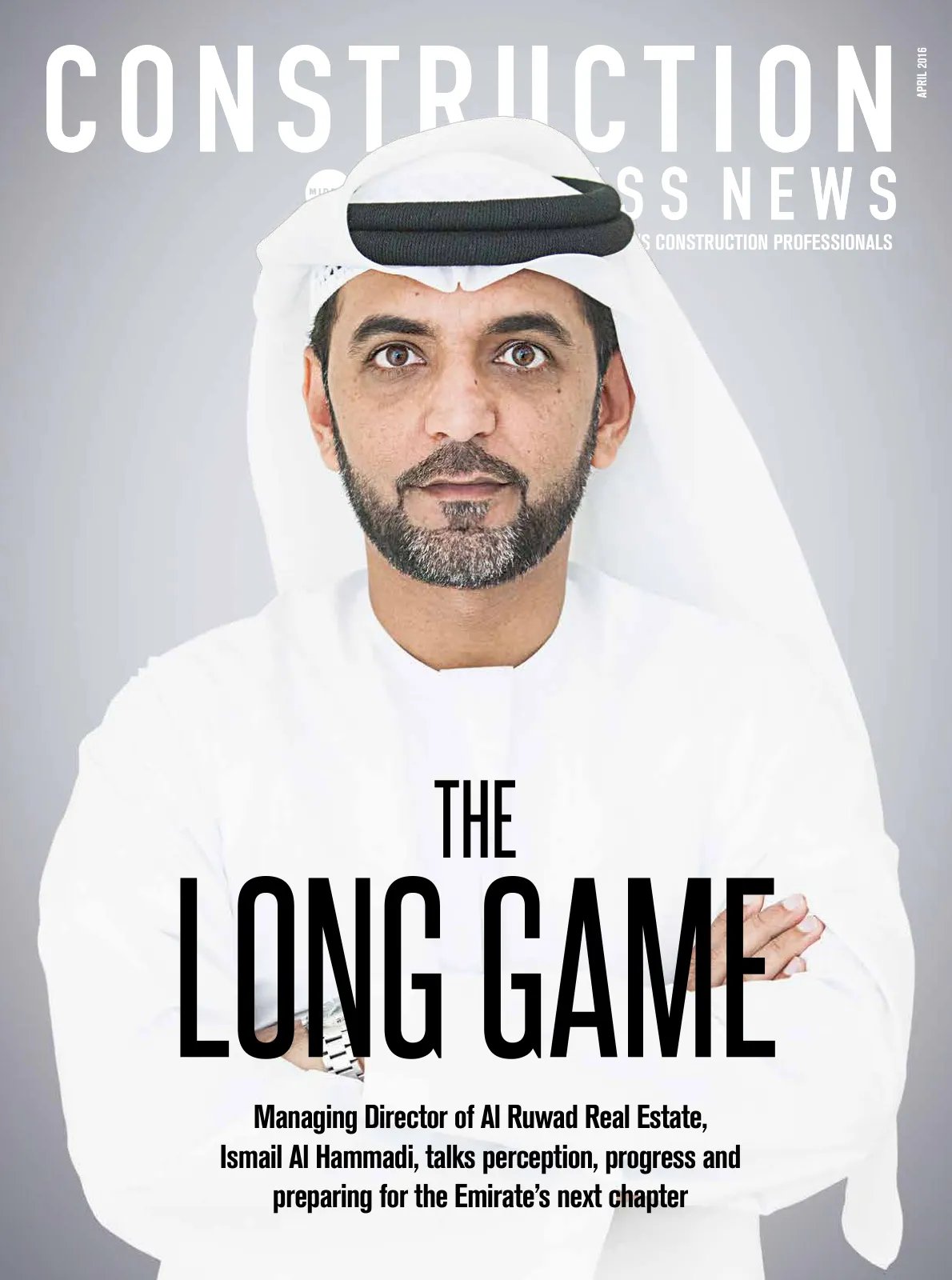
Construction Business News, April 2016
Page 1
THE DEFINITIVE GUIDE TO THE REGION'S CONSTRUCTION PROFESSIONALS
DECEMBER 2015
Managing Director of Al Ruwad Real Estate,
Ismail Al Hammadi, talks perception, progress and
preparing for the Emirate’s next chapter
THE DEFINITIVE GUIDE TO THE REGION'S CONSTRUCTION PROFESSIONALS
April 2016
The
Long Game
Page 2
Page 3
construction business news me April 2016
3
EDITOR’S NOTE
NEWS
SUPPLIER NEWS
COVER STORY
Managing Director of
Al Ruwad Real Estate,
Ismail Al Hammadi, talks
perception, progress
and preparing for the
Emirate’s next chapter
IN PERSON
PNC Menon, chair of
Sobha Group, discusses
the cyclical nature of a
real estate business and
how to survive and thrive
despite the challenges
ANALYSIS
Experts from the
regional construction
industry voice their
concerns for the
future of women AEC
professionals
Experts discuss
how the energy
efficiency movement
has transformed the
construction industry in
the Middle East
Regional rail experts
discuss the region’s
biggest cross-country
project, GCC Rail, and
share some of the
challenges the sector
faces with budgetary
concerns
6
8
16
20
26
30
34
38
20
26
contents
Page 4
construction business news me April 2016
4
S U B S C R I B E
c o n t r i b u t o r s
subscriptions@bncpublishing.net
Managing Director
Walid Zok
walid@bncpublishing.net
Director
Rabih Najm
rabih@bncpublishing.net
Director
Wissam Younane
wissam@bncpublishing.net
Group Publishing Director
Diarmuid O'Malley
dom@bncpublishing.net
Business Development Director
Rabih Naderi
rabih.naderi@bncpublishing.net
+966 50 328 9818
Group Editor
Melanie Mingas
melanie@bncpublishing.net
Editor
Lorraine Bangera
lorraine@bncpublishing.net
Art Director
Aaron Sutton
aaron@bncpublishing.net
Sales Manager
Mostafa Abdo
mostafa@bncpublishing.net
+966 56 6695 333
Sales Manager
Vishvanath Shetty
vish@bncpublishing.net
+971 52 6745378
Marketing Executive
Mark Anthony Monzon
mark@bncpublishing.net
PO Box 502511 Dubai, United Arab Emirates
P +971 4 4200 506 | F +971 4 4200 196
For all commercial enquiries related to
Construction Business News ME contact
sales@bncpublishing.net T +971 55 339 5097
All rights reserved © 2015.
Opinions expressed are solely those of the contributors.
Construction Business News ME and all subsidiary
publications in the MENA region are officially licensed
exclusively to BNC Publishing in the MENA region by
Construction Business News ME.
No part of this magazine may be reproduced or
transmitted in any form or by any means without
written permission of the publisher.
Images used in Construction Business News ME
are credited when necessary. Attributed use of
copyrighted images with permission. All images not
credited courtesy Shutterstock.
Printed by International Printing Press www.ippuae.com
Stuart Matthews
Marlow McGuinness Ltd
---------
Abhi Shek Photography
TAKE 10
Construction Business News ME looks at the top 10 innovative
suppliers in Middle East’s construction industry
REAL ESTATE
John Stevens analyses the UAE property market and if this the
opportune time to invest
COMMENT
Haider Tuaima, research manager at ValuStrat, highlights the
challenges and processes involves in quantifying Dubai’s real
estate supply
PROJECT REVIEW
Etihad ESCO talks about achieving 75% measured and verified
electricity savings at Dubai Electricity and Water Authority
power stations
Q&A
Yasser Boudastour, project engineer at the Jahra Road
Development Project, talks about the delivering an largescale
infrastructure project
SUPPLIER CORNER
Rami Hajjar, general manager of Philips Lighting Middle East,
discusses how lighting could play a huge role in energy saving
SAVE THE DATE
BUILDING MATERIALS
EDITOR’S PICK
40
46
48
50
54
60
62
64
66
38
Page 5
Page 6
construction business news me April 2016
6
A man's world
T
he construction industry has been
more or less male-dominated for as
long as anyone can remember where
women have often been perceived as delicate,
not fitting into the hardness of construction.
This has not just been a regional issue, but
has been common worldwide. According to
research by Union of Construction, Allied
Trades and Technicians, more than half wom-
en in construction in the UK state that they
have faced bias because of their gender.
Some experts say the recent figures have
been improving, but it is still not nearly
enough to be equal to the male statistic. This
sort of stereotyping of women has not only
deterred women from entering the business it
has also deprived the industry from acquiring
some talented personnel. According to B20
Employement Taskforce, in collaboration
with A.T. Kearney, closing the gender gap
could add 12% to the size of the total OECD
economy by 2030.
A.T. Kearney’s discussion on International
Women’s Day revealed three barriers women
in all industries essentially face sooner or later.
These include: lack of motivation, family ob-
ligations, and maternity breaks.
Lack of motivation begins early on when
young women realised the lack of support
and presence of other women in the indus-
try. There are handful of women working in
technical departments and for a new female
employee the task of working amongst count-
less men could be quite unnerving. The lack
of women in leadership roles could also be
discouraging and paints a very negative pic-
ture about the role of women in a company.
This pushes women to opt for more “women-
friendly” departments like human resources
or communications which are more support-
ive roles rather than the core.
Another barrier most women face is to bal-
ance their personal life and work life. Most
women, especially in the region, have been
burdened with the responsibility of running a
household along with having a full-time job.
Though men too, have to learn to balance
their life, are not held liable as much as woman
or a mother is. This kind of liability holds on
to most women making it difficult to create a
balance and move ahead in their careers.
Most working mothers, however, admit
that it is the time-off during maternity that
tremendously affects their career growth.
Taking a break for months or a year messes
up their career timeline. This demotivates
most women as they see their peers climb-
ing the corporate ladder while they are either
stuck or trying to make their way back up.
What most women employees need are
role models, mentors, and support systems,
to help them sustain.
The truth is it could be very difficult to
achieve gender equality almost instantane-
ously. Transition is slow but ongoing, and
until then women need to team up, motivate
one another, and push themselves to achieve
their own dreams.
editor’s note
Lorraine Bangera
Editor
Page 7
Page 8
construction business news me April 2016
8
For News, features and more, Visit www.CBNme.com
Follow us on twitter for breaking news: @cbn_ME
Follow us on Facebook for up-to-the-minute breaking news
Read the latest edition on www.CBNme.com
NEWS
Fujita Corporation awarded Drake and Scull Rail (DSR) a $93.3m
contract to deliver the first phase of the Doha Metro Depots.
Fujita Corporation is undertaking the construction of the Red
and Green Lines of Doha Metro’s Depots.
According to the agreement, DSR will undertake the supply,
installation, testing and commissioning of all MEP building ser-
vices to be provided in the depot and stabling yard pertinent to
the Red and Green lines and their associated buildings with a
scheduled delivery slated for 2019.
DSR will also be actively involved in the design verification
process as a participant in the design review meetings.
Ahmad Al Naser, managing director at Drake and Scull En-
gineering said: “The Doha Metro Phase-one project is a land-
mark urban transport project in the GCC region and our sec-
ond major rail project following the Airport Passenger mover
at the Dubai Airport.
“We look forward to successfully executing and delivering the
project in collaboration with our sister company DSI Qatar.”
Drake and Scull Rail wins $93.3m Doha
Metro phase-one contract
Ahmad Al Naser
To combat low oil prices, Qatar revealed it will be passing a law covering the use of public-
private partnerships (PPPs) by the end of this year, Reuters reported.
The Ministry of Economy and Commerce stated it would submit a draft PPP law to the cabinet
by mid-2016, ministry official told the agency on 15 March 2016. “We hope to have the frame-
work completed and start implementing the law by the end of the year.”
He added that the new framework would will include a PPP programme to build between 10
and 12 public schools in the next two years.
Regional newspaper Gulf Times reported that investment spending in real estate and transport
between 2015 and 2017 is estimated to be around $70bn to $80bn a year, as said by QNB
Group CEO Ali Ahmed al-Kuwari during a MEED Qatar Projects conference on 14 March 2016.
The Qatar government has been increasingly interested in PPPs especially for the delivery
of its infrastructure projects, according to partner at Charles Russel Speechlys Simon Green.
In his article, he stated: “It is clear that given the number of projects connected with the Qatar
2030 Vision, alternative procurement structures will need to be considered to help alleviate the
public sector burden.”
Qatar to pass PPP law
by end of 2016
Dubai Properties began the construction of its flag-
ship project, 1/JBR on 20 March 2016
Development of the tower development was of-
ficially announced during Cityscape Global 2015.
The construction started with site mobilising and
enabling works by the end of January 2016. Final
design has been completed and it is in the final
stage of approval with the authorities.
Marwan Al Kindi, executive director of sales and
sales operations at DP, said: “This ground breaking
marks an important phase of this highly anticipated
development, reinforcing our commitment to de-
livering key projects at one of the emirate’s most
sought-after beachfront destinations, JBR.”
The registration of clients and customers with
the intent of purchasing, was launched in Septem-
ber 2015, and the tower is set for completion and
handover in early 2019.
Dubai Properties begins
construction of iconic 1/JBR
Page 9
construction business news me April 2016
9
Kurdistan-based Qaiwan Group secured
two loans worth $105m to refinance part
of the firm’s investment in the 442MW
Bazian Power Plant.
With Deutsche Bank as the mandated
lead arranger (MLA) and Dubai-based
Bankmed as co-MLA and co-lender, the
finance is being backed by the French
government’s Export Credit Agency Co-
face. GE, too, has arranged a five-year,
$30m commercial loan. Dubai-based
CT&F Consulting DMCC acted as finan-
cial advisor to Qaiwan Group on the en-
tire financing.
Saad Hasan, CEO of Qaiwan Group,
said: “This plant is a marquee infra-
structure project that will go a long
way in addressing the growing de-
mand for power in a rapidly develop-
ing Kurdistan.”
Qaiwan entered into a 15-year Power
Purchase Agreement with the Ministry
of Electricity of the Kurdistan Regional
Government on 24 November 2013 to fi-
nance, build, own, operate and maintain
a power plant in Sulaymaniyah.
Qaiwan secure $105m loan
for power plant in Iraq
Saad Hasan, CEO of
Qaiwan Group
Damac Properties awarded Al Futtaim
Engineering’s elevators division an an-
nual maintenance contract to maintain
Hitachi elevators at its Ocean Heights
Tower in Dubai Marina.
The company will service, maintain
and provide for necessary spare parts
for six ultra-high speed elevators in
the 310m residential skyscraper. The
83-floor tower is currently the fifth
tallest luxury residential building in the
world and the fourth tallest residential
building in Dubai.
The Alinma Jeddah Economic City Fund
secured Shari’a compliant financing of
up to $959m from Alinma Bank on 10
December 2015.
The funding will be used to build and
develop infrastructure for phase-one
of Jeddah Economic City project and
to continue the construction of Jeddah
Tower which has now reached its 37th
floor, in addition to developing a number
of primary real estate projects within the
general masterplan. The first phase of
the project is expected to take five years.
Developer on the project, Jeddah
Economic Company, is the 100% owner
of the Alinma Jeddah Economic City
Fund’s units, which is a closed-end
private, Capital Market Authority (CMA)
approved, shari’a compliant real-estate
investment fund.
H.R.H Prince Alwaleed Bin Talal Bin
Abdulaziz Alsaud, chairperson of Jeddah
Economic Company and chairperson of
Alinma Jeddah Economic City Fund Board
said: “Securing the financing for this proj-
ect expresses the financial sector’s trust
in the real-estate market in Saudi Arabia in
general as well as in the Jeddah Economic
City Project and its development plans.”
Al-Futtaim
Engineering wins
maintenance
contract for Ocean
Heights Tower
Phase-1 of JEC
secures funds
worth $959m
CEO of Fischer Group Klaus Fischer
will be honoured with the Global DIY
Lifetime Award on 8 June 2016 in Stock-
holm’s City Hall.
The award would be given by Eu-
rope’s technical DIY associations and
the special global DIY interest group
for his contribution to worldwide do-it-
yourself segment.
Fischer, in the DIY segment for over 40
years, said: “I am pleased to accept this
award on behalf of all my employees
because it is only by joining hands and
minds that we can be successful.”
The fourth Global DIY Summit is big-
gest event for global retailers and pro-
ducers in the DIY and gardening seg-
ment, a useful information platform for
current and future developments.
Klaus Fischer to receive Global DIY Lifetime Award
Page 10
construction business news me April 2016
10
NEWS
Abu Dhabi Urban Planning Council (UPC)
signed a Memorandum of Understanding
with the Mohammed Bin Rashid Housing
Establishment (MRHE) on 14 March 2016
to incorporate MRHE’s projects with Es-
tidama Pearl Villa Rating System (PVRS).
Initially, the PVRS will be implemented
on the Al Warqaa fourth villa project,
which will be the first Dubai Government-
backed development to utilise Estidama.
The project comprises 72 villas with a total
gross floor area (GFA) of almost 20,000m2.
Construction of the villas will commence
in Q4 2016.
UPC’s Estidama team will send experts
to the MRHE to aid in developing MRHE’s
technical knowledge on the PVRS through
specialised training courses.
H.E. Falah Al Ahbabi, director general
at UPC, said: “Since the Estidama Pearl
Rating System became mandatory in Abu
Dhabi five years ago, we have seen a
transformation in the sustainability levels
of the villas, buildings and communities
that have been developed in the Emirate,
which in turn will enhance the lives of all
who live and work here.”
UPC helps MRHE enhance
Estidama ratings
Existing villas in MRHE
Dubai-based Nshama has awarded Al Dharis SPF the contract
for the design, construction and supply of liquefied petroleum
gas (LPG) to Town Square’s residential units that are currently
being constructed as per schedule.
The design includes the construction of two underground
tanks of 50,000 litre capacity, over 35km of underground pip-
ing, and 24/7staff on duty for operations and maintenance.
The contract was signed by Fred Durie, CEO of Nshama, and
Khamis Khalifa Al Muheiri, chairperson of Al Dharis SPF.
The project work for Town Square will include the supply of
cooking gas to over 18,000 apartments and more than 3,000
town houses, and more than 100 buildings including a hotel
complex. The total daily requirement is expected to be about
30,000 litres of LPG.
Durie said: “Awarding the key contract for the design, con-
struction and supply of cooking gas to Al Dharis SPF demon-
strates our commitment to ensuring the on-schedule delivery
of our various residential projects in Town Square.”
Al Dharis SPF to build
LPG tanks in Town Square
Abu Dhabi-based Aldar Properties received a
master developer license from the Abu Dhabi De-
partment of Municipal Affairs on 15 March 2016.
The license comes under the provisions of the
new real estate law which came into effect on 1
January 2016.
Talal Al Dhiyebi, chief development officer at Al-
dar, said: “We believe it will bring a high degree of
predictability and transparency to the market and
thereby increase the attractiveness of the market
to existing and a new generation of customers.”
Aldar is the first developer licensed by the
Department of Municipal Affairs under the
new regulations.
The new real estate law provides enhanced pro-
tections for customers of off-plan developments
and enshrines the rights of owners and residents
in existing communities.
Aldar licensed as master
developer under new law
Talal Al Dhiyebi
Page 11
OHSAS 18001 certified
ISO 9001, 14001 and
130+years of
project experience
LEED Platinum, LEED Gold
and LEED Silver Capability
End to End Integrated Solutions
Pioneering Engineering Construction since 1881
www.drakescull.com
700+
Projects Delivered
For over 130 years, Drake & Scull International PJSC has been shaping skylines and transforming the lifestyle of
communities around the world.
Drake & Scull is an industry leader, with a proven history of delivering more than 700 projects through its General
Contracting, Engineering, Rail, Oil & Gas, Water and Wastewater Treatment and Infrastructure development business
streamlines across the region.
Page 12
construction business news me April 2016
12
NEWS
Property consultants Knight Frank
released London-based development
Chelsea Waterfront to GCC investors
in Dubai from 15 to 16 March and in
Doha from 30 to 31 March 2016.
Victoria Garrett, head of Knight
Frank International London Sales in
the Middle East, said: “Over the past
year we have seen a significant in-
crease of London new home sales
from the Middle East, whether for
investment purposes or for end-use.
This exclusive second phase release
attracts significant interest in the Mid-
dle East following a successful first
release in 2015 when investors from
the region accounted for more than
50% of sales.”
The project, set within nine acres in
the heart of Royal Borough of Kens-
ington and Chelsea, is the last re-
maining significant river fronting site
on the north bank of the Thames be-
tween Chelsea and London.
Edmond Ho, executive director
and general manager of Hutchison
Property Group said: “We believe
the popularity of the development in
the Middle East is a reflection on the
size of the apartments, exceptional
facilities and a stunning location and
I anticipate the second release will
be equally popular. Nothing of this
quality is available anywhere else on
the market.”
The apartments in the second phase are
due for completion at the end of 2016.
When complete, the scheme will
comprise ten buildings in total includ-
ing two stand-out towers. The entire
development is due to complete in
2019 providing 706 new homes.
The National Emergency Crisis and
Disaster
Management
Authority
(NECMA) urged Emirates Telecom-
munications Corporation (Etisalat)
to dismantle its Abu Dhabi-based
head office’s spherical structure on
11 March 2016, according to Emirates
News Agency.
The instruction was made following
the extreme weather conditions that
hit the capital in the last week. The
strong winds had severely damaged
the structure, as a result NECMA will
be providing the telecom company
with engineering solutions to contain
the damage and dismantle the sphere.
Representatives of Etisalat, construction
companies and consultants held meet-
ings overnight to discuss the damage.
NCEMA also asked the public to fol-
low traffic instructions on the main
roads leading to Etisalat’s building
while risks are being assessed and
before the roads are reopened.
NCEMA urges Etisalat building to remove spherical structure
GCC investors given exclusive access to
Chelsea Waterfront
Dubai-based developer Nakheel will provide technical support to Saudi Arabian developer Al Akaria for a
range of new mixed-use projects in and around Riyadh.
The two companies have signed a Memorandum of Understanding under which Nakheel will provide
services including master planning, design, construction management, mall design and management,
hospitality projects and leasing.
Abdulrahman Almofadhi, chairperson of Al Akaria, said: “Al Akaria is embarking on a large and rapid
expansion. We selected Nakheel to enable us to kick-start and speed up these new projects, and have
every confidence in its ability to help us deliver.”
Among the new projects is a 7,000 hectare integrated master development comprising thousands of
units, Al Wasl, located north-west of the Riyadh.
An estimated three million new housing units are needed in Saudi Arabia by 2025 to keep up with
the country’s rapidly-growing population, which is expected to reach 37 million over the next 10 years.
Nakheel helps Saudi firm with projects across Riyadh
Dawood Bin Ozair
Etisalat's HQ in
Abu Dhabi
Page 13
construction business news me April 2016
13
The Dubai Supreme Council of Energy
(DSCE) aims to double its investments
at its 39th council meeting held on 13
March 2016.
During the meeting, a strategy to or-
ganise Dubai’s district-cooling sector
was developed. CEO of Dubai Electric-
ity and Water Authority Saeed Al Tayer,
also present at the meeting, said: “The
strategy will aim to improve the perfor-
mance of operations, and enhance the
amount of investments in this promis-
ing market from 20% to 40% by 2030.”
The meeting was intended to sup-
port Dubai Clean Energy Strategy 2050
by implementing energy Demand Side
Management strategy, which features
nine programmes that contribute to the
city’s sustainable development. These
include the rules and regulations for
green buildings, the rehabilitation of
existing buildings, district cooling, reg-
ulations and standards for energy effi-
ciency, reuse of wastewater for use in
irrigation and technology to raise the
efficiency of street lighting, and the
Shams Dubai Initiative.
IFP Qatar’s annual exhibition, Project Qatar (PQ), will provide traders with
insights to further push and maintain the growth within the construction
and infrastructure sector.
Reports reveal that Qatar’s construction sector seems to be growing de-
spite the oil slump. The sector, largely driven by Qatar National Vision 2030
and 2022 FIFA World Cup, will have
infrastructure investments anticipat-
ed to reach $150bn over the next few
years, according to First Qatar Real
Estate Development Company.
The Qatar Investment Fund has
projected the country to witness a
super-normal pace for the next five
to seven years. Qatar’s investment
programme includes more than 700
individual projects worth more than
$30bn to be implemented and 10,000
hotel rooms to be built in the upcoming years.
The PQ exhibition will include construction products and services such as
new building materials, HVAC, MEP, heavy equipment, stone technology,
construction tools and technologies, interior design, security and safety sys-
tems, contracting, and trading.
IFP PQ project manager Rawad Sleem said: “Project Qatar will continue
to contribute year after year aided by the strong support of the Qatari gov-
ernment, yielding value to the construction industry in Qatar and beyond.”
This year’s show will be promoting an educational side with several
workshops. PQ will be held at the Doha Exhibition and Convention
Center (DECC) from 9 and 12 May 2016 with new operating hours from
2pm to 9pm.
DSCE to double
investments
in district
cooling
Project Qatar promotes the nation’s
infrastructure boom
DSCE’s 39th council meeting
$20bn – Roads
$40bn – Railways
$4bn – Stadiums
$8bn – Deep-water seaport
Qatar Investment Funds’
infrastructure investments
Project Qatar in 2015
Page 14
construction business news me April 2016
14
NEWS
WSP | Parsons Brinckerhoff (WSP|PB) urged regional govern-
ments developing metro or light rail ring-fence station-side land
which would help off-set the upfront cost of rail projects.
In its white paper, Smarter Rail – A Whole-life Approach, the
company highlights one of the major challenges for local rail as-
set owners is transitioning from a delivery-oriented organisation
to an asset operator and maintainer.
The whole lifecycle of a rail network is often over-looked dur-
ing planning and design, even though the operational phase is
significantly longer and requires far more investment than the
project phase.
To help off-set the capital costs of construction and secure long-
term revenues to offset operating cost once in service the consul-
tants argue that rail owners should look to implement schemes
to develop smart transit hubs and developments on adjacent and
nearby plots.
The whitepaper cites research that shows locations next to
metro stations can enjoy increases in land values of over 50%
in comparison to locations away from metro stations, and that
people who live in a TOD are five times more likely to com-
mute by public transport than other residents.
Head of rail at WSP | PB Brendan Young said: “As the Middle
East looks to grow its rail network, there is an opportunity for
rail owners to take the next step and create smart developments.
“However to ensure that this vision can be realised some policy
and regulation measures will be required, and one that we envis-
age being crucial is some form of regulation to freeze and rezone
station-side land for this purpose.”
WSP | PB calls for
smart development
among regional rail
projects
Anantara Hotels, Resorts and Spas announced the open-
ing of two luxury resorts in the Sultanate of Oman
in mid-2016.
The resorts include Anantara Al Jabal Al Akhdar Resort
located in the north east of Oman 2,000 metres above
sea level on the curving rim of a great canyon and Al
Baleed Resort – Salalah by Anantara in the southern prov-
ince of Dhofar positioned between a scenic beach and
freshwater lagoon.
Anantara Al Jabal Al Akhdar will include 82 premier and
deluxe rooms will each feature private balconies or ter-
races, whilst the 33 one, two or three bedroom villas com-
plete with private swimming pools.
Al Baleed Resort – Salalah by Anantara, on the other
hand, will features 40 premier and deluxe rooms, offering
views of the Arabian Sea, lagoon or picturesque gardens
as well as 88 one, two and three bedroom villas which
will offer private pools.
Firas Rashid, area director of sales and marketing –
Oman, Anantara Hotels, Resorts and Spas said: “It is an
exciting time as we open our first properties in the Sultan-
ate of Oman. We are attending ITB in Berlin this month
to build upon the extensive interest already shown by
our European and International partners from both the
leisure and MICE segments. We are looking forward to
further strengthening the relationships already established
through our hotels and resorts in the Middle East, Asia the
Indian Ocean and Africa.”
Anantara to open two
resorts in Oman this year
Dubai Tram
Anantara Al Jabal Al Akhdar
Page 15
Page 16
construction business news me April 2016
16
Supplier NEWS
Integrated railway system provide, Alstom, showcased its
complete rail transport solutions from urban to high speed
trains, and signalling to services, at Eurasia Rail held from 3
to 5 March 2016 in Istanbul, Turkey.
Arban Citak, managing director of Alstom Turkey, said:
“Alstom has been a reliable partner for the Turkish railway
sector for more than 60 years. With government intending to
invest over $44bn in rail transport, we are looking forward
to pursue our collaboration and contribute to the develop-
ment of its transport network which include high speed and
regional trains, metro, and signalling.”
Among the solutions, Alstom showcased: Axonis, an inte-
grated driverless metro system that can be quickly built and
put into service in cities seeking affordable public transit
systems; Coradia, highly configurable regional trains that of-
fer numerous options with regard to engines (electric, diesel
and hybrid); number of cars (one to six) and interior fittings;
and the Pendolino high-speed trains that operate on both
conventional and high speed lines.
French company, Photolight, delivered 350 solar power LED
lights to Mohammed Bin Rashid (MBR) City in December 2016,
through its local distributor Al Ghandi Electronics.
The solar-powered lights were installed in the project’s 9km
cycling and jogging track to ensure good visibility at night and
minimise energy consumption.
The lights are equipped with 74w LEDs (adhering to RTA lux
level standards) and have vertically mounted photovoltaic pan-
els for dusty climate. These lights also don’t require cleaning
maintenance which can be very costly.
MBR City is developed by Meydan Sobha, a joint-venture of
Meydan Group and Sobha Group.
Saeed Humaid Al Tayer, CEO and chairperson of Meydan,
said: “These lights have been imported from France, and
unlike the bigger, lumpy solar-powered LED lights, these
posts have embedded solar panels, making it sleeker and
less space consuming”.
Photolight installs solar LED
lights in MBR City
Alstom showcases
solutions at Eurasia Rail
Ducab, UAE-based cable manufacturer, launched the
PowerOverFire campaign for 2016 on 29 February
2016 with the Ducab Truck in partnership with Dubai
Civil Defence.
This campaign is held in association with the General
Directorate of Civil Defence, UAE Ministry of Interior
and aimed to target contractors, retailers and the gen-
eral public.
Electrical power lines and transmission could also be
a danger when it does not match the international qual-
ity standards of the UAE code within which the Civil
Defence operates.
Ducab is also held seminars at Middle East Electricity
2016 (MEE 2016), which ran from 1 to 3 March 2016 at
Dubai World Trade Centre.
Since MEE 2016 truck has been touring the emir-
ates and other GCC countries to provide an interactive
learning experience on fire safety in key areas such as
industrial zones and construction sites.
Ducab launches PowerOverFire campaign
Dawood Bin Ozair
Page 17
construction business news me April 2016
17
Himoinsa launched new rental gas-powered generators at
this year’s Middle East Electricity held from 1 to 3 March 2016
at Dubai World Trade Centre.
The new range by Himoinsa models include the HRGP 25
T5 LPG, HRGP 40 T5 LPG and HRGP 60 T5 LPG.
The new version incorporates enough LPG storage for 24-
hour continuous operation without refuelling. The integrated
LPG tank could also be connected to an external tank to
extend their autonomous operation for as long as desired.
The integrated tanks are LPG-certified for vehicles, making
them a versatile option for the rental sector, where there is
a high demand for mobile equipment that is easy to trans-
port and can refuel with an LPG pump at a service station.
Gas-powered options have also become a profitable feature
among rental companies.
The HRGP models guarantee low fuel costs and lower
maintenance costs than diesel-powered generators. They
significantly reduce carbon monoxide and particulate emis-
sions, which together with the noise reduction that all Hi-
moinsa gensets provide.
Terry McGuire, regional general manager, said that there
has been an increasing demand for gensets in the oil and gas
sectors and one off applications.
Gas-powered gensets are more hassle-free, he says. How-
ever, he admits that this region probably won’t respond to
gas-powered gensets as well as Europe and South America
where it is more economical. “We don’t have that benefit
with the gas-generator purely because the price of electric is
expensive here in the Middle East.”
Which is why FAMCO and Himoinsa is focussing on the
rental specific application. “It is more for tailored applica-
tion, in some place critical or a remote areas. It is more of a
bespoke solution right now, exclusively launched for the oil
and gas industry.”
Also the use of gas instead of diesel solves the problem
of fuel theft, which is one of the biggest concerns of the
rental sector.
Himoinsa launches gas-
powered gensets for rent
Falling oil prices and will have a “positive impact”
on sustainability technology, according to Tat-
suya Kumazawa, director and divisional head of
the Eco Solutions division at Panasonic Marketing
MEA (PMMAF).
Speaking at Middle East Electricity, he said: “When
crude oil prices began going down people were not
paying attention. But now as it is more prevalent,
they have started looking at renewable energy alter-
natives and smart energies.
“Energy and power is undergoing an unprecedent-
ed growth with huge investments being pumped into
the sector over the coming years thereby offering the
industry players a challenging yet competitive busi-
ness environment.”
PMMAF showcased its energy solutions that feature
the latest electrical products at the Middle East Elec-
tricity 2016 (MEE 2016).
Some of the innovative solutions highlighted at the
event included systems for energy creation, indoor air
quality, and lighting solutions.
Kumazawa said: “Though we are launching a lot
of product ranges in the Middle East, we are also go-
ing to be making them accessible to the North Africa
region as well.”
Panasonic worked on Japan’s Fujisawa Sustainable
Smart Town and Kumazawa said that the expertise
used in providing solar panels in that project could
contribute to similar projects in the UAE and other
Gulf countries.
Oil slump triggers
“positive impact” on
smart investments
Page 18
Page 19
Page 20
construction business news me April 2016
20
Cover Story
Managing Director of Al Ruwad Real Estate,
Ismail Al Hammadi, talks perception,
progress and preparing for the Emirate’s next
chapter. Melanie Mingas writes.
The
Long
Game
Page 21
construction business news me April 2016
21
W
hile nowhere near
the events of 2008,
it’s been a some-
what
turbulent
start to the year for
Dubai’s real estate market.
2016 began with news of new proj-
ects ranging from villas to affordable
housing projects and analyses of the
market that indicated the supply-de-
mand equilibrium would begin to bal-
ance out by the end of the year.
On the back of the activity came
news that AED68bn had been spent on
Dubai real estate in the first 53 days of
the year and predictions surfaced that
transactions would reach values of AE-
D300bn by 2016 end.
Allsopp and Allsopp announced that
transactions in the first two months
of the year were up 18% on the same
period last year, and month-on-month
growth over the last 12 months had in-
creased by 12%.
Then in early March, the emirate
was ranked 96 out of 100 global mar-
kets due to its property price decline
of 5.5% in Knight Frank’s Prime Inter-
national Residential Index and statistics
released by Dubai Land Department
indicated a decline in the number of
residential units sold between January
2014 and November 2015.
As managing director of Al Ruwad
Real Estate – and entrepreneurial force
behind a number of other business en-
deavours – Ismail Al Hammadi heads
a business that specialises in property
management, consultancy, buying and
selling, brokerage and leasing.
If ever one is unsure about the state
of the market, he is a trustworthy
source of information.
“The market today is bigger than
people are thinking. There is a percep-
tion that prices are always going up
and down, but the size of the market
and the projects we have today is dif-
ferent from what we had in 2013, 2008
and 2005,” he explains.
“When it comes to a comparison I
cannot compare Dubai’s market today
to Dubai’s market yesterday. Reason
being, every day you have new prod-
ucts coming up, new islands, new
villa projects, new buildings, we are
talking about almost 700 different
projects which are being announced,”
he continues.
Al Hammadi, who previously served
as executive director of TECOM and
Dubai Industrial City, isn’t just a Dubai
advocate, but one of the many busi-
ness people who understands its eco-
nomic nuances to enough of an extent
as to capitalize upon them. He is also
a keen writer.
In his op-ed “Dubai Real Estate and
Public Relations…The Wasted Oppor-
tunities” he talks not about the specula-
tors who moved in in the early 2000s,
but the lack of PR support for Dubai
and how, with the right positioning
in the press, much of the negativity
in Dubai’s real estate market wouldn’t
even exist.
Page 22
construction business news me April 2016
22
Cover Story
In light of how the first quarter of
2016 has played out, one would be
hard pressed to argue otherwise; for
almost a decade the media, no more
so than internationally, has relished the
anti-Dubai narrative.
Sensationalist headlines – mostly
driven by an online journalism industry
that is fed by how many times a page
is visited, rather than how much value
an article can bring to the reader – only
perpetuate the situation.
“How many developers did we have
in 2005, then 2010, now 2015? I can see
the market is growing so why talk neg-
atively about it? Unless we have a hid-
den agenda to say the market is down,
in order to sell our product, you can
come and buy.
“In 2015 alone there were more than
60 projects launched with a value of more
than AED130bn It’s not a small amount
and this is only one city in the country.”
Talking with passion on his master-
mind subject, any frustration that could
be considered normal in the face of such
a constant, is jokingly brushed off as he
adds: “People come over to me and say
‘hi how are you? How’s the market?’”
Following the leader
When Al Ruwad entered the real estate
industry in 2013, Hammadi had a sim-
ple mission: to create one of the top 10
real estate companies in Dubai, based
on the firm’s core values of profession-
alism, innovation, responsible business
and integrity.
Today the business spans multiple op-
erations and within three years Hammadi
is certain that list will have expanded to
include the words “holding company”.
As he says: “We will expand into all
the supporting activities to increase the
Foreign Direct Investments in the UAE
by offering complete business solutions
under one roof.”
Partnering with the emirate’s big
name developers has been the driving
force behind a large part of that suc-
cess and these include Emaar, Damac,
Meraas, Dubai Properties and Al Wasl
properties, among others. Hammadi is
the first to admit – albeit with humility
– that he is incredibly well connected.
But as with any industry in a busi-
ness environment that is built on global
transactions, the local value is not the
end of the story.
Dubai is highly dependent upon for-
eign direct investment (FDI) when it
comes to making projects financially
viable, in addition to banking facilities
and infrastructure development – as
somebody whose profession depends
on relaying the state of those three key
“The good time to invest is now.
Which locations? I don’t want
to mention the places because
it will be a promotion for the
developers, but we have the best
places to invest in Dubai.”
– Ismail Al Hammadi
Page 23
construction business news me April 2016
23
Infrastructure
“A metro or transport development
can add between 20% to 30% to
the value of a plot of land. Expanding
the Dubai Metro is essential for both
communities and also land owners”
The next big thing
“There are many plots in Dubai that
are ignored by investors such as Al
Jaddaf, which is very well connected,
International City Phase 3 and Al Ain
Road.”
The demand for
property types
“Affordable housing is in high de-
mand. If you notice, for the past few
years now all the developers are
promoting mid-class apartments, af-
fordable houses. Starting from even
Business Bay to Mohammed Bin
Rashid City and Dubai South. All the
projects announced include this and
it balances against the high invest-
ment property types.”
Biznet Consulting
“This was launched in January 2015
and this year we changed the name
from Al Ruwad Project Development
Consultancy to Biznet Consulting,
to prevent people from confusing it
with our real estate business. Biznet
is a multi-disciplinary corporate ser-
vices firm, assisting entrepreneurs,
business owners, and investors to
establish their presence in UAE.
Biznet aims to provide its clients
services of corporate relocation,
business licensing and registration,
business process and quality con-
sultancy and business modeling. We
do project development consultancy
in terms of evaluating any project
and supporting our clients in terms
of supervising”.
Ismail Al
Hammadi on…
elements to investors in the city’s prop-
erty stock, Hammadi’s authority is sec-
ond to none.
Dubai aggressively targets FDI from
a number of key markets, without de-
pending on too small a pool of inter-
est in its projects – residential, retail
and commercial.
“In my business I like to be honest
and transparent with my investors to
show them all the positive and negative
because their opportunity is my oppor-
tunity. In real estate the stakes are very
high. One mistake and nobody forgets,
so you need to cover all the gaps. Rep-
utation is of a high importance for me.
“In only 40 years, Dubai became one
of the most attractive cities in the Middle
East because regulation outside of Dubai
is much more difficult to operate under.”
Over that time, the market has not
only continued to recover from its 2008
lows, but has entered a phase of hyper-
growth, which while far from the heady
days of the mid 2000s, is shaping the
emirate of Dubai for a future based on
diverse economic pillars.
“Dubai is about chapters. A new
chapter is now open in Mohammed
Bin Rashid City, a new chapter is open
in Jumeirah Village Circle and Jumeirah
Village Triangle, Sports City is also up-
coming and Dubai South is taking part
because it is linked with Expo.”
And it is with the words Dubai Expo
2020 that Hammadi’s tone changes –
far from being the person who looks
to the six month event in four years’
time as a way to pave the streets with
gold, he is one of the few people who
refuses to join the bandwagon.
“Expo is one event and I am proud
it is here in Dubai but I should not link
it with my business – my services will
be provided before and after Expo and
Dubai’s strategy and the government
vision is for 2021 not 2020.”
“For example, today we could have a
launch for Emaar and the development
will be completed in 2021. That shows
that even the developers are not look-
ing only to 2020,” he continues.
The where and when
When it comes to business, Hamma-
di’s local knowledge means one thing:
he knows where to develop, and he
knows what to develop on each plot.
According to his observations, there are
areas of Dubai which are “ignored” by
investors. Without surprise these are the
submarkets, generally on the outskirts of
the city, that are not served by a metro line
and don’t boast water-side views.
In a horizontally-planned city that
has been known to create additional
coastline on a whim in order to boost
real estate development and values,
where the proximity to a metro line can
add between 20 and 30% to the value
of the plot, these are important points.
But there are other things which
add value.
“You can compare Jaddaf to Barsha,
it’s the heart of Dubai, it is linked with
Sharjah and New Dubai, it is four min-
utes to the airport, seven minutes to
Burj Khalifa, you have access to every-
where, infrastructure is 100% ready and
even the metro stations are there. But
it is not being utilised because the area
is not on the agenda for development.”
Why? “I don’t see any reason. The
main reason for Dubai is that the in-
vestors who are GCC nationals or for-
eigners, are following a scenario, but
you need to have someone who is
proactive to take risk and build, and
then you will find people who follow
these investments.
“We need to educate people more
on these areas and become less reac-
tive. At the end of the day I have a
regulation for each zone. You can go
right now and see that there is a huge
investment in Jaddaf and I can see the
role that area can play in the great-
er Dubai story and once that is clear
people will be moving fast into that
location,” he continues.
Al Ruwad has few hotel plots inven-
tory some of which sold over recent
months, although plans remain to de-
velop a 3-star hotel that will be inde-
pendently branded by Al Ruwad itself.
Jaddaf joins the likes of International
City Phase 3, Al Ain Road – where Al
Ruwad has “huge plots” listed in it’s
inventory– and the area surrounding
Global Village.
But it isn’t just infrastructure and a
thirst for risk. Referencing the “Down-
Page 24
construction business news me April 2016
24
town effect” new areas need demand
drivers, especially if they are out of sight.
Close to Global Village for example,
is Al Barari; a luxury villa development
described by its founder as an “excep-
tional botanic haven, unrivalled in its
ecological sensitivity”.
It’s an enormous, sprawling oasis, with
very little else around but the only part of
the development non-residents know is
its flagship restaurant, The Farm.
“That is the only anchor in that area
and it is one restaurant in a huge de-
velopment. We are not looking at the
value of the project but because we
know that one landmark that is what it
is known for.”
Another key development on this
trend is the evolution of the product of-
fering. Not only is interest moving away
from the “prime” areas, but it is also
diversifying. Today affordable hous-
ing components are required alongside
the luxury developments, because no
one single property type sells to every
member of Dubai’s ever expanding so-
ciety. It is a sign not only of market
maturity, but also the changing face of
the Dubai resident and buyer.
“The good time to invest is now.
Where, the location I don’t want to
mention the place because it will be a
promotion for the developers, but we
have a good place in Dubai and this
is the right time to invest, regardless of
Expo,” Hammadi asserts.
The road ahead
In light of how 2016 had begun, what
could happen over the next 12 months
is anybody’s guess. In February 2016,
Asteco, real estate consultancy, said
residential rents would fall in 2016 and
2017 if “all housing units are delivered
on time.”
It’s a big if, but a statement continued
to predict that: “rental performance in
2016 will be highly dependent on the
timely delivery of supply. Assuming
the anticipated supply is handed over
on time, rental rates are likely to come
under pressure over the course of not
only 2016, but also 2017 onwards.”
In Hammadi’s eyes the road to 2018
could see “any service providers do well”.
He predicts hospitality will emerge “as
a main player”, both hotels and restau-
rants, and the demand for services such
as FM, building materials and mainte-
nance will reach such a level that the
market will need to double to keep up.
“Then the price will be in competi-
tion and companies from other emir-
ates will not be able to come to Dubai.”
He concludes: “My target is not 2020
because if a major event is going to
start then I need to be in the market by
2019, 2018 is even better, so we have a
good number of investments.”
Cover Story
Location
Project
Business Bay
G+70 hotel
G+22 hotel
Burj Khalifa
G+22
Al Jaddaf
3-star
independent
hotel
development
The below projects are under
Ismail Al Hammadi’s supervision:
Page 25
Porto Arabia Towers
Doha, Qatar
©2014 Hill International, Inc.
Hill International
The Global Leader in Managing Construction Risk
www.hillintl.com
For nearly four decades, owners and developers in the Middle East have
turned to Hill International to manage their construction projects and
programs throughout the region. Hill is proud to have helped our clients
turn their most challenging visions into realities. We have participated
in over 10,000 projects with a total construction value in excess of $500
billion, managing all phases of the construction process from concept
through completion.
Hill is also the leading construction claims firm in the world, having helped
resolve problems on some of the most complex projects throughout the
Middle East and around the world. To minimize risk and maximize results
on your next project, turn to Hill International
Dubai Office: 971 4 227 0078
Doha Office: 974 4 435 8381
Corporate HQ: 800 283 4088
If you can imagine it, we can manage it.
Qatar National Museum
Doha, Qatar
Mall of Qatar
Doha, Qatar
Viva Bahriya Towers
Doha, Qatar
Page 26
construction business news me April 2016
26
IN PERSON
An
inevitable
cycle
PNC Menon, chair of Sobha
Group, discusses the cyclical
nature of a real estate business
and how to survive and thrive
despite the challenges
Real estate is a very
cyclical
business,”
PNC Menon, chair-
person of Sobha
Group
observes.
Since the oil price drop, the GCC has
been going through a slowdown in
various sectors, but according to the
chairperson this would be true regard-
less of the oil slump. He says that ups
and downs are common in any busi-
ness especially real estate. Dubai, he
observes, goes through a four-year
cycle which includes two years of
positive and two years of negative.
“Considering the negative hit us in
2014, we should be ending the nega-
tive cycle by more or less the end of
this year.”
He admits that when is difficult to
really map out, but he explains that
the cycle is somewhat inevitable and
existent in every market. “This kind
of cyclical periods in real estate is
all over the world, not just in Dubai.
I was recently reading about the US,
and quite strangely the US has been
going through positives for the last
eight years. This is quite unusual.”
He says cycles are very difficult to
figure out. It is very dynamic and has
become even more so since the finan-
cial crash in 2008, which he says is
when the whole world changed.
He asserts that the global phenom-
enon affected Dubai in many ways.
But when it comes to the oil slump,
he says that looking at the fundamen-
tals I don’t think it could affect Dubai
as much. “Dubai is not really an oil
and gas economy. The UAE, too, as a
whole does not only depend on oil.”
When it comes to the future of oil
prices, Menon predicts that the oil
price would probably stay between
$40 to $60 per barrel.
He urges that it is impossible to truly
predict the future. “There could be a
technological breakthrough that could
change the economy and the minds of
people.”
He believes with good management
and the advance human resources
available in the GCC, the region would
be able to engineer an alternative and
reduce its dependency on oil.
He admits that GDP is extremely
Page 27
construction business news me April 2016
27
critical, but he argues that the ele-
ment of oil in the GDP is absolutely
negligible. “It is not an oil economy.
What Dubai has created in terms of in-
frastructure has become a magnet for
people from the surrounding regions
to come on a holiday, to come shop,
and even to come live.
“I am a strong believer of Dubai, not
just today but also back during the fi-
nancial crisis, I used to say ‘this city
cannot be stopped.’”
Menon admits that the financial cri-
sis in a way opened the minds of busi-
nessmen around the world.
Personally he learnt a lot about le-
veraging. He says that there was this
unspoken belief in the market that le-
veraging has to always be limited. “In
the real estate and construction indus-
try, I think it is best to have a debt
equity ratio of about 40:60 rather than
the other way around.”
He explains that the industry is cycli-
cal in nature anyway, so a good com-
pany would be wise to target 40% debt
and 60% equity. “This, in my opinion,
would really help during the pressures
of the negative cycle and would pro-
tect your business.
“The year 2008 financial crisis was
a beautiful lesson on sustainability of
a business. You can be successful one
year and not the other.”
What is more important is to sus-
tain, he says. “If you want to target
a sustainable business in the real es-
tate domain, financial discipline of a
good debt equity ratio would really
pull yourself out of the negative cycles
Sobha Hartland apartment building
smoothly and help you sustain your
business.”
Venturing into affordable
projects
The group made a move into the af-
fordable sector last year. Menon says
that the reason Sobha, a primarily
luxury brand, is considering this is
because of the different kinds of buy-
ers in the market. Some buyers are
interested in luxury while others in af-
fordable. “There are different kinds of
budgets: high-end, mid-end and low-
end, in every market even the GCC.
We need to cater to all kinds of de-
mand.”
He explains: “Luxury and affordable
projects are not the same, specifica-
tions for the low-end would be lesser
Page 28
construction business news me April 2016
28
IN PERSON
than the high-end. But the quality will
be very good either way because that
is our philosophy.”
In delivering any project, Menon
says that Sobha’s strongest point is
that is a totally backward integrated
company. “What I mean by that, is that
we have got our own contracting com-
pany, our own design studio, we do
our own engineering, we pretty much
do everything under one umbrella.
This makes it easier for us, and it gives
us a lot of control in terms of time and
quality.”
These two aspects, time and quality,
are critical in development, says the
chairperson.
The multinational group has various
developments and investments in the
UAE, Oman, Qatar, Bahrain, Brunei
and India.
Menon has especially been focussed
on Dubai. He says: “If you look at this
city, it is really a magnet for the three
billion people living in and around it
which includes surrounding regions
such as the whole of Africa, Middle
East and the Indian subcontinent. All
put together, there are three billion
people easily live in this region, which
is roughly about more than 40% of the
world population. I don’t think any
other country has created a city like
this till today in this geography, nor do
I see the possibility of that happening
in the next ten years.”
He praises the Prime Minister of UAE
H.H. Sheikh Mohammed bin Rashid Al
Maktoum for the development of such
an incomparable city.
The
Dubai-based
entrepreneur
has multiple businesses overseas but
makes sure he travels not more than
120 days in a year, leaving the rest
two-third of his time in the UAE.
Sobha has been running projects
worth $12bn in Dubai and plan to add
another $12bn during the course of
this year.
Looking at other markets in the re-
gion, Menon says Iran has been an in-
teresting new addition to the region’s
property market. After sanctions were
lifted earlier this year, many groups
have been showing avid interest in en-
dorsing the country. Menon says that
Sobha too has definitely been looking
Sobha Hartland villa
District One by Meydan Sobha
into Iran, though since the country has
just stepped out now he thinks it’s bet-
ter to wait and watch before making
a move.
He reveals that the group has made
a decision to not look at any new des-
tinations, other than the UK, till the
beginning of 2018. He says: “The rea-
son behind this is because I think it is
time to consolidate the business. I am
67 years old, it’s time.”
Back to Indian roots
Sobha Group has also made huge
progress Menon’s home country, In-
dia, where his son is currently the
chairperson of the company.
Menon says that India too has a cy-
clical nature. “It doesn’t matter if you
are in India, New York, or Dubai, it
is the same case everywhere. This is
what I call the unfortunate part of the
business.”
He emphasises that businessman
need to start accepting it rather than
trying to combat it. By preparation to
deal with negative cycles businesses
could do better.
In terms of India, Menon says that
it’s economy is doing pretty well
keeping in mind the large amount of
population it has to tackle. “I think
the Indian economy is going to do ex-
ceedingly well especially for the next
three years to come. The projection is
that India is going to be one of the
strongest economies of the world even
more than China. They say that the US,
China and India will be the strongest
Page 29
construction business news me April 2016
29
economies in the next 25 to 30 years.”
UAE is one the biggest trading part-
ners with India. Menon says that the
relationship between the two nations
is only going to get better because of
the growing interest to work together.
“The historical relationship with the
two countries also plays a strong role.
All of it together is going to add a lot
of benefit to both the countries. I think
over a period of time there is going to
be a lot more investments with India
Villa in District One
by Meydan Sobha
becoming an opportune investment
destination. This will be hugely ben-
eficial for both the countries.”
Man behind the scene
Back in 1974, he moved to Oman
with roughly $7 in his pocket and a
powerful drive to prove himself.
Menon says: “When you have no
money, you can’t imagine the strug-
gle. The first two to three years was
really a testing period. Unless you
have the resilience to go through it,
it is not easy.”
In 1976, Menon established an inte-
rior decoration firm under the name
of Services and Trade Company in
Muscat. His fit-out business then
slowly propelled from basic fit-outs
for offices to competing (and win-
ning) against European firms to do
the fit-out of palaces and mosques. “I
was always different from others, in
the business it was the quality of our
work that stood out.”
While talking about succeeding in
life, Menon believes that you are ei-
ther born with it or not. “It is in your
DNA, and you either need the op-
portunity to prove it or create your
own opportunity.”
Running a business on the other
hand needs skills, he says. “Each en-
trepreneur needs the right business
skills to take it further, and also a
philosophy. That could be different
for each individual because people
believe in different things, methods,
and schools. My belief is that qual-
ity is the most important requirement
and main strength.”
At the age of 67 and retirement not
at all on his mind, Menon says that
today he still has dreams to pursue
more. He aims to start up another
business with a professional team
and achieve a target of $2bn and
also concentrate more on his phi-
lanthropy. The businessman says he
has committed half of his wealth to
society and has big dreams primar-
ily in building education institutes in
the near future.
He emphasises that as long as he
has the health and breath of life,
he will continue to work, create
and thrive.
Page 30
construction business news me April 2016
30
ANALYSIS
Experts from the regional construction industry
including program director at Atkins Kathleen Gale,
transport planning manager at Abu Dhabi Urban
Planning Council Khulood Al Marzouqi, and partner at
Tabanlıoğlu Architects Melkan Tabanlıoğlu voice their
concerns for the future of women AEC professionals
Women in
construction
construction in the GCC is
clearly dominated by male
AEC professionals. Why do
you believe this is?
Tabanlıoğlu: Construction is gener-
ally regarded as a strenuous, harsh and
masculine industry as there is a stereo-
type that this sector requires physical
strength for manual labour due to the
use of heavy machinery and specialised
equipment. There is a gender typecast
that women are too delicate to work
under such brash environments. They
fail to realise there are other areas with-
in this field that women can work in,
and this is possibly why it appeals to
men more than women in the GCC.
Gale: I think it starts at a very early on
when you’re choosing a career. The per-
ception of construction is more appeal-
ing to young men than to young women
even while pursuing higher education.
A lot of the degree course used to be
very technical, but now other aspects
of planning, infrastructure, environ-
ment and sustainability come into play.
By looking into the social aspects, I
think women will be encouraged to get
into this field.
Marzouqi: If you’re talking about
construction on site then yes it is
dominated by male. I think most en-
gineers, especially those who work on
site, are men because of the cultural
sensitivities in this region. For women
it is difficult to be onsite as they need
to interact with male workers and con-
tractors and that could be culturally
challenging. I don’t think women can-
not do construction, but I do think in
these times most of them prefer not to
be part some aspects of construction.
You will find more women in the more
creative side of construction such as in
architecture, design, and urban plan-
ning. It is a matter of preference, and
most women choose to go into the
creative side of it. I think it might be
because that is the way most women
are, they are more interested in cre-
ativity than men.
Is there a gender bias in the
in regional construction
sector?
Tabanlıoğlu: Gender bias in any
industry is an unfortunate reality in
the Middle East, especially in the
construction sector. Construction is
categorised as a male domain, and
very rarely if ever do we find women
in this field in the region. Very few
women have made their mark as an
important figure in this field, and they
are mainly from the West. It would be
refreshing to have more women from
the Middle East come forth as leaders
in the industry.
Marzouqi: On site, men are pre-
ferred because they don’t have the
cultural sensitivity of being around
other men. Most women also cannot
stay for longer hours which could be
Page 31
construction business news me April 2016
31
a barrier as some sites need supervi-
sion both day and night. So when it
comes to on site related work, com-
panies usually lean towards hiring
male engineers instead of female.
In planning, design, architecture,
and real estate, however, there are
opportunities are for both as the
work expectation is the same for
both genders.
What stops women
from taking on a role in
construction?
Tabanlıoğlu: Personally, I don’t be-
lieve in gender differences in any pro-
fession or platform, and believe we
all have a duty of educating this very
thought in our peers for generations to
come. In fact, we need to improve the
working conditions of women all over
the world so that they may take on
more senior roles. A building, a land-
scape or simply a room designed by a
woman is no different.
Gale: I think family commitments can
stop women from reaching out more
career-wise. Generally and internation-
ally it is the same case, women are
primary carers in their families. They
are expected to be accessible 24/7 and
manage all of it. The stress of it all does
not encourage progression but it tends
to discourage women to move up to
the next step.
Is the lack of women in con-
struction a regional issue,
or does it also exist in an
international level?
Tabanlıoğlu: Although to a much less-
er degree, but the issue does exist on
an international level. Women deemed
as feeble and inferior is a global stereo-
type, however the West has progressed
from this traditional misconception
whereas women in the region are still
fighting it. Being a woman in a man’s
world grants you advantages as well as
disadvantages, I have always been on
the lucky side.
Gale: It is absolutely an international
issue, we have similar problems across
borders. Though I do believe the US
and China have better statistics than the
rest of the world.
Do you think there is a need
for change or are things
starting to get better?
Gale: I am saddened in a way because
when I started 20 years ago, I did a pre-
sentation on women in engineering and
had high hopes for the numbers to be
equal by the time I reach where I am
now. Sadly, that is not the case yet. But
I am very excited about the change in
the engineering and construction indus-
try. The industry is becoming more in-
novative and dynamic, and I think as it
transforms it will naturally attract more
women professionals to join the field.
Tabanlıoğlu: I think things are defi-
nitely starting to brighten for women in
the field. It is a slow, but steady im-
“For women it is difficult to
be onsite as they need to
interact with male workers and
contractors and that could be
culturally challenging”
– Khulood Al Marzouqi
Page 32
construction business news me April 2016
32
ANALYSIS
Could seeing more women
in leadership roles inspire
young women to take up an
AEC as a profession?
Tabanlıoğlu: Being a woman in a male-
dominated industry has its challenges,
one being that most executives or senior
roles are reserved for men. It is still dif-
ficult for women to excel and reach top
executive levels as an architect or engi-
neer. As a woman, it is demotivating to
know when entering any field that you
will not be given what you rightly de-
serve based solely on your gender. This
could be possibly why women stray
away from construction knowing they
skills and worth will not be recognised.
That being said, I do think pioneer-
ing models always inspire and encour-
age. Women need to build solidarity by
working hard to compete and earn lead-
erships roles so that young women may
feel inspired and encouraged to take on
AEC professions.
Gale: Atkins has established a Women’s
Business Network and one of our pri-
mary goals with that network is to en-
sure that our female colleagues have role
models. When you work through your
career you tend to begin with learning
how to do your job, but eventually it be-
comes learning how to do your job and
balance your personal life like having a
family and children. What a young wom-
an needs is role models to look up to and
who could help on that journey. If these
role models don’t exist, it is very hard to
sort of see yourself in that sort of future.
“Women who have achieved and
excelled in the industry should
lead by example”
– Melkan Tabanlıoğlu
“The lack of women in this
industry could put some women
off, especially those who have
grown up in a female-only
environment”
– Kathleen Gale
provement from the scenario several
years ago. I don’t believe that the cli-
ents prefer men as architects; on the
contrary, women are better facilitators
and better negotiators. Technically,
men and women have the same educa-
tional background, yet I trust the insti-
tutional command of women is a better
tool in design.
There are plenty of women
taking up AEC courses in
university, but don’t follow
through to practicing it. Why
do you think that happens?
Tabanlıoğlu: There can be several rea-
sons that amount to this, lack of support
from the family, personal issues, lack of
funding, demotivation or just feeling in-
capable to take on the challenge. Similar
to the rest of the modern world, almost
25% of architects in Turkey are women,
but in Tabanlioglu the percentage of
women architects rises to almost 60%; it
could well be due to the fact that one of
the partners is a woman. At Tabanlioglu,
we support and encourage women in the
industry and our gender ratio within the
organisation surely proves this.
do you find the lack of women
in the industry discouraging
for other women?
Tabanlıoğlu: This could be true, but I
like to see the positive in everything or
at the very least, find a solution rather
than to dwell on the problem. Women
who have achieved and excelled in the
industry should lead by example and
encourage and assist the young genera-
tion women architects by creating the
path for them.
Gale: The lack of women in this in-
dustry could put some women off, es-
pecially those who have grown up in a
female-only environment. The thought
of walking into an industry that is pri-
marily male dominated could be quite
daunting. Also these young women
sometimes tend to have no real role
models. When I was young, I was a civil
engineer sitting on a floor that was sur-
rounded by hundreds and hundred of
men, it is certainly very uncomfortable.
Page 33
Page 34
construction business news me April 2016
34
ANALYSIS
CEO of Dubai Carbon Centre of Excellence Ivano Iannelli,
chairperson of Emirates Green Building Council Saeed Al Abbar,
and country president – GCC and Pakistan at Schneider Electric
Benoit Dubarle discuss how the energy efficiency movement has
transformed the construction industry in the Middle East
The energy fix
How have decisions made at
COP21 affected the Middle
East energy mix?
Dubarle: COP21 created a global mo-
mentum and awareness towards sus-
tainability and stressed the urgency
for renewable energy investments and
research. As Middle East oil reserves
dwindle and governments look to di-
versify their economies, they must also
seek technologies which help various
industries grow in a sustainable man-
ner. The COP21 has highlighted the
need for a long-term policy frame-
work, collaborations between the
public and private sector, and the im-
portance of developing technical skill-
sets in the region.
Iannelli: Action is already being taken
in the Middle East and Dubai has prov-
en itself to be a true trailblazer with in-
novative strategies such as the Dubai
Clean Energy Strategy 2050. Dubai acts
as an innovation hub whose experi-
ments are going to be replicated across
the region. To ensure this, Dubai Car-
bon is already working in Oman and
Bahrain, with plans to move into Ku-
wait and Iraq, to scale renewable strat-
egies and projects.
Does the growing renewables
sector in the UAE have a di-
rect impact on the construc-
tion and building sector?
Al Abbar: The increase in market de-
mand of renewable energy has been
driven by the rise of conventional elec-
tricity costs, restructuring of energy tar-
iffs, technology advancement, environ-
mental concern and strong government
incentives to encourage investment in
grid-connected applications.
There is growing support from the
authorities towards building a ‘greener’
UAE. Local government bodies have
mandated a minimum level for com-
pliance of buildings and constructions.
For instance, buildings in Dubai must
comply with Dubai Green Building
Regulations and Specifications while
buildings in Abu Dhabi must achieve a
minimum requirement under Estidama
Pearl Rating System.
The Dubai Electricity and Water
Authority (DEWA) is taking a lead in
the solar field with initiatives such as
Shams Dubai, as part of its Distribut-
ed Renewable Resources Generation
programme. The programme encour-
ages household and building owners
to install photovoltaic (PV) panels to
generate electricity, and connect them
to DEWA’s grid. The electricity is then
used on site and the surplus is export-
ed to DEWA’s network.
Abu Dhabi is also looking forward to
increasing the renewable energy share
by 7% by 2020. Buildings in Abu Dhabi,
for example, achieve points under Es-
tidama when considering or installing
renewable energy systems.
This is just the beginning of many
more initiatives to come, encouraging
green building and new frameworks to
support sustainable development.
Dubarle: Construction processes and
buildings consume massive amounts of
energy each year, and are also respon-
sible for emitting greenhouse gas emis-
sions; this energy includes heating and
cooling systems, lighting and applianc-
es, manufacturing and transportation of
building materials. There are various
ways in which we can shift towards
‘zero-energy’ buildings, which are con-
Page 35
construction business news me April 2016
35
structed using low-impact renewables
and smart solutions which manage and
allocate energy wisely.
Renewable solutions such as rooftop
solar panels, smart windows that block
out UV rays, and ultra-energy-efficient
HVAC systems can revolutionise the
construction industry and building
structures, making them more sustain-
able. As governments impose stringent
regulations on green building practices,
low-carbon renewables will gain more
popularity in the construction sector.
Iannelli: The UAE has been actively
diversifying its economy and energy
sector. The shift to renewables is un-
doubtedly affecting the economy in
numerous positive aspects. Renewables
also translate to good business sense as
they help save billions of dollars. They
enable countries to depend on their
own energy production rather than
having to import it. Looking at coun-
tries that have embraced renewables
has proven to us that adoption of this
technology translates into economic
benefits in the long run.
Could you draw a compari-
son between the West and
the Middle East when it
comes to energy efficient
buildings and use of renew-
ables?
Iannelli: There cannot be a compari-
son between the Middle East and the
rest of the world because the contexts
are vastly different and one would
need to take into account a range of
environmental, socio-economical and
political factors. What can be advanced
as a certainty is that there is a growing
demand in the Middle East, and PV is
now economically viable for meeting it,
with prices in the Gulf region forming a
new benchmark and grid-parity repre-
senting a very important milestone for
further PV diffusion.
There is a proven cost effective na-
ture to renewables in the Middle East
and, while the market may be local,
there are global opportunities for fi-
nancing and supplying renewable en-
ergy projects. The renewables policy
landscape in the Middle East, although
sometimes still at an exploratory phase,
is rapidly developing and will soon
provide a strong backbone for a large
number of PV projects. This policy shift
reflects the region's commitment to
meet its ambitious national targets re-
garding PV.
Al Abbar: In terms of energy efficiency
or energy performance of buildings,
you could say that European Union
countries pioneered in developing
their building codes and standards. For
example, many European countries,
such as Austria, Denmark, UK, France
or Germany, set their own definitions
of energy efficient buildings. These
definitions include low energy build-
ings, zero energy buildings and passive
buildings. We can see that the Middle
East and the UAE in particular, are mak-
Page 36
construction business news me April 2016
36
ANALYSIS
Specialised degrees and training in
renewable energy and sustainability
are available and are becoming more
popular. For instance, EmiratesGBC
provides Leadership in Energy and En-
vironmental Design (LEED), Certified
Energy Auditor (CEA) and Certified En-
ergy Manager (CEM) training.
We can anticipate that many jobs will
be created through Shams Dubai initia-
tive. For that, DEWA provides solar-PV
training for employees working with
consultants or contractors companies.
Iannelli: In my opinion, the techno-
logical know-how is abundant in the
region. This know-how needs to be
matched to the local entrepreneurial
acumen as to ensure economically vi-
“The energy demand is expected
to increase three times in the
next fifteen years and will not be
met by today’s supply”
– Benoit Dubarle
“In an effort to compliment
the government’s drive to
excellence, Dubai Carbon is now
working to streamline the green
economy multiplier of the GDP”
– Ivano Iannelli
ing important strides towards a more
structured framework with regards to
green building.
Does the Middle East have
sufficient energy invest-
ments, or is there a need for
more funds?
Dubarle: According to the Interna-
tional Renewable Energy Author-
ity (IRENA), global energy efficiency
investment are expected to reach
$385bn per year, or $5.8tr by 2030.
PwC report, Financing the Future
of Energy, states that tens of billions
of US dollars per year are required in
the Gulf’s investment for power gen-
eration, transmission and energy use.
The energy demand is expected to in-
crease three times in the next fifteen
years and will not be met by today’s
supply. To close this gap, the GCC
will require massive investments in
projects which can increase genera-
tion capacity and energy efficiency.
The report also states that currently,
there is limited finance for renewable
energy projects. This presents a mas-
sive opportunity for the private sector
to shape policies and projects in clean
energy moving forward, and collabo-
rate closely with governments taking
the lead towards this movement.
Al Abbar: It is very positive to see the
governments investing in renewables
and it is important that we encourage
everyone to continue to do so.
These investments can only be pos-
itive for the industry. The renewable
energy targets set by GCC countries
(Abu Dhabi 7% by 2020, Dubai 15%
by 2030, Bahrain 5% by 2020, Kuwait
15% by 2030, Oman 10% by 2020)
and the commitment towards them is
creating trust in the real estate sector
and therefore attracts more financing.
Iannelli: I think if what we have seen
in the past six months is not enough
of a commitment to the transition,
then I don’t know what would be!
In an effort to compliment the gov-
ernment’s drive to excellence, Dubai
Carbon is now working to stream-
line the green economy multiplier
of the GDP.
Is there a lack of local ex-
pertise and technical know-
how while building renew-
able projects in the Middle
East? How could that be
improved?
Al Abbar: Worldwide, renewable en-
ergy employment in 2014 grew 18%
compared with 2013, according to
IRENA. Throughout the years, we have
witnessed an increase in the number of
qualified professionals but, as the in-
dustry grows, we will need even more
professionals with a thorough under-
standing of green buildings, so we are
placing a strong focus on education.
Page 37
construction business news me April 2016
37
ability of the projects. Furthermore, the
larger deployment of renewables re-
quires structural reform of regional en-
ergy market and pricing mechanisms.
Could you comment on the
energy efficiency movement
happening across the Middle
East? Apart from UAE, which
other countries are doing
well in this aspect?
Dubarle: As the Middle East looks to
diversify away from oil commodities
and address the high energy demands
in an efficient way, we will see in-
vestments in energy efficient projects
across the MEA region, particularly
in the GCC.
Other than the UAE, several countries
are taking steps towards energy efficien-
cy, including Saudi Arabia. King Abdul-
lah City for Atomic and Renewable En-
ergy (KACARE) plans to develop 54GW
of renewable energy by 2040. Other
renewable projects, such as the KAUST
solar power plant and initiatives by Sau-
di Aramco are also underway. Recently,
the Saudi Electricity Company (SEC)
signed a $1.2bn contract with General
Electric to establish the Kingdom’s first
fossil fuel and solar power plant near
the Red Sea port of Dhuba.
Al Abbar: Sustainability is a reason-
ably new topic in the region, but the
green construction industry has grown
significantly in the Middle East in re-
cent years. Buildings in Arab countries
consume about quarter of the energy
consumed domestically. Internation-
ally, buildings account for some 41%
of global energy savings potential by
2035, compared with the industrial sec-
tor, which is only at 24% and the trans-
port sector, with 21%, according to the
International Energy Agency.
With this data, it is evident that in or-
der to reduce the carbon dioxide emis-
sions, we need to reduce the energy
demand and adopt energy efficiency
measures, such as improvement of ef-
ficiency of building envelope compo-
nents, such as external walls, floors,
roofs, ceilings, windows and doors,
passive low energy design, and im-
proving the efficiency of appliances
and equipment used inside buildings.
Authorities throughout the Middle
East are increasingly implementing
regulations and rating systems that are
setting high standards for new con-
struction projects. The industry have
developed their own energy efficiency
strategies as part of their climate change
mitigation plans. These countries know
that energy efficiency the least expen-
sive and most effective form of energy
available today. As such, targeted en-
ergy efficiency measures are regional
policymakers’ best solutions.
“In terms of energy efficiency or
energy performance of buildings,
you could say that European
Union countries pioneered in
developing their building codes
and standards”
– Saeed Al Abbar
Page 38
construction business news me April 2016
38
Analysis
Regional rail experts discuss the
region’s biggest cross-country
project, GCC Rail, and share
some of the challenges the sector
faces with budgetary concerns.
Lorraine Bangera reports
Full steam ahead?
T
he Middle East has an ag-
gressive plan for the future,”
says Michael Stangl, senior
director of Global Services at
Autodesk Consulting. “That
gets me excited!”
The US-based senior director par-
ticipated at this year’s Middle East Rail
and praised the region for its zeal and
vigour. “There is no other region in the
world that moves so quickly, with its
impressive 2020 or 2030 visions and
drive to move beyond oil economies.”
He observes this region’s rail industry
to be doing exceedingly well as com-
pared to most of the West, given that
the rail sector here is relatively new.
Most industry reports point out that
GCC has had a strong passenger and
freight transport network on the agen-
da. Currently the region has 16 major
railway projects worth $352bn that are
currently underway in the region.
With oil prices down the region has
been focussing on not oil-related proj-
ects, and thus transport and logistics
sectors are playing an increasingly im-
portant role in its economies.
That being said, there has been a lot
of talk about projects being postponed
due to budgetary concerns and specula-
tions have been made if rail is the way
to go. Tim Armsby, partner at Eversheds,
says that delaying projects were the key
discussion at Middle East Rail.
Andy Glyde, industry sales director
of Project Delivery at Bentley Systems
MEA, agrees that projects were the key
focus at the summit. Discussing proj-
ects that have started, planned and
postponed, the event highlighted new
projects that are ongoing and how to
approach the project delivery team and
the clients together.
He admits that the sector has been
affected by the oil slump, but wasn’t
sure of the extent of this as yet.
“Expenditure in all the sectors, in-
cluding rail, has been put under the mi-
croscope which has definitely affected
the status of some of the projects.”
Armsby clarifies that projects such as
Doha Metro and Riyadh Metro that have
already been underway would not be
stopped now. However, he says that
there would be a need to look at some
more value engineering options behind
the scenes to select more optional ma-
terials given the current circumstances.
The fate of the regional network
Local daily Gulf News reported that
GCC Assistant General for Economic
Affairs Abdullah Bin Juma Al Shibli told
delegates at the conference that the
GCC Rail project will go ahead. “Some
members have already completed their
phases. The GCC has pledged ongoing
support to this project through partner-
ships with the private sector.” That be-
ing said, he did not comment on the
final completion date of the project.
At the Cargo Show, co-located with
Middle East Rail, director of Dubai
Customs Ahmed Mahboob Musabih
discussed the future transport projects
in the region, according to Emirates
News Agency. He said: “The GCC rail
network, which will link all six Gulf
countries, is one of the major projects
undertaken to develop forms of trans-
port between GCC members. Once
completed, the network will support
the establishment of a GCC corridor for
freight forwarding, supported by more
Page 39
construction business news me April 2016
39
developed procedures, trade services
and Customs facilitations to streamline
trade flow between Gulf states.”
“Challenges are numerous, but so are
opportunities,” said Musabih, “Govern-
ment and private entities in the MENA
region must forge solid business partner-
ships to capitalise on these opportunities.”
In February, GCC transport minister
Abdulla al-Nuaimi urged the need for a
“more realistic” plan for the GCC Rail.
Due to weak global oil prices, GCC
transport ministers will hold a meeting
in Riyadh, Saudi Arabia to examine the
project and if it could possibly be com-
pleted by 2018.
Industry report in International Rail-
way Journal stated that the 2018 com-
pletion date has been looking “unreal-
istic” due to the difficulty in getting the
six countries to coordinate their plans
for the project.
Dubai Metro
Glyde explains: “The projects post-
ponement might be unfortunate from
our perspective, however it will be done
for obvious reasons of the oil slump. In
times like these, everyone is looking at
what is absolutely necessary.”
“I don’t think it would have been
possible to be completed by 2018,”
says Armsby. “Though the structure is
not a complicated construction proj-
ect but there are significant amount
of technical requirements for it. For
example, one topic that came up dur-
ing the discussion at the conference
was the impact of sand. In the Saudi
network sand was covering the tracks
in a matter of hours, which not only
prevents the train from running on the
tracks but could also increase wear
and tear of the engines.”
The key driver in establishing the
GCC Rail network is the transport of
freight and to shift the focus from
roads to rail. Armsby says that greater
connectivity is also a major positive
as it increases connectivity and trade
amongst regional countries.
In terms of carrying the project for-
ward, he looks at each country par-
ticipating in building the network as
a separate business case. “It is safe to
say that some countries would benefit
more than others from a fully connect-
ed network.”
From the GCC, he points out that
Oman and Saudi Arabia have the best
business cases as it would comple-
ment its existing logistics industry.
One of the key disadvantages, he ob-
serves is that certain states don’t have a
strong business case for the project to
move forward with full steam ahead. He
says: “It is inevitable that with budgetary
concerns all GCC states will be looking
into which project would be more nec-
essary and lucrative.”
“Projects like the GCC Rail are high-
ly capital intensive, though an invest-
ment for a greater good, it won’t be
paid off immediately. We are looking
at a number of years till it will be able
to breakeven on operational expen-
diture. So, perhaps it is sensible that
since work isn’t yet underway we
postpone the development until oil
prices improve.”
The 10th edition of Middle East Rail
was held from 9 to10 March 2016 at
the Dubai International Convention
and Exhibition Centre (DICEC). Fea-
turing keynotes, panel discussions
and research sharing, the event
discussed ongoing rail projects
with key government departments,
railway operators and construction
companies. It also gave a first look at
2016 tenders and an understanding
of the techniques and technologies
being implemented to build these
futuristic networks.
ME Rail
Page 40
construction business news me April 2016
40
TAKE 10
Construction Business News ME profiles 10 of the most
innovative suppliers in the Middle East construction industry
Innovators’
focus
As leaders in the LED technology revolution, Philips cre-
ates lighting systems that prioritises energy efficiency, sus-
tainability, and operational cost reduction. The company
focuses on improving the liva-bility and effectiveness of
indoor and outdoor environments, providing everything
from functional general illumination to spectacular colour-
changing experiences that enhance your brand, encour-
age social interactions, and revitalise communities.
The expertise and range of systems available at Philips
helps transform into effective lighting applica-tions.
As a global leader in lighting and sponsor of the
International Year of Light (IYOL) in 2015, a UNESCO-
led initiative, at Philips we are committed to driving
the connected lighting agenda, taking lighting beyond
illumination. From indoor to outdoor spaces, to personal
and business use, connected lighting translates into intel-
ligent systems that offer personalization and increased
efficiency, effectiveness and productivity across multiple
landscapes and verticals.
By enabling the collection of valuable data, connected
lighting allows facility managers to adjust lighting levels
based on usage whether managing an office building, or
an entire city. Lighting for example on a certain street
or an office floor that is little used can be dimmed at any
time of day or night. This can result in significant energy
savings, reducing both cost and environmental impact, a
primary driver in the implementation of connected light-
ing systems. Or alternatively, lighting can be increased
on a street should there be a safety concern, working to
enhance the experience of its users.
Philips Lighting1
Page 41
construction business news me April 2016
41
The BASF Construction Chemicals division has been
present in the GCC for more than 35 years, with head-
quarters in Dubai and other offices in Qatar, Kuwait,
Oman, KSA as well as representatives in Bah-rain.
Its products are found in most iconic projects, with
BASF’s involvement providing technical support and rec-
ommendations right from the design phase to a project’s
completion. BASF’s admixtures played a crucial role dur-
ing the construction of the Burj Khalifa with concrete be-
ing pumped to world record heights of 600 metres. BASF
has also made significant contributions to the construc-
tion of various other major projects in the region includ-
ing providing waterproofing solutions for Dubai’s Airport
Terminal 2 project and the use of BASF anchoring grouts
to secure and reinforce the world’s largest roller-coaster,
Formula Ross at Abu Dhabi’s Ferrari World.
BASF’s Construction Chemicals division offers ad-
vanced chemicals solutions for new construction, main-
tenance, repair and renovation of structures. Its com-
prehensive portfolio encompasses concrete admixtures,
cement additives, chemical solutions for underground
construction, waterproofing sys-tems, sealants, concrete
repair and protection systems, performance grouts, per-
formance flooring sys-tems, tile fixing systems, expansion
control systems and wood protection solutions.
To solve customers’ specific construction challenges
from conception through to completion of a pro-ject,
BASF combines its know-how across areas of exper-
tise and regions and draw on the experience gained in
BASF
2
countless construction projects worldwide. It leverages
global BASF technologies, as well as its in-depth knowl-
edge of local building needs, to develop innovations that
help make customers more successful and drive sustain-
able construction. With continued research and develop-
ment into new technologies, products and chemical solu-
tions, its lays the foundations for its customers’ long-term
success.
These products, technologies and solutions, under the
Master Builders Solutions brand, maximise work produc-
tivity, durability and longevity and therefore sustainability
in construction projects throughout the world. Leverag-
ing the technologies and know-how available in BASF’s
global research and development network, its innovations
address the current and emerging market needs.
One of its most innovative solutions is Green Sense
Concrete, a mix optimisation programme in which sup-
plementary cementitious materials and non-cementitious
powders are used in combination with specially formu-
lated BASF admixtures. This results in an environmentally-
friendly, cost-effective con-crete that meets, and often
exceeds, performance targets. MasterEase, a superplas-
ticiser for low-viscosity concrete, is an ideal admixture
for the Green Sense Concrete mix since it improves its
rheo-logical properties, significantly facilitating its pump-
ing, placing and finishing. Another product from the BASF
comprehensive admixtures portfolio is the MasterLife
range, which enhances the durability of the concrete
extensively.
Page 42
construction business news me April 2016
42
TAKE 10
Doka
3M, a science-based company, produces
thousands of imaginative products in scores
of markets - from health care and highway
safety to office products and abrasives and
adhesives. 3M is known for many of the
world’s most popular products, including
the Post-it Note, Scotch-Brite products, and
Scotch Magic Tape, to name only a few.
The diversified technology company has
more than 65,000 products that are sold
worldwide. In fact, 3M innovates across
a wide range of industries as diverse as
healthcare, automotive, biotechnology,
nanotechnology, aviation, oil and gas, in-
dustrial, construction, and communications.
3M captures the spark of new ideas and
transforms them into thousands of inge-
nious solutions. Incor-porating a culture
of creative collaboration which inspires a
never-ending stream of powerful technol-
ogies that make life better.
GEZE is a global developer and manufacturer of construc-
tion systems for door, window and safety technology.
The company offers a comprehensive range of products
including automatic door systems and door technology,
glass systems, smoke and heat extraction systems, safety
technology as well as window and ventilation technology.
As one of the market, innovation and design leaders,
the independently-managed family company has decisive-
ly influenced facility engineering and building technology
with pioneering developments. These developments are
constantly being driven onwards in the company's tech-
nology centre. GEZE products tries to contribute towards
some of the most innovative building concepts in the
world and ensure convenience and security in building
technology.
Individual and building-specific special constructions
are also offered by the company, for example, revolving
doors or all glass systems are implemented by a sub-
sidiary. Product solutions from GEZE can be found in
renowned buildings across the entire world.
Often dubbed as the “formwork experts”, the Doka Group was established in
1958 in Austria where it supplied formwork and engineering solutions to numer-
ous infrastructure projects.
In 1961, the company expanded its operations to Germany and further to Brazil
and Kuwait in 1977. With more than 160 sales and logistics facilities in over 70 coun-
tries, the Doka Group has a highly efficient distribution network which ensures that
equipment and technical support are provided swiftly and professionally.
Supplying a range of products, systems and design services, including form-
work panels, slab formwork, wall formwork, one-sided wall formwork, climb-
ing formwork, tunnel formwork, dam formwork, bridge formwork, shoring or
false work, tie systems and filed support, software and training, Doka's business
includes production, equipment sale and rental, engineering and maintenance.
One of its innovations, Concremote, entered the regional market in early 2014.
The range enables greater quality control and cost efficiency by providing real-
time information about the concrete via a concrete maturity sensor system, help-
ing to reduce cycle times and commissioning quantities by accurately informing
about the optimal time to remove formwork.
Doka is currently engaged on a number of ongoing projects in the Middle
East including the Saudi Arabia’s Kingdom Tower, Dubai’s Marina 106, and Abu
Dhabi's Midfield project.
3M
GEZE
3
4
5
Page 43
construction business news me April 2016
43
RAK Ceramics
Ideal Standard, provider of total bathroom
solutions, operates across Europe, Middle East
and Africa. The company offers a spectrum of
bathroom solutions – from ceramics, brass-
ware fittings and shower kits to bathtubs,
furniture and shower trays.
Ideal Standard’s highlight since The Big 5
Show 2015 has been the revolutionary Aqua-
BladeTM flush technology and Tonic II total
bathroom range. AquaBladeTM is a newly
engineered system of channels to create a cas-
cading wall of water from the top of the toilet
bowl opening, which gives optimum water
flow covering every inch of the ceramic, keep-
ing the toilet bowl immaculately clean.
With a refined soft geometric design, Tonic
II’s clean, beautiful lines offer a broad choice
of solutions and combinations of harmonious,
contemporary ceramics, fittings, furniture and
bathtubs that won this year’s IF Design award.
The collection is created by German design
studio, ARTEFAKT.
Autodesk, Inc., is a in 3D design, engineering and en-
tertainment software provider that has been popular in
global markets since its introduction of AutoCAD software
in 1982. Today, Autodesk continues to develop the broad-
est portfolio of 3D software for global markets.
Customers across the manufacturing, architecture,
building, construction, and media and entertainment
industries use Autodesk software to design, visualise, and
simulate their ideas before they're ever built or created.
Through its apps for iPhone, iPad, iPod, and Android,
Autodesk also making design technology accessible to
professional designers and amateur designers, homeown-
ers, students, and casual creators — anyone who wants to
create and share their ideas with the world.
RAK Ceramics, manufacturer of ceramics lifestyle
solutions, specialises in high-quality ceramic and
gres porcellanato wall and floor tiles, sanitary ware,
tableware and faucets.
One of the largest ceramics manufacturers in the
world, RAK Ceramics has a global annual pro-
duction capacity of 117 million square metres of
ceramic and porcelain tiles, 4.6 million pieces of
sanitaryware and 24 million pieces of tableware;
with a $1bn turnover and a distribution network
that spans 160 countries.
Specialising in high-quality ceramic wall and
floor tiles, gres porcellanato, and sanitary ware,
RAK Ce-ramics uses more than 10,000 production
models (tiles) and 13,000 design pieces (sanitary
ware), with new designs being added every week
to its portfolio. Tiles are manufactured in a variety
of sizes, from 10 cm x 10 cm up to 150 cm x 300
cm, as well as bespoke sizes – the widest range of-
fered in the ceramics field.
Ideal Standard
Autodesk
6
7
8
Page 44
construction business news me April 2016
44
TAKE 10
Emirates Glass was set up by Dubai Invest-
ments PJSC to create a vertically-integrated
Flat Glass Industry in the UAE. It was estab-
lished in 1998 in the Al Quoz Industrial area
of Dubai in response to the rapid growth of
the local construction industry. The company
is known for the production of processed architec-
tural flat glass in the Middle East.
Emirates Glass manufactures MSVD sputter-
coated high performance glass under the EmiCool
range of solar control, multi-functional Low-E and
Standard Low-E glass designed to minimise solar
heat gain into air-conditioned buildings in the Gulf
environment.
Since 2003 up to the present time, Dubai Mu-
nicipality included code of practice for the use
of energy-saving glass in buildings. Base on the
parameters for solar shading and thermal insulated
shown in the following summary of Dubai Munici-
pality, Emirates Glass’s Emicool range of sputtered
high performance and multi-functional Low-E Glass
meets and beats the minimum requirements of
this code for control of heatgain in air-conditioned
buildings.
Mapei Construction Chemicals LLC is
Mapei’s UAE subsidiary created in line with
Mapei’s globalisation strategy to be closer
to the market. Mapei products are manu-
factured to the most stringent health, safety
and environmental requirements as well
as complying with the latest material standards such as
GSO: ISO 13007-1 and GEV.
Product are then tested in one of the regions most
advanced temperature and humidity controlled QA/QC
laboratory.
Mapei also offers a unique stone testing service where
natural or artificial stone can be tested and classified for
stability and absorption, enabling the most suitable and
durable installation materials such as screed and adhe-
sives to be specified.
It also has a commercial and technical training centre
conveniently located in Dubai in order to ensure the
highest levels of service and support for our customers.
The staff of Mapei are available to provide any re-
quired support such as specification advice, correct ma-
terial selection (based on substrate and type of finishes
selected), green or LEED product compliance, as well
as on-site assistance including preparation, mixing and
installation of the selected Mapei material.
Emirates Glass
Mapei
9
10
Page 45
Page 46
construction business news me April 2016
46
Real Estate
John Stevens, managing director at Asteco, analyses the UAE
property market and if this the opportune time to invest
All the
right moves
A
nyone with an eye on
the real estate market
in the UAE over the last
few years cannot fail to
have noted the pace of
development, and I don't just mean
from a physical development per-
spective but from the point of view of
regulatory changes and the impact of
economic influencers.
It’s certainly been an interesting peri-
od as we have seen the market continue
to mature, adjust and react to domestic
as well as external global factors.
Looking back, property sales values
and transactions have declined over
the past 18 months since the govern-
ment introduced the necessary cooling
measures to reverse sales prices from
overheating following the announce-
ment of Dubai’s successful bid to host
Expo 2020 as well as due to general
concern regarding the uncertain eco-
nomic outlook exacerbated by contin-
ued low oil prices.
With substantial supply due to be
handed over in Dubai throughout 2016,
both sales prices and rental rates in the
city are expected to come under in-
creasing pressure in the coming months.
This will invariably be affected by the
addition of 22,000 apartments and 7,700
villas, due to be handed over this year,
but, nevertheless, the real estate sector
in Dubai continues to offer attractive
post tax returns to investors looking
more long-term, especially when com-
pared with other global cities.
The trend for falling prices in Dubai
began in 2015 and year-on-year figures
showed a decline in apartment sales
prices of 8% and villas by 11%. This is
expected to continue during the course
of 2016, albeit at a more moderate pace
as rates in several developments have
already declined sufficiently to encour-
age the conclusion of transactions.
Last year’s price softening has been
welcomed by prospective investors ea-
ger to get a foot in the door or add to
existing portfolios, and it has also al-
lowed the market to catch its breath and
regain investor confidence in its long-
term prospects and the value offering
when compared to other global prop-
erty hotspots.
Dubai’s rental yields are currently av-
eraging just over 7%, which is extremely
attractive when compared with cities
such as Hong Kong, which offers just
2-3%, and London at 3-4%.
In some parts of Dubai, the yield can
be as high as 10% for prestigious de-
velopments on Palm Jumeirah, for ex-
ample, with hotel managed apartment
units at Dukes Dubai and Anantara de-
velopments representing sound invest-
ment potential.
While we have seen a cooling of sales
prices, the rental market has remained
broadly robust, thus contributing to a
climate of solid yields for rental prop-
erties in select areas. The reality is that
residents still need somewhere to live,
and when coupled with the forecasted
increase in the local population as we
edge closer to 2020, renting remains the
first choice for the majority of newly ar-
rived residents.
The knock-on effect of prolonged de-
creases in Dubai could potentially see
rental rates in the Northern Emirates
decrease further, following an average
of 2% year-on-year decline for Sharjah,
while Ajman flat-lined over the same pe-
Real estate in Sharjah, UAE
Page 47
construction business news me April 2016
47
riod, due to historical interdependence
on Dubai’s real estate market movement.
With as many as 1,000 units expected
to be added to the market in Sharjah in
2016, downward rental pressure is ex-
pected to continue, particularly impact-
ing poorer quality developments.
Residential sales for the whole of the
Northern Emirates are expected to be
subdued, with only quality projects at
truly affordable prices may be able to
generate the desired sales despite the
introduction of new Sharjah Ownership
Laws in 2015, which have benefited the
emirate’s residential sales market, driv-
ing increased levels of investor interest.
In contrast, Abu Dhabi has a more
limited pipeline due for completion
during 2016. As a result, vacancy rates
are likely to remain low despite a po-
tential reduction in demand, implying
stability and potential growth for both
Real estate in Dubai Marina, UAE
sales prices and rental rates.
The emirate will add 3,000 apartments
and 850 villas to its residential supply
this year, and the 2015 buyer preference
trend for high quality turnkey proper-
ties, which saw off-plan sales slow sig-
nificantly, is expected to continue.
In the rental market, 2015 saw slow
but overall positive market performance
with apartment rental rates increasing,
on average, by 5%, with prime projects
achieving up to 10% growth, and 3-4%
growth for apartment sales prices. How-
ever, Asteco expects a noticeable slow-
down in the next 12 months, due to a
restricted pipeline and further impacted
by a reduction in government spending
and stable salary levels.
It is also worth noting that the expa-
triate population in Abu Dhabi, which
represents approximately 75% of the to-
tal population, remains one of the main
drivers for residential property. There-
fore, any plans for job cuts may impact
overall demand significantly.
There are several motivated and se-
rious sellers in the market place, espe-
cially in the case of vacant land and bulk
inventory, which presents an opportune
time to buy.
Knowing when to purchase a prop-
erty will become the major factor but all
signs point to 2016 being a good time
to invest in the UAE’s property market.
With the experience of providing stra-
tegic property advice to owners and
occupiers, John Stevens has been a
pioneer in the establishment and con-
tinued development of professional
management services. He is respected
within the industry for developing this
service.
Page 48
construction business news me April 2016
48
COMMENT
to quantify the total residential supply
both currently and in the future. This is
further cut down to include only under
construction and completed projects.
Other project statuses includes, under
design, planning, cancelled, partially
completed, proposed and on-hold.
When the quarterly updates are com-
pared, the total supply is determined, and
by total supply, we mean the whole of
Dubai - freehold as well as non-freehold
projects. When we analyse the data, we
find that some projects are completed
before their due date, most projects are
completed on time or a few months later.
However, we do find that many projects
witness delays for various reasons.
ValuStrat’s latest quarterly report,
Dubai Real Estate Market Review Q4
2015, stated that 17,328 residential units
were supplied during 2015, short of
almost 15,000 units that were supposed
to be delivered during the same year.
The delayed units have been carried
over to 2016 and 2017, pushing the
estimated supply for 2016 to over 35,000
residential units. It’s worth noting that
this volume may be subject to signifi-
cant downward adjustment as the year
advances. However, we do expect the
percentage of delayed projects to gener-
ally decrease as we approach 2020.
Dubai continues to grow not just in
terms of urban development but also in
terms of adopting the latest technolo-
gies, enhancing government services,
improving statistical research and pro-
moting data transparency. This progress
will invariable help us more in accurate-
ly estimating residential supply numbers
going forward.
Lifting the lid on
supply numbers
Haider Tuaima, research manager at ValuStrat, highlights the challenges and
processes involves in quantifying Dubai’s real estate supply
status, and completion dates are looked
at with scrutiny, and when in doubt,
data providers are asked to verify the
project information by speaking to the
contractors or developers and perform-
ing site visits if deemed necessary.
The next stage involves segregat-
ing the supply database by land use,
so pure residential projects, as well
as mixed-use residential projects and
hotel apartment projects are included
O
fficial supply figures are
reported annually by the
Dubai Statistics Center,
stating the number of
completed residential
buildings and total number of individual
units. At ValuStrat research we use of-
ficial figures to report on past supply,
however to estimate current and future
supply we have to broaden our analysis
to additional sources.
Several real estate consultants publish
market reviews on a periodic basis,
often displaying large discrepancies with
each other on Dubai’s supply numbers
– this variance can cause understand-
able uncertainty amongst planners,
developers and investors. Reasons for
these discrepancies can be explained
by differences in research methodology,
definitions and terminologies.
ValuStrat has developed its own
supply database, sourcing information
from available project data providers.
We then work to fill the many gaps we
find, such as missing projects, wrong
locations, incorrect status and crucially,
completion times.
Consolidating multiple data sources is
a challenge, merging dissimilar data into
one compatible database and filtering
out duplicates, identifying master proj-
ects and their sub-projects. Updating the
supply database on a quarterly basis is
also a challenge, as it involves identify-
ing the new projects as well as updating
the status and completion due dates for
existing projects.
After ensuring a comprehensive
cleansed supply database, our analysis
commences. Project’s land use, location,
“17,328 residential units were
supplied during 2015, short of
almost 15,000 units that were
supposed to be delivered during
the same year. The delayed units
have been carried over to 2016
and 2017, pushing the estimated
supply for 2016 to over 35,000
residential units”
Haider Tuaima
Page 49
Page 50
construction business news me April 2016
50
Project review
Etihad Energy Services Company
(ESCO), the energy retrofit entity has
executed the lighting retrofit project at
the Dubai Electricity and Water Author-
ity (DEWA) power stations in Jebel Ali
and Al Awir. The Jebel Ali Power Station
is estimated to cover an area of almost
four square kilometres, and the facility
was initially built in 1976. The project
involved replacing 8,500 light fixtures
with high efficiency LEDs and it has ex-
ceeded the contractual savings guaran-
tee to 75% savings from initial electricity
consumption, which is equivalent to a
15GWh reduction annually.
Stephane le Gentil, CEO of Etihad
ESCO, says: “This lighting retrofit project
of the DEWA is the first project that Eti-
had ESCO launched when the company
Light it up
Light it up
started its operations. The project was
executed in January 2015 and was com-
pleted in November 2015. We are now
at the stage where the energy savings
are happening.”
The project deployed an average of
30 workers on-site for the installation
works with five engineers and techni-
cal experts working behind the scenes
to ensure timely project delivery with
customer satisfaction.
Stephane Le Gentil, CEO of Etihad Energy Services Company, speaks with
Construction Business News ME about achieving 75% measured and verified
electricity savings at Dubai Electricity and Water Authority power stations that
retrofitted 8,500 lighting fixtures with high efficiency LEDs
“Lighting today accounts for 19% of the world’s total
electricity consumption, whereas this number is 22%
in our region. Importance of energy efficient LED
lighting solutions is getting more crucial every day for
a more sustainable standard of living.”
DEWA Power Station
Page 51
construction business news me April 2016
51
The energy savings have been
achieved from high efficiency LED lights
by Philips Lighting that replaced old in-
door, outdoor and streets lights in Jebel
Ali and Al Awir Power Stations. The
new electricity consumption from the
installed LED lights was measured and
verified and confirmed a savings of 75%
compared to previous consumption.
Through this ESCO project, DEWA will
witness 6,286 tonnes of CO2 reduction.
Gentil explains that there are many
advantages for a building owner
surrounding retrofitting an existing
project. “The critical one being to
save electricity and water, therefore
reduce the utility bill. The second
major advantage is improving the
comfort of the occupants thanks to
better equipment installed. In the case
of the DEWA Power Plants, the DEWA
employees benefits from much better
lights both outside and in the offices.”
Using commercial electricity rates,
the project generates an annual
savings of AED6.6m with no main-
tenance costs on DEWA on lighting
for the contractual six years. DEWA’s
initial investment of AED21m will be
recompensed through the guaranteed
savings in less than 3.5 years.
Through previously undertaken
audits, Etihad ESCO identified that the
lighting infrastructure at DEWA Power
Stations were aging and a significant
improvement could be implemented to
reduce energy consumption.
Discussing the electricity usage,
Construction worker
retrofitting lights at
DEWA Power Station
Project Data
68%
saving from current electricity consumption
14 GWh
reduction per year
AED6m
to be saved annually for DEWA
An investment by DEWA of AED21m paid
back through the savings in 3.5 years
6,286
tonnes of CO2 avoided
6
year contract with guaranteed electricity
savings and light levels
Page 52
construction business news me April 2016
52
Project review
Alfonso D’andretta, head of systems
centre Dubai at Philips Lighting says:
“Lighting today accounts for 19% of
the world’s total electricity consump-
tion, whereas this number is 22% in our
region. Importance of energy efficient
LED lighting solutions is getting more
crucial every day for a more sustainable
standard of living.”
“The better quality light fixtures will
benefit the DEWA employees working
on site at night and result in better safety
and comfort conditions, but the biggest
impact will be a large reduction in the
energy consumption while reducing the
maintenance budget for lighting to zero”
adds Stephane le Gentil.
Though the retrofit project completed
on time and rather effortlessly. Gentil
points out that there were some chal-
lenges faced on the way. “Since we
were working in a facility that is con-
sidered ‘critical infrastructure’, ensuring
compliance and acclimatisation of the
all involved in the process to the strict
security and procedural requirements
was a major challenge. In addition,
since the team was working near live
equipment, access to areas was limited
and, so, it was imperative that we plan
around the obstacles to complete the
project on-time.”
Other projects
Etihad ESCO is the official super ESCO in
Dubai and the first in the region, created
to spearhead the development of a viable
ESCO market through management of
energy-efficient projects. Etihad ESCO
aims to inspire cross sector actions and
partnerships among multiple stakeholders
to create and sustain a vibrant market for
energy performance contracts.
Gentil says: “We have three projects
currently in execution including one for
DEWA and two for Jebel Ali Free Zone
(JAFZA). We have two more proj-
ects that are in award phase, one for
JAFZA and one for Dubai International
Financial Centre. Finally, we have one
project in RFP evaluation phase for
Mohammed Bin Rashid Housing Estab-
lishment. We expect all these projects
to move smoothly and produce large
energy savings. We have many more
projects in preparation that will con-
tribute to help Dubai reach its energy
efficiency targets.”
Project in short
End User
Dubai Electricity and Water Authority
Project Site
DEWA Power Station, Jebel Ali and Al Awir
Project Scope
Upgrade of 8,500 indoor, outdoor and street
light fixtures with LEDs from Philips lighting,
to reduce energy consumption and increase
visibility, and enhance sustainability
Products and Suppliers used
A total of 8,500 LEDs from Al Ghandi
Electronics limited and Philips lighting
Company
Cost savings with new system
The upgrade will result in DEWA’s energy
consumption saving – 75%
Other benefits
• Improved comfort conditions for DEWA
employees
• Significant Energy Savings
• Better visual image of the site due to high
performing lighting systems, which elevates
visibility and ambiance
DEWA Power Station
Page 53
Page 54
construction business news me April 2016
54
Q&A
What is the current construction
status of the project? How much of
the project is complete?
To date, the project completion rate
is at 88.5%, with the exclusion of the
Al-Ghazali intersection. Phase-two has
seen the most amount of progress,
with two major openings to the pub-
lic, and a completion level at 99%.
Major structural works have been
completed on the Jahra mainline. For
example, as of 30 January 2016, the
last segment had been installed on
the Jahra mainline.
What are some of the key features
about this project?
This project has many unique
characteristics, including the precast
yard facilities in Doha area as well
as the launching gantries used for
segment erection.
Precasting method:
Special precast, post-tensioned
segmental bridge constructions are
used for the elevated structures.
These segments are manufactured
in a precast yard constructed spe-
cifically for the Jahra Road project.
Located in the Doha area in Kuwait,
the precast yard covers a total surface
of 150,000 square metres. The facility
accommodates large-scale precast-
ing techniques and equipment such
as different type of molds, gantry
cranes, steel factory, storage area,
batching plant, curing chambers and
offices dedicated to the production of
precast segments. Employing this sys-
tem of precast segments has helped
enhance the speed of production and
has ensured better quality.
and tendons stressed, a closure joint
is made at mid-span called a stitch.
Afterwards, continuity post-tensioning
tendons are installed and stressed in-
between the piers for span continuity.
Launching gantry:
The erection process of bridge seg-
ments involves using the launch-
ing gantries, which were designed
specifically for the project and weigh
500 tonnes each, and are 140 metres
in length. The launching gantry is
capable of lifting bridge segments
that weighs up to 120 tonnes. Three
launching gantries were designed for
this project.
Hit the road
Precast segmental balanced cantilever
method of bridge construction:
Precast segmental balanced cantilever
construction involves a symmetrical
erection of segments around a sup-
porting pier. Bridge segments are
lifted into position and their match-
cast faces are aligned and coated with
epoxy before bonding the segments
together. Temporary pre-stressing
is applied on each segment until its
balancing segment is installed. Fi-
nally, cantilever tendons are installed
and stressed from one segment to
its counter-part on the other side
of the pier. When all segments of a
new cantilever have been erected
Yasser Boudastour, project engineer at the Jahra Road Development Project, speaks
to Construction Business News ME about the delivering an largescale infrastructure
project that will soon be an integral part of Ministry of Public Work’s (MPW) long-
term strategic plan
The levels of Jahra
Road structure
Construction
of Jahra Road
Page 55
construction business news me April 2016
55
Phases of the project
Phase 1
Jahra Roundabout (Sheraton Roundabout) to
Airport Road
70% complete
Phase 2
United Nations Roundabout to Hospital Road
(Al Sabah Medical District)
99% complete
Phase 3
Hospital Road to Al Ghazali Road
95% complete
Phase 4
East of Ghazali bridge and ends after the
crossing with Airport road
83% complete
Phase 5
Al-Ghazali intersection, linking to the Jamal
Abdul Nasser Road project
34% complete
What are some of the challenges
faced during the construction of
this project? And how have they
been overcome?
Like all major projects, Jahra Road
has had its fair share of challenges,
including:
• Very restricted space, which hinders
the ability to move with as much
ease and speed as possible
• Using the launching gantry allowed
segments to be installed without
disrupting or stopping the traffic at
ground level. If cranes were used,
it would have resulted in many clo-
sures and detours of the roads
• Many stakeholders involved, includ-
ing other government agencies.
All need to be coordinated with to
ensure minimal inconvenience and
disruption is caused. A number of
approvals, licenses and documenta-
tion are needed when dealing with
a project of this magnitude, and
coordination with these many enti-
ties, government and private, has a
big effect on overall time
• Dealing with existing traffic
during construction
• Harsh weather conditions
• Procurement of long-lead items
• Material supply and quality con-
trol; we have rejected material that
does not pass our quality standards
and testing
• Utilities relocation, coordination of
detours, and the highly sensitive
location of the project
Regardless of these hurdles, the
project has continued to successfully
coordinate with its different stake-
holders, and progress as one of the
country’s key infrastructural projects
in MPW’s long-term strategic vision.
Could you talk more about con-
structing large elevated stretches of
road? What was the reason behind
this design and was it more chal-
lenging to build than regular roads?
A traffic impact analysis was con-
ducted in the area to project traffic
levels for the next 25-30 years. It
was concluded that the current roads
would not sustain the projected
levels. However, due to the lack of
expansion capacity at-grade, an alter-
native was sought.
An observation and feasibility
study showed that there was just
enough space in the centre of the
two roads (each direction) where
an elevated structure could be built;
essentially, enough space to accom-
modate central piers. Single large
piers, with large diaphragms accom-
modating six lanes of traffic (three
in each direction), would be built.
Employing this design was more
functional, as it would also allow for
six at-grade service roads to be built,
bringing the total number of lanes to
12 (six in each direction). Economi-
cally, building one pier (rather than
two, one to support each direction
carriageway) brings down the cost as
less material is used. Also, aestheti-
cally, it’s a better option.
Launching gantry
Naturally, it is more challenging
to build elevated structures, but in
this case it was impossible to build
at-grade roads as the government
would have had to buy out and
relocate multiple private, public and
corporate entities.
The contract was awarded in 2010
was a five-year contract. Were there
any particular challenges faced that
causes the delay?
The project has faced, and overcome,
many challenges that have resulted in
delays in some areas of works, caus-
ing a knock-on effect to the whole
project. Completion will be towards
the end of 2016, but this does not
include phase-five, which is the Al-
Ghazali intersection. Works on phase-
five were halted, and a new schedule
was put in place. The individual
Page 56
construction business news me April 2016
56
schedule set for Al-Ghazali bridge is
due to its position as the sole access
route to the busy Shuwaikh port.
Due to the heavy congestion on this
road, it requires coordination with
the other two road projects connect-
ing with it (Jamal Nasser Road and
Jaber Causeway). Once the other four
phases of Jahra Road is completed, it
will allow for alternate routes and for
work to commence on the demolition
and upgrade of Al-Ghazali.
Once opened, how will this road
impact the infrastructure of Kuwait?
Jahra Road has traditionally been one
of the core transport routes running
through the heart of Kuwait, servicing
numerous residential and key indus-
trial areas, including educational,
medical, commercial, and governmen-
tal sectors. The road is also heavily
used by trucks carrying cargo across
borders. With the continued develop-
ment of these areas, traffic numbers
have grown to proportions unservice-
able by the current infrastructure, ini-
tiating a development programme set
forth by the MPW aimed at transform-
ing this simple three-lane road into a
grand unified highway, with 12 lanes
in each direction, creating a two-level
motorway that separates local service
traffic below from through traffic
above. The objectives of the project
include the reduction of traffic in the
affected surrounding areas, as well as
playing an important role in MPW’s
strategic goal of tackling the growing
congestion issue in Kuwait. The trans-
formation will convert the existing
Jahra Road into an expressway that
includes an 80-120 kph multi-levelled
highway, designed in accordance to
international standards; as well as
upgrading the existing service roads
to provide additional traffic lanes with
enhanced utilities infrastructure.
Due to the nature of its location,
and the busy high-demand areas it
services, the impact will be evident.
The elevated structure will allow for
people to bypass many of these areas
and allow for free flow of traffic.
Furthermore, the project is also up-
grading the existing at-grade service
roads, which will allow for easier ac-
cess to the private, public, residential
and commercial entities on this route.
Has Kuwait’s construction sector
been affected by the drop in oil
prices? Do you think the slowdown
in GCC construction markets will
affect ongoing or upcoming infra-
structure projects in Kuwait?
Jahra Road Development Project
budget and allocation of funds was
approved prior to the drop in oil
prices, and this project has not been
affected. Despite the drop, The MPW
has a number of on-going projects,
new projects set to start shortly, and
many more in the pipeline as part
of their long term strategic develop-
ment plans.
Q&A
Precast yard
Opened ramps
and mainline
• 4,579
piles which is approx. 100km in
length if lined up side by side
• 499
piers
• 255
diaphragms
• 8,400
precast segments
• 20
abutment piers
• 444,000 m2
of anti-carbonation coating
• 381,345 m2
Asphalt (elevated)
• 558,300 m2
Asphalt (at-grade)
• Concrete used for viaduct and
trough only:
743,181,170 m3
• Steel bars used for viaduct and
trough only:
176,592,550 tonnes
Approximate totals of
project components include:
Page 57
Page 58
Register now for FREE entry
THE HOME OF REAL ESTATE INVESTMENT
Cityscape Abu Dhabi, the capital’s largest and most influential property exhibition
is back. Bringing together investors, developers, government officials and real
estate professionals, there is no better place to find investment opportunities
and new business partners. With hundreds of developments from Abu Dhabi
and overseas being showcased, Cityscape Abu Dhabi 2016 is the home of
real estate investment.
Supporting
Partner
Official English
Newspaper
Official Arabic
Newspaper
Gold Sponsor
Official Online
Partner
Regional
Broadcasting
Partner
Silver Sponsor
Strategic
Partner
Platinum
Sponsor
Page 59
Under the patronage of His Highness Sheikh Mohamed bin Zayed Al Nahyan,
Crown Prince of Abu Dhabi and Deputy Supreme Commander of the UAE Armed Forces
12 - 14 APRIL 2016
Abu Dhabi National Exhibition Centre, UAE
+9714 336 5161
info@cityscapeabudhabi.com
www.cityscapeabudhabi.com
I WANT TO EXPAND
MY INVESTMENT
PORTFOLIO
Hosted
Alongside
Official Magazine
Official Russian
Publication
Research Partner
Organised By
exhibitions
Business Magazine
Official Property
Portal
Official Classified
Partner
Page 60
construction business news me April 2016
60
Supplier corner
Could you tell us more about Philips’
Connected Lighting initiative?
As a global leader in lighting and spon-
sor of the International Year of Light
(IYOL) in 2015, a UNESCO-led initiative,
at Philips we are committed to driving
the connected lighting agenda, taking
lighting beyond illumination. From in-
door to outdoor spaces, to personal and
business use, connected lighting trans-
lates into intelligent systems that offer
personalisation and increased efficiency,
effectiveness and productivity across
multiple landscapes and verticals.
By enabling the collection of valu-
able data, connected lighting allows fa-
cility managers to adjust lighting levels
based on usage whether managing an
office building, or an entire city. Light-
ing for example on a certain street or
an office floor can be dimmed at any
time of day or night. This can result
in significant energy savings, reducing
both cost and environmental impact, a
primary driver in the implementation
of connected lighting systems. Or alter-
natively, lighting can be increased on a
street should there be a safety concern,
working to enhance the experience of
its users.
Connected lighting can also have an
of the growing pressures they face in
ensuring the health and well-being of
its residents, with many of them already
leading the drive. With 75% of all cur-
rent urban lighting inefficient, there are
considerable gains to make by making
the switch to LED. At Philips we predict
a saving of 8% of global energy use
through widespread adoption of LED.
How does shifting to LED lights help a
developer in terms of energy cost?
LED offers several advantages over
incandescent light bulbs including high
energy efficiency, long life, and excel-
lent quality of light, design flexibility,
controllability and colour. With a life-
span of up to 40,000 hours and energy
savings of up to 90% over traditional
light bulbs, the advantages over the use
of incandescent light bulbs both short
term and long term are astronomic –
they are simply too huge to ignore.
How long would it take for LED
lights to be used across projects in
the region?
Energy efficiency is high on the govern-
ment agenda across the GCC region, as
witnessed by the recent phasing out of
incandescent light bulbs in the UAE, a
additional impact on the bottom line of
businesses. By delivering light to specific
areas of your retail store for example,
a responsive and flexible system can
encourage consumers to spend more
time in low-footfall areas. Furthermore
transforming light points into sources of
information can enhance and person-
alise customer experience, with push
notifications sending special offers based
on individual shopper history.
There are a number of energy issues
around the world, but how much of an
impact can efficient products have on
solving these?
With more than half of the world’s
population currently living in cities and
urban areas, and this number predicted
to rise to close to 70% in 2050, sustain-
able development is a pressing concern
on the global agenda. Globally the
use of lighting accounts for 19% of all
energy use. The associated increase in
demand on energy resources that come
with growing populations and urbanisa-
tion however threaten to affect access
to electricity, and thereby the proper
functioning of cities. Shifting over to
energy efficient resources is therefore a
necessity for governments today in light
Rami Hajjar
A leading light
Rami Hajjar, general manager of Philips Lighting Middle East, discusses how
lighting could play a huge role in energy saving
Page 61
construction business news me April 2016
61
Philips Lighting’s work on Meydan Bridge, Dubai
step Qatar is likely to take in the near
future. LED usage has been widely
adopted in response and Philips has
specifically helped the Dubai govern-
ment to retrofit its own buildings thanks
to a MoU signed back in 2013 with
Dubai Municipality.
How strong is the consumer demand
for LED lighting and efficient prod-
ucts? Are there any regulations in the
Middle East that support the use of
LED lighting?
In the Middle East, where electricity
consumption accounts for 22% of all
electricity use, above the global aver-
age, the compulsory implementation of
energy efficient LED light bulbs in Dubai
is helping to lower energy consumption.
Authorities there have led the evolution
to LED, banning the sale of incandes-
cent light bulbs in stores from 1 January
2015. Philips, an Energy Service Com-
pany (ESCO), an accreditation devel-
oped by the Regulatory and Supervisory
Bureau (RSB) in Dubai and awarded to
those companies with sufficient energy
auditing capabilities, has partnered with
Dubai government across several proj-
ects to help it make the switch. The cer-
tification has allowed Philips to support
Dubai to achieve the goal of becoming
an internationally recognised energy effi-
cient city and achieve its target of a 30%
reduction in energy use by 2030, in line
with Dubai’s Integrated Energy Strategy.
Philips has also worked closely with
Sharjah Electricity and Water Authority,
working with the government there to
upgrade its street lighting to LED, and
is leading other similar initiatives across
the wider region.
Could you talk about one of your
recent major projects?
Philips Lighting worked with Etihad
ESCO to refurbish Dubai Water and
Electricity Authority (DEWA) Jebel
Ali and Al Awir Power Plants with
LED lighting solutions. Looking for a
partner with proven technology that
could meet international standards in
retrofitting Dubai’s two power plants,
which provides the city of Dubai with
all its electricity needs, Philips suc-
cessfully met the criteria in a partner
DEWA was searching for and began
working on the project, tasked with
achieving guaranteed energy savings
of 68% - equivalent to 6,000 tonnes of
CO2 emissions savings.
The project, spanning a total of five
years is split into two phases. First
execution and installation, which was
completed in 2015, and second mainte-
nance, which is ongoing and consists of
maintaining lighting levels, quality and
fixtures. Philips also worked to improve
the visual comfort of occupants while
working towards the energy savings
mentioned above.
Could you tell us more about your
work with Dubai municipality?
Dubai Municipality is working to imple-
ment LED lighting in 262 of the govern-
ment’s buildings as it works towards its
goal of becoming the most sustainable
city in the world. In 2013 a partnership
between Dubai Municipality and Philips
was initiated, with Philips tasked to sup-
port the Municipality in the retrofitting
its buildings from conventional to LED
lighting. This was in order to meet the
key objective of reducing the electricity
bill on lighting by 50%, reducing main-
tenance costs and, most importantly,
improving the quality of lighting for the
employees of the municipality.
Phase-one of the project saw 15 of
Dubai Municipality’s buildings having
their lighting upgraded to new LED
technology. A few of these buildings
had very old lighting in place, mak-
ing the retrofit particularly challenging.
The end solution following accurate
assessment was a hassle-free, risk-free
solution delivering the most innovative
CoreLine and GreenSpace LED lumi-
naries to not only deliver high-quality
optimum lighting but also delivery on
the energy savings.
Across the 15 retrofitted buildings, a
total of 57% of energy savings has been
achieved, along with positive feedback
from the employees of the Dubai Mu-
nicipality on the improved quality of the
lighting, which was said to have created
a more ambient and vibrant space. The
project saw Dubai Municipality and
Philips receive the accolade of Lighting
Project of the Year at the Middle East
Lighting Awards in March 2015.
Page 62
construction business news me April 2016
62
Lighting Tech Qatar
9 to 10 May 2016
City Centre Rotana Doha, Qatar
The third annual LightingTech Qatar 2016 features a high
level advisory board with representatives from Ashghal Public
Works Authority, Amey and Parsons Brinckerhoff. Collec-
tively, the advisory board with their combined expertise have
helped develop topics covering the latest government regula-
tions, industry standards and certifications, the impending
needs and requirements in the lighting industry in Qatar and
how they can be addressed.
Project Qatar
9 to 12 May 2016
Doha Exhibition and Convention Centre, Qatar
Project Qatar provides a platform to view the latest equip-
ment and services from the construction industry, develop
international relationships and generate new business op-
portunities. Exhibitors and visitors will gain fast access into
Qatar’s lucrative construction market, and the opportunity
to generate new business opportunities with companies of
all sizes. In 2015, over 2,000 companies and brands from 40
countries exhibited at the show, and organisers expect more
participating companies in 2016.
Smart Skyscraper Summit
16 to 17 May 2016
Sofitel Dubai The Palm Resort and Spa, UAE
With over 300 senior architects, engineers, policy-makers, de-
velopers, contractors and building managers attending from
across the GCC, Smart Skyscraper Summit offers a platform
for networking and knowledge sharing required for develop-
ing world-class skyscrapers in the Middle East. It will also
showcase innovative building technologies, design principles
and solutions from around the world and offers high-level
networking opportunities.
Future BIM Implementation Qatar
11 to 12 May 2016
InterContinental Hotel The City, Qatar
The Future BIM Implementation Qatar is the essential platform
in 2016 for all those involved in the architecture, design, con-
Mark your calendar
SAVE THE DATE
struction, engineering, consulting, building and infrastructure
industry in Qatar and the GCC to stay up-to-date on how this
software and technology is facilitating future cities in the region.
FM Expo
Date: 23 to 25 May 2016
Venue: Dubai World Trade Centre, UAE
The FM Expo is co-located with Middle East Waste and Re-
cycling and Commercial Cleaning and Hygiene and Elevators
and Access Control. The Expo will unite FM professionals
from across the region with suppliers and experts from inte-
grated FM providers, waste management, elevator products
and solutions, maintenance and environmental services, to IT
solutions and health and safety products.
Bridge and Road Engineering and Maintenance
2 to 25 May 2016
Eastern Mangrove Hotel and Spa, UAE
The event will gather senior government representatives from
UAE, including the Department of Transport, Al Ain Munici-
pality as well as local developers, contractors and consultants.
The strategic conference will be a great platform for local
agencies to demonstrate their achievements in infrastructure
delivery and management in the UAE.
Roads and Highways Egypt
24 to 25 May 2016
Cairo, Egypt
Join key stakeholders from the Egyptian Ministry of Transport,
Egyptian Holding Company for Roads, Bridges and Land
Transport, Egyptian Ministry of Housing, Egyptian Ministry
of Finance, AMG Al Amar Consulting Group S. A., and more
at the conference. The event will discuss solutions for the
phase-two of the National Roads Programme, the National In-
telligent Transport Systems Programme as well as the CATIC
refurbishment projects.
Construction Business News ME picks the latest and most sought-after
exhibitions, conferences and seminars coming up in the construction industry
For more news about construction events
and more, visit www.cbnme.com
Doha Exhibition and
Convention Centre, Qatar
Page 63
Page 64
construction business news me April 2016
64
Building materials
Ukraine-based steel pipe producer,
Interpipe, has officially registered its
trademark with the Ministry of Econ-
omy in the UAE.
This marks the first step in the fight
against the emergence of a counter-
feit steel pipe industry in the UAE.
With over 10 years of experience in
supplying steel in the UAE, the com-
pany’s products are widely used in
construction and infrastructure proj-
ects and can be found in approximate-
ly every third building in the UAE.
The region accounts for more than
16% of the company’s global sales.
“The depth of the counterfeit steel
industry in the UAE remains unquan-
tified, however its existence presents
a significant challenge, not only to
Alucopanel Middle East Euroclass A2
Non-Combustible Grade ACM/MCM,
avoids spreading of fire to exterior wall
claddings of high- rise buildings.
The company is a subsidiary of the
Danube Group and a joint venture
between Danube Group and Aluco-
panel USA.
Rizwan Sajan, founder and chairper-
son at Danube Group believes that hu-
man life must be valued and protected.
“As a part of the real estate commu-
nity I appeal to the fellow members to
come together in making sure that only
the best safety solutions are developed
and deployed without any compro-
mise. We need to take control now by
planning how we will go about curbing
the mishaps or accidents, especially fire
related,” he said.
Currently, the region’s construction
community-consultants and owners are
looking for solutions, suggestions and
codes to curb fatal fire accidents. The
government of UAE examined the fire
and life safety code in March which
Alucopanel urges a ban on combustible ACP
Interpipe initiates the fight
against fake pipes in the GCC
Interpipe steel pipes
included detailed information on the
don’ts and dos of fire safety.
One of the major reasons behind
these active measures is the increasing
number of fires that have occurred in
skyscrapers across the country includ-
ing Tamweel Tower, The Torch, and
the Address Hotel Downtown Hotel.
All of the towers used the traditional
Aluminium Composited Panel (ACP)
made of combustible material (LDPE).
Though the reasons behind build-
ing fires are range from spark in
electric wiring to cigarette-
butt thrown carelessly,
the fire itself propagates
because of thermoplas-
tic core material used
in the manufacturing of
aluminium
composite
panels, which works as
fuel in fire propagation.
There are three elements –
fuel, oxygen and heat– that are
required to combine before ignition
and combustion can take place to
start and continue the fire.
Zohaib Rahman, division head at Alu-
copanel Middle East urged: “Ban every-
thing other than Class A2 in accordance
to EN 13501 for high-rise buildings or
structures which have a height of more
than 15 metres. Buildings with height
any less than 15 metres can have Class
B1 in accordance to EN 13501 OR Class
A in accordance to ASTM E84 grade
material, however any grade less than
B1 should not be considered at all
under the new UAE Fire-safety
code 2016.
“Any ACP material which
contains
combustible
components will not be
able to get Euroclass A2
fire certification as they
won't pass the test. A
product with the main
ingredient of the core ma-
terial, which disallows the
diffusion of flame and restricts the
development of smoke in accordance
to following test standards.”
the steel industry but to the construc-
tion business as a whole,” said An-
drey Burtsev, vice president of pipe
sales at Interpipe MENA. “Uncertified
steel cannot be guaranteed for its in-
tegrity, strength or durability.”
Did you know?
Almost 90% high-rise
skyscrapers built before
2012 in GCC are cladded with
non-fire-retardant grade
aluminium composite panels
due to the lack of stringent
measures and codes.
Page 65
Ramalingam Thirunavukkarasu
Senior CAD & BIM Analyst, Public Works Authority - Ashghal
Bhushan Avsatthi
Associate Director AEC, Hi Tech
Prof. Nashwan Dawood
Professor, Teesside University
Moawia E. Abdelkarim
Managing Director - Middle East, DPR Construction
Bisrat Solomon Degefa
BIM Project Manager, Atkins
Nithin Thomas
Senior BIM Engineer, Habtoor Leighton Group
Winn Gomez
BIM Manager, Oger International Abu Dhabi LLC
Muhammad Jabakhanji
Head of VDC + BIM, Alpin Limited
Anthony Lapierre
Senior Manager- BIM, Meraas
Hamzeh Nawar
Senior Manager- BIM, Meraas
Michael Turk
Construction Manager, Hill International
Omar Selim
BIM Specialist, Urbacon Contracting
Bhanu Sri Prakash Gejjala
Vice President - Project Architecture & BIM,
RSP Architects Planners & Engineer
Steven Lewis
BIM Manager, ALYS JV
Allen Jay Holland
Senior Architect and BIM Manager, KEO International Consultants
Derek Bankston
BIM Manager, GHD
Mohammed Mahboob
BIM Specialist, BuroHappold Engineering
Grant Crow
Cost Planning Manager, MACE Group
Future BIM
Implementation
Optimizing BIM Implementation to Improve the Management
of Complex Construction and Infrastructure Projects
11-12 May 2016
InterContinental Hotel The City,
Doha, Qatar
KEY SPEAKERS INCLUDE:
SPECIAL OFFER FOR
READERS
Advanced Conferences and Meetings FZ-LLC
T: + 971 43614001 I F: +971 4 361 4554 I Email: opportunities@acm-events.com I www.futurebimqatar.com
QUOTE BIMQM16 AND
GET A 10% DISCOUNT
Networking Partners
Associate Partner
Organized by:
Page 66
construction business news me April 2016
66
NEWS
R
ising from the ashes in the ruins
of ancient Perspolis in Southern
Fars to the topaz clear waters
running through the mountains in
Damavand, it seems that Iran, the sec-
ond-largest nation in the Middle East, is
set to rise-up and reveal its beauty and
potential to the rest of the world – well,
at least to Europe anyway (American
companies have a while to go yet).
Having been one of the most talked
about countries in recent years, most
notably for the lifting of sanctions
which are expected to open up what is
arguably the sole remaining major hotel
market largely untouched by interna-
tional brands.
With a population of approximately
80 million, there is huge potential for
growth in both domestic and interna-
tional travel to Iran. Moreover, the total
number of hotels throughout Iran is
just 640 (less than the number in Dubai
alone) with only 96 hotels based in
Iran’s capital, Tehran.
The immediate demand is likely
to be from business travellers, both
domestic and international business
persons, the latter of which are likely to
flock towards internationally recog-
nised brands, with an estimated 65% of
of Ibis in Tehran, as well as in different
classes, as demonstrated in the opening
of the mid-scale Novotel Tehran, both
of which opened in October last year.
These opportunities in the market are
coupled with a series of recent incen-
tives for foreign investors provided by
the Iranian Government. These incen-
tives include 100% income tax exemp-
tion for new hotels and tourist infra-
structures in less developed areas for
which a license is issued by the Iranian
Cultural Heritage, Handcrafts and Tour-
ism Organisation (ICHTO).
Hotels and tourism projects in devel-
oped towns and areas will also benefit
from 50% income tax exemption and in
addition to all this the Iranian govern-
ment recently announced that it will
issue visas for nationals of nearly 65
countries including citizens of most
European countries, Australia, New
Zealand, Qatar, Oman, and the UAE
upon their arrival at Iranian airports.
Despite the potential for political
unrest, Iran is a signatory to over 60
Bilateral Investment Treaties (BIT) all
which have been designed to encour-
age and protect the investment of
foreigners, so what else could potential
investors want?
business travellers already being part of
hotel loyalty programmes according to
a report issued by MasterCard.
The current lack of any experienced
hotel developers in Iran presents vast
opportunities in all hotel classes. Ac-
cording to reports, only 13 out of the
96 hotels in Tehran are classified as
4-and 5-star, although it is widely ac-
knowledged that these would not meet
internationally recognised standards
for these classifications. Consequently,
there is a clear opportunity for an
influx of international class high-end
hotels (which would also take market
share from the existing 4 and 5 star
hotels) as well as “true” luxury brands.
Another significant opportunity has
been flagged in the mid-range sector,
with a particular focus on modern,
trendy hotels to cater for the young
population of Iran, leaving ample
opportunities for mid-market inves-
tors to benefit from this modern day
gold rush.
Additionally, there is likely to be a
growing demand for budget hotels,
particularly those maintaining interna-
tionally recognised standards. Accor
has clearly seen the potential across
both the budget sector, in the opening
The Persian empire
Editor of Hotel News ME, Sophia Soltani, assesses the hotel development opportunities
in Iran and how foreign investors are being enticed through lucrative tax-relief incentives
Gran Meliá Ghoo,
Caspian Sea
Page 67
Page 68