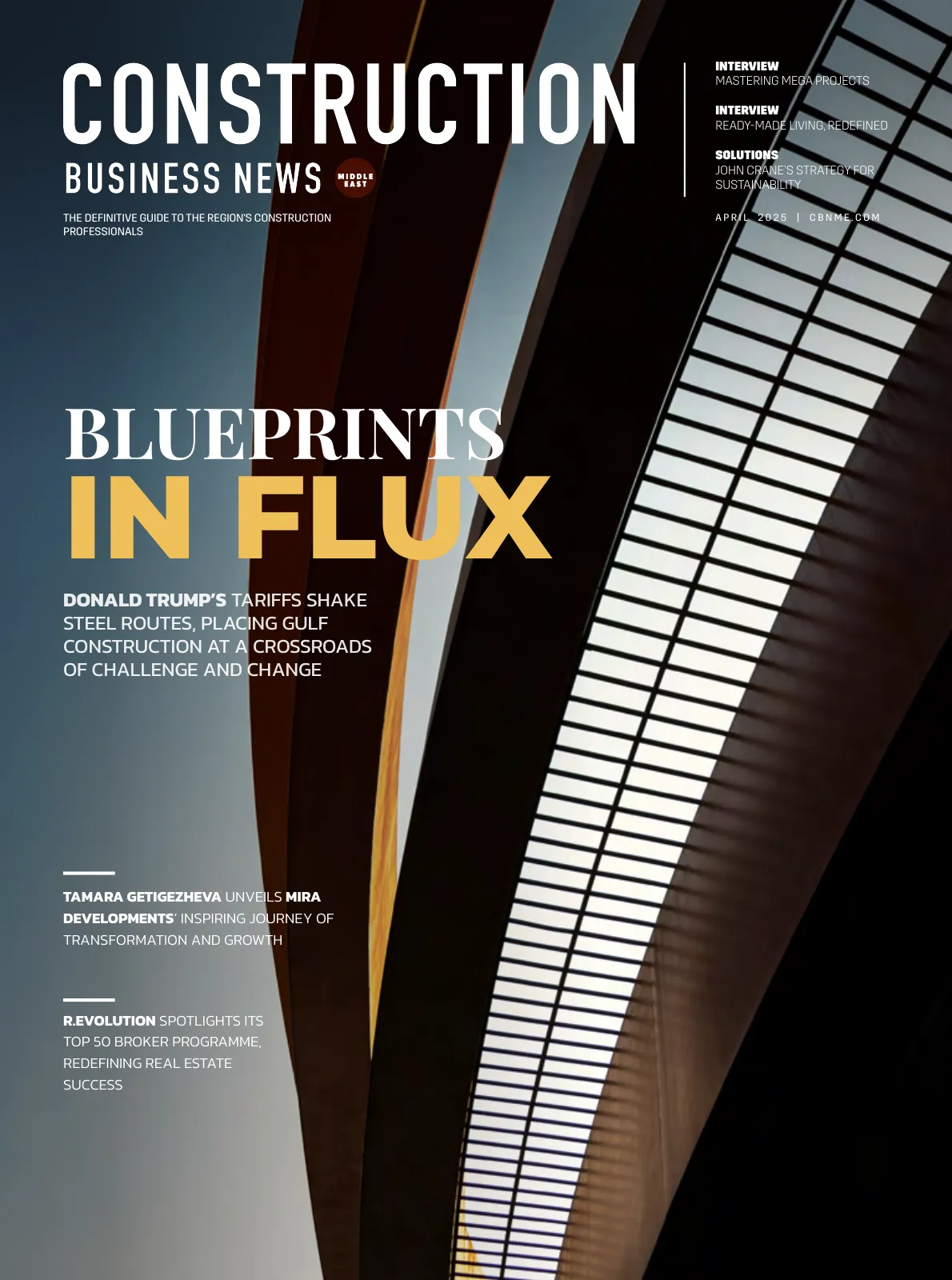
Construction Business News, April 2025
Page 1
THE DEFINITIVE GUIDE TO THE REGION'S CONSTRUCTION
PROFESSIONALS
INTERVIEW
MASTERING MEGA PROJECTS
INTERVIEW
READY-MADE LIVING, REDEFINED
SOLUTIONS
JOHN CRANE’S STRATEGY FOR
SUSTAINABILITY
A P R I L 2 0 2 5 | C B N M E . C O M
DONALD TRUMP’S TARIFFS SHAKE
STEEL ROUTES, PLACING GULF
CONSTRUCTION AT A CROSSROADS
OF CHALLENGE AND CHANGE
BLUEPRINTS
IN FLUX
TAMARA GETIGEZHEVA UNVEILS MIRA
DEVELOPMENTS’ INSPIRING JOURNEY OF
TRANSFORMATION AND GROWTH
R.EVOLUTION SPOTLIGHTS ITS
TOP 50 BROKER PROGRAMME,
REDEFINING REAL ESTATE
SUCCESS
Page 2
ANANTARA SHARJAH RESIDENCES
A NEW CHAPTER OF LUXURY EXPERIENCES
BY THE SEA
Bringing luxury seaside living to Sharjah for the first time, owners at the Anantara Sharjah
Residences enjoy access to the Anantara Sharjah Resort’s world-class amenities, including an
infinity pool, five distinctive restaurants, an Anantara Spa and a state-of-the-art gym.
As an investment, owners can enjoy the benefits of a rental management scheme operated by
Anantara Hotels, Resorts & Spas, allowing them to maximize their returns when they are not
resident in the property.
To register your interest, visit arada.com
LIFE IS A JOURNEY.
Page 3
IN THIS ISSUE CBNME
34
28
18 LOGISTICS
A NEW LOGISTICS ETHOS
22 INTERVIEW
MASTERING MEGA
PROJECTS
26 CONSULTANTS
SHAPING SECTOR
STRATEGY
28 COVER STORY
TARIFF TREMORS: HOW
TRUMP’S TRADE SHIFTS
MAY RESHAPE GULF
CONSTRUCTION
34 INTERVIEW
READY-MADE LIVING,
REDEFINED
38 SUB-CONTRACTOR
A TRUSTED INNOVATOR
40 TAX
COMPLIANCE SHIFT
42 BROKERAGE
SALES SUPREMACY
44 EXPERIENCES
DESIGNING FOR UAE
46 SOLUTIONS
JOHN CRANE’S
STRATEGY FOR
SUSTAINABILITY,
INNOVATION, AND
GROWTH IN THE MEA
REGION
50 REAL ESTATE
THE POWERFUL DUO
THAT’S CHANGING THE
INVESTMENT GAME IN
REAL ESTATE
52 SOLUTIONS
CORROSION
REVOLUTION WITH
METGUARD
54 FM
BUILDING SMARTER,
GREENER FUTURES WITH
SERVEU
56 EXPERT INSIGHT
NAVIGATING MODULAR
MYTHS
58 OP-ED
RISING BUILDERS
60 SUSTAINABILITY
SUSTAINABLE CONCRETE
FOR A GREENER
TOMORROW
62 UNSUNG HEROES
APPLE BAEL
22
WWW.CBNME.COM
CONSTRUCTION BUSINESS NEWS ME | APRIL 2025 | 3
Page 4
Nestled by the coast of Lusail sits the splendor of
Raffles and Fairmont Doha, where luxury is rooted
in even the smallest details. Open the doors to
mesmerizing hospitality and make memories in a
world of sophistication.
Page 5
Page 6
Go big or go small
with the HP DesignJet
T950 plotter series
Page 7
Scan to
learn more
Most Efficient
Save time with the most efficient A4-A0 experience.
2 Seamlessly print A4 jobs with integrated input
and output trays, keeping pages sorted by size.
The flat 40-page stacker makes collection easy,
while fast print speeds keep projects moving.
Connected
Work securely from virtually anywhere. You can
save time by printing in fewer steps with HP Click.
Protect your printer and data from cyberthreats
with HP Wolf Pro Security. Manage your device
and print remotely with HP app.
Go Beyond
Go beyond and advance your environmental goals
with a printer made with recycled plastics and
recyclable supplies. This robust, compact plotter
is designed to last while also helping to reduce
energy and ink waste.
Page 8
Keep up to date with all the latest
news, features and much more on our
website and social media platforms
CBNME.COM
CBNME
@CBNME
CONSTRUCTION BUSINESS NEWS
MIDDLE EAST
SUBSCRIBE
subscriptions@bncpublishing.net
PO Box 502511 Dubai, United Arab Emirates
P +971 4 4200 506 | F +971 4 4200 196
For all commercial enquiries, contact jo@bncpublishing.net
T +971 50 440 2706
All rights reserved © 2025.
The opinions expressed are solely those of the contributors.
Construction Business News Middle East and its affiliated publications in
the MENA region are exclusively licensed to BNC Publishing.
No part of this magazine may be copied, reproduced, or transmitted in any
form or by any means without prior written consent from the publisher.
Printed by United Printing and Publishing | upp.ae
Images used in Construction Business News Middle East are credited when
necessary. Attributed use of copyrighted images with permission. All images
not credited courtesy Shutterstock.
Editor-in-Chief
Vibha Mehta vibha@bncpublishing.net
CEO
Wissam Younane wissam@bncpublishing.net
Managing Director
Rabih Najm rabih@bncpublishing.net
Group Publishing Director
Joaquim D'Costa jo@bncpublishing.net
Commercial Director
Andrea Mocay andrea@bncpublishing.net
Editorial Assistant
Aya Zhang aya@bncpublishing.net
Digital Reporter
Reeba Asghar reeba@bncpublishing.net
Creative Lead
Christian Harb chriss@bncpublishing.net
Editorial Design
Rizaldi Febrian
Marketing Executive
Aaron Joshua Sinanbam aj@bncpublishing.net
Videographer
Eduardo Buenagua
Contributors
Natalie Faulkner and Khadeeja Hamid
8 | CONSTRUCTION BUSINESS NEWS ME | APRIL 2025
WWW.CBNME.COM
Page 9
DOMOTEX
MIDDLE EAST
The Trade Fair for the Carpet & Flooring
Industry in the Middle East.
22 – 24 APRIL 2025
Dubai World Trade Centre
Scan for more info
Page 10
Page 11
SUITE TREAT
Step into a world of opulence when you book a Suite at Raffles Doha.
Experience the added luxury of QAR 750 credit to spend
on dining in the hotel, and QAR 500 towards any Spa treatment.
Children aged 12 and below are welcome to indulge in the
enchantment of complimentary dining.
Rates starting from QAR 3,500 per night
For reservations, please call +974 4030 7100
or email reservations.doha@raffles.com
Raffles Doha, Iconic Towers, Marina District, PO BOX 4747, Lusail, Qatar
Page 12
A
recent trip to Mumbai reminded me just
how much a place can move you—literally
and emotionally. The city pulses with life, its
pace unapologetically swift. Trains dash past
like bolts of thought, conversations happen
mid-step, and dreams are chased at every
corner. Yet, amidst the glorious chaos, there’s a certain
tenderness that quietly anchors you. Because in Mumbai, no
matter how fast time flies, hearts somehow stay connected.
There’s something uniquely comforting in the way people
ask, “Kya haal hai?” in passing. It isn’t just a question—it’s
a thread of care, a subtle reminder that someone’s presence
matters. That in a city bursting at the seams, we still pause
for each other. It’s these fleeting yet meaningful
moments that stitched my visit together with warmth.
Between the honks of rickshaws and the scent of
roadside chai, I found myself slipping back into
familiar rhythms. Catching up with old friends,
sharing meals with family, and exchanging laughter
that doesn’t need explanation—it was like oxygen
for the soul. These aren’t slow moments, but they’re
meaningful. They remind you that connection isn’t
about the number of hours you spend, but the depth
within those minutes.
In the bustle of the city, ideas came rushing in as fast
as the locals crossing streets at peak hour. I felt more
alive, more inspired, and strangely more rested—not
because I slowed down, but because I tuned in. And
that—more than anything—recharged my creative
spirit.
Now, with that energy humming through me, I
return to a buzzing calendar and an industry full of
movement. The awards season kicks off in full glory
with the Construction & Design Innovation Summit
Saudi 2025 and the Construction Innovation Awards
KSA 2025—our first two flagship events this quarter
in Riyadh. There's a sense of renewal in the air, a
vibrant anticipation of stories to be shared, names to
be honoured, and milestones to be celebrated.
Mumbai gave me more than memories. It handed me
clarity, emotion, and a renewed pulse—just in time for
what promises to be an unforgettable season. Let’s raise the
curtain, Riyadh. I’m ready!
Vibha Mehta
Editor-in-Chief
vibha@bncpublishing.net
Vibha Mehta
vibhamehta01
@vibhamehta01
CBNME
LETTER FROM THE EDITOR
Fast Tracks & Full Hearts
12 | CONSTRUCTION BUSINESS NEWS ME | APRIL 2025
WWW.CBNME.COM
Page 13
Das gute Licht.
Light with a sense
of lightness
With intricate lines and visual lightness, this LED wall luminaire is an
eye-catching centrepiece for interior spaces. A white diffuser ensures
uniform unshielded light distribution. Available in different sizes and
surface finishes, on its own or as an ensemble, the luminaire opens up
creative design freedom. bega.com/circle
Page 14
A
ldar unveils the final 113 luxury homes overlooking
Zayed National Museum, designed by Bjarke
Ingels Group and Lillian Wu Studio, blending
opulence with culture. The standout amenities
like a spa, cinema, pools, and the Mandarin
Oriental Cake Shop.
Aldar, the UAE’s leading real estate developer, investor,
and manager proudly unveils a collection of 113 design-led
homes at Mandarin Oriental Residences Saadiyat Cultural
District, Abu Dhabi. This collection of homes marks the
second building within the wider development, responding to
exceptional demand for the initial offering.
Located in the prestigious Saadiyat Cultural District, this
release by Aldar features striking architecture by BIG – Bjarke
Ingels Group and serene, thoughtfully crafted interiors by
Lillian Wu Studio. Buyers can choose from an exclusive range
of 1- to 4-bedroom homes and 5-bedroom penthouses, all
complemented by exceptional amenities and legendary
Mandarin Oriental service.
The residences offer a refined, tranquil ambience with flowing
natural light, organic contours, and a rich mix of earthy
wood and sleek metal accents. Interiors come in high-end
light or dark finishes, tailored to individual style, and feature
bespoke details including grand chandeliers, subtly veined
marbles, and curated lighting. Floor-to-ceiling windows open
to expansive living areas and kitchens designed for elegant
entertaining, while master suites include luxurious bathrooms
and direct terrace access with panoramic views of the cultural
district.
Lillian Wu, Founder & Principal at Lillian Wu Studio,
commented: “Leveraging Saadiyat Island’s prominence in
modern and cultural living, combined with BIG’s forward-
thinking design and Mandarin Oriental’s exceptional
hospitality, we’ve crafted an interior design that embodies
multifaceted luxury, innovation, and cultural fusion.”
The ultra-premium residences offer breathtaking views of
Zayed National Museum and easy access to world-class
cultural experiences and Mamsha Beach’s white sands,
delivering an unrivalled lifestyle in Saadiyat’s most coveted
address. Residents enjoy the exemplary service of Mandarin
Oriental, with unique lifestyle experiences and world-
class amenities including a Signature Spa, holistic wellness
programs, indoor and outdoor pools, a state-of-the-art gym,
male and female salons, a private dining room, residents’
lounge, and the iconic Mandarin Oriental Cake Shop.
Andreas Klok Pedersen, Partner, BIG-Bjarke Ingels Group,
commented: “Mandarin Oriental Residences Saadiyat Cultural
District, Abu Dhabi are shaped by the project’s unique context
within the Saadiyat Cultural District – conceived as a classic
pair of twin courtyard buildings that open up in a cascade of
terraces towards the Zayed National Museum. The courtyards,
gently rounded and lined with generous terraces, create a
valley-like opening that frame the museum, becoming at
once a peaceful lush oasis and a vibrant promenade lined
withrestaurants and cafes. We’re honored to contribute to
this evolving cultural destination, and grateful to Aldar, Lillian
Wu, and Mandarin Oriental for their visionary partnership in
bringing this project to life.”
Jonathan Emery, Chief Executive Officer at Aldar
Development, commented: “Mandarin Oriental Residences
Saadiyat Cultural District, Abu Dhabi combines the finest
in luxury living with direct access to Abu Dhabi’s most
iconic cultural landmarks. This development offers a unique
opportunity for residents to live fully immersed in the
quality, service, and sophistication that Mandarin Oriental is
renowned for globally, within the most vibrant and desirable
neighbourhood in the region. It’s an unparalleled offering for
Aldar customers locally and internationally who seek both a
prestigious address and proximity to the cultural heart of Abu
Dhabi.”
Laurent Kleitman, Group Chief Executive of Mandarin
Oriental Hotel Group, commented: “We are pleased to deepen
our collaboration with Aldar through Mandarin Oriental
Residences Saadiyat Cultural District, Abu Dhabi. This project
brings our legendary service and refined elegance to a
destination of cultural significance. Together, we are crafting
more than a prestigious residence – we are creating a gateway
to the vibrant heritage and artistic spirit that define Saadiyat
Island and the wider Abu Dhabi landscape.”
ALDAR REVEALS LUXURY HOMES DESIGNED BY LILLIAN WU STUDIO AT
MANDARIN ORIENTAL RESIDENCES, SAADIYAT CULTURAL DISTRICT
Aldar’s Latest 113-unit collection at Mandarin Oriental Residences combines
luxury living with cultural elegance
CBNME
REGIONAL NEWS
14 | CONSTRUCTION BUSINESS NEWS ME | APRIL 2025
WWW.CBNME.COM
Page 15
N
ational Central Cooling Company (DFM: Tabreed)
and Dubai Holding Investments, part of Dubai
Holding, have entered a concession agreement
to provide district cooling services for Palm Jebel
Ali in Dubai.
The agreement establishes a joint venture, with Tabreed
holding a 51% stake and Dubai Holding Investments 49%.
This structure is designed to optimise cooling capacity,
enhance information-sharing and strengthen customer
protection, while ensuring sustainable cooling solutions for
one of Dubai’s most transformative developments.
Supported by Tabreed’s major shareholders, sovereign
investor Mubadala (42%) and the French low-carbon energy
and services company ENGIE (40%), the agreement was
signed by Khalid Al Marzooqi – Chief Executive Officer of
Tabreed and Omar Karim – Chief Executive Officer of Dubai
Holding Investments, in the presence of senior officials from
Tabreed, Dubai Holding, Mubadala and ENGIE.
Subject to customary approvals, construction of the district
cooling network is expected to commence in Q2 2025,
with the first cooling services expected to be delivered
by 2027. Over time, the system will address the need for
approximately
250,000 RTs of
cooling capacity and
require an estimated
investment of AED
1.5 billion.
Following the
signing, Chairman of
Tabreed and Chief
Executive Officer
of Mubadala’s
UAE Investments
Platform, Dr
Bakheet Al Katheeri,
said: “Mubadala
has a worldwide
reputation for
being a responsible
investor with an
unwavering focus
on its ESG framework and Tabreed is a vital part of our
portfolio as a driver of sustainability and societal progress.
The signing marks a major milestone in Tabreed’s 27-year
history and underscores the company’s commitment to
providing sustainable, high-efficiency cooling solutions for
large-scale developments. I am eagerly looking forward to
witnessing the successful progress of this landmark project.”
Omar Karim, Chief Executive Officer of Dubai Holding
Investments, commented: “This agreement reinforces Dubai
Holding’s long-term vision of developing sustainable
communities with high-quality infrastructure at their
core. Palm Jebel Ali is one of Dubai’s most ambitious
developments and by incorporating district cooling services
we support our customers and align to our commitment to
deliver future-ready urban environments.”
Commenting on the agreement, Chief Executive Officer of
Tabreed, Khalid Al Marzooqi, added: “Palm Jebel Ali is a
transformative project that will shape Dubai’s future and
we are proud to play a role in ensuring its infrastructure
meets world-class standards. With our extensive experience
and cutting-edge technology, we will deliver reliable and
environmentally responsible cooling that benefits residents,
visitors and stakeholders alike.”
Tabreed and Dubai Holding’s partnership aims to deliver sustainable cooling solutions
and optimize capacity for one of Dubai’s most transformative developments
TABREED PARTNERS WITH DUBAI HOLDING FOR DISTRICT COOLING
AT PALM JEBEL ALI
REGIONAL NEWS
WWW.CBNME.COM
CONSTRUCTION BUSINESS NEWS ME | APRIL 2025 | 15
Page 16
KLEINDIENST GROUP COMPLETES CONSTRUCTION OF NICE
HOTEL ON THE HEART OF EUROPE
A
fter the successful launch – and resounding success
– of its Monaco-inspired hotel, the Kleindienst Group
is set to add a second Nice-inspired property to its
Côte d’Azur stable. Part of the Heart of Europe development
located on the World Islands just off the coast of Dubai, Nice
Hotel has now completed construction, having achieved the
Nakheel Completion Certificate.
With projected annual yields of 8.33%, the hotel presents an
incredibly attractive investment opportunity, backed by the
powerhouse that is the Kleindienst Group, a strategic market
leader in both the hospitality and innovation spheres.
The ambitious Heart of Europe is a case in point. With its
floating villas, stunning beachfront properties, contemporary
rooms and opulent villas, a coral restoration programme and
even climate-controlled streets – this is a Eurpoean-inspired
megaproject that defies convention and demands attention.
It is also a benchmark in sustainability, fusing luxury with
environmental consciousness through marine conservation
and energy-efficient design.
Nice is the second hotel within The Heart of Europe, a
waterfront development with a track record of strong
occupancy rates, revenue growth, and guest satisfaction.
As such, it presents a valuable investment opportunity for
those seeking high-yield hotel room ownership with proven
profitability. Attractive returns aside, buyers can benefit from
a turnkey service, wherein operations will be fully managed
independently with no day-to-day responsibilities for
investors.
“This is a rare opportunity to invest in a thriving hotel
property with a solid performance history,” says Mr Josef
Kleindienst, Chairman of The Heart of Europe. “Our strategic
location, strong brand reputation and high occupancy rates
make this an exceptional choice for investors seeking both
short-term returns and long-term value appreciation.”
Owners will also benefit from an array of hospitality benefits,
including complimentary stays and priority bookings, plus
proximity to the hotels, restaurants and other amenities on
The Heart of Europe.
Now in its pre-opening stages, the 264-key Nice Hotel will
offer deluxe and premium rooms, plus three types of suites,
ranging from 603 sq. ft. to 1216 sq. ft., including Étoiles Rooms,
Suite de Prestige Types 1 & 2 and the expansive Nissa La Bella
Suite that will be located on the ground floor.
A vibrant, fun and unapologetically bold destination, Nice
promises a truly experiential stay – from its indulgent
cuisine and exhilarating watersports to its trendy boutiques,
yacht and pool parties and seasonal carnivals. The property
channels French Riviera vibes, where guests can spend the
day amid bustling street markets before heading over to all-
night beach parties alongside other global revelers. This is la
bonne vie at its most refined.
Hotel property investments – especially those strategically
placed in high-demand leisure destinations – are a lucrative
and stable source of income. The booming hospitality sector
and thriving travel and tourism scene in Dubai, combined
with the competitive positioning of the Kleindienst Group
make this an investment that is not only sound and strategic,
but also stylish, sustainable and sophisticated.
Moving forward, the group has an expansion plan that
includes, but is not limited to, the five-star Cannes and St
Tropezboutique hotels as part of Côte d’Azur; the Floating
Lido, which will be the world’s first luxury underwater vessel
resort inspired by Venice; ultra-private and limited-number
beach palaces on Sweden Island; and waterfront villas
inspired by Bauhaus architecture on Germany Island among
others.
The Nice hotel room ownership programme offers consistent
revenue streams, capital appreciation, and access to a
hospitality brand that is known for its excellence in service
and guest experience, its use of state-of-the-art technology,
and its prowess in developing properties for discerning
investors.
Kleindienst Group has completed construction of its second Nice-inspired property
at the Heart of Europe on Dubai’s World Island
CBNME
REGIONAL NEWS
16 | CONSTRUCTION BUSINESS NEWS ME | APRIL 2025
WWW.CBNME.COM
Page 17
N
esma & Partners, Saudi
Arabia’s leading contracting
company, has launched
an uplifted brand identity
that reflects its strategic
evolution and forward-thinking vision.
More than a visual update, this rebrand
reinforces the company’s commitment
to excellence, innovation, and
sustainable growth while strengthening
its role as a key enabler of Saudi Vision
2030. By contributing to national
development, embracing technological
innovation, and driving economic
diversification, Nesma & Partners is
shaping the industry’s future.
For over four decades, Nesma &
Partners has delivered over 200 high-
impact projects that set industry
benchmarks. The refreshed brand
underscores the company’s continued
investment in advanced technologies,
operational excellence, and talent
development, ensuring its leadership
in a continuously evolving market.
“Our new brand identity marks a
pivotal milestone, honoring our
legacy while positioning Nesma &
Partners for the future. It reflects our
commitment to the relentless pursuit
of excellence, bold innovation, and
delivering lasting value to our clients,
partners, and stakeholders. As we
expand our capabilities, we are not
just building projects—we are shaping
the foundations of economic growth
and community advancement. With a
steadfast focus on sustainability and
transformative impact, this rebrand
strengthens our role in driving progress
with purpose and precision,” said
Samer Abdul Samad, President & CEO
of Nesma & Partners.
Aligned with this transformation,
Nesma & Partners is enhancing its
digital presence with a reimagined
website that highlights its expertise,
achievements, and contributions
across multiple sectors. The uplifted
brand embodies the company’s
mission to build with integrity,
foster long-term partnerships, and
reinforce its leadership in sustainable
development—driving lasting value for
generations to come and contributing
significantly to the Kingdom and its
emerging role on the global stage.
NESMA & PARTNERS REVEAL EXCITING NEW BRAND IDENTITY
Nesma & Partners has unveiled a refreshed brand identity that reflects its
strategic growth and vision for the future
REGIONAL NEWS
WWW.CBNME.COM
CONSTRUCTION BUSINESS NEWS ME | APRIL 2025 | 17
Page 18
CBNME
LOGISTICS
Words by: Khadeeja Hamid
As a member of Impact Innovation Board, Khadeeja merges creative strategy,
emerging trends, and community building to drive transformation. With a
Fine Art background and a passion for cultures, she crafts impactful narratives
bridging startups, industry insights, and public-private sectors.
How logistics is becoming the silent scaffolding behind the
GCC’s construction boom
A New Logistics Ethos
Smart warehousing and AI-driven customs clearance
redefine resilience in a tariff-challenged logistics era
18 | CONSTRUCTION BUSINESS NEWS ME | APRIL 2025
WWW.CBNME.COM
Page 19
A
cross the GCC, a new era
of building is unfolding.
From Saudi Arabia’s NEOM
and the Red Sea Project to
the UAE’s vertical skyline
and infrastructure surge, the region
is laying more concrete, assembling
more scaffold, and pouring more
foundations than ever before—but
beneath the visible acceleration is a
quieter choreography—the movement
of materials, precise deliveries, off-site
orchestration, and digital systems
syncing it all in real time.
And this system, already complex,
is being pushed to its limits. It’s
colliding with surging material
costs, unpredictable shipping lanes,
regulatory fragmentation, and the
mounting expectation that everything—
arrives not now, but yesterday. In a
region where scale is the signature of
progress, logistics has become the silent
scaffolding holding it all together.
A Sector Outpacing Its Own Supply
Chain
The GCC’s skyline ambitions are
staggering in both scale and speed. By
2030, the region is expected to host
over $2 trillion in active construction
projects, with Saudi Arabia’s giga-
developments accounting for more than
half that value. These aren’t isolated
builds—they’re ecosystems emerging
in parallel. NEOM, the Red Sea Project,
and Diriyah Gate are reshaping not just
landscapes but the logistical thresholds
of what’s possible. Meanwhile, the UAE’s
real estate rebound has translated into
a flurry of luxury towers, waterfront
enclaves, data centers, and green
infrastructure rising all at once.
This isn’t just about building big. It’s
about building faster than traditional
systems were ever designed for. With
each contract awarded, a new layer of
logistical complexity is introduced—
not only in what gets built, but in how
materials, machinery, and labor reach
the ground. Every construction input has
become a time-sensitive component in
a tightly synchronized system. A delay
in scaffolding, formwork, or material
clearance can ripple through an entire
schedule.
In this context, logistics isn’t peripheral.
It’s foundational. An operating system
for an industry that now builds not just
vertically, but simultaneously, across
time zones, terrains, and expectations.
And that system is being forced to
evolve—fast.
A NEW LOGISTICS ETHOS
Global trade routes realign as Middle East
logistics hubs brace for shifting supply
chains
WWW.CBNME.COM
CONSTRUCTION BUSINESS NEWS ME | APRIL 2025 | 19
Page 20
From Movers to Strategic Partners
Across the GCC, logistics providers are
evolving from transporters to project
partners—less about moving goods,
more about managing momentum.
Companies like Trukker are offering
digital freight matching that allows
developers to scale transport on
demand. DP World and Abu Dhabi Ports
are investing in inland logistics hubs
to decongest ports and bring staging
closer to megaproject zones. Aramex,
meanwhile, is expanding its integrated
logistics offerings, bridging last-mile
delivery with construction-specific
services.
Modular delivery schedules, temporary
pre-staging yards, mobile distribution
hubs, and just-in-time logistics have
become essential to managing the
velocity of modern construction.
Warehousing is no longer a static
node—it’s flexible, dynamic, and often
migratory, shifting closer to construction
clusters as needed. Inland hubs are
being developed to decongest ports
and bring materials within reach of
megaproject sites.
In Qatar, the run-up to the World
Cup pushed infrastructure to its
limits. Logistics firms responded
by offering formwork kitting and
prepping scaffolding systems off-site—
streamlining setup times and reducing
congestion. Those methods are now
being replicated at scale across NEOM’s
early build phases in
Saudi Arabia.
Logistics today
isn’t about trucks
and timetables. It’s
about orchestration.
Contractors working
with advanced
modular systems
don’t want materials
early—they want them
exactly when needed.
That requires deep
forecasting: material
flows mapped weeks
in advance across
subcontractors,
borders, and build
phases.
To meet this demand,
logistics firms are
turning to AI-driven
planning, real-time
route optimization,
and full-spectrum
visibility platforms.
These tools don’t just
track—they anticipate,
pre-empt, and reroute
Digital Twins and
Real-Time Supply
Chains
While formwork shapes concrete, data
is reshaping logistics. The modern
jobsite now depends on predictive
logistics—where AI anticipates material
flows before demand peaks, and supply
chains respond in real time to on-site
conditions.
Blockchain-based platforms like
DP World’s CARGOES are enhancing
traceability across every checkpoint,
reducing customs delays and
minimizing mismatches in material type
or quantity. IoT sensors embedded in
delivery fleets and temporary storage
units allow for real-time environmental
monitoring—essential when
transporting temperature-sensitive or
time-critical components.
CBNME
LOGISTICS
Behind every shipment is a story of resilience—
navigating challenges, borders, and shifting tides
20 | CONSTRUCTION BUSINESS NEWS ME | APRIL 2025
WWW.CBNME.COM
Page 21
In high-rise and dense urban projects, vertical logistics
is emerging as its own discipline—tracking crane cycles,
optimizing lift schedules, and managing floor-by-floor storage
with surgical precision. Leading projects across the GCC are
now creating digital twins of their logistics chains, simulating
the full journey of formwork materials from port to crane.
These models help contractors forecast unloading bottlenecks
and turnaround times before they disrupt timelines.
This isn’t a future scenario—it’s already being piloted in zones
across Riyadh and Abu Dhabi. What’s emerging is a feedback
loop between site and supply chain, where every movement
is monitored, measured, and adjusted in real time. It’s logistics
that thinks on its feet.
The Shift from Scale to Precision
The future of construction logistics isn’t about faster trucks or
bigger warehouses—it’s about smarter, self-aware ecosystems.
The focus is shifting from scale to precision.
We’re already seeing the rise of micro-logistics hubs near key
megaproject zones, modular, reusable, formwork —managed
like inventory not waste, and digital twins that simulate supply
chains routes for virtual testing before a single delivery is
dispatched. These aren’t fringe innovations—they’re fast
becoming industry standards.
Saudi Arabia’s Oxagon port city, part of the NEOM vision, is
being designed as a fully automated logistics hub, where
materials and goods flow with minimal human intervention.
In Dubai, logistics firms are now sitting at the table during
early-stage project planning—not just to coordinate delivery
timelines, but to co-design materials for transport efficiency
and on-site assembly.
At the same time, sustainability is being woven into the
logistics conversation—not as a separate initiative, but as part
of overall performance. With construction ranking among the
world’s highest carbon-emitting sectors, how materials move
matters. Companies are piloting electric freight fleets, biofuel-
powered trucks, and automated warehousing systems that
reduce both emissions and inefficiencies.
There’s also a growing move toward urban consolidation
centers—compact distribution hubs near dense construction
clusters that enable micro-distribution of high-rotation items
like scaffolding, reducing last-mile delays and easing urban
congestion.
And then there’s digitization. Platforms like CargoX and
CARGOES by DP World are streamlining customs and
documentation, transforming what used to be a paper-
choked process into a frictionless digital workflow. In this new
paradigm, a formwork shipment doesn’t wait three days for
clearance—it’s verified, tracked, and approved in under 30
minutes.
The Infrastructure Behind the Infrastructure
We look at skylines and see progress—but rarely do we see
what got them there. Not the drivers or dispatchers, not the
systems engineers or digital networks. Logistics has become
the invisible formwork of the GCC’s construction boom—
holding everything in
place, yet rarely seen.
As construction climbs
higher and moves faster,
the systems behind
it must evolve just as
rapidly. The region
may be laying concrete
and steel, but what it’s
really building is the
infrastructure behind the
infrastructure—a logistics
ecosystem that underpins
every poured slab, every
scaffolded floor, every
crane on the horizon.
Because while
construction builds what
we see, it’s logistics that
ensures it’s built at all.
A NEW LOGISTICS ETHOS
Inside a bustling GCC logistics zone, where tariff ripples reshape
container movements and cost strategies
WWW.CBNME.COM
CONSTRUCTION BUSINESS NEWS ME | APRIL 2025 | 21
Page 22
CBNME
INTERVIEW
Mark Hamill, Director
at Turner & Townsend,
highlights how Giga
projects are reshaping the
consulting landscape—
driving innovation,
elevating standards, and
redefining the future of
project delivery
MASTERING
MEGA
PROJECTS
Mark Hamill,
Director at Turner & Townsend
22 | CONSTRUCTION BUSINESS NEWS ME | APRIL 2025
WWW.CBNME.COM
Page 23
MASTERING MEGA PROJECTS
Global Project
Perspectives
Managing projects
globally is always an
exciting challenge.
Each region brings
unique complexities,
but Saudi Arabia
stands out for scale
and ambition. The
projects here aren’t
just extensive. They’re
transformative,
pushing the
boundaries of urban
development.
What’s particularly
exciting is the calibre
of talent these
projects attract. You’re
working alongside
people from all over
the world, some of
the most innovative
minds in the industry,
who are all aligned in
delivering something
extraordinary.
There’s a shared
sense of purpose in
Saudi Arabia right
now, driven by the
momentum of Vision
2030. It’s inspiring to
be a part of it.
Evolving Leadership
Journey
Over the years, I’ve
learned that success
in this industry comes
down to collaboration,
adaptability, and a
precise alignment of
objectives. Here, where
projects are complex
and fast-moving,
having a clear handle
on costs and risks is
critical. But just as
important is ensuring that everyone—clients, consultants,
and contractors—is working towards the same goal.
Early in my career, I focused on the technical side of project
delivery. Now, I put just as much emphasis on building the
Growing from just 40 team members to nearly 500, Turner &
Townsend has expanded its footprint across Riyadh, Al Khobar,
Tabuk, and Neom, with plans underway to launch its Jeddah
office
WWW.CBNME.COM
CONSTRUCTION BUSINESS NEWS ME | APRIL 2025 | 23
Page 24
CBNME
INTERVIEW
right culture within
teams. Treating
everyone as part of
the same team rather
than as separate
entities makes all the
difference. The best
outcomes happen
when people work
together seamlessly,
break down silos, and
bring their expertise
to the table without
barriers.
Turning Trials
Triumphant
Navigating large-
scale projects across
different regions has
been challenging
due to varying
market operations
and cultural nuances.
Adapting to local
regulations, business
etiquette, and
communication
styles takes time.
On one project with
over 35 nationalities,
fostering an
environment of
common objectives
while respecting
local ways of working
was key. Educating
teams and setting
clear expectations
upfront helped
create a cohesive
working culture.
Vision-Aligned
Ventures
At Turner &
Townsend, we
ensure our projects
contribute to the
region’s long-term
goals, focusing
on sustainability,
innovation, and
nation-building. In Saudi Arabia, we’re supporting Vision 2030
by investing in local talent, upskilling teams, and embedding
sustainable practices. Our aim is to create lasting, positive
impacts through economic diversification, urban regeneration,
and setting new
benchmarks for
project delivery.
Guiding with
Precision
I believe in leading
with transparency,
accountability, and
empowerment.
Setting clear
objectives and
ensuring everyone
understands
their role is
fundamental, but
being present
and available to
the team is just
as important. I
want teams to feel
supported and
motivated to bring
their best to every
project. Leadership
isn’t about telling
people what to do.
It’s about enabling
them to succeed
and helping them
grow.
Empower. Elevate.
Excel.
To inspire and lead
high-performing
teams, I focus on
creating a culture
of innovation,
continuous
learning, and
collaboration. I
prioritise on-
site presence
to understand
challenges and
provide support.
Knowledge sharing
is crucial for
staying ahead,
so I foster a
culture of sharing
insights and best
practices. Clear communication, professional development, and
a supportive team environment are key to motivating everyone
to succeed.
ChatGPT said_ Turner & Townsend has established a longstanding
presence in the Kingdom, fostering deep-rooted partnerships and
acquiring vital on-the-ground knowledge
24 | CONSTRUCTION BUSINESS NEWS ME | APRIL 2025
WWW.CBNME.COM
Page 25
MASTERING MEGA PROJECTS
Mastering Project Risk
It’s about proactively
mitigating potential
issues before they impact
a project. The key is
making risk management
a shared responsibility.
Everyone involved,
clients, consultants, and
contractors, need to be
aligned on potential risks
and the strategies in place
to address them. With that
level of coordination, you
can anticipate challenges
and adapt quickly,
ensuring smoother project
delivery.
Shaping KSA’s Urban
Futures
Saudi Arabia is undergoing
a transformation unlike
anything we’ve seen before, and it’s an incredible time to be
involved. My role, and Turner & Townsend’s, is to bring global
expertise to help shape this change in a way that’s sustainable,
innovative, and impactful.
We’re not just delivering projects; we’re helping our clients
make strategic decisions that will define the future of urban
development in the Kingdom. That means aligning with Vision
2030’s goals, driving sustainability initiatives, and ensuring our
work leaves a lasting legacy.
A big part of this is investing in the region, relocating global
talent, upskilling local professionals, and expanding our
presence here. It’s about being part of the long-term story, not
just the immediate projects.
Defining Turner & Townsend Moments
Relocating from the Netherlands to Saudi Arabia during
COVID-19 in October 2020 was a defining moment in my career.
With just 40 people in the Kingdom, growing the business
under strict restrictions while ensuring client satisfaction was
challenging . This experience highlighted the importance of
resilience and adaptability, qualities that have been essential
as we’ve expanded our presence.
One of the biggest shifts has been evolving from a cost
consultancy to a recognised programme management
consultancy (PMC). Achieving this meant relocating some of
our best talents and PMC experts to Saudi Arabia, embedding
ourselves within major programmes and proving our ability to
deliver at scale.
Entering the Saudi data centre market was another milestone.
With rapid digital transformation under Vision 2030, the
demand for data infrastructure is soaring. Our success in this
sector is a testament to our specialist expertise and ongoing
investment in bringing the best talent to the region.
Overall, our growth in Saudi Arabia has been remarkable. From
a team of 40 to nearly 500 today, we’ve expanded across
Riyadh, Al Khobar, Tabuk, and Neom, and we’re preparing to
open our Jeddah office.
This growth isn’t just about numbers; it’s about deepening
our presence in the Kingdom and being closer to our clients,
ensuring we’re embedded in the projects shaping the nation’s
future.
Seizing Regional Momentum
It’s an exciting time to be in the Middle East, particularly in
Saudi Arabia, where we’re witnessing unprecedented nation-
building, from major infrastructure projects to entirely new
cities and communities. Delivering on this vision requires
expertise, innovation, and a deep market understanding.
Turner & Townsend has been embedded in the Kingdom for
over a decade, building strong relationships and gaining
invaluable local insight. Our approach is centred on quality
over quantity; we may not be the biggest, but our reputation is
built on excellence, consistency, and a proven ability to deliver
on first-of-its-kind ambitions.
The feedback we receive reaffirms our position as a trusted
partner. We remain committed to driving progress and
delivering world-class projects as the construction sector in
KSA continues to thrive.
As Vision 2030 accelerates digital
transformation, the need for
robust data infrastructure is
rising rapidly
WWW.CBNME.COM
CONSTRUCTION BUSINESS NEWS ME | APRIL 2025 | 25
Page 26
CBNME
CONSULTANTS
Sector-Specific Insights
Balancing insights across various
residential, hospitality, and commercial
sectors requires a deep understanding
of market dynamics, which I have
developed over the past decade. My
experience in delivering data-driven
insights, combined with our firm’s
extensive transactional and advisory
expertise in the UAE market across
multiple business lines, allows us to
tailor our approach to the unique needs
of each asset class and stakeholder.
By leveraging real-time market
intelligence, past transactional data,
and strategic foresight, we ensure
that our advice is sector-specific and
aligned with broader industry trends.
Additionally, we consider the entire
development lifecycle, from feasibility
and investment decisions to operational
performance and repositioning
strategies. This integrated approach
enables us to provide nuanced,
actionable insights that drive maximum
value for our clients.
Prathyusha Gurrapu, Head of Research & Consultancy at Cushman & Wakefield, offers insights
into the dynamic landscape of real estate, shedding light on the evolving role of research and
consultancy in driving strategic industry decisions
Shaping Sector Strategy
Al Reem Island is a prime destination
for both commercial and residential
real estate in Abu Dhabi
26 | CONSTRUCTION BUSINESS NEWS ME | APRIL 2025
WWW.CBNME.COM
Page 27
SHAPING SECTOR STRATEGY
As part of Cushman & Wakefield’s
extensive global network, we can
leverage data and expertise from
53,000 experts across 60 countries.
Having been there from the start
of the UAE’s journey to become
a global real estate hub, we have
a deep connection to the region,
which allows us to apply this global
perspective to our local market—
one of the most exciting and fast-
moving in the world.
Insight-Driven Advantage
Research and consultancy play a
crucial role in creating a competitive
edge within the real estate market.
They provide data-driven insights
that empower clients to make well-
informed decisions at every stage of
their real estate journey.
Our expertise extends across a
project’s entire lifecycle— from
acquisition, where we conduct
market feasibility studies and site
selection analysis, to advising
on the optimal development mix
to maximize value and market
demand. During the build phase, we
support clients with benchmarking,
pricing strategies, and competitive
positioning. Additionally, we provide
strategic guidance on project sales,
leasing, and marketing to enhance
market absorption and financial
performance.
Finally, as clients approach the
divestment stage, our data-
backed insights help optimize exit
strategies by assessing market
conditions, identifying the right
buyers or tenants, and maximizing
returns. Integrating research and
consultancy with transactional
expertise ensures our clients stay
ahead of market trends and make
informed, strategic decisions that
drive success.
Pioneering Through Challenges
As someone deeply engaged in
the UAE real estate market for over
a decade and has authored more
than 55 public-domain reports,
establishing Cushman & Wakefield
Core as a thought leader has been a
rewarding and evolving journey.
One of the biggest challenges
I initially faced was data
transparency. Historically, the UAE
real estate market lacked structured,
publicly accessible data, making it
difficult to derive reliable insights.
However, the market has matured
significantly over the years, with
improved data availability and more
standardized reporting practices.
Over the past decade, we have built
in-house databases to overcome
these challenges, leveraging our
extensive transaction records and
market intelligence. Rather than
analyzing data in isolation or
through a theoretical lens, we have
refined our insights by triangulating
research findings with real-time
market transactions and industry
expertise from our brokerage and
advisory teams. This integrated
approach has given us a competitive
edge, enabling us to provide
clients with practical, actionable
intelligence that is both data-driven
and grounded in market realities.
By maintaining a rigorous, research-
led strategy and fostering a culture
of continuous learning, we have
positioned ourselves as a trusted
source of real estate insights,
helping stakeholders navigate an
increasingly complex and dynamic
market.
Prathyusha Gurrapu,
Head of Research & Consultancy at
Cushman & Wakefield
WWW.CBNME.COM
CONSTRUCTION BUSINESS NEWS ME | APRIL 2025 | 27
Page 28
CBNME
COVER STORY
Rising imports, shrinking margins:
Can the GCC construction sector
withstand the wave of redirected
steel and global competition?
In an increasingly connected
world, a policy shift in Washington
doesn’t just echo across Capitol
Hill—it reverberates down to the
skyscrapers rising in Riyadh, the
megaprojects shaping Neom and
the shimmering towers of Dubai.
With former U.S. President Donald
Trump back in the spotlight and
vowing to revive and expand
sweeping tariffs on Chinese
goods—including steel and
aluminium—the Gulf construction
sector braces for impact.
The 2024 policy revival includes
up to 60% duties on a range
of Chinese imports, prompting
exporters to reroute excess
materials—especially steel—
into more welcoming markets.
Among the top destinations? The
Gulf Cooperation Council (GCC)
countries, where multibillion-dollar
urban developments, infrastructure
upgrades, and Vision 2030
projects fuel insatiable demand for
construction materials.
This redirection of trade brings
both opportunity and alarm.
Developers and contractors in the
As the U.S. sharpens its trade stance under Trump’s renewed tariff policy, ripples are
already being felt beyond American shores. With new duties on Chinese imports, global
steel flows are shifting—and the Gulf’s construction ecosystem may be standing at the
crossroads of opportunity and upheaval
Words by: Vibha Mehta
TARIFF TREMORS:
How Trump’s Trade Shifts May
Reshape Gulf Construction
28 | CONSTRUCTION BUSINESS NEWS ME | APRIL 2025
WWW.CBNME.COM
Page 29
TARIFF TREMORS: HOW TRUMP’S TRADE SHIFTS MAY RESHAPE GULF CONSTRUCTION
WWW.CBNME.COM
CONSTRUCTION BUSINESS NEWS ME | APRIL 2025 | 29
Page 30
Gulf may welcome lower-cost materials—at least in the short
term. Yet for local manufacturers such as EMSTEEL (UAE),
Rajhi Steel (KSA), and Qatar Steel, the influx of cheaper Asian
alternatives could threaten margins, market share, and the
viability of large-scale domestic production.
As the GCC pivots toward economic
diversification, construction is one of
its most vital engines. From the NEOM
mountain city of Trojena to the Red
Sea Project, Diriyah Gate, and Dubai’s
booming urban housing market, the
region’s appetite for steel, cement, copper,
and aluminium is colossal. Companies like
ALEC Engineering, Khansaheb, and Dar Al
Arkan are undertaking landmark builds—
projects reliant on steady, predictable
supply chains.
However, with Chinese steel now
redirected to flood non-tariffed markets,
GCC suppliers could face an uphill battle.
Rajhi Steel, for instance, has already
begun reviewing its pricing strategies to
stay competitive against the surging wave
of imported low-cost billets and long
steel products.
For real estate developers
like DAMAC Properties, Azizi
Developments, and Retal
Urban Development, these
shifts pose a mix of cost-
saving prospects and logistical
risks. While prices for imported
materials may dip, ensuring
quality, meeting project
deadlines, and managing
fluctuating exchange rates
complicates procurement.
Meanwhile, local logistics
firms such as Agility Logistics
and Bahri Shipping are re-
evaluating port congestion
forecasts, warehousing needs,
and cross-border customs
bottlenecks.
Furthermore, the knock-
on effect on smaller
players—particularly in
MEP (Mechanical, Electrical,
and Plumbing) and façade
installation—can’t be
overlooked. Companies like
ALEMCO, BK Gulf, and Voltas
face tighter procurement windows and more aggressive
contract negotiations as competition heightens across the
supply chain. Margins are thin, timelines stretch, and quality
assurance becomes more critical than ever.
CBNME
COVER STORY
30 | CONSTRUCTION BUSINESS NEWS ME | APRIL 2025
WWW.CBNME.COM
Page 31
From a regulatory lens, Gulf
governments may soon be forced
to weigh the benefits of competitive
pricing against long-term industrial
security. For instance, Saudi Arabia’s
National Industrial Development and
Logistics Program (NIDLP) aims to
strengthen domestic manufacturing.
However, an unchecked influx of low-
cost materials could undercut those
objectives unless countermeasures—
such as anti-dumping duties or
procurement
quotas—are
introduced.
Sustainability is
another overlooked
casualty. The UAE’s
Green Building
regulations and
Saudi Arabia’s
drive for Net Zero
by 2060 rely on
vetted, energy-
efficient materials.
Imports lacking
Environmental
Product Declarations
(EPDs) or
sustainability
certifications could
undermine these
efforts. This puts
pressure on firms
like Wilo Middle
East and ABB to double down on
transparency across their MEP supply
chains and ensure green procurement
standards remain intact.
Moreover, contractor-client
dynamics are shifting. In high-stakes
developments like The Line in NEOM or
the new Abu Dhabi Midfield Terminal,
cost savings from cheaper materials
may appeal to developers. Yet, risks
in quality or delays due to customs
issues can derail timelines and elevate
liabilities. Companies like Turner &
Townsend and Hill International are
seeing a spike in risk advisory and cost
control engagements as stakeholders
seek to navigate the turbulence.
Construction tech firms—such as
Trimble, PlanRadar, and Procore—are
also stepping up, offering data-
driven procurement tracking and
material forecasting tools that help
companies pivot more nimbly. Digital
twin technology and AI-based risk
simulations are gaining traction to
offset the unpredictability caused by
fluctuating global tariffs and shifting
trade routes.
TARIFF TREMORS: HOW TRUMP’S TRADE SHIFTS MAY RESHAPE GULF CONSTRUCTION
WWW.CBNME.COM
CONSTRUCTION BUSINESS NEWS ME | APRIL 2025 | 31
Page 32
Yet, amid all this disruption, a silver
lining gleams. For Gulf-based steel
producers, this could be a wake-up
call to innovate. EMSTEEL has already
begun investing in hydrogen-powered
furnaces to reduce emissions and
enhance product differentiation. If
local producers can
blend sustainability with
competitive pricing and
leaner operations, they
may turn adversity into
an advantage.
Even port authorities
and logistics parks—like
Jafza in Dubai or King
Abdullah Port in Saudi
Arabia—are preparing
for increased freight
volumes. Customs
agencies are trialling
AI inspection systems
and digitized clearance
pathways to streamline
the deluge of incoming
goods.
The real question,
however, lies in
timing. Can regional
stakeholders—from
policymakers to project
managers—adapt quickly
enough to weather the
shifting tides of global
trade? Or will the Gulf’s
construction boom be
tempered by the weight
of an oversupplied steel
market?
At its core, this isn’t
just about steel. It’s a
story of supply chains,
sustainability, and
strategic foresight. It’s
about how a seemingly
distant policy decision
in Washington can ripple
into Riyadh’s skyline or
echo through Dubai’s
innovation districts.
In a world where
geopolitics is the
new blueprint, Gulf
construction isn’t just
building cities—it’s building resilience.
And that will be the accurate measure
of success in a post-tariff era.
CBNME
COVER STORY
32 | CONSTRUCTION BUSINESS NEWS ME | APRIL 2025
WWW.CBNME.COM
Page 33
Page 34
CBNME
INTERVIEW
Tamara Getigezheva,
Co-Founder of Mira
Group, shares her
vision behind Mira
Developments, offering
insights into the
evolving real estate
industry
Ready-made living,
Redefined
POST Hotel & Residences by ELIE SAAB in
Andermatt Switzerland
34 | CONSTRUCTION BUSINESS NEWS ME | APRIL 2025
WWW.CBNME.COM
Page 35
READY-MADE LIVING, REDEFINED
Can you share your journey into
the real estate industry?
I began my career as a real estate
agent in Dubai, where the market
moves at a rapid pace. With the
right approach, it’s possible to
build something significant.
However, as I gained experience,
I recognized a gap in the market.
When clients purchased property,
they often had to take on the role
of project manager, dealing with
paperwork, visas, furniture, rentals,
and numerous other challenges.
This insight led to the creation
of Mira. Initially, our focus was on
providing high-quality brokerage
services, ensuring that clients
received long-term value with all
necessary services seamlessly
integrated under one roof. Over
time, it became clear that true luxury
lies in time—time that clients don’t
waste navigating the complexities
of homeownership. With this in
mind, Mira Developments was born,
dedicated to delivering homes that
are fully prepared and ready to offer
the ideal living experience from day
one.
What was the vision behind Mira
Developments and do you think it
has evolved over time?
Our approach has always been
straightforward—creating branded
homes that feel natural and
effortless to live in. The kind of
spaces you enter where everything
just works. No awkward layouts
or disappointing moments where
it “looked better in the brochure.”
We’ve all experienced that feeling
of something being off, even when
we try to justify it, but deep down
we know it’s not right. That’s exactly
what we aim to avoid. By partnering
with renowned brands like ELIE SAAB, Trussardi, Bentley
Home, Gianfranco Ferré, and John Richmond, we ensure that
our designs are functional, not just aesthetically pleasing.
Nearly 90% of luxury buyers prefer turnkey solutions, and
our job is to meticulously plan every detail. Is the location
private yet well-connected? Do the shared spaces feel
inviting? Will residents receive true five-star service, from
cleaning to dining and beyond? That’s why we focus on
locations like Meydan and Al Furjan in Dubai, Ras Al Khaimah,
Tamara Getigezheva,
Co-Founder Mira
Group
WWW.CBNME.COM
Page 36
and Andermatt in Switzerland. It’s not
about changing our vision—it’s about
continually raising the standard.
How does Mira Developments stay
relevant in today’s competitive
market?
We’ve never viewed our approach as
about “staying relevant”—that would
imply chasing trends or adjusting
prices just to keep up, and that’s not our
philosophy. Our clients are not making
short-term decisions; they focus on who
they’ll be surrounded by, how seamless
daily life will feel, and whether their
home will still be meaningful years
down the line.
For us, the real competition is internal. It
begins before construction even starts—
selecting the right brand partners,
ensuring locations offer long-term
value, and getting every detail right. A
project is shaped by countless small
decisions, and if one isn’t right, it’s
immediately noticeable.
What key trends impact the real
estate market and how will Mira
Developments incorporate them?
One of the biggest changes in real
estate is the shift towards buyers
expecting a complete experience, not
just the property. In the past, getting
the keys was just the beginning – the
real work started with finding a designer,
managing renovations, sourcing
furniture, and locating amenities
like gyms, pools, or reliable cleaning
services. It was a lengthy process and
often a challenging one.
Now, that approach is evolving. Why
should buyers have to start from scratch
when everything can be ready from
day one? That’s exactly what we focus
on at Mira. Every property we offer
comes fully finished, with the right
brand partners and services that make
life easier. Buying a branded residence
today is all about the equation: design
+ functionality = zero stress. The market
understands this shift, with branded
homes in Dubai delivering
a 142% ROI over the last
decade—almost double that
of regular properties. On the
secondary market, branded
homes sell three times
faster than their unbranded
counterparts.
Sustainability is a key factor
in real estate. How does Mira
Developments incorporate
sustainability practices in its
projects?
Sustainability is often talked
about, but for us, it’s simple:
does it truly improve quality
of life? Take air quality as
an example. At Trussardi
Residences, we’ve installed
an advanced filtration
system, not just because
it sounds impressive, but
because it delivers real
benefits. It removes 99% of
airborne germs, reducing
allergens, improving sleep,
and creating a healthier home
environment.
We also prioritize durability,
selecting materials that are built to last
and require minimal upkeep. Efficiency
is key, from minimizing waste during
construction to optimizing energy
consumption in the long term.
Smart design is another critical aspect.
In the UAE, cooling isn’t just about
powerful air conditioning. We carefully
position buildings to maximize shade,
use heat-reflective materials, and
design spaces that promote natural
airflow, ensuring homes stay cool and
comfortable.
Mira Developments is known for its
aesthetics and design. How would you
define the unique design elements and
aesthetics that define your projects?
It’s difficult to answer this in general
terms because each of our projects is
created from scratch, in collaboration
with brands that have a strong identity
of their own. There’s no ‘template’ we
follow – every development is shaped
CBNME
INTERVIEW
The Trussadi Residences feature two
stunning towers and an expanded
two-floor podium
36 | CONSTRUCTION BUSINESS NEWS ME | APRIL 2025
WWW.CBNME.COM
Page 37
by its location, the lifestyle it offers, and the DNA of the brand
we partner with.
With Mira Villas designed by Bentley Home, the focus is on
private, expansive living. These are villas, so the design is all
about craftsmanship, natural materials, and a sense of timeless
elegance – hand-finished marble, rich leather, and fine wood
that make the space feel both refined and personal.
Trussardi Residences, on the other hand, offers city-style high-
end apartment living with a Milanese touch. It’s designed for
a more connected lifestyle, where everything feels effortless
– clean lines, warm textures, and thoughtful amenities like in-
room dining and a 100-meter pool.
Then there’s POST Hotel &
Residences by ELIE SAAB in
Andermatt, which is an entirely
different setting – luxury
apartments in the Swiss Alps
designed with ELIE SAAB’s
signature couture aesthetic. Here,
it’s about blending high-end ski-
resort living with the flexibility of
managed hospitality.
How do you aim to make a lasting
impact in the real estate market?
For us, the true impact lies in
changing what people expect from
a home. In many markets, “ready-
to-move-in” or “turnkey” often
means basic finishes—functional
but lacking a sense of real comfort.
With Mira, it’s different. Our residences come fully furnished
with designer interiors, premium appliances, hotel-style
services, and a built-in community. We believe this ecosystem
can evolve endlessly, staying ahead of real estate trends and
always setting new standards.
At Mira Developments, our competition is simple—our last
project should always be our biggest rival. It’s not about
accumulating brand logos or creating flashy showrooms. What
excites us is watching our developments evolve over time.
Imagine driving through Al Furjan in 30 years, seeing families
who have built their lives in the spaces we created at Trussardi
Residences. That’s the kind of lasting impact we aim for.
READY-MADE LIVING, REDEFINED
Post Hotel by ELIE SAAB - A premier year-round alpine destination
Trussadi Residences is located
in the Furjan area of Dubai
WWW.CBNME.COM
CONSTRUCTION BUSINESS NEWS ME | APRIL 2025 | 37
Page 38
CBNME
SUB-CONTRACTOR
With almost 30 years of experience, how has your approach
to strategic operations evolved across the different regions?
Over the years, my approach to strategic operations has
evolved to be more adaptive. Initially focused on operational
efficiency and cost management, I’ve learned the importance
of understanding cultural nuances, market-specific demands,
and regulatory frameworks. A flexible, forward-thinking
strategy is crucial in regions like MENA, where urbanisation
and infrastructure development are rapidly growing. I focus on
integrating sustainability, safety, and innovation to meet local
needs and contribute to long-term regional development.
You have extended global experience across the UK, Liberia,
Ireland, and the MENA region. How has working in such a
dynamic market impacted your leadership style?
Working across diverse markets has broadened my
understanding of global business practices and the challenges
of operating in varied economic and cultural environments.
I have adapted my leadership style to suit local contexts.
For example, building strong relationships and navigating
governance structures in MENA have been essential. This
experience has strengthened my adaptability and reinforced
the importance of resilience and cultural awareness in
leadership - principles I actively promote throughout our
business.
As a strong advocate for excellence, safety, and
sustainability, what initiatives have you implemented at
Douglas OHI to ensure these values are integrated into the
projects?
At Douglas OHI, safety, operational excellence, and
sustainability are central to our operations. We’ve embedded
rigorous safety protocols and team training across all project
phases. Sustainability is a key focus, with initiatives such as
recycling construction materials and reducing waste across our
operations. We have developed a Sustainability Strategy with
an ESG framework, ensuring responsible practices that benefit
our clients, communities, and the business.
Initiatives like the “It’s OK” Programme further demonstrate our
commitment to excellence. This programme promotes mental
well-being and encourages employees to take proactive health
measures. By investing in people and continuously assessing
performance, we maintain the highest safety, quality, and
environmental standards.
Being an ultra-marathon competitor demonstrating
resilience, strength, and perseverance, how has this evolved
your leadership style, especially when facing high-pressure
situations?
My experience as an ultra-marathon competitor has shaped
my leadership style. It taught me the importance of pacing,
staying calm under pressure, and maintaining focus even in
the most challenging situations. This has influenced how I lead
by setting an example, planning long-term, and encouraging
teams to push through challenges while ensuring their well-
being.
How does the company foster collaboration and teamwork
across its diverse regional operations, and what practices
ensure seamless communication between teams in Oman,
UAE, and KSA?
Douglas OHI fosters a collaborative culture, promoting open
communication across all levels of the organisation. We use
collaborative technology platforms to bridge geographical
gaps, and regular cross-regional meetings allow for sharing
of best practices and lessons learned. Project teams in
Oman, UAE, and KSA are aligned on common goals and client
expectations, ensuring we work together seamlessly, regardless
of location.
Aaron Hennessy, Group Managing Director
of Douglas OHI, shares the company’s
forward-thinking strategies and commitment
to delivering cutting-edge, top-tier
construction solutions
A TRUSTED
INNOVATOR
38 | CONSTRUCTION BUSINESS NEWS ME | APRIL 2025
WWW.CBNME.COM
Page 39
A TRUSTED INNOVATOR
How do you ensure the highest safety, quality, and
environmental performance standards are implemented
while delivering complex projects?
Our commitment to safety, quality, and environmental
performance is reflected in the rigorous standards we
implement at every project stage. We conduct regular audits,
risk assessments, and safety briefings to ensure these
standards are met and exceeded. We establish clear guidelines
and monitor them through continuous project reviews to
maintain quality. Environmental sustainability is a key
focus, with efforts to reduce waste and integrate sustainable
practices wherever possible. Having practised this for years,
it has become second nature to us - it’s simply how we do
business. I couldn’t imagine delivering any other way.
What are the key challenges and opportunities currently
shaping the construction industry in Oman, UAE, and KSA,
and how is Douglas OHI positioning itself to address these?
The construction industry in Oman, the UAE, and KSA
faces challenges such as compliance with stringent
regulations, workforce availability, and the execution of
large-scale projects. However, significant opportunities
exist in technological innovation and major infrastructure
developments.
Douglas OHI is positioning itself to tackle these challenges by
embracing new technologies and focusing on developing local
talent to meet the growing demand for high-profile projects.
We continuously strengthen the organisation from within,
fostering long-term growth and resilience.
Our approach is forward-looking, with the understanding that
the dividends of our efforts today will be realised in the future.
What are some technological advancements Douglas OHI
plans to incorporate into its operations in the coming
years?
Douglas OHI is committed to staying ahead of technological
advancements by strategically adopting solutions that
enhance project delivery. We are incorporating Artificial
Intelligence (AI) to streamline processes, optimise project
scheduling, and reduce inefficiencies across operations.
Additionally, we are increasing our use of digital tools for real-
time site monitoring, improving safety, efficiency, and precision.
We continue to utilise Building Information Modelling (BIM), MS
365, and Business Intelligence (BI) tools as part of our standard
operations, ensuring seamless project execution, enhanced
safety, and efficient resource management. These technologies
support data-driven decision-making and maintain accuracy
throughout the project lifecycle.
As the construction industry evolves, we remain committed
to leveraging innovation to deliver high-quality projects and
long-term value for our clients and communities. We are also
closely monitoring advancements in wearable technology, as
it will soon become the industry standard. We continuously
explore emerging technologies that enhance quality, safety,
and operational efficiency to future-proof our operations.
Aaron Hennessy,
Group Managing
Director of Douglas
OHI
WWW.CBNME.COM
CONSTRUCTION BUSINESS NEWS ME | APRIL 2025 | 39
Page 40
A
s the construction
sector in the UAE is
rapidly growing, VAT
regulations are expected
to become more
complex. There is a greater need
for clarity and refinement regarding
transitional rules, exemptions for
certain real estate developments,
and zero-rated supplies. The
Federal Tax Authority will likely
enhance enforcement mechanisms,
encouraging companies to adopt
digital compliance.
To stay ahead, companies must
regularly review VAT policies,
integrate tax considerations into
project planning, and ensure robust
internal controls. Adopting digital
platforms that enable real-time VAT
tracking and reporting is critical to
ensuring accuracy and minimizing
errors. Companies should also
revisit contract structures to ensure
VAT terms are accurately defined,
avoiding future disputes. Frequent
VAT health checks and staff training
will help organizations optimize
tax positions while remaining fully
compliant.
Key Strategies to Manage VAT For
Construction Projects
“When working with large
conglomerates, three key strategies
emerge for effectively managing
VAT in construction projects,” says
Nimish Goel, GCC Leader at Dhruva
Consultants.
Firstly, early tax involvement in
contract structuring is crucial.
Construction projects often involve
milestone payments, retentions, and
variations, each with different VAT
implications. Companies can prevent
future disputes by ensuring clarity at
the contract stage.”
Second, maintaining strong
documentation and audit readiness
is essential. Large projects often
involve cross-border transactions
and multiple contractors. Clear,
well-organized documentation helps
companies manage audits and VAT
refunds effectively.
Third, investing in tax technology
makes a significant difference.
Automated VAT calculation and
reporting systems reduce errors and
ensure compliance across multiple
jurisdictions. Proactive planning
and alignment between tax, finance,
and operations teams help manage
complex VAT challenges efficiently.
Navigating Changes In Tax
Regulations In The Middle East
Construction Industry
Recent changes in VAT and GST
regulations across the Middle East
have significantly impacted the
construction industry, affecting cash
flows and profitability. Companies
must now face the challenge of
managing tax costs, ensuring
timely recoveries, and adapting to
shorter reporting cycles. Increased
regulatory scrutiny has led to stricter
enforcement, and penalties for
non-compliance have become more
severe.
To effectively manage these
complexities, Nimish advises that
construction companies embed
tax planning into project design
and budgeting from the outset. He
also emphasizes the importance
of regular contract reviews and
close monitoring of supply chains.
Additionally, the growing complexity
of VAT and GST regulations makes
adopting digital tax solutions
essential. “Digital platforms enable
timely, accurate reporting and
minimize manual intervention,
reducing the risk of errors and
ensuring compliance with evolving
tax rules.”
Moreover, periodic training sessions
and advisory support are critical to
keeping teams updated on changes
in tax regulations and ensuring
that businesses make the most of
available input tax credits.
Common Tax Challenges
Construction companies face
various challenges impacting
their operations and profitability,
including incorrect VAT classification,
disputes over place-of-supply,
delays in input tax recovery, and
handling complex cross-border
transactions. Confusion around VAT
on advance payments and retention
Navigating VAT and tax compliance in the UAE’s construction boom, Nimish
Goel, GCC Leader at Dhruva Consultants, shares key strategies to overcome
VAT and GST challenges
Compliance Shift
CBNME
TAX
40 | CONSTRUCTION BUSINESS NEWS ME | APRIL 2025
WWW.CBNME.COM
Page 41
money often leads to compliance errors.
Nimish says, “At Dhruva, we help clients by
providing industry-specific guidance. Our team
reviews contracts, advises on VAT treatment
for various scenarios, and assists in setting up
processes that reduce errors. We also conduct
VAT health checks to ensure all systems are
aligned with current regulations and help clients
prepare for audits. We focus on building long-term
relationships where we become an extension of
the client’s tax and finance team.”
Steps For Construction Companies To Align
Evolving Tax Frameworks
With the rapid growth of the construction industry
in the UAE, it is crucial for companies to align the
evolving tax frameworks to navigate the changes
effectively by creating robust tax governance
frameworks. This includes regular training, clear
internal policies, and technology-driven solutions
for effective VAT management.
Routine reviews of contracts and procurement
processes are vital to ensure that VAT terms are
clearly defined. Addressing potential VAT issues
early can avoid future risks and disputes and
ensure smooth project execution.
Nimish states, “Construction companies should
build long-term partnerships with tax experts who
can provide timely advice and help companies
optimize their tax position while staying compliant
with the regulatory requirements.”
The Impact Of Evolving Tax Regulations On The
Middle East Construction Industry
Global tax trends such as digital reporting,
e-invoicing, and environmental tax policies will
shape the industry’s future in the Middle East.
Nimish Goel adds, “These reforms will require
companies to adopt advanced technology
platforms for tax compliance and integrate
environmental considerations into their projects,
including carbon taxation and green incentives
into financial planning.”
Nimish concludes, “At Dhruva, we invest in
developing digital tax solutions and expanding
our advisory services on sustainability-related
tax policies. We aim to ensure clients are well-
positioned to comply with emerging regulations
while leveraging tax incentives tied to green
initiatives. We see this evolution as an opportunity
to strengthen our competitive edge in the region
further.”
COMPLIANCE SHIFT
Nimish Goel,
GCC Leader at Dhruva
Consultants
Page 42
CBNME
BROKERAGE
R
.Evolution’s Top 50 Broker Programme
continues to highlight outstanding
talent, encouraging individuals to
surpass expectations continuously.
Recently, broker Teruo Shimada
achieved an extraordinary milestone of
exceeding AED 50 million in sales at Eywa,
one of the city’s most unique developments
in Business Bay. His success highlights his
incredible talent and the programme’s aim
to recognise and reward elite real estate
professionals who redefine excellence in the
luxury property market.
Teruo Shimada’s success reflects his deep
understanding of Eywa’s unique qualities and
his ability to connect high-net-worth clients
with residences that align with their vision. His
strategic approach, in-depth market knowledge,
R.Evolution honours Teruo Shimada
for achieving AED 50 million in Eywa
sales through its Top 50 Broker
Programme — setting a new standard
in Dubai’s luxury real estate scene
SALES
SUPREMACY
Eywa is not just a home, but a haven for holistic living. Ideally located
in Business Bay, it offers stunning views of the Dubai Water Canal and
Downtown, combining serenity with city convenience
42 | CONSTRUCTION BUSINESS NEWS ME | APRIL 2025
WWW.CBNME.COM
Page 43
SALES SUPREMACY
and dedication have set him apart
as one of the industry’s leaders.
At Eywa, R.Evolution actively
celebrates brokers who achieve
exceptional success, reinforcing
the value of their expertise and
dedication. The company believes
in acknowledging milestones
and rewarding brokers who bring
luxury developments like Eywa to
life. Through exclusive incentives,
personalised recognition, and
continuous support, R.Evolution
ensures that top brokers feel
valued as an integral part of its
success.
“Eywa is a truly unique project
that Dubai has never seen before.
Working with R.Evolution has been
an incredible experience, allowing
me to offer my clients an ultra-
luxury development that blends
innovation with deep well-being.
Surpassing AED 50 million
in sales is an achievement
I’m deeply proud of, and I
look forward to continuing
this journey,” said Teruo
Shimada.
Born in Tokyo in 1989,
Teruo cultivated a passion
for football (playing for
FC Tokyo’s youth team)
and entrepreneurship
early on. After earning
his degree from Tokyo
International University, he
founded multiple ventures,
including T&T COMPANY
and AMPLIFY Co. Ltd. His
entry into Dubai’s high-
stakes property market with
EXCEED REAL ESTATE LLC in
2023 has positioned him as
a prominent player in luxury
developments.
“Teruo’s achievement is
truly fantastic, and we hope
he can continue to achieve
even more in the future.
His deep understanding
of Eywa’s concept and his ability
to connect clients with this
revolutionary development have
played a crucial role in its success.
At R.Evolution, we are committed
to supporting and celebrating
brokers who embody excellence in
real estate, and Teruo is a shining
example of this,” said Waleed Al
Hudhud, COO of R.Evolution.
The R.Evolution Top 50 Broker
Programme is designed to
acknowledge and incentivise top-
performing brokers with exclusive
rewards. This structured initiative
offers tiered recognition based
on sales performance, with key
rewards granted at milestones of
AED 50 million, AED 100 million,
AED 150 million, and AED 250
million. By celebrating brokers
who deliver exceptional results,
R.Evolution has crafted a culture
of achievement within Dubai’s
competitive real estate landscape.
Eywa is a groundbreaking
development redefining luxury
living in Dubai. Inspired by ancient
wisdom and designed with cutting-
edge sustainability and wellness
principles, it offers 50 exclusive
residences and two penthouses,
each crafted to provide an
unparalleled living experience.
With WELL and LEED Platinum
certifications, advanced air and
water purification systems, private
plunge pools, unique crystal
integration into its structure, and
a design that seamlessly blends
nature with architecture, Eywa
is more than a residence but a
sanctuary for holistic living. Its
prime location in Business Bay,
overlooking the Dubai Water Canal
and Downtown skyline, ensures
breathtaking views and unmatched
convenience for its residents.
Teruo Shimada
WWW.CBNME.COM
Page 44
CBNME
EXPERIENCES
T
he United Arab Emirates (UAE) is globally renowned
for its architectural marvels, from the towering
Burj Khalifa to the sprawling cultural landmarks
that define its rich heritage. While modern
advancements and cutting-edge technology
have played a crucial role in shaping the country’s skyline,
one fundamental element remains at the core of every
successful project—an in-depth understanding of the Middle
Eastern construction landscape. Experience in the region is
a competitive advantage and a necessity for architects and
engineers seeking to develop projects that seamlessly blend
innovation, sustainability, and cultural relevance.
Navigating Climate and Environmental Challenges
The UAE’s extreme climate poses one of the most significant
challenges in construction. With temperatures soaring beyond
50°C in the summer, structures must be designed to withstand
intense heat, minimize energy consumption, and provide
maximum comfort for occupants. Passive cooling techniques,
high-performance materials, and advanced shading solutions
are some strategies employed to enhance energy efficiency.
Insulated facades, reflective surfaces, and smart glazing
technologies ensure that buildings remain cool while reducing
dependency on artificial cooling.
Additionally, sand and dust storms pose unique challenges to
building design and maintenance. Middle Eastern experience
equips developers with knowledge of protective coatings,
advanced filtration systems, and facade materials that can
withstand abrasion and reduce maintenance costs in the long
term. These practical considerations play a significant role in
determining the longevity and functionality of a structure in
the UAE’s environment.
Understanding Cultural and Regulatory Nuances
Beyond environmental considerations, the UAE’s construction
industry is deeply intertwined with cultural and regulatory
frameworks. Architectural designs must respect Islamic
traditions, incorporate elements of local heritage, and adhere
to stringent building codes that govern everything from
zoning laws to sustainability mandates.
For instance, residential developments must consider privacy
as a core design principle, ensuring that balconies, windows,
and entrances are positioned to maintain cultural sensitivities.
Engineers and architects who have worked extensively in
the Middle East are adept at striking this balance—creating
structures that meet the needs of a modern city while
respecting its cultural ethos.
Furthermore, the UAE has one of the most dynamic regulatory
environments in the world, with continuous updates to
building codes, fire safety standards, and energy efficiency
regulations. Firms with a deep-rooted presence in the region
understand how to navigate these complexities and ensure
compliance, avoiding costly delays or redesigns that could
arise due to unfamiliarity with local laws.
Mastering Complex Logistics and Project Management
The UAE is a hub of large-scale construction projects that
demand meticulous planning, coordination, and execution.
Managing supply chains, securing permits, and adhering to
aggressive timelines require familiarity with the local industry
dynamics. Experienced firms understand the challenges of
material sourcing, labour regulations, and procurement cycles,
allowing them to navigate potential bottlenecks efficiently.
Eng. Ahmad Jaber, CEO of Lacasa
Living, shares how regional expertise
is vital in shaping architectural spaces
tailored to the UAE’s unique identity and
environment
Designing
forUAE
44 | CONSTRUCTION BUSINESS NEWS ME | APRIL 2025
WWW.CBNME.COM
Page 45
DESIGNING FOR UAE
The ability to work
seamlessly with
government entities,
secure approvals
swiftly, and coordinate
with multiple
stakeholders is a skill
honed over years
of experience in the
region. International
firms entering the
UAE without regional
expertise often face
unexpected hurdles,
including supply
chain disruptions and
unforeseen regulatory
roadblocks. In contrast,
local expertise ensures
that projects stay on
track, maintaining cost
efficiency and high
execution standards.
Additionally, construction in the UAE often involves
collaboration with international stakeholders. Professionals
with regional experience bridge the gap between global best
practices and local execution strategies, ensuring projects are
delivered on time and within budget. Establishing relationships
with local contractors, suppliers, and authorities is invaluable
when executing complex, high-profile projects.
Sustainability and Future-Proofing Developments
As the UAE strides toward ambitious sustainability goals,
including the UAE Net Zero by 2050 initiative, architects and
engineers must integrate green building principles into every
stage of development. Understanding how to design with
locally available, sustainable materials, implement energy-
efficient technologies, and incorporate renewable energy
sources is paramount.
Middle Eastern experience equips industry professionals with
the knowledge to achieve these objectives while complying
with the UAE’s sustainability regulations, such as the Estidama
Pearl Rating System in Abu Dhabi and Dubai’s Green Building
Regulations. Without this expertise, developers may struggle
to align with the country’s environmental vision, resulting in
inefficient and non-compliant projects.
Moreover, sustainable design in the Middle East extends
beyond energy efficiency. Given the region’s arid climate,
water conservation is a major concern. Experienced architects
incorporate smart irrigation systems, water recycling
mechanisms, and drought-resistant landscaping to reduce
water consumption. This level of foresight is crucial in ensuring
developments align with the UAE’s commitment to responsible
resource management.
The Role of Established Industry Leaders
In a market as competitive and fast-paced as the UAE’s,
seasoned industry leaders stand out for their ability to deliver
exceptional results. With years of experience shaping the
region’s architectural landscape, firms with deep-rooted Middle
Eastern expertise offer a unique advantage—they understand
the market’s pulse, the aspirations of communities, and the
evolving demands of urban development.
Having successfully executed projects across the region,
these firms have honed their ability to merge functionality
with aesthetics, modernity with tradition, and efficiency with
sustainability. Companies established in the UAE, like LaCasa
Architects and Engineering Consultants, leverage 15 years of
experience to create structures that genuinely belong in the
region, reflecting its ambitions and heritage.
The UAE’s architectural and engineering landscape demands
more than technical prowess—it requires a nuanced
understanding of climate, culture, regulations, and logistics.
As the UAE continues to set global benchmarks in urban
development, the value of regional expertise will only grow.
Whether designing residential communities, commercial
hubs, or iconic landmarks, deep-rooted knowledge of the
Middle Eastern construction ecosystem is indispensable. This
experience ensures that buildings are not just structures but
enduring, sustainable, and culturally attuned spaces that define
the UAE’s future.
Eng. Ahmad Jaber,
CEO of Lacasa Living
OLA Residences by Lacasa Living
offers a perfect blend of natural
beauty and modern luxury
WWW.CBNME.COM
CONSTRUCTION BUSINESS NEWS ME | APRIL 2025 | 45
Page 46
A
mjad Al Qaqa’a, Vice President
of Sales at John Crane, a
leading global provider
of innovative solutions in
the energy and process industries.
Specialising in mission-critical
mechanical seals, support systems,
couplings, and filtration technologies.
Amjad starts off by sharing how his
leadership style has evolved. He says,
“Early on, I focused on operational
efficiency and revenue growth, but as
I took on broader leadership roles, I
recognised the importance of fostering
innovation, empowering teams, and
driving long-term value for customers.
In summary, I learnt that we are only as
good as the people around us.”
At John Crane, we are committed to
“Protecting our planet’s resources by
providing world-changing engineering
solutions and services to meet the
needs of the energy and process
industries of the future” and I strive to
align my leadership with this vision
by ensuring our teams are not only
high-performing but also focused on
sustainability and innovation.
Challenges And Solutions During
Expansion In The MEA Region
Expanding in the Middle East and Africa
(MEA) presents unique challenges,
including regulatory complexities,
geopolitical dynamics, and the growing
demand for local talent. To navigate
these, Amjad says, “We have built strong
local partnerships, invested in workforce
localisation, and aligned our solutions
with regional sustainability goals.”
John Crane’s dedication to pioneering
mission-critical technologies has
shaped its approach, driving tailored
solutions that meet market needs and
support energy transition initiatives
across the region. As Amjad puts it,
“John Crane’s focus on delivering
innovative solutions is key in supporting
industries through their transition to
more sustainable practices, ensuring
both efficiency and long-term success.”
A Key to Success & Rewarding
Rewarding Milestones In Business
Growth
Amjad stated that one of the most
rewarding aspects of his role was
seeing how their solutions directly
impacted customer success and
sustainability goals. Securing strategic
projects, expanding into new markets,
and building long-term partnerships
with key industry players had been
significant milestones. He also noted
Amjad AlQaqa’a, VP of Sales at John Crane,
highlights the company’s approach to sustainability
and innovation in the Middle East and Africa
John Crane’s
Strategy
for Sustainability,
Innovation, and Growth
in theMEA Region
CBNME
SOLUTIONS
46 | CONSTRUCTION BUSINESS NEWS ME | APRIL 2025
WWW.CBNME.COM
Page 47
that mentoring and developing talent
across the region had been incredibly
fulfilling, ensuring business continuity
and strengthening John Crane’s industry
leadership.
Amjad explained that sales leadership
had been the most impactful aspect
of his career, as it allowed him to
shape customer strategies, drive
business growth, and contribute to the
sustainability of industrial operations.
He continued, “At John Crane, our
focus is not just on delivering high-
performance solutions but also on
helping customers improve reliability,
efficiency, safety, and environmental
sustainability.” Amjad found immense
fulfillment in leading teams that
influenced customer success while
advancing cleaner, energy-efficient
solutions.
Amjad says, “leading teams
influencing customer success
while advancing cleaner, energy-
efficient solutions had been
incredibly fulfilling for Amjad. He
explained that one of the most
rewarding aspects of his role was
witnessing how their solutions
directly impacted customer
success and sustainability goals.
For Amjad, securing strategic
projects, expanding into new
markets, and forming long-term
partnerships with key industry
players were key moments in his
journey. Finally, he concluded,
“Mentoring and developing talent
has been incredibly fulfilling, as it
ensures that the next generation
is prepared to lead and innovate.”
Localization At The Heart Of
Growth
Localization has been central to
the company’s growth strategy,
particularly in markets such as
Saudi Arabia, the UAE, Oman,
Qatar, and Africa. AlQaqa’a
JOHN CRANE’S STRATEGY FOR SUSTAINABILITY, INNOVATION, AND GROWTH IN THE MEA REGION
John Crane - Oil & Gas
Amjad AlQaqa’a,
VP of Sales at John Crane
WWW.CBNME.COM
Page 48
highlighted the company’s commitment to strengthening its
regional presence. He stated, “In alignment with the Saudi
Vision 2030, we have established three service centres in Saudi
Arabia, including a complete manufacturing facility, where we
can manufacture most of John Crane’s products locally. Our
Saudization levels have reached a remarkable 68%, with Saudi
women also working in the team.”
The company’s localisation strategy extended across the MEA
region, with initiatives such as workforce training and supplier
development programmes designed to enhance local expertise
and foster sustainable industrial growth.
Sustainability & Innovation
Sustainability and innovation are at the core of John
Crane’s mission. The company integrates these principles
by developing advanced sealing solutions that reduce
emissions, improve energy efficiency, and support customers’
decarbonisation goals. The New Energy Solutions team
is focused on accelerating the energy transition, with key
initiatives in hydrogen, carbon capture, and digitalisation.
By leveraging cutting-edge technology and predictive
maintenance tools, John Crane helps customers optimise
operations while reducing their environmental footprint.
Innovation In The context of mission-critical solutions
“Aligned with our mission we pioneer mission-critical
technologies and services
for the energy and process
industries that enable
efficient and sustainable
operations,” states Amjad.
Innovation is central to John
Crane’s ability to provide
reliable, high-performance
solutions for critical
industrial applications. The
company is continuously
advancing its technologies,
from next-generation dry
gas seals to engineered
solutions for hydrogen and
carbon capture applications.
R&D investments focus
on enhancing equipment
efficiency, safety, and
sustainability—ensuring
that customers can meet
both their operational and
environmental objectives.
Future Trends Shaping
The Energy And Process
Industry In The MEA region
And John Crane’s Solutions
Amjad states, “several key trends are shaping the industry,
including the transition to cleaner energy, digitalisation,
localisation, and the geopolitical situation. The MEA region
is seeing increased investment in hydrogen, carbon capture,
and renewable energy projects, alongside a growing focus on
gas-related projects driven by sustainability commitments. At
the same time, digitalisation is transforming maintenance and
reliability strategies.”
He concludes, “John Crane is addressing
these trends by expanding its digital offerings,
developing innovative sealing solutions for
emerging energy markets, and strengthening
local capabilities to support customers
efficiently and sustainably. The company’s
focus on carbon capture, utilisation, and
storage (CCUS) technologies is a testament to
its commitment to the industry’s sustainable
future. A good example of this is the John Crane
Sense® Turbo and Sense Monitor, which are
predictive maintenance-related solutions.”
CBNME
SOLUTIONS
Innovation is central to John
Crane’s ability to provide reliable,
high-performance solutions
48 | CONSTRUCTION BUSINESS NEWS ME | APRIL 2025
WWW.CBNME.COM
Page 49
SUSTAINABLE DESIGN AND CONSTRUCTION OF
WORLD-CLASS STADIUMS AND ARENAS
WWW.STADIUMSANDARENASSUMMIT.COM
29th – 30th APRIL 2025
Mandarin Al Faisaliah, Riyadh, Kingdom of Saudi Arabia
Page 50
Natalie Faulkner is Director of PR & Communications at Property Finder. With
more than 20+ years’ experience in tech and consumer PR, Natalie has worked
for some of the world’s leading brands and agencies, including Amazon Web
Services, Dyson, Publicis and M&C Saatchi PR in Paris. She is also a former
journalist.
Words by: Natalie Faulkner
The Powerful Duo That’s Changing
The Investment
Game In Real Estate
CBNME
REAL ESTATE
T
he real estate sector continues
to develop at pace on a
multitude of fronts, shaped by
shifting consumer behaviours,
economic trends, and tech
- and nowhere is this more apparent
than when it comes to investment in the
sector. It has entered a new era where
investment decisions are no longer
reliant solely on intuition and traditional
market research.
So, what’s driving this shift from instinct
to insight?
Enter Big data and artificial intelligence
(AI) - the powerful duo that’s
transforming the way investors analyse
market trends, property values, and
investment potential. Together they go
beyond surface-level trends, digging
deep into property values, transaction
patterns, and market dynamics to
provide real-time, data-backed insights.
With AI-powered analytics at their
fingertips, investors can identify high-
growth areas, predict market fluctuations,
and make smarter, more strategic
decisions faster than ever before.
50 | CONSTRUCTION BUSINESS NEWS ME | APRIL 2025
WWW.CBNME.COM
Page 51
THE POWERFUL DUO THAT’S CHANGING THE INVESTMENT GAME IN REAL ESTATE
Big data: the Secret to Smarter Property Investment
Big data refers to the vast and complex sets of information
generated from multiple sources, including property listings,
historical transaction records, demographic trends, and
consumer behaviour patterns. By aggregating and analysing
this data with advanced algorithms, investors can uncover
hidden market opportunities, identify emerging trends, and
make data-driven decisions with greater confidence.
For instance, predictive analytics powered by big data can
forecast property price fluctuations, rental yields, and demand
patterns based on historical trends and real-time market shifts.
Machine learning models can assess neighbourhood growth
potential by analyzing infrastructure developments, local
amenities, and population movements. Moreover, sentiment
analysis tools can gauge buyer and renter interest by
evaluating online searches and engagement with listings.
By leveraging big data,
investors can move
beyond intuition and
anecdotal evidence,
making strategic
decisions backed by real-
time insights. Whether
identifying undervalued
properties, optimizing
portfolio diversification,
or timing market entry,
big data has become
an indispensable tool
in modern real estate
investment.
Enhancing Due Diligence
with AI
AI is part of this double
act. It plays a crucial role
in due diligence, helping
investors assess risk
factors and optimise
their portfolios. By
analysing factors such
as local infrastructure
developments, regulatory
changes, and economic
indicators, AI can provide
comprehensive risk
assessments for various
investment scenarios.
By leveraging such
insights, investors can
minimise risk and ensure
their decisions are based on real market performance rather
than speculation.
The Future of AI in Real Estate Investment
As AI and big data continue to evolve, the real estate
industry will witness even more sophisticated applications,
from AI-driven chatbots that assist with property searches
to blockchain-backed property transactions that enhance
security and trust. The integration of AI into investment
decision-making is not just a trend - it’s the future.
For investors looking to stay ahead, leveraging these tools and
keeping up to date with transaction trends, will ensure they
have the competitive edge needed to navigate an increasingly
complex market. In a data-driven world, those who harness the
power of AI will be best positioned to capitalise on the next
wave of real estate opportunities.
WWW.CBNME.COM
CONSTRUCTION BUSINESS NEWS ME | APRIL 2025 | 51
Page 52
CBNME
SOLUTIONS
Corrosion Revolution
With MetGuard
How Metguard’s Metal Passivating
Coating Works and How It Differs
from Traditional Methods
Traditional corrosion prevention
methods—such as galvanizing,
cathodic protection, and barrier
coatings—rely on clean, oxide-free
metal surfaces for application. These
methods aim to delay corrosion
either by sacrificial protection (e.g.,
zinc-rich coatings) or by isolating
the metal from corrosive elements
(e.g., epoxy coatings). However, they
often fail in real-world conditions,
especially on heavy-duty or pre-
corroded structures where oxides
are already present.
Metguard takes a fundamentally
different approach. Its coatings use
a proprietary polymeric composition
that forms an inert, impervious
layer over the metal surface—even
in the presence of existing oxides.
“Instead of removing oxides, we
work with them,” said Suyash Bihani,
Co-Founder and CEO of Metguard.
The technology integrates ferrous
and non-ferrous oxides into the
coating, forming a stable passivating
layer that halts electrochemical
activity at the source. This prevents
metal dissolution, a common failure
point for traditional coatings.
“We eliminate the root cause of
underfilm corrosion by immobilising
the reactive species,” Bihani added.
Metguard is tackling one of industry’s quietest sustainability challenges—
corrosion. CEO Suyash Bihani talks innovation, impact, and what’s next for
metal protection
Suyash Bihani,
CEO, Metguard
52 | CONSTRUCTION BUSINESS NEWS ME | APRIL 2025
WWW.CBNME.COM
Page 53
CORROSION REVOLUTION WITH METGUARD
Metguard’s Contribution to Sustainability
Corrosion is not just an engineering challenge, it is an
environmental issue. Frequent replacement of corroded
infrastructure leads to higher emissions, increased resource
consumption, and manufacturing waste, contributing to carbon
dioxide and acid gases. Additionally, extracting raw materials
like ores and hydrocarbons depletes natural resources.
Metguard significantly extends the operational lifespan
of metal structures, reducing the need for premature
replacement. By minimising metal loss, it rehabilitates
corroded infrastructure and reduces lifecycle emissions.
Furthermore, its surface-tolerant nature eliminates the need
for abrasive blasting and chemical pre-treatments, which
pollute the environment. Metguard’s technology is free from
toxic substances like lead, chromium compounds, halogens,
and isocyanates, making it a cleaner and more sustainable
alternative for corrosion protection.
Future Advancements and Expanding Impact
Suyash envisions Metguard expanding beyond metals: “Our
vision goes beyond metals, aiming to develop next-generation
coatings for concrete. We’re focused on advancing user-
friendly formulations that align with global sustainability
goals.”
Geographically, Metguard will focus on high-impact regions
like the Middle East and North Africa (MENA), with plans
to scale globally. Industries such as oil and gas, power,
desalination plants, and heavy industry—where corrosion
poses environmental and economic risks—are primary targets.
“Strategic collaborations and investments in R&D will help us
deliver advanced corrosion protection at scale,” Bihani stated.
Raising Awareness About Corrosion Prevention
Suyash explains, “We’re actively raising awareness by
establishing a world-class application development centre,
participating in industry forums, and collaborating with leading
consultants to highlight the urgent need for sustainable
corrosion prevention.”
The Science Behind Metal Passivation and Metguard’s
Innovation
Metal passivation reduces or halts electrochemical activity
on metal surfaces, specifically the anodic and cathodic
reactions that lead to corrosion. Traditional methods, such
as acid pickling and chromium-based primers, chemically
react with freshly exposed metal. These inhibitors are not
only environmentally harmful but also prone to failure under
prolonged electrolyte exposure.
Metguard’s polymeric coatings, however, contain functional
groups activated by electrolytes. These groups adsorb onto
metal surfaces, even those with pre-existing oxides, forming
a tightly bound, passivating layer. This “in situ” passivation
eliminates the need for clean, active metal and invasive
surface preparation. “Since the passivating layer becomes part
of the coating, corrosion protection is maintained even with
significantly thinner films,” Bihani explained.
Metguard’s Role in Addressing the Global Cost of Corrosion
The global cost of corrosion exceeds $6 trillion annually,
driven by premature infrastructure failure and the need for
costly repairs or replacements. Metguard addresses these
inefficiencies by slowing structural degradation, extending
asset lifespans, and reducing maintenance intervals. This
translates into substantial cost savings and reduced material
waste.
Metguard is not just a protective coating—it’s a long-term
value proposition that reduces lifecycle emissions and
enhances the economics of infrastructure.
Economic Benefits of Metguard Over Traditional Methods
Metguard offers significant cost advantages over conventional
corrosion protection systems. “First and foremost, our
technology extends the life cycle of metal structures, reducing
the need for premature replacement or scrappage,” said
Bihani. Its surface-tolerant nature allows for minimal surface
preparation, eliminating costly grit blasting or chemical pre-
treatment steps.
Metguard coatings are quick to cure, reducing application
downtime and speeding up project timelines. “This
combination of long-term durability, ease of application,
and reduced maintenance requirements translates into the
lowest overall lifecycle cost of protection,” Bihani explained.
When used with cathodic protection systems for submerged
or buried structures, Metguard can lower material and energy
costs. “In aggressive environments like oil and gas, Metguard
can even replace galvanising, offering a cleaner and more cost-
effective alternative,” he added.
Challenges Faced as a Startup and Addressing Them
Suyash reflects, “As a startup, we face scepticism and inertia.
Many industry players are heavily invested in traditional
methods, making it hard for new technologies to gain traction.
Trust in legacy systems, despite their limitations, often
outweighs openness to innovation.”
To overcome this, Metguard focuses on real-world performance
by conducting pilot trials, providing third-party test
results, and collaborating with stakeholders. “Inclusion in
the Mohammed Bin Rashid Innovation Fund (MBRIF) has
strengthened our credibility,” said Bihani. Through persistent
engagement and transparent data sharing, Metguard is
gradually breaking down resistance and gaining momentum for
a new standard in corrosion protection.
WWW.CBNME.COM
CONSTRUCTION BUSINESS NEWS ME | APRIL 2025 | 53
Page 54
CBNME
FM
Building Smarter,
Greener Futures with ServeU
T
he global surge in urban
populations is redefining
community dynamics,
transforming cities
from mere residential
and commercial hubs into
dynamic ecosystems that require
strategic vision, sustainable
infrastructure and innovative
governance. At the forefront
of this global transformation,
the UAE is revolutionizing
community development that
fosters comprehensive well-
being, drives innovation and
integrates sustainability. ServeU
provides a wide range of facilities
management services with
complete focus on customer
relations and high-quality
standards including Hard FM
Services, Soft FM Services,
Landscaping Services, Security
Services, Energy Management
Services and Specialized Services.
Efficient urban community
development requires a balance
that ensures operational efficiency
with genuine human involvement,
thus offering residents a profound
sense of connection and seamless
access to vital services. In this
complex urban ecosystem. ServeU,
a leading facilities management
company and a subsidiary of
Union Properties, is emerging as a
catalyst for transformative urban
growth.
ServeU is driving the transformation of cities into thriving ecosystems, with
a strong commitment to innovation, quality, and customer satisfaction
Originally written by ServeU staff.
Edited by Reeba Asghar.
ServeU’s approach to facilities
management transcends
conventional maintenance
54 | CONSTRUCTION BUSINESS NEWS ME | APRIL 2025
WWW.CBNME.COM
Page 55
BUILDING SMARTER, GREENER FUTURES WITH SERVEU
By redefining facilities management as a strategic enabler
rather than an operational necessity, ServeU, a subsidiary
of Union Properties is making urban development more
human-centric, innovative and sustainable. The company
integrates various innovative technologies and ideas, from
energy-efficient HVAC systems to community-focused waste
management programs, to ensure the smooth functionality of
modern urban communities.
With technology emerging as the key catalyst of urban
transformation, ServeU has embraced cutting-edge solutions
to accelerate the transformation of urban ecosystems.
Smart building technologies enhance resource efficiency,
while IoT-enabled systems provide real-time insights into
resource usage, improving decision-making and operational
performance. To further streamline operations and enhance
customer experience, ServeU integrates various digital
applications across its services. Ameyo, a toll-free call handling
software, ensures seamless customer interactions, while
Dynamic 365 – CAFM System efficiently manages cases, assets,
planned preventive maintenance (PPM), and schedules. View
360, a WhatsApp-based ticketing system, simplifies customer
support. On the mobile front, ServeU Essentials (Customer
App) allows customers to book services and make payments
conveniently, while ServeU AI Task Master (Technician App)
empowers technicians by managing PPM, creating cases, and
handling work orders efficiently. These digital tools reinforce
ServeU’s commitment to innovation, operational excellence,
and customer satisfaction.
Similarly, ServeU’s commitment to sustainability in alignment
with the UAE’s ambitious commitment to achieving net-zero
emissions by 2050 is reflected in its operational strategy. By
implementing green building initiatives and renewable energy
solutions, the company is revolutionising urban spaces to
mitigate its environmental footprint.
Beyond infrastructure
and technology,
another key factor
that is redefining
facility management
is the increasing
focus on community
engagement. Active
collaborations with
diverse stakeholders,
including residents
and local authorities,
help to develop
tailored and
contextually relevant
solutions. ServeU
fosters this approach
through targeted
initiatives, such as
sustainability workshops, neighbourhood events and waste
segregation programs, empowering residents to become active
participants in community enhancement.
By prioritising smart technologies, green initiatives and
meaningful community engagement, ServeU is strategically
positioning itself as a transformative force in urban landscape
evolution. In an era where rapid urbanisation can potentially
marginalise individual needs, the company’s dedication to
building better communities represents a progressive urban
development. As the UAE and global communities continue
reimagining urban futures, ServeU’s approach to facilities
management transcends conventional maintenance, emerging
as a driver for positive change.
A key factor that is redefining facility
management is the increasing focus on
community engagement
ServeU has embraced cutting-edge solutions to accelerate
the transformation of urban ecosystems
WWW.CBNME.COM
Page 56
CBNME
EXPERT INSIGHT
The Future of Smarter Building with Modular Construction
MODULAR MYTHS
NAVIGATING
Originally written by Paolo Pedroni.
Edited by Vibha Mehta
56 | CONSTRUCTION BUSINESS NEWS ME | APRIL 2025
WWW.CBNME.COM
Page 57
NAVIGATING MODULAR MYTHS
T
he transformation of
building methodologies
across the GCC has
been remarkable. Over
the years, alternative
construction methods—particularly
modular construction—have
evolved from niche solutions
for temporary structures to
mainstream, high-quality, and
sustainable building options.
Perceptions have shifted
dramatically, driven by innovation
and growing end-user adoption.
Yet, misconceptions still persist.
While these may not disappear
entirely, now is the time for the
industry to embrace change,
challenge outdated views, and
move forward with a focus on
progress and opportunity.
A common myth is that modular
construction is only suitable for
temporary structures. In reality,
it has been used successfully to
create permanent, large-scale
buildings. Today’s modular
buildings are designed for long-
term durability, with lifespans
comparable to traditional
structures. From healthcare
and residential developments
to data centres and schools,
modular methods continue to
demonstrate strength, scalability,
and adaptability to the
evolving needs of the
built environment.
Another misconception
is that modular
buildings fail to meet
codes and regulations.
Modular construction
is subject to strict
compliance standards
and often undergoes
more rigorous
inspections than
conventional methods.
Since modules are built
in controlled factory
environments, each
component is thoroughly tested at
multiple stages before assembly.
This ensures consistency, precision,
and compliance with international
and local regulatory frameworks.
The industry gradually moves
beyond outdated perceptions as
more modular projects prove their
reliability.
Overcoming these myths is
only one part of the journey.
The real opportunity lies in
early collaboration. Modular
construction requires developers,
architects, engineers, and
specialists to engage from the
conceptual stage. Unlike traditional
builds, where changes can be
made later, modular thrives on
precision and pre-planning. When
stakeholders align early, they can
optimise designs, reduce costs,
and streamline timelines. This
integrated approach enables
modular construction to reach its
full potential as an alternative and
a preferred solution.
Innovation continues to push the
boundaries of what modular can
achieve. Advances in materials,
automation, and digital tools like
Building Information Modeling
(BIM) have enabled modular
methods to be applied to complex,
high-performance buildings—
from luxury hotels to educational
campuses. Sustainability is also
central to this evolution, with
modular projects incorporating
energy-efficient designs, renewable
materials, and smart technologies
that support global environmental
goals.
Governments across the GCC
have recognised the value of
modular construction. With
national agendas such as Saudi
Arabia’s Vision 2030 and the UAE’s
commitment to smart, sustainable
cities, modular solutions align
with the region’s need for rapid,
high-quality, and environmentally
conscious development. The ability
to deliver in nearly half the time of
traditional methods makes modular
an ideal choice for large-scale
initiatives.
The evolution of modular
construction highlights how far
the industry has come—and how
much further it can go. Its benefits
are clear, but its adaptability and
innovation sets it apart. As the built
environment evolves, construction
must evolve with it. The future is
being built today, and those who
embrace modular solutions will
lead it.
WWW.CBNME.COM
CONSTRUCTION BUSINESS NEWS ME | APRIL 2025 | 57
Page 58
How emerging firms are reshaping the Gulf’s construction landscape?
Rising Builders
H1: How small, hungry startups can make their mark
on Dubai’s construction sector
Dubai’s relentless urban development and booming
property and construction sector have been driven
by government policy, a fast-growing and attractive
economy and aspirational lifestyles. These have
led inevitably to a growth in the UAE’s population.
Combined with a very active investor and speculator
market, demand for construction companies across
all sectors, from infrastructure to niche home
refurbishments, is exceptionally high. So much so, that
the residential construction sector alone accounted
for around USD 125 billion in a total market thought to
be worth nearly USD 600 billion in 2024. As the CEO
of Dubai residential developer, Leos Developments,
notes, “Dubai remains a global hotspot for real
estate investment, with off-plan properties offering
attractive opportunities for both end-users and
investors”.
But where are the opportunities for entrepreneurs
keen to break into the construction sector? And within
construction’s diverse sectors, where can startups
look to gain a foothold, establish a good reputation
and build reliable revenue?
The good news is that, based on the success of smaller
operators in this space, hungry entrepreneurs can find
a way in as long as they understand how to access
this massive half-a-trillion-dollar market. Across
residential, commercial, renovation, refurbishment,
sustainability, fit-out and smart-retrofit opportunities,
the chance to gain traction quickly can come via direct
work, partnerships with larger firms, or subcontracting
through the big players.
H2: Government policy, investors and speculators:
the motors behind the boom
First, it’s worth mentioning the huge support offered
by government and its respective agencies, not simply
through successful policy initiatives but with hands-
on practical help for new startups in what amounts to
Originally written by Lorenzo Jooris.
Edited by Vibha Mehta.
CBNME
OP-ED
Lorenzo Jooris,
CEO of Creative Zone
58 | CONSTRUCTION BUSINESS NEWS ME | APRIL 2025
WWW.CBNME.COM
Page 59
one of the world’s premier startup ecosystems.
Urbanisation and huge investment into infrastructure
development are undeniably helping to drive the broader
construction market as Dubai presses ahead with significant
investment into urbanisation and smart-city technology
to accommodate a fast-growing population. But in tandem
with that, the government continues to support and sustain
Dubai’s flourishing SME sector; its vibrant SME ecosystem
has given life to more than 350,000 SMEs, which employ
more than 40% of its workforce and account for around 40%
of Dubai’s GDP. All this is pushing demand for infrastructure
as well as luxury residential and commercial projects and, of
course, all the associated construction services.
Landlords and investors are also helping to drive the
booming market, as the process of selling-on luxury villas to
the right niche of super-rich incomers for profit often requires
complex and expensive fit-outs. Buyers in the market for a
luxury villa are not only looking for unique luxury – they also
want turn-key solutions, according to property experts Knight
Frank.
H2: Startups: how to gain access quickly
From a startup perspective, entrepreneurs often thrive
among bigger market players when they do just one
thing very well. That’s why we’ve seen small niche players
establish themselves in Dubai’s construction space when
they specialise in highly focused expertise. And although
profit margins in the Dubai market are subject to several
dynamic variables, it’s clear that a construction firm’s size
and structure have a major influence on overheads and,
ultimately, profit margins. Larger companies are less nimble
and have extensive fixed costs, while smaller construction
firms tend to get by with lower overheads.
H3: Interior remodelling and fit-outs
For example, entrepreneurs looking to set up a residential fit-
out business in this burgeoning sector will benefit from a fast-
growing target market. The fit-out sub-sector’s quick traction
for new entrants is a strong motivator. One such company,
Seven Space Decoration, has been described by experts as
“one of Dubai’s premier home renovation and interior design
firms”. And it’s only been going for 5 years.
H3: Smart-home tech
Small smart-home specialists operating in the market
now will retrofit new residential properties with cutting-
edge smart-home tech that you can control with voice or
smartphone inputs. From home entertainment to lighting
and aircon, these specialist companies will fit homes out
with stylish interiors that integrate the most up-to-date
smart technology for direct clients who value ease of use
as much as workmanship and elegance. In the wider context
of embedding digital tech into the urban landscape, the
government has emphasised technology-driven solutions,
from Building Information Modelling (BIM) to IoT integration,
to create smart and sustainable urban developments via its
Smart City initiatives.
H3: Hospitality projects via sub-contracts
Entrepreneurs don’t have to limit themselves to private
clients and the residential sector. Hungry startups keen to
get a smaller piece of much more substantial projects are
in luck; hotel development, worth around USD 87 billion in
2023, represents nearly 15% of Dubai’s overall construction
sector, and by 2026, Knight Frank predicts a 10% increase on
its current stock of 212,000 quality hotel rooms, with over
150,000 of those in Dubai and a staggering 400,000 new
rooms across the GCC in the next six years. Many specialist
fit-out professionals working on new 4-star and 5-star hotel
rooms are successful sub-contractors specialising in interior
design and finishing for commercial spaces, sub-contracted
by much larger construction firms.
H3: Sub-contracting of niche players
Sub-contracting opportunities are not limited to traditional
fit-out and mechanical, electrical and plumbing (MEP)
services. Sustainability is prominently featured in the
government’s approach to construction, and smaller firms
and consultancies that specialise in sustainable practices
and green technologies are in demand in Dubai. Digital
control systems to help preserve precious resources such as
water and power are contributing to larger projects that sell
themselves on the strength of lower environmental impacts
and the ability to generate at least some of their power via
solar panels or alternative tech. As an example of what’s been
happening in this space, Dubai’s state-owned real-estate
developer, Wasl, has kitted out its 44 buildings with more than
22,000 photovoltaic (PV) solar panels, giving Wasl an extra 11
GWh per annum. According to the developer, these can offset
4,500 metric tonnes of carbon dioxide annually and provide
lean power equivalent to the typical consumption of 900
Dubai homes.
H2: Nimble specialists and niche players: a prosperous
future
Dubai presents a significant market for small construction
companies with opportunities across a diverse range of sub-
sectors spanning the residential, commercial and hospitality
segments.
Smaller startups can thrive by focusing on specific niche
areas like luxury interior remodelling and design, façade
work, tech smart-home refurbishments and green building
technologies, as well as specialised MEP work. Among the
more prominent generalists, many startups and small players
in the sector are finding sustained success in smart-home
retro fit-outs and tech-based interiors to cater to clients who
are as interested in state-of-the-art tech innovations as they
are in timeless style, elegance and luxury.
RISING BUILDERS
WWW.CBNME.COM
CONSTRUCTION BUSINESS NEWS ME | APRIL 2025 | 59
Page 60
How are sustainable concrete innovations shaping the future of construction,
reducing emissions, and turning waste into a valuable resource for greener cities?
Sustainable Concrete for A
Greener Tomorrow
A
ccording to United Nations reports,
the global population is projected to
increase from 8.2 billion to 9.7 billion by
2050, growing at a rate of 0.7% annually.
This population growth is expected to
drive a higher demand for residential housing, with
concrete being the most widely used construction
material, ranking second only to water. Concrete offers
numerous benefits that make it a preferred choice in
construction, such as being cheap, low maintenance,
ease of shaping, requiring less skilled labor, and
resistance to fire and weather. These advantages have
contributed to global concrete production exceeding
30 billion tons annually, with 38% allocated for
residential use.
As a construction material, concrete is considered
sustainable. It generates approximately 150 kg of
CO2 emissions per ton (350 kg of CO2/m3) compared
to steel production, for example, which results in
significantly higher emissions, with each ton of steel
generating around 2 tons of CO2. The claim that
concrete is unsustainable comes from the extensive
use of this unique material, which places high demand
on cement production, aggregates, and producing
construction and demolition waste.
Cement, which makes up about 15% of concrete’s
components, has a global production capacity
exceeding 4 billion tons and contributes to 8% of the
world’s carbon footprint. The 75% share of aggregates
in concrete production relies heavily on Earth’s
resources, with 50 billion tons of aggregates produced
annually. Concrete construction and demolition
waste, which totals 2.5 billion tons each year, presents
another significant challenge. However, there is
a global push to make concrete sustainable. For
instance, a report by Heriot-Watt University identified
nine approaches to decarbonising the cement
industry along with their associated challenges.
Currently, Carbon Capture and Reuse is viewed as the
most promising method for decarbonising the cement
sector. The main challenge, however, lies in finding
ways to reduce the high electricity consumption
and costs involved in adopting this approach by
2050. Moreover, as a positive news, concrete has
the potential to incorporate a wide range of waste
materials from our planet, including glass, ceramics,
rubber, industrial by-products, construction and
demolition waste, and agricultural waste. Many
of these materials have been shown to improve
the properties and durability of concrete, while
also helping to reduce landfill waste. This not only
minimises the environmental impact but also lowers
construction costs, ultimately leading to reduced
housing prices.
Today, efforts are underway globally to mandate
the use of sustainable concrete in construction
through regional strategic agendas. Some bodies
have established sustainability ratings for concrete.
For example, the Institution of Civil Engineers (ICE)
released a report that categorises concrete into nine
classes, ranging from G to A++. For instance, concrete
with a compressive strength of 40MPa can emit
anywhere from 450 kg CO2/m³ (Class G) to 100 kg
CO2/m³ (Class A++). Sustainable or “green” concrete
for this strength begins at less than 230 kg CO2/m³
(Class B).
At Heriot-Watt University in Dubai, extensive research
has been carried out to develop more sustainable
concrete solutions. In a research project funded by
EXPO 2020, recycled coarse aggregate, ceramic waste,
and ceramic waste powder were incorporated into the
concrete mix, resulting in 47% of its ingredients being
replaced. In addition to the high quality of the new
concrete product, its cost and CO2 emissions were 22%
lower than those of conventional concrete, meeting
the requirements for Class B green concrete according
to the ICE rating.
CBNME
SUSTAINABILITY
Originally written by Dr. Mustafa Batikha.
Edited by Aya Zhang.
60 | CONSTRUCTION BUSINESS NEWS ME | APRIL 2025
WWW.CBNME.COM
Page 61
In another study, 60% of the cement
was replaced with Supplementary
Cementitious Materials (SCMs),
along with the use of recycled coarse
aggregate. This approach resulted
in the production of high-quality,
durable concrete with 40% lower CO2
emissions, earning a Class A rating
based on the ICE classification.
Recently, concrete research at
Heriot-Watt University in Dubai has
focused on incorporating shredded
plastic bottles as fibers in concrete
to address the growing issue of
plastic waste, with the expectation
that 12 billion tons of plastic will
end up in landfills by 2050. The
proposed solution demonstrates
that each cubic meter of concrete
can incorporate the equivalent of
500 plastic bottles (1.5 liters each),
which could effectively eliminate the
plastic bottle waste problem.
Additionally, the plastic fibers
significantly improve the durability
and post-crack energy of the
concrete, making it more efficient,
especially in seismic-active areas.
However, the advancement of
construction technology must go
hand in hand with the development
of sustainable concrete, such as
3D Concrete Printing (3DCP) and
Modular Precast Concrete, to
minimise concrete waste. These
techniques will also enhance quality,
reduce costs, improve construction
health and safety, and save
construction duration.
As a result, sustainable concrete and
innovative construction technologies
are crucial aspects that the world
must focus on as an important part
of future solutions to impact the
environment and lower house prices
positively. As such, Heriot-Watt
University’s research highlights its
dedication to advancing concrete
studies that contribute positively to
society.
SUSTAINABLE CONCRETE FOR A GREENER TOMORROW
Dr. Mustafa Batikha,
Assistant Professor, Civil Engineering at
Heriot-Watt University Dubai
WWW.CBNME.COM
Page 62
Tell us about yourself and your role and
responsibilities at the company.
As Brand Manager at DSA, my role revolves around
ensuring that our brand reflects the dynamic nature
of the incredible projects we take on. I’m fortunate
to combine my passion for creativity with a strategic
marketing approach. One of the best parts of my
job is working with a talented and innovative team.
Together, we ensure our messaging is consistent
across all platforms and always aligned with our core
values.
A key part of my role is finding creative ways to
showcase our design philosophy and highlight DSA’s
remarkable achievements. I also ensure our teams
are well-informed about company updates and
successes. Keeping everyone engaged and connected
to the company’s vision is essential for building a
cohesive and authentic brand identity.
Being part of a well-recognised firm in the Middle
East that continually pushes the boundaries of
architectural innovation is truly exciting, and I’m
proud to be able to communicate the passion and
vision behind our work.
What are the biggest challenges currently facing
Marketing, and how do you plan to address them?
Marketing today feels like a rollercoaster—things
change fast, and it can be tough to keep up! With
technology evolving rapidly, it’s no longer enough
to follow trends; we need to set them. Another
challenge is the growing demand for transparency
and authenticity. Audiences want to connect with the
real story behind a brand. At DSA, we embrace this
by focusing on the true values that drive our work
and the people behind it. Collaboration is key in this
process, and our aim is to ensure that our clients
and partners feel involved in our journey, not just
as stakeholders but as part of a shared vision. By
constantly challenging ourselves to think creatively
and push boundaries, we ensure that we never get
too comfortable. We’re committed to evolving and
growing as a company and an individual.
Looking ahead, what are your goals and
aspirations for the future of the company’s
Marketing?
Having spent over a decade in the UAE, I’ve seen
the marketing landscape evolve significantly, and
I’m excited to keep pushing things forward. My goal
is to build on the solid foundation DSA has already
established, blending creativity and innovation to
amplify our brand and the impact of our designs on
communities worldwide. I want DSA to be recognised
as a sustainable, forward-thinking architecture leader
while expanding our reach to new markets.
Success comes from never settling for comfort and
striving to break new ground. With a team passionate
about creative solutions and forward-thinking
approaches, I’m confident we can continue pushing
boundaries and staying ahead of the curve in this
competitive industry.
CBNME
UNSUNG HEROES
Apple Bael
As the Brand Manager at DSA Architects
International, she discusses how she fuels
growth through impactful and strategic
marketing initiatives
62 | CONSTRUCTION BUSINESS NEWS ME | APRIL 2025
WWW.CBNME.COM
Page 63
Page 64
THE ALL NEW NISSAN PATROL
BOOK NOW