Construction Business News, August 2015
Page 1
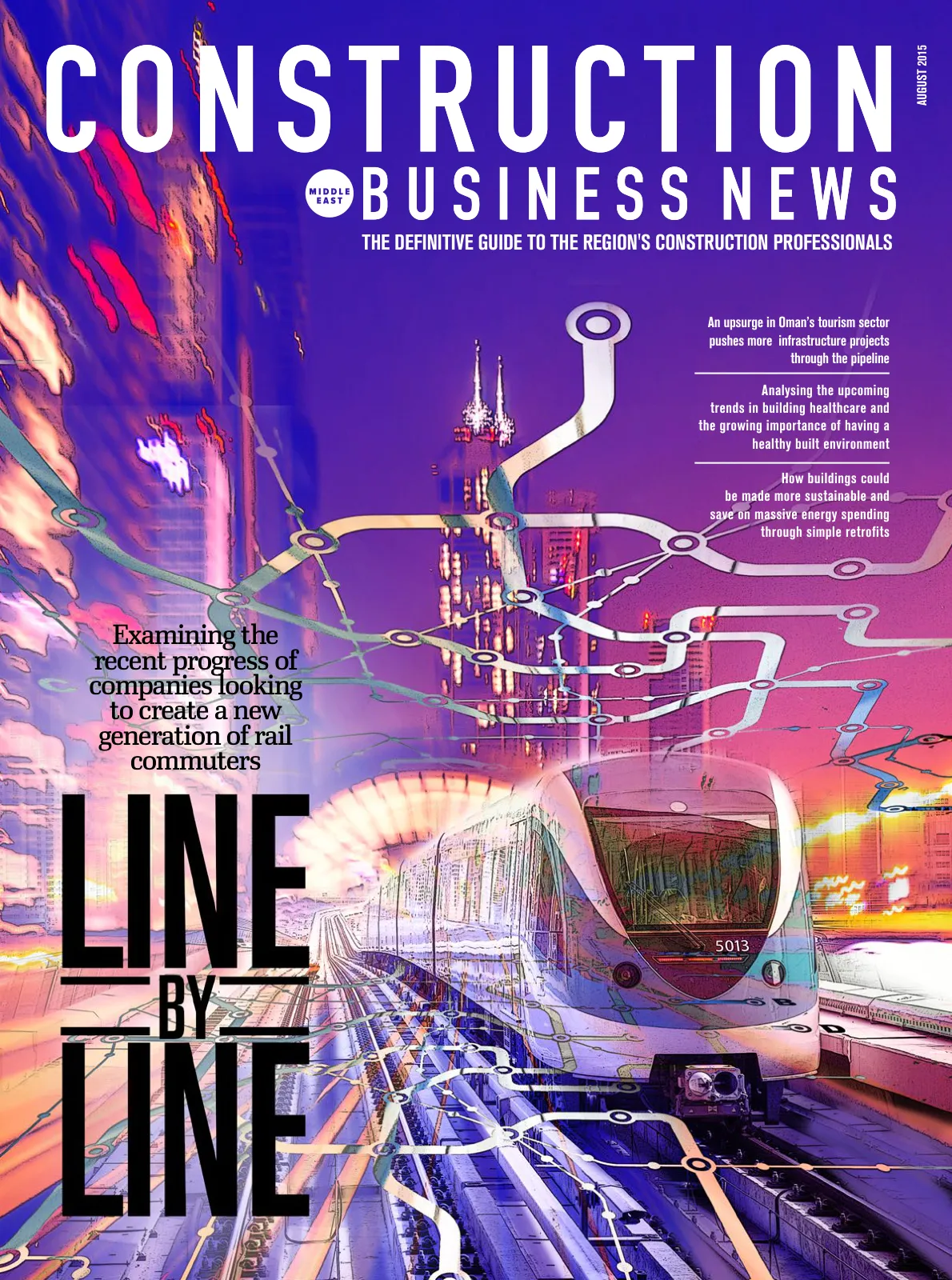
Examining the
recent progress of
companies looking
to create a new
generation of rail
commuters
AUGUST 2015
THE DEFINITIVE GUIDE TO THE REGION'S CONSTRUCTION PROFESSIONALS
Analysing the upcoming
trends in building healthcare and
the growing importance of having a
healthy built environment
How buildings could
be made more sustainable and
save on massive energy spending
through simple retrofits
An upsurge in Oman’s tourism sector
pushes more infrastructure projects
through the pipeline
Page 2
Page 3
construction business news me AUGUST 2015
3
34
Line by line
The GCC has become a centre for light
rail development as cities look to
reduce strain on both the roads and
the environment. Construction Business
News ME explores the recent progress
of companies looking to create a new
generation of rail commuters
news
in person
Campbell Gray, MD of
Faithful+Gould, talks
about the challenges in
hiring professionals in
the Middle East market
and sticking to health and
safety codes, even if they
are not enforced
analysis
Countries in the GCC are
increasing investments
in healthcare facilities,
but still fall short
of OECD bed capacity
benchmarks. This feature
examines the upcoming
trends in the sector and
the growing importance
of having a healthy built
environment
COUNTRY FOCUS
A number of recent
milestones have
propelled Oman’s
tourism industry
– from moving the
weekend to building new
international airports.
In turn, this is spurring
unprecedented private
sector opportunities in
related development and
infrastructure projects,
with an estimated value
of $56bn to 2017
TAKE 10
Globally, there are
190 city metro systems
located in 54 countries.
Construction Business
News ME rounds up its
top 10
8
20
26
30
38
cover story
20
38
contents
Page 4
construction business news me AUGUST 2015
4
S U B S C R I B E
c o n t r i b u t o r s
subscriptions@bncpublishing.net
Managing Director
Walid Zok
walid@bncpublishing.net
Director
Rabih Najm
rabih@bncpublishing.net
Director
Wissam Younane
wissam@bncpublishing.net
Group Publishing Director
Diarmuid O'Malley
dom@bncpublishing.net
Business Development Director
Rabih Naderi
rabih.naderi@bncpublishing.net
+966 50 328 9818
Group Editor
Melanie Mingas
melanie@bncpublishing.net
Editor
Lorraine Bangera
lorraine@bncpublishing.net
Sales Director
Alex James
alex@bncpublishing.net
+971 56 6783 192
Sales Manager
Mostafa Abdo
mostafa@bncpublishing.net
+966 56 6695 333
Marketing Executive
Mark Anthony Monzon
mark@bncpublishing.net
PO Box 502511 Dubai, United Arab Emirates
P +971 4 4200 506 | F +971 4 4200 196
For all commercial enquiries related to
Construction Business News ME contact
sales@bncpublishing.net T +971 55 339 5097
All rights reserved © 2015.
Opinions expressed are solely those of the contributors.
Construction Business News ME and all subsidiary
publications in the MENA region are officially licensed
exclusively to BNC Publishing in the MENA region by
Construction Business News ME.
No part of this magazine may be reproduced or
transmitted in any form or by any means without
written permission of the publisher.
Images used in Construction Business News ME
are credited when necessary. Attributed use of
copyrighted images with permission. All images not
credited courtesy Shutterstock.
Printed by International Printing Press www.ippuae.com
Stuart Matthews
Marlow McGuinness Ltd
IN THE FIELD
Niall McLoughlin, senior vice president of communicATION at Damac
Properties, discusses the company’s first masterplan project and
how it will be a sought-after destination in the region
REAL ESTATE
Construction Business News ME analyses the current state of
the residential market in UAE’s capital
PROJECT REVIEW
As Cayan Group’s high-end project, CMC, in Riyadh officially
breaks ground, Construction Business News ME speaks with
president and chairman Ahmed Alhatti
SUSTAINABILITY
With the recent launch of Emirates Green Building Council’s
retrofit guidelines, this feature analyses how buildings could
be made more sustainable and how companies could save on
massive energy spending
Q&A
Eng. Khaled Awad, chair and founder of Advanced Construction
Technology Services talks about how international standards
act as a collation of industry knowledge used as a reference
for the construction industry in the Middle East
FACILITIES MANAGEMENT
Multi-billion dollar construction projects lead to multi-
billion dollar FM contracts. But how should the facilities
management sector evolve?
COMMENT
As CEO of one of the first energy management consultancies
in the UAE, Samuel Lehain sheds light on how developers can
reduce chiller costs
Shivram Mukherjee analyses the North Africa’s resources and
its potential to embrace renewables
As architecture, engineering and construction (AEC) firms
prepare for upcoming BIM mandates, Louay Dahmash writes
about the ways to transition your business into one that is BIM-
friendly
Vasanth Kumar writes about how the uncontrolled appetite for
higher revenue growth amidst volatile market conditions may
pose serious risks to contractor
SAVE THE DATE
EDITOR’S PICK
42
46
48
50
54
60
24
56
58
62
64
66
42
18
CONTENTS
Page 5
PIPELINES
NOT PIPE DREAMS.
Infrastructure development is critical to the growth of
the economy.
That’s why at HSBC, our award winning capital
financing team provides bespoke and innovative
advice, supporting your business in making the most of
global infrastructure opportunities.
With nearly 150 years of experience in supporting global
businesses, including 65 years in the Middle East and
North Africa, we can support your business vision for
the future.
See how we can help your business
www.business.hsbc.ae/solutions
Issued by HSBC Bank Middle East Limited, P. O. Box 66, Dubai, UAE. Regulated by the Jersey Financial Services Commission and Central Bank of the United Arab Emirates. CRN 150603
© Copyright. HSBC Group 2015. ALL RIGHTS RESERVED.
Page 6
6 construction business news me AUGUST 2015
Back on the rails
Stockton and Darlington Railway was the
world’s first railway to carry cargo as well
as passengers by steam locomotive engine.
The railroad operated across 40km of track
through Darlington in the North East of
England. Even though there were other rail-
ways before Stockton and Darlington, it was
the first to take people across the country.
This invention, completed by Robert Ste-
phenson and Co. was launched in September
1825 and has since changed the world.
In the last 190 years, rail has transitioned to
become a staple within the infrastructure of
any city. Once used to carry pas-
sengers through long distances,
now rail is used to serve rapid
transit within cities through
metros, subways, or trams.
UITP’s 2014 report on
world metro figures states that
there are around 148 cities in
the world that have developed
a metro system, with the to-
tal number of lines ranging to
approximately 540. Together
they carry over 150 million
passengers per day. The report also states
that from 1970s to the millenium, there
were approximately 25 new systems de-
veloped every decade. This has increased
massively to about 45 cities since 2000.
Most studies show a correlation between
a growing population and the urbanisation
which results in the need for rail systems.
The world’s urban population was said to be
around 54% in 2014 from 34% in 1960,
according to World Health Organisation re-
port. In addition, UN’s World Urbanization
Prospects 2014 predicts that by 2050, 66%
of the world’s population will be urban. Such
statistics show that the need for rapid transit
is only going to increase as more and more
people make their way to urban areas.
The GCC in particular has a comparatively
large urbanised space. UN Habitat report,
The State of Arab Cities 2013, states that 70%
of the population in the GCC live in urban ar-
eas. Such statistics put an overwhelming pres-
sure on governments in the region to build
necessary infrastructure to avoid congestion.
According to the Middle East Rail Projects
Report by terrapin, the region has a budget
of over $250bn for various rail projects over
the next decade, which will re-
sult in 67,000km of railway
tracks throughout the region.
With elaborate plans to start or
expand rail projects, the regional
government is having several sys-
tems in the pipeline ready to go.
Countries in the region invest-
ing in rail include Kuwait, Saudi
Arabia, Oman, Jordan, Iraq,
Syria, Iran, Bahrain and Qatar.
Driven by the increase in pop-
ulation and the need for a more
sustainable means to travel, governments are
taking an active role in influencing the peo-
ple to choose metro systems. In the UAE,
for example, a 24% increase in petrol prices
is said to push inhabitants to use the Dubai
Metro.
With all the effort taken by the regional
governments to drive sustainability and
transform the region, it seems to be only a
matter of time before passenger and cargo
rail systems will be operating region wide.
Lorraine Bangera
Editor
editor’s note
A little more colour?
Perfect!
Not quite there yet
Could do better...
Page 7
Page 8
construction business news me AUGUST 2015
8
NEWS
Saudi-based steel fabricator, Arabian International Compa-
ny (AIC), has chosen IFS Applications to merge operations
and provide a single view across the business. IFS devel-
ops and delivers business software for enterprise resource
planning (ERP), enterprise asset management (EAM) and
enterprise service management (ESM). AIC admitted that
it needs to replace its current mixture of improvised leg-
acy systems with an integrated ERP which provides end
to end solutions. The new system will not only increase
operational efficiencies but also help manage its global
operations in Saudi Arabia, UAE, Egypt, Jordan, China,
UK and other GCC countries. By implementing the lat-
est IFS Applications 9, AIC Steel will benefit by having
a single platform to support multinational and multicur-
rency operations with access to information in real-time.
IFS Applications will manage HR, finance, procurement,
manufacturing, planning and scheduling, fabrication, and
maintenance for the company. The system will go live in
the company’s main divisions within seven months, and
the cover the rest of the divisions within a year.
Wasim A. Attieh, president of AIC Steel said that one
feature that stood out was IFS Lobby, which offers flex-
ible and easily configured snapshot of business units and
processes. “IFS Applications will consolidate all of our
operations into one platform to easily manage our busi-
ness requirements and streamline operations to support
us now and in the future.”
AIC uses IFS to simplify
global operations
City Centre Mirdiff achieves
global standard
Infographics provided by Majid Al Futtaim and Mirdif City Centre
Daikin, acquisitioned un-
der McQuay International
since 2006, completes its
transition
towards
one
brand. The company has
also legally changed its
name from Daikin Mc-
Quay Middle East FZE to
Daikin Middle East and
Africa FZE in July this year.
“As of April 1 2015,
we completed the tran-
sition and started using
the Daikin brand for all
our products and servic-
es,” said Michel Farah,
product planning direc-
tor at Daikin Middle East
and Africa. “This rep-
resents a single source
for all air conditioning
product ranges for resi-
dential, commercial and
industrial
applications.
We will continue devel-
oping energy efficient
systems with the highest
level of comfort and sus-
tainability designed to
meet customer and reg-
ulatory requirements.”
“This is a very exciting
and important change for
our company. Completing
the transition of our brand
in this region will help us
achieve our goals with
continuous focus on invest-
ments in talent, technology
and creating long term rela-
tionships with our custom-
ers,” said Yuji Miyata, chair-
person of Daikin Middle
East and Africa.
DAIKIN completes the
transition towards
one brand
World’s largest mall
achieves sustainability rating
Page 9
Page 10
construction business news me AUGUST 2015
10
NEWS
R Hotels has appointed ANC Contracting LLC (ANC) as the main contractor
and Erga Progress Engineering Consultancy as project consultant, for the sec-
ond phase of construction of its new resort and spa on The Palm Jumeirah.
Represented by Samir Arora, vice-president for operations, R Hotels sealed
the deal with Engr. Ibrahim Abu Shamat, operations manager of ANC, and
Eng. Joseph Sawaya, resident manager of Erga Progress.
Arora said construction of the Palm Jumeirah hotel is on track for its com-
pletion in 2016.
With the total investment of $136.2m, R Hotels’ new resort and spa at The
Palm will include 253 rooms, a holistic wellness centre, two restaurants and
family-friendly recreational facilities. It aimed to be the first 4-star and sharia-
compliant hotel in the upscale destination.
Luxury real estate developer Dico UK
Property Holdings Ltd, a wholly owned
subsidiary of Damac International Lim-
ited, announced the first of its fashion
residences in London with a 50-storey,
360 unit project with interior designs
by Versace in July. The lobby, ameni-
ties and interiors for each property will
be expertly designed and fitted out by
Versace Home.
The tower, Aykon Nine Elms, will be
located at the heart of London’s Nine
Elms regeneration area adjacent to Bat-
tersea, and is due for completion in 2020.
London continues to be one of the
most sustainable real estate markets in
the world, with solid year-on-year price
growth circa 6% according to real es-
tate advisory firm, JLL. Analysts expect
house price inflation in the region of
5-7% in the coming years.
“There is a huge appetite from our
current global customer base for luxury
property investments in London,” said
Hussain Sajwani, chairperson of Damac.
“Aykon Nine Elms presents an unrivalled
opportunity for them to access the stable
and established London market.”
London’s first
fashion-branded
residence tower
Last month, Salini Impregilo won a
contract for the construction of pri-
mary urban infrastructures in Shamal,
a residential area situated 100km
from Doha. The project awarded by
the Public Works Authority of Ash-
ghal is worth approximately $329m
and is part of the Framework Con-
tract for Local Roads and Drainage
Programme (LR&DP).
The works is said to be completed
within a 30 month time span. Salini Im-
pregilo won a contract for the imple-
mentation of Package 01, which covers
approximately 25% of the area to be
developed, and which also includes
the roads and infrastructures of the Al-
Zubara district in the western area, the
northern area of the central district of
Abu Al-Dholouf and the southern area
of Al-Shamal, but also the planning
and design of the microtunneling and
of the water system for irrigating the
green areas. The entire area for resi-
dential development measures 1,043
hectares and is connected to Doha
through the North Road.
The company was awarded con-
tract right after being awarded the
$845m for the Al Khor sport com-
plex, where the FIFA 2022 World Cup
will be played.
Salini Impregilo wins
contracts in Qatar
R Hotels appoints ANC
for Palm Jumeirah
project
R Hotels' proposed property at The Palm
AYKON Nine Elms
will be the first
private residence
project of scale in
London
Page 11
construction business news me AUGUST 2015
11
Affordable housing on Cityscape conference agenda this year
Tilal City to develop
green space
The upcoming Cityscape Global Confer-
ence in Dubai will focus on affordable hous-
ing, following the recent announcement of
mandatory affordable housing quotas in all
developments, by Dubai Municipality.
Craig Plumb, Head of Research at JLL
MENA, says that the current shortage
in middle income housing is one of the
greatest challenges in the region.
He said: “With a shortage of hous-
ing for those families earning salaries
around the UAE average, it is important
that we address some of the best prac-
tice initiatives and developments that
have been launched in the Emirates,
Saudi Arabia and Egypt and continue
to implement them across the industry.”
Affordable housing, the growing de-
mand for quality facility management
and the need to improve broker knowl-
edge of Dubai regulations are the three
themes scheduled for discussions at the
new one-day conference, taking place on
7 September this year at the Conrad Hotel
in Dubai, ahead of the Cityscape Global
exhibition which runs from 8 to 10 Sep-
tember at the Dubai World Trade Centre.
Running one day prior, the conference
addresses the three factors while show-
casing leading firms, as well as strategies
now shaping urban development across
Dubai and the greater region.
This July, Tilal Properties revealed 45% of the land
within its upcoming project, Tilal City, will be ded-
icated to community facilities such as green spac-
es, jogging and bicycle tracks and six mosques,
as well as education, retail and leisure areas. The
project will include 11 education facilities includ-
ing schools and early development centres for
children. In addition there will be a number of
mixed-use facilities to cater to all needs of the
contemporary community, such as leisure centres,
healthcare facilities and civil defence stations.
The AED2.4bn scheme, designed by UAE-based
architects Khatib & Alami, is Sharjah’s first master
planned community. The project includes 1,855
plots of land offering UAE residents an opportu-
nity to buy or lease land and develop properties
and mixed use facilities.
The 25 million sqft development is split into five
zones (A-E), with designs in-line with international
green building standards.
Haysam Jazairi, business development executive
director at Tilal Properties, said: “In order to cre-
ate this first-of-its-kind development in Sharjah, we
carried out in-depth analysis into regional commu-
nities and industries to establish buyers’ require-
ments. The research clearly showed that there is
a huge demand for first-class community facilities
and amenities. As such, we introduced the tacti-
cal split of retail and commercial versus residential
properties in the city, which is a unique element
of the masterplan.”
Government officials and senior real estate professionals
all prepped for the Cityscape Global Conference
Tilal City masterplan
Page 12
construction business news me AUGUST 2015
12
NEWS
As the regional construction
industry takes a leap towards
modern technology, local
companies must be on the
watch out to pick the right
products at the right time. Ex-
perts admit that 3D printing
technology is one of those
trends worth monitoring.
3D building printing tech-
nology has many advantag-
es, including faster construc-
tion, lower labour costs and
less waste production.
Andrew Elias, group CEO
of Kele Contracting, said that
this method of construction
will provide a very attrac-
tive solution to construc-
tion companies who wish to
extend their projects to re-
mote areas where traditional
construction
techniques
prove challenging.
He said that if buildings
are suited to the Middle
Eastern climate and can
withstand the environmental
extremes, then this will her-
ald the start of a new wave
of innovative 3D printed
low-rise buildings.
He added: “I believe that
the Saudi market in par-
ticular is among those with
the most potential for this
method of construction, due
to the types and size of its
developments, as well as the
country’s landscape.”
Rise of 3D building
printing technology
GE’s multi-million dollar contract provides critical
systems referred to as “the heart of the pipeline”. The
system will include aeroderivative gas turbine driven
centrifugal compressor packages manufactured, pack-
aged and tested by GE Oil and Gas in Italy, which will
be ready for shipment in 2017. The deal supports the
commissioning of phase one of TANAP scheduled to
come online in 2018.
Rami Qasem, president and CEO of GE Oil and Gas
MENAT said that the deal demonstrates the company’s
commitment to Turkey where GE has been driving
several localisation initiatives as part of its $900m
investment announced in 2012 in support of Turkey’s
Vision 2023.
He said that by working with TANAP, GE is not only
supporting local economies through job creation and
economic value but also strengthening the energy
security of markets across Europe.
GE Oil and Gas supports Turkey through latest deal
GE Oil and Gas will provide turbomachinery for the
Phase one of the Trans-Anatolian Natural Gas Pipeline
(TANAP). The pipeline set to transport gas from Azer-
baijan via Turkey to European energy markets is con-
structed in partnership between the State Oil Company
of Azerbaijan, BOTAS, and BP. It will provide uninter-
rupted gas flow along with security and opportunity to
diversify energy resources.
Industry experts observe a
sustained growth in retail,
oil and gas, automotive
and logistics is fuelling
demand for high quality
materials handling prod-
ucts and services across
the Middle East.
Walid Daniel, managing
director of SPAN Group,
said to remain competi-
tive, the regional materi-
als handling industry must
embrace new technology.
According to him there
are increasing demands
in supply chain solutions
as businesses seek new
ways to stay competitive.
“It would be better and
faster with one goal in
mind: satisfying consum-
ers’ requirements.”
He also said that this
encourages the supply
chain sector to enter the
digital and smart age.
Utilisation of intelligent
systems and IT solutions,
along with warehouse au-
tomation are ways to meet
these challenges.
Frederic Zielinski, gen-
eral manager of Swisslog
Middle East, also stressed
the growing importance
of automation in the re-
gional industry. He said
the market dynamics are
changing at an ever in-
creasing rate and complex-
ity, and the trend toward
automation has gathered
pace, as investment in
technology is viewed as a
long-term benefit.
Most of the challenges
and trends in the indus-
try are said to be high-
lighted at the upcom-
ing Materials Handling
Middle East organised by
Messe Frankfurt this Sep-
tember in Dubai.
Need for smart supply
chain solutions
GE Oil and Gas to provide
advanced turbomachinery for
TANAP project
Page 13
Porto Arabia Towers
Doha, Qatar
©2014 Hill International, Inc.
Hill International
The Global Leader in Managing Construction Risk
www.hillintl.com
For nearly four decades, owners and developers in the Middle East have
turned to Hill International to manage their construction projects and
programs throughout the region. Hill is proud to have helped our clients
turn their most challenging visions into realities. We have participated
in over 10,000 projects with a total construction value in excess of $500
billion, managing all phases of the construction process from concept
through completion.
Hill is also the leading construction claims firm in the world, having helped
resolve problems on some of the most complex projects throughout the
Middle East and around the world. To minimize risk and maximize results
on your next project, turn to Hill International
Dubai Office: 971 4 227 0078
Doha Office: 974 4 435 8381
Corporate HQ: 800 283 4088
If you can imagine it, we can manage it.
Qatar National Museum
Doha, Qatar
Mall of Qatar
Doha, Qatar
Viva Bahriya Towers
Doha, Qatar
Page 14
construction business news me AUGUST 2015
14
NEWS
The UAE remains the Middle East's
leader in green building construc-
tion and design
This July, the U.S. Green Build-
ing Council (USGBC) announced
that the UAE ranked eighth its
annual ranking of the Top 10
Countries for LEED. The list ranks
countries in terms of gross square
metres and numbers of LEED proj-
ects to date. The announcement
comes at a time of increased inter-
national focus on climate change
mitigation in the lead up to the
United Nation's COP21 climate ne-
gotiations this December.
Rick Fedrizzi, CEO and found-
ing chair of USGBC said: “The
UAE has become an increasingly
important centre for the global
green building movement, a de-
velopment that will help provide
greater environmental health and
increased economic opportunity
for its citizens and will hopefully
help to inspire a robust green
building market throughout the
Middle East.”
UAE included in
the top countries
for LEED
Nakheel announced a net profit of
AED2.83bn in July for the first six months
of 2015. The amount is an increase of
nearly AED1bn or 53% compared to the
2014’s H1 net profit of AED1.85bn.
An official from Nakheel said that the
company’s growing retail, leasing and
leisure businesses also contributed to the
overall financial results.
The developer continues to focus
on completing various development
projects currently under construction,
as well as expanding its retail, hospi-
tality and residential leasing projects
to further contribute to the growth in
Dubai’s real estate market. Nakheel
aims to further strengthen its overall
financial position.
Nakheel’s chairperson Ali Rashid
Lootah said: “We will build on these
results during the second half of this
year, and remain committed to play-
ing a key role in contributing positively
and effectively to Dubai’s real estate
sector. Our strategy of continuing to
create more cash-generating assets will
further boost our business and finan-
cial results in the coming years.”
Ahmad Al Naser, managing
director of Drake and Scull
Engineering
Drake and Scull Engineering (DSE) Kuwait secured a MEP development contract
worth AED218m for a major education institution which is scheduled to be com-
pleted in 2018. The contract also brings up Drake and Scull International’s total project
awards in 2015 to AED1.57bn in value.
Under the agreement, DSE will undertake construction, operation and maintenance
of electrical works as well as the supply, installing, testing and commissioning and
maintenance of all electrical works.
Ahmad Al Naser, managing director of Drake and Scull Engineering, said that Ku-
wait remains one of DSE’s most strategically important markets in the Middle East.
He said: “The country’s non-oil economic sectors, including real estate, have bene-
fited from the government’s ambitious investments, continuing to grow in the medium
term. With a growth in non-oil segments and expansion of the consumer sector, the
Kuwait real estate sector is currently enjoying a growth upswing and DSE is confident
of capitalising on this forward momentum by securing more large-scale projects in
Kuwait in the near term.”
DSE Kuwait awarded AED218m contract
Nakheel reports a net
profit of AED2.83bn
Nakheel’s Palm Jumeirah
Page 15
Page 16
construction business news me AUGUST 2015
16
NEWS
Imdaad hosted its first ‘Coffee with CEO,’ a newly
launched initiative providing a platform for an up-close-
and-personal interaction between CEO and the company
employees. The initiative was launched to build a work
environment that values, supports and empowers em-
ployees of all ranks and departments.
Jamal Abdullah Lootah, CEO of Imdaad, said: “Our
teams of creative, innovative and highly valued people
are fundamental to our success. This is an opportunity
for the management to show its gratitude to employees
whose contributions and efforts bring Imdaad to new
heights. We are confident that the initiative will be a suc-
cess through strong cooperation of everyone. We hope to
attain our objective of fostering a sense of belonging and
close relationships within our organisation.”
UAE-based National Marine Dredging Company
(NMDC), has announced the completion of the New
Suez Canal project following its successful trial run on
July 25 this year. The trial included six container ships
navigating the canal to ensure its readiness for full-
fledged operations.
The project set to transform the Egyptian economy,
the new canal will allow the passage of larger ves-
sels, reduce waiting period and open up new revenues
streams for the economy.
The National Marine Dredging Company led the
Challenge Consortium that won the $1.5bn project. The
consortium included three of world's largest marine
dredging companies including Boskalis and Van Oord
Imdaad
launches
‘Coffee with
CEO’ initiative
Depa Limited has signed
contracts worth AED719m*
in the first half of 2015, with
largescale projects like Ma-
dinat Jumeirah Extension
and Dubai Opera.
In Dubai, Depa Interi-
ors won contracts worth
AED87m, including landmark
projects such as Emaar’s
Dubai Opera in Downtown,
the Madinat Jumeirah Exten-
sion and FF&E packages for
the new Nikki Beach Resort,
developed by Meraas.
Nadim
Akhras,
group
CEO of Depa, said: “These
new deals, especially the
Dubai Opera and the Madi-
nat Jumeirah, have given us
a solid platform on which
we will continue our strate-
gy to build a balanced port-
folio through geographical
diversification whilst main-
taining the highest standards
of quality within the industry
in our core home markets.”
Depa signs contracts worth
AED719m
from Netherlands and Jan de Nul from Belgium.
The construction works of executed by the consor-
tium involved digging of 35km of a new waterway to
a depth of 24m and a width of 317m.
Expressing his pride at the completion of the mega
project in less than a year, Engineer Yasser Zaghloul,
CEO, National Marine Dredging Company and chair of
the Challenge Consortium said that the project would
have a profound impact on the economic landscape
of Egypt and its sustainable development process.
“Our biggest challenge was to implement the
project in a short time frame of less than a year that
required dredging of 1.5 million cubic metres every
day - a huge rate as per any industry norm.”
Trial at the New
Suez Canal project
Trial at the New Suez Canal project
Imdaad's CEO,
Jamal Abdullah Lootah
* Out of the AED719m new projects signed in H1, AED275m contributed to
the Backlog reported in the Q1 2015 trading statement
Page 17
THE NEW
GATEWAY
TO THE GULF
seabury report
Page 18
Page 19
Page 20
IN PERSON
Campbell Gray, managing director of Faithful+Gould,
speaks with Lorraine Bangera about his in-house
strategy to maintain a motivated staff. He also
highlights the challenges in hiring professionals in
the Middle East market and sticking to health and
safety codes, even if they are not enforced
mega project, the Burj Al Arab. In
June 2011, he moved back to Dubai
to support the then MD in direction
strategy, however Gray ended up
taking over the business from his
predecessor in February 2012. After
which he jokingly says that the com-
pany has been “highly successful”.
Success, Gray says, is a bit of
luck. The timing was key too. He
acknowledges that the market had
moved and started to pick up after a
very quiet 2011.
He says: “In many respects the finan-
cial crash in the Middle East in 2008, as
horrific as it was, reset the dial.”
Gray points out that a lot of clients
are now demanding a global approach
to integrated project management. He
thinks it essential to work with clients
closely and with a strategic point
of view in order to help
them the most.
I
n the last two years
Faithful+Gould has gone
through an evolution,” says
managing director Campbell
Gray. The well-established
company has turned around
from what Gray calls a “bland ma-
roon brand” to one with a fresher
look and a clearer mission. The com-
pany has been focussed on shifting
its overall vision to not only being
an integrated project manager but
also be the world’s best.
MD for the last three years, Gray is
responsible for the strategic growth
in the Middle East office, with one of
his key duties, the management of
key clients.
His first experience with the
region had been in 1997, when
he moved to Dubai
for two years to
work on then
Page 21
construction business news me AUGUST 2015
21
One of things that sets him apart, he
says, is how he can see the end game
in his head.
“Faithful+Gould has followed a
simple strategy of working closely
with our clients,” says Gray.
He thinks his past experience of
being in the client’s seat has helped
him form a well-rounded perspec-
tive; analysing a situation from all
angles with the willingness to under-
stand clients.
Working with the family
The perks of working at
Faithful+Gould, according to Gray,
are plentiful. Not only does the com-
pany encourage talent ability, it also
takes several aspects into consider-
ation such as training, family, and
flexibility within the job.
As new individuals join the company,
Gray says that there is always a potential
and closely knit company.”
Another important feature Gray
points out about the company is the
importance given to the employees’
families. He says that the company
considers family as well as the indi-
vidual themselves, which he thinks
is fairly unique compared to other
companies. He says: “We consider if
it is the right move for everybody.
When the family is happy, the per-
son working for you is happy.
“If we are planning to move an
individual from our Los Angeles of-
fice to Dubai, there is a lot of room
for slip ups.”
He explains that if an individual
is moving, it is fairly easy as they
start right into the job and meet new
people. Whereas when a family is
moving, the children have to fit in,
the partner has to be comfortable.
“We try our best to make sure we
to grow. “Even though Faithful+Gould
has a structured programme, we do
have a bit of flexibility.”
When a person joins
Faithful+Gould, they could be as-
sured that there is a growth strategy
in place to ensure they can derive
maximum learning experience from
their time with the company.
He says that managing the people
within the organisation is key to
building an A-list company. He con-
siders keeping his employees happy
and motivated to be the key to have
a healthy business. He says: “There
are two things I am very passionate
about, one is moving people from a
job to a career and two is enabling
our company to feel like a family.”
“We call it the F&G family,” he
adds. “What makes us so unique is
that although we are part of a big
company we operate like a small
Climb to the top
Active in the Middle East for over 18 years,
Faithful+Gould is a subsidiary of the Atkins group and
provides integrated project management, programme
management and cost management consulting services
across the property, transport and industry sectors.
Earlier this year, Faithful+Gould won Construction
Consultant/Surveyor of the Year at the 2015 Building
Awards in London for the second time. Last year, the
consultant won three top awards in project management
and quantity surveying categories at the RICS Matrics
Young Surveyor of the Year awards.
The Royal Atlantis Resort, Dubai
Citywalk Development, Dubai
Page 22
construction business news me AUGUST 2015
22
IN PERSON
because we like believe in quality
over quantity.”
Overcoming health and safety issues
Another key concern in the regional
construction industry is taking the
right health and safety measures.
Gray says that the region is improv-
ing, however there is still a lot to do.
He says: “It is more challenging in
Saudi Arabia and has been in Qatar,
although Qatar is improving.” He also
acknowledges that the UAE, Kuwait
and Oman seem to be taking the West-
ern approach to health and safety.
The region has been under the
radar when it comes to health and
safety codes, and even though the
death tolls have been plenty com-
pared to the US or Singapore. Gray
thinks that it is not as bad as people
make it out to be, and could be im-
proved. He says: “There are bound
to be issues when you have major
projects and huge amount of labour
who are largely unskilled.”
In Faithful+Gould, every member
of the staff in a project manage-
ment role has the right to shut
down a site if they think it is
unsafe. Gray says that this does
bother the clients but either way
it is fundamental to the company’s
strategy. “Clients don’t necessarily
like it or support it. We have been
taken off projects because of it but
it’s the right thing to do.”
He says that it is definitely hard to
deal with, and it is not necessarily
local firms who are causing a prob-
lem, there are international firms with
regional offices who also do the same.
He adds: “It is definitely a chal-
lenge but if we and some of our
could help with school admissions
and club memberships to help the
family fit into the new environment.”
Challenges in hiring
“One of the key challenges when it
comes to hiring in the Middle East,
which can be a little frustrating,”
says Gray, “is how qualifications
count more than ability.”
“It is one major difference between
the East and the West,” he admits.
He says that he has come across
several senior individuals in the
industry who have been working on
projects for over 20 years but won’t
be accepted because they don’t have
a degree.
“Of course there is a minimum re-
quirement when it comes to having
the right qualification, but we don’t
think it is all about qualification.”
The company has been taking an
active role in hiring GCC graduates
and helping them transition through
training programmes.
Gray says: “Even though it is
only Saudi Arabia and Oman that
concentrate on initiatives like Saudi-
sation and Omanisation, we are
very focussed in Qatar and UAE in
trying to hire local talent.” Though
he admits that it is challenging as
they are trying to balance local and
western education.
He observes that most individuals
stay with the company for around
three years. He says: “We are con-
scious that some of these individuals
are going to be high net worth indi-
viduals who will only be around for
two or three years. That then changes
the approach of the individual when
it comes to commitment. Although
three years is quite common, it de-
pends on the individual.”
In terms of structure, something
that sets Faithful+Gould apart from
other companies is that it has less
people on site. Gray says: “In a
typical site there would be 40 junior
professionals but we have 15 senior
professionals. The fee structure
would be the same, but it would be
distributed differently among our
professionals. We tend to employ
more senior people than junior
NAPCO factory in Oman
Four Seasons Abu Dhabi
Page 23
construction business news me AUGUST 2015
23
peers don’t start doing it then it
could be tough to change later.”
He says that there have been
clients who have understood, es-
pecially as the world is changing
its approach to safety. “Sometimes
it helps give clients credibility for
future projects.”
Gray gives an example of an un-
fortunate incident with a project his
company was working on with a lo-
cal developer, and the client was the
project manager. “There were two
deaths,” he says. “And we leaned in
to support the client in this difficult
time even though we had nothing to
do with it.”
“What we are trying to do,” Gray
says, “is develop this concept of
corporate responsibility.” He explains
that what companies should intend to
do is genuinely put the client’s needs
first, instead of just blindly following
a contract. Not only does this increase
the potential for future projects with
the client, but it also builds mutual
trust and confidence which is essen-
tial for a positive work relationship.
In the particular situation he talks
about, the client later requested the
Faithful+Gould team to write up health
and safety procedures and processes
not only for its projects but also the
minimum requirements for its consul-
tants and contractors.
He adds: “You have to be proac-
tive. You can’t just preach to people,
you got to show it.”
The man behind the team
Gray has worked with the company
for 20 years, and says that the only
reason he has stuck around for so
long is because of the number of
opportunities offered by the group.
One of his favourite opportunities
during his time with Faithful+Gould
has been the opportunity to move to
different countries.
He admits that a lot of people
have asked him why he has been in
this company for so long. He jokes
that he questions himself on a daily
basis. “A lot of it was around variety
and to a large degree flexibility of-
fered by the company.”
He says: “You should be able to do
what you want to do, and as long as
you can make money, people would
want to stay.”
When it comes to being successful
as an individual. Gray says that there
is always a bit of luck but equally
there is a need to being flexible and
adaptable himself. “I have had the
flexibility with going anywhere the
company wants me to go.”
He adds: “When I moved to Dubai
in 1997 to work on the Burj Al Arab
project, I didn’t even know how
much my salary was. That is some-
thing graduates need to learn: it is
about the projects and the experi-
ence you get working on them more
than anything else.”
Advice is one thing, but when it
comes to life lessons learned in the
industry, Gray has only two observa-
tions, which have no doubt influ-
enced everything. As he concludes:
“My past experience has taught me:
I am never done or finished. I can
always improve and do better. Also I
can’t sit still!”
Faithful+Gould’s high profile
projects:
•
King Abdulaziz International Airport in Jeddah, Saudi
•
Jumeirah Lake Towers in Dubai, UAE
•
Four Seasons hotel in Abu Dhabi, UAE
•
Fairmont hotel in Abu Dhabi, UAE
•
Shaza Kempinski Wave development in Muscat, Oman
•
Qurum City Centre malls in Oman
•
Doha Oasis, Qatar
: King Abdul Aziz International Airport Saudi Arabia
Doha Oasis, Qatar
Page 24
24 construction business news me AUGUST 2015
As CEO of one of
the first energy
management
consultancies in
the UAE, Samuel
Lehain sheds
light on how
developers
can reduce
chiller costs
T
he reduction of energy costs is
a key concern for developers
across the region, especially
during the summer months
when scorching temperatures
and humidity levels reach an all-time
high. With a sunny climate all year round,
conserving resources, boosting efficiency
and managing utility costs is high on the
agenda of all developers and consumers –
residential and commercial alike. With air
conditioning accounting for 70% of energy
consumption in the region, and the govern-
ment’s commitment to making the UAE a
global hub and successful model for the
green economy and sustainable develop-
ment, effective energy management is
essential to reducing overall consumption
costs and aligning with industry standards.
With the aid of an energy management
consultancy like Logic Utilities, owners
and Owner Associations of both residential
and commercial developments can ensure
the fair distribution of chilled energy costs
by installing and operating an accurate
metering system and charging on actual
consumption by each tenant/unit rather
than a flat rate. This encourages tenants
to be mindful of their air-conditioning
usage, cut down unnecessary consump-
tion and become accountable when it
comes to the responsible usage of energy
resources. When occupants become aware
of their individual consumptions costs,
their conservation efforts increase, result-
ing in the reduction of the overall utility
bill and a 15-20% drop in the property’s
overall chilled energy consumption. With
the cost of cooling a building averaging
at AED410,000 per year, a 20% decrease
makes for considerable cost – not to men-
tion energy – savings.
Recent initiatives by district cooling
providers have dramatically increased ef-
ficiency by reducing energy and water con-
sumption, with the installation of individual
sub-meters in properties enabling real
estate developers and Owners Associations
to allocate chilled energy costs to owners
and tenants in a fair and efficient man-
ner, on the basis of consumption. Despite
these efforts, consumers often complain of
high utility bills. By adopting a number of
simple tips, consumers and developers can
make the most of their available resources,
saving energy and cutting costs on their
air-conditioning bills.
Temperature control is imperative when
looking to reduce overall costs. Installing
a programmable thermostat is one of the
smartest and cost effective solutions to
reducing air-conditioning bills, resulting in
cost savings of 5-15%. The more you turn
your thermostat up in the warmer months,
the more you save. Dubai Electricity and
Water Authority (DEWA) recommends,
especially during electrical peak hours
between noon and 5pm that all consum-
ers turn their air-conditioning up from
20°C to 24°C. Apart from cutting consum-
ers’ utility bills, this action, if implemented
collectively, saves not only 160,000 tonnes
of emissions, but also 270m kWh per year,
amounting to AED81m. Putting it into
perspective, that energy is sufficient to sup-
ply 11,000 apartments with electricity for a
period of one year.
Another simple energy conserving and
cost-cutting solution is to set the air-
conditioner’s fan speed on high, except on
very humid days, when it should be set to
low. Though seemingly counter intuitive,
the slower air movement actually removes
more moisture from the air, ensuring a
more comfortable environment.
Cooling fans also offer great benefits.
While they don’t heat or cool the air, they
help circulate it and assist in maintaining
an even temperature, requiring less power
and taking the strain off the cooling system.
Ceiling fans often come with two settings,
clockwise and counterclockwise. The
counterclockwise setting helps move the
breeze around, facilitating in cooling the
space, especially in the summer months.
In the cooler months, the clockwise setting
traps heat and warms the room. In in-
stances when ceiling fans are not available,
stand-alone fans, positioned correctly, can
still aid in circulation.
Detailed audits of your property will also
provide specific recommendations for indi-
vidual real estate developments, as no two
are the same. A number of basic recom-
mendations can help reduce costs including
regular maintenance checks of your property
infrastructure and systems. Other simple
measures such as setting the air conditioning
to 24 degrees will ensure optimal perfor-
mance and reduce energy consumption.
The key to cutting costs and increasing
efficiency is being wise with your energy.
It is important to note that while the instal-
lation of expensive equipment by district
cooling companies and utility service
providers assists with energy conservation
in the long term, these efforts need to be
complemented with the engagement of
all stakeholders, including consumers. A
change in attitude, raised awareness, edu-
cation and the implementation of the right
methods and tools to conserve energy does
take effort, but with smart and simple solu-
tions and by engaging the right provider,
developers can enjoy drastically reduced
consumption costs and achieve internal
CSR initiatives by reducing their overall
environmental impact.
Samuel Lehain, CEO of Pure Logic Group, is
an expert in construction project manage-
ment with 25 years of experience. He holds a
Master’s degree in Innovation, Leadership and
Change from Salford University and is a mem-
ber of the Chartered Institute of Building.
Cost-cutting
simplified
COMMENT
Page 25
The 8th edition of the International Exhibition
for Intralogistics, Warehousing, Supply Chain,
Ports, Port Equipment – Products & Services
www.materialshandlingME.com
14 – 16 September, 2015
Dubai, United Arab Emirates
Page 26
construction business news me AUGUST 2015
26
ANALYSIS
Countries in the GCC are
increasing investments in
healthcare facilities, but
still fall short of OECD
bed capacity benchmarks.
Lorraine Bangera examines
the upcoming trends in
the sector and the growing
importance of having a
healthy built environment
T
he built environment plays a major
role in determining the health of an
individual. Healthcare facilities are
particularly under the spotlight when
it comes to providing an ideal envi-
ronment for patients.
Carl McKenzie, healthcare director of AECOM, says
that the built environment for a healthcare facility
relates to creating an internal environment that maxi-
mises wellbeing and enhances the quality of life.
He says: “We should note that the built environ-
ment for a healthcare facility is viewed by two dif-
ferent users, patients and healthcare staff. However
a lot of work has been done in recent years related
to evidence base reflection and patient wellbeing
or recovery.”
“Healthcare facilities are not immune to safety and
security issues,” argues Waseem Taqqali, vice presi-
dent of buildings at Schneider Electric. He explains
how adequate measures must be put in place to not
only ensure highest levels of security, but also comfort
and convenience at the touch of a button.
Taqqali says that healthcare facilities find it challeng-
ing to deliver quality patient care through state-of-the-
art safety and security measures without increasing
usage of financial or energy resources. He says that
hospitals are energy intensive buildings which are
becoming more expensive to maintain as energy costs
are on the rise, not to mention other costs like security
protocols, human resources and regular maintenance.
He adds: “Hospitals today have an added invest-
ment of IT as everything is connected by the cloud,
and data storage has gone digital.”
Taqqali says that smart systems are thus far better as
they work constantly to mitigate the risks of accidents
or system downtime.
Cleveland Clinic in Abu Dhabi
developed by Aldar Properties
Page 27
construction business news me AUGUST 2015
27
Building up
healthcare
McKenzie says that each
healthcare facility will require
the development of a supportive
health system infrastructure. He
says that a key trend has been
the adoption of technologies to
streamline healthcare systems.
Such technologies include the
adoption eVisits, digitalisation
and electronic management of
patient records.
Taqqali says that Schneider
Electric’s Building Management
solutions (BMS) provide facility-
wide transparency and monitor-
ing options, including access to
critical data to assist hospital staff
in providing security and safety.
“It also reduces long-term costs
and operational expenditures
which result from maintenance,
equipment upgrades or failure of
security measures.”
He adds: “BMS also helps to
reduce energy costs by providing
a clear picture of energy con-
sumption and managing its usage
across the facility through a host
of smart solutions.”
Rise of healthcare facilities in GCC
As the population in the GCC rises, so does the need
for quality healthcare. Faizal Kottikollon, chairperson
and founder of KEF Holdings, says that GCC countries
have seen a rise in cases of diabetes, obesity and other
healthcare issues.
Carl McKenzie, healthcare director
of AECOM
Waseem Taqqali, vice president of
Buildings at Schneider Electric
Faizal Kottikollon, chairperson and
founder of KEF Holdings
Page 28
28 construction business news me JUNE 2015
ANALYSIS
at an investment of $100m, the pro-
duction unit in Jebel Ali is scheduled
for completion in first quarter of 2016.
According to McKenzie, to encour-
age medical tourism, the UAE (spe-
cifically Dubai) has sought to bring
in talented people and hospitals or
clinics from around the globe that can
provide specialised healthcare options.
“We will see more established interna-
tional healthcare provider’s developing
facilities and operating in the region.”
He says that the current state of
healthcare infrastructure varies across
the Middle East and has been steadily
improving. However, it still lags
behind Organisation for Economic Co-
operation and Development’s (OECD)
countries in terms of health profes-
sional workers and bed capacity per
capita. “Overall, Gulf States spend on
average 3% on healthcare, compared
to 11% in OECD countries.”
Taqqali says that currently the
region is embarking on healthcare in-
frastructure building programmes. “For
instance, Saudi Arabia’s Ministry for
Health is executing five projects worth
$500m toward building medical cities.
Such investment will raise the supply
and quality of healthcare infrastructure
solutions and services in this region.
“Last year, the Dubai Health Author-
ity (DHA) also spearheaded talks on
integrated infrastructure and storage
solutions in the healthcare sector as part
of the ‘Dubai Smart Healthcare Model.’”
Taqqali points out that according
to a 2014 Alpen Capital report on the
GCC healthcare sector, GCC coun-
as the population rapidly
increases along with life expectancy-
the governments and private sectors
are posed with the challenge to de-
liver superior quality facilities without
being impacted by costs and time
of construction.
He says: “They cannot afford any
business downtime. Modular construc-
tions are a tremendous advantage
here. With its smart and sustainable
construction, it will mitigate risks and
will also aid lesser populated areas
in remote areas and doctors with ef-
ficiency and timely response.”
He says modular construction is be-
coming synonymous with convenience
and efficiency. “By using a modu-
lar, systematic approach to upgrade
healthcare infrastructure, the region
can battle common issues surround-
ing MEP connections, unhygienic
sanitation facilities, outdated plumbing
structures, and weather-sensitive con-
struction material – to name a few.”
The KEF-TAHPI partnership com-
bines TAHPI’s expertise of soft modu-
lar design with KEF’s expertise in hard
modular construction. By applying this
model, hospital and clinic components
can be carefully designed in the studio
and then manufactured on a large
scale in a facility dedicated to modular
construction, such as the $350m facil-
ity at KEF’s 42 acre Industrial Park in
Krishnagiri in Tamil Nadu, India.
Kottikollon says that this facility will
soon be complemented by a robotics
driven modular manufacturing facility
unit in Jebel Ali, Dubai. Taking shape
McKenzie says that the rising
demand of healthcare services will
push governments across the GCC to
implement new technologies, systems
of care, and consider further partner-
ships with international healthcare
providers.
“The GCC healthcare services mar-
ket, along with the medical tourism
market, is anticipated to reach $69bn
by 2020,” says Kottikollon.
As healthcare and medical tourism
in the region increases, he says that
the Dubai Health Authority (DHA)
is planning to build 22 hospitals and
aims to attract 500,000 medical tourists
by 2020. Among the GCC, Kottikollon
says that UAE, Oman and Saudi Arabia
are particularly making “hefty invest-
ments” in healthcare facilities.
He talks about modular construction
as a key solution to meet the growing
needs of the region. He explains that
Elements to improve
patients’ health
Carl McKenzie, healthcare director of
AECOM, considers improving the fol-
lowing elements in the built environ-
ment that affects patients’ health:
Lighting: Daylighting and lighting intensity can
have positive effects on people in general. Access
to daylight in healthcare facilities seems to have a
significant impact on patients, with studies show-
ing that bright light has a specific antidepressant
effect
Control: Providing a patient with a choice
to control environmental systems, such as the
position of the bed; the temperature through air
conditioning and heating; lights through the use
of dimmer switches and natural light; and sounds
such as music and television. Privacy: Improved
privacy in waiting rooms and provision of single-
bed rooms via solid walls instead of curtains
Acoustic: Improved acoustic conditions in the
healthcare environment reduces stress on patients
trying to sleep, reduces risks of conflicts and staff
errors
Art: Certain types of “psychologically appropri-
ate” artwork, including images with themes
relating to waterscapes, natural landscapes, flow-
ers and gardens, can reduce stress and improve
outcomes including pain relief
Views: Views of natural landscapes and active
wilderness experiences have positive effects on
human health and wellbeing
Indoor quality: Meeting good code of practice
guidelines related to ventilation, dust, odour, rela-
tive humidity, and air quality
Design: The design of the patient room can
contribute to reduced contact spread, less shape
corners (easier to clean), materials surfaces that
mitigate the propagation of contaminates
Saudi German Hospital in Dubai
developed by IHCC
Page 29
29
tries rely on their governments for
healthcare investments. He says: “The
governments share in GCC healthcare
spending is approximately 73%. Mean-
while, public health authorities in the
region are committed to saving energy
and controlling costs.”
He adds: “The report also states that
high oil prices have played an impor-
tant role in the government‘s ability to
fund healthcare spend.”
McKenzie observes that though
investment in GCC healthcare in-
frastructure has risen considerably
in recent years, the pace of devel-
opment is still behind the needs
of a rapidly growing population
and healthcare standards in other
developed economies. He says that
Gulf States, such as the UAE, have a
relatively young population, how-
ever sedentary lifestyles have led
to disproportionately higher health
issues compared to the rest of the
world, therefore the demand on
the health systems continues on an
upward trend.
He states: “One of the targets for the
UAE will be to double its existing bed
capacity of circa 13,500 hospital beds
over the next few years. These ambi-
tions indicate the potential for growth,
where overall healthcare spending in
the UAE is expected to increase 7% a
year to reach $19.6bn by 2018, com-
pared to its current level of $14bn.”
How is a building
a healthcare
facility different
from building a
residential building?
Carl McKenzie, healthcare director of
AECOM, considers improving the fol-
lowing elements in the built environ-
ment that affects patients’ health:
•
There are specific codes of practice for the
planning, design, operation and perfor-
mance of healthcare facilities related to the
building fabric, structure and engineering
systems, to facilitate clinical function,
maintain processes and aid recovery
•
The structure must be resilient to take
substantial loads and work to stringent
vibration tolerances
•
Engineering systems and distribution to
support operational functions cover a wide
range of systems generally not encountered
in other construction sectors i.e. medical
gases, pneumatic tubing, clean air systems,
the extent of BMS system, specialist light-
ing, electromagnetic radiation protection,
surge protection, electronic security (baby
tagging etc), patient entertainment, nurse
call, access control, pure water systems,
nuclear medicine drainage, to name a few
•
There are life safety systems that must be
incorporated into a facility with mission
critical performance
•
There are resilience and infrastructure
provision that should be integrated so that
the facility can operate as a ‘standalone’
entity should there be an interruption from
authority infrastructure supplies i.e. emer-
gency generators to mitigate for the loss of
electrical power etc
•
The integration of medical equipment in
terms of their operating environment,
commissioning, maintenance and access
for removal or replacement can involve
significantly planning and future adapta-
tion provision
construction business news me JUNE 2015
Healthcare
trends to
watch out for:
• Governments’ increas-
ing investments in tech-
nological advancements
and health awareness
• Growth of smaller
healthcare clinics
• Investments in medical
tourism
AECOM working as lead consultants
on upcoming project King Khalid
Medical City in Dammam
Prefabricated hospital room design
by KEF-TAHPI
Page 30
construction business news me AUGUST 2015
30
COUNTRY FOCUS
You should
be here
A number of recent milestones have propelled
Oman’s tourism industry – from moving the
weekend to building new international airports.
In turn, this is spurring unprecedented private
sector opportunities in related development
and infrastructure projects, with an estimated
value of $56bn to 2017. Melanie Mingas reports
I
n the GCC, the road away from
hydro-carbons is well worn. From
diversifying energy sources to in-
troducing entirely new industries,
all six member nations realise the
finite nature of their economic author-
ity and are working hard to spread
their interests.
Saudi Arabia boasts a network of
manufacturing and educational cities;
Qatar is preparing for 2022; and the
UAE is growing at such a pace it is
now branching out from its original
diversification strategy, graduating
from a global tourism hub to a re-
gional business and finance centre.
In Oman, final preparations are
underway for the launch of a 25
year tourism strategy – the result of
months of collaboration between
industry stakeholders, which is set to
increase job creation, private invest-
ment and, as a result, GDP through
community participation, growth of
the SME sector and the development
of human capital.
Launching next month, the tour-
ism strategy will run in tandem with
the Oman 2020 ambitions, drawing
unprecedented private sector input
in the country’s physical and eco-
nomic development.
As yet, the scheme’s goals are not
quantified, but the present picture
shows a clear road map of where
the Ministry of Tourism wants to
be heading. Currently, travel and
tourism contributes 3% to GDP, with
arrivals in the range of 1.7m. Direct
contributions were predicted to rise
to 10.2% in 2014, ranking Oman in
the top three of all 184 countries
monitored by the World Travel and
Tourism Council.
Forecasts predict tourism arrivals
will increase a staggering 10% com-
pared to 2014 and there are now
solid plans to establish the country’s
own low-cost carrier to add to the
30 airlines which currently hold
landing rights.
The quantum leap in progress is
supported by a number of fac-
tors; the alignment of weekends
with GCC neighbours, the rise in
economy airlines and the boom in
mid-market hotels.
But the sleepy Sultanate will
require much more to achieve its
ambitions; first and foremost a ro-
bust and confident private sector-led
construction industry. International
Quality and Procurement Center
(IQPC) reports a total project value
of $56bn between now and 2017,
inclusive of the highly anticipated
railway and Al Batinah Expressway.
Direct tourism infrastructure
projects alone are currently valued
Page 31
construction business news me AUGUST 2015
31
at $3.3bn, inclusive of two new
international airports and more than
5,000 hotel rooms to be operated by
local and international brands.
Expansion plans for Muscat Inter-
national and Salalah International
Airport will increase capacity to 12
million and one million passengers a
year, respectively. In Muscat, further
expansions planned in three subse-
quent phases will ultimately boost the
airport’s capacity to 24, 36 and 48 mil-
lion passengers as demand permits.
David Sobey, managing director
at PPMC, explains: “The Sultanate is
witnessing economic growth in light
of government plans for diversifica-
tion, industrialisation and privatisation
and a growing economy is expected to
translate into a higher GDP per capita,
in turn strengthening the spending
power of the population. The construc-
tion market’s key drivers are population
growth, economic growth, increased
focus on the tourism sector and infra-
structure development.”
Reinventing a classic
The construction sector has already
enjoyed strong growth with BMI Re-
From top: Nizwa, Oman; Oman Coast Landscape
Page 32
construction business news me AUGUST 2015
32
Oman: The top 10 tourism projects
1
$840m
Saraya Holdings - Saraya Bandar Jissah Resort
2
$560m
Omran - Oman Convention and Exhibition Centre
3
$468m
Al Futtaim Group - Mall of Oman
4
$300m
Omran - Oman Convention & Exhibition Centre: Package 3
5
$202m
Omran - Oman Convention & Exhibition Centre: Package 2
6
$200m
Muriya Tourism Development Company - Salalah Beach Resort
7
$200m
Oman Tourism Development Company (Omran) - Muscat City Hotels: W Hotel
8 $200m Al Habtoor Group - Al Habtoor City (Westin, St Regis and W Hotels)
9
$200m
Marriott International - Ritz-Carlton - The Muscat Reserve
10
$164m
Omran / Qatari Diar Real Estate Investment Company - Ras Al-Hadd Resort: Phase 4
other Dubai”. Omagine promises to be
different with the developer assuring
“traditionally designed residential and
commercial components”.
“The tourism components are
thematically imbued with cultur-
COUNTRY FOCUS
search reporting increases of 8.5% in
2014 and forecasts of 6.7% for 2015.
Much of the country’s develop-
ment to date has been public sector
initiated and government bankrolled
to secure the necessary infrastructure
such a sparsely populated country
with difficult terrain requires.
But there is one company leading
the way when it comes to tourism
investment. Omagine LLC is an enter-
tainment, leisure and hospitality com-
pany headquartered in New York City
with a subsidiary office in Muscat. Its
Omagine project will create a $2.5bn
mixed-use tourism and real-estate
project and has investors falling over
themselves for a piece of the 245 acre
prime beachfront development.
Located only six miles from Muscat
International Airport, it sounds like
the ambitious glitz seen in such
projects as Ras Al Khaimah’s $1bn
Al Marjan “party island” project, or
Dubai’s latest shoreline development,
Blue Waters.
But that doesn’t mean Oman’s sleepy
historical charm is being wiped out;
Oman isn’t planning to become “an-
ally aware and scientifically accurate
entertainment experiences. All of our
developments are historically faithful
to their surroundings. The tourism
elements tend to emphasise the great
art, music, culture, science and phi-
Muscat, capital of Oman
Page 33
construction business news me AUGUST 2015
33
Mixed-use
36%
Residential
20%
Commercial
19%
Hospitality
& Leisure
10%
Public
7%
Other
8%
losophy of the world – the great ideas
- while simultaneously being hip,
stylish, trendy and very 21st century,”
a statement reads.
It’s a theme present in many of
Oman’s plans. So keen is the country
to build on its past, rather than over
it, the Ministry of Heritage has even
established itself as a best practice
leader, imparting restoration and heri-
tage advice to other Middle Eastern
countries and, as a result, providing
opportunity for niche sectors of the
construction industry.
New Oman
In light of falling oil prices, not to
mention’s Oman’s original ambition
to stabilise its economy, measured
development and sustainable growth
are key.
Fahad al Ismaili, executive director,
Tibiaan Properties, advises: “The gov-
ernment dependency on oil income is
a major concern for the near future.
Therefore, making the necessary
arrangements to boost global trade,
manufacturing, exports and tourism
should be made immediately, before
it is too late.
“Creating proper free zones to al-
Case study: Oman Rail
Owner: Oman Railway Company (ORC)
Budget: $15.5bn
Progress: EPC stage
Oman’s national railway network comprises
2,244km of track with 35km of tunnels, 40km
of bridges, 50 terminals and eight marshalling
yards. The network, which will connect the ports
of Sohar, Duqm and Salalah, will comprise a
double non-electrified track carrying both freight
(120km/h max speed) and passenger (220km/h
max speed) traffic. Three consortia – Korea Rail
Network Authority (KRNA), Técnicas Reunidas and
Parsons International – have been shortlisted for the
Project Management Consultancy (PMC) contract,
which has yet to be awarded. ORC’s EPC tender
for the 207km Phase 1 stretch between Sohar and
Buraimi has attracted 18 bidders. The construction
contract is expected to be awarded by mid-2015.
Part of the GCC pan-Gulf rail network – a $25bn railway network that will
stretch over 2,117km, over six countries – the network doesn’t just boost
logistics and trade between Oman’s new ports and GCC neighbours, but will also
help to serve the needs of the growing population, which is expected to increase
by 2.4m to 2040, according a 2014 report by the National Centre for Statistics
and Information (NCSI).
low 100% ownership of an enterprise,
100% repatriation of capital and profits,
no minimum capital investment, no
corporate or personal tax and no need
for a local partner will be a great first
step towards income diversity.”
Echoing Ismaili’s observations,
Sobey agrees that tourism is only a
small part of the equation with pre-
cast housing, port development and
liquidity in the banking sector all
playing a part (see graphic).
“Rapid urbanisation, increased
disposable incomes, ease of avail-
ability of housing loans, and low
interest rates are driving construction
activity in Oman with an increase of
capital investment, as a percentage of
the GDP, in the construction indus-
try. The increase is expected to be
channelled towards meeting the
high construction demand across
the region,” he says.
Against this backdrop, Oman is
dependent upon the private sector
to execute its ambitions as BMI Re-
search predicts the country’s budget
will fall into deficit this year.
On the plus side, Oman has one
of the most robust PPP models in the
region, almost guaranteed help from
its neighbours and sovereign wealth
funds to fall back on. The combina-
tion of long-term economic devel-
opment strategies and reduced oil
prices – far from sounding a warn-
ing alarm – could in fact create the
perfect storm.
Spending by sector
Page 34
construction business news me AUGUST 2015
34
COVER STORY
The GCC has become a centre for light rail development
as cities look to reduce strain on both the roads and
the environment. Stuart Matthews explores the
recent progress of companies looking to create a new
generation of rail commuters
construction business news me AUGUST 2015
34
LINE BY LINE
Page 35
construction business news me AUGUST 2015
35
T
he GCC countries have
witnessed some of the
fastest population growth
rates in the world over the
last decade. Crucially more
than 70% of the Gulf populations
live in urban areas, with both Kuwait
and Qatar experiencing nearly 100%
urbanisation, according to UN Habitat.
Between 2005 and 2010 Dubai saw
annual population growth rates in
excess of 4%, while Riyadh was not far
behind knocking around 3%.
These surges in growth, spurred by
economic development and accom-
panying opportunities put enormous
pressure on transport infrastructure in
Gulf cities and some still struggle with
their daily commute.
Regional municipalities have long
recognised the need to shift people
on to public transport if their cities are
not to end up in a semi-permanent
gridlock. Understanding this has seen
bus and taxi fleets boosted, nurtured
the growth of private driver enterpris-
es such as Uber and Careem and led
to the emergence of significant light
rail projects in the densest of urban
centres around the Gulf.
Dubai led the way, in part because
it had to. Rapid expansion of the city
and its population meant the Dubai
Metro was a much welcomed addition
to the city’s transport options when it
first opened back in 2009. Two lines
- Red and Green - are operational
and accounted for some 531 million
passenger trips in 2014, a year which
also saw public transport’s share of
the city’s passenger traffic rise to 14%,
from just 6% in 2006.
While other lines have been on
the drawing board since the project
was first announced the one likely to
see action soonest is the extension
of the Red Line designed to accom-
modate additional traffic to the site of
Expo 2020. Known as Route 2020, the
extension will add 15km to the line
starting at Nakheel Harbour and Tower
station and including 4km of under-
ground line. The plan got the seal of
approval from Sheikh Mohammed Bin
Rashid, Vice President and Ruler of
Dubai in April and construction will
also include seven new stations, two
of which will be underground.
“The construction of the Route 2020
project conforms to the strategic vision
of the Dubai Government for achiev-
ing sustainable development, and
developing a world-class infrastructure
and services,” said Mattar Al Tayer,
chairperson and executive director
of the Roads and Transport Authority
(RTA) at the time of the announce-
ment. “The RTA has mapped out an
integrated plan for roads and transport
projects to serve Expo highlighted by
the Route 2020 project.”
The extension will boost Dubai’s
total metro lines to 90km and encom-
pass a number of densely populated
residential areas. Requests for proposal
are expected at the end of July and
will likely have to be submitted by
September. The demand timeframe for
the extension to be up and running,
with its deadline fixed to meet the
surge in passenger numbers generated
by Expo 2020 Dubai, means interested
parties are anticipating an award to
be announced in January of next year.
Names familiar from the construction
of the first two lines are likely to be
prominent among the bidders.
Qatar
Another city with a fixed deadline to
Rail engineer
Julian Hill, Atkin’s managing director for rail in the Middle
East highlights the complexities of the region’s multi-pack-
age rail developments
What prompted you to set up rail team in the Middle East
after your experience on the Dubai Metro?
We had such a good team here, I looked around the Middle East and I could see
what was happening with urbanisation. Cities were getting more congested and
had to offer another means of transportation; it didn’t take much to work out that
metros were going to be a big offering here in the future.
How do you manage the scope and scale of the ongoing proj-
ects?
We mobilise a team to be in the office with contractors so we can respond
quickly. They feed information back to design centres here in Dubai, or it could
be in Hong Kong, India or the UK. It’s the same with all of our projects. We have
a strong team on Doha’s Gold Line for example, where we have 100 people in the
contractor’s office.
There are regular meetings with the client and contractors to coordinate and
agree design. Clients set requirements for a project and they would be the same
across all packages, but they get interpreted very differently so there can be in-
consistencies, which is a challenge and that’s why the clients out here then have
to have very strong project management consultants to support them. Their job is
to make sure design procurement is all in accordance with
each other, delivered to the same standards. It’s extremely
complex and requires a lot of skilled engineers and labour
to bring together.
What’s different about these kind of proj-
ects in a Middle East context?
When you look around the Middle East they do procure
these major metro jobs a bit differently. They will often look for a civil contractor
and systems provider to team up and submit a combined offering for the project.
That has some advantages and disadvantages. Obviously the client doesn't get
the preferred contractor with preferred systems provider, but it does mitigate
them dealing with the interface between civils and the systems. If you procure
them separately, like they are doing on the Makkah Metro, you have to have a
strong project man team in place to manage the interface.
Where do the challenges lie, given the number of metro proj-
ects currently under development in the region?
Challenges for the consultants include getting good quality engineers into the
region and working on these projects. We want to be able to deliver projects at a
quality the contractor expects from Atkins. With the metro projects happening on
a global level, getting good engineers here and mobilising staff is a challenge for
all consultants.
Page 36
construction business news me AUGUST 2015
36
an ultimate completion date of 2026
for phase two elements.
Doha Metro’s first phase is un-
derway now and has an expected
completion date of 2019, putting it
in place well before the city plays
host to world football. This first
phase will see the construction of
some 35 stations and more than
100km of track will be laid, mostly
underground. The second phase
will see around a further 50 stations
developed and making the network
150km long. This second phase
will be notable for the increase in
amount of track either at ground lev-
el or elevated, as the project moves
out of the city’s densely packed
central areas.
The project’s most recent milestone
was the breakthrough of one of the
nine tunnel boring machines (TBM)
working the Red Line route into what
will become Msheireb station. The
TBM named Al Mayeda, was launched
at Al Corniche station in November
2014 and made the breakthrough at
Msheireb in June after having dug
measure its progress by is Doha. The
Qatari capital will play host to the
FIFA World Cup in 2022 and is a city
much in need of the relief a functional
light rail system will bring to traffic.
This need has seen the country al-
locate a large portion of its 2014-2015
national budget, more than $20bn for
infrastructure-related projects, accord-
ing to Alpen Capital’s GCC Construc-
tion Industry report, released in June.
The report notes that nearly $74.6bn
worth of transport projects in Qatar
are currently in planning or under
construction and key among these is
the $40m Qatar integrated rail project.
Overseen by Qatar Rail three major
projects make up the integrated
network: the Doha Metro, the Lusail
Light Rail Transit (LRT) network, and
the Long Distance Passenger and
Freight network, which will be con-
nected to the wider GCC rail network.
Doha Metro is a significant portion of
this work and is currently one of the
world’s largest active metro projects.
In phase one three lines - Red, Green
and Gold - are being developed, with
“The RTA has mapped out an integrated plan
for roads and transport projects to serve Expo
highlighted by the Route 2020 project.”
- Mattar Al Tayer, chairperson and executive director of the RTA
2.3km of tunnel. The TBM will now
be taken back to the Corniche station
again before heading off in the other
direction to Doha Exhibition and Con-
vention Centre station.
“During the past year, we have
achieved significant developments
on the Doha Metro project thanks to
the joint efforts of the company and
its contractors,” said Hamad Ibrahim
Al Bishri, Deputy CEO of Qatar Rail
in a statement. “While the excavation
phase is making good progress at all
stations under the supervision of our
skilled team, we are happy to cel-
ebrate a new successful breakthrough
here at Msheireb.”
Al Mayeda is one of 21 TBMs as-
signed for the Doha Metro project.
Qatar Rail says all of its TBMs are
currently operational, and on track to
complete the tunnelling by 2017. So
far 30km of tunnel has been com-
pleted out of a total of 113km. The
project has many milestones to come
and is likely to continue to produce
big numbers along the way.
Riyadh
Despite the size of the Doha Metro
project, observers may be more
inclined to look to Saudi Arabia to
see the future potential of light rail
projects in the region.
The Riyadh Metro stole headlines
when contracts were announced
in 2013, but it is not the only city
with rail plans in the pipeline. Saudi
municipalities have also pencilled in
metro maps for the cities of Dammam,
Jeddah, Makkah and Madinah. With
five major metro projects under way
or on the drawing boards the country
is set to draw on global rail expertise
for up to the next decade; especially
when these projects have the major
high-speed links and elements of the
GCC rail network added to them.
With a project cost estimated at
$23bn Riyadh Metro is certainly the
most valuable of the planned projects
and may also be one of the earliest to
finish. In July the first tunnel excava-
tion for the project got under way
when the consortium led by Bechtel
began tunnelling for Line 1 of the
network. The Bechtel-led consortium,
Panama Metropolis
Image provided by Alstom
COVER STORY
Page 37
construction business news me AUGUST 2015
37
includes Saudi company, Almabani
General Contractors, Middle East-
based Consolidated Contractors Com-
pany, and Germany’s Siemens AG, and
is responsible for the $10bn contract
for Lines 1 and 2 of the project.
“Sending our team’s first tunnel
boring machine on its underground
voyage is a significant step for all,”
said Amjad Bangash, Bechtel’s director
on the project in a statement.
As the TBM makes progress it will
reach speeds of up to 100 metres per
week as it cuts a hole beneath the
city, with an anticipated completion
date sometime in mid-2016. In total,
seven tunnel boring machines will be
deployed by the Bechtel-led team to
dig and construct more than 35km of
tunnels for its portion of the project.
July also saw movement on the
metro destined for Makkah, where the
annual surge in population fuelled by
the pilgrimage seasons places huge
strain on existing transport networks.
Spain's Isolux Corsan is part of a con-
sortium appointed as preferred bidder
to build lines B and C of the Makkah
Metro, with an overall budget of more
than $2.5bn.
While only the two lines awarded
to the Isolux Corsan JV - which also
includes Turkish company Kolin Insaat
Turizm Sanayi ve Ticaret and the
Arab Haif company - are to be built
The NUMBER OF passenger trips ON
DUBAI METRO in 2014
Urban mobility
Vincent Prou, GCC managing director for Alstom Transport explains some
of the key challenges the rail provider faces in getting the Middle East on
the move
What are challenges does Alstom tackle to design and deliver a metro
system?
Alstom’s goal is to provide the mobility solution that addresses its customers’ needs. In order to do
this, during the project definition phases Alstom sets out to fully comprehend customer requirements.
Through this direct interaction, Alstom is able to offer the right solution or come up with innovative
ones when the solution is not available off the shelf. This is, for example, how Alstom came up with
Axonis, a metro system that is driverless, quick to build and that can operate elevated, on the ground
and underground, limiting city footprint and disturbances during construction. Without that direct
interaction with customers, designing and managing a project could be more challenging.
What makes metros in the Middle East different?
Most cities build metro networks in stages, or build one or two lines at a time. In the Middle
East region, there are ambitious transport projects as a result of substantial economic growth,
population increases, congestion, pollution and industrialisation. The authorities tend to build
several lines simultaneously and require their projects to be built within a set deadline, which
may be a challenge for the contractors building the system. Alstom is able to deliver perfor-
mance-based projects, on time and sometimes before the contractual date, as was the case for
the Dubai tram.
Another challenge is the tough climatic conditions. Transport solutions need to resist high
temperatures, humidity and sun. This is the case in the UAE where Citadis trams are operating
in the city of Dubai. The system is designed to resist the severe environmental conditions,
including temperatures above 50°C, humidity reaching 100% and the sandy and corrosive
atmosphere. Other Citadis trams are operating well in Tunisia, Algeria and Morocco.
What are the main characteristics of the metro systems in the Middle East?
The Middle East and Africa is the region with the highest level of integrated rail urban
transport, accounting for 80% of its total rail projects. Undeniably, when led as an integrated
system, projects require only one tender procedure, a single contract to manage the project and
a single entity to commit to the full performance requests. This greatly simplifies the organisa-
tion on the customer’s side. Project financing is also easier to secure.
Another trend, is that metros tend to be automatic and driverless. Alstom’s Urbalis gives operators
precise control in the movement of their trains, allowing them to run on the line at higher frequencies
and speeds in total safety. Urbalis can largely improve capacity, efficiency, reliability, safety of metro
lines and reduce operating costs for operators.
during the first phase, Makkah Metro
will eventually include four lines and
integrate with the existing Al Mashaaer
Al Mugaddassah line, originally built
in 2010 to carry pilgrims between the
city’s holy sites. Earlier this year the
metro’s developer signed a $390m
deal with the Saudi Electric Company
to connect and supply electricity to
the project, which is scheduled to start
next year with a tentative completion
date of 2019.
With regional projects of this scale
likely to be on going for nearly a
decade the Gulf has the potential to
become a centre for rail expertise.
This status can only improve if plans
on the region’s drawing boards start
to come to fruition and more passen-
ger miles are clocked up on existing
networks. Gulf inhabitants have yet to
universally embrace public transport,
but nothing is more likely to make
them do it than modern metro systems
and heavy traffic
531 million
Tramway maintenance centre depot in Reims, France
Image provided by Alstom
Page 38
construction business news me AUGUST 2015
38
TAKE 10
Out of the 190
city metro
systems located
in 54 countries
across the world.
Construction
Business News
ME rounds up its
favourite 10
FORWARD
Perhaps one of the most romantic looking public trans-
port systems from street level, the Paris Metropolitan first
opened in 1900 for the Paris Expo, making it the fourth
oldest system in Europe. The Parisian claim on public
transport doesn’t end there; Metropolitan has been widely
shortened to metro and is today used to name city trans-
port networks in 55 countries.
Paris has become the sixth most used metro system in the
world, transporting more than 1.5 billion people per year
and comprising 300 stations across 16 lines, to cover an area
measuring 10km by 10km. On a daily basis the trains travel
965,600km, which is equivalent to 24 times around the world.
It is estimated to serve six out of 10 Parisians.
The idea of Parisian culture is deeply imbued in the system,
with each stop themed around historical figures, providing
another clue to riders about the history of the city. Parisian
style also plays a part; Louis Vuitton designed a handbag in
homage to the deepest station, Abbesses.
TRACK IT
The world famous New York City Subway was built
in 1904 and rapidly expanded from 28 stations to 468,
most completed by 1940.
Today it is one of the oldest and most used public trans-
port systems in the Western world, running 24 hours every
day. In 2014 alone the system delivered more than 1.75
billion rides, averaging 5.6 million daily rides on week-
ends and a combined 5.9 million on weekends, across
1,355km of public and non-revenue track.
Essential for tourists and natives, the busiest station
is Times Square/42nd Street with a little over 62 million
rides in 2014. 191 Street Manhattan is the deepest sta-
tion, built 54m underground.
The good news is the city’s second subway is due for
completion by the end of 2016 and will serve 200,000
commuters daily. The less encouraging news is that
the line was first suggested in 1929, with construction
eventually beginning in 2014. Nevertheless, the $4.45bn
project will run for 13.67km on a two track line, with 16
new underground stations.
Paris
Metropolitan
2
New York City
Subway1
Page 39
construction business news me AUGUST 2015
39
Due to celebrate its centenary in 2019
the Metro de Madrid is one of the fastest
growing networks in the world and has
the most escalators of any underground
transport system, with 1,698.
The network has 301 stations on 12
lines plus one branch line, stretching
294km, of which approximately 92% is
underground. In 2007 the Light Metro
(Metro Ligero) opened, connecting un-
derground stations through a network of
over ground trams. The extension made
Madrid Metro the second largest network
in Europe after London.
Interestingly, unlike the roads in the
Spanish capital, all metro tracks run on
the left hand side.
All the stations have their own unique
features and some are even big enough
to hold large gatherings and events.
Arganzuela-Planetario has an astronomy
theme; Carpetana doubles as a museum
and Goya is decorated with the work of
famous Spanish artist Francisco de Goya.
The largest metro system in the world since 2013, the
Shanghai metro is also one of the youngest, opening as a
single line in 1995 and rapidly growing to sprawl 468km
of track with 303 stations. It’s also the first such system in
China to provide a cross-provincial service.
It makes sense considering Shanghai is China’s larg-
est city with a population 20 million. In 2013, the metro
clocked up 2.5 billion rides.
Four lines were under construction at the end of 2014
and construction of nine further lines began this year. The
entire project is due to be completed in 2025 when the
network will comprise 877km of track over 22 lines.
Probably one of the most fascinating underground
transit systems in the world, the London Underground
is today used as part of the mass transit system for
London’s eight million residents, but its history is far
more engrossing.
It originally started life as an underground tunnel
network for steam trains before electrified trains were
introduced. It was used as bomb shelters during World
War II and the Central Line was even converted into a
fighter aircraft factory that stretched for over two miles
inclusive of its own railway system; the existence of
which remained an official secret of the British Govern-
ment until the 1980s.
The first map of the London underground combined
the line routes with over-ground landmarks, however
riders found the concept far too confusing and eventual-
ly the grid concept was rolled out, based on the original
electrical map of the network, signifying where each line
meets and extends to.
3
Madrid Metro
London Underground
4
Shanghai Metro5
Page 40
construction business news me AUGUST 2015
40
TAKE 10
Unlike its cousin in Shanghai, the
Beijing Subway is older than the
systems of Washington DC, Hong
Kong and San Francisco, open-
ing in October 1969. Yet it wasn’t
until 2002 that Beijing got to grips
with underground rail transit and
embarked on a significant expan-
sion scheme.
Counting 17 operational lines
and 232 stations in 2014, the Bei-
jing Public Transportation Com-
pany announced that by 2020,
the total track length will have
grown from 465km to 1,050km.
The number of stations will also
double, with the expansion of
current lines and the opening of a
half dozen new lines.
The expansions are desperately
needed. Last year Beijing Metro
clinched the title of world’s busiest
metro from the city of Moscow
when 10.27 million people were
counted as passengers in one day.
Four new lines went into operation
only two months before the record.
The world’s first driverless metro system,
Dubai Metro is also one of the youngest. Inau-
gurated in September 2009, it spans two lines,
the Red and Green, which cover 52.1km and
22.5km respectively.
137,759,258 million passengers travelled on
Dubai Metro in 2013, with the total number of
rides exceeding the 500 million threshold in 2014.
Each train is designed to carry up to 643 passen-
gers in five cabins.
Even more significant it’s the first metro in the
Middle East, as well as being the longest driver-
less network in the world, and even offers a Gold
Class option for those who prefer the idea of
travelling with the masses in style.
Sadly, the cultural utilisation of metro station
names as adopted by Paris and London was lost
on Dubai’s Roads and Transport Authority and
instead of such charming monikers as Elephant
and Castle, local businesses are able to buy and
name stations after themselves.
It may not be the world’s longest metro, but
the Stockholm Subway is known as the world’s
longest art gallery at 110km. With almost all the
110 stations decorated with paintings, mosa-
ics, installations and engravings the “museum”
features 150 artists.
It’s also a great way to travel. The idea first
came about in 1941 but some of the first lines
were operated with trams, instead of trains. The
oldest lines were inaugurated in 1951 and 53,
and most of the stations today are located above
ground, rather than under.
An extension project was announced in 2013,
with work due to begin in 2016 and completion
currently scheduled for 2020.
Beijing Subway 6
Stockholm Metro
7
Dubai Metro8
Page 41
construction business news me AUGUST 2015
41
The only fully underground
metro network in Canada,
Montreal Metro or Métro de
Montréal, was inaugurated in
1966 and originally consisted
of 26 stations on three sepa-
rate lines. The network now
has 68 stations on four lines
totalling 69.2km of track.
Said to be inspired by the
Paris Metro, the system uses
a similar signage style to its
European counterpart but
its completion ahead of the
Montreal Expo World Fair
in 1967, was coincidental.
However line extensions
were planned ahead of the
1976 Olympics.
Current expansion plans fall
under a 2020 development
strategy for the city, and will
see extensions of the blue line
reaching towards the borough
of Anjou and the Orange Line
towards Bois-Franc.
Montreal’s transport chiefs
have ordered 342 new trains
for the network, which will also
have flat screen televisions.
With 61 stations along 65km of track, the Prague Un-
derground is much deeper than other systems around
the world due to the soil quality, meaning users have to
descend via daunting lengths of escalator, the longest of
which is 87.02m, at the Namesti Miru station on Line A.
Marking 37 years since its opening this month, it now
has three lines and plans exist for a fourth.
Adding a little star quality to mass transit, announce-
ments on the network were recorded by Czech Radio
presenters Světlana Lavičková and Tomáš Černý and
recent European Parliament candidate for the Republic
Party Eva Jurinová.
Montreal Metro9
Prague Underground 10
Page 42
construction business news me AUGUST 2015
42
IN THE FIELD
A
koya by Damac, located
off Umm Suqeim Road in
Dubai, is about a 30-min-
ute drive away from
Downtown Dubai. This, according
to senior vice president of corporate
communications and investor rela-
tions at Damac Niall McLoughlin, is
one of the key reasons the company
sought out the location; to build a
destination within itself. When we
entered the development, through
grand gates, branded with the proj-
ect name it felt like a little town on
its own. The site visit felt more like
finding an oasis in the desert, rested
in the middle of sand plains was a
majestic community of 42 million
sqft. The masterplan looked greener
than expected, with a golf course
spanning across most of the area.
The golf community has made
great progress since its high-profile
launch two years ago, with the first
residents set to make it their home
later this year.
The $6bn community is said to be
the most luxurious development in
Construction Business News
ME visits the site of Akoya
by Damac and speaks with
Niall McLoughlin, senior
vice president of corporate
communication and investor
relations at Damac, about
progress on Dubai’s first
masterplanned development
since 2008 and the first
community to be built by a
private company
Raising
a master
space
Page 43
construction business news me AUGUST 2015
43
the region, with high-end branded
real estate, luxury mansions and
villas, serviced living concepts, the
Trump International Golf Course,
a 4.3 million sqft private park and
entertainment-themed retail walks.
The community is said to be on
schedule with many projects within
the masterplan completing earlier
than expected. Main contractors have
reportedly made a notable progress
on-site with more than 2,600 villas
and 18 apartment buildings at vari-
ous stages of construction and the
first substation – which will provide
75% of power to the development
will be completed and handed over
by 2019.
The Trump International Golf Club
on the other hand is 95% complete
with the club house more than one
fifth finished. The project has also
already been named the ‘Best Golf
Development in the World’ at the
International Property Awards cer-
emony in London.
In the first year of development,
the construction site was visited by
iconic businessman and now US
presidential candidate - Donald J.
Trump, who believes that the project
will be a “huge success”.
“Never before has there been such
a varied mix of real estate, retail and
lifestyle options all in one location,”
adds McLoughlin. “The community
will have a modern feel and the
villas will be constructed following
contemporary architecture, rather
than arabesque.”
The community will soon add in-
ternational schools, mosques, clinics
and spas along with the highly an-
ticipated ‘Drive at Akoya’ – a retail,
dining and entertainment strip.
The Drive is similar in length to
'The Walk' at Jumeirah Beach Resi-
dences (JBR) and reflective of Rodeo
Drive in Beverly Hills, The Croisette
or Champs Elysees in Paris and will
include high-end food and beverage,
retail shopping and serene locations
to meet friends. The shopping strip
also includes four dedicated areas
with entertainment for the whole
family, including a golf putting
Golf course at Akoya is
%95 completed
Niall McLoughlin, senior VP of
corporate communication and
investor relations at Damac
Page 44
construction business news me AUGUST 2015
44
by Damac’s 600 salespeople who
communicated customer feedback.
“The needs of the market were then
shaped into a product that is innova-
tive, modern and market driven,”
says McLoughlin. “Our team was
able to lay all the groundwork rather
quickly to launch in August 2013.
Since then we have been successful
not only on the construction side but
also commercially.”
He says: “We have 2,000 em-
ployees dedicated and working for
Damac, out of which 450 are in our
project delivery team. No other or-
ganisation in the market has that. We
have such a strong in-house team.”
“Around 18 months ago this was
just a blank canvas, we came in with
green, an outdoor ice-skating rink,
an interactive kids play area and a
large outdoor cinema screen.
McLoughlin says: “The entire
community, once completed, will
have over 80,000 residences. Initially
before the launching, we have ques-
tioned ourselves where will all these
people living in Akoya go for en-
tertainment. The only closest prime
centre was the Mall of the Emirates.
So that’s why we tried to create a
destination within Akoya, so that the
residents will not have to leave their
community to be entertained.”
He adds: “We have thought so
much about how we could make it a
destination for tourists as well. We
intend for Akoya to be a place for
people to visit and not just live.”
Progress at the master development
“We are delighted with the prog-
ress made at Akoya by Damac and
look forward to welcoming the first
residents of this exciting project later
this year,” says McLoughlin. “The
master development has certainly
been challenging in size, scale and
speed of delivery, but we have been
delighted with the speed and quality
of progress to date.”
The Damac team talk about how
even though the project spells
luxury, the focus has been the buy-
ers. McLoughlin says that the idea to
build an out of city masterplanned
community was inspired by buyers’
demand.
Research was conducted firsthand
“Around 18 months
ago this was just
a blank canvas,
we came in with
these 450 people
and were able to
transform it into
this.”
- Niall McLoughlin
The construction site at Akoya by Damac
Upcoming Akoya Drive
IN THE FIELD
Page 45
construction business news me AUGUST 2015
45
City escape
Akoya by Damac is the first major
master development to be an-
nounced after Dubai’s economic re-
covery following the financial crash
in 2008. The team at Damac believe
that it is proof of a strong market
and helps reinstate faith in the emir-
ate’s resurgence.
McLoughlin says that currently the
real estate market is very mature,
with intelligent buyers. He explains
that immediately after the recovery
there was rapid expansion until
2014. However like any market,
the rate of acceleration slows down
eventually to a more steady growth.
“We are now in a single digit growth,
and customers see transactional
values dropping and assume the
market is fluctuating.”
With rent prices decreasing in
parts of Dubai, McLoughlin says
that this should not be confused
with a weak market. He says that
most projects launched in areas
like Business Bay and Downtown
Dubai have higher rate. He says:
“The price of land down there
is quite expensive, it is in the
middle of the city.”
He says that with price per
square foot reaching AED2,000
along with the limited amount of
space available, Damac decided to
look beyond the city.
He says: “There was no space for
a masterplan of this scale in Business
Bay, for example, so we bought land
outside of Dubai, in the suburbs.”
Choosing this location has re-
duced the developer’s cost which
helps in selling the same amount
of land for less. McLoughlin says:
“People wrongly assume this
change in price signals a drop in
the market, when in actuality they
are buying a different product as
it is in a different location. If they
were buying something like
this in the main city it would be
more expensive.”
He adds: “There is a demand in
the market today that wasn’t there
before, it is for value housing, and
I mean by value housing isn’t spe-
cifically affordable housing because
that could be subjective.”
Damac’s decision to deliver
value housing, he says, has been
based on market response. “Yes,
the transactional price has come
down, that does not mean that
the other product has fallen. That
does however mean that there is a
new pricing.”
He says: “We think the project
really talks to those buyers look-
ing to set up home in Dubai in
a safe and peaceful environment
while at the same time, being part
of a high-end district.”
The first projects in Akoya by
Damac will open later this year,
with the full community open and
operational in 2019.
these 450 people and were able to
transform it into this.”
He says that the company initially
went to the Dubai Government, and
at the time were listed in London.
“Our financials were out there, our
balance sheet was very strong and
our track record at that time had
12000 units delivered. We were a
proven entity, we could deliver and
we had proven that,” says McLough-
lin. “We asked the government for
a plot of land to become a master
developer, they have never done
that before. Previously only govern-
ment entities have been permitted to
build communities on this scale, but
we are the first private company to
become a master developer.”
The construction site at
Akoya by Damac
Villas under construction
in Akoya by Damac
Page 46
construction business news me AUGUST 2015
46
Construction
Business News
ME analyses the
current state of the
residential market
in UAE’s capital
Steady
demands
REAL ESTATE
T
he residential market in Abu Dhabi has been
reportedly positive for the first half of this year,
with a recently launched report by Asteco stating
the market has had a 6% rise in the last quarter.
General manager of Asteco Abu Dhabi Jerry
Oates says that this turnaround of events could be because
of the gradual stabilisation of sales prices over the last six
months, which gives way for positive long-term prospects
for landlords.
The report observes that the sales prices for apartments and
villas have remained steady. Asteco also predicts an increase
in rental rates over the next few months in the absence of any
major handover of new villa stock before 2017.
Recent decree issues by HH Sheikh Khalifa Bin Zayed
Al Nahyan, President of the UAE and ruler of Abu Dhabi,
aimed at regulating and improving transparency in the lo-
cal real estate sector will further boost market, acting as a
catalyst for increased investor demand.
“This as yet un-enacted legislation will effectively protect
investor interests in uncompleted projects, as it requires that
brokers and developers be fully licensed. When it comes into
effect it will further cement the reputation of the emirate as a
credible long term investment haven,” says Oates.
David Dudley, international director and head of Abu
Dhabi office at JLL MENA, says: “We still expect demand
growth to continue, but at a slower pace.”
He explains that the softening of demand is a result of
the decline in oil prices, which has directly affected Abu
Dhabi’s dominant petro-chemicals sector, and also lead to a
reduction in domestic government spending as it re-priori-
tises its projects, and a decline in investor sentiment.
He adds: “Employment creation and residential demand
growth will continue to be sustained from projects com-
menced while oil prices were high – with projects such
as the airport and Etihad expansion having an economic
multiplier effect.”
He says that the extent to which conditions remain stable
over the next year or so very much depends on the govern-
ment’s spending plans. “With an increasing cost of living
and a reduction in demand, we are currently at a ‘tipping
point’, with market stability very much dependent on the
government continuing to invest in to major new infrastruc-
ture and economic development projects.”
According to Bayut’s Market Report 2015 Abu Dhabi states
that the reduction in government spending expected this year
following the decline in oil prices, could have slowed down
the pace of demand growth, but this has not happened during
the first half of the current year. In contrast, the short-term
supply of units in the market was generally constrained, lead-
ing to relatively stable market conditions.
From an economic angle, the property market of the
capital remained resilient despite the ongoing decline of
oil prices. The Abu Dhabi Urban Planning Council (UPC)
approved 22 new projects during the first three months of
2015, thus shrugging off all concerns of weaker oil prices
affecting the property market.
Abu Dhabi’s skyline
Page 47
Page 48
construction business news me AUGUST 2015
48
PROJECT REVIEW
I
n July 2015, real estate developer Cayan Group
commenced the breaking ground of its most recent
project, CMC in Saudi Arabia. Initially launched as
CM1, it was officially unveiled at Cayan Group’s
launch party in April 2015 where Alain Robert, a
French climber popularly known as Spiderman, set a
Guinness World Record by climbing the Group’s twisted
Cayan Tower.
CMC is intended to be a high-end business centre with
retail shops, along with 10 floors for rental and owner-
ship purposes of corporate administrative upscale offices
equipped with the latest technologies. The project also
considers overall environmental impact as well the health
and well-being of its occupants. Cayan will be working
alongside Saudi Arabian financial services company, Mefic
Capital, to deliver this project. Once built, the project is
said to become the headquarters for both Mefic Capital
and Cayan Group.
Ahmed Alhatti, president and chairperson of Cayan
Group, says that the project is strategically located on the
King Fahd Road in Riyadh. “The city has the strongest
economy in the region with one of the highest business
growth rate.”
The Saudi market in general is doing really well, says
the chairman. According to him, the government is giving
high attention to the real estate sector as the local demand
rises in the market.
As demand for real estate rises in Saudi Arabia, the gov-
ernment takes an active role in maintaining the demand.
Alhatti says that as the market matures and has more
international players, there will be more opportunities and
room for growth.
Commenting on the upcoming head office building,
he says that it is a perfect model of a multi-use integrated
commercial complex, which includes luxury offices and
distinctive facilities such as a screen and a high-tech fit-
ness centre among others.
Construction
takes off at
CMC
As Cayan Group’s high-end
project, CMC, in Riyadh
officially breaks ground,
Construction Business News
ME speaks with president and
chairperson Ahmed Alhatti
Upcoming CMC in Riyadh
Did yoU know?
The Group’s most prestigious
project, Cayan Tower in Dubai, was
officially declared as the globe’s
tallest twisted tower standing at
307m high by the Guinness World
Records 2015
Page 49
Page 50
construction business news me AUGUST 2015
50
SUSTAINABILITY
retrofits
With the recent launch of Emirates Green
Building Council’s retrofit guidelines,
Lorraine Bangera analyses how buildings could
be made more sustainable and how the UAE
could save AED1bn
GREEN
I
n June earlier this year, Emirates
Green Building Council (Emir-
atesGBC) launched its Technical
Guidelines for Retrofitting Exist-
ing Buildings to serve as a guide for
UAE industry professionals and build-
ing end-users. The guidelines have
been created in conformance with the
UAE’s sustainability agenda, as part of
its National Agenda 2021 and in line
with local sustainable strategies such
as the Dubai Integrated Energy Strat-
egy and Abu Dhabi Vision 2030.
Saeed Al Abbar, chairperson of Emir-
atesGBC, says the guide was created
with the help of the council’s members
and was endorsed by the Ministry of
Public Works and the Dubai Supreme
Council of Energy (DSCE).
The guidelines consist of a set of
instructions and best practices that
will provide building owners, opera-
tors and end-users the knowledge
needed to understand and implement
successful retrofit projects. The solu-
tions provided immediate and long-
term reductions and/or efficiency in
energy and water use, improvements
in indoor air quality, and effective
waste management, with subsequent
lowering of utility and labour costs for
building owners.
CEO of Etihad Energy Services,
Stephane Le Gentil praises the initia-
tive and says this is the first time
in the UAE that there are detailed
explanations on how buildings can be
retrofitted efficiently. He says: “These
guidelines give thorough descriptions
and are sorted from ‘low cost no cost’
options to high cost options allowing
all interested parties to decide what
can be done according to the budget
they have available.”
He also thinks that these guidelines
will contribute to make building ret-
rofits more known and effective both
for building owners and construction
companies and will encourage new
companies from the construction sec-
tor to enter this new big market.
Reducing excessive energy consumption
As the green revolution has hit the
construction sector in the past five
years, Dubai particularly has em-
braced the change. One example
would be the recently implemented
Green Building Codes that mandate
both public and private developers to
comply with stringent green build-
ing requirements. One of the key
questions, however, has been how to
improve the sustainability aspects of
existing buildings.
Experts admit that through retrofits
the region can take a major step
towards sustainability and cut back
on its carbon footprint.
Page 51
construction business news me AUGUST 2015
51
Al Abbar says that 80% of the
energy produced in the UAE is
consumed by buildings alone. Out of
that consumption rate, nearly 60 to
70% is used to cool indoor spaces.
The rest is used primarily for lighting
and other features.
Marcos Bish, managing director
of Summertown Interiors says that
green retrofitting plays a crucial part
in ensuring existing buildings are able
to meet modern sustainability stan-
dards. “At Summertown Interiors the
retrofit of our head offices along with
the adoption of eco-friendly gestures
enabled us to achieve building light-
ing energy savings of 58%, and water
reduction of 32%.”
When we talk about consump-
tion, the UAE in particular has always
topped the global consumer list. It
holds the world record for highest
water consumption with average per
capita consumption of 500 litres a day,
around 82% above the global average.
Bish says that by applying a few water
saving devices, the average consump-
tion of water could be reduced to less
than 300 litres a day.
Experts admit that through retrofit-
ting alone, a city could have massive
energy savings. Le Gentil says that
through retrofitting the existing build-
ings, a DSCE study identified that by
2030 Dubai could save 1.7TWh of
electricity and 5.6 billion gallons of
water each year. “In monetary terms,
this would equate to around AED1bn
saved on energy each year.”
Al Abbar says that on an average a
retrofit project can bring in at least 15
to 20% in savings, with typically short
investment cycles. This is proof in
itself that making buildings sustainable
has far reaching benefits and implica-
tions that go beyond the building and
spill over to benefit society, govern-
ment, and a city.
Shivram Mukherjee, senior consultant
of First Climate, highlights the Inter-
national Energy Agency’s (IEA) statis-
tics quoting a 28% cost saving can be
achieved through energy efficient retro-
fitting. He says: “According to estimates
there are about 1,20,000 buildings in
Dubai alone out of which 30,000 have
been identified as having high energy
saving potential. We can safely assume
that almost 25 to 30% energy could be
saved through various energy saving
measures and various other energy ef-
ficiency improvement programmes.”
The benefit of retrofit
“Retrofitting means that we are
changing old energy inefficient
equipment in a building by new
highly energy efficient equipment,”
says Le Gentil.
“According to estimates
there are about
1,20,000 buildings
in Dubai alone out of
which 30,000 have been
identified as having high
energy saving potential.”
-Shivram Mukherjee
Technical Guidelines for
Retrofitting Existing Buildings
Emirates GBC’s Technical Guidelines provide an organised
collection of economically viable methods that will equip
existing building owners in the UAE or in the region with
the necessary tools to achieve sustainable and comfortable
buildings. Main chapters include Energy, Water, Indoor Air
Quality, Materials and Waste, Innovation and Management.
Saeed Al Abbar, chairman of Emirates
Green Building Council
Stephane Le Gentil, CEO of Etihad
Energy Services
v Shivram Mukherjee, senior consultant
of First Climate
Page 52
construction business news me AUGUST 2015
52
SUSTAINABILITY
He explains how a retrofit project
begins with an audit to evaluate ef-
ficiency and performance of existing
equipment installed in a building
while also identifying the possible
new equipment that can replace them
to gain efficiency. “For example the
lighting infrastructure of the building
will be assessed and if old technolo-
gies such as incandescent lights or CFL
lights are used, these will be replaced
by high efficiency LED lights.”
“By doing so,” he says, “every time
the lights are on, they will save a lot
of energy compared to the older lights
that were installed before. And we
are doing this on all equipment that
consumes electricity and water such as
chillers, motors, pumps, taps, etc.”
Al Abbar says that the initial audit
can be simple walkthrough analyses
conducted to determine the baseline
usage of resources or more detailed
analysis which look at building energy
systems in detail to determine energy
consumption.
After the audit, Al Abbar says that
the retrofit process can either be sim-
ple, such as switching off lights when
not in use, installing motion sensors
and/or new efficient fixtures, or it can
be a deeper retrofit which requires an
upgrade, overhaul, or new installation
of more efficient HVAC or Building
Automation Systems.
Apart from green
benefits, Al Abbar
says that the ben-
efits of retrofitting a
building are many,
and some of them
can be achieved
quite easily and in
a short period of
time. “For example,
just through low
cost measures alone
such as improving
operational efficien-
cies, there can be
savings of 10 to
15%. We can also
highlight that one of
the key benefits of
a building retrofit is
cost savings, which
can be achieved
typically within a few months of un-
dertaking a retrofit.”
Bish says that inside the building,
the installation of energy-wise lighting
systems, water-saving fixtures and
thermostats to regulate AC systems are
the basis of a retrofitting project.
He adds: “Green retrofits can inte-
grate the reuse of existing materials
such as wall panelling, flooring and
furniture to give them
a new lease of life.
When we completed
the LEED-Platinum
rated interior for The
Change Initiative, a
Dubai-based store
offering sustainable
products and organic
food, we reused many
of the existing materi-
als such as marble
flooring as wall tiling
or wooden flooring as
wall cladding.”
Mukherjee says that
the end goal should
be to create a high-
performance building
by applying the inte-
grated, whole-building
design process, to the
project during the planning or char-
rette phase that ensures all key design
objectives are met.
He says that when deciding on a ret-
rofit, consider upgrading for accessibil-
ity, safety and security at the same time.
Al Abbar says that by implementing
best practices and basic retrofit, the
operational efficiency of buildings could
be improved which positively affects
occupant comfort and safety level, as
well as increased building longevity.
awareness or mandate?
It is difficult to push sustainable
measures forward without regulations.
Organisations like the EmiratesGBC
have a long standing reputation as an
effective communication and network-
ing platform, bringing together all
stakeholders in the sustainable con-
struction industry. These organisations
play a significant role in spreading
awareness about sustainable measures
among industry leaders.
Al Abbar says: “Through our events,
seminars, focus days, and workshops,
we provide year round forums for
dialogue that foster the crucial ex-
change of ideas, challenges and best
practices which influence construc-
tion stakeholders on how they can
Did YOU KNOw?
70%
28%
THE AMOUNT Of
ENERGY PRODUCED
IN THE COUNTRY
THAT buildings use
According to Dubai
Municipality
THE cost-savings up
to this figure that
can be achieved
through energy
efficient retrofitting,
According to the
International Energy
Agency
EmiratesGBC Chairman and contributors
of the Technical Guidelines
Page 53
construction business news me AUGUST 2015
53
improve their methods and align them
with governmental requirements and
environmental needs.”
One such event is the Emirates-
GBC’s Focus Day, a quarterly event,
themed around an important industry
topic such as sustainable retrofitting.
Al Abbar says that there is always
room for improvement. “As proven
during the recent EmiratesGBC Focus
event, industry stakeholders always
benefit from learning from each other,
so providing a platform where they
can share how they have overcome
their challenges or devised ways
to work more efficiently is at the
forefront of our overall strategy; most
of our initiatives are to create aware-
ness and promote change towards a
greener UAE.”
He says that sharing best practices
plays a pivotal role in improving any
given industry, as it increases aware-
ness of solutions that have worked
best in the past and allows for
dynamic discussions where improve-
ments to those solutions can be found
and implemented in the future.
Al Abbar says that while energy ef-
ficiency has always enjoyed a stable
market niche in the UAE, regulations
acting upon the solutions are what
have really taken the energy efficien-
cy market to the forefront; influenc-
ing the industry to modify the long
standing and inefficient business as
usual model.
He says: “In the future, it is ex-
pected that energy audits will become
part of regulation for certain building
sectors, based on their energy usage
and square footage; and with upcom-
ing benchmarks and building labelling
schemes, it is likely that more and
more building owners will want to
prioritise energy efficiency to leverage
their place in the market.”
Bish adds that although it is not
mandatory, LEED certifications have
gained popularity in the region as
well. He says that more of them are
likely to be sought in the next few
years, especially if the UAE Govern-
ment removes energy subsidies. “The
UAE leads the charge with over 800
registered LEED-accredited building
projects among the 1,250 listed in the
Middle East.”
He says: “We are happy to see ret-
rofitting and green building gain mo-
mentum in the country. We expect that
the regulations will play a key role in
the next few years to give a mandatory
status to the LEED certifications.”
Retrofitting solutions
Marcos Bish, managing director of Summertown
Interiors, shares a few effective retrofitting
techniques:
Lighting
Maximise access to natural daylight for as many occupants
as possible is an effective option to reduce consumption of
electricity through artificial lighting. This also offers a healthier
living and working environment. In order to capture as much as
daylight as possible, architects and designers generally opt for
the installation of large glass partitions and windows, especially
in the workspace.
A few cost-effective retrofits can save a staggering 85% of lighting electricity demand, according
to the Centre for Building Performance and Diagnostics at Carnegie Mellon University, USA. This can
be achieved through the installation of LED light fixtures, energy-saving light bulbs, daylight sensors to
ensure lights only come on when required, and motion detection sensors to ensure spaces are lit only
when occupied.
Water
According to the Federal Water and Electricity Authority (FEWA), a UAE resident uses 550 litres of
water a day compared to the international average of 170 to 300 litres. The installation of low-flow
taps and dual-flush toilets along with the adoption of best practices could significantly address the
issue of water over-consumption in the country.
When assessing a building’s water consumption, it is also important to consider the irrigation sys-
tems of outdoor landscaped areas. Solutions such as programmable landscaping drip irrigation systems
that can be automatically activated at night time or in the early morning to reduce water evaporation,
can save significant amounts of water. Outdoor landscaped areas can also be reworked to ensure
vegetation is suited to the climate.
Air conditioning
Installing programmable thermostats can help regulate and measure indoor temperature, and
ultimately reduce the energy usage with shorter heating and cooling cycles for AC systems. For even
more cost savings, monitoring systems can be connected to thermostats to analyse the energy usage.
Building structure
The structure of the building itself can be rethought and reworked to offer large glass
windows that maximise the access to daylight, while avoiding midday sun exposure so as not to
increase the heat load on the building. Installing monitoring systems such as utility submetering
devices to detect leaks and energy-intensive devices, as well as installing water-saving irrigation
systems for outdoor landscaped areas are cost-effective ways to green a building. As an interiors
company focused on sustainable projects, we tap into these solutions regularly to leverage the
efficiency of our green fit-out projects.
Page 54
construction business news me AUGUST 2015
54
Q&A
role and importance that ACI can
and should play internationally. It
is evident that the centre of gravity
of global construction has shifted to
the East. Associations and institutes
similar to ACI should be able to
capture the knowledge generated
from the large “breakthrough” con-
struction projects in our region, Asia
and other areas in the world and
disseminate it globally.
What are your views on the cur-
rent quality standards in the
construction industry in
the region?
It is not bold to say
that the GCC region
leads the world in
specifying and en-
forcing high quality
standards in con-
struction, particu-
larly when it comes
to concrete. The
fact that three of the
tallest buildings in
the world (Makkah
Clock Tower, Burj
Khalifa in Dubai, and
the Kingdom Tower in
Jeddah) are all in the
GCC is a clear testimo-
ny of the advancement
this region has seen. If
the construction industry
were not implementing the
most stringent standards in
quality, such buildings as
Raising
the
bar
Eng. Khaled Awad, chairman
and founder of Advanced
Construction Technology
Services and newly appointed
vice president of the American
Concrete Institute speaks with
Construction Business News
ME about how international
standards act as a collation of
industry knowledge used as a
reference for the construction
industry in the Middle East
Could you tell us about what role
the American Concrete Institute
(ACI) plays in setting international
standards?
ACI is the world authority and
global resource on concrete
construction. It produces the
building code for concrete con-
struction, which is the primary
reference of all construction
projects in the world. ACI
has more than 200 technical
committees producing speci-
fications, guidelines and
technical reports on various
construction topics. It has
more than 18,000 mem-
bers worldwide and runs
certification programmes
for concrete professionals
in the US and worldwide.
What are your plans for
the institution as newly ap-
pointed vice president?
My current role as vice
president for the ACI will
allow me to highlight the
Page 55
construction business news me AUGUST 2015
55
Most industry experts in the region
have observed that knowledge shar-
ing is quite good in the Middle East
as opposed to the West where the
market is fiercely competitive. Do
you think that’s true? And why?
It depends on the industry and the
corporate culture around it. The
competitive landscape in the West is
fierce. This explains why companies
put thick barriers for trade secrets
and proprietary knowledge. The
predominant culture in Middle East
region is that we are still an importer
of knowledge and a recipient of
external technology as locally devel-
oped intellectual property is limited.
How could we increase knowledge
sharing in the region?
ACTS’ mission is to propagate techni-
cal awareness by conducting certifi-
cation programmes, training courses,
seminars, workshops, and confer-
ences in the region. Future Concrete,
has become the concrete industry’s
most sought after conference in the
region for such exchanges. It is the
premier learning event for the con-
struction industry, attended by local
and international industry experts
who discuss the latest concrete tech-
nology. The conference attracts con-
tractors, consultants, architects, sup-
pliers and manufacturers, concrete
technologists, and even students for
the discussion of all matters related
to concrete and the development of
solutions to local problems.
Faizal E. Kottikollon,
Chairman of KEF
Holding
certification is in high demand and
is becoming a mandatory require-
ment for many projects. It is the
only recognised people’s credential
in concrete construction and there-
fore it has become an indispens-
able tool for improving quality in
concrete construction.
Do you think there is a tendency
to seek certification without really
understanding true excellence?
There is always this tendency but
the majority of people attempt-
ing certification seek professional
development and advancement of
knowledge. It is important to men-
tion that the certification comprises
written and performance exams and
these are not a walk-in, they demand
thorough understanding of standards.
The average pass rate is 70% there-
fore independently of the reason, the
ultimate outcome is better under-
standing and increased knowledge
for the candidate.
Alternatively, does gaining certifica-
tions enable a company to achieve
excellence?
Customers tend to trust companies
that seek certifications for its em-
ployees and management team since
meeting the standards assures that all
the company’s activities are properly
managed and controlled. Excellence
is about people and certification is
a cornerstone toward professional
improvement and overall quality.
“Customers tend to trust companies that seek certifications
for its employees and management team since meeting
the standards assures that all the company’s activities are
properly managed and controlled.”
well as the other massive infrastruc-
ture projects would not be able to
be executed.
Advanced Construction Technology
Services (ACTS) support a num-
ber of international organisations
and standards. What role do these
international standards play in the
regional construction industry?
Being the representative of IHS Stan-
dards Expert, ASTM International,
British Standards Institution (BSI),
Institute of Electrical and Elec-
tronics Engineers, Inc. (IEEE) and
other global standards development
organisations, ACTS has become
the region's one-stop provider of
international codes and standards
that aim to advance material and
service knowledge in the region.
These standards are the products and
compilation of industry knowledge,
and therefore are the necessary ref-
erences for construction, as well as
other industries.
How far off is the regional industry
from meeting the benchmark set by
international organisations?
This depends largely on the owners
and engineers, and how they priori-
tise quality. In large projects, quality
is not an unintended consequence, it
is a moving target. In other projects,
mostly small residential and housing
ones, where cost or time pressures
prevail adherence to standards takes
the backseat. Still, in general, the
quality of construction in the region
is advancing.
How popular are the ACI certifica-
tions in the Middle East? Do you
think the recognition of these certifi-
cations are growing in the region?
ACTS is the local sponsoring group
in the Middle East for ACI Certifica-
tion, and we are seeing how ACI
Page 56
construction business news me AUGUST 2015
56
COMMENT
Greening
North Africa
Shivram Mukherjee
analyses the North
Africa’s resources
and its potential to
embrace renewables
in Africa. Land-based resources such
as diamonds and oil are often linked
to conflict in the continent. Many parts
of Africa have experienced periods
of long and protracted conflicts that
have displaced millions of people and
deprived them from the basic needs
for survival. Managing land-based
resources so as to ensure peace and
stability are important conditions for
achieving sustainable development.
A renewable future for rural Africa
Africa’s large agricultural sector and
rural economy will continue to play an
essential role in its economic growth.
Currently, large parts of rural Africa
face specific energy challenges includ-
ing lack of access to electricity and
clean cooking facilities as well as low
population densities and the distance
to national grids. If current African de-
velopment trends continue, almost 600
million people in rural areas will still
lack access to electricity in 2030, and
an even larger number will lack access
to clean cooking facilities. Bringing
power to isolated communities is es-
sential, not only to improve the quality
of individual lives, but to kick-start
businesses and industries. Distributed
renewable energy technologies can
contribute to meeting this challenge.
Road to Sustainable Future
If current growth rates are maintained
Africa’s GDP will increase seven-fold
by 2050. Providing full electricity ac-
cess to all Africans will require at least
a doubling of total electricity produc-
tion by 2030 from current levels. The
continent’s vast untapped renewable
energy resources can supply the
majority of this future energy demand
and are suited to supply both concen-
trated, high-load urban centres and
remote, dispersed rural areas.
Investing in renewable energy in
Africa makes good business sense. With
world-class solar and hydropower re-
sources, complemented by bioenergy,
wind, geothermal and marine resources
in some regions, Africa has the oppor-
tunity to leapfrog to modern renewable
energy. Renewable energy technologies
are now the most economical solution
for off-grid and mini-grid electrifica-
tion in remote areas, as well as for grid
extension in some cases of centralised
grid supply with good renewable
resources. Notably, on average, solar
photovoltaic module costs have fallen
by more than 60% over the last two
years to below $1/Watt.
African governments are embracing
renewable energy to fuel the sustainable
growth of their economies. A number
N
orth Africa is at the cross-
roads of sustainable de-
velopment as it searches
for the right policy mixes,
programmes, strategies
and appropriate institutional mecha-
nisms to improve quality of life.
Progress towards achieving sustain-
able development will ultimately lead
to the attainment of the international
and regional development goals and
targets. As a result it is imperative to
continuously assess the progress of
Africa on the social, economic and
environmental dimensions of sustain-
able development.
The continent is endowed with
rich and diverse renewable and non-
renewable natural resources, yet its
people remain among the poorest in
the world. Improving the welfare of
people requires sustainable develop-
ment. A development which is not
only supported with peace and stabil-
ity, but also utilises human, institu-
tional and organisational capacities to
address immediate challenges, such as
poverty and diseases.
Land Based Resources
The focus on land-based resources is
justified by two main factors: the over-
whelming reliance of African econo-
mies on natural resources, and the role
of conflict. Land-based primary prod-
ucts dominate the export market, with
minimal value addition to the African
economies. In order for the continent
to achieve sustainable development,
natural resources should be exploited
to contribute significantly to the well-
being of the majority of the popula-
tion. This implies increasing the value
addition of land-based resources, and
for achieving sustainable development
Page 57
construction business news me AUGUST 2015
57
of recent ministerial declarations attest
to the strong political commitment and
far-sighted vision of African decision-
makers, which are being articulated
through dedicated regional and national
institutions and plans.
Renewable resources are plentiful,
demand is growing, technology costs
are falling and the political will has
never been stronger. The moment is
right for a rapid scale-up of renewable
energy in Africa.
Governments must provide leader-
ship to create the enabling framework
for private investors in Africa’s energy
sector. Streamlining and standardising
procedures is an essential element of
successful public policies to promote
a sound business environment. In the
power sector, improving the governance
structure, operational performance and
financial viability of national utilities is
an important pre-condition to deploy
renewable energy at scale.
Local entrepreneurs will be essential
for African countries to have electric-
ity access and modern cooking for all
by 2030. They already help in meeting
both urban and rural demand for en-
ergy products and services. Renewable
energy champions should be encour-
aged by governments and their busi-
ness models should be promoted and
replicated. The potential markets are
huge, for example, residential solar
heat appliances and solar PV panels
can improve energy services for mil-
lions of African customers.
Expanding regional grid integration
and power trade can unlock econo-
mies of scale and connect abundant
and low-cost renewable energy
resources to urban poles of growth.
Power trade at full potential can save
African countries an estimated $2bn
in annual costs of power system
operation and development. Regional
planning, harmonisation of standards
and procedures, equitable commer-
cial terms and coordination at power
pools level are all essential elements
of successful regional integration.
Off-grid solutions are of particular
importance in Africa and deserve dedi-
cated public policies and innovative
financing mechanisms to accelerate
their deployment. While they repre-
sent a small portion of total demand,
they enable productive uses and
increase incomes. They are crucial to
reach universal access by 2030, which
can improve the living conditions of
millions in remote areas of Africa.
The availability of local financing
plays a decisive role in the develop-
ment of local markets. Commercial
banks and financial intermediaries
need to be better informed about
renewable energy technologies and
project profiles. Public financing,
either from African governments,
international or regional development
banks, can be leveraged to reduce
financial risk perception by commer-
cial banks.
Ambitious regional grid integration
projects such as the East and Southern
Africa Clean Energy Corridor have
the potential to significantly transform
the African energy landscape. Such
projects must be backed by strong
political commitment and a sound
technical rationale. Emerging exam-
ples show that public-private partner-
ships, enabled by sound policies and
government leadership, can mobilise
significant levels of financing.
Shivram Mukherjee, is a senior consul-
tant with First Climate (India) Private
Limited and has been has been associ-
ated with Climate Change Sustainabil-
ity Services since 2011. He holds a B.Tech
Degree in Mechanical Engineering and a
Master’s Degree in Energy Management.
He has worked with Dubai Municipal-
ity (as a Consultant) for a Green House
Gas Abatement Project registered under
the Clean Development Mechanism for
United Nations Framework Convention
on Climate Change.
Solar panels in Cairo, Egypt
Page 58
construction business news me AUGUST 2015
58
COMMENT
Steps to BIM
As architecture, engineering and construction (AEC)
firms prepare for upcoming BIM mandates, Louay
Dahmash writes about the ways to transition your
business into one that is BIM-friendly
O
ver the last decade,
Building Information
Modelling (BIM) has
transformed design
and construction
projects, helping to drive time and
cost from the building process.
Governments around the world have
noticed the advantages of BIM, and
are increasingly mandating its use
on public projects. For instance, by
2016 public projects in the UK will
require fully collaborative 3D BIM.
Other countries, including Brazil,
China, Korea, Singapore, and the US,
have issued similar BIM mandates
of varying scope, and the European
Union recently issued a directive to its
28 member states recommending the
use of BIM on public projects.
Here in the UAE, Dubai Municipality
was the first to decide and mandate
the use of BIM for architectural and
mechanical, electrical and plumb-
ing (MEP) works for all buildings 40
stories or higher; facilities or buildings
that are 300,000 sq ft or larger; all hos-
pitals, universities and other similarly
specialised buildings and all buildings
that are being delivered by or through
an international party. The announce-
ment also states that the decision to
Page 59
construction business news me AUGUST 2015
59
mandate BIM is based on the (proven)
ability of BIM tools and workflows in
improving construction quality, enabling
collaboration between project participants
across project phases, lowering cost and
reducing time.
It’s not just governments looking to
BIM, however. As the public sector
mandates BIM, private industry has
shown more interest in working with
BIM-ready teams. Increasingly, lead
contractors mandate BIM on particular
projects – even in countries where
government mandates are not yet in
the works. For example, Qatar Rail
awarded the BIM services contract
to Autodesk. Under the terms of the
agreement, Autodesk will provide
BIM implementation, consultancy and
advisory services to Qatar Rail, which is
responsible for the design, construction,
commissioning, operation and
maintenance of the entire rail network
and systems within Qatar.
Private industry wants to realise the
benefits of BIM on projects, and it’s easy
to understand why.
BIM helps project teams explore de-
signs before they’re built. The intelligent,
3D models and data that drive the BIM
process make critical aspects of projects,
such as coordination, communication,
and collaboration, easier. Better visuali-
sation of projects speeds up approvals.
The proactive sustainability analysis BIM
enables also helps teams to reduce the
environmental impact of projects.
Making the move
All over the world, design and construc-
tion firms that have yet to adopt BIM
are planning their move. Many of these
firms worry that their ability to compete
will suffer if they don’t transition sooner
rather than later. But some firms are also
concerned that adopting BIM will prove
difficult and disruptive. This could be
holding them back—or leading them to
over-plan their moves.
At Autodesk, we’ve talked to many
firms about how they successfully ad-
opted BIM. While there’s no one right
way, we’ve identified 10 common steps
that help to both accelerate the process
and reduce the disruption that can ac-
company change.
10 steps to BIM
Step 1
Get to know BIM. Designate one or two
people at the firm to learn more about
how BIM will affect the way your team
works. For instance, in the 2D world,
many firms leave the details to the later
stages of the design process. With BIM,
many design details need to be worked
out much earlier.
Step 2
Communicate the change to your people.
High-level firm leaders should take a
leading role in letting people know the
firm is definitely transitioning to BIM.
The message is “we are moving to
BIM because it’s critical to our future”
not “we’re trying BIM.” Be sure to
communicate the anticipated benefits
of BIM for your firm and clients. It will
be easier to rally the team around a
compelling future vision than by talking
too much about mandates.
Step 3
Account for software and hardware
needs. BIM isn’t software; it’s a
collaborative process that relies on
intelligent 3D models. But you’ll need
software to create those models. Take the
time to explore available software, and
consider whether your current hardware
has sufficient processing power. Some
older, less powerful hardware may need
to be transitioned to team members
outside the design department.
Step 4
Develop a change in management plan.
This plan should document at a high
level how your team anticipates BIM
changing established workflows, who
needs training and when they’ll get it, and
how you’ll support people when they have
questions and issues. Support is probably
the most important; organisational
change happens faster and more
successfully when you help people adopt
new ways of working.
Step 5
Start a pilot programme, and provide
training to the pilot team. For most firms,
it makes sense to run a BIM pilot. If you
do dozens of small projects each year,
you might consider completing one pilot
and capturing lessons learned before
running several more pilot projects. A firm
with just a few massive multiyear projects
might prefer to capture lessons learnt
from an initial pilot as it happens, while
also initiating all new projects in BIM.
Step 6
Document preferred processes. As your
pilot project (or projects) progress, have
the team document BIM processes.
Consider your preferred outputs and how
your team needs to do BIM to support
them. It’s tempting to try to create
standards during or before running a
pilot. But your ideas about standards
will evolve as you use BIM. Starting
with standards could slow your team
down and complicate the BIM adoption
process unnecessarily.
Step 7
Cultivate BIM champions. You’ll find that
some people in your firm are excited
about BIM—perhaps they even learnt
about BIM as part of their education or
while working at another firm. Try to put
BIM champions on every pilot project, and
provide them with the additional training
and support they need to help teammates
adopt BIM.
Step 8
Train and transition other teams. It is
important to provide training to people
who are about to begin a BIM project.
A common mistake is to train the whole
firm at once, but then transition to BIM
project by project over the course of
a year or two. People on later projects
will have forgotten much of what they
learned in training.
Step 9
Integrate with other models. You’ll see
the most benefits from BIM when you
share models with other firms which are
also working in BIM. Many firms find that
integrating models into a single, shared
model accelerates the coordination
process and opens the door to a new
level of collaboration.
Step 10
Expand and innovate with BIM. As
you use BIM, you’ll find that it enables
new visualisation, coordination, and
analysis capabilities. Look for ways
to turn these new capabilities into
value—and new service offerings—for
clients. Communicate the value of BIM
to current and potential clients in your
marketing, and let them know you’re at
the ready to meet the requirements of
looming BIM mandates.
Start Today
Refer to the steps above to get started,
but don’t view them as rigid suggestions.
Follow the steps in the order that makes
the most sense for the types of projects
you do. Many steps will overlap, and you
may decide to skip or alter some. When
facing a mandate, the important things
are to get started with an adoption
plan firm leaders support—and keep
focussed on your goal even if you need
to modify the plan along the way.
Page 60
construction business news me AUGUST 2015
60
A
s the region shifts from
an outdated approach
of constructing and
maintaining buildings
to a more technologi-
cally advanced formula, the facilities
management (FM) sector seems to be
benefiting the most. The usually for-
gotten and undermined sector is now
increasingly and rightly recognised as
a key player in the overall lifecycle of
a built asset.
Earlier this year, FM trends were
highlighted in the ninth annual FM
Expo organised by dmg events at the
Dubai World Trade Centre. The event’s
senior project manager Jaafar Shubber,
observed that customers demand FM
contracts which enhance services and
result in improved cost efficiencies.
Guiseppe M.Matassi, Chief Financial
Officer of ETA FM admits that the de-
mand for technological advancement
in FM services has definitely increased.
He says that there is plenty of op-
portunity to develop in this region.
However, it gets tricky to find the
balance and provide services that
bring in technology without increas-
ing the price.
“Technological advancement, either
way, is undoubtedly a good thing. Not
only does it increase the profitability
for the developer but also helps them
to have better information through
technological improvements.”
With increasing demands for FM ser-
vices, Jay Neel, senior manager of real
estate at Noor Bank says that develop-
ers expect FM teams to be magicians.
“That should not be the case.”
He says that service providers ought
to be an extension of the client. “Be
an association rather than a service
provider. It is important to consider
working together in a team in order to
maintain the assets well.”
In order to work well in a team,
it is important to consider factors
such as the relationship between the
developer and FM team. Eng. Yaser
Abdulla Al Nuaimi, FM manager of
Abu Dhabi Food Control Authority
(ADFCA), observes that a successful
team is one that has support, which
takes time. This according to him
could only be demonstrated through
long-term relationships between the
client and service provider, making
long-term contracts are a lot better for
team building.
Growth of FM
CEO of Imdaad Jamal Lootah observes
that one of the key reasons regional
and international FM companies are
picking up momentum drastically is
because of the opportunities created
by the current boom in the GCC con-
struction sector.
According to Dubai Statistics Centre,
in the first half of last year the con-
Multi-billion dollar construction
projects lead to multi-billion dollar
FM contracts. But how should the
facilities management sector evolve?
The right
service
FACILITIES MANAGEMENT
Page 61
construction business news me AUGUST 2015
61
struction sector contributed 7.89% to
UAE’s GDP, while Dubai Chamber of
Commerce and Industry predicts that
the sector will make an 11% con-
tribution to the GDP over the next
six years. This of course will have a
tremendous impact on UAE’s FM sec-
tor which is already said to be worth
AED20m this year.
Lootah says: “The current boom
in the GCC’s construction sector has
created lucrative opportunities for
the regional and international FM
companies. The UAE market is driven
towards integrated FM solutions
where companies offer informative,
transparent and ultra-modern services
to its clients.”
The FM industry has been fore-
casted to grow at AED20bn per
annum by 2016. This prediction
stems from an AED155bn turnover
in the construction industry this year,
with increases in the construction of
hospitality and aviation facilities in
Dubai. The robust growth in develop-
ment and building infrastructure for
airports, roadways, parking, ports and
railways have resulted in optimum
demand for FM services.
"The developing construction sec-
tor in the UAE is proactively bringing
together several reputed companies
raising awareness about their suc-
cessful sustainable business practices.
Cleaning services providers, in particu-
lar, play an important role in promot-
ing sustainable and environmental
responsibility in society,” commented
Jayaraman Nair, chairman of VIS.
The Middle East Facilities Manage-
ment Association (MEFAM) says that
70% of the 50 to 60 FM companies
in the UAE run the business without
outsourcing. According to Omega
Real Estate, the UAE FM industry is
valued at $1.5bn with 60% of opera-
tions managed in-house or by small,
inexperienced contractors. Hafeez
Abdullah, chairperson of The H
Holding Enterprise says that the FM
industry began to pick momentum a
decade ago, but only recently has the
trend accelerated.
He explains: “Under the present
Real Estate Regulatory Agency (RERA),
firms are asked to pick five areas,
or codes, which best describe their
business operations. This initiative
by RERA has helped those choosing
the FM code to demonstrate that they
engage in powerful FM activities.”
Abdullah’s company launched an
FM division after being encouraged by
the UAE government's formal training
courses for companies adopting the
FM code. The courses were introduced
by the government as an act to stan-
dardise the sector.
Youssef Jammal, CEO of The H
Holding Enterprise says: “This would
bring better outcomes for the sector
and will raise the standards of services
provided. It will also boost competi-
tion and give further momentum to
the industry.”
“FM is subject to continuous in-
novation and development, and is
under pressure to reduce costs and
add value to the core business of the
client. We have studied this very care-
fully and are ready to handle several
projects at once backed with great
resources,” says Jammal.
Construction sector in the UAE is
expected to grow by 9.5% in 2015
Dubai Municipality stand in FM Expo 2015
AED20bn
UAE FM sector to
be worth in 2015
Growth in regional
construction projects:
Saudi Arabia
Earlier this year, Ventures announced that
construction contracts worth $52.8bn are to
further boost the building sector in Saudi Arabia,
which implies the FM sector – which is already
worth an astonishing $100bn – will also flourish.
Big names like UAE-based Imdaad are cashing in
on the opportunities presented by the country that
has committed to build over two million homes by
2023, by proposing innovative FM solutions.
Qatar
According to Ventures, building projects worth of
$66.89bn were completed in Qatar last year giving
the FM industry a notable boost. The industry
itself is observed to be experiencing a year-on-
year growth rate of almost 75%, showcasing a
significant potential to further develop.
Imdaad CEO Jamal Lootah said: “Qatar, in
particular, has witnessed tremendous demand for
speciality FM services in the last couple of years
which will continue to grow exponentially as build-
ing and infrastructure projects near completion.”
11%
to GDP from 2015
to 2021
UAE's CONSTRUCTION
SECTOR =
Page 62
62 construction business news me AUGUST 2015
Vasanth Kumar
writes about how the
uncontrolled appetite
for higher revenue
growth amidst volatile
market conditions may
pose serious risks
to contractors
W
hile economies
worldwide are still
grappling with
the aftermath of a
colossal financial
crisis where confidence levels are
on a roller coaster ride, the GCC is
still perceived to be a safe haven for
construction businesses. But it can
equally spell disaster if breakneck
revenue growth of any company is
not properly aligned with prudent
cash flow management.
Just look at these numbers re-
ported by some of the largest listed
construction firms. Company X, a
market leader in general contracting
has doubled its projects backlog in
past two years to AED25bn but the
amount of money owed to it by its
clients is almost AED10bn. Company
Y, a leader in engineering services
and subcontracting also had its proj-
ect bookings grow to a staggering
AED15bn but the receivables stand
close to AED6bn.
These disproportionate ratios
have made the company’s cash
balance shrink to alarmingly low
levels, forcing them to seek bank
loans despite the massive sum
raised earlier through IPOs. Since
project financing through bond
markets is still in its infancy, banks
will continue to play a major role
but they would be conservative in
the wake of the 2008-9 financial
crash. This could be seen in the
40% increase in construction loans
issued by local banks.
Things could further go wrong
for contractors as a highly competi-
tive market does not permit firms to
secure newly booked huge project
backlogs with decent margins. Making
profit these days is like finding the
needle in the haystack. This assump-
tion is substantiated by the fact that
Company X reported year-on-year net
profit rises of a meager 10% despite
doubling the revenue whilst company
Y posted a huge 50% drop in profit.
A similar scenario could unfold for
other privately held contracting firms
also; albeit on a relatively smaller
scale. More and more firms are
taking the illusionary path to grow
simply too fast in a scenario wherein
contract agreements are lopsided and
the majority of developers are very
slow in their payments to contractors.
It’s obvious that already squeezed
margins in newly secured projects
may not be sustainable in the long-
term, and will not generate adequate
retained earnings for contractors to
fund their operations and could take
a serious hit leading to cash crunches
and reputational damage.
The current method of measuring
corporate performance is based on the
earnings, earnings growth and return
on equity (ROE). Going forward, com-
panies should change the way they
look at growing their business. They
have to generate real economic value
in terms of Economic Value Added
(EVA), as opposed to mere accounting
value as measured by GAAP metrics.
EVA measures a firm’s economic
profit – it’s profit after subtracting full
weighted average cost of capital, and
after correcting accounting distor-
tions. EVA will increase when costs
are cut, assets are managed judicious-
ly, and profitability grows the busi-
ness over the full cost of the capital.
The bottom line is: sitting on a
risky business is like contracting
when opportunities for steep revenue
growth knock on the door. It’s vital
that organisations have their robust fi-
nancial management in place together
with an adequate talent pool to suc-
cessfully complete their committed
project. If companies do better, it’s
better for the community as a whole.
It’s certainly better than trying to fix
problems which could simply become
too big to handle.
Vasanth Kumar is Group CEO and
Board Member of Al Malki Holding
in Qatar
Vasanth Kumar,
CEO of Al Malki Holding
Too big
to fix:
Construction
conundrums
COMMENT
Page 63
Page 64
construction business news me AUGUST 2015
64
Cityscape Global
8-10 September
Dubai World Trade Centre
Cityscape Global has been running for years and has now be-
come the key event to look forward to. It attracts real estate
investors, developers, regional and city investment promotion
authorities, architects, designers and other real estate profes-
sionals, who gather together to share thoughts and ideas and
drive growth in the real estate markets around the world. It is
an annual opportunity to build and maintain your presence
across Middle East real estate markets.
Oman Fire and Security Expo
14-16 September
Oman International Exhibition Centre, Muscat
OFSEC 2015 will bring together local and international
exhibitors who will showcase their solutions, specific
transverse and latest technologies, cutting edge in-
novations, cost-effective products and services to meet
the requirements of governments, businesses, indus-
trial andcommercial entities, aviation, construction,
infrastructure, transportation, manufacturing, oil and
gas and utilities sectors.
The exhibition will attract participation from a
large number of exhibitors and representation from
over 30 countries, with a slew of product and service
launches, to the trade visitors and potential buyers
from the region and beyond. The expo is aligned with
the demand and supply of the market across the board
of industries to share best practices, tackle challenges,
and explore breakthrough methods for the integration
of safety and security technologies.
Cityscape Egypt
16 - 19 September
Cairo International Convention Centre
Cityscape Egypt, the international property, investment
and development event will again be a great opportu-
nity for regional and international real estate industry
to come together to network and to establish joint
venture partnerships and to discuss the future of the
real estate industry.
The exhibition and conference is complemented by a
lineup of networking events, giving investors and devel-
opers the opportunity to interact face-to-face.
Construction Business News ME
picks the latest and most sought-
after exhibitions, conferences and
seminars coming up this year in
the construction industry
Upcoming
events
Dubai World Trade Centre
SAVE THE DATE
GULFSOL
14-16 September
Dubai World Trade Centre
GulfSol is an event dedicated to the solar industry, showcas-
ing the very latest solar thermal and photovolatic technologies
available in the Middle East region. This will be the second
edition of GulfSol in Dubai which is currently organised by
dmg Events. Visitors can take advantage of the workshops
and also register as delegates in Global Solar Leaders’ Sum-
mit, a high level summit bringing together senior govern-
ment officials and private sector stakeholders from across the
region to discuss and debate the its solar future.
Light Middle East
6 - 8 October
Dubai World Trade Centre
Light Middle East is a trade fair for the region’s lighting design
and technology industry. Last year’s event included 325 ex-
hibitors from 27 countries showcasing a range of international
brands. The three-day event offers a comprehensive interac-
tive platform for manufacturers, architects, designers, consul-
tants, engineers, construction companies, hospitality industry
professionals, government officials and more.
The Lighting Middle East Conference, held along with the
exhibition, aims to be a platform for key leaders in the inter-
national and regional lighting industry to analyse innovative
technologies, changing global trends and evolving regulations
impacting the industry.
Materials Handling Middle East
14 - 16 September
Dubai International Convention and Exhibition Centre
This year’s Material Handlings Middle East will feature more
than 150 brands from 17 countries. Currently in its eighth edi-
tion, the event will include prominent market leaders in materi-
als handling, warehousing and lifting equipment, logistics and
postal service providers.
The dedicated trade show will focus on the rapid progress
of automation across all sectors of the materials handling
industry, and highlight significant solutions and innovations
presented by participating exhibitors.
This year will also feature the inaugural Warehousing and
Materials Handling Conference, a two-day summit analysing
key growth drivers and restraints, emerging trends and their
impact on the regional materials handling industry.
Page 65
Page 66
construction business news me JUNE 2015
66
W
e all know it gets hot
in the Middle East
and heat stress among
construction workers
is one of the biggest
mass health concerns in the region.
Each year, higher and higher tem-
peratures are recorded – not just in the
Middle East – and the combined effect
of climactic phenomenon as well as in-
creasing levels of Co2 in the atmosphere
look set to ensure that trend continues.
But equally alarming is the fact that,
in the face of ever oppressive tempera-
tures, not only do midday working laws
need to be enacted, a number of firms
still choose to flounce them.
Half way through the enforceable pe-
riod, it has been reported that 11 firms
operating in the UAE have fallen foul
of regulations and 42 in Qatar. Data
from other GCC countries has not been
forthcoming, but reports will no doubt
emerge as September 15, the last day of
the ban, edges closer.
Why such protective regulations
are required to enforce humanitarian
measures in the private sector remains
unseen, but among the most cited busi-
ness concerns are the pressures of tight
profit margins, rising costs and demand-
ing deadlines.
Now in its 11th year, the UAE’s mid-
day break regulation has benefitted
millions of construction workers, with
the local government making tangible
progress in its enforcement. As of mid-
July it was reported that 18 inspection
teams had visited 1,544 sites in Abu
Dhabi; 985 in Al Ain; 1,983 in Dubai;
1,361 in Sharjah; 1,068 in Ajman; 1,369
in Ras Al Khaimah; 1,381 in Umm Al
Quwain; and 728 in Fujairah.
Any violation to the rule is punished
with a massive fine, amounting to
AED5,000 per worker.
Maher Al Obaid, assistant undersec-
retary for inspectional affairs, told local
newspaper Gulf News that the ministry
also promoted awareness by conducting
8,675 educational visits to labour camps
and sites across the UAE between June 15
and 30. The ministry has distributed over
10,000 leaflets in ten different languages
to reach as many workers as possible.
Companies like Portacool LLC help
the government initiatives by raising
awareness about the dangers of heat
stress. A manufacturer in the portable
evaporative cooling industry, Porta-
cool supplies units for cooling stations
used by workers on various construc-
tion sites.
“Heat related ailments can severely
impact workers in terms of their health
as well as their focus and overall
productivity,” said Bob Mangiaforte,
vice president of sales, Portacool, LLC.
“Hot work environments also lead to a
slower pace of work and make it neces-
sary for workers to take more breaks.”
Display of historical artifacts inside Dubai Museum
EDITOR'S PICK
He explains that it has been well
documented that the human body
does not hold up well to high temper-
atures. When the body has to work in
conditions of 35 to 50O C, the damage
these temperatures cause to the body
rise and this can lead to heat-stress
related death.
He says: “At the workplace, heat stress
can lead to poor decision making. Com-
bine that with dangerous work environ-
ments of heavy equipment and machin-
ery, and the results can be disastrous.”
The death toll reached 1,000 in June
this year in Pakistan caused by the heat
wave. We could all be assured that heat
does in fact cause fatalities. Drawing
from this knowledge, do we really need
regulations imposed by the public sec-
tor in order to incorporate reasonable
work conditions?
Heated
up
Workers during their midday break using
Portocool cooling units
This month, Construction Business News
ME analyses the effects of heat stress on
construction workers, the commended
regional midday break initiative, and why such
protective regulations are required to enforce
humanitarian measures in the private sector
1,544
985
1,983
1,361
1,068
1,369
1,381
728
sites in Abu Dhabi
sites in Al Ain
sites in Dubai
sites in Sharjah
sites in Ajman
sites in Ras Al Khaimah
sites in Umm Al Quwain
sites in Fujairah.
In the first month of the mid-day working ban, 18
inspection teams visited:
FACTS & FIGURES
Heat stress symptoms
Excessive sweating
Lack of sweat
Nausea
Goose bumps
Tightening muscles
Dizziness.
Page 67
Page 68
OHSAS 18001 certified
ISO 9001, 14001 and
130+years of
project experience
LEED Platinum, LEED Gold
and LEED Silver Capability
End to End Integrated Solutions
Pioneering Engineering Construction since 1881
www.drakescull.com
700+
Projects Delivered
For over 130 years, Drake & Scull International PJSC has been shaping skylines and transforming the lifestyle of
communities around the world.
Drake & Scull is an industry leader, with a proven history of delivering more than 700 projects through its General
Contracting, Engineering, Rail, Oil & Gas, Water and Wastewater Treatment and Infrastructure development business
streamlines across the region.