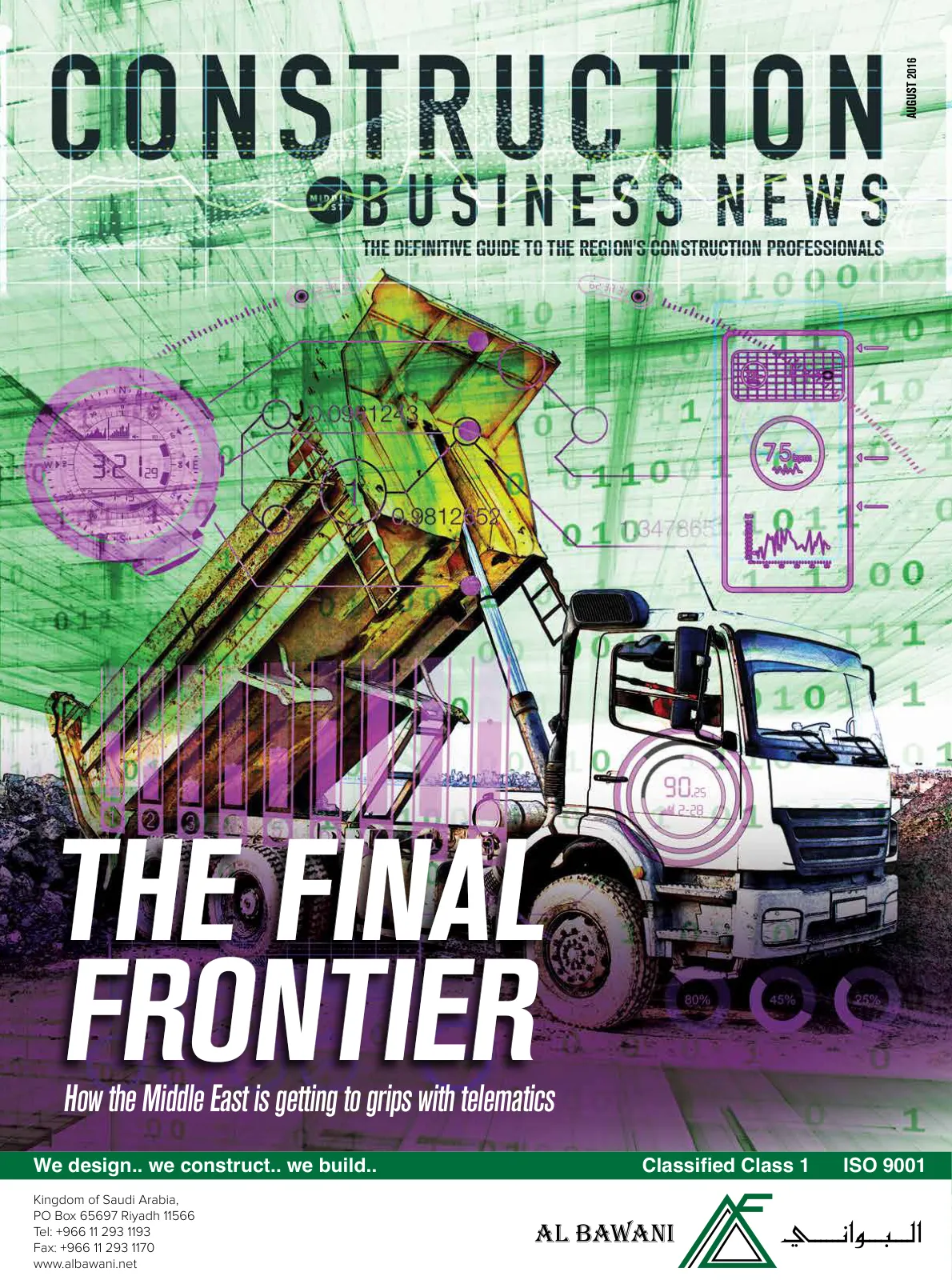
Construction Business News, August 2016
Page 1
How the Middle East is getting to grips with telematics
August 2016
We design.. we construct.. we build..
Kingdom of Saudi Arabia,
PO Box 65697 Riyadh 11566
Tel: +966 11 293 1193
Fax: +966 11 293 1170
www.albawani.net
Classified Class 1 ISO 9001
The Final
Frontier
Page 2
MAN EcoStyle – your key
to an effi cient fl eet.
Fuel, Personnel, Vehicles – the rising costs in the transport industry are increasing
the competitive pressure. MAN EcoStyle helps you to realize savings potential,
optimize transportation processes and considerably reduce operating costs.
www.man-middleeast.com
Page 3
construction business news me August 2016
3
Editor’s note
News
Market Report
Contracts
Cover Feature
The Middle East has
become one of the world’s
fastest growing markets
for telematics
In Person
Colin Timmons, the new
head of Al Naboodah
Construction, on his
ambitions for the company
In the Field
A look at the Palm Oasis
Park in Dubai
Legal Viewpoint
Heba Osman, Partner at
Fenwick Elliott, on the
risks of depending on
Letters of Intent
Supplier News
Supplier Focus
6
8
14
16
18
24
30
34
40
42
27
30
contents
Page 4
construction business news me August 2016
4
S U B S C R I B E
subscriptions@bncpublishing.net
CEO
Wissam Younane
wissam@bncpublishing.net
Managing Director
Walid Zok
walid@bncpublishing.net
Director
Rabih Najm
rabih@bncpublishing.net
Group Publishing Director
Diarmuid O'Malley
dom@bncpublishing.net
Group Sales Director
Joaquim D'Costa
jo@bncpublishing.net
+971 50 440 2706
Business Development Director
Rabih Naderi
rabih.naderi@bncpublishing.net
+966 50 328 9818
Group Editor
Melanie Mingas
melanie@bncpublishing.net
Editor
Jason O'Connell
jason@bncpublishing.net
Art Director
Aaron Sutton
aaron@bncpublishing.net
Sales Manager
Mostafa Abdo
mostafa@bncpublishing.net
+966 56 6695 333
Sales Manager
Vishvanath Shetty
vish@bncpublishing.net
+971 52 6745378
Marketing Executive
Mark Anthony Monzon
mark@bncpublishing.net
PO Box 502511 Dubai, United Arab Emirates
P +971 4 4200 506 | F +971 4 4200 196
For all commercial enquiries related to
Construction Business News ME contact
sales@bncpublishing.net T +971 55 339 5097
All rights reserved © 2015.
Opinions expressed are solely those of the contributors.
Construction Business News ME and all subsidiary
publications in the MENA region are officially licensed
exclusively to BNC Publishing in the MENA region by
Construction Business News ME.
No part of this magazine may be reproduced or
transmitted in any form or by any means without
written permission of the publisher.
Images used in Construction Business News ME
are credited when necessary. Attributed use of
copyrighted images with permission. All images not
credited courtesy Shutterstock.
Printed by International Printing Press www.ippuae.com
Building Materials
Take 10
Iconic football stadiums
Comment
Analysis
Why Saudi Arabia should
take inspiration from
South Africa in devising its
renewable plan
Event Review
Save the Date
62 Editor’s Pick
44
46
52
54
58
60
62
46
24
62
Page 5
Page 6
construction business news me August 2016
6
GEAR SHIFT
Air quality. Road Safety. Fuel efficiency.
These things concern everyone and improv-
ing their standards is something we can all
get on board with. In fact, they concern
those of us that live in the Middle East that
much more because regulations of, say car-
bon emissions, still lag some way behind Eu-
rope. But of course, when things start mov-
ing here they tend to shift pretty quickly.
All of these can be improved by the use
of telematics in vehicles. Put simply, tele-
matics is data. A system is installed in the
vehicle which transmits real time data to
the operator, allowing them to know what
the vehicle is doing, where it is located,
the vehicle’s condition and the driver’s be-
havior. But it’s the use of that data that is
the key to unlocking the environmental,
fuel consumption and road safety benefits
that telematics can bring.
The Middle East has been slow to see
the benefits of a technology that allows
commercial fleet operators to optimise
fleet management. The data they send
back can be used to train drivers to per-
form more safely and efficiently. But now
the Roads and Transport Authority (RTA)
is planning to make it mandatory for all
vehicles over 12 tonnes to use telematics
to allow them to improve road safety. And
the introduction of stricter emissions reg-
ulations are less than a year away.
From a fleet manager’s point of view, the
obvious attraction is the savings they can
make from cutting back on fuel consump-
tion. Fuel has always been so cheap in this
region that its cost rarely came into the
equation. Not anymore. Times are chang-
ing and the rationalisation last year of fuel
prices in the UAE is forcing a change in
mindset. With fuel costs set to grow as
oil prices gradually recover, not operat-
ing vehicles with telematics will soon no
longer be an option. As we discover in this
month’s cover feature, the benefits have
begun to catch on in a big way. Now that
the market has a taste for it there is hunger
for the best technology.
editor’s note
Jason o'Connell
Editor
Page 7
Porto Arabia Towers
Doha, Qatar
©2014 Hill International, Inc.
Hill International
The Global Leader in Managing Construction Risk
www.hillintl.com
For nearly four decades, owners and developers in the Middle East have
turned to Hill International to manage their construction projects and
programs throughout the region. Hill is proud to have helped our clients
turn their most challenging visions into realities. We have participated
in over 10,000 projects with a total construction value in excess of $500
billion, managing all phases of the construction process from concept
through completion.
Hill is also the leading construction claims firm in the world, having helped
resolve problems on some of the most complex projects throughout the
Middle East and around the world. To minimize risk and maximize results
on your next project, turn to Hill International
Dubai Office: 971 4 227 0078
Doha Office: 974 4 435 8381
Corporate HQ: 800 283 4088
If you can imagine it, we can manage it.
Qatar National Museum
Doha, Qatar
Mall of Qatar
Doha, Qatar
Viva Bahriya Towers
Doha, Qatar
Page 8
construction business news me August 2016
8
For News, features and more, Visit www.CBNme.com
Follow us on twitter for breaking news: @cbn_ME
Follow us on Facebook for up-to-the-minute breaking news
Read the latest edition on www.CBNme.com
NEWS
Advanced wind tunnel tests have confirmed the structural
strength of the $1bn Tower at the heart of Emaar’s Dubai Creek
Harbour development.
With wind being a major challenge in the development of
very tall buildings, these tests are crucial in defining the final
height and design aspects of the tower.
As well as the wind tunnel tests the building underwent
a comprehensive range of seismic and local climate studies,
Emaar said in a statement.
Designed by Spanish architect Santiago Calatrava Valls, and
located in the heart of the 6 sq km master-planned commu-
nity, the tower will be around 100 metres taller the Burj Khalifa
which stands at 828 metres high.
The Tower will feature world-class observation decks, luxury
accommodation and retail attractions across 18 usable floors at
the top of the spire.
Mohamed Alabbar, Chairman of Emaar Properties, said: “An
ambitious project on a never-before scale and design, The Tow-
er at Dubai Creek Harbour demands high-precision engineer-
ing across all its facets.
“Pushing the boundaries in high-rise engineering even fur-
The Tower passes wind tunnel tests
The Tower at Dubai Creek Harbour
ther, The Tower’s wind tunnel tests are an industry-first of sorts,
underlining our commitment to uphold the highest standards
of safety.”
Santiago Calatrava Valls said: “From the materials selection
to the technology used, every aspect of The Tower has been
designed and developed according to the strictest international
safety standards.
“The wind tunnel tests were an important component in the
structural design stage, and we have deployed innovative en-
gineering techniques to confirm the strength of the new icon.”
Two leading independent agencies in the world carried out
the wind tunnel testing on a scale model. Since the structure
will be anchored to the ground with huge cables, some of these
tests were developed for the first time in this field.
To guarantee maximum stability, the design of The Tower
also includes multiple damper systems and shock absorption
systems, located at different points and heights.
Emaar has unveiled plans for high-end residences in Dubai
Creek Harbour including Dubai Creek Residences, Creekside
18, and Harbour Views homes in The Island District, a vibrant
lifestyle hub enveloped by a 4.5 km boardwalk.
Santiago Calatrava finalises design after structural strength is confirmed
Page 9
construction business news me August 2016
9
Dubai’s Roads and Transport Author-
ity (RTA) has awarded a consortium
of France's Alstom, Spain's Acciona,
and Turkey's Gulermack a AED 10.6bn
($2.8bn) contract to extend the Dubai
Metro up to the Expo 2020 site.
The Expolink Consortium beat stiff
competition from nine other ventures
to win the huge contract in an inter-
national tendering process, said Mat-
tar Al Tayer, Chairman of the Board of
Executive Directors at RTA. Out of the
10, five were invited to submit techni-
cal and financial proposals and two
shortlisted in the final stage.
RTA hands out $2.8bn Dubai metro
extension contract
Construction facilities employing over 500 workers will soon
be obliged to hire at least one Emirati Occupational Health
and Safety Officer.
The Ministry of Human Resources and Emiratisation said
the new rule will come into force in 2017, according to UAE
news agency WAM.
Saqr bin Ghobash Saeed Ghobash, Minister of Human Re-
sources and Emiratisation, said: "We will stop granting facili-
ties with over 500 workers any further work permits, if they
don’t hire at least one local occupational health and safety
officer.”
The decision is part of the Emiratisation strategic plan to
promote employment opportunities for locals in the private
sector, he said.
"The ministry aims to Emiratise the occupational health and
safety profession following careful consideration of the sec-
tors involved in the construction industry and major industrial
enterprises where the possibilities were found to provide at-
tractive and stable opportunities for Emirati job seekers."
The minister called upon Emirati citizens to seek job oppor-
tunities available to them and to take advantage of the many
training programmes organised by the ministry.
Emirati health and safety officers to be mandatory
"Construction works on the project
would start in the final quarter of this
year, and the trial run is expected to
start in the last quarter of 2019. The
official operation of the service is
set to on 20 May, 2020, five months
ahead of the opening of Expo 2020,"
Al Tayer said.
Under the contract, Alstom will sup-
ply 50 trains (15 for the Route 2020
line, and 35 for the Dubai Metro) and
also execute the electromechanical
works. The Thales Group will pro-
vide the technological systems while
Acciona and Gulermack will execute
Dubai Metro
the civil works component.
Route 2020 will extend the Red Line
of Dubai Metro from Nakheel Harbour
and Tower station to the Expo 2020
site, located near Al Maktoum Inter-
national Airport. The 15km route will
have seven stations - 11.8 km a viaduct,
and 3.2 km underground track - and
will include a transfer station with the
Red Line, Expo Station, three elevated
stations, and two underground stations.
The project will serve districts includ-
ing the Gardens, Discovery Gardens, Al
Furjan, Jumeirah Golf Estate and the
Dubai Investment Park.
Page 10
construction business news me August 2016
10
NEWS
Al Jaber Building has clinched the
AED370mn ($100.7mn) main con-
struction contract for the Jawaher
Saadiyat residential development on
Saadiyat Island in Abu Dhabi.
Tourism Development & Invest-
ment Company (TDIC), the master
developer of major tourism, cul-
tural and residential destinations in
Abu Dhabi, said the project is on a
24-month delivery from mobilisation
on site.
H.E. Ali Majed Al Mansoori, TDIC’s
Chairman of the Board, said: “TDIC
has already received much interest
from investors for Jawaher due to its prime location overlooking the Saadiyat golf
course and the sense of exclusivity it offers to residents. We are confident that once
completed, it will drive demand for our real estate offerings on Saadiyat even fur-
ther.”
Al Jaber Building is no stranger to Saadiyat Island where it is also working on the
Hidd Al Saadiyat residential development.
H.E. Obaid Khaleefa Al Jaber Al Marri, Chairman of Al Jaber Group said: “Having
previously developed more than 7,000 villas in numerous prestigious projects, Al
Jaber Building is looking forward to join hands with TDIC to develop yet another
great milestone.”
Designed by DSA with interiors by Bishop Design, Jawaher Saadiyat will feature
83 units comprising 4 to 6 bedroom villas and 4-bedroom townhouses designed in
a contemporary and modern style.
TDIC has partnered with various banks to offer potential homeowners a range of at-
tractive financial offers. These include Abu Dhabi Commercial Bank, National Bank of
Abu Dhabi, Abu Dhabi Islamic Bank, Al Hilal Bank, Dubai Islamic Bank, Abu Dhabi
Finance, Union National Bank Mashreq Bank and Standard Chartered Bank.
Al Jaber wins
$100mn contract
FNC to build $190mn
housing project in
Dubai South
Fujairah National Construction Company
(FNC) will be the main contractor for the
MAG 5 Boulevard, a residential housing
project located in Dubai South adjacent to
the Expo 2020 site and Dubai Parks.
With a construction value estimated at
AED 700mn ($190mn), the development
will comprise of 1,172 residential units,
alongside an array of retail, dining, leisure
and entertainment options. The project
will break ground this month with Phase
1 handover scheduled to commence in
Q4 2018.
Talal Moafaq Al Gaddah, CEO, MAG 5
PD, said: “FNC has an enviable portfolio
for the delivery of premium real estate de-
velopments in the UAE. We are confident
in their ability to bring MAG 5 Boulevard
to the market within two years and in
doing so, create the ultimate quality af-
fordable living in one of the city’s most
sought-after locations, Dubai South.”
Arabian Construction Company (ACC)
will build a new headquarters in
Downtown Dubai for Mashreq Bank
which will leave its Deira home after
almost 50 years. Construction of the
151-meter tower is set to commence in
December of this year with the com-
pletion date penciled in for April 2019.
Mashreq’s new HQ, designed as an
L-shaped structure, with a square top
crown, will be located on the Dubai
Financial Centre Road in the Burj
Khalifa District. The architect is Chica-
go-based Skidmore Owings & Merrill,
which also designed Burj Khalifa.
The signing ceremony was attended
by H.E. AbdulAziz Al Ghurair, CEO
of Mashreq and Mr. Ghassan Mere-
hbi, Chairman of Arabian Construction
Company.
“ACC has once more had its impres-
sive construction and development
credentials recognized, by being
granted this prestigious construction
project,” said Merehbi. “We are de-
lighted to be working with one of the
best-known banking industry names
in the Middle East and to be able to
add the Mashreq Bank Headquarters
to our portfolio of noteworthy projects
across the UAE.”
ACC to build new Mashreq HQ
TDIC and Al Jaber Building sign on the dotted line
Page 11
construction business news me August 2016
11
UAE-based KBW Investments and Greek engineering and con-
sulting firm Salfo and Associates have signed an agreement that
will see the two companies expand operations and collaborate
on projects in the Middle East and Europe.
The agreement, signed by KBW Investments (KBW) founder
and Chairman HRH Prince Khaled bin Alwaleed bin Talal, and
Ioannis Foteinos, CEO, Salfo and Associates SA (Salfo), is set
to include large scale design and consultancy undertakings
throughout the GCC alongside other emerging economies in
the Middle East with plans for Europe.
“The formation of this agreement with Salfo - a long-stand-
ing and influential Middle East stakeholder in the engineer-
ing and project management segments – serves multiple
aims,” said Prince Khaled.
“As a company based in Dubai, our multinational partner-
ships reflect the global nature of doing business from this
Middle East hub. KBW is continuing to develop our portfolio
across continents with a broad range of projects that vary in
sector and size, and we are pleased to further build on this
worldview with Salfo.”
The KBW Investments portfolio currently includes Romanian
KBW Investments unveils another partnership
Arcadia Engineering with Middle East and Australian branches,
in addition to an existing partnership with Progen Group, with
Salfo serving to enhance the company’s overall strength in en-
gineering and planning.
Salfo has an extensive project roster of infrastructure and
building developments in a multitude of arenas including
rail and transport (traffic and roads), marine and airports,
bridges and tunnels, as well as hotels, malls, sports com-
plexes and public buildings.
Ritchie Bros. holds next Dubai auction from Sept 20 - 21
Heavy equipment auctioneer Ritchie
Bros. will hold its next auction in
Dubai’s Jebel Ali Freezone on Sep-
tember 20 & 21. Already hundreds of
items have been added to the auc-
tion and many more will be added
over the next weeks.
This will be the third massive
equipment auction the company
holds in Dubai – the two earlier auc-
tions, in March and May, featured
over 4,000 equipment items and
trucks. More than 1,800 bidders reg-
istered to bid at these two auctions
to get a good deal on one or more
pieces of equipment. The upcoming
September auction will comprise a
range of items, from big excavators
and loaders to generator sets and at-
tachments.
Generally the lion’s share of equip-
ment at Ritchie Bros. auctions are
used items, but regularly unused
items are included as well. Browsing
through the Dubai auction inventory
on the Ritchie Bros. website, one
will find a large quantity of unused
and low hour items from premium
brands, such as Caterpillar, Komatsu,
Hamm and others.
As with all Ritchie Bros. auctions,
all the items are sold on the auction
days with no minimum bids or re-
serve prices. This ensures a fair and
transparent auction where only the
bidders set the prices. The highest
bidder always wins the item, regard-
less of price.
Page 12
construction business news me August 2016
12
NEWS
Qatar is among countries to see a
marked rise in construction sector risk
which has hit its highest level globally
in almost three years, according to a
new report.
The worsening risk profile for Qatar
reflects the deterioration in the country’s
fiscal position owing to low prices for
crude oil, and the subsequent negative
impact this will have on infrastructure
investment, Timetric said in its Q2 2016
Construction Risk Index (CRI).
The index is designed to provide a
standardized view of the underlying
degree of country-level risk facing
the construction sectors in 50 major
developed and emerging markets
around the world.
In total, 34 countries, in both devel-
oped and emerging markets, suffered a
deterioration in their risk profiles in the
Q2 update, Timetric said.
“Although crude oil prices have recov-
ered from dropping to below US$30 a
barrel in January 2016, prices are still at
low levels, and this continues to have a
negative impact on the economies and
construction industries in major oil-ex-
porting countries, particularly those in
the Middle East,” the report said.
Qatar, the highest ranked GCC coun-
try, fell three places to 16th in the table.
The UAE fell two places to 22nd while
there was no change for Saudi Arabia in
25th spot.
The UK tumbled six places to 15th in
the rankings, a result that follows the
outcome of the UK’s referendum on EU
membership in June. Sweden remains
top-ranked, supported by strong eco-
nomic growth, but its fast rising proper-
ty market continues to prompt concerns
of overheating, and the country’s risk
score has risen by 1.5 points.
The top four countries in the CRI,
namely Sweden, Switzerland, the US
and Singapore, all recorded an upturn
in risk in the latest update.
Qatar sees ‘marked’ rise in
construction risk profile
Greenlight for two Zaha Hadid projects in Lusail
Qatar has given the go ahead for a pair of buildings de-
signed by the late British-Iraqi architect Zaha Hadid. The
projects were commissioned by H.H. Sheikh Mohammed
Bin Khalifa Al Thani’s Al Alfia Holding in 2013 as part of
Lusail City’s masterplan.
Zaha Hadid Architects (ZHA) will now develop the first
project by 2020, a 70,000 sq m hotel with residential apart-
ments in Lusail City’s Marina District. The second design
commissioned by Al Alfia Holding will be built within the
on¬going plan for future development of the city.
Working with Arup Engineering and Atelier Ten, global
leaders in environmental design and engineering, Hadid’s
design for the 38 ¬storey first project was inspired by the
structure of the Desert Hyacinth, a flowering plant na-
tive to the Arabian Gulf. The nine-¬pointed form of the
building’s podium surrounds a central core defined by the
interwoven fluid geometries of the hyacinth.
“With truly inspirational public spaces and atrium, 120
unique residences and 200 hotel rooms of Zaha Hadid’s
unmistakable signature, we celebrate her remarkable leg-
acy and continue Lusail City’s commitment to creating the
region’s most sustainable, interconnected community,”
said H.H. Sheikh Mohammed Bin Khalifa Al Thani, Chair-
man of Al Alfia Holding.
Doha, Qatar
Page 13
construction business news me August 2016
13
Turner & Townsend increased Middle
East turnover by a quarter and profits by
nearly a third in the year ended 30 April
2016.
The professional services consultan-
cy’s strong performance in the region
– which saw regional turnover grow by
24 percent to GBP 32.2m ($42.2mn) and
operating profit climb 32 percent to GBP
5.1m – helped drive its global revenue to
a record GBP 409m.
Turner & Townsend Middle East Manag-
ing Director, Mike Collings, said: “Despite
the abrupt fall in oil prices, this has been
a very strong year for our Middle East op-
eration. We saw significant growth in real
estate and built momentum in infrastruc-
ture, with clients still demonstrating the
Saudi Arabian construction contractor
Abdullah Abdul Mohsin al-Khodari and
Sons slumped to a second quarter loss
following a slowdown in the kingdom’s
building sector.
The firm was awarded new contracts
worth just SAR 54mn ($14.4mn) in
the second quarter, a sixth of the SAR
340mn booked in the corresponding
period of 2015.
On Tuesday Khodari reported a net
loss of SAR 43.34mn ($11.6mn) for the
three months to June 30 compared to
a profit of SAR 34.86mn in the same
period a year-earlier.
Khodari posted a 37.4 percent drop
in revenue, partly due to a lower con-
tribution from newly awarded con-
tracts. It also blamed a 10 percent rise
in financial charges and a 43.7 percent
drop in other income due to a decrease
in sales of used equipment.
The Dubai-based developer Nakheel
reported a 4% rise in first-half profits,
according to a bourse statement.
Earnings
reached
AED
2.95bn
($803mn) during the period compared
to AED 2.83bn ($770mn) in the first half
of 2015.
The developer delivered over 1,177
units during the first six months of this
year, with its retail, residential leasing
and hospitality businesses all perform-
ing strongly. Nakheel opened Dragon
Mart 2 and the first of a series of expan-
sions at Ibn Battuta Mall, increasing the
developer’s existing retail portfolio by
35% to 4.2 million sq ft.
The company plans to hand over
more residential units to customers
during the second half of 2016, starting
at Azure Residences on Palm Jumeirah,
with handovers at Jumeriah Park, Ju-
meirah Islands, Al Furjan and Warsan
Village to follow.
Middle East helps drive
Turner & Townsend to
new heights
Al-Khodari and Sons
dives into the red
Nakheel sees
steady first half
desire to invest in the region despite the
low price of oil.
“We built on our reputation for our full
breadth of services this year, securing
major real estate commissions and sig-
nificant new wins with Unilever, Galer-
ies Lafayette and the passenger terminal
extension at Al Maktoum International
Airport. Our aim in the year ahead is to
increase our footprint with new offices
in Saudi Arabia and continue to exceed
our clients’ expectations as they invest in
the region.”
Turner & Townsend employs nearly
4,300 staff across 97 offices worldwide,
and has now recorded six successive
years of growth. Its profit after tax of
GBP 30m has almost tripled in five years.
Page 14
construction business news me August 2016
14
MARKET REPORT
A “perfect storm” is brewing in the UAE
property market thanks to a combination
of oversupply of projects and softening
demand due to shifting market sentiment
and lower oil prices, a new study shows.
Management consultants A.T. Kearney
say the supply of property developments
in the country is four times higher than
the value of developments completed in
last 10 years. The study argues that ac-
tively probing for disruption, creating a
value network and improved targeting of
customer preferences is key to navigating
the storm that lies ahead.
“There is little evidence the real estate
industry is preparing for the next market
cycle. Developers need to probe for dis-
ruptive innovation beyond the traditional
boundaries of their industry and beyond
their known value chain,” said Federico
Mariscotti, Vice President at A.T. Kearney.
“For example developers can find solu-
tions which offer both cost savings and
efficient construction techniques by intro-
ducing commercially viable space con-
struction alternatives that were developed
during a competition for NASA.”
Among the recommendations of the
study is a re-orientation from a sequential
value chain toward a value network - an
ecosystem with new incentives and an
appetite for innovation through collabo-
ration.
“The recommendations were based on
over 20 interviews with architects and
contractors that indicated that the current
supply chain is inherently inefficient and
drains value throughout the project life-
cycle,” said Douglas Pickles, Director at
A.T. Kearney.
“This commonly accepted model leads
to design changes on up to 40% of the
project specs and delays of six months or
longer. The future belongs to those devel-
opers who can tackle these inefficiencies
by introducing innovation and increase
up front collaboration within their supply
chain.”
With better governance and a new op-
erating model, companies in the industry
will become more resilient. The study
finds that further cost efficiencies are pos-
sible with increased differentiation and
focus on end-customer preferences.
“As customers become more savvy, our
study shows that value can be captured
by having a better understanding of their
preferences,” said Mariscotti. “By estab-
lishing a value network, developers can
collaborate on designs that place the cus-
tomer at the heart of the project, driving
increased customisation and profitability.
“Advanced analytics enables an under-
standing of which features to customise
and the trade-offs customers are willing
to make and how much they will pay for
them. This alone can improve the internal
rate of return on investment by 10-25%,
and create a pipeline of affordable hous-
ing projects,” he added.
The study concludes that these oppor-
tunities pose significant challenges as
they mandate a rewriting of the way busi-
ness is done. Successfully adopting them
will require a new mindset, new skills
and new incentives.
But according to A.T. Kearney there is
hope, as other industries have shown it
can happen successfully, and in the firm’s
experience, companies most needing
change are willing to make it happen.
‘Perfect Storm’ on the horizon
for GCC real estate market
“There is little evidence
the real estate industry
is preparing for the next
market cycle”
Management consultants A.T. Kearney predict a tough time ahead for the sector
Page 15
Discover CCS
Take a break from your project stress with
CCS state-of-the-art software.
For over 35 years, our software solutions have been
developed for contractors by contractors. At the
leading edge of industry trends, Candy and
BuildSmart put you in complete control of your
project: from check-in to check-out, a 7-star
experience.
CCS proudly partnered with contractors
involved in landmark hotel and hospitality
projects including Burj Al Arab, Emirates
Palace, Bab Al Shams Desert Resort & Spa,
Madinat Jumeriah and Atlantis the Palm.
Let us help you find your piece of paradise today.
Set yourself free today and call on +971 4 346 6456
or check-in at info@ccsgulf.com
“CCS is the best construction
estimating and project control software
I have come across. Saving half the
time coupled with the accuracy and
efficiency it provides, easily surpasses
similar software applications.”
David Baker, Estimating Manager,
Habtoor Leighton Group, Qatar.
Page 16
construction business news me August 2016
16
contracts
Dubai South has handed out contracts
worth AED1bn ($272mn) for work on
projects near the site of Expo 2020.
Parsons Corporation and Atkins Glob-
al are among the industry leading com-
panies to win infrastructure and design
contracts mostly related to residential
developments in the area.
Studio International Architects, Al
Nasr, Tristar Engineering & Construc-
tion and the US-based RNL Design
were also awarded deals, according to
a statement.
Dubai South's Residential District in-
Dubai South hands out AED 1bn ($270mn)
contracts near expo 2020 site
Aldar awards $109mn construction contracts for two projects
Aldar Properties has awarded con-
tracts of AED 440mn ($109mn) to
National Projects and Construction
LLC (NPC) for Nareel Island, its
master planned island community,
and for Al Merief, the distinctive
community in Khalifa City.
Set to be carried out over a
16-month period, the work on both
developments commenced on the
July 14 and covers infrastructure,
utilities and public areas, in addi-
tion to associated marina works for
Nareel Island.
Talal Al Dhiyebi, Chief Develop-
ment Officer, Aldar Properties PJSC,
said he expects both projects to be
completed 2017.
Nareel Island is a premium high-
end villa development of 148 plots
located on the coast in Al Bateen,
spread over two islands. Aldar
awarded the earthworks and marine
works tender packages in October
2015 and is currently making steady
progress on construction work.
Reclamation work for the lagoon
has also commenced, and dredg-
ing work on the southern island
is complete.
Al Merief combines Emirati tradi-
tions with modern amenities across
its 283 land plots. All concept and
preliminary designs as well as the
detailed design phase were com-
pleted in 2015.
cludes schools, nurseries, hospitals,
retail outlets, F&B options, a post of-
fice, swimming academy and a sports
centre.
The city will have around 10,000 resi-
dential units between villas, townhous-
es and apartments by 2020, housing an
estimated 35,000 residents.
The overall infrastructure develop-
ment of the Residential District will be
completed in phases. Work is already
well underway by Al Nasr on the first
section of the Residential District's in-
frastructure, which will be completed
by the fourth quarter of 2016. Al Nasr
also clinched the deal to build the in-
frastructure in Dubai South's Logistics
District as well.
Tristar Engineering & Construction
has been awarded the infrastructure
construction for the remaining areas of
phase one, with this phase scheduled
to be completed by Q4, 2017. This will
pave the way for over 40 developers to
expedite their developments in Dubai
South's Residential District.
Atkins Global, Studio International Ar-
chitects and RNL Design are contracted
to oversee the masterplan and product
design for the mixed-use development
within the Residential District, which
includes
apartments,
townhouses,
schools, community facilities, entertain-
ment, retail and hospitality.
Parsons and Kele Constructions will
build the first phase of Sakany Staff Vil-
lage, accommodating 20,000 residents
by 2020.
UAE-based City Diamond Contracting
was awarded a contract to build a mul-
tipurpose aerospace supply chain facil-
ity in Dubai South's Aviation District.
Details of the project and other devel-
opments will be unveiled at Cityscape
Global 2016, to be held in Dubai in
September. Property sales are expected
to begin in October 2016.
Page 17
Around the region
Kuwait
Qatar
Iraq
UAE
KSA
Hill wins $13mn
contract for
two hospitals in
Kuwait
Barwa Real
Estate awards
INSHA $27.2mn
Motor City deal
Drake & Scull
bags $61mn EPC
contract in Iraq
Nakheel and
Empower pen
$490mn district
cooling deal
Zamil Steel wins
$6.4mn factory
contract
Hill International has
received a letter of award
from Health Assurance
Hospitals Company (Dha-
man) to provide project
and construction manage-
ment services for two new
hospitals in Kuwait.
The three-year contract
has an estimated value of
approximately KWD 3.9
mn ($13.1mn), the global
specialist in managing
construction risk an-
nounced.
These projects entail
the construction of two
300-bed secondary care
hospitals, staff accom-
modation buildings and
parking facilities located in
Al Ahmadiand Al Jahra.
Qatar’s Barwa Real Estate
has awarded INSHA Co
with the construction
contract to build the first
phase of the Madinat
Al Mawater (Motor City)
project.
The deal is worth QAR
99.85mn ($27.4mn) and
has a construction dura-
tion of 12 months.
Located on Rawdat
Rashed Road, near
the intersection with
Salwa Road, Motor City
is planned to be the
primary destination for
various services related
to the sale, purchase,
and maintenance of used
vehicles in Qatar.
Drake & Scull International
has clinched a AED 226mn
($61.5mn) EPC contract for
a water injection project
in Iraq, taking contract
wins to AED 570mn so far
this year.
The Dubai-based firm
will build the facil-
ity for Italian oil and gas
company ENI at the Zubair
oil field in Basra.
Work on the project has
started and is scheduled to
complete in early 2018.
Emirates Central Cooling
Systems Corporation
(Empower) has signed
a AED1.8bn ($490mn)
contract with Nakheel to
provide district cooling
services to Jumeirah Vil-
lage Circle and Jumeirah
Village Triangle.
The Dubai-based firm
will build six cooling
plants to provide 260,000
refrigeration tons (RT) for
the 400 buildings in these
locations.
In a first phase Empower
will produce 30,000 RT
by the fourth quarter of
this year, the company
announced.
Zamil Steel Construction
Co. (ZSCC) has won a
contract worth SAR 24.3mn
($6.4mn) for the second
phase of United Carton
Industries Co’s (UCIC) new
manufacturing facility in
Al-Kharj in the central
region of Saudi Arabia.
The UCIC factory project
is a fast-track, multicom-
ponent undertaking with
a challenging completion
schedule.
Zamil Steel Construction
Co. caters to clients that
require comprehensive
solutions for indus-
trial and commercial steel
structures.
Page 18
construction business news me August 2016
18
Cover Story
Page 19
How the Middle East is getting to grips with telematics
The Final
Frontier
T
he benefits of fitting vehicles
with telematics have been slow
to catch on in the Middle East
but interest has been accelerat-
ing ever since the UAE decid-
ed to rationalise fuel prices in
2015. Fuel is likely to make up a gradu-
ally more significant component of the
operating cost of a truck fleet and that
has woken operators up to the fact that
telematics can prevent those costs from
spiraling out of control.
Telematics is data, pure and simple.
A system is installed in the vehicle
which transmits through GPRS to the
operator, allowing them to know what
the vehicle is doing, where it is located,
the vehicle’s condition and the driver’s
behavior. But it’s the use of that data
that is the key to unlocking the envi-
ronmental and fuel consumption ben-
efits that telematics can bring.
“If you use telematics correctly, you
know every time a driver presses the
break peddle, if he presses the breaks
too hard, if he steers erratically or if
he’s speeding,” says Dr Richard Brown,
Head of After Sales & Product Manage-
ment, MAN Truck & Bus Middle East
and Africa. “The data is all there. Initially
the main purpose is to train the opera-
tor to use the data that’s been provided,
and when they’re trained and under-
stand the system they will see the gaps
in the driver’s knowledge that we can
then focus on to train them to drive bet-
ter. You can optimise routing, tire wear
and load all through the understanding
of the information provided.”
Cost benefits
Telematics has been widely used among
fleet operators in Europe for around 15
years. Unsurprisingly, the Middle East is
one of the last region’s to introduce it but
the market has really begun to hot up in
the last two years.
“Every manufacturer is representing
their own telematics offering to the
market,” says Brown. “The uptake in
the Middle East has certainly increased
in the last 20 month where there’s a
mind shift towards fuel consumption
with the fuel prices changing. Two
years ago, when we started talking
to end users about telematics for the
Page 20
construction business news me August 2016
20
Data is sent back to the fleet manager to be processed
Middle East, the attitude was very much
‘fuel cost is not worth thinking about’.”
Most manufacturers will now offer a
telematics package with a new vehicle.
Clients have the option of doing without
or choosing from a range of packages
from basic vehicle tracking to a far more
complex system that provides all sorts of
data. Systems can also be retrofitted and
there are many third parties in the market
offering their services too.
There is, of course, an initial cost to
install a telematics system and there’s an
operating cost for the data transfer, how-
ever savings can quickly outweigh those
costs. “From a business case that we’ve
done with one operator, the telematics
pays for itself in nine months through
fuel savings in this region,” says Dr
Brown. “That’s for both long distance ve-
hicles and construction.”
You might think that telematics might
only be used for long distance vehicles
but that isn’t the case.
“I’ve had a lot of meetings in the last
year and I was surprised how many con-
struction machines are delivered from
factory with telematics installed as stan-
dard” says Dr Brown. “It records vehicle
health, operating hours, similar things to
what we do with vehicles. It’s also used
for preventive maintenance. The system
we provide can tell the user if the vehicle
has enough kilometres to do the run that
he wants before its next due service. If
not, he can send it for service straight
away and that reduces downtime.”
The next generation of data capture
will even predict component change
requirements so the system can inform
the owner that the vehicle needs to go
to the workshop.
Driver Training
Telematics systems allow operators to
provide their drivers with focused train-
ing. They can detect everything from
improper gear shifting to excessive use
of breaks, not using cruise control, not
using the correct gear for the speed,
excessive acceleration and using the
break and accelerator at the same time.
All of these things have a negative im-
pact on fuel efficiency.
MAN’s telematics system produces a
driver scorecard rating them from A (the
best) to G (problem driver). The cost
savings, not to mention safety improve-
ments, that can be made from improving
a driver’s skills are significant.
“Normally we find drivers in the Mid-
dle East to be C-D category,” says Dr
Brown. “If we train them from a D to a C
we reduce cost of ownership by between
three and five percent. If we train them
from a D to an A that increases consider-
ably above 10 percent. The data that you
get back focuses the driver training.”
Around 80 percent of fuel consump-
tion saving comes from the driver but the
remaining 20 percent comes from the op-
erator or the fleet manager making sure
the driver is going to the correct destina-
tion via the shortest route possible.
Safety
Safety works in the same way. Harsh
steering and harsh breaking are the two
focus points for improving safe driving.
And though it hasn’t been done yet in the
Middle East there is even the option to
fit vehicles with forward and rear facing
external and internal cameras to moni-
tor the driver as well as road conditions,
making it easier to determine the cause
of an accident right away.
“We’ve got one video of an incident
that happened in the UK between a
truck and a motorbike,” Dr Brown says.
“The truck driver was sent to court but
Cover story
Page 21
construction business news me August 2016
21
The RTA will make it mandatory to have
telematics on vehicles over 12 tonnes
they played the video and the case was
thrown out because it wasn’t his fault, it
was the biker’s fault.”
There is greater and greater emphasis
being placed on road safety in this re-
gion, especially in the UAE where the
Roads and Transport Authority (RTA)
is now planning to make it mandatory
for all vehicles over 12 tonnes to have
telematics systems, which will allow
them to monitor every commercial ve-
hicle on the road in real time. So does
this provide opportunities for providers
to retrofit existing vehicles with telemat-
ics systems?
“We can retrofit and we can fit sys-
tems to almost any make of vehicle but
we haven’t seen the full scope of the
requirement yet from the RTA,” says Dr
Brown. “If there’s a requirement that we
haven’t engineered yet then we’d have to
do some development. But if there’s one
government body that’s starting to think
that telematics can assist them in polic-
ing road safety, hopefully that’s the seed
that starts to grow and spreads through-
out the GCC. Dubai seems to be one step
ahead of the rest of the region.”
Despite its relatively recent introduc-
tion, uptake of telematics systems among
fleet operators in this region has been
swift and they are hungry for more.
“Our initial intention in November
last year was to introduce the simple
system to this region, just to start the
operators understanding what to do
with the data,” says Dr Brown. “But by
January we’d already reached where we
thought we’d be in July by introducing
additional modules. We’re now at the
fourth module and we didn’t expect to
be there until next year. The end users
are asking us for more. At the moment
our full package has seven modules but
it’s always in development.”
Emissions
From an emissions point of view, it’s fair
to say standards in the Gulf still lag some-
way behind Europe and elsewhere. Cur-
rent legislation is a GSO (Gulf Standards
Organisation) regulation from 1986. But
on July 1, 2017 all GCC countries will in-
troduce a mandatory EURO 3 standard
for all newly registered vehicles. That’s
a quantum leap from where we are now
which is around EURO 1.5. It’s clearly a
big step in the right direction and will
produce a significant reduction in emis-
sions but Europe is now at EURO 6 so
there is still a considerable gap.
“Today, only the UAE could introduce
a EURO norm higher than five because
of the fuel quality which is as good as
anywhere in Europe,” Dr Brown says.
“But in general the cost of implementa-
tion of a higher EURO norm is huge
because you’d have to change the qual-
ity of fuel and the vehicle technology
is also totally different. The cost of the
components is a lot higher so the ini-
tial cost of purchase is a lot higher and
the Middle East has not reached a point
where it will accept vehicles that cost
significantly more.”
However Dr Brown says he expects
the region to move up the gears to high-
er EURO standards far quicker than hap-
pened in Europe. “They don’t intend to
allow high polluting vehicles on the road
much longer.”
“Two years ago, when we started
talking to end users about
telematics for the Middle East,
the attitude was very much ‘fuel
cost is not worth thinking about’”
Page 22
Page 23
Page 24
construction business news me August 2016
24
Great Expectations
Colin Timmons was suffering through a particularly nasty, brutish and
long Edinburgh winter when he received a phone call from someone in
Dubai, inviting him to head up Al Faraa General Contracting.
Over the course of more than two decades, the construction veteran
had come through the ranks with national construction contractors
in the UK, working his way up to MD level with companies like Mace
and Morgan Sindall on a wide range of projects. But with the UK at a
standstill following heavy snowfall, the time seemed right to accept a
new challenge in the sunny Gulf.
Five and a half years later the Scot made the move to Al Naboodah
Construction Group where, after a brief stint as COO, he replaced Steve
Lever as CEO on July 1. Timmons spoke to Jason O’Connell about his
experience in the Gulf and his big plans for Al Naboodah.
IN PERSON
“Other companies’ fall from
grace is their issue not
mine but I’m seeing that as
a real opportunity to drive
Al Naboodah forward and be
the client’s first choice”
Page 25
construction business news me August 2016
25
What was it like making the
transition from the UK to
the Gulf?
I started here as General Manager of
Al Faraa General Contracting with
the aim of reshaping and growing
the business by adopting a more UK
mindset. Over a five-and-a-half-year
period we tripled turnover by get-
ting bigger and bigger jobs. The big
change coming from the UK was the
culture of the company and how to
do business. The cost of labour, the
ability of labour, the number of staff
that you would have in comparison
to a similar project in the UK, is like
night and day. A lot of it was about
learning and understanding the cul-
ture.
Did you find people recep-
tive to your changes?
Yes I did. Al Faraa took a bit of re-
shaping and reorganising so that it
worked well as a business. Prior to
my time here contractors were hav-
ing a great time making big money
in the boom days. The crash came
in 2008/09 and all of a sudden they
weren’t hoovering up these big mar-
gins, where there was so much work
and not enough contractors that you
could pick and choose your job. In
2010 every contractor was looking
to reshape their business to deal
with the market moving forward so
that’s exactly what I did at Al Faraa.
I brought some key individuals into
the business and prepared it for what
was ahead, which was a much leaner
market place based on performance.
You get jobs if you do them well and
deliver on time and on budget.
Then I was approached by Al Na-
boodah and my respect for them in
the market place is second to none. I
had five and a half years at Al Faraa
of blood sweat and tears, working six
days a week, 12 hours a day mini-
mum. This opportunity has come as a
result of the hard work and effort that
went into the last few years.
What sort of shape did you
find Al Naboodah in when
you arrived?
It was a very different organisation
from the one I’d just worked in. There
was more of a UK influence here be-
cause Steve Lever, who was the CEO,
and a lot of his senior staff were Brits
with a good few South Africans, so
the culture and the way they did busi-
ness was already more akin to the UK
way. It’s family owned so the princi-
pals of working for the Miller Group
in Edinburgh as a graduate are the
same as working for the Al Naboo-
dah family. The third generation of Al
Naboodah’s are coming through the
business and I work very closely with
them.
I joined as COO in March with a
sort of outlined plan that, should I
be the right person, then the current
CEO would retire at an appropriate
time. But there was nothing on paper
that said this would happen, it was
just an agreement of sorts. After 6-8
weeks in the business they probably
felt I was the right person for the job.
So I made the transition from COO to
CEO officially on the July 1.
Is this your first role as
CEO?
As a CEO yes but I’ve been running
companies for a long time. Being GM
at Al Faraa was a similar role with
similar responsibilities. Being MD at
Mace in Scotland was the same. The
difference here is that it’s larger and
more varied because we have a civil
engineering division, a building divi-
sion and an MEP division. Civil is the
heart of the business and has been
the strongest over the years. The job
is about bringing them together and
getting as much synergy as we can.
“I was approached by Al
Naboodah and my respect
for them in the market place
is second to none”
Al Naboodah is well known
for its civil infrastructure
Page 26
Every job that you do has an element
of civil, building and MEP, so we’re
looking at integrating that service of-
fering. We’re in a market where liquid-
ity is under pressure as we know, so
clients want their jobs delivered but
they’re looking for better prices. One
way to do that is for us to integrate
and make our offering more efficient
but that won’t happen overnight.
In the UK contracting groups have
been doing that for a long, long
time, offering a client a design and
build model where we do everything
for you. That then extended to PPP
which means bringing the finance
and I think that’s going to come here
in some shape or form. British com-
panies are bringing UK trade finance
and that tells me that clients, despite
their view a year ago that that ap-
proach wouldn’t work in the UAE,
are now keen to look at different
funding routes.
Give me a snapshot of the
company you’ve taken on.
I’m relatively new in the market. When
I came here all I heard was Arabtec as
the superstar in construction. It’s like
being in Britain and talking about Bal-
four Beatty or Sir Robert McAlpine. For
me at this moment in time we’re every
bit as good if not better than some of
our competitors. Other companies’ fall
from grace is their issue not mine but
I’m seeing that as a real opportunity to
drive Al Naboodah forward and be the
client’s first choice. But that only works
if you deliver.
It’s about being out there and de-
livering jobs on time, on budget and
building relationships. We want to
keep close to existing clients and look
to build on that relationship. That’s
the key for us moving forward. Over
the years Al Naboodah has done huge
amounts of work at the airport, with the
RTA on roads and bridges, so there’s
a handful of key clients that I want to
nurture relationships with.
IN PERSON
Al Naboodah’s new
HQ in Al Awir, Dubai
“We don’t want to buy jobs
just to be able to say we’ve
done X billion this year but
lost our shirt”
Page 27
construction business news me August 2016
27
What sort of projects are
you working on right now?
In civils we’re doing a parallel roads
project for the RTA down by Business
Bay, involving various bridges and in-
terchanges. That’s a chunky project
that will run on for another year and
a half and is probably the single big-
gest project we’re doing in civils. That
said we’re doing a big, big job at Mid-
field Terminal down in Abu Dhabi,
building the tunnels for flyovers. We’ve
got a number of smaller jobs for local
residential developers in Dubai doing
roads and infrastructure for their sites.
We’ve worked at Dubai Airport for 20
years. We did the relaying of both run-
ways in 2014 in 84 days, working 24/7
while keeping the airport live. That’s
what makes me proud and excited to
come to a company like Al Naboodah.
In building our biggest job is down
in Nad al Sheba where we’ve built a
huge indoor stadium for the RTA as
well as all the car parking, roads, drain-
age, etc. It’ll touch a billion dirhams in
value. We’ve got a big multi-use devel-
opment down in Mankool that we’re
doing for Rostamani.
Our MEP division tends to work as
a subcontractor, so probably 60 to 70
percent of their work is internal work
for our civil and infrastructure divisions
but they’ll also subcontract for our com-
petitors like Khansaheb and Shapoorji.
What are your ambitions for
the company?
To be the contractor of choice. We
outlined a plan with our shareholders
to grow the business and we need to
adhere to that to the best of our abil-
ity. Typically we want 10-15 percent
growth year-on-year which is an ag-
gressive target. But it’s got to be done
in a controlled manner. In UK terms
‘turnover is vanity and profit’s sanity’.
We don’t just want to buy jobs just to
be able to say we’ve done X billion this
year but lost our shirt. We want con-
trolled growth in the right sectors with
the right clients because there are li-
quidity challenges out there.
We’re looking at more international
business as well. For example, there
are clients based here that are funding
projects in East Africa and other places
so one of those – like DP World for ex-
ample - might come along and ask us
to price those jobs because they know
us. We’re looking at international ex-
pansion in a very controlled way. The
logic is to build around the success of a
project. We’re not saying we want to be
in this or that country and employ five
new business managers and marketing
guys and build offices. We’ll win a proj-
ect and build around that.
What sort of headwinds do
you face in achieving those
aims?
The challenge is, will the market hold
up? It’s ok saying we want to do X bil-
lion next year, but are the opportuni-
ties there? We believe they are. Is the
funding there? We believe it is but the
market’s got to remain fairly buoyant
and this liquidity challenge is there. At
the end of the day the banks call the
shots for a contracting business or a de-
veloper or a sub-contractor. At the mo-
ment that is the constraint that might
prevent our growth. If the UAE mar-
ket dropped all of a sudden we would
need to look at a strategy based on a
bit of reshaping.
What’s the strategy to
compete in such a tight
market?
It’s to be more efficient and certainly to
be consistent with performance. Build
In 2014 Al Naboodah
relayed both runways at
Dubai International Airport
in just 84 days
Page 28
construction business news me August 2016
28
up relationships so you’re given oppor-
tunities because you’ve worked hard
and developed that relationship that
goes back over a period of time. Nine
times out of ten the lowest bidder wins
in this market. Certain jobs you’re not
going to win because you’re not the
cheapest so we’ve got to look and try
and form relationships with clients that
respect what delivery really means and
have the wisdom to look further than
just the cheapest price.
Margins are tough for everyone. Big-
ger volume, lower margin is where
every business is going. But amongst
that there are gems where, if you get
the right client and the right project
and can add real value, you’ll get more
margin from that. For example, if you
can break into a niche market then you
might be able to command more mar-
gin. So that’s about identifying the right
clients to work with.
And slowly we’re seeing clients com-
ing and saying, do you want to do a
two stage tender with us? Do you want
to be involved early stage and help us
develop our design? I think the mind-
set is coming here that no longer are
we all sat at different sides of the table
– client, contractor and consultant. We
bring them all together and have one
common goal which is the project. But
you don’t see a lot of that here. Cli-
ents here are protected by consultants,
which doesn’t always get the job done.
I guess that goes back quite a long way
to a time when contractors were less
scrupulous and didn’t have the skill-
sets or the quality to build jobs. So
the client needed a consultant to con-
trol everything because the contractor
wasn’t delivering well enough. Those
days are gone.
You’ve got to work with the contrac-
tor to get the best outcome. And sub-
contractors as well. Major British com-
panies have partnering arrangements
for all the main subcontractors - MEP,
steel, cladding, etc. It’s not such a thing
here. Why? Because they think they’re
not getting the right price from their
partner! It’s about making people un-
derstand that partnering can pay divi-
dends. The job where you take on the
cheapest contractor in town and they
take on the cheapest sub-contractors
can end up a disaster. It stops for a
while and ends up in court and delayed
and so the final price of the job to the
client is much, much higher than at the
start. Why not spend a little more at the
outset and get the right people together
and get them working collaboratively?
We’ve got to think differently and ask
how we can offer something better
than our competitors.
Are construction disputes
on the rise here?
We don’t have any. I’ve got a Masters
Degree in Construction Law and know
all about dispute resolution but what I
always say is that it’s dispute avoidance
that we need to be good at. If it gets to
the stage when you’re in a dispute no-
body wins other than the lawyers!
Has payment become an issue
lately?
Frequency of payments I would say.
You still get paid but the consistency
has just slipped. Not everywhere, but
when I talk to our competitors they
seem to sense the same thing, that bud-
gets are under pressure, so just be cau-
tious and try to plan for that.
Are you expecting a better
2017?
Well 2016 will be a good year for our
business. Our turnover will be up on
last year’s figure because we landed a
number of key jobs and we’ve got a
reasonable carry through until 2017.
Now we’re starting to see the 2020
tenders come out and these jobs have
to go, so there’s certainly more work
coming. We want to grow and we’ll be
judged on that growth.
“We’ve got to think
differently and ask how we
can offer something better
than our competitors”
Page 29
The Actros. Made for ME.
Built in Germany. Home in the Middle East. The Mercedes-Benz Actros enjoys
a reputation for supreme power, reliability and safety since many years – in the
Middle East and all over the world. No wonder that the Actros is the first choice
for everyone who wants to stay ahead of the competition. With an unreached
level of quality, the Actros is the truck to trust, even after hundreds of thousands
of kilometers in operation under the harshest and most challenging conditions.
Features like the automated Mercedes PowerShift gearbox and FleetBoard®
telematics guarantee best fuel efficiency and uptime. Combined with the
unmatched resale value of the Actros, low Total Cost of Ownership over the
vehicle lifecycle is assured.
Find out more about “The Actros. Made for ME.” on our website or visit your
nearest Mercedes-Benz Truck distributor.
Mr. Farooq Al-Fakih
Dep. General Manager, ALDREES Comp.
Fleet of 1,326 trucks, Saudi Arabia
“[The Actros] contributes
to the achievement of our
objectives through its
outstanding performance,
low cost of maintenance
compared to other models,
and lack of malfunctions
(…).”
Trucks.MercedesBenzMENA.com
Page 30
construction business news me August 2016
30
Project review
S
ustainability has become one
of the cornerstones of Dubai’s
landscape architecture develop-
ment and urban planning vision.
Done correctly, landscape design has
the ability to moderate extreme heat,
recycle water, reduce energy use, lower
carbon emissions, and attract people to
urban areas.
In the wake of Dubai's 2020 vision,
the municipality had earmarked AED
6bn ($1.63bn) to develop a further
12,000 hectares of urban greenery,
including nine public parks at a cost of
AED 77mn to revamp the emirate into a
“green paradise” in its preparation drive
for the Expo.
One such project is the recently
completed Palm Oasis Park in Dubai,
previously Al Nakheel Park, a AED
24mn project incorporating artificial
lakes, a cafeteria, playgrounds for
children, and a pergola with a Barasti
among other things.
In addition, the Palm Oasis Park brings
together 39 varieties of date palm trees,
carefully gathered from all the seven
Emirates to be housed in one park, as
well as 60 varieties of ornamental trees
and shrubs. Air temperatures can be ap-
proximately 20 degrees cooler beneath
tree canopies than in surrounding areas
Dubai plans to spend an incredible $1.6bn on urban greenery in the coming years.
Construction Business News takes a look at Palm Oasis Park, one of the latest
additions to the city’s landscape. Jason O’Connell writes.
“The climatic conditions play a
significant role in the conceptualisation
of any urban development”
Greener Pastures
- a relief for Dubai residents especially
at this time – while various species of
trees can also help improve air quality by
removing dust and other particulates, as
well as absorbing carbon dioxide.
A further feature is the installation of
over 200 solar lights to illuminate the
7.5 hectare park after dark, making it
the first project of its kind in Dubai to
depend entirely on solar energy.
Challenges
Developing a sustainable park is not
without its challenges in a region where
water is scarce and the heat rises to such
searing levels, explains Adnan Nalwala,
Executive Director, Akar Technical
Services and Natural Stone. Capturing,
cleaning and recycling water is therefore
Page 31
construction business news me August 2016
31
probably the biggest challenge to be
addressed followed by planting because
they help to absorb and clean water as
well as to reduce dust and purify the air.
“Sorting out the irrigation needs for
these trees required a lot of planning
and technological expertise to success-
fully translate sustainable landscaping
ideas from the drawing board into real-
ity, with minimal effort and expense,”
says Nalwala.
“In addition, irrigating an entire soft
landscape from an underground tank
buried in soil with special protec-
tion was another challenge and we
succeeded by mobilizing 100T crane
and 28 shovels (966) at a time. So that
installation and back filling were done
in tandem. It took approximately six
$6.53m
1,240
Total cost of
Palm Oasis
Park
Number of
Palm trees in
Palm Oasis
Park
Adnan Nalwala, Executive
Director, Akar Technical
Services and Natural Stone
Page 32
construction business news me August 2016
32
to seven months of planning to com-
pletely sort out the water and planting
issues but only two months to execute
these plans.”
He stresses that people use open
space in the Middle East very differently
to how they would use it in India or
Europe. “The climatic conditions play a
significant role in the conceptualisation
of any urban development.”
But it’s not only the climate that dif-
ferentiates landscaping challenges in
the Middle East from those presented
elsewhere, Nalwala says. “Cultural val-
ues are an integral part of the designing
and landscaping process. If you don’t
really understand people’s cultural
values, you’ll get it wrong. The use of
colours is very specific to cultures and
what they mean, the shapes and forms
of architecture, etc.
“How one translates these ideas is
actually more important than the tech-
nology deployed. The technologies
have a function to perform, and don’t
actually create value for a space. And
if people won’t value it, then it will be
wasted and neglected.”
However he says innovation in the
landscaping industry across Dubai
has managed to dispel the myth that
using sustainable solutions comes at a
high price.
“Today, government institutions
wholeheartedly recognise that the initial
costs are minimal whereas the annual
returns are huge. In light of diminishing
natural resources and rising consump-
tion, the world is moving towards an
era of smarter technology and launching
horticultural and green projects are no
longer considered fashion statements
but more as an imperative,” he says.
“For example a lot more clients have
become more accepting of LED light-
ing, because they know that although
the initial cost is more expensive than
a halogen bulb, it will last for 10 years,
whereas a halogen will pop in 2 years.
So while LED bulbs are more expensive,
in the long run, it’s environmentally
safer and saves them energy.”
Project review
Page 33
Page 34
COMMENT
This might be due to the parties’ in-
ability to reach an agreement on the
final contract terms, or not having
enough time to finalise the negotia-
tions, or simply because the parties
forgot.
Whatever the reason, it is undeni-
able that using LOIs to commence
construction projects has mushroomed
in the Gulf region, particularly prior
to the global financial crisis, and has
significantly assisted parties to start
projects a lot faster than if they had to
wait for final contract negotiations to
be completed.
This practice, however, carries a
significant risk to the parties who
may end-up finding themselves in the
The Letter of Intent –
A binding contract?
The use of LOIs as the basis for construction projects has mushroomed
in the Gulf in rent years. However the practice carries a significant risk
to the parties involved, who may end-up finding themselves in a legal
predicament. Heba Osman, Partner, Fenwick Elliott LLP, writes.
I
n many countries in the Gulf
region, construction projects start
with a hand shake followed by
the issuance of a Letter of Intent
(usually referred to as LOI) setting
out some basic information about the
project, the parties, type of works,
payment, project duration and other
terms.
Typically, the LOI gets issued,
along with a notice to commence the
construction works, by the client and
countersigned by the contractor to
allow the project to start. The parties
usually anticipate that a more detailed
and final contract will be signed at a
later stage. However in many instances
a final contract does not get signed.
Heba Osman,
Fenwick Elliot LLP
construction business news me August 2016
34
Page 35
unenviable position of not knowing
their rights or obligations and trying to
second-guess these rights through the
ambits of the applicable law. This is,
of course, in addition to the question
of whether an LOI is binding or not
in itself. In short, an LOI without the
signing of a final agreement is pretty
much similar to playing football in a
major tournament without rules: the
outcome of the game would then be
determined based on the power of the
players, not the rules.
The question of whether the LOI is
a binding contract or simply a prom-
ise to contract appears to be quite
theoretical and of little value to many
non-lawyers. In the legal realm this
is not the case, as the answer to this
question will determine the rules of
play and the type of remedies and/or
damages available to the party relying
on the LOI.
In many jurisdictions around the
world, LOIs are not considered bind-
ing agreements. In the UAE, Qatar
and many other civil law jurisdictions,
whether or not the LOI will be consid-
ered binding is based on the terms of
the LOI itself and what is contained in
the LOI. In order to determine wheth-
er an LOI is binding or not, one must
turn to the provisions of the relevant
law in each country and the require-
ments that the law sets for a document
to be considered a binding contract.
The position in the UAE and Qatar
The UAE Civil Code does not
specifically deal with LOIs nor does it
contain any reference to LOIs. Howev-
er, the Code determines that a contract
is binding if it contains the parties’
agreement on the essential terms of
the obligation that this contract covers
as well as the parties’ agreement on
other terms that the parties consider
essential .
The UAE Civil Code also allows the
parties to stipulate in the LOI that fur-
ther conditions will be agreed at a lat-
er date and to state that the LOI would
not be binding if these terms are not
agreed. Consequently, an LOI will
be binding if it contains the essential
terms and does not contain a provi-
sion invalidating it if an agreement on
remaining terms is not reached . The
logical question now becomes: what
are these essential terms exactly?
These essential terms, from a legal
perspective, can be summarised in the
following points:
• For any contract to be binding, there
must be an acceptance matching
the offer. LOIs are no exception if
they were to be considered bind-
ing. Therefore, the LOI must show
that there is an acceptance matching
the offer. In simpler terms, the LOI
terms must be accepted as they are
rather than with amendments. Or if
there are amendments, then these
amendments must be accepted too.
This is a general requirement for all
contracts to be binding and must be
satisfied for the LOI to be consid-
ered binding.
• For construction contracts to be
valid, the UAE Civil Code requires
that construction contracts con-
tain details of the project, its type,
amount of works, how the works
will be done, time for completion
and price . Accordingly, and as the
LOI is essentially a construction con-
tract, it is essential that, at the very
least, the LOI deals with all these
points otherwise the LOI could be
Abu Dhabi
construction business news me August 2016
35
Page 36
COMMENT
considered non-binding.
• Other provisions that the parties
consider essential. The conditions,
of course, would differ from one
project to another and would be
determined by reference to cor-
respondence exchanged between
the parties prior to the signing of
the LOI. In the writer’s view, these
types of essential terms dictated by
how the parties view them impose
the biggest problem in determining
whether the LOI is binding or not
due to the amount of correspon-
dence usually exchanged between
the parties from tender stage until
the signing of the LOI.
The Qatari Civil Code adopts a
similar position to the UAE and re-
quires that a contract contains all of
the essential elements in order to be
binding. If that contract (or LOI for
that matter) leaves certain elements
for agreement at a later date but
does not stipulate that the contract
would not be binding unless agree-
ment is reached on these elements,
then the contract will be binding.
This is essentially the same position
as set out above in respect of the
UAE law. Therefore, all that has been
said in respect of the UAE remains
valid for Qatar.
Dubai Marina
construction business news me August 2016
36
Page 37
How to ensure that the LOI is
binding?
While legal practitioners would gener-
ally advise against using LOIs because
of the significant risk they carry, there
are some points that the parties should
consider incorporating into their LOI
if they insist on using it. While not
an exhaustive checklist, including the
above list of points in an LOI is quite
likely to reduce risk in the event that
no final contract is signed.
LOIs can be a very useful tool for
the fast-paced construction industry
allowing projects to progress as fast as
possible. However, any contract that
is not fully prepared or negotiated will
expose its parties to a risk that eventu-
ally translates into a loss of money of
some sort. In a perfect world parties
should not use LOIs, but since it has
somehow become the norm in the
construction industry, parties are cau-
tioned to ensure that the LOI they are
signing covers as many of the possible
terms that govern their contractual
relationship in the event that no final
agreement is signed. In other words,
when agreeing an LOI parties should
sign it with the mindset that it might
be the only document governing their
respective rights and obligations in
case of a dispute.
• Full details of the project and the parties (including ensuring that the parties named on
the LOIs would be the parties of the intended final contract);
• Exact scope of works to be carried out by the contractor;
• Duration of the works;
• Contract price and payment method;
• Other major and essential terms of the contract such as sub-contracting, insurance,
bonds, defects liability period … etc.
• A termination provision;
• A provision regarding applicable law and dispute resolution method;
• A list of terms that are yet to be agreed between the parties;
• A reference to a standard form of contract or a specific contractual document to be
adopted in case the final agreement is not reached or signed;
• A statement that the LOI is binding until the date of signing the final agreement.
Checklist for a letter of intent
construction business news me August 2016
37
Page 38
construction business news me August 2016
38
Advertorial
Defence - UAE, its team of fire safety
experts are currently drafting a new and
improved code of practice.
Using a mineral core – such as mag-
nesium hydroxide or aluminium tri hy-
drate - in place of the LDPE core is the
most effective solution for improving the
safety of cladding panels. The degree
of these minerals positively determines
the fire rating and building safety. It has
been suggested that the current product
requirement of Euro Fire class B1 rating
is not sufficient for UAE cladding and it
is time that Euro Class A2 be made man-
datory. At Alubond usa, we are the first
UAE based cladding manufacturer to
produce A2 panels in the entire country.
Moreover, we have halted production
of all LDPE based panels. The new UAE
fire code should make these initiatives
mandatory for all cladding brands.
When it comes to compliance, the
NFPA 285 testing & certification is
mentioned in the UAE civil defence
UAE Fire Safety Code
for Facades Explained
A
luminium composite pan-
els have become a sign
of the flourishing building
landscape of the UAE.
Cladding systems primar-
ily consist of the aluminium composite
panels, substructure assembly, insula-
tion and the concrete wall coating. A
complete fire resistant cladding system
is only possible if all these compo-
nents are fire resistant. Even if one of
the components is vulnerable to fire, it
defeats the purpose of having a fire safe
cladding solution.
The cladding consists of a central core
filled by LDPE sandwiched between two
aluminium panels. The primary cause of
fires spreading in recent incidents was
the use of the highly flammable LDPE
(low density polyethylene) core in the
panel. The current fire code mandates
the use of Euro Class B1 or ASTM E84
certified panels, which allows LDPE
filled panels to pass tests.
However, an equally disastrous role
is played by other system components.
The silicon used to seal the systems
creates a vacuum tunnel effect for the
spread of fire and the use of bitumen as
a concrete coating on the wall and low
density insulation also aid flame move-
ment. This composition, common across
cladding systems in the UAE, needs to
be improved.
As a participant in the building materi-
als industry of the country, I had the
opportunity to offer my thoughts on
building fire safety to the technical com-
mittee at the UAE civil defence. Recent
fire incidents in tower buildings have
not halted the UAE growth juggernaut.
If anything, they have strengthened the
government’s determination to prevent
more incidents by working towards a
comprehensive fire and life safety code.
At the general headquarters of Civil
Shaji Ul Mulk,
chairperson,
Mulk Holdings
code. However, certain manufacturers
overlook this owing to the cost and
time associated with getting the product
tested and certified. It is suggested that
NFPA 285 is strictly enforced among
all façade brands in UAE. Alubond usa
has successfully passed NFPA 285 for
its proposed cladding system configura-
tion. Moving ahead, the use of silicon
sealants in the cladding assembly should
be replaced by an open joint ventilated
sub structure backed with fire resistance
and high density rockwool. The use of
bitumen as surface coating on concrete
walls should be restricted and the use of
fire rated coating should be ensured for
a complete fire safe cladding system.
Project monitoring for the cladding
system configuration on site needs to be
implemented, starting with the new UAE
fire code. And it is essential that new
regulations include provisions for cost
effective retro fitting solutions to mitigate
against the threat of further fires among
existing buildings.
These new regulations mark the
coming of age for the construction
and building materials sector in UAE.
However, its implementation is key to
the success of the new code. We must
ensure the spread of knowledge among
installers and fabricators in order to
avoid project delays, negative project
cost implications and even stalling and
cancellation of new buildings. We are
conducting a series of seminars for fire
consultants, fabricators, property owners
and architects. A customer helpline and
web support has been established to
provide assistance to our partners in the
building industry.
We embrace these changes for a
better and safer tomorrow and are
confident that they will help make the
UAE building materials industry, a global
force to reckon with.
Page 39
Kuwait
Qatar
Page 40
construction business news me August 2016
40
Emerson has release a new line of optical flame
detectors designed to perform in the harshest
environmental conditions and connect directly
to alarm or automatic fire extinguishing systems.
The Rosemount 975 incorporates a variety
of flame detection technologies that provide
optimal coverage for a wide range of process
industries, including upstream oil and gas in-
stallations, chemical plants, and refineries.
Multi-spectrum infrared sensor technology
detects hydrocarbon fuel and gas fires as well
as “invisible” hydrogen fires with wide area cov-
T
he first Renault Trucks built
in Saudi Arabia have rolled
off Arabian Vehicles & Trucks
Industry’s new (AVI) assem-
bly line in King Abdullah Economic
City (KAEC).
The C & K range models were put
together by a number of Renault-
trained technicians, engineers, quality
and logistics personnel from Bourg-
en-bresse, and a highly trained local
AVI team.
Lars-Erik Forsbergh, Renault Trucks
Middle East President said: “Our fa-
cility in KAEC further cements our
commitment of providing unrivalled
transport solutions throughout the
Middle East.
“Through the support of our local
importer Zahid Tractor and AVI we
hope to continue to service the de-
manding construction, infrastructure
and transport sectors in the region
and set new standards in the region’s
trucking industry.”
Arabian Vehicles & Trucks Industry
(AVI), is a joint venture between Za-
hid Tractor & Heavy Machinery Co.
Ltd and Volvo Trucks Corporation,
which owns Renault Trucks.
The factory is one of the first in
the world to produce both Volvo and
Renault trucks on the same assembly
line with the capacity to produce up
to 4,000 vehicles annually.
Primarly servicing the growing de-
mands of the Saudi market, the fac-
tory will produce the full line up
from Renault Trucks’ new range; the
reliable and durable C Range for con-
struction and long haul and the ro-
bust K Range for heavy construction.
First Saudi-built Renault Truck
rolls out of KAEC factory
Emerson introduces new flame detectors
SUPPLIER News
erage and strong false alarm immunity. Integrated
ultraviolet and infrared sensor technology rapidly
detects hydrocarbon-based fuel and gas fires, hy-
droxyl and hydrogen fires, as well as metal and
inorganic fires with robust false alarm immunity.
Approved to Safety Integrity Level (SIL) 2
(TÜV), the detectors are extremely durable and
weather-resistant, and feature heated windows
for operation in harsh weather conditions; broad
operating temperature ranges from -55C to 85C;
and multiple output options for maximum flexibil-
ity and compatibility.
Page 41
construction business news me August 2016
41
Ducab is supplying the world’s first 3D printed
office building with approximately 10km of
cables and wires.
The Office of the Future was recently launched
by His Highness Sheikh Mohammed bin Rashid
Al Maktoum, Vice-President and Prime Minister
of the UAE and Ruler of Dubai.
The UAE-based manufacturer of cables and
wires is connecting the Office of the Future with
a wide range of cable products, including LPCB
approved FlamBICC Fire Performance cables,
TUFF DuFlex heat resistant flexible cables, and
the Ducab Connect range of cable accessories
that complement the latest technology show-
cased by the building.
“Dubai has a strong vision for its future. As
an Emirati company, Ducab is exceedingly proud
to play a part in converting the vision to real-
ity through the provision of UAE manufactured
cables and powering projects that are shaping
the future for Dubai and for the UAE in gen-
eral”, said Dr. Ahmed bin Hassan Al Shaikh,
Chairman, Ducab.
“The Office of the Future is an exceptional
achievement and we congratulate His Highness
Sheikh Mohammed on its completion, as it rep-
resents the progressive attitude that is driving
our nation forward.”
FlamBICC Fire Performance cables are proven
to improve safety, reduce fire damages to build-
ings or equipment and provide extra time to es-
cape in the case of a fire and the TUFF DuFlex
heat resistant flexible cables operate in stringent
temperature conditions ranging from -40 to 105
degrees Celsius.
Ducab’s range of products have been used in
many projects in the UAE, such as Abu Dhabi
Airport’s Midfield Terminal Building, Emirates
Nuclear Energy Corporation’s Al Barakah nuclear
plants, Dubai Metro, and more.
A
l-Futtaim Technology for
Buildings Energy Efficien-
cy Services has signed an
agreement with Blue Star,
India’s leading air conditioning com-
pany, for exclusive distributorship of
its air handling units, fan coil units,
chillers and variable refrigerant flow
(VRF) systems across the UAE.
The agreement was recently signed
by Dawood Bin Ozair, Senior Manag-
ing Director of Al-Futtaim Engineer-
ing and Technologies and Vir S Ad-
vani, Managing Director of Blue Star.
“Through this association, we are in
a position to provide innovative and
cost- effective cooling solutions for
various construction sectors includ-
ing shopping malls, hotel buildings,
and residential complexes as well as
commercial towers,” said Dawood
Bin Ozair.
Blue Star’s Vir S Advani said: “With
a rich experience spanning across
seven decades, Blue Star’s products
are backed by robust R&D and world-
class manufacturing, and Al-Futtaim’s
well-entrenched network of consul-
tants and contractors will ensure an
extensive reach of our applied air
conditioning solutions in the UAE
market.”
Al-Futtaim
and Blue Star
pen exclusive
aircon deal
Ducab supplies 3D printed
Office of the Future
Page 42
construction business news me August 2016
42
Protection against
the elements
Supplier interview
How long has Jotun been
present in the Middle East?
Jotun Powder Coatings has been pres-
ent in the region since 1925. Prior to
this, Jotun used to serve the market by
importing the powder from Norway
and Thailand.
What is your main
product offering to the
construction sector?
For the construction sector, the main
products we offer are the Jotun Su-
per Durable range and the Jotaguard.
Specially formulated to endure the
test of time and other elements, Jotun
Super Durable is well-suited to with-
stand harsh levels of UV radiation, in-
consistent degrees of humidity, tem-
perature variations and other severe
weather conditions.
Supported by an extensive track re-
cord, Jotun Super Durable's weathering
performance is in line with AAMA 2604
and is certified according to Qualicoat
Class 2 and GSB Master Standards. The
product is mainly applied on architec-
tural aluminium and offers multiple co-
lours, gloss levels and special effects to
choose the finish that best encompass-
es the essence of an architect’s design.
Designed to protect steel and rein-
forced concrete structures, Jotaguard
RB is our advanced product that pro-
vides protection of buildings and in-
frastructure against corrosion caused
by extreme weather conditions. Par-
ticularly in coastal environments and
cold climates where de-icing with
salts is required, Jotaguard RB pre-
vents damage of the reinforced con-
crete that can impact the structural
integrity of a building. By incorporat-
Hans Monsebakken, General Manager, UAE of Jotun Powder Coatings, on
how its products prolong the lifespan of buildings and infrastructure.
ing Jotaguard RB into initial specifi-
cations, the longevity of the structure
is increased and significant financial
loss is avoided in the future.
Jotaguard RB is tested to ASTM A775
and is approved by a third-party labo-
ratory. Fabrication and on-site handling
of steel reinforcing bars coated with Jo-
taguard RB is covered by ASTM D3963
and ASTM A775. By following the ap-
propriate standards and field handling
techniques recommended by Epoxy In-
terest Group (EIG), damage to the bars
is prevented and long-term protection
is ensured.
What kind of growth have
you seen here in that time?
Jotun was the first in the region to of-
fer powder coating solutions and this
has helped Jotun become a market
leader. From a modest beginning of
a few tons a month, the company has
grown multiple times. This has been
possible due to the continued growth
of the industry in the region and Jo-
tun’s ability to offer new technology
at regular intervals to meet the de-
mands of design and protection.
In which countries in the
region are you seeing most
business at the moment?
At the moment, UAE, Qatar and Ku-
wait are the major growth markets.
The reason for growth in each of
these markets differs. For example,
growth in the UAE is mainly due to
architectural aluminium business, in
Qatar it’s due to infrastructure de-
velopment and in Kuwait thanks to
growth in general industries.
What is your most recent
high profile project/
contract win?
The recent projects that Jotun has com-
pleted are the Abu Dhabi Louvre Muse-
um and the Habtoor City in Dubai, the
Qatar Reservoir Project in Qatar, which
will last for another two to three years
and the Oil Pipeline Project in Egypt.
Tell us about your latest
product innovation for the
construction sector and
why buyers need it.
Jotun recently launched the Aurora
Collection, which provides an alterna-
tive to anodizing finish. Anodizing is a
known finishing for the aluminium in-
dustry and requires a heavy usage of
natural resources like water and gas. In
addition, it requires the use of heavy
metals such as chromium, nickel etc.,
which are hard to dispose. With the
Aurora Collection, designers can now
choose the same finish with minimal
impact on environment.
Page 43
Page 44
construction business news me August 2016
44
Raimondi Cranes begins deliveries
of new luffing crane
R
aimondi Cranes has launched
a new addition to its existing
luffing crane lineup and its
largest to date.
Ideal for the urban jobsite,
the LR213 performs especially well in
construction scenarios involving high
rise buildings in close proximity, or ar-
eas with difficult to obtain flyover rights.
Deliveries of the new crane have al-
ready commenced from the heritage crane
manufacturer’s headquarters in Italy, ful-
filling five pre-launch orders submitted by
Raimondi agents across three continents.
“The LR213’s noteworthy aspects
include impressive hoisting perfor-
mance, flexibility, and easy mainte-
nance,” said Eng. Domenico Ciano,
Technical Director, Raimondi Cranes.
“Raimondi’s new luffing crane can
lift the maximum load without reduc-
tion of capacity with the full jib of 55
meters. This not only increases load-
ing capacity, but also increases speed
and additional rope capacity.
“There is flexibility in choice with
the LR213 as two different new hoist-
ing winches at 55 kW or 75 kW are
available – specifically de-
signed for luffing cranes -
to have increased speed
paired with more con-
trol and more rope ca-
pacity at both power
levels.”
Ciano
adds
that
the Raimondi luffing
LR213, with fast assem-
bly and commissioning,
is a result of solution-based
design. The crane’s new control
system and tie-rod will ap-
peal to contractors.
“The crane is easy to
maintain, with hoisting
and luffing winches
mounted on the big
counterjib
platform.
An increased counter-
jib surface is a result of
the two lateral big service
platforms,” Ciano added.
“All the safety mechanisms and
electronic devices are located on the
counterjib, hence easy access for tech-
nicians and operators alike. Further,
contractors will appreciate that the
LR213 has the capacity to carry 1,000
meters of rope on its drum allowing for
a lifting capacity of 14 tonnes in four
falls at a working height of 250 meters.
This aspect influenced contractor Ha-
rina of Spain’s choice to employ three
LR213s on its latest jobsite in Qatar,
the JW Marriot Hotel West Bay which
stands at height of 250 meters.”
The largest luffing crane in the Rai-
mondi range, the LR213 is available
with five different jib length configu-
rations, from a maximum jib
length of 55 meters to a
minimum jib length of
28 meters, that can all
reach the maximum
capacity of 14,000 kg.
The max tip load
with 55 meter jib con-
figuration is 2,250 kg.
With only one electrical
cabinet installed on the
cabin platform, prioritizing
jobsite safety without compro-
mising on agility is guar-
anteed, as this facilitates
quick installation and
cable
connection.
Paired with Raimondi’s
new Deluxe R16 crane
cabin, the LR213 luff-
ing crane is an ideal in-
vestment for contractors
or crane rental companies
servicing urban jobsites.
Building Materials
“The LR213’s noteworthy
aspects include impressive
hoisting performance,
flexibility, and easy
maintenance”
55m
14
maximum jib
length
tonnes lifting
capacity
Page 45
construction business news me August 2016
45
GCC façade market set to
soar by 50 percent by 2024
T
he pressure on the UAE and
the rest of the GCC countries
to focus on new low-energy
architecture
will
increase
over the next eight years as
billions of dollars are ploughed into
infrastructure development across the
region, new research shows.
According to a regional market
study, spending on building exteriors
will increase from $8bn this year to
$12bn in 2024. Accounting for 41.8%
of the overall façades market last year,
Saudi Arabia alone is estimated to
grow to $5.5bn by 2024, up from $3bn
this year, the report says.
Architects and developers need to
prioritise lower heating and air con-
ditioning costs to achieve energy ef-
ficiency, says the report which was
commissioned by dmg events Middle
East, Asia and Africa, organisers of the
Windows, Doors and Façades trade
exhibition launching in Dubai in Sep-
tember.
The study says significant growth in
the GCC facades market will stem from
a big rise in the number of construc-
tion, refurbishment and renovation
projects driven by tourism and major
events like the 2019 World Athletics
Championships in Doha, Expo 2020
Dubai and the 2022 FIFA World Cup.
Issued by US-based market research
and consulting specialists Grand View
Research, it points to a major oppor-
tunity for architects, developers, and
manufacturers who will assemble at
Dubai World Trade Centre for the in-
augural Windows, Doors & Façades
event from 18-20 September.
The
study
estimates
increased
spending on façades in the other Gulf
countries between this year and 2024
as follows: UAE – $2bn to $3bn; Qatar
– $1bn to $2bn; Kuwait – $603mn to
$825nm; Oman – $434mn to $535mn;
and Bahrain – $226mn to $305mn.
“The key factor expected to drive the
façades industry is the need to lower
heating and air conditioning cost and
achieve
greater
energy-efficiency,”
said Muhammed Kazi, Exhibition Di-
rector of Windows, Doors & Façades.
“With massive development sched-
uled in the region, despite the decline
in oil prices, there is now a big op-
portunity for architects and other de-
sign professionals in the GCC coun-
tries. This is especially the case in the
UAE which is the region’s largest user
of energy on a per capita basis, with
70 percent of primary energy usage
through buildings, mainly due to air-
conditioning and lighting.”
The Windows, Doors & Façades ex-
hibition will showcase a wide range
of products for optimising energy re-
tention and management, which vary
from embedding the use of plants into
the design of buildings, using mini-
mal sliding doors, automated layered
glazed panels as well as digital, inter-
active façades, already popular in ma-
jor cities around the world.
Page 46
construction business news me August 2016
46
TAKE 10
There are still six years to go until Qatar hosts the 2022 FIFA World Cup but work on the
stadiums is well underway. The country is building nine brand new venues and renovating
three more to provide a total of 12 stadiums at a cost of up to 10$bn. Capacities will range from
around 40,000 to 86,000 for Lusail Stadium that will host the opening match and the final. In
anticipation of the event we take a look at 10 of the most iconic stadiums in the world of football.
Iconic
Football
Stadiums
More than just an iconic stadium, Wembley is considered the spiritual home of football. Originally built in 1923 as
the Empire Stadium, it later hosted the 1948 Olympic Games, 1966 World Cup final, the final of Euro 96 and a total
of five European Cup finals (now UEFA Champions League).
The stadium, including its famous twin towers, was torn down in 2002 to make way for a brand new venue
which opened in 2007 with a capacity of 90,000. Designed by HOK Sport and Foster and Partners, it includes a
partially retractable roof and the 134-metre-high (440 ft) Wembley Arch. Mott MacDonald, Sinclair Knight & Merz
and Aurecon were the structural engineers for the project which was built by Australian firm Multiplex at a cost of
GBP798mn ($1.05bn).
Primarily home to the England national football team, the FA Cup Final and semi-finals as well as the League
Cup Final and divisional play offs are also played at Wembley. It hosted football matches during the London 2012
Olympic Games and is the venue for occasional sporting events such as rugby and American Football matches and
non-sporting events such as concerts.
Wembley Stadium, London
Tenant: England national football team
Opened: 2007
Capacity: 90,000
1
Page 47
The Maracana was built for the 1950 FIFA World Cup, in which Uruguay beat hosts Brazil 2–1 in a final famously at-
tended by just under 200,000 spectators. Since then, it has mainly been used for football matches between the major
clubs in Rio de Janeiro, including Flamengo, Fluminense, Botafogo and Vasco da Gama, as well as concerts and other
sporting events.
The Maracana has undergone a number of refurbishments over the years and most recently was partially rebuilt
for the 2014 World Cup and hosted the final. It will also be the venue for the opening and closing ceremonies of the
2016 Summer Olympics and Paralympics.
Camp Nou (new field) has been home to FC Barcelona since its opening in 1957. With a capacity to seat just under
100,000 spectators it is one of the largest football stadiums in the world. Little in the way of significant refurbishment
has been carried out on the venue since the 1982 FIFA World Cup when it hosted a number of games including the
semi-final. Plans for a EUR 250mn ($275mn) Norman Foster designed upgrade were launched in 2007 but shelved
following the financial crisis a year later. But the idea has been revived on an even grander scale and Barcelona now
intends to splash EUR 600mn on a major refurbishment that will begin next year and finish in 2021 with a stadium
that can seat 105,000 people.
2
3
Maracana, Rio de Janeiro
Camp Nou, Barcelona
Tenants: Flamengo, Fluminense
Opened: 1950
Capacity: 79,000
Tenant: FC Barcelona
Opened: 1957
Capacity: 99,000
Page 48
construction business news me August 2016
48
Regarded as one of the most famous and iconic football stadiums in the world, the Azteca stadium is the first to
have hosted two FIFA World Cup Finals - in 1970 and 1986. It also hosted the 1986 quarter-final match between
Argentina and England in which Diego Maradona scored two of the most famous goals in the history of the
game - the "Hand of God goal" and the "Goal of the Century".
Since its opening in 1966, the stadium has been the official home of the football team Club América and the
official national stadium of the Mexico national football team. With a capacity of 95,500, it is the largest stadium
in Mexico and the third largest in the world.
The Santiago Bernabeu stadium is the home of Real Madrid, arguably the world’s most renowned football club
with a record 11 European Cups under its belt including the 2016 event. Inaugurated in 1947, the stadium hosted
the final of the 1982 FIFA World Cup in Spain and a total of four European Cup finals.
Starting out with a capacity of 75,000, only a third of which were for seated spectators, the stadium was expand-
ed in 1955 to a capacity of 125,000. The next big renovation took place ahead of the 1982 FIFA World Cup. To-
day, the Santiago Bernabeu once again has a capacity of 75,000 though now it can seat all of those comfortably.
In January 2015 reports emerged that Real Madrid had sold the naming rights to Abu Dhabi investment group,
Ipic and would rename the stadium Abu Dhabi Bernabeu in return for an investment substantial enough to carry
out another large scale renovation of the ground. However little has been heard of that plan since.
TAKE 10
Estadio Azteca, Mexico City
Santiago Bernabeu, Madrid
Tenant: Club America
Opened: 1966
Capacity: 105,000
Tenant: Real Madrid CF
Opened: 1947
Capacity: 85,454
4
5
Page 49
construction business news me August 2016
49
More commonly known as San Siro after the district of Milan where
it is situated, the Stadio Giuseppe Mezza is the home of A.C. Milan
and Internazionale, two of Italy’s biggest football clubs. Its all-seater
capacity of 80,018 makes it one of the largest stadia in Europe,
and the largest in Italy. In March 1980, the stadium was named in
honour of Giuseppe Meazza, the two-time World Cup winner (1934,
1938) who played for Inter Milan and briefly for Milan in the 1920s,
1930s and 1940s. The San Siro hosted six games at the 1990 FIFA
World Cup and three European Cup finals, in 1965, 1970 and 2001
and 2016.
The stadium’s last major renovation came ahead of the 1990
World Cup when it became an all seater venue, with an extra tier
being added to three sides of the stadium. This entailed the build-
ing of 11 concrete towers around the outside of the stadium. Four
of these are located at the corners to support a roof which has
distinctive protruding red girders.
Located in the working class Buenos Aires neighbour-
hood of La Boca, “La Bombonera” (the chocolate or
sweet box), as it is widely known due to its shape, with
a vertical stand on one side of the pitch and three steep
stands round the rest of the stadium, has a capacity of
49,000 and is home to Boca Juniors football club. The
unusual shape of the stadium has led to it having ex-
cellent acoustics which accentuate the fanatical support
of Boca fans nicknamed "La Doce" (The 12th man).
Diego Maradona, who played for and supports Boca
Juniors, has his own executive box at the stadium.
Le Stade de France was built in the northern Paris
neighbourhood of Saint Denis for the 1998 World Cup
Final in France and was the venue for the final of the
tournament in which the hosts overcame Brazil 3-0.
The stadium also hosted the final of Euro 2016 this
summer and has hosted two UEFA Champions League
Finals. It is the home of the French national football
and rugby teams but not to any club.
Construction contractors Bouygues, Dumez and SGE
broke ground in May 1995 and completed work in
just 31 months. The total final cost of the project was
around EUR 290mn ($320mn). The Stade de France
has a movable stand which can be retracted to uncover
part of the athletics track. The EUR 45mn roof has an
area of six hectares and weighs 13,000 tons.
Stadio Giuseppe Meazza
(San Siro), Milan
Estadio Alberto J. Armando
(La Bombonera), Buenos Aires
Stade de France, Paris
Tenants: AC Milan and Internazionale Milano
Opened: 19 Sept 1926
Capacity: 80,000
Tenant: Boca Juniors
Opened: 1940
Capacity: 49,000
Tenant: French national football
and rugby teams
Opened: 1998
Capacity: 81,300
6
7
8
Page 50
construction business news me August 2016
50
Old Trafford has been home to Manchester United, England’s biggest and most successful football club, since 1910
although from 1941 to 1949 the club shared Maine Road with local rivals Manchester City as a result of Second World
War bomb damage. The stadium originally had a capacity of 80,000 people but that had dwindled to 44,000 in the
early nineties due to regulations governing all seater stadia. Since then the ground has been redeveloped in stages to a
capacity of 76,000. Redevelopment of the single tiered south stand to produce an all-round bowl effect would create a
stadium with a capacity close to 100,000, though there are no concrete plans to proceed with that any time soon. Old
Trafford hosted the 2003 Champions League Final and regularly hosts important Rugby League matches.
Home to German Bundesliga side Borus-
sia Dortmund, the Westfalenstadion is
officially named Signal Iduna Park under
a sponsorship arrangement with an
insurance company of the same name.
The stadium is one of the most famous
football grounds in Europe thanks to its
renowned atmosphere. It has a seated
capacity of close to 66,000 rising to over
81,000 during league games thanks to
rules allowing a proportion of fans to
stand. Located on the southern terrace
of the stadium is Dortmund's ‘Yellow
Wall’, which is the largest free-standing
grandstand in Europe with a capacity of
25,000.
Old Trafford, Manchester
Signal Iduna Park
(Westfalenstadion), Dortmund
Tenant: Manchester United
Opened: 1910
Capacity: 76,000
Tenant: Borussia Dortmund
Opened: 1974
Capacity: 81,000
9
10
TAKE 10
Page 51
Register Online and Save AED100
THE HOME OF
REAL ESTATE INVESTMENT
Cityscape Global 2016 is the largest and most influential real
estate investment and development event for emerging
markets globally. Bringing together investors, developers,
government officials and real estate professionals, there is
no better place to find investment opportunities and new
business partners.
www.cityscapeglobal.com
+971 4 336 5161
info@cityscapeglobal.com
Organised By
Official Magazine
Foundation Partners
Platinum Sponsors
Supporting
Partner
Regional Broadcasting
Partner
Research Partner
Official Classified
Partner
Official Russian
Publication
Official Turkish
Business Publications
Registration Trustee
Partner
Project Marketing
Sponsor
Official Business
Magazine
Silver Sponsor
Supporter
Official International
Media Partner
Official Property Portal
Page 52
COMMENT
McGraw Hill’s 2012 Smart Market
Report, “The Business Value of BIM
for Infrastructure” (PDF), noted that
67 percent of the BIM users surveyed
reported a positive ROI with BIM—
and in fact, it led to lower project risk
and better predictability of project
outcomes.
That’s a good start, but change has
to go well beyond design and into the
construction handoff. What about start-
ing in planning and going all the way
into operations digitally, widening the
impact and return? By increasing digi-
talisation and a value-engineering ap-
proach, there’s potential to save more
money—with fewer change orders and
schedule delays, for example—and
increase margins for everyone while
still delivering a better product more
predictably and at a cheaper price.
The rapid advancement of technol-
ogy, and related convergence of con-
nected devices into social-networking
tools, is starting to have a major
impact on planning, design, construc-
tion, and operations. These disruptive
changes can seem scary and costly but
can also dramatically change people’s
personal and professional lives in
ways they couldn’t imagine, creating
many avenues of new opportunity.
It’s All Connected
This Era of Connection is about
building applications that connect not
only a community of people to a 3D
model but also applications and sys-
tems to each other with the ability to
pass information back and forth. This
paradigm shift around the connected
Digitalisation
Disruption
Civil construction is ripe for an upending of its existing business model, argues
Terry D. Bennett, Senior Industry Strategist for Civil Infrastructure at Autodesk.
and when investors are wary to invest
in infrastructure due to risk of project
cost-and-schedule overruns during
construction.
When coupled with the unproven
performance of an unfinished infra-
structure asset—such as a road, bridge,
or water main—that will cost tens to
hundreds of billions of dollars and im-
pact as many as hundreds of millions
of people, investment concerns are
well-founded. With more than $218
trillion worth of existing infrastructure
assets requiring care and upkeep in
the world’s top 32 countries, the need
to do things differently is critical. In
fact, the cost of not repairing infra-
structure is an issue that the American
Society of Civil Engineers (ASCE) says
could cause a $3.1 trillion loss in gross
domestic product (PDF) by 2020 in
the U.S. alone. The question becomes:
“Are there solutions to drive better
margins in infrastructure for designers,
engineers, contractors, and owners?”
The answer is yes.
Defining Digitalisation
Digitalisation includes using things like
BIM modeling tools during engineer-
ing, planning, design, and construc-
tion efforts in the office. In the field,
it involves robotics; giant 3D printers;
and automated and GPS-equipped
machinery such as excavators, bull-
dozers, and compactors linked to the
3D model. Then there are resources
like drones, augmented reality, virtual
reality, and 3D laser scanning used for
reality capture to monitor construction
progress.
I
nfrastructure design and con-
struction is a tough business that
impacts everyone’s lives and is
under ever-increasing scrutiny.
It’s complex and difficult, and it’s
only getting more so. In today’s digital
world, every infrastructure project—
regardless of size—is coming into
the everyday person’s living room,
through social media and other chan-
nels, long before construction begins.
The firms that work in this sector
are constantly struggling with how to
increase margins when their bottom
line is affected by tactics like suicide
bidding and the boom-and-bust cycle
“Full-scale digitalisation in
nonresidential construction will
lead to annual global cost savings
of $0.7 trillion to $1.2 trillion in
the engineering and construction
phases”
Terry D. Bennett
construction business news me July 2016
52
Page 53
era of infrastructure—with cloud-based
collaboration and interaction among
people, digital models, and big-data
analytics—will unearth insights to
improve project predictability, long-
term life-cycle understanding, quality,
safety, and costs.
The Boston Consulting Group
recently released a report that says:
“Full-scale digitalisation in nonresiden-
tial construction will lead to annual
global cost savings of $0.7 trillion to
$1.2 trillion (13 percent to 21 percent)
in the engineering and construction
phases and $0.3 trillion to $0.5 tril-
lion (10 percent to 17 percent) in the
operations phase.” Imagine taking
even 4 to 5 percent of those savings
and turning them into a firm’s margins.
Everybody wins.
Given the velocity of technology de-
velopment today, infrastructure plan-
ners, designers, and contractors need
to overcome their aversion to risk and
new technology to avoid being blind-
sided by those who are willing to take
advantage of digitalisation.
If infrastructure executives don’t
take time to understand and embrace
these disruptive innovations and, more
important, perform an internal audit of
their firms’ digital capability compared
to the standard of technology now
available, they may get passed over by
the firms that do. Now that’s a risk to
avoid in construction.
A Boom for BIM
So what does this mean for infrastruc-
ture engineering and construction
execs?
• A sustainable and predictable mar-
gin that reflects the level of skill and
professionalism they bring to the
table and the risk they take off that
table.
• A greater resiliency throughout the
sector, affording insulation from
the extremes of the boom-and-bust
cycle and the inefficiencies and
uncertainties imposed by discrete
procurement (where construction-
procurement services are separated
from other architectural or engineer-
ing services).
• Agility to grow and transform to
take advantage of new markets,
relationships, and business opportu-
nities; counter new competitors with
a strong brand; and achieve these
outcomes against a backdrop of
restricted investment capital.
But a few things need to happen
to get designers and contractors on a
path to creating those higher margins.
They need to be better connected
with project teams that have differ-
ent business interests, software, and
IT systems. They need to have access
to shared insight to help them make
better decisions across the life cycle
of infrastructure systems and assets.
They need to create optimal designs
for the lowest cost at the highest
return, at a fraction of the time. And
they need to integrate the iterative
feedback loop of the design-make-
use process.
As the construction industry moves
forward into the Era of Connection,
embracing collaboration among teams,
processes, and systems and then trans-
lating BIM data to design, construct,
and operate will become the norm.
This focus on collaborating rather than
competing on margins will bring bet-
ter and more predictable end results,
higher margins, and lower overall
project costs. More important, it will
benefit both the owners and consum-
ers who operate and ultimately use the
roads, bridges, and other vital infra-
structure assets around the world.
Top view of highway interchange
in Dubai, UAE
construction business news me July 2016
53
Page 54
construction business news me August 2016
54
Lessons from
South Africa
A Comprehensive Renewable Energy Program
for Saudi Arabia.
By Stephen Jurgenson, Jason Parker and Fadil M. Bayyari of international
law firm Winston & Strawn
Saudi generates much of its electricity using its vast oil
reserves but its solar potential is outstanding
Analysis
Page 55
construction business news me August 2016
55
T
he Kingdom of Saudi Arabia
recently issued its Vision 2030
plan along with the supplement-
ing National Transformation Program
2020, which together set far-reaching
goals to transform the Kingdom’s oil-
dependent economy into one which is
diverse, sustainable and at the cross-
roads of international trade.
A significant target under Vision 2030
is the addition of 9.5 gigawatts (GW)
of new renewable energy capacity,
including 3,450 megawatts (MW) by
2020. A comprehensive renewable en-
ergy procurement program similar to
South Africa’s Renewable Energy Inde-
pendent Power Producer Procurement
program (REIPPP) could act as a vehi-
cle for the Kingdom to achieve Vision
2030’s renewable energy targets and its
broader economic development and
diversification goals.
Perhaps coincidentally, Saudi’s re-
newable goals nearly mirror those of
South Africa when it issued the first re-
quest for proposal (RFP) under REIPPP.
In August 2011, the initial RFP sought
3,725 MW of renewable energy projects
to be procured from the private sector
over five rounds. At the time, South
Africa had no history of large-scale re-
newable energy installations and a lim-
ited renewables industry. Nevertheless,
it procured nearly 4,000 MW in the first
three bidding rounds alone.
To date REIPPP has generated 92
new renewable IPPs across four bid-
ding rounds – $12.7bn in investment
committed for the construction of over
6,200 MW of capacity in onshore wind,
solar PV and concentrated solar tech-
nologies. REIPPP was able to deliver
megawatts to the grid quickly and the
resulting competitive environment bore
cost effective tariffs for South Africa.
A feature which set REIPPP apart
from other international examples of
competitive bidding was the inclusion
of economic development require-
ments. The program mandated that
committed projects meet minimum
thresholds for black South African own-
ership and management, job creation,
inclusion of local content, capacity de-
velopment, and other commitments for
socioeconomic development. Altogeth-
er the stringent economic development
requirements jumpstarted the renew-
ables sector, lured foreign investment
and bolstered the capacity and experi-
ence of South African institutions.
To the extent the Kingdom consid-
ers a comprehensive approach, design
and implementation of a successful
program could start with an analysis of
South Africa’s REIPPP in order to adapt
and enhance it for the Kingdom. For
instance, the means to achieve REIPPPs
economic development targets could
be used in the Kingdom, but the tar-
gets themselves would not apply. Vi-
sion 2030 has targeted the creation of
a vibrant renewable energy sector and
local content targets, but otherwise the
Kingdom would need to establish its
own set of economic development ob-
jectives and measurable criteria.
For example, the Kingdom’s pro-
gram would have to take into account
its current renewable sector capabili-
ties. Requirements for local content for
renewables equipment and materials
may have the effect of increasing tar-
iffs given the nascent status of Saudi’s
renewable sector. Comparatively, grad-
ual increases in local content across
successive bid phases could encour-
age growth in local renewable sector
capabilities without encumbering early
stage bid competitiveness.
Saudi Vision 2030 also aims to in-
crease the contribution of small and
medium enterprises to the Kingdom’s
economy. South Africa had similar
goals and used REIPPP to achieve them
by limiting foreign ownership in proj-
ect companies and by requiring mini-
mum shareholdings by South African
enterprises. The Development Bank of
Southern Africa (DBSA) and the Indus-
trial Development Corporation (IDC)
assisted by providing loans and other
forms of financing to South African
enterprises to bolster their participa-
Sheikh Mohammed bin Rashid Solar Park
“A comprehensive renewable
energy procurement program
similar to South Africa’s
Renewable Energy Independent
Power Producer Procurement
program (REIPPP) could act as
a vehicle for the Kingdom to
achieve Vision 2030’s renewable
energy targets and its broader
economic development and
diversification goals”
Page 56
tion. If Saudi were to institute similar
requirements, it would need to deter-
mine whether or not small and medium
Saudi enterprises would need financial
or other forms of support to participate
in the renewables program. If so, the
Kingdom would then have to explore
which entity would serve a function
similar to that of DBSA and IDC.
Under REIPPP the Rand
denominated power pur-
chase agreements (PPAs)
made it uncompetitive
for foreign commer-
cial lenders to pro-
vide long-term fund-
ing. Thus a majority of
the project debt under
the program was provid-
ed by local South African
commercial banks. Given the
Kingdom’s currency peg and the fact
that PPA tariffs are typically indexed
to the US Dollar, one would expect
foreign financiers to have a greater
role under a renewables program in
the Kingdom. Since local and
foreign banks have each
played a significant role
in the Kingdom’s suc-
cessful
conventional
IPPs, both are famil-
iar and comfortable
with financing the en-
ergy sector and would
likely contribute to the
success of the Kingdom’s
renewable program.
Above all, the South African
experience highlights that a well-de-
signed, transparent and robust pro-
curement process encourages private
developer and lender participation. In
the end a comprehensive renewables
program would enhance Saudi’s in-
stitutional capacity, experience and
knowledge in the renewable energy
sector as well as spur a local renew-
ables industry – all in addition to the
primary goal of increasing renewable
generation capacity. It is undoubtedly
an exciting time for the Kingdom and
renewable energy industry participants,
one which we will continue to monitor
with interest.
9.5GW
$12.7bn
Renewable
capacity KSA
plans to add
by 2030
Investments
attracted by
South Africa
Wind Turbines in South Africa
Saudi Arabia’s ACWA Power developed the 50MW
Bokpoort CSP solar plant in South Africa
Cape Town, South Africa
“Altogether the stringent economic
development requirements jumpstarted
the renewables sector, lured foreign
investment and bolstered the capacity and
experience of South African institutions”
Analysis
Page 57
NEW EXHIBITORS &
NEW PRODUCTS
Bringing the latest in
international trends &
technologies - innovative
solutions to meet all your
project requirements
NEW WORKSHOPS &
SUSTAINABILITY DAY
Free CPD certified
workshops to develop
your career, including
Project Management, BIM
& a Sustainability Day
NEW NETWORKING
OPPORTUNITIES
The global construction
industry comes to Kuwait
- book meetings via the
online exhibitor list
& Show Guide
FREE
ENTRY
www.big5kuwait.com/register
REGISTER ONLINE TODAY FOR FREE AND FAST TRACK ENTRY
PMV PARTNER
11:00 - 21:00 Daily
25 - 27 September 2016
Kuwait International Fair
SOURCE THE LATEST
PRODUCTS And technologies
at THE LARGEST
CONSTRUCTION EXHIBITION
Page 58
construction business news me August 2016
58
In Hot Water
Event review
Solar hot water systems have proven to
be a reliable and cost effective means
of saving energy and can be adapted
to a wide range of applications, from
small household systems to larger sys-
tems for commercial buildings and in-
dustries. Given the abundant availabil-
ity of solar resources, the technology is
particularly well suited to this region.
Viessmann Middle East along with
MESIA (Middle East Solar Industries As-
sociation) organised a seminar recently
in Dubai titled: Solar Water Heating
Systems – Introduction, design consid-
erations, project references and new
developments. The event attracted en-
gineers, designers, planners and other
stakeholders looking to propose high
quality solar water heating systems on
their projects or just looking to update
their knowledge in this area. Attendees
also heard presentations from Value
Addition – a specialist contractor - shar-
ing their experiences working on solar
water heating systems.
“In the present equipment and en-
ergy price regime, a well-designed and
well installed solar water heating sys-
tem can be expected to pay itself back
in 6 to 8 years,” says Aniket Erande,
Product Manager, Viessmann. “This
excludes any value associated with
the positive environmental impact and
other associated benefits of deploying
solar water heating systems.”
Viessmann manufactures the flat
plate and vacuum tube collectors that
form the key components of any solar
water heating systems. The company
has supplied solar thermal systems
complete with collectors and matched
components to residential develop-
ments, hotels, malls, hospitals and
Viessmann and MESIA extol the virtues of solar water heaters at Dubai event.
industries in the GCC and the wider
MENA region.
Solar collectors absorb incident solar
energy. The selective coating on the
absorber ensure high collection rates
and the absorbed energy is transferred
to stored water via a heat exchanger.
Depending on the application and the
size of the system, this stored water can
be hygienic hot water or in turn can be
used to heat hygienic water. The sys-
tem is controlled by means of a pur-
pose built electronic controller.
“Since the sun cannot be switched
off and the hot water demand is not
always in phase with resource avail-
ability, overheating in summer months
has always posed a problem both to
solar water heating system suppliers
and operators,” says Erande.
“Mitigating measures include deploy-
ing dry coolers to reduce collector fluid
temperature or then the less elegant
measures requiring shading of collec-
tors during periods of low demand.
Both measures require additional en-
ergy and/or labour.”
Viessmann used the seminar as an
opportunity to showcase a break-
through in solar collector technology.
The new range of flat plate collectors
with Thermprotect effectively means
that the collector shuts down beyond
a certain temperature thereby signifi-
cantly reducing the risk of overheating.
This is achieved by a patented vanadi-
um based coating developed in house
by the Viessmann R&D team.
“In the present equipment and
energy price regime, a well-
designed and well installed
solar water heating system
can be expected to pay itself
back in 6 to 8 years”
Page 59
THE LARGEST INFRASTRUCTURE & CONSTRUCTION
MACHINERY EVENT IN THE MIDDLE EAST
www.middleeastconcrete.com/stand
www.pmvlive.com/stand
Speak to Firas on how to
grow your business:
Firas Abou Ltaif
FirasAbouLtaif@dmgeventsme.com
+971 (0) 4 445 3655
• Acquire new business and maintain existing clients by
exhibiting at the largest infrastructure and construction
machinery event in the Middle East
• Stand out amongst your competitors with our tailored
sponsorship opportunities
• Save time by connecting with more than 32,500 current
and potential clients over four days
• Make use of multiple free marketing opportunities as
soon as you join as an exhibitor
Co-located with:
Audited by:
Send us a message on
Whatsapp if you have
any questions.
+971 (0) 50 211 9527
EXHIBITION. DEMONSTRATION. EDUCATION.
21-24 November 2016
Dubai World Trade Centre
Page 60
construction business news me August 2016
60
Cityscape Global 2016
September 6-8, 2016
Dubai World Trade Center
Cityscape Global 2016 is the largest and most influential real
estate investment and development event for emerging mar-
kets globally. Bringing together investors, developers, govern-
ment officials and real estate professionals, there is no better
place to find investment opportunities and new business
partners. Cityscape Global is taking place on 6 – 8 September
2016, at the Dubai World Trade Centre, UAE, with the confer-
ences taking place on September 5 at the Conrad, Dubai.
Big 5 Kuwait
September 25-27, 2016
Kuwait International Fair
Kuwait’s US$175bn construction industry continues to grow
and is poised for increased project activity, in addition to
the massive infrastructure and building projects underway
and in the pipeline. This market growth was reflected in
the success of The Big 5 Kuwait 2015, the largest in the
event’s history with a total of 7,187 participants, including
200 exhibitors across 4,700 square metre, further underpin-
ning the show as the main event of the year within the
Kuwaiti Construction industry.
Saudi Build 2016
October 17-20, 2016
Riyadh, Saudi Arabia
For over 30 years, Saudi Build has been Saudi Arabia’s largest
construction trade exhibition, attracting thousands of inter-
national manufacturers, exporters and businessmen, as well
as tens of thousands of regional engineers, importers and
industry professionals to connect and engage with the latest
technology that the Kingdom’s largest sector has to offer.
Cityscape Kuwait
October 17-20, 2016
Kuwait International Fairgrounds
Cityscape Kuwait is the premier international real estate in-
vestment event in the State of Kuwait and is a key meeting
place for real estate developers, home buyers, private and
institutional investors, architects, consultants and other real
Mark your calendar
SAVE THE DATE
estate service providers to find investment opportunities,
network and do business.
SAIE 2016 Bologna
October, 19-22, 2016
Bologna Exhibition Centre
SAIE is an internationally renowned trade fair for the construc-
tion sector. The fair offers the possibility to see and compare
the products of the industry´s leading companies. Moreover it
as an innovation platform for the construction industry. Visitors
can here in depth and comprehensive information on the latest
developments, trends, services and products in various fields.
The Construction Summit
October 26, 2016
Dubai, TBC
The Construction Summit, now in its second year, will be
beneficial to those interested in the best practices of carry-
ing out a successful project. The 2015 event gathered over
100 attendees that included government officials from RTA,
DEWA, Dubai Municipality, TECOM as well as top-level
management from the region’s best construction firms. The
summit is open to top-level managers and decision-makers
from companies specialized in architecture, engineering,
design, manufacturing, software, facilities management, etc.
Bauma China
November 22-25, 2016
Shanghai New International Expo Centre
Bauma China, the International Trade Fair for Construction
Machinery, Building Material Machines, Mining Machines
and Construction Vehicles, takes place in Shanghai every two
years and is Asia’s leading platform for experts in the sector.
Bauma Conexpo
December 12-15, 2016
Huda Ground, Gurgaon, Delhi
BAUMA CONEXPO INDIA—the International Trade Fair for
Construction Machinery, Building Material Machines, Mining
Machines and Construction Vehicles—provides the construc-
tion industry in India with a professional platform for network-
ing, investment and the exchange of ideas and information.
Construction Business News ME picks the latest and most sought-after
exhibitions, conferences and seminars coming up in the construction industry
Dubai World Trade Centre
Page 61
17-20 OCTOBER 2016
I WANT TO EXPAND
MY INVESTMENT
PORTFOLIO
THE HOME OF REAL ESTATE INVESTMENT
Cityscape Kuwait is the only international real estate investment
event in the State of Kuwait. Bringing together investors, developers,
homebuyers, government officials and real estate professionals,
there is no better place to find investment opportunities and new
business partners. Whether you are a real estate developer, broker
or real estate service provider, Cityscape Kuwait provides a unique
opportunity to access the Kuwaiti and regional real estate and
investment community all under one roof.
Register now for FREE entry
estate professionals and in
Free to attend seminars f
FEATURIN
Kuwait International Fairgrounds
G
vestors.
or real
+971 4 336 5161
info@cityscapekuwait.com
www.cityscapekuwait.com
Organised By:
Official Magazine:
Page 62
construction business news me August 2016
62
Editor's pick
Hub and spindle of world’s largest observation wheel lifted into place
Dubai’s big wheel
takes shape
C
onstruction of the world’s larg-
est observation wheel passed a
significant milestone last month
when the giant structure’s centrepiece
was lifted into place - an unprecedented
undertaking in the engineering world,
both in terms of process and scale.
Too big to be transported by land, the
hub and spindle of the wheel, named
‘Ain Dubai’ were manufactured and
assembled in the UAE and shipped to
Bluewaters Island next to Jumeirah
Beach Residence, a Meraas develop-
ment that will include entertainment, re-
tail, residential and hospitality offerings.
Two of the world’s largest cranes,
each comprising a 180 metre-long
boom and boasting a lifting capacity of
over 3,000 tonnes each, set the piece
in place on top of the 126 metre-high
legs. The assembled hub and spindle
is approximately 40 metres long and
20 metres high and weighs a mas-
sive 1,805 tonnes - equivalent to four
A380 aircraft. The process of welding
the spindle A-frames to the four legs
will take approximately four weeks,
and the cranes will continue holding
the weight of the unit for the first two
weeks of this operation.
Delivered with fully-fitted internal
and external platforms, cooling pipe-
work, cable trays and access ladders,
the hub will later be connected to the
rim via 192 spoke cables, with the
structure then resembling a gigantic bi-
cycle wheel.
At 210 metres, Ain Dubai will over-
take the new High Roller in Las Vegas
(167.6m) as the world's tallest such at-
traction. It will include 48 luxury cap-
sules capable of holding 1,400 visitors.
Design and construction of the
observation wheel are being under-
taken by Hyundai Contracting and
Starneth Engineering.
Page 63
Page 64
Made for the job
Ford Trucks Construction Series has been designed for the toughest jobs out there, from mixing
cement or moving great mounds of earth, working in the vastest of quarries to the smallest sites.
Drop into one of our authorised dealerships today to find out more about how our tenacious and
efficient 350 PS Motor-powered Series can help you.
www.fordtrucks.com.tr
Ford Trucks
Sharing the load
– Almoayyed Motors – Manama / venugopal.nair@almoayyed.com.bh
– Al Kasid Commercial Agencies Ltd Erbil & Baghdad / ahmed.ali@al-kasid.ae
– The Commercial & Industrial Company - Amman / w.albajjali@cic.com.jo
– Mohsin Haider Darwish LLC / Muscat -bhaskar@mhd.co.om
– Almana Motors Company W.L.L – Doha / oghobrial.aa@almanagroup.com
– Al Jazirah Vehicles Agencies Co Ltd – Riyadh, Dammam, Jeddah / smomea@aljazirahford.com
– Al Tayer Motors – Dubai / razmy@altayer-motors.com
– Premier Motors – Abu Dhabi / homohamed@altayer-motors.com
Bahrain
Iraq
Jordan
Oman
Qatar
Saudi Arabia
United Arab Emirates
United Arab Emirates
– Almoayyed Motors – Manama / venugopal.nair@almoayyed.com.bh
– Al Kasid Commercial Agencies Ltd - Erbil, Baghdad / ahmed.ali@al-kasid.ae
– The Commercial & Industrial Company - Amman / w.albajjali@cic.com.jo
– Mohsin Haider Darwish LLC - Muscat / bhaskar@mhd.co.om
– Almana Motors Company W.L.L – Doha / oghobrial.aa@almanagroup.com
– Al Jazirah Vehicles Agencies Co Ltd – Riyadh, Dammam, Jeddah / smomea@aljazirahford.com
– Al Tayer Motors – Dubai / razmy@altayer-motors.com
– Premier Motors – Abu Dhabi / homohamed@altayer-motors.com
Bahrain
Iraq
Jordan
Oman
Qatar
Saudi Arabia
United Arab Emirates
United Arab Emirates