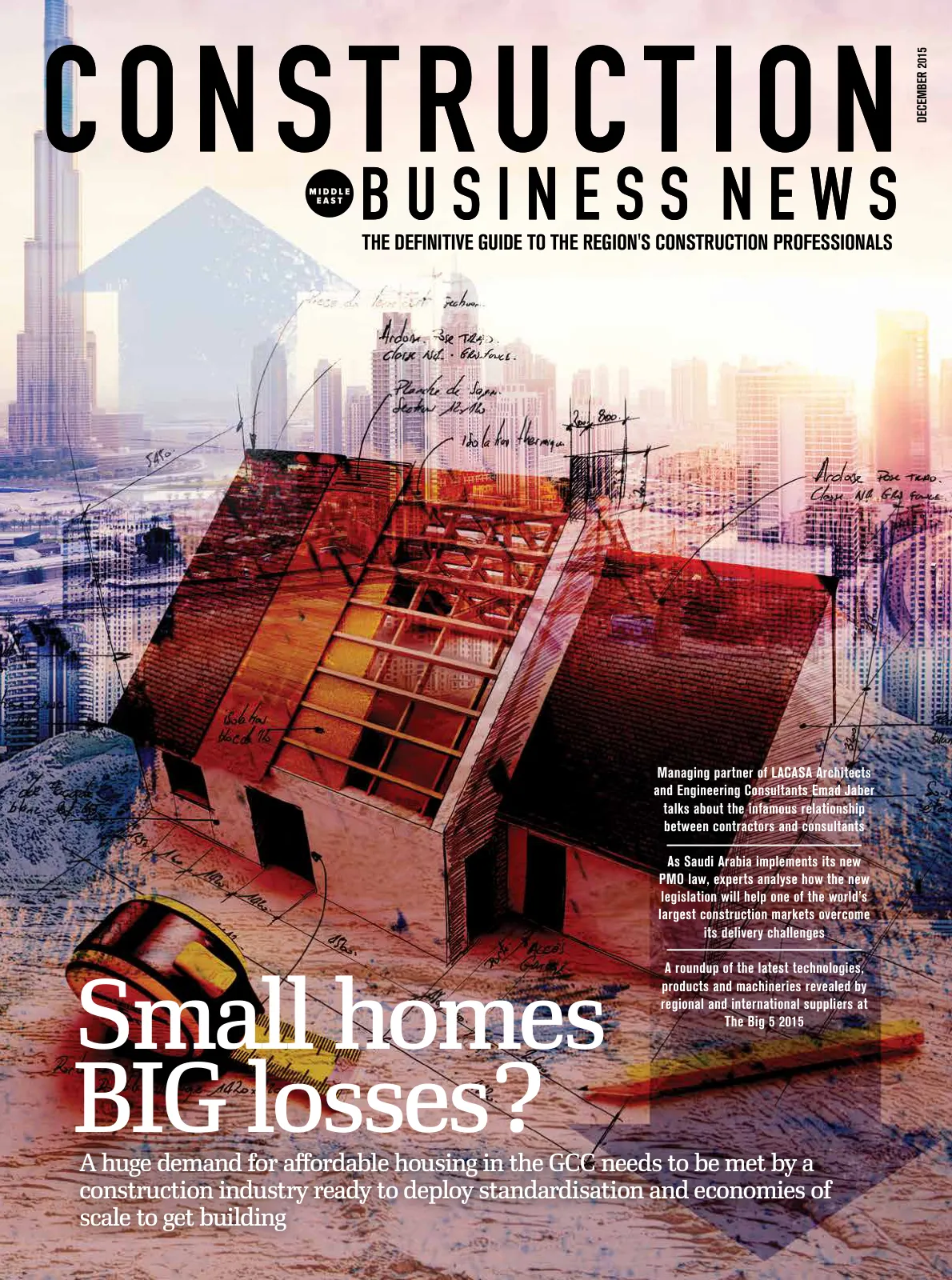
Construction Business News, December 2015
Page 1
THE DEFINITIVE GUIDE TO THE REGION'S CONSTRUCTION PROFESSIONALS
A huge demand for affordable housing in the GCC needs to be met by a
construction industry ready to deploy standardisation and economies of
scale to get building
December 2015
Managing partner of LACASA Architects
and Engineering Consultants Emad Jaber
talks about the infamous relationship
between contractors and consultants
As Saudi Arabia implements its new
PMO law, experts analyse how the new
legislation will help one of the world’s
largest construction markets overcome
its delivery challenges
A roundup of the latest technologies,
products and machineries revealed by
regional and international suppliers at
The Big 5 2015
Small homes
BIG losses?
Page 2
construction business news me December 2015
2
NEWS
OHSAS 18001 certified
ISO 9001, 14001 and
130+years of
project experience
LEED Platinum, LEED Gold
and LEED Silver Capability
End to End Integrated Solutions
Pioneering Engineering Construction since 1881
www.drakescull.com
700+
Projects Delivered
For over 130 years, Drake & Scull International PJSC has been shaping skylines and transforming the lifestyle of
communities around the world.
Drake & Scull is an industry leader, with a proven history of delivering more than 700 projects through its General
Contracting, Engineering, Rail, Oil & Gas, Water and Wastewater Treatment and Infrastructure development business
streamlines across the region.
Page 3
construction business news me December 2015
3
32
A huge demand for affordable housing
in the GCC needs to be met by a
construction industry ready to deploy
standardisation and economies of scale
to get building
EDITOR’S NOTE
NEWS
EVENT ROUNDUP
The Big 5
Leaders in Design MENA
SUPPLIER NEWS
IN PERSON
Managing partner of
Lacasa Architects and
Engineering Consultants
Emad Jaber talks about
the infamous relationship
between contractors and
consultants
ANALYSIS
Craig Gibson shares
the secret formula to
calculate contractors’
overhead charges
Winston and Strawn’s team
including partner examine
Dubai’s new PPP law set
to boost private sector
investments
SUSTAINABILITY
Shivram Mukherjee
analyses this year’s COP21
and looks into how the UAE
has prepared itself and its
construction industry to
adapt with the upcoming
changes
PROJECT REVIEW
Construction Business
News looks into the
largest building retrofit
project in the Middle East
6
8
16
22
24
28
38
40
42
44
cover story
32
16
contents
Page 4
construction business news me December 2015
4
S U B S C R I B E
c o n t r i b u t o r s
subscriptions@bncpublishing.net
Managing Director
Walid Zok
walid@bncpublishing.net
Director
Rabih Najm
rabih@bncpublishing.net
Director
Wissam Younane
wissam@bncpublishing.net
Group Publishing Director
Diarmuid O'Malley
dom@bncpublishing.net
Business Development Director
Rabih Naderi
rabih.naderi@bncpublishing.net
+966 50 328 9818
Group Editor
Melanie Mingas
melanie@bncpublishing.net
Editor
Lorraine Bangera
lorraine@bncpublishing.net
Art Director
Aaron Sutton
aaron@bncpublishing.net
Sales Manager
Mostafa Abdo
mostafa@bncpublishing.net
+966 56 6695 333
Group Sales Manager
Joe Taphouse
Joe@bncpublishing.net
Sales Manager
Vishvanath Shetty
vish@bncpublishing.net
+971 52 6745378
Marketing Executive
Mark Anthony Monzon
mark@bncpublishing.net
PO Box 502511 Dubai, United Arab Emirates
P +971 4 4200 506 | F +971 4 4200 196
For all commercial enquiries related to
Construction Business News ME contact
sales@bncpublishing.net T +971 55 339 5097
All rights reserved © 2015.
Opinions expressed are solely those of the contributors.
Construction Business News ME and all subsidiary
publications in the MENA region are officially licensed
exclusively to BNC Publishing in the MENA region by
Construction Business News ME.
No part of this magazine may be reproduced or
transmitted in any form or by any means without
written permission of the publisher.
Images used in Construction Business News ME
are credited when necessary. Attributed use of
copyrighted images with permission. All images not
credited courtesy Shutterstock.
Printed by International Printing Press www.ippuae.com
Stuart Matthews
Marlow McGuinness Ltd
-------
Joanne Bladd
Nurol Construction takes us around its current project, Bab Al
Qasr, in UAE’s capital
FORUM
As Saudi Arabia implements its new PMO law, experts analyse
how the new legislation will help one of the world’s largest
construction markets overcome its delivery challenges
COMMENT
Mustafa Pooya writes about how the Dubai real estate sector is
presently witnessing a price-stabilising period
Malcolm Dias discusses The recent deluge in Qatar and its
water-logged capital Doha
TECHNOLOGY
Phil Bernstein writes about revolutionary changes coming
up in the future where building won’t be built—it will be
manufactured
The Flux Innovation Lounge speaks with Construction Business
News ME about how creative industries could play a major role
in selling real estate
Q&A
Ashraf Al-Garf, CEO of Projacs, throws light on construction
management in the region and the benefits of collaboration
RSG International handed over Qasr Sabah project 90 days ahead
of schedule. Chair of RSG Raj Sahni talks about what it takes to
deliver on schedule
EDITOR’S pick
46
48
52
56
58
60
62
64
66
28
42
Page 5
Page 6
construction business news me December 2015
6
Affordable living
A continued influx of expatriate workers and
their families, in addition to the burgeoning
youth population across the GCC, has driven
the demand for affordable housing across the
Middle East to 3.5million units, according to
JLL. There are 820,000 middle income house-
holds in the UAE alone.
Add the numbers to the recent musings of
Arab News, which stated “a good housing
policy helps maintain political stability and
social order while preventing problems related
to homelessness, poverty and exclusion”, and
there is a clear and pressing need for govern-
ments to put some real force behind the afford-
able housing agendas.
There are a number of factors feeding into
the trend; the foreign nationals moving here
for work are no longer just expatriates, but
often emigrants also, looking for a permanent
home and economic stability.
Our cities are growing at a phenomenal rate:
according to a UN report by as much as 2.1%
a year every year, as people move away from
rural areas and towards the urban economic
hubs the 20th century created.
Compounding these issues, the GCC in par-
ticular has an almost unparalleled issue in that
far more than 50% of its population is under
the age of 30; looking for somewhere to live,
raise a family and launch a career, on some-
times stagnant salaries.
The need for affordable housing came into
the limelight in early 2003 when governments
observed a significant disparity between supply
and demand for affordable housing.
Gaining momentum after the financial cri-
sis in 2008, today the GCC has systems in
place, with the overall agenda of achieving
a well-balanced society. Affordable housing
without a doubt should be part of that story.
Not only does affordable living solve a de-
mand exceeding supply situation, but person-
ally I think this goes along with the region’s
agenda to make itself a sustainable space. By
incorporating affordable housing not only
will overall infrastructure improve but also
the wellbeing of residents.
All that being said there are several meas-
ure that have not been in place. Even though
flexible payment plans are being offered to
middle-income potential homebuyers, chal-
lenges still exist for the developers and con-
tractors. A few of those challenges include
the high cost of land in the region along with
the high cost of construction, which hinders
private developers from taking a more active
role in building affordable units.
Well-known developers including Emaar,
Nakheel, NShama and Dubai Properties
within the UAE have taken steps towards
reversing this trend. Other challenges such
as access to financial support or supportive
regulations are necessary to streamline things
into an orderly fashion so that potential
homebuyers can feel incubated by the sys-
tem.
Affordable housing has been on the agenda
for some time, with most governments tak-
ing the time create a framework that suits
everyone; even most tradeshows, including
the region-wide Cityscape exhibitions and
The Big 5, have addressed the issue of af-
fordable housing in 2015.
I also think affordable housing is a social
issue as much as an economic need.
While we must praise how the region has
recognised the importance of affordable
housing, Iook forward to seeing how it will
affect our construction, real estate and also
cultural and social landscape. What remains
to be addressed is the affordability of the
business model. Without government sup-
port in the form of incentives, the future
could become a very challenging time.
editor’s note
Lorraine Bangera
Editor
Page 7
construction business news me December 2015
7
Page 8
construction business news me December 2015
8
NEWS
Global developer, Crystal Lagoons, is set to launch its first project in India
with a 6.5 hectare lagoon in Pune situated in the West coast of India. The
project will be located at the heart of Dream City project, which is currently
under phase one of development. The one million square metre project will
be home to 8,000 luxury residential units and 50,000 people when completed.
A total of 100,000 cubic metres (310,600 gallons) of water will be required to
fill the six hectare lagoon, which is estimated to be a $200m investment and
one of the biggest lagoons in Asia once completed.
Under a phased development over a decade-long period, the lagoon is
scheduled to be operational upon completion of phase one of the project,
which has a scheduled launch date of Q2 2016.
Lagoons use up to 100 times fewer chemicals than traditional pool systems,
and only 2% of the energy required by conventional filtering technologies.
French company, Alstom, has started
the production of trainsets for the
upcoming Riyadh Metro in its Kato-
wice plant in Poland. The contract
was awarded to FAST consortium,
which Alstom is a part of, two years
ago by Arriyadh Development Author-
ity (ADA). The contract included the
design and construction of lines four,
five and six of the network. The Ka-
towice plant will be manufacturing
all 69 of the Metropolis trainsets, with
over 1,000 employees it is one of Al-
stom’s largest train manufacturing sites
in the world.
In the short-term, a full-size mock-up
of the Riyadh Metropolis trainset will
be unveiled in Riyadh.
The driverless train will be 100%
motorized and composed of two cars
per set and is 36 metres long. Alstom
will provide Urbalis, its CBTC signal-
ling solution, as well as the power
supply and Alstom’s energy recovery
system HESOP. All sub systems have
been optimised together so as to re-
duce energy consumption.
Alstom begins train production for
the Riyadh Metro
Crystal Lagoons to build largest
manmade lagoon in India
Upcoming Crystal Lagoons project
Page 9
construction business news me December 2015
9
Industry experts talked about the
adoption of the latest construction
software to ensure efficient and swift
delivery of projects worth almost $3tr
at The Big 5 2015.
According to recently launched report
by Deloitte, GCC Powers of Construc-
tion 2015, the region’s construction
pipeline totals $2.8tr. These projects in-
clude mixed-use mega developments,
airports, seaports and other transport
infrastructure projects.
As the industry matures, architects,
engineers, contractors and real es-
tate companies have been increasing
their demand for building information
modelling (BIM) software to create 3D
constructible models. These models
not only enhance collaboration, but
also increase visibility and efficiency
across the design, build, and operate
stages of projects.
Paul Wallett, area business director at
Tekla Middle East, said that the Middle
East is seeing a nationwide transforma-
tion in construction innovation, with
projects for mega-events such as World
Expo 2020 in Dubai and 2022 FIFA World
Cup Qatar stretching design boundaries.
“Advancing government BIM mandates
further demonstrates the Middle East’s
desire to be on a par with global inno-
vators in the construction field.”
GCC Hosts Record
High $3tr in
Construction
Projects
Majority of UAE residents prefer
renting property
Real estate prices could be preventing 76% of UAE residents form purchas-
ing property in the UAE, according to a survey conducted by compareit4me
group. This is despite apartment sale prices in Dubai going down by 3.6%
and villa prices dropping by 3.7% from April 2014 to April 2015.
The survey also noted that 54% of the residents opted for rentals because
they were unsure of how long they would live in the region.
That being said, a survey by US executive recruitment company, Stanton
Chase, found that expatriates are now staying in the UAE twice as long as
they used to five years ago. The average stay of senior professionals has in-
creased to four and a half years.
Jon Richards, CEO of compareit4me.com, said: “The number of people
staying beyond two years is increasing, so it’s worth residents doing the sums
to calculate if home ownership would be more beneficial for them.”
According to Dubai Land Department, the number of those residents buy-
ing property with mortgage has increased by 44%. Recent home financing
solutions and competitive mortgage rates given by UAE banks have actively
encouraged more residents to buy property.
Richards said: “The long term outlook for the real estate market in Dubai looks
favourable for investors, particularly in the run up to the Dubai Expo. However,
there’s every chance we could see prices going up and down before that, so it’s
important longer-term investments are considered.”
Dubai Marina and Jumeirah
Lakes Towers, Dubai
Paul Wallett
Page 10
construction business news me December 2015
10
NEWS
The Abu Dhabi Urban Planning Coun-
cil (UPC) briefed 43 government enti-
ties and developers on advancing a
data collection project for development
in Al Ain and Al Gharbia. The initiative
aims to create a Capital Project Plans
(CPP) for the Al Gharbia and Al Ain re-
gions, and builds on the capital’s desire
to fully integrate data.
The briefing was in the same format
as the CPP for the Abu Dhabi Metro-
politan Area where UPC collected and
spatially mapped all of the projects
that require government funding for
Abu Dhabi.
Representatives from Al Ain and Al
Gharbia’s government entities were in-
vited to attend the meeting to explain
all of the requirements for the project
and anticipated timings. The project is
due to be completed in Q1 2016.
Abdulla Al Sahi, acting executive di-
rector of the planning and infrastruc-
ture sector at UPC, said: “The formal in-
tegration of data regarding current and
future projects will allow for enhanced
decision making and the ability to bet-
ter identify and prioritise key projects.
This will ensure that the Abu Dhabi
Emirate continues to move forward in
meeting the needs of its communities
with regards to community facility proj-
ects, while also remaining on track in
terms of its commercial, industrial and
infrastructure-based projects.”
Capital Projects
Plan to be
developed for Al
Ain and Al Gharbia
•
Nakheel Mall and The Pointe on Palm Jumeirah
•
Deira Mall and Deira Islands Night Souk at the new Deira Is-
lands coastal city
•
Al Khail Avenue and The Circle Mall at Jumeirah Village
•
Warsan Souk at Warsan Village
•
two major extensions to the existing Ibn Battuta Mall
•
a large expansion at Dragon Mart
Projects at various stages of
design and construction:
UAE-based developer Nakheel high-
lighted AED14.5bn worth of projects
(in construction costs) at MAPIC, the
annual international retail real estate
show in Cannes, France. This year,
the 21st annual gathering brought
together more than 8,400 interna-
tional participants, including over
2,400 retailers and 2,300 property
developers for three days from 18 to
20 November.
Nakheel has more than 15 million
sq.ft of shop space across its 14 exist-
ing and upcoming projects.
Currently there is over 11 million
sq.ft of retail space in the pipeline,
with 10 projects anticipated for deliv-
ery over the next three to four years.
Nakheel highlights
projects worth
AED14.5bn at MAPIC 2015
Nakheel's Deira Islands
Abdulla Al Sahi
Page 11
Page 12
construction business news me December 2015
12
NEWS
Dr Ali Hamed Al-Mulla talks about
GCC and Korean partnership
The Gulf Organization for Industrial Consulting (GOIC) and
Korea Institute for Industrial Economics and Trade (KIET)
organised a workshop on industrial diversification and job
creation between the GCC and the Republic of Korea last
month. In his session, Al Mulla emphasised how the GCC
has provided Korea with opportunities in the construction
sector including the building of expressways, seaports, and
industrial plants.
He said that about 39.8% of the foreign construction proj-
ects Korean companies have won have been in the GCC. He
added that the effectiveness of this economic partnership
between the GCC and Korea relied heavily on volatile oil
prices and the the GCC’s construction market, rather than
on more stable bases for bilateral cooperation. “GCC-Korea
economic relations need to be diversified to include other
industrial sectors, and the collaboration between GCC and
Korea should also include greater involvement of private
sector MSEs and entrepreneurs.”
The GCC supplied 71.2 % of Korea’s crude oil imports and
52.4 % of its natural gas imports in 2013. Following the sus-
pension of free trade agreement (FTA) negotiations in 2009,
the two are now considering re-establishing the deal.
STR Global Construction Pipeline Re-
port launched in October 2015 reveals
an increase in hotels under construction
in the Middle East and Africa region.
The report stated that there are 781
hotels currently under contract in the re-
gion. This represents a 29.1% increase
in rooms compared with October 2014
and a 43.1% year-over-year increase in
rooms under construction.
The under contract data includes proj-
ects under construction, in final plan-
ning and planning stages. However, the
data does not include the projects under
the unconfirmed stage.
In October 2015, the region reported
105,177 rooms in 407 hotels under con-
struction for the month.
Sister publication, Hotel News ME,
will publish a full analysis and round-
up of the regional pipeline in its January
issue, detailing all the major openings
planned for 2016.
Hotels under construction in Middle
East increases by 29.1%
Ongoing construction in Downtown Dubai
Chinese delegation attended a two-day fact-finding mission
to study Estidama, the Abu Dhabi Urban Planning Council’s
(UPC) sustainability programme.
The delegation, represented the Guangzhou International
Award for Urban Innovation, recognises innovation in im-
proving social, economic and environmental sustainability in
cities and regions.
The delegation was given a detailed insight into the work-
ings of the UPC’s Estidama Pearl Rating System (PRS), Abu
Dhabi’s mandatory sustainability rating system, which guides
development projects through design, construction and op-
eration, along with a tour of Masdar City.
“The fact that Estidama was shortlisted for such a prestigious
award and is now the basis of a visit by the Guangzhou del-
egation is further demonstration that it is being recognised
beyond this region as a sustainability programme that features
a unique combination of global and local best practice,” said
Mohamed Al Khadar, executive director of urban develop-
ment and Estidama sector at UPC.
Chinese delegation
studies UPC’s
Estidama system
Page 13
Page 14
construction business news me December 2015
14
NEWS
China Trade Week
7 - 9 December 2015
ADNEC
Under China’s “One Belt, One Road”
initiative, a framework for organising
multinational economic development
and trade, China Trade Week (CTW)
provides Chinese companies oppor-
tunity to meet, discuss and develop
trading and business relationships with
the regional business community, in a
number of key commercial sectors.
It will feature Chinese businesses
from sectors such as construction
materials, PMV, automotive parts
and accessories.
HVACR Expo Saudi
11 - 13 January
Jeddah Centre for Forums and
Events
The HVACR Expo Saudi will address
products, training, and education solu-
tions for the entire heating, ventilating
and air-conditioning and refrigeration
(HVACR) industry.
With multi-billion dollar develop-
ments and mega projects underway
in the Kingdom there is proven de-
mand for HVACR products, services,
and technologies.
The event is will be organised by
the same team behind The Big 5
Saudi, dmg events, and the owners of
the largest HVACR buyer database in
the Kingdom of Saudi Arabia which
will ensure a meeting platform with
thousands of buyers searching for the
latest products and services in HVACR.
Architectural and design practice Perkins+Will Middle East, won two awards
at the 2015 Arabian Property Awards. The firm was recognised for the ‘Best
Residential High-Rise’ for Ellington Group’s DT1 in Dubai, and ‘Best Hotel
Architecture’ for the Marriott-branded Diplomatic Quarter Hotel in Riyadh,
Saudi Arabia
The 20-storey DT1 tower, is an innovative residential project which is situated
in Downtown Dubai, covers approximately 20,000sqm and rises to 72 metres.
While the Best Hotel Architecture’ for the low-rise design was awarded to
the 5-star Marriott-branded Diplomatic Quarter Hotel in Riyadh, Saudi Arabia.
Owned by Saudi-based Dur Hospitality, the meandering three-storey structure,
covers over 40,000 square metres and was inspired by the beauty of the coun-
try’s wadis and oases.
The event took place at the JW Marriott Marquis in Dubai, on 12 November 2015.
Perkins+Will recognised at Arabian
Property Awards
Save the date
REC will power a new solar installation for Red-
tag Group as one of the first projects to be com-
pleted as part of a new UAE initiative, Shams
Dubai, to promote renewable energy.
The European solar panel manufacturer is
not only providing the photovoltaic (PV) pan-
els but the full EPC expertise. The rooftop
installation extends over 7,000m2 and will be
located in fashion retailer, Redtag’s, logistics
and warehouse centre.
It will be one of the first installations under
Dubai’s new renewable metering scheme for re-
newable energies.
Luc Graré, SVP EMEA at REC, said: “It is a
very straight forward scheme and we are con-
fident that the new programme will give solar
another push in the region. We expect new
installations in particular from the commercial
rooftop segment.”
The solar panels (2,161 in total) are expected
to generate 904,000kWh of electricity, reducing
the CO2 footprint by 550 metric tonnes per year.
REC to install solar panels in Redtag’s Dubai-
based centre
Diplomatic quarter at the hotel in Riyadh
Luc Graré, SVP EMEA at REC
Page 15
construction business news me December 2015
15
Volvo Construction Equipment EMEA
and FAMCO organised a customer event
at Hilton Ras Al Khaimah on 26 Novem-
ber 2015, to conduct a regional launch
of Volvo L120Gz wheel loaders and
EC750D excavators.
The event, similar but a smaller ver-
sion of the machinery show held in
Sweden (Volvo Days), showcased new-
ly launched machinery along with its
existing Volvo articulated hauler and
road machinery.
The Volvo L120Gz wheel loader in-
cludes a fully automated power shift
that ensures optimal operation by ad-
justing the machine gear, load-sensing
hydraulics which supply power to the
hydraulic functions only when needed,
and an eco pedal that ensures reduced
fuel consumption by applying mechani-
cal push-back force.
The Volvo EC750D excavator in-
cludes an ECO mode which saves fuel,
an electro hydraulic system that uses
intelligent technology to control on-
demand flow and reduce losses in the
hydraulic circuit. The D16 Engine in
this machinery delivers 11% increased
horsepower for high productivity and
increased fuel efficiency.
During the event, selected members
from the Volvo team along with a num-
ber of interested buyers from around
the region were given a chance see a
machinery show. This was an opportu-
nity for them to witness the machinery
in action.
After a short presentation and the ma-
chinery show, the potential buyers had
the opportunity to try out the machin-
ery themselves. Bahrain-based Steven
Edward Hanahoe, workshop manager
of NASS Asphalt, was impressed by the
show and the machinery showcased. He
said: “Some of the machinery displayed
at the show were very impressive.”
Fadi S. Nimri, service and operations
Driving force
manager of UAE-based Transmak, said
that he enjoyed the show and really
got a feel of all the machinery, which
is a very important criteria for purchas-
ing. He was particularly fascinated with
the Volvo articulated haulers which he
deemed to be quite remarkable.
Frank O’Conner, managing director
of FAMCO operations in the UAE, said
“the event had a great turnout, and
showcased how important customer
satisfaction is to Volvo CE.”
Volvo Construction Equipment showcases new ranges of innovative
construction machinery at machinery show in Ras Al Khaimah
Testing of Volvo CE Machinery
Demonstration of new ranges
Presentation of new ranges
Page 16
construction business news me December 2015
16
Jafza to double construction sector growth in four years
The building and construction sector
in Jebel Ali Free Zone (Jafza), expects
to double its growth over the coming
four years, following results which
demonstrate a 74% growth since 2010.
Revealing the sector’s value has
increased from AED10.7 billion in
2009 to AED18.6 billion over the
same period, future growth will
largely be driven by the continued
focus of GCC countries on building
economic infrastructure and stimu-
lus generated by Dubai 2020-related
infrastructure projects.
HE Sultan Ahmed Bin Sulayem,
chairperson of DP World and Ports,
Customs and Free Zone Corporation,
said: “Jafza’s evolution as a global
business hub hinges around its com-
mitment to excellence in terms of
products, services and overall busi-
ness ecosystem, which is fully in sync
with the vision of His Highness Sheikh
Mohammed Bin Rashid Al Maktoum,
Vice-President and Prime Minister
of the UAE and Ruler of Dubai, to
position the Emirate as the world’s
top business centre and the most
favoured investment destination.”
Jafza is currently home to over 800
world’s steel, building material and
other construction sector-related com-
panies such as ArcelorMittal, Tianjin
Pipes, Tata Steel, Conares, China Na-
tional Building Group, Danube, Saint-
Gobain Gyproc, Petrogas Piping, Van
Oord, Hitachi Construction Machinery,
Hyundai Engineering and Construc-
tion Company among others. Most of
these companies have set-up their re-
gional headquarters in Jafza to serve
the entire region most efficiently.
Fino will expand operations to Sau-
di Arabia in Q1, 2016, on the back
of growing demand in the infra-
structure and hospitality sectors,
managing partner Talal Saeed told
Construction Business News ME, during
the exhibition.
He explained: “Due to the reli-
gious pilgrimage, Hajj, Saudi Arabia
has great potential in the hospital-
ity sector as millions of pilgrims
pour in every year. Due to which
there are a large number of ho-
tels in the pipeline, as well as proj-
ects like Riyadh Metro and new real
estate developments.”
Fino is headquartered in the UAE
with a second office in Qatar. Saeed
observes the GCC as a whole is a lu-
crative market but comes with its fair
share of challenges. In Saudi Arabia,
he said that one of the major chal-
lenges is acquiring visas (especially
for labour), while Qatar has the limi-
tation of bringing skilled workforce
from only certain nationalities.
He observes that UAE has compara-
tively fewer limitations, however,
dealing with the tough competition
in the market can pose challenges.
Saudi Arabia’s market demands
interior finishing
Event Roundup - Big 5
Page 17
construction business news me December 2015
17
BIG 5 NEWS
Over the last few years, steel in the
UAE market has witnessed a stable an-
nual growth of 5 to 15%. At The Big
5 show, CEO of Conares Bharat Bhatia
says that as the number of projects in-
crease, traders in the UAE are keen to
buy from local manufacturers in order
to save inventory cost and avoid risk of
price fluctuations.
“There are positive expectations on
steel demand, which will grow substan-
tially from 2016 onwards. This will have
an additional growth of 10% on a yearly
basis from 2017. From the steel industry
standpoint, local manufacturers will be
in a strong position to cater to each of
the upcoming projects,” he said.
Keeping this in mind, steel manufac-
turer Conares is planning to expand
within the domestic market as well as
explore export opportunities.
MEA managing director Franz Freiherr von
Redwitz, revealed MAN Trucks has just
signed its first contract with a partner in
Iran since economic sanctions were eased,
following years of restricted trading.
Commenting on the deal, which will see a
fleet of vehicles delivered in Q1, 2016, Redwitz
said: “We are in the process of rebuilding
[business] in Iran, as European brands have not
done business there for some time.
“We have a lot of new contracts and I
have just this morning finalised a contract
which has now been signed off between
the German High Court and Iranian
Embassy, and is on its way to Iran for
official registration.”
Breaking the news at The Big 5, Redwitz
also detailed MAN’s new Ecoline concept,
which was unveiled at the show. Ecoline
is designed to tackle the use of counterfeit
parts in the brand’s vehicles, and also
place focus on aftersales, during current
market difficulties.
“Counterfeit parts are a threat to the
quality of our products and we have
two ways to work against that. Firstly,
to keep the loyalty of the customer so
they only come to our workshop and by
selling vehicles with repair maintenance
contracts, under a fixed cost per annum.
“But now, also we have the Ecoline
range of parts, which are a wide range of
refurbished products which we can sell up
to 30% cheaper than new parts,” he added.
After spending two years overcoming
import restrictions on used parts in
numerous markets, Ecoline is now available
in all 14 of MAN’s MEA markets and
received a positive response, according to
Redwitz, during The Big 5 debut.
“One thing we are pushing big time
is the after sales business and keeping
the vehicles on the road. Where liquidity
is tough or prices are bad, we can
compensate with initiatives to keep the
vehicles on the road,” he added.
Celebrating 100 years of the brand, MAN
also previewed its EURO 5 TGX 6x4 tractor
head; with a gross vehicle weight of 33
tons and gross combination weight of 180
tons, it boasts up to 540 horse power, and
is adapted for the local market.
Delivery of this head will commence in
late 2016.
MAN announces new Iran contract and
debuts new vehicle and concept
Conares CEO
predicts the
steel industry to
grow by 2020
MAN managing director Franz
Freiherr von Redwitz
Bharat Bhatia, Conares CEO
Page 18
construction business news me December 2015
18
BIG 5 N
Event Roundup - Big 5
Juno Enterprises, a multi-product dis-
tribution company, showcased the lat-
est addition to its product line, Arbor
Lighting Towers. The compact design,
includes a vertical mast tower that of-
fers complete flexibility with fixture
ground access and 360 degree mast or
light rotation.
“The product is distinct in the mar-
ket because of various features such as
the telescopic mast can extend up to
8 metres while it has a certified wind
stability of up to 110km/h,” said Rohan
Kapur, business development manager
at Juno Enterprises.
The product underwent almost two
years for R&D and finding a manufac-
turer. The product has currently been
in the market for 18 months, while the
company is relatively new in the mar-
ket, with under two years’ experience.
Kapur is currently looking for deal-
ers in the market in the UAE, fol-
lowed with sub-dealers in Qatar, Oman
and Kuwait.
French manufacturer Atlantic, com-
mercially launched its new solar water
heater, a high-end forced circulation
solar solution with indoor tank and
outdoor solar panel.
Utilising
strengthened
polyure-
thane insulation and low consumption
pump integrated, Solerio Optimum al-
lows users to save 70% energy and is
A class with the new European Energy
Efficiency Regulation (ErP).
With tank capacities from 150 to
400L and equipped with steatite
backup heating element and new el-
liptic solar exchanger, the product is
described as a “user friendly water
heater which is the optimal renewable
energy solution for water heaters in
the Middle East.”
Atlantic dedicates an average of 4%
of its turnover to R&D, focusing on the
production of more efficient renewable
energies solutions. As a result, 2015 was
also marked with Atlantic’s upgrade of
its heat pump water heater and the
worldwide launch of its new ONDEO
range of small capacity compact square
water heater from 10 to 30L.
Speaking at the Sustainability Work-
shop, CEO of DC Pro Engineering
George Berbari encouraged the GCC’s
heating, ventilation and air conditioning
(HVAC) industry to adopt new energy-
efficient technologies.
He said: “The air-cooled systems con-
tinue to dominate 70% of the HVAC mar-
ket without offering any significant power
saving features.”
He raised concerns about power sav-
ing and refrigerant safety issues in VRF
as well as in the design of fresh air sys-
tems. He recommended the upgrading
of existing district cooling systems from
partial to 100% usage of the thermal stor-
age and treated sewage effluent (TSE).
Berbari also stressed that district cooling
has to embrace renewable energy such
as solar PV (onsite or remote) and deep
geothermal energy, and move into full
tri-generation using bio fuels synchro-
nised with renewables. This, according
to Berbari, would save 75% primary en-
ergy as compared with the current elec-
tric district cooling.
Juno showcases
8m long flexible
lighting tower
Atlantic launches solar water heater
DC Pro CEO urges HVAC market to shift to sustainable
George Berbari
Juno’s Arbor Lighting Tower
Nathan Waugh, event director for Middle East Concrete and PMV Live, revealed that the
dollar value of the free CPD-certified education programmes at Big 5, 2015 amounts to
$250,000 for the GCC construction industry. Visitors to both shows had access to 75 free
CPD-certified workshops led by industry experts from their respective fields.
Did you know?
Page 19
construction business news me December 2015
19
NEWS
Receiving 40% more nominations than
in 2014, The GAIA Awards, took place
during day three of The Big 5, with Ba-
salt Rock Composite FZE taking the top
prize to walk away with a $50,000 mar-
keting package.
In the judging process, two selections
rounds were held for submissions based
on the potential to impact people, plan-
et, and profit. Following which winners
from six categories were chosen, includ-
ing coatings adhesives and sealants; gen-
eral construction; HVAC; marble stone
and ceramics; windows, doors and clad-
ding; and innovations.
Speaking after the ceremony Nathan
Waugh, event director for Middle East
Concrete said: “To have an exhibitor
from Middle East Concrete win the 2015
GAIA Awards is a tremendous endorse-
ment of the show and the caliber of the
companies and products at the event,
and I would like to congratulate Basalt
Rock Composite on their success.”
The 2015 winners are:
• Coatings adhesives and sealants:
Derbipure, by Derbipure
• General construction: Green Perspec-
tives for Ecotile
• HVAC: Knauf Insulation for Fibre
Glass Insulation
• Marble stone and ceramics: Making
Ground for EVAGLOW
• Windows, doors and cladding:
Glazetech for AL. Roll Pergola
• Innovations: Basalt Rock Composite,
for its Basalt composite rebar
Emrah Duman, Ford Trucks’ international markets director said: “The Middle East
is a priority region in Ford Trucks’ growth plans. Following the UAE and Saudi
Arabia, where we launched our new facilities last year, we plan to expand our
sales and service network into Oman, Qatar, Bahrain and Iraq markets. We be-
lieve our product line-up is well ahead of the competition, offering solutions to
different market needs, such as hot climate package specially developed for GCC
region and complete truck solutions for all Middle East markets. Additionally, our
expanded network will provide customers with a strong service support and spare
parts availability in the near future. We are confident that our world-class products
and growing network will lead to stronger presence of Ford Trucks in the region.”
The GAIA Awards
Ford Trucks unveils 2016 range
Ford Trucks showcases
2016 range at Big 5
Fila Surface Care Solutions promoted its
new rust stain remover and silicon resi-
due remover during Big 5.
“There is a high demand for our prod-
ucts in the region as the quality of finish-
es has become essential to developers.
We have been listening to their feedback
-since our first participation in the Big 5
in 2006, and in answer to their demand
we have developed two new products
that are fast, effective and very easy to
apply,” said Francesco Pettenon, Fila ME.
“FILANO RUST is a ready to use rust
stain remover applicable even on deli-
cate surfaces. FILAZERO SIL is extremely
effective at removing residue of silicone,
glue, adhesive tape, wax and old labels
from any surface,” he added.
Fila launches adapt rust stain remover
Francesco Pettenon
Page 20
Page 21
Page 22
construction business news me December 2015
22
Event review
O
rganized by International Busi-
ness Council, Leaders in Design
MENA saw members of the design
community gather to discuss the latest
design trends across commercial, resi-
dential, retail and hospitality locations.
Delegates included architects, inte-
rior designers and developers, as well
as organisations such as the American
Institute of Architects (AIA Middle
East), Association of Professional Inte-
rior Designers (APID), The Middle East
Council of Shopping Centres (MECSC),
RIBA Gulf, and Emirates Green Build-
ing Council.
“Leaders in Design MENA is turning
out to be a brand that the Middle East
and North African architecture and
design community wants to be associ-
Leading Design
The fifth edition of Leaders in Design MENA took place last month and
was attended by 200 industry leaders including architects, interior
designers, developers and Construction Business News ME
ated with and take active part in. It is
one platform where future projects are
discussed and business strategies for
the biggest firms are decided,” stated
Elena Jassim, CEO of International
Business Council.
“We are thankful for all the sup-
port we received and look forward to
bringing more in depth and insightful
business opportunities to the region,
for instance our upcoming Lead-
ers in Architecture MENA and global
architecture awards that will take place
in April 2016 in Dubai, gathering the
global architecture and design commu-
nity and highlighting the crucial role
the region plays in setting worldwide
trends as well as promoting global
cooperation,” she added.
• Storytelling in Retail Interior Design
• Office Space Evolution
• Hot or Not: Latest Trends in Residential Design
• Cultural Diversity in Design
• Trends in Healthcare Design
• The Hotel of the Future
• Rashid Doleh, co-founder and managing
partner of mSquared
• Andrew Linwood, head of design of Areen
Hospitality
• Francis Gallagher, principal and MD of HKS
• Elvira Muñoz, director of AECOM
• Saeed Alabbar, chairperson, Emirates Green
Building Council.
Leaders in Design MENA 2015 covered:
Speaker highlights
Fit out Panel at
Leaders in Design
MENA 2015
Roger Marien speaks
at Leaders in Design
MENA 2015
Page 23
construction business news me December 2015
23
BROUGHT TO YOU BY THE ORGANISERS OF
11 - 13 JANUARY 2016
JEDDAH CENTRE FOR FORUMS & EVENTS
GET YOUR FREE TICKET AT WWW.HVACREXPOSAUDI.COM
ARE YOU
IN THE HVACR
INDUSTRY?
Confirmed Exhibitors
Platinum Sponsor
Official European
Partner Association
Knowledge
Partner
Under the Patronage of Mr. Adnan Mandourah, Secretary General,
Jeddah Chamber of Commerce and Industry (JCCI)
NETWORK
WITH INDUSTRY EXPERTS
SOURCE
100+ HVACR RELATED
PRODUCTS
GET
CERTIFIED
FOR WORKSHOPS
ATTENDED AT THE EVENT
FREE
THE EXHIBITION &
WORKSHOPS ARE ALL FREE
TO ATTEND
Page 24
construction business news me December 2015
24
Pelican Products opens its first distribution cen-
tre in the Middle East on 11 November 2015.
The new logistics centre based in Dubai also
includes an office for the local team.
Piero Marigo, EMEA MD of Pelican Products,
said that with the new distribution centre, the
company can now store inventory in the region
to optimise customer service, improve delivery
times and make smaller shipments economical-
ly viable. “With our newly expanded sales and
customer service team in place, our company is
well positioned to help accelerate our custom-
ers’ business.”
In addition, Pelican has chosen Danzas (DHL)
as their third party logistics partner.
“Danzas AEI Emirates LCC is known in this
region of the world for its expertise in transpor-
tation, customs and entry/export documentation
which of course will be of great service to our
existing and new customers,” said Alex Spaans,
director of supply chain and operations EMEA at
Pelican Products.
T
he GCC plans to build
$115bn worth of rail proj-
ects and should pronounce its
focus on functional stations to
enhance take up of passenger
services. Frans van de Laak,
general manager at Hunter
Douglas Middle East, said that
while the GCC countries are
constructing a large number
of rail projects, in order for
them to succeed in growing
strong user numbers they
need to create uncluttered,
well-lit stations where travel-
lers feel comfortable.
He said: “Ceilings play an
important part in enhancing
the traveller experience, as
they can absorb sound, lead
travellers toward trains, and
make travellers feel safe by
providing human-sized pro-
portions and ample lighting.”
In both the Dubai Metro’s
Union Station, one of the
busiest stations in the system,
and the Delft Railway Station,
Hunter Douglas installed ceil-
ings with tapered baffles of
extruded aluminium. These
ceilings have the strength to
half reverberation time of tra-
ditional train stations, while
absorbing the noise of trains
and travellers.
An important factor in
making sure travellers in an
underground station feel safe
is light, which is why in be-
tween the baffles, artificial
lighting has been installed.
At 110 gloss units, the baffles
have an exceptional gloss
level for reflecting light. Spe-
cial weather-resistant coat-
ings can also reflect daylight.
Regional metro projects in-
clude the Dubai Metro expan-
sion, construction in Doha,
Qatar, and Riyadh, Saudi
Arabia, and plans for metros
in Jeddah, Medina, and Dam-
mam in the Kingdom.
N
ational Aluminium Prod-
ucts Company SAOG
(NAPCO) has revealed tre-
mendous growth in domes-
tic and international markets.
Its revenue for the first nine
months of 2015 is $48.05m ,
which is a 37% increase from
the revenue generated same
time last year.
The company’s net profit,
$1.5m, has also increased by
20% during the same period
of the previous year.
Robert Holtkamp, CEO
of NAPCO, said: “The GCC
is bullish in its economic
growth because of contin-
ued infrastructure devel-
opment that has created
opportunities for key play-
ers such as NAPCO. We re-
main optimistic about our
growth in the near future
because of our high-quality
products, better customer
service, and quicker deliv-
ery periods.”
Hunter Douglas works on
bettering rail projects
NAPCO’s revenue reveals tremendous growth
Pelican Products announce
expansion in the Middle East
SUPPLIERS News
Dubai Metro station
Page 25
Page 26
construction business news me December 2015
26
Bentley Systems announced the general access of its new Sewer-
GEMS, SewerCAD, StormCAD, and CivilStorm V8i products for the
analysis and design of wastewater and storm-water systems.
The softwares will be available as stand-alone applications to run
on CAD and GIS platforms. In addition, the V8i (SELECTseries 5) sewer
and stormwater products can now be used from within the V8i (SE-
LECTseries 4) versions of OpenRoads-based products – combining 3D
design and hydraulic analysis capabilities in the same platform.
Chris Haines, senior civil engineer of drainage and utilities at
Parsons, said: “The integration of Bentley’s OpenRoads civil design
functionality with the advanced capabilities of Bentley’s storm and
sewer analysis products will be a huge benefit to productivity and
quality for our highway drainage design workflows.”
Gregg Herrin, Bentley Systems director of product management,
hydraulics and hydrology, said, “With these new releases, the automated
hydraulic design functionality of our sewer and storm products can be
effortlessly combined with the 3D physical design and terrain model-
ing capabilities of Bentley’s other civil products. From an information
mobility standpoint, this has a direct and substantial positive impact on
roadway, site, and municipal work where hydraulic engineering is just
one part of a much larger project.”
T
aj Concrete has opened
a training facility in
Dubai on 10 November
2015, with classrooms and
workshops to train hun-
dreds of students how to
use
decorative
concrete
in construction.
Acoording
to
Matthew
Burns, general manager of
Taj Concrete, there is a huge
scope for a decorative con-
crete market, as a significant
increase in demand has left
the industry short of supply.
He explained: “In less
than six months I’ve had
over 12,000 visits to my
website. I’m also getting
calls from contractors be-
cause there are not enough
people in the industry who
understand how to use it.
“Our training facility com-
bines lectures with hands-on
training using a four week
intensive programme.”
He said that many of the
current crop of young peo-
ple that he trains are being
sent by companies in Afri-
ca, but that the potential is
also there for people in the
Middle East to tap into this
thriving industry at a time
when regional demand is
higher than it’s ever been.
Building on this momento,
Burns was among a team of
experts leading a free work-
shop at this year’s Middle
East Concrete exhibition at
Dubai World Trade Centre
from 23-26 November 2015.
D
orma Gulf launched its
new product Mundus,
on 9 November 2015, for
easy installation with multi-
dimensional adjustment.
The new design works
with any of the standard
toughened-glass
assem-
blies, and room structures
enabling easy installation
and adjustment irrespective
of the application and situ-
ation.
Earlier this year, Mundus
was awarded the German
Design Council’s Interior In-
novation Award –2015.
Noushath Ahamed, prod-
uct marketing manager at
DORMA Gulf, said: “The
key feature of Mundus that
tops the list is the fittings
which come with an inte-
grated
multi-dimensional
adjustability, allowing for a
choice of pivot points be-
tween 52 and 73mm and
a perfect alignment of the
glass panels. The possible
glass
thicknesses
ranges
from 8 to 22mm; the glass
type used can be single
pane toughened glass or
laminated safety glass.”
New construction school
for decorative concrete
Dorma launches Mundus
products in GCC
Bentley opens applications for water systems
SUPPLIERS News
For more news about suppliers and
the industry, visit www.cbnme.com
Page 27
Page 28
construction business news me December 2015
28
Construction
frenemies
Contractor-turned-consultant, managing partner of
Lacasa Architects and Engineering Consultants
Emad Jaber talks about the infamous relationship
between contractor and consultant and how his
experience in contracting has helped bridge the gap.
Lorraine Bangera writes
IN PERSON
Page 29
construction business news me December 2015
29
E
mad Jaber, managing part-
ner of Lacasa, has been
in the Gulf for more than
31 years. After working
for almost two decades in
the industry, Jaber realised
that he wanted to implement his own
vision rather than that of others, and de-
cided to start his own consultancy.
In 2006, Jaber and co-founder
Nabil Al Khaja started their own firm,
Lacasa, with the connections, experi-
ence and the technical know-how re-
quired to bring what they saw lacking
in the market.
Before launching his own business,
Jaber used to be the director of manage-
ment in one of the biggest consultan-
cies in Dubai, he was in that position for
nine years from 1997 to 2006.
The experience he had gathered in
the field for those nine years was like a
stepping stone. He was able to meet the
right clients, establish relationships and
get to know how the business works
from the inside.
He observes that the key while start-
ing your own business is recognising
what is missing in the market. “You
learn from every experience and need
to take the right calculated risks.”
During the opening of his business
on 1 June 2006, Jaber was not alone.
He started with 22 employees, which
turned into 250 employees by mid-Au-
gust 2008. He admits the expansion was
rapid. “We had a chance to capitalise on
the boom in the market in Dubai at the
time and the good reputation we had
personally made.”
He explains that though the company
did not have a portfolio, it managed to
get contracts based on personal commit-
ments made from relationships in the in-
dustry. “In 2008, we were handling proj-
ects that were worth AED45bn which
really gives an idea of the confidence
and trust the clients had in us.”
A turn of events
During the financial crisis in 2008, Laca-
sa had only one office located in Dubai
and it was unfortunately one of the busi-
nesses that was drastically affected. Most
of the company had to be restructured,
and employees had to be laid-off. From
a total of 250 employees, the headcount
dropped to 70.
“The fact that we had only one of-
fice in the region,” Jaber observes, “was
a crucial reason we had to layoff em-
ployees.” Jaber and his team started to
consider expanding the brand across
the region, so that in case of another
slowdown they could move employees
to other offices. After 2009, the compa-
ny opened offices in the wider Middle
East including countries such as Syria,
Qatar, Libya, Saudi Arabia, and Sudan,
along with another office within the
The truth behind
project delays
Several factors that cause project delays
according to Emad Jaber:
• Sometimes contractors get greedy
about securing contracts because
they are unsure of the future. By
doing this they take on jobs that are
beyond their capabilities in terms of
manpower, equipment and resources.
• Some clients push for a short
construction period. The consultant
and contractor both know that this
would be impossible. But because the
contractor is desperate to get the job,
they agree.
• The lack of proper planning is another
key reason there are project delays in
the market. By not having a technical
team contractors are losing out. A
good technical team is not a waste of
money, but an investment.
Mall of the World Sales Center, UAE
Page 30
construction business news me December 2015
30
IN PERSON
UAE in Abu Dhabi. “It was tough to
survive during the slowdown especial-
ly in the UAE, there wasn’t much work
from 2009 to 2012. During that time we
survived with the work we did in all
our other locations.”
Jaber says: “Since then, we are do-
ing very well. We have also expanded
by number of employees. We are cur-
rently 275 people altogether. Our big-
gest office is definitely Dubai and Qa-
tar is not too far behind with around
60 employees.”
Currently Dubai is back on track,
with 70% of Lacasa’s work from
Dubai, 25% from Qatar, and 5% from
both Saudi Arabia and Sudan. With
60,000 sq.ft of office area, the compa-
ny is considering expansion in terms
of space and personnel.
Jaber predicts that considering the
project commitments Lacasa has in hand
at the moment, it should have around
300 employees by mid next year.
He reflects back to how the company
used to be before the crisis, and con-
siders that in a way the company has
restarted after 2009.
Contractor versus consultant
Jaber entered the construction industry
as a contractor and worked in the disci-
pline for five years before he made the
shift to consultancy in 1989.
“This was a very crucial decision,”
says Jaber. “I didn’t see myself becom-
ing as a successful contractor, and if
I did not shift roles back then I don’t
think I would have achieved as much
success as I have now.”
Contracting, Jaber explains, is the im-
plementation of a design done by the
consultant on the side, with focus on lo-
gistics, procurement and chasing people
and material.
Also when Jaber worked in contract-
ing, he considered the market was
not as professional as it is now. “The
contracting industry was premature,
and no one was really impressed with
technical know-how. You had to be an
engineer, a foreman, a purchaser, all
combined in one.”
He was intrigued with consultancy as
instead of working on one project for
a year and a half, you could supervise
three or four projects in the same pe-
Abu Hamour Shopping Village, Qatar
Dubai Wharf Culture Village Mall, UAE
Empire State building in New York was
constructed in one year and 45 days
riod. Finally since he did make the shift,
Jaber has not looked back once and
considers it to be one of the best deci-
sions he has made.
He does admit, however, that having
previous experience in construction has
had a specifically positive influence on
him. In fact he even encourages young
engineers to take up contracting early
in their career to help them be better
consultants later on.
He says: “Yes it might be tough, but it
gives you an insight into the sequence
of work which you might never under-
stand if you settle right into consultancy.
It is important to understand the mate-
rials, the labour, and all that goes into
being a contractor.”
He believes that once the contractor
experience box has been ticked, it is
fairly easy to be a consultant, especially
because you understand what the con-
tractor can and cannot do. “It gives you
Page 31
construction business news me December 2015
31
technical knowledge in guiding contrac-
tors better.”
He jokes about taking the contractor’s
side on occasion when clients may be
unreasonable. He says that he under-
stands the kind of pressure they are
under. “Most of the time the contractor
thinks I am his friend as I back him up
in times of need. This has helped me
and our business a lot.”
He
presses
that
the
consul-
tant and contractor must have an
excellent relationship.
“A lot of people assume that the
contractors and consultants are ene-
mies, where the consultant pushes the
contractor to do more for less money
while the contractor cheats to save
more money.”
He admits there are many cases
The Palace Residence, Jordan
where that is true. But Jaber believes
in not working like that, he preaches
the concept of “one team” and believes
every player is a representative of the
client and they must work together as
one unit.
“There is no line that defines the
work of the contractor and the work of
the consultant. If I have a detail that is
wrong on the drawing, a good contrac-
tor will spot that out and rectify it. The
same goes for us, if there is a specific
detail that is hard for the contractor to
execute, then as the consultant should
simplify it.”
According to Jaber, consultants taking
the client’s side is not justified. “Just be-
cause we are hired by the client, doesn’t
mean we have to only back up the cli-
ent. As a consultant, we must be im-
partial while working on a project. The
project comes first, not the client. So if
the contractor is right, we should sup-
port them. Likewise, if the client is right,
we must support them.”
He explains that consultants are pres-
ent to give each party its right and en-
sure efficient delivery of the project.
“The contractor has the right to be paid
on time and consultants must facilitate
his work by getting all the approvals.
While the client has the right to get the
building as he wants in terms of design
and quality, and in the right time.”
By having a good relationship with
the contractor, not only is the consultant
making his own work easier but is also
helping the client. Jaber notes that in the
industry it is quite common to hear com-
plaints from contractors talking about
how consultants are not co-operating.
“We don’t have that kind of reputa-
tion, in fact most of the time clients get
in touch with us to convince contrac-
tors to take on a project,” he says. This
is only because Jaber and his team has
consciously maintained good relation-
ships with contractors in the industry.
Not only has this helped Lacasa as a
firm, but it has also helped several of his
clients to manage the smooth flowing of
a business. In a business like construc-
tion, it is important to work together
rather than arguing and working against
each other. Jaber tries his best to set an
example of just that and hopes that the
industry will follow.
Page 32
construction business news me December 2015
32
COVER STORY
A huge demand for affordable housing in the GCC needs
to be met by a construction industry ready to deploy
standardisation and economies of scale to get building.
Stuart Matthews
The
House
Factory
Page 33
construction business news me December 2015
33
T
here’s one clear consensus
about affordable housing:
something must be done.
After that, opinions di-
verge on how best to meet
the very clear need for af-
fordable homes that ex-
ists in the GCC and the wider
Middle East.
The scale of the challenge is signif-
icant. While definitions of just what
an affordable home is and who it is
for vary from one calculation to the
next, market sizing estimates show
there is major demand waiting to
be met by supply. Numbers run by
property consultant JLL suggest the
size of the market in the UAE is some
820,000 households, in Saudi Arabia
with its much larger population this
estimate rises to 3.3 million house-
holds. Head outside of the GCC to
Egypt and the figure rises again to a
staggering 12 million households.
By no means are all these households
currently homeless, but they do fall
into a middle-income bracket for each
country and in each of those brackets
there are severe and rising shortages
of homes available to rent or buy.
The issue is not new. Since the
regionally contagious development
boom of the mid-2000s the issue of
affordable housing for middle-in-
come households has been widely
discussed and debated, but rarely
dealt with. Depending on where you
are, it affects both expatriate families
that have made their home in the Gulf
and nationals of those same states, to
differing degrees. In the UAE it is ex-
pats who feel the crunch, there is a
balance of demand in Saudi Arabia
and in Egypt the vast majority of the
market is native to the country. While
it appears that to all intents and pur-
poses the scale of the problem has
outpaced proposed solutions over
the last decade, regional authorities
have made some moves to address
concerns about where these millions
of people will be able to live. But
progress has been slow.
“We feel there is a genuine need
for more activity in this space and
perhaps if enough people say that
then we might get something done,”
says Craig Plumb, head of research –
MENA for JLL.
Plumb says that there is no simple
Residential Area in Cairo
“We need to be thinking
more about prefabrication
to help lower costs through
standardisation, which will also
assist the attractiveness of this
kind of development.”
- Christopher Seymour, head
of markets and development -
Middle East, at Arcadis.
Page 34
construction business news me December 2015
34
single answer as to why affordable
housing continues to be slow to de-
velop. Instead several factors influ-
ence the situation with the cost of
land and developer strategy being
foremost among them.
“Once a developer gets a piece of
land they can largely do what they
like with it,” says Plumb. “If they can
make more money out of building
luxury, rather than affordable, then
clearly that is what they’re going to
do. There’s no incentive for the de-
velopers to do social housing.
“The other key piece is the cost of
land, which in a free market is driven
by activity and obviously there has
been a lot of speculation. Therefore
people will pay more for land than
perhaps it’s worth; certainly more
than you could make stack up for an
affordable housing project. Experi-
ences overseas have shown that is
the case everywhere there is a free
market, so in order to create enough
of the product the government must
take a role, in some way, to subsidise
the cost of land.”
The bigger picture
Around the wider region authorities
have handled the same issue in dif-
ferent ways. Morocco and Turkey
have both put land into developer’s
hands free of any upfront charges,
instead taking payment as a portion
of completed units, which are then
made available for social housing.
In Saudi Arabia authorities have in-
troduced a tax to tackle the issue
of empty land being left undevel-
oped, while traded by speculators,
a practice which Plumb says distorts
the market.
Part of the problem is with profit-
ability: affordable housing projects
rarely offer developers the same gen-
erous margins as luxury property.
Plumb continues: “The margins are
fine, but the development industry has
been used to very high margins on
residential products in the Middle East.
Times are changing [the market] is over
built in many places and the demand is
simply not there, so they will have to
change their model and accept a lower
return and perhaps make more of a
mass-produced product.”
A mass-produced product could
suit the growing mass demand. In
Abu Dhabi JLL’s research has pointed
to an average of 1.9 households oc-
cupying every housing unit, whether
apartment or villa. This sharing is
driven by affordability, with many
households having insufficient in-
come to feasibly afford a place of
their own. It’s something the Abu
Dhabi
Urban
Planning
Council
(UPC) is seeking to address through
policy and regulation, having rec-
ognised that the working profes-
sionals who need the affordable
housing are the engine room of the
emirate’s economy.
“Generally, the types of individu-
als who require affordable units are
teachers, nurses, pharmacists, gen-
eral office workers and other profes-
sions that every city requires,” says
Mohamed Al Khadar, executive direc-
tor of Urban Development and Esti-
dama Sector at the UPC. A key chal-
lenge in addressing the issue is the
expectation of developers and the
stigma sometimes associated with af-
fordable housing.
“In order for Abu Dhabi to remain
competitive and attract and retain
the best workers in the world, they
need to ensure that they can afford to
live here,” says Al Khadar. “The de-
velopment of affordable housing can
offer just that.”
Al Khadar points to international
examples, such as Singapore, where
much housing is affordable and pub-
lic, developed in conjunction with
the government, to keep homes
available at rents people can afford.
He says that research indicates most
governments define that the maxi-
mum individuals and families should
spend on housing is around 30% of
their income, a figure raised to 35%
for Abu Dhabi.
“When we put together the Mid-
dle Income Rental Housing (MIRH)
Policy in 2010 for Abu Dhabi Emir-
ate, most of the developers acknowl-
edged that there was a need for af-
fordable housing and advised us on
COVER STORY
“If they can make more money
out of building luxury, rather
than affordable, then clearly that
is what they’re going to do.”
–Craig Plumb
“The UPC is working closely with
the developers to introduce a
new affordable housing approach
in 2016, which will stipulate
that 20% of any residential
development project above
75,000m2 be allocated for
‘middle income’ housing.”
–Mohamed Al Khadar
Page 35
construction business news me December 2015
35
the development of a sound policy,”
he says. “Obviously, there is a time
lag between the policy coming into
force and the completion of build-
ings on the ground, but we have al-
ready started to see a number of af-
fordable housing projects that have
gone through the UPC’s Urban De-
velopment Review process and are
under development. As the majority
of developers see this as a lucrative
market, they are now looking to add
further affordable housing units into
the product mix of their future devel-
opment pipelines.”
Al Khader believes that doing so
can make for profitable business, as
part of an overall portfolio, if devel-
opers are prepared to be more cre-
ative and open minded about how
they structure projects.
“Just because a developer doesn’t
make a 20% immediate return, it
No.
Project Name
Project Status
Country
Client
Est. Value in
US$ Mn
1
500,000 Housing Units in Different
Areas of Saudi Arabia
Construction
Saudi Arabia
Ministry of Housing, Saudi
Arabia
68000
2
Ain Al Fayda in Al Ain - 2000 Villas
Construction
United Arab Emirates
Al Qudra Real Estate
1000
3
Emirati City in Ras Al Khaimah
Design
United Arab Emirates
Sheikh Zayed Housing
Programme, Fujairah
1000
4
Housing Development in Liwa
Design
Oman
Ministry of Housing, Oman
800
5
Mohammed Bin Zayed City in Fujairah
Tender for Con-
struction
United Arab Emirates
Ministry of Public Works
and Housing, Fujairah
600
6
Naseej Affordable Housing
Construction
Bahrain
Ministry of Housing,
Bahrain,Naseej BSC
550
7
East Hidd Housing Project
Construction
Bahrain
Ministry of Housing, Bahrain
500
8
Development of East Sitra
Construction
Bahrain
Ministry of Housing, Bahrain
500
9
588 Villas in Marabe Al Dhafra at
Zayed City
Tender for Con-
struction
United Arab Emirates
Abu Dhabi General Services
PJSC (Musanada)
500
10
Housing Complex In Oman
Planned
Oman
Supreme Council for Plan-
ning (SCP)
500
Affordable Housing Projects – GCC
doesn’t mean it can’t be profitable in
the long run,” he says. “The UPC is
working closely with the developers
to introduce a new affordable hous-
ing approach in 2016, which will
stipulate that 20% of any residential
development project above 75,000m2
be allocated for ‘middle income’
housing.”
The joint approach
One path the region may follow to
develop the housing it needs could
be that of public private partner-
ships (PPP). PPPs usually consist of
some sort of government funding for
projects created and managed by the
private sector. The prospect of PPPs
may be an enticing one, especially
for the UAE, where Abu Dhabi has
a growing track record of PPP proj-
ects and Dubai has just introduced a
new law creating the framework for a
wide variety of PPP deals to be struc-
tured. These could readily include af-
fordable housing developments.
Earlier this year, Dubai Municipal-
ity revealed plans to introduce man-
datory affordable housing quotas for
all new residential developments.
Other government-backed incentives
that would likely be met with indus-
try approval could include easing
and shortening government approval
processes, relaxing planning regu-
lations - particularly those around
parking requirements - low-cost fi-
nancing, and concessionary packages
that reduce production-related costs.
Regardless of what might make prog-
ress quicker or help create ideal envi-
ronments, project activity around the
region indicates that some affordable
housing is on the way.
“GCC governments are being pres-
sured to take action to address the hous-
Page 36
construction business news me December 2015
36
ing shortages,” says Mibu John, syndi-
cated research director for Ventures
Onsite, a project tracking firm. “Bahrain
has introduced public private partner-
ship housing developments, while Saudi
Arabia has launched an initiative to cre-
ate more affordable homes for nation-
als. The Omani government is embark-
ing on a large-scale construction plan to
provide affordable, modern residential
areas for nationals in the country.”
In Bahrain, affordable housing has
become a priority for the government,
reflected in the number of new resi-
dential projects signed so far in 2015
that are focused towards the supply
of social and affordable housing. Ac-
cording to figures from Ventures Onsite
about 2,548 affordable housing units
are scheduled for completion in 2015,
while a further 1,443 units are planned
for completion by 2016, with a further
5,241 due in 2017.
“The government inked a $1bn proj-
ect with property developer Diyar,
to purchase social housing units, af-
fordable housing units, and the sup-
porting
infrastructure,”
says
John.
“The project is intended to address
the acute shortage of low-cost homes
in Bahrain, which currently stands
at 50,000 units.”
Elsewhere in the GCC the Public Au-
thority of Housing Welfare (PAHW) in
Kuwait has committed to the imple-
mentation of a roadmap, which stipu-
lates distribution of 12,000 housing
units per year over 10 years, starting
from March 2015. A decade of imple-
mentation may prove a long wait, but
offers a steady trickle of work for the
contracting community. In Oman a five
year development plan that concludes
this year sought to implement hous-
ing projects with a budget of $1.16bn,
some 8% of total planned spending. The
country’s ruler Sultan Qaboos ordered
a grant of $520m for a housing assis-
tance programme that includes housing
loan projects, addressing one of the key
challenges facing many middle income
households: access to finance.
But for contractors with the right skill
set the scale of the projects on offer
in Saudi Arabia dwarfs all others. The
country’s housing ministry is building
some half a million housing units in lo-
cations across the country with an ear-
marked budget of some $66bn being
injected into affordable homes.
“[Affordable housing] can be a huge-
ly profitable pursuit as the demand is
quite high across the GCC, due to a rap-
id increase in population,” says John.
“The creation of an affordable housing
sector in the GCC represents the matur-
ing of the region’s construction market
and is creating business opportunities
for construction companies.”
A residential compound of villas in Dubai
COVER STORY
Page 37
construction business news me December 2015
37
“The creation of an affordable
housing sector in the GCC
represents the maturing of the
region’s construction market
and is creating business
opportunities for construction
companies.”
–Mibu John
Laying foundations
Being ready to take advantage of
these opportunities will be the main
challenge facing contractors and con-
sultants alike. While the market is
potentially huge, addressing it effec-
tively and profitably will mean tack-
ling the industry’s continued addic-
tion to low-cost and labour intensive
onsite fabrication. That said, from a
contractor’s perspective, affordable
housing projects offer solid contracts
that are little different to other work
they might bid for.
“It’s marginally different,” says
Chris Seymour, regional director
of markets and development in the
Middle East for Arcadis. “The fact is
there is usually higher volume there,
so from a contracting or consultancy
point of view it’s not significantly
more or less attractive. While you
may lose value in the materials or
so forth, you gain in the scale of the
development. Contractors would be
very willing to build it and consul-
tants would be very willing to design
and manage it.
“However, in order to make sure
there is some profit margin in the
development of affordable homes, is
the need to simplify and standardise
construction. We need to be thinking
more about prefabrication to help
lower costs through standardisation,
which will also assist the attractive-
ness of this kind of development.”
The regional industry has tradition-
ally been slow to embrace the ben-
efits of prefabrication, or the factory-
scale production of everything from
walls and windows, to bathrooms
and kitchens. While facilities ex-
ist and some companies have made
the investment in the infrastructure
required to make at least part of a
house factory, the market has not al-
ways proven big enough to warrant
the level of investment required for
some prefabrication operations. In-
dustry observers say large interna-
tional firms have toyed with entry to
the market, but have found it hard
to drum up the level of interest they
required. Seymour believes that the
industry needs to develop a more
cohesive approach to prefabrication
and system building.
“It’s not terribly sophisticated here,”
he says. “There are definitely options
for it, but it needs to be expanded a
great deal. There also needs to be a
will to regulate and help the industry
find better ways to achieve what’s re-
quired. I would say there is now an
emerging recognition in this region
that it is necessary.”
Seymour believes the key to de-
veloping the prefabricated capacity
of the industry lies around demand,
suggesting there are lessons to be
learned from the US and Europe,
where system building and prefabri-
cation is well developed.
“What has to happen is there has
to be a commitment and consistent
demand to make the investment in
the plants worthwhile,” he says. “For
instance, it’s quite easy to obtain pre-
fabricated bathroom pods, as many
hotels use them. That’s because bath-
rooms are generally the same, so
its not difficult to set up a plant to
build pods, but taking it a step fur-
ther is harder because there hasn't
been the volume of middle income
housing developed. There has been
no consistency in demand for certain
configurations of housing. Create that
demand and the industry will follow
and fill the gap in the market.”
There are some examples starting
to lead the way. Contractors Beaver
Gulf Group and UNEC have both
won contracts this year to work on
parts of Dubai-based Nshama’s Town
Square project. Aimed squarely at the
affordable market, Town Square is
set to include 3,000 townhouses and
18,000 apartments, once the 10-year
project is complete. The developer
has clearly incorporated cost reduc-
tion techniques, standardising unit
sizes and deploying careful design to
optimise internal usage. In addition,
Nshama is acting to curtail specula-
tive trading by limiting sales to just
one unit per end user. In doing so
it is setting out its brand as a clearly
end-user focussed option, targeting
the large middle income bracket.
While Town Square is just getting
started it does demonstrate that de-
velopers and contractors can find
a business model that allows them
to tap into the huge and growing
market for affordable homes. The
professional skills exist to make it
happen too.
“There certainly is a knowledge
base built up in the international
consultants on how to create high-
volume housing at economical rates,”
says Seymour. “It is not an unattract-
ive sector at all. I think the consul-
tants and probably a lot of the con-
tracting industry have got quite a bit
to offer in this sector.”
All that remains is for the immense
pressure being created by demand to
build momentum in the construction
supply chain. Once a tipping point
is reached, the contractors who can
standardise and move quickly to take
advantages of the economies of scale
offered by dense developments will
be the ones best placed to benefit
from a transition into a house factory.
Page 38
construction business news me December 2015
38
ANALYSIS
Craig Gibson shares the secret formula to calculate contractors’
overhead charges
The magic
numbers
I
t starts off with such good in-
tentions: a new partnership,
the honeymoon period, various
bonds and guarantees as to per-
formance. However, the older we
get the more we see linger on longer
than the parties wanted.
We are gathered here today, to con-
sider an omnipresent issue across the
various interlocutory marriages present
on a construction project.
The complexities of construction proj-
ects are widely accepted. However,
there is a propensity for the industry
to accept a building contractor on a
delayed project is probably entitled to
some damages, without understanding
the mechanisms under which that en-
titlement should be assessed. This article
will focus on loss suffered and expense
incurred by a building contractor’s
head office resources, due to a project
being delayed.
When a contractor tenders for a new
project, it will submit a tender sum
based on that project taking ‘n’ days
to complete, this price will include for
both site and head office overheads and
profit. Should the project take longer
to complete, the contractor is entitled to
seek damages from the client.
Note three salient considerations of
this article:
(i) project overheads are different
from head office overheads; we are fo-
cussing on the head office overheads of
the contractor;
incurred by the contractor; this cost
should not include mark-up for profit.
The Three Gates
The first gate for a contractor to pass is es-
tablishing the period of delay for which it
is entitled to redress. A delay analyst can
opine on compensable delay, allowing
for concurrent delay and so on.
The second gate involves demonstrat-
ing that it is reasonable to believe the
contractor would have secured work else-
where if the delay on the project had not
occurred (for example, if the contractor
was going bankrupt, it may be unlikely
that it would have secured further work).
The third gate to pass regards demon-
strating that the overhead and profit al-
lowance in the contract was reasonable
(whilst simultaneously deducting the prof-
it in order to only claim damages).
Notably, many large building contrac-
tors would be content with 3% compa-
ny-wide profit from the array of high-
value work they carry out. However,
most building contracts in the UAE will
include a diluted head office and project
office overhead and profit mark-up of
10-15%. Owing to resource availability,
potential lack of understanding, or strat-
egy, most contractors will understand-
ably claim for the full percentage mark-
up, at least in the first instance. In turn,
an astute client would contest the prob-
able disparity between what the contract
says and what the auditable head office
accounts prove as a way to ‘block’ this
Craig Gibson, MRICS MCIArb MScL LLM Pg.
Dip. Law BSc (Hons) – Omnium International.
He is dual-qualified in law and quantity survey-
ing. A Chartered Surveyor with experience of
ICC and DIFC arbitrations and a passion for
simplifying conflict.
Craig Gibson
(ii) we are not discussing liquidated
damages of the client; in the UAE this is
usually a prescribed daily figure (AED
‘x’) in the contract, so the calculation is
simply the number of days delay multi-
plied by AED ‘x’ (subject to Article 390
(2) of the UAE Civil Code);
(iii) aside from (ii) above, this article
considers damages, that being the cost
Page 39
construction business news me December 2015
39
third gate and quash this head of claim.
If the parties accept the principal that
the contractor is entitled to damages,
the discussion moves on to calculating
the entitlement.
Loss of Opportunity or Actual
Cost
The contractor can calculate this entitle-
ment based on loss of opportunity, or by
demonstrating actual cost incurred. Loss
of opportunity claims rely on the success
of the contractor demonstrating it would
have profited by moving its resources
[from the delayed project] onto another
project, but for the delay for which it
was not responsible. So, the contractor
was held back from making ‘AED y’ else-
where, thus it is reasonably entitled to
that ‘AED y’ from the client.
The actual cost approach requires the
contractor to demonstrate the actual loss
suffered by its head office as a result of
the delay. That is not easy.
Resultantly, contractors tend to prefer
the lost opportunity approach as it is
simply calculated using a formula. Such
a calculation is less time consuming and
usually produces a higher figure than ac-
tual cost.
There are three formulas commonly
used to calculate the head office
overhead:
(i) Hudson formula
(ii) Emden formula
(iii) Eichleay formula
Hudson formula
The Hudson formula relies on the per-
centage agreed in the project contract
as the factor for considering entitlement.
However, in reality this percentage may
bear no resemblance to the contractor’s
actual head office overhead cost. This is
a primary criticism of the Hudson formu-
la, but also a major reason why this for-
mula is often a contractor’s first choice.
To be more accurate, this formula
should be factored to account for the
likelihood of the contractor securing
work elsewhere in a timeous manner, in-
efficiencies and the like. Insofar as this
factor is not based on auditable calcula-
tions, it is still subjective. Therefore to do
so would defeat the purpose of using a
simple formula.
In the UAE, this formula is generally
used as a ready reckoner or starting point
when looking to settle a claim.
Emden formula
In light of the Hudson formula attract-
ing criticism for being too simplistic,
Emden’s Building Contracts and Prac-
tice published an alternative; the Em-
den formula.
This formula divides the total over-
head cost of the contractor’s organisa-
tion by the total turnover. This results in
a percentage based on the contractor’s
actual head office overhead, instead of
one contained in an isolated contract.
This is advantageous.
The Emden formula received judicial
support in England and Wales. It was
widely used until a loss of opportunity
approach fell out of judicial fashion, in
favour of trying ones best to demonstrate
actual loss. This downfall was largely at-
tributable to the [non-construction] case
of Tate & Lyle vs Greater London Coun-
cil (1983). Following this lull, loss of
opportunity claims have resurged as a
result of the difficulty in demonstrating
actual loss; judges are growing more un-
derstanding of this difficulty.
I state the stance in the England and
Wales jurisdiction as background, but
one must remember concepts formed in
such Common Law jurisdictions should
be treated with caution in the UAE.
In the UAE, Emden’s formula is not as
commonly used except in arbitral pro-
ceedings, mainly because contractors
are reluctant to disclose auditable head
office overheads. Ironically, this is the
greatest advantage of Emden’s formula.
Eichleay formula
Depending on the strength of the cir-
cumstances, a contractor may recognise
it cannot prove loss of opportunity and
therefore an actual cost approach is re-
quired. The Eichleay formula may be
useful in this case.
The Eichleay formula compares the
value of work carried out in the con-
tract period with the value of work car-
ried out by the contractor as a whole
for the contract period. The contractor
can then be apportioned a share of head
office overheads using the same ratio
to provide a lump sum. The allocable
amount of head office overheads to the
given project is divided by the contract
period, which can then be multiplied by
the number of days delay to provide a
total sum claimed.
Is the End Formulaic?
Industry professionals will advise on a
case by case basis, but using formulas to
calculate damages due to a contractor is a
widely accepted industry norm.
The circumstances of the project and
the dispute resolution forum will inform
whether using a simple formula like
Hudson’s is appropriate to demonstrate
loss of opportunity, or whether Eichleay’s
formula is more prudent to demonstrate
actual loss.
A contractor will need adequate re-
cords to pass the three gates considered
earlier, so remember the mantra: “re-
cords, records, records!” Keep detailed
records in order, and these interlocutory
marriages of construction projects will be
simpler to conclude in the event they do
last longer than planned.
Page 40
construction business news me December 2015
40
ANALYSIS
Winston and Strawn’s Dubai-based team including partner Stephen
Jurgenson, associate Kilian de Cintré and counsel Katharine Sonneborn
examine Dubai’s new public-private partnerships (PPP) law set to boost
private sector investments
Time to
partner up
D
ubai published a new
public-private partner-
ships law in September
2015, to draw more
private investment into
infrastructure projects. The PPP law
came into force on 19 November 2015
is expected to generate significant
project activity and to attract substan-
tial interest from foreign investors.
The law is deliberately designed
with broad application, stating that it
will apply to PPP projects, “regardless
of their type, form or nature of activ-
ity”, originated by Dubai government
agencies subject to the general budget
of the government. It may also apply
to off-budget bodies with the approv-
al of the Supreme Fiscal Committee.
Power and water projects are, how-
ever, excluded from the scope of the
PPP Law and will remain governed by
existing legislation.
The publication of the PPP law
underpins strong political support
for public-private partnerships in
Dubai, which is key to any success-
ful PPP policy. The law simply aims
to encourage the participation of the
private sector in the development
of projects.
Sitting behind this stated aim is a de-
sire to enable the Dubai government
Impact on bidding processes
The PPP Law has a transparent bid-
ding process led by the relevant gov-
ernment agency. Submitted offers
will be evaluated by the Partnership
Committee, an internal committee
formed by the government agency
for each project, with the project be-
ing awarded to “the most feasible of-
fer technically and financially among
the submitted offers”. It also allows
bidding developers to form a con-
sortium, and provides that if this is
done the offer should be made in
the name of the consortium - unless
specified otherwise in the invitation
to bid.
The PPP Law also sets out clear
consequences for not following the
rules of the process – any offer re-
ceived from sponsors not meeting
the conditions contained in the invi-
tation to bid will be rejected and if
only one offer is submitted, or only
one offer remains after other offers
have been disqualified, the bidding
process may be cancelled by the
Partnership Committee.
It should be noted, however, that
government agencies do not need
to follow a competitive tender pro-
cess and unsolicited PPP proposals
are possible.
Stephen Jurgenson
to take advantage of private sector ex-
pertise, to ease the financial burden
and financial risks of capital intensive
projects on the government’s budget
and to offer (and evidence) the best
value for money to the community.
This new policy is a very welcome ini-
tiative – a strong relationship between
the Dubai government and the private
sector will be key to address the in-
frastructure needs of the Emirate over
the medium and-long term.
Page 41
construction business news me December 2015
41
Structural considerations
The Law allows for a wide range of po-
tential PPP structures. It provides that
BOOT, DBO, lease and concession
agreements may be used together with
any other structures approved by the
Supreme Fiscal Committee.
The relationship between the project
company and the government agency
responsible for the PPP project will be
governed by a partnership contract. Key
features of the partnership contracts are
described in the PPP Law including the
scope of works, ownership of assets and
intellectual property rights, responsibili-
ties for obtaining necessary approvals,
offtake or service prices, rules on su-
pervision of the project company by
the government agency, environmental
requirements, termination rights of the
government agency and penalties im-
posed on the project company, transfer
and decommissioning of the project.
Private sector investors will also note
that, while the Law does not yet im-
pose restrictions on finance sources,
it does expressly state that the obliga-
tions under the financing arrangements
will be borne by the project company
alone. The absence of restrictions on fi-
nance sources is a positive feature and
should allow international sponsors to
combine multiple sources of finance
such as commercial lenders and export
credit agencies.
Finally, the PPP Law provides that
partnership contracts with government
agencies can be entered into with a
term of up to 30 years (and, in some
exceptional cases, longer) from the
date of signing the partnership con-
tract. This is in line with practice for
PPP projects elsewhere and should
certainly allow for the private sector to
raise long term finance and realize a
return on its investment.
In conclusion, the PPP Law is a posi-
tive development that will certainly at-
tract the attention of international inves-
tors with the many opportunities that
Expo 2020 will bring to the Emirate. It
is a detailed and clear legislation that of-
fers the legal framework necessary for a
successful PPP policy and is a step for-
ward towards addressing the infrastruc-
ture needs of Dubai in the future.
Kilian de Cintré
Katharine Sonneborn
• Projects with a total cost of up to $54m
to be incurred by the government agency
through the partnership contract must be
approved by that agency’s director general.
• Projects with a total cost of between $54m
and $136m to be incurred by the government
agency through the partnership contract must
be approved by the Department of Finance.
• Projects with a total cost in excess of
$136m to be incurred by the government
agency through the partnership contract
must be approved by the Supreme Fiscal
Committee.
• The project company must be licensed to
operate in Dubai and contemplates that in
most cases the project company must be a
special purpose vehicle.
• The new Law does not specify whether the
project company must be incorporated as a
local entity under the requirements of the
UAE commercial companies law or whether
it can be established as a free zone entity.
Should it be permissible to establish the
project company as a free zone entity, foreign
investors should note that a key limitation
of a free zone entity is that it is generally
permitted to conduct business solely within
its relevant free zone, therefore limiting this
structure to PPP projects strictly contained in
that free zone.
• The PPP Law does not relax requirements
requiring local ownership of businesses es-
tablished as limited liability companies (LLC),
therefore it should be assumed that project
companies incorporated as an LLC will have
to comply with the so called 51/49 rule which
prevents foreign investors from owning more
than 49% of UAE companies - although it is
possible for the constitutional documents of
the LLC to contain certain provisions in order
to protect the interests of a foreign minority
shareholder.
• The PPP Law also provides that the
government agency may hold an interest in
the project company, which would impact the
status of the project company under Dubai
law, but does not specify the proportion nor
the conditions of such participation.
• Union Oasis Project
The Roads and Transport Authority (RTA)
was at the forefront of the PPP Law. The
RTA’s Union Oasis Project, a five towers
project above Union Square Metro Station,
will be one of the first projects to use the
new law, with a tender deadline of April 2016
announced.
• Al Maktoum International Airport
The Law may also be used for the expansion
of the Al Maktoum International Airport,
which with a $32 bn development budget,
is anticipated, at the time of completion, to
become the largest airport in the world.
• Metro Route 2020
Dubai’s Expo 2020 will also offer numerous
opportunities for the private sector, such
as the 14.5km Metro Route 2020 from the
existing Nakheel Harbour and Tower station to
the Expo 2020 site.
Requirements for
government approvals
and licensing?
Project impact
Page 42
construction business news me December 2015
42
In 1992, politics and sustainability joined hands
for the first time at the Rio Earth Summit in Brazil.
This year at the 2015 Paris Climate Conference,
COP21, leaders from around the world will attempt
to create a legally binding agreement on climate
protection in order to prevent global temperatures
rising more than 2OC. Senior Consultant at First
Climate, Shivram Mukherjee, looks into how
the UAE has prepared itself and its construction
industry to adapt
UAE, construction
and the COP21
Sustainability
F
ollowing the directions of its
leaders, the UAE has formally
submitted its Intended Na-
tionally-Determined Contribu-
tion (INDC) to the United Na-
tions Framework Convention on Climate
Change (UNFCCC). The INDC is an
international agreement where countries
have agreed to publicly outline what
post-2020 climate actions they intend to
take to combat global warming.
UAE’s INDC reflects the nation’s
economic diversification strategy and
its commitment to sustainable devel-
opment, harnessing innovation and
green growth to ensure prosperity and
environmental protection. Global gov-
ernments have agreed to submit INDC
plans, detailing the actions they intend
to take to limit greenhouse emissions
and to adapt to the impacts of climate
change. In UAE’s Vision 2021, one of its
major aims includes the target of 24%
electricity to be generated from clean
energy. According to the Ministry of
Energy the last record of the same was
0.2% in 2014.
During COP21 held in Paris from 30
November to 8 December, leaders from
193 countries are expected to finalise a
new global climate change agreement
which will set a framework for interna-
tional efforts to combat climate change.
The new agreement evaluates the ac-
cumulation of negotiations since 2011
and formulates a global agenda that will
help reinforce and build on international
actions to fight climate change.
The UAE’s actions are already under-
way with a directive plan to address cli-
mate change and transform the nation’s
energy mix. Though the UAE is a major
oil producer, it has readily incorporated
clean energy and sustainability on the
national agenda. Clean energy in par-
ticular has been widely adopted in Abu
Dhabi and Dubai, with a special focus
on solar. Clean energy projects such as
the national grid through Shams 1, a
first-of-its-kind concentrated solar plant
in Abu Dhabi, and the construction of
the 1GW Mohammed bin Rashid Solar
Park in Dubai has been revolutionary in
the region.
The UAE is also introducing energy-
efficiency standards, funding the
creation of world-class research centres,
and is advancing critical innovations
such as Carbon Capture Usage and
Storage. In early November 2015,
Dubai Electricity and Water Authority
(DEWA) along with International Re-
newable Energy Agency (IRENA) held a
joint workshop to discuss the possibil-
ity of residential and distributed solar in
the region.
Masdar, Abu Dhabi's renewable
energy company, is contributing to the
UAE's clean energy leadership by estab-
lishing an integrated 'new-energy' indus-
try in Abu Dhabi for knowledge export
around the world. It is the region's larg-
est supplier of clean energy, and takes
an integrated approach to sustainability
by combining academia, research and
development, investment and technol-
ogy deployment, to spur innovation
and investment in clean energy. IRENA,
headquartered within Masdar City, is
also a reflection of the UAE's commit-
ment to addressing the world's most
pressing energy and climate challenges.
What’s in it for the construc-
tion sector?
The construction industry and built
environment is accountable for a major
part of emitted carbon, especially in the
Middle East. With the UAE already con-
sidered as a global construction hub, it
has taken giant strides in the imple-
mentation of sustainable and energy
efficient construction.
In the last five years, the UAE has
incorporated many new sustainable
projects including Sustainable City,
DEWA’s headquarters, a number of
green globe certified hotels, and the
retrofit of a number of government
buildings particularly under the Emir-
ates Green Building Council’s initia-
tive. In addition, Dubai Municipality
has announced green building codes
to guide all new construction projects
happening in the residential, commer-
cial and industrial sectors.
As World Expo 2020, FIFA World
Cup 2022, and endless events drive
more people into the UAE, sustain-
able construction becomes more and
more necessary.
In Abu Dhabi alone there is a rising
need for new residences. The emirate’s
average annual population growth of
7.7% has created a significant demand
for housing that is currently outstrip-
ping supply.
With mega-projects underway,
such as the upcoming Burj2020 Dis-
trict, Abu Dhabi’s Midfield Terminal
Building and Meydan One, as well
as increased spending on social
infrastructure, the UAE saw new and
planned projects valued at an esti-
Page 43
construction business news me December 2015
43
Shivram Mukherjee,
senior consultant at First Climate
Irena HQ at Masdar City
>
mated total of $315bn last year.
Dubai and Abu Dhabi are defi-
nitely leading the way for sustainable
development here in the Middle East,
with the municipalities having provided
minimum standards that all develop-
ers must adhere to. The emirates are
reportedly driving higher regional
standards in the outdoor construction
and design sector. For example, UAE
regulations stipulate that 25% of a
project’s development area must be set
aside for environmentally-responsible
landscaping.
Expected Outcomes: COP21
With the second commitment period
slated to end in 2020, ideally known
as KP2), the onus is on the Annex 1 as
well as non-Annex 1 countries to come
up with dedicated CO2 reduction plans.
Governments are in no mood to repeat
the failures of Copenhagen. What’s
changed is that the big players have
a better idea of each other’s position,
reducing the extent of last-minute brink-
manship that has characterised previous
UN climate summits. The Paris summit
is likely to spur an agreement on a more
inclusive international climate policy
framework that captures current levels
of ambition, and encourages further ef-
fort in future. Not all aspects of the deal
will be legally binding, but it will cover
a much greater percentage of global
emissions than Kyoto ever did.
Major Challenges for UAE
The UAE construction industry, which
has witnessed unprecedented growth
in the past few years, is facing increas-
ing challenges such as getting foreign
workers into the country as well as the
rising cost of raw materials, including
cement and steel. In the past few years,
the UAE's efforts to diversify away from
oil have fuelled a massive growth in
buildings and investment in the country,
with the construction sector emerging as
an important economic driver.
It is deemed a very likely proposition
that there would be nationwide GHG
reduction targets and such an action
would definitely call for stringent norms
from both Annex1 and non-Annex1
countries post COP 21. The UAE being
a pioneer in the construction sector, it
would effectively need to switch from
usage of conventional energy resources
to non-conventional energy resources.
With the UAE having rapidly emerged
in recent years as a leading investor in
clean energy technologies, the key chal-
lenge here would be to embrace newer
trends in sustainable construction which
would have a two pronged impact on
its growing economy. It would help in
promoting a sustainable future by reduc-
ing the conventional energy usage and it
would also help in complying with the
GHG reduction targets. Indeed, the less
a country depends on finite resources
such as natural gas and oil, the stronger
and more stable the economy will re-
main in the face of energy cost increases
or reduced supplies.
From a construction point of view
it may be prudent to note that some
construction materials have low impact
on CO2 emissions that result from raw
material acquisition, manufacture, trans-
portation, installation, maintenance and
recycling, but provide a moderate reduc-
tion in terms of operational energy, and
vice versa.
Others positively impact the embod-
ied energy and environmental perfor-
mance and can optimise cooling and
heating energy performance. Replacing
or at least reducing the use of some
construction material such as concrete,
reinforcing steels, formwork, and gyp-
sum board have a direct impact on CO2
emissions. Some materials and construc-
tion systems can decrease the amount of
CO2 emissions by around 6.9%.
Although from the contractor’s
perspective, the main challenge would
be as obvious as a rise in the cost of
raw materials, which would eventually
add to a rise in the overall budget. The
picture definitely looks greener on the
other side, with various energy efficien-
cy improvement initiatives, including the
usage of low GHG intensive construc-
tion raw materials being used. The strin-
gent Green Building norms would add
a cutting edge in the UAE’s staggering
growth in its construction industry.
Page 44
construction business news me December 2015
44
PROJECT REVIEW
T
he Economic Zones World signed an MoU with
Dubai Electricity and Water Authority’s (DEWA)
Etihad ESCO to retrofit existing buildings in Jebel
Ali Free Zone (Jafza) in a strategic move to it
the most energy efficient area. The project will
retrofit 157 buildings in phase one, totalling an investment
of AED64m and producing energy savings of AED22m
per year, which will equate to a 31% reduction on current
energy cost of the buildings.
The project aims to significantly reduce Jafza’s carbon
footprints and make its operations more sustainable and
efficient. This will include replacing old air conditioners with
split units, old light fixtures with LEDs and old water fixtures
with new efficient water units.
According to H.E. Sultan Ahmed Bin Sulayem, chairper-
son of DP World and Ports, Customs and Free Zone Corpo-
ration, utility cost is the second largest expense for Jafza.
The power and water consumption level has crossed 75
million KWh and 750 million IG per year respectively.
He says: “After a rigorous tendering and selection
process we selected Etihad ESCO for their viable Energy
Conservation Measures (ECMs) to achieve an average
consumption saving of 28% of power and 36% of water,
while reducing the carbon footprint by 75,000 tonnes dur-
ing the six year project.”
Project
restructure
Construction Business News ME looks into the first building retrofit
project in the Middle East
DEWA, Etihad ESCO, Enova, National Bonds Corporation and Jafza at the press conference
The project is set to be the largest energy retrofit project
in the entire Middle East. It will be funded by Etihad ESCO
through Shari’a compliant financing from National Bonds
Corporation. The repayment (including financing cost) will
be met from the guaranteed savings over the six years
project period.
Stephane Le Gentil, CEO of Etihad Energy Services,
adds that the (guaranteed) savings over the next six
years will include the savings of 158 GWh (28%) in
electricity consumption and 1.2 billion IG (36%) in water
consumption, which together amounts to net 30% sav-
ings worth AED132m.
He says that the project will start immediately and the
construction work will last one year.
During the construction phase, Enova will be responsi-
ble for implementing the Energy Conservation Measures.
Then, for six years, Enova will operate and maintain the
new equipment, monitor the energy consumption of the
buildings, and then guarantee that the energy savings
are achieved.
Sulayem says that the average savings in power and
water consumption is 30%. “It makes the Free Zone the first
organisation in the UAE to comply with the provisions of
national energy conservation strategy far ahead of time."
• Installation of timer controlled devices and photocells in parking
areas, corridors and other parts of the buildings as well as replace-
ment of old lighting fixtures with LED in Jafza buildings
• Water saving devices have also been installed in office buildings
resulting in 23% water savings
• All sewage water and water drained from air conditioning units is
recycled and used for irrigation
• Refrigerants are also recycled and reused to minimise the free zone's
carbon footprint
• Jafza also extended its green strategies to its logistics developments
and warehouses
Other initiatives done by Jafza
Page 45
Highly efficient 'construction kit'
With its modular design concept, the crane-inde-
pendent Automatic climbing formwork SKE50 plus
provides an efficient solution to every type of
structure.
On-site safety and protection
from wind and weather is possible with Protection
Screen Xclimb 60, a gapless self-climbing enclo-
sure. The system comes in several versions, giving
you the ideal solution for every requirement.
Highrise core concept
The Lubeca Jumpform, now in Doka's portfolio,
has room for all site equipment needed. Powerful
hydraulic cylinders cranelessly raise the platform to
the next casting section.
Bridge | Tunnel | Highrise | Residential | Energy
www.doka-me.com
The Formwork Experts.
Highrise
Innovation
Added value that makes
all the difference
Page 46
construction business news me December 2015
46
PROJECT REVIEW
P
laced in the last stretch of Abu Dhabi’s Corniche
road, Bab Al Qasr which translates to Palace
Door, is ideally situated between the capital’s key
attractions Etihad Towers and Emirates Palace.
The bronze-tinted glass twin-tower project
adds value to Abu Dhabi’s skyline with a stunning view of the
sea front on one side and the city on the other.
When asked what makes this project so unique. Mehmet
Kara, business development manager at Nurol Construction
replies admitting that every construction project is unique
considering the requirements of the stakeholders and time,
environment and cost constraints. “However, what makes
Bab Al Qasr unique is how the Emirati and Moroccan archi-
tecture is blended in every part of its design.
“It demonstrates the high quality of Nurol’s works in hotel
and serviced apartments in the district of landmark proj-
ects including Etihad Towers, Emirates Palace, Presidential
Palace, etc.”
The project was undertaken by new developer Emirates
Moroccan Trading Company (EMROC). The main construc-
tion contract was awarded to local company Nurol Construc-
tion back in 2010 after which the construction work started by
the end of the same year. The MEP subcontracting project
was awarded to Turkish engineering firm Arma EleKtropanc.
Kara said that there is an average manpower of the project is
about 1,000 across all trades.
The project is expected to be completed by the end of this
month and fully operational by the first quarter of 2016. The
hotel will be operated by Millenium and Copthorne Hotels.
Considering the construction, design and operational cost,
the overall cost of the project exceeds AED1bn.
The red
palace door
As hotels in the region get on high gear to prepare for millions tourists
flooding in for Dubai Expo 2020 and FIFA World Cup 2022, the hospital-
ity sector according to STR Global, shows there are 781 hotels totalling
195,705 rooms, currently under contract in the MEA region. This month,
Construction Business News ME visits the upcoming Bab Al Qasr
Bab Al Qasr Hotel
Page 47
construction business news me December 2015
47
Ceiling at Bab Al Qasr
Nurol construction team
Office space within the hotel
Ballroom in final stage
A completed room of Bab
Al Qasr
Kara says that one of the major challenges was the delay
in design and approvals especially on finalisation of finishing
materials (provisional items) on this project, which is common
in many construction projects in the UAE.
“Another challenge was the construction difficulties in the
very confined and environmentally sensitive location of the
project. However delays were lessened through implement-
ing proper communication, stakeholder management, team
building, and crashing the work activities. Work space limita-
tion was mitigated through proper logistical planning of activi-
ties and using high technology machineries and equipment
in the construction site. “
Page 48
construction business news me December 2015
48
As Saudi Arabia implements its new PMO law, representatives from
the advisory board met in Dubai to explain how the new legislation
will help one of the world’s largest construction markets overcome
its delivery challenges by Melanie Mingas
A
s a global best practice
framework, the Proj-
ect Management Office
(PMO) is an integral,
albeit often overlooked
element of project management.
While there are tangible benefits,
the concept itself can at times be
quite abstract.
With a near two decade history
globally, in its current form, the PMO
is a combination of consulting, men-
toring and managing deliverables,
while establishing a culture of compli-
ance, cooperation, efficiency and
sustainable working.
Around 18 months ago, follow-
ing several years of discussion, Saudi
Arabia made a commitment to imple-
ment a new PMO law, which could be
applied to all its infrastructure projects
with a view to maximising efficiency
and minimising overruns in project
costs and timelines.
But the kingdom couldn’t achieve
this alone and so turned to key private
sector stakeholders who formed a
working group which advised on draft-
ing the law.
Three representatives from that
group (see box) met in Dubai last
month to explain the PMO; its implica-
tion on private sector construction com-
panies; and the potential domino effect
it could initiate around the region.
The
PMO
Puzzle
Advisory panel members
»» David Clifton, regional development director,
Faithful + Gould
»» Nader Reslan, industry sales director, ME transportation
and local infrastructure, Bentley Systems
»» Amer Khan, country manager Saudi Arabia, CH2MHill
Forum
Page 49
construction business news me December 2015
49
The PMO is designed to be condu-
cive to Saudi Arabia’s unique challeng-
es – centrally controlled governance,
a challenging and complex terrain and
a seriously ambitious project pipeline,
in the face of declining oil revenues, a
growing population of young nation-
als and ever growing requirements for
social and civil infrastructure.
Development of the PMO
Saudi Arabia is the biggest projects
market in the region and has been so
by a long way for a long time. But it has
project delivery challenges, especially
relating to mega-projects, many of
which can be addressed though a PMO.
CH2MHill country manager for Sau-
di Arabia, Amer Khan, explains: “That
was the genesis of this idea and with
the delivery method that has been es-
tablished over the last 15 to 20 years,
across the globe. This will be an ef-
fective implementation method for
the country, particularly due
to its size and complex-
ity. It also recognises an
opportunity for cen-
tralised monitoring
and control, which
is conducive to the
kingdom’s style
of government.”
In 2014, a study by
PwC concluded 95% of
projects in the Middle East
are delivered late and often over
budget and this, along with achievable
Amer Khan
HE Mohammed
Al Jassa
The private sector work-
ing group which assisted in
drafting the PMO law was
led by His Excellency Dr.
Mohammed Al Jassa, who
is credited as acting on the
concerns and advice raised
by the private sector.
In a circular issued by
the government it is out-
lined that the PMO aims to
“contribute to raising the
adequacy and quality of im-
plementation of public sector
projects, through the appli-
cation of international best
practices in the areas of PM
and programme objectives.”
This work will be super-
vised by the Board of Direc-
tors, chaired by the Minister
of Economy and Planning.
HE Dr Mohammed Al Jassa
is now advisor to the Royal
Court.
efficiencies in cost, planning and waste,
has in part inspired the PMO law.
Continuity of best practice and stan-
dards has also played a part, as Nader
Reslan, industry sales director for ME
transportation and local infrastructure at
Bentley Systems, explains.
He says: “Most of the projects come
with very advanced processes but once
the project is delivered they go for the
next phase or project and have to start
all over again. There is a lack of skills
in the local industry as well as a grow-
ing need for those skills to be captured
and for people to learn from the previ-
ous challenges.”
It is the intersection where this lack
of continuation meets the scale of proj-
ects, at which problems begin to occur.
Referencing Riyadh Metro – a proj-
ect he describes as “putting veins in
a city once it has been built” – David
Clifton, regional development direc-
tor, Faithful + Gould, notes the lack
of continuation also exists between
municipalities, rather than simply be-
tween project stakeholders.
“Saudi Arabia is very centrally
planned, however each central depart-
ment has its own agenda and the fact
is, that sometimes can be viewed as
opaque. In countries like the UK and
US, these models are established and
understood and they actually help de-
liver. It might delay things for a while
but overall it provides transparency.”
He adds: “What you will see with
PMO is set parameters you can move
within but no flexibility beyond that,
so municipalities have to stick to a
broadly similar set of frameworks, but
we still need to see that brought to
fruition. It’s a very differ-
ent world for example
between Jeddah Metro,
Damam Metro, and Ri-
yadh Metro, which is
essentially like build-
ing two thirds of the
London Underground
from scratch in a city
that already exists.”
The potential impact
PMO is not a new idea, but it can
be revolutionary.
In essence it is a mechanism for
feasibility and viability; it is a check
and balance process to avoid neces-
sary projects becoming runaway ideas,
and it is a stringent tool in keeping the
functional functioning.
Khan says: “PMO can help the deci-
sion makers of the country to assess
and prioritise projects in an effective
way. In terms of the oil price, I think
this is where PMO can actually help the
country because it will force itself to
look at the programmes and find more
efficient ways to achieve functional
objectives while using technology to
make things smarter.”
Echoing his point, Clifton explains:
“We are living in a new world and
while there is money coming in, ev-
erything is fine, but at other times you
have to think of the functionality of
the asset, rather than going purely on
aesthetics. It may not be Zaha Hadid
territory but the functionality can still
be there.”
50
government
related entities
who will have
to implement the
PMO
Page 50
construction business news me December 2015
50
David Clifton
As Khan says: “Being bigger isn’t
better, being smarter is better. More
emphasis on the economic impact of a
project and creating smarter solutions
through technology, procurement or
collaboration, is better.”
In some corners there are concerns
PMO could trickle down to the private
sector balance sheet as procurement
procedures change; if projects are
suddenly reigned in, re-structured, or
cancelled all together, the effects could
be wide-reaching.
But the outlook is far more positive.
Advising that larger projects are
currently under review, Khan predicts
things will become clearer at the end of
Q4 and beginning of 2016, in light of
revised budgets and it’s a point Clifton
and Reslan echo.
Clifton says: “It takes time to measure
the impact and the breakeven oil
price conversation we will have is that
Saudi is going to look at [new] ways
of raising funding for these projects.
But when you talk about liquidity you
will find liquidity wants transparency
and governance and money will flow
with these new measures in place. If
the same systems are in place here as
in the UK, for example, it will generate
more business and talent.”
Khan echoes: “The terms and condi-
tions are discussed in so many confer-
ences, including how government
procurement needs to be updated. The
key terms are always transparency,
fairness; that is absolutely key to our
industry to allow the Saudi government
to attract the best talent and providers,
in order to achieve what it wants to.”
Technically speaking
In tightening up processes and proce-
dures, technology will have a key role
to play, specifically BIM which is set
to enjoy new found applications under
new working processes, both during
and after construction.
As Reslan says, construction is
five to ten years maximum, but the
asset lifecycle could be up to 70
years; which is part of why BIM must
become standard. Its implementa-
tion elsewhere has brought about
stronger project returns, through ef-
ficiency and effective planning.
Speaking as a civil engineer, he
says: “Working smarter means phas-
ing projects and at the end of each
phase assessing the success of the
previous phase. To be frank, we
haven’t always been as smart for
example as the aviation industry. For
some reason construction projects
happen in a much more flexible way
and then to increase the pressure
on the project schedules and cost of
these, reduces efficiency further.
“These observations are why gov-
ernments in other countries are so
advanced. The standards they work to,
to create and handle information over
the course of a project, are what we
need to adopt. This isn’t a case of im-
posing, there is an objective here. If it
is properly done everybody will see the
benefits. Digital infrastructure isn’t just a
3D model, it’s everything behind that.”
The issue is, who takes the lead;
should this be pioneered by the consul-
tants or sponsored by the government?
“We are wondering if having an ex-
ecutive or steering committee can assist
in that and while that is happening we
are seeing that although construction is
about building an asset, while we are
doing that there is a lot of information
and data created and we need to think
of the best way for that to be con-
trolled,” he responds.
Legacy
While the disparity between project
stakeholders and departments to date,
not to mention the very nature of
New construction of a
tower building in Riyadh,
Saudi Arabia
Forum
Page 51
construction business news me December 2015
51
the region’s “bigger
and better” mindset,
has been rooted
in legacy, the take
away from a PMO
implementation is about
creating a different type
of legacy.
While PMO has existed in Doha,
Dubai and Kuwait, it is expected the
entire GCC could benefit from what
Saudi Arabia is about to embark upon.
The GCC-wide rail project is certain to
become the first pan-region project for
which PMO could be implemented,
should other states choose to adopt it
at the same level.
Khan says: “We know countries tend
Riyadh
to learn from each
other in this region
and being GCC there
is opportunity for
collaboration anyway,
as they do with trade,
security and other aspects
of governance. So there is no
reason why similar initiatives won’t be
rolled out elsewhere.”
Reslan adds: “The best thing about
this PMO initiative is that once it is
properly established we will have all
the system to support it in areas like
Kuwait, Dubai and Doha. I don’t see
it being observed at a federal level
right now but it is being recognised at
the highest level and once it is being
implemented it won’t just be related
to a specific project or asset, like the
metro. My observation is that’s fine
but it’s better implemented across
the industry, and not just applied to
specific projects.
“It’s the more intelligent way of
handling building information manage-
ment and when that happens it makes
it much easier when we all sit together
and we all have very similar and acces-
sible rules,” he adds.
As it improves the sustainability
of projects, PMO could also boost
nationalisation efforts in the kingdom,
as Saudi Arabia’s young engineers find
opportunity to be involved in new
areas of a project lifecycle.
And the working group of private
sector advisors, on the back of recent
success, will use their new relation-
ship with the government to keep
other industry issues at the forefront of
government thinking, including labour
conditions, health and safety, worker
welfare and sustainability.
Although oil revenues have nose-
dived and GDP will take another hit at
the end of this year, Saudi Arabia isn’t,
in context, in financial trouble and the
PMO law is not a knee jerk reaction to
such. However, it does need to work
more efficiently, not just for the sake of
its own future finances but in order to
attract investment moving forwards.
The effects of that on the private sec-
tor are yet to be felt. The bank of Saudi
Arabia is under new management now,
but it is far from closed and as long as
the pipeline remains as buoyant as it has
been, it is likely to be business as usual.
Clifton concludes: “Rationalising
projects doesn’t necessarily mean cuts, it
just means phasing things differently so
we aren’t looking to do everything by
tomorrow morning, but we are looking
to create efficiencies and adjusting the
balance sheets. That rationalisation is
about the economy moving forwards.
“In general I think this will be an in-
credibly positive step forward and there
are many other steps to take in order to
facilitate this but it’s a step in the right
direction. Now it is time to do the work
and there is a lot to be implemented
and many challenges to overcome.”
13
regional
municipalities
were involved in
the PMO
Page 52
construction business news me December 2015
52 construction business news me December 2015
52
COMMENT
innovative and progressive policies.
Minister of Economy Sultan Bin Saeed
Al Mansouri declared recently that the
UAE government plans to increase
the contribution of the non-oil sector
to 80% of the nation's gross domestic
product (GDP) from the present figure
of 70% in the next 10 to 15 years.
Interestingly, buyers from countries
like China and India increasingly see
Dubai as the best choice.
Compared with some major Chinese
cities like Beijing or Shanghai, the
rental returns from Dubai are better. In
fact, Chinese investments in Dubai are
said to be setting new records. Dubai
Land Department statistics reveal that
Chinese investments in the emirate's
real estate sector reached AED1.28bn
last year, which constitutes more than
300% rise compared to 2013. Regard-
ing India, Sultan Butti Bin Mejren,
general director of Dubai Land Depart-
ment has been quoted as saying that
in the past four years, Indians have
invested more than $14.4bn in Dubai
properties. Dubai would be hosting
World Expo 2020 and it marks as a
security for its economic growth that
will bring profitable dividends in both
the long and short runs, particularly
lucrative rental yield that ranges from
four to 7% per annum.
The oncoming mega event is chang-
ing the face of the region and creat-
ing new hotspots. Bayut revealed that
Dubai Marina retained its top posi-
tion for another month in September
this year exhibiting an 8% increase in
interest compared to August. Jumei-
rah Lakes Towers (JLT) came second
with 5% more search hits in the same
month. Dubailand overtook Downtown
Dubai for the third spot gaining two
positions to become the third-most
popular locality for renting apartments
in the emirate, according to the report.
We foresee a rise for the affordable
market segment due to projects being
undertaken by the government.
Mustafa Pooya is the chief commer-
cial officer at Dubai-based real estate
company, Select Group. He has over 14
years of experience in real estate devel-
opment and investment management
with particular emphasis on the United
Arab Emirates and North America.
Property
shift
A growing number of wealthy individuals prefer to
buy their second luxury home in Dubai and the
reasons are obvious: Dubai is a prestigious business
hub for global investors, a safe haven in the region,
and above all, is presently witnessing a price-
stabilising period that offers an unrivalled opportunity.
Mustafa Pooya writes
yields and timely project completion.
Rental values grew on average by 1%
across Dubai during Q1 2015 and 5%
over the same period last year as per
the Dubai real estate market overview
by ADIB. The UK-based consultancy
Knight Frank noted in March 2015 that
$1m could buy 145 square metres of
prime property in Dubai compared
to 96 square metres in Mumbai. Such
advantages make Dubai the obvi-
ous choice. The UAE property portal
Bayut.com indicated that the emirate’s
residential market offered average an-
nual rental returns of over 7.2% of the
property value, which is even higher
than London’s.
Recession or drop in oil prices
does not deter the UAE because of its
I
t is known that the real estate
market in Dubai grew at a dy-
namic pace in 2013. What is being
witnessed now is the stabilising
period, which is attracting global
buyers and investors. The Dubai gov-
ernment has not imposed any tax on
property rental income, which means
that investors can make free and clear
profit on rents. Similarly, with zero
percent capital gain taxation and no
property tax, the profit margin is much
higher, making Dubai real estate a far
more rewarding venture compared to
other countries.
According to a recent Research and
Markets study, the UAE is home to the
second highest number of millionaires
in the Middle East with 72,100, which
means every 125th person in the coun-
try is one.
As per Reidin.com data, Dubai saw
the launch of 14 projects in the first
five months of 2015 compared to 37
launches announced during the same
period last year. A total of 4,800 units
were launched from January to May
2015 compared to 11,288 units in the
same period last year. Such statistics
indicate a favourable background for
the luxury real estate sector, including
investor interest from the neighbour-
ing countries.
The major attractions luring more in-
vestors, in my opinion, are high rental
Page 53
Factory and Headquarters:
Saih Shuaib - 4 | Dubai Industrial City | P.O. Box - 62182 | Dubai | United Arab Emirates | Tel: +971 4 3687600
www.caparol.ae
facebook.com/caparoluae
twitter.com/caparoluae
linkedin.com/company/caparol
Indoor Air Quality is a growing concern in today’s
world, with Formaldehyde being one of the largest.
Introducing CapaCare AirPurify with
CapaCare AirPurify is a revolutionary paint fortified with
Formaldehyde Conversion Technology. The unique
technology helps convert toxic Formaldehyde
emissions into harmless water vapour ensuring that
indoor air is fresh and safe to breathe.
Protect your friends and family today,
visit: www.caparol.ae/airpurify
Let fresh remain fresh with
CapaCare AirPurify
Page 54
Page 55
Page 56
construction business news me December 2015
56
NEWS
COMMENT
in Jeddah, Saudi Arabia’s largest
commercial city and large parts of
Makkah province and the Hejaz
region. Coincidently, the flood in Jed-
dah happened 25 November in 2009,
precisely six years prior to the date.
They have been described by civil de-
fence officials in the Kingdom as the
worst in 27 years. According to Saudi
Arabian officials, some 122 people
are reported to have been killed, and
more than 350 were missing. Business
losses were estimated at $270million
and over 300 individuals and 30 firms
were probed as a consequence. Sev-
eral officials were given jail terms as a
result of the investigations.
This move now by the Qatari
Government has sent shockwaves
through the construction community
in this energy-rich country and has set
new precedents in project oversight
and enforcement. It also puts the
spotlight on liability of contractors,
vendors and suppliers. It also raises a
lot of questions. What is the extent of
the probe? How long will the probe
last? Will the travel ban run for the
duration if the investigations? Was the
quality of work sub-standard? Was
there compromise on quality? What
was the role of the certification and
oversight bodies? What is the degree
of liability by contractors, construc-
tion and associated companies? How
about fines and compensation?
These are unanswered questions
and time only will tell the outcome
of the inquiry. Some of the biggest
construction companies and their local
Qatari partners were involved in this
infrastructural work which spanned
decades. In the context of the Qatar
situation, the construction community
locally, regionally and internationally
is out on a limb and waiting nervously
and with bated breath as investigators
continue their work.
It also casts a pall over the con-
struction industry as Qatar is set to
complete more than $200billion of
infrastructure projects, including a
$35billion metro system, a $7billion
port and new motorways, before the
World Cup, which will take place in
November and December 2022.
Rain, rain
go away!
The recent deluge in Qatar and its water-logged
capital Doha, has opened the floodgates to
controversy and contentious construction.
By Malcolm Dias
governmental or private, will be held
accountable”. This fiat reportedly
comes from the Prime Minister’s office,
from one of the highest echelons of the
Qatari Government.
It is now reported that Qatar has
announced a travel ban and prohibited
contractors from leaving the country as
it carries out a probe into how heavy
rains damaged vital infrastructure. Qatar,
which is set to host the 2022 FIFA World
Cup, said without elaborating, that five
companies were under investigation. It
is reported that ‘owners of companies,
contractors and consulting engineers’
would be banned from traveling abroad
until the end of the probe.
These developments in Qatar are
eerily reminiscent of what happened
B
etween noon of Tuesday,
24 November and mid-day
of Wednesday, 25 Novem-
ber this year, Qatar and
its capital Doha, received
more than an average year’s worth of
rain (80 mm according to the Qatar
Meteorological Agency) in a matter
of hours causing wide-spread disrup-
tion of normal life and transportation.
Many of the capital's streets were
flooded, and schools and stores had
to close. Several top hotels and malls
were also affected.
The huge downpour caused serious
damage to several roads, buildings
and infrastructure and revealed exten-
sive flaws and leaks at Doha’s brand
new $17 billion Hamad International
Airport, (commissioned only in April
2014 and home to Qatar Airways) and
prompting the country’s Prime Minister
to order a far-reaching inquiry.
Stunned by the extent of devastation,
Prime Minister Sheikh Abdullah Bin
Nasser Bin Khalifa Al Thani, who also
holds the Interior Ministry portfolio,
ordered that all government bodies
and private companies involved in the
construction of buildings where flaws
had been exposed by the rain, would
be referred to an investigation and then
to the public prosecution for shoddy
and sub-standard work, the state-run
Qatar News Agency (QNA) reported.
The report quoted “parties responsible
for dereliction or negligence, whether
Page 57
Page 58
construction business news me December 2015
58
Technology
Earlier this year Chinese pre-fab con-
struction firm Broad Sustainable Building
(BSB) company constructed Mini Sky
City at a pace of three stories per day;
the tower includes 800 apartments, 19
atriums, and office space for 4,000.
The project made headlines around
the world but BSB isn’t the only one
with this type of ambitious plan for the
future of construction. The industry is
entering the age of the mass-manufac-
tured building. Prefabrication is growing
up, reaching a new level of maturity that
is now going to change the industry and
bathrooms “plopped” into place to
hospitals and entire floors built in days
rather than weeks.
Given that the technique has been
part of building for decades, the obvious
question is: Why is prefab gaining such
traction? Like most things with architec-
ture and construction, it’s complicated.
Why Now?
Revolutionary changes don’t come along
very often in the building industry, and
when they do, usually a confluence of
stuff pushes those changes forward. Pre-
Future of
construction
define new categories of building. Check
the trailer-park stereotype at the door.
While the construction of BSB’s
tower is staggering in its speed, the
concept isn’t completely new. For
the past decade, there has been a lot
of talk about the inefficiencies of the
building industry and the need to turn
to manufacturing techniques.
It has happened in pockets, but now
that surge is really taking off and going
beyond the typical stuff: metal, curtain
wall panels, and cabinetry. There’s a
huge rush to prefabrication—from whole
Imagine a 57-story tower built in just 19 days and construction projects which
rely on robots more than people. Your next building won’t be built—it will be
manufactured. Phil Bernstein writes
Page 59
construction business news me December 2015
59
Of course, the ER floor plan isn’t iden-
tical to the in-patient-care floors. But oft-
repeated spaces and areas—and modern
hospitals have lots—can be built this
way, and many are today. So prefabrica-
tion won’t just save time in construction;
it will also make the entire process more
efficient and less reliant on increasingly
scarce resources such as architects, engi-
neers, and skilled craftspeople.
And it won’t be just prefab forever.
Once prefab is even more mainstream,
another disruption will come right on its
heels: mass customisation. When a com-
puter is driving the making of a building
part, it doesn’t care if you change that
part for each customer. That means the
same computer-controlled building as-
sembler will make what you want for no
additional cost.
It’s not perfect, but it’s inevitable.
Although prefab is gaining traction, it’s
not all rosy. Last year, Brooklyn’s Pacific
Park (formerly named Atlantic Yards)—at
the time touted to become the world’s
tallest modular-constructed building—
came to an unfortunate, grinding halt.
Challenges in the design and fabrication
project have all sides pointing fingers
and arming for lawsuits.
Prefab is a disruption, so it’s going to
have fits and starts. It’s not always pret-
ty—new business relationships will need
to develop; contracts will evolve (never
to look the same again); the nature of
work will shift. How construction work-
ers show up on a job (and where) will
change. Increasingly, they might clock in
at the factory and not at the building site.
Although all of this was a unique idea
10 years ago, almost every major design
school is now teaching the fundamentals
of prefab. A new generation is coming
into the field equipped to do this, and
the wheels of manufacturing buildings
will soon be turning. Those folks will
catch the wave of prefabrication fully,
and workers swinging hammers will give
way to assemblers in the era of manufac-
tured buildings.
Phil Bernstein is a VP for strategic
industry relations at Autodesk. Formerly
a principal with Pelli Clarke Pelli Archi-
tects, he teaches Professional Practice
at Yale where he received both his B.A.
and his M.Arch.
fewer workers and increased cost to
skilled trades, the demand for prefab
has never been higher—or more criti-
cal. Right now, buildings are still mostly
built; in short order, they are going to
be assembled.
What Will It Look Like?
To get one stereotype out of the way,
prefab does not equal “generic”. Major
institutional buildings are not going
to be like your local big-box stores.
Design will be as important—if not
more so—in the age of mass customi-
sation and increasingly sophisticated
consumer demand.
Take a hospital, for example, one of
the more popular uses for prefab. Cur-
rent designs combine both design and
optimum care: wide hallways, rooms
designed for natural light and effective
use of space for equipment, appropriate
finishes—all preassembled off-site and
then snapped into place with structure
and mechanical systems in one fell
swoop. Once the design is finalised and
the assembly facility is ready to go, the
floors can be replicated as necessary.
fabricated architecture, sometimes also
called assembled architecture, looks to
be one of those transformations. In the
past decade, a few pivotal events shaped
the transformation of “manufacturing
buildings” from hyperbole (or desperate
banality) to reality.
First, there’s the increasing use of digi-
tal models paired with ever-cooler fab-
rication methodologies. New “making”
techniques such as additive manufactur-
ing and 3D printing, more robotics both
on and off the job sites, CNC-controlled
technologies, and even laser scanning
for field verification are major influenc-
ers. Collaborative project-delivery models
such as integrated project delivery—
which put information sharing at a pre-
mium—are moving toward more integra-
tion, too. Early signs suggest that robots
might be as important to construction,
eventually, as people.
And then there are economic and
cultural factors that are pushing the shift
to prefab. During and after the recession,
construction capacity was destroyed
due to job loss as millions of construc-
tion workers were out of work. In 2010,
the number of people working in U.S.
architectural firms plummeted. In turn,
clients used the crunch to drive prices
down further, taking advantage of the
marketplace in crisis. Construction was
buying at rock bottom, and architects
were working at below-breakeven cost
just to keep the lights on. Many in the
construction industry retired or departed.
Five years after the recession, as design
and construction vitality returns, the
capacity to support it no longer exists in
its previous form.
At the same time, baby boomers
are retiring left and right, as evidenced
by the dwindling numbers of skilled
craftspeople and experienced site super-
intendents. The family-owned drywall
company handed down through the
generations now has 21st century kids in
medical school instead. Many trade skills
are disappearing, and those workers
are harder and harder to come by now,
meaning builders are looking for alterna-
tive methods to handwork and manual
methods of assembly.
So with the combination of technol-
ogy breakthroughs, economic shifts,
“with the combination of
technology breakthroughs,
economic shifts, fewer workers
and increased cost to skilled
trades, the demand for prefab
has never been higher”
Phil Bernstein
Page 60
construction business news me December 2015
60
I
n October 2015, interactive
technology group Engage
Works and strategic brand
design company StartJG joined
forces to launch Dubai’s first hi-
tech innovation lounge. The first
Flux Innovation Lounge, debuted
in March 2014 in London, aimed
to be a space for ideas and explor-
ing emerging technologies through
hands-on experience. The lounge is
a creative space designed to inspire
leading creative minds – brands and
agencies alike – through an evolved
est developments in hi-tech can affect
all businesses as well as our working
lives, today and in the future.
Steve Blyth, founder and CEO of
Engage Works, says that the Flux In-
novation Lounge received a phenom-
enal response in London and brands
are increasingly recognising the power
of technology as an enabler to better
connect and engage with their em-
ployees and customers. “From robots
to augmented reality, Flux Innovation
Lounge showcases the most innovative
solutions the industry can offer.”
Creative spaces
showcase of the world’s best emerg-
ing interactive technology.
The Middle Eastern Flux Innova-
tion Lounge is located Arenco Tower
in Dubai Media City. The lounge
draws multiple technologies from
virtual reality to advanced robotics
under one roof.
Visitors can experience how inter-
active technology can enhance com-
munication experiences for today’s
biggest brands. It is built to drive
insights and knowledge, to stimulate
invention and to expose how the lat-
The Flux Innovation Lounge speaks with Construction Business News ME about
how creative industries could play a major role in selling real estate
The Flux Innovation
Lounge in DMC
Technology
Page 61
construction business news me December 2015
61
Dubai a priority market in the field
of innovative consumer interaction.
Flux Innovation Lounge will help to
showcase the potential for technol-
ogy and demonstrate how brands
can produce disruptive experiences,
further cementing Dubai’s reputation
for attracting shoppers and business-
es from around the globe.”
Apart from virtual reality, the
lounge also promotes hi-tech soft-
wares that can contain and present a
magnanimous amount of data. Client
director at Engage Works Richard
Ward says that provided the content
exist with the developer it could take
only two to three weeks to integrate
in the software.
In London the market has respond-
ed particularly well especially in the
real estate sector. Ward says: “British
Land has been particularly impressed
by this technology which is why we
receive a lot of projects from them.”
The Flux Innovation Lounge plans
to update its software every quarter
and expand to various other metro-
politan cities, with Hong Kong its
next target.
in terms of opportunities for the bet-
ter communication and marketing of
real estate and development. From a
commercial point of view technology
is an enabler of different ways to
market projects.
The lounge itself is set up to bring
the latest technologies that are set
up across the world into one market
place so that people can come in
and look at technologies that are
available. Curtis says that this makes
sure customers can use these tech-
nologies for their own purposes.
After London, the team picked
Dubai because is it a very active
marketplace that attracts some of the
world’s best architects. He observes:
“There is a lot of investment into real
estate development. However, that
being said there is quite a traditional
way of selling going on here.
“The growing appetite for engag-
ing brand experiences makes Dubai
a natural home for Flux Innovation
Lounge. Being heralded as the sec-
ond most important global inter-
national shopping destination for
the fourth consecutive year, makes
CEO of StartJG Mike Curtis says
that the technologies provided could
be used by real estate developers
during sales. “Through virtual reality,
a potential customer can get a feel
of the space in ways that go beyond
static images.”
He explains: “As virtual reality be-
comes more widely available around
the world, your target customer
moves from national to regional or
even international. All that needs to
be done is put on the headset, and
they can very accurately view what
the future development or apartment
looks like.
“There is still a big commitment
towards model-making and visuali-
sation which are basically static im-
ages. While we all know that video
content is more compelling than
static images.”
Curtis explains that this helps
customers to customise what people
want in their apartment, make deci-
sions about environment designs
and furniture.
According to Curtis these advance-
ments are just the tip of the iceberg
Page 62
construction business news me December 2015
62
Q&A
In recent times, there have been a lot
of mergers and acquisitions (M&A)
in the construction industry. How do
such deals affect management and
how has this worked out for Projacs?
M&A is all about increasing value of
the new created entity when compared
to the value of each company sepa-
rately. That being said, practicing it is a
whole other ball game.
Does this bring better management?
Well first, we have to make sure the
M&A process was done properly,
which means ensuring an appropriate
due diligence exercise was executed,
an engagement of the buyer and seller
management and employees was ac-
counted for during the process.
In Projacs’ particular case, we expe-
rienced many synergies, compatibilities
and complementarities in our merger
process. A project manager (from Pro-
jacs) joining forces with an international
engineering firm (Egis) added value
to both operations. In addition, Egis is
internationally known as the leading
engineers in infrastructures, roads and
rail sectors that we – Projacs - were not
covering. Thus the new merger opened
new spectrums for us.
What is knowledge management and
how does it work in the GCC?
In a business context, knowledge is
what employees know about their
customers, each other, products,
processes, mistakes, and successes,
whether that knowledge is tacit or
explicit. Knowledge management is a
systematic effort that enables informa-
tion and knowledge to grow, flow, and
create value. Organisations implement
presentations, the 2015 APQC MENA
Knowledge Management Conference
provided attendees an understanding of
what knowledge management is, why
KM is good business, how to build a
business case for KM and how KM sup-
ports an organisation’s core processes.
This conference invited some of the
foremost experts in KM that represent
leading global organisations, such as
Microsoft and NASA, to participate as
keynote speakers and panelists.
What are some of the serious prob-
lems in the regional construction
market that need to be addressed?
With expected projects over $100bn in
2016, the construction industry in the
GCC is a major contributor the econo-
my of those countries. The construction
sector envisaged a huge development
over the past few years, however we
are still working on reducing the gap
between our best practices here and
what we see in the West. The em-
powerment of new techniques in the
industry is something that we lack here
(such as BIM) and we are, with other
colleagues and governmental agencies,
working on this.
Human resources is also a very
important element in the West which
ensures the continuous success of an
organisation, theGCC lacks focus in this
area. Training and career development
are very important in the region to
prepare the experienced and capable
personnel to face the mega projects we
build in here.
In addition, other minor variances
such as approvals and lifecycle of
projects could positively affect the con-
struction industry in our region.
Merge Talk
KM programmes to institutionalise and
promote knowledge-sharing practices.
There is a growing realisation by
leading organisations in the region
of the real value knowledge manage-
ment provides.
Could you tell us about Projacs Acad-
emy and the KM Conference organ-
ised in November 2015?
In 1984 Projacs introduced the Projacs
Academy to further cultivate the
construction industry’s awareness of
Project Management.
This year Projacs Academy partnered
up with APQC, a knowledge manage-
ment (KM) company, to bring the
foremost KM Conference in the US to
Dubai. This is the first time the confer-
ence is held outside of the US. The
conference took place on 18-19 No-
vember 2015 at the Ritz-Carlton DIFC.
Through workshops and keynote
Ashraf Al-Garf was named CEO of Projacs in August this year, before which the
project management company was 51% acquired by international engineering
firm, Egis. After a merger and a new leadership role, Al-Garf throws light on
construction management in the region and the benefits of collaborating
Ashraf Al-Garf
Page 63
Page 64
construction business news me December 2015
64
Q&A
Qasr Sabah was delivered 90 days
ahead of schedule, this is quite un-
common in the region. What have you
done differently?
This project was almost completely sold
out when it was first launched in Feb-
ruary 2014. During launch, the payment
plan comprised of 20% reservation de-
posit and 80% at handover. In the Holy
Month of Ramadan 2014, it was the
only project in the UAE that pioneered
a post-handover payment plan for its
investors encompassing 60% imburse-
ment in three years after handover. We
also decided to fund the whole project
internally, which we intend to follow
in future projects as well. When we
were planning Qasr Sabah I knew I
wanted to finish it in 18 months. With a
dedicated team and a drive to succeed,
we ended being the only developers in
Dubai who have completed a project
before time.
What motivated you, as a developer?
During the groundbreaking of the
Qasr Sabah, I announced that we will
be delivering the entire project in 18
months. A lot of media questioned me
about how would this be possible. It
was 550,000 sqft of built up area, which
apparently needed at least two and a
half to three years to finish.
People often promise in Dubai and
don’t deliver, which is why I took this
as a challenge. My team and I worked
day in and out. I would be at the site
at 2am in the morning to make sure
to draft a different plan, something
that would deliver a project on time
and something that would give home-
buyers a secure investment. One of the
best decisions to be made is working
with the best contractors in the market.
What does it take for developer to be
successful?
People should not talk, they should build.
I think being a developer is one of
the toughest businesses. To be able to
deliver efficiently, I think, it has to be
a one man show. You cannot have a
development with over 20 partners.
Secondly, I think it is very important
not to be greedy. Even though we
have taken up many projects, we need
to make sure to finish one before start-
ing another.
Time to build
construction is going on alright. We
also always paid the contractor ahead
of time to make sure we don’t have
any problems. I am glad to say that all
of it paid off.
The last few years have witnessed
a tough real estate market, what
has the slowdown taught you as a
developer?
Actually we decided to buy plots
during the crash and slowdown. We
purchased some good plots at good
rates. One of the biggest complaints in
the market that everyone talked about
was that projects were never delivered
on time. Another thing that bothered
me was that most developers took 80-
90% investments from people, but did
not even begin construction. I decided
Earlier this year, RSG International announced the
handover of AED450m Qasr Sabah, 90 days ahead of
schedule. The project, located in International Media
Production Zone (IMPZ), comprises of three buildings with
402 apartments and four retail shops in total. Chair of RSG
Raj Sahni, Abu Sabah, speaks with Construction Business
News ME about what it takes to deliver on schedule
Qasr Sabah
Raj Sahni
Page 65
construction business news me December 2015
65
Page 66
construction business news me December 2015
66
D
ubai Electricity and
Water Authority (DEWA)
along with the Interna-
tional Renewable Energy
Authority (IRENA) hosted
a joint workshop on accelerating
residential solar in the UAE at Raffles
Dubai on 8 November.
“In line with this initiative, DEWA
has trained more than 120 individu-
als both consultants and contractors.
There are over 26 companies that
have registered, which is a good
start,” says Saeed Al Tayer, CEO of
DEWA. During the workshop, the
organisation aimed to include more
professionals and talk about technical
know-how on how to move forward.
The workshop covered topics
including upcoming opportunities in
the market, potential for cost reduc-
tion, best practices in the industry,
different global policy approaches in
residential solar, and how to imple-
ment it on the ongoing and new
initiatives in the GCC.
Mohamed El-Farnawany, director
of strategic management and execu-
tion direction at IRENA, says that
the cost of renewables in the global
market is the same, if not lower,
than fossil fuels. “Renewables are
becoming one of the most cost-effec-
tive source of electricity around the
world. It is also economically attrac-
tive in this country, and according to
IRENA’s latest joint work in the UAE,
the deployment of 10% share of
renewable energy in the total energy
mix could generate annual savings
of $1.9bn by 2030.
“What we are witnessing in the region
today is historical and revolutionary.”
Al Tayer says that through this
initiative DEWA also aims to educate
its customers about Shams Dubai
launched earlier this year.
EDITOR'S PICK
Solar update
Saeed Al Tayer
speaking at the
workshop
Saeed Al Tayer, CEO of DEWA, speaks with Construction Business News ME during a
joint workshop organised by DEWA and International Renewable Energy Authority on
unlocking the potential of residential and distributed solar in the UAE and GCC
were installed in the first three months
of this year as a result of improved
technologies and falling costs.
He emphasises that the goal of
most entities is the find the “right
balance” between innovation, policy,
and project implementation.
One of the key challenges he
recognises is to create a market for
renewables and for that the market
needs to be able to afford it. “True
efficiency is not only improvement,
but also reducing cost.”
He says that when renewables
were introduced a few years ago, it
was quite expensive, whereas now
the industry has recognised that in
order to move forward they need to
be more affordable.
The workshop discussed the poten-
tial of residential and distributed solar
in the UAE. It included a cost session
presented by PV installer, a presenta-
tion on policies and subsidies and
its capability to accelerate the solar
movement, and discussion about pos-
sible actions and recommendations.
Solar panel in Dubai
The CEO also exemplifies the
US, where there are approximately
700,000 households with solar systems
and, according to the Solar Energy
Industries Association (SEIA) out of
that total, 66,440 new solar systems
Page 67
Page 68
www.sulb.com