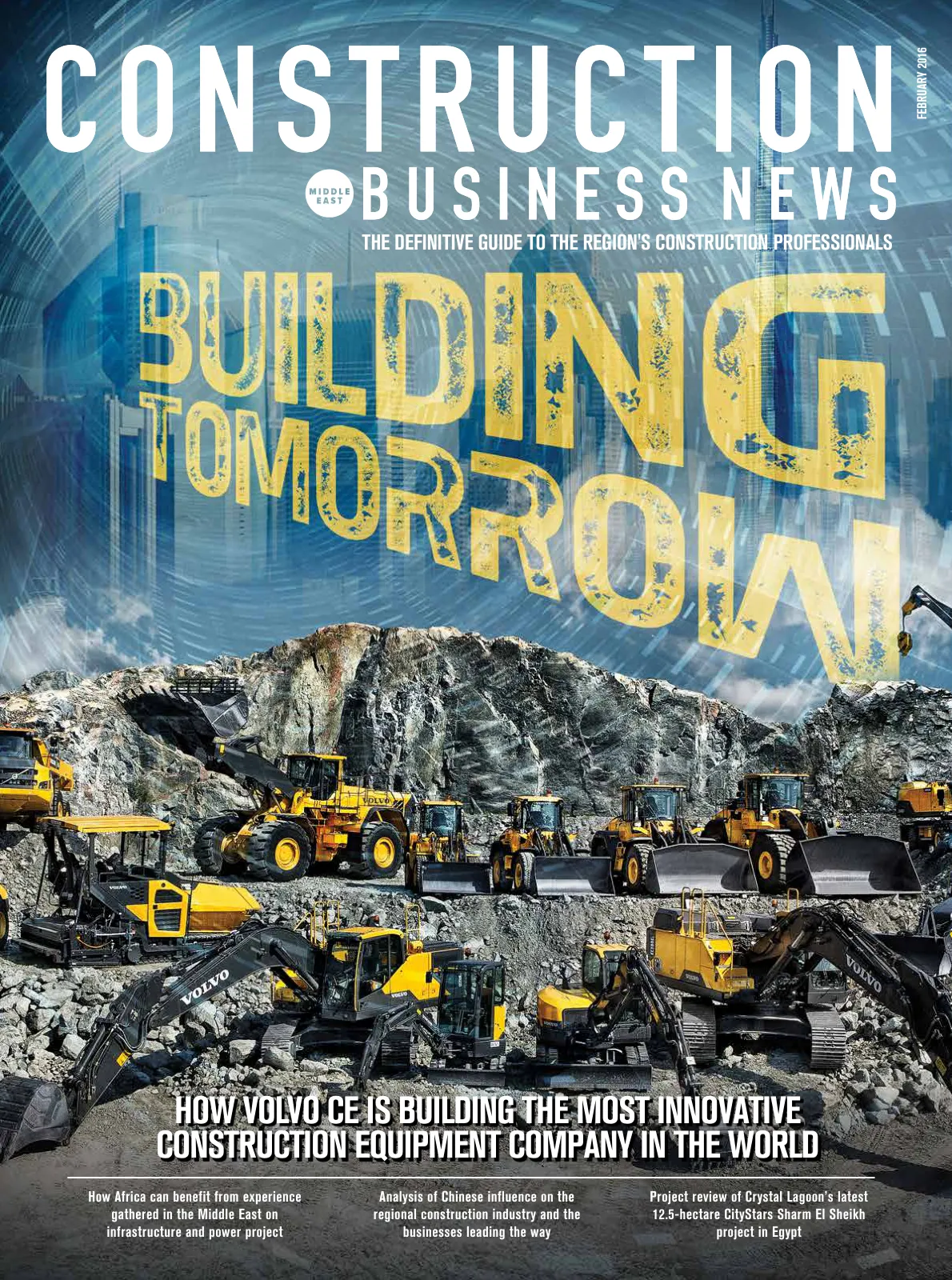
Construction Business News, February 2016
Page 1
THE DEFINITIVE GUIDE TO THE REGION'S CONSTRUCTION PROFESSIONALS
DECEMBER 2015
How Volvo CE is building the most innovative
construction equipment company in the world
How Africa can benefit from experience
gathered in the Middle East on
infrastructure and power project
Analysis of Chinese influence on the
regional construction industry and the
businesses leading the way
Project review of Crystal Lagoon’s latest
12.5-hectare CityStars Sharm El Sheikh
project in Egypt
THE DEFINITIVE GUIDE TO THE REGION'S CONSTRUCTION PROFESSIONALS
FEBRUARY 2016
Page 2
Page 3
construction business news me February 2016
3
Editor’s Note
News
Supplier News
IN PERSON
Dean McGrail, director of
property and buildings
at WSP | Parsons
Brinckerhoff, shares
how culture should be
understood rather than
ignored for true success
ANALYSIS
Experts from Winston and
Strawn examine how Africa
can benefit from experience
gathered in the Middle East
on infrastructure and
power projects
COVER STORY
Building tomorrow
Volvo Construction
Equipment along with its
regional distributor FAMCO
plans to integrate its new
breakthrough concept into
the market and help its
customers with the future
of construction
COUNTRY FOCUS
Stuart Matthews looks
at the impact of Chinese
influence on the regional
construction industry
and the businesses
leading the way
TAKE 10
Construction Business
News ME picks out the top
10 global innovations in
technology that could be
part of every construction
project in the next decade
6
8
16
16
24
26
30
36
26
36
contents
Page 4
construction business news me February 2016
4
S U B S C R I B E
c o n t r i b u t o r s
subscriptions@bncpublishing.net
Managing Director
Walid Zok
walid@bncpublishing.net
Director
Rabih Najm
rabih@bncpublishing.net
Director
Wissam Younane
wissam@bncpublishing.net
Group Publishing Director
Diarmuid O'Malley
dom@bncpublishing.net
Business Development Director
Rabih Naderi
rabih.naderi@bncpublishing.net
+966 50 328 9818
Group Editor
Melanie Mingas
melanie@bncpublishing.net
Editor
Lorraine Bangera
lorraine@bncpublishing.net
Art Director
Aaron Sutton
aaron@bncpublishing.net
Sales Manager
Mostafa Abdo
mostafa@bncpublishing.net
+966 56 6695 333
Sales Manager
Joe Taphouse
Joe@bncpublishing.net
Sales Manager
Vishvanath Shetty
vish@bncpublishing.net
+971 52 6745378
Marketing Executive
Mark Anthony Monzon
mark@bncpublishing.net
PO Box 502511 Dubai, United Arab Emirates
P +971 4 4200 506 | F +971 4 4200 196
For all commercial enquiries related to
Construction Business News ME contact
sales@bncpublishing.net T +971 55 339 5097
All rights reserved © 2015.
Opinions expressed are solely those of the contributors.
Construction Business News ME and all subsidiary
publications in the MENA region are officially licensed
exclusively to BNC Publishing in the MENA region by
Construction Business News ME.
No part of this magazine may be reproduced or
transmitted in any form or by any means without
written permission of the publisher.
Images used in Construction Business News ME
are credited when necessary. Attributed use of
copyrighted images with permission. All images not
credited courtesy Shutterstock.
Printed by International Printing Press www.ippuae.com
Stuart Matthews
Marlow McGuinness Ltd
-------
Joanne Bladd
SUSTAINABILITY
Shivram Mukherjee analyses the growth of sustainable
skyscrapers in the UAE
TECHNOLOGY
KEF Holding chair Faizal Kottikollon discusses how investing
in technology ties in with the long term vision of a company
and how futuristic construction techniques are beginning to
penetrate the GCC market.
Construction Business News ME investigates Oryx Simulations’
advanced training simulators that help train new operators to
use the machine in a matter of hours
Ayman Jaber shares how different types of firms within the
construction industry could use social media marketing to
enhance brand awareness
PROJECT REVIEW
Carlos Salas, regional director of Middle East at Crystal
Lagoons, talks about the company’s latest 12.5-hectare
CityStars Sharm El Sheikh project in Egypt
Construction Business News ME reviews the coveted Egyptian
holiday resort and residences, Somabay, developed by Abu Soma
Development Company, placed in the western shores of the Red Sea
COMMENT
As economic growth begins to slow once again, Melanie Mingas
analyses how the machinery industry can adapt and thrive
Naji Atallah examines 3D animation and visualisation, as it
revolutionises today’s construction industry
George Berbari examines the dangers of glazing and warns
architects to account for the consequences of overusing glass
MACHINERY
Sheikh Khalid Bin Nassar Al Thani, chair of Khalid Bin Nasser,
talks to Construction Business News ME about the new Foton
Auman GTL Tractor Head
SAVE THE DATE
EDITOR’S PICK
40
46
48
50
52
56
22
44
58
62
64
66
52
Page 5
Porto Arabia Towers
Doha, Qatar
©2014 Hill International, Inc.
Hill International
The Global Leader in Managing Construction Risk
www.hillintl.com
For nearly four decades, owners and developers in the Middle East have
turned to Hill International to manage their construction projects and
programs throughout the region. Hill is proud to have helped our clients
turn their most challenging visions into realities. We have participated
in over 10,000 projects with a total construction value in excess of $500
billion, managing all phases of the construction process from concept
through completion.
Hill is also the leading construction claims firm in the world, having helped
resolve problems on some of the most complex projects throughout the
Middle East and around the world. To minimize risk and maximize results
on your next project, turn to Hill International
Dubai Office: 971 4 227 0078
Doha Office: 974 4 435 8381
Corporate HQ: 800 283 4088
If you can imagine it, we can manage it.
Qatar National Museum
Doha, Qatar
Mall of Qatar
Doha, Qatar
Viva Bahriya Towers
Doha, Qatar
Page 6
construction business news me February 2016
6
Out with the old
According to recent study Global Con-
struction Perspectives and Oxford Eco-
nomics, the global construction market
is forecasted to grow by more than 70%
reaching $15tr by 2025.
That is a huge amount of growth due to take
place in less than a decade, but the success of
the next nine years will depend on the ability
to innovate, just as much as economic stability.
Constant innovation in technology over
the years has brought us to an unprecedent-
ed point, with advanced technology evident
across the world. For instance, it is now possi-
ble to build an entire structure on-site through
3D concrete printing in a matter of days.
AEC professionals are increasingly using
high-tech instruments to further perfect their
projects and build efficiently, and building
materials have never before been so inventive
and sustainable. From healing concrete to
augmented reality wearables, the market has
opened up to much more creative technologies
than ever before.
According to the World Economic Forum,
the construction industry has been evolving
and is driven by technology, urbanisation, the
need for a sustainable economy, and the in-
creasing complexity and size of projects.
The need for these advancements cannot be
overlooked, with a massive rise for more urban
space and thus more construction. The 2014
UN World Urbanization Prospects report
found that by 2050 the number of people liv-
ing in urban areas is expected to have increased
by 12%, creating a demand for more infra-
structure and buildings.
The construction sector must not only build
this new urban world, but follow the example
set by the tech industry and entrepreneurial
business space, through innovation and the in-
vention of new business models, processes and
products. What kind of a built environment
could exist if glass and concrete alternatives
had received the same interest and adoption
rate as touch screen phones?
There are systems in place to take this sector
to the next level, with most technologies get-
ting less expensive and more intelligent.
With the help of new construction technolo-
gies, the industry should be able to reduce the
quantitative use of materials, reduce overall
costs, and eliminate unnecessary waste, while
creating cleaner environments for growing
populations to inhabit.
The next generation of advances will re-
quire a more committed level of adoption by
business owners and industry policy makers.
The next phase of advancement will require a
change in processes and a clear departure with
how things have been done in the past.
Regulatory frameworks can go some way
towards addressing the urgent need for this,
but the private sector must take the lead; drop
the scepticism that has been seen around the
adoption of new practices in the past and in-
novate like never before.
When a market as a whole begins to respond
as a whole – the change is inevitable.
editor’s note
Lorraine Bangera
Editor
Page 7
Page 8
construction business news me February 2016
8
NEWS
A sudden growth in medical tourism and the continued spotlight on Arab
health issues has increased enquiries for real estate to accommodate incoming
providers in the sector, according to Knight Frank.
Real estate advice is vital to detect the feasibility of local and international
practices expanding across the GCC.
Matthew Dadd, partner at Knight Frank, said that the rising life expectan-
cies, rapidly growing populations and per capita incomes, a high incidence
of lifestyle-related diseases, and ambitious medical infrastructure projects are
driving health care industry growth in the Middle East.
“Real estate typically represents 40% of a hospital’s balance sheet—the third
largest expense on the income statement and all too often, healthcare real
estate is an untapped asset.”
With increasing medical clusters in the GCC including Dubai Healthcare City
(DHCC), Dubai and Dilmunia, Bahrain, and Mubadala Healthcare’s venture
with the Cleveland Clinic in Abu Dhabi, the region has potential to expand its
medical tourism industry.
Another point to consider is that it is not just large scale projects and global
brands looking at entering the Middle Eastern markets, but from smaller clin-
ics, dentists, physiotherapists and specialist diagnostic centres.
UAE-based Etihad Rail announced it
will be suspending its tendering pro-
cess for stage two of the project, Re-
uter has reported.
The suspension was made in order
to review the investment and the op-
tions for the timing and delivery of
the second phase of the project. How-
ever the move has caused apprehen-
sion regarding the current economic
climate in the face of new lows in the
oil price.
The stage two included the con-
struction of a rail network in Abu
Dhabi that connects the borders with
Saudi Arabia and Oman along with
areas in the UAE.
“Etihad Rail is one of the biggest
and most complex infrastructure proj-
ects ever undertaken in the UAE,”
Nasser Alsowaidi, the chair of Etihad
Rail, told local paper The National. “A
decision has been taken to suspend
the tendering process for stage two
while we review the most appropriate
timing for this investment.”
Etihad Rail
suspends tendering
for stage two
Boost in medical
tourism increases
demand for real estate
For News, features and more, Visit www.CBNme.com
Follow us on twitter for breaking news: @cbn_ME
Follow us on Facebook for up-to-the-minute breaking news
Read the latest edition on www.CBNme.com
NEWS
Page 9
construction business news me February 2016
9
Dubai Electricity and Water Authority
(DEWA) has awarded a contract to ex-
tend its water network to meet the needs
for water and building infrastructure in
the future. The AED130m project is ex-
pected to be completed in 30 months of
its start date.
H.E. Saeed Al Tayer, managing direc-
tor and CEO of DEWA, said: “Through
a variety of projects, DEWA continues to
increase its level of efficiency in all its
operations, to support sustainable de-
velopment in the emirate. These projects
include the 600-1,200 millimetre per di-
ametre extension of Glass-Reinforced Ep-
oxy main water pipelines, using the Non-
Destructive Road Crossing tunnel-digging
method to protect the infrastructure and
services for major water transmission net-
works located around Dubai.”
The NDRC network will be launched
and will be fully-operational once all ex-
tension work has been completed.
MEED Projects’ latest forecast reveals the value of contracts awarded in the
GCC will significantly drop by 15% in 2016. The total value is predicted to
be $140bn this year, compared with $165bn in 2015.
The estimation is based on 2,100 planned and un-awarded projects in
the region.
Ed James, director of content and analysis at MEED Projects, said: “With
oil prices hitting 11-year lows, there is no real surprise that project spend-
ing is forecast to fall in 2016. However, it does mean that it will be a tough
12 months for companies in the sector as the number of project opportu-
nities is reduced.”
DEWA awards AED130m
contract to extend
major water network
Overcapacity threatens to redraw the steel industry due to the unsus-
tainable current price of goods, according to Turkish Steel Exporters’
Association Board Member Ali Pandir, speaking at the 19th Middle
East Iron and Steel Conference.
Adding the problem has long endured in the global steel industry, he
said it is crucial for the companies to consolidate and stated this may
even require the shutdown of some mills even in China.
Pandir continued his remarks by expressing that the protectionist
policies have become a trend in virtually every country of the world,
except Turkey.
The comments were met with claims that Turkish steel producers
are subsidised and that the devaluation in Turkish Lira helped Turkish
steel producers reduce their costs, Pandir explained the Turkish steel
industry cannot be subsidised pursuant to the ECSC Treaty signed in
1996 and that the prices are kept low only because of the increase in
effective production, intended to make the country more competitive.
A consortia of 23 Turkish steel exporters from 18 Turkish steel
companies held 250 meetings with 45 companies during a trade mis-
sion organised parallel to 19th Middle East Iron and Steel Conference.
The exporters, who have carried out a number of projects in Dubai,
visited the UAE with the purpose of further existing trade relations on a
trip organised by the Turkish Steel Exporters’ Association as a part of
URGE Project of the Turkish Ministry of Economy.
Oversupply ‘a threat for
all steel industries’
Kuwait
The country is the third largest proj-
ects market in the GCC with a high
record of contracts worth $31.5bn in
2015. This year, it will fall to $24.3bn.
Qatar
Contract awards to fall by $7bn.
Saudi Arabia
The Kingdom will probably be the
worst hit because of falling revenue as
oil price drops. The contracts awarded
will witness a drop of $10bn, to
$40.7bn in 2016.
Bahrain
Similar to Oman, Bahrain will also
maintain last year’s spending lev-
els at $2.8bn.
UAE
UAE will maintain continuing spend-
ing in the Dubai real estate and in-
frastructure sectors. Contracts will
probably fall slightly to $36.5bn in
2016 from $37.4bn in 2015.
Oman
Comparatively a smaller market,
Oman will maintain last year’s
spending levels at $13.5bn
GCC construction contracts to drop by
15% this year
Country focus
Page 10
construction business news me February 2016
10
NEWS
Nakheel awards AED18.5m contract to DX Contracting
LLC and National Gulf Construction LLC to deliver new
roads for JVC.
The developer announced the opening of three new JVC
or Hessa Street link roads later this year. Work will begin
this month, with anticipated completion in Q3 2016.
The contract enables the construction of new JVC ac-
cess points, which will improve traffic flow and reduce
travel time for JVC residents.
A Nakheel spokesman said: “Around 20,000 people
currently live in JVC, but this rapidly-growing mixed-use
development will accommodate some 300,000 people
when complete. The new road links will enhance JVC in
both the short and long term by tackling the immediate
needs of residents and addressing the future needs of the
community as it expands.”
Nakheel awards
AED18.5m contract for
new JVC access roads
Masdar has announced an
agreement to develop a
commercially-driven utility-
scale 200 megawatt (MW)
photovoltaic solar plant in
Jordan. The announcement
was made at the World Fu-
ture Energy Summit (WFES)
in Abu Dhabi.
The agreement with Jor-
dan’s Ministry of Energy and
Mineral Resource (MEMR)
follows after the inaugura-
tion of Masdar’s first invest-
ment in the 117MW Tafila
wind farm in the Hashemite
Kingdom. The wind farm, a
JV between Inframed, EPGE
and Masdar, will account
for almost 6.5% of Jordan’s
1,800MW renewable energy
target for 2020. In addi-
tion, it will create enough
electricity to power 83,000
homes while reducing the
country’s carbon emissions
by 235,000 tonnes annually.
Both energy projects goes
in line with Kingdom’s
2010 renewable energy law
that calls for 15% electricity
to come from renewables
by 2020.
Masdar
has
committed
more than $1.7bn to renew-
able energy developments,
with 1GW of clean power
in the UAE and other coun-
tries across the globe.
Dr Ahmad Belhoul, CEO
of Masdar, said: “Jordan is
a key market for Masdar in
the MENA-region. With re-
gional energy demand set to
double by 2030, we believe
the majority of that growth
will be met from renewable
energy. This growth repre-
sents a strong business case
for renewables, not just in
Jordan, but also across the
wider MENA region.”
H.E. Dr Ibrahim Saif, Jor-
dan’s Minister of Energy
and
Mineral
Resources
said: “This project is an in-
vestment in Jordan’s future
energy security. It reflects
the vision of His Majesty
King Abdullah II to reduce
the Kingdom’s reliance on
imported energy and limit
our carbon footprint. We
believe the project will
stimulate the investment
climate for similar renew-
able energy projects in Jor-
dan and will strengthen our
status as a new and impor-
tant destination for renew-
able energy investments in
the region.”
Masdar to develop 200MW solar
project in Jordan
Nakheel villas at JVC master development
Dubai World Trade Centre (DWTC) broke ground on the
second phase of Dubai Trade Centre District (DTCD)
worth AED720m. The first phase of the development was
completed on time, last November. Phase one included
an eight storey office building and a 588-room Ibis Hotel.
Contractor Al Futtaim Carillion, responsible for phase
one, attained a safety record of 5.6 million man hours of
Zero Loss Time Incidents (Zero LTI).
The same contractors have been chosen to construct the
second phase. The phase comprises two Grade A office
properties of eight and 12 storeys designed by Hopkins
Architects and WSP.
Gurjit Singh, SVP of Real Estate at DWTC, said: “Phase
one has successfully attracted blue chip commercial ten-
ants to our Grade A, single ownership, large floor plate,
office space. This demand is expected to continue in
phase two.”
DWTC breaks ground on second
phase of Dubai Trade Centre District
DWTC breaks ground on second phase of Dubai Trade Centre District
Page 11
construction business news me February 2016
11
DSCE and FEDARENE
to share best
practice in
sustainability
According to Dubai-based real estate firm Knight Frank,
Nigeria has been attracting international investment
through its robust economic growth and wide range of
investment opportunities.
In a research bulletin, Knight Frank says the growth has
been driven by strong population trends, a diversifying
economy and an evolving urban environment.
Property sectors are particularly booming in the na-
tion’s top cities, Lagos and Abuja.
The Dubai Supreme Council of Energy (DSCE) signed
an MoU with the European Federation of Agencies and
Regions for Energy and the Environment (FEDARENE) at
the World Future Energy Summit last month.
In line with the agreement, the two parties will share ex-
perience and best practices in energy-related areas includ-
ing policymaking, technology development, green-financ-
ing mechanisms, awareness programmes, green buildings,
smart homes, and energy management and efficiency.
H.E. Saeed Mohammed Al Tayer, vice chair of DSCE,
said: “Our partnership with FEDARENE will promote the
implementation of innovative and effective measures,
and increase awareness on energy efficiency and de-
mand side management.”
At WFES, the Dubai Supreme Council of Energy is
showcasing the Dubai Integrated Energy Strategy, which
was recently reviewed in line with the Dubai Clean En-
ergy Strategy 2050, launched to provide 7% of the Emir-
ate’s energy from clean sources by 2020, 25% by 2030
and 75% by 2050.
Al Tayer said: “The Dubai Integrated Energy Strategy
2030 aims to diversify Dubai’s energy mix to include
25% from solar energy, 7% from clean coal, and 7% from
nuclear power, and 61% from natural gas by 2030, and
reduce energy use by 30%.”
Nigeria: The next hotspot
for real estate investment
Aerial view of Lagos, Nigeria
DSCE and FEDARENE at WFES 2016
Some of the key highlights mentioned in the bulletin include:
• With a GDP of $594.3m, Nigeria is currently the biggest economy in Africa.
• Africa’s economic growth is anticipated at 7% over the next four years.
• Nigeria is Africa’s most populous country, with Lagos and Abuja being among eight cities with
populations over one million.
• By most estimates, Lagos has already overtaken Cairo as Africa’s biggest city and its population
may be close to 40 million by 2050, making it a true global megacity.
• Prime office rents in Lagos are among the highest in Africa, with only a handful of buildings able
to provide high quality space.
• Abuja is a modern planned capital city which is seeing increased development activity, including
the huge WTC Abuja scheme.
• Land reclamation is underway for the vast Eko Atlantic project, which will create a new city district
off Victoria Island, Lagos.
• The retail sector is developing rapidly, with increased numbers of modern malls being built, such
as Ikeja City Mall in Lagos.
Page 12
construction business news me February 2016
12
NEWS
The Arab-Brazilian Chamber of Commerce (ABCC) announced an exten-
sive increase in Brazilian exports of construction machinery to Arab coun-
tries in 2015.
According to statistics, Arab countries have purchased $226.31m worth of
machinery in 2015, which marks a growth of 7% from 2014, while the export
of construction goods remains stable at $41.31m in 2015.
Top three importers of Brazilian machinery include Egypt ($63.82m), Saudi
Arabia ($56.23), and the UAE ($50.97m).
Dr Michel Alaby, secretary general and CEO at ABCC, said: “The robust
trade of machinery and construction goods from Brazil to the Arab World re-
inforces growing popularity of high quality Brazilian products in the regional
markets. Arab countries have shared extremely amicable business relations
with Brazil and have contributed significantly to local economy by regularly
exporting Brazilian products and the demand will continue in the mid- and
long-term in light booming Arab construction sector.”
Dubai Parks and Resorts mission to bring
lush vegetation to its desert destination
is now underway with the acquisition of
15,860 trees, 6,100 palms and over 1.4 mil-
lion shrubs and groundcovers.
Planting has already begun at the re-
gion’s largest integrated theme-park des-
tination in preparation for its opening in
October 2016, with an on-site nursery also
established to house and nurture the re-
maining greenery.
So far, over 350 Washingtonia palms have
been planted with over 3,650 being tended
to in the nursery. In addition, different sizes
of the red flowering Delonix tree can be
found throughout the grounds, with heights ranging from nearly 1.8 metres to
an impressive 8 metres.
The nursery, which is part of the back of house operations, is almost two mil-
lion sq.ft and has the capacity to house over 15,000 trees and palms and more
than 900,000 shrubs and groundcovers as the project progresses. The nursery
also has four greenhouses with a capacity of more than 100,000 pots each.
DPR also has an onsite water treatment plant which it expects to provide up to
30% of the treated water needs for the resort once open. The plant means that
waste water can be efficiently treated on-site and reused for landscaping.
Aldar Properties acquired a commercial
office building, Daman House, in Capital
Centre Abu Dhabi on 19 January 2016.
The building comprises 23,000 square
metre GLA of Grade A commercial space,
fully leased on a long-term contract to a
single government related entity.
Aldar aims to grow its recurring reve-
nue portfolio through investment in new
and existing revenue producing assets.
This was the first purchase made as part
of the company’s AED3bn investment
programme to drive growth within its re-
curring revenue business to achieve its
new target of AED2.2 bn Net Operating
Income (NOI) by 2020.
Approximately AED900m (30% of the
programme), has been already commit-
ted through the Daman House transac-
tion, the extension of Al Jimi Mall in Al
Ain and the expansion within Aldar Ac-
adamies through the construction of the
Al Mamoura School in Abu Dhabi, an-
nounced in November 2015.
Mohamed Al Mubarak, CEO of Aldar,
said: “The acquisition we are announc-
ing today fits perfectly with our strategy
of increasing our recurring revenue base
and demonstrates our ability to take ad-
vantage of value accretive opportunities
when they arise.”
Aldar grows
revenue
portfolio
through latest
acquisition
ABCC records a 7%
growth in Brazilian
machinery exports to
Arab markets
DPR plants an
extensive landscaping
programme on-site
Mohamed Al Mubarak
Page 13
construction business news me February 2016
13
The Jebel Hafeet Emirati Housing Proj-
ect will be the first residential com-
munity in Al Ain to benefit from eight
new mosques which will be com-
pliant with the Abu Dhabi Mosque
Development Regulations.
The design of the mosques, includ-
ing the designated use, building materi-
als, and sustainability features, will be
evaluated by Abu Dhabi Urban Planning
Council’s (UPC) Abu Dhabi Mosque De-
velopment Regulations (ADMDR).
The mosques will be built within a
mega project consisting 3,000 villas, as
well as amenities including schools,
health facility and retail. Currently under
construction, the development stretches
over 4.4 million metres squared to the
west of Jebel Hafeet and approximately
13 kilometres south of Al Ain City Centre.
Jebel Hafeet Emirati Housing Project
is being constructed by Tamouh Invest-
ments under the project management of
Musanada (Abu Dhabi General Services
Company). It is in the final stages of con-
struction ahead of the scheduled hando-
ver during this year.
The mosques will make extensive use
of shaded external space for prayer and
are designed to maximise the cooling
effect of the wind, which is common in
Emirati mosque vernacular design. In
addition, the simple prayer hall propor-
tions – again true to traditional Emirati
design – allow prayer spaces to be used
efficiently by closing off large areas that
are only required for Friday prayers to
reduce the amount of air conditioning re-
quired during quieter periods.
Al Ain project
to exhibit new
mosque design
regulation
A bridge project has been approved by Dubai’s RTA to extending from Al
Khail Road to the Financial Center Road. The project, which has a cost tag of
AED120m, is expected to be completed early 2017 and was backed by both
the RTA and Emaar Properties.
“The project comprises the construction of a two-lane bridge linking Al
Khail Road with the Financial Center Road over a sector extending 920 me-
tres in length with a width ranging from 11 to 15 metres. The bridge would
be built on individual piers and pass across the Dubai Water Canal. The
project also covers lighting and infrastructural works including the diversion
of impacted utility lines such as water, electricity, irrigation, sewage and
telecommunication lines,” said Al Tayer.
The project starts from the intersection of Ras Al Khor Rd with Al Khail
Rd to ensure streamlined traffic flow. The existing road would be widened
by adding two lanes in a sector stretching 480 metres in order to ensure a
seamless traffic movement from Dubai-Al Ain Road to Al Khail Road along
the upper deck of the Financial Centre Road. It also includes adding an entry
point to the parking terminal attached to the expansion of the Dubai Mall.
“The project would improve the traffic flow along the Financial Centre
Road and at-grade intersections by reducing the density of traffic at junctions
leading to Mohammed bin Rashid Boulevard. The project would result in
raising the road intake to 4500 vehicles per hour during peak hours, besides
serving several development projects, and easing the pressure on the exist-
ing roads network,” he added.
RTA awards contract for
upcoming bridge project
Jamee Mosque
Page 14
construction business news me February 2016
14
Dorma Gulf launched the ST Flex Green sliding door solution
to provide a high grade of eco-friendly, slender and profile
entrance routes.
The ST Flex Green, certified with an Environmental Produc-
tion Declaration (EPD), is designed to function as aesthetic
sliding doors. The solution is also suitable for emergency
exits and escape routes that incorporate energy efficiency.
German-tested thermal insulation with energy saving regu-
lation, EnEV 2009 and the Dual Drive technology within the
system enables reliable executive of emergency exits.
Agy Mathew, product marketing manager at Dorma Gulf,
said: “Elegant sleek profiles, with no compromise of luxury is
the USP of this product. The excellent interlocking side seals
and top and bottom seals add more benefit to the solution.”
The system brings together low thermal transmission
co-efficient, making the doors energy-efficient by effectively
controlling the heat transferred from outside its facility, within.
Compliant with the German energy-saving regulation, the
EnEV 2009, the ST Flex Green is a very sustainable and reli-
able interior set-up and entrance solution designed to match
with a building’s overall appeal.
T
ruck manufacturer, Daim-
ler Trucks, has signed let-
ters of intent with its Iranian
partners, Iran Khodro Die-
sel (IKD) and the Mammut
Group, to return to the Ira-
nian market.
The cooperation will in-
clude a joint venture (JV)
for local production of Mer-
cedes-Benz trucks and pow-
ertrain components along
with the establishment of a
sales company for Mercedes-
Benz trucks and components.
There are plans for Daim-
ler to return as a shareholder
in the former engine JV Ira-
nian Diesel Engine Manufac-
turing Co. (IDEM).
Daimler
and
IKD
are
set to benefit from each
other’s competitive advan-
tages to satisfy the large
demand for trucks.
Dr Wolfgang Bernhard,
member of the board of
management at Daimler AG
responsible for Trucks and
Buses, said: “There is a huge
demand for commercial ve-
hicles, especially trucks, in
Iran. We plan to quickly
resume our business activi-
ties in the market there. The
signing of the letters of intent
with our local partners IKD
and Mammut Group are im-
portant pre-requisites to re-
sume business quickly.”
The nation’s pent-up de-
mand in the transport sector
offers promising opportuni-
ties for Daimler Trucks. With
an increasing potential fol-
lowing many years of sanc-
tions, Iran has been one of
Middle East’s largest national
economies. Iran’s nominal
GDP in 2014 was $415bn,
with industry sector account-
ing for almost half of the Ira-
nian national economy.
The Ministry of Industry,
Mine and Trade estimates
that about 200,000 commer-
cial vehicles will be replaced
the upcoming years, with
56,000 of them in the next
three to five years.
S
anipex
Group
an-
nounced supplying a
wide range of bathroom and
washroom solutions for the
upcoming Opera District.
According to the supplier,
designers picked the group
for its quality fixtures and
fittings to give visitors an
excellent impression of the
facilities on offer.
The Opera District, locat-
ed in Downtown Dubai, will
feature a 2,000 seat multi-
format Opera House, two
hotels, a roof-top restaurant,
design studios and galleries.
From the sanitary ware
through to accessories, the
design of the washrooms
and bathrooms throughout
the Dubai Opera District
needed to be functional and
stylish, and with products
including brand names such
as Bagnodesign, Aquazone
and Galassia.
Products
chosen
for
this prestigious project in-
clude M-Line brassware,
Montecristo glass washba-
sins, Urban wall-mounted
WCs and Community wall-
mounted urinals.
Daimler Trucks plans on
return to Iranian market
Sanipex provides bathroom
solutions for Dubai Opera
District
Dorma Gulf unveils ST Flex Green Sliding Doors
SUPPLIER News
Daimler’s Fuso range
Dubai Opera House
Page 15
OHSAS 18001 certified
ISO 9001, 14001 and
130+years of
project experience
LEED Platinum, LEED Gold
and LEED Silver Capability
End to End Integrated Solutions
Pioneering Engineering Construction since 1881
www.drakescull.com
700+
Projects Delivered
For over 130 years, Drake & Scull International PJSC has been shaping skylines and transforming the lifestyle of
communities around the world.
Drake & Scull is an industry leader, with a proven history of delivering more than 700 projects through its General
Contracting, Engineering, Rail, Oil & Gas, Water and Wastewater Treatment and Infrastructure development business
streamlines across the region.
Page 16
construction business news me February 2016
16
Cultural
benefits
Dean McGrail, director of property and buildings at
WSP | Parsons Brinckerhoff, manages over 500 people
across the Middle East. After a quick yet diligent climb
up the corporate ladder, McGrail has absorbed every
experience as a learning lesson from his time in university
to working in the East and the GCC. He shares how culture
should be understood rather than ignored for true success.
Lorraine Bangera writes
IN PERSON
Page 17
construction business news me February 2016
17
B
y combining opportunity
and hard work, Dean
McGrail has climbed the
ranks with WSP – Parsons
Brinckerhoff, over the last
decade. Now in his late
30s, McGrail looks back at his life and
subsequent climb up the ladder.
At the time, the young Brit from Leeds
was sure he wanted to do something dif-
ferent with his life. While he was in uni-
versity, he changed his major from geol-
ogy and geophysics to fire engineering
after having a look at its interesting sylla-
bus. “Back then, the course was new – it
had only been running for two years.”
This, however, did not scare Mc-
Grail; better yet it proved to be
the right move for him, as when he
reached graduation there were many
companies lined up (particularly in the
oil and gas sector), hunting for fire en-
gineers. “That’s how I landed my first
job in Manchester, as a fire protection
designer for power stations.”
Even though McGrail bagged a great
opportunity right after university, he
craved for adventure in foreign lands.
“It was one of my major passions. I had
a strong desire to work overseas but as
hard as I tried, the furthest away I got to
go was Newport in Wales!”, he jokes.
After shifting a couple of jobs, an op-
portunity presented itself in Hong Kong
and McGrail promptly seized it. In 2001,
McGrail made his way east to Hong
Kong which embarked his journey with
creating buildings.
Growing in the East
“A lot of things were very different at the
time. China was growing,” he observes.
Not long after McGrail set himself up
in Hong Kong, WSP came knocking on
his door with a job offer. The company
was looking to establish a fire engineer-
ing team.
Not only was McGrail still in his early
20s, he was also only in Hong Kong for
three or four months. He recalls thinking
what a huge step this would be for him,
and an amazing opportunity. Without
batting an eyelid, he sealed the deal and
has been with the company ever since.
“WSP has always been a very dynam-
ic, young company,” McGrail reveals. “If
you have value to add, they will give you
the opportunity. For me, they gave me
the opportunity, support, and structure to
perform my best.”
Growing from strength to strength, and
building a reputable fire engineering ca-
pacity in Asia, McGrail managed to get
noticed over the years for his impeccable
work ethic.
Things
became
even
better
when the China market began to
expand tremendously.
“At the time, not a lot of people had
experience. And even though I was
New York University Abu Dhabi
The Shard - Image courtesy of WSP | Parsons Brinckerhoff.
Photographer Nicola Evans
young, the dynamic started to change,
and I was sort of the ‘experienced’ one
with international know-how.”
McGrail used this time to move around,
from Hong Kong to Shanghai and then
Beijing. “We tried our best to establish re-
lationships, helping clients to break into
the region.”
He admits that there were a lot of pit-
falls, but in return they educated him
with more and more experience.
Moving to the Middle East
McGrail soon was presented with an-
other opportunity to work overseas. But
this time, it was the Middle East, with one
of WSP’s first project in the region, after
Rolex Tower in the early 1990s. McGrail
and his team made their way to UAE to
work on the Mall of the Emirates (MOE),
a project that recently celebrated its 10
year anniversary.
The director was involved in MOE
from 2003 until it officially opened in
2005. WSP was also involved in a num-
ber of follow-up works such as the fash-
ion avenue expansion, metro link’s ex-
tensions, a number of feasibility studies
and upgrades.
McGrail has been in the GCC for over
a decade now, and he thinks the market
here is like no other. “There are tremen-
dous improvements made every year.”
If anything were lacking, he says, it
would be the number of talented profes-
Page 18
construction business news me February 2016
18
IN PERSON
sionals in the construction industry. “In
the GCC,” he argues, “there are many
talented people but there is also a great
need and demand for more.
“People are coming in from all over
the globe. I think the Middle East is in
a position where it needs to try and put
in some controls on who is working on
their projects.”
He admits that in the beginning, peo-
ple who made their way to the GCC
were young, unmarried and had no
family. Most of them lacked experience
as professionals. But now, that is chang-
ing.”
He claims that before the financial
crisis in 2008, there were a lot of peo-
ple coming in but not necessarily ex-
perienced. And now, there is a better
mix of people coming in and already
settled here.
Regional experience could be ex-
tremely important while trying to find
your feet in the GCC construction mar-
ket. In fact McGrail says that he is happy
about his prior Asian experience as it has
helped him become more understanding
of markets that are culturally different
than his own in the UK.
Leading a team
In the GCC, McGrail leads a team of
570 people working under him in the
property and building department in the
Middle East.
“I have a really good leadership team
working below me and a lot of fantastic
team members I would like to promote,”
he beams. “As WSP gave me the oppor-
tunity when I was young, I want to do
the same for some of the brilliant people
working under me. Especially the ones
that are really passionate about what
they want to do.”
He observes that most companies in
this industry and region, tend to be age
or qualification driven. “The process of a
promotion tends to get quite bureaucrat-
ic which makes it tough for employees to
grow within a company.”
What his team tries to advocate is that
every employee has the opportunity to
grow and be part of the leadership team.
He sees a lot of employees tend
to leave a company when they look
at leadership roles and think that
Dubai Mall Expansion
they deserve to be there and cannot be.
McGrail discusses that most young
employees come across a common ad-
versary which is the perception of inex-
perience. “More than 25 to 30 years of
experience, does not necessarily make
the employee more skilled than someone
with 10 years of experience.”
With the GCC being a new market, Mc-
Grail thinks it does push younger people
to achieve more; quite different to Asia,
as it was when he was there. “Asia is dif-
ferent now, but at the time, it very much
focussed on age.”
Somehow that factor motivated Mc-
Grail to be better. He used his so-called
limitation to drive him to be better. For
instance, every time he went to a meet-
ing, he made sure he was as prepared
as he possibly could be to make sure no
matter who was sitting at the opposite
end, he would be more prepared.
In construction, McGrail says the key
is to do your best. “A lot of it is about
Page 19
construction business news me February 2016
19
delivery. If you win a project, you have
to deliver. You’re only as good as your
last project.”
McGrail stresses that age is not nec-
essarily an important factor that helps
you succeed, but drive, ambition, and
the willingness to understand differ-
ent cultures plays a bigger role than
people realise.
Culture and other codes
He suggests that Asian markets and
GCC markets are in fact quite similar
in a lot of ways. In the last decade the
GCC has grown in leaps and bounds,
and McGrail discerns that this is the
same dynamic that took place in Asia
around a decade ago.
To
demonstrate
the
tremendous
growth Asia has witnessed in the last 10
years, he compared cities then and now.
He says: “When I was living in Asia,
Shanghai was a first tier city where all the
growth was happening. Nowadays, our
One World Trade Center - Image
courtesy of WSP | Parsons Brinckerhoff
- Photographer Nicola Evans
company is involved in super tall towers
about 300 metres and 600 metres in what
has been called third tier cities.”
He matches the phenomenal growth
of both regions and conveys that they are
truly very similar. “Both regions observe
the rest of the world, learn, and then
adapt it into their own markets.”
Another key similarity, McGrail points
out is how Asians and GCC nationals are
very proud of their culture and tend to
push for what they want.
By observing the culture and the way
a foreign market works, he has won
brownie points while establishing him-
self in unknown territory. To be success-
ful in any other market, he states, it is
important to understand the cultural dy-
namics at play under the surface. “It is
when you travel and work in different lo-
cations, that you broaden your perspec-
tive and unlock more learning.”
He explains: “When you go to a dif-
ferent country and be part of a differ-
ent culture, you change your percep-
tion of it and understand how the local
people work.”
For him, the Asian experience was key
to his growth and prosperity.
He reasons, that in order to be success-
ful in a region one mustn’t try to change
the market but go along with it. He uses
the Colloquial Colonialism podcast that
plays in Emirates Airlines to further prove
his point. “The podcast talks about the
perception of going to another nation
and telling them how to do things.
“Look out of your window… look at
what this region has done in the last de-
cade, how are you possibly going to tell
them what to do?”
He maintains that the way to work
well with a new culture is not by fighting
it but adapting to it. “You cannot impose
your views in this region, it is not the way
to establish relationships in this region, or
any other.”
Grateful for his lessons learnt in Asia,
McGrail admits that had he not gone to
the East before GCC, he would not have
had this sort of a perception at all.
For now, he says that the GCC has
been his home for the last 11 years and
he is very proud to have been part of
building a nation – quite literally – with
the team at WSP.
Page 20
construction business news me February 2016
20
Awards
Construction
Innovation Awards
A
fter a successful inaugu-
ral awards ceremony on
18 October 2015 in Qa-
tar, Construction Busi-
ness News ME’s Con-
struction Innovation Awards (CIA) is
set to launch in Saudi Arabia on 16
March 2016.
In recognition of the highly active
trillion-dollar construction industry,
the annual celebration will be con-
ducted at the Four Seasons Riyadh.
Construction
Business
News
ME magazine is positioned as a
platform for construction profes-
sionals to spark and engage in
industry-leading dialogue.
The title’s “for us, by us” approach
to publishing places it at the very heart
of the industry on which it is focussed
and this theme is central to the Con-
struction Innovation Awards series.
As GCC states continue in their am-
bitions to rapidly urbanise the desert
with world-class and standard-setting
social, civil and commercial infrastruc-
ture, as well as private developments,
the Construction Innovation Awards
shines a light on the projects, project
managers and architects – as well as
their protégés – who continue to in-
novate the industry as it moves into an
era of stability and economic growth.
Nomination procedure
Nominations are currently open for all
regional companies that have active
projects in Saudi Arabia. To nominate
your company/ company’s project/ or
or any supporting visual informa-
tion is not mandatory, but will help
in the judging process. If you are
submitting any supporting visuals,
please list in your submission docu-
ment the file names and method of
transfer of each of these
The submission document must be
signed, scanned and sent to awards@
bncpublishing.net by March 1, 2016.
In submitting the nomination you con-
firm that all the information provided
in the submission is true and accurate
Please note, a separate submission
is required for each category you wish
to make a nomination for.
an employee or peer, please follow
the instructions below:
On a separate document list the fol-
lowing information:
• Company name, regional CEO’s
name, category nominated for
• Name of project/ company/ employ-
ee or peer
• Write in no more than 500 words
why you are making this nomina-
tion. Include all information rel-
evant to achievements, innovative
features, new construction methods,
or record breaking/holding project
features
• Images, project sketches, renderings
Page 21
Categories
Submissions to the Construction Innovation Awards will be judged by a board of the
industry’s finest and most respected leaders, across the following categories:
• Innovation of the Year
• Health & Safety Initiative of the Year
• Sustainable Project of the Year
• Supplier of the Year
• Young E ngineer of the Year
• Contractor of the Year
• Engineer of the Year
• Overall Project of the Year
• MEP C onsultant of the Year
• Specialist MEP C ontractor of the Year
• Project Manager of the Year
• FM C ompany of the Year
• Residential Project of the Year
• Best D eveloper
• Lifetime A chievement
• MEP C ontractor of the Year
• Commercial Project of the Year
• Fastest G rowing C ompany of the Year
• Best C hemical Supplier for C onstruction
construction business news me February 2016
21
Page 22
COMMENT
GCC; preventative maintenance and
driver education.
The total value of project contracts
in 2015 may have been $2bn less than
2014, but projects still exist and prog-
ress must be continue. Ever optimistic,
at the time that evaluation was made
analysts attributed the drop to lower
oil prices leading to building materials
and transport costs falling too, with a
trickle-down effect to contract values.
Today’s projects aren’t urban de-
velopment plans or record breaking
residential towers – the words Expo
and FIFA barely require mention. This
time the existing projects have a finite
deadline and the eyes of the world
upon them.
For the machinery and plant vehicle
market, how such a competitive streak
will play out in terms of dynamics,
is anybody’s guess, especially when
counterfeit parts are added to the com-
petition mix. New challenges are on
the horizon, and they must be faced.
Adding Value
As economic growth begins to slow once again, Melanie Mingas analyses how the
machinery industry can adapt and thrive
used more and more. At The Big 5,
MAN Trucks focussed on pushing
its aftersales service, a new range of
refurbished parts under the Ecoline
concept, and the purchase of used
models, rather than competitor.
MEA managing director Franz
Freiherr von Redwitz said at the time:
“One thing we are pushing big time
is the after sales business and keep-
ing the vehicles on the road. Where
liquidity is tough or prices are bad,
we can compensate with initiatives to
keep the vehicles on the road.
“We are pushing the sales also of
used vehicles. If investment funds
are shrinking it is better to buy used,
than from a cheaper source market,
because the truck will last. It is still
a MAN, even if it is a few years old,”
he continued.
Over and above this, the firm
is specifically pushing other busi-
ness solutions: financing; telemat-
ics, which recently launched in the
T
imes are tough. Hit by a
string of unprecedented –
and at times unexpected
– economic issues, from
a slowdown in China to a
free to trade Iran and a plummeting oil
price, unstable markets are now erring
on the volatile and many, still scarred
by the memories of 2008, are prepar-
ing for the worst.
The impact of this on the machinery
market is already being felt, but not in
the same way as it has previously.
Machinery demands a sizeable por-
tion of project budgets, and contractors
and developers want to cut costs. Inte-
grating operations to schedule phases
in a way that reduces how long each
equipment set is in use for, is a skill
this region has yet to fully master.
The pitfalls of buying from China
are known, counterfeit parts are fac-
ing new challenges in reaching the
market – today’s customer wants more
for their money and slowly but surely
machinery manufactures and retailers
are being forced to add value.
When it comes to new machines,
there is no shortage of market
debuts. MAN, Volvo and Continen-
tal among others, have all brought
new machinery to market in recent
months and The Big 5 2015 was a
who’s who of big brands and new
launches; likely one of the busiest
years in recent memory.
Each claims to have bigger and bet-
ter performance, efficiency and safety
features than the last, other or next,
which is great news for the construc-
tion industry moving forwards, but the
point remains: clients don’t want to
part with the cash.
It’s a buyers’ – or renters’ – mar-
ket, there is no doubt, with the terms
“lifetime warranty”, and “finance”
construction business news me February 2016
22
Page 23
Highly efficient 'construction kit'
With its modular design concept, the crane-inde-
pendent Automatic climbing formwork SKE50 plus
provides an efficient solution to every type of
structure.
On-site safety and protection
from wind and weather is possible with Protection
Screen Xclimb 60, a gapless self-climbing enclo-
sure. The system comes in several versions, giving
you the ideal solution for every requirement.
Highrise core concept
The Lubeca Jumpform, now in Doka's portfolio,
has room for all site equipment needed. Powerful
hydraulic cylinders cranelessly raise the platform to
the next casting section.
Bridge | Tunnel | Highrise | Residential | Energy
www.doka-me.com
The Formwork Experts.
Highrise
Innovation
Added value that makes
all the difference
Page 24
construction business news me February 2016
24
ANALYSIS
Partner James Simpson, counsel Katharine Sonneborn, and associate Giulia De
Michelis at Winston and Strawn examine how Africa can benefit from experi-
ence gathered in the Middle East on infrastructure and power projects
Africa: The
Infrastructure Gap
O
ver the last decade, Af-
rica has, for the most
part, demonstrated re-
silient economic per-
formance. But, by most
measures and in most regions, sustain-
able and affordable energy develop-
ment has not kept pace with economic
growth. With the rising demand for
power, Africa could witness a contin-
ued infrastructure gap which presents a
genuine risk to its growth.
According to the World Bank, 25
of the 54 African countries are in an
energy crisis. In Sub-Saharan Africa,
only seven countries have electricity
access rates greater than 50%, which
means more than 600 million people
(approximately two-thirds of the con-
tinent’s population) lack access to
electricity. African governments have
responded with conventional and re-
newable energy investment growth
initiatives. Such initiatives include an
opening of markets to private inves-
tors, the adoption of regulations to en-
hance transparency and legal certainty,
and feed-in-tariff schemes to promote
the deployment of renewables.
While many government initiatives
have been met with great success,
such as South Africa’s Renewable En-
ergy Independent Power Producer Pro-
curement Programme, others have not
been as well received. The experience
and lessons of successful Independent
Power Projects (IPPs) and Independent
Power and Water Projects (IWPPs) in
Arabian Gulf countries and the wider
Clearly one model will not fit all and
the variety and complexity of economic
and political considerations across the
African continent cannot be underesti-
mated. Drawing on the Middle Eastern
experience can make a vital contribu-
tion to the successful development of
power projects in Africa. Project par-
ticipants should feel confident that with
the establishment of a process which
follows generally acceptable procure-
ment standards, Africa will continue to
represent a significant and exciting op-
portunity for the power project market.
In this article we examine and con-
sider six key lessons from our Middle
Eastern experience and how they may
contribute to the effective development
of power projects in Africa.
The Middle East: A (very) brief
history of IPPs and IWPPs
The Middle East took on the challenge
of the infrastructure gap in part by de-
veloping IPPs and IWPPs. Both have
played a major role in the electricity
and water sector in the Middle East
providing for significant additional
generation and water production ca-
pacity in the region. Abu Dhabi alone
has procured one IPP and nine IWPPs,
the most recent being the Mirfa IWPP,
which closed in October 2014, result-
ing in an aggregate of approximately
$14bn of finance raised and over
14,500MW of contracted capacity. The
Abu Dhabi model has also been suc-
cessfully adopted, with certain varia-
tions, by other countries across the re-
Middle East over the last two decades
can serve as guidance for Africa. The
parallels are important – many parts
of Africa have the same opportunities
as Middle East countries had when de-
veloping their IPP/IWPP programmes,
including significant economic growth,
increasing consumer demand and an
abundance of natural resources against
a backdrop of strong interest from
the international investor community.
However, Africa faces a number of
challenges – as the Middle East has
faced and overcome – such as scepti-
cism related to political risk and per-
ceptions of inefficiency.
James Simpson
Page 25
construction business news me February 2016
25
gion, including Qatar, Bahrain, Saudi
Arabia and, more recently, Kuwait.
What lessons can be applied
in Africa based on the Middle
East experience?
A clear, fair and consistent
independent regulatory regime
The Middle East experience demon-
strates the benefit of having a clear and
consistent independent regulatory re-
gime which is built to respect political
realities but at the same time facilitates
private investment and ensures fair reg-
ulatory oversight from both the public
and private sectors.
For example, in 1998, Abu Dhabi is-
sued comprehensive legislative frame-
work, governing its power and water
sectors, including a coherent regulatory
regime, the provision of guidelines for
the development of IPPs and IWPPs
and, critically, the establishment of an
independent regulator.
A transparent procurement process
A thorough, transparent procurement
process is essential and project pro-
curement should be by reference to
specific non-discriminatory criteria and
open to appropriate public scrutiny.
For example, the opening of financial
bids should take place on the bid sub-
mission date and in public.
A well-structured and consistent
contractual template
It is also important for projects to be
well structured and follow a contrac-
tual template that delivers bankable
projects while not requiring extensive
reworking for each new development.
In the Middle East, the legal contrac-
tual matrix, with the power purchase
agreement (PPA) at its heart, has rig-
idly followed precedent through the
IPPs and IWPPs across the region,
regardless of changes in commercial
terms or market conditions.
Bankability: Stability and strength of
supply and off-take arrangements
In particular, the key to success is en-
suring there is a bankable contractual
structure. The PPA should ensure a
source of revenue over a tenor which
is sufficient to ensure the repayment of
the project finance loan and provide a
return to investors. In this respect, the
careful selection of creditworthy coun-
terparties is one of a number of critical
factors which will determine the bank-
ability of the project. Similarly, the
adequacy of the fuel supply arrange-
ments, preferably by way of a fixed
price long-term supply agreement, is a
key factor in determining bankability.
In Abu Dhabi, the Abu Dhabi Water
and Electricity Company (ADWEC) is
responsible for the fuel supply as well
as being the single off-taker of electric-
ity produced by all the emirate’s IPPs.
No government guarantee is issued in
respect of ADWEC’s payment obliga-
tions; however, the Abu Dhabi govern-
ment guarantees termination payments
under the PPA.
Where the creditworthiness of an
off-taker presents a concern, a higher
level of government support is typi-
cally required.
Bankability: Tariffs and
revenue generation
The tariff that the power producer can
charge for the power it generates is
fundamental to the bankability and ulti-
mate success of a project. When setting
a tariff, consideration should be given
to realistic and comprehensive calcula-
tions of the costs of generating power
and to the price which end-users are
paying for the power.
In Abu Dhabi, payments by ADWEC
to power producers have followed a
take-or-pay structure comprising a
capacity payment and an output pay-
ment. ADWEC also takes the fuel sup-
ply risk by paying fuel suppliers di-
rectly for the fuel consumed by the
power producers.
Making use of the multitude of
financing sources
Projects in the Middle East have been
able to mobilise and leverage a wide
range of financing resources. These
have included export credit agencies,
multilateral financing institutions, de-
velopment finance institutions (DFIs)
and political risk insurance providers.
All these sources, and in particular
DFIs, who can supply due diligence,
influence with host governments, and/
or partial risk guarantees, which are
likely to be essential in strengthening
sovereign guarantees in countries with
low credit ratings, will almost certainly
be vital for the development of projects
in Africa as well.
Giulia De Michelis
Katharine Sonneborn
Page 26
construction business news me February 2016
26
COVER STORY
Along with regional distributor FAMCO, Volvo Construction Equip-
ment plans to integrate a new breakthrough concept into the market
and help its customers with the future of construction
Building
Tomorrow
Page 27
construction business news me February 2016
27
O
ne of the oldest construction machinery companies in
the world, Volvo Construction Equipment has evolved
into one of the most inventive equipment manufactur-
ers and suppliers since its humble beginnings in a ma-
chine shop in Eskilstuna, Sweden, in 1832.
Founded by then 27 year old Johan Theofron Munktell,
who is also known to be the inventor of many types of early
construction machinery, the concept of innovation is embed-
ded in Volvo’s bloodstream.
The company is now one of the most widely used construc-
tion equipment firms in most parts of the world. Last year,
Volvo CE set its sights on the future with the introduction of
its Building Tomorrow campaign.
Widely talked about in almost every press conference
since, Volvo CE’s new campaign is an open-ended commit-
ment to aid developments taking place in construction mar-
kets worldwide.
In a press conference in 2015, Volvo CE president Mar-
tin Weissburg highlighted how customer requirements are
changing: Intelligent systems now offer increased machine
productivity and functionality, along with improved asset
and site management.
He talked about how innovations in the Internet of Things
(IoT) have enabled the company to create smart, connected
machines that capture and deliver information to customers.
Therefore, Volvo CE plans to coordinate and expand its ap-
proach to the integration of intelligent systems.
Four key areas emerged as top priority and Volvo CE
swore to carry them out with perfection: fuel efficiency, ma-
Volvo CE EMEA and FAMCO
organised a regional cus-
tomer event at Hilton Ras Al
Khaimah in UAE on 26 No-
vember last year, to conduct
a regional launch of its new
line of products. Machinery
launched included the new
EC750D excavator, new G-
series wheel loaders with
Z-bar linkage, new H-series
wheel loaders and the latest line of hydraulic breakers.
The EC750D excavator is currently the biggest machine
produced at Volvo CE and most products launched were
optimised for fuel efficiency and safety.
The event was comparable with its most celebrated
machinery show Volvo Days that is held at its factory in
Eskilstuna, Sweden. Drivers and instructors from the Eu-
ropean Volvo CE team dressed in neon safety jackets be-
fore they blazed through the desert giving interested buy-
ers a glimpse of how the machinery would look in action.
The three day event was organised for the regional
Volvo CE team and its distributors, with the last day be-
ing an opportunity for potential buyers to gain hands-on
experience with the machinery.
Bahrain-based Steven Edward Hanahoe, workshop
manager of NASS Asphalt, was impressed by the show
and machinery showcased. He said: “Some of the ma-
chinery displayed at the show was very impressive.”
Another customer, Fadi S. Nimri, service and opera-
tions manager of UAE-based Transmak, said that he en-
joyed the show with demonstrations providing an impor-
tant criteria for purchasing.
Frank O’Conner, managing director of FAMCO Opera-
tions in the UAE, reported the event had a large turnout,
with almost 200 people. He emphasised that Volvo CE
seeks to cater to the needs of its customers and con-
stantly innovate to bring what is needed in the market.
Trying to cater to customers’ every need could be ex-
hausting, but Frank stands by going “hand-in-hand” with
them. He talked about how today the average customer
is much more informed and educated about machinery,
unlike five years ago where the initial cost was the only
criteria. “Today, they evaluate the total cost of ownership
on a spreadsheet.”
The Building Tomorrow event successfully concluded
with Volvo CE able to demonstrate its new products to
customers while establishing lasting relationships with
them. Volvo aims to listen to its customers as the future
of construction begins to take shape and advises them
how to navigate their way through technology and inno-
vative products.
Three days in the desert
Frank O’Conner
Building Tomorrow
customer event in RAK
Page 28
construction business news me February 2016
28
Building Tomorrow takes the custom-
er-comes-first policy to the next level,
and customers could not have taken it
in any better. Halwani reveals: “When
we introduce new machines, especially
in collaboration with Volvo CE, we usu-
ally get a very positive response.”
As a result, FAMCO never sells just
a machine, but the “whole package”.
Halwani explains that if there is an in-
terested buyer, the discussion usually
includes details such as aftermarket,
availability, warrantee, packaging, ser-
chine uptime, productivity and safety.
This ambitious plan then trickled
down to several regional markets world-
wide including the Middle East. In the
UAE, its regional distributor Al-Futtaim
Auto and Machinery Co. LLC (FAMCO),
embraced the concept with open arms
and organised a three-day event for lo-
cal and regional customers to share the
news (read box on page 27).
Understanding Building
Tomorrow
“Volvo CE is trying to build machines
that will ‘build tomorrow’, by using the
valuable input of its customers and end-
users,” says Ahmad Halwani, regional
general manager – construction and ag-
ricultural equipment at FAMCO.
“Basically, Building Tomorrow is a
partnership. It’s a gesture to show our
customers, we are here to support you.”
The concept is simple, yet impact-
ful. Construction machinery, vital to any
construction project, needs to be up-
to-date. Halwani says that Volvo CE is
showcasing its adaptable machinery to
help with building a better tomorrow.
Impressed with the three-day event in
Ras Al Khaimah, Halwani says such cus-
tomer events aren’t uncommon.
“Early last year, FAMCO organised
three customer events (not entirely dedi-
cated to Volvo CE), it was the launch of
three main branches across three main
cities. The turn up for those events was
astounding, almost 1,500 attendees.”
vice contract, and financial options.
“We see that most customers have a
tendency to lean towards those com-
panies that provide support, not just a
product. And if the machinery is per-
forming well and under an acceptable
cost, it is definitely a win-win situation.”
The team aims to support customers
while giving them technical peace of
mind and guaranteed productivity, ac-
cording to the regional GM.
Even though Volvo CE may not have
the lowest price tag, it isn’t the most
COVER STORY
Ahmad Halwani
Page 29
construction business news me February 2016
29
expensive either. With an aim to pro-
mote cost-efficiency, the company has
noticed customers coming back for the
level of value it provides through prod-
ucts and added services.
“Customers want to see full involve-
ment from the distributor, they not only
want to purchase a machine but the
whole support system.”
New age, new customers
The year started on a flat note with fall-
ing oil prices, tightened government
budgets and no project releases. Hal-
wani says that despite the pressure,
FAMCO looks forward to potentially
launching some plans this year.
As things shift around in the mar-
ket futuristic construction sits right on
the horizon, and customers find them-
selves looking for increasingly more in-
novative products.
Halwani observes: “Competiveness
in the market can be felt all the way
from the top, from project owner, to
the main contractor, and sub-con-
FAMCO launched operations in
Bahrain on 20 January 2016 at
the Ritz Carlton Hotel in Manama.
The event included top construc-
tion professionals in Bahrain with
FAMCO’s main brand Volvo CE
headlining the event.
Paul Floyd, senior managing
director, said: “Bahrain is a key
market known for quality con-
struction and infrastructure proj-
ects. Thanks to our new facility
and highly qualified team, we very
much look forward to playing a part
in building the country through our
contractor client base.”
In Bahrain, FAMCO will dis-
tribute top brands such as Volvo
construction equipment, SDLG
construction
equipment,
Merlo
telescopic handlers, Hartl crush-
ers and screeners, Dexion in-
dustrial storage systems, Hart
industrial doors, Steril warehouse
docks, Nassau sectional doors
and BP side loaders and forklifts.
FAMCO extends its
reach to Bahraini
customers
tractor to equipment supplier. Every-
one can feel the pressure.”
The market has been tough, with
limited budgets and high expecta-
tions. Customers, too, have never
been as informed as they are now,
and have never been as careful with
their investments.
As deep pockets run shallow, Hal-
wani assures that at FAMCO, they are
not traders but advisors to the custom-
er. “We take into account the custom-
ers’ projects, and try to make the cor-
rect selection of the machine, or group
of machines for the specific projects.
Our advice is very crucial for the cus-
tomers because if they select the right
machine, they will be able to execute
the job appropriately and on time.”
Page 30
construction business news me February 2016
30
Country report
Stuart Matthews looks at the impact of Chinese influence on the regional
construction industry and the businesses leading the way
China Syndrome
I
t’s late January in Riyadh and a
delegation from the People’s Re-
public of China has been meet-
ing with representatives of the
six nations that make up the Gulf
Cooperation Council (GCC). The meet-
ing marks the end of an intense period
of bilateral get-togethers that have gone
on for several weeks and resulted in a
flurry of announcements covering busi-
ness, trade and cultural relations.
This time was no different, with
the big news from this meeting be-
projects, where Chinese firms are be-
coming an increasingly familiar sight.
China is the UAE’s second biggest trade
partner with business between the two
countries worth some $50bn in 2014.
The Emirates also plays host to more
than 4,200 Chinese companies.
It’s clear that this trade matters. Juma
Mohammed Al Kait, assistance under-
secretary for Foreign Trade Affairs at
the UAE Ministry of Economy went on
record in December suggesting that
there was a need to boost it further.
ing the finalisation of a draft China-
GCC Free Trade Agreement. Accord-
ing to a joint statement the two parties
have committed themselves to finalis-
ing a deal this year, as the GCC states
look east to build new and significant
economic partnerships.
For its part, the UAE has been cul-
tivating closer business relations with
China and is obviously not the only
country in the GCC to do so. Much of
this is being built around primary trade
and cooperation on large infrastructure
Metal mine truck in Gansu province, China
Page 31
construction business news me February 2016
31
“With China there is a need to diver-
sify our trade,” Al Kait said at the China
Trade Week exhibition in Abu Dhabi.
“We need to engage the private sector
to explore new opportunities in many
different sectors other than the classic,”
he told reporters.
As is so often the case the govern-
ment is leading the way, with its most
recent investment agreement revealed
in December. The two countries have
agreed a $10bn UAE-China joint strate-
gic investment fund. Signed off during
an official visit to China by His High-
ness Sheikh Mohammed Bin Zayed Al
Nahyan, the launch of the fund is set to
take advantage of commercially-driven
investment opportunities and build
business between the two countries.
Other recent and diverse deals have in-
cluded new routes for UAE airlines, DP
World investing in port facilities and a
common currency fund developed as
When the construction boom of the
mid 2000s first kicked off equip-
ment of all kinds was in high de-
mand, supplies were tight and lead
times were growing. They were mar-
ket circumstances that helped to set
the stage for a surge in the amount
of Chinese construction equipment
being seen on sites around the Gulf,
as companies from Asia’s manufac-
turing leader demonstrated their ca-
pacity for volume.
This was no accident. The coun-
try had begun to pursue an outward
looking economic strategy that tar-
geted exports of the core goods
companies had been making for
their own domestic market, which
was barrelling along at an unprece-
dented growth rate. For high-profile
construction equipment manufac-
turer LiuGong the outward push
had begun in 2003, as it sought to
internationalise its business. Over a
dozen years its business outside of
China had risen to account for more
than 35% of total revenue in 2015,
with overseas employees making up
20% of staff, and overseas assets
accounting for nearly 10% of the
company’s total. With growth have
come lessons about quality, after
sales service and the all-important
cost of ownership.
“The
overseas
markets
have
played a significant role in the im-
provement of product technolo-
gies, product quality and LiuGong
management systems,” said Zeng
Guang’an, chair of LiuGong Group,
last year.
LiuGong has not been alone in its
push to diversify its customer base.
Other big-name machinery brands
to enter the Middle East market over
the last decade or so include Sany,
Zoomlion and XGMA. All have had
to adapt to the fact that selling the
kit is not enough, there needs to be
a support network in place ready to
cope with anything right down to the
site level. This has seen these and
other Chinese manufacturers serv-
ing the construction sector open
distribution hubs, find local servicing
partners and develop fully fledged
dealer networks.
“The Middle East market has prov-
en to manufacturers time and time
again that it is not enough to stop by
with a good deal and then be on your
way,” said international machinery
market analyst, Rob Allen. “Custom-
ers in the Middle East’s construction
sector are traditionally conservative
buyers, alert to a promising offer, but
also looking for assurances of long-
term performance and support. It’s
no coincidence that the manufactur-
ers who have had the most success
in the region are also those who can
demonstrate the greatest presence
and strongest networks. That holds
true no matter where they originate.”
As these networks continue to de-
velop and more Chinese companies
look to find customers in the Middle
East, the roads to new markets, quite
literally built by the country’s machin-
ery manufacturers, may prove the
best paths to follow for those who
would emulate their successes.
Rise of the
machine
Machinery makers have been at the
forefront of flying the flag for Chinese
construction brands
Page 32
construction business news me February 2016
32
part of a plan to support the globalisa-
tion of the Chinese renminbi.
Most telling of all though, especially
for the potential success of the local
construction industry with its expertise
in infrastructure development, is the
founding, in January, of the Asia Infra-
structure Investment Bank. Headquar-
tered in Beijing, the bank is intended
to be a multilateral institution tasked
with providing financial support for in-
frastructure development in Asia. The
new bank has been pledged a store of
cash to spend, with authorised capital
of $100bn, $237m of which is coming
from the UAE over the next five years.
“The establishment of the Asian In-
frastructure Investment Bank marks
the start of a new era in international
development aid. The bank is aligned
with the UAE leadership’s vision to pro-
mote international collaboration and
ensure the efficient distribution and use
of development aid,” said Mohammed
Saif Al Suwaidi, director general of Abu
Dhabi Fund for Development (ADFD)
at the bank’s inauguration. “Keeping
this as our core mandate, the UAE will
continue to support AIIB’s efforts to
accelerate infrastructure development
across Asia, while pursuing efforts to
support social and economic develop-
ment across the developing world.”
With a mandate to invest in sec-
tors including energy, transportation,
urban construction and logistics, as
well as education and healthcare,
the financial spur given to develop-
ing infrastructure around the region
could see companies with emerging
market experience well placed to bid
for large-scale projects that have se-
cure channels of funding. Competition
for the business could well be tough,
not least because of the strength of
China’s own contractors. The country
has a large contractor base fuelled by
domestic demand, but perhaps its best
known brand export to the GCC is the
massive China State Construction En-
gineering Corporation (CSCEC).
The huge company was recorded as
China’s second-biggest contractor in
2015. With gross revenues of more than
$110bn, according to data compiled by
Construction Times, a Shanghai-based
CSCEC has been active in the Middle East
since building villas on Palm Jumeirah
A clock factory in Shenzhen
Country report
Page 33
construction business news me February 2016
33
Country
Year
Import AED
Export AED
Re-Export AED
CHINA
2010
49,905,295,897
990,802,908
1,283,544,886
2011
54,960,024,524
1,042,259,079
1,449,903,233
2012
58,560,972,057
4,810,533,405
2,373,881,712
2013
64,158,703,851
3,174,159,255
3,314,889,536
2014
81,345,521,135
3,966,214,937
5,128,654,119
Grand Total
308,930,517,464
13,983,969,584
13,550,873,486
industry newspaper. The contractor has
been active in the Middle East since it
won a bid to build villas on Palm Jumei-
rah back in 2003, although it wasn’t for-
mally established in Dubai until 2005.
The chief executive of CSCEC Middle
East, Yu Tao, went on record last year
saying the Middle East operation had
an order backlog worth $1.36bn.
It’s a backlog the company has al-
ready added to in 2016. In January
the building division of CSCEC Middle
East was awarded the main contract
for OIA Residency Union Properties.
With a total contract value of $63.9m,
the OIA Residence is set to be built in
the central area of Dubai’s Motor City,
adding 269 apartment units and asso-
ciated facilities to the area. The six lev-
el structure is CSCEC Middle East’s first
project with Union Properties. Earlier
in the month the company was award-
ed the main contract package for Ha-
meni Tower project. Being developed
by Zaya Real Estate Development, the
tower contract is worth some $94.7m
and will see CSCEC Middle East build
a 33-storey tower in Jumeirah Village
Circle. With 467 apartments and four
levels of parking, the proposed height
of the building will be just a touch
over 126 metres and will add another
tower to the company’s regional cre-
dentials, which include projects such
as the Central Bank of Kuwait, Qatar’s
Doha Tower and several major pieces
of road infrastructure.
Page 34
construction business news me February 2016
34
But while CSCEC Middle East might
be one of the highest-profile China-
headquartered contractors in the region,
it is certainly not the only one. Accord-
ing to research from the US-based Heri-
tage Foundation some $30bn worth of
contracts were done by Chinese com-
panies in the Gulf between 2003 and
2014. Among them would have been
China Railway Construction Corpora-
tion (CRCC), which made its name in
the region building the Makkah Metro
and announced the completion of the
related $1.7bn Mashaer Railway project
in Saudi Arabia late last year. Six years
in the making, the project is a notable
achievement that will relieve some of
the intense pressure felt by the city’s
transport infrastructure each year dur-
ing the pilgrimage season.
According to information from the
company the project saw up to 10,000
people on the job in its last 16 months.
Crucially the company also provided
employment and training for Saudi na-
tionals, in the process providing one of
the more elusive results sought by any
project carried out by an internation-
al contractor in the GCC: knowledge
transfer. The company has other work
in progress in the Kingdom, including a
deal with the Saudi Railways Organisa-
tion for the second phase of a project
to upgrade the track on the freight line
linking Riyadh, Haradh and Dammam,
worth a tidy $42.7m.
Other specialists have had success
too. China Petroleum Engineering and
Construction Corporation, CPECC won
an engineering, procurement and con-
struction contract for the development
of Abu Dhabi’s Mender Field last year.
The $334m contract was one of a num-
ber of energy related projects Chinese
companies have an interest in around
the Gulf. While hydrocarbon energy
projects are not likely to be top of any-
one’s list with oil prices sitting below
the $30 a barrel mark, solar power and
other energy options are also on the
agenda for regional authorities.
Despite this Chinese firms have had
difficulty securing business in a sector
which on the global stage they domi-
nate. According to data from industry
analysts IHS, seven out of the top 10
solar photovoltaic (PV) companies are
Chinese firms, yet none have a strong
foothold in the UAE, a solar market
with advancing projects. In another
part of the ‘clean energy’ sector, one
company has just had some fresh suc-
cess. China’s Harbin Electric Company
has teamed up with Saudi Arabia’s
ACWA Power to win the contract for
DEWA’s Hassyan clean coal power
plant. The first phase of the project
will see the companies deliver two
units of 600MW each and are set to be
operational by March 2020.
The power plant is being developed
under an independent water and pow-
er project model and signals what may
lie ahead for other Chinese firms who
want to get a major foothold in the re-
gion’s big ticket projects. Public-private
partnerships are on the agenda as gov-
ernments look for alternative ways to
Coal mining site in Pingshuo, China
Worker assembling production at line
conveyor in a Chinese factory
Country report
Page 35
construction business news me February 2016
35
fund major developments: both Dubai
and Kuwait introduced new legislation
last year to encourage it. Companies
that can structure a compelling finan-
cial proposal may find themselves front
of the queue for further infrastructure
development. Those coming from a
domestic market that is the world’s sec-
ond biggest economy may have just the
resources required to take advantage of
the opportunities that could arise.
Chinese businesses are having a
tough time and the impact is being felt
all around the world. Confidence in the
country’s power to be Asia’s economic
engine has taken few knocks and
looks slow to recover. It began last year
when the country’s giant manufactur-
ing sector reported falling demand. The
sector’s response was to immediately
start buying less of everything. Job
losses among China’s mass of fac-
tory workers meant they were not busy
making the world’s goods and saw de-
mand for raw materials fall away. Com-
modity producers and other providers
of the raw materials that were the fuel
to China’s manufacturing boom are
suffering straightened times.
The knock-on effect has been sig-
nificant and most acutely felt by those
into mining, metals and minerals. Once
the financial markets caught sight of
the numbers, the chill was quick to
spread. Record falls in the Chinese
stock market hit domestic retail inves-
tors hard, but also spread around the
world. Share markets enjoyed a fairly
miserable September in 2015, but ral-
lied slightly by October as the panic
passed. But more subdued figures
from China set the slide off again in
January, as fears about slowing growth
joined forces with the ever declining oil
price to drag confidence lower. Hong
Kong’s Hang Seng index peaked at
the end of April last year and has been
on a downward trajectory since.
The outlook remains uncertain, but
the importance of China as an eco-
nomic partner of Gulf countries is not.
A report from the Economist Intelli-
gence Unit claimed that by 2020, the
largest share of GCC exports will go to
China. With those exports likely to be
worth $160bn in the region, Gulf busi-
nesses want to see a buoyant China
as much as Australian miners do. The
trade is reciprocal with China expected
to provide around $135bn in goods to
the Gulf at the same time.
If these forecasts are to be proved
correct China’s domestic market will
need to be providing a stable platform
for steady and perhaps predictable
growth. Not that it is anywhere near
shrinking. The country’s gross domestic
product growth rate last year may have
been a 25 year low, but it still hit 6.8%,
outperforming most major economies
and keeping the country firmly in place
as the second biggest economy in the
world, tucked in behind the US. Analysts
are calling the process a rebalancing of
the Chinese economy from manufactur-
ing into a more diverse range of income
sources, a process close to many Gulf
countries’ hearts. The country’s manu-
facturing sector might not be what it
was, but it has long since built a platform
for economic development.
From tiger to bear
China’s manufacturing malaise is being
felt around the world
Central Bank of Kuwait
Page 36
construction business news me February 2016
36
TAKE 10
Construction Business News ME picks out the top 10 global innovations in technology that
could be part every construction project in the next decade
of the future
A great solution to over-glazing is turning the glass into
something more efficient. Most projects in the GCC have
incorporated way too much glass which has resulted in
buildings heating up, energy bills hiking up and sustain-
ability taking the backseat.
The building integrated photovoltaic (BIPV) glazing
technology, tries to incorporate eco-friendliness in a
modern structure. BIPV helps buildings generate their
own electricity by turning the entire envelope into a solar
panel. The building owner is then able to save massively
on reduced energy bills.
The transparent, seemingly normal, photovoltaic glass
is used as a structural building material on windows,
façades and roofs.
BIPV use in the construction of new buildings has
been increasing over the last few years and the energy
generated is used sometimes as a principal or an ancillary
source of electrical power.
The initial cost of integrated photovoltaics can be offset
by reducing the amount spent on building materials and
labour which would normally be used to construct the
part of the building that the BIPV modules replace.
The smart device has a screen size between
that of a typical smartphone and a tablet.
The phablet has been attracting consumers
from across the globe, especially after Apple
launched its iPhone 6 Plus.
Construction professionals will be able to
incorporate this device in their daily use for its size,
and integration and collaboration potential.
Combining the communication ability with the
large screen size, professionals can view drawings
and detailed reports, as they are updated by col-
laborators around the world, in real time.
Most tech-companies believe that using this de-
vice in construction sites would be a common trend
to emerge this year.
Photovoltaic Glazing
Phablets
1
2
Page 37
construction business news me February 2016
37
Augmented reality and wearables give users an opportunity
to see a digital image beside or on top of the view of their
existing surroundings. Using these technologies in construction
gives the professional a chance to create a virtual design along
with making the use of BIM much more accessible on-site.
In addition, the use of GPS presents the user with the
added benefit of syncing their location data to a BIM model.
By doing this, the professionals can view the 3D virtual com-
pleted construction site on a real-world view of the site.
The wearables are also used in real estate, where potential
homebuyers use the virtual reality headset to “walk through”
the building.
Google Glass, developed by Google X, has gained some
recognition by businesses and consumers, but the project has
since been discontinued.
Wearables are still in the early stages of development and
could take another decade to truly penetrate international
construction markets.
Near Field Communications (NFC) is a secure
form of data exchange through short range
wireless transfers of data from physical tags
to NFC-enabled devices. The amount of data
transferred is usually small and needs to be
held as close as two inches.
This kind of technology is popularly used in
mobile payments where consumers tap to pay or pay
from their phone.
NFC got popular in 2014, where the technology was
released in the iPhone 6 while also being present in
many Android and Windows devices.
In construction, using NFC could help track and iden-
tify materials, saving time and money, and could also be
applied to materials tracking, prefabrication, asset and
workforce management.
Another bonus is that with the technology incorporat-
ed into most smartphones, additional scanning devices
aren’t necessary.
Modular construction has become increasing popular
in global markets, predominantly for the cost and
time savings that can be achieved. Adaptable for
both temporary and permanent structures, the meth-
od has long been used by the likes of McDonald’s
and Pizza Hut due to the ability to quickly replicate
existing models. The entire structure can be disman-
tled, recycled and re-located easily and the method
cuts down the cost and time needed to construct a
project by half.
3
Virtual reality and wearables
Modular construction4
Near Field Communications
5
Page 38
construction business news me February 2016
38
TAKE 10
3D printing is a computer-based software that sequentially layers materials to create three dimensional shapes.
Commonly used for prototyping and manufacturing geometrically complex components.
This may not be a new invention, as it was developed in the 1980s however, over the last decade, use has
gradually increased.
In construction, the technology has been used to create small complex components, and lately to print entire
building structures.
Benefits of 3D printing include faster and more accurate structures at lowered labour costs and while generat-
ing less waste.
Small and remotely operated multiple rotor aircraft,
drones, have been introduced to the AEC industry
with the potential of a positive future.
Surveying has never been the same after the use
of drones. The device is armed with high-resolution
digital cameras and advanced software that can re-
cord audio visuals at great lengths.
Drones can easily survey a site and build maps
without the need of human resources, heavy machin-
ery or other tools. It can survey an entire project in
half the time and cost.
On a global scale, many construction compa-
nies actually find drones to be a vital part of their
management, as they can venture out where people
and heavy machinery cannot. Even though the shift
towards adopting drones has been slow, they are
gaining popularity.
Drone surveying 6
3D printing
7
Page 39
construction business news me February 2016
39
Currently under development,
kinetic energy shows huge
potential over the next de-
cade. London-based Pavegen
Systems provides a technology
that enables flooring to har-
ness the energy of footsteps
which can be used indoors or
outdoors in high traffic areas.
The technology generates
electricity from pedestrian
footfall using an electromag-
netic induction process and
flywheel energy storage. It’s
too early to tell if this could
be picked up in global and
regional markets, but public
transport infrastructure such
as metro stations, could ben-
efit from the development.
Cloud computing allows professionals to
operate software with the support of In-
ternet enabled devices including mobile
phones, iPads and phablets.
This kind of software enables profes-
sionals to access designs from anywhere
in the world; BIM on mobile devices;
construction documents accessible on
site. Project complications and status can
be easily communicated.
This system can facilitate communi-
cation and distribution of information
between related participants, such as con-
struction companies, building owners and
architectural companies in order to man-
age projects effectively and efficiently.
Kinetic footfall
10
Asset mapping combines a lot of data in one place and
gives a construction professional one spot to view all the
information. The technology focuses on operational equip-
ment (HVAC, lighting, and security systems), collects data
from serial numbers, engineering notes of when it was in-
stalled and by whom, and combines the data in one place.
The system can show professionals on a map where the
equipment needs to be installed and, once the assets are
connected to the real-time system using the internet of
things, these can be monitored via the web, app, and other
remote devices and systems.
This kind of technology can also be used to build data-
bases of asset performance, which can assist in proactive
building maintenance, and reduce procurement and mini-
mise insurance costs.
Asset mapping
Cloud computing
8
9
Page 40
Shivram Mukherjee analyses the growth of sustainable skyscrapers in the UAE
SUSTAINABLE
SKYSCRAPERS
Sustainability
I
n the past decade, sustainable
design and practice was not
identified by the Dubai Govern-
ment as a means for innovative
and profitable outcomes. This
was largely due to the fact that clients,
consultants and contractors were
experiencing a period of substantial
growth and stability in the construc-
tion industry. The mentality was
simply to construct high rise buildings
rapidly to meet the excessive demands
of wealthy expatriates who were seek-
ing instant profits and a life of luxury.
Hence, sustainable practice was at best
an afterthought, which was seen as an
unnecessary expense for the client to
invest in. However, the recent global
crisis has put enormous strain on the
city of Dubai, ultimately forced to seek
alternative approaches to stay insu-
lated during these tough times.
A collaborative approach seek-
ing innovation through sustainability
has recently been understood and
acknowledged to produce positive
outcomes, not only for the client and
project team, but also for the occu-
pants of the building. This understand-
ing has been presented within the
Dubai Strategic Plan 2015 and also in
the BREEAM Gulf environmental rating
system for construction professionals
to adhere to.
In order to achieve this aim, five
guiding principles have been identi-
fied within the Dubai Strategic Plan
2015. The guiding principle which
addresses sustainable development
is infrastructure, land and envi-
ronment. The aim of this guiding
principle is ‘to ensure proper focus
on sustainable development within
the context of Dubai’s considerable
economic growth.’
Implementing ‘green’ objectives in
future high rise buildings within Dubai.
To successfully implement green ob-
jectives in high rise buildings ‘a strong
understanding of existing conditions,
environmental data, relationship to
existing and future developments, and
the policies in place that support site
development’ must be achieved. It has
been further detailed that this process
stating ‘designers must understand and
consider building orientation, oppor-
tunities for daylighting, generation of
wind power, solar absorption and a
site’s geothermal properties.
Recent developments
While the Al Bahar towers in Abu
Dhabi have received acclaim and ac-
colades as pillars of sustainable design,
the project’s lead designer says that
they are merely one step towards truly
sustainable construction. The 25-storey
skyscrapers, which serve as the Abu
construction business news me February 2016
40
Page 41
construction business news me February 2016
41
Dhabi Investment Council’s (ADIC)
headquarters, have an external facade
composed of 2,000 umbrella-like ele-
ments. These follow the sun, closing
to block out heat while allowing in
light. An array of solar panels on the
roof is also utilised to heat water.
Upcoming trends in high rise
High rise towers of the future must not
merely be measured by total height,
instead its efficiency and impact on
the environment will indicate how
successful the development has been.
Research carried out to date, indicates
how future high rise design trends will
encompass the mixed-use prototype.
This works in unison with Dubai’s
urban planning scheme involving cre-
ating ‘cities within a city’.
Projects such as the Burj Dubai,
the Nakheel Tower and the Dynamic
Tower all attempt to exemplify sustain-
able development and achieve varying
levels of success. Hence, analytical
criticisms of each of these develop-
ments can be made to further under-
stand the future high rise design trend
Dubai should be inspiring to.
By establishing these principles,
members within the industry can
contribute their knowledge and
energy towards creating a prototype
for greening tall buildings. This future
high rise design trend will encompass
a sustainable mixed-use approach,
which responds to the growing 40
The Lighthouse Project
The Lighthouse is an innovative green
skyscraper to be constructed in Dubai.
For energy generation, it will have three
enormous 225 kilowatt wind turbines,
each 29 metres in diametre, and 4,000
photovoltaic panels on the south fac-
ing façade. To optimise performance
and operational periods, the turbines
have windward directional wind vanes
or limited yaw.
Designed by the Atkins group, the
400-metre office tower aspires to re-
duce its total energy consumption by up
to 65% and water consumption by up to
40%. To achieve this goal the building
makes use of extensive passive solar
architecture and many low water en-
gineering solutions including recovery
strategies for both energy and water.
During the development of the design
Atkins will map and manage the embod-
ied energy content of the building and
select materials from sustainable sourc-
es, so that impact on global resources
is controlled. Already, this is leading de-
signers to consider a steel frame solu-
tion for this structure.
Additionally, features such as floor-
plates interconnected by micro-atria and
the inclusion of interconnecting vertical
gardens are being actively considered
to enhance the social aspects of this
building. According to Atkins, this unique
building, with a total construction area of
140,000 square metre, will become a
working prototype for low carbon towers
within the region and a model for more
sustainable developments in the future.
In setting a new benchmark for Dubai,
the design aspires to be a LEED plati-
num rated low-carbon commercial
building which will aim to reduce its to-
tal energy consumption by up to 50%
and water consumption by up to 40%
compared to the current Dubai standard
design. Atkins was commissioned to
carry out a separate sustainability de-
sign study to identify innovative ways of
achieving this goal.
Design provisions include passive solar
architecture, many low energy, low water
engineering solutions, recovery strate-
gies for both energy and water and in-
tegrated renewables and photovoltaic
panels within the façade.
Al Bahar Towers, Abu Dhabi
Abu Dhabi has been the centre of a large
amount of newly constructed tall build-
ings in the last decade, but as concerns
have grown over environmental impact
and sustainability, some design teams
have moved toward implementing unique
ways to building in the desert while re-
ducing their carbon footprint.
Al Bahar Towers took inspiration from
a traditional Islamic motif to design an in-
novative and visually interesting external
automated shading system for the build-
ing. The dynamic façade has been con-
ceived as a contemporary interpretation
of the traditional Islamic “mashrabiya”;
a popular form of, often wooden, lat-
tice screen found in vernacular Islamic
architecture and used as a device for
achieving privacy while reducing glare
and solar gain. The project brief called for
two 29-storey towers to create an out-
standing landmark that would reflect the
region’s architectural heritage together
with the status of the client’s organisation
while providing a contemporary, sustain-
able building using modern technology.
CASE STUDIES
Shivram Mukherjee, is a senior con-
sultant with First Climate (India) Pri-
vate Limited and has been associated
with Climate Change Sustainability
Services since 2011.
Shivram Mukherjee
sustainable high-rise design trends
– Dubai’s strategy demands of the
economy through the implementation
of intelligent ESD initiatives, resulting
in a ‘green’ high rise tower solution.
Further research could examine sus-
tainable high rise design trends out-
side of Dubai and determine whether
Dubai can implement some of these
sustainable practices, to further
improve their sustainable high rise
prototype. Through this Dubai can ad-
dress the basic principles and concept
of sustainability: balancing a growing
economy, protection for the environ-
ment, and social responsibility, which
can together lead to an improved
quality of life for future generations.
Page 42
Page 43
Page 44
construction business news me February 2016
44
COMMENT
surrounded by large lakes, fountains
and an array of mixed-use develop-
ment. The area was named the Opera
District and is positioned to become
a cultural destination in downtown
Dubai - complete with luxury hotels,
residential apartments, a retail plaza,
art galleries, waterfront promenades,
recreational spaces and parks.
During its pre-construction phase,
GRAFF3D presented scale visualisa-
tion of the district by using Autodesk
3ds Max Design software. The solu-
tion helped produce model-based,
high-resolution renderings and cine-
matic-quality 3D project visualisations
of the development. These visualisa-
tions are now being used to promote
and market the area to potential
investors, businesses and residents.
The industry has also seen the in-
creased number of companies offer-
ing comprehensive professional 3D
visualisation and animation services.
These companies, which are staffed
with highly skilled, creative and
proficient design professionals, offer
services like 3D character animation,
2D/3D animation, 3D walk-through,
architectural visualisation, 3D medi-
cal animation, 3D virtual tour for
interior and exterior design, 3D fly-
through, rich multimedia visual and
presentations supported by titles,
music, voice-overs and other content.
To sum up, the construction indus-
try is now being urged by industry
experts to take advantage of what
3D and visualisation can do for to-
day’s wide gamut of mega and major
projects—exceeding the expecta-
tions of clients while also achieving
cost-effectiveness and operational
efficiency.
Naji Atallah, head of AEC and Manu-
facturing at Autodesk – Middle East
and Turkey, focuses on defining the
vision for Autodesk in the building
and manufacturing industries, as well
as cultivating and sustaining the firm's
relationships with strategic industry
leaders and associations. Atallah holds
a Master’s Degree in Mechanical Engi-
neering from the American University
of Beirut, Lebanon.
Visual
benefits
Naji Atallah examines 3D animation and visualisation,
as it revolutionises today’s construction industry
these new solutions can be seen in
the construction of the Dubai Opera
House, which is a 2,000-seat, multi-
format venue for opera, theatre,
concerts, art exhibitions, film screen-
ings, sports events and seasonal pro-
grammes. Strategically located near
the Burj Khalifa, the Opera House is
T
he business environ-
ment emanating from
today’s various industry
verticals continues to
rapidly change—adopt-
ing new advancements in technology
and utilising these as new tools to
help drive these industries to more
growth and profit. The move toward
the future allows these businesses
to be more unique and innova-
tive, especially if you are within the
manufacturing and construction seg-
ments. In fact, industry experts have
urged that now is the perfect time to
increase awareness on the significant
benefits and advantages of utilising
newer design technologies like 3D
and visualisation—which ultimately
result in improved operational effi-
ciencies and maximum cost benefits.
Timely as it seems, the rules of
today’s global construction landscape
translate to effectively marketing
your project in a quick yet highly ef-
fective manner. With the emergence
of major and mega projects across
the region, companies in the con-
struction industry do not have time
for traditional trial and error prac-
tices as these would lead to costly
delays—very expensive and time
consuming delays for that matter. To
avoid these situations, companies are
now looking toward using 3D and
visualisation solutions, which not
only saves cost and time but also en-
sures that project flaws are dealt with
properly and remedied in advance
with a sound and secure alternative.
An example of the strategic use of
• Improved understanding of
the project
• Utilisation of the final designs as
an effective marketing tool to help
attract potential investors, partners
and stakeholders.
• Reduction in cost and time ulti-
mately resulting in improved pro-
ductivity and enhanced efficiencies
• Faster approval from governments
that mandate BIM and design
software use
Benefits of
using 3D and
visualisation
Page 45
www.sulb.com
Page 46
construction business news me February 2016
46
Technology
Technologically charged
KEF Holding chair Faizal Kottikollon discusses how investing in technology
ties in with the long term vision of a company and how futuristic construction
techniques are beginning to penetrate the GCC market
Does the rate at which
technology is advancing
ever overwhelm small
businesses, which have a
limited expense budget?
How could they cope with
the pressure to change?
Technology is a long term invest-
ment and no company operating in
today’s world can keep away from it.
Companies should have a long term
vision of where they want to be as a
business and how they see themselves
growing, for which they need to know
the pulse of the evolving technol-
ogy in their sector. To keep ahead of
the game every business, no matter
how big and small needs to embrace
technology. While the one-time cost
of adopting a certain technology could
be substantial, in the long run it will
help bring overheads and costs down
for the business.
What are the key trends
emerging in 2016?
For us, 2016 will be a continuation of
things we laid the foundation for in
2015. It will be about innovation and
being a change agent for the construc-
tion industry. The technology we are
bringing to this market, by way of
robotics and automation in construc-
tion, will impact not only the human
intervention but also cut down the
cost and time taken for construction
by nearly half. As Dubai gets ready
for Expo 2020, we will see it adopting
various advanced techniques, to help
the Emirate meet its various infrastruc-
ture requirements on time and show
the world that they are on the cutting
edge of these technologies.
In your opinion, which one
of the newly introduced
technologies is something
regional industries need to
watch out for?
Modular construction without a doubt.
Customised for the region’s harsh
Page 47
construction business news me February 2016
47
research done on the offsite con-
struction market, as it is new in this
part of the world. However, there
are absolutely no civil structures that
this technology can’t deliver, which
means that if the current value of
construction projects in the Middle
East stands at AED11.55tr, that is the
potential market value for off-site
construction.
Are any of the barriers
because of social or
cultural reasons? If yes,
could you tell us more
about it?
We have not faced any barriers
because of social or cultural reasons.
The UAE has always been extremely
forward thinking and has a long
tradition of innovating and exploring
advanced technologies. Thus, the use
of offsite construction is a natural
transition in this region. Offsite con-
struction is a newer way of building
things and as happens with most
things cutting edge, we have found
some early adopters. This trend is
sure to catch up in the future as
other companies see the benefits of
offsite construction and follow suit.
physical site and into a controlled
factory/industrial park environment.
The use of this technology industri-
alises the entire construction pro-
cess, dramatically cutting down the
number of workers and the amount
of materials used in the building
process. This allows for more control
over the final product as well as
major advantages in efficiency and
speed of delivery, while keeping the
final product at the highest qual-
ity. Offsite construction processes
are also much ‘greener’. They use
less heavy machinery and energy,
thereby minimising waste. Leftover
materials are always recycled and
used for future projects. Construc-
tion time, costs and resources are
also reduced by leveraging robotic
systems, CAD and computer aided
manufacturing, thus contributing to
sustainable construction.
What are some of the
biggest barriers the
regional construction
industry faces especially
when it comes to adopting
new technology?
To date, there has not been a lot of
climate, these technologies provide
GCC buildings with a guaranteed
life of at least 100 years, along with
shock resistant properties to better
withstand seismic activities.
With UAE developers shifting their
focus towards affordable homes, this
technology is an ideal solution for
affordable homes and large-scale
mass housing schemes, due to the
fast, accurate, highly efficient and
cost-effective process.
There is a demand in the Arabian
Gulf for schools and hospitals amid
rising investments from the govern-
ment and private sector. Offsite tech-
nology allows for faster completion
of projects, maintaining extremely
high quality standards. KEF Holdings
will begin to install modular struc-
tures such as hospitals and schools
across the UAE and Saudi Arabia
from the second half of this year.
What are the
technological solutions
provided by offsite
construction?
Offsite manufacturing is emerging
as a benchmark for quality construc-
tion, taking the building out of the
Faizal Kottikollon
Offsite construction
Page 48
construction business news me February 2016
48
Technology
Crash course in machinery - 101
Operators of construction machinery are responsible to get the job done easily,
efficiently and cost-effectively. For Volvo Construction Equipment’s excavators,
wheel loaders and articulated haulers, Oryx Simulations provide advanced training
simulators that help train new operators to use the machine in a matter of hours.
Construction Business News ME investigates
Oryx Simulation’s advanced train-
ing simulators for Volvo Construction
Equipment (CE) uses a combination of
theoretical and regular training to help
operators reach levels of expertise with-
out stepping into the field. The simula-
tor-based training, offered for Volvo CE’s
machinery, familiarises new operators
with the controls and functions of the
relevant machine, with specific focus on
operating methods and skills.
Per Bergman, key account manager
at Oryx Simulations, says that training
student operators to use the equipment
via simulators is more effective. “Training
a student for one hour in the simulator
is enough to familiarise him with the
machine. He can operate a machine after
just one hour.
Bergman adds that around 10 hours
training at the simulator, you could
move the operator from a simulator to a
construction site. “The operator can then
operate the machine safely in 10 hours.
“While 40 hours in a simulator, would
give you a skilled operator.”
By having well trained operators, the
company can assure maximised machine
performance and on-the-job productivity.
The equipment offers step-by-step
training with evaluation and follow up
that looks realistic and authentic and
could easily be compared to traditional
training. The combination of realistic
sounds and movements also helps train
the student operator in those situations
that need all senses.
The experience is substantial, with
training in high-risk scenarios without
actually risking the safety of the student
operator or damaging the machine.
The whole process swears to be
easy, efficient and cost effective. The
cost for running the simulator is in
fact just a fraction of the operating
cost of using a real machine in training.
The fuel efficient technology prides
itself on leaving behind a comparatively
small footprint.
It features a multitude of exercises,
handcrafted to focus on operator skill
or ability. In fact, the training instructor
can either use one of the predefined
Volvo Training Packages or create
tailor-made exercise packs for different
student groups.
As the training helps the new operator
repeat his practice (and movement) over
and over, a long-term muscle memory
is created for the task. Eventually, the
operator will be able to perform without
a conscious effort, similar to driving car
or cycling. Once he reaches this kind
of confidence he is able to concen-
trate on the bigger picture. By helping
operators reach this level of confidence,
their chances of performing well and
understanding a site well, dramatically
increases.
However, this technology also needs
competent instructors to help make the
training effective and enjoyable. Most
instructors enable operators to follow
a defined exercise path. After attaining
the required skill level, they could then
continue training on new techniques.
Bergman compares using the simula-
tor with traditional training and admits it
is much simpler for the instructor as well.
“If you are training a student operator in
an excavator, you will be standing next
to them with an open door yelling press
this or that. In this environment you can
teach a student even if that student has
no experience. You could also leave
your student to practice with the assur-
ance you have left them in no danger.”
Volvo CE simulator
Page 49
Page 50
construction business news me February 2016
50
Technology
One strategy doesn’t fit all
Ayman Jaber shares how different types of firms within the construction industry
could use social media marketing to enhance brand awareness
We have reached a point where we
don’t have to explain the importance
of using social media channels within
communication strategies anymore.
The medium has proven time and time
again its power to connect with audi-
ences on a personal level as well as
contribute to the firm’s overall brand
awareness. However, for firms operat-
ing within the construction industry,
social media is somewhat of a vague
area. Many believe that the same digi-
tal strategy would be successful across
different firms, and hence tend to repli-
cate what their competitors are doing.
In order to utilise social media
marketing, firms must understand the
importance of a customised approach.
They should begin by identifying their
objectives, audience, channel mix,
message, and budget. These factors
will differ depending on the firm’s
operations. The only shared objec-
tive the different types of firms would
have is to enhance brand awareness.
In addition to that shared objective,
property developers tend to promote
their projects for sales; architects and
designers aim to showcase their ex-
pertise in order to generate leads; and
suppliers push their quality products.
Almost each of these subcategories
within the industry is targeting a differ-
ent audience for a different outcome,
and hence the choice of channel and
message will differ.
Property developers
For developers, the ultimate goal
is to increase sales. In this case an
outbound communication approach
would work best, where the message
will focus on pushy language prompt-
ing potential buyers to explore the
properties available. The audience
in this case are prospective investors
seeking a new home or a valuable
investment. For buyers, Facebook is
a great channel to communicate, as
the developer would be placing the
message within their social setting. The
newsfeed is where many in this region
spend most of their time interacting
with friends and consuming content.
The tools available would offer the
advertiser the opportunity to target
different segments with different per-
sonalised messages that would speak
to them directly. Additionally, apps
such as walkthroughs can be embed-
Page 51
construction business news me February 2016
51
in these group discussions. That being
said, the firms should still monitor their
representatives’ communication to en-
sure that it does not violate their own
corporate brand guidelines.
Suppliers
For suppliers, the main objective is
to be included on that coveted list of
trusted firms compiled by the procure-
ment department. While many in this
region resort to cold communication
(calls, emails, LinkedIn messages), the
key lies in knowing the audience and
reaching it. Information is everything;
knowing who would be interested in a
certain product and who would be able
to make the decision about buying it.
Luckily, we possess a tool packed with
data about every firm operating within
the construction industry including its
employees. Suppliers can utilise Linke-
dIn by browsing through the profiles to
ensure that they are targeting the right
firms as well as the right decision mak-
ers. Once those have been identified,
the supplier has the choice to contact
them directly (cold), create ads that
target them by industry, job title, and
seniority, or use Lead Accelerator, a
tool that allows them to identify pros-
pects and form relationships. Regard-
less of the contact method, the message
should focus on the product within its
context. Instead of just relying on the
usual brochure, suppliers must present
case studies highlighting the use of
their products within real projects. This
way, prospective buyers would have a
better idea of the solution the product
can result in, as well as see it in action.
By utilising the channels capabilities,
these case studies can be created as
video content that can also include real
customer testimonials.
Regardless of the type of firm, social
media marketing should focus on sto-
rytelling. The breadth of tools offered
allows advertisers to craft stories that
present their products and services in
a way that appeals to their target audi-
ence and showcases them accurately.
The key to utilising any social media
channel is going in with a clear cus-
tomised strategy and investing the right
amount of time into it.
focus is on drawing potential clients in
rather than seeking them out. Within
this approach the firm must display
its portfolio of work by establishing
a showcase page within its LinkedIn
company profile as well as publish
case-studies highlighting the cre-
ative approach, thought process, and
execution method for its top projects.
Additionally, the channel is one of the
best environments to practice thought
leadership initiatives. With over 25,000
professional groups within the MENA
region, design professionals can dis-
cuss industry trends and best practices,
as well as showcase their skills, knowl-
edge, and level of expertise. By doing
so, the professionals reflect positively
on their firms, and hence should be
encouraged to continue participating
ded onto the pages allowing buyers
to tour the property in advance. The
focus in this case would be on visual
content; images and videos, which can
be adapted to be placed on Instagram
using the appropriate hashtags to en-
hance visibility.
Architects and designers
Unlike property developers, design
firms aim to showcase their portfolios
in order to generate more business.
While maintaining a strong presence
on Facebook is important to enhance
Google Search Ranking. LinkedIn is
the most valuable channel for those
seeking to form relationships with
potential clients. For these type of
firms, the best communication ap-
proach is an inbound one, where the
Ayman Jaber is digital communica-
tions strategist currently heading the
marketing communications depart-
ment at Lacasa Architects. An ex-
perienced marketer, Ayman’s digital
agency background includes working
with several multinational brands. In
addition to his work at Lacasa, he is
also a published writer, conference
speaker, and business awards’ judge.
Ayman Jaber
Page 52
construction business news me February 2016
52
PROJECT REVIEW
C
rystal Lagoons, developer
of the patented technology
of giant crystalline lagoons,
was awarded by Guiness
World Record (GWR) once
again for its Sharm El Sheikh manmade
lagoon. The current record breaks the
company’s own previous record since
2007 for its eight-hectare San Alfonso
del Mar lagoon in Chile.
In Egypt, the $5.5m lagoon is the
centrepiece of the $500m CityStars
Sharm El Sheikh tourism development
undertaken by the Sharbatly family.
Works on the lagoon completed last
year, with the GWR announcement of-
ficially made in December 2015, while
the first hotel within the development is
set to open in April 2016.
Once completed, the 750-hectare
community will feature 12 lagoons us-
ing 100 hectares of salt water sourced
from underground aquifers. Aimed
to be a major leisure attraction, the
development as a whole is set to have
30,000 planned residential units along
with hotels, a golf course, marinas,
museums, and a shopping mall.
The company’s first project provided
the experience to help navigate through
this project. The first project built at San
Alfonso del Mar in Chile became one
of the most successful second-home
resort in the southern hemisphere,
surpassing the competition in terms
of sales, offering units at higher prices
and selling them at higher rates.
Crystal
Clear
Sharm El Sheikh lagoon
Carlos Salas, regional director of Middle East at
Crystal Lagoons, talks about the company’s latest
12.5-hectare CityStars Sharm El Sheikh project in
Egypt; winning the Guinness World Record for the
largest manmade body of water in the world
Carlos Salas
“Due to this success, real estate firms
from all over the world are interested
in the idea of having our technology
as part of their projects to increase de-
mand, return rates, and build projects
previously deemed unviable for real
estate,” Salas observes.
The lagoon was then certified the
world’s largest lagoon by GWR in 2007,
and since then it became the platform
from which the company launched its
global expansion.
The Sharm El Sheikh project, on the
other hand, marks Crystal Lagoon’s first
mixed-use project where the technol-
ogy will be used for recreational pur-
poses as well as for water desalination.
Salas explains: “With systems
such as our telemetry-controlled
pulses and energy-efficient ultra-
sound filtration, our lagoons use up
to 100 times fewer chemicals and
only 2% of the energy required by
traditional swimming pools.”
All the lagoons’ hydraulic, bio-
chemical and mechanical systems
are controlled and operated remotely
from Chile via internet platform. “This
allows us to maintain the water within
our pre-defined parametres, guarantee-
ing standardised water quality in all our
lagoons, regardless of their location.”
He adds that Crystal Lagoons has
developed a technology and concept
patent-protected in 160 countries that
makes possible the construction and
maintenance of crystalline bodies of
water limitless in size at very low costs.
Pure and sustainable water use
Salas states: “What is truly unique
about this project is not only its desert
Page 53
construction business news me February 2016
53
San Alfonso del Mar lagoon
setting but the fact that, through our
technological innovation, we are able
to take water that is not being used
elsewhere, and make it a sustainable
feature within a traditionally arid desert
landscape, which adds tangible real
estate value to the development.”
Salas admits that the company’s
green credentials sets it apart from
anything else in the market. “Our
patented technology ensures that our
designs are exceptionally sustainable.
Our lagoons use up to 100 times less
chemicals than conventional swimming
pools and consume up to 2% of the
energy needed by standard filtration
systems. In addition Crystal Lagoons
uses up to ten times less water than
irrigating an 18-hole golf course and
it can operate in any type of water,
whether salt, fresh or brackish.”
The water used on Crystal Lagoons’
lagoons is of the highest purity, being
suitable even for human consumption,
according to the regional director.
With sustainable and eco-friendly
methods, the company creates large
bodies of water for leisure purposes
using fresh, sea, and brackish water, or
using water from underground aquifers
in the desert.
Salas claims that Crystal Lagoon’s
technology uses 2% of the energy re-
quired by conventional water treatment
technologies for swimming pools and
drinking water. Apart from that, they use
half the water required by a park and
30 times less water than a golf course.
In the case of the Sharm El Sheikh
lagoon, the salt water supply is sourced
from unused wells in the desert. “The
salt water used in the crystalline lagoon
features higher levels of purity and will
be used for reverse osmosis desalina-
tion processes, lowering the cost of
water treatment,” says Salas.
Other projects
Crystal Lagoons has a total of four
active projects in Egypt, including the
CityStars Sharm El Sheikh lagoon which
is its regional flagship.
Salas says that Egypt has a very
ambitious tourism and hotel pipeline
with a clear set of goals therefore mini-
mising challenges significantly. “Our
relationship with CityStars has ensured
a smooth project timeline that has been
without deviation.”
Building on the success of its first
Middle East project, the company
is also developing a second lagoon
for Sharm El Sheikh. The 2.7-hectare
Page 54
construction business news me February 2016
54
PROJECT REVIEW
turquoise centerpiece, Radamis Lagoon, for a 2,500-room
three-hotel mixed-use development.
Earlier this year, Crystal Lagoons announced two new
Egypt initiatives – Swanlake North Coast and Porto Lagoons,
both of which are located on the country’s northern Mediter-
ranean coast, close to Alexandria.
The high-end $200m Swanlake North Coast project that
targets second home investors, is under development by
Hassan Allam properties. The project will feature three
lagoons covering over 6.1 hectares in a landscaped com-
munity including upscale residential villas, twin villas, chalets
and a boutique hotel.
The fourth project with Porto Group, will develop a 2.4-he-
actare crystalline lagoon within the $345m mixed-use Porto
Golf Marina. The 18-hole golf course is also being devel-
oped, designed by award winning American golf course
architect, Raymond Hearn.
“Our technology, concept and innovation is the same
in each one of the projects we have developed so far,”
says Salas.
In the Middle East and Northern Africa (MENA), Crystal
Lagoons is consolidating its presence through partner-
ship deals with some of the region’s main real estate
developers. The company foresees a fast growth in the
markets of those regions.
Up until now, Crystal Lagoons has over 40 projects in
different development stages in countries such as the UAE,
Oman, Jordan, and Saudi Arabia.
“The MENA region represents a great opportunity for
Crystal Lagoons at a time when investment in tourism infra-
structure continues to grow. Our portfolio of projects is help-
ing raise awareness and interest for major hubs in the region
and our significant Egypt presence reflects the value that
delivering a lagoon project can bring to emblematic leisure
destinations across the MENA region,” Salas reveals.
Sharm El Sheikh lagoon
Dead Sea lagoon, Jordan
Lagoon in Meydan, UAE
Did you know?
The Sharm El Sheikh
lagoon is 20 times the length
of an Olympic swimming pool and
took 21 days to fill with
2,226,000,000
litres of water.
Page 55
www.thebig5saudi.com/bnc
Organised by
Co-Organised by
Host venue
Supporting organisation
Page 56
construction business news me February 2016
56
PROJECT REVIEW
N
estled at the Egyptian
coastal edge, holiday re-
sort destination Somabay
has witnessed a massive
growth in its projects over
the course of a year.
CEO of developer Abu Soma
Development Company Ibrahim El Mis-
siri says that Somabay is the ultimate
exclusive Red Sea holiday destination
solely positioned on a peninsula.
Somabay’s residential developments
has been designed to offer a holiday
home among diverse properties includ-
ing luxury hotels with exclusivity and
controlled access.
In total there have been six projects
in the pipeline within real estate includ-
ing; Golf Townhouses, Marina Resi-
dences, Reef Villas, Bay Villas, Soma
Breeze Hotel Residences and Wadi
Jebal Lodges.
“Reef Villas, Soma Breeze and
Wadi Jebal are off plan projects
which will be ready three years from
now,” states Missiri.
“We also have another real estate
development till 2020 as the land is 10
million square metre.”
According to him, some of the com-
pany’s key target buyers for the prop-
erties include Egyptians and foreigners
nationals (especially German, British,
Italian buyers) who want an “original”
vacation spot.
Real estate in Egypt
Missiri reveals that 2016 seems to be a
relatively positive year for the Egyptian
economy as the currency stabilises
and investment returns to the country.
He observes that the fiscal and net
export position will improve significant-
ly on the back of fuel subsidy reform.
“Subsidy cuts will likely be watered
Coastal haven
Wadi Jebal Lodges
Construction Business News ME reviews the coveted Egyptian holiday resort and
residences, Somabay, developed by Abu Soma Development Company, placed in
the western shores of the Red Sea
down if public unrest occurs on a sig-
nificant scale, however the bulk of the
reform will remain in place.”
While comparing the real estate
market in the UAE with that of Egypt,
Missiri says that Egyptian ROI is stron-
ger than UAE.
Missiri clarifies that all investment
opportunities in real estate markets
around the world use “sentiment” as
a key driver. “This is particularly true
of the Dubai real estate market with
views on whether prices are heading
up or down are often driven by so
called ‘market research’ and the me-
dia reflection of such. These are often
presented as fact without any effort to
scrutinise the basis and reliability of
the numbers.”
He debates that latest reports on
pricing trends, drawn up by consul-
tancies use figures, more often than
not, from single sources or in some
even more concerning cases from
listings on websites.
Though Missiri admits that there
have been challenges while working
in Egypt. The biggest challenge, apart
from high prices of land and construc-
tion material, has been the unregulated
or “unofficial”, which he claims ac-
counts for around 70% of the market,
compared to the official market that is a
mere 30%.
On the flipside, Missiri says that
2015 has been an incredible year for
the master development as it counts
down to the 25th anniversary. Last
year also marked the first entry of
Westin Hotels and Resorts in Egypt
and North Africa with the opening of
Westin Somabay Golf Resort and Spa
in Somabay in November.
In terms of 2016, Missiri says that he
looks forward to many more new open-
ings, product launches and accolades.
Did you know?
Somabay won the
Cityscape Egypt 2015
award for Tourism,
Culture and Leisure for
the Somabay Centre
Masterplan.
Page 57
Page 58
COMMENT
3.7 times higher than insulated wall, but
transmits on average nine times more
energy that combines temperature trans-
mission and sunlight, which is absorbed
by internal surfaces (see table).
The majority of architects are
shocked when they read this fact and
commonly assume glass would only
transmit 3.7 times more energy, be-
cause they haven’t accounted for the
impact of light transmission through
glass. The transmission is absorbed by
the ground slab, where it is stored as
heat and released over several hours,
sometimes way past midnight.
George Berbari is the founder and
CEO of DC PRO Engineering, an
electro mechanical consultancy firm
specialised in District Energy Services
and Green Buildings MEP design.
Berbari holds a Bachelor of Me-
chanical Engineering from American
University of Beirut (AUB) and was the
recipient of AUB distinguished alumni
award for the mechanical engineering
for the year 2007/2008.
Glaze over
George Berbari examines the dangers of glazing and warns architects to account
for the consequences of overusing glass
Heat transmission through walls and glass (Dubai)
balance the use of glass intelligently
and position it where it matters most.
For example, in an apartment win-
dows in the living room are essential
but don’t need to be designed for all
rooms. We need to incorporate other
interior design elements such as cur-
tain size and type before designing
wide-angled windows.
Today, the UAE has a glass to wall
ratio often exceeding 60% in office
buildings and 40% in residential build-
ings while most international codes set
a limit of 40% and 20% respectively.
In addition most buildings facades are
identical from all four sides irrespective
of external view or impact on heat load,
which facilitates the architect’s work in
creating similar details for all facades.
Glass facades cost around $400
per metre squared while walls with
epoxy finish cost around $150 per
metre squared, and walls with alu-
minium cladding cost $200.
Double glazing has a U-factor (the
overall coefficient of heat transfer) of
T
he use of glass dates
back thousands of years,
with its popularity root-
ed in versatility and the
ability to provide shelter
while allowing sunlight in.
Since the flat glass process revo-
lutionised glass manufacture more
than 60 years ago, the material has
become increasingly common, but
today, there is an unprecedented ob-
session with glazing that allows max-
imum vision and sunlight in modern
architecture. But while vision and
sunlight is perceived by human be-
ings as positive, the impact on the
building tells a different tale.
When I reminisce about the Leba-
nese Civil War, I reprimand glazing
to be the weakest point in the build-
ing structure. Not just in Lebanon but
anywhere in the world, too much
glass could be dangerous.
From weakness in the overall
structure, to the risk posed by fire
and explosion, it is important to
U Valve
Glass Shadding
Coefficient
Design Heat Transmission - Watt per m2 Exposure
Watt/m2. °k
BTU/ft2. °f
North
East
South
West
Average
Watt/m2
BTU/HR/ft2
Wall
(Dubai Green
Bld'g Code)
0.57
0.10
Medium
Colour
8.8
12.0
12.8
9.4
10.8
Glass (GTW
Ratio > 40%)
2.10
0.37
0.40
Solar
Conductance
28
72
105
82
72
Solar
Transmission
27
23
20
29
25
Total Glass
55
95
125
111
97
Glass/Wall Heat
Transmission
Ration
U=0.1 BTU/ft2 °f
6.3
7.9
9.8
11.8
9.0
construction business news me February 2016
58
Page 59
Page 60
Page 61
Page 62
construction business news me February 2016
62
Machinery
C
hina’s front runner in commercial vehicles, Fo-
ton International, along with exclusive Qatari
distributor, Khalid Bin Nasser (KBN) for Trucks
and Buses, launched the Foton Auman GTL
Tractor Head in Doha on 25 January 2016.
In a ceremony at the Ritz-Carlton Doha, Foton Interna-
tional and KBN were joined by Sheikh Khalid Bin Nassar Al
Thani, chair of KBN, and Lu Zhenghua, VP of Foton Inter-
national, among other representatives of local construction
companies, car rental companies, and logistics companies.
Spotlight on Doha
Al Thani highlights that as Qatar prepares for the FIFA
World Cup in 2022 and the country’s Vision 2030, it has
placed itself as a vibrant economic centre in the GCC with
several infrastructure projects and initiatives. In fact, on 26
January The Peninsula reported that central parts of Doha
had been reserved for a massive development as part of
plans to host the World Cup.
Al Thani admits that the region has been facing macro-
economic challenges because of the lower oil and gas
prices that is expected to sustain for the next few years.
As a result, the Qatari government plans to prioritise
major projects, reviewing costs as well as proposing al-
ternative contracting and financing methods, according to
Doha News.
Local daily Gulf News reported that though Qatar’s
New Year budget is conservative on revenues, Qatar is
committed to completing several projects ahead of the
FIFA World Cup in 2022. This bears good news for the
Foton Auman GTL Tractor Head
Sheikh Khalid Bin Nassar Al Thani
nation’s construction industry.
Doha, however, still remains one of the most expensive
cities for construction according the Arcadis authored Inter-
national Construction Cost report.
Making good value investments
Al Thani suggests that while the development plans will
be executed in Qatar, this will occur perhaps at lower
than planned volume and value. “This means that many
here in the audience today will need to revise how you
plan, secure and execute construction and/or other proj-
ects. You will need to adjust your margins and cash flows
to a new reality.
“Foton provides excellent performance for value. Our
products are up to 50 – 60% cheaper than high-end brands
in the market.”
According to the chair, the brand represented high qual-
ity and low cost value. A good example of that would be
the recent launch, Foton Auman GTL, which might be af-
fordable but still entails the Cummins engine.
The Beijing-headquartered brand has chosen the KBN
for its “vision and capability”. Zhenghua says that the
company is one of Foton’s most important partners in
the GCC, adding: “Our group would bring products to
Qatar and provide a broad range of support to KBN, to
ensure that the after-sales service and spare parts deliv-
ery capability of its partners.”
KBN will also be investing in its delivery capability with a
Foton showroom on Salwa Road in Doha, and a dedicated
service centre in the industrial area.
Sheikh Khalid Bin Nassar Al
Thani, chair of Khalid Bin
Nasser, talks to Construc-
tion Business News about
the new Foton Auman GTL
Tractor Head
Keep on
trucking
Page 63
Construction Business News ME
is now online.
Visit now for all the latest news in the construction industry.
cbnme.com
Page 64
construction business news me February 2016
64
BIG 5 KSA
7 – 10 March 2016
Jeddah Centre for Forums & Events, KSA
The show gives exhibitors, visitors and buyers the oppor-
tunity to gain a share of the Kingdom's lucrative $732bn
construction industry. Over 500 exhibitors will showcase the
latest construction products, technologies and services. It will
be the first independently audited construction show featur-
ing a wide range of construction equipment, materials and
design. The event will also include seminars, conferences and
workshops, along with recently included educational events.
Cityscape Abu Dhabi
12 – 14 April 2016
Abu Dhabi National Exhibition Centre, UAE
This April Cityscape Abu Dhabi will exhibit products and
services from various sectors including banking, retail, hotel,
leisure, infrastructure and design. The national exhibition
will unite real estate professionals from across the region to
meet local government authorities, developers, consultants,
architects, designers and investors.
Smart Skyscrapers Summit
16 – 17 May 2016
Sofitel Dubai the Palm Resort and Spa, UAE
The event will attract over 300 senior architects, engineers,
policymakers, developers, contractors and building manag-
ers from across the MENA region. Smart Skyscrapers Summit
offers a platform for networking and exchanging information
required for building and maintaining world-class skyscrapers
in the Middle East. The event will include presentations and
case studies from local and international experts. It will also
showcase some of the most innovative building technologies,
design principles and solutions from across the globe.
Middle East Rail
8 – 9 March 2016
Dubai International Convention and Exhibition Centre, UAE
Middle East Rail is the only regional rail conference and
exhibition run in partnership with the UAE government. The
Construction Business News ME picks the
latest and most sought-after exhibitions,
conferences and seminars coming up in
the construction industry
Diary
Dates
Dubai World Trade Centre
SAVE THE DATE
conference focuses on railway development strategy and
technology for government officials, rail operators and con-
tractors. Over 7,000 transport, construction and logistics pro-
fessionals will be brought together to help develop solutions
in the infrastructure. The exhibition will provide presentations
of how to build, operate and maintain railways and tunnels
as well as strategies for rail revenue management.
FM Expo
23 – 25 May 2016
Dubai World Trade Centre, UAE
With over 7500 visitors last year, the exhibition will show-
case latest products and services to facility managers, civil
engineers, maintenance managers and operation managers.
It will unite experts to discuss trends, challenges and best
practice across the market. The FM Expo will be co-located
with Middle East Waste and Recycling, Commercial Cleaning
and Hygiene, and Elevators and Access Control.
Middle East Stone
23 – 26 May 2016
Dubai World Trade Centre, UAE
The Middle East Stone is exclusively dedicated to the stone,
marble and ceramics industry. It will showcase latest tech-
nologies from over 150 exhibitors. Visitors will have a chance
to witness live demonstrations and see the latest technologies
from machinery to complex processing equipment. It is the
platform to meet with the top global suppliers of construction
and decorative products and equipment.
Page 65
Factory and Headquarters:
Saih Shuaib - 4 | Dubai Industrial City | P.O. Box - 62182 | Dubai | United Arab Emirates | Tel: +971 4 3687600
www.caparol.ae
facebook.com/caparoluae
twitter.com/caparoluae
linkedin.com/company/caparol
Indoor Air Quality is a growing concern in today’s
world, with Formaldehyde being one of the largest.
Introducing CapaCare AirPurify with
CapaCare AirPurify is a revolutionary paint fortified with
Formaldehyde Conversion Technology. The unique
technology helps convert toxic Formaldehyde
emissions into harmless water vapour ensuring that
indoor air is fresh and safe to breathe.
Protect your friends and family today,
visit: www.caparol.ae/airpurify
Let fresh remain fresh with
CapaCare AirPurify
Page 66
construction business news me February 2016
66
T
his year begins on a bad
note, with the GCC con-
struction market being a lot
quieter and flatter than 2015,
but there is still some good
news. Unlike the major slowdown in
2008, this time the markets are more
mature and better prepared for the
rough patch.
The slowdown begun in 2014 with
the strong and negative impact of
declining oil prices.
In the UAE, Alan Robertson, CEO of
JLL MENA, says that 2016 is expected
to see more challenging conditions
as we begin to feel the impact of
the continuing fall in oil prices and
ongoing geopolitical tensions leading
to reduced liquidity, and pressure on
government budgets.
Buildings global business leader at
Arcadis Middle East Ian Williamson
adds that when it comes to oil, the
growing uncertainty over prices will
inevitably have a short to medium-
term impact on the GCC construction
industry. Though he admits that the
region’s major commercial centres,
Dubai and Doha, have remained
stable – “at least for the time being”.
In fact, Dubai and Doha have been
ranked as some of the least expen-
sive cities in the world when it comes
to building cost according to Arcadis’
recent report, International Construc-
tion Cost Index. Regionally, however,
both cities are in the top three of ex-
pensive cities for construction, Doha
ranking top, followed by Jeddah and
Dubai, respectively.
Williamson explains that 2016 could
be a challenging year for construction,
as the steep fall in the price of oil has
made investment programmes across
the region quite uncertain.
Robertson reasons that whilst this
overall scenario will naturally impact
the UAE and wider GCC region, the
EDITOR'S PICK
Oil the wheels
Experts from the region forecast what’s in store for this year and how the GCC
construction market could progress despite the falling oil prices
on roads, railways, stadiums and
ports, as well as hospitality and so-
cial infrastructure.
In Dubai there are numerous mega
projects in the pipeline that don’t ex-
hibit any signs of slowing down. Some
of those projects include the $1.4bn
Atlantis hotel expansion, the Burj 2020
development, and the Route 2020
metro link for the Expo site.
According to business intelligence
firm MEED, the GCC construction sec-
tor remains to be a “bright spot” with
$2.65bn worth projects in the pipeline.
Head of research at JLL MENA
Craig Plumb says that stakeholders
involved need to consider a range of
new strategies to realign themselves
and accept new realities. “Despite
softening demand across many sec-
tors of UAE real estate there remain
significant opportunities for those
willing to embrace the new trends
offered by an increasingly mature
and sophisticated market.”
The analyst stresses it is important to
recognise that while the pace of eco-
nomic growth in 2016 is expected to
be below than that seen in 2013 and
2014, it remains in line with that seen
in 2015. In short, “the market may be
slowing but it is still growing.”
UAE real estate market is now better
equipped to deal with such challenges
than it has ever been.
He explains that with subsidy cuts,
reduced spending and the potential
introduction of a Goods and Services
Tax (GST), the government is already
realigning its strategy to further
reduce its reliance on oil revenues.
“2016 is likely to be a more chal-
lenging year for the UAE real estate
market than 2015, but it must be rec-
ognised that the overall economy is
still expected to grow at around 2.7%,
so there remain opportunities as well
as challenges.”
Williamson maintains that this could
be a good time for the government,
funders, and developers to capitalise
on their investment ambitions. “As de-
clining commodity prices, low labour
rates and highly competitive construc-
tion market have given rise to more
potential opportunities across newly-
affordable markets.”
Unlimited progress
In addition to the projects planned
to prepare for Expo 2020 and the
FIFA World Cup 2022, according to
Arcadis’ report, over the next ten
years Doha is set to spend $150bn
Page 67
Page 68
UAE