Construction Business News, June 2015
Page 1
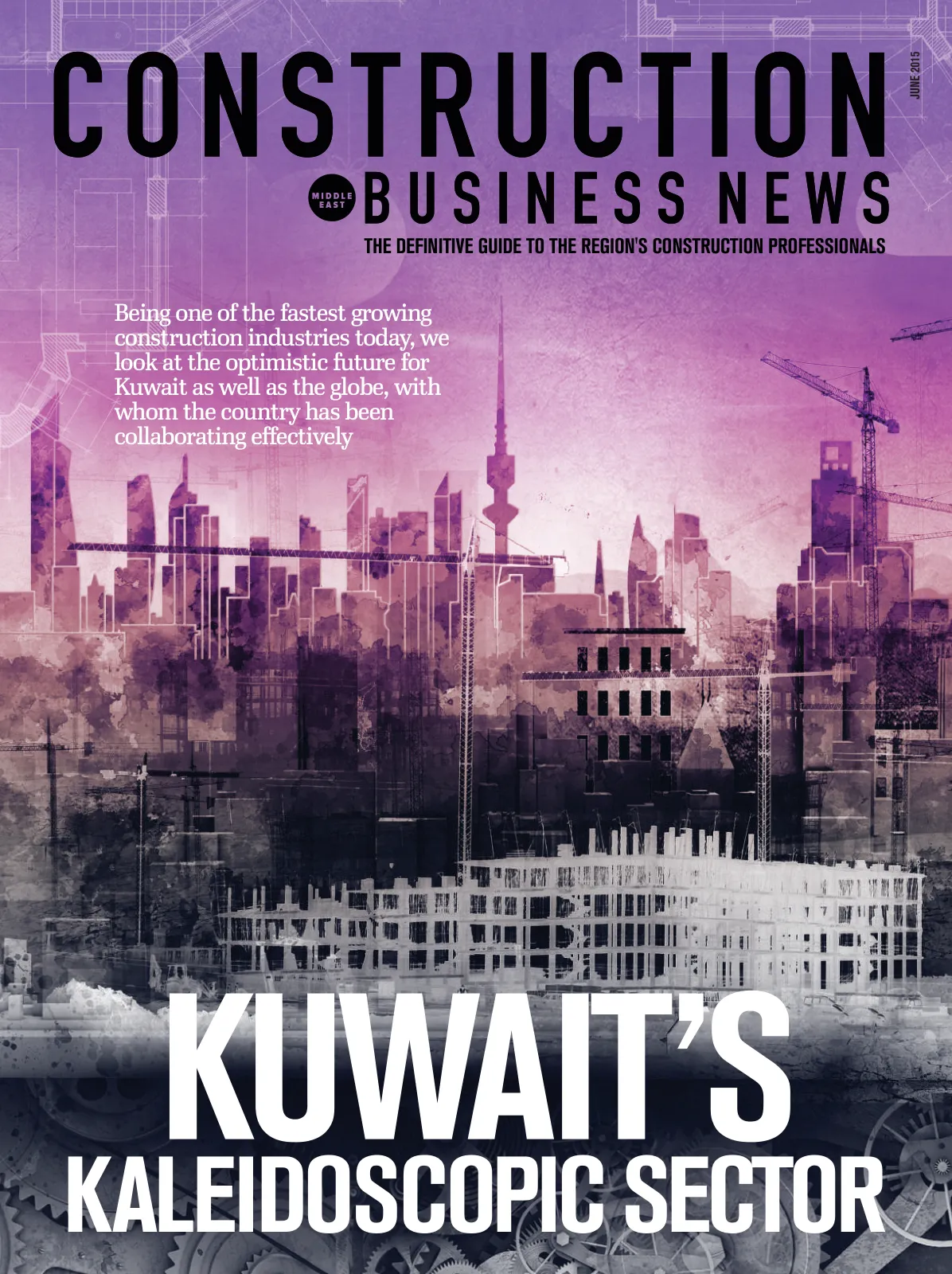
Being one of the fastest growing
construction industries today, we
look at the optimistic future for
Kuwait as well as the globe, with
whom the country has been
collaborating effectively
JUNE 2015
THE DEFINITIVE GUIDE TO THE REGION'S CONSTRUCTION PROFESSIONALS
KaleidoscopiC SECTOR
Kuwait’s
Page 2
OHSAS 18001 certified
ISO 9001, 14001 and
130+years of
project experience
LEED Platinum, LEED Gold
and LEED Silver Capability
End to End Integrated Solutions
Pioneering Engineering Construction since 1881
www.drakescull.com
700+
Projects Delivered
For over 130 years, Drake & Scull International PJSC has been shaping skylines and transforming the lifestyle of
communities around the world.
Drake & Scull is an industry leader, with a proven history of delivering more than 700 projects through its General
Contracting, Engineering, Rail, Oil & Gas, Water and Wastewater Treatment and Infrastructure development business
streamlines across the region.
Page 3
CONSTRUCTION BUSINESS NEWS ME JUNE 2015
1
20
NO WAIT IN ‘BUILDING’ KUWAIT
BEING ONE OF THE FASTEST GROWING CONSTRUCTION
INDUSTRY TODAY, WE LOOK AT THE OPTIMISTIC FUTURE
FOR KUWAIT AS WELL AS THE GLOBE, WITH WHOM THE
COUNTRY HAS BEEN COLLABORATING EFFECTIVELY
NEWS
IN PERSON
SAYYID WASFI JAMSHID,
CHAIRMAN OF THE
BOARD OF DIRECTORS
AT NAPCO, TALKS
ABOUT CURRENT
DEVELOPMENTS
TAKING PLACE IN OMAN
AND GIVES US AN
INSIGHT ABOUT WHAT
OMANISATION TRULY IS
SUSTAINABILITY
WE LOOK AT ‘GREEN
CITIES’ WHERE
RENEWABLE ENERGY
WILL DRIVE EVERYDAY
LIFE AND ALL THE
DESIGN ELEMENTS THAT
MAKE FOR NORMAL
LIVELIHOOD
ANALYSIS
A REPORT ABOUT THE
GULF RAILWAY PROJECT
WHICH HAS ONLY
BEEN, UNTIL RECENTLY,
A HISTORIC VISION
IN-THE-MAKING TO
REVOLUTIONISE TRADE
AND COMMUNICATIONS
WITHIN THE SEVEN-
STATE CUSTOMS UNION
IN THE FIELD
MUSTAFA POOYA,
CHIEF COMMERCIAL
OFFICER OF SELECT
GROUP DISCUSSES THE
COMPANY’S LATEST
PROJECT MARINA GATE
SITUATED IN THE
DUBAI MARINA
ABOVE: HOW THE DUBAI SEVEN-STAR HOTEL WORKS
6
16
24
28
32
cover story
46
32
CONTENTS
Page 4
CONSTRUCTION BUSINESS NEWS ME JUNE 2015
2
S U B S C R I B E
C O N T R I B U T O R S
subscriptions@bncpublishing.net
Managing Director
Walid Zok
walid@bncpublishing.net
Director
Rabih Najm
rabih@bncpublishing.net
Director
Wissam Younane
wissam@bncpublishing.net
Group Publishing Director
Diarmuid O'Malley
dom@bncpublishing.net
Editorial Director
Giorgios Retsinas
giorgios@bncpublishing.net
Editor
Lorraine Bangera
lorraine@bncpublishing.net
Business Development Director
Rabih Naderi
rabih.naderi@bncpublishing.net
Marketing Executive
Mark Anthony Monzon
PO Box 502511 Dubai, United Arab Emirates
P +971 4 4200 506 | F +971 4 4200 196
For all commercial enquiries related to
Construction Business News ME contact
sales@bncpublising.net
All rights reserved © 2015.
Opinions expressed are solely those of the contributors.
Construction Business News ME and all subsidiary
publications in the MENA region are officially licensed
exclusively to BNC Publishing in the MENA region by
Construction Business News ME.
No part of this magazine may be reproduced or
transmitted in any form or by any means without
written permission of the publisher.
Images used in Construction Business News ME
are credited when necessary. Attributed use of
copyrighted images with permission. All images not
credited courtesy Shutterstock.
Printed by International Printing Press www.ippuae.com
Stuart Matthews
Marlow McGuinness Ltd
COMMENT
CRAIG GIBSON WRITES ABOUT HOW TO DEMONSTRATE
DISRUPTION AND HOW TO VALUE IT
MARCOS BISH WRITES ABOUT HOW THE COMMERCIAL FIT-OUT
INDUSTRY NEEDS TO JOIN THE UAE'S GREEN REVOLUTION
SHIVRAM MUKHERJEE WRITES ABOUT THE EMERGENCE OF
SMART CITIES IN THE GCC AND ITS STAGES OF GROWTH OVER
THE NEXT DECADE
DOUGLAS RALPH WRITES ABOUT THE INCREASE IN PROPERTY
INSPECTIONS IN THE REGION
FACILITIES MANAGEMENT
AS THE FM INDUSTRY GROWS EXPERTS SAY THAT THE
NEGLECTED SECTOR NOW HAS A CHANCE TO BE AN
INDUSTRY LEADER
PROJECT REVIEW
ANALYSIS ON THE PROGRESS OF THE UPCOMING KINGDOM
TOWER IN JEDDAH AND ITS NEW FEATURE OF HAVING NEW
FASTEST ELEVATORS IN THE WORLD
RP GLOBAL’S CEO, DR RAVI PILLAI, TALKS ABOUT DUBAI’S
PROPERTY MARKET AMID THE COMPANY’S GROUNDBREAKING
CEREMONY FOR UPCOMING RESIDENTIAL TOWER, RP HEIGHTS
Q&A
TIM ARMSBY, PARTNER AT EVERSHEDS TALKS ABOUT
INFRASTRUCTURE DEVELOPMENT IN THE MIDDLE EAST, SOME
OF THE KEY TRENDS AND CHALLENGES
SUPPLIERS
IN A BID TO DIVERSIFY FURTHERMORE INTO THE METALS
INDUSTRY, THE GCC IS PRODUCING A REMARKABLE HAUL OF
ALUMINUM AND STEEL
GRAPHIC CONCRETE, AN INNOVATIVE FINNISH COMPANY,
MANUFACTURING AND MARKETING GRAPHIC CONCRETE
ENTERS THE MIDDLE EASTERN MARKET
EVENT PREVIEW
CONSTRUCTION MACHINERY
EDITOR’S PICK
36
42
44
52
38
46
50
54
56
58
60
62
64
28
18
CONTENTS
Page 5
Porto Arabia Towers
Doha, Qatar
©2014 Hill International, Inc.
Hill International
The Global Leader in Managing Construction Risk
www.hillintl.com
For nearly four decades, owners and developers in the Middle East have
turned to Hill International to manage their construction projects and
programs throughout the region. Hill is proud to have helped our clients
turn their most challenging visions into realities. We have participated
in over 10,000 projects with a total construction value in excess of $500
billion, managing all phases of the construction process from concept
through completion.
Hill is also the leading construction claims firm in the world, having helped
resolve problems on some of the most complex projects throughout the
Middle East and around the world. To minimize risk and maximize results
on your next project, turn to Hill International
Dubai Office: 971 4 227 0078
Doha Office: 974 4 435 8381
Corporate HQ: 800 283 4088
If you can imagine it, we can manage it.
Qatar National Museum
Doha, Qatar
Mall of Qatar
Doha, Qatar
Viva Bahriya Towers
Doha, Qatar
Page 6
4 construction business news me JUNE 2015
CHECKMATE Kuwait
This month’s cover story looks at the
changing landscape of Kuwait’s economy.
We analyse the country’s affluent pool of
projects and what makes the state a de-
sirable option for investors from across
the globe. According to reports, GCC is
to witness construction projects worth
US$103 billion this year, an increase of
21.2% over last year. Within this, Kuwait
is expected to award about $47.2 billion
of projects this year, almost double the
value of those awarded in 2014. Our story
looks at upcoming changes in the indus-
try that will boost companies to invest
and set up. We also examine how the cur-
rent boom in the construction market in
the country will have a trickle-down effect
on the economy, the real estate market
and its tourism sector.
We also include a Facilities Manage-
ment section this month to demonstrate
our support for the habitually disregarded
sector. During the FM Expo in May, we
talked with exhibitors at the show as well
as speakers at the FM Congress about
how the facilities management sector has
played a vital role in establishing success-
ful cities. When we talk about buildings,
the sector is often pushed in the sidelines
when in fact it is the crucial reason why a
building can keep standing for the next
20 to 30 years. We discuss with experts
in the industry how essential it is for the
sector in improving with the rise of tech-
nological advancement in construction
and its need to adapt and adjust from the
conventional approach.
Another highlight in the June issue is
our interview with Muscat-based Nation-
al Aluminium Products Company. The
new Chairman of the Board of Directors,
Sayyid Wasfi Jamshid, sheds some light
on his company’s new transformation
goal by keeping up with the ever-chang-
ing and competitive market. He also talks
about the importance of Omanisation
and what it means to the company.
We also speak to Mounib Hammoud,
CEO of Jeddah Economic Company,
developer of Kingdom Tower in Jeddah.
The project is said to be the tallest tower
in the world by 2018. We look at the pro-
gress made on the project, the health and
safety measures incorporated and Kone’s
high-speed elevators which will set new
records in vertical transportation.
Among other features we look at resi-
dential projects including RP Global’s
new residential tower placed in the prime
location of Downtown Dubai and Select
Group’s Marina Gate planned to open in
Dubai Marina.
Lorraine Bangera
Editor
editor’s note
Not quite there yet
Could do better...
A little more colour?
Perfect!
TQuibustesedis eos aliquo
int am, in enimus ipsuntus
sequodisque deliquiducia
dolorem. Itatem im dendignimi,
explitate et auta pro
JUNE 2015
THE DEFINITIVE GUIDE TO THE REGION'S CONSTRUCTION PROFESSIONALS
KUWAIT RISING
1 CBNME0615 COVER.indd
1
26/05/2015
10:24
Page 7
Page 8
construction business news me JUNE 2015
6
NEWS
The Abu Dhabi Urban Planning Council (UPC) hosted the third
Charettes series which oversees the Seychelles Strategic Plan
in May 13 to 15. This was the final Charette organised to dis-
cuss the preferred sustainable growth strategy of Seychelles
over the next 25 years.
The event was attended by 120 stakeholders including gov-
ernment ministers and officials who gathered in the country’s
capital, Victoria. The meeting was the last opportunity for plan-
ners and stakeholders to reach a consensus on the urban de-
velopment framework.
Asset design and consultancy firm,
Arcadis, will be developing a new pub-
lic transport system in Jeddah, Saudi
Arabia. The firm, through its subsidiary,
Hyder Consultancy, has been appointed
as a part of Foster + Partners team to
deliver the project.
The plan will include the design of met-
ro stations, high-spec trains and even
the branding. The commercial develop-
ments associated with the metro system
will create a new urban service features
at key locations around the city.
Sameer Daoud, Infrastructure Global
Business Leader of Arcadis Middle
East, said that over the last two years,
the his railway team has helped the
Metro Jeddah Company to set up and
move the project forward. He empha-
sised how the progress comes from a
combined effort, strength and technical
expertise of multinational companies
like Hyder and Arcadis.
The project is in line with the long-term
sustainable vision for Jeddah’s city-wide
transport network which includes metro,
ferry, bus and cycle services.
New transport
system for Jeddah
New development in Victoria, Seychelles
UPC is providing technical assistance for the project which
began in May last year, and will set out to work on the sustain-
able growth of Seychelles up to 2040.
Amer Al Hammadi, Executive Director of the planning and in-
frastructure sector in UPC, said: “The final Charette reviewed
and tested the three draft plans including the strategies, frame-
work plans and policies contained within them. It also focussed
on refining the Victoria Master Plan and undertaking detailed
design of areas within the capital city to help realise its potential
to 2040.”
Stakeholders meet to finalise
Seychelles Development Strategy
Page 9
Ras Al Khaimah has been included in the Global Cities of the Future 2014/15 Awards
compiled by world-leading business news outlet, Financial Times. The northern emirate
has been included in categories such as the Top 10 Small and Mid-Sized Cities list for
human capital, lifestyle, connectivity, economic potential, cost effectiveness, as well as
business friendliness. Criteria for the awards include average annual salaries for a variety
of skills levels, annual rent for prime office and industrial space, and the costs associated
with establishing a business, registering property, and obtaining construction permits.
Property developer, Al Hamra Real Estate Development, which has been a ma-
jor contributor to the growth of the emirate extended congratulations to HH Sheikh
Saud Bin Saqr Al Qassimi, Ruler of Ras Al Khaimah, for the foresight that has thrust
the region into the international spotlight.
Barry Ebrahimy, Head of Commercial of Al Hamra Real Estate Development, said
that the emergence of RAK Freezone has also brought a new level of cost effective-
ness to the city.
Ajman Sewerage Private Company Limited
(ASPCL), a public-private partnership en-
tity, has signed a deal to expand the Ajman
wastewater treatment plan by 50% after
completion. The construction contract was
awarded to Six Construct and is expected to
be completed before the end of 2016. The
work will be done near Ajman’s Jurf Indus-
trial one and will begin immediately.
Christophe Ledur, General Manager of
ASPCL, said that the plant upgrade would
allow treating an additional 40 million litres
of wastewater per day.
He added: “We continue to constantly
monitor the residential and commercial
property market in Ajman with the aim of
ensuring that ASPCL, in close collabora-
tion with Moalajah the operator of the
Ajman sewerage system, has adequate
infrastructure and capacity to collect and
treat the surplus wastewater by expanding
the plant’s treatment process significantly.
“By expanding the treatment plant, ASP-
CL will also increase the production of
treated water, which has become an impor-
tant water resource, and which, if utilised
fully, would reduce the emirate’s reliance on
borehole and desalinated seawater.”
APEI includes
first Middle East
based company
HMG Properties has been the first
real estate group in the Middle East
to receive the membership of Aso-
ciación Profesional de Expertos
Inmobiliarios (APEI) or the Profes-
sional Association of Real Estate
Experts in Spain. According to APEI,
HMG Properties has established
world-class standards in its opera-
tions and as a member it be able to
share their learnings in the Middle
East region.
Raed Bourjass, CEO of HMG
Properties, said that being part of
the APEI is an example of the grow-
ing presence of Middle Eastern
companies. “The APEI membership
caps a successful season for HMG
at the beginning of 2015, which
has continuously explored avenues
to expand beyond the traditional
boundaries we operate in.”
The APEI awards membership to
companies, institutions and groups
that set benchmarks in real estate
services. The selection process re-
views the business’ contribution,
quality of customer service, market
innovation and the depth and pen-
etration the business has in markets
by country and regional cities.
Upcoming canal at Falcon Island
Ajman’s wastewater treatment
plant set for major expansion
RAK makes Financial Times future
cities list
Raed Bourjass, HMG CEO
Al Hamra real estate in Ras Al Khaimah
Ramy Jallad, Acting
CEO of RAK FTZ
H.H. Sheikh Rashid bin Humaid Al
Nuaimi, Chairman of ASPCL (centre),
and Christophe Ledur, General
Manager of ASPCL (far right)
Page 10
Al-Futtaim Auto & Machinery Co. LLC
United Arab Emirates: 800 32626 Saudi Arabia: 800 1244414
e-mail: famco@alfuttaim.ae www.al-futtaim.com
It is, without doubt, one of the harshest environments on earth: the Empty Quarter in the Kingdom of Saudi Arabia – the largest and most barren sand
desert in the world, spreading itself over four Arab nations and covering 650,000 km2 which is comparable in size to France. Temperatures range
from 50° to -1°C in the course of a single day and the sand and dust are relentless. The nearest city is 1000 kilometres away. So the construction
of the road cutting through the desert, linking Saudi Arabia to the Sultanate of Oman, called for an extraordinary solution.
The response: a fleet of 95 Volvo machines was assembled. Together, they shifted over 130 million m3 of sand just to build the bridge of the road –
an extraordinary feat in such harsh conditions, yet the quality and power of Volvo engineering was up to the challenge. The difficulties created
by the remote isolation of the worksite were answered with excellent customer support from FAMCO, the authorised Volvo dealer in Saudi Arabia,
which included the organisation of mobile 24/7 service workshops that moved forward with the construction operation. Discover a new way.
Exclusive distributor of Volvo Construction Equipment in the UAE and Saudi Arabia
Page 11
www.emptyquarter.volvoce.com
Watch video
www.famcouae.com
www.famcosaudi.com
Page 12
construction business news me JUNE 2015
10
NEWS
Emirates Green Building Council (EGBC), an independent forum
aimed promoting green building practices, honoured the winners
of the 2015 EGBC Awards to recognise excellence in sustainabil-
ity at the award ceremony held at Al Murooj Rotana hotel, in Dubai.
Saeed Al Abbar, Chairman of EmiratesGBC, said: “The EGBC
Awards have become a core part of our activities in promoting
sustainable built environments in the UAE, and in turn contributes
to the ‘green economy for sustainable development’ vision.”
Some of the awards included the Green Facility Management
Organisation of the Year which was awarded to Imdaad LLC,
the Green Building Material/Product of the Year which was
awarded to Khansaheb Bionest and the Green Building System
which was awarded to Box Industries LLC for its Technopark
Geochem Office.
2015 Annual Emirates Green Building Council
Award winners
EGBC honours winners for
excellence in sustainability
KEY TRENDS
One of the most popular prediction themes to come from the research is the idea
of sustainability and design. Whilst some felt that design and architecture needs to
move to becoming 100% sustainable and explore self-recycling potential others
felt that the future holds new materials and technologies which will tackle ecode-
sign dilemmas and see scientists working more closely with designers
A common belief among those polled was that commercial and residential building
design in the future will need to be intuitive to each end user whether that is intel-
ligent building skins which respond user needs or even buildings which are able to
pre-empt user needs before the user realises their own needs
With the continued rise of social media and society’s desire to share, several re-
spondents felt that the future of design lies in the ability for design to be a more
collaborative industry; where communities are involved in architecture and social
media is far more integrated into building architecture
The research was commissioned
to mark the 25th anniversary of the
Index International Design Exhibi-
tion and featured varied responses
as expected, but there were several
key themes that were highlighted
throughout. From company CEOs,
directors and founders to profes-
sors, architects and trend transla-
tors, the group of 25 interviewees
are all directly involved in the design
and architecture industry from both
commercial and residential design
arenas predicted key themes of the
future. All the responses were on
display at Index at the Dubai World
Trade Centre in May.
Design gurus
predict future
trends
Sustainable design
Morphing design and architecture
Design sharing and collaboration
Page 13
construction business news me JUNE 2015
11
GCC projects can benefit
from a new line of sound-
absorbing ceiling panels,
industry experts announced
at Index International De-
sign Exhibition in Dubai
World Trade Centre. With
the GCC’s interior contract-
ing and fit-out sector set to
reach US$8 billion in 2015.
Ceiling manufacturer, Hunt-
er Douglas, has introduced
the XLnt swing-down ceil-
ing panels, designed for
airports, train and metro
stations, offices, and other
utility buildings - spaces in
which architects wish to use
large, flat finishing elements.
“GCC countries are heavily
investing in major projects
from transportation, to finan-
cial hubs, and office towers
– which require the most
advanced interior design so-
lutions to reduce noise and
absorb sound, while contrib-
uting to a pleasing working
and traveling environment,”
said Santhosh Vallil, Senior
Sales Manager of Hunter
Douglas Middle East.
XLnt ceiling panels have
an unrivalled stiffness be-
cause of a layered composi-
tion of honeycomb alumin-
ium – based on composite
technology from the aviation
industry. As a result, archi-
tects have tremendous free-
dom in creating their own
designs, without worrying
about ceiling tensile stress,
bending, or sagging.
Gulf Asia Contracting, part of the US$4.5 billion RP
Group of Companies, has been awarded over AED2.28
billion in civil and industrial construction contracts in the
UAE. Mid to high-rise residential projects like the City
Towers, Ajman Corniche, Yasmeen Towers and the Oasis
Towers with distinctive architecture and state-of-the-art
amenities are currently underway to modernise Ajman’s
skyline. The combined estimated worth of all six Gulf
Asia Contracting projects in Ajman is AED1.78 billion
making it one of the biggest contractors to operate in
the emirate of Ajman.
Vinod Pillai Group General Manager, RP Group said: “Gulf
Asia Contracting is currently working with the Ajman Real
Estate Investment Company to construct several residential
landmark projects in Ajman which we believe are symbolic
of the aspirations of a new generation. Gulf Asia Contract-
ing works closely with local companies and partners to pro-
vide valuable industry expertise.”
RP Group’s Gulf
Asia Contracting Co
awarded AED2.28
billion in UAE contracts
Sound-absorbing ceiling
panels by Hunter Douglas
H.E. Sheikh Nahyan bin
Mubarak Al Nahyan, UAE’s
Minister of Culture, Youth,
and
Community
Devel-
opment, inaugurated the
groundbreaking event of
the Bascom Palmer Au-
gust Medical Eye Institute
(BPAMEI) on May 18 this
year. UAE-based SOZA
Group, in partnership with
the Bascom Palmer Eye In-
stitute and August Medical,
welcomed a select group of
guests at the St. Regis Saa-
diyat Island in Abu Dhabi.
Funded by SOZA Group,
the cost of the project is an
estimated AED200 million.
This is the first time the Bas-
com Palmer Eye Institute
has ventured outside of its
home in South Florida.
Dr Zain Kenderian, Chief
Medical Officer of August
Medical, said: “This proj-
ect will allow us to meet
the healthcare needs and
more specifically the eye
care needs of this commu-
nity and its future genera-
tions with state of the art
clinical care. We believe
that it is really important to
have a facility that matches
the quality of physicians
that will work here. So
we’ve come up with some-
thing unprecedented.”
Located in Mohammed
Bin Zayed City, the new
facility – to be named The
Bascom Palmer August
Medical Eye Institute - will
consist of 7,600 square
metres spread over three
floors in phase one and
4,000 square metres with
an additional three floors in
phase two, totalling 11,600
square metres. The first
phase of the institute will
open in the first quarter of
2017 with the fellowship
program launching in the
last quarter 2018.
BPAMEI to open in Abu Dhabi
Marble entrance of Emirates Palace
City Tower project in Ajman
Page 14
Page 15
Page 16
construction business news me JUNE 2015
14
NEWS
A customs transit system which will dra-
matically speed up the transport of goods
across the UAE’s borders with its neigh-
bouring countries is on course to be in-
troduced by the end of this year. The TIR
(International Road Transport) System re-
duces the time trucks spend at frontiers
from days to hours, and its arrival in the
emirates moved a step closer today with
the signing of an agreement between Fu-
jairah Customs Authority and the Automo-
bile and Touring Club of the UAE (ATCU-
AE) at the Novotel Fujairah hotel.
This follows earlier agreements between
the ATCUAE and the customs authorities in
Abu Dhabi, Dubai, Ras Al Khaimah and Aj-
man to work together to introduce the TIR
system. ATCUAE’s President Mohammed
Ben Sulayem expects similar agreements to
be reached soon with the customs authori-
ties in Sharjah and Umm Al Quwain, paving
the way for the system to become fully active
in the UAE before the end of 2015.
In preparation for this, the ATCUAE in
cooperation with the International Road
Transport Union (IRU) will stage a two-
day workshop from June 7 to 8 this year
in Dubai this month to introduce cus-
toms officials to the highly computerised
TIR system.
Subodh Shah, Managing Director
of Marmo Classic Stones Factory
KalingaStone, one of Marmo Clas-
sic Stones Factory’s stone brand has
launched Tiberio. The new product is
created from aggregate and natural
stone surplus. Through technology, it
has managed to get the thickness of in-
dividual tiles down to 9mm, in 60cm x
60cm tiles.
Using by-products from the natural
stones industry means that Tiberio can
be used in place of natural stone, or can
even be used as an alternative to ceram-
ic tiles. Additionally Tiberio makes use of
surplus material from the natural stone
industry and aggregate, making it more
environmentally sustainable.
Subodh Shah, Managing Director for
Marmo Classic Stones Factory LLC said:
“By creating Tiberio, we are targeting
customers seeking natural stone alter-
natives, but also providing a solution to
designers and end users that are look-
ing for an alternative to ceramic tiles. Ti-
berio is incredibly hard wearing, it gives
the luxurious appearance of marble, and
is a cost effective solution at AED125
per square metre.”
Marmo Classic Stones Factory LLC introduces
new advances in engineered stone
Transit system improves
transporting goods for UAE
Page 17
CONSTRUCTION BUSINESS NEWS ME JUNE 2015
15
IMDAAD TO INSTALL
WASTE SEPARATION
SYSTEM IN DUBAI
MADE IN UAE
www.intermetal.com www.verdadoors.com
Dubai, UAE Tel: +971 4 884 1650 Email: sales@verdadoors.com
MANUFACTURING
QUALITY DOORS, KITCHENS
& INTERIOR FIT-OUT
DIRECT FROM MANUFACTURER
AT FACTORY PRICES
Imdaad, a provider of integrated facilities management, has forged a strategic
new partnership with WMS Metal Industries, a local company that specialises
in the design and manufacture environmental products. Under this new part-
nership, the two parties have expressed their commitment in the development
and installation of a new waste separation system in Dubai.
According to Imdaad senior executives, the new novel recycling initiative is
expected to divert approximately 2,000 tonnes of waste annually from the
landfill. The installation of the new waste separation system is expected to
help consolidate Dubai's leading position in the region's efforts towards waste
recycling, which falls in line with Dubai Government's efforts to recycle 75% of
municipal solid waste by the year 2020.
Mahmood Rasheed, Chief Operating Officer at Imdaad, said: “This collabora-
tive effort not only ensures the proper disposal of solid waste but also helps
drive in an increased awareness on the importance of recycling—particularly in
the move to protect our environment.”
Page 18
CONSTRUCTION BUSINESS NEWS ME MAY 2015
16
IN PERSON
Sayyid Wasfi Jamshid, Chairman of the Board
of Directors at NAPCO, speaks on three key
factors: undergoing a complete company
transformation, current developments taking
place in Oman and what Omanisation really
means. Lorraine Bangera writes
to understand the importance of creat-
ing shareholder value by identifying
the drivers of sustainable financial
performance, focussing relentlessly on
accomplishing objectives and stay-
ing ahead of the curve. He says, “In
today’s ultra-competitive landscape,
shareholder value cannot be achieved
in isolation. All stakeholders, includ-
ing employees, customers, suppliers
and partners, must benefit for them to
thrive in the long term.”
In addition to his current high pro-
file job, Jamshid also holds the posi-
tion of Deputy General Manager and
spokesperson for the National Bank of
Oman. Talking about his success, he
says, “There are many secrets to suc-
cess but for me, I can mainly attribute
it to my passion to excel and succeed
in all my endeavours.”
He says that by identifying early
on the few critical success factors
Sadi calling him a “talented” man who
led the company to success, however
even Al Sadi knew that in order to
survive the intense competitive envi-
ronment NAPCO hand to completely
transform. Jamshid is now in charge of
leading this transformation.
Jamshid, who is always true to his
team, says that the transformation at
NAPCO would be impossible without
the “invaluable contribution” in terms
expert advice and guidance of every
board member at NAPCO.
Jamshid has previously worked
as an investment banker in the State
General Reserve Fund (SGRF) and
pioneered several new investment pro-
grammes to transform the operational
and cost structure at SGRF. He draws
from his experience as an investment
banker to help himself lead his current
team in the right direction. According
to him, investment bankers are trained
A
fter being unani-
mously elected as
the Chairman of the
Board of Directors
in 2014, Sayyid Wasfi
Jamshid took up a
specific mission in formulating and
overseeing the implementation of a
brand new strategy for aluminium
extrusions company, National Alu-
minium Products Company SAOG
(NAPCO), based in Oman. Prior to his
promotion, Jamshid served as a board
member and member of the Executive
Committee since 2010.
Honoured by the votes, Jamshid
says that it is a privilege to serve
under and succeed his predeces-
sor, Sheikh Rashid Al Sadi. He says,
“Sheikh Rashid Al Sadi is one of the
country’s most sophisticated and
respected investment professionals
and corporate leaders.” He praises Al
Page 19
construction business news me MAY 2015
17
required for the job and maintaining a
laser sharp focus on execution is key.
He also adds that working with the
right people is a crucial factor in suc-
cessfully attaining a mission.
Speaking furthermore about NAP-
CO's aim and its critical transforma-
tion, the Chairman says that it is their
objective to become one of the top
five aluminium extruders in the region
over the next five years. “We will do
this by at least doubling our produc-
tion capacity,” he states.
The company also aims to gain
supremacy in their home market of
Oman by further enhancing quality
and exceeding specific customer re-
quirements in all current markets.
“To attain successful and sustain-
able changes, everyone, from top
management to our people in our
plant facilities, must be energised
and synchronised with the corpo-
Sayyid Wasfi Jamshid, Chairman of
the Board of Directors at NAPCO
Holkamp recently being appointed
as the new CEO. He adds: “Possess-
ing the right qualities to succeed,
Holkamp is very driven with leader-
ship skills that can align and galvanise
people.” He also says the company’s
board has been very pleased with the
progress the new CEO has made since
taking the helm of the company.
Responding to increase in demand
In terms of NAPCO’s services, Jamshid
says: “We have the right blend of
creativity and efficiency. That is a very
important dynamic to have in any suc-
cessful business and we have it here.”
NAPCO is not purely an alumin-
ium extruder as they facilitate with
anodising, powder coating, wood
finish, a thermal crimping and bend-
ing facility. They also have their own
door and window systems for com-
mercial projects.
rate game plan.” Equally important,
Jamshid says is the crafting of the
corporate game plan which at least
on a tactical level must include cre-
ative inputs from the lower levels of
the organisation. In NAPCO’s case, he
affirms, “We achieved both of them.
Every division was analysed and
tuned to achieve optimal levels of
performance.”
With more attractive incentives for
their staff and a boosted production
capability by 40% to 50%, they are on
their way to double their capacity over
the next few quarters. There would
be an increase from roughly 12,000 to
18,000 metric tonnes for the year.
“One of the main challenges howev-
er is to find and recruit the right cali-
ber of leadership to execute NAPCO’s
transformation strategy,” says Jamshid.
Fortunately, this did not stop the com-
pany to find the right fit with Robert
Page 20
construction business news me MAY 2015
18
IN PERSON
line, will be operational by September
2015. Phase two, meanwhile, will be
ready by early next year. Jamshid says
that so far, they have been able to
purchase all the necessary machinery
for their expansion effort. “We have
also commenced civil works for the
construction of the land space.
“We believe that our expansion ef-
forts are great initiatives not only for
NAPCO but for the whole of Oman.
Once the expansion is completed
and fully operational within the first
quarter of 2016, we are confident that
NAPCO will make into the top five
GCC aluminium extruders in terms of
production capacity.”
NAPCO will double its extrusion
output from 18,000 to approximately
36,000 metric tonnes and we will
quadruple our powder coating ser-
vices. He says: “As 2016 commences,
we will have a total of four extru-
sion presses, vertical and horizontal
powder coating lines, one anodising
line, two wood-finish lines, a thermal
crimping facility and a bending facil-
ity. With this expansion, we will be
able to create more jobs for Omani
citizens and residents and substan-
tially give back to the community
through our corporate social respon-
sibility initiatives.”
Fulfilling the Omani dream
The Sultanate of Oman launched
its Omanisation policy in 1988 to
significantly increase the number of
citizens working in various industries.
Companies that successfully meet the
set quotas in terms of percentage of
Omani to foreign workers will obtain a
‘green card,’ which translates to press
attention and preferential treatment in
their dealings with the government.
It is NAPCO’s long-term goal to in-
Their premier vertical powder
coating system, has a continuous
running production capacity of
more than 2,000 kilograms per hour,
which will enable NAPCO to address
the region’s increasing demand for
aluminium-based powder coating
systems and meet specific orders for
higher length profiles. Adding this
new system to its existing horizontal
line, the company will be able to
accommodate up to 27,000 metric
tonnes per year.
To date, NAPCO, the only alu-
minium extruder in Oman, is one of
the three companies in the entire GCC
capable of addressing the demand for
powder-coated extrusions with profile
lengths of up to eight metres. Jamshid
says: “Our line only uses chrome-free
chemicals and has been provided with
all the necessary auxiliary equip-
ment, air conditioned segregation for
powder booth, wastewater treatment,
de-mineralised double line, chiller and
air compressor.”
Time to expand
NAPCO announced their expansion
plans in July last year in line with the
objective to increase market presence
and gain wider reach across regional
and international markets. Jamshid says:
“We made the announcement following
the decision of the company’s share-
holders and Board of Directors to bring
NAPCO to a whole new level by tap-
ping into newer markets and introduc-
ing more products and services. The
move comes at a time when our recent
performance indicators showed in-
creased demand for NAPCO’s products.”
The company’s expansion initia-
tives will be implemented in three key
phases to ensure that they increase
their output and production capacity.
Currently the company produces prod-
ucts through two extrusion presses. To
date, NAPCO has already exported a
total of 70% of its output to key mar-
kets such as the GCC, Europe, Africa
and Asia.
The first phase kicked off this year
up until 2016. Construction is now in
progress and phase one, which in-
volves commissioning the first new ex-
trusion press and new powder coating
NAPCO factory in Oman
Page 21
construction business news me MAY 2015
19
crease their current Omanisation level
of 35% well beyond the minimum
requirement. “Since our field is highly
specialised, it is a challenge for us to
find qualified personnel,” says Jam-
shid. “This is the reason we highly in-
vest in capacity-building programmes
for the locals to equip them with the
right skills needed by the industry.
“We are 100% committed to help-
ing Omani nationals achieve their
full potential so that they will be able
to make maximum contributions to
NAPCO, their colleagues, communities
and families.”
NAPCO also works closely with the
Ministry of Manpower and have selected
30 Omanis from the Mohsin Haider
Darwish Training Institute to join their
team in the coming months. “We want
each employee, whether Omani or non-
Omani, and stakeholder to feel proud
that they are part of the NAPCO family.”
Jamshid praises Oman’s Sultan, Qa-
boos bin Said Al Said, and is inspired
by his vision. He looks forward to the
promise of “fruitful future” for NAPCO
shaped and driven by “talented, ambi-
tious and committed” Omani nationals.
He adds: “Omanisation is not just a
number for NAPCO. It runs far deeper
than that.”
Growth and development in Oman
In Oman, one of the major trends
Jamshid points out is the continuous
rapid expansion of the local construc-
tion sector thanks to the government’s
steady investments in major infrastruc-
ture projects, private sector-driven
tourism development, and strong
growth in the oil and gas industry.
Vision 2020’s economic diversification
strategy, meanwhile, provides new
opportunities for growth and develop-
ment along with the introduction of
new reforms and increased industry
transparency.
“We know for a fact that the public
sector is the largest procurer of con-
struction services as demonstrated by
the rising government-led transporta-
tion and social infrastructure projects,”
says the chairman. These improve-
ments aim to better facilitate trade
and reinforce the non-oil sectors. The
government already earmarked an
estimated US$77.68 billion for devel-
opment projects as part of its eighth
five-year development plan.
Tourism has become a key source
of revenue for Oman. He says: “By
2024, the sector’s contribution to GDP
is expected to jump to 8.2% from 6.4%
in 2013. The construction sector is
projected to benefit from Oman’s bur-
geoning tourism sector and the size-
able new opportunities it presents.”
Oman might be having a stable
growth at the moment, but there are
still changes in the construction market
that need to be made. According to
Jamshid, despite the country’s sound
environmental law there is still a need to
intensify green or sustainable initiatives
in the industry. He says, “We need to
introduce more sustainable construction
programmes in line with the growing
global eco-friendly movement.”
He says that admittedly, the country
must keep up with its neighbors in
terms of implementing sustainable
programmes within the sector. “Strict
implementation of the country’s en-
vironmental legislations and regula-
tions across industries, including the
construction sector, must be diligently
carried out by concerned authorities.”
He explains that supply pres-
sure for materials eases when we
widely promote the use of recycled
resources. However, he admits that
coordinated approach with regard to
the approval of standards for recycled
content must be strategically coordi-
nated to ensure quality.
Another challenge Jamshid points
out is the exponential growth in
demand for labour in the country. He
says: “To attract qualified and pro-
fessional expatriates, any state must
increase the standard of living by
providing a safe working environment,
international curriculum schools, and
suitable accommodation and leisure
facilities, to name a few.”
Finally even if the country has a
booming construction industry, it
requires a centralised logistics strategy
to guarantee smooth flow of materials
into and within the country according
to Jamshid. “The government is work-
ing towards this end as demonstrated
by continuous infrastructure improve-
ments in the Sultanate.”
“Once the expansion is completed and fully
operational with the first quarter of 2016, we
are confident that NAPCO will make it into the
top five GCC aluminium extruders...”
Vertical powder coating line
Page 22
CONSTRUCTION BUSINESS NEWS ME JUNE 2015
20
COVER STORY
From building boats in the
late eighteenth century
to being home to one
of the fastest growing
construction industries
today, Kuwait’s past
turbulences seem too far
away. It has parlayed its
natural rich resources,
hearing the soft voice of
intellect, which has indeed
led to an optimistic future
for Kuwaitis as well as
the globe, with whom
the country has been
collaborating effectively.
By Giorgios Retsinas
CONSTRUCTION BUSINESS NEWS ME JUNE 2015
20
Page 23
construction business news me JUNE 2015
21
I
t is not just the abundance of
affluence that makes Kuwait a
desirable destination, its resources
support its prosperity and its stra-
tegic location is just apt to greet
the world. According to MEED’s proj-
ect database MEED Projects, in terms
of future projects, there are some
US$116 billion-worth of projects
planned or unawarded in Kuwait.
Gearing up, the government has
set a budget of $79.6 billion for 2015,
which will be split between spend-
ing on salaries, commodities and
services, transport, construction and
other expenses. Kuwait News Agency
quoted the chairman of the National
Assembly's state budget committee,
MP Adnan Abdualsamad, stating that
‘$7.2 billion would be spent on con-
struction...The budget, which runs from
the beginning of April to 31 March 2016,
has been set with the expectation that
Kuwait will earn around $65 billion from
oil revenues, which will provide around
90% of total income. It is also based on
the premise of crude oil at $75 a barrel
considerably higher than its current
rate of around $60.Over the past year,
contracts for several major projects have
been awarded, such as the $12 billion
clean fuels project to upgrade refineries
and the $4.8 billion Kuwait International
Airport expansion’.
construction business news me JUNE 2015
21
Page 24
construction business news me JUNE 2015
22
country is also focusing on improving
its business climate and reduce red
tape through the Direct Investment
Promotion Law agreed by government
at the end of 2014.
Strengthening its belief on strong
public-private partnerships, in October
last year, Kuwait revised its PPP laws,
establishing a clear regulatory frame-
work for implementation of projects.
According to reports, GCC is to
witness construction projects worth
$103 billion this year, an increase
of 21.2 % over last year. Within this,
Kuwait is expected to award about
$47.2 billion of projects this year,
almost double the value of those
awarded in 2014 as the government
concentrates on infrastructure. The
Kuwait's Central Tenders Commit-
tee had already awarded around $5
billion of tenders this year. According
to Kuwait News Agency, the Com-
mittee held 26 meetings which led to
around 152 tenders being awarded
though the vast majority of the
tenders were in the oil sector with
five worth $4.17 billion, were issued
by Kuwait Oil Company. Last year
Kuwait awarded $25 billion of con-
tracts, four times as much as in 2013
and more than the last three years
combined, stated the report by MEED
Projects. The total value of Kuwait’s
projects market (planned and active
projects) is estimated to be in the
region of $212 billion, it said.
Another boost for the plethora of
construction works is a new law which
makes it uncomplicated to invest in
Kuwait. There have also been dramatic
changes which pamper new compa-
nies to be set up in just 30 days. The
COVER STORY
Macroeconomic Forecasts (Kuwait 2013-2016)
Indicator
2013e 2014e 2015f 2016f
Real GDP growth, % y-o-y
1.9
2.7
2.6
2.4
Nominal GDP, USD bn
175.7
171.3
130.8
135.2
Consumer price inflation, % y-o-y, eop
2.9
3.0
3.8
4.0
Exchange rate KWD/USD, eop
0.28
0.29
0.30
0.31
Budget balance, % of GDP
25.5
26.4
17.0
6.1
Current account balance, % of GDP
39.7
34.3
12.2
12.3
“We expect the Kuwaiti economy to perform
relatively well over 2015 and 2016, and
retain our forecast for real GDP growth
of 2.6% and 2.4%, respectively, from an
estimated 2.7% in 2014.”
– BMI Research
Now the Partnerships Technical
Bureau (PTB) will be superseded by
the Kuwait Authority for Partnership
Projects (KAPP), an independent gov-
ernment body with greater executive
powers in order to more effectively
manage all PPP projects.
According to KFH Research, the
residential/non-residential construction
sector is set to benefit greatly from
Page 25
construction business news me JUNE 2015
23
these initiatives and the country’s will
to diversify the economy and move
itself up the hydrocarbons industry
value chain. Also, Kuwait was one of
the first countries in the region to an-
nounce an increase in social spending
in the wake of the Arab Spring and,
buoyed by elevated oil production,
researchers believe the government is
well placed to sustain its social spend-
ing commitments.
The research identifies education
as an emerging major new thrust of
government policy. The country's
healthcare development plan centres
on the construction of eight public
hospitals by 2016, in order to deal
with the heavy pressure placed on
the healthcare sector. Other develop-
ments, such as a $160 million project
to build nine towers to be annexed
to hospitals, adding 2,000 hospital
beds, suggest that there is political
support for the necessary health-
care drive. There is also a series of
planned investments to overhaul
medical facilities and health centres.
Another sector which is not being
ignored by Kuwait is tourism. The
government had announced a five-
year development plan for its tourism
industry back in 2011. And since, the
country has spent billions to fortify the
sector. One of its major projects is the
construction of a massive new terminal
at the Kuwait International Airport. By
2016, annual capacity will jump from six
million to 13 million, and then up to 25
million by 2025. And then there is the
metro railway system. Kuwait’s metro
is part of the Kuwait National Rail Road
System project, which will be a 511-ki-
lometre network. These developments
will only compliment the growth of the
construction business in the country.
According to a BMI Research,
‘Kuwait has seen a flurry of popu-
list legislation recently, including
several measures specifically target-
ing expatriate workers. This runs the
risk of increasing uncertainty within
the private sector, as well as cement-
ing perceptions of the country as a
hub of policy instability.We expect
the Kuwaiti economy to perform
relatively well over 2015 and 2016,
and retain our forecast for real GDP
growth of 2.6% and 2.4%, respective-
ly, from an estimated 2.7% in 2014.
After a long period of stagnation, the
Kuwaiti investment outlook appears
to be improving, while the prospects
for consumption remain bright. How-
ever, we again highlight Kuwait's
ever-volatile political situation as the
key downside risk to economic activ-
ity. We forecast average consumer
price inflation for Kuwait of 3.8%
and 4.0% for 2015 and 2016 respec-
tively, up from 3.0% in 2014. While
we expect a slight fall in Kuwaiti
food inflation over the near term on
the back of lower global prices, a
tight supply picture in the real estate
market will fuel housing inflation
over the coming quarters, in a trend
seen across the GCC’.
Given the positive mood, new and
friendly laws, forward-looking statistics
and a welcoming partnership from
around the globe, time seems to be
just right for the construction industry
to boom further. Kuwait’s landscape
has been changing, but it is time to
widen the scope, higher.
Top: Daniel Safarik,
Director of the China
Office for the Council on
Tall Buildings and Urban
Habitat
Middle: Hussam
Abdelghany, Associate
Director at Atkins
Right: Senior
Sustainability Manager
for KEO
$2.6bn $1.8bn
$1.2bn
$1.2bn
$1bn
$.97bn
$.96bn
$.90bn
$.88bn
$.88bn
Subiya
Causeway
Oil and Gas
Pipelines from
Mina Al Ahmadi
Refinery to
Kuwait Power
Plants
Kuwait project market
Total value of projects planned or under-
way = US$202B (MEED)
Mubarak Al-
Kabeer Seaport
Project: Phase
1: Package 2
Al Zour South
Power Plant
Upgrade
Jaber Ahmed al-
Jabber al-Sabah
Hospital
Al Zour North
IWPP: Phase
1: Power
Plant
Al-Jahra Road
Upgrade
Booster Sta-
tion 171
Mina Al
Ahmadi
Refinery: Gas
Fraction-
ation Train 4
Jamal Abdul
Nasser
Development
Project
Page 26
construction business news me JUNE 2015
24
SUSTAINABILITY
Painting
the Cities
GREEN
Page 27
construction business news me JUNE 2015
25
In the 21st century, in many parts of the world,
mankind has managed to hold the Malthusian
disposition, which suggests that population
increases faster than its means of subsistence
resulting in disaster, unless population is checked
by natural calamities or by people exercising
control and having fewer children. What happens
in another five decades will be too much of a
foresight, but in another decade, humanity will
survive, keeping reserves for sustenance
W
hile cities across the
world are growing
vertically, mankind will
have to ‘unwillingly’
force itself to find ways to move away
from conventional norms of infrastruc-
ture development, and come up with
unconventional ways, which is ‘health-
ier, safer, economical and robust.’ The
thought towards this end has been
evolving over more than a decade or
so - Going Green. But for some reason,
its evolution has been dwarfed.
Many proponents strongly vouch
that ‘Green cities’ are the only way
forward. They would be cities where
renewable energy will drive every-
day life and all the design elements
that make for normal livelihood
would have been given a stern
warning to not emit anything harm-
ful. The examples, though minus-
cule, is already thriving, with pock-
ets of the idea being implemented
to quickly innovate with small but
impactful results.
For example, LEED is a beginning.
Leadership in Energy & Environmental
Design is a ‘green building certification
programme that recognises best-in-
class building strategies and practices.
LEED certified buildings save money
and resources and have a positive im-
pact on the health of occupants, while
promoting renewable, clean energy.
To receive LEED certification, building
projects must satisfy prerequisites and
earn points to achieve different levels
of certification.’
Then there is BREEAM (Building
Research Establishment Environmental
Assessment Methodology), ‘the world’s
longest established method of assess-
ing, rating, and certifying the sustain-
ability of buildings.’ Green Building
Initiative (GBI) is ‘a nonprofit organ-
isation that administers green building
assessment and certification services in
the United States.’
In the Middle East, there is Estidama.
‘Abu Dhabi's Plan 2030 establishes a
clear vision for sustainability as the
foundation of any new development
occurring in the emirate and Abu Dhabi.
Estidama promotes a new mindset for
building a forward thinking global capi-
tal. To establish a distinctive overarching
framework for measuring sustainability
performance beyond the usual plan-
ning and construction phases, Estidama
assures that sustainability is continually
addressed through four pre-defined
angles: environmental, economic, social
and cultural.’
Qatar has one too. The Qatar Sus-
tainability Assessment System (QSAS)
is ‘a green building certification system
developed for the State of Qatar.’
So, while world over, there is a certain
level of interest to go green, the effort
still is in its dormant stage, even though
its benefits seems to be attractive.
The Green Economics
By taking the example of LEED
building, one may not be quite im-
pressed with the kind of value that
is derived from an investment point
of view. The certification focuses
entirely on designs that ensures
minimal damage to the environment,
ignoring the humongous damage to
the owner’s bank account. Often,
when a LEED rating is pursued, the
cost of initial design and construc-
tion rises. Also, there may be a lack
of abundant availability of manufac-
tured building components that meet
LEED specifications.
But then that is what comes out in
the short-term. Those looking in the
long-term perspective would be more
than proud with the initial spend. Ac-
cording to a McKinsey survey covering
15 well-developed green-district tech-
nologies, covering buildings, waste,
water, transport, and utilities, ‘green
districts are economically viable. The
difference is not so much a matter
of cost as of timing. For example,
installing a combined-heat-and-power
system costs about twice as much as
a conventional natural-gas system.
But the operating costs are less than
half, and the payback on the higher
incurred costs is about five years. And
that does not even take into account
the associated environmental benefits,
such as 30 to 50% lower emissions.’
Research shows that investing in
technology that conserves an ecologi-
cal balance by avoiding depletion of
natural resources, can substantially
escalate the resale price by reducing
annual costs and ensuring that the
building is less expensive to maintain
for a new occupier.
Page 28
construction business news me JUNE 2015
26
SUSTAINABILITY
The Green Environment
No doubt that green cities are bound
to abide by its very core principle - be
environment friendly. It is widely ac-
cepted that most buildings today have
a huge impact on our environment.
According to an official District of
Columbia (DC) report on green build-
ings, it is estimated that about 40% of
raw materials consumed globally are
used by the building construction in-
dustry. ‘In the United States, buildings
are responsible for approximately 68%
of total electricity consumption, 38%
of carbon dioxide emissions, 12% of
potable water usage, and 272 million
tonnes of construction and demolition
waste annually,’ the report indicates.
Given these unpleasant but true
statistics, proponents of green build-
ings have a reason to rejoice - their
solution guarantees lower operational
costs, enhances asset value, improves
risk and liability management, and
build brand equity and reputation.
The DC report suggests that many
of the principles of sustainable design
lead to longer building lifetimes and
better adaptability of the building for
future uses that cannot always be
foreseen. ‘Maximising water efficiency
in buildings and surrounding land-
scapes saves money and reduces their
environmental impact. More effective
and efficient water use can provide
additional benefits by recharging
groundwater and growing healthy
landscapes. Increased energy efficien-
cy saves money, improves air quality,
conserves natural resources, and cre-
ates a healthier ecosystem for every-
one. Innovations in energy technology
make incorporating high-efficiency
mechanical and lighting systems
easier and greatly reduces a building’s
energy consumption. Developments
in renewable energy makes on-site
use of solar, wind, geothermal, and
other technologies feasible and several
incentive programmes are in place to
help projects take advantage of renew-
able options.’
McKinsey report concurs. It em-
phasises that “green districts have the
greatest potential to produce economic
savings in areas with high resource
demands and costs.” For example,
technologies for reducing water use
have a much faster payback period in
the desert nations of the Middle East
than in regions with more water.’
The Green Life
If we were to venture in to South Pole,
we would clearly make out the differ-
ence in the air - it is clean, probably the
cleanest we can ever get to breathe air
in the whole globe. But there too, pollu-
tion around the world has caused a hole
in the ozone layer. So, in a decade, you
may just stay where you are, Antartica
will be as polluted.
The Blacksmith Institute in collabo-
ration with Green Cross Switzerland
recently evaluated the most dangerous
pollution problems we face today. As
a result, they put together a top ten list
of the most deadliest factors - ground-
water contamination, industrial mining
activities, metals smelters and process-
ing, radioactive waste and uranium
People with face masks due to severe
air pollution in Beijing, China
Page 29
construction business news me JUNE 2015
27
mines, untreated sewage, urban air
quality, used lead acid battery recycling,
contaminated surface water, indoor air
pollution and artisanal gold mining.
All of them are the result of the evil
created by mankind. But for some rea-
son, they are necessary evil. According
to an estimate by World Health Or-
ganisation (WHO), ‘air pollution kills
about seven million people worldwide
every year, with more than half of the
fatalities due to fumes from indoor
stoves.’ The agency said air pollution
caused about one in eight deaths and
had now become the single biggest
environmental health risk. ‘One of
the main risks of pollution is that tiny
particles can get deep into the lungs,
causing irritation. Scientists also sus-
pect air pollution may be to blame for
inflammation in the heart, leading to
chronic problems or a heart attack.’
But if the green concepts were to
applied in tandem across the world
and with as much impetus as is re-
quired, then it could all change.
Take Calgary, Canada for instance.
It is ‘considered’ to be the world’s
cleanest city. ‘Even though there is a
large oil and gas industry in the area,
the city features a well-planned out,
grid-like structure that reduces traffic
congestion. It also features light rail
transportation, and transfer stations
that sort through garbage and take out
biodegradable and recyclable materi-
als.’ Then there is Honolulu, Hawaii.
It has ‘a light manufacturing industry.
The American Public Transportation
Associationhas highlighted Honolulu
for its transit system, which includes
dedicated bus lanes. By promoting
bus travel, Honolulu has been able
to reduce traffic and exhausts fumes.’
And although Helsinki is ‘a fairly large
city with more than 500,000 inhabit-
ants, it has the feel of a much smaller
city thanks to the fact that the light
rail commuter system is so well used.
Helsinki residents take pride in their
city and do a lot on their own to
make sure the city stays clean. The
streets are wide, which makes them
less prone to congestion and reduces
fumes from cars.’
The Green Future
It is difficult to go green. No won-
der, the idea, however moral and
healthier, is not taking up as it
should have been in an ideal world.
We are not living in an ideal world
because our life is accustomed to
certain norms, however unhealthy or
illogical it may be.
The biggest brands of eateries and
cold drinks have been widely shunned
by nutritionists of promoting junk
food. But we have more than wel-
comed it. Smoke and alcohol have
proven itself to harm, but we have
increasingly had pleasure with the
hazy stupor.
Similarly, builders and developers
have been used to a particular model
all through their lives. They have
relied on conventional materials and
always lived with the model of build
and sell, as quickly as possible. The
will to change for a better model and
thus a better world is non-existent.
The initial cost is what is a let
down, but if there is some dramatic
shift in thinking, probably, it will
go a long green way to the future,
a much secured one for many more
millenniums, till the time when even
“green” comes up with some form
of evil.
“Air pollution caused about one in eight
deaths and had now become the single biggest
environmental health risk.”
– World Health Organisation
Calgary skyline, Canada
Page 30
CONSTRUCTION BUSINESS NEWS ME JUNE 2015
28
ANALYSIS
Until recently, the US$ 140 billion Gulf Railway project has only been
a historic vision in-the-making, stirring much excitement for its
potential to revolutionise trade and communications within the seven-
state customs union. But as the wait for a concrete blueprint outlining
its execution continues, it is the next few years that will ultimately
decide how close this vision is to truly becoming reality
By Giorgios Retsinas
STANDING
AT THE
BRINK OF
A RAIL
REVOLUTION
Page 31
construction business news me JUNE 2015
29
W
hile the GCC may be a
century or two late in hop-
ping onto the bandwagon,
it isn’t entirely foreign to
the notion of rail transport.
In fact, the presence of locomotives in the Gulf,
though having eluded the majority of its coming-
of-age urban capitals, dates back as far as back
as the 20th century when the then ruling Ottoman
Empire established the celebrated Hejaz Rail Link
to transport pilgrims from Damascus in Syria
to Makkah in Saudi Arabia for the annual holy
pilgrimage of Hajj. Since its destruction in World
War I, however, there remains only a single
surviving relic of the region’s limited foray into
railways- an independent cargo line that con-
nects the Saudi capital of Riyadh to the coastal
city, Dammam, in the Persian Gulf.
Despite its partial coverage of the eastern
city of Hardh, the prized rail link has no path
through Jeddah, Tabuk, and Rabigh, thus having,
for long, created a pressing need to set up a
complementary line that would aid the shipment
of goods, and growth of industry in general,
Page 32
construction business news me JUNE 2015
30
ANALYSIS
fuel, even when oil prices began to
soar in other parts of the world, pro-
pelled travel by road as the primary
means of transport in the region. The
relatively small geographical size of
the Gulf nations also did not set a
strong precedent for high-speed rail
travel and the hefty investments its
establishment would entail, produc-
ing promising returns for its operators
only in the long run.
The turning point arguably arrived
with the dawn of the 21st century,
when the GCC states began to reap
the advantages, and also face the
challenges of the extensive pace of
urbanisation they had embraced in the
preceding decade, such as rampant
population growth and escalating
congestion on existing road and infra-
structural networks. Freight and cargo
conveyance also emerged as a priority
as several countries expand their
mining and raw material industries,
additionally providing a long-awaited
boost to inter-GCC trade which cur-
rently stands at less than 10% of
total business within the region. The
search for alternative modes of surface
transport inevitably began with rail
travel, though the most decisive push
for a full-fledged regional network
only arrived with the inauguration of
the landmark Dubai Metro in the UAE
and its extensive subsequent success,
alleviating all fears about the feasibility
of operating such a service for travel
within and across the GCC.
The pace of the Dubai Metro’s
development, which was concluded
Welcoming a new era of
mass transit
Despite these distinct advantages, the
Gulf had a longer road to conquer
before becoming positively rail-ready.
For one, rail transport had been wide-
ly viewed as a superfluous ‘accessory’
rather than an absolute necessity to
economic progress in the Gulf for the
better part of the past century. The
inherent rationale behind this was a
complete lack of prior infrastructure
or expertise in the field on which
to build upon, coupled with the
difficulty of establishing one given
the region’s troubling geographical
circumstances, such as shifting sand
dunes and volatile ground surfaces in
the harsh desert environment.
The onset of the hydrocarbons
industry did not help matters either as
the availability of cheap, subsidised
“It is an interesting time to observe the
development of the strategies. The clients
are informed and ambitious. They would
like to receive the best that they can
get and they should. We need a system
that looks good in 10 years’ time and is
sustainable in 20 years to come”
- Arash Aghdam, MENA Director of Rail and Transit at Parsons Brinckerhoff
along one of the most significant com-
mercial belts in the Kingdom.
Even so, the factors that have driven
the prospect of a national, and in due
course, regional-level rail network
across the GCC from a mere idea to
a tangible possibility are as many
and diverse as the number of nations
in the council itself, not the least of
which is the vast economic benefits it
is bound to offer.
Besides being about 30% cheaper,
rail transport is also considered to be a
more eco-friendly alternative, utilising
60-80% less energy per kilometre than
road transport, according to a recent
statistical analysis by global agency
Frost & Sullivan. It also produces
80% less carbon dioxide emissions
and 9 times less noise damage, with
one freight train carrying about 1,000
tonnes of cargo replacing the use of
50 trucks by road.
Page 33
construction business news me JUNE 2015
31
in 2009, set a new precedent for the
realisation of the Gulf Railway, a target
completion date for which has been
set in 2017. Plans for national-level rail
networks, which are a crucial prelude
to the foundation of a region-wide
link, were soon announced, including
the $11 billion Union Railway cross-
ing all seven emirates in the UAE, as
well as nine individual rail links in
Saudi Arabia, besides an additional,
much-anticipated line connecting the
Kingdom to Bahrain.
Other GCC countries have been
surprisingly quick to catch up, such
as Oman which has put in place a
massive $10 billion plan to estab-
lish far-reaching and accessible rail
connectivity throughout the nation.
Kuwait, which has thus far been found
to lag behind infrastructural develop-
ment due to lingering elements of
disharmony and tensions within its
internal political fray, is eager to shake
off its lethargy with the launch of two
ambitious projects worth a combined
$17 billion set to become operational
in 2020 in order to complement its
massive housing development spree.
In spite being one of the GCC’s
smallest economies, Bahrain was
among the first to catch the ‘rail-fever’,
announcing plans to launch a mono-
rail network across its capital city of
Manama shortly after the launch of
the first phase of the Dubai Metro in
2009. Today, the country’s investments
in the area total nearly $9 billion,
with the first phase commissioned for
completion as early as 2016.
Tribulations abound
While the Gulf nations may have
strongly entrenched their commit-
ment and determination to realising
the $148 billion dollar mega-project,
taking all preliminary measures to fol-
low through with the plans within the
past few years, there is evidence that
doubts surrounding its timely comple-
tion are not completely unfounded.
Construction works on the majority
of initial phase developments are yet
to begin in all but the UAE and KSA,
and even though budgets have been
announced and feasibility studies con-
cluded, plans to finance the projects
are yet to be fully determined as over-
seeing authorities for each country’s
rail endeavours contemplate the extent
and nature of private sector involve-
ment. Public funding, mostly from
sizeable budget surpluses generated
by buoyant international oil prices, is
expected to cover a significant propor-
tion of the costs, especially as PPP
(Public Private Partnership) financing
models continue to be an oddity in the
region, having suffered another debili-
tating setback in the global economic
events of the past few years.
Another major hindrance that has
already proved costly to the project in
terms of delays, cost overruns as well
as conflicts in procurement procedures
and strategies is the lack of a common
authority managing the seamless in-
tegration of the national-level railway
systems. After much idle speculation
and vague timeframe announcements,
a final, definite deadline of 2014 was
mutually agreed upon by member
states early this year, thus allowing
decision making across the individual
rail authorities to successfully become
streamlined and pave the way for
implementation of unified standards
and specifications throughout the
regional network.
“The railway industry in the GCC
is at its early stages of development,”
states Arash Aghdam, MENA director
of rail and transit at Parsons Brinck-
erhoff, a US-based pioneer in infra-
structural development that is closely
involved with the project. “It [the
railway system] has to fit the purpose
of the GCC and its various member
countries. The timeframe is unknown
(for the projects) but the mandate
is huge,” he adds in a statement to
Zawya, effectively summarising the
outlook for the project.
“It is an interesting time to observe
the development of the strategies.
The clients are informed and ambi-
tious. They would like to receive
the best that they can get and they
should. We need a system that looks
good in 10 years time and is sustain-
able in 20 years to come,” concludes
the executive.
Page 34
IN THE FIELD
Mustafa Pooya, Chief Commercial
Officer of Select Group discusses the
company’s latest project Marina Gate
situated in the Dubai Marina. He
talks about the progress made since
design and how the building represents
community building and comfort
COMMUNITY
BUILDING
T
he Residences at Marina
Gate, an upcoming three-
tower project by Dubai-based
property developer Select
Group, will be occupying one of the
last remaining plots in the coveted
neighbourhood of Dubai Marina.
Looking at the rising towers in Dubai
Marina in the last decade, the new
development is likely to be the final
opportunity to purchase luxury wa-
terfront property in the area.
The project consists of three residen-
tial towers with connected walkways
for retail and a wide range of recre-
ational amenities including swimming
pools and spa areas located on the
ground, mezzanine and podium levels.
Proud of the latest development,
the CEO of Select Group Rahail Aslam
says: “The AED3 billion three tower
project represents our tenth, eleventh
and twelve residential development in
the Marina.”
He says that Marina Gate overlooks
the marina, the sea or the cityscape
and this is an exclusive opportunity
to purchase a new property in such a
prime location.
Page 35
construction business news me JUNE 2015
33
Architects – AEDAS
One of the five largest
international architectural
firms in the world, the firm
provides architecture,
interior design, landscape
design, urban design and
masterplanning, along with
graphics services to a wide
range of developments span-
ning across mixed-use, office,
retail, residential, hotel,
infrastructure, education,
civic and culture, and urban
planning.
Some of Aedas notable works
include the Dubai Metro
Station, Ocean Heights in
Dubai Marina and Al Bahr
Towers in Abu Dhabi.
Construction work at Marina Gate
tower one
Not an architectural
wonder but a home
Mustafa Pooya, Chief Commercial
Officer at Select Group, says that the
location of Marina Gate is ideal. It is
placed near the original marina next
to iconic towers like Cayan Tower
and towers by Damac. Though Pooya
admits that Marina Gate is not going
to be an iconic building praised for its
stellar structural design. He says that
creating an iconic building is not really
the purpose. “We want to build some-
thing classic and timeless.”
Architects on the project, Aedas,
have been very thoughtful when it
comes to the design. Pooya says that
it is simple yet elegant and very well
designed. He says that the archi-
tects designed the building from the
“inside out,” which means that the
building is not just designed to look
beautiful on the outside but made
convenient and enriching to live in.
Keeping the future residents in mind,
the project is designed to deliver a
good quality of life rather than just
shallow exterior beauty.
"The apartments are designed to
add value to the quality of life," Pooya
says. For example, the space looks
richer with floor to ceiling windows
that accentuate the view of Dubai
Marina. Architects have made sure that
every opportunity the residents have
to see the view is grabbed.
Pooya also talks about how Select
Group has introduced more three bed-
room apartments than one and two.
He says that though three bedrooms
are harder to sell, they are looking
at their long term goal when making
a conscious decision to increase the
number of three bedroom apartments
in the project. He says: “The people
who choose three bedroom apart-
ments are in the city for the long term,
and Select Group wants Marina Gate
to build a community of people who
are here to stay. The idea is not just to
build a project but a community.”
Along with building a community,
Pooya also knows the importance of
the trending buzzword “sustainable.”
The Residences at Marina Gate are be-
ing developed in compliance with the
Dubai Green Building standards. He
says that although they are incorporat-
Page 36
construction business news me JUNE 2015
34
to save consultant costs, as well as
cuts in construction costs.
For the Marina Gate development,
Black & White Engineering have cre-
ated an efficient MEP design. Hopefully,
this energy efficient residential building
design and associated cost evaluations
can be used as an example to future
developers and investors to bring green
building discussions on to the agenda
before the concept is dismissed as an
unaffordable or wishful list.
The mechanical and electrical design
incorporates highly efficient plant and
equipment which will ensure reduced
energy consumption and carbon emis-
sions (when compared to a traditional
residential buildings). Residents will
also in turn appreciate the savings on
their utility bills.
In addition, the efficient design
has reduced the number and type
of motors in the building as a whole
which will contribute to a reduction
in noise pollution in the development.
The design also necessitated closer
control of all aspects of the buildings’
ventilation systems and as such the
’on-demand’ ventilation is actually
capable of providing ventilation when
and where it is actually needed, all of
which contribute to a more liveable
environment.
Construction underway
Select Group has awarded an AED1
billion contract for the first two phases
ing quite a few of the LEED require-
ments, they will not be applying for a
LEED certification at this stage.
Efficient design and cost saving
The majority of buildings in the region
are known for their excessive en-
ergy consumption which usually falls
short of all internationally recognised
benchmarks and environmental
recommendations. Aside from lack of
the residents’ energy awareness, there
are numerous design reasons for this
shortcoming including designer aware-
ness, insufficient modelling, inefficient
equipment selection, lack of building
management systems, correctly imple-
mented commissioning, etc. However,
the main underlying theme usually
relates to a lack of innovation by
adopting previous inefficient designs
“Creating an iconic
building is not
really the purpose.
We want to build
something classic
and timeless.”
– Mustafa Pooya, Chief Commercial
Officer at Select Group
Final design of Marina Gate
IN THE FIELD
MEP Contractors – Black & White (B&W)
Launched in 2007 as REME (or Red), the UAE based B&W became an
independent company in 2014. B&W has extensive experience in producing
energy efficient, practical electromechanical designs that are feasible, robust
and meet the exacting demands of the local conditions. The company is a
fully licensed MEP design consultancy in the UAE and is capable of making
direct submissions to UAE authorities. Clients can therefore have confidence
in knowing that no third-party involvement is needed to gain official ap-
proval for their MEP requirements.
Some of the projects B&W has worked on include the Muscat International
Airport MC2, Dubai Festival City Phase 2B, Barclays Capital Riyadh, and Al
Jalila Research Building.
Page 37
construction business news me JUNE 2015
35
of its flagship Marina Gate develop-
ment in Dubai Marina. The contract
has been awarded to UAE based Alec
contractors who have won a number
of awards for their projects.
The project will be jointly executed
in collaboration with Related Busi-
nesses, Alemco and Alec Fitout. The
full development consists of three
high-end residential towers and retail
area and stands at the gateway to
Dubai Marina.
The construction of the first tower,
Marina Gate I commenced in the
beginning of March this year with the
second, of the three towers, Marina
Gate II construction planned to start
four to five months later.
Marina Gate I was launched in April
2014 and was sold out within weeks
of the launch. In light of the success of
Marina Gate I, Select Group launched
Marina Gate II in October 2014, which
was also exceptionally well-received
by investors. The two projects com-
prise 881 residential apartments, 19
penthouses and 18 duplex Marina Vil-
las in addition to 100,000 square feet
of retail space.
Under the terms of the contract,
Alec will provide a clearly defined
scope of construction management
services to Select Group for what is
expected to be a quality development
project. The Residences at Marina
Gate are valued at over AED4 billion
and have a built up area in excess of
3.8 million square feet. The project is
scheduled for completion by 2018.
“Awarding a contract of this quan-
tum early on is not only a reflection
of our confidence in Dubai’s real
estate market, but is a culmination of
our detailed financial and techni-
cal planning work over the last two
years, which has been reinforced by
the strong investor appetite for this
project,” says Rahail Aslam, CEO of
Select Group.
Experience in the region
Select Group, the largest private
developer in the Dubai Marina area,
has worked on major projects like
Marina Gate in the UAE, UK and
across central-eastern Europe since
its establishment in 2002. Select
Group’s has nearly 3,000 property
units in total already delivered, and
a further 2,000 units to be delivered
during the next 12 months.
Pooya says that Select Group
has 12 to 13 years of experience
in the real estate sector in Dubai,
and one place they don’t go wrong
is choosing locations for the proj-
ects. Every project has been built in
Dubai Marina since the company’s
formation in 2002, and the reason
according to Pooya is because Dubai
Marina is one of the most luxurious
and liveable locations in Dubai. He
says: “What is different about Dubai
Marina is that real estate prices vary
for almost every building.”
Aslam says, “Select Group’s com-
mitment and passion for property has
not waivered even though the sector
has faced financial adversity. Our aim
as a group is to continue our com-
mitment and passion by providing
quality developments at every level.”
As Dubai picks up momentum in
the property sector, the time is right
for developers to build on consumer
and investor confidence.
Main Contractors – Alec
Alec has a wide range of construction projects such as airports, retail, themed
hospitality and commercial sectors with operations in Abu Dhabi, Dubai,
Qatar and Oman, ALEC has delivered developments including Concourse A of
Dubai International Airport, Yas Waterworld Abu Dhabi, Dubai Marina Mall
and The Address Hotel Apartments.
Alec functions as a main contractor on projects like the Marina Gate, however
it has also established related businesses which complement its core activities
including Alemco, an electromechanical services business; Alec Fitout that
specialises in fit out and refurbishments and Alec Precast, specialists in civil and
architectural precast.
Page 38
36 construction business news me JUNE 2015
How do we
demonstrate
disruption, and how
do we value it? It’s
a conundrum so
many construction
professionals
have faced.
Craig Gibson writes
F
irst of all, remember that delay
and disruption are not the
same thing. Disruption is the
effect an event (or a number
of events) has on the efficiency
and productivity of a project. Delay and
disruption events can be very similar in
nature; such as receiving design informa-
tion late or drawings being uncoordinated
but they are not the same.
There are two kinds of disruption claims.
The simplest is when a non-critical activity
is disrupted, so the activity takes longer,
but float time allows for the project not to
suffer critical delay. The lack of efficiency
in completing the activity will lead to a
greater cost but, because time is not critical,
there is no delay and the contractor is not
entitled to an extension of time.
A more complex predicament, is when
cumulative and extensive disruption leads
to what may previously have been a non-
critical activity becoming critical, resulting
in delay and prolongation of the time for
completion. In this event, the contractor
is entitled to an extension of time, and the
demonstrable prolongation costs associated
with it.
As disruption does not always delay the
time for completion, its assessment is not as
simple as prolonging the particular activity
as contractors often claim (as they would
for a delay claim).
So how does one explain what he wants?
A contractor would normally pursue a dis-
ruption claim based on impeded efficiency,
loss of labour productivity and the uneco-
nomic use of equipment. The problem
is that these aspects are often extremely
difficult to assess because they are reliant
upon comprehensive records; not only
the records kept through the execution of
the works but also records that were used
when tendering for the project.
The contractor needs to demonstrate his
pre-contract calculations of the anticipated
productivity for labour, plant and so on
were reasonably accurate. The reason
this is so important is because the only
way to prove disruption is by compar-
ing the anticipated figures with those
actually achieved.
A strong disruption claim requires the
following pre-requisites:
i.
Analysis of the activities that suf-
fered disruption. Simply saying it
was, doesn’t make it so
ii.
Establishing the cause and effect of
the disruption
iii.
Reasonable evidence that the
disrupted activities planned in the
tender were correct; including the
anticipated output, resources and
time to complete
iv.
Sufficient calculation of how and
why the impacted activities suffered
disruption through inefficiency
v.
Demonstration that the duration
logged in labour and plant time
sheets matched what was really
happening on site
Records, records, records…
If the contractor has correct records avail-
able, he can readily calculate the cost of
disruption by simply subtracting the num-
ber of hours his tender anticipated from
the number of hours actually worked, then
multiplying the result by the cost of the
particular resources disrupted per hour.
Nevertheless, and as per (iii) above, the
contractor should also be able to dem-
onstrate clearly that the number of hours
originally anticipated were realistic and that
he has tried to mitigate the effects of the
disrupting events.
In the event the contractor doesn’t have
such sufficient records throughout the proj-
ect, he may look to support his claim for
disruption by comparing work performed
in one particular period that was adversely
affected by events which evidently resulted
in a loss of productivity and efficiency.
The contractor would need to have ac-
curate records as those referred above for
his disruption claim to be credible. How-
ever, if he is in the midst of a project that
historically has not kept sufficiently good
records, a special effort could be made to
improve the records thereon and focus his
claim on that period.
Acceleration?
When acceleration of the progress of the
works is required, the cost may include
the expense of working additional hours,
providing additional labour, providing
additional or different equipment, and
advancing the date of delivery of manufac-
tured elements.
Notably, the contractor will likely suffer
disruption as a result of accelerating his
work through loss of productivity due to the
dilution of supervision (more labourers per
supervisor), and the lack of sufficient detailed
design information to support the accelerated
work. As per (ii) and (iv) above, this needs to
be supported by calculations.
At project level, many prolongation
and disruption claims are presented as an
all-encompassing “global” claim for com-
mercial or resource reasons. However,
that is unadvisable if the claim goes so far
as arbitration. To succeed at arbitration, a
global claim must demonstrate that it is not
possible to disentangle cause and effect
and is therefore a last resort to demon-
strating loss: the risk with this is that if the
contractor doesn’t push the tipping point of
probability in his favour, he risks all of his
claim falling away.
As for the conundrum; records, re-
cords, records!
Craig Gibson, MRICS MCIArb MScL LLM Pg.
Dip. Law BSc (Hons). He is dual-qualified in
law and quantity surveying. A Chartered
Surveyor with experience of ICC and DIFC
arbitrations and a passion for simplifying
construction, commerce and conflict.
Disrupting
solutions
COMMENT
Page 39
Page 40
CONSTRUCTION BUSINESS NEWS ME JUNE 2015
38
FACILITIES MANAGEMENT
T
he FM Expo 2015 took
place at the Dubai World
Trade Centre from May 18
to 21 and brought togeth-
er industry professionals
from the facilities management (FM)
sector under one roof. During the
four-day event, research papers and
the FM Congress highlighted some of
the major developments in the sector
and key drawbacks as well.
British Institute of Facilities
Management (BIFM) commissioned
a white paper in association with
FM Expo and ifm.net, which shows
a positive outlook within the FM
market in terms of expectations
for growth in business turnover
and opportunity for future training
and qualifications. The paper, ‘The
Middle East FM Business Confidence
Monitor,’ indicated the confidence of
FM employees in the region of a pay
rise and expansion of workforce. It
found almost 51% of the employees
were confident of an increase in sal-
ary in the next 12 months, and 61%
who believed that their workforce
will increase during the same period.
The study also revealed key oppor-
tunities for training and professional
qualifications, enabling FM compa-
The growing
importance of
the facilities
management
sector could affect
the construction
and real estate
industry as a whole.
Experts say that the
neglected sector
now has a chance
to be an industry
leader if it makes
the right decisions
about technological
advancement and
innovation. Lorraine
Bangera writes
INCREASING
FACILITIES
Page 41
construction business news me JUNE 2015
39
nies to meet the demand for profes-
sional workforce and at the same
time help address business challeng-
es of recruiting and training staff.
Jaafar Shubber, Senior Project
Manager of FM Expo says that the
report shows a high confidence
in the region’s FM services where
41% were positive about the cur-
rent FM business environment and
57% believed that their FM budget
will increase in the next one year.
“This highlights how important FM
Expo, brings the industry together to
talk about how to capitalise on this
growing industry.”
Gareth Tancred, CEO of BIFM,
says: “The story emerging from this
report is a positive one for the FM
industry in the region; it’s a picture
that we have seen in the UK ver-
sion of this study. What is clear
though is that there is going to be
an increasing demand for talent to
take advantage of the many oppor-
tunities and it will be the organisa-
tions that take a long term, stra-
tegic approach to the recruitment
and development of their FM talent
that will reap the rewards.”
The FM industry has witnessed a
boom in recent times as the industry
is being estimated at AED20 billion
per annum by 2016. The rise stems
from an AED155 billion turnover
in the construction sector for the
year of 2015 owing to the thriving
construction, hospitality and aviation
sectors in Dubai. Rapid construction
developments, building infrastructure
for airports, roadways, parking, ports
and railways have resulted in never-
before demand for the FM and its
allied industries.
Even though there has been an
increased interest in FM, it is not
enough to get the attention of the
developers and policymakers who
“The fundamental
economic drivers,
coupled with
government’s
ambitious
regulatory plans
suggest to us that
after many years
of failing to deliver
on its potential,
the Saudi market
is about to emerge
into the giant
it has always
promised to be.”
– Alistair Stranack, Partner at Credo
Business Consulting
Page 42
construction business news me JUNE 2015
40
FACILITIES MANAGEMENT
are responsible for operating costs
that affect the service providers.
Elie Matar, Head of Electricity at
Dubai Regulatory and Supervisory
Bureau, says that FM managers
understand the working of a build-
ing better than anyone else. He says
that policymakers and govern-
ment entities have a satellite
view of a building, they don’t
understand the working of a
building entirely. While de-
velopers or property owners
have a helicopter view where
they can see and understand a
building better. Facilities manag-
ers, however, have a ground view
of a building. He says that they
understand the actual working of the
building and its lifecycle.
As the construction industry
moves to a more sustainability
oriented direction, the FM industry,
Matar says needs to leave its con-
ventional methods and catch up. He
says if an FM company decides to
make a change they can not only be
successful but also lead the way in
the industry.
Hayen Sayed, CEO of ETA, says:
“FM is a young industry in the
Middle East, even though in the
last 20 to 25 years there has been
a quick growth.” According to
him, it is important to move with
the technological advancement in
similar industries. He explains that
as new technology comes into the
market, FM companies must learn
about them. Though he agrees that
FM companies are showing signs of
change and investments are being
made in technology.
Linda Engstrom-Condon, Associate
Director and Head of Assets & Facili-
ties Management Consultancy of AE-
COM Middle East, says: “Technology
and innovation go hand in hand. It
is a big part of innovation. In terms
of innovation, what gets lost is our
impact in the industry.”
She says that the industry has a
certain social responsibility because
FM professionals work in spaces
people work and live in. But in
order to improve FM services and
invest in better technology, FM
providers need better budgets.
The developer needs to in-
crease capital investment by
10 to 15%. Engstrom-Condon
says that it is tough to get the
client to invest more towards
operating cost especially be-
cause they want to start saving
on cost by the time the building
has been built.
Setting a standard in the industry
could help but Engstrom-Condon
thinks that standards are only as
good as the company. “Sometimes
a standard could be a barrier to in-
novation because you tend to stick
to thinking inside the box.”
However she praises the region as
opposed to the competitive market
in the UK. She says that here people
are more open and willing to share
best practices and innovative solu-
tions as opposed to mature markets
in the West. She admits that this
region is going through a transition
which is a really good spot to be
in. She says: “With the theme of the
World Expo 2020 being innovation, it
makes Dubai the hub for everything
innovative. Even though it is a young
industry, given a few years it will be
at the forefront.”
Her advice to FM professionals
who wish to evolve with the market
Decision
Making
Operations and
Use
Implementation
“Sometimes a standard could
be a barrier to innovation
because you tend to stick to
thinking inside the box.”
– Linda Engstrom-Condon, Associate Director at AECOM
Facilities
Management
Kingdom tower in Riyadh, Saudi Arabia.
Page 43
construction business news me JUNE 2015
41
is to “be curious, try new things and
don’t stick to the box.”
Case study – Saudi Arabia
A research paper released this
May by Credo Business Consulting
and Middle East Facilities Manage-
ment Association (MEFMA) reveals
that facilities management (FM) in
Saudi Arabia represents 55% of the
FM market in the GCC, and will
be worth US$29.1 by 2017. Alistair
Stranack, Partner at Credo Business
Consulting, says that trends in the
private and public sector suggests
that the FM industry must realise its
higher potential and shed its low-
cost quality image.
Currently the industry is worth
$20.1 billion, according to Credo and
MEFMA, and it has also forecasted
a growth based on new infrastruc-
ture projects coming on board as
well as noting the consequences of
a government initiative launched
to improve the standards of FM. If
predictions are right, the 13% annual
growth of FM in Saudi Arabia would
make it the largest market in the
Middle East. Stranack says: “The fun-
damental economic drivers, coupled
with government’s ambitious regula-
tory plans suggest to us that after
many years of failing to deliver on
its potential, the Saudi market is
about to emerge into the giant it has
always promised to be.”
He says that this region has one of
the highest margins in terms of bud-
geting. “UAE has budgets up to 15 to
30% which is a dream come true for
the UK where it is only 10 to 15%.”
When comparing the UAE with
Saudi Arabia, he says that the UAE
is developing quickly whereas
Saudi Arabia is still right at the
beginning phase. Though UAE and
Saudi Arabia combine account for
80% of the industry in the GCC and
have strong potential to grow over
the next five years.
However, there are challenges to
be overcome during development.
Cost driven customers award con-
tracts to the lowest priced contrac-
tors which creates a false economy
and diminishes the value FM could
add to the building’s life cycle.
Talent acquisition and training
were also cited as barriers holding
back industry development, as was
a lack of regulation. Stranack says:
“Saudi Arabia’s market remains unso-
phisticated with much of the market
being served by labour supply com-
panies.” One of the main reasons
this is true, according to him, is that
training in the country isn’t exist-
ing especially in FM and operations.
He says that most Saudis would like
to work in key positions but FM is
looked at as an unattractive career
option. Nevertheless, Stranack says
that this could change through
two key trends; firstly through the
massive increase in infrastructure
development in Saudi Arabia; and
secondly the government are taking
an active role in promoting FM.
However, Mohammed Al Duraibi,
the CEO of Da'em Real Estate Invest-
ment Company and a MEFMA board
member says this will change. He
says that whilst current regulation
has been a barrier to growth it can
become a catalyst for development
following a Saudi Government initia-
tive to upgrade the quality of FM
across its estate. “Set up by Royal
Decree, NCLOM will introduce inter-
national best practice in operations,
cost control, monitoring and mea-
surement and supplier accreditation.”
FACTS & FIGURES
• FM in Saudi Arabia represents
55% of the GCC market
• FM in Saudi Arabia will be
worth US$29.1 by 2017
• FM is estimated at AED20
billion per annum by 2016.
Page 44
42 construction business news me JUNE 2015
The commercial
fit-out industry
needs to join
the UAE's green
revolution.
Marcos Bish
writes
A
s a fit-out contractor special-
ised in green and sustain-
able office interiors in the
UAE we are encouraged by
the green ambitions of the
leadership. The country has just been rec-
ognised as “an exemplary model of leader-
ship in the green economy regionally and
nationally” in a report released last month
by The Climate Group, a London-based
environmental non-profit organisation. This
is due recognition of the country’s focus
on sustainable development outlined in its
national strategy UAE Vision 2021.
This national strategy really reinforces
the need for the commercial fit-out industry
to lead the development of sustainable
workspace in the region. One of the objec-
tives of UAE Vision 2021 is to enhance
the adoption of international sustain-
ability standards in the country. What a
great opportunity for our industry to raise
awareness of green interior certifications
and press for specific legislation region-
ally, following the example of Europe and
North America. Green interior certifications
deserve the same level of consideration
as green building certifications, namely a
mandatory status, anywhere in the world.
The vision also outlines a comprehensive
set of 22 national key performance indica-
tors that pave the way for the country’s
green revolution. Two indicators deserve
our industry’s closest attention.
First, the Air Quality Index (AQI) is
a daily measure of the quality of air,
in terms of pollution and the negative
effects it may have on human health.
The indicator measures the four main air
pollutants: nitrogen dioxide, carbon mon-
oxide, sulphur dioxide, ozone. Under the
strategy, the objective is to increase the
AQI equivalent from 55% in 2013 to 90%
by 2021. I think indoor air quality could
become a supporting metric of the AQI.
This is because there is a direct relation-
ship between indoor air quality, produc-
tivity and employees’ wellbeing.
The second indicator is the Happiness
Index, which measures the opinion of
individuals about standards of living and
life satisfaction. It includes factors such as
income level (GDP per capita), average
healthy life expectancy, social support, ab-
sence of corruption, and freedom to make
life choices. The UAE is among the happi-
est countries in the world according to the
2015 World Happiness Report published by
the United Nations Sustainable Develop-
ment Solutions Network. The country
ranks 20th out of 158 and tops the list of
Arab nations. There is now lots of research
showing that happiness and wellbeing at
work not only impacts employee produc-
tivity and company profitability, but also
spills into a person’s family and social life.
Workplace design is an important factor
influencing wellbeing at work. Our physi-
cal environment in terms of natural light,
levels of comfort and having space for col-
laborative or private work affects employee
motivation and their overall perceptions of
the workplace experience.
The vision offers an opportunity to
encourage the adoption of green and sus-
tainable office interiors in the region. It also
provides a springboard from which we can
develop mandatory green interiors certifica-
tions, raise awareness of the correlation
between wellbeing at work and workspace
design, and make indoor air quality a prior-
ity. We want all of our industry colleagues
to share our passion. Sustainable develop-
ment needs the support of all stakeholders.
And when it comes to commercial fit-outs
we think it needs to become the only ac-
ceptable approach.
Marcos Bish is the Managing Director of
Summertown Interiorsn a fit out contrac-
tor based in the UAE. Marcos arrived in the
region in 1990 after completing his studies
in Leiden and Paris, obtaining his BBA in
International Business.
Factor in
happiness
COMMENT
Page 45
THE NEW
GATEWAY
TO THE GULF
seabury report
Page 46
construction business news me JUNE 2015
44
COMMENT
Smart
urbanisation
Shivram Mukherjee writes
about the emergence of
smart cities in the GCC and
its stages of growth over
the next decade
transform Dubai into a smart city has
led to global focus on Dubai as the
city to watch out for. In line with his
vision, the Smart City initiative aims
to ensure Dubai ranks among the
world’s best-connected and smart-
est cities by 2017. And that’s not
all. Innovation is also of the utmost
importance, as His Highness Sheikh
Mohammed’s plans also include
Dubai being the leader and not a lag-
gard in technological innovation and
knowledge advancement.
Emergence of smart cities
The perception of smart cities is
changing across the globe, and the
Middle East finds itself at the heart
of this exciting new technology. And
while the emergence of such projects
will admittedly maintain a steady —
rather than explosive — pace (with
many being small pilots or proof-of-
concepts), 2015 to 16 will see more
smart city implementations occurring
than in all previous years combined.
Smart cities have their roots in
sustainability, and this remains an
important driver for such initiatives.
Water shortages and climate change
mean that energy and water efficiency
are pressing issues in the Middle East.
B
olstered by visionary lead-
ership and well-planned
urban development strate-
gies, Dubai is on track
to achieve its smart city
goals by means of a three-pronged
focus on smart economy, smart life,
and smart tourism. The first revolves
around developing smart companies,
stock exchanges, port services and
jobs; the second looks to enhance
health, education, transport, commu-
nications, public utilities and energy
services; and the third seeks to create
a smart tourism hub for visitors, with
smart gates, visa, flight and hotel
services. Opportunities, therefore,
abound in focus areas ranging from
mobility, energy, water and waste,
solar power and smart grids, to in-
formation technology, e-government
initiatives, connectivity, automation
and smart apps, to name a few.
These strategies will be discussed
in the upcoming second annual Arab
Future Cities Summit Dubai taking
place on November 2 to 3 this year
at Sofitel Dubai The Palm Resort &
Spa held under the patronage of the
Government of Dubai.
His Highness Sheikh Mohammed
Bin Rashid Al Maktoum’s vision to
Smart city
A smart city uses digital
technologies to enhance
performance and well-being,
to reduce costs and resource
consumption, and to engage
more effectively and actively
with its citizens. Key smart
sectors include transport,
energy, healthcare, water and
waste. A smart city should be
able to respond faster to city
and global challenges than one
with a simple 'transactional'
relationship with its citizens.
Dubai soon-to-be a smart city
Page 47
construction business news me JUNE 2015
45
And as urban areas contribute to
global greenhouse gases, more and
more cities are starting to recognise
the role they must play in improving
energy efficiency and reducing carbon
emissions. As such, we see sustainabil-
ity becoming more of a coordinated
citywide effort in combination with
coherent smart city strategies.
Citizen engagement is a key theme,
and represents the next step in es-
tablishing an open and participatory
system of government. To this end,
smart cities are focussed on provid-
ing greater transparency through the
provision of open data and continu-
ous data access, increasing the politi-
cal clout of citizens by enhancing
their ability to use social media and
mobile devices at any time and in
any place. Ecosystems and partner-
ships will see more movement in
terms of formalisation and develop-
ment of networks that enable various
partners to work together on smart
city projects.
Typically, these are going to
include various tech vendors, city de-
partments, colleges and universities,
and probably other levels of govern-
ment beyond the metropolitan level.
The final piece of the jigsaw i.e.
innovation is the fundamental theme
that underpins all the others, since
smart cities inherently seek to solve
urban challenges in new ways, by
changing business processes, shifting
worker and citizen behaviour, and,
ultimately, institutionalising the pro-
cess of innovation.
Under focus
These region-wide smart city efforts
will have a two-pronged focus; first,
on raising the standards of existing
cities, and second, on Greenfield
initiatives. Municipalities in the region
will start to allocate resources toward
the development of smart city proj-
ects that meet the specific needs of
their citizens. For example, Dubai is
taking a major step toward deliver-
ing more green buildings through the
Dubai Green Building Code, which
has already been unveiled. This
should result in a surge in the use of
smart building technologies to reduce
carbon footprints.
Stages of maturity
It has been predicted that by 2014-15
only 15% of cities in the world are
going to be in the second phase of
maturity, the opportunistic stage, and
only 5% will be in the third phase, the
repeatable stage. Most cities will be
in the first phase, the ad hoc stage,
which is characterised by business as
soloed decision making, unaligned
budgets and processes across depart-
ment, and information and technolo-
gies that are not shared or leveraged
across the enterprise.
The fourth phase, the managed
stage, requires the implementation of
formal systems that enable cities to
predict the needs of their residents
and businesses and provide preven-
tive services before problems arise. To
reach the final optimised stage, mean-
while, entails a long-term transforma-
tion process spanning 10 to 15 years.
The future of smart cities
UAE is in an excellent and fa-
vourable position to move up the
maturity scale given its strong smart
city vision. It has also recently made
a strong push in terms of citizen en-
gagement by providing key services
through smartphones and building
its partnership ecosystem by work-
ing closely with service providers,
technology vendors, and ICT leaders,
which is being considered as a giant
stride towards a sustainable future.
Shivram Mukherjee, is a Consultant with
First Climate (India) Private Limited and
has been has been associated with Climate
Change Sustainability Services since 2011.
He holds a B.Tech Degree in Mechanical
Engineering and a Master’s Degree in
Energy Management. He has worked with
Dubai Municipality (as a Consultant)
for a Green House Gas Abatement Project
registered under the Clean Development
Mechanism for United Nations Framework
Convention on Climate Change.
Smart city initiatives
in the GCC:
Qatar
Lusail’s Smart and Sustainable
City
Pearl-Qatar Island
Energy City Qatar
UAE
Masdar City in Abu Dhabi
Smart City Dubai
Saudi Arabia
Six Greenfield economic cities
Page 48
construction business news me JUNE 2015
46
PROJECT REVIEW
T
he vision of His Royal
Highness Prince Al Waleed
Bin Talal Al Saud, Chair-
man of Kingdom Holding
Co, of constructing the
tallest tower in the world is taking
shape as the construction for the
tower is underway. Built by the Saudi
Bin Laden Group and developed by
Jeddah Economic Company (JEC), the
Kingdom Tower, is expected to rise to
the height of more than one kilometre
once completed in 2018. It will consist
of offices, a Four Seasons hotel and
serviced apartments, residential apart-
ments as well as the world’s tallest
observation deck.
Kingdom Tower is the centerpiece
and first construction phase of the King-
dom City development, located along
the Red Sea on the north side of Jeddah.
Encompassing a construction area of
530,000m2, Kingdom Tower is designed
by architect Adrian Smith and Gordon
Gill Architecture. Dar Al Handasa is the
project’s construction supervisor, while
E.C. Harris is managing the project.
Vertical
LIMIT
Construction Business News ME takes a
look at the progress of the upcoming tallest
building in the world, Kingdom Tower, in
Jeddah. The CEO of Jeddah Economic
Company says that the project is on track
and talks about another record breaking
feature: Kone’s high-speed elevators
Page 49
construction business news me JUNE 2015
47
Mounib Hammoud, CEO of JEC, says
that as they are aiming to build the
highest building in the world, it will
aim to be the greatest by all standards.
The project has been underway
currently and the CEO says that they
have been on track. He predicts that
by September they will complete the
construction of 47 floors and by the
end of the year it should be 55.
The project has been carefully un-
dertaken by all the entities working on
the project. One of the top priorities
on the agenda is health and safety.
Hammoud talks about one of the
major precautions to be taken while
building a tower, which is fire safety
precautions. He says that the cement
used during construction is fire resis-
tant for up to four hours. He also says
that there is no gas being used in the
building and the only spaces that uses
it is in the kitchens and hotels located
in the ground floor of the building.
The tower will also consist of eight
refuge floors which is the place peo-
ple can go to in case of a fire till the
problem is resolved. Hammoud says
that there are many precautions taken
and the tower will be built in the best
possible way with great standards in
terms of health and safety.
JEC has the full support of the
government, Hammoud says that this
project is at a national level. “Not only
nationally but having the tallest tower
in the world will affect the country on
an international level.” He says that
this project which includes the upcom-
ing Kingdom Tower and Kingdom
City in Jeddah, will reposition the city
amongst other international cities and
be a landmark for Saudi Arabia.
Another record to break
Urbanisation is a key driver for the
development of cities and the elevator
industry. More than half of the world’s
population already live in urban areas,
and the United Nations estimates that
by 2050 seven out of every 10 people
on the planet will be living in cit-
ies. Building upwards is seen as the
sustainable urban solution, and the
number of tall buildings built around
the globe has increased rapidly in
recent years. Increasingly, tall build-
ings are also growing taller. Nearly
600 buildings of 200 metres or more
are currently under construction or
planned to be built over the next few
years, according to the Council on Tall
Buildings and Urban Habitat. While
there are currently three buildings
in the world that top the 500-metre
mark, there are plans for 20 more such
buildings to be built in coming years.
JEC has selected Kone as the vertical
transportation provider, to deliver the
world’s fastest and highest double-
decker elevators to Kingdom Tower.
Featuring Kone’s people flow solutions
with travel speed of over 10 m/s as
well as the elevator rise at 660 metres.
The building will be equipped with
altogether 65 Kone elevators and
escalators. The order includes Kone
Double Deck MiniSpace elevators
with UltraRope hoisting technol-
ogy. The UltraRope is a new high-
rise elevator technology that is set
to break industry limits and enable
future elevator travel heights of
one kilometre – twice the distance
currently feasible. The UltraRope
technology eliminates the disadvan-
tages of conventional steel rope and
opens up a world of possibilities in
high-rise building design. Comprised
of a carbon fibre core and a unique
high-friction coating, the UltraRope
is extremely light, meaning eleva-
tor energy consumption in high-rise
buildings could be cut significantly.
The drop in rope weight means a
dramatic reduction in elevator moving
masses – the weight of everything
that moves when an elevator travels
up or down, including the hoisting
ropes, compensating ropes, counter-
weight, elevator car, and passenger
load. Due to the significant impact of
ropes on the overall weight of eleva-
tor moving masses, the benefits of
UltraRope increase exponentially as
travel distance grows.
“We are proud to introduce this in-
novation that we are certain will revo-
lutionise the elevator industry for the
tallest segment of buildings across the
globe. The benefits of Kone UltraRope
versus conventional elevator hoisting
technologies are numerous and indis-
putable,” says Kone’s President and
Observatory deck in Kingdom Tower
Kingdom Tower in Jeddah
Mounib Hammoud, CEO of Jeddah Economic Company
Page 50
construction business news me JUNE 2015
48
“Without a doubt, the Kingdom Tower project will push the
industry’s limits to new heights and we are very proud to be an
integral part of that journey.”
– Sascha Brozek, Senior Vice President, Major Projects, KONE
CEO Matti Alahuhta.
The Kone equipment in Kingdom
Tower will include 21 Kone Mono-
Space elevators, 29 KONE MiniSpace
elevators, seven Kone DoubleDeck
MiniSpace elevators and eight KONE
TravelMaster 110 escalators.
”We have been highly impressed
with Kone’s innovative solutions to
high-rise buildings. This is another
corner stone for a development of this
magnitude and we look forward to
creating this landmark building in all
standards”, says Hammoud.
”Close cooperation between all proj-
ect partners, and with Kone Areeco
team locally, our technical profes-
sionalism and people flow planning
expertise was a winning combination
in helping us land the order,” com-
ments Noud Veeger, Executive Vice
President for KONE in Asia Pacific and
Middle East. “We hail this project with
great excitement.”
Kone Areeco is KONE’s Saudi
Arabian joint venture company with
Kone holding 50% of the shares. Kone
Areeco has several flagship projects in
Saudi Arabia, such as the successfully
completed Makkah Royal Clock Tower
Hotel in Mecca, as well as ongoing
projects such as the King Abdullah Fi-
nancial District in Riyadh, and the King
Abdulaziz International Airport and the
Headquarters Business Park in Jeddah.
KONE Areeco has been involved in
the planning and design of all vertical
transportation systems for the Kingdom
Tower over the past two years in con-
junction with KONE’s global experts.
The project team arrived on site last
January and is currently working on
pre-installation activities concerning
the fitting of the elevator system’s
guiderails, which is expected to begin
towards the end of this year. The
installation of the guiderails, as well as
the eventual installation of the Kone
elevator cars, will then progress as the
Kingdom Tower’s central structure rises
over the coming years.
“We are absolutely thrilled at hav-
ing our operations up and running at
the Kingdom Tower construction site
and to start our installation activi-
ties alongside the construction of the
tower’s core structure,” says Sascha
Brozek, Senior Vice President, Major
Projects, KONE.
“Without a doubt, the Kingdom Tower
project will push the industry’s limits
to new heights and we are very proud
to be an integral part of that journey.
We also look forward to continuing
our close collaboration with JEC, the
Saudi Bin Ladin Group and all the
other parties involved in the construc-
tion of this epic landmark.”
PROJECT REVIEW
Ongoing construction work at
Kingdom Tower, Jeddah
Page 51
Page 52
construction business news me JUNE 2015
50
PROJECT REVIEW
T
he CEO and Chairman of RP Group of Com-
panies, Dr Ravi Pillai, along with some of the
company’s officials welcomed key players in
the real estate industry for the groundbreaking
of its upcoming residential tower project, RP Heights, on
May 5 this year. RP Global, part of RP Group of Com-
panies a global business conglomerate with an annual
turnover of over US$4 billion, used the event to mark its
entry into the real estate market in Dubai.
The company aims developing two projects in the
heart of the city. The first project, RP Heights, is worth
$1.5 billion and will be located in Downtown Dubai
conveniently located next to The Dubai Mall. The
construction contract award for this project has not yet
been awarded however it has been announced that the
building will be ready for occupation in the last quarter
of 2017.
The second project, RP One, will be unveiled in the
second half of this year. It is said
to be a mixed-use development
worth $1.1 billion will be located
on Sheikh Zayed Road close to
Business Bay Metro Station.
Pillai says that the two RP
Global projects will have optimal
floor area ratios, high ceilings
and large balconies that add to
the quality of life of residents.
“We are committed to delivering
RP Global’s CEO, Dr Ravi Pillai, talks
about the prospective growth in Dubai’s
economy and its effect on the property market
amid the company’s groundbreaking ceremony for
upcoming residential tower, RP Heights
HEIGHTs
NEW
the highest service standards to our customers across all
touch points. Already, there is significant demand for our
projects, which is a mark of investor trust in RP Group’s
strong industry credentials.”
“Our expansion to real estate development comple-
ments our core competencies in construction and infra-
structure projects,” says Pillai.
The company’s approach to real estate development is
highlighted in its mission - ‘Live Beyond.’ Pillai says that
their projects will uphold high standards in sustainability
with a focus on promoting energy use efficiency. “It will
also draw on the latest in technologies including high-
speed connectivity to reflect the Smart Dubai vision.”
He explains that what sets RP Global apart is the
group’s ability to bring unmatched development syn-
ergies through their own construction firm, Gulf Asia
Contracting. This, according to the CEO, will ensure
strong returns, the highest standards in construction and
a firm delivery schedule. “We will pass on this additional
value to our customers, who will become part of this
development built to the highest standards of quality and
sustainability.”
The land on which RP Heights is being constructed in
Downtown Dubai is owned by RP Global, who will be
using its own internal financial resources for the project.
Property market in Dubai
According to Pillai, Dubai has a strong economy with ro-
bust economic fundamentals which is ideal for investing
Dr Ravi Pillai, CEO & Chairman of RP
Group of Companies
Page 53
construction business news me JUNE 2015
51
268
luxury residences
2
basements
4
podium
45
floors
PROJECT REVIEW
in property. He says: “Dubai is a global hub for business
and leisure, and the economy is growing at about 5%.
With the population is expected to increase by 50%, all
the growth sectors – retail, tourism, hospitality, aviation
and logistics – are booming. Preparations for the World
Expo 2020 has further catalysed the economy.
“I have studied the market thoroughly and I believe
that now is an ideal time for RP Group to invest in
Dubai’s property sector.”
Even with the drop in oil prices, the chairman assur-
edly believes in the company’s “strong financial funda-
mentals,” as they fund most of their projects through
internal sources.
Pillai says: “With the current population of over two
million expected to grow to three million by 2020, and
the city’s status as a business and leisure hub, the prop-
erty sector of Dubai has strong growth prospects.”
He also praises the strategic growth initiatives an-
nounced by His Highness Sheikh Mohammed bin Rashid
Al Maktoum, UAE Vice President and Prime Minister and
Ruler of Dubai, has boosted international investor con-
fidence. He adds: “Today, Dubai is one of the world’s
best investment destinations for property compared to
RP Group of Companies
• 85,000 employees, which is set to
increase to
• 100,000 by end-2015. The Group has
executed
• projects worth over US$25 billion
globally, and has
• 26 business entities in 20 cities across
nine countries
RP Heights
RP Group of Companies six
high-growth sectors
• Property development
• Construction & infrastructure development
• Education
• Healthcare
• Hospitality
• Trading
Aerial shot of upcoming RP Heights
Entrance of upcoming project, RP Heights
Page 54
52 construction business news me JUNE 2015
With a 50% increase in
property inspections in
the region, to over 250
completed already this
year on private properties
in Dubai, compared to
the same period last year,
Snag and Inspect CEO, Douglas Ralph, draws
parallels with the last halt in speculative
property investment
A
sharp increase in re-
quests for inspections
of finished properties
over the first quarter of
2015 signals the end of
flipping of properties for quick profit
in Dubai and gives a strong sign of
the real estate market’s slowdown.
We launched this company in 2009
to fulfill the need for a huge spike in
inspections, because the market had
crashed and people quickly realised
they would need to use the proper-
ties they had invested in rather than
just sell them on for profit.
Since the start of the year, we have
been servicing the steady end-user
market, where people are still buying
properties to live, but it is also clear
many investors are giving up the
ghost of making profit on sale right
now and instead inspecting their va-
cant villas in order to get them ready
to live in or rent out, while they ride
the current dip in prices.
There is still a need to drive aware-
ness in the importance of inspections,
as most western European expats
consider commissioning a profes-
sional inspection a standard part of
buying or leasing a property. Howev-
er, we find many residents from other
cultures are not used to this stage in
the process, which can often save
huge expense and future heartache.
There were 5,662 Dubai Land
Department real estate unit transac-
tions in the first four months of 2015,
compared to 9,655 during the same
period last year - a fall of 41% and
the lowest number for the first third
of the year since 2010.
If more property owners are bun-
kering in, preparing their investment
properties to be lived in for a few
years until prices are on the up again,
then economics dictates this could
signal an increase in supply and
potentially a price correction for long
suffering renters in the emirate.
Leigh Borg, sales director of Bel-
leview Real Estate agrees the quick
purchase and sale of property for
profit may have left Dubai for now,
and his agency has witnessed rental
prices flat line since the final quar-
ter of 2014. “Around 90% of sales
handled by our office over the past
six months have been to end users.
We haven’t seen much in the way of
speculating for profit at all in 2015.
There was a lot of activity in the off
plan market over the last few years,
but this has tailed off – particularly
since a buyer purchasing an off plan
property on the secondary market
now pays 10% – Oqood (4%), transfer
fee (4%) and agency fee (2%) - plus
any premium to the seller and the de-
veloper will require up to 40% of the
property to be paid before offering an
NOC for transfer. These factors make
any potential gains from speculation
much less attractive compared to the
risk involved.
“The Dubai rental market is still
very strong but the prices aren’t
noticeably rising anymore, which is
quite significant considering rents in
some areas shot up by 30% in recent
years. There’s no upward pressure
from landlords, as happened in 2013
and 2014, particularly during the
hype over the Expo 2020 announce-
ment in November 2013. Thanks to
clear communication by the authori-
ties and consistent reporting by the
media, tenants are also a lot more
savvy now in terms of the price
index, where they know their rights
and won’t allow any inflated increas-
es or hike attempts after the three
month notice period.”
With property inspections starting
from AED1,800, Snag and Inspect is the
only inspection company in the UAE
certified by the International Associa-
tion of Certified Home Inspectors.
Douglas Ralph has gained quali-
fications in building maintenance
and business management with
30 years of experience in the
construction and maintenance of
building and mechanical systems.
Escalating
inspections
COMMENT
Page 55
Page 56
CONSTRUCTION BUSINESS NEWS ME JUNE 2015
54
Q&A
Could you tell us about the work of
Eversheds in the Middle East?
We are a full service law firm work-
ing across the region from seven
offices as well as our relationship
firms elsewhere. I lead our energy
and infrastructure team in the region
working on transactions in the oil
and gas, power, water, transport,
education and other sectors. Our
work covers the full spectrum of
legal work including commercial
contracts, EPC, O&M, concessions,
and finance documents.
What are some of the key trends you
have noticed in the infrastructure
sector in the region?
Conventional power and water proj-
ects continue to be a significant sector
in the region but renewable energy
has been a key growth sector recently
and we only see this becoming more
important. We were recently awarded
MENA law firm of the year in the an-
nual MESIA awards which is an indus-
try body focussed on solar. Transport
continues to be an important area and
obviously real estate is back in growth
mode too. The decline in oil prices
has had an impact on some down-
stream projects but we are still seeing
investment at the upstream end all be
it on a more conservative scale.
What role do conferences and exhibi-
tions like Middle East Rail play in
developing the infrastructure sector?
It is a key event from a network-
ing perspective. It is always good
to learn more about schemes in the
pipeline but this is a really important
event for engaging with the decision
makers and intermediaries working
in this sector.
In terms of legal counsel, how is it
different working in the Middle East
compared to the West?
I have spent 15 years working in the
region now and the key for me is that
you often get involved in assisting
FAST
TRACKS
Tim Armsby, Partner at Eversheds speaks
with Construction Business News ME about
infrastructure development in the Middle East,
some of the key trends and challenges
Page 57
CONSTRUCTION BUSINESS NEWS ME JUNE 2015
55
them in considering commercial deci-
sions. You tend to have much greater
engagement with clients and the proj-
ects and that makes the work interest-
ing. I have never done the same thing
twice in my time living and working
here which makes the work constantly
challenging which I enjoy.
Could you elaborate a little on Ever-
sheds’ work with the Dubai metro?
This was a particularly interesting
transaction. We worked with the RTA
over a period of six months to assist
them in negotiations with the operator
under an O&M concession to extend
the term of the contract. Because it
was a live agreement this made the
negotiations especially challenging but
we achieved significant changes to the
contract as well as cost savings.
Our work involved reviewing
international benchmarks, updating
Which country in the Middle East
looks most promising in terms of
infrastructure development?
There continues to be significant
development in the UAE but other
countries such as Qatar, Kuwait and
Egypt are entering significant growth
phases. The reasons for develop-
ment in Qatar are well known. In
Kuwait they have recently issued a
new PPP law and have a large pipe-
line of projects. Egypt is a place I
know well having spent seven years
living and working there and the
pipeline of projects is huge. If even
10% proceeds it will make a
massive difference.
Could you tell us more about your
work with the Nile River Bus
in Egypt?
This is a really interesting project. I
worked on a number of PPPs during
my time there and am really happy
to be working on this one. It aims
to develop a new water bus scheme
on the Nile in the heart of Cairo. As
someone who used to commute down
the Corniche every day I can tell you
that this will make a major difference
to the transport options in the city.
“The big challenge is that you are
often doing something for the first
time - this requires additional
preparation and engagement with
stakeholders to ensure success.
This means building additional time
into the schedules that may include
hard dates, for example connect with
other transport infrastructures.”
Faizal E. Kottikollon,
Chairman of KEF
Holding
Dubai Metro
and restating the concession to take
into account best practice in metro
operations, in particular in relation
to key performance indicators and
reporting and maintenance obliga-
tions. We worked closely with the
clients’ rail team and operations and
maintenance department to draft in
these requirements.
We are also currently advising the
client in relation to potential exten-
sions to the Red and Green lines of
the Dubai Metro. The client is consid-
ering different options for financing
the extensions, including purchase of
rolling stock, and we are advising on
the feasibility of developing transit
oriented developments to capitalise on
the value of its real estate assets.
In terms of infrastructure (especially
railway), what are some of the chal-
lenges faced in the region?
The big challenge is that you are often
doing something for the first time - this
requires additional preparation and
engagement with stakeholders to ensure
success. This means building additional
time into the schedules that may include
hard dates, for example connect with
other transport infrastructures.
Page 58
construction business news me JUNE 2015
56
SUPPLIERS
In a bid to diversify furthermore into the metals industry,
the GCC is producing a remarkable haul of aluminium and
steel. The construction industry is rebounding in tandem,
in turn incurring a mountain of profitability.
By Giorgios Retsinas
Constructing
a mine of
possibility
T
he GCC has risen to new heights with the
backing of hydrocarbon fuel. As well docu-
mented, the Kingdom of Saudi Arabia is the
world’s biggest producer of crude oil and sub-
sequently the MENA region’s largest economy.
Fellow GCC nations Bahrain, Kuwait, Oman, Qatar and
the UAE are likewise yielding results, as the grouping
of nations possess nearly a third of the world’s hydro-
carbon reserves. Worth an estimated US$65 million, the
GCC is supplying an increasing share of the world’s fuel.
The region has increasingly moved towards diversifying
however, and as a result is displaying a swelling interest
in metallic manufacturing.
The metals industry has customarily been focussed around
North Africa. Large deposits of metals and minerals in Iran,
Egypt and Algeria have largely given the respective areas key
mining advantages. GCC nations have paid a great deal more
attention in recent years to differentiating their respective
revenue streams by way of larger scale government invest-
ment and have thus begun to unearth their own prospects.
Aluminium, iron and steel are the key points of focus.
Bahrain began the drive towards an assorted brand of
expansion as early as 1971. Aluminium Bahrain is majority-
owned by the Bahraini government and an aluminium
manufacturer which as of today produces more than
870,000 metric tonnes per annum (MTA). The UAE’s Dubai
Aluminium, founded in 1979, edges out Aluminium Bahrain
with 1,000,000 MTA. Oman, Qatar and Saudi Arabia didn’t
follow suit until much later, forming aluminium interests
in the new millennium, yet are on pace to offer compet-
ing output. Saudi Arabia’s Ma’aden Company produces
720,000 MTA, Qatar’s Qatalum 585,000, Oman’s Sohar
360,000 and a second outfit in the UAE, EMAL, offers
720,000 MTA to the market.
The GCC is projecting a 19% share of the global met-
als trade by 2016, a resounding prospect considering how
recently established most of the regions operations are. An in-
teresting driver to the rate of production is the cyclical nature
of the provision. With real estate development operating at a
steady uptick, the need for locally sourced metal production
has become most imperative. As the FIFA World Cup 2022 is
scheduled to take place in Qatar, the country requires a swell
in aluminium production to support the necessary construc-
tion. The call for an increase in aluminium production to fuel
grand infrastructure projects has been heeded. GCC alumin-
ium production totalled 3.69 million tonnes in 2014, an 18%
increase on the previous year.
The steel industry has similarly been a source of diversifica-
tion in the GCC though its bearings date back even further.
Jeddah Steelworks of Saudi Arabia began to produce rein-
forced iron in 1966. As one of the first industries in the Gulf,
Jeddah’s production facilities were among the first to spotlight
the mining possibilities of the GCC. Investment grew for de-
cades, resulting in a range of steel producers large and small
represented by all GCC nations with the exception of Kuwait.
The global steel industry took a tremendous hit during the real
estate crisis of 2009 affecting a detrimental downturn in the
Gulf. Dubai’s enormous real estate market was most affected
Page 59
construction business news me JUNE 2015
57
by the crisis, resulting in the abandoning or postponement of
$1.5 billion in steel projects.
Most small and independent steel contractors were un-
able to survive the slump, amounting to industry wide con-
solidation. This refocus has accompanied a turn around that
has all but remedied the effects of the crisis. Saudi Arabia
continues to lead the sector in the GCC, promoted largely
by a domestic construction boom. One of the few indepen-
dent producers functioning on a large scale is the $3 billion
Al Rajhi Steel complex, operating in Saudi Arabia’s King
Abdullah Economic City. Abuot 49% of all GCC steel mills
are Saudi Arabian with the UAE just behind commanding a
36% share of manufacturing.
The market’s rebound operates with an encouraging back-
drop of continued growth across the sector. There are 184
steel mills in the GCC compared with 100 mills in 2000
while a commanding $18 billion of steel project funds are
in various states of development.
GCC nations have long recognised the delusion in relying
solely on fossil fuel production. The continual depletion of
hydrocarbon fuel has created more of an urgency to create
variety among the GCC’s returns. The construction and
metallic industries have proven counter beneficial and are
experiencing immensely increasing profits that are offer-
ing a range of sustainability most enticing. The need for
aluminium and steel are climbing on par with the construc-
tion industry’s gains and creating a boom of diversification,
employment and revenue that amount to just what the GCC
has envisioned.
Page 60
construction business news me JUNE 2015
58
SUPPLIERS
Graphic Concrete Ltd, an
innovative Finnish company,
manufacturing and marketing
graphic concrete enters the
Middle Eastern market
T
ogether with the Dubai based
partner Versatile, a business
development company,
Graphic Concrete brings a
new approach to designing
prefabricated concrete surfaces in the
Middle East. The patented technology
invented by interior architect Samuli Naa-
manka is an industrial product for large
scale surfaces and a tool with that allows
architects to be more visually creative.
“Graphic concrete allows designers and
architects to design attractive and durable
patterns and images to prefabricated con-
crete surfaces such as façades, walls and
pavement slabs,” said Harri Lanning, CEO
of Graphic Concrete Ltd. “Our end prod-
uct is a membrane used in the prefabrica-
tion process of concrete.”
The desired image is printed on the
membrane with a surface retarder, after
which the membrane is sent to the local
concrete prefabrication company. Con-
crete is cast on the membrane and when
the retarder is washed away the image
is revealed. The image results from the
contrast between the fair face and the
exposed aggregate surface. “Being a
standardised part of the prefabrication
industry, graphic concrete is easy to use.
The solution is also cost effective, as the
surface is ready as such and requires no
more cladding,” Lanning said.
Since the foundation of Graphic
Concrete Ltd in 2002, the graphic con-
crete solution has been used in over
600 projects in 25 countries around the
world. The extensive list of references
demonstrates the vast range of designs
in which architects can use graphic con-
crete: public, residential, industrial and
infrastructure. “We are pleased to enter
the Middle Eastern market and to an-
nounce our collaboration with Versatile
a business development company that
will be representing our products in the
GCC countries, Jordan and Lebanon. As
designers and architects are constantly
looking for new creative solutions to
create wow effects, we believe that we
have a lot to offer to this market,” Harri
Lanning concluded.
Creating inspirational
environments through impressions
on concrete surfaces
Graphic Concrete Ltd offers four main product lines:
• GC Collection presents company’s own range of design patterns
• GC Pro allows designers to create their own repeating patterns
• GC Art&Design allows designers to produce unique images
•GC Smooth is used for producing a fairface finish
Ospedale Giovanni XXIII Chapel
in Bergamo, Italy
Crevin Upper Secondary
School in Crevin, France
Ulappatori in Espoo, Finland
Page 61
Page 62
60 construction business news me JUNE 2015
Middle East Stone’s
inaugural trade show
was dedicated to the
region’s stone, marble
and ceramics industry.
Construction Business
News ME has a look at
some of latest trends
in the industry
Set in
stone
EVENT PREVIEW
H.H Sheikh Hamdan bin Rashid Al Maktoum officially inaugurates ME Stone 2015
I
ndustry leaders gathered at the
debut edition of Middle East Stone
(MES) which took place at the
Dubai World Trade Centre from
May 18 to 21 this year. His High-
ness Sheikh Hamdan bin Rashid Al
Maktoum, Deputy Ruler of Dubai and
UAE Minister of Finance, officially in-
augurated the show which welcomed
thousands of visitors and exhibitors.
Mark Goodchild, Event Director of
MES, said that the show was created in
response to the huge demand not only
from producers and manufacturers, but
the designers, architects and contrac-
tors who wished to source the finest
materials for their projects. He said:
“By bringing together major players
from the local and international market
we aim to provide a platform for this
huge market and highlight the benefits
it brings for the stone, marble and
ceramic industry.”
The event especially complements
the recent strong growth in the sector.
The GCC marble, stone and ceramics
market will be expanding by 5.8% this
year to US$5.4 billion as developers in-
crease their usage old building material.
“Make no mistake, this is now a huge
market – and it’s only going to get
bigger. The region needed a dedicated
event for producers and manufactur-
ers of marble, stone and ceramics to
meet with the architects, designers
and contractors who form their prin-
cipal audience,” said Michel Bruisten,
Export Manager of Brickburgers
BV. “This event provides a
centralised location for the
major players in the in-
dustry to meet, examine
industry trends, establish
best practices and drive
future innovation.”
Exhibitors at the show highlighted
some of their latest cutting-edge
products in the sector. One of them,
Al Marge marble and granite factory,
has been showcasing its Adamas 3D
stone covering at MES. Inspired by the
diamond, the multiple facets of the Ad-
amas surface create light and shadow
effects that interact with users.
“By being able to physically demon-
strate Adamas to prospective buyers,
we can showcase the qualities of this
stunning new product and how we
have started with the valorisation of
stone to create a covering that can be
used to design endless types of wall,”
said Mirko Sala Tenna, Designer at
MMA Projects, working with Al Marge.
“MES has been the perfect platform
for us to bring this concept to life and
meet the right audience for our needs.”
Another key element at MES was
the two-day Designer’s Forum to help
designers enhance their projects with
the use of stone. The forum focussed
on exterior design with a panel discus-
sion highlighting design developments
from around the region, the design and
installation of high-performance natural
stone façade, and best practice in pre-
venting and treating stone defects.
Barry Swayn, Design and Archi-
tecture Director at Storm Associates
said that stone is now accounting for
as much as 12% of the cost for some
projects, and understanding how to
make best use of related products and
what they can add to a development
is critical for delivering successful
projects. According to him, a dedi-
cated platform for knowledge-sharing
and understanding the latest innova-
tions is a good addition to the industry
calendar. He added: “By bringing
together local, regional and interna-
tional experts the Designer’s Forum
will generate dynamic debate, provide
network opportunities and advance
industry knowledge in the Middle
East. We all have a lot to learn on this
dynamic subject and look forward to
participation from all perspectives”
230 exhibitors
from 22
countries
showcasing
5,500 products
Visitors at ME Stone 2015
Page 63
61
construction business news me JUNE 2015
Construction Business News ME headed to the second edition
of the Smart Skyscraper Summit held by Expotrade at Sofitel
Dubai The Palm Resort and Spa to report the latest insights
in constructing taller and smarter buildings
T
his year’s two-day summit was held under the pa-
tronage of the Dubai Municipality starting on May
11. The event included a packed agenda with key-
note speeches, panel discussions, case studies and
networking sessions. The summit was inaugurated
by Abdulla Al Rafia, Assistant Director General – Engineering
and Planning Department of Dubai Municipality, who also
delivered a special address on behalf of the Dubai Municipal-
ity. He introduced the Dubai Frame, a new project underway
by the municipality. The Dubai Frame is a structural master-
piece that separates new and old Dubai and would be used
for tourism purposes. Al Rafia said that this project will be a
unique architectural accomplishment that will add to the city's
list of achievements.
Over 300 delegates attended the summit, including
senior architects, engineers, policymakers, developers,
contractors, sustainability experts and building profession-
als from the GCC.
Sustainable skyscraper's construction and design was the
focus of the two-day event, which showcased the latest and
most innovative sustainable building technology and solu-
tions for high-rise green buildings, with focus on the special
needs for building skyscrapers in Dubai, the UAE and the
Middle East region.
The agenda for the second day featured sessions on verti-
cal transportation and integrated technologies, sustainable
design and facades for skyscapers in the Middle East. Also
scheduled is a panel discussion on making tall building de-
velopments and city infrastructure work.
Ahmad K. Abdelrazaq, Senior Vice President of Samsung
C & T, said that today tall buildings are influenced by com-
puter technology. John Mizan, Vice President Advanced
Programs at Schindler Transit Management Group, said
that the industry is experiencing a complete renaissance in
structural design.
Brad Hariharan, Regional Director of Expotrade Middle
East, said: “The Smart Skyscraper Summit has grown to
become the leading skyscrapers event in the region in a very
short period of time. This year, we are privileged to hold this
event under the patronage of Dubai Municipality. This sum-
mit showcases the latest designs, which is among the global
hubs for skyscraper development. We are glad to bring this
premier platform to share knowledge and network with the
best in the field to our audience.”
Rising high
Matthew Neidlinger, Director - Marketing MEA at Emerson Climate Technologies, speaking at the summit
Page 64
construction business news me JUNE 2015
62
Volvo Trucks
first with
automatic all-
wheel drive
- for improved
driveability and
economy
Behind
the wheel
CONSTRUCTION MACHINERY
V
olvo Trucks have introduced a new feature
which activates the drive on the front axle
automatically when in motion and if the truck
risks getting stuck. The feature called automatic
traction control helps the driver enjoy improved
maneuverability, and the owner benefits from lower fuel
consumption and less wear and tear on the truck. This is the
first truck manufacturer to offer automatic engagement of all
wheel drive on construction trucks. The automatic traction
control function activates the front wheel drive when the rear
wheels lose traction on slippery or soft ground.
“Many drivers connect front-wheel drive or differential
lock in good time before a difficult section of terrain,
in order to avoid getting stuck. Volvo’s automatic
traction control engages the front wheel drive when
in motion, and only for the short time that it is really
needed,” said Jonas Odermalm, Construction Segment
Manager of Volvo Trucks.
Volvo automatic traction control, which has now
become standard in the Volvo FMX with driven
front axle, is already used by Volvo Construc-
tion Equipment in their articulated haulers.
The solution consists of software connected
to the wheel speed sensors which detect
and control wheel drive. When a rear wheel
starts to slip, the power moves automatically
to the front wheels without the truck losing
torque or speed. A dog clutch activates the front-wheel
drive in just half a second. The clutch is lighter and has
fewer moving parts than a traditional solution with perma-
nent all-wheel drive. If the driver encounters particularly
rough ground, then it is possible to manually lock the other
differentials at both front and rear.
The drive on the front axle prevents standstills on slip-
pery surfaces. At the same time, the function is often only
required for a very small part of the total driving time. With
automatic traction control, the front tires’ grip is concentrat-
ed on the steering right up until any critical situation. Thus,
the driver can take advantage of the better maneuverability
for as long as possible.
The driver also avoids extra fuel consumption and
wear on the driveline and tired, that the constant
engagement of front-wheel drive normally results in.
Automatic traction control ensures that the optimal
drive combination is always enabled and removes the
decision from the driver.
Ricard Fritz, Vice President of Volvo Trucks
said: “Automatic traction control is yet an-
other example of how innovative technology
can make things easier and smarter than
before. Just like the Volvo I-Shift revolution-
ised the gearbox, we are confident that this
new development will do the same for the
driven front axle.”
Jonas Odermalm, Construction
Segment Manager of Volvo Trucks
Volvo Truck with automatic
traction control
Page 65
Page 66
construction business news me JUNE 2015
64
Asteco’s recent
report emphasises
on the shifting real
estate landscape in
the UAE, especially
in the northern
emirates
A
steco’s UAE Prop-
erty Review – Q1 2015,
highlighted that changes
to the residential prop-
erty ownership laws in
the northern emirate of Sharjah has
prompted new interest in the develop-
ment of affordable expatriate-focussed
accommodation. It noted that the
emirate was moving into a new phase
of development with the Al Rayyan
mixed-use announcement earlier this
year. Al Rayyan is going to be the first
development on a 100-year leasehold
basis for all nationalities.
John Stevens, Managing Director of
Asteco, said: “This project, which will
offer 504 high quality apartments with
two-bedroom units priced at around
AED1 million presents new opportuni-
ties for expatriate investors looking for
an entry point into the market but for
whom affordability is key, and location
close to the Dubai border is important,”
Located in the busy Al Nahda area,
close to the Dubai border, the develop-
ment will also feature an office tower
and mall, and is due for handover in
Q2 2016.
“However, despite this groundbreak-
ing move, we haven’t as yet seen
comparable levels of transaction activity
to match the number of enquiries as
there is still some price point sensitiv-
ity,” added Stevens.
There is a rise in the real estate mar-
ket in other northern emirates as well.
Fujairah, for instance, has witnessed
strong leasing demand for apartments
in Q1.
“The government of Fujairah has
made significant investment into
infrastructure improvements, such as
at its Fujairah Port and Free Zone, to
drive economic activity, and this has
resulted in increased demand which
has prompted considerable real estate
development,” said Stevens.
Ras Al Khaimah similarly witnessed
good levels of residential leasing de-
mand largely driven by local economic
activity from its ports and free zones.
Despite legislative changes and
development activity, overall, the
number of sales transactions in Q1
remained low, especially in Ras
Al Khaimah, despite improve-
ment in sales prices over the
last few years.
Popular developments
include the US$2 billion, 25
million-square-foot master-
planned Tilal City proj-
ect, situated close
to the Al Dhaid
interchange
and Sharjah’s
outlying com-
munties.
Launched in
2014, the project
Display of historical
artifacts inside Dubai
Museum
EDITOR'S PICK
offers plots of land for development
and has attracted considerable interest
from both developers and end users
looking to construct their own villas.
Asteco reports that villa plots have vir-
tually sold out due to a low entry land
price of AED30 per square foot.
In Ras Al Khaimah, villas within the
Mina Al Arab and Al Hamra commu-
nities continued to be popular with
expatriate buyers due to their value for
money positioning.
Mirroring the situation in Q4 2014,
rental rates remained stable in Q1 2015
although marginal declines were re-
corded in Ajman and Sharjah as rental
rates in neighbouring Dubai continued
to settle, effectively reducing any ten-
ant migration.
Preferred areas in Sharjah remained
unchanged with the Corniche, Al
Nahda, Majaz and Abu Shagara districts
continuing to see high occupancy levels
in better quality buildings.
These four districts recorded
negligible respective quarter-on-
quarter movement at between
-1% to zero percent.
Sharjah’s commercial sector
remained stagnant with little or
no transactions versus Q4 2014
performance despite small
increase in demand from
businesses looking to
set up in the city, with
office space on the Cor-
niche, along Mina Road
and in Al Wahda, be-
ing the most sought
after locations.
Rocking
the rental
market
John Stevens, Managing Director
of Asteco
Sharjah Buhaira Corniche
Page 67
HAMRIYAH FREE ZONE AUTHORITY, SHARJAH, UAE
sales@hfza.ae - www.hfza.ae
UNPARALLELED INDUSTRIAL
LANDSCAPE
Hamriyah Free Zone houses more than 6,000 businesses from
155 countries engaged in over 500 activities; from large-scale
steel fabrication through maritime and rig maintenance to food
packaging production.
With its own deep-water port, strategic location, modern
facilities and quick setup Hamriyah Free Zone offers
unparalleled advantages.
Page 68