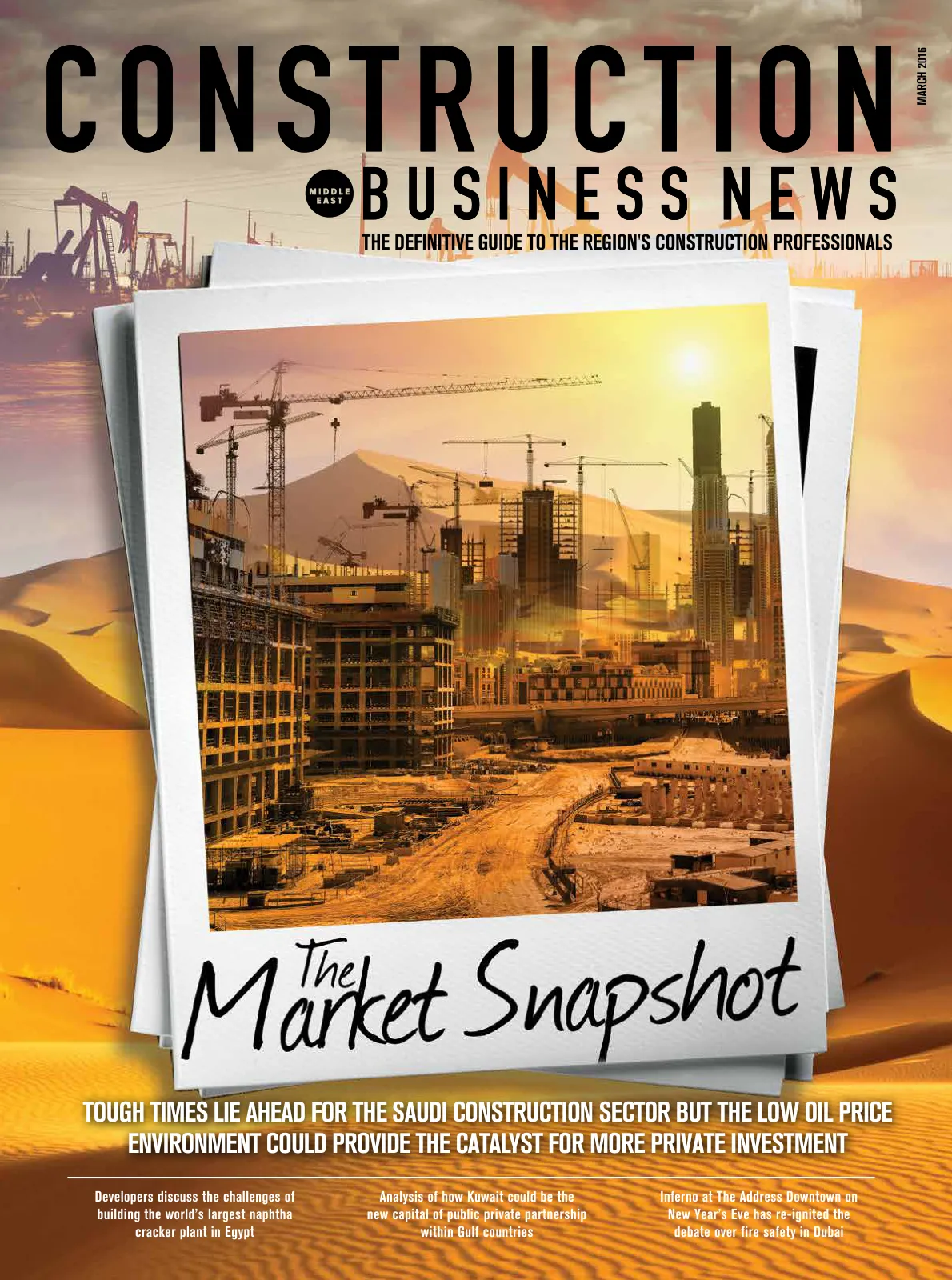
Construction Business News, March 2016
Page 1
THE DEFINITIVE GUIDE TO THE REGION'S CONSTRUCTION PROFESSIONALS
DECEMBER 2015
Tough times lie ahead for the Saudi construction sector but the low oil price
environment could provide the catalyst for more private investment
Developers discuss the challenges of
building the world’s largest naphtha
cracker plant in Egypt
Analysis of how Kuwait could be the
new capital of public private partnership
within Gulf countries
Inferno at The Address Downtown on
New Year’s Eve has re-ignited the
debate over fire safety in Dubai
THE DEFINITIVE GUIDE TO THE REGION'S CONSTRUCTION PROFESSIONALS
March 2016
Page 2
Page 3
construction business news me March 2016
3
EDITOR’S NOTE
NEWS
SUPPLIER NEWS
COVER STORY
Tough times lie ahead for
the Saudi construction
sector but the low oil
price environment could
provide the catalyst for
more private investment
IN PERSON
Okbah Abdulkarim,
executive director at Artar
Real Estate Development
talks about running
the company in the UAE
and how experienced
developers could face
unstable markets with
quality projects
ANALYSIS
Abdullah Alharoun,
associate at International
Counsel Bureau in
Kuwait, analyses how
Kuwait could be the new
capital of public private
partnership in the GCC
Inferno at The Address
Downtown Hotel on New
Year’s Eve has re-ignited
the debate over fire safety
in Dubai
COMMENT
Simon Scott analyses how
airport terminal design in
the UAE is on course for
commercial success
6
8
18
20
26
32
34
38
20
32
contents
Page 4
construction business news me March 2016
4
S U B S C R I B E
c o n t r i b u t o r s
subscriptions@bncpublishing.net
Managing Director
Walid Zok
walid@bncpublishing.net
Director
Rabih Najm
rabih@bncpublishing.net
Director
Wissam Younane
wissam@bncpublishing.net
Group Publishing Director
Diarmuid O'Malley
dom@bncpublishing.net
Business Development Director
Rabih Naderi
rabih.naderi@bncpublishing.net
+966 50 328 9818
Group Editor
Melanie Mingas
melanie@bncpublishing.net
Editor
Lorraine Bangera
lorraine@bncpublishing.net
Art Director
Aaron Sutton
aaron@bncpublishing.net
Sales Manager
Mostafa Abdo
mostafa@bncpublishing.net
+966 56 6695 333
Sales Manager
Vishvanath Shetty
vish@bncpublishing.net
+971 52 6745378
Marketing Executive
Mark Anthony Monzon
mark@bncpublishing.net
PO Box 502511 Dubai, United Arab Emirates
P +971 4 4200 506 | F +971 4 4200 196
For all commercial enquiries related to
Construction Business News ME contact
sales@bncpublishing.net T +971 55 339 5097
All rights reserved © 2015.
Opinions expressed are solely those of the contributors.
Construction Business News ME and all subsidiary
publications in the MENA region are officially licensed
exclusively to BNC Publishing in the MENA region by
Construction Business News ME.
No part of this magazine may be reproduced or
transmitted in any form or by any means without
written permission of the publisher.
Images used in Construction Business News ME
are credited when necessary. Attributed use of
copyrighted images with permission. All images not
credited courtesy Shutterstock.
Printed by International Printing Press www.ippuae.com
Stuart Matthews
Marlow McGuinness Ltd
-------
Joanne Bladd
Fire safety in hospitality is under scrutiny in the region
following some recent high profile incidents, but the right
equipment and procedures can prevent disaster
PROJECT REVIEW
Construction Business News ME looks into progress on Meydan
Sobha’s 45 million sq.ft of freehold land—District One.
Developers behind the world’s upcoming largest naphtha
cracker plant, Tahrir Petrochemical project, give a
construction update
Dr Raed Bkayrat, vice president of business at First Solar Middle
East, discusses the company’s pilot solar-powered irrigation
project in Saudi Arabia
Q&A
Trade between Arab nations and Brazil has been relatively
stable over recent years. Dr Michel Alaby, secretary general
and CEO of Arab-Brazilian Chamber of Commerce (ABCC),
discusses construction trade relations between Arabs and
Brazilians
EVENT PREVIEW
Nathan Waugh, event director at dmg events, discusses how
attending tradeshows during a slowdown could be beneficial
SAVE THE DATE
SUPPLIER CORNER
Stefano Iannacone, managing director of Mapei, discusses why
the company has made sustainability and LEED certification its
top priority
EDITOR’S PICK
Aidan Mercer, senior industry marketer at Bentley Systems,
analyses the challenges of integrating geospatial technology
with BIM
40
42
44
46
48
50
54
56
66
34
Page 5
Page 6
construction business news me March 2016
6
What’s next for Saudi?
Still shaken by the oil price dropping in
2014, the hot topic hasn’t gone cold with the
prices predicted to drop further down. Saudi
Arabia, front runner in oil production, has
since been under the radar by the world’s
most sceptical spectators – the media.
Apart from energy production, the country
has a massive construction sector with some
of the most largescale construction projects.
The plunging oil prices have had a profound
impact on the sector, with budget cuts mark-
ing a significant change in the country’s fu-
ture project landscape.
The Saudi-US Relations Information Ser-
vice reported that the non-oil private sector
as a whole has grown by 3.7% in 2015, with
a robust 5.6% year-on-year increase within
the construction division.
The fiscal budget for 2016 released on 28
December 2015 reveals that despite lower
oil prices the Kingdom will be maintaining a
high level of spending in 2016.
Though there have been massive budget
cuts in several projects, the government has
committed $54bn worth spending focussing
on social infrastructure projects including
education and healthcare (accounting for
35% of the total spending).
That being said there have been news
reports about the budget cuts in the con-
struction industry that have been affecting
contractors and professionals in the market.
News agency Reuters recently reported that
there are some construction companies in
Saudi Arabia struggling to pay their staff on
time as a result of oil prices falling.
To combat the existing lack of conviction in
the market, the local government has taken
active measures to make sure the sector is bal-
anced with a good flow of (necessary) projects.
Some of these measures include; an effort
to standardise procedures through its adop-
tion of the form contracts published by the
International Federation of Consulting En-
gineers (FIDIC) for government contracts;
making huge investments in road, rail and
educational projects; and pledging 500,000
new units to fulfill the increasing demand
for housing. It also introduced the new
white land tax that would encourage (or
rather force) developers to build undevel-
oped urban sites under their possession.
According to McKinsey and Company’s
report, construction is one of the eight sec-
tors that will generate growth and jobs in
the upcoming years as the country tries to
diversify its economy beyond oil.
Commercial and economic cities under con-
struction such as King Abdullah Financial Dis-
trict and the Prince Abdulaziz bin Mousaed
Economic City also have huge potential to
drive investment during this period. The up-
coming $100bn King Abdullah Economic
City, one of the most ambitious construction
projects in the world, plans to create a city for
over two million people with land area larger
than US’ capital Washington D.C.
With huge construction ambitions under
its belt, Saudi Arabia remains to be GCC’s
biggest construction market with more than
$1.2tri worth projects planned or underway,
as stated in Deloitte’s report.
editor’s note
Lorraine Bangera
Editor
The number of megaprojects and invest-
ments have increased in Saudi Arabia in
the last 15 years, which assures continued
development within the country despite a
slowdown. But, McKinsey and Company
reports that in order for all these invest-
ments to be effective it is important that
Saudi Arabia adopts modern techniques and
improves its operational management.
Even though there have been numerous
steps that have been taken by the government
to boost the sector, in terms of functional-
ity it still has a long way to go in terms of
projects being delivered on time and within
budget. Surely with time, the nation would
catch up and achieve a diversified economy
unscathed by oil price fluctuations.
Page 7
Highly efficient 'construction kit'
With its modular design concept, the crane-inde-
pendent Automatic climbing formwork SKE50 plus
provides an efficient solution to every type of
structure.
On-site safety and protection
from wind and weather is possible with Protection
Screen Xclimb 60, a gapless self-climbing enclo-
sure. The system comes in several versions, giving
you the ideal solution for every requirement.
Highrise core concept
The Lubeca Jumpform, now in Doka's portfolio,
has room for all site equipment needed. Powerful
hydraulic cylinders cranelessly raise the platform to
the next casting section.
Bridge | Tunnel | Highrise | Residential | Energy
www.doka-me.com
The Formwork Experts.
Highrise
Innovation
Added value that makes
all the difference
Page 8
construction business news me March 2016
8
For News, features and more, Visit www.CBNme.com
Follow us on twitter for breaking news: @cbn_ME
Follow us on Facebook for up-to-the-minute breaking news
Read the latest edition on www.CBNme.com
NEWS
On 20 February 2016, Damac Properties announced its latest
project, Aykon City, to be built on Dubai Canal. The project
is the first project announced in the Dubai Canal district lo-
cated to Sheikh Zayed Road and Safa Park.
The six-tower luxury project comprises of Dubai’s first
all-suites; 80-storey Aykon Hotel and Residences, a 63-sto-
rey Damac Maison Serviced Hotel Residences, a 60-sto-
rey apartment tower, a 65-storey office tower and two
30-storey ultra-luxury residential towers featuring car lifts
to each unit and direct views over Dubai Canal and Safa
Park.
Construction on the four million sq.ft development will be-
gin mid this year, and is said to be completed by 2021.
The project is done in collaboration with Meraas Holding
and holds a sales value is AED7.4 bn.
Hussain Sajwani, chairperson of Damac said: “We are de-
lighted to announce a project of this scale in collaboration
with Meraas Holding and on such a site in this premier loca-
tion of the city.”
Damac to develop first Dubai Canal
project, Aykon City
Aykon City
World experts discussed investment opportunities across the
Middle East, Central Asia and Central Europe, at this year’s Com-
monwealth of Independent States – Global Business Forum (CIS
– GBF) held from 17 to 18 February at The Atlantis, Dubai.
Dr Sahil Babayev, deputy minister of economy in Azerbaijan,
revealed investment opportunities in the Central European nation.
He said that the falling oil prices gives Azerbaijan a good op-
portunity to accelerate economic diversification and attract foreign
investment in non-oil sectors.
He said: “This is a long process decision and we have certain
achievements on this front. Currently, non-oil sectors are contribut-
ing 71% to Azerbaijan’s overall GDP.”
Baku’s involvement in China’s Silk Road Economic Belt vision, a
railway line connecting China with Central Europe, promises great
potential for investors. The project will allow easy access of goods
on both directions between Azerbaijan and China.
“This poses a huge growth opportunity for Azerbaijan, especially
in sectors such as agriculture, food processing, machinery and
tourism,” Babayev added.
To encourage more businesses and investments, the govern-
ment has introduced a liberal tax structure for SMEs and eased
their access to financing. It is also providing visas on arrival for
some nationalities to simplify accessibility.
In another session, president of Wissol Group Samson
Pkhakadze discussed investment opportunities in Georgia. He
talked about how the Central Asian nation has been successfully
creating a diversified economy with infrastructure, transport, public
services and construction sectors which widely contribute to the
overall economy of the country.
Georgia has simplified its taxation process, with recent fast
paced reforms that have brought down the number of taxes to five.
Pkhakadze said that up to 80% imports involve 0% taxes.
With its transparent and business-friendly taxation system,
Pkhakadze said, the country offers plenty of investment opportu-
nities for Gulf-based investors within its transport, infrastructure,
energy, power generation, tourism sectors.
The CIS GBF 2016, hosted by Dubai Chamber, focussed on the
theme, Ancient Routes – New Opportunities. It explored opportuni-
ties on old trading links to neighbouring regions and beyond as well
as new Economic Union Eurasian alliances.
Investment opportunities open up in Georgia and Azerbaijan
Page 9
construction business news me March 2016
9
Ukraine-based steel pipe producer In-
terpipe has been the first to officially
register its trademark with the Ministry
of Economy in the UAE.
This marks the first step in the fight
against the emergence of a counterfeit
steel pipe industry in the UAE.
With over 10 years of experience in
supplying steel in the UAE, the com-
pany’s products are widely used in
construction and infrastructure projects
and can be found in approximately ev-
ery third building in the UAE.
The region accounts for more than
16% of the company’s global sales.
“The depth of the counterfeit steel
industry in the UAE remains unquan-
tified, however its existence presents
a significant challenge, not only to
the steel industry but to the construc-
tion business as a whole,” said Andrey
Burtsev, vice president of pipe sales
at Interpipe MENA. “Uncertified steel
cannot be guaranteed for its integrity,
strength or durability.”
Abu Dhabi-based Tawazun Holding’s subsidiary Jaheziya appointed Dar
Al-Handasah Shair and Partners as the lead design and engineering con-
sultant on their Tawazun Safety Security and Disaster Management City
(Jaheziya) on 20 February 2016.
Tawazun Industrial Park is managing the Project Management Office of
the one million square metre project.
Eng. Faiz Al Nahddy, CEO of Tawazun Industrial Park said: “The project
is on schedule and the planning and design work has been progressing in
collaboration with Jaheziya’s stakeholders.”
According to Al Nahddy, the Jaheziya proj-
ect team is currently evaluating bids received
from a number of International Prop special-
ists for provision of several props for the
training facilities. Design work will continue
through to the end of 2016 and the tender for
the main construction works is expected to
be released by early 2017.
H.E. Ali Al Ahbabi, chairperson of Jaheziya,
said: “Our Nation is growing at a fast pace
and the geo-political developments in the re-
gion are strengthening our resolve to locally
provide the training facilities.” The project is
targeted to be operational by Q4 of 2018.
Dubai Properties Group unveiled the masterplan of Serena, a residential
development within Dubailand, on 21 February 2016.
The 8.2 million sq.ft project
aims to fulfill the demand
for affordable housing.
Serena will be developed
in five phases, with the first
phase anticipated to be
completed by Q4 2018.
The project will include
clusters of four to six units
with phase-one consisting
of two- to three-bedroom
townhouses and three-bed-
room semi-detached villas.
Abdullatif AlMulla, group
CEO of DP said: “Dubai Properties is helping lead the resurgence of Dubai’s
real estate market through the smart and strategic development of iconic
mixed-use destinations, as we anticipate and deliver on the rapidly chang-
ing and diversifying Dubai.”
Interpipe initiates the
fight against fake
pipes in the GCC
Dubai Properties
reveal new community
development in Dubailand
Jaheziya appoints consultants for
disaster management city
Eng. Faiz Al Nahddy and H.E. Ali Al Ahbabi
Andrey Burtsev
Page 10
construction business news me March 2016
10
NEWS
Abu Dhabi-based Bloom Properties,
part of Bloom Holding, has com-
menced the construction of third
phase of its latest project that involves
the construction of 147 housing units
on 17 February 2016.
The project, Bloom Gardens, will
comprise of three bedroom town-
houses, semi-detached three bed-
room villas and four and five bed-
room villas, is set for handover by Q1
2017.
Sameh Muhtadi, CEO of Bloom
Holding, said: “Given the persistent
demand for the Bloom Gardens proj-
ect, Bloom Properties is committed
to completing the project in line with
the highest construction and quality
standards and specifications.”
The masterplan, Bloom Gardens,
is a gated community development
featuring spacious villas inspired by
Mediterranean architecture located in
Abu Dhabi.
Dubai Electricity and Water Author-
ity (DEWA) organised a workshop
for over 250 contractors and consul-
tants to discuss the Al Namoos ser-
vice on 17 February at Grand Hyatt
hotel in Dubai.
The new service provides consul-
tants and contractors electricity con-
nections of up to 150 kilowatts (kW)
within 10 days.
The government body has made
significant efforts to upgrade its pro-
cedures for getting electricity. These
procedures have been simplified from
three to two steps, reducing the time
to complete them from by 22 days.
The first step now only takes 8 days,
and includes the application for elec-
tricity connections through low-volt-
age cables, with the first monthly bill
due after the electricity is connected.
DEWA educates construction professionals on Al Namoos
Construction of Bloom Gardens’
phase-3 begins
Al-Futtaim Engineering and Technologies introduced its new
Control and Life Safety division on 17 February 2016. The
division will carry out the design, installation and maintenance
of fire protection and detection systems.
The division was approved by the Dubai Civil Defence after
complying with all major international fire and safety codes
and standards including National Fire Protection Association
(NFPA), the UAE fire code, and Loss Prevention Certification
Board (LPCB).
It will undertake design, engineering, supply, installa-
tion, commissioning, operation and maintenance of fire-
fighting, emergency lighting services, gas fire suppres-
sion system, fire alarm, BMS, Lighting control, access
control and CCTV system for commercial, residential,
industrial, retail, hospitality and infrastructure projects.
The division also carries out annual maintenance, break-
down maintenance of fire protection and BMS systems to the
highest standards to ensure safety of life and property.
Dawood Bin Ozair, senior managing director at Al-Futtaim
Engineering and Technologies said: “With an experienced
leadership team, supported by qualified and experienced en-
gineers and technicians, the Control and Life Safety division
can handle the most demanding fire protection and building
management system projects and maintenance requirements
to deliver high quality work on time.”
Al-Futtaim Engineering launches fire and safety division
Completed phase of
Bloom Gardens
Dawood Bin Ozair
Page 11
Factory and Headquarters:
Saih Shuaib - 4 | Dubai Industrial City | P.O. Box - 62182 | Dubai | United Arab Emirates | Tel: +971 4 3687600
www.caparol.ae
facebook.com/caparoluae
twitter.com/caparoluae
linkedin.com/company/caparol
Indoor Air Quality is a growing concern in today’s
world, with Formaldehyde being one of the largest.
Introducing CapaCare AirPurify with
CapaCare AirPurify is a revolutionary paint fortified with
Formaldehyde Conversion Technology. The unique
technology helps convert toxic Formaldehyde
emissions into harmless water vapour ensuring that
indoor air is fresh and safe to breathe.
Protect your friends and family today,
visit: www.caparol.ae/airpurify
Let fresh remain fresh with
CapaCare AirPurify
Page 12
construction business news me March 2016
12
NEWS
Spanish hospitality group RIU Hotels
and Resorts and UAE-based developer
Nakheel signed a joint venture in Mal-
lorca to build RIU’s first hotel in Dubai.
The $170m hotel is located at Nakheel’s
Deira Islands master development, and
will include 750 rooms – largest hotel
to be built on the island to date.
This is in line with Nakheel’s plans
to build 10 international hotels across
Dubai. This marks the first time the de-
veloper has signed an agreement with
an international hotel chain. Out of the
10, the first opened in February 2016
and another six have been signed and
announced.
Nakheel chairperson Ali Rashid Loo-
tah said: “This is a major milestone for
our growing hospitality business and a
significant step towards creating a new
range of affordable, family resort-style
hotel accommodation in the emirate,
in line with the government of Dubai’s
tourism vision for 2021.”
Rove Hotels has entered a joint venture between Emaar Properties and
Meraas to expand its portfolio with a new property, Rove at the Park. The
458-room project will be placed adjacent to upcoming theme park Dubai
Parks and Resorts in Jebel Ali.
The hotel will have a contemporary design with Arabesque elements,
with a spaciously designed lobby and lounge, and rooms starting at 26sqm.
The group has plans to operate 10 hotels before Expo 2020 Dubai, the
first of which is the Rove Downtown Dubai – scheduled to open in later
this year.
Thyssenkrupp plans to focus more on Egypt and the MENA region as a whole
because of its emerging economic power and capability for continued indus-
trial development.
With over 70 employees, thyssenkrupp has increased its workforce by
more than 40% in Egypt making it the only company to act as a full service
EPC contractor.
The firm’s plant engineer-
ing operations in Egypt rep-
resent the company’s larg-
est resource in the region.
Given the growing need
for
diversification
and
modernisation of the re-
gion’s industrial base, there
is a huge potential espe-
cially in the area of energy
efficiency programmes and
downstream value chains,
according to the firm.
Boris van Thiel, CEO of Industrial Solutions MENA within thyssenkrupp,
said: “The importance of the MENA region for our business cannot be over-
stated. Already today, more than 20% of our global sales are achieved in the
region, and – together with our customers – we plan to grow further.”
JV signed for 750-room
Deira Islands hotel
thyssenkrupp strengthens
its position in Egypt
Emaar and Meraas to work
on Rove Hotels
Deira Islands
Cairo city
Upcoming restaurant terrace in Rove at the Park
Ali Rashid Lootah,
chairperson of Nakheel
with Luis Riu, CEO of
RIU Hotels
Page 13
construction business news me March 2016
13
Arabian Travel Market (ATM)
taking place in April 2016 will
showcase Oman’s most note-
worthy tourism projects as it
grows into one of the top des-
tinations in the region.
Currently the country has
$3.3bn worth of tourism re-
lated ongoing projects. Its in-
bound tourism numbers rise
by an average of 7.4% per an-
num in the decade 2005-14,
with 1.4 million international
tourists’ arrivals targeted by
2019 compared to the 1.1 mil-
lion that arrived in 2015.
Nadege Noblet-Segers, ex-
hibition manager at ATM
2016 said: “Oman’s Tourism
Strategy for 2015 through to
2040 has an investment value
of $35bn.”
One of the major tourism
projects have been the two
major airports in Oman that
are currently being expanded
to boost tourism.
Recent figures from the
Oman
Airports
Manage-
ment Company for both
Muscat and Salalah airports
recorded an 18% rise in pas-
senger numbers through the
capital’s gateway in 2015,
surpassing the 10 million
passenger mark for the first
time in its operational his-
tory, while Salalah Airport
also saw a rise in traffic by
22% to reach more than one
million passengers.
Consultants, Hill Interna-
tional, have been working on
both airports since 2012, and
aim to building the biggest
and second largest airports in
the country, Muscat and Sa-
lalah, respectively.
Muscat Daily reports H.E.
Dr Ahmed bin Mohammad
bin Salim al Futaisi, Minister
of Transport and Communi-
cations, said that work on the
Muscat International Airport
is 86% complete and will be
done by end of 2016.
Oman to showcase $35bn of tourism
projects at ATM 2016
DEWA and Emirates completes
solar PV project
One megawatt solar pho-
tovoltaic panels have been
successfully installed at the
Emirates
Engine
Mainte-
nance Centre in Dubai.
The project, a collabora-
tion between Dubai Elec-
tricity and Water Authority
(DEWA) and Emirates Air-
lines, is part of the Shams
Dubai initiative.
The new project located in
Warsan includes 2,990 pho-
tovoltaic panels installed on
the rooftop of the centre’s
car park. The panels is ex-
pected to generate 1,884
Megawatt-hours (MWh) of
electricity every year and
will save around 800 tonnes
of carbon dioxide per year.
Waleed Salman, executive
vice president of strategy
and business development
at DEWA, said: “DEWA’s
partnership with Emirates
Airline is part of its efforts
to install photovoltaic pan-
els on government build-
ings and schools, to pro-
duce clean energy locally,
reduce
electricity
costs,
contribute to the preserva-
tion of the environment,
and guarantee a sustainable
future for the Emirate.”
Visitors at ATM 2015
Page 14
construction business news me March 2016
14
NEWS
Economic experts predict the value of trade between the
UAE and India will hit $100bn in 2020, Emirates New Agen-
cy reports.
Currently, India accounts for 9.8% of its total non-oil trade,
making it the largest importer of goods from the UAE. In addi-
tion it ranks third in its exports to the UAE, accounting to about
9.2% of total exports. The total volume of foreign trade between
the two nations has amounted to $60bn in 2014.
India is the seventh largest economy in the world with a total
GDP worth about $2.1bn in 2015, according to World Bank
statistics, achieving growth of up to 6.4% from 2014.
In a report on economic and trade relations between the
UAE and India, the UAE Ministry of Economy recommended
the strengthening of bilateral relations, increasing of the vol-
ume of joint investments and expansion of bilateral trade to
make the UAE India’s primary trade partner. The economic
report highlighted that there are diverse sectors that attract for-
eign direct investment in India, including transportation, oil,
construction services, cement products, and electrical equip-
ment among others.
Real estate expert says UAE real estate’s current slowdown
should be seen as a minor correction than a major crash.
David Dudley, international director at JLL MENA, said that
the while the impact of reduced oil prices on the economy will
lead to a short-term slowdown in demand, this is occurring at a
time of minimal supply completions leading to relatively stable
market conditions.
He said: “The market experienced a major upswing from
2013 to 2014, led by the residential sales market, with prime
residential prices growing at 25% per annum. This pace of
growth was unsustainable.
“The current phase is a slow-down and a relatively minor cor-
rection, rather than a major crash – with reduced supply com-
ing through at a time of weak demand, allowing underlying
dynamics to catch up with the pace of value growth.”
Dudley argued that while liquidity has tightened, funding
is still available for project finance and corporate level lend-
ing – it is just more selective. “The good news is that demand
growth continues from projects that started when oil prices
were strong.”
Dudley will be participating in the Abu Dhabi Market Over-
view, which runs on the opening day of Cityscape Abu Dhabi
which will take place at the Abu Dhabi National Exhibition
Centre from 12-14 April 2016.
JLL director says ‘slowdown
is not a major crash’
Trade between UAE and
India to hit $100bn in 2020
Exhibitors in Abu Dhabi
Cityscape 2015
Project management firm, SSH, has been appointed
as contract manager and site supervision consultant
by Bahrain’s Ministry of Housing for the construction
of primary infrastructure and bridge construction on
Islands 13 and 14 (East) of Al Madina Al Shamaliya
Islands (AMAS).
The mixed-use development will create an urban
town on the northern coast of Bahrain.
The Islands 13 and 14 (East) is expected to deliver
approximately 2,000 housing units under an afford-
able-housing scheme launched by the Ministry of
Housing. It requires primary infrastructure networks
comprising of roads of over 5.5km, installation of
utilities such as storm water, potable water, electrical,
irrigation and telecommunications network, along
with the construction of vehicular and pedestrian
bridges to connect these two islands.
SSH infrastructure director Mark Jamieson said:
“Al Madina Al Shamaliya is a very large project in
the Kingdom, and will create an autonomous living
space for thousands of people, we are glad we’re
able to serve them with good, quality and sustainable
infrastructure that is quality-assured.”
SSH supervises
infrastructure work in
AMAS, Bahrain
Page 15
Page 16
construction business news me March 2016
16
NEWS
1
6
2
7
3
8
4
9
5
10
Forward-thinking organisations
recognise the need for agility
and will assist their employees
with building their skills, knowl-
edge and capabilities. Smart
organisations have already
prepared a significant portion of
their workforce to balance dis-
ciplined approaches with more
agile ones.
Design thinking has emerged
as a major trend for how inno-
vative organisations approach
problem-solving.
Project managers are being
asked to think more strategically
as organisations flatten. PM is
no longer just about managing
the triple constraints, but rather
about reaching solutions faster
and demonstrating strong, direct
business impact.
Understanding how various
projects affect others while
maintaining a strategic perspec-
tive requires PMs to be able to
focus on the details as well as
step back to a more strategic,
multi-project viewpoint.
Change is embedded in ev-
erything we do. Because every
project is a cause for change,
change management is a re-
quired skill in any PM’s toolbox.
Change management places
the emphasis on relational and
strategic skills because techni-
cal skills alone are not enough to
effectively execute change.
Economist Intelligence Unit
study reported 83% of respon-
dents claimed a more diverse
workforce actually improves an
organisation’s ability to engage
a diverse client base.
Understanding and interpreting
the information about projects,
people and relationships are
essential skills for breaking
down complexity into pieces
easily understood by others.
While project management
used to be focussed on tech-
nical execution, today’s world
requires strategic.
Those who know how to co-
ordinate distributed teams
will increase the likelihood for
achieving success as well as
career advancement as they
demonstrate this most es-
sential skill.
PMs can no longer function
without the ability to execute
strategy. It requires up skill-
ing to meet the demands of
today’s marketplace. Solid PMs
must have a multidisciplinary
skill set that includes effective
communications skills, analyti-
cal thinking, strategic initiative, a
business mind-set and techni-
cal finesse.
PM best practices are being
adopted by many non-PM roles
such as marketing, sales and
logistics. Organisations that
embrace PM’s key principles
ensure that their talent pool is
equipped with the skills and
tools to not just get a job done,
but deliver the full potential im-
pact of a project.
The permanency
of agile project
management
The need for design
thinkers
Broadening
strategic role of
the project manager
The significance of
Portfolio & Project
management
Turn, turn, turn –
The fundamentals of
change management
Diversity matters
Mastering modern-
day complexity
Co-location,
global teams and
distributed work
Up-skilling talent
The spread of
project management
into non-PM arenas
10 project management trends for 2016
Source: TwentyEighty Strategy Execution
Page 17
OHSAS 18001 certified
ISO 9001, 14001 and
130+years of
project experience
LEED Platinum, LEED Gold
and LEED Silver Capability
End to End Integrated Solutions
Pioneering Engineering Construction since 1881
www.drakescull.com
700+
Projects Delivered
For over 130 years, Drake & Scull International PJSC has been shaping skylines and transforming the lifestyle of
communities around the world.
Drake & Scull is an industry leader, with a proven history of delivering more than 700 projects through its General
Contracting, Engineering, Rail, Oil & Gas, Water and Wastewater Treatment and Infrastructure development business
streamlines across the region.
Page 18
construction business news me March 2016
18
Supplier NEWS
UAE-based Arkan Building Materials Co. announced a strong
increase in both revenues and net profit in its preliminary
unaudited results for 2015.
The group reported revenues of AED876.9m, an increase
of 17% from AED751.8m in 2014. The reported net profit for
2015 is said to be AED101.1m for 2015, which is an increase
26% compared with AED80m in 2014.
The results is said to be achieved through focussed market
penetration ad market share driven strategy.
Arkan has also increased it export sales, primarily to GCC,
African and Asian markets.
Arkan CEO Abdellatif Sfaxi said that despite increased pric-
ing pressure as a result of an oversupplied market, Arkan has
continued to develop by exploring new markets, expand-
ing its product portfolio and enhancing its value proposi-
tion. “We have made significant operational progress in 2015
by increasing our market share and sales volumes through
capitalising on our integrated products and services offering
while ensuring increased operational efficiencies. As a result,
we can now further compete on the international market.”
AkzoNobel Middle East and Easa Saleh Al Gurg Group estab-
lished a joint venture company, Akzo Nobel Decorative Paints
(ANDP), on 16 February 2016. The deal was signed in AkzoNo-
bel’s Amsterdam headquarters, where officials revealed the
new company will further strengthen its credibility with pre-
mium brand Dulux.
Group general manager of Easa Saleh Al Gurg Group Ab-
dulla Fareed Al Gurg said that this joint venture will comple-
ment the existing business and leverage on the distribution
network of the company. “The deep category knowledge
due to the long-standing Dulux brand association, local mar-
ket experience; and our mutual commitment to consumer-
focussed innovation, gives us confidence that this partner-
ship will be a long-term success.”
Peter Tomlinson, managing director of AkzoNobel Middle
East added: “We are committed to growing in the Middle East
region and strengthening the relationship with our local part-
ners. Boosting our decorative coatings and paints offer in the
region will provide a strong platform to support our customers
in this increasingly important market.”
Akzo Nobel Decorative Paints
established from JV
Arkan reaches 26%
increase in 2015 net profit
Bentley Systems announced that Carollo Engineers has
chosen its EADOC cloud-based construction management
software as its corporate standard for capital project man-
agement on 14 February 2016.
Carollo Engineers will standardise on EADOC across its
construction services teams, bringing cost savings to all of
its projects and eliminating the inefficiencies of managing
multiple legacy systems.
The firm has been using EADOC previously and has first-
hand about its ability to help manage risks, track construc-
tion documents and communications, and control costs for
construction managers at engineering, construction man-
agement firms or infrastructure owner organisations.
By standardising its construction management process
on EADOC, Carollo will further improve the management
of its construction teams using an automated workflow
and also improve control of project finances, including
budget, funding sources, contracts, and change orders.
Carollo Engineers’ vice president Michael Warriner
said: “Bentley’s EADOC gives us a competitive advan-
tage by helping us deliver better projects with less risk
and at a lower cost. Our new subscription will streamline
EADOC’s availability among our teams and eliminate the
administration cost of managing multiple, project-based
subscriptions. Standardising our construction project man-
agement practice through EADOC will take the benefits
we’ve seen on individual projects and extend them across
our organisation.”
Carollo standardises
Bentley’s EADOC software
For more news about suppliers and
the industry, visit www.cbnme.com
Page 19
Porto Arabia Towers
Doha, Qatar
©2014 Hill International, Inc.
Hill International
The Global Leader in Managing Construction Risk
www.hillintl.com
For nearly four decades, owners and developers in the Middle East have
turned to Hill International to manage their construction projects and
programs throughout the region. Hill is proud to have helped our clients
turn their most challenging visions into realities. We have participated
in over 10,000 projects with a total construction value in excess of $500
billion, managing all phases of the construction process from concept
through completion.
Hill is also the leading construction claims firm in the world, having helped
resolve problems on some of the most complex projects throughout the
Middle East and around the world. To minimize risk and maximize results
on your next project, turn to Hill International
Dubai Office: 971 4 227 0078
Doha Office: 974 4 435 8381
Corporate HQ: 800 283 4088
If you can imagine it, we can manage it.
Qatar National Museum
Doha, Qatar
Mall of Qatar
Doha, Qatar
Viva Bahriya Towers
Doha, Qatar
Page 20
COVER STORY
Tough times lie ahead for the Saudi construction sector but the low
oil price environment could provide the catalyst for more private in-
vestment. Jason O'Connell writes
Kingdom
at a
crossroads
construction business news me March 2016
20
Page 21
• Total
construction
contractor
awards in Saudi Arabia across
the building, infrastructure and
energy sectors are estimated to
decrease from $60.6bn in 2015
to $55bn in 2016
• The building sector is forecast
to record the highest contractor
awards worth $30.5bn in 2016
• Saudi Arabia will need around
three million new homes by
2025 due to the rapid rise in
population which is expected to
hit 37 million by 2025
• The infrastructure sector is ex-
pected to record an increase in
contractor awards from $5.37bn
in 2015 to $10.95bn in 2016.
*Information provided by Ventures
Onsite
Construction snapshot
of Saudi Arabia
Price of crude oil has
fallen to around 35$ per
barrel currently from over
90$/bbl 18 months ago
construction business news me March 2016
21
Page 22
construction business news me March 2016
22
bbl 18 months ago. As a result the
Saudi government reported a budget
deficit of $97.9bn in 2015 and is ex-
pected see a deficit of around $87bn
for the coming year.
The 2016 budget includes a raft of
measures to cut spending, overhaul
subsidies and introduce taxation in a
bid to make up for the shortfall left by
dwindling oil revenues. For construc-
tion contractors the result has been a
cut in advance payments for govern-
ment projects, fewer contracts, and
slowed payments for services rendered.
Some firms have even delayed paying
their staff or laid off thousands of work-
ers. Reuters reported in November that
the kingdom’s largest construction con-
tractor, Saudi Binladin Group, planned
I
t’s fair to say that these are uncertain
times for the construction industry in
Saudi Arabia. A sense of pessimism
seems to have gripped the sector as
Riyadh reins in spending on projects
while it grapples with a low oil price
environment that some believe is likely
to be the new normal rather than just a
passing phase. But amid all the gloomy
talk of delayed payments, a freeze on
new contracts and tightening of gov-
ernment belts, there are those who see
an eventual silver lining if the cloud of
low oil prices accelerates plans to re-
form the kingdom’s economy.
The price of crude oil, which ac-
counts for over 80% of government
revenues, has fallen to around $35
per barrel currently from over $90/
to cull 15,000 of its 200,000 workforce.
This desperate situation has led one
Saudi Arabian businessman to plead for
royal intervention to prevent compa-
nies from going under. “If the delay in
payments continues, these companies
will be at risk of default, or go com-
pletely out of business,” Abdulrahman
Al Zamil, president of the Council of
Saudi Chambers business association,
wrote in a letter to King Salman.
Other project developers hit by the
downturn have begun talks to resched-
ule debt payments. Jabal Omar Devel-
opment, which is developing a multi-
billion dollar project next to the Grand
Mosque in Mecca, signed an agreement
in February with the Ministry of Fi-
nance to defer payments on a $800m
COVER STORY
Al Haram Mosque under
construction in Mecca -
Saudi Arabia
Page 23
construction business news me March 2016
23
loan after failing to make a repayment
of $173.3m on 1 January this year.
The bleak outlook for the Saudi con-
struction sector was reinforced by com-
ments made by Fawwaz al-Khodari,
the CEO of major contractor Abdullah
Abdul Mohsin Al-Khodari Sons, who at-
tributed at least part of the pain the sec-
tor is going through on recent labour
market reforms.
“I think we should expect the diffi-
cult situation in the sector to go on for
18 more months,” Fawwaz al-Khodari,
told Reuters in an interview late last
year. “Companies are facing troubles
mainly due to the labour reforms. We
will see the result of the budget defi-
cit later, but now we are in a situation
where the pain is already there. I be-
lieve many projects that are not seen
as being essential will be first to be
shelved, including those that were ten-
dered but not awarded.”
Abdullah Abdul Mohsin Al-Khodari
Sons reported a second successive loss
in the fourth-quarter of 2015 which the
company blamed on a drop in revenue
and a rise in construction costs, partly
due to the government’s decision to
hike energy prices in the kingdom.
The pessimism gripping the construc-
tion sector is reflected in a recent sur-
vey by law firm Pinsent Masons which
found that optimism surrounding Saudi
Arabia saw a pronounced decline year
on year. Asked which country will pro-
vide the strongest growth opportunity
in 2016, just 12% of respondents said
Saudi Arabia, a big drop from the 40%
who believed it would be the strongest
market during 2015.
Faithful + Gould believes some Saudi
infrastructure projects are more at risk
than others. The consultancy says resi-
dential, retail and power infrastructure
projects are likely to escape the worst
of the cutbacks.
“In addition to not awarding new
construction contracts, decisions have
already deferred on major infrastructure
projects in Mecca, Medina, Jeddah and
Dammam,” it said recently. “The massive
rail projects for the Saudi Rail Organisa-
tion (SRO) must also be at risk. Station
redesigns are being implemented on
the Riyadh Metro project in an effort to
reduce expenditure.”
Page 24
construction business news me March 2016
24
COVER STORY
However it added: “Social infrastruc-
ture projects such as the Ministry of
Housing's $70bn programme and pow-
er projects may escape the brunt of the
cut-backs. With consumer spending
remaining unchanged, the retail sector
represents one of the only short term
opportunities with multiple regional
and super regional mall developments
planned in Riyadh and Jeddah over the
next 12 months.”
Economic shakeup
The government is said to have called
in an army of consultants to help it
reboot its economy and navigate the
country through a sustained period
of low oil prices. The National Trans-
formation Programme 2020 will focus
on ways to boost economic growth
through greater efficiency and more in-
volvement from the private sector.
In a December 2015 report titled Sau-
di Arabia Beyond Oil: The Investment
and Productivity Transformation, McK-
insey & Co said Saudi Arabia may need
public and private investments of up to
$4tri by 2030 to boost productivity and
create jobs.
“Over the next 15 years, the Kingdom
is likely to face critical challenges, both
fiscally and in its demographics, with
heightened competition in the energy
market and a big increase in the number
of Saudis reaching working age,” the
report said. “As a result, the economy
is at a transition point. While much of
the outside world has focussed on the
very real challenges, we believe there
are also substantial opportunities for
the Kingdom to transform its economy
to become more sustainable and less
oil-dependent.”
Significant reforms in the labour mar-
ket, business regulation, and fiscal man-
agement could usher in a new cycle of
prosperity for the Kingdom, McKinsey
says. However it warns that the transi-
tion will not be easy. Saudi Arabia will
need to shift from its government-led
economic and social model to a more
market-based approach that brings it
into line with other modern economies.
The government is already doing this
in some areas and has accelerated its
efforts in the past few months.
Towards privatisation?
Mohammed bin Salman, the Kingdom’s
Deputy Crown Prince, shocked the fi-
nancial world recently when he raised
the possibility of a part sale of Saudi Ar-
amco, the world’s largest oil producer,
possibly through an Initial Public Of-
fering (IPO). While talk of such a move
has since been played down, it does
seem that Saudi Arabia is very serious
about opening up its economy to more
private investment.
Saudi Minister of Economy and
Planning Adel Fakeih recently said:
“The ministry examined 146 fields
and services and that 26 fields will
be chiefly privatised and thoroughly
addressed this year.” Privatisation will
include the sale of assets such as air-
ports, municipalities, hospitals and
education, he said.
BMI Research has urged Saudi Ara-
bia to use the public-private partner-
ship (PPP) model to overhaul more
of its airports following the successful
completion of the new $1.2bn Prince
Mohammed bin Abdulaziz Internation-
al Airport terminal in Medina airport
King Abdulaziz
International Airport
King Abdullah Economic City (Image courtesy of
Adrian Smith + Gordon Gill Architecture)
Page 25
construction business news me March 2016
25
last year, adding that the success of the
project meant that a model is already
in place. The government subsequently
announced that King Khaled Interna-
tional Airport in Riyadh will be the first
asset to be privatised this year.
For new projects, PPPs could offer a
way to encourage private investment
in the construction sector while eas-
ing the financial burden on the gov-
ernment. These arrangements have
become widespread elsewhere in the
region, notably in Kuwait and Oman,
while Dubai introduced a PPP law in
November 2015.
But though Saudi Arabia has under-
taken some power and water infra-
structure projects through the Indepen-
dent Power Project (IPP) model, which
involves private companies taking on
part ownership of the projects, it has
been relatively slow to consider the
benefits of PPPs until now. The govern-
ment will need to follow the example
of its neighbours by putting in place
a solid legal framework before it can
move forward with PPPs.
Despite the negative sentiment swirl-
ing around the construction sector, law
firm Pinsent Masons’ report said says
Saudi Arabia is likely to remain a highly
attractive market with economic reforms
now firmly on the government’s agenda.
“As the Kingdom’s economy adjusts
to lower oil prices, there have been
some positive diversification measures
discussed in the Kingdom, which if
implemented should enable greater
private participation in the economic
development of the country,” the re-
port said.
King Abdullah Economic City (KAEC) - $100bn
King Abdullah Economic City (KAEC) is arguably the most ambitious construc-
tion project in the world, designed for the specific purpose of diversifying Saudi
Arabia’s oil dependent economy.
The plan is to create a brand new city of two million people and one of the
world's biggest deep water ports on the Red Sea coast at a cost of $100bn. Lo-
cated 140km north of Jeddah, the project has undergone a number of revisions
since it was first announced in 2005. Progress was slowed by the global financial
crisis in 2008 and the recent drop in oil prices has shrouded the project in further
uncertainty. About 40 projects have been completed at the city to date, including
the port, which opened in January 2014 though it will be many years before it
reaches its ultimate capacity of 20 million 40-foot container equivalent units per
year. KAEC is slated to be finished around the year 2035.
Makkah Grand Mosque Development - $26.6bn
The Makkah Grand Mosque redevelopment project was launched in 2011 and will
see Islam’s holiest site expanded at a cost of $26.6bn by Saudi Binladin Group.
Saudi Arabia’s King Salman bin Abdulaziz launched five more projects last July as
part of the third phase of the expansion of the Grand Mosque to accommodate
more than 1.85 million worshippers. Work includes the expansion of the building
which covers 1.47 million square metres and includes 78 new gates at ground
level surrounding the expanded building.
Riyadh Metro - $22.5bn
Officials have recently denied that the $22.5bn Riyadh Metro project - which will
consist of six lines covering 176km with 85 stations - will be delayed beyond its
scheduled 2018 completion date. Just over a quarter of the project is complete
as of now. The Fast consortium, led by Spanish construction group FCC, will build
three lines in a deal worth $7.82bn. The Bechtel-led BACS consortium won a
$9.5bn contract to build two lines. The Arriyadh New Mobility Group (ANM), led
by Italy’s Ansaldo STS, will construct the final line in a contract worth $5.21bn.
Siemens and Alstom are supplying the rolling stock.
King Abdullah Financial District (KAFD) - $11.6bn
The King Abdullah Financial District (KAFD) in the Saudi capital Riyadh was origi-
nally slated to complete in 2015 but plans have been revised a number of times
and it is not known exactly when the megaproject will be finished, though pictures
show construction has reached an advanced stage. Original plans called for 34
towers with the tallest being 385 metres but that has since increased to 59. KAFD
will cover some 1.6 million square metres and include office space as well as resi-
dential, three five star hotels and a number of recreational areas. It will be home to
seven mosques, a huge conference centre, the Saudi Stock Market (Tadawul) and
the Saudi Capital Market Authority.
King Abdulaziz International Airport - $7.2bn
The first phase of Jeddah’s New King Abdulaziz International Airport is scheduled
to begin commercial operations in mid-2017, raising the airport’s capacity from
17 to 30 million passengers per year. Saudi Binladin Group won construction
contracts for the project worth $7.2bn in 2010. Upon completion, the airport ter-
minal will have 46 gates and be capable of handling the Airbus A380 superjumbo.
As Jeddah is the gateway for millions of Muslim pilgrims to Saudi Arabia, plans
include a High Speed rail link and Light Rail Transit connections to the holy cities
of Makkah and Madinah. Second and third phase expansions will eventually raise
the new airport’s capacity to 80 million passengers per year by 2035.
Saudi Arabia’s biggest
construction projects
“As the Kingdom’s economy
adjusts to lower oil prices,
there have been some positive
diversification measures
discussed in the kingdom, which
if implemented should enable
greater private participation in
the economic development of
the country”
Page 26
construction business news me March 2016
26
Project
Control
Okbah Abdulkarim,
executive director at Artar
Real Estate Development
talks about running the
company in the UAE
and how experienced
developers could face
unstable markets with
quality projects
IN PERSON
O
kbah Abdulkarim is a man who values
positivity. During the financial crash of
2008, when business faced its toughest
time, Abdulkarim was sure the market
would bounce back and the construction
industry would recover.
Currently he serves as executive director at Artar Real
Estate Development. The Saudi-based company has a track
record of 50 years with construction and development
around Saudi Arabia, France and the UK. In Saudi Arabia
alone, the company has over 35,000 employees.
Abdulkarim heads all the operations in the UAE, since he
established its branch in UAE two years ago.
The executive director has extensive experience in the
field of construction dating back to 22 years. Unofficially,
however, he has been affiliated with construction since the
age of eight. As a child he worked alongside his father in
his family contracting business.
After earning a degree in civil engineering, Abdulkarim
worked as a contractor before he made the move to be-
come a developer.
In Dubai, Abdulkarim has worked with Select Group for
six years as the head of development and with Emaar as
construction business news me OCTOBER 2015
26
Page 27
construction business news me March 2016
27
the senior manager of projects for four
years. Some of his most recognised
projects include Dubai Marina Mall and
three Address Hotels across Dubai. He
has also worked in several international
projects in Morocco, Tunisia, UK, Croa-
tia, India, Syria and Lebanon.
Two years ago, he was sure his next
move should be to head a company
himself, which is when he started the
division of Artar here in the UAE.
Artar in The UAE
The UAE branch of Artar works in
both investments and developments,
with its first luxury project, Mada Resi-
dences, launched in Downtown Dubai
in January 2016. The project comprises
of a total of 193 spacious units of vari-
ous sizes. With floor areas starting at
882 sq.ft and each room styled to be
light, airy and spacious.
Apartments within the project will
be available to clients through a spe-
cial investor-friendly payment plan
from Artar, which requires 30% during
the first year and the final 70% to be
paid upon completion of the project.
The company is in the process of es-
tablishing commercial arrangements
with local banks to facilitate conve-
nient finance terms for buyers.
Foundations on the tower were
completed a month ago, comprising
10% of the entire project and setting
construction on course to complete
according to schedule.
Main consultants and contractors on the
project include National Engineering Bu-
reau (NEB) and Construction and Recon-
Ongoing construction at Mada Residences project
struction Engineering (CRC) respectively.
The company also has another on-
going project in Dubai within City
Walk. The project, Number 2-B build-
ing, which will be completed in June
and handed over in July 2016. Howev-
er, Abdulkarim clarifies that this build-
ing will not be on sale but kept as an
asset for the company.
Artar is currently looking for many
other plots across Dubai including in
Downtown Dubai and Dubai Parks
and Resorts. “We are looking for plots
for development, preferably to get
mixed-use projects.”
Artar works on a fixed income basis.
Abdulkarim explains that the company
has its own fund, which allows flex-
ibility for buyers. “Our payment plan
of 30% initially and 70% on handover
Page 28
construction business news me March 2016
28
IN PERSON
is unique. Not many developers can
afford this kind of payment scheme
and this helps build confidence in our
brand among our customers.”
Delivering a good project
“A developer is always judged by the
quality of its project,” Abdulkarim ob-
serves. Every time he works on a proj-
ect, he makes sure he works on the
whole lifecycle of the project, from the
design to handover.
“You have to study your project
well,” he insists.
According to him there are many
factors that need to be met when a
developer wants to work on a project.
The number one thing every devel-
oper must keep in mind, he states, is if
there is a demand for the project. “There
is no point creating something that does
not fulfill anyone’s requirement.”
Secondly, he says, there needs to be
a target audience around whose needs
you could mould your project.
With Mada Residence, Artar is tar-
geting the GCC buyer, specifically the
second home market, which is grow-
ing significantly due to Dubai’s attrac-
tion as a tourist destination, in addi-
tion to increased airlift. In tailoring the
product to the needs of this guest pro-
file, the smallest unit, a one bedroom
apartment, covers 1,100 sq.ft.
He adds: “You have to study prices
so that what you are creating is not
overvalued or undervalued.”
Out of all the factors, Abdulkarim
admits that picking the right location
for the project is one of the most cru-
cial in his rule book. “You have to
make sure to choose a good location,
with the right infrastructure around it
to make it accessible.”
He says that some developments are
built far away from the main city and
the area around it will still need 10 to
15 years to be developed. This, ac-
cording to him, is not good planning.
Whereas there are some good areas in
the inner city, where the infrastructure is
complete and have everything is at your
doorstep. “It is a blatantly obvious to all
developers that location matters.”
It is also important to choose a good
team to work with and build, which
includes the right consultants and the
Empire State building in New York was
constructed in one year and 45 days
right contractors. People who have a
good track record.
Artar makes sure to be very thor-
ough during the delivery of the proj-
ect. Abdulkarim discloses that he pri-
oritises the design and tries to make
the least amount of changes to it.
He points out that the design must
be 100% complete and materials for
the project should be selected before
the construction begins. “Developers
need to stop making changes while
construction is ongoing in the project.”
Marketing your project
Abdulkarim confesses that a developer
has a lot of challenges, first to build a
project and then to sell.
He says that there needs to be a
strategy to sell and market a product.
“Otherwise you will build it and noth-
ing would come of it.”
You need a good marketing team
and an excellent sales team. They
need to know how to make and main-
tain connections and how to market
your project to the right people.
In Artar, Abdulkarim provides the
team with a very comprehensive guide
that includes all the details about the
project so that they would be capable
of answering any technical questions
thrown in by customers. He and his
team try their best to provide what
the customers need. He states: “We
are one of the very few companies to
show the buyer the materials so that
they can touch it and know what they
are going in for.”
Market view
Abdulkarim reasons that Dubai has huge
potential when it comes to hospitality
projects. “As a tourist hub, Dubai is one
the top ten cities in the world. I think
there is a huge potential in the market,
with the need for serviced apartments
with a good five-star operator.”
He explains that most of the tour-
ists making their way into the city are
coming from the GCC, and GCC na-
tionals find it much more comfortable
to live in a serviced apartment rather
than hotels.
Apart from serviced apartments
there is also and increasing demand
in residential apartments (for sale and
Page 29
construction business news me March 2016
29
rent) according to Abdulkarim. How-
ever, he acknowledges that transac-
tions in the residential sector have
been in decline since 2015 and have
been low this year. But still he thinks
the market is very competitive at the
moment and people should use this
opportunity to invest with all the at-
tractive prices.
He suggests investors should know
more about the development before
investing. “If you want to buy prop-
erty, you should buy it from someone
who is well known and experienced.”
“I think some new developers, es-
pecially those who do not come from
a development background, are not
serious about the development and
are just here to make money.”
He says that most of these kinds of
Mada Residence in Downtown Dubai
UAE's improved
regulations
Since 2012, there have been many
changes within the UAE government to
make regulations surrounding real es-
tate more transparent. The Real Estate
Investor Protection Law or Tanweer,
drafted by the Dubai Land Department
(DLD), is a framework stating the rights
and duties of the real estate investors.
It helps master and sub-developers,
investors, financial institutions and real
estate brokers. The Central Bank has
also introduced a strict loan-to-value
ratios for mortgages, and the DLD has
doubled the registration fees to keep
speculators at bay.
developers cannot last the tough times
and end up leaving a project midway
or getting delayed by three to five
years. “When a project gets delayed
there are many consequences to be
faced. Time is money, and a delay will
cost them.”
Delays, he explains, are caused by
many reasons, and could be the devel-
oper, the contractor or the consultant’s
fault. “Sometimes all of them. But to
avoid delays one thing that needs to
be done is to work with a good quali-
fied team.”
Abdulkarim says that new, investor
protection laws work in favour of the
investors and developers. “It protects
investors, the image of Dubai and the
rights of the people.
“There are many developers out
there, if you check RERA you will find
over 1,000 developers. But very few of
them are active in the market.
“Stricter regulations, however, have
discouraged a lot of inexperienced
developers who are trying hustle their
way into the local market.”
Page 30
Page 31
Page 32
construction business news me March 2016
32
Analysis
Abdullah Alharoun, associate at International Counsel
Bureau in Kuwait, analyses how Kuwait could be the
new capital of public private partnership in the GCC
Partnering up
with Kuwait
S
ince its independence in the
early 1960s, the State of Kuwait
has embarked on an extensive
modernisation exercise. This
manifested in a broad pro-
gramme of construction projects, which
entailed strong partnership between pub-
lic and private entities. In fact, Kuwait
was miles ahead of its GCC counterparts
in this area, with an impressive roster of
construction projects, including modern
roads, cities, sporting facilities, airports,
and oil and gas facilities.
However, following the first Gulf War
in 1990, this construction boom decel-
erated significantly. Amongst several
reasons, one of the things that attrib-
uted to this is the unsupportive legal
framework which gave birth to the old
public private partnership (PPP) regime
housed within Law No. 7 of 2008. The
old regime created several issues that
contributed to the negative reputation
Kuwait has earned when it comes to
PPP projects. In fact, Kuwait’s PPP
projects were often criticised for being
costly, rigid, and not granting fair com-
petition to international players.
That being said, over the past two
years the paradigm seems to be shifting.
The state has taken steps to modernise
the legal infrastructure in an effort to do
away with outdated legislation, includ-
ing the enactment of a new PPP law,
Law No. 116 of 2014, which came into
force on the publication of its executive
bylaws on 29 March 2015. The new PPP
law aims to remedy many of the nega-
tive aspects that had plagued the old
regime and bring it in line with interna-
tional best practices.
Projects in the pipeline
Notwithstanding the dramatic plummet-
ing of oil prices, which has a direct im-
pact on public expenditure in Kuwait,
the PPP programme spearheaded by the
Kuwait Authority for Partnership Projects
(KAPP) appears to be moving ahead with
an impressive catalogue of megaprojects.
This is further proven in 2015 when proj-
ects awarded were worth $30bn, com-
prising every sector within the economy;
from oil and gas projects by the Kuwait
National Petroleum Company, to con-
struction projects by the Ministry of Pub-
lic Works, as well as projects aimed at
enhancing and expanding the current
power, water and transportation facilities.
Modern infrastructural projects includ-
ing the new road network connecting the
various regions of the country are cur-
rently underway.
Kuwait is also adamant about develop-
ing its public transportation and logistics
systems, with the introduction of the Ku-
wait National Rail Road project providing
integrated links to Kuwait’s sea ports, air-
ports, new cities, and neighbouring coun-
tries. Furthermore, the much talked about
Kuwait metro project seems to be on track
to commence soon, with plans to create a
system with a ticket price of $20bn, and
which will eventually consist of 69 stations
spreading over 160km of rail.
Incentives and increase of
contract term
The spirit of the PPP Law intends to en-
courage unsolicited proposals from local,
regional, and international players and
contractors in various industries. From
an intellectual property standpoint, the
PPP Law provides extensive protection
to the concept of the proposals. The
law also has streamlined application
processes to classify such proposals as
“initiatives”, and the feasibility studies
Page 33
construction business news me March 2016
33
of which are awarded certain subsidies.
Additionally, one of the interesting
developments in Kuwait’s modern legal
frameworks is the well-defined cross-
applications of incentives between the
PPP law and the direct investment pro-
motion law (Law No. 116 of 2013 or
the KDIPA law). The executive bylaws
of the PPP law provide for specific in-
centives set forth on a project-by-project
basis and granted to investors and con-
tractors. Such incentives include exemp-
tions from income tax and other duties,
in addition to tax holidays conferred by
virtue of the KDIPA law. According to
the PPP law, the decisions taken by the
PPP “Higher Committee” regarding in-
centives and exemptions are binding to
all public bodies in Kuwait.
Kuwait City’s skyline
Furthermore, the term of the PPP con-
tracts, which had been criticised as be-
ing too short and restrictive of economic
feasibility under the old regime, has been
extended to a maximum of 50 years -
from the date of completion of construc-
tion, development and installation of
project works.
Project finance
One of the main developments in the
PPP law is the relaxation of rules when
it comes to financing the projects. In
stark difference to the old regime and
for the purpose of giving comfort to
lenders, the PPP law allows the grant-
ing of security over assets (such as the
project itself), pledge of shares in the
project company or over any receiv-
ables due to the contacting investor or
project company.
Such steps aim to widen the pool of
funding available to investors, by provid-
ing a robust and easily enforceable cov-
enants package to lenders. Historically,
as the rules under the old regime were
averse to the granting of securities and
the adoption of limited or non-recourse
financing, projects in Kuwait were not af-
forded the same competitive advantage
in securing the various financing op-
portunities by lenders. Additionally, this
move is projected to stimulate the local
banking system.
The competitive advantage
It is crucial for players who intend to take
part in the Kuwaiti projects programme to
understand the business environment of
the country. Kuwait - like many countries
in the GCC - has several peculiar rules re-
garding the need for a local component in
the form of local agent (except for some
exempt circumstances under the KDIPA
law). It also suffers from a lack of spe-
cialist courts and rigid local labour laws.
Long lead items, such as licensing and the
establishment of project companies, must
be understood and planned for with ap-
propriate buffers. The often bureaucratic
landscape of the public sector, with which
any player (whether investor, contrac-
tor, sponsor, and managers) has to work
within, must be understood and planned
against. The necessity of obtaining spe-
cialist advice from consultants who under-
stand this business environment is often
overlooked and undervalued.
The State of Kuwait is under increas-
ing pressure to diversify its economy in
order to move past the hydrocarbons-
dominated national income. The dramat-
ic decrease in oil prices has prompted
serious plans to develop the country’s
physical and legal infrastructures, in an
effort to liberalise its markets and be-
come a hospitable environment - for
both foreign capital and technical know-
how. The modernisation of Kuwait’s
PPP programme, and other supporting
legislations, is one step towards achiev-
ing these goals.
Kuwait City
Page 34
construction business news me March 2016
34
Analysis
Inferno at The Address
Downtown Hotel on
New Year’s Eve has
re-ignited the debate
over fire safety in Dubai.
Jason O’Connel reports
The
burning
issue
The Address Hotel Downtown caught fire on
the New Year’s Eve 2015
Page 35
construction business news me March 2016
35
A
s the clock counted down
towards the dawn of
2016, Dubai became the
centre of the world’s at-
tention when a fire broke
out at The Address Downtown Hotel
just a few hundred metres from the
world’s tallest building, the Burj Khal-
ifa, where a spectacular fireworks dis-
play was due to herald the arrival of a
new year. Live images, beamed around
the globe, showed the blaze quickly
engulfing much of the 300-metre-tall
building. But after barely a delay, the
fireworks proceeded as planned while
thick black smoke billowed from the
nearby hotel.
The high profile incident inevitably
reignited the debate over the fire safety
credentials of Dubai’s predominantly
high-rise building stock, raising all too
familiar questions over the type of clad-
ding used in facades. After all, this was
the second time in 2015 that a serious
fire at a skyscraper in Dubai had gar-
nered unwelcome world headlines,
following a similar incident in Febru-
ary at the 79-storey residential Marina
Torch Tower. Starting in an apartment
on the 50th floor, the fire quickly spread
upwards, destroying around 100 apart-
ments and scorching large sections of
the building’s cladding.
A
carelessly
discarded
cigarette
sparked another inferno in November
2012 at the 34-storey Tamweel Tower in
Jumeirah Lakes Towers (JLT). The build-
ing was almost entirely gutted by the
blaze and has been uninhabitable ever
since, though renovations are finally
underway after a long delay caused by
wrangling over insurance payments.
These are just three of the most high
profile incidents to hit Dubai in recent
years but there have been others else-
where, notably in neighbouring Shar-
jah. And it must be said that this is not
the only part of the world to experi-
ence issues with this type of ‘flamma-
ble’ cladding. Similar controversies are
currently raging elsewhere, in China
and Australia, following recent fires in
high rise towers.
By some miracle, none of these three
blazes resulted in any fatalities and,
according to various reports, eyewit-
nesses praised the quick reactions of
the emergency services in evacuating
the buildings safely. Dubai Police has
since pinned the blame on an electri-
cal fault at the 63-storey Address Hotel
on New Year’s Eve. Emaar Properties,
the developer of the hotel was quick
to pour cold water on claims by some
guests that alarms and sprinklers had
failed to go off.
The company said in a statement:
“Our systems, across all properties, are
regularly tested by third party entities
and cleared. We would like to reiterate
that the fire alarms did go off and any
information to the contrary is false. We
are awaiting the findings and the as-
sessment report. We will take appropri-
ate steps, as needed, after we receive
the report.”
Much of the debate about the fires
has once again centred on the type of
cladding used in the construction of
many of Dubai’s tallest buildings. Alu-
minium Composite Panel (ACP) clad-
ding, which consists of a core of plastic
or polyurethane filling between two al-
uminium panels, is widely installed and
has been linked to a number of fires
in high rise buildings, most of which
were built prior to 2012 before tougher
building rules were introduced banning
the use of flammable cladding. Experts
say the prevalence of this type of clad-
ding explains the speed at which fires
appear to spread across the façades of
tall buildings. This raises serious ques-
tion marks over the fire safety of many
tall edifices built before 2012, which
would constitute the majority of the
250-plus tall buildings in Dubai. Indeed
the Dubai-based Centre for Sustainable
Development estimates that around
70% of high rise towers in Dubai may
have flammable cladding panels.
The composite sheets used in the
panels that covered The Address Hotel
building were made by Sharjah-based
The Address Hotel Downtown on 1 January 2016
Page 36
construction business news me March 2016
36
Eurocon Building Industries, a unit of
Mulk Holdings International. Shaji Ul
Mulk, chairperson of Mulk Holdings,
subsequently confirmed in an interview
with Abu Dhabi-based newspaper The
National, that most of the cladding seen
on buildings across the UAE are not fire
rated and consist of older versions of
the panels containing a high proportion
of flammable plastic. Newer versions,
manufactured since 2012, contain only
very small amounts of plastic, he said.
Mulk says his company already
produces
non-combustible
panels
in Turkey, where regulations are
stricter, and he plans to start manu-
facturing non-flammable versions of
the aluminium panels in the UAE, in
anticipation of tighter building safety
regulations and increased demand for
fireproof materials.
New Fire Safety Code
The UAE Fire and Life Safety Code of
Practice that came into force in 2012
drew from sections of international
codes and standards as its basis with an
overlay of local requirements. Follow-
ing the Tamweel Tower fire in 2012,
the code was amended to include the
requirement that all Aluminium Com-
posite Panels (ACPs) or other cladding
to be fitted to new buildings must be
fire rated, however it did not require
older buildings to be retrofitted with
fire-rated cladding.
In the wake of The Address Down-
town inferno, UAE Federal authorities
have moved quickly to address public
safety concerns. Plans are in place to
introduce a new fire safety code in the
spring following a nationwide inspec-
tion of buildings. Whereas the previ-
ous code had 19 chapters the new one
will have 26 chapters. By April, Federal
authorities will also release a compre-
hensive database listing at-risk struc-
tures throughout the entire country. It
remains to be seen whether the review
will compel building owners to invest
in replacing façade cladding that does
not comply with the new regulations.
However some clues have emerged as
to what the industry can expect from
the new, stricter Fire Safety Code.
Large fire breaks in Tamweel Tower, Dubai,
on 18 November 2012
Cladding to be restricted?
Officials have suggested that the use
of cladding could be restricted in new
buildings in the UAE taller than nine
storeys because fire fighters struggle to
reach floors above that height. Major
General Rashid Thani Al Matrooshi, di-
rector of Dubai Civil Defence, was quot-
ed by local news as saying that building
owners wanting to use cladding above
the ninth floor will be required to have
sections of the façade without cladding
to help prevent fires from spreading so
easily. He added that buildings taller
than nine storeys will only be allowed to
use cladding if they are completely en-
circled by a road that allows fire trucks
easy access to the building.
Prosecution of suppliers
The new code will, for the first time,
allow for prosecution of manufactur-
ers who sell building materials not
approved by civil defence and munic-
ipalities. Current rules against manufac-
turers from selling material banned by
Analysis
Page 37
construction business news me March 2016
37
ing owners and consultants. Pramod
Challa, chief of engineering at Dubai
Civil Defence, told the media that
consultants will be responsible for
the overall operations and lifecycle of
a building, such as acquiring the de-
sign NOC from civil defence bodies,
contractor qualification, inspection
during construction, and testing and
commissioning works.
The updated code will include
details highlighting liability in the
event of emergencies and incidents.
“If the real estate agency is running
the building’s operations then liability
is transferred from the owner to the
real estate company,” Lt Col Ibrahim
said. “The company will be respon-
sible to civil defence in matters per-
taining to the building’s maintenance
and systems.”
What will it cost?
Unsurprisingly, building owners are
anxiously awaiting the new building
safety regulations in April. The cost of
retrofitting a high rise building with
all new cladding could become a mil-
lion-dollar job. Then there is the add-
ed confusion over who would have
to foot the bill for a potentially costly
refit - building owner, developer, de-
signer, contractor, insurer, etc.
Sheena Sood, partner at law firm
Beale and Company where she leads
the construction, engineering and in-
frastructure team, said following the
Torch Tower fire last year new mea-
sures implemented in respect of exist-
ing buildings would “most likely af-
fect buildings owners and operators.
However they may seek to recover
costs from designers, inspectors, con-
tractors and their insurers.”
New regulations therefore could
have legal and cost ramifications
that will ripple through a real estate
business already facing a degree of
uncertainty due to the economic out-
look in the region. But it could also
provide significant opportunities for
suppliers and consultants specialis-
ing in fire safety. The industry will
be holding its breath ahead of the
announcement in April.
Skyscrapers in Dubai
authorities are not legally enforceable.
“Safety is number one, so from man-
ufacturers we will not accept material
not on our list. It will be an offence and
illegal if found,” Lt Col Jamal Ahmed
Ibrahim, director of the Dubai Civil
Defence preventive safety department,
said recently at the Intersec tradeshow
in Dubai.
More vigilance
Another facet of the new code is that
building owners will have to renew
safety certificates, known as no-objec-
tion certificates (NOC), from Dubai Civ-
il Defence on an annual basis instead
of receiving a one off certificate when
building construction is complete. This
will ensure that buildings comply with
fire safety regulations even after they
have undergone significant alterations
or renovations post construction.
Liability
The updated fire code will place in-
creased emphasis on the role of build-
Page 38
construction business news me March 2016
38 construction business news me March 2016
38
COMMENT
its scope for further commercial suc-
cess remains huge. To safeguard the
region's market position, and ensure
it stands out against its competitors,
commercial spaces in airports need
to be expertly designed and ex-
ecuted to enhance retailer-consumer
engagement, encourage dwell time
and increase passenger spend in a
terminals’ stores.
This is more challenging in an
airport environment compared to, for
example, a shopping centre, given
that the nature of airports means
people are restricted by the amount
of time they can spend in a particular
area. The team at Leslie Jones ap-
plies its knowledge of consumer and
retailer needs alongside the unique
requirements of transport hubs to
produce successful commercial strate-
gies within these unique environ-
ments. Airports such as Dubai are
able to boast a higher volume of air
passengers going through transit for
longer periods of time and this drives
a need for us to create more innova-
tive design solutions that will capture
the audience’s imagination, while
supporting the occupier requirements.
Typically for Dubai, only around
30% of passengers flying to the
airport have Dubai as their desti-
nation. Passengers often tend to
spend a few hours at the airport
waiting for their connecting flight.
It means Dubai’s existing and new
airports can capitalise on increased
consumer free time. To do this, an
airport needs to meet sophisticated
consumer requirements and provide
Airport design
strategy takes off
Simon Scott, head of international business at Lesley Jones Architecture, analyses
how airport terminal design in the UAE is on course for commercial success
investment value of around $12bn in
civil aviation infrastructure to spend
during this year alone.
Safeguarding potential
Despite increasing competition,
the scale of aviation infrastructure
development in the Middle East and
T
he International Air
Transport Association
recently reported that
global air passenger
traffic grew by 6.5%
in 2015 – the fastest rate of growth
since 2010. While this is cause for
celebration within the aviation in-
dustry, air passengers also now have
a greater choice than ever before
when choosing which airports to
fly from, fly to and use for transit.
Drawing from my experience with
working with Dubai Airports, after
Leslie Jones Architecture was com-
missioned to support the commer-
cial design strategy for the future
Al Maktoum International Airport, I
think the commercial design needs
to prioritise passenger experience
more than anything else.
The UAE is already home to some
major global, market-leading avia-
tion hubs and this number is set to
grow as the region capitalises on its
location between continents. Dubai
International, in particular, has
achieved phenomenal success and
overtook London Heathrow in 2014
as the world’s busiest airport.
The region benefits from a strate-
gic position where West meets East,
making it a practical connection
point for long-haul flight transfers.
It is, however, coming up against
increasing competition as countries
across Asia are now investing in the
infrastructure that will allow them
to compete for significant market
share. In January 2016, China was
making headlines as it announced an
Simon Scott has nearly 20 years’
experience in commercial design,
both in the UK and internationally.
Having joined the firm in 2014 as
head of international business, he
is integral to Leslie Jones Architec-
ture’s continued expansion across
global markets, with a particular
focus on EMEA countries and CIS
states. His international reputation in
airport design has seen him work on
design studies for Abu Dhabi, Dubai
and Lyon Airports. He has also held
design and delivery roles on Gatwick,
Faro and Heathrow Airports.
Simon Scott
Page 39
construction business news me March 2016
39
a passenger experience where shop-
ping and leisure are truly integrated.
Airport experience as
virtual reality
The concept of retail and leisure as
one experience is not alien to Dubai.
In fact, the city is a very typical ex-
ample of where the two are expertly
combined to reflect the climate and
consumer lifestyle.
People in Dubai go to a shopping
centre for a leisure experience and
social interaction as much as the
shopping trip. The two are equal
motivations and so shopping centres
in the emirate cater for both, which
in turn provides tenants with a longer
customer dwell time in the vicinity.
For an airport commercial design solu-
tion, it is about capturing what Dubai
has already achieved and adapting it
for the airport environment. As a result
we combine local customs, worldwide
trends, and the internal commercial space
in the airport. Thus, the design approach
for airports reflects what is happening in
the surrounding city combined with best
practice across the globe.
Design for lifestyle and
demographic
A higher quality of integrated retail
and leisure is witnessed across the
UAE, yet it remains an emerging con-
cept in countries like the UK where
shopping centres are reserved for
those who mainly come to shop but
socialise elsewhere.
Leslie Jones is working with land-
lords and developers to shift this
perception by extending leisure use
across the country’s shopping cen-
tres and high streets to combat the
rise of e-commerce. This provides us
with the experience to deliver aspi-
rational, integrated designs interna-
tionally, while remaining sensitive to
a project’s unique environment and
local context. The range of activities
you can do outside in the open air is
limited in the UAE, mostly owing to
its hot climate, and this results in a
higher expectation from consumers
looking for a more diverse range of
options from commercial spaces.
Airports in the UAE are also host
to a much wider demographic of
passengers, given its aforementioned
geographical location between conti-
nents. This means the design solu-
tion for the terminals must meet the
requirements of a more diverse range
of people. From people flying with
low cost airlines to the most luxurious
carriers the world has seen, the com-
mercial development we put in place
must work harder to reflect this diver-
sity. Our approach includes creating
a range of store sizes and designs to
provide the right tenant mix. From
high end to high street, the two must
come together alongside the right bal-
ance of food and beverage.
The flow of people is also unique
in an aviation context, where every-
one enters the main terminal com-
mercial space from the same points
through security, and so our designs
must allow passengers to easily navi-
gate the range of different retail and
leisure on offer.
Gates to the countries
Airports are gates to our countries and
an airport’s ability to represent its home
nation is extremely important. The UAE
continues to grow and plan for the
future and has become a considerably
more open market for air passengers
over the past decade. As the region be-
comes more popular as both a tourist
destination and quick stopover location
on long-haul flights, developers need
to capitalise on airports’ potential to
represent the region’s prosperity and
identity. Consequently, they are geared
to invest in ensuring airports are indeed
host to the latest innovation in airport
design to ensure passengers leave these
airports truly impressed.
A huge amount of potential in the
UAE’s aviation sector is undoubtedly
ready to be exploited, yet the ability
to ensure the design is delivered as
strategically as possible should not be
overlooked. Making design solutions
stack against potential revenue growth,
and simultaneously having the confi-
dence to substantially invest now for
the longer term, will be key for future
airports in the region looking to suc-
ceed in achieving world-class status.
Al Maktoum International Airport (Image courtesy of Dubai Airports)
construction business news me March 2016
39
Page 40
COMMENT
tilation technology, according to
Halton’s design manager Ajay Doliya,
who says that the system stands au-
tonomously and is not connected to
the ductwork of a restaurant, thereby
reducing the risk of a fire spreading
into the restaurant.
The plug-in equipment, which
eliminates food odours, can be used in
malls and small outlets where ventila-
tion is limited or non-existent.
However even restaurants that have
the right equipment are at risk of fires
if the owner or operator is negligent
when it comes to maintenance.
Faulty alarm systems or gas leaks
can result in huge losses for business
owners, and are totally avoidable.
It is essential therefore to have an
annual maintenance programme in
place, in addition to equipment, de-
sign, and procedures that are strictly in
line with regulations.
Kitchen fire safety
on the menu for 2016
Fire safety in hospitality is under scrutiny in the region following some recent high profile
incidents, but the right equipment and procedures can prevent disaster. Editor of Catering
News ME Crystal Chesters writes
and regulations and
our design goes to the
Dubai Civil Defence
Department to get
approved and then it
comes back for execu-
tion,” he said.
Rather than design,
most fires are caused
by human error, Khai-
rallah explains.
“The rules and
regulations are very
tough, but accidents
may take place. It’s not
because of not imple-
menting the rules and
regulations, it’s because
sometimes the chef is over-heating
something or the fire goes up in a way
he can’t control.”
That said, purchasing the right fire-
safety equipment can go some way
to preventing accidents, such as that
which took place at Shakespeare & Co
at the Meadows Town Centre, Dubai
last month. The fire started in the
outlet’s kitchen, causing the mall to fill
with smoke and the gym next door to
be evacuated.
Kitchen fires such as this normally
begin in cooking appliances, or in an
oven hood, and can quickly spread
into the restaurant and the rest of the
building via the exhaust ductwork,
according to information from Ansul, a
brand of Tyco Fire Protection Products.
A new technology on the mar-
ket to prevent these types cooking
appliance-related fires is the Halton
MobiChef, which uses new ven-
T
he shocking swansong
of 2015 was a high-
profile fire at The Ad-
dress Downtown Dubai
which hit international
headlines on New Year’s Eve as it
burned through the night right next
door to Dubai’s iconic Burj Khalifa
fireworks display.
Caused by an electrical short circuit
on a spotlight, the fire spread surpris-
ingly quickly due to cladding that did
not meet safety requirements.
Fire safety in the hospitality industry
has since been under scrutiny and just
days after the blaze it was announced
a new federal fire safety code would
be released this month to fix liabilities
during emergencies, and all build-
ings in the UAE were to be inspected
inside and out for potential hazards.
While a kitchen fire did not cause
the Address Downtown blaze, this was
the first rumour that emerged, since
kitchen fires are most often the root
cause of a larger incident.
However, according to kitchen fit-
out firm MMG Group, one of Emaar’s
35 approved contractors, the hotel
operator has had no restaurant-related
fire incidents in recent history, and this
is down to adherence to Dubai’s strict
rules and regulations on fire safety.
“MMG has been with Emaar for 13
years now and we’ve done over 100
restaurants and not one accident has
taken place, because we do things in
the right way,” said MMG Group man-
aging partner Ramzi Khairallah.
“We design the kitchen in a way that
takes into consideration all the rules
MMG Group managing
partner Ramzi Khairallah
construction business news me March 2016
40
Page 41
Page 42
construction business news me March 2016
42
Project review
Joint venture between Meydan Group
and Sobha Group, Meydan Sobha,
officially launched phase-three of Mo-
hammed Bin Rashid Al Maktoum City –
District One on at a press conference on
1 February 2016.
The upcoming master project is one
of very few developments to offer
low density villa communities in the
heart of Dubai.
Chairperson of Meydan Group Saeed
Humaid Al Tayer and chairperson of
Sobha Group PNC Menon revealed that
the phase-one and phase-two of District
One were already sold out with a
handover scheduled to begin mid-2016
and both phases are scheduled to be
completed by 2017.
The development is said to be the
“pinnacle of luxury”, according to Al
Tayer. With a prime location of the inner
city, along with a long waterfront, green
landscaping, larger plots, and extended
payment plans, the development would
add another dimension to Dubai as a
luxury capital.
Phase-three will have 270 units that
include four to six-bedroom units to be
handed over by 2018. There are over
9,000 construction workers currently
working on the project, with 1,000 en-
gaged in infrastructure works. Construc-
tion of this phase will be carried out by
the same main contractor of phase-one
and two, MS Construction.
Meydan Sobha has also recruited a
team of 14 master craftsmen from Ger-
many to ensure the highest quality con-
trol in all aspects of construction. The
team includes specialists in construction,
mechanical electrical, plumbing services,
and infrastructure.
Menon stated: “We expect keen de-
mand for the villas in Phase-three, as we
are offering home owners bigger plots, a
variety of new floor plans, as well as the
option to include a basement.”
Another major milestone achieved
boardwalk. Once completed the lagoon
is set to become the world’s largest man-
made Crystal lagoon.
As the GCC real estate market slows
down in 2016, Al Tayer stresses that
market climate does not affect projects
like District One. “Projects like this only
come up once in a lifetime.”
District One is also situated next to
the Meydan One in Mohammed Bin
Rashid Al Maktoum City, which will
include the world's tallest residential
tower, the tallest observation deck,
longest indoor ski slope and the largest
dancing fountain.
In the lap of luxury
prior the announcement was the deliv-
ery of the 8.4km District One Cycling
and Running Track. While the contract
for the Crystal Lagoon project has been
awarded and construction is underway.
The 7km Crystal Lagoon would create
a manmade beachfront and a 14km
Construction Business News ME looks into progress on Meydan Sobha’s 45 million
sq.ft freehold project - District One
District One
District One phase-
three quick facts
• Number of units: 217
• Unique feature: New basement options
and larger plot sizes
• Types of units: Four, five, and six
bedroom units
• Handover: Q4 2018
Mediterranean style villa
in District One
Page 43
Page 44
construction business news me March 2016
44
Project review
Developer Carbon Holdings, a privately
owned Egyptian petrochemical firm,
revealed that construction and operation
of the Tahrir Petrochemical project is
expected to generate thousands of direct
and indirect permanent and construction
jobs in Egypt.
Ahmed El-Kharashy, managing direc-
tor of business development at Carbon
Holding, says that after completing the
project and starting production Tahrir
will increase Egyptian exports by 25-
30%, a “positive contribution to Egypt’s
economy”.
Once completed the $6.9bn Tahrir
Petrochemicals project will be the
largest petrochemical plant in Egypt
and the largest naphtha cracker plant
in the world, producing 1.5 million
metric tonnes per year of ethylene
that will then be further processed
into polyethylene.
El-Kharashy says: “When complete,
it will also produce 880,000 MTA of
propylene, 250,000 MTA of butadiene,
350,000 MTA of benzene, 150,000
MTA of gas oil and 100,000 MTA of
hexene -1.”
Financing for Tahrir is expected to
come from the export credit agencies of
the United States, Korea, Italy and the
Overseas Private Investment Corpora-
tion, as well as direct investors.
The project, constructed in Egypt’s
Suez Special Economic Development
Zone, is designed for domestic and
international markets with raw materials
received and products shipped from the
Gulf of Suez. El-Kharashy explains that
strategic location of the project at the
south of the Suez Canal in Ain Sokhna
ensures distribution flexibility on a cost
competitive basis with other suppli-
ers and the strategic access to mature
contractors has been a challenge for
a mega-project like Tahrir. However,
he believes such challenges will be
addressed via the presence of a well
renowned PMC such as Bechtel.
Automation and reliability
technologies
Carbon Holdings selected Emerson Pro-
cess Management to provide automation
and reliability technologies and services
for Tahrir on 16 January 2016.
The announcement was made at
Emerson’s Middle East headquarters in
Dubai where David Farr, chairperson
and CEO of Emerson, met with Basil
El-Baz, chairperson and CEO of Carbon
Holdings, for the signing of a memo-
randum of understanding regarding the
contract award.
Egypt’s power
house
The Tahrir
Petrochemical
project will produce:
markets of Europe and North America. It
also has a freight cost advantage in sup-
plying to both high growth Asian and
MENA markets.
According to the manager, construc-
tion of the project will begin end of
2016 with an expected construction
workforce of 20,000 jobs. The five mil-
lion square metre complex is expected
to be ready for commissioning in 2019.
He suggests that 50,000 indirect jobs
will be created during the construction
phase along with the 3,000 engineers
and technicians employed during its
operational phase. In addition, it is an-
ticipated that 25,000 indirect jobs will be
created during the operational phase.
The main EPC contractor for the
cracker is Germany’s Linde, while
the Polyethylene units will be done
by South Korea’s SK Engineering and
Construction. Tecnimont and Archirodon
have entered into an OSBL EPC contract
covering the off-site and utilities aspects
of the project.
El-Kharashy argues that coordination
between multiple international EPC
Construction Business News ME speaks with
the developers behind the world’s largest
naphtha cracker plant, Tahrir Petrochemical
project, being built in Egypt
MS Prakash
• 1.5 million MTA of ethylene
• 880,000 MTA of propylene
• 250,000 MTA of butadiene
• 350,000 MTA of benzene
• 150,000 MTA of gas oil
• 100,000 MTA of hexene -1
Page 45
construction business news me March 2016
45
Emerson's Project
Farr, excited about the project, hopes
that the petrochemical complex that
can be a catalyst for economic develop-
ment in Egypt.
Emerson’s initial scope of work is
estimated at $150m, as the main automa-
tion contractor it will apply best practice
technologies and services to help ensure
the facility is completed on time and
within budget.
Engineering services provided will
include designing the plant for opti-
mum availability, and Emerson will also
provide a robust reliability programme
that includes consulting services, equip-
ment health monitoring, and a reliability
service centre for ongoing local support
and expertise.
M.S. Prakash, senior manager of stra-
tegic planning MEA at Emerson, states:
“Our goal is for Tahrir to achieve top
quartile project performance through
eliminating unnecessary cost, reducing
project complexity, and accommodating
inevitable project changes.”
The project will install advanced
technologies including control and
shutdown systems, integrated process
analyser system, integrated flow system,
final control devices (control and on-off
valves), field instrumentation, packaged
equipment control systems, informa-
tion technology systems, and advance
solutions (POMS, MOMS, QOMS, IOMS).
Prakash adds: “We will also provide
a reliability programme that covers
consulting services, equipment health
monitoring, and reliability services.”
These technology solutions will en-
able the project to gather, collate, and
deliver real-time critical information
throughout the length and depth of
the entire organisation. These seam-
lessly integrate operations data with
Enterprise Resource Planning (ERP)
software and other business processes
in a way that the right decision sup-
port data will be provided to the right
person, at the right time.
Prakash explains that Emerson was
chosen for consistency in technical
execution of controls and automation of
the petrochemical facility and to avoid
poor project performance. “In this proj-
ect, Emerson will apply a transformative
and comprehensive approach called
project certainty.”
The manager says that this begins
with early engagement during engi-
neering and design studies to define
project goals and high impact strategies
to meet those goals. “Despite tradition-
ally accounting for approximately 4%
of a project investment, automation is
revealing unique and repeatable ways
to eliminate cost, reduce complexity and
Executives from Emerson, Carbon Holdings and Investbridge Capital sign the agreement
Emerson has executed several multi-million
dollar oil and gas, power, and fertiliser
projects in Egypt. The team has worked on
a major ammonia producer in Ain Sukhna to
automate a $550m ammonia plant, which
now operates using Emerson’s total automa-
tion and control solutions. Emerson has also
modernised a thermal power station in the
Suez region with Emerson's advanced control
systems. This station now supplies power to
more than four million residents.
accommodate late-stage project changes,
beyond the automation discipline.
“For example, project certainty relies
on the right design engineering strategy
to eliminate centralised control system
room requirements by 70 to 80%, and
can eliminate piping in some applica-
tions up to 50 to 60%. Additionally, tens
of millions of dollars in capital spare
parts can be eliminated through project-
wide equipment reliability analysis.”
According to him project certainty
significantly improves project schedule
performance. “Revolutionary tech-
nologies like Electronic Marshalling
with CHARMs, and pervasive wire-
less field instrumentation are helping
project teams accommodate inevitable
last-minute design changes without
impacting schedule.”
In terms of best practices, Prakash
pledges the Tahrir project team will
work together to execute the project
and develop an organisation to ensure
the project is executed at the correct
location at each phase and ensure a
smooth transition between each phase.
“At regular intervals and at each
project phase transition, a risk review
will take place to ensure issues are
identified, analysed, a correct response
identified and the response actions
closed out.”
Page 46
construction business news me March 2016
46
Project review
Manufacturer of photovoltaic modules,
First Solar Saudi Arabia and Saudi-based
Al Watania Agriculture Company an-
nounced the completion of a pilot solar
project on 26 January 2016. The pilot
project, funded by both companies,
used First Solar’s advanced thin film
photovoltaic (PV) modules to create a
684kW PV plant that would sustainably
power irrigation across a large farm in
Saudi Arabia’s Al Jouf region.
The solar electricity generated, powers
groundwater extraction and distribution
across the 25,688 square metre site with-
in the not-for-profit Al Watania Organic
farm. The 319.21 square kilometres farm
used to function through a conventional
fuel engine that pumped water from 150
bore wells. The old engine used to have
a mechanically driven water-pump from
a diesel engine, which has now been
replaced with an electric drive. Now
unaided by conventional generators, the
newly installed PV generator will pump
over 3.1 million cubic metres of water
per year.
The modules deployed at the site suit
local environmental conditions offering
a combination of a superior temperature
coefficient and spectral performance.
“This project is an excellent example
of the scalability and flexibility that solar
PV offers. Easy-to-deploy and able to
address very specific needs, innovative
solar-powered solutions can address a
wide range of energy challenges, as this
pilot facility demonstrates,” says Dr Raed
Bkayrat, vice president of business at
First Solar Middle East.
“It was built in collaboration with Al
Watania, who carried out the construc-
tion of the plant. This was the first time
they were working on a solar PV plant.”
Bkayrat says that the project was
surprisingly quick to complete, with
seven months on field and a total of a
year’s work when counting in the busi-
the maintenance done on the engine
has been completely eliminated. “The
site did not look appealing before with
bottles of diesel on the ground and oil
mixed in the sand. It used to be pollut-
ing in many ways, not just emissions
from the engine, but in terms of noise
as well.”
Now the plant looks better, doesn’t
smell, and even works more efficiently.
While discussing the project’s unique-
ness, Bkayrat highlights that solar pump-
ing does exist in the region. In the GCC,
diesel engines tend to be more common
as it is very affordable. Though Bkayrat
says that subsidies are being revised and
will slowly be removed, making diesel
engines impractical in the future.
He says: “In the Middle East, there are
several regions that use solar pumping
particularly in Egypt. However, the solar
project in Al Watania is unique because
of its size. There hasn’t been any solar
assisted water pumping application in
the region, that I know of, that is bigger
than 400KW and this project is in the
range of 600-700KW.”
Sights on solar
ness development. First Solar provided
the engineering, supervision, logistics,
procurement, support and construction
training on the ground.
He says: “Most of it the time was
spent training Al Watania’s workers,
which was a bit challenging as they
were more or less farmers. However, we
were more than happy to do it and as a
result they have developed experience
working with PV modules.”
One of major advantages of switching
from diesel to solar, Bkayrat says, is that
Dr Raed Bkayrat, vice president of business at First Solar Middle East, discusses the
company’s pilot solar-powered irrigation project in Saudi Arabia
Raed Bkayrat
Page 47
Endorsement Partners
Leaders In Architecture Speakers
Abdullah Al Abdouli
Managing Director, Al Marjan
Anthony Mosellie
Principal, Kohn Pedersen Fox
Baharash Bagherian
Designer & Founder,
Baharash Architecture
Carson Shearon
Principal, CannonDesign
Harold Thompson
Senior Vice President,
Callison RTKL
Hayssam El-Masri
President and co-founder,
Sharjah Oasis Real Estate Development
Ian Apsley
Main Board Director,
Broadway Malyan
Ibrahim Mohamed Jaidah
CEO/ Chief Architect,
Arab Engineering Bureau
Jamil Jadallah
Managing Director,
National Engineering Bureau
Jan Mattsson
CEO, Sweco Architects
Jeffrey Brand
Principal and Board Director,
Perkins Eastman
Jo Palma
Principal and Design Director,
Perkins+Will
Meshal Al Shamari
Director,
Qatar Green Building Council
Michael Fowler
Managing Director –
Middle East, Aedas
Mohamed Al Assam
Founder and Leader,
Dewan Architects
Muhammad Binghatti Aljbori
CEO & Head of Architecture,
Binghatti Developers
Omar Delawar
Chief Projects Officer,
Meraas Holding
Predeep K. Menon
CEO, Middle East
North Africa, RSP Architects
Sameh Muhtadi
CEO, Bloom Holding
Simon Scott
Head of International Business,
Leslie Jones Architecture
Thomas Behr
Managing Director, SOM
Thomas Lucking
Management Director,
Gerber Archtekten International Gmbh
Yahya Jan
Vice President &
Design Director, NORR
Antonio Villanueva Peñalver
Head of Sustainability, IDOM
Mark Streetz
Senior Vice President &
Managing Principal, HOK
Gold sponsor
Silver sponsor
Bronze sponsor
Media partners
Sumaya Dabbagh
Principal, Dabbagh Architects
& President of RIBA Gulf
Sherif W Anis
President, AIA Middle East
& Brand Ambassador
for Leaders in Architecture MENA Summit
For more information call us: +420 601 354 365/ +420 246 093 276, or email: registration@intlbc.com
Organized by:
www.intlbc.com
w w w . a r c h m e n a . c o m
The most prestigious international event
that hosts the architectural community
from across the world
LEADERS IN ARCHITECTURE
25th–26th April, 2016, Dubai, UAE
mena
6th ANNUAL INTERNATIONAL SUMMIT
Page 48
construction business news me March 2016
48
Q&A
In terms of exports, could you tell us
more about some of Brazil’s interna-
tional target markets for construction
goods and machinery?
The top three importers of Brazilian
machinery include Egypt at $63.82m;
the Kingdom of Saudi Arabia, $56.23m;
and the UAE, $50.97m.
The most traded commodity from
Brazil to the Arab region is self-pro-
pelled bulldozers and angledozers,
track laying at $226m, followed by
self-propelled front-end shovel loaders
at $44.78m. Other top-selling products
include graders and levellers, com-
pressors for refrigerating equipment,
and compression-ignition internal
comb piston engines.
Has the drop in oil price in the GCC
affected Brazil/Arab trade?
Over the past years, the GCC has
been diversifying its economy to
lower its dependence on oil exports.
Such a move, however, takes time
and most of the GCC countries still
rely on petrodollars to stimulate and
support public services, projects and
initiatives. Thanks to the large amount
of dollar reserves accumulated over
time, the effects of the oil price slump
have not been severe.
Nonetheless, the region has taken
necessary measures to counter the im-
pact of the oil price drop, with some
countries reducing their public expen-
ditures especially their social assis-
tance to expatriates. However it must
be considered that despite the sluggish
oil sector and lower tax revenues, the
private sector is keeping up just fine.
What makes Brazilian construction
brands stand out compared to
its competitors?
The Brazilian brands are known
high premium on its relations with
international companies, other markets
and foreign governments. This is the
strength of Brazil compared to other
major competitors across the globe.
One of our key roles at the ABCC is
to sustain and reinforce Arab-Brazilian
ties further by providing assistance,
know-how, and business contacts.
What strategies do you have in place
to increase international trade in con-
struction equipment and materials?
The ABCC helps facilitate trade
between Arab and Brazilian industry
players by keeping them updated
about biddings and assisting firms
operating in the South American
Brazilian allies
for their high-quality materials and
products that address market needs.
This makes them unique and highly
in-demand worldwide.
Some of the leading Brazilian con-
struction companies are Odrebrechet,
Andrade Gutierres, Queirós Galvão,
OAS, Camargo Correia, Direcional, and
MRV. These firms have been operating
in the international market for more
than 50 years now.
How does Brazil plan to compete
with big global competitors like the
US or Europe?
Beyond providing high-quality
products and services at competitive
prices, the Arab market also puts a
Trade between Arab nations and Brazil has been relatively stable over recent years.
Dr Michel Alaby, secretary general and CEO of Arab-Brazilian Chamber of Commerce
(ABCC), discusses construction trade relations between Arabs and Brazilians
Dr Michel Alaby
Page 49
construction business news me March 2016
49
Top three importers of
Brazilian machinery
country to touch base with potential
Arab clients.
Which regions other than the GCC
have been working extensively
with Brazil?
Brazilian companies such as Ode-
brecht, Andrade Gutierre, OAS, and
Queiroz Galvão – all of which have a
strong foothold in Djibouti, Libya, and
Iraq – have successfully established
their market presence in the whole of
the Arab World.
How could the GCC benefit from
increasing construction trade
with Brazil?
Opportunities are vibrant in the sec-
tor especially in the midst of ongoing
construction of major bridges, power
infrastructures, dams, and other
large-scale projects. For example, a
Brazilian company has entered into
a joint venture with well-established
Emirati company Engeprot. With
branches in Saudi Arabia, Engreprot
is behind major projects such as
shopping malls, hotels, and a garage
for UAE metro stations.
Do you think the GCC should pro-
mote international trade with emerg-
ing markets? Can trade shows such
as the Big 5 Show held regionally
help in boosting international trade?
In my opinion, I think the GCC should
establish international trade with
emerging markets capable of provid-
ing excellent construction materials
and other related services. And yes,
The Big 5 Show helps improve trade
relations between the GCC countries
and Brazil, among others.
How do you see the Brazilian con-
struction market developing in the
next 10 years?
The Brazilian construction market
has been active over the past 10
years thanks to the World Cup and
the Olympic games. The potential for
more substantial growth is huge espe-
cially with the continuously increasing
infrastructure projects.
Ongoing construction of a
road in Sao Paulo, Brazil
Egypt
$63.82m
Saudi Arabia
$56.23m
UAE
$50.97m
Page 50
construction business news me March 2016
50
Making it
big in Saudi
Event preview
Despite dropping oil prices, Saudi
Arabia continues to be one of the
most lucrative construction markets, a
fact recognised by both international
and regional players. According to
Deloitte’s 2015 Powers of Construction
report, the country is once again the
GCC’s largest construction hub with
more than $1.2tr worth of projects
planned or underway.
In the last couple of years, the Saudi
government has been under the spot-
light after making massive budget cuts
in response to the oil prices dropping.
It released its spending plans for 2016
on 28 December 2015 with a $54bn
commitment, spending on key social
infrastructure projects.
Nathan Waugh, event director at
dmg events, looks forward to address
all the issues the Kingdom is currently
facing and showcase the best suppliers
to take the nation’s construction indus-
try forward at The Big 5 Saudi 2016.
Saudi Arabia’s biggest construction
tradeshow will run from 7 to 10 March
2016 at the Jeddah Centre for Forums
and Events. Now in its sixth year, The
Big 5 brings together international and
regional construction suppliers and
architects, engineers, contractors, and
developers. The Big 5 Saudi has other
popular sister events that run across
the region in countries including the
UAE, Kuwait, and India.
In Saudi Arabia, Waugh argues that
the reality of the budget cuts is not
really felt in the market as there are
still many ongoing projects underway.
“The budget cuts have had minimal
impact on mega projects, they are still
new ways of doing business. “They
can also broaden their knowledge,
making them a competitive force in
their challenging work conditions.
Finding new ways is a great reason to
attend The Big 5 Saudi 2016.”
Waugh observes that the Saudi
market is even more inclined towards
learning and development than other
markets like the UAE.
From the past three years, dmg events
have been deliberately improving and
increasing its educational programmes
offered at The Big 5 shows. Though
Waugh says the first priority has always
been to set the stage for AEC profession-
als to be introduced to innovative and
cost-cutting products, the second has
recently become the educational facili-
ties that come along with it.
He says: “In recent years, we have
found that many people responded
very well to having access interna-
tional techniques of learning and new
ways of doing things.”
This, he says, gives people more
reason to visit the event, and more
importantly “stay longer” at the event.
He explains: “In previous years peo-
ple would stay a day to see a product,
but now they stay two to three days
for educational wealth we provide.”
This year The Big 5 Saudi will be
hosting more focussed workshops that
would offer visitors extra value for visit-
ing the show. Waugh adds that this year,
for the first time, dmg has organised a
site visit to King Abdullah Economic
City, which is a megaproject in 150km
north of Jeddah. The visitors can visit
the site, which once completed will be
in the pipeline and very much set with
the Saudi government. Regardless of
any short term impact, these projects
have a long-term plan that is of pro-
gressing and moving along as normal.”
Waugh presumes that the budget
cuts and slowdown would probably
have a positive impact on The Big
5 Saudi this year. He says that this
would give added reason for construc-
tion professionals to find new prod-
ucts and services that would cut the
cost of construction projects, or find
Nathan Waugh, event director at dmg events, discusses how attending tradeshows
during a slowdown could be beneficial
Nathan Waugh
Page 51
construction business news me March 2016
51
larger than the size of Washington D.C.,
and meet the people involved in the
development of the project.
With pressure on budgets and
time of project delivery, Saudi Arabia
has been a tough market to crack
into. Waugh says The Big 5 show in
Dubai, in comparison with The Big 5
Saudi, is relatively bigger and more
accessible, but that does not make
it more important. “The Big 5 Dubai
will always be a sort of mother event,
but the truth is Saudi Arabia is just as
important if not more.”
In terms of popularity and interest
of visitors and exhibitors, many who
exhibit and visit Dubai also exhibit
and visit Saudi. Waugh says: “This is
because the Saudi market is tough
to get into and there is a need to be
there in person.”
The show has thus been growing
with more and more visitors and ex-
hibitors pouring in every year, despite
visa challenges. He reveals: “This
year’s show, we are expecting 500 ex-
hibitors from 37 countries, according
to our last count. While the number of
visitors for four days will be 15,000.”
Waugh observes that at this year’s
show will be a continuation of trends
from last year. “Sustainability remains
to be a key theme in Saudi Arabia.”
Observing the industry, Waugh
admits that sustainability has been
a top consideration in most of the
new projects.
This year, the show would try to
help contractors and developers navi-
gate their way through sustainability
issues, and help their projects meet
sustainability criteria.
Exhibitors at The Big 5 Saudi 2015
Apart from the sustainability, an-
other key theme the show would be
highlighting in its four day exhibition
would be an extended focus in learn-
ing and development. According to
the event director, the certified training
provided at the event attracts the visi-
tors to spend more than just a day at
the event. “It is all about improving
your knowledge back and learning,
which ultimately helps you cope with
upcoming challenges in the market.”
The show will provide comprehen-
sive educational programmes with 27
of the free-to-attend workshops earn-
ing participants CPD certification.
There will also be construction
seminar series that will discuss the
future of Jeddah's construction sector
alongside the discussion of critical
business topics across the Kingdom.
Page 52
construction business news me March 2016
52
NEWS
RetrofitTech UAE
14-15 March 2016
Park Hyatt
Retrofitting of existing buildings has been gaining popular-
ity in the region as green standards climb the governments’
agenda. RetrofitTech UAE 2016 will discuss upcoming proj-
ects, the opportunities and give an update on UAE’s retrofit
programme. The event will also identify future retrofit oppor-
tunities the private and public sector, as well as showcase the
most suitable materials and solutions to achieve the desired
reduction in energy demand and increase in ROI.
Highly topical issues to be discussed include regulatory
updates, financing and legal framework for retrofitting pro-
grammes, new project opportunities, and best practices to
maximise cost savings and energy efficiency.
Health Facilities Design and Development Qatar
28-30 March 2016
InterContinental Doha
As the population of Qatar continues to rapidly grow, it is
critical that Qatar’s health facility construction experts devel-
op facilities which are designed to effectively meet demand
to the highest standard. The second Health Facilities Design
and Development conference aims to address the main
challenges surrounding health design and development, and
illustrate innovative solutions to develop Qatar’s healthcare
infrastructure efficiently.
Drawing on the experience of healthcare providers, archi-
tects, structural engineers, and construction specialists, this
event will provide strategies required to ensure successful
project development and completion
The Big Show Oman
28-31 March 2016
Oman International Exhibition Center
The Builders International Gathering (BIG) Show is an
annual international exhibition that caters to the building
and construction industry in Oman, the Middle East and
global markets. It features an extensive range of the latest
building materials, construction equipment, wood machin-
ery, interior furnishings and other products, equipment and
technology for building and construction operations.
Diary Dates
SAVE THE DATE
The annual exhibition provides a platform for local and
international companies to take advantage of major op-
portunities in the industry as well as to learn about the key
projects and developments in Oman.
Cityscape Abu Dhabi
12 – 14 April 2016
Abu Dhabi National Exhibition Centre, UAE
This April, Cityscape Abu Dhabi will exhibit products and
services from various sectors including banking, retail,
hotel, leisure, infrastructure and design. The national ex-
hibition will unite real estate professionals from across the
region to meet local government authorities, developers,
consultants, architects, designers and investors.
Project Qatar
9-12 May 2016
Doha Exhibition and Convention Center
After 12 editions and over 2000 exhibitors in its last show,
Project Qatar is back as one of the country’s leading con-
struction events with many more exhibitors.
The event provides a platform to view the latest equip-
ment and services from the construction industry, develop
international relationships and generate new business op-
portunities. Exhibitors and visitors benefit from fast market
penetration into Qatar’s lucrative construction market, and
the opportunity to generate new business opportunities
with companies of all sizes.
Smart Skyscrapers Summit
16 – 17 May 2016
Sofitel Dubai the Palm Resort and Spa, UAE
The event will attract over 300 senior architects, engi-
neers, policymakers, developers, contractors and building
managers from across the MENA region. Smart Skyscrapers
Summit offers a platform for networking and exchanging
information required for building and maintaining world-
class skyscrapers in the Middle East. The event will include
presentations and case studies from local and international
experts. It will also showcase some of the most innovative
building technologies, design principles and solutions from
across the globe.
Construction Business News ME picks the latest and most sought-after
exhibitions, conferences and seminars coming up in the construction industry
Page 53
LOC8
DOCK
SOLUTIONS
Free Planning
and
Design Advice
Call Us NOW
800-Loc8(5628)
800-LOC8(5628) CONTACT@LOC8.AE WWW.LOC8UAE.COM
LOADING DOCK
DOCK SHELTERS
SAFETY BARRIER
SAFETY LEVELERS
WHEEL GUIDES
FAST ACTION DOORS
COLD STORAGE DOORS
VEHICLE RESTRAINTS
Dock Efficiency
Dock Safety
“Expect Solutions Beyond the Ordinary”
FOR DOCK & DOOR SOLUTIONS..
“THINK LOC8”
Page 54
Page 55
Page 56
construction business news me March 2016
56
Supplier corner
How important is Leadership
in Energy and Environmental
Design (LEED) certification for
Mapei?
LEED certification, granted by the
Green Building Certification Insti-
tute (GBCI), is a measure of the
quality of suppliers and an indica-
tion of the efforts of that company
to improve sustainability, hence
LEED certification is of paramount
importance for our company.
Do you think buyers in the market
are actively looking for sustainable
products? Is there a demand for it?
Yes, buyers are aware of sustainability
requirements and there is a demand
for these types of products with gov-
ernmental and related authorities man-
dating sustainable building standards.
What sets your products apart from
the rest?
Mapei has a worldwide track record
dating back to 1937 in Milan, Italy.
Our global brand is very well respect-
ed and is perceived to be green and
sustainable, and at the higher end of
quality.
How important is it to invest in
sustainable raw materials in this day
and age?
Sustainable raw materials are the back-
bone of finished products. It is also
mandatory in making the final product
meet green initiatives such as low
volatile organic compounds (VOCs).
The aftereffect of using sustainable
raw materials is best illustrated in
healthcare facilities such as hospitals,
healthcare centres and clinics where
indoor air quality is of paramount
importance.
Does the decisions made at last
year’s COP21 affect construction
suppliers like Mapei? If yes, how
does it change things?
We applaud the decisions made last
year at COP21 as extremely positive.
LEEDing the way
Have you found that being LEED-
certified improves brand credibility
and sales?
The chairperson and chief executive of
Mapei, Dr Giorgio Squinzi, cares pas-
sionately about the environment. This
passion and commitment are conveyed
to and respected by our 7500 employ-
ees across the world, hence certification
is not about credibility nor improved
sales, it is about the environment and
our efforts to improve and sustain it.
Stefano Iannacone, managing director of Mapei, discusses why the company has
made sustainability and LEED certification its top priority
Stefano Iannacone
Page 57
Mapei products in local factory
Mapei factory in UAE
Mapei has been supporting global
initiatives on sustainability since 2011
when the Group got involved in the
USGBC and their green initiatives.
Thus, COP21 initiatives strengthen
our efforts in the direction of ‘clean
manufacturing’ and green, sustainable
product range.
MANUFACTURING
QUALITY DOORS, KITCHENS & INTERIOR FIT-OUT
MANUFACTURING TECHNOLOGIES
Dubai, UAE
Tel: +971 4 884 1650
Email: sales@verdadoors.com
made in
UAE
Hall 2 - Stand D80
7-10 March 2016
Jeddah Centre for
Forums & Events
Page 58
construction business news me March 2016
58
S
ince the inception of
computer-aided design
(CAD) and geographi-
cal information systems
(GIS), users have been
adopting technology to better deal
with infrastructure projects around
the world.
Meanwhile with the rise of build-
ing information modelling (BIM) has
ensured better team collaboration,
improved quality of infrastructure,
and the ability to design, build, and
operate more efficiently.
BIM is not just about the design or
the models themselves, it is all-inclu-
sive of design through to operations
and maintenance of assets, and has
been eloquently described by UK-
based consultancy Mott MacDonald as
“a coordinated set of processes, sup-
ported by technology, that adds value
through creating, managing and shar-
ing the properties of an asset through-
out its lifecycle.” By accepting that it is
a process, we should accept that the
technology is only one component.
Another thing to consider is the
people and skills needed for such
an integration. GIS professionals
need a broad range of management,
business, and technical skills. BIM
professionals, on the other hand, are
evolving and are often technically
savvy and easily adopt new sets of
technology in innovative ways.
The difficult part is integrating the
differing technologies that have so far
operated in different environments. It
is also imperative that software ven-
dors should work on the exchange of
data between varying systems, such
as i-models. Given that BIM is not a
static model created for one purpose,
it is important to see the value of
how these technologies can comple-
ment one another.
For example, BIM models should be
EDITOR'S PICK
The geo challenge
Aidan Mercer, senior industry marketer at Bentley Systems, analyses
the challenges of integrating geospatial technology with BIM
tion Classes (IFC) have provided a
solid foundation and offers great
promise of interoperability for the
AEC community. IFC schema has
developed new geographic elements
within IFC itself and ensured, with
the help of new computing powers,
that 3D GIS is now possible. This
opens up a whole new potential
with 3D analysis and simulation for
energy performance, urban planning
and development and a new wave of
cadastral mapping and registration.
Ultimately, any meaningful attempt
to integrate BIM and GIS requires a
systematic mapping of conflicting se-
mantic data structures. BIM has new
and differing levels of structure (BIM
Level 1, 2, 3) and is by nature much
richer in detail than a GIS database,
but both BIM and GIS will require
network capabilities in order to share
information. This integration also
requires consistent collaboration be-
tween vendors like Bentley’s suite of
products that interoperate with other
vendors. Huge advancements show
this integration between BIM and GIS
will happen, but organisations should
be careful when venturing into such
new territory.
ascribed throughout with geospatial
information in order to gain additional
value. For example, the topology
of a building is required to spatially
understand the layout and attributes of
that building, thus giving a heightened
importance to this integration.
This growing importance of having
a geo-context to the AEC lifecycle
is becoming more evident and the
demands on various communities are
growing at a rapid rate. But the issues
of integration raise some significant
questions due to a variety of factors.
Fundamentally speaking, existing
CAD and GIS platforms have been
developed independently with dif-
ferent purposes. BIM data is typically
more standardised in structure, more
highly structured and is file based
(hence the need for i-models). Given
that CAD and GIS platforms have
been created for differing purposes,
one key word is needed to deal with
this integration. That word is interop-
erability. But, as a word of caution,
this means being interoperable with
technology and each other.
Defining a standard format is
fundamental to any successful
integration plan. Industry Founda-
Bentley map for improving 3D City GIS
Page 59
www.sulb.com
Page 60
UAE
Qatar