Construction Business News, May 2015
Page 1
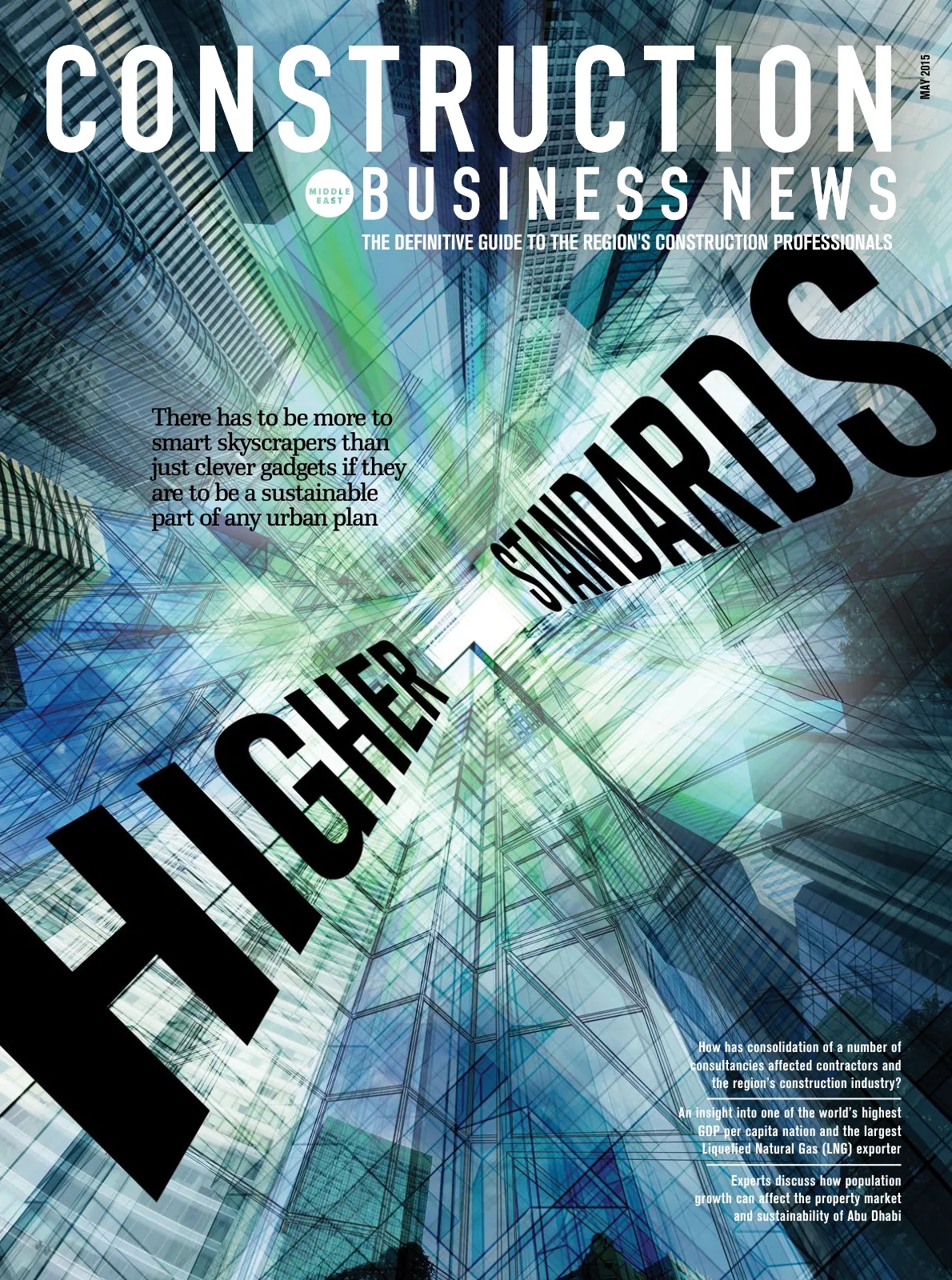
There has to be more to
smart skyscrapers than
just clever gadgets if they
are to be a sustainable
part of any urban plan
An insight into one of the world’s highest
GDP per capita nation and the largest
Liquefied Natural Gas (LNG) exporter
Experts discuss how population
growth can affect the property market
and sustainability of Abu Dhabi
How has consolidation of a number of
consultancies affected contractors and
the region’s construction industry?
MAY 2015
THE DEFINITIVE GUIDE TO THE REGION'S CONSTRUCTION PROFESSIONALS
Page 2
OHSAS 18001 certified
ISO 9001, 14001 and
130+years of
project experience
LEED Platinum, LEED Gold
and LEED Silver Capability
End to End Integrated Solutions
Pioneering Engineering Construction since 1881
www.drakescull.com
700+
Projects Delivered
For over 130 years, Drake & Scull International PJSC has been shaping skylines and transforming the lifestyle of
communities around the world.
Drake & Scull is an industry leader, with a proven history of delivering more than 700 projects through its General
Contracting, Engineering, Rail, Oil & Gas, Water and Wastewater Treatment and Infrastructure development business
streamlines across the region.
Page 3
construction business news me MAY 2015
1
26
HIGH STANDARDS
There has to be more to smart skyscrapers
than just clever gadgets if they are to be a
sustainable part of any urban plan
news
architecture
Antonio Citterio,
founder of
architectural firm
Antonio Citterio
Patricia Viel and
Partners, talks
about his work
with Meraas and
Bulgari Resort and
Residences and what
it means to design
luxury real estate
in person
Stéphane Aubarbier,
CEO of Energy &
Infrastructure
division at
Assystems, speaks
about the company’s
growing presence in
the Middle East
analysis
Alison Luke
examines how has
consolidation
of a number of
consultancies
affected
contractors
and the region’s
construction
industry
country focus
With the world’s
highest GDP per
capita and the
largest Liquefied
Natural Gas (LNG)
export, Tremendous
gas deposits and a
small population,
Qatar surely has
everything going in
its favour
ABOVE: HOW THE DUBAI SEVEN-STAR HOTEL WORKS
6
14
16
20
32
cover story
14
23
contents
Page 4
construction business news me MAY 2015
2
S U B S C R I B E
c o n t r i b u t o r s
subscriptions@bncpublishing.net
Managing Director
Walid Zok
walid@bncpublishing.net
Director
Rabih Najm
rabih@bncpublishing.net
Director
Wissam Younane
wissam@bncpublishing.net
Group Publishing Director
Diarmuid O'Malley
dom@bncpublishing.net
Editorial Director
Giorgios Retsinas
giorgios@bncpublishing.net
Features Editor
Lorraine Bangera
lorraine@bncpublishing.net
Business Development Director
Rabih Naderi
rabih.naderi@bncpublishing.net
Sales Manager
Elly Shirkhan
elly@bncpublishing.net
Marketing Executive
Mark Anthony Monzon
PO Box 502511 Dubai, United Arab Emirates
P +971 4 4200 506 | F +971 4 4200 196
For all commercial enquiries related to
Construction Business News ME contact
elly@bncpublishing.net T +971 55 339 5097
All rights reserved © 2015.
Opinions expressed are solely those of the contributors.
Construction Business News ME and all subsidiary
publications in the MENA region are officially licensed
exclusively to BNC Publishing in the MENA region by
Construction Business News ME.
No part of this magazine may be reproduced or
transmitted in any form or by any means without
written permission of the publisher.
Images used in Construction Business News ME
are credited when necessary. Attributed use of
copyrighted images with permission. All images not
credited courtesy Shutterstock.
Printed by International Printing Press www.ippuae.com
Stuart Matthews
Marlow McGuinness Ltd
comment
Omar Rashid writes about how injuries could be
reduced in construction sites by simple measures
Does government regulation really impact
sustainability in construction or is it the private
sector that needs to step up? Shivram Mukherjee
analyses
Louay Dahmash writes How cities should invest for
future economic and environmental vitality
Frank Ackland analyses power management in
commercial construction
sustainability
Florian Krueckl, Managing Director at BASF Middle
East, discusses the importance of embracing
sustainability in a busineSS
Experts discuss how population growth can affect
the property market and sustainability of Abu Dhabi,
UAE’s green city
Q&A
Bishoy Azmy, CEO of Al Shafar General Contracting,
discusses the company's 25 year old history, culture
and the future
project review
Dukes Oceana, launched by Seven Tides, brings both
British charm and cosmopolitan luxury to the UAE
Al Zorah Development Company showcases its latest
development along the coastline of Ajman
suppliers
construction machinery
event preview
International Property ShoW
Cityscape Abu DhabI
save the date
editor’s pick
37
42
44
56
38
40
48
52
55
57
58
60
61
63
64
30
18
CONTENTS
Page 5
Porto Arabia Towers
Doha, Qatar
©2014 Hill International, Inc.
Hill International
The Global Leader in Managing Construction Risk
www.hillintl.com
For nearly four decades, owners and developers in the Middle East have
turned to Hill International to manage their construction projects and
programs throughout the region. Hill is proud to have helped our clients
turn their most challenging visions into realities. We have participated
in over 10,000 projects with a total construction value in excess of $500
billion, managing all phases of the construction process from concept
through completion.
Hill is also the leading construction claims firm in the world, having helped
resolve problems on some of the most complex projects throughout the
Middle East and around the world. To minimize risk and maximize results
on your next project, turn to Hill International
Dubai Office: 971 4 227 0078
Doha Office: 974 4 435 8381
Corporate HQ: 800 283 4088
If you can imagine it, we can manage it.
Qatar National Museum
Doha, Qatar
Mall of Qatar
Doha, Qatar
Viva Bahriya Towers
Doha, Qatar
Page 6
4 construction business news me MAY 2015
Rising
high
Drawing inspiration from the splendid view
of the Dubai skyline from our office head-
quarters, this month’s cover story will take a
look at a topic the Gulf is very familiar with
– skyscrapers. In this day and age, a pristine
skyline is considered indispensable to label
a city as “modern” or “developed.” As we
set foot in a futuristic age, we need to take
a closer look at these iconic structures and
examine if they would be well suited for our
vision of a smart city. Industry experts ana-
lyse how sustainability can be incorporated
in new as well as existing towers. We also
look into the cost effectiveness of switch-
ing to smart technologies and weigh the
advantages of using building management
systems. With the UAE moving towards
developing smart cities, integrating clever
technologies in construction is a given. For
those readers interested in gaining more in-
sights on the topic can attend Smart Sky-
scrapers Summit on May 11 to 12 this year
at the Sofitel Dubai the Palm Resort & Spa.
Also this month, we have analysed how
contractors and the construction industry
have been affected by the consolidation of
large consultancies. We look into how the
financial crisis in late 2008 propelled a wave
of change that distorted most of the indus-
try’s layout leaving large consultancy firms
to be pushed into being consolidated or
acquisitioned which carried forward both
positive and negative results. Experts from
the sector look into both sides and state the
overall changes made within the industry to
cope with the aftermath.
Construction Business News ME’s first
country focus looks at the rising power
in the region – Qatar. A rich land known
to be the world’s highest GDP per capita
along with an astoundingly small popula-
tion. Apart from that, the country is in full
throttle preparing for high profile events
including the FIFA World Cup 2022 and
the IAAF World Athletics Championship
2019. For us, all this translates into one
simple thing – an upsurge in construction.
With massive investments flowing into Qa-
tar’s building industry and infrastructure
sector, it is one of the most lucrative markets
today. Considering the low level of corrup-
tion, investors have a prime opportunity to
grab in this part of the world.
In addition to our content, we have also
started incorporating new design elements
in our magazine, experimenting with colour
palettes and trying our best to come up with a
scheme that would be attractive to our readers.
If you haven’t yet joined us online, do
reach us on any of our social media plat-
forms. We look forward to hearing from
you via Facebook or Twitter.
editor’s note
Not quite there yet
Could do better...
A little more colour?
Perfect!
Page 7
Page 8
construction business news me MAY 2015
6
NEWS
Luxury real estate developer, Damac Properties, announced the
opening of two new serviced hotel apartments’ projects in the
Burj area - the Damac Maison The Vogue and Naia Breeze.
The projects have a joint capacity of 500 suites and are now
welcoming residents and customers from across the globe. In
the last 14 months, these two projects mark the fourth and the
fifth projects for Damac Hotels & Resorts.
Niall McLoughlin, Senior Vice President of Damac Properties,
said that the opening of Damac Maison The Vogue and Naia
Breeze reflects the company’s strategy in the hospitality sector.
“We aim to become a leading player in this field as one of the
major hotels and luxury serviced apartments operators in the
region,” he said.
“Damac Hotels & Resorts has five projects open to date and
more to come, catering for the growing need in the Dubai hospi-
tality sector, where the number of tourists and visitors is expect-
ed to grow steadily year on year reaching an unprecedented
level in five years’ time, during the World Expo 2020,” he added.
Green Middle East, Sharjah’s environ-
mental management and technology ex-
hibition and conference, has announced
that though it is essentially a business-
to-business (B2B) event, it will now have
a business-to-consumer (B2C) element
that will promote eco-friendly products
and services.
The event, to be held in December this
year at Expo Centre Sharjah, will also
add educational elements as part of its
consumer reach. Professor Dr Sabah Al
Kass, Dean of College of Engineering,
University of Sharjah said: “Since Uni-
versity of Sharjah is involved, we will add
an educational dimension to the Green
Middle East. We aim to provide an en-
abling environment to schools, teachers
and students to think and learn about
contemporary regional and global envi-
ronmental issues and challenges.”
Saif Mohammed Al Midfa, CEO of
Expo Center Sharjah said that since its
launch in 2011, the event has success-
fully anchored the green initiatives be-
ing launched in the country. “Now, in the
new format, I am glad to see that Green
Middle East will have one of the larg-
est official mandates to steer the green
drive in the country and beyond.”
Green Middle East, a carbon-neutral
event, will have renewable energy,
water and wastewater, waste and
recycling, green building and retrofits
and environment awareness as its
main focus.
Two more hotel projects in Downtown Dubai
Model of Town Square
Delegates addressing the Green Middle East
press conference
Green Middle
East’s new mandate
Upcoming DAMAC Maison The Vogue
Page 9
Nakheel announced a 12 million square feet retail, residential and leisure development
in Deira Islands. The project, Deira Islands Mall, Towers and Boulevard, will offer shop-
ping and luxury living facilities in a self-sustaining community for 10,000 people that
includes around 1.7 million square feet of green, communal parkland.
The complex includes Deira Mall with 2.9 million square feet of leasable space and
a car park for more than 8,400 vehicles. The mall will be surrounded by the 16-tower
Deira Islands Towers community, comprising over 2,400 apartments and townhouses
spread over four clusters.
The Deira Islands Boulevard, will be a 400,000 square feet walkable shopping and din-
ing promenade connecting the residences, mall and parks that make up the development.
Other projects include a 6.5 million square feet residential, retail and hotel extension
for Dragon Mart, and a new 4.7 million square feet complex at Ibn Battuta Mall.
Ramy Jallad, acting CEO of Ras Al
Khaimah Free Trade Zone (RAK FTZ), led
the free zone’s first delegation to Japan
to share their business set-up and expan-
sion benefits with Japanese investors.
The mission sought to enhance trade be-
tween the UAE and Japan, and to create
new investment relationships between
the two countries.
Jallad conducted a series of meetings
with key government and investment
bodies, as well as local companies, in To-
kyo and Osaka over a five-day period
from April 5 to 9 this year.
“Japanese investors can expand
their companies into the UAE by
taking advantage of the strategic
geographical location of RAK FTZ,
making it easier for their products
and services to reach fast-
growing markets in the
Middle East, Africa and Eu-
rope,” Jallad said. “RAK
FTZ also helps Japanese companies
grow with a full range of business set-up
and support services, with high-quality
facilities, complete freedom from taxes,
full repatriation of profits, and lower costs,
so they can generate higher profits,” he
added.
According to Keiji Tanaka, Manager of
Nihon Mesh Kogyo UAE, a Japan head-
quartered manufacturer and distributor
of wire mesh demisters for desalination
plants, the company selected RAK FTZ
as its Middle East base to take advan-
tage of the free zone’s ongoing busi-
ness support services and strategic
location, and is considering an ex-
pansion at RAK FTZ. He said: “We
decided to set up a factory in the
UAE to be closer to our
customers, and RAK FTZ
proved to be the most
cost-effective and conve-
nient option.”
Mövenpick Hotels
& Resorts debuts
at DMC
Mövenpick Hotels & Resorts has
revealed plans to open its first prop-
erty in Dubai Media City (DMC)
in 2017. The 251-key Mövenpick
Hotel Dubai Media City will be lo-
cated adjacent to the AED4.5 bil-
lion ‘innovation hub’ announced by
the Dubai Government last year – a
new centre for communications and
technology facilities that spans an
area the size of two football pitches
across DMC, Dubai Internet City and
Knowledge Village.
“Dubai Media City is already home
to more than 2,000 businesses ac-
cording to Tecom and attracts thou-
sands of workers and visitors on a
daily basis. The innovation hub will
significantly expand the district’s
population and Mövenpick Hotel
Dubai Media City will be well placed
to cater to this community and be-
yond,” said Andreas Mattmüller,
CEO of Mövenpick Hotels & Re-
sorts, Middle East and Asia.
The company recently unveiled
plans to open the 246-key Möven-
pick Hotel Apartments Downtown
Dubai in the same year.
Upcoming canal at Falcon Island
Jewel of the Creek
RAK FTZ attracts
Japanese investors
Nakheel unveils three projects
across Dubai
Mövenpick Hotel Media City Dubai
Upcoming Deira Islands Mall
Ramy Jallad, Acting
CEO of RAK FTZ
Page 10
NEWS
The Emirates Nuclear Energy Corporation (ENEC) received six inter-
national ISO re-certifications from Intertek, a provider of quality and
safety services, in April 2015. ENEC underwent rigorous, impartial,
comprehensive auditing and assessment by Intertek auditors to en-
sure that its operations conform to international standards.
Hussain Al- Atrakchi, Regional Managing Director for Intertek Mid-
dle East, North Africa & Pakistan, said that receiving this recertifica-
tion across its operations and departments is a major achievement
for the ENEC and reflects its drive as a government entity for main-
taining world-class operations across its business functions.
These re-certifications assure that the corporation controls occu-
pational health and safety risks. It also ensures that its information
technology infrastructure conforms to standards to better manage,
secure and protect data, while driving operational excellence.
A detailed risk assessment was undertaken and the corporation's
framework was evaluated for the efficiency of its technical infrastruc-
ture. Its external services were also tested to ensure confidentiality,
integrity, secure exchange of data and availability of critical informa-
tion. The corporation’s business continuity framework ensures it has
control over risks of exposure to internal and external threats.
Mohammad Al Hammadi, ENEC's CEO, said: “ENEC is working to
deliver safe, clean and efficient nuclear energy that will be vital in
supporting the UAE’s social and economic growth. Our robust inter-
nal processes are crucial to ensure that we remain on track to deliver
nuclear energy to the UAE grid in 2017.”
Left to right: Hussain Al Atrakchi awards
Mohamed Al Hammadi ISO re-certifications
ENEC receives re-certifications
from Intertek
Abdul Latif Jameel Energy and En-
vironmental Services announced the
acquisition of Fotowatio Renewable
Ventures (FRV), a developer of solar
power plants, this April. The sell-
ers included Denham Capital,
Qualitas Venture
Capital, and
founder share-
holders. Roberto
de Diego
Arozamena, CEO of Abdul Latif Jameel
Energy and ES said, “Our acquisition
of FRV strengthens our position within
the solar PV sector with the goal to be-
come an independent power producer.
FRV brings operational in-market
solar PV development expertise with
proven project financing and internal
engineering and procurement compe-
tencies. Our strategy is to focus on re-
newable energies such as solar, wind,
waste-to-energy, hydro power and
environmental services such as
waste management.”
FRV currently has a 3.8GW
in direct current (DC) pipeline
of projects in emerging solar
markets including the Middle
East, Australia, Africa and Latin
America. 3.8GWdc of power is the
equivalent of generating enough electricity
to supply approximately 1,750,000 homes
and remove approximately six million
tonnes of Co2 emissions.
Rafael Benjumea, CEO of FRV said:
“Our global track record backed up by
Abdul Latif Jameel Energy and Envi-
ronmental Services’ financial strength
and presence across the MENAT re-
gion, will significantly increase our abil-
ity to build scale, geographical reach
as well as establish our leadership in
diversifying national energy production
in strategic markets across the world.”
Abdul Latif Jameel Energy and Envi-
ronmental Services will retain the FRV
name which has become a recognized
brand in solar development as well as
FRV’s complete workforce of approxi-
mately 70 experts in all fields of solar PV.
Abdul Latif Jameel strengthens energy business
Left to right: Rafael
Benjumea and Roberto de
Diego Arozamena
Page 11
This April, Tekla launched Tekla Structural Designer software at
The Construction Summit in UAE to support technology innovation
for the GCC’s US$1 trillion worth of construction projects.
The region’s construction market will hit a record of $144 bil-
lion in 2016, driven by mega-projects for World Expo 2020 in
Dubai, 2022 FIFA World Cup Qatar, Smart Cities, and infra-
structure, according to the EC Harris report Middle East Major
Construction Programmes. The report also states that mega-
projects in the GCC will reach $1 trillion by 2030.
The UAE has $90 billion in capital development projects, ac-
cording to EC Harris, while Qatar’s fastest-growing construc-
tion and infrastructure market is set to spend $24 billion on
infrastructure in 2015, according to BMI Research.
“The GCC, being one of the world’s fastest growing construc-
tion markets, demonstrates the potential for how technology
will enable the region’s architects, engineers, and field manag-
ers to drive innovation, collaborate, and meet strict code com-
pliance across the design, build, and operation of the country’s
projects,” said Paul Wallett, Area Business Director, Tekla Mid-
dle East.
Middle East projects that have used Tekla Building Informa-
tion Modeling (BIM) technology to deliver precise and complex
planning and fabrication include the Abu Dhabi Airport – Mid-
field Terminal Complex, the King Abdullah Financial District and
King Abdulaziz Center for World Culture in Saudi Arabia, and
National Museum of Qatar.
Tekla’s Abu Dhabi Midfield Terminal design
GCC’s construction
market to boom in 2016
MADE IN UAE
www.intermetal.com www.verdadoors.com
Dubai, UAE Tel: +971 4 884 1650 Email: sales@verdadoors.com
MANUFACTURING
QUALITY DOORS, KITCHENS
& INTERIOR FIT-OUT
Hall 7 - Stand B179
04 - 07 MAY 2015
QATAR NATIONAL CONVENTION CENTRE
Page 12
construction business news me MAY 2015
10
NEWS
Bahrain’s project market is valued at
more than $65 billion, including proj-
ects planned and underway, according
to MEED Projects, an online projects
tracking service. By sector,
construction has the biggest
share, with projects valued
at $30.4 billion followed by
transportation
and
power
and water.
A comprehensive overview
of Bahrain’s reinvigorated proj-
ects market was presented at
the Bahrain Infrastructure and
Finance Forum held on 28-29
April this year at the Crowne
Plaza in Manama.
Among the projects under scrutiny
are Bahrain’s latest land transport net-
work initiatives, the $5 billion rail net-
work and the $5 billion Saudi-Bahrain
Causeway project. Both are
envisioned to promote the
kingdom’s Economic Vision
2030 Masterplan.
Bahrain’s airport expan-
sion programme and its role
in the kingdom’s economic
diversification was also a
key focus of the forum, along
with sustainability initiatives
and the latest developments
related to the overhaul of the
country’s sewage network.
Al
Ain
Distribution
Company
(AADC) is gearing up to stage the
inaugural edition of the Eco Smart
Home Show from 7 to 9 May this
year at Al Ain Convention Centre.
The event aims to raise aware-
ness about the benefits of using
energy efficient household devic-
es. It will showcase a wide range
of products and educate visitors
on lifestyle changes that can be
implemented towards reducing
utility bills and achieving long-
term benefits from energy conser-
vation and resource preservation.
The Eco Smart Eco Show will
bring together leading organisa-
tions and companies involved
in energy conservation on one
platform to spotlight the latest
technological innovations and ad-
vanced systems in air condition-
ing, irrigation, sunshades, home
electronics, lighting, solar power,
paint, windows and doors and en-
ergy efficient plumbing.
Mohammed Salem bin Omair Al
Shamsi, Director General of Al Ain
Distribution Company (AADC),
said: “In addition to educating
future generations to behave
responsibly and reduce energy
consumption where possible, the
event will provide an ideal plat-
form to explore the latest energy-
efficient and eco-friendly tech-
nologies and products to help us
build a sustainable future."
Upcoming hospital facility, Kuwait Cardiac
Research and Rehabilitation Centre, will
be developed to provide daylight, natural
ventilation, and pleasant views to improve
patients’ health and comfort.
The interior of the centre is designed
like a miniature city with different scales
and hierarchies. The ‘main streets’ are the
corridors where patients can be assisted
in different receptions; and the main wait-
ing areas are square shaped spaces with
direct view of the courtyard. AGi Architects,
designers on the project, want to give the
patients the feeling of being outdoors.
Dr Nasser B Abulhasan, Principal of AGi
Architects, will be speaking at the Archi-
tect’s Congress at Building Healthcare
Exhibition and Conferences taking place
from June 8-10 this year at the Dubai In-
ternational Convention and Exhibition Cen-
tre. The event will focus on the design of
a healing environment and how it impacts
patient safety, operations, and the financial
success of a healthcare facility.
AGi Architects design
healing spaces
Project Qatar 2014
Al Ain to host
Eco-Smart
Home Show
Massive opportunities at stake in Bahrain projects market
Mohammed Salem
bin Omair Al Shamsi,
Director General of Al Ain
Distribution Company
Massive opportunities at stake in Bahrain projects market
CONSTRUCTION:
$30.4billion
TRANSPORTATION:
$10.9billion
POWER & WATER:
$6.1billion
Bahrain to award more
than US$65 billion worth of projects
Page 13
construction business news me MAY 2015
11
Tilal Properties announced
its flagship development, Ti-
lal City, in Sharjah. The proj-
ect comprises 1855 land
plots, offering the opportu-
nity to UAE residents to buy
or lease land and develop
properties in Sharjah for the
first time ever. The devel-
opment allows investors to
build for sale, leasing and
personal use. Non-Arab ex-
pats can purchase land plots
on a 100-year leasehold ba-
sis within the scheme, with
freehold land plots avail-
able for GCC nationals and
UAE’s Arab residents.
To date, 70% of all avail-
able plots in zones A and
C – which are the first two
zones to be handed over in
2016 – have been sold. The
new flexibility in owning land
has been a key driver behind
investors’ interest.
Sundus Investments Projects LLC, specialists in mixed-use de-
velopments in the Middle East, has signed an agreement with
Shaksy Engineering Services (SES) to begin work on the first
phase of the Sundus Airport Heights development in Muscat,
which will be operated by Rotana Hotels when complete.
The agreement was signed by Mohammed Mahfoodh Al
Ardhi, Chairman of Sundus Investments Projects LLC, and
Said Al Shaksy, CEO of Shaksy Engineering Services (SES).
Phase one of the landmark project will include the con-
struction of Sundus Rotana, a four-star business hotel that is
set to open doors to the public in February 2017.
Mohammed Mahfoodh Al Ardhi, Chairman of Sundus
Investments Projects LLC, said: “According to the World
Travel & Tourism Council’s 2015 Travel & Tourism Eco-
nomic Development Report, Oman is poised to register
the highest growth in the tourism sector across the Middle
East region notching up an 11% increase in the number
of jobs in the country.”
Sundus Airport Heights has been designed to cater to busi-
ness travellers and conference visitors. The second phase
of the project will include the development of Sundus Arjan
featuring 85 luxury hotel apartments.
Sundus Rotana and Sundus Arjan will collectively span an
area of approximately 40,000 square metres and contribute
to driving the country’s ambitious mandate for the tourism
sector as outlined in Oman’s Vision 2020.
Sundus and Shaksy
collaborate for
Rotana project in
Muscat
Tilal City Registers 70% Sales
for Zones A and C Set for
Delivery in 2016
Foreign delegates gath-
ered in Dubai for the 2nd
BagnoDesign International
Dealer Summit, held from
April 19 to 22, 2015.
Attendees had the oppor-
tunity to share their experi-
ences and knowledge of
working with BagnoDesign,
designers and manufactur-
ers of unique bathroom so-
lutions, and running profit-
able businesses in different
countries.
During their stay in Dubai,
BagnoDesign dealers also
had the opportunity to gain
more of an insight into
the company’s operation,
with presentations from
the company’s directors
and managers, with testi-
monies from its custom-
ers sharing some of the
secrets of their success.
Delegates also witnessed
new product ranges such
as the new BagnoSpa col-
lection, as well as IX10
and Savoia.
On each evening of the
Summit delegates joined
the BagnoDesign team in
celebrating their 20th an-
niversary at the Sheraton
Jumeirah Beach Hotel.
BagnoDesign welcomes delegates
at their UAE headquarters
Marble entrance of Emirates Palace
Mohammed Mahfoodh Al Ardhi and
Said Al Shaksy sign contract
Tilal City
Delegates with BagnoDesign team
Page 14
Page 15
Page 16
construction business news me MAY 2015
14
ARCHITECTURE
Bulgari and Meraas
unveils its project
Bulgari Residences
Dubai at the
Dubai World Trade
Centre. Antonio
Citterio, architect
on the project, talks
to Construction
Business News ME
about his work with
Bulgari Resort and
Residences, and what
it means to design
high-end luxury
products
T
his April, the Dubai-based
holding company Meraas
and the international
luxury brand Bulgari
announced the launch
of Bulgari Residences Dubai as part
of the 1.7 million square feet Bulgari
Resort and Residences that is taking
shape on the Jumeira Bay Island.
The project will be entirely de-
signed by the Italian architectural
firm Antonio Citterio Patricia Viel and
Partners. It comprises of 165 apart-
ments, eight penthouses and 15 man-
sions. In addition to common areas
such as private landscaped gardens,
swimming pools and gymnasiums,
residents can enjoy a host of dining
and sporting options on site, includ-
ing the 50 berths Marina and Bulgari
Yacht Club and benefit from the
unmatched service standard of the
adjacent Bulgari Resort.
The project was unveiled at a
press conference in Dubai World
Trade Centre headlined by Cherif
Hosny, Chief Hospitality Officer of
Meraas, Silvio Ursini, Executive Vice
President of Bulgari, and the world
renowned architect Antonio Citterio
of Antonio Citterio Patricia Viel and
Partners. The Italian architect who
has handled the architectural and
interior design aspects of all the Bul-
gari Hotels worldwide including the
Bulgari Resort and Residences Dubai.
His close attention to the smallest
detail has helped translate the luxury
of the Bulgari brand along with the
high quality of a Meraas develop-
ment. Born in Meda in 1950, started his
design office in 1972, and graduated in
architecture at the Milan Polytechnic in
1975. Citterio was awarded the Com-
passo d’Oro-ADI in 1987 and in 1994,
and since 2006 he has been a professor
of architectural design at the Mendrisio
Academy of Architecture, Switzerland.
In 2008 he was honoured by the Royal
Society for the Encouragement of Arts,
Manufactures & Commerce of London,
which gave him the title of Royal De-
signer for Industry.
Speaking to the media about the
design, Citterio says it all started with
how to define luxury. He says that for
him luxury is quality of life and he
wanted to recreate it in this project
by designing a space worth living in.
“We didn’t want to create a cold hotel
space, but something more similar
to a village. I wouldn’t imagine the
space as empty but filled with people.
We are not interested in competition,
but providing better quality of life for
the people.”
The concept of a village design,
comes from Italian culture itself. “When
you think of villages, you think of
community and that is what we want
people to feel in Bulgari Residences.”
“It might not be exactly like a vil-
lage,” he jokes. “The material used
in building will be of better quality
to help these structures last in the
future. It is not a place for vacation,
but a place to live.”
Characterised by its efforts to create
perfect harmony with nature through
its architectural style, the Bulgari
Antonio Citterio, founder
of Antonio Citterio
Patricia Viel and Partners
Community
design
Page 17
construction business news me MAY 2015
15
Resort and Residences Dubai aims
in integrating the physical elements
present on the Jumeira Bay Island.
For instance, while the ubiquitous
use of limestone is reminiscent of the
golden sands of the desert, it also
harks back to the timeless sculpted
architecture of Southern Italy.
Limestone has also been generously
used in the boundary walls of the
development, while the podiums are
similarly clad in golden limestone. In
addition, the lava stone and basalt
paving create a sophisticated graphic
contrast for public space - that in ar-
chitectural terms makes up the ‘inner’
urban environment.
The event included a 12m x 8m
preview model of the project un-
veiled for the audience at the media
briefing. Addressing the media,
Cherif Hosny, Chief Hospitality Of-
ficer, Meraas says: “Bulgari Resi-
dences Dubai is not a regular devel-
opment with branded elements. It
is truly the first of its kind created
from pre-concept, with the intention
of translating the visions of both the
primary stakeholders – Bulgari and
Meraas – into an extraordinary man-
made marvel.”
The launch of the Bulgari Resi-
dences Dubai complements the
earlier announcement of the Bulgari
Resort Dubai as part of the agreement
signed in May 2014 by His Excel-
lency, Abdulla Al Habbai, Group
Chairman of Meraas, and Jean-Chris-
tophe Babin, CEO of Bulgari Group.
The partnership to bring the luxury
hospitality brand to Dubai was signed
in Rome at Bulgari's historic flagship
store dating back to 1905. The master
development, Bulgari Resort and
Residences Dubai, is scheduled for
completion in 2017.
According to Hosny, Dubai has
particularly proven to be attractive
for major luxury brands to set up
and showcase themselves to the
region’s potential customer base.
“Dubai has demonstrated a strong
track record for constantly and con-
tinuously being the first in the region
to introduce new and appealing
high-end, superlative developments.
Demand for prime property will
continue to rise – and as the market
matures, expectations will rise for
qualitative, detail-focussed and
refined finished products. As that
demand grows, investment in such
developments will also surge.”
Silvio Ursini, Executive Vice Presi-
dent, Bulgari says: “We are proud
of the partnership with Meraas in
bringing the Bulgari brand signature
contemporary Italian style to Dubai,
where we see great demand for such
high-quality developments. In 2017,
upon completion of the project, the
resort and residences will serve our
international niche audience looking
for the most exclusive experience.”
Antonio Citterio says that the col-
laboration between the two entities
has been seamless. “Both groups
have allowed us to perfect all aspects
of the design, to transform both vi-
sions into reality.”
FACTS & FIGURES
• 1.7 million square feet
– Bulgari Resort and
Residences
• Bulgari Residences: 165
apartments, 8 penthouses
& 15 mansions
Below: Bulgari
Residences in Jumeirah
Bay Island
Left: Bulgari Residences
Bulgari Resort
Page 18
construction business news me MAY 2015
16
IN PERSON
scope through project management
and systems integration.
In the long run, we will further
train our teams and recruit local
engineers specialised in the nuclear
industry to support and ensure the
sustained development of the King-
dom’s nuclear programme.
What are some of the major projects
you are currently working on?
Regarding Saudi Arabia more specifi-
cally, we are currently involved in
several major infrastructure projects.
These projects include:
Jubail: For 10 years, Assystem-Radi-
con has been supporting the develop-
ment of Jubail Industrial City. The City
covers a total surface area of 920 kilo-
metres of which around 260 has been
designated for initial development.
Assystem-Radicon has been providing
outreach in Saudi Arabia and more
globally in the Arabian Gulf, enabling
us to support our clients locally in this
region. Moreover, the strong technical
expertise of Radicon in infrastructure
design as well as its understanding of
the local environment combined with
Assystem’s international reputation and
historical expertise in complex project
management, namely in nuclear, will
enable us to be a reliable and efficient
partner to our Saudi clients.
Could you tell us more about your
work in Saudi Arabia?
Assystem-Radicon currently focuses
on providing our clients with en-
gineering design services in the
infrastructure and power sector. In
the short term, we will expand our
services by strengthening the existing
offer but also by broadening our local
T
ell us more about the
merger between Assystem
and Radicon Group. Why
was it executed and how
has it had a positive impact
on the companies?
Based on our legacy of delivering
highly complex infrastructure, Assys-
tem has been supporting and manag-
ing challenging projects and deploying
cross-functional expertise across key
industrial sectors including aerospace,
defence, automotive, transport, energy,
nuclear and life sciences. Assystem
has developed strong capabilities in
systems integration in the sectors of
energy and infrastructure with projects
in smart grids or smart buildings.
As the fourth independent nuclear
engineering company worldwide,
Assystem wanted to strengthen its
footprint in the GCC region - which is
currently developing strongly in the
nuclear energy sector.
The company’s business model
relies on building long-term links with
local clients, which only an acquisi-
tion enables. Radicon fulfilled this
need, since they
understood the
local market and
had a reputation for
quality and excel-
lence, they were the
natural choice.
In order to enable growth and in-
novation in light of shared interests,
Assystem and Radicon collaborated to
service the growing energy and infra-
structure industries in the region. As
part of our growth strategy to expand
in the Middle East, in 2015 Assystem
acquired 75% of Radicon, a 400-per-
son engineering company based in
Saudi Arabia. Ali K. Al-Harbi, founder
of the company, retains a 25% stake
in Radicon.
The new entity Assystem-Radicon
will also attract and retain local talent
through recruitment and career devel-
opment programmes aimed at Saudi
nationals and engineers in particular.
Assystem- Radicon has already recruit-
ed about 100 persons while the size of
the company will double to reach 800
employees in the next two years.
Radicon will strengthen the group’s
Page 19
construction business news me MAY 2015
17
Founded in
France in 1966 to
commission nuclear
facilities, Assystem
is an international
and independent
engineering company,
recognised worldwide
as an independent
engineering company
in the nuclear sector.
Stéphane Aubarbier,
CEO of the Energy
& Infrastructure
division, talks about
its growing presence
in the Middle East
especially in Saudi
Arabia
and the UAE
about seven million hours of engineer-
ing design to develop transportation,
building, power and telecommunica-
tion infrastructures.
KAP projects: Assystem-Radicon
won a tender with Saudi Arabia’s
Ministry of the Interior worth SAR21
million. The contract covers engineer-
ing works for more than 220 buildings
such as workshops, offices, sports cen-
tres, theatres, restaurants, in an area
of 10,000 m2 spread over six locations
between Mecca and Medina. It forms
part of the ‘King Abdullah Project
for Security Forces’ (KAP) investment
programme that seeks to improve the
safety conditions and accommodation
for pilgrims visiting the sites of Mecca
and Medina. This first significant
contract won by Assystem-Radicon
demonstrates our joint skills as well as
the region’s development potential.
Facts & Figures
• Assystem was first active
in the Gulf in 2011 through
its participation in the UAE
nuclear programme and
its technical assistance
subsidiary, MPH Global
Services. In September
2013, Assystem relocated
its energy and infrastruc-
ture division’s global
headquarters to Dubai.
• Assystem employs nearly
12,000 engineers in
continental Europe, UK,
North America, GCC, Africa,
India and Southeast Asia,
and reported revenues of
more than US$1 billion
in 2014
Stéphane Aubarbier, CEO of the Energy &
Infrastructure division, Assystem
Assystem’s prominent projects – Iter
Page 20
construction business news me MAY 2015
18
IN PERSON
mixed with new lockless technologies.
In order to face these challenges, As-
system has developed specific offers,
namely in the domain of cyber secu-
rity. We are, for instance, working on a
research and development programme
founded by the European Commission
- SCISSOR project - to develop a com-
prehensive cyber security programme
for industrial systems.
Finally, digital technologies will
have a major impact on engineering.
New technologies reducing the time
and costs of projects completion will
revolutionise this industry. Our history
in products engineering (Assystem is
the first independent engineering in
the sector of aerospace in Europe)
will give us the ability of developing
solutions adapted to the energy and
infrastructure sectors quickly in this
new context.
Could you highlight some of the ben-
efits of working in the Middle East?
The investment programme in the
Middle East is still one of the best
funded programmes in the world
especially in KSA and the UAE. We
believe that this will still be the case
for a very long time. Those invest-
ments are mainly focussed on our
sectors of expertise - energy and
infrastructure. As such, expanding
our footprint to this region gives us
the opportunity to be involved in
some of the most ambitious energy
and infrastructure projects.
Moreover, the Middle East is a very
good geographical platform from
which we can also develop our activi-
ties in business hubs around Africa
and South East Asia.
What are some of the key challeng-
es you see in the industry across
the region?
In the GCC region, we see that com-
pleting projects (in infrastructure or
energy) within the planned budget is
becoming a constraint. Thus, realising
projects on time, within the budget
and the operational performance de-
sired is today a real challenge for the
project owners, hence an increasing
importance for the project manag-
ers’ role.The role of project managers
is not only getting more important
but is also becoming more complex.
Indeed, new and complex technolo-
gies are now integrated in energy and
infrastructure projects, increasing the
level of risks throughout the realisa-
tion of the project. Thus, the project
manager needs to have a deep tech-
nical and technological understanding
and be able to manage strong safety
and security constraints to conduct
the project efficiently.
We believe that our extensive track re-
cord in complex sectors such as nuclear,
life sciences or aerospace gives us the
skills required to address these highly
regulated environments with demanding
safety and security requirements.
The integration of new technolo-
gies such as smart grids entails new
issues in terms of safety and security
as previous closed networks are now
KEY PROJECTS
NUCLEAR
European Pressurised Reactor:
The European Pressurised Reactor is a new generation of pressurised water reactor complying with the
latest safety standards. It is part of a nuclear production programme that raises key questions about the fu-
ture of nuclear power for electricity. Assystem is a major consulting and engineering partner and is involved
in the design, work supervision and commissioning of EPR reactors in France, Finland, China and the UK.
Fuel Cycle:
The construction of the Rokkasho-Mura reprocessing plant in Japan is based on the example of La Hague
(France) and required a transfer of technology from Areva to JNFL, the Japanese operator. This mission
involved training Japanese staff at La Hague and posting French expatriates to Japan. Areva commissioned
Assystem to provide JNFL with its experience and knowledge in establishing fuel reprocessing plants.
ITER:
Assystem joined ITER (International Thermonuclear Experimental Reactor) in 2005, when it was awarded
a contract from EFDA European Fusion Development Agreement (ex Fusion for Energy - F4E) to work on
nuclear safety engineering. Since then, the Group has kept the pace, supporting ITER organisation and F4E
in the different phases of the development of the project - from the design, construction and supervision
of all the buildings on site, to the construction of the reactor itself and the manufacturing of the remote
handling manipulator for future maintenance operations.
INFRASTRUCTURE- BUILDING
Assystem has worked on infrastructure projects with strong security constraints. The company has been
redesigning and installing the entire security systems of the Chateau de Versailles and the new Louis Vuitton
Foundation in Paris.
OIL &GAS
Borealis: Borealis AG is Europe's second largest producer of polyethylene (PE) and polypropylene (PP) and
is headquartered in Vienna, Austria. Ongoing are numerous brownfield projects. Assystem is in charge of
managing the projects portfolio on behalf of the client as well as realising Front End Engineering Design
while guaranteeing the highest level of safety and minimising the impact of operations on site.
Makkah, Saudi Arabia
Assystem’s agency in Paris
Page 21
Page 22
construction business news me MAY 2015
20
ANALYSIS
Market changes since the global
financial crash have led to the
consolidation of large consultancies.
How has this development affected
contractors and the region’s
construction industry in general?
Alison Luke investigates
New
practices
Page 23
construction business news me MAY 2015
21
T
he financial crash in late 2008
instigated many significant changes
within the construction industry,
with differing results. The sudden
drop in available work propelled
firms operating in the sector to re-evaluate in
order to survive and thrive. For some large
consultancy firms this meant consolidations and
acquisitions, with some firms merging under a
single brand, while other names have been re-
tained as sub-brands of larger organisations.
One of the most high-profile examples is that
of engineering design firm Aecom, which ac-
quired both URS Corporation and Hunt Construc-
tion Group within a matter of weeks in late 2014.
But this was only one of many, as the larger
firms have sought to broaden their skill-base and
expertise quickly in order to win contracts in a
reduced market. For some other firms, a reduc-
tion in operations was imposed as a solution.
“There have been some consolidations and
some consultants that went out of business,”
reports Jeff Willis, Associate Director at Arup.
“Due to the cancellation of many projects in
Page 24
construction business news me MAY 2015
22
ANALYSIS
to inflate their prices to factor in any
unforeseen risks due to less clarity of
scope or design.
For some contractors, such issues
have led them to reassess and im-
prove their own abilities, with some
developing their own design capabili-
ties. As well as ensuring improved
design on individual projects, this
move is sure to have a positive effect
on the entire sector and the region’s
future built environment.
With consultants, in addition to
expanding their skill-base through
consolidations in an effort to gain the
competitive advantage for projects,
they are seeking other employment
options. In some cases, this means
entering other markets for work.
“There is big competition in the UAE
market; the market is picking up but
there are not enough jobs for all con-
sultants,” states Atieh. “UAE-based in-
ternational consultants are now looking
outside of the UAE and taking work in
Saudi Arabia, Qatar and Kuwait. These
firms are based in Dubai, but are now
not 100% dependant on the workload of
Dubai,” Atieh explains.
This increased competition is being
ceased upon by clients seeking cost-
effective solutions for their projects.
As well as negotiating on price with
their chosen consultant, the type of
any integration of design and services.
“[Consolidation] can be beneficial
for the market because the resources
are more available within a large com-
pany,” explains Rachid Ghamraoui of
Besix. “If the consultant is good and
has the right people, then a project
can progress properly,” he adds.
Not all consultants’ clients are benefit-
ing from such changes however. Atieh
explains: “The main contractors are
doing well; the MEP and other sub-
contractors are not doing so well. This
is because the main contractor is shifting
all of the risk onto the subcontractors.”
The overall negative impacts vary
for consultants and contractors. Con-
tractors cite a lack of choice between
consultants as an issue. Consultants,
however, are voicing concern over the
competition for projects.
“It is harder to find suitable consul-
tants [that are] experienced in similar
projects,” states Rahman. “This affects
the contractors from the time of bid-
ding to execution, resulting in delays
and/or disputes due to repetitive
revision of drawings and design. At
times clients have to issue the tender
with an incomplete design to avoid
further delays in the implementation
of a project.”
Such design issues have led to
higher project costs as bidders opt
design [stage], consultants trimmed
their operation and retained only
skeleton staff to support their ongoing
projects,” adds Fazlur Rahman, Deputy
General Manager of MEP contractor
ETA M&E.
The aftermath of these changes in
the consultancy sector has brought
both positive and negative effects to
the construction industry.
“On the positive side, consultants
are now working more cost-effectively
and efficiently towards the clients
interests,” reports Khalil Atieh, Vice
President of international consul-
tant Jain & Partners. “They are being
creative and giving more cost-effective
solutions, so clients are getting a better
deal from consultants.”
The creation of larger companies by
merging those with differing skill-sets
has also made it simpler for contrac-
tors and clients to reduce the number
of firms that they need to deal with
on large, complex projects. “[Market
changes have] created more oppor-
tunities for specialised consultants as
present projects are technically de-
manding,” states Rahman. Employing
a large, international firm that includes
several specialist in-house departments
can mean a one-stop solution for most
projects. This can reduce both time and
costs on a larger project, as well as ease
Page 25
construction business news me MAY 2015
23
consultancy firm being used is differ-
ing according to project needs.
“Clients and major developers are
launching projects, but they are de-
pending on local consultants [for the
majority of the workload], not major,
international ones,” reports Atieh. “At
concept creation clients will go to the
international firms, but when it comes to
the detailed engineering design and the
major amount of work for a project, if
no specialist design work is needed they
are using local consultants.”
As the market has recovered, the re-
duced number of consultants available
has resulted in changes to both prices
and contract terms.
“Due to a sudden increase in the num-
ber of projects, most of the consultants
have become busy and in effect their
prices have increased,” states Rahman.
“Compared to 2008 [after the global
crash], prices are higher by 20%; but
in 2012-13 the prices picked up and
since [this peak] consultants prices
have gone down by 30%,” reports
Atieh. This change is attributed to the
increased competition for contracts
throughout the entire supply chain.
“Contractors are taking jobs at low
cost just to keep running and all the
big players are running at cost [price],”
Atieh states.
But just as significant as the pricing
changes are the contractual changes
that past experience and the increased
market competition have led to.
“What has changed is what people
will sign [in terms of contracts] and
how long they will continue without
payment. This affects costs indirectly,”
stresses Willis. “Many consultants had
to weather some pretty bad storms
because of non-payment of fees for
work already done.”
As the market grows and more work
becomes available, consultants are
finding themselves in a strong negoti-
ating position. They are thus becoming
more selective about the projects that
they take on; the clients with whom
they will work; and the employment
terms to which they will agree.
“Contracts are now [primarily]
employer-based, with imposed terms
and conditions that consultants and
contractors have to follow,” reports
Atieh. “These are mainly payment,
insurance, liability and performance-
based terms.”
Such contractual changes, may affect
the operating market for both consul-
tant and contractors in the long-term.
And with the construction sector
market now seeing an upturn, any
positive benefits to be gained by firms
operating in the sector should surely
be exploited.
“There is big competition in the UAE market;
the market is picking up but there are not
enough jobs for all consultants. UAE-based
international consultants are now looking
outside of the UAE and taking work in Saudi
Arabia, Qatar and Kuwait. These firms are
based in Dubai, but are now not 100%
dependant on the workload of Dubai”
– Khalil Atieh, Vice President of Jain & Partners
Page 26
construction business news me MAY 2015
24
T
he upcoming project is
part of Qatar’s extensive
Expressway Programme,
which will provide vital
transportation links across
Qatar—connecting key cities, towns,
and villages with high-quality national
freeways and urban arterial routes.
The project management consultant
delivering Doha Expressway project
for Ashghal is KBR.
A key challenge of the project has
been to minimise additional land-tak-
ing within the project’s urban environ-
ment. As a result, this project has some
of the narrowest road corridors of the
entire Expressway Programme, with
some total corridor widths as narrow
as 40 metres. Hyder used intelligent
3D modeling and Autodesk software
to configure the expressway, associ-
ated structures, and utilities within the
extremely narrow corridor.
The effective use of model-based
design, analysis, simulation, and
visualisation has helped the design
team overcome complex design chal-
lenges, led to a more efficient use of
resources, and resulted in more rapid,
informed decision making.
In association with building informa-
tion systems (BIM) service provider
Hochtief ViCon, Hyder is using Au-
todesk Navisworks Manage to provide
a structured approach to clash identifi-
cation, detection, and reporting—help-
ing to improve the efficiency and glob-
al collaboration of design teams across
three continents. Navisworks software
is helping the design teams identify
and locate clashes, and determine the
disciplines involved. Regular updates
of the consolidated model are view-
able on stand-alone kiosks in each
of Hyder’s design offices, creating
virtual windows into the project for all
members of the design team. During
detailed design, the Navisworks model
will be linked with the construction
schedule for 4D construction simula-
tion, planning, and sequencing.
Hyder has also commissioned
Hochtief ViCon to create photorealistic
project visualisations that will highlight
the surface features and surround-
ing built environment of the project,
as well as the complex underground
utilities and structures that few people
ever see or appreciate in civil engi-
neering projects. These visualisations
will be utilised as part of Ashghal’s so-
cial and public relations campaigns to
ensure that the public and stakehold-
ers can be made aware of the features
and complexities of the project.
For the future asset management
and operation of the expressway,
Ashghal is spearheading an asset
management system for infrastructure,
where all elements of the design are
richly populated with metadata. As a
part of that effort, Hyder is working to
create an asset information model for
the project, adding asset information
required for the efficient operation and
maintenance of each element.
INFRASTRUCTURE
Public Works Authority building in
Corniche road, Doha
Hyder Consulting has been commissioned by
Ashghal, Qatar’s Public Works Authority, to
design and supervise a major new six-lane
expressway in metropolitan Doha. Construction
Business News ME looks into the progress
Doha Expressway
Case Study:
Page 27
THE NEW
GATEWAY
TO THE GULF
seabury report
Page 28
construction business news me MAy 2015
26
COVER STORY
There has to be more
to smart skyscrapers
than just clever
gadgets if they are to
be a sustainable part of
any urban plan. Stuart
Matthews writes
construction business news me MAy 2015
26
Page 29
construction business news me MAY 2015
27
C
ities in the GCC have come
to be recognised by their
skylines. Silhouettes of tall
buildings are the visual
language of city guides
and the symbols of financial booms,
all built on the back of active and
divergent economic activity.
These skyscrapers, for good or
for bad, have become landmarks of
the success Gulf cities have enjoyed
- complete with its ups and downs -
and their development has brought
architects, engineers and contractors to
the region as companies look to earn
their super-tall credentials.
While tall buildings are already among
the most sophisticated built structures
in the urban environment, the last
decade has seen a number of advances
that are gradually aiming to make such
icons of the skyline smarter and more
efficient. With any tall building there is
the chance to multiply the advantages,
or disadvantages, earned through the
deployment of technology through the
power of a skyscraper’s scale.
“Most of the technology that we
have seen applied to tall buildings
that would be considered new would
probably fall into the BIM category,
but also the BIS systems,” says
Shanghai-based Daniel Safarik, Direc-
tor of the China Office for the Council
on Tall Buildings and Urban Habitat.
“I think what is starting to happen is
that the conceptual model that leads
up to the design and construction of a
building is now gaining its own life in
the [operation] of that building.”
The move for greater implementa-
tion of BIS is growing put of the use
of BIM, which many would regard
as still emergent in the Middle East
market. What this may lead to further
down the line is a greater ability to
provide real-time information about
the environmental performance of a
building and Safarik believe BIS will
likely have a role to play in helping
achieve that.
As sensor technology improves and
the ‘internet of things’ develops, what
will emerge is more direct reporting of
how well building elements are actu-
ally working in real time.
“Anything with an electrical pulse
can and will be eventually connected
to the internet” he says. “So rather
than just having a detached bespoke
system that says it understands the
sun is now at a 70 degree angle and
the temp is 40, it should lower the
shade, you will progress to where it
asks ‘how much has the temperature
actually changed inside since?’ This is
the part of the feedback loop which is
largely missing from all buildings.”
Getting this use of technology right
can be testing and developers may be
leery of the costs involved in imple-
mentation, especially if there are few
regional case studies to benchmark
against. Businesses are traditionally re-
luctant to be guinea pigs and may be
reluctant to spend big on systems that
may not be guaranteed to save energy.
“I really do think that is the golden
egg: optimising energy performance,”
says Safarik. “Because while there are
inherent benefits with stacking floors
on top of each other and maximis-
ing the amount of real-estate on a
single parcel of land - which is why
tall buildings exist - I do think people
tend to over sell the sustainable ben-
efits of skyscrapers.
“I think it’s important to make the
point that a lot of the things that are
‘smart’, which building designers have
been using for centuries, have been
forgotten in modern times. All have
been abandoned in favour a of a slick
glass enclosed buildings and this is
especially true of skyscrapers, which
can consume an enormous amount
of energy and when done with a lack
of attention to the urban context are
actually pretty dumb buildings.”
To avoid this kind of architectural
white elephant it’s important that
buildings are connected to their envi-
ronment through more than just wi-fi
and fibre optics. As towers become
larger and more complex, they contain
more people, all of whom make de-
mands upon local services, including
power, water and transport.
construction business news me MAY 2015
27
Page 30
construction business news me MAy 2015
28
environment where there is a brilliant
body - the Abu Dhabi Urban Planning
Council - which integrates fantastically
well with the utility bodies so when
there’s a new building there is plenty
of warning for all the stakeholder to
integrate the loads,” says Finlan. “But
that not the case everywhere.”
The next step says Finlan will
come when utility and infrastructure
designers have more knowledge and
information about building develop-
ments in their areas and the likely
effect they will have on their assets.
He believes this additional consid-
eration will help to reduce the cost
of infrastructure, something already
being seen in Abu Dhabi.
“Right-sizing infrastructure is the
next challenge,” he says.
Doing so will assist the sustainability
claims often made by the developers
of the tall buildings themselves, help-
ing to put their economies of scale
into the context of the areas around
them. The steady development of new
technology is also likely to bring im-
“I think the biggest challenges
I've seen have come from integrat-
ing building design technology with
utilities and transport infrastructure
and technology,” explains Loic Finlan,
Senior Sustainability Manager for
consultant KEO. “For instance, when
you build a tall tower with a mass exit
of people at a certain time, it’s making
sure that the transport infrastructure
planning around it is up to that huge
exit of people.”
Finlan suggests that this is a key
part of the tall building challenge in
the Middle East, where the number
of buildings being constructed can
make it challenging for the transport
and utilities infrastructure to keep-
ing up. With high-capacity buildings
having such a huge impact on their
local infrastructure, it is essential they
are considered in a planning context,
as much as a building design context.
There are examples in the Middle East
where this is happening, including
Abu Dhabi.
“They have a fantastic planning
Mohammed Al Rais, Regional President for
the Middle East, Hill International
Dubai skyline
COVER STORY
Top: Daniel Safarik,
Director of the China
Office for the Council on
Tall Buildings and Urban
Habitat
Middle: Hussam
Abdelghany, Associate
Director at Atkins
Right: Senior
Sustainability Manager
for KEO
Page 31
construction business news me MAY 2015
29
provements and not just
to tall buildings.
“I think all buildings
are becoming smarter
so it’s natural for tall buildings to be
smarter too,” says Thom Bohlen, CTO
at the Middle East Center for Sustain-
able Development.
This may be experienced by dif-
ferent people in different ways as
advances are introduced to buildings,
whether it means navigation aids
available on personal devices, to direct
feedback from plants to facilitating
managers and maintenance teams. The
lightening speeds, and the rise of the
‘internet of things’ makes it easier for
systems to be controlled and moni-
tored, there is the potential to posi-
tively impact energy and water use. A
key building component that has the
potential to play a huge part in this
shift is the facade. For high rise build-
ings of a huge size, the facade’s role
is not just to define the internal spaces
and create shelter for the building, but
to filter the external environment to
create more livable inner spaces, with
controlled climates.
“The facade from this perspective is
a big player in controlling the external
environment and providing a good
internal environment for a building,”
says Hussam Abdelghany, Associate
Director at Atkins.
Abdelghany is in the midst of re-
search into improved kinetic facades,
those which have a responsive layer
which actually adapts, changes and
moves according to the different sea-
sons or time of day. The target of such
systems is to reduce the energy con-
sumption and solar gain of a building.
“Some smart facades reduce energy
consumption 25 to 30%,” he explains
“But these systems need mainte-
more complicated a tall building be-
comes, the more likely it is there will
be technical solutions used to solve
the challenges says Bohlen.
“The future is quite bright when it
comes to how people are going to be
able to interact with a building and
how those buildings will be able to be
controlled,” he says. “The systems and
environments are going to be more con-
trollable and actually quite easy to do.”
While greater control of each and
every aspect of a building will bring
greater operational efficiency to new
builds, improved technology may also
help address issues with existing stock
around the region.
“People are starting to realise that
a lot of buildings built prior to 2006
are very inefficient and now we have
to go back and make them more effi-
cient,” says Bohlen. “That’s the biggest
environmental efficiency problem we
have and there is not much incentive
for owners, especially if they are rent-
ing out the building. There are going
to have to be incentives to make own-
ers conform to some kind of retrofit
programme in the future.”
As technical developments become
more sophisticated, at seemingly
Smart tech only part of the solution
Sharon Watson, Senior Property Manager, Property Asset Management Services MENA for JLL explains
why clever technology is only part of the smart building story
Dubai is home to the largest number of tall buildings per capita
of any city in the world, so it is a good place from which to
consider the question of what makes a tall building smart.
The features that make a tall tower smart are exactly
the same as those for any other building. These include
everything from intelligent building management systems
(BMS), through to intelligent vertical transport systems and
fire safety systems. While these features apply to all smart
buildings, skyscrapers pose specific challenges, which have
not always been addressed.
Some limitations with smart technologies in existing tall
buildings result from a failure to look at sustainable design in an
holistic way. The costs and benefits of different products and
systems need to be quantified. Investors and developers should
insist upon a financial model that clearly shows the options
and implications for smart and sustainable initiatives at the
design submission stage. The cost benefit analysis should not
end there. More analysis is required of the ongoing operational
impact of the various smart features across the entire lifecycle
of the building.
Smart products do not compensate for failing to fully address
larger issues in the development of tall buildings. For instance,
BMS’s provide smart technologies to effectively control the
air conditioning and maintain building temperature at a level
that gives energy and financial savings. Any savings gained
may however pale into insignificance if the same building’s air
conditioning systems are over designed by 20% to be ‘safe’
during rare peaks in chilling requirement. Leaner designs
and more flexible pricing structures could result in potentially
far greater cost savings for owners in comparison to the
introduction of smart technology.
All too often the use of smart technology in tall buildings
is seen as a case of ticking a box or providing a marketing
benefit. While such technologies can certainly save money and
energy, the resulting savings may be insignificant compared
to more fundamental problems. Smart technologies represent
a welcome step in the design and management of tall smart
buildings, but are certainly not a panacea. There remains a need
to consider smart technology’s overall financial modelling and
actual performance to create truly smart tall buildings.
Page 32
construction business news me MAy 2015
30
COVER STORY
nance, the running cost is considerable
and the capital cost also is consider-
able. That’s why I thought of research-
ing efficient systems that could be
applied to the right projects.”
The right projects are tall buildings,
where the cost of the facade is propor-
tionally lower than in other built struc-
tures, thanks to economies of scale
and the relatively greater cost of the
building’s structure and mechanical
systems. The challenge is finding the
right combination of materials, motors
and sensors that keep the systems as
simple as possible, while still making
them effective.
“Everything comes back to the effi-
ciency of use of the system,” says Abdel-
ghany. “As long as the system is simpler
and needs less maintenance, it becomes
more efficient and saves energy.”
Working out the perfect balance
comes down to the cost of the system
over its lifetime on the one hand and
the energy savings it can provide on
the other.
“It we can save the amount of
money through energy savings which
compensate for the initial cost, then
the one who wins overall is the
planet,” he says.
Getting the right solution will take
time, research and experimentation,
but the results have the potential to
deliver significant efficiencies to tall
building projects. Another key area
of technical development is in verti-
cal transport, where Kone caught the
industry’s attention when it released
details of its UltraRope, a new kind of
elevator cable it developed.
“It’s very light thanks to carbon fi-
bre, and its stronger than steel, so due
to this innovation we can reach up
to two kilometres in height,” explains
Omer Jamel regional manager, Busi-
ness Development for Kone.
“We believe building’s will grow
taller and taller as [urban] areas be-
come more expensive, so each plot is
becoming more precious. If you grow
taller you are investing more and get-
ting more return from a small plot.”
With taller buildings come the same
expectations for sped of access from
the people who live and work in
them. This means not only providing
elevator systems that can cope with
demand peaks from huge numbers of
occupants, but also making sure any
maintenance is rapid.
“At the service of the end solution
we have to ensure we are able to ser-
vice an elevator, maintain it and keep
it at operational quality,” says Jamel.
“At the end of the day, all of these
smart systems - including the elevator -
have to talk to each other to ensure that
people can travel and flow through the
building smoothly and efficiently.”
Solutions include ingenious double-
deck elevators, serving odd and even
floors at the same time, but also so-
phisticated destination control systems,
which help to group people together
by destination, all with the aim of sav-
ing time and energy.
Among all the innovations and
inventions, it’s important to remember
some of the basics too suggests Bill
Heath, Managing Director at Mace
Macro International, a facilities man-
agement (FM) firm.
“The challenge in a tall building is
access and ensuring, in the design,
that there is the appropriate space to
account for how we are we going to
look after it,” he says. “It’s simplistic,
but a key element.
“A smart building is one that
achieves significant energy sav-
ings by taking advantage of the
improved technology and materi-
als that are available for the build.
But from an FM perspective you’re
looking for something that is easy to
maintain and look after; thought has
not necessarily gone into how you
will go about all the aspects of the
FM regime.”
While FM as an industry has had
to adapt to the fact that buildings are
going higher and higher, and subse-
quently produce smaller floor plates,
a lot of aspects of FM don’t change
suggests Heath.
“The challenges of tall structures
shouldn't change the FM dimensions,”
says Heath. “The key thing is consider-
ation for human comfort. At the end of
the day buildings have to be efficient
and effective and meet the needs of
the occupants.”
To do so, a smart skyscraper has to
be more than a showcase for tech-
nology, it has to be a practical and
functional place to live and work,
while still providing a return on the
developer’s investment. If that invest-
ment is made smartly, the result may
be a technologically adept building in
the right place, at the right time.
Page 33
Page 34
COUNTRY FOCUS
Amid challenges,
Qatar’s construction
industry eyes
big
bounty
With the world’s highest GDP per
capita and the third largest Liquefied
Natural Gas (LNG) exporter with the
world's largest gas deposits and a
small population, Qatar surely has
everything going in its favour. For now.
And the booster shots for its further
growth has come in the form of the
FIFA 2022 World Cup, the IAAF World
Athletics Championship 2019 events
and the Qatar National Vision 2030
(QNV). Giorgios Retsinas writes
Page 35
construction business news me MAY 2015
33
W
ith these develop-
ments, the economy
can definitely hope for
big time contribution
from the real estate and construction
sector, and according to Jones Lang
Lasalle - Middle East and North Africa
(MENA), the sector is expected to con-
tinue playing a major role in the local
economy. According to the agency, the
introduction of ambitious projects such
as Lusail, The Pearl, Energy City, Qatar
Financial Centre and Education City is
expected to support growth in the real
estate sector, although projects may be
slowed due to certain ‘global financial
and other circumstances’.
By 2021, the value of the construc-
tion industry is forecast to almost
double to US$15 billion per annum
in real terms. MEED (Middle East
Economic Digest), which is a 54-year-
old business intelligence tool for
the MENA estimates the total value
of projects planned or underway in
Qatar at $222 billion. And ahead of
the 2022 FIFA World Cup, and in line
with the country's 2030 Vision, Qatar's
infrastructure spend is expected to
reach $150bn.
“Successful delivery of the World
Cup will require the Qatari govern-
ment to complete the infrastructure
development promised to FIFA. This
will also help Qatar to meet the targets
it has set itself in the QNV. Creating
a world-class infrastructure in Qatar
will ensure the continued success of
the country’s powerhouse economy,”
states Mounif Kilani, Economic &
Commercial Counsellor, Kuwait in his
report on Building and Construction
Sector in Qatar.
Commercial construction accounts
for 23% of total construction spend
and Transport construction accounts
for 58% of total construction spend.
According to Kilani, the main trends
in the construction sector remain to
develop Qatar’s transport infrastruc-
ture, create a modern residential and
hospitality environment to support the
predicted increase in population and
to create a range of world class sport-
ing venues.
The country’s banking strength
has also matured. As elaborated in a
report by Oryx Business Intelligence,
the Qatar Investment Authority (QIA)
had input $2.8 billion of capital into
the banking system in three tranches
between 2009 and 2011 to help the
domestic banks during the global
crisis. The report states that as a result,
the capital adequacy ratio (CAR) of the
banking sector increased to 20.6% by
end 2011. A well-capitalized banking
sector enables the industry to access
credit at competitive rates, thus driving
Aerial view of the construction at
Hidd Al Saadiyat
Page 36
construction business news me MAY 2015
34
opportunity for local companies and
international contractors to combine
their skills to deliver these complex
and technically challenging projects.
Increasing numbers of large interna-
tional contractors are already look-
ing to enter the market, including
significant players from the Far East.
Presently there is approximately 30%
spare capacity in the Qatar construc-
tion market, and a similar amount
in the wider GCC markets. With
output expected to grow by 12%+
per annum, it is anticipated that the
increase in the construction supply
chain will need to ramp up quickly.’
According to EC Harris, the fast
paced development over a relatively
short period of time does have risks,
with a boom in construction infla-
tion and an overheated market. But it
concludes that the good news is there
is time to mitigate this risk by under-
taking a proactive approach to the
problems. ‘By acting now, Qatar will
continue on its trajectory to become a
country with world class infrastructure
for many generations to come whilst
also enjoying its time in the global
spotlight when the 2022 FIFA World
Cup comes to town,’ it states.
stance on the Syria conflict."
Another issue pointed out by a
report from EC Harris states that
a key constraint will be both the
capacity and the capability of the
existing supply chain. The report
states, ‘Although many of the exist-
ing Qatar construction firms are
currently reporting spare capacity in
their order books, this will not be
sufficient for the volume of construc-
tion that is forecast. This provides an
the economy. The sector also remains
resilient in the event of a downturn.
Qatar issued a record budget of
$62 billion (QR225.7 billion) For the
2014-2015 fiscal year, up 3.5% from
last year and accordingly, the largest-
ever for the country. The first budget
plan passed by the Emir contains
three main pillars: infrastructure and
transport, education and the public
health system.
Actually, $182.5 billion worth of
projects (QR664 billion) are anticipat-
ed to be implemented in Qatar during
the next five years. The large alloca-
tions for development projects will
open the door to investors, noting that
the adoption of a budget of this mag-
nitude will spur the Qatari economy to
diversify its income sources in order to
create a dynamic economy.
Oryx Business Intelligence identified
possible threats to. It indicates that
Iran continuing its nuclear programme
remains a strong threat to the stabil-
ity of the Qatar. It says, ‘With the
potential to trigger a Gulf conflict
is something that GCC leaders must
guard against. Also, bilateral relations
between Qatar and Iran are likely to
deteriorate if Qatar continues with its
“Bilateral relations
between Qatar and
Iran are likely to
deteriorate if Qatar
continues with
its stance on the
Syrian conflict.”
– Onyx Business Intelligence
COUNTRY FOCUS
Qatar National Bank, Doha
Page 37
construction business news me MAY 2015
35
W
ith its high living
standards and a lack
of corruption, Qatar is
one among the happi-
est countries in the world. According
to the 2015 World’s Happiness Report,
the country stands at 28th out of 158
nations, a spot it has maintained for
quite a few years. Researchers from
Weill Cornell Medical College in Qatar
(WCMC-Q) have also shown that
Qatar would be near the top of the
United Nation’s Human Development
Index (HDI) if adjustments were made
for the country’s large population of
migrant workers.
According to a Bertelsmann Stif-
tung's Transformation Index (BTI)
country report, on the international
market, Qatar has positioned itself as
one of the most important investors. It
has diversified its inter national invest-
ments from Volkswagen to “Harrods”
to Paris Saint Germain Football Club.
FC Barcelona is mainly sponsored
by Qatar Sports Investments (QSI),
which means the logos of the Qatar
Foundation and Qatar Airways (as of
2013) now figure prominently on the
team’s jerseys. The Qatar Investment
Authority has the lion share of these
investments, but private investors also
play a significant role. The Qatari
banking system is strong, shows profit-
ability and has hardly been affected
by the international economic crisis.
However, a recent report confirms
that Qatar sought and received a loan
from Credit Suisse during the financial
crisis of 2008 to better cope with its
economic challenges.
A recent Qatar Economic Insight
2015 by Qatar National Bank (QNB
Group) stated that the economy con-
tinued its rapid diversification in 2014
as large investment spending acceler-
ated growth to an estimated 6.5%,
driven by double-digit growth in the
non-hydrocarbon sector (11.9%) while
hydrocarbon output fell (-1.3%) on
lower oil production; the non- hydro-
carbon sector now accounts for more
than half of nominal GDP.
The QNB reports states that banking
assets grew 10.5 % in 2014 on double-
digit private sector lending growth
more than offsetting the decline in
public sector borrowing; deposits grew
9.6% on strong population growth and
higher non-hydrocarbon GDP Mac-
roeconomic Outlook (2015-17).The
report forecasts real GDP growth to
accelerate to 7.0% in 2015, 7.5% in
2016 and 7.9% in 2017 as the govern-
ment continues to invest heavily in
the non-hydrocarbon sector while the
Barzan gas project is expected to turn
hydrocarbon growth positive during
2015-17. Inflation is projected to slow
to 2.5% in 2015 as rising rents (with
a lower weight in the basket) are
expected to be partly offset by lower
international food prices, before ac-
celerating to 3.2% in 2016 and 3.3% in
2017 on higher domestic inflation.
The current account surplus is
expected to narrow to 4.6% of GDP
in 2015, before recovering to 4.8%
in 2016 and 5.0% in 2017, reflecting
the recovery in oil prices and strong
import growth on high investment
spending and population growth, the
report states.
For 2015-17, the report predicts
bank assets to rise by 10.0% in 2015,
11.0% in 2016 and 12.0% in 2017,
increasingly driven by project lending.
Qatar
Insight
Khalifa International Stadium, Doha
Construction continues in Doha
Page 38
construction business news me MAY 2015
36
COUNTRY FOCUS
loan growth will lag deposit growth
with loan to deposit ratio falling from
106% in 2015 to 105% in 2016 and
further to 104% in 2017 Foreign credit
was the fastest growing sector as Qa-
tari banks increased their global lend-
ing. ‘Overall, bank credit expanded by
13.1% in the 12 months to end- 2014.
Foreign credit growth rose by 50.5%,
albeit from a small base, as Qatari
banks increased their global lending,
government capital spending is ex-
pected to progressively increase from
$30.2 billion in 2015 to $37.1 billion in
2017 with the ramp-up in infrastruc-
ture spending.’ it states.
But there are warnings too. The
‘Qatar National Development Strategy
2011-2016 - Towards Qatar National
Vision 2030’ has emphasised that Hy-
drocarbon dependency exposes Qatar
to gyrations in global energy markets,
leaving economic planning prey to
high levels of uncertainty. For a hy-
drocarbon-exporting economy such as
Qatar, energy price shifts hit the fiscal
revenue stream directly, creating ripple
effects throughout the economy. The
inherent unpredictability of energy
prices makes it particularly difficult
for policy-makers to judge the most
constructive fiscal stance.
To this end the government has
planned a fiscal transformation pro-
gramme with five core elements:
• A new budgetary law embodying
the principles of efficient public
finance.
• A functional classification for all
spending using the United Nations
Classification of Functions of Gov-
ernment to support sector wide and
programmatic budgeting.
• A macro-fiscal framework that helps
decision-makers analyse the fiscal
and macroeconomic implications of
commitments they are considering.
• A public investment programme to
QNV 2030
Qatar National Vision (QNV) 2030 builds on a society that promotes justice,
benevolence and equality. It embodies the principles of the Permanent Con-
stitution, which protects public and personal freedoms, promotes moral and
religious values and traditions, and guarantees security, stability and equal
opportunities. In line with these principles, QNV 2030 rests on four pillars:
Human development - to enable all of Qatar’s people to sustain a prosper-
ous society.
Social development- to maintain a just and caring society based on high
moral standards and capable of playing a prominent role in the global partner-
ship for development.
Economic development - to achieve a competitive and diversified economy
capable of meeting the needs of, and securing a high standard of living for, all
its people for the present and for the future.
Environmental development - to ensure harmony among economic growth,
social development and environmental protection.
QNV 2030 thus defines broad future trends and reflects the aspirations,
objectives and culture the Qatari people. Illuminating the choices available, it
inspires Qatari people to develop a set of common goals related to their fu-
ture, and it provides the framework for Qatar’s National Development Strategy
2011–2016.
Qatar’s management of its hydrocarbon resources will continue to secure
improvements in standards of living, but those improvements cannot be the
only goal of society. The National Development Strategy 2011–2016 thus aims
to balance five major challenges identified in QNV 2030:
First, moulding modernisation around the preservation of Qatari culture and
traditions. Second, balancing the needs of this generation and those of future
generations. Third, managing growth and avoiding uncontrolled expansion.
Fourth, matching the size and quality of the expatriate labour force to the
selected path of development. And fifth, aligning economic growth with social
development and environmental management.
ensure that capital projects deliver
the highest social worth and are
well coordinated.
• A monitoring and evaluation function.
As per the strategy, meeting these
commitments will require institutional
adjustments and concerted capacity
strengthening, as well as the recruit-
ment of technical experts in the Min-
istry of Economy and Finance and in
line with ministries and agencies.
In conclusion, keeping the con-
struction industry in focus amid all
the economic and political develop-
ments to hit the country, it would be
apt to quote Eng. Ali Al-Khalifa, Chief
Executive Officer of ASTAD, Project
Management, Qatar's premier project
management consultancy, when dur-
ing his keynote address at the recent
Leaders in Construction Summit Qatar
2015 said: “While the local construc-
tion industry continues to prosper,
all of us must remain committed to
managing and delivering projects that
are essential to the country's sustain-
able development - bringing together
all the important elements needed in
order to secure a booming and vibrant
economy for our nation and a bright
future to look forward to.The con-
struction sector has grown incredibly
quickly and has risen to the challenges
presented to it as a rapidly growing
market, and I'm sure all of us here
today look forward to the endeavors
that await us during the years ahead.”
Qatar Airways
Page 39
37 construction business news me MAY 2015
Omar Rashid writes
about how injuries
could be reduced
in construction
sites by simple
measures including
proper control over
workflow and setting
management systems
in place that address
health and safety.
A
part from the enormous
grief caused by acci-
dents, there are a lot of
undesired expenses that
crop up in the form of
treatment, downtime and repairs. In the
construction industry (where accidents
have been fairly common), safety con-
cerns have always been paramount. Ac-
cording to the Occupational Safety and
Health Administration (OSHA) in the US,
the leading causes of worker deaths on
construction sites were accidental falls,
followed by being struck by some heavy
objects, electrocution, and caught-in
between. These common death causes
are popularly known as the “Fatal Four”
in OSHA, and have been responsible
for more than half of the construction
worker deaths in 2013.
Job sites are complex environments,
with workers from multiple trades inter-
acting in challenging physical environ-
ment. One of the best ways to avoid
injuries and minimise costs is through
good planning and co-ordination - both
before and on the job. This should start
with the conception of the project and
follow through all the stages, along with
the parties associated with the work.
The size of the job doesn’t matter—the
system does.
In order to increase the adoption of
safety practices in the industry, players
from across the industry must engage
in promoting the use of safety manage-
ment practices. Here are five ways to re-
duce injuries in a construction worksite:
1. Avoid the risk by eliminating the
hazard through conducting risk iden-
tifications and assessment in order
to identify all the relevant hazards
proactively and set necessary control
to eliminate the risk of injury.
2. Substitute the cause of the hazards
with something less hazardous. Such
practices are usually introduced dur-
ing the design and work planning
stage where the selection of material
or equipment is done considering the
reduction of risks.
3. Provide engineering controls during
the work design phase as the aim is to
reduce the potential risk at the source.
4. Maintaining reports such as safe job
practices, codes of practice, and safety
procedures, all of which indicate safe
methods of carrying out tasks. All
these forms of reports are used as
references which workers can always
refer to. The availability of these
documents are vital for implementing
them effectively.
5. Provide the right personal protective
equipment to employees, making sure
they are used properly to reduce the
impact of the hazards (and thus reducing
the risk of injury). This control is always
considered as the last line of defence.
The above controls are most commonly
referred to when aiming at protecting
employees. However, in order to gain
the most effective impact of these con-
trols, further systems are essential. These
include:
6. Management leadership through con-
ducting regular safety meetings at various
levels of the organisation, with a strong
emphasis on communication and ensur-
ing provision of necessary resources.
• Promoting safety practices through
involvement of workers in hazard
identification and risk assessments,
conducting site specific training pro-
grammes for workers, appointment of
safety personnel on site, promoting
near miss reporting and conducting
safety audits and regular inspections.
• Project safety through developing
site specific health and safety plans,
establishing measurable safety goals
and objectives, tracking leading safety
metrics, utilising effective policies and
procedures, and implementing safety
mitigation in the design process.
• The integration of construction
safety with construction quality when
reviewing project results and perfor-
mance metrics. Doing re-work as a
result of low quality job means expos-
ing the workers to more hazards.
Furthermore, injuries at the worksite
mean stoppages and delays of the job
which is a negative quality indicator.
Investing in strong safety management
programmes and adopting safe practices
not only reduces injuries on job sites,
but also gives an overall positive impact
on the business with better control over
construction activity.
Omar Rashid is the General Manager at
British Standards Institution (BSI) Group
Middle East WLL. BSI is the business
standards company that equips business-
es with the necessary solutions to turn
standards of best practice into habits of
excellence.
Fostering
safety on
the job
COMMENT
Page 40
construction business news me MAY 2015
38
SUSTAINABILITY
SustainabLE
ACTIONS
ACTIONS
ACTIONS
Florian Krueckl Managing Director
of BASF Middle East, a chemical
solution company, discusses
the importance of embracing
sustainability in a business
“W
e do a lot of re-
search in the UAE,
and even collabo-
rate with univer-
sities to help substantiate our work.
We try our level best to adapt to local
needs,” emphatically states Managing
Director Florian Krueckl.
BASF chemical company has been
in the UAE since 1970. The company
works on the basic principle that
chemistry is all about logic—pure
logic. As a company, Krueckl empha-
sises that they don’t just sell chemicals
but technology as well.
“When it comes to sustainability
we try our best to incorporate it in all
levels of our business.” It is done right
from conceptualisation to choosing
the clients we want to deal with. At
BASF, we have a sustainability board
which maintains the company’s policy
to be sustainable. Every product that
is conceptualised or developed goes
through this board. If the product is
not sustainable and has no sustainable
features, we kill it!”
According to Krueckl, the key to
achieving true success and sustain-
ability is to not look for short-term
success. “It is not just about branding
but creating products that have quality
that will last.”
He also emphasises that innova-
tion is not cheap. “Coming up with
the technology takes effort, time and
money. At the end of the day, custom-
ers have to genuinely care for it, they
must be willing to invest in sustain-
able goods if they want to protect the
environment.” BASF invested €35 mil-
lion to €1,884 million in research and
development last year. Krueckl says
that it is important to invest in some-
thing that would be worthwhile. But it
is also important for customers to start
identifying the difference between
sustainable products and unsustain-
able products. So that companies like
BASF would be motivated to provide
many more and advanced solutions.
At the rate people are consuming,
statistics show that the global popula-
tion would be nine billion people by
the end of 2050. Krueckl says that that
isn’t too far away. “It is only 30 years
away, which means this will be hap-
pening to us and our children.”
ACTIONS
Florian Krueckl Managing Director of BASF Middle East
Page 41
construction business news me MAY 2015
39
In the Middle East, one of the major
trends the managing director notices
is the rise of “Smart Cities”, which he
says goes hand-in-hand with sustain-
ability. Qatar for example has been
developing in full speed, and not just
for the Fifa World Cup 2022 but in
other sectors as well. In the UAE, it is
the Expo 2020 that has been pushing
the private sector to jump on the sus-
tainability bandwagon. Events like the
Dubai Expo 2020 helps the country
tweak their regulations to something
much better.
One of the major challenges Krueckl
notes is the infrastructure in the
region, even though developed cities
like Dubai and Abu Dhabi have a
fairly good design it could be devel-
oped into something more efficient
with more scope of public transport.
With higher investments made in infra-
structure, there would be an increase
in construction. He also notices that
energy demand and dealing with the
heat are two challenges that are par-
ticularly different in this region.
With Dubai Municipality pushing the
Green Concrete initiative, Krueckl says
that it is initiatives like that that helps
companies like BASF. “Not only do we
get more sales but people are more
aware about sustainable products that
are available apart from the norm.”
As a chemical company, Krueckl
says that their requirement is every-
where. “Chemistry is even needed to
help farmers make the crops. It is an
enabler.” Which is why BASF spends
massive amount in research and devel-
opment. Being sustainable is more
than just competitive advantage over
other companies, it has to be taken
seriously. Most companies concen-
trate on neutral products, which even
though is an individual choice has to
be considered more seriously. “We
urge other companies to invest in re-
search and development and come up
with sustainable solutions. Last year
alone we came up with 100 patterns
and products, so it is not impossible.
“Our purpose is to create chemistry
for a sustainable future.”
“Our purpose
is to create
chemistry for
a sustainable
future.”
BASF media roundtable in JW Dubai Marquis
Page 42
construction business news me MAY 2015
40
SUSTAINABILITY
I
ndustry experts gathered at the Abu Dhabi Market
Overview Forum last month, to discuss the demand for
good quality housing as the country witnessed a 50%
population increase in the capital over the last five
years. Most experts debated over the sustainability of such
momentum during the half day forum, which was hosted in
collaboration with JLL and supported by Masdar City. It also
drew attention to the Emirates’ latest trends and initiatives,
while a dedicated panel discussion tackled how supporting
differentiation can assure the current market in growing at
a sustainable rate.
David Dudley, Regional Director of JLL and headline
speaker at the forum, says: “End-user demand for hous-
ing has principally been driven by new job creation as the
government continues to invest in major infrastructure and
economic diversification projects.”
He adds that these various initiatives represent multi-
billion dollar spending which will ultimately flow through
to property market demand across each sector.
“We do, however, expect there to be a reduction in
government spending this year due to the recent decline in
oil prices which will slow down the annual demand growth
rate overall. Employment creation and residential demand
growth will be sustained from projects commenced while
the oil price was high, albeit at a slower pace.”
Anthony Mallows, Director of Masdar City and a panelist at
the discussion highlights the cost-effectiveness of sustainability
and how cities such as Masdar are able to distinguish their
community from others in Abu Dhabi and the UAE.
“For a long time, building sustainably was prohibitively
costly, particularly in the GCC region where there was a
short supply of low-carbon, sustainable building materials,”
says Mallows. "Now, architects, developers, investors and
urban planners have access to better resources, new tech-
nological advances and support from the Abu Dhabi Urban
Planning Council, and our ‘greenprint’, to ensure they can
be as sustainable as possible.
“These make it possible to construct high-performance
buildings such as Masdar City’s Siemens LEED Platinum
building and the 4-Pearl IRENA headquarters, the first office
building in Abu Dhabi to achieve this certification.”
Abu Dhabi’s sustainable city, Masdar, also announced the
construction of residential complex a week after the forum.
Dr Ahmad Belhoul, CEO of Masdar, states, “The start of
construction of this residential complex is an important
step forward toward completing the vision of Masdar
City as a complete ecosystem focused on sustainability
and innovation.
According to Belhoul, Masdar City has adopted a holistic
approach to sustainable development, built on knowledge
and talent, home to leading research and development
facilities, a free zone with world-class businesses, and soon
a residential complex.
Masdar applied its design expertise to ensure the residen-
tial complex of 500 units of one- and two-bedroom apart-
ments constructed with verified sustainable materials meets
LEED Gold and three Pearl Estidama sustainability criteria.
Masdar City Director Anthony Mallows says: “The Masdar
City vision is attracting a host of new businesses and resi-
dents. Centrally located at the crossroads of the Middle East
and Asian markets, this is the region's only investment and
free zone focussed on innovation and sustainability.”
Experts discuss how population growth can affect the property market and
sustainability of Abu Dhabi
Sustainable
upgrade in the
capital
Page 43
HAMRIYAH FREE ZONE AUTHORITY, SHARJAH, UAE
sales@hfza.ae - www.hfza.ae
UNPARALLELED INDUSTRIAL
LANDSCAPE
Hamriyah Free Zone houses more than 6,000 businesses from
155 countries engaged in over 500 activities; from large-scale
steel fabrication through maritime and rig maintenance to food
packaging production.
With its own deep-water port, strategic location, modern
facilities and quick setup Hamriyah Free Zone offers
unparalleled advantages.
Page 44
construction business news me MAY 2015
42
COMMENT
the creation of a building and design
methodology platform in 2010 known
as Estidama, to promote the core sus-
tainability principles of the Abu Dhabi
2030 master plan. Under Estidama, the
Pearl Rating System (PRS), similar to
the LEED rating system in the United
States, was built as an essential tool to
promote sustainable design, construc-
tion, and operations of new infrastruc-
ture development in the capital. The
PRS building-rating framework operates
on a scale from one to five Pearls with
all new private projects mandated to
achieve one Pearl, and two Pearls for
government projects, based on specific
credit requirements
As Abu Dhabi continues to realize its
sustainable urban development goals
through the sophisticated Estidama
and Pearl Rating programmes, Dubai
Municipality recently outlined its own
Green Building legislation.
Government regulation on ‘green
buildings’ in Dubai was a part of
mandatory approach on sustainable
construction already taken by Dubai
in 2008 for all new building starting in
2014. Intensifying regulatory parameters
has been one of the key achievements
of the Government of UAE in terms of
its sustainable development.
Government of Dubai along with
DEWA and Dubai Municipality have
been instrumental in formulating the
Green Building Regulations & Speci-
fications. The regulations apply to all
new buildings, additions, extensions
and refurbishments of existing build-
ings that require a building permit from
Dubai Municipality.
It may be heartening to note that
that all 40 government buildings
constructed in Dubai since publication
of the regulations were in full compli-
ance with their provisions at the start
of 2014. One project in particular, Al
Fuhaidi Souq, is understood to have
achieved a 43% reduction in energy
usage and a 15% reduction in water
usage as a result. While the regulations
may result in an increase to short term
costs for developers, any such costs
are expected to be offset by reduced
energy costs and the new technological
Dubai Expo 2020:
Curtain Raiser
for Sustainable
Construction
Does government
regulations
really impact
sustainability in
construction or
is it the private
sector that needs
to step up?
Shivram Mukherjee
analyses
I
n November of 2013, the Burj Khal-
ifa was lit with fireworks as Dubai
won the bid to host the World
Expo 2020. Within the overarching
theme of ’Connecting Minds, Creat-
ing the Future’, sustainability was po-
sitioned as one of three main pillars of
the six-month exhibition event. As an
estimated US$7 billion was slated to be
spent on infrastructure development for
the mega event – $1 billion on Expo
Village alone – the Dubai government
had launched a full scale campaign to
leverage this winning bid to develop
Dubai into one of the smartest and
sustainable cities in the world.
Sustainable construction has become
a foundational principle in the UAE as
strategic economic plans include strong
sustainability platforms. Driving the low
carbon future of the UAE is the commit-
ment to green infrastructure and smart
buildings, ensuring eco-friendly archi-
tecture with concepts such as energy-
efficient air conditioning units, recyclable
construction materials, and renewable
energy systems for heating and cooling,
and automated thermostats.
In an attempt to promote sustain-
able construction, United States Green
Building Council (USGBC) had released
its ranking for LEED. The list had
Canada topping the charts, followed
by China, India, South Korea, Taiwan,
Germany, Brazil and Singapore. The
UAE ranked ninth, ahead of Finland.
Impact of government regulations
on sustainable construction in UAE
Sustainable construction was first em-
braced in the UAE by Abu Dhabi, with
Page 45
construction business news me MAY 2015
43
opportunities provided by the regula-
tions. In any event, the regulations
seem to be here to stay and develop-
ers must ensure that the contractual
terms governing the development of
new projects reflect the new require-
ments accordingly.
Mandatory regulation is just one of
the many measures the UAE govern-
ment is taking to support UAE’s vision,
where sustainability plays a major role.
Since Dubai has won the bid for World
Expo 2020, there has not only been a
massive demand for construction, but
a greater need for higher standards
of sustainability as well. Additionally,
while the heavy hand of regulation
will help accelerate green compliance,
sustainability, at its core, is a voluntary
code which plays an important role in
contributing to the triple bottom line
(Social, Environmental & Financial).
Moving beyond the implementation
phase, it is important to continuously
assess the efficacy of the regulations so
that they remain relevant and cred-
ible. The regulations themselves are a
means not an end. They are a valuable
tool, but become less valuable if their
implementation results in an increase
in projects that fail to meet the ex-
pected certification levels.
At the moment, the few projects in
Dubai that are LEED-certified have
achieved a higher level of certifica-
tion (silver, gold and platinum). This
is because the companies seeking
accreditation are choosing to be so
rather than this being a mandatory
requirement.
Role of private sector in sustain-
able construction
New buildings are not the only target
of Dubai’s drive towards sustainability
— efforts are also being made to ensure
that existing buildings in the emirate
become more efficient, and therefore,
greener. However, while there is no
question that there are several benefits
to retrofitting buildings, the market to do
just that has been largely missing from
the Dubai landscape.
It is to resolve this gap in the market
that the Dubai Electricity and Water
Authority (DEWA) created Etihad Ener-
gy Services in June last year to enable
an energy performance contracting
market in Dubai, by developing energy
efficiency projects targeting more than
30,000 buildings in the emirate.
In its role as a Super Energy Ser-
vices Company (ESCO), Etihad aims
to jumpstart the creation of a viable
performance contracting market for
ESCOs by executing building retro-
fits, increasing penetration of district
cooling, and building capacity of local
ESCOs for the private sector, all while
also facilitating access to finance for
these projects.
The Dubai ESCOs market will pro-
vide new business opportunities for
joint ventures, international partner-
ships as well as engage UAE national
entrepreneurs through a diversified
supply chain from financial institutions,
technology providers and equipment
manufacturers to service providers
across the project development, man-
agement and reporting stages.
Future Roadmap
Mega events like Expo 2020 in
Dubai and the FIFA World Cup 2022 in
Qatar are being deemed as opportuni-
ties for the Middle East to the lead the
charge in eco-friendly construction and
development. As the UAE ramps up its
green building regulations and materi-
als market, leadership would like to
see the codes be used as a framework
to regionalize standards across the
GCC, which will likely broaden the
market. Unlike other renewable and
sustainable sectors, like solar and ener-
gy storage, which have had more slug-
gish government movement to spur
the market in the UAE, the eco-friendly
construction sectors really are enjoy-
ing the benefits of favorable policies
and government buy-in. The policy
push, along with all the new projects
breaking ground, and old projects be-
ing revived after the 2008 crisis, have
positioned the market to enjoy rapid
growth as Dubai stands firm to earn
the title of the ’Most Sustainable City’.
Shivram Mukherjee is a Consultant with
First Climate (India) Private Limited and
has been associated with Climate Change
Sustainability Services since 2011. He
holds a B.Tech Degree in Mechanical
Engineering and a Master’s Degree in
Energy Management. He has worked with
Dubai Municipality (as a Consultant)
for a Green House Gas Abatement Project
registered under the Clean Development
Mechanism for United Nations Frame-
work Convention on Climate Change.
Dubai Expo 2020
Page 46
construction business news me MAY 2015
44
COMMENT
Investments in infrastructure also
throw strong focus on the idea that it
is part of a country’s long term plan
towards development. An example of
this can be seen in countries in the
Middle East region, which are spend-
ing unprecedented amounts on their
economic and social infrastructure. For
these projects, Autodesk software can
be utilised exclusively to help cre-
ate 3D computer models, animations
and exhibits that can later be used for
legislative approvals, public outreach,
media and overall communication
initiatives. As such, design software
from Autodesk has been used in many
infrastructure projects across the globe
including USA, UK, China, Russia, In-
dia, Norway, Brazil, and Sweden.
Today, people move to cities for
many reasons, including access to jobs,
schools, services and culture. What
will the city of the future look like?
Quality of life is likely to be even more
important in years to come, and factors
like sustainability, resiliency, energy
efficiency, quality housing and schools,
safety and even happiness will be
requirements. Cities will be adaptive,
collaborative, walkable, and everyone
will have access to public services and
public transportation.
Design trends point to more green-
ery for buildings, with rooftop gardens
and vertical farming. Urban planning is
moving toward mixed-use zoning that
will provide office and shared space
ideal for collaboration. Social and en-
trepreneurial connectivity is becoming
ubiquitous, supporting a rise in mobil-
Urban
modelling
How cities should invest for future
economic and environmental vitality.
Louay Dahmash writes
have been growing for the last 5,000
years. In short, it’s because they have
proven to be an incredibly durable and
productive economic model. The shift
to urban living is helping to increase
the incomes and purchasing power for
millions around the world.
Infrastructure plays a critical role in
a city’s success, providing the energy,
water, transportation, waste manage-
ment and access to food and manufac-
tured goods. Vital to a city’s well-being,
infrastructure supports more than basic
needs; it encourages the ability to inter-
act, communicate with ease and share
ideas – the fundamental basics of inno-
vation and future economic growth.
C
ities are the driving
force behind the global
economy – according to
McKinsey, just 600 cities
are responsible for 60%
of the global GDP – and the number
of people living in cities is expected to
increase from 3.6 billion in 2010 to 6.3
billion in 2050.
What strategies can cities adopt to
plan, build and maintain themselves
as centres of innovation and econom-
ic growth?
Design trends for future cities
Before discussing investment strate-
gies, it’s worth considering why cities
Future cities
Page 47
construction business news me MAY 2015
45
ity and self-employment. A thriving
city has ease of movement and adapt-
able transportation, making it possible
to move people from one point to an-
other quickly and with minimal energy.
Cities are championing ‘access through
proximity’ over ‘access through mobil-
ity’ as a way of reaping huge economic
and environmental benefits; including
higher tax revenues, healthier residents,
better use of existing infrastructure, and
reduced demand for fossil fuels.
Big data, technology and people
It is people, however, not technology,
that makes a city. An informed public
will be critical to any approvals for pro-
posed new or rehabilitation projects to
improve a city’s economic competitive-
ness. Today’s technology supports big
data; cities and commercial firms can
use data to create and present propos-
als for new designs shown within their
existing surroundings or conduct analy-
sis for population growth, weather im-
pact and many other factors. Allowing
people to plug in to the data can help
facilitate communications and smooth
the approvals process.
The biggest challenge is defin-
ing what we want our future to be;
only with clear objectives can we
achieve our goals. Information mat-
ters because when it comes time to
rationalise spending finite resources,
we need to be able to do this on
social and environmental – as well as
economic – factors.
Advanced technology for simulation,
visualisation and analysis is already
in wide use today in the manufactur-
ing sector and is growing rapidly in
the infrastructure and construction
industries to better understand projects.
These tools use intelligent 3D models
to quickly evaluate multiple design
options and help predict the physi-
cal and functional performance of the
finished project under a variety of
conditions. Known as BIM (building
information modelling) by planners,
engineers, architects, contractors and
owners, the process is also valuable in
helping achieve significant productivity
improvements.
With the rise of big data and the
availability of advanced modelling
technology, it is now possible to plan
and prioritise investments in urban
development with greater foresight,
communicate the potential outcomes in
a better manner, and yield measurably
better results. More importantly, this
technology, along with social and mo-
bile platforms, now provides a means
to engage all stakeholders – from
citizens to professionals – earlier and
throughout the process in a way that is
easily understood.
Ultimately, it’s those people who live
and work in cities who matter. Big
data and simulation technology can
help people design and make the infra-
structure investments their cities need
for a future of renewed economic and
environmental vitality.
Louay Dahmash, is the Head of Middle
East region at Autodesk, a 3D design
software company.
Four infrastructure investments for urban vitality
In reality, the city of the future depends on the decisions we make today.
How dollars are prioritised for infrastructure investment is a reflection
of a community’s social, economic and environmental values. The ques-
tion for city planners is how to foster economic activity in a way that
maximises benefits to the community.
Technology can help cities to investigate how different design options
can contribute to a more sustainable city, with an economic advantage,
and a better quality of life.
To achieve these goals, let’s look at four key areas for technology-
aided infrastructure investment:
Buildings: Buildings constructed decades ago will still be standing be-
cause they are made of steel, but with contemporary advances in com-
puting power, it is now possible to rapidly evaluate the building systems
and prioritise energy-efficient retrofits for the greatest impact.
Water: Adding parks and green corridors in cities can help with storm-
water management, reduce maintenance costs for ground-level and
below-ground infrastructure, and create a healthier, better looking
environment. Sensors in the pipes can track usage and more impor-
tantly leakage so it can be quickly corrected. Coastal cities, in par-
ticular, need to deliver resiliency strategies in light of rising sea lev-
els, increasing storms, earthquakes or just the weight of increasing
urbanisation pressure. Simulation enabled through powerful cloud
computing is helping planners and designers to explore innovative
and less costly alternatives and viewing those approaches into the
future through time based simulation.
Transportation: Transportation authorities are also taking advantage of
virtually infinite computing and modern design tools to quickly explore a
number of transit options to reduce travel time and congestion and de-
crease carbon emissions, as well as encouraging the aforementioned
‘access through proximity’ as a development strategy.
Energy: Aside from reduced greenhouse gas emissions and more sta-
ble energy costs, generation within the city from renewable sources
such as solar and wind can also reduce dependency on imported en-
ergy, and help improve urban resiliency in the face of fluctuating com-
modity prices and natural disasters.
the development of the project - from the design, construction and su-
pervision of all the buildings on site, to the construction of the reactor
itself and the manufacturing of the remote handling manipulator for fu-
ture maintenance operations.
Green cities development through BIM solutions
Page 48
Al-Futtaim Auto & Machinery Co. LLC
United Arab Emirates: 800 32626 Saudi Arabia: 800 1244414
e-mail: famco@alfuttaim.ae www.al-futtaim.com
It is, without doubt, one of the harshest environments on earth: the Empty Quarter in the Kingdom of Saudi Arabia – the largest and most barren sand
desert in the world, spreading itself over four Arab nations and covering 650,000 km2 which is comparable in size to France. Temperatures range
from 50° to -1°C in the course of a single day and the sand and dust are relentless. The nearest city is 1000 kilometres away. So the construction
of the road cutting through the desert, linking Saudi Arabia to the Sultanate of Oman, called for an extraordinary solution.
The response: a fleet of 95 Volvo machines was assembled. Together, they shifted over 130 million m3 of sand just to build the bridge of the road –
an extraordinary feat in such harsh conditions, yet the quality and power of Volvo engineering was up to the challenge. The difficulties created
by the remote isolation of the worksite were answered with excellent customer support from FAMCO, the authorised Volvo dealer in Saudi Arabia,
which included the organisation of mobile 24/7 service workshops that moved forward with the construction operation. Discover a new way.
Exclusive distributor of Volvo Construction Equipment in the UAE and Saudi Arabia
Page 49
www.emptyquarter.volvoce.com
Watch video
www.famcouae.com
www.famcosaudi.com
Page 50
construction business news me MAY 2015
48
Q&A
ASGC has worked on numerous of
projects across a range of markets
throughout its 25-year history in the
United Arab Emirates. Could you
briefly describe ASGC’s track
record in the construction
industry?
Since our foundation
in 1989, we have pro-
vided general contract-
ing solutions for more
than 250 construction
projects, primarily in the
UAE. Although historically
we have focussed on
Bishoy Azmy, the CEO of Al Shafar General Contracting (ASGC), a vertically-
integrated construction group, discusses ASGC’s 25 year old history, culture
and the future
residential and commercial con-
struction projects, we have recently
started to diversify our offerings and
have secured key contract wins for
projects in other market sectors,
including hospitality, health-
care, industrial, oil and gas,
and social infrastructure. As
we expand our presence
in other market, we will
continue to leverage our
strong execution capabili-
ties and extensive industry
experience.
What are some of the key challenges faced
by contractors like ASGC in the region?
The industry, in general, is experienc-
ing an upward pressure on the price
of raw materials, in addition to com-
petitiveness in acquiring skilled human
resources, which is always a challenge
for regional contractors. Despite these
industry-wide challenges, we are
well insulated from a human capital
perspective as we have a permanent
ASGC workforce of approximately
10,000 workers and have plans to
increase this further to support our on-
going growth momentum.
Building on
reputation
Page 51
construction business news me MAY 2015
49
How could contractors overcome these
challenges? Do they need more initia-
tives from the government, or is it up to
the private sector to take the initiative
to make a change?
These challenges stem from open
market competition, which is to be
expected. However, pressure on hu-
man resource availability could be
addressed through more proactive
private sector initiatives to acquire
skilled talent and continually educate
and train employees, facilitating reten-
tion and loyalty.
I am delighted to add that recently
ASGC was awarded the prestigious
Corporate Social Responsibility (CSR)
Label by the Dubai Chamber for
Responsible Business. The CSR Label
award is in recognition of our commit-
ment to the principals of CSR across
four key areas: community, market-
place, workforce, and environment.
What makes ASGC unique compared
to other contracting companies?
We have a rich 25-year history in
the UAE, which has enabled us to
develop a better understanding of
both the local and regional construc-
tion industry. This has earned us a
reputation for delivering high-quality
and iconic projects both on time and
within budget. Through our solid and
long-term client relationships, we are
uniquely placed to take advantage of
significant business opportunities that
exist both within the UAE and across
the wider region.
In addition, as part of our business,
we are also able to leverage off our
Construction Products and Services
division. The division comprises of
five subsidiaries that collectively
provide MEP services and steel struc-
ture, ready-mix concrete and pre-cast
products, as well as interior fit-outs.
“The industry, in general,
is experiencing an upward
pressure on the price of
raw materials, in addition
to competitiveness in
acquiring skilled human
resources, which is always
a challenge for regional
contractors.”
Faizal E. Kottikollon,
Chairman of KEF
Holding
Aerial view of KEF
Industrial Park at
Krishnagiri, India
Above: Construction work at The Onyx on
Sheikh Zayed Road, Dubai
Right: Vision Tower in Business Bay,
Bottom: Bay Square in Business Bay, Dubai
Interiors of Waldorf Astoria Hotel in
Palm Jumeirah, Dubai
Page 52
Page 53
construction business news me MAY 2015
50
Q&A
ASGC clients include:
Meraas Holding, Dubai Properties, Bloom
Properties, Emaar Misr, wasl Asset Man-
agement, Al Habtoor Group, IFA Hotels &
Resorts and Damac. The Group has also
been a contractor of choice for various
Dubai government-related entities, includ-
ing the RTA, Dubai Police, Abu Dhabi
Health Authority (SEHA), Dubai Aviation
Engineering Projects (DAEP) and ADNOC.
Landmark projects
• Waldorf Astoria Hotel in Palm Jumeirah,
Dubai
• City Walk in Jumeirah, Dubai
• Golden Mile in Palm Jumeirah, Dubai
• Jumeirah Beach Residence Sector 6 in
Dubai Marina, Dubai
• Business Central Towers in Sheikh
Zayed Road, Dubai
• Marina Bloom in Abu Dhabi Marina,
• Oceanscape in Reem Island, Abu Dhabi
• Vision Tower in Business Bay, Dubai
• Bay Square in Business Bay, Dubai
• Dubai International Airport Support
Facilities in Dubai Airport, Dubai
• Dubai Police General Headquarters in Al
Twar, Dubai
Through this division, we can there-
fore offer clients a comprehensive
construction solution, which encom-
passes all the significant elements of
the construction supply chain.
The vertically-integrated nature of
our Group also encompasses a work-
force, as highlighted previously, of ap-
proximately 10,000 labourers, as well
as an extensive base of ASGC owned
construction equipment. The majority
of contracting companies rely on third
party sources to secure labor resourc-
es. Supplying our own equipment and
labourers enables us to closely control
our project costs and expenses and
makes ASGC highly efficient.
What is your personal work ethic that
has helped you manage such a suc-
cessful business?
I have consistently focused on attract-
ing and retaining strong and experi-
enced talent across the business. This
reflects my own belief that a com-
pany’s success is totally dependent on
the quality of its people. As a result,
our corporate culture is committed
to employee development, creating
strong loyalty amongst our employees
and an embedded feeling throughout
the entire company that we are fam-
ily. Each employee feels that he or
she is working towards the benefit of
‘our’ company, which has instilled a
strong sense of personal responsibil-
ity and belonging.
As construction demand begins to
stabilise and even grow in the last
few years, what do you think con-
struction professionals should do to
sustain this growth?
Our guiding business principle has
always been to ensure that good client
relationships are entirely central to
what we do. I cannot speak for the
industry as a whole, but our sustained
growth comes from the strength of
our client relationships and our well
respected reputation.
ASGC is a trusted contractor with
a proven track record of delivering
projects, some of which have been
technically very challenging, both
on time and within budget. So in
summary, construction professionals
should focus on delivering a quality
product, as this will ensure a happy
end client and future opportunities for
repeat project work.
How important is it to implement
sustainable elements in construction?
Does ASGC have such sustainable
measures? Is sustainability key to true
success in this day and age?
Pursuing sustainability is extremely
important to our industry, especially if
you consider the entire life cycle of a
project. As a company, we have main-
tained a strong focus on sustainability
and have consistently utilised sustain-
able measures to not only reduce
costs, but to offer our developers and
clients long-term benefits. We expect
the discussion surrounding sustainabil-
ity to become increasingly important
and to emerge as a key focus area
within the industry in the near future.
What do you think about Dubai
Municipality’s latest ‘Green Concrete’
initiative? Will ASGC be using green
concrete in the near future? If yes,
could you name a few projects?
Our projects consistently abide by
green-friendly specifications. During
the past couple of years especially,
we have started to incorporate the use
of green materials into our projects.
We fully intend to abide by Dubai
Municipality’s recent mandate to use
eco-friendly and sustainable concrete
materials in building construction and
will be shifting the content of the con-
crete that we use accordingly.
Construction work at City Walk in
Jumeirah, Dubai
Page 54
construction business news me MAY 2015
52
PROJECT REVIEW
Dukes
Oceana
brings
the best
to Dubai
D
ubai-based luxury prop-
erty developer and holding
company, Seven Tides, un-
veiled its latest project, the
Dukes Oceana hotel and
residences in Palm Jumeirah. The luxury
resort and residences are set to add an
English flavour to the predominately
arabesque island. This launch marks
the first international property for the
Dukes Collection brand. Dukes London,
flagship hotel of the brand, located in
Mayfair district in London is a popular
destination for GCC travelers. This will
be the first property that Seven Tides
will manage, according to the CEO, they
chose Dukes Collection brand to stand
out and not be like any other resort
or residence. “We wanted to impress
people by choosing Dukes.”
Established in 2004, Seven Tides has
developed its own portfolio of com-
mercial, residential and resort properties
in prime locations. The Dukes Oceana
will be centrally located on the trunk of
Palm Jumeirah, which is a 10 minutes’
The new project, launched by
Seven Tides, brings both British
charm and cosmopolitan luxury
to the UAE. Abdulla bin Sulayem,
CEO of Seven Tides, believes the
hotel and residence appeals to a
well-travelled global audience
Abdulla bin Sulayem, CEO, Seven Tides
Page 55
construction business news me MAY 2015
53
Alila Jabal Akhdar amid Al Hajar Mountain
Top and left: Completed building for the Dukes Oceana
Hotel and Residences in Palm Jumeirah
Below: Design for the structure
Page 56
construction business news me MAY 2015
54
PROJECT REVIEW
“The project’s lighting is 100% LED, with
certified building materials, and use of
solar energy for heating water.”
– Allam Shalabi, Chief Engineer of Seven Tides
drive from Dubai Marina and Sheikh Za-
yed Road, and a 45 minutes from Dubai
International Airport.
“With this launch we are bringing
quintessential British charm and style
to the UAE and blending it with cos-
mopolitan luxury to create a unique
residence and hotel situated in the
heart of Dubai’s most desirable island
community, Palm Jumeirah,” says Ab-
dulla bin Sulayem, CEO, Seven Tides.
“We intend to make Dukes Oceana a
home away from home.“
One of the most notable features
of the new hotel is the location. The
CEO emphasised on how its location
is key and would help residents have
a serene lifestyle.
“International HNWIs consider life-
style appeal as a major criteria when
looking to grow their investment port-
folio and Palm Jumeirah fits the bill in
every respect. This is further endorsed
by Dubai’s longstanding reputation as a
globally connected gateway and world-
class commercial hub offering a high
standard of living.”
He says that Dubai continues to offer
value for money even at the top end
of the investment spectrum, especially
when it comes to apartment square
footage compared to other major me-
tropolises such as London or New York.
“These studio and one-bed units are a
great entry point or portfolio addition
for investors looking for a secure return
on investment.”
The CEO also emphasises that
the Palm Jumeirah is an exception-
ally good location within Dubai. He
says: “Palm Jumeirah is also the only
development in Dubai that has ex-
perienced an increase over its fourth
quarter 2008 highs, with rates up
by 4% in 2014 alone. Its unique and
exclusive villa community position-
ing ensures its competitive edge in a
fluctuating market.”
In terms of risks, the CEO says, the
dip in oil prices or other similar factors
wouldn’t affect the project as much as
it would if it is a city hotel. “A resort is
much less risky.”
However, he adds, “when it comes
to risks, to put it simply: everything in
life is a risk. We manage our risks on
a monthly basis, to make sure we take
calculated safe risks.”
The residences launched on April 14
for investors and other guests, with the
show apartments open for viewing. The
227 studio and one-bedroom apart-
ments target regional and international
investment with Seven Tides guarantee-
ing a return on investment (ROI) of 10%
per annum for the first five years.
The 273-room hotel will offer leisure
and entertainment facilities including
a stunning private beach, indoor pool,
and outdoor infinity pool, along with
gym facilities and a number of restau-
rants. The hotel is set to complete by
the first quarter of 2016. Similar to the
residences, regional and international
investors looking for opportunities,
will be guaranteed return on invest-
ment of 10%.
Chief engineer of Seven Tides, Allam
Shalabi says: “We have made a promise
to make this the most sustainable hotel
in Dubai. The project’s lighting is 100%
LED, with certified building materials,
use of solar energy for heating water
and a three part flush to conserve water.
The hotel also intends to access the
Green Globe Certification following
the footsteps of Seven Tides’ Möven-
pick hotel.
It was also revealed at Cityscape Abu
Dhabi, annual property show, that Sev-
en Tides’ Dukes Oceana sold by 50% in
less than a week after its launch.
Page 57
construction business news me MAY 2015
55
I
n early April this year, Al Zorah Development Com-
pany organised the launch of the sale of Al Zorah Golf
Villas in Ajman. The launch included an exclusive
preview for press, emiratis and the Ruler of Ajman and
UAE Supreme Council Member, H.H. Sheikh Humaid bin
Rashid Al Nuaimi, along with other reputed delegates from
the government.
The tour of the latest Al Zorah project showcased
the company’s endorsement into the emirate’s vision
to transform into a green economy that would provide
opportunities while preserving the environment. The
privately owned company works in partnership with the
Government of Ajman and Solidere International, a mas-
ter developer. It operates as a free zone company under
the laws of Ajman with an aim to develop Al Zorah as a
tourist and lifestyle destination.
According to Imad Dana, CEO of Al Zorah Development
Company, their success is primarily because of the valuable
support received from the Ajman Government and the Ruler
of Ajman. Elucidating on the villas, he says: “The villas have
been designed and developed to meet the requirements of
investors. The location of Al Zorah Golf Villas is in close prox-
imity to Dubai, yet away from the bustle of city life.”
Dana emphasises that the area is designed to help
residents with a wide range of outdoor pursuits to further
define the project. He adds, “The free zone and freehold
project provides an added incentive for investors from
around the world.”
Al Zorah Golf Villas are set within an organically con-
nected space with a well-established waterfront. It is lo-
cated along the coastline of Ajman with a setting of natural
mangroves, spread over an area of 5.4 million square me-
ters. The villas will be part of a gated community intercon-
nected with Al Zorah Golf Course and the mangroves. The
project is currently under construction and is expected to
be completed by mid-next year, with first residents moving
in early in the year.
The project is planned by Solidere International, a
Lebanese company responsible for urban regeneration of
downtown Beirut. UAE-based projects by Solidere includes
the Dubai International Financial Centre. The company
is currently active in developing its own residential and
mixed-use projects in Saudi Arabia, UAE, and Lebanon.
After the tour, HH Sheikh Humaid also inaugurated The
Pavilion, Al Zorah’s prized pos-
session designed by architect
and designer, Annabel Karim
Kassar. The French-born archi-
tect won the German Design
Council – Iconic Award in 2014
for her innovative design for
the project. The Pavilion is the
development’s multifunctional
attraction which will also serve
as Al Zorah’s marketing and
sales office.
Al Zorah Development Company showcases its latest development along the
coastline of Ajman. With a successful sales launch, the upcoming project Al
Zorah Golf Villas expects residents to move in by next year
Ajman’s upcoming
seafront residence
PROJECT REVIEW
Aerial view of Al Zorah Golf Villas
Imad Dana, CEO of Al Zorah
Development Company
Page 58
56 construction business news me MAY 2015
Frank Ackland writes
about power
management in
commercial construction
O
ften, the biggest dangers
around you are those that
you can’t see. Within a
home, we know to be
careful not to overheat
an oven, to keep an eye on burning
candles - but what about the dangers
that we cannot see clearly? These are
often the ones that may cause the most
harm if not treated cautiously.
At the heart of every building lies its
source of power. Power is distributed
throughout, across a variety of platforms
that allow it to function collectively, as
well as within individual units. But it is
still often something we take for granted
as we switch a light on, jump in the
elevator or pop on the television.
Power plays a pivotal role in keeping
the building secure, safe and opera-
tional, yet it is an invisible force that is
easily forgotten and taken for granted.
Essentially, power sits all around us and
keeps us safe in a number of ways we
don’t even imagine.
A very simple example of this is the
emergency exit lighting that guides us
safely out of a building should a fire or
other emergency occur. This helps guide
tenants to the quickest and most acces-
sible exit route available.
We actually conducted a test at a
recent event, where we created a
simulation – a dark room, six metres in
length but not a straight pathway. With
emergency lighting, it takes less than a
minute for a person to navigate his or
her way to the exit, while without this,
it took several minutes. These minutes
could result in them getting lost, going
in the wrong direction and potentially
putting themselves in harm’s way.
The way power is controlled in a
building is also an important factor in
keeping tenants safe. Switchgears and
cabling are all known terminology but it
is the way in which these solutions are
configured that can make a significant
difference to the flow and control of en-
ergy. Power generation and distribution
goes far beyond the ability to ‘flip the
switch.’ Technology plays a vital role in
ensuring that power is used in the most
effective and efficient ways possible,
helping operations in performing to the
best of their ability.
In addition, the ‘dream to be green’
is a significant weight on construction
companies’ shoulders and power can
play an integral role in that. Additionally,
green products can be safer ones. Some
manufacturers invest significantly in
research and development of products
and solutions specifically to help meet
their customers’ needs for reduced
energy use and emissions, which result
in more controlled and economical
power usage. Recent examples of new
technologies developed this way have
resulted in products with the potential
to reduce the CO2 emissions of applica-
tions by as much as 60%.
Power supply is an essential part
of any commercial building, but the
safety which efficient power manage-
ment brings to those working and living
within it can be invisible with quality
and well planned solutions.
safety
An invisible
cloak of
COMMENT
Page 59
construction business news me MAY 2015
57
Cummins Power Generation’s latest power generator creates a buzz
in the Middle East. Reliable in harshest climates, the generator is sets
new standards in the industry
S
howcased at Middle East
Electricity this year, QSK95
Series high-horsepower
generator set is rated at up
to 3.5 MW. The generator is
Cummins’ most powerful diesel genera-
tor set to date.
In Western Australia, a QSK95 genera-
tor set supports production at Cloud-
break mine, one of the largest iron ore
mines in the world. Cloudbreak Mine is
located in the Pilbara region of Western
Australia. About 150 kilometres from the
nearest power grid, the site is extremely
remote and has one of the harshest
environments to man and machine. The
ambient temperatures on the terrain can
soar up to 50-degree Celsius.
“The Pilbara region is one of the
harshest environments you can put a
unit into. Temperatures here can go
up to 50-degree Celsius. It is dusty,
remote and has limited accessibility. The
QSK95 Series generator set has worked
brilliantly in this environment to date,”
said Marc Grosser, General Manager
of Contract Power Australia, which is a
mining power supply and management
specialist company.
In the remote township of Turbah,
Saudi Arabia, the entire community is
benefitting from the additional power
and performance provided by the
QSK95, which was installed at the ex-
isting power plant. Working alongside
an established array of rental genera-
tor sets, the QSK95 Series is delivering
greater power and performance with a
smaller footprint.
Saudi Electricity Company (SEC)
owns and operates a plant at Turbah in
western Saudi Arabia, a site 1,000 meters
above sea level and remote from the
grid. The entire township of Turbah is
dependent on the plant. Excluding the
outlying settlements, the town of Tur-
bah’s power demand is 51 MW, rising to
more than 60 MW in the peak summer
months, when temperatures can reach
50 degrees C. The requirement was
for a high density power solution with
unlimited prime power operation, fuel
efficiency and reliability; which meant
the QSK95 Series was the perfect fit.
The QSK95 Series generator set has
proved the ideal choice for the Turbah
site. Its rugged 4-cycle, 16 cylinder
design delivers reliable power, low
emissions and fast response to variable
loads. It can operate in the location’s
high summer ambient temperatures, and
is configured to meet sound pollution
regulations of 85 dBA at seven metres.
The QSK95 Series has demonstrated
maximum uptime and reduced opera-
tion and maintenance costs, as well as
providing easier serviceability. Including
the newly installed QSK95 Series, the
Turbah plant today has 72 Cummins
Power Generation generator sets provid-
ing a total capacity of 90.25 MW and a
continuous rating of 63 MW.
Round-the-clock
power production
Cummins Power Generation
QSK95 Series generator set
SUPPLIERS
Page 60
construction business news me MAY 2015
58
Reliable, efficient and cost-effective,
potential buyers witness live
demonstrations of the new range of
Hyster and Utilev forklift trucks at the
Materials Handling Event
K
anoo Machinery, a member of The Kanoo
Group hosted a premier Materials Han-
dling Event in its Abu Dhabi and Dubai
premises this April to demonstrate a new
range of Hyster and Utilev forklift trucks
equipped with the latest innovations and accessories,
into the UAE and GCC market.
Deon Klerck, Divisional Manager of Kanoo Ma-
chinery, says: “Modern-day forklifts provide one of
the most critical components in today’s fast growing
logistics industry that depends on material handling
equipment to achieve efficient storage and handling.”
The Materials Handling Event debuted Kanoo Ma-
chinery’s range of premium, standard and lower cost
utility ICE forklifts, in a ground demo presented to
guests, suppliers and customers in the region. These
three levels of products help customers select equip-
ment suitable for their specific requirements in almost
any type of business according to price, intensity, envi-
ronment, service requirements, dimensions and many
other factors.
As the authorised Hyster and Utilev distribution part-
ner in Saudi Arabia, Bahrain, the United Arab Emirates,
Oman and Qatar.
NACCO Materials Handling Group (NMHG) is a
designer, engineer and manufacturer of materials han-
dling equipment that is among the most comprehen-
sive in the industry, since 1989. NMHG provides unpar-
alleled global product support for Kanoo Machinery as
the Hyster dealer in the Middle East. In 2011, NMHG
began introducing the Utilev range of affordable forklift
trucks, which deliver reliable and cost-effective materi-
als handling solutions for applications through several
industries, particularly where users require equipment
without advanced functionality or attachments.
James Newman, Area Business Director – Middle
East & Africa of NMHG says: “Our mission is to deliver
high-quality, application tailored lift trucks, offering the
lowest cost of ownership, outstanding parts and service
support and best overall value to customers all around
the globe.”
Michael Phelan, Territory Manager –Middle East &
Africa of NMHG, says: “With three levels of products,
we now have a solution to suit every business in the
region, allowing us to match a truck’s ability to cus-
tomer requirements exactly.”
Kanoo launches
new technologies
in the UAE
CONSTRUCTION MACHINERY
The Hyster® Fortens - Premium Forklifts
• Toughest & most advanced forklifts of the line
• Highly developed electronics
• Ergonomics to maximise driver comfort and productivity
• Fastest and easiest lift truck to service
• Proven reliability in extreme 24/7 operations
• Low cost of ownership
New Hyster® TX - Standard Forklifts
• Built to deliver reliability and strength
• Straight-forward servicing
• Attractive price to suit the region
• Reliability in high ambient temperatures and demanding environments
• Simple electronics with self-service requirements
BUTILEV® – Utility Forklifts
• Reliable and cost-effective solutions
• Application across many industries
• For users who require equipment without advanced functionality
• Meets the needs of light-to medium-duty
• Maintains low operating costs
Page 61
Page 62
60 construction business news me APRIL 2015
This year’s edition of the
International Property Show (IPS)
brought in exclusive property
deals and investor insights for
international and regional buyers
Property paradise
EVENT PREVIEW
H.E. Sultan bin Saeed Al Mansouri, Minister of Economy, at the
Damac Properties stand
Azizi Developments stand at IPS 2015
Dubai Properties stand at IPS 2015
“T
he fact that the con-
struction sector contrib-
uted 7.89% to Dubai’s
AED170.7 billion GDP
in the first half of 2014
demonstrates the dynamic growth
potential of Dubai’s real-estate industry
and related sectors,” said Josine Heij-
mans, Exhibition Director of Strategic
Marketing & Exhibitions.
IPS, held in the Dubai World Trade
Centre this year, attracted international
and regional investors from
around the world. The
11th edition of the event
organised by Strategic
Marketing & Exhibitions
ran from the March 30
to April 1, 2015.
The show helped end-
users, property retailers
and small budget investors
to gain attractive deals on the
exhibition floor over the three
days. Compared to the last
edition, this year included
a two-day IPS Real Estate
Forum along with lucra-
tive rates offered by
certain properties as ex-
clusive deals at the event.
The forum addressed latest
trends and developments
in key international property
hotspots, including USA, Australia and
Spain through presentations, panel
discussions and case studies.
Abdulla Abushabieb, Executive
Director Sales and Customer Service of
Dubai Properties Group, said: “We are
participating to reach out to global in-
vestors and buyers who are looking to
buy residential or commercial property
in Dubai.”
One of the exhibitors include, Tebyan
who showcased Sparkle Towers, the
first tower in the Middle East to feature
Space Marveled by Swarovski.
Tebyan's Managing Director, Naji Alia
said: “Investor faith and demand has
encouraged us to take part at the IPS to
present the credentials of Sparkle Tow-
ers to the industry at large.”
Some properties made exclusive deals
for the show, such as Damac Proper-
ties who released attractive prices on its
luxury portfolio with prices for apart-
ments starting at AED500,000 and
villas from AED1.160 million.
It showcased its Akoya by
Damac, Akoya Oxygen
and Damac Towers by
Paramount projects.
The event also helped
sell out Dubai Proper-
ties’ Mudon Townhouses
launched during the second
half of last year. Abushabieb
said: “We attribute this sellout
response to the community’s
value for money proposi-
tion as compared to other
offerings within the same
segment.”
Other property giants,
such as Azizi Develop-
ment used IPS’s interactive
format to engage with the visi-
tors to provide them with detailed
information about each property such
as floor plans, materials used, date of
completion, price options, and financ-
ing options.
Ali Omar, CEO of AZIZI Develop-
ments, said: “Dubai has managed to
position itself as the world’s leading
destination for property buyers and
investors post-recession as is demon-
strated by the success of events such as
the IPS.”
More than
53,871 real es-
tate transac-
tions were made
in 2014 alone
-Dubai Land Department
Dubai
construction
sector
contributed
7.89% to Dubai’s
GDP in first half
of 2014
-Dubai Statistics Centre
report
Page 63
61
construction business news me APRIL 2015
Cityscape Abu Dhabi’s 9th edition served as a platform for experts to
share their thoughts and suggestions to help advance the real estate
market in the region
T
his year’s Cityscape Abu Dhabi was held at Abu
Dhabi National Exhibition Centre from April 19
– 21. The exhibition included major announce-
ments unveiled by entities including Abu Dhabi
Urban Planning Council (UPC), Department
of Municipal Affairs, Tourism Development & Invest-
ment Company (TDIC), Zaya, and Al Forsan Real Estate.
Organised by Informa Exhibitions, the UAE capital’s largest
property show had 81% of Abu Dhabi-based developers
launching new projects. The event showcased exhibitors
from the Cayman Islands, Egypt, Jordan, Lebanon, Kuwait,
Latvia, Nigeria, Portugal, Serbia, Thailand, United King-
dom and United States. This year welcomed more than
130 international and regional developers spanning 18,000
square metres of exhibition space.
With the growing need for housing outweighing the cur-
rent supply in the UAE real estate market, developers such as
Aldar Properties and Wahat Al Zaweya have launched Emira-
ti-only projects to cater to the high demand. Talal Al Dhiyebi,
Chief Development Officer, Aldar Properties said: “We have
launched three residential developments, two on Yas Island
and one on Reem Island. After selling out Al Merief land
plots in less than a week to Emiratis, we decided to launch
West Yas, which has 1,000 villas on Yas Island reserved only
for UAE nationals.
Another trend, he said, is that nationals from all over the
UAE are quite attracted by the stability of the Abu Dhabi
market. “The increase in job openings and overall healthy
economy are directly reflected in their purchasing power,”
he added.
Further highlighting the increasing demand for housing
across the UAE, Bloom Holdings has launched five new
projects at the event, all of which have proved to be a big hit
with both local and regional investors.
Addressing sustainability of Abu Dhabi’s real estate market,
Billy Daly, Chief Executive Officer of Ejadah Asset Manage-
ment Group said that Abu Dhabi is a core market for them
in the region witnessing continuous and steady growth in
recent years.
“In fact, we chose Abu Dhabi as the location to open
our second office in the UAE last year in order to meet the
increasing demand for world-class integrated community
services in the rapidly expanding real estate sector.”
Driven by the demand, limited quality supply and the
removal of the rental cap, prime residential rents have in-
creased by 4% for the first three months of the year, further
highlighting the measured growth of the market.
Most industry experts, around 61%, noted that new
governmental real estate laws are vital to help ensure a
sustainable property market in Abu Dhabi. JLL Abu Dhabi,
a financial and professional services firm specialising in
commercial real estate services, revealed its quarterly report
showing the stable market conditions for this year. The ex-
clusive survey conducted at the Abu Dhabi Overview Forum
held at Cityscape Abu Dhabi showed that 50% of participants
believe that the real estate market will continue to grow at
a steady rate. The forum was jointly organised with JLL and
Masdar City with a panel of experts discussing the sustain-
ability of the Abu Dhabi real estate market.
Mohamed Al Khadar, Executive Director, Urban Develop-
ment and Estidama Sector, Abu Dhabi Urban Planning Coun-
cil said: “We agree with JLL’s survey results in regards to the
new government laws, which will have a great effect on the
market and its overall stability.”
Visitors at the MEE 2015 in Dubai
World Trade Centre
Himoinsa and Rolls Royce stands
at the MEE 2015
Real
estate
ventures
Page 64
construction business news me MAY 2015
62
S
audi Arabian General Investment
Authority (SAGIA) has released a
report in April this year highlight-
ing KSA’s foreign investments
which have grown by five times over the
last ten years, resulting in over SAR1,050
billion worth of investments in the country.
The report has identified the energy sector
as the one with the largest share of invest-
ments, with a total of SAR296.35 billion
(US$79 billion) worth of projects for the
private sector alone. SAGIA predicts that
the backlog across all energy-related seg-
ments will continue to grow in line with the
country's ongoing increase in energy con-
sumption levels throughout the past years. It
will also help improve the work environment
and better investment incentives provided
to foreign investors in the local market.
The upcoming 18th edition of the Saudi
Power exhibition, held from May 11 to 13
this year, will help address the challenges
faced in the growing industry. The event is
organised by the Riyadh Exhibition Com-
pany (REC) and Informa Exhibitions and will
be located at the Riyadh International Con-
vention & Exhibition Center (RICEC).
The event gathers high-profile industry
players from all over the world to discuss
the latest developments and trends in the
energy sector while also showcase the
latest industry products, equipment and
solutions. Saudi Power also sheds light on
the business and investment opportuni-
ties available within the Saudi market and
opens the window of communication for all
participants to build cooperative relations
and solid partnerships.
An official from Riyadh Exhibitions
Company Limited said that Saudi Power
2015 will offer an educational platform
to exhibitors and visitors to help increase
awareness on the latest changes and
technologies being used in the energy
industry. “We look forward to widen the
scope of existing relations and provide
new opportunities for participants to en-
ter new partnerships and deals that are
poised to help address the growing de-
mand on electricity services in Saudi Ara-
bia. We are confident that the outcomes
of the event will have a great positive im-
pact on driving more growth and competi-
tiveness across the energy sector, which
will automatically support the economic
development in the Kingdom.”
Last year’s edition of Saudi Power wit-
nessed a remarkable turnout of more than
8,000 visitors and 314 exhibitors com-
prising government authorities, leading in-
dustrial companies and high-level energy
companies from over 28 countries around
the world. This year’s edition is expected to
draw a massive number of visitors and ex-
hibitors from all over the world to discuss
the latest developments and innovations in
the energy sector.
Foreign investments in KSA grow by five
times over last decade
FACTS & FIGURES
• Saudi Power 2014:
8,0008000 visitors
314 exhibitors from over
28 countries
• Saudi energy sector:
total of US$79 billion
in projects
Saudi Power 2014, Riyadh
Visitors at Saudi Power 2014, Riyadh
EVENT PREVIEW
Page 65
construction business news me APRIL 2015
63
Project Qatar
4 – 7 May 2015
Qatar National Convention Centre
Project Qatar provides a platform to experience the latest
equipment and services from the construction industry, develop
international relationships and generate new business opportu-
nities. The event will also highlight the latest products needed
for Qatar’s fast growing construction sector. The show provides
a space for buyers and suppliers to make contacts and drive
future developments.
Smart Skyscraper Summit
11 – 12 May 2015
Sofitel Dubai - The Palm Resort & Spa, UAE
With over 300 senior architects, engineers, policy-makers,
developers, contractors and building managers attending from
across the GCC, Smart Skyscraper Summit offers a platform
for networking and knowledge sharing required for developing
world-class skyscrapers in the Middle East. It will also showcase
some of the most innovative building technologies, design prin-
ciples and solutions from around the world and offers high-level
networking opportunities.
Cityscape Qatar
11 – 13 May 2015
Doha Exhibition Centre, Qatar
Like Cityscape Abu Dhabi, Cityscape Qatar is dedicated to the
real estate industry and features the presence of wide variety
of products and services. The event includes industrial goods
and services, real estate services and solutions, and commercial
products and services.
Emirates Green Building Council Awards
13 May 2015
Al Murooj Rotana Hotel in Dubai, UAE
Emirates Green Building Council honours excellence in sustain-
ability initiatives by organisations and individuals from across the
MENA region at the EGBC 2015 Awards. This year’s awards will
highlight the efforts by the different types of buildings and sec-
tors to green their facilities and operations.
Middle East & North Africa Solar
Conference and Expo (MENASOL)
13 – 14 May 2015
Hyatt Regency Dubai, UAE
This year, MENASOL will include two separate tracks for
CSP and PV technology with solar programmes, timelines
and technologies suitability to identify the best opportunities
in Egypt, UAE, Morocco, and Saudi Arabia. It will analye data
showing recent LCoE reductions and how experienced com-
panies are making dramatic costs cuts in tenders. Industry
challenges will be addressed by expert speakers with a look
at the top decision makers.
FM Expo
18 – 20 May 2015
Dubai World Trade Centre, UAE
The FM Expo is co-located with Middle East Waste & Recycling
and Commercial Cleaning & Hygiene and Elevators & Access
Control. The Expo will unite FM professionals from across the
region with suppliers and experts from integrated FM providers,
waste management, elevator products and solutions, mainte-
nance and environmental services, to IT solutions and health and
safety products.
Middle East Stone
18 – 21 May 2015
Dubai World Trade Centre
Middle East Stone will present the largest selection of marble,
stone and ceramic products in the region. The technologies will
range from machinery to complex processing equipment. The
event will serve as a platform to discover products that save
money, energy, reduce CO2 emissions and minimise waste.
Construction Business News ME
picks the latest and most sought-
after exhibitions, conferences
and seminars coming up in the
construction industry
Upcoming
events
SAVE THE DATE
Exhibitors and visitors at Project Qatar in 2014
Page 66
64 construction business news me MAY 2015
Cayan Group launches projects amidst
‘Spiderman’ making a record-breaking
climb up the twisted tower
C
ayan Group, property
developer and real estate
investment group based in
the Middle East, revealed
its newest projects worth
of AED3.1 billion in Dubai and Riyadh.
The group’s portfolio includes residenc-
es, hotel apartments and commercial
towers one of which—Cayan Cantara, is
in collaboration with UAE-based finan-
cial investment company, Shuaa.
The project that will be located in
Dubai features a unique design and
facilities. Other projects announced
included Samaya, a one million square
metre masterplan and CM1, a commer-
cial tower, both located in Riyadh.
The launch event was held at the
Grosvenor House Dubai Marina, at-
tended by Cayan Group’s President and
Chairman Ahmed Al Hatti and Shuaa
Capital’s CEO of Investment Banking,
Karim Schoeib.
Al Hatti said: “With the development
of world-class residential and com-
mercial projects in the Middle East,
we aim to reaffirm our commitment to
providing our clients with superlative
office and housing options in preferred
strategic locations in the two cities.”
The event also included a thrilling,
record-breaking feat carried by French
urban climber Alain Robert who is
popularly known as Spiderman. The
event concluded with Robert climb-
ing the twisted Cayan Tower, which is
also a landmark officially declared by
the Guinness Book of World Records
Display of historical artifacts inside Dubai Museum
Twisting &
climbing
EDITOR'S PICK
DEWA solar press conference
2015 as the globe’s tallest twisted tower.
Guests at the event had an uninterrupt-
ed view of Alain scaling the building
through cameras and live broadcasting.
After his conquest, Alain Robert said:
“I am thrilled that I managed to com-
plete this climb. As the building design
was different, ascending this building
was more challenging but nothing
pleases me more than completing a
challenge like the Cayan Tower.”
Cayan Cantara
Designed with recreational, and comfort facilities and services which include retail shops, restaurants,
luxurious world-renowned spa, a hanging glass-walled swimming pool, a fitness center, the highest outdoor
screen and a conference hall, among many others. All were constructed within an exceptional, environment-
friendly residential area that preserves energy.
CM1
CM1 will be the upcoming headquarter of Cayan Group. The business centre is a multi-use integrated
commercial complex which supports the business with its modern and high-end facilities and services. The
building considers the overall environmental impact of a building as well the health and well-being of its
occupants.
Samaya
A master development located in a prime area in north western Riyadh. The development area is almost
triangular shape with the west ring road on its eastern boundaries. The project will feature mosques, parks,
retail area and walking tracks around the community.
Page 67
Page 68