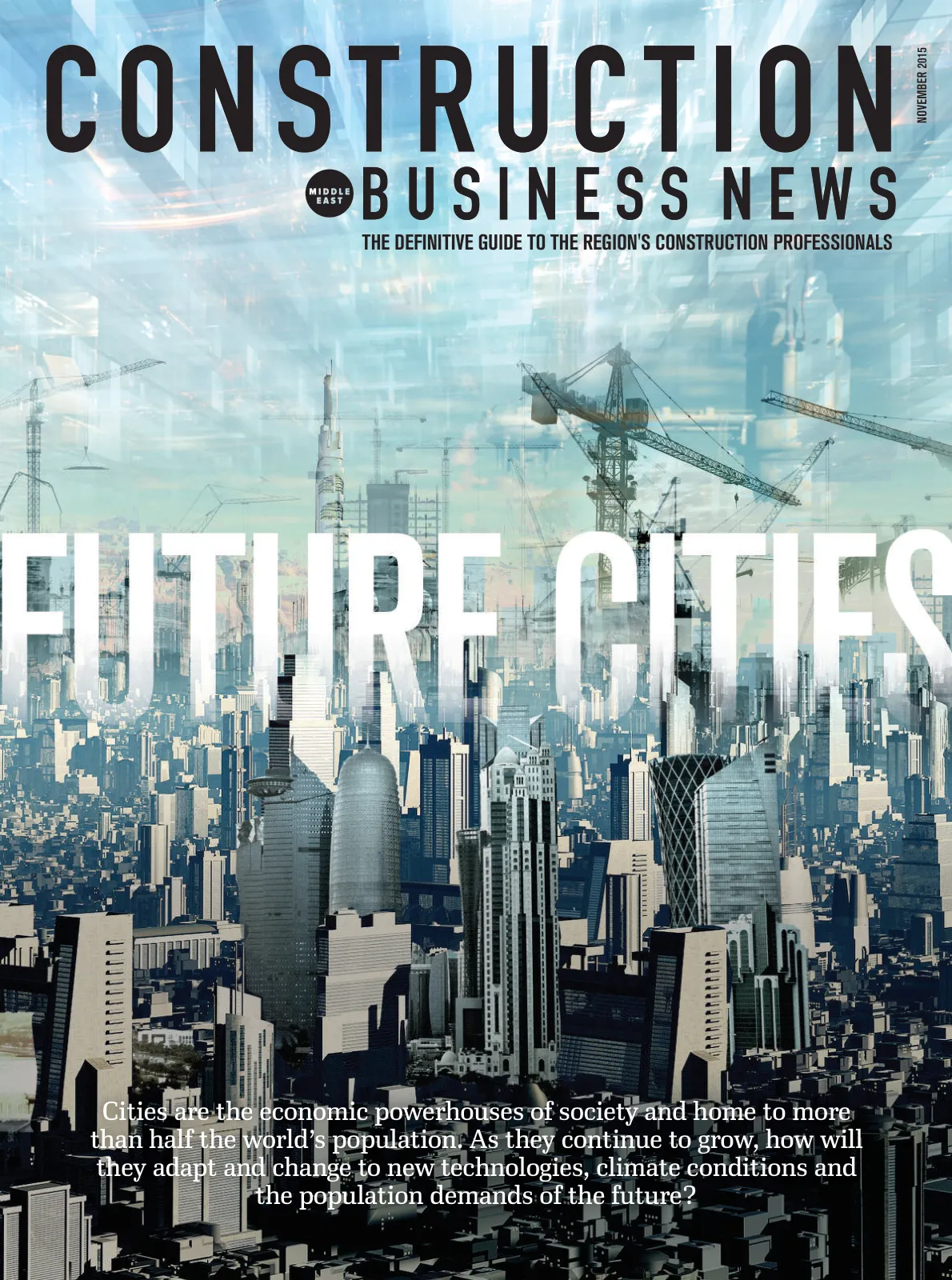
Construction Business News, November 2015
Page 1
THE DEFINITIVE GUIDE TO THE REGION'S CONSTRUCTION PROFESSIONALS
Cities are the economic powerhouses of society and home to more
than half the world’s population. As they continue to grow, how will
they adapt and change to new technologies, climate conditions and
the population demands of the future?
NOVEMBER 2015
Page 2
CONSTRUCTION BUSINESS NEWS ME NOVEMBER 2015
2
NEWS
OHSAS 18001 certified
ISO 9001, 14001 and
130+years of
project experience
LEED Platinum, LEED Gold
and LEED Silver Capability
End to End Integrated Solutions
Pioneering Engineering Construction since 1881
www.drakescull.com
700+
Projects Delivered
For over 130 years, Drake & Scull International PJSC has been shaping skylines and transforming the lifestyle of
communities around the world.
Drake & Scull is an industry leader, with a proven history of delivering more than 700 projects through its General
Contracting, Engineering, Rail, Oil & Gas, Water and Wastewater Treatment and Infrastructure development business
streamlines across the region.
Page 3
CONSTRUCTION BUSINESS NEWS ME NOVEMBER 2015
3
26
URBAN SHIFT
CITIES ARE THE ECONOMIC POWERHOUSES OF
SOCIETY AND HOME TO MORE THAN HALF THE
WORLD’S POPULATION. AS THEY CONTINUE TO
GROW, HOW WILL THEY ADAPT AND CHANGE TO
NEW TECHNOLOGIES, CLIMATE CONDITIONS AND
THE POPULATION DEMANDS OF THE FUTURE?
EDITOR’S NOTE
NEWS
CIA AWARDS
AFTER MONTHS OF
PREPARATIONS AND HUNDREDS
OF NOMINATIONS, 20
COMPANIES WERE AWARDED
FOR THEIR ACHIEVEMENTS AND
CONTRIBUTIONS TOWARDS THE
ADVANCEMENT OF QATAR AT
CONSTRUCTION INNOVATION
AWARDS
ANALYSIS
ZANE HEDGE EXAMINES
CONSTRUCTION PROJECTS
IN THE MIDDLE EAST AND
HOW DELAYS SHOULD BE
RIGHTFULLY TACKLED WITH
TIME IMPACT ANALYSIS
PROJECT REVIEW
AS TURKEY CARVES ITS
REPUTATION AS A GCC
INVESTMENT HOTSPOT, CEYDA
CARMIKLI, EXECUTIVE BOARD
MEMBER OF NUROL REIT,
SPEAKS WITH CONSTRUCTION
BUSINESS NEWS ME ABOUT
SUSTAINING THE PACE
TAKE 10
WHILE THE SMART CITY
ITSELF CANNOT BE DEFINED
BY A SINGLE MEASURE,
INVENTION OR INITIATIVE, THE
COMBINATION OF CUTTING
EDGE TECHNOLOGIES AND
INTEGRATED SERVICES IS
TRANSFORMING URBAN
HABITATS. TAKE 10 LOOKS AT
THE TOP TECHNOLOGIES FROM
AROUND THE WORLD
6
8
16
24
44
32
cover story
26
32
CONTENTS
Page 4
CONSTRUCTION BUSINESS NEWS ME NOVEMBER 2015
4
S U B S C R I B E
C O N T R I B U T O R S
subscriptions@bncpublishing.net
Managing Director
Walid Zok
walid@bncpublishing.net
Director
Rabih Najm
rabih@bncpublishing.net
Director
Wissam Younane
wissam@bncpublishing.net
Group Publishing Director
Diarmuid O'Malley
dom@bncpublishing.net
Business Development Director
Rabih Naderi
rabih.naderi@bncpublishing.net
+966 50 328 9818
Group Editor
Melanie Mingas
melanie@bncpublishing.net
Editor
Lorraine Bangera
lorraine@bncpublishing.net
Art Director
Aaron Sutton
aaron@bncpublishing.net
Sales Manager
Mostafa Abdo
mostafa@bncpublishing.net
+966 56 6695 333
Sales Manager
Vishvanath Shetty
vish@bncpublishing.net
+971 52 6745378
Marketing Executive
Mark Anthony Monzon
mark@bncpublishing.net
PO Box 502511 Dubai, United Arab Emirates
P +971 4 4200 506 | F +971 4 4200 196
For all commercial enquiries related to
Construction Business News ME contact
sales@bncpublishing.net T +971 55 339 5097
All rights reserved © 2015.
Opinions expressed are solely those of the contributors.
Construction Business News ME and all subsidiary
publications in the MENA region are officially licensed
exclusively to BNC Publishing in the MENA region by
Construction Business News ME.
No part of this magazine may be reproduced or
transmitted in any form or by any means without
written permission of the publisher.
Images used in Construction Business News ME
are credited when necessary. Attributed use of
copyrighted images with permission. All images not
credited courtesy Shutterstock.
Printed by International Printing Press www.ippuae.com
Stuart Matthews
Marlow McGuinness Ltd
-------
Joanne Bladd
COUNTRY FOCUS
WITH A BOOMING TOURISM SECTOR AND RISING ECONOMY, TURKEY HAS
SOON BECOME A HOTSPOT FOR MODERN REAL ESTATE. CONSTRUCTION
BUSINESS NEWS ME EXAMINES THE MARKET AND HOW THIS COULD
AFFECT COUNTRIES WITHIN THE GCC
SUSTAINABILITY
MYTH VS FACTS: COMMON MYTHS IN GREEN CONSTRUCTION, BY HOLLEY
CHANT, EXECUTIVE DIRECTOR, KEO INTERNATIONAL CONSULTANTS
DR MOETAZ EL HAWARY COMPARES GLOBAL STANDARDS OF GREEN
CONSTRUCTION WITH KUWAIT’S GROWING SECTOR
TECHNOLOGY
DR ASIF SHARIF LOOKS THE AT THE MATTER OF DATA HOSTING,
OWNERSHIP ISSUES AND THE QUESTION OF WHAT HAPPENS TO DATA AS
PROJECTS COME TO AN END
Q&A
STEVE COCKERELL, INDUSTRY MARKETING DIRECTOR OF RAIL AT BENTLEY
SYSTEMS, SPEAKS WITH CONSTRUCTION BUSINESS NEWS ME ABOUT THE
IMPORTANCE OF TRUSTED INFORMATION
COMMENT
MARCOS BISH ANALYSES FUTURE DESIGN TRENDS AND HOW
SUSTAINABLE DESIGN AND CONSTRUCTION COULD MAKE WORKSPACES
MORE PRODUCTIVE
MACHINERY
SUPPLIER NEWS
EVENT PREVIEW
EDITOR’S PICK
38
47
48
50
54
41
58
60
62
66
50
44
Page 5
Page 6
CONSTRUCTION BUSINESS NEWS ME NOVEMBER 2015
6
LET’S GET WIRED
Over 70% of the world’s population will
be concentrated in urban areas by 2050,
according to UN reports. In 2014, the
World Health Organisation (WHO)
claimed the percentage of the world’s to-
tal population in urban areas had already
reached 54% compared to 34% in 1960.
We are moving at a faster rate at this point,
with the introduction of smart technolo-
gies and gadgets, which have literally and
virtually transformed the entire world.
The word ‘smart’ has been redefined and
the allure for smartness has been grasped
by one and all. The East and Southeast
Asia has relatively picked up pace, em-
bracing new technologies and investing in
their talent pool.
The GCC on the other hand seems to be
leading the way. According to EMC Mid-
dle East and International Data Corpora-
tion (IDC), countries within the GCC are
widely expected to have one of the highest
urbanisation rates in the world ranging
from 80 to 100%.
With speedy preparations for World
Expo 2020 in Dubai, UAE government in
particular has been taking several measures
to adopt technology.
Earlier this year, Khaleej times reported
that Dubai Municipality is set to spend
AED3bn on sustainability and smart city
projects this year. While the Dubai Roads
and Transport Authority (RTA) told The
National that 408 signals in the city were
connected using 3G technology. IDC pre-
dicts that by 2020, the world will see more
than 30 billion connected devices.
Sheikh Mohammed bin Rashid Al Mak-
toum, Vice President and Prime Minis-
ter of the UAE and Ruler of Dubai also
launched the Mohammed Bin Rashid
Smart Majlis in October this year. The
majlis is set to be the largest smart and in-
tegrated platform in Dubai connecting 30
entities to receive suggestions, comments,
and ideas.
Krishna Iyer, CEO of I3ISAM, at the
5th Municipalities and Smart City Sum-
mit urges there is a great need for em-
bracing new development strategies to
improve the structural layout of cities and
make them susceptible to suit the chang-
ing demographics.
Not only is “smartness” affecting con-
struction, it is transforming it.
At this year’s Gitex Technology Week,
digital construction sites and connected
homes were a highlight.
With the total number of projects in
GCC's pipeline (planned and underway)
in 2015 is set to reach values of $2.8 tril-
lion, according to a recent report from
Deloitte, there is a huge scope for smart
technology moving forward.
As these developments continue to re-
define urban planning and regulations,
as well as driving fit out demand across
the end-user spectrum, the need for the
construction industry to innovate, will
only grow.
EDITOR’S NOTE
LORRAINE BANGERA
Editor
Page 7
CONSTRUCTION BUSINESS NEWS ME NOVEMBER 2015
7
Page 8
CONSTRUCTION BUSINESS NEWS ME NOVEMBER 2015
8
NEWS
Nakheel has announced a net profit of AED3.61bn for the first nine months
of this year, which is reportedly a 39%, or AED1bn increase of profits one
year ago (AED2.6bn).
The increase, according to the developer, is mainly due to continued strong
performance and ongoing handovers of properties to customers. The com-
pany’s growing retail, leasing and leisure businesses also contributed to the
overall financial results for the first nine months of 2015.
Nakheel chairperson Ali Rashid Lootah said: “The significant increase in our
net profit for the first nine months of 2015 compared to the same period in
2014 is a sign of stability in the local real estate market.
“We have announced more than AED3.1bn worth of construction contracts
in the last three weeks alone, highlighting our commitment to contributing
positively and effectively to Dubai’s real estate sector.”
He added that the company’s strategy of continuing to create more cash-
generating assets will further boost the business and financial results in the
coming years.
Harbin Electricity International and
ACWA Power, preferred bidder of
Dubai Electricity and Water Authority’s
(DEWA) Hassyan clean coal power plant
in Dubai, has chosen Alstom as the lead
EPC contractor.
The plant will be the first ultra-supercrit-
ical (USC) coal power plant in the Middle
East. It will be operational by March 2021
with a net output of 1.200MW, represent-
ing a 12.5% boost of the Dubai current
grid capacity.
Alstom will provide its popular ultra-
supercritical technology which is boiler
and steam turbine generator, and will
have dual fuel capacity that is able to fire
both sub-bituminous coal and natural gas
as back up fuel.
The technology enables the power
plant to run at a higher steam tempera-
ture and pressure than regular coal-fired
plants in order to improve the plant ef-
ficiency and to decrease stack-emissions,
particularly CO2 per unit of fuel burned.
The power plant will produce suffi-
cient electricity to power nearly 250,000
households in Dubai.
ALSTOM TO WORK
ON DEWA’S CLEAN
COAL POWER PLANT
With some of the largest construc-
tion projects in the pipeline, the
Saudi construction market is set to
expand by 7.8% in the next four
years. Most upcoming projects be-
long to the social and transport in-
frastructure sector.
Sustained growth, rising population
and economic prosperity along with
government support have boosted the demand for construction material,
equipment and services within the country.
Experts observe that the lucrative market will soon pickup project activity
with increasing private and public investment.
As the need for innovative, sustainable and cost-effective building and
construction solutions increases, Saudi Build held from 26 to 29 October this
year aims to focus on the best ways to deliver these solutions.
Saudi’s need for innovative
construction solutions increases
NAKHEEL’S NET PROFIT
INCREASES BY AED1BN
Page 9
CONSTRUCTION BUSINESS NEWS ME NOVEMBER 2015
9
Jumeirah Golf Estates appoints contractor for
Alandalus development
Jumeirah Golf Estates awarded Al Habtoor STFA
Soil Group LLC the contract for the construction
of Alandalus.
Alandalus is Jumeirah Golf Estates latest develop-
ment – a collection of 674 mid-market affordable luxury
apartments and 54 townhouses.
Construction is scheduled to begin before the end
of October and be completed before the World Expo
2020 in Dubai.
This appointment marks the beginning of the next
phase of development for Jumeirah Golf Estates. The
development will combine luxury lifestyle of a golf de-
velopment with mid-market housing.
Alandalus will consist of 674 apartments and 54 town-
houses at prices starting from AED597,000; along with
retail, hospitality and food and beverage outlets.
This news comes following the recent announcement
of Jumeirah Golf Estates first retail centre, which is
scheduled for completion in Q4 2016 and will feature a
grocery store and hospitality outlets.
The fourth annual Emirates Green
Building Council (EGBC) Congress
discusses diverse aspects of sustain-
able built environments. Held under
the theme, ‘How do green buildings
scale up? Bridging the gap between
green buildings and sustainable cit-
ies,’ the congress highlighted the
role of green buildings as ‘silent
heroes’ in contributing to the UAE’s
green economy.
Saeed Al Abbar, chair of EGBC,
said: “This year, we have scaled up
the scope of discussion to identify
comprehensive solutions that drive
the development of sustainable cit-
ies. Green buildings, no doubt, are
the silent climate change mitigation
heroes in this, and lending momen-
tum to building sustainable environ-
ments is important to achieve the
‘green vision’ of the nation.”
The second day of the EGBC Con-
gress includes a visit to The Sustain-
able City, a 5 million sq.ft project that
was conceived to be a world-class
example of what can be achieved
through a commitment to sustain-
ability. The delegates will also at-
tend a workshop on net zero energy
buildings and sustainable cities co-
facilitated by EmiratesGBC and The
Sustainable City.
EGBC CONGRESS DISCUSSES THE ‘SILENT HEROES’ OF
UAE’S GREEN ECONOMY
Page 10
CONSTRUCTION BUSINESS NEWS ME NOVEMBER 2015
10
NEWS
Caterpillar Inc. has been named to the
2015 Dow Jones Sustainability Indices
(DJSI), recognising Caterpillar as a sus-
tainability leader in the Industrial Engi-
neering sector. This marks the 16th time
Caterpillar has been included in the
DJSI list.
“Sustainable products, services and
solutions are very important to our
employees and customers,” said Doug
Oberhelman, Caterpillar chair and
CEO. “And we’ve been improving and
integrating sustainable practices and
solutions for a very long time because
– in addition to being important – we
know that creates value.”
MAN has also been included again
in the ranking, with noticeable im-
provements in talent attraction, human
resources development, customer re-
lationship management, and supply
chain management.
The annual DJSI process involves
a thorough analysis of corporate eco-
nomic, environmental and social per-
formance factors, assessing issues such
as innovation management, supply
chain management, climate strategy,
product stewardship, labor practices
and health and safety.
CATERPILLAR AND MAN IN LATEST DJSI
Drake and Scull Engineering (DSE) was awarded an AED224m
project to deliver MEP works for a hotel complex and the expan-
sion of a prominent retail mall in Dubai. The development of
the mall extension will include a new high rise hotel tower and
a low-rise podium that includes a hypermarket, cinemas, and
additional retail space, all within a total built up area of 192,000
square metres.
The company has already started working onsite and will over-
see supply, installation, testing and commissioning of complete
MEP works which is scheduled to handover by 2018.
Ahmad Al Naser, managing director of DSE, said that the hotel
complex and mall expansion is a welcome addition to iconic
projects being delivered by DSE in the UAE including Habtoor
City, the Jewel of the Creek and the Louvre Museum.
“The project win also reflects our position in the engineer-
ing sector as the preferred partner for large scale retail malls
which is enhanced by our previous work on prestigious retail
developments like Abu Dhabi’s Central Market and the Sahara
Mall Expansion.”
DSE SECURES AED224M PROJECT AWARD
IN DUBAI
Ahmad Al Naser, managing director of DSE
Man Truck & Bus Manufacturing in Ankara
Page 11
CONSTRUCTION BUSINESS NEWS ME NOVEMBER 2015
11
Factory and Headquarters:
Saih Shuaib - 4 | Dubai Industrial City | P.O. Box - 62182 | Dubai | United Arab Emirates | Tel: +971 4 3687600
www.caparol.ae
facebook.com/caparoluae
twitter.com/caparoluae
linkedin.com/company/caparol
Indoor Air Quality is a growing concern in today’s
world, with Formaldehyde being one of the largest.
Introducing CapaCare AirPurify with
CapaCare AirPurify is a revolutionary paint fortified with
Formaldehyde Conversion Technology. The unique
technology helps convert toxic Formaldehyde
emissions into harmless water vapour ensuring that
indoor air is fresh and safe to breathe.
Protect your friends and family today,
visit: www.caparol.ae/airpurify
Let fresh remain fresh with
CapaCare AirPurify
Page 12
CONSTRUCTION BUSINESS NEWS ME NOVEMBER 2015
12
NEWS
Damac Properties’ Damac Esclusiva and Damac Tower by Paramount Hotels
and Resorts projects on King Fahd Road has completed 75% of the cladding
works. More than 16,000 square metres of glass has been installed on the
outside of the two towers with the cladding consisting of reflective glass,
aluminium, tri anti-steel panels.
The total amount of glass across the two towers to be installed will exceed
22,000 square metre, enough to cover three football pitches.
Work on the front panels and back panels glass elevation has reached level
29 for Damac Esclusiva, and level 34 for Damac Tower by Paramount Hotels
& Resorts. Both projects will be completed and handed over next year.
“We are delighted with the progress of the construction work at our two
projects in Riyadh, which will be one of the most luxurious projects in KSA,
when we hand it over next year,” said Niall McLoughlin, SVP, Damac Prop-
erties. “We are offering this opportunity to Saudis because we believe in the
benefits of investing in the luxury real estate sector in Saudi Arabia. Buying a
fully managed property in the Saudi capital, offering all services needed for
individuals or families is an excellent competitive advantage by all means.”
Gemini Energy Group will be branch-
ing into UAE’s real estate sector with a
series a luxury projects in the coming
months. The group’s real estate divi-
sion, Gemini Property Developers, will
soon announce the ground-breaking of
its maiden project, a high-profile luxury
residential building.
Sudhakar R. Rao, managing director of
Gemini Property Developers, pointed
out that diversification into real estate
was a natural progression and a strategic
business move aimed at leaving a mark
on the UAE’s property business.
“Dubai’s real estate market has come
full circle since 2005, having experienced
both the boom and bust cycles. Growth
has stabilised in 2015, and with further
tightening of the rules for off-plan sales
by RERA, the market is showing signs
of maturity. Gemini will seek to satisfy
investor and end-user demand for qual-
ity residential properties in strategic loca-
tions across the GCC.”
GEMINI ENERGY
MAKES MAJOR
FORAY INTO UAE
REAL ESTATE
Qatar Navigatin (Milaha) announced its financial results for the nine
months ended September 30, 2015. The company has made a net profit
of $264m for the first nine months of 2015, a 17% increase compared to
the same period in 2014.
“We are very pleased with our operating results for this reporting pe-
riod. We have remained focused and disciplined in executing our stra-
tegic priorities, and as a result, we continue to deliver strong financial
performance and create value for our shareholders,” said H.E. Sheikh Ali
bin Jassim Al Thani, chair of Milaha.
Milaha reports net profit
of $264m
CLADDING OF DAMAC
TOWERS IN SAUDI CLOSES
COMPLETION
From left: Sailesh Jatania, Sudhakar Rao, and Prabhakar Rao
Page 13
Page 14
CONSTRUCTION BUSINESS NEWS ME NOVEMBER 2015
14
NEWS
RAK-based Al Hamra Real Estate Development has teamed up with in-
ternational real estate service provider Savills’ network of more than 600
offices worldwide.
Al Hamra’s flagship portfolio projects include the multi-million dollar lux-
ury Falcon Island development, Bayti townhouse community, and shoreline
apartments Bab Al Bahr and Royal Breeze.
Al Hamra Real Estate Management Services (REMS) will work with the Lon-
don-based international residential team at Savills.
“We are confident that this will open up new markets for us and, in turn,
drive increased awareness and interest in Ras Al Khaimah as a quality des-
tination, with value-driven investment opportunities, with solid and sustain-
able returns,” said Barry Ebrahimy, head of commercial at Al Hamra Real
Estate Development.
Ras Al Khaimah’s residential sector reported strong sales in Q2 2015, with
consistent demand for its high profile projects and robust occupancy and
rental rates for its quality competitively priced villas and townhouses.
Dating back to 1964, Torre Arcobaleno
(Rainbow Tower) at Porto Garibaldi was
once an anonymous water reservoir on
the site of the important FS Milano Por-
ta Garibaldi railway station. The tower
was first renovated ahead of the football
World Cup held in Italy in 1990, a project
that turned a downtrodden public works
into a highly recognisable urban beacon.
Since then, the Torre Arcobaleno has
been a distinctive symbol of Milan’s co-
lour and creativity, and has gradually be-
come known as a major landmark.
Now as then, in 1990, the project was
prepared and the works organised by
the Architecture Division of the Milan
firm Original Designers 6R5 Network,
represented by Francesco Roggero, Al-
bino Pozzi, Rita Alfano Roggero and
Kiyoto Ishimoto.
The renovation - all the costs of which
were met by the project’s partner com-
panies and architects - is a gift to Milan
and the millions of visitors it will be wel-
coming during Expo 2015. The works
were completed in just 71 days, employ-
ing 37 workers.
The Garibaldi zone of the nearby Piazza
Gae Aulenti is the acknowledged nerve
centre of the city’s Business, Fashion and
Modern Architecture scenes. The zone,
now restyled by futuristic skyscrapers,
has adopted the Torre Arcobaleno as its
“Colourful Ceramic Totem”, there to re-
mind people of Italy’s Master Potters and
the craft origins of an industry famous all
over the world for its Italian Excellence.
TORRE
ARCOBALENO
RESTORED TO MARK
EXPO 2015
UAE-based Manazel Real Estate announced the appointment of Balaji
Prasad as chief financial officer.
Manazel’s CEO Hassan Fahmi said: “Being a seasoned finance profes-
sional, Balaji’s significant financial and industry-wide experience will be
invaluable to our business as we capitalise on the growth opportunities
that exist here in the UAE and across the wider Middle East.”
Prior to joining Manazel, Prasad was chief financial officer for Sobha
LLC, where he led the company’s financial strategy, fund raising and
treasury functions in addition to supporting the company’s overall busi-
ness strategy.
Manazel Real Estate appoints
chief financial officer
AL HAMRA INCREASES
INTERNATIONAL REACH
Barry Ebrahimy, Head of Commercial, AHRED and Charles Weston Baker, Head of International Residential Agency, Savills
Page 15
CONSTRUCTION BUSINESS NEWS ME NOVEMBER 2015
15
ALMOOSA EXAMINES
DUBAI’S REAL ESTATE
MARKET
Salem Almoosa, chair and general manager of Falconcity
of Wonders, attributes Dubai’s resilient real estate market
to several key factors, including the city’s status as a top
commercial and tourism hub, a continuously rising local
population, a strong appeal among international investors,
and substantial government funding of major infrastruc-
ture projects.
With real estate transactions worth over AED64bn were
recorded for Q1 2015 alone, Almoosa says that it is a sig-
nificant number initiated by foreign investors.
He added that the removal of the rental cap and limited
supply across prime locations, among others, have been
driving growth in residential demand.
He anticipates additional major investments into the
tourism, leisure and hospitality segments – a prediction
backed by Dubai’s recent ranking as the top growth mar-
ket for the MENA hotel industry in a global construction
pipeline report.
These and other catalysts, Almoosa said, will continue
to sustain Dubai’s dominance of the Middle East’s real
estate landscape and will be further magnified as Dubai
Expo 2020 draws near and casts the global spotlight on
the emirate as an unrivalled leisure, lifestyle and business
haven.
“The durability of the market will only be strengthened
as Dubai Expo 2020 approaches and we attract a global
audience to the diversity, flexibility and magnitude of the
emirate’s property offerings.”
MADE IN UAE
www.intermetal.com www.verdadoors.com
Dubai, UAE Tel: +971 4 884 1650 Email: sales@verdadoors.com
MANUFACTURING
QUALITY DOORS, KITCHENS
& INTERIOR FIT-OUT
Hall #4
Stand D191
23-26 November 2015
Dubai World Trade Centre
Page 16
After months of preparations and hundreds of nominations, 20
companies were awarded for their achievements and contributions
towards the advancement of Qatar at Construction Business News
ME’s inaugural awards ceremony, Construction Innovation Awards
at the Ritz-Carlton Doha on October 18
C O N S T R U C T I O N
I N N O VAT I O N
A W A R D S
QATAR AWARDS
Wissam Younane,
Managing Partner,
BNC Publishing
CONSTRUCTION BUSINESS NEWS ME NOVEMBER 2015
16
Page 17
A
ctivity in Qatar’s construction sector has increased at such
a rate over recent years that it is now one of the world’s
most active construction markets, with a project pipeline
valued in excess of $280bn.
Projects include Doha Metro, New Doha Port, Valley
City, and of course the most anticipated projects in the region,
the 2022 FIFA World Cup stadia.
These projects cover transport, infrastructure and energy
needs, and address ambitions to keep Qatar on the map well
beyond 2022, as a place to do business, a place to experience
world class entertainment and leisure, and a place to live.
Under the Qatar National Vision 2030, economic, social,
environmental and human development will be prioritised
by the government and placed at the heart of everything the
Gulf state accomplishes.
Construction Innovation Awards Qatar aims to recognise
and celebrate the firms and individuals who have, and con-
tinue to, play a part in the transformation of Qatar.
The night commenced with a speech by the guest of hon-
our, Mr. Mohammed Bin Ahmed Bin Towar al Kuwari, the vice
chairperson of Qatar Chamber. After which, managing partner
of BNC Publishing Wissam Younane welcomed distinguished
guests and allies including platinum ally, Raimondi and gold
allies Famco and Arcadia Engineering.
P L AT I N U M A L LY
G O L D A L L I E S
CONSTRUCTION BUSINESS NEWS ME NOVEMBER 2015
17
Page 18
W I N N E R ' S
Krishnasamy is a mechanical engineer with significant expe-
rience in both design consultancy and construction, involved
in the delivery of many successful, major projects. He holds
an MBA in project management, and has worked on a range
of projects over the course of his time with Atkins.
Elshazly joined the firm to a steady growth in Qatar. Most
recently, under his responsibility, the company diversified
its portfolio and was awarded two big projects.
Elleray ensures the project team operates as one seamless
group, where communication lines and objectives are well de-
fined and understood by all. He has developed strategic meth-
ods to keep the project staff motivated, has created new meth-
ods to improve the financial strength of projects, and therefore
has improved the operational performance of his firm.
SAK Holding received the award for industry ecosystem
innovation for its “Partner with Us” initiative to support
investors and generate returns in Qatar’s real estate sector.
The scheme was welcomed by the industry as a measure
which can benefit a piece of land, an existing or ailing
project, or any property ready for development.
Award collected by SAK Holding group
deputy CEO, Abdul Rahman Al-Najjar
W I N N E R ’ S C I R C L E
YOUNG ENGINEER OF THE YEAR
ENGINEER OF THE YEAR 2015
PROJECT MANAGER OF THE YEAR
INDUSTRY ECOSYSTEM INNOVATION AWARD
RAMESH KRISHNASAMY, FROM ATKINS
ENG. KHALED ELSHAZLY FROM QATAR
AUSTRALIAN CONSTRUCTION
SIMON ELLERAY OF BROOKFIELD MULTIPLEX
SAK HOLDING
QATAR AWARDS
CONSTRUCTION BUSINESS NEWS ME NOVEMBER 2015
18
Page 19
S C I R C L E
BASF has been supporting the construction industry in
Qatar for over 30 years. Over the last eight years, the com-
pany has made a firm commitment to the market and cre-
ated brand new facilities to cater to increasing demands
for local production.
EMCO is one of the most highly regarded FM companies
in Qatar, with a quality assurance team working to meet
the highest degree of quality and accuracy for each drafted
project as per the defined quality standards.
The company possess the expertise in providing facilities
maintenance and management to industrial, commercial
and residential complexes and services include, air-condi-
tioning, electrical, mechanical, civil and low current.
Al Malki Holding’s flagship company, Arabian MEP, has been
active in the Qatar market for nearly two decades. The firm
has rapidly expanded and grown from strength to strength,
delivering exceptional performance and earned a reputation
as a highly dependable specialist MEP contractor in Qatar.
The firm is registered with an approved by: Ashghal, Q-Rail,
Qatar Airways and Qatar Petroleum, among others.
Maintaining an impeccable safety record across all its proj-
ects, both companies have become an industry leader in
the promotion of well-being in the work place, recognising
the important role workforce health plays in productivity.
Award collected by head of business
development Mairead Hughes and CEO of
Al Malki Holding Vasanth Kumar.
Award collected by Emad Shawky, general
manager Qatar for BASF
Award collected by Nicolas Dumas,
construction risk manager, ALEC
Award collected by Subha Reddy, director
of operations and Dinesh, assistant general
manager at EMCO.
SUPPLIER OF THE YEAR
FM COMPANY OF THE YEAR
SUBCONTRACTOR OF THE YEAR
HEALTH AND SAFETY INITIATIVE OF THE YEAR
BASF
EMCO
ARABIAN MEP
ALEC AND GULF CONTRACTING COMPANY
P L AT I N U M A L LY
G O L D A L L I E S
CONSTRUCTION BUSINESS NEWS ME NOVEMBER 2015
19
Page 20
W I N N E R ' S
QATAR AWARDS
Since its establishment, Hill International has become a
trusted leader in the fields of project management services
and construction claims services around the world. In Qa-
tar it has won contracts for Doha Metro Green Line, Lusail
District, Mall of Qatar and Salwa Resort, to name a few.
The award recognises the scope and status of projects
awarded to a firm which has participated in the urban de-
velopment of the GCC since 1996. Drake and Scull is an
industry expert in the fields of MEP and water and power,
with experience that dates back to 1881 in the UK. Today
Drake and Scull International and its subsidiaries oversee
a wide variation of projects across the GCC, Middle East,
North Africa, South Asia and Europe and in the Middle East
has grown to be part of the region’s most monumental and
iconic landmarks.
The Tadmur HQ project utilises a hybrid system of 250
south-facing photovoltaic modules, to achieve substantial
energy savings. It provides an exemplary benchmark for
other such projects, which support environmental systems
and look to achieve the highest standards while innovat-
ing the practice of sustainable construction.
Founded only eight years ago by Emad Jaber and Nabil Al Kha-
ja, the firm has become one of the most accomplished multidis-
ciplinary architectural design firms in the region with a diverse
portfolio spanning all types of developments.
The talented team of Architects and Engineers with various pro-
fessional backgrounds, it has designed over 250 projects con-
sisting of residential, commercial, hospitality, and mixed-use
developments as well as master plans and interior designs. In
Qatar, these include Sharaka Holdings Building, Waldorf Astoria
and Abu Hamour Shopping Village, among others.
Award collected by general manager of
Tadmur contracting, Bashar A. Nimry
Award collected by Badih Touma, architect
and executive director at LACASA
Award collected by vice president and
directors of projects, Michael Jameson.
Award collected by Taher Abu Eid, area
general manager at DSI Qatar.
CONSULTING FIRM OF THE YEAR
REGIONAL MARKET PENETRATION AWARD
SUSTAINABLE PROJECT OF THE YEAR
ARCHITECTURAL FIRM OF THE YEAR
HILL INTERNATIONAL
DRAKE AND SCULL INTERNATIONAL
TADMUR HQ IN ENERGY CITY, LUSAIL
LACASA
CONSTRUCTION BUSINESS NEWS ME NOVEMBER 2015
20
Page 21
S C I R C L E
This Bureau was formed in 1966, as the first architectur-
al and engineering consulting firm in Qatar. The award-
winner consists of architects, urban and master planners,
interior, landscape and structural designers, engineers,
quantity surveyors and project and design managers with
a truly inimitable portfolio. The firm had six employees,
when it was acquired by its current CEO Ibrahim Jaidah,
after which it grew to the current figure of over 500 highly
qualified professionals.
Brookfield Multiplex was one of the first international
construction businesses to establish offices in the Middle
East during the late 1990s. Now, based from head offices
located in Qatar, as well as Abu Dhabi and Dubai, the
company has built a reputation for fast delivery and high
quality through the design and construction of some of
the most challenging projects in the region.
This year marks an important milestone for BM – its 10th
anniversary since commencing operations in Qatar.
The firm is a multi-disciplinary operation with a portfolio
of projects which spans Qatar, the UAE, Saudi Arabia and
Egypt. Most recently the firm was awarded a multi-million
Riyal contract for Festival City, with its joint venture part-
ner Voltas Qatar.
A subsidiary of the Atkins group, it provides integrated proj-
ect management, program management and cost manage-
ment consulting services throughout the Middle East across
the property, transport and industry sectors. Active in the
Middle East for over 18 years, projects in Qatar have includ-
ed Shaza Kempinski, Doha Oasis and The Pearl.
Wissam Younane presents the award
to Dawood Bin Ozair, senior managing
director, Engineering and Technology, Al
Futtaim
Award collected by Samer Hudhud, chief
projects officer of Arab Engineering Bureau
Award collected by managing director
Campbell Gray
ENGINEERING FIRM OF THE YEAR
CONTRACTOR OF THE YEAR
MEP CONTRACTOR OF THE YEAR
COMMERCIAL MANAGEMENT FIRM OF THE YEAR
ARAB ENGINEERING BUREAU
BROOKFIELD MULTIPLEX
AL-FUTTAIM ENGINEERING
FAITHFUL + GOULD
Award was collected by Renier Breitenbach,
general manager at Brookfield Multiplex
P L AT I N U M A L LY
G O L D A L L I E S
CONSTRUCTION BUSINESS NEWS ME NOVEMBER 2015
21
Page 22
W I N N E R ' S
C I R C L E
QATAR AWARDS
Established in 1975, Al Sraiya Holding Group has built its
core business on the idea of “Innovation”, earning its rank as
one of the top in Qatar, offering a range of integrated servic-
es that cater to the infrastructural development of Qatar, the
Group diversified itself through individual groups of com-
panies each operating independently and specialising in its
field of expertise. This year the group has been awarded
projects worth 4 Billion Qatari Riyals, covering: Energy City
Qatar and three new educational establishments.
Founded locally in 2001, the winning company of the next
award has 50 years’ international experience in the steel in-
dustry, including manufacturing, development and research.
The winner’s projects support the ambitions of project de-
signers and engineers by creating high quality products for
major projects.
With a company aim to provide a wide range of prod-
ucts and services, the winner also offer quality solutions
for major works.
Qatar-based UrbaCon Trading & Contracting (UCC) offers
turn-key design, build, finance and operative services.
The company has been involved in several projects over
recent years and the portfolio includes Anantara Doha
Island Resort; Lekhwiya Sports Club Doha; Souq Wakif
Theme Park Doha; Lusail Office Tower and, of course,
Mall of Qatar.
As a result of its unfaltering performance and high standards, the
firm has taken on the responsibility for executing many multi-bil-
lion dollar construction projects.including multi-storey buildings,
mixed-use compounds, deluxe villas, pump stations, factories,
workshops, sea ports and beach resorts.
For over five decades, it has remained true to its pledge to pro-
actively and strategically contribute to building a thriving Qatar.
Award collected by Shem Krey, Deputy
MD, Urbacon
Award collected by Vice Chairman
Mr. Rashi Al Kaabi
Award collected by T.T.M. Middle East
commercial manager, Johnny Bnaity
Award collected by Kamal Efranji, general manager
of National Industry Contracting Company
INDUSTRY INFLUENCE AWARD
STRUCTURAL INTEGRITY INNOVATION
OVERALL PROJECT OF THE YEAR
DIVERSIFIED PORTFOLIO INNOVATION AWARD
AL SRAIYA HOLDING GROUP
T.T.M.
MALL OF QATAR BY URBACON
NBK CONSTRUCTION HOLDING
P L AT I N U M A L LY
G O L D A L L I E S
Page 23
Page 24
CONSTRUCTION BUSINESS NEWS ME NOVEMBER 2015
24
ANALYSIS
Zane Hedge examines construction projects in the Middle East and how
delays should be rightfully tackled with time impact analysis
TIME TO START
LOOKING
FORWARD
I
n her July 2015 article my col-
league from Deloitte, Cynthia Cor-
by, identified a number of critical
issues which commonly affect the
construction industry. In addition
to the issues identified by Cynthia, it is
no secret that many construction proj-
ects are delivered late as a result of criti-
cal delay. In my role as a delay analy-
sis expert one area which often causes
a significant amount of disagreement is
the methodology to be utilised when
analysing the causes of said delay. In
particular when one faces the challenge
of whether to look forwards (a prospec-
tive form of analysis or entitlement-based
approach) or whether to look back-
wards (a retrospective form of analysis or
fact-based approach).
The delay analysts have available to
them a selection of methodologies which
can be utilised, either prospectively or
retrospectively, all of which may be ar-
gued to be appropriate given the correct
set of circumstances.
A mistake which is often made is the
selection of an incorrect delay analy-
sis methodology. Notwithstanding legal
arguments, the experience of the delay
analysts, the time and/or budget which
is available, as well as strategic or tactical
or other external dynamics, can all influ-
ence this decision. Historically this deci-
sion has also not been helped by the fact
that until June 2015 The Society of Con-
struction Law Delay and Disruption Pro-
tocol (D&DP) ostensibly recommended
the use of time impact analysis (TIA) for
the analysis of delays in all circumstanc-
es. However, in July 2015 the Society of
Construction Law (SCL) issued Rider 1 of
the D&DP which provided much needed
clarity in relation to the other delay anal-
ysis methodologies which are available,
and guidance as to the most appropriate
use for each.
Something which should be consid-
ered positive is that despite previous
criticism, and there was a significant
amount of this in certain circles, TIA
still has its place which has been argu-
ably reinforced by Rider 1 of the D&DP.
That place being on a live project when
one can take account of the contractor’s
actual progress in order to identify the
critical impact of employer delay events.
This approach is common in other juris-
dictions and under certain standard form
building contracts (SFBC), such as NEC 3,
the use of TIA is mandated for the con-
temporaneous time and cost assessment
of “compensation events”. However, if
the parties are not familiar with this type
of SFBC, or if they are of the “wait and
see” school of thought, then this TIA
method of analysis, along with its admi-
Based in Dubai, Zane Hedge is head of
construction and real estate disputes at Deloitte
Corporate Finance Limited (Regulated by
the DFSA). Hedge is a chartered construc-
tion manager who holds Masters’ degrees in
construction law and dispute resolution, as well
as project management. He has been involved
in a wide variety of projects, including; building,
civil engineering, bridges, utilities, residential,
retail, commercial, health care, airports, power
stations, desalination, process plants and oil
and gas projects.
ZANE HEDGE
Page 25
CONSTRUCTION BUSINESS NEWS ME NOVEMBER 2015
25
rable intentions, may be somewhat alien
or indeed unpalatable.
Construction projects in the Middle
East region could benefit significantly if
the impact of employer delay events are
assessed taking into account the contrac-
tor’s actual progress at the time. Indeed,
one might argue that disputes could be
avoided altogether if, as is the case un-
der NEC 3, the time and cost impact of
employer delay events is agreed con-
temporaneously under the “one bite of
the cherry” principle, thus permitting the
parties to concentrate on completing the
project in a timely manner as opposed
to getting embroiled and entrenched in,
often unsustainable, commercial and/
or contractual positions. Such negative
action invariably diverts commercial re-
sources and management time away
from their primary purpose which af-
ter all is to deliver the procured project
within the contracted framework of time,
cost and quality.
Why then do we not see TIA being
widely used on live projects in the re-
gion? Probably for the same reason
that we do not see building information
modelling (BIM) being adopted on ev-
ery project. Both require collaboration
which for many employers, and/or their
representatives and advisors, will require
a sea change in attitude or a wholescale
re-thinking of their existing procurement
strategies which, based on my own ex-
perience, unfortunately continue to be
dominated by illusionary “lump sum”
type contracts which seek to pass all of
the risk onto the contractor without prop-
erly considering, or perhaps appreciat-
ing, the impact that this may have on the
success of the project and/or the relation-
ship between the parties.
It would be wrong to suggest that oth-
er jurisdictions are more advanced in this
area as one is not comparing “apples for
apples” in terms of market maturity. In-
deed, there are still a considerable num-
ber of construction disputes in countries
such as the UK where SFBCs such as NEC
3 are common place. However, it is dis-
appointing that given the regions desire,
and proven ability, to deliver world first
projects, in timescales which would like-
ly be unachievable elsewhere, that we
do not see more collaboration or early
contractor involvement. Both of which
are proven steps to reduce disputes and
better ensure timely project delivery.
It would also be wrong to suggest that
TIA is some form of “silver bullet” for
the prevention of construction disputes.
There are numerous other consider-
ations, both practical and legal, which
can dramatically affect the reliability of
the resultant delay analysis. However,
if carried out properly by experienced
professionals, and within the correct
commercial and legal framework, TIA
certainly has the potential to significantly
reduce the number of construction dis-
putes which result in arbitration or liti-
gation, and which in turn should result
in a “win-win” scenario for employ-
ers and contractors alike. Something
which is essential if the construction in-
dustry is going to focus its energy and
resources, as it arguably should, on the
critical issues which were identified by
Cynthia previously.
Page 26
CONSTRUCTION BUSINESS NEWS ME NOVEMBER 2015
26
COVER STORY
Cities are the economic powerhouses of society and
home to more than half the world’s population. As
they continue to grow, how will they adapt and change
to new technologies, climate conditions and the
population demands of the future?
Stuart Matthews
URBAN
SHIFT
Page 27
CONSTRUCTION BUSINESS NEWS ME NOVEMBER 2015
27
I
t’s 2045 and, like an estimated six bil-
lion other urban dwellers, you live in
a city. As a lucky citizen of the de-
veloped world you may look forward to
a commute involving a combination of
mass transit and smaller scale node trans-
port to get you from office - or remote
hot-desking work station - to home. A
driverless metro system or electric bus
may cover the big distances, dropping
you at a solar-powered taxi rank, where
self-driving electric cabs let you share a
ride home with a few other locals. You’re
dropped off mere minutes from your 3D-
printed home, made of recycled and re-
cyclable materials, roofed with solar pan-
els storing their excess power in the grid.
You might work from home some days
or maybe, just maybe, you walk to work.
It’s a future that is in view and yet just
out of sight, but decisions the planning,
design and construction industries make
now will impact people’s lives for de-
cades to come. As the pace of innova-
tion quickens, so too must the industry’s
responsiveness to change if it is to pro-
duce urban environments that match and
better people’s widely differing views
of what the future will look like. As the
economic powerhouses of nations, cities
are crucial to driving economic growth
and sustaining large populations, but
they also have to work like machines
and change like a living organism if they
are to be successful. Best-case scenarios,
where development is done “right”, paint
a picture of thriving and sustainable me-
tropolises.
“The city of the near future will be a
great place to be,” says Joseph Danko,
CH2M’s SVP for urban environments and
sports. “More than the sum of its parts,
the city will be a vibrant, accessible
community that attracts business and
provides an environment where people
want to live, work and play.
“The city is focused on current and
evolving needs to create a place that en-
ables long-term prosperity, social wellbe-
ing and wise use of natural resources.
This future city features a transit-oriented
and walkable town, water and energy
conservation, renewable power sources,
and a healthy quality of life while main-
taining the area’s unique cultural heri-
tage. There is tremendous potential for
all citizens.”
It’s a text book description that relies
on a city being more than just buildings
and streets. What CH2M refers to as ‘plac-
“We are quite often seeing
developments in the GCC emerge
a bit quicker. And we’re seeing
it around physical infrastructure
because the investment in that
infrastructure has the biggest
positive impact on GDP.”
- Christopher Seymour, head
of markets and development -
Middle East, at Arcadis.
Page 28
CONSTRUCTION BUSINESS NEWS ME NOVEMBER 2015
28
es in between’ have come to be symbols
of the successes and failures of some cit-
ies, as they try to bring their populations
together in useable public spaces. They
are spaces that can have a huge impact
on how a city is perceived by its residents
and show that attracting investment and
generating growth is as much about the
public experience as the transportation,
buildings, and other infrastructure.
“Integrating the historic and cul-
tural fabric with creativity and inno-
vation will create a sense of place in
the public realm. This is what creates
community – that sense of belonging
to something special about ‘my place’,”
says Danko. “This is what attracts and
retains the people and ultimately en-
ables a city to thrive.”
Dank believes that the future indus-
try will have to deliver urban design
grounded in local culture and diversity,
involving public, private, and other part-
nerships to foster creative, practical inno-
vation, with inclusive housing strategies
encompassing all income levels.
“We must accentuate what is unique
about each city and intentionally build
from their special assets and ‘strengthen
their strengths’,” he says. “This will en-
able them to attract investment and cre-
ate long-term core jobs consistent with
their special qualities.”
Smart technologies will have a grow-
ing role in creating the cities of the future,
making mobility easier and also enabling
city control centres to better manage traf-
fic flow, natural resources and operating
costs. The Internet of Things (IoT), big
data and smart cities are the new buzz-
words, while sensor technology provides
real-time data that can influence every-
thing from personal comfort to clean
water and energy. The trick though is
bringing all of this information together
and deploying the insight it can bring
alongside a host of other considerations
spanning social, environmental and eco-
nomic benefits.
“It’s really the harmonisation of tech-
nology with a sustainable environment
in the broadest sense of the word - in-
cluding the social, economic and envi-
ronmental aspects - by knitting together
technology to deliver ease of living and
economic success,” explains Christopher
Seymour, head of markets and develop-
ment - Middle East, at Arcadis.
As technology stands today, Seymour
believes the greatest impact the idea of
the smart city might have will be found
in the management systems that drive
Dubai is the first smart city in
the Middle East
COVER STORY
“This future city features a
transit-oriented and walkable
town, water and energy
conservation, renewable power
sources, and a healthy quality of
life while maintaining the area’s
unique cultural heritage. There
is tremendous potential for all
citizens.”
–Joseph Danko’s CH2M’s
senior vice president for Urban
Environments and Sports
Page 29
CONSTRUCTION BUSINESS NEWS ME NOVEMBER 2015
29
everything from governance to physical
infrastructure, urban mobility, waste, en-
ergy and even parking. It’s an area where
the developing cities of the GCC have a
distinct advantage.
“The GCC is quite young in develop-
ment terms, so they are probably going
to take on the systems faster than the
West because they don’t have legacy
[systems],” says Seymour. “It means
that we are quite often seeing develop-
ments in the GCC emerge a bit quicker.
And we’re seeing it around physical in-
frastructure because the investment in
that infrastructure has the biggest posi-
tive impact on GDP.”
A boost to GDP, alongside other
economic benefits, are the key areas
where advances in planning, infrastruc-
ture and the associated technologies
can have a significant impact.
“It’s been proven on a number of
occasions that investment in mobil-
ity particularly has one of the biggest
positive impacts in GDP there is,” says
Seymour. “Transport oriented design
is really something that knits together
mobility and the best of very modern
urban living and when you connect
those, then you start to see the real ad-
vances that smart cities can make. The
easier you make something the more
people use it, the more it improves
economic success.”
Delivering this kind of success in the
development of the smart city is like-
ly to take more than just technology.
While technology can look impressive
in isolation when you come down to
the practical use, its limitations can
be exposed. Companies which can
achieve the balance may be best placed
to create the greatest impact with their
ideas, as Seymour explains.
“Not only do companies need to have
a vision, they need to have their feet on
the ground. I've seen suggestions that
have been well worked around tech-
nological improvement for a city and
would have an impact in a number
of ways, but when you actually think
about the practicality the need is low:
sometimes you find a technological im-
provement that is an answer looking
for a question.
“We've got to make sure that is not
COVER STORY
WHAT WILL THE CITY OF THE NEAR
FUTURE LOOK LIKE?
The city of the future brings to mind an image of a
highly technologically advanced environment with
driverless cars zooming past and intelligent ma-
chines managing daily chores in silent synchronisa-
tion. Urban areas, including Dubai are consistently
moving towards the concept of ‘smart’. Cities are
exploring all avenues to utilise technology, either
through the vast amounts of information that can
be used for better decision-making, or through
the interconnectivity possible between different
systems.
This move towards ‘smart’ makes a lot of sense,
considering the challenges that the future holds for
cities. The United Nations estimates that nearly all
population growth over the next 15 years will occur
in the cities. This unprecedented level of urbanisa-
tion will place a burden on the limited natural
resources of a city, such as food or energy. Not to
forget the onslaught of waste and pollution that
comes along population and development growth.
Technology can help achieve greater efficiency
of resources, maximise the capacity of existing
infrastructure and at the same time make living
easier for residents. In essence, technology is one
of the pillars that supports ‘sustainability’. It also
opens opportunities for people to collaborate and
engage to solve problems.
HOW WILL THE INDUSTRY ADAPT?
As transportation planners, we are key stakehold-
ers in the future of our cities and its transportation
infrastructure. Our role goes beyond developing
conventional solutions such as building new roads
- we are here to bring the innovation and take the
current transport management systems to another
level. We will see more mobility management –
from developing mobile apps that enable better
transport choices to implementing remote working
policies that reduce commuter trips from the
road – as well as Intelligent Transportation Systems
(ITS) such as smart traffic signal systems that
optimise green times and improve street mobility.
But technology, progressive policy or advanced
implementation methods are essentially remedial in
nature. We can do our bit to prevent the need for
additional infrastructure – by redefining the pattern
of our developments so that we create mixed-use
neighbourhoods and walkable communities, which
reduce the need to travel in the first place.
WHAT SKILLS AND KNOWLEDGE WILL
THE INDUSTRY NEED TO BUILD THEM?
Technology brings with it a tremendous amount of
data, which our industry can effectively analyse to
understand our complex and dynamic infrastruc-
ture systems and forecast problems. Data analytics
and modelling will therefore continue to be a prime
skill set to have. We can fast-track our progress by
collaborating with researchers and universities to
implement the advances that are fresh out of the
laboratory.
More importantly, we will increasingly have
to take up the role of educating and building
awareness within the wider industry, clients and
the community regarding the challenges that
the future holds, as well as the vast spectrum of
solutions that can be developed to address these.
It is only with partnership that a vision for a better
living environment can be achieved.
FAST TRACK
Baz Gharibi, head of Transport Planning, WSP | Parsons Brinckerhoff shares his views on how the cities of
the future may take shape
Page 30
CONSTRUCTION BUSINESS NEWS ME NOVEMBER 2015
30
the case. Those systems which have
the greatest impact are those that are
simple and tackle real needs.”
Advancing tech
But with these technologies comes the
need for more information about every
step in the development and operation
of the built environment. While BIM
has gradually caught on in the GCC it
represents the tip of the information
iceberg. BIM can model a building but
those models are being extended to
cover an entire environment, adding
details to build a picture that takes in
each and every asset. As technology
develops and, crucially, integrates, ev-
eryone from landowners, tenants, resi-
dents and visitors could gain a greater
understanding of what a city has. It’s an
area of development that could have a
significant impact on contractors.
“The contracting companies that
need to create these assets have to start
first with the base technology,” says
Seymour. “We’re seeing a very rapid
up-skill in the construction sector al-
ready, with people who understand
how to develop and build information
models, not just as a design tool, but as
a tool which will enable that asset to be
built and helps actually run the build-
ing. If you can run the building you can
extend that and run the city.
“I have seen a significant advance
in that type of staffing, with that ex-
pertise, over the last year in a lot of
construction companies and it’s driven
by need.”
As well as finding the right people a
key challenge will be finding the right
time and place to deploy the technolo-
gies, with the biggest opportunities oc-
curring around new city areas. There
new ideas can be woven into designs
and if included at an early stage can be
in a stronger position to provide good
economic outcomes at the end.
“It’s really a matter of knowing about
it early,” says Seymour. “It’s very similar
to the environmental challenge where
it is possible to show very easily there’s
a very low increase in cost in terms of
achieving an environmental standard if
you think about it early enough.”
Retrofitting may present more of a
challenge. Although in the case of en-
ergy conservation there is a clear need
and a usually definable payback peri-
od, it is a tougher economic equation
than in most new builds. The benefit of
the investment has to be considered in
the much longer term.
“Generally speaking retrofitting usu-
ally looks a very long term play,” says
Seymour. “Whereas if you are incor-
porating ideas in new designs you are
getting an impact pretty quickly, with a
much faster payback. One of the rea-
sons we sometimes see the developed
world being a bit behind in smart solu-
tions - sometimes further behind than
developing regions - is it’s really about
bang for the buck and how fast you're
getting that bang that really matters.”
As cities like Doha innovate,
smart tech will be vital
COVER STORY
Page 31
CONSTRUCTION BUSINESS NEWS ME NOVEMBER 2015
31
“The construction industry
needs to evolve into one that
understands that everything they
do is an addition to an existing
city, which is a conceptually
challenging idea for companies
that typically just want to have
and work on defined tasks.”
–Steven Velegrinis, director
of urban design,
Perkins+Will
Clarifying the concept
Bundling these ideas into a future envi-
ronment labelled a ‘smart city’ is a tough
ask, not least because there is so little
clarity about what a smart city might
actually be. There is no one definition
and interpretations change to align with
agendas, with much of the discussion
driven by tech companies. Without clar-
ity anything substantive may be tough
to deliver.
“There’s a lot of exploration trying
to figure out what ‘smart cities’ actually
mean,” explains Steven Velegrinis, direc-
tor of urban design, Perkins+Will. “A lot
of people don’t have a clear idea of what
it means, including most professionals in
the industry.”
Velegrinis cites a project experience
where a development had been identi-
fied as a pilot for smart cities. With few
people clear on what that meant, much
investigation and research was needed
to identify the factors that would help to
deliver a meaningful result.
“Smart is not necessarily about infor-
mation technology, but really looking
at every disciplinary area, every aspect
of a city and trying to build smarter cit-
ies,” he says. “It’s an approach that’s
saying everything has a relationship
through smartness.”
The impact of climate change and
how it is handled will be crucial to the
future development of cities. As people
think about the future of their cities and
the environment around them Velegrinis
suggests the idea of resilience in terms
of climate change and how a city might
responded will be crucial.
“That translates to smartness about the
way cities are designed,” says Velegrinis.
“I think there’s some parts of the world,
such as the US and Europe, where
there’s very advanced thinking about
resilience. In other parts of the world,
like a lot of the emerging markets in the
Middle East and Asia, there’s not a clear
understanding of how important it is
and how much it means.”
Addressing issues of resilience could
mean anything from looking at seasonal
flooding problems, or examining the po-
tential impacts of sea level change, while
facilitating urban development at the
same time. Future solutions may involve
floating buildings, or adjustments to
ground level for plots close to the coast.
“Those examples are looked at in
a multitude of ways and we need to
look at a multitude of issues, usually
revolving around energy cycles, water
cycles, or material cycles,” explains
Velegrinis. “Locally we've worked on
projects where the project is coastal
and in particular there’s a clear under-
standing of how we should plan for
future sea level rises.
“One project we've worked on in the
Western Region required that the levels
of the site be increased from the current
one metre above sea level to two me-
tres, as a platform. So there’s already a
lot of things happening regionally and
locally, but there is a very poor under-
standing in the industry about how we
respond to those things.”
It’s an approach that could influence
how the various disciplines that make
up the wider design and construction
industry work together. Velegrinis de-
scribes the challenges of resiliency as
being multidisciplinary, requiring a com-
bination of the skills of master planning,
engineering, landscape architecture and
hydrology among others. Catering to
such a broad array of skill sets means
companies have to think differently
about how they hire, in order to be able
to grasp with the complexities of the
challenges future cities will face.
“It’s a shift in the way that urban plan-
ning in particular is happening,” he says.
“We recognise that you don’t know
what you don’t know. You don’t know
what the city of the future will be, you
don’t even know what will happen in
the development industry in ten years’
time. The kind of approach we’re tak-
ing accepts that the masterplan can and
must evolve over time. So what you de-
sign is really a robust framework and a
vision for what it will be - you accept
there will be significant change - and a
system that’s open enough to accommo-
date as much change as possible.”
If you have to accept that a city will
change in unexpected ways how will
organisations be able to deal with the
challenges this will create?
Velegrinis says that one of the chal-
lenges is that the construction of infra-
structure and other developments is of-
ten separate: there are companies that
deal with one or the other.
“The construction industry needs to
evolve into one that understands that
everything they do is an addition to
an existing city, which is a conceptu-
ally challenging idea for companies that
typically just want to have and work on
defined tasks,” says Velegrinis. “They
need to understand that everything they
do has an impact outside of the place
they are working.”
Companies which grasp this and oth-
er evolving ideas that will influence the
development of urban habitats stand a
greater chance of being the ones build-
ing the cities of the future. Regardless of
what form they take or what technolo-
gies they contain, the only certainty is
that these cities will be full of people.
Making a successful, comfortable and
sustainable environment for them re-
mains the challenge.
Page 32
CONSTRUCTION BUSINESS NEWS ME NOVEMBER 2015
32
While the smart city itself cannot be defined by a single measure, invention or initiative,
the combination of cutting edge technologies and integrated services is transforming urban
habitats. It is predicted there will be 88 smart cities worldwide by 2025, up from 21 currently.
Construction Business News ME looks at the top 10 technologies from around the world
INITIATIVES
The UAE’s first smart street lights and smart
building technologies were installed in
Dubai Silicon Oasis last month. The installa-
tion was a joint initiative between Dubai Sili-
con Oasis Authority (DSOA), and telecoms
provider du.
Using motion sensors provided and pro-
grammed by du, the smart street lights will
provide 25% visibility, until triggered to full
power by approaching vehicles and pedes-
trians, allowing for less energy consumption
that will prolong the life of electric bulbs
and reduce operational costs and carbon im-
pact. Additional sensors can be added to the
street lights to collect and share information
and data on the surrounding environment,
such as pollution and weather conditions –
or even relay CCTV, advertising messages
and/or safety warnings.
SMART
In contrast with the expectation,
smart cities are not all about
running the world with robots
and can bring a touch of sustain-
ability to the urban environment.
The UN says the world’s cities
product 75% of the planet’s
natural resources, but the cities
of the future will be engineered
to minimise this – and drastically
so. Earlier this year plans were
unveiled to transform Paris from
urban jungle to replica rainforest
with the installation of a number
of green walls that would trans-
form the environmental quality
of the city, while preserving its
history. The idea has already
begun to take hold in cities like
New York.
Lighting
the way 2
Green wall in
Paris1
Marwan Bin Dalmouk from du demonstrates to Muammar
Khaled Al Katheeri, Executive Vice President - Engineering
Management at Dubai Silicon Oasis Authority
TAKE 10
Page 33
CONSTRUCTION BUSINESS NEWS ME NOVEMBER 2015
33
If a single technology can be credited
with catapulting cities into the future,
it would be WiFi. In Barcelona, WiFi
underpins the Internet of Things (IoT)
initiatives which have automated every-
thing from irrigation points in public
parks (which are triggered based on
the collection of live data on humidity,
temperature, wind velocity, sunlight,
and atmospheric pressure), to traffic
lights. The award winning city is widely
referred to as one of the smartest in the
world and even has an app to help resi-
dents find an empty parking space.
It isn’t just services and facilities that are integrated in a
smart city, but the energy mix, too. While Barcelona uses
solar power to heat water and sea water to cool build-
ings, other cities favour a mix of renewables and fossil
fuel derived energy to enhance air quality and reduce
emissions, and this includes hybrid transportation and
even, in the Netherlands, a cycle path which doubles
up as a solar power generator. The use of hybrid over
electric cars allows for faster implementation as things
like vehicle charging stations are not necessary.
WiFi connections are also a vital part of the smart
city, not just for connecting individual technological
elements but also the inhabitants; both residents and
visitors. In many Asian cities the sight of commut-
ers streaming HD video on their mobiles, via public
transport public WiFi is a common sight and its spur-
ring similar infrastructure to be installed in Middle
Eastern and Western cities too. However, despite
the advances in the East, the largest WiFI-in-motion
network in the world is in Porto, Portugal with 600
connected city busses.
3
Barcelona
Always Connected
4
Integrated Power5
Page 34
CONSTRUCTION BUSINESS NEWS ME NOVEMBER 2015
34
Earlier this year, Dubai
rolled out a network of
“smart palms”, giant flower
like structures which emit a
WiFi signal and can be used
to charge phones. The solar
powered stations were cre-
ated by Dubai-based busi-
ness DIdeas and 103 will be
erected in the city over the
coming months.
While their pledge to eliminate road rage may
not be realised for a while, the introduction of
driverless transport has triggered many debates
about the safety and application of such technol-
ogy. However a study by Intel has concluded
that 44% of Americans would like to live in a
city with driverless cars and one third of those
people think it will happen in the next decade.
In the Middle East the driverless Dubai Metro
and automate LRT system at Masdar City already
lead the way.
The roll out of contactless payment
systems has defined recent months
and is supported by technologies
like the Beam Wallet and smart
watches. Bringing the convenience
of payment systems like Dubai’s
Nol and London’s Oyster to every
day purchases the integration of
non-specific cards with transport
payment systems for example, will
be integral to future proofing pub-
lic transport networks and erasing
the need for ticketing.
Contactless
payment6
Driverless
Transport7
Smart Palms 8
Dubai Metro
Smart Palms in Dubai
TAKE 10
Page 35
CONSTRUCTION BUSINESS NEWS ME NOVEMBER 2015
35
The Medellinnovation District in Medel-
lin, Columbia, aims to be the innovation
capital of Latin America by 2021. The
project will transform the northern part
of the city to an innovation hub for busi-
nesses and institutions.
The city has undergone a ‘smart’
movement where it has (under the
Medellinnovation Strategy) made a Great
Pat for Innovation in collaboration with
the universities, private organisations,
and government bodies.
The district is set to increase levels of in-
vestment in innovation and sustainability.
The main goal is to increase the invest-
ment to 2% of the city’s GDP by 2018,
creating a real innovation DNA in the eco-
system and adding more value to the dif-
ferent products, services, business models,
and general well being to its citizens.
Innovation space
10
Co generation plant9
Cogeneration, a.ka. Combined Heat and Power,
is when a single fuel source is used to generate
electricity and thermal energy (heating). If cooling
is also generated from this source, then the process
is called trigeneration.
Both technologies have a number of benefits such
as cutting back greenhouse emissions, less electricity
lost during distribution and more efficiency.
Using a variety of fuels including biogas, bio-
mass, natural gas, coal, and petroleum products,
cogeneration and trigeneration can be up to 80%
more efficient than conventional energy sources.
In addition, the plant produces around 60% less
carbon emissions.
Facilities in Australia tend to use natural gas
or biomass such as sugar cane waste. There are
many examples of cogeneration and trigeneration
plants used in properties such as hospitals, hotels,
cinemas, industrial, manufacturing, commercial and
retail facilities
According to Clean Energy Council Australia, Austra-
lia has approximately 3305 megawatts (MW) of cogen-
eration installed, with another 18 MW of trigeneration.
It reports that as demand for heat and electricity
stays consistent, these technologies is expected to
help reduce pressure on the country’s national grid.
Upcoming
Medellinnovation
District
Page 36
Page 37
Page 38
CONSTRUCTION BUSINESS NEWS ME NOVEMBER 2015
38
NEWS
With a booming tourism sector and rising economy,
Turkey has soon become a hotspot for modern real estate.
Construction Business News ME examines the market
and how it could affect countries within the GCC
TURKISH DELIGHT
COUNTRY FOCUS
A
s Turkey’s thriving real es-
tate sector receives interna-
tional attention, GCC inves-
tors are vying for a piece of
the action.
“In 2014, Gulf investors spent $4.3bn
in Turkish real estate, reaching a total
investment influx of $16.29 over the past
six years,” says Wouter Molman, direc-
tor of Cityscape Group. According to
him, Turkish participation in Cityscape
Global has grown by 50% this year and
there are no signs of it slowing down.
This year’s Cityscape Global welcomed
more than 50 Turkish exhibitors.
Turkish Statistical Institute reported
that the number of house sales to inter-
national investors increased 22% in the
first half of 2015 compared to the same
period last year.
Diana Dogan, head of research,
CBRE Turkey calls the country a “sec-
ond home holiday market” with a sig-
nificant increase in GCC investments in
the country's northwest, particularly the
Marmara Sea and Black Sea regions, as
well as Istanbul, Bursa and Yalova.
“Mediterranean coastal cities and
Istanbul invite GCC investors due
to their close links with the region
both geographically and culturally,”
adds Molmab.
Fatih Ergüven, managing partner at
Reality Port Istanbul says that Turkey's
strategic location and favourable climate
have made it an attractive hotspot for
investors. “In the last three years real
estate investment has become the cen-
tre of attention for both domestic and
overseas investors and it has now estab-
lished itself as one of the leading real
estate markets in the world.”
Ugur Dumankaya, board of direc-
tors and chairperson at Dumankaya,
describes Istanbul as an attractive real
estate market for foreign investors.
“With its economic stability, social
welfare, geographical position and re-
Istanbul, Turkey. Image courtesy
Viacheslav Lopatin
Page 39
CONSTRUCTION BUSINESS NEWS ME NOVEMBER 2015
39
turn on investment all pointing in the
right direction, buyers from around the
world are flocking to take ownership
of prime developments in the city and
surrounding areas.”
He says that from 30% of Dumanka-
ya’s total sales are to foreign investors,
the majority from the Middle East and
Gulf countries.
Ceyda Carmikli, executive board
member of Nurol REIT, says that with
the reciprocity law in affect, there has
been a major influx of GGC investment
in Turkey. “Just by the example of Nu-
rol Holding and its sister companies, it
is evident that Turkish companies have
raised the bar high for other construc-
tion and real estate companies on an
international scale.”
Ibrahim Kahraman, chief financial of-
ficer at KOY urges that Turkish compa-
nies have a lot to offer to GCC countries,
because due to their growing popula-
tions and their need to diversify their
economies. “They are looking at invest-
ments in new affordable and middle-
segment housing supply and major in-
frastructure projects.”
Kahraman observes that the Turkish
residential real estate market has shown
“This law permits foreigners to acquire
property in Turkey unconditionally, and be
given the same rights and policies on their
investments as the locals.”
Ceyda Carmikli, executive board member of Nurol REIT
Loft Garden in Istanbul, designed by
Tabanlioglu Architects
Esas Aeropark in Istanbul, designed
by Tabanlioglu Architects
“Political and business relations, cultural
affinity and past experience provide
an important competitive advantage
for Turkish construction companies in
regional markets. This advantage is visible
from the large volume of construction
and development projects undertaken by
Turkish contractors and developers in
GCC countries as well as the Turkish and
Russian markets.”
Ibrahim Kahraman, chief financial officer at KOY
Page 40
CONSTRUCTION BUSINESS NEWS ME NOVEMBER 2015
40
COUNTRY FOCUS
high and resilient growth in recent years
due to consistent demand generated by
the growing population and the necessi-
ty to renew the old housing stock up to
the standards of the rising middle class
and the earthquake code in effect.
Carmikli states that Turkey’s residen-
tial property market is now one of Eu-
rope’s best performers due to the coun-
try’s beneficial geographical location.
“Being in the middle of Europe and
the Middle East, widespread urban re-
newal and development; large capacity
and strength in construction, population
growth and demographic advantage,
and ease of doing business, all contrib-
ute to making it a lucrative market.”
Demirhan says that one of the most
anticipated projects in Turkey, released
at this year’s Cityscape Global, has been
the Istanbul Financial Center. “It is going
to be the biggest regional international
financial centre and placed strategically
in between Singapore, Hong Kong and
Japan, and New York and London.”
Carmikli analyses that the strategic
plans and future projects in the pipeline
offer huge potential for investors. “Tur-
key is also the 6th most popular tourist
destination in the world, making it an
ideal investment location.”
In contrast with the UAE, she says that
Turkey’s real estate market secures in-
vestments through the reciprocity law.
“This law permits foreigners to acquire
property in Turkey unconditionally, and
be given the same rights and policies
on their investments as the locals. The
passing of the law has brought in huge
revenue to the Turkish government in
the form tourists, and foreign investors
will also receive a residency permit for
one year.”
GROWING CONSTRUCTION
“After China, Turkey is the second larg-
est construction industry,” says regional
director at Agaoglu, Idris Demirhan.
“Turkey has a population of eight mil-
lion, but we still need five million more
residential units.”
The big demand for properties, he
attributes to people’s need for newer
homes, lifestyle, and compound proj-
ects. “The population is growing, de-
mand is growing, but the supply has
been less which is why we have one of
the biggest construction markets today.”
According to Kahraman the Turk-
ish construction industry has a proven
track record with developing and ex-
ecuting complex projects undertaken
in difficult political, geographic and
market conditions in regional and in-
ternational markets.
He observes: “Political and business
relations, cultural affinity and past expe-
rience provide an important competitive
advantage for Turkish construction com-
panies in regional markets. This advan-
tage is visible from the large volume of
construction and development projects
undertaken by Turkish contractors and
developers in GCC countries as well as
the Turkish and Russian markets.”
Carmikli says that the Turkish mar-
ket for construction and real estate are
highly competitive, and successfully so.
“Many of them have internationalised,
and set offices in other countries to cater
to their clienteles from those regions.”
“Turkey has a population of eight million,
but we still need five million more
residential units.”
Regional director at Agaoglu, Idris Demirhan
Agaoglu’s upcoming project in
Istanbul
Page 41
T
oday, design is about more
than aesthetics and functional-
ity. It is, more than ever, about
helping businesses create value.
Dark, dull, monotone offices
are fast becoming a thing of the past. With
today’s employees spending more than
30% of their lives at work, building a flex-
ible and creative environment that nurtures
individual wellbeing, has a clear positive
impact on a business’ bottom line. Not
only are companies using office design to
attract and engage the best talent in the
market, they recognise the workspace is
an expression of a company’s visual iden-
tity and should reflect their brand image
and reputation. There are several move-
ments driving change in the workspace
and these will have an impact on the way
offices will be designed and fitted-out over
the next few years.
The overarching principle impacting
all levels of the construction industry
globally is sustainable development. We
expect that in the next 15 years, with the
recent adoption of the new United Nations
Sustainable Development Goals for 2030,
to see a total shift in the construction and
fit-out industries towards sustainability
models. New regulations will be adopted,
higher standards and consumer demand
will increase pressure on the industry to
implement environmentally-responsible
practices, and awareness and understand-
ing of green practices at all levels of the
construction chain will increase. In the
near future, sustainable projects will be the
norm, not the exception. The green build-
ing movement has picked up in the UAE
too, with sustainability being at the core
COMMENT
of UAE’s strategic plan Vision 2021. Local
contractors will have to step up their game
when it comes to integrating sustainability
into their processes, there will be more
eco-products available in the market and
legislation will also tighten up.
Another important change we see
happening in workplace design is the
rethinking of the use of space. The focus
is shifting towards building facilities that
will support cross-team collaboration and
which allow teams to reshape the work-
space to meet their evolving needs. For
example, until recently open plan offices
were considered the best environment for
employees – encouraging collaboration,
innovation and team work. Now many
studies have proven that a lack of privacy
negatively affects concentration levels,
productivity and creativity so designers
will start to create spaces that provide a
perfect balance between collaboration
and privacy. Many companies have yet
to implement these changes, but design-
ers, architects and workspace experts are
introducing these principles into their proj-
ects. We will see more recreational areas,
more spaces for individual retreat, more
attention given to design elements that can
have an impact on employees’ creativity,
engagement and loyalty.
Technology has had a huge impact on
workplace design and fit-out over the past
decade, and we expect the smart building
movement will pick up considerably in the
next few years. Technology is shaping the
way we communicate and interact with
each other. Employees are increasingly
more connected and mobile, switching
between laptops, smartphones and tablets.
Smart buildings mean that a higher degree
of automation is now included in all
projects. That’s why space and furniture
can no longer be built the same way it
was years ago. Modern, sustainable office
buildings will be cost-efficient, integrat-
ing the latest technologies and mobility
strategies. The space will be designed to
consolidate a higher workplace den-
sity and will offer, at the same time,
greater transparency and interaction. The
workspace of the future will have to be
efficient, sustainable and healthy, the right
environment for a creative, productive and
engaged workforce.
In terms of aesthetics, we see a growing
demand for contemporary, minimalistic
design solutions. Furniture design will see
more use of materials such as glass and
steel, with ready-made furniture being
designed to offer a much greater degree
of flexibility. This means less demand
for bespoke offerings, which is not bad
a bad thing in our opinion. Prefabricated
furniture, that allows for flexibility of
configuration, ensures more consistent
product quality and minimises produc-
tion time since there is no need for shop
drawings, approvals, sourcing of materials
or managing different lead times. This not
only reduces the risk of project delays,
but responds to businesses’ needs to build
more with less, and at a reduced cost.
Looking ahead, we expect to see the
most substantial area of “green build-
ing” growth to occur in new commercial
construction, followed by institutional
construction; that is education, healthcare
and government. The role of design and
fit-out industries will be to incorporate
wellbeing into the workplace. We will
create space, furniture and tools that will
nurture employee wellbeing and will help
organisations to align social, economic and
environmental impact of their business
with the company’s culture, creating value
for all stakeholders.
Marcos Bish is a co-founder of Sum-
mertown Interiors, a UAE-based fit out
contractor. Bish completed his university
studies in Leiden and Paris, obtaining his
Bachelor of Business Administration in
International Business. He is passionate
advocate of sustainability, working long
hours to educate and inspire other organ-
isations to adopt green principles.
Design
matters
Marcos Bish predicts the latest UN
Development Goals will all but end
unsustainable construction and
fit-out. Writing for Construction
Business News ME, he analyses the
design trends that will shape the
future and the role of sustainability in
the make-over of the workplace
CONSTRUCTION BUSINESS NEWS ME NOVEMBER 2015
41
Page 42
Page 43
Page 44
CONSTRUCTION BUSINESS NEWS ME NOVEMBER 2015
44
T
urkey-based Nurol Gayrimenkul Yatırım Ortaklıgı
A.S. (Nurol Real Estate Investment Trust) has a
significant active portfolio, including Istanbul’s
finance and business centre Nurol Plaza; most
luxurious housing project in Ankara; and Karum
Business and Shopping Centre, among other notable proj-
ects across the country.
The company is now bidding for more GCC investment
for its upcoming projects, Nurol Life, Nurol Tower and
Nurol Park.
With the Turkish economy demonstrating strength, the
developer expects an influx of potential real estate inves-
tors who have long-term investment perspectives.
Carmikli says that Nurol REIT’s entry into the region
invites GCC investors to form a business or build a home
base in Turkey. It isn’t the only developer promoting the
opportunity; with an estimated 25,000 real estate sales for
foreign buyers annually, currently only 3.5% of Turkey’s an-
nual real estate output is sold to non-nationals.
“The Turkish market has many advantages for GCC firms
and individuals, such as the country’s growing economy
in parallel to the young age demographic, as well as the
new rules and regulations that enables foreign companies
to merge into the market. The reciprocity law has attracted
a lot of foreign, especially GCC, investors to invest in the
Turkish real estate market.”
In addition, she says that Turkey is centrally located,
close to both the Middle East and Europe, and shares simi-
lar customs and cultural similarities that can be advanta-
geous to GCC investors.
The company believes that GCC investors can greatly
Turkish
venture
Carving its reputation as a GCC investment hotspot, international
real estate sales in Turkey increased 22% in H1, according to the
Turkish Statistical Institute. Ceyda Carmikli, executive board member
of Nurol REIT, speaks with Construction Business News ME about
sustaining the pace
Ceyda Carmikli, executive board
member at Nurol REIT
Nurol Tower
PROJECT REVIEW
Page 45
CONSTRUCTION BUSINESS NEWS ME NOVEMBER 2015
45
Nurol Park
Nurol Life
contribute to the Turkish business world as well as benefit
from the political will of their respective countries to en-
hance their economic cooperation.
On another hand, while global investments have also
been most welcome, Nurol is focussed on the GCC as of
now. She says: “We are always looking for foreign invest-
ment in Turkey to boost and improve the Turkish business
worldwide, therefore we are always on the lookout for any
potential investors but currently we are mainly targeting
GCC investors.”
In terms of benefits, Carmikli assures that from a general
return on dollar basis and investment point-of-view, an
investor has the possibility to reap over a 5% return over a
five (or more) year period.
The reciprocity law enables foreign investors to acquire
in Turkey unconditionally, giving outside investors the
same rights as local Turkish citizens, and protecting their
investment purchases.
She explains: “All foreign investors have the same struc-
tural advantage and legal framework as Turkish citizens
in Turkey. There are some alternatives of corporate entity
structural possibility which may create different taxations.
But generally, all the investors are under the same protec-
tion from the same legal framework.”
Nurol Real Estate Investment Trust (Nurol REIT) was
founded in September 1997 and by December 1999, 49%
of its shares were offered in an initial public offering. With
these developments in handNurol REIT’s asset size reached
$491m and $830m as total investment by the end of 2014.
Nurol Holding has been present in the GCC for over a
decade with Nurol Construction offices and construction
projects in Abu Dhabi and Dubai.
Page 46
CONSTRUCTION BUSINESS NEWS ME NOVEMBER 2015
46
NUROL LIFE
Nurol Life rises over a 9,500m2 land
plot in Seyrantepe, Istanbul. The
structure is an aspiring concept of
style and serenity by award-winning
architect, Hakan Kiran, who is
known for his contemporary work.
The mixed use project will be 50
storeys high, and will comprise of
440 tower flats and 26 terrace homes,
along with 50 offices. It will house
recreational amenities such as a pyra-
mid shaped roof bar, pool and café,
for its residents. The project will be
completed by Q1 in 2017.
NUROL PARK
Nurol Park, situated in Gunesli,
Istanbul, covers an area of 55,000m2
and offers easy access to the two main
highways in Istanbul that connects
Asia and Europe. The mixed use
building includes 43,200m2 landscape
area, eight residential units, one
office block, 84 Loft, 884 Tower, 544
Residence spaces. Facilities such as
indoor and outdoor pools as well as
fitness centres create a community and
neighbourhood life, the concept is to
cater to all the basic needs of a family
and have everything within close
proximity and at ease. The project is
planned for completion in 2016.
NUROL TOWER
Nurol Tower is located in one of
the commercial center of Istanbul,
Mecidiyekoy, and built on 7,000m2
of land. The multi-purpose building
offers first of its kind “HomeOffice-
Home®” concept, providing the ideal
homeoffice location to be productive
whenever needed. It also includes
Nurol Tower Bazaar, which has cafes,
restaurants and shops, such as phar-
macy, hair dresser, dry cleaner, as well
as banks’ ATM. Nurol Tower is also
a candidate of LEED Gold, striving
to create an environment-friendly
environment with 20% efficiency in
energy consumption. It will be com-
pleted in the third quarter of 2015.
Nurol REIT
has currently
opened
investments
for three mixed
use projects
in Istanbul,
Turkey.
PROJECT REVIEW
Page 47
CONSTRUCTION BUSINESS NEWS ME NOVEMBER 2015
47
SUSTAINABILITY
Myth vs Facts: Common myths in green construction, by Holley Chant,
executive director, KEO International Consultants
MYTH BUSTER
T
he biggest myth in green
construction is that sustain-
ability adds significant capital
cost due to “bolting on”
environmentally sustainable,
yet financially expensive, technological
solutions to buildings.
The notion that cost in sustainability
projects comes from requiring “technol-
ogy” is misguided. The most sustainable
buildings in the world have no mechani-
cal systems whatsoever, and as such,
use no electricity for cooling or heating.
Most people wouldn’t think of that as
“high tech”. Historic buildings, such as
the Bait Ghaith bin Abdullah bin Yousef
house in Kuwait, use passive design
strategies to keep the buildings habitable
for occupants year round.
The myth that sustainability has to
be expensive exists for several rea-
sons. Firstly, before teams and owners
became educated about the integrated
design process that starts at concept de-
sign, the idea to “go green” would many
times be an afterthought. For example,
an owner might decide they want a
LEED rating just as they are about to go
to tender. This is the worst possible time
to do cost-effective sustainable design;
it’s akin to buying a plane ticket the day
before a flight.
The reason is that architects drive
cost-effective sustainable design. It is not
possible for them to use passive design
(i.e., building orientation and massing
techniques) and cost-neutral sustainabili-
ty strategies on a design that has already
been completed and is ready to tender.
In order to do so, a project team
would have to “buy LEED points” by
adding technological components to the
building without redesigning the form.
This is a very expensive approach, and
it is rarely satisfying to an owner.
Secondly, in the early days of LEED,
GSAS and Estidama sustainability ratings
in the GCC, contractors didn’t have
experience with green construction.
Therefore, they increased their prices to
cover their perception of risk regarding
new requirements. This is no longer the
case. Contractors now have sustainable
design professionals in house and many
of them proudly advertise that they
can achieve a LEED Gold rating for the
same price as a LEED silver rating, an
Estidama three Pearl for the same price
as a two Pearl rating, or a GSAS three
Star for the same price as a GSAS two
star rating.
Lastly, there was a time when us-
ing renewable technology, such as
PV, was expensive. This isn’t the case
anymore. PV prices continue to fall
on an almost-monthly basis. In coun-
tries where energy isn’t subsidised and
consumers pay the true cost of electric-
ity, renewable costs look very cheap
indeed. Previously in the GCC, feeding
renewable energy back into the grid
was a challenging topic. However, this is
changing. In Dubai, for example, DEWA
is now working diligently via Smart City
initiatives to get as many households
and businesses connected to the grid as
possible. Other GCC countries such as
Kuwait and Qatar will no doubt follow
suit soon.
Another significant myth is that due to
energy being cheap in most GCC coun-
tries, that sustainability in construction
isn’t yet important to its citizens. But the
fact is that sustainability is critical to the
success of all of humanity’s future right
now. To quote the Climate Mobilization
Organization, a sustainability advocacy
group which I support, “Climate change
is an unprecedented challenge…It is
causing immense human suffering and
damage to the natural world.”
We live in a rapidly warming world,
and with it comes sea rise, environmen-
tal degradation, and water shortages.
Like last year and the year before, this
year has broken records as the hottest
year to date since climate records began.
Meanwhile, our global population keeps
expanding, which compounds the need
for sustainability in all areas of develop-
ment — not only in the built environ-
ment projects, products and services that
we experience at Big 5 Kuwait.
People consistently desire a “better
future”. However, if we do not have the
courage to see the dangerous trajectory
of this climate crisis, and if we don’t
make a conscious choice to do our part
to slow warming, the world as we know
it will change dramatically. Most clima-
tologists today will tell you the change
will not be for the better.
Page 48
CONSTRUCTION BUSINESS NEWS ME NOVEMBER 2015
48
Dr Moetaz El Hawary compares global standards of green construction with
Kuwait’s growing sector
GREENING KUWAIT
SUSTAINABILITY
‘
Going Green’ is the hottest trend
in the global construction sector.
In fact, a recent Green Building
Trends survey states that 51% of
respondent firms have commit-
ted to incorporating sustainability into
more than 60% of their projects by
the end of 2015. A ‘green’ building
not only results in better health and
increased productivity but also mini-
mises its impact on the environment
by limiting emission of greenhouse
gases (GHG) over its entire lifecycle.
It incorporates designs, technologies
and raw material that make efficient
use of non-renewable resources such
as oil, gas and water.
US Green Building Council statistics
indicate that conventional buildings
consume almost 36% of total en-
ergy, 65% of electricity, 30% of raw
material, and 12% of potable water.
Moreover, they are responsible for
30% of GHG emissions and 30% of
waste outputs amounting to 136 mil-
lion tonnes a year.
Current global trends in green
building include green architecture,
zero-energy buildings, use of sustain-
able construction materials, water and
wastewater management, low-emit-
tance windows, and cool roofs. Green
architecture efficiently uses materi-
als, energy, and space to minimise
the negative environmental impact.
Zero-energy buildings, on the other
hand, use a mix of biodegradable,
recycled and sustainable construction
materials as well as avail of renew-
able energy such as biofuel through
specialised equipment such as solar
cells and panels and wind turbines to
save power and reduce GHG emis-
sions. Since buildings utilise 13.6% of
the world’s potable water (15 trillion
gallons per year), it is essential to
incorporate water-efficient technology
such as rainwater harvesting, reuse
of greywater, and on-site sewage
treatment. Likewise, low-emittance
windows and cool roofs bring down
heating, ventilation and air condi-
tion (HVAC) costs and reduce the
heat island effect in urban areas, thus
decreasing the amount of GHG emis-
sions by deflecting sunlight and heat.
Aside from enhancing the safety,
comfort and health of its occupants,
a sustainable building also results in
affordability, quality and competence
over the long-term. Unlike in the past,
technological innovations have made
it possible to make cost-effective eco-
friendly homes. Green buildings are
being adopted to control operating
costs and reduce GHG emissions in
the Middle East and especially in the
GCC. GCC governments have come
up with their own green building
codes, standards and practices, with
the UAE taking the lead.
There is growing concern and
awareness about environmental issues
and sustainability within Kuwait’s
government, professional bodies,
researchers and construction compa-
nies. The Kuwait Council of Ministers’
Decree No. 1145, dated August 16,
Page 49
CONSTRUCTION BUSINESS NEWS ME NOVEMBER 2015
49
Dr Moetaz El Hawary, associate professor
at Kuwait University
Kuwait City
>
2010, established the National Com-
mittee of Building Codes of Kuwait
(NCOBC). The committee plans
to draft its own codes following a
rigorous review of leading interna-
tional and regional ‘green building’
codes such as Leadership in Energy
and Environmental Design (LEED),
Building Research Establishment
Environmental Assessment Methodol-
ogy (BREEAM), Estidama, and Global
Sustainability Assessment Team
(GSAS).
Currently, a local government
project – EPWD Building – is under
construction using the GSAS Rat-
ing System. Being built on a 4,670
square metre plot of land with a
built-up area of 33,000 square metre
at a value of $43m, the office build-
ing will feature three basements, a
ground floor, nine storeys, and a
parking bay for 220 cars. The build-
ing will accommodate 275 employ-
ees and visitors. In addition, Kuwait’s
new international airport will set a
new environmental benchmark for
airport buildings since its design
is inspired by local architectural
designs and materials and responsive
to the country’s hot climate. The ter-
minal building aims for LEED Gold
certification and become the world’s
first passenger terminal to attain a
high environmental accreditation,
establishing Kuwait as the region’s
leading air hub. Moreover, electricity
stations that utilise solar energy are
being installed, with research proj-
ects being conducted to improve the
efficiency of such facilities.
The concept of green buildings
is still in the early stages within
Kuwait’s construction sector com-
pared to neighbouring UAE, Saudi
Arabia and Oman. Intensive support
from both government and private
sectors is required to implement the
concept, strengthened by effective
governmental policies and legisla-
tions to ensure 100% implementation
in future projects. The main respon-
sibility lies with the government to
encourage the implementation and
adoption of sustainable construction
to ensure the least impact on the en-
vironment. Improving the knowledge
and level of awareness of sustain-
able applications should be under-
taken, with a focus on issuing proper
guidelines, organising trainings and
workshops, and providing incentives
to promote green construction.
Dr. Moetaz El-Hawary is an as-
sociate professor in the depart-
ment of civil engineering at Kuwait
University. He earned his B.Sc. with
honours from King Saud University,
Saudi Arabia in 1980 and his M.Sc.
and Ph.D. from the University of
California at Davis, USA in 1982 and
1987, respectively. He is a member
in many international associations in-
cluding ACI and ASCE. He is a board
member and president of ACI, Ku-
wait Chapter, in 2006 and 2010. He
is a voting member in ACI committee
130, Sustainability of Concrete.
Page 50
CONSTRUCTION BUSINESS NEWS ME NOVEMBER 2015
50
TECHNOLOGY
In previous installments we high-
lighted the relatively low adoption
rates for systems in the GCC – based
around recent research carried out
by CONJECT. Part two titled ‘Not All
Collaboration Systems are Built the
Same’, looked closely at the different
capabilities of the many different sys-
tems available on the market. Leading
By labouring this argument we’re
almost admitting that we believe “pa-
per-based” systems work best and we
have no need for improved efficiency
in our processes. Traditionally we
didn’t have collaboration software, so
management teams were unaware the
complex and rapid flows of informa-
tion which delivery teams have to
TALKING
COLLABORATION
on to this third installment which
discusses the important issue of data.
Many industry practitioners argue
that the structure of a collaboration
system should follow the tradition-
ally “paper-based” model of informa-
tion sharing on a project where in
essence you only see what you have
been sent.
In the final installment of a three-part series on construction collaboration
technologies, Dr Asif Sharif looks the at the matter of data hosting, ownership
issues and the question of what happens to data as projects come to an end
Page 51
CONSTRUCTION BUSINESS NEWS ME NOVEMBER 2015
51
could own different piece of data. As
such, one of the key issues that we
want to talk about and explore further
is who does own the data.
The data produced during the
design and construction of a project
doesn’t always go along with the asset
once the project completes. Collabora-
tion platforms over time end up hold-
ing huge amounts of valuable asset
data with detailed audit trails. It’s our
view that this rich library of informa-
tion gathered should always be passed
to the client or ultimate future owner.
A point also worth noting is that
the owner of a project may change. A
project could begin with the devel-
oper who later sells on the asset to an
owner occupier, who could poten-
tially sell it on to a further owner or
operator who may be is responsible
for running that asset. All of these
owners and stakeholders need access
to the historical project data library
for the running of the asset, as it’s this
valuable information that plays a part
in significantly reducing their future
refurbishment and maintenance costs.
Again it’s really about addressing
whether people understand the impor-
tance of this information at the start of
a project and realising the benefits of
reusing this information at the end of
the delivery phase so that it becomes
part of the built asset and has real
value.
It is true to say that not all collabo-
ration tools are the same in terms of
who owns the data and who has ac-
cess to that data.
Where does the data reside?
A critical feature of hosted systems
relates to data; where is it hosted
and how it is managed. When using
Software as a Service (SaaS) solutions
for the first time it’s important to un-
derstand if your data is being hosted
locally or in a foreign country which
could be a major deciding factor on
which solution to adopt.
A couple of very key additional
points to consider are: -
• Is the data and the solution hosted
in a relatively simple, generic data
storage environment?
who do recognise the value of such
systems, and will lead the initiative,
but far too often the final decision is
based on the lowest price tendered.
Rarely are decisions based on critical
issues such as who has ownership and
custody of the data, or to ensure that
the proposed systems conform to the
contractual terms that need adhering
to when engaging with clients.
In the UAE market, most consul-
tancy and construction appointment
contracts are non-standard and are
usually client specific. These contracts
are also driven around the concept
that the client is “king”.
Take an example of a design con-
sultant; they may design the building
and own the Intellectual Property (IP)
rights to that design. However, the
agreement entered into often gives
the client the ‘license’ to reproduce
that building in the future, without the
need to necessarily secure his services
again. Much of this is to do with the
way that the contracts have been writ-
ten, where the client keeps hold of all
the rights to the data as their projects
come to end. Although when selecting
a collaboration solution, the owner-
ship requirements of the client is often
not considered up front.
Those of us who work on construc-
tion projects are usually delivering to
a single party whether it be the main
contractor, or the client; ultimately this
is the one who’s paying our bills and
who we’re contracted to. As men-
tioned earlier, it’s this party who in the
main owns everything.
As construction teams work on a
many different collaboration platforms,
there’s a bit of schism as different
systems (and their inherent licencing
arrangements and architecture), might
mean that the many parties involved
contest with on a daily basis. Having
the ability to understand these infor-
mation flows, plus interdependencies
of the various design and construction
disciplines give us much better ability
to make informed decisions in a timely
and proactive manner.
Collaboration systems are now
available to us, designed to improve
efficiency and improve communica-
tion, and thus enhance collaboration
between project team members. We
should be embracing the fact we now
have an abundance of (software) tools
that allow us to manage, share and
develop very rich libraries of asset in-
formation, and not be sacred about it;
instead embrace systems, because ulti-
mately they will enable us to develop
and deliver a much better quality of
end product to the client.
The collaborative effect of BIM
This collaborative aspect becomes very
relevant particularly with the emer-
gence of Building Information Model-
ling (BIM) in our industry, which is
all about integrating teams, engaging
operators and facilities managers into
the design and construction process
to produce a more fit for purpose end
product and a more productive opera-
tional building.
With BIM, we’re actually talking
about creating better design and built
solutions, assets that operate effec-
tively the way we expected them to
operate and at the right cost and ef-
ficiency levels.
Procurement, access rights and own-
ership of data
When it comes to the selection of a
collaboration system for a project, the
decision is one of paramount impor-
tance, but also one that’s frequently
based on the past experience of the
project team members and/or cheap-
est price.
Responsibility for procuring the sys-
tem is usually left to the main contrac-
tor or the lead consultant, as software
is often viewed as an overhead (rather
than an investment), and therefore
gets built into their fees for other cores
services. There are of course clients
“What’s really important is
that the client has all of the
auditability and all of the
reasoning behind why decisions
were made in the design and
construction process”
Page 52
CONSTRUCTION BUSINESS NEWS ME NOVEMBER 2015
52
• Or is data hosted in a business criti-
cal environment, managed and sup-
ported 24/7 with the appropriate
data security standards, available
from wherever and backed up by
a Service Level Agreement which
doesn’t compromise your business.
With the maturing of the market
for hosted solutions, many clients are
quite happy that their data is man-
aged in a very effective and efficient
way, by a third party in a fully con-
trolled and audited environment and
delivered to them as a service.
There is alternative scenario, where
some clients believe it’s important for
software to be procured and man-
aged locally (self-hosted on their
premises) and if that’s a requirement
then that’s something that needs to be
addressed. This type of approach will
no doubt reduce options for collabo-
ration offerings, as a main characteris-
tic for this software is that it’s hosted
and delivered as a service to projects
by an independent third party vendor.
At the end of the project where
does that data go?
Clients should set about with a
minimum expectation that they will
to be delivered a full set of structured
project data at the end of the project
so that it can be reused readily by
themselves, their maintenance teams
and/or future owners.
This is far more challenging to
achieve in practice as not all col-
laboration solutions share information
in the same way. There are certain
collaboration platforms whereby all
the information that resides in that
platform is only owned or accessible
by the organisations that produced it
or that received it, that’s it! On the
other hand these are other solutions
which are more open and (as the
name suggests) collaborative allowing
the organisation that has procured the
solution to retain control of all of the
project information.
In our view, what’s really important
about the latter type of platforms is
that the client has all of the auditabil-
ity and reasoning behind why certain
decisions were made in the design
and construction process to create the
building in the way it has been deliv-
ered. Ultimately it’s about giving our
Clients an efficient operational build-
ing that runs at a cost effective rate….
and access to the historical data is a
big part of this.
What should be discouraged is
selectively hiding information in
the system from the client due to
the fact it was not directly issued to
them. The simple rule should be that
if it’s been submitted on the client
provided platform, then it should
be available for them to review and
proactively report upon. By having
a solution that is quite constrained
in the client’s visibility of their own
data, somewhat defeats the object of
having a collaboration platform in the
first place.
On that note, I do think sensibil-
ity should prevail and that we are
reasonable about what it is the client
should expect from us, as service pro-
viders to them.
TECHNOLOGY
“When selecting a collaboration
solution, the ownership
requirements of the client, is
often not considered up front.”
Page 53
CONSTRUCTION BUSINESS NEWS ME NOVEMBER 2015
53
Page 54
CONSTRUCTION BUSINESS NEWS ME NOVEMBER 2015
54
Q&A
What is driving the increased aware-
ness of and reliance on building
informational modelling (BIM) in
the GCC?
As an industry marketing director, I
look at the GCC market as being one
of the youngest, yet fastest growing
and most aspirational rail markets in
the world today. Yet the budgets for
the many planned rail projects, while
and consider the consequences in
terms of time, cost, quality, and safety
performance.
What are the major challenges faced
by BIM users or potential users in
the market today?
These major capital projects will
increasingly need distributed projects
teams. Whether it is between the dif-
ferent phases, disciplines, or stake-
holders, communication and effective
management of the supply chain
is crucial to the success or failure
of the project. With everyone fully
aligned with the project objectives, the
possibility of problems such as late
changes causing delays, are more eas-
ily avoided.
Organisations need information to
make informed decisions, produce
a more reliable solution, understand
the risk they are exposed to, improve
efficiency, drive productivity and qual-
ity, and understand what it is they are
building and maintaining – plus when
and for how much.
You can say then that increased
awareness and demand for BIM is
fuelled by the need for reliable infor-
mation, whenever and wherever it is
needed: in the office, site hut, or field.
Many get hung up on what BIM is, so
it is important to understand that BIM is
not a software product or solution, nor
is it limited to just design and construc-
tion. BIM is about people and processes.
INTEGRATED
SOLUTIONS
substantial, are likely to be tight.
Meaning the pressure to control cost
and time certainty will be greater than
it has ever been.
Rail projects have complex ecosys-
tems, with delivery partners, pro-
gramme managers, consultants and
contractors, plus other stakeholders. In
this type of scenario, it is particularly
important to evaluate risk exposure
Steve Cockerell, industry marketing director of rail at Bentley Systems, speaks
with Construction Business News ME about the importance of trusted information
Page 55
CONSTRUCTION BUSINESS NEWS ME NOVEMBER 2015
55
Q&A
in their respective markets around
the world, very seriously and cap-
tures it many ways, with varying
degrees or formality applied to the
processes involved.
As I mentioned before it is part
of my role to listen and learn from
our users about how they solve the
complex 3D challenges faced in their
work. I sometimes get asked whether
it is possible to extend the software’s
capability to achieve a different
outcome. This type of question is
passed to the appropriate product
manager who considers its value and
if appropriate, the priority assigned
to its inclusion in a product.
Bentley also uses advisory panels.
In May of this year, I was fortunate
enough to join Bentley’s Middle East
Construction Advisory Panel meeting
in Abu Dhabi. The event was hosted
by Technip and senior representa-
tives from the regional construction
firms gathered to hear about how
technology available today might
increase return on investment in
their respective businesses, and also
to provide valuable input to product
direction. Advanced Work Packaging
and ConstructSim were the main top-
ics of interest.
How does using Bentley’s software
directly affect the construction
industry?
Bentley offers software that sup-
ports the delivery of construction
projects of any size, complexity, or
type. Our solutions span the project
lifecycle from design to handover
to help solve industry challenges
in delivering successful projects.
Challenges such as isolated proj-
ect data, distributed project teams,
gaps between engineering plans
and construction realities, and field
mobility limitations. Bentley offers
collaboration, work process man-
agement, modelling, and mobile
device solutions to make projects
more manageable. When everyone
has the right information in the right
place at the right time, productiv-
ity increases, safety improves, and
projects perform better.
Server, which includes ConstructSim,
provides a structure for execution
planning directed at the workforce.
It facilitates collaboration between
engineering and construction so work
can be planned down to the installa-
tion level.
ConstructSim’s interactive virtual 3D
model lets you visualise the status of
a project, so you can see exactly what
is being worked on and what has
constraints, and make sure the work
you plan is logically executable. For
instance, you can see when a work
package is approved and issue it only
when work crews are available, or
when weather conditions allow. Your
project’s productivity and safety will
increase by assigning resources only
when materials are in place and work
is ready to be performed.
ProjectWise Construction Work
Package Server automates your work
packaging process. The simple Web-
based portal gives your entire project
team the visibility needed to perform
work, and your project stakeholders
the ability to quickly assess project
performance and mitigate risk.
How does Bentley Systems’ flexible
licensing options set it apart from
its competitors?
We historically sold and continue to
sell some of our solutions through
perpetual licenses together with
an attached SELECT subscription.
SELECT offers benefits that include
software upgrades and technical
support, but it also offers subscribers
annual portfolio balancing. Annual
portfolio balancing entitles organisa-
tions to exchange licenses, or any
portion thereof, for other software in
our portfolio on an annual basis. In
this way, Bentley users can vary their
license mix as business needs change,
providing them with the freedom to
use a variety of software solutions
during the license period.
While upgrading software, how
much significance does market
feedback hold?
Feedback is vital. Bentley takes the
feedback from our users, the leaders
Organisations should ask them-
selves what it is they are hoping to
achieve through the use of BIM. What
are the required outcomes? Then look
at the technology required to support
and deliver these. BIM enables both
the consistency and mobility of infor-
mation from one phase of the project
to the next, removing wasted time
and effort. When everyone uses the
same set of standards and processes –
instead of the “my way” approach –
with technology that is interoperable
and supports information mobility,
the information created and collected
can be leveraged across the project
and asset lifecycle, improving quality
and reducing risk at every stage.
Could you tell us about your role
as an industry marketing director
and what excites you most about
your job?
I’m very lucky that my role gives me
the opportunity to work around the
world, meeting with, listening to, and
learning from our many users, about
the different ways in which they have
deployed our software to solve the
challenges they face on a daily basis
with their transportation projects.
We are committed to helping infra-
structure owners maintain and oper-
ate their networks more effectively.
Therefore, a significant amount of
my time is spent working with these
organisations to increase awareness
of asset information and performance
management software in the industry,
and helping build the level of trust
they demand in technology partners
given the commercial pressures faced.
It is not secret that workforce plan-
ning is in critical need for efficient
management. what are the most
pressing issues which arise from
this?
Because of the shortage of skilled
labour, it’s no surprise that work-
force planning is becoming a grow-
ing concern and affecting project
performance. Labour constitutes
roughly 40% of project costs, so tool
time has to be efficient. Our Project
Wise Construction Work Package
Page 56
CONSTRUCTION BUSINESS NEWS ME NOVEMBER 2015
56
COMMENT
With a reported 175, 574 rooms under
construction in the Middle East accord-
ing to STR Global, it is no surprise that
the skeptics are out in force, raising the
alarm and harping on about oversupply
issues. But according Dubai’s Depart-
ment of Tourism and Commerce Market-
ing (DTCM), we need this many rooms
to fulfil Dubai’s 2020 vision of welcom-
ing 20 million visitors to the region. So
who is leading the way in the Middle
East and eager to pique interest in their
region by diversifying their hospitality
offering? You might be surprised to hear
that it isn’t Dubai alone, but in fact Saudi
Arabia and the UAE combined.
Saudi Arabia is also set to become
home to the world’s largest hotel, the
Abraj Dubai in Makkah and will boast
10,000 rooms and 12 separate tow-
ers. Designed by Dar Al Handasah,
the project has a total built area of 1.4
million square metres and will be set
in the Manafia area in Makkah's central
zone. The $3.5 billion hospitality project
is already on site and comprises of 12
towers with a total of 10,000 rooms,
70 restaurants, rooftop helipads, royal
floors and a full size convention centre,
all roofed under what will become one
of the largest domes in the world.
With top projects like these it is no
wonder that the UAE and Saudi Arabia
are leading the hospitality industry in the
Middle Easte region with a combined
pipeline of more than 50,000 hotel
rooms under construction according to
the latest data released by STR Global.
Saudi Arabia reported the most rooms
gion, supply could well start to outstrip
demand, putting ever greater pressure
on both occupancy and ADR,” PwC said
in a recent report.
And according to the latest figures
issued by DTCM, Dubai’s hospitality
industry is poised to enter a new growth
trajectory with rooms predicted to surge
to 140,000-160,000 keys by 2020 from
93,030 which was the figure reported
as of January 2015. In 2014 alone, of
the 44 new hotels and hotel apartments
comprising 27 hotels and 17 hotel apart-
ments, 13 hotels came from the four-star
sector and nine of the new apartments
fell into the standard classification. The
boom in mid-market hotels has been
spurred on by Dubai government’s
incentives including 10% fee waiver.
In 2014, Dubai’s hotel portfolio grew
from 611 hotels and hotel apartments
to 659 a 7.8% growth over the course
of the year. So by the end of 2015, it
will be interesting to see how much
growth and development has arisen in
the region.
So with Dubai having received more
than 8.2 million international overnight
visitors during the first seven months
of 2015, representing a 9.3% increase
on the same period in 2014 accord-
ing DTCM, the burgeoning pipeline of
hotels under construction in the Middle
East are well in line to cater for the an-
ticipated 20 million visitors by 2020.
January issue of Hotel News ME will carry
the Project Pipeline supplement, with exclusive
data and insights on the region’s next wave of
new hospitality stock
OVERSUPPLY WOES OR
BUSTLING SUCCESS?
under construction with 28,050 rooms in
64 hotels. The UAE then followed with
22,724 rooms in 90 hotels. Qatar closely
following behind with 6,383 rooms in
26 hotel and was in fact the only other
country in the region to report more
than 5,000 rooms under construction.
It just goes to show the sheer number
of hotels under construction in the
Middle East, and how rapidly it contin-
ues to grow, considering that there were
653 hotels totalling 159,945 rooms under
contract in the Middle East and Africa
region in May 2015 compared to August
2015’s revelation of 175, 574 STR Global
Construction Pipeline Report.
This figure represents a 16.1% in-
crease in rooms under contract com-
pared with May 2014 and a 40.4% YOY
increase in rooms under construction.
PwC’s second Middle East hotel forecast
also warned that with so much new
supply coming on stream across the
region, the question is whether this up-
swing is sustainable in the future. “With
over 54,000 rooms under construction
and another 72,000 planned for the re-
Editor of Hotel News Middle East, Sophia Soltani reviews the colossal number of
hotel rooms under construction in the Middle East and what this means for the
landscape of the hospitality industry
Page 57
CONSTRUCTION BUSINESS NEWS ME NOVEMBER 2015
57
Page 58
CONSTRUCTION BUSINESS NEWS ME NOVEMBER 2015
58
NEWS
MACHINERY
O
verlooking the waters
of the Marmara Sea,
a mixed use project
intended to drive
economic growth in
the area is taking shape. The enclave
of branded hotels, restaurants, shops
and 1,463 luxurious homes is devel-
oped and constructed by Turkey’s
indigenous Dap Yapi Construction
– the name behind Centro Futura,
Adam Kule Tower, and Taksim Petek
Residence – with handover sched-
uled to begin from December 2016.
Constructing the five sea fac-
ing towers – each over 150 metres
tall – are Raimondi’s MRT 144, MRT
111 and SRT 85 models, with lifting
capacity of 10, eight and six tonnes
respectively.
Standing tall over the marina, the
flat top models can advantageously
erect and operate in close proxim-
ity with each other, solving most of
the on-site difficulties faced by the
contractors due to space limitations.
According to the crane manufacturer,
this was key to landing a deal with
Dap Yapi Construction.
A common advantage cited by
THE CRANES
PROJECT
WITH A VIEW
Page 59
CONSTRUCTION BUSINESS NEWS ME NOVEMBER 2015
59
Image courtesy of Raimondi Cranes
Eng. Domenico Ciano, technical
director at Raimondi Cranes, is the
ease of assembly and shorter instal-
lation time when compared to a
traditional cat-head crane.
Commenting on the minimum
overlap jib clearance required, he ex-
plains: “Traditional cranes have the
cusp and tie rods extruding above
the jib, whilst the flat top have the
cusp within the jib parameters.”
Placing cranes in close proxim-
ity may raise some safety issues.
However, with Ascorel as their anti-
collision partner, Ciano ensures Rai-
mondi takes all the necessary safety
measures and precautions.
Ciano says: “To ensure extra safety
measures, all of the flat top cranes
are equipped with anti-collision sys-
tems which includes sensors, control
units, and radio units. The systems
are installed on all of the cranes to
avoid collision due to potential op-
erator error.”
With extensive global experience,
the Milan-based crane manufac-
turer has a record of manufacturing
and distributing over 15,000 cranes
worldwide.
Page 60
CONSTRUCTION BUSINESS NEWS ME NOVEMBER 2015
60
UAE-based RAK Ceramics acquired 8% minority
shares of its subsidiary RAK India, and now fully
owns operations in India. The company setup
operations in India nine years ago to capitalise
on rising demand, growing construction proj-
ects, high urbanisation rates and government
direction towards sanitisation.
It has three production lines in India, with
a current capacity of 8 million square metres
of tiles.
The announcement follows RAK Ceramics’ re-
cent 100% acquisition of its Iranian operations.
In 2014, RAK India operations contribut-
ed 16% of total tiles sales volume and 13% of
sanitary ware.
Based on these results, the company now aims
to expand in India by 52% for sanitary ware to
reach 1.1million pieces by 2016.
Abdallah Massaad, CEO of RAK Ceramics said:
“India is a strong market with great potential
for us. It is among the fastest growing markets
in the world and has witnessed a dramatically
renewed optimism for its economic prospects
with a rising demand for building materials and
construction projects; a very promising sign for
RAK Ceramics.”
S
trong demand for high
quality office space will
drive the GCC’s construction
market to values of $125bn
by 2016.
In the GCC, large, small and
medium-sized enterprises are
expanding and upgrading of-
fices, as the GCC’s construc-
tion sector is set to grow by
38% from 2013 to 2016 ac-
cording to Alpen Capital.
“GCC companies of all sizes
are upgrading their office
space, placing employee pro-
ductivity on top,” said said
Santosh Vallil, sales manager
of Hunter Douglas Middle
East, the multinational ceiling
manufacturer.
In Dubai alone, office sup-
ply is set to increase from 7.6
million square metres in 2014
to 9 million square metres by
2017, according to a recent
report by JLL.
Hunter Douglas’s new light-
weight sound-absorbing ceil-
ing solution, TechStyle Is-
lands, is now available in the
Middle East.
Reducing reverberation to
comfortable
levels,
Tech-
Style Islands can absorb 75%
of sound at frequencies be-
tween 250 and 4,000 Hertz,
which includes the frequen-
cies for human speech and
the sound of a telephone.
“TechStyle Islands was de-
veloped in response to a
need for an affordable, sim-
ple and flexible solution for
acoustic problems in exist-
ing buildings. It certainly is
a simple solution; for small-
scale application, you don’t
even need an architect or
installer. The next step, as
far as I’m concerned, will be
to integrate lighting in the
islands,” said Adrian Stieger,
director of Hunter Douglas
Switzerland and inventor of
TechStyle.
Consisting of fibre glass
tiles attached to U-shaped
aluminium, TechStyle Islands
weigh 25% less than tradi-
tional ceiling islands, mak-
ing them easier to install and
reducing the overall load on
the building structure and
cost to transport.
Sound-absorbing
ceilings
can be used in both existing
buildings, and new buildings
with concrete core activation.
OFFICE SPACE EVOLVES AS GCC
CONSTRUCTION MARKET GROWS
RAK Ceramics fully acquires
Indian subsidiary
SUPPLIERS NEWS
For more news about suppliers and
the industry, visit www.cbnme.com
Page 61
CONSTRUCTION BUSINESS NEWS ME NOVEMBER 2015
61
Exclusive Media Partner
Official Business Media Partner
Media Partners
Sponsors
For more information and registration, please call us on Tel:+ 420 601 354365
or email: registration@intlbc.com - Organized by: www.intlbc.com
Leaders in Design MENA Summit Speakers
Where Design Meet Business
LEADERS IN
DESIGN MENA
Ritz-Carlton, Dubai, UAE
15th-16th November 2015
The Only True International Event
that Hosts the Design Community
from Across the World
www.interiorsummit.com
Page 62
CONSTRUCTION BUSINESS NEWS ME NOVEMBER 2015
62
EVENT PREVIEW
The Big 5 Show is one of the biggest
construction tradeshows in the region,
and last year broke records with
80,000 participants from 147 countries.
“It was completely sold out,” Josine
says. “We had an overall 2,800 exhibi-
tors and I am expecting we will reach
up to 3,000 exhibitors this year, which
means we will be hosting more than
200 new exhibitors. We have a lot of
new features”
In preparation for steadily increasing
demand for certified equipment, build-
ing materials, and expertise, The Big 5
will increase in size again in 2015.
This year Dubai World Trade Centre
has built an additional hall in its exhi-
bition space which will be utilised by
BIG FOCUS
As The Big 2015 5 introduces a new hall space, event director of the
show, Josine Heijmans, talks about how visitors and exhibitors could
use and benefit from the new features
Page 63
CONSTRUCTION BUSINESS NEWS ME NOVEMBER 2015
63
SAVE THE DATE
The Big 5 Show.
“We will be the first show to
use this new hall as The Big 5
Focus.”
She says that the new hall has
given the show a chance to ex-
pand even further and introduce
more features.
“We now have the opportunity
to have more exhibition space.
For example this year, we have
further increased the number of
free educational workshops and
events. We will have over 75
workshops and also use two of
the key theatres for the work-
shops, one of which will be the
project management theatre and
the other will be the technology
and construction theatre.”
She says that the educational
events hosted by the show makes
them stand out from any other re-
gional tradeshow. She adds: “Not
only are all of these workshops
free to attend, but visitors can
also receive a CPD certification at
the end of the session.”
All workshops will be open
for all without any pre-requisites.
However, participants must make
sure they enter the class in the
first 30 minutes, in order to pick
up the certification at the end of
the class.
Most topics covered in the
workshops will be relevant to the
industry and help participants
gain thorough insight into the
market. The workshops will be
held under six themes including
project management, sustainabil-
ity, business and market intel-
ligence, design and architecture,
affordable housing and sustain-
able communities, and technol-
ogy in construction.
She says: “Even though we
don’t have a particular theme,
innovation and sustainabil-
ity has been a running theme
throughout the different events
and workshops.”
According to visitor feed-
back, the events director notes
that one of the most important
reason why people come to this
show is to source new products
and the latest technologies in
certain sectors.
However, she observes that
there is more to it than just sourc-
ing. She says that what most
people take away from the show
is the trends in the market and
useful connections after effective
networking during the show. “We
have a very high percentage of
international visitors, and exhibi-
tors to the show. Most of them
plan to enter the GCC market,
and we as a show try to support
them and give them relevant
information that could help them
become a part of the regional
construction industry.”
The Big 5 Dubai 2015, together
with Middle East Concrete 2015
and PMV Live 2015, will run from
November 23-26 at the Dubai
World Trade Centre.
Leaders in Design
15 – 16 November
Dubai
Leaders in Design MENA is key meeting place
for interior design professionals from the region
to discuss the latest global markets trends in the
industry as well as learn and source 360° solu-
tions for their diverse portfolios of projects. For
years Leaders in Design MENA has encouraged
business connections between international sup-
pliers and interior designers providing a unique
opportunity to explore the needs of the projects
and get inspired by leaders, luminaries, and
legends from within and outside interior design
industry and explore the potential that the region
can offer.
The Big 5
23 – 26 November
Dubai World Trade Centre
For over 35 years The Big 5 in Dubai has been
home to the largest gathering of construction
professionals in the Middle East. With exhibitors
showcasing thousands of certified and innova-
tive products from across the globe, free CPD
certified workshops on offer and live product
demonstrations, there is enough information for
professionals from any discipline of the construc-
tion industry.
This year the show will feature: 2,800 ex-
hibitors from over 65 countries; 64 free certified
educational workshops; 80,000 construction
professionals and key buyers.
Maintenance Middle East
23 – 26 November
The Address Hotel Dubai
The 21st annual Maintenance Management Con-
ference provides a 360 degree overview of the
latest methods in improving your maintenance
management strategies and driving business KPIs.
With a new, case study-driven agenda, the
conference will provide practical guidance and
field based techniques to key challenges execut-
ing maintenance strategies and tactics includ-
ing; implementing an RCM strategy, improving
equipment reliability, retaining skilled manpower,
implementing ISO 55000 and understanding the
latest technology advances and ROI maximiza-
tion strategies for CMMS. Maintenance Manage-
ment continues to cover all sides of the business
and continues to be the only established mainte-
nance gathering in the region attracting over 100
industry leaders annually.
Page 64
CONSTRUCTION BUSINESS NEWS ME NOVEMBER 2015
64
MEET AN EXHIBITOR
Frank Ackland, general manager for Eaton Middle East, speaks with Construction
Business News ME about debuting as an exhibitor at The Big 5 this year.
EVENT PREVIEW
This year will be your first time
presenting at The Big 5, why decide
to participate now?
The Big 5 show is undoubtedly one
of the most respected events for the
construction sector, both internation-
ally and regionally. Eaton chose to
participate as this is a great opportu-
nity for us to showcase our complete
range of offerings across the construc-
tion sector, where our portfolio cov-
ers low voltage and medium voltage
switch gears, wiring and accessories,
lighting, emergency lighting and
evacuation, as well as home automa-
tion and control solutions.
Our attendance at this years The Big
5 show will be very much focussed on
expanding our work within the com-
mercial construction market. We also
consider our presence there as great
opportunity to get a feel for the trends
in the market and support our plans
for the coming year.
What products or services will
Eaton be promoting at this year’s
Big 5 show?
Eaton aims to showcase the prod-
ucts present at the show through an
experience centre that brings Eaton
solutions to life in a “real life” work-
ing environment. The purpose of this
being to highlight products in their
own right, as well as the way they
each fit together to provide resilient,
reliable, and efficient energy solu-
tions across the complete commercial
construction journey.
Tell us about Eaton’s background.
Eaton was originally established in the
United States in 1900 as a truck axel
manufacturing business by inventor
Viggo Torbensen and entrepreneur
Joseph Eaton. Since then, Eaton has
developed through acquisition and
intelligent market decisions into the
power management expert it stands as
today. Currently, Eaton has approxi-
mately 102,000 employees worldwide
and our 2014 sales reached $22.6
billion.
Looking at 2015, how has it been
for Eaton in terms of business?
How does it compare to 2014?
This year has been a trying but suc-
cessful year for Eaton in the Middle
East, particularly in the power distribu-
tion segment. The core to the growth
of our business relies heavily on
having a strong network of channel
partners, distributors, and panel build-
ers across the region. We are both
realistic and optimistic about 2016, like
all organisations are, as the instability
in oil prices continues to bring a more
conservative view to 2016.
Where do you see the GCC construc-
tion sector in 2016? Considering this,
what are Eaton’s main markets?
As aforementioned, given the instability
of the oil prices, we foresee this trend
affecting the markets in the region.
However, despite this, 2015 has still
seen large billion dollar projects being
announced in the construction sector.
With Expo 2020, Qatar 2022, and the
Middle East being one of the largest
regions globally in the move towards
urbanisation, we are optimistic that op-
portunities in the construction industry
will continue into 2016, particularly in
our main markets UAE, Saudi Arabia,
and Qatar.
How does Eaton see the business
levels in its domestic market?
This has been a challenging year, but
despite this, Eaton has continued to
grow in the Middle East market. We
are currently focussed on a number of
strong initiatives in the region, and as a
company that is wholly specialised in
power management solutions, we are
confident in the expertise and experi-
ence we bring to the table.
What are Eaton’s most recent
developments?
Over the past few years Eaton has
significantly increased its footprint in the
Middle East, firstly with the acquisition of
Cooper Industries in 2012 and later with
the opening of new regional headquar-
ters and a manufacturing plant in Dubai.
Eaton has a number of plans for ex-
pansion and growth in the Middle East.
These plans were drafted with the aim
of providing a greater local offering to
our customers while further solidifying
Eaton’s position as a leading player in
the power management industry across
the region.
Eaton is a multinational power management
company, primarily functioning in the distribution
of electrical and fluid power. Technologies, of
which there are several hundred patented, help
customers manage electrical, hydraulic, and
mechanical power, both safely and efficiently.
Page 65
CONSTRUCTION BUSINESS NEWS ME NOVEMBER 2015
65
Dubai World Trade Centre
11:00 - 19:00 Daily
23 - 26 NOVEMBER 2015
Gain Technical Insight
The latest product knowledge
from the professionals
Get Guaranteed Products
Source 1000s of certified,
innovative and regionally
distributed products
Develop Your Career
Advance professionally with
64+ FREE certified workshops
The Big 5 Focus is a new hall offering
more exhibitors and areas dedicated
to technology, project management,
prize giveaways and more…
REGISTER FOR FREE ENTRY
AND SAVE AED150!
www.thebig5.ae/cbnregister
Real time updates on:
NEW!
DESIGN.
CONSTRUCT.
DELIVER.
PARTICIPATE IN THE LARGEST CONSTRUCTION EVENT IN THE MIDDLE EAST
Bathroom
Solutions Partner
Adhesives and
Sealants Partner
Construction
Solutions Partner
Inverter
Expert
Free Zone
Partner
Platinum
Sponsor
Hotel Contracting
Partner
Show Daily
Sponsor
Page 66
CONSTRUCTION BUSINESS NEWS ME NOVEMBER 2015
66
NEWS
A
tkins and Faithful+Gould
(F+G)‘s Women’s Busi-
ness Network (WBN)
conference held at the
Conrad Hotel in Dubai
on 5 October 2015, welcomed 100
women employees along with a
number of directors from across the
region. The conference aims to bring
together women employees within
the Atkins and F+G network in the
region to share their experiences, in-
teract and encourage one another in
the industry. The gathering includes
employees across the GCC including
the UAE, Saudi Arabia, Oman, Bah-
rain, and Qatar.
The popular events can include up
to 120 women, but with 450 females
working across the GCC, attendance
is first come first served and rotated
around the region.
The WBN works within Atkins and
F+G and is chaired by a board of six
women from across the business. “Its
aim is to improve the culture in the
work environment for women,” says
Lesley Desport, associate director –
Infrastructure at Atkins and chair of
the WBN. “We want to increase the
percentage of women in the business
by improving our ability to attract
new talent and retain existing talent
and to ensure we have a more posi-
tive gender balance in senior roles
moving forward.”
WBN is designed to break the ste-
reotype of the construction industry
being a male-dominated industry,
and has put into motion a number
of schemes developed to inspire and
support female employees within the
company to achieve their potential.
“It also helps embrace equality and
provides flexibility,” adds Desport.
This kind of network, she says, isn’t
common in this region (especially in
EDITOR'S PICK
CHANGING PERSPECTIVES
Lesley Desport,
associate director
– Infrastructure at
Atkins and chair of
the WBN
Atkins and Faithful+Gould organised its first annual conference for the Women’s
Business Network in October 2015. Female professionals at the event talk to
Construction Business News ME about how a women’s network could help them
improve the existing culture in the work environment
• a buddy scheme for welcoming new women
into the business
• a mentoring scheme designed to provide
guidance and encouragement
• women’s networking events created as a
regional community for women to share their
experiences
• gain additional support across the business
units
• harness the companies’ resources towards
creating a more fair and diverse workforce
WBN’S SCHEMES TO SUPPORT WOMEN
the construction industry). “It is a great
example to follow for other compa-
nies, and it’s very encouraging for fresh
graduates coming in.”
Desport observes that there has been
a positive shift in the last three to five
years, that has influenced and attracted
women into construction. “It’s not as
male-dominated as it was when I first
arrived in the Middle East 26 years ago.”
F+G's ME marketing and comms
director Jenny Longstone says: “The
perception that construction related
industries in general are a man’s world
is a perception we are trying to change.
We are a people business and we are
successful because we offer our clients
a variety of talent, skills and experience.
Our ability to do that relies heavily on
creating a working environment that is
exciting, rewarding and most impor-
tantly fair and to do this we hope to
improve gender diversity and balance
across the board.
“Women bring different skills into
the business. We bring a different
perspective.”
Second annual conference for the Women’s
Business Network in Conrad Hotel, Dubai
Page 67
CONSTRUCTION BUSINESS NEWS ME NOVEMBER 2015
67
Highly efficient 'construction kit'
With its modular design concept, the crane-inde-
pendent Automatic climbing formwork SKE50 plus
provides an efficient solution to every type of
structure.
On-site safety and protection
from wind and weather is possible with Protection
Screen Xclimb 60, a gapless self-climbing enclo-
sure. The system comes in several versions, giving
you the ideal solution for every requirement.
Highrise core concept
The Lubeca Jumpform, now in Doka's portfolio,
has room for all site equipment needed. Powerful
hydraulic cylinders cranelessly raise the platform to
the next casting section.
Bridge | Tunnel | Highrise | Residential | Energy
www.doka-me.com
The Formwork Experts.
Highrise
Innovation
Added value that makes
all the difference
Page 68
CONSTRUCTION BUSINESS NEWS ME NOVEMBER 2015
68
NEWS
www.sulb.com