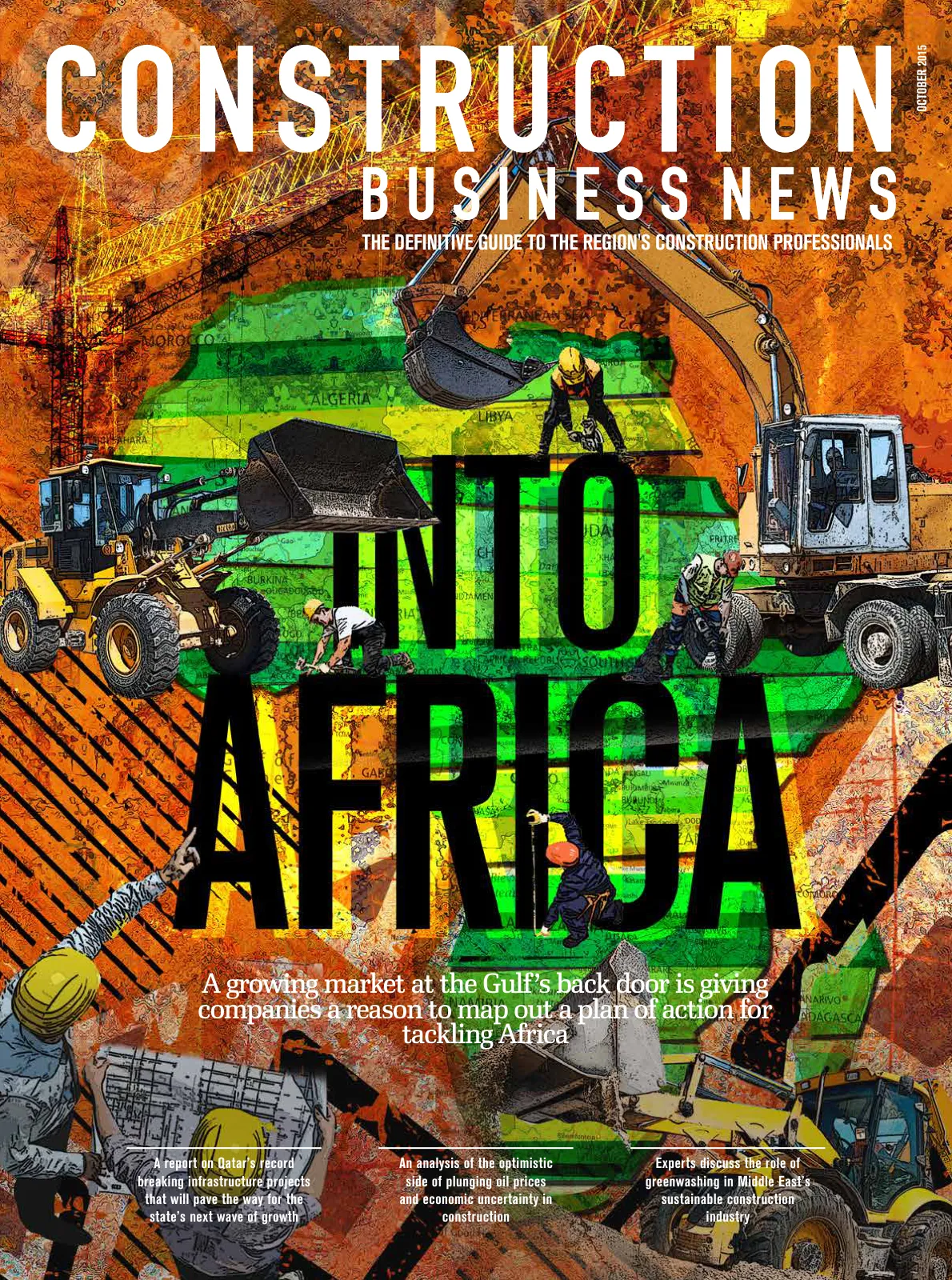
Construction Business News, October 2015
Page 1
October 2015
THE DEFINITIVE GUIDE TO THE REGION'S CONSTRUCTION PROFESSIONALS
A growing market at the Gulf’s back door is giving
companies a reason to map out a plan of action for
tackling Africa
A report on Qatar’s record
breaking infrastructure projects
that will pave the way for the
state’s next wave of growth
An analysis of the optimistic
side of plunging oil prices
and economic uncertainty in
construction
Experts discuss the role of
greenwashing in Middle East’s
sustainable construction
industry
Page 2
construction business news me October 2015
2
NEWS
OHSAS 18001 certified
ISO 9001, 14001 and
130+years of
project experience
LEED Platinum, LEED Gold
and LEED Silver Capability
End to End Integrated Solutions
Pioneering Engineering Construction since 1881
www.drakescull.com
700+
Projects Delivered
For over 130 years, Drake & Scull International PJSC has been shaping skylines and transforming the lifestyle of
communities around the world.
Drake & Scull is an industry leader, with a proven history of delivering more than 700 projects through its General
Contracting, Engineering, Rail, Oil & Gas, Water and Wastewater Treatment and Infrastructure development business
streamlines across the region.
Page 3
construction business news me October 2015
3
28
INTO AFRICA
A growing market at the Gulf’s
back door is giving companies
a reason to map out a plan of
action for tackling Africa
Editor’s Note
news
in person
Peter Vogel, director of
doka Middle East, talks
about innovation as an
art of problem-solving
and making construction
processes more efficient,
sustainable and safe
analysis
shivram mukherjee
writes about energy
consumption trends in
the middle east to suit
high levels of power
demand
Joanne bladd analyses
the optimistic side of
plunging oil prices and
economic uncertainty
COUNTRY FOCUS
A report on qatar’s
record breaking
infrastructure projects
that will pave the way for
the state’s next wave of
growth
Real estate
news update of the latest
project launches at
cityscape global 2015
Matt Dadd writes
about how new mall
developments would draw
tourism from the gcc and
internationally to dubai
6
8
18
22
24
34
40
44
cover story
34
28
contents
Page 4
construction business news me October 2015
4
S U B S C R I B E
c o n t r i b u t o r s
subscriptions@bncpublishing.net
Managing Director
Walid Zok
walid@bncpublishing.net
Director
Rabih Najm
rabih@bncpublishing.net
Director
Wissam Younane
wissam@bncpublishing.net
Group Publishing Director
Diarmuid O'Malley
dom@bncpublishing.net
Business Development Director
Rabih Naderi
rabih.naderi@bncpublishing.net
+966 50 328 9818
Group Editor
Melanie Mingas
melanie@bncpublishing.net
Editor
Lorraine Bangera
lorraine@bncpublishing.net
Art Director
Aaron Sutton
aaron@bncpublishing.net
Sales Manager
Mostafa Abdo
mostafa@bncpublishing.net
+966 56 6695 333
Marketing Executive
Mark Anthony Monzon
mark@bncpublishing.net
PO Box 502511 Dubai, United Arab Emirates
P +971 4 4200 506 | F +971 4 4200 196
For all commercial enquiries related to
Construction Business News ME contact
sales@bncpublishing.net T +971 55 339 5097
All rights reserved © 2015.
Opinions expressed are solely those of the contributors.
Construction Business News ME and all subsidiary
publications in the MENA region are officially licensed
exclusively to BNC Publishing in the MENA region by
Construction Business News ME.
No part of this magazine may be reproduced or
transmitted in any form or by any means without
written permission of the publisher.
Images used in Construction Business News ME
are credited when necessary. Attributed use of
copyrighted images with permission. All images not
credited courtesy Shutterstock.
Printed by International Printing Press www.ippuae.com
Stuart Matthews
Marlow McGuinness Ltd
-------
Joanne Bladd
technology
dr asif sharif, regional director of conject, explains that not
all project collaboration solutions are built the same
PROJECT update
Dmcc along with as+gg unveil burj2020 district at this year’s
cityscape global
SUSTAINABILITY
Construction Business News ME speaks with sustainability
experts to discuss the role of greenwashing in Middle East’s
construction industry
gcc governments are imposing new standards to minimise
greenhouse gas emission and limit resource depletion.
Construction companies can play a direct role in this process
Q&A
As the uae massively invests to improve its healthcare sector
to match world leaders, ceo of enova alexandre mussallam
speaks with construction business news me about the current
challenges faced in energy and facilities management
COMMENT
Edward mccluskey, partner at arcadis, analyses the common
construction disputes in the region and discusses how to
handle them
Suppliers
Event preview
save the date
editor’s pick
46
48
50
54
58
24
60
62
64
66
66
CONTENTS
48
Page 5
construction business news me October 2015
5
Factory and Headquarters:
Saih Shuaib - 4 | Dubai Industrial City | P.O. Box - 62182 | Dubai | United Arab Emirates | Tel: +971 4 3687600
www.caparol.ae
facebook.com/caparoluae
twitter.com/caparoluae
linkedin.com/company/caparol
Indoor Air Quality is a growing concern in today’s
world, with Formaldehyde being one of the largest.
Introducing CapaCare AirPurify with
CapaCare AirPurify is a revolutionary paint fortified with
Formaldehyde Conversion Technology. The unique
technology helps convert toxic Formaldehyde
emissions into harmless water vapour ensuring that
indoor air is fresh and safe to breathe.
Protect your friends and family today,
visit: www.caparol.ae/airpurify
Let fresh remain fresh with
CapaCare AirPurify
Page 6
construction business news me October 2015
6
NEWS
Africa Rising
Once deemed as a “hopeless continent”
by the Economist, Africa has had a defi-
nite turnaround in the last two decades.
Endowed with bountiful natural resources
such as oil, gas and uranium, agricultural
commodities, and water, it was only a
matter of time before the potential would
be realised.
Consisting of the fastest growing econo-
mies in the world, today it is appropri-
ately associated with being termed the
continent of the future. The International
Monetary Fund’s 2014 World Economic
Outlook report states that six of the 10
fastest growing economies are in Africa:
Mozambique, Rwanda, Angola, Nigeria,
Chad, and Ethiopia.
The GCC has historic, economic and
cultural ties with Africa dating back cen-
turies. After a long silence in the 1990s
and 2000s, the GCC is finally partaking
in a string of potentially highly lucrative
partnerships. China for one seems to have
recognised Africa’s potential with increas-
ing investments in construction from
19% in 2013 to 31% in 2015.
According to the Dubai Chamber of
Commerce and Industry, annual GCC
investments to Africa are expected to aver-
age $5bn in the coming years. Many fac-
tors work in favour as both parties could
reap benefits from mutual partnerships.
The UAE specifically has made an in-
creased effort to work with African na-
tions and local newspaper Gulf News re-
ported that Dubai’s trade with Africa has
increased to $25bn in the last decade.
Arqaam Capital’s GCC-Africa Investors
Conference in Abu Dhabi on September
14, 2015 attracted companies from across
the Middle East including Etisalat, DP
World, Damac, Depa, KIPCO, Emirates
NBD, and NBAD.
Riad Melti, CEO of Arqaam Capital,
explained that the African continent
presented a mixed outlook, highlighting
that while some non-oil economies were
faring pretty well, commodities-driven
economies were struggling with slow
growth and weakening currencies.
There are challenges – delays in client
decision making can cause projects to
overrun on time and budget. The quality
of materials can vary wildly from one area
to another and there is lack of consistent
labour supply across the continent. Africa
can only rise if its foundations are strong.
Prioritising improvement region by re-
gion, PwC says East Africa must work
to improve project finance and its regu-
latory environment; the west must work
on procurement and scheduling; and the
southern countries, risk management and
upfront planning.
According to Deloitte’s African Con-
struction Trends Report 2014, energy and
transport are key focus areas for invest-
ment as Africa’s emerging nations move
towards building better infrastructure.
The report stated that though the num-
ber of projects in 2014 (257) had signifi-
cantly dropped since last year (322), the
total value of the projects under construc-
tion had increased to $325,828m from
$222,767m.
Further, 65% of energy and power
projects under construction are renew-
able energy projects, giving the nations a
chance to begin with sustainable develop-
ment from the start.
editor’s note
Construction activity in East Af-
rica in particular shows strong diver-
sification, with signs of a mature and
competitive industry.
Even though Dubai plans to position
itself as a gateway to Africa, most GCC
countries still see hindrances in political
risks, instability and currency volatility.
It is definitely a debatable choice. On
one side, it could benefit the region tre-
mendously if the investments pay off,
working closely with African nations
would be favorable geographically and
culturally. However, with all the uncer-
tainty about the risks it is up to each
GCC nation to make the choice to dip
or dive. Making its way through recent
political struggles and the Ebola crisis, I
personally think it would be a shame not
to bet on a continent that has proven it
can endure just about anything.
Lorraine Bangera
Editor
Page 7
construction business news me October 2015
7
Page 8
construction business news me October 2015
8
NEWS
The value of construction chemical sales in Qatar is forecast to grow at 13%
CAGR, between 2015 and 2020, according to data released by research com-
pay TechSci.
The increase has been attributed to increased demand for housing, as well
as construction of many infrastructure projects such as airports, subways, tun-
nels, damns, highways, bridges, railway networks, power plants as a part of
preparations for upcoming FIFA World Cup in 2022.
“Post 2014, infrastructure sector is expected to pick up on account of vari-
ous government initiatives, especially increasing construction activities for
FIFA World Cup, 2022, and implementation of Qatar National Vision 2030
program. This push in construction sector is expected to boost construction
chemicals market in Qatar over next five years,” said Mr. Karan Chechi, re-
search director with TechSci Research, a research based global management
consulting firm.
The total value of construction contracts
by the close of 2015, could be down
$2bn following a dramatic decrease in
oil prices.
Data from Ventures Onsite, produced
for The Big 5, states the total value of
construction contracts last year stood
at $196bn, and this year is predicted
to close at $194bn, although it will be
some months before the numbers can
be confirmed.
The results come despite Ventures On-
site predicting for much of the year that
contracts would actually increase 4.5%
this year, reaching $205bn by year end.
The drop is largely being attributed to
the drop in oil prices.
Andy White, the vice president of The
Big 5 show organiser dmg events ME,
said: “A lot has been said about how oil
prices might affect construction markets.
But each of the GCC nations has con-
tinued to invest heavily in infrastructure
such as housing and healthcare.
“Kuwait has more than trebled its con-
tract awards this year, the Saudi govern-
ment has made it clear that it will contin-
ue to invest, and the UAE has revealed
more spectacular projects.”
GCC construction
contracts to
fall $2bn
As many as seven out of 10 projects
in the region do not utilise project col-
laboration technology, according to re-
search conducted by Conject.
In a survey of existing and prospec-
tive clients, the firm discovered that a
mere 30% of projects in Qatar and simi-
lar numbers in other GCC countries fail
to benefit from collaborative software.
Writing for Construction Business
News ME, Conject GM and regional
director, Dr. Asif Sharif, cited such ex-
cuses as cost, duration of project and
necessity for physical documentation in
addition to digital.
Speaking specifically about invest-
ment costs, he said: “The level of in-
vestment could be as little as 0.5% of
the overall project value, so in real
terms this might be considered a small
investment, capable of delivering con-
siderable cost and time savings on the
project particularly if there is a dispute
on the project.
“In addition, cloud based collabora-
tion solutions provide huge flexibility
to the user, easily enabling them to
ramp up or scale down usage in line
with the user community, in other
words matching the software re-
quirement to the stage and profile of
the project.”
70% of projects do not utilise
project collaboration systems
13% CAGR construction
chemical growth
for Qatar
Share of projects
across the GCC
Saudi Arabia - 44%
Qatar - 11%
UAE - 31%
Kuwait - 6%
44
31
11
6
%
Page 9
construction business news me October 2015
9
whether these will be revoked.
The ban on new contracts will last at least until legal ac-
tion against the group has been concluded, according to
reports by Reuters.
The contractors insurers, United Cooperative Assurance
(UCA) feel 2.5% as the group began its claims procedure
following the accident on September 11, 2015.
Saudi Binladin Group sees all contracts suspended
Saudi Binladin Group will keep its existing contracts
but will not be awarded any further work from the
Saudi Arabian Government following the crane col-
lapse in Mecca last month, which killed more than 100
people and injured more than 200.
While existing contracts are currently under review
by the Finance Ministry, no decision has been made on
Demand for new hotels, retail, com-
mercial and education facilities, as well
as hospitals, has increased the value
of interior design contracts to $7.98bn,
preceding last year’s total of $7.35bn.
However, according to the organ-
isers of the Leaders in Design MENA
Summit, owners and employers on the
other hand are suffering with what is
known as “decision overload.”
This is caused by being faced with
too many options, such as the design
style, cost, time and many other speci-
fications they have to sift through in
order to find the one they have been
searching for. This is not bad news
for designers and architects hoping to
develop some clients in the region as
there will always be someone looking
for a different style and offer to what to
has previously been showcased to them.
There are plenty of opportunities out
there in this sea of business but it takes
some networking and recommenda-
tion to get designers the kind of deals
they are looking for and not just swim-
ming alone in the deep.
Leaders In Design MENA will take
place in Dubai, from November 15.
$7.98bn design projects confirmed for region
Construction in Mecca
Page 10
construction business news me October 2015
10
NEWS
Iranian companies are set to construct
dams in Oman according to Iranian En-
ergy Minister Hamid Chitchian, Mehr
News Agency reported.
Oman’s Minister of Regional Munici-
palities and Water Resources Ahmad
bin Abdallah bin Muhammad al-Shuhi
met with Chitchian in Tehran to discuss
potential opportunities to work togeth-
er. Chitchian referred to it as a positive
atmosphere of cooperation between
Iran and Oman. He said: “It has been
decided to form a technical committee
to investigate possibilities of joint col-
laboration with Oman in details.”
The said committee would set the
stage for the presence of Iranian com-
panies in Oman for the dam construc-
tion. The minister said that majority
of the negotiations made with Oman
focussed on water resources studies
and management. “The two sides also
agreed to exchange experiences in the
field of water resources, studies, rules,
and regulations.”
Al-Shuhi added: “We are seeking to
use Iran’s experiences in terms of dam
construction and transmission lines on
the basis of extensive cooperation.
“In addition to Iran’s Ministry of En-
ergy, we are also interested in Iran’s
private sector companies to carry out
projects in Oman.”
Iranian companies
to construct
dams in Oman
Colliers International released its com-
prehensive report, The Greater Cairo
Real Estate Market Overview, in Sep-
tember 2015. The report, which high-
lights the latest trends in Greater Cairo’s
residential, retail, hospitality and office
segments, indicates a strong perfor-
mance and positive outlook across all
sectors owing to increased consumer
and investor confidence as economic
stability returns to Egypt’s key market.
Ian Albert, regional director at Collier
International said: “Over the last four
years we have seen a palpable change
in investor appetite towards the Cairo
real estate market. The infrastructure
and real estate megaprojects driven
by the government and international
investors have undoubtedly had a
positive impact on the economy. These
projects have the potential to signifi-
cantly change the economic landscape
of Egypt, and yield additional benefits
if managed effectively.”
The report provides a brief overview
of three national mega projects: the
Suez Canal Expansion, Cairo Airport
City and New Capital City, all of which
it anticipates will help drive demand for
additional real estate products.
Investor confidence boost for egypt
DC Pro Engineering UAE earned its
second consecutive ‘District Cooling
Consultant of the Year’ award at this
year’s Asia Pacific District Cooling Con-
ference held in Bangkok, Thailand.
The award recognised the company’s
continuing commitment to implement
new and innovative district cooling
technologies that address global warm-
ing and climate change concerns.
CEO of DC Pro George Berbari de-
livered a presentation to conference
delegates that championed Tri-gener-
ation technology – a process where
the simultaneous generation of elec-
tric power is synchronised with photo
voltaic energy to create waste heat
and produce cooling. The technique,
Berbari insisted, could result in sav-
ings of up to 100,000 barrels per day
in Thai oil imports.
He said: “As part of our efforts to
educate public and private sector en-
tities on the advantages and benefits
of district cooling in today’s ultra-
modern urban centres, we ensure that
our designs and recommendations
are in accordance with international
efforts to address the spectre of global
warming and climate change.”
DC Pro wins District
Cooling Consultant of
the Year
George Berbari, CEO of DC Pro Engineering
Page 11
construction business news me October 2015
11
Page 12
construction business news me October 2015
12
NEWS
EGBC MEFMA panel debates fm and retrofit Trends
Emirates
Green
Building
Council
(EGBC) along with Middle East Facil-
ity Management Association (MEFMA),
hosted a networking event focussed on
the role of facility management compa-
nies (FMCs) in the burgeoning retrofit
market in the UAE and the importance
of education and trained professionals
in post-retrofit maintenance.
The discussion was moderated by
Khaled Bushnaq, vice chair of Emirates-
GBC, with panellists including: Ali Al
Suwaidi, board member of MEFMA; Stu-
art Harrison, support services director of
Emrill Services LLC; and K. Anbalagan,
managing partner of Proleed Mechanical
Engineering Consultancies. Key topics
addressed included: training, retrofitting
certifications and the importance of en-
ergy auditors in building retrofitting.
Bushnaq said: “Training and trained
professionals play a pivotal role when
it comes to post-retrofit maintenance
and the continuation of preventive care
implemented in any building. One of
the key purposes of the joint network-
ing event was to put the spotlight on the
current situation of training within the in-
dustry and identify next steps to follow
with the aim to create a fully integrated
facility management industry adequately
equipped for the ‘retrofit revolution.’”
The second discussion was on ret-
rofitting certifications, and how ISO
50001 is emerging as an important
certification in the commercial sec-
tor where savings in energy manage-
ment are almost guaranteed, such as
in the UAE.
Lastly, the panel discussed the im-
portance of energy auditors as an
essential component in the list of
certified professionals needed for a
building retrofit process and how
FMCs can benefit from hiring certi-
fied energy auditors directly on their
team as opposed to outsourcing the
auditing task.
MEED’s fourth annual Qatar Transport
Forum revealed that Qatar is has more
than $40bn worth of planned transport
projects in the pipeline. These include
the expansion of Hamad International
Airport (HIA) and Hamad Port, the
Doha Metro and long-distance passen-
ger and freight network, and the ex-
pressway programme.
Other projects showcased included
the two additional container terminals
at Hamad Port that would increase
the $7.3bn project’s handling capacity
to 6 million TEUs by 2020. The first
phase of the megaproject, which in-
volved installing more pre-cast blocks
than the pyramids, is due to open at
the end of 2016, according to Aecom’s
programme director Tim Verdon.
Qatar Rail’s chief of service delivery
Andrew Tailor updated the forum on
Qatar’s $20bn-plus integrated trans-
port plan. A world record 21 tunnel
boring machines are being used on
the Doha Metro project, which so far
has completed almost 50km of tun-
nels. A total of 26,000 workers are
working on the project, equating
to more than 78 million man hours
Qatar on track with more than $40bn
worth of transport projects
Qatar¹s Minister of Transport H.E. Jassim Bin Saif Al Sulaiti at the MEED Qatar Transport Forum in Doha.
worked as of end of August.
Work on the Lusail tram scheme is
even more advanced, with four of the
five stations completed, while the ten-
der for the first phase design and build
of the long-distance freight and rail net-
work will be issued to contractors early
next year.
On the roads side, Eng. Nasser Al-
Kuwari, manager of highway projects
department at Ashghal, presented
an overview of the $10.8bn express-
way programme. The massive project,
which involves 1,000km of new or up-
graded roads, 240 major interchanges
and 360 bridges, has already seen 43
major contracts awarded. A total of 15
contracts are either in the market or are
being prepared, while a further 23 are
in the planning stage.
Page 13
construction business news me October 2015
13
PIPELINES
NOT PIPE DREAMS.
Infrastructure development is critical to the growth of
the economy.
That’s why at HSBC, our award winning capital
financing team provides bespoke and innovative
advice, supporting your business in making the most of
global infrastructure opportunities.
With nearly 150 years of experience in supporting global
businesses, including 65 years in the Middle East and
North Africa, we can support your business vision for
the future.
See how we can help your business
www.business.hsbc.ae/solutions
Issued by HSBC Bank Middle East Limited, P. O. Box 66, Dubai, UAE. Regulated by the Jersey Financial Services Commission and Central Bank of the United Arab Emirates. CRN 150603
© Copyright. HSBC Group 2015. ALL RIGHTS RESERVED.
Page 14
construction business news me October 2015
14
NEWS
Lifting of sanctions on Iran will lead to
drastic changes as Iranian businesses
open to regional and global markets,
concludes the Opportunity Iran 2015
report by MEED, which reveals Tehran
will sign $100bn worth of energy deals
once economic sanctions are fully lifted.
The main sanctions which include the
United Nations, US and European Union
will be lifted by the end of the year after
a final assessment by the International
Atomic Energy Agency (IAEA).
After the lifting the sanctions, the report
states that, large-scale investment in oil,
gas and petrochemicals projects will be
a top priority.
Even though Iran has the fourth largest
oil reserves and the largest gas reserves
in the world, years of isolation from
global markets has left the sector in need
of modernisation.
Iran aims to expand its oil sector in two
phases; the first phase will see National
Iranian Oil Company (NIOC) reviving its
crude output to pre-2012 levels as sanc-
tions relief opens up export markets;
From 2020 onwards, Iranian crude ca-
pacity is set to increase and investment
will allow NIOC to deploy enhanced oil
recovery (EOR) technology at its older
fields, revive stalled field developments,
and carry out greenfield developments at
untapped assets.
Tehran to
sign $100bn of
energy deals
Kuwait
Boubyan Island Development
Construction Start: Q3 2007
Completion : Q4 2033
Est. Value $6,640m
Client: Ministry of Public Works (MPW)
Qatar
Msheireb Development
Construction Start: Q2 2010
Completion : Q4 2018
Est. Value $5,500m
Client: Msheireb Properties
Consultant: Multiple
Saudi Arabia
King Abdullah City of Atomic and Renewable Energy
Construction Start: Q1 2016
Completion : Q1 2030
Est. Value $100,250m
Client: King Abdullah City of Atomic and
Bahrain
Al Madina Al Shamaliya
Construction Start: Q3 2014
Completion : Q3 2019
Est. Value $4,500m
Client: Ministry of Works & Housing,
Bahrain
UAE
Mohammed Bin Rashid (MBR) City
Construction Start: Q2 2013
Completion : Q4 2023
Est. Value $64,724m
Client: Dubai Holding / Emaar Properties
Oman
Muscat International Airport - Passenger Terminal
Ministry of Transport & Communications
Construction Start: Q3 2011
Completion : Q3 2016
Est. Value $1,826m
Ventures Onsite reveals the top 30 most
expensive construction projects of the
last 20 years
Page 15
Saudi Arabia Finance Minister Ibrahim
Alassaf has announced the govern-
ment’s decision to cut “unnecessary”
expenses, including some current
projects, to compensate for low oil
prices, in an interview with CNBC Ara-
bia aired during his visit to Washing-
ton D.C. last month.
Alassaf said: “There are some projects
like the ones that have been approved
a few years ago and haven’t been car-
ried out until now – that means such
projects are not currently necessary
and can be delayed.”
Though the minister urged that proj-
ects that are vital to Saudi’s future econ-
omy such as infrastructure, healthcare
and education projects would not be
affected by this move.
Reuters reported that according to In-
ternational Monetary Fund and private
analysts, Saudi Arabia will hit a budget
deficit of $120bn or more this year be-
cause of cheap oil. However, with finan-
cial reserves over $600bn, it is not in any
particular danger in the short-term.
Alassaf was visiting the US capital
along with other King Salman bin Ab-
dulaziz Al Saud, King of Saudi Arabia,
and other delegates to attend the 2015
Saudi-US Investment Forum on Septem-
ber 4. The event aimed to highlight
many opportunities that are open for
Saudi and American business ventures.
Saudi Arabia to cut “unnecessary” expenses
MADE IN UAE
www.intermetal.com www.verdadoors.com
Dubai, UAE Tel: +971 4 884 1650 Email: sales@verdadoors.com
MANUFACTURING
QUALITY DOORS, KITCHENS
& INTERIOR FIT-OUT
Page 16
construction business news me October 2015
16
NEWS
Page 17
construction business news me October 2015
17
Page 18
construction business news me October 2015
18
InnovATive drive
Peter Vogel, director of Doka Middle East, speaks with
Lorraine Bangera about innovation as an art of problem-
solving and making construction processes more
efficient, sustainable and safe
IN PERSON
Page 19
construction business news me October 2015
19
W
ith
over
150
years of experi-
ence, formwork-
provider
Doka
prides itself in
finding
solu-
tions for the most complex construction
projects in the world. Founded and still
owned today by the Umdasch family,
Doka has proven to be a globally recog-
nised brand in construction. Its projects
have spread across continents with the
most eminent ones to be found here in
the GCC. Some of those projects include
Dubai’s Burj Khalifa and the soon-to-be
world’s largest hotel Abraj Kudai Hotel
in Mecca.
“Innovation is the key to our suc-
cess,” says Peter Vogel, regional director
of Doka. “Our core aim is to constantly
adjust our services in line with customer
needs, while also guaranteeing the high-
est safety requirements.”
“Innovation is simply creating solu-
tion,” he urges. “Solutions which are
highly efficient, sustainable and safe.”
He adds: “It is one thing to make
working with formwork easier and
save more time as a result. It is quite
another to make working with form-
work even more safe and therefore
more cost-efficient.
“As a market leader, we are obliged
to constantly develop new concepts and
systems to support our customers’ aim
of improving speed and safety of the
construction process. With our innova-
tions, we keep ourselves always one
step ahead of the competition.”
A good example for such solutions is
the Xsafe plus, a pre-assembled work-
ing platform that can be folded and
equipped with side railings for wall and
column formwork.
Vogel states that his company is con-
sistently thinking outside of the box.
“We are currently working on the Stra-
tegic Tunnel Enhancement Programme
(STEP) for Odebrecht in Abu Dhabi
which required a special-purpose form-
work solution, which we created and
delivered. I think cases such as this
make us add to our strength as form-
work professionals.”
Another recent innovation has been
the Concremote system to measure
concrete strength development. The
system and all its results are based on
the temperature of the concrete which
is measured continuously. Concremote
reduces striking times, optimise form-
work solutions and of course visualises
a lot of information about the concrete
for the contractor.
It is now used on various projects
around the world, reaching from bridg-
es and tunnels to high-rise towers and
shopping malls. Vogel says that after its
launch last year, consultants and con-
tractors have provided positive feed
Vogel’s three-point defi-
nition of innovation:
Highest Efficiency
“Our innovations help to improve the
speed of processes which tremendously
reduce construction time, labour and
consequently costs.
Sustainability
“Doka is conscious of its obligation
to society, the environment, and its
stakeholders. It deliberately invests in its
employees, in measures and innovations
for optimising resource consumption
in minimising environmental impacts,
and in nurturing its relationships with
stakeholders.”
Safety
“Safety on the site is a great responsi-
bility for all involved in the construction
process. A professional approach to
safety brings a number of significant
benefits: less risk of accidents, higher
efficiency from fast workflows, en-
hanced employee morale, and a boost to
your corporate image.”
Damac Towers by Paramount
Page 20
construction business news me October 2015
20
IN PERSON
back, particularly given Concremote’s
cost and time saving attributes.
Integrated innovation
Innovation is a philosophy that has to
be cultivated by people, something Vo-
gel believes is only possible when every
employee is encouraged to communi-
cate ideas as part of a team.
Where does innovation come from?
While Vogel is busy managing the re-
gional business from his office, he says
that most of the ideas needed for inno-
vation is developed on site.
“Our development department moni-
tors the progress along with the client,
which helps begin the innovation pro-
cess.” He points out that clients are the
first ones to expose the company to a
problem, after which his team hunts for
solutions. “This is how we innovate and
develop, through coming face-to-face
with a problem.”
The constant process of problem solv-
ing doesn’t just exist among employees;
it has been integrated through training
and hiring who Doka considers to be
the best professionals in the market.
“Our employees are the reason for
the company’s success. While the Doka
Group is a family-owned business, in-
trapreneurship is highly encouraged
and supported. We invest in employ-
Latest project review:
Lusail pedestrian bridges
Doka was hired to be a part of one of the developments at Lusail City development
project in Qatar. The company is set to work with builder, FCC Construction-Petroserv
JV, and supply pre-assembled formwork materials for two pedestrian bridges separating
the islands.
The bridge design resembles a necklace with interlocking ellipses with concrete
decks suspended by steel cables attached to slender pylons. The two bridges are
90m and 100m long and built simultaneously. This means the quantity of the required
formwork material is almost double.
In order to provide for maximum efficiency in terms of construction time, the bridge
deck formwork was assembled in advance. Pre-fabrication at Doka's pre-assembly
service saves time and space on site and at the same time reduces costs. The finished
systems were delivered just in time by way of special shipment and immediately ready
for use.
“Pre-assembly of formwork systems saves us time and ensures quality,” says Victor
Gomez Lopez, the FCC’s construction manager. “This process made assembling the
formwork sheets on the load-bearing tower quick and easy”
The initial formwork was delivered in August 2013. In-situ concrete work for both
pedestrian bridges were completed on-schedule by early 2015.
Page 21
construction business news me October 2015
21
ees and put in efforts to invest in their
development.”
Innovation and the GCC
Vogel has worked in several countries
over the last two decades, though he
admits that he has been lucky to choose
where he wanted to work. In the GCC,
he has been active in Oman, Qatar and
the UAE.
He observes that the region’s con-
struction sector has seen consistent
growth over the past decade, with a
spike in activity from 2005 till the eco-
nomic downturn and in spite of this, the
GCC has continued to grow, citing eco-
nomic diversification as a key driver.
For him working in the GCC is chal-
lenging and exhilarating at the same
time. “This region gives you the free-
Projects within the GCC:
• Burj Khalifa in Dubai, UAE
• Damac Towers by Paramount in Dubai, UAE
• Al Hilal Commercial Office Tower in Al Maryah Island, UAE
• Msheireb Downtown Doha, Qatar
• Lusail Bridge in Doha, Qatar
• Aishti Mall Seaside, Lebanon
• Muscat International Airport, Oman
• Aqaba Port Terminal, Jordan
• Sabah Al Salam University City, Kuwait
• Golden Tower in Jeddah, Saudi Arabia
Concremote
dom to be creative and innovative.”
Innovation has always been wel-
comed with open arms in the GCC,
in particular in the UAE. Some of the
shifts in the regional market especially
towards sustainability have predomi-
nantly affected the construction market
and we welcome such developments.
As a company Doka has always priori-
tised sustainability as one of its core val-
ues, something that enables it to offer
practical support to the UAE’s federal
and municipal policies on sustainable
construction.
Success and pragmatism
After 22 years of management roles
in the construction industry, Peter Vo-
gel joined Doka in 2008. He says that
he is more than happy to be a part
of the busy and challenging GCC
market where construction activities
are bountiful.
Before joining Doka, he worked as a
technical manager in a contracting firm
and has extensive experience in the
construction industry.
While Vogel’s practicality and drive
has helped him to successfully repre-
sent a global brand in the region, it’s
his insight that sets him apart from most
directors. When asked for pearls of wis-
dom, he shrewdly says; “When it comes
to success it depends on how the indi-
vidual looks at success.”
He argues that success is often seen
in two ways: long-term and short-term.
Long-term success could be challenging
but we prefer to be challenged.
“Typically, our projects are amongst the
most complex developments in the
GCC.”
If you haven’t heard of Doka, a drive
down Dubai’s Sheikh Zayed Road is all
it takes to see the numerous projects the
firm is a part of.
He explains that Doka has a sincere
willingness to face challenges and pro-
vide solutions. “We often invent new
concepts of doing it.”
In DOKA everybody is passionate
about what we are doing. I’ve been in
the company for eight years, and I can’t
imagine finding a better company.”
Vogel’s philosophy is simple. “The
construction industry is pragmatic,
therefore so are we.”
Page 22
construction business news me October 2015
22
In the wake of increasing focus on sustainability and the “go green”
movement across the globe, the Middle East is also adapting its energy
consumption trends to suit the high levels of power demand resulting
from extremely high temperatures. Shivram Mukherjee reports
Construction and
Innovation in the UAE:
An Outlook
I
t has been reported that innova-
tive technologies and a construc-
tion boom are driving growth in
entire UAE. Dubai is set to invest
AED4.5bn in ambitious real es-
tate and construction projects to turn
the emirate into “an innovation hub for
global technology businesses and entre-
preneurs.” The project will involve the
construction of a massive new technolo-
gy centre and the expansion of the Dubai
Design District. It will also see Dubai
become the focus of a new discussion
about the importance of innovation and
creativity.
The current boom in the GCC’s con-
struction sector has created lucrative op-
portunities for the regional and interna-
tional FM companies. Figures produced
by the Dubai Statistics Centre in the first
half of 2014, the UAE’s construction sec-
tor made up 7.89% of the nation’s gross
domestic product. Additionally, accord-
ing to the Dubai Chamber of Commerce
and Industry, the sector is expected to
further contribute between 11 to 11.5%
to the GDP from 2015 to 2021. Here are
the latest Innovations in Construction.
3D Building
Dubai is in line to build world’s first fully
functional 3D printed building. This slat-
ed move will establish UAE's position as
global centre of 3D printing in construc-
tion and design. UAE aims to deploy the
latest technologies to improve people's
lives and to develop its economy in line
with the country's National Innovation
Strategy and the vision His Highness
Sheikh Mohammed bin Rashid. Experts
estimate that 3D printing technology can
reduce the production time of buildings
by 50 to 70%, reduce labour costs by 50
to 80%, and can save between 30 and
60% of construction waste. These sav-
ings translate to enhanced productivity,
higher economic return, and increased
sustainability.
The “Office” will be approximately
2,000 sq.ft in size and will be printed
layer-by-layer using a 20-foot tall 3D
printer. All interior furniture, detailing,
and structural components will also be
built using 3D printing technology, com-
bining a mixture of Special Reinforced
Concrete (SRC), Glass Fiber Reinforced
Gypsum (GRG) and Fiber Reinforced
Plastic (FRP). This combination will make
it the most advanced 3D printed structure
ever built at this scale and the first to be
put into actual use. The building is the
result of a partnership between Dubai
and WinSun Global along with lead-
ing global architecture and engineering
firms Gensler, Thornton Thomasetti, and
Syska Hennessy.
Shivram Mukherjee, is a senior consultant
with First Climate (India) Private Limited and
has been associated with Climate Change
Sustainability Services since 2011. He holds a
B.Tech Degree in Mechanical Engineering and
a Master’s Degree in Energy Management.
He has worked with Dubai Municipality (as a
consultant) for a Greenhouse Gas Abatement
Project registered under the Clean Develop-
ment Mechanism for United Nations Framework
Convention on Climate Change.
Shivram Mukherjee
ANALYSIS
Page 23
construction business news me October 2015
23
In addition to prototyping new tech-
nology, the 'Office' reflects the latest
input from experts and researchers in
workplace design and the future of work.
Located at a busy intersection in the heart
of Dubai, the 'Office' is designed to bring
together different professionals, commu-
nity members, and experts through a mix
of public events. The space is open and
flexible, allowing for a range of uses and
team sizes. It will also feature a small dig-
ital fabrication facility and a 3D printing
exhibition space.
Using sustainable wood material in
real-estate sector
Using sustainable wood material in the
GCC construction industry would help
conserve natural resources and boost
the global wealth of trees. He added
sustainable wood is a topic that is domi-
nating the regional construction sec-
tor in line with governments’ vision of
environment sustainability.
The positive regional approach to-
wards sustainability in the construction
sector is a sign for the entire world that
GCC countries are committed to preserv-
ing natural resources, of which the wood
sector is a significant part
A series of seminars has been held
on the utilisation of sustainable wood
in construction sector which is being
tailored for the regional market and the
UAE in particular. Entities like Emir-
ates Authority for Standardization and
Metrology (ESMA) and Dubai Central
Laboratory have discussed the local UAE
standards in this field, while Dubai Mu-
nicipality has organised two seminars
on ‘Wood Sustainability’ and ‘Innovation
in Sustainability’.
The importance of wood sustainabil-
ity is underlined by the fact that wood
products require much less energy to
be produced than concrete or steel, for
example. An objective comparison of
the energy needed to obtain, manufac-
ture, transport and install building ma-
terials for identical wood frame, steel
frame and concrete houses demonstrates
wood’s environmental superiority over
alternative materials, leading to less us-
age of fossil fuels and reduced air and
water pollution.
Although wood products make up a
big chunk of all raw materials, its share
of energy consumption during manu-
facturing is very minimal compared to
other raw materials. Results show that
the manufacture of wood materials uses
53% less energy than steel and 120%
less energy than concrete. Wood is the
world’s only renewable building mate-
rial. It satisfies the four basic principles
of Green Buildings to minimise the en-
vironmental impact of construction by
minimizing use of energy resources and
reducing pollution.
Path Forward
The UAE will mark 2015 as the ‘Year of
Innovation’. The announcement came
in line with the directives of President
His Highness Sheikh Khalifa Bin Za-
yed Al Nahyan. Sheikh Khalifa stressed
the importance of innovation to the
UAE’s strategy.
The new innovation techniques in
construction will pave way for UAE’s in-
terim development and progress. It’s a
primary tool to achieve Vision 2021 and
an engine for the growth of distinctive
skills and capabilities across the nation.
The National Innovation Strategy will
focus on fostering innovation in main sec-
tors viz; construction, renewable energy,
transport, education, health, technology,
water and space. Thirty governmental
initiatives are aimed to be taken within
a three-year period in the optic of foster-
ing innovations in these sectors, including
new legislation, innovation incubators, in-
vestment in specialized skills, private-sec-
tor incentives, international research part-
nerships and an innovation drive within
government. UAE is surely moving in the
right direction in achieving three pillars of
sustainability within a short span of time.
New law benefit innovation-based
companies in TECOM Free Zone.
Image courtesy of Victoria Barynova.
Page 24
construction business news me October 2015
24
Plunging oil prices and economic uncertainty have sparked
jitters in the GCC construction industry. But there is good
reason for optimism, say analysts. By Joanne Bladd
Uncertain
Times
F
or the GCC construction
industry, August was an
uneasy month. First was
news of heavy losses
at Dubai’s largest-listed
contractor Arabtec; a first-half loss of
AED1.3bn, prompting a 5.3 % slump
in its share price. Then came one
of the worst day’s trading in years
on regional stock markets, triggered
by China’s cooling economy and
swelling alarm over plunging crude
prices. Days earlier, global ratings
agency Fitch had cut its outlook on
Saudi Arabia’s economy from ‘stable’
to ‘negative’, while its counterpart
Standard & Poor’s predicted an up to
20 % slide in Dubai property prices;
a bellwether for the wider region.
There was much news, fretted inves-
tors, and most of it was negative.
For contractors, some still nursing
bruises from the 2008 financial crisis,
fears were raised of a wider slow-
down as Gulf states grapple with
shrinking oil revenues and wider
global instability. But while govern-
ments may be reining in budgets
crafted in a time of $100-plus bar-
rels, the industry still has grounds
for cautious optimism.
“We are not in the same place
we were in 2007/2008; that is quite
clear,” says Farouk Soussa, chief
economist for the Middle East, Citi.
“Despite spending cuts, I think there
will be a push in some construction,
with transport and housing moving
up the agenda. Any slowdown won’t
be nearly as deep or as sharp as that
seen previously.”
There are clear difficulties. At the
crux of market fears is the global fall
in crude to less than $50 a barrel.
The Gulf is sharply exposed to oil
swings, with up to 80 % of regional
governments’ income raised via hy-
drocarbons. The Washington-based
IMF estimates the price slump will
translate into $380bn in lost export
revenues for the trade bloc.
While there is little doubt the GCC
six are feeling the pinch, it is to
varying degrees. Kuwait, according
ANALYSIS
Page 25
construction business news me October 2015
25
to the IMF, is still set to post a fiscal
surplus this year, and has more than
trebled its contract awards. Bahrain
and Oman, however, are squeezed:
the pair require breakeven barrel
prices of $127 and $102.6 respec-
tively to balance their budgets. Fur-
ther complicating matters is that oil
markets are showing little appetite
for a rebound.
“I don’t expect to see a major
gain, though I think there will have
to be some movement as current
prices are so low,” says Robin
Mills, head of consulting at Manaar
Energy in Dubai, and nonresident
fellow, foreign policy, at Brookings
Doha Center. The impending return
of Iranian exports will not help
matters, he notes.
“We may well see another year of
depressed prices, and only really see
some kind of recovery after that.”
In January, the IMF cut its growth
forecast for the Middle East’s oil
exporters to 3 % from the 3.9 % it
projected in October. The GCC spe-
cifically will have a collective deficit
of 8 % of gross domestic product
(GDP), it said in May.
“I think there was initial hope oil
prices would bottom out in the $60-
70 range, and [GCC governments]
wouldn’t have to curtail spending
too much,” says Soussa. “That hasn’t
played out. Budget deficits have
grown beyond what the Gulf states
were initially expected to see, and
there has been a belated realisa-
tion that something must be done
to consolidate public finances, put
expenditure on a more sustainable
path, and to raise non-oil revenues.”
It is this spectre of austerity that has
given rise to jitters in the construc-
tion industry. With much of the GCC’s
$194bn projects market backed by
government cash – from the $32bn
expansion of Dubai South, to Saudi
Arabia’s railway plans - moves to
trim budgets and rationalise spending
on capital projects could have wider
industry repercussions.
“It is inevitable that spending will
Page 26
construction business news me October 2015
26
ANALYSIS
as the $23bn Riyadh Light Rail Net-
work, and the government-backed
$67bn housing programme are of
both economic and social impor-
tance. According to the IMF, the
kingdom needs to add some 180,000
housing units per year for the next
decade, to keep pace with popula-
tion demand.
“Dubai at its peak was building
around 50,000 to 55,000 housing
units; Saudi needs to produce three
times that amount consistently over
the next decade, “ says Soussa. “That
is not something Saudi will shy
away from for budgetary reasons.
It is a political imperative, and this
shortage is more material for the
construction industry than anything
we’ve seen for the last decade.”
Equally pressing are the Gulf
state’s myriad transport projects,
spanning from the Makkah Mass
Rail Transit to expansion of its
airport capacity.
“Apart from the fact that these
projects help enable diversification
of the economy, if Saudi is eventu-
ally going to cut subsidies on fuel,
on energy, it needs to make public
transport a cost-effective alterna-
tive,” adds Soussa.
In Qatar, the outlook is also rosy.
Construction is the tiny emirate’s
fastest-growing sector, with state
spending set to reach $200bn to
2030, according to Qatar’s eco-
nomic blueprint, spread over a raft
of infrastructure schemes. Despite
speculation around the future of the
come down, and certain projects
will be delayed or cancelled,” says
Soussa. “I think it is also inevitable
that you will start to see arrears in
contracts build up, as governments
face greater liquidity constraints.
The overall environment is, I think,
becoming more difficult.”
OPEC kingpin Saudi Arabia has
already put a spending review into
play in nine ministries, and can-
celled some hydrocarbon-linked
projects. The UAE, the GCC’s
second-largest economy, plans to
slash spending by 4.2 % this year, a
Central Bank report revealed in July.
The same month saw the Arab state
push through a politically tricky
ruling to deregulate domestic fuel
prices, reflecting a more cautious
fiscal stance.
The regional projects market has
not been immune to the scale down.
In August, a report by research firm
Ventures Onsite forecast a fall in the
value of GCC contract awards this
year to $194bn, down $2bn on 2014.
For much of this year, it had been
expecting awards to rise by 4.5 %,
hitting $205bn by end-2015.
Still, the GCC states have built
resilience - and that bodes well
for contractors. Both the UAE and
Saudi Arabia are cushioned by huge
reserves, and sizeable sovereign
wealth funds – Abu Dhabi’s alone
is estimated to have nearly $800bn
of assets. This makes it likely that
spending on key projects will sus-
tain. In Saudi Arabia, projects such
The housing question
Of the factors set to drive the construction market
in the GCC over the coming years, few are as
pressing as affordable housing. The marked short-
fall of properties able to cater to the region’s large
and growing young population, is both a social and
economic concern, particularly when set against
the backdrop of regional instability.
According to a recent report from real estate
consultancy JLL, the Middle East and North Africa
(MENA) is short some 3.5 million affordable
homes. For contractors then, the scale of the
opportunity is enormous.
“Governments around the region have started to
allocate significant financial resources to encourage
more development of middle-income housing,” says
Craig Plumb, head of research at JLL MENA. “But
more needs to be done. We believe there is a need
to rethink the existing relationship between govern-
ment and the real estate development industry.”
In the UAE, some 39 % of households fall into
the middle-income bracket, defined by JLL as
having a monthly income of between $2,700
and $8,200. In Saudi Arabia, where the bracket
spans from $1,600 to $5,400, it represents 62
% of households. These workers can afford to
pay annual rents of up to $19,600, or mortgages
on houses worth about $215,074. It is, by any
measure, a ready market.
“Many markets are now experiencing an
oversupply of luxury product,” the report noted.
“More developers are realising the importance of
targeting the middle-income sector that was previ-
ously largely ignored.”
Governments also have a role to play in enabling
the growth of this housing sector, by ringfencing
land plots to sell at an affordable price to private
developers, the report noted; on the condition that
the subsequent housing is released to the market
at pre-agreed rents and prices.
“This form of public-private partnership incen-
tivises the private sector to develop middle-income
housing, while ensuring the end-user is protected,”
the report said.
Plans for the 7.8$bn
upgrade of Dubai
International Airport still
have a green light
Page 27
construction business news me October 2015
27
2022 World Cup, Qatar has broadly
maintained investment on related
large-scale infrastructure projects.
On a more micro level, Qatar’s
Industry of Development Planning
and Statistics (MDPS) reported more
than 630 building permits were is-
sued in June, a sign of the industry’s
steady growth.
Dubai, once worst-hit among the
GCC states by the global financial
crisis, has rebounded strongly; not-
withstanding still-softening property
prices. The emirate has a slate of
mega-projects, ranging from Dubai
Holding’s $6.8bn Mall of the World,
to the $7.8bn upgrade of Dubai
International Airport, keeping local
and regional contractors on their
toes. Critically, despite an estimated
$143bn overhang of debt from the
last fiscal crash, there is still appe-
tite to buy Dubai debt. This, under-
pinned by the city’s steady economic
growth, means Dubai should have
ready access to credit lines to finance
its planned projects.
“Despite the headwinds from low
oil prices, lower regional liquidity
and so on… the news is pretty fa-
vourable for Dubai,” says Soussa.
These macro conditions are perco-
lating down to contractors. UK-based
Carillion in August posted a 54 % leap
in revenues within its Middle East
construction services division, which
spans operations in the UAE, Qatar
and Oman. Profit was up by 43% a
year ago. Laing O’Rourke, meanwhile,
which downsized its Middle East
operations dramatically in the wake
of the 2008 crash, has said it is on
track to more than double regional
turnover this financial year, thanks to
a streak of contract wins.
Developers are also holding
strong. State-owned Nakheel in Sep-
tember inked contracts worth a com-
bined AED2.4bn with three construc-
tion firms, to build a residential and
retail project in Dubai. More broadly,
the first day of Cityscape Global, the
region’s largest property show, saw
the release of 11 real estate projects,
worth upwards of $12bn.
Lastly, there is the question of post-
sanctions Iran. Though an economic
wildcard, the looming return of Tehran
to the global stage opens up a sizeable
investment opportunity for contractors,
following three decades of isolation.
Foreign firms are already jostling
The Louvre Abu Dhabi,
a project by Arabtec
Construction LLC
to gain access to Iran’s 80m-strong
population - and more broadly to a
country with vast infrastructure needs;
ranging from railways, to housing, to
energy. Though Iran’s crude exports
will worsen an existing glut - and put
further downward pressure on prices
– the Persian country represents a
two-fold opportunity for contractors.
Not only is there pent-up demand for
construction within Iran’s borders; but
Gulf countries – and particularly Dubai
- are likely to play host to foreign
firms seeking to tap this need, offering
a payoff to their own economies.
“For corporates wanting to reach
into the Iranian economy, I think
the platform they will use to do that
will be Dubai,” says Soussa. “For
the emirate, it means more inflow of
population, it means more demand
for housing and more demand for
retail. Dubai’s economic model will
be getting an additional and rather
unexpected lifeline.”
For the GCC construction industry,
the future may not hold a return to
the feverish boom years, but neither is
there an impending bust. And, as with
non-oil growth in the Gulf economies,
slow and steady wins the day.
Page 28
construction business news me October 2015
28 construction business news me OCTOBER 2015
28
COVER STORY
A growing market at the Gulf’s back door is giving
companies a reason to map out a plan of action for
tackling Africa
Page 29
construction business news me October 2015
29
F
rom the streets of Addis Ababa,
to the offices of Nairobi and the
coast of Dar Es Salaam, a young
population are learning, earn-
ing and wanting more. In scenes
played out across East Africa and the
urban hubs of the wider continent,
African cities are slowly becoming
the economic powerhouses some say
they have been destined to be for
quite some time.
Improved education, greater lev-
els of investment and government
support for long-term development
projects to improve infrastructure
are boosting economies and creat-
ing opportunities. This is creating an
environment where investors believe
there is a great potential for reward, if
they are able to attract the right talent,
hone their skills and develop market
offerings to meet the increasing de-
mand from many growing sectors.
While some 30 out of 45 African na-
tions have seen strong growth from
the services sector, according to re-
cent statistics from United Nations
Conference on Trade and Develop-
ment (UNCTAD), the sectors with the
greatest potential for construction
expertise are transport, logistics and
communication. The influence and
strength of East African development
in these sectors is starting to be felt
on the UAE’s shores, thanks to its di-
verse infrastructure projects and the
wide array of basics it needs to get
them under way. It’s an influence that
has emerged in a number of supply
sectors, with the used machinery mar-
ket being among the first to benefit.
“We regularly see bidders from Af-
rican countries joining our auctions in
Dubai, in Europe and in the rest of
the world,” says Eduard Faig, regional
sales manager for Middle East, Africa
and Asia subcontinent at Ritchie Bros,
an auction firm. “Not just live online,
but also travelling bidders that attend
the auctions in person. At our last
Dubai auction, we saw bidders from
Egypt, Tanzania, Zambia, Uganda
and several other African countries
win the equipment they needed. Ad-
ditionally, there are also bidders from
non-African countries that source the
equipment at our auctions to put it to
work in Africa.”
Faig says that on average more
than half of the items the company
auctions off in Dubai leave the coun-
try, with many of them finding their
way onto projects in Africa. And it’s a
trend he says is on the rise.
“Looking particularly at our Dubai
auctions, over the recent years we
have seen a gradual rise in bidders
from African countries joining our
auctions,” says Faig. “The fact that we
have a mix of equipment at our auc-
tions, including items that are fit for
lesser-regulated markets, makes it an
attractive place to source equipment.”
For businesses that venture directly
from the Gulf into East Africa the chal-
lenges of getting started are likely to
look familiar, with finding the right
partner and having stamina to take the
long view being key. The reward for
patience and perseverance may take
time to emerge but it could be worth it,
especially in East Africa where observ-
ers believe there is no lack of either
business and investment opportunities,
or access to skilled labour. It’s an op-
portunity that Chinese firms have nota-
bly already taken advantage of, thanks
“At our last Dubai auction, we saw bidders from Egypt, Tanzania, Zambia, Uganda
and several other African countries win the equipment they needed.”
–Eduard Faig
Downtown area of Dar Es Salaam, Tanzania.
Image courtesy of Dereje
Page 30
construction business news me October 2015
30
see a lot of basic infrastructure being
developed,” explains Mark Smith, a
partner with Deloitte and head of In-
frastructure and Capital Projects East
Africa for the company. “What we’re
tracking is more than $60bn worth of
construction going on is in the trans-
port area, such as highways and rail
development.”
Across East Africa transport proj-
ects dominate the region, with a 59%
share of the action, while energy and
power projects are in a strong second
place at 37%. The figures support the
idea that the big investment is going
into infrastructure development. Since
2013 the region has seen some key
project milestones, including break-
ing ground on a Nairobi to Mombasa
rail project and Tanzania refurbishing
the Dar es Salaam to Issaka rail link.
Of interest to experienced Gulf
contractors may be what Deloitte
terms the region’s ‘intensive focus’ on
road development as it seeks to link
its cities with highways and develop
public private partnership (PPP) proj-
ects to fund the development. Over
to their combined offer of knowledge
transfer and capital infusion, which
they’ve used to good effect to win
ground and competitive advantages
over other foreign investors.
Their success can be seen in the
numbers. In Deloitte’s African Con-
struction Trends Report 2014, the firm
points to an active Chinese construc-
tion effort in the East African coun-
tries, where 31% of projects under
construction are being worked on by
Chinese firms. China also contributes
some 16% of the project funding, but
owns just 2% of the final product.
While China has been working at de-
veloping business on the continent
for years, the UAE is a relatively new
entrant. That said, it too has staked a
2% ownership of projects in the East
Africa region in just its first year of
appearing in Deloitte’s figures. The
country is provided 2% of the fund-
ing and has a similar amount of the
building work under contract (in West
Africa it has provided 5% of funding
for current active projects).
“When we look at East Africa we
“What we’re tracking is more than $60bn worth of
construction going on is in the transport area, such as
highways and rail development.”
- Mark Smith
the next 18 months projects that may
come to market include the second
Nyali Bridge PPP project. Elsewhere
Kenya is in the process of develop-
ing an annuity finance project for a
10,000km road development and
maintenance programme. In Uganda,
the Nairobi Mombasa Railway is try-
ing to raise capital amounting to $8bn
for a standard gauge railway. One
way into these projects may be the
ability to provide creative financing
options for delivery.
“If you look at the massive devel-
opment of infrastructure going on,
the cost of the finance cannot be
borne by the East African govern-
ments alone,” says Smith. “They are
definitely looking for creative or al-
ternative financing mechanisms and
quite a large number of PPPs are be-
ing used to fund the more critical in-
frastructure needs.”
One of the big projects getting under
way that Smith notes could draw inter-
national attention is Lapsset, a multi-
country transport corridor from Kenya
into Ethiopia and through to South Su-
dan. The massive project will combine
highway and rail developments with a
pipeline and port facilities.
“The first two critical projects that
are being looked at in terms of kick
off, using alternative project finance
is the port development in Lamu as
well as the oil pipeline,” says Smith.
“These are two critical infrastruc-
ture projects now being looked at,
specifically including how private
development companies can help
finance them.”
While Smith acknowledges the dom-
inance of Chinese companies in the
East Africa community of countries - a
dominance in part facilitated by Chi-
nese financial institutions - he suggests
there is a change on the way, driven
in part by a shift in the kind of proj-
ects being worked on. As the countries
in the region are moving into more
sophisticated infrastructure projects,
such as alternative and distributed
energy, or oil and gas developments,
government ministries are widening
their company searches looking to
bring in more expertise in increasingly
complex infrastructure works.
New skyscraper being built in Nairobi,
Kenya. Image courtesy of John Wollwerth
COVER STORY
Page 31
construction business news me October 2015
31
“A lot of the governments are now
looking at alternative sources for
how they want to supply and build
some of these more sophisticated
programmes,” says Smith. “They are
looking at who they can bring in with
some higher level of technologies,
whether it’s in materials or alternative
ways of construction, for these proj-
ects. I think there’s some real keen
interest in looking at those kind of
suppliers and construction contrac-
tors, who can bring in world-class
expertise as it relates to these more
sophisticated construction projects.”
Despite the wealth of opportu-
nity, barriers to market entry appear
relatively low. Smith suggests this is
thanks in part to the sheer size of the
programmes being planned and ex-
ecuted, with a number of mega proj-
ects easily exceeding a billion dollars
in value.
“When you look at the competi-
tion and who is going to be doing this
work, it’s unlikely to be the local con-
struction industry because they don’t
have the experience,” says Smith. “So
it clearly will be international suppliers
and contractors who will be entering
into the market because that’s where
the level of expertise comes from.
“The only matter [contractors and
suppliers] have to consider is how
can they do things differently with
regards to integrating into not just
construction or procurement strategy,
but also how can they bring innova-
tive project finance to some of these
infrastructure programmes.”
It’s the kind of investment envi-
ronment that has been attracting in-
creased interest from public and pri-
vate sector evictees based in the UAE.
The private sector in particular has
been looking to invest in areas con-
sidered the strong suits of the UAE,
such as port developments along the
trading coasts of Tanzania, Kenya and
up into the Horn of Africa. Alternative
energy projects, such as wind power
and geothermal are also attracting at-
tention of UAE investors as they have
an opportunity to deploy energy ex-
pertise form a supplier point of view.
“I think [UAE investment] is likely
to pick up,” says Smith. “UAE firms
have tested the market and are find-
ing some success: the trend will
continue. If you look at the future
for these mega infrastructure proj-
ects in East Africa they have a fairly
long tail, with 10 to 15 year devel-
opment cycles. For UAE firms that’s
the kind of market they are going to
pick up and accelerate with in terms
of being a competitive player in the
market place.”
Kenya is the primary target for
Country
Year
Export AED
ReExport AED
ETHIOPIA
2014
406,150,856
1,780,127,206
KENYA
2014
981,530,399
1,302,073,578
TANZANIA
2014
503,484,342
1,559,778,792
UGANDA
2014
60,258,784
120,292,550
Grand Total
2,109,120,224
4,995,808,086
Value of UAE non-oil exports to selected East African countries
Page 32
construction business news me October 2015
32
many organisations looking to get a
foothold in East Africa, with the na-
tion’s vibrant economy and stable
systems making it a strong gateway
to the region for new arrivals. It is
also home to the most projects in East
Africa, a factor that contributed to the
launch of The Big 5 Construct East Af-
rica, which will run for the first time
in December next year.
“As East African countries continue
to witness rapid economic growth
from increased revenues as a result
of the evolving market, there is a
stronger demand for infrastructure
development and suppliers for land-
mark construction projects,” explains
Ashley Roberts, event director for The
Big 5 Construct East Africa at dmg
events Middle East and Asia.
“There will be a wider market gap
for building products and construc-
tion solutions that address respective
project requirements. As sustainabili-
ty is a vital factor for consumers in the
region, national policies and govern-
ment support will cultivate the need
for modern eco-friendly construction
materials to meet unique demands,
which will in turn draw new and in-
novative suppliers to the region.”
Roberts notes that there is work to
do in getting the message across to
the construction supply market about
the potential of opportunities in East
Africa. He suggests some companies
do not yet have a clear understand-
ing of the wide range of opportunities
and the immense potential of coun-
tries within East Africa.
“They also have incorrect no-
tions with regards to the stability of
the region’s economies and political
landscape,” he says. “However, the
countries within this region feature
very resilient economies as well as ef-
fective policy reforms. In addition the
international community is becoming
more enlightened with regards to the
wealth of business opportunities that
the region offers. Many countries are
allocating funds in order to actively
invest and penetrate in these respec-
tive markets.”
As awareness spreads more com-
petition may gradually enter the East
African market, but as it stands com-
panies with technical expertise and
project know-how are in demand.
As East African countries continue
to record a middle class growth rate
stronger than other emerging markets
their increased purchasing power will
continue to drive demand for more
of everything. There’s an opportunity
waiting at the Gulf’s back door for
those companies able to provide it.
“As sustainability is a vital
factor for consumers in the
region, national policies and
government support will cultivate
the need for modern eco-friendly
construction materials to meet
unique demands, which will in
turn draw new and innovative
suppliers to the region.”
–Andrew Jeffery
Ashley Roberts, event director at dmg
events Middle East and Asia
COVER STORY
Page 33
construction business news me October 2015
33
I
n the Middle East most disputes
emanate from a failure to properly
administer the contract that the
parties entered into. There can
be many causes of this. Three
common causes are the contract ad-
ministrator does not wish to award the
contractor an extension to the time for
completion when one is in fact due for
fear that this may jeopardise its relation-
ship with the employer. The contractor
fails to comply with the relevant notice
provisions in the contract. And, lastly,
parties do not fully understand their
respective design obligations.
Transport and social infrastructure
are especially prone to dispute due to
the nature and complexity of the works
involved. The works often span great
distances where there are varied and
challenging land conditions. The land
conditions in one area of the works
can involve existing major underground
utilities that require relocation. The
land conditions may be such that the
works are undertaken within the built
environment where great care has to be
taken because surrounding buildings
are occupied and roads operational.
These circumstances often cause delay
and additional cost to contractors due to
third party requirements.
Transport and social infrastructure
projects often involve state of the art
technology that is not procured from
the country where the project is located.
The shipping and installation of these
materials is a cause of delay because of
the procurement time and the inter-
national specialists required to install
them not being familiar with the project
country conditions.
Delays due to land conditions and
procurement often prompt contractors
to claim from employers. Then the
COMMENT
cycle again begins with the contract not
being administered properly which in
turn causes disputes. There are of course
many other causes of dispute but these
could be said to be the most common.
Communication, a possible solutions
There is no panacea that resolves all
disputes but quite often a very helpful
remedy is clear, honest and effective
communication. This communication
should take many forms. The first is
a clearly written contract where the
obligations and rights of each party are
easily discernable. The second is where
the parties agree to communicate, be
that written or orally, in a respectful
courteous manner to avoid inflamma-
tory language. And, lastly to openly
and promptly communicate with one
another to find an amicable solution
when problems arise. Through effec-
tive and prompt communication the
issues with contract administration can
be greatly mitigated.
Dealing with the gap
Due to the fantastic and exciting con-
struction industry in the Middle East
where the projects are state of the art
and pushing the boundaries of imagi-
nation it is inevitable that challenges
will arise. The gap in the market is to
practice effective dispute avoidance.
This can be through the use of Arcadis
professionals where effective commu-
nication is instilled into the project and
or where there is an effective dispute
resolution procedure in place that pre-
serves the relationship of the parties to
the contract.
The Middle East has some of the best
construction litigation lawyers in the
world. By having a litigation lawyer
involved one may suggest that a dispute
has already crystalised. Perhaps what
is required is more properly trained
dispute avoidance practitioners be that
lawyers or construction professionals
such as architects, engineers or sur-
veyors. These practitioners can be in-
volved at any stage of the project from
drafting of the respective contracts or
throughout the construction phase and
beyond to assist the parties in avoiding
painful and costly formal dispute resolu-
tion proceedings. As Benjamin Franklin
said, “an ounce of prevention is worth a
pound of cure”.
Edward McCluskey is head of alternative
dispute resolution at Arcadis Middle
East. He is a chartered arbitrator, char-
tered quantity surveyor, CEDR and RICS
accredited mediator. Edward is an expe-
rienced dispute resolution practitioner
with more than 22 years’ experience.
He is also the current chair of the RICS
ADR Working Group in the UAE.
Ending
disputes
Edward McCluskey, partner at Arcadis, analyses the
common construction disputes in the region and
discusses how to handle them
Page 34
construction business news me October 2015
34
Qatar’s construction sector has seen strong
and buoyant growth since the announcement of
the 2022 FIFA World Cup, but look beyond the
stadiums and the industry is alive with record
breaking infrastructure projects that will pave
the way for the state’s next wave of growth
T
his December marks five years
since the award of the 2022
FIFA World Cup to Qatar –
a decision which has been
mired in controversy, but one which
has brought about an untold level of
economic stability and opportunity to a
Gulf state that was previously happy to
live on its hydrocarbons revenue.
In the tiny Gulf state, which a mere
2 million people call home, nearly
$350bn of projects are currently in the
planning or construction phase; each
designed to contribute to creating an
urban playground with the ability to at-
tract a skilled expatriate workforce and
steady influx of tourists.
From the necessary requirements to
complete infrastructure projects such
as Doha Metro and Doha International
Airport, to the pressing need to secure
water supplies through Ashghal’s multi-
contract, multi billion dollar roads and
drainage network, to show stopping
stadia required for the 2022 World Cup,
Qatar is a hub of construction activity
akin to the Dubai of a decade ago.
According to Project Qatar organis-
ers, IQPC, some of the major initiatives
in the pipeline include a $7bn deep
water port and a $1bn transportation
corridor in the capital city Doha.
New roads, stadiums and facilities
will account for a further $200bn in
spending over the coming decade, with
key projects including a metro system,
the 433,000 square metre Doha Festival
City mall and the Sharq Crossing, aka
Doha Bay crossing, worth $5bn.
While nobody is claiming almost the
entire world’s stock of tower cranes
currently reside in Doha, anybody with
an ear anywhere near the ground re-
alises the significance of what is un-
folding in the country.
Laying
foundations
COUNTRY FOCUS
Page 35
construction business news me October 2015
35
Fast growth
In an analysis of the entire economy –
of which hydrocarbons contribute over
50% to GDP – Qatar’s construction sec-
tor remains the fastest growing of all
economic areas, with the government
pledging $200bn of investment. Ac-
cording to analysis from Oxford Busi-
ness Group contractors specialising
in projects related to transport, retail,
real estate, tourism and education, are
poised to benefit first.
These projects alone could contrib-
ute up to $70bn to the total project
pipeline volume of $350bn.
According to a report by BMI Re-
search, Qatar’s construction sector is
expected to grow by an average of 10%
a year until 2025 – making it the stron-
gest in the GCC and going some way
to show that the industry is far from a
one trick pony.
Transport
Last month, delegates at MEED’s Qa-
tar Transport Forum were informed
that more than $40bn worth of
planned transport projects are cur-
rently in the pipeline.
These include the expansion of Ha-
mad Port, the Doha Metro and long-
distance passenger and freight net-
work, an expressway programme and
the $8bn expansion of Hamad Interna-
tional Airport (HIA), including an ex-
pansion of the main terminal building
and concourse D and E.
Also revealed for the first time were
plans for two additional container ter-
minals at Hamad Port that would in-
crease the $7.3bn project’s handling ca-
pacity to 6 million TEUs by 2020. The
first phase of the megaproject is due to
open at the end of 2016.
Transport Minister Jassim Seif Ahmed
Page 36
construction business news me October 2015
36
No. Project Name
Client
Est. Value
in US$ Mn
1
Airport City Project
New Doha International Airport City
10000
2
New Doha Port
New Port Project Steering Committee
7000
3
Msheireb Downtown Doha
Msheireb Properties
5500
4
Sharq Crossing
Ministry of Municipality & Urban Planning, Qa-
tar / Public Works Authority (Ashghal)
5000
5
Valley City
SAK Holding Group
4800
6
Doha Metro - Gold Line
Qatar Railways Development Company
4400
7
Long Distance Passenger and Freight Rail
Network - Phase 1
Qatar Railways Development Company
3500
8
Energy City Project - Phase 1
Energy City
3000
9
The Inner Doha Resewerage Implementation
Strategy (IDRIS)
Public Works Authority (Ashghal)
2500
10
Doha Metro - Red Line North
Qatar Railways Development Company
2300
11
Doha Metro - Green Line
Qatar Railways Development Company
2200
12
Doha Metro - Red Line South
Qatar Railways Development Company
2200
Kuwari, Manager of Highway Projects
department at Ashghal, presented an
overview of the QR40bn ($10.8bn)
expressway programme. The mas-
sive project, which involves 1,000km
of new or upgraded roads, 240 ma-
COUNTRY FOCUS
al-Sulaiti said in January 2014 that the
plan to merge the first and second
phases of the $7.5bn project will lead
to third phase completion by 2020,
a decade ahead of its original target
date of 2030. The first phase of the
new port is due to be completed in
2016.
Qatar Rail’s Chief of Service Deliv-
ery Andrew Tailor updated the Fo-
rum on Qatar’s $20bn-plus integrated
transport plan. A world record 21 tun-
nel boring machines are being used
on the Doha Metro project, which
so far has completed almost 50km
of tunnels. A total of 26,000 workers
are working on the project, equating
to more than 78 million man hours
worked as of end of August.
Work on the Lusail tram scheme is
even more advanced, with stations
completed, while the tender for the
first phase design and build of the
long-distance freight and rail network
will be issued to contractors early
next year.
On the roads side, Eng. Nasser al-
jor interchanges and 360 bridges,
has already seen 43 major contracts
awarded. A total of 15 contracts are
either in the market or are being pre-
pared, while a further 23 are in the
planning stage.
Muscat, capital of Oman
Major Buildings and Infrastructure Projects in Qatar - Ongoing and Planned
Page 37
construction business news me October 2015
37
200
175
150
125
100
75
50
25
0
The bankroll
However, the phenomenal growth has
contributed towards a disparity be-
tween need and cost.
In the lead up to The Big 5, 2015,
Mohamed Sheikh Al-Souk, deputy
general manager, Construction De-
velopment Contracting and Trading,
has come forward to highlight the dif-
ficulty companies face in generating
financial support from Qatari banks
due to “ever more restrictive” regula-
tions. It’s a problem which does not
exist in isolation.
He has been quoted by dmg events,
as saying: “Since there is so much
demand and the infrastructure here
has not quite caught up yet, there
are always very high costs associat-
ed with the growth of any company
such as high rent and consequently
high wages.
“It is extremely difficult to obtain
banking services from local banks be-
cause they have raised their require-
ments in such a way that it is now
more difficult than ever. This directly
affects the progress of work because
lack of banking facilities ‘negatively’
impacted on the cash flow, implying
lesser ability to maintain the momen-
“The scale of the construction boom in
Qatar has brought significant difficulties
along with a host of fresh opportunities”
tum of projects through timely pay-
ments and material sourcing. The scale
of the construction boom in Qatar has
brought significant difficulties along
with a host of fresh opportunities.”
Mark Rudman, former regional direc-
tor of Faithful+Gould, echoed Al-Souk’s
concerns: “Delayed payment is all too
common and it affects the whole of
the supply chain, it is almost taken for
granted that the contract terms will be
ignored or only used when convenient.”
Adding to such concerns, the In-
ternational Quality and Productiv-
ity Centre (IQPC) calls inflation a
“serious problem”.
While steep rises in construction ma-
terial prices has long been anticipated,
in June Reuters quantified the potential
hike with estimates in the range of 15 to
20% from 2018.
“The pinch point will likely be in
Total Value of Qatar Construction Projects
2015f
2016f
2017f
2018f
2019f
2020f
2021f
2022f
2023f
2024f
2014
Construction Industry Value, QARbn and Real Growth, % Chg y-o-y
Construction industry value QARbn (LHS)
Construction industry value Real Growth, % y-o-y (RHS)
Sector
Value in US$ Million
Buildings
136484
Infrastructure
103426
Energy
40294
Total
280204
Page 38
construction business news me October 2015
38
2017-19 when the construction work
peaks, but the government can take
measures to mitigate that,” said Nick
Smith, partner at engineering consul-
tants Arcadis in Qatar, was quoted
as saying.
“This will include early supply chain
engagement, standardisation of prod-
ucts and direct procurement of certain
items. Qatar is already pursuing some
of these initiatives.”
According to the Qatar Inflation
Report by EC Harris, If the forecasts
for the scale of construction in Qatar
are correct, the construction materials
market could be $6 billion to $9 billion
over the next two to three years.
The report stated: “Whilst some ma-
jor projects may need to be re-scoped
or deferred until after the tournament,
a wider re-timing exercise will need to
take place in order to shift as much
construction away from the anticipat-
ed peak construction period and into
the post-tournament period. This ac-
tivity would require programme plan-
ning co-ordination between all the key
public and private developers and a
centralisation of decision making re-
lated to programme interdependencies
and timings.”
Further issues remain with the avail-
ability of work visas, which is delaying
some project and leading to additional
costs. However the overall sentiment
remains positive and, with the com-
bination of a strong project pipeline,
boundless ambition and solid sover-
eign wealth, the tiny Gulf state is still
set for very big things.
COUNTRY FOCUS
“Delayed payment is
all too common and
it affects the whole
of the supply chain,
it is almost taken
for granted that
the contract terms
will be ignored or
only used when
convenient”
- Mark Rudman
Page 39
construction business news me October 2015
39
Page 40
construction business news me October 2015
40
MIXED USE PROJECT AWARD (BUILT)
Project: One Shenzhen Bay in Shenzhen,
China
Developer: ParkLand Real Estate
Development Co., Ltd
Architect: KPF with AUBE & CCDI
MIXED USE PROJECT AWARD
(FUTURE)
Project: Heartland 66 in Wuhan, China
Developer: Hang Lung Properties Ltd
Architect: Aedas
COMMERCIAL PROJECT AWARD
(BUILT)
Project: The Forum in Hong Kong
Developer: Hongkong Land
Architect: Aedas
COMMERCIAL PROJECT AWARD
(FUTURE)
Project: Main Office Building, Macau
Traditional Chinese Medicine Science and
Tech Park in Zhuhai, China
Developer: Guangdong-Macau Traditional
Chinese Medicine Technology Industrial Park
Development Co., Ltd
Architect: Aedas
LEISURE & HOSPITALITY PROJECT
AWARD (BUILT)
Project: Lusail Sports Arena in Doha, Qatar
Developer: Ministry of Youth and Sport
Architect: Dar Al Handasa
LEISURE & HOSPITALITY PROJECT
AWARD (FUTURE)
Project: Novotel Linkong 16-1 in Shanghai,
China
Developer: Zhanhong Real Estate
Development Ltd
Architect: Aedas
COMMUNITY, CULTURE & TOURISM
PROJECT AWARD (BUILT)
Project: Ko Shan Theatre New Wing in Hong
Kong
Developer: Leisure and Cultural Services
Department, HKSARG
Architect: Ronald Lu & Partners
COMMUNITY, CULTURE & TOURISM
PROJECT AWARD (FUTURE)
Project: National Museum of Qatar in Doha,
Qatar
Developer: Qatar Museums
Architect: Ateliers Jean Nouvel
RESIDENTIAL PROJECT AWARD
(BUILT)
Project: Qent İstinye in Istanbul, Turkey
Developer: Dilek Gayrimenkul
Architect: Melkan Gürsel & Murat
Tabanlioglu
RESIDENTIAL PROJECT AWARD
(FUTURE)
Project: The Piers in Muscat, Oman
Developer: The Wave, Muscat
Architect: Kettle Collective
RETAIL PROJECT AWARD (BUILT)
Project: Welcome Pavilion and Cascade
Dining in Abu Dhabi, United Arab Emirates
Developer: Miral
Architect: RTKL UK Ltd. (Dubai
Branch)
RETAIL PROJECT AWARD (FUTURE)
Project: Qingdao Jinmao Harbour Shopping
Center in Qingdao, China
Developer: Franshion Properties (China)
Limited
Architect: Aedas
SUSTAINABILITY PROJECT AWARD
(BUILT)
Project: Ko Shan Theatre New Wing in Hong
Kong
Developer: Leisure and Cultural Services
Department, HKSARG
Architect: Ronald Lu & Partners
Winners of Cityscape Awards for
Emerging Markets 2015
Cityscape Global
The Forum, Hong Kong
REAL ESTATE – CITYSCAPE GLOBAL 2015
Page 41
construction business news me October 2015
41
Medium Pyramid impresses Deputy Ruler of Dubai
After the inauguration of Cityscape
Global 2015, H.H. Sheikh Maktoum bin
Mohammed bin Rashid Al Maktoum,
Deputy Ruler of Dubai, particularly
praised the design and layout of the
Falconcity of Wonders’ Medium Pyra-
mid during his VIP tour of the event.
H.E. Salem Al Moosa, chair and gen-
eral manager of Falconcity of Won-
ders, said: “It is because of our leaders’
support that we are able to continue
our growth. We are always grateful
to Sheikh Mohammed bin Rashid Al
Maktoum’s continued and strategic vi-
sion of making Dubai as a global tour-
ist destination and the region’s main
business hub.”
The recently launched pyramid will
be a 20-storey structure featuring ap-
proximately 2,000 luxurious service ho-
tel apartments comprising studios, one
and two bedrooms.
Covering an area of over 41 million
sq.ft, Falconcity of Wonders features
spacious apartments, shopping malls,
hotels, fine dining restaurants, health
clubs, spas, nurseries, schools and
parks. Shaped like a falcon to sym-
bolise UAE’s heritage, the area will at-
tract real estate investment opportu-
nities that arise from commercial and
recreational facilities.
H.E. Almoosa said: “FCW’s participa-
tion in this year’s edition of Cityscape
Global in Dubai was highly successfully.
We received an overwhelming number
of visitors, most of whom were inves-
tors who expressed high interest in the
design and layout of our mega-project.”
Damac launched the world’s first Bu-
gatti -styled homes during the Cityscape
Global exhibition in Dubai this year.
The exclusive limited edition collection
called Ettore 971 Bugatti Styled Villas
will be situated in the 55 million sq.ft
Akoya Oxygen master development,
overlooking the Tiger Woods designed
Trump World Golf Club.
Ettore 971 is named after Ettore Bugat-
ti the founder of the renowned French
Luxury super sports car brand Bugatti
and ‘971’ signifying the international
code for the UAE.
The seven bedroom villas are concep-
tualised by the designers of the world’s
fastest street-legal production car, the
iconic 1,200hp Bugatti Veyron and styl-
ishly reflect its distinctive curved front.
Prices will be in the range of AED36m.
Ziad El Chaar, managing director of
Damac Properties said: “We know that
many of our loyal customers are huge
fans of the Bugatti super sports car
brand and the opportunity to live in
the world’s first villas styled in Bugatti’s
design language featuring key codes of
the brand’s DNA is a unique opportu-
nity to experience this fantastic brand in
a whole new way.”
Damac launches the world’s first
Bugatti-styled homes
Massimiliano Ferrari, managing director of
Brand Lifestyle at Bugatti, at the Damac stand
in Cityscape Global 2015
Page 42
construction business news me October 2015
42
Nakheel announced its intention to
transform the entire trunk of Palm Ju-
meirah into a walkable beach, park,
retail and café complex. The Palm
Promenade will stretch 1.5km along the
island’s trunk, with new walkways and
road crossings connecting the area’s
30 apartment buildings with Al Ittihad
Park, Palm West Beach and the grow-
ing number of retail, dining and enter-
tainment facilities on The Palm.
Unveiling the project at Cityscape
Global Dubai, Nakheel chairperson Ali
Rashid Lootah said: “The Palm Prome-
nade is all about connectivity, walkabil-
ity and accessibility, and yet another
example of our continued delivery of
new, innovative projects at the world-
famous Palm Jumeirah.”
Under the plans for the project, Na-
kheel will connect all elements of the
Palm Jumeirah trunk with one another.
It also includes upgrades to the design
of Palm West Beach, Nakheel’s new
park, dining and beach club facility for
the island. New features include two
children’s fountains, retail facilities and
parking for 700 vehicles.
The Palm Promenade joins several
other new Nakheel projects, including
Nakheel Mall, The Palm Tower, The
Palm Gateway and The Pointe, coming
to Palm Jumeirah.
During the event, the developer also
unveiled Jebel Ali Gardens, its new
community providing accommodation
for more than 40,000 people.
The new master developed project
will comprise nearly 10,000 apartments
in 42 buildings, set among landscaped
gardens with pools and sports facilities.
Apartments range from one to three
bedrooms, and each building will also
have ground floor retail space.
Sharjah Oasis Real Estate De-
velopment officially launched
its most iconic project, Sharjah
Waterfront City, at Cityscape
Global 2015.
The new project is set to
build its own landscape creat-
ing a luxurious and environ-
mental friendly city spread
across 36km of coastline with
a total area of 60 million sq.ft.
Hayssam El Masri, president of the
Sharjah Oasis Real Estate Development
said: “We have launched Sharjah Water-
front City keeping in line with Sharjah’s
development plans to attract 10 million
visitors to the emirate by 2021. These
robust plans will increase demand for
residential and commercial units as
well as hotels, especially in prime lo-
cations that offer all modern facilities.”
Sheikh Abdullah Shkara, chairperson
of Al Hanoo Real Estate Co. added:
“We have invested a lot in this project
and we are delighted to see Sharjah
Oasis Real Estate Development doing
a tremendous job in the construction
of Sharjah Waterfront City. We believe
this project will be the heartbeat of the
city’s tourism 2021 vision.”
Dusit and Shaza in Sharjah Water-
front City are the first two hotels to
sign the agreement with Sharjah Water-
front City. The hotels are expected to
start construction by the last quarter of
2016 and expected to open to public
in 2019.
Meydan City Corporation showcased
two of its major real estate develop-
ments in an interactive exhibition stand
at Cityscape Global. The star attraction
on the 792 square metre stand is Meydan
One, recently launched by His Highness
Sheikh Mohammed bin Rashid Al Mak-
toum, Vice President and Prime Minister
of the UAE and Ruler of Dubai, at a VIP
event. A 3,671,000 square metre leisure,
residential and hospitality destination, it
is set to become Dubai’s prime destina-
tion when the first phase opens in 2020.
The project is set to break at least seven
world records featuring the 711m tall
Dubai One Tower, Meydan One Mall, a
Civic Plaza with dancing water features,
a 4km canal and 100 berth marina.
Other projects showcased included
the Dubai Water Canal development,
a joint venture project with the Roads
and Transport Authority, Meydan City
Corporation and Meraas. The Canal,
which runs 2.9km connecting Business
Bay to the Arabian Gulf, will include
the development of the Crystal Lagoons
in Safa Park as well as 8.1km of water-
front. With 8.2 million sq.ft of open
space, the Dubai Water Canal project
will feature a 5.7km boardwalk, 1.1km
natural beach and pedestrian connec-
tivity between Safa Park and Jumeirah
Beach Park.
Meydan chair His Excellency Saeed
Humaid Al Tayer said: “The response
to the launch of Meydan One has
been inspiring, making our presence
at Cityscape Global even more impor-
tant as we continue to communicate the
sheer scale of the development to inves-
tors and the wider real estate market.”
Nakheel to
transform a
section of the Palm
Sharjah Oasis launches
environmentally friendly city
Meydan showcases latest projects
REAL ESTATE – CITYSCAPE GLOBAL 2015
Page 43
construction business news me October 2015
43
Dubai World Trade Centre
11:00 - 19:00 Daily
23 - 26 NOVEMBER 2015
Gain Technical Insight
The latest product knowledge
from the professionals
Get Guaranteed Products
Source 1000s of certified,
innovative and regionally
distributed products
Develop Your Career
Advance professionally with
64+ FREE certified workshops
The Big 5 Focus is a new hall offering
more exhibitors and areas dedicated
to technology, project management,
prize giveaways and more…
REGISTER FOR FREE ENTRY
AND SAVE AED150!
www.thebig5.ae/cbnregister
Real time updates on:
NEW!
DESIGN.
CONSTRUCT.
DELIVER.
PARTICIPATE IN THE LARGEST CONSTRUCTION EVENT IN THE MIDDLE EAST
Bathroom
Solutions Partner
Adhesives and
Sealants Partner
Construction
Solutions Partner
Inverter
Expert
Free Zone
Partner
Platinum
Sponsor
Hotel Contracting
Partner
Show Daily
Sponsor
Page 44
construction business news me October 2015
44
How important is the growth
in new mall developments to
draw in tourism from the GCC
and internationally to Dubai?
Matthew Dadd writes
Retail valued
REAL ESTATE
D
ubai has witnessed a
seismic shift since 2004
in the total gross leas-
able area (GLA) in retail
shopping opportunity.
With over three million square me-
tres currently available from super
regional to community retail, the va-
riety for residents and tourists alike
is formidable. The strategic position-
ing of the GCC’s malls makes them
more than a place to simply shop;
they are now places to meet and be
entertained for the whole family.
It is not just attractions for the hot
summer months, but also for the
pleasant winter climate. New retail
offerings such as City Walk and The
Beach offer outdoor retail destina-
tions which are predominately food
and beverage (F&B) focussed. Other
developing projects such as d3 by
Tecom, will be a new business park
that will offer a range of unique
F&B and retail offerings within the
first phase of the design district mas-
ter plan.
Dubai has over three million
square metres of GLA. Image
courtesy of David Steele
Latest trends in retail
Currently in Dubai there is a shift
towards community retail to serve
local residents as everyday malls. City
Centre in Me’aisem, is the latest $75m
community mall to be released to the
market by Majid Al Futtaim. This cen-
tre provides 55 shops and is anchored
by a Carrefour Supermarket and
Magic Planet. The purpose of a 24,000
square metre community mall is to
provide the essential amenities such
as a supermarket, hairdresser, cof-
fee stores, pharmacy and banks. The
locality within residential communities
and ease of parking is a key driver for
consumers choosing a community mall
over a regional or super regional mall.
However, the larger malls are position-
ing themselves in a different market
and improving their access, such as
links to the metro and additional
parking. Mall of the Emirates has just
added an additional 1,300 car park-
ing spaces this summer which again
will hope to draw more consumers to
choose the mall due to its excellent
location, parking and extended range
of shops.
There are currently press statements
released by the larger developers for
an additional 600,000 sqm of GLA in
Dubai over the next couple of years,
with additional projects ‘on hold’ there
is significant supply which could be
delivered to the market. However,
we do not expect all of these to be
completed or delivered on schedule
due to the size and complexity of the
projects, which will allow the market
to absorb GLA and older malls to
modify their position and shopping
experience.
In a city which is renowned world-
wide for launching mega projects,
Dubai has not seen a significant super
regional mall delivered in over five
years. However, upcoming projects
such as Meydan One and Mall of the
World (gross development value of c.
$6.8bn) – which will be a mixed-use
community with the world’s longest
indoor ski slope, a 25,000 square me-
tre indoor sports facility, a 100 berth
Page 45
construction business news me October 2015
45
Matthew Dadd, partner at Knight Frank
marina, city beach and a civic plaza
– if delivered could help drive footfall
into Dubai’s retail tourism sector.
Tourism and retail
With Dubai International Airport
overtaking London Heathrow as the
world’s busiest airport with 70 million
passengers a year and the increase in
the hotel keys, the continued drive for
expanding the tourism sector is key.
The retail offering will adapt with the
market as well, as new international
markets are opened up with Emirates
and other airline carriers, we will see
new tourist flows. Currently the top
three international countries for tour-
ists include Saudi Arabia, India and the
United Kingdom. With global financial
markets remaining precarious, the Rus-
sian economy under pressure and the
Chinese economy faltering, we may
see a continued slow down or reduc-
tion in consumers purchasing luxury
goods. However, the world never
remains the same and with the forth-
coming sanctions being lifted on Iran,
Dubai is poised to witness a large new
consumer market closer to home.
Dubai has always positioned itself
as a luxury destination, this balance is
now changing with new initiatives to
increase the number of hotel rooms
in the mid-market and budget sector
which will have a consequential shift
in consumer retail spend and retail
habits. This drive into a new market
sector has been encouraged by incen-
tives by the Dubai authorities and
therefore early traction is expected.
As new malls are developed we
expect to see additional GLA being
focussed on this market segment to
capitalise on mall footfall and spend.
New activities and attractions are
being created in Dubai’s malls to
enhance the length of stay of its con-
sumers as well as their tenant mix as
they adapt to their target audience.
Dubai is positioned as a city beach
destination, but currently has a
relatively low length of hotel nights
stayed, compared to global cities such
as London and New York, which will
impact spend per head in the city.
By having more affordable hotels in
the city this can only but provide this
opportunity and support the retail
market’s future growth.
Obstacles to market growth
The GCC retail market is developing
rapidly with new mall projects under
construction in every country, this
development of new retail GLA will
affect the consumer spend in Dubai.
Saudi Arabia is one of the three biggest
tourism markets for Dubai and with
new malls and expansion projects un-
derway, we expect this to affect retail
spend in Dubai, although may not
affect tourist numbers coming to Dubai
as a weekend destination. This coupled
with Dubai’s higher luxury good prices
compared with cities such as London
and New York, which are frequently
visited by the resident population to
purchase expensive one off luxury
items, Dubai must ensure its positions
itself to attract high spend per capita
as well as footfall. This may be a short
term concern as exchange rate fluctua-
tions with the Euro, which has allowed
some retailers to purchase new product
lines at ‘reduced prices’ and help Dubai
remain more competitive globally and
attract retail consumers.
Dubai’s retail sector is dependent
not only on the resident population,
but also foreign visitors to support
the existing GLA or planned projects
and therefore must keep adapting and
positioning itself to attract people to
live, visit and enjoy the array of retail
opportunities the city has to offer.
Matthew Dadd is a partner at Knight
Frank Abu Dhabi. He is a member of
the Royal Institution of Chartered
Surveyors (MRICS) and has over six
years’ experience in the Middle East-
ern commercial real estate market,
specialising in office, landlord, tenant
and retail advisory and consulting.
Real Estate
Page 46
construction business news me October 2015
46
TECHNOLOGY
In the second part of a three-part part series on Construction
Collaboration Technologies, Dr Asif Sharif, regional director of Conject
explains that not all project collaboration solutions are built the same
T
o define what we mean by
‘collaboration solutions’ is a
good place to start. Terms
such as project collaboration,
document management and
project controls are often interchange-
able, having different meanings to
different parties. The KPMG Global
Construction Survey 2015 states that the
use of Project Management Information
Systems (PMIS) are not yet ubiqui-
tous (with only 50% of global projects
currently being supported by soft-
ware), and goes on to define PMIS as:
“Software to improve project planning,
scheduling, monitoring and controlling,
in order to raise the quality of decision-
making in each phase of the project life
cycle. It enables engineers and project
managers to communicate project
status swiftly and accurately with func-
tional departments, while also keeping
senior management up to speed on all
the projects in the portfolio.”
Document Management is a core
component and very much a constant
feature and would typically support
projects by enabling easy storage and
retrieval of the following types of docu-
mentation and data:-
• Pre-contract documents; specifica-
tions, tenders, bills of quantities etc.
• Change processes (Technical Que-
ries, Request for Information, Change
Requests etc)
• The contract itself
• Schedule of works – detailing the
project timeline and current progress
• Drawings with integrated viewing tools
to support all common file formats
• Communications – Submittals,
Transmittals, Project Emails, meeting
minutes
• With the use of BIM gaining in popu-
larity, solutions should also provide
a Common Data Environment (CDE)
to enable effective collaboration
between design and construction
delivery teams.
• Financial information – budgets,
purchase orders, invoices
• Instructions, amendments to contracts
and written approvals
• Management and contract perfor-
mance reports
The other key characteristic of collabo-
ration solutions is how it is delivered
and accessed by the user base. Solu-
tions which are hosted internally are
designed to help internal teams and
departments collaborate amongst each
another and provide a central reposi-
tory of information within a company
structure. In contrast, many collabo-
rations solutions are hosted via the
“cloud” and the software (is delivered)
as a service to support external project
teams during the lifecycle of construc-
tion projects. This latter category of
collaboration solutions are particularly
well suited to foster, support and en-
courage inter-working between project
participants form various companies in
the supply chain.
During a recent seminar on claims
and disputes run by leading Middle
Law firm Al Tamimi and Co., the
importance of externally hosted, web
based, ‘electronic document manage-
ment systems’ was highlighted as being
key to mitigating risks on projects.
Whether the organisation is a contrac-
tor or client, recording, organising
and having the ability to re-produce
information has strategic importance in
supporting or refuting claims.
You could even go as far as to say
that organisations should think about
setting out how they manage informa-
tion at the start of a project, almost as
if they are already in litigation. This
would ensure effective dispute resolu-
tion measures are ready and in place.
What are the different 'types' of
software systems used to support
projects?
First tier; are systems which provide
a basic way of enabling simple
storage and sharing of documents
and information, but offer very little
in the way of supporting collaborative
working. Often adopted to replace
email as a way of managing and
disseminating large files, these systems
tend not to have inbuilt messaging and
process management features, and are
often used by single entities needing a
‘quick fix’ in making content accessible
to internal stakeholders.
Second tier; those which offer
more 'State of the Art' functionality in
enabling logical organisation and struc-
turing of information, version control,
multi-organisation access, and crucially
provide advance search features such
as OCR capability. These systems are
developed to allow multiple stakehold-
ers to have access to important data,
Talking
Collaboration
Page 47
construction business news me October 2015
47
(depending on roles and rights), as and
when required and support varying
degrees of collaborative working.
From Document Management to
Business Management…
Third tier; providing an even greater
level of sophistication, moving docu-
ment management functionality into
the area of project controls. Project
controls systems are designed to pro-
vide a complete framework that ‘holisti-
cally’ brings together and manages
documents, communication, processes,
cost and time. The real differentiator
here is better risk management, which
comes through having a better under-
standing of the project commercials,
namely, money spent and work done
compared to budget and work forecast.
Collaborating with BIM
With many governments now man-
dating the use of BIM on projects,
the term Common Data Environment
(CDE) has gained prominence. In
essence this emphasises the require-
ment for projects to ensure that robust
collaboration solutions (some second
and particularly third tier) are being
implemented on projects to ensure that
model data can be accurately stored
within the CDE, version controlled,
easily retrieved and viewed by multiple
parties, whilst still ensuring that there
is strict control on the authoring and
amending of the models themselves.
Typically, second tier collaboration
solutions would enable the model files
to be structures, stored, version con-
trolled and viewed. Third tier solutions
go a step further by enabling comment-
ing, reviewing and approvals of such
files to be undertaken in a fully audited
collaborative environment between
defined parties involved in the design,
construction and maintenance process.
The extent to which information
should be recorded and stored is a
very pertinent question. Take a single
area such as email for example, in large
teams a question could be asked as to
whether ALL formal, project email com-
munications should be recorded.
Within the realms of a project, it's
very much an ‘all or nothing’ approach
to the management of information.
All parties will generate information
(whether it's simple communication,
RFIs, design changes/variation). Autho-
rised parties (typically client, engineer,
PMs) will review and approve informa-
tion.
Emailing outside of the ‘project
space’ is to be discouraged, as getting
access to email accounts - in the event
that a key member of project team has
moved on - is extremely challenging.
The short answer of course is - YES.
The very mechanics of these systems,
which allow legal teams to easily sift
through all the information to get to
that important 5% of relevant informa-
tion. A local case where a contractor's
document management system was in
fact far too basic in its architecture and
ability to support forensic analysis of
data (no OCR capability). The effect of
this meant that is was virtually impos-
sible to re-produce important informa-
tion, when needed.
How about access rights to
information?
Within the UK forms of contract such
as NEC3 and JCT promote open and
collaborative working between projects
teams. By virtue of this, the systems
used in supporting these projects
provide an environment where project-
wide collaborative working encourages
transparency, auditability and account-
ability benefitting both clients and
delivery teams.
The converse of this is a tendency
for teams to revert to more traditional
approached to client and supplier re-
lationships which are based on clients
defining requirements with the aid of
consultants and then tendering projects
to usually the most experienced lowest
bidder to construct the project. Typi-
cally there are no previous relation-
ships between the teams or real un-
derstanding of the clients and projects
requirements. As a result there is little
proactive anticipation and management
of changes and any deviation from the
defined scope of works will result typi-
cally in cost and time escalations.
Therefore the question that should
be asked is our industry ready for
change and can we support collabora-
tive working going forward and most if
not all projects rather than the few high
profile ones.
If the system is very ‘closed’ in its de-
sign, then perhaps it’s more of case that
the system is no better than a reposi-
tory of information and the traditional
paper process, rather than a solution
that enhances collaborative practices.
This is a journey for project teams to
take, but it’s one which they will have
to take sooner or later in order to stay
in the market and retain or grow their
market share.
Investing in Collaboration
Solutions
A pragmatic approach is needed prior
to evaluating and investing in any
form of software, and one where a
cost-v-benefit analysis is evident. So in
other-words, ensuring that organisa-
tions don't over-shoot on the funda-
mental needs of the project, but at the
same time, making sure that you do get
value for money.
Suppliers also need to be flexible in
their licencing and commercial models,
and due to the nature of projects, allow
for ramping up and scaling down in
line the profile of the project.
Aside from the functionality of the
software, three very important ques-
tions around the physical characteristics
inherent with software-as-a-service
should be carefully considered:
• Can vendors demonstrate a first class
hosting environment, with mirrored
backups to an alternative data-centre,
ensuring your service continues in
the event of total system failure?
• Does the system lend itself to be able
to provide a full, detailed and trans-
parent audit trail of all transactions
performed by the project teams?
• What happens to your data at the
end of the project? Will your supplier
provide you (or your client) with an
archive of all the project data as part
of their service?
On those final three points - my next
article will specifically address data
management, asking 1] How safe is
your data? And as and when projects
come to an end…
2] Who owns the data?
Page 48
construction business news me October 2015
48
PROJECT update
I
t’s the skyscraper with its own Twitter account, and is
potentially the most anticipated project since the an-
nouncement of Kingdom Tower. Nobody can verify
how tall it will be and few can really define how it
will be used, but it’s the project that is tipped to define
the next five years in global architecture and it will be con-
structed in Dubai’s JLT.
Burj2020 and its surrounding district, the mastermind of
Jumeirah Lakes Towers’ developer DMCC, won’t just be
Dubai or the UAE’s latest landmark, it will be the pinnacle
of what is described as an urban destination delivering “the
ideal balance of world-class commercial, retail, hospitality
and residential space at the gateway to south Dubai”.
Officially launching the project during its first ever par-
ticipation at Cityscape Global, DMCC executive chairperson,
Ahmed Bin Sulayem, accompanied by CEO Gautam Sashit-
tal and world-renowned tall tower architects, Adrian Smith
and Gordon Gill (AS+GG), said: “Dubai’s commitment to
expanding economic growth and its strong track record in
attracting global businesses is continuously driving DMCC to
deliver efficient premium marketplaces for the leading busi-
nesses of today and tomorrow.
“The Burj2020 District is central to this strategy and will
deliver the ideal balance of world-class commercial, retail,
hospitality and residential space, all set within a thriving
urban landscape at Dubai’s southern gateway. Burj2020,
the district’s landmark vertical destination will join the elite
group of the world’s most unique super tall commercial tow-
ers and complement the Dubai skyline with its striking de-
sign by Adrian Smith and Gordon Gill.”
The landmark commercial tower is set to deliver new lev-
els of working environment efficiency and contiguous, flex-
ible floor plates that address modern-day business demands.
Inspired by faceted gemstones, the design is rooted in “the
principles of perpetual value, enduring strength and everlast-
ing beauty,” according to the architects, but it’s also about
something more.
Channelling a futuristic design in its intended use of glass,
steel and natural lighting, the project will balance science
and art and it is expected the tower will also become a bea-
A true
landmark
Exhibiting at Cityscape for the first time, JLT developer DMCC
welcomed appointed architects and VIP guests Adrian Smith and
Gordon Gill of AS+GG to unveil to the world what has come to be
described as a “true landmark”, the Burj 2020 District
Number crunch: Dubai’s JLT
200ha
area, encompassing
67 towers,
which are home to
11,000
licenced companies
85,000 people
living and working in the area
Page 49
construction business news me October 2015
49
DMCC executives at the project
launch at Cityscape Global 2015 with
Sheikh Maktoum
Adrian Smith and Gordon Gill
with DMCC executive chair,
Ahmed Bin Sulayem
con of sustainability, with current ambi-
tions to attain the highest LEED rating.
Explaining how his career has been
inspired by nature, Gordon Gill says:
“One of the largest influences to the
contextual approach I have taken in
my work occurred when we started
talking about the environment from
an energy perspective, where we said
ok this place has a unique foundation;
the earth the geography of a place the
impact of the soil has temperature dif-
ferentials, you can mine that difference.
Take for example the wind; some plac-
es have none, some have a lot and you
can use that energy to generate power.
Solar; some places have a lot of sun
and that can be utilised.”
The era of the megatall
The last decade has seen a transforma-
tion in the skyline of the world’s cit-
ies, and no less than a revolution in
the way new buildings are designed
and developed.
Partly attributable to the high de-
mand for land, and partly attributable
to the need to re-create the idea of
community for the modern world, to-
day the trend is irreversible.
According to data from the Council
of Tall Buildings and Urban Habitats
(CTBUH), at the start of the 21st cen-
tury, Malaysia’s Petronas Towers were
the world’s tallest, at 452m. In 2004
that title went to the Taipei 101, which
stands at 508m then, six years later
the title was awarded to Burj Khalifa,
which at 828m has held the record
for five years and mostly likely will
until Saudi Arabia’s Kingdom Tower
opens in 2019.
Incidentally, the world’s tallest LEED
certified building is Taipei 101, follow-
ing a ceremony in 2011.
Using the data to predict how future
trends will develop, CTBUH expects
that by 2020 the world’s tallest building
will have more than doubled.
So what of the height of Burj 2020?
While Smith and Gill are advising
DMCC on how high the centrepiece of
this urban habitat should soar, their pri-
mary aim isn’t to create another record
breaker – and why should they with
two already under the belt. The aim is
to create a gateway to Dubai’s south
district that will serve DMCC’s existing
tenants and also provide world class
space for its prospective tenants.
As of yet, the final height is unde-
termined and calculations to find the
sweet spot between iconic and efficient
are ongoing.
Adrian Smith explains: “There are
technical and marketing issues we
don’t know the answer to right now,
which is why we haven’t confirmed the
height of the tower and also why we
don’t want it published. Going back lat-
er and correcting that information isn’t
ideal, which is why we are currently
only talking about it in a conceptual
and abstract way.”
It’s an approach which calls back
to their strong connections with na-
ture. AS+GG as a firm has managed
to imbue a culture of auteurship in
many of its projects and as a result
they are instantly recognisable on their
respective horizons.
That is why, when Smith and Gill are
asked about their d’etre, global archi-
tectural trends will not be their answer.
Gill explains: “I think that when
we started working together and also
through my schooling I am closest
drawn to what is behind the look. I
am very curious about the essence of
something or a place. I know that the
beauty of something is more than skin
deep. If you are genuinely beautiful it
comes from inside and it has a much
deeper legacy to anything. I think we,
and I, are very interested in the mean-
ing behind why something is the way
it is. So as much as we are interested
in the things we see physically, it is na-
ture and cultural context – the things
you don’t see – which are the most
influential elements.”
Page 50
construction business news me October 2015
50
SUSTAINABILITY
Construction Business News ME speaks with
sustainability experts to discuss the role of
greenwashing in Middle East’s construction
industry
W
hat are your ob-
servations of the
current state of
“green
construc-
tion” in the Middle East today?
AL ABBAR: The green construction in-
dustry has grown significantly in the
Middle East in recent years. There is an
increasing knowledge and understand-
ing of which green materials, processes,
equipment and systems are beneficial to
projects in terms of water saving and en-
ergy efficiency.
Today, we see significant strides being
taken in the region to promote energy-
efficiency in the built environment. Au-
thorities throughout the GCC are increas-
ingly implementing regulations and rating
systems that are setting high standards for
new construction projects and through-
out the industry.
We have also noticed an increasing
number of experts as well as test or pi-
lot projects in the region to support re-
search and enhance the knowledge and
confidence of the authorities and the
industry. Masdar City and Qatar’s Pas-
sivhaus project are good examples of the
commitment of the authorities to green
buildings. In addition, there is a strong
positioning by the local GCC or MENA
Green Building Councils to support the
authorities and the construction industry
to get greener.
In the UAE particularly, a focus on sus-
tainability has become part of the coun-
try’s philosophy, regulations, standards
and practices. The importance of green
building in the country is evident. A ris-
ing number of green buildings are LEED
(Leadership in Energy and Environmental
Design) and Estidama Pearl certifications,
not only to align with government regu-
lations but also driven by voluntary de-
cisions from developers, contractors and
other parties involved.
Along with this increased interest
within the industry, we have witnessed
the creation of more sustainable building
awards, as well as a stronger impact and
exposure of frameworks and reporting
systems like the Global Reporting Initia-
tive (GRI) and the UN Global Compact,
which promote the use of sustainability
reporting as a way for organisations to
become more sustainable and contribute
to sustainable development.
COLACO: Contractors, suppliers and
supply chain in most Middle East coun-
tries are slowly becoming aware of the
green requirements. They are now better
connected with international sources of
green products, equipment and supplies
due to popularity of both international
green rating systems like LEED, and gov-
ernment green building regulations such
as EHS Trakhees of Dubai, Abu Dhabi’s
Estidama, Dubai Municipality, Qatar’s
GSAS, Saudi GBC and Kuwait GBC.
Greenwash
The
Great
Page 51
construction business news me October 2015
51
There are still those who follow con-
ventional practices either knowingly
or out of ignorance and camouflage it
through shallow, unsubstantiated, self-
stated claims.
Absence of a unified green criterion
between different rating systems and au-
thorities has led to confusion in the con-
struction industry.
AL RASHEDI: The UPC has monitored a
lot of successful sustainable projects from
inception to completion in recent years.
Along the journey, as our programme has
matured, we have seen projects make
mistakes, learn lessons, and implement
those learnings gradually to improve the
end result.
The green construction industry is im-
proving and constantly evolving as new
technologies emerge. For this reason I
think the green industry is strong with an
increasing client awareness of potential en-
ergy cost savings being the driving factor.
Yasmeen Al Rashedi, senior manager of the Estidama
Department at Abu Dhabi Urban Planning Council
Saeed Al Abbar, chairman of EmiratesGBC
Errol Colaco, head of sustainability at Energy Management
Services Emirates LLC
Greenwashing is the practice of
overpromising or misleading on
the beneficial effects products
or services will provide. Based
on this definition, how wide-
spread do you believe green-
washing to be in the Middle East
and do you have any examples?
COLACO: Greenwashing is indeed prev-
alent in the Middle East market. The most
common examples would be
• Suppliers who claim paper products are
“recyclable” when the actual requirement
calls for “recycled” paper products;
• Owner claims he saved 15% of energy,
when actually the reduction was due to
lower AC consumption due to cooler
weather compared to previous year;
• Product flyers depicting exaggerated
claims such as company X’s LED lamps
provides total of 20 LEED points when ac-
tually LED alone cannot reach the thresh-
old levels required to achieve all the
available points under the stated credit
categories;
Experts in the US say the prob-
lem of greenwashing is endem-
ic in the green construction
industry and is likely to get
worse. How should this be ad-
dressed?
COLACO: Greenwashing in some form
or the other will always be around. The
challenge is how to filter and expose bad
apples from good ones. Responsibility
lies collectively with owners, developers,
sustainability specialists and authorities.
Owners and developers should rely
on third party consultants and specialists
with a proven track record. They should
have in place an implementation strat-
egy at the outset to facilitate an effective
transition between design, construction,
fit-out and operation stages. Construc-
tion documents should spell out sustain-
ability requirements in sufficient details.
An effective monitoring and approval
process will ensure that right products
and practices are procured, implemented
and commissioned. Tenant fit put pack-
ages should have similar clauses making
it mandatory for tenants to comply with
sustainability requirements.
Measurement and verification proto-
cols and re-commissioning requirements
should be adhered to by operators and
facility managers to maintain the ongoing
sustainability of the development.
Local authorities such as UAE’s ESMA
and Dubai Municipality can play an im-
portant role in certifying the environmen-
tal attributes and claims of green products.
A robust review mechanism by the
authorities over the life cycle of the de-
velopment, coupled with trainings and
awareness programmes, will minimise
green washing.
AL ABBAR: I don’t think greenwashing
is endemic to the construction industry,
but the perception that building green
is more expensive continues to prevail.
This needs to be tackled with education,
trainings, workshops, etc. to prevent it
from posing difficulties to the growth of
green building and further move towards
a more sustainable industry.
AL RASHEDI: In my opinion, the ‘green’
label is often overused, and without con
Page 52
construction business news me October 2015
52
text, i.e why is this product or service be-
ing labelled green? It is added to products
and services, as an add-on which may not
be warranted. This can be misleading. The
best method of addressing concerns is by
questioning and assessing proposals with
greater detail. Clients and consultants are
now becoming more informed of green
products and services. The preparation of
a concise set of project or client require-
ments can be used as a measure for any
proposals. This will quickly identify what
is being exaggerated and is not required.
The difficulty arises when a new product
or new service is announced; this is an
unknown and must be examined care-
fully. When examining problems it is im-
portant to consider the successes which
will far outweigh the problems.
Could you give a rough percent-
age on how many companies
you think are greenwashing in
the regional construction in-
dustry? Why do you think these
companies resort to green-
washing?
COLACO: It is difficult to put an absolute
percentage. A more important measure
would be the degree to which companies
engage in greenwashing, and this varies
from company to company. Most compa-
nies would have an assortment of prod-
ucts each with varying degrees of compli-
ance to environmental attributes.
Many of the green products and services
come at a cost premium. There is also
the issue of long lead times as some of
these products need to be imported. Last
but not least, there is still a lack of aware-
ness of green practices and understand-
ing of green specifications among con-
sultants, suppliers and contractors. With
ever increasing growth in construction
and so many companies competing for
business, cramped project timelines, tight
budgets and eagerness of end users to
project them as green, greenwashing is
unlikely to be eliminated but can only be
minimised.
In a scenario where a develop-
er is looking for a ‘green’ con-
tractor, how do you recognise
services that are greenwashed?
COLACO: Contractors can be judged
based on their track record in green proj-
ects. Contractors who align themselves
with specialist sustainability consultants
or have experienced personnel with the
required sustainability experience are
likely to deliver green projects as intend-
ed. Contract becomes an important tool
for the developer to specify and enforce
the green requirements. Appointment of
third party independent commissioning
agent and sustainability consultant by
the developers to specify, verify, validate
and report the consultants and contrac-
tors claims will mitigate greenwashing to
a large extent.
AL RASHEDI: Companies must be able to
demonstrate a holistic approach, an entire
company structure with key personnel
provided to deliver project requirements.
Sustainable companies must provide cost
and energy options to prospective clients,
and if a prequalification is returned with
no questions or suggestions, in my opin-
ion it wouldn’t indicate foresight or an
intent to deliver a sustainable service to
the client.
What role do green consultan-
cies play in this scenario? Are
they key to finding the right
way to transform?
AL ABBAR: Consultancies with dedicat-
ed sustainability teams can support and
guide each stakeholder in order to mak-
ing the right or reasonable choices that
ensure a project meets its sustainability
targets. They can help decide what stake-
holders should be involved and provide
support with the commissioning process.
They can also offer advice on design,
materials and equipment, as well as on
what processes and policies should be
observed to ensure compliance with reg-
ulations and rating systems.
AL RASHEDI: Consultants are key, but
clients need to be able to place their full
trust in the consultant.
Do certifications such as LEED
help avoid green washing? How
important is certification, and
how does it support the con-
struction industry?
AL ABBAR: It is important to note that a
building can be sustainable and incorpo-
rate green best practices without having a
certification behind it. Certifications, how-
ever, are useful tools for measurement and
can serve as guidelines for best practice.
Green building rating systems and reg-
ulations, such as LEED or Estidama Pearl,
set standards to be achieved by the con-
struction industry with regards to design,
materials, equipment, training and com-
munications. They are of great support to
SUSTAINABILITY
Page 53
construction business news me October 2015
53
provide benchmarks to the industry and
the market, as green buildings are now
considered the “new normal” thanks to
regulations and communications.
LEED, for example, has been common-
ly used in the UAE; taking advantage of
its global, regional and local applicability
to create structures that mitigate green-
house gas emissions; create healthier in-
door environments for workers, students
and community members; and lower util-
ity bills for building owners through re-
duced energy and water use.
With new regulations and other gov-
ernment initiatives focusing on the pro-
motion of green building and sustainabil-
ity, LEED has become even more popular
in the UAE, having recently been featured
number eight in the top 10 LEED coun-
tries ranking published by the US Green
Building Council (USGBC).
AL RASHEDI: While there are many ben-
efits to following the LEED programme,
the UPC created and manages the Emir-
ate’s sustainability programme, the Esti-
dama Pearl Rating System, which became
mandatory for all new buildings in Abu
Dhabi in 2010 holistically addresses sus-
tainable design, construction and opera-
tion. Its relevance results from how it has
been tailored to dealing with the specific
challenges posed by the region’s arid
desert climate. The Estidama Pearl Rating
System is the fastest growing sustainabil-
ity rating system in the world and has
certainly contributed to advancing the
UAE’s sustainable growth.
The UAE is in the top 10 LEED certi-
fied countries in the world, how
does that reflect in the overall
sustainability of the country’s
construction industry?
AL ABBAR: The increased popularity of
LEED throughout the UAE shows that the
construction industry in the country is
changing, and green building standards
are becoming mainstream. To us, as an in-
dependent organisation working towards
promoting sustainable built environments,
strengthening awareness of green build-
ings, ratings and other aspects to all stake-
holders is our mandate. Finding the UAE
featured in this list proves that the commu-
nications and education of professionals,
developers, authorities and communities
are working.
COLACO: In the year 2008, when H.H.
Sheikh Mohammed Bin Rashid Al Mak-
toum announced that all new develop-
ments in Dubai has to be green, the only
readily available benchmark which was
acceptable to the community at large
was the LEED certification programme,
with EHS Trakhees being the first to
adopt it. LEED’s popularity slowly
spread to the whole region.
In my opinion LEED allowed instant
implementation of the green directives,
giving time for authorities to create and
formalise green regulations specific to
its jurisdiction. By the time local regu-
lations like Estidama, QSAS, DM green
building were in place, the green con-
struction industry was somewhat fa-
miliar with the green concepts through
their LEED projects experience.
LEED along with local green build-
ing regulations and the will of the UAE
government has definitely placed the
green construction industry in the path
of green maturity.
U.S
Australia
U.K
Norway
Germany
Singapore
U.A.E
Brazil
2012
40%
28%
45%
23%
17%
64%
48%
24%
2015
53%
47%
68%
49%
36%
89%
74%
50%
The growth of ‘green’ firms, 2012-2015
Singapore
U.A.E
Brazil
Germany
Norway
U.K
Australia
100
2012
2015
Source: McGraw Hill WGBC Report – World Green Building Trends
75
50
25
0
U.S
Page 54
construction business news me October 2015
54
Green
steps
GCC governments are imposing
new standards to minimise
greenhouse gas emission and limit
resource depletion. Construction
companies can play a direct role
in this process, write Dr Ioannis
Spanos and Francesca DePetris
ever, more work is required in order
for these benefits to be fully applied in
the construction sector at a wider scale.
The right mix of initiatives from both
the public and private sector has proven
to be most effective in implementing
innovation and best practice internation-
ally. GCC governments are imposing
new standards to minimise greenhouse
gas emission and limit resource deple-
tion. Construction companies can play
a direct role in this process.
The following ten points describe
active steps which can be adopted to
T
he impacts of global warm-
ing are highlighted often
on the front pages of news-
papers, but what is often
overlooked is the role of
industry; manufacturing, transportation
and construction may be major pollut-
ers, but the greening of such industries
could create entire new revenue streams
and business opportunities.
According to data from the United Na-
tions Environmental Programme, glob-
ally, out of the total emissions related
to buildings, approximately 80% are
related to operational energy consumed
during occupancy with 20% of emis-
sions are emitted during manufacturing
of construction materials and during the
construction process. Considering the
overall construction emissions, for build-
ings and infrastructure, around 10% of
the UK national emissions are associated
with the manufacturing and transporta-
tion of construction materials and with
the construction process. In addition to
carbon reduction emissions, green con-
struction activities allow preventing and
minimising land pollution, increasing
water consumption efficiency, reducing
noise and traffic levels and maximising
waste diverted from landfill. Especially
on waste, statistics in Europe and the US
report that construction and demolition
waste alone can amount up to 30% of
total generated waste, more than 70% of
which can be recycled.
International experience has proven
that much can be done to change
these trends. Lately, stakeholders and
developers in GCC have become aware
of the benefits of sustainability; how-
make a transition towards a greener
construction process:
1. Sustainability knowledge should not
remain the exclusive domain of a
sustainability consultant embedded in
the construction team. Sustainability
requirements should be common
knowledge amongst management,
shop drawings production, procure-
ment and staff onsite. The senior ex-
ecutive directors, the company board
and the senior management have to
‘buy in sustainability’ as they may be
Dr Ioannis Spanos is the senior
sustainability manager at KEO International
Consultants. His consultancy and project
management experience includes the
development of low energy, environmental
friendly and sustainable urban solutions in
UK, West Africa and GCC during the last 14
years. He is a Chartered Energy Engineer
and following a Doctorate in the physics of
energy in urban environments, he has been
exposed in the design and development of
projects within all building sectors.
SUSTAINABILITY
Page 55
construction business news me October 2015
55
Some of the common practical
green requirements within different
international rating systems are:
• Segregate waste on site and agree with
companies for removing the waste going to
recycling plants
• Have holistic project operational and
construction environmental management
plans; procedures on-site have to be clear,
interconnected and have regular and
structured quality checks
• Avoid procurement of high VOC content
materials and finishes: paints, adhesives,
sealants, carpets, floors
• Prefer the use of energy efficient
machines and equipment, avoiding leaving
them running idle and channelling their
exhausts away from workers or occupants
Know your building systems
• LEED (Leadership in Energy and
Environmental Design) – volunteer based
and developed by the US Green Building
Council. Includes requirements for
contractors to follow during the construction
stage. Enjoys global recognition.
• Estidama – a mandatory system devised
in Abu Dhabi and applicable to all new
buildings in the emirate on a five point
sliding scale
• GSAS (Global Sustainability Assessment
System) – a Qatari system also used in
other GCC countries such as Kuwait and
Saudi Arabia.
LEED and Estidama incorporate
requirements for contractors in the
same rating that is applied to the design
process, while GSAS or CEEQUAL (a UK
sustainability assessment, rating and awards
scheme for infrastructure) have created
individual schemes to assess sustainability
of the construction process alone.
the final authority when critical situa-
tions are escalated and a quick decision
is required. Greening a construction
company, of any size, requires challeng-
ing existing processes, making them
more efficient away from blindly follow-
ing ‘business as usual’.
2. Sustainability starts well before the
actual works on site by having a plan
of delivery based on sustainability prin-
ciples; principles which in most cases
reflect international best practice.
3. Sustainable construction processes have
to foster openness and collaboration
between internal teams and external
stakeholders, working towards a com-
mon target of creating truly sustainable
projects. This means that some barriers
may have to break down and all in-
volved parties should work together to
achieve the targeted sustainability goals.
4. Green procedures have to be embed-
ded in the contractual appointments and
subcontractor orders, focussing equally
on sustainability compliance, materials
selections and actual construction.
5. Sustainability compliance requires well
informed procurement and expert
knowledge of the market; a sustain-
able material is not always expensive
nor are low cost items always non-
sustainable. Construction companies are
usually more successful on sustainability
deployment when they believe in “one
team" approach.
6. Introduce a sustainability “charrette" in
every project, where the sustainability
criteria of the project can be analysed
and clear targets can be given to con-
struction team leaders.
7. Sustainability should be considered a
continuous improvement process, by
training staff at different levels. Com-
panies with an ISO certification, or
continuous learning programmes, at
all levels, will find the process much
easier as continuous learning can
rekindle motivation, understanding
of best practice and ultimately lead to
long-term sustainability initiatives.
8. Teams should be encouraged to
share knowledge and ideas: holding
regular workshops between differ-
ent construction teams to look at
ways to eliminate environmental and
sustainability impacts, hazards or
risks can provide a better communi-
cation vehicle of green knowledge
than having dedicated training on
sustainability.
9. Knowledgeable construction com-
panies could challenge the design
for better sustainable solution at no
extra cost during the construction
stage; a well-informed sustainability
consultant can provide support to
the client, designer and contrac-
tor to achieve a common beneficial
outcome.
10. Sustainability criteria of materials
must always be tagged within the
specific material submittal. Sustain-
ability criteria of any scheme (LEED,
Estidama, GSAS, CEEQUAL) have to
be always linked to specifications
and drawings, specifications and
drawings have to be linked to orders,
orders of sustainable materials have
to be linked to the deliveries on site
and, finally, all works and commis-
sioning has to be linked to the initial
sustainability criteria.
Francesca De Petris is an architectural
engineer specialising in sustainability
and construction management, currently
working as a sustainability manager
for KEO International Consultants. De
Petris has 15 years international work
experience, with over 8 years’ experience
of construction supervision in Europe
and the Middle East. De Petris holds an
MSc in Science of Architecture with the
Polytechnic of Turin, Italy and an MSc in
Environmental Design of Buildings with
Cardiff University, UK.
Page 56
Page 57
Page 58
construction business news me October 2015
58
Q&A
How is maintaining a healthcare
building different from a commercial
building?
Managing facilities within a public
building must always factor in custom-
er comfort and this is really important.
But in a hospital, we further reinforce
our approach to reliability as the day
to day running of the hospital is vital
for easing patient discomfort during a
In a hospital, the best facility man-
agement plan is preventative, not reac-
tive as this decreases the risk of fail-
ure, as any issues are flagged before
the problem has fully materialised.
How does effective FM affect the
performance of a health care facil-
ity and the resulting recovery of its
patients?
Competent FM in a sensitive sector
such as healthcare is critical. With
medical equipment relying on facilities
managed by third party companies,
failure can result in life threatening or
tragic circumstances.
Bedside manner is proven to have
an impact on patient recovery and,
based on the same principle, a build-
ing that looks and smells clean, that
operates smoothly and functions with
patient care as a priority can ease the
stress brought about by the traumatic
experience of being in hospital.
One of the top priorities for FM
in healthcare centres is the air qual-
ity. Our company takes additional
care and practices special procedures
over the maintenance of the air con-
ditioning
systems
and
frequently
test air quality.
We also guarantee the maximum
availability of equipment to ensure
there is not a lack of vital tools. The
clinical team must be confident that
their supporting services run flawless-
ly and aid in patient care.
Healthy FM
particularly stressful time.
The major difference between main-
taining a healthcare building and a
commercial building is how time is
condensed. If something is not func-
tioning efficiently in a healthcare
facility, the response time is much
shorter than in commercial build-
ings as more is riding on optimal
facility management.
With the last recorded population in the UAE to be 9.2 million in 2013, the cur-
rent healthcare sector is under pressure to provide more facilities. This is the
same for any country, even the UK’s long-established healthcare system has
been growing at a steady rate of 5%. As the the UAE massively invests to im-
prove its sector to match world leaders, CEO of Enova Alexandre Mussallam
speaks with Construction Business News ME about current challenges faced
in energy and facilities management in healthcare
Page 59
construction business news me October 2015
59
With improving the healthcare offer-
ings in the UAE being a priority and
billions of dollars invested in making
this a reality, Dubai is well positioned
to become a medical tourism hub. In-
telligent SME states that medical tour-
ism contributed for 8.7% of tourism
in 2012 and this is expected to grow
exponentially.
Healthcare IT spending in the GCC
is set to grow by 24% percent from
$444m in 2011 to $551m in 2015,
according to a recent report from
Alpen Capital. Does this affect FM,
especially when talking about inte-
grated systems?
Data management affects all markets,
including facility management, but not
only for the healthcare sector. In the
past few years, our work in facility
management has changed drastically
thanks to the use of tools that collect
and analyse data, thus making us more
efficient in delivering maintenance
services and allows us to guarantee
energy savings.
Enova has developed the Energy
Saving Centre which provides an over-
view of the actual energy consumption
of a site. This allows our team of tech-
nicians to personalise a service plan
for each individual customer, which
ultimately optimises maintenance and
energy savings. The Energy Saving
Centre would be a powerful tool that
would help maintain healthcare facili-
ties as it highlights any potential issues
so they can be rectified before reach-
ing crisis level.
manages the utility plant in a num-
ber of hospitals across the world,
so Enova is best suited to combine
their international expertise with a
thorough regional knowledge of the
Middle East and offer an excellent
healthcare service.
Most companies in the GCC are in-
terested in promoting medical tour-
ism. Do you think regional facilities
have the potential to be a medical
destination?
The plan to make Dubai a medi-
cal tourism hub is supported by the
Dubai Health Authority and the UAE
government. Globally, the concept
of travelling for medical treatment is
still in its infancy and the UAE has al-
ready established itself in the top 20
destinations, due to its illustrious and
luxurious tourism industry. Competing
with traditional destinations such as
the United Kingdom, Thailand, Swit-
zerland and Germany, the UAE has
more to achieve before it can claim
the top spot.
Medical tourists currently have a
choice of 30,000 healthcare profes-
sionals and 3,000 facilities to choose
from but by 2020 this is predicted to
grow to 40,000 professionals in 4,000
facilities across Dubai. Another part
of the government’s large-scale plan
for this ambitious project is to build
22 state-of-the-art hospitals to accom-
modate the anticipated half a million
medical tourists. Efficient FM will play
a part in setting Dubai apart from
the competition.
What are the common challenges
faced in maintaining a healthcare
facility in this region? And what are
some common mistakes made dur-
ing maintenance?
Some of the major challenges faced in
maintaining a healthcare facility is en-
suring the continuity of services to the
site, including the provision of reliable
and consistent energy. Any oversight
in these areas could compromise the
health and wellbeing of the patients.
It is important to remember that
while healthcare facilities can have
similarities with commercial facilities,
they cannot be maintained in the same
way as a commercial or residential
facility. For example, proper mainte-
nance of the air-condition and filtra-
tion systems is paramount in a hospi-
tal environment to avoid the spread
of disease or contamination, not only
for the facility as a whole but also for
specialised wards such as operating
theatres, intensive care units or labo-
ratories. As such, the type of equip-
ment used has to be adapted to meet
the unique requirements.
With the healthcare industry quickly
growing across the region, local facil-
ity management companies should use
this opportunity to seek advice from
international providers in mature mar-
kets who have the knowledge and ex-
perience of maintaining operations of
large scale healthcare facilities.
Could you talk about how hospitals
could implement better energy sav-
ing in their facilities?
To optimise energy saving in facilities,
hospitals should adapt the temperature
to the specific needs of each area. The
needs for each room differ between
public areas, patient areas, occupied
and unoccupied rooms, medical areas
and technical rooms and to provide
the same services to each room is a
waste of energy.
Furthermore, ensuring the distribu-
tion of energy is well balanced and
managed by using the most suitable
production equipment adapted to
the specific needs of the hospital and
maintaining it properly.
Veolia, Enova’s shareholder, fully
Saudi German Hospital, Dubai
Page 60
construction business news me October 2015
60
Panasonic Marketing Middle East and Africa (PM-
MAF) is strengthening its efforts to grow its eco-so-
lutions business with a newly refurbished flagship
store, opening soon in Dubai.
The facility will displaying the entire spectrum
of electrical construction materials, air moving
solutions for better Indoor Air Quality Manage-
ment, sustainable energy Solar products and LED
Lighting Fixtures.
According to Tatsuya Kumazawa, director, Eco
Solutions Division, PMMAF: “With the increasing de-
mand from the construction sector for our products,
we now offer a wide range of solutions for the entire
eco solutions space. We are also in the process of
refurbishing key Panasonic outlets in the region to
give our customers the bigger picture of our offer-
ings on a single platform.”
In addition to its high quality Indoor Air Quality
(IAQ) solutions, Panasonic is also engaged in aware-
ness programmes to educate customers on the im-
portance of ventilation solutions which are essential
for a healthy living.
PMMAF is developer of one of the most efficient
solar panels in the world as it enables more power
generation per square meter than conventional solar
panels; and energy saving LED bulbs and fluorescent
lamps, lighting fixtures and lighting control systems.
V-KOOL, vendor of high-performance premium window
film for automotive and architectural glass, has opened a
new showroom in Ras Al Khaimah. The well-appointed
outlet, which showcases the entire range of the brand’s
premium tints, is a part of V-Kool’s vision to make its prod-
ucts available easily across the UAE. The showroom was
inaugurated in the presence of K T Govindarajan, president,
V-KOOL, KAPICO Group, members of the V-KOOL UAE
team and other guests. The products available at the outlet
include V-KOOL™’s total car care solutions – the Ultramaster
series, the V-KOOL Signature Series – J60 film, which rejects
99% of UV rays. It’s the world’s first wavelength selective
window coating that provides a virtually transparent protec-
tive barrier against the sun’s heat and radiation.
“V-Kool will make its entire range of super protective film
coatings, which combine high performance solar con-
trol with high visible light transmission, to our discerning
customers in Ras Al Khaimah,” said Mr. K T Govindarajan,
President, V-KOOL, KAPICO Group.
G
EZE has been selected to
endorse a full solution for
the automated and manually
controlled doors in Al Jalila
Children’s Specialty Hospital a
state of the art project with 200
Bed Hospital that shall provide
tertiary and quaternary special-
ised pediatric health services.
All entrances of the large
hospital building are equipped
with GEZE Slimdrive SLNT,
featuring a 7cm operator is
barely visible when installed
on the aluminum transom. The
operator is connected with the
main building management
system to ensure complete
control and maximum safety
in case of emergencies.
Other products speci-
fied
include
GEZE
Powerdrive
PL
for
heavy doors, selected
to operate the heavy
sliding door leafs with
a carrying capacity of
200kg/leaf
and
the
ability
to
smoothly
move the door for a wider
clear opening passage.
The architects also relied on
GEZE Slimdrive EMDF system
as a solution for the automatic
swing doors inside the hospi-
tal building. The Construction
of Al Jalila Children's Specialty
Hospital was completed this
year and is exclusively fitted
out with over 1,500 specialised
products and drives from the
GEZE Slim Line Range which
provides the facility with an
inclusive and fully automated
solution for the doors at the
entrance area and for the in-
ternal
automated/controlled
doors within the hospital.
D
esso’s patented floor-
ing solutions have been
specified in contracts total-
ing $1.3m. The projects in-
clude The Cranleigh School
in Abu Dhabi which selected
Desso to install 5,600-square
metres of its carpet tiles,
and the capital’s Khalifa
University
commissioning
a 14,500-square metre new
carpet installation.
Other projects include the
GEMS Schools regional roll-
out with a total of 20,200
square metres of carpeted
space, and a number of
ADEC Schools in Abu Dhabi,
totaling 9,000 square metres.
This year, Desso will de-
liver its award-winning pat-
ented
flooring
solutions
to more than 25 schools
and
universities
covering
a total area of over 80,000
square metres.
These projects are just
some of the 355 educational
projects currently active in
the region; the majority of
which (92%) are being de-
veloped in Saudi Arabia,
followed by Qatar, Kuwait,
Oman, and the UAE.
GEZE awarded Al Jalila
Children’s Hospital contract
Desso project pipeline
valued at $1.3m
Panasonic eco-solutions
targets construction
V-Kool opens new RAK showroom
SUPPLIERS News
Page 61
CONTACTS
For sponsorship & nomination enquiries contact:
Awards@bncpublishing.net
Nominations close September 27th
OCTOBER 18, 2015
Ritz-Carlton Doha, Qatar
Have you nominated your project yet? Choose from one of the categories below:
INNOVATION OF THE YEAR
HEALTH & SAFETY INITIATIVE OF THE YEAR
SUSTAINABLE PROJECT OF THE YEAR
SUPPLIER OF THE YEAR
YOUNG ENGINEER OF THE YEAR
CONTRACTOR OF THE YEAR
ENGINEER OF THE YEAR
OVERALL PROJECT OF THE YEAR
MEP CONSULTANT OF THE YEAR
SPECIALIST MEP CONTRACTOR OF THE YEAR
PROJECT MANAGER OF THE YEAR
FM COMPANY OF THE YEAR
RESIDENTIAL PROJECT OF THE YEAR
BEST DEVELOPER
LIFETIME ACHIEVEMENT
Awards
Qatar 2015
Nominations close October 10th
Page 62
construction business news me October 2015
62
Event preview
S
erving as a networking
platform for construc-
tion product suppliers
and buyers since 1979,
The Big 5 International
Building and Construction Show has
become the largest construction show
in the Middle East breaking regional
records last year with over 2,801 ex-
hibitors and 81,401 participants.
According to Andy White is vice
president of dmg events ME, organis-
ers of the show, the slight dip in con-
tract awards this year will not affect
the growth in construction activities
in the region. He said: “The Big 5 in
Dubai is a main focus for suppliers
to the region from across the world.
Major infrastructure projects in Saudi
Arabia and UAE have and will con-
tinue to drive diversification, but what
we've also seen is large-scale invest-
ment being sustained across Oman,
Kuwait, Qatar, and Bahrain.”
Report by Ventures Onsite, GCC
Construction Industry - Trends and
Challenges for 2015, states that the
value of contract awards this year in
the GCC could reach over $194bn.
This value has dropped by two billion,
however the further dip in oil prices
will mean building materials and
transport costs will fall and that will
filter down to contract values.
White says that even though oil
prices and its affect in construction
markets has been heavily discussed,
each of the GCC nations has shown
continued heavy investment in infra-
structure, housing, and healthcare.
“Kuwait has more than trebled its con-
tract awards this year, and the Saudi
government has made it clear that it
will continue to invest. The GCC Sec-
retariat General has also announced
that the Gulf Rail network is meeting
construction deadlines and is on track
to meet its 2018 deadline.
“In the UAE, billions of dollars
of investment in retail sectors, the
ThInk Big
Construction Business News ME looks behind the scenes in the run up to the biggest
construction event in the region
• 2,801 exhibitors from 61 countries
• 81,401 participants from 147 countries
• 55 free CPD certified educational events
This year, visitors and exhibitors will have
access to The Big 5 mobile app, available to
download for free. The app provides a list of
features including full event schedule, a per-
sonalised agenda, exhibitor listings, floorplan
maps, and social networking. It also includes
speaker listings and the latest exhibitor informa-
tion while also allowing visitors to schedule
their own meetings and win prizes throughout
the event.
• General construction
• Coatings, adhesives and sealants
• HVAC
• Steel
• Building Interiors
• Water technology
• Windows, doors and cladding
• Kitchens and bathrooms
2014 statistics:
The show has eight product zones:
The Big 5 app
Page 63
construction business news me October 2015
63
continued development of tourism
and hospitality sectors, and upgrades
to airports, transport, and logistics
infrastructure mean construction is
once again expected to be one of the
biggest contributors to its GDP.”
Major projects such as the Expo
2020 are behind the growth of the in-
dustry and could create up to 277,000
new jobs, while projects put on hold
between 2008 and 2010 are now being
revived by the same developers or
new developers.
White emphasises that The Big 5 is a
good way to generate sales leads and
develop business interests in the Mid-
dle East. “It is the focus of suppliers
to the region and offers the chance to
meet more than 2,800 manufacturers
and distributors, source thousands of
products that are certified and locally
available, find cost saving and sustain-
able solutions to projects, and select
from over 30,000 innovative products
that are unavailable anywhere else.”
In addition to these benefits the event
has developed a reputation for offer-
ing visitors an unrivalled range of free
professional development opportunities,
including 64 CPD-certified workshops.
As the demand for certified equip-
ment, building materials, and expertise
increases, The Big 5 will increase in
size again in 2015. This year, the show
will occupy new hall space at World
Trade Centre with a section called The
Big 5 Focus, which would be designed
to make it even easier to find certified
products that are available locally.
Two major shows co-located with
The Big 5 include the Middle East
Concrete 2015 and PMV Live 2015,
the show for all mechanical vehicles
involved in construction. Last year
the shows had over 36,000 interna-
tional visitors.
Nathan Waugh, dmg events’ portfo-
lio director for the two shows, says:
“The global construction equipment
market is forecast to reach $241bn by
2020 and growth in the Middle East is
a major part of this figure.”
The Big 5 Dubai 2015, together with
Middle East Concrete 2015 and PMV
Live 2015, will run from November 23-
26 at the Dubai World Trade Centre.
Page 64
construction business news me October 2015
64
Construction Innovation Awards, Qatar
October 18, Ritz-Carlton Doha
The Qatar edition of the Construction Business News industry
awards, will award companies across 15 categories recognis-
ing the projects and people who have contributed towards
the industry’s greatest innovations in the Gulf powerhouse
that is Qatar. For information on nominations and attendance,
email awards@bncpublishing.net
Eye on earth
6 – 8 October
St Regis, Saadiyat Island, Abu Dhabi
Eye on Earth addresses the crucial importance of environmental
and societal information and networking to decision-making. It
aims to convene thought and action leaders of the worldwide
community, converge consensus on the key areas of mutual
importance, and finally collaborate towards strengthening exist-
ing initiatives and filling the gaps into the future.
Light ME
6 – 8 October
Dubai World Trade Centre
The Middle East’s Premier Conference and Exhibition for
Lighting Design and Technology, held under the patronage
of the Dubai Municipality, Light Middle East will present
over 325 exhibitors showcasing a huge range of international
brands. The three-day event will offer a comprehensive
interactive platform for manufacturers, architects, designers,
consultants, engineers, construction companies, hospitality
industry professionals, government officials and more.
Leaders in Design
15 – 16 November
Dubai
Leaders in Design MENA is key meeting place for interior
design professionals from the region to discuss the latest
global markets trends in the industry as well as learn and
source 360° solutions for their diverse portfolios of projects.
For years Leaders in Design MENA has encouraged business
connections between international suppliers and interior de-
signers providing a unique opportunity to explore the needs
of the projects and get inspired by leaders, luminaries, and
A round up of the latest and most
sought-after exhibitions, conferences
and seminars coming up in the
construction industry
Upcoming
events
The Big 5 - 23-26 November,
Dubai World Trade Centre
SAVE THE DATE
legends from within and outside interior design industry and
explore the potential that the region can offer.
The Big 5
23 – 26 November
Dubai World Trade Centre
For over 35 years The Big 5 in Dubai has been home to the
largest gathering of construction professionals in the Middle
East. With exhibitors showcasing thousands of certified and
innovative products from across the globe, free CPD certified
workshops on offer and live product demonstrations, there is
enough information for professionals from any discipline of
the construction industry.
This year the show will feature: 2,800 exhibitors from over
65 countries; 64 free certified educational workshops; 80,000
construction professionals and key buyers.
Maintenance Middle East
23 – 26 November
The Address Hotel Dubai
The 21st annual Maintenance Management Conference
provides a 360 degree overview of the latest methods in
improving your maintenance management strategies and
driving business KPIs.
With a new, case study-driven agenda, the conference
will provide practical guidance and field based techniques
to key challenges executing maintenance strategies and
tactics including; implementing an RCM strategy, improving
equipment reliability, retaining skilled manpower, imple-
menting ISO 55000 and understanding the latest technol-
ogy advances and ROI maximization strategies for CMMS.
Maintenance Management continues to cover all sides of
the business and continues to be the only established main-
tenance gathering in the region attracting over 100 industry
leaders annually.
Page 65
construction business news me October 2015
65
Exclusive Media Partner
Media Partners
Sponsor
For more information and registration, please call us on
Tel:+ 420 601 354365 or email: registration@intlbc.com
Organized by: www.intlbc.com
Leaders in Design MENA Summit Speakers
Where Design Meet Business
LEADERS IN
DESIGN MENA
Dubai, UAE
15th-16th November 2015
The Only True International Event
that Hosts the Design Community
from Across the World
www.interiorsummit.com
Page 66
construction business news me October 2015
66
NEWS
T
he UAE and the United Na-
tions Industrial Development
Organisation (UNIDO) has
made a global announce-
ment for the upcoming
Global Manufacturing and Industriali-
sation Summit (GMIS) series in Al Ain,
while follows a year-long global cam-
paign to generate support from public
and private sectors for the initiative.
The summit is an attempt to develop
a global platform to discuss innova-
tion in manufacturing by the UAE’s
Ministry of Economy and UNIDO in
collaboration with World Economic
Forum’s Global Agenda Council on
the Future of Manufacturing.
It intends to address diverse aspects
of manufacturing including innovation,
infrastructure, small and medium-sized
enterprises, value chains, industrial
policy, the environment and skills.
It aims to promote global standards
amongst the sector by bringing togeth-
er representatives from governments,
industries, civil society, and academia,
under one roof.
At the presentation of the GMIS ini-
tiative on June 2, 2015 in Abu Dhabi,
UAE, UNIDO Director General Li
Yong said that the Summit would be a
catalyst for meeting these goals in line
with manufacturing’s proven historic
record as a crucial source of national
and international development.
UAE’s Minister of Economy H.E.
Sultan bin Saeed Al Mansoori said that
the summit was designed to create a
global movement to help drive trans-
formation in the manufacturing and
industrial sector, and create sustain-
able economies and inclusive societies
worldwide. “This is a long-term pro-
cess for which the inaugural summit is
the beginning, not the end,” he stated.
Linking the global north and south
The announcement was made among
several delegates and press gathered
at Mubadala's Strata Manufacturing
EDITOR'S PICK
UAE prepares for GMIS
Director General of UNIDO Li Yong at the
Global Announcement Ceremony
Adding to the diversity of its corporate events calendar, Abu Dhabi will host the first
Global Manufacturing and Industrialisation Summit in September 2016
• The relationship between low and high value
added manufacturing activities
• Social and employment issues surrounding
manufacturing and related urbanisation
• The skill needs by manufacturing firms and
how can they be catered for
• The impact of incentives on manufacturing
investment
• Leveraging technology for innovation
• How to integrate better SMEs into global
value chains
• How manufacturing and environmental
concerns can be aligned
Global issues to be examined at GMIS:
facility. H.E. Al Mansoori along with
Li Yong addressed over 200 delegates
from the public and private sector
and guest of honour, President of
Guinea Prof. Alpha Condé, on the
objectives and progress of GMIS. Dur-
ing the ceremony, UNIDO entered a
partnership with Republic of Guinea
to assist the development of the West
African country’s industrial sector, by
policy advice and research and stud-
ies to create job opportunities.
President Condé looks at the agree-
ment as a step towards establishing
policies on industrial innovation and
diversification. Impressed with UAE’s
progress, he said that developing
economies have to have the courage
to move away from what they know
and grasp the opportunity to develop
something new.
He aims to use diversification as a
solution for Guinea’s economy and
not to be at the mercy of commodity
pricing. “We must diversify into new
industrial options, so that our GDP
can grow not just because of increased
commodity prices or enhanced produc-
tion, but because it has developed new
value propositions that are adjacent or
separate to existing economic drivers.”
Dignitaries at the Strata Manufacturing
facility in Al Ain
Page 67
construction business news me October 2015
67
Page 68