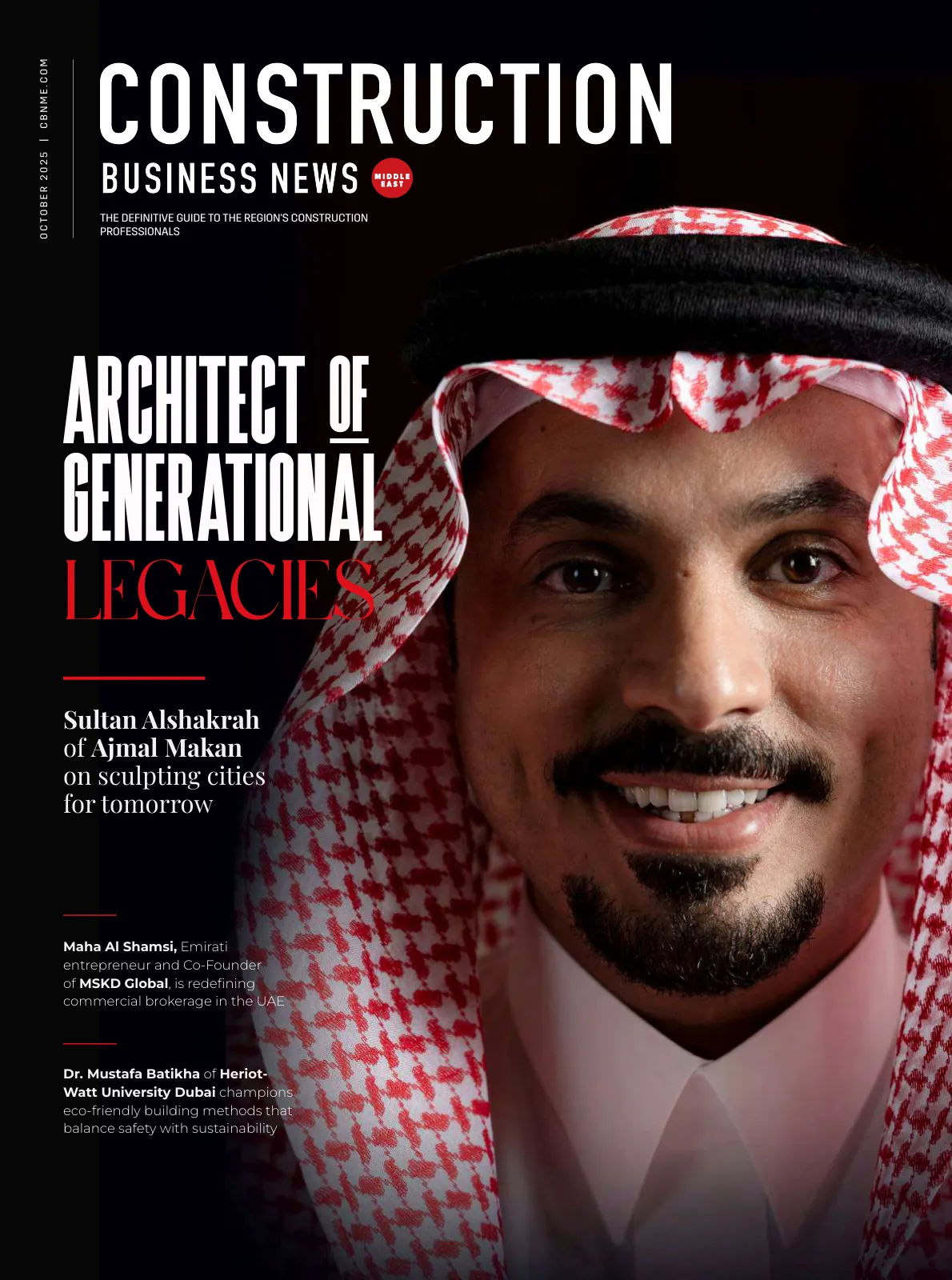
Construction Business News, October 2025
Page 1
THE DEFINITIVE GUIDE TO THE REGION'S CONSTRUCTION
PROFESSIONALS
O C T O B E R 2 0 2 5 | C B N M E . C O M
Sultan Alshakrah
of Ajmal Makan
on sculpting cities
for tomorrow
Maha Al Shamsi, Emirati
entrepreneur and Co-Founder
of MSKD Global, is redefining
commercial brokerage in the UAE
Dr. Mustafa Batikha of Heriot-
Watt University Dubai champions
eco-friendly building methods that
balance safety with sustainability
ARCHITECT OF
GENERATIONAL
LEGACIES
Page 2
ANANTARA SHARJAH RESIDENCES
A NEW CHAPTER OF LUXURY EXPERIENCES
BY THE SEA
Bringing luxury seaside living to Sharjah for the first time, owners at the Anantara Sharjah
Residences enjoy access to the Anantara Sharjah Resort’s world-class amenities, including an
infinity pool, five distinctive restaurants, an Anantara Spa and a state-of-the-art gym.
As an investment, owners can enjoy the benefits of a rental management scheme operated by
Anantara Hotels, Resorts & Spas, allowing them to maximize their returns when they are not
resident in the property.
To register your interest, visit arada.com
LIFE IS A JOURNEY.
Page 3
IN THIS ISSUE CBNME
54
28
18 NEW LAUNCH
SOL LUXE: REDEFINING LUXURY
LIVING AND BUSINESS ON SHEIKH
ZAYED ROAD
20 SUPPLIER
POWERING THE BUILT FUTURE
24 TRENDS
BUILDING TOMORROW’S SAUDI
CITIES
28 COVER STORY
SCAFFOLDS OF TIMELESS WONDER
34 IN CONVERSATION
ARCHITECTURE FOR A CHANGING
WORLD
38 IPO
ALEC HOLDINGS LAUNCHES IPO ON
DUBAI FINANCIAL MARKET
44 AGREEMENT
RUNWAYS REIMAGINED BOLDLY
42 HOSPITALITY
EVOLVING THROUGH GENERATIONS
46 INTERVIEW
PEOPLE FIRST, PROGRESS ALWAYS
50 FM
CREATING SUSTAINABLE, HUMAN-
CENTRED SPACES IN THE DESERT
52 CONTRACTING
INFRASTRUCTURE IN MOTION
54 BROKERAGE
CAPITAL MEETS CONSTRUCTION
58 LAUNCH
BREEZ BY DANUBE REDEFINES
LUXURY LIVING AT DUBAI MARITIME
CITY
60 EXPERT INSIGHT
TRACKS OF TOMORROW
62 TALKING POINT
THE LIVING GRID
60 EXPERT INSIGHT
REWIRED FOUNDATIONS
66 UNSUNG
AUTODESK UNVEILS BOLD AI-
POWERED INDUSTRY CLOUD
INNOVATIONS AT AU 2025
42
WWW.CBNME.COM
CONSTRUCTION BUSINESS NEWS ME | OCTOBER 2025 | 3
Page 4
BUILT FOR MOMENTS
THAT MATTER
EXTRAORDINARY
Escape to a home where urban sophistication
meets resort tranquility.
PRIVATE POOLS | 30+ AMENITIES | PRIME LOCATIONS
800-SAMANA | WWW.SAMANADEVELOPERS.COM
Page 5
DISCOVER REFINED living
*Ranking as per the H2025 1 sales
volume data of property monitor for Dubai
Page 6
Page 7
SUITE TREAT
Step into a world of opulence when you book a Suite at Raffles Doha.
Experience the added luxury of QAR 750 credit to spend
on dining in the hotel, and QAR 500 towards any Spa treatment.
Children aged 12 and below are welcome to indulge in the
enchantment of complimentary dining.
Rates starting from QAR 3,500 per night
For reservations, please call +974 4030 7100
or email reservations.doha@raffles.com
Raffles Doha, Iconic Towers, Marina District, PO BOX 4747, Lusail, Qatar
Page 8
Keep up to date with all the latest
news, features and much more on our
website and social media platforms
CBNME.COM
CBNME
@CBNME
CONSTRUCTION BUSINESS NEWS
MIDDLE EAST
SUBSCRIBE
subscriptions@bncpublishing.net
PO Box 502511 Dubai, United Arab Emirates
P +971 4 4200 506 | F +971 4 4200 196
For all commercial enquiries, contact jo@bncpublishing.net
T +971 50 440 2706
All rights reserved © 2025.
The opinions expressed are solely those of the contributors.
Construction Business News Middle East and its affiliated publications in
the MENA region are exclusively licensed to BNC Publishing.
No part of this magazine may be copied, reproduced, or transmitted in any
form or by any means without prior written consent from the publisher.
Printed by United Printing and Publishing | upp.ae
Images used in Construction Business News Middle East are credited when
necessary. Attributed use of copyrighted images with permission. All images
not credited courtesy Shutterstock.
CEO
Wissam Younane wissam@bncpublishing.net
Managing Director
Rabih Najm rabih@bncpublishing.net
Group Publishing Director
Joaquim D'Costa jo@bncpublishing.net
Editor-in-Chief
Vibha Mehta vibha@bncpublishing.net
Commercial Director
Andrea Mocay andrea@bncpublishing.net
Editorial Assistant
Aya Zhang aya@bncpublishing.net
Digital Reporter
Reeba Asghar reeba@bncpublishing.net
Creative Lead
Christian Harb chriss@bncpublishing.net
Junior Art Director
Rizaldi Febrian
Marketing Executive
Aaron Joshua Sinanbam aj@bncpublishing.net
Videographer
Eduardo Buenagua and Joel Amparo
8 | CONSTRUCTION BUSINESS NEWS ME | OCTOBER 2025
WWW.CBNME.COM
Page 9
Require formwork and scaffolding? Check out Doka’s extensive list of products and systems, which
now includes scaffolding for a variety of applications. At Doka, our philosophy is to provide a broad
range of services under one umbrella based on a growing demand for single-source solutions that
adhere to the highest standards.
One-stop-shop
meaapmarketing@doka.com | www.doka-me.com
/DokaMEA
/company/doka-middle-east-africa
/doka_mea
Page 10
W
e are often told to master discipline,
precision, consistency, and patience.
They are important, yes, but I’ve
learned they are merely frameworks,
not the foundation. What truly anchors
everything I do—the quiet force that
carries me through—is a deep sense of drive.
This drive cannot be taught; it is felt. It rests quietly
inside you when you begin something new, a fire that
refuses to dim even when the hours stretch into the
night. It is what makes me pore over a single line of
text, reshaping words until they breathe. It is what
makes me fight for a design, a story, an idea, even
when reason suggests letting go. It is not always
loud—it can be subtle, like the way you lean in just a
little closer when something truly matters.
I’ve always believed that this inner force defines not
just how we work, but who we are when we show up.
It turns delivery into devotion. It transforms tasks into
legacies. Without it, work feels mechanical; with it,
work takes on a soul—layered with meaning, intent,
and spirit.
But drive alone, though powerful, is only one note.
Its true brilliance emerges when it meets others who
share the same spark. When a team aligns with that
fire, something extraordinary happens. Ideas stop
belonging to individuals and start belonging to the
collective. Suddenly, challenges shrink, mountains
move, and the ordinary becomes remarkable.
I’ve witnessed it—the way long nights dissolve into
laughter, how impossible deadlines give birth to some
of our proudest achievements. When determination
runs through a team like an electric current, you don’t
just deliver—you create. You don’t just reach goals—
you expand horizons.
So here’s what I believe: energy is not a luxury, it is a
necessity. It is the golden thread weaving everything
we do, binding individuals into constellations, and
reminding us that the best work is not measured by
numbers or timelines, but by the heart we leave inside
it. And when a team shares that heart, the universe no
longer feels out of reach.
Vibha Mehta
Editor-in-Chief
vibha@bncpublishing.net
Vibha Mehta
vibhamehta01
@vibhamehta01
The Currency
of Passion
CBNME
LETTER FROM THE EDITOR
Page 11
Das gute Licht.
Protecting
the night sky
BEGA pole-top luminaires with BugSaver® technology
protect nocturnal fauna by reducing the color temperature
from 3000 Kelvin to an amber color around 1800 Kelvin,
which reduces the light attractive effect. The color
temperature and output can be controlled dynamically.
bega.com/bugsaver
Page 12
Go big or go small
with the HP DesignJet
T950 plotter series
Page 13
Scan to
learn more
Most Efficient
Save time with the most efficient A4-A0 experience.
2 Seamlessly print A4 jobs with integrated input
and output trays, keeping pages sorted by size.
The flat 40-page stacker makes collection easy,
while fast print speeds keep projects moving.
Connected
Work securely from virtually anywhere. You can
save time by printing in fewer steps with HP Click.
Protect your printer and data from cyberthreats
with HP Wolf Pro Security. Manage your device
and print remotely with HP app.
Go Beyond
Go beyond and advance your environmental goals
with a printer made with recycled plastics and
recyclable supplies. This robust, compact plotter
is designed to last while also helping to reduce
energy and ink waste.
Page 14
B
NW Developments, a leading UAE-based real
estate company, has signed an agreement with
Wyndham Hotels & Resorts, the world’s largest
hotel franchising company, to launch Ramada
Residences by Wyndham in Dubai’s vibrant Al
Jaddaf district.
Located just five minutes from Jaddaf Waterfront, the
project will offer 108 thoughtfully designed one- and two-
bedroom apartments complemented by curated lifestyle
amenities, including a Zen Garden, residents’ lounge, open-
air theatre, spa, gym, children’s play area, and
concierge services. Each residence will feature
modern, state-of-the-art fixtures and furnishings,
blending style with comfort.
Ankur Aggarwal, Founder and Chairman, BNW
Developments, said: “Partnering with Wyndham
Hotels & Resorts enables us to bring world-
class hospitality standards into our residential
offerings, creating homes that are not only
beautifully designed and strategically located,
but also professionally managed and globally
recognized. Ramada Residences by Wyndham
aligns with the UAE’s vision for lifestyle-led,
sustainable urban growth, while offering
investors strong long-term value and access to
high-demand, fast-growing location.”
Vivek Oberoi, Co-Founder and Managing
Director of BNW Developments,
commented: “Rooted in BNW’s local
insight and elevated by Wyndham’s global
hospitality legacy, the project’s design
structure embraces clean, modern lines,
striking a balance between residential
serenity and urban sophistication. Set
within one of Dubai’s fastest-growing
districts, Ramada Residences by Wyndham
not only offers aesthetic appeal but
also strong investment potential, driven
by increasing demand for well-located,
branded lifestyle residences.”
Dimitris Manikis, President EMEA,
Wyndham Hotels & Resorts, added: “Across
the Middle East, branded residences are
becoming a powerful growth engine for
hospitality. Our collaboration with BNW Developments
highlights how global hotel brands can bring trust,
consistency, and visibility to residential communities. With
Ramada Residences by Wyndham, we are reinforcing our
midscale presence in Dubai while delivering long-term
value for residents and developers alike,
Ramada Residences by Wyndham is scheduled for handover
in Q3 2026. The property will also incorporate sustainable
features like EV charging stations, reflecting a commitment
to environmental responsibility.
BNW DEVELOPMENTS & WYNDHAM INK DEAL FOR RAMADA RESIDENCES
BY WYNDHAM
BNW Developments has signed an agreement with Wyndham Hotels & Resorts
to bring Ramada Residences by Wyndham to Dubai’s thriving Al Jaddaf district
CBNME
REGIONAL NEWS
Ramada Residences by Wyndham is
scheduled for handover in Q3 2026
The project
will offer 108
thoughtfully
designed
one- and
two-bedroom
apartments
complemented
by curated
lifestyle amenities
14 | CONSTRUCTION BUSINESS NEWS ME | OCTOBER 2025
WWW.CBNME.COM
Page 15
O
RA Developers Group
continues its global
expansion with the
launch of two landmark
projects in the UAE and Iraq.
Bayn, a coastal community
between Abu Dhabi and
Dubai, and Madinat Al Ward, a
large-scale residential city in
Baghdad’s Al Nahrawan district,
mark a significant step in ORA’s
regional growth.
With a combined first-phase
investment of over USD 16
billion, the developments reflect
ORA’s long-term commitment
to creating culturally relevant,
design-led, and sustainable
communities in high-growth
markets.
Bayn: Shaping the future of
coastal living in the UAE
Bayn, in Ghantoot - the key corridor
between Abu Dhabi and Dubai—is
set to become a vibrant coastal
community blending urban growth
with nature. Spanning 4.8 million
sqm and 7 km of waterfront, over 55%
of the development is dedicated to
open spaces, waterways, and leisure,
including a marina, lagoon, and 1.2 km
beachfront. Featuring a 100,000 sqm
sports club and holistic amenities,
Bayn sets a new standard for healthy
living while preserving Ghantoot’s
pristine coastline. This coastal
community builds on ORA’s experience
in Egypt, Cyprus, and Grenada.
“With Bayn, our aim is to develop
a destination that anticipates the
future needs of a thriving coastal
community within a strategically
important location,” stated Eng.
Naguib Sawiris, Chairman and CEO of
ORA Developers. “Ghantoot presents
a unique opportunity to create a
distinctive coastal community that
not only offers an exceptional lifestyle
but also contributes to the broader
development and appeal of the region.
We anticipate this project will attract
residents and stimulate economic and
social growth”, he further added.
Madinat Al Ward: A new urban
model for Iraq
The groundbreaking of Madinat Al Ward
in Baghdad marks a key milestone in
Iraq’s housing agenda. Spanning 62
million sqm, this visionary city—named
after scholar Ali Al-Wardi—will deliver
approximately 120,000 homes over
24 years, creating a self-sustaining
community.
Phase 1, with an investment of around
USD 10 billion, is expected to be
complete in eight years. A highlight is a
5 million sqm public park, underscoring
ORA’s commitment to green, livable
spaces that promote wellbeing and
environmental care.
“Madinat Al Ward is a testament to
the power of visionary public-private
partnerships,” said Ibrahim Karam,
CEO of ORA Iraq. “This project goes
beyond providing housing as it lays
the foundation for a new urban center
one that prioritizes quality of life and
sustainable growth. We believe this
development will serve as a model for
future urban expansion in Iraq and the
wider region.”
Commitment to technology,
sustainability, and well-being
Bayn and Madinat Al Ward showcase
ORA’s focus on smart digital
infrastructure, sustainable solutions,
and ample green spaces. Bayn’s
advanced systems enhance community
life, while both projects promote
environmental care and healthy living.
ORA invites stakeholders and residents
to imagine transformative communities
setting new Middle East urban
standards.
ORA Developers Group is accelerating its international expansion with two
major projects in the Middle East
ORA DEVELOPERS EXPANDS GLOBALLY WITH LANDMARK PROJECTS IN UAE
AND IRAQ
REGIONAL NEWS
WWW.CBNME.COM
CONSTRUCTION BUSINESS NEWS ME | OCTOBER 2025 | 15
Page 16
ACCIONA ACHIEVES PCOD FOR THREE MAJOR SEWAGE TREATMENT PLANTS
IN SAUDI ARABIA
A
CCIONA, together with its partners Tawzea and
Tamasuk, has successfully reached Project
Commercial Operation Date (PCOD) for three
large-scale sewage treatment plants in Saudi
Arabia: Madinah-3, Buraydah-2 and Tabuk-2. This
milestone marks the completion of construction works and
the official handover to the client, confirming that all systems
are operational and ready for service.
With PCOD issued for all three plants, the facilities have
formally entered commercial operation and are now fully
managed by the Operations & Maintenance (O&M) consortium
formed by ACCIONA, Tawzea and Tamasuk.
This achievement follows the successful financial close in
2022, when ACCIONA’s water business secured its first green
loan to support the development of the three projects under
Saudi Arabia’s public-private partnership (PPP) model.
The three plants will collectively treat 440,000 cubic meters
of wastewater per day, significantly boosting water reuse in
the Kingdom: Madinah-3 will serve up to 1.5 million people in
the greater Madinah area and it will have an initial treatment
capacity of 200,000 m³/day. Buraydah-2 will serve around
600,000 inhabitants, including the nearby town of Ash
Shimasiya, with a capacity of 150,000 m³/day. Tabuk-2,
complementing the existing Tabuk-1 ISTP, will serve up to
350,000 people, with a treatment capacity of 90,000 m³/day.
SAVING RESOURCES
The treated water from these plants will be reused primarily
for agricultural purposes, reducing pressure on scarce
freshwater resources. Expected daily water savings amount to
190,000 m³/day at Madinah-3; 142,500 m³/day at Buraydah-2
and 85,500 m³/day at Tabuk-2.
In total, approximately 95% of the treated water will be
allocated to agriculture, while the remaining 5% will be reused
at the plant itself
This initiative is aligned with Saudi Arabia’s Vision 2030
and its strategic objectives to enhance water sustainability,
increase resource efficiency, and expand public-private
partnerships across critical infrastructure sectors.
ACCIONA and its partners Tawzea and Tamasuk have achieved commercial
operations for three strategic sewage treatment plants
CBNME
REGIONAL NEWS
16 | CONSTRUCTION BUSINESS NEWS ME | OCTOBER 2025
WWW.CBNME.COM
Page 17
I
n a standout moment for Dubai’s prime property market,
Dubai Sotheby’s International Realty has closed the most
expensive secondary villa sale on Palm Jumeirah this year,
for the total price of AED 161 million. This was also the
second-highest sale on a per square foot basis this year, at
AED 14,679.39 per sq ft.
The Signature Villa, developed by acclaimed property
developer 25 Degrees, masterfully blends contemporary
architecture and refined interior detailing. The residence
is set across a built-up area of 10,900 sq ft, and comprises
multiple living spaces, six expansive bedroom suites, a
private cinema, and a rear pool deck with a direct view of the
Atlantis the Royal Resort & Residences.
The sale was exclusively managed by Dubai Sotheby’s
International Realty, with Leigh Borg, Executive Partner,
representing the seller, and Filippo Tavernaro, Senior Global
Property Consultant, acting on behalf of the buyer.
“This was a rare and exclusive listing that stood out even in a
highly competitive market,” said Leigh Borg. “Every aspect of
the property was executed at the highest level, and with the
caliber of clients that Palm Jumeirah attracts, homes like this
don’t stay on the market for very long.”
“Transactions like this are made possible thanks to the
strength of the network and the global platform we have,”
said Filippo Tavernaro. “It is also a testament to the quality
of the homes available. The price tag is no bar for buyers
when the property ticks all the boxes.”
Dubai’s real estate market has maintained its strong
momentum in 2025 with landmark sales closed in key
neighborhood’s, the majority of which were executed
by Dubai Sotheby’s International Realty. This includes a
Jumeirah Bay Island villa that remains the most expensive
home sold this year, as well as notable transactions in
Emirates Hills and Dubai Hills Estate. Most recently, Leigh
Borg closed the sale of this year’s most expensive residential
plot, also located on Palm Jumeirah.
Chris Whitehead, Managing Partner at Dubai Sotheby’s
International Realty, added: “With every landmark
transaction, we reinforce our position as the foremost
authority in Dubai’s super-prime property market. This
marks our second record-breaking sale on Palm Jumeirah in
recent months. To me, this underlines not only the prestige
of the location but also the strength of demand at the very
top of the market, setting the tone for a powerful close to
2025.”
David von Rosen, Co-founder of 25 Degrees, added: “This
sale is a clear sign of the strength and maturity of Dubai’s
top-end property market, driven by a continued influx of
high-net-worth individuals looking to capitalize on the
Emirates’ world-leading luxury lifestyle opportunities.”
This is the second record-breaking sale of a villa developed
by 25 Degrees, following its AED 62 million sale of a
renovated Garden Home villa in 2024, which set a new
benchmark for this class of property on Palm Jumeirah.
The firm purchased a 90,000 square foot plot of
undeveloped land on Palm Jumeirah in June 2025 for AED
365 million and has partnered with award-winning architect
Killa Design to develop a series of prime, custom-built
properties on the land.
DUBAI SOTHEBY’S INTERNATIONAL REALTY CLOSES RECORD AED 161M PALM
JUMEIRAH VILLA SALE
Dubai Sotheby’s International Realty has closed the most expensive secondary
villa sale on Palm Jumeirah this year, at a total price of AED 161 million
REGIONAL NEWS
WWW.CBNME.COM
CONSTRUCTION BUSINESS NEWS ME | OCTOBER 2025 | 17
Page 18
CBNME
NEW LAUNCH
Launching in October 2025, this 70-storey
development is set to become a new landmark of
luxury, connectivity, and legacy on Dubai’s most
celebrated boulevard.
SOL
LUXE:
Redefining
Luxury Living
and Business
on Sheikh
Zayed Road
SOL LUXE stands
as a testament to
architectural ambition
and investment
opportunity
18 | CONSTRUCTION BUSINESS NEWS ME | OCTOBER 2025
WWW.CBNME.COM
Page 19
SOL LUXE: REDEFINING LUXURY LIVING AND BUSINESS ON SHEIKH ZAYED ROAD
D
ubai has long been a city of vision, where bold ideas
transform into iconic landmarks. Now, a new chapter is
unfolding on Sheikh Zayed Road — the city’s original
lifeline and most prestigious boulevard — with the
upcoming launch of SOL LUXE, a 70-storey architectural
marvel by SOL Properties.
Positioned on the last freehold plot along Sheikh Zayed Road,
SOL LUXE is more than a development; it is a declaration.
Conceived as a mixed-use tower of residences, Grade A offices,
and curated retail, it embodies a rare convergence of luxury,
connectivity, and legacy in the very centre of Dubai.
An Icon in Bronze and Glass
Designed with contemporary minimalism and inspired by
timeless zen principles, SOL LUXE is envisioned as both an icon
and a sanctuary. Its striking bronze-wrapped horizontal bands
and floor-to-ceiling glass façade create a sense of rhythm and
elegance that resonates across Dubai’s skyline. At night, the
tower glows like a sculptural beacon, reflecting the dynamism
of the city it rises from.
From the inside, materials such as travertine, Armani Grey
marble, smoked oak, and bronze metal bring warmth and
refinement. With 3.7 meter ceiling heights, the residences are
flooded with natural light and framed by unrivalled views of
Burj Khalifa, Burj Al Arab, the Arabian Gulf, and Downtown
Dubai.
A Lifestyle Elevated
SOL LUXE is distinguished by its world-class residential
amenities:
•
The only rooftop infinity pool on Sheikh Zayed Road,
complete with jacuzzi and children’s pool, directly facing
the Burj Khalifa.
•
Rooftop yoga terraces and wellness decks designed for
serenity.
•
Elevated mini golf against the dramatic city skyline.
•
Indoor and outdoor children’s play areas.
•
Multipurpose event spaces with terraces for private
gatherings.
•
Barbecue pavilions and outdoor lounges with panoramic
city views.
•
Steam and sauna suites for restorative relaxation.
This is a community designed not just for living, but for
thriving in luxury.
A Headquarters for Visionaries
SOL LUXE also introduces a new standard for Grade A office
spaces in Dubai. Tailored for the Big Four consultancies,
international law firms, and global corporations, the
commercial component combines prestige with performance.
Exclusive business amenities include:
•
Executive meeting suites with commanding Burj Khalifa
views.
•
A state-of-the-art gym overlooking Burj Al Arab.
•
A signature indoor–outdoor event space with the Burj
Khalifa as a backdrop.
•
Elegant social lounges and collaborative breakout zones.
•
Expansive 3.7-meter ceiling heights with floor-to-ceiling
glass façades, offering uninterrupted 360-degree
panoramas of Dubai’s skyline
Crucially, SOL LUXE offers unmatched connectivity: just one
minute from the Metro station, and within minutes of DIFC,
Dubai Mall, and Business Bay. For professionals, it is not simply
an office — it is a headquarters of influence.
Retail at the Crossroads of the City
At the base of the tower, retail spaces are designed for flagship
luxury brands, signature dining, and curated lifestyle concepts.
With three-sided visibility on a prime corner plot and 9-meter-
high frontages, this retail hub promises prestige and exposure
in equal measure.
An Investor’s Opportunity
Beyond its design and lifestyle appeal, SOL LUXE presents
compelling returns for investors. With projected 8–9% ROI in a
Grade AAA location, proximity to leading schools such as GEMS
Wellington and healthcare institutions like Burjeel Hospital,
the project is positioned to attract long-term residents,
professionals, and global investors alike.
A New Landmark for Sheikh Zayed Road
Sheikh Zayed Road has always been more than just a highway
— it is the backbone of Dubai’s transformation. With SOL
LUXE, that story continues. Launching in September 2025, this
70-storey development is set to become a new landmark of
luxury, connectivity, and legacy on Dubai’s most celebrated
boulevard.
As one of the best developer in Dubai , SOL Properties
continues to set a benchmark in luxury, wellness and mixed
use with Grade A commercial spaces that define the future
of luxury and modern living. Our recently launched landmark
projects like Branded Residences Fairmont Residences Solara
Tower Downtown Dubai, SOL LEVANTE JVT and SOL LUXE our
commitment to delivering trust, quality and long term value
remains credible and reliable.
SOL LUXE — Live. Work. Thrive.
Residents and
tenants will
enjoy a wide
array of lifestyle
and wellness
amenities
WWW.CBNME.COM
CONSTRUCTION BUSINESS NEWS ME | OCTOBER 2025 | 19
Page 20
CBNME
SUPPLIER
I
n a region defined by rapid urban
growth and visionary megaprojects,
Henkel Construction business
stands at the crossroads of
technology and sustainability.
With a footprint stretching across
India, the Middle East, and Africa,
the company continues to set new
benchmarks in construction chemicals,
waterproofing solutions, and energy-
efficient innovations. At the helm of its
marketing strategy is Julia Al Jenabi,
who shares how Henkel is shaping
the future of the built environment
through purpose-driven innovation
and a commitment to lasting
performance.
What key construction trends are
shaping the industry across India,
the Middle East, and Africa?
The construction landscape across
India, the Middle East, and Africa is
undergoing a dynamic transformation,
driven by demographic shifts,
urbanisation, and ambitious national
Julia Al-Jenabi, Head of Marketing
& Specification Management IMEA
at Henkel Polybit, discusses how
innovation, technology, and sustainability
are redefining construction — and how
Henkel is leading this transformation from
foundation to finish
Powering the
Built Future
Julia Al-Jenabi,
Head of Marketing
& Specification
Management IMEA
at Henkel Polybit
20 | CONSTRUCTION BUSINESS NEWS ME | OCTOBER 2025
WWW.CBNME.COM
Page 21
POWERING THE BUILT FUTURE
development agendas. In the GCC,
particularly the United Arab Emirates
and Saudi Arabia, we’re witnessing a
surge in investment across residential,
commercial, recreational, and
infrastructure sectors — propelled by
iconic megaprojects that aim to redefine
urban living and mobility.
Henkel has been at the forefront of
this evolution, providing advanced
waterproofing and construction
chemical solutions that ensure long-
term durability and performance. Our
involvement in landmark projects
such as Etihad Rail, Dubai Metro, and
key developments within Qiddiya and
Diriyah reflects our commitment to
safeguarding critical infrastructure for
future generations.
Another significant trend is the
acceleration of construction timelines
through smarter, more efficient building
methodologies. Modular construction
and 3D printing are gaining traction,
particularly in the Gulf states, as part
of a broader push toward automation
and industrialised construction. These
innovations open new avenues for
collaboration, where Henkel’s technical
expertise and high-performance
solutions play a pivotal role in enabling
speed without compromising quality.
Sustainability is also becoming a
central focus. Clients, consultants,
and contractors are increasingly
prioritising data-driven approaches
to reduce the environmental footprint
of buildings. This includes scrutinising
the emission profiles of core materials
and seeking solutions that contribute
to greener, more resilient structures.
Henkel is actively supporting this
shift with technologies that align with
evolving regulatory frameworks and
sustainability goals.
How is Henkel leveraging technology
and innovation to stay ahead in the
construction sector?
Technology and innovation are central
pillars of Henkel’s strategy, serving
as key differentiators in our global
construction solutions portfolio. Our
approach is deeply rooted in customer
centricity — we work closely with
stakeholders across the entire project
lifecycle to continuously validate
market needs and translate them into
targeted innovations.
Our regional waterproofing competence
centre, equipped with a state-of-the-
art laboratory, plays a critical role in this
process. It enables us to rigorously test,
develop, and launch high-performance
materials tailored to both regional and
global requirements. This facility not
only reinforces our technical leadership
but also ensures that our solutions
deliver long-lasting protection and
reliability under the most demanding
conditions.
In response to evolving industry
demands, we’ve expanded our portfolio
with specialised products for the oil and
gas sector, engineered to meet stringent
performance and safety standards.
Additionally, we’ve introduced a
fully HDPE-based substructural
waterproofing system designed for
complex multi-basement projects
and high water table environments
— a testament to our commitment to
technical excellence and adaptability.
Continuing our legacy as pioneers
in roof waterproofing and thermal
insulation, we’ve also enhanced our
Combo Roofing System with the
launch of Combo Roof Plus. This
next-generation solution integrates
sustainability and reliability, aligning
with the region’s growing emphasis on
energy efficiency and green building
practices.
Henkel remains committed to driving
innovation that not only meets today’s
challenges but also anticipates the
needs of tomorrow’s construction
landscape.
What role does sustainability play in
your regional marketing and product
strategies?
Sustainability is a core driver of Henkel’s
regional strategy, fully aligned with
our framework, which is built around
the pillars of climate, circularity, and
WWW.CBNME.COM
CONSTRUCTION BUSINESS NEWS ME | OCTOBER 2025 | 21
Page 22
safety. Our goal is to create tangible value for
our customers and partners by embedding
sustainable practices throughout our
operations, product development, and data
transparency.
All our regional manufacturing facilities
operate on 100% renewable electricity, and
we continue to reduce CO₂ emissions through
heat exchange initiatives and process
optimisation. Waste reduction is another
critical focus area, where we are advancing
circular process design to enable material
reuse within our product formulations.
In 2025 alone, we published over 30
Environmental Product Declarations
(EPDs) — a significant step toward elevating
sustainability data transparency in the
construction chemicals sector. These
declarations empower stakeholders to
make informed decisions based on verified
environmental performance.
Our product portfolio also includes more
than 40 low-VOC construction chemicals
across various technologies. These solutions
offer multiple benefits: improved indoor air
quality, enhanced worker safety, reduced
environmental impact, compliance with
green building standards, and stronger
market positioning for eco-conscious
developments. Significantly, they also
contribute to long-term material
performance, reinforcing Henkel’s
commitment to sustainable innovation
without compromising technical
excellence.
Sustainability is not just a responsibility
— it’s a strategic enabler that shapes
how we innovate, collaborate, and grow
in the region.
What are the biggest challenges you
see in driving growth across such
diverse markets?
Each market within the IMEA region
presents unique opportunities
and challenges, shaped by varying
regulatory environments, construction
practices, and customer expectations.
One of the most pressing hurdles is
meeting the scale and pace of demand
in high-growth markets like Saudi Arabia,
where the sheer volume of ongoing and
planned projects requires agile, scalable
solutions and robust operational support.
The construction sector is inherently price-
sensitive, which makes value selling a critical
success factor. At Henkel, we differentiate
ourselves through technical expertise,
solution-oriented engagement, and a strong
emphasis on the crucial role of waterproofing
in ensuring structural integrity and long-
term performance. Our ability to deliver not
only products but complete systems backed
by technical support gives us a competitive
edge.
Supply chain resilience is another key
enabler of sustainable growth. Ensuring
consistent material availability, responsive
after-sales service, and hands-on technical
training — including site supervision — is
essential to building trust and turning
customers into long-term partners. These
elements are especially vital in markets
where construction timelines are tight and
expectations for quality and reliability are
high.
CBNME
SUPPLIER
22 | CONSTRUCTION BUSINESS NEWS ME | OCTOBER 2025
WWW.CBNME.COM
Page 23
Navigating this
diversity requires a
deep understanding
of local market
dynamics, a flexible
go-to-market strategy,
and a commitment
to continuous
improvement — all of
which are embedded
in Henkel’s regional
approach.
What is your outlook
for the future of
construction in the
region over the next
five years?
The outlook for
construction across the
GCC and broader IMEA
region is promising.
Continued population
growth, coupled with ambitious national development
plans, will drive sustained demand across all segments
— particularly in the UAE and Saudi Arabia. From core
infrastructure such as roads, bridges, rail, and airports to
water and oil & gas-related developments, Saudi
Arabia is poised to lead the region in terms of
both scale and investment value.
We anticipate a significant acceleration
in the adoption of advanced construction
methodologies, as regional players aim to set
global benchmarks in efficiency, automation,
and innovation. Technologies such as modular
construction and 3D printing will transform the
way projects are executed and delivered.
Sustainability, once considered a differentiator,
will become a baseline requirement, from
sourcing sustainable raw materials to providing
transparent data on the environmental impact
of construction chemicals, and optimising the
energy efficiency of final structures. Regulatory
frameworks and client expectations will continue
to evolve, making sustainability a non-negotiable
element of doing business.
Ultimately, companies that keep customer
needs at the centre and those that innovate with
purpose will be best positioned to capture long-
term value. Henkel is committed to leading this
transformation — combining technical excellence,
sustainability, and deep market understanding to
shape the future of construction in the region.
POWERING THE BUILT FUTURE
WWW.CBNME.COM
CONSTRUCTION BUSINESS NEWS ME | OCTOBER 2025 | 23
Page 24
TRENDS
Sean Heckford, Director of Built Asset Consulting at Cavendish Maxwell,
unpacks the trends driving new housing designs, sustainability standards,
and market dynamics shaping the Kingdom’s urban future.
Building Tomorrow’s
SaudiCities
CBNME
24 | CONSTRUCTION BUSINESS NEWS ME | OCTOBER 2025
WWW.CBNME.COM
Page 25
BUILDING TOMORROW’S SAUDI CITIES
A
Market on
the Cusp of
Transformation
With Saudi Arabia
set to implement
a landmark foreign ownership
law in January 2026, the
country’s real estate sector
stands at the threshold of
significant transformation. For
decades, access to property
markets was primarily reserved
for Saudi nationals, but this new
legislation promises to open the
gates to a broader demographic,
unlocking demand from expat
end-users and international
investors, particularly in key
urban centres.
According to Cavendish
Maxwell’s latest insight, the
impact is already taking shape.
In the first half of this year
alone, Riyadh recorded 35,600
real estate transactions, a
10% increase year-on-year,
while Jeddah saw 15,200
sales, marking a 25% rise. The
sharpest short-term response
is expected in Riyadh, thanks
to its strong white-collar base,
the ongoing development of
giga projects, and the steady
influx of Regional Headquarters.
Targeted waterfront zones in
Jeddah are also poised for high
interest.
New Entrants, New Structures,
New Pricing
The law is likely to disrupt
market structure and
competition in multiple ways.
International developers and
asset managers are expected
to enter the scene, often
partnering with local players,
especially for large-scale
mixed-use schemes and
branded residential offerings.
As zoning regulations and
investor rights are clarified,
both mortgage and REIT
markets are expected to
deepen.
Crucially, the government is
establishing policy guardrails
to maintain market stability.
Measures such as zoning
caps, project timelines, and
minimum capital requirements
for commercial ventures
are designed to discourage
speculation while supporting
affordability goals.
This could lead to a two-
tier pricing structure: one in
foreign-accessible zones with
a premium, and another in
traditionally restricted areas
where pricing may remain
stable. Already, monetary policy
appears to be working in favour
of this transition. The Saudi
Central Bank recently cut its
key rates by 25 basis points,
with the Repo rate now at 4.75%
and the Reverse Repo at 4.25%,
aligning with global monetary
easing trends. Cavendish
Maxwell forecasts further easing
through to 2026, potentially
lowering rates to around 4.35%,
enhancing financing conditions
just as the new law takes effect.
Diriyah — where heritage
meets modern sustainability
WWW.CBNME.COM
CONSTRUCTION BUSINESS NEWS ME | OCTOBER 2025 | 25
Page 26
In tandem, Crown Prince Mohammed
bin Salman has introduced a five-
year rent freeze in Riyadh for both
residential and commercial properties.
This stabilisation measure is aimed at
protecting tenants during this period of
real estate liberalisation, and could be
extended to other cities in due course.
Sustainability and ESG in Saudi
Housing: From Policy to Practice
Amidst the policy shifts, sustainability
and ESG (Environmental, Social,
Governance) compliance are also
becoming central to the country’s
housing development agenda. Codes
are no longer aspirational; they’re
mandatory and enforceable.
The Saudi Green Building Code
(SBC 1001, 2024) is now in full effect,
working in conjunction with the energy
codes (SBC 601/602) to embed green
practices into all new developments.
The Saudi Energy Efficiency Centre
(SEEC) has issued binding guidance on
residential energy
performance,
covering
insulation,
lighting, HVAC,
and hot water
systems. It
now requires
an Energy
Consumption
Intensity
certificate for
every listed
property,
enhancing
transparency for
both buyers and
renters.
Thermal
insulation is
mandated for new
builds, supported
by technical
documentation
embedded in the
Saudi Building
Code.
At the project
level, major
developments
such as NEOM and THE LINE are setting
a precedent. These giga-projects are
designed as 100% renewable, low-
carbon cities, and this ethos cascades
down into their sub-districts through
district cooling, sustainable transport-
first plans, and greywater reuse.
Elsewhere, MoMRAH is advancing
green certifications such as Ajwad,
while initiatives like Green Suburbs
are starting to appear in new housing
launches and municipal planning KPIs.
Developers like ROSHN are already
earning top-tier certifications, including
Mostadam Diamond, for sustainable
project delivery.
Commercial relevance is equally
important. Access to global
capital, including green loans and
sustainability-linked bonds, is
increasingly dependent on ESG
alignment. Cavendish Maxwell has
observed how Saudi Arabia’s urban
programmes are aligning with these
sustainable finance frameworks,
offering compliant developers a distinct
advantage in cost of capital.
Vision 2030: The Engine Behind
Strategic Housing Delivery
Saudi Arabia’s Vision 2030 continues
to define the direction of the residential
market. With a target of 70% Saudi
homeownership by 2030, state-linked
organisations such as the National
Housing Company, ROSHN, and a
host of private partnerships are
spearheading the delivery.
The Housing Programme reported a 64%
homeownership rate by the end of 2023,
with platforms like Etmam, a one-stop
home ownership solution, and Sakani,
which focuses on affordable housing,
streamlining the process for Saudi
nationals.
Developers are aligning their strategies
accordingly. Large-scale, amenity-rich,
master-planned communities are now
the norm. With ROSHN’s multi-city
pipeline, price points are calibrated to
cater to the mid-market, in line with
national housing goals. Phased delivery
is also tied closely to infrastructure
deployment.
Riyadh’s major pipeline projects, such
as Diriyah, New Murabba, and Sedra,
alongside upcoming Jeddah projects
like Jeddah Central and ROSHN Al
Arous, are set to shape housing supply
through 2030.
Financing innovation is also on the
rise, with subsidised mortgages, off-
plan safeguards, and industrialised
construction techniques reducing
delivery timelines while meeting
performance standards required by
updated building codes.
The Smart City Revolution and the
Role of PropTech
Vision 2030 is not just about housing,
it’s about smart urbanism. Pioneering
developments like THE LINE are serving
as templates for what Saudi Arabia
refers to as “cognitive communities,”
where 90% of real-time data is analysed
to optimise every layer of urban life.
This model is already influencing
CBNME
TRENDS
Sean Heckford,
Director, Built Asset
Consulting, Cavendish
Maxwell
26 | CONSTRUCTION BUSINESS NEWS ME | OCTOBER 2025
WWW.CBNME.COM
Page 27
infrastructure, utilities, and residential design in other districts
across the Kingdom.
PropTech is playing a crucial enabling role. Digitised property
platforms and registries, such as the Ministry of Justice’s Real
Estate Registry, the Ejar tenancy system, and Sakani, provide
robust data for transaction tracking, compliance, and valuation,
forming the digital backbone of the real estate sector.
Cavendish Maxwell leverages these data feeds, alongside
Paseetah, GASTAT, and MEED Projects, to produce its
triangulated research and analysis. This includes supply
forecasts, pricing indices, and sub-market analytics, all
benchmarked against GCC markets, such as Dubai, and aligned
with broader macroeconomic indicators, including interest
rates, inflation, and GDP projections.
Meanwhile, venture capital is flowing freely into the space.
In fact, Saudi VC investment rose by 116% year-over-year,
reaching $860 million in H1 2025, with a significant portion
aimed at PropTech ventures spanning AI, IoT, mortgage
journeys, facilities management technology, and smart home
systems.
The Next Disruptor: Making Use of What’s Already Built
While technologies like AI and smart homes will continue
to gain traction, Cavendish Maxwell sees another disruptor
emerging: the repurposing of underutilised or distressed real
estate assets.
With Saudi cities evolving rapidly, many prime-located but
underutilised properties can be repositioned to meet demand
from expatriates seeking short-term housing or younger Saudi
professionals needing affordable, centrally located homes.
This trend may quietly reshape the urban
landscape more profoundly than any single
tech innovation.
Demographics Are Driving Design
Saudi Arabia’s demographics are a major force
behind the evolution of residential products.
Expats now account for nearly 45% of the
population, the highest share since 2017, and
both Riyadh and Jeddah together hold over a
third of the country’s total residents.
GASTAT’s 2024 estimate puts the total
population at 35.3 million, with the growth
skewed towards working-age cohorts. By the
end of 2025, the figure is expected to surpass 36
million, fuelling sustained demand in key cities.
Developers are responding by designing for
younger, dual-income, and mobile households.
Mid-market apartments with shared amenities,
such as co-working areas, daycare, wellness
spaces, and walkable retail, are increasingly
common, particularly along transit-served
corridors.
At the same time, there’s a renewed emphasis on community-
focused villas and townhouses that accommodate multi-
generational Saudi households, while integrating ESG features
like solar panels, shaded walkways, and district cooling
systems.
Serviced and branded residences are also on the rise, catering
to expat executives and relocated RHQ staff, a direct result
of eased residency and corporate migration policies. Finally,
affordable housing is gaining traction, with more supply
entering the segment of attainably priced housing.
Looking Ahead: Cavendish Maxwell’s Strategic Growth
Priorities
As Saudi Arabia’s transformation accelerates, Cavendish
Maxwell is expanding its footprint in the Kingdom and
deepening its advisory services to meet the evolving needs of
its clients.
Over the next three to five years, key priorities include:
•
ESG and code compliance advisory, particularly in support
of green finance, retrofitting, and sustainable energy
frameworks.
•
Foreign ownership readiness packs for global developers
and institutional investors preparing for the 2026 law.
•
Digital portfolio management tools that provide real-time
insights on project delivery timelines, risks, cost plans, and
progress tracking.
As Saudi Arabia reshapes its cities and housing markets,
Cavendish Maxwell remains focused on delivering data-driven
insight and future-proofed strategies for all stakeholders.
BUILDING TOMORROW’S SAUDI CITIES
The Mukaab at New Murabba
WWW.CBNME.COM
CONSTRUCTION BUSINESS NEWS ME | OCTOBER 2025 | 27
Page 28
28 | CONSTRUCTION BUSINESS NEWS ME | OCTOBER 2025
WWW.CBNME.COM
Page 29
Sultan Alshakrah emerges as
the master architect of enduring
cities, weaving legacies of vision
and grandeur that are destined to
flourish across generations.
/ Words by: Vibha Mehta
/ Photography: Joel Amparo
Scaffolds
of Timeless
Wonder
F
rom the glistening
shores of Sharjah
to the evolving
skylines of Saudi
Arabia, Sultan Bin
Abdullah Alshakrah
has never pursued
speed for its own
sake. As Chairman
of Ajmal Makan
and CEO of Tanmiyat Al Riyadh, he
views development not as a race, but
as a responsibility. For him, cities
are not fleeting spectacles of glass
and steel, but legacies of stone and
spirit — places where ambition is
tempered by patience, where luxury
intertwines with community, and
where progress is measured as
much by human experience as by
economic gain.
Sultan emphasises building with
conscience: creating waterfront
sanctuaries that honour fragile
ecosystems, developing urban
environments interwoven with
cultural heritage, and designing
skylines that rise with permanence
rather than haste. His vision is
one of balance, where innovation
complements tradition, modernity
is softened by heritage, and the
enduring rhythm of nature guides
growth.
In this exclusive interview with
Construction Business News
Middle East, Sultan shares not
only a roadmap for Gulf cities but
a philosophy of endurance — to
create places that thrive today,
resonate tomorrow, and endure for
generations to come.
WWW.CBNME.COM
CONSTRUCTION BUSINESS NEWS ME | OCTOBER 2025| 29
Page 30
Geography Guides Vision
Sultan Alshakrah believes every
place has its own rhythm. In
Sharjah, where coastlines carry
maritime heritage and family
traditions, his vision fosters
communities that celebrate the
sea while offering spaces for
families to belong in Saudi Arabia,
where the pace of economic
growth and urban ambition
quickens. His projects feature
residential and commercial
hubs that drive expansion while
maintaining a focus on homes
and open spaces, ensuring that
community life remains at the
centre.
Across both regions, Sultan sees
culture as inseparable from
topography — as vital as the
land itself in shaping the cities
of the future. “We never impose
a single model; we listen to the
land and its people, shaping
urban forms that feel authentic to
their surroundings. This dialogue
between place and purpose
defines Ajmal Makan’s approach,”
he shares.
Ajmal Makan City: Coexistence
with Coastlines
Sultan describes Ajmal Makan City
as an urban ecosystem defined
by balance between ambition and
humility — a vision that builds
on a grand scale while honouring
every meter of coastline and
reef. “In Ajmal Makan City, we
conducted environmental studies
before building,” he explains.
“We reinforced marine protection
zones, supported coral growth,
and developed water circulation
systems.”
Buildings are designed to
maximise natural light and airflow,
while pedestrian pathways
prioritise people over traffic.
For Sultan, sensitivity to the
environment is not a compromise
but an enrichment — an approach
that enhances the value of
development and ensures future
generations inherit not only
iconic architecture but thriving
ecosystems.
CBNME
COVER STORY
30 | CONSTRUCTION BUSINESS NEWS ME | OCTOBER 2025
WWW.CBNME.COM
Page 31
Patience Over Speed
While the Gulf’s real estate market often
moves at a rapid pace, Ajmal Makan
distinguishes itself by prioritising journeys
that last for generations. “We build for
decades, not just quarters, so quality,
flexibility, and resilience are essential,”
Sultan adds. He notes the company works
with long-term partners and phases its
projects deliberately, gradually introducing
homes, schools, shops, and public spaces.
This deliberate pacing, he explains,
enables communities to grow organically,
businesses to prosper, and the
environment to remain safeguarded.
Ultimately, his philosophy is to shape
places that outlive trends, becoming
legacies that future generations inherit
with pride.
SCAFFOLDS OF TIMELESS WONDER
AJMAL MAKAN City Sharjah Waterfront
rises like a jewel along the Arabian
Gulf, uniting upscale living, leisure, and
commerce into a vibrant new coastal hub
in the Northern Emirates
Perched on the island’s most coveted
shoreline, AlThuraya’s 8-bedroom
Majestic Mansions redefine opulence with
sweeping waterfront views and unrivaled
exclusivity
WWW.CBNME.COM
CONSTRUCTION BUSINESS NEWS ME | OCTOBER 2025 | 31
Page 32
CBNME
COVER STORY
Al Thuraya’s Defining Moment
Al Thuraya Island is more than a development; it is
a statement. With an investment value of AED 3.2
billion, it reflects years of refining Ajmal Makan’s
vision for coastal living. What sets Al Thuraya
apart is not only its luxury but also its seamless
integration of culture, ecology, and innovation.
“We are introducing smart infrastructure to manage
energy and water precisely, implemented gradually
in phases. Additionally, coastal landscaping is
designed to
enhance natural
resilience against
erosion. Our
marina serves
as the social
hub, connecting
residents with the
sea in ways that
honour Sharjah’s
maritime
heritage.”
Sultan takes
pride in achieving
balance: luxury
that feels natural,
innovation that
genuinely serves
people, and
a community
that remains
uncompromised.
Al Thuraya is not
the flagship for its scale, but because it embodies
Ajmal Makan’s essence — timeless, thoughtful, and
transformative.
Capital with Purpose
The creation of Waed and Dar Jeddah reflects the
Sultan’s conviction that development should not
be left at the mercy of market cycles. These funds
are designed to shield projects from short-term
volatility while ensuring capital is consistently
directed to community-focused initiatives.
“Waed maximises asset
value, ensures strong returns,
and places private sector
involvement at the core
of urban transformation.
Meanwhile, Dar Jeddah
balances financial performance
with national impact, fostering
sustainable growth in key
urban areas. In summary, these
funds are not merely financial
instruments; they are stewards
of our commitment to lasting,
people-centred urbanism.”
Measuring Lasting Impact
Numbers matter — they reveal
scale and stability. Yet for
Ajmal Makan, success is not
AlThuraya Island where barefoot luxury
meets crystal waters, and every sunset is
your front-row escape to serenity and sea-
soaked adventure
Where a community is shown : The Views Island, a premium
villa community blending nature privacy and contemporary
design in the heart of Sharjah - AJMAL MAKAN CITY.
32 | CONSTRUCTION BUSINESS NEWS ME | OCTOBER 2025
WWW.CBNME.COM
Page 33
SCAFFOLDS OF TIMELESS WONDER
a balance sheet but a balance between progress and
purpose. Impact is measured by how families thrive, how
children play safely near the water, how public spaces
enrich cultural life, and how communities strengthen the
social fabric.
“In Sharjah, we recognise success in how Ajmal
Makan City has become a symbol of the emirate’s
diversification, solidifying its role as a residential,
touristic, and investment destination that attracts
visitors, residents, and investors alike,” Sultan affirms.
Balancing Tradition and Progress
Modernity and identity are not adversaries but partners.
“In our developments, we embrace cutting-edge
technology, from smart grids to digital mobility solutions,
but we integrate them into designs that reflect regional
heritage,” he explains. Courtyards, shaded walkways,
and wind-catching forms — rooted in Gulf architecture
— remain essential, while materials are chosen to mirror
local palettes. Public spaces are designed for both
traditional gatherings and contemporary leisure.
For Sultan, this duality is crucial: a city without
modernity risks irrelevance, while a city without identity
risks soullessness. “Our role is to weave these elements
together so that residents can take pride in their heritage
while feeling confident about their future.”
Shaping Tomorrow’s Gulf
Sultan envisions the next generation of Gulf cities
as more than monuments to ambition — they must
be livable, resilient, and inclusive. He cites affordable
housing, climate adaptability, and equitable economic
opportunity as key priorities. Digital transformation will
be critical, yet so will
walkable, human-scale
design.
“Our portfolio reflects
this vision through
renewable energy
systems, mixed-income
housing, and mobility
options beyond cars.
Above all, we commit to
adaptability — creating
cities that can grow and
evolve with their people,”
Sultan concludes.
Sultan Bin Abdullah Alshakrah
Chairman, Ajmal Makan
Al Thuraya Island, a waterfront residential haven offering modern luxury
living with direct beach access at AJMAL MAKAN CITY
WWW.CBNME.COM
CONSTRUCTION BUSINESS NEWS ME | OCTOBER 2025 | 33
Page 34
In Conversation with Mahmoud
Shahin, Design Director at
P&T Group, as he shares how
his design philosophy balances
culture, people, and the planet
in a rapidly changing world.
CBNME
IN CONVERSATION
ArchiTecture
FOr a ChAngIng
World
The 70-storey Burj Rafal,
Riyadh’s first high-rise
residential tower, houses the
300-room Burj Rafal - JW
Marriott Hotel on its lower
floors, a six-storey podium
with dining, fitness, leisure,
and retail offerings, and
40 upper floors featuring
apartments, duplexes, and
an exclusive residence club.
34 | CONSTRUCTION BUSINESS NEWS ME | OCTOBER 2025
WWW.CBNME.COM
Page 35
W
ith over 20 years of
experience, how has
your design philosophy
evolved?
My design philosophy has
matured through experience
and exposure to diverse
contexts rather than taking
a different direction.
Early in my career, the
focus was strongly on
form and function, yet
over time I have come
to see architecture as
something far more
enduring. Working
at P&T across the
Middle East, Asia and
Africa has deepened
my appreciation of
how architecture
must balance
human experience,
cultural identity
and environmental
responsibility. With
years of practice, I have
grown more attuned to
how buildings perform
for people and for
the planet, extending
beyond the immediate
act of creation to
consider their long-
term relevance and
impact. Today, my
approach is aligned
with the ethos of the
practice, rooted in
human experience,
contextual sensitivity
and sustainability. I
view architecture as
a discipline that must
respond to the present
while anticipating the
future, particularly a
post carbon future
where resilience
and environmental
performance carry as
much importance as beauty. This evolution is the result
of personal growth, accumulated lessons from projects,
and the wider transformation of the industry.
How do you ensure your projects stay connected
to their cultural and environmental context?
Every project begins with a thorough study of its site,
heritage, climate and community. I regard architecture
as a dialogue between people, places and time.
Designing in Riyadh, for example, is very different from
working in Dubai or Lagos, and the architecture must
respond authentically to these differences. Culturally,
I draw inspiration
from local traditions,
materials and urban
patterns, while
reinterpreting them
in contemporary
ways so the project
remains relevant
and future ready.
Environmentally,
contextual design
means working
with the climate
rather than against
it, whether that is
orienting buildings
to limit solar
gain, harnessing
prevailing winds,
or using shading to
improve comfort.
Ultimately, a
building should feel
as though it belongs
to its setting,
offering both a
sense of identity
and a sustainable
response to its
environment.
What strategies are
key to reducing
embodied and
operational carbon
in architecture?
Reducing carbon
begins at the
earliest stages
of design. For
embodied
carbon, we work
collaboratively with
P&T teams to prioritise low impact materials, such as
recycled or locally sourced options, and adopt efficient
construction methods that limit waste. For operational
carbon, strategies include passive design, natural
ARCHITECTURE FOR A CHANGING WORLD
Mahmoud Shahin,
Design Director at
P&T Group
WWW.CBNME.COM
CONSTRUCTION BUSINESS NEWS ME | OCTOBER 2025 | 35
Page 36
ventilation and daylighting, combined with renewable energy
integration and intelligent technologies. The most important
step is holistic design, where structure, envelope and systems
are optimised in concert rather than as separate elements.
Through this integrated approach, we can significantly reduce a
project’s carbon footprint across its full life cycle. Sustainability
is not an afterthought but a core principle embedded in our
design process.
Can you share how projects like the Innovation Hub in
Abu Dhabi push sustainable design forward?
The Innovation Hub represents a step towards the future of
architecture in a low carbon world. Its design employs the
mass of the building to provide shading rather than relying on
applied devices, integrates natural ventilation and maximises
daylight, which reduces dependence on mechanical systems.
Renewable energy is also incorporated to offset operational
carbon. Yet beyond the technical strategies, the project creates
an environment that fosters collaboration and innovation. It
demonstrates that sustainability can elevate creativity. The
Hub is as much about the experience of its users as it is about
energy efficiency, showing how architecture can set the tone
for responsible and inspiring urban futures.
From luxury resorts to high-rise towers, what shifts are
you seeing in project types and client demands?
There has been a marked shift in how clients define luxury and
value. A decade ago, luxury was often associated with scale,
opulence and highly polished finishes. Today, clients and users
place equal or greater importance on wellness, sustainability
and connectivity. In hospitality, travellers increasingly desire
immersive, nature connected experiences rather than only
traditional five-star service. In commercial projects, workplaces
are now designed to support collaboration, flexibility, shared
amenities and employee wellbeing, alongside meeting
demanding sustainability targets. Residential projects are
moving towards integrated branded communities where
liveability and services matter as much as individual units.
Clients are seeking architecture that provides enduring value
for people as well as for the planet.
As one of the Top 30 Most Influential Architects in MENA,
how can regional architects shape global discourse?
The Middle East and Africa are regions of rapid growth, cultural
diversity and challenging climates. These conditions create
difficulties but also opportunities for innovation. By tackling
issues such as water scarcity, extreme heat and limited
resources, architects here are developing solutions that can
enrich global practice. Strategies for passive cooling, integrated
master planning and hybrid urban models are being tested
in this region and can influence other parts of the world
facing climate pressures. Regional architects also have a duty
to demonstrate that progress does not mean abandoning
cultural identity. We can shape cities that are modern yet
remain connected to tradition. By sharing these insights
internationally, architects from the region can help advance the
wider dialogue on sustainability, resilience and authenticity.
How are you mentoring the next generation at P&T, and
what skills do you see as essential for young architects?
Mentorship is one of the most rewarding aspects of my
role. At P&T, we have a collaborative studio culture where
young architects feel empowered to contribute ideas, take
responsibility and learn through real project engagement. We
encourage them to participate in competitions, design reviews
and client presentations, so they gain experience across all
aspects of practice. The skills that matter most today extend
beyond design talent. Adaptability is essential, given the speed
of change in our profession. Environmental literacy is equally
vital, since sustainability has become central to design. Strong
communication is also critical, because architecture requires
collaboration across multiple disciplines and stakeholders.
Above all, I encourage young architects to think critically about
the social and environmental impact of their work, so they can
develop the mindset to become leaders in their own right.
How do you see Middle Eastern architecture adapting to
climate change and rapid urban growth?
The region is undergoing significant transformation. Climate
change and fast paced urbanisation are compelling us to
rethink how we design both cities and buildings. Architecture
is adapting by prioritising passive strategies, renewable
energy and resilient planning. There is a growing emphasis on
walkability, accessible public spaces and stronger community
integration, moving away from car dependent planning
towards human centred urbanism. Increasingly, projects are
judged by their contribution to long term sustainability targets,
including ambitions for net zero emissions. What is inspiring
is that the Middle East is creating its own design frameworks,
rooted in culture and climate, that have the potential to guide
other regions as they face similar challenges.
CBNME
IN CONVERSATION
Overlooking Dubai’s skyline in Jaddaf, the Al Wasl FC Stadium is
designed as an immersive experience, not just a football venue. Inspired
by Al Wasl’s “Cheetah” fans, it embodies agility, strength, and vibrancy.
36 | CONSTRUCTION BUSINESS NEWS ME | OCTOBER 2025
WWW.CBNME.COM
Page 37
Page 38
CBNME
IPO
•
Price range has been set at between AED 1.35 and
AED 1.40 per share, implying a market capitalisation
at listing of between AED 6.75 billion (US$ 1.84 billion)
[1] and AED 7 billion (US$ 1.91 billion).
•
IPO subscription for Individual Subscribers (First
Tranche), Professional Investors (Second Tranche),
and Eligible ALEC and ICD Employees (Third Tranche)
starts today and closes on 30 September 2025.
•
A total of 1,000,000,000 (one billion) ordinary shares (the
“Offer Shares”), equivalent to 20% of ALEC’s share capital,
will be offered in the IPO, with the Investment Corporation
of Dubai (the “Selling Shareholder” or “ICD”), reserving the
right to increase the size of the Offering at any time prior
to the end of the subscription period at its sole discretion.
•
The final offer price will be determined through a book-
building process and is expected to be announced on 1
October 2025.
•
ALEC is expected to distribute a cash dividend of AED
200 million in April 2026 and a cash dividend of AED
500 million for FY 2026 in October 2026 and April 2027,
implying a dividend yield with respect to FY 2026 of c.
7.1% at the high end to c. 7.4% at the low end of the offer
price range.
•
Admission of ordinary shares for trading on the DFM
(“Admission”) is anticipated on or around 15 October 2025.
•
The Offering is compliant with Shariah principles and the
Internal Shariah Supervision Committee of Emirates NBD
Bank PJSC has issued pronouncements to this effect.
ALEC Holdings PJSC (under conversion in Dubai, UAE) (“ALEC”
or the “Company”), a market-leading diversified engineering
and construction group, today announces the offer price range
per share (“Price Range”) and the start of the subscription
period for its initial public offering (“IPO or the “Offering”) on
the Dubai Financial Market (“DFM”).
Details of the Offering Price Range
The price range for the Offering has been set at between AED
1.35 and AED 1.40 per share, implying a market capitalisation at
listing of between AED 6.75 billion (US$ 1.84 billion) and AED 7
billion (US$ 1.91 billion).
A total of 1,000,000,000 (one billion) Offer Shares, equivalent
to 20% of ALEC’s share capital, will be offered, resulting in a
total Offering size of between AED 1.35 billion (US$ 368 million)
and AED 1.40 billion (US$ 381 million).
All of the Offer Shares are existing shares, with ICD, the
principal investment arm of the Government of Dubai, selling
20% of its ownership in the Company. ALEC will not receive
any proceeds from the Offering. Following the Offering, and
subject to the size of the Offering not being increased, the
Selling Shareholder will continue to hold a stake of 80% in
the Company. ICD reserves the right to amend the size of the
Offering at any time prior to the end of the subscription period
at its sole discretion, subject to the applicable laws and the
approval of the SCA.
ALEC Holdings has officially
announced the price range and
opened the subscription period
for its initial public offering (IPO)
on the Dubai Financial Market
(DFM)
ALEC Holdings
Launches IPO On
Dubai Financial
Market
ALEC Holdings enters the spotlight with
its IPO on DFM - One Za abeel
38 | CONSTRUCTION BUSINESS NEWS ME | OCTOBER 2025
WWW.CBNME.COM
Page 39
ALEC HOLDINGS LAUNCHES IPO ON DUBAI FINANCIAL MARKET
Based on the
announced
dividend policy,
which is available
in the UAE
Prospectus and
the International
Offering
Memorandum,
ALEC is expected
to distribute a
cash dividend of
AED 200 million
in April 2026, and
a cash dividend of
AED 500 million
with respect to
the financial
year ending 31
December 2026,
with the first
payment being
made in October
2026 and the
second payment
made in April
2027. Based on
the financial year
dividend of AED
500 million, the
offer price range
implies a dividend
yield from c. 7.1% at the high end of
the Price Range to c. 7.4% at the low
end of the Price Range. Thereafter, the
Company expects to distribute cash
dividends on a semi-annual basis (in
April and October of each year), with
a minimum payout ratio of 50% of the
net profit generated for the relevant
financial period, subject to the approval
of the Board of Directors and the
availability of distributable reserves.
Subscription Process
As previously announced, the Offering
consists of three tranches:
1.
Individual Subscribers Offering
(First Tranche), 5% of the Offer
Shares, which is directed at retail
investors and eligible entities
holding a National Investor Number
(NIN) with the DFM (“Individual
Subscribers”);
2.
Professional Investors Offering
(Second Tranche), 94% of the
Offer Shares, which is directed at
qualified institutional investors
outside the United States under
Regulation S, subject to applicable
UAE laws and SCA approval
(“Professional Investors”); and
3.
Eligible ALEC and ICD Employees
Offering (Third Tranche), 1% of the
Offer Shares, which is directed at
eligible employees of ALEC and
eligible employees of ICD (“Eligible
ALEC and ICD Employees”).
Further, a number of ordinary shares,
representing 10% of all Offer Shares
(deducted from the total size of the
Second Tranche), are reserved for
Emirates Investment Authority (“EIA”)
and the Pensions Social Security Fund
of Local Military Personnel (“Fund”),
5% each. If the EIA and the Fund do
not exercise their preferential rights
to apply for Offer Shares, then those
Offer Shares will be available to other
Professional Investors.
The IPO subscription period starts today
and runs until 30 September 2025
for all tranches. The final offer price
will be determined through a book-
building process and is expected to be
announced on 1 October 2025.
The completion of the Offering and
Admission are currently expected to
take place on 15 October 2025, subject
to market conditions and obtaining
relevant regulatory approvals in the
UAE, including approval of Admission to
listing and trading on the DFM.
Pursuant to an underwriting agreement
entered into between the Company,
the Selling Shareholder, and the Joint
Bookrunners on the date hereof
(“Underwriting Agreement”), the
remaining ordinary shares held by the
Selling Shareholder following Admission
shall be subject to a lock-up which
starts on the date of Admission and
ends 180 days thereafter, subject to
certain permitted transfers as set out
in the Underwriting Agreement. The
Company will also be subject to a 180-
day lock-up period following the date of
Admission pursuant to the terms of the
Underwriting Agreement.
Details of the Offering are available in
the UAE Prospectus with respect to the
First Tranche and Third Tranche and the
English-language International Offering
Memorandum with respect to the
Second Tranche. The UAE Prospectus
and the International Offering
Memorandum are available at www.alec.
ae/ipo.
Price Stabilisation
In connection with the Offering, the
Selling Shareholder has appointed
xCube LLC who may, to the extent
permitted by applicable law, regulations
and rules, effect stabilisation
transactions on up to 100,000,000
(one hundred million) Offer Shares (the
“Stabilisation Shares”), with a view
to supporting the market price of the
Stabilisation Shares at a higher level
than that which might otherwise prevail
in the open market.
Shariah Compliance
The Internal Shariah Supervision
Committee of Emirates NBD has issued
a pronouncement confirming that, in
their view, the Offering is compliant with
Shariah principles.
Emirates NBD Capital PSC (“Emirates
NBD Capital”) and J.P. Morgan
Securities PLC (“J.P. Morgan”) have been
appointed as joint global coordinators
and joint bookrunners (the “Joint
Global Coordinators”), and Abu Dhabi
Commercial Bank PJSC (“ADCB”) and
EFG-Hermes UAE Limited (“EFG Ltd.”)
acting in conjunction with EFG Hermes
UAE LLC (“EFG LLC” and together
with EFG Ltd., “EFG-Hermes”) have
been appointed as joint bookrunners
(together with the Joint Global
Coordinators, the “Joint Bookrunners”).
Moelis & Company UK LLP DIFC Branch
has been appointed as independent
financial adviser (the “Independent
Financial Adviser”).
Emirates NBD Bank PJSC has been
appointed as the Lead Receiving Bank.
Abu Dhabi Commercial Bank PJSC, Abu
Dhabi Islamic Bank PJSC, Al Maryah
Community Bank, Commercial Bank of
Dubai PJSC, Dubai Islamic Bank PJSC,
Emirates Islamic Bank PJSC, First Abu
Dhabi Bank PJSC, Mashreq Bank PJSC
and Wio Bank PJSC have also been
appointed as Receiving Banks. Emirates
NBD Bank PJSC’s IPO call centre can be
reached at 800 ENBD IPO (800 3623
476).
WWW.CBNME.COM
CONSTRUCTION BUSINESS NEWS ME | OCTOBER 2025 | 39
Page 40
CBNME
AGREEMENT
UCC Holding Secures Five Major Consultancy & Design Deals for
Damascus Airport Redevelopment
Runways Reimagined Boldly
40 | CONSTRUCTION BUSINESS NEWS ME | OCTOBER 2025
WWW.CBNME.COM
Page 41
RUNWAYS REIMAGINED BOLDLY
U
CC Holding, on behalf of the
JV partners and through its
subsidiary Urbacon Airports,
has signed five consultancy and
design agreements as part of the
Damascus International Airport comprehensive
redevelopment project.
Scopes include the redevelopment of the
airport and all associated facilities — a
phased redevelopment designed to reach 31
million passengers annually. This consists
of the refurbishment of existing terminals
and buildings, as well as the design and
development of a new five-star hotel adjacent
to the airport, featuring 200 premium rooms,
multiple dining and leisure facilities, and direct
terminal access. The hotel will be managed
and operated by an internationally recognised
hospitality brand, ensuring world-class service
and guest experience.
Additionally, works are now underway across
key infrastructure packages, including the
beautification and enhancement of the
Airport Road — a vital corridor connecting
the Lebanon–Syria border to Damascus
International Airport— incorporating
upgraded entrances and exits, improved
safety and connectivity, enhanced lighting,
and comprehensive landscaping. Together,
these initiatives form part of a transformative,
multi-phase redevelopment program designed
to create a modern, efficient, and sustainable
aviation hub that meets ICAO and IATA
international standards.
UCC Airport signed the agreements with the
following companies:
•
HESCO Hammada Engineering
Services: Responsible for the design
and rehabilitation of Terminals 1 and 2,
as well as the design of the new Terminal
3 and all associated facilities. HESCO
brings extensive experience across
more than 25 major infrastructure and
airport development projects in the
region, ensuring technical excellence and
international design compliance.
•
H’Collective: Responsible for the
architectural and interior design of
the new Damascus Airport Hotel. The
scope spans all stages — from concept
to construction design — ensuring an
optimised layout and a premium guest
experience. H’Collective has successfully
designed over 20 hotels in partnership
with leading international hospitality
brands worldwide.
•
Dar Al-Handasah (Shair and Partners):
As the Project Management Office (PMO),
responsible for site supervision, design
review and approval, oversight of design
development, and verification of project
schedules and interim payments, ensuring
quality, safety, and timely delivery. The
scope also encompasses the study and
enhancement of the Damascus Airport
Road, including reviews of maintenance
and connectivity, as well as proposing
both short-term beautification and
comprehensive upgrade options in line
with international standards. Dar Al-
Handasah brings extensive global aviation
expertise, having contributed to more than
40 international airport projects across
the Middle East, Africa, and Asia.
•
DG Jones and Partners: Responsible for
contract management, cost control, and
quantity surveying, leveraging a global
portfolio of over 30 airport and aviation
infrastructure projects, ensuring value
engineering, transparency, and financial
efficiency.
•
JV Elegancia Catering and Newrest Gulf:
Overseeing the design and operation of
the airport’s central kitchen and in-flight
catering facilities. Both entities collectively
bring over 15 years of experience from
international airport catering and
hospitality projects, delivering operational
excellence and world-class service quality.
The Damascus International Airport
Development Project is led by Urbacon
Airports, in collaboration with Cengiz İnşaat
and Kalyon İnşaat from Türkiye, and Assets
Investments from the United States — uniting
global expertise to deliver a transformative
aviation gateway for Syria. Through this
strategic partnership between international
and regional firms, the project aims to
establish world-class airport infrastructure that
enhances connectivity, drives economic growth,
and positions Damascus as a key hub on the
global aviation map.
WWW.CBNME.COM
CONSTRUCTION BUSINESS NEWS ME | OCTOBER 2025 | 41
Page 42
CBNME
HOSPITALITY
Rahul Chaudhary, Managing Director of
CG Corp Global and CG Developers Global,
carries forward a century-old legacy that
began in Nepal in 1935 — a story of vision,
resilience, and global ambition
Evolving Through
Generations
42 | CONSTRUCTION BUSINESS NEWS ME | OCTOBER 2025
WWW.CBNME.COM
Page 43
EVOLVING THROUGH GENERATIONS
W
hat started as the Chaudhary family’s
humble roots has evolved into Nepal’s
first multi-billion-dollar multinational
conglomerate, with a presence spanning
continents and four generations of leadership.
Founded in 1995, CG Developers Global has crafted
over 2 million square feet of landmark real estate
worth more than US$1 billion, blending precision with
prestige. Its latest luxury development, nestled in the
heart of Dubai Islands, is a testament to the brand’s
design philosophy — where architectural mastery
meets timeless elegance, and every structure tells
a story of heritage meeting modernity. Here, Rahul
Chaudhary shares insights into the company’s vision
and its strategic drive to expand and accelerate its
global portfolio…
How do you balance CG Corp Global’s legacy with
innovation?
Our legacy is the compass, and innovation is the
engine. Over four generations, CG has been built on
values of resilience, ambition, and responsibility.
I see my role as carrying that ethos forward while
reimagining how it fits in today’s world. That’s why our
CG Hospitality strategy is now focused on eco-friendly
and green hotels, which we are pursuing through our
brand Fern in India and across our branded residences
— with the first JW Marriott Residence, which we
launched in Dubai just this month. Equally, wellness
is a strong pillar for us through our brand, The Farm.
For me, balancing legacy with innovation means
respecting the foundation we were given, but never
being afraid to reinvent the way we serve the next
generation of travellers.
Rahul Chaudhary,
Managing Director of CG Corp Global and
CG Developers Global
CG Developers Global, a member of CG Corp Global, has
announced its partnership with Marriott International
for the launch of Dubai’s first JW Marriott Residences —
marking a significant milestone in the company’s regional
expansion and commitment to delivering landmark luxury
developments
WWW.CBNME.COM
CONSTRUCTION BUSINESS NEWS ME | OCTOBER 2025 | 43
Page 44
What drives your global expansion
strategy across 32 countries?
What drives us is a simple philosophy
— go where the opportunities are, but
do so responsibly. We operate today
across 32 countries with nearly 200
hotels, and our target is to grow to 600
by 2028. Our strategy is now focused on
growing our Fern brand to 500 hotels
by 2030, taking The Farm brand global
with a target of 25 hotels by 2030, and
expanding branded residences across
the 12 markets where we are currently
active. This covers our strategy for eco-
friendly hotels, wellness, and branded
residences.
At the core, we are driven to be in
emerging and frontier markets. These
markets could also be mature, but our
focus remains on frontier locations
within them. In addition, our focus is
also toward experiential travel, which
we are expanding by creating circuits in
Sri Lanka, China, and beyond.
Why was Dubai chosen for the JW
Marriott Residences launch?
Dubai is now the centre of the world,
a true culmination of nationalities
and diversities. We’ve witnessed the
residential market there bloom, with
branded residences only growing
stronger over time as discerning
travellers seek second homes — and
some primary residences as well.
The Dubai Islands are the third major
island development, following the
success of the Palm Jumeirah, and
we see no reason why they shouldn’t
thrive equally. With the launch of the
first JW Marriott Residences — a brand
with immense global recall — we are
confident Dubai is the right market to
begin this journey.
How do you see the future of
branded residences globally?
Branded residences are no longer a
niche — they are becoming the future
of urban luxury living. Globally, people
are seeking homes that offer not just
comfort, but also the trust, service, and
lifestyle associated with renowned
hospitality brands. For us, branded
residences are an extension of our
philosophy — combining real estate
with hospitality to create experiences
that go beyond walls. I see this segment
growing rapidly, especially in markets
such as the Middle East and Asia, where
aspirational living is on the rise.
What factors guide your hospitality
partnerships with brands like
Marriott and Taj?
Our partnerships are built on shared
ethos. With Taj, there’s a natural
alignment in our shared belief in
heritage, authenticity, and timeless
luxury — our journey with IHCL began
in 1997 through its brand, Taj, in Sri
Lanka, followed by two hotels in the
Maldives. Since then, we’ve grown to
CBNME
HOSPITALITY
Set within the emerging Dubai Islands,
the JW Marriott Residences at Central
will offer a refined coastal lifestyle with
seamless connectivity to the city’s
main routes. The project is slated for
completion by early 2028
44 | CONSTRUCTION BUSINESS NEWS ME | OCTOBER 2025
WWW.CBNME.COM
Page 45
approximately 15 hotels, including
two that were recently opened in
Bhutan. With Marriott, the alignment
is in scale and forward-looking
innovation. Together, we’ve taken
The Farm into the Autograph
Collection and brought The Fern into
Series by Marriott™.
For us, it’s never just about signing
a deal. It’s about partnering
with brands whose philosophy
complements ours: Taj brings depth
of tradition, Marriott brings global
systems and reach, and we bring
entrepreneurial agility and local
insight.
What challenges do you foresee in
reaching 600 hotels by 2028?
Reaching 600 hotels in just a
few years is ambitious, and the road won’t be without
hurdles. The biggest challenges are maintaining
consistency across markets, managing costs in a high-
inflation environment, and ensuring every property lives
up to our promise of authenticity and quality.
India itself is a growth story. We are
already opening almost 30 hotels
a year, but we need to double that
pace to achieve our goal of 500
hotels in India by 2030. The potential
is immense — with 750+ districts in
India, we’ve only tapped around 75.
Every tier-two city is expanding so
quickly that I see no reason why Fern
cannot be on every street corner.
How do you manage leadership
across multiple business verticals?
We have competent teams worldwide
leading our operations. Our approach
is to work with them through strong
partnerships — from identifying
opportunities to execution — while I
set the vision, provide direction, and
ensure our values remain intact.
The vision for CG Developers Global
in the Middle East is to create
branded residential products that
redefine the living experience. The
next step will be to expand across the
GCC and beyond. Each residence will
ideally include a hotel component,
complementing and strengthening
the overall model. We strongly
believe that this strategy will be effective and create
unique synergies between the hospitality and real estate
sectors.
EVOLVING THROUGH GENERATIONS
WWW.CBNME.COM
CONSTRUCTION BUSINESS NEWS ME | OCTOBER 2025 | 45
Page 46
CBNME
INTERVIEW
A Legacy That Began in 1935
Since its humble beginnings in 1935, Dulsco
People has been intricately woven into the fabric
of the UAE’s nation-building journey. What
started as a modest team supporting maritime
activities has, over the decades, transformed
into a workforce of over 23,000 employees,
serving more than 3,700 clients both locally and
internationally.
This growth is not coincidental. It is the result
of organic evolution, strategic foresight, and
a deep understanding of the region’s ever-
changing workforce needs. From offering basic
Anthony Marke, CEO, Dulsco People, discusses
how the company is scaling its impact
through AI, strategic partnerships, and a deep
commitment to workplace well-being and
national development goals
People First,
Progress Always
Anthony Marke,
CEO, Dulsco People
46 | CONSTRUCTION BUSINESS NEWS ME | OCTOBER 2025
WWW.CBNME.COM
Page 47
PEOPLE FIRST, PROGRESS ALWAYS
foundational support in its
early days, Dulsco People
has grown into a key enabler
of sectoral excellence, a
transformation driven by
continuous investment in
training, innovation, and
industry-specific expertise.
Adapting to a Changing
Economy
As the UAE’s economy has
diversified and expectations
around efficiency, compliance,
and sustainability have
intensified, Dulsco People
has consistently evolved to
keep pace. The company
has entered new sectors,
embraced global best
practices, and aligned itself
with modern workforce
trends, all while maintaining a
core commitment to service excellence.
By responding to the demands of a dynamic economy,
Dulsco People has positioned itself as a trusted partner
to clients across a wide array of industries, from
logistics to aviation, maritime to municipal services.
Tailoring Solutions Across Land, Sea, and Air-
Rejecting the One-Size-Fits-All Model
With such a broad operational scope, how does Dulsco
People meet the unique demands of vastly different
industries? The answer lies in its refusal to apply a
one-size-fits-all approach. Instead, the company co-
creates bespoke workforce solutions tailored to each
client, utilising a comprehensive 360° workforce model.
Rather than merely matching CVs to job descriptions,
Dulsco People takes a more holistic approach.
It identifies individuals with the right technical
capabilities, attitude, adaptability, and cultural
alignment to thrive in each unique environment,
whether at a port, logistics hub, or aviation terminal.
Deep Sectoral Expertise and Commitment to Safety
What sets Dulsco People apart is its sector-specific
insight and an unwavering focus on compliance and
safety. Every recruit undergoes rigorous health and
safety inductions, technical training, and ongoing
upskilling, aligned with international standards,
ensuring they are equipped to perform safely and
effectively from the outset.
Health and Safety: More Than Just Compliance -
Aligning with International Standards
At Dulsco People, health and safety aren’t just
obligations; they are fundamental to how
the organisation operates. The company
adheres to internationally recognised
standards, including ISO certifications and
global HSE frameworks, applying them
across every project and sector.
But for Dulsco, this is just the baseline. The
company’s approach to safety is proactive
and deeply embedded in its culture.
Continuous training is provided through
a mix of in-house learning modules,
digital platforms, and expert third-party
collaborations, ensuring employees stay
sharp, compliant, and confident.
Dulsco team proudly keeping
operations moving across the UAE
Training programmes designed to upskill
and empower the workforce for a safer,
more efficient future
WWW.CBNME.COM
CONSTRUCTION BUSINESS NEWS ME | OCTOBER 2025 | 47
Page 48
Integrated Systems and Dedicated
Support
The business has also established
centralised systems and robust client
relationship management practices,
supported by a pool of ready-to-
deploy professionals. Dulsco People
remains fully compliant with the UAE’s
Wage Protection System (WPS) and
MOHRE regulations, with dedicated
in-house teams for recruitment, QHSE,
and training.
The Dulsco Training Academy: A
Benchmark for Excellence
A standout asset is the Dulsco
Training Academy (DTA) - a 7,600
sqm, purpose-built facility that
delivers industry-specific, world-
class training. This includes driver
competency programmes, technical skill
development, and safety workshops
tailored to specific sectors. The aim: to
reduce incidents, boost confidence, and
elevate overall standards across the
workforce.
From Traditional Training to Immersive
Safety Innovation- Closing the Gap with
AI and the Metaverse
While traditional training methods
have long played a role in workforce
preparation, Dulsco People identified
a gap. Classroom and on-road training,
though valuable, often fall short in
replicating the high-pressure, real-
world scenarios drivers face on the job.
To close this gap, the company invested
in a revolutionary AI- and metaverse-
enabled training platform. This
immersive experience enables drivers
to navigate real-world challenges in
a safe and controlled environment,
drastically improving learning retention
and enhancing workplace safety.
Safety as a Pillar of Wellbeing and
Social Impact - Workplace Safety is
the Foundation
For Dulsco People, safety goes hand in
hand with workplace wellbeing. When
employees feel secure, they are more
engaged, more productive, and more
likely to grow within their roles. This, in
turn, creates stronger communities and
more resilient industries.
Dulsco’s health and safety initiatives
are part of a broader approach
that addresses physical safety,
mental wellbeing, and professional
development. It’s not just about
meeting regulations, it’s about building
a workforce capable of supporting the
UAE’s ambitious, long-term vision.
Using Technology to Predict and
Prevent Risks
•
From Monitoring to Prevention
Technology at Dulsco People isn’t
used reactively; it’s used predictively.
In its advanced driver safety training
programmes, the company combines
AI, psychometrics, and metaverse-
based simulations to redefine defensive
driving instruction.
Individual risk assessments are created
using psychometric profiling, while
AI-powered behavioural monitoring
tracks key driving metrics, such as
acceleration, braking, and lane handling.
This enables the system to identify
potential hazards in real-time and
recommend targeted interventions.
•
The QR-Enabled Driver Passport
Another innovation is the QR-enabled
Driver Passport, a digital record updated
weekly with training history, compliance
status, and performance metrics. This
tool ensures complete transparency
and accountability, enabling timely
interventions and reinforcing a culture
of continuous improvement.
Shaping the UAE’s Future Workforce
Looking ahead, Dulsco People sees its
role as integral to the UAE’s long-
term workforce strategy. As the nation
transitions to a knowledge-based,
innovation-driven economy, the need
for a flexible, skilled, and future-ready
workforce has never been greater.
Dulsco People is committed to bridging
the gap between current industry
demands and future opportunities. This
includes a strong focus on reskilling and
upskilling, embedding sustainability
into workforce planning, and nurturing
lifelong learning as a core value.
The company’s ambition goes far
beyond meeting today’s needs. It
aims to shape a resilient, competitive
workforce capable of supporting the
UAE’s diverse economic vision. Through
its ongoing investments in training,
safety, technology, and wellbeing,
Dulsco People is not just enabling
businesses, it is empowering individuals
and driving social progress.
CBNME
INTERVIEW
Dulsco People delivers tailored workforce
solutions across land, sea, and air, aligned
with international standards
48 | CONSTRUCTION BUSINESS NEWS ME | OCTOBER 2025
WWW.CBNME.COM
Page 49
Page 50
CBNME
FM
I
n a region known for gleaming skyscrapers and desert
heat, the idea of reconnecting with nature might once have
seemed a luxury. Today, it has become a necessity. Across
the GCC, Facilities Management (FM) teams are no longer
simply keeping buildings operational; they are actively
shaping the well-being of occupants. And one of the most
powerful tools at their disposal? Biophilic design.
The integration of nature into the built environment to
promote health, comfort, and cognitive function. Once
considered an aesthetic luxury, biophilic principles are now
backed by science, embedded in sustainability frameworks,
and increasingly demanded by building users. FM teams are
at the forefront, translating these ambitions into
everyday practice.
Why Biophilic Design Matters, and What the
Science Says
Biophilic design improves human wellbeing,
productivity, and even clinical recovery outcomes.
A Review Frontiers In Built Environment 2024
found that biophilic features, including natural
light, vegetation, water elements, and organic
materials, reduced stress and enhanced cognitive
performance in healthcare and workplace
settings.
In Saudi Arabia and the UAE, where rapid
urbanisation often results in harsh, high-density
environments, the need for human-centred
buildings is particularly urgent. A sustainability
journal study in 2024 analysed biophilic interior
elements in traditional Saudi homes, including
courtyards, passive cooling, and material choices,
finding that even pre-modern architecture
embedded wellness into its spatial DNA.
Modern FM strategies are now rediscovering this heritage,
adapting it for today’s high-performance buildings and
aligning it with ambitious sustainability goals such as
Saudi Arabia’s Vision 2030. Landmark developments such
as Riyadh’s King Abdullah Financial District (KAFD) and
Dubai’s Sustainable City embody these principles through
extensive green spaces, renewable energy systems, and smart
infrastructure, all of which rely on FM teams to ensure ongoing
occupant comfort and environmental performance. Similarly,
Masdar City in Abu Dhabi sets the benchmark for zero-carbon
living with biophilic courtyards and shaded streets that FM
teams maintain to optimise microclimates and sustainability
metrics.
Facilities Management teams are stepping up to ensure that biophilic design moves beyond
architectural intent to everyday reality, overseeing everything from indoor gardens to smart lighting,
to foster well-being in the heart of urban life
Words by
Reeba Asghar
Creating Sustainable, Human-Centred
Spaces in the Desert
King Abdullah Financial
District (KAFD) a pioneering
example of sustainable urban
design in Riyadh
50 | CONSTRUCTION BUSINESS NEWS ME | OCTOBER 2025
WWW.CBNME.COM
Page 51
CREATING SUSTAINABLE, HUMAN-CENTRED SPACES IN THE DESERT
From System Checks to Holistic
Wellness
Biophilic design can only fulfil its
potential when actively supported
by ongoing operational care, and
this is precisely where Facilities
Management plays a crucial role. A
2022 post-occupancy evaluation of an
office building in Al Ain revealed that,
despite thoughtful architectural intent,
over half of the surveyed occupants
reported issues with thermal comfort
and indoor air quality. These concerns
were not rooted in poor design, but
rather in operational misalignment —a
challenge that FM teams are uniquely
positioned to address.
By overseeing and optimising building
systems, FM professionals ensure
that wellness features are not only
present but also perform as intended
on a day-to-day basis. This includes
monitoring and adjusting HVAC
systems to maintain consistent air
quality and temperature, managing
live greenery such as indoor plants
and rooftop gardens, implementing
smart lighting that aligns with natural
circadian rhythms, and addressing
acoustics to reduce unwanted noise.
Additionally, FM teams maintain
water features and energy-efficient
irrigation systems while integrating
real-time occupant feedback through
sensors and digital platforms.
In essence, FM bridges the gap
between design and experience,
transforming biophilic principles from
static concepts into dynamic, lived
realities that actively support health
and wellbeing.
Making Biophilic Work in Arid
Climates
Introducing nature into buildings
in Riyadh or Dubai presents unique
challenges. High temperatures, dust,
and limited water resources require
context-specific strategies, demanding
innovation from FM teams.
For example, a 2024 study highlighted
how the Jebel Hafeet Wellness
Centre in Al Ain leveraged a climate-
responsive, parametric roof to reduce
energy use by 34% and solar gain by
25%. Yet those savings and indoor
comfort levels depend entirely on
sustained operational management.
Similarly, the Diplomatic Quarter in
Riyadh employs native landscaping,
shaded walkways, and cooling
corridors to mitigate heat and support
pedestrian comfort. FM teams here
manage irrigation, soil quality,
and plant health, all underpinned
by performance contracts and
sustainability KPIs.
Operationalising Wellness: Data,
Compliance and Performance
An increasing number of buildings
in the GCC are pursuing wellness
certifications, such as WELL,
Mostadam, and Estidama, which
emphasise health and sustainability.
FM plays a core role in achieving and
maintaining these standards.
Moreover, Saudi Arabia’s National
Energy Efficiency Programme
mandates performance tracking across
HVAC, water heating, and lighting
systems, encouraging FM teams to
adopt digital twins, IoT devices, and
building management system (BMS)
dashboards.
At university campuses and corporate
offices, FM teams are beginning to
digitally monitor occupant comfort
and compare it with benchmarks. A
2023 study from a Riyadh campus
showed that factors like light levels,
humidity, and noise significantly
impacted student satisfaction, even
when energy efficiency was high,
highlighting the importance of
wellness-focused FM workflows.
FM as Wellness Custodian
As GCC cities transition towards
knowledge-based, human-centred
development, FM must evolve from
reactive maintenance to proactive
wellbeing stewardship. This involves
training FM teams in biophilic design
and occupant psychology, embedding
green maintenance into service
level agreements (SLAs) and key
performance indicators (KPIs), and
aligning FM strategies with Vision
2030’s ambitious sustainability goals.
FM’s role also extends beyond
individual buildings to support
community wellness, enhancing parks,
promoting walkability, and improving
microclimates across urban districts.
Projects such as Qiddiya in Riyadh and
Al Raha Beach in Abu Dhabi exemplify
this shift, with large-scale green
spaces and water-sensitive urban
design that require dedicated FM input
to thrive.
Ultimately, the spaces FM manages
are not merely assets but living
environments. By embracing biophilic
integration and leveraging insights
from these regional examples,
FM professionals are helping to
rehumanise buildings across the GCC,
creating healthier, more sustainable
futures from the inside out.
Masdar City in Abu Dhabi sets the
benchmark for zero-carbon living
WWW.CBNME.COM
CONSTRUCTION BUSINESS NEWS ME | OCTOBER 2025 | 51
Page 52
CBNME
CONTRACTING
N
akheel,
a
member
of Dubai
Holding
Real
Estate, has awarded
an AED 169 million
contract to Al
Nasr Contracting
Company LLC for the
delivery of internal
roadworks and key
utility infrastructure
at Bay Villas, part of
the landmark Dubai
Islands development.
The scope of work
includes developing
access roads
throughout the
636-unit waterfront
community and
installing essential
utility networks to
seamlessly connect
homes, public
spaces, and the
wider island systems.
This milestone
reflects Nakheel’s
commitment
to integrating
Al Nasr Contracting Company LLC has been entrusted with an AED 169 million
contract to craft the internal road networks and vital infrastructure for Bay Villas at
Dubai Islands — a project that blends engineering precision with the island’s luxurious
coastal charm
Infrastructure
Motion
in
52 | CONSTRUCTION BUSINESS NEWS ME | OCTOBER 2025
WWW.CBNME.COM
Page 53
INFRASTRUCTURE IN MOTION
infrastructure delivery with
construction sequencing, ensuring
a smooth community build-out and
enhanced living experiences for
residents.
Commenting on the announcement,
Khalid Al Malik, CEO of Dubai
Holding Real Estate, said: “Awarding
this contract to Al Nasr marks a
crucial phase in the creation of
Bay Villas, establishing a solid
infrastructure foundation for the
community from day one. Al Nasr’s
proven civil engineering expertise
and strong safety record align
perfectly with our mission to create
sustainable, high-quality living
environments. This investment
not only supports Dubai Islands’
emergence as a premier waterfront
destination but also enhances the
connectivity and long-term value for
residents.”
Jean Nicolas El Helou, CEO of Al
Nasr Contracting Company LLC,
added: “We are proud to collaborate
with Nakheel, a pioneering force
in Dubai’s real estate landscape, to
deliver the critical infrastructure for
Bay Villas. Our focus is to ensure
every element meets Nakheel’s
exacting standards, contributing to a
vibrant, well-connected community
that exemplifies modern waterfront
living.”
Earlier this year, Nakheel awarded a
AED 2.6 billion construction contract
to Fibrex Contracting LLC for the
main development of Bay Villas. Set
within a resort-inspired setting, Bay
Villas will feature townhouses, semi-
detached homes, garden villas, and
premium waterfront residences — a
key part of the Dubai Islands vision
that supports the Dubai 2040 Urban
Master Plan through sustainable
design, thoughtful urban planning,
and enriched community living.
WWW.CBNME.COM
CONSTRUCTION BUSINESS NEWS ME | OCTOBER 2025 | 53
Page 54
CBNME
BROKERAGE
Capital Meets
Construction
Maha Al Shamsi, Emirati entrepreneur and Co-Founder of MSKD
Global, is reshaping the art of commercial brokerage in the UAE —
seamlessly bridging global capital with local opportunities across
construction, real estate, and trade
Maha Al Shamsi,
Emirati entrepreneur and
Co-Founder of MSKD Global
54 | CONSTRUCTION BUSINESS NEWS ME | OCTOBER 2025
WWW.CBNME.COM
Page 55
CAPITAL MEETS CONSTRUCTION
Let’s start with the big picture. How do you
see the future of commercial brokerage
evolving in the UAE, particularly in
supporting large-scale construction and
infrastructure developments?
The future of commercial brokerage in the UAE
is moving firmly into a strategic role. It’s no
longer just about connecting two parties for
a deal; it’s about shaping outcomes for mega
projects that define the nation’s growth and
development. As the UAE continues to invest
in large-scale construction, logistics hubs,
renewable energy, and transport infrastructure,
brokerage firms like MSKD Global are becoming
partners in building these visions.
Recently, we brokered a landmark deal with
a leading American real estate firm, globally
recognised through its Netflix presence, to
establish its footprint in the UAE. That deal
reflected not just transactional success, but also
the power of brokerage to bridge international
capital and local opportunities. In the future,
brokerage firms will play a crucial role in
accelerating projects, ensuring compliance, and
structuring investments in a manner that is both
commercially viable and aligned with national
diversification objectives.
MSKD Global is known for connecting
global capital with local opportunity. What
are investors most excited about in the
UAE right now, and what do they often
misunderstand?
Investors are highly excited about the UAE’s
growth in three areas: logistics and supply
chain infrastructure, renewable energy, and
smart, sustainable communities. The country’s
geographic positioning makes it a natural hub
connecting Asia, Africa, and Europe, which
is why ports, airports, and free zones are
attracting significant capital investment. We are
also seeing enthusiasm for renewable energy
projects, ranging from solar to hydrogen, as the
UAE positions itself as a leader in the energy
transition.
The misunderstanding often lies in assuming
the UAE is purely a real estate play or only
a luxury market. While real estate remains
strong, the economy today is far more
diversified. Technology, healthcare, advanced
manufacturing, and food security are all
investment frontiers. Another misconception is
around regulation. Global investors sometimes
believe the market lacks transparency, when
in fact the UAE has among the most robust
regulatory and compliance frameworks in the
region. Those who recognise this breadth are the
ones who see the true opportunities.
In what ways is commercial brokerage
becoming more strategic, not just
transactional, in shaping the UAE’s
economic diversification goals?
Commercial brokerage today is deeply
embedded in the UAE’s long-term vision. Under
initiatives such as Vision 2030 and Vision 2050,
the UAE is promoting diversification away
from oil, which requires sustained inflows of
foreign direct investment into non-oil sectors.
Brokerage firms play a pivotal role in making
that possible.
At MSKD Global, we are not just deal makers;
we are ecosystem builders. Our work involves
structuring investments to meet international
standards, navigating local regulations, and
building trust between global capital and UAE
entities. For instance, when brokering cross-
sector projects, we don’t simply close a deal; we
ensure that capital is aligned with diversification
priorities, such as sustainability, advanced
technology, or industrial growth.
This makes brokerage strategic because it
supports national economic objectives. By going
beyond transactional work, we create pathways
for knowledge transfer, job creation, and long-
term partnerships that strengthen the UAE’s role
as a global investment hub.
You work across high-stakes industries such
as construction, trade, and real estate. What
does it take to deliver cross-sector projects
at the pace the UAE demands?
Delivering projects at the UAE’s pace, where
timelines are compressed and expectations
are high, requires three key elements: agility,
alignment, and trust. Cross-sector deals often
involve multiple stakeholders, from regulators to
sovereign funds to international players, and the
ability to align them quickly is essential.
At MSKD Global, one of our proudest examples
was brokering a deal with a U.S. real estate firm
featured on Netflix, helping them enter the
UAE market. Coordinating between their global
standards and local regulatory requirements
demanded cultural fluency and speed. We
had to structure the deal in a way that
balanced international compliance with UAE
WWW.CBNME.COM
CONSTRUCTION BUSINESS NEWS ME | OCTOBER 2025 | 55
Page 56
opportunities, and we did so without
sacrificing momentum.
The UAE’s pace demands that brokers
are not just intermediaries but
problem solvers. It takes foresight,
networks, and the ability to pivot
quickly. When all three are present,
cross-sector projects not only
meet deadlines but also surpass
expectations.
You’re part of a growing wave of
Emirati women leading from the
front. How do you see the role of
women evolving in shaping the
UAE’s private sector and strategic
industries?
The UAE is setting a global example
by empowering women to lead at the
highest levels, and I’m proud to be
part of this wave. Emirati women are
now visible across industries that were
once male-dominated, including law,
finance, real estate, and construction.
Our contribution is not symbolic; it is
strategic.
Women bring resilience, adaptability,
and an ability to build trust in
diverse environments. In brokerage,
these traits are invaluable because
success often depends on building
relationships and understanding
cross-cultural perspectives. Personally,
I see my role not only in driving growth
at MSKD Global but also in paving the
way for the next generation of Emirati
women to see leadership as their
natural space.
The UAE’s diversification goals require
diverse perspectives, and women
play a key role in achieving them. Our
presence in the private sector is no
longer a question of inclusion; it’s a
question of impact, and that impact is
growing every day.
In a fast-moving region like the
GCC, resilience is often just as
important as vision. Can you share
a moment where you had to pivot,
push through, or reimagine a
project under pressure?
Resilience is something every leader
in the UAE must embody, because
the pace here leaves no room for
hesitation. One instance that stands
out was when a significant investment
project we were brokering faced
sudden regulatory changes. For many,
that could have stalled the entire
transaction. Instead, we pivoted,
restructuring the financial model,
introducing a trusted local partner,
and renegotiating terms that aligned
with updated compliance frameworks.
CBNME
BROKERAGE
56 | CONSTRUCTION BUSINESS NEWS ME | OCTOBER 2025
WWW.CBNME.COM
Page 57
It was an intense period, but it taught
me that resilience is about clarity
under pressure. Rather than letting
challenges derail momentum, you
use them to build stronger, more
future-proof solutions. The deal not
only closed successfully but became
a template for how we approach
complex transactions at MSKD Global.
Resilience, in my experience, is not
about avoiding obstacles; it’s about
embracing them as part of the journey
and emerging stronger.
From family offices to sovereign
funds, you deal with a spectrum
of stakeholders. What are the
key drivers behind cross-border
investment decisions today, and
how are they shifting?
Factors beyond returns increasingly
drive cross-border investment
decisions. Political stability, regulatory
transparency, ESG alignment, and
long-term partnerships have become
decisive. The UAE excels in offering
these, which is why it continues to
attract a growing share of global
capital.
What has shifted is the focus of
these flows. Traditionally, a significant
portion of capital is allocated to
energy or real estate. Today, we are
seeing strong interest in renewable
energy, healthcare, technology,
and logistics. Investors want to be
part of the UAE’s diversification
journey, not just extract returns.
ESG considerations, particularly
sustainability and social impact, have
also become central to decision-
making.
Family offices and sovereign funds
alike are increasingly pursuing
collaborative models that deliver
innovation and knowledge transfer. At
MSKD Global, our role is to anticipate
these priorities, build trust, and
structure deals that create value for all
parties while aligning with the UAE’s
long-term goals.
Looking ahead, what opportunities
excite you most in the UAE’s next
wave of growth? And where do you
think the smart money should be
paying closer attention?
The UAE’s next wave of growth will
be defined by industries that merge
innovation with sustainability.
Personally, I am most excited about
renewable energy, logistics, and digital
finance. Each represents a critical pillar
of the UAE’s global competitiveness.
Renewable energy from solar to
green hydrogen positions the UAE as
a key global supplier in the energy
transition. Logistics, strengthened by
new free zones, airports, and ports,
reinforces its role as a trade super
hub. And digital finance, from fintech
platforms to blockchain-based
ecosystems, will underpin the next
generation of commerce.
Smart money should focus on
opportunities that cut across these
sectors. For example, infrastructure
that supports both energy transition
and logistics, or fintech that
facilitates global trade. The fact that
international players, such as the U.S.
real estate firm we introduced to the
UAE, are already choosing this market
indicates that the momentum is
genuine. The UAE is building not just
for today, but for the next fifty years.
Investors who align with that vision
will reap the benefits.
CAPITAL MEETS CONSTRUCTION
WWW.CBNME.COM
CONSTRUCTION BUSINESS NEWS ME | OCTOBER 2025 | 57
Page 58
•
Infinite Sea View apartments
– Experience exclusive seafront
living with sweeping panoramic
views and exquisitely furnished
residences.
•
Prime and Strategic Location –
Inspired by the success of Oceanz
by Danube, the brand unveils
Breez, the tallest residential
tower in Dubai Maritime City.
Located close to major hubs such
as Jumeirah Beach Road, Dubai
Frame, and the Museum of the
Future, DMC offers unmatched
convenience for residents and
strong appeal for investors.
•
40+ Premium Resort-Style
Amenities - An infinity pool with
ocean views, extensive indoor and
outdoor sports and family facilities,
wellness centers, jogging tracks,
indoor cinemas, gardens, BBQ
decks, and play zones all come
together to offer a true resort-style
lifestyle with entertainment for
everyone.
Danube Properties, one of the UAE’s
most trusted and dynamic real estate
developers, continues to set new
benchmarks in luxury and value-driven
living with the launch of its latest
project – Breez by Danube. Rising
majestically in Dubai Maritime City
as its tallest residential tower, Breez
represents a new era of premium
waterfront living where panoramic
sea views meet world-class design.
The project is offered under Danube’s
signature 1% monthly payment plan,
making the dream of owning a luxury
home on the water more accessible
than ever.
This launch also marks Danube’s
second iconic development and
fourth tower in Dubai Maritime City,
following the resounding success of
Breez by Danube delivers high-end living with a smart 1% payment plan that puts
homeownership within reach
Redefines Luxury Living At Dubai Maritime City
CBNME
LAUNCH
B r e e z b y D A n u b e
Every aspect of Breez has
been carefully curated to
embody the essence of
resort-style living
58 | CONSTRUCTION BUSINESS NEWS ME | OCTOBER 2025
WWW.CBNME.COM
Page 59
WWW.CBNME.COM
Oceanz by Danube, which set a new
benchmark for waterfront residences
in Dubai. Building on that momentum,
Breez reflects the developer’s vision
of shaping Dubai’s maritime district
into one of the most sought-after
lifestyle destinations. Breez provides
an opportunity for both homeowners
and investors to secure a rare asset
that combines lifestyle, prestige, and
financial growth. As waterfront plots
become increasingly limited, investing
in Breez offers strong ROI and long-
term wealth creation.
Standing tall as a 60-storey tower with
a built-up area of around 1.5 million sq.
ft., Breez by Danube is designed to be a
landmark address that embodies luxury
from every angle. The development
features more than 1,000 units,
thoughtfully designed to maximize
space, functionality, and views. Breez
offers a wide range of residences
tailored to diverse lifestyles—ranging from modern studios
and spacious 1–4 bedroom apartments to ultra-exclusive
Breez Duplex villas, all oriented to capture breathtaking,
unobstructed views of the Arabian Gulf. Complementing
its residences, Breez will also host a curated
selection of retail outlets and restaurants,
bringing shopping and dining experiences right
to residents’ doorstep.
Every aspect of Breez has been carefully curated
to embody the essence of resort-style living.
The tower offers over 40 resort style amenities,
blending leisure, wellness, and community
experiences. Highlights include rooftop infinity
pools that open onto sweeping ocean horizons,
state-of-the-art wellness and fitness centers,
landscaped jogging tracks, outdoor cinemas
under the stars, BBQ decks for gatherings,
lush gardens, and children’s play zones. Each
residence comes fully furnished with elegant
interiors, ensuring a seamless, move-in ready
experience for owners.
Rizwan Sajan, Founder and Chairman of
Danube Group, said:“At Danube, our mission has
always been to seamlessly blend luxury with
affordability. With Breez by Danube, we’re not
just offering homes — we’re delivering a premium
waterfront lifestyle with panoramic sea views
in one of Dubai’s most prestigious destinations.
Dubai has consistently witnessed some of the
highest ROI and value appreciation in waterfront
properties, and Breez takes this legacy further.
Building on the success of Oceanz, Breez elevates our vision
by combining an iconic location, an exceptional lifestyle,
and unmatched investment potential. Supported by our
signature 1% monthly payment plan, Breez empowers both
homeowners and investors to achieve their dreams without
compromise.”
With an anticipated completion date in July 2029, Breez
underscores Danube’s hallmark reputation for innovation,
affordability, and ahead-of-schedule delivery.
BREEZ BY DANUBE REDEFINES LUXURY LIVING AT DUBAI MARITIME CITY
Breez reflects the developer’s vision of shaping
Dubai’s maritime district into one of the most
sought-after lifestyle destination
Breez represents a new era of premium
waterfront living where panoramic sea views
meet world-class design
WWW.CBNME.COM
CONSTRUCTION BUSINESS NEWS ME | OCTOBER 2025 | 59
Page 60
Originally written by Ali Mowahed.
Edited by Vibha Mehta.
A
round the globe, we are
witnessing a rapid shift in
where people live, driven
by complex factors such as
increasing demand for better
economic prospects and access
to quality education. A major
trend shaping this ongoing
shift is large-scale urban migration, with estimates
suggesting that two-thirds of the world’s
population will reside in cities by 2050.
Amid these changes, the global sustainability
movement further underscores the need for
sustainable, resilient, and people-centric
transportation systems, which can address several
key challenges. For instance, poorly planned
transportation infrastructure often locks cities
How interconnected public transportation systems are redefining urban mobility
and championing sustainability?
Tracks of Tomorrow
CBNME
EXPERT INSIGHT
Ali Mowahed,
CEO of WW+P
60 | CONSTRUCTION BUSINESS NEWS ME | OCTOBER 2025
WWW.CBNME.COM
Page 61
into unsustainable patterns of
congestion, pollution, and social
disconnection. In addition, heavy
reliance on private cars can
exacerbate air, noise, and heat
pollution, discourage outdoor
activity, and negatively impact
public health.
These issues can be addressed
by creating well-designed urban
public space networks that are
linked to key transportation
hubs, encouraging residents to
adopt a healthy lifestyle through
regular physical activity and social
interaction. This will also help
prevent the ‘community severance’
phenomenon, wherein disjointed
and linear infrastructure creates
isolated neighbourhoods, with
reduced access to active mobility
networks.
Furthermore, best-in-class
transport infrastructure equipped
with attractive and accessible public
spaces will help enhance public
safety, thereby fostering inclusive
and vibrant environments for all.
To design such cohesive spaces,
it is essential to position human
behaviour as the cornerstone of
transport design. Leveraging such
a holistic approach, designers can
create shared spaces, home zones,
and walkable urban plans, ensuring
that mobility systems cater to the broader community’s
needs.
One of the most critical considerations is that
transportation systems, once built, are complex
and costly to modify, often resulting in decades of
inefficiency and environmental strain. Conversely,
forward-looking infrastructure can provide lasting
benefits—improving air quality, reducing noise, and
enabling more liveable neighbourhoods. This is why the
planning stage is vital: cities must treat infrastructure
not only as physical assets but as cultural and social
connectors that define how people move, live, and
interact.
Moreover, framing transport infrastructure as an
interconnected complex system enhances its
adaptability and resilience while ensuring seamless
alignment with social, environmental, and cultural
contexts. When urban planners adopt this mindset,
they design not just for the present but also for future
shifts in technology, demography, and climate. Resilient
systems can integrate emerging mobility innovations
such as autonomous transit, smart ticketing, and green
energy-powered fleets, all while maintaining harmony
with the social and cultural fabric of the community.
Upholding this vision, WW+P leverages its global
expertise in complex transport architecture to design
stations, bridges, and multimodal hubs tailored to meet
the smart mobility needs of Gulf cities. Notably, the
company’s involvement in landmark projects, such as
the Riyadh Metro, GCC Rail Network, and Doha mobility
upgrades, demonstrates its ability to integrate global
best practices with regional agendas, including ‘Vision
2030’.
The Gulf region, in particular, is at the forefront of
embracing transit-oriented architecture. National
strategies across Saudi Arabia, Qatar, and the wider GCC
are prioritising integrated mobility as a cornerstone of
economic diversification, sustainability, and improved
quality of life. Mega-projects, such as the Riyadh Metro,
are more than just transportation systems; they serve
as catalysts for urban transformation, creating new
commercial zones, facilitating social inclusion, and
setting benchmarks for green infrastructure. In this
landscape, WW+P plays a central role in ensuring that
these projects strike a balance between efficiency and
human-centred design.
Notably, transit-oriented development is not limited
to trains, buses, or stations. It extends to the entire
ecosystem of public space: pedestrian walkways, cycling
networks, bridges, and intermodal hubs that stitch
communities together. By designing inclusive, walkable,
and safe environments, WW+P ensures that mobility
contributes directly to healthier lifestyles and stronger
communities. Research has consistently shown that
integrated urban mobility reduces car dependency,
promotes physical activity, and enhances social
connectedness, all of which are critical to the long-term
sustainability of Gulf cities.
Transit-oriented architecture does not focus solely on
efficient transportation; instead, it helps build cohesive
urban spaces that connect communities, lessen
environmental impact, and promote sustainable growth.
By understanding this, developers can design advanced
public systems that meet current needs while preparing
for future challenges.
Ultimately, the challenge for urban leaders is not only
to build infrastructure but to create enduring legacies.
Transit architecture that prioritises people, culture,
and sustainability will determine how Gulf cities
evolve in the decades ahead. At WW+P, our mission
is to partner with governments and stakeholders to
shape this future—delivering projects that are not only
technically advanced but also socially enriching and
environmentally responsible.
TRACKS OF TOMORROW
WWW.CBNME.COM
CONSTRUCTION BUSINESS NEWS ME | OCTOBER 2025 | 61
Page 62
CBNME
TALKING POINT
Originally written by Clarke Morton-Shepherd.
Edited by Vibha Mehta.
S
audi Arabia’s urban
areas are undergoing
a significant
transformation,
highlighting
the Kingdom’s
commitment to progress,
innovation, and enhancing the
quality of life for its citizens. This
transformation is particularly
evident in Riyadh, the capital and
largest city of Saudi Arabia, where
three complementary trends are
reshaping the urban landscape and
contributing to a more sustainable
future.
Vertical Development
Riyadh has adopted an approach
to advance urban growth through
vertical development rather than
horizontal expansion, applying
compact and efficient urban design
principles to create a vibrant,
livable, and globally competitive
city.
The King Abdullah Financial
District (KAFD) is a prime example
of this vertical development
approach, serving as a benchmark
for urban densification in the
Kingdom. KAFD embodies the
Densification to Foster
Sustainable Cities in
Saudi Arabia
The
Livinggrid
Clarke Morton-Shepherd,
Head of Markets – Project &
Development Services KSA &
Bahrain
62 | CONSTRUCTION BUSINESS NEWS ME | OCTOBER 2025
WWW.CBNME.COM
Page 63
THE LIVING GRID
“10-minute city” concept through its
seamless integration of mixed-use
assets, including offices, residences,
retail, hospitality, and entertainment
facilities, within a compact, pedestrian-
friendly environment featuring over 60
towers on a land area of approximately
1.6 million square meters. It will also be
connected by a monorail system that
connects to the wider Riyadh Metro
network.
As Saudi Arabia’s first significant
vertical city development, KAFD
demonstrates how high-density,
sustainable living can reduce ecological
impact, strengthen community
connections, and accommodate
population growth while moving away
from traditional urban sprawl patterns.
Brownfield Development
Another strategy to enhance
urban density is the development
of brownfield sites. This involves
redeveloping previously built-on
sites rather than expanding into
undeveloped areas. This stands
in direct contrast to greenfield
development, which consumes
untouched land, often on the
urban fringe, and demands the
costly construction of entirely
new infrastructure. By focusing on
brownfield sites, cities can leverage
existing investments in road networks,
utilities, and social amenities such
as schools and hospitals, promoting
more efficient resource utilisation. This
approach also enhances connectivity,
as these projects build upon
established community and transport
links.
The environmental benefits of this
development approach align with
Saudi Arabia’s sustainability goals,
as brownfield projects typically
demonstrate better energy efficiency
and a reduced carbon footprint
compared to greenfield alternatives.
A notable example of this brownfield
approach at scale is King Salman Park,
which is transforming the former King
Salman Air Base into a 13.4-square-
kilometre mixed-use development
that will combine extensive parkland
with residential, retail, and cultural
components. By building upon existing
foundations and infrastructure,
the project will optimise resource
efficiency while reducing the need for
new infrastructure development in
undeveloped areas.
The project’s connectivity will be
enhanced by the Riyadh Metro,
which has exceeded initial ridership
expectations and validated the city’s
investment in public transportation.
King Salman Park will benefit from five
Green Line metro stations, providing
residents and visitors with direct
access to the broader city network. This
will create valuable Transit-Oriented
Development opportunities, enabling
higher-density living while reducing
reliance on private vehicles.
True to its “Beyond a Park” vision, King
Salman Park will demonstrate how
underutilised land can be transformed
into vibrant community assets that
serve multiple urban functions, creating
a harmonious blend of natural space
and urban amenities that will showcase
excellence in sustainable brownfield
redevelopment.
Heritage-Led Urban Regeneration
Beyond brownfield redevelopment,
Riyadh’s urban evolution demonstrates
a thoughtful balance between
preserving cultural heritage and
embracing modern development
through adaptive reuse of historically
significant structures. Rather than
demolishing older buildings,
heritage preservation is increasingly
incorporated into urban planning
strategies, creating developments
that celebrate historical identity
while meeting contemporary needs.
This approach ensures that rapid
modernisation maintains cultural
continuity, allowing communities to
connect with the past while benefiting
from modern amenities.
Projects such as Diriyah embrace
adaptive reuse to transform historical
structures into vibrant, functional
spaces that serve today’s residents
while preserving architectural heritage
for future generations. This large-
scale, heritage-led urban regeneration
project transforms the historic site,
including the UNESCO World Heritage
site of At-Turaif, into a global cultural
and tourism destination by blending
traditional Najdi architecture with
modern amenities and sustainable
infrastructure. The development
revitalises the birthplace of the Saudi
state as a vibrant heritage destination,
offering cultural experiences,
educational facilities, luxury hospitality,
retail options, and residences.
This demonstrates how authentic
preservation can be fused with modern
urban development practices.
Looking Ahead
While Riyadh’s densification is
prominently showcased by large
state-funded projects such as KAFD,
King Salman Park, and Diriyah Gate,
numerous smaller, privately funded
developments are also creating denser
projects through the redevelopment
of brownfield sites. These projects
respond to evolving resident lifestyles
and aspirations, including the greater
adoption of vertical living and public
transportation—social trends driving
the movement toward more sustainable
buildings and livable cities.
As the leading example of urban
transformation in Saudi Arabia, the
changes observed in Riyadh are likely
to spread to other cities across the
Kingdom in the years to come. As 2030
approaches, the densification and
transformation of Riyadh’s urban fabric,
currently underway, must continue at
an accelerated pace to achieve Vision
2030’s aspirations.
WWW.CBNME.COM
CONSTRUCTION BUSINESS NEWS ME | OCTOBER 2025 | 63
Page 64
CBNME
EXPERT INSIGHT
Originally written by Dr. Mustafa Batikha.
Edited by Aya Zhang.
With construction responsible for over a third of global
carbon emissions, the urgency to rethink materials and
methods has never been clearer
Rewired
FoundAtions
Dr. Mustafa Batikha,
PhD, CEng, MIStructE,
Heriot-Watt University Dubai
64 | CONSTRUCTION BUSINESS NEWS ME | OCTOBER 2025
WWW.CBNME.COM
Page 65
REWIRED FOUNDATIONS
T
he construction industry makes a significant
contribution to the Gross Domestic Product
(GDP), accounting for approximately 5%
globally, although this percentage varies
between countries. For instance, it represents
approximately 4% in the USA, amounting to USD 790
billion. In the UAE, it constitutes about 12% of the non-oil
GDP (USD 370 billion). However, according to estimates
by the United Nations (UN), the global proportion of CO₂
emissions from buildings and construction activities
stands at 37%, comprising both embodied and operational
emissions. While the carbon footprint resulting from
building operation currently accounts for 75% of total
building-related carbon emissions, embodied emissions
from building materials and construction processes are
expected to increase to 50% by 2050. Therefore, the UN
and the international community are raising their voices
for the use of alternative sustainable materials and
techniques in construction.
In terms of construction techniques, numerous
alternatives have been proposed to support sustainability
goals, including the reduction of material waste,
minimisation of on-site pollution, and decreased energy
consumption through faster construction processes. A
study conducted at Heriot-Watt University compared
traditional construction methods with innovative
approaches. For instance, the research demonstrated
that 3D Concrete Printing (3DCP) significantly reduces
construction time by an average of 95% compared to in-
situ reinforced concrete and steel methods. Furthermore,
it was found to lower construction costs by 10% and CO₂
emissions by 25% when compared with in-situ concrete
techniques. The same study also examined Prefabricated
Modular Construction (PMC) as an alternative construction
approach. The benefits of PMC lie in its ability to
significantly reduce material waste, shorten construction
time, and minimise site occupation. For instance, the study
found that PMC is the fastest construction technique, over
seven times quicker than in-situ concrete construction and
three times faster than 3DCP—although it is slightly more
expensive. Nonetheless, PMC is widely recognised for its
high standards of quality control and improved on-site
safety. It is also important to note that the use of Artificial
Intelligence (AI) technologies, such as Building Information
Modelling (BIM) and digital twins, plays a crucial role in the
construction industry. These tools enhance quality control
and support sustainability by reducing waste generation,
minimising project delays, and improving health and
safety on site. For example, studies have shown that
incorporating BIM into project planning can lead to cost
savings of up to 20%.
Concerning construction materials, the United Nations
Environment Programme (UNEP) 2023 report proposed
several key actions, including avoiding waste, building with
fewer materials, enhancing circularity, shifting to bio-
based building materials (e.g., bamboo), and improving
both non-renewable materials and their production
processes. However, the choice of which approach to
adopt remains dependent on a range of factors, such as
local availability, cost, regulatory approval, environmental
suitability, cultural acceptance, and the availability of
skilled labour.
Compared to other construction materials, cement
production is the largest contributor to CO₂ emissions,
followed by ceramics and steel. This is mainly due to
the extensive use of concrete, which is the second most
utilised material on the planet after water. A report from
Heriot-Watt University identified nine approaches to
decarbonising the cement industry, each with its own
associated challenges. While Carbon Capture and Reuse
is regarded as the most promising method, the primary
challenge lies in reducing the high electricity consumption
and associated costs required for its implementation by
2050. In the short term, however, alternative strategies
are already being applied, such as replacing cement
with industrial by-products like Ground Granulated Blast
Furnace Slag (GGBS), fly ash, red mud, ceramic waste
powder, and other fine waste materials. It is good to know
that concrete can help clean our planet of waste. For
example, numerous studies at Heriot-Watt University
have explored the use of ceramic, glass, and plastic waste
in concrete, alongside efforts to replace cement with
more sustainable alternatives. In certain trials, research
at Heriot-Watt University has successfully produced
high-quality, durable concrete with approximately 40%
lower embodied carbon and 22% lower cost compared to
conventional concrete. More recently, studies at Heriot-
Watt have focused on incorporating plastic bottles as
fibres in concrete, addressing the growing issue of plastic
waste. The results have been promising, demonstrating
improvements in both the mechanical properties and
durability of the concrete. Notably, each cubic metre of
concrete can incorporate the equivalent of 500 water
bottles (1.5 litres each).
Another alternative construction material is Cold-Formed
Steel (CFS), which is manufactured from recycled scrap
vehicles in coil form. A study conducted at Heriot-
Watt University found that CFS results in 25% lower
embodied carbon compared to in-situ reinforced concrete
construction, along with a 15% reduction in construction
duration.
To advance the transition of the construction sector
towards sustainability, it is vital to align with the United
Nations’ call to action through three urgent pathways (ASI):
Avoiding waste, Shifting to bio-based building materials,
and Improving the performance and production of non-
renewable materials. At Heriot-Watt University, we are
committed to supporting these strategies through our
ongoing research efforts.
WWW.CBNME.COM
CONSTRUCTION BUSINESS NEWS ME | OCTOBER 2025 | 65
Page 66
A
t Autodesk University 2025, Autodesk is
announcing major product innovations
across its industry clouds, Architecture,
Engineering, Construction & Operations
(AECO), Design & Manufacturing (D&M), and Media
& Entertainment (M&E), demonstrating how AI and
cloud technologies are transforming the way the
world is designed and made.
Key Announcements:
AECO: Launch of Autodesk Forma Industry
Cloud
•
First end-to-end, AI-native industry cloud for
AECO.
•
Autodesk Construction Cloud (ACC) is
now integrated into Forma, creating a
unified environment that connects design,
construction, and operations.
•
Autodesk Docs rebranded as Forma Data
Management, the central hub for project
collaboration, moving from siloes to hyper-
collaboration.
•
Introduction of Forma Building Design (beta)
and Forma Connected Clients (starting with
Revit), bridging cloud and desktop workflows.
Design & Manufacturing: AI-Powered Fusion
Advances
•
New generative AI-powered editable
geometry in Fusion delivers editable CAD
from a single prompt.
•
Autodesk Assistant is embedded in Fusion
and Vault to automate sketch constraints,
toolpaths, searches, and BOM updates.
•
Collaboration with Microsoft enables
photorealistic context images of Fusion
designs via Azure AI, along with seamless
export to Microsoft 365.
Media & Entertainment: Unlocking Human
Creativity with AI
•
Autodesk Flow Studio speeds up animation,
lighting, and compositing.
•
MotionMaker and Face Animator in Maya
dramatically reduce character animation time.
•
Autodesk Assistant enables intuitive scene
manipulation.
•
Studios like ILM and Rising Sun Pictures
are already leveraging these tools to meet
deadlines faster without compromising
artistry.
Scaling AI Across Industries
•
Proprietary foundation models for Forma and
Fusion are now powering automation and
insight across the product suite.
•
Autodesk Assistant is scaling as an agentic AI
partner across AECO, D&M, and M&E.
Why It Matters:
Industries worldwide are under pressure from labour
shortages, supply chain strain, and rising demand.
Autodesk’s AI-native industry clouds help customers
unlock capacity, reduce waste, and innovate faster,
reshaping how housing, infrastructure, products, and
entertainment are designed and delivered.
Autodesk Unveils Bold AI-Powered Industry Cloud
Innovations at AU 2025
66 | CONSTRUCTION BUSINESS NEWS ME | OCTOBER 2025
WWW.CBNME.COM
Page 67
Visit Our Website
Page 68