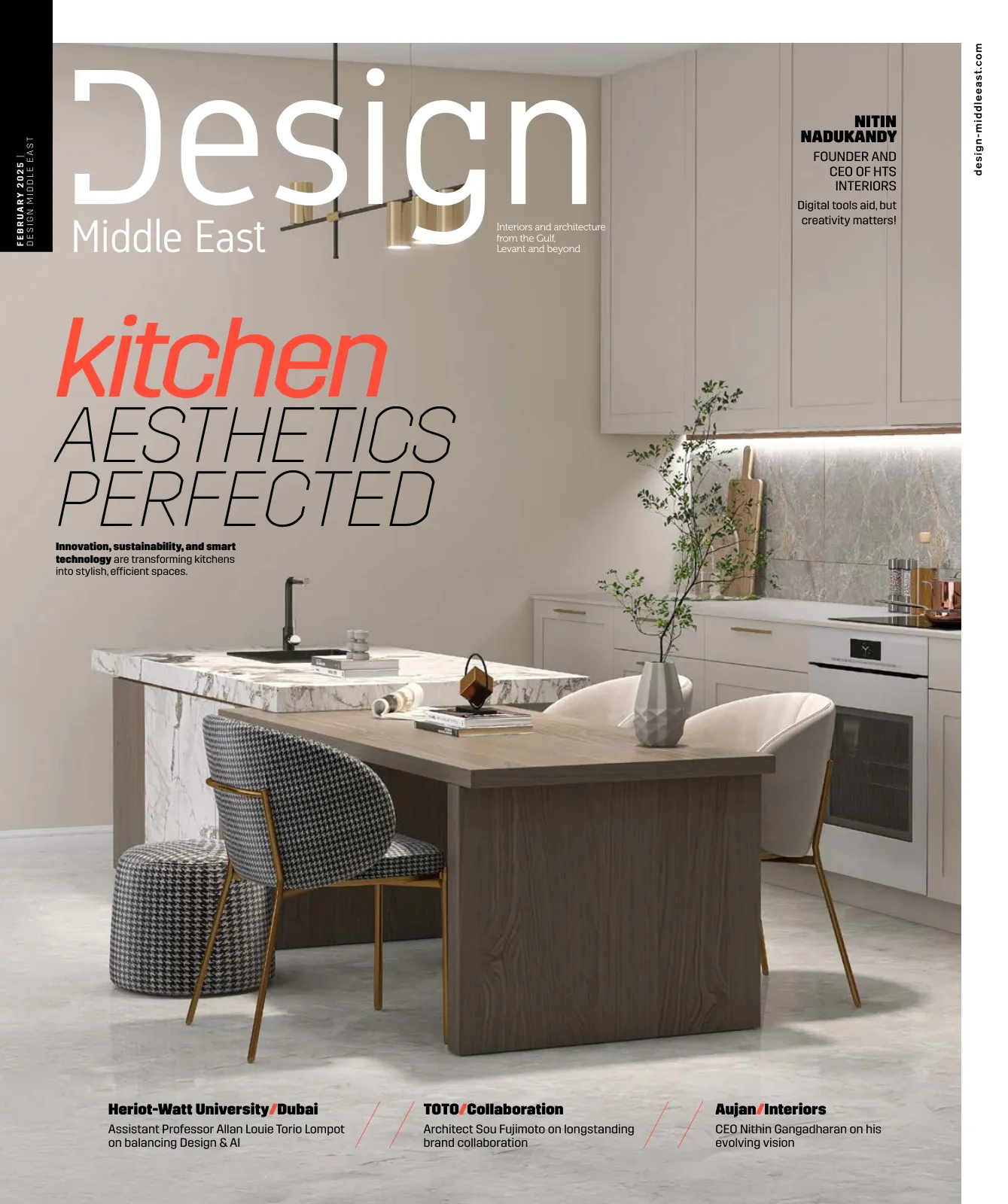
Design Middle East, February 2025
Page 1
design-middleeast.com
F E B R U A R Y 2 0 2 5 |
D E S I G N M I D D L E E A S T
Interiors and architecture
from the Gulf,
Levant and beyond
Innovation, sustainability, and smart
technology are transforming kitchens
into stylish, efficient spaces.
AESTHETICS
PERFECTED
kitchen
TOTO/Collaboration
Architect Sou Fujimoto on longstanding
brand collaboration
Aujan/Interiors
CEO Nithin Gangadharan on his
evolving vision
NITIN
NADUKANDY
FOUNDER AND
CEO OF HTS
INTERIORS
Digital tools aid, but
creativity matters!
Heriot-Watt University/Dubai
Assistant Professor Allan Louie Torio Lompot
on balancing Design & AI
Page 2
Page 3
D E S I G N M I D D L E E A S T | F E B R U A R Y 2 0 2 5
design-middleeast.com
1
14
OP-ED
The Balancing Act of Design and
AI
As Generative AI reshapes the design
landscape, Allan Louie Torio Lompot,
Assistant Professor at Heriot-Watt
University Dubai, explores its potential to
enhance creativity, the ethical challenges
it poses, and the role of education in
fostering responsible innovation.
16
REVIEW
Does Multi-Size AEC
Printing Really Have to
Be a Challenge?
High-quality design tools streamline
multi-size AEC printing processes and
allow professionals to meet tight
deadlines in short time spans from
multiple work sites
18
From functionality to
aesthetics, the modern
kitchen is evolving into
a space that blends
innovation with style.
Sustainable practices and
energy-efficient designs
are now at the forefront
of kitchen innovation.
Customisation and modular
layouts are redefining
flexibility for both residential
and commercial spaces.
34
DECOR REVIEW
When Nature Meets Design
One of Japan’s leading architects, SOU
FUJIMOTO, shares his design philosophy,
inspirations, and longstanding collaboration
with TOTO.
38
PROJECT
Crafted For Life
Murali serpakkam, ManagIng Director of Al
Futtaim Contracting group, invites you on an
exclusive journey behind the curtain of
Al Badia Living—an architectural gem
seamlessly woven into the grandeur of the
Dubai festival city masterplan
44
BRAINSTORM HAT
Why Tech Can't Fix All Design
Industry Issues?
Nitin Nadukandy, Founder and CEO of
HTS Interiors, underscores the need for a
balance between technology and human
expertise in design.
46
INTERVIEW
Innovating For Impact
From luxury fit-outs to mentoring
future talent, Nithin Gangadharan, CEO
of Aujan Interiors, shares his vision
for sustainable design and strategic
collaborations.
50
ART
Renewal of Art & Design
Renewal embodies a shared dedication to
innovation and design. Design Middle East
speaks with Pauline Madani, Founder of
Nordic Homeworx, as she explores the
impact of sustainability, creativity, and
collaboration
54
DECOR REVIEW
Strawfire Mastering The Flames Of
Warayaki
Restaurateur Ross Shonhan discusses his
journey to introduce the Warayaki technique
at Strawfire, blending traditional japanese
craftsmanship with modern luxury, and his
vision for evolving japanese cuisine globally
58
TRANSPORTATION
Connecting The Dots
Roger Cruickshank, Senior Director and
Transportation Market Lead for the Middle
East at ATKINSRÉALIS, takes us behind
the scenes of the intricate Riyadh Metro
development, unveiling its complexities and
transformative impact
KITCHEN
INNOVATION
Mastering
Page 4
Page 5
SUITE TREAT
Step into a world of opulence when you book a Suite at Raffles Doha.
Experience the added luxury of QAR 750 credit to spend
on dining in the hotel, and QAR 500 towards any Spa treatment.
Children aged 12 and below are welcome to indulge in the
enchantment of complimentary dining.
Rates starting from QAR 3,500 per night
For reservations, please call +974 4030 7100
or email reservations.doha@raffles.com
Raffles Doha, Iconic Towers, Marina District, PO BOX 4747, Lusail, Qatar
Page 6
Nestled by the coast of Lusail sits the splendor of
Raffles and Fairmont Doha, where luxury is rooted
in even the smallest details. Open the doors to
mesmerizing hospitality and make memories in a
world of sophistication.
Page 7
Page 8
D E S I G N M I D D L E E A S T | F E B R U A R Y 2 0 2 5
6
design-middleeast.com
/designmideast
/designmiddleeast
FOLLOW US ON
@designmiddleeast
/designmiddleeast
Editor's Note
A
s we step into a season of exploration
and innovation, our focus turns to
Riyadh—where creativity, architec-
ture, and design are shaping the future. This
April, the Construction & Design Innovation
Summit and the Design Middle East KSA
Awards 2025 will bring together industry
leaders to discuss transformative ideas, cel-
ebrate excellence, and redefine possibilities.
These events are not just about recognition
but about pushing boundaries and discover-
ing fresh perspectives in one of the world’s
most dynamic markets. I encourage you all
to participate with full heart—engage, con-
nect, and be part of the conversations that
will shape the future.
Now, I’ll be honest—I don’t particularly
enjoy cooking. But give me a sleek, beau-
tifully designed, and smartly functional
kitchen, and suddenly, I might just be
tempted. That’s the magic of great design—
it changes how we experience spaces. One
space that has undergone a radical transfor-
mation over the years is the kitchen. Once
a purely utilitarian area hidden away from
the rest of the home, it has now become a
centerpiece of modern living—where design
meets innovation, and aesthetics blend
seamlessly with functionality. Smart kitch-
ens, automation, and AI-driven appliances
are revolutionising how we cook, store, and
interact with food.
Our cover story explores the evolution of
the kitchen, from a purely functional area to
a stylish, tech-driven hub. From sustainable
materials to automation and smart solu-
tions, we dive into how innovation is making
kitchens not just look better, but work better.
Call it innovation that makes you cook!
Beyond that, this issue is packed with indus-
try news, standout projects, and insightful
conversations with design visionaries. And
for our Pick of the Month, we spotlight an
exquisite crystal—a masterpiece of crafts-
manship and timeless beauty.
Roma Arora
Editor
roma@bncpublishing.net
@romaarora_
For all commercial enquiries
related to Design Middle East,
contact our Group Publishing Director
JOAQUIM D’COSTA
jo@bncpublishing.net | T +971 504402706
All rights reserved © 2025.
Opinions expressed are solely those of the
contributors.
Design Middle East is exclusively licensed to BNC
Publishing. No part of this magazine may be
reproduced or transmitted in any form or by any
means without written permission of the publisher.
Images used in Design Middle East are credited
when necessary. Attributed use of copyrighted
images with permission.
Printed by UPP
S U B S C R I B E
subscriptions@bncpublishing.net
PO Box 502511 Dubai, United Arab Emirates
T +971 4 420 0506 | F +971 4 420 0196
CEO WISSAM YOUNANE
wissam@bncpublishing.net
DIRECTOR RABIH NAJM
rabih@bncpublishing.net
GROUP PUBLISHING DIRECTOR
JOAQUIM D’COSTA
jo@bncpublishing.net
+971 50 440 2706
EDITOR ROMA ARORA
roma@bncpublishing.net
ART DIRECTOR
SIMONA EL KHOURY
MARKETING EXECUTIVE
AARON JOSHUA
aj@bncpublishing.net
COMMERCIAL DIRECTOR
ANDREA MOCAY
andrea@bncpublishing.net
DIGITAL MEDIA PRODUCER
EDUARDO BUENAGUA
Eduardo@bncpublishing.net
Page 9
KLUDI-ASANA
A haven of wellbeing
THE SHAPE OF WATER
kludi.com
Please, do not disturb! KLUDI-ASANA is the ultimate
wellness experience by KLUDI, the German premium water
expert, that provides modern High-end bathroom solutions,
with a touch of harmony and design.
KLUDI-ASANA is an experience that refreshes all senses
and at the same time allows a moment of “release”.
The large-format ceiling showers offer a real wow effect
and the ultimate in showering comfort. Rain shower, clean
jet or waterfall provide extra wellness. The special atmolight
immerses you in a world of complete relaxation, helping to
restore your mental and physical balance.
KLUDI surprises, informs and inspires, through a complete
and sophisticated range of faucets, sanitaryware and
bathroom furniture of high design.
Page 10
D E S I G N M I D D L E E A S T | F E B R U A R Y 2 0 2 5
8
design-middleeast.com
Natural light, a
powerful statement
in the design of
the mosque, is also
central to the user
experience through
the connection it
creates between
the inner and outer
worlds.
News
Arch Mosque by Babnimnim: Redefining Islamic Architecture
in Bahrain
K
uwait-based
Babnimnim
Design Studio
is the archi-
tect behind
Bahrain's Arch
Mosque, situated on a 2,380
sqm plot in Bu Shaheen, East
Hidd. Marking the studio's
debut project in Bahrain, the
mosque blends traditional
Islamic elements with con-
temporary design, inspired by
the Great Mosque of Cordo-
ba. Construction began this
month, with completion slated
for mid-2026.
Babnimnim, established in
2010, is renowned for designs
rooted in Gulf identity, inte-
grating modernity with cultural
heritage. Previous works, such
as the Mamluki Lancet Mosque
in Kuwait, showcase their
ability to fuse classical Islamic
architecture with contempo-
rary sensibilities.
The Arch Mosque reinter-
prets cultural heritage through
design. Key features include
a rhythmic colonnade system
inspired by Cordoba’s arches,
progressively scaled to create
depth and grandeur. A slanted
roof and the colonnade guide
worshippers towards the
Qibla. An inverted half-dome
near the mihrab, with skylights,
draws attention and light to
the prayer space, enhancing
the spiritual experience. Nat-
ural light plays a pivotal role,
creating a serene, contempla-
tive ambiance.
The mosque respects its
context in Al-Hidd, blending
with its medium-wage resi-
dential surroundings through
its practical design and simple
white exterior. It accommo-
dates both male and female
worshippers, with a dedicated
women’s floor, a multipurpose
hall, administrative offices, a
lecture hall for Quranic studies,
and a commercial strip for
self-sustainability.
Innovation is evident in the
electro-mechanical systems,
which are concealed within
discrete areas, preserving the
mosque’s aesthetics. Air-con-
ditioning units are placed with-
in the Qibla wall, maintaining
visual integrity. The primary
material, concrete, ensures
durability and reduces main-
tenance costs, while strategic
placement of windows and
skylights minimizes reliance on
artificial lighting and cooling,
boosting energy efficiency.
The Arch Mosque redefines
mosque design by balancing
tradition with modernity. Its
minimalist structure, rhythmic
forms, and spiritual symbolism
respect Islamic traditions while
addressing contemporary
needs. For Jassim AlSaddah,
the mosque carries personal
significance as a homage to his
mother, whose spirit inspired
its name.
Page 11
design-middleeast.com
9
D E S I G N M I D D L E E A S T | F E B R U A R Y 2 0 2 5
Sonia Wedell-
Castellano,
Global Director
of DOMOTEX at
Deutsche Messe AGB
uilding on the
resounding suc-
cess of its 2024
edition, DOMO-
TEX Middle East
is set to return to
the Dubai World
Trade Centre
(DWTC) from 22
to 24 April 2025, promising an expanded
showcase of cutting-edge flooring innova-
tions and timeless craftsmanship.
The 2024 event firmly established DO-
MOTEX Middle East as a premier platform
for the global flooring industry, drawing
over 12,000 participants from 74 countries.
Attendees experienced a remarkable lineup
of over 100 exhibitors, featuring highlights
such as the largest-ever 600m2 Tabriz
Premium Silk Warp carpet and muse-
um-quality antique rugs valued at AED 1.83
billion, presented by Heritage Carpet by
Ghanbarinia.
DOMOTEX Middle East 2025 will build
on its previous edition’s strong foundation,
attracting a diverse audience of industry
leaders, including CEOs, architects, de-
signers, and product developers. The event
showcased cutting-edge technologies, time-
less artistry, and networking opportunities
that left attendees highly impressed.
Building on the excitement for the 2025
edition, Sonia Wedell-Castellano, Global
Director of DOMOTEX at Deutsche Messe
AG, said: “DOMOTEX Middle East 2024
underscored Dubai’s pivotal role as a global
trade hub. For 2025, we are elevating the
event with an expanded focus on handmade
carpets, bespoke products, and innova-
tions tailored to key sectors like retail and
hospitality. Our goal is to redefine flooring
innovation while fostering meaningful
collaborations across the industry.”
The Middle East is experiencing a surge in
demand for high-quality, bespoke flooring
solutions, particularly in the retail and
hospitality sectors. With the flooring and
carpet market projected to grow at a CAGR
of 7.8% to reach USD 21.52 billion by 2033,
the region’s emphasis on innovation, luxury,
and sustainability is reshaping the industry
landscape.
DOMOTEX Middle East 2025 will serve
DOMOTEX Middle East 2025 returns to Dubai, spotlighting
flooring innovations
as a vital platform to connect exhibitors with decision-makers
eager to explore flooring products that seamlessly blend luxury
and practicality. This year’s edition will introduce specialized
programs for retail and hospitality industries, enhanced network-
ing opportunities with top-tier buyers, architects, and designers
and a continued focus on artisanal craftsmanship and sustainable
solutions.
Wedell-Castellano added: “In 2025, DOMOTEX Middle East
will continue to unite tradition and modernity, inspiring the
flooring community to push boundaries and create transformative
experiences. By bringing together global expertise and regional
demand, the event will cement its position as the go-to platform
for industry innovation and collaboration.”
With its reputation as a premier event in the flooring industry,
DOMOTEX Middle East 2025 promises unmatched opportu-
nities for discovering emerging trends, forging strategic part-
nerships, and driving business growth. From groundbreaking
technologies to timeless artistry, the event will set the stage for the
future of flooring, offering attendees an unparalleled glimpse into
the industry’s evolving landscape.
Page 12
D E S I G N M I D D L E E A S T | F E B R U A R Y 2 0 2 5
10
design-middleeast.com
Kristina Zanic Reveals Design for The Unexpected Marjan Island Hotel
The bold, fluid
architecture
extends indoors,
with interiors
also drawing
inspiration from the
beachside location
and spectacular
sunsets.
K
ristina Zanic Consultants has
revealed its dynamic design vision
for the interiors of The Unexpected
Marjan Island Hotel and
Residences, following the recent
commencement of the project’s
construction. The design concept
promises an immersive experience,
fusing color, movement, and music
to create a vibrant and avant-garde atmosphere. It is
set to offer an exceptional guest experience as well as
a striking residential address, with a seamless blend of
indulgence, sophistication, and playful flair.
The project is being developed by Almal Real Estate
Development, a Dubai-based, award-winning developer
of luxury properties. The company has appointed
Palladium Hotel Group, a renowned hotel operator
with over five decades of experience, to manage the
property under the brand The Unexpected Hotels &
Residences. Almal Real Estate Development has also
appointed the Design & Architecture Bureau (DAR) as
the lead design consultant for the project, overseeing
all aspects of the property’s lifecycle. With over
422 hotel rooms and residential units, the project is
strategically positioned next to the upcoming Wynn
Island, making it a premier destination for affluent
travelers, party-goers, and those seeking vibrant, high-
energy experiences. Once completed in 2027, it will be
a significant addition to the island's luxury offerings.
Central to the design is the concept of Cymatics -
the visual interpretation of sound waves - a theme
that aligns with the brand’s connection to music and
entertainment. This concept guides the interiors,
creating spaces that embody energy, movement, and
transformation.
The Cymatics theme is woven into the design
through key elements such as rich gradient hues and
reflective surfaces that evoke shimmer and movement.
Layered textures mimic the flow of sound, while fluid,
modular furniture and flexible layouts enable easy
reconfiguration, enhancing the interiors’ dynamic feel.
Statement pieces punctuate the interiors, offering
unexpected surprises that echo the brand’s ethos.
In the lobby, a custom light installation in the brand’s
signature red pays homage to its iconic hummingbird
logo, while a sweeping digital display overhead adds
a sense of movement. Below, a modular, serpentine
sofa facilitates regular changes in the seating layout,
resting on top of a swirling marble floor that evokes
movement.
The guestrooms and suites showcase a color palette
that shifts from light, beach-inspired tones near the
windows to deeper hues towards the interior, creating
a sense of transition. Statement headboards feature
sunset-inspired artwork crafted from acrylic and
mirrored materials. Mirrored ceilings add to the playful,
edgy vibe, while glass-walled bathrooms with gradient
opacity blur the lines between public and private,
integrating freestanding bathtubs directly into the
bedroom for a luxurious touch.
News
Page 13
Loro Piana Interiors Unveils “Pure and Pristine” Collection
at Paris Déco Off
The collection features
ultra-fine, fluid Wish merino
wool blended with a touch
of cashmere, a unique velvet
interpretation of linen in
vibrant shades, and fabrics
enhanced with rich textures.
L
oro Piana
Interiors’ new
collection for
2025 showcases
materials
and a design
aesthetic that
are a masterful
celebration of
purity. The new
collection of fabrics and furniture
made its début at the traditional
Parisian event from 15th to 18th
January 2025.
The fabrics include ultra-fine,
fluid Wish® merino wool, subtly
softened with a hint of cashmere,
and an original take on linen – a
velvet in full, vibrant shades – as
well as fabrics to which it adds
textural interest. Pure linen also
comes down to earth on a soft
carpet. The furniture pieces are a
tribute to purity of form, channelling
a refined vision of indoor/outdoor
living. The designs by Raphael
Navot, Francesca Lanzavecchia
and Paola Navone with her Otto
Studio, are crafted with incredible
craftsmanship from the finest of
materials.
This season marks the debut
of the Palm Wicker Armchair, a
new version of the Palm Armchair
in hand-woven wicker, also
created by Raphael Navot for
Loro Piana Interiors, and “Trama”,
the free-standing room divider
bookcase designed by Francesca
Lanzavecchia, which combines
wood and fabric in a fluid object
that creates a separation between
spaces. The Delight Chairs range by
Exteta has been joined by soft sofas
– one with a modular design and
one with a wooden structure – and
new coffee tables. Mahogany wood
and marble, along with outdoor
fabrics by Loro Piana Interiors, have
been used to craft pieces ideal for
curating refined al fresco living
areas, perfect on a veranda or in a
bright garden room.
D E S I G N M I D D L E E A S T | F E B R U A R Y 2 0 2 5
“The 2025 collection sends a message of purity and essentiality. The
fabrics are made with two particularly interesting materials: soft and ultra-
fine Wish® merino wool, and linen, which allow us to expand the range
of our excellences. The proposal is very focused, essential, yet it offers
original elements that are strongly representative of our textile savoir-
faire,” explains Francesco Pergamo, Director of the Loro Piana Interiors
Division.
Wish® Flannel Stripe and Check yarn-dyed flannels in springy Wish®
merino wool, measuring only 15 microns in diameter, with a touch of
cashmere. They are perfect for upholstery and elegant curtains. Versatile,
adaptable, Wish® merino wool has also been mingled with cashmere into
a soft, delicately irregular bouclé yarn and gives life to the Wish® Bouclé
fabric.
The Gher blanket highlights the purity of cashmere. The pristine
Cashmere Coarsehair® is crafted with a diagonal weave, in subtly
contrasting colours on the different sides.
“The purity of the proposal we are presenting at Déco Off is also
expressed in the furnishings, the result of the collaboration with Raphael
Navot, who designed for us the hand-woven wicker version of the Palm
Armchair, preserving its soft and sinuous lines, and with Paola Navone
and her Otto Studio, together with Exteta. Thanks to their work and the
skilful application of our fabrics, the range of Delight Chairs expands
considerably and allows us to create a truly versatile and elegant lounge,”
continues Francesco Pergamo. “Also very interesting is the result of our
encounter with the Italian designer Francesca Lanzavecchia, who created
the “Trama” bookcase-divider, an extremely original and versatile object
with a strong textile component.”
Page 14
D E S I G N M I D D L E E A S T | F E B R U A R Y 2 0 2 5
12
design-middleeast.com
News
F
ollowing a
transformative
tenure in Saudi
Arabia, Ciaran
will take on
a pivotal role
in leading
operational
excellence
across INC Group’s expanding
portfolio in the Middle East
and Africa. His insights, honed
through years of regional
experience, promise to bring
strategic value to INC Group’s
operational framework. With
focus on optimising processes
and enhancing client outcomes,
Ciaran’s leadership is set to drive
impactful, scalable solutions that
align with INC Group’s growth
ambitions.
INC Group is pleased to
announce the appointment
of Ciaran Crowley as Chief
Operating Officer. Following a
transformative tenure in Saudi
Arabia, Ciaran is set to lead
operational excellence across
INC Group’s expanding portfolio
in the Middle East and Africa. His
insights, honed through years
of regional experience, promise
to bring strategic value to INC
Group’s operational framework.
Ciaran’s impact at INC
has been profound; he was
instrumental in establishing
and growing the Group’s
operations in Saudi Arabia.
Under his leadership, INC KSA
achieved remarkable growth,
transforming into a 100-million-
dollar business. His commitment
to operational efficiency and
innovation has been pivotal to
the Group’s success, and his
forward-thinking approach will
now help streamline and scale
INC Group’s operations across
all regions.
“Ciaran has an exceptional
ability to transform complex
challenges into streamlined
solutions,” said Sean Nicholson,
CEO of INC Group. “His attention
to detail and his dedication to
making each part of the business
work seamlessly align perfectly
with INC Group’s vision for
growth.”
As COO, Ciaran will focus
on optimising processes and
ensuring INC Group not only
operates smoothly but continues
to excel and thrive in all regions.
His leadership is expected to
enhance team capabilities across
the UAE, KSA, and Africa as he
divides his time between these
critical markets.
Ciaran Crowley brings
over 22 years of experience
in the industry, combining
technical expertise and project
management acumen. Under
his guidance, the KSA business
grew by over 500% in 2021,
despite launching just before
the COVID-19 pandemic. Known
for his client-centred approach,
he values client feedback
as the ultimate measure of
success, ensuring INC Group’s
projects consistently exceed
expectations.
In addition to his operational
prowess, Ciaran is known for
his inclusive leadership style,
INC Group Names New COO to Drive Next Phase of Growth
Ciaran Crowley,
Chief Operating
Officer, INC Group
inspiring and empowering his
team members to thrive. The
KSA business unit started with a
modest four employees in 2020 and
now stands at over 100 talented
individuals.
Nouf Alqahtini, a key member
of the INC KSA team, remarked:
“Ciaran’s open-mindedness and
passion for developing young Saudi
talent resonate with all of us. He not
only supports local creatives, such
as Saudi national designers and
artists, but he also sets a standard
of professionalism that elevates the
entire team.”
Reflecting on his INC journey,
Ciaran shared: “It’s been incredible
to watch our team grow from a
small office in Al Barsha, Dubai,
to a multi-regional presence. I’m
especially excited to work with
our fantastic teams across each
region and to leverage shared best
practices. By continuing to digitalise
and align processes, I believe we
can cement our reputation as the
premier design and build contractor
across the MENA region.”
Page 15
Havelock One Completes Transformation of The St. Regis Kuwait
H
avelock One Interiors has successfully completed
phase two of a three-part renovation for The St.
Regis Kuwait, part of the iconic Sheraton Towers—
one of the most prestigious addresses in the country.
Following the completion of phase one in May 2022,
which saw a refresh of guestrooms and suites, phase
two focused on transforming 2,200 sqm of public areas
and enhancing additional guestrooms to elevate the
overall guest experience. This milestone marks Havelock
One’s third collaboration with The St. Regis, having
previously delivered phase one in Kuwait and the joinery
package and spa for The St. Regis Riyadh.
Designed by Dubai-based Kristina Zanic Consultants,
the renovation introduces a new level of sophistication
to this five-star destination. The bespoke joinery,
including floor-to-ceiling decorative metal screens and
custom wooden and glass partitions, was crafted at
Havelock One’s Bahrain factory and installed by their
skilled team. These elements serve as both functional
dividers and intricate design features, enhancing
the ambiance of both public areas and guestrooms.
Meanwhile, the flooring constructed from natural marble
in a herringbone pattern adds a striking touch.
host.fieramilano.com
17–21
OCTOBER
2025
fieramilano
INTERNATIONAL
HOSPITALITY EXHIBITION
NEW SHAPES OF
HOSPITALITY
Page 16
design-middleeast.com
D E S I G N M I D D L E E A S T | F E B R U A R Y 2 0 2 5
ACT
ACT
The Balancing
The Balancing
14
OP-ED
ALLAN LOUIE TORIO LOMPOT, Assistant Professor
at Heriot-Watt University Dubai
.
As Generative AI reshapes the design landscape, ALLAN LOUIE TORIO
LOMPOT, Assistant Professor at Heriot-Watt University Dubai, explores its potential
to enhance creativity, the ethical challenges it poses, and the role of education in
fostering responsible innovation.
of Design
Page 17
design-middleeast.com
15
A
ccording to an Adobe
Analytics Survey, 75
per cent of Gen Z
have used generative
Artificial Intelligence
(AI) more than any
other generation,
and they believe
that generative AI
tools can enhance
their creative abilities. On the contrary, a
recent online survey says 74 per cent of
artists feel that AI artwork is unethical. For
older millennials, the leap from traditional
design tools from Adobe Photoshop versions
1.0 - 7.0 to Adobe Photoshop 2025 version
26.0 was revolutionary. Thanks to Generative
AI, workflows are now being dramatically
streamlined, and critical tasks can now be
completed in significantly less time.
AI is a broad term that encompasses any
system that can mimic human intelligence,
including tasks like learning, problem-solving,
and decision-making. On the other hand,
Generative AI or Gen AI learns patterns from
existing data and uses this knowledge to
generate novel outputs. Generative AI’s ability
to transform text prompts into stunning visuals
will soon revolutionise the design industry.
However, there are critical considerations that
come with this transformative power. While
Gen AI increases efficiency and augments
a designer’s capability, concerns about
overuse, misuse and its ability to weaken
human originality potentially must be carefully
examined.
The evolution of Generative AI has been
remarkable. We’ve witnessed significant
advancements from first-mover pioneers like
Dall-E and Midjourney, culminating in extra
powerful tools like Adobe Firefly. Even AI
models like CoPilot, Gemini, and GPT4 initially
focused on text generation, now possess the
capability to generate images based on user
prompts. This rapid evolution has shifted
the discourse surrounding AI. While job
displacement was a primary concern half a
decade ago, the narrative has now evolved.
Today, the primary concern revolves around
those who effectively utilise AI tools, gaining a
significant advantage over those who do not.
This shift in perspective urged us to explore its
potential within our field. We integrated Adobe
Firefly as an experimental rendering engine
in my Revit Interior Architecture Laboratory.
Students conceptualised and designed a mixed-
use typology project with a neo-pop art theme
during a hands-on BIM course. This project
served as an ideal testbed for exploring Adobe
Firefly’s capabilities. We experimented with
Generative AI for post-processing renderings,
enhancing interior perspectives initially
designed and developed using Autodesk Revit.
This experience demonstrated the exciting
possibilities of integrating AI tools into the
interior architectural design process, pushing
the boundaries of creative exploration.
As the influence of AI continues to grow
within the design profession, crucial questions
regarding ethical considerations and limitations
will inevitably arise. When these questions
move from whispers to shouts, I will advocate
for the application of ethical principles in AI
development and utilisation. Drawing upon
John C. Maxwell’s assertion that business ethics
are inseparable from personal morality, I will
emphasise the importance of acknowledging AI
tools’ contributions while avoiding false claims
and misrepresentations.
The education sector holds a significant
responsibility in fostering an ethical approach
to AI. By instilling the discipline needed, we
can equip future designers to navigate the
evolving AI landscape with integrity. AI now
has boundless potential, and moving forward,
its development must be guided by ethical
considerations. The timeline for this wave of AI
innovation to stabilise remains uncertain. This
‘calm after the storm’ is not about restrictions,
soon we need to have ethical standards that
are etched in stone to regulate AI in different
disciplines.
Addressing issues that will continue to
arise about copyrights, their negative impact
on human creativity, and professional
accountability and transparency will be crucial.
Like other disruptive and game-changing
technologies, AI and Gen AI will undoubtedly
reshape our world. Embracing this change while
acknowledging its complexities is essential as
we navigate this ever-evolving yet exciting era.
The education sector holds a
significant responsibility in fostering an
ethical approach to AI. By instilling the
discipline needed, we can equip future
designers to navigate the evolving AI
landscape with integrity. .
Page 18
design-middleeast.com
16
C
onstruction companies are under pressure to
build smarter and faster. The latest innovations in
construction technology help designers eliminate
waste, use advanced materials, and construct
more sustainable structures.
Review
Does Multi-Size AEC
Printing Really Have to
Be a Challenge?
High-quality design tools streamline multi-size AEC
printing processes and allow professionals to meet tight
deadlines in short time spans from multiple work sites
Printing is a vital part of
bringing these amazing
architectural ideas to life. By
addressing the manual tasks
associated with multi-size AEC
printing, hybrid workforces
can perform more efficiently.
So, how can AEC
professionals streamline the
multi-size printing process?
Introducing Simple
Solutions to Support
Streamlined Hybrid Work
Modern AEC companies need
printing solutions that will
work efficiently for remote
workers and job site teams.
"Modern construction
projects are increasingly
collaborative," explained [HP
spokesperson]. "Multiple teams
interact with a single file and
print wirelessly from a variety
of devices."
HP has released the HP
DesignJet T850 and T950
Large Format Printer series
designed to make large format
and A0 – A4 printing easy and
efficient, both product ranges
eliminate steps from the
printing process.
D E S I G N M I D D L E E A S T | F E B R U A R Y 2 0 2 5
Page 19
17
design-middleeast.com
Achieving Multi-Size AEC Printing in Just
One Click
These models bring the workflows of large
format printers and A0 – A4 printers together, so
your workgroups can create high-quality prints
in multiple sizes with fewer steps , all from a
single printer. (2) Automatic media selection and
Contractors can print files in the field, visiting stakeholders
can access files on demand, and teams can virtually add
input to keep workflows moving.
HP has released the HP DesignJet
T850 and T950 Large Format
Printer series. Designed to make
large format and A3 printing easy
and efficient, both product ranges
eliminate steps from the printing
process.
integrated input trays allow
users to switch quickly from
large format to A3 or A4 and
back again without manually
changing from roll to sheets.
HP Click allows users to print in
fewer steps and avoid reprints
through print preview.
Improve collaboration across
teams with the ability to print
from a connected device, no
matter where you're located.
With the HP app, users can
easily connect, print, and
manage the plotter from
wherever they work for mobile
printing. Data is protected
from cyber threats without
any effort, thanks to HP Wolf
Pro Security. The easy-to-use
front-loading scanner improves
connectedness across teams by
allowing AEC professionals to
share drawings and collaborate
with colleagues from virtually
anywhere.
To boost productivity, AEC
teams can turn to the T950
printer.
Users can collect their jobs
quickly and easily with a stacker
that holds up to 40 pages[2]
in a flat position and a sheet
organizer that sorts A3 from
other large-format pages.
These integrated output trays
help the ease of organizing
and managing multi-size AEC
printing projects.
Contractors can print files in
the field, visiting stakeholders
can access files on demand,
and teams can virtually add
input to keep workflows
moving.
With the right technology,
printing in all sizes can be easy
and efficient.
Page 20
design-middleeast.com
D E S I G N M I D D L E E A S T | J A N U A R Y 2 0 2 3
18
Cover Story
KITCHEN INNOVATION
Mastering
From functionality to aesthetics,
the modern kitchen is evolving into
a space that blends innovation
with style. Sustainable practices and
energy-efficient designs are now at
the forefront of kitchen innovation.
Customisation and modular layouts
are redefining flexibility for both
residential and commercial spaces.
As technology advances, seamless
integration of smart appliances is
enhancing user experience like never
before.
Industry experts share insights on
the latest trends, materials, and smart
solutions shaping the heart of modern
living spaces
Page 21
D E S I G N M I D D L E E A S T | J A N U A R Y 2 0 2 3
design-middleeast.com
19
Page 22
20
design-middleeast.com
D E S I G N M I D D L E E A S T | J A N U A R Y 2 0 2 3
Cover Story
With a high spout and
three swivel settings,
this tap offers flexibility
and elegance for all your
kitchen tasks.
Stefan is responsible for
accelerating the growth
and enhancing the long-
term sales performance
of the GROHE brand
through cross-regional
collaboration and strategic
innovation.
KITCHEN TRENDS & INNOVATIONS
The kitchen has evolved into a
multifunctional space, with consumers
seeking smart, intuitive solutions that
simplify daily routines. In Dubai, key
market trends include sustainability,
smart home technology, minimalist
designs, and multi-functional spaces.
Consumers are increasingly drawn to
eco-friendly products, touchless faucets,
and integrated water filtration systems
that enhance both convenience and
sustainability.
At GROHE brand, we stay ahead of these
trends with cutting-edge innovations like
GROHE Blue and Red systems, which
combine modern design with advanced
functionality. GROHE Blue not only
provides filtered, chilled, and sparkling
water on demand but also plays a crucial
role in water conservation and reducing
plastic waste by replacing bottled water.
This aligns with our commitment to
sustainability by significantly minimising
the reliance on single-use plastics and
lowering overall water consumption.
GROHE leads the way in sustainable,
efficient, and innovative kitchen
solutions, meeting the evolving needs of
consumers in Dubai and beyond.
"GROHE brand stands out in the market with its
commitment to German engineering, sustainability,
premiumness, and cuttingedge technology. Our products
are not only designed for style but also for long-lasting
performance and environmental responsibility."
STEFAN SCHMIED, Leader, IMEA, LIXIL
International, highlights GROHE’s focus on
sustainable, tech-driven kitchen solutions like
the Blue Pure System and SmartControl faucets,
blending luxury with functionality in Dubai’s
evolving market.
GROHE
Page 23
21
design-middleeast.com
The Essence Single-lever
sink mixer combines style
and functionality with
flexible hoses for easy
installation.
MARKET EVOLUTION
The Dubai kitchen market is evolving towards
personalised, technology-driven, and eco-
conscious solutions. Over the next few years,
we foresee greater demand for sustainable
materials, water-saving fixtures, and smart
kitchens integrated with IoT. GROHE brand
is focused on leveraging these trends by
continuously innovating and offering products
that align with the region's dynamic lifestyle
and environmental goals. For example,
the kitchen faucet is often one of the most
underrated elements in the kitchen and often
receives no special consideration during kitchen
planning, yet it is one of the most frequently
used touchpoints. GROHE SmartControl offers
innovative push technology for the intuitive,
hands-free operation of kitchen faucets. It is
ideal when both hands are busy or not clean.
CHALLENGES IN THE REGION
Rather than challenges, we see exciting
opportunities in the Dubai market as the region
undergoes rapid transformation. The GCC
economies are experiencing accelerated growth,
fueled by diversification away from oil and
significant investments in infrastructure and
urbanization. This has led to a surge in modern,
eco-conscious developments, creating new
possibilities for smart and sustainable building
solutions.
GROHE balances luxury, functionality, and
sustainability by investing in R&D to create
versatile, high-quality products tailored to
diverse regional demands.
In the hospitality sector, we are seeing a strong
demand for premium en-suite bathrooms and
high-end kitchen solutions. Hospitality sectors
are increasingly integrating GROHE Blue in
kitchens and executive suites, offering guests
a sustainable and convenient alternative to
bottled water while reducing plastic waste.
GROHE collaborates with partners to deliver
seamless bathroom renovations, enhancing
comfort and efficiency with innovative,
sustainable solutions for Dubai’s dynamic
market.
COMPETITIVE EDGE
GROHE brand stands out in the market with
its commitment to German engineering,
sustainability, premiumness, and cutting-
edge technology. Our products are not only
designed for style but also for long-lasting
performance and environmental responsibility.
With initiatives like our "Cradle to Cradle"
certification and focus on water-saving
technologies, we provide solutions that blend
luxury with purpose. GROHE creates better
living spaces by understanding consumer needs
and delivering tailored, innovative solutions for
the Middle East market. >>>
D E S I G N M I D D L E E A S T | F E B R U A R Y 2 0 2 5
Page 24
22
design-middleeast.com
Cover Story
LATEST OFFERINGS
One of our latest innovations is the GROHE Blue Pure
system, which delivers filtered water straight from the tap,
offering a sustainable and convenient alternative to bottled
water. Additionally, our SmartControl faucets provide an
intuitive, touch-free experience, enhancing both hygiene
and ease of use. We have also introduced new finishes and
styles to cater to diverse design preferences, ensuring that
our products complement a variety of interiors.
Beyond product innovation, GROHE is committed to
exceptional customer support. GROHE’s UAE Customer
Service Center ensures seamless installation, maintenance,
and support, backed by a strong distributor network for an
enhanced customer experience.
CULTURAL PREFERENCES
Dubai's diverse population brings a mix of design
preferences, from modern minimalist to opulent traditional
styles. At GROHE, we cater to this diversity by offering a
wide range of finishes, designs, colors, and functionalities.
Our products are designed to harmonise with the unique
aesthetic sensibilities of our customers while delivering
world-class performance.
CONSUMER INSIGHTS
We are certainly seeing a shift towards more sustainable,
technologically advanced, and high-quality designs in the
region. Consumer demands in the Dubai kitchen market
focus on sustainability, convenience, and modern aesthetics.
There’s a growing preference for touchless faucets,
integrated filtration systems, and
water-saving solutions. Our main
clients include homeowners, luxury
developers, and the hospitality
sector, all of whom prioritise quality
and innovation.
FUTURE PLANS
As part of LIXIL, GROHE drives
sustainable innovation, enhancing
profitability, resilience, and climate-
conscious kitchen design in the
region.
Our future plans include
expanding smart kitchen solutions,
incorporating eco-friendly materials,
and enhancing water efficiency to
create kitchens that seamlessly
blend technology, sustainability, and
timeless design. GROHE simplifies
renovations with expert guidance
and streamlined solutions, ensuring a
seamless, hassle-free kitchen upgrade
experience. Through these efforts,
GROHE brand continues to set new
standards in kitchen innovation,
delivering solutions that are not
only aesthetically refined but also
future-proof and environmentally
responsible.
D E S I G N M I D D L E E A S T | F E B R U A R Y 2 0 2 5
The Essence Single-lever
sink mixer offers a sleek
design and seamless
functionality, perfect for
your kitchen.
Page 25
D E S I G N M I D D L E E A S T | F E B R U A R Y 2 0 2 5
design-middleeast.com
23
"Ideal Standard continues to push the boundaries of
innovation and design in the kitchen sector with the launch
of its latest collection, Gusto. This premium and versatile range
is a remarkable addition to the company’s portfolio, combining
striking aesthetics with high functionality to meet the evolving
demands of contemporary kitchens."
Frederick is a seasoned
leader driving
innovation and market
expansion. With a keen
eye for design and
functionality, he plays a
pivotal role in shaping
the brand’s vision for
modern living spaces.
IDEAL
STANDARD
I
deal Standard continues to redefine kitchen
design with the launch of Gusto, a premium
collection that blends striking aesthetics with high
functionality. Backed by over a century of expertise
in brassware manufacturing, the brand extends
its craftsmanship and advanced technologies into the
kitchen sector. Frederick Trzcinski, VP Commercial at
Ideal Standard MENA, highlights the collection as a
significant step in meeting the evolving demands of
contemporary kitchens.
"OUR GUSTO COLLECTION IS A PRIME EXAMPLE OF WHAT WE CAN OFFER THE KITCHEN SECTOR. IT COMBINES
SOME OF OUR MOST INNOVATIVE TECHNOLOGIES WITH BOLD DESIGNS AND A VERSATILE COLOR PALETTE,
PROVIDING NOT JUST FUNCTIONALITY BUT ALSO FLAIR, RELIABILITY, AND PRACTICALITY FOR MODERN KITCHENS."
KITCHEN TRENDS & INNOVATIONS
Dubai's kitchen sanitary market is evolving with
a strong focus on sustainability, functionality,
and aesthetics. Water- and energy-saving taps
are gaining popularity as consumers seek eco-
friendly solutions that minimise waste without
compromising performance. Smart technology,
including temperature control systems and
integrated soap dispensers, enhances both
hygiene and convenience, while comfort-height
taps with a 360-degree swivel provide added
flexibility. Elegant finishes continue to trend,
adding a modern and luxurious touch to kitchen
designs. Additionally, there is a growing emphasis
on ensuring that kitchen fixtures seamlessly
complement overall room aesthetics, creating
cohesive and stylish spaces.
MARKET EVOLUTION
Dubai’s kitchen sanitary market is
rapidly shifting toward high-tech,
sustainable, and design-centric
solutions. However, brands
operating in this space face several
challenges. Water scarcity drives the
demand for highly efficient products
that minimise consumption without
compromising performance.
Intense competition necessitates
continuous innovation and
differentiation to stand out.
Additionally, products must be
designed to withstand Dubai’s
extreme heat and humidity,
ensuring long-lasting quality and
durability in the region’s unique
climate conditions.>>>
Page 26
24
design-middleeast.com
LATEST OFFERINGS
Ideal Standard continues
to push the boundaries of
innovation and design in
the kitchen sector with
the launch of its latest
collection, Gusto. This
premium and versatile range
is a remarkable addition to
the company’s portfolio,
combining striking aesthetics
with high functionality
to meet the evolving
demands of contemporary
kitchens. Backed by over
100 years of expertise in
brassware manufacturing,
Ideal Standard brings its
renowned craftsmanship and
innovative technologies—
previously established in the
bathroom and washroom
sector—into the kitchen
space.
The Gusto iMX model
enhances convenience with
an integrated soap dispenser,
ensuring a cleaner and
more organised workspace.
Designed for professional
performance, it features
flexible spouts, pull-down
spray heads with magnetic
holders, and dual-spray
buttons, making it ideal for
home chefs. Sustainability
and durability are key, with
FirmaFlow®+ cartridges
that surpass EU standards,
enduring over 750,000 use
cycles. The collection’s
sophisticated finishes—
Silver Storm, Brushed Gold,
Magnetic Grey, and Sunset
Rose—bring a premium
and distinctive touch to
contemporary kitchens.
Speaking about the new
collection, Frederick
Trzcinski, VP Commercial
at Ideal Standard MENA,
stated:
"Our Gusto collection is a
prime example of what we
can offer the kitchen sector.
It combines some of our most
innovative technologies with
bold designs and a versatile
color palette, providing
not just functionality but
also flair, reliability, and
practicality for modern
kitchens."
"By offering eco-friendly solutions that promote water
conservation, using advanced materials that are anti-scratch,
stain-resistant, and corrosion-free, and expanding options for
personalised finishes and styles, the brand ensures both
functionality and aesthetics."
Gusto kitchen mixer with
pull-down spout round
D E S I G N M I D D L E E A S T | F E B R U A R Y 2 0 2 5
Page 27
D E S I G N M I D D L E E A S T | F E B R U A R Y 2 0 2 5
design-middleeast.com
25
CONSUMER INSIGHTS
Dubai’s multicultural market
calls for versatile, premium
kitchen solutions that combine
durability, design, and flexibility.
Products must be long-lasting
and resistant to corrosion and
wear, incorporating advanced
technologies like physical
vapor deposition for enhanced
performance. Thoughtful design
elements, such as lever controls
for easy operation with the elbow
and a comfort-height spout with
a 360-degree swivel, ensure
convenience and ease of use.
Additionally, adaptable designs
cater to diverse cooking and
cleaning habits, meeting the varied
needs of Dubai’s dynamic culinary
landscape.
FUTURE PLANS
Ideal Standard is dedicated to shaping the future of kitchen sanitary
products through sustainability, innovation, and customisation. By
offering eco-friendly solutions that promote water conservation,
using advanced materials that are anti-scratch, stain-resistant, and
corrosion-free, and expanding options for personalised finishes
and styles, the brand ensures both functionality and aesthetics.
Additionally, the Gusto taps feature EasyFix+ technology, enabling
tool-free installation and reducing setup time by up to 50% compared
to standard market taps, making the process effortless and efficient.
Kitchen mixer with
tubular spout square
Page 28
D E S I G N M I D D L E E A S T | F E B R U A R Y 2 0 2 5
26
design-middleeast.com
DIJON COMPTON, Managing Director of
Green Robin Kitchens in Dubai, specialises
in custom, high-quality kitchen designs. With
a focus on craftsmanship, sustainability, and
local production, he creates timeless, functional
kitchens that stand out in the luxury market.
GREEN ROBIN
INTERIORS
KITCHEN TRENDS & INNOVATIONS
In Dubai, kitchens are becoming more
open, minimalist, and natural-looking,
with clean lines and materials like natural
wood and stone taking center stage. Clients
want kitchens that are both functional and
beautiful, making them great spaces for
cooking and socialising. Green Robin adapts
by emphasising on handcrafted designs made
from high-quality materials and tailored to
each client's specific concept.
MARKET EVOLUTION
Dubai’s kitchen market is undergoing a
transformation towards sustainability
and personalization, with homeowners
increasingly seeking kitchens that go beyond
functionality to become an integral part of
their home. As we look ahead, we anticipate
a rising demand for eco-friendly materials
and smarter technological integration. In
response, we are preparing to meet this
demand with custom, innovative solutions
that prioritize both style and sustainability.
Our commitment is clear: 65% of the wood
used in our wood-based materials will come
from recycled materials or by-products,
ensuring a more sustainable future for kitchen
design.
CHALLENGES IN THE REGION
At Green Robin, we address the challenge
of Dubai's diverse multicultural population
by offering flexible, custom designs and
Al Andalus, Jumeirah Golf Estates
It’s a compact space that utilises every millimeter of
storage-bright whites, sintered stone surface make it
feel airy, stylish, and anything but cramped.
Dijon's focus on
craftsmanship,
sustainability, and local
production sets Green
Robin Interiors apart in
the competitive luxury
market.
Cover Story
Page 29
D E S I G N M I D D L E E A S T | F E B R U A R Y 2 0 2 5
design-middleeast.com
27
emphasizing clear communication. This ensures
we meet the unique needs of each client and deliver
exactly what they envision for their kitchen.
COMPETITIVE EDGE
What sets us apart is our ability to offer fully
bespoke solutions. We're not confined by standard
modular systems, allowing us to maximise every
millimeter of space and create a unique design for
each kitchen. Our dedication to sustainability and
personalized service makes us the preferred choice
for clients seeking something truly special. With
our factory located in Jebel Ali, we can swiftly adapt
and implement client requests. Plus, all our raw
materials are sourced from top European suppliers,
ensuring premium quality at competitive prices.
LATEST OFFERINGS
We have recently introduced smart kitchen
features, such as smart-opening cabinet doors
and drawers. On top of that, we’re committed to
providing sustainably made cabinets from recycled
MFC boards and countertops made from eco-
friendly materials. These are perfect for clients
who want luxury with a lighter environmental
impact. We have also designed a new matte white
oak wood veneer door system with a slim frame
and introduced a warm neutral paint palette for
2025, enabling us to keep up with trends while still
producing a signature piece. >>>
Orange Lakes, Jumeirah Golf Estates
This kitchen is a perfect mix of warmth and
sophistication, with sleek European white oak
doors and smooth stone finishes
Nikki Beach Residences
It’s a statement ultra-modern kitchen with a
clean minimalist look from the Corian top to the
open counters it allows light to flow through
the glass.
Page 30
D E S I G N M I D D L E E A S T | F E B R U A R Y 2 0 2 5
28
design-middleeast.com
CULTURAL PREFERENCES
Dubai’s market is a melting pot of cultures,
so we work hard to cater to everyone. For
example, some clients prefer clean, modern
designs, while others love traditional styles
with a twist, such as a statement stone or a
Corian worktop. By understanding their stories
and preferences, we craft kitchens that are
both personal and culturally meaningful.
CONSUMER INSIGHTS
Clients today seek kitchens that are both
functional and beautiful. There's a rising
demand for smart storage solutions, durable
materials, and eco-friendly features. Many of
our clients want kitchens that complement
their living space while supporting their
lifestyle—whether it's for hosting guests or
creating a calm family environment. At the
core, they desire a kitchen that serves as the
heart of the home and is built to endure.
FUTURE PLANS
Our goal is to create bespoke kitchens that are
as unique as the individuals who use them. For
us, the future lies in maximising every inch of
space, combining sustainability with timeless
design to craft spaces that not only look
beautiful but also feel truly special.
Jumeirah Islands
This kitchen is a real
showstopper—rich Italian
wooden doors, bold
marble, and every detail
designed to make a
fantastic family space
Cover Story
Page 31
D E S I G N M I D D L E E A S T | F E B R U A R Y 2 0 2 5
design-middleeast.com
29
Minimalist and functional,
the modern kitchen
combines contemporary
design with practical
solutions for a stylish yet
efficient space.
AZHAR SAJAN, Founder of Casa Milano, creates
kitchens that blend sophistication, impeccable
craftsmanship, and thoughtful functionality.
CASA MILANO
KITCHEN TRENDS & INNOVATIONS
The UAE kitchen market is driven by a blend of luxury, smart
technology, and sustainability. Open-plan, multifunctional
kitchens are in demand, particularly in compact Dubai
homes, where modular designs enhance space efficiency
and social interaction. Sustainable materials like recycled
wood and energy-efficient appliances align with the UAE’s
Vision 2030. Smart tech, including IoT appliances and AI-
powered features, is becoming standard in luxury homes.
Our collaboration with Arredo3 Cucine introduces the Gaia
Range, combining reclaimed materials with smart storage,
and Glass 2.0 kitchens with micro-ribbed glass and IoT
connectivity.
Page 32
D E S I G N M I D D L E E A S T | F E B R U A R Y 2 0 2 5
30
design-middleeast.com
MARKET EVOLUTION
The UAE’s modular kitchen
market is experiencing
a dynamic shift, with a
projected 6% CAGR through
2030, driven by a growing
demand for high-end
German and Italian designs
among expatriates and
high-net-worth individuals.
Smart kitchens are becoming
the norm, with over 60%
of new developments
in Dubai now featuring
pre-installed automation
systems, according to Mordor
Intelligence. Meanwhile,
sustainability is taking
center stage, as energy-
efficient certifications like
LEED and circular design
principles gain prominence,
reinforced by UAE policies
such as the D33 Agenda,
which emphasize long-term
environmental responsibility.
CHALLENGES IN THE
REGION
The UAE’s diverse market
demands bespoke designs,
balancing Middle Eastern
spaciousness, Western
minimalism, and Asian
functionality—addressed by
our Tailored Design Studio.
Climate resilience is key, with
marine-grade stainless steel
and UV-resistant laminates
ensuring durability, as seen
in Arredo3’s Cosmolite® tops.
Supply chain disruptions
and local competition (e.g.,
Danube Home) challenge
timelines, mitigated by
strategic stockpiling and
Italian partnerships. To
combat counterfeit products
and service gaps, Casa
Milano’s 360° Support Portal
offers lifetime maintenance
and certified technicians,
ensuring lasting quality.
COMPETITIVE EDGE
As the UAE’s exclusive
Arredo3 partner, we bring
100% Italian craftsmanship
to the market, offering
kitchens from renowned
brands like SieMatic and
Scavolini, known for their
precision engineering.
Our Gaia Range embraces
bespoke sustainability, using
FSC-certified wood and
recycled aluminum to reduce
carbon footprints by 40%.
With project-scale expertise,
we’ve successfully integrated
kitchens into iconic spaces,
from Palm Jumeirah villas
to Downtown Dubai towers,
ensuring seamless alignment
with architectural visions.
LATEST OFFERINGS
Our Smart Kitchen Hub
showcases Arredo3’s K2
Handle and app-controlled
appliances, including
touchless faucets and AI
ovens, offering the ultimate
in modern convenience.
Designed for the UAE’s
shrinking residential spaces,
our modular flexibility
allows for expandable units,
maximizing functionality
in compact kitchens.
Bold, functional, and
stylish – modern kitchens
captivate with innovative
design elements that
seamlessly blend beauty
and utility.
Page 33
D E S I G N M I D D L E E A S T | F E B R U A R Y 2 0 2 5
design-middleeast.com
31
Additionally, we’re redefining luxury with limited-edition
kitchens created in collaboration with top designers like
Patricia Urquiola, catering to ultra-high-net-worth clients
seeking unparalleled style and exclusivity.
CULTURAL PREFERENCES
For Middle Eastern clients, kitchens often feature grand
islands and concealed storage, designed to accommodate
large family gatherings, as seen in the luxurious Emirates
Hills villas. Meanwhile, expatriates in the UAE prefer
sleek, handleless designs that reflect modern minimalism,
exemplified in the sophisticated kitchens of Downtown Dubai
apartments. Each design is tailored to meet the specific needs
and aesthetic preferences of these diverse clientele, ensuring
both functionality and style.
NOTABLE PROJECTS
We've crafted bespoke Arredo3 kitchens in Palm Jumeirah
Residences, featuring sleek waterfall countertops and
discreet charging stations. In Dubai Creek Harbour, our
smart kitchens integrate motion-sensor lighting and
humidity-controlled pantries, seamlessly combining luxury
with advanced technology for contemporary living. Our
portfolio also includes remarkable projects across Al Barsha,
Business Bay, Downtown, Palm Jumeirah, and Emirates Hills.
FUTURE PLANS
We’re leading the way in tech integration by partnering
with Dubai’s Sandbox AI Initiative to pilot AR kitchen
configurators, offering clients a futuristic way to design
their kitchens. In line with the UAE’s 2033 waste reduction
targets, we’re launching a take-back program for old cabinets,
supporting a circular economy. Additionally, we’re expanding
our reach regionally, targeting Saudi Arabia and Qatar
through Arredo3’s re-export network, bringing our premium
kitchen solutions to new markets across the Middle East.
Casa Milano showcases a remarkable
portfolio, crafting kitchen designs that
perfectly fuse contemporary style, high-end
appliances, and functional solutions.
Elevating cooking to an art form, modern kitchens
blend stylish elements with high-performance
features for the perfect culinary space.
Page 34
D E S I G N M I D D L E E A S T | F E B R U A R Y 2 0 2 5
32
design-middleeast.com
GAGGENAU
Gaggenau, a renowned German manufacturer of high-quality
home appliances, has a rich history dating back to 1683.
Recognised as an innovation leader in design and technology,
the brand has revolutionised domestic kitchens with its
acclaimed products.
Gaggenau sets the trend for luxury kitchen appliances by
integrating advanced technology, such as intuitive touch
controls and smart connectivity, with high-end materials
like stainless steel and glass. Their innovations reflect a
commitment to both form and function, with designs that
enhance the user experience while maintaining aesthetic
appeal.
Their offerings include a wide range of luxury kitchen
appliances, such as ovens, cooktops, ventilation systems,
refrigerators, dishwashers, and coffee machines. Notably,
the 90cm EB 333 oven stands as a testament to Gaggenau's
commitment to performance and design excellence.
Gaggenau's success is founded on technological
innovation and a clear design language
combined with high functionality.
The brand appeals to discerning consumers
who value exceptional quality, performance,
and design in their kitchen environments.
Gaggenau's appliances are designed to inspire
culinary creativity, making them a preferred
choice for those seeking to elevate their
cooking experience.
Notable projects in the UAE include
luxurious residences in Dubai where Gaggenau
appliances are featured prominently. These
projects showcase the integration of their
premium appliances in high-end kitchen
spaces, elevating the overall luxury experience
for homeowners.
This kitchen features Gaggenau's Essential Induction cooktop,
which seamlessly integrates into various kitchen styles and settings,
offering a minimalist design that enhances both functionality and
aesthetics.
Cover Story
Page 35
DOMOTEX
MIDDLE EAST
The Trade Fair for the Carpet & Flooring
Industry in the Middle East.
22 – 24 APRIL 2025
Dubai World Trade Centre
Scan for more info
Page 36
34
design-middleeast.com
34
Tête-à-Tête
nature
WHEN
MEETS DESIGN
One of Japan’s leading
architects, SOU
FUJIMOTO, shares his
design philosophy,
inspirations, and
longstanding
collaboration with
TOTO. From the forests
of Hokkaido to global
landmarks like the
Serpentine Pavilion
and L’Arbre Blanc,
Fujimoto discusses
the intersection of
nature, technology, and
human-centric spaces,
shaping the future of
architecture.
D E S I G N M I D D L E E A S T | F E B R U A R Y 2 0 2 5
C
an you share your background and the
key influences that have shaped your
architectural philosophy and approach to
design?
I grew up in Hokkaido and often played in wild
forests as a child. Of course, I didn't think about
architecture at all at the time, but when I started
studying architecture, I felt that the experience of playing
in the forest had many meanings, such as a sense of scale,
diversity, and something beyond functionality. And the contrast
between Tokyo, where I studied architecture, and the natural
environment of Hokkaido, where I grew up, was very interesting.
The center of Tokyo and residential areas do not have such
vast wildlife habitats, but when I walked around the small
streets of the city, it seemed like I was walking in a forest. In the
forest, there are leaves and branches and small bushes, and in
Tokyo, there are many small man-made objects, even electric
wires, floating in space.
Architect Sou Fujimoto
Page 37
design-middleeast.com
35
I feel that the forest is not just a
forest, but a structure behind it, a
place surrounded and protected
by small elements of the human
scale, but also an open field
where everyone can choose
their path and activities. It is a
place that stimulates diversity,
and in that diversity, you can
choose your own path, where
to stay, and how to experience
it. In that sense, the forest for
me is a word that symbolizes
the basis of architectural
thinking, the basis of thinking
that connects architecture and
nature. It is the basis for creating
something that goes beyond the
usual functional thinking about
architecture.
The Serpentine Gallery Pavilion
in London and L’Arbre Blanc in
France are iconic examples
of your work. What inspired
the conceptual design behind
these projects, and how did
you overcome their unique
challenges?
In designing Serpentine
Pavilion 2013, we envisioned
a topographical place where
people can find new and
diverse ways of behaving, a
semi-transparent architecture.
The beautiful greenery of the
surrounding area, its vivid
greenery, and the geometric
architecture of the pavilion blend
together. At first the idea came
to me of a design in which the
geometry and architectural
forms would naturally merge
with the human body. By
repeating simple cubes that
match the size of the human
body, we created a form that
exists between the organic and
the abstract; by smoothing the
edges and making the structure
ambiguous, the boundary
between the interior and exterior
is blurred; and by using thin steel
rods, we created translucent
and irregular shapes The thin
steel rods create translucent
and irregular shapes, while at the
same time protecting visitors
from such structures and
allowing people to become part
of the landscape.
L'Arbre Blanc was a design
competition held by the
Montpellier City Council in 2013,
and we were asked to come up
with a bold proposal with eco-
friendly shops and residences that
would be a beacon celebrating
the city's architectural heritage.
We first had an open discussion
about how to realize Montpellier's
traditional lifestyle in a high-rise
building. Montpellier has a warm
Mediterranean climate, and it
seems that people eat lunch
outside even in winter. The local
people also like to go outside to
eat, take naps, and talk with their
friends, and they don't seem to be
originally indoor types. From there,
we decided that it would be better
to have a lot of outdoor space
and to put out a large balcony.
Rather than suddenly coming up
with artistic inspiration or ideas,
we proceeded by confirming the
prerequisites together, and as a
result, a rich outdoor space was
created.
Your collaboration with TOTO
has been a longstanding one.
Could you share what initially
attracted you to work with a
luxury sanitary ware brand like
TOTO, and how this partnership
has evolved over time?
TOTO is one of the world's leading
sanitary ware brands, and at
the same time, I believe it is a
brand that has contributed to
architectural culture and the
development of society, playing a
part in that history. Starting with
The philosophy of sustainability activities that TOTO
upholds is the most important theme in society
going forward, and it is essential that we move forward
with the same theme in architectural design.
Sou Fujimoto
delves into the
intersection
of nature and
design during a
panel discussion.
Page 38
36
design-middleeast.com
36
Tête-à-Tête
our work being exhibited at a special
exhibition held at Gallery Ma in Tokyo
in 2002, we participated in Bath Views,
a collection of new perspectives on
baths by architects in 2009, and held
our own solo exhibition and traveling
exhibition at Gallery Ma in 2015. We
have been successful in collaborating
with TOTO not only in our daily design
activities but also in these cultural
activities.
TOTO is known for its commitment
to innovation and sustainability.
How do you integrate these values
into your architectural projects, and
how do they align with your design
philosophy?
The philosophy of sustainability
activities that TOTO upholds is the
most important theme in society
going forward, and it is essential that
we move forward with the same
theme in architectural design. We
believe that comfort and health, the
environment, creating connections
with people, and accepting and
resonating with various forms of
diversity will lead to new innovation.
TOTO emphasises both technology
and design in its products. How do
you see these two elements coming
together in your architectural
designs, particularly in residential or
hospitality projects?
Sanitation facilities are used by all
humans and are very familiar to us.
TOTO's sophisticated and minimalist
design enhances the value of
technology and we believe that being
considerate to people of all ages and
with disabilities, it will create new
value in our lives.
Bathrooms are becoming more than
functional spaces; they are now
places of relaxation and retreat.
How do you envision this shift
influencing future residential design
trends?
For example, bathrooms may be
actively placed in locations with
good views, bathrooms that are large
enough to accommodate several
people, etc., may be required in future
housing design. This will lead to the
creation of new residential value as
a place for living and activity, rather
than a conventional, functionally
organized bathroom.
Japanese design often focuses on
simplicity, functionality, and the use
of natural materials. How do you see
these elements reflected in your
collaboration with TOTO?
I think it is reflected in terms of
harmony with architectural design,
extended specifications and
functionality, and consideration for
the functional environment and
human body.
D E S I G N M I D D L E E A S T | F E B R U A R Y 2 0 2 5
Sou Fujimoto
with all the
panellists at the
panel discussion
by TOTO Japan
and Al-Futtaim
Contracting in
Dubai.
Looking ahead, what kind of
innovative bathroom or living space
concepts do you think will emerge
from collaborations between
architects and brands like TOTO?
What kind of place is a bathroom?
What kind of space is a place for
people to live?
By going back to the roots discovering
the possibilities, and feeding them
back into the architectural space,
I believe that new concepts and
spaces that we have not yet seen will
emerge.
During your recent visit to Dubai
with Al-Futtaim Contracting and
Toto Japan, what key messages or
insights did you hope the audience
would take away from your talk?
I am deeply grateful to Toto Japan
and Al-Futtaim Contracting for
giving me the opportunity to share
my architectural philosophy with
such an incredible and engaged
audience in Dubai. It was a privilege to
discuss the importance of integrating
sustainability, cultural harmony,
and innovation into design, and
to highlight how architecture can
bridge tradition and modernity while
fostering a connection between
nature and urban spaces. This event
allowed me to present my vision of
creating globally resonant spaces
that honor local heritage, and I truly
appreciated the chance to connect
with a crowd that shares a passion
for architecture’s role in building a
sustainable and inclusive future.
It was a privilege to discuss the importance of integrating
sustainability, cultural harmony, and innovation into
design, and to highlight how architecture can bridge tradition
and modernity while fostering a connection between
nature and urban spaces.
Page 39
@twentyone06
info@twentyone06.com
An award-winning interior design and branding
studio specializing in creating immersive spaces
that tell a story. Based in the Middle East, our
expertise lies in the F&B, hospitality, and
commercial sectors, where we develop design
concepts that go beyond form —prioritizing guest
experiences and emotional connections.
We bring narrative-driven design to life.
Page 40
D E S I G N M I D D L E E A S T | F E B R U A R Y 2 0 2 5
design-middleeast.com
38
Page 41
D E S I G N M I D D L E E A S T | F E B R U A R Y 2 0 2 5
design-middleeast.com
Life
CRAFTED FOR
MURALI SERPAKKAM, MANAG-
ING DIRECTOR OF AL FUTTAIM
CONTRACTING GROUP, INVITES
YOU ON AN EXCLUSIVE JOUR-
NEY BEHIND THE CURTAIN OF
AL BADIA LIVING—AN ARCHI-
TECTURAL GEM SEAMLESSLY
WOVEN INTO THE GRANDEUR
OF THE DUBAI FESTIVAL CITY
MASTERPLAN
39
Page 42
40
design-middleeast.com
Project
A
l Badia Living is a masterpiece thoughtfully crafted through
extensive market research to meet the growing demand for
community-focused living, lifestyle hubs, and sports spac-
es. Its design transcends mere construction, focusing on
creating a vibrant, inclusive community. Seamlessly aligned
with Dubai Festival City’s identity as a holistic destination, the
development combines resort-style amenities with a lively
atmosphere where indoor sophistication meets the charm
of outdoor serenity. Offering an exceptional blend of world-
class residential, commercial, and lifestyle experiences, Al
Badia Living reflects a vision of modern living deeply rooted in
sustainability and urban harmony.
Embodying Dubai’s broader ambition for eco-conscious
urban integration, Al Badia Living redefines connected living.
“With high-quality, sustainable spaces and an ethos prioritis-
ing community and the environment, it is a beacon of the city’s
drive toward a greener, more connected future. It’s more than
a residence—a lifestyle where innovation, sustainability, and
community come together to create an elevated way of life,”
shares Murali Serpakkam, Managing Director of Al Futtaim
Contracting Group.
D E S I G N M I D D L E E A S T | F E B R U A R Y 2 0 2 5
Al Badia Living exemplifies
Dubai’s vision for sustainable
urban integration, offering a
fresh take on connected living.
Page 43
41
Murali Serpakkam, Managing Director of al Futtaim
Contracting Group
Designed for families, couples, and individuals seeking an
active, community-centred lifestyle, Al Badia Living ensures
that every detail enhances modern living. Catering to this
dynamic audience, the development boasts state-of-the-
art fitness centres, shimmering swimming pools, a vibrant
dog park, and inviting BBQ areas—all crafted to foster
wellness and connection. The community-centric approach
ensures that residents experience a true sense of belong-
ing, making Al Badia Living more than just a residence.
Convenience and community intertwine at Al Badia Living
with curated programming that fosters meaningful con-
nections among neighbours. Residents enjoy the ease of
an on-site café, pharmacy, and concierge services, blending
comfort with accessibility. The Al-Futtaim ecosystem en-
hances this experience by offering value-added perks like a
customisable IKEA and Ace bundle, allowing tenants to tai-
lor their homes before moving in. This ensures a seamless
transition into a lifestyle that is as vibrant and enriching as
the community itself. Al Badia Living is more than a home—
it’s an invitation to thrive in a space where convenience,
community, and modern living converge beautifully.
Murali highlights, “The project embraces a wide array of
sustainable design elements and eco-friendly practices,
prioritising environmental stewardship and operational
efficiency. Targeting LEED Silver certification underscores a
strong commitment to sustainability with energy-efficient
infrastructure and innovative features such as solar panels,
even in shaded car parks, to significantly reduce energy
consumption.” The community also champions green mo-
design-middleeast.com
Page 44
D E S I G N M I D D L E E A S T | F E B R U A R Y 2 0 2 5
42
design-middleeast.com
Project
Al Badia Living embodies modern
living, meeting the rising demand
for community-centric spaces that
enhance lifestyle and connection.
It is setting a new benchmark
for eco-conscious
developments.
Convenience and community intertwine at
Al Badia Living with curated programming
that fosters meaningful connections
among neighbours. Residents enjoy the
ease of an on-site café, pharmacy, and
concierge services, blending comfort with
accessibility.
bility with EV charging stations, ensuring seamless accessibility for electric vehicles.
Sustainability is ingrained in every phase, from design and construction to ongoing
operations, employing cutting-edge technologies to optimise energy use over time.
These thoughtful measures reflect a forward-thinking, holistic approach to sustaina-
ble urban living, setting a new benchmark for eco-conscious developments.
“Additionally, Al Badia Living aligns
perfectly with the Dubai Festival
City master plan, offering residents
unparalleled convenience and life-
style advantages,” adds Murali. The
development is seamlessly connect-
ed to world-class shopping, dining,
and entertainment venues, with
walkable pathways and complimen-
tary shuttle services providing easy
access to Dubai Festival City Mall,
Al Areesh Club, and top educational
institutions. Combining waterfront
dining with urban accessibility, Al
Badia Living reimagines modern
living, delivering a harmonious blend
of indoor comfort and outdoor en-
ergy within a thoughtfully designed,
vibrant community.
Moreover, Al Badia Living captures
the essence of modern living by
addressing the growing demand for
community-focused spaces that
prioritise lifestyle and connection.
Rooted in the philosophy of thriving
together, this market-driven develop-
ment blends active spaces, lifestyle
programming, and sustainability,
creating a haven where residents
feel truly at home.
Page 45
design-middleeast.com
43
TOP
The project promises curated
living with top-tier amenities
and seamless Dubai Festival
City access.
BOTTOM
Al Badia Living has received
outstanding initial market
feedback.
43
43
Murali says, “Every element has been thoughtfully curated
to cater to contemporary preferences—whether it’s the
inviting amenities or the effortless access to Dubai Festival
City’s world-class shopping, dining, and leisure experiences.”
A development project of more than a hundred villas just next
to the current community is set to launch towards the end of
2025, further meeting market demand for 4- and 5-bedroom
villas. The initial market feedback on Al Badia Living has been
overwhelmingly positive. Since its launch just a few months
ago, over 80 apartments have been leased, highlighting strong
demand for its offerings. Residents have enthusiastically
embraced the leasing model, which provides premium living
arrangements managed by a reputable landlord and a trusted
brand like Al-Futtaim. “There has also been significant interest in
the thoughtfully designed amenities and lifestyle programming,
which are tailored to enhance the overall quality of life and cre-
ate a vibrant, community-centric living experience,” concludes
Murali.
Page 46
44
design-middleeast.com
Brainstorm Hat
L
ike many sectors, the
design and fit-out
industry has seen
incredible innovations
over the past few years,
significantly benefiting
firms and their clients.
However, relying too much on
technology and software tools at
the expense of core elements, such
as customer relationships, client
experience, and problem-solving, can
be damaging. Recently, I have seen
more new companies, in particular,
investing in expensive technology
to overcome challenges without
always understanding its limitations.
But, unless you strike the right
balance, it is a costly exercise that
can create more problems later on.
How Technology Transforms
Technology has revolutionised how
design and fit-out firms operate
internally and deliver projects. Tools
like Building Information Modeling
(BIM), AI-generated designs, and
cloud-based project management
platforms have transformed
workflows, increased efficiency, and
enhanced project outcomes.
According to The Construction
Pulse survey, 57% of industry
leaders in the Gulf region see
artificial intelligence (AI) as the most
transformative trend shaping the
future of construction and design.
Additionally, sustainability-focused
technologies, such as energy
simulation software, are helping
firms align with global green building
standards.
AI and machine learning have
made planning and resource
allocation more precise, reducing
costs and waste. Cloud-based
platforms enable seamless
collaboration across teams
and locations, which has been
particularly valuable in a post-
pandemic world. Elsewhere, drone
technology is now commonly used
for site surveys and construction
monitoring, increasing speed and
precision.
These advancements have
undeniably helped firms streamline
their operations, improve accuracy,
and deliver better client results.
However, while the benefits are
clear, careful management is crucial
because digital tools cannot fully
replicate the human touch, intuition,
and creativity.
What are the Risks?
Excessive reliance on technology
can erode critical thinking and
problem-solving skills within teams.
For example, automation in project
management might lead to a loss of
hands-on experience in addressing
TECH
Can't Fix All
Design Industry
Issues?
Why
Nitin Nadukandy, Founder and CEO of HTS Interiors,
underscores the need for a balance between technology
and human expertise in design. He emphasises that while
digital tools enhance efficiency, personal relationships,
and creativity remain essential to successful outcomes.
Nitin Nadukandy, Founder and
CEO of HTS Interiors
D E S I G N M I D D L E E A S T | F E B R U A R Y 2 0 2 5
Page 47
D E S I G N M I D D L E E A S T | F E B R U A R Y 2 0 2 5
design-middleeast.com
45
45
unexpected challenges.
Storing sensitive client and
project data on digital platforms
exposes firms to potential
cyberattacks. A single data
breach could not only disrupt
operations but also damage a
firm's reputation. While tools like
BIM are highly effective, they are
not immune to errors. A software
misconfiguration can amplify
mistakes, leading to costly
delays or rework. For instance,
a BIM error in a high-profile
project can cause material
misestimations that significantly
impact timelines and budgets.
Tasks Tech Shouldn't Take
Over
Certain aspects of the business
should remain firmly in human
hands. Building trust and
understanding client needs
requires empathy, active
listening, and adaptability—
qualities that technology cannot
offer. Personal interactions are
crucial for creating tailored
solutions that exceed client
expectations. Consequently, I
have noticed potential clients
looking for more reassurance
in this area and asking which
personnel will be involved
in their project and how the
communication flow will play out.
Creative problem-solving often
involves nuanced judgment
and out-of-the-box thinking,
which AI lacks. Human teams
are better equipped to navigate
unforeseen challenges, whether
it's resolving design conflicts or
managing on-site issues. While
analytics can provide valuable
insights, strategic planning
requires a combination of data
interpretation and visionary
thinking. Relying solely on
algorithms risks losing the bigger
picture.
In our experience, human
intuition is essential for
understanding the unique
cultural and aesthetic
preferences of clients, especially
in a diverse region like the
UAE. Tailoring solutions to
these needs ensure a more
personalised and impactful
outcome.
Getting the Balance Right
Firms should use technology as
an enabler, not a replacement,
by leveraging digital tools
to enhance efficiency and
accuracy while maintaining
human oversight for critical
tasks. It is also essential to
invest in training teams to use
technology effectively, as a well-
trained workforce can maximize
the benefits of digital tools while
minimising risks.
Adopting scalable technologies
that align with business goals is
a prudent approach. Firms should
avoid overinvesting in tools that
might not deliver tangible value.
Furthermore, implementing
robust cybersecurity measures
is crucial for protecting sensitive
data and ensuring business
continuity in the face of potential
threats. Finally, firms must
prioritize keeping clients at
the center of their operations,
ensuring that technology never
overshadows the importance
of client relationships and
personalized service.
Technology offers
unprecedented opportunities for
innovation and growth. However,
it is not a cure-all. By balancing
the use of digital tools with a
strong emphasis on human
relationships, creativity, and
judgment, firms can ensure they
remain adaptable and client-
focussed in an ever-evolving
landscape.
As we look to the future, it's
important to remember that the
true essence of this industry lies
not in algorithms or software, but
in the people who turn visions
into reality.
Adopting scalable technologies that align with business goals
is a prudent approach. Firms should avoid overinvesting in
tools that might not deliver tangible value.
A workspace that inspires success—Office Square at Nation Towers, Abu Dhabi
Page 48
D E S I G N M I D D L E E A S T | F E B R U A R Y 2 0 2 5
46
design-middleeast.com
Interview
FROM LUXURY FIT-
OUTS TO MENTORING
FUTURE TALENT, NITHIN
GANGADHARAN, CEO
OF AUJAN
INTERIORS,
SHARES HIS VISION
FOR SUSTAINABLE
DESIGN AND STRATEGIC
COLLABORATIONS.
HE DISCUSSES
OVERCOMING
CHALLENGES, EXPANDING
INTO WELLNESS, AND
BALANCING LEADERSHIP
WITH INNOVATION.
Innovating for
Impact
What new personal or profession-
al goals are you focussing on as
you move forward in your career?
My primary goal is to continue driv-
ing innovation within the fit-out
industry, focusing on sustainable
design and efficient project delivery.
On a personal level, I aim to grow as
a mentor, guiding emerging talent
to navigate the complexities of
entrepreneurship and the creative
industry. For example, I recently
initiated a mentorship program
within Aujan Interiors to help jun-
ior designers and project managers
BY ROMA ARORA
Page 49
design-middleeast.com
47
develop their skills and confidence.
Professionally, I am also keen on
diversifying my investments into
areas that complement my core
businesses, like luxury furniture
and wellness-oriented spaces. These
efforts aim to bridge creativity with
functionality, creating spaces that
resonate with people.
Are there any upcoming ventures
or projects you're particularly
excited about?
Absolutely! I’m particularly excited
about a Luxury Boutique Hotel
being built on a private island in Abu
Dhabi. This project combines luxury,
comfort, and nature in a stunning
location.
The private island allows us to cre-
ate something truly unique—beauti-
ful suites, private villas, amazing din-
ing spaces, and top-notch wellness
facilities, all designed to offer an
unforgettable experience.
What makes this project special
is the focus on blending the design
with the natural beauty of the island
while also using sustainable practic-
es to protect the environment. It’s a
privilege to work on something that
will showcase Abu Dhabi as a luxury
destination and leave a lasting im-
pression on its visitors.
What kind of collaborations or stra-
tegic partnerships are you looking
to explore next?
I am always looking for partner-
ships that align with sustainability,
innovation, and customer-centric
design. Collaborations with material
suppliers who focus on eco-friendly
and recyclable materials are particu-
larly interesting to me. For instance,
in one of our recent projects, which
is a restaurant, we worked with a
supplier specializing in reclaimed
wood, which added character to the
project while being environmentally
responsible.
Additionally, I see great >>>
BCH CLB project seamlessly
combines elegance and
coastal luxury, fusing stunning
design with remarkable
functionality.
Nithin Gangadharan
drives innovation and
excellence in every
project, shaping the
future of design with
Aujan Interiors.
Page 50
48
design-middleeast.com
D E S I G N M I D D L E E A S T | F E B R U A R Y 2 0 2 5
potential in partnering with tech companies to bring smart solutions
into interior spaces. Integrating IoT (Internet of Things) in fit-out
projects could revolutionize how spaces are used and experienced.
How do your investments in luxury furniture (Couchly) and air-am-
bulance services (Qwiklif) align with your vision for the fit-out
industry?
Both investments reflect my broader vision of combining innovation
with impact. Couchly, for instance, enhances our fit-out projects by
providing bespoke, high-quality furniture that complements the inte-
riors we design. A recent example is our work in Capital, a commercial
office space where we integrated Couchly’s custom pieces to create a
cohesive and functional workspace.
Qwiklif, though in a different sector, aligns with my commitment to
providing solutions that genuinely save lives. While it’s not directly
related to fit-outs, the focus on efficiency and problem-solving mirrors
the principles we apply in our design and construction processes.
What are some of the challenges you foresee in the industries
you're currently involved in, and how do you plan to tackle them?
One of the biggest challenges is the rising cost of materials and labor,
which impacts project budgets. For example, in our project, we faced
fluctuations in raw material costs but overcame this by optimizing the
design and using alternative materials without compromising quality.
Another challenge is the increasing demand for sustainable practic-
es, which requires us to rethink traditional methods. To tackle this, we
are integrating energy-efficient sys-
tems and green building materials
in all our projects.
How has your involvement in hos-
pitality projects like Hawa Mahal
Restaurant influenced your design
approach in the fit-out sector?
Hospitality projects like Hawa Ma-
hal Restaurant have taught me the
importance of storytelling in design.
The restaurant’s concept revolves
around the grandeur of Rajasthani
architecture, and every element,
from the intricate carvings to the
warm color palette, was carefully
curated to reflect that story.
This approach has influenced how
we design other spaces, ensuring
that every project has a unique nar-
rative that resonates with its users.
Whether it’s a luxury restaurant or
a functional office space, we strive
to create environments that leave a
lasting impression.
Interview
Capital.Com was designed and built by Aujan
Interiors, showcasing sophisticated design and
exceptional craftsmanship.
Page 51
My goal is to inspire the next generation to embrace
innovation and sustainability while maintaining ethical
business practices. I hope to leave behind a legacy of
excellence, where the people I’ve mentoredcontinue to
push boundaries in their respective fields.
"
"
Are there any industries or
concepts you're considering
venturing into that differ from
your current portfolio?
Yes, I am exploring well-
ness-oriented spaces and green
building initiatives. These
sectors align with the growing
demand for spaces that prior-
itize health and sustainability.
For instance, we are in the early
stages of designing a wellness
retreat that combines biophilic
design principles with modern
amenities to promote relaxa-
tion and well-being.
Additionally, I’m considering
venturing into education spac-
es, such as designing innovative
schools and learning centers.
These projects would allow us
to impact future generations
by creating environments that
foster creativity and learning.
How do you approach men-
toring the next generation
of entrepreneurs, and what
impact do you hope to leave
behind?
I believe that mentoring is
about sharing experiences,
both successes and failures, to
provide a realistic perspective.
At Aujan Interiors, I’ve imple-
mented a program where young
designers and managers work
closely with senior profession-
als to learn the nuances of the
industry.
My goal is to inspire the
next generation to embrace
innovation and sustainability
while maintaining ethical busi-
ness practices. I hope to leave
behind a legacy of excellence,
where the people I’ve mentored
continue to push boundaries in
their respective fields.
How has your vision evolved since
the founding of Aujan Interiors,
and what drives your leadership
today?
When I founded Aujan Interiors, the
vision was to deliver high-quality
fit-out solutions. Over the years,
that vision has expanded to include
sustainability, innovation, and a
customer-first approach. Today, I
am driven by the desire to make a
positive impact, not just through
our projects but also through the
relationships we build with clients,
partners, and employees.
For example, our recent success
with the WePlay project, which won
the DME Awards for Best Fitout
for Kids Play, reflects our commit-
ment to excellence and creativity.
Achievements like these motivate
me to continue pushing the limits of
what’s possible in the industry.
Cupcakery
combines a visually
appealing design
with an inviting
atmosphere.
How do you manage to balance mul-
tiple roles as a co-founder, managing
director, and investor across various
industries?
Balancing multiple roles requires effec-
tive time management and delegation. I
focus on setting clear goals and building
strong teams that can take ownership
of their respective areas. For instance,
at Aujan Interiors, I have a leadership
team that ensures smooth operations,
allowing me to dedicate time to my oth-
er ventures like Couchly and Qwiklif.
It’s also important to maintain a sense
of purpose. By aligning all my roles with
my core values of innovation, impact,
and excellence, I can stay focussed and
motivated.
Are there any emerging technologies
or design philosophies you’re current-
ly exploring to enhance fit-out project
delivery?
Yes, we are actively exploring Building
Information Modeling (BIM) to stream-
line project planning and execution.
BIM allows us to visualise projects in
3D, identify potential issues early, and
ensure efficient resource utilisation. In
addition, we are incorporating modular
construction techniques, which not
only reduce construction time but also
minimise waste.
Page 52
D E S I G N M I D D L E E A S T | F E B R U A R Y 2 0 2 5
50
design-middleeast.com
Renewal of
Art &Design
Renewal embodies a shared dedication to innovation and design. Design Middle East
speaks with Pauline Madani, Founder of Nordic Homeworx, as she explores the impact of
sustainability, creativity, and collaboration.
The varying heights of the
sculptures symbolise the diversity
of nature, while the vibrant
designs showcase the talent and
individuality of local artists.
Built locally from used, high-quality
Kährs wood flooring, each sculpture
tells a unique story - celebrating
the beauty of natural materials
while promoting creative reuse and
environmental responsibility.
Art
S
tudio
Thirteen
and Nordic
Homeworx
present
Renewal, an
art installation debuting
at Sikka Art Festival
2025. This collaboration
transforms reclaimed
Swedish wooden
floorboards into 13 unique
sculptures, each painted
by a Studio Thirteen artist.
Made from high-quality,
upcycled Kährs wood
flooring, the sculptures
highlight the beauty of
natural materials while
promoting sustainability
and creative reuse. Their
varying heights represent
the diversity of nature,
while the bold designs
showcase the talent of
local artists.
How did Nordic
Homeworx’s flooring
expertise contribute
to the Renewal
installation, and what
role did the upcycled
Swedish floorboards
play in the creative
process?
We’ve spent nearly two
decades working with
high-quality Kährs wood
flooring, so we understand
the craftsmanship and
durability of Swedish
wood. For Renewal, we
provided used floorboards
that had already lived
a full life in homes or
projects. Instead of
discarding them, we saw
an opportunity to give
them a second life as art.
Our installers played a
big role, setting up each
wooden pillar as a canvas
for the artists. It’s been
quite amazing to see how
something so familiar to
us - wood flooring - can be
completely transformed
into beautiful sculptures.
What inspired
Nordic Homeworx to
collaborate with Studio
Thirteen for the Sikka
Art Festival, and how
does this partnership
reflect your brand’s
ethos?
We’ve always believed
that wood is more than
just a material - it’s our
connection to nature
and to stories that span
generations. So, when
Rabab Tantawy, Founder
of Studio Thirteen
approached us with
the idea of repurposing
our wood for an art
Page 53
D E S I G N M I D D L E E A S T | F E B R U A R Y 2 0 2 5
design-middleeast.com
51
perspective - one that’s warm, natural, and
timeless.
What message does the Renewal
installation aim to convey about
environmental responsibility and creative
reuse?
Renewal is a statement about possibility.
It’s about looking at something that might
seem ‘used’ or ‘finished’ and realising it
still has so much potential. We hope it
sparks conversations about how we view
materials and waste. The sculptures aren’t
just beautiful artworks - they prove that
sustainability and creativity can go hand
in hand. If a raw wooden floorboard can be
transformed into art, imagine what else we
can rethink and reuse.
How has collaborating with UAE-based
artists through Studio Thirteen enriched
this project?
It’s been incredibly inspiring. Each artist
has brought their own perspective and
creativity, and it’s fascinating to see how
they’ve interpreted the material in completely
different ways. For us, working with the
installation, it immediately resonated with us. Sustainability is at
the heart of what we do, and so is the idea of longevity - whether
it’s in flooring, design, or artistic expression. Partnering with
local artists through Studio Thirteen was a natural extension
of our values. It’s about celebrating creativity, community, and
reimagination.
How do Swedish values of simplicity, functionality, and
sustainability influence your projects in the UAE?
Swedish design is all about balance - beauty and function, nature
and innovation. We bring that mindset to every project in the UAE.
Whether it’s in the durability of our floors, our commitment to
eco-friendly materials, or how we engage with clients, we prioritise
long-term value over trends. Sustainability isn’t just a buzzword
for us, it’s deeply embedded in Swedish culture. In Dubai, where
design is often bold and expressive, we love introducing a different
Renewal is a statement about possibility.
It’s about looking at something that might
seem ‘used’ or ‘finished’ and realising it
still has so much potential. We hope it
sparks conversations about how we view
materials and waste.
PHOTOS CREDIT @ARTHURDUPEUTY OF @CHOPEMDOWNFILMS
Page 54
D E S I G N M I D D L E E A S T | F E B R U A R Y 2 0 2 5
52
design-middleeast.com
art community adds a new layer of
storytelling to what we do. Flooring is
often seen as the backdrop in a space, but
through this project our wood has become
the focal point. That’s been really special
to witness.
In what ways do you see projects like
Renewal inspiring the design industry
to adopt more sustainable practices?
I think it’s about showing that
sustainability doesn’t mean compromise.
It actually opens up new creative
opportunities. The design industry is
shifting towards more conscious choices,
but sometimes people think sustainable
materials limit creativity. Renewal proves
the opposite. It’s a reminder that upcycling
can be thoughtful, artistic, and high-quality.
If we can encourage designers to look at
materials in a new way, that’s a huge win.
Looking ahead, what other sustainability-driven initiatives
can we expect from Nordic Homeworx?
Sustainability has always been a priority for us, and we’re
constantly looking for ways to push it further. One big focus is
helping our clients maintain and extend the life of their floors
because the most sustainable product is one that lasts. And of
course, we’d love to keep collaborating with artists, designers,
and architects to explore even more creative ways to bring
sustainability into the conversation.
Unveiled at Sikka Art Festival
2025, the collaboration
between Nordic Homeworx
and Studio Thirteen
transforms Swedish wooden
floorboards into 13 striking
sculptures.
For Renewal, Nordic
Homeworx provided used
floorboards to give them
a second life as art, each
uniquely painted by a Studio
Thirteen artist.
Art
Page 55
ANANTARA SHARJAH RESIDENCES
A NEW CHAPTER OF LUXURY EXPERIENCES
BY THE SEA
Bringing luxury seaside living to Sharjah for the first time, owners at the Anantara Sharjah
Residences enjoy access to the Anantara Sharjah Resort’s world-class amenities, including an
infinity pool, five distinctive restaurants, an Anantara Spa and a state-of-the-art gym.
As an investment, owners can enjoy the benefits of a rental management scheme operated by
Anantara Hotels, Resorts & Spas, allowing them to maximize their returns when they are not
resident in the property.
To register your interest, visit arada.com
LIFE IS A JOURNEY.
Page 56
54
design-middleeast.com
Decor Review
RESTAURATEUR ROSS SHONHAN DISCUSSES HIS JOURNEY TO INTRODUCE THE WARAYAKI
TECHNIQUE AT Strawfire, BLENDING TRADITIONAL JAPANESE CRAFTSMANSHIP WITH
MODERN LUXURY, AND HIS VISION FOR EVOLVING JAPANESE CUISINE GLOBALLY.
54
Led by Chef Ross
Shonhan, Strawfire’s
menu showcases
a carefully curated
selection of dishes, all
cooked over an open
flame using the freshest
ingredients.
What drew you to Warayaki cooking as the cen-
terpiece for Strawfire, and how does it align with
your culinary philosophy?
My first encounter with Warayaki was in Japan’s
Kochi Prefecture, where I saw people searing
bonito over straw flames, giving it an unmistaka-
ble smokiness as well as the burst of theatre that
comes with it. It appealed also because of its
simplicity which aligns with my thoughts on food
generally, I also liked that we could have a point of
difference that would separate us from every other
Japanese restaurant in cities like Abu Dhabi and
Dubai. Lastly even as a child I liked playing with fire,
so I have then built restaurants with that element as
a centrepiece, I hope our guests find it entertaining.
D E S I G N M I D D L E E A S T | F E B R U A R Y 2 0 2 5
S T R A W F I R E
MASTERING THE FLAMES OF WARAYAKI
Page 57
design-middleeast.com
55
55
How did your experiences in Ja-
pan shape the menu and overall
concept of Strawfire?
Japan is an endless source of in-
spiration and discovery. Every trip
reveals something new— the more
often I go, the more I see past the
first things that are impressive, and
I get a greater understanding of
the culture and cuisine. Whether
it is visiting a centuries-old fami-
ly-run miso or soy sauce factory,
a hidden izakaya specializing in a
single dish, or a chef who spent
decades perfecting the art of
tempura. So, I try to tell the more
unexpected stories that per-
haps first-time visitors, don't see
through our menu.
How do you source and main-
tain the quality of ingredients
to ensure the authenticity of
Warayaki dishes?
Sourcing is everything. The
success of Strawfire depends on
the integrity of the ingredients.
We work closely with Japa-
nese and local suppliers for key
elements from our rice straw
to our binchotan charcoal, and
select meats vegetables, and
seafoods, ensuring that what we
bring to Abu Dhabi is as close to
authentic as what you’d find in
Japan as we can.
What was your role in shap-
ing the restaurant’s design,
especially the Toyama Private
Dining Room and its symbolic
Shimenawa rope?
I was very heavily involved in the
design and fortunately, senior
management in both Emirates
Palace and Mandarin Oriental
have given me a huge amount
of freedom and support to tell
amazing stories of Japanese
craftsmanship through our
design. Every detail in Straw-
fire tells a story. The Toyama
Private Dining Room, with its
Ruhab provides complete relaxation as well as a restorative sense of well-being and inner balance. Indulge in a one-of-
a-kind holistic experience with our brand-new treatments based on your Zodiac sign.
Strawfire is the newest culinary masterpiece by acclaimed restaurateur Ross Shonhan,
now open at Emirates Palace Mandarin Oriental, Abu Dhabi.
Page 58
D E S I G N M I D D L E E A S T | F E B R U A R Y 2 0 2 5
56
design-middleeast.com
handwoven Shimenawa rope, is incredible, I visited
the artisans who created the rope and saw their
painstaking dedication—it wasn’t just about aes-
thetics; it was about honouring the heritage behind
the craft. I wanted the restaurant to feel immer-
sive, like stepping into a living piece of Japanese
culture. Whether it’s the gold-leaf artwork or the
raw, natural materials, the design reflects the same
principles we apply to our food: simplicity, quality,
and storytelling.
What challenges did you face in bringing the
ancient Warayaki cooking technique to a con-
temporary setting in Abu Dhabi?
One of the biggest challenges was adapting
Warayaki to a modern kitchen environment. Tradi-
tionally, Warayaki is done very simply, with massive
plumes of smoke billowing into the air—something
Decor Review
The restaurant is a tribute to Japanese culture and craftsmanship, featuring five distinct dining spaces.
The restaurant’s
interior design,
complemented
by artisan Kumiko
panels and bespoke
furnishings,
transports diners
into the world of
Warayaki cooking.
One of the biggest challenges was adapting
Warayaki to a modern kitchen environment.
Traditionally, Warayaki is done very simply,
with massive plumes of smoke billowing into
the air—something that isn’t exactly practical
in a luxury dining setting.
that isn’t exactly practical in a lux-
ury dining setting! We had to en-
gineer our extraction to retain the
integrity of the technique while en-
suring guests don't leave smelling
of smoke it is a massive task. An-
other challenge was introducing an
unfamiliar method to diners. Most
guests recognize Japanese grilling
from robata or teppanyaki, but
Warayaki is something different—
it’s more theatrical, more intense.
Educating our guests through
experience was key. Once they see
the flames and taste the difference,
they immediately understand why
this method is special.
What emotions or experiences
do you hope guests take away
from their time at Strawfire?
I want them to feel transported.
Page 59
D E S I G N M I D D L E E A S T | F E B R U A R Y 2 0 2 5
design-middleeast.com
57
Strawfire isn’t just about food;
it’s about the energy of fire, the
beauty of craftsmanship, and
the excitement of discovery.
Whether they’re sitting by the
open flames, dining under the
Shimenawa rope, or savouring a
dish they’ve never tried before, I
want them to leave with a sense
of connection—to the story, to
the place, and to the people
they’re dining with. More than
anything, I want Strawfire to feel
like an experience worth coming
back to—something that lingers
in their memory long after
they’ve left.
Beyond Warayaki, are there
unique techniques or dishes at
Strawfire that you’re excited to
introduce to diners?
Absolutely. Warayaki is our core,
but we also explore other Japa-
nese dishes, one of my favour-
ites is spaghetti mentaiko, it's un-
expected for most people to see
spaghetti on a Japanese menu
at this has become synonymous
with Japanese comfort foods
that can be broadly categorised
as Yoshoku cuisine which is
western Japanese dishes. This
dish is found across Japan on
menus in fast food restaurants
available in convenience stores
Strawfire celebrates the
rich heritage of Warayaki, a
traditional Japanese cooking
technique originating from
the Kochi prefecture, where
food is prepared over straw-
fired flames.
and versions are offered in far
more premium restaurants as well
we wanted to tell the story of how
Italian food has become so popu-
lar in Japan but also how Japanese
chefs have been making Italian
dishes uniquely Japanese in their
own way.
With Strawfire now established,
what’s next for you in terms of
culinary innovation and expand-
ing your vision of Japanese
cuisine?
Firstly, I would say we're open but
we are definitely not established
there is still a lot of work to be
done to ensure the Abu Dhabi
audience likes what we do and
hopefully supports and visits reg-
ularly that's our primary goal, we
want to have a restaurant that the
city is proud to have. The beauty
of Japanese cuisine is that there’s
always more to learn. I see Straw-
fire as just the beginning. There
are so many regional Japanese
techniques that remain unexplored
on the global stage, and I’d love
to keep uncovering and adapting
them for new audiences. Looking
ahead, I’d love to push Warayaki
even further perhaps experiment-
ing with new types of straw, and
who knows? Maybe Strawfire itself
will find a home beyond Abu Dha-
bi, bringing this style of cooking to
new cities.
Page 60
design-middleeast.com
CONNECTING
the Dots
Designsmith's projects range from international hotels to private villas, bespoke furniture to handcrafted joinery.
D E S I G N M I D D L E E A S T | J A N U A R Y 2 0 2 3
58
Transportation
Page 61
design-middleeast.com
59
T
he Riyadh Metro is one of the world’s most significant single-phase
public transport projects, spanning 176 kilometres across six lines and
85 stations. The project’s scale is comparable to other major projects like
the Crossrail project, also known as the Elizabeth Line in London, yet Ri-
yadh’s project is unique in its rapid implementation and comprehensive
coverage. Designed as the backbone of a transportation network linking
all key areas in the capital city, the Riyadh Metro will be instrumental
in meeting the demands of the city’s rising population and expansion,
ensuring safe and smooth travel for passengers. AtkinsRéalis, as the De-
sign Lead for the FAST Construction Consortium, played a pivotal role
in supporting the Riyadh Metro through the development of the Yellow
Line (Line 4), the Green Line (Line 5), and the Purple Line (Line 6), bringing their expertise in
transportation design and construction to the project.
Compared to other global urban transport initiatives in which AtkinsRéalis has been involved,
the Riyadh Metro project stands out in several ways. It notably incorporates advanced tech-
nologies such as driverless trains and state-of-the-art geotechnical monitoring systems, with
design and construction that supports sustainable principles. By promoting the use of public
transport, the Riyadh Metro will help reduce carbon emissions and improve air quality, aligning
with Saudi Arabia’s Vision 2030 goals for sustainable urban development. Along with >>>
Roger Cruickshank, Senior Director and Transportation
Market Lead for the Middle East at ATKINSRÉALIS, takes us behind
the scenes of the intricate Riyadh Metro development, unveiling
its complexities and transformative impact
Roger Cruickshank, Senior Director and
Transportation Market Lead for the Middle
East at AtkinsRéalis.
Encouraging public transport adoption, the Riyadh
Metro is set to cut carbon emissions and enhance
air quality, driving Saudi Arabia closer to its Vision
2030 goals for a greener, more sustainable urban
future
Page 62
D E S I G N M I D D L E E A S T | F E B R U A R Y 2 0 2 5
60
design-middleeast.com
world-class safety standards, its de-
sign and construction support green
economy principles and will achieve
operational efficiency and punctuali-
ty in service schedules.
The design of the Riyadh Metro sta-
tions reflects local architectural styles
and cultural heritage, ensuring that
the infrastructure blends seamlessly
with the city’s urban landscape. This
approach is also seen in projects like
the Grand Paris Express in France,
where local culture and aesthetics
are integral to the design of the wider
network.
The Riyadh Metro is a cornerstone
of the Kingdom’s efforts to build a
sustainable, modern, and inclusive
future. There is a strong focus on
innovation and new technology and
a willingness to experiment with and
adopt new ideas.
Riyadh’s Growth
With Riyadh’s population projected
to grow by 2030 due to the capi-
tal city’s economic development,
infrastructure projects and internal
migration, the capital city stands as
the largest in the GCC. This growth
aligns with Saudi Arabia’s Vision
2030, which seeks to diversify its
economy and attract international
investments. The Riyadh Metro will
play a crucial role in these plans by
offering a modern, efficient public
transportation system for citizens,
residents, and visitors. Encouraging
public transport use over car reliance
aims to reduce carbon emissions and
improve air quality – key components
of Saudi Arabia’s sustainable urban
development goals and smart city
initiatives. The Riyadh Metro is not
just a transportation project, but a
beacon of hope for sustainable urban
development in the region.
Addressing urban sprawl challenges
while accommodating population
growth will spur economic activity
and enhance the quality of life for
both residents and visitors. Addition-
ally, it will bolster Riyadh’s status as
a regional hub for commerce, trade,
and investment—a critical factor
given that GCC urban populations are
expected to continue growing, includ-
ing in the Kingdom, with an increased
demand from people living in cities.
Influencing Urban Mobility
One of the Riyadh Metro’s standout
features is its efficiency. It employs
a Level 4 automated system that op-
erates without onboard staff for both
operation and maintenance tasks.
This cutting-edge technology ensures
high passenger safety while providing
comfort that allows travellers to plan
their journeys confidently.
In addition, behind-the-scenes
processes are in place to ensure relia-
bility through advanced geotechnical
instrumentation systems that con-
tinuously monitor infrastructure con-
ditions in real-time, enabling swift
and proactive maintenance responses
when needed. Remote diagnostic
tools further support this process by
identifying potential issues from afar
to effectively minimise disruptions.
Finally, advanced safety features
such as early warning systems, along-
side robust communication networks,
are also directly integrated into
operations, ensuring passenger safety
throughout their travel experience.
Key Challenges
The vast scale of this project posed
significant logistical challenges, ne-
cessitating meticulous planning and
coordination. The global pandemic
further complicated matters by dis-
Transportation
rupting supply chains, causing labour
shortages, and delaying construction
activities, which affected the project’s
timeline. Implementing advanced
technologies while ensuring safety,
efficiency, and reliability required
overcoming various technical and
engineering obstacles.
With Riyadh’s population projected to grow by 2030 due to the capital
city’s economic development, infrastructure projects and internal
migration, the capital city stands as the largest in the GCC. This growth
aligns with Saudi Arabia’s Vision 2030, which seeks to diversify its
economy and attract international investments. .
Page 63
design-middleeast.com
61
AtkinsRéalis has also been supporting the Royal Commission
for Riyadh City (RCRC) in managing the metro operators
CAMCO and FLOW to ensure the operational readiness and
commercial service operations of all six metro lines.
On a broader level, minimising environmental impact was a
challenge, typical for projects of this magnitude. Conducting
noise and vibration studies and implementing mitigation >>>
The Confidential Office, which spans over 700sqm and is located in Dubai's prestigious DIFC area, is an ideal space for collaboration, events, and ideation.
This industrial-themed office design combines contemporary and minimalist design elements, with a focus on collaboration and teamwork.
The Riyadh Metro stations are designed to
incorporate local architectural styles and cultural
heritage, creating a seamless integration with the
city’s urban environment.
Page 64
D E S I G N M I D D L E E A S T | F E B R U A R Y 2 0 2 5
62
design-middleeast.com
tion project but a catalyst for a
better quality of life in the city.
Innovative financing
structures are essential for
such large-scale projects. It
is crucial to consider not only
their financial viability but
also their economic impact.
Efficient transportation
systems can drive economic
growth by reducing commut-
ing times, enhancing connec-
tivity, boosting land values,
and creating jobs. The Riyadh
Metro is a transportation pro-
ject and a solution to the city’s
potential traffic issues, mak-
ing commuting more efficient
and less time-consuming.
Cities should recognise
public transport’s numerous
advantages, including tracka-
ble social and environmental
benefits that trains provide
over cars.
Learning for the Future
The transformative Riyadh
Metro project provides
several key insights that can
be applied to future infra-
structure initiatives in the
Kingdom and globally. Its
scale and complexity de-
manded careful planning and
coordination among various
stakeholders. Future projects
can benefit from similar early
and ongoing collaboration
between government entities,
contractors, consultants,
and technology providers to
ensure smooth execution.
The implementation of
automated systems with
real-time monitoring was
essential for the successful de-
velopment of the Riyadh Met-
ro. Incorporating advanced
technology from the begin-
ning can enhance efficiency,
safety, and reliability in up-
coming projects. Emphasising
sustainable practices such as
reducing carbon emissions
and integrating green spaces
aligns with global trends and
local environmental objec-
tives.
Future endeavours must
continue prioritising sus-
tainability to meet regulatory
requirements and create an
infrastructure that resonates
with local communities. By
applying these learnings, pro-
jects can achieve greater suc-
cess, efficiency, and sustaina-
bility, ultimately contributing
to regional development and
quality of life.
The Riyadh Metro will
significantly positively impact
the Kingdom and its capi-
tal city by generating jobs,
boosting local businesses, and
attracting foreign invest-
ment. This mirrors similar
economic benefits observed
in other major metro systems
globally, including Sydney’s
Metro, positioning Riyadh as
a global hub for business and
tourism.
Transportation
measures was also key to en-
suring that the metro system
operated smoothly within its
urban setting.
Additionally, tunnel boring
machines capable of handling
rock formations were essential
for constructing underground
sections. This advanced engi-
neering allowed the project to
navigate Riyadh’s complex ge-
ology, including limestone and
breccia formations, effectively.
The Riyadh Metro’s in-
tegration with the city’s
wider road network generated
opportunities for innovative
urban design solutions. This
involved restructuring road
networks to facilitate smooth
transitions while minimising
disruptions to daily city life.
Additionally, tunnel boring
machines capable of handling
rock formations were essential
for constructing underground
sections. This advanced en-
gineering allowed the project
to navigate Riyadh’s complex
geology, including limestone
and breccia formations, effec-
tively, showcasing the project’s
innovative approach to urban
infrastructure.
Moreover, considerable
thought was put into designing
metro lines that enhance con-
nectivity across the Kingdom’s
capital by strategically placing
stations in key urban areas to
ensure accessibility and con-
venience for all passengers.
An Attractive Aspect
The metro is set to signifi-
cantly improve the quality of
life for residents and visitors
alike by offering a safe, reliable,
and accessible transportation
option to all passengers. It will
also support Riyadh’s growth
and sustainable development
ambitions, making the capital
city more appealing for living
and working. The Riyadh
Metro is not just a transporta-
The implementation of automated systems with real-time
monitoring was essential for the successful development
of the Riyadh Metro. Incorporating advanced technology
from the beginning can enhance efficiency, safety, and
reliability in upcoming projects. Emphasising sustainable
practices such as reducing carbon emissions and integrating
green spaces aligns with global trends and local
environmental objectives.
Page 65
Inspiring Solutions
For Tomorrow
IDEAL STANDARD MENA
T + 97148042400 | E idealstandardgulf@idealstandard.com
IDEAL STANDARD DESIGN & SPECIFICATION CENTRE
Building 7, Happiness Street, City Walk, Dubai, UAE | T + 97143096000
www.idealstandardgulf.com
Page 66
D E S I G N M I D D L E E A S T | F E B R U A R Y 2 0 2 5
64
design-middleeast.com
Pick of the Month
T
anagra's 2025 Ramadan cam-
paign, Voyage of Light, runs
from January 15th to April 7th,
blending luxury and spirituality
to honor the generational rituals
of Ramadan. Divided into three
phases—Foundation of Serenity, Rituals of
Light, and Joy of Togetherness—the campaign
is brought to life through Tanagra’s exclusive
Ramadan offerings. Among the highlights,
Daum presents the Hicham Lahlou Incense
Burner, inspired by Moroccan culture and the
tranquil sky. Assouline's handcrafted book-
stand features a contemporary design with
an artistic pattern, while Haviland's Cavalier
collection elevates the dining experience with
regal plateware adorned with gold detailing
and other exquisite crystal items.
www.instagram.com/tanagra
Light
VOYAGE
OF
Page 67
RAKCERAMICS.COM
Imagine a space where your inspiration
can run free. A world that tells
your own story, every single day.
At RAK Ceramics we help
create the perfect living space,
for you and your loved ones.
Imagine your space.
IMAGINE
YOUR
SPACE
Page 68
©2025 KOHLER CO.