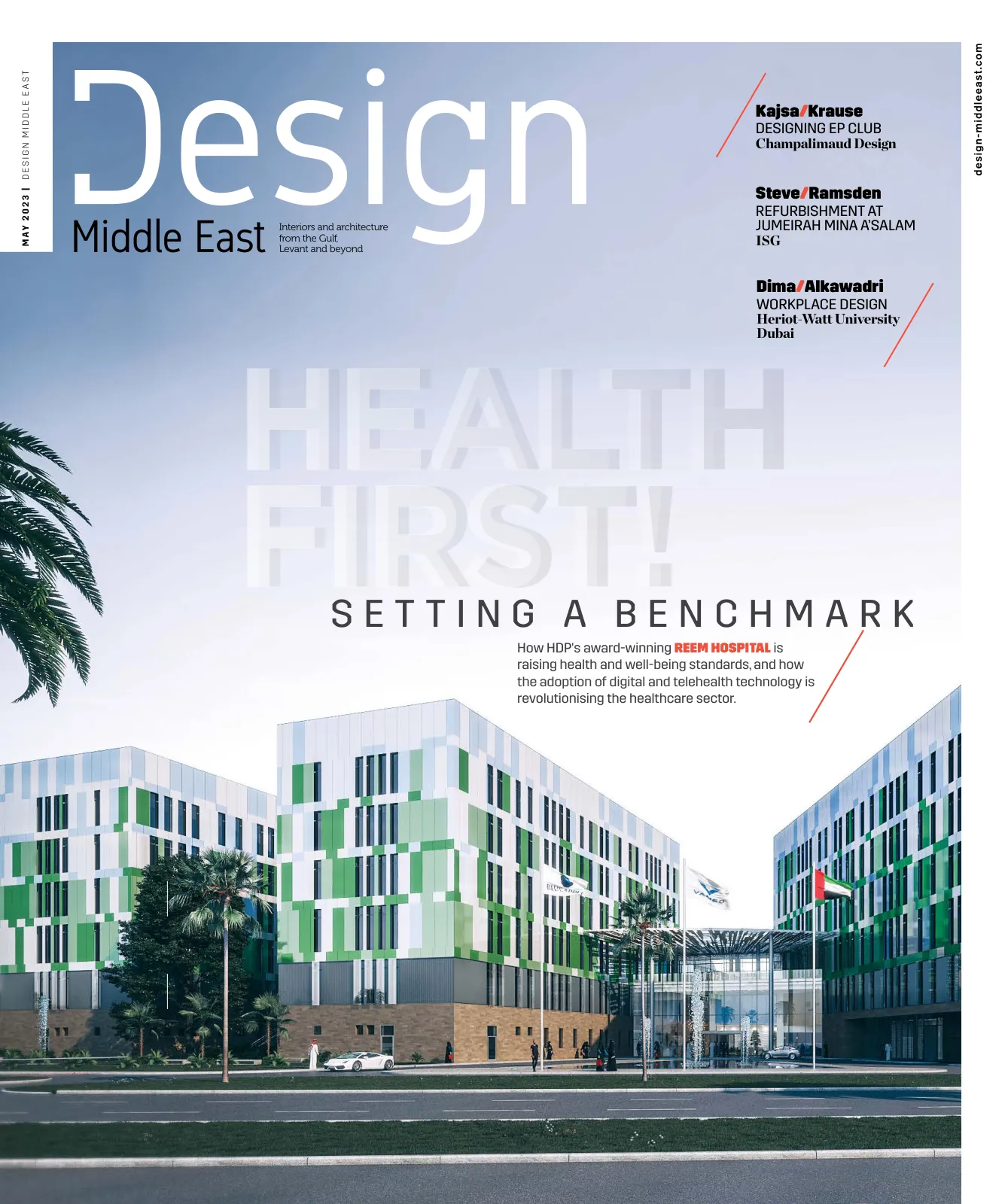
Design Middle East, May 2023
Page 1
design-middleeast.com
M AY 2 0 2 3 | D E S I G N M I D D L E E A S T
Interiors and architecture
from the Gulf,
Levant and beyond
How HDP's award-winning REEM HOSPITAL is
raising health and well-being standards, and how
the adoption of digital and telehealth technology is
revolutionising the healthcare sector.
S E T T I N G A B E N C H M A R K
Kajsa/Krause
DESIGNING EP CLUB
Champalimaud Design
Dima/Alkawadri
WORKPLACE DESIGN
Heriot-Watt University
Dubai
Steve/Ramsden
REFURBISHMENT AT
JUMEIRAH MINA A’SALAM
ISG
Page 2
2
27232
Homes from
AED
1,696,000
*
*T&C apply
Launching Sequoia,
your woodland paradise
A peaceful enclave hidden within the woodland.
Choose from a range of well-appointed homes, from
two-bedroom townhouses to six-bedroom signature villas.
Every residence at Sequoia blends nature-inspired design and
features with the latest smart home technology, bringing you
environmentally friendly convenience and comfort.
Page 3
D E S I G N M I D D L E E A S T | M AY 2 0 2 3
design-middleeast.com
1
12
REFURBISHMENT
Exceptional
How ISG revamped the Jumeirah
Mina A’Salam, Madinat Jumeirah’s
exquisite beachfront retreat
16
INTERVIEW
Attention to Detail
Blandine de Navacelle, Founder
of Studio Lodha and Creative
Director at Lodha UK, discusses
the design ethos of Studio Lodha,
its offerings for GCC clients,
the challenges and highlights of
working in this region.
20
OP-ED
Designing Workspaces
in the Midst of Societal
Changes
Dima Alkawadri, Assistant
Professor, Interior Design, School
of Textiles and Design, Heriot-
Watt University Dubai, discusses
designing workplaces in the face
of societal change.
28
IN CONVERSATION
Forward-Thinking
Kajsa Krause, Principal & Director
of Strategy at Champalimaud
22
Focus on Health
& Well-Being
Hamzeh Awwad, CEO of
AJ Group - HDP, discusses
their healthcare projects,
including the award-winning
Reem Hospital, and how
the integration of digital
and telehealth technology
is a game-changer in the
industry.
Design, discusses the design of The EP
Club, the club's distinctive features, the
challenges and highlights of working in
the GCC.
32
LIFESTYLE
Inspiring Spaces
Sanipex Group releases its annual guide
featuring the latest exciting products
34
INTERVIEW
Leading all the way
Jing Ma, Cluster Hotel Manager at Novotel,
Ibis World Trade Centre, and Ibis One
Central, discusses her journey, challenges
of running a business hotel, the factors
influencing the hospitality sector, and how
technology and sustainability are both
improving the guest experience.
38
HOSPITALITY
Ahead of the curve
Kirti Anchan, General Manager of
Jumeirah Emirates Towers, discusses
how this landmark property keeps ahead
of the competition, the emergence of
sustainability and technology, and the
industry's key issues
44
TALKING POINT
The Landscape of Cultural Assets
Sam Spinks, managing director of WAHO
Landscape Architects, on how the
landscape may aid in the creation of an
informative, sensitive, and thoughtful
public space for diverse cultural assets.
48
PROJECT
An ode to the history of
civilisations and dynasties
The Oman Across Ages Museum displays
the history of civilisations and dynasties in
Oman.
52
F&B DESIGN
SMITTEN
Malcom Wood, the founder and group
managing director of Maximal Concepts,
discusses his most recent F&B Mott 32
project and how its distinctive design,
music, and entire experience set it apart
from the competition.
56
OP-ED
ART in Design!
Julie Mulligan, Co-owner and Director
of Design & Development at Black Tap,
talks about her emphasis on art in design
as a way to highlight the place’s culture,
creativity, and excitement.
60
PICK OF THE MONTH
Simple made easy
A collaboration born from the fortunate
encounter between Takeda Katsuya
Design studio, based in Milan, and the
company Tatehiko based in the Japanese
regional city of Ashikaga.
DESIGN
Healthcare
Page 4
D E S I G N M I D D L E E A S T | M AY 2 0 2 3
2
design-middleeast.com
Page 5
D E S I G N M I D D L E E A S T | M AY 2 0 2 3
design-middleeast.com
3
Page 6
D E S I G N M I D D L E E A S T | M AY 2 0 2 3
4
design-middleeast.com
For all commercial enquiries
related to Design Middle East,
contact our Group Publishing Director
JOAQUIM D’COSTA
jo@bncpublishing.net | T +971 504402706
All rights reserved © 2023.
Opinions expressed are solely those of the
contributors.
Design Middle East is exclusively licensed to BNC
Publishing. No part of this magazine may be
reproduced or transmitted in any form or by any
means without written permission of the publisher.
Images used in Design Middle East are credited
when necessary. Attributed use of copyrighted
images with permission.
Printed by UPP
S U B S C R I B E
subscriptions@bncpublishing.net
PO Box 502511 Dubai, United Arab Emirates
T +971 4 420 0506 | F +971 4 420 0196
/designmideast
/designmiddleeast
FOLLOW US ON
@designmiddleeast
/designmiddleeast
Editor's note
CEO WISSAM YOUNANE
wissam@bncpublishing.net
DIRECTOR RABIH NAJM
rabih@bncpublishing.net
GROUP PUBLISHING DIRECTOR
JOAQUIM D’COSTA
jo@bncpublishing.net
+971 50 440 2706
EDITOR ROMA ARORA
roma@bncpublishing.net
CREATIVE LEAD ODETTE KAHWAGI
design@bncpublishing.net
ART DIRECTOR
SIMONA EL KHOURY
MARKETING EXECUTIVE
AARON JOSHUA
aj@bncpublishing.net
DIGITAL MEDIA PRODUCER
ALEXANDER BUNGAS
Alexandar@bncpublishing.net
T
he quality of healthcare is im-
proving, and this may be seen on
both a macro and micro level, as
something that will necessitate sweeping,
systemic change throughout the entire
healthcare system, as well as something
that individual clinicians can practice
for their patients. The combination of
technology and wellness-based design is
transforming the face of the industry. Our
cover story talks about the award-winning
Reem Hospital in Abu Dhabi by HDP. It is
defined by its emphasis on postacute reha-
bilitation, which underlines the necessity
of assisting patients in their recovery from
serious diseases and injuries. This strategy
is combined with a commitment to offering
multi-specialty care, which means patients
can receive treatment from a variety of
medical professionals all under one roof.
Reem Hospital also takes pride in utilis-
ing cutting-edge technologies to improve
patient outcomes and experiences. It's a
game-changer in the field.
Moving on, we chatted with Kajsa Krause,
Principal & Director of Strategy at Cham-
palimaud Design, about The EP Club's
design and distinguishing elements.
There's a lot going on in the landscape seg-
ment, according to Sam Spinks of WAHO
Landscape Architects, who discusses how
the landscape may help create an informa-
tive, responsive, and mindful public place
for varied cultural treasures.
ISG revamped the Jumeirah Mina
A’Salam, Madinat Jumeirah’s exquisite
beachfront retreat and the results are
stunning. ISG completed a thorough resto-
ration project that includes 291 rooms and
suites, two royal suites, and the spacious
two-bedroom ocean terrace suite extending
3,050sqft across 138,000sqft and seven
levels of the hotel.
Plus, there are some exciting projects and
other latest happening from the world of
design and architecture.
I'm drawn to the elegance and simplic-
ity of the Takeda Katsuya Design studio's
BRACE series of high-end, simple-to-as-
semble furniture items, which includes side
tables, coffee tables, and shelving. Check it
out in this month's Pick segment.
Roma Arora
Editor
roma@bncpublishing.net
Page 7
Germany’s Most Popular
Kitchen Brand
Third Time
running!
@utcllc.ae
@universal.ae
@universaltradingcompany
Universal Electrical Equipment Est.
Umm Al Sheif, Sheik Zayed Road,
Dubai, United Arab Emirates
Tel. No.: 04 282 3443
Universal Trading
Al Markaziyah West W5,
Abu Dhabi, United Arab Emirates
Tel. No.: 02 633 5331
Universal Trading
118th Street, Sanaiya,
Al Ain, United Arab Emirates
Tel. No.: 03 721 6660
www.utc.ae
Page 8
Page 9
Page 10
Page 11
Page 12
D E S I G N M I D D L E E A S T | M AY 2 0 2 3
10
design-middleeast.com
News
Jaipur Rugs introduces an exquisite collection in collaboration with Jocelyn Burton
Each rug involves 90 people in different
stages of weaving, dyeing, and finishing.
The new collection will be presented at The
Nehru Centre during London Craft Week
from 9th May – 12th May.
I
ndian brand Jaipur Rugs joins with the
late Jocelyn Burton, one of Britain’s most
prominent silversmiths and jewellery artisans,
to create a line of limited-edition carpets
inspired by some of her most magnificent
pieces.
The Jaipur Rugs ~ Jocelyn Burton collection
is crafted from 100% pure silk by more than 30
artisans using traditional techniques passed
down through generations, across two workshops in
India.
The collection features 11 striking designs, with
a limited run of only 10 pieces each. Jaipur Rugs
and Jocelyn Burton chose the Tibetan and Persian
construction techniques to suit each of the designs,
applying different weaves to confer a distinct range
of textures and tactility. A single rug can take up to
180 days to produce, making them a true labour of
love and a testament to the skill and dedication of
the artisans who created them.
Jocelyn first travelled to India in 1990, and
quickly became enamoured with the colour and
sophistication of the architecture in Delhi and Jaipur
and the quality of the craftsmanship on display at
every turn. Developing a profound attachment to the
country and its culture, she regularly visited until she
passed away in 2020.
Yogesh Chaudhary, second-generation head of
family-owned-and-managed Jaipur Rugs, comments:
“Jocelyn’s life ethos, guided by the Buddhist
principles of fairness and kindness, very much
resonated with our own beliefs, and her fascination
with peerless craftsmanship found a natural
receptacle in the ancestral art of rug making. The
whole collaboration fell into place very organically,
and I am so grateful to Jocelyn’s heartfelt
commitment to the collection, from creating the
original drawings for the rugs to making design
comments right up to the week before she passed
away.”
Page 13
design-middleeast.com
11
MILK BUN Qatar by Rabih Geha Architects is fresh out of the oven
The interior of the
restaurant is divided into
four sections: the cookies
and soft serve counter,
the burger counter, the
pickup counter, the live
oven and baking area,
and the dining hall.
M
ILK BUN Qatar, designed by
Rabih Geha Architects for
Gastronomica, is a bold nod
to history and the company’s
third outpost of its popular,
tech-oriented fast casual
concept.
The MILK BUN brand is
supported by three pillars that help it deliver on its
promise of delivering the future of premium fast-food:
an appealing and accessible menu of its signature
made-to-order savoury and sweet items, a seamless
user experience centred on fast-track tech, and a
saucy, sensational look that speaks to the younger
generations.
The multi-award-winning architecture and design
firm was commissioned to carry out the third phase,
culminating in an avant-garde experience that upsets
the counter-service scene.
Located in Place Vendome Mall in Doha, MILK BUN
Qatar announces itself through a large façade beyond
which pink infused cementitious walls and ceiling
melt into concrete flooring. The bakery is discernible
through a holographic window, highlighting the brand’s
trademark freshly baked buns and cookies being
prepared throughout the day.
The restaurant boasts an indoor dining area clocking
in at 376sqm and a 160sqm terrace accessible through
the restaurant or independently from a side entrance.
Both outfits share the same look and feel with the
addition of greenery and pink sunshades on the terrace.
Inside, Rabih Geha Architects accentuated the height
of the ceiling by fragmenting the wall finish into two
skins, a smooth concrete upper shell and a tiled, curved
cementitious lower shell.
Two concrete pillars were drawn to display the MILK
BUN totem tins and create a meandering path within
the restaurant or out onto the terrace. A series of
bespoke drum-shaped lights mounted to the ceiling
mirror the pillars on the ground.
The majority of the seating is made up of winding
pink leather banquettes designed by Rabih Geha
Architects for MILK BUN Qatar, supplemented by black
metal and terrazzo tables and Torno chairs by +Halle.
The desserts counter is decked with hologram
iridescent tiles at the base and highlighted by a linear
lighting suspension above.
D E S I G N M I D D L E E A S T | M AY 2 0 2 3
Page 14
D E S I G N M I D D L E E A S T | M AY 2 0 2 3
12
design-middleeast.com
Refurbishment
12
D E S I G N M I D D L E E A S T | M AY 2 0 2 3
Page 15
D E S I G N M I D D L E E A S T | M AY 2 0 2 3
design-middleeast.com
13
How ISG revamped the Jumeirah Mina A’Salam, Madinat Jumeirah’s
exquisite beachfront retreat
I
SG has successfully completed a compre-
hensive refurbishment project at Jumeirah
Mina A’Salam, Madinat Jumeirah’s exquisite
beachfront retreat. The hotel exemplifies
the spirit of Arabian hospitality, giving an ex-
ceptional experience that will leave guests
feeling refreshed and invigorated, nestled
among beautiful gardens and overlooking
the sparkling Arabian Gulf. The completion of
this massive project has upped the bar for luxury
and guest service yet again.
ISG completed a thorough restoration pro-
ject that includes 291 rooms and suites, two
royal suites, and the spacious two-bedroom
ocean terrace suite extending 3,050sqft across
138,000sqft and seven levels of the hotel. The
renovation was completed while the hotel re-
mained open, and it included the revitalisation of
all corridor areas.
The extensive upgrade and reconfiguration of
the two-bedroom ocean terrace suite comprised
modifying three single guest rooms into one
suite of two rooms, two luxurious bathrooms
with marble-clad walls, featuring Italian steam-
room and Jacuzzi, a large walk-in closet >>>
One may enjoy the hotel
by lazing around the
pools and embarking
on a gourmet tour with
outstanding dining options.
EXCEPTIONAL
Page 16
D E S I G N M I D D L E E A S T | M AY 2 0 2 3
14
design-middleeast.com
and a 1,000sqft outdoor terrace with views across
the Arabian Gulf.
The contemporary interiors, designed by La
Bottega by Intice, remain true to the timeless
Arabesque hotel ambiance, with striking design
elements celebrating the Arabian culture and
welcoming Jumeirah Mina A’Salam’s discerning
clientele. Hotel suites have bespoke timber flooring
finishes, huge feature windows designed to bring
natural light into the plush interiors, and a neutral
tones palette with colour accents throughout the
rooms.
To reduce the impact of this major hotel trans-
formation in a live environment, the fit-out firm
designed a fast-track 43-week delivery programme
for Jumeirah Mina A'Salam, expertly coordinat-
ing the activity of up to 250 team members on
site without incident or inconvenience – achiev-
ing over 200,000 safe manhours of activity. The
meticulously planned and phased work schedule
allowed the hotel to stay open and operating
throughout the duration of the refurbishment.
Refurbishment
It's a bright haven with
modern Arabian touch with
blissful sea views.
ISG executed a comprehensive restoration project that included 291 rooms and suites, two royal
suites, and the expansive two-bedroom ocean terrace suite spanning 3,050sqft across 138,000sqft and
seven levels of the hotel.
The contemporary interiors, designed by
La Bottega by Intice, remain true to the
timeless Arabesque hotel ambiance,
striking design elements celebrating the
Arabian culture.
Steve Ramsden, managing direc-
tor for ISG in the Middle East and
Southeast Asia, commented: “Rep-
utation and delivery excellence are
hallmarks of the prestigious global
hospitality brands that we partner
with on significant refurbishment
and upgrade projects. Instinctively
understanding our clients’ busi-
nesses helps us design flexible and
smart programmes of works that
exceeds expectations for quali-
ty and delivery excellence, while
ensuring we minimise our impact
on live operations and customer
experience.”
Page 17
Linealuce mini 27R
High Performance Linear System
Design Jean-Michel Wilmotte / 2022
Linealuce evolves with a new, miniaturised,
high performance version: a slash of three-
dimensional light, just 2,7 cm deep.
Linealuce mini 27R is a masterpiece of technological
precision, offering patented triple optic technology
that shapes light to meet any requirement.
Page 18
16
design-middleeast.com
Interview
Attention
todetail
Blandine de Navacelle, Founder of Studio Lodha and
Creative Director at Lodha UK, discusses the design
ethos of Studio Lodha, its offerings for GCC clients, the
challenges and highlights of working in this region.
In what ways does Studio Lodha define its
design ethos?
The design ethos of Studio Lodha is defined by
a highly tailored approach to each project we
work on. Our projects are visually appealing
and beautiful, but they are also functional
and thoughtfully designed to complement
the customer’s lifestyle and needs. A large
family, for example, may benefit from extra
storage space and a separate living area for
the children, whereas a professional couple
may prefer to convert an unused bedroom
into a private office. We’ve designed bespoke
joinery with sliding panels that can be moved
to reveal or conceal a desk, dressing table, or
widescreen TV in smaller London homes.
These small details can significantly improve
a home, and Studio Lodha is the epitome of
elegant, yet functional luxury.
How has Lodha UK’s offering changed
over time in response to ever changing
demands?
Studio Lodha is a direct response to the
changing, evolving needs of our customers.
D E S I G N M I D D L E E A S T | M AY 2 0 2 3
Page 19
D E S I G N M I D D L E E A S T | M AY 2 0 2 3
design-middleeast.com
17
After launching Lincoln Square,
our first London project, we
found that many buyers were
struggling with the design
and dressing of their new
homes. Our residents have
a high profile and are often
busy travelling with work or
family. As well as struggling
to find the time to meet with
interior designers, many found
it difficult to communicate their
needs and design preferences.
They came to us for help and
advice, and having already spent
several months with each client
on their home transaction,
Lodha UK was able to instantly
understand what each customer
wanted and needed. I started
helping several families with
their homes, and the studio has
evolved from there. Requests
kept coming in from friends and
families of our residents which
I initially had to turn down, but
now with the official launch
of Studio Lodha we are able to
work with customers outside of
the Lodha UK network, which I
am very excited for.
What services do you provide
to clients in the GCC? Is there
any particular segment you’d
like to pitch first?
Studio Lodha’s main area of
expertise is London and the
UK market. We know the
best tradespeople, renowned
artisans and leading galleries
to work with across Europe.
This knowledge is particularly
valuable to overseas buyers who
may not be as familiar with a
European aesthetic, or indeed
the London property market.
Many London properties,
particularly in Mayfair,
Belgravia and Kensington,
are large period townhouses,
which come with a lot of history
but also require meticulous
restoration and work. This
can be overwhelming for a
customer who is used to an
ultra-modern tower block as
they are unfamiliar with period
features and proportions.
Through careful space planning
and considered architecture,
we’re able to transform such
properties into modern family
homes, while retaining the
original features and detailing
that make them so special.
Studio Lodha are experts in
the renovation and redesign
of such properties, and we’re
already in discussions with
several families who are
primarily based in the GCC but
are looking to purchase and fit-
out a London residence. When
these families arrive in London
in early summer, we’ll look at a
few properties before I oversee
the redesign and completion of
their new homes.
How would you describe your
design aesthetics, and how
do you plan to cater to the
desires of GCC audiences with
traditional demands and a
modern touch, given that you
will be servicing expats from
around the world?
The Studio Lodha aesthetic
is defined by a use of rich
colours, graceful forms and
an eclectic mixture of antique
and bespoke pieces. Each
home by our practice has
a unique personality and
character, underlined by a
playful elegance. Art also plays
an important role in each of
our homes; I’ve sourced rare
Picasso’s and a highly covetable
Annie Morris sculpture on
behalf of clients. >>>
Studio Lodha
announces the official
opening of its public
practice, which will be
available exclusively to
GCC homeowners and
buyera around Europe.
Studio Lodha’s main area of expertise is London and the UK
market. We know the best tradespeople, renowned artisans and
leading galleries to work with across Europe.
Page 20
18
design-middleeast.com
Interview
Can you tell us about your design process for each
project? Is there a certain method that you follow?
In terms of the design process, the most important
moment is the initial consultation. This is where I
sit down with a client and discuss their upcoming
project, as well as how they like to live, work and
travel. Every project is a new story, and we always
start with a blank canvas. I’ll show them different
mood-boards and samples, and from there build a
picture of how Studio Lodha can help them create
their dream home. Studio Lodha has worked an
array of refined projects, each with their own unique
challenges, and we work to ensure that each new
client benefits from our wealth of expertise and best
practices learnt.
What are the challenges and highlights of working
with clients from the GCC?
Clients from the GCC have an in-depth and
impressive knowledge of luxury brands and design
houses, which is a pleasure to design for. GCC
Every project is a new story, and we always start with
a blank canvas. I’ll show them different mood-boards
and samples, and from there build a picture of how Studio
Lodha can help them create their dream home.
D E S I G N M I D D L E E A S T | M AY 2 0 2 3
Page 21
19
clients, as with any overseas market, have
specific cultural references to consider when
creating a home, even in the context of a British
property. So this can mean there are interesting
discussions at the beginning of the design
process, to ensure we are aligned in our vision,
but this is always a very enriching experience,
rather than a challenge.
As you think about the future, where do you see
yourself, especially in terms of interior design
and Studio Lodha’s direction?
I am very excited to make some announcements
about new hires and team expansion in the
coming months. Designers from some of the
world’s top studios and architecture firms have
joined us to help propel the business forward.
I’ll continue to meet with clients and oversee
projects, as well as cultivate our network of
leading luxury brands and suppliers – stay tuned
for more!
Over the past five years,
the team has become
invaluable to their global
clientele, dressing
over 30 apartments
across Lodha UK’s two
iconic London projects,
Lincoln Square and No.1
Grosvenor Square.
Page 22
design-middleeast.com
20
20
20
OP-ED
DIMA ALKAWADRI, Assistant
Professor, Interior Design, School of Textiles
and Design, Heriot-Watt University Dubai,
discusses designing workplaces in the face
of societal change..
Designing
WORKSPACES IN
THE MIDST OF
SOCIETAL CHANGES
DIMA ALKAWADRI is the
Assistant Professor, Interior
Design, School of Textiles
and Design at the Heriot-Watt
University Dubai.
D E S I G N M I D D L E E A S T | M AY 2 0 2 3
O
ver the past three years,
there has been a sig-
nificant shift in how we
perceive and design our
spaces. Priorities have
changed, and many so-
cietal and cultural norms
have influenced our
design and décor ideas.
While the importance of work-life balance has always
been present, its crucial role has become more apparent
since the pandemic. However, in terms of design, work-
life balance is not limited to any specific location. In the
past, work was typically confined to office space, but
the pandemic and subsequent years have significantly
altered the way we work. With non-essential workers
Page 23
D E S I G N M I D D L E E A S T | M AY 2 0 2 3
design-middleeast.com
21
future of wellness. Additionally, the Global Well-
ness Institute states that it is estimated to increase
from USD48.5 billion in 2020 to USD58.4 billion in
2025, with an average annual growth rate of only
3.8 per cent. Companies are now shifting their fo-
cus (and budget) from compartmentalised "well-
ness programmes" towards more comprehensive
approaches that address emotional, social, and
financial well-being. The new approach toward
employee well-being is more comprehensive and
authentic.
Moreover, wellness and sustainability will con-
tinue to dominate the workplace interior design
sector. A balanced workplace must address
factors such as air and water quality, lighting and
thermal comfort, and the need for a clutter-free
space that fosters emotional and productive
well-being. and with a focus on using materials
and fixtures that are sustainable and environmen-
tally friendly.
While some companies have returned to full-
time onsite work, others offer flexible working
opportunities to their employees. Agile office
designs are an essential part of this flexible
working approach, with office interiors focused
on facilitating increased productivity and leisure
areas allowing colleagues to socialise and take a
break from work duties and support wellbeing as
a result.
Along with recreational spaces, designers now
also incorporate working areas that are more
relaxed, such as meeting pods which can be open
spaces with two seats, and call rooms – which
are single units for employees to answer calls or
take online or phone meetings. As a result, agile
offices can improve collaboration, enhance job
satisfaction, and reduce stress levels, ultimately
leading to increased productivity.
Flexible working conditions have also had an
impact on home offices. While dining tables and
kitchen counters may have served as makeshift
workstations in the past, people are now more
conscious of their homework settings. As a
result, comfortable desks, ergonomic chairs, and
creatively designed spaces are now on design
agendas.
The influence of societal and cultural changes
of the past few years have impacted the design
sector, and understandably, every major global
phenomenon will directly affect how we design
our workspaces.
suddenly forced to work from home, many people realised
that their homes were not adequately equipped to provide
a comfortable and functional workspace, regardless of size.
Conversely, as people return to the office, conditions that
were previously acceptable may no longer be sufficient.
Although the corporate setup often demands a specific
appearance, office interior design has evolved beyond those
limitations. The traditional office norms of closed meeting
spaces, fixed desks and chairs, dull upholstery, lack of decor,
and limited color options are no longer the office norms.
In the UAE, the average person spends between 35 to 40
hours at work each week. Although the workplace cannot
provide the same level of comfort as home, it is crucial to
offer a comfortable environment that supports physiolog-
ical harmony and mental peace, allowing employees to
perform their tasks efficiently. Offices are now incorporating
time-out spaces or lounges, recognizing the importance of
providing recreational areas to promote well-being. These
spaces are no longer limited to lunchrooms, with designers
now creating areas such as gaming rooms equipped with
table tennis and foosball, lounge chairs, and reading spaces.
The shift towards creating recreational spaces is due to the
growing demand for work-life balance, as people increas-
ingly recognise the need to prioritise their well-being, espe-
cially when spending long hours in a corporate setting.
Wellness-related designing also gained significant impor-
tance. A practical addition to modern offices is the use of
flexible electric desks that users can adjust according to
their work style. These desks enable users to increase or
decrease their height, allowing them to sit or stand while
working. Although it may seem like a simple addition, this
feature can significantly benefit those with spinal issues,
fatigue, and posture problems, promoting physical comfort
and reducing the likelihood of discomfort or pain.
According to the latest report from the Global Wellness
Institute on the global wellness economy, ‘workplace well-
ness is projected to be the slowest-growing category in the
OFFICES ARE NOW INCORPORATING TIME-OUT
SPACES OR LOUNGES, RECOGNIZING THE
IMPORTANCE OF PROVIDING RECREATIONAL
AREAS TO PROMOTE WELL-BEING.
Page 24
design-middleeast.com
Cover story
22
D E S I G N M I D D L E E A S T | M AY 2 0 2 3
H E A LT H & W E L L- B E I N G
ON
FOCUS
Flexible and flexible environments are also becoming increasingly important in healthcare design.
Page 25
23
design-middleeast.com
HAMZEH AWWAD, CEO of AJ Group - HDP,
discusses their healthcare projects, including
the award-winning Reem Hospital, and how the
integration of digital and telehealth technology is a
game-changer in the industry.
How does your firm work with clients to help them navigate the
region's healthcare market?
HDP provides valuable guidance to its clients as they navigate the healthcare
industry by furnishing them with comprehensive market insights and intelligence
on the latest healthcare regulations, policies, and trends in the region. We also aid
clients in identifying potential gaps and opportunities in the market, conducting
feasibility studies, and creating plans to enter, grow, and expand their business. Our
solutions are designed to cater to the unique needs of the healthcare market in
the GCC region with a blend of global and local perspectives.
A unique "Glocal" solution that is tailored to the specific needs of clients and
organisations. Our hands-on ‘Total Solutions’ approach wherein we provide
all services in-house under one roof – architecture, health planning, medical
equipment planning, structure & MEP services ensure seamless project delivery.
All our projects are delivered in BIM/ BIM 360 thereby conforming to the highest
industry standards. >>>
HDP assists its clients in
navigating the healthcare
business by providing complete
market insights and intelligence
on the region's newest
healthcare regulations, policies,
and trends.
D E S I G N M I D D L E E A S T | M AY 2 0 2 3
Page 26
D E S I G N M I D D L E E A S T | M AY 2 0 2 3
24
design-middleeast.com
What approach do you take
when designing spaces that
support patients' health and
wellness while also providing
enough flexibility for the
unknowns of the future?
HDP employs "patient-centered
design," which considers the physical,
emotional, and psychological needs
of patients, employees, and visitors.
This technique involves designing
surroundings that promote healing,
comfort, safety, and privacy while
also allowing for adaptation, flexibility,
and scalability.
We also includes sustainable and
new technology that improve the
patient experience, save costs, and
increase overall care quality. Our
health planning process ensures
the physical space, colour, texture,
lighting, ventilation – volume and
scale of public/ private spaces all
tie into patient satisfaction and
resonate the ‘at-home’ state of
mind. These fine nuances in the play
of developing healthcare facilities
have proven tangible effects on not
only patient’s wellbeing but also
physicians and staff alike. Our team
understands that for any health
facility to succeed in their vision
and mission, it’s imperative to have
a wholistic approach that embraces
and enhances the workforce itself.
Future-proofing healthcare
facilities has become more relevant
today than ever before and we
cannot stress its importance enough
post pandemic. At the on-set, we
highlight the significance of this
to client and how it shapes design
process. An integrated approach
that begins with the appropriate
structural system, further supported
by MEP services that are adaptable
and flexible, catering to diverse
health planning options – current and
future. Incremental cost has to be
accounted for while preparing initial
budget to reap long term benefits.
Cover story
Implementing
appropriate technology
goes a long way in
distinguishing a premium
health facility from the
rest, tying into all facets
of medical equipment
spanning across various
departments.
Increased use of tele-
medicine, in which patients
can seek medical attention/
therapy and treatment
from the comfort of
their own home while
interacting with multi-
specialty physicians, is a key
approach.
Page 27
D E S I G N M I D D L E E A S T | M AY 2 0 2 3
design-middleeast.com
25
What are the distinguishing
features of Abu Dhabi's Reem
Hospital?
Reem Hospital stands out from other
hospitals due to several unique
characteristics that are integral to its
identity. One such feature is its strategic
location on Reem Island, which offers
convenient access to patients from
across the region. Additionally, the
hospital's size is noteworthy, as it is one
of the largest and most comprehensive
facilities of its kind.
It’s distinguished by its focus on post-
acute rehabilitation, which emphasises
the importance of helping patients
recover from serious illnesses and
injuries. This approach is coupled with a
commitment to providing multi-specialty
care, meaning that patients can receive
treatment from a range of different
medical experts all under one roof.
Reem Hospital also takes pride in
leveraging cutting-edge technologies
to improve patient outcomes and
experiences. From cutting-edge
diagnostic technology to cutting-edge
treatment options, the hospital is
prepared with the most recent equipment
and resources to ensure that patients
receive the finest care possible.
All of these elements contribute
to Reem Hospital's truly exceptional
healthcare environment. Patients may be
assured that they will receive world-class
treatment throughout their entire patient
journey, whether they require post-acute
rehabilitation, multi-specialty care, or
cutting-edge technology.
How has the design of healthcare
facilities changed to meet the
needs of today's patients?
In recent years, healthcare facility design
has been undergoing significant changes.
These changes are geared towards
improving patient outcomes, increasing
efficiency, and adopting sustainable
practices. One of the primary shifts in
healthcare design has been towards a
more patient-centred approach, which
prioritises the needs and preferences of
patients.
Healthcare institutions are adding numerous aspects to create a healing atmosphere
in order to achieve a patient-centered approach. Natural light, outdoor spaces, and
vegetation are examples of elements that have been demonstrated to enhance
healing and reduce stress levels in patients. Furthermore, the use of technology in
healthcare design has become more prevalent, with the goal of improving patient
communication, access, and engagement.
What was your design process like for this project, and how challenging
was it for you?
In the realm of healthcare project design, the process involves several essential steps.
These include conducting thorough research and analysis, defining project goals and
objectives, generating various design options and concepts, engaging stakeholders
and end-users in the design process, and refining the finished designs. >>>
Page 28
D E S I G N M I D D L E E A S T | M AY 2 0 2 3
26
design-middleeast.com
It's always beneficial to have a well-educated operator who
understands the unique requirements of their model of care in the
region from the very beginning of the project. This operator can
help expedite the project since they are already familiar with the
design process and can provide valuable insights and feedback
along the way.
What is the biggest trend you're seeing in healthcare
design right now, and how does it affect what you do?
The adoption of digital and telehealth technologies is one of
the most significant trends in healthcare design presently.
These technologies enable remote patient monitoring, virtual
consultations, online scheduling, and communication. As a result,
healthcare design professionals are increasingly integrating these
technologies into healthcare spaces to enhance the delivery of
healthcare services.
The growing use of digital and telehealth technology has the
potential to impact HDP's mission. HDP, in particular, will need to
incorporate technology more thoroughly into healthcare settings,
creating environments that are not only functional but also user-
friendly and accessible. This could entail adding user-friendly
interfaces, ergonomic designs, and sufficient space for telehealth
consultations.
Aside from technology integration, HDP may need to prioritise
user experience and accessibility. This entails creating healthcare
environments that prioritise patient comfort, usability, and
accessibility for people with disabilities. To create a healing
environment that supports the well-being of patients and
healthcare providers, HDP may need to consider aspects such as
lighting, acoustics, and temperature management.
Overall, the adoption of digital and telehealth technologies
in healthcare design is a significant trend that is transforming
how healthcare spaces are designed and used. HDP and other
healthcare design professionals must adapt to this trend to meet
the changing needs of patients, healthcare providers, and the
broader healthcare industry.
How is technology influencing the way you design and
implement your project?
The influence of technology on the healthcare industry can
be seen in the design and implementation of healthcare
projects. Technology has paved the way for more efficient and
effective communication, collaboration, and data analysis. To
streamline design workflows, visualise concepts, and optimise
building performance, healthcare design professionals can
take advantage of various technology tools such as Building
Information Modelling (BIM), Virtual Reality (VR), and Artificial
Intelligence (AI). These tools enable HDP to enhance the efficiency
and accuracy of their work, allowing them to deliver better
healthcare outcomes and adapt while technology continuously
changes.
Moreover, technology impacts and imparts key support to several
disciplines – Electro-Mechanical services is at the heart of any
healthcare facility and drastically influences the efficiencies,
wellbeing and overall ‘health’ of the health facility. They are the
key drivers in achieving set goals and objectives of any facilities
sustainability program.
What are some areas of healthcare that do not receive
enough attention?
There are certain aspects of healthcare that are often overlooked,
despite being critical to the overall well-being of individuals and
communities. Mental health, substance abuse, chronic disease
management, and preventative care are among the areas that
are frequently neglected. These areas could significantly benefit
from increased attention, investment in research, education, and
infrastructure to improve access, quality, and outcomes.
Investments in research, education, and infrastructure are
essential if we are to effectively address these concerns.
Research can help us better understand the causes and
treatments of mental health, substance abuse, and chronic
diseases. Education can help raise awareness and reduce
stigma surrounding these conditions, as well as promote healthy
lifestyles and preventative measures. To ensure that everyone
has access to the treatment they require, infrastructure
improvements can include constructing new clinics, recruiting
more medical professionals, and expanding the availability of
telemedicine services.
What are the current projects you are working on?
At the moment, HDP is working on a number of projects for
hospitals, clinics, and laboratories. Our work is not restricted
to a single area because they are also supporting numerous
feasibility studies in the GCC and elsewhere. We are able to give
stakeholders helpful insights and a "lessons learned" approach
when planning and carrying out new projects thanks to our
partnerships with different organisations.
HDP has a strong presence in the UAE and Saudi Arabia, with
many hospitals under design and construction; we are also
involved in the GCC (Iraq, Kuwait, Oman, Qatar), Middle East
(Lebanon, Syria, Palestine, Jordan), and CIS countries (Pakistan,
Uzbekistan, Afghanistan, and so on). Our varied range of projects
and relationships demonstrates HDP's passion to the healthcare
sector and commitment to improving patient outcomes.
Cover story
Page 29
RAKCERAMICS.COM
Imagine a space where your inspiration
can run free. A world that tells
your own story, every single day.
At RAK Ceramics we help
create the perfect living space,
for you and your loved ones.
Imagine your space.
IMAGINE
YOUR
SPACE
Page 30
28
design-middleeast.com
In conversation
Emirates Palace Mandarin
Oriental delivers a
vision of sophistication
and modernism while
authentically and movingly
embodying the traditions of
the Emirates.
Tell us about your professional background
and your experience in the design industry.
I am currently Principal and Director of Strategy
at Champalimaud Design, having built my career
spearheading luxury, boutique, and lifestyle de-
signs as well as branding initiatives for hospitality
and residential projects. I have a keen interest in
culture and travel and have been fortunate enough
to work on high-profile properties around the
world. I have also collaborated with hotel groups
to redefine brand narratives and create internal
design directives.
How did you turn The EP Club at Emirates
Palace Mandarin Oriental into a place for
socialising, dining, and relaxing?
We conceived The EP Club as a superior private
residential experience that would accommodate
both leisure and business-oriented gatherings. It
is presented as a sequence of en-suite residential
rooms, all with different characters and offerings.
Woven together as an elegant lounge, it provides
a breadth of experiences to guests, from private
moments to more social and interactive ones.
Evoking the residential theme, an open kitchen is
located at the heart of the space, with secondary
spaces radiating and connecting: a library, a living
room, and a private dining room. Easy transition to
the patio and the beachfront was an essential driver
for the location of the lounge. Mirroring the layered
experience of interior spaces, we introduced a
unique seating arrangement to each terrace, visual-
ly distinguished by our shading designs.
How have you attempted to distinguish
this location from other similar concepts
on the market?
Distinguishing a project begins with writing the
most compelling story. For this property, our con-
cept originates from the layered and ancient history
of Abu Dhabi. It is a rich tale titled ‘The Land where
the Ocean meets the Desert’. Our narrative was
informed by the exquisite surrounding landscape, a
KAJSA KRAUSE, Principal & Director of Strategy at Champalimaud Design,
discusses the design of The EP Club, the club's distinctive features, the
challenges and highlights of working in the GCC.
D E S I G N M I D D L E E A S T | M AY 2 0 2 3
thinking
Forward-
Page 31
D E S I G N M I D D L E E A S T | M AY 2 0 2 3
design-middleeast.com
29
place full of patterns that have been shaped
by nature over millennia. Emirates Palace
Mandarin Oriental presents a vision of
sophistication and modernity, while still
reflecting the traditions of the Emirates in
an authentic and moving way.
How has your company's offering
evolved over time in response to
shifting market demands?
No matter the current trends, our work is
always about designing through the lens of
the visitor, instilling a sense of place with
a strong attention to how one lives. We’re fo-
Champalimaud Design
has partnered with clients
to create some of the
world’s most distinctive
properties, transforming
context and heritage into
compelling stories and
unparalleled experiences.
cussed not only on a guest’s journey, but also their needs and aspirations. This approach speaks through-
out every project, and it never goes out of style.
How would you define your design aesthetics, and how do you intend to cater to GCC
audiences' desires with traditional demands and a modern touch, given that you would
be servicing expats from all over the world?
Every project holds its own aesthetic identity. My priority is to build a thoughtful point of view rich with
storytelling, while hopefully captivating guests with an impactful sense of style. The bespoke and curated
designs honour nature and cultural traditions through a contemporary lens.
Tell us about the materials and furniture you used, as well as any intriguing artworks
you used to enhance the space's beauty.
The choice of materials throughout the club is sophisticated. The decorative lighting is varied and
bespoke, adding to the residential feeling. >>>
Page 32
D E S I G N M I D D L E E A S T | M AY 2 0 2 3
30
design-middleeast.com
Elegant white wall panelling in the central
dining area brings a fresh and layered
sensibility. The ceilings have insets of
custom floral wall covering by Fromental.
Warmer, deeper wood tones and softly lit
wooden built-in bookcases in the library
grant an intimate quality to the space. The
open kitchen is designed as a focal point
with more dramatic and contrasting use of
materials. The custom-made hand tufted
wool rugs by Royal Thai take inspiration
from the surrounding nature, the reflections
in water and the dappled light from the sun
through palm trees. Metal screens with cus-
tom patterns were designed for the dining
room, which speak to the local heritage and
tradition of light filtering through screen
elements and lanterns, with a floral pattern
that takes cue from the Mandarin Oriental
brand.
The art throughout was curated by the art
consultant team Visto to elevate the design
narrative, the final layer of the space.
What are the challenges and high-
lights of working with clients from
the GCC?
Clients from the GCC take pride in their
rich local culture and heritage, so we
endeavour to design in a way that accentu-
ates a space’s natural beauty, honours its
historical significance and builds that emo-
tional connection as a result. What ends
up being both a challenge and a highlight is
the task of expertly balancing our approach
to contemporary design with a genuine,
thoughtful sense of place.
As you think about the future, where
do you see yourself and Champali-
maud Design, especially in terms of
interior design and direction?
As a firm, our design philosophy and values
have allowed us to endure times of great
change. The forward-thinking ability to in-
fuse spaces with modernity while maintain-
ing integrity, character and a sense of place
keeps the studio’s work relevant throughout
our exploration of new and exciting areas.
In conversation
Champalimaud's design
atelier takes into account
all of the components that
create a space-history,
context, purpose, and,
most importantly, people.
Designed for the dining room, which speak to the local heritage
and tradition of light filtering through screen elements and
lanterns, with a floral pattern that takes cue from the Mandarin
Oriental brand.
Page 33
SEE
MORE
Page 34
32
design-middleeast.com
Lifestyle
D E S I G N M I D D L E E A S T | M AY 2 0 2 3
S
anipex Group
announces the
release of its lat-
est annual price
guides, which
offer a compre-
hensive look at
its impressive
and extensive
product portfolio.
As a consumer
lifestyle plat-
form, the group
takes pride in staying ahead of the curve
when it comes to designing for the latest
trends. Its MEA Price Guides for 2023
provide customers with updated pricing
information for its BAGNODESIGN line,
as well as Kitchen and Bathroom Brands,
Outdoor Living, and Lighting ranges.
These updated guides serve as a valu-
able resource for customers, enabling
them to better plan and budget for home
renovation and commercial projects.
Each brochure is presented in a visually
appealing magazine-style format, with
stunning lifestyle photography and
detailed information throughout.
Sanipex Group is committed to provid-
ing its clients with the best products and
services possible. These updated price
guides, which include the most recent
products and prices, are just one way it
aims to serve them.
“At Sanipex Group, we are committed
to making our customers’ purchase
experience easier by providing all the
information they require in both our
brochures and online. Our Jebel Ali
warehouse holds large stock quantities
to ensure prompt delivery, so customers
can receive their products when and
where they want them. Our annual price
guide is always updated with the latest
trends and inspiration from our travels
to Italy and around the world, resulting
in exciting new products that suit our
customer’s needs and our brand. While
our bathroom category remains our
most popular, we continue to expand
Inspiring
Sanipex Group releases its annual guide featuring the
latest exciting products
Spaces
Page 35
D E S I G N M I D D L E E A S T | M AY 2 0 2 3
design-middleeast.com
33
our offerings to provide even more
unique and luxurious products to
our customers in other categories.”
Kerrie Black, Group Merchandising
and Marketing Director, Sanipex
Group.
The new BAGNODESIGN MEA
Price Guide features an extensive
range of luxury bathroom product
lines including the comprehensive
Orology and Bristol ranges, Chiasso
mixers, and the Alpine basin and
shelf collection. The Chiasso Mixers
will be launched in May and are the
perfect complement to the Alpine
range. This brochure is designed
to provide knowledge of the latest
interior design trends, inspiration,
product combinations, and detailed
product specifications to retailers
and designers, enabling them to cre-
ate on-trend and innovative designs
for their clients.
The Kitchen and Bathroom Brands
Price Guide for 2023 is equally as
inspiring. It features a wide range
of industry-leading brands, from
bathroom washbasins from Galassia
and flushing systems from Geberit
to professional-style bathroom and
kitchen mixers from Nobili and
state-of-the-art cooking appliances
from Lofra. In addition to external
brands, the Kitchen and Bathroom
Brands Price Guide also features Sa-
nipex Group’s own BYSTRO kitchen
appliances, which are available in
stock in their Jebel Ali warehouse
to ensure immediate delivery to
customers.
Sanipex Group works with over
40 kitchen and bathroom brands
to provide a complete solution for
every project, from high-quality
bathroom washbasins to profession-
al-style kitchen mixers.
In addition to its bathroom and
kitchen products, the new Price
Guides for 2023 also include an
Outdoor Living brochure with over
300 stunning products and style
ideas from over 30 luxury European
brands. From pizza ovens at Igneus
and grills from Boretti to cabana
daybeds by Talenti and sofa sets by
Cane-Line, Sanipex Group is pleased
to offer a remarkable range for its
customers. In addition to these
brands is their own extensive GYM-
KHANA Outdoor Living range.
The final brochure in the collec-
tion is the Lighting Price Guide for
2023. This contains inspiring ideas
and a superb range of European
products for contemporary indoor
and outdoor spaces. Brands include
Carpyen, Contardi, A Emotional
Light, Vistosi, and Hind Rabii. Sa-
nipex Group sources each product to
fill in the gap in the Middle Eastern
lighting market, offering bespoke
and contemporary solutions. The
Lighting Brochure Price Guide also
features valuable technical informa-
tion on lighting concepts to provide
customers with useful knowledge.
RIGHT
The design of the Bosco Furniture
and Verbier Basin Collection by
BANGNODESIGN draws inspiration
from Milan's design district.
Sanipex Group is committed to providing its
clients with the best products and services
possible. These updated price guides, which
include the most recent products and prices, are
just one way it aims to serve them.
Page 36
34
design-middleeast.com
Interview
JING MA, CLUSTER HOTEL MANAGER AT NO-
VOTEL, IBIS WORLD TRADE CENTRE, AND IBIS ONE
CENTRAL, DISCUSSES HER JOURNEY, CHALLENG-
ES OF RUNNING A BUSINESS HOTEL, THE FAC-
TORS INFLUENCING THE HOSPITALITY SECTOR,
AND HOW TECHNOLOGY AND SUSTAINABILITY
ARE BOTH IMPROVING THE GUEST EXPERIENCE.
Tell us about your journey –
how did it all start?
My journey in the hospitality
industry began in 2007 when I
joined The Palace Hotel Down-
town Dubai as a receptionist.
From the very beginning, I was
fascinated by the dynamic and
vibrant nature of this industry.
As I gained more experience and
exposure to the various roles
and responsibilities within the
hotel, I realised that hospitality
was more than just a job for me
- it was a passion.
I've had the opportunity to
work in a variety of jobs across
several departments over the
years, and each post gave
me with new challenges and
learning opportunities, allowing
me to develop a diversified skill
set and a thorough grasp of the
industry.
How important are leadership
skills in your role, and how do
you motivate your employees
on a regular basis?
Leadership skills are crucial
in my role, as they enable me
to inspire and motivate my
team to perform their best. As
a leader, I prioritise identifying
and developing the strengths
of each team member, fostering
a collaborative and supportive
work environment. Regular
communication and feedback
are also essential, as it allows
me to stay connected with my
team, set common goals, and
track progress. I motivate my
employees by celebrating their
achievements and providing
opportunities for growth and
development. Overall, strong
leadership abilities are critical
to the success of both my team
and the firm.
Can you tell us what are the
distinct features of Ibis Dubai
World Trade Centre?
Ibis Dubai World Trade Centre
boasts a unique set of fea-
tures that make it stand out in
the hospitality industry. As a
20-year-old property, it has es-
tablished itself in the economic
segment and has been the go-
to exhibition hotel for over 100
days each year due to its prime
location at the Dubai World
Trade Centre. The hotel recently
had a comprehensive resto-
ration of its 210 rooms, with
ongoing upgrades of the public
areas planned to be finished
by February 2023. By Q4 2023,
guests can anticipate to see a
completely new Ibis with cut-
ting-edge design concepts and
a wide range of dining options,
making it a perfect location for
visitors from all over the world.
D E S I G N M I D D L E E A S T | M AY 2 0 2 3
LEADING way
ALL
THE
The Ibis World Trade
Centre Dubai hotel is
directly connected to the
International Exhibition
Centre and Convention
Centre of Dubai, the Middle
East's largest international
complex.
Page 37
D E S I G N M I D D L E E A S T | M AY 2 0 2 3
design-middleeast.com
35
Located just 5 minutes away from the Dubai Metro, IBIS World Trade Centre is
the perfect base for exploring all the city has to offer.
In the business hospitality segment, there are many new
hotels openings – what distinguishes your brand from the
competition?
The Ibis brand is renowned for its straightforwardness and
effectiveness, which draws in a dedicated following who
value its unique identity and commitment to quality assur-
ance. This approach sets us apart from other hotels in the
business hospitality segment, as we prioritise delivering a
consistently excellent experience to our guests.
What are some of the trends you see impacting the hospi-
tality industry?
One of the emerging trends in the hospitality industry is
the increasing popularity of lifestyle hotel concepts, where
guests are seeking unique experiences that align with their
personal preferences and interests. In addition, there is a
growing focus on delivering exceptional guest experiences,
as customers are placing a greater emphasis on the overall
value proposition of their purchases. As a result, hotels are
adopting innovative approaches to enhance guest satis-
faction, such as incorporating technology to streamline
processes and personalising services to cater to individual
needs.
What is the unique value proposition that you offer cus-
tomers?
Our distinct value proposition stems from our commitment to
offering our customers with simple and uncomplicated expe-
riences. We focus providing our visitors with all they need to
have a comfortable stay.
Tell us more about the hotel's restaurants and bars, and
how they provide a unique experience. What are some
dishes and drinks that you recommend everyone should
try?
With ongoing renovations at the hotel, we are excited to in-
troduce brand-new food and beverage destinations that will
offer unique culinary experiences to our guests. Our concept
centres around providing a variety of food offerings, >>>
Page 38
D E S I G N M I D D L E E A S T | M AY 2 0 2 3
36
design-middleeast.com
Interview
including an Indian Bistro Bar, Mediterranean fusion res-
taurant, vegan café, and more. We are committed to using
the freshest ingredients and creating new dishes that
cater to a range of dietary preferences. We look forward
to welcoming guests to experience our new and exciting
dining options, which will be available by Q4 2023.
Great hospitality is now made possible by technology.
Can you tell us about some of the technologies that go
into creating your guest experience?
As part of our ongoing renovation work, we are implement-
ing several technologies to enhance the guest experience.
These include a digital check-in solution and digital room
keys, which allow guests to complete their registration
online or through an iPad, and to access their rooms
using their mobile devices. Our lobby will feature a smart
sound and light system that can be controlled digitally,
providing a comfortable and personalised environment
for guests. These technologies are designed to streamline
processes and provide greater convenience and flexibility
to our guests, helping to create a seamless and enjoyable
experience.
What difficulties come with maintaining a business
hotel?
Maintaining a business hotel can be challenging due to
two main factors. Firstly, during peak seasons, there is the
risk of market rejection due to high-rate setups. Secondly,
during the summer season, there is increased competi-
tion for market share, which can lead to rate competition.
Balancing these challenges requires careful planning and
analysis to ensure that the hotel remains profitable while
maintaining a high level of service and guest satisfaction.
Is sustainability important for the hotel? If so, how do
you work it into your designs?
Sustainability is an integral part of our design philosophy.
We have eliminated the use of single-use plastics, built
water filtration plants to supply in-house bottled water,
and replaced plastic items with sustainable options. Our
guest rooms are equipped with energy-saving technolo-
gies, and we have implemented water-saving measures in
our shower heads and taps. In 2023, we plan to introduce a
carbon calculation project in our Meeting and Events area
to further reduce our carbon footprint.
What opportunities and challenges lie ahead for hotel-
iers in the coming years?
In the coming years, hoteliers will have the opportunity to
capitalise on the faster growth patterns in the industry
as the market evolves. However, they will also face the
challenge of positions being replaced by technology such
as AI. It is essential for hoteliers to embrace innovation and
invest in technologies to enhance guest experiences and
increase efficiency while maintaining the human touch.
Tourism has had a massive comeback in the region –
how do you see this translating to bigger growth in the
hospitality sector in 2023 and beyond?
The tourism industry in the region has recovered signifi-
cantly and is expected to translate into bigger growth in
the hospitality sector in 2023 and beyond. At our hotel, we
have factored this growth in our financial projections, and
we stay tuned to market trends. With many global activi-
ties planned in Dubai in Q4 2023 and the Chinese market
expected to improve in the coming months, we are optimis-
tic about a great season ahead and for the year 2024.
"In the coming years, hoteliers will have the
opportunity to capitalise on the faster growth
patterns in the industry as the market evolves.
However, they will also face the challenge of
positions being replaced by technology such as AI."
Page 39
As builders of the
future, we work all day
to make your daily life
better. By thinking
beyond chemistry.
Whether it’s biotechnology, physics or materials science – we
connect disciplines, areas of expertise and perspectives to
create sustainable solutions that add value in partnership with
our customers. Our specialty additives make the difference for
end products becoming more valuable, more durable, more
energy-efficient and in many ways simply better. And that
answers the question of why we exist: to make people’s lives
better day in, day out. Leading beyond chemistry to improve
life, today and tomorrow.
www.mea.evonik.com
Page 40
38
design-middleeast.com
D E S I G N M I D D L E E A S T | M AY 2 0 2 3
38
Hospitality
Ahead
OF THE
CURVE
KIRTI ANCHAN, General
Manager of Jumeirah Emirates
Towers, discusses how this
landmark property keeps ahead
of the competition, the
emergence of sustainability and
technology, and the industry's
key issues
Page 41
D E S I G N M I D D L E E A S T | M AY 2 0 2 3
design-middleeast.com
39
design-middleeast.com
39
With a slew of new hotels with flashy designs on the horizon,
how does Jumeirah Emirates Tower stay ahead of the
competition?
At Jumeirah Emirates Towers, we firmly believe that staying
ahead of the competition requires a relentless pursuit of
excellence in every aspect of our operations. To achieve
this, we focus on several key areas that set us apart.
Firstly, we recognise the importance of maintaining our
iconic status in the Dubai skyline. For over two decades,
the hotel’s unique architecture and design have defined
the city's landscape, and we continue to innovate and
evolve to ensure we remain relevant and attractive to our
guests.
Secondly, we significantly invest in technology to
streamline our operations enhance our guest’s experience
by providing seamless and convenient services, including
mobile check-in and check-out, keyless room entry, and a
range of other digital features. >>>
This hotel, located on
Sheikh Zayed Road,
is directly connected
to the Emirates
Towers Metro and the
Museum of the Future,
and is only a few
minutes' drive from
Dubai Mall.
Page 42
D E S I G N M I D D L E E A S T | M AY 2 0 2 3
40
design-middleeast.com
Hospitality
From savoury grills to
healthy and organic
preparations, classic
Italian cuisine, and
trendy French dishes,
the restaurants and
pubs offer one-of-
a-kind gastronomic
experiences.
This award-winning
hotel offers
contemporary
rooms with
breathtaking views.
Thirdly, at Jumeirah Emirates Towers, we place great emphasis on
sustainability and environmental responsibility in our operations. We
have implemented several initiatives to reduce our carbon footprint,
including the use of energy-efficient lighting, water conservation
measures, and waste reduction programs. Our commitment to
sustainability sets us apart from other hotels in the market and
resonates with our guests, who are increasingly concerned about the
impact of their travel on the environment.
Lastly, we are committed to continuously evolving our food and
beverage offerings to cater to the current trends and preferences
of our guests. Our dedication to culinary innovation pushes us to
now demanding that the brands they support
also implement sustainable practices. This puts
pressure on hotels to take significant steps to
reduce their carbon footprint and ensure that
their operations are sustainable.
There is also a certain degree of saturation
in the market, with numerous players offering
similar services and amenities. In Dubai, new
hotels are continuously being introduced,
leading to fierce competition for guests.
However, hotels can differentiate themselves
from their competitors by offering unique
experiences, personalised services, and
implementing sustainable practices. At
Jumeirah Emirates Towers, we focus on these
areas to stand out in a crowded marketplace
and continue to thrive. With the right strategies
and a commitment to innovation, hotels can
overcome these challenges and succeed in the
industry.
constantly experiment with new concepts
and cuisines to ensure our guests have a
memorable dining experience with us.
What are the key challenges the hotel industry
is currently facing?
The hotel industry faces several key
challenges, but we see them as exciting
opportunities for growth and innovation. From
a technological perspective, hoteliers need
to keep up with evolving customer demands
and expectations. Guests now expect
high-tech amenities such as e-registrations,
online food ordering, high-speed Wi-Fi, and
touchless technology, and hotels must adapt
to these requirements to remain competitive.
Moreover, guests and partners guests
and partners have become more conscious
about environmental sustainability and are
Page 43
D E S I G N M I D D L E E A S T | M AY 2 0 2 3
design-middleeast.com
41
41
design-middleeast.com
Indulge in the hotel's
magnificent suites
with stunning city
views.
Sustainability is clearly important
to you. Tell us about a few ways
you’ve incorporated eco-friendly
concepts into your hotel?
At Jumeirah Emirates Towers, we
take sustainability very seriously
as part of our commitment to the
Dubai Sustainable Tourism Program.
As we progress towards a green
future, we've implemented a variety
of initiatives, from conserving
energy and water conservation
to managing waste management
and prioritising sustainable
procurement.
Our biggest sustainability
initiative to date has been the
implementation of an in-house
glass bottling plant system,
which has replaced the use of
approximately 670,000 plastic
bottles each year in our guest
rooms and food and beverage
operations. We're also proud
to offer several eco-friendly
alternatives across many
guest touchpoints in the hotel,
including eco-friendly amenities,
guest e-registration, e-menus,
and sustainable food sourcing.
As part of our giving back, we
regularly donate used hotel
linen and colleague uniforms to
selected charities, amounting to
approximately 1.1 tonnes recently,
as well as 3000 kilos of paper
products. And for electric car users,
we have e-car charging stations
available on our complex open for
public and guest use.
We're also taking steps to digitise
our record-keeping process,
replacing manual recording
with digital systems to improve
efficiency and accuracy while
reducing paper waste. Recently,
we have also partnered with Ne'ma
to support the reduction of food
waste during Ramadan.
We know that education and
awareness are critical to
sustainability, which is why we
also continuously educate our
team members on sustainable
practices. Our goal is to create
a long-term commitment to
sustainability within our team and
raise awareness of environmental
responsibility exponentially.
What is the unique value
proposition that you offer to your
customers?
As a leading luxury city hotel
in the region for over 23 years,
Jumeirah Emirates Towers offers
a unique value proposition
that sets us apart from our
competitors. Our commitment to
providing exceptional personalised
services and creating memorable
experiences that exceed our
guests' expectations is the
cornerstone of our brand. We
believe in the power of human
interaction in hospitality, and our
colleagues offer unrivalled, genuine
service that creates a warm and
welcoming atmosphere for our
guests.
Located in the heart of Dubai, our
hotel offers convenient access
to the city's key attractions and
business hubs, including Dubai
International Financial Centre and
Dubai World Trade Centre. Our
iconic architecture and stunning
views of the city from our rooms
and suites make us a stand-out
area. Additionally, we provide our
guests with a range of dining
options, including a range of
dining options and award-winning
restaurants.
As part of the Jumeirah brand, we
take pride in upholding the brand’s
reputation for excellence and
unparalleled service.
Tell us a bit about the restaurants
and bars in the hotel and how it
offers a unique offering.
Jumeirah Emirates Towers is
a popular destination for food
enthusiasts, with 11 exceptional
food and beverage venues >>>
At Jumeirah Emirates
Towers, we take
sustainability very
seriously as part of our
commitment to the
Dubai Sustainable
Tourism Program.
Page 44
D E S I G N M I D D L E E A S T | M AY 2 0 2 3
42
design-middleeast.com
that offer a unique dining experience. We take pride in catering to
our guests' discerning palates by offering an array of options to
satisfy every taste bud.
Our award-winning Mundo is an all-day dining restaurant that
offers themed nights and business lunch experiences. We are
also home to Gohan, La Cantine Du Faubourg, Madeleine et Marcel,
Ninive, and The Nice Guy, which are powerhouses of Japanese,
French, Middle Eastern, and Italian cuisines, respectively.
For guests seeking an eclectic dining experience, Leen's, located
in the Office Towers, offers gourmet meals in a unique setting. Our
Daefi Lounge provides a luxurious lounge experience for guests
entering the hotel, where they can enjoy a cup of coffee in the
morning or afternoon tea later in the day. We also have Flow, a
restaurant that caters to health enthusiasts and vegan guests,
offering hearty meals throughout the day.
Additionally,Mi Amie is the perfect place to enjoy magnetic vibes
and tantalising cuisine, and The Agency is known as one of Dubai’s
best wine bars in the noughties.
How does a hotel remain a part of the local community while
attracting guests from afield?
At Jumeirah Emirates Towers, we understand the importance of
balancing our role as an active member of the local community
while also attracting guests from around the globe. As part of
our efforts to achieve this, we have integrated Dubai-exclusive
experiences into our offerings to enhance our guests' stay while
promoting the rich heritage and attractions of the city.
We recently opened an air-conditioned bridge connecting us
to the Museum of the Future and Dubai Metro, making it simple
for our guests to easily explore the city's newest attraction and
travel seamlessly around it. Moreover, we have partnered with
local travel experience providers to offer curated experiences that
showcase the best of Dubai.
With its strategic location in the bustling Dubai Financial District,
close to the World Trade Centre and Downtown Dubai, our hotel
guarantees that our guests will feel the pulse of the city. Our
address, adjacent to the iconic Emirates Office Tower, which is
home to the offices of the Prime Minister of Dubai and other
government offices, adds to the prestige of our hotel among
government and corporate leaders around the world.
Our distinctive architecture stands tall, serving as one of the
symbolic representations of the city worldwide, ensuring our
enduring presence as an integral part of the iconic Dubai skyline.
In your opinion, what is the most impressive part of the property?
Every time I enter the lobby, I am fascinated to see our guests from
quite varied backgrounds sitting side by side. This may be the only
lobby in the world where one can meet a UAE cabinet minister, a
CEO of a major multinational, a journalist, a young Emirati student,
an Indian tech entrepreneur, a Saudi businesswoman, a head of
state, intellectuals, politicians, diplomats, and even budding artists
altogether, all in the course of one day.
The lobby was designed by Pringle Brandon Perkins+Will, which
has abundant daylight, high ceilings, sophisticated interiors, and a
dynamic atmosphere to complement the opulence. As guests sit
in the lobby, they are greeted by a glimpse of the Museum of the
Future, as if the beautiful structure itself were welcoming them to
a memorable stay in the city.
The tower's opulence, status, and power are palpable in the
lobby, providing a constant feeling of luxury.
Hospitality
Page 45
D E S I G N M I D D L E E A S T | M AY 2 0 2 3
design-middleeast.com
43
Do you have any new
initiatives or offerings you'd
like to share?
We are gearing up for the
summer to offer various
exciting summer experiences
for those seeking a luxurious
escape this season. Our
summer stay packages
will be packed with value
that guests will surely
appreciate. Additionally, we
are introducing new culinary
experiences at our food and
beverage venues, Mi Amie
and The Agency, to tantalise
every guest’s taste buds.
We look forward to bringing
you more exciting news to
make your summer getaway
to Jumeirah Emirates Towers
unforgettable!
Tourism has had a massive
comeback to Dubai – how
do you see this translating
to bigger growth in the
hospitality sector in 2023?
With considerable investment
being made in new hotels,
restaurants, and other
hospitality businesses,
Dubai's hospitality sector is
expected to see significant
growth this year.
In particular, the luxury
hospitality sector is expected
to thrive due to Dubai's
reputation as a hub for
business and finance in the
Middle East. Businesses
seeking high-end facilities
that provide state-of-the-art
technology and amenities for
their events and conferences
will further fuel growth in this
sector.
Dubai's hosting of COP
28 this year, a high-profile
event that will bring together
leaders from around the
world to discuss climate
change and sustainability,
is another factor that will
support the development of
the sector. There will likely
be a large influx of visitors
to the city, increasing the
demand for hotel rooms,
conference facilities, and
other hospitality services.
As a result, the hospitality
sector in Dubai is set to play
a key role in supporting the
city's continued growth and
development.
How has technology impacted
and influenced design, and
how might it continue to in the
future?
Technology has significantly
impacted the hospitality
business, transforming
how guests interact
with hotels. More and
more hotels have started
incorporating technology
into their guest rooms, with
features such as smart
lighting and temperature
controls, curtain controls,
and charging stations
becoming increasingly
common. Additionally, hotels
have started implementing
e-registrations for a more
efficient check-in process.
To enhance presentations
and events, hotels are also
investing in state-of-the-art
audio and visual equipment
for event spaces, such as
high-quality sound systems
and large-screen displays,
Hotels have also
increasingly incorporated
digital signage and interactive
displays to provide guests
with information about the
hotel and local attractions
while also creating an
immersive and visually
engaging atmosphere.
In order to provide guests
from around the world with
an immersive experience
of our hotel rooms, we
have made a strategic
investment in 360-degree
virtual tours. These tours
allow us to visually engage
and interactively promote
our rooms on our marketing
platforms, offering potential
visitors a realistic and
accurate image of what they
may anticipate from their stay
with us.
Looking ahead, hotels are
incorporating sustainability
into their design as
guests become more
environmentally conscious,
with the use of energy-
efficient lighting and cooling
systems and water-saving
technologies becoming more
popular. Hotels are also using
smart building management
systems to optimise energy
usage and reduce waste.
How, according to you, is the
hospitality industry evolving?
What is your vision for the
hospitality segment in the
Middle East?
Based on my observations,
there are several important
developments shaping
the industry, including
personalised experiences,
an increased focus on
sustainability, the integration
of technology, and a growing
attention to health and
wellness.
Nowadays, guests are
more drawn towards
personalised experiences
that cater to their individual
needs and preferences. At
Jumeirah Emirates Towers,
we leverage the use of data
and technology to create
personalised experiences
for guests, which has driven
our continuous growth in
repeat guest ratio. Guests are
also becoming increasingly
concerned about the
impact of their travel on
the environment and are
looking for sustainable
options, making them support
brands that show genuine
commitment towards
sustainability.
The use of technology has
also become increasingly
important in the hospitality
industry, with many hotels
and resorts using digital tools
to streamline operations,
enhance the guest
experience, and improve
communication.
We have also observed
the rise in the importance
of health and wellness, with
guests looking for ways to
incorporate healthy habits
into their daily routines, even
when they are away from
home.
Moving forward, the Middle
East hospitality industry will
likely continue to evolve in line
with global trends. However,
there are also some unique
factors that are shaping
the industry in the region as
global leaders. One example
is the growing popularity of
experiential travel, in which
passengers focus on creating
meaningful and engaging
experiences rather than just
visiting a region and ticking
off tourist sites. The Middle
East has all the advantages
and resources to encourage
travellers to engage with the
local culture, traditions, and
environment.
To enhance presentationsand events, hotels are also
investing in state-of-the-art audio and visual equipment
for event spaces, such as high-quality sound systems and
large-screen displays, Hotels have also increasingly
incorporated digital signage and interactive displays to
provide guests with information about the hotel and local
attractions while also creating an immersive and visually
engaging atmosphere.
Page 46
design-middleeast.com
T
he
importance
of cultural
identity,
expression
of tangible
heritage and
significance
of notable
building
preservation are key drivers for the
recent surge in the creation of built
cultural assets and the preservation
of heritage buildings throughout
the UAE and the wider Middle East.
In cities such as Abu Dhabi, Dubai
and Sharjah, significant resources
have gone into the development of
various types of cultural assets, taking
various forms. Smaller-scale existing
museums like the Al Ain Museum are
undergoing thoughtful redevelopment,
while significant purpose-built assets
are being designed and built from
undeveloped sites, such as the Natural
History Museum in Abu Dhabi.
As landscape architects, our role in
these projects is to strengthen the
overall experience for those who visit
these valuable sites and destinations.
The key question is how can landscape
help create an informative, sensitive
and considered public realm for the
various cultural assets.
Often, a dynamic site or historical
location will drive the story and
inform the landscape design. Our
job as landscape architects is to
Landscape
of cultural assets
THE
SAM SPINKS, MANAGING
DIRECTOR OF WAHO
LANDSCAPE ARCHITECTS,
ON HOW THE LANDSCAPE
MAY AID IN THE CREATION
OF AN INFORMATIVE,
SENSITIVE, AND
THOUGHTFUL PUBLIC
SPACE FOR DIVERSE
CULTURAL ASSETS.
Sam Spinks, Managing
Director at WAHO
Landscape Architects
D E S I G N M I D D L E E A S T | M AY 2 0 2 3
44
Talking point
Page 47
D E S I G N M I D D L E E A S T | M AY 2 0 2 3
design-middleeast.com
45
understand the cultural context
and then derive a clear and suitable
landscape response from that.
This contextual understanding is
gained by exploring a location's
history and stories through written,
pictorial, and aural sources. Its
relationship to the surrounding
context and surroundings, as well
as the aim for the visitor experience
of the space, are all taken into
account.
Qasr Al Hosn in Abu Dhabi is
one example of this: a building set
within an open space in the heart
of Abu Dhabi with a rich layered
history dating back to the creation
of the watch tower in the late 18th
Century, followed by the Inner
Fort in 1795 and the Outer Palace
in 1939-45. These layers of history
directly informed the landscape's
materiality, form and texture.
This was specifically reflected
in changes in the hardscape
materiality. The lower levels of
paving that are more closely related
to the original entry to the fort
are sandstone, while the higher
paving surfaces that interface with
more recent door thresholds are
limestone. Both the sandstone
and limestone read as a cohesive
whole but have subtle variations
in colour and texture. As a place of
such regional significance, the fort
requires simplicity of landscape
design to support it: the buildings
and existing structures remain as
the key moment. The landscape
acts as the supporting base for an
authentic visitor experience.
Ground-up developments, on the
other hand, such as the Natural
History Museum currently under
construction in Abu Dhabi, allow
for greater design expression.
Because the historical drivers of
the site are less constrained, there
is more room for new dynamic
and interesting interventions
within a space. Collaborating with
exhibition and visitor experience
designers is an exciting process >>>
OFTEN, A DYNAMIC SITE OR HISTORICAL LOCATION WILL
DRIVE THE STORY AND INFORM THE LANDSCAPE DESIGN.
OUR JOB AS LANDSCAPE ARCHITECTS IS TO UNDERSTAND
THE CULTURAL CONTEXT AND THEN DERIVE A CLEAR
AND SUITABLE LANDSCAPE RESPONSE FROM THAT.
The Founder’s Memorial, Abu Dhabi. | Photo by ©JonWallis Photography
Page 48
D E S I G N M I D D L E E A S T | M AY 2 0 2 3
46
design-middleeast.com
Talking point
as we work through ideas and
concepts to create real and
informed environments.
The cultural identity of
a landscape can also be
strengthened by creating a
multi-sensory experience. The
degree to which this experience
is produced within the landscape
can vary depending on overall
intent and vision. The UAE
Pavilion landscape at EXPO
2020 in Dubai was an expression
of the unique characteristics
that make up the flora and fauna
of the United Arab Emirates.
The use of native bird sounds,
audio looped to family photos
presented on display panels and
the burning of sandalwood all
created a heightened sensory
experience within a relatively
confined space.
On a different scale, The
Founder’s Memorial in
Abu Dhabi created a serene
and reflective atmosphere
adjacent to the busy Corniche
strip. Gestures such as the
surrounding elevated walk
created a threshold from the
surrounding context and a
mechanism to control noise,
while a mix of Ghaf trees
and Acacias created an ideal
environment for birds to nest.
Although the intent to evoke a
certain feeling within a space
like a memorial is considered,
the outcome can also be
serendipitous or unexpected,
yet desired. At The Founder’s
Memorial the echo of reflected
footsteps off the entry portal, or
the unanticipated movement of
sea breeze through the space,
unexpectedly enhance the
experience.
Consideration of the end-
user and their takeaway of the
experience is at the forefront
of design thinking and space
planning. For a cultural asset,
the visitor is looking to gain
a specific understanding of
a subject. From the bronze
age artefacts at a site such as
the Mleiha Archaeological Center, to
the forward-thinking visions of a new
cultural landmark like the Mohammed
Bin Rashid Library, the landscape is there
to support, supplement and enrich the
experience and not overwhelm it.
Details become important in a
culturally rich context, and interventions
are validated and interrogated. It is
frequently far more difficult to create
a simple yet thoughtful landscape: the
talent is in integrating geometries,
colours, noises, and textures to create
attractive open areas.
Often “less is more” is the hardest
goal. But when achieved and blended
with a strong narrative we can create
considered and atmospheric spaces that
forego temporary design tastes, creating
lasting regionally specific landscapes.
Al Ain Museum, Al Ain.
The Founder’s Memorial, Abu Dhabi. | Photo by ©JonWallis Photography
Qasr Al Hosn, Abu Dhabi. | Photo by ©JonWallis Photography
Page 49
Page 50
D E S I G N M I D D L E E A S T | M AY 2 0 2 3
48
48
Project
THE OMAN ACROSS AGES
MUSEUM DISPLAYS THE
HISTORY OF CIVILISATIONS
AND DYNASTIES IN OMAN.
HISTORY
OF
CIVILISATIONS
AND DYNASTIES
AN
TO THE
ODE
design-middleeast.com
Page 51
49
49
T
he Oman Across Ages
Museum, located near the
ancient city of Nizwa, has
opened its doors to the
public for the first time.
The 300,000-square-me-
ter museum complex
depicts the tale of Oman’s
civilisations and dynas-
ties, from prehistoric
times to the present day,
using cutting-edge tech-
nology to transport visitors on a voyage through the
country’s history.
Event, the global experience and exhibition design
agency, worked closely with the Royal Court of Affairs
(RCA) to realise the vision of the late His Majesty
Sultan Qaboos bin Said al Said (1940-2020) to create a
hi-tech, interactive cultural venue that would speak to
Omanis – especially the younger generations – about
their country, culture and heritage, inspiring them to
contribute to shaping the Sultanate’s future.
The scale and breadth of the Oman Across Ages Mu-
seum is unlike any other museum in the country – the
permanent exhibition space alone is over 9,000sqm ,
with some galleries stretching more than 20m high.
Event supported the process from start to finish, de-
veloping the initial museum concept and creating an
architectural masterplan which provided a roadmap
for the project. As the project’s exhibition designer,
Event then worked hand-in-hand with appointed
practice Cox Architects to ensure the architecture >>>
This project demonstrates the deep integration of Omani culture that helped in the creation of this museum.
design-middleeast.com
IMAGES COURTESY © OMAN ACROSS AGES MUSEUM
D E S I G N M I D D L E E A S T | M AY 2 0 2 3
Page 52
50
design-middleeast.com
D E S I G N M I D D L E E A S T | M AY 2 0 2 3
and exhibition design worked in
harmony.
Upon entering the museum, visitors
are invited on a vast, sweeping journey
through time. Starting with the land’s
geological formation and ending in
modern day Oman, they fly through
Page 1 of 3 different ages, dynasties
and civilisations guided by the latest
exhibition technology and story-
telling techniques. The permanent
exhibition wings are divided into two:
The History Gallery and the Renais-
sance Gallery. The latter represents
the country’s remarkable period of
economic, technological, political and
social modernisation beginning in
the 1970s under His Majesty Sultan
Qaboos bin Said al Said.
There was a diverse array of
techniques used to create a rich and
layered exhibition experience that
draws in audiences of all ages. Archival
and contemporary film footage,
photography and the considered use
of augmented reality combine with
Project
The state-of-the-art technologies are used to create transportive experiences that immerse
audiences in different times and places.
There are more than 30 tactile stations and over 70
interactive screens located throughout the museum,
encouraging hands-on interaction.
object displays to spectacular effect. A tactile object or
artefact introduces the theme of each space, forming a
trail running through the core of the museum. Audio and
tactile elements are integrated at every stage to make
sure that all visitors are able to engage with the content,
be it the jaw of the animal of Omantherium, a primitive
elephant that lived 35 million years ago, or a scaled model
of the Arabian Gulf Cup.
A moving floor and 360° theatre transports visitors
through Oman’s economic landscape. Augmented reality
has been used to overlay ancient peoples engaged in
activities on the archaeological site plan and in front of
the physically reconstructed huts in the prehistoric area.
3D scanning and printing has been used on an unprec-
Page 53
D E S I G N M I D D L E E A S T | M AY 2 0 2 3
design-middleeast.com
51
edented scale to recreate a geolog-
ical structure of folded rock. The
museum emerges from the ground in
a way that invokes the surrounding
landscape, with the Hajar Mountains
in the distance giving rise to the
recurring triangular motif through-
out the space. This can be seen in the
History Gallery’s tessellated walls,
which represent Omanis’ lasting
connection to the land. In the section
of the exhibition devoted to Islam,
the tessellation transitions into a
flowing ribbon structure, suggesting
the impact of Islam as the ordering
principle of Omani society.
Esteban Botero, Creative Director
at Event said: “It has been a huge
privilege to work on this once-in-a-
lifetime project, helping to realise
the vision of the late His Majesty
Sultan Qaboos bin Said al Said. The
Oman Across Ages Museum will
take visitors on a journey through
Oman’s 800 million year history
using cutting-edge technologies and
immersive audio-visuals. Inspired
by the landscape around it, we hope
the museum will become a source of
pride for Omanis as well as a must-
see destination for visitors.”
AUGMENTED REALITY HAS BEEN USED TO OVERLAY ANCIENT
PEOPLES ENGAGED IN ACTIVITIES ON THE ARCHAEOLOGICAL
SITE PLAN AND IN FRONT OF THE PHYSICALLY RECONSTRUCT-
ED HUTS IN THE PREHISTORIC AREA.
Page 54
design-middleeast.com
52
D E S I G N M I D D L E E A S T | M AY 2 0 2 3
F&B design
MALCOM WOOD
FOUNDER AND GROUP
MANAGING DIRECTOR
OF MAXIMAL CONCEPTS,
DISCUSSES HIS MOST RECENT
F&B MOTT 32 PROJECT
AND HOW ITS DISTINCTIVE
DESIGN, MUSIC, AND ENTIRE
EXPERIENCE SET IT APART
FROM THE COMPETITION.
SMITTEN!
You have worked all over the world
and now, you are working on this
exciting F&B project in Dubai. Tell us
more about your experience, and
how does cultural change affect the
decor and interior taste of clients?
Throughout my career, I have opened
over 40 different concepts in the F&B
industry and have invested and backed
over 60 different companies. Mott 32
is our flagship and in my opinion, this
venue is the most special and unique
concept I have ever been involved in.
It is the first restaurant in the world to
migrate from East to West and really
showcases the best of what Chinese
cuisine has to offer. With its flagship
restaurant in Hong Kong, we have
expanded to sublime cities such as
Singapore, Las Vegas, Bangkok, Seoul
and of course, now Dubai and Toronto
with another few exciting locations
coming up.
Page 55
D E S I G N M I D D L E E A S T | M AY 2 0 2 3
design-middleeast.com
53
Fine dining Chinese restaurants
were previously only found in 5-star
hotels and featured classic white
tablecloths, a boring ambience, an
antiquated wine list, and unfashion-
able cocktails. We saw a chance to
develop something distinctive and
really inject personality back into
this area of the market.
Design is one of the key compo-
nents for the success of a restaurant
especially one like Mott 32. We
have taken all the best lessons we
have had over our experience from
design, wine, mixology, music, and
atmosphere and combined all the
key elements into the Mott 32 dining
experience. Mott 32, like Hong
Kong Culture, and like myself, being
half-Chinese and half-British, is the
epitome and mix of both culture and
heritage.
As a result, we have made the
concept more approachable, to both
local and international markets.
How does Mott 32 stand out com-
pared to other Chinese fine dining
restaurants in the city?
We do things differently in compari-
son to other Chinese restaurants and
are not specific to a certain Chinese
culinary region. Traditionally, Chi-
nese food showcases a specific type
of cuisine from Szechuan, Canton-
ese, Shanghai, Hakka, etc. howev-
er we are one of the very first to
combine cuisine from across China
into one menu and break away from
a very traditional industry. Mott 32
is more than just a dining establish-
ment; it's an adventure. Every detail
of the dining experience, from the
view to the music, the aroma, the
drinks, and the food, has been care-
fully arranged from the minute our
visitors walk in to the moment they
depart. >>>
Mott 32 Dubai, located
on the 73rd floor of
the Address Beach
Resort, JBR, features an
impressive indoor area, as
well as an open-air terrace
with stunning views across
Bluewater Island, JBR,
Palm Jumeirah and the
Ain Dubai.
Malcolm Wood is a
leading influence in the
F&B industry and has
been a driver for change
in the food and hospitality
sector. Mott 32 is one of
the most awarded Chinese
restaurants and is the first
Chinese restaurant brand
from Asia to be franchised
internationally in key
gateways cities around
the world.
Page 56
54
design-middleeast.com
D E S I G N M I D D L E E A S T | M AY 2 0 2 3
F&B design
Another core ingredient is our
love for food, whilst protecting
the environment. We constantly
evolve our thought process and
sustainability mission, as we learn
and progress as a global company.
With every lesson from each new
location, we filter it back to our
global partners to ensure Mott 32
is consistently progressing with
the changing perspectives of the
world. Changes can come through
various forms of renovation, such
as signature or seasonal dishes.
Therefore, it really is a continuous
evolution. If we didn’t focus on
being adaptable and constantly
changing, then we would quickly
become outdated and that is what
we want to avoid.
Is there a storytelling element to
the design creation of this F&B
venue?
We try to tell a new story with each
Mott 32 venue and come up with
an interesting narrative, as we like
our concepts to be in-depth. Our
consistency in design comes from
our partnership with Joyce Wang
Studio who designed the original
Mott 32 in Hong Kong, as well
as Vancouver, Las Vegas, Singa-
pore, Cebu, and Dubai. For every
new branch, we like to challenge
ourselves to do something new
and different, finding a creative
angle for each location. Each one is
as exciting as the next because we
customise them according to the
environment, culture, climate, and
overall positioning within the city
each outlet operates in.
For Dubai, we looked to Arabic
courtyard homes for inspiration.
In keeping with Mott 32's typol-
ogy, the restaurant is divided into
Vibrant and energetic, the venue is named after the address of Manhattan’s first Chinese convenience store, which opened in 1891.
The kitchens across all Mott 32 restaurants globally are helmed by Group Chinese Executive Chef Lee Man Sing.
a number of distinct rooms, each
with its own personality. These areas
seamlessly transition from the inside
to the outside. We have incorporated
a light, ethereal design with natural
roots based on the building's archi-
tecture and setting. Furthermore,
because it is one of the highest res-
taurants in the world, we have taken
advantage of the stunning views.
Page 57
55
design-middleeast.com
D E S I G N M I D D L E E A S T | M AY 2 0 2 3
IN KEEPING WITH MOTT 32'S TYPOLOGY, THE RESTAURANT IS DIVIDED INTO A
NUMBER OF DISTINCT ROOMS, EACH WITH ITS OWN PERSONALITY. THESE AREAS
SEAMLESSLY TRANSITION FROM THE INSIDE TO THE OUTSIDE.
"
"
Food and drinks are the main highlights of any restaurant.
What are some of the unique dishes which are recom-
mended to try?
The most unique items on our menu are the plant-based
alternatives to our traditional Chinese signature dishes
including the Crispy Shitake Mushroom Tempura and the
Vegan ‘Chicken’ Szechuan.
One of my favourites, must-have dishes, is the Apple Wood
Roasted 42 days Peking Duck as it is cooked in a special
custom oven using apple wood – which smokes the duck. We
have also developed a homemade Hoisin Sauce and devel-
oped our own version of cutting the duck, where we mix the
emperor’s cut with a Beijing-street cut, which the poor would
use to keep the steam in on cold winter days in the North of
China.
How important is music to the success of any F&B venue?
Vital and to be honest, one of the key drivers for any suc-
cessful experience. The wrong music can heavily impact the
customer experience, therefore we have carefully selected
the track list for Mott 32 and we have developed our own
‘sound’. Once you feel the energy in the restaurant the rest of
the night takes care of its itself.
Do you face any challenges in the region’s F&B segment?
Are there any specific initiatives and actions you think
which Dubai needs to ‘up the level’ in the F&B industry?
During the pandemic, Dubai became and still is, the “IT”
city in the world, as they just got everything right in terms of
business, tourism, travel, and policy. Real Estate is booming
and so many people from all walks of life are now coming
to Dubai. I know so many people who have moved to Dubai
from the UK, Hong Kong and Singapore. The F&B game in
the city is also top notch and it is important to bring your
best when you turn up, as it is like Vegas for the US. Dubai can
make or break a brand as the city has become a global hub.
How has technology impacted and influenced design, and
how might it continue to in the future?
This is a key thing we have been speaking about for the last 5
years and is evolving very quickly. Phones and social media
have become the key drivers and influence in the industry.
Before COVID-19, we shot photos a certain way taking into
account that 50% of the media was print and online and the
other 50% was social. Most of our photos were split between
landscape and portrait. Video was less important. Our com-
petition was purely our competitors. Now trying to do our
marketing the same way we used to - you end up competing
with your own customers and your competition’s customers.
Everyone with a phone is now a marketing agent, therefore
video is key. Creating moments in the restaurant thar your
customers can film themselves is more important than or-
ganising a professional photoshoot. Everything from
the interior design to the dishes presented needs to
be filmed and shot vertically. If you get this right, you
have 300 marketing agents walking into your restau-
rant every night and doing the work for you.
How do you see the F&B industry evolving?
My hope is that the industry will evolve to become
more sustainable and thoughtful in how/where it
sources its food and products. Running a restaurant
sustainably is not an easy route, it takes time, effort,
and a lot of energy to find the right products and sup-
pliers, and to change the innate habits of both staff
and customers. We have founded a business called
Plastic Conscious that works on plastic alternative
products for the industry such as sous vide bags,
cling film, industrial bin bags and we are proud to say
that several of our partners are using our products.
We (the F&B industry) are at the forefront of
change and can really lead by example. It is an excit-
ing time to be doing business as we have the opportu-
nity to really make a difference around us. There is a
lot of innovation coming out of the need for change
and I hope we can continue to add to this.
Additionally, by choosing to source locally and
sustainably, we can have a significant impact on
people's health as well as the environment. The F&B
business has spent far too much time trying to cut
costs, but we now need to stand up for our future. If
every restaurant in the F&B industry used ethical
food sourcing practises, this would have an effect on
suppliers and aid them in adapting and changing as
well.
We are all in this together and we need to choose to
change together. Change starts from the inside.
Page 58
design-middleeast.com
I
n 2015, my husband, Chris
Barish, and I opened Black
Tap Craft Burgers & Beer, and
I focussed on developing the
brand’s design story. About a
year later, I became involved
with Black Tap in a larger role,
serving as a design and project manager
for the restaurant’s Midtown New York
opening. From there, I became the brand’s
Director of Design and Development,
overseeing the restaurant’s overall design
portfolio, working closely with design
teams to manage new openings and take
Black Tap’s design to the next level, com-
missioning local street artists to develop
one-of-a-kind artwork for each location.
When developing the full design plan
for each location, we mix up our Soho
roots with the energy and spirit of the
city or region we were entering to create
something that is completely unique yet
always clearly Black Tap. We took a lot
of our visual inspiration from the iconic
collaborations between Andy Warhol and
Jean Michel Basquiat, a little pop and hip-
hop that is familiar yet with a little flare.
We work with artists to create original
murals in each location, and we take a lot
of care in picking the right artist for each
spot. We’ve worked with artist Fumero
at our OG Black Tap Soho location and
also worked with him at Black Tap Vegas
where he created four custom murlas
throughout the space, including a very
inconic Vegas take on the four cace cards.
For Black Tap 35th Street we tapped
twins How and Nosm. They have done
work all over the world and have played a
significant part in NYC arts culture. Black
Tap Anaheim features murals by Orange
County based artist Jason Woodside. He’s
a link between NYC and Southern Cali-
fornia and his vision felt perfectly aligned
for Black Tap at the Downtown Disney
District. Outside of the murals, we design
each restaurant to fit into its surround-
ings and community, while keeping true
to our DNA, so it was important to have
outdoor space in Southern California,
to go over the top with the neon at Black
Tap Vegas and to take advantage of all the
natural daylight at our Singapore location
at Marina Bay Sands. Just recently we
collaborated with artist Kenji Chai for
our new location in Malaysia as he’s spent
time in NYC and knows the ins and out of
Kuala Lumpur. The hope is that each >>>
IN DESIGN
Art
Black Tap is bringing the iconic NYC vibe to people all over the world. Everything you see, taste,
and feel is new, exciting, and familiar.
D E S I G N M I D D L E E A S T | M AY 2 0 2 3
JULIE MULLIGAN, Co-owner and Director of Design &
Development at Black Tap, talks about her emphasis on
art in design as a way to highlight the place’s culture,
creativity, and excitement.
56
OP-ED
Page 59
design-middleeast.com
57
D E S I G N M I D D L E E A S T | M AY 2 0 2 3
Page 60
D E S I G N M I D D L E E A S T | M AY 2 0 2 3
58
design-middleeast.com
location offers something new to discover and
enjoy.
At Black Tap we put an emphasis on art and
design because the art world is full of culture,
creativity, and excitement – just like our food!
It allows people to be who they want and
express themselves. When our customers walk
into any Black Tap location they are automati-
cally transformed into a world of creativity and
possibilities that allows for memorable times
with friends and family along with great food
and conversation.
The art and food world collide more than one
may think, just like artists use their imagina-
tion on a canvas, our chef uses his imagination
in the kitchen. He uses his surroundings to
come up with food that reflects our brand
Black Tap at Dubai Mall is a lively and engaging hangout for friends.
There's a lot of focus on design and art
from the inside out. The perfect
balance between food and art
must be real, organic, and make
sense. At Black Tap the balance
manifests itself in one-of-a-kind
food that is familiar and fun –
cue our award-winning burgers
and CrazyShake® milkshakes
that take the nostalgic New York
City diner vibes to the next level
– with a side of one-of-a-kind art
that gives off those same feelings
of nostalgia and excitement.
Design is and continues to be
such an important part of our
brand, it allows Black Tap to dif-
ferentiate itself from its compet-
itors by crafting an experience
for guests that goes and above
and beyond the typical dining
experience. Just picture it: 80’s
and 90’s hip-hop and pop music,
custom street art, and a carefully
curated menu taking the classics
we love to the next level.
OP-ED
At Black Tap we put
an emphasis on art
and design because
the art world is full
of culture, creativity,
and excitement –
just like our food!
Page 61
Page 62
60
design-middleeast.com
Pick of the month
A
collaboration born from the
fortunate encounter between
Takeda Katsuya Design
studio, based in Milan, and
the company Tatehiko based in the
Japanese regional city of Ashikaga.
The result is the BRACE collection, a
new line of easy-to-assemble pieces
of furniture of the finest quality com-
posed of side tables, coffee tables and
shelves that were officially presented
in preview during Milan Design Week
2023, in the 5 VIE Art + Design district,
via del Torchio 5/7 at Takeda Katsuya
Design studio-showroom.
"BRACE" is a new design concept
that features a structure with very
light, elegant, and functional supports
that are distinguished by diagonal
lines that allow for various configura-
tions, sizes, and applications, making
it an extremely versatile and portable
piece of furniture suitable for any
environment and atmosphere.
easy
SIMPLE MADE
D E S I G N M I D D L E E A S T | M AY 2 0 2 3
Page 63
Page 64
Inspiring Solutions
For Tomorrow
IDEAL STANDARD MENA
T + 97148042400 | E idealstandardgulf@idealstandard.com
IDEAL STANDARD DESIGN & SPECIFICATION CENTRE
Building 7, Happiness Street, City Walk, Dubai, UAE | T + 97143096000
www.idealstandardgulf.com