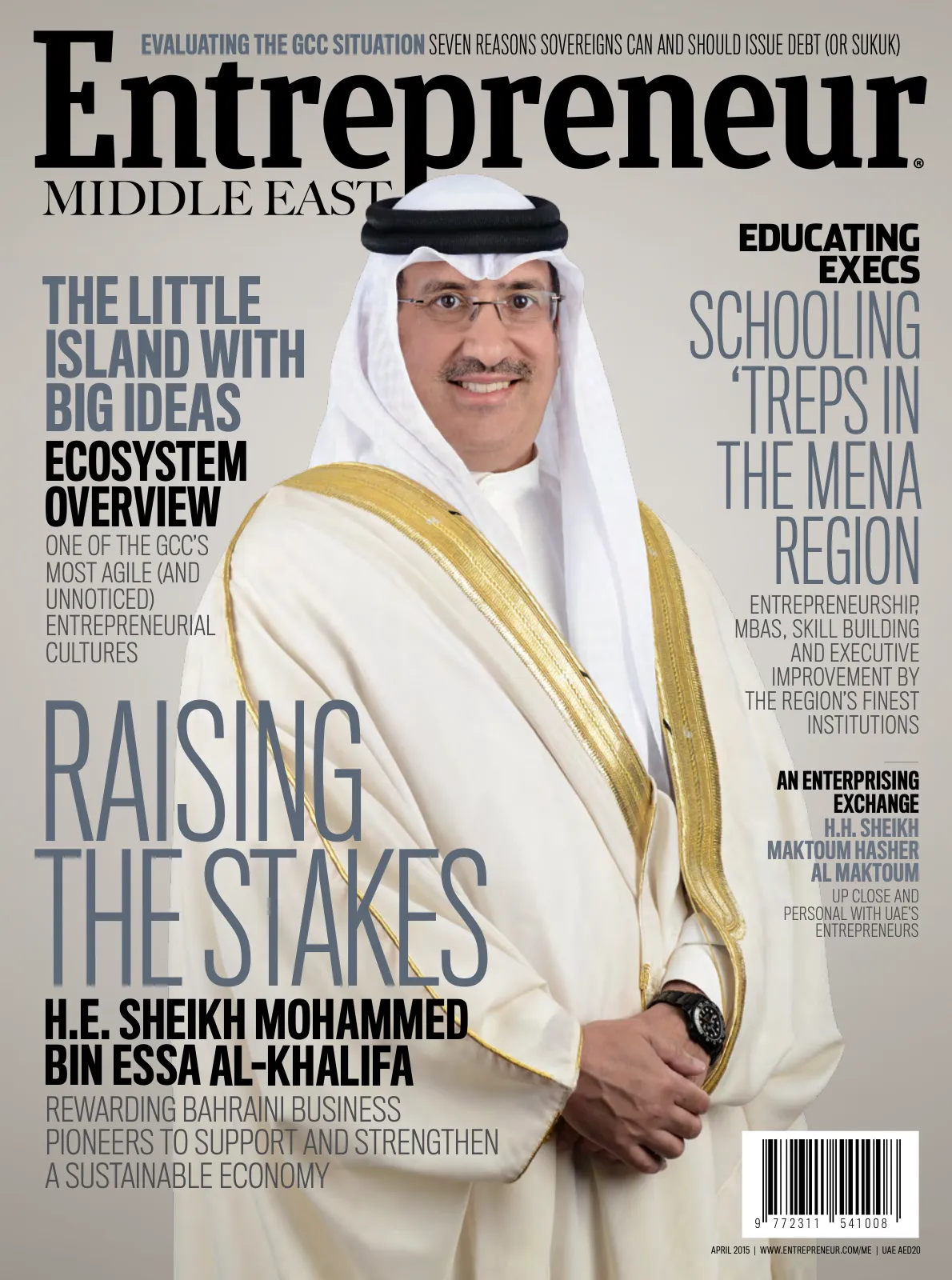
Entrepreneur Middle East, April 2015
Page 1
Evaluating the GCC situation SEVEN reasons sovereigns can and should issue debt (or sukuk)
APRIL 2015 | www.entrepreneur.com/me | UAE AED20
9
7 7 2 3 1 1
5 4 1 0 0 8
One of the GCC’s
most agile (and
unnoticed)
entrepreneurial
CULTUREs
island with
big ideas
The little
ECOSYSTEM
overview
the stakes
Raising
H.E. Sheikh Mohammed
Bin Essa Al-Khalifa
Rewarding Bahraini business
pioneers to support and strengthen
a sustainable economy
An enterprising
exchange
H.H. Sheikh
Maktoum Hasher
Al Maktoum
Up close and
personal with UAE’s
entrepreneurs
Educating
execs
Schooling
‘treps in
the MENA
region
Entrepreneurship
MBAs, skill building
and executive
improvement by
the region’s finest
institutions
,
Page 2
Page 3
Page 4
Page 5
april 2015 Entrepreneur
3
CONTENTS
APRIL 2015
FOCUS
Pick your program
LOCATION
Pick your school
MEDIUM
Online vs. offline
OFFBEAT
Out of the ordinary MBAs
ANALYZE
Evaluate executive education
62
TECH:
SHINY
#TamTalksTech
Gadgets and doodads
that you might’ve missed
out on, sourced by a tech
aficionado. Yes, it’s okay
to want them all… and no,
it’s not our fault.
18
EDITOR’S NOTE
By Fida Z. Chaaban
36
‘TREPONOMICS:
SKILLSET
Education in the
Middle East
Bayt.com’s Suhail
Al-Masri analyzes
the rates of education
crossing over with useful
work-related skillsets.
Do you feel prepared to
take on “the real world”?
60
SKILLSET
Addressing the
fundamentals
Olympian and
entrepreneur, James
Clear, discusses how
Vince Lombardi’s
methodology of
mastering the basics are
the building blocks of
success.
44
The little island
with big ideas
One of the GCC’s most
agile (and unnoticed)
entrepreneurial ecosystems
has a message for you
Bahrain overview
24
Educating execs
Schooling ‘treps in
the MENA region
Entrepreneurship, MBAs,
skill building and executive
improvement by the
region’s finest institutions
22
INNOVATOR:
An enterprising
exchange
H.H. Sheikh Maktoum
Hasher Al Maktoum
Up close and personal
with UAE’s entrepreneurs
40
Raising the stakes
H.E. Sheikh Mohammed
Bin Essa Al-Khalifa
The Chairman of Tamkeen
sees SMEs and startups
getting bigger and better…
with a little help
24 H.H. Sheikh Maktoum Hasher Al Maktoum, Chairman
of Dubai International Holding Company with Fida Chaaban,
Editor in Chief, Entrepreneur Middle East
19 H.E. Sheikh Mohammed Bin Essa Al-Khalifa, Chairman of Tamkeen and the Tamkeen Board of Directors
Page 6
Page 7
243207
Page 8
Page 9
Page 10
EFFICIENTRELIABLECREDIBLE
A395 QUAD SIM
C399 TRIPPLE SIM
C299 QUAD SIM
South Africa
Dubai
Raksha Maharaj
Building 3
Thandanani Office Park
Invicta Road
Midrand
Johannesburg
T. +2711 312 7868
F. +2711 312 7865
Sheik Zayed Road
Business Bay
Dubai
United Arab Emirates
Managing Director
E. raksha@xp-fze.com
M. +27 82 305 1433
BBM: 26E068EA.
Whatsapp: +27 76 240 2347
Page 11
Discover LG’s range of Dual, Tri and Quad sim handsets.
Up to four
lets you do more!
AUTHORISED DISTRIBUTOR OF
XPFZE
Page 12
Page 13
Page 14
Entrepreneur april 2015
12
58
MARKETING
Business lessons on
the fly
How a driver changed the
way Oasis500’s Robert
Carroll thinks about
customer service… and
how you can apply that to
your business.
56
ESQUIRE GUY
The do’s and don’ts of
the email CC
Ross McCammon focuses
in on the carbon copy, the
blind carbon copy, and
what it means for you and
your work.
CONTENTS
APRIL 2015
74
FRANCHISE
Ins and outs
UAE-based Sumo Sushi &
Bento expands outward in
the GCC, and Australia’s
The Coffee Club kicks off
its Middle East plans by
launching in the UAE.
66
CULTURE:
TRAPPINGS
‘Trep gear
The executive selection for
the entrepreneur on your
list that has everything.
Okay, maybe for a little
self-reward as well.
68
TRAVEL
Your own private island
GM Greg Pirkle of Four
Seasons Bahrain Bay
wants to welcome you
to the newest luxury
property in the MENA
region. (And while you’re
there, enjoy the culinary
talents of Wolfgang Puck.)
35 Education entrepreneur Kamal Puri addresses the MBA debate:
do you or don’t you?
70 Productivity begins with the basics:
Shelina Jokhiya specializes in sorting out
your self-induced mess.
26
HEC Paris in Qatar
Page 15
Page 16
Entrepreneur april 2015
14
CONTENTS
APRIL 2015
62
82
START IT UP
Q + A
Just drag and drop
Serial startup founder
Ghaith Akkad makes web
hosting a piece of cake
through duet.to, and it
seems to be working out
just fine.
76
MONEY
ASK THE MONEY GUY
Evaluating the GCC
situation
Awad Capital CEO, Ziad
Awad, puts forward seven
reasons sovereigns can
and should issue debt (or
sukuk).
75 Australia’s The Coffee Club kicks off its Middle East plans by
launching in the UAE.
70
CULTURE:
LIFE
Productivity begins with
the basics
The founder of UAE-based
startup Decluttr Me spe-
cializes in sorting out your
self-induced mess. Check
out her tips for increasing
your output with a stream-
lined workspace.
87
DESIGN
Balancing form and
function
Industrial designer and
entrepreneur, Sahar
Madanat, is campaigning
for a bigger and better
design future in MENA.
62
#TamTalksTech:
Lenovo VIBE Shot
30 Canadian University Dubai
Page 17
Page 18
16
Entrepreneur MARCH 2015
SUBSCRIBE
Contact subscriptions@bncpublishing.net to receive
Entrepreneur Middle East every issue
EDITOR IN CHIEF Fida Z. Chaaban editor@bncpublishing.net
MANAGING DIRECTOR Walid Zok walid@bncpublishing.net
DIRECTOR Rabih Najm rabih@bncpublishing.net
DIRECTOR Wissam Younane wissam@bncpublishing.net
PUBLISHER Nehme Abouzeid
MANAGING EDITOR Aby Sam Thomas
CREATIVE LEAD Odette Kahwagi
ONLINE LIAISON Kareem Chehayeb
COLUMNIST Pamella de Leon
COLUMNIST Tamara Clarke
PO Box 502511 Dubai, United Arab Emirates
P +971 4 4200 506 | F +971 4 4200 196
For all commercial enquiries related to
Entrepreneur Middle East contact
sales@bncpublishing.net
All rights reserved © 2014.
Opinions expressed are solely those
of the contributors.
Entrepreneur Middle East and all subsidiary
publications in the MENA region are officially licensed
exclusively to BNC Publishing in the MENA region
by Entrepreneur Media Inc.
No part of this magazine may be reproduced or
transmitted in any form or by any means without
written permission of the publisher.
www.entrepreneur.com/me
Visit our new website!
MIDDLE EAST
Printed by Raidy Emirates Printing Group LLC
www.raidy.com
EntMagazineME
@EntMagazineME | @Fida
Entrepreneur-me
EntrepreneurMiddleEast
EntMagazineME
EntMagazineME
EntMagazineME
MIDDLE EAST
Images used in Entrepreneur Middle East are credited when necessary. Attributed use of
copyrighted images with permission. All images not credited otherwise Shutterstock.
Ziad Awad
Amal Chaaban
James Clear
Simon Hudson
Shelina Jokhiya
Suhail Al-Masri
Ross McCammon
Dr. Kieran Mervyn
Shoug Al Nafisi
Rani Nasr
May Rostom
Erika Widen
CONTRIBUTING WRITERS
In addition to our print edition, we’re bringing you all sorts of
industry news on our web mediums. Joining us online means getting
relevant business and startup content in real-time, so you’re hearing
about the latest developments as soon as we do. We’re looking
forward to interacting with our readers on all of our social media and
web platforms- like any thriving business, we’re looking to give and
take. #TrepTalkME is already happening on all of our digi platforms,
and all good conversations go both ways. See you on the web!
Page 19
Page 20
Entrepreneur april 2015
18
E
veryone that I met in Bahrain
told me that we were on an
island, sometimes multiple
times in the same conversation.
At first, I thought people assumed
that I didn’t have a handle on basic
geography, but throughout my week
there, I realized that their unique
makeup really does permeate so
much of their culture, down to
the way they look at business.
The conversations often went
something like, “Well, Bahrain is an
island so…” or “Since we’re on an
island…”
Sociologically, it’s a down-to-earth
place. Basically, everyone and
anyone will offer to drive you
home, everyone and anyone will
ask you to join them on a social
outing regardless of whether or not
they even know your last name,
and finally, everyone comes to
Bahrain to stay (or so it seems).
The islanders are a chilled-out
bunch… except when it comes to
entrepreneurship. Their ecosystem
is tightly-knit, highly collaborative,
and enthusiastic bordering on
manic. They do everything together,
and by “they,” I mean that all
the different NGOs, NPOs, and
governmental organizations involved
in entrepreneurship (even remotely)
band together tightly to support
initiatives in so many different ways
that I found myself drawing charts
trying to keep it all straight.
For those of you wondering about
the “situation” in the country, I
personally did not see any evidence
of ongoing issues, but I was made
aware that protests do still occur
here and there, and that they
mostly take place in certain areas
(much like periodic outbursts in
Lebanon). I want to touch on the
recent global discussions that
suggest entrepreneurship can act as
an antidote to civil discontent and
unrest. I would venture to tie this
all back to Bahrain, and I realize
my next statement may garner
criticism: government projects
meant to foster, assist and promote
micro-businesses, startups and
SMEs in the Kingdom give people
a reason to hope and try, and
having visited at least six different
entities made to do just that, I am
a firm supporter of the population
unification measures (my words,
not their’s) in Bahrain via business.
It is true enough that when I was
touring the island I wasn’t taken to
protest hotspots, but I was taken to
places that
have been
established
to create an
inclusive and
prosperous
economy-
and that is
the first step
forward.
Where there
is industry and potential for growth,
there is community and prospects
for a strong future.
I expect many people out there will
call me an optimist (and perhaps
words not so positive), but I am
heading a publication that looks
for solutions and I found many of
those in the Kingdom. Whether
or not the global community is
aware of these same solutions is
another story altogether. I hope this
Bahrain-centric edition leaves you
with a new-found awareness of the
proactive enterprise space on the
island.
EDITOR’S NOTE
Fida Z. Chaaban
Editor in Chief
@fida
editor@bncpublishing.net
I admit it, I was surprised
Island life
Page 21
Page 22
Entrepreneur april 2015
20
Column of oppositionists in Moscow at a mourning march in memory
of Boris Nemtsov, March 2015
President of IDB Group Dr. Ahmed Mohammed Ali,
Mohammed Felloouse, CEO, El Wifack,
Khaled Al Aboodi, CEO, ICD
IN THE LOOP
Oman garnering foreign
investment interest
Boris Nemtsov’s assassination
continues to unravel
Jordanian pharmaceutical
company replaces Tullow
Oil on FTSE 100
Islamic Development
Bank Group
marks its presence in Tunisia
F
ormer Russian Deputy Prime
Minister Boris Nemtsov’s assas-
sination on February 27 made
headlines around the world, after
he was shot four times in the back
just before midnight while on the Bolshoy
Moskvoretsky Bridge, days before he was
expected to lead a rally against President
Putin. Nemtsov enjoyed what many de-
scribe as a successful political career under
former Russian President Boris Yeltzin,
and had played a huge role in developing
Russia’s economy as the Soviet Union came
to an end. However, with respect to current
Russian President Vladimir Putin, Nemtsov
was an outspoken critic, most recently
about Russian military interference in
Ukraine and the financial crisis it has been
facing. So who was behind the assassina-
tions? Do all signs point to Putin and the
Russian security apparatus? Turns out it
isn’t all that simple, but you don’t have to
go too far away from Moscow to learn more.
The isolated Chechen Republic southwest
of the Russian Federation could have
had a role to play in this. The head of the
Chechen Republic, Ramzan Kadyrov, de-
spite his past experiences as a militia rebel
and some very inflammatory actions and
statements on Russia and the West, has
strong ties with Putin. But what does this
have to do with Nemtsov? Kadyrov not only
supports Putin’s policies, but also criticizes
the Western-backed liberal entities within
Russia, which include the likes of Nemtsov.
Could he have been behind the assassina-
tion? At the moment, it appears possible,
whether or not he had Putin’s consent.
On March 8, a Moscow court charged two
Chechen men with the killing of Nemstov.
One of the two men, Zaur Dadyev, admitted
that he was involved in the murder. While
another suspect committed suicide in a
standoff with Russian police, there are
three other suspects who are still in cus-
tody at the moment. Reporters and analysts
are critical of this scenario, given that Rus-
sian media was relatively silent about the
murder for about a week before these de-
velopments. Kadyrov claimed that Dadyev,
who pleaded guilty, was a devout Muslim
and was enraged over Nemstov’s support
for the controversial French magazine,
Charlie Hebdo. Currently, Nemstov’s me-
morial is visited regularly in Moscow, and
Putin continues to condemn the murder as
a “contract killing.”
Is it possible that a
few angry Chech-
ens left the shaky
Caucasus Mountains
to Moscow to assas-
sinate Nemstov over
his liberal views and
values, just days be-
fore he was ready to
rally against Putin’s
economic and foreign
policy? We may never
know.
H
ikma Pharmaceuticals is now the fourth
pharmaceutical company to make it
on the FTSE 100 Index. Owned by the
London Stock Exchange, the FTSE 100 is a
quarterly index that lists the London Stock
Exchange’s top 100 companies, in terms of its
market capitalization. Hikma Pharmaceuticals’
market value is at almost 4.9 billion British
pounds, knocking off Tullow Oil, due to its value
shrinking from £4.6 billion to £3.3 billion as a
result of declining oil prices. Hikma Pharma-
ceuticals have enjoyed a 21% rise in profits, and
have now been discussing terms for potential
dollar bonds with Citigroup, Barclays, HSBC,
and National Bank of Abu Dhabi.
The Islamic Development Bank Group’s (IDBG)
private sector wing, the Islamic Corporation for
the Development of the Private Sector (ICDB),
has signed an advisory services contract with
Tunisian leasing firm El Wifack. The partner-
ship will see El Wifack transition its services
into becoming an Islamic financial institution
that will have an authorized capital of about
150 million Tunisian dinars (US$77.8 million).
ICDB’s consultancy role won’t be miniscule in
this process- they’ve prepared seven teams
to handle every aspect of the conversation
process, from accounting and finance to human
resources and marketing.
With all the talk going on about the UAE,
Qatar, Saudi Arabia, and even Bahrain, it
may seem like Oman has been left by the
wayside- but things could be changing
very soon for the Sultanate. Despite being
relatively quiet compared to the other GCC
states, and despite the massive drop in oil
prices, it looks like multinational corpora-
tions could be flocking towards Muscat for
investments in its oil. A report by Emerging
Markets Intelligence & Research (EMIR)
shows that 72% of multinational corpora-
tions that participated in EMIR’s e-poll
claimed that investing and expanding into
Oman is something they consider likely. The
report was presented to CEOs and industry
leaders at an event hosted at Dubai’s Burj
Al Arab, and chances are that the Omani
government will start weighing its options
on foreign direct investment policy soon.
Page 23
april 2015 Entrepreneur
21
Page 24
Entrepreneur april 2015
22
“
INNOVATOR
Up close and personal with UAE’s entrepreneurs
H.H. Sheikh Maktoum Hasher Al Maktoum
An enterprising
exchange
“A successful city ecosystem
stems from not only a
consideration of the primary
sector, but [the] secondary
and tertiary sectors
as well. Thus, SMEs and
entrepreneurs are essential
to Dubai’s continued growth
as the country’s epicenter,
alongside tertiary services
and bureaucratic input from
the government to stitch it
all together.”
H.H. Sheikh Maktoum Hasher Al Maktoum, Chairman of Dubai International Holding Company with Fida Chaaban, Editor in Chief, Entrepreneur Middle East
D
on’t choose businesses
that everyone else wants
to start up because of
the glam factor. Choose
the businesses that people
don’t find exciting- these
are the ones that are going
to last.” That was one of the
many directives that H.H.
Sheikh Maktoum Hasher Al
Maktoum told a gathering
of some of the UAE’s top
business leaders and entrepre-
neurs at a Learning Event held
by the UAE Chapter of the
Entrepreneur’s Organization.
Facilitated by Entrepreneur
Middle East at the Jumeirah
Beach Hotel in Dubai, the
event was conducted as an
informal Q&A session between
the Sheikh and Editor in Chief
Fida Chaaban, and touched
upon topics relating to the
SME and startup ecosystems,
developing and growing
businesses, and the roads
to achieving success in the
MENA region and beyond.
Sheikh Maktoum -whose im-
pressive resume includes titles
like Chairman of Dubai Inter-
national Holding Company,
former Executive Chairman
of Shuaa Capital, founding
investor in Virgin Megastores
and founder of A1 Grand Prix
racing series- gave the audi-
ence an overview of the many
business ventures he has
dabbled in here in the region
as well as around the world,
with him singling out Dubai as
being especially conducive to
business and entrepreneurs.
“Under the leadership of H.H.
Sheikh Mohammed Bin Rashid
Al Maktoum, Dubai continues
to foster and promote entre-
preneurship and enterprise
growth,” he said. “This is a
dynamic community of busi-
nesspeople led by the most
dynamic visionary of them
all- an unparalleled success
story. Dubai has become the
epicenter of business in the
Middle East.”
But for all of the growth
seen by large-scale businesses
in Dubai, Sheikh Maktoum,
recently appointed to the
board of the Commercial Bank
of Dubai, noted that for the
Page 25
april 2015 Entrepreneur
23
“This is a dynamic community
of businesspeople led by
the most dynamic visionary
of them all- an unparalleled
success story. Dubai has
become the epicenter of
business in the Middle East.”
Sheikh Maktoum Hasher Al Maktoum’s
tips for doing business
‘Trep Talk
BNC Publishing
Director
Mr. Wissam
Younane
Emirate to further scale up
its success, it would need the
support of the startup and
SME sectors as well. “A suc-
cessful city ecosystem stems
from not only a consideration
of the primary sector, but
[the] secondary and tertiary
sectors as well,” he explained.
“Thus, SMEs and entrepre-
neurs are essential to Dubai’s
continued growth as the
country’s epicenter, alongside
tertiary services and bureau-
cratic input from the govern-
ment to stitch it all together.”
Of course, there are already
moves being made in this
direction, and the evidence for
this, according to the Sheikh,
can be seen in the current
state of the Dubai ecosystem.
“Current developments in
infrastructure and construc-
tion are being executed in
a far more sustainable, less
risk-prone manner,” he said.
“Therefore, the city is now a
far more fertile hub for invest-
ment.”
When asked if Dubai’s
crowded entrepreneurial
space currently made it harder
for new endeavors here to
establish themselves, Sheikh
Maktoum rubbished the idea.
“I don’t like to do a business
that has low barriers to entry,”
he said. “There’s a lot of capi-
tal here- people want to set
up businesses here… If you’re
going to get into a business, go
into one where there are high
barriers of entry.” According
to Sheikh Maktoum, entre-
preneurs have to be resilient:
“You don’t give up- you have
to be tenacious to a degree
that you’ll make a pit bull
look like a poodle.” Having
said that, he advised against
dragging along a sinking ship
too- “If you believe there is no
end to a problem, trust your
instincts, and move on, if you
must.”
First, do not be risk-averse. Instead, believe in risk
reward. In doing so, entrepreneurs should consider
approaching uncontested market space with higher
barriers to entry, however, due diligence and stress
testing remains key. Sheikh Maktoum exemplified
this by detailing his own ventures in East Africa
such as hydropower and mineral mining, which
although fruitful, took a considerably long time to
set up.
Second, consider stable, more viable businesses
over and above exciting ones. Although it may be
popular to chase competition, sometimes more
traditional, less exciting endeavors may be far
more profitable and less stressful.
Third, consider giving sweat equity and construct
good incentive models for employees. In order to
keep costs low and heighten personal investment
in their work, offer employees the ability to become
an active stakeholder in the company.
Lastly, accrue your salary and self-evaluate
your own worth. Before diving head first into an
independent business, consider speaking to a
headhunter in order to gauge your own financial
worth, thereby setting a benchmark for your
company and future decisions.
What is the Entrepreneur’s
Organization?
“This was truly an eye-opening experience for me
and our respected members. H.H. Sheikh Maktoum
Hasher Al Maktoum’s staunch understanding of the
city’s landscape and the unimaginable level of effort
that goes into his successful endeavors was not only
commendable but fascinating.”
Vikram Shroff, President, EO UAE Chapter
The Entrepreneur’s Organization is a dynamic, global,
non-profit network of more than 10,000 business
owners in 48 countries. Founded in 1987 by a group
of young entrepreneurs, EO is the catalyst that
enables entrepreneurs to learn and grow from each
other, leading to greater business success and an
enriched personal life. EO members create a constant
flow of news on a daily basis, all of which speak to
their commitment to entrepreneurial excellence.
www.eonetwork.ae
Page 26
Entrepreneur april 2015
24
INNOVATOR
Entrepreneurship, MBAs, skill building and
executive improvement by the region’s finest institutions
Educating
execs
Schooling ‘treps in the MENA region
Entrepreneur april 2015
24
London Business School | HEC Paris in Qatar
The University of Wollongong in Dubai | American University of Cairo
Canadian University Dubai | American University of Sharjah
S. P. Jain School of Global Management | Carnegie Mellon University in Qatar
Hamad bin Khalifa University | Skyline University College
OFFBEAT
Out of the ordinary MBAs
ANALYZE
Evaluate executive
education
FOCUS
Pick your program
MEDIUM
Online vs. offline
LOCATION
Pick your school
Page 27
april 2015 Entrepreneur
25
American University
of Cairo
“Creating a culture and an environment that
supports entrepreneurship is the solution for the
unemployment problem [in the region], and that is in
the core of the mission of our school.”
Pick and choose
Tarek Hatem
Four things to look for
in a business school
Cairo, Egypt
Professor Tarek Hatem, director of the
Leadership and Entrepreneurship Unit
in the School of Business, The American
University in Cairo
American Univeersity of Cairo (AUC) campus
Educating
execs
Schooling ‘treps
in the MENA region
W
hile it
has been
offering
entrepre-
neurship
programs in both its
MBA and Executive MBA
programs for quite some
time now, the American
University of Cairo’s (AUC)
School of Business recently
also played a key role in
the creation of the African
Academic Association of
Entrepreneurship (AAAE),
a pan-African alliance that
will promote and develop
academic cooperation among
top business schools in the
continent with a focus on
entrepreneurship. According
to Tarek Hatem, Director
of the School’s Leadership
and Entrepreneurship Unit,
“AAAE will be generating
high quality entrepreneur-
ship-related case studies,
studying, researching
and documenting startup
companies within different
incubators in Egypt and
the region and developing
interdisciplinary research in
partnership with different
schools within AUC.”
But the association is just
one of many efforts AUC
has been spearheading to
encourage entrepreneurship
in the region. In 2013, AUC
launched its own startup
accelerator/incubator, The
Venture Lab, whose mis-
sion is “to commercialize
technologies and innovations
developed by Egypt-based
startups into commercially
viable ventures.” Hatem
adds that the School is also
planning to develop exper-
tise on family business as an
area of focus. “Family-owned
businesses account for about
40% of the region’s non-oil
GDP and 50% of private
sector employment, and
accounting for more than
80% of the total companies
in the region,” he says.
“Roughly 5,000 medium to
large family firms exist in the
Middle East, with net assets
totaling US$600 billion.
Within entrepreneurship–
this entails development of
high quality case studies,
introduction of courses on
entrepreneurship in family
business within the school’s
graduate, undergraduate and
ExecEd offerings, as well as
collaboration with regional
institutes in joint research
analyzing succession plans,
the effect of regulations,
culture and environment on
family business.”
• A school that has entrepreneur-
ship as an embedded culture and
mindset for management, faculty
and students.
• Latest teaching pedagogies
that encourage greater creativity,
and a willingness to take calcu-
lated risks where schools extend
learning beyond the borders of
the classroom.
• An environment that fosters
learning by living the experience.
• Having an incubator/accelera-
tor at the heart of the business
schools today adds a whole new
perspective to entrepreneurial
education. They not only incu-
bate startups, but also give a
chance for undergraduate and
graduate students to work within
the entrepreneurial ecosystem.
The launch of the African Academic Association for
Entrepreneurship (AAAE), the first African consortium
developed by six African business schools from five countries:
Egypt’s American University in Cairo School of Business,
ESCA Ecole de Management situated in Casablanca, Morocco,
Nigerian Lagos Business School, Strathmore Business School
in Nairobi, Kenya, along with the University of Cape Town,
South Africa, and South African Stellenbosch University. The
AAAE aims to promote academic cooperation in the areas of
entrepreneurship, SMB development, startups and innovation.
Page 28
26
Entrepreneur april 2015
expertise,” Prof. Ker-
bache explains. “In
addition, one has to
clearly identify the
intended area of spe-
cialization and focus.
After having taken
these factors into
consideration, one
must then search for
an appropriate school
that can provide the necessary
and appropriate knowledge and
input that will lead to the suc-
cessful realization of one’s ca-
reer or business goal. Whether
one has an entrepreneurial
mindset, or aspirations of
becoming the CEO of any of the
major local, regional and global
corporations, it is essential
to complement, harness and
unlock one’s potential to be
among the leaders of tomorrow
through lifelong learning in the
best global business schools,
such as HEC Paris.”
I
NSEAD has the largest and the most reputed entrepreneur-
ship faculty of any business school outside the U.S.,” says
Professor Miguel Sousa Lobo, Director of the INSEAD Abu
Dhabi Campus and Associate Professor of Decision Sciences
at INSEAD. “We offer the broadest range of entrepreneurship
courses, rigorous and rich research on building business in a
global world and have one of the strongest networks of alumni
entrepreneurs in the world.” And Prof. Lobo has the num-
bers to back up his statements- according to him, INSEAD
consistently leads rankings in entrepreneurship. “In Europe,
INSEAD graduates raise more capital for startups than all
our peer schools combined,” he reveals. “Approximately half
of INSEAD graduates –1000 MBA and 200 EMBA graduates
every year– run their own companies at some point in their
careers.”
INSEAD’s Abu Dhabi campus started operations in 2010,
and Prof. Lobo says that since then, the school has seen an
increase in interest and ap-
plications from the Middle East
over the years. “In our shorter
Executive Education programs,
including customized programs
for businesses and other orga-
nizations, in the past five years,
the Abu Dhabi campus has
trained about 4,000 executives,
of which 2,000 were Emiratis,”
he says. With half a century’s
worth of experience in busi-
ness education and research,
INSEAD is thus well equipped
to guide future entrepreneurs,
and its alumni network serves
as an invaluable resource for
them as well.
HEC Paris in Qatar
“With an ambition of further educating high potential
individuals, we remain steadfast in our conviction
that knowledge determines the freedom and
entrepreneurship required for a better world. Thus,
our motto: ‘The more you know, the more you dare.’”
Doha, Qatar
INSEAD
“Our alumni often say that their year at INSEAD was life-
changing. The unique learning experience at the school
helps students to better understand the business world
and nurture their entrepreneurial spirit.”
Abu Dhabi, UAE
“
“
Professor Miguel Sousa Lobo,
Director of the INSEAD Abu Dhabi
Campus and Associate Professor of
Decision Sciences at INSEAD
HEC Paris located in Tornado Tower in Doha, Qatar
HEC Paris in Qatar
Professor Laoucine Kerbache,
Dean and CEO of HEC Paris in Qatar
Educating
execs
Schooling ‘treps
in the MENA region
E
nhancing one’s
knowledge and skills
in management is
highly beneficial either
for someone who wants to
put up their own business, or
enhance the profitability and
growth of the companies they
work for. Therefore, whether
it be an entrepreneur, or a
business executive aspiring to
rise up the corporate ladder
and maybe someday become
the CEO, an HEC Executive
MBA (EMBA) degree will
surely be advantageous.” That’s
Professor Laoucine Kerbache,
Dean and CEO of HEC Paris
in Qatar, making the case for
his internationally renowned
institution’s EMBA program.
For those of you with dreams
of setting up a startup of your
own, HEC Paris’ program can
be particularly appealing as
an educational program, given
that one of the majors it offers
is in Entrepreneurship and
Innovation, which, according
to Prof. Kerbache, is aimed at
“executives and senior manag-
ers who are seriously thinking
about committing themselves
to new business ventures as
entrepreneurs, investors or
consultants.”
In 2014, the Financial Times
ranked HEC Paris as #1 in the
world for Executive Education.
“In today’s extremely competi-
tive and globalized business
environment, setting up one’s
business requires the combina-
tion of innovation, creativity
and well-rounded managerial
Page 29
april 2015 Entrepreneur
27
E
stablished in 1993, the University
of Wollongong in Dubai (UOWD)
is one of the UAE’s oldest private
accredited universities, and that
in itself has enabled the institu-
tion to build a reputation for “academic
excellence, graduate employability and
an unparalleled student experience,” says
Professor Mohamed Salem, President,
UOWD. Besides undergraduate programs in
a variety of disciplines, UOWD also offers
a number of postgraduate programs, of
which the MBA is Prof. Salem’s recom-
mendation for ‘treps and would-be ‘treps.
“A MBA is an incredibly useful program for
any business executive or entrepreneur as
it provides them with the analytical, cross-
functional skillset that will support both
top-level managerial decision-making and
the day-to-day management of a business,”
he says. “Our entrepreneurs in the making
tell us that the skills they learn during the
MBA program are incredibly useful in the
early days of running a startup, when they
may not have the funds
to invest in manpower
and may therefore find
themselves undertaking
everything from marketing
strategy to balancing the
books, to building a CSR
program.”
But Prof. Salem also notes
that UOWD’s MBA program
is a good fit for more experi-
enced business people as
well. “For entrepreneurs
and executives who are
further on their business
journey, the MBA offers
them an opportunity to up-
grade their skills, equipping them with ad-
vanced management techniques which will
help them to grow their business or attain
management positions at the highest level,”
he explains. The school also encourages en-
trepreneurship by
setting up clubs
like the UOWD
Business Minded
Association,
which organizes
educational trips
to businesses in
Dubai and talks
from entrepre-
neurs, in addition
to conducting
seminars and
conferences from
organizations
like the Human Resources Forum in Dubai,
the Association of International Business’
MENA branch, and others.
To UOWD’s credit, its efforts in this
particular arena definitely seem to be
bearing fruit- Prof. Salem points towards
the school’s graduates who are making a
name for themselves in the entrepreneurial
space, which includes names like Mona
Tavassoli, founder and Director of Mom
Souq and Mompreneurs Middle East,
Faris Ahmed Ramadhan Huma, CEO, Zone
Parking Solutions, Shawn Frank and Ronak
Dave, co-founders, Mindhyve and Aziz
Saeed Alzeqri, co-founder, XploreX. “We
take great pride in producing graduates
who have the skillsets needed to advance
both their careers and bolster the UAE’s
economy since 1993,” Prof. Salem says.
“We focus strongly on providing our gradu-
ates with the depth of education needed to
fulfill the UAE’s ambitions, including Expo
2020 and helping work towards the cre-
ation of a knowledge based economy which
is fuelled by cutting edge research.”
“The MBA program at UOWD is one of the most
established in the UAE, and as such, the opportunities
that our students have to build their network of
business contacts is second to none.”
The University of Wollongong
in Dubai Dubai, UAE
Professor Mohamed Salem,
President, University
of Wollongong in Dubai
The University of
Wollongong in Dubai
(UOWD)
Educating
execs
Schooling ‘treps
in the MENA region
Page 30
Entrepreneur april 2015
28
Achieve
your aspirations
with an MBA
US$ 1.7M of exclusive scholarships
Amity Dubai, CLU, Cass, Durham,
EAE, ESCP, Hult, IE, Ivey, Manchester,
Oxford-Saïd, RSM Erasmus, U. Miami,
Uni. Melbourne and many more...
Meet the world’s top business schools
including:
Register today at:
TopMBA.com/Entrepreneur
Dubai - 16 May
The H Hotel, Sheikh Zayed Road
3:30pm - 9:00pm
Cairo - 18 May
The Conrad Cairo
3:30pm - 9:00pm
Page 31
april 2015 Entrepreneur
29
Pick and choose
Jane Khedair
Five things to look for
in a business school
Jane Khedair, Head of Entrepreneurship,
London Business School
London Business School
in Dubai is located at
the Dubai International
Financial Centre (DIFC)
London Business
School
“We are a school whose graduates are
some of the most sought-after in the world.”
Dubai, UAE
dubai financial centre image © steven bostock / shutterstock
Educating
execs
Schooling ‘treps
in the MENA region
G
iven that
London Busi-
ness School
has been
consistently
ranked as one
of the world’s
top business schools, it should
come as no surprise that its
Dubai Centre has been attract-
ing students by the dozen to
its Executive MBA program
ever since it launched in 2007.
According to Jane Khedair,
Head of Entrepreneurship,
Career Services, London Busi-
ness School, the course has so
far produced more than 616
graduates in total, many of
whom have gone on to either
lead at some of the region’s
top performing companies,
or instead launch their own
business enterprises- the latter
category includes names like
Genny Ghanimeh, founder of
the Dubai-based crowd funded
micro-financing platform, PiS-
lice, and Faris Hani Al-Torki,
founder of the Jeddah-based
restaurant, F6or_Faris.
Success stories like these
are, of course, inspiring, but
one must not think a degree
from London Business School
is a one-way ticket to startup
success either. “Studying
for a MBA is by no means
a guaranteed method to
establishing a successful new
business venture, nor is it the
only entry route to a career in
entrepreneurship,” Khedair
says. “However, studying for
a MBA can provide would-be
entrepreneurs with invaluable
experiences and skills critical
to running a successful busi-
ness. It can also be extremely
rewarding for the life-long
relationships and friendships
forged at the school, as peers
become indispensable business
contacts.”
But Khedair also notes that
London Business School has
been especially active in en-
couraging the entrepreneurial-
minded among its students.
“Many of our alumni who go
on to become entrepreneurs
first developed their business
ideas whilst studying on the
MBA program,” Khedair says.
“In response to this growing
trend, we have launched new
initiatives here in the Gulf. This
includes the launch last year of
our Entrepreneurship Mentor-
in-Residence program in
Dubai, following an immensely
successful run in London. The
response to this from students
has been strong, and we have
been pleased to see successful
entrepreneurs from our alumni
network wanting to give back to
students through mentoring.”
• Ask about startup support
available through initiatives
and schemes, as well as other
ongoing initiatives to develop
your business ideas throughout
the course of the program.
• Ask about mentoring
schemes, or other modes of
one-to-one support available to
budding entrepreneurs.
• Express your interest in
entrepreneurship early on in
the application process, and do
as much research as possible.
• Would-be entrepreneurs can
also benefit from speaking to
alumni and hearing about their
experiences.
• Most importantly, carefully
consider the content of the
MBA program, as they can
vary significantly- there is no
single MBA program that looks
the same. Research faculty
credentials and read some of
their work to get a taste of the
content.
Page 32
Entrepreneur april 2015
30
Canadian University
Dubai
“[At CUD], students are provided with the platform to
explore entrepreneurship, develop their entrepreneurial
skills and engage with extracurricular activities that
focus on innovation and business start-up.”
Dubai, UAE
AMERICAN UNIVERSITY OF
SHARJAH
“We believe that in order to effectively adapt business practices
to emerging conditions, such as the accelerating growth of
technology, communications and the internationalization of
the business world, a thorough grasp of current business and
economic processes, theory and applications is essential.”
sharjah, UAE
Dr. Farooq Haq, Assistant Professor
and Chair in the School of Business
Administration at Canadian
University Dubai
Canadian University Dubai
American University of Sharjah
“
Dr. Robert E. Grosse, Dean
of the School of Business
Administration at the American
University of Sharjah
Educating
execs
Schooling ‘treps
in the MENA region
W
hen asked to explain
why an entrepreneur-
in-the-making should
even consider getting
a MBA, Dr. Farooq Haq, Assis-
tant Professor and Chair in the
School of Business Administra-
tion at Canadian University
Dubai, pointed toward the vari-
ous benefits the degree could
bring to the potential business
executive of the future. “Any
aspiring entrepreneur will
ultimately need a good grasp
of fundamental business
practices, so a MBA does offer
a solid platform from which
professionals can go on to
establish and grow a successful
business,” Dr. Haq says. “It
provides the multi-disciplinary
academic skillset that an entre-
preneur would need to apply in
order to oversee their venture,
particularly in the early days,
and also helps to develop
the strategic and leadership
qualities that are required as a
business grows.”
“At CUD, the MBA program
develops these skills and
qualities, while also offering
students the opportunity to
specialize in a particular disci-
pline,” he adds. “The General
Management concentration is
popular with business leaders,
but this can also be combined
with a second concentration
if fields such as marketing or
finance, which adds a further
dimension to a student’s
understanding of enterprise
operations.” And the results of
CUD’s efforts in encouraging
entrepreneurship among its
students are quite evident- be-
sides graduates who are active
entrepreneurs in the fields
of retail, real estate, media
and more, CUD students have
also been showing off their
startup chops at competitions
like Dubai Startup Weekend,
Dubai’s Young Entrepreneurs
and the UAE’s M-Government
Initiative.
O
ur entrepreneurship curriculum teaches students and
business executives the theory and concepts of entre-
preneurship from the perspective of the practitioner,”
says Dr. Robert E. Grosse, Dean of the School of Business
Administration (SBA) at the American University of Sharjah
(AUS). “We teach the entrepre-
neurial process as a practicum in
applied business research. At AUS,
entrepreneurship is interdisciplin-
ary, where students with technical
or managerial backgrounds learn
about innovation and risk, fea-
sibility and function, ownership
and financing, and marketing and
delivery.”
Given that the majority of new
job creation in the region is in SME
development, the school’s focus on
entrepreneurship is especially op-
portune. “At AUS-SBA, we have in
place a cohesive and comprehensive curriculum in entrepre-
neurship and family business management with correlative
courses in marketing, finance, and operations which provide
our graduates with a balanced and focused set of tools neces-
sary to succeed in business,” says Dr. Andrew Klein, Assistant
Professor, Department of Management, SBA. “In addition to
our curriculum and faculty, the SBA has a comprehensive
career management function which includes internships, full-
service career counseling, and job placement.”
Page 33
april 2015 Entrepreneur
31
Carnegie Mellon
University in Qatar
Doha, Qatar
“For more than a century, Carnegie
Mellon University has been inspiring
innovations that change the world.”
“In the GCC, investment capital is rela-
tively abundant, although a very small
fraction of it is focused on early-stage
companies. The barriers to company
formation in the GCC countries are
more on the legal side of the equation,
than the financial side. For example, in
the U. S., an entrepreneur gets an idea
for a new business and forms a team to
pursue it. He/she can incorporate a new
stock-issuing company online for a few
hundred dollars with almost no legal
barriers. He/she can then sell stock in
the startup company to venture capital-
ists and/or qualified angel investors, and
the venture has the capital resources to
launch. In the GCC, there are substantial
legal barriers to this process. For
example, the simple act of incorporating
a new company can take many months
and is not certain of success. Further,
the laws typically make no distinction
between a startup company selling a
few shares to qualified investors and
a major company selling many shares
to the general public. For example, in
Qatar a company must be capitalized at
a minimum of QR10,000,000 in order
to be allowed to issue stock. That is a
barrier virtually no startup company can
meet. More than entrepreneurship edu-
cation is needed to solve this problem.
Creating an environment that is friend-
lier to business creation is required.”
Barriers to entrepreneurship in the GCC
Dr. S. Thomas Emerson
S. P. Jain School of Global
Management
“Our goal is simple- to craft global business leaders for the
21st century. We are young, modern, and ranked among the very
best business schools in the world.”
Dubai, UAE
Professor Christopher
Abraham, Head of S. P. Jain’s
Dubai Campus & Senior
Vice President Institutional
Development
S. P. Jain School of Global Management in Dubai
Carnegie Mellon University in Qatar
Dr. S. Thomas Emerson,
Distinguished Career Professor of
Entrepreneurship and Director
of Executive Continuing Education
Educating
execs
Schooling ‘treps
in the MENA region
A
ccording to Professor Chris-
topher Abraham, head of S.
P. Jain’s Dubai Campus and
Senior Vice-President, Insti-
tutional Development, his school’s
MBA programs focus on “a holistic
approach to business education,”
which it has
branded as
(and copy-
righted as)
Business
Education
2.0. “While
we believe
concepts
and knowl-
edge are
mandatory,
equal emphasis is given to global
intelligence and real-world skills,” he
says. “For any entrepreneur
or wannabe entrepreneur, this
holistic offering gives them
the required competence and
confidence by equipping them
with a practical toolkit that
encompasses all the required
functional and strategic skills,
as well as the knowledge re-
quired for an entrepreneur.”
One of S. P. Jain’s noteworthy
endeavors toward encouraging
entrepreneurship among its students
has been its Global Family Managed
Business program, which is geared
toward participants who hail from
existing family businesses, and
encourages them to start their own
enterprises after its completion.
Another initiative is the “Doing
Business” program, which offers
practical modules of doing business
in the Middle East, India, Singapore
and Australia. “We are also currently
in the process of designing a unique
program which would encourage stu-
dents and aspiring SMEs to look at
starting their own businesses,” Prof.
Abraham adds. “This is planned in
conjunction with other institutions
involved in SME development.”
W
hile Carnegie Mellon University
in Qatar (CMU-Q) doesn’t cur-
rently offer a MBA program, it’s
interesting to note that students
in the school’s undergraduate
degrees have been making inroads into the coun-
try’s as well as the region’s startup space- these
include like Jinanne Tabra, founder, Araboh.
com, and Haris Aghadi, Maahd Shahzad, Abdulla
Khenji and Ali Naqi, co-founders, Meddy.com.
“What many of these startups have in common
is that they were the result of a class project or a
proposal for a competition,” says Dr. S. Thomas
Emerson, the school’s Distinguished Career
Professor of Entrepreneurship and Director of
Executive/Continuing Education. “From the
moment a student joins Carnegie Mellon Qatar,
they are met with a
variety of engaging
opportunities allow-
ing them to further
explore their entre-
preneurial skills.”
To this end, CMU-Q
has also tied up
with groups like
the Entrepreneur’s
Organization (EO),
Bedaya Center, ICT
Qatar, and others.
In addition, the
school’s business
administration
program also runs
a Quick Startup challenge, which encourages
students to conceive and develop a business idea
within 72 hours, following which they get the
opportunity to present their investor pitch to a
judging panel of industry experts.
Page 34
Entrepreneur april 2015
32
HBKU launches postgrad JD program
By Erika Widén
Raising the bar
of intellectual inquiry
Professor Clinton
W. Francis,
Founding Dean
of HBKU Law
School
Hamad bin Khalifa University
(HBKU) in Qatar
Educating
execs
Schooling ‘treps
in the MENA region
H
amad bin Khalifa
University (HBKU),
a member of Qatar
Foundation for
Education, Science
and Community De-
velopment, recently
launched its Juris Doctor (JD)
postgraduate degree program,
which will be the university’s
inaugural graduate law program
and the first academic program of
its law school.
“HBKU’s JD, although built on
the United States model, will be
especially designed to address
the multiple legal systems that
converge in the MENA region,”
says Professor Clinton W. Francis,
the Founding Dean of HBKU Law
School, who will also lead in the
building the JD curriculum in
coordination with the faculty
and under the direction of Dr.
Ahmad M. Hasnah, Executive
Vice President and Provost. The
new program will focus on the
legal skills and knowledge needed
to facilitate the region’s major
economic and social develop-
ment sectors– namely energy,
infrastructure development,
finance and global investment,
healthcare and cultural endow-
ment, and media. The JD program
is a three-year, full-time graduate
degree program, and is the first
degree of its kind to be offered
in the MENA region. In addition,
the JD program targets graduates
from all disciplines, as this in-
novative program focuses on the
foundational principles needed
to successfully practice law in
region’s multiple convergent legal
systems. “Successful participants
of the program will graduate with
a JD that is comparable with the
best of those offered internation-
ally, and will be equipped with
a qualification that will enable
them to make the most of a
wide range of career options in
the public sector, multinational
institutions, or in academia,” says
Francis.
According to Francis, the JD
program draws upon HBKU’s
innovative approach to education
through strategic partnerships,
in this instance by developing
and delivering the program in a
strategic partnership with Chi-
cago’s Northwestern University
Law School. The curriculum is
designed to meet the needs of
individuals looking to enhance
their legal knowledge, those who
deal with legal issues in a variety
of sectors as part of their profes-
sional careers, and students who
are striving to become future
regional thought leaders. “Par-
ticipants in the JD program will
receive an education designed to
meet the needs of government or-
ganizations and businesses in Qa-
tar and across the region, in line
with Qatar National Vision 2030.
The program will be delivered by
expert faculty and staff with ex-
perience from all major interna-
tional legal systems.” Among the
reasons why this is the first JD
degree in the region and is of high
relevance is due to how it is de-
signed to deliver the specialized
legal knowledge integral to the
needs of Qatar, the region, and
the global community– without
the need for additional domestic
or foreign legal degrees.
Francis notes that while the
program is designed for graduate
students with a strong under-
graduate background in any disci-
pline like similar programs in the
U.S., “key differences are that
while maintaining the academic
rigor of its U.S. counterpart,
HBKU’s JD also is a transnational
program that addresses the mul-
tiple legal systems that converge
in Qatar and the region. [The
program] emphasizes the legal
skills needed to facilitate Qatar
and the region’s major economic
and social sectors such as energy,
infrastructure development,
finance and global investment,
healthcare and cultural endow-
ment and media.” The JD also dif-
fers from a LLM (Masters of Law)
degree offered in the U.S., U.K.,
Europe, Qatar and elsewhere
since the JD does not require pu-
pils to hold an existing degree in
law. Duration also differs as most
foreign LLMs are one-year in
length. “The in-depth legal train-
ing gained from a JD program will
provide students with interna-
tional credentials that open up
the opportunity for professional
practice and leadership in Qatar
and the region.” Additionally, the
LLB is a program for undergradu-
ates, and the JD is a graduate
level law program recognized in-
ternationally as a more advanced
form of legal training. “The HBKU
Law School JD further distin-
guishes itself from typical LLB
programs by providing a high
level of context-based, experien-
tial legal learning. Those already
possessing an undergraduate law
degree can participate in the JD
program to specialize their legal
knowledge and broaden their
skillsets,” explains Francis.
Conversely, the unique aspect of
HBKU Law School is its commit-
ment to ensure its graduates have
opportunities in multinational
corporations, foreign law firms,
the public sector, and academia.
“These potential employers have
been embraced as partners in the
development of the curriculum,
and as providers of internships
for students and long-term em-
ployment for graduates.” Today,
many individuals working in sen-
ior leadership positions within
the private and public sector have
earned a JD degree and cite the
degree as a vital source of train-
ing and credentialing for high-
level professional and leadership
roles. “Professional skills training
will be delivered throughout
the course of study, including
contract drafting, trial advocacy,
alternative dispute resolution,
negotiation, and presentation
skills,” continues Francis. “This
will be combined with a unique
pedagogical approach empha-
sizing the structural linkage of
students, faculty, employers, and
the larger community to build
sustainable intellectual, legal,
and business best practices to
support growth throughout the
region.”
Generally speaking, the skills
learned throughout the three-
year JD program are highly
transferable and would expose
individuals to opportunities in a
variety of other fields, includ-
ing the five economic and social
sectors focused on in its cur-
Page 35
april 2015 Entrepreneur
33
Admission Requirements
• An undergraduate degree in any
major from a recognized institution, or
an approved equivalent qualification.
• A strong undergraduate academic
record.
• The IELTS or TOEFL exam
(applicants who are fluent in
English may be exempt from this
requirement).
• The LSAT, GMAT or GRE are
encouraged but not required.
• In addition to transcripts and test
results, the admissions committee
will also weigh personal statements
and recommendation letters in their
considerations.
MBA in Innovation for
Sustainability
University of Virginia, U.S.A.
www.darden.virginia.edu
Besides the Entrepreneurship
concentration that students can
choose for their MBA, the 21-month
Innovation for Sustainability
concentration instills sustainable
business practices and its global
impacts.
MBA Wine Marketing and
Management
INSEEC, France
www.masters.inseec.com
Completed in two years, the program
teaches business and technical
skills in the wine industry with
specializations such as packaging
design, foreign markets and
oenology. The school also offers
an MBA in Spirits Marketing and
Management degree.
EMBA Global Asia
The University of Hong Kong,
London Business School, and Columbia
Business School, U.K., Hong Kong and
U.S.A.
www.emba-global.com/asia
Accepting one intake per year in May,
the 20-month program incorporates
the expertise of the faculty and
portfolio of the three renowned
schools, and seeks to teach global
business operations and practices.
MBA in Football Industries
University of Liverpool, U.K.
www.liv.ac.uk
The first and only football industries
program focuses on the issues of
football management operations,
along with electives on marketing,
law, leadership, strategy, managing
financial resources, and managing
financial resources.
MBA for Music & Creative
Industries
Henley Business School, University of
Reading, U.K.
www.henley.ac.uk
Taught part-time over a period of 30
months, the program is developed
to combine the skills needed to
thrive in the creative industry with
a business mindset, exploring
issues of copyrighting, international
policies in creative sector, and brand
sponsorship and content.
MBA in Luxury
Management
London Business School
http://www.london.edu/education-and-
development/masters-courses/mba
London Business School has
partnered with Walpole, a non-profit
group consisting of Britain’s finest
luxury brands, for an MBA course
that aims “to nurture the next
generation of talent in the luxury
goods industry.”
MSIT in eBusiness
Technology
Carnegie Mellon University, U.S.A.
www.ebusiness.cs.cmu.edu
The 12-month program aims to teach
how to integrate technology and its
constant shift for professional use
and further learning. They emphasize
on teaching skills for the workplace,
enabling students to be proficient as
prospective consultants.
The Collaborative MBA
Bluffton University, Eastern Mennonite
University and Goshen College, U.S.A.
www.collaborativemba.org
The program is designed for
business professionals looking to
improve soft skills and business
know-how, while prompting social
impact. With eight concentrations
such as, Leading Non-profits,
Conflict Transformation and
Intercultural Leadership, including a
“self-designed concentration” where
the student selects three courses
from their concentration.
MBA in Aviation
Management
Emirates Aviation University, UAE
www.eau.ac.ae
Though it pertains to professionals
in the aviation industry, the program
also welcome professionals from
other industries to broaden their
skills by studying the management
of aviation organizations.
MBA in Museum Leadership
and Management
University of Delaware, U.S.A
http://graduate.lerner.udel.edu/mbaprograms
A partnership between the MBA and
Museum Studies programs, it caters
to MBA students who are looking
into opportunities in museums,
historical organizations and other
related ventures.
Dr. Ahmad M. Hasnah,
Executive Vice President and Provost.
“By creating a Juris Doctor program,
HBKU is demonstrating its commit-
ment to help further raise the bar of
intellectual inquiry in Qatar in an inno-
vative way. We are very much looking
forward to welcoming our first intake
of JD students in fall 2015.”
Khalid Mubarak Al Kuwari, Deputy Counsel, Qatar Foundation, Daniel B. Rodriguez, Dean
of Northwestern School of Law, Dr. Ahmad M. Hasnah, Executive Vice President and
Provost of HBKU, and Professor Clinton W. Francis, Founding Dean of HBKU Law School
at the press conference announcing the new Juris Doctor program.
Off the beaten path Your MBA doesn’t have to be like all the others
Educating
execs
Schooling ‘treps
in the MENA region
riculum: energy, infrastructure
development, finance and global
investment, healthcare, and
cultural endowment and media.
The curriculum will cover three
areas of legal education in-depth
including conceptual theory, the
function of law, and the applica-
tion of law. The first half of the
program focuses on core legal
principals using case studies
drawn from these sectors: “stu-
dents will be introduced to the
context of legal governance, as
well as fundamental legal princi-
ples and skills, over nine courses.
The second half of the program
focuses on each field of study
in-depth, with teaching focused
on legal milestones associated
with the respective sectors.” In
addition, innovative teaching
methods will be used wherever
possible and will include simula-
tion role-playing, commercializa-
tion, and clinical-practice modes.
Consequently, though the JD
program is often recognized as
primarily for the U.S. market, the
JD is also offered in Australia,
China, Japan, the Philip-
pines and Singapore.
“We are currently work-
ing closely with the Min-
istry of Justice, Attorney
General’s Office, industry,
and other key stakeholders
to ensure recognition of
the degree here in Qatar,”
says Francis in reference to
the JD being valid for those
aiming to practice or ac-
credited abroad. Once the
program starts in the fall
of 2015, the students will
be taught by a combina-
tion of faculty based in
Doha and visiting faculty
from around the world,
including Northwestern
University School of Law
based in Chicago. Addi-
tionally, in the near future
HBKU plans to establish
cooperative relationships
with select internationally
renowned universities and
corporations, as well as
ministries and branches of
the judiciary.
Page 36
Entrepreneur april 2015
34
that can be applied to your future entrepreneurial
endeavors By Dr. Kieran Mervyn
How to
choose a MBA
i
Educating
execs
Schooling ‘treps
in the MENA region
E
ntrepreneurialism is a buzzword
that conjures up exciting images
of innovation, new ideas, creativ-
ity, new markets and businesses.
Although entrepreneurialism is
growing in various areas of the
globe, the Middle East region –a
hive of innovation and emerging markets−
is perfectly positioned to create the next
generation of entrepreneurs. In particular, as
some governing bodies continue to recognize
and value the importance of investing in
entrepreneurial endeavors and a general cul-
ture that supports the growth of the Middle
East for national economic success, business
owners and leaders should also look to invest
in their own future.
For some, that investment may entail
identifying other ways to continue to build
their business. For others, it may be more
personal in nature: by investing in one’s own
education, such as enrolling on a Master of
Business Administration (MBA) program to
gain the skills and knowledge to be a more
effective and successful leader. Whichever
path is chosen, entrepreneurs need to devel-
op a range of technical, managerial, financial,
decision-making and informational skills in
conjunction with
interpersonal and
other leadership-
based competencies
in order to grow
their company and
develop new ideas
that can be learned
and enhanced
through professional
development.
However, according
to 2013 GEM UAE,
Entrepreneurship:
An Emirati Perspec-
tive, a report that
examines key aspects
of entrepreneurship
among Emiratis by
measuring their
attitudes, activities
and aspirations,
only half of Emiratis
believe they have
the necessary skills
and knowledge to
start a business. As
a result of this skills
gap, there has been
increased enrollment
in MBA programs in
recent years, includ-
ing professional
businesswomen
because online MBA
programs are unfet-
tered by the gender
barriers normally
embedded within societies and local educa-
tional institutions in the Middle East.
While there are some people born with an
entrepreneurial spirit, many are interested
in learning how to be successful through
professional development. Today’s entrepre-
neurs possess in abundance passion, vision
and the ability to innovate. They persevere;
they are resilient; and they have patience,
curiosity and an unquenchable thirst for
knowledge. Yet there is also an increasing
demand for business professionals to learn
how to become better entrepreneurs by
identifying and handling complex and ever-
changing business environments, and this
can’t be learned by experience alone.
Since MBA programs differ from one
another, it’s important to understand which
ones will help contribute to the success of
future entrepreneurial endeavors.
Flexibility Investigate programs that
allow students to work while they learn.
Online learning can play a vital role in
supporting entrepreneurs who wish to
have the flexibility of learning while they
earn. Traditionally, enrolling in a MBA
would require a massive time investment
and in the business world, time is money.
However, with the advent of online MBAs,
entrepreneurs can learn the essential skills
needed to be successful while continuing
to develop their business on a daily basis.
This flexibility is key for today’s busy
professionals who often juggle work, studies
and family priorities.
Modernity Identify MBA programs that
include contemporary issues. Reviewing
historic case studies and learning about
companies that achieved success can help
impact an entrepreneur’s bottom line,
but MBA programs that also address the
Page 37
april 2015 Entrepreneur
35
We spoke to education entrepre-
neur Kamal Puri, the founder,
President and Chairman of Skyline
University College (SUC), about
whether or not people venturing
into entrepreneurship should
consider a MBA. SUC recently
celebrated their 25th anniversary
in the UAE, and as of January
2015 boast 6,000 alumni. One
outstanding factor? The post
secondary institution has adopted
the highly lauded gamification
angle of entrepreneurial education
with their on-campus Innovation
and Entrepreneurship Lab, “fully
equipped with business games
and simulation exercises for
development of entrepreneurship
skills among the students.”
Should people consider
pursuing a MBA when
they know their career
path will lead them to
entrepreneurship?
“This is a debatable issue: think
of successful people like Bill
Gates, who never went to study
a MBA in university. But then, a
MBA helps us to make a platform
to start a business. I person-
ally believe that one
does not need to
get a MBA degree
if he or she needs
to be technically
sound or intends
to run or start
business related
to technical fields.
In this case, you
can join a univer-
sity which conducts
technical courses,
and then hire MBA graduates for
your business. However, in the
21st century -in order to meet
global competition- it’s necessary
to undergo MBA program where
the right set of capabilities are
developed to build up the entre-
preneur in you. It will give you
an upper hand in any business
setup, and by undergoing MBA
or business education, your three
important capabilities -which
are needed for any business- are
brushed up. First, enterprise capa-
bilities, this deals with the organi-
zation and makes one an expert in
handling uncertainty; creating or
implementing new ways of doing
business and new ideas, risk and
reward assessment, thinking
positively to amendments and
changes. Second, your personal
capabilities, like fostering the
habit of innovating creatively,
risk-taking and managing ability,
determination, the independence
and responsibility to make things
happen. Third, aspects like lan-
guage management, economics,
finance, marketing, retail, sales,
HR, and quality management
come via executive education.”
‘Trep talk Is a MBA really worth it?
Founder, President and Chairman of Skyline University
College (SUC), Kamal Puri
SUC marks a quarter century of education in the United Arab Emirates
Dr. Kieran Mervyn currently teaches courses in
leadership in the online MBA program at the
University of Roehampton, London. He is the leader
for the Learning and Leading in a Dynamic Era
module, where Roehampton Online students examine
skills and best practices relating to leadership in
contemporary organizations. He is also Director
of AM2 Partners Ltd, a team of management and
research consultants.
Educating
execs
Schooling ‘treps
in the MENA region
contemporary needs of today’s workforce
will complement modern business models.
Through lively and interactive discussions
among peers and faculty, students in online
MBA programs can explore more timely and
relevant issues in the immediate context of
the classroom, and learn to develop strate-
gies and plans to address implications and
consequences.
Diversity Seek a global classroom that
will help inform future endeavors. MBA
programs often attract leaders from around
the world, and online programs are no dif-
ferent. The online classroom simulates a
team environment and allows students to
collaborate with peers in their global class-
room on shared assignments. Working with
and learning from like-minded professionals
from the MENA region and beyond enhances
the exchange of ideas and informs best
practices from an international cohort, and
this can ultimately lead to an overall culture
of innovation and creativity.
Digitization Explore MBA programs that
model today’s digital practice. As companies
increasingly operate digitally to acquire
customers and partners from around the
world, it’s important to experience learning
how to connect and build those important
relationships during a MBA program.
One should look for MBA programs that
provide opportunities to connect via social
media and other networks so students can
explore a social experience beyond the
classroom. The development of long-term
and fruitful relationships with faculty and
peers is of significant benefit to budding
entrepreneurs and their business endeavors
after graduation.
With the surge of digital innovations and
social media as well as a truly globalized
economy, today’s entrepreneurs tend to
operate in an always-on environment. An
online MBA offers a potent mix of manage-
ment skill set, leadership competency base
and rich networking opportunities expected
from a MBA, along with the accessibil-
ity and international reach befitting the
entrepreneur of today in a challenging and
competitive business landscape.
Page 38
Entrepreneur april 2015
36
the Middle East
Education in
Entrepreneurs in the business of educating
the region’s youth need to address the chronic
misalignment of the education system and job
markets By Suhail Al-Masri
TREPONOMICS
ETHICS | ESQUIRE GUY | SKILLSET | MARKETING | PRO
> Top 6 deparments with the highest shortage of skills
The inadequacy of the regional
education system is also seen
as a major roadblock for
career growth. This is simply
due to the fact that education
and professional training
are necessary to thrive in an
increasingly competitive market.
D
espite a significant improve-
ment in formal education in
the Middle East during the past
few decades, the gap between
education and employment is
still widening. Governments across the
MENA region have invested heavily
in education, and the past decade has
witnessed a rapid expansion of prima-
ry, secondary and tertiary education.
Yet, the results have been more or less
disappointing. Schools and universi-
ties are turning out graduates lacking
the skills they need to succeed in job
markets, and the job market itself is
hamstrung by economic mismanage-
ment. The result: high levels of educa-
tion with mass unemployment.
The belief that the education system
in the Middle East is lagging behind
isn’t new. In fact, the Bayt.com Middle
East Workplace Dynamics poll, June
2013, shows that while 63% of profes-
sionals in the MENA region feel that
the job market is picking up, 20% still
blame the education system for being
ill-prepared for the current require-
ments and skills required by the job
market. According to the same poll,
the inadequacy of the regional educa-
tion system is also seen as a major
roadblock for career growth. This is
simply due to the fact that education
and professional training are necessary
to thrive in an increasingly competitive
market. Other major impediments cit-
ed in this poll included bad managers
(13.7%) and the bad economy (14.9%).
In their next job, a fifth of respondents
(20.3%) said they were looking for
companies that would provide learning
opportunities and training programs
and help them develop their skills.
This came well before the pursuit of
a good work environment (18.8%), or
even better pay (16%), as important
factors when looking for a job.
When it comes to creativity and
education in the region, 73% of
respondents in the Bayt.com February
2015 Education and Innovation in the
Middle East poll said that their own
creativity is being stifled by the edu-
cational system in their country; an-
other 42% agreed that their country’s
educational system needs to be more
innovative in order to adapt to chang-
ing times. If you take age differences
into consideration, the Millennials
in the Middle East survey conducted
in February 2014 shows that 83% of
millennials (those aged between 18
and 35 years old) in MENA agree that
unemployment is a significant issue in
their country. When asked about the
changes they would like to bring to
their organization, 51% of respondents
said they would like to see more train-
Page 39
april 2015 Entrepreneur
37
Top SIX DEPARTMENTS with the highest shortage of skills and The State of Creativity and Education in MENA courtesy bayt.com
Education providers should
coordinate their efforts with
corporate recruiters and learn more
about the needs of the job market.
A hunger for lifelong learning
should be instilled at an early
stage with a clear infrastructure
put in place. Training initiatives
should successfully marry the
classroom with on-the-job training.
Training curricula should include
preparation for the business world
and impart a clear idea of how the
business world works.
ing opportunities and the chance to
learn new skills.
When it comes to education, only
38% of respondents in the MENA
region believe that their education
has prepared them for the workplace
completely. The majority feel that
pursuing higher education is a way
to enhance career options, includ-
ing better positions and promotions.
This is felt more by millennials than
by the older generation (73% of those
under 35; compared to 68% of those
35 and up). As for the biggest barriers
to career growth for millennials in the
MENA, three in 10 (31%) of them feel
that a disconnection between their
educational qualification and their
current job profile presents a major
barrier followed by an inadequate or
lack of relevant training (28%), as per
the Millennials in the Middle East sur-
vey. For respondents aged 35 and up,
the biggest barriers for growth are lack
of financial support (44%), followed
by family commitments and responsi-
bilities (27%), and, similarly to their
younger counterparts, the disconnec-
tion between their qualifications and
current job profile, but only at 25%.
This clearly shows that the older group
share a more positive view of the edu-
cation they received compared to the
younger generation.
There are all sorts of reasons to get
an education, or even new skills. It
gives you an edge and perspective on
the world and helps you build a career.
Unfortunately, this link between edu-
cation and jobs seems to be breaking
down in the MENA. So what has gone
wrong? Why has so much education
and public investment failed to create
a virtuous cycle of economic growth,
job creation and expanded youth op-
portunity? The answers to these ques-
tions vary across countries, but one
common factor stand out: the chronic
misalignment of the education system
and job markets.
Bridging the gap between
education and work
The Middle East urgently needs
measures to address the misalignment
of education and employment which
implies the match of people entering
the job market with skills in demand.
1. Increase investments in training
In an increasingly knowledge-based
global economy, that means building
basic competencies and the flexible
skills associated with problem-
solving. So when you take a job, look
for a company where you can learn
something. Join a company that
will invest in you because early in
your career the learning is worth far
more than the salary. The Bayt.com
Learning in the MENA Workplace poll,
March 2015, shows that 25% of MENA
professionals feel that ample learning
and training opportunities at work is
their top motivator apart from their
salary; an overwhelming 98% of them
say that working in an organization
that provides learning and training
is very important. Fortunately, the
majority (73%) of respondents in
the Skills and Hiring Trends in the
MENA poll, January 2015, said that
investment in training will increase in
2015.
2. Matching curricula and
teaching styles with general skill
needs of the current workforce
This is a very complex problem to fix,
but at least the issues are on the table.
Education providers should coordinate
their efforts with corporate recruiters
and learn more about the needs of
the job market. A hunger for lifelong
learning should be instilled at an early
stage with a clear infrastructure put
in place. Training initiatives should
successfully marry the classroom with
on-the-job training. Training curricula
should include preparation for the
business world and impart a clear idea
of how the business world works.
3. Capitalize on development
programs If you don’t take the time,
spend the money, or learn how to build
world-class development programs,
you will not be able to compete. There
is no real war for talent, there is a “war
for skills”, and what better way to win
the war than to build your arsenal
internally. >>>
Page 40
Entrepreneur april 2015
38
Suhail Al-Masri is the VP of Sales at
Bayt.com. Al-Masri has more than 20 years
of experience in sales leadership, consulta-
tive sales, account management, marketing
management, and operations management.
His mission at Bayt.com goes in line with
the company’s mission to empower people
with the tools and knowledge to build their
lifestyles of choice.
When it comes to education, only 38%
of respondents in the MENA region be-
lieve that their education has prepared
them for the workplace completely.
The majority feel that pursuing higher
education is a way to enhance career
options, including better positions and
promotions. This is felt more by millen-
nials than by the older generation.
Learning in the MENA Workplace courtesy bayt.com
TREPONOMICS
ETHICS | ESQUIRE GUY | SKILLSET | MARKETING | PRO
4. Rethink the education model The
online courses offered by Bayt.com on
Edraak, an open online course platform
launched by the Queen Rania Founda-
tion, are only an example of the many
technological disruptors that will be
reshaping the future of education in
the region. The Bayt.com Specialties
is another great platform for profes-
sionals to increase their know-how and
even get ranked for what they know. At
Bayt.com, our mission has always been
to empower people with the tools and
information they need to build their
lifestyle of choice, so we are constantly
creating innovative solutions to make
it easier for both job seekers and
employers to succeed in their learning
and career.
Bayt.com research has shown over
and over again that while education is
viewed as incomplete by many profes-
sionals in the region, training and
development opportunities offered by
companies are highly valued. Compa-
nies offering training would most prob-
ably see lower labor turnover and a
lower skills gap. We can also conclude
that without major changes in the cur-
rent educational system, the situation
will only get worse. The vast majority
of jobs now require more technical
grounding, problem solving, creativity
and better communication skills. But
most people don’t know what busi-
nesses expect and universities don’t
necessarily teach them these skills.
This is why professionals should start
seriously looking at other methods of
gaining knowledge in order to stay rel-
evant– whether through formal higher
education, online resources, appren-
ticeships, or specialized training and
workshops. There are many reasons to
get a good education, but ultimately it
must provide a pathway to a promising
and successful career.
All of the above will require a signifi-
cant cultural change and funding. But
I’m convinced that emphasizing work-
linked learning, where curricula closely
tracks the demands of the job market,
will help us raise the skill levels of
new graduates– a key ingredient in the
recipe for economic prosperity.
Page 41
Page 42
Entrepreneur april 2015
40
INNOVATOR
INNOVATOR
the stakes
Raising
H.E. Sheikh Mohammed
Bin Essa Al-Khalifa
Rewarding Bahraini business pioneers to support
and strengthen a sustainable economy
By Fida Chaaban
L
ess than an hour before
H.E. Sheikh Mohammed
Bin Essa Al-Khalifa was
due to take the stage and
welcome over 600 guests
including event partners
and finalists to the first
Bahrain Award for Entrepreneur-
ship, he was seated with me in the
rather loud ART Rotana Hotel lobby.
We were talking –shouting- about
Bahrain’s economy (“as a regional
hub for trade and investment”), the
government’s support of the private
sector (“to make it the key driver of
sustainable economic growth”), and
entrepreneurship in the Kingdom
(“we need to continue to promote
entrepreneurial culture as a viable
career option, especially amongst
youth).” Sheikh Mohammed is what
I call an optimistic realist- by this I
mean that while he admits that while
Bahrain is facing undeniable economic
challenges, perspective is needed to
thoroughly assess the country’s pros-
pects and current status.
Sheikh Mohammed wears more than
a few hats, but as of March 2012 his
primary role is as the Political and
Economic Affairs Advisor to Bahrain
Crown Prince HRH Prince Salman
bin Hamad Al-Khalifa, and he acts as
the senior representative of the Court
of the Crown Prince both inside and
outside of the Kingdom, leading the
policy and communications units
within the Court. In this capacity, and
in his role as the Chairman and Acting
Chief Executive of Tamkeen, Bahrain’s
financials and the robustness of those
financials are of chief importance.
For a man with so much on his plate,
about to address hundreds of mem-
bers of the Bahraini enterprise space
and both local and regional royalty,
the Sheikh seemed surprisingly medi-
tative. During the course of our con-
versation, and throughout the Awards
ceremony that followed, I see that this
is one of the jovial Sheikh’s qualities;
he’s not a rash man and he considers
my questions carefully before ad-
dressing them with equal measures of
hopefulness and fact- which is not to
say that he isn’t realistic about Bah-
rain’s current economic standing.
An alumnus of the American Univer-
sity in Washington D.C. with a degree
in Economic Theory, and a post-grad
of London School of Economics with
a diploma in Business Studies, Sheikh
Mohammed regularly attends the
World Economic Forum (WEF). “You
have to measure and work on output.
What we need is sustainable growth,
and our philosophy has always been
that Bahrain has the most diversified
economy in the Gulf, and we aim to
grow from 5% to 6%- which is sus-
tainable. It has served us well for 20
years. Having said that said, Bahrain
is an open economy and therefore
exposed to global shocks so what goes
on around us affects us, but these are
just natural challenges that we have
to deal with and they’re not unique
to Bahrain. Our challenge is: what’s
next? How are we going to grow?”
This is where the Sheikh says “disrup-
tion” is needed- “shops starting on
Page 43
april 2015 Entrepreneur
41
“over the past five-six years, we’ve
achieved a lot in entrepreneurship
in Bahrain. We need to start
recognizing businesses and
promote this more to create the
next generation because success
breeds success. We need to
highlight the successes to motivate
the next generation, and it’s about
giving people the desire to grow
outside of Bahrain even.”
“You have to measure and work
on output. What we need is
sustainable growth, and our
philosophy has always been
that Bahrain has the most
diversified economy in the Gulf,
and we aim to grow from 5% to
6%- which is sustainable. It has
served us well for 20 years.
Having said that said, Bahrain is
an open economy and therefore
exposed to global shocks
so what goes on around us
affects us, but these are just
natural challenges that we
have to deal with and they’re
not unique to Bahrain. Our
challenge is: what’s next? How
are we going to grow?”
Tamkeen Board Chairman H.E. Sheikh Mohammed Bin Essa Al-Khalifa visiting
Tamkeen’s Customer Service Centre at Seef Mall
>>>
Instagram in Bahrain for example,”
referring to the proliferation of micro-
enterprises on social media in the last
few years.
In terms of recent discussion
encouraging Bahrain to follow Sin-
gapore’s model, the Sheikh says the
parellels really end at being similar-
sized islands next to big neighbors,
and also that Bahrain has the least
amount of resources by GCC com-
parison. “Only 5% of the resources
on a per capita basis in comparison
to the rest of the GCC,” and he says
that relative to this, Bahrain has
“achieved more with less.” More with
less indeed, and currently the island
is trying its very best to highlight
the benefits of doing business and
potentially basing your business there.
Al-Khalifa rattles off a number of
plusses offered by Bahrain including
its advantageous location, proximity
to the GCC business hubs, quality
of life, market access, a well-trained
workforce that can readily transverse
the Gulf, the simple fact that the cost
of doing business is less than other
Gulf cities, and finally, that “50% of
the Saudi GDP is within a one hour
drive of Bahrain.” But still there are
areas of concern like last year’s sug-
gestions made by the International
Monetary Fund (IMF) after a visit to
Bahrain in March. The post-mission
statement said that “diversifying the
sources of fiscal revenue is essential in
the longer term to lower vulnerability
to oil price shocks,” but it did indicate
some positives as well, mentioning
that the banking sector was in “good
health” and that the Kingdom was not
“affected by the most recent bout of
volatility in global financial markets.”
In November 2014, the Oxford Busi-
ness Group noted that the country’s
“debt levels rose to US$13.2bn, rep-
resenting 44% of GDP at the end of
2013, up from 36% in 2012.” Accord-
ing to The World Bank, Bahrain’s GDP
in 2013 clocked in at $32.89 billion
with a population of 1.332 million,
and the country was ranked 53 in the
2015 Doing Business report issued
by The World Bank Group. By com-
parison, the UAE and Saudi Arabia
were ranked 22 and 49 respectively,
and if you want to compare island for
island, Singapore was ranked #1 with
a 2013 GDP of $297.9 billion and a
population of 5.399 million. The same
report notes that changes in Bahrain
have now made it easier to register
property and get credit, so some areas
are making marked improvement, but
they still have a long way
to go. Sheikh Mohammed
points out a few positives
that don’t exactly offset
these challenges, but they
do help you as an entrepre-
neur: that their intellectual
property laws are the stron-
gest in the GCC, and that
“you can set-up as a 100%
wholly owned as a Bahraini
company- not offshore
centers or free zones.”
And those same companies
that get set up in the Kingdom should
be thinking in terms of scale- but not
within Bahrain’s borders, he explains.
“What I would like to see more of
in Bahrain is more people thinking
bigger, beyond our borders. You don’t
need to grow that much in scale to
serve all of Bahrain and take their
businesses outward- a lot of people
are pleased and content with the suc-
cess here, but it’s important to think
Page 44
Entrepreneur april 2015
42
INNOVATOR
“What I would like to see
more of in Bahrain is more
people thinking bigger,
beyond our borders. You
don’t need to grow that
much in scale to serve all
of Bahrain and take their
businesses outward- a lot
of people are pleased and
content with the success
here, but it’s important to
think about having a regional
impact, and perhaps even a
global impact.”
H.E. Sheikh Mohammed Bin Essa Al-Khalifa
speaking at the Bahrain Award for Entrepreneurship
on March 11, 2015
about having a regional impact, and
perhaps even a global impact.” This
is one of the reasons that Tamkeen
exists- to coach and assist existing
SMEs, startups and even micro-busi-
nesses in scope, scale and process. As
a semi-governmental entity and a fa-
cilitator of SME-strength in the King-
dom, to make even more progress PR
and contact with the general public
is a top priority. “The Bahrain Award
for Entrepreneurship is a showcase of
Bahrain’s entrepreneurial spirit, and a
celebration of our business pioneers,”
says Sheikh Mohammed.
“I’m excited about it; over the past
five-six years, we’ve achieved a lot in
entrepreneurship in Bahrain. We need
to start recognizing businesses and
promote this more to create the next
generation because success breeds
success. We need to highlight the
successes to motivate the next genera-
tion, and it’s about giving people the
desire to grow outside of Bahrain
even.” As a “key cornerstone” of the
Economic Vision 2030, Tamkeen
has a number of programs, and to
date they report that they’ve served
over 100,000 Bahrainis and Bahraini
businesses. In the coming years, their
focus will be support programs geared
toward the developmental cycle of
businesses, and currently startups
are considered a separate customer
segment with their own set of tailored
programs including the Business Incu-
bator and Pre-Seed Capital Support
programs, both executed in partner-
ship with Bahrain Development Bank,
the Feasibility Study Support program
and the Micro-Finance Program
amongst others.
There is another important conclu-
sion that can be drawn from Bahrain’s
cross-organization initiatives: unem-
ployment and a lack of productivity
is a pressing issue across the MENA
region, and bolstering private sectors
can help to alleviate both circum-
stances. Sheikh Mohammed points
out that the most recent statistics
released by Bahrain’s Ministry of
Labor and the Labor Market Regula-
tory Authority (LMRA) indicate that
their national workforce continues
to grow, and that “job creation also
grew over that span, from 345,000 in
2006 to around 503,000 in 2014- a
46% increase.” The more enterprises
succeed, the more people they can
employ and so by default, even people
not inclined toward entrepreneur-
ship stand to benefit from Tamkeen’s
work. There is no easy solution,
admittedly, but the Sheikh is clear
that Tamkeen’s role as a facilitator
for enterprise in the Kingdom is not
only good, it’s absolutely essential
for economic prosperity. It’s not just
founders of companies who stand to
benefit- it’s Bahrain as a whole: “For
entrepreneurship to truly flourish, it
needs the right environment in which
all stakeholders are actively involved,”
and through Tamkeen and their many
partners, the government hopes to
keep the momentum going.
Page 45
OHSAS 18001 certified
ISO 9001, 14001 and
130+years of
project experience
LEED Platinum, LEED Gold
and LEED Silver Capability
End to End Integrated Solutions
Pioneering Engineering Construction since 1881
www.drakescull.com
700+
Projects Delivered
For over 130 years, Drake & Scull International PJSC has been shaping skylines and transforming the lifestyle of
communities around the world.
Drake & Scull is an industry leader, with a proven history of delivering more than 700 projects through its General
Contracting, Engineering, Rail, Oil & Gas, Water and Wastewater Treatment and Infrastructure development business
streamlines across the region.
Page 46
Entrepreneur april 2015
44
INNOVATOR
The little island with
big ideas
One of the GCC’s most agile
(and unnoticed) entrepreneurial ecosystems
has a message for you By Fida Chaaban
A semi-governmental entity,
Tamkeen can be considered
the epicenter of all things
startup and SME in the Gulf
state, and concerns itself
solely with developing the
Bahraini private sector and
supporting the growth of
the Kingdom’s enterprise
space and entrepreneurs.
Annada scarf 90 X 90, The Point’s End
Lailac by artist Ebrahim BuSaad
H.E. Sheikh Mohammed Bin Essa Al-Khalifa,
Chairman and Acting Chief Executive, Tamkeen
I
t’s hard to know where
to start with this feature
after spending a week
in Bahrain getting to
know the entrepreneurial
ecosystem, and the entrepre-
neurs who are part of that
ecosystem. From startups to
full-fledged lifetime achievers
who have inspired generations
of their families to follow in
their footsteps, there really
is a ton of enterprise activity
in Bahrain. I can tell you for
a certainty that things on the
island are different: to begin
with, there is synergy between
all the governmental and
semi-governmental entities
that promote and support en-
trepreneurship in the private
sector. In the eye of this storm
is Tamkeen, and heading Tam-
keen is Chairman and Acting
Chief Executive H.E. Sheikh
Mohammed bin Isa Al Khalifa,
who is also the Political and
Economic Affairs Advisor for
the Court of the Crown Prince
of the Kingdom of Bahrain.
A semi-governmental entity,
Tamkeen can be considered
the epicenter of all things
startup and SME in the Gulf
state, and concerns itself
solely with developing the
Bahraini private sector and
supporting the growth of the
Kingdom’s enterprise space
and entrepreneurs. Estab-
lished in 2006, Tamkeen’s tag-
line, “working for a prosperous
future,” isn’t just a tagline.
Every person I meet with who
is even remotely connected to
entrepreneurship has heaps
of praise for the organization,
and through Tamkeen I was
familiarized with the entire
structure of the startup and
SME space in the Kingdom.
For those of you who aren’t
aware of the bevy of opportu-
nities available to entrepre-
neurs in Bahrain, let me assure
you that this little country has
a big voice. Not only do they
have banks ready to wade right
in and finance projects even
from ideation stage, they’ve
also developed a number of
singular startup showcase
models that I haven’t seen
anywhere else in the MENA
region. One such example is
Riyadat, the Bahrain Women’s
Competence Development
Centre, a several-storey mall of
outlets comprised of women-
founded startups allowing
them very low subsidized rent
spaces that they can use to sell
Page 47
april 2015 Entrepreneur
45
+973 Artisinat, a national
project launched in 2012,
is another such cross-
organization collaborative
effort to give budding
startups who show prom-
ise in design, artisanal
endeavors and handiwork
crafts a space to display
and sell their products.
“Once a designer has
reached a certain level of
success after a personal-
ized period assessment,
their space is allotted to
a new entrepreneur for
two reasons: to change the
selection of the products
and designers available to
customers, and to give new
entrepreneurs a chance
for the exposure we can
provide and the business.”
Riyadat Mall, an incubator for women’s
startups in Bahrain
www.plus973.com
their products and services. A
collaborative effort between
Bahrain Development Bank
(BDB), the Supreme Council
for Women (SCW) and the
Bahrain Business Incubator
Centre, Riyadat Mall is es-
sentially a women’s startup
incubator that actually gives
them a chance to be directly
in touch with their potential
customer base while receiving
the benefits of incubation.
One of the startups that has
tenancy in Riyadat is Annada.
Far into the profit range, An-
nada founder Nada Alawi now
exports her wares globally and
her small second floor space
in Riyadat acts as both work-
shop and atelier. It’s worth
mentioning that Tamkeen gave
away hundreds of special edi-
tion Annada scarves imprinted
with the Bahrain Noor El Ain
festival logo as guest gifts at
the first Bahrain Award for
Entrepreneurship, supporting
Annada by actually acting in a
customer capacity. The tenants
of Riyadat Mall are guided
on actionables like business
development, financial plan-
ning and even HR concerns,
and setting up shop there is
considered somewhat of a
partnership between Riyadat
themselves and the entrepre-
neur behind each company.
Shatha Rashid Al Jalahma, Se-
nior Manager of Riyadat, adds
that they have anchor outlets
like telco Zain and popular
Bahraini restaurant Basta 23,
who have agreed to come into
the space as a CSR initiative of
sorts to encourage footfalls, so
that the entrepreneurs have a
better chance of engaging with
fresh clients and drumming up
new business.
+973 Artisinat, a national
project launched in 2012, is
another such cross-organiza-
tion collaborative effort to give
budding startups who show
promise in design, artisanal
endeavors and handiwork
crafts a space to display
and sell their products. The
retail setup is presented in a
fashionable factory model, and
the design of the structural
interior was actually executed
by Bahraini entrepreneurs. Dr.
May Al Otaibi, CEO of May-
asem Communications, walks
me through the space detailing
+973’s numerous micro-
business success stories.
“Once a designer has reached
a certain level of success after
a personalized period assess-
ment, their space is allotted
to a new entrepreneur for two
reasons: to change the selec-
tion of the products and de-
signers available to customers,
and to give new entrepreneurs
a chance for the exposure we
can provide and the business.”
Dr. Al Otaibi singles out The
Wood Jewelry, an artisanal
woodcrafts range founded
by Mohammed AbuDrees, as
a notable Bahraini story of
entrepreneurship and artwork.
The woodworked keepsakes
are collected far and wide,
and the homegrown brand is
consistently given a section in
+973 because it acts as a traffic
draw. The Bahraini Ministry of
Industry and Commerce inter-
acts with +973 closely, and di-
rectly supports this and many
other undertakings involving
businesses even at the micro
level. “We’re always active, we
host exhibitions and we use
every kind of promotion from
social media to advertising.
I think mainly, the benefit is
twofold: the exposure and the
help, and also having a space
to present your work and see it
as a business.”
At the time of my visit to +973,
there was also a pop-up cof-
fee shop by a young Bahraini
entrepreneur placed in the
far corner of the factory space
serving a variety of light bites
and beverages. “Last year we
graduated 60 entrepreneurs,
and we’re very proud of this.
We have graduated seven very
famous Bahraini brands now; a
few have moved on to Riyadat
Mall. No one can believe how
much the government is doing
for the people here- Tamkeen
is here is help, they’ll cover
their expenses up to 80% and
there is no program out there
like this. National projects
generally don’t have this kind
of vibrancy; this space is alive
and I want everyone out there
to know how even the royal
family themselves contribute
and support +973. Her Royal
Highness, the wife of the King,
Princess Sabeeka [Bint Ibra-
him Al Khalifa] personally
came to open this project.”
Narjis Haider Al Moosawi,
Director of Small and Craft
Industries for the Ministry of
Industry and Commerce, >>>
Page 48
Entrepreneur april 2015
46
INNOVATOR
Dr. Hashim Suleiman Hussein,
the Head of the United Nations
Industrial Development Organization
Investment & Technology Promotion
Office (UNIDO-ITPO)
Tamkeen
www. egovforum.bh
points out countless different
levels of interaction between
the respective Ministries
and all the different areas of
Tamkeen -all of this is struc-
tured to provide every type
of assistance imaginable- no
matter how small the idea,
and no matter how untrained
the ‘trep. “These measures are
extremely important to us as
90% of our business here is
SMEs. We partner with several
entities, like UNIDO. Every
month we have two batches
and we bring them mentors
to help with finance, market-
ing, feasibility studies and
everything we can,” explains
Al Moosawi.
After my tour and introduc-
tion at Riyadat, I am also
introduced to Dr. Hashim
Suleiman Hussein, the Head of
the United Nations Industrial
Development Organization
Investment & Technology
Promotion Office (UNIDO-
ITPO) in Bahrain. He walks me
through the various programs
they have for entrepreneurs
past, present and upcoming,
and they too are many and
comprehensive. UNIDO’s work
in Bahrain runs the gamut
from training and mentorship
to actual event staging like
the Health and Wellness Ex-
hibition for ‘treps exclusively
for “fit and healthpreneurs
through UNIDO’s Health
and Wellness Program” that
took place on March 21st at
the Al Basta Market, Bahrain
International Circuit under
the patronage of H.E. Sheikh
Abdullah bin Rashid Al Khal-
ifa, Governor of the Southern
Governorate and staged in
cooperation with the Ministry
of Health. If you’ve got a busi-
ness idea, UNIDO-ITPO will
find a way to support you,
and that will include tutelage
and actual hard training in
finance. The entrepreneurs
that UNIDO-ITPO works with
are rigorously vetted, and
they cooperate with Tamkeen
across a number of channels
as well. Another workshop
event that took place in March
was “Secrets of Business
Innovation and Innovative
Entrepreneurship: How to
Lead, Create, Market, and Sell
Like an Innovator,” as part
of the Bahrain International
eGovernment Forum 2015.
But what about the money
aspect of it all? Eva Hasan,
Private Sector Support at
Tamkeen, points out that
“there are a variety of banking
institutions available to people
here looking to setting up
business. Tamkeen is in part-
nership with BDB; on a yearly
basis, we inject around 50
million dinars just to provide
facilities to entrepreneurs or
entrepreneurs-to-be in loans
and equity. We offer a full so-
lution, and this includes subsi-
dies, grants for your equip-
ment, consultancy services,
participation in exhibitions, as
well as taking you to the next
level by providing you with
total quality management, ISO
certification etc.- we call it the
Jawda program. We believe
by providing you with this
grant amount and investing
in you, that will position you
on the market. Alhamdulillah,
from 2007 until now, more
than 29,000 SMEs were
served throughout all of our
programs including finance
and incubator schemes,
enterprise support program
and others.” Hasan explains
that the multi-organization
cooperation was needed to
provide every level of support,
and I can attest that during my
week in Bahrain, every part of
the ecosystem was accessible
and ready to explain where
and how they fit into the total
picture. Hasan is clear on
Tamkeen’s mission: “Our main
focus is to make the private
sector the engine of growth.
Page 49
april 2015 Entrepreneur
47
“We have the Bahrain model,
endorsed by UNIDO as the
best SME model development
in the world; there’s about
42 countries follow it.
That model takes a would-
be entrepreneur from
the idea stage to training,
coaching, pre-seed capital,
incubation, financing and
equity participation as well
from the bank. I feel it’s an
opportune time today for
entrepreneurs to actually
pursue their dreams.”
Sheikh Hesham Mohamed Al Khalifa,
Deputy General Manager Development
Services, Bahrain Development Bank
>>>
We conducted a study in 2006
to see the market gaps, and
find out what obstacles forbid
SMEs from growing. Those
challenges were converted
into solutions- like access to
finance. Whenever there is
small to medium enterprises,
there is Tamkeen.”
And there is also BDB, judg-
ing by the number of different
cross-over initiatives that
mention BDB as a key partner.
Sheikh Hesham Mohamed Al
Khalifa, Deputy General Man-
ager of Development Services
at BDB, is a big proponent of
everything entrepreneurship,
and like everyone else I speak
to in Bahrain, asserts that
there is a bevy of enterprise
talent on the island, and
that there is always room for
more burgeoning businesses.
“Our mission is to foster an
entrepreneurial, innovative
and enterprising society. We
are the enablers for those that
dare to dream.” Operational
since 1992, BDB is licensed by
the Central Bank of Bahrain as
a conventional retail bank and
a great deal of their work re-
volves around encouraging the
health of the private sector.
“We have the Bahrain model,
endorsed by UNIDO as the
best SME model development
in the world; there’s about 42
countries that follow it. That
model takes a would-be entre-
preneur from the idea stage to
training, coaching, pre-seed
capital, incubation, financing
and equity participation as
well from the bank. I feel it’s
an opportune time today for
entrepreneurs to actually
pursue their dreams.” Sheikh
Hesham talks fondly about
several of the bank’s programs
from Takween, a partnership
between BDB and the Ministry
of Education to empower and
equip school age children with
the idea that they can grow up
to be entrepreneurs, to Rowad,
“our long-term plan that iden-
tifies the entrepreneurs and
innovators.”
A decade ago, at the begin-
nings of Rowad, 30% of the
startups backed by BDB moved
into the profit-making stage,
and now a significant 80%
of their startups are in the
profit-making stage. What are
the qualifiers for funding?
“It takes a willingness from
the person –we don’t look at
the person if he’s bankable or
not in terms of collateral, we
look at the person themselves,
if we can bank on him- not
just the idea. We bring them
in, and they are assessed in a
way to give them the ability to
understand their own set of
skills and what they need from
Rowad. It’s not just subsidized
rent in an incubator, it’s
actually presenting them with
soft skills, guidance, mentor-
ship, and training for them to
succeed. Financial literacy is
also part of the program.” The
Sheikh mentions that Bahrain
is celebrating tons of success
stories just in the last decade,
and through BDB’s partners,
they endeavor to continue to
educate people that starting
their own business is a viable
alternative: “We all work in
partnership here, entrepre-
neurs looking to set up in
Bahrain can come see us, they
can see Tamkeen. Be it equity,
be it financing- there is a way
for us to help.”
A former entrepreneur him-
self, Sheikh Hesham was later
appointed to his position at
BDB and has a vested interest
in seeing Rowad’s candidates
Page 50
Entrepreneur april 2015
48
INNOVATOR
“We’re sort of a platform to
do business in that area, and
there are certain restric-
tions in Saudi that we don’t
have here. Basically, in that
sense, the infrastructure
is set up to support that.
We’re a smaller country so
we’re also protected a little
bit from the inter-regional
competition.”
Rowad Magazine, published by
Bahrain Development Bank, featuring
entrepreneur Ali Al Khayat on the cover
Vivian Jamal, Executive Director of
Business Development, Bahrain Economic
Development Board
www.bahrainedb.com
succeed. “The direction of
supporting and promoting
entrepreneurship began with
meetings on a weekly basis
back in 2000, 2001. The CEO
of BDB, Dr. Hashim [Suleiman
Hussein] of UNIDO, and my-
self, we were thinking of how
to foster the entrepreneurial
culture, and we came up with
the Bahrain model.” BDB also
distributes its own quarterly
entrepreneurial publication
in both English and Arabic to
support the program, Rowad
Magazine, featuring success
stories that Sheikh Hesham
personally endorses. “Ali Al
Khayat is a great example.
This guy started from a small
village, Sitra, and he worked
as a mechanic on marine en-
gines. He later opened a small
workshop, and then dared to
dream and came to BDB. He
now owns one of the biggest
furniture factories in Bahrain.”
Incidentally, Al Khayat, the
founder of what is now known
as Creative Design, was award-
ed the SME Enterprise of the
Year distinction at the Bahrain
Award for Entrepreneurship
less than 24 hours after this
interview took place.
Another entity that crosses
over with Tamkeen heav-
ily is the Bahrain Economic
Development Board (EDB) in
a myriad of links and coopera-
tive capacities. “Tamkeen is
a sister organization to the
EDB. We almost have a remit
to work with the different divi-
sions of Tamkeen in different
ways. Our main role at EDB
is to bring in foreign direct
investment into Bahrain,
address policy-related issues
in the country that affect the
business environment, and
to support entrepreneurship
in Bahrain in the country,”
explains Vivian Jamal, Execu-
tive Director of Business De-
velopment at EDB. She is yet
another big proponent of the
country’s prime positioning
and affordability, highlighting
various incentive schemas
afforded to both Bahraini and
foreign companies, large and
small. “Each country in the
Gulf has its own specificities,
and I know that external
countries in the world don’t
necessarily understand it so
they kind of brush us all with
the same stroke. When you
actually look at Bahrain versus
some of the other countries,
there are three things that set
us apart. First, the access and
the market- we never look at
Bahrain on its own because
it’s just too small of a market
itself, but we’re the closest
neighbor to Saudi Arabia.
We know our environment
is conducive socially or from
a business perspective; it’s
conducive to having interna-
tionals [expats] live here and
do business there. We’re sort
of a platform to do business in
that area, and there are certain
restrictions in Saudi that we
don’t have here. Basically, in
that sense, the infrastructure
is set up to support that. We’re
a smaller country so we’re also
protected a little bit from the
inter-regional competition.”
The benefits of basing your
enterprise in Bahrain doesn’t
end at proximity, it’s also
about having the power to
make things happen for your
business, and in the event
things go awry, get a quick
resolution without wading
through red tape. “Just due to
our small size, we’re an agile
country, meaning that it’s very
simple for companies to set up
and find their way through the
system. If you have a specific
problem as a corporation that
you need resolved, it’s easy
to get an appointment with
the right official and get that
sorted out. You may be a small
fish, but because you’re in a
little pond, you’re given the
access.” Jamal says that SMEs
account for 73% of the em-
ployment in the country, and
that one of goals for the 2030
Economic Vision is to raise the
GDP percentage it accounts
for as it’s currently sitting at
only 28%, and that also ties
into fostering more startups
that can grow into SMEs. “We
have an annual Tenmou MENA
Angel Investor Summit which
looks at startups from around
the region. People fly in and
there’s a competition, and they
vie for an award which is basi-
cally a sum to help them get
started.” This year’s Tenmou
event will take place in May,
and I’m hoping to see tons of
‘treps from across the region
head to the island to get to
know one of the most enthusi-
astic ecosystems in the GCC. I
did, and I came back to tell you
what they already know: start-
ing up in Bahrain is feasible
and even beneficial, and they’ll
do everything they can to help
you succeed.
Page 51
Page 52
Entrepreneur april 2015
50
INNOVATOR
The winners of the Bahrain Award for Entrepreneurship
Micro-Enterprise of the Year
Namaste
Startup of the Year
Obai & Hill
SME Enterprise of the Year
Creative Style
Large Scale Enterprise of the Year
Abdulla Ahmed Nass & Sons Co. (NASS)
SME & Large Scale Enterprise
Sustainable Business Award
BMMI
People’s Choice Award
Almoayyed Contracting Group
Lifetime Achievement Award
Hussain Ali Yateem
The Bahrain Award
for Entrepreneurship
Mohamed Hussain Yateem and
Ali Hussain Yateem accepting the Lifetime
Achievement Award on behalf of their
father Hussain Yateem (pictured)
T
he first ever Bahrain Award for
Entrepreneurship (BAE), staged
under the patronage of HRH Crown
Prince Salman bin Hamad Al
Khalifa, First Deputy Prime Minister and
Chairman of Bahrain Economic Develop-
ment Board (EDB), was held at the ART
Rotana Hotel in Amwaj, Bahrain, on
March 11, 2015. Launched in partnership
with Tamkeen, EDB, Bahrain Devel-
opment Bank (BDB), and knowledge
advisors Bahrain Chamber of Commerce
and Industry (BCCI), the United Nations
Industrial Development Organization In-
vestment & Technology Promotion Office
(UNIDO-AICEI), and the Bahrain Minis-
try of Industry and Commerce (MOIC),
the award winners went through
technical qualification rounds, and were
ultimately chosen by the judges with the
exception of the People’s Choice catego-
ry. A regional representative of EY acted
as a knowledge advisor for the inaugural
event, and judges from across the MENA
region included HRH Prince Khaled bin
Alwaleed bin Talal bin Abdul Aziz Al
Saud, Talal Al Zain, Ahmed Nassef, Badr
Jafar, Habib Haddad, Nina Curley, Rama
Chakaki, Rosemary Tan, Tony Bury, and
Hala Fadhel. Seven award winners were
selected from 100 nomination applica-
tions, and will be awarded with a variety
of business opportunities to scale and
develop their respective enterprises.
BAE prizes include growth develop-
ment programs and planning, startup
funding, coaching, office space in busi-
ness incubators and accelerators, as
well as training and certification. The
awards, presented by Sheikh Moham-
med bin Isa Al Khalifa, Chairman and
Acting Chief Executive of Tamkeen, are
one aspect of a multi-organizational
effort to strengthen and recognize the
Kingdom’s enterprise leaders, and create
more awareness to the bevy of support
programs and networks available to the
nation’s entrepreneurs.
Page 53
april 2015 Entrepreneur
51
Corporate Communications and CSR
Manager, Yasmin Hussain, accepting
BMMI’s SME & Large Scale Enterprise
Sustainable Business Award
Creative Style founder Ali Al Khayat accepting
the SME Enterprise of the Year Award
Bahrain Award for Entrepreneurship at the ART Rotana Hotel
in Amwaj, Bahrain, on March 11, 2015
H.E. Sheikh Mohammed bin Essa Al Khalifa, Tamkeen Chairman and Acting Chief Executive, H.E. Sheikh Khalid bin Ahmed Al Khalifa, Minister of Foreign Affairs, HRH Prince Khaled bin
Alwaleed bin Talal, Chairman of KBW Investments, H.H. Sheikh Mohammed bin Mubarak Al Khalifa, Deputy Prime Minister and Deputy Patron, H.H. Sheikh Khalid bin Abdulla Al Khalifa,
Deputy Prime Minister, H.E. Abdulla bin Saif, Advisor of HRH the Prime Minister for Economic Affairs, H.E. Nabeel Al Hamer, Media Advisor to HM the King
Almoayyed Contracting Group receiving
the People’s Choice Award
Page 54
Entrepreneur april 2015
52
sportsmanship
Good
Dubai Desert Extreme co-founder and CEO
Shahriar Khodjasteh By Aby Sam Thomas
INNOVATOR
“
“Releasing that burden of fixed
costs allowed us to invest into
the efficiency of our other retail
[outlets] and keep those going,
but also invest into the areas
of distribution, which was the
next big thing for us, and also to
continue our marketing efforts.”
DDE’s Ride Bike Shop
I
see greatness in the future! And
that’s what I am striving for!” It
is these two lines from the sum-
mary on Shahriar Khodjasteh’s
LinkedIn page that resound in my
head during my interview with
the man himself, whose busi-
ness card lists his job title as “El
Presidente (co-founder and CEO)”
of Dubai Desert Extreme (DDE), one
of the Middle East’s most prominent
names in the sporting goods retail and
distribution space. While the editor
in me was a little concerned about the
excessive use of exclamation points
in Khodjasteh’s professional profile,
chatting with him for a few minutes
was enough for me to realize that the
enthusiasm projected by those extra
punctuation marks were actually quite
representative of this entrepreneur’s
infectious, switched-on personality.
Khodjasteh and his brother, Shahin,
set up DDE in 2001 as a 20 sq. m. re-
tail outlet selling skateboarding goods
at the Beach Centre mall in Dubai’s
Jumeirah neighborhood. The store
was a pioneer of sorts in the Emirate,
with Khodjasteh saying that his shop
essentially brought skateboarding to
the Dubai market. “It was up to us to
build the market,” he says. “Because
what we were doing was not only mar-
keting brands or products, we were
also marketing sports, that particular
sport, like skateboarding and its asso-
ciated lifestyle- because it didn’t exist
here. So we were building these things
from the ground up.” Khodjasteh’s
background in the marketing domain
helped- from setting up events to
sponsoring athletes, DDE was keen on
building a culture around what it sold.
Of course, the proof of the pudding is
in the eating, and the evidence of the
success of Khodjasteh and his team’s
efforts can be seen in the revenue that
the DDE skate shop made in its first
year of operation: a very impressive
AED350,000. Buoyed by the success
of its initial year, the company soon
embarked on an expansion drive,
opening up its next outlet at the Vil-
lage Mall in Jumeirah, and then, in
2005, a third one (a new action sports
retail concept) at what was then the
newly launched Mall of the Emirates.
As Khodjasteh remembers it, this
particular 85 sq. m. store in the new
mall marked a major turning point in
his business’ growth story, with the
outlet becoming one of DDE’s most
successful branches in the UAE.
Page 55
april 2015 Entrepreneur
53
DDE’s Liv Bike Shop
“In these last two years, we
have grown from, like, 40 people
to 140 people. And our 2020
plan is to be a half-a-billion-
dirham company with 751,000+
people [by then], which might
be a conservative estimate now,
considering some of the things
we are working on now.”
Shahriar
Khodjasteh,
co-founder
and CEO,
DDE
“When we opened at the Mall of the
Emirates, that was one of our first
tipping points,” Khodjasteh says. “Be-
cause we went from a very small com-
munity mall, to another community
mall, and now to a major shopping
mall. And at the time, the prices of
rent [at the mall] were ludicrous-
AED300 per square foot. Today, there
are [places that charge much] more
[in rent], but at that time, it was
ludicrous that we had to pay that
much. But we took that big step.”
Thankfully, it was a move that paid
off- Khodjasteh reveals that RAGE,
the skateboarding and action sports
retail concept that DDE launched in
the Mall of the Emirates, made about
AED5 million worth of revenue in its
first year alone. “2005 to 2008, those
were heaven years for us,” he remem-
bers. “Pure heaven.”
It’s easy to see why Khodjasteh re-
members those years quite fondly- by
2009, DDE had launched its cycling
retail concept, Ride Bike Shop, along-
side its existing enterprises, and the
company now had a total of 11 stores
spread across the Emirate, most of
which were located in shopping malls.
But then the economic recession
struck, and all of a sudden, DDE found
itself in a major quandary. “2009 to
2012 were four difficult years,” Khod-
jasteh says. “As an entrepreneur, as
a small business, this was extremely
difficult to manage. Because, here we
were agreeing to crazy rents in these
big malls, having to go ahead, fit out
these stores, put products in, put peo-
ple in… You’re adding so much fixed
cost to the business. And it came to a
point where we were losing money.”
It was a stressful situation, to say
the least, and as the head of the
establishment, Khodjasteh had to
make some tough decisions for DDE’s
future. “What we had to do [was] to
think very carefully about our posi-
tion,” he explains. “And the decision
was made that we would keep our
five most profitable stores, and close
the other six. We had to think cost ef-
ficiency- cut away the fat and become
[more] efficient.” It was, by no means,
an easy decision; however, Khodjasteh
notes that despite the store closures,
he didn’t fire any of the 40-odd staff
he had on his company’s rolls then.
In addition, Khodjasteh also decided
to diversify his company’s offerings-
given the number of exclusive brands
it had under its belt, DDE began dis-
tributing those products in the wider
Middle East region as well.
Looking back, Khodjasteh remem-
bers this period as being a difficult,
yet essential, experience for him as
an entrepreneur. “It was such an
important lesson in life and business,”
he says. “What it taught us was that
sometimes you must sacrifice in order
to keep going. If we had kept those
stores going, we wouldn’t have been
here. Releasing that burden of fixed
costs allowed us to invest into the
efficiency of our other retail [outlets]
and keep those going, but also invest
into the areas of distribution, which
was the next big thing for us, and also
to continue our marketing efforts. We
had to understand that we needed a
change in DNA- we needed a change
in our overall strategy to be able to
survive… And we had to think of our
people- we had 40-50 people at the
time.”
So Khodjasteh closed a few of his
stores, found other opportunities for
his people working at those outlets,
and also launched his company’s
distribution arm, all while the
recession was taking its toll on the
region’s business sector. Afterward,
as the region crawled back from the
crippling effects of the economic
downturn, DDE found itself still
standing as a business, and perhaps
more importantly, it found itself in a
stronger financial position than it was
before. “We went from AED15 million
at the time to over AED50 million
dirhams [in revenue] in a matter of
two years,” Khodjasteh reveals. “So it
was a very difficult decision [to close
those stores at the time], but it was
absolutely the right decision [to be
made] at that time.”
According to Khodjasteh, DDE grew
by 42% in the financial year >>>
Page 56
Entrepreneur april 2015
54
INNOVATOR
Five tips for ‘treps
Shahriar Khodjasteh
1. Hang in there
“Persevere. There’s going to be tough
times; you just got to get through it.”
2. Analyze strengths
“Look at the business and benchmark.
Understand the true potential of the
business.”
3. Pay attention to the money
“Have a business plan, and get your
financials done properly. Become
friends with the bankers.”
4. Get the word out
“Don’t forget marketing.”
5. Protect your human capital
“Look after your people- because the
people are the most important asset.”
DDE’s RAGE Store
According to Khodjasteh, DDE grew by 42%
in the financial year 2012-2013, and then, in
the last financial year 2013-2014, it grew
by 75%. With figures like that to boast of,
DDE soon found itself getting noticed in the
region’s business arena as well.
2012-2013, and then, in the last
financial year 2013-2014, it grew by
75%. With figures like that to boast
of, DDE soon found itself getting
noticed in the region’s business arena
as well. In 2013, the company was
listed fourth on Dubai SME100, a
ranking of the 100 top performing
SMEs in the Emirate. Khodjasteh and
his brother were also selected to be a
part of the UAE chapter of Endeavor,
a New York-headquartered non profit
organization that guides and mentors
“high-impact entrepreneurs” to grow
their respective businesses and en-
courage sustainable economic growth,
all of which will further help develop
the culture of entrepreneurship in the
country.
At the same time, DDE has today
returned to the glory days it en-
joyed prior to the recession- the
company now has 12 retail stores
open in the region, and it enjoys a
rather strong distribution business as
well. Besides the original DDE, RAGE
and Ride Bike Shop concepts, Khod-
jasteh and his team have also pushed
forward new retail destinations
like Liv, a cycling store dedicated to
female riders, Bikini World, a shop
for women’s swimwear, and Captiv8,
a headwear outlet. In the meantime,
even as DDE expands its presence
in other Emirates of the UAE, the
company is also considering venturing
into other markets in the Middle East,
with Khodjasteh saying that Saudi
Arabia, Qatar, Egypt and Jordan are
some of the destinations they are
looking at.
“In these last two years, we have
grown from, like, 40 people to 140
people,” Khodjasteh says. “And our
2020 plan is to be a half-a-billion-
dirham company with 751,000+
people [by then], which might be a
conservative estimate now, consider-
ing some of the things we are work-
ing on now.” But when asked if the
expected financial returns are what
is driving Khodjasteh forward with
the plans for his business, he quickly
clarifies his true motivations. “I am
not motivated by money,” he declares.
“I am motivated by success. I am mo-
tivated by achieving greatness. I want
to show the world -or the region- that
this is what we have created; this is
what we have accomplished.” And
with that intrepid spirit of his, we
think it’s only a matter of time before
Khodjasteh achieves all of his enter-
prising ambitions.
Page 57
Page 58
Entrepreneur april 2015
56
The Esquire Guy
on the do’s and don’ts of
the email CC
By Ross McCammon
TREPONOMICS
ETHICS | ESQUIRE GUY | SKILLSET | MARKETING | PRO
If you’re only the third
or fourth person on the
email chain, then you
have an obligation to
acknowledge that you
have been pulled into the
conversation. And if you
have any questions as
to why that is, you have
an obligation to inquire
about what kind of
contributions the CC’er
hopes you can make. This
is an investment.
KEY TECHNICAL MATTERS
CC’ing always communicates
something. It says, “I don’t think you
and I are going to be able to do this
alone.”
If you CC someone in the middle of an
email thread, that person’s identity
and presence must be announced.
Never copy someone on an email as
an oblique threat.
Never copy someone on an email as a
way of amassing support.
Never copy someone on an email as a
way of making them feel like they’re
a part of something when they’re
not.
Copy people on a “need to know”
basis.
Rule: The number of people
who “need to know” is always
overestimated.
The BCC is a nefarious tool that says
more about the sender than any of the
message’s recipients.
Two CC’s sometimes. Three CC’s
rarely. Four CC’s never.
10cc A ‘70s English art rock band.
L
et’s say you’re at a party. You’re
talking to your co-worker Dave.
You’re having a nice back-and-
forth- about work stuff, the softball
game next week, what that smell
is… As Dave is talking to you, he
sidesteps over to Susan, all the while
maintaining eye contact with you and
speaking to you. He taps Susan on
the shoulder and beckons her over.
So now it’s you, Dave and Susan. And
Dave continues talking like Susan’s
not even there. He’s just saying out
loud everything you were saying
before Susan got there. Even the stuff
about Susan. And she’s not saying
anything. She’s just standing there,
looking blankly at the space between
you and Dave.
That’s what CC’ing is like. But that’s
a particular type of CC- the “discreet-
insertion CC.” All of a sudden a name
appears in an email. Why is that per-
son here? Where did they come from?
What is their agenda? Why is their
presence not being acknowledged?
This is surreptitious. Distrustful. Ir-
ritating.
Contrast this with the “overt-inser-
tion CC,” which involves acknowledg-
ing that you’ve added someone to
the email thread. It’s like the above
scenario, only Dave says, “I’m gonna
bring Susan into this.” Still surrepti-
tious, but less so. And 28 percent less
irritating.
Also of note is the “responsibility-
minimization CC.” It says: “By involv-
ing someone else, I am making myself
less culpable should whatever we’re
emailing about go sour.” On the Spec-
trum of Irritation, this falls between
the above two types of CC’ing.
The most aggressive approach is the
“defensive CC.” It says to the other
party: “By involving this particular
person, you are not going to so easily
get away with what you think you’re
getting away with.” That this is ir-
Page 59
april 2015 Entrepreneur
57
The most aggressive approach is
the “defensive CC.” It says to
the other party: “By involving this
particular person, you are not
going to so easily get away with
what you think you’re getting
away with.” That this is irritating is
irrelevant. The important thing here
is that you seem vaguely sociopathic.
ritating is irrelevant. The important
thing here is that you seem vaguely
sociopathic.
But the worst CC is the “blind CC.”
It’s a move straight out of a spy novel.
“Go over there, behind those boxes.
Just wait. They’ll come in, we’ll talk,
and you’ll hear everything! And they
will never know.”
The blind CC says to the CC’d, “I
trust you with this information. In
fact, I trust you more than I trust
the person I’m betraying.” That’s the
problem: It’s sneaky. And the 438th
rule of business states, “If you benefit
from the sneaky behavior of others,
at some point the sneaky person will
use the sneaky behavior against you.”
Your emails will also be copied to
someone else without your knowl-
edge.
THE EFFECT ON THE COPIED
Sometimes you’re Susan. You’re the
one who’s been brought into the
conversation against your will. If
you’re only the third or fourth person
on the email chain, then you have an
obligation to acknowledge that you
have been pulled into the conversa-
tion. And if you have any questions as
to why that is, you have an obliga-
tion to inquire about what kind of
contributions the CC’er hopes you
can make. This is an investment. It
says to everyone involved: “I want to
be of help here, but if I cannot be of
any real help, and I have been CC’d
for ulterior motives, then please think
twice about ever CC’ing me again.” It
also says: “It may have been a mistake
to CC me, because I am the kind of
person who forces you to spend a lot
of time explaining why I was CC’d.
You irritate me, I will irritate you
tenfold.”
To force someone to communicate
is to push them onto a stage and tell
them to dance. Or to see them danc-
ing and then pull other people into
the room to watch them. The ethical
problems are obvious: You’re chang-
ing the terms of discourse without
the other person agreeing to do that.
CC’ing denies your colleague a choice.
Also, it lessens the importance of the
CC’er, and it forces the CC’ees to deal
with a problem that they didn’t ask to
deal with.
AND THEN?
The reason you’re doing the CC’ing is
less important than the effect it has
on communication- both in the short
and long-term. The CC suggests you
don’t fully trust the person you’re
dealing with. (Which, of course, you
don’t.) A healthy skepticism is an
important virtue in business.
But communicating that skepticism
in such an obvious way changes the
terms of communication. It says, “You
and I can’t do this on our own,” or “I
won’t let you do this on your own.”
When someone inserts a CC, I am
immediately less inclined to com-
municate openly with that person. It
degrades our relationship.
The ramification of CC’ing is that
your office becomes a place of checks
and balances. Which it is. But that dy-
namic shouldn’t be so overt. The ex-
tended email thread is too often used
as cover and as a kind of study guide
for people not as familiar with the
subject as you. (Here you go. Study
up!) It has become a replacement for
actually talking to people and making
sure they understand a problem. It’s
totally annoying. Also, it’s a cynical
act- which is even worse.
See this article in its entirety at Entrepreneur.com
Page 60
Entrepreneur april 2015
58
Business
lessons
on the fly
TREPONOMICS
ETHICS | ESQUIRE GUY | SKILLSET | MARKETING | PRO
How a driver changed the way I think about
customer service By Robert Carroll
Entrepreneur april 2015
58
I
t was my last day in Jerusalem and
I needed to get home to Amman,
Jordan. I bought a shuttle ticket
near Damascus Gate that would take
me to the Allenby/King Hussein Bridge
border crossing. I was in somewhat of
a rush because the border was going to
close at 1 p.m., so I bought my ticket
just in time to take the last shuttle of
the day. Ticket in hand, I waited to
be picked up. The shuttle service was
running behind schedule and I was try-
ing my best not to be irritated. When
the van finally came, a cheery driver
hopped out and started helping the
passengers with their luggage. He was
eating some bread, and offered me a
piece as he took my bag. I was particu-
larly hungry (I hadn’t eaten anything
that day) so I gratefully smiled and
ripped off a chunk from his oversized,
sesame bagel. I stepped up into the van,
ready to go home. But to my dismay, all
of the seats were taken. I was shocked.
I held up my ticket, confused. How
could they have sold me a ticket for a
full van? This was the last shuttle of
the day! I couldn’t afford to be stuck
in Jerusalem and miss a day of work. I
looked to the person in authority for an
explanation, who happened to be the
driver. He apologetically told me that
When you’re selling something,
you get to control the
environment. You can prime
the customer for whatever
you want them to experience.
For example, many retailers
install mirrors behind checkout
counters in order to make
customers feel very self-aware.
Page 61
april 2015 Entrepreneur
59
The driver’s secret was in his
kindness. Before I had a chance
to be mad at him about anything,
he offered me a piece of his
bread. And because he was kind
to me, I felt socially obligated
(perhaps only unconsciously) to
be kind in return.
When you’re selling something, you
get to control the environment.
You can prime the customer for
whatever you want them to
experience. For example, many
retailers install mirrors behind
checkout counters in order to make
customers feel very self-aware.
The van driver practiced proactive
customer service through the
Rule of Reciprocity. In the seminal
marketing book Influence, Dr.
Robert Cialdini teaches how the
Hare Krishna community used the
Rule of Reciprocity to help create
a multibillion-dollar religious
organization.
Robert Carroll works with Oasis500 to
fund and coach startups throughout the
world. His work with entrepreneurs began
at a venture seed fund in Utah and a tech
startup in Silicon Valley. Stay in touch by
following @robgcarroll on Twitter and
subscribe to his weekly newsletter on
JordanVC.com
they had oversold tickets and that he
would call for another van. It would take
at least 30 more minutes. I was not only
offended by the poor customer service
but I really didn’t believe another van
would ever come. So how did I react?
Did I yell at the driver and cause a scene
in front of the other passengers? Did I
march back into the front office and give
the ticket guy a piece of my mind? To
my surprise, I graciously accepted the
driver’s apology, admitted that anyone
would have made the same mistake, re-
trieved my luggage, and waited patiently
for another van. And another van came.
I made it to the border before it closed
and arrived to Amman shortly after.
Lessons in customer service
The shuttle driver taught me a powerful
lesson in customer service that day. In
a situation where I would have typi-
cally demanded to get exactly what I
paid for (you know how Americans can
be), I meekly accepted the unfortunate
circumstances and left the bus still
feeling good. The driver’s secret was in
his kindness. Before I had a chance to be
mad at him about anything, he offered
me a piece of his bread. And because he
was kind to me, I felt socially obligated
(perhaps only unconsciously) to be kind
in return.
Humans are complex creatures and
customers are their worst variety. One
of the biggest problems in business is
that you have to get your money from
the customers. An easy way to make
the transfer of services and goods an
enjoyable experience for both you and
the customer is to practice proactive
customer service. Notice I’m encourag-
ing you to be “proactive,” not “reactive.”
Reactive customer service (which most
companies seem to practice) means
you’re dealing with problems once
they’ve happened.
Proactive customer service means
you’re eliminating problems before they
appear.
The van driver practiced proactive
customer service through the Rule of
Reciprocity. In the seminal marketing
book Influence, Dr. Robert Cialdini
teaches how the Hare Krishna commu-
nity used the Rule of Reciprocity to help
create a multibillion-dollar religious
organization. In the 1970’s, the Hare
Krishna disciples would give away flow-
ers to people in airports. When travelers
tried to refuse the flower, the disciples
would insist that the flower was a gift.
Once the traveler accepted the flower,
the disciple would quickly ask for a
donation. More often than not, people
would hand over some cash. Regardless
of how much they didn’t want to, social
pressure was at work urging travelers to
pull money out of their pockets. Like the
shuttle driver who gave me a piece of
bread so I would behave how he wanted,
the Hare Krishna disciples gave away
flowers so travelers would behave how
they wanted.
When you’re selling something, you get
to control the environment. You can
prime the customer for whatever you
want them to experience. For example,
many retailers install mirrors behind
checkout counters in order to make cus-
tomers feel very self-aware. Before they
even begin talking to the clerk, custom-
ers can see themselves in the mirror and
thus tend to put on their best behavior.
Retailers use this method to decrease ar-
guments regarding store policy, returns,
etc. before they even happen.
Built on customer service
Zappos, Nordstrom, Amazon, and others
have made customer service their
primary business. For them, a positive
customer experience means big revenue.
Google is also known for its exceptional
customer experience. In 2013, Google
ranked number five in MSN and Zogby
Analytics’ seventh annual customer
service survey. I mean, how are you
going to complain to a company that
gives you everything for free?
Happier customers usually translates
to better business. Try to think of ways
you can reach out to your customers
and make them happy before they can
be mad at you. Many of the startups
that come to Oasis500 don’t spend
enough time thinking about how
to handle the customer experience.
Remember, they have your money.
A pleasant surprise –even a piece of
bread– can go a long way.
Page 62
Entrepreneur april 2015
60
TREPONOMICS
ETHICS | ESQUIRE GUY | SKILLSET | MARKETING | PRO
1 When Pride Still Mattered: A Life Of Vince Lombardi, David Maraniss, page 274.
I
t was July of 1961 and the 38 members
of the Green Bay Packers football team
were gathered together for the first day
of training camp. The previous season
had ended with a heartbreaking defeat
when the Packers squandered a lead
late in the fourth quarter and lost the
NFL Championship to the Philadelphia
Eagles. The Green Bay players had been
thinking about this brutal loss for the
entire off-season and now, finally, train-
ing camp had arrived and it was time to
get to work. The players were eager to
advance their game to the next level and
start working on the details that would
help them win a championship. Their
coach, Vince Lombardi, had a different
idea: “This is a football.” 1
In his bestselling book, When Pride
Still Mattered: A Life Of Vince Lombardi,
author David Maraniss explains what
happened when Lombardi walked into
training camp in the summer of 1961.
He took nothing for granted. He began
a tradition of starting from scratch,
assuming that the players were blank
slates who carried over no knowledge
from the year before… He began with
the most elemental statement of all.
“Gentlemen,” he said, holding [it] in his
right hand, “this is a football.”
Lombardi was coaching a group of
three-dozen professional athletes who,
just months prior, had come within min-
utes of winning the biggest prize their
sport could offer. And yet, he started
from the very beginning.
Lombardi’s methodical coverage of the
fundamentals continued throughout
training camp. Each player reviewed how
to block and tackle. They opened up the
Addressing
fundamentals
Vince Lombardi on mastering the basic building
blocks of success By James Clear
It is so easy to overestimate
the importance of one critical
event or one “big break” while
simultaneously forgetting about
the hidden power that small
choices, daily habits, and repeated
actions can have on our lives.
Without the fundamentals, the
details are useless. With the
fundamentals, tiny gains can add
up to something very significant.
Page 63
april 2015 Entrepreneur
61
There are plenty of details you can
focus on in the gym. Mobility work is
great. Analyzing your technique can
be important. Optimizing your pro-
gramming is a good idea if you have
the time and energy. However, these
training details will never substi-
tute for the one fundamental ques-
tion that all athletes must answer:
are you stepping under the bar and
getting your reps in?
James Clear writes
at JamesClear.com,
where he uses behavior
science to share ideas
for mastering your
habits, improving your
health, and increasing
your creativity. To
get useful ideas
on improving your
mental and physical
performance, join his free newsletter
JamesClear.com/newsletter. To have James
speak at your entrepreneurial event contact
him jamesclear.com/contact.
This pattern of focusing on the
basics has been a hallmark of many
successful coaches. For example,
basketball legends John Wooden
and Phil Jackson were known for
having a similar obsession with
the fundamentals. Wooden even
went so far as to teach his players
how to put on their socks and tie
their shoes. However, it is not just
football and basketball where this
strategy is useful.
The 1961 season was the beginning
of Vince Lombardi’s reign as one of
the greatest football coaches of
all-time. He would never lose in the
playoffs again. In total, Lombardi
won five NFL Championships in a
span of seven years, including
three in a row. He never coached a
team with a losing record.
www. vincelombardi.com
playbook and started from page one. At
some point, Max McGee, the Packers’
Pro Bowl wide receiver, joked, “Uh,
Coach, could you slow down a little?
You’re going too fast for us.”1 Lombardi
reportedly cracked a smile, but contin-
ued his obsession with the basics all the
same. His team would become the best
in the league at the tasks everyone else
took for granted. Six months later, the
Green Bay Packers beat the New York Gi-
ants 37-0 to win the NFL Championship.
Fundamentals first
The 1961 season was the beginning of
Vince Lombardi’s reign as one of the
greatest football coaches of all-time. He
would never lose in the playoffs again. In
total, Lombardi won five NFL Champi-
onships in a span of seven years, includ-
ing three in a row. He never coached a
team with a losing record.
This pattern of focusing on the basics
has been a hallmark of many successful
coaches. For example, basketball legends
John Wooden and Phil Jackson were
known for having a similar obsession
with the fundamentals. Wooden even
went so far as to teach his players how
to put on their socks and tie their shoes.
However, it is not just football and bas-
ketball where this strategy is useful.
Throughout our lives, a focus on the
fundamentals is what determines our
results.
It is so easy to overestimate the
importance of one critical event or one
“big break” while simultaneously forget-
ting about the hidden power that small
choices, daily habits, and repeated ac-
tions can have on our lives. Without the
fundamentals, the details are useless.
With the fundamentals, tiny gains can
add up to something very significant.
Simple ideas, deeply understood
Nearly every area of life can be boiled
down to some core task, some essential
component, that must be mastered if
you truly want to be good at it.
There are plenty of details you can
focus on in the gym. Mobility work is
great. Analyzing your technique can be
important. Optimizing your program-
ming is a good idea if you have the time
and energy. However, these training
details will never substitute for the one
fundamental question that all athletes
must answer: are you stepping under the
bar and getting your reps in?
Displays of affection are wonderful.
It’s nice to buy your loved ones flowers
or to spread joy with presents. Working
hard for your family is admirable (and
often very necessary). It’s wonderful to
upgrade to a larger house or to pay for
your children’s school or to otherwise
advance to higher standard of living. I’d
like to do these things myself. But make
no mistake, you can never buy your way
around the most essential unit of love:
showing up. To be present, this is love.
Building a website is like painting on
a canvas that never gets full. There is
always space to add a new feature. There
is never a moment when something
couldn’t be optimized or split-tested.
But these details can distract us from
the only essential thing that websites
do- communicate with someone. You
don’t need fancy design or the latest
software or faster web hosting to com-
municate with someone. The most basic
unit of any website is the written word.
You can do a lot with the right words.
Mastery in nearly any endeavor is the
result of deeply understanding simple
ideas. For most of us, the answer to
becoming better leaders, better parents,
better lovers, better friends, and better
people is consistently practicing the
fundamentals, not brilliantly under-
standing the details.
“This is a football.”
Page 64
Entrepreneur april 2015
62
1. You’re emotional
If you find yourself constantly
tweeting about how some-
thing made you feel, establish
a personal account. Your col-
leagues and clients don’t need
to hear about the significant
other whom you love (then
hate, then love again) or
your sister who thinks she’s
prettier than you because,
well- she is. Business affili-
ates do not care to ride your
emotional rollercoaster, and
besides it makes you look
unstable. Seriously.
2. You’re apologetic
Prefacing or following an
inappropriate tweet with an
apology on a regular basis
kills the vibe. It also gives the
impression that you’re unsure
of yourself or lacking confi-
dence. Establish a separate
account, tweet for a single
audience and keep it real!
3. You’re a poser
If your office and after-hours
digital personas are drasti-
cally different, you need a
personal account. What’s
the purpose of being all
tightly-wound at work if
you’re going to let it all hang
out on Twitter après 6 p.m.?
Respect your business as-
sociates enough to behave
like a professional, even (and
especially) online.
TECH SHINY | WEBSITE TO WATCH | GEEK | MOBILE TECH | ONLINE ‘TREP | THE FIX
Some lines shouldn’t
be crossed
Professionals, you may need
a personal Twitter account
T
witter has been a springboard
to demand social justice, share
international affairs and promote political
campaigns. When then-Senator Barack
Obama campaigned to become President
of the United States, his strategy included
social media and Twitter was among
the platforms used. While we applaud
the triumphs and positive outcomes
from interaction on Twitter, sometimes
140 characters can go terribly wrong. To
help keep us all in line, Carnegie Mellon
professor, Paolo Pedercini, created
a browser extension that changes
Twitter’s text field prompt from “What’s
happening?” to “Remember: you are
always one tweet away from being fired.”
The new browser extension is intended to
remind tweeps that it only takes one bad
tweet to do irreparable damage.
Browser extension
reminds you to think
before you tweet
140 characters
too many
By Tamara Clarke
C
ountless numbers of people use Twitter daily; some use it
professionally, while others tweet for personal pleasure, and
some for a combination of both reasons. If you’re not careful
to distinguish between the two, your career could go from
awesome to a total bust in 140 characters or less- just ask Justine
Sacco. For all of you professionals out there currently tweeting
your career away from a single account, here are three indicators
that you may need a separate one for personal use.
IMAGE TWITTER.COM
Page 65
Page 66
Entrepreneur april 2015
64
TECH SHINY | WEBSITE TO WATCH | GEEK | MOBILE TECH | ONLINE ‘TREP | THE FIX
#TAMTALKSTECH
This ain’t no throwback Lenovo moves forward
Watch out
Huawei takes on tradition
Huawei Watch
Metal Strap
Huawei Watch
Brown and Gold
Lenovo VIBE Shot
Lenovo introduced their first
camera and smartphone
crossover, the VIBE Shot, out-
fitted with a 64-bit Qualcomm
Snapdragon processor, 32GB
of onboard storage and a mi-
cro SD slot expandable up to
128GB. Its sleek, lightweight
body features a 16 mega-
pixel rear camera with infrared
autofocus and a six-piece
modular lens. Designed with
a large display and a physical
shutter button that makes the
phone feel more like a camera,
the VIBE Shot channels the
look and feel of early compact
cameras. It may look like a
throwback, but the VIBE Shot
is among the ranks of new and
novel gadgets introduced at
Mobile World Congress 2015.
The Huawei Watch, launched
at Mobile World Conference
2015, might be the answer for
tech fans who prefer a classic
look. Despite having features
that extend to any smart-
phone running Android 4.3 or
higher to your wrist, the time-
less circular design actually
looks like a traditional watch.
The body boasts sapphire
crystal elements and cold-
forged stainless steel similar
to finishes commonly found
on contemporary watches, but
40 customizable faces allow
tech-savvy wearers to make
a personal style statement.
Powered by Android Wear, the
smartwatch has a range of
health tracking features and
enables the wearer to easily
receive SMS, email, calendar,
app and phone call notifica-
tions. Inclusive of a touch
sensitive lens cap that works
with wet or gloved hands and
a 400 x 400 pixel display in
286 ppi, this new wearable is
one to watch.
Page 67
april 2015 Entrepreneur
65
#TAMTALKSTECH
Listen up
Philips mobilizes your music
Bang & Olufsen celebrates 90
years of developing superior
audio and video technologies
with the launch of The Love
Affair Collection. The exclusive
range features six of the
company’s current products
reimagined in rose gold. “We
see this exclusive collection as
a living illustration of the love
affair that has lasted from our
origin, where the passion and
dedication to craftsmanship and
quality of two Danish engineers
Peter Bang and Svend Olufsen
has caught the attention of
people all over the world,” states
Marie Kristine Schmidt, VP
Brand, Design and Marketing.
Rose gold, which represents love
and is the inspiration behind
the collection, sets the standard
for products that you will love
for a lifetime. To commemorate
the pride that has been driving
Bang & Olufsen for the past
nine decades, techies with a
discerning eye can now own
limited editions of BeoVision
Avant 85, BeoVision 11-46,
BeoRemote One, BeoPlay A9
and BeoPlay H6 headphones.
Fall in love all over again
Bang & Olufsen celebrate 90 years of supreme sound
HTC Grip
april 2015 Entrepreneur
65
Party over here… or over
there. With the BR-1X
portable speaker by Philips
you can take and share your
music almost anywhere.
This tough, portable, Blue-
tooth speaker has a thick,
rubber casing, a 3.5 mil-
limeter input and a built-in
microphone that allows you
to use it as a speakerphone.
With wOOx loudspeaker
technology and two differ-
ent sound modes (indoor
and outdoor) the “brick”
sounds good in any envi-
ronment. BR-1X comes in
a variety of colors, and you
can also chain speakers
together to create your own
sound system and keep the
party pumpin’.
Get a grip
HTC has a hold on you
HTC unveiled the HTC Grip,
a fitness tracker designed
for serious athletes.
Through a partnership
with Under Armor, UA
Record, the world’s largest
digital health and fitness
community, is integrated
for accurate tracking across
a number of sports and
activities. Compatible with
Android and iOS devices,
HTC Grip allows you to see
incoming call and message
notifications as well as real-
time stats. There’s some-
thing for the music lovers,
too- manage your playlists
directly from the device
and get the motivation you
need to power through a
workout. HTC Grip has a
1.8 inch PMOLED display,
and since the device is
waterproof, you’re able to
easily track every step from
your workout to the shower
and beyond.
Tamara Clarke, a former software
development professional, is
the tech and lifestyle enthusiast
behind The Global Gazette, one
of the most active blogs in the
Middle East. The Global Gazette
has been welcomed and lauded
by some of the most influential
tech brands in the region.
Clarke’s goal is to inform about
technology and how it supports
our lifestyles. See her work both
in print regional publications and
online on her blog where she
discusses everything from how a
new gadget improves day-to-day
life to how to coordinate your
smartphone accessories.
Visit www.theglobalgazette.com
and talk to her on Twitter
@GlobalGazette.
Page 68
Entrepreneur april 2015
66
business unusual | LIFE | TRAVEL | DESIGN | TRAPPINGS
CULTURE
IMAGE COURTESY BREMONT MARTIN-BAKER
Wingman Bremont releases the MBIII
‘Trep trimmings
The executive
selection
F
rom better goods to boardroom wardrobe bests, each issue we
choose a few items that make the approved executive selection list.
In this issue, we present the Bremont MBIII for watch collectors,
and our choices from Versace’s SS15 collection.
Bremont MBIII
Entrepreneur april 2015
66
As part of the Bremont Martin-Baker
range, the MBIII gets watch aficionados
all geared up and ready to go. Originally,
Bremont’s collaboration with the British
aviation company began as a sort of a rite
of passage- limited edition MBI timepiece
owners had to have been ejected from an
aircraft using a Martin-Baker seat. Two
years after the development and release
of the MBI, the MBII was developed
and soon became a bestseller, prompt-
ing Bremont to add another collector’s
edition to the range, the MBIII. Attractive
and functional, the MBIII ensures that
you aren’t sacrificing style for quality and
craftsmanship.
FACT FILE
Timekeeping The Bremont MBIIII keeps
time in two different time zones simulta-
neously with introduction of a new GMT
movement. Based in Dubai but visiting
Hong Kong for business? Staying alert has
never been easier.
Tried, tested and true Intense and rigor-
ous trials for the Bremont MBIII included
extreme temperature endurance (the watch
is held for one day in temperatures as
low as -40°C, and then up to +40°C for a
further 24 hours), salt-fog and humidity,
shock and vibration, and an altitude test
that entails the watch being taken up to
100,000 feet for 60 minutes before being
brought down again quickly. Talk about
stringent controls!
Design The MBIII keeps true to the suc-
cessful look of its predecessor with a few
new interesting innovations. Inspired by the
Martin-Baker ejection seats themselves, the
new Bremont timepiece features a barrel
with a special “knurled effect” that matches
components on the seat. A direct reference
to the ejection handle is also incorporated
into the watch’s design: the yellow and
black loop at the end of the second hand.
Page 69
april 2015 Entrepreneur
67
MAGES COURTESY VERSACE | christian loubOutin
You’ve got baggage!
THE EVENING
EVENT
OFF THE CLOCK
Christian Louboutin
Fredo Carryall Calf
Black
ON THE CLOCK
Editor’s Pick
For the overnight work trip or a weekend away, we like the
Christian Louboutin Fredo Carryall that’s suitable to go
straight from the terminal to the boardroom. Part of the
brand’s collection of better leathers, the duffle is built with
both shoulder strap and handles for easier management.
The reinforced handles and sturdy stitching both work to
ensure that wear and tear won’t take a toll on the bag’s
good looks. Roomy and clean-lined, frequent fliers will
appreciate that the large zippered compartment has some
give to store extras, but keeps its shape overall.
Dress for success
Versace SS15
The executive wardrobe can deviate from the
accepted norms, and that can mean incorpo-
rating a bit of color and possibly fabrics that
you haven’t yet considered wearing. What isn’t
to be toyed with in terms of your attire is the
tailoring- no matter the brand, the fit and cuts
are an essential detail. Versace’s SS15 collec-
tion is inspired by Cuba’s dynamic energy and
Havana’s style sensibility.
Page 70
Entrepreneur april 2015
68
Business stays at the Four Seasons
Bahrain Bay
Your own private
island
CULTURE
business unusual | LIFE | TRAVEL | DESIGN | TRAPPINGS
Bahrain Bay skyline
Artwork at the Four Seasons
Bahrain Bay
O
ne of the draws of
the Four Seasons in
Bahrain is the bevy
of artwork posi-
tioned throughout
the hotel, and the pieces are
all original works by artists
from the Gulf nation. Yes, you
might be visiting Bahrain for
work, but by sheer dint of
interesting architecture and
interior design, tantalizing
F&B outlets, and finally, being
situated on a private island,
the newest Four Seasons
property in the region makes
your business jaunts to the
Kingdom that much more
bearable (and maybe even a
little bit indulgent).
Greg Pirkle, General Man-
ager of the property, is a
hospitality industry veteran
with nearly three decades of
experience. Prior to joining
the newest Four Seasons in
the region, he was the General
Manager at the Four Seasons
Riyadh, and had moved to
Saudi Arabia from his previ-
ous position as the General
Manager at the Four Seasons
Resort in Langkawi, Malaysia.
“I first joined Four Seasons
Boston in 1989, and enjoyed
a rapid ascent to senior ex-
ecutive positions within the
respective properties I worked
for, namely the Four Seasons
Hotel Boston, Pierre Hotel in
New York, Regent Hotel Jakar-
ta, Four Seasons Resort Great
Exuma at Emerald Bay in the
Bahamas, Four Seasons Resort
Hualālai, and the Four Sea-
sons Resort Maui at Wailea.”
Pirkle names the lattermost
as his favorite Four Seasons
property globally, where he
spent five years of his career,
adding that the Four Seasons
Bahrain Bay shares similar
“urban resort” qualities with
the Maui hotel. One resort-
like quality is the ambience of
refined calm that permeates
all of the spaces in the im-
maculate structure. The lobby
boasts a sky-wall that opens
out to a terrace populated by
majestic olive trees imported
from Spain prior to the official
opening of the hotel.
Having recently welcomed
acclaimed Chef Wolfgang Puck
to Bahrain for the launch
of his signature outlet CUT,
Pirkle also fielded a great
deal of the region’s culinary
press who were interested in
hearing about the seven F&B
outlets in the hotel. Some
of the specialties on CUT’s
menu recommended for the
corporate meal with as-
sociates? Puck’s memorable
prime wet and dry-aged beef,
an interesting selection of
shellfish, and roasted whole
fresh fish presented in the
best traditions of hospitality.
In addition to “a wide range
of culinary experiences on the
hotel premises, and incredible
workout facilities with the
latest equipment as well as
spa facilities to start the day
or unwind in the evening,”
Pirkle also ranks consistent
high speed internet in first
place when catering to the
business client.
So all in all, when visiting
your new private island,
expect to eat well with varied
and expertly-executed dining
options, rest easy with help
from the concierge whenever
you need it, and get in a good
day’s work. The GM at the
Four Seasons Bahrain Bay
would have it no other way.
Page 71
april 2015 Entrepreneur
69
Recommended by the GM
GM Greg Pirkle
FS Bahrain images courtesy Four Seasons Hotels and Resorts
EXEC STAY “We are proud to
offer Hermès amenities in all
room categories, as well as
a separate working station,
wired and wireless internet
with streaming options directly
connected to a 55-inch TV,
bathroom mirror TV, 24-hour
laundry and tailor services, and
probably the most appealing:
our 55 sq m. rooms with floor to
ceiling windows.”
CONFERENCE CAPABILITIES
“We take pride in our business
meeting facilities as we are
providing Bahrain’s most
elevated meeting experience
on the 50th and 51st floors
with the latest high-tech video
conference facility including an
82-inch LCD screen. We named
these meeting spaces Sky
1-4 as at Four Seasons Hotel
Bahrain Bay, truly, the sky is the
limit when it comes to hosting
the business audience. Our
biggest ballroom, Al Bahrain
Ballroom, can be separated into
three different segments with
revolving partitions which can
easily accommodate 200 guests
in each section. The equipment
is state of the art, including
teleconferencing and LCD
projector.”
DOWNTIME “I’m personally
fond of golf, so my vote
definitely goes for the Royal
Golf Club Bahrain, which is
home to Bahrain’s only 18-hole
championship standard golf
course and to a par 3 9-hole
course. For those looking for
some high-class presents for
the wife and kids, Moda Mall
is the perfect spot. It is located
only three minutes away from
the Hotel. Last, but not least,
our extensive spa with four
interconnected buildings and
a modern gym is definitely
something not to miss either in
the morning or after a long day
full of business meetings.”
DINE “My personal favorite is
Bahrain Bay Kitchen with its
second-to-none international
cuisine. I would specifically
mention the slow-cooked BBQ
short ribs in the Western Cuisine
section.”
Page 72
Entrepreneur april 2015
70
business unusual | LIFE | TRAVEL | DESIGN | TRAPPINGS
CULTURE
Get your desk (and workflow) in order
Productivity begins
with the basics
By Shelina Jokhiya
decluttrme.com
D
o you know people who
say that they are most
productive when they have
a messy desk? Despite the
arguments that I’ve heard,
piles are not organization
and you cannot be creative
or productive with a messy
desk. When inspiration or motivation
hits, you don’t want to be searching
for space to set down your work or
fighting back the flood of stuff on your
desk. (Plus you could be damaging your
posture working on top of the piles).
As the founder of UAE-based startup
Decluttr Me, we are in the business of
creating relaxed, productive and sacred
home and work environments. We clear
the clutter and organize what is left into
proper manageable systems.
Here are my top five tips to start hav-
ing a clean, organized and productive
desk area:
1. Paperwork protocol
Even in the age of emails and digital
technology, there are times when you
will have paper on your desk, which
needs to be dealt with. Have one place
to keep your incoming papers. Basi-
cally, you should create an inbox tray for
actual hard documents.
2. Systemize
Use this acronym (F.A.T.) to deal with all
documents and items that pass through
your desk every day (even emails).
When you receive something new, either
“F” File it away immediately, “A” Act
on it, or “T” Toss it (preferably in the
recycle bin).
3. Proximity
Place a recycle or trash bin nearby. If
you have to get up from your desk and
walk to the other side of the room, then
it is too far.
4. Pare down
Get rid of the excess; you do not need
three staplers and two rulers on your
desk. You don’t even need more than
two pens. Return all those excess items
to the cupboard and remove them off
your desk. If you need anything, exercise
those legs and go get it when you actu-
ally need it. (You will also be saving your
business money on reducing the amount
of waste and clutter.)
5. Wipe the slate
Spend the last five minutes of your day
cleaning your desk. Put the papers in
their designated areas, store confidential
items in your desk drawers and remove
those biscuit crumbs. By cleaning your
desk, you bring closure to your work day
and set yourself up for a clean start first
thing in the morning.
An organized work area helps you get
more done. It starts by giving you space
to actually work, instead of stacking new
work on top of old (and possibly un-
actioned) work. Keeping your desk clean
actually does improve productivity, if
only because you can actually prioritize
what needs to be done and when.
Page 73
april 2015 Entrepreneur
71
‘Trep talk ME
Faisal Husain
THE BUSINESS Synechron
THE ‘TREP Founder and CEO Faisal Husain
Q How has Synechron continued to grow with
no cash injections from outside investors?
A “Since the time Synechron’s foundation
stone was laid, we made a conscious decision
to be a self-funded firm. I have always aimed
at making Synechron a ‘Best in Class’ player
focused on exceeding client expectations. We’ve
maintained our focus on delivering and adding
value to our clients’ businesses, as opposed to
chasing financial metrics. It is my belief that
being judged as the ‘benchmark’ in a particular
domain, matters more than being judged
merely on numbers. At Synechron we encour-
age innovation. We invest significant time and
effort in understanding and addressing the
business challenges of our clients. We have
always focused on the fulfillment of our client’s
business interests, and our customer-centric
approach has nurtured long-lasting relation-
ships which have given us the financial stability
to move forward and grow.”
“It is my belief that being judged as
the ‘Benchmark’ in a particular domain,
matters more than being judged
merely on numbers. At Synechron we
encourage innovation.”
Keep a file index. create a
database for easy data entry
and searching. Check the index
before creating a new file to
avoid making duplicates, and
also use it when deciding where
to put new documents.
Start with your files
Have the urge
to purge?
Have too many paper and electronic files?
Does it seem to be increasing rather than
decreasing? A document retention policy
is essential in all companies for employ-
ees to be aware of what documents they
should be saving and for how long. It is
also good guidance to help you archive
hard and soft copies of documents and
also destroying them. Follow these tips
to help you purge your files and save you
time every week when you do get to filing:
1. Create a filing system for your electronic
documents that mirrors the one you have
for paper.
2. Sort, file, and purge electronic informa-
tion regularly, as well as your paper files.
3. Keep a file index (a master list of file
names). If possible, create a database for
easy data entry and searching. Check the
index before creating a new file to avoid
making duplicates, and also use it when
deciding where to put new documents.
4. Refer to your company’s document
retention policy for guidance on how long
to keep documents.
5. Keep the most recent papers in the
front of the file. Whenever you open it, the
current information will be on top.
6. When you receive papers or electronic
documents remember F.A.T.– File, Act
and Toss. Do this as soon as you get the
document.
7. Allocate 30 minutes each week (the
middle of the week is best) to file away
your documents.
8. If you have an electronic copy of the
document, and you don’t need the hard
copy, shred it immediately.
9. Do not shred legal, auditing and finan-
cial documents without discussing with
the relevant department first.
www.decluttrme.com
Page 74
Entrepreneur april 2015
72
business unusual | LIFE | TRAVEL | DESIGN | TRAPPINGS
CULTURE
Bounce with
the boss
Opt for a team building activity that
puts the spring in your step
Moving
right along
Four habits for
a more productive you
By Shoug Al Nafisi
Tigger Come on, Rabbit. Let’s you and
me bounce, huh?
Rabbit Good heavens! M-m-m-me
bounce?
Tigger Why, certainly! And look, you’ve
got the feet for it.
Rabbit I have?
Tigger Sure! Come on, try it! It makes ya
feel just grrreat!
(Winnie the Pooh and Tigger Too, 1974)
If his statements above are any
indication, then Tigger could very well
be a spokesperson for the Dubai-based
BOUNCE, a “spring-loaded urban
playground” housing more than 100
trampolines for you to get jumping on.
What’s the point, you ask? Well, other
than the fact that bouncing at BOUNCE
will, well, “make ya feel just grrreat,”
the space this Al Quoz establishment
offers can also be put to good use for
some really fun team-building activities
for you and your staff. Be it with a game
of Frisbee (expect to be see some fancy
jumps and somersaults), or a no-holds-
barred Dodgeball knockout session (extra
points for those of you who get the boss),
a day at BOUNCE promises to be a fun-
filled one with plenty of avenues to help
build and encourage communication,
trust and leadership traits in your team
members.
But what makes BOUNCE particularly
appealing is that spending time here
will not feel like one of those death-by-
Powerpoint corporate retreats or the
stuffy golf days that are often passed
for team-building activities in this
region. “It’s just fun,” explains Doran
Davies, COO, BOUNCE. “It’s just making
sure that everyone is getting involved.
Corporate golf days, for example, for
some people at least, is heaven. For some
others, not so much- it’s not inclusive by
its nature, because you have to have golf
clubs, right? Whereas here, you just need
two arms, two legs, a pulse, and that’s
pretty much it.” And Davies is absolutely
right there- a session at BOUNCE can
be easily booked online, following which
one just needs to come to the space, be
fitted with a pair of brightly-colored gel
gripper socks, and then, just go all out on
the trampolines. So what are you waiting
for? Get bouncing, ‘treps!
www.bounce.ae
K
eeping the momentum going means
cultivating best practices. It involves a
proactive managerial skillset, and you
need to start by applying these habits to
yourself. Want to get some serious work time in
without taking the hits mentally and physically?
Try these four tips that will give you good results,
and an all-around better work-life balance.
1. Divide and conquer Three steps apply
to this strategy. List your priorities for the week,
starting with the most urgent. Once that’s
done, short list what is an immediate priority,
and be realistic in preparing your list of tasks to
tackle today. Take it a step further and allocate
windows for those tasks to make sure that they
get done in a timely fashion. Now that you’re
organized, tackle the most challenging at the
optimal times for you. If you do your best thinking
in the morning, start bright and early with that
report you’ve been dreading. Follow the order of
difficultly with all your subsequent tasks.
2. Master biology Don’t know when to
take your lunch break? You do now. Make it
part of your regular routine to have something
healthy and filling to eat every few hours, and
more importantly, keep that schedule fixed daily.
Also, knowing what you’ll be having for meals
beforehand will save you some valuable time.
Keep this up and you won’t be putting your
energy levels to the test.
3. Bust a move Proven to keep you physically
strong and mentally resilient, working out is one
habit that you shouldn’t take lightly. Make room
for an hour of good, intense exercise to de-stress
and give you your mojo back. You’re at the top of
your game mentally and physically if you commit
to giving yourself some gym-time. Don’t have
time for a full-blown workout? Cardio for as
little as 30 minutes per day can make a world of
difference- try it and see.
4. Leave it at the door Whether it’s quality
time with a friend, a good book, or meditation,
give yourself the time you need to detach. Make
time to relax and recover so that once it’s time
to buckle down and work, you’re ready to put
your nose to the grindstone. It’s been proven that
letting yourself disconnect and relax for a while
will help you both with problem-solving and with
developing a fresh set of ideas. Win-win situation!
Page 75
Page 76
Entrepreneur april 2015
74
FRANCHISE
“
Family matters
in Oman
Sumo Sushi & Bento expands
across the GCC
Alpha Maiava, Franchise
Sales and International
Growth Manager for Sumo
Sushi & Bento International
Sumo Sushi & Bento
S
umo Sushi & Bento was
founded by a family who
started their first restaurant
because in 2000, [because]
Dubai lacked a warm family
dining experience, and they missed
the sushi they enjoyed at home. Our
expansion strategy is therefore par-
tially based on identifying franchisees
who have similar values, a love of
good food and a sincere desire to
adopt these principles within their
restaurants,” says Alpha Maiava, Fran-
chise Sales and International Growth
Manager for Sumo Sushi & Bento
International. For the company’s
second GCC expansion outside of the
UAE (the first Gulf country expansion
was in Bahrain), Sumo Sushi opted
to partner with Naranjee Hirjee &
Co. LLC., a family enterprise based in
Oman who just celebrated a century
of doing business. “Naranjee is an es-
tablished company with a long history
in Oman. The founders can chart the
business back over a hundred years.
This means they have the experience
to make their franchise successful-
rapidly. Also, as a family business we
believe that they will enrich our com-
pany culture and reinforce our shared
values. This will become increasingly
important as we continue to expand
across the GCC and internationally.”
According to Maiava, Sumo Sushi is
looking for franchisees who still have
positive corporate and social bonds as
a company priority, adding that they
“chose partners who are committed to
our vision of offering a happier Japa-
nese dining experience by employing
good people and offering good food
and good fun.”
The franchise agreement entails three
Oman locations, with a total of 15
outlets including locations in Bahrain
and the UAE. Founded in 1905, Nara-
njee Hirjee & Co. LLC. currently has
a broad and diversified portfolio that
includes FMCG and commodities, in
addition to Naranjee Hirjee Catering
LLC., a F&B arm. The first Sumo Sushi
outlet in the Sultanate is scheduled for
opening in mid-2015, and from initial
meetings to official signing and an-
nouncement, Maiava says the process
was seamless and fast: “We chose to
work with companies and individuals
who share our vision and values and
accordingly the franchise process can
take some time. However, with Naran-
jee, we found a successful and thriving
family business and the process was
relatively quick. There was an immedi-
ate chemistry when we first met late in
2014, and from there it was a matter of
legal and contract matters before the
official signing. Sumo Sushi & Bento
remains a family-owned business and
because of this, we are very careful
when selecting our franchisees.”
Page 77
april 2015 Entrepreneur
75
FRANCHISE
Bean there,
done that
The Coffee Club comes to the GCC
The Coffee Club at Wasl Vita Mall
By Pamella de Leon
Michael Chick, General Manager of Liwa Minor Food & Beverages LLC
and Gaurav Narain, Head of Operations of Liwa Minor Food & Beverages LLC
“Where we’ve been successful
in other countries is because of
the food’s standard,” Chick says,
adding that the brand “caters to
the taste buds” of both locals
and expats who may be already
familiar with the brand.
Liwa Minor Food & Beverages
LLC General Manager Michael
Chick, who previously worked
with kicking off The Coffee
Club brand in Thailand,
Malaysia and Maldives,
rubbishes the notion, pointing
toward the café’s food menu
as being its USP.
W
ith more than 300
outlets spread across
nine countries that
include Australia, New Zea-
land, China, and Bali, The Cof-
fee Club is now venturing into
the Middle East, beginning by
setting up shop in the UAE at
the Yas Mall in Abu Dhabi and
Wasl Vita Mall in Dubai. Bring-
ing The Coffee Club (which, in-
cidentally, is Australia’s largest
home-grown café group) to the
region is Liwa Minor Food and
Beverages LLC, the joint ven-
ture company of local operator
Al Nasser Holdings, and Minor
Food Group, the company that
owns The Coffee Club brand.
You might be thinking: another
coffee shop? Given the number
of local and international
coffee brands already in the
UAE, is The Coffee Club wor-
ried about being in an over
saturated market? Liwa Minor
Food & Beverages LLC General
Manager Michael Chick, who
previously worked with kick-
ing off The Coffee Club brand
in Thailand, Malaysia and
Maldives, dismisses the notion,
pointing toward the café’s
food menu as being its USP.
“Where we’ve been successful
in other countries is because
of the food’s standard,” Chick
says, adding that the brand
“caters to the taste buds” of
both locals and expats who
may be already familiar with
the brand.
Choosing the UAE as the first
MENA country to venture in
was an obvious choice, as it
was the “perfect gateway to
GCC,” according to Chick. The
company’s plan is to have 10
outlets in the UAE this year
–with seven of those already
confirmed in the pipeline- fol-
lowing up with branches in
Saudi Arabia, Kuwait, Qatar,
Oman and Bahrain. “We’ll
operate our own outlets,” says
Chick, noting that The Coffee
Club is keen on establishing its
brand in the region. “We want
to ensure that the brand [here]
matches with the initial vision
of the founders.”
So does The Coffee Club
have a formula for success for
its expansion efforts? Chick
thinks that it’s all about find-
ing a suitable partner with
the right capabilities- besides
being financially competent,
the partner would also need
to have the commitment to
operate an F&B business, and
be passionate about it as well.
“It’s one of those industries
where if you don’t really love
food, or F&B, then it’s hard to
be successful,” says Chick.
Page 78
Entrepreneur april 2015
76
the GCC
situation
Evaluating
SEVEN reasons sovereigns can and should issue debt (or sukuk)
T
he impact of lower oil prices
on GCC budgets is much
debated, but a fact that
is ignored is the massive
borrowing capacity most of these
governments have. In addition to
large sovereign wealth fund (SWF)
reserves, most GCC governments
enjoy very strong credit profiles
and have under-utilized the capital
markets. In this article, the terms
“debt” and “borrowing” are used
liberally, but can equally designate
sukuk or more conventional bonds,
as long as they achieve similar
economic profiles for the issuer.
Here are seven reasons why GCC
governments should issue bonds. >>>
money ask the money guy | vc viewpoint | your money | ECON
By Ziad Awad
Entrepreneur april 2015
76
Page 79
april 2015 Entrepreneur
77
The U.S. dollar is further
strengthening against all major
global and emerging markets
currencies creating additional
pressure on GCC economies, par-
ticularly Dubai which is partially
dependent on touristic revenues
from visitors from countries
such as the Eurozone, Russia and
India which have seen their pur-
chasing power reduced. Issuing
in USD now, while the currency
is strong, would provide the GCC
economies with precious foreign
currency reserves.
SOVEREIGN BONDS ARE THE LEAST
EXPENSIVE INSTRUMENT FOR FINANCING
A BUDGET DEFICIT. Talks of imple-
menting a GCC-wide Value Added Tax
(VAT) have reemerged, along with
the associated controversy. Kuwait
is talking of taxing local corpora-
tions. While tax is a normal way of
funding a budget deficit, raising
debt should be done as a priority
over that measure, as it has a more
limited and less direct impact on
the local economy and consumers.
1. HIGH CREDIT QUALITY OF MOST
GCC SOVEREIGNS The UAE, Qatar
and Kuwait are rated Aa2/AA, and
Saudi Arabia is only one notch lower
at Aa3/AA- according to Moody’s and
S&P respectively.
2. GCC SOVEREIGN BONDS ARE
CONSIDERED A “RARE CREDIT” Due
to this, they would be welcome by
international bond investors.
3. INTEREST RATES ARE AT HIS-
TORIC LOWS At the end of January,
the U.S. government bond 10-year
yield (which acts as a reference for
other sovereign bonds yields), was at
1.77%. It has since risen to 1.92% and
this is still a very low cost of financ-
ing by historical standards.
4. INTEREST RATES ARE EXPECTED
TO GO UP FROM CURRENT LEVELS
Despite the latest comments by the
U.S. Fed, which reduced expectations
of imminent rate hikes, I still believe
that dollar rates in the long run are
more likely to go up than down from
these levels.
5. GCC GOVERNMENTS CAN HELP
DEVELOP THEIR OWN DEBT CAPITAL
MARKETS BY SHOWING LEADER-
SHIP AND CREATING A “BENCHMARK
YIELD CURVE” This is true now
more than ever, particularly as GCC
sovereigns reduce their budgets and a
bigger burden of the economic devel-
opment falls on the private sector.
6. SOVEREIGN BONDS ARE THE
LEAST EXPENSIVE INSTRUMENT FOR
FINANCING A BUDGET DEFICIT Talks
of implementing a GCC-wide Value
Added Tax (VAT) have reemerged,
along with the associated contro-
versy. Kuwait is talking of taxing local
corporations. While tax is a normal
way of funding a budget deficit, rais-
ing debt should be done as a priority
over that measure, as it has a more
limited and less direct impact on the
local economy and consumers.
7. ISSUING IN USD WOULD GIVE GCC
ECONOMIES FOREIGN CURRENCY
RESERVES The U.S. dollar is further
strengthening against all major global
and emerging markets currencies
creating additional pressure on GCC
economies, particularly Dubai which
is partially dependent on touristic
revenues from visitors from countries
such as the Eurozone, Russia and In-
dia which have seen their purchasing
power reduced. Issuing in USD now,
while the currency is strong, would
provide the GCC economies with pre-
cious foreign currency reserves. These
can be used to import equipment
required for the infrastructure from
countries such as Japan or Germany
which have seen their currencies
fall sharply in tandem with oil. By
contrast, this debt can be repaid in
the future at a time in the cycle where
the USD (in which oil revenues are
denominated) is trading at more
favorable levels.
The aforementioned seven points
address the reasons why the govern-
ments would benefit from such debt
issuance, but they don’t tackle other
basic questions about budgeting, debt
and finance. >>>
Is there a budget deficit to be
financed? Why not cut the budgets
instead? Sovereigns have multiple
ways of dealing with the lower oil
price. These include reducing budgets
in line with reduced revenues,
maintaining budgets and drawing on
reserves such as those in the SWF,
increasing non-oil revenues by raising
taxes or other government income
such as government fees, and of
course, raising debt! For governments
with vast reserves and debt raising
capacity, running a counter-cyclical
budget has many benefits:
• Provide a boost to the economy
at a time when oil and gas revenues
are down and risk slowing down the
entire economic growth
• Accelerate the pace of diversifica-
tion away from oil revenues which
is a key long-term objective of GCC
governments
• Avoid any social discomfort,
particularly in the current volatile
geopolitical environment
Page 80
Entrepreneur april 2015
78
1. Why not issue in the local
currency markets? The local
markets equally need the leadership
of the sovereign to be developed.
And given the pegs to the USD, the
financing costs should be similar. This
is also a good idea, however, on the
margin, we would recommend that the
governments borrow in USD to ensure
ample local currency liquidity remains
with the local banks, which in turn can
be transmitted to the private sector.
USD denominated bonds are also a
good way of replacing USD-invoiced
oil revenues.
2. Should sovereigns issue
sukuk or conventional
bonds? Both of these options
are equally viable, and are likely to
achieve the same economic benefits
of raising liquidity in a cost-effective
manner. The best solution would be
a mix of both instruments.
ADDRESSING THE OBVIOUS
money ask the money guy | vc viewpoint | your money | ECON
Ziad Awad is the CEO of Awad Capital, an
independent Dubai-based, DFSA-regulated
financial institution specializing in M&A,
Corporate Finance and Capital Markets
Advisory. Awad has more than 20 years
of investment banking experience, and has
advised on around half a trillion dollar of bond
issuance, mostly for sovereign borrowers
including the U.K., Germany, France, and
Belgium. www.awadcapital.com
1 Source: International Monetary Fund (IMF), World Economic Outlook Database 2014
What is the opportunity cost of
drawing on the SWF reserves relative
to issuing government bonds? The
answer to this is contained in the
cost of the government bond or
sukuk relative to the average return
the SWF is generating.
What are the alternative
financing routes? Why should
debt be at least a part of the
solution? As we have already seen
with most GCC budgets, governments
have, by and large, taken the right
decision of maintaining the budgets.
Sovereign spending in most of
these countries is key for economic
and social development and this is
probably the correct strategy. With
regards to financing the budget,
drawing on the massive SWF reserves
seems like a natural idea. What is
the opportunity cost of drawing on
the SWF reserves relative to issuing
government bonds? The answer to
this is contained in the cost of the
government bond or sukuk relative
to the average return the SWF is
generating. This is a tricky question
as the cost of the debt issuance is
more easy to measure and transparent
to observe than the average return on
SWF assets. However, one may argue
that the average return on SWF assets
should always be much higher than
the government cost of funding. The
logic here is that the SWF should be
providing very long-term returns for
the future generations, and such long-
term investment objectives should
attract much higher yields than
investment grade government debt.
At the margin, if the opportunity
cost was seen as financially limited,
there is still an argument for issuing
bonds, based on a strategy of risk
sharing and diversification, as well as
the intangible benefits of developing
the capital markets and getting the
credit story out with investors. Today
more than ever, our region needs
some positive stories making the in-
ternational headlines, and successful
capital markets transactions would be
a welcome breath of good news.
Isn’t debt a bad thing? If not,
when does too much debt start
causing problems? Common
sense dictates that debt is a viable
part of the financing of a sovereign,
particularly one who has access to
strong alternative sources of funding,
such as vast natural resources,
and the ability to levy taxes. It’s
also common sense that too much
debt can be counter-productive.
No sovereign (or corporate, or
individual) should be “addicted” to
debt or unable to control the increase
in its debt levels and costs. So what
is the right level of debt as part of a
sovereign’s balance sheet? There is
definitely no easy or “one-size-fits-
all” answer. Calculating a sovereign’s
optimal debt capacity would
require an extensive analysis of the
sovereign’s budget, revenue streams
and projections. As an example, the
European Union (EU) has rules in
place which call for a 3% budget
deficit to GDP ratio limit, and a 60%
total debt to GDP limit. While these
are interesting purely as a reference,
it is important to note that even the
EU countries have criticized these
rules over the years and tried to
make them more flexible, including
by varying them through the cycle.
However, and as a reference, the
International Monetary Fund (IMF)
reports1 the following values for the
“General Government Gross Debt”
ratio to GDP of some of the GCC
nations:
• Qatar 34.3%
• UAE 17.1%
• Kuwait 6.1%
• KSA 2.7%
This short list is a good reminder of
the diversity we see within the GCC
countries on many levels, and in this
case in regards to the levels of govern-
ment borrowing. In any case, it’s also
a reassuring indicator that there is
significant headroom for debt financ-
ing, particularly in the two largest
economies of KSA and UAE. Rational
economic theory, as well as the
development needs of capital markets
call for a wave of GCC sovereign bond
issuance. At the time of writing, there
are limited signs of this happen-
ing, and increasing discussion of tax
implementation including VAT and
corporate tax. Let’s hope that sukuk
or debt issuance also makes it as part
of the final financing package of some
of the sovereigns.
Page 81
Page 82
Entrepreneur april 2015
80
Strictly business
du’s Clinton Haswell prioritizes
the SME customer
Interior value-adds
• More legroom and more headroom
• Interiors of real wood and premium crafted materials
• Sculpted seats with dual-firmness foam for maximum
comfort and safety
• High-resolution 12.3-inch digital driver info center - CUE system
The reimagined 2015 Cadillac Escalade
‘Treps choice
Clinton Haswell, du Vice President,
SME Marketing
2015 Cadillac Escalade
TREPONOMICS
ETHICS | ESQUIRE GUY | SKILLSET | MARKETING | PRO
O
ne way to make sure
your clients really feel
like your service offer-
ing is on par with their
needs is to create a program
that allows them to choose the
features or options that they
need, rather than present-
ing a one-size-fits-all model.
Increasingly, large companies
are seeing the need for a more
tailored approach, and while
it is care intensive, it may just
give you an always-welcome
competitive edge. In the UAE,
du is proving just how serious
they are in reining in the SME
and enterprise segment by up-
ping the ante with their newly
launched Business Mobile Plan-
and it’s all about selecting op-
tions that your company needs.
Comprising of “a suite of five
plans depending on the needs of
the clients, the new plans come
bundled with a host of benefits
for business customers such as
free calls within their company,
included data, national and
international voice, SMS and
devices, at zero upfront cost–
thus adding more value to their
business. Additional add-ons
include the national data bun-
dle, extra-national calling, SMS
bundles and more,” says Vice
President of SME Marketing at
du, Clinton Haswell.
du’s drive is “to become the
partner of choice for SMEs in
the UAE,” and with extensive
experience across four conti-
nents, Haswell seems a likely fit
for the telco’s new customer-
centric direction. “SME is a
rapidly expanding segment, and
we are targeting this signifi-
cant growth by simplifying our
processes.” That simplification
is just one mark of the aggres-
sive new strategy to not just
attract fresh enterprise clients,
but to retain existing ones.
“We are constantly striving to
enhance our customer experi-
ence decreasing any hassle that
might accompany the business
processes; hence, enabling our
SME clientele to enhance their
performance and productiv-
ity, while reducing costs among
other benefits,” he adds. In case
you haven’t been watching care-
fully, even their communication
strategy has changed; du’s new
campaigns focusing on business
clientele have a sleek look and
the messages are straightfor-
ward in line with the “Simplify”
strategy launched earlier this
year.
“SME customers want
simplicity in the offered plans
to make the best use of their
investments and achieve
maximum productivity and top
performance. Flexibility to tailor
solutions is also a major factor
for meeting business require-
ments, taking into consideration
the ever-evolving and varying
needs of this segment. Finally,
offering best of breed services
remains a vital factor in which
we meet customer expectations
as a business.” Haswell says that
based on his experience, SMEs
globally field the same types of
concerns: “cost reduction, secu-
rity, knowledge and awareness,
need for advisory services, and
rapidly changing market vari-
ables,” and that du’s priority is
to readily (and seamlessly) meet
those needs and more.
Are you a luxury SUV lover? Do you like exceptional after-
sales care? Check and check. The 2015 Cadillac Escalade
is made for the tough customer with a preference for
really controlling their on-and-off road experience. The
flagship vehicle focuses on improved efficiency, Active
Fuel Management as part of its 6.2L V-8 engine rated at
420 horsepower, and a six-speed automatic transmission
equipped with TapShift control. All of this means that
you’re in charge, and it feels pretty great. The Escalade
comes with standard size 20 inch wheels, and you have
the option to go up to 22 inches. What’s left? What hap-
pens after you leave the showroom: Cadillac’s Premium
Care Program ensures that long after you’ve opted for the
Escalade, you’ll be attended to… and fast.
www.cadillacarabia.com
Page 83
Page 84
Entrepreneur april 2015
82
Ghaith Akkad makes web
hosting a piece of cake through
duet.to
By Kareem Chehayeb
duet.to
start it up
Wacky idea | who’s got VC | Q&A | STARTUP FINANCE
“Dropbox sync is almost
instant; all files placed in
Dropbox are uploaded within
seconds to Dropbox servers,”
Akkad says. “We needed to build
a smart tool to grab those
files and make them available
on the web.”
“We created a Dropbox App
using a bunch of official
Dropbox APIs, particularly
[the Delta API]; once called,
Delta informs us of what’s
been changed in order for
us to download the updated
files to our servers, and
delete what’s been deleted.”
Y
ou know that an
entrepreneur is do-
ing something right
when they’re trying to make
something easier than it is.
In this case, it’s web host-
ing, something that almost
everyone has to deal with,
whether you’re an SME
or an attention-seeking
teenager. “It’s really easy to
create a website nowadays
(think free templates),
literally everyone can do it,
and everyone needs it,” says
duet.to co-founder Ghaith
Akkad. “But when it comes
to hosting, it requires fair
technical experience that
comes with guaranteed
hassle.” duet.to, inspired by
the Italian word duetto, is
another startup by Picasso
Interactive, where Akkad
has worked on another
interesting projects, includ-
ing holiday-planning web
platform Tripzzle.
So what is duet.to all
about? It’s a “hassle-free”
and “simple” web host-
ing service. But here’s
the catch: it is powered
by Dropbox. “We all use
Dropbox to store and share
documents, designs and
all different kinds of files,
so why not websites?”
Akkad asks. But how does
that work? “We created a
Dropbox App using a bunch
of official Dropbox APIs,
particularly [the Delta API];
once called, Delta informs
us of what’s been changed
in order for us to download
the updated files to our
servers, and delete what’s
been deleted.” In simpler
terms, you use a few apps to
keep your Dropbox account
in sync with your website-
very cool. Oddly enough,
duet.to does admit that its
features aren’t too different
from its competition. That
said, Akkad is confident
that its specific character-
istics are enough to win
people over, saying, “We
believe we came up with
a robust technology with
better pricing structure and
more advanced features.”
These include duet.to’s
ready-made templates, cus-
tom domains, and a content
delivery network (CDN)
feature that “distributes
your website assets across
multiple premium servers
spread over the world.”
According to Akkad, the
development process for
duet.to was easy- in fact,
it sounds almost too easy.
“Dropbox sync is almost
instant; all files placed
in Dropbox are uploaded
Page 85
april 2015 Entrepreneur
83
“Free-trials and referrals
are very useful in our case,”
says Akkad. While he also
works on social media to
promote the brand, he admits
that they are “still trying
to avoid direct advertising;
organic growth is the
answer in the meanwhile.”
“most of our debugging time
was spent figuring out the
best way to synchronize
users’ local files with our
server copy, and then publish
those files online.”
ABU DHABI FTW
Based in Abu Dhabi’s Masdar
City, duet.to’s team is rela-
tively small, consisting of five
individuals who handle “web
design and development,
technology, social/digital media,
and marketing.” Akkad and the
folks at Picasso Interactive see
Abu Dhabi as a sustainable city
and the future home to every-
one from the world’s largest
businesses to the most exciting
startups. He also believes that
the UAE, specifically Dubai and
Abu Dhabi, harbor the best
entrepreneurial ecosystem in
the region.
within seconds to Dropbox
servers,” Akkad says. “We
needed to build a smart
tool to grab those files and
make them available on the
web.” He elaborates further,
saying that once you set up
your duet.to account, you
don’t even have to visit it
again; you just need to look
at Dropbox. And that’s that.
I was curious to know more
about Akkad’s relationship
with Dropbox, and how
Dropbox communicates
with clients who work
on apps based on their
platform. Akkad claims that
they have a great working
relationship, with Dropbox
approving duet.to and help-
ing them handle some bugs
as well. He adds that there
were tons of bugs to fix,
so “most of our debugging
time was spent figuring out
the best way to synchronize
users’ local files with our
server copy, and then pub-
lish those files online.”
Given that duet.to is
a Dropbox app, was it a
capital-intensive project?
Akkad shrugs, claiming
that there were only a few
costs. “Besides our servers
cost there’s an overhead
for CDN rental, which
distributes our users’
content across the globe
for availability and faster
access.” Using Dropbox’s
interface is free, and more
costs are alleviated by the
fact that “technology is cre-
ated in-house.” Apart from
servers and CDN, duet.to
allocates some funding for
marketing. When asked
about angel investors, Ak-
kad shoots back: “Got any?
Would gladly meet with a
potential interested inves-
tor.” Regarding ROI, Akkad
says that while duet.to is a
sustainable venture, they’re
working hard on making it a
profitable one.
Most of duet.to’s traffic
has come in after Product
Hunt posted about the app
and mentions that inter-
ested clients are made up of
“designers, developers, and
cool entrepreneurs”- their
primary target audience.
Given that they have seem-
ingly nailed outreach, I
had to ask about duet.to’s
marketing strategy. “Free-
trials and referrals are very
useful in our case,” says
Akkad. While he also
works on social media
to promote the brand,
he admits that they
are “still trying to
avoid direct advertis-
ing; organic growth
is the answer in the
meanwhile.” Perhaps
that might be a smart
option, given that the
duet.to brand and
brand image is still
a work in progress.
What are the folks at
duet.to cooking up
for the future? More
marketing. “We need
more exposure at this
stage, a big enough
introduction to the
entrepreneur and designer
communities,” says Akkad.
Is there a potential duet.co
mobile app in the works?
Given that Dropbox already
has a popular app, he said
that they have put that
thought on hold for a bit.
It ultimately depends on
whether Dropbox updates
its app to allow file editing
or not.
Having reported on Picasso
Interactive’s Tripzzle for
Entrepreneur Middle
East a few months back,
I also asked Akkad if he’s
been busy with any other
endeavors in the meantime.
Akkad confirms that they’re
looking into two new
projects, and that they’ve
also upgraded Tripzzle’s
“ranking algorithm” which
he claims will make the
platform “smarter.” Before
winding up our talk, Akkad
says that he’d stick by his
previous advice for the
region’s ‘treps: “Learn,
execute, fail, repeat.”
Page 86
Entrepreneur april 2015
84
IN PICTURES
The best of
the best
Hadafi awards three female
entrepreneurs
Hadafi champion Mouna Abassy presenting Izil
Hadafi finalists and winners with the judges
B
eating out 1000 entre-
preneurs, 14 shortlisted
projects and more than
600 submissions
just from the UAE,
three Dubai-based
entrepreneurs were
distinguished as winners of the
Hadafi Women’s Entrepreneurship
Season 3. Taking first place was Izil
by Mouna Abassy, an organic beauty
product line with a focus on argan
oil -commonly found in Morocco,
where Abassy is from- as a main
component. In second place was Ro-
zan Designs by Rawan and Suzan Al
Sadi, a fashion house offering trendy
and practical hijabs for the modern
woman. Third place was awarded to
Mezza by Jiyhun Kum, a social din-
ing platform developed to resolving
two issues of living in a diverse city-
socializing with the
community and learn-
ing new languages.
According to Potential.
com, a learning solutions provider in
MENA that founded Hadafi, winners
received cash prizes, incubation and
mentoring, “with a value totaling
more than US$50,000.” Staged at
the Grosvenor House on February
28th, BPW Middle East Company
and BPW Emirates Club Chair-
woman H.E. Sheikha Dr. Hind Al
Qassimi attended both the Hadafi
Final Awards ceremony and gala
dinner. The ‘treps presented their
pitches and fielded Q&A sessions for
a 10-judge panel, including PepsiCo
MENA Director of Corporate Affairs
Noha Hefny, WOMENA Managing
Partner Chantalle Dumonceaux, and
Girls in Tech UAE Managing Director
Shaima Ghafoor.
Launched in 2013, Hadafi is a
free development program and
competition that provides female
entrepreneurs with training, finance
and support to found an enterprise.
Previous winners are Wardat Store,
a KSA-based e-commerce initiative
supporting the community by work-
ing with local craftsmen and shops,
and MICEit.co, an events booking
and management platform in MENA.
If you’re interested, application
eligibility includes being a MENA
woman 18 years of age and above
who wants to launch a startup or
has founded a business in the past
two years.
B
Page 87
Page 88
@EconomistEvents #EconFutureofWork
www.futureofwork.economist.com
Exclusive discount for The Entrepreneur Magazine readers - save 20% on summit pice,
quote ENT/DC when registering.
S U P P O R T E D B Y :
R E G I O N A L B U S I N E S S M E D I A P A R T N E R :
FUTURE OF WORK: MIDDLE EAST
DIVERSIFICATION, INNOVATION AND THE SHIFT TO A KNOWLEDGE ECONOMY
29th April 2015, Madinat Jumeirah Mina A’Salam Hotel, Dubai
HE Sultan Bin
Saeed al-Mansoori
Minister of Economy
UAE Ministry of
Economy
SPEAKERS INCLUDE:
HRH Prince Saud Bin
Khalid al-Faisal
Deputy Governor for
Investment Affairs,
SAGIA; President,
National
Competitiveness
Center
HE Sami al-Qamzi
Director General
Dubai Department
for Economic
Development
HE Salma Ali
Saif bin Hareb
Chief Executive
Officer
JAFZA and
Economic
Zones World
For full speaker line-up visit: www.futureofwork.economist.com
F O U N D I N G S P O N S O R :
E X H I B I T O R S P O N S O R :
Page 89
april 2015 Entrepreneur
87
Industrial designer and entrepreneur Sahar Madanat
By Pamella de Leon
Balancing form
and function
business unusual | LIFE | TRAVEL | DESIGN | TRAPPINGS CULTURE
Heart Aid is a
household emergency
response unit that
can perform CPR and
defibrillation to a heart
attack victim, designed
for the elderly
Table lamps from Sand Art
Revival Project
Sahar
Madanat
Madanat believes that MENA
has a bevy of talent with
innovative ideas, and “wanted
to create a platform from
which these ideas can take
shape, and potentially reach
international recognition.”
As a product designer,
Madanat is driven by the
influx of consumerism
–wherein the quality
decreases with mass
production- to “design
things that adds value
to people’s lives, and not
just sell a product.”
D
ynamic industrial
design is a balance of
combining aesthetic
appeal and functional design
solutions to improve everyday
life. Sahar Madanat, product
designer, and winner of the
Red Dot Award 2012, IDEA
Award finalist 2012, and two
Spark Concept Awards 2011,
among other international
competitions, agrees, “[It’s
important to] create a product
that not only people need, but
also want.”
The award-winning designer
is the founder of her own
design consultancy, and has
become an influencer on
design thinking in Jordan and
parts of MENA. “The balance
between form and function
should not be determined by
the designer’s set of values,
rather it should be user’s
values that define it,” says
Madanat, indicating the
importance of understanding
and designing for the needs
of the target demographic. An
art and science enthusiast,
Madanat studied Industrial
Design in the U.S., and sought
to establish a design culture in
the Middle East.
As a product designer,
Madanat is driven by the in-
flux of consumerism –wherein
the quality decreases with
mass production- to “design
things that adds value to
people’s lives, and not just sell
a product.” Previously work-
ing as a freelancer, Madanat
always knew she would start a
company. “After being exposed
to the design scene abroad, I
felt the importance of start-
ing this conversation in the
Middle East,” adding that
starting up her studio in in
her hometown, Amman, was a
priority to attract local talent
and develop the R&D scene.
Madanat believes that MENA
has a bevy of talent with in-
novative ideas, and “wanted
to create a platform from
which these ideas can take
shape, and potentially reach
international recognition.” As
with establishing any venture
there are challenges, and in
Madanat’s case, it’s the reali-
ties of “pioneering in a new
field, without the support you
would get from a developed
sector.” She points out how
the small number of industrial
design university programs
in the region results in the
difficulty of finding qualified
designers. Madanat perseveres
by keeping in mind how her
business is also her passion:
“It’s very rewarding to see
your ideas take shape, it truly
gives me a sense of contribu-
tion to the community.” Today,
her company offers workshops
on design thinking for busi-
ness professionals, even re-
cently being asked by the MIT
Enterprise Forum of the Pan
Arab Region at the MENA ICT
Forum 2014 last November, as
well as providing internships
and mentorship programs
for anyone attracted to the
industry. >>>
Page 90
CHRIS JOHNSON
RIBA, ARB-Managing Principal, Gensler
HARRY DOWNIE
CEO, RMJM International
LEONARD CASTRO
Senior Vice President,
Business Leader - Buildings, Stantec
Business Leader - Buildings, Stantec
SHAWN BASLER
Principal and Executive Director, Perkins
Eastman
STEVEN CHARLTON
Prinicipal Managing Director,
Perkins+Will MENA
DANIEL HAJJAR
DANIEL HAJJAR
Senior Vice President and Managing
Principal, HOK
STEPHAN FRANTZÉN
Group Director, P&T Group
PEDRAM RAD
Managing Director, U+A Architects
ELIE GEBRAYEL
ELIE GEBRAYEL
Chairman/CEO, Erga
MOHAMED AL ASSAM
Executive Chairman, Dewan Architects
STEPHEN JOHNSON
President, Cannon Design International
IAN APSLEY
Main Board Director, Broadway Malyan
JAMIL JADALLAH
JAMIL JADALLAH
MD and Principal,
National Engineering Bureau
BRIAN JOHNSON
Principal and Managing Partner,
Godwin Austen Johnson
RALF STEINHAUER
VP Hospitality MENA, RSP Architects
VP Hospitality MENA, RSP Architects
SIMON FRASER
MD Middle East and Asia, Hopkins
Architects
PROF. SHAMS ELDIEN NAGA
Founder, Director, NAGA Architects,
Designers & Planners
NASSER ABULHASSAN
NASSER ABULHASSAN
Principal, AGi architects
.
SIMON MOON
CEO, Atkins Middle East
CHARLES DALLUGE
President, DLR Group
STEPHEN REDFERN
President, Kuryłowicz & Associates
MICHAEL FOWLER
MICHAEL FOWLER
Managing Director Middle East, Aedas
MUFADHAL ABBAS SHKARA
Senior Vice President & Board Member,
Zuhair Fayez Partnership
SIMON THOMAS
Vice President,
Middle East and North Africa, HKS
Middle East and North Africa, HKS
MARK POWELL KYFFIN
Head of Architecture, Abu Dhabi Tourism
& Culture Authority
PHILLIP JONES
Principal, Managing Director – Middle
East and North Africa, B+H Architects
TIM MAKOWER
TIM MAKOWER
Founder, Makower Architects
Leaders in Architecture Events Series International Speakers
Leaders in Architecture Events Series Partners
20th-21st April 2015, Dubai
Page 91
april 2015 Entrepreneur
89
HEART AID Ergonomically designed to be
easy enough to be used by the elderly and
anyone not trained medically, the devices
can perform CPR and defibrillation to a heart
attack victim, within three to five minutes of
the onset of an attack. It’s currently being
tested in the U.S., with their patent pending for
the invention.
PLATE-OH A sustainable solution, Plate-oh
is a disposable, biodegradable plate allowing
the user to peel off the upper-used layer
for a fresh plate underneath, lasting up to
10 uses. An environmental impact study
showed 60% material reductions, with
shipping and packaging cost savings up to
85%. It’s currently in the prototyping phase,
with international manufacturers in talks for
potential deals.
VANILLA LOUNGE A made-to-order item,
ergonomically designed with a wooden
frame that adapts to the user’s weight.
The statement lounge chair represents the
“generational gaps” we experience.
SAND ART REVIVAL A furniture line
launching in Jordan, each item is handcrafted
and filled with sand art by local sand artists.
The range includes coffee tables, wall art and
bookends.
BUSINESS MODEL
The design consultancy company develops
products for clients from concept to prototype.
Besides being a design studio, they also
develop their own projects as an R&D lab
and have a few U.S. patents pending for their
inventions. They’re in contact with international
manufacturers for potential licensing deals, and
in some cases, they also partner and develop
their work locally.
PROCESS
Their design process is analytical in approach,
starting with listing the problems that they’re
trying to solve. After conducting user and
product research, it’s the concept phase where
they generate ideas, resulting in only a few
selected. During the design development
phase, they start to build mockups for testing
before building a prototype. After testing
the prototype, it’s finalization phase and
production. This can take from a few months to
a few years.
PRODUCTS GRABBING
AWARDS
business unusual | LIFE | TRAVEL | DESIGN | TRAPPINGS CULTURE
Vanilla Lounge Chair
Salt and pepper shaker to season food in one shaker, with pepper and salt used independently.
Acrylic housing was used to prevent spillage of spices.
“it’s impossible to lead markets,
when your products are
outdated or offer the same
features as the imported
product. It’s not an option to
copy what the West is doing
anymore, China will do it faster
and better.”
Regarding product design
and overall design culture in
MENA, Madanat admits that
while it’s slowly gaining trac-
tion and has potential, they’ve
still got a long way to go. Most
companies are unwilling to
allocate budget for R&D, and
so “it’s impossible to lead
markets, when your products
are outdated or offer the same
features as the imported
product. It’s not an option to
copy what the West is doing
anymore, China will do it
faster and better.” Madanat
commends the government’s
leadership in encouraging the
IT sector in Jordan, and en-
courages incentives to invest
in R&D. She also points out
how the imported products
we have aren’t tailored to our
needs, so imagine if the region
designs, builds and also ex-
ports to the world? “We have
to innovate, and we have to
shift companies’ philosophies,
from being market followers
to market leaders. With the
right platform, I am confident
that we can put MENA on the
world map of product design
and innovation.”
Page 92
Entrepreneur april 2015
90
IN PICTURES
Salt and pepper shaker to season food in one shaker, with pepper and salt used independently.
Acrylic housing was used to prevent spillage of spices.
Fashion forward
in Doha
Luxury mainstay Harvey Nichols
is coming to Qatar
“Our Group is delighted to of-
fer the high fashion conscious
customers of Qatar this elite
selection of designer products.
We are very confident that
with the variety of lifestyle
services, cafés, and dining
options available within our
Harvey Nichols store, custom-
ers will appreciate an unrivaled
shopping experience.”
Hisham Saleh Al Mana, Chairman
of Saleh Al Hamad Al Mana Group of
Companies
112,000 The planned size in
square feet of Harvey Nichols
Qatar. The luxury retailer, to be
based in Doha Festival City, will
be a destination for globally-
known cosmetics, fashion and
apparel brands. Plans for the
department store indicate that
it will be three floors.
Omar Al Futtaim, Vice Chairman, Al-Futtaim Group and Hisham Saleh Al Mana,
Chairman of Saleh Al Hamad Al Mana Group of Companies pen the deal during a
signing ceremony attended by senior officials of both companies.
Doha Festival City is one of the largest mixed-use developments in the
GCC. Spread over 244,000 sq. m, its mall will be the largest in Qatar and
one of the largest in the Middle East.
O
ne of Qatar’s best
known entrepre-
neurs is leading the
development and
expansion plans of the Gulf
nation with its newest project:
the execution and launch of
Harvey Nichols. In partner-
ship with Doha Festival City,
Saleh Al Hamad Al Mana
Group of Companies staged
an official signing ceremony
in early March in Dubai, UAE
to officially announce the
endeavor. In a statement,
Chairman of Saleh Al Hamad
Al Mana Group of Companies,
Hisham Saleh Al Mana, said
that in light of the expected
influx of visitors, this is the
opportune time to expand the
luxury offering in the nation
by launching the hallmark
retailer.
The ceremony was attended
by Omar Al Futtaim, Vice
Chairman of Al-Futtaim
Group, as one of four Doha
Festival City shareholders.
“We are partnering with Doha
Festival City Mall in bringing
Harvey Nichols, one of the
most prestigious retail stores,
to Qatar, and this is the ideal
location to host such an iconic
British institution. Qatar will
be hosting the FIFA 2022
World Cup and will be
paving the way as the
center of attraction in
the region,” said Al Mana
in a statement. Saleh Al
Hamad Al Mana Group
of Companies, already strong
in the luxury goods sector, has
divisions that include Al Mana
Luxury and Al Mana Fashion
operating in Qatar and across
the GCC. Over the course of
six decades, founded by Saleh
Hamad Al Mana, the family-
owned Group has continued to
diversify its broad portfolio,
and now collaborates with
various key partners across
the Middle East as part of
their ambitious expansion.
Page 93
Page 94
GEORGE CLOONEY AND
EINSTEIN’S CHOICE.
OMEGA Boutiques - Dubai: BurJuman • Deira City Centre
• Dubai Mall • Dubai Festival City • Mall of the Emirates
• Mina A'Salam • Mirdif City Centre • Sahara Centre
• Wafi and at select Rivoli Stores.
Abu Dhabi: Marina Mall • Yas Marina • Toll Free: 800-RIVOLI
Available at: