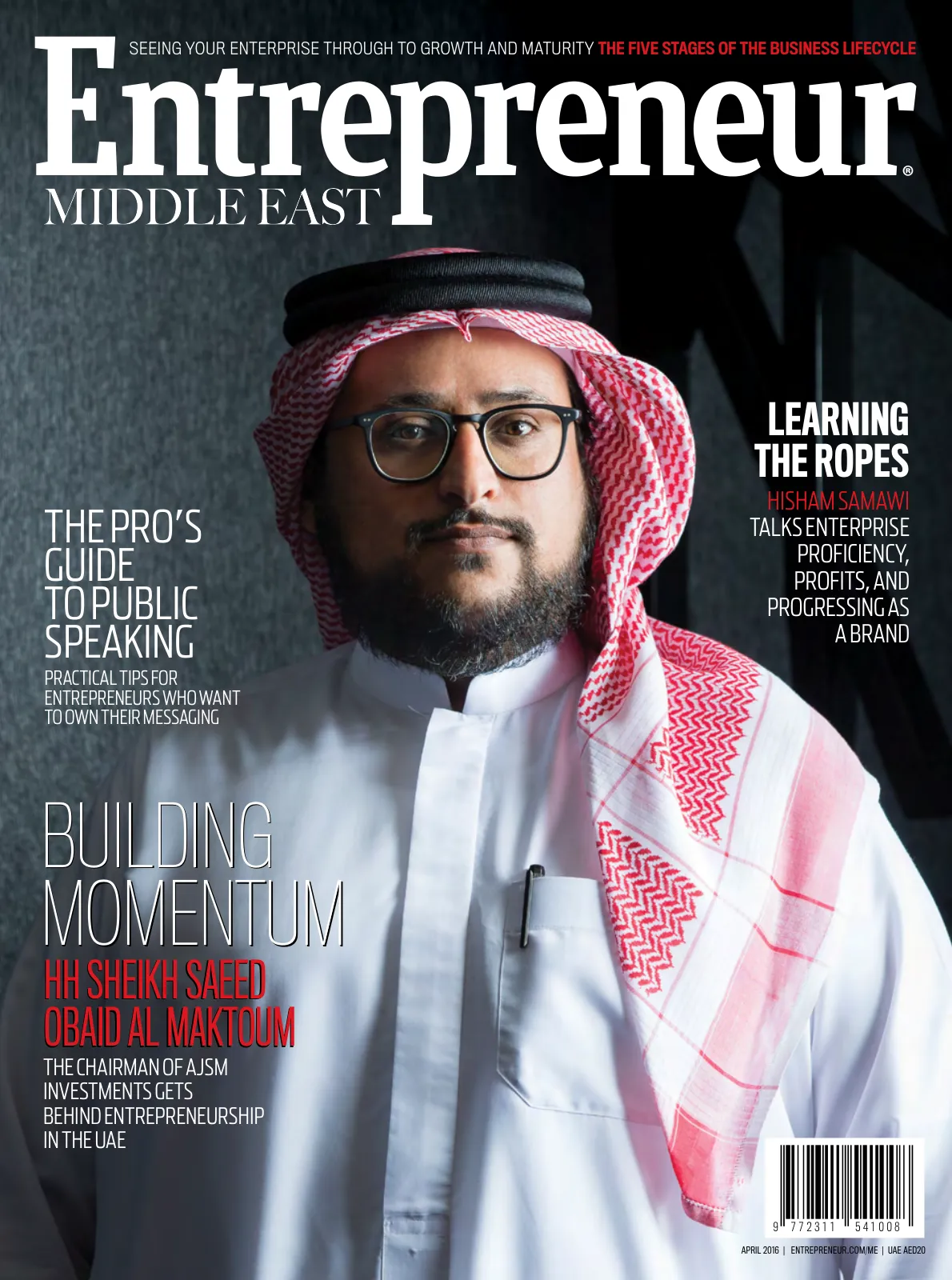
Entrepreneur Middle East, April 2016
Page 1
APRIL 2016 | entrepreneur.com/me | UAE AED20
9
7 7 2 3 1 1
5 4 1 0 0 8
Seeing your enterprise through to growth and maturity The five stages of the business lifecycle
The Chairman of AJSM
Investments gets
behind entrepreneurship
in the UAE
Hisham Samawi
talks enterprise
proficiency,
profits, and
progressing as
a brand
Learning
the ropes
Practical tips for
entrepreneurs who want
to own their messaging
The pro’s
guide
to public
speaking
Building
momentum
Building
momentum
HH Sheikh Saeed
Obaid Al Maktoum
HH Sheikh Saeed
Obaid Al Maktoum
Page 2
Premium materials and precise craftsmanship are unmistakable hallmarks of the entirely
new 2016 Lincoln MKX. So is elegance in its most natural form – the beauty of available Bridge of
Weir Deepsoft™ leather-trimmed cooled front seats and available open-pore wood.
A convenient available 360-degree camera, especially useful when parking or maneuvering in
tight areas, allows you to see up to two meters all the way around your vehicle. And making your
driving experience even more extraordinary is an available Revel® Audio System. Designed to
reproduce the live-music experience right in the comfort of your vehicle, it delivers remarkable
acoustic clarity and true audiophile sound quality. Learn more at me.lincoln.com.
Welcome to the more
human side of engineering.
2016 LINCOLN MKX
Bridge of Weir is a trademark of Bridge of Weir Leather Company Limited. Revel is a trademark of HARMAN International Industries, Incorporated. All rights reserved.
As per GCC Standardization Organization (GSO) certification the 2016 Lincoln MKX 2.7L EcoBoost® engine generates 250 Kw at 5,250 rpm and 542 Nm of torque at 3,000 rpm
Page 3
april 2016 Entrepreneur
3
CONTENTS
april 2016
40
The pro’s guide to
public speaking
The how-to
Theoretical and practical
tips for entrepreneurs
who want to own their
messaging.
56
TECH:
SHINY
#TamTalksTech
Gadgets and doodads
that you might’ve missed
out on, sourced by a tech
aficionado. Yes, it’s okay to
want them all… and no, it’s
not our fault.
76
MONEY:
YOUR MONEY
Is it time to exit?
Four things to consider be-
fore selling your company,
outlined for you by an en-
trepreneur who has already
made that coveted exit.
16
Building momentum
HH Sheikh Saeed Obaid
Al Maktoum
The Chairman of AJSM
Investments gets behind
entrepreneurship in the
UAE.
24
INNOVATOR:
Learning the ropes
Hisham Samawi talks en-
terprise proficiency, profits,
progressing as a brand, and
how there’s always a way to
do things better.
24
Hisham Samawi
on wading into the
UAE’s F&B sector
56 Personalize your hardware, shoot and share sharper
images, and improve your storage options.
hisham samawi Image credit: Sandrella Obeid
Page 4
Entrepreneur april 2016
4
CONTENTS
april 2016
50 Entrepreneur Middle East celebrates the launch of
the Levante with Maserati
36
‘TREPONOMICS:
SKILLSET
Keeping the fire alive
Employee passion for work
isn’t endless; here are seven
ways to stoke the flames by
Bayt.com’s Lama Ataya.
70
ESQUIRE GUY
The art of mentorship
Ross McCammon says that
the best mentors are the
ones who lead by example
without acknowledging
they’re leading by example.
32
ASK A PRO
Seeing your enterprise
growth through and
maturity
The five stages of the
business lifecycle, outlined
for entrepreneurs. Each
stage highlights a unique set
of obstacles to deal with and
overcome.
46
ASK A PRO
Fresh territory comes with
a host of new challenges
Six tips for expanding a
homegrown business, from
one of the region’s best
known entrepreneurs.
64
CULTURE:
LIFE
Make your life better by
saying thank you
Olympian and entrepreneur
James Clear outlines seven
situations when you should
be conveying gratitude, and
how it can improve your
work situation.
52
DESIGN
Shelling out
Entrepreneur and designer
Catherine Sarr, the founder
of Almasika Fine Jewellery
draws on African cultural
heritage to create her pieces.
16
How the Chairman of AJSM
Investments is backing the UAE
entrepreneurial movement
Page 5
Page 6
Entrepreneur april 2016
6
CONTENTS
april 2016
90
START IT UP:
WHO’S GOT VC?
Get your checkbook ready
ChefXChange, an online
platform to search and hire
chefs locally for private or
corporate events, is back
raising $2 million for its
Series A round.
88
Q&A
Craftsmanship,
e-commerce, and a whole
lot of creativity
Little Majlis, founded by
Anna Bolton-Riley and
Annabelle Fitzsimmons,
brings the artisan scene
online.
32
ECOSYSTEM
Family first
Securing continued growth
for family businesses in the
MENA region is integral to
economic growth.
44
EDITOR’S NOTE
By Fida Z. Chaaban
54
CULTURE:
TRAPPINGS
‘Trep gear
The executive selection for
the entrepreneur on your
list that has everything.
Okay, maybe for a little self-
reward as well.
68
LIFE
Business book rundown
Amal Chaaban reviews
a few business books for
you before you hit the
bestseller aisle. It’s true
that not all executive
material is created
equally.
62
TECH:
ONLINE ‘TREP
Blending in… to the
Middle East
San Francisco-based
app, founded by Akash
Nigam, Matt Geiger and
Evan Rosenbaum, garners
regional investor interest.
90 The five factors of socioemotional wealth
in terms of the family business
84
Emerging market entrepreneurs from
around the world trek to
the 2016 Seedstars Summit
Page 7
Page 8
Page 9
Page 10
Entrepreneur april 2016
10
www.entrepreneur.com/me
SUBSCRIBE
Contact subscriptions@bncpublishing.net to receive
Entrepreneur Middle East every issue
EDITOR IN CHIEF Fida Z. Chaaban editor@bncpublishing.net
MANAGING DIRECTOR Walid Zok walid@bncpublishing.net
DIRECTOR Rabih Najm rabih@bncpublishing.net
DIRECTOR Wissam Younane wissam@bncpublishing.net
PUBLISHER Nehme Abouzeid
CREATIVE LEAD Odette Kahwagi
MANAGING EDITOR Aby Sam Thomas
STARTUPS SECTION EDITOR Pamella de Leon
COLUMNIST Sindhu Hariharan
COLUMNIST Tamara Clarke
COLUMNIST Shoug Al Nafisi
COLUMNIST Erika Widen
EVENTS LIAISON Mark Anthony Monzon
PO Box 502511 Dubai, United Arab Emirates
P +971 4 4200 506 | F +971 4 4200 196
For all commercial enquiries related to
Entrepreneur Middle East contact
sales@bncpublishing.net
All rights reserved © 2016.
Opinions expressed are solely those of the
contributors.
Entrepreneur Middle East and all subsidiary
publications in the MENA region are officially licensed
exclusively to BNC Publishing in the MENA region by
Entrepreneur Media Inc.
No part of this magazine may be reproduced or
transmitted in any form or by any means without
written permission of the publisher.
Access fresh content daily on our website!
MIDDLE EAST
Printed by Raidy Emirates Printing Group LLC
www.raidy.com
EntMagazineME
@EntMagazineME @Fida
Entrepreneur-me
EntrepreneurMiddleEast
EntMagazineME
EntMagazineME
EntMagazineME
MIDDLE EAST
Images used in Entrepreneur Middle East are credited when necessary. Attributed use of
copyrighted images with permission. All images not credited otherwise Shutterstock.
Lama Ataya
Abdulla Barakji
Mohamed Batterjee
Amal Chaaban
James Clear
Shailesh Dash
Jackie Fitzgerald
Hassan Al Hazeem
Shelina Jokhiya
Suhail Al-Masri
Ross McCammon
Rani Nasr
Neil Petch
Soukaina Rachidi
Anna Roberts
May Rostom
Tarig El-Sheikh
Mark Sephton
Erika Widen
CONTRIBUTING WRITERS
In addition to our print edition, we’re bringing
you all sorts of industry news on our web
mediums. Joining us online means getting
relevant business and startup content in
real-time, so you’re hearing about the latest
developments as soon as we do. We’re looking
forward to interacting with our readers on all of
our social media and web platforms- like any
thriving business, we’re looking to give and take.
#TrepTalkME is already happening on all of our
digi platforms, and all good conversations go
both ways. See you on the web!
Page 11
DTEC Offers:
•
Space for over 1,000 innovative minds
•
4,000 sqm of business center facilities
•
Visas as per facility
•
Subsidized business licenses
•
Easy business set up
•
Plug & Play offices
•
24/7 access to center
•
High Speed WiFi internet
•
Conference Facilities & Meeting Rooms
•
Restaurants, Cafés and Games Rooms
To apply, call us on +971 4 501 5656
www.dtec.ae dtec@dsoa.ae
Join the greatest startup ecosystem in MENA
Space to work Space to grow
DUBAI TECHNOLOGY ENTREPRENEUR CENTER
for booking
Call : 04 501 56 56
www.dtec.ae
DTEC is a business center for accommodating and supporting young technology companies
and Entrepreneurs. With over 4,000 sq m of space, it is the largest entrepreneur center in the
Middle East, housing space for over 1,000 innovative and technology minds.
Page 12
Entrepreneur april 2016
12
I
f you are heading up a large
scale business in this region,
and your company is trying
to jump on the now-popular
“I support entrepreneurship”
bandwagon, then this month’s note
is for you. Some hard truth:
1. Entrepreneurs are busi-
nesspeople. They are people who
are running serious businesses,
they are not playing at running a
business. Businesses need money to
operate. Money comes from clients.
That is the single most important
factor that needs to be stressed.
2. Entrepreneurs are not a
promotional vehicle. Some
of the multinationals operating
in the Middle East are trying very
hard to gain a reputation of being
pro-entrepreneurship. That idea
has become very fashionable in pro-
motional circles over the past two
years. You need to actually work
with these businesses, not just
“voice” support in a press release.
Young enterprises need money to
operate and to continue to scale.
3. You do have a budget. If
you’re going to craft some “CSR”
type activity, why don’t you put
your budget to work with a startup
or a SME? It may take some cre-
ative thinking to do something
impactful with a limited budget,
but that budget, however small, is
going to go a long way for a busi-
ness that’s bootstrapping. Call up
a startup founder and ask them to
craft a proposal for work- you’d be
surprised at the multitude of op-
tions they can offer your company.
4. Giving away prizes isn’t
supporting entrepreneur-
ship. Please do not approach us
to contact our startups for your
“startup competition” if you are not
serious about awarding the win-
ning company. Giving them some
certificate and a prize like a tablet
or a booth at your event is not sup-
porting entrepreneurship, it is a PR
move. How would you like it if one
of these “competitions” gave your
company a piece of paper and an
iPad as a reward for your business
model and enterprise ingenuity? It
is insulting, and worse, it’s useless
and does nothing to improve the
state of the business.
5. There is always a way. If you
have enough money to keep a glitzy
PR agency on retainer, then you
have enough money to support the
entrepreneurial ecosystem. There
are a few multinationals who are at
the very least sponsoring ecosystem
events, and that are actively trying
to find innovative ways of working
with startups. These companies
are showing you the way it can and
should be done.
6. Startups can sense your
intentions. When founders get
requests to back something that
is supposedly “supporting” the
entrepreneurial ecosystem, don’t
be surprised when they decline to
participate. A few entrepreneurs
have come to me asking my opinion
on being invited to participate in
events that suddenly have a startup
or entrepreneurship panel, and
these founders are realizing that
it’s all just a show for someone
else’s benefit. These same founders
are very aware of the fact that you
suddenly decided you needed a few
token entrepreneurs at your event,
and this is why you’ve suddenly
taken an interest in their work. This
won’t win you any good will in the
ecosystem.
If you, as a corporate leader, want
to really support the ecosystem,
then at some point, you need to al-
locate some of your budget to doing
so. Entrepreneurs are not a promo-
tional tool, they are businesspeople
who are trying to build commer-
cially viable and stable enterprises.
Fida Z. Chaaban
Editor in Chief
@fida | @fidazchaaban
editor@bncpublishing.net
EDITOR’S NOTE
It’s time to inject some reality into the PR blitz
around entrepreneurship
All talk, no action
Page 13
Page 14
Page 15
Page 16
Entrepreneur april 2016
16
N
ow, I think, is the
right time to be
an entrepreneur.
When everything
slows down, you
open your busi-
ness- it’s the best
time. Suppliers will be more flexible,
payments will be better, office rents
are going down- setting up something
new, [the time to do that] is today.”
At a time when there seems to be a
lot of questions being asked about
the economic stability of the UAE
and the wider Middle East, the above
statement by AJSM Investments
Chairman HH Sheikh Saeed Obaid Al
Maktoum puts a different spin on the
conversation in the region- and it’s
safe to say that wannabe entrepre-
neurs would be wise to take note of
this seasoned businessman’s words.
As the man leading a company with
interests in sectors as varied as real
estate, technology, F&B and phar-
maceuticals, Sheikh Saeed knows a
thing or two about doing business
in the UAE- AJSM Investments has
been seeing rapid growth since its
inception about four years ago, with
revenues increasing by 80-100% in
HH Sheikh Saeed Obaid Al Maktoum
The chairman of AJSM Investments gets behind
entrepreneurship in the UAE
By Aby Sam Thomas
innovator
“Starting your own
business –given all
the facilities that you
have around today-
it’s 10 times easier to
do it now than it was
20 years ago.”
Entrepreneur april 2016
16
Images by Xtremepics
>>>
Page 17
april 2016 Entrepreneur
17
april 2016 Entrepreneur
17
Page 18
Entrepreneur april 2016
18
Sheikh Saeed has a calm, charming
demeanor, but when he talks about
anything relating to entrepreneur-
ship, his passion for the subject is
almost tangible- it’s clear that this
is someone who is eager to see more
entrepreneurs rise up in the UAE.
“Starting your own business –given
all the facilities that you have
around today- it’s 10 times easier to
do it now than it was 20 years ago,”
he notes. “The government is push-
ing for it, the services are there- it’s
so much easier than before.” But
shouldn’t one be concerned about
the uncertainty in the market right
now? Sheikh Saeed dismisses this
contention, and points our at-
tention instead to the advantages
inherent in the current financial
climate for the entrepreneur. “Fail-
ing today is less [of a risk] than
failing in two or three years’ time,”
he says, smiling. “It will cost you
less!” In addition, Sheikh Saeed
also explains how starting up a
business, say, three years later as
opposed to now doesn’t offer any
guarantee of ease in the entrepre-
neurial journey ahead- according
to him, the process (and the costs
involved) will only get tougher in
the years to come.
AJSM Investments came into be-
ing after Sheikh Saeed and his four
siblings decided to bring their re-
spective family businesses together
as one unit. Besides the “greater
good” associated with pooling these
companies together, Sheikh Saeed
noted how coming together also
allowed them to make bigger invest-
ments than what they’d be able
to do previously- and thus enable
better returns as well. Real estate
development was at the core of the
business when AJSM Investments
started out, and it remains an
integral part of the company today,
but diversification efforts are well
underway, as is being showcased by
its move to start a pharmaceuticals
factory producing generic medicine.
Sheikh Saeed is also particularly
interested in the tech sector- one
of AJSM Investments’ ventures in
this space has been working with
Idea Prodigies, a software develop-
ment firm, to develop an app called
MyHUBBER, which has been billed
as “a multi-purpose mobile and
web application for social network-
ing, classifieds, and shopping.”
Besides the app (which is expected
to launch by the end of the year),
Sheikh Saeed is also hoping to
launch an Islamic crowdfunding
website as well, tapping it as a
platform to both fund businesses as
well as to facilitate Islamic chari-
table giving not just in the MENA
region, but around the globe.
But his own ventures notwith-
standing, Sheikh Saeed is also keen
on facilitating the development of
an entrepreneurial community in
the UAE. This man is eager to see
more startup enterprises in the
market, and he’s putting his money
where his mouth is- AJSM Invest-
ments is starting up an initiative
called AJSM Hero to help nurture
new businesses in the UAE. One
part of the program is targeted
toward university students, which
will see them, over the course of
a month, put forward business
plans that will be evaluated by a
jury put together by AJSM Invest-
ments, following which the winning
idea(s) will be rewarded with both
funding and coaching from the
company. In addition, the AJSM
Hero campaign will also be solicit-
ing ideas from entrepreneurs out of
school- this, however, will be done
on an ongoing basis through the
year. Sheikh Saeed says the contest
will be open to entrepreneurs of
all nationalities based in the UAE,
with the reasoning being that the
expat community doesn’t have as
many programs catered to them
as Emiratis. “Emiratis have at
least four or five initiatives from
the government helping them, but
non-locals don’t have anything,” he
notes. “So we concentrated on that
sector specially, so as to give back-
non-locals are residents here, they
are a part of our community, they
are giving back, and so we have to
support this part of the community
also, not concentrate on only locals.
Yes, I’m a local and I’ll support
locals, but we are all one. Dubai is a
multinational city, a cosmopolitan
city… So why not help everyone?
And this is the neglected part here,
and so we are trying to contribute
in our way.”
But this competition is just the
start of what Sheikh Saeed envi-
sions with AJSM Hero- today, it’s
an initiative that’s being spear-
headed by AJSM Investments, but
Sheikh Saeed hopes that AJSM
Hero will evolve into something
larger that the entire private sector
in the UAE can get behind. “We
are trying to build it up slowly
into, insha’allah, some kind of
foundation that all private sector
enterprises can be a part of,” he
says. “They can help not just finan-
cially- actually, coaching is more
important than anything else. Most
entrepreneurs go into a world that
he does not know anything about-
and so when he has the support and
expertise of other people, he’ll have
that to back him up.” According to
Sheikh Saeed, the importance of
coaching and mentorship cannot
be understated, when it comes to
nurturing entrepreneurship in the
UAE. While there are quite a few
programs already being initiated
in this regard, Sheikh Saeed notes
that there’s a need for coaching
that extends beyond an enterprise’s
launch phase. “I think, personally,
the right time to help someone is
innovator
“I think, personally, the
right time to help someone
is not in the beginning- it
is actually [more needed]
when they are about to fail.”
>>>
Page 19
Taskeen Properties’
Khalid Al Habsi
winning at the Oman
Entrepreneurship
Awards
Page 20
Entrepreneur april 2016
20
not in the beginning- it is actually
[more needed] when they are about
to fail,” he says. “Maybe it’s a year
ahead, or two years ahead, if he
or she faces a problem, then start
something with them. Keep fol-
lowing up. If he falls, pick him up.
Help him. Guide him. Coach him.
That’s the most important time-
because if he falls and does not find
someone there [to help him up], he
will stop.”
Given his own experience in the
business world, Sheikh Saeed is
emphatic on the need for entre-
preneurs to have a good support
structure, be it in the form of family,
friends or peers in business. “In the
beginning, I was lucky,” he recalls. “I
had a very supportive family. I failed
quite a bit in a few small businesses
at the beginning, and every time I
failed, they were there for me. They
were like, ‘Don’t stop, do something
else, make it better.” So I always
had support. And this is the best
feeling, I think, you can have as
an entrepreneur- having someone
behind you, having your back. If you
fall, someone will pick you up… The
satisfaction one can get out of this
is one of the best feelings you can
have, and if I can, in some way, help
even 1% of the community with
something like this, I’ll be more
than happy.” At this point, I quiz
Sheikh Saeed on what’s his personal
motivation to want to do things like
this- what does he actually get out
of supporting and encouraging en-
trepreneurs in the UAE? I’ll admit
here that I was expecting a standard
corporate response from him on
this, but Sheikh Saeed’s rather in-
nocent answer took me off guard.
“Making people happy makes me
happy,” he says, in a matter-of-fact
way. “I find happiness from seeing
other people being happy.” It’s a
simplistic statement, true, and one
can argue that it is a bit naïve to
even think that with respect to the
business world. But it’s clear that
Sheikh Saeed strongly believes in
this notion of his, and given the
current disjointed nature of the
UAE’s entrepreneurial ecosystem,
maybe such a sentiment is what is
required to bring it together as a
more cohesive whole- and yes, the
community will only be the better
for it
1. Don’t be afraid of failure
“People here don’t want to fail.
They are happy where they are
with their jobs, and not fail [by
starting something new]. But the
first thing about being an entre-
preneur is that you have to fail to
succeed. Don’t be afraid of failing
once, twice, three times… Failure
is something you can learn from.”
2. Look before you leap
“Take risks, yes, but take cal-
culated risks. Because having
smaller leaps [in terms of risk]
will have lower costs, should you
fail.”
3. Don’t try to go at it alone
“Hire the right talent and staff- it
is the most important thing. An
entrepreneur always has to build
a good team, so that they can
work together. One hand cannot
clap. Don’t be a one-man show.”
4. Be ready for the stress
“Look into ways by which you
can manage your stress. Being
an entrepreneur is a 24-hour job-
it’s not like you go to your job, do
your work, at 5, you’re home, and
you forget about it. With entre-
preneurship, you are involved 24
hours.”
5. Remember to keep
learning “Always surround
yourself with people you can
learn from. There’s no one that
knows everything, so surround
yourself with people you can get
knowledge from… Always grow
yourself.”
innovator
HH Sheikh Saeed Obaid Al Maktoum’s tips
for entrepreneurs in the UAE
Starting up smart
Sheikh Saeed is em-
phatic on the need
for entrepreneurs
to have a good sup-
port structure, be it
in the form of fam-
ily, friends or peers
in business.
HH Sheikh Saeed Obaid Al Maktoum,
Chairman, AJSM Investments
Page 21
Page 22
Page 23
Page 24
Entrepreneur april 2016
24
innovator
innovator
W
e didn’t know
the first thing
about running a
restaurant,” says
Hisham Samawi,
when recalling his
and his brother
Ashraf Samawi’s
journey starting up the Middle East’s first Clinton
Street Bakery Company in Dubai. “It looks really
simple when you see a restaurant working, but one
little thing goes wrong and you wouldn’t believe
how much it impacts everything. Little problems
get compounded, even if it’s something like our
servers forgetting to ring in an order- it all creates
a domino effect, it can lead to chaos!” And chaos
it was, for a little while in the beginning, admits
the entrepreneur. Samawi remembers a particular
instance when the printer in the restaurant’s
kitchen –which let chefs know of their patrons’
orders- stopped working. “It was like a bomb had
exploded,” he says. “100 tables in the restaurant
were about to not get their food! My brother was
being the barista making coffee, and I was waiting
tables. We kind of looked at each other, and at that
point, we just wanted to shut the doors, get in our
cars, and leave!” In the end, they were able to get
the situation under control, but not without some
valuable lessons on how to liaise with waiting hun-
gry clients. During what Samawi refers to as their
“amateur hour,” they kept the outlet in people’s
good graces by doing table courtesy visits, and of-
fering the waiting customers complimentary meals.
Samawi laughs about these types of situations in
hindsight, but those first few months of operations
came with a steep learning curve for the brothers
in matters of orchestrating staff and service flow,
wastage and how it eats into what could potentially
be profits, and operational standard development
and subsequent implementation.
Hisham Samawi talks enterprise
proficiency, profits, and progressing
as a brand By Fida Chaaban
>>>
Page 25
april 2016 Entrepreneur
25
“I never really liked to
invest in other people’s
projects, because I pre-
fer to have more con-
trol and be more active
in the investment.”
Hisham Samawi
Image credit: Sandrella Obeid
Page 26
Entrepreneur april 2016
26
innovator
Clinton Street Baking Company in Dubai, UAE
Page 27
april 2016 Entrepreneur
27
Today, the co-founder is used
to being confused for a waiter
at his Dubai-based F&B enter-
prise, mostly because he often
actually jumps in and shuttles
meals- something that he has
done ever since the enterprise
opened. He’s also used to be-
ing confused for the outlet’s
delivery driver and busboy,
because, again, he’s performed
those functions at his busi-
ness too. Dubai’s first Clinton
Street officially opened at Burj
Views two years ago, and the
co-founders recently signed
on to launch the second outlet
at City Walk- a 3,400 sq. ft.
space that is scheduled to
open in the fall. Being only
the third city to have the
original New York City con-
cept, Samawi says that they
wanted the outlet to “have
a neighborhood feel,” hence
their choice to opt for open-
ing outside of a mall or hotel
space. The brand was founded
in 2001 by husband and wife
team Neil Kleinberg and DeDe
Lahman, and Samawi warmed
to its homegrown dining
experience by being a member
of their frequent clientele. “I
used to live in New York, right
around the corner from the
original Clinton Street. It was
my neighborhood restaurant,
so I saw it go from an obscure
hole-in-the-wall to a New
York institution with two-
hour lineups that I actually
waited in to eat at.”
Samawi, a graduate of Co-
lumbia Business School, had
already made a name for him-
self in the art sector under
MENA’s Ayyam Gallery. His
sector trajectory shift meant a
whole new education on what
works and what doesn’t work.
“I never really intended to get
into the F&B industry. I was
doing Ayyam Gallery when
I came to Dubai. My family
was living in Jordan at the
time, and I first came here as
an entrepreneur looking to
find business opportunities
since I’d heard so much was
happening here. I didn’t know
exactly what I was looking
for; I thought when I saw the
right business opportunity
it would become obvious to
me.” It did become obvious,
but it was a combination of
factors that led to the execu-
tion and launch of Clinton
Street. The first, says Samawi,
revolved around the idea that
the mid-market segment was
underserviced, specifically
in the breakfast category: “I
always felt that Dubai was
missing that great breakfast
experience that I really liked
in New York. People always
complained that there was
nowhere good to have break-
fast.” The second factor that
contributed to his interest in
launching the business was
that he was approached for
investment in someone else’s
F&B venture. “Around that
time, someone approached me
for investment in their restau-
rant. I never really liked to
invest in other people’s proj-
ects, because I prefer to have
more control and be more
active in the investment.”
That invitation to invest got
Samawi thinking about his
own entrepreneurial interests,
and the opportunity to bring
Clinton Street to the Middle
East. How did he manage to
land the licensing rights? Ini-
tially, what clinched the deal
with the owners -who were
somewhat reluctant to expand
borne from concerns that the
brand itself wouldn’t stay true
to its ethos- was “the fact
that I loved Clinton Street
and knew the brand inside
and out. They cared about
going with a solid foundation,
rather than me just bringing
the brand to the Middle East,
opening up 50 locations, and
focusing only on the money.”
Once the deal was cemented,
the Samawi brothers then
learned that there was no
brand manual that existed per
se other than a 20-page brief,
nor was there the usual guide-
lines in terms of operational
standards and processes that
one expects from a franchise
agreement. “We aren’t really
a franchise in the standard
sense, as what we worked
with was having our chefs
trained onsite in New York,
and that was pretty much
it. Other than the menu, we
basically had to develop all of
this material from scratch.
“It looks really simple
when you see a restau-
rant working, but one lit-
tle thing goes wrong and
you wouldn’t believe how
much it impacts every-
thing. Little problems get
compounded, even if it’s
something like our serv-
ers forgetting to ring in
an order- it all creates a
domino effect, it can lead
to chaos!”
Clinton Street Baking
Company in Dubai, UAE
>>>
Page 28
Entrepreneur april 2016
28
It’s more of a licensee agreement rather than
a franchised outlet.” The 2,400 sq. ft. Burj
Views outlet became an ongoing experiment of
sorts with the brothers constantly working on
streamlining processes, testing attempts to slash
wastage and figuring out how to curb inefficien-
cies, and most importantly, stemming the flood
of costs that eat into profit margins. “I think,
as a business owner, it’s about how you run the
business. It’s like, the food is good, the service
is good, then generally, the revenue should be
there, but then, how does that revenue become
profit? Assuming you get 100 dirhams from a
customer, you’ve got to figure out how to pay
your suppliers, your staff etc. There’s so many
places where that 100 dirhams goes to. By the
time you’re through with that, you might not
have any money left. That knowledge base has
almost taken us two years to acquire. It’s almost
like you don’t know what you don’t know, so you
don’t know what to ask.”
You also don’t know what will end up being
cost effective and what won’t, until you execute a
trial period and then do the calculations. Clinton
Street’s delivery service option ended up being
much more worthwhile for the business after
outsourcing- which seemed counterintuitive
until the numbers spoke for themselves. An
in-house fleet of four delivery drivers proved to
be a huge cost when Samawi factored in things
like insurance, salaries, fuel charges, and the
rest. “Our overhead was approximately 20,000
dirhams per month, and I did the math and
found it was costing us 35 dirhams per trip. I
knew there had to be a better way- I did some
research and found a company called Any Order
Delivery at a cost of 10 dirhams per trip. It’s also
an added benefit because now we can do an un-
limited amount of deliveries, and this is without
having staff onsite waiting around for delivery
orders during slower times. It was a seamless
transition, and it’s almost a quarter million
dirhams that we just saved!” As passionate as
the founder is about his venture, he admits
that at some point he needed a break after six
straight months of 16-hour days. He had a full
week of being disconnected digitally during his
vacation to Burning Man in the U.S., and it gave
him perspective. “Initially getting back after that
week, I felt that I was out of the loop- a week is a
long time in any business. Think about a week of
emails, messages, anything, and then think about
what can happen at your business in a week
out of your control.” Did he escape the business
completely during his time off? “When you actu-
ally take a step back, it makes you realize how
over-controlling and over-obsessive we can be
about every little thing. It will go on without you,
if you’ve built it right.”
innovator
“I never really knew how hard the
F&B industry is… If a restaurant
has the SOPs and manuals laid
out, there’s no original thought that
goes into it. I got maybe a 20-page
description, and chef training. For
someone like me, who had no expe-
rience in F&B, it was huge. Things
like choosing a POS, finding your
suppliers, contractors, etc. It’s all
things you need to learn as you go.”
1. WHEN YOU’RE NEW TO THE
INDUSTRY, YOU WON’T KNOW
WHO TO WORK WITH “My first crack
at development was a disaster: I had
a designer and then he recommended
me a contractor. In the beginning, you
don’t know good designers and good
architects. I had a horrible contractor
and horrible kitchen supplier. Dubai
went through a phase when you had
so much demand in the market that
all these subpar operators were in
business even though they didn’t do
good work. To put it in perspective for
you, my contractor, kitchen supplier,
MEP supplier, they’re all out of business
now, and that tells you how bad they all
were. We didn’t know any better, so this
was the crap we ended up with.”
2. TRYING TO SAVE ON KEY
ELEMENTS TO YOUR BUSINESS
MAY COST YOU MORE IN THE
LONG RUN “When I was pricing things
out, I learned an important lesson. You
shouldn’t cut costs on integral elements
of the business. You really do get what
you pay for, and while you don’t need to
go with the most expensive out there,
don’t skimp, because this will come
back to bite you later. You might as well
go with a quality job- if you think your
contractor is giving you a really good
price on something, there’s definitely
a reason. Even going with somewhat
cheaper equipment from a supplier has
repercussions, as we found out later.”
3. BEING THE INDUSTRY’S NEW KID
MEANS DOORS DON’T OPEN VERY
EASILY “When you’re trying to find
a location, it’s really hard when you’re
an independent operator. You’re not
Alshaya or these established guys, you
don’t know anyone at Meraas for ex-
ample, and no one knows who you are.
So you’re knocking all of these doors
just trying to secure a location for your
business, and you’re hearing no over
and over again.”
4. THERE IS NO SUBSTITUTE FOR
GOOD CLIENT-FACING STAFF “A lot
of casual dining tries to go with cheap
staff; I wanted to bring high quality
food and service that you get at a high
end outlet without this huge spend.
Most of my initial launch staff was from
South Africa, and yes, I’m paying more
for my staff than someone in casual
dining, but I think it’s worth it. Everyone
says that you can’t make it work, but I
think you can. At the end of the day, it’s
about the overall dining experience, and
being able to help guide the customer
to what they want. Obviously if you
have a rapport with your customer, you
can suggest things and ultimately sell
more food. Strong staff contributes to
the business sustainability, because
sooner or later someone will come
along with better service. If you’ve got
bad service and bad food quality, you
aren’t going to last. Our food is really
good and we have great service- that’s
a combination that isn’t taken for
granted.”
5. YOUR BUSINESS IS MORE LIKELY
TO WEATHER MARKET SHIFTS IF
YOU’VE BUILT A SOLID CUSTOMER
BASE “One thing I’m learning to is to
trust and believe in what you’re doing.
One day you might have 150 people
come, and the next day you might
have 50 people, and then you try and
understand why you have that swing.
Numbers might go down and up, but
you need to examine it in the long-term.
I’m hearing that F&B in general is down
20%, and our numbers have actually
increased slightly, and I think it’s that
we’re still relatively new and people are
still coming to try us out. We’ve defi-
nitely retained our customers that are
coming in, so that’s helped us a lot.”
LEARNING ON THE JOB
Hisham Samawi’s key takeaways from his novice entry
into the F&B sector
Page 29
An oasis of tranquillity
The epitome of modern luxury
Discover the Hormuz Grand Hotel, Muscat
HORMUZ GRAND HOTEL, MUSCAT
Explore www.hormuzgrandhotel.com
MUSCAT EDINBURGH KUWAIT
QUORVUSCOLLECTION.COM
Page 30
Page 31
Page 32
Entrepreneur april 2016
32
By Neil Petch
The five stages
of the business
lifecycle
Seeing your enterprise through to
growth and maturity
TREPONOMICS
ETHICS | ESQUIRE GUY | SKILLSET | MARKETING | PRO
Entrepreneur april 2016
32
Page 33
april 2016 Entrepreneur
33
F
rom the moment
you make the de-
cision to set up a
business, you’re
in the “business
lifecycle.” This
will see you jour-
ney from idea to startup, and
if successful, through to the
growth and maturity phases.
While it’s fair to say that
business is never not chal-
lenging, a look at each of
the stages of the business
lifecycle highlights a unique
set of obstacles to deal with
and overcome. You will have
to be flexible in your think-
ing and adapt your strategy
as you move along. Indeed,
different approaches are
required for market penetra-
tion versus, for example,
what may be required to
achieve growth or retain
market share.
According to the recent
Startup Genome Report,
an estimated 90% of
those startups that fail do
so primarily due to self-
destruction. It was their
founders’ own bad choices or
lack of preparedness rather
than so-called “bad luck”
or market conditions that
were out of their control.
Understanding your position
in the business lifecycle
just might help you stay a
bit ahead of the game here
and defy the odds, as you
anticipate the potential
challenges and obstacles
that are upon you or are on
the way depending on what
phase you are in or about to
transition to.
Simply put, as your
business grows and develops,
so too do your business aims,
objectives, priorities and
strategies– and that’s why an
awareness of what stage of
the business lifecycle you are
currently in can be helpful.
STAGE 1 Seed and
development
This is the very beginning of
the business lifecycle, before
your startup is even officially
in existence. You’ve got your
business idea and you are
ready to take the plunge. But
first you must assess just
how viable your startup is
likely to be.
At this stage, you should
garner advice and opinion
as to the potential of your
business idea from as many
sources as possible: friends,
family, colleagues, business
associates, or any industry
specialists you may have
access to. Ultimately the
success of your business will
come down to many fac-
tors– including your own
abilities, the readiness of
the market you wish to enter
and, of course, the financial
foundation in place (how
are you going to finance your
launch?).
In some ways, this is the
soul-searching phase. It’s
where you take a step back
and consider the feasibility
of your business idea, and
also ask yourself if you have
what it takes to make it a
success.
STAGE 2 Startup
Once you have thoroughly
canvassed and tested your
business idea and are satis-
fied that it is ready to go, it’s
time to make it official and
launch your startup. Many
believe this is the riskiest
stage of the entire lifecycle.
In fact, it is believed that
mistakes made at this stage
impact the company years
down the line, and are the
primary reason why 25% of
startups do not reach their
fifth birthday.
Adaptability is key here,
and much of your time in
this stage will be spent
tweaking your products or
services based on the initial
feedback of your first cus-
tomers. It can even get to the
point where you are making
so many changes to your of-
fering that you start to feel a
bit of confusion. That’s just
noise, and the main advice
here is to power through the
blurriness, because extreme
iterations upfront will natu-
rally seem confusing. Rest
assured the clarity will once
again come.
STAGE 3 Growth and
establishment
If you’re at this stage, your
business should now be gen-
erating a consistent source of
income and regularly taking
on new customers. Cash flow
should start to improve as
recurring revenues help to
cover ongoing expenses, and
you should be looking for-
ward to seeing your profits
improve slowly and steadily.
The biggest challenge for
entrepreneurs in this stage
is dividing time between a
whole new range of demands
requiring your attention–
managing increasing levels
of revenue, attending to
customers, dealing with the
competition, accommodat-
ing an expanding workforce,
etc. Hiring smart people with
complementary skillsets is
necessary to make the most
of your company’s potential
during this phase, and so any
good founder will be spend-
ing a lot of time directly
involved in the recruitment
process.
It is essential that you start
to come into your role as
head of the company in this
stage. While you’ll still be on
the frontlines often enough,
you need to be aware of how
your expanding and highly
qualified team is going to be
taking over a great deal of
the responsibilities that were
previously tightly under your
control. It is your job now to
start establishing real order
and cohesion as you mobi-
lize the teams according to
clearly defined and commu-
nicated goals.
STAGE 4 Expansion
At this stage you might feel
there is almost a routine-
like feel to running your
business. Staff is in place to
handle the areas that you no
longer have the time to man-
age (nor should you be man-
aging), and your business has
now firmly established its
presence within the indus-
try. Here you might start to
think about capitalizing on
this certain level of stability
by broadening your horizons >>>
Page 34
Entrepreneur april 2016
34
with expanded offerings and
entry into new geographies.
Businesses in this stage of-
ten see rapid growth in both
revenue and cash flow as
the blueprint has now been
established, but be warned
about getting too comfort-
able. In business, if you are
not moving forward you
are moving backwards, and
without a constant, almost
nervous itch or desire to
expand, complacency can set
in, and you might get caught
off guard.
There are, of course, two
sides to this coin, with the
other involving a risk of ex-
panding too carelessly. While
there is no crystal ball and
it is very hard to get an idea
of what will be the results
of your undertakings, you
can give yourself the best
possible chance of continued
success through careful plan-
ning. Look at your resources,
be realistic about the effort
and cost and potential
returns, and always keep an
expert eye on how expansion
might impact the current
quality of service you provide
your existing customers.
Remember, while having a
successful business model
behind you is undoubt-
edly an advantage, it is not
a guarantee that it will work
elsewhere within other mar-
kets, or that new offerings
will result in the same suc-
cess. The business graveyard
is littered with organizations
that took on too much and
failed. Your task is indeed
to take on new challenges as
you look to constantly ex-
pand, but measure your risk
and do your best to secure
the company for all eventu-
alities.
STAGE 5 Maturity and
possible exit
Having navigated the expan-
sion stage of the business
lifecycle successfully, your
company should now be
seeing stable profits year-on-
year. While some companies
continue to grow the top
line at a decent pace, others
struggle to enjoy those same
high growth rates.
It could be said that entre-
preneurs here are faced with
two choices: push for further
expansion, or exit the busi-
ness. If you decide to expand
further, you will need to ask
yourself the same questions
you did at the expansion
stage:
• Can the business sustain
further growth?
• Are there enough opportu-
nities out there for expan-
sion?
• Is your business financially
stable enough to cover an
unsuccessful attempt at
expansion?
And, perhaps most impor-
tantly, are you the type of
leader who is up for the task
of further expansion at this
stage? In fact, many compa-
nies change leadership here,
bringing in a seasoned CEO
who is more fit to navigate
the new challenges.
Many at this stage also look
to move on through a sale.
This could be a partial or full
sale, and of course depending
on the company type (for ex-
ample, public or private), the
negotiation may be a whole
new journey in itself.
Navigating the business
lifecycle
Not all businesses will
experience every stage of the
business lifecycle, and those
that do may not necessarily
experience them in chrono-
logical order. For example,
some businesses may see
astronomical growth right
after startup, and the found-
ers may decide to cash out
right away, jumping straight
to that “exit” stage.
For many companies,
though, there will be some
sort of resemblance to the
stages defined above, and
awareness may help you
anticipate what is com-
ing next and how you can
best prepare yourself and
your team to maximize your
chance of success. Mak-
ing the right decisions at
each stage is another thing
altogether, however, and that
will require your usual mix
of gut instinct and practical
business sense
Neil Petch is the Chairman of Virtugroup. Petch founded Virtuzone in 2009 before launching Virtugroup, a holding company that has a wider mandate
of supporting startups from establishment; to successful market entry; and all the way through to exit. Petch is also the Chairman of DIFC-regulated
GMG, established in 2010 with offices in Dubai, UAE and London, U.K., providing brokerage services for commercial and investment banks globally.
His most recent venture, PrimalMD, was launched in the health sector and focuses on helping doctors addressing the root cause of illness rather than
simply treating the symptoms.
TREPONOMICS
ETHICS | ESQUIRE GUY | SKILLSET | MARKETING | PRO
while having a successful
business model behind you is
undoubtedly an advantage, it is
not a guarantee that it will work
elsewhere within other markets,
or that new offerings will
result in the same success.
Page 35
Page 36
Entrepreneur april 2016
36
A
job is a lot like
a relationship:
it’s fun and
exciting at first,
but after a while,
the butterflies
can turn into
blahs. Not unlike
relationships, an employee’s
relationship with work begins
with a honeymoon phase,
and often has peaks, valleys
and plateaus. And much like
relationships, inevitably the
honeymoon ends, and the em-
ployee’s fiery passion can fade
to embers that require stoking
to reignite.
When managers neglect to
add extra kindling to the fire,
they risk having their em-
ployees become overwhelmed,
exhausted, bored, and can
ultimately invite turnover
into their business, and we
all know employee churn is
expensive. Considering these
facts, it is in a manager’s best
interest to invest in engaging
their employees optimally and
keep the fire always alive.
Before that happens, keep an
eye out for the telltale signs
of trouble and take action
to address them before they
escalate.
FIVE SIGNS OF A fading work
passion
1. Fear of making mistakes
If your employees are more
concerned about the conse-
quences of making a mistake
than taking the risk, then
failing, and learning from their
failure, you have a problem.
What we suggest is turning
things around by celebrating
employee failures. According
to the Bayt.com Learning in
the Middle East and North
Africa Workplace poll, March
2015, 73% of professional
respondents say their organi-
zation encourages people to
openly discuss their mistakes
and learn from them. An at-
titude like this gives employ-
ees the freedom to take risks,
keeps the passion alive, and
encourages entrepreneurial
and innovative thinking.
2. Information is exclusive
A clear sign of trouble in the
organization emerges when
essential information becomes
exclusive to a small elite of
employees, particularly key
information such as company
and department objectives,
performance and financial
results, strategic plans, etc.
Privileged insider information
should have no value because
there really shouldn’t be any
in the first place. All informa-
tion needed to plan, strategize,
innovate, measure perfor-
mance and succeed should be
freely shared across the com-
pany. The good news is 72%
of respondents says that they
have a culture of transparency
and honest communication
in their workplace, as per the
Passion for Work in the Middle
East and North Africa poll,
February 2016.
3. Everything happens via
email
If you notice that your em-
ployees are doing business
exclusively via a computer
screen, or communicating
with each other that way, even
when a phone call or face-to-
face meeting would be almost
as convenient, that’s often a
red flag. It may mean that they
feel their jobs aren’t worth the
extra effort that a face-to-face
meeting, or phone call, re-
quires. Face-to-face meetings
are always the most powerful
approach to building rapport
and trust, so set an example
yourself by meeting clients
and teams in person whenever
you can, and encouraging em-
ployees to do the same. Over
time, your employees will see
how much more effective the
personal element can be.
4. Employees don’t help
each other
Look closely at how your
employees interact among
themselves. Employees who
aren’t invested in your organi-
zation’s future usually won’t
go out of their way to give
pointers to the new hire or
proofread a colleague’s report,
for example. If this is happen-
ing in your company, start by
matching up new hires with
seasoned employees who can
infograph © bayt.com
By Lama Ataya
ETHICS | ESQUIRE GUY | SKILLSET | MARKETING | PRO
TREPONOMICS
Keeping the
fire alive
Employee passion for work isn’t endless, here
are seven ways to stoke the flames
The leading barrier to
employee engagement is
often a lack of strategy and
competing priorities. You can
circumvent this when you
present the challenge with
a structure for participation
and a system for rewards
and recognition. Encourage
your employees to learn new
skills.
Build teams within de-
partments, and through-
out the entire company, to
allow an open discussion
of goals and obstacles.
There are many exercises
that can help teams to
find their strengths and
weaknesses. These exer-
cises can remove barri-
ers and blind spots and
propel the team forward
to ever new successes.
Page 37
april 2016 Entrepreneur
37
mentor and encourage them.
The new hire will appreciate
the personalized guidance and
mentorship. Plus, the more
experienced employees will
soften when they see how
fulfilling it can be to pass on
their knowledge and expertise.
One-on-one mentoring by a
peer/manager was identified
as one of the most preferred
methods of training by 30% of
survey respondents, accord-
ing to the Career Development
in the Middle East and North
Africa survey, January 2016.
5. Things just don’t seem
to get done
When employees miss dead-
lines or other important mile-
stones, your first instinct may
be to dish out the consequenc-
es. By all means, hold people
accountable when they don’t
meet their obligations. But be-
fore you do, begin by examin-
ing how your own actions may
have contributed to the prob-
lem. Do you find it difficult to
delegate important projects?
Do you insist on running every
new idea through you before
letting an employee pursue
it? If you engage in behaviors
like these, you may be making
it hard for employees to own
their own projects, or finish
them on time.
Seven tips on rekindling
employee passion for work
If the aforementioned scenar-
ios sound like your company,
don’t despair. Deep down, em-
ployees are begging to regain a
sense of hope and enthusiasm,
but they need your help. If
you make a genuine effort to
follow these tips, taken from
our Passion for Work in the
Middle East and North Africa
poll, February 2016, you will
not only notice attitude shifts,
but real changes in behavior
among your employees.
1. Get to know each other
Employees are keen to work
harder for a manager who
takes a personal interest in
them and engages with them
on a personal level. 76.8% of
respondents in Passion for
Work in the Middle East and
North Africa poll say their
managers provide them with
feedback and genuinely care
about their professional
growth and development. >>>
Look closely at how your
employees interact among
themselves. Employees
who aren’t invested
in your organization’s
future usually won’t go
out of their way to give
pointers to the new hire
or proofread a colleague’s
report, for example. If
this is happening in your
company, start by matching
up new hires with seasoned
employees who can mentor
and encourage them.
Page 38
Entrepreneur april 2016
38
2. Provide opportunities
for innovation and reward
participation
The leading barrier to em-
ployee engagement is often a
lack of strategy and competing
priorities. You can circumvent
this when you present the
challenge with a structure for
participation and a system
for rewards and recognition.
Encourage your employees to
learn new skills. Learning a
new skill is a great way to feel
inspired again and will make
them feel valuable. Your em-
ployees can read a new book
recommended by you, browse
industry blogs, take online
courses, participate in cross-
departmental projects, be
assigned a mentor, or simply
be encouraged ask more ques-
tions on the job.
3. Celebrate together
Whether it’s a company lunch
or a commitment to celebrat-
ing employee birthdays or
engagements, these events
provide employees with the
opportunity to interact on a
personal level with each other.
They also serve as a great op-
portunity for boosting engage-
ment levels in your workplace.
87.1% of professional re-
spondents in the same survey
mentioned above say that they
have a healthy connection
with their colleagues at work.
4. Make it count
Do your employees know how
their work contributes to the
organization’s goals? Are KPIs
understood and celebrated
when targets are hit? How will
their hard work be rewarded?
Employees want to feel as
though their work is meaning-
ful – so let them know. In fact,
91.5% of respondents say that
what they do adds purpose to
their lives.
5. Listen
Asking employees for feedback
and implementing their ideas
may well be the easiest way to
engage your workforce. If your
employees feel they contribute
to decision making, they’ll feel
more entrenched in the team
and committed to working
toward organizational success.
72% of polled say they have
a culture of transparency and
honest communication in their
company.
6. Give praise where praise
is due
It’s no surprise that people
appreciate being recognized
for a job well done. By com-
plimenting deserving employ-
ees, your team members will
be motivated to repeat their
positive behaviors and overall
morale will be improved. 82%
of respondents say exceptional
performance is recognized and
rewarded at their workplace.
7. Build supportive teams
Build teams within depart-
ments, and throughout the
entire company, to allow an
open discussion of goals and
obstacles. There are many
exercises that can help teams
to find their strengths and
weaknesses. These exercises
can remove barriers and blind
spots and propel the team for-
ward to ever new successes
TREPONOMICS
Lama Ataya heads the Marketing department at Bayt.com and within that role is also responsible for communications, content, community experience,
and corporate social responsibility.
When managers neglect to add
extra kindling to the fire, they
risk having their employees be-
come overwhelmed, exhausted,
bored, and can ultimately invite
turnover into their business,
and we all know employee
churn is expensive.
Face-to-face meetings are
always the most powerful
approach to building
rapport and trust, so set
an example yourself by
meeting clients and teams
in person whenever you
can, and encouraging
employees to do the same.
Over time, your employees
will see how much more
effective the personal
element can be.
Privileged insider
information should have
no value because there
really shouldn’t be any
in the first place. All
information needed to
plan, strategize, innovate,
measure performance
and succeed should be
freely shared across the
company.
ETHICS | ESQUIRE GUY | SKILLSET | MARKETING | PRO
Page 39
Page 40
Entrepreneur april 2016
40
THE PRO’S
GUIDE
TO PUBLIC
SPEAKING
[THE HOW-TO]
THEORETICAL AND PRACTICAL TIPS FOR ‘TREPS
W
hile the best of us can get tongue-tied on stage, a little bit of training and
preparation with industry insider tricks can certainly help to increase the
chances that you’ll succeed as a public speaker. These days, promoting your
business means being interviewed (often live), participating in events rel-
evant to your sector, and even staging workshops for business development.
Even if you don’t plan on doing any of those things, honing your speaking skills and learning
to own an audience will help you in a variety of situations. Whether you’re in the boardroom
delivering a pitch, or jumping on a conference call with stakeholders, you need to know how
to master your messaging. Concise delivery, confidence, and clarity of thought will help you
come across as an entrepreneur who knows the business.
By Anna Roberts
Entrepreneur april 2016
40
Page 41
april 2016 Entrepreneur
41
PART 1
Owning your
opportunities
Five tips for public speaking
Speaking at an event is a fantastic
opportunity to take ownership of
how your brand and its key messag-
ing is presented to the public, but
that’s often easier said than done.
You may be asked to join a panel dis-
cussion, present a keynote speech, or
review the financial year with stake-
holders, and in each case, you have a
short amount of time to clearly and
concisely relay your knowledge and
experiences to the audience. Here
are five points to keep in mind when
you’re preparing to go up on stage:
1. Jot down your key points
Whether it’s parts of your mission
statement, big statistics from a
report or key people you want to
recognize, make sure you have the
essential details at hand when you’re
on stage. You wouldn’t climb Mount
Everest without taking a backpack
full of supplies, so why sabotage
your moment in the spotlight by not
taking all the information you need
to convey with you? That includes
writing down numbers in their full
form, so you don’t get confused with
zeros, the phonetics to pronounce
names (more on this later), and titles
that people have.
2. Mic check If you’re addressing
a large audience, your voice is going
to need help getting across equally
to everyone, so it’s essential you get
comfortable with microphones. Find
out what you’re going to be speaking
with; is it a handheld microphone?
Keep your hand gripping the micro-
phone centered on the middle of your
chest and in line with your heart. Use
the other hand to add weight to the
words you are using with gestures.
Is it hands-free? The battery pack
will need to sit in a pocket or onto
a belt, and both of your hands need
to remain open and relaxed between
your belly button and your eye line,
not in your pockets! Will you be at
a lectern? Remember to keep your
body language open so you can
translate your ideas and energy to
the audience and through the physi-
cal barrier. That means using hand
gestures that reach forward, and
emphasizing your facial movements
for emotion.
3. Wear appropriate clothing
If you’re not comfortable being on
stage, you may feel you want to blend
in and hide in whatever the back-
ground color is. That is definitely
not going to do you any favors when
your audience could be anything
from 2-25 meters away from you.
Navy blue and charcoal grey are
both a safe bet, but check with the
organizer first to see what the setup
is. Keep in mind that lighter colors
show up sweat patches a lot more,
and horizontal stripes can be terribly
unflattering. If you’re sitting down
on stage, make sure you have appro-
priate hemlines and trouser lengths,
and most of all, embrace your chance
to address an audience!
4. Say “thank you” Once you’ve
been introduced onstage, the first
thing you need to do is thank the
person who introduced you, or
acknowledge the event in a compli-
mentary light. It may seem like it
goes without saying, but the bright
lights can turn your brain completely
blank. Besides, being appreciative
and recognizing others is a win-win
situation to be in, and people always
remember how you made them feel
over what you actually said.
5. Slow down If you feel like your
words and breath are getting away
from you, slow down the rate at
which you’re speaking to a speed
where a person jotting down notes
of what you’re saying would be able
to follow along. Doing this will allow
you to have a chance to actually hear
the words that you’re saying, remain
in control and let you brain slow
down all the processes that are hap-
pening simultaneously. By doing this
your audience will be able take all
your words in, and follow along with
all the points you are making, and
in turn be able to recall them better
once the event has ended.
THE PRO’S GUIDE TO
to PUBLIC SPEAKING
if you’re addressing a large audi-
ence, your voice is going to need help
getting across equally to everyone,
so it’s essential you get comfortable
with microphones. Find out what
you’re going to be speaking with; is it
a handheld microphone? Keep your
hand gripping the microphone cen-
tered on the middle of your chest
and in line with your heart.
>>>
Page 42
Entrepreneur april 2016
42
PART 2
Pull it together
Five rules to overcome
stage fright
“Just imagine the audience naked.”
Easier said than done, right? It’s the
go-to comment that many people
receive just before they present to a
live audience, but it’s the last thing
you should try and do, because we all
know that it doesn’t actually work.
Your mind is working overtime to
remember what you are supposed
to say next, you’re trying to read the
audience’s faces to see if they like
what they’re hearing, and you wish
you could curl up on the floor and
wait for it all to be over and done
with right this second. Banish the
days of awkward visuals of your
audience with five tactics to incorpo-
rate into the run up to your next big
presentation. These rules will have
your mind at ease and help you focus
on clearly getting your communica-
tion across to your audience (and
maybe you’ll actually enjoy yourself
up on stage).
Remember, it’s a privilege to ad-
dress an audience, so don’t take it
lightly by going in unprepared.
RULE A Remember that it’s not
about you
How can it not be about you? Well,
let’s be very clear: you’re not there
because you love the sound of your
own voice, you’re there with a job
to do– entertain, inform or educate
the audience. So with that, take the
pressure off yourself and focus on
getting your information and emo-
tions across to the crowd. If you’re
worried about what the audience is
thinking, simply put yourself in their
shoes. First, ask yourself:
• What questions would the audi-
ence like answered?
• What background information do
you need to give the audience for
your argument to make sense?
• What information can you share
that is unique to your perspective?
And remember, the audience are
glad they are not up there speaking
on stage, so they will be listening
intently to what you have to say and
supporting you along the way.
RULE B Know that the audience
is wearing an “articulate lis-
tening face”
A lot of people have a very unemo-
tional face when they are sitting in
the audience, which should actually
be described as an articulate listen-
ing face. When a person is listening,
they are fully present in the moment
and not thinking about anything else.
That means they probably won’t
be smiling at you or telling you to
continue on talking. You’ve got to
remember your audience is busy lis-
tening and taking in a whole load of
new information; it’s your job to feed
it to them by continuing to speak
and offer up more food for thought.
RULE C Keep in mind that you
are the expert and people are
there to hear your take on
the subject
When you’re on stage talking about
your successes in your last financial
year, or pitching your business to
a new client, you’re talking about
knowledge, experiences and emotions
only you have felt. No one else shares
exactly the same history or memories
as you do, and therefore, it’s only a
story that you can tell because it only
comes from you. The upside here is
that you won’t “forget” anything- you
have a wealth of information to draw
on. You are an expert in whatever
subject you are speaking about– be
it personal, professional or opinions
on events. You owe it to the world
to share your knowledge and experi-
ences; they’re unique to you!
RULE D Stop thinking in the
subjunctive
We all too easily create scenarios in
our head that easily mirror a wide-
spread professional fear– that we
might embarrass ourselves. I’d like
to propose you stop talking about
speeches like they have an uncertain
future. If you’re able to control 90%
of the presentation, why think about
what could go wrong? Your ideas,
your words, and how you deliver that
content have all been prepared and
rehearsed so there’s very little left to
chance. Many organizations refer-
ence the seven Ps: Prior Preparation
THE PRO’S GUIDE TO
PUBLIC SPEAKING
If you feel like your words and breath
are getting away from you, slow down
the rate at which you’re speaking to
a speed where a person jotting down
notes of what you’re saying would be
able to follow along. Doing this will
allow you to have a chance to actually
hear the words that you’re saying,
remain in control and let you brain
slow down all the processes that are
happening simultaneously.
When you’re on stage talking
about your successes in your
last financial year, or pitching
your business to a new client,
you’re talking about knowledge,
experiences and emotions only
you have felt.
“Of course you’re allowed to have stage fright.
As soon as your talk is over.”
Page 43
april 2016 Entrepreneur
43
Prevents Piss Poor Performance.
This really can be a make or break
strategy to be applied to most busi-
ness scenarios, and one that can be
adapted to your public interactions.
RULE E Don’t underestimate
the benefits of mental and
physical preparation
Start by upping your mental game:
doing this can change the way you see
yourself, make a point of getting rid
of all the negative comments you’ve
conjured up in your head, and put
the audience at ease that you know
the subject matter and what you
have to say deserves to be listened to
and acted upon accordingly. Simple
things can help you with this -read
motivational quotes or affirmations
or just listen to your favorite song
before you get out of the car in the
morning- it can all boost your feel-
good factor. That also goes for your
morning routine; getting in some
gentle exercise will settle the nerves
that are overflowing, a light breakfast
will stabilize your blood sugar and
you’ll have time to make sure you’re
in comfortable clothes and shoes.
“Fantastic news! We’ve
booked you in for a live
media interview tomorrow
morning!” might just be the
sentence to send any confi-
dent entrepreneur over the
edge. You may have survived
a round of financial pitching
and secured your first client,
but throw a microphone in
your face and the studio
lights can easily blind your
thoughts and choke your
words.
That exact scenario has
been described to me by
some of the most seasoned
CEOs, but it doesn’t have to
be the script that plays out
for you. Failing to prepare, as
the old saying goes, prepares
you to fail. So here’s a fail-
proof five step framework
that will focus your mind,
have you speaking with
confidence, and leave you
wanting to stay in the studio
for longer than your allocated
time.
Even if you don’t plan on
interviewing any time soon,
remember that prepping for
a live interview is a lot like
prepping for participating in
a panel discussion or giving
a presentation to a board- so
give it go!
1. KNOW THE TOPIC
YOU’RE GOING TO
ADDRESS
It may seem obvious, but
having a thorough under-
standing of the subject
is essential. You’re being
interviewed for a particular
reason, from a new acquisi-
tion to a funding injection,
and therefore have been
brought on the show to con-
vey that information to the
audience. The interviewer is
merely there to facilitate that
information coming from
you and conveying it to those
watching or listening. Be well
versed in any key messag-
ing, as well as your website
details and social media
platforms. Radio interviews
will generally allow you to
take a small piece of paper in
with a few notes but, when
you’re on TV, you’ll only have
your memory and at-hand
knowledge to rely on.
2. RESEARCH THE
INTERVIEWER
You can guarantee that
the presenter and pro-
ducer would have printed
off every detail they can get
their hands on about you.
They would have combed
Google, and all social media
platforms then established
a framework for question-
ing. You normally won’t be
able to find out the exact
questions you’ll be asked
beforehand, but you will be
privy to the subjects they
want to cover during the
interview. This is where you
can do some research of
your own. Listen to podcasts
of the radio show or watch
YouTube episodes of the
TV program and you’ll be
able to find out if they are
emphasizing certain lines of
questioning, what personal-
ity and speaking style you
can expect, and what areas
the interviewer is particularly
knowledgeable in. It will also
allow you to gauge the length
of time you’ll be on the
air, and who else has been
featured or appeared on the
show previously.
3. ARRIVE EARLY
I cannot emphasize this
enough. It doesn’t do you
any favors getting flustered
by running late before going
on live radio or TV, and it
certainly doesn’t put you in a
good light with the presenter
or journalist speaking to
you. Remember, you’re in
their house now and they
dictate the rules. So, arrive
with ample time to relax in
the green room and have a
coffee, read over your notes,
sit in makeup if you’re on TV,
and get your mind focused
on the task at hand. When
it is time to go into the
recording studio you’ll be
as prepared as you can be.
There’s no rewind button in a
live interview.
4. SPEAK TO THE
PRODUCER OR DIRECTOR
BEFOREHAND
This will be your closest
contact to the presenter
before you go on live, and
they will be able to let you
know how the show is going,
if it’s running late and have
to cut anything, the mood
of the studio, and most
importantly, if there’s been
any industry developments
that have just happened they
want you to comment on.
News and media changes by
the minute so keep in mind
that your time slot could
be cut or extended based
upon the day’s events. Just
remember, this is a chance to
get your brand and messag-
ing directly to an audience so
keep the light at the end of
the tunnel in sight!
5. SELECT YOUR
WARDROBE CAREFULLY
TV cameras and strong
lighting can be very harsh on
even the most aesthetically
pleasing of us, so there are
a few rules to follow when
you’re on camera. First, stick
to block colors- no pat-
terns. Navy blue and shades
of charcoal are a safe bet.
Nothing too tight if you’ll be
sitting down as it will ride up,
and take into consideration
any company dress code poli-
cies you may have to adhere
to. That also includes check-
ing if there are any cultural
sensitives or expectations of
the audience; if you’re talking
business and investment
you wouldn’t wear jeans or a
cocktail dress. For radio, re-
move any noisy jewelry, and
make sure your clothes don’t
rustle either. They may take
a picture of you in the radio
studio, so there’s no excuse
to dress down.
Five tips for owning a live interview
Mastering the media
THE PRO’S GUIDE TO
to PUBLIC SPEAKING
>>>
Page 44
Entrepreneur april 2016
44
PART 3
Put practical methods
to work
Three ways to ensure
your voice doesn’t fail you
onstage
Frog in your throat? Cat got your
tongue? Regardless of the animal you
want to put the blame on, having a
moment where your voice fails you
onstage can be a nightmare to many.
It can happen to anyone- but only a
polished and rehearsed speaker can
recover! Here’s your chance to know
better and do better next time you
find yourself struggling to get words
out, nail that difficult pronunciation
and give your voice a chance to con-
vey depth, meaning and impact.
1. Avoid eating or drinking
right beforehand Just like you
wouldn’t eat a big meal right before
exercising, you don’t want to be
chowing down right before you get
on stage. Having a balanced meal
a few hours before a presentation
will line your stomach, help settle
nerves and regulate blood sugar- but
it can wreck havoc on your voice and
throat. Dairy products in particular
can line your throat with mucus,
making it harder to sound concise
and clear. Nuts on the other hand can
get stuck in teeth even after you’ve
brushed, and move around while
you’re talking, or worse, tickle your
throat. The other foods to look out
for are citrus fruits that dry your
mouth, while foods high in salt can
also do the same.
2. Rehearse the Rainbow
Passage This is a technique that
is used by speech therapists around
the world to cover all the sounds
used in the English language. But it
includes some fun things that many
other reading passages don’t, like the
syllabic m in ‘prism’ and the syllabic
l in ‘Aristotle’. It’s helpful to read
through the Rainbow Passage as a
warm up prior to getting on stage or
once a week, in order to see where
your tongue needs to hit to produce
certain sounds or amount of air you
need to amplify syllables.
“When the sunlight strikes rain-
drops in the air, they act as a prism
and form a rainbow. The rainbow is
a division of white light into many
beautiful colors. These take the
shape of a long round arch, with its
path high above, and its two ends
apparently beyond the horizon.
There is, according to legend, a boil-
ing pot of gold at one end. People
look, but no one ever finds it. When a
man looks for something beyond his
reach, his friends say he is looking
for the pot of gold at the end of the
rainbow.
Throughout the centuries people
have explained the rainbow in
various ways. Some have accepted
it as a miracle without physical
explanation. To the Hebrews it was
a token that there would be no more
universal floods. The Greeks used to
imagine that it was a sign from the
gods to foretell war or heavy rain.
The Norsemen considered the rain-
bow as a bridge over which the gods
passed from earth to their home in
the sky. Others have tried to explain
the phenomenon physically. Aris-
totle thought that the rainbow was
caused by reflection of the sun’s rays
by the rain. Since then physicists
have found that it
is not reflection,
but refraction by
the raindrops,
which causes the
rainbows.
Many compli-
cated ideas about
the rainbow have
been formed. The
difference in the
rainbow depends
considerably
upon the size of
the drops, and
the width of the
colored band
increases as the
size of the drops
increases. The
actual primary
rainbow observed is said to be the
effect of super-imposition of a num-
ber of bows. If the red of the second
bow falls upon the green of the first,
the result is to give a bow with an
abnormally wide yellow band, since
red and green light when mixed form
yellow. This is a very common type
of bow, one showing mainly red and
yellow, with little or no green or
blue.”
3. Practice phonetics You don’t
want to be tripping over important
names or titles of people when you’re
up on stage, so the best way to give
your mind a step by step guide to
getting through it is to rehearse be-
forehand and write out phonetically.
Studying the way a word sounds not
only helps with your ability to com-
municate accurately; it also helps
you remember the words because it
ties the words to muscle memory.
As your mouth moves to sound out
a word, your muscles are learning
those words as much as your brain
is learning the word. Writing down
words over and over again you in-
crease your ability to remember the
word, and lastly, constantly re-read-
ing the word helps you concentrate
on pronunciation. A few websites
to help you nail that pronunciation
include Howjsay.com, Forvo.com and
Dictionary.com
Anna Roberts, a UAE-based radio and TV presenter, is the founder of NUDGE, a communications advisory specializing in public speaking
and media training. Talk to her on Twitter @ImAnnaRoberts www.thenudgeeffect.com
THE PRO’S GUIDE TO
PUBLIC SPEAKING
Page 45
Page 46
Entrepreneur april 2016
46
When the inflection point
for growth does arrive
-whether achieved through
increasing the number of
revenue streams, number
of products and customer
segments, or expanding into
new geographical loca-
tions- a business’ ultimate
objective should be to
build a stronger business
model that can withstand
economic downturns and
dynamically adapt to new
market trends and changing
business environments.
Consider, for instance,
Intercoil International’s
expansion into the Kingdom
of Saudi Arabia. Backed by
solid feasibility forecasts,
effective planning and a
confidence in the market
potential, our company’s
ongoing expansion in Saudi
Arabia signified a further
step in our homegrown
company’s long-term vision
to become an interna-
tional player in the bedding
industry. A thriving real
estate market, increasing
religious tourism numbers
and strong demand for
premium bedding products
have driven Saudi Arabian
industry growth, warrant-
ing considerable investment
and increased commitment
from Intercoil International
in the Kingdom. But this
was not done entirely with-
out challenge or setback,
and below are some lessons
we learned along the way
for tackling international
expansion.
TREPONOMICS
ETHICS | ESQUIRE GUY | SKILLSET | MARKETING | PRO
TREPONOMICS
ETHICS | ESQUIRE GUY | SKILLSET | MARKETING | PRO
Six tips for expanding a homegrown business
By Hassan Al-Hazeem
Fresh territory comes with a host
of new challenges
A
s businesses prosper through growth, entrepreneurs are
driven by their passion to excel and expand their businesses.
Building and maintaining a local customer base may be the
first step on the road to success, but having growth potential
and becoming an international company is a significant feat
that not all those who set out to accomplish it achieve. Ultimately,
what differentiates even the most successful companies is the vision
that drives them. A company’s vision should guide and align every
decision and facet of business, well before a growth strategy has been
defined and expansion plans embarked on.
Good talent can be hard to
find, so it is important to
nurture available skills
and hone them for higher
roles. People in charge
of all our branches have
grown from within and they
have a strong appreciation
of where we have come from
and where our vision is
directing us towards in the
future.
Page 47
april 2016 Entrepreneur
47
1. Brace to beat the
system
Many entrepreneurs believe
setting up legal entities in
the region can be challeng-
ing, although we believe it is
a lot easier here compared
to several other parts of
the world where the laws
are more stringent and
sometimes even flawed. One
should not be cowed by the
legislative challenges as
a reason to not expand. If
geographical expansion is a
key route to drive growth,
one must be resolute in
finding ways to overcome
them to set up bases in new
geographies.
2. Start lean
While the initial temptation
to set up a larger infra-
structure due to economies
of scale can be strong, we
believe entering lean is the
best approach. Take for
example setting up distribu-
tion centers in new markets.
Outsourcing logistics and
implementing an effective
just-in-time (JIT) inven-
tory approach allowed us
to capitalize on warehouse
space and increase ef-
ficiency while decreas-
ing waste and associated
inventory costs. Obviously
this requires a strong un-
derstanding of the market,
customers and forecast of
demands, so be sure to have
an innate understanding
before expanding. Once a
business grows and justifies
scaling up, be prudent in
building in-house capacities
and resources.
3. Nurture talent
Good talent can be hard
to find, so it is important
to nurture available skills
and hone them for higher
roles. People in charge of all
our branches have grown
from within and they have
a strong appreciation of
where we have come from
and where our vision is
directing us towards in the
future.
While we continue to
introduce new talent into
the company and ben-
efitting from expertise and
best practices from other
industries, growing internal
talent sets that culture of
reward that makes good tal-
ent more likely to stay with
us longer.
4. Maintain a long-term
vision
In a world where economic
boom and bust is becom-
ing more frequent and
investments are being made
with greater caution, it
is all the more important
to look beyond the short-
term economic cycles and
gauge opportunities that lie
further ahead. The Kingdom
of Saudi Arabia may be
going through a short-term
dip due to various politico-
economic vagaries at the
moment, but we believe it
is a market that is funda-
mentally strong and will
continue to remain one of,
if not the most important
potential markets in the
region for us.
5. Respond to local
opportunities
For a company founded in
the Middle East, we have
sufficient opportunities
to expand in the region.
Religious tourism in Saudi
Arabia continues to grow
and the Kingdom is building
significant infrastructure to
support it. Strengthening
our presence with a new
factory was a logical step
forward and we are confi-
dent our hospitality clients
will appreciate our ability to
respond efficiently to their
requirements.
6. Grow revenue streams
The Kingdom is an impor-
tant market for hospitality
and hotels, but it is equally
an important retail market.
Our new factory in Saudi
Arabia enables us to serve
our trading and retail part-
ners even more effectively
and efficiently- we offer
them the advantages of
stockholding and JIT deliv-
eries that provide logistical
and cost advantages.
In the end, it really comes
down to recognizing market
potential, knowing your
capabilities, and assessing
the opportunity cost of not
expanding. If something
does not challenge you, it
most likely will not change
you, so take a risk. But make
it an educated one
One should not be
cowed by the legislative
challenges as a reason
to not expand. If
geographical expansion
is a key route to drive
growth, one must be
resolute in finding
ways to overcome them
to set up bases in new
geographies.
Hassan Al-Hazeem, Managing Director and CEO of Intercoil International, succeeded his late father Abbas Ali AI-Hazeem, the founder
of the UAE-based, family-owned business in 1999. Under his leadership, Intercoil International has become a leading manufacturer,
distributor and retailer of total sleep solutions in the MENA region present in 23 countries. Prior to Intercoil International, Al-Hazeem
worked for the Commercial Bank of Dubai for four years, acquiring comprehensive experience in finance and banking, and an in-depth
knowledge of the UAE banking and credit system.
TREP TALK ME
THE BUSINESS Styck app
THE ‘TREP Co-founder
Alexander Light
Q How do you attract new users
to Styck and how do you keep
existing users engaged?
A “We believe that Styck is of
interest to people who want to
increase the activity levels in their
lives. The way we reward users
for their achievements is a really
strong way we differentiate our
app. We have users ranging from
ultra-runners and triathletes,
through to people starting out on
their journey. Styck sets short-
term and long-term consistency
goals, and can therefore satisfy
a number of needs. Our new
rewards act as a great attraction
for new users and retention of
existing users. We consistently
inform our users of new rewards
and their activity achievements.
We are always building exciting
relationships with brands, and
will continue to grow the rewards
platform for users. Our goal is to
help users in creating their first
Trybe community. This helps us-
ers develop healthy competitive-
ness and group accountability;
key components in developing
habits. We have a strong focus on
our CRM and customer engage-
ment, [by] combining informative
email and push notification com-
munication. We believe there is
always a need to inform our users
of developments we make, but
also congratulate them on their
achievements.” www.styckapp.com
In a world where economic
boom and bust is becoming
more frequent and investments
are being made with greater
caution, it is all the more
important to look beyond the
short-term economic cycles
and gauge opportunities that
lie further ahead.
Alexander
Light,
co-founder,
Styck app
Page 48
Entrepreneur april 2016
48
IN THE LOOP
Pigeon Air Patrol Image credit Pigeon Air Patrol Twitter account | world drone Image credit Dubai Sports Council
C
an you recall what you
were up to when you were
a 15-year-old? Well, British
teenager Luke Bannister
may have no difficulty in doing so,
since he and his fellow members
of the Tornado X-Blades Banni UK
team spent a weekend in March
winning the first place and
US$250,000 award in the inaugu-
ral edition of the World Drone Prix
held in Dubai. Bannister’s team
beat out 150 other teams to clinch
the title, including local favorites
Dubai Dronetek, who came in sec-
ond. According to The Associated
Press, the competition saw drones
whizzing along the brightly lit race
circuit at Skydive Dubai, with each
of the machines manned by four
pilots at a time, all wearing virtual
reality goggles that allowed them
to watch the sights from their
drone’s perspective.
Despite the complexities involved
in the challenge, the 15-year-old
champion of the first ever World
Drone Prix was a picture of
modesty after the victory, with
Bannister saying that controlling
the drones was “like flying a jet
fast.” But Saif Mohammed al-
Suwaidi, Director-General, UAE’s
General Civil Aviation Authority,
highlighted the intricacies of
the competition, saying, “It is
not merely a flying game, but a
sport that requires mental focus
and accuracy to enable users to
harmonize mental commands
and hand movements to fly their
drone.” Organized by the World
Organization of Racing Drones
(WORD), the World Drone Prix is a
part of the UAE’s commitment to-
wards drone technology. The UAE
government has already estab-
lished the Drones for Good Award
in 2014, which aims to encourage
and reward use of futuristic drone
technology for practical solutions
that can improve quality of life.
www.worlddroneprix.com
British teen vrooms his way
to victory at World Drone
Prix 2016 in Dubai
Above and
beyond
World Drone
Prix 2016
I
f you thought that pigeon post
services were too passé for the
smartphone era, think again! Pigeons
are back as messengers in the streets
of London, and this time, they are
in-charge of carrying messages about a
crucial concern for us all– air pollution.
Those on London’s roads on March 14,
15 and 16, 2016, were greeted by a flock
of pigeons, each wearing a backpack
and tracking device. No, they weren’t
spy agents of MI6, but the patrol team
of a London-based technology company
Plume Labs that works on wearable
devices to track air pollution.
According to a report in The Guardian,
London’s air pollution levels have been
alarming recently, with the city already
having broken its annual European
Union air pollution limit within the first
week of 2016. To counter this, Pigeon
Air Patrol was hatched by Plume Labs
in partnership with marketing agency
DigitasLBi and Twitter UK to raise
awareness of air pollution
in the city. For three days
in March, a team of 10
trained pigeons wearing
tiny backpacks with 25-
gram pollution sensors,
were sent out by the com-
pany to monitor the ozone
and nitrogen dioxide
levels in the atmosphere.
The campaign is a part of
Plume Labs’ larger plan
to recruit over 100 people
“to fly with the flock” by wearing their
own pollution sensors and help create
a human-powered pollution monitor-
ing network. The company has started
a crowdfunding campaign to get people
-ranging from cyclists, runners, walkers,
and pram pushers etc.– on board to beta
test a wearable version of the device,
which is expected to complement the
Plume Air Report, its mobile app, avail-
able on iOS and Android providing live
pollution forecasts.
One of the quirky aspects about this
venture was that Londoners could actu-
ally ask the feathered vigilantes for the
pollution levels in their area by tweeting
at @PigeonAir, and wait for one of the
social-media savvy creatures (named
Coco, Julius and Norbert) to tweet
back readings ranging from “Fresh” to
“Very High.” Moreover, a section on the
campaign website also has the pigeons
professing their love for their HR team
at Plume Labs stating, “Our backpacks
are as light as a feather, and a vet’s on
hand to double check we’re safe and
sound.” Well, they sure are an engaged
workforce out on a noble mission!
www.plumelabs.com
Plume Labs enlists
feathered help
Bird’s eye view
Scientists successfully
test bionic finger with amputee
T
he day is not too far away when amputees
will be able to perceive shapes and tex-
tures on touch, thanks to a team of Swiss
scientists who have developed a bionic
finger. The tool, expected to accelerate the develop-
ment of touch-enabled prosthetics, is meant to be
connected to nerves in an amputee’s arm thereby
allowing for a textural touch experience. The find-
ings of the research, a joint effort by scientists at
Scuola Superiore Sant’Anna (SSSA) and the Swiss
Federal Institute of Tech in Lausanne (EPFL), were
published in March 2016 in the journal ELife. Den-
nis Aabo Sorensen, an amputee who lost his left
hand in an accident, supported the team in testing
the bionic finger implant, with Sorensen describing
the sensations as “almost like what you’d feel with
your own hand,” making him the first person in the
world to recognize texture using a bionic fingertip.
The study was carried out by wiring the nerves in
Sorensen’s arm to an artificial fingertip equipped
with sensors, which was machine controlled and
made to move over different pieces of plastic with
different textures. The feeling of touch originated
when sensors generated electrical signals that imi-
tated the human nervous system and delivered it
to the nerves. According to EPFL, the experiment
with Sorensen was found to be a 96% success rate,
with Sorensen being able to feel the textures at
the tip of the finger and also being able to tell the
difference between rough and smooth surfaces.
Further, the same experiment, when performed on
non-amputees found that they were able to distin-
guish textures 77% of the time, leading the team to
conclude that further research in neuro-prosthetics
could help in enabling power of touch to industrial
and surgical robots.
Pigeon Air
Patrol
Page 49
april 2016 Entrepreneur
49
I
n October 2014, Raqami
TV was launched on
Facebook, and three
months later, it made its
debut on YouTube. Al-
though it was one of the three
winners to be incubated in
the Digital Incubation Centre
(DIC) in Qatar, the Raqami
TV team was informed that
there would be no funding for
the project, which was con-
trary to what was promised.
That’s when Khalifa Saleh Al
Haroon, founder of the I Love
Qatar network, got involved
with the project, as funding
was a significant hurdle that
Raqami TV needed to over-
come. “This was the biggest
obstacle that Raqami as a
business model had to face, as
the feasibility study showed
that Raqami TV needed fi-
nancial support for two years
in order to produce shows,
market them, and build
an audience, which would
then attract advertisers,”
remembers Al Haroon. “The
Raqami TV team then ap-
proached me for support. As I
was building the I Love Qatar
network and the YouTube
network, I was interested in
buying a significant stake in
the idea and helping to fund
the project. I’m glad I did, be-
cause the team has smashed
expectations. We’re the first
to receive the Silver YouTube
Play Button, and we’re on the
path to a quarter of a million
subscribers.”
YouTube provides awards
to content creators, and the
Silver Play Button is regarded
as the first recognition of
the group’s hard efforts.
“It’s a validation [that] we
really need to continue on
this journey. We’re also extra
proud to be the first -as far as
we know- in Qatar to receive
it.” Raqami TV focuses on
consumer technol-
ogy such as smart-
phones, tablets,
and wearable tech
to name a few. In
addition, there are
a number of diverse
programs such as
Apptikar. “Appti-
kar, a play on words
‘App’ and ‘Ibtikar,’
which means inno-
vation [in Arabic],
which features a run
down of hot apps.
Mr. Q, a show I host
where I unbox and
take first looks at
the latest technol-
ogy, NashraTech
[focuses] on latest
trends and tech
news, and more.
We even have a new
‘knock out’ battle
show where we pit
mobile devices specs against
each other.” Al Haroon
mentions that while their
content is all in Arabic, it’s a
simplified classical Arabic ap-
pealing to a broad audience.
“Our audience is really from
all over the world; however,
the majority is from the Arab
region. We have large viewer-
ship from KSA, Egypt, Iraq,
Algeria, and Morocco. About
80% of our viewers are
males, and approximately
60% of which are 18 to 24
years old.”
Undoubtedly, the success of
Raqami TV is due to team’s
dedicated passion. “We’re
Arabs, we love the latest tech,
we’re early adopters, and our
voice matters. We all believe
in the cause, which drives us
everyday. There are a number
of reasons for why we’ve
been successful: we’re doing
something that hasn’t been
done, we’re keeping things
simple, we’re always friendly,
we respond to almost every
single one of our users, and
we capitalized on using exist-
ing influential brands like Mr.
Q.” Raqami TV’s vision is to
become the one-stop shop for
anyone who needs informa-
tion in Arabic on consumer
technology and how to use
it. “Our mission is to help
create a culture of informed
technology and electronics
consumers and make Arabic
one of the languages of choice
to obtain trusted and useful
information about technol-
ogy, and become contribu-
tors to a knowledge-based
economy.” More importantly,
market research shows a lack
of Arabic content profession-
ally produced; hence, Raqami
strongly believes they are
assisting in closing the gap.
“All our content is original.
We observe the latest trends
and product releases and we
analyze, write, and produce
different shows ranging from
weekly tech news show,
events coverage, products un-
boxing and reviews, to how-to
videos,” says Al Haroon.
Raqami TV has achieved a
lot of positive reviews since
it was first unveiled, and Al
Haroon adds how they have a
lot of ideas and big ambitions,
which require investment and
development. “I am hoping
that we will get the attention
of entities and investors look-
ing to support youth, Arabic
language, and Arabic media
and content. We believe we
can take Raqami TV to whole
new levels with the right sup-
port and resources, to become
the true media powerhouse
we are all aiming for. There’s
less than .05% of content
online in Arabic. We hope
that our content will change
things.”
www.youtube.com
The silver medal of
online media
TECH
SHINY | WEBSITE TO WATCH | GEEK | MOBILE TECH | ONLINE ‘TREP | THE FIX
Raqami TV receives Silver YouTube
Play Button By Erika Widén
Raqami TV on YouTube
Page 50
Entrepreneur april 2016
50
M
uch like the
Mediterranean
wind that gives
it its name, the
2017 Maserati
Levante SUV
saw its Dubai
launch in March to be a striking
affair, with the elegance and refine-
ment of the event fully representative
of the Maserati brand. With guests
including names from Entrepreneur
Middle East’s 107 Opinion Shapers
of Commerce, Government and In-
dustry featured in its Collector’s Edi-
tion in January, the exclusive privé
event held at The One&Only Royal
Mirage had Umberto Cini, Managing
Director, Maserati Middle East, India
and Africa, unveil the Levante to
the gathered audience. Billed as the
“Maserati of SUVs,” the Levante has
the distinction of being the being the
first SUV to be made under the tri-
dent banner, and thus features all of
the style, performance and panache
one expects from the Italian brand.
And if the success of this launch
party is any indication, then it looks
like the Levante is all set for a good
run here in the Middle East.
www.maserati.ae
Entrepreneur Middle East celebrates the launch
of the Levante with Maserati
GITR KSA
in pictures
Making an impression
Umberto Cini,
Managing Director,
Maserati Middle East,
India and Africa
The Maserati Levante
Page 51
Page 52
Entrepreneur april 2016
52
B
orn in Paris and raised
in a Beninese home,
Catherine Sarr’s tryst
with fine jewelry was
a result of her frequent family
trips to Benin as a youngster.
These early memories prompted
Sarr to start her own jewellery
line, Almasika Fine Jewel-
lery, which blends symbols of
Africa’s cultural heritage with
contemporary designs, creating
ornaments of universal appeal.
“Each outing there [to Benin]
came with the reward of a daz-
zling show of jewellery adorning
my mother, aunts and cousins,
and trips to the market, where,
for hours at a time, I would
watch craftspeople transform-
ing traditional materials into
magnificent necklaces, earrings
and bracelets,” Sarr remembers.
The name Almasika was derived
from two words: ‘Almasi’ mean-
ing diamonds in Swahili, and
‘Sika’ meaning gold in several
West African languages, and
quite fittingly, one can see
a notable fusion of gold and
diamonds in the line. Besides
bespoke jewellery, Almasika
has two other collections. Its
debut collection, Le Cauri
Endiamanté, was inspired by a
popular cultural concept of Af-
rican heritage long considered
a symbol of good fortune- the
cowry shell. In keeping with
Almasika’s focus, the cowry-
shell shaped pendants in gold
are studded with diamonds.
Almasika’s Vallée de l’Omo
collection is characterized by
a simple band of gold over the
upper arm, and it is Sarr’s
interpretation of an ancestral
ornament worn by residents of
Lower Omo Valley in Africa.
Debuting in 2014 at the Colette
store in Paris, Almasika is
based in London, and its works
are available in Paris, London,
Zurich, Florence and New
York. Sarr plans to strengthen
the brand’s U.S. presence and
expand her venture into Mid-
dle East, Africa and Japan this
year. “We are discussing with
potential retailers to launch in
the UAE this year,” says Sarr.
While Almasika’s growth is still
self-funded, Sarr reveals that
advanced discussions are on
with “proactive” investors, and
she aims to finalize the deal by
the second quarter of 2016. Re-
garding her enterprise’s journey
since its launch, Sarr says she is
pleased with the strong uptake
in sales, especially in the past
six months, which she credits
to public relations activities
including mentions in leading
fashion media. Several celebri-
ties like American performing
artists Andra Day and Zoe
Kravitz have worn Almasika’s
creations during public ap-
pearances, thereby bringing
recognition to the brand and its
African cultural theme.
With respect to the busi-
ness aspect of her company,
as Sarr is based between Abu
Dhabi and London, technology
plays an integral role. While
she is deeply motivated by the
artistic side of her industry, the
entrepreneur recognizes that
at its core the business needs
to make financial sense as well.
“I am passionate about jewelry
and design, yet I always make
sure my decisions go through
a financial filter and pass the
‘does it make sense’ test.” And
her tips for aspriring ‘treps?
“Write a business plan, have a
mentor, and be relentless. My
husband calls it PHD: passion,
humility and dedication.”
www.almasika.com
Q&A WITH THE FOUNDER
How has your background
and previous work experience
helped you with launching
Almasika?
After graduating, I left Paris for
London where I promoted the art
of craftsmanship. I worked for
various luxury brands including
several years at the heart of the
diamond and fine jewellery in-
dustry at De Beers Group. There,
I curated one-of-a-kind diamond
jewellery collections giving me
invaluable experience in interna-
tional PR, marketing, jewellery
production, diamond expertise,
budget management, logistics etc.
What is your creative process
like in designing a product?
It usually starts with a story (fam-
ily, historical or fictive), or a mix of
my imagination, my travels, pieces
that I collect, books I read. I imag-
ine a design that would represent
a piece of history so anyone would
be able to appreciate the design
but also the story behind it. I have
designed a pair a cufflinks fol-
lowing a walk on a beach, where I
saw my husband and my little boy
sharing a precious father and son
moment. These diamond cufflinks
are now one of our bestselling
pieces. I am influenced by stories,
symbols and heritage.
What moment in your career
was most discouraging, and
how did you get back on track
afterwards?
The beginning of my career felt
the most discouraging. I was
moving countries and looking for
opportunities. I used ‘felt’ instead
of ‘was’ because looking back, I’ve
always stayed positive and this
period really defined who I am.
business unusual | LIFE | TRAVEL | DESIGN | TRAPPINGS
CULTURE
Almasika Fine Jewellery’s founder draws on
African cultural heritage
Entrepreneur and designer Catherine Sarr
Shelling out
Almasika Cowry
Earrings with
design sketch
Catherine Sarr, founder, Almasika Fine
Jewellery
Page 53
DEDICATED PASSION
P.O.Box 2036 Malé Noonu Atoll Republic of Maldives
T +960 656 0591 F +960 656 0592
www.thesunsiyam.com
• 52 acre island giving space and seclusion
• Famous for continuous white sand beach surrounding
the entire island
• House reef with colorful corals and fishes
• Ideal for couples & families
• 14 top level restaurants and bars (endless options)
• All of the restaurants are available for All Inclusive plan
• Main restaurant has a separate area for families
• Awarded 3 times with Best Spa
• Awarded Best Kids Club in Maldives
• Adults only pool
• Large variety of over water & beach fronted villas
• 45 minutes scenic seaplane flight
THERE’S SOMETHING FOR EVERYONE
AT THE SUN SIYAM IRU FUSHI MALDIVES
AT A GLANCE
Page 54
Entrepreneur april 2016
54
images © lanvin
business unusual | LIFE | TRAVEL | DESIGN | TRAPPINGS
CULTURE
F
rom better goods to boardroom
wardrobe bests, each issue we choose
a few items that make the approved
executive selection list. In this issue, we
present the SS16 men’s collection by Lanvin,
a fine timepiece meant to give you choice, and
our suggestions for a fragrance to incorporate
into your grooming routine.
‘Trep trimmings
The executive
selection
This fine French House
of fashion doesn’t believe
in rules… and at no time
has this been more clear
than with Lanvin’s latest
collection for the discern-
ing man. Signature greys
and blacks are interspersed
with brights for the spring-
summer seasons in an
attractive slew of textures
and finishes, while staple
elements are presented in
a variety of fabrics with
fastenings laid bare to ac-
centuate an overall look.
Under the eye of Lucas
Ossendrijver, the Director
of men’s fashion at Lanvin,
the attire’s message is
supposed to evoke that of
prized keepsakes- these
items are meant to be worn,
and worn again, and then
yet worn again to become
part of your story. With
a nod to the “emotional”
side of your attachment
to looking good, you’ll
find yourself pulling these
crisp tops and form-free
sweaters out time and time
again. After all, the “rules”
say you need to continue
to update your look to an
individual, and the SS16
lineup is made to break
that rule- since these items
are meant to be part of your
message, not in addition to
it. www.lanvin.com
Rafael Nadal
The RM 27-02
ON THE CLOCK
ON THE CLOCK
OFF THE CLOCK
Rules were made
to be broken
LANVIN HOMME SS16
Lanvin Homme SS16
Lanvin
Homme
SS16
Lanvin
Homme
SS16
Lanvin
Homme
SS16
Lanvin
Homme
SS16
Lanvin
Homme
SS16
Page 55
april 2016 Entrepreneur
55
For a timepiece that
already boasts a loyal fol-
lowing, things are about to
get closer to fandom. The
Hublot Classic Fusion,
made available in blue
during the watchmaker’s
SS15 presentation, is
now available in what
might end up being the
most popular iteration
yet: Racing Grey. If the
smooth neutral isn’t
reason enough to opt for
the finely made timepiece,
then consider that this is
about as bespoke as you
can get with a watch that
looks this slick- you’ve got
a choice of four dimen-
sions, and three move-
ments, and they all look
pretty darn good.
www.hublot.com
Universal
appeal
HUBLOT CLASSIC FUSION
images © hublot | tom ford
Editor’s pick
Tom Ford Venetian Bergamot
Part of the Tom Ford Private Blend
collection, Venetian Bergamot is
the latest fragrance that men across
the region will be adding to their
olfactory wardrobes. To develop the
newest eau de parfum in his lineup,
Tom Ford went to the heart of Italian
Calabria for the essence of bergamot,
and then enveloped it in a fresh,
citrusy note. As for spice, you’ll find
that here too: black peppercorn from
Madagascar, pink peppercorn, and es-
sence of ginger are presented together
in a warm arrangement. Good things
do come in threes after all.
www.tomford.com
Tom Ford
Venetian Bergamot
Hublot
Classic Fusion
Page 56
Entrepreneur april 2016
56
TECH SHINY | WEBSITE TO WATCH | GEEK | MOBILE TECH | ONLINE ‘TREP | THE FIX
This month in our tech
picks, you can personalize
your hardware, shoot and
share sharper images,
and improve your storage
options.
LG 360 VR
LG G5
Let’s be friends
LG introduces modular G5
LG pushed the boundaries of design
with its first modular device, the LG
G5. Featuring a slide-out bottom and a
range of attachments called LG Friends,
the phone itself can be personalized- a
first for hardware. You can choose
from a variety of add-ons like LG 360
VR, LG 360 cam and LG Hi-Fi PLUS to
customize the device for your needs.
All of the components can be managed
using a single app and can be swapped
at any time, making G5 arguably the
most versatile smartphone available.
Simultaneously, LG entered the world
of virtual reality with 360 VR, a headset
with a sharp display that’s compatible
with 360 images as well as Google Card-
board content. Whether you’re looking
for hardware that enables virtual reality,
great photography or an exceptional
listening experience, you can turn to the
G5 (and a friend).
Page 57
april 2016 Entrepreneur
57
iPad Pro
EOS 1300D
#TAMTALKSTECH Tamara Clarke, a former software
development professional, is the tech and lifestyle
enthusiast behind The Global Gazette, one of the most
active blogs in the Middle East. The Global Gazette
has been welcomed and lauded by some of the most
influential tech brands in the region. Clarke’s goal is
to inform about technology and how it supports our lifestyles. See her work
both in print regional publications and online on her blog where she discusses
everything from how a new gadget improves day-to-day life to how to
coordinate your smartphone accessories. Visit www.theglobalgazette.com
and talk to her on Twitter @GlobalGazette.
In a flash
SanDisk releases USB Type-C flash drive
SanDisk, a global leader
in flash storage solutions,
introduced the Ultra USB
Type-C Flash Drive designed
specifically for next-gen-
eration devices. The sleek,
new drive features a USB
Type-C connector for quick
file transfer between USB
Type-C enabled mobile
devices, laptops and tablets.
The drive is available in up to
128GB and delivers USB 3.1
performance of up to 150MB/
s2, making it SanDisk’s fast-
est and highest capacity USB
Type-C offering. It has a re-
tractable design to keep the
connector protected and it’s
compatible with the SanDisk
Memory Zone app for
Android that auto-launches
upon insertion of the drive,
allowing immediate access
to your content.
USB Type-C
supported
devices are
expected to
increase during
2016.
The heavyweight
Apple’s new iPad Pro
The new 9.7-inch iPad Pro is
here! Although it weighs just
under a pound, the device is
packed with features like Pro
Retina display, Night Shift
mode and True Tone display
technology, making it quite
the heavyweight. iPad Pro
is outfitted with a 64-bit
A9X chip that rivals most
portable PCs, along with a
four-speaker audio system,
a 12 megapixel iSight camera
for shooting live photos, 4K
video, and a five megapixel
front HD camera. Faster wire-
less technology keeps you
connected wherever you go
with 802.11ac Wi-Fi with
MIMO technology, and up
to 50% faster cellular con-
nectivity. Now with Apple
SIM embedded directly in the
new iPad Pro, it’s even easier
to connect to wireless data
plans right from your device
when traveling in more than
100 countries. And, they
didn’t skimp on accessories
either, with Apple Pencil com-
patibility and a new Smart
Keyboard cover designed es-
pecially for the 9.7-inch iPad
Pro- it’s a total package.
Surface Pro 4
Picture this
Canon’s new entry-level EOS DSLR
The EOS 1300D is an ideal
start to DSLR photogra-
phy. It has an 18 mega-
pixel sensor, responsive
handling, onboard Wi-Fi
and dynamic NFC which
allows you to snap the
perfect image and share it
immediately. EOS 1300D
is all about capturing
details with Canon’s DIGIC
4+ processor and a large
APS-C sized sensor. Shoot
scenes where people and
items pop from a blurred
background or detailed full
HD movies with a beauti-
ful cinematic feel thanks
to DSLR control depth of
field. EOS 1300D is packed
with features like respon-
sive auto focus and optical
viewfinder that can turn a
novice into pro in no time,
and it’s ideal for shooting
sharp sports and action
images. From close-up
nature shots, portraits and
full cityscapes, this camera
helps you create original
photographs that you’ll
want to share.
Page 58
COMPLETE
YOUR SPORTS KIT
Page 59
april 2016 Entrepreneur
59
I
n a year of sluggish growth for
the region’s economy, Dubai
Silicon Oasis Authority (DSOA)
-a 100% government-owned
free zone- has reported strong
results for 2015, an indication of
the UAE’s turn toward technology to
diversify its economy. According to
a DSOA release, Dubai Technology
Entrepreneur Centre (DTEC), the
free zone’s entrepreneurship sup-
port outlet, has managed to attract
and house 430 startups from 59
countries since its launch in March
2015. DTEC also reported the crea-
tion of 2,470 new jobs in its target
sectors, since its start of operations.
Further, in line with its commitment
to encourage innovative businesses,
the center has also facilitated invest-
ments of AED51 million (from DSOA
and other investors) for the startups
that are a part of DTEC.
Overall, aggregate investments in
DSOA for 2015 have amounted to
AED3.6 billion, with the revenues
of the free zone said to have grown
16% over the previous year. The
number of companies operating out
of DSOA also increased from 1,391
in 2014 to 1,920 in 2015- a 38%
growth. HH Sheikh Ahmed bin Saeed
Al Maktoum, Chairman, DSOA,
attributed the results to growth in
UAE’s technology sector, a factor he
considers crucial for the country’s
diversification efforts. As per official
data, nearly 78% of the companies
operating at DSOA are technology
companies, and the remaining 22%
belong to a range of other sectors
including commerce and services.
Looking ahead, DSOA has forged
strategic partnerships with vari-
ous multinationals for promoting
entrepreneurship in the region. In
partnership with Intel, DSOA plans
to establish a facility in the Middle
East to support the development of
a Smart City Centre of Excellence
within DTEC. DSOA has also signed
a sponsorship agreement with SAP
Training and Development Institute,
under which space will be set aside
to host up to three SAP innovation
bootcamps. DTEC’s tech startups are
also expected to benefit from free
software and services made available
through the Microsoft Biz-Spark
Program, thanks to an agreement
between DSOA and Microsoft Gulf.
Commenting on DTEC’s upcoming
projects to nurture entrepreneur-
ship, Dr. Mohammed Al Zarooni,
Vice Chairman and CEO of DSOA,
also cited plans to expand the space
designated for entrepreneurs at
DTEC by adding 1,000 sq. m. of of-
fice space to its “Techno Hub” build-
ing, which will bring the total space
for startups to almost 4,600 sq. m.
IN THE LOOP
Dubai Silicon Oasis’ DTEC welcomed 430 startups
and created 2,470 jobs in 2015
Building blocks
Fintech at the forefront
A
ccording to
The Econo-
mist, financial
technol-
ogy attracted
US$12 billion
in investments in 2014- so
yes, the fintech revolution
is coming and the Middle
East is not falling behind.
At Wamda’s 2016 Mix N’
Mentor event in Cairo in
March, online gateway
PayFort announced the
launch of its regional
fintech accelerator Fintech
Factory. Ignited by the
increasing demand for fin-
tech in the region, PayFort
Managing Director Omar
Soudodi says the accelera-
tor was launched “in order
for PayFort to continue
meeting the demands of
our merchants that use
us across six markets in
the region (and growing).
We needed to innovate
faster, and we realized we
can’t innovate fast enough
alone, thus investing and
collaborating with fintech
startups will enable us to
meet market demands
faster.” In the next couple
of months, the first phase
of companies will partici-
pate in the first run of the
program. So what does it
take to be eligible for the
accelerator? Soudodi says
that startups need to be
in fintech and relevant to
PayFort’s merchant base,
and that it’s also open to
SMEs in various business
lifecycles from ideation
to scaling and either
pre-production to post
production.
And in return, what can
prospective ‘treps expect
from this accelerator?
Startups can receive up to
$100,000 during the first
phase, with the opportu-
nity to possibly receive ad-
ditional funds through Fin-
tech Factory’s investment
partners at later stages.
Soudodi also adds, “Start-
ups will be undergoing the
due diligence process, at
which they will be receiving
an analysis of their current
readiness from regulatory,
commercial, marketing,
financial, operational and
technical [level] that will
become their roadmap
while interacting with
Fintech Factory coaches-
either PayFort personnel or
Fintech Factory Advisors.”
Participants will also be
able to access PayFort’s
bank and merchant net-
works around the region.
The accelerator is planning
to onboard banks “that are
willing to work with fintech
startups,” and advisors
from PayFort and experts
from M&A, VC, regulatory
and other industries and
skills to support startups.
Though the fintech ac-
celerator would only intake
between three and four
startups per year, Soudodi
assures us that they will
constantly be on the look-
out for startups and ideas
that “solve a problem in
this space, [and] display
high relevancy in fulfilling a
certain demand.”
PayFort announces new MENA
accelerator
Omar Soudodi, Managing
Director, PayFort
Dr. Mohammed Al Zarooni, Vice Chairman
and CEO, DSOA
Dubai Technology Entrepreneur Centre (DTEC)
Page 60
Page 61
april 2016 Entrepreneur
61
Ajar Online Cloud service
app for collecting and paying
rent via SMS and email
BigHut Games Game
development studio
DIVA home An app
controlled LED lamp to save
and track energy
Fitmeplus A video-chat
platform for personal trainers
and customers
InteriorBE A community
of interior design
professionals
Lotebox A workflow
management system
simplifying cargo shipping
and logistics processes
Mindesk An online
collaboration tool for CAD
modeling
Oncase A solution
provider to analyze data for
businesses
Prodeaf A software
solution to translate text and
voice to sign language
Suati A platform for energy
trading and management
SiliconReef A system-
on-chip solution for the
sustainable energy market
Nasser Story An
edutainment app aiming to
teach children Arabic using
tower animation facilities
I
n early February, 16 entre-
preneurs graduated from
MTB Startup School 2016,
an acceleration program
from the partnerships
between Mind the Bridge (MTB),
its MENA partner Kuwait’s
Brilliant Lab, Kuwait’s Ministry
of State for Youth Affairs, Zain
Group, IE Business School, Al
Hamra Kuwait, and Gatehouse
Capital. Held in San Francisco,
California (the new HQ for future
Silicon Valley MTB activities),
it welcomed ‘treps from Brazil,
Kuwait, and Italy, and startups
in early and later stages, as well
as ventures from the education,
virtual reality, SaaS and IoT sec-
tors. During visits to Stanford,
Google and MobileIron, the
students learned from lecturers
and mentors on establishing an
enterprise, and about Silicon Val-
ley’s ecosystem. Among the lec-
turers were Brilliant Lab founder
Neda Aldihany, FireMatter
founder Matteo Fabiano, invisu.
me CEO and co-founder Donna
Griffit, Timelapse founder Oliver
Roth. Launched in 2011, `aims
to encourage entrepreneurship
in Kuwait and the wider GCC by
supporting new ventures, and
connecting entrepreneurs with
government entities and venture
capitalists.
www.brilliant-lab.com
Kuwaiti ‘treps graduate from MTB Startup
School in Silicon Valley
MEET THE ‘TREPS
Graduates of MTB Startup School 2016
in pictures
Congrats are in order!
Page 62
Entrepreneur april 2016
62
I
f making a mark outside
the home turf halfway
around the world were to
be perceived as a break-
through moment for
startups, Blend -a group
messaging app- seems to have
reached a milestone. “Blend
views MENA as one of the
great upcoming areas for tech
innovation. We’re excited to
be bringing our product to
users across the Middle East,
especially to those who may
not be avid users of more
multimedia rich messengers,
like users are in North Amer-
ica,” says Evan Rosenbaum,
Blend co-founder. Despite be-
ing part of a crowded messag-
ing app market, dominated
by giants like WhatsApp and
Slack, the San Francisco-
based Blend has caught the
attention of MENA’s invest-
ing community in its recent
round of funding. Blend
raised US$6.3 million in June
2015 in a Series-A round led
by New Enterprise Associates
(NEA), a round that also saw
participation from Al Nowais
Ventures. Commenting on
the raise, Blend co-founder
and CEO Akash Nigam says,
“When we started gaining
organic traction in the Mid-
dle East, we wanted to learn
more about the region, and
how to best take advantage of
the momentum. NEA intro-
duced us to Saud Al Nowais
[a UAE diplomat, who is a
part of Al Nowais family] who
has his hands in both the
American venture space and
the MENA venture space. We
then had a couple of phone
calls, and there was immedi-
ate synergy. The relationship
has been flourishing and
their value to help us expand
internationally has been as
initially expected.”
Launched in 2013 by Rosen-
baum with friends Akash
Nigam and Matt Geiger, Blend
claims to have over 250,000
daily active users on its app,
and is now 20 employees
strong with offices in San
Francisco, California and
Bucharest, Romania. Blend
started off as a trend/theme-
based picture sharing app,
mostly for college students,
and it has since then pivoted
into a messaging app going
beyond peer-to-peer con-
versations, with a focus on
“groups” including groups
of friends, families, cowork-
ers etc. The app considers
Generation Z and millennial
audiences as its core market
and its user base includes
high schoolers, fraterni-
ties/sororities at colleges,
and fans of any “verified”
(celebrity) Blend users. “Our
cut and dry differentiator is
the public groups,” Nigam
says. “Public groups can only
be created by verified users
and are open to anyone. It’s a
one-stop shop for the respec-
tive celebrity’s fan base.” No-
table verified users currently
on Blend include singers Jack
Johnson and Shawn Mendes,
among others.
The startup is highly
focused on design and has a
unique user-centric market-
ing approach. Blend stud-
ies aspects that drive users
away from other messaging
apps, models key features of
Blend based on these factors,
and then works on building
prototypes to incorporate
them. The marketing team
also undertakes other innova-
tive efforts, such as turning
off spellcheck in the app
for 72 hours, and analyzing
data on the misspellings,
which has earned them good
media attention. In addition,
the public groups feature
By Sindhu Hariharan
San Francisco-
based app garners
regional investor
interest
Blending in…
to the
Middle East
“We expect to continually
expand our MENA presence.
Fortunately, this has been
happening organically by
direct virtue of the product’s
viral nature. Our company
believes that long-term
sustainability is a direct
result of cheap marketing
and focusing on growth from
within the product itself.”
Blend studies aspects
that drive users away
from other messaging
apps, models key
features of Blend
based on these factors,
and then works on
building prototypes to
incorporate them.
From left to right: Blend App co-founders Akash Nigam, Evan Rosenbaum and Matt Geiger
Blend app
TECH SHINY | WEBSITE TO WATCH | GEEK | MOBILE TECH | ONLINE ‘TREP | THE FIX
Page 63
april 2016 Entrepreneur
63
also seems to be working in
Blend’s favor. Verified users/
celebrities from various fields
drawn in their “fans” to the
platform.
Speaking of the app’s game
plan for the future, Rosen-
baum, co-founder and CPO,
Blend, say that they are
currently developing “break-
through experiences” for
users. “We also have another
big update coming later in
the year that’s been receiv-
ing amazing feedback initial
user studies,” he added. The
app is currently pre-revenue,
and hopes to pursue a native
advertising model when the
timing is right.
And as for Middle East
expansion plans, Nigam con-
firms that it is on the agenda:
“We expect to continually
expand our MENA presence.
Fortunately, this has been
happening organically by
direct virtue of the product’s
viral nature. Our company
believes that long-term sus-
tainability is a direct result of
cheap marketing and focusing
on growth from within the
product itself. Therefore,
when we visit places like
Dubai, rather than focus-
ing on marketing ploys or
efforts, we meet with a bunch
of young users and mine for
product feedback. Subse-
quently, we tailor the product
roadmap with their feedback
in mind. We’ve found this
to be the golden path to our
success.”
After attending a conference
hosted by the UAE Deaf As-
sociation where they were ex-
posed to members’ challenges
such as access to education
and employment opportuni-
ties, a group of students from
the Canadian University of
Dubai decided to make use of
technology for social good.
They put their plans in motion
by participating in the Ripples
of Happiness (ROH) program
in January 2016, following
which the team designed a
mobile application Efhamni
(Arabic for “Understand Me”),
which teaches Emirati sign
language. Nérimel Bessa, co-
founder, Efhamni, says the app
was created with the intention
to promote a more inclusive
society. “Emirati sign language
is only five years old, and there
are only two institutions that
are teaching the language,”
Bessa says. “Consequently,
there are few people who have
mastered the language, and
this limits communication,
education and employment op-
portunities for the deaf.”
Hailing from different coun-
tries and different majors in
the University, the 17-member
Efhamni team counts diversity
as their strength and hopes
to make communication less
burdensome for the deaf com-
munity by hosting video les-
sons of Emirati sign language
with Arabic and English subti-
tles. Interestingly, the videos
feature Emirati sign language
specialists who teach the sig-
nals for words and sentences.
As an additional feature,
English speakers can also learn
to pronounce Arabic words as
one can also hear the word in
Arabic. Supported by men-
tors from the university and
outside, and with AED 1,800
handed to them by Injaz UAE
and The Coca-Cola Foundation
during the ROH program, the
team was able to come up with
a working design in just six
weeks and also came in second
place at the challenge, winning
US$7,000 in grants to grow
the company.
The student team has been
able to record 30 videos so far
and with 70+ downloads from
across Egypt, Oman, Germany,
US, France, and Saudi Arabia,
the app has gained over
1,600 followers across their
social media channels and has
“made impressions” on over
10,000 Twitter users. “Before
we started this project, we
imagined the UAE as the only
area that could benefit from
this project,” Bessa explains.
“Now we realize the possibility
of improving the communi-
ties in all Arabic speaking
countries. This way we hope
to transform the lives of 11.2
million deaf people in all Arabic
speaking countries, the same
way we are transforming our
community here in the UAE.”
With the determination to
take Efhamni beyond a college
project, the team is keen to
improve features by working
closely with sign language spe-
cialists and linguists and also
focus on getting their message
across far and wide, through
marketing efforts.
“Our tips for entrepreneurs are
firstly: think lean, build lean,
pivot lean. It’s tempting to
overbuild and overcomplicate
new companies, products, and
features. We’ve learned that the
best features are those which are
simple for users to understand
while being quick to build. This
provides your company with
the ability to pivot quickly and
adjust to real users. Secondly,
don’t delay launching [and] get
your product to market quick.
You will learn more than you
ever expected once you have real
users on your product; issues
you may never have foreseen
suddenly come to light. Third will
be to focus on design- as Dieter
Rams famously said, ‘Good de-
sign is no design.’ We live this at
Blend. A product needs to feel so
natural to its users that it feels
like it isn’t designed at all. The
hardest component of designing
is figuring out what to remove,
not what to add.”
Evan Rosenbaum,
co-founder, Blend
Tips for ‘treps
Canadian University Dubai Students Develop
Efhamni, An Emirati Sign Language App
“It’s tempting to over-
build and overcompli-
cate new companies,
products, and features.
We’ve learned that the
best features are those
which are simple for us-
ers to understand while
being quick to build.”
| MOBILE TECH |
Page 64
Entrepreneur april 2016
64
I
don’t say “Thank you” as often as
I should, and I doubt I’m the only
one. In fact, I’m starting to believe
that “Thank you” is the most
under-appreciated and under-used
phrase on the planet. It is appro-
priate in nearly any situation and it is a
better response than most of the things
we say. Let’s cover seven common situa-
tions when we say all sorts of things, but
should say “Thank you” instead.
1. WHEN YOU’RE RECEIVING A
COMPLIMENT
We often ruin compliments by devaluing
the statement or acting overly humble.
Internally, you might think this prevents
you from appearing arrogant or smug.
The problem is that by deflecting the
praise of a genuine compliment, you
don’t acknowledge the person who was
nice enough to say something. Simply
saying “Thank you” fully acknowledges
the person who made the compliment
and allows you to enjoy the moment as
well.
Example: “Your dress looks great.”
•Instead of: “Oh, this old thing? I’ve
had it for years.”
•Try saying: “Thank you. I’m glad you
like it.”
Example: “Wow! 20 points tonight. You
played really well in the game.”
• Instead of: “Yeah, but I missed that
wide-open shot in the third quarter.”
• Try saying: “Thank you. It was a good
night.”
Example: “You killed your presentation
today!”
• Instead of: “Did I? I felt so nervous up
there. I’m glad it looked alright.”
• Try saying: “Thank you. I’m happy it
went well.”
There is something empowering about
fully accepting a compliment. When you
deflect praise, you can’t really own it.
When you just say “Thank you,” you let
the weight of the compliment sink in
and become yours. Saying “Thank you”
gives your mind permission to be built
up by the compliments you receive.
Getting compliments should be fun and
enjoyable, but we often ruin the experi-
ence. There’s no need to sabotage com-
pliments that come your way. Accept
them with grace and enjoy the moment.
2. WHEN YOU’RE RUNNING LATE
Being late is the worst. It’s stressful
for the person who is running late and
it’s disrespectful to the person who is
waiting. It might seem strange to thank
someone for dealing with your hassle,
but that’s exactly the correct response.
Most people stumble in the door and
say, “Sorry I’m late.”
The problem is this response still
makes the situation about you. Sorry,
I’m late. Saying “Thank you” turns the
tables and acknowledges the sacrifice
the other person made by waiting.
Thank you for waiting.
Example: You walk in the door 14 min-
utes late.
• Instead of: “So sorry I’m late. Traffic
was insane out there.”
• Try saying: “Thank you for your pa-
tience.”
When we make a mistake, someone else
often makes a sacrifice. Our default
response is to apologize for our failure,
but the better approach is to praise their
patience and loyalty. Thank them for
what they did despite your error.
3. WHEN YOU’RE COMFORTING
SOMEONE
When someone comes to you with bad
news, it can be awkward. You want to
be a good friend, but most people don’t
know what to say. I know I’ve felt that
way before. Often times, we think it’s
a good idea to add a silver lining to the
problem. “Well, at least you have…”
What we fail to realize is that it doesn’t
matter if you don’t know what to say.
All you really need is to be present and
thank them for trusting you.
Example: Your co-worker’s mother
passed away recently.
• Instead of: “At least you have a lot of
fond memories to hold onto.”
• Try saying: “Thank you for sharing
that with me. I know this is a hard time
for you.”
Example: Your brother lost his job.
• Instead of: “At least you have your
health.”
• Try saying: “Thank you for sharing
this with me. I’m here to support you.”
Example: Your friend’s pet just died.
• Instead of: “At least they had a long
Make your life better by saying thank you
By James Clear
Seven situations when you should
be conveying gratitude
CULTURE
business unusual | LIFE | TRAVEL | DESIGN | TRAPPINGS
>>>
Page 65
Page 66
Entrepreneur april 2016
66
CULTURE
James Clear writes at JamesClear.com, where he uses behavior science to share ideas for mastering your habits, improving your
health, and increasing your creativity. To get useful ideas on improving your mental and physical performance, join his free newsletter
JamesClear.com/newsletter. To have James speak at your entrepreneurial event contact him jamesclear.com/contact
and happy life.”
• Try saying: “Thank you for sharing
that with me. I’m here for you.”
In times of suffering, we don’t need to
hear words to ease the pain as much
as we need someone to share our pain.
When you don’t know what to say, just
say “Thank you” and be there.
4. WHEN YOU’RE RECEIVING HELPFUL
FEEDBACK
Feedback can be very helpful, but we
rarely see it that way. Whether it is an
unflattering performance review from
your boss or an email from an unhappy
customer, the standard reaction is to
get defensive. That’s a shame because
the correct response is to simply say,
“Thank you” and use the information to
improve.
Example: “This work isn’t good enough.
I thought you would do better.”
• Instead of: “You don’t understand.
Here’s what really happened.”
• Try saying: “Thank you for expecting
more of me.”
Example: “I bought your product last
week and it already broke. I am not
happy with this experience.”
• Instead of: “How did you use it? We
made it very clear in our terms and con-
ditions that the product is not designed
to work in certain conditions.”
• Try saying: “Thank you for sharing
your thoughts. Please know we are
committed to becoming better. Can you
share more details about the issue?”
Nobody likes to fail, but failure is just a
data point. Respond to helpful feedback
with thanks and use it to become better.
5. WHEN YOU’RE RECEIVING UNFAIR
CRITICISM
Sometimes criticism isn’t helpful at all.
It’s just vindictive and mean. I’ve writ-
ten about how to deal with haters previ-
ously, but one of the best approaches
is to just say thank you and move on.
When you thank someone for criticiz-
ing you, it immediately neutralizes the
power of their statements. If it’s not a
big deal to you, then it can’t grow into a
larger argument.
Example: “This might be good advice for
beginners, but anyone who knows what
they are doing will find this useless.”
• Instead of: “Well, clearly, I wrote this
for beginners. This might be a surprise,
but not everything was written with you
in mind.”
• Try saying: “Thank you for sharing
your opinion. I’ll try to improve next
time.”
Example: “Your statement is the dumb-
est thing I’ve read all week.”
• Instead of: “You’re an idiot. Let me tell
you why…”
• Try saying: “Thank you for the feed-
back. I still have a lot to learn.”
Releasing the need to win every argu-
ment is a sign of maturity. Someone on
the Internet said something wrong? So
what. Win the argument by the way you
live your life.
6. WHEN SOMEONE GIVES YOU
UNSOLICITED ADVICE
This shows up a lot in the gym. Every-
body has an opinion about what your
technique should look like. I think most
people are just trying to be helpful, but
hearing someone’s opinion about you
when you didn’t ask for it can be annoy-
ing.
One time, someone pointed out some
flaws in my squat technique in a video I
posted online. I responded by sarcasti-
cally asking if he had a video of himself
doing it correctly. Somewhere deep in
my mind, I assumed that if I reminded
him that his technique wasn’t perfect,
then I would feel better about the fact
that mine wasn’t perfect either. That’s
an unnecessary and defensive response.
The better approach? Just say “Thank
you.”
Example: “You know, you should really
keep your hips back when you do that
exercise.”
• Instead of: “Oh really? Do you have a
video of yourself doing it so I can see it
done correctly?”
• Try saying: “Thank you for the help.”
Pointing out others faults doesn’t
remove your own. Thank people for rais-
ing your self-awareness, even if it was
unsolicited.
7. WHEN YOU’RE NOT SURE IF YOU
SHOULD THANK SOMEONE
When in doubt, just say thank you.
There is no downside. Are you honestly
worried about showing too much grati-
tude to the people in your life?
“Should I send a thank you card in this
situation?” Yes, you should.
“Should I tip him?” If you don’t, at
least say thank you.
Say thank you more often
“i would praise
you, but your
value is beyond
words.”
business unusual | LIFE | TRAVEL | DESIGN | TRAPPINGS
Page 67
Page 68
Entrepreneur april 2016
68
READ BETWEEN
THE LINES
BUSINESS BOOK RUNDOWN
By Amal Chaaban
J
ust because an author demonstrates great sales
doesn’t mean their business advice is applicable in
the boardroom or even good for practical application
otherwise. Our reviewer takes a look at some of the
titles getting hype recently and gives you the executive
summary. Before you hit the business bestseller aisle,
read these reviews to see which of these known books are
actually worth your while.
Snakes in Suits: When Psychopaths Go to Work
Paul Babiak Ph.D. & Robert D. Hare, Ph.D.
CULTURE
business unusual | LIFE | TRAVEL | DESIGN | TRAPPINGS
Future Brain: The 12 Keys to Create Your High Performance Brain
Dr. Jenny Brockis
What do you do with an
employee who hits all the right
notes with all the right people
but is in fact creating such a
toxic workplace that it is more
of a detriment to have them
there than it is a help? How
do you spot the employee who
is manipulative and abusing
their co-workers in a myriad
of little ways? Paul Babiak
and Robert D. Hare seek to
educate us about how to spot
the psychopath in our midst (or
our hiring pool) so that your
company has a chance at surviving
an encounter with one of these
people. Using science, Babiak
and Hare provide you the tools to
recognize these problem employees
before they cause complete and
utter chaos in your company. HR
managers should use this book as a
guide in what to look for, and how
to navigate the management of
their resident staff psychopath.
One of the most underused tools in a hu-
man being’s arsenal is their brain, or so
Dr. Jenny Brockis would have us believe.
Dr. Brockis continues the work she began
on brain fitness in two previous books in
this new work, where she continues to
push the boundaries in how neuroscience
can provide the perfect tools to navigate
our increasingly complex society. Dur-
ing the introduction, Dr. Brockis takes
some time to discuss how current work
environments are not conductive to great
brain fitness. Instead of a continued lam-
entation, she moves into how to change
things to make it better for brain fitness
and therefore more productive. Some of
the 12 keys material is information that
everyone should already know (or already
knows and don’t apply), and the author
takes the time to stress the importance of
each segment thoroughly. Pick up Future
Brain when you want to improve your
performance and keep your mind func-
tioning in top form.
Page 69
april 2016 Entrepreneur
69
Primed to Perform: How to Build the Highest Performing Cultures Through
the Science of Total Motivation
Neel DOSHI & Lindsay McGregor
Leadership BS: Fixing Workplaces and Careers One Truth at a Time
Jeffrey Pfeffer
Corporate culture is a critical building
block in performance, and according to the
authors, too many corporations are losing
out. Why? Because companies sometimes
don’t understand that why people work is
directly related to how people work. Part one
of Primed to Perform breaks down the six
main motivators for people who work and
introduces the science of “total motivation”
(referred to as ToMo). Part two of the
book discusses the science of motivation
and performance, the latter broken down
into two types: tactical and adaptive. The
discussion surrounding tactical and adaptive
performance is fascinating and provides real
insight on how to get the best of both, paired
with the idea of total motivation to create a
high performance culture in the workplace.
Some parts of this book tap into how to get
the best out of every employee while keeping
happiness and motivation at the forefront- a
true formula for success.
Leadership is a term bandied about with
alarming regularity and casualness in
today’s business world, and whether or
not the essence of real leadership exists
in an organization is a matter of debate
and subject to personal opinion. Into
the fray comes Jeffrey Pfeffer to create
not only transparency in how leader-
ship should work, but also to dispel the
myths that act as conventional wisdom.
Using a combination of research findings
and basic common sense, the author
provides some much needed clarity on
what he calls the “leadership industry”
and proceeds to dismantle it. This book
is a must read for people both in senior
positions, and those looking to make the
move into a leadership role. In order to
be a true leader, you need to be willing
to dispel the myths surrounding that
role and Leadership BS is a book that
can take you there.
The only way for the clutter to disappear off
your desk and out of your life is take some
time to learn new habits to keep your office
organized. It took time for your office to
become that cluttered so it will take some
time to declutter it, but with these handy
tips you can get there sooner. Start now by
reading over these questions and making
note of your answers:
1. How does my office make me feel?
2. Clutter is OK when _________ ?
3. My office would be clean if I only had more
time/money/space/_______?
4. How do I feel when I throw stuff away?
Was your answer to question one something
like, “I feel like I’m being crushed by the piles
surrounding me?” My answer is, “I feel happy
and more productive.” The important thing
is for you to see what the underlying cause
of the clutter is in your life right now, and
what you can do to make your office feel like
a more positive experience. Now that you
have established the root cause, it’s time
to work on decluttering. Keep in mind that
decluttering is an ongoing process and takes
time:
1. Pick a location Start with one location
such as the top desk drawer, your desk area,
or a cupboard. Focus on that region and only
move onto the next one once you have fully
completed decluttering and organizing that
area.
2. Keep supplies at the ready Get
ready with supplies such as a dustbin, recycle
bin, shredder, folders, labels, markers, and a
box for donation or maybe for selling.
3. Deal with the paper using FAT
This stands for File, Act or Toss. While
decluttering the paper, decide whether you
want to File it away, Act on it by passing it to
someone else or dealing with the matter then
and there, or Toss it (or recycle). Use this
acronym for your emails as well.
4. Create a home As with every declutter
and organizing project, every item in your life
must have a home. Before you make a home
for the item, consider whether it is useful,
valuable or important. If it isn’t… then you
know what to do.
5. Give back the excess No one needs
two staplers and four yellow highlighters. Put
back the excess stationery into the cupboard
or to the administrator. Only keep what you
really need and use in your office.
6. Schedule time Book time in your
calendar to declutter your office every week.
Choose half an hour in the middle of the
week. Never do this on the last day of the
week in the afternoon as that is always when
people suddenly remember deadlines!
Six ways to get rid of junk for a more
productive workspace
By Shelina Jokhiya
Page 70
Entrepreneur april 2016
70
TREPONOMICS
ETHICS | ESQUIRE GUY | SKILLSET | MARKETING | PRO
The Esquire Guy on the art of
mentorship By Ross McCammon
M
entorship is a beauti-
ful thing, but only if it’s
beautiful. Only if it’s
pure. It’s beautiful and
pure if the intentions of the protégé
are clear -to learn- and if the inten-
tions of the mentor are clear- to
teach.
Now, the teaching has a lot of
implications. The knowledge itself
offers an advantage. And that ad-
vantage can lead to better jobs and
more money and more power for
the protégé (or mentee, as we won’t
be referring to it). But all of that
should be irrelevant. The protégé
wants to know things. The mentor
wants to give answers. The protégé
gets the knowledge. The mentor
gets the satisfaction. (And there
is nothing more satisfying in the
professional world than answering
easy questions.)
One thing: This isn’t about com-
pany- or organization-sponsored
mentorship programs that facilitate
structured relationships between
mentors and protégés. This is about
something unadulterated by rules
and guidelines and regularly sched-
uled coffees. This is about the kind
of mentoring that happens because
an experienced person (might be a
boss, might not) and a less experi-
enced person establish, implicitly
or explicitly, a vague relationship
based on a common truth: that
knowledge should be passed along.
“The shortcoming of the structured
mentoring relationship -where
mentoring is on the checklist for
you to be promoted- is that it be-
comes a transactional relationship,”
says Oliver Kharraz, co-founder,
COO and chief medical officer of
ZocDoc, an online medical care
scheduling service. Everyone we
talked to is skeptical of structured
mentoring. It has value, but its
value is limited.
What we’re talking about is
mentorship that is so pure it might
go unacknowledged. But if it goes
unacknowledged, how do we know
how it’s supposed to work?
WHAT A MENTOR CAN’T BE
First of all, a good mentor shouldn’t
be too friendly. Encouragement is
overrated.
“The best thing a mentor can do
is give honest, supportive feedback
that is focused on brutal facts,” says
Gina Bianchini, former CEO of Ning
and founder of Mightybell, a col-
laborative online platform for crea-
tive projects. “I worry about the
emphasis on mentoring, because
it’s a little like, ‘If I find a mentor,
they’ll take care of me; they’ll show
me the ropes; all I have to do is
lean back and follow them.’ That’s
not the way the world works, and
I think that’s a dangerous expecta-
tion to set for anyone.”
The way the world works is not
like that at all. And a mentor
should be a representative of the
real world. A mentor should test a
protégé as much as assist.
If you’re friends with the protégé,
you can’t be a mentor. You are a
more experienced friend and you
can occasionally offer advice to that
friend, but if you hang out socially
on a regular basis, you are not a
mentor.
What a prospective protégé should
do is find the person (again: could
KEY TECHNICAL MATTERS
A mentor should never refer to the protégé
as “my protégé,” because it’s condescending.
Mentorship is 34% less effective if delivered
while patting the protégé’s head.
It’s 72% less effective if delivered while
patting your own head.
Mentoring is pointing at a door without
saying, “Go in.”
It’s pointing at a path without saying, “Go
there.”
It’s pointing at a boat without saying, “Row.”
Mentoring can seem pretty vague and
unhelpful, if you think about it.
A mentor should answer a direct question
with a direct answer followed by a related
truth.
If the protégé asks: “Who determines the
optimal frequency for producing or ordering
products?” The mentor might answer:
“A cross-functioning team should set
production and ordering schedules. … Also,
hope is a waking dream.”
To reinforce the concept of mentorship, that
philosophical truth should be attributed to a
person wiser than you: Aristotle, Steve Jobs,
the Papa John’s guy, your mom, Snoop Lion
(née Dogg).
Related: “Ain’t no fun (if the homies can’t
have none)” is sage business advice, if you
think about it.
Page 71
april 2016 Entrepreneur
71
be a boss, but doesn’t have to be)
who is professionally admirable but
not all that affable. A good men-
tor should be a little intimidating.
A good mentor should be someone
whose success is equaled only by
reticence, with no time wasted on
niceties. A good mentor should be
kind of a jerk, frankly. Because if
a jerk is willing to help you out,
then you know the insights will be
valuable. A jerk is not going to say
things that aren’t true in order to
spare your feelings. A jerk is not
going to be kind (a quality that is
overrated in mentorship). Mentors
don’t need to be kind- they need to
be right.
Here’s some sample dialogue be-
tween a protégé (P) and a mentor
(M) who is concerned about the
protégé’s feelings:
P: I’m thinking of switching gears
and becoming a lawyer.
M: Follow your dreams.
Here’s some sample dialogue be-
tween a protégé and a mentor who
is not concerned about the protégé’s
feelings:
P: I’m thinking of becoming a
lawyer.
M: That’s idiotic.
If you’re a prospective protégé, you
want the second mentor. Because
mentor No. 2 is right.
THE ETIQUETTE OF MENTORING
There are plenty of etiquette pitfalls
when it comes to being a protégé.
You want to be deferential but not
obsequious. You don’t want to be
overbearing. You want to send a
thank-you note after a particularly
helpful conversation.
But for the mentor, etiquette is a
much more abstract idea. If kind-
nesses aren’t all that important,
then what decisions are there to
make? For the mentor, etiquette is
as much about anti-etiquette. You
don’t want to be overly friendly;
that sort of thing can be looked
upon as ulterior and can be a waste
of time. You don’t want to seek out
the protégé, because that sort of
thing can seem very ulterior. The
only rule of etiquette for the mentor
is rectitude. It doesn’t work if the
mentor has anything up his sleeve.
And rectitude has a way of making
the etiquette fall into place.
WHY THE BEST MENTORS DON’T
EVEN KNOW THEY’RE MENTORS
If you are successful and utter the
occasional pithy truth in casual
conversation, you will be looked
upon as a possible mentor. You
might not know you’re mentor ma-
terial, but you are. When someone
asks to have a meeting to discuss a
possible job that you have noth-
ing to do with, that’s mentorship.
When someone asks to “pick your
brain,” that’s a request for mentor-
ship. (Side note: We really need to
stop using this “pick your brain”
metaphor. I’m not sure there’s
anything that sounds less appealing
than brain-picking.) When some-
one says, “Would you please be my
mentor?” that’s weird, because
that’s not how mentorship works.
Most mentorship is incidental.
The best mentors are the ones who
lead by example without acknowl-
edging they’re leading by example.
The ones who are the best at it
are the ones who don’t even know
they’re doing it.
If you’re friends with the
protégé, you can’t be a
mentor. You are a more
experienced friend and you can
occasionally offer advice to
that friend, but if you hang out
socially on a regular basis, you
are not a mentor.
The Protégé A Checklist
Have at least five years less work
experience than the mentor.
Be eager.
Be affable.
Ask questions, but not too many.
Be complimentary, but not
sycophantic.
Be solicitous, but not overeager.
Want the mentor’s job someday.
Want the mentor’s car someday.
Be deferential.
Be not clingy.
Be loyal, but not at the expense of
one’s career.
Never say no.
Be as smart as, but not yet as wise
as, the mentor.
Do not tweet at the mentor.
Do not give out the mentor’s email
address.
Do not start dressing like the
mentor.
Do not start laughing like the
mentor.
Do not adopt the mentor’s
hairstyle.
Do not pose as the mentor at
parties.
Do not commit a crime for the
mentor- but briefly consider it.
See this article in its entirety at Entrepreneur.com
Page 72
Entrepreneur april 2016
72
Register now for FREE entry
THE HOME OF
REAL ESTATE INVESTMENT
12 - 14 APRIL 2016
Abu Dhabi National Exhibition Centre, UAE
+9714 336 5161 info@cityscapeabudhabi.com www.cityscapeabudhabi.com
I WANT TO
EXPAND MY
INVESTMENT
PORTFOLIO
Cityscape Abu Dhabi, the capital’s largest and most
influential property exhibition is back. Bringing together
investors, developers, government officials and real estate
professionals, there is no better place to find investment
opportunities and new business partners. With hundreds
of developments from Abu Dhabi and overseas being
showcased, Cityscape Abu Dhabi 2016 is the home of
real estate investment.
Under the patronage of His Highness Sheikh Mohamed bin Zayed Al Nahyan, Crown Prince of Abu Dhabi
and Deputy Supreme Commander of the UAE Armed Forces
Hosted
Alongside
Official Magazine
Official Russian
Publication
Research Partner
Supporting
Partner
Official English
Newspaper
Official Arabic
Newspaper
Organised By
exhibitions
Gold Sponsor
Official Online
Partner
Regional
Broadcasting
Partner
Silver Sponsor
Strategic
Partner
Business Magazine
Official Property
Portal
Official Classified
Partner
Platinum
Sponsor
Page 73
R
elentless, driven and
focused.” That’s not just
how Knafeh Bakery founder
Ameer El-issa describes
entrepreneurship in general,
but they are also characteristics evident
in his journey of building the mobile
restaurant serving a namesake Middle
East dessert- knafeh, a creamy sweet
treat topped with pistachios and sugar
syrup.
Palestinian siblings Ameer and Joey
El-issa, popularly known as “The
Bearded Bakers” in Australian food cir-
cles, decided to launch Knafeh Bakery
in October 2014 in Sydney. The deci-
sion was a result of being overwhelmed
by the demand for the special knafeh
served at their family restaurant- a
creation of their mother’s unique
recipe. With a background in architec-
ture and hospitality, Ameer considers
the shipping container-turned-bakery
(decorated with street art) an amalga-
mation of both disciplines, resulting in
a one-of-a-kind visual dining experi-
ence. “We purposely looked for a ship-
ping container where the entire front
could be open to put the whole process,
from order-taking, preparation, baking,
and right through to final delivery on
show.” The team credits the design to
inspiration drawn from a variety of
places– street bakeries of Jerusalem,
street food scenes from Brooklyn, New
York, and even architectural facets of
Berlin. Adding to the quirkiness is the
roof of the “bakery,” which serves as a
stage that often features musicians.
Having made a name for their authen-
tic knafeh in Sydney and more recently
Melbourne, Knafeh Bakery has set in
motion the process of making New York
and Beirut their next stops, and is also
keen on the UAE and London markets
as well. The self-funded eatery has
earned all their recognition through
word-of-mouth and social media, while
on the business front, an “aggressive
reinvestment strategy” is used that
involves pooling income back into the
business to support growth. However,
the F&B venture is quick to admit fac-
ing its own share of challenges in its
novice days. Be it stock management
issues or struggles in meeting sudden
spikes of demand, Ameer says he has
inculcated a major learning from those
phases: “Preparation and processes
gave us scalability and were the dif-
ference between a good night or a bad
night.”
IN BRIEF
Ameer El-Issa, co-founder, Knafeh Bakery
What do you think about the boom
of food trucks in UAE?
Diners are now on the lookout for new
experiences. Going out to restaurants
is no longer an occasional treat and
restaurants are numerous, so food
trucks provide a point of difference.
It provides a non-pretentious, family
friendly activity that caters for every-
one, and people find comfort in going
back to basics. For these reasons, food
trucks are a much welcomed, and in
turn, increasingly popular, option for
all people to enjoy.
How do you ensure that your
company runs efficiently?
Having defined systems and proce-
dures, and ensuring everyone knows
their role and sticks to their station.
Whilst the team make it look like it is
all singing, dancing and fun, there are
very defined processes in place that are
essential to allowing us to deliver the
large number of orders we take in each
service.
What are your three tips for an
entrepreneur to start a business?
Firstly, follow your heart. Your belief
and passion in your business are what
will drive its success. Without the be-
lief and passion, it just becomes a job.
Second, experience breeds expertise. A
strong foundation and understanding
of the industry that you are entering
will separate the “hobby” businesses
from the serious players who make a
name for themselves. It’s important to
know your market, your approach, your
message (or brand positioning) in order
to succeed, and experience is what will
help you define these. Finally, put it on
paper. By writing things down, you so-
lidify them for yourself, and your team
when the time comes to employ staff.
Write a business plan. A marketing
strategy. Your systems, processes and
procedures. And include contingency
plans, and risk management as well.
Too often we plan for the good, but
planning on how to mitigate the bad
can mean the difference between failure
and weathering the storm– whether it
be bad business reviews or bad finan-
cial decisions.
start it up
Sellin’ it
street style
Palestinian entrepreneurs
in Australia hit the sweet spot
with knafeh
ecosystem | who’s got VC | Q&A | STARTUP FINANCE
Knafeh Bakery
Page 74
Entrepreneur april 2016
74
I
’ve learnt -and
continue to learn- a
lot about establish-
ing and running a
business, having
started a couple of
companies over the
last few years- with
some of them failing spectac-
ularly, one “making it,” and
another whose fate is yet to
be determined. Having said
that, the most recent devel-
opment in terms of the ven-
tures I’ve worked on has been
the merger of our company,
Beneple, a human resources
platform catered to SMEs
in the Middle East market,
with Finsbury Associates, a
financial services company
based in the UAE. Given my
experience with this acquisi-
tion (which, interestingly
enough, happened after Be-
neple had been operating for
only eight months), here are
four things to keep in mind
before considering the sale of
your enterprise:
1. Always keep your eye
on the ball- run your
core business as though
there’s no sale process
happening in parallel
This may sound counterin-
tuitive, but it’s actually not.
This rule also applies if you
are raising external funding
(which is, technically, the
sale of a stake in your compa-
ny), or a full exit. Throughout
the sales negotiation process,
it’s important to make sure
that the business continues
to run (and ideally, grow as
well) in parallel with what’s
happening in the background.
Now, it’s important to
understand that this can
indeed prove to be challeng-
ing, especially when trying
to balance what feels like an
all-consuming sales project.
But doing this is critical!
Because it demonstrates to
the potential purchaser that
they’re buying into a growing
venture and ultimately helps
strengthen your negotiat-
ing position. While raising
capital for both my last
startups, we had an aver-
age 35% month-on-month
growth, which really helped
demonstrate the strength of
the management team and
cemented our asking price
as well.
Making sure your business
is running profitably is also
important in case the sale
falls through. At the same
time, if the company stutters
with its operations while the
founders are trying to sell it,
such actions can also really
hurt its sale price. A friend of
mine was at the final stages
of closing the sale of what
was at the time his hot new
restaurant business, but he
dedicated so much energy to
the sale that revenues slowly
declined over the months of
negotiations, and ultimately
spooked the buyers.
2. Lock in your company’s
most critical assets
It goes without saying that
“locking in” your company’s
most critical assets is of
paramount importance, and
it has a direct impact on your
negotiating position and
the ultimate offer price. The
assets will naturally differ
from the type of business
you operate in, but generally
speaking, it’s good practice
to tie your most important
employees to the business.
I remember at one startup,
there was a mad rush to have
all of its early employees sign
agreements that would allow
them to be transferred to the
new acquiring entity. Any
new owner could require you
to stick around for a transi-
tion period (or maybe they
won’t), but they will want
your main employees and
assets to be around for the
continued operations. Make
sure all assets (including
employees) are appropriately
locked in, and don’t disrupt
the company while it’s in this
delicate transition.
3. Make sure you follow
best practices, and
execute due diligence
Much like an interview or
even a date, an acquisition
process requires both parties
to walk a two-way street.
So, from your company’s
perspective, you need to
ensure that you’re doing
all your due diligence when
moving along this process.
I’ve seen, firsthand, the
benefits of having solid and
well documented systems in
place, and in a format that is
easily digestible by the party
performing the due dili-
gence. In my last enterprise,
I ran an extremely detailed
and well organized process
(granted this was drummed
into me, having spent many
hours in a due diligence room
in my banking days), and
this helped me demonstrate
to any buyer that they are
investing into the processes
that are already in place (and
part of the company culture
modus operandi), rather than
having just one individual
who is holding all “the keys.”
This literally impacts the
final pricing.
One other thing: be as
honest as possible in all
your negotiations! There’s
no point hiding a material as-
pect of the business from any
potential purchasers. Disclo-
sure of all risks in a quantifi-
able manner should be your
goal. Also, don’t forget that
in the same way a potential
purchaser is carrying out
money ask the money guy | vc viewpoint | your money | ECON
Four things to consider before selling
your company By Tarig El-Sheikh
Is it time to exit?
It goes without saying that
“locking in” your company’s most
critical assets is of paramount
importance, and it has a direct
impact on your negotiating
position and the ultimate offer
price. The assets will naturally
differ from the type of business
you operate in, but generally
speaking, it’s good practice to tie
your most important employees
to the business.
Page 75
april 2016 Entrepreneur
75
their due diligence on your
company and its manage-
ment team, you should
be carrying out your due
diligence on them and what
they have promised to bring
to the table as well. So if
the deal is a cash and eq-
uity swap, then you should
be checking the long-term
financial health of the pur-
chaser and whether or not
they can close.
4. Have a plan for after
the sale- both in terms
of finance and time
Selling a company is a
transfer of assets whereas
selling your passion is a
transfer of emotions. It’s a
subtle difference, but it’s
an important one to keep in
mind when thinking about
a potential exit.
If you’re selling for finan-
cial reasons, then you’ll
need to ensure you plan
financially for the future.
Doing a majority equity
deal today is great for your
retirement planning when
the acquiring company
IPOs, but how do you feed
yourself between now and
then? If you’re “selling
your passion,” then you
need to bear in mind that
you’ll be shifting away from
working 60+ hours per
week, and so, you will need
to plan ahead to manage all
that extra time and drive
appropriately. It helps in
avoiding seller’s remorse!
M
oving towards an
economy dominated
by cashless trans-
actions can bring tangible
benefits to both emerging
and developed economies,
according to a study com-
missioned by Visa Inc. and
conducted by Moody’s
Analytics. The study entitled
The Impact of Electronic
Payments on Economic
Growth has found that a rise
in use of electronic payment
methods such as credit, debit
and prepaid cards in the UAE
added US$3.7 billion to the
GDP, and created an average
of 14,170 jobs per year in the
economy between 2011 and
2015. The UAE also reported
a six percentage point in-
crease in card usage with the
country placed at sixth spot,
in terms of impact on the
GDP, among the 70 coun-
tries that formed part of the
study. Globally, the research
estimates that electronic
payment transactions fueled
an aggregate $296 billion to
GDP, while raising household
consumption of goods and
services by an average 0.18%
per year and creating an av-
erage of 2.6 million new jobs,
annually, over the five-year
study period.
Mark Zandi, Chief Econo-
mist, Moody’s Analytics says
that the study clearly points
to a scenario where countries
with large increases in card
usage also saw larger contri-
butions to overall growth in
their economies. The report
highlights that going beyond
the aspect of convenience,
digital payment modes help
activate economic growth
globally by contributing
to a more stable business
world and
enabling
greater
financial
inclusion
for the
consumers.
Explain-
ing the
benefits for
countries in
going cash-
less, the
report notes
that “electronic payments
help reduce paper transac-
tions, reducing the cost to
central banks of providing
notes and coins, and also in-
crease tax revenues through
the reduction of the gray
economy, or transactions
not accounted for in official
statistics.”
A regional analysis of the
findings reveals that the
Middle East experienced a
relatively lower impact of
these instruments, with card
usage adding around 0.09%
to GDP in the region, while
average jobs added per year
stood at 9,000. In the larger
MENA region, Saudi Arabia
benefitted by an addition of
$3.43 billion to the country’s
GDP and 12,470 jobs and
in Egypt, payment cards
stimulated $0.1 billion to the
GDP and created an average
of 2,300 jobs. The report
recommends that countries
must simplify regulations
around digital payments
to improve the financial
infrastructure behind such
payment systems, which in
turn would lead to greater
consumption expenditure-
the current need in most
global economies.
| ECON |
Go cashless to stimulate
economic growth
Visa and Moody’s study highlights positive
impact of electronic payment on GDP
www.usa.visa.com
Tarig El-Sheikh is an experienced entrepreneur and finance professional with a 15-year track record across emerging markets in building global
businesses, technology startups and finance. El-Sheikh is the co-founder of Beneple (formerly known as Aythan DMCC), an HR and health
management platform that was successfully acquired in August 2015 after only eight months of operations.
Consumption
Decline in Inventory
Increased Production
More Jobs
Greater Income
be as honest as possible
in all your negotiations!
There’s no point hiding
a material aspect of
the business from any
potential purchasers.
Disclosure of all risks
in a quantifiable manner
should be your goal.
Page 76
Entrepreneur april 2016
76
start it up
ecosystem | who’s got VC | Q&A | STARTUP FINANCE
R
unning your own business is a lonely place, and reaching a point
in which your business begins to sink under its own success is
both gratifying and terrifying. This is where I found myself about
six months ago, as the founder of Homes or Houses, a company
that specializes in the sourcing and renting of properties for U.K.
expatriates and foreign buyers investing in U.K. property: running around like
mad, trying to keep my business operating smoothly and struggling to keep
up with its unexpectedly rapid growth. I needed to raise capital.
my equity
crowdfunding
campaign
By Jackie Fitzgerald
Entrepreneur april 2016
76
What I learned from
my equity
crowdfunding
campaign
Page 77
april 2016 Entrepreneur
77
I initially avoided thinking
about raising money, with
the hopes that my need for
it would be satisfied by a
sudden surge in revenue or a
major shift in our cash flow
management, but neither
was likely. However, you
can’t simply sweep your
business’ need for funding
under the rug. The reality is
you will eventually reach a
point in which an injection
of external capital is neces-
sary to take your business to
the next level.
Around this time, a former
colleague, Sam Quawasmi,
who is the co-founder and
the Managing Director of the
Dubai-headquartered equity
crowdfunding platform, Eu-
reeca, approached me about
the idea of raising funds
through his platform. To be
frank, I was initially not into
the idea of crowdfunding my
business. So I took a look at
my options. A bank loan?
This is pretty much just as
unlikely in the U.K., where
we are based, as it is in the
MENA region; banks simply
don’t have the risk appetite
to finance startups and
SMEs. Given my industry
and the current develop-
ment stage of my business,
securing a venture capital
investment seemed equally
unlikely. And even were it to
be possible, I had no inten-
tion of relinquishing the
amount of control required
by raising VC money.
Quawasmi eventually con-
vinced me that equity crowd-
funding was the right option
for me. A large portion of our
customers live in the UAE,
and Eureeca is regulated by
the UK Financial Conduct
Authority, so they seemed
like a good fit. I decided to
give it a go. After spending
time with the Eureeca team
getting my campaign ready
to go, or “fit for funding,”
as they say, in terms of
financial documentation and
marketing materials, they
said I was ready to launch. I
was even more apprehensive
at this stage. Would people
invest? What if the campaign
flopped?
27 whirlwind days later,
we were fully funded, having
raised US$413,000. I then
opted to enter “overfunding,”
which meant that we could
continue receiving invest-
ments. A day later, we broke
the half million mark! A few
days after that, we had raised
over $600,000, 150% of our
initial target. This included a
$200,000 investment from
a local UAE institutional
investment firm. Seeing the
money come in at such a
pace was, frankly, surreal. It
really validated my business
in my own eyes, and since
much of the investment was
coming from my clients, it
served as confirmation that
they were happy with the
Homes or Houses service to
the point they wanted to fi-
nancially invest in our future
success.
Despite my initial reserva-
tions, I can now say that
I am sold on the concept
of equity crowdfunding.
Aside from the very obvious
speed and efficiency with
which we were able to raise
over $600,000, here are
my takeaways about equity
crowdfunding that I took
from campaign:
1. Backend preparation
and support
A lot goes into is a successful
raise, from fine tuning finan-
cial documents and setting
an investable valuation, to
distilling your value proposi-
tion and honing your pitch.
Equity crowdfunding plat-
S
taying true to its founding roots of educating
children, Sesame Workshop, the non-profit
organization that brought Sesame Street to the
screens, has introduced Sesame Ventures, a
venture capital arm that will invest in startups geared
towards children’s educative products and services.
Partnering with VC firm Collaborative Fund -which
has backed startups like AltSchool and Lyft- the fund,
which is called Collab+Sesame, described its focus as
“childhood development,” with plans to invest up to
US$1 million in early-stage startups and support in
future rounds of financing. Besides financial backing,
startups will also have the opportunity of working
with Sesame Workshop and utilize its resources
of expertise and research of children and families,
as well as networks of similar organizations and
international reach. And ‘treps, Sesame Workshop will
also “consider” letting startups utilize Sesame Street
characters too (according to Wired), if that helps.
So what’s the eligibility for prospective startups?
According to the website’s release, as long as it aligns
with Sesame Workshop’s mission of “helping kids grow
smarter, stronger, and kinder,” startups can be focused
on “education, media, family development, social and
culture development, food, health and wellness.” The
announcement followed six months after it took on a
five-year deal with HBO to get back on its feet after
its loss in recent years ($11 million in 2014), giving it
the market opportunity in mobile devices. Given the
years it has upholding its mission, it seems Sesame
Workshop is now stepping up its outlets to help kids
grow smarter. www.collaborativefund.com
Sesame Street is joining
Silicon Valley too
Sesame Workshop launches venture
capital fund
We wanted to somehow allow
our customers to have an op-
portunity to literally become
co-owners of the business. Eq-
uity crowdfunding lent itself
as an ideal vehicle for making
this happen. Our customers
were happy about the opportu-
nity to invest in our business
www.collaborativefund.com
>>>
Page 78
Entrepreneur april 2016
78
Page 79
forms such as Eureeca want
you to get funded, so they
do their best to get “fit for
funding.” Their insight,
expertise, and hard work are
great assets to an entrepre-
neur raising capital.
2. Customer buy-in
Homes or Houses is a client-
facing business and we take
great pride in our efforts to
create a loyal customer base.
We wanted to somehow al-
low our customers to have
an opportunity to literally
become co-owners of the
business. Equity crowdfund-
ing lent itself as an ideal
vehicle for making this hap-
pen. Our customers were
happy about the opportunity
to invest in our business,
and I would recommend that
entrepreneurs use equity
crowdfunding to tap into
this extremely valuable
source of investors. Don’t
be shy.
3. Strategic investors
The prevailing notion about
crowdfunding is that it is
reserved for what are being
dubbed as “armchair”
investors, or unsophisticated
investors that don’t offer
strategic value. We secured
a sizable investment from
an institutional investment
firm, which is certainly
on the sophisticated side
of the investor spectrum,
and they will be aiding us
in our establishment of a
Dubai-based office this year.
Additionally, we secured
numerous investments of
well over $10,000 from
knowledgeable and well-
connected people in the UAE.
We are confident they will
provide strategic value as we
continue on our journey.
4. International market
reach
We are a U.K. business, but
we cater to clients that live
outside of the U.K. Given the
makeup of our client base
and our interest in enabling
our customers to invest, we
wanted to use a platform
that offered international
reach. In our case, Eureeca’s
positioning in Europe and
the Middle East was ideally
suited for this, as this posi-
tioning can be leveraged by
entrepreneurs trying to build
a customer base in a new
market or plant seeds for
future market expansion.
5. Marketing and lead
generation
Clients are the lifeblood of
our business, and we have
heretofore relied solely on
word-of-mouth to build our
client base. Our campaign
greatly multiplied our word-
of-mouth capabilities and
generated quality PR cover-
age, which directly resulted
in people getting in touch
about using our service. We
also had the opportunity
to pitch to 100 investors at
a live Eureeca event. Not
only were they potential
investors, they were also
potential clients who may
be interested in buying U.K.
property.
Whatever your pre-
conceived notions about eq-
uity crowdfunding may be, I
recommend that you explore
the option the next time you
raise. You just might find
that it’s well suited for you
and your business. I know I
did!
Jackie Fitzgerald is the founder of Homes or Houses, a company
that specializes in the sourcing and renting of properties for U.K.
expatriates and foreign buyers investing in U.K. property.
start it up
ecosystem | who’s got VC | Q&A | STARTUP FINANCE
| ecosystem |
I
nternational Chamber of Commerce (ICC),
Qatar Chapter -a regional business chamber
of the Paris-based ICC- is organizing a
Banking Workshop on May 23-24, 2016, in
Doha. According to ICC Qatar, the workshop is
primarily a recap into the past year, highlighting
major issues and decisions in the banking sector
during the period and will also take a look at
the road ahead, given the dynamism in Qatar’s
economy. Believing that the trade finance sector
goes beyond mere document verification, ICC
has structured its workshop to address best
practices in the realm of trade finance, risk
management, credit administration, and other
compliance functions of banks. The agenda
includes sessions on issuance, confirmation
and amendment of documents, letters of credit,
documentary credit financing and document
management by banks. Besides addressing
latest developments in the field, the workshop
will also allow delegates to put forward their
concerns and find solutions. Gary Collyer, MD,
Collyer Consulting (a banking consultancy firm)
and a former banking executive with stints in
HSBC, Citibank and ABN AMRO, is leading
the workshop. ICC anticipates the workshop to
attract participation from bankers, importers and
exporters, logistics personnel, insurance sector,
among others. www.iccqatar.org
Trading up!
ICC Qatar to host its first workshop on
trade finance in Doha
Given the makeup of our client
base and our interest in enabling
our customers to invest, we
wanted to use a platform that
offered international reach. In
our case, Eureeca’s positioning in
Europe and the Middle East was
ideally suited for this
Page 80
Entrepreneur april 2016
80
Family-owned businesses
are the backbone of global
economy, contributing
nearly 70-90% to the
world’s GDP, and account-
ing for nearly one third of
the Fortune 500 compa-
nies. These firms represent
more than 70% of the
overall businesses in many
countries, thereby playing
a crucial role in economic
growth and workforce
employment. For instance,
in the U.S., around 85% of
the enterprises are family
firms, generating 50% of
the GDP and 60% of the
employment. In France
and Germany, the figure is
more than 50% while in
the U.K., family businesses
contribute over 30% to the
GDP and offer employment
to one third of the popula-
tion.
From a regional perspec-
tive, the dominance of
family-owned businesses is
far greater in MENA (com-
pared to globally), thanks
to our long history of trade
and entrepreneurship
coupled with a culture that
honors family ties. Family
businesses account for
90% of the companies in
the Middle East, generating
nearly 80% of the region’s
GDP, and employing more
than 67 million personnel
(70% of the workforce
in the GCC). According
to Ernst & Young, the
top 10 family businesses
generated approximately
US$88.5 billion to MENA’s
$1.5 trillion GDP in 2012,
and they employed nearly
221,740 people. These
impressive statistics clearly
demonstrate that this
business model is the es-
sence of local societies and
regional economies.
Most importantly, the
family-owned businesses
(both globally and in
MENA) have thrived for
many generations, despite
economic downturns, wars,
family feuds, and other
challenges. A comparative
analysis of the Credit Su-
isse Family Index vis-à-vis
MSCI (a broad index of
publicly traded firms) indi-
cates that the family firms
have outperformed publi-
cally traded firms on the
back of an entrepreneurial
mindset, long-term think-
ing and quick and flexible
decision making coupled
with a greater commitment
to jobs and the community.
It is also important to note
that regional family firms
also vary considerably
in size and shape, from
very small enterprises to
multinational conglomer-
ates, with thousands of
employees and multi-sector
interests. Further, SMEs
form the backbone of
family-owned businesses
in the region, accounting
for 80%-90% of the fam-
ily firms and collectively
contributing more than
30% of all private sector
employment in the MENA.
Accordingly, SMEs are
the lifeblood of most GCC
economies, generating em-
ployment for growing youth
population and facilitating
economic diversification
by acting as a seedbed for
innovation.
However, in spite of their
significant contribution
to economic development,
the MENA region remains
among the least effective at
cultivating a SME friendly
business environment.
Family-owned SMEs face
substantial barriers to
growth and sustainability
Securing continued growth for family
businesses in the MENA region
start it up
ecosystem | who’s got VC | Q&A | STARTUP FINANCE
By Shailesh Dash
I
n an era of hefty marketing budgets and clever
advertising, we tend to believe that corporate
icons such as Microsoft, Apple, Coca-Cola and
Walt Disney, together with banking giants like
JP Morgan, Citi and Goldman Sachs, define
our global economy. However, in reality, it is a more
private, low profile subset of the business world that
turns out to be the main driver: family businesses.
Family
first
family businesses should
also overcome the restless
entrepreneur syndrome,
and let go of emotional
attachment to businesses
that are no longer viable or
part of the long-term plan.
Page 81
april 2016 Entrepreneur
81
Shailesh Dash is the founder, CEO and Board Member of Al Masah Capital. A veteran of the MENA alternative investments
sector, Dash has over 20 years of alternative investment experience. In 2010, he started Al Masah Capital which has
successfully raised over US$1 billion and established itself as one of the fastest growing alternative investment management
and advisory firms focusing on the MENA & SE Asia region. Before Al Masah Capital, Shailesh had managed $4 billion of
assets and executed 14 IPOs and five trade sales. In addition, he created the second largest PE business in the MENA region
(extrapolated from rankings of PEI Asia) and served on the boards of 12 companies.
performance of family businesses (base - 100)
A holistic business plan based on
managed growth and long-term
goals coupled with a transparent
financial and operational
reporting will allow business
owners to attract capital while
a robust succession plan and
governance system will assist in
conflict resolution and ensuring
fairness amongst family members.
performance of family businesses graph source thomson reuters | importance of family businesses in the middle east source e&y
importance of family businesses in the middle east
>>>
ranging from limited access
to finance, unfavorable regu-
latory environment, lack of
business management skills
and market linkages needed
to grow and succeed. Gladly,
the regional governments
have recently made SME
support as a top priority
and enormous resources and
efforts are being devoted
for the cause, both by the
government institutions
and the private sector. For
instance, in the UAE, several
state-backed enterprises
such as Dubai World, Khal-
ifa Fund, Dubai SME, the
Chambers of Commerce and
the Mohammed Bin Rashid
Establishment for SMEs
were established/revamped
to offer financial and busi-
ness management support
services to the SMEs. From
a private sector perspective,
the capital raising options
available for family firms
have also evolved in the past
few years, with family firms
exploring private equity and
IPO listing as viable options
in addition to the traditional
bank lending.
Despite these initiatives,
regional family-owned SMEs
still have a long road ahead
before realizing their full
and true potential as sup-
port measures often suffer
from poor coordination and
limited execution capacity
while the products and ser-
vices provided lack suitable
terms, capital structure
and sustained business as-
sistance. Therefore, there is
a need for an integrated and
coordinated support model
that addresses these barriers
and creates a flourishing
environment for the SMEs.
Also, given that MENA
region has the lowest rates
of entrepreneurial activity
amongst women (at merely
4% of the population), tar-
geted efforts are needed on
multiple fronts to capitalize
this unexploited source of
economic growth.
In addition to challenges
related to size, GCC based
family-owned businesses
are also contending with
rapidly changing internal
fundamentals largely
driven by uncertain global
economic environment and
increasing competition from
both regional and worldwide
firms. Accordingly, many
firms may find themselves
cash constrained over the
next few years, as their
businesses will demand
management attention and
capital to survive and pros-
per in a more competitive
environment. Moreover, the
family firms may also
Page 82
Entrepreneur april 2016
82
Socioemotional Wealth and Business Risks in Family-controlled Firms: Evidence from Spanish Olive Oil Mills, Administrative Science
Quarterly | Volume 52, pages 106-137, March 2007 Gomez-Mejia L et. al http://asq.sagepub.com/content/52/1/106.abstract
Socioemotional Wealth in Family Firms: Theoretical Dimensions, Assessment, Approaches and Agenda for Future Research, Family Business
Review, February 2012 Berrone P et. al http://fbr.sagepub.com/content/early/2012/02/03/0894486511435355#cited-by
F
IBER is an acronym used to
describe the five elements that
combine to make socioemotional
wealth (SEW). These elements
rein supreme to family firms,
overshadowing the financial aspects: Fam-
ily Control, Identification, Binding Social
Ties, Emotional Attachment, and Renewal
of the Family Bond. Family firms often
make decisions that aren’t sound economi-
cally (from a financial perspectives), but
they are considered high utility maximizers
to the family firm’s SEW.
1. Family control
Families make decisions to reject acquisi-
tion offers, eschew employment of non-
family upper management, going public,
and becoming a part of larger cooperatives.
While the decisions don’t necessarily ap-
pear correct from a profit-driven perspec-
tive, they opt to reject these offers all the
same. This is most often done in order to
maintain family control of the enterprise.
2. Identification
As many family firms bear the name of
the family or are heavily associated with
the family, these firms often decide key
matters from a viewpoint that is rooted in
protecting their legacy. Identification with
the family firm colors these choices, rather
than pure financial performance.
3. Binding social ties
As families have relationships within soci-
ety –commonly found in the
GCC family firms- many judg-
ments are made to continue
to frequent local suppliers or
partners even if lower cost
alternatives can be found
elsewhere. These judgment
calls are also influenced by the
local environment, and a family
firm’s desire to support and
keep small businesses operat-
ing, as they are all part of one
shared community.
4. Emotional attachment
Many decisions within family firms are
based on emotional attachment between
the relevant family members. It may be
the case that a course of action is pursued
to satisfy the requests of one family
member, while in other scenarios decisions
are avoided or stalled to protect family
members.
5. Renewal of the family bond
The renewal of family bonds to the
firm through dynastic succession is of
paramount importance. The succession
process and passing the business from one
generation to another is part of family firm
tradition. Families habitually avoid deciding
to sell often because of this bond, and in
order to keep the business as a source of
income, employment, and power for future
generations of the clan.
These five factors, part of the family
firm pursuit of SEW, increases both the
sense of family member belonging and
their stewardship-like behavior towards
the firm. It’s worth mentioning that SEW
also emphasizes the long-term view over
short-term gain, and the patient capital of
family firms. The very same drivers of SEW
also contributes to develop the mesh-style
relationship between family firms and the
communities around them, while simul-
taneously contributing to improving the
overall brand of family businesses.
face hurdles posed by the
transfer of company control
to third generation. There-
fore, it is imperative that
regional family businesses
focus on building a scalable
and sustainable organiza-
tion through adoption/
implementation of corporate
governance principles. A
holistic business plan based
on managed growth and
long-term goals coupled with
a transparent financial and
operational reporting will
allow business owners to
attract capital while a robust
succession plan and gov-
ernance system will assist
in conflict resolution and
ensuring fairness amongst
family members. Moreover,
family businesses should
also overcome the restless
entrepreneur syndrome, and
let go of emotional attach-
ment to businesses that are
no longer viable or part of
the long-term plan.
Going forward, the business
environment for family-
owned firms will remain
conducive with evolving
capital raising options and
government’s emphasis on
SME sector. However, it will
be equally important that
family businesses focus on
scalable and sustainable
operations by eliminating or
curbing restless entrepre-
neur syndrome, letting go of
emotional attachments to
core but less profitable busi-
nesses, and institute guide-
lines that provide clear lines
of separation between family
and business activities
start it up
ecosystem | who’s got VC | Q&A | STARTUP FINANCE
in the UAE, several state-
backed enterprises such as
Dubai World, Khalifa Fund,
Dubai SME, the Chambers of
Commerce and the Mohammed
Bin Rashid Establishment
for SMEs were established/
revamped to offer financial
and business management
support services to the SMEs.
The five factors of socioemotional wealth in terms
of the family business By Mohamed Batterjee
Page 83
Your Gateway
to the World of
Entrepreneurship
Take your business ideas to promising new heights and develop
your skills to become a successful entrepreneur in Dubai.
Tejar Dubai is an initiative by Dubai Chamber which aims at
qualifying and enabling creative Emirati youth to enter the world of
entrepreneurship through three key pillars: assess, assist and
attain. This program aims to raise competitiveness of national small
and medium enterprises (SME) in Dubai.
tejardubai.ae
π«é°ùàdGh äÉeƒ∏©ŸG ø`e ójõŸ
:≈`∏Y Éfƒ``©HÉ`J
@TejarDubai
Initiative by
Page 84
Entrepreneur april 2016
84
G
iven that events
in the Middle East
for startups and
entrepreneurs are
often said to be
derivatives of similar themed
conferences in the West, I
was quite curious to see if
this were true, first-hand,
with my attendance at the
2016 Seedstars Summit in
Lausanne, Switzerland. As
an annual event focused
on promoting startups in
emerging markets around the
world, the summit was the
culmination of the efforts
made by Seedstars World
(the parent organization
behind Seedstars Summit)
in sifting through more
than 3,000 applicants from
around the world this past
year. The startups that made
it to Lausanne were already
winners in their own right-
having won Seedstars pitch
competitions in their respec-
tive locations, the 54 finalists
were now in Switzerland for
their chance at winning up to
US$1 million in investment.
Now, the prize on offer was
the first thing that stood
out to me at this event- I
can’t recall a Middle Eastern
event that had a similar
sized amount to give away
to entrepreneurs, and that
in itself was enough to make
Seedstars Summit stand out,
at least in my eyes.
Launched in 2013 by Pierre-
Alain Masson and Alisée de
Tonnac, Seedstars World’s
global competition has seen
its impact and influence scale
up quite quickly- the contest
visited 20 countries in 2013,
and in 2015, it touched down
in 54 countries. According to
de Tonnac, who today func-
tions as the CEO of Seedstars
World, the growth the event
has seen is reflective of the
changing dynamics of the
world’s economies. “The
competition is getting bigger
and bigger, the number of
people attending [the sum-
mit] is getting bigger and
bigger, because it’s becoming,
really, the topic- by last year,
half of the global GDP was in
emerging markets,” she ex-
plains. “It’s no longer a side
topic.” But why did Seedstars
focus on emerging markets in
the first place? “Because we
ourselves are entrepreneurs,
and we believe we should be
investing in these markets,”
de Tonnac replies. “And we
are building companies in
these markets- so we are the
first entrepreneurial advo-
cates of these markets. And
we needed a network, and
we realized that it was very
difficult to build this global
networking community of
entrepreneurs who could
support one another and
connect one another. So, the
first year, we realized, after
a kind of one-year market
research, that there was a
real need to connect these
entrepreneurs in terms of
visibility, in terms of connec-
tion (because that’s kind of
the unfair advantage to help
them scale), and finally, in
terms of investment.”
It is to fulfill this need that
Seedstars Summit came into
start it up
ecosystem | who’s got VC | Q&A | STARTUP FINANCE
Emerging market entrepreneurs from around the world trek to
the 2016 Seedstars Summit
(And yes, MENA startups made the cut!)
Come together
By Aby Sam Thomas
“the first year, we
realized, after a kind
of one-year market
research, that there
was a real need to
connect these entre-
preneurs in terms of
visibility, in terms of
connection.”
Seedstars Summit 2016
Shafin Anwarsha,
co-founder and Head
of Product, Giraffe, the
South African startup
that won the global
track at 2016 Seedstars
Summit
Page 85
april 2016 Entrepreneur
85
being, and it’s safe to say
that this mission remains
at the core of the enterprise
even today. For instance,
consider the pitch competi-
tions that happened prior to
this year’s finals in Switzer-
land- startups from around
the world (and this includes
locations as varied as Ra-
mallah and Rio de Janeiro)
got a chance to strut their
products and services on a
local level at these events,
which certainly helped in
terms of amplifying their
visibility. Then, the winners
of these competitions (who,
by the way, were selected
after a rather strict process)
made it to Lausanne, where
Seedstars put them through
a two-day boot camp that
trained them on everything
from developing their busi-
ness models to improving
their pitching skills. This
was followed by an investor
forum, where these entre-
preneurs got to meet and
interact with investors from
around the globe- these in-
cluded one-to-one meetings
facilitated by the Seedstars
team, where they had paired
investors with startups in
industries/sectors that might
be relevant to them, and
vice-versa. Finally, on the
last day of the competition,
the finalists presented their
ventures to an audience of
more than 800 attendees,
with the eventual winners
securing funds and prizes
from companies that in-
cluded AP-SWISS, Hublot
and the lastminute.com
Group. So, with respect to
the aforementioned three
needs that de Tonnac wanted
to fulfill with Seedstars:
this year’s edition seemed to
have checked all of the right
boxes.
Another appealing aspect
about the Seedstars Sum-
mit –and a trait that other
events would be wise to
emulate- was the rather
dogged drive of its organizing
team to make this an event
where the startups were the
priority- everything else, be
it the sponsors or the press,
were, at least seemingly,
secondary. The limelight was
on the startups, and as the
co-founder, Masson (who
was also a judge for this
year’s edition of the competi-
tion) indicates that this was
a deliberate move on the part
of the organizers. “I’m an en-
trepreneur myself,” he reiter-
ates. “This competition, this
project, Seedstars, was built
by entrepreneurs- people
that understand what are
the needs of entrepreneurs.
We literally call them and
say, okay, what do you need
exactly, how can we help you,
how can we support you. So,
we have, obviously, the big
categories in how we support
them, like, media attention,
which is very important,
especially in these regions.
Investments, definitely. Ac-
cess to corporate partners.
And then there is the global
network- the Seedstars fam-
ily. The moment you are a
part of this family, you can
go to 60 countries around
the world, and you will have
someone to talk and help
you, etc.- which, from my
point of view, [is needed] in
order to expand a company.
So, there’s a business value,
and a personal value as
well. We benefit from this
network, and we share that
“we needed a network, and we
realized that it was very difficult
to build this global networking
community of entrepreneurs who
could support one another and
connect one another.”
Seedstars
Summit 2016
The hall at
2016 Seedstars
Summit
>>>
Page 86
Entrepreneur april 2016
86
with them- and that’s maybe
the most important part of
being a part of the whole
project.” And this global
village mentality was rather
easy to spot at this summit-
the camaraderie among the
entrepreneurs at the event,
regardless of whether they
were from Kampala or Kiev,
was quite a sight.
With respect to the MENA
region, startups from the
Arab world definitely made
their presence felt at the
2016 Seedstars Summit- two
of them, the Jordan-based
Yaqut, an Arabic e-book
platform, and the Morocco-
based Omni Up, which offers
free Wi-Fi in exchange for
watching video ads, were
among the last nine finalists
in the World Track of the
competition, but they lost
out on the Grand Winner title
to the South Africa-based
jobs platform, Giraffe. Having
said that, those cheering the
MENA region at Seedstars
had a reason to celebrate all
the same- Omni Up’s Sales &
Marketing VP, Loan Duong,
was declared Best Woman
Entrepreneur at the event.
But regardless of how they
fared at the competition, all
of the MENA entrepreneurs
I talked to at Seedstars had
only positive things to say
about their experiences at
the summit. “It was much
better than I expected,”
admits Emile Harb, who was
representing his startup, the
Lebanon-based Merchan-
diser, at the event. “I met
70 nationalities [here], I’m
so happy to actually hear
the experiences of all these
startups, because we really
relate to many of them. Also,
the Seedstars team itself-
the mentors we had, some
of them drastically changed
some of our thoughts, or our
preconceived thoughts, our
business model, because of
their massive experience. I
really wasn’t expecting this
level of feedback and commit-
ment from these guys, and so
far, it’s been amazing.” Peter
Abualzolof, co-founder of the
Palestine-based Mashvisor,
agreed with Harb, noting
how Seedstars’ international
scope can be extremely ben-
eficial for businesses wanting
to scale beyond their launch
markets. “I want to get Mash-
visor international exposure,
and this is something that
definitely gives you that,” he
says. “I mean, we’ve met and
are meeting with investors
from mostly Europe at this
point, and also an American
investor… So, for us, it
definitely gives us a benefit- I
think that’s kind of the most
focus for us.” With comments
like these being parroted by
several entrepreneurs from
around the world at the
event, it was easy to under-
stand why all of them were
happy to put forward their
unconditional support for fu-
ture installments of Seedstars
Summit- and it’s safe to say
that the global startup eco-
system -and especially that of
emerging markets- will only
be the better for it
start it up
ecosystem | who’s got VC | Q&A | STARTUP FINANCE
MENA represent!
Startups from the Arab world
www.seedstarsworld.com
All of the below startups
had won local Seedstars
competitions to attend the final
ceremony in Lausanne:
Mashvisor | Palestine
A real estate analytics startup
based out of Ramallah
www.mashvisor.com
SolarizEgypt | Egypt
A solar power generation
company providing green energy
solutions
www.solarizegypt.com
Merchandiser | Lebanon
A management tool to automate
the merchandising process
www.codefish.com
Yaqut | Jordan
An e-store for books and
publications in the Arabic
language
www.yaqut.me
AlemHealth | UAE
A startup providing tech
solutions that connect doctors
across borders
ah.netlify.com
io Grow | Algeria
A CRM system for social selling,
integrated with major social
networks
www.iogrow.com
Omni Up | Morocco
An advertising solution that
provides free Wi-Fi in exchange
for video ads
www.omniup.com
“The competition is getting bigger
and bigger, the number of people
attending is getting bigger and bigger,
because it’s becoming, really, the
topic- by last year, half of the global
GDP was in emerging markets.”
The Morocco-based
Omni Up’s Loan Duong
won the Best Woman
Entrepreneur title at
2016 Seedstars Summit
Page 87
april 2016 Entrepreneur
87
Page 88
Entrepreneur april 2016
88
I
f you’ve been in the
UAE long enough,
from Art Dubai to
Design Days Dubai to
the Ripe Food & Craft
Markets on the week-
ends, you’ll notice the
slow-but-steadily growing
art microenterprise scene
in the country. Seeing the
huge market for crafts and
handmade products and the
talent of local artisans, Anna
Bolton-Riley and Annabelle
Fitzsimmons launched Little
Majlis, an online community
and e-commerce boutique
platform for art, edibles, and
craft and design products
from GCC-based brands and
independent artists and
designers. The co-founders,
former colleagues, have both
worked in the design and
construction industry in
Dubai since 1999, and de-
veloped the enterprise after
noticing the opportunity,
coupled with a desire to get
back to their design roots.
Bolton-Riley says the web-
site took a while to develop,
but LittleMajlis.com went
live in October 2012. Besides
the typical costs of setting
up an e-commerce business
in the region, the duo also
had a reserve budget and
utilized their own skillsets
for ongoing operations such
as graphics, accounting, blog
content, and social media.
And now, the self-funded
startup is looking into ac-
celerating their growth, with
investor discussions ongo-
ing and a plan for securing
funding over the next few
months.
One can’t help but point
out international and re-
gional platforms with similar
concepts, and Bolton-Riley
asserts that their USP is the
platform’s sense of commu-
nity and support it provides
to vetted sellers -with advice
and support offered if and
when needed- as well as its
focus on the GCC and “ad-
dressing some of the issues
that small brands face here.”
The online boutique culti-
vates a community through
its calendar of events,
monthly newsletters, a
forum and blog, with each
store having a direct URL
that can be personalized.
Given the number of GCC e-
commerce marketplaces that
have launched, it can be per-
ceived as an industry with
a low barrier entry- which
Bolton-Riley agrees with:
“Competition is healthy and
keeps us on our toes. The
more that online shopping is
embraced in the region, the
better it is for the industry.
However, money alone does
not guarantee success. We
are close to our sellers and
customers, and this cannot
be easily replicated by peo-
ple without our strong local
reach and network.” Cer-
tainly, the co-founders’ at-
titude towards building the
Little Majlis community is a
“constant drive” for them,
so how does it onboard new
vendors, while continuing to
foster loyalty and purchase
behavior among custom-
ers? The numbers of sellers
vary as they move to and
away from the region (quite
a peculiar but unsurprising
effect of being a transient
place for most expats), with
only a few taking a creative
break or time out to improve
their brand. However, from
having less than 20 shops
to their current count -just
under 300 active sellers, at
the time of writing- Fitzsim-
mons remembers how when
they first started, they were
start it up
Little Majlis brings the artisan scene online
By Pamella de Leon
ecosystem | who’s got VC | Q&A | STARTUP FINANCE
The co-founders, former
colleagues, have both
worked in the design and
construction industry in
Dubai since 1999, and devel-
oped the enterprise after
noticing the opportunity,
coupled with a desire to get
back to their design roots.
Craftsmanship, e-commerce, and
a whole lot of creativity
Page 89
april 2016 Entrepreneur
89
actively looking for sellers to
set up, but now most sellers
contact them. With regard
to the customers, customer
service is prioritized, with a
message service to directly
contact sellers and options to
leave feedback.
Little Majlis’ dedication
for interactivity is derived
from its marketing strategy.
Early on, the co-founders
made a conscious decision
to “think outside the box”
when it came to promoting
the platform, and through
trying different strategies
they’ve learned what works
best for the business. “For
example, a year ago, we
launched an in-house collec-
tion of Little Majlis branded
Made in UAE products,” says
Fitzsimmons on their efforts,
which include attending
crafts markets for
brand awareness.
Today, its current
customer base is
made up of mostly
women aged 25 to
60 years old, with
most sales from
GCC-based con-
sumers, although
there is an increase
in customers who
are based abroad.
On that note, the
UAE’s entrepre-
neurial community
is still a source of support,
with Bolton-Riley com-
mending the supportive
camaraderie, but there’s still
a tendency for some small
businesses to be, as she aptly
says it, “protective of their
turf.” Having said that, she
says she can relate to this
emotion, given the amount of
time, energy and money that
has to be put in to build a
niche business in this region.
However, Bolton-Riley says
they constantly encourage
Little Majlis makers and
sellers to support each other:
“We can only exist because
of the amazing shopkeepers
on the platform, and are very
aware that we are stronger if
we all stand together, [and]
the same can be said for the
wider SME community.”
Indeed, united we stand
EXECUTIVE SUMMARY
LITTLE MAJLIS CO-FOUNDERS
ANNA BOLTON-RILEY
& ANNABELLE FITZSIMMONS
“There’s a wonderful
entrepreneurial spirit here in the
Emirates, and so it’s a fantastic
place to start a business. We’ve
found people to be incredibly
generous in offering advice and
support, so never be afraid to
ask or to listen. Like any other
new business, have passion for
what you do and perseverance
to get through the tough times.”
Annabelle Fitzsimmons
“It takes time to build a good
business and the man hours
invested are going to be greater
then you have ever experienced
before. However, if you believe
in your idea, and have a solid
plan of how you are going to
achieve it (bearing in mind that
this will change, so being open
minded is essential), then you
will achieve your goals.”
Anna Bolton-Riley
SELLING ON THE SITE
“There are no membership
fees to use the website, but we
charge sellers fees to operate
a shop front. We don’t publish
our rates and prefer to issue
a no obligation information
pack to approved sellers. Our
approach to charges has been
an ethical one and our fees are
competitive when compared to
other marketplaces in the region
and abroad. Once a shopfront
is open, we issue a Starters
Kit of customized graphics,
post shopkeepers’ stories [on
the blog which is] full of tips
and advice to make the most
of their online shop and are
always available to answer their
questions. It’s a supportive
environment.”
ROI “Our key focus -like any
community related platform and
those involving e-commerce
throughout the world- has
been building a customer base
and great supplier and buyer
experiences. The value we have
therefore created is Little Majlis’
focused community of people
interested in and passionate
about artisan offerings. And
that is huge. We are also
focused on the bottom line, but
this is a marathon, not a sprint.”
OUTSIDE HELP “We dove into
LittleMajlis.com with a business
plan, a belief in our concept,
a can-do attitude and not too
much thought. We very rarely
doubted what we were doing,
which has been a blessing in
allowing us to move through
the tough times. However, in
hindsight, it may have been
a wise move to engage a
business coach prior to starting
the journey. This would have
allowed us to think outside the
box from the onset and really
cement where we wanted the
company to go. However, it’s
never too late, and revisiting the
business strategy three years in
has been a tough journey, but
one that has really allowed us
to refocus and readdress Little
Majlis’ path, and the outcome
has been very positive. We’ve
recently spent some time with
a business coach, which has
been an enormously beneficial
exercise in revisiting our
business plan and taking action
to meet our goals.”
STARTUP SHOUTOUTS
“We’re impressed and inspired
by Be Super Natural. Hayley
Mac has turned her passion into
a business. We first met her
on the weekend market scene,
and in the matter of a few
years, she has grown a large
following, opened BeStro, a
raw food restaurant, and is now
branching out to catering and
online delivery.”
www.littlemajlis.com
Little Majlis
co-founders
Page 90
Entrepreneur april 2016
90
A
year after raising
US$500,000 in its
seed round with angel
investors and individual
investors, ChefXChange,
an online platform to search and
hire chefs locally for private or
corporate events, is back raising $2
million for its Series A round. Its
$1.5million is from anchor investor
Cedar Mundi -a joint venture be-
tween Spain-based Mundi Ventures
and Kuwait-based International
Financial Advisors- a fund created
through Banque de Liban’s Circular
331 initiative, which promotes com-
mercial banks to invest in startups.
Karl Naïm, co-founder, MD-
EMEA and CEO, ChefXChange,
recalls how the startup has been in
talks with UAE-based VCs since De-
cember 2014 to “raise awareness”
and not fundraise, given that he
and his co-founder, CFO and MD-
Americas, Marc Washington, were
new to the market. However, the
co-founders soon learnt of the rela-
tively small ecosystem and heard
about the Circular 331 initiative.
This is when Naïm stresses on how
important it us to nurture business
relationships- ChefXChange has
known Mundi Ventures due to its
involvement with food and tech
accelerator DIGEATALL, the same
initiative which the startup was
selected for in San Sebastian, Spain
in September 2014.
Mundi Ventures joined as the first
non-Lebanese fund to be a compli-
ant of the Circular 331 initiative,
although Naïm says money was not
the reigning factor when he went
about selecting investors. On the
contrary, it’s the strategic support
in mentorship, connections and
market entry that matters, and
Naïm notes how investors both in
the seed and Series A round either
had a tech or F&B background, and
“a lot of patience and trust in the
team.” Speaking of the team, that
was one of the factors that motivat-
ed the startup co-founders to seek
funding: “Nothing is more daunting
than seeing your bank account cash
balance drop, and knowing that if
you don’t replenish it sooner than
later, you might put your biggest as-
set, your team who bled and sweat
for you, out of a job.” At present,
the startup is at $1.8 million, with
$200,000 remaining to be raised.
THE PROCESS “I would be lying if
I said it took us 3-4 months,” Naïm
says. “As founders, we are always in
‘raising’ mode, may it be for funds,
partners, customers, employees;
you name it. However, we officially
and actively started fundraising in
October of last year.”
WHAT HAPPENS NEXT Building
up the startup’s team is one of
its top agenda. That said, hiring
is rightly on the forefront, as the
co-founders have new cities in
mind, and a planned move of head-
quarters to Beirut. A team of five is
ready to take charge of entering the
market in Kuwait, Qatar and Bah-
rain, while an-house tech team is in
the works to improve the platform.
ChefXChange also wants to up its
marketing strategy implementation,
which, Naïm says, “requires a fair
amount of funding.”
ChefXChange is gearing up to close a US$2
million round By Pamella de Leon
Get your checkbook ready
1. MARKET THE PRODUCT.
“Pitching is more of an art than a
science. I had a few pitches that
went horribly wrong and others
amazingly well. It all depends on
who you have facing you, how you
connect. The most precious advice
I can give is not just know your
company and metrics inside out,
but as important, know who you are
meeting with, find common points,
interests, connections.”
2. Know (and like) your
potential investors.
“Fundraising is a seduction game.
At the end of the day, whoever
invests in you will be sharing your
journey and it will be an easier ride
for both if you ‘like’ each other.”
3. Don’t forget to sell the
people behind the product.
“And then, on top of that, I would
add the standard advice such as
don’t just market your product, but
more importantly, the founding
team [and] showcase vision, drive,
and commitment.”
STARTUP PITCH TIPS
CHEFXCHANGE CEO AND CO-FOUNDER
KARL NAÏM
ecosystem | who’s got VC | Q&A | STARTUP FINANCE
start it up
ChefXChange
founders Marc
Washington and
Karl Naïm
“As founders, we are always in
‘raising’ mode, may it be for funds,
partners, customers, employees;
you name it. However, we officially
and actively started fundraising
in October of last year.”
Page 91
Page 92
Removing trade and investment barriers could boost
the GCC’s GDP by US$36 billion. Read EY’s latest
Growth Drivers report which discusses how the GCC
could become a global economic player by operating
as a single market.
Visit www.ey.com/growthdrivers and follow @ey_mena.
How can the GCC become
the world’s sixth largest
economy by 2030?
© 2016 EYGM Li
it d All Ri ht R
d EYG
00087 162GBL ED N