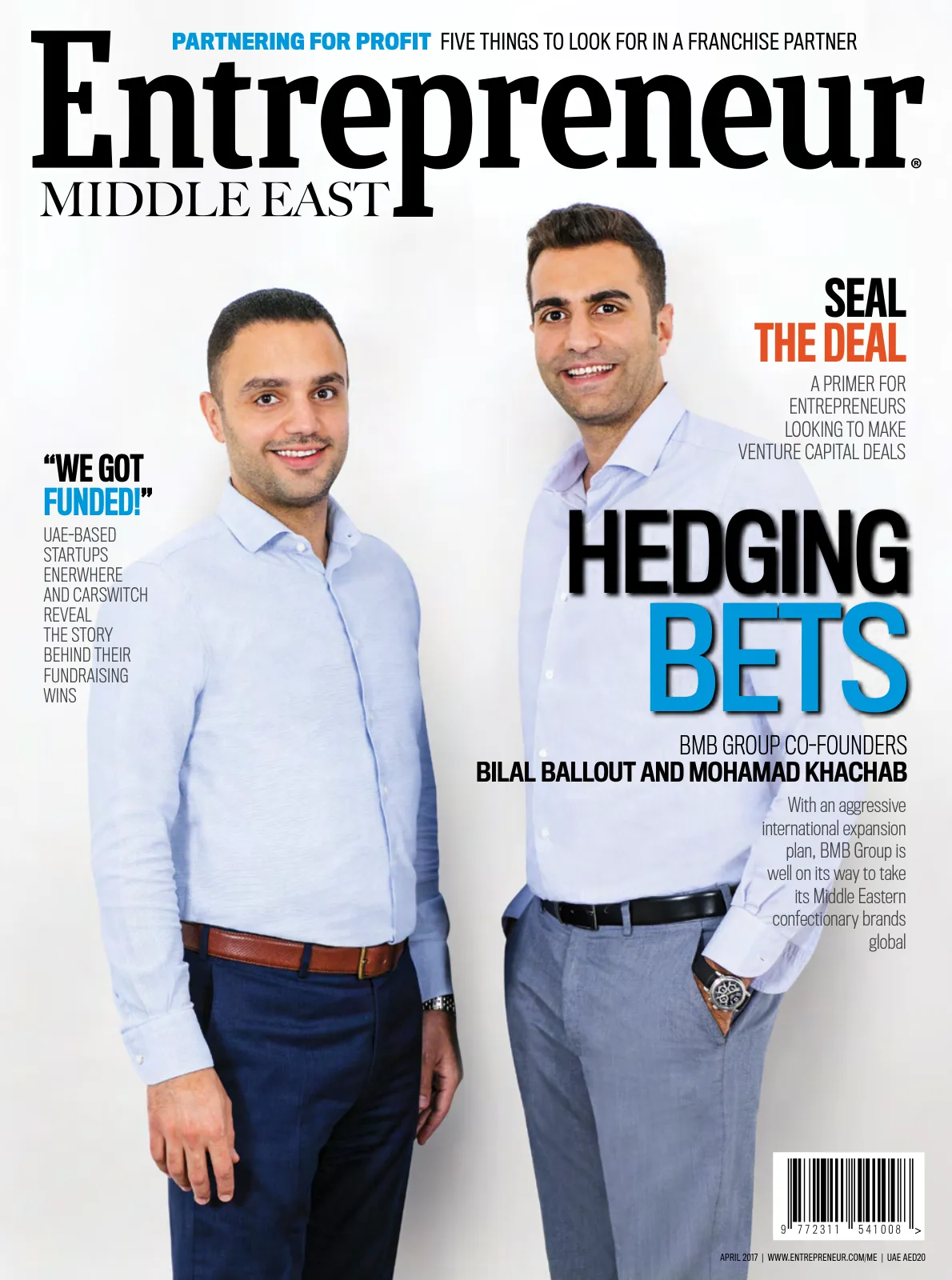
Entrepreneur Middle East, April 2017
Page 1
april 2017 | www.entrepreneur.com/me | UAE AED20
9
7 7 2 3 1 1
5 4 1 0 0 8
>
Partnering for profit Five things to look for in a franchise partner
Seal
the deal
A primer for
entrepreneurs
looking to make
venture capital deals
“We got
funded!”
UAE-based
startups
Enerwhere
and CarSwitch
reveal
the story
behind their
fundraising
wins
Hedging
bets
Bilal Ballout and Mohamad Khachab
BMB Group co-founders
With an aggressive
international expansion
plan, BMB Group is
well on its way to take
its Middle Eastern
confectionary brands
global
Page 2
Page 3
april 2017 Entrepreneur
3
CONTENTS
april 2017
22
INNOVATOR:
Hedging bets
With an aggressive interna-
tional expansion plan, BMB
Group is well on its way to
take its Middle Eastern con-
fectionary brands global.
28
INNOVATOR:
Growth hacker
Rudolf Jabre
The founder and CEO of
OLN speaks about building a
successful (and sustainable)
digital business.
32
CULTURE:
LIFE
Family-like teams build
extraordinary businesses
This year’s list of Top
Companies to Work
For in the UAE shows
that 24 of the country’s
enterprises have managed
to strike a balance between
implementing often
aggressive growth strategies
and nurturing human
resources.
18
EDITOR’S NOTE
By Aby Sam Thomas
52
‘TREPONOMICS:
SKILLSET
Are you your enterprise’s
chief salesman?
Marketing Masters Consult-
ing founder Matthew Chaban
believes that entrepreneurs
must celebrate selling- not
delegate.
74
START IT UP:
Q&A
Keep ‘em coming back
to you
UAE startup Loyyal uses
blockchain technology to keep
customers, well, loyal.
28 Rudolf Jabre, founder and CEO of OLN, on building a successful
(and sustainable) digital business
74
Loyyal CEO
and co-founder
Gregory Simon
at the Dubai Future
Accelerators
Page 4
Page 5
Page 6
BREITLING.COM
Breitling reinvents the connected watch fi rmly geared towards performance. Every inch an instrument of the future,
the Exospace B55 multifunction electronic chronograph pushes the boundaries of comfort, ergonomics and effi ciency.
The titanium case of this compendium of innovations houses an exclusive SuperQuartzTM caliber chronometer-certifi ed
by the COSC and featuring a range of original functions tailor-made for pilots and men of action. Welcome to the
world of precision, feats and high-tech sophistication. Welcome to the vanguard of instruments for professionals.
WELCOME TO OUR WORLD
Page 7
Page 8
Page 9
Page 10
Wellbeing is to have
confidence in yourself
#ThatsMy_Wellbeing
info@precioustimes.ae
Page 11
Inside each watch is our unique
Natural Frequency Disc designed to help you
feel less stress, more focus and improve
your overall wellbeing.
Available at : Rejee jewellery, Damas, The watch house,
Viceroy, Burj Al Arab, Watches Corner.
philipstein.com
Page 12
Entrepreneur april 2017
12
CONTENTS
april 2017
82
‘TREPONOMICS:
SKILLSET
Sustainable ventures
Nahel Selo, Creative
Director of Sedar Global,
on ways to create long-
lasting success in family-run
businesses.
48
‘TREPONOMICS:
ESQUIRE GUY
Fake it ‘til you make it
The Esquire Guy on how to
convincingly fake confi-
dence, happiness and other
necessary feelings in the
workplace.
62
MONEY:
ASK THE MONEY GUY
Forecasting opportunities
Shailesh Dash, founder,
CEO and Board Member of
Al Masah Capital shares
five key takeaways from Al
Masah Capital’s sixth Annual
Investor Forum at Dubai.
70
START IT UP:
STARTUP FINANCE
“We got funded!”
UAE-based startups
Enerwhere and CarSwitch
reveal the story behind their
fundraising wins.
54
CULTURE:
BUSINESS UNUSUAL
Made for the Middle East
Halla Walla offers emojis
that are characteristic to
Arab culture.
44
TECH:
SHINY
#TamTalksTech
Gadgets and doodads
that you might’ve missed
out on, sourced by a tech
aficionado. Yes, it’s okay
to want them all… and no,
it’s not our fault.
44 The new Nokia 6
62
Shailesh Dash ,
founder, CEO and
Board Member of
Al Masah Capital
78 Lebanese tech startup Myki wants to alter the way access
is managed in the digital world
Page 13
www.hillintl.com
Page 14
Entrepreneur april 2017
14
33
CONTENTS
56 Five things to look for in a franchise partner, as explained by Classic
Burger Joint’s Franchise Development Manager, Angela Sawan.
april 2017
46
CULTURE:
TRAPPINGS
‘Trep gear
The executive selection for
the entrepreneur on your
list that has everything.
Okay, maybe for a little
self-reward as well.
58
‘TREPONOMICS:
PRO
“You’re fired!”
Asma Bajawa, founder
and MD, PeopleFirst HR
Consultancy, lists steps to
manage a termination in a
fair (and legal) way.
38
‘TREPONOMICS:
PRO
Hiring the right people
Bayt.com’s Suhail
Al-Masri explains how your
company can screen talent
strategically and effectively
for your enterprise.
64
MONEY:
YOUR MONEY
Seal the deal
Here’s a primer for
entrepreneurs looking to
close a venture capital
investment.
50
CULTURE:
LIFE
Remember what you read
James Clear offers reading
comprehension strategies
to help you retain more of
everything you read.
78
START IT UP:
Q&A
RIP passwords
Lebanese tech startup Myki
wants to alter the way access is
managed in the digital world.
68
TECH:
ONLINE ‘TREP
Engaging e-commerce
Experts at global advertising
media planning agency MEC
explain how MENA businesses
can achieve a successful
customer-centric digital
transformation.
56
FRANCHISE:
Partnering for profit
Five things to look for in a
franchise partner, as explained
by Classic Burger Joint’s
Franchise Development
Manager, Angela Sawan.
Thomas Lundgren,
founder,
THE One Total
Home Experience
Page 15
Page 16
Entrepreneur april 2017
16
SUBSCRIBE
Contact subscriptions@bncpublishing.net to receive
Entrepreneur Middle East every issue
EDITOR IN CHIEF Aby Sam Thomas editor@bncpublishing.net
CEO Wissam Younane wissam@bncpublishing.net
MANAGING DIRECTOR Walid Zok walid@bncpublishing.net
DIRECTOR Rabih Najm rabih@bncpublishing.net
CREATIVE LEAD Odette Kahwagi
MANAGING EDITOR Tamara Pupic
STARTUPS SECTION EDITOR Pamella de Leon
COLUMNIST Sindhu Hariharan
COLUMNIST Tamara Clarke
COLUMNIST Shoug Al Nafisi
COLUMNIST Erika Widen
EVENTS LIAISON Mark Anthony Monzon
PO Box 502511 Dubai, United Arab Emirates
P +971 4 4200 506 | F +971 4 4200 196
For all commercial enquiries related to
Entrepreneur Middle East contact
sales@bncpublishing.net
All rights reserved © 2016.
Opinions expressed are solely those of the contributors.
Entrepreneur Middle East and all subsidiary
publications in the MENA region are officially licensed
exclusively to BNC Publishing in the MENA region by
Entrepreneur Media Inc.
No part of this magazine may be reproduced or
transmitted in any form or by any means without written
permission of the publisher.
Printed by Raidy Emirates Printing Group LLC
www.raidy.com
Images used in Entrepreneur Middle East are credited when necessary. Attributed use of
copyrighted images with permission. All images not credited otherwise Shutterstock.
Suhail Al Masri
Asma Bajawa
Fida Chaaban
Matthew Chaban
James Clear
Shailesh Dash
Ross McCammon
Angela Sawan
Nahel Selo
Bo Yaghmaie
CONTRIBUTING WRITERS
www.entrepreneur.com/me
Access fresh content daily on our website!
MIDDLE EAST
EntMagazineME
@EntMagazineME
Entrepreneur-me
EntrepreneurMiddleEast
EntMagazineME
EntMagazineME
EntMagazineME
MIDDLE EAST
In addition to our print edition, we’re bringing
you all sorts of industry news on our web
mediums. Joining us online means getting
relevant business and startup content in
real-time, so you’re hearing about the latest
developments as soon as we do. We’re looking
forward to interacting with our readers on all of
our social media and web platforms- like any
thriving business, we’re looking to give and take.
#TrepTalkME is already happening on all of our
digi platforms, and all good conversations go
both ways. See you on the web!
Page 17
Page 18
Entrepreneur april 2017
18
T
he last few days of March
have been rather eventful
for those of us following
the MENA entrepreneur-
ial ecosystem- it’s been
exciting, to say the least. We had
only barely begun to cheer reports
of Amazon’s acquisition of Souq.
com for more than US$650 million,
when a plot twist came around in
the form of Emaar Malls lodging an
$800 million bid for the e-com-
merce website. At the time of writ-
ing this piece, Emaar Malls had con-
firmed that it had indeed made such
an offer, while Amazon and Souq
are yet to release a statement on
any of these reports. As a result, it’s
hard to predict how this will play
out- we just have to wait and watch
for the next development in this
story. I’ve previously stated that the
region would probably have been
better served if Souq’s ownership
remained in the Arab world, but
then again, one shouldn’t discount
the importance its sale, even if it is
to Amazon, would be for the MENA
entrepreneurial ecosystem at large.
As Dash Ventures Managing Direc-
tor Omar J. Sati told me: “An exit is
an exit. Whether Amazon or Emaar,
both [are] equally significant, and
both [are] vital to the ecosystem’s
development and sustainability.”
Sati’s right, of course- after all, the
region has been waiting with bated
breath for an exit for quite a while
now; the last one that hit headlines
here was Rocket Internet’s $170
million buy-out of the Kuwait-
based Talabat in 2015. The MENA
investment community’s cheer was
perhaps best showcased in BECO
Capital CEO Dany Farha’s tweet
(@danyfarha is his handle) when
news of the Amazon-Souq deal first
came out: “Amazon’s acquisition of
Souq is a great day for MENA tech
stakeholders. To those who ask,
‘Where are the exits?’ Here you
go.” When I reached out to Farha
for his thoughts on the current
scenario, he replied: “If a traditional
operator like Emaar Malls were to
purchase Souq, and give it complete
autonomy over strategy through to
operations, allowing the true tech
DNA of the executive team in place
to shine and flourish, and only
act as a helping hand to increase
supply of product, strengthen
supply chain, reinforce the branding
and marketing offline in stores
across the region, and build out an
omni-channel strategy for retailers
across the region, whilst supporting
it with funding and increasing its
capital efficiency, then this would
be a fantastic outcome. Amazon has
many of these attributes, which also
makes it an optimal buyer.”
With that being the case, if there
are indeed two options in front of
Souq now, then Sati believes the
choice should essentially be made
based off what makes better sense
for the venture’s founders and
investors. “Clearly, the higher bid
from Emaar is better for them at
first glance,” he explains. “But the
Amazon deal is still unclear. Will
they keep management? Will there
be sweeteners such as earn-outs?
Don’t forget, the biggest advantage
Amazon has is the ability to offer
share swaps and share incentives
in Amazon. In summary, I think
an Emaar deal would be a short-
term win for the Souq team, but
an Amazon deal would be a more
valuable win in the long-term. In
either case, it’s a win.”
Sati has, in his characteristic
succinct way (I recommend
following him on Twitter at @ojsati
for more of his pithy insights), hit
the nail on the head- no matter
which way the deal goes, the Souq
sale remains a win to be celebrated.
It’s a testament to the excellent
work done by founder Ronaldo
Mouchawar and his team, and the
exit will definitely be something to
inspire more entrepreneurs to build
amazing companies in the MENA
region. And that, by itself, is worthy
of applause. Congratulations, Souq!
EDITOR’S NOTE
Aby Sam Thomas
Editor in Chief
@thisisaby
aby@bncpublishing.net
Souq’s suitors
A win-win scenario, either way it goes
Page 19
ESSENTIAL MOISTURISING BALM
Page 20
Entrepreneur april 2017
20
Heads up Lebanon ‘treps, here’s something
you’d be interested in. As part of a partnership
between Flat6Labs and ArabNet, Flat6Labs
Beirut has announced the launch of Lebanon
Seed Fund (LSF), which consists of a US$20
million early-stage fund with the aim of
supporting 100 startups in the next five years.
The LSF, approved by Banque du Liban’s Circular
331, is set to be utilized as part of Flat6Labs
Beirut’s mission in pushing forward Lebanese
entrepreneurs and startups to markets in the
region and internationally. Regional ecosystem
veterans would know this- but if you don’t, this
isn’t Flat6Labs’ first foray into this field- in fact,
with its accelerator programs in Cairo, Jeddah
and Abu Dhabi, Beirut will be its fourth regional
accelerator. Other notable players in the initiative
are FlatLabs Beirut’s partnership with BLOM
Invest Bank for the fund placement, and Kobessie
& Frangie as its legal counsel.
And entrepreneurs joining Flat6Labs can expect
impressive offerings: startups in the seed
program would receive $30,000-$50,000 in
funding, in return for 10%-13% equity, 16 weeks
of mentorship, legal support, office space,
training sessions on essential business skills,
opportunities to pitch in front of investors and
network with like-minded startups and potential
partners regionally and globally. Meanwhile,
for its early-stage funding program, startups
-either in early-stage or growth phase- with
exhibiting traction, a solid team, and a growth
plan can receive between $150,000-$500,000,
as well as strategy, budget and legal consultancy,
introduction to key potential partners, and
strategic support in various business aspects to
further scale the startup. With much support set
for the region, we can’t wait to see promising
ideas and solutions from the region. Budding
entrepreneurs, get moving- applications for the
accelerator’s first cycle in both the startup seed
program and early-stage fund are now open.
www.flat6labsbeirut.com
IN THE LOOP
Empowering ‘treps
AIM Congress 2017 to feature dedicated
entrepreneurship track with AIM Startup
Entrepreneurship takes
center stage
Flat6Labs Beirut launches with
US$20 million seed fund
images aimstartup.com | flat6labsberut.com
Some of the speakers at AIM Startup 2017
Flat6Labs Beirut Launch
E
ntrepreneurs, here’s your
chance to learn from peers
across the world, and
showcase your business
in the presence of global busi-
ness leaders, investors, and
government officials at one of
the region’s largest investment
gatherings. This year’s Annual
Investment Meeting (AIM) 2017
features a separate entrepreneur-
ship track -AIM Startup 2017-
to be held on April 2-4, 2017
at Dubai World Trade Centre
(alongside AIM 2017). Themed
“International Investment, Path
to Competitiveness & Develop-
ment,” the seventh edition of
AIM, like its previous editions,
gathers international investment
community, corporate leaders,
policy makers, and others to
discuss strategies on attracting
Foreign Direct Investment (FDI)
in emerging markets.
At the same time, AIM Startup
2017 will host an innovation
showcase and pitch competi-
tion, giving pre-selected startups
across sectors space to showcase
their products to attendees, and
pitch their businesses to inves-
tors, with cash prizes totaling
US$30,000 up for grabs. The
entrepreneurship track also
features training sessions for
selected startups on best ways to
pitch their ventures, and will hold
keynotes and panel discussions
on topics including government-
startup collaborations, technol-
ogy investments, collaborative
economy, and others.
The larger AIM Congress event
expects to host over 15,000
businesspeople from over 140 na-
tions, and is gearing up to feature
over 500 exhibitors. Besides
workshops aimed at providing
investment professionals with de-
tailed understanding of FDI, the
event agenda also features other
key notes and panel discussions
on global economic conditions,
role of policy makers, innovation
and entrepreneurship ecosystem,
among others.
Some of the speakers slated to
be a part of AIM and AIM Startup
include H.E. Sultan Bin Saeed
Al Mansoori, UAE Minister of
Economy, Sabah Al-Binali, Chief
Investment Officer, SHUAA Capi-
tal, and former Chairman, Zawya,
Kamal Hassan, general partner,
Turn8, Jake Zeller, Partner, An-
gelList, Elissa Freiha, co-founder,
WOMENA, and others. Abu Dhabi
Global Market, Aramex, Dubai
FDI, Invest in Sharjah and others
are a few sponsors for the large-
scale business event. aimstartup.com
Page 21
Page 22
Entrepreneur april 2017
22
innovator
With an aggressive international expansion plan
underway, BMB Group is well on its way to take it’s
Middle Eastern confectionary brands global
By Tamara Pupic
Hedging
bets
BMB Group co-founders
Bilal Ballout and Mohamad Khachab
“When our first
container arrived
in January 2007,
we went to the
market with
a briefcase
and a block of
chocolate, and
started knocking
on people’s
doors.”
Brought to you by
I
nterviewing two en-
trepreneurial cousins
at the helm of BMB
Group, one of the
largest private label
Mediterranean confec-
tionery and chocolate
manufacturers in the
GCC region, would have been
a draining experience, but for
a few truffles of De Rafael,
their first chocolate brand,
served at all the right mo-
ments. Energetic and affable
Bilal Ballout and Mohamad
Khachab, the company’s CEO
and Managing Partner respec-
tively, began by taking me
on a quick tour of their vast
office, designed to encourage
both collaborative work ethics
as well as impromptu meet-
ings- especially in a centrally
located sweet shop replica. I
got a first-hand view of how a
host of Mediterranean sweets
and chocolate treats are made
in the production facility, lo-
cated on the first floor of the
BMB Group building in Dubai
Investment Park, alongside an
hour-long conversation with
the two entrepreneurs, which
proved hardly enough for all
the passion, thoughts, and
plans of the two cousins for
developing a global chocolate
brand originating from the
MENA region.
BMB Group trades bakery
and chocolate ingredients,
manufactures private labels,
produces its own brands of
Mediterranean sweets- Petit
Gourmet, Asateer, Mely’s,
and Simply BKLVA, and more
recently De Rafael, a luxuri-
ous caramel chocolate. The
group now employs 1,100 staff
in Dubai, Doha and Riyadh,
and has recently set up shop
in Russia, Europe, and the US.
Its two state-of-the-art facili-
ties in Dubai Investment Park
operate with the capacity to
produce 35 tons of baklava
and Mediterranean sweets, 50
tons of chocolates, 2 tons of
ingredients, 15,000 packaging
units, and 1,000 gift trays, all
per day, and their products
get exported to 32 countries.
In 2006, when the story
began, the picture was quite
different. The then 21-year-
old Ballout stumbled into the
chocolate and confectionary
business while helping in his
uncle’s sweet store. While he
had earned a Master’s Degree
in Finance from the Univer-
sity of Durham, he didn’t shy
away from spending most
of his time in the kitchen,
learning how to roast nuts
and make sweets. However,
a failed attempt to improve
the small firm’s purchasing
options led to today’s BMB
Group. “I went to our suppli-
ers who were very arrogant,”
he says. “It was a very tough
discussion. I was trying to
improve credit terms, to
improve the way they deliver,
and so on, and they ended the
meeting by saying that from
then on, it would be me going
and picking it up from them
and paying only in cash. So,
instead of improving it, things
went backwards. There wasn’t
an alternative. Then I decided
to open a business that would
sell ingredients for chocolate.”
The business then snowballed
after a Singaporean chocolate
producer, which Ballout flew
to visit after finding it on
Google, decided to take him
on as an agent for the GCC re-
gion, and sign a US$400,000
contract for 100 tons of
chocolate, although wary
Page 23
april 2017 Entrepreneur
23
innovator
IMAGE credit bmb group
BMB Group
co-founders
Bilal Ballout and
Mohamad Khachab
“We have both agreed that as the way
you walk into any supermarket in
the world and find a Ferrero, in the
same way you should find our brand
of baklava, for example. Then we will
know that we have made it.”
>>>
of his young age. “I didn’t
have a dollar, but I agreed,”
Ballout says. Back in Dubai, a
bank manager had no option
but to believe in the business
idea, and approve of a bank
loan enabling Ballout to rent
a warehouse in the industrial
area of Sharjah and hire one
additional person. “When
our first container arrived
in January 2007, we went to
the market with a briefcase
and a block of chocolate, and
started knocking on people’s
doors.” And the result: the
first 100 tons was sold out in
two weeks.
Finding his place in the new
industry did not take too
much time, only due to Ball-
out spending 16 hours a day
working and learning, even-
tually becoming a master
chocolatier. “Once I gained
the technical know-how, I
started expanding the range,”
Ballout says. “In January
2008, I went to China and
opened an office there. Also,
I went to a wine bottle cap
manufacturer and convinced
him to start making choco-
late paper, which had only
been made in Italy up until
then. There was no other al-
ternative to wrap chocolates,
which is big in our culture.
So, I convinced him to move
from wine bottle caps to
chocolate paper. It took a
year in development to get it
right- it is not as easy as it
sounds. But in the end, we
were the first ones to bring
that paper here, and we were
selling it at 50% of the mar-
ket price.” While expanding
its trading confectionery raw
materials business, the team
also slowly steered towards
manufacturing private labels,
especially after Ballout’s
younger brother Mohamad
joined BMB Group -stand-
ing for Bilal and Mohamad
Ballout at the time- to run its
day-to-day operations. The
decision to set up a chocolate
factory in 2009 in Dubai
was, however, not based only
on the promising market
growth figures, but due to
the escalating civil war in
Lebanon, proving to be a sort
of silver lining for the fledg-
ing business.
The confectionery and
chocolate market in the UAE
has been enjoying steady
growth due to a local culture
of giving chocolates as a
gift on festivals and other
occasions, rising per capita
expenditure, growing youth
population, and escalat-
ing seasonal demand. The
latest industry report by
TechSci Research states that
the market is set to grow at
a compound annual growth
rate of 8% between 2016
and 2021. However, it has
traditionally been flooded
Page 24
Entrepreneur april 2017
24
innovator
“you have to
eliminate ego
because it is the
killer of most
partnerships. No
matter how much
you love each
other, if you don’t
eliminate your ego,
you will eventually
start questioning
something.”
Myki app
BMB Group
Factory
IMAGE credit bmb group
with international brands,
leaving local chocolate pro-
ducers to compete by offer-
ing a more authentic taste of
Arabic ingredients, such as
dates, spices, nuts and milk.
Regionally, Lebanese and
Syrian confectioners, famed
for their culinary skills, have
traditionally ruled in the
niche catering specifically for
Arabic tastes.
Yet, a decade into the mil-
lennium, vicious civil wars
ranging in the two countries
changed the landscape of the
industry, dramatically. “In
2007, a war in Lebanon start-
ed, during which the airport
closed down, meaning that
the factories in Lebanon could
not export anymore,” Bilal ex-
plains. “The chocolate shops
here got hit because they were
all buying from Lebanon. At
the same time, there were
only five local manufacturers
in Dubai. They were all small,
not industrial manufactur-
ers. Also, we realized that in
this domain, everyone had an
old-school mentality; nobody
was innovative. There were
some who were looking at
new ideas, but the sector was
always five years behind [the
more advanced markets].”
From the outset, the BMB
chocolate factory has become
known for sourcing the finest
ingredients, pioneering reci-
pes and innovative presenta-
tion, while the co-founders’
willingness to offer alterna-
tives to their prospective
clients has slowly started
transforming the industry
across the region. “The usual
approach to selling these
products was a push strategy,”
Ballout explains. “We imple-
mented a consultancy strat-
egy, explaining to our custom-
ers whether something would
work or not, or whether
something was saturated. We
started tailor-making recipes
for clients. That is why we are
now known as a consultancy.
It is interesting, because
we are manufacturers. Even
today, whenever we decide to
venture into something new
in terms of manufacturing,
or if our Chief Innovation Of-
ficer is coming up with a new
product range, we never come
up with a product range that
is too broad.”
How did the company set
up in Qatar, the first foreign
market they entered back in
2010? Credit there belongs to
Mohamad Khachab, Ballout’s
third cousin and the compa-
ny’s Managing Partner. When
Khachab started talking, it
became clear that the two
cousins shared more than just
a family resemblance. “We
believed that if we worked
Page 25
april 2017 Entrepreneur
25
BMB Group at
the Sweets & Snacks
Exhibition in Dubai
“To build trust with these big clients,
we built strong relationships, we made
it more trustworthy, we made it more
into a win-win situation, we became a
part of their team. This is how we really
connected with the big clients.”
>>>
together, we could make it
big,” Khachab says. “I sat
with Bilal for exactly 30 days
and got all the know-how.
We used to stay 15 hours a
day together. After that one
month, we planned to open
the Qatari market because it
was small compared to other
GCC countries and there was
a lot of potential, no one pro-
duced there. I moved to Doha
and started making connec-
tions. We managed to open a
company there after another
30 days. In 2011, Qatar was
booming because the market
was raw, we started directly
going to customers and we
made it in one year.” Ballout
here makes a special note of
Khachab’s skills in getting
this done. “The trick here
is that there are people who
are good at sales and people
who are entrepreneurs,”
he explains. “Considering
his age at the time, going to
Qatar, where he didn’t know
anyone, and establishing a
business from scratch, it is
clear that it is an entrepre-
neurial mindset. It is not a
sales mindset. We were very
skeptical, but not only did
he open the market, but he
became number one in Qatar
in such a short time.”
In mid-2012, Khachab says,
it was time to enter the big
market of Saudi Arabia. He
started spending two weeks
in Riyadh and two weeks in
Doha each month, in addi-
tion to regular visits to Dubai
for a monthly board meet-
ing with Ballout to ensure
that the rapid growth did
not get out of hand. “Things
came fast in Saudi,” Khachab
says. “At the beginning, the
mindset was ‘No, we want
to buy from Lebanon and
Syria,’ but when the war in
Syria started in 2011, they
had no choice. Syrians were
so strong in Saudi Arabia be-
cause they share the border.
Also, everything coming from
Lebanon was hit because of
that war, since shipping by
land is much cheaper than
shipping by air. We ended up
getting some key accounts in
Saudi Arabia very quickly,
not only because we were so
passionate, but because we
really had good intentions
for the customers. How peo-
ple dealt in business here in
the region was not based on
a lot of trust. This is what we
found. The good thing is that
we really understood, then
and now, what our custom-
ers want. All our competitors
would just show their cata-
log, take it or leave it. For us,
no. To build trust with these
big clients, we built strong
relationships, we made it
more trustworthy, we made
it more into a win-win situ-
ation, we became a part of
their team. This is how we
really connected with the big
clients. I targeted the key ac-
counts, and it took us three
months to get them all.”
Ballout adds: “Mohammad
landed a deal, which was
an inflection point for the
business. How it happened
was because we tailor-made
products that ended up be-
ing the talk of the town in
the whole country. They did
so well, and we did so well
on the back of that. From
the start up to today, we
have never sold something
to someone we don’t believe
would work.”
The business of trad-
ing bakery and chocolate
ingredients and private label
manufacturing in all three
markets was booming, but
joining Endeavor UAE, the
local chapter of a global
network of high-impact
entrepreneurs, in 2015 led
them to a conclusion that
the future of their company
should be in owning the
brand equity. It also brought
about one more important
change, causing the BMB
acronym to now stand for
“Baklava Made Better” after
Mohamed Ballout decided to
exit the business. “Private
equity started coming to us
because we went through
Endeavor,” Ballout says.
“Just out of interest to see
how much our valuation was,
we started engaging with
them and they got to one of
us. They got to my brother.
He had always seen it from
a perspective of an investor,
whereas the two of us were
wearing both an investment
and a passionate entrepre-
neur hat. So, he came to us
saying: ‘Guys, I’m planning
to sell.’ We agreed on the
basis that we would choose a
private equity firm. Eventu-
ally, I found one that I trust
and which I know can open
up a lot of doors. We finished
the deal in October last year.
They are now good part-
ners to have in our dream
of geographical expansion.
What I’d like to highlight
after going through an exer-
cise, such as [the selection
process for] Endeavour UAE,
is why it is important to find
the right partner. I see a lot
of entrepreneurs who get
excited, such as being the
best friends from university
and so on, but then the prob-
lems happen down the line,
if things don’t go well and
if things go too well, and so
on. With us, let’s say that we
have been lucky. We made
all the mistakes that any
other person would make, we
went in with just our hearts.
But, luckily enough, the way
our bonding has been since
childhood, we have never
had to question that.”
So what can Ballout’s
peers in the entrepreneurial
ecosystem learn from his ex-
perience? “The lesson from
this is that, first, you have
to define who does what,” he
explains. “Second and fore-
most, you have to eliminate
ego because it is the killer of
most partnerships. No mat-
ter how much you love each
other, if you don’t eliminate
your ego, you will eventually
start questioning something.
Lastly, it is about whether
you want the same thing.
You might want it now, but
you might not want it in 10
years. You can change your
mind every year and dis-
cuss it, as long as you are
transparent. If your interests
don’t align anymore, it is
Page 26
Entrepreneur april 2017
26
innovator
“We have opened an
operation office in
Michigan, in Moscow,
and in April we
are meeting with
potential partners
in London to explore
our growth in
Europe. We are also
dealing with big
factories in Europe
that have shut down
their production and
are now outsourcing
everything from us
because of the scale
that we have. That is
how much we are able
to compete.”
“we have built scalability
because no one else has
the machinery that we do.
[...] We believe that our
product will be super
hard to beat in terms of
quality, price, and scale.”
BMB Group
showroom
IMAGE credits bmp group
okay to say that it is time for
you to move on, as my brother
did. As long as you have that
word of honor, nothing can
stop you.” As for the future
of the company, Ballout says
they will be choosing one of
two options: either a stock
market flotation, or selling it
to a strategic buyer. A third
option, and a route most com-
monly taken by other choco-
late producers in the region
-passing the business to the
next generation in the family-
is not on the table, he says. “It
is interesting psychologically
to see why these businesses
never grew that big. It is
because they are mainly fam-
ily businesses,” he says. “The
reason for failure for a lot of
brands was that they had too
many partners. In our field
you can see a lot of brands
that families start splitting
among their members, with
a lot of them becoming kings
of only their cities and their
countries, but no one had the
drive or passion to take the
product worldwide.”
A firm believer in corporate
governance, Ballout signed
The Pearl Initiative, a pro-
ject of Badr Jafar of Crescent
Enterprises, developed in
cooperation with the United
Nations Office for Partner-
ships, to promote a corporate
culture of transparency and
accountability across the large
number of regional family-
run businesses. “It is about
investing in it to grow globally
but sustainably,” he adds.
“At the same time, none
of our competitors here has
invested in the know-how. For
Arabic sweets, you need to
know very clearly the tech-
nicalities of the flavor, the
ingredients, how it is done,
and so on. That is what we
have invested 10 years in,
the know-how. We have also
realized that we have built
scalability because no one
else has the machinery that
we do. Plus, you can’t buy it
outside, we have invented it.
We believe that our product
will be super hard to beat in
terms of quality, price, and
scale.” Khachoub adds: “We
are now expanding into Rus-
sia, Europe, and the US, all in
parallel. We have opened an
operation office in Michigan
and Moscow, and in April
we are meeting with poten-
tial partners in London to
explore our growth in Europe.
We are also dealing with big
factories in Europe that have
shut down their production
and are now outsourcing
everything from us because of
the scale that we have. That
is how much we are able to
compete.”
In order to remain com-
petitive in a fast-changing
global market place, Ballout
maintains a close eye on
market trends, which is his
final piece of advice for fellow
entrepreneurs. “No one is
invincible,” he says. “Some-
times companies are doing so
well and say they will forever
be number one, and so on.
You need to wake up every
day and ask yourself: ‘How
is the landscape changing?’
or ‘How are my consumers
changing?’ You read all these
examples of business, which
everyone thought were prime
businesses in their areas,
collapse sometimes over a
month, not even a year. So,
we keep on asking ourselves
how people are changing in
the way they give sweets as
gifts. Our parents used to visit
each other a lot and take a
lot of sweets, but today our
generation does not do that
anymore. We meet each other
outside of our homes and our
gifts have shrunk, the way we
give gifts is different. So, no
matter which business you
are in, you have to keep track
of everything.”
The global chocolate market
is set to grow at a rate close to
5% through 2020, according
to various estimates. Among
the most dominant players
are companies from the US
and Switzerland. It was in
the 19th century that Swiss
chocolate was recognized as a
world standard in the field of
chocolate manufacturing, not
because the country had nat-
ural resources of cacao beans
and other ingredients, but
due to its continuous research
and experimentation. Why
then, Ballout asks, isn’t there
a global brand of chocolate
from this region? And that’s
his vision for De Rafael, and
indeed, BMB as well.
“While my brother was
cashing out, we went through,
let’s say, a spiritual transfor-
mation about deciding where
we wanted to steer this ship,”
he explains. “The fact that we
decided to stay made us think
what we wanted to do. Thanks
to Endeavor entrepreneurs
and mentors, we learnt what
defines success. We have both
agreed that as the way you
walk into any supermarket in
the world and find a Ferrero,
in the same way you should
find our brand of baklava, for
example. Then we will know
that we have made it.”
Page 27
Page 28
Entrepreneur april 2017
28
Growth
hacker
the founder and CEO of OLN on building a successful
(and sustainable) digital business
rudolf jabre
Rudolf Jabre
at an OLN
video shoot
“OLN today is
a digital agency,
a digital
publisher, a
creative agency,
a production
house, a branded
content agency,
and a social TV
broadcaster.”
By Aby Sam Thomas
innovator
In a region where the im-
portance of (and indeed, the
need for) online Arabic con-
tent continues to be stressed
upon, digital publisher OLN
(Online Lifestyle Network)
seems to have caught on to
this trend pretty early- the
company, which was founded
in 2011, started out with just
one Arabic portal, and has
since grown to encompass
eight different verticals that
reach millions of users in the
region, with its portfolio in-
cluding the popular women’s
website nawa3em.com, as
well as oln.tv/LIVE, describ-
ing themselves as “the first
social TV in the Middle
East.” With an 80-person
team based out of Dubai, Bei-
rut, Cairo, Doha and London,
OLN is led by founder and
CEO Rudolf Jabre, whose 15-
year experience in the digital
space makes him well-suited
for his position at the helm
of the almost continuously
evolving company. “Since
OLN’s 2011 launch, we knew
that digital publishing is
the way forward for content
consumption in the Middle
East,” Jabre says. “The de-
mand for premium content
from both advertisers and
readers grew hand in hand.
Our main challenge was to
drive the shift towards video
consumption. We have pro-
duced 17,000 videos in three
years, which was a bit risky
in the beginning. However,
today, we are very happy
that we took this direction,
as it was the main audience
growth driver.” And the num-
bers speak for themselves:
the OLN website proudly
declares that it today enjoys
a total of 110 million video
views a month, and 10 mil-
lion unique monthly readers
across all of its platforms.
“OLN has been evolving
since day one,” Jabre notes.
“We first started as a digital
publisher, then we started
to move into video as a main
medium, and today, we’ve
launched our social chan-
nel. In every phase, we were
keen on following digital
publishing trends by offering
innovative content solutions
Page 29
april 2017 Entrepreneur
29
>>>
Images courtesy oln | www.oln.net
for our readers and advertis-
ers.” And OLN’s continued
focus on staying ahead of
developments in the online
realm has stood it in good
stead over the years- for in-
stance, in 2012, the company
managed to get private equity
and venture capital firm The
Luxury Fund onboard as
what Jabre calls a “unique
strategic partner” for the
enterprise. “On the revenue
side, we have assigned DMS
(Digital Media Services) as
our network media represen-
tation, who have helped us
in not only growing our rev-
enues, but in also analyzing
our audiences through the
latest technology and plat-
forms.” Jabre explains that
OLN’s business model today
is mainly based on ad place-
ments, video advertising and
branded content- which is,
once again, an indication of
how the company has stayed
in tune with the times. “As a
video-focused network, the
shift of budgets to new digi-
tal formats has been affecting
our growth positively,” Jabre
explains. “We have seen the
trend, and we quickly adjust-
ed to be a part of the change.
OLN today is a digital agency,
a digital publisher, a creative
agency, a production house, a
branded content agency, and
a social TV broadcaster. We
have been keen on extending
our revenue streams through
different verticals, making
sure that we are up to date
with digital publishing busi-
ness models.”
OLN’s forward-thinking
approach when it comes to
existing (and thriving) on
the digi-sphere is particu-
larly noteworthy when you
consider that the industry
at large is still –for the most
part, at least- struggling with
adapting to changes in this
Page 30
Entrepreneur april 2017
30
‘TREP TALK
Rudolf Jabre, founder
and CEO, OLN
1. Define your goals
“Before you start running,
you need to make sure you
are on the right track.”
2. Stay in tune with
trends “You need to be
agile, as trends and technol-
ogy are in constant change.”
3. Keep an open mind
“Never stop learning- at-
tend seminars, and read
books.”
4. Lay out a framework
for success
“Focus on creating effective
processes and systems, as
they are key to progress and
success.”
5. Assign deadlines for
yourself
“Spread your dreams into a
timeline, and make sure you
achieve them by the set due
dates.”
“We have been keen on
extending our revenue
streams through
different verticals,
making sure that we are
up to date with digital
publishing business
models.”
“We are heavily
investing in OLN
LIVE as a platform,
as we launched a
full social channel
with a full grid of
20 shows. We believe
that live video is
the next evolution
in digital. It has an
immediate effect
on audience and
prospective clients-
you can now interact
in real-time and
respond.”
Rudolf Jabre
at an OLN
video shoot
innovator
sector. According to Jabre,
the fault for this lies in the
strategy adopted by organi-
zations when going digital.
“Many publishers thought
of bridging their traditional
publishing business to digi-
tal, and failed. You need to
think digital. OLN is built
on two pillars, analytical
and creative. The analytical
department monitors data
and creates touch points that
become the base for creative
content creation. Our inter-
nal discussions are centered
on how to tell the story,
and which medium delivers
it best. Our data research
department is the fastest
growing department in the
company, which has been the
main indicator for audience
content consumption trends,
technology adaptation,
and platform distribution.”
This thus explains OLN’s
current focus on the social
TV phenomenon, with
Jabre essentially believing
that it is going to be the
next big thing in this space.
“The practice of publishing
stories on social media and
other platforms not owned
by publishers is increasing
every day,” he says. “This
practice not only affected
digital publishers’ audience
reach, but also pushed them
to new revenue streams
such as branded content and
live video. We are heavily
investing in OLN LIVE as a
platform, as we launched a
full social channel with a full
grid of 20 shows. We believe
that live video is the next
evolution in digital. It has an
immediate effect on audience
and prospective clients- you
can now interact in real-time
and respond.” According to
Jabre, content marketing
and live video will be what
governs digital publishing in
the future, as more and more
brands move their ad place-
ment campaigns to program-
matic channels.
Jabre’s statements make it
clear that this entrepreneur
has an eye almost always
looking toward the future,
and making sure his business
is ready for the changes that
it may entail. In fact, Jabre
claims his entrepreneur-
ship journey itself has been
driven by his “passion for
digital,” and having seen
the vagaries of this sector
Page 31
nawa3em.com inspires
women to stay in sync with
today’s changing world,
offering a personalized
interface and relevant content
mixes.
gheir.com serves to become
a woman’s ultimate escapade
to luxury and the world of
fashion.
chababs.com targets the
youth and all their favorite
topics, with up-to-the-minute
news feeds on technology,
sports, gaming, music,
fashion, etc.
ra2ed.com is an online
men’s magazine featuring
the latest in business, sports,
technology, lifestyle, etc.
oln.tv is a digital TV network
streaming the widest orbit
of video content covering
through 20 segments with
more than 17,000 videos.
justfood.tv is a lifestyle
cooking platform with a
video library consisting of
2,500 videos.
tv.kooora.com one of
the biggest sports video
on-demand platform in the
Middle East, created through
a joint venture between
Kooora TV and OLN TV.
oln.tv/LIVE is trailblazing
social TV platform in the
Middle East with more
than 500 shows already
produced.
Site check The OLN portfolio www.oln.net
Images courtesy oln | www.oln.net
over the years, he has fo-
cused on building effective
systems at his organization
that achieve results, regard-
less of the changes in the
ecosystem. “As your goals
(especially in digital) will
always change, you need to
have an agile and effective
process to adapt quickly and
lead,” Jabre explains. This is
the principle he credits for
OLN becoming one of the
leading digital publishers
in the Middle East- aided
by a hardworking team that
believes in these values as
well. According to Jabre, the
key to OLN’s sustainability
as a business over the years
has been in finding syner-
gies across departments in
his organization, and then
positively exploiting mul-
tiple talents in order for the
company to grow. “Instead
of just hiring new people, we
made sure that we train our
existing talent and help them
be part of the company’s
expansion,” Jabre says. “This
strategy not only motivated
our staff, but also made our
growth more cost-effective.”
And judging by the size and
scale of OLN today, Jabre
seems to have hit on a for-
mula that works- and that’s
something for the rest of
you digital entrepreneurs to
take into stride for your own
businesses.
Page 32
Entrepreneur april 2017
32
By Tamara Pupic
Family-like
teams build
extraordinary
businesses
CULTURE
business unusual | LIFE | TRAVEL | DESIGN | TRAPPINGS
GCC business leaders reveal an essential ingredient
for growing successful companies
For a business, striving to beat growth expectations and building a family-like company
culture can seem to be mutually exclusive- in fact, a poll recently conducted by recruit-
ment website Bayt.com, stating that nearly 100% of MENA-based respondents planned to
look for a new job in 2017, reveals that maintaining a close-knit, loyalty-based workplace
culture is a challenge for employers. However, this year’s list of Top Companies to Work
For in the UAE by global consultancy Great Place to Work shows that 24 of the country’s
enterprises have managed to strike a balance between implementing often aggressive
growth strategies and nurturing human resources. The annual benchmarking study as-
sesses the level of credibility, respect, fairness, pride and camaraderie within an organiza-
tion, and forms part of the world’s largest employee survey. Two-thirds of a company’s
score is based on the confidential feedback of their employees, while the remaining score
is attained from an audit of management and HR practices.
Page 33
april 2017 Entrepreneur
33
A cut above
The top 10 companies to work
for in the UAE in 2017, as
listed by Great Place To Work
in the UAE
1. DHL
2. Omnicom Media Group
3. Splash Fashion
4. THE One
5. Weber Shandwick
6. Estee Lauder Companies
7. HILTI Emirates
8. FedEx
9. Hilton
10. MARS
www.greatplacetowork.ae
“We look for passion, empathy and
commitment, candidates that believe in
and will live by our core values– joining
THE One is for team players who want to
belong rather than just do a job.”
Thomas Lundgren,
founder,
THE One Total
Home Experience
Maha Zaatari,
Managing
Director,
Great Place
to Work in
the UAE
image credit THE One Total Homes Experience, Great Place To Work In The UAE
>>>
Topping this year’s list are
two corporate giants DHL,
the global logistics company
praised for its close monitor-
ing of the implementation
of best employment experi-
ence policies, and Omnicom
Media Group, commended
for focusing on the continu-
ous development and well-
being of its staff. Among the
top five are two homegrown
UAE brands, namely Splash
Fashion and THE One Total
Home Experience- proving
that entrepreneurs often find
different ways to keep their
staff eager to work. “SMEs
have less financial means
to develop great practices,
but sometimes an initiative
with zero cost can make the
highest impact,” says Maha
Zaatari, Managing Director
of Great Place to Work in the
UAE. “I usually advise my
clients that having a fancy
office is amazing, but it is
just a cherry on top. It is all
about the relationships that
we develop at work. What
they need to do is to make
sure to spend time with their
staff and to make sure that
they are being very hon-
est and transparent in their
communication. It is also
about starting right, making
sure that they hire the right
people with the right values.
The reason is that all these
companies have great values
inscribed on their walls and
published on their websites,
but one of the biggest chal-
lenges is that they don’t live
by the values they promote.
So, small companies should
make sure that they stand for
and foster the values they set
at the beginning.”
For Swedish entrepreneur
Thomas Lundgren, founder
of THE One Total Home
Experience, which has grown
from its first shop in Abu
Dhabi, opened in 1996, into a
chain of 31 stores in Bah-
rain, Iraq, Jordan, Kuwait,
Lebanon, Qatar, Tunisia and
the UAE, it has always been
about “building something
bigger,” both internally and
externally. With no college
degrees adorning his walls,
Lundgren has built THE One
Total Home Experience and
its sister brands FUSION by
THE One, THE One Jun-
ior, and THE One Basics,
to collectively employ over
650 people. His secret is in
responding to his employees’
desire for meaning. “From
day one, we have built a
culture of fairness and em-
pathy,” he says. “It’s about
creating a better life for our
people and the community
around us. We don’t believe
the world needs another
retailer; we need a better
world. I have always said,
if we focus on humanity,
the bottom line will fol-
low, and the most effective
way to change the world is
through being in business.”
Indeed, Lundgren considers
corporate social responsibil-
ity as something not related
to values- it’s a matter of
priorities, he says. This thus
explains his company’s Chal-
lenged Employee Initiative,
which currently employs 19
special needs individuals
across the network, and aims
for challenged employees to
eventually make up 5% of
its staff. In 2008, Lundgren
launched THE Onederworld,
a sustainable village com-
munity program, focusing
on neglected regions in the
world where their employees
come from or their manufac-
turers are based.
When asked about his com-
pany’s recruitment process,
Lundgren replies, “We value
cultural fit above skills and
experience at THE One.
Page 34
Entrepreneur april 2017
34
“Above all, I look for someone with
a will before the skill. You need
somebody who is passionate, who wants
to work for you, and who fits in. It is
great for them to have a skill, but you
can teach them that along the way.”
CULTURE
business unusual | LIFE | TRAVEL | DESIGN | TRAPPINGS
“For me, the cultural
fit is the number
one critical thing
that I would look
for with somebody
coming to work for
me. That comes from
leading by example.
I’m energetic, chatty,
a people’s person,
so you want people
who will be like that
too, especially on
the sales team. If you
don’t have the right
cultural fit, it is not
going to work.”
Donna Benton,
founder,
The Entertainer
image credit The Entertainer
I believe that organizations
worth working for, attract
people worth employing.
We practice a recruitment
method, which enables us to
pick the best in the market
through a chronological in-
depth structured interview
process which covers a can-
didate’s history starting from
high school days through to
their present career status. It
brings out behaviors, paints
a picture of personality
and attitude as well as skill
competencies. We look for
passion, empathy and com-
mitment, candidates that
believe in and will live by
our core values– joining THE
One is for team players who
want to belong [to a team]
rather than just do a job.”
Loosely defined as an ability
to adapt to the core beliefs,
attitudes, and behaviors
within an organization, the
concept of cultural fit is also
a number one recruitment
criteria for Donna Benton,
founder of The Entertainer,
a “buy one get one free”
voucher books provider
launched in Dubai in 2001.
In the span of 16 years, The
Entertainer has grown to
offer a range of 39 products
across 18 destinations in 14
countries. More than 250
employees work in their
headquarters in Dubai and
14 global offices, includ-
ing Singapore, Hong Kong,
Cape Town, Kuala Lumpur,
London and Doha. This year,
the company expects over
12 million of its offers to be
redeemed by their customers
globally. Yet, the rapid ex-
pansion, starting after Riya-
da Enterprise Development,
an investment platform of
Dubai-based investment firm
Abraaj Capital, acquired a
50% stake in the company
in 2012, brought growing
pains potentially affecting
company culture. Neverthe-
less, Benton insisted on
her recruitment standards.
“For me, the cultural fit
is the number one criti-
cal thing that I would look
for with somebody coming
to work for me,” she says.
“That comes from leading
by example. I’m energetic,
chatty, a people’s person, so
you want people who will be
like that too, especially on
the sales team. If you don’t
have the right cultural fit, it
is not going to work. We have
over 35 nationalities, but the
nationality does not really
matter, what is important is
someone’s personality and
perception of their role in
the company. Above all, I
look for someone with a will
before the skill. You need
somebody who is passionate,
who wants to work for you,
and who fits in. It is great for
them to have a skill, but you
can teach them that along
the way, which is better of
having a skill and no will.”
Benton adds that she is not
a fan of argumentative atti-
tudes at the workplace either.
“If there is any of that, they
are out straight away. So, it
is also about attitude. I think
I’m really fair, but I’m also
firm because it is the human
capital that makes or breaks
your company. Another key
thing that you need to look at
is that a good football player
is not necessarily a good
coach. You really have to keep
an eye out for people who are
able to manage others and
for those who prefer work-
ing independently and like
Page 35
april 2017 Entrepreneur
35
“We keep on hearing people wanting to work from
home and have flexible working hours, because work-
life balance is a key challenge here. That is also why
the stress levels are high in many organizations and
they do not have a great workplace culture.”
Maha Zaatari, Managing Director, Great Place to
Work in the UAE lists five struggles UAE employers
face in their enterprises
Pain points
1. Employment security
“The UAE is a very unique
market, and that is why
managers have to be very
careful when setting up their
businesses here. There are
quite a few restrictions here,
and many of employees’
concerns relate to their
employers, such as if they
lose their visas tomorrow,
they will have one month
to leave the country. So,
organizations have faced
challenges trying to make
people feel more secure and
make them want to stay. By
communicating to talent that
no matter what happens, that
you will take care of them,
that builds that element of
trust.”
2. Communication
challenges
“Another key challenge is
the lack of communication
between line managers and
employees. Line managers
have so much to do, and
they often underestimate the
value of human interaction,
spending time with their
staff, and think that a good
morning greeting will make
everyone happy. We have
heard from employees that
they do not know what is
expected from them, where
they are heading to, and so
on.”
3. Women in the workplace
“Also, this market has less
female-friendly policies, so we
have a very limited maternity
leave here, and women feel
they might lose their jobs if
they go on a maternity leave.
That affects their engagement
and productivity. However,
there are companies here that
go above and beyond the law
to address those challenges.”
4. Work-life balance
“One more challenge goes
back to the concept of trust.
We keep on hearing people
wanting to work from home
and have flexible working
hours, because work-life
balance is a key challenge
here. That is also why the
stress levels are high in
many organizations and
they do not have a great
workplace culture. When
we get a question about
how to help employees have
work-life balance, we always
say to trust them, stop
micromanaging them, and
so on.”
5. Lack of career planning
“Organizations send people
on many training courses, but
we don’t see much value out
of them without planning. We
often hear that people here
are in transit only for just a
few years, but it is not the
case anymore and employees
now want to work for an
organization that gives them
a well-developed career plan.
So, organizations should start
offering careers rather than
just jobs.”
What is a Great Workplace?
Employee Perspective
Any workplace can be measured through five dimensions: credibility, respect and
fairness (which are attributes of trust), as well as pride and camaraderie.
Trust
credibility
fairness
respect
Employee
pride
camaraderie
relationship
with other
employees
relations
hip to
your job
relationship
with
management
chart by great place to work ®
>>>
to be managed. Also, as an
owner or CEO, you have to
be able to watch the people
who manage upwards and
not downwards. I am very
aware of people who manage
upwards to me, which would
mean their coming, sitting in
my office and talking about
how everything is great,
taking all the glory, and so
on. At the same time, I see
that they don’t treat their
team well and don’t moti-
vate them. Lastly, you need
to look for your plan C to
see who can come up in the
ranks because they may have
the will, they may learn the
skill, and then you need to
be able to know to promote
them at the right time.”
Raza Beig, founder of
Splash, part of Landmark
Group and one of the region’s
largest fast fashion retail-
ers, has always believed
that valuable employees
can be found in scattered,
sometimes unexpected,
parts of his now big retail
conglomerate. “I started
the program Hello HR nine
years ago when my business
was small and I was very
connected to the team,” Beig
explains. “I knew people
by their names and I knew
what they were doing. As the
company grew, their voices
became fewer and my time
was more focused on other
things. There was a general
feeling in me that I was not
being able to hear what my
people were saying. But, my
belief is that all the good
changes in business actually
come from ground zero. So,
when I started our Hello HR
program, it was to hear my
people’s grievances, which
especially was something I
took very seriously, and also
their ideas and suggestions.
Until this day, I ensure that
all grievances are dealt with,
even if it leads to the top
management of the company.
If suggestions and ideas turn
into something that the com-
pany will use, I send a letter
of appreciation and a cash
reward to that employee.
So, the process started with
listening, but it has become
a very important tool in our
business. Today, our people
believe that when you speak
to Raza, he will listen. And
this is managed by myself
and my senior HR manager
only, so it is very confiden-
tial.”
Page 36
Entrepreneur april 2017
36
“when I started our Hello HR
program, it was to hear my people’s
grievances, which especially was
something I took very seriously, and
also their ideas and suggestions.”
CULTURE
business unusual | LIFE | TRAVEL | DESIGN | TRAPPINGS
“Until this day, I ensure
that all grievances
are dealt with, even
if it leads to the
top management
of the company. If
suggestions and ideas
turn into something
that the company will
use, I send a letter
of appreciation and
a cash reward to
that employee. So,
the process started
with listening, but
it has become a very
important tool in our
business.”
Raza Beig,
founder, Splash
image credit splash
A note about Beig’s back-
ground here: after losing his
father when he was six years
old, Beig started running
errands for neighbors to help
his family –his mother and
five sisters– to make ends
meet. Since then, the In-
dian entrepreneur has never
stopped looking for business
opportunities, and his reper-
toire includes establishing a
tutorial college, a shirt man-
ufacturing business, a cable
TV distribution business, all
before founding Splash in
1993 as a single brand store
in Sharjah. The company
currently operates over 220
stores and 55 brand stores
across 14 countries. The
credit for its growth, he says,
goes to his employees. “My
values come from my mother
in a lot of ways because she
selflessly devoted herself and
believed in forgiveness,” he
explains. “All my employees
now know that the DNA of
my business is ‘be nice’. It
is perfectly fine to lose your
cool sometimes, but if you
are a good person, you will
also have the strength to go
and say sorry… I believe that
if your team is very happy
and motivated, they will
perform better. That is the
reason why we have man-
aged not only to survive, but
to grow in double digits in a
very competitive market with
almost every brand in the
world.”
In addition to the Hello HR
program, Beig has imple-
mented a number of other
initiatives, such as Meet the
CEO, Retail Employees Day,
IIM Leadership Development
Program, Goal 360, and
Spotlight, investing a signifi-
cant amount of time listening
to his employees’ feedback.
“Within our Meet The CEO
initiative, if any of my em-
ployees submits a request to
meet with me, wherever they
are in the GCC, we would fly
them down to Dubai to have
lunch with me,” he says.
“In general, this has helped
a lot, because the manage-
ment in all my stores now
know very clearly that if they
mess up, it will reach Raza
and an investigation will fol-
low. In the past, those were
the issues that we had, such
as different ill treatments,
and today there is one simple
treatment that everybody
needs to follow. It did happen
that some people had lost
their jobs as a result of our
investigation. So, we take
this very seriously.”
In DHL’s case, close moni-
toring of the application of
their HR practices and poli-
cies is what has earned it the
number one position on the
annual benchmarking list for
the fourth consecutive year.
of the application of their
HR practices and policies is
what has earned DHL the
number one position on the
annual benchmarking list for
the fourth consecutive year.
“The reason why DHL has
stayed on the list for so long
is because they have made
sure that these great policies
are being implemented, are
being followed up on, and
are being checked against
the market changes,” Zaatari
notes. “They have followed
up on their practices and
made sure to make changes
and to customize them to
the market changes, but they
always put their employ-
ees first. At the beginning,
organizations here in the
UAE would get so excited
acquiring the best practices
and they would hire the best
consultants to help them
decide on those. After that,
however, those practices are
never implemented. That is
why they fail to become great
workplaces. They never train
their line managers on how
to cascade down all these
practices to the front-liners.
In DHL case, the front-liners
are the people who deliver
you a parcel, and they actu-
ally are the people who make
the difference. They make
DHL a great company.”
Page 37
Leadership forums
HUMAN CAPITAL
FORUM MENA
April 30th - May 1st, 2017
Sofitel The Palm Dubai, UAE
humanassetsmideast.com
+971 44 55 79 26
Through engaging sessions led by experts from:
Culture and engagement
Flexibility and innovation
Change management
Data and analytics
HR optimisation
The future of learning
Google
SHUAA Capital
Mobily
Jordan Dubai Islamic Bank (JDIB)
Abu Dhabi Commercial Bank
Jumeirah Group
Emirates Nuclear Energy Corporation
(ENEC)
Discover the latest in:
Leadership and development
Inclusive leadership
Influencing without authority
& more
Al Ahli Bank of Kuwait
Etihad Airways
Du Telecom
INSEAD
& more
humanassetsmideast.com
Use the code
HCF17ENTR
when registering.
SAVE
25%
MIDDLE�EAST
Find out what it takes to
lead in tough times
Page 38
Entrepreneur april 2017
38
ETHICS | ESQUIRE GUY | SKILLSET | MARKETING | PRO
TREPONOMICS
Hiring
the right
people
9
How to screen talent strategically
and effectively for your enterprise
By Suhail Al-Masri
www.bayt.com
The types of funnels or filters
that guide your screening
process are set by you at
every hiring stage. When it
comes to defining the criteria
or attribute that you deem
essential for a candidate to
pass through a particular
screening funnel, you should
keep these in line with your
overall hiring strategy.
W
henever a
company is
looking to hire
new employees,
a major concern
is whether or not the candi-
dates they are moving forward
with are truly the best of the
best. With the help of online
hiring solutions and expansive
CV databases, accessing talent
is becoming easier by the day.
But the concern of picking and
choosing, comparing and con-
trasting, and narrowing down
the list of potential yes’s is an
issue worth investigating.
Younger companies and
startups often find it a chal-
lenge to manage this hiring
stage effectively. Without
having a well-defined tal-
ent screening strategy, hiring
decisions will be haphazard
and risky. As we analogize in
Bayt.com, you can think of
talent screening as a series of
funnels: with every funnel, you
are left with the most qualified
and most suitable potential
employees.
The types of funnels or filters
that guide your screening
process are set by you at every
hiring stage. When it comes
to defining the criteria or
attribute that you deem es-
sential for a candidate to pass
through a particular screen-
ing funnel, you should keep
these in line with your overall
hiring strategy. After all, you
are looking for a specific set
of qualifications and you need
a candidate who precisely fits
your company culture and who
pursues your goals.
Talent screening tools and
technologies can be imple-
mented throughout the hiring
process. Here is where you can
start.
SCREENING CANDIDATES
BEFORE THE INTERVIEW
There are many aspects to
consider when screening tal-
ent based on CVs and initial
application material, such
as the appearance and the
organization of the documents.
Although CVs may provide
different types of information,
the purpose of screening them
is saving time and effort and
looking for candidates who
appear, in writing, to have
the needed qualifications and
experience. Here is how to do
that:
1. Focus on your job
descriptions
Although you may not have
viewed them this way before,
your job descriptions are
one of the most important
screening tools in your
arsenal. A detailed list of du-
ties, responsibilities, skills,
academic qualifications, and
relevant work experience must
be specified before announcing
the vacancy. Doing so makes
it easier for you to screen
candidates. For one side of the
operation, it signals to un-
qualified candidates that they
are not the target, and so, you
minimize irrelevant applica-
tions. For the other side, you
will be able to systematically
filter out applicants based on
the job description specifica-
tions. There are many job
description templates avail-
able on leading job sites, such
as Bayt.com, to help you with
this step.
2. Automate your
screening process
You can put technology to
work for you and streamline
your entire screening efforts.
Let’s say you use an online job
postings tool. You have the
option of creating a mandatory
questionnaire that applicants
have to fill out before applying
for your jobs. Using screening
questionnaires will automati-
cally filter out unqualified can-
didates, will give you scores
to compare and contrast
applicants, and will provide
you with additional informa-
tion about the job candidate,
which will aid you further in
the screening and short-listing
process.
Page 39
april 2017 Entrepreneur
39
Using screening questionnaires
will automatically filter out
unqualified candidates, will
give you scores to compare and
contrast applicants, and will
provide you with additional
information about the job
candidate.
Observing behavioral traits
from the moment the candidate
arrives for their interview
until they leave can be very
telling about their work ethics
and dedication to the job.
>>>
If you use a CV search tool for
hiring, you can use built-in
filtering options and tools.
For instance, you can filter
out based on CV freshness or
based on keywords that are
missing from the applicant’s
CV. But you also have CV com-
parison tools at your disposal
that you can use to juxtapose
candidates for comparison,
assign ranks and scores, and
shortlist with minimum time
and effort.
3. Avoid first impressions
Although 83.4% of respond-
ents to the Bayt.com Influ-
ence of Personal Appearance
on Hiring Decision poll claim
that there is a link between
appearance and success, first
impressions, whether posi-
tive or negative, can often be
misleading. Appearance is not
a recommended screening tool.
Even in terms of submitted
material, first impressions
aren’t always accurate. Some
people, for instance, are better
than others at communicating
specific information in writ-
ing. You may find a very able
candidate behind an imper-
fectly crafted CV, if you pursue
the missing links and informa-
tion gaps. However, if excellent
writing skills is a requirement
for the position, then writing
style would become part of
your selection criteria.
Let’s also keep in mind that
application documents are
limited in how much they can
convey. Sometimes, it is neces-
sary to request more informa-
tion from the applicant. Other
times, when the employer is
truly ambivalent, it is appro-
priate to postpone the screen-
ing of a particular candidate to
the interview round.
SCREENING CANDIDATES
DURING THE INTERVIEW
Job interviews are the most
informative part of the hiring
process; during these ses-
sions, the employer has the
opportunity to ask many
questions about the candidate,
understand their experience
and career motives, and also
showcase the company and
the benefits associated with
the vacant position. But there
are also a few tools that make
talent screening during the
interview much easier.
1. Primary criteria
As we mentioned earlier,
a list of skills, academic
qualifications, and work
experience must be specified
when formulating a job
description. However, as
you commence with the
job interviews, it is very
helpful to boil down the list
of qualifications to the most
critical ones. Create the
primary list of 10-12 items
that you will not compromise
over. This will make it easier
for you to exclude candidates
who fail to meet the most
essential requirements, and
you can move on to the next
steps with those who satisfy
all of the primary criteria.
2. Scorecards
During the interview, compar-
ing candidates against each
other qualitatively is rather
difficult. For instance, how do
you know which candidate has
better leadership skills if both
of them give similar exam-
ples? The answer is to use a
scorecard. Create a scale (one
to 10 for example) to plot the
skills and traits you require.
Based on the candidate’s per-
formance during the interview,
as well as their documented
qualifications, assign them the
appropriate score. The scores
of all candidates can then be
compared to determine the
most qualified ones.
An alternative route is to use
online employer tests, which
will automate this entire
stage. You can receive detailed
reports so you can quantita-
tively, and more confidently,
conduct your screening.
Page 40
Entrepreneur april 2017
40
ETHICS | ESQUIRE GUY | SKILLSET | MARKETING | PRO
TREPONOMICS
Suhail Al-Masri is the VP of Employer Solutions at Bayt.com. Al-Masri has more than 20 years of experience in sales leadership,
consultative sales, account management, marketing management, and operations management. His mission at Bayt.com goes in line with
the company’s mission to empower people with the tools and knowledge to build their lifestyles of choice.
www.bayt.com
hiring cannot be made instantly
after the interview and a
process of assessments,
comparisons, and analysis must
take place.
application documents are
limited in how much they can
convey. Sometimes, it is neces-
sary to request more informa-
tion from the applicant. Other
times, when the employer is
truly ambivalent, it is appro-
priate to postpone the screen-
ing of a particular candidate to
the interview round.
3. Behavioral checklists
In addition to the primary
criteria and the score card,
evaluating a candidate should
include assessing their behav-
ior during the interview, and
under general circumstances.
Consider, for instance, the
candidate’s punctuality, body
language, communication
style, energy level, listening
skills, and general interaction
with prospective colleagues.
Observing such behavioral
traits from the moment the
candidate arrives for their
interview until they leave can
be very telling about their
work ethics and dedication to
the job. Certainly, how much
value is given to each of these
traits varies depending on the
company goals and culture.
SCREENING CANDIDATES
AFTER THE INTERVIEW
Sometimes, the job candidate
performs exceptionally well
or exceptionally poorly to
the extent that the decision
is self-evident. But it is not
always so easy. In many cases,
you will have many candidates
who performed at or above
the expected level. This means
that hiring cannot be made in-
stantly after the interview and
a process of assessments, com-
parisons, and analysis must
take place. Whoever makes
the hiring decision is expected
to provide an explanation of
how that decision has been
concluded.
1. Reference checks
If you have gathered a refer-
ence list or some recom-
mendation letters, which are
extremely valuable screening
tools and easily obtainable
through online job sites such
as Bayt.com, then this would
be the time to go through
them. Make some phone calls
and discuss the candidate’s
qualifications and previous ex-
periences. Gain as many details
as you need and compare the
answers you receive against
what the candidate provided
during the job interview.
2. Social search
One of the easy, yet highly in-
formative, tools for evaluating
the candidate post-interview
is conducting a search on any
major search engine, leading
job sites, and social media
platforms. If the candidate has
a public profile on Bayt.com,
you can gain even more details
about who they are. Social
media can also be an honest
revelation of the candidate’s
personality, interests, and
passions. Such information
will help in deciding whether
the candidate truly fits within
the hiring team and company
culture, or not.
3. Second interviews
Even if your hiring pro-
cess typically includes one
interview, do not rule out the
possibility of having additional
opportunities to sit with and
talk to the shortlisted candi-
dates. Having more than one
interview, with varying styles,
can be extremely useful for
differentiating candidates who
performed at the same level or
if you are still missing some
details from a candidate. It is
also a good opportunity for the
job seeker to re-assert their
qualifications and be more
comfortable in their seat.
4. Panel discussion
Whether you were the only
interviewer or had a panel in-
terview, you should feel free to
seek out input and suggestions
from your team. Talk to human
resources, prospective peers
and supervisors to gain their
impression on the candidate.
Hiring a new employee im-
pacts many existing employees
from different departments
and their input can be very
helpful.
At the end of the day, as a
hiring manager, you should
have a systematic talent
screening method and make
a well-informed and objec-
tive hiring decision, based on
the goals and interests of the
company or organization.
Page 41
Page 42
Page 43
Page 44
Entrepreneur april 2017
44
Nokia is back with a bang-
and it has got a new operat-
ing system to boot. The
Nokia 6 runs Android and
also offers Google services
like Google Assistant and
monthly security updates. In
addition, it features a bright
5.5-inch full HD screen, Dol-
by Atmos sound, and dual
speakers. There’s a 16 MP
phase detection autofocus
camera on the back, and an
8 MP camera on the front.
Plus the dual-tone flash
on the main camera helps
you take natural-looking
photos, even in low light. It’s
powered by a Snapdragon
processor, and features a
Micro SD card slot as well.
The unibody of the Nokia 6
is crafted from a single block
of 6000 series aluminum,
and comes in four sophis-
ticated colors: Matte Black,
Silver, Tempered Blue and
Copper.
Sennheiser
GSP 350
TECH SHINY | WEBSITE TO WATCH | GEEK | MOBILE TECH | ONLINE ‘TREP | THE FIX
From slick smartwatches to stylish smartphones, this month’s tech line-up features products that will step
up your gadget game. Yes, it’s okay to want them all… and no, it’s not our fault.
The comeback
The new Nokia 6 makes a stunning first impression
Nokia 6
Page 45
april 2017 Entrepreneur
45
The LG Watch Style and LG
Watch Sport are the first
watches running Android
Wear 2.0, Google’s newest
wearable operating system.
Both watches have Google
Assistant built-in, and the
LG Watch Sport supports
Android Pay with NFC
technology. With Android
Wear 2.0 you can reply to a
message, set a reminder, or
ask for directions by holding
the power button or saying
“OK Google.” In addition,
these smart accessories
provide advanced fitness
features through Google Fit
like the ability to track your
activities, guided strength
training and coaching. If
helping reach your fitness
goals isn’t enough, you can
download your favorite apps
directly from the Google
Play store- onto the watch!
Both feature a circular bezel
with a rotating side button
for easy navigation, and
you also get the ability to
customize watch faces.
#TAMTALKSTECH Tamara Clarke, a former software development professional, is the tech and lifestyle enthusiast behind The Global
Gazette, one of the most active blogs in the Middle East. The Global Gazette has been welcomed and lauded by some of the most
influential tech brands in the region. Clarke’s goal is to inform about technology and how it supports our lifestyles. See her work both in
print regional publications and online on her blog where she discusses everything from how a new gadget improves day-to-day life to
how to coordinate your smartphone accessories. Visit www.theglobalgazette.com and talk to her on Twitter @TamaraClarke.
TECH
SHINY | WEBSITE TO WATCH | GEEK | MOBILE TECH | ONLINE ‘TREP | THE FIX
With a mix of easy-to-use
features and DSLR-inspired
styling, the new Cyber-shot
HX350 makes photography
a snap (pun intended).
The HX350 packs big
camera performance into
a compact body and fits
comfortably in your hand.
The camera is good for a
variety of shooting situations
with the ZEISS VARIO-
Sonnar T lens offering 50x
optical zoom range, and
Image Zoom that doubles
maximum magnification to
bring distant targets jaw-
droppingly close. Optical
SteadyShot cuts handheld
wobbles and minimizes
camera shake for crisper
stills, while Intelligent Active
Mode keeps Full HD videos
equally sharp and blur-free.
HX350 has a high-resolution
back-illuminated Exmor
R™ CMOS sensor with
20.4 effective megapixels
and speedy BIONZ X
image processing engine.
This camera is loaded with
serious shooting options
like manual ring for smooth
adjustment of zoom/focus,
plus an easily accessible
mode dial and custom button
for quick adjustment of your
favorite settings. Whether
you’re an enthusiast or
budding professional, the
Sony Cyber-shot HX350 is
an ideal choice.
Snap it
Sony Cyber-shot HX350
IMAGES COURTESY: nokia, lg, google, sony
LG Watch Sport
LG Watch Sport
Sony
Cyber-shot
HX350
LG Watch
Style
Watch out
LG partners with Google for the world’s first Android Wear 2.0 watches
Page 46
Entrepreneur april 2017
46
images courtesy bovet, christian louboutin, suitsupply
business unusual | LIFE | TRAVEL | DESIGN | TRAPPINGS
CULTURE
‘Trep trimmings
The executive selection
Christian
Louboutin
Bagdamon
Canvas
Calf Empire
Version
Black
Christian
Louboutin
Bagdamon
Calf Empire
Nubuck
Ebony
From better goods to better wardrobe bests, every issue we choose a few items that make the
approved executive selection list. In this issue, we present the Suitsupply FW16 range, a sleek
timepiece for your collection, and a great overnighter for your next work jaunt.
Editor’s pick
christian louboutin
Got a business trip coming up?
The Christian Louboutin Bagda-
mon can help you zoom from the
runway to the office. The carry-on
features a subtle emblem of
the House’s logo, designed with
sturdy stitching work and shoul-
der handles for convenience. Tote
your work essentials or double it
up as an overnight bag. A worth-
while purchase, this versatile
piece can even carry you right into
your next weekend getaway.
www.christianlouboutin.com
Bovet
Virtuoso VIII
Bovet
Virtuoso VIII
Bovet
Virtuoso VIII
TIME TRAVELER
BOVET
Celebrating its 195th anniversary,
the House of Bovet is rolling out
the new timepiece Virtuoso VIII,
with the tourbillon as its accentu-
ated feature. Available in a variety
of fine options -ivory, black lacquer
and blue aventurine- interested
gents can choose from three cases
in 18k red-gold, 18k white-gold, and
platinum (with customized sub-dial
colors). The high-end timepiece
offers an intricate dial and details
such as the hand-engraving work,
blue screws, and beveling. Vir-
tuoso VIII’s design shows off its
eye-catching features in its dials,
and hints an ode to the House’s
historic pocket watches. If you have
a penchant for form and function,
this watch deserves a place in your
collection. www.bovet.com
Page 47
april 2017 Entrepreneur
47
Suitsupply FW16
Suitsupply FW16
Suitsupply FW16
SUITS AT THE READY
SUITSUPPLY FW16
Since we’re facing uncertain
day-to-day temperatures, it’s
convenient to have pieces you
can take off or put on throughout
the day. It’s time to brush up on
layering ensembles- and with
the right pieces, you can do this
effortlessly. Influenced by Mark
Rothko’s “No.3/No.13” art piece
consisting of rectangular blocks
of dark tones, Suitsupply’s FW16
range offers tailored slim fit suits
to waistcoats, and a change for
an otherwise monotone look with
layering elements like various
patterns and vests. From the
boardroom to chilly après work
events, there’s plenty of choices
that aren’t just one-off wear
pieces. Wardrobe investments?
Yes, sir. www.suitsupply.com
Page 48
Entrepreneur april 2017
48
TREPONOMICS
ETHICS | ESQUIRE GUY | SKILLSET | MARKETING | PRO
Fake it ‘til you make it
The Esquire Guy on how to convincingly fake
confidence, happiness and other necessary feelings
in the workplace By Ross McCammon
Seeming happy when you aren’t is
a useful tool. Sometimes you’re
blindsided by news that might
be good for the company but
disappointing to you. A colleague is
promoted, for instance. Sometimes
you have to seem gracious. The
key to seeming happy goes beyond
faking a smile.
W
e fake it in meetings.
We fake it over email.
We fake it when we’re
envious of someone
else’s success. We fake it in the
elevator when we ask Kyle if he has
any weekend plans. The profes-
sional world’s a stage, and we’re all
actors pretending to care about how
Kyle spends his free time.
The question is: how much do the
roles in which you cast yourself
differ from who you actually are?
Because if they differ a lot, you’re
going to cause more problems for
yourself than if you’d just behave
authentically. But if they differ just
a little -if you can fake it in a way
that tempers your real feelings and
allows you to present yourself as
calm or deliberate or enthusiastic
or charged up or any other situ-
ational virtuous behavior (SVB, as
no one but me refers to it)- then
you are giving yourself time to let
the negative feelings pass. And they
will pass.
A few words on
self-presentation
You think that’s you going to work?
Heading into a meeting with a cli-
ent? That’s not you. That’s you,
plus your self-presentation tactics.
Self-presentation is the behavior
and information we offer to others,
almost always so that we can show
ourselves in a favorable light. It’s
how we shake a hand, smile, make
eye contact. It’s the information we
provide- and don’t provide. Self-
presentation involves “tactics.” And
those tactics often involve fakery:
we smile when we’re not happy; we
act interested when we’re bored; we
stay awake when we’d like to crawl
up on the table in the conference
room and go to sleep. To be quite
honest, we lie.
But there is honor in those lies.
Because you’re trying. You’re try-
ing to overcome your annoyance or
insecurity or fear for the sake of a
larger goal.
But enough about such lofty
things. Let’s get to the tactics.
1. How to fake confidence at a
meeting
Research shows that the key to fak-
ing is to do it early, when impres-
sions are being made. To that end,
let’s have a remedial course in body
language.
You might not feel like you should
smile, but you should smile. (More
on that later.) You might not want
to maintain eye contact, but you
should lock in. What researchers
call the “gaze” is key. You want a lot
of gaze. You know the eye contact is
working if you feel slightly un-
comfortable. (Slight discomfort is
underrated in business.) You might
not want to sit up straight, but
sit up straight. You’ll seem asser-
tive, social, in control. Basically,
you want to act like a news anchor.
National news- not local.
Also: raise your eyebrows every
now and then. The eyebrows don’t
get enough credit when it comes to
body language. Draw some circles
with a couple of dots for eyes. Draw
some lines above the eyes and see
how the expression changes.
2. How to seem happy for
someone when you’re not
Seeming happy when you aren’t
is a useful tool. Sometimes you’re
blindsided by news that might be
good for the company but disap-
pointing to you. A colleague is
promoted, for instance. Sometimes
you have to seem gracious. The key
to seeming happy goes beyond fak-
ing a smile.
They key is digging deep. You have
a lot of resentment and envy to get
through before you get to the good
stuff. This requires real acting, says
Sean Kavanagh, CEO of The Ariel
Page 49
april 2017 Entrepreneur
49
See this article in its entirety at Entrepreneur.com
Research shows that the key
to faking is to do it early, when
impressions are being made. To
that end, let’s have a remedial
course in body language. You
might not feel like you should
smile, but you should smile. You
might not want to maintain eye
contact, but you should lock in.
What researchers call the “gaze”
is key. You want a lot of gaze.
Group, an international training
and coaching company that puts
acting techniques to work. I’ll let
Sean have the stage. Take it away,
Sean.
“To be a really good actor, you have
to authentically take on the role.
So it’s more than just pretending.”
[Polite applause. From me at least.]
“Before they go on, actors will do
breathing techniques that keep the
breath deep into the diaphragm
and not up in the shoulders.
It makes them focus, it allows
them to speak more clearly and it
relaxes them.” [Even more polite
applause.]
“The next thing they do is they
focus on their intention. What does
this audience need of me? What
do my fellow actors need of me?
What is my intention as I walk on
stage?” [From the wings I shout:
“The audience is your associate!
The stage is probably your associ-
ate’s office or something!”]
“The allegory for the meeting is,
how can I empathize with them?
How can I walk in the shoes of the
audience and bring the appropri-
ate part of me to bear? The third
thing they consider is: What is the
purpose behind this soliloquy I’m
about deliver?” [The soliloquy is
your words of congratulations!]
“Now you know what your pur-
pose is, and you can deliver news
that might feel uncomfortable to
you with a level of confidence,
warning, inspiration, support or
whatever it is you need to convey.”
[Bravo, Sean. Bravo.]
3. How to “can” when you
“can’t even”
There are times when you can’t
(like at a networking event or
celebrating somebody’s success).
And then there are times when
you can’t even. If you can’t even,
and you need to seem like you can,
here’s what you should do. Fix
your eyes, which will want to roll
involuntarily, upon an object. Any
object will do. Just make sure the
object is at eye level or below. Raise
the corners of your mouth so that
instead of exhibiting dumbfound-
edness, you seem… founded.
Now it seems like you merely
can’t. If you close your mouth,
which opened when your jaw
dropped, it might even seem like
you can. Up to you.
4. How to smile when you do
not feel like smiling
The main thing to remember is:
unhappy smiling is worse than not
smiling at all. People who smile
when they’re not actually happy
look like county-level pageant
contestants. So think of something
that makes you happy. Embroi-
dery? Archery? Origami? What-
ever. Consider the point of all this,
which is to do good work. And do-
ing good requires pushing through
the things that make you want
to scream so that your authentic
reaction doesn’t create even more
problems- for you and a lot of other
people.
Anyway, what are your weekend
plans…?!
When faking goes too far
A Michigan State University
professor studied a group of bus
drivers, whose jobs require them
to be polite to commuters. The
research found that bus drivers
who faked a good mood with only a
smile, or “surface acting,” ended up
in a worse mood and with dimin-
ished productivity. However, those
who faked happiness by smiling
and thinking positive thoughts, or
“deep acting,” found themselves
in a better mood with increased
productivity.
So, if you want to seem happy, get
happy. Real happy.
Page 50
Entrepreneur april 2017
50
By James Clear
Remember what you read
James Clear writes at Jamesclear.com, where he uses behavior science to share ideas for mastering your habits, improving your health,
and increasing your creativity. To get useful ideas on improving your mental and physical performance, join his free newsletter
jamesclear.com/newsletter. To have James speak at your entrepreneurial event contact him jamesClear.com/contact
CULTURE
business unusual | LIFE | TRAVEL | DESIGN | TRAPPINGS
Reading comprehension strategies:
how to retain more of everything you read
As soon as I finish a book, I
challenge myself to sum-
marize the entire text in
just three sentences. This
constraint is just a game, of
course, but I do find it to be
a useful exercise because it
forces me to review my notes
and consider what was really
important about the book.
F
inishing a book is
easy. Understanding
it is harder. In recent
years, I have focused
on building good
reading habits and learned
how to read more. But the
key is not simply to read
more, but to read better. For
most people, the ultimate
goal of reading a non-fiction
book is to actually improve
your life by learning a new
skill, understanding an im-
portant problem, or looking
at the world in a new way.
It’s important to read books,
but it is just as important to
remember what you read and
put it to good use.
With that in mind, I’d like to
share three reading compre-
hension strategies that I use
to make my reading more
productive.
1. Make all of your
notes searchable
Having searchable book
notes is essential for re-
turning to ideas easily. It
increases the odds that you
will apply what you read
in real life. An idea is only
useful if you can find it when
you need it. There is no need
to leave the task of reading
comprehension solely up to
your memory.
I store all of my book notes
in Evernote. I strongly prefer
Evernote over other options
because 1) it is searchable, 2)
it is easy to use across mul-
tiple devices, and 3) you can
create and save notes even
when you’re not connected
to the internet. I get my book
notes into Evernote in three
ways.
First, if I am
listening to an
audiobook then I
create a new note
for that book and
type my notes in as
I listen. My prefer-
ence is to listen
to audiobooks on
1.25x speed and
then press pause
whenever I want
to write something
down. The faster
playback speed
and slower note
taking process
tend to balance out
and I usually finish
each book in the
same time as normal.
Second, if I am reading
a print book then I follow
the same process with one
change. Typing notes while
reading a print book can be
annoying because you are
always putting the book
down and picking it back up.
I like to place the book on
a bookstand, which makes
it much easier to type out a
long quote or keep my hands
free while reading.
Print books and audiobooks
are great, but where this
system really shines is with
e-books. My third (and pre-
ferred) approach is to read
e-books on my Kindle Paper-
white. I can easily highlight a
passage while reading on my
Kindle- no typing required.
Once I’m finished, I use a
software program called
Clippings to import all of my
Kindle highlights to Ever-
note.
These three approaches
make it fairly easy for me
to get my book notes into
Evernote where they will be
instantly searchable. Even
if I can’t remember where
I read about a particular
idea, I can usually search my
Evernote folder and find the
answer quickly.
2. Integrate thoughts
as you read
When you go to the library,
all of the books will be divid-
ed into different categories:
biographies, history, science,
psychology. In the real world,
of course, knowledge is not
separated into neatly defined
boxes. Topics overlap and
bleed into one another. All
knowledge is interconnected.
The most useful insights
are often found at the inter-
section of ideas. For that rea-
son, I try to consider how the
book I’m reading connects
with all of the ideas that are
already knocking around
inside my head. Whenever
possible, I try to integrate
the lessons I’m learning with
previous ideas.
For example:
• While reading The Tell-Tale
Brain by neuroscientist V.S.
Ramachandran, I discovered
that one of his key points
connected to a previous idea
I learned from social work
researcher Brene Brown.
• In my notes for The Subtle
Art of Not Giving a F*ck, I
noted how Mark Manson’s
idea of “killing yourself”
overlaps with Paul Graham’s
essay on keeping your iden-
tity small.
• As I read Mastery by
George Leonard, I realized
Page 51
april 2017 Entrepreneur
51
Autography lets visitors leave their mark at Florence’s cathedral-
without having to resort to graffiti
Digital imprints
| mobile tech |
autography.operaduomo.firenze.it
that while this book was about
the process of improvement,
it also sheds some light on the
connection between genetics
and performance.
I added each insight to my
notes for that particular book.
This process of integration
and connection is crucial not
only for making new ideas
“stick” in your brain, but also
for understanding the world as
a whole.
Too often, people use one
book or one article as the ba-
sis for an entire belief system.
Forcing yourself to connect
ideas helps you realize that
there is no single way of look-
ing at the world. The complex
connections between ideas are
often where the most beautiful
bits of knowledge reside.
3. Summarize the book in
one paragraph
As soon as I finish a book, I
challenge myself to summarize
the entire text in just three
sentences. This constraint is
just a game, of course, but I do
find it to be a useful exercise
because it forces me to review
my notes and consider what
was really important about the
book.
How would I describe the
book to a friend? What are
the main ideas? If I was going
to implement one idea from
the book right now, which one
would it be?
In many cases, I find that I
can usually get just as much
useful information from read-
ing my one-paragraph sum-
mary and reviewing my notes
as I would if I read the entire
book again. (There is a lot of
fluff in non-fiction books these
days.)
I have published many of my
book summaries on my web-
site, which includes my one
paragraph summary and my
full notes. If you’re looking for
an idea of what these reading
comprehension strategies look
like in practice, feel free to
browse that page.
Happy reading!
At Florence’s historic cathedral of Santa
Maria del Fiore, the authorities have
come up with a distinctive way to tackle
the rampant problem of vandalism and
defacing of heritage structures with
graffiti. The Opera di Santa Maria del Fiore,
the organization in charge of preserving
Florence’s monuments, is inviting tourists
to leave a lasting mark on the cathedral
(yes, you read that right), but on a digital
surface. “To leave a mark on monuments is
an anti-social and childish behavior, while
the will of leaving a mark, a keepsake, is
just part of the human nature,” reads the
Autography website- the app powering the
tablets installed within the Campanile di
Giotto and Brunelleschi’s Dome.
According to Italian news organization
The Local, the signs next to the tablets
read: “If you -virtually- leave us a message,
we will preserve it: just like a masterpiece.”
True to its word, the devices allow visitors
to leave a digital message at one of two
points- one on the way up to the top
of the cathedral, and another on the
way back down. Offering an option to
users to customize the background and
writing tools (paintbrush, spray pen etc.),
visitors can now register their presence
with messages that are stored online,
and will also be printed annually to be
kept in the monument’s archives. Not
surprisingly, messages “that contain
insults, unauthorized material or judged
inappropriate,” will not be allowed, says the
Autography website.
Interestingly, The Local also reports that
having launched almost a year earlier, this
digital campaign has “proven successful
at the bell tower,” with over 18,000
digital messages been left already, and
the authorities reporting “a noticeable
decline” in graffiti left on the walls of the
heritage structure. As quoted in the report,
a statement by the Opera reads, “The idea
was to raise awareness among visitors
about vandalism, but also give them
the chance to leave behind a record, an
everlasting sign of their passing through,
without damaging the monument.”
From symbols to doodles, graffiti left
behind by visitors has been a key problem
for conservators the world over, who are
working to restore historic monuments.
Emerging as an idea by Alice Filipponi,
the marketing manager of Opera di Santa
Maria del Fiore, the Autography digital tool
is a step towards change, creating a win-
win situation with a mission “to preserve
visitors’ testimonies while avoiding any
damage to the monuments and the
artworks.” Given the impact observed
at Florence, it shouldn’t be long before
we start seeing this technology at other
historic sites. So, the next time you are at
Florence, you may not have to think twice
about scrawling, “I was here”- but just
make sure you do it on a digital surface.
Page 52
Entrepreneur april 2017
52
TREPONOMICS
ETHICS | ESQUIRE GUY | SKILLSET | MARKETING | PRO
It’s a shame that selling
has developed such a
negative reputation, because
when done properly and
professionally, it truly is
what drives value in the
world– the exchange of
value between a business and
a customer, who both walk
away with a sense of mutual
satisfaction.
As an entrepreneur, selling is something you should celebrate-
not delegate By Matthew Chaban
Are you your enterprise’s
chief salesman?
Matthew Chaban is the founder of Marketing Masters Consulting, and he helps companies and consultants with impressive growth trajectories to
date reach their next level of growth. Matt relishes the challenge of championing innovation and growth within a company and writes regularly on
strategic marketing and entrepreneurship. www.marketingmasters.net.au
When I started my first
business, I remember the
idea of being the chief sales-
man for my enterprise to be
something I didn’t exactly like
the sound of. After all, I saw
myself as “the entrepreneur,”
the “company CEO,” and not
as the “salesperson” for my
business.
As it turns out, this is a
dilemma that many entre-
preneurs face– do I have to
be the chief salesperson of
my business, or is delegat-
ing sales to someone else the
smarter thing to do?
Selling can be a scary thing,
especially if you’ve never
done it before; however, if you
think for a moment, it’s very
likely that you already have
plenty of experience in sell-
ing. How, you ask?
Well, think back to when
you were a child, wanting an
ice cream from your parents
on a hot summer day, or even
better, wanting to get your
hands on that amazing new
toy that all the other kids in
the neighborhood already
had. Without even knowing
it, you were engaged in the art
of selling to your parents, so
that they would buy you the
ice cream or that fancy new
toy. Perhaps there were also a
few pressure tactics involved
at that time, but hey, you
were only a kid!
As adults, we also face simi-
lar situations where we are
required at some basic level
to “sell ourselves” to other
people. For example, it could
be during a job interview, or
when seeking investors for a
startup, or even when propos-
ing to a future spouse. In all
of these situations, we had
to establish a level of trust,
then influence and ultimately
convince that person to give
us the job, invest in our new
company, or (and perhaps the
biggest decision of all) marry
us!
Once I discovered that all
of us were in fact “selling”
to each other as we went
through the journey of life, it
really helped me to alleviate
my own reluctance about sell-
ing. Also, I really can’t blame
other entrepreneurs for being
reluctant to sell, given that
“selling” has such a nega-
tive connotation about it. It
usually conjures up images
of the proverbial used car
salesman, arm-twisting us to
buy something we don’t really
want, through high-pressure
tactics.
This, of course, is far from
the vision most entrepreneurs
have of being the creative
geniuses that conquer the
world. No, they don’t want
to be doing endless cold call-
ing, pressuring people to buy
something that they don’t
want. But if entrepreneurs
want to achieve stratospheric
growth for their new company,
then, ironically, the delegation
of selling can often prevent
them from achieving this.
It’s a shame that selling has
developed such a negative
reputation, because when
done properly and profes-
sionally, it truly is what
drives value in the world– the
exchange of value between a
business and a customer, who
both walk away with a sense
of mutual satisfaction.
“Selling” has almost become
a dirty word, and it’s for this
reason that so many entre-
preneurs feel reluctant about
it, and this reluctance about
selling can even paralyze
some entrepreneurs from suc-
cessfully growing their new
business into something big.
The key is to realize that
we’re all selling from the
moment we’re born, and that
selling is not only a good
thing, but something that can
be very valuable to both you
and your customer.
It starts by choosing to be
a consummate salesperson, a
professional who prioritizes
the needs of the customer
above your own revenue and
sales quota. By approaching
your prospective customers as
an expert adviser rather than
a pushy sales representative,
you’re actively building trust
and credibility right from the
beginning.
Page 53
april 2017 Entrepreneur
53
Sourcing new clients requires you to decide on a marketing strategy first
Driving growth
The bottom line is, the more
trust prospective customers
have in you or your business,
the more receptive they will
be to buying from you. Your
job as your company’s chief
salesperson is to advise and
assist your customers to
make the right purchasing
decision.
In fact, your prospec-
tive customers will most
likely have done quite a bit
of research about you, such
as visiting your website,
LinkedIn profile, Twitter feed
or Instagram account before
they even speak to you– so
once you’re at the point of
meeting with them or talking
on the phone, it’s all about
building trust and rapport,
rather than ramming product
information down their
throat.
The answer to growing rev-
enue and making more sales
may not necessarily lie in the
delegation of selling- it may,
in fact, lie in the celebration
of selling within your busi-
ness.
Celebrating selling means
perfecting you and your
team’s selling skills and
systems to the point where
you’re closing the deal time
and time again, so when
the time comes to delegate,
you can do so with absolute
confidence. So the next time
you’re thinking of ways to
boost your business, you
need to remember to cel-
ebrate sales as a function of
your enterprise- instead of
simply delegating it.
For most business owners, refer-
rals and word of mouth are the
main channels for sourcing new
clients. But is that really enough
if you’re looking to really drive
substantial business growth?
Word of mouth is definitely a
good thing– it confirms to us
that our products and services
are valued enough to be recom-
mended and referred by our
clients, but there are also limita-
tions when relying solely on word
of mouth as the only channel.
When sales become slow, busi-
nesses usually start looking at
what marketing strategies they
can use to increase sales; how-
ever, the problem then is figuring
out which marketing strategy to
make use of.
The list of marketing strategies
and options can seem endless,
from things like advertising,
search engine optimization,
telemarketing, social media, trade
shows, content, and networking
events to name a few.
Which of these strategies
works best? And more
importantly, which one of these
strategies will increase sales?
This is quite a difficult question
to answer, as there is no single
marketing strategy that increases
sales for all businesses. Different
businesses will require different
marketing strategies, depending
on a whole lot of variables such
as the type of clients they’re
targeting, the average purchase
value of their products/services,
and whether they are focused on
client acquisition or retention.
With that said, I do believe
there is a way to begin making
sense of the myriad of marketing
choices out there, and it starts
simply with looking at the three
primary functions any marketing
activity should be doing for your
business.
1. Creating a regular flow of
quality leads Marketing starts
with lead generation– the ability
to find and attract potential
clients who are interested in your
products and services. Leads are
the lifeblood of any business, and
without a regular flow of new
leads, revenue can quickly dry
up. When generating leads, you
need to get both the quantity and
quality right- quantity in terms of
the volume or number of leads,
and quality in terms of the type
of lead that is suitable for your
business. (For example, if you’re
a luxury brand, you’ll need leads
with a willingness to spend on
your products/services.)
In today’s globalized environ-
ment, social media is one of the
most cost-effective methods of
lead generation. In the pre-social
media days before sites such as
LinkedIn and Facebook, obtain-
ing a lead could cost you up to
one dollar per lead, meaning a
relatively small database of 1000
contacts could cost US$1000!
These days it really is so much
easier. I recommend leveraging
the power of social media to
any business looking to cost ef-
fectively generate new leads and
build up a high quality database.
2. Converting prospects into
paying clients The second
primary marketing function
is prospect conversion, that
is the process of converting a
prospective client into a paying
client. This part of marketing is
usually referred to as “sales,”
however, it should not be looked
upon as exclusively “selling.” One
of the biggest mistakes I’ve seen
companies make is to separate
both the sales and marketing
functions and often each function
doesn’t necessarily understand
its relationship to the other.
Marketing’s primary role should
be to support sales, so that
when a lead is generated, the
sales team has the best chance
of converting that lead into a
paying client. This means firstly
generating a high quality lead,
the type that is a good fit for
your business’ target audience,
and ensuring that the lead has
had the opportunity to learn as
much as possible about your
business, as well as the product/
service they’re interested in,
before any sales contact is made.
I recommend having a prospect
conversion system that precisely
maps out how your business can
educate and influence as many
prospects to become paying
clients.
3. Growing existing client
relationships The third primary
marketing function is client
retention– looking at what
your business can do to not
only retain, but grow existing
customer relationships. This
is often a neglected part of
marketing that many businesses
fail to look at before getting
started on lead generation– often
a business’ client database is
a gold mine of potential just
waiting to be tapped into.
Marketing’s role is to keep on
top of the changing wants and
needs of clients and to ensure
your business’ product and ser-
vices always meet those needs
(more than your competitor’s
products and services). I recom-
mend examining your current
client database first, before un-
dertaking any client acquisition or
lead generation activities as you
may be pleasantly surprised what
you find. From there, look at
how you can grow existing client
relationships in order to uncover
new revenue opportunities.
Sourcing new clients starts
with mapping out a process for
your business– a client sourcing
process that shows step by step,
how your business will generate
quality leads, convert those leads
into paying client, and finally
how you can grow existing client
relationships to uncover revenue
opportunities.
Remembering these three pri-
mary functions of marketing can
help you reduce dependency on
word of mouth as the only source
of new clients, as well as enable
your business to reach the next
level of revenue growth.
Page 54
Entrepreneur april 2017
54
Halla Walla offers emojis that are characteristic
to Arab culture By Pamella de Leon
Made for the Middle East
business unusual | LIFE | TRAVEL | DESIGN | TRAPPINGS
CULTURE
Halla Walla
co-founders
Eriko Varkey and
Yasmine Rasool
Living between New York, London
and Dubai, Halla Walla co-founders
Eriko Varkey and Yasmine Rasool
often faced the dilemma of explain-
ing their background and the reality
of living and growing up in the Middle
East. Driven to alter the perception of
Arabs in the West, especially with the
current state of discourse worldwide,
the duo set out to create Halla Walla
to depict expressions and emotions in
colloquial conversations representa-
tive of the region. “When it came to
representing the modern Middle East-
ern voice, we felt there was really a gap
in social messaging platforms,” Rasool
says. “From our loud families, endless
cousins, gatherings and shared meals,
to signature phrases, fashion state-
ments, football, shisha and late night
shawarma runs- our lives are brim-
ming with inside jokes and over the top
emotions that needed a platform to be
expressed.” From “Yalla!” and “Shway
shway,” to the much loved shawarma,
as well as the huge mandi often shared
by families in the Arab world, and even
an ode to Chips Oman- these are just
a few of the icons you can now express
yourself with, from Arab emoji app
Halla Walla.
Halla Walla –which is a form of a
friendly greeting in Arabic- actually
started as a side project for the found-
ers. The duo, whose backgrounds are
in arts and business, heads creative
agency YERV, with the self-funded
company having previously launched
Waastaa in 2015, a platform and direc-
tory for creative professionals world-
wide. In building Halla Walla, they
found it an enjoyable pursuit to look
into their everyday life and redevelop
an appreciation for their local culture.
A four-month development process, it
consisted of researching, brainstorm-
ing, designing, and conducting focus
groups in the GCC, New York and Lon-
don to hear from their friends on what
kind of Arab emojis they want, before
releasing it on the App Store and
Google Play and introducing it to the
public with a launch party in Dubai.
As with any venture, they had their
share of roadblocks too. Their biggest
one was managing various components
of their operations in three differ-
ent cities, with the process being a
learning curve as they worked with
developers and engaged with the Arab
tech space. Having a strong foundation
was a significant aspect they focused
in overcoming problems ahead- this is
also distinct in their outlook to having
investors. Though they’ve been ap-
proached by offers, they’re currently
focused on growing organically, and
intend to remain as such. They add
that companies who receive invest-
ments tend to spend without engaging
with their audience, and so they want
to take their time.
Filled with more than 200 emojis
of popular and nostalgia-inducing
references to people, culture, food
Page 55
april 2017 Entrepreneur
55
‘TREP TALK
Eriko Varkey and Yasmine
Rasool, co-founders,
Halla Walla
What are your three
tips for creating an
innovative, fun product
for the region?
1. Marketing matters
“Never cut costs when it comes
to good branding.”
2. Quality over quantity
“If you want something reliable
and worth putting into the
market, then take that extra
plunge into creating a quality
product.”
3. Know your market
“[Do] constant research, focus
groups and welcome criticism-
understand that this region is
a unique market, so the more
you listen, the closer you will get
to create an innovative, fresh
new product tailored for your
audience.”
Given the number of apps
available today, do you
think the boom days for
app businesses are coming
to an end?
“Market research shows that
the App Store’s middle class
is small and shrinking and
the easy money is depleting.
However, apps for massive
social networks, on-demand
services remain in high demand.
Digging deeper we discovered
that last year, 85% of all app
revenues went to games,
according to [market researcher
firm] App Annie. Supercell,
the top-grossing developer
of Clash of Clans, reported
revenue of US$1.7 billion in
2014- it spent US$440 million
on marketing. That being said,
we feel customers know what
they want, and are more likely
to be picky in their download
curation of apps filling up on
their devices- since realistically
they only use up to 2-3 apps
daily. And repeat- quality over
quantity any day!”
“We all know a Shaikha,
Lulu, Waleed and Ahmed
[characters from Halla
Walla]. We brought
these characters to life,
as we depicted their
characteristics to
emulate a friend, cousin
or neighbor we all may
know.”
images courtesy halla walla
and phrases, it’s currently
available for iMessage at
AED3.69, and as a keyboard
app at AED7.69 on both iOS
and Android. Being a paid
app, when asked whether
they were worried if it would
hinder growth and usability,
the co-founders were con-
fident as based on their re-
search, they found that paid
services are more stable and
often cultivate a dedicated
user base. “We believe in
quality over quantity, we are
building our brand in [the]
hopes to attract[ing] a loyal
audience following,” says
Rasool. “We want to grow
with our customers and cater
to their needs. With that be-
ing said, a charging mecha-
nism creates quality control,
hence [we can garner] loyal
customers from the start.” As
for their marketing approach,
Varkey and Rasool are firm
in their strategy of fostering
a brand story- letting their
audience connect with the
brand. Their early adopters’
feedback conveyed how the
app’s characters relate to
personalities seen among
Arab culture. “We all know
a Shaikha, Lulu, Waleed and
Ahmed [characters from
Halla Walla]. We brought
these characters to life, as we
depicted their characteristics
to emulate a friend, cousin or
neighbor we all may know.”
They engage with their
audience on social media,
focusing heavily on content
creation, but also keeping
in mind web users’ atten-
tion span by having content
presented briefly- case in
point, their marketing videos
last about 30 seconds. And
the strategy is working- the
duo says feedback has been
“overly positive and en-
couraging.” Gifs are popular
among the users, notably the
“shway shway” hand gesture,
and the gif of a slipper be-
ing thrown- a throwback to
growing up in the Middle
East: “It was the notion of
[a mother] bending down to
get that slipper, [and] that’s
when you knew you had to
run!” The founders also are
pleasantly surprised with the
range of demographics eager
for the next batch of emoji.
“We started Halla Walla with
the intention of entertaining
people, but also to educate
people on the beauty of our
culture beyond the stereo-
types. The more people who
join our quest, the more de-
termination we have to make
our project a positive part of
their lives.”
On the region’s cultural
representation in tech and
business, Varkey and Rasool
note that it’s a definite
growing market, with op-
portunities for niche ideas
too. They were keen to create
something specifically for the
Arab market, and say that
the current tech-savvy cul-
ture is constantly demanding
change: “With the increased
competition and constant
demand for updates, only
the best will flourish, and
this is how the industry will
continue to improve and
become better.” Going along
with the market shifts is
evident in their business ap-
proach too- with the traction
of Halla Walla, YERV has
now released an augmented
reality (AR) game called
Wain Waleed, using local-
ized digital content. In the
AR game, Halla Walla emojis
“come to life,” as its charac-
ters are prompted to interact
with its environment, and
users have to find objects
and characters to win prizes
such as dinners for two, and
even concert tickets. As of
now, it’s currently available
for iOS devices. Meanwhile,
Waastaa has an upcoming
second phase, and Halla
Walla has new packs that
will be released too. The duo
says that with YERV’s mis-
sion to “explore, inspire and
connect,” they assert that
popular culture shouldn’t
be underestimated and can
have a positive impact on
society. On a final note,
the duo is ready for more
and says, “It is a constant
research and building block
ratio. We both believe that if
you want something in life,
you got to roll those sleeves
up and get it.”
Page 56
Entrepreneur april 2017
56
Partnering for profit
Five things to look for in a franchise partner
By Angela Sawan
franchise
A CBJ outlet
A burger
by CBJ
Angela Sawan,
Franchise
Develpment
Manager,
CBJ
W
e launched Classic
Burger Joint (CBJ)
with just one restau-
rant in Lebanon in
2010. Since then, the fran-
chise, which is owned by the
Beirut-based Ministry of Food
s.a.l., has grown to have 30
branches across the Middle
East in 2016. Famed for its
classic bright yellow New York
look and upbeat city vibe, CBJ
is now a valued brand that has
restaurants across the region,
including Cyprus, Kuwait,
Lebanon and the UAE, and its
first Iraq branch is scheduled
to open in 2017.
CBJ was established by a
team of passionate F&B ex-
perts, including Joint Partner
Donald Batal, a culinary guru
with more than 25 years in
the industry. “CBJ is a hit
with people who want a real
burger– flame-grilled Aus-
tralian Angus, grain-fed and
freshly cut fries,” Batal says.
“Our customers are burger-
connoisseurs, and when they
experience the iconic CBJ vibe,
most become fans for life.”
As a brand that’s grown
rapidly in a short amount of
time, I can say that the CBJ
approach to building a fran-
chise network differs from the
typical model. Our franchisees
are partners to us- we work
closely with them on a daily
basis to provide all the sup-
port they need. Given that
today’s markets have become
so demanding, one must be
operationally very agile to
adapt to trends and oppor-
tunities in order to maximize
profitability, and thus stay on
top of the game.
At CBJ, we have a well-
defined franchise development
strategy, and have thus estab-
lished our criteria to choosing
the best partner that would
help us expand our brand into
new markets. Here are five
traits that we expect from our
franchise partners:
1. Be a champion of our
brand First and foremost,
our partner needs to be a fan
of our burgers and the brand.
We highly believe that our
business was founded and is
constantly goaded by pas-
sion, the number one drive
towards the success of any
business, and we expect these
of our partners as well. “When
people buy your franchise,
they buy your brand experi-
ence, not your menu offering,”
explains co-founder Walid
Nasrala, Brand and Marketing
Director of CBJ. “So the right
franchisee is one who sees the
value of the brand experience,
and understands the impor-
tance of marketing the brand
in his own territory to keep an
edge on the competition, and
to achieve their sales targets.”
2. Be an F&B guru Second
of all, we seek partners with a
solid background in the food
and beverage industry, and
a successful track record of
lucrative brands’ development
and operations. We look out
for their willingness to develop
the brand into a thriving chain
in their territories.
3. Be aligned with our
corporate cultures A
long-term business relation-
ship is one that is built on
a basis of shared visions
and core values. If you are a
franchisor that believes that
your human capital is your
biggest asset, you should look
for a partner that takes pride
in growing his/her people. If
you’re a believer in the say-
ing “quality comes first,” you
should not sign a deal with a
franchisee that seeks lower
quality products to save on
some pennies and raise profits.
4. Be equipped with the
requisite in-market
resources We have now
reached the fourth criterion,
which is access to real estate
and the qualified human capi-
tal. Before you decide on any
potential franchise partner,
tackle the topic of acquiring
prime locations to locate your
brand, and trust me, in this
part of the world, it is not
easy. Typically, retailers and
F&B operators with a diversi-
fied portfolio of good brands
have access to prime malls
and high profile developments,
especially if the brands they
Page 57
april 2017 Entrepreneur
57
Angela Sawan is the Franchise Development Manager at Classic Burger Joint. www.cbj.me
www.cbj.me
Interiors of
a CBJ outlet
A CBJ outlet
operate are desirable by the develop-
ers, and this takes us back to criterion
#2. As for staffing, a lot of countries
have quotas on the number of staff
and the nationalities companies can
acquire, and that’s a real challenge. In
many times, your franchise partner
would have done his homework of
finding the right location, fitting
the store and sourcing the approved
ingredients; however when it comes
to the staff, he could be still struggling
with their visas.
5. Be financially secure and
committed to the franchise
Ensuring that the candidate is fully
capable of what the full financial com-
mitment is likely to be, and that he/
she has clear access to those funds, is
quite key to the long-term success of
a franchise. Hence, qualifying a fran-
chise lead financially should be a deli-
cate process that
takes considerable
amount of time and
resources and may
require professional
due diligence,
strong cooperation
and goodwill from
both ends.
Choosing the right
partner to join in a
so-called “com-
mercial marriage”
is never easy.
You will find it difficult to select a
qualified franchisee to operate your
brand the way you do in the best way
possible. However, always remember
that this kind of preparatory work is
at the heart of a successful franchis-
ing relationship. Given you have done
your tedious homework of preparing
your brand for this step, franchising
is the natural amplification to your
brand’s success and one of the easiest
business models to expand.
Start with the aforementioned fun-
damental criteria, but be sure to also
take your time with the process. Be
careful, follow your rules, and don’t
cut corners. Regardless of whether
you use these tools or not, assessing
the job of the franchisee -and ulti-
mately doing what you can to assure
the franchisee’s success- is the most
important and the most difficult job of
every franchisor.
Page 58
Entrepreneur april 2017
58
When it comes to the UAE,
if you want to terminate an
employee, you must provide
a valid reason, otherwise
if the employee pursues a
claim against the company, it
is likely that the UAE court
will deem the dismissal as
arbitrary.
TREPONOMICS
ETHICS | ESQUIRE GUY | SKILLSET | MARKETING | PRO
How to manage a termination in a fair (and legal) way
By Asma Bajawa
“You’re fired!”
Asma Bajawa is the founder and Managing Director of PeopleFirst HR Consultancy. Born and bred in the UK, Asma started her career with British
Airways where she spent 22 years working in different aspects of the business, but predominately in HR and training and development. 10 years
ago, Asma moved to the UAE where she held a number of senior HR Director roles before setting up PeopleFirst. Since then, she has spearheaded
the company to become one of the leading HR consultancies in the region.
As an employer, getting the
termination wrong can have
significant implications on
your business, so you need
to protect it by ensuring it
is done in the right way.
Terminating an employee
is sometimes an absolute
necessity for a business.
Companies are not expected
to employ staff indefinitely if
they are not performing as per
the expected standards and job
requirements. However, letting
an employee go is a difficult
situation that many companies
try to avoid. This is particular-
ly tough for startups and small
companies, as they do not usu-
ally have HR policies in place
or HR professionals working
in the business to handle the
termination.
There are different obliga-
tions and employee rights that
need to be taken into consider-
ation when ending an employ-
ment contract. Depending on
the reason, terminating an
employee can take a number of
forms, and it is recommended
that employers follow a robust
policy and set of procedures to
ensure the separation is han-
dled in a professional and le-
gally compliant manner, which
is aligned to best practice.
Here are five steps that you
need to follow to manage the
termination in a fair and legal
way:
1. Provide a reason for
the termination
When it comes to the UAE,
if you want to terminate an
employee, you must provide
a valid reason, otherwise if
the employee pursues a claim
against the company, it is
likely that the UAE court will
deem the dismissal as arbi-
trary. Currently, the maximum
compensation for arbitrary
dismissal is three months
remuneration, and a guaran-
teed bonus or commission may
also be considered. The reason
needs to be relevant to the
work in order to be consid-
ered as valid, and typically
includes an inability to do
the job, poor performance or
conduct, changes to opera-
tional requirements, or gross
misconduct.
2. Adhere to the notice
period
It is important to provide
advance notice of the termi-
nation, unless in the case of
gross misconduct where you
can initiate the termination
without prior notice or end of
service benefits. The notice
period has to be in accordance
with the contract, and it is vi-
tal that you put it in writing so
that it can be documented to
protect your business against
possible future litigation. The
minimum notice period is 30
calendar days, however during
probation, if the employee
is not performing up to the
required standards, you can
terminate them without giving
any advance notice.
3. Stay legal
The principal legislation that
governs employment matters
is the UAE Labor Law, and
companies need to comply
with its regulations. If you
want to avoid legal conse-
quences, there are rights and
obligations that you need to
adhere to. The law dictates
when you can terminate an
employee on disciplinary or
medical grounds, sets param-
eters for job abandonment
and provides reasons for gross
misconduct. The law has fur-
ther provisions in place that
govern statutory procedures.
For example, prior to termi-
nating someone on discipli-
nary grounds, the employee
will need to have received the
required number of warnings,
and you will need to be able
to demonstrate that you have
provided a reasonable time for
them to correct their perfor-
mance or behavior. The law
further includes time limits to
initiate the disciplinary and
determine any disciplinary
sanction
4. Set a HR process in
place
As an employer, getting the
termination wrong can have
significant implications on
your business, so you need
to protect it by ensuring
Page 59
april 2017 Entrepreneur
59
It is considered best practice
to keep a record of any
discussions and meetings
to ensure that you and your
employee’s expectations
are clearly understood.
Even though it takes time, it
is used as a baseline if you
are required to defend your
decision.
This Norwegian site requires you to pass a quiz before commenting on articles
Screening rants
https://nrkbeta.no
it is done in the right way.
Therefore, it is important that
you set a fair and responsible
in-house process to manage
the separation. Let’s take an
underperforming employee
for example; if you are dealing
with such a case, you should
discuss your concerns with
the individual, provide an
improvement plan, and hold
regular meetings to review
their progress. They should be
made aware that a termina-
tion is one possible outcome if
things don’t improve to the ex-
pected standard. So as long as
you have set and gone through
a process, there should be no
surprises for the decision. In
this way, you can demonstrate
that you have handled the
separation in a professional
and cordial manner, and have
worked with the employee
during the process.
5. Document everything
It is considered best practice
to keep a record of any discus-
sions and meetings to ensure
that you and your employee’s
expectations are clearly un-
derstood. Even though it takes
time, it is used as a baseline
if you are required to defend
your decision. Information
such as written performance
evaluations, disciplinary
records, and warnings should
be gathered and kept in the
employee’s file. If you do not
have formal documentation,
it is best to postpone the ter-
mination until you gather the
right evidence. The decision
to terminate should be backed
up by sufficient documented
evidence, otherwise your in-
terests, as a business, will not
be protected if the termination
becomes problematic.
And lastly, we often advise
our clients to stay within the
legal parameters and only
consider termination once
all other options have been
exhausted to protect the
business from any reputa-
tion or financial damage. We
recommend that companies
should develop and maintain
an employee handbook or HR
policy manual that outlines
the minimum requirements
set out in labor laws, and use
it as a communication tool to
ensure the process is smooth,
and that all necessary infor-
mation has been provided.
E
ven as journalists all over the world
dread the arrival of robots and
algorithms capable of taking over
their jobs, reviewing the comments
section on their articles is a task that
most writers would gladly outsource,
considering the toxicity and “trolling”
that’s often seen. Derived from a term
that originally referred to a method of
fishing, internet “trolls” are today one
of the key reasons we see comments
section escalating into hate rants. While
a few online publishers, such as The
Verge, Recode, and Reuters decided to
tackle this by doing away with the com-
ments space, NRKbeta, the tech arm
of Norwegian broadcaster NRK counts
such interactive platforms as vital to
reader engagement, and hence has
came up with a novel way to fight trolls.
As per a NiemanLab report, NRKbeta
has introduced a feature (on some of its
stories), by which potential commenters
are required to answer three ques-
tions about the article before they’re
allowed to post a comment. Developed
by NRKbeta developer Henrik Lied in
the form of a WordPress plug-in with
questions randomized for each user, the
quiz comprises of fairly basic, multiple-
choice questions, and is said to be in
early stages of experimentation.
Speaking to NiemanLab, NRKbeta
journalist Ståle Grut says, “We thought
we should do our part to try and make
sure that people are on the same page
before they comment. If everyone can
agree that this is what the article says,
then they have a much better basis for
commenting on it.” In the same chat,
editor Marius Arnesen says that spend-
ing the few extra seconds to understand
the story, and think about what they are
posting does make the difference. “If you
spend 15 seconds on it, those are maybe
15 seconds that take the edge off the rant
mode when people are commenting,” he
says. The Norwegian media organiza-
tion decided to structure the tool as a
quiz to ensure that commenters were all
on “common ground” getting into the
discussion, and to keep the interactions all
on topic, thereby attempting to keep away
the personal attacks and rants.
With the current information overload,
media companies globally continue to
think of ways to stay clear of abuse and
maintain civility in user engagements.
Just last month, Mashable reported tech
giant Google achieving a breakthrough in
this area with the release of a tool Per-
spective API, which uses machine learning
to assess the impact a comment might
have on a conversation, and assigns score
based on how “toxic” the posts are. Com-
menters and moderators can then use
this score for real-time feedback on the
nature of interactions. Similarly, there’s
also the Coral Project, a joint initiative by
The New York Times, The Washington
Post, Mozilla Foundation, and Knight
Foundation, that is working on creating
open-source tools with the aim of using
technology to improve interactions online,
and ensuring that voicing one’s opinion is
not an unpleasant experience.
Page 60
THE HOME OF REAL ESTATE INVESTMENT
Cityscape Abu Dhabi, the capital’s largest and most influential property exhibition is
back. Bringing together investors, developers, government officials and real estate
professionals, there is no better place to find investment opportunities and new
business partners. With hundreds of developments from Abu Dhabi and overseas being
showcased, Cityscape Abu Dhabi 2017 is the home of real estate investment.
Register now for FREE entry
Under the patronage of His Highness Sheikh Mohamed bin Zayed Al Nahyan,
Official Arabic
Newspaper
Regional TV News
Partner
Research Partner
Business Partner
Page 61
ADNEC, UAE
+9714 336 5161 info@cityscapeabudhabi.com www.cityscapeabudhabi.com
Business Publication
Organised by
Official Russian
Publication
Official Hotel Partner
Crown Prince of Abu Dhabi and Deputy Supreme Commander of the UAE Armed Forces
I WANT TO
EXPAND MY
INVESTMENT
PORTFOLIO
Page 62
Entrepreneur april 2017
62
Shailesh Dash is the founder, CEO and Board Member of Al Masah Capital. A veteran of the MENA alternative investments sector, Dash has over 20 years of
alternative investment experience. In 2010, he started Al Masah Capital, which has successfully raised over US$1 billion and established itself as one of the
fastest growing alternative investment management and advisory firms focusing on the MENA & SE Asia region. Before Al Masah Capital, Dash had managed
$4 billion of assets and executed 14 IPOs and five trade sales. In addition, he created the second largest PE business in the MENA region (extrapolated from
rankings of PEI Asia) and served on the boards of 12 companies.
Insights on the 2017 MENA investment landscape from Al Masah
Capital’s Sixth Annual Investor Forum at Dubai
By Shailesh Dash
Forecasting opportunities
money ask the money guy | vc viewpoint | your money | ECON
Shailesh Dash,
founder, Al Masah
Capital at the Annual
Investor Forum
image credit Al Masah Capital
H
eld in February at The
Ritz-Carlton, DIFC in
Dubai, this year’s edi-
tion of Al Masah Capi-
tal’s Annual Investor
Forum saw banking and in-
vestment experts from around
the world come together to
discuss the overall economic
climate in the Middle East
and North Africa, as well as
shed light on some of the most
important issues faced by the
region’s real estate, health-
care and consumer-driven
industries. Here’s a roundup
of some of the noteworthy
insights that were shared at
this event:
1. The diversification of
regional economies needs
to pick up speed The region’s
heavy reliance on the oil sec-
tor needs to change rapidly,
and investments need to di-
versify into non-oil sectors in
order to ensure consistent and
sustainable positive growth.
Non-oil GDP has been growing
at a faster rate, but this still
needs to accelerate, especially
for countries that have a high
break-even oil price. The UAE
has done well with its strong
commitment towards diver-
sifying its investments and
finding new revenue engines.
Saudi Arabia has put in place
an ambitious diversification
plan, which bodes well for the
future if implemented cor-
rectly. Qatar and Kuwait have
lower oil break-even points,
and so are less anxious, but
still cognizant of having a
blueprint for more revenue
streams. Egypt needs to focus
on the right sectors and, due
to the lack of oil revenue, has
a more difficult job ahead in
driving its GDP towards active
growth. Recognizing problems,
rectifying errors, reducing
unnecessary cost, becoming
more efficient and diversify-
ing plans for the future will
be important themes for the
region. In such a dynamic
environment, active portfolio
management will be the key
to finding positive investment
returns, positioning portfolios
in appropriate asset alloca-
tions that best utilize the
prevailing opportunities.
2. Global political and
economic risk remains
high The changing political
landscape in Europe and the
US -rising nationalism and
trade protectionism- has the
potential to cause a signifi-
cant spillover effect on global
capital markets including the
MENA region. Brexit will have
a lasting negative impact, but
for the time being, confidence
amongst British consumers
has stayed surprisingly high.
A weaker GBP continues to act
as a buffer as foreign invest-
ments flow in. The US elec-
tions have been greeted by an
upsurge in market confidence,
predicated by President Don-
ald Trump’s promises of lower
taxes, less regulation and
more infrastructure spending,
but how much of this will be
implemented remains the big
risk going forward. China’s
fresh credit expansion in
February 2016 should not be
underestimated, especially the
significant effect it has had on
the rest of the world markets–
the question now will be how
long this effect will last.
3. The GCC healthcare
services sector remains
an attractive investment
opportunity Each respective
regional government in the
GCC is actively encouraging
greater private sector par-
ticipation, which is enhancing
the efficiencies of the indus-
try and allowing for greater
organic growth. At the same
time, the governments’ own
active role as a progressive
regulator is enhancing and
complementing the healthcare
services industry by allowing
a more competitive landscape
to develop. Despite strong
years of growth, institutional
investors still see immense
opportunity in the region’s
healthcare industry’s next
evolution, especially the huge
potential to deliver returns
in specific sub-sectors. The
healthcare sector is a consist-
ent growth engine for the
region with 2016 showing
90% of the sector portfolio
registering growth between
16-17% in terms of revenue.
4. Key characteristics of
K12 education industry
that make it attractive
to investors This sector is
witnessing a strong demand
due to its burgeoning young
population, with the long-
term revenues being locked
in, starting with a child’s early
education years. In addition,
there is room for further
increase in fees, based on the
quality being provided and
Page 63
april 2017 Entrepreneur
63
T
he first quarter of 2017
has been hectic but
a rewarding time for
UAE-based startup Ekar, a
pay-as-you-drive hourly and
daily car rental service. While
Ekar kickstarted operations
with 100 car-share vehicles
in Dubai in January 2017
partnering with Roads and
Transport Authority (RTA),
the startup has now man-
aged to raise an undisclosed
amount of funding from
Dubai-based investment
firm Audacia Capital, which
also secures a 25% owner-
ship stake in Ekar. Not just
that, Ekar, in a statement on
the fundraising, adds that “a
Series B raise is scheduled
to take place within the next
18 months.” Commenting
on the investment, Ekar
CEO Vilhelm Hedberg says
that the funding boost will
provide the startup the
financial capacity needed to
expand its current op-
erations (tie-ups with RTA,
Emirates Airlines, and Etihad
Airways), as well as add new
car-share programs for the
city. “We aim to have over
1,000 Ekars over the next
three years across the GCC,
including Saudi Arabia,” says
Hedberg.
Ekar aims to provide UAE
residents the freedom of
getting around in a car
without ownership has-
sles, and strives to promote
sustainability- a mission in
line with the RTA’s objec-
tives to support “bespoke
alternative transit means
for public transport riders
in Dubai,” and offer access
to the global best practices
of car-sharing to residents.
According to the company’s
website, Ekar’s fleet of cars
are available for booking
from convenient public loca-
tions such as metro stations
and other central spots, dis-
coverable via the Ekar app.
Unlocking the assigned ve-
hicle using the app, the user
needs to return the car to
the same area, from where it
was booked. Users can book
the service by 15 minute,
one hour, daily, weekly, or
monthly rentals (depend-
ing on member groups),
both for instant use and for
“Later” options. Speaking
about the adoption of the
service in the UAE, Hedberg
says, “The Ekar Book Now,
Book Later option is ideal
for tourists looking to plan
ahead for their trips, and
is also gaining increasing
popularity with public and
private companies look-
ing to optimize its own car
fleet.” He notes that further
to the startup’s partner-
ships with large corporates
such as Etihad Airways and
Emirates Airlines, they are
now looking at working with
international airports too.
In a statement on the
investment, Emad Man-
sour, CEO, Audacia Capital
says that the investment
firm found Ekar’s business
model to be unique, “work-
ing in alignment with the
UAE government’s vision
to promote sustainability,
and economic growth, and
[that] car-sharing will serve
to be very beneficial for this
purpose in the long run.”
Audacia Capital launched its
Dubai operations in 2015,
encouraged by global trends
in deal activity and “the
MENA region’s investment
opportunities.” Engaged in
direct investments (through
a Sharia-compliant private
equity business model),
and providing investment
banking advisory services,
Audacia Capital marked its
presence in the UAE inves-
tor ecosystem by acquiring
a 30% stake in Al Safadi,
a popular Lebanese food
chain, in 2015.
| STARTUP FINANCE |
Get moving
UAE car rental startup Ekar secures funding from Audacia Capital
Vilhelm Hedberg,
CEO, Ekar
image credit ekar
high barriers to entry. Howev-
er, finding the right business
partner remains a challenge
in this industry and the cost
of setting up a school is also
rapidly rising. The increase in
population and rising income
levels keep fueling supply
and demand for high quality
schools, thereby allowing for
significant scope for expan-
sion for existing players in the
market as long as economic
efficiencies are met and the
right sub-sectors are targeted.
State-of-the-art facilities,
progressive education curric-
ulums, well-trained staff and
the increasing use of technol-
ogy in the educational field
will be differentiating points
for schools to help them stand
out and flourish.
5. THE IMPORTANCE OF
REGIONAL REAL ESTATE
ASSET MANAGEMENT
SERVICES The GCC real estate
sector is one of the fastest
growing in the world. Within
it, the sub-sector of as-
set management services is
showing the fastest growth
rates and clearest opportuni-
ties to tap an underserved,
young market. Amongst the
regional markets, Dubai, Abu
Dhabi and Doha have emerged
as the strongest due to their
international projects, foreign
investment flows and growing
populations. In addition to
this, the upcoming Expo 2020
in Dubai and FIFA 2022 in
Doha will drive the demand
for specifically designed
amenities and world-class
infrastructure spaces. Over-
all, the real estate sector’s
performance has been stable
despite oil price fluctuations,
providing a healthy hedge
to multi-asset portfolios.
This sector looks likely to
be resilient going forward,
and by continuing to register
growth, it will create greater
opportunities for real estate
asset management service
providers.
Page 64
A primer for entrepreneurs
looking to make
venture capital deals
[The how-to]
Seal
the deal
T
here is an old adage in venture capital amongst those of us that have seen
the tides come in and go back out: “Take the money off the table.” I have
seen too many companies fail, because they failed to raise enough capital to
get them to the milestones that would have created a point of validation and driven
a next financing event. Things always go wrong. Things will never turn out as you
plan today or as you project today. You will make mistakes. You will hit unexpected
hurdles. Things will take longer than you think. As an entrepreneur, you have to
accept that as the reality. And so, be prepared for the worst. Take the money off the
table. And learning how venture capital deals work is a good way to get prepared for
such an eventuality- hence this handy how-to guide.
By Bo Yaghmaie
Entrepreneur april 2017
64
Page 65
april 2017 Entrepreneur
65
A primer for entrepreneurs
looking to make
venture capital deals
seal the deal
A recent and evolving
trend in the determination
of price is the inclusion
of bridge notes and other
convertible securities
in the pre-money, fully
diluted calculation.
Convertible notes are a
very common and popular
mechanism for raising seed
capital. Historically, these
bridge notes converted
side-by-side with the new
venture money.
>>>
PART ONE
SHOW ME THE MONEY
What every entrepreneur should
know about valuations
Getting your first term sheet from
a venture capital firm is among the
most exhilarating moments that
you’ll experience as an entrepreneur.
It probably sits up there with the
college acceptance letter in the pan-
theon of milestones. Getting a call
from an entrepreneur who has just
received a term sheet is one of the
highlights of my day. The excitement
is palpable. But unlike the college ac-
ceptance letter, a venture term sheet
can quickly be followed by the dread
of trying to understand the gobbledy-
gook that you’ve been presented
with. To manage that inevitable
angst, you’ll quickly need to wrap
your head around what matters a lot,
what matters less, and what doesn’t
really matter in a term sheet.
So, what really matters in a term
sheet? I will try to give you an in-
sider’s look at the things that really
matter by deconstructing a venture
term sheet. So it’s fitting that we
start with valuation, arguably the
single most important thing in a term
sheet.
PRE-MONEY VS POST-MONEY
Valuations are driven by a handful of
variables. The first thing you’ll want
to consider is whether the valuation
in the term sheet is presented as a
“pre-money valuation” or a “post-
money valuation.” You will want to
make sure that there’s no confusion
about the valuation being presented.
A US$20 million valuation on a $5
million investment could mean either
a $20 million pre-money valuation
and a $25 million post-money valua-
tion, or a $15 million pre-money val-
uation and a $20 million post-money
valuation. The amount of dilution
of your ownership will differ vastly
under these two circumstances.
The second thing you’ll want to
consider is the manner in which the
pre-money valuation and the price
per share that the venture inves-
tors pay is being calculated. In the
venture world, we arrive at the price
per share investors pay by taking the
valuation and dividing it by the “fully
diluted” outstanding share count.
What gets included in the fully
diluted share count, which is the
denominator, will affect your price
per share.
So what should go into the denomi-
nator? Certainly all of the outstand-
ing equity should be included. But
what else? In venture term sheets,
an option pool reserve, ranging typi-
cally from 10-20%, is almost always
included in the pre-money valuation.
This is a common market practice
designed to ensure that the venture
investors aren’t diluted by equity
grants to future hires.
While there’s little value in debat-
ing the inclusion of this market term
in your term sheet, you’re within
your rights to have a discussion
about the size of the pool that’s being
calculated. Obviously, a larger pool
means a larger dilutive impact on the
founders, which effectively means
that your pre-money valuation is
lower. So when you think about valu-
ation, you should always consider the
size of the option pool.
BRIDGE NOTES, CONVERTIBLES,
AND MORE
A recent and evolving trend in the
determination of price is the inclu-
sion of bridge notes and other con-
vertible securities in the pre-money,
fully diluted calculation. Convertible
notes are a very common and popular
mechanism for raising seed capital.
Historically, these bridge notes
converted side-by-side with the new
venture money. But given the signifi-
cant amounts of capital that many
companies have been able to raise in
their seed rounds using convertible
notes, many venture investors are
increasingly taking the view that
these securities should be viewed
as a completed financing round, and
therefore, should be included in the
pre-money calculation.
Obviously, the inclusion of your
bridge financing notes in the pre-
money calculation will have the net
effect of reducing your valuation.
Therefore the inclusion or exclusion
of these notes is simply a price issue
that is important to consider when
you think about the valuation in your
deal. These are the issues that you
should think about when considering
the valuation in your term sheet.
Page 66
Entrepreneur april 2017
66
A primer for entrepreneurs
looking to make
venture capital deals
seal the deal
There is nothing sinister
about protective
provisions. They are a
standard part of the
basic covenant the
entrepreneur enters into
with the venture capital
investor: “thou shall not
do anything that will
impact my investment and
financial terms without
my blessing.”
PART TWO
THE TIES THAT BIND
Control and voting rights when
making venture capital deals
Control is a critical component of ev-
ery venture capital deal. Control can
be used to dictate desired outcomes
or, through “negative controls,” to
block undesired outcomes. Negative
controls are typically enumerated as
“protective provisions” that give the
venture investor the right to unilat-
erally block a variety of corporate
actions.
A majority of the board and a ma-
jority of the stockholders generally
control the outcome of all decisions
that require a vote. Venture capital
funds, which typically own minority
positions, rely on protective provi-
sions in the corporate charter to
block actions they do not support.
There is nothing sinister about
protective provisions. They are a
standard part of the basic covenant
the entrepreneur enters into with
the venture capital investor: “thou
shall not do anything that will impact
my investment and financial terms
without my blessing.”
Common categories covered by nega-
tive control rights are dissolution or
winding up of the corporation; sale
or merger of the corporation or a dis-
position of the corporation’s assets;
amendments to the corporation’s
charter; creating or issuing senior or
pari passu securities; paying divi-
dends; redeeming securities; borrow-
ing money (often above a specified
threshold); and changing the number
of directors.
These protective provisions ef-
fectively give an investor a veto right
to protect the investment by not
allowing a majority of the board or
stockholders to unilaterally under-
take actions that would diminish a
venture investor’s equity value or
return by:
• Shutting down the company.
• Raising senior or pari passu capital,
which would negatively impact the
value of the investors liquidation
preference or, in a low valuation
scenario, create the potential for
significant ownership dilution.
• Selling the company at a price that
isn’t acceptable to the venture capital
investor, which would limit the in-
vestors upside potential.
• Creating a debt load that would
put the venture capital investor’s
equity investment at risk by creat-
ing a heavy debt load and otherwise
abrogating the investors liquidation
preference since debt always gets
paid before equity.
• Paying dividends or redeeming eq-
uity, which in both cases can amount
to distributing value to the detriment
of the venture capital investor.
• Altering the composition of the
board, which is often a very fragile
and carefully crafted balancing of
competing interests over control.
Page 67
april 2017 Entrepreneur
67
It all starts with a great pitch deck.
The pitch deck is arguably the most
important single document you will
generate in the life of your com-
pany. It is the opening salvo and
“the hook” by which you will (or
will not) capture the attention and
imagination of a potential investor.
There is no such thing as a “per-
fect” pitch deck. Pitch decks are
continually refined to optimize for
the immediate audience to whom
the deck is being presented. There
are some basic guidelines, however,
that can help you prepare a pitch
deck that will answer the questions
most investors will ask.
1. High-level summary slide(s)
These are one or two opening,
preliminary slides that highlight
your business. These slides capture
the “essence” of your story. Include
the points you would communicate
if asked to distill everything into one
or two slides.
2. The problem you’re
solving These can be a couple of
perfunctory slides or three, four or
more educational slides, depending
on your audience’s sophistication.
Convey the nature of the market
opportunity you address with your
business or product by highlighting
what is “broken” or “not working.”
If possible, scope out the size of the
market opportunity. Ideally, these
slides make it clear market par-
ticipants are spending real dollars
for imperfect products that do not
adequately address their needs.
3. Your product Having set
up the problems faced by your
customers, the next few slides are
all about YOU. First and foremost,
describe your solution, at a high
level, for the unmet market de-
mands described in the preceding
slides. Drill in on how your products
are differentiated. Convince your
audience you have a better “mouse
trap.” You want to make sure these
slides leave no holes in your story
or questions unanswered.
4. Marketing/strategy Having
wowed your audience with your
product and business model, pro-
actively articulate a go-to market
strategy. Obviously, the scope of
these slides is dependent on your
stage of development but clearly
demonstrate you have thought
about how to roll out your product
and how to capture market share.
5. Team If you haven’t already heard
this, here it goes. Team, team, team.
That’s what investors are looking
for. They are investing in your team,
your passion and your dedication.
Introduce your team in a few slides.
Highlight your team’s strengths,
make it clear they are committed to
building something big and they will
be great to work with.
6. Financials/projections
The truth is, unless you are a
later-stage company, the numbers
in your projections typically don’t
matter. Nonetheless, putting
together a set of thoughtful projec-
tions on both the revenue and cost
sides enhances your credibility with
potential investors. Moreover, in
these slides you can, and should,
demonstrate an appreciation of the
capital you are raising and how you
intend to deploy it to meet mile-
stones that will be critical for future
fundraising. While your audience
may feel projections are premature
in assessing the business, they will
appreciate that you understand
financial metrics and how to “oper-
ate” a business.
7. Tone When pulling together
your presentation, consider the
tone you want to convey. Nothing
is more important in determining
the right tone for your audience. Be
creative. Avoid a dry, mind-numbing
presentation. Always gauge your
audience and play to them. At the
end of the day, content is king
when it comes to a deck. Layer in
creativity with great content, show
some personality and you will have
a winning combination.
A primer for entrepreneurs
looking to make
venture capital deals
seal the deal
Seven elements investors want to see in a pitch
Make it work
See this article in its entirety on Entrepreneur.com
There is always room for a productive
conversation but it isn’t productive
or useful to take offense to the inclu-
sion of protective provisions or to try
to remove them in their entirety. Ap-
propriate areas that can be discussed
start with the block on charter
amendments and the issuance of
senior or pari passu securities.
It isn’t unusual to discuss nar-
rowing this protective provision to
limit the blocking right to a charter
amendment that will adversely affect
the preferred stock issued to the
venture investor in a manner that is
different than other preferred stock,
and to dispense with the block on
the issuance of senior or pari passu
securities. This means the venture
investor can protect its negotiated
investment terms without necessarily
having a block on your ability to at-
tract future venture capital.
Similarly, you can have a productive
conversation around an M&A exit
and try to agree on an exit value that
will serve as a floor. Then, an M&A
outcome yielding a higher value will
not require your investor’s consent.
That, basically, is conceding that a
venture investor expects a minimum
return without necessarily ceding
to your investor total control over a
possible exit.
Expect greater adoption of these
types of compromises in earlier stage
deals but these compromises are still
viewed in the market as exceptions to
the rule. The strength of your negoti-
ating posture and the general dispo-
sition of your venture capital investor
towards these types of provisions will
ultimately dictate whether or not you
will see a deviation from the market
norms in your deal.
Regardless, you should always
remember that covenant which binds
you and your venture investor when
it comes to control.
Page 68
Entrepreneur april 2017
68
TECH SHINY | WEBSITE TO WATCH | GEEK | MOBILE TECH | ONLINE ‘TREP | THE FIX
Experts at global advertising media planning agency MEC explain
how MENA businesses can achieve a successful customer-centric
digital transformation By Tamara Pupic
Engaging
E-commerce
“E-commerce
makes everything
data-rich. What
e-commerce
is doing now
is allowing us
to make much
more informed
decisions. It gives
you a holistic
perspective of
what is happening
with your
prospects and
your customers.”
Mudit Jaju,
Head of
E-commerce
and Digital
& Data
Partner,
MEC
Commerce
E
-commerce
is the most
immediate
and tangible
manifesta-
tion of digital
transformation
today, and it
is with this view that MEC,
a global advertising media
planning agency, established
a specialist e-commerce
consulting unit, MEC Com-
merce, in 2015. Launched by
London-based Mudit Jaju,
Head of E-commerce and
Digital and Data Partner at
MEC Commerce, the UAE-
based practice has grown
to 15 dedicated specialists
across the EMEA region, in
large part as a response to
clients’ needs. In sum, their
focus is on helping businesses
to develop a holistic, 360-de-
gree view of e-commerce and
not to be tied down to one
modality or route to mar-
ket, enabling them to advise
across consumer businesses,
e-retail, and marketplaces.
During a short visit to the
Dubai-based team of three
led by Julio Cesar Rodriguez,
Head of E-commerce MENA,
MEC Commerce, Jaju explains
that e-commerce helps busi-
nesses to connect with their
consumers in a completely
novel and a very personal
way. “The fundamental of
business is that you have
a product to sell, and what
was happening in traditional
retail was that there were
three different stakehold-
ers –manufacturers, retailers,
and consumers– doing three
different things,” he says.
“It wasn’t really very joined
up. The ones who lost most
were consumers because
manufacturers made some
assumptions what retailers
wanted, retailers made some
assumptions what consum-
ers wanted, and there was a
friction around with consum-
ers losing out. E-commerce
makes everything data-rich.
What e-commerce is doing
now is allowing us to make
much more informed deci-
sions. It gives you a holistic
perspective of what is hap-
pening with your prospects
and your customers. Another
thing is that e-commerce is
becoming extremely experi-
ential. The way that e-com-
merce used to work was that
people took their products
and stocked them on the
internet. Essentially, it was
not too dissimilar to tradi-
tional retail. But then what
companies have started doing
is building real experiences
around it. One good example
is L’Oreal in the US, with a
quiz on their website to help
their consumers identify
their skin condition which
personalized their search for
suitable products.”
In making that interaction
much more personal and
engaging, e-commerce has
massively lowered the barri-
ers to entry for startups and
SMEs, who often find it very
expensive to hire a sales force.
Raj Jerath, Director of
E-commerce, MEC Com-
merce, adds that the last
decade has seen companies
investing in different chan-
nels separately, but now the
sector has matured to start
focusing on developing omni-
channel experiences. “It is
about determining what their
customers want,” Jerath says.
“From our experience, we
know that customers don’t
engage from one channel, but
via different channels.”
However, the key to choos-
ing the right channel, or a
combination thereof, is in
deciding on an adequate data
strategy behind it, explains
Jaju. “Brands don’t have
joint data overview,” he says.
“They would have one analyt-
ics package on their app, one
on their website, one that
manages their CRM data. So,
that data breaks so much that
you can’t meaningfully use it.
The magic happens when we
join all the data so that you
have one integrated review.
It does happen, sometimes,
that companies take a divide-
and-conquer approach,
which is appropriate in some
cases, and then they use
independently what might
be the right solution, from
an analytics perspective, for
each individual product. The
fundamental shift in online
advertising is that previously
we would make assump-
tions based on the media, for
example, that a Vogue reader
is interested in luxury brands,
but that is not always true.
Page 69
april 2017 Entrepreneur
69
1. Get your product
title right
You would be surprised how
many people misspell their
own brand name because
they ask an intern to set
up a product page. Even
Fortune 500 companies have
their brand name spelled
incorrectly on their product
page.
2. Images
The way we navigate the
web is visual, so it is not
enough to take a picture with
your phone and stick it on
the platform and wait for the
money to roll in. You really
have to think about the way
that different images work,
such as whether you are
showing the right features of
your product.
3. Ratings and reviews
Consumers really want to
understand what other
consumers do, and ratings
and reviews help to build
that bridge of trust about the
product more effectively. The
secret of ratings and reviews
is what it does for your SEO.
4. Rich content
Video can be really powerful in
driving conversion and that is
something that brands should
start thinking about.
5. Visibility
You have to figure out how the
consumer finds the product as
they are going about their daily
life. There is a lot that happens
before the consumer makes
the purchase and a lot that
happens after it.
6. Track everything
Any activity that you have on
your website has to be tracked.
The visitor journey has to be
mapped out and make sure
that you can monitor all the
conversions.
7. Test
There are many tools that you
can use without modifying the
backend technology that allow
you to modify each specific
element and create a call for
action. Those small changes
can have a massive impact on
the behavior of consumers on
your website.
www.mecglobal.com
The executive summary
Seven tips to get your e-commerce basics right
from the experts at MEC
www.mecglobal.com
Julio Cesar
Rodriguez,
Head of
E-commerce
MENA, MEC
Commerce
Raj Jerath,
Director of
E-commerce,
MEC
Commerce
That Vogue reader might be
there because of some article
about Sheryl Sandberg,
meaning that that reader is
maybe more interested in
technology. So, what pro-
grammatic media does is
that it allows us to follow
our consumers no matter
where they are on the web.
Therefore, taking an audi-
ence- and data-led approach
is far more important than
what particular channel they
focus on.”
Rodriguez explains that in
the MENA region, busi-
nesses need to move faster
when deploying e-commerce
strategies, adding that
some of the most common
e-commerce-related mis-
takes he has noticed among
local startups include their
reliance on outdated tech-
nologies, a massive lack of
content capable of educating
their web visitors, and not
embracing conversion rate
optimization (CRO) systems.
“Also, what they are doing
wrong is that they do not
understand their audience,”
Rodriguez says. “For exam-
ple, if I am selling a $20,000
piece of jewelry, I want to
target someone who lives in
certain, more wealthy areas
in Dubai, and not everybody
in Dubai, which is what
they often do. So, they burn
money in a wrong way.”
Jaju adds that entrepre-
neurs often overcomplicate
their approach to data.
“There are free analytics
packages which, if used with
a little bit more thought,
could give the most value.
For example, a data man-
agement platform is a very
expensive piece of technol-
ogy that startups sometimes
do not need. The data needs
of a client in the insurance
sector are far different from
a company that sells mois-
turizers. So, more education
is needed in the industry be-
cause startups are critical to
a thriving digital economy.”
In 2015, MEC initiated
MEC Tonic to facilitate the
connection between UK-
based startups and brands,
helping the latter use exper-
tise of startups to compose
sufficiently creative digital
briefs that have the potential
to lead to successful digi-
tal campaigns and add real
value to their offerings. In
the UAE, MEC Commerce
focuses on helping busi-
nesses make more informed
digital decisions by enhanc-
ing collaboration among all
relevant stakeholders, rather
than just delivering play-
books without a clear path
on how those should be put
into action. While unable to
disclose more information,
Rodriguez assures us that
MEC Commerce will soon
have their doors wide open
for local startups to identify
their potential and find ways
to introduce them to their
clients. Stay tuned.
Page 70
Entrepreneur april 2017
70
“We got funded!”
F
rom solar power to used cars marketplace,
two startups based in the UAE -Enerwhere
and CarSwitch- have recently closed
substantial fundraising rounds. While one
company tapped crowdfunding to understand
investor appetite for its solutions and managed to nail
its target in a few weeks, the other marketplace startup
was clear that it wanted to bring strategic investors on
board and waited to raise funds until it found them-
here are their stories.
start it up
ecosystem | who’s got VC | Q&A | STARTUP FINANCE
UAE-based startups Enerwhere and CarSwitch
reveal how they got their fundraising wins
In January 2017, Enerwhere
raised a corporate loan of
AED1 million from regional
peer-to-peer lending
platform BeeHive. the startup
also managed to crowdfund
the entire amount under
BeeHive’s reverse auction
system in a few week’s time.”
Enerwhere solar installations at Nurai Island resort
Enerwhere solar installations at Nurai Island resort
IMAGE credits enerwhere
By Sindhu Hariharan
Enerwhere
www.enerwhere.com
Dubai-based commercial
solar power company Ener-
where firmly believes that its
offerings have the potential
to make the world better.
But, in order to execute its
mission, the capital-inten-
sive entity was smart enough
to realize that it needed to
look beyond conventional
financial institutions and
venture capitalists for funds.
In January 2017, Enerwhere
raised a corporate loan of
AED1 million from regional
peer-to-peer lending plat-
form Beehive. That’s not all
though- the startup man-
aged to crowdfund the entire
amount under Beehive’s re-
verse auction system (which
has investors bidding against
one another to fund the
company’s target, thereby
driving down the interest
rate) in a few weeks’ time,
and also received the entire
proceeds in the same week.
Explaining why the com-
pany picked crowdfunding as
their investment route, En-
erwhere CEO Daniel Zywietz
says that the mode pre-
sented huge advantages for
the company, both in terms
of accessibility and speed.
“The commercial-scale
temporary power business
is, by its very nature, much
more fluid, and requires
very quick turnaround
times (sometimes less than
a week). Contracts are also
much smaller (typically less
than US$1 million), so keep-
ing overhead costs and fees
as low as possible is critical,”
says Zywietz. “The tradi-
tional banks simply weren’t
able to handle our busi-
ness within their standard
processes, and we weren’t
big enough yet to get special
treatment,” he adds. At the
same time, Enerwhere also
found Beehive to be a more
flexible platform, where the
startup was able to raise
the amount much quicker
and at a cost “much lower”
than conventional sources.
Till date, over the last three
years, Enerwhere has raised
about $3 million from angel
investors. “Most of those
investors are based here and
work in the energy or related
industries, so they quickly
grasped the opportunity, and
this way helped us to get
started,” notes Zywietz.
As opposed to the nature of
temporary power offered by
generator companies that
run on fuel, Enerwhere pro-
vides a cleaner alternative
power source for consumers
in the region who lack a grid
connection- labor camps,
construction sites etc.
Backed with Zywietz’s more
than seven years of consult-
ing expertise in the renew-
able industry, the company
operates commercial-scale
solar mini grids, offers solar
roof top solutions, and also
solar generator rental solu-
tions across the construc-
tion, oil & gas, tourism, and
other sectors in the Middle
East. Enerwhere’s projects
including deployments at
a construction site on The
World Islands, a 5 MVA so-
lar-diesel hybrid production
Page 71
april 2017 Entrepreneur
71
‘TREP TALK
Daniel Zywietz, CEO, Enerwhere
Can you take us through the
steps you had to go through
to run your crowdfunding
campaign on Beehive?
“The key steps aren’t that
different from a conventional
bank financing. We provided our
basic company information and
financials, which was screened
by Beehive and an external
accounting firm. After that pre-
approval stage, we then posted
our profile on the platform, and
started the reverse auction. In
parallel, we talked to a lot of our
existing relationships and helped
them sign up on the platform, to
make sure that we wouldn’t rely
only on random outsiders. The
auction itself is quite exciting
to watch, even if the company
doesn’t really have to do much-
but it’s nice to see the amount
going up and the rates coming
down over the space of the 14
days. At the end of the auction,
once the target amount of AED1
million was reached and the rate
was confirmed, we signed the
financing agreements, provided
our guarantees and had the
money in the bank the next day.
So overall this process took only
a few weeks and was a really
pleasant experience.”
What are your tips for entre-
preneurs looking to take the
crowdfunding route to raise
funds?
“Spend enough time beforehand
to market the raise to your
existing network, and make sure
that anybody who is interested
is registered on the platform in
time. The administrative proce-
dures typically only take a few
days, but in an auction that only
lasts 14 days; this could already
mean missing the chance to
invest. So better start early, and
save a lot of stress for everyone
involved.”
“We also made sure to
personally invite people
that we knew were
interested in our company
to the BeeHive platform,
so it wasn’t just a random
crowd that financed us.”
Enerwhere solar installations at MyCityCentre Al Barsha
>>>
system at Saadiyat Accom-
modation Village labor camp
in Abu Dhabi, and others.
Enerwhere was successful
in meeting its target invest-
ment of AED1 million thanks
to the 100+ individual in-
vestors/lenders who pitched
in, with “several” of them
providing substantial
amounts (less than AED
100,000), qualifying them
to be angel investors. “We
are now in the process of
ordering a bunch of solar
equipment, which we will
then install in our various
plants in the UAE,” says
Zywietz commenting on the
utilization of the proceeds.
As to whether the entre-
preneur expected the quick
turnaround for Enerwhere,
Zywietz believes that they
were able to raise the target
quickly since people on the
platform seemed to like both
their technology and busi-
ness model. “We also made
sure to personally invite
people that we knew were
interested in our company
to the Beehive platform,
so it wasn’t just a random
crowd that financed us, but
rather also a lot of people
that already knew and liked
us,” he explains.
The growth of crowdfund-
ing and peer-to-peer lending
portals, though originally
fuelled by decline in bank
financing post the 2008
financial crisis, is seeing
increased adoption on its
own merits as MENA’s
entrepreneurship ecosystem
matures. The Middle East
region’s commitment to
further grow this segment
was also seen in two recent
moves of the regulator
Dubai Financial Services
Authority (DFSA). In Febru-
ary 2017, DFSA launched a
consultation paper on its
proposal to regulate loan-
based crowdfunding plat-
forms (that may provide a
clear governance framework
for such fintech ventures);
Beehive also became the
first peer-to-peer lender
in the region to receive the
official authorization from
DFSA earlier in March
2017. As for Enerwhere, the
startup plans to raise “a few
million dollars in equity in
the coming few months,” to
further fund their R&D costs
and expansion plans. When
asked if he will again look to
crowdfund this investment,
Zywietz is quick to endorse
the new-age investment av-
enue saying: “We will nearly
certainly do this again.”
CarSwitch
www.carswitch.com
Owing to its large expat population,
the UAE is no stranger to buying and
selling used cars; however, we have all
heard about the challenges and scams
people have had to encounter some-
times (buyers and sellers alike) in
dealing with conventional dealerships
in the region. UAE-based used cars
marketplace CarSwitch.com launched
with the aim to use technology and the
marketplace model to address these
woes, and the startup has now raised
US$1.3 million investment from Glow-
fish Capital, a Dubai-based boutique
venture capital firm investing in the
region’s early-stage businesses. Having
received a “sizeable tranche” to fund
the company’s expansion plans and
targets for the next six months, Car-
Switch plans to utilize the funding to
develop its technology and take steps
to “keep up with surging demand” it
has seen in its solution’s adoption. The
startup aims to achieve these targets
by scaling its platform to support
customers’ end-to-end needs in buy-
ing/selling their car, and by launching
an “online car valuator” tool to help
customers estimate fair value of the car
being sold/bought by them.
Launching CarSwitch with seed fund-
ing “of a couple of hundred thousand
dollars,” co-founders and former con-
sultants Imad Hammad and Ali Malik
had their beta product live by March
2016. Since launch, CarSwitch.com
Page 72
Entrepreneur april 2017
72
start it up
ecosystem | who’s got VC | Q&A | STARTUP FINANCE
Ali Malik and Imad Hammad, co-founders, CarSwitch
“There was a much-needed
missing piece in the UAE’s
car market, and this first-
of-its-kind venture has
successfully stepped
forward to fill the gap.”
IMAGE credits carswitch
claims to have interacted
with over 6,000 sellers, and
says they have currently
featured over 400 cars on
the website. As for busi-
ness performance, despite
the presence of heavy
competition in the segment,
CarSwitch.com says it’s
“profitable on an operating
basis,” and is clocking 30%
month-on-month growth in
revenue. While for sellers,
CarSwitch.com takes on
tasks including advertising,
coordinating offer calls,
arranging test drives and
closing the paperwork,
the startup’s proprietary
200-point inspection pro-
cess helps provide transpar-
ency to buyers about their
chosen vehicles as well. The
company believes that facil-
itating such pre-inspections
is critical in streamlining
the process for both parties,
and going by CarSwitch
founder and CEO Hammad’s
definition of the startup’s
USP, it is “more than just an
advertising portal trying to
marry supply and demand,
it’s a marketplace that
removes the inefficiencies in
used car sales.”
Speaking about how
CarSwitch went about its
fundraising efforts, co-
founder Malik says that
funding talks were more in
the nature of “ongoing con-
versations” for the startup.
“We’ve interacted, and
continue to interact, with
various investors and other
digital automotive ventures
in other markets,” he says.
It’s during these conversa-
tions that the founders
found investor Glowfish
Capital share “a lot of the
same DNA” as their startup.
“We’re both very passionate
about tackling large market
inefficiencies, and share
similar exciting aspirations
for the regional used cars
opportunity ($20 billion per
year, predominantly locked
in traditional channels),”
Malik notes. Another aspect
that particularly appealed
to CarSwitch about their
investors was Glowfish’s
investment model of creat-
ing a learning community,
which “extends beyond
capital to provide shared
infrastructure with other
startups.” The admiration
seems to be mutual. Com-
menting on the potential of
CarSwitch’s business, San-
jeev Kohli, Managing Part-
ner, Glowfish Capital, said,
in a statement, “There was a
much-needed missing piece
in the UAE’s car market,
and this first-of-its-kind
venture has successfully
stepped forward to fill the
gap. CarSwitch has already
established itself as a leader
in the region’s online mar-
ketplace.”
‘TREP TALK
Imad Hammad, founder and
CEO, CarSwitch.com
How did CarSwitch team
and the investors arrive on
the valuation for the round?
“As an early-stage startup,
it’s an immensely challenging
question. At the end of the
day, it was a discussion and
we each had our own way of
arriving at the number –we
naturally thought about dilu-
tion, while Glowfish considered
risk/return- but we found
common ground. To be honest,
we were more focused on who
would best enable us to meet
our aspirations in two, three,
four years from now, and that
we would trust and enjoy work-
ing with, rather than get hung
up on a specific number. That
would also be my advice to any
entrepreneur.”
What will be your top three
tips for MENA startups to
successfully pitch to inves-
tors and raise funds?
“If I had to narrow it down
to three, I would say, [first],
upfront, give careful consider-
ation to what you really need
to move the needle for your
business, and what it’s worth/
how critical. Beyond capital,
do you need the right network
to unlock regulation? Access
to infrastructure? Expertise?
Media? [Second], consider
how closely you share objec-
tives, aspirations, and ways
of working. Without that
alignment, I would question the
sustainability of longer-term
value creation for either party.
[Third], start now! Don’t wait
until you are running out of
cash and your back is against
the wall. Starting conversations
early gives you time to better
understand what you’re getting
into, and besides investors
have their timelines and life
cycles as well that you wouldn’t
want to miss.”
Page 73
Page 74
Entrepreneur april 2017
74
start it up
ecosystem | who’s got VC | Q&A | STARTUP FINANCE
Startup Loyyal uses blockchain tech to keep customers, well, loyal
By Pamella de Leon
Keep ‘em coming back to you
IMAGE credits loyyal
The company
describes itself
as a platform
that “introduces
interoperability
to the currently
fragmented
industry, multi-
branded coalitions,
superior
program liability
management and
dynamic issuance/
redemption options,
customized for
each unique
relationship.”
Loyyal CEO
and co-founder
Gregory Simon
at the Dubai Future
Accelerators
Data from a study by Bain
& Company indicates that
increasing customer reten-
tion rates by 5% increases
profits by 25%-95% (Harvard
Business Review), so essen-
tially, the ideal loyalty reward
programs can enhance the
customer experience. However,
implementing and maintain-
ing loyalty programs can be
difficult, as a 2016 report by
3Cinteractive states that 70%
of consumers don’t sign up
for a loyalty program due to
the inconvenience and time
required to complete registra-
tion. Well, that could change
with the offerings of the
startup Loyyal, with entrepre-
neurs Sean Dennis and Gregory
Simon taking a stab at creating
a solution for loyalty programs
using blockchain technology.
For the uninitiated, block-
chain is a public ledger
network which records and
verifies global transactions
using ownership and time
stamp, within a secure and
decentralized network, ena-
bling peer-to-peer transaction.
In theory, blockchain can be
beneficial for loyalty solutions-
for starters, from the consumer
side, it would provide a better
and centralized experience as
a blockchain-enabled net-
work would let them access
their various loyalty rewards
across different companies and
industries in one digital wallet,
and at the same time, block-
chain can enable providers and
other parties to function in one
system without comprising
data, privacy or competitive
advantage, and streamline the
programs. Taking advantage
of this opportunity is Loyyal,
a loyalty platform leveraging
blockchain and smart contract
technology. The company
describes itself as a platform
that “introduces interoperabil-
ity to the currently fragmented
industry, multi-branded coali-
tions, superior program liabil-
ity management and dynamic
issuance/redemption options,
customized for each unique
relationship.”
With backgrounds in interna-
tional business, finance and in-
vestment banking, co-founder
and CEO Gregory Simon, along
with co-founder and Chief
Page 75
april 2017 Entrepreneur
75
“we have come on a long
journey to get here. We
wanted to focus on an
industry we enjoyed and
had a passion about, and
we wanted to avoid the
pitfalls of industries
that have high regulatory
barriers which so
many of the blockchain
applications have.”
Loyyal CEO
and co-founder
Gregory Simon
at the Dubai Future
Accelerators
Yousuf Al Mulla, Chief Strategy Officer, Dubai Holding,
with Loyyal CEO and co-founder Gregory Simon
>>>
of Happiness (yes, that’s
the real title!) Sean Dennis,
found a shared interest in
blockchain and its potential
applications in 2014. “I wish
I could say we knew exactly
what we were going to do
in the space right away, and
[then] came up with what we
have today,” says Dennis. “But
the truth is, we have come
on a long journey to get here.
We wanted to focus on an in-
dustry we enjoyed and had a
passion about, and we wanted
to avoid the pitfalls of indus-
tries that have high regula-
tory barriers, which so many
of the blockchain applica-
tions have.” The duo initially
launched their startup as Rib-
bit, a loyalty program offering
focused just on the consumer
(B2C), but in true startup
form, as they progressed, they
saw the advantage with pivot-
ing to business to business to
consumer (B2B2C). “The ben-
efits of blockchain and smart
contracts are, for us from a
B2B2C perspective, to enable
existing program operators to
improve themselves and their
offering.”
On their rebranding, Dennis
said they wanted the startup’s
name to reflect their identity,
with the two Y’s in Loyyal
signifying a “modern” spin
and “the interoperability that
we are able to bring with our
technology stack by having
the two Ys joined.” The co-
founders were nervous when
pivoting their startup’s focus,
but they point out that an
advantage of being a startup
is having a lot less brand
equity as compared to larger
companies, adding that the
cost of rebranding is low and
it can be a chance “to show
your target industry and com-
panies that you have estab-
lished, or change your focus
towards them.” Dennis recalls
their early hurdles: “When
coming up with a startup,
it’s more of a jump first and
force yourself to figure it out
right away.” Getting people to
understand blockchain was a
roadblock, and he says it’s all
about being persistent with
talking to people and explain-
ing your concept. “Everything
you think you need, and as
prepared as you
think you might
be- ignore all of
that. Everything
will happen in
the wrong order;
everything you
thought you
were prepared
for, you aren’t.”
But those initial
obstacles have
since panned
out- Loyyal,
which was
started in 2014
as a Delaware
based C-Corp
headquartered
in New York,
is currently in
Barclays’ Rise fintech office
space in New York City, with
regional representation in
Zurich and London, and is
also in the process of set-
ting up MENA operations in
Dubai, following the interest
showcased by the region.
This level of interest
was brought on with their
involvement as a Dubai
Future Accelerators (DFA)
participant- last August, the
startup joined as one of the
first batch of startups from
DFA’s program to be allocated
with over AED120 million and
project collaborations with
different UAE government
entities. Loyyal was pegged
to work with Dubai Holding,
and Dennis speaks highly
of the experience. “It was a
fantastic experience from
start to finish,” says Dennis.
“The support of the staff and
direct access that were given
to key members and bodies
within the government was
out of this world. We were
working with Dubai Holding
umbrella for them to provide
a loyalty solution, and to help
them ‘realize undiscovered
relationship,’ as we like to
call it, between the various
verticals they have, namely
Jumeirah and TECOM.” Den-
nis also says that what makes
DFA noteworthy is its intent
of incubating startups that
would support government
initiatives. With the team’s
ties with the region -Den-
nis grew up in Dubai and has
family in UAE- and traction
in MENA, following DFA and
consequent work with Dubai
Holding, Dennis states that it
has “positioned us strongly
to become a major blockchain
resource for the region,” add-
ing that the startup now has
a global network and has ig-
nited them to expand to other
markets including Asia, South
America and Europe.
As a separate business line
and to further demonstrate
their platform’s capabilities,
Loyyal has also launched
Dubai Points, a program
bringing together government
bodies and private sector
companies, to enhance a tour-
ist’s experience by enabling
Page 76
Entrepreneur april 2017
76
start it up
ecosystem | who’s got VC | Q&A | STARTUP FINANCE
“Industry giants and
established companies
move slower than
startups. It can be an
expensive process and
a steep learning curve
adapting to their way
of doing business and
formalities that must
be abided by. This is
an essential part of
survival, and must be
dealt with correctly.”
From left to right: Loyyal Director of Strategic Partnerships Matthew Hamilton, Loyyal CEO
and co-founder Gregory Simon, Loyyal Chief of Happiness and co-founder Sean Dennis, Dubai
Points Managing Director and Loyyal EVP Loyalty Strategy Stuart Evans
Loyyal CEO
and co-founder
Gregory Simon
at the Dubai Future
Accelerators
points that can be earned and
redeemed at partnered loca-
tions based on the user’s pref-
erences. The concept proved to
be quite popular- in fact, it has
gained interest in the Norway
market. ACN Newswire states
that, AiSpot, a company that
received grants from the Nor-
wegian government, has select-
ed Loyyal to increase tourism
through promotion of its spots
and activities, and provide
businesses with a means to in-
centivize tourists. The startup
is also included in IBM’s
Hyperledger project, an open
source global collaborative
effort of companies working
towards advancing blockchain
technology across various
industries. As part of IBM’s
ecosystem, Loyyal has global
access to advancements in the
space, and Dennis says that a
definite advantage of their as-
sociation with the tech giant is
that their customers feel more
assured with the startup’s
intent to stay in the field, and
can bring a global partner on
board, if required. Did they
have any reluctance working
with established companies as
a startup? Dennis says not at
all, since their business models
calls for it. And for startups
considering the advantages
and drawbacks of working
with large enterprises, Dennis
advises: “Industry giants and
established companies move
slower than startups. It can
be an expensive process and a
steep learning curve adapting
to their way of doing business
and formalities that must be
abided by. This is an essential
part of survival, and must be
dealt with correctly, if one is
to thrive. Don’t take no for an
answer and push. If you have
an incredible product, then it
is your duty to make sure it
succeeds.”
As for the nitty-gritty details,
Loyyal was funded with a com-
bination of the co-founders’
funds, angel investors and VC,
and most recently gaining a
“substantial amount” from
the GCC, led by Hayaat Group
in its seed round. The startup
Page 77
april 2017 Entrepreneur
77
TIPS FOR STARTING
A BUSINESS IN THE MENA
REGION
“Never take no for an
answer! And even when you
get a yes, follow up, follow
up, follow up- yes means
nothing unless it actually
gets actioned. Relationships
[are] incredibly important
in MENA, more so than
anywhere else I have ever
been. Enjoy the ride, it will be
the best experience of your
life.”
ADVICE TO STARTUPS
LOOKING FOR FUNDING
AND PARTNERSHIPS
“Don’t ever stop! If you
think you’ve done enough
or talked to enough people,
or if you got lucky a few
times, you haven’t done
enough. The best advice I
can give is this: to you, this
startup or your idea is your
life. You live and breathe it
and there is nothing else. To
the person you are pitching,
whether it is an investor,
partner [or] client, they have
a hundred other things going
on in the day, week or lives,
you might have the wrong
person in an organization, be
catching them on a bad day,
or you might not mesh on a
personal level…so much can
go wrong, so it is important
to just keep going and going
and going.
A point worth noting when
it comes to large companies
is that you are asking the
person to take a risk on you,
to change the way things
are done, to put their job on
the line potentially, because
let’s face it, startups don’t
all make it. That is a huge
ask for someone who has
job security and probably
doesn’t need to rock the
boat- just because you are
and your life depends on it.”
ON PIVOTING YOUR
STARTUP’S CONCEPT
“A lot of startup guys use
the quote “pivot every day,”
and to a certain extent, I
believe that to be true. We
are startups and we are here
for a reason- to meet a need
not being met, to disrupt
an industry, open up new
business lines or any one of
a long list of ground breaking
reasons- what use are we if
we don’t respond to market
needs or changing market
conditions? Our advantage
over the established players
is that we can pivot, and
we are adaptable and can
react instantly, so it is our
responsibility to do that in
order to survive.”
ON LESSONS LEARNT
FROM BEING AN
ENTREPRENEUR
“You will be challenged
more than you ever have
been in your life. Self-belief
is enormously important. It
sounds ridiculous but Greg
and I always joke- you have
to be stupid enough to think
you can do it to start, and
then you have to have too
much self-belief to realize
that [when] you can’t, never
give up!”
Sean Dennis, co-founder and Chief Happiness Officer, Loyyal
‘TREP TALK
Sean Dennis, co-founder and Chief Happiness Officer, Loyyal
aims to be the network
orchestrator for the loy-
alty, rewards and behavior
incentivization industry,
and is currently targeting
travel, hotels, banks and
financial services companies,
healthcare, government,
large-scale retail companies
and e-commerce to use the
platform. At the same time,
Dennis is quick to reiterate
that they see themselves as
the purveyors of the “in-
ternet of loyalty,” and their
goal is to have every existing
loyalty operator on Loyyal.
Dennis asserts the market’s
need for Loyyal, stating the
stagnant state of the loyalty
industry: “[Most] loyalty
program operators work
individually within exist-
ing technology constraints
to match the needs of its
consumers and the demands
of doing business in today’s
digital age,” he says, stating
that Loyyal’s tools could take
these limitations forward.
That’s not to dismiss the
progress in blockchain tech
though- Dennis notes that
he feels that last year, it was
about laying the groundwork
through testing and educat-
ing entities on the tech’s
capabilities, whereas 2017
is the year wherein it can be
implemented. He continues,
“I think, particularly in our
industry, we will see major
understanding and accept-
ance of the technology and
some very big names as-
sociating with Loyyal. It’s a
sentiment that speaks of the
startup’s passion for the nas-
cent, albeit exciting space.
“You will see a lot of Loyyal
in Dubai and GCC region,”
says Dennis, sharing that
part of their short-term goals
includes geographic cover-
age and increased network of
clients on Loyyal, and in the
long run, they want to scale
to global network coverage-
and “become the truly global
internet of loyalty.”
Page 78
Entrepreneur april 2017
78
start it up
ecosystem | who’s got VC | Q&A | STARTUP FINANCE
Lebanese tech startup Myki wants to alter the way
access is managed in the digital world
By Sindhu Hariharan
RIP passwords
IMAGE credits myki
“What started off
as a hardware
device for
consumers like
my grandmother
pivoted into
enterprise
software
for access
management
within
organizations.”
Myki app
S
orry, your password
must contain at least
one capital letter,
one numeric value,
one special charac-
ter, and must not exceed a
total of 12 characters.” Given
that most of us would prob-
ably be ready to explode when
faced with this demanding
request that is often posed to
us users of the internet, it’s
easy to see why passwords
are popularly considered to
be, well, a pain. Adding to
our troubles is the fact that
besides creating and recalling
strong passwords, one also is
advised to make them unique
to each website. At the same
time, recent cyber security
breaches have made it pretty
clear that despite all of the
aforementioned efforts, the
use of passwords has been
painted as an insecure means
of protection on the World
Wide Web. It’s because of
these problems that fledg-
ling enterprises in the space
of password management
systems have emerged, and
found a sizable market for
their tools- Lebanon-based
Myki is one such startup that
is keen to further simplify the
identity management process,
condensing access into just a
smartphone device.
“Myki was inspired by my
grandmother’s inability to
remember her usernames and
passwords,” recalls Priscilla
Elora Sharuk, co-founder and
COO, Myki. “What started off
as a hardware device for con-
sumers like my grandmother
pivoted into enterprise soft-
ware for access management
within organizations.” With
co-founder Antoine Vincent
Jebara building the earliest
hardware prototype of Myki
for Sharuk’s grandmother, the
startup has come a long way
since then, pivoting into a
password management tech-
nology that helps companies
and individuals secure their
digital presence by keeping
passwords saved only on their
trusted phones.
For instance, in a corporate
setting, Myki enables employ-
ees to obtain authenticated
access to their accounts with-
out the need to key in user-
names or passwords- all they
need is a tap of their smart-
phone to log in, log out, share
file access, manage group
activities, etc. “It allows the
company administrator to see
and control where users are
logging in from geographical-
ly, set the time during which
they are allowed access, and
both provision and de-provi-
sion accounts with the click
of a button,” explains Sharuk.
And that’s not all- you no
longer need to rack your
brains to come up with
strong passwords from
time to time, as Myki even
supports automated pass-
word changes, with the tool
assigning complex alpha-
numeric combinations on a
scheduled basis. For those
Page 79
april 2017 Entrepreneur
79
“Companies in the region are becoming more and more
aware of the importance of protecting access to
proprietary data and that is something we can bank
on and are here to help them achieve.”
Myki team
Myki app
>>>
of you skeptical about how
safe this password-assigning
feature can be, Myki’s got
that covered too, with its
website declaring: “By keep-
ing your passwords saved
only on your trusted phone,
we eliminate the risk of com-
promised accounts in case
of a breach. The company
does not have access to these
passwords, and cannot share
them even if it wanted to.”
Further, in case a user loses
their smartphone, reporting
the same will cause Myki to
be revoked, and the user is
then set up on a new trusted
device.
Myki launched its product
in private beta in September
2016 on a platform that’s al-
most every startup’s dream:
TechCrunch Disrupt in
San Francisco. The upstart
also holds the distinction
of being the first MENA-
based company till date to
fight it out at TechCrunch
Battlefield, a challenge that
sees some of the world’s top
early-stage startups compete
for the Disrupt Cup among
the who’s who of Silicon
Valley. Myki’s presence at
the global event has gone
beyond being a positive PR
for the startup. Since then,
Myki’s product has been
successful in achieving user
validation at a steady pace-
Myki claims it’s currently
onboarding users at a “10%
rate week over week,” and
Sharuk says that its com-
munity of early adopters has
helped the startup “test and
iterate the product at a rapid
pace.” Serving corporate cli-
ents in MENA, Europe, US,
and other regions, Myki also
claims that its B2C segment
“is in the works,” with a
waiting list of “over 40,000”
individual customers show-
ing interest in the solution.
Metrics such as these
makes one wonder about
the factor that differenti-
ates the startup from the
large number of competi-
tors in the industry, and one
particular aspect stands out.
The concept of decentraliza-
tion of access that Myki’s
solution promotes, and the
use of an everyday smart-
phone device of the user as
the access point (as opposed
to the cloud), clearly dif-
ferentiate the tool. Security
credentials aren’t stored in
the cloud -which often fig-
ures as a soft target for cyber
attacks- and are contained
within a trusted device pro-
tected by biometric controls.
“The promise of the cloud
in the early 2000’s made
everyone excited about the
idea of never having to store
any information locally, and
while it was the solution to
many of the issues related to
sharing and convenience, it
introduced a huge problem,”
notes Sharuk. She explains
further storing passwords in
the cloud “creates a single
point of failure, which leads
to catastrophic consequenc-
es in the case of a breach.”
Fortunately for Myki, the
startup’s ability to convert
a disruptive idea into a vi-
able business model (Myki
charges a minimum monthly
basic subscription fee of
US$5 per user per month
within the enterprise set-
ting) hasn’t gone unnoticed.
One of the region’s leading
VC firms today focusing on
tech startups, BECO Capital,
was among the early backers
of Myki, with the startup
closing a seed round of
US$1.2 million led by BECO
Capital, with participation
of B&Y Venture Partners and
Leap Ventures in early 2017.
“We like to call the investor-
entrepreneur relationship a
marriage,” Sharuk says. “And
we are pleased to say that we
are happily married to our
investors.” Speaking about
the startup’s relationship
with investors BECO, Sharuk
adds, “They [BECO] are our
backbone, they continue
to drive and motivate us
and open doors for growth.
The mentorship we receive,
coupled with the constant
support allows us to take
the calculated risks we know
will push our product fur-
ther.” However winning the
favor of such key regional
investors has not come easy
to Myki. Calling the entire
fundraising process as “the
most equally stressful and
exhilarating experience,”
Sharuk urges founders going
in for investment meet-
ings to be on their “A-game,
ready to answer tough ques-
tions with equal doses of
conviction and humility, and
ready to take in feedback and
learn from the experience
altogether.”
And experience is some-
thing that the Myki team
seems to have obtained in
abundance in its growth
journey. From competing
in local challenges such as
Banque du Liban Acceler-
ate to gaining global expo-
sure through platforms like
TechCrunch and PitchForce
San Francisco, Sharuk’s
landscape architecture
background (contributing
to Myki’s futuristic user
interface) and Jebara’s
new generation tech skills
has emerged as a winning
combination. Another trait
that every aspiring entre-
preneur in the region must
emulate, which has helped
the co-founders come this
far, is their self-confessed
nature to “get over the fear
of criticism” in building
their product. “Our extrovert
attitude in putting our ideas
out there, getting as much
feedback as possible, build-
ing, reiterating and repeating
Page 80
Entrepreneur april 2017
80
What is your outlook on
MENA’s tech startup eco-
system? Do you think the
region’s entrepreneurs
can scale their businesses
here without moving to
the West?
“There has been a massive
shift in the ecosystem over
the past few years. Indus-
try jargon is now almost a
day-to-day slang, and while
some were trying to model
our ecosystem after Silicon
Valley, I do believe that we
are starting to see a certain
customized approach na-
tive to our region’s culture,
business sense and values.
Everyone always looks West,
and while it is excellent
credibility/product validation,
entrepreneurs seem to forget
that there is a market ready
for disruption right at their
fingertips. Dream to conquer
markets cross continent, but
start by solving issues in and
around your region to help
your direct community and
the region at large.”
What is your take on the
evolution of entrepre-
neurship ecosystem in
Lebanon?
“MENA’s up and coming
startup scene is one to
watch, and I believe Lebanon
has one of the most vibrant
entrepreneurship ecosys-
tems I have ever experienced.
The most beautiful thing
about the Lebanese ecosys-
tem is the people and their
willingness to help others.
There is nothing more won-
derful than people genuinely
pushing each other forward,
making introductions, refer-
rals and giving each other
constructive criticism; that is
how I believe we progress an
entire ecosystem.”
What is the one key
feedback you received at
TechCrunch Disrupt that
you have incorporated in
the business?
“One of my favorite experi-
ences during my time in San
Francisco for TechCrunch
was sitting down with Ned
Desmond (COO of Tech-
Crunch and General Manager
of AOL Tech and Engadget).
After congratulating me for
being the first MENA-based
female entrepreneur to make
it to TechCrunch Disrupt
Battlefield, he urged me to
continue to rise up to the
opportunities and take them
back home to inspire others.
That is something key that I
have brought back with me,
and something that I work
towards every day.”
What are your top three
tips for an entrepreneur
to start a business here in
the MENA region?
“One, do not be afraid to
get your idea out there, all
criticism is constructive. Two,
people are ready to help, all
you need to do is ask. Three,
if you want to do well, do not
make a cultural iteration of
a Western product; create a
unique product that solves a
real pain point.”
Priscilla Elora Sharuk, co-founder and COO, Myki
‘TREP TALK
start it up
ecosystem | who’s got VC | Q&A | STARTUP FINANCE
Scheduled password changer in the Myki app
Myki co-founders Antoine Vincent
Jebara and Priscilla Elora Sharuk
is what helped us build our
brand,” says Sharuk. Their
investor BECO Capital also
endorses the skills and busi-
ness potential of the startup.
In a statement on the fund-
ing, Amir Farha, co-founder
and Managing Partner, BECO
Capital says, “MYKI is one of
the players well-positioned
to build a global company
and solve this universal
problem [cyber attacks],
starting from the region. The
founders are exceptional
Arab entrepreneurs who
are passionate about their
original invention, and are
building a transformational
solution targeting a large
and rapidly growing market.”
Armed with the right at-
titude, product strength,
funding, and mentor-
ship, while Myki can seem
unstoppable in its mission
to empower users with the
tools needed to navigate the
digital world, Sharuk admits
to seeing a key challenge in
scaling the venture: mar-
ket awareness. She notes a
requirement to continuously
educate users on the sig-
nificance of “managing and
securing” their digital ac-
cess, especially in the MENA
region. It is at this point that
I ask Sharuk about the busi-
ness case for an advanced
technology such as Myki’s
in making MENA its target
market, and she’s quick to
explain the startup’s strat-
egy in this regard. “Creating
a working model here [in
MENA] and then replicating
it elsewhere to scale is one
way for us to do things,” she
says. “Companies in the re-
gion are becoming more and
more aware of the impor-
tance of protecting access to
proprietary data and that is
something we can bank on
and are here to help them
achieve.”
On top of everything,
there’s one key factor that
the founders count among
their greatest strengths,
which gives them confidence
about growing their business
beyond MENA- the strong
team of “thinkers and doers”
they have on board. “The
Myki team continues to
grow at a rapid pace, and
three superb talents have
joined in the past month
alone,” says Sharuk. So
much so that when people
ask the co-founders to
refer an amazing developer,
Sharuk is quick to tell them:
“They are all on our team.”
With this kind of technical
prowess, it shouldn’t be long
before the MENA startup
is able to attract global
companies and consumers to
adopt its solution to simplify
access points. As for us:
we at Entrepreneur are just
waiting for the day to say
goodbye to passwords!
Page 81
Page 82
Entrepreneur april 2017
82
How to create long-lasting success in family-run businesses
By Nahel Selo
Sustainable ventures
Nahel Selo is the Creative Director of Sedar Global. Founded in 1891, Sedar is one of the top global companies in window treatments and wall
coverings industries with operations in Bahrain, Oman, Abu Dhabi, Dubai, Sharjah, Al Ain, Qatar, KSA and Egypt. www.sedarglobal.com
ETHICS | ESQUIRE GUY | SKILLSET | MARKETING | PRO
TREPONOMICS
Family businesses surround us daily,
from local mom-and-pop stores to
the millions of SMEs that strengthen
economies, to the bigger household
names. When considering the hierarchy
of management, many often think it’s a
given that the next generation is to take
over without hesitation. The reality is
that a lot more goes into an enterprise’s
continued success over the years, and,
as family businesses expand from their
humble beginnings to full-fledged
organizations, a balance needs to be
learned while facing unique perfor-
mance and governance challenges.
Here are six lessons we learnt at Sedar,
which started as a family enterprise,
and is now celebrating 125 years of suc-
cessful business and growth:
1. Maintain a vision
A vision is what allows a company
to move forward by giving everyone
working in the organization a direction
to follow. It helps focus on a unified
and streamlined future. A clear vi-
sion makes it easier when hiring new
staff, as everyone is aligned in the right
way, and they need to ensure to do the
same. At a young age, our fathers would
always tell us how important it was
to stick together as a family- and as a
working team.
2. Embracing succession- both as a
perpetual process and as a criti-
cal responsibility
When Sedar first started in 1891,
there were five employees. Now, as we
celebrate 125 years in business, the
organization is a leader in its field, with
over 3000 employees. My father, also
the CEO, would always talk about Sedar
as a family, and never as a workforce.
He always adopted an open-door policy,
in the literal sense. Everyone, regard-
less of his or her position within the
company could walk in for guidance or
help at any given time.
3. Delivering strategic change
In the case of Sedar, strategic change
continues to be directed by the CEO,
and encouraged and executed by the
team. Albeit challenging at times,
change is necessary, as it involves mov-
ing the organization or program forward
to create or change something, and is
effective once we learn to embrace it.
Some plans have been and continue
to be created out of the need for the
organization to move in a certain direc-
tion, and other plans develop organi-
cally; it’s all about finding a balance.
4. Stay tuned to the big picture
Change can be a difficult process
and sometimes requires time. When
rebranding and franchising, the main
concern was losing our long-term and
loyal employees. To prevent this, it was
a lengthy guided step-by-step pro-
cess to explain and allow the team to
understand the new vision for Sedar.
It’s not always easy, but it is critical to
maintain the longevity of the company.
Any successful change in a company
will necessarily involve communicating
and repeating mission and vision state-
ments, which helps prevent people from
becoming discouraged in the event of
small failures along the way.
5. Engage all of your employees
When in a family business, it’s always
important to make room for non-family
members to shine; otherwise, this will
bring forward a lot of conflict and wari-
ness; therefore a highly demotivated
workforce. Leaders should continue to
highlight the strengths of the strategic
plans and involve important stakehold-
ers in the process. Additionally, by
engaging employees and volunteers, it
will help them to recognize and take
ownership of the change. Involving
employees also helps to provide more
minds to prevent possible problems.
6. Communication is key
Just like in any relationship, communi-
cation is key for success and delivering
a message. In the case of Sedar, in order
to drive the team forward and have
everyone aligned, it required commu-
nicating the reasons why change was
underway and responding in a detailed
manner to any question that was asked.
Not only does this build loyalty, but
trust and appreciation, as that’s what
makes a business last longer and a team
remain solid.
Page 83
Page 84
Available at:
Precious Times Boutique, Burj Al Arab
Tel: +971 4 3791234
Email: info@precioustimes.ae
Opera: Caliber MR01
Tourbillon
Minute Repeator
“A timepiece that takes the art
of watchmaking to
previously unimaginable
heights.”