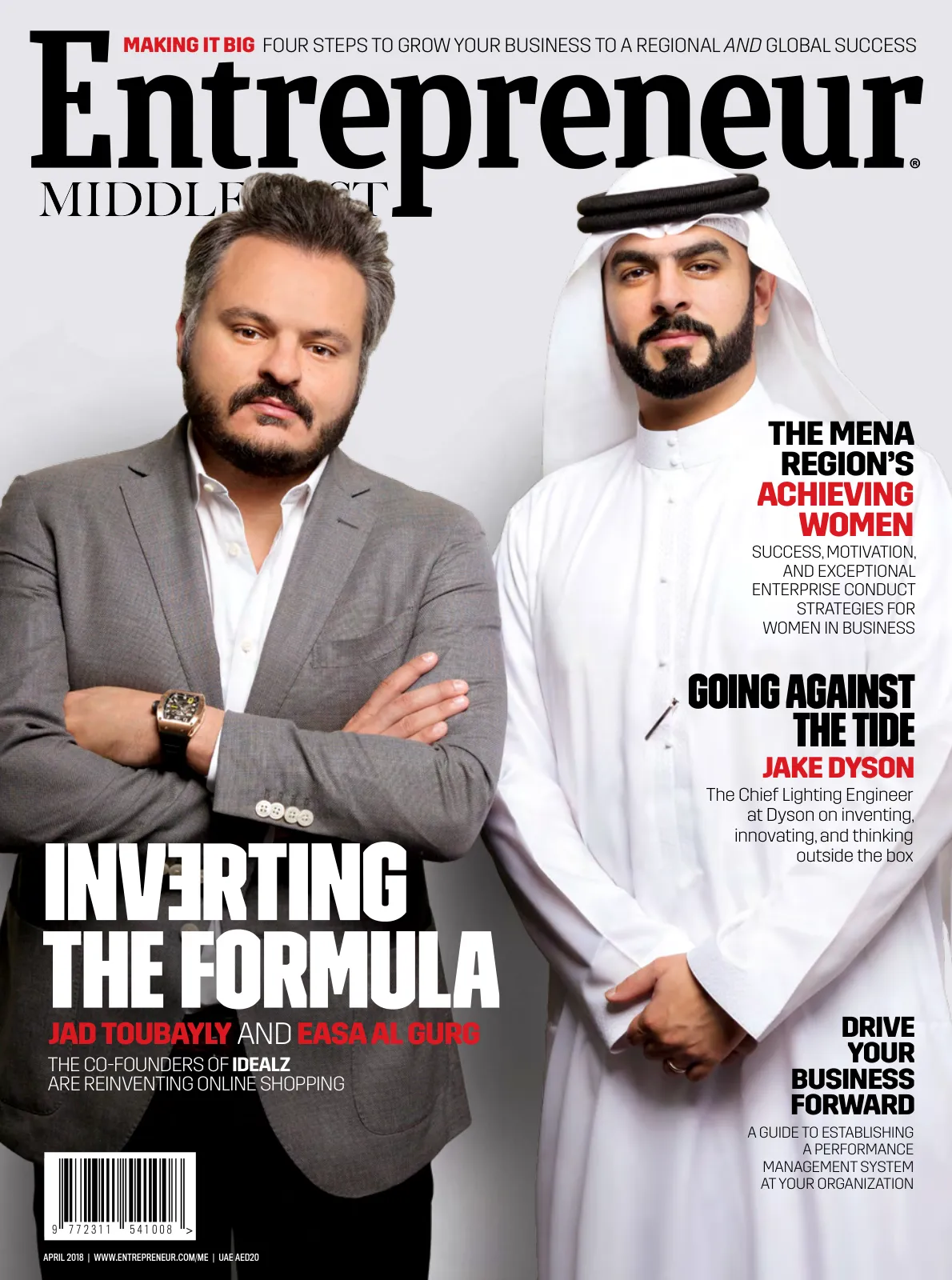
Entrepreneur Middle East, April 2018
Page 1
APRIL 2018 | WWW.ENTREPRENEUR.COM/ME | UAE AED20
9
7 7 2 3 1 1
5 4 1 0 0 8
>
THE MENA
REGION’S
ACHIEVING
WOMEN
SUCCESS, MOTIVATION,
AND EXCEPTIONAL
ENTERPRISE CONDUCT
STRATEGIES FOR
WOMEN IN BUSINESS
GOING AGAINST
THE TIDE
JAKE DYSON
The Chief Lighting Engineer
at Dyson on inventing,
innovating, and thinking
outside the box
JAD TOUBAYLY AND EASA AL GURG
THE CO-FOUNDERS OF IDEALZ
ARE REINVENTING ONLINE SHOPPING
DRIVE
YOUR
BUSINESS
FORWARD
A GUIDE TO ESTABLISHING
A PERFORMANCE
MANAGEMENT SYSTEM
AT YOUR ORGANIZATION
MAKING IT BIG FOUR STEPS TO GROW YOUR BUSINESS TO A REGIONAL AND GLOBAL SUCCESS
Page 2
www.aljada.com
800-ARADA (27232)
15
min
from Dubai
International Airport
& Sharjah Corniche
5
min
from
Sharjah
International Airport
3
min
from
University
City
Apartments
available to
all nationalities
1 bedroom apartments
starting from AED 533,000*
Special prices and payment plans!
Invest in the lifestyle
destination of tomorrow!
*T&C apply
Located just minutes from Dubai, Aljada is Sharjah’s
largest and most exciting new residential address.
Developed by ARADA, under the chairmanship
of HE Sheikh Sultan bin Ahmed Al Qasimi.
Adjacent to landscaped parks & the largest
entertainment centre in the Northern Emirates.
Direct access to Al Dhaid Road, easy access
to Sheikh Mohammed bin Zayed Road.
Page 3
3
April 2018 / ENTREPRENEUR.COM /
40 Aparna Verma, founder and CEO, Scholars International Group
33
Jean Liu, President,
Didi Chuxing
APRIL 2018 CONTENTS
22
INNOVATOR:
INVERTING THE FORMULA
Idealz co-founders Jad
Toubayly and Easa Al Gurg
The entrepreneurs explain
how their new e-commerce
with a twist concept will al-
ter the way we shop online.
33
INNOVATOR:
REAPING THE REWARDS
The MENA region’s
achieving women
Success, motivation, and
exceptional enterprise
conduct strategies for women
in business.
28
INNOVATOR:
GOING AGAINST THE TIDE
Jake Dyson, Chief Lighting
Engineer at Dyson, on
inventing, innovating, and
thinking outside of the box.
66
‘TREPONOMICS:
SKILLSET
Making it big
Mina Shenoda, Growth
and Marketing Manager of
Eventtus in Cairo, offers
four steps to grow your
business to a regional and
global success.
76
MONEY:
ECON
Pre-money vs. post-money
Patrick Rogers, co-founder
and Principal, Support Le-
gal, offers an in-depth guide
into these key monetary
terms for entrepreneurs.
74
‘TREPONOMICS:
PRO
A gasp of delight
Hashem Montasser,
founder, The Lighthouse,
gives his take on building a
business that works.
Page 4
Page 5
Page 6
Page 7
Page 8
Page 9
800 999 999 I sobha.com
@sobhadubai
LIVE IN THE LARGEST
TOWNHOUSES IN DUBAI
800 999 999 I sobha.com
@sobhadubai
LIVE IN THE LARGEST
TOWNHOUSES IN DUBAI
Page 10
Page 11
Page 12
12 / ENTREPRENEUR.COM / April 2018
72
‘TREPONOMICS:
SKILLSET
Eureka!
The Startup Factory
founder Hiba Balfaqih
writes about the dos and
don’ts of bringing creative
ideas to life.
76 Pre-money vs. post-money:
An in-depth guide to these key terms for entrepreneurs
APRIL 2018
CONTENTS
28
64
‘TREPONOMICS:
PRO
Tapping into opportunities
The connections you
forge outside of crowded
conference halls will make
your next trip the most
successful one yet, says
Coplex CEO Zach Ferres.
54
‘TREPONOMICS:
PRO
The right choice
Talentera’s General Man-
ager Muhammad Younas,
believes that much like
making your next hire,
choosing your career portal
solution needs (and de-
mands) careful analysis.
18
EDITOR’S NOTE
By Aby Sam Thomas
88
CULTURE:
LIFE
A forward-looking
perspective
Ramsay Rankoussi, VP of
Business Development-
MENA and Turkey, at
Radisson Hotel Group, on
why innovation needs to be
driven with the intention of
enabling social good.
78
START IT UP:
ECOSYSTEM
Off to a good start
At the newly launched
Techstars Dubai, there’s
much that can be learned
about the passion and
the hustle of founding a
startup.
Jake Dyson,
Chief Lighting Engineer,
Dyson
Rado True Thinline
Page 13
Page 14
14 / ENTREPRENEUR.COM / April 2018
82 Kathy Johnston, Chief Chocolate Officer, Mirzam
22
APRIL 2018
CONTENTS
68
‘TREPONOMICS:
PRO
Drive your business
forward
Willis Towers Watson’s
Elie Georgiou-Botaris
offers a comprehensive
guide to establishing a
performance management
system at your enterprise.
82
START IT UP:
Q&A
Echoing the past, heralding
the future
With an Expo 2020
contract in the bag,
Dubai-based Mirzam is
making its presence felt
in the artisanal chocolate
arena.
60
TECH:
SHINY
Leading the way
Gene Jiao, President, Huawei
Consumer Business Group,
Middle East & Africa, weighs
in on how the tech company
has set new standards in
smartphone photography
over the last decade.
62
CULTURE:
TRAPPINGS
‘Trep gear
The executive selection for
the entrepreneur on your list
that has everything. Okay,
maybe for a little self-reward
as well.
86
START IT UP:
Q&A
Closing the gap
UAE’s Bayut.com is making
its presence felt in the
property tech race.
58
TECH:
SHINY
#TamTalksTech
Gadgets and doodads
that you might’ve missed
out on, sourced by a tech
aficionado.
Jad Toubayly and
Easa Al Gurg,
co-founders, Idealz
Samsung
Galaxy
S9
Page 15
Page 16
16 / ENTREPRENEUR.COM / April 2018
SUBSCRIBE
Contact subscriptions@bncpublishing.net to receive
Entrepreneur Middle East every issue
EDITOR IN CHIEF Aby Sam Thomas editor@bncpublishing.net
CEO Wissam Younane wissam@bncpublishing.net
DIRECTOR Rabih Najm rabih@bncpublishing.net
CREATIVE LEAD Odette Kahwagi
MANAGING EDITOR Tamara Pupic
STARTUPS SECTION EDITOR Pamella de Leon
FEATURES EDITOR Sindhu Hariharan
COLUMNIST Tamara Clarke
EVENTS LIAISON Mark Anthony Monzon
PO Box 502511 Dubai, United Arab Emirates
P +971 4 4200 506 | F +971 4 4200 196
For all commercial enquiries related to
Entrepreneur Middle East contact
sales@bncpublishing.net
All rights reserved 2018.
Opinions expressed are solely those of the contributors.
Entrepreneur Middle East and all subsidiary publications in the
MENA region are officially licensed exclusively to BNC Publishing
in the MENA region by Entrepreneur Media Inc.
No part of this magazine may be reproduced or transmitted in any
form or by any means without written permission of the publisher.
Printed by United Printing and Publishing
www.upp.ae
Images used in Entrepreneur Middle East are credited when necessary. Attributed use of
copyrighted images with permission. All images not credited otherwise Shutterstock.
Saana Azzam
Hiba Balfaqih
Fida Chaaban
Zach Ferres
Elie Georgiou-Botaris
Maryam Ghouth
Gene Jiao
Hashem Montasser
Ramsay Rankoussi
Anna Roberts
Patrick Rogers
Federica Rossi
Mina Shenoda
Muhammad Younas
CONTRIBUTING WRITERS
www.entrepreneur.com/me
ACCESS FRESH CONTENT DAILY ON OUR WEBSITE!
MIDDLE EAST
EntMagazineME
@EntMagazineME
Entrepreneur-me
EntrepreneurMiddleEast
EntMagazineME
EntMagazineME
EntMagazineME
MIDDLE EAST
In addition to our print edition, we’re bringing
you all sorts of industry news on our web
mediums. Joining us online means getting
relevant business and startup content in
real-time, so you’re hearing about the latest
developments as soon as we do. We’re looking
forward to interacting with our readers on all of
our social media and web platforms- like any
thriving business, we’re looking to give and take.
#TrepTalkME is already happening on all of our
digi platforms, and all good conversations go
both ways. See you on the web!
Page 17
C O M E TO T H E B L U ,
S TAY F O R T H E V I E W
TAKE IN THE SPECTACULAR VISTAS OF THE DUBAI SKYLINE, THE DUBAI CANAL AND BURJ KHALIFA
FROM THE NEW RADISSON BLU HOTEL, DUBAI WATERFRONT. THE PERFECT PLACE TO CAPTURE THAT ULTIMATE
PICTURE MOMENT, WHETHER THAT’S FROM THE HOTEL’S PRIVATE ROOM BALCONIES, MEETING ROOMS,
SPA OR RESTAURANT TERRACES. THE HOTEL IS IN THE HEART OF THE ACTION AND WALKING DISTANCE
TO THE BEST SHOPPING AND ENTERTAINMENT IN DUBAI.
NOW OPEN IN BUSINESS BAY
Radisson Blu Hotel, Dubai Waterfront, Business Bay, PO box 16021, Dubai
T: +971 4 249 7800 info.waterfront.dubai@radissonblu.com radissonblu.com/hotel-dubaiwaterfront
Page 18
18 / ENTREPRENEUR.COM / April 2018
T
hose of you who follow
me on Instagram
(@thisisaby) will know
that I went off on a
holiday in March to New
Zealand. It was a vaca-
tion that was long in the
making. I’ve known for a while
that I sorely needed a break, and I
had been putting it off for nearly a
year primarily due to anxiety about
having to leave work for a couple of
days. To put it more explicitly, I was
worried that my departure from the
operation I run would cause it to,
well, keel over and die.
Some of you entrepreneurs might
be able to identify with the senti-
ment I had; I believe it to be a fault
that exists in those of us who tie
ourselves so closely to the work we
do and the teams that we do it with.
The amount of trepidation I had
in the days before my holiday was
palpable, and my team (bless their
hearts) had to keep reassuring me
that things weren’t going to be as
dire as I imagined they would be.
Well, the team turned out to be
right. During my vacation, while
I kept checking in with my team
whenever I could, there were days
when (due to a lack of internet
connectivity or time zone differ-
ence) I simply wasn’t able to keep
tabs on them, but that didn’t mean
the work that needed to be done
came to a grinding halt either. My
team just went on with business as
usual- sure, there were times they
stumbled or got stuck in a bind, but
they’d persevere and problem-solve
their way through.
All of this led me to realize a couple
of important leadership lessons-
and ‘treps, I think it’d be good
if you take note of these in your
enterprises as well.
Focus on the business structure
If the business you run is one that
would sink without having you on
top of it all the time, then I’m going
to venture that there may be some-
thing wrong with the way you’re
doing things.
Delegation to capable team
members is essential In my case,
my incessant worrying prior to
my time off was a result of me not
delegating enough- my folly was in
refraining from handing off tasks
on my personal to-do list, thinking
that my team wouldn’t be up for it.
This was a wholly wrong assump-
tion, of course- not only was it poor
management on my part, I was also
underestimating the capability of
my team.
Trust and empower your team to
problem-solve I’ve got good people
on board at Entrepreneur- so, when
they were faced with situations or
tasks that I hadn’t particularly pre-
pared them for, it was gratifying to
see that they didn’t flounder at all;
instead, they tackled them head-on,
and felt empowered enough to make
decisions by themselves, and es-
sentially moved things along.
That brings me to the thought I
want to end this note with: as lead-
ers and as entrepreneurs, you may
often feel like you have to do every-
thing at your business by yourself-
but this is a fallacy.
Remember that you’ve got people
on board your enterprise who have
embraced your vision, and are very
well-equipped to translate that into
reality- you just need to let them
take the reins.
Aby Sam Thomas
Editor in Chief
@thisisaby
aby@bncpublishing.net
You cannot be in charge all of the time
Handing over the reins
EDITOR’S NOTE
Page 19
Page 20
20 / ENTREPRENEUR.COM / April 2018
IMAGE CREDIT NYUAD, THINKERS & DOERS
IN THE LOOP
A
re you a computer
science student
who strives to ap-
ply your technolo-
gy skills to make a
difference to your
society? That’s precisely the
kind of people that the 2018
Annual NYUAD International
Hackathon for Social Good in
the Arab World to be held on
April 27-29 this year is look-
ing to nurture.
In its seventh edition, the
three-day programming
marathon will see computer
science professors, founders
of startups, technology profes-
sionals, and even venture
capitalists from across the
globe come together at New
York University Abu Dhabi
(NYUAD) to lead teams of
skilled computer science
students to create mobile and
web applications relating to
diverse fields such as health,
education, film, music, busi-
ness, and science- all for so-
cial impact in the Arab world.
To be held at NYUAD cam-
pus, the three-day hackathon
begins with an orientation
and “API Talks” session, and
will then move on to pitching
sessions for ideas and team
selections by the end of day 1.
Over the next two days, teams
will develop their applica-
tions, and the event concludes
with the teams presenting
their applications to a panel
of experts in a public event at
NYUAD Conference Center.
“The goal of the NYUAD
Hackathon is to promote in-
novation in computer science,
tech startups, and the devel-
opment of innovative technol-
ogy for the social good,” says
Sana Odeh, Faculty Liaison for
Global Programs of Computer
Science, and Clinical Profes-
sor of Computer Science, Cou-
rant Institute of Mathematical
Sciences, NYU New York, and
Affiliated Faculty, NYUAD.
Odeh believes that the event
will provide an opportunity
for students in the Arab world
to experience “the full cycle
of creating a tech startup-
sharing and generating ideas,
pitching ideas, learning new
platforms and programming
languages, designing and
developing mobile and web
applications, and working
with a team.” Besides this, the
participants can also benefit
from an opportunity to be
mentored by members from
industry and academia.
http://sites.nyuad.nyu.edu/hackathon
NYUAD International Hackathon for Social Good
in the Arab World gets set for 2018 edition
CODE FOR CHANGE
A scene from NYUAD Hackathon 2017
Thinkers & Doers brings together Bahrain’s
ecosystem at Follow The Leaders
Driving impact
T
hinkers & Doers, in
partnership with the
Bahrain Economic
Development Board (EDB)
and Tamkeen, brought its
international conference Fol-
low The Leaders to Bahrain
on March 6, 2018, with an
aim to further strengthen the
rise of entrepreneurship in
Bahrain. Held at the Shaikh
Ebrahim Center for Culture
and Research, the confer-
ence gathered 400 attendees
and more than 150 startups
around the world. With a
theme focusing on tackling
how entrepreneurs can be
supported by the ecosystem,
the event aimed to celebrate
and leverage Bahrain’s stra-
tegic role for startups in the
GCC region and around the
world as an ideal startup hub
for entrepreneurs and inves-
tors looking to expand their
impact.
In the opening ceremony,
Thinkers & Doers Presi-
dent Amandine Lepoutre
commented on Bahrain’s
entrepreneurial spirit and
convenient business environ-
ment, making it a noteworthy
spot for Thinkers & Doers to
hold the Follow the Leaders
conference. The event saw
a wide range of speakers
including Bahrain Economic
Development Board’s Simon
Galpin, Linagora’s Alexan-
dre Zapolsky, Mumzworld’s
Mona Ataya, Wamda Capital’s
Walid Faza, Takreem’s
Ricardo Karam, Brinc’s Yasin
Aboudaoud, Enhance UAE’s
Ritesh Tilani, Tamkeen’s Esam
Hammad, National Bank of
Bahrain’s Yaser Alsharifi,
Bahrain Development Bank’s
Budoor Kamal, and more.
This island’s entrepreneurial
scene is definitely one worth
observing, watch this space!
A panel discussion
at Follow The Leaders
in Bahrain
Thinkers & Doers President
Amandine Lepoutre
Page 21
REDEFINING
YOUR FREEZONE
EXPERIENCE
• Easy access via key highways with no access gates
• Easy & efficient business set up
• Smart office solutions from shared facilities to permanent offices
• Variety of business licenses
• Turnkey business solutions and services
• On site licensing & visa authority
800-SOUTH (76884)
businesscenter@dubaisouth.ae
DUBAISOUTH.AE
Page 22
JAD TOUBAYLY AND EASA AL GURG
The co-founders of Idealz
are reinventing online shopping
by TAMARA PUPIC
IMAGES COURTESY IDEALZ
INNOVATOR
T
he ubiquitous success of e-commerce retail-
ers worldwide is hardly deniable today, and
enough to allow overlooking that the majority
of its business models are still beset with
bottlenecks in different areas- unless you
refuse to turn a blind eye to this, as do the
co-founders of Idealz, the latest in a string
of promising startup ideas popping up in the UAE. Its
marketing slogan reads that Idealz is “a stationery
and garment online store with a twist,” with the twist
being its premise of creating three-fold value for the
customer, the business itself, and people less fortunate
around the world.
But in realizing this, the numbers need to make sense,
as, for Jad Toubayly, co-founder and CEO of Idealz, that
is the important bit. “We both love numbers, and are
always looking for formulas that work in everyone’s
favor,” he says, referring to Idealz co-founder Easa Al
Gurg. “In my background as a credit and derivatives
structurer with Deutsche Bank and later J. P. Morgan,
whenever we looked at something, we tried to topple
the formula on its head, and tried to see it through dif-
ferent lenses. Every good idea out there today started
like that. If you look at the unicorns out there today, the
founders looked at how the world was, the status quo,
and asked what they could do differently. So, in general,
we try inverting the formula in everything we look at. In
this case, when we looked at the e-commerce or online
shopping sector, which has been growing significantly in
the region, and specifically in Dubai, its usual business
model wasn’t very appealing for us. To start with, it is
dominated by titans that are very hard to compete with. >>>
22 / ENTREPRENEUR.COM / April 2018
Page 23
23
April 2018 / ENTREPRENEUR.COM /
“OUR FOCUS FROM
THE BEGINNING WAS
ON MAKING SURE
WE BUILD THE BEST
PRODUCT FOR THE
CUSTOMER AND NOT
THE BEST BUSINESS
FOR THE INVESTOR.”
23
APRIL 2018 / ENTREPRENEUR.COM /
Page 24
24 / ENTREPRENEUR.COM / April 2018
The way to rise to the top
in e-commerce is by doing
three specific things better
than your competition: car-
rying more Stock Keeping
Units (SKUs), delivering
faster, and pricing better. All
three of these eat from your
margin. They give you higher
turnover, but lower margins.
We wanted something that
had the inverse effect. How
can we sell more without
compromising margins?
This formula usually never
happens. We kept twisting
and turning it, asking what
if the incentive wasn’t faster
delivery time or better pric-
ing, but a value-add better
than both of these. That is
how we got to the value-add
marketing mechanism that
we have today.” Al Gurg,
co-founder of Idealz, adds,
“Bear in mind that we make,
market and sell our own
products, we are not a shop
of shops, and as such, we
are not in competition with
traditional e-commerce busi-
nesses. We wanted to invest
in making our own brand of
products that is sold on our
own platform. It is something
new, something unique. By
nature, we are both very
specific, detail-oriented, and
we usually try to pick holes
in the system, endlessly ask-
ing ‘what if.’ Eventually, we
came up with a concept that
is workable because every
time I would ask a question,
he [Toubayly] would come
up with a solution and vice
versa. That’s how we ended
up pulling the whole thing
together.”
In their quest to create
maximum value, Jad Tou-
bayly and Easa Al Gurg have
constructed Idealz as a plat-
form that allows its custom-
ers (registered members) to
purchase an item of clothing
or stationery, which also gets
them a complimentary ticket
into a lucky draw for a luxury
prize. For example, one of
the campaigns running at the
time of writing this article,
offers a limited quantity
(550) of porto boxes which
include two pencils, a ruler, a
sharpener and an eraser, for
the price of AED525, earning
a chance to win a Mercedes
CLA250 AMG. Or, in another
campaign, if you choose to be
one of the 700 buyers of Kiru
pencils for AED52.50 each,
you might win a collection of
tech products. Upon the pur-
chase, the platform member
is also given the option to
either collect the purchased
product, or donate it to Ide-
alz’s affiliate charity partner,
in which case the company
will double their ticket entry
into the respective campaign
draws. The combination
of highly sought-after
luxury goods with items es-
sential for those in need is
compelling as much as it is
intriguing, raising a question
of how the two dots were
connected- the answer to
which sits at the heart of
what Idealz is. “Whenever
you walk around in the malls
or other public areas you
see small charity kiosks
that are there depending on
peoples’ good will or loose
change,” Toubayly explains.
“Naturally, traffic isn’t re-
ally high. A large subsect of
the world, to be completely
honest and transparent, has
a ‘me first’ mentality. ‘I need
to help myself. I have my
own liabilities to take care
of. I have this and that.’ So,
going back to our ‘toppling
the formula on its head’ ap-
proach that we adopted, the
question became, ‘How can I
get the subsect of the market
who typically do not do acts
of charity to now start and
donate?’ The answer was
quite simple– an incentive.
For example, between some-
one selling charity coupons
to support a cause, or us
allowing our customers to
donate their purchases to
charity, but also giving them
the chance to win a Mercedes
or a Rolex, who do you think
will sell more? That is the
angle that we took to the
charity part of it. We have
found that with such incen-
tives, people actually buy
more and donate more. The
exact formula response that
we were looking for. Our
products are also curated
“Make sure to learn every
day. I remember the first
day when we launched,
some of our team members
thought that the flood
gates will open. The two
of us knew it wouldn’t. We
expected it to take time to
gain momentum. We had
incorporated that heavily
into our plans and budgets.
The first thing Jad said to
our team was to make sure
not to be demotivated by
what they saw or didn’t see
immediately. Eventually,
everyone started realizing
that there was still a lot of
work that needed to be done.
So, we learn every day.”
INNOVATOR
“THE WAY TO RISE
TO THE TOP IN
E-COMMERCE IS BY
DOING THREE SPECIFIC
THINGS BETTER THAN
YOUR COMPETITION:
CARRYING MORE
STOCK KEEPING UNITS
(SKUS), DELIVERING
FASTER, AND PRICING
BETTER.”
Dr. Azad Moopen,
Founder Chairman
and Managing
Director,
Aster DM
Healthcare
Jad Toubayly and
Easa Al Gurg,
co-founders, Idealz
‘TREP TALK
IDEALZ’S CO-FOUNDER
EASA AL GURG’S TIP FOR
ENTREPRENEURS
Page 25
25
April 2018 / ENTREPRENEUR.COM /
for this specific formula. We
have two verticals -clothing
and stationery- since the two
global constants in charity
are poverty, who will require
clothing, and education, who
will require stationary. So
simply put, you buy, and if
you don’t want your products
and you want to do good,
you can donate them to
charity. The other thing that
we will be looking at in the
future is special situations.
For example, we can curate
products required for areas
hit with nature disasters, and
launch them on our platform
for customers to buy and
donate.”
Consequently, the com-
pany’s mission objective
is to transform the lives of
different societal groups,
either through a donation of
hundreds of clothing items
to orphans, or by allowing
a buyer to win a Mercedes
for the price of a stationary
item. Since its inception,
Idealz has been partnering
with Dubai Cares, a part
of Mohammed bin Rashid
Al Maktoum Global Initia-
tives, which works towards
providing children and young
people in developing coun-
tries with access to quality
education. “We believe that
if you do good, you get good,”
Al Gurg says. “We have part-
nered up with Dubai Cares
and they have supported us
a lot, but this is only the be-
ginning. We are also looking
at other areas, such as evalu-
ating the possibility of asso-
ciating with the Mohammed
Bin Rashid Global Centre for
Endowment Consultancy,
which will be integrated into
our business model. This is
still at the drawing board
internally, but it will mean
specifying a certain portion
of our business to go towards
certain causes forever.
Whatever formula we come
up with will be built into the
business forever.” For now,
though, since launching the
website and the iOS app at
the end of last year, the co-
founders say it hasn’t been
hard for their innovative
concept to take hold in the
UAE market. Idealz claims
to have more than 1,500
downloads per day, with the
platform declaring a growth
of around 30% month-on-
month. “We typically say
that our buyer would be
anyone with a smartphone
and a credit card, no age
brackets at all- I call them
‘Uber Users’,” Toubayly
says, adding that the high
acceptance rate is due to the
carefully selected combina-
tion of products the platform
offers. “Our products have a
wide price point range- some
of our products are priced as
low as AED50 to as high as
AED1,000. They fall in two
main categories, clothing
and stationary, and specifi-
cally so. In terms of prizes,
we have five categories to
choose from: cash and gold,
jewelry and watches, cars,
electronics, and lifestyle. For
cash and gold, rewards can
go from as low as AED5,000
to, hopefully one day, as
high as AED5 million. As of
today, our highest cash prize
is AED100,000. On the car
vertical, we are working with
Mercedes, and we go from
as low as an A-Class to as
high as a G-Class. For other
verticals, it’s the same.”
Idealz’s draws occur on
the 15th of every month for
campaigns closed during
the preceding month, which
are held in the presence of a
Dubai Economy representa-
tive. As a legislator trying to
keep the pace with new ideas
arising in the UAE, the Dubai
Economy has been extensive-
ly involved in structuring the
legalities of the Idealz con-
cept. For Toubayly, the close
collaboration with the Dubai
Economy on the related legal
matters was a sign that their
concept was truly innovative.
“You know you have innova-
tion when you have no prox-
ies,” he explains. “Regionally
and internationally, when
we look for our proxy, there’s
nothing to compare to. We
also had to fight a lot of resis-
tance- for example, payment
gateways didn’t know how to
assess our risk, it was new
to them. Also, we are very
highly regulated, and we’ve
been working with the Dubai
Economy on how to structure
our campaigns in a way that
is efficient for them and us. If
we do 50 campaigns a month,
the amount of administrative
work on both sides becomes
ridiculous and uneconomical,
WWW.IDEALZ.COM
INNOVATOR
“YOU KNOW YOU HAVE
INNOVATION WHEN
YOU HAVE NO PROXIES.
REGIONALLY AND
INTERNATIONALLY, WHEN
WE LOOK FOR OUR
PROXY, THERE’S NOTHING
TO COMPARE TO.”
>>>
Page 26
26 / ENTREPRENEUR.COM / April 2018
so we’ve been working
with them to come up with
a bespoke solution. And
performance-wise, we look
at ourselves on a monthly
basis and say that our only
proxy is our last month.”
With a modern-day in-
novation rush enveloping the
globe, startup ecosystems’
stakeholders mainly search
for it in a neighboring garage
or at a never-ending tech
hackathon. However, this
story is different, and I’ve
intentionally decided to
present the people at the
helm of Idealz only after ex-
plaining the concept in more
detail. When we meet at the
company’s headquarters in
Dubai, they are both sparky
and down to earth– prob-
ably because they see Idealz
through the lens of already
accomplished businessmen.
Toubayly’s banking history
includes stints at Ernst &
Young, Deutsche Bank, and
J.P. Morgan, in addition to
a dozen or so of businesses
he has built and sold on the
side. Similarly, Al Gurg is
General Manager at Easa
Saleh Al Gurg Commercial
and Industrial Group, a fam-
ily business with more than
650 employees reporting
to him. After a decade-long
friendship, they were will-
ing to embark on this idea
together, but the demands
on their time were onerous.
Nevertheless, Al Gurg says
they worked on the concept
daily. “We really had to go
out of our way to find the
time to sit together, talk,
and develop the concept,” he
says. “It took us six months
to put all the pieces together
and then we kept on polish-
ing it till what you see we
have today. Then, in mid
2016, when we licensed the
company, we started putting
the team together. We liter-
ally went through the whole
startup phase on our own,
meaning that we even went
to buy and fix furniture of
our first office on our own.
It was about putting all the
pieces together. There were
too many moving parts.
We had to select the right
people, set up the infrastruc-
ture, the office, apart from
building the website and
the app itself. Sometimes
we would think that we
were doing good and then
suddenly we would get a big
flow of actionable items that
we had to take care of. At
the same time, we had other
projects/businesses, so to be
very honest, we managed it
because we are very aligned.”
Toubayly adds, “We have
15 people now, and we are
adding one a month, I’d say.
From a technical perspective,
we do everything in-house.
I have moved on to run this
full-time since May 2017. We
tried outsourcing some func-
tions which is, I guess, one
of the options startups have,
because it’s cost-effective
and saves time when you
are building a team, but we
didn’t like the quality that
we would get, so we stopped
that and hired full-time top-
tier talent. I can firmly say
that I have a very solid team
that I work side by side with.
There is a lot of talent out
there, but very little right
talent, so we hired some
from here and some from
abroad. We said from the
beginning that everything in
the build had to be [like that
of a] Rolls Royce- only using
the best-in-class platforms
of technical methodologies.”
Unlike other startup sto-
ries, Toubayly and Al Gurg
agreed from the outset to
keep this business a closed
book for outside investors.
Nevertheless, they did seek
validation from a third party,
which brings us to one of the
world’s most sought-after
investors, Dr. Finian Tan,
founder and Chairman of
Singapore-based Vickers
“WE TOOK THE DECISION
FROM THE BEGINNING TO
CONTROL EVERYTHING-
THE FATE OF THE
BUSINESS, HOW WE HIRE,
HOW WE FIRE, AND SO
ON, AND WE DIDN’T WANT
ANYONE INTERFERING
WITH THAT.”
INNOVATOR
Jad Toubayly
and Easa Al Gurg,
co-founders,
Idealz
Page 27
27
April 2018 / ENTREPRENEUR.COM /
Venture Partners, which
recently raised Southeast
Asia’s largest non-govern-
ment linked VC fund of US$
230 million (Fund V). Its
Fund IV is considered the
world’s best performing fund
as per data by research firm
Preqin. Nearly an hour into
our conversation, I’m no lon-
ger surprised that Toubayly
and Al Gurg boast neither
about their own credentials
nor of the people who have
supported them. “There is
this common misconception
that if you are a startup,
then you are always out rais-
ing money from investors at
every level of your growth,”
Toubayly says. “When you
set up a company where you
need to continuously raise
money from the market, you
spend a lot of time trying
to make it pretty for the
investors, and not for the
market. We were fortunate
and privileged to fund it by
ourselves, so we took the
decision from the beginning
to control everything- the
fate of the business, how we
hire, how we fire, and so on,
and we didn’t want anyone
interfering with that. Our
focus from the beginning
was on making sure we build
the best product for the cus-
tomer and not the best busi-
ness for the investor. In the
case of Dr. Finian Tan and
Vickers Venture Partners,
we did a share sale and not a
capital raise, something not
very common at all in the VC
world. He loved the chem-
istry between me and Easa,
and is a true believer in what
we are building.”
Dr. Tan is best known for
being the first investor in
Baidu, often referred to
as China’s Google, back in
2000. While heading DFJ
ePlanet Asia, he bought 25%
of the Chinese search en-
gine, which was a relatively
overlooked company at the
time, for $7.5 million. Since
this initial investment, Baidu
has become China’s most
popular website, ranking
fourth globally with a market
cap topping $87 billion. Al
Gurg says that the Baidu
story is a testament to the
type of foresight that Dr.
Tan has, including his ap-
proach to being focused on
the scrupulous curation of
potential investees to ensure
that they are the right fit, as
Toubayly explains and adds,
“He doesn’t go around in-
vesting in startups and then
seeing which one will work.
They do a lot more than that.
One of the conditions that
they have before they decide
to invest in a startup is that
you must travel with them
and you must sleep in their
homes. They want to see you
at night, they want to see
how you talk to your wife,
how you treat pets, and so
on. They want to see all of
this because their number
one criteria is the human.
They need to know that you
are a good human being.
Everything else comes after
that. So, it’s a lot more than
just making money. In doing
so, they have managed to
maintain a success rate a lot
higher than the average VC.”
With one of their backers
being a proven home-run
hitter, we start analyzing
the strength of other startup
ideas currently gaining
momentum in the UAE, and
how sizzling the Idealz co-
founders find the city’s start-
up scene. “We see that there
is this drive in the region to
become the Silicon Valley of
the GCC, and I think they’ve
done wonders to try to get
it closer to that, but it’s still
relatively premature as an
ecosystem,” Toubayly says. “I
also think that the investors
here, who have traditionally
invested in brick-and-mortar
or industrial and non-tech
related businesses, have now
opened their eyes to this sec-
tor, and are investing heavily
in it. That can create a bub-
ble if done wrong, because
they need to know how to
value these ventures. A lot of
times, valuation in startups
is in the eyes of the beholder.
It makes no money, just
costs. You go around and say,
‘I’m worth $1 million or $1
billion, but based on what?’
In the West, they have a
325 million addressable
market with sizeable con-
sumer spending habits and
a mature startup ecosystem,
whereas here we have a 55
million addressable market,
and that’s the entire GCC.
So, you cannot compare
the two and apply identical
valuation methodologies or
growth prospects. We still
need more time to get it
right. I think they are off the
needle a bit in terms of valu-
ations, industries, and some
models that are capable of
making money.” Al Gurg
agrees and adds, “Time and
experience will teach people.
That’s the only way. We are
relatively new as a market
compared to what other
developed markets have. For
example, we talk about the
dot-com bubble in 2000,
but that was 18 years ago.
Where was the tech industry
here at that time? So, it’s
a new market. I would say
that when compared to other
countries in the Arab world,
we are quite advanced. The
government is doing really
everything it can to support
this ecosystem, and I think
it’s just a matter of time to
have different experiences
from different businesses, to
get the right regulations in
place, and so on.”
What lies ahead for Idealz
is growing in the UAE before
launching its product in
Saudi Arabia and Lebanon,
followed by a select few
countries in North Africa
and the subcontinent. At
present, the co-founders
explain, the concept is an
emerging market product,
but with the brand becom-
ing strong enough in the
future, venturing into more
developed markets is not
off the table. Once again,
it is because its numbers
make sense, as Toubayly
concludes, “This is a model
that has the merits and the
capabilities to make a profit-
able enterprise. We are not
built for a trade sale, an IPO,
or quick scaling to reach a
maximum level and then
see whether unit economics
will make sense. Our unit
economics make sense today.
I don’t need to wait to have a
critical mass to see whether
I can squeeze profit out of
my enterprise or hope that a
unicorn will buy me. We are
not in that business.”
“THERE IS THIS DRIVE IN
THE REGION TO BECOME
THE SILICON VALLEY OF
THE GCC, AND I THINK
THEY’VE DONE WONDERS
TO TRY TO GET IT CLOSER
TO THAT, BUT IT’S STILL
RELATIVELY PREMATURE AS
AN ECOSYSTEM.”
“I’d advise people to
study unit economics.
The numbers need
to make sense at all
stages and not the ‘let’s
go and see what we
hit’ approach. A lot of
business models today
are built with the aim of
being bought out by the
bigger fish. That’s very
risky. Build a business
that has sound grounds
to become a profitable
enterprise through
positive unit economics.”
‘TREP TALK
IDEALZ’S CO-FOUNDER
JAD TOUBAYLY’S TIP FOR
ENTREPRENEURS
INNOVATOR
Page 28
28 / ENTREPRENEUR.COM / April 2018 F
or someone whose last
name is a celebrated
technology brand, I was
pleasantly surprised to
note that Jake Dyson had
no airs about him when
I met the man during his
visit to the UAE in late
February. Over the course
of our conversation, he
didn’t talk about his lin-
eage a lot (for the uninitiated, he’s the
eldest son of the legendary Sir James
Dyson, founder of the multimillion
dollar enterprise that is Dyson), but it
became easily evident to me that he was
a chip off the old block all the same- he
is, after all, much like his father, an
inventor, designer, and entrepreneur in
his own right.
Following his education in industrial
design at the Central St. Martin’s art
school in London, Dyson worked for a
while as an interior designer, though he
admits to not have been too taken in by
the way the discipline was perceived at
that point in time, which was the early
90s. “Design, in those days, was much
more about how something looked,” he
remembers. “And it was all about mak-
ing things look nice. So, design educa-
tion was a lot about that, and I didn’t
really fit into that, because, well, for
example, my degree was a water power
generator that you put on drainpipes of
buildings, so that when it rains, or you
flush the bathroom toilet, you generate
electricity. And they thought that was
a bit strange, because everyone else is
doing fancy things that looked nice, and
I was in this sort of mechanical space.
I’ve always been interested in mecha-
nisms, but strangely when I left college,
I did a bit of interior design work on
my own as freelance. So, I designed a
few bars, cafes, that sort of thing- quite
good money, which is the reason I did it,
and it was quite easy, actually, and fun.
So easy, in fact, that I got a bit bored of
it.” At this point, Dyson decided to go
and work at his father’s enterprise, and
over the course of two years, he worked
on a project from concept to just before
manufacture- but it never went into
production, because, as Dyson remem-
bers it, it was too contemporary for the
time (and it may be still be so today,
he adds). But Dyson learnt a lot from
the experience. “It did teach me how
you work an idea to manufacture, those
two years,” he says. “But I felt a bit
like I had moved back home, and into a
shoebox- and I wanted to get out and,
you know, make my own life, and do my
own thing.”
And that’s exactly what Dyson did.
During his time working on interiors,
Dyson had been getting increasingly
GOING AGAINST
THE TIDE
Jake Dyson, Chief Lighting
Engineer at Dyson, on
inventing, innovating and
thinking outside the box
by ABY SAM THOMAS
INNOVATOR
IMAGES COURTESY DYSON
Jake Dyson,
Chief Lighting Engineer, Dyson
Page 29
29
April 2018 / ENTREPRENEUR.COM /
frustrated with the lighting
products in the market then-
designers were, he felt, more
focused on their externali-
ties, as opposed to the tech-
nology that was powering
them and thus make them
more beneficial, efficient, and
long-lasting. “So, I started to
experiment with light, and
understand how you could
get more benefit from the
projection of light,” Dyson
remembers. “And that led
me into lights with mechan-
ics- so, motorized lights that
change the angles of light
coming out of it. I started to
learn about light reflectors,
lighting technology, and more
mechanisms and mechanics.”
It was around this time the
industry at large was becom-
ing increasingly focused on
energy efficiency, and lighting
designers thus turned toward
LED technology to power
their lamps. However, Dyson
noted several issues with the
products that were available
in the market. “I couldn’t
understand why people
were making LED lights
that didn’t last a lifetime,
when LED [technology] had
the potential [to do that],”
he says. “So, I did a lot of
research into how I could
make that happen, and I had
to make them run as cool as
possible, so then, that led me
to looking for, and developing
cooling technology, which I
did.” All of this led to Dyson
setting up his own company,
Jake Dyson Products, in
2004, which invented,
manufactured and sold LED
lighting products that aimed
to overcome the issues seen
with existing lights in the
market. “I set up my own
studio; I ended up with a
team of about 12 people,”
Dyson remembers. “We were
selling lights around the
world into architectural proj-
ects, we were manufacturing
three or four lights, market-
ing them… I learnt a lot by
being very hands-on in all of
those areas.” And remember
that issue Dyson faced with
LED lights not lasting longer
than they potentially could?
One of the products that his
enterprise came out with was
the CSYS LED task light, a
desk lamp that boasted of a
lifespan of about 40 years.
With innovations like these
continuing to come out of
Dyson’s company (another
of its noteworthy offerings
was the suspended Cu-Beam
light series), he thus began
to be rightly recognized as a
pioneer in his field in a span
of just over 10 years, which,
in turn, heralded the next
phase of his career.
Given the success that
Dyson’s enterprise was able
to achieve in the market at
large (and not to mention its
innovation-focused personal
ethos), it wasn’t too much
of a surprise when his father
announced in 2015 that he’d
be acquiring the company,
and folding it into the larger
Dyson business. In this pro-
cess, the younger Dyson, who
had been a Non-Executive
Director at Dyson since 2013,
now took on more respon-
sibilities at the company by
becoming its Research and
Development Director, as
well as its Chief Lighting En-
gineer. In an interview with
the Financial Times at the
time of the acquisition, Sir
Dyson noted that bringing
his son and his company into
Dyson was also an indication
of its future as an enterprise
and how it’d be run in the
years to come. “The beauty
of a family business is that
you worry about getting the
product right, not about any
investors with short-term
views or what others think,”
the senior Dyson told FT. “I
would hate to be [a public
company]. We can be very
long-term, developing tech-
nology that can take years
to come to fruition. We can
be patient.” Indeed, this
is the same reasoning that
Jake Dyson reiterates today
as he talks about Dyson’s
current standing in the
market, where it has chosen
not to rest on its laurels, and
instead be focused on en-
abling innovation in what-
ever sector they can put their
expertise into. And proof of
this is now there for every-
one to see: sure, its brand
may have been established
by its signature vacuum
cleaners, but Dyson now has
an assortment of innovative
products to be proud of, be it
bladeless fans, hair dryers, or
yes, even desk lamps. “Dyson
is completely unafraid to
go into an industry where
there are very established
companies that have been
doing it for decades- we
don’t care about that,” Dyson
declares. “We are not afraid
about that. All we want to
do is solve a problem. Invent
things, and solve problems.
Develop technology, invest
in technology, to solve those
problems, and make much,
much better products. This is
why, through the investment
in technology and being fo-
cused on that, we are able to
go into new areas, to design
different products, to solve
more problems, and to enter
into new industry areas, and
disrupt.”
“I COULDN’T UNDERSTAND WHY PEOPLE
WERE MAKING LED LIGHTS THAT DIDN’T
LAST A LIFETIME [...] I DID A LOT OF
RESEARCH INTO HOW I COULD MAKE THAT
HAPPEN, AND I HAD TO MAKE THEM RUN
AS COOL AS POSSIBLE, SO THEN, THAT LED
ME TO LOOKING FOR, AND DEVELOPING
COOLING TECHNOLOGY, WHICH I DID.”
CSYS Light
Purifier-
Dyson
Professional
Event
>>>
Page 30
30 / ENTREPRENEUR.COM / April 2018
It is this particular aspect
of the Dyson business that
both Jake and Sir James
Dyson continue to be fiercely
passionate (and protective)
about- they are not at all
keen on comprising the in-
ventive nature and vision of
the company. (In explaining
Dyson’s running as a family
business, Dyson notes, “We
have a direction and a pur-
pose for the business that we
don’t want to contaminate
with shareholders.”) From a
personal perspective, Dyson
himself remains true to his
inventorial roots, and he was
happy to share his insights
to help those who may want
to venture in his footsteps.
“Don’t give up,” he declares.
“Keep experimenting. The
impossible is not the impos-
sible at all. Something that
is seen as impossible, you’ve
just got to keep trying and
solve the problem.” But how
does one know what are
the, well, right problems to
solve? “Well, I think talking
to industry is key,” Dyson
explains. “You’re talking to
the industry to guide you,
so that when the product is
designed, it fits their needs.
So, don’t be insular; go out
and talk to the industry. And
the industry, you’d think,
would shut the door in your
face- but it’s the absolute
opposite. They are very
interested to see what people
are working on, and if they
can help- because they are
experts in that profession,
so it’s flattering.” But in the
quest to solve a problem,
Dyson warns against working
on solutions that are only fo-
cused on the externalities, or
worse, not fixing a real issue.
“I wouldn’t do a product if
there’s no problem to solve,
or if there’s no advantage-
that’s crazy,” he says. “And
also, I’d be very, very careful
about designing something
just because of the way it
looks. Because looks go out
of fashion, whereas the
performance of a product
doesn’t.” Dyson speaks from
experience, of course- he’s
someone who has chosen to
go against the tide plenty of
times in his career so far, and
yeah, it’s fair to say that he’s
fared the better for it. “I’ve
had one or two or the world’s
biggest lighting companies
come up and say to me,
‘Why are you bothering to
make a light that lasts more
than seven years?’” Dyson
remembers. “And I’d turn
around and say, ‘Why aren’t
you?’”
INNOVATOR
“THROUGH THE INVESTMENT IN
TECHNOLOGY AND BEING FOCUSED ON THAT,
WE ARE ABLE TO GO INTO NEW AREAS, TO
DESIGN DIFFERENT PRODUCTS, TO SOLVE
MORE PROBLEMS, AND TO ENTER INTO NEW
INDUSTRY AREAS, AND DISRUPT.”
Jake Dyson,
Chief Lighting Engineer, Dyson
Dyson
Supersonic
Page 31
Page 32
32 / ENTREPRENEUR.COM / April 2018
REAPING
THE REWARDS
SUCCESS, MOTIVATION, AND
EXCEPTIONAL ENTERPRISE CONDUCT STRATEGIES
FOR WOMEN IN BUSINESS
MARYAM GHOUTH
LINA KHALIFEH
MONA HADDAD
JEAN LIU
SHARIFA AL BARAMI
RAJA AL MAZROUEI
SAANA AZZAM
TANAZ DIZADJI
ALISHA MOOPEN
FEDERICA ROSSI
H.E. SHAMSA SALEH
APARNA VERMA
Page 33
33
April 2018 / ENTREPRENEUR.COM /
W
hen Jean
Liu, Presi-
dent at Didi
Chuxing, a
global mo-
bile transportation platform,
took off, there were still
frames of perception in the
Chinese society that were
peculiar to women.
Although communist China
spurred ambition in women
to achieve academic success,
the still prevalent patriar-
chal culture would cause
a rampant and systematic
gender bias in their profes-
sional lives later on. This
scenario escalated further
by the country embracing
free market principles a few
decades ago, ushering in op-
portunities but also setbacks
for those who could not (or
were perceived as not being
able to) keep the pace with
the now world’s second-
largest economy powering
ahead.
Born and raised in Beijing
in the midst of this transi-
tion from a planned to a
market economy, Liu earned
her B.A. from Peking Uni-
versity and her M.S. from
Harvard University, both
in computer science, and
spent a decade climbing
up the corporate ladder to
the position of Managing
Director at Goldman Sachs
(Asia), before joining Didi in
July 2014, two years after its
foundation. However, it was
obviously inevitable for her
to experience hurdles, and
describes her early career
along the following lines.
“There are some stereotypes,
like women should act more
gently, speak more softly
and take on more family
responsibilities. This is not
unique to China. It is totally
universal. Because of such
stereotypes, more women
than men tend to be quiet in
the decision making situa-
tions- I was like that when I
started my career: I usually
sat in a corner, didn’t want
to raise my hand and join
the discussion. I worried
so much about how other
people who looked at me
would judge me,” she says.
Her mindset is now ir-
revocably altered, to say the
least, as she leads the com-
pany of an unprecedented
scale- it boasts 450 million
passengers, 25 million rides
per day, and 9,000 employ-
ees, and is reportedly valued
at US$56 billion, with a
backing by Chinese internet
giants Alibaba and Tencent
and Japan’s SoftBank, among
others. Furthermore, the
woman, once afraid to make
her voice heard, in 2016, had
the last say in a years-long
market battle with Travis
Kalanick, former CEO of
Uber, which ended with Uber
taking a 18% stake in Didi
Chuxing, but also handing
over its China operations to
Didi Chuxing, and Kalanick
heading back to California,
defeated. The same year, Tim
Cook, CEO of Apple, looking
for a strategic ally in the
Chinese market, invested
$1 billion in Didi Chuxing,
which has remained the
single largest investment it
has ever received.
When asked what she
considers crucial for con-
cluding deals of this size and
importance, Liu tackles the
subjects of empathy, coop-
eration and emotional intel-
ligence as the main drivers
of her approach to both
partners and opponents in
business. “The most critical
thing for any deal is build-
ing a common ground and
making sure that the deal
sticks, and to do this, we try
to develop a ‘global’ view, an
empathy and understanding
of every stakeholder’s priori-
ties and concerns,” she says.
“I learned a lot from my
father and from my own pro-
fessional experience before
joining Didi about the need
to have a global perspective.
What this means to me is
being able to look at things
from different standpoints
and being sensitive and
empathetic to political,
cultural and linguistic nu-
ances. Today, with advanced
technology and innovation,
so many companies have
an enormous impact on
people’s daily lives, often
across multiple geographies.
Executives frequently have
to manage internal teams as
well as external stakeholders,
JEAN LIU
President,
Didi Chuxing
by TAMARA PUPIC
“CHALLENGES ARE THE
BEST OPPORTUNITIES
TO GROW: THIS IS A
LESSON I LEARNED
THROUGH THE
WORLD’S TOUGHEST
COMPETITION,
ENORMOUS PERSONAL
HEALTH CHALLENGES,
BUT ALSO THROUGH
BUILDING SOME GREAT
PARTNERSHIPS AND
EXPERIMENTS.”
Jean Liu is a member of the Harvard
Graduate School of Arts and Sciences
Alumni Association Council, and a
member of the Board of Directors of
ONE Foundation.
IMAGES COURTESY JEAN LIU
REAPING
THE REWARDS
THE MENA REGION’S
ACHIEVING WOMEN
>>>
Page 34
34 / ENTREPRENEUR.COM / April 2018
not only at home but in
many different markets. In
these situations, the need
for empathy and emotional
intelligence are more pro-
nounced than ever before.”
This global perspective is
no doubt informed by her
family background. With a
father who played a pivotal
role in the IT revolution in
China -Liu Chuanzhi is best
known as the founder of
Lenovo, one the world’s larg-
est computer makers- Liu’s
upbringing afforded her a
privileged insight into what
goes into the building of now
one of the largest privately
owned industrial and invest-
ment conglomerates in Chi-
na, Legend Holdings, parent
of Lenovo. “I also learned
about courage from my fa-
ther, who was among China’s
early tech entrepreneurs,
and took significant risks to
start Lenovo more than 30
years ago, when he was 40
and I was six years old, way
before China became known
for its innovative technology
solutions. Challenges are the
best opportunities to grow:
this is a lesson I learned
through the world’s tough-
est competition, enormous
personal health challenges,
but also through building
some great partnerships and
experiments that we hadn’t
dreamt of five years ago
when we started.”
In fact, this series of
triumphs actually started
soon after she joined Didi
Chuxing in 2014, taking up
the newly created position
of company president, with
her first order of business
being engineering a merger
between two fierce competi-
tors -Didi Dache and Kuaidi
Dache- to create today’s Didi
Chuxing. Since then, Liu has
laid out her ambition for
the company to become a
global leader in smart trans-
portation and automotive
technology and the world’s
largest operator of vehicle
networks. However, it is just
a stepping stone to achieving
her vision of a pollution-
free Beijing, currently one
of world’s most congested
metropolis.
At the moment, Didi Chux-
ing offers 11 transportation
services from one mobile
app, from Didi Premier to
bike-sharing, a stark differ-
ence from the period before
its foundation when it was
very hard to get a cab in
China, Liu explains. With
the business already mak-
ing money in China, she is
optimistic about the space to
further drive profitability in
the future, but not without
overcoming current and
future hurdles on the road.
“We see the great potential
of the ride-sharing market
because even at 25 million
rides a day, Didi’s penetra-
tion rate in China is less
than 4%,” she says. “We are
witnessing the transforma-
tion of the broader trans-
portation industry right in
front of our eyes. The race to
develop self-driving, smart
transportation, car-sharing
and bike-sharing technolo-
gies is getting started. We
currently and continue to
actively invest in technol-
ogy, team and products
to support continued and
sustainable growth. It is
because we realize that to
provide secured, convenient
and high-quality services
for hundreds of millions of
drivers and passengers, we
need to have diverse ca-
pacities ranging from AI, fine
management, and online and
offline services, to public-
private collaborations.”
“As a five-and-a-half-year-
old company, we are facing
unprecedented challenges,”
Liu notes. “For instance,
many people join the Didi
platform with their own
cars as independent driver
partners. So, one of the
challenging tasks for Didi is
to build effective, fair and
transparent mechanisms
to incentivize drivers to
improve quality and safety.
We have launched several
safety initiatives, including
a Safe Driving system added
to the driver’s app to alert
dangerous driving behavior,
and put in place a safety and
insurance fund to cope with
medical and other emergen-
cy needs for drivers. We also
rolled out a Service Credit
Scores system, to link mea-
surements of service quality
with differentiated driver
assignments and income.
Thanks to these measures,
we saw a 21% reduction in
the traffic accident rate on
Didi’s platform and to a level
much lower than that seen
in the traditional transpor-
tation industry last year.”
In addition, she has kept
her finger firmly on the
organizational challenges
arising from the business
quickly expanding from
“I FOUND THE
EASIEST SOLUTION
TO BREAK THROUGH
THE GLASS CEILING
IS JUST TO FOCUS
ON BEING MY BEST
POSSIBLE SELF, AND
TO CREATE MORE
TRUST AND SUPPORT
THROUGH GOOD
COMMUNICATION.”
Jean Liu joined Didi
in July 2014 from
her previous position
as Managing
Director at Goldman
Sachs (Asia)
REAPING
THE REWARDS
THE MENA REGION’S
ACHIEVING WOMEN
Page 35
35
April 2018 / ENTREPRENEUR.COM /
taxi-haling to multiple
mobility services, while the
number of its employees has
increased from 700 to nearly
9,000 people. One example
is the introduction of an HR
Business Partner (HRBP)
system to align development
objectives with employees
and management, and the
Didi Culture Committee, to
help everyone to speak up,
Liu explains. “For a large-
scale startup like Didi, it
is very important to keep
relatively agile and flat op-
erations while maintaining
efficiency and structure,” she
adds. “We need to encourage
experimental and innova-
tive approaches but ensure
very close monitoring, as
well as checks and reviews,
so that the right solutions
are quickly identified and
replicated. Culturally, the
importance of listening and
inclusiveness cannot be
overemphasized. With an
acquisition overseas and a
diversified workforce from
the US, Latin America, Asia
and beyond, diversity and
inclusion are core to our
values. Every month we hold
an all-hands meeting during
which Didi’s founder and
CEO, Cheng Wei, and I both
sit with employees, sharing
our plans for the company
and answering employees’
questions face-to-face. But
real changes have to start
at very small places: for
instance, our HR team has
a project to help managers
design a meeting agenda
and processes -like the
guide from Robert’s Rules
of Order- so that all voices
right across the organization
are heard in very concrete
decision-making situations.”
About 50% of Didi
Chuxing’s employees are
engineers, currently focused
on using big data-driven
deep learning algorithms
to optimize resource al-
location and continuously
improve user experience.
From this, Liu aims to shift
the company’s attention to
electric and autonomous
vehicles. In 2017, Didi Chux-
ing opened a research lab in
Mountain View, California,
housing 100 researchers out
of its global team of more
than 500 AI experts, to
accelerate its self-driving
plans. The company’s global
expansion, topping Liu’s
agenda at present, has been
that of strategic alliances
and investments in ride-
sharing companies such as
Malaysia’s Grab, US’ Lyft,
India’s Ola, Estonia’s Taxify,
Brazil’s 99, and MENA’s very
own Careem. “We were very
lucky to have grown up in
China– the world’s toughest
market to crack- but our
vision is going global,” Liu
says. “We believe it is possi-
ble to take the expertise and
technologies we developed
for China to benefit other
communities around the
world. Didi’s global strategy
is a little bit different from
others. In fact, mobility is
a market that we should
adapt our products and
services to in order to meet
the language, cultural and
other requirements of local
communities. So, we don’t
always enter a market di-
rectly. We sometimes coop-
erate with local partners. If
there’s already an excellent
local leader who deeply un-
derstands the local market,
we will work together. But,
if there’s no clear company
that we could partner with
in the local market, then we
will consider moving in and
developing business on our
own.”
Talking specifically about
technological innovation in
the MENA/GCC region, Liu
lists three things redefining
its perception in the world’s
eyes. “First, the GCC has
become a global investment
powerhouse leading the
revolution from manufactur-
ing to internet and bio-med,”
she says. “Didi is one of so
many young tech companies
who benefit from the insights
of the incredibly visionary
investors from MENA, such
as Public Investment Fund
(PIF), Mubadala, and others.
Second, in this decade many
governments in the region
are embracing new long-term
development plans that are
unrivalled in their ambi-
tion to integrate the most
advanced AI technology with
real social and economic
projects, such as smart cities
and new energies- all very
inspiring to Didi’s vision. I
believe MENA will be home
to some of the world’s most
advanced smart cities in the
next decade. Last but not
least, I am equally impressed
by the vitality and atmo-
sphere of innovation in the
GCC during my trip to the
United Arab Emirates and
Saudi Arabia. Large young
populations are being moti-
vated and the world is paying
attention to the region’s
buzzing startup scene. 42%
of MENA’s startups are from
the UAE, including our part-
ner Careem. With a young
demographic structure and
concepts, the region is posi-
tioning itself as an inclusive
and thriving innovation hub
for the world, just like China.
The organic social policy
changes are also very exciting
“THERE ARE SOME
STEREOTYPES, LIKE
WOMEN SHOULD
ACT MORE GENTLY,
SPEAK MORE
SOFTLY AND TAKE
ON MORE FAMILY
RESPONSIBILITIES.
THIS IS NOT UNIQUE
TO CHINA. IT IS
TOTALLY UNIVERSAL.”
Jean Liu earned her B.A. from Peking
University and her M.S. from Harvard
University, both in computer science
REAPING
THE REWARDS
THE MENA REGION’S
ACHIEVING WOMEN
>>>
Page 36
36 / ENTREPRENEUR.COM / April 2018
more cultural diversity and
youth development programs
will help enormously. We
also learnt that women are
not a stark minority in the
technology sector- they play
important roles in support-
ing innovation and economic
development in the country.”
The personal empower-
ment Liu today feels is
being filtered through to her
female employees- overall,
40% of Didi’s employees are
women and women make up
37% of tech roles. Recently,
the company launched DiDi
Women’s Network (DDWN)
to enhance the personal
growth of high-potential
female professionals within
the company, and part-
nered with the Institute of
Electrical and Electronics
Engineers (IEEE) to advance
careers of women engineers.
“Cheng Wei and I started the
DiDi Women’s Network to
advance the career develop-
ment and personal growth of
female employees last year.
We also launched a child
day care center in summer/
winter vacations and carried
out a policy that enables
mothers with young children
and pregnant employees to
work from home one day ev-
ery week. The two methods
were received well. If you
are asking whether there are
any glass ceilings for female
leaders, indeed, [I believe]
both women and men may
face such a challenge. I
found the easiest solution
to break through the glass
ceiling is just to focus on
being my best possible self,
and to create more trust and
support through good com-
munication. DiDi Women’s
Network is also helping
women break the mid-career
bottleneck, for example,
we selected 24 outstanding
female employees to partici-
pate in the program where
they would receive intensive
tutoring from senior execu-
tives.”
Liu also credits the help
she received throughout her
career for making her what
she is today- and she’s eager
to pay it forward. “I was
fortunate to have extremely
capable and encouraging
female mentors, and it is
important for all women to
have that kind of support,”
Liu says. “We also need to
design environments and
frameworks that encourage
open communication and
ensure every voice is heard.
While the situation for
women is far better today
than in the past, there are
still more men in senior
roles as women often priori-
tize family and children over
career. Many women take a
break, and then find it dif-
ficult to catch up. What we
are trying to create at Didi is
an environment where young
women do not have to view
career and family as mutu-
ally exclusive and have the
freedom and the flexibility to
flourish both personally and
professionally.”
LEADERSHIP LESSONS
Jean Liu shares a moment
with her father Lenovo
founder Liu Chuanzhi that left
a lasting impression on her
“From a very young age, my fa-
ther taught me how important
credibility and integrity are, and
this has had a great impact on
my development. If my father
promised to do anything, he
would never go back on his
word. He was not only strict
with himself, but also strict
with his children, my brother
and I. I still remember this story
from my first semester in grade
three of junior high school.
In the morning before I went
to school, I asked my father
whether he could buy a set of
studying materials for me on his
way back from work when he
passed a bookstore. He agreed,
but I was a little worried that he
would forget because he might
be busy. So, I said: “Dad, if you
are busy, I will buy it myself.”
But my father insisted he would
keep this in mind.
However, in the evening, when
he returned home, I found that
he had actually forgotten about
it, and didn’t bring back the
studying materials. I was so
disappointed, even though I un-
derstood that he must be very
busy. Seeing my anxious face,
my father suddenly remem-
bered that he hadn’t bought
the books, and explained that
he did not deliberately break his
promise, but he had been busy
dealing with the company. He
then immediately proposed to
go out again to buy the study-
ing materials. At that time, it
was already getting dark, so my
mother suggested that if the
learning materials were really
in urgent need, the driver could
help buy them and deliver them
to our home. But my father felt
that it was a matter of keeping
his own promise to me. On top
of that, the driver had worked
for a whole day, so he also
needed to spend the time with
his family. So, again, he went
out immediately. The traffic
was very bad on that day, and it
took my father nearly two hours
to get the books and return
home.”
In 2013 and 2015, Jean Liu was named one of China’s Top Women Business Leaders
by China Entrepreneur Magazine
WWW.DIDICHUXING.COM
REAPING
THE REWARDS
THE MENA REGION’S
ACHIEVING WOMEN
Page 37
THE ONLY EVENT TO BRING YOU THE
FUTURE TECHNOLOGY OF
ATTEND THE FREE EXPO
GET YOUR FREE EXPO PASS TODAY
REGISTER ONLINE AT
www.seamless-expo.com/ME
Follow us on:
@SeamlessDXB #SeamlessDXB
free seminar sessions
75
More than
professionals
10K
Network with
exhibitors
350
on floor features including Fintech
Focus, Banking Innovation, Shop Fit-out
and Augmented Reality Showcase
NEW
Meet
15-16 April 2018
Dubai International Convention
& Exhibition Center, Dubai
2018 SPONSORS
350+
EXHIBITORS
10,000
ATTENDEES
350
EXHIBITORS
300
SPEAKERS
PLATINUM SPONSORS
GOLD SPONSORS
Page 38
38 / ENTREPRENEUR.COM / April 2018
L
iving in a fast-paced
cosmopolitan city
can heighten the
sensitivity we feel
towards professional
rejection, simply because it
may entail more than a hit to
our livelihood. The pressure
of needing to make ends
meet, along with attaching so
much of our identity to titles,
corporate hierarchies, and
competitive salaries, and the
consequent luxury and social
recognition a job facilitates,
would make professional
rejection a shattering ordeal.
And even if we learn to
separate our identities from
our professional facades and
all the glitz and glamor that
come with that, the feeling of
being rejected by whomever
represents the company we
are interested in working with
still falls within the bracket
of social rejection, and this is
not something human beings
process with ease.
Naomi Eisenberger, a social
psychology professor at
UCLA, and Kipling Williams,
a psychology professor at
Purdue University, found
that the same pathways of
the brain that light up when
we experience physical pain,
light up when we experi-
ence rejection– that’s how
painful it is! And why is it so
painful? Because those who
experienced the pain of being
rejected were at an evolution-
ary advantage, as they were
more likely to correct their
behavior, and consequently,
more likely to remain in the
“tribe.”
What motivates us to reject
others? A perceived inade-
quacy, disadvantage, harmful
behavior, lack of chemistry or
incompatibility are just some
of the reasons why we may
see someone as unfit to team
up with or to invite into our
tribe. However, in a world full
of socio-economic systems
that do very little for the de-
velopment and preservation
of a healthy self-esteem, with
fragmented family structures,
meaningless social circles,
and money-driven profes-
sions devoid of purpose,
what we deem as threatening
to our survival may be exac-
erbated by the circumstances,
because, deep down, our core
needs aren’t met. As a result,
it is only natural that our
tendency to feel threatened,
and, in turn, reject another, is
compounded by the absence
of inner fulfilment.
Adding to this is our natural
inclination to refer to cogni-
tive biases, whereby infer-
ences about other people
and situations are drawn in
an illogical manner to speed
up the process of making
a decision, and minimize
the risk of getting hurt and
feeling bad about ourselves.
These cognitive distortions
are exaggerated by irra-
tional thought patterns that
cause individuals to perceive
reality inaccurately, such as
catastrophizing, generalizing,
black-and-white thinking, and
mind reading. In other words,
sometimes our reasons for
rejecting others are built on
inaccuracies and insecurities,
rather than on valid reasons.
For the sake of narrowing
down the scope of scenarios
relating to why we may reject
others, here are a few exam-
ples of why someone might
reject you professionally:
> Jealousy: Something about
you struck an insecurity.
> Inferiority complex: You’re
a little too impressive.
> Dictatorial or narcissistic
tendencies: You’re not sub-
servient enough.
> Biased: You conjured up a
bad memory, and now you’ve
been pigeonholed.
The reality is that decision
making is a complex process,
and there is a myriad of fac-
tors that influence it, but on a
positive note, sometimes be-
ing rejected is a reflection of
your greatness and unique-
ness, and often has nothing
to do with you personally.
So, how do we recover from
rejection? Boosting our self-
esteem can act as a buffer
and help us become emotion-
ally resilient when things
go wrong. It is therefore
important to learn strate-
gies that help us protect our
self-esteem and remedy the
emotional pain rejection elic-
its. Here are a few examples
of what we can do:
> Positive (and truthful) self-
affirmation
> Honest reflection and ques-
tioning of the validity of the
wounds surfaced by rejection
> Meaningful relationships for
support to fall back on
> Seeing rejection as a useful
messenger, wake-up call
or sign, i.e. a blessing in
disguise
> Healthy confidence boost-
ing experiences to allow less
room for negative self-talk
> Recognizing that rejection
is often not personal nor
rational
> Staying true to yourself and
your purpose. Being rejected
by someone else is a little
easier to handle when you’re
leading from the best place
you could possibly lead from–
your authentic truth.
On a final note, mastering
the art of recovering from
rejection can equip us with a
sense of resilience which is
necessary for the realization
of our ambitions. It’s a hard
lesson, but it is a strengthen-
ing one that pays off when
we know how to benefit from
it. And if we need proof, let
us look no further than to
Oprah Winfrey, J.K. Rowling,
Isaac Newton, Charles Dar-
win, Walt Disney, and even
the genius himself, Albert
Einstein. They have all been
rejected- but look at how
much they have achieved!
Success doesn’t look any bet-
ter than that. As Bo Bennett
said: “A rejection is nothing
more than a necessary step in
the pursuit of success.”
Maryam Ghouth is a NLP licensed
coach and writer from Saudi
Arabia. She resides in Dubai and
works closely with Hellooha.com to
provide bespoke coaching services
for people wishing to address the
obstacles getting in the way of
their personal and professional
endeavors. Learn more on www.
maryamghouth.com, or check her
Instagram @maryamghouth.
IT’S NOT THE END
OF THE ROAD
Handling professional rejection
By MARYAM GHOUTH
BOOSTING OUR SELF-
ESTEEM CAN ACT AS A
BUFFER AND HELP US
BECOME EMOTIONALLY
RESILIENT WHEN THINGS GO
WRONG. IT IS THEREFORE
IMPORTANT TO LEARN
STRATEGIES THAT HELP
US PROTECT OUR SELF-
ESTEEM AND REMEDY THE
EMOTIONAL PAIN REJECTION
ELICITS.
[THE HOW-TO]
IMAGE COURTESY MARYAM GHOUTH
REAPING
THE REWARDS
THE MENA REGION’S
ACHIEVING WOMEN
Page 39
A
lisha Moopen is someone
who’s definitely ticking
all the right boxes when
it comes to being a role
model that other women
(and men too, to be fair)
can follow to realize their own dreams
and ambitions. She is one of the few
female figures of note in the largely
male-dominated healthcare sector of the
region (and beyond), and she makes sure
that her voice stands out and is heard in
the business realm. Ask Moopen for her
advice directed at women in the work-
place, and she responds by urging them
to remain true to who they are- don’t be
someone you are not. “Women and men
have different wirings and styles. We are
moving to a world where machines can
manage the repetitive mundane and mo-
notonous jobs, where robots will replace
human jobs. Our job is to remain human.
Developing our empathy, our ethical and
moral compass is key, as these will be the
vital differences between human resourc-
es and machines when we move towards
the next phase of industrial revolution.
As women, and childbearers, we are
more in sync with this idea of nurturing.
I always urge women to maintain and
cultivate their feminine side, and listen
to their emotional intelligence, as this is
a unique strength we possess. Together
with nurturing, this combination is what
societies and companies need to build
for the future. Informing our business
decisions with these embedded in our
approach will serve the best yield for
any society.” Are there any actionable
guidelines that Moopen can offer women
then? “My tips, as I mentioned earlier,
would be to stop pretending to be a man
thinking in a man’s world,” she instructs.
“There are enough men out there to
do that! What we women need to do is
channel our inner core and engineering
to bring the best of both world together.
So, I say to all women, please act like a
woman, because that’s who you are!”
By Aby Sam Thomas
Executive Director and CEO – Hospitals & Clinics (GCC),
Aster DM Healthcare
When it comes to the most important
things a CEO or an entrepreneur can do to
ensure that an enterprise is truly innova-
tive, I would say never to assume that
there is only one way to do things. Before
the Wright brothers thought outside the
box to completely reimagine travel and
invent the airplane, sea and rail were con-
sidered the best and fastest ways to travel
for centuries and decades, respectively.
Similarly, you should review your compa-
ny’s internal and external processes with a
critical eye, and always assume that there
is a better, more innovative way of doing
business. Moreover, innovation should be
present in the way we work and how we
interact with stakeholders. Being trans-
parent and looking at what opportunities
are available to enhance relationships and
work with partners and sometimes even
competitors is critical. Innovation works
hand in hand with collaboration, be it
in the organization, with startups, with
young people and so on.
The term innovation may be over used.
Some have even said it is the buzz term of
the decade. But it’s only because we are
living in truly exciting times, where every
day we are presented with a technology
or progress that could change the way we
live and work. It is, however important not
to use the word as a blanket term since
it is the power of the inventions and the
level of talent and skill needed for them to
come to fruition that we should really be
focusing on. Entrepreneurship has always
been around, but recently, we have even
witnessed big corporations that are striv-
ing to “act small and think big.” Entrepre-
neurship is synonymous with innovation
and disruption, and is becoming more
visible as a core organizational value and
pillar of leadership DNA that companies –
both big and small– are looking for. There
can be no growth if employees are not
acting as entrepreneurs, and if they don’t
embody an entrepreneurial mindset.
ALISHA MOOPEN
MARCH 2018 | WWW.ENTREPRENEUR.COM/ME | UAE AED20
INFUSING
THE HUMAN
ELEMENT
The Executive Director and CEO of
Aster DM Healthcare Hospitals & Clinics, GCC,
injects life back into privatized healthcare
Alisha Moopen
THE FUTURE
OF (PUBLIC)
INNOVATION
LABS
THE FUTURE OF INDUSTRIES,
GOVERNMENTS, DISRUPTION,
TECHNOLOGIES, TRANSFORMATION,
HUMANS- AND EVERYTHING
ELSE IN BETWEEN
A CULTURAL
SHIFT
INSIGHTS FROM
THE HUMAN CAPITAL
FORUM IN KUWAIT
ORGANIZED BY NUQAT
CUSTOMERS OWE YOU NOTHING (BUT YOU OWE THEM YOUR LOYALTY)
GROWTH HACKS
A PRIMER ON FOSTERING INNOVATION IN ANY BUSINESS,
BIG OR SMALL By FEDERICA ROSSI
Federica Rossi is Senior Manager, Accenture
Middle East & Turkey.
Alisha Moopen on the cover of Entrepreneur
Middle East March 2018
[THE HOW-TO]
IMAGE COURTESY FEDERICA ROSSI
REAPING
THE REWARDS
THE MENA REGION’S
ACHIEVING WOMEN
Page 40
40 / ENTREPRENEUR.COM / April 2018
T
he entrepre-
neurial path of
Aparna Verma,
founder and
CEO of Scholars
International
Group (SIG), is one that
started at a very early age,
fueled by her desire to con-
tinue her parents’ legacy of
providing quality education
for the youth of the UAE.
Dubai Scholars, the first of
three educational institu-
tions forming SIG, was set
up by her mother in Deira,
Dubai, in 1976 as a nursery
to serve the primary care
needs of the early expatriate
population in the UAE. Hav-
ing lost her parents at the
age of 17, Verma has bravely
grown the nursery into a
school that delivers extended
and enriched National
Curriculum of England and
Wales program from Early
Years Foundation Stage to
Year 13. “I took over in 1984
after my parents passed
away, as it was part of my
legacy to keep the school in
the family, and along with
that came growth and expan-
sion,” Verma says. “Although
the initial inspiration for
Dubai Scholars was to main-
tain a legacy of my parents,
the feeling of going to work
every day and knowing that
you are doing something
meaningful, and making a
positive difference in the
world is what makes being in
education fairly unique. That
is what motivates me every
day.”
Over the years, Dubai
Scholars has grown from one
to a few villas and to finally
finding its home at the Dubai
Scholars campus in 1993.
In 2007, Verma ventured
into building Scholars Inter-
national Academy (SIA) in
Sharjah, having noticed that
a large number of students
had travelled from the Emir-
ate to attend Dubai Scholars.
Today, Dubai Scholars edu-
cates nearly 1,800 students,
while SIA has a cohort of
just over 1,200 students.
Verma explains that the
main challenges of starting a
school are similar to those in
other industries. “As a new
entrant, you have to have a
markedly better offering for
people to switch to, while
having less room for error,”
she says. “Hence, one can
be in pre-development for
years, so as to start off on the
best footing. This obviously
adds to the cost, but effec-
tive planning gives you the
opportunity to be more pro-
active than reactive as an or-
ganization. There are always
going to be unforeseen chal-
lenges when you go to market
and you need to ensure you
have the bandwidth to deal
with that quickly. Hence, try
to take care of the challenges
you know beforehand.”
With respect to her own
educational path, Verma
earned a BSc degree from
Georgetown University,
and then continued her
education by attending the
“YOU SPEND MOST OF YOUR LIFE
AT WORK, AND IT WOULD BE A
WASTE OF YOUR LIFE IF YOU DID
NOT ENJOY THE WORK.”
Aparna Verma,
founder and
CEO, Scholars
International
Group
APARNA VERMA
Founder and CEO,
Scholars International Group
QUICK TAKES
APARNA VERMA’S
INSIGHTS ON BEING
A GOOD LEADER FOR
AN ENTERPRISE
1. STICK TO THE BIG
PICTURE “Have a vision
and make sure everyone is
aligned. There is a network
effect of value creation.”
2. HIRE THE RIGHT PEOPLE
“The impact of a wrong
hire, especially in more
senior positions, cannot
be understated. It can ruin
an organization or push it
back several years.”
3. IF AT FIRST YOU DON’T
SUCCEED “Do not take
‘no’ for an answer. There
is much to be said for
persistence.”
4. BE EXPANSIVE IN
YOUR THINKING “You need
to run now just to stay in
place. However, never take
on an opportunity where
you cannot recover from
failure.”
5. ENJOY WHAT YOU DO
“You spend most of your
life at work, and it would
be a waste of your life
if you did not enjoy the
work.”
“EGO CAN BE THE
BIGGEST BUSINESS
KILLER, AND
YOU NEED TO BE
COMFORTABLE
IN DEALING WITH
UNPLEASANT
PERSONALITIES,
KNOWING THAT
GETTING A SMALLER
PART OF THE SHARE
IS STILL A WIN.”
IMAGE COURTESY APARNA VERMA
by TAMARA PUPIC
REAPING
THE REWARDS
THE MENA REGION’S
ACHIEVING WOMEN
Page 41
41
April 2018 / ENTREPRENEUR.COM /
Principals Center at the
Harvard Graduate School of
Education, as well as study-
ing at New York’s Parsons
School of Design. It was
during her time at Harvard
University that the seeds for
her other entrepreneurial
endeavor in the education
arena, Clarion School, hap-
pened as well. “The idea of
doing something different,
and knowing that the future
is going to be very different
from what the world is today,
inspired me to build Clarion
School,” Verma says. “It is
the only progressive school
in the region, where all the
class teachers have a mas-
ter’s degree, and due to their
progressive backgrounds,
teach the children the skill-
sets they need for this ever-
changing world. We need to
get our children ready for a
future that might not exist
today, but will be there as
soon as tomorrow.”
When compared to when
she was a newcomer in busi-
ness, the prospects of new
entrepreneurs in the UAE
and the whole region have
dramatically changed, Verma
opines. “There are a number
of opportunities as well as
challenges in doing business
here as compared to when
I started,” she says. “From
the perspective of being a
woman, the doors are a lot
more open. There is also a
lot more transparency and
regulation which allows one
to better model their busi-
ness and build projections.
On the flip side, Dubai is
now a mature market which
means there are a lot more
competitors and smarter
people you have to contend
with. Margins have also
matured, and we do see a
lot of pressure on the bot-
tom line.” As for how she
personally ensures all three
of her enterprises function
as expected, she points
toward the importance of
systems and processes. “A
lot of functions can now be
done more efficiently and at
a fraction of the time, but
it requires investment in
systems, processes, and the
right people that not only
allow you to operate well but
scale to meet new opportuni-
ties as needed,” she says.
“Hence, we always do an
annual internal review and
see where we can be more
streamlined and supportive
of the various departments.
Our focus this year is on
business intelligence and
more effective analysis and
visualization of the data
so as to help us make more
informed decisions and at a
faster pace.”
Having made her mark in
the region’s business arena,
an inevitable question for
Verma is what makes a
CEO a true leader of an orga-
nization. “There are so many
books written on what makes
a great CEO, and sometimes
these books can say the
exact opposite thing to one
another, so I do not think
of the paradigm as being a
‘great CEO,’ but as the ‘right
CEO’ for that organization,”
Verma replies. “Factors that
I value are knowing when to
delegate but also knowing
that there can only be one
vision that runs across the
organization and you have
to lead it and constantly
have people check in to that
vision. There is no one right
way to solve or deal with
everyday concerns but as
long as it aligns to the vision,
you let the people who work
for you make those calls.
Another critical factor is not
having an ego. Ego can be the
biggest business killer, and
you need to be comfortable
in dealing with unpleasant
personalities, knowing that
getting a smaller part of the
share is still a win, [knowing
that] you are not always the
smartest person in the room,
and that no one likes to work
with or help people they do
not like.”
By Tamara Pupic
WWW.DUBAISCHOLARS.COM | WWW. CLARIONSCHOOLDUBAI.COM
“KNOWING THAT
YOU ARE DOING
SOMETHING
MEANINGFUL, AND
MAKING A POSITIVE
DIFFERENCE IN THE
WORLD IS WHAT
MAKES BEING IN
EDUCATION FAIRLY
UNIQUE. THAT IS
WHAT MOTIVATES
ME EVERY DAY.”
REAPING
THE REWARDS
THE MENA REGION’S
ACHIEVING WOMEN
Page 42
42 / ENTREPRENEUR.COM / April 2018
T
he best place
for women to
break the glass
ceiling is in
business, mainly
because success
in business is measured, and
nobody can argue about it.”
Mona Haddad knows what
she’s talking about- because
she speaks from experience.
Having taken on the role of
Vice President of Marketing
at AppMahal, the Palestinian
startup she co-founded that
operates a social network
for discovering and sharing
mobile apps, Mona Haddad
was tasked with making the
enterprise a recognizable
name in the region. And yes,
it’s safe to say that she has
achieved her mandate, and
then some more- AppMahal
reached two million installa-
tions in less than two years
of its launch, and at the same
time, the company’s second
product, Sila, an Arabic mes-
saging platform that wants
to be the Whatsapp of the
Arab world, managed to gar-
ner 2.5 million downloads in
just a year’s time. How’s that
for a measure of her success?
Founded in 2014 by a team
of online entrepreneurs and
developers, AppMahal aims
to develop “highly engaging
applications adapted to the
unique needs of Arab speak-
ing users.” Noticing how it
was difficult for the region’s
users to search and find top
free and paid apps that suit
their personal tastes, the
co-founders (Haddad and
Khaled Ali) created AppMa-
hal. “Our philosophy is to
bring people closer together
in a social community of
app lovers who share and
recommend the best apps
and games for their friends,
family, and followers,” Had-
dad explains. With the Arab
world having specific and
different needs of its own
when it comes to social net-
working, Haddad says they
decided to incorporate local-
ized stickers, emojis, and
GIFs in Sila to better depict
life in the region. “It started
as a messaging app, but to
compete with big players in
the market, we needed to add
value,” Haddad notes. This
essentially explains why Sila
now has content from over
9,500 sources and social
media apps across sports,
entertainment, and news
sites, with more than 20,000
public groups. The team’s
perseverance with AppMahal
also led to it closing a US$4
million funding round in
August 2017, which was led
by Siraj Fund Management
Company, a Palestinian
investment enterprise.
Haddad, on her part,
has been instrumental in
recognizing the importance
of large-scale, eye-catching
campaigns to be able to
achieve such visibility as
a startup, and clearly, the
power of social connections
on Facebook seems to have
been AppMahal’s trump
card. In fact, AppMahal also
received a commendation
from Facebook for its efforts
to stay connected with its
community, with the social
network listing AppMahal
as a “success story” as part
of a case study for Facebook
Business. “Shares of its posts
have helped it reach more
people and organically grow
its user base,” the social net-
work notes, adding, “With
Facebook, AppMahal not
only gained new app users- it
discovered that customers
who use Facebook are more
active and loyal over time
than those acquired from
other sources. Facebook is
now its number one user
acquisition platform.”
Speaking about how the
team created a buzz and vis-
ibility around the Sila app,
Haddad says that while most
of their users came from in-
fluencer campaigns they ran
on social media, their users
have themselves been great
advocates for the app and its
experience. “Around 80% of
Sila users share the app and
that helped us grow in length
and breadth,” she says. “My
tips to entrepreneurs who
are trying to market their
business is to follow [create]
a social marketing strategy,
communicate with your
users, and consider their
feedback before any major
decision that you make.”
By Sindhu Hariharan
QUICK TAKES
MONA HADDAD ON BEING
A WOMAN IN MENA’S TECH
SPHERE
“The tech environment
[here in MENA] normally
includes educated and
modern people, and this
makes it easier for them
to accept women unlike
other industries, [where]
there is still a long way to
go for women. But I feel
very proud to see all of the
women who managed to
enter the industry as leaders.
I will be happy to see more
capital [investors] that invest
in startups only if they
include women. I get many
messages from young girls
or women asking me how it’s
like working in a startup, [and
if it] affects your social and
personal life. My answer is
always the same: if you love
what you do, you can get
over anything.”
“AROUND 80% OF
SILA USERS SHARE
THE APP AND
THAT HELPED US
GROW IN LENGTH
AND BREADTH.”
MONA HADDAD
Co-founder and Vice President of
Marketing, AppMahal
Sila app
IMAGE COURTESY MONA HADDAD | WWW.APPMAHAL.COM
Mona Haddad,
co-founder and Vice
President of Marketing,
AppMahal
REAPING
THE REWARDS
THE MENA REGION’S
ACHIEVING WOMEN
Page 43
Page 44
44 / ENTREPRENEUR.COM / April 2018
1. NON-VERBAL IS KING
Eye contact releases oxytocin–
a chemical proven to be essen-
tial for building trust. Direct
gazes also prompt increased
participation from people
in groups because it makes
them feel more included. Dr.
Roel Vertegaal, an expert on
eye communication between
humans, showed that the
amount of eye contacts a per-
son received during a group
conversation was propor-
tional to how much he or she
participated. In fact, according
to a 2005 joint study by the
University of Wolverhampton
and the University of Stirling,
viewers were more likely to
recall what a speaker said if
the speaker looked directly
into the camera at least 30%
of the time. This showcases
how eye contact forces us to
pay attention more. It gives
one authority, agency over
what they are saying and who
they are saying it to.
2. MASTER THE FIVE ELE-
MENTS OF THE VOICE:
MELODY, PACE, TONE, VOLUME
AND PITCH
Your voice is a tool, and it
can be used to help you be
perceived as more credible,
authoritative or any other
feeling which entices people
to listen to you. When you
speak about something, does
your voice convey spirit, gusto
and passion? Do people often
ask you to speak up, or slow
down? Answering these ques-
tions and keeping in mind the
aforementioned five elements
is key. Ensuring that your
voice is clutching onto a vocal
range not only keeps your
listeners enticed, but it also
gives you a box of gears to
work with.
3. STAND TALL AS THE ALPHA
IN THE ROOM
Our brains are wired to asso-
ciate larger sizes with power,
as stated by new research by
Ohio State University. Taller
people earn more money- it’s
what is commonly referred
as the height premium. If you
happen to not be tall, then
power dress, and broaden
your space utilization in a
meeting room. Your body
language speaks wonders
about who you are, and how
authoritative you are. So,
stand like you are. Not only
so, but smile. According to
research from Duke Univer-
sity, people are more likely to
taking liking to and remember
those who smile at them.
The researchers tested this
through the use of functional
Magnetic Resonance Imaging
(fMRI), wherein they found
that the orbitofrontal cortices,
which is in other words,
a “reward center” in the
brain, were more active and
vigorous when subjects were
learning and remembering the
names of smiling individuals.
So, stand tall- and smile.
4. SPEAK WITH YOUR HANDS
Last year, a study was con-
ducted that analyzed TED
Talks, ranging from tech-
niques to responses. They
found that the most popular,
viral speakers used an average
of about 465 hand gestures.
This was also almost twice
as many as the least popular
speakers used. Moreover, an-
other research confirmed that
people who “talk” with their
hands, or rather, while using
their hands, tend to be viewed
as warm, agreeable, and
Six pointers to help you master the art of
high-powered communication by SAANA AZZAM
MAKE YOUR VOICE
HEARD
To be heard requires confidence, content,
courage, and at times, even a little bit of sass.
The power of speech is not only characterized
by the verbal communication, but non-verbal
communication is equally as important. I want
to move past those basic tips that can be
found with a quick Google search, and dive
a bit deeper in the world of strategic and
powerful communication. As someone who is
now leading a top speakers’ bureau and trains
high performers in the art of high powered
communication, here are six tips to make yourself
noticed and memorable.
Saana Azzam is a
Swedish-Palestinian
award-winning economist,
a communications expert
and the CEO of MENA
Speakers.
mena-speakers.com
IN SALARY NEGOTIATIONS,
YOU ARE LIKELY TO GET
UP TO ONE-THIRD MORE
BY MIRRORING YOUR
SUPERVISOR WHILST
BARGAINING. SPEAK AT
THE SAME PACE AND
VOICE AS THEM; USE THE
SAME LANGUAGE.
[THE HOW-TO]
IMAGES COURTESY SAANA AZZAM, H.E. SHAMSA SALEH
REAPING
THE REWARDS
THE MENA REGION’S
ACHIEVING WOMEN
Page 45
45
April 2018 / ENTREPRENEUR.COM /
T
oday, the re-
gion is stronger
than at any
time before
when it comes
to women’s
empowerment
and engagement in the econ-
omy, but also in fulfilling the
gender gap in all aspects of
life, not only in the economy,”
says H.E. Shamsa Saleh, CEO
of Dubai Women Establish-
ment (DWE), an organization
whose mandate includes ex-
tensive research into identify-
ing and quantifying the status
of women in the workforce of
Dubai, as well as initiatives
towards women’s further
development opportunities.
“In the UAE specifically,
about 46% of all public and
private positions, and 66%
of all government positions,
are occupied by women,” H.E.
Saleh notes. “This is a good
indication that women are
participating in the economy.
The second thing is about
today’s results when it comes
to women’s participation
in higher positions, such as
at a ministerial level, since
we now have 27.5% women
serving as ministers in the
UAE Cabinet and 20% in the
Federal Cabinet, which is one
of the highest scores globally.”
“I’d like to add that women’s
participation is a must, not
only for the sake of women
themselves, but for the sake of
society and the economy,” she
continues. “Every economy
needs women to participate.
It has been proven that when
women participate on a board,
the efficiency, effectiveness,
and profitability of that board
is much higher because of the
diversity of ideas, different
decision-making, and so on.
I’m proud to say that the
UAE was the second globally,
after Norway, and the first
regionally to adopt a decree
on women’s participation on
boards. Our goal is to achieve
20% of women’s participation
on boards by 2020. For that,
we have a special program to
educate and qualify women
to be successful board mem-
bers.”
As for H.E. Saleh herself,
having spent one and a half
decades in leadership posi-
tions, her personal mantra,
with respect to her own
career, is to always be goal-
oriented. “I think that we
need to work on changing the
perceptions about women’s
performance in leadership
positions,” she says. “Women
leaders need to do this them-
selves by showing evidence
of their success. We are a
society that leads by example,
so when we see our female
ministers demonstrating
outstanding performance, we
follow in their footsteps. So,
I think that every leadership
should be results-oriented
and evidence-based. This
should transpire down to mid-
dle and lower management.
This is really important. They
need to know that they are a
part of the team, of one fam-
ily, working towards the same
goal. As soon as I achieve
something, my staff will adopt
that mentality. This is the
main vibe in our society.”
By Tamara Pupic
energetic. The more gestures
you use, the more gadgets
you take out of your toolbox,
the more you are likely to suc-
ceed. So, don’t just depend
on your content or your voice
alone- branch out into what
your body can offer too.
5. MIRROR YOUR AUDIENCE
Recent studies have shown
that mirroring raises the
effectiveness of a sales pitch
by 20%. And that in fact, in
salary negotiations, you are
likely to get up to one-third
more by mirroring your
supervisor whilst bargaining.
Speak at the same pace and
voice as them; use the same
language. Listen to the spe-
cific words they use, and keep
tabs. This will lead you to the
ultimate rapport building.
6. SPEAK FROM YOUR HEART
People can intuitively see
if someone is sincere and con-
gruent. Our experience as a
speakers’ bureau shows that
every time a speaker shares a
great story and speaks from
their heart and their core, the
swiping stops. All phones
are shut down. The audience
no longer just hears you, but
also feels your words. In an
age where attention spans
are shortening, and there
are a lot of distractions, we
need to be sharper and more
deliberate in our communica-
tion to be seen, heard, and
remembered.
The approach for high-pow-
ered communication is rather
holistic- all elements need to
be there. You must have great
content, delivery, and strong
non-verbal communication.
The beauty is that when you
connect with people, truly and
sincerely, you will notice your
bond with people strengthen-
ing, and thus, your quality of
life gets better as well.
H.E. SHAMSA SALEH
CEO, Dubai Women Establishment
H.E. Shamsa Saleh,
CEO, Dubai Women
Establishment,
speaking at the
Global Women
Forum Dubai 2016
“WHEN WOMEN PARTICIPATE
ON A BOARD, THE EFFICIENCY,
EFFECTIVENESS, AND PROFITABILITY
OF THAT BOARD IS MUCH HIGHER
BECAUSE OF THE DIVERSITY OF IDEAS,
DIFFERENT DECISION-MAKING.”
REAPING
THE REWARDS
THE MENA REGION’S
ACHIEVING WOMEN
Page 46
46 / ENTREPRENEUR.COM / April 2018
A
s the founder
of SheFight-
er, the first
self-defense
studio for
women in
the Middle
East, Lina Khalifeh was
declared to be a “leader of
social change” by former US
President Barack Obama.
But despite the applause
the entrepreneur’s work
got at the White House, it
has been a challenging road
for Khalifeh in her home
environment. “We’re still in
a male-dominated society,”
Khalifeh notes. “Some of
the members even lie to
their parents about training
with us, they only tell them
they’re going to the gym,
but the truth is, they come
to SheFighter.” When such
cases arise, Khalifeh says
that it’s important to have
an open mind, and whenever
she’d get involved in such
matters, she would often
invite the male guardian
to discuss, and get them to
understand that SheFighter
provides a safe atmosphere
that allows women to em-
power themselves. According
to Khalifeh, SheFighter is
still suffering from the no-
tion that self-defense classes
aren’t meant for women.
At an event in Jordan some
time ago, Khalifeh was told,
“‘you cannot solve violence
with violence.’ And I told
them: ‘This is called self-
defense! We have hundreds
of martial arts studios for
boys; nobody ever told them
that this is violence. But
when you have one studio
that is just specifically for
girls, now you tell me, [we’re
teaching] girls how to be
violent?’” Khalifeh notes
that it’s often in the Middle
East that she has to face
these kind of criticisms,
which is starkly different to
the feedback SheFighter gets
in other countries, like, say,
Hong Kong, Switzerland, and
the Netherlands. And it’s the
positive feedback that makes
all the difference- especially
when she’s at the lowest
of moments, Khalifeh says.
From hearing stories of how
a seven-year-old girl stood
up to a bully, to teenagers
and adults who feel confi-
dent of knowing what to do
in situations that may need
them to use their training,
Khalifeh says, “I feel re-
ally happy that these little
girls are being empowered.
I’m always happy with the
impact that I’m giving to the
society.”
Looking back at her entre-
preneurial journey, Khalifeh
recalls her hesitation as she
considered the risks when
starting up SheFighter. She
was in her early 20s then,
and at the time, she felt
there wasn’t much support
for young entrepreneurs, and
that it was smarter to gain
work experience first, and
then, later on, start a ven-
ture of her own. But a friend
gave Khalifeh a different
perspective on things. “He
told me, ‘If you don’t start
now, you will never start.
And if you start later, will
you have the energy for all of
this? Start now in your early
20s.’ And I told him, ‘I don’t
have enough knowledge,’ and
he told me, ‘It’s okay, start
[and], you’ll get knowledge
later on.’ I thought about it,
[and I realized], I don’t have
anything to risk, to lose. And
if I fail, it’s fine, I’ll learn. So
that’s how I usually look at
things. You start; you’re not
perfect. You don’t even have
to have degrees in different
fields; you just start and
learn through the process.”
And this is the same philos-
ophy Khalifeh uses to grow
SheFighter. “It’s a learning
journey, and if you fail or
face challenges, it’s actually
also a learning [instance] for
you to solve that problem.
There’s always problems,
and there’s always solutions.
It’s just how to get to the
right solution.” With a mis-
sion of getting SheFighter
licensed in 5,000 locations,
and a minimum of a hundred
SheFighter branches per
country, it’s clear that Khal-
ifeh has a grand vision for
herself and her enterprise.
“I want to train women glob-
ally,” she declares.
By Pamella de Leon
LINA KHALIFEH
Founder, SheFighter
Lina Khalifeh,
founder,
SheFighter
“WE’RE STILL IN A
MALE-DOMINATED
SOCIETY. SOME
OF THE MEMBERS
EVEN LIE TO THEIR
PARENTS ABOUT
TRAINING WITH US,
THEY ONLY TELL
THEM THEY’RE
GOING TO THE GYM,
BUT THE TRUTH
IS, THEY COME TO
SHEFIGHTER.”
IMAGE COURTESY LINA KHALIFEH | WWW.SHEFIGHTER.COM
REAPING
THE REWARDS
THE MENA REGION’S
ACHIEVING WOMEN
Page 47
2 & 3 May , Abu Dhabi, UAE
Day 1: The Core Alternative Investment Portfolios: Private Equity, Hedge
Funds, Private Debt
Day 2: Venture Capital, Digital Assets & Cryptocurrency as Alternative
Investment
‘The Shifting Paradigm of Alternative Investments’
THE LEADING ALTERNATIVE
INVESTMENT MANAGEMENT SUMMIT
www.aimsummit.com | info@aimsummit.com | +971 4 427 8772
Platinum Sponsor
Gold Sponsor
Silver Sponsor
Media Sponsors
Moderators
Official Arabic
Broadcaster
Strategic Partner
Page 48
48 / ENTREPRENEUR.COM / April 2018
T
he Dubai
International
Financial
Centre (DIFC)
currently
boasts a com-
munity of
22,338 professionals work-
ing in 1,853 active registered
companies, but distinctively
from other similar centers,
it houses both fintech
and traditional financial
institutions under one roof.
Launched in January 2017,
the FinTech Hive at DIFC
is one of the region’s first
fintech accelerator, bringing
together financial institu-
tions, government entities,
technology partners and
entrepreneurs to develop
technologies that benefit the
financial industry.
And at its helm is a
woman- Raja Al Mazrouei,
Executive Vice President of
FinTech Hive at DIFC- who
works on building awareness
and facilitating partnerships
in the main fintech markets,
such as China, India, the UK,
the US and Africa, and posi-
tioning DIFC as the region’s
leading innovation destina-
tion for fintech. “The fintech
ecosystem in the region and
more specifically in the UAE
has picked up traction in re-
cent years,” she says. “Now
with a greater understanding
of what fintech is, and how
it can benefit the financial
services sector as a whole,
there is significant interest
growing in this field. In the
past couple of years, we have
seen tremendous interest
from major financial institu-
tions operating in the UAE to
work closely with innovative
startups that may have the
capacity to address sector-
specific challenges. However,
the three main obstacles
for fintech startups are vis-
ibility, audience education,
and trust. Another challenge
is funding, which is still
limited in the region.”
Tackling the topic of the
lack of funding for fintech
startups, Al Mazrouei is
quick to point out that DIFC
launched a US$100 million
fintech fund last November
in order to support investing
in startups from incubation
through to growth stage.
This fund was further
strengthened with the recent
announcement of a part-
nership with Middle East
Venture Partners (MEVP) to
explore co-investment and
co-management opportuni-
ties in fintech startups. And
DIFC’s support does not end
there- increasing its commit-
ment to fintech in 2018 with
the launch of two new Fin-
Tech Hive programs, namely
RegTech, which focuses on
companies specialized in
issues pertaining to regula-
tion, and InsurTech that will
encourage startups that spe-
cialize in finding technologi-
cal solutions for insurance
companies. Furthermore,
DIFC has launched a dedi-
cated commercial license,
specifically developed for fin-
tech, regtech, and insurtech
firms, allowing them to oper-
ate within the center.
For Al Mazrouei, her work
at FinTech Hive at DIFC
evolves from the visionary
approach of H.H. Sheikh Mo-
hammed Bin Rashid Al Mak-
toum, Vice President and
Prime Minister of the UAE
and Ruler of Dubai, who en-
courages institutions to em-
brace technology innovation.
“I believe innovation is key
to developing certain sectors,
for instance, the transporta-
tion and hospitality sectors
have been disrupted through
Uber and Airbnb, whereas
the automotive industry
shifted with Google Maps
and Tesla. We are seeing
new market segments cre-
ated due to these innova-
tions,” she says. “The UAE
government has expressed
strong interest in fostering
an innovative culture, and
has laid the foundation to
create a viable ecosystem
for startups, which is key to
growth and development. All
these programs are helping
companies and government
institutions to build new
partnerships and eliminate
the growing challenges faced
by the financial sector, such
as time, cost and efficiency.
For example, from a regula-
tory perspective, we are
working closely with our
independent regulator, the
Dubai Financial Services Au-
thority (DFSA), to develop a
framework that is conducive
to the growth and develop-
ment of startups. The DFSA
introduced its Innovation
Testing License (ITL), a first-
of-its-kind license in the
region, which allows qualify-
ing fintech firms to develop
and test innovative concepts
from the DIFC, without be-
ing subject to the regulatory
requirements that normally
apply to financial firms.”
By Tamara Pupic
RAJA AL MAZROUEI
Executive Vice President, FinTech Hive at
Dubai International Financial Centre
Raja Al Mazrouei,
EVP of FinTech Hive at DIFC
QUICK TAKES
RAJA AL MAZROUEI
SHARES FOUR POINTERS
FOR ENTREPRENEURS
TO SUCCEED WITH THEIR
BUSINESSES
1. LOOK INTO THE
LONG-TERM “Look ahead
and anticipate future trends
in your sector, and then
move into implementing
your vision. Tailoring the
products and solutions to fit
the changing market needs is
what innovation is all about.”
2. ITERATE FOR SUCCESS
“Challenge your own
business model, and identify
opportunities for growth and
development– never be afraid
of failure, and starting over.”
3. NEVER STOP LEARNING
“Stay up to date with the
latest innovations and
maintaining track of their
peers and competitors is
crucial for the success of any
SME- it helps entrepreneurs
remain motivated, dedicated,
and creative thinkers.”
4. STAY FUTURE-PROOF
“Invest in R&D, and always
pursue the implementation
of new technologies.”
“THE THREE MAIN
OBSTACLES FOR
FINTECH STARTUPS
ARE VISIBILITY,
AUDIENCE
EDUCATION, AND
TRUST. ANOTHER
CHALLENGE IS
FUNDING, WHICH
IS STILL LIMITED IN
THE REGION.”
IMAGE COURTESY RAJA AL MAZROUEI
REAPING
THE REWARDS
THE MENA REGION’S
ACHIEVING WOMEN
Page 49
United Trademark & Patent Services
www.unitedip.com - www.utmps.com
Page 50
50 / ENTREPRENEUR.COM / April 2018
I
n January 2016, Tanaz
Dizadji launched in-
sydo, a search-centric
product offering
curated recommenda-
tions on Dubai’s ser-
vices, hotspots and activities,
and it was while running the
startup that she struck upon
the idea for a new business.
While working with brands
to create native content at
inysdo, Dizadji saw how they
were finding it difficult to
make use of influencers and
integrating them into their
long-term marketing strate-
gies. Thus, in order to solve
the need for a platform that
allowed brands to access
influencers in an efficient
and effective way, in Septem-
ber 2017, Dizadji launched
her second company, Brand
Ripplr, a micro-influencer
marketplace catering to the
region’s advertising sector.
While there is no cost for ei-
ther brands or influencers to
sign up on the Brand Ripplr
platform, the startup makes
its revenue by receiving a
percentage of a commission
for the posts that clients
buy through the platform.
“The clients only pay for the
posts that they like, so the
quality of our product and
the micro-influencers is of
the utmost importance to
all stakeholders,” Dizadji ex-
plains. The startup has since
worked with brands such as
Anghami, Majid Al Futtaim,
and Landmark Group to
deliver influencer campaigns,
with Dizadji noting how they
achieve “CPEs (cost per en-
gagement) as low as US$0.3
and CPVs (cost per view) of
$0.06. We enable brands
to tap into relevant and
highly-engaged audiences
with a 4%-8% engagement
rate per influencer. This is
significantly higher than a
macro-[influencer].”
With micro-influencers
having smaller followings
than macro-followings
(which AdAge says is be-
tween 10,000 to 90,000
followers, compared to
hundreds of thousands),
what’s the advantage brands
would have from partnering
with micro-influencers?
Dizadji asserts that it’s
micro-influencers who
are currently “driving the
change,” with being able to
achieve “same or better re-
sults” as a macro-influencer
at a lesser cost. Dizadji em-
phasizes that while their
following may be smaller,
they have highly-engaged
and trusting audiences who
follow them based on shared
interests. “The engagement
percentage of a micro is
significantly higher than of
a macro, so when you group
them together, you cavvn tap
into multiple audiences and
measure a far greater impact
overall.” Brands are learning
to tap into understanding the
behavior of their consumers
who are statistically proven
to be much more likely to
follow the recommendations
made by micro influencers.
“It’s about targeting your key
consumers and ensuring you
reach them through the right
people,” adds Dizadji.
TANAZ
DIZADJI
Founder and CEO,
Brand Ripplr
QUICK TAKES
TANAZ DIZADJI SHARES
HER ADVICE FOR
ENTREPRENEURS
WANTING TO BUILD
A BUZZ AROUND THEIR
BRANDS
”Whether your app is a
booking service, a pick-up
or discount service, content
is always key to your
business. You have to be
where your audience is…
and, more often than not,
they are living on social.
This trend is clear: smarter
tech companies such
as Facebook are already
working with editors and
publishers to add fresh
content to their platforms
and secure a more
meaningful connection
with their users. While
our world is more digital
and tech-led than ever,
society has almost come
full-circle… people want to
feel a human connection
to a product they are
tapping into. As such, to
build awareness and a
sustainable competitive
edge, it’s important to
develop the personality of
your product, to give it a
voice and to really connect
with your target market.
Listen to their feedback, be
agile and don’t be afraid to
stand out from the crowd!”
“WE’RE MET WITH
DAILY OBSTACLES
THAT NEED TO
BE TACKLED, AND
ALTHOUGH THESE
ARE PIVOTAL TO OUR
GROWTH, YOU ONLY
EVER EXPERIENCE
FLEETING MOMENTS
OF SUCCESS
BEFORE THE NEXT
CHALLENGE COMES
YOUR WAY.”
IMAGE COURTESY TANAZ DIZADJI
Tanaz Dizadji,
founder and CEO,
Brand Ripplr
REAPING
THE REWARDS
THE MENA REGION’S
ACHIEVING WOMEN
Page 51
51
April 2018 / ENTREPRENEUR.COM /
So what kind of micro-
influencers sign up at Brand
Ripplr? Finding genuine
influencers is tough, Dizadji
admits. With the advent of
fake accounts, fake followers,
and fake engagement in to-
day’s social sphere, she says
that distinguishing between
big numbers and real influ-
ence has been key, and Brand
Ripplr prides themselves
on its “vigorous vetting
process” to detect between
real and fake to deliver
insights. Dizadji advises that
it’s essential to look beyond
perceived influence and fol-
lowers: “Brands need to dig
deeper- into the location,
gender, age, engagement,
etc.- to decipher the ef-
fectiveness of an influencer.”
And the startup is working
on providing real audience
insights and relevant influ-
encers for brands to really
tap into the right accounts,
reach relevant audiences,
and see the leverage of using
micro-influencers to create
a bigger impact. At the same
time, given her dual roles at
insydo and Brand Ripplr, a
strong content synergy has
been established between
the two startups, allowing
them to offer clients an ef-
fective content marketing
solution, which enables
brands to reach an audience
of “more than 60 million
consumers across the Middle
East,” Dizadji says.
As the founder of two
companies, Dizadji certainly
has her hands full, and she
has had more than her fair
share of startup struggles.
“The constant ‘yo-yo life’
of an entrepreneur can be
incredibly tough; you’re con-
tinually learning, growing…
surviving!” she notes. “From
the outset, you have to have
the perseverance and deter-
mination to ride the wave,
even when it comes crashing
down. While the learning
that came from building
insydo definitely helped with
building Brand Ripplr, both
businesses come with their
own set of challenges. “We’re
met with daily obstacles
that need to be tackled, and
although these are pivotal
to our growth, you only ever
experience fleeting moments
of success before the next
challenge comes your way.
Fortunately, I was raised to
be resilient and persistent,
which has certainly helped
me to sustain momentum
and inject this ambition
into my teams.” Given that
she is juggling two different
responsibilities, one of Diza-
dji’s biggest difficulties is to
efficiently spread her time
across both ventures, as giv-
ing equal attention to both is
practically impossible. Diza-
dji has thus learned to con-
tinuously prioritize which
enterprise needs her the
most at a particular point
in time, adding that having
a clear strategy helps in
both minimizing the risk of
neglecting each business and
hitting development mile-
stones as well. “You have to
delegate to ensure that there
is a solid foundation and a
team structure that allows
each business to keep driving
forward,” she adds.
As an entrepreneur, it’s
inevitable to face risk at the
outset of a venture- how
does Dizadji handle that
pressure? “As an entre-
preneur, I am willing to do
everything it takes to make
my business succeed,” Diza-
dji replies. “However, at the
same time, I am aware that
I am responsible for the in-
vestment, for my employees’
careers and their livelihoods,
so there is not much room to
maneuver. As such, I make
calculated risks by pre-
empting the potential out-
comes of a big decision, and
strategically planning around
these.” But Dizadji also notes
that being in the entrepre-
neurial world comes with its
own set of challenges, and so
if you’re going to be in it, you
need to be able to take all of
it on. “In the startup world,
you have to be willing to go
all in,” Dizadji declares. “You
have to constantly strive for-
ward because digressing -or
even, plateauing- really isn’t
a sustainable option.”
By Pamella de Leon
WWW.INSYDODUBAI.COM | WWW.BRANDRIPPLR.COM
REAPING
THE REWARDS
THE MENA REGION’S
ACHIEVING WOMEN
Page 52
52 / ENTREPRENEUR.COM / April 2018
A
s an active
advocate for
Oman’s tech
entrepre-
neurship
and small
business
ecosystem, it’s quite clear
that Sharifa Al Barami, a
businesswoman, mentor
and consultant with an
experience of over 16 years
in public and private sec-
tors, believes that the GCC
nation has come a long way
in the past two decades. “[In
the past], entrepreneurship
was an unknown term, and
[Oman has come a long way]
from the days of starting
an Oman’s Entrepreneurs
Network back in 2010 by
a group of us using social
media to meet up in coffee
shops,” she remembers.
Recognizing the need to
institutionalize the develop-
ment of an entrepreneurship
culture in the Sultanate,
Al Barami is currently the
Managing Director of Oman
Technology Fund’s Wadi
Accelerator, a US$15 million
seed fund and accelerator
program aimed at invest-
ing in Oman’s technology
startups at the seed stage.
She is also the co-founder
and Non-Executive Partner
of AlJazeera Global Services
& Investments (AGSI), which
offers consultancy services
for small businesses and
startups, among other offer-
ings.
And across her business
journey, there’s one strategy
that Al Barami has always
held strong- that of never
underestimating the power
of technology. “I believe that
having a constant pulse on
latest technological advance-
ments, coupled with an
inquisitive approach to keep
testing and experimenting
with value proposition of-
ferings, keeps any enterprise
innovative,” she declares.
“Customers and markets
are a fluid space that also
change, and hence SMEs
and startups need to real-
ize that these targets are
moving targets.” Her firm
belief in keeping up with
the times is what led to her
involvement with Wadi Ac-
celerator and its associated
Oman Technology Fund, an
investment vehicle created
by Oman Investment Fund
(Oman’s sovereign fund) to
invest in startups and tech-
nology companies around
the region. The fund’s mis-
sion, says Al Barami, is in
line with her own objective
of attracting technology
companies to Oman and
help build the country as a
tech hub. “Governments and
corporates are responding
well to this entrepreneurial
mindset within their own
operations and as a way of
survival; albeit slow, but in
the right direction.”
As for a business hack that
she personally lives by, Al
Barami says her mantra is
“done is better than perfect,”
and, well, to have fun. “If
we strive to be innovative,
we must be able to roll out
even before perfect readi-
ness- at the heart of it there
must be a thesis that accepts
failure and mistakes as an
important part of the learn-
ing and growth process,”
she says. “Making sure that
[you and your] people are
having fun in the process is
also integral to creativity; if
you’re not having fun, you
will not think out of the box,
and you will not continue
to innovate.” Ask Al Barami
her biggest learning in her
career of 16 years, and she
replies, “The most difficult
lesson has to be the one that
put my ego in check, the one
that made me realize and
accept that even in my own
business, I am not the most
informed, nor the one with
the right answers. Humility
is an undervalued entrepre-
neurial skill and asset, but a
crucial one.”
By Sindhu Hariharan
QUICK TAKES
SHARIFA AL BARAMI
OFFERS HER TAKE ON HOW
MENA ENTREPRENEURS
CAN MAKE IT BIG
1. Focus on the customer
and their needs- not on
your assumptions of what
they need
“Too many entrepreneurs
fall in love with their
solution rather than
the actual problem, and
whether it even exists in
a big enough market to
justify a business.”
2. Fail fast, fail often
“Don’t be afraid to make
mistakes and fail. Iterating
is a growth skill, learn to
accept it, and use it.”
3. Don’t get hung up on
valuations
“It really does not matter
until you get to Series C+;
before that, you are still
growing, and your focus
must be on the execution
of growth. Growth executed
well will attract its right
valuation and more.
4. Foster relationships
“Don’t ever underestimate
the power of the network,
and humility.”
5. Finally: have fun
“Do enjoy the journey, and
keep it alive by the fun
aspect.”
“THE MOST
DIFFICULT LESSON
HAS TO BE THE
ONE THAT PUT
MY EGO IN CHECK,
THE ONE THAT
MADE ME REALIZE
AND ACCEPT THAT
EVEN IN MY OWN
BUSINESS, I AM
NOT THE MOST
INFORMED, NOR
THE ONE WITH THE
RIGHT ANSWERS.”
SHARIFA AL BARAMI
Managing Director, Wadi Accelerator
IMAGE COURTESY WADI ACCELERATOR
Sharifa Al Barami,
Managing Director,
Wadi Accelerator
REAPING
THE REWARDS
THE MENA REGION’S
ACHIEVING WOMEN
Page 53
ACHIEVING
WOMEN
FORUM 2018
A PRODUCTION BY
Enquires: events@bncpublishing.net
www.entrepreneur.com/me
#EntMEWomen
THE METHODOLOGY
OF BUSINESS
INDUSTRY INTEL EVENT
AN
WEDNESDAY MAY 2, 2018 9:00 A.M. TO 1:30 P.M. AT THE ST. REGIS DUBAI
LUXURY AUTOMOTIVE PARTNER
KNOWLEDGE PARTNER
PLATINUM ALLY
Achieving Women Forum 2017
Page 54
54 / ENTREPRENEUR.COM / April 2018
S
ince hiring is an unavoidable activity for every business
and organization, everyone is always on the lookout for
ways that maximize results and minimize costs. After all,
businesses must get every cent of their investment’s
worth to justify the spending in the first place. Among the
many hiring solutions out there, having a dedicated career portal
for your company can appear like a big upfront investment. But
with the right software and features, your return on investment is
most certainly going to be worth it.
It is important that you perform a thorough analysis of the
software’s utility to reach an informed decision regarding the
future of talent recruitment in your organization. We at Bayt.
com recommend that you keep in mind the following 10 features
when considering a career portal solution to ensure you derive
maximum value out of it.
Murch like making your next hire, choosing career portal solution needs
(and demands) careful analysis BY MUHAMMAD YOUNAS
‘TREPONOMICS ETHICS | ESQUIRE GUY | SKILLSET | MARKETING | PRO
10 FEATURES
EVERY CAREER PORTAL
SHOULD HAVE TODAY
GRAPHS © BAYT.COM
1. ADAPTIVE RECRUITMENT TOOLS
Your organization is unique, and how
you hire may not only differ from other
organizations, but might even vary inter-
nally from one department or geography to
another. Your requirements can drastically
change depending on the scale of your
organization, your target industry and the
career levels you are planning to hire for.
As an example, you might have a simple
recruitment cycle for entry level positions
including phone screening, one assess-
ment, one interview and subsequent hire.
Whereas for managerial positions, the
process might involve several more stages.
It’s important that your Applicant Track-
ing System (ATS) has the ability to adapt
to multiple recruitment workflows. But in
all cases, your system must offer at least
these features to streamline the hiring
process:
> Easy development of job requisitions and
approvals
> Multiple means of talent sourcing
> Candidate screening and processing
> Tools for talent management and monitoring
2. EMPLOYER BRANDING
When announcing a job to a community
of fresh talent, it is important to be mind-
ful of the organization’s brand image being
portrayed. Since candidates tend to be
far-sighted regarding their career, they focus
more on the organization than the job itself.
In fact, the Bayt.com Ideal Workplace in the
Middle East Survey showed that nearly half
of job seekers (48%) say company culture
“is a determining factor” when considering a
new job opportunity.
Your career portal should offer a window
into your work culture rather than plainly
listing down all vacancies. Coming across as
agile, growth-focused and employee-centered
through your portal for example can make
a huge impact on the kind of talent you at-
tract. Therefore, a lot of value can be added
through a solution that focuses on correct
branding by fulfilling at least these three
aspects.
Here are a few employer branding features
you should look for:
Portal design Validate if your provider offers
a host of templates to choose from whilst
also offering a fully tailor-made solution.
Brand conformity Your career portal should
look like an extension of your website.
You do not want a job-seeker to think that
they’ve been routed to another website after
hitting the “Careers” tab.
YOUR CAREER
PORTAL SHOULD
OFFER A WINDOW
INTO YOUR WORK
CULTURE RATHER
THAN PLAINLY
LISTING DOWN ALL
VACANCIES.
It is important that
you perform a
thorough analysis of
the software’s utility
to reach an informed
decision regarding
the future of talent
recruitment in your
organization.
Page 55
55
April 2018 / ENTREPRENEUR.COM /
Multilingual capabilities If your organiza-
tion operates in or sources talent from a
region where English is a second language,
your portal should allow an easy switch
between languages of choice to keep
hurdles out of the application and recruit-
ment process.
Mobile support Since more and more peo-
ple are beginning to rely on smartphones
to do their work, your portal should
run seamlessly on mobile screens. The
enhanced responsiveness and interaction
brought about by this feature provides an
additional medium for your company’s
branding and makes job seekers rank your
employer status more favorably.
3. APPLICANT EXPERIENCE
Here’s the reality: job seekers don’t
like filling long and complicated forms.
Therefore, it’s critical that you verify the
variety of options the software provides
to capture applicant information with
minimal friction. Here are a few features
that are key in achieving this ease-of-use
and structured data collection during
recruitment:
CV creation options This is the first step
applicants come across, and so, it must
be accommodating for them to move
forward. Career portals need to offer mul-
tiple means of CV posting such as direct
upload, import from popular job sites, and
CV building within the portal.
Intuitive job search Once CV creation is
out of the way, the solution should en-
able applicants to search for jobs using
intuitive filters based on keywords, job
descriptions, location and job roles.
Application flow Career portals must
reward job seekers with complete profiles
through a one-click job application facil-
ity. This feature should promptly submit
their profile for selected jobs without
additional processes, unless the applicant
opts to make changes prior to submission.
4. STREAMLINED HR PROCESSES
Not only are career portals useful for
collecting applications, they also help or-
ganizations achieve seamless HR process-
es. Here are some very critical areas your
system should take care of on its own.
Applicant tracking According to the
Bayt.com Hiring Practices in the Middle
East Survey, nearly one third of employ-
ers in the GCC (31%) use an applicant
tracking system. These systems are very
useful because they allow a quick snap-
shot view of the number of candidates
that lie at a particular stage in the hiring
funnel. Similarly, the recruiter uses them
to drill-down to any stage to scan through
all candidates present there. This stream-
lines the whole process by providing
real-time feedback on talent profiles and
identifying bottlenecks in the process.
Mass communication Promptly reaching
out to applicants is paramount to keeping
them actively engaged with their appli-
cations until you make your final hiring
decision. In fact, as the Bayt.com poll,
Communication at Work in the Middle
East, showed, six in 10 job seekers expect
companies to always communicate with
them, even if they are rejected from a job.
Your solution should tend to this require-
ment through standardized templates
on statuses like application acceptance,
interview invitation, offer and rejection
letters. Having the ability to share these
mass emails without switching to an
email provider can save a lot of time and
effort.
5. INTEGRATED INTERVIEW SCHEDULING
Your career platform should support easy
scheduling of interviews where applicants
and interviewers can agree on a mutually
suitable time without the need of manual
setup via call/email coordination.
6. FOCUS ON RELEVANT TALENT
Without a dedicated career portal, there
is a high chance you’ll end up with
numerous irrelevant CVs. Therefore,
having a solution with a strong filtration
‘TREPONOMICS
ETHICS | ESQUIRE GUY | SKILLSET | MARKETING | PRO
Total
GCC
North Africa
Levant
Yes
No
Don’t know / Can’t say
The use of Applicant Tracking System is at 26% and it is higher in GCC (31%) as compared to other regions
USAGE OF APPLICANT TRACKING SYSTEM
26
31
22
23
54
48
58
73
20
21
20
4
Don’t know / Can’t say
Total
53
44
48
51
39
4
7
43
44
59
6
4
40
50
47
42
4
7
8
6
35
51
49
41
48
48
45
42
7
6
7
3
42
49
47
1
5
46
23
51
4
4
42
4
4
UAE
Saudi
Arabia
Kuwait
Bahrain
Oman
Lebanon
Jordan
Egypt
Morocco
Algeria
Tunisia
I don’t pay attention to company culture
It is important but not a determining factor
Half (48%) of respondents claim company culture is a determining factor in joining a company
It is one of the determining factors
IMPORTANCE OF COMPANY CULTURE
>>>
Page 56
56 / ENTREPRENEUR.COM / April 2018
system can save a lot of time for recruiters
allowing them to focus on good candidates
who can quickly be furthered through the
hiring cycle. Here are some features that
can come in handy with securing more
relevant talent:
Auto-screening Often times applicants
need to be filtered out based on various
criteria before shortlisting. You need to
ensure that your system automatically
does this for you by filtering out irrelevant
candidates based on criteria set by the
recruiter.
Powerful CV search Being able to sift
through CVs based on candidate’s
previous job experience, job role,
industry and company profile are all very
important features that your system
should provide. Additionally, having the
option to go into advanced searches like
keyword search can be critical to finding
relevant talent when databases grow
large.
Questionnaires and tests Psychometric
tests are growing popular in organizations
as a necessary component of hiring. In
fact, 42% of employers who responded
to the Bayt.com Hiring Practices in the
Middle East Survey said they use pre-
employment tests. A good score on these
tests ensures that the candidate is a good
fit in the organization’s culture and has
the necessary skills to excel in the role.
Having the option to create customizable
questionnaires can be a huge plus when
you have thousands of CVs to sift through
and very few interactive methods to judge
the candidate’s personality before the
interview.
7. COMPREHENSIVE TALENT SOURCING
Recruiters commonly use multiple means
to source good candidates when filling
a job vacancy, such as job sites, social
media, partner sites, referral, etc. Your
solution should give your recruitment
team the ability to centralize all their
recruitment efforts into one consolidated
pool of talent, while giving them powerful
tools and insights to gauge which source
of candidates is working best for your
organization.
8. MEASURABLE RESULTS
To accurately gauge whether your chosen
career portal solution added value to
your organization, it is important to have
means of measuring its ROI in quantifi-
able metrics. Therefore, your chosen
platform should provide succinct reports
that allow you to measure:
> The number, diversity and quality of
candidates reaching each stage of recruit-
ment
> The sources that helped your organiza-
tion reach them
> The activities of the recruitment team
> A breakdown of the performance of
recruitment agencies that were onboard
with you
9. SEO COMPLIANCE
Search Engine Optimization is important
if you plan to reach job seekers when they
search for career opportunities in your
industry, company or vacant job roles.
After all the effort of implementing an
ATS, ensuring its visibility on popular
search engines is crucial. Being present
within the first few search results can
be the difference between you capturing
or losing great talent. Be sure to validate
that your chosen solution offers SEO
compliance to boost visibility on Google
search results.
10. RELIABLE CUSTOMER SERVICE
A comprehensive ATS can be quite a
lot to digest especially if your company
is switching from a legacy system to an
automated one. With so many tools and
features to manipulate, it is easy to get
confused if you don’t have substantial
training in its use. Therefore, ensure that
your provider offers responsive and reli-
able customer support that can tend to
queries coming from beginners, as well
as those who have grown fluent in the
system’s use.
Finally, keep in mind that switching
to a new ATS is a major decision and a
thorough cost-benefit analysis can be
crucial to realizing its success. Since this
shift will affect every department in your
organization, it is important to loop them
all in when making the decision. With so
many career portal solutions available in
the market, you have the luxury of choos-
ing the most suitable recruitment partner
from a wide variety of competent systems.
However, you are more likely to reach a
terrific ROI yielding solution that fits your
needs like a glove if you develop a clear
checklist of requirements before you begin
your search. There is a lot that an ATS
can offer, and a lot that you can demand
from it- so ensure that there is an overlap
between the two when choosing your ATS
provider.
‘TREPONOMICS ETHICS | ESQUIRE GUY | SKILLSET | MARKETING | PRO
GRAPHS © BAYT.COM
Muhammad Younas is General Manager at Talentera, the #1 ATS Provider in the Middle East, and a product of Bayt.com. Talentera powers more than
250+ companies’ career portals in the region. Younas can be contacted at younas@talentera.com. Bayt.com is the #1 job site in the Middle East with more
than 40,000 employers and over 31,100,000 registered job seekers from across the Middle East, North Africa and the globe, representing all industries,
nationalities and career levels. www.bayt.com
55
61
47
65
42
41
44
38
40
38
42
50
29
25
31
50
25
26
21
46
24
28
20
27
23
22
26
19
21
25
15
27
17
20
13
23
14
17
12
8
12
12
10
19
Interview
Pre- employment tests
Academic certificates
Background screening
Reference checks
Second interview
Personality tests
Pre-screening phone interview
Work samples or portfolios
Online public profiles
Third interview
Total
GCC
North Africa
Levant
Approximately 4 out of 10 companies use pre-employment tests and academic certificates. Pre-screening phone
interview is more popular in GCC as compared to North Africa
METHODS USED IN THE HIRING PROCESS
Page 57
Page 58
58 / ENTREPRENEUR.COM / April 2018
GADGETS AND DOODADS THAT YOU MIGHT’VE MISSED OUT ON, SOURCED BY A TECH AFICIONADO.
YES, IT’S OKAY TO WANT THEM ALL… AND NO, IT’S NOT OUR FAULT.
A NEW FRONTIER
SAMSUNG GALAXY S9/S9+
TECH SHINY | WEBSITE TO WATCH | GEEK | MOBILE TECH | ONLINE ‘TREP | THE FIX
IMAGE CREDIT SAMSUNG, LOGITECH, SONY
Samsung Galaxy
S9 and S9+
Samsung has introduced its
latest flagship devices with
classic mainstays like edge-to-
edge Super AMOLED Infinity
Display, as well as new features
like the SmartThings app,
which functions like a central
hub to manage every aspect of
your connected lifestyle. The
smartphones offer expandable
memory up to 400GB with a
micro SD card, wireless charging,
and premium stereo speakers
tuned by AKG. They’re rated IP68
for water and dust resistance,
and also offer protection by Knox
3.1, Samsung’s defense grade
security platform. The Galaxy S9
and S9+ support three different
biometric authentication
options –iris, fingerprint, and
facial recognition– so you
can choose the method that
best suits you. The devices
feature Intelligent Scan, a
new verification that uses
the collective strength of iris
scanning and facial recognition
technology to quickly unlock
your phone. The camera
has gotten a boost too. It
has been redesigned with a
new dual aperture lens that
powers an innovative low
light camera, super slow-mo
video capabilities, and last
-but definitely not the least-
personalized AR emoji.
Samsung Galaxy S9
Samsung Galaxy S9
live translation
Page 59
59
April 2018 / ENTREPRENEUR.COM /
ON THE GO
SONY PICO PROJECTOR
Sony Pico Projector MP-CD1
COMMAND ATTENTION
LOGITECH SPOTLIGHT REMOTE
TECH
SHINY | WEBSITE TO WATCH | GEEK | MOBILE TECH | ONLINE ‘TREP | THE FIX
Logitech Spotlight remote
Logitech
Spotlight remote
Logitech reinvents the way
presentations are given with
its new Spotlight remote.
Spotlight, an advanced new tool
that allows you to highlight,
magnify, and point to items on
the screen, is light years ahead
of the standard laser pointer.
It allows you to navigate slides
and interact with onscreen
content from up to 100 feet
away. With the advanced pointer
system, you can highlight and
magnify points on your slide
without compromising pixel
quality. Spotlight also has
mouse-like cursor control that
enables you to play videos
and open links seamlessly.
Even better, the cursor and
highlights are visible to both
a live audience and those on
a video conference. Spotlight
is plug and play with most
devices, and connects instantly
via Bluetooth. It features smart
recharging where one minute
of charge gives three hours of
use. Spotlight also pairs with a
powerful app that allows you to
set the stage before your actual
presentation begins.
Sony has expanded its line of Pico
Projectors with the new MP-CD1,
a mobile projector that fits in the
palm of your hand. It projects
content up to 120 inches in size
from a short distance of 3.5 meters,
and weighs just 280 grams. With
a five-second boot up time, HDMI
connection, and a standard tripod
socket, the device is easy to set up
and use. The projector’s vibrant
display uses Texas Instruments
DLP IntelliBright technology, which
uses advanced image processing
algorithms to boost brightness
without draining the battery.
Speaking of battery, it has a 5,000
mAh built-in battery that gives you
up to two hours of projection time.
This small but powerful gadget in-
stantly transforms any surface into
a wide screen, making it perfect for
on-the-go business presentations,
gaming, outdoor events or movie
nights with the whole family.
#TAMTALKSTECH Tamara Clarke, a former software development professional, is the tech and lifestyle enthusiast behind The Global Gazette, one
of the most active blogs in the Middle East. The Global Gazette has been welcomed and lauded by some of the most influential tech brands in the
region. Clarke’s goal is to inform about technology and how it supports our lifestyles. See her work both in print regional publications and online on
her blog where she discusses everything from how a new gadget improves day-to-day life to how to coordinate your smartphone accessories.
Visit www.theglobalgazette.com and talk to her on Twitter @TamaraClarke.
Page 60
60 / ENTREPRENEUR.COM / April 2018
Gene Jiao is President, Huawei Consumer Business Group,
Middle East & Africa.
by GENE JIAO
A look into how Huawei has set new standards in
smartphone photography over the last decade
Leading the way
W
e are living
in a time
of great
change.
The pace
of tech-
nological
advancement in today’s world
has increased exponentially,
leaving us with a constant
yearning to see what tomor-
row brings. The catalyst for
this constant development is
the consumer: what can we do
to make the everyday lives of
consumers easier? Innovation
is not just about technology–
it’s about people.
At Huawei, we understand
this drive for innovation all
too well. It’s why we are one
of the top 10 brands in global
R&D investment in the world,
and we have established 16
research centers globally. Hua-
wei has put more than US$45
billion in R&D in total over the
last 10 years.
It is this dedication to innova-
tion that has led Huawei on
its evolution to being one of
today’s global iconic technol-
ogy brands. Huawei has been
a leader in driving consumer-
centric solutions and key
global partnerships to bring
world-first innovations to
the smartphone industry. For
example, over the last decade,
Huawei has set new standards
in smartphone photography,
bringing to life professional-
grade photography with
the convenience of a mobile
phone. And today, we are one
of the first smartphone brands
to have launched the Mate 10,
the world’s most powerful AI
smartphone, with an AI-pow-
ered camera.
How did we get to where we
are today? Huawei recognizes
that the camera is one of the
most important features a
consumer looks for in a smart-
phone. Our thinking was: why
not offer the best camera
quality possible to our users?
We established a partner-
ship with Leica, the world’s
leading high-end camera
manufacturer. This unprece-
dented partnership re-invented
smartphone photography by
co-creating the world’s first
Leica Dual camera for mobile
phones, making artistic pho-
tography available to and easy
for everyone.
From there, Huawei’s camera
expertise accelerated rapidly,
with the aim of constantly
improving on the quality of
smartphone photography to
give consumers the best cam-
era features in their devices.
And, each year, we have not
just improved, but provided
ground-breaking innova-
tions that are unprecedented
in the industry. In 2014, we
introduced the world’s first
4-colour 13 megapixel camera
in our P8 phones. In 2016,
we launched the world’s first
wide-aperture smartphone
with the introduction of the
P9, which also featured a
cutting-edge Leica Dual Cam-
era and world’s first dedicated
depth ISP. And, in 2017, we
introduced the world’s first
smartphone with Leica rear
dual-camera and Leica front
camera with our P10.
Today, we have moved
beyond the smartphone
with the introduction of the
first intelligent phone– our
Huawei Mate 10 series, the
world’s most powerful AI
mobile device. Heralding a
new decade of smartphone
development, consumers get
a more customized, faster
mobile experience powered by
Huawei’s breakthrough Kirin
AI processor. And most impor-
tantly, consumers now have
one of the most innovative and
powerful AI cameras.
With the Mate 10, the AI-
powered real-time scene and
object recognition allows the
camera to automatically adjust
and choose settings to capture
high-quality photographs in
a range of different environ-
ments. The AI-powered digital
zoom of 6x to 10x captures
greater detail, bringing far-off
text into clearer focus. The
series is powered by Su-
perCharge technology, for
exceptionally fast charging– a
30-minute charge powers
the battery to 58%. Huawei’s
SuperCharge technology also
features the world’s first TÜV
Safety Certification, the strict-
est certification of its kind in
the world.
The Huawei Mate 10 series
has broken boundaries and
ushered in an era of smart-
phones that transforms
human-to-machine interaction
to offer increasingly intelligent
and seamless solutions for
consumers’ busy lives. And,
we have been able to deliver
an exceptionally innovative
and powerful camera for
consumers, giving them the
opportunity to take profes-
sional quality photos on their
smartphones.
What comes next, you may
ask? We continue our quest
to improve and innovate and
we look forward to sharing
our next era of smartphone
camera innovation with you.
Stay tuned!
TECH SHINY | WEBSITE TO WATCH | GEEK | MOBILE TECH | ONLINE ‘TREP | THE FIX
Huawei Mate 10
Huawei Mate 10
Page 61
Page 62
62 / ENTREPRENEUR.COM / April 2018
Launched in December 2015
by Yara Tlass, the fine jewelry
concept uSfuur, which means
“bird” in Arabic, offers mini-
malist winged-motif jewelry,
and represents concepts of
freedom, hope, strength, and
inner peace. Crafted from pure
gold, the brand offers pieces
ranging from necklaces, brace-
lets, rings and earrings in 18K
solid gold and in colored beads,
crystal, brass and silver. Giving
back is a large part of the self-
funded startup’s identity- with
every piece they sell, 10% is do-
nated to Watanili, a grassroots
charitable organization operat-
ing a learning center in Turkey
which supports displaced
Syrian children and communi-
ties with access to education,
arts and crafts programs, and
recreational activities.
With stores in UAE and KSA,
as well as pop-up stalls in
Dubai Design Week, Paris Fash-
ion Week and a workshop with
Sharjah Art Foundation and
L’Ecole Van Cleef & Arpels in
d3, the startup is also expand-
ing their clientele to Paris and
London. The brand is looking to
expand their product line with
more collaborations and utilize
new materials, and on the long
run, Tlass aims to scale their
social projects on the humani-
tarian front. For now, orders
can be made through email
and Instagram, but the young
startup is launching a website
soon. Keep an eye out!
www.instagram.com/usfuur
IMAGE CREDIT RADO, USFUUR, BILLIONAIRE
‘TREP TRIMMINGS
THE EXECUTIVE
SELECTION
From better goods to better wardrobe bests,
every issue we choose a few items that make
the approved executive selection list. In this
issue, we present selections from the Billionaire
Summer/Spring 2018 range, a worthy potential
addition to your timepiece collection, and a UAE
based jewelry startup with a social purpose.
CULTURE
BUSINESS UNUSUAL | LIFE | TRAVEL | DESIGN | TRAPPINGS
ALL IN THE DETAIL
RADO
SOAR HIGH
USFUUR
EDITOR’S PICK
In 1962, Rado made the watch-
making world sit up and take
notice when it launched the Rado
DiaStar, which was revolutionary
for its scratch-proof case made of
tungsten carbide- no other brand
had made use of this material
before Rado. In line with that his-
tory of craftsmanship, the Swiss
watchmaker has now introduced
the True Thinline Leaf, as part of
its pre-Baselworld 2018 releases.
The first thing you’ll notice is its
distinct nature-inspired aesthetic,
plus its use of high-tech ceramic
that makes it resistant to scratches,
while also being incredibly light
and comfortable to wear. With its
mother-of-pearl dial -a rising trend
in the watchmaking scene- its tex-
ture and color changes according to
how light hits it, and a distinctive
leaf pattern can also be perceived
on closer inspection. www.rado.com
Rado True Thinline
uSfuur
uSfuur
Page 63
63
April 2018 / ENTREPRENEUR.COM /
CULTURE
BUSINESS UNUSUAL | LIFE | TRAVEL | DESIGN | TRAPPINGS
Billionaire SS18
Billionaire SS18
Billionaire
SS18
Billionaire
SS18
As summer sets in the region,
you need an all-round ward-
robe. Billionaire’s Summer/
Spring 2018 line is definitely
extensive, with an outfit piece
to match every mood and
occasion. Just a look at its
runway presentation, which
is littered with colored croc
leather jackets, sequins, pat-
terned silk and elaborate sil-
very tops in neutral palettes
with neon hues of red, blue
and green. It’s not just about
colors though- it’s also about
how you wear the accent
pieces such as scarfs to layer
your appearance. For your
boardroom meetings, there’s
some finely tailored single
and double-breasted jackets
to accentuate your look,
while the versatile collection
also leaves plenty to choose
from for your evening look.
www.billionairecouture.com
A DASH OF COLOR
BILLIONAIRE SS18
Page 64
64 / ENTREPRENEUR.COM / April 2018
You see, there’s a hidden
side to conferences- some-
thing I like to call a “shadow
conference.” It’s in these
shadows that bottles pop,
deals get inked, and lasting
relationships are forged.
Shadow conferences are an
increasing trend among en-
trepreneurs, and these side
events can be more fruitful
than the main attraction. By
planning ahead and tapping
into your networks, you can
unlock a whole new world
for your business.
HOW TO MAKE THE MOST OF
CONFERENCE SEASON
According to the Events
Industry Council, more than
1.8 million trade shows,
conferences, conventions
and similar events take
place every year. They aren’t
cheap either, with general
admission tickets frequently
running attendees hundreds
of dollars. You’re also on the
hook for travel expenses,
lodging and meals.
Justifying your attendance
means documenting a quan-
tifiable return on invest-
ment. Conversions such as
picking up a new client or
business partner are ideal,
but they don’t have to hap-
pen within the confines of
the conference center. I met
my close friend and former
business partner Ilya Pozin
while taxiing in a limo at the
Empact Showcase Summit
in Washington, D.C.
Pozin, who co-founded
Pluto TV, often never sets
foot on the showroom floor
of large conferences. “We
spend our time in back-to-
back meetings with device
partners, content partners
and advertisers,” he said.
“We’ve had some of our
most important meetings in
the shadows.”
Business is all about mak-
ing deals, and conferences
frequented by deal makers
can be a huge boon. Think
about your 50 closest pro-
fessional relationships- if
they’re all within your com-
pany, it’s time to leave your
comfort zone and network
more. These events are the
perfect cure, but you have to
pick the right ones.
Consider events in cit-
ies where you know people
who you’d like to visit.
Otherwise, look for options
attended by important mem-
bers of your network. While
escaping the hustle and bus-
tle of past conferences, I’ve
bumped into H.H. Sheikh
Mohammed bin Rashid Al
Maktoum in Dubai, shared
food with countless MENA
venture capitalists at a pri-
vate event at the W Lounge,
and learned to perform
circus trapeze in Texas.
by ZACH FERRES
The connections you forge outside of crowded conference halls
will make your next trip the most successful one yet
TAPPING INTO
OPPORTUNITIES
I
’ve been an avid conference-goer since college. My first event was
the Collegiate Entrepreneur Organization Conference in Chicago
back in 2007, where I met many of my closest entrepreneur friends
to this day. In the years since, I have attended some of the biggest
tech conferences in the world, including the Consumer Electronics
Show in Las Vegas and the Gulf Information Technology Exhibition
in Dubai. The events themselves offered great networking
opportunities, but I quickly realized that the most productive meetings
don’t take place on the show floor.
‘TREPONOMICS ETHICS | ESQUIRE GUY | SKILLSET | MARKETING | PRO
Page 65
65
April 2018 / ENTREPRENEUR.COM /
In an ideal situation, look for
multiday conferences with
prearranged after-parties in
a memorable city you want
to visit. This trifecta ensures
you’ll have an enjoyable and
fruitful trip, regardless of
what happens at the confer-
ence.
FORGING BONDS IN THE
SHADOWS
I’ll admit that it probably
sounds intimidating to
ditch the conference halls
in favor of finding these
fabled shadow conferences.
Breathe- it’s easier than
you might think. Take these
four steps to leave the main
course behind, and feast on
the side dishes:
1. TAP YOUR NETWORK
Before attending any
conference, check in with
your favorite professional
organizations. Tapping into
your own networks can help
you connect with a lot of
useful people who share your
interests. I’ve done this with
Startup Weekend, the Young
Entrepreneur Council, the
Entrepreneurs’ Organization
and other groups where I’m
connected.
Dubai and the United Arab
Emirates house more than
42% of Arab startups, and
that figure will only continue
to grow. Given this concen-
tration of aspiring entre-
preneurs, you might want
to use LinkedIn and other
social media channels to find
connections in these hotbeds
of activity. Social media can
help you see who might be
attending area conferences,
helping you craft a list of
people you’d like to meet
while there.
While you’re at it, reach
out to past clients or ven-
dors in the area who might
be game to connect. You’re
already spending the money
to travel to their area, so
they’re more than likely will-
ing to carve out time for you.
2. ATTEND AFTER-PARTIES
Conferences tend to have
a regimented schedule- at
least until the after-parties
begin. These less formal
festivities are where people
let their hair down and show
off who they truly are. It’s a
more relaxed setting, so turn
off your phone, and don’t try
to hand out business cards.
Instead, use these events
to build authentic relation-
ships with like-minded
people. In today’s social
media-drenched world,
these personal relation-
ships are more valuable than
ever. A recent psychology
study from the University of
Oxford found that only 28%
of people’s Facebook friends
are genuine friends. While
online connections might
look impressive on paper,
use these events to cultivate
long-lasting personal rela-
tionships.
3. SCHEDULE A NIGHT OUT
With so much happening at
any event, you can make a
huge impression by arrang-
ing your own after-hours
soiree. Set things in motion
long before you leave (secure
a venue and get it on the cal-
endar), which will give you
the ability to invite people as
soon as you arrive.
As you meet people dur-
ing the conference, you can
slowly build your guest list
and give yourself an op-
portunity to interact with
valuable new contacts. Even
if you don’t manage to make
any new connections, you
can still benefit from intro-
ducing your contacts to each
other.
4. ARRANGE A GROUP TRIP
If people in your network
are planning to attend the
same event, convince them
to travel with you as a group.
We did this for GITEX in
Dubai last year by bringing
six of our own Coplex ac-
celerator startups along for
the ride. It was a memorable
trip during which we formed
lasting friendships and fruit-
ful partnerships.
Register for the event in
advance, and make travel
plans that can accommo-
date two to three days of
lodging and after-hours
entertainment. According
to information from Virgin
Airlines, you can expect to
recoup US$12.50 for every
dollar you spend on business
travel. If you manage to close
even one long-term contract
during your travels, the
trip will be well worth the
investment.
Human relationships and
shared experiences form
the core of any successful
shadow conference. This is
where you take the time to
get to know people while
having some fun. No matter
where technology takes us
over the next century, the
importance of meaningful
human relationships isn’t
going anywhere.
Before you head out to any
major business conference,
spend a little time setting up
your own shadow confer-
ence. Don’t be afraid to pig-
gyback on other events, steal
the show, and make it all
about you. The connections
you forge outside of crowded
conference halls will make
your next trip the most suc-
cessful one yet.
Zach Ferres is the CEO of Coplex, a startup accelerator that works with non-coding industry experts to start successful tech companies.
He is also a founding partner at Coplex Ventures, the VC arm of Coplex. Follow Zach on Twitter @zcferres. www.coplex.com
BEFORE YOU HEAD OUT TO ANY MAJOR BUSINESS
CONFERENCE, SPEND A LITTLE TIME SETTING UP
YOUR OWN SHADOW CONFERENCE. DON’T BE AFRAID
TO PIGGYBACK ON OTHER EVENTS, STEAL THE SHOW,
AND MAKE IT ALL ABOUT YOU.
SOCIAL MEDIA CAN HELP YOU SEE WHO
MIGHT BE ATTENDING AREA CONFERENCES,
HELPING YOU CRAFT A LIST OF PEOPLE YOU’D
LIKE TO MEET WHILE THERE.
Page 66
66 / ENTREPRENEUR.COM / April 2018
F
ounded in 2012 in
Egypt by Mai Med-
hat and Nihal Fares,
Eventtus has grown
its web and mobile
apps to an all-in-one
platform for events
ticketing, event manage-
ment and networking, with
its headquarters in Dubai,
and an operations office in
Cairo, Egypt. As an event app
provider, Eventtus has served
9,000 events in 15 coun-
tries, with clients including
Expo 2020 Dubai, Informa
Middle East, DMG Events,
STEP Conference, Emirates
Foundation and ArabNet,
among others. So, how did
Eventtus lock global deals
with the top players in each
continent? We get asked this
question almost every day,
and actually, there are a lot of
lessons learned throughout
our journey that we’d like to
share with all entrepreneurs
out there, who are looking to
expand their business outside
of their hometown regions.
But, as we all know, the inter-
net and conferences around
the world offer lots and lots
of advice, and some are really
good of course, but the thing
is that advice alone doesn’t
make a great cash inflow, or
even leads. It’s hard work and
persistence that counts, and
a driven mindset that makes
you grow into your full poten-
tial. Here, we will try to boil
it down to four steps to grow
your business to a regional
and global success.
1. MAKE A GREAT PRODUCT
The first step is always to
make a great product. A prod-
uct that solves a real prob-
lem for your clients, and is
designed in a way that makes
them fall in love with it. On
average, we reach a 90%
engagement rate across all the
events that we powered with
an app, which is far ahead
of the market average. That
means that 90% of the peo-
ple who downloaded the app
actually used it- we calculate
that based on the meaningful
actions the user does on the
app. Now, this will never hap-
pen for you without an agile
mindset and continuous de-
velopment and fine-tuning of
your product. We’ve listened
to our clients and attendees
after every event app we pro-
vided, and we’ve adjusted our
technology and experience to
optimize the results for both
the organizers and attendees.
We’ve done 9,000 events so
far- so imagine the amount of
fine-tuning our product went
through. At the end of the
day, you must remember that
it doesn’t matter how much
marketing or PR you put on
a product- if it doesn’t really
solve a problem, or provide
value, it won’t go far.
2. DOMINATE A VERTICAL
For the global market to trust
you, you need to be the top
player in your region first.
To achieve that quickly and
effectively at Eventtus, it
wouldn’t have made sense
if our focus was distracted
by many verticals. We’ve
managed to power almost
all of the top events in the
region, which include Expo
2020 Dubai, STEP Confer-
ence in Dubai, ArabNet,
RiseUp Summit and many
more. By focusing all our
efforts to dominate one
vertical first (i.e. the busi-
ness events), we then went
further, and sharpened our
focus more on the tech and
entrepreneurship events in
the region. To get our brand
attached to these conferences
and exhibitions was our sole
target- to make people think
of Eventtus whenever they
thought of a regional tech,
entrepreneurship, or busi-
ness conference or exhibition.
Once we achieved that, it was
pretty easy to convince the
global tech, entrepreneurship,
and business brands to get
the Eventtus app, because by
then, they had already heard
about us, and tried our app in
the conferences they visited
in our region. After achieving
domination in the tech and
business events, we’re now
using that background to ex-
pand into other verticals like
sports and pharma. So, the
key lesson here: keep all your
efforts aligned in a focused
vertical if you want better
acceleration.
3. SHOWCASE YOUR SUCCESSES
Make sure you have a great
product, but also get peo-
ple to talk about it. Word of
mouth is good, but it’s not
enough. Commercialization
is key. Our clients are mainly
event organizers, brand man-
agers, and marketing manag-
ers- we understood these guys
very well, and identified their
pain points, and why exactly
they might need an event app.
The next step was creating
content that is relevant to
Mina Shenoda is the Growth and Marketing Manager of Eventtus in Cairo. He is a storyteller with a versatile background in marketing, media,
advertising and business development, a published author, and a public speaker at his core. www.eventtus.com
Making it big
Four steps to grow your business to a regional
and global success By MINA SHENODA
‘TREPONOMICS ETHICS | ESQUIRE GUY | SKILLSET | MARKETING | PRO
IMAGES COURTESY EVENTTUS | WWW.EVENTTUS.COM
Events team
at Dubai Lynx
Page 67
67
April 2018 / ENTREPRENEUR.COM /
what they’re looking for on-
line, to answer the questions
they have about their events,
and address their worries and
concerns, while showcasing
our achievements and our
product’s key selling points,
slowly pushing clients down
the funnel. We made videos,
reports, and blogs about the
events we do. We capital-
ized on content marketing,
and we also kept organizers,
speakers and key people in
the industry involved all the
time. We took their feedback
always, and showcased it to
other stakeholders through
the content that we produce
and share. That’s how you can
easily find Eventtus’s name in
all regional publications and
ceremonies- by being relevant
to the right people and clients.
It’s in our belief system that
in order for us to grow further,
we need to help our peers
with the essence of our best
practices. We think that each
entity has its own philosophy
and experience that others
may find common areas in.
That sharing philosophy al-
lowed us and the industry to
grow faster and more efficient,
and we’re determined to keep
sharing what we think works
best in this field.
4. DRESS UP, SHOW UP!
We tried to be present in all
the major events happening
around the world like the Mo-
bile World Congress, Harvard
Arab Weekend, Google IO,
The Web Summit in Lisbon,
Startup Grind in Silicon Val-
ley and more. Doing this has
had three huge benefits for us.
To be able to craft the best ex-
perience to attendees, we have
to continuously and actively
become attendees ourselves,
for us to be always aligned
with what the attendee needs
in the modern events of
today. The second advantage
we got by doing this was the
strengthening of our brand
position as “the event pros,”
by being present in all the
top events around the world,
and getting closer to their
organizers and rock stars.
Third, showcasing our product
and achievements in a global
market, hearing feedback and
getting challenged by a global
standard was the only way to
move forward, and become a
world-class player. After all,
one should always get closer
to the crowd one aspires to be
part of!
Final words for all you
entrepreneurs out there: Just
remember that at the end,
hard work pays off. If you’ve
placed enough effort, and are
backed by the right knowledge
and the sufficient amount of
patience, you’ll eventually get
there. Good luck!
Digital media, in today’s age,
is no more just a “trend,”
but a way of life itself. While
the financial services sector
has long been playing catch
up with digital marketing
developments with respect
to the use of chatbots,
social media marketing, AI,
etc., the tech advancements
have forced the sector’s
marketers to take note of
the new digital means to
engage with consumers. A
recent PayFort infographic
titled How Digital Marketing
Is Affecting Financial Organi-
zations analyzes and depicts
the myriad ways in which
such developments are
reshaping the way financial
entities engage with their
customers. Stating that
chat/messenger services
may well be a key mode of
communication for the sec-
tor, the infographic cites a
statistic that 24% of millen-
nials would avoid companies
without a chat option.
Similarly, it also states that
almost 83% of top financial
service companies use
email marketing, making
it yet another go-to option
for customer engagement.
Social networks, which have
impacted the business world
as a whole, have also im-
pacted the conventional fi-
nancial services sector, with
the infographic stating that
three out of four financial
entities are now spending on
social advertising.
www.payfort.com/blog
HOW DIGITAL MARKETING IS AFFECTING
FINANCIAL ORGANIZATIONS
Reshaping customer engagement
IT’S IN OUR BELIEF SYSTEM THAT IN ORDER FOR US TO
GROW FURTHER, WE NEED TO HELP OUR PEERS WITH THE
ESSENCE OF OUR BEST PRACTICES. WE THINK THAT EACH
ENTITY HAS ITS OWN PHILOSOPHY AND EXPERIENCE THAT
OTHERS MAY FIND COMMON AREAS IN.
IMAGE CREDIT PAYFORT
Eventtus at the Web Summit
Page 68
DRIVE
YOUR BUSINESS
FORWARD
A
ll companies differ wildly in their
business goals and requirements,
and in their definitions and
measures of success, so, isn’t it a
little odd that most still use the same
conventional approach to plan and
monitor the performance of their
employees and the company as a whole?
The seemingly ubiquitous annual ratings-
based staff appraisals and quarterly
company performance analyses are often
relied upon, simply because they are
the methods most familiar to employers
and feel easiest to implement by HR
and managers. But ease does not always
equate to effectiveness.
The overall goal of a performance man-
agement system is to set targets that
are derived from and linked to the cor-
porate objectives and monitor perfor-
mance levels and development activi-
ties in a structured way, so that issues
are addressed in good time and with
a clear purpose. When implemented
well, it drives employee engagement
in the company’s overall goals, which
leads to improved performance of both
employees and company.
Contrary to popular belief, employers
have many choices when it comes to
designing the best performance man-
agement system for their organization:
reflective annual versus continuous
real-time practical appraisal; back-
ward focus on past performance versus
forward looking focus on potential;
ratings-based versus rating-less;
individual-centered versus team-
centered; and so on. But with so many
options to choose from, how can a
company determine which is best for
its purposes? Taking a close look at
staff preferences alongside the goals,
priorities and resources of a business
can bring the answers needed to cre-
ate a tailored system that meets the
unique goals and requirements of an
organization.
A GUIDE TO ESTABLISHING A PERFORMANCE MANAGEMENT SYSTEM
AT YOUR ORGANIZATION by ELIE GEORGIOU-BOTARIS
[The how-to]
‘TREPONOMICS ETHICS | ESQUIRE GUY | SKILLSET | MARKETING | PRO
>
68 / ENTREPRENEUR.COM / April 2018
Page 69
69
April 2018 / ENTREPRENEUR.COM /
‘TREPONOMICS
ETHICS | ESQUIRE GUY | SKILLSET | MARKETING | PRO
COMPANIES CAN IMPROVE THE EFFICIENCY
OF THEIR PERFORMANCE MANAGEMENT
APPROACH BY SCRUTINIZING THE EXISTING
SYSTEM AND REDESIGNING PROCESSES THAT
ARE REPETITIVE, ACHIEVE NO REAL GOAL,
OR REQUIRE A DISPROPORTIONATELY LARGE
AMOUNT OF TIME AND/OR MANPOWER.
PART ONE
LAYING THE FRAMEWORK
Defining the best
performance management
system for your company
An analysis of research into
performance management
systems, published in the
journal Management Ac-
counting Research, suggests
that four key areas should
be explored by companies
looking to develop a truly ef-
fective and company-specific
performance management
system.
1/ Identify the objectives of
the organization What are
the corporate goals and stra-
tegic priorities and needs of
the business?
2/ Consider how easily and
effectively any system devel-
oped can be implemented
What resources do you have
within HR? What level of
skills and training do exist-
ing managers have in per-
formance evaluation? How
capable are managers and
HR of adopting new systems
that require new skills?
3/ Determine how you wish
to set performance targets
Is the focus on individual
or team performance, or on
the company as a whole?
Do these targets cross over
several functions or geogra-
phies?
4/ Look closely at the com-
pany’s performance reward
system How is the workforce
competitively rewarded, best
motivated and engaged?
Are their needs focused on
feedback or on recognition
for work done?
Consider these questions
carefully as the answers they
elicit will help to provide
clarity about the type of
performance management
system that will work best
for your company, and reveal
if the current approach be-
ing taken is truly achieving
its aim.
While tailoring a perfor-
mance management system’s
design to address the exact
needs and objectives of a
company is the first vital
step in transforming the
performance of a business,
it’s a move that’s essentially
futile unless the system is
communicated and imple-
mented effectively. As em-
ployees are the life force of
a company, implementation
must begin with clarifying
the link between employee
performance and the overall
desired business outcomes.
Indeed, research published
in Applied Psychology: An
International Review high-
lights that in order to man-
age individual performance,
employees need to under-
stand the organizational
context of their role, tasks
and performance. As such,
a well implemented perfor-
mance management system
must be clearly communi-
cated to employees, with
business priorities high-
lighted and the relationship
between individual employee
goals and the company’s
larger goals identified.
Companies can also
significantly improve the ef-
ficiency of their performance
management approach by
scrutinizing the existing
system and eliminating or
redesigning processes that
are repetitive, achieve no
real goal, or require a dispro-
portionately large amount of
time and/or manpower. This
is something that is best
achieved with input gath-
ered from HR, managers and
employees. Ask them which
processes they struggle to
execute, which they feel
serve no real goal and which
they feel are excessively
time-consuming or are not
given enough attention. It’s
also important to ask them
how they think these short-
comings can be improved.
PART TWO
FROM INTENT TO ACTION
Using performance
management to drive
employee engagement
Many companies suffer with
staff who are disinterested
when it comes to perfor-
mance management, and
view activities like apprais-
als as little more than box-
ticking exercises. There are
a number of ways to change
this attitude.
1/ Identify what motivates
the workforce In most com-
panies worldwide, employee
performance is rewarded via
an annual pay rise, with top
performing employees given
a larger increase than poor
performers. Yet, very often
the pay rise has little real
world meaning and is not
truly motivating. Findings
from Willis Towers Watson’s
2016 Global Talent Man-
agement and Rewards and
Global Workforce Studies
show that 99% of employ-
ers use annual pay increases
to incentivize staff, yet only
40% believe this approach
truly drives their employees
to perform better. Employ-
ers can avoid falling into this
trap by asking their em-
ployees how they wish to be
rewarded for work well done.
You may find that better
benefits, career advancement
opportunities, or external
rewards are a more potent
incentive.
2/ Reward employees fairly
Any reward quickly loses
its shine if it is found to be
less generous than those
given elsewhere. Employers
should, therefore, stay aware
of market rates for the dif-
ferent employment sectors
relevant to their company,
and make sure their perfor-
mance management philoso-
phy rewards performance
at a level that is fair across
the industry. Feeling fairly
rewarded for your efforts
is a key driver of employee
motivation and retention, >>>
Page 70
70 / ENTREPRENEUR.COM / April 2018
yet it is something that
figures from the aforemen-
tioned Willis Towers Watson
study show is lacking. Just
51% of workers worldwide
feel they are fairly paid
compared to others– a figure
that drops to 38% in the
UAE. Ensuring your reward
system clearly differenti-
ates between the different
levels of performance is
another way of increasing
feelings of fairness among
employees, particularly as
the figures show that only
55% of employers feel that
merit increases effectively as
you differentiate pay based
on individual performance.
Noticeable differentiation in
rewards can also help with
motivating employees to
improve their performance.
3/ Focus on clear commu-
nication and collaboration
Employees tend to be more
engaged and perform better
when they understand the
wider significance of their
tasks, and are given respon-
sibility over assessing their
performance. So, improving
communication between
employees and managers,
and giving employees a
degree of ownership in the
performance management
process can help to boost
engagement. This can be
achieved by ensuring manag-
ers sit down with employees
to discuss and clarify key
objectives when they are
set– objectives that must be
SMART (specific, measure-
able, achievable, relevant and
time-specific). Employees
should also have input into
what their key objectives
are, what they need (skills or
resources) to achieve these
objectives, how their success
is measured and how often
their performance will be
assessed. Exactly how per-
formance is rewarded should
be spelt out too, including
a clear definition of how
the levels of performance
are differentiated. Making a
performance management
system a two-way process,
in which employees can
request meetings and give
suggestions about how to
improve the way they carry
out their tasks and are as-
sessed, is also vital because
an employee is more likely to
remain engaged in a collabo-
rative process.
4/ Challenging convention
Other strategies worth con-
sidering for improving em-
ployee engagement include
rating-less systems and spot
performance reviews, rather
than formal annual apprais-
als. When correctly executed,
a rating-less system allows
time to be reinvested into
better and more effective
ongoing communication
between employees and
managers, because both are
no longer focused on quanti-
fying past performance and
completing forms. Instead,
they are focused on dis-
cussing what the employee
has done well and how to
build on that. In short, the
elimination of ratings turns
the appraisal process into
one that is forward-looking
and motivating. However,
it is important to bear in
mind that for a company to
effectively adopt a rating-less
system, managers will need
training on how to objective-
ly and consistently appraise
staff in this manner.
5/ Championing career
development A literature
review published in the
European Journal of Busi-
ness and Management has
shown that continuous staff
training develops employees
and improves organizational
performance by maximizing
the abilities and engagement
of the workforce. Employers
looking to improve employee
and company performance
should, therefore, prior-
itize the provision of skill
development opportunities
for staff. Giving employees
realistic opportunities for
career advancement can also
help to boost their perfor-
mance by creating achievable
goals that serve employees’
ambitions and unleash their
potential.
PART THREE
MAKING IT HAPPEN
Executing an employee-
centered performance
management system
While all of the points
discussed in this article
are important in the de-
velopment of a system that
truly engages staff, monitors
performance and ultimately
drives improved organiza-
tional performance, a system
will only achieve results if it
is executed in an employee-
centered way that follows
the spirit, rather than the
process or letter, of the law.
For example, discussions
should be encouraged
throughout the year rather
than only at appraisal time;
flexibility should be incor-
porated into the goal setting
process, so that targets can
be adapted as end goals
inevitably change during
the course of the year; and
since few employees work in
isolation, team performance
meetings should be sched-
uled into the calendar to
allow an honest appraisal of
team strengths and areas for
improvement. This has the
added benefit of preventing
individual employees from
feeling singled out about
their performance.
At a time when compa-
nies worldwide are eager
to maintain a competitive
edge, focusing resources on
creating a clearly defined
and effective performance
management system may
seem relatively unimportant,
especially if past perfor-
mance management ap-
proaches have fallen short of
expectations. However, past
failure does not mean that
performance management
systems don’t work; it sim-
ply signals failure of proper
implementation and a need
to do things differently. And
where management systems
are concerned, this means
placing more emphasis on
being collaborative, easy to
understand, fair, continuous-
ly motivating to employees,
and focused on the future.
Elie Georgiou-Botaris is Senior Consultant, Talent and Rewards at Willis Towers Watson. Elie joined Willis Towers Watson in 2006, and is currently
the Middle East Practice Leader of Talent Management, responsible for developing, leading and managing regional and large-scale projects. With
over 35 years of HR experience in Europe and the Middle East, his numerous specialty areas stretch from human resources management and
development to leadership assessment & development. In addition to being an accredited assessor, Elie holds a BBA Degree from the American
University of Beirut, and he completed a Graduate Executive Education Program at Kelly School of Business, University of Indiana.
‘TREPONOMICS ETHICS | ESQUIRE GUY | SKILLSET | MARKETING | PRO
A RATING-LESS SYSTEM ALLOWS TIME TO BE
REINVESTED INTO BETTER AND MORE EFFECTIVE
ONGOING COMMUNICATION BETWEEN
EMPLOYEES AND MANAGERS, BECAUSE BOTH
ARE NO LONGER FOCUSED ON QUANTIFYING
PAST PERFORMANCE AND COMPLETING FORMS.
Page 71
REGISTER ONLINE FOR FREE ENTRY
Visit for
EXCLUSIVE
DISCOUNTS &
OFFERS!
THE HOME OF
REAL ESTATE INVESTMENT
The UAE capital’s largest and most influential real estate
investment and development event is back. With
hundreds of developments from Abu Dhabi and beyond
being showcased, Cityscape Abu Dhabi is the home of real
estate investment.
Abu Dhabi National Exhibition Centre, UAE
17 – 19 APRIL 2018
Under the patronage of His Highness Sheikh Mohamed bin Zayed Al Nahyan,
Crown Prince of Abu Dhabi and Deputy Supreme Commander of the UAE Armed Forces
Organised by
MIDDLE EAST
Regional Media
Partner
Platinum Sponsor
Gold Sponsor
Offical Business
Magazine
TV Partner
Regional TV News
Partner
Page 72
72 / ENTREPRENEUR.COM / April 2018
C
oming up with a new idea
for a startup is one of the
most stress-inducing yet
beautiful processes in the
world. After the idea, you
can get down to the logis-
tics and cut-and-dry parts
of the business plan, but you must first
have an idea. Idea generation scares some
people, and they struggle to get the crea-
tive juices flowing when the time comes
to start planning the business. Don’t
fret! In this guide, we’ll provide you with
a list of dos and don’ts when it comes to
getting the creative juices flowing and
bringing an idea to life.
Don’t put it off
What keeps many people from achieving
their dreams of being a part of a startup
is that they’re scared to finally take the
leap. It may seem daunting to start the
idea generation process and to decide
you want to embark upon the journey
of creating a new startup from scratch,
especially as it’s your first time is scary.
That being said, there is always a first
step to any journey. Don’t put it off- once
you force yourself to start the idea gen-
eration process, the rest will follow.
Do always be thinking of new ideas
Even when you’re folding your laundry,
you should be thinking of potential
business ideas. You’d be surprised how
many ideas will pop into your head if you
remain curious 24/7. Think about the
different needs that a business could fill
in your everyday life. Some of the most
prominent startups in the tech indus-
try started off as a simple idea that was
somehow overlooked by everyone. Re-
main curious and allow yourself to day-
dream throughout the day about possible
ideas and you’ll be surprised how many
new business ideas you can conceive.
Don’t schedule your idea generation
process
One of the worst things to do that will
stifle your creativity is to force yourself
to only think of ideas at set periods.
Although it seems like a good idea on the
surface to carve out sections of your day
to dedicate to generating new ideas, you
could be limiting your creativity by plac-
ing a time crunch on yourself. Instead,
the idea generation process should be
a continuous process that you follow
throughout the day.
Do keep a notebook
Just as quickly as an idea popped into
your head, it can also disappear. We rec-
ommend that you carry a small notebook
dedicated towards ideas that you can
write in throughout the day whenever
you think of a new idea. If you don’t feel
like carrying a notebook with you, you
can also create a folder in the Notes app
on your smartphone. However you do it,
just make sure that you keep a running
list of new business ideas along with the
needs they fill or other important details.
Don’t ignore others
Many people believe that if they ask
others for advice or opinions that they
could open themselves up to idea thieves.
In reality, an idea isn’t worth anything;
it’s how you implement the idea that
really matters. With this in mind, ask the
opinion of your mentors, peers, friends,
or family about your potential business
ideas to gauge outsider interest.
Do review your ideas
Just because the new ideas are written in
your notes doesn’t mean that you should
forget entirely about them. You should
take the time at least once a week to go
through your list of business ideas. It
might spark your creativity to think of
additional functions of the business or
even wholly new ideas built off of previ-
ous thoughts.
Hiba Balfaqih is a storyteller, an entrepreneur, a psychologist, and a whole bunch of other “cool” things. She is currently the founder and ShEO
of The Startup Factory. She has experienced rock bottoms and sky highs in the business world. She learned so much about business and taking
risks that the whole process made her want more than anything to help other people find their vibe and live their life creating their dream business.
Hiba’s goal in 2018 is to ignite the fire of purpose in 100,000 people across the world.
by HIBA BALFAQIH
The dos and don’ts of bringing creative ideas to life
Eureka!
‘TREPONOMICS ETHICS | ESQUIRE GUY | SKILLSET | MARKETING | PRO
THERE IS ALWAYS A FIRST STEP TO ANY
JOURNEY. DON’T PUT IT OFF AND ONCE
YOU FORCE YOURSELF TO START THE
IDEA GENERATION PROCESS, THE REST
WILL FOLLOW.
Page 73
73
April 2018 / ENTREPRENEUR.COM /
Don’t be afraid to tinker with
ideas
Just because an idea is writ-
ten in your notebook doesn’t
mean that it is set in stone for
the rest of eternity. Think of
the idea generation process as
a fluid system that can con-
tinuously be improved upon
or changed. Also, your weekly
review process is a great time
to update or add new notes
to previous ideas that look
promising and cross out ideas
that don’t sound as great.
Do think about the next steps
Once you have a decent list of
potential startup ideas, you
can then start to preplan the
next steps in the business
venture. This would require
that you think of your net-
work of contacts and people
that would be interested in
joining you in the business.
You’ll also want to start
thinking about the business
plan for the company as well.
Don’t ignore the current
market
Before the idea has become
a reality, now is the best
time to consider the current
market and where your cho-
sen industry is headed. We
recommend that you either
conduct your own market re-
search or purchase an indus-
try report to save you time.
Market research is one of the
most critical steps when de-
veloping a new company from
the ground-up so you should
ensure that you aren’t merely
“winging it” with your new
idea; you want to know your
business has potential.
Do recharge your mental
batteries
When trying to start a new
business, investing every
waking hour of the day to
making the idea work might
seem like the way to go. With
so many people pushing the
narrative that the person
that works harder will be
more successful, it can seem
counterintuitive to take a
break every once in a while.
In reality, thinking all day
long about business ideas
and spending hours on end
working on market research
can take a lot out of most
people. It is vital that you
take the time to turn the
business part of your brain
off every once in a while, and
relax. Then, when you get
back to business, you’ll be
fresh and ready to tackle any
problem with an improved
perspective.
With all of these tips in mind,
you should be able to get
your creative juices flowing
to end up with a notebook
full of potential startup ideas.
Who knows; these new ideas
just might be the next big
thing to hit the world. You’ll
never find out unless you get
started.
by ANNA ROBERTS
Video is everywhere: from
digital marketing strategies,
to traditional TV interviews
being conducted with smart-
phones and DSLR cameras.
Any business that wants to
operate successfully in 2018
needs to ensure that their
spokesperson can articulate
themselves on camera, and
not be overwhelmed or giddy
when interacting with media.
A lot of these points are
outlined in Camera Ready, my
media training course avail-
able at the Nudge Academy,
but here I share my top three
mistakes to avoid when you’re
on camera.
1. Not communicating with
your eyes If you’re looking
down the barrel of a camera
to an interviewer, or creating
a video message for digital
media, you need to lock in
your eye contact, and not
focus on anything off camera
because otherwise, you’ll look
disengaged. The reverse goes
if you are being interviewed
by someone in person- your
focus should be on the
interviewer. Your end goal in
both cases is to establish a
connection; either with the
audience or interviewer, so
find the location of each and
focus on it. If you’re finding it
hard to maintain focus with
the interviewer, look just above
their eyes to their forehead
or their nose, and with the
camera, imagine your ideal
customer or a loved one on
the other side of the camera,
so you can visualize speaking
directly to someone.
2. Not understanding the
reasons of the video What
is the purpose of the video?
Know what line of questioning
a journalist might have, or
why you are creating a piece of
digital content before you start
recording. Doing so allows
you to adequately prepare
statistics, figures, and quotes
you may need and hone in on
the messages you need to
communicate to your audi-
ence, without wasting their
time. Keep your ideas short
and concise, and avoid using
abstract terms. Your audience
won’t always remember what
you say, but they will remem-
ber how you made them feel,
so keep this in mind when
you’re in the planning stages.
3. Not preparing correctly
We all have smartphones, but
we don’t use them effectively
before going on camera. From
filming yourself with your
camera propped up on a desk
before an interview, or record-
ing a selfie video of what
you’re saying to customers
can be a straightforward and
efficient manner to rehearse.
You can listen to the tone,
pitch, and rhythm of your
voice, and you’ll be aware of
any nervous ticks or where
your eye line goes. When you
are in control of the situation
you’re about to face, it’s much
easier to be comfortable, and
your audience will pick up on
that. When you have the pres-
sure of answering questions
quickly with cameras on you
or a live audience listening in,
it can be much more challeng-
ing, and it can fluster even the
most confident people.
THE THREE MISTAKES TO AVOID WHEN YOU’RE ON CAMERA
ACE YOUR ONSCREEN MOMENT
Anna Roberts, a radio and TV presenter in Dubai, is the founder of Nudge, a communications advisory
specializing in public speaking and media training. Anna has interviewed the world’s most high
profile sports stars and corporate leaders and believes that business success stems from authentic
and effective communication. Her belief is that everyone should have the tools and confidence to give
their ideas a voice, from entrepreneurs pitching for investment to keynote presentations.
Visit www.thenudgeeffect.com, and talk to her on Twitter @ImAnnaRoberts #TheNudgeEffect.
YOU’D BE SURPRISED
HOW MANY IDEAS WILL
POP INTO YOUR HEAD IF
YOU REMAIN CURIOUS
24/7. THINK ABOUT THE
DIFFERENT NEEDS THAT
A BUSINESS COULD FILL
IN YOUR EVERYDAY LIFE.
Page 74
74 / ENTREPRENEUR.COM / April 2018
Whenever I look back to
consider the value proposition
that drove us to launch The
Lighthouse as an experience
that combines food (via our
restaurant) and design (via our
concept store), I remember
this quote above. The reason it
resonated with me in the first
place is because it essen-
tially sums up the customer
experience we were after: we
wanted our customers to not
just enjoy our food or buy our
products, but also be positive-
ly surprised -in all the good
ways- and nothing described
that feeling better than “a gasp
of delight.”
We celebrated our first an-
niversary at The Lighthouse a
few short weeks ago, and we
have a lot to be grateful for. We
built a Dubai-based home-
grown brand from scratch that
our customers can relate to, we
created a space for likeminded
people that crave a relaxed but
stimulating atmosphere where
they can connect with other
creative members of the com-
munity, and, most importantly,
we built the business in an
experiential and curated way
where we felt that the experi-
ence created by the sum of the
parts is greater than the indi-
vidual pieces. As we look back,
three takeaways come to mind
that we can reflect on and will
continue to think through and
refine over time:
1. ANYTHING WORTHWHILE
TAKES A (VERY) LONG TIME
This is true of life, and most
definitely true of a new busi-
ness. In many cases, outsiders
only see the final outcome, and
it’s easy to assume that the
process and time spent bring-
ing it to life is a straightfor-
ward one. Nothing is further
from the truth. In our case,
it took my co-founder Hany
Bassiouny and I six months
to brew the idea in our heads,
before we started seeking
out the advice of friends
and family. And then it took
another full year in which we
painstakingly wrote a business
plan, only to revise it a million
times, put together a coher-
ent presentation that reflects
the final products and that we
can take to our stakeholders,
before finally spending hours
and hours brainstorming with
our designers to build the
brand, its values, colors, logo
etc. I also traveled pretty much
everywhere I could (Europe,
US, Asia, Middle East) looking
at comparable businesses,
gathering ideas, and gaining
inspiration.
Once all that was done, the
real fun began, as we needed
to execute on our vision and
make The Lighthouse a reality.
By that time, our third partner
Chef Izu Ani had joined us,
and he immediately “got” the
concept, and added to it in im-
measurable ways so the three
of us worked very closely with
our various teams to ensure
the space lives and breathes
the way it was intended to,
so that it “comes alive.” All
of the original stakeholders,
such as our graphic designer
Lara Assouad and interior
designer Anne Cantacuzene
traveled the entire journey
with us, and guided us along
the way armed with their
passion and determination to
see this project not only come
to life, but also succeed in its
stated mission to create a new,
alternative and fresh space in
d3 (Dubai Design District).
We all had one commonal-
ity: no one was looking for
shortcuts, and while we gave
ourselves deadlines in terms
of a timeline that we needed
to follow, we revised it along
the way as needed knowing
that the final outcome is what
ultimately matters. The result
was invariably cathartic, yet
very rewarding for all of us, as
we reflect on it a year later.
2. ALWAYS PLAY TO YOUR
STRENGTHS
One of the big lessons of the
last two years including the
launch of The Lighthouse
in January 2017 is to very
pragmatically figure out what
you are- and what you are
How to build a business that works
BY HASHEM MONTASSER
‘TREPONOMICS
ETHICS | ESQUIRE GUY | SKILLSET | MARKETING | PRO
“The pieces that I chose were based on one thing
only– a gasp of delight. Isn’t that the only way to
curate life? To live among things that make you
gasp with delight?” -Maira Kalman, My Favorite Things
A GASP
OF DELIGHT
The Lighthouse interior
The Lighthouse
PHOTOS BY FARAH ALSHARIEF FOR THE LIGHTHOUSE
Page 75
75
April 2018 / ENTREPRENEUR.COM /
Hashem Montasser is the founder of The Lighthouse. An art and design enthusiast, he approached The Lighthouse with the same editorial
eye he would apply to pieces he admires and collects. Hashem spent over 15 years in finance, and the past ten years building successful asset
management businesses for EFG-Hermes and Aventicum Capital in Dubai and Doha. He previously worked in New York and London at Merrill
Lynch and subsequently J.P. Morgan. He is a Harvard College graduate with a dual concentration in Economics and Near Eastern Languages and
Civilization, and obtained his Masters of Business Administration from the Harvard Business School.
not. It sounds simple to build
self-awareness as a business,
but the reality is it is tempt-
ing to try to be all things to all
people, succumbing to market
trends, and often, that winds
up muddling the brand’s iden-
tity and confusing your target
audience. In our case, we knew
that our strength lay in an
experiential, multi-sensory
atmosphere that we aim to
create for our customers. The
Lighthouse is not intended to
be a pure restaurant nor is it
simply a retail store; it’s the
combination of those elements,
as well as the music, the
interior design/décor, and of
course, the staff that lends it a
unique factor. We really think
the basic tenets of The Light-
house as the building blocks of
a lifestyle brand, and we work
very hard to deliver that expe-
rience to our customers.
Hence, whenever we think
about tweaking the experience,
we think of those elements in
combination and not in silos,
because we know that one
affects the other (the domino
effect), and that combining
these elements is ultimately
our strength, and what makes
us stand out. It is tempt-
ing -and at times easier- to
fall into the trap of adopting
strategies simply because they
worked for others, but we have
learned time and time again
that we are more successful
when we develop a unique
strategy that caters to our own
strengths. For example, it’s
far more rewarding for us to
organize roundtable breakfast
panels with designers and au-
thors that showcase their work
and speak to The Lighthouse’s
DNA (our bookshop has a
combination of lifestyle books
including art, design, and food,
and is very popular among our
customers), than simply offer-
ing promotions to try to bring
in customers. This is not be-
cause one event is better than
the other, but has everything
to do with the fact that the
former plays to our strength:
serving fresh, high-quality food
in a setting that stimulates dis-
cussions around topics that we
care about, and that reflect The
Lighthouse’s design ethos. And
discounts are not necessary if
your pricing structure has been
well studied, and your price
point optimized. I therefore
encourage anyone who is
thinking of building their own
brand to first consider their
strengths, and then always go
back to that checklist to ensure
they are delivering a consistent
experience to their custom-
ers, while resisting external
pressure to change for change’s
sake.
3. KNOW YOUR FACTS AND
FIGURES
This sounds self-evident, but
you’ll be surprised how often
it’s ignored or simply not
studied enough. I have had the
privilege to have worked at the
highest levels of finance for
well over a decade before we
set out to launch The Light-
house, but that didn’t mean I
took the task of “pricing out”
the business and developing
a sustainable business model
for granted. In fact, Hany and
I worked on four simple but
crucial elements:
a. Projecting our revenue.
b. Determining our cash flow
and P&L (profit and loss) three
years into the future.
We found that it’s very difficult
to forecast anything beyond
three years, and even with
three years, you’d have to make
assumptions that will invari-
ably change, but it provides a
good baseline. And it’s always
a wiser strategy to err on the
side of caution than build
scenarios that are not stress
tested, especially for new
concepts and locations that do
not have actual data to support
them.
c. Developing a detailed budget
of all our initial capital expendi-
ture and future costs.
d. Creating comprehensive
reporting that we can use day-
to-day to track the business
This includes a number of key
ratios focusing on major cost
drivers such as headcount,
rent etc.
This exercise is not only
important because it allows
you to determine your cost
structure and then decide
where you could have wastage
that can be eliminated, but
also, it’s almost more impor-
tant as a tool that guides your
investment decisions. In other
words, the reporting informed
us where the business was
strong and where it needed a
stronger push, and in many
cases that push didn’t mean
cutting cost, but investing
more to generate a higher
revenue base. A sound busi-
ness model based on realistic
projections not only gives
you confidence as an owner/
operator, but also provides
comfort to your shareholders
and stakeholders alike. They
will be happy to know you are
in full command of the busi-
ness and have laid it out in a
transparent and organized way
that allows you to continue
building out a successful brand
over time.
After all, shareholders are
looking for “a gasp of delight”
as well.
‘TREPONOMICS
ETHICS | ESQUIRE GUY | SKILLSET | MARKETING | PRO
The Lighthouse interior
Page 76
76 / ENTREPRENEUR.COM / April 2018
First up, why do you need
to know about these terms?
Valuation will be a big
negotiation point between
you and your VC investor:
valuation discussions are
speculative, and will be
driven by market forces.
Entrepreneurs and investors
usually have differing esti-
mates of valuation. Existing
shareholders want a high
valuation, so they suffer less
dilution after the investment
round. Investors prefer a
low valuation, so they can
maximize the ownership
percentage they receive for
their investment.
Valuations directly impact
the percentage of the com-
pany which existing share-
holders will retain and what
percentage an investor will
receive for that investment.
Think carefully about what
you mean when you use the
terms pre-money and post-
money, and how each phrase
may support a particular
number.
SO, WHAT IS THE DIFFERENCE
BETWEEN PRE-MONEY AND
POST-MONEY?
Both are valuation measures
of companies, but they differ
in the timing of the valua-
tion. Pre-money is the valu-
ation of your business prior
to an investment round.
Post-money is the value of
your business after an in-
vestment round. Post-money
is simpler for investors, but
pre-money valuations are
more commonly used.
So, in a nutshell: post-
money = pre-money + money
received during the invest-
ment round.
Why are post-money
valuations simpler? Because
the valuation of the busi-
ness is fixed, whereas in a
pre-money scenario, the
value of the business can
float with variables, like, for
example, ESOP (employee
Share Open plan) expansion,
debt-to-equity conversions
and pro-rata participation
rights. Pro-rata participa-
tion rights are the right, but
not the obligation, to invest
in future rounds to main-
tain the same ownership
proportion. Convertibles
–i.e. convertible loan notes,
SAFE (Simple Agreement for
Future Equity), KISS (Keep
It Simple Security)- are
becoming more common for
seed investment, and the
face value of these instru-
ments are added to the post-
money valuation at the time
of investment.
Here’s an example to il-
lustrate this better. You and
your co-founder incorporate
a company. The company
issues 1,000,000 shares
which are divided equally
between the two sharehold-
ers (you hold 50% of the
shares, your co-founder
owns the other 50%). The
company is successful and
now you need additional
capital. An investor offers
you US$250,000 for shares
in the company on a valu-
ation of $1,000,000. The
ownership percentages of
the founders and the inves-
tor will depend on whether
this $1,000,000 valuation is
pre-money or post-money.
If the $1,000,000 valuation
is a pre-money valuation,
the company is valued at
$1,000,000 before the
investment, and, after the
investment, it will be valued
at $1,250,000. But if it is
a post-money valuation,
the $1,000,000 valuation
includes the $250,000
investment. In this example,
the difference in the found-
ers’ ownership is only 5%
(2.5% per founder), but this
could represent a vast sum
if the company continues to
be successful and gets to the
point of an IPO.
An in-depth guide to these key terms for entrepreneurs
by PATRICK ROGERS
Pre-money vs. post-money
F
unding rounds bring with them
a whole new vocabulary and
terms that business founders
need to get familiar with, often
in a hurry. You’ll probably hear
the terms “pre-money” and
“post-money” many times dur-
ing a VC investment round, whether it be
in your term sheet, capitalization table,
or even during negotiations between
the company and its potential investors.
As a founder, these terms are central to
your bottom line, so you should under-
stand what they mean, what they repre-
sent, and how they impact the financing
of your company.
MONEY ASK THE MONEY GUY | VC VIEWPOINT | YOUR MONEY | ECON
Page 77
77
April 2018 / ENTREPRENEUR.COM /
HOW DOES PRE-MONEY VALUATION
INFLUENCE THE INVESTMENT ROUND?
The price per share (PPS) that an
investor will pay for shares in your
company is determined using the
following formula: PPS = pre-money
valuation / fully diluted capitalization.
The PPS and pre-money valuation are
directly proportional (i.e. as one goes
up, the other goes up). So, the greater
the pre-money valuation, the more an
investor will pay for each share, but the
investor will receive less shares for the
same investment amount.
Here’s an illustration again. Continu-
ing the example above of a $1,000,000
pre-money valuation, let’s say the
founders together hold 1,000,000
shares (500,000 each). You’ll then
need to issue some shares to the
investor. Before you receive the invest-
ment funds, the value of the shares
in your company was: $1,250,000 /
$1,000,000 = $1.25 per share.
Upon receiving the investment funds,
your company will issue new shares to
the investor. The number of shares =
investment amount / pre-money PPS.
And in this particular scenario, for
the $250,000 investment, the inves-
tor will receive: $250,000 / $1.25 =
200,000 shares. The company now has
1,200,000 shares, with the founders
owning 1,000,000 shares or 83.33%
of the company, and the new investor
holding 200,000 shares or 16.66% of
the company.
Now, if things continue to go well,
then, before long, you’ll need more
capital. A new investor wants to invest
$750,000 at a post-money valuation
of $2,500,000 (which implies a pre-
money valuation of $1,750,000). Using
the calculations above, the PPS is now
$1.46 ($1,750,000 / 1,200,000) before
the investment, and the company
will issue 513,699 new shares to the
investor ($750,000 / $1.46). After the
investment, the company will have
1,713,699 shares, of which the founders
continue to own 1,000,000 shares that
now represent 58.35% of the com-
pany’s shares.
Each capital raise reduces the found-
ers’ ownership (i.e. it dilutes their own-
ership). But, the PPS is increasing each
time. Investors from earlier rounds will
also experience dilution with each sub-
sequent funding round. They can lessen
the amount of dilution by participating
in each of those rounds.
Pre-money valuation and dilution of
your ownership are key concerns as a
founder. But remember, owning 10%
of a big pizza may be more lucrative
than owning 25% of a small pizza– and
often, you can’t build that big pizza
without investors.
WHY ARE POST-MONEY VALUATIONS
RARE?
Short answer: sales psychology.
“Anchoring” is a tactic often used in
marketing. Consumers focus on the
lower number, even if the end result is
the same. For example, compare a hotel
rate quoted as “$200 per night plus
15% taxes, 5% service fee, and $20 per
night government fee,” with another
quoted as “$260 per night.” The first
rate, with the lower number, seems
more appealing, but the total is the
same as the second all-inclusive rate.
If you are trying to negotiate a $5
million Series A round at $10 million
(pre-money valuation) or $15 million
(post-money valuation), the pre-money
number may seem more appealing for
the investor to take back to their part-
ners. Using the pre-money valuation as
the anchor lets the post-money valu-
ation float, and the founders may be
able to negotiate more favorable terms
as part of the investment round.
‘MY COMPANY IS IN THE PRE-REVENUE
STAGE. WHY DO I NEED TO KNOW THIS
STUFF?’
Well, the valuation approach is par-
ticularly important when you have a
good idea but few assets. It may not be
possible to use accounting measures
such as revenue, cash flow, or EBITDA
(earnings before interest, taxes, de-
preciation, and amortization) to assist
with a valuation exercise, particularly
in the case of startups which are in the
pre-revenue stage. We suggest looking
to the angel community, which has
developed methods that are commonly
used by early-stage companies to
determine valuations. Angel inves-
tors will probably recommend using a
blend of methods rather than relying
on just one. Where possible, find out
what companies with pre-money valu-
ations similar to your business have
completed investment rounds. In the
Middle East, a source like MAGNiTT
provides a wealth of useful market data
and information to startups.
VALUATIONS COST MONEY. DO YOU
REALLY NEED ONE?
We have seen some founders opting
to ignore any form of valuation
process, and simply place a pre-
money valuation on their company
after deciding how much of the
company they are willing to give up
in exchange for the investment they
need. The downside to this approach
is you offer an unrealistic valuation,
and your potential investors think
you are unprepared. Remember that
investors will also be considering
other factors relating to your company,
like, for example, your target market,
sustainable competitive advantage over
competitors, scalability etc.
Patrick Rogers is a co-founder and Principal of Support Legal, a new legal services platform for entrepreneurs and emerging companies that is
leading the innovation of the legal sector in the Middle East and Africa region. www.supportlegal.com
Value
US$1.000.000
US$250.000
US$1.250.000
Founders
Investor
TOTAL
80%
20%
100%
Percentage
75%
25%
100%
Percentage
Pre-Money Valuation
US$750.000
US$250.000
US$1.000.000
Value
Post-Money Valuation
USING THE PRE-MONEY
VALUATION AS THE ANCHOR
LETS THE POST-MONEY
VALUATION FLOAT, AND THE
FOUNDERS MAY BE ABLE TO
NEGOTIATE MORE FAVORABLE
TERMS AS PART OF THE
INVESTMENT ROUND.
Page 78
78 / ENTREPRENEUR.COM / April 2018
I
n recent years,
Dubai has emerged
as an innovation-
dense city, slowly
but surely setting
itself on the radar
of the holy trin-
ity of the world’s highest
profile startup accelerator
programs, i.e. Y Combina-
tor, Techstars, and 500
Startups. Indeed, Techstars
became the first US accel-
erator and venture capital
fund to establish an office in
the UAE last year. However,
when it comes to Techstars
Dubai, there are many more
firsts.
To start with, it is the
first investment by an
Emirati family into an accel-
erator program focused on
early-stage startup founders.
GINCO Group of Companies
is a Dubai-based full service
general contracting firm that
has been firmly established
in the country’s construc-
tion sector, since its founda-
tion back in 1975 by Gheyath
Mohammad Gheyath. More
recently, GINCO launched
GINCO Investments to sup-
port and nurture local entre-
preneurial talent, as well as
potentially power the rise of
new industries. With such
intentions, it was a perfect
partner for Techstars’ verti-
cal program, which is typi-
cally operated in partnership
with large corporations- in
joining Techstars’ Corporate
Innovation Partnerships
program, GINCO has joined
the ranks of institutions like
Sony, Barclays, and Amazon.
“Our partnership with
GINCO is key to our success
here in the UAE, and they
have been phenomenal,”
says Vijay Tirathrai, Man-
aging Director, Techstars
Dubai. “Leveraging on their
decades of experience in the
construction and engineer-
ing field, they have provided
technical expertise, and
supported pilot projects for
our founders. In addition,
they have helped our found-
ers to fast track the right
connections in both the
government and the private
sector. This relationship
has been nearly two years
in the making and we have
a shared vision to nurture
innovation through technol-
ogy startups. Furthermore,
GINCO helps Techstars
expand our mentor network,
and our external recognition
of cohort.”
As a worldwide network,
Techstars’ mentorship-driv-
en accelerator programs of-
fer support to entrepreneurs
throughout their lifelong
journey, “from inspiration
to an IPO.” To date, 1,207
companies have become
part of its portfolio, and
have jointly received US$4.7
billion of total funding- and
88% are still active or have
been acquired. In addition to
Techstars startup programs
(Techstars Startup Digest,
Techstars Startup Weekend,
and Techstars Startup
Week), another crucial pillar
of Techstars’ strength is its
WWW.TECHSTARS.COM
START IT UP ECOSYSTEM | WHO’S GOT VC | Q&A | STARTUP FINANCE
OFF TO A
GOOD START
At the newly-launched Techstars Dubai much can be learned
about the passion and the hustle of founding a startup
by TAMARA PUPIC & PAMELLA DE LEON
“WE HAVE A SHARED
VISION TO NURTURE
INNOVATION THROUGH
TECHNOLOGY STARTUPS.
FURTHERMORE, GINCO
HELPS TECHSTARS
EXPAND OUR MENTOR
NETWORK, AND OUR
EXTERNAL RECOGNITION
OF COHORT.”
Page 79
79
April 2018 / ENTREPRENEUR.COM /
venture capital arm, Tech-
stars Ventures, with $265
million under management.
“This year, Techstars will
have close to 40 accelerator
programs worldwide,” Ti-
rathrai explains. “There are
essentially two types of pro-
grams: corporate innovation
programs whose objective is
to disrupt certain industry
verticals, which is done with
leading corporate partners
for respective industries,
and city programs that tend
to be generic and agnostic
of any particular industry or
verticals. Our Dubai accel-
erator is agnostic; however,
we do have a slant for a
smart cities theme.”
Techstars is known for
putting a strong emphasis
on collaboration with and
within the local community.
In Dubai, that is further
strengthened by Techstars
Dubai being a founding
member of Area 2071, a
Dubai government initiative
aimed at spearheading in-
novation. “It’s a great time
to start a business in the
Middle East, because of its
young demographics being
hungry for rapid change, its
growing mobile penetration
enabling small businesses to
reach a wider audience, its
readiness to adopt technol-
ogy, and to disrupt tradi-
tional business models, and
the reforms of the regulatory
frameworks to facilitate the
use of fintech, AI, blockchain
applications, IoT, and so
on,” Tirathrai says. “Further-
more, heightened awareness
of the success of tech start-
ups and acquisitions in the
region has seen increased
investors’ appetite, both by
angel investors and venture
capitalists.”
As long-time residents
of Dubai, Taline Vahanian
and Edmond Husseini,
co-founders of Felix, a full-
service digital insurance
broker, echo the same senti-
ment. They are building a
region-specific solution,
hoping to increase customer
service standards in this
industry in the Middle East.
Since its beta launch in
September last year, Felix
has enjoyed 20% month-
on-month growth, while the
co-founders consider their
biggest successes so far to be
setting up partnerships with
the top eight auto insurance
companies in the UAE, and
crossing AED1 million in
premium sales very quickly.
“This region has the lowest
insurance penetration in the
world, and we think that it is
because the distribution of
insurance has been done in a
very archaic way,” Husseini
says. “We think that the in-
ternet is a great opportunity
to change that, because it
gives you reach, allows you
to talk to millions of people
easily, and to educate them.
We are trying to change the
way insurance is perceived
here, and change the way it
is bought. Felix is a digital
insurance platform, and
by having an account with
Felix, you deal with us, our
customer support team is at
your disposal whenever you
need it. You don’t need to
deal with the lousy customer
support of your insurance
company, we fight your
battles for you. You deal
with us, you’re talking to
the same group of people
all the time, the interface
is consistent, the customer
experience is consistent. We
worked very, very hard on
that, and that’s what we’re
good at. We handle all of the
frustration of the back end
of the insurance company,
because we deal with them
every day anyway. So, we
know how to get stuff done
with them.”
When asked why they
decided to enroll in the
Techstars Dubai program,
Husseini replies, “I think it
is by far the most prestigious
accelerator to have set foot
in Dubai. With previous
businesses I’ve been involved
in, I’ve been in touch with
other accelerators, but the
Techstars experience is on a
completely different level. It
is about their pool of men-
tors, but also the funding-
$120,000 is a lot of money
for a small business. That’s
pretty serious, that shows
commitment. Other ac-
celerators give you $20,000
or $30,000, and take a lot
more equity. Also, the overall
business environment for
startups here is certainly
improving. We didn’t have
initiatives like Area 2071
five or seven years ago when
“HEIGHTENED
AWARENESS OF THE
SUCCESS OF TECH
STARTUPS AND
ACQUISITIONS IN THE
REGION HAS SEEN
INCREASED INVESTORS’
APPETITE, BOTH BY
ANGEL INVESTORS AND
VENTURE CAPITALISTS.”
“There are essentially two
types of programs: corporate
innovation programs whose
objective is to disrupt certain
industry verticals, which is done
with leading corporate partners
for respective industries, and
city programs that tend to be
generic and agnostic of any
particular industry or verticals.”
Vijay Tirathrai,
Managing Director,
Techstars Dubai
Edmond Husseini
and Taline Vahanian,
co-founders, Felix
>>>
Page 80
80 / ENTREPRENEUR.COM / April 2018
I was starting my first busi-
ness. In those days, they
treated anybody and every-
body in the same way. Now
there are incentives to set up
small technology businesses.
I still think that we can do
better, as a country. It’s not
always easy, but it’s going to
get easier.”
For its inaugural class
which runs from January
to mid-April, wrapping up
with a demo day, Techstars
Dubai has selected 10 early-
stage companies, offering a
$100,000 convertible note
and $20,000 in exchange
for 6% common stock to
each of them. In addition to
benefiting from Area 2071’s
strategic location at Emir-
ates Towers, the enrolled
companies get over 400
perks worth $1 million from
ecosystem partners. Tirath-
rai explains that applicants
go through a vigorous selec-
tion process with several
rounds of interviews, being
evaluated on the founders’
experiences and credibility,
the product, the use of tech-
nology, the relevant address-
able market, and the timing
of the product-market fit.
“There is overwhelming fo-
cus on the founder’s ability
to execute ideas,” he notes.
The curriculum of the
Techstars Dubai program
does not differ from its other
programs globally, while the
mentor pool is a combina-
tion of both local and global
mentors. Tirathrai explains,
“Techstars Accelerator
program is a mentor-driven
program. In addition to a
large pool of quality mentors
in the region and glob-
ally, founders get access to
potential channel partners,
enterprise customers, inves-
tors, and alumni founders
through our global networks.
At the beginning, the found-
ers focus on getting exten-
sive perceptive and insights
from a wide pool of mentors
representing different do-
main expertise. Through this
mentoring process, they will
generally either augment
their business approach,
or pivot completely. In the
middle of the program, the
focus is on execution by
building their product and
carrying out their strategy in
order to gain more traction
faster. Towards the end of
the program, the focus tends
to be on helping founders
raise funds and getting ac-
cess to qualified investors.
I believe that Techstars is
unique compared to other
accelerators in that we have
a financial ‘skin-in-the
game,’ and our ‘founders-
first’ mentality.”
The availability of local ex-
perts is vital for those build-
ing localized solutions, such
as Benjamin Balazs, founder
of Soluki, a browser-based
application that enables
Arabic speakers to build
business-driver websites
without previous coding
experience. Having lived in
Dubai for seven years, Bala-
zas realized that micro en-
trepreneurs across the Arab
world needed additional
support to develop their dig-
ital presence. “We realized
that local businesses should
have websites, but the
problem was that they had
never had a chance to set
up a website easily, as they
always had to hire a free-
lancer to build it for them,
and the catch is that the half
of the population here don’t
speak good English,” he says.
“It’s a huge language barrier,
and because of that many
of them don’t even know
what the domain name is,
and thus can’t even imagine
that they can build a website
for themselves. That’s how
we come into the picture
because we have built a
solution that has a proper
Arabic user interface.”
Since its launch in the
summer of 2017, more than
15,000 people signed up
for Soluki, with conversion
rates being extremely high in
Morocco and Egypt. Balazs
adds, “They are looking for
use cases, such as how to
sell more and how to benefit
from a website. Because of
that, we are working hard
on integrating Soluki with
payment gateways because
getting paid online is a huge
problem in countries such
as Saudi Arabia. In Saudi
Arabia, 70% of e-commerce
orders are cash on delivery.
The fundamental problem
with that is that there is a
30% return rate, leading to
the waste of a lot of money.
Also, the likes of Souq and
Noon don’t do business
with those who don’t have
commercial license, while
Muthla Al Sayer, CEO, omniX Labs
START IT UP ECOSYSTEM | WHO’S GOT VC | Q&A | STARTUP FINANCE
“IT WAS THE RIGHT
DECISION, BECAUSE THIS
PROGRAM REALLY FORCES
YOU TO FOCUS ON WHAT
YOU ARE TRYING TO BUILD,
AND THEN ON SCALING.”
Benjamin Balazs,
founder, Soluki
Debanga Raj Neog,
co-founder, Nytilus
Page 81
81
April 2018 / ENTREPRENEUR.COM /
McKinsey has shown very
clearly that there are mil-
lions of unofficial business-
es. That is our target, the
community we want to start
with. For now, we are a solu-
tion for them to make more
money, that is the only thing
that they care about. We are
really promoting ownership
and privacy because on big
e-commerce platforms your
products and content are
always surrounded by other
people’s products. On our
platform, it’s opposite. You
can finally have your own
space.”
Globally-based founders
selected for Techstars Dubai
have been requested to
relocate to the Emirate for
the duration of the 13-week
program. Among them are
Debanga Raj Neog and Abi
Ghafari, co-founders and co-
CEOs of Nytilus, a startup
developing a new genera-
tion of AR/VR helmets for
industrial applications. The
Nytilus co-founders had
previously experienced diffi-
culties of starting a business
in a new city and without
a proper support network.
“I’m from India and my co-
founder is from Montreal,
so when we started our busi-
ness in Toronto, we didn’t
have any good connections,”
Neog says. “It is very hard
to grow your business if you
don’t have a strong network.
That was something we were
lacking at the time, being
new to the city. At the same
time, we needed funding, be-
cause building the hardware
was very expensive. Even
a small prototype can cost
up to $20,000. We did a
research on accelerators, and
Techstars Dubai was perfect
for us, not just because of
the funding, but because of
all the construction going on
here. However, before com-
ing here, we knew nothing
about this market, we had
no idea. We tried to read
about it, but that is very dif-
ferent from coming here and
talking to people. One thing
about Techstars is that they
assign you a mentor, and the
mentors we’ve got know a lot
about the UAE. Every time
we need to make a decision,
we consult them.”
Another cohort member
is Muthla Al Sayer, CEO,
omniX Labs, a platform for
businesses that processes
and analyzes video images,
thereby enabling them to
build applications with im-
age recognition capability
without the need to invest
in and maintain their own
machine. “If I didn’t enroll
in Techstars, I don’t believe
we’d be this focused, we’d
probably be kind of playing
around with the product
still,” she says, adding that
she initially did have doubts
about enrolling in the
program. ”I was extremely
skeptical, because I’m not a
20-year-old, I’m very sea-
soned. I talked to a couple
of people who graduated
from the program, and to
some who were enrolled in
the program at the time, and
all over the world. Now, I
have to say that it was the
right decision, because this
program really forces you to
focus on what you are trying
to build, and then on scaling.
They throw a lot of bodies at
you, in terms of the network,
the mentors, and the people
who are extremely capable
from the industry, those who
started many companies. So,
you’re getting a breadth of
knowledge that you would
never get access to. So,
before enrolling, you hear
these things and you want
to see them in action and,
in our first week, the CEO
of Techstars came and met
with each one of the start-
ups, spent 20 minutes with
each, and he really cared.
He’s the one who pushed
us to work on our purpose.
Then, he connected us with
someone else to make sure
we were actually on the right
track, so that was just in our
first week. Throughout the
program, we’ve all had to
submit a weekly KPI report
and have one-on-ones with
the advisers. Also, there is a
section called ‘Shout Outs’
which is where you thank
people who have helped you,
so you’re thinking about this
gratitude every week, it’s
almost like it’s engraved in
your mind, because it means
that you can, and do get help
all the time.”
With stories like these, it’s
easy to see that Tirathrai has
settled in well in his role as
Techstars Dubai’s Managing
Director- a serial entrepre-
neur and a former CEO at
Entrepreneurs Organization,
he brings more than 20
years of experience, exper-
tise and empathy which is
needed when supporting
high-growth entrepreneurs.
“Many of our companies
come from various parts
of the globe and often it’s
the first time operating in
the Middle East,” he notes.
“Naturally, understand-
ing cultural nuances and
pace of doing business will
vary greatly. That is often
challenging to be in sync
with our fast pace program.
Patience, perseverance and
relationship building will
weigh in their favor for do-
ing business here.”
“In addition to a large pool
of quality mentors in the
region and globally, founders
get access to potential
channel partners, enterprise
customers, investors, and
alumni founders through our
global networks.”
“I BELIEVE THAT
TECHSTARS IS UNIQUE
COMPARED TO OTHER
ACCELERATORS IN
THAT WE HAVE A
FINANCIAL ‘SKIN-IN-
THE GAME,’ AND OUR
‘FOUNDERS-FIRST’
MENTALITY.”
Page 82
82 / ENTREPRENEUR.COM / April 2018
F
or a business that
only opened in
September 2016,
Mirzam Chocolate
Makers has scored
quite a few wins
in a rather short
period of time. For
one, the homegrown Dubai-
based brand has managed
to garner a sizeable offering
for its artisanal chocolate
offerings not just here in
the UAE, but overseas as
well- in fact, Mirzam’s
factory-cum-retail-space
at Al Serkal Avenue has
become a must-visit spot
for many tourists coming
to the UAE, where they get
to see chocolate actually
being made –from bean to
bar- right here in Dubai.
Another of Mirzam’s note-
worthy accomplishments
has been the slew of awards
it received from the London-
based Academy of Chocolate
in 2017- the boutique brand
is the first (and the only)
chocolate company in the
UAE to have been recognized
by this fine establishment.
And recently, Mirzam added
one more feather to its cap
when Expo 2020 selected
the Emirati-owned business
to produce two different
collections of chocolate bars
specifically for the landmark
event, which is to be hosted
in Dubai in just a few years’
time.
So, what makes Mirzam’s
chocolate so special? Chief
Chocolate Officer Kathy
Johnston takes a moment or
two to think up an answer
for my query, before declar-
ing, “I believe what makes
our chocolate so special is
how much effort goes into
making it.” Now, the normal
me –read as, the incredibly
cynical me- would have
perhaps dismissed that
answer in an instant, and
not have taken it seriously
at all. But, after having spent
a few hours at the Mirzam
factory, watching the team
there make chocolate behind
a glass wall, listening to
the staff tell me the stories
and flavors that mark each
bar of chocolate, and, well,
observing the sheer impish
passion that fuels Johnston
every time she starts talk-
ing about Mirzam- you can
perhaps understand why I’m
taking her statement as the
gospel truth now. There’s
no question that there’s a
lot of work happening in
the background for Mirzam
to produce these exqui-
site chocolate bars, whose
remarkable cocoa percent-
ages need to be tasted to be
believed. “What we special-
ize in is making chocolate
from bean to bar,” Johnston
explains. “So, we source
cocoa beans ideally from
plantations that are located
along the historical Spice
Route, where the Arab trad-
ers from this region were, at
one point in history, sailing
around the world to try
and buy all sorts of differ-
ent spices and ingredients,
and bring them back here
and on to Europe to sell. We
get those cocoa beans, and
then we go through a very
intensive production process
to make chocolate.”
With an Expo 2020 contract in the bag, the Dubai-based Mirzam
is making its presence felt in the artisanal chocolate arena
by ABY SAM THOMAS
START IT UP ECOSYSTEM | WHO’S GOT VC | Q&A | STARTUP FINANCE
Echoing the past,
heralding the future
“WE DIFFERENTIATE
OURSELVES FROM
ALL OF THE OTHER
CHOCOLATE FACTORIES
HERE BY BEING
CHOCOLATE MAKERS,
AS OPPOSED TO
CHOCOLATIERS.”
Kathy Johnston,
Chief Chocolate Officer,
Mirzam
The Mirzam shop
IMAGE CREDIT MIRZAM
Page 83
83
April 2018 / ENTREPRENEUR.COM /
Calling Mirzam’s choco-
late production process
“intensive” may be putting
it lightly though. Johnston
explains that after she and
her team source single origin
cocoa beans from countries
like India, Vietnam, Indone-
sia, Papua New Guinea, and
Madagascar, they arrive at
the factory in Dubai where
they are sorted through –by
hand- to ensure that they are
of exceptionally high-quality,
so as to produce choco-
late that is in line with the
exacting standards Mirzam
has set for itself. The cocoa
beans are then roasted,
which, when compared to
coffee beans, are done at
much lower temperatures for
longer periods of time. This
is followed by a winnowing
process, where the cocoa
beans are cracked to separate
the light outer husk from the
dark nibs inside. While the
husk is used to make cocoa
tea, the nibs –each of which
is essentially 100% dark
chocolate- are then grinded
in small batches using gran-
ite wheels, with the process
taking as long as a week to
be completed. This will lead
to the creation of smooth,
liquid chocolate, which is
then aerated by a process
called conching that can
take up to 72 hours. After
this, the chocolate is poured
into blocks, where they are
allowed to rest and age for a
while, and that’s when their
particular flavors begin to
develop. Once this is com-
pleted, the chocolate is fur-
ther tempered, and following
that, Mirzam’s chocolate
bars begin to take shape- the
molding is done by hand, and
so is the wrapping.
As Johnston explains the
chocolate-making process at
Mirzam, it’s quite appar-
ent that not only are she
and her team quite enthu-
siastic about the chocolate
that they make, they are
also quite keen on sharing
their insights and expertise
with anyone who wants to
learn about the bean-to-bar
process. “The [Mirzam]
factory exists behind a glass
wall,” Johnston says. “So,
you can see, with complete
transparency, everything
that we are making, and how
we are making it. It’s quite
important to us to be able to
educate the customers who
come through, but also to be
clear that we are not buying
readymade chocolate- we
are buying cocoa beans, and
we are making the chocolate
ourselves. So, we differenti-
ate ourselves from all of the
other chocolate factories
here by being chocolate mak-
ers, as opposed to chocolat-
iers… or re-melters!” And
Johnston makes sure to high-
light the fact that Mirzam,
in an age of automation and
machinery, still makes an ef-
fort to make things by hand.
“When people do come to
our factory space, they can
see that every single person
on the team is doing some-
thing by hand themselves to
make that chocolate,” she
notes. “So, we wrap the bars
by hand, we sort the cocoa
beans by hand, we prepare
the gift boxes by hand, and
the artwork on each of the
wrappers is created by a
different artist by hand. And
I think that’s quite different
from other food products
that are available. I think a
lot of people these days can
see past the marketing wash
of, you know, pictures of
happy people making food,
and actually see a process
that’s really being done
from a sense of passion and
reward that comes from a
great quality product. And
everybody on the team is
so proud of the result that
we’ve had when our choco-
late bars are sold overseas,
when we win these awards.
It’s really the result of a big
team of people.”
“Big” is a relative term
though- Johnston makes it
clear that Mirzam is still very
much a small business, with
a team of about 20 people
working across the company.
And given that it is a young
enterprise, Johnston has
had her fair share of startup
hurdles to navigate and get
past at Mirzam. “There’s
always huge challenges in
getting a business going, and
I think that the biggest one
that we have had is work-
ing out all of the logistics
that is required in input-
ting cocoa beans,” Johnston
reveals. “It’s something that
is quite new in this region,
and it’s been really challeng-
ing, and I think with a lot
of persistence and getting
to know what is required,
we have gotten nearly there,
and I think we nearly have a
smooth process for the beans
coming in. Once the cocoa
beans get here, they can also
get affected by heat, they
can be affected by humid-
ity. So, the storage is then
something else that we have
had to figure out and learn
“WE WRAP THE BARS
BY HAND, WE SORT THE
COCOA BEANS BY HAND,
WE PREPARE THE GIFT
BOXES BY HAND, AND
THE ARTWORK ON EACH
OF THE WRAPPERS IS
CREATED BY A DIFFERENT
ARTIST BY HAND.”
The Mirzam shop
>>>
Page 84
84 / ENTREPRENEUR.COM / April 2018
how to handle.” Another big
challenge for Johnston? This
one should be familiar to all
you startup folk out there:
finding the right people. “We
don’t make chocolate to a
specific recipe- every batch
of chocolate, every bowl of
30 kilos that gets processed
through our mélanges, the
ultimate result, or when we
know the chocolate is ready,
is how it tastes, not that the
ingredients have been there
for the amount of time that
we need it to be there for.
So, finding people who were
really excited by chocolate
and the bean-to-bar produc-
tion process was really chal-
lenging. And I think while
there are a lot of chocolate
factories in Dubai, across
the UAE, in the Middle East
(there’s a lot of chocolate
being produced here, a lot
of chocolate), it’s quite hard
to find people who have the
same approach as we do in
trying to achieve the quality
of bean-to-bar chocolate.”
But the results are worth the
work- and Mirzam’s contract
with Expo 2020 does offer
the small business a massive
sense of validation. Over the
next three years, Mirzam
will work with Expo 2020
to create and distribute
two different collections
of chocolate bars, one of
which is inspired by the
modern Middle East, while
the other pays homage to
the history and culture of
this region. “I think that
there’s two reasons why
we are really excited to be
a part of the Expo 2020
process,” Johnston says.
“There’s one element of
us working on Expo 2020,
which is that, as an Emirati
business, as a team of
people who have all lived
here for a really long time,
you can’t not get excited
about Expo 2020, and
want to be a part of what’s
happening. So, however
we could be involved, we
would be making the effort
to be involved. So, the fact
that we are participating in
such an active way is really
a reflection of the quality
of Mirzam’s chocolate, and
how much work we have
put in to establishing our
brand and establishing our
business in the Middle East.
The other part of working
with Expo 2020 is that I feel
that as such a high-quality
chocolate, we want to be
seen on par with other really
high-quality businesses
and high-quality brands,
and projects that reflect the
quality of manufacturing
and the quality of
production that can happen
in this region, and really
highlight to people around
the world that good quality
products are being made
here. And so, in being
present at Expo 2020, I
really hope that it helps
solidifies that element of
our reputation, that people
will see us alongside Expo
2020 and go, ‘Oh, that’s
right, that’s some of the best
chocolate in the world.’”
START IT UP ECOSYSTEM | WHO’S GOT VC | Q&A | STARTUP FINANCE
THE STORY BEHIND MIRZAM
Mirzam, in Arabic, means “the
herald,” and it refers to a star
in the night sky that was, at
one point in history, used as
a celestial navigation point
for sailors. Kathy Johnston,
Chief Chicolate Officer, Mirzam
Chocolate Makers, explains:
“Historically, the traders along
the Spice Route would have
needed to use the stars to find
their way around the world,
and Mirzam is the name of
one of those stars. When
this star comes into view
at a [particular] time of the
year, it heralds that the warm
winds have been coming in,
and that the dates are now
ripe to be picked. For some
people in some communities,
historically, they would have
seen that star, left the coastal
areas, gone into the oasis and
collected up the dates.”
www.mirzam.com
Mohamed Zakariae El Khdime and Mohamed Amine Belarbi at a reception at
at the palace of H.E. Sheikh Nahyan bin Mubarak Al Nahyan, Minister of State of
Tolerance in the UAE, 2017
“THE [MIRZAM] FACTORY
EXISTS BEHIND A GLASS
WALL. SO, YOU CAN
SEE, WITH COMPLETE
TRANSPARENCY,
EVERYTHING THAT WE
ARE MAKING, AND HOW
WE ARE MAKING IT.”
The Mirzam
factory
Mirzam chocolate
on display
Page 85
T&Cs apply
VZAE
8923
For more information visit: www.vz.ae/referral
#BeYourOwnBoss
Are you ready for a new chapter
in your life?
You can also earn up to AED 3,000 for every successful referral.
Take the leap towards entrepreneurship and let us assist you with your
company setup:
MAINLAND
FREE ZONE
OFFSHORE
Page 86
86 / ENTREPRENEUR.COM / April 2018
H
aider Ali Khan,
CEO of properties
portal Bayut.com,
believes that his
enterprise can
be considered
as a “driver of
change” in its sector- and
that’s a statement you prob-
ably won’t argue with once
you hear its growth story.
“We started Bayut.com back
in 2008, when there was a
genuine lack of a similar ser-
vice in the market,” recalls
Khan. “At the time, the jour-
ney to discover new proper-
ties was mostly offline, and
even Google Maps wasn’t as
comprehensive for the UAE
as it is today, so there was
a significant gap in terms of
what users needed to know
and what was available to
them.” Of course, since then,
the process of discovering
a home has changed drasti-
cally- all thanks to technol-
ogy, and with the internet
emerging as a cornerstone of
all information exchange, the
entrepreneurs behind Bayut
felt that finding a property
to buy or rent also needed
to have a dynamic online
presence.
The parent company be-
hind Bayut.com, Emerging
Markets Property Group
(EMPG), had its humble
beginnings in a home in Nor-
tholt, London, with the Khan
brothers Zeeshan, Imran,
and Haider coming together,
while retaining their respec-
tive daily jobs, to build a real
estate portal. In the case of
Bayut.com, the site initially
launched as a free portal
with no physical presence
in the UAE, and it remained
so for a few years until in
2014, the brothers decided it
was time to take the venture
further ahead. This resulted
in Khan quitting his cushy
corporate job (he has over
14 years of work experience
in the US with employers
like Goldman Sachs, Silicon
Labs, and National Instru-
ments) and taking over as
the CEO of Bayut.com. As for
EMPG itself, the company
today operates its properties
discovery portal in two other
emerging markets besides
the UAE: Zameen.com in
Pakistan, and BProperty.com
in Bangladesh.
“Starting out, we had to
physically map out a lot of
the locations and mine data,
so that we could create more
content around each prop-
erty to provide a richer expe-
rience to a property seeker,”
says Khan. The founders’
technology background
proved valuable in tiding
over these issues- especially
in a country where such
capabilities were hard to
find then. “We took it upon
ourselves to walk into the
agency offices, and train the
clients to change and accept
this new transformation that
was going to take place. We
have in the past (and still
continue) to manually col-
lect inventory from agencies
and take photos or make vid-
eos of their stock, because
that is what is required to
help complete the digitiza-
tion process, irrespective of
who does what today.” Along
with digitizing a sector that’s
long relied on its brokers’
network, Khan says they
also focused on building a
sustainable revenue generat-
ing business, while retaining
their “startup DNA.”
While it is essentially a
search engine for properties
in the UAE, Bayut.com also
provides users an interactive
tool to calculate commute
times to destinations (from
listed properties), shows
them nearby schools, hos-
pitals, and restaurants etc.
Bayut’s proprietary tech-
nology generates property
prices and rent indices, and
thus depicts trends in the
real estate market, comple-
menting its core services.
The company says they are
also one of the first ones in
their industry in the UAE to
utilize AI to refine the user
experience with the platform
having the ability to classify
images into categories (such
as bedroom, kitchen, bath-
room etc.), and offer insights
to listers on how much users
engage with each type of
image.
Given the transitory nature
of the population, it’s easy
to see why the UAE is home
to a plethora of online clas-
sified enterprises, especially
across the real estate sector.
However, Khan believes
that the group’s wealth of
experience in property tech
across emerging markets
helps set Bayut apart. “We
know what it takes to enter
a market and develop a
property portal ecosystem
better than anyone in this
region,” he says. “And this
is not limited to just tech,
but also extends to levels
of excellence in managing
client relations, customer
service, and fostering trust
from a 360-degree perspec-
tive.” Besides, Bayut also
IMAGE CREDIT BAYUT.COM
START IT UP ECOSYSTEM | WHO’S GOT VC | Q&A | STARTUP FINANCE
Closing the gap
UAE’s Bayut.com is making its presence felt
in the property tech race by SINDHU HARIHARAN
Bayut office
Haider Ali Khan, CEO, Bayut.com
“WE HAD TO PHYSICALLY
MAP OUT A LOT OF THE
LOCATIONS AND MINE DATA,
SO THAT WE COULD CREATE
MORE CONTENT AROUND
EACH PROPERTY TO PROVIDE
A RICHER EXPERIENCE TO A
PROPERTY SEEKER.”
Page 87
87
April 2018 / ENTREPRENEUR.COM /
seems to have succeeded in
leveraging what’s perhaps
the most successful market-
ing channel for enterprises
today- content marketing.
Bayut.com hosts a blog that
provides information across
a wide variety of topics
that helps users in decision
making, thereby establishing
the much needed emotional
connect. “To this end, we
are the first ones to launch
an Arabic real estate blog in
the region, so we reach out
to everyone including our
Arabic readers,” adds Khan.
And these business strate-
gies seem to have paid
dividends for Bayut. Since
launch, the enterprise claims
to have seen “tremendous
growth” with over 830 ac-
tive clients today, increasing
traffic “30 fold,” and clock-
ing a growth rate of over
100% annually over the past
five years. “One of the key
challenges we faced initially
was that our competition
had a six-year head start. In
an internet-based business,
that’s a lifetime, but we have
been able to close the gap
very rapidly to be neck-to-
neck with them, and even
ahead in some areas,” says
Khan. The company’s recent
move to a larger (and more
upmarket) space at Dubai
Design District (d3) to house
their 130+ strong team also
seems to affirm their growth.
“We were constantly moving
out of every new office we
moved into to accommodate
the growing number of
people including having two
separate offices at the same
time to accommodate every-
one… The vibe and culture
of d3 very much align with
who we are, and it reflects
our personality, while still
giving us an office to accom-
modate everyone.”
As for the financial means
to support expansion, Khan
notes that the parent com-
pany EMPG is one among
the most well-funded online
companies in the region.
“The EMPG group has
publically disclosed funding
of US$29 million, but we
have done more undisclosed
rounds as well,” he says,
adding that at this stage,
they are solely focused on
strengthening the brand and
it’s “a bit early” for them
to be looking for an exit. In
line with his confidence for
Bayut’s prospects, the entre-
preneur is equally optimistic
about the region’s macroeco-
nomic factors as well, which,
he says, point to the right di-
rection. He’s also happy that
the authorities have demon-
strated their intentions to be
on the right side of the tech
disruptions underway in the
sector, citing the Dubai Land
Department’s decision to
validate all properties being
advertised. “Also, there are
plenty of discussions around
blockchain and its use in
different sectors, so it would
be interesting to keep an eye
on what comes out of that,”
he notes.
For those of you reading
the entrepreneur’s views
sitting at your office desks,
you should know that just a
few years ago, Khan was in
your shoes. “The job I had
checked all the boxes, and
I couldn’t have asked for a
better career, but there was
something that was amiss- it
was the belief that I can do
more,” he recalls, talking
about why he decided to take
the leap. Nevertheless, he is
thankful to all the experi-
ences his corporate stint of-
fered, which has helped him
in scaling Bayut. “The pace
is extremely fast in a startup,
the clock does not stop, the
business needs to generate
revenue with the limited
resources it has, there is no
time to take breathers, you
have to make people believe
in something that is not in
front of them, and the list
goes on,” he says. “It’s very
easy to get lost in all of this,
so what you need to realize is
that you just do your bit ev-
ery day, and leave it slightly
better than it was yesterday,
and you will get there!”
“ONE OF THE KEY
CHALLENGES WE FACED
INITIALLY WAS THAT
OUR COMPETITION HAD
A SIX-YEAR HEAD START.
IN AN INTERNET-BASED
BUSINESS, THAT’S A
LIFETIME, BUT WE HAVE
BEEN ABLE TO CLOSE THE
GAP VERY RAPIDLY TO
BE NECK-TO-NECK WITH
THEM, AND EVEN AHEAD
IN SOME AREAS.”
Bayut’s growth timeline
Page 88
88 / ENTREPRENEUR.COM / April 2018
IMAGE CREDIT AIM SUMMIT
W
hat is the societal im-
pact for our technologi-
cal future?
One could wonder if
the boundary once sepa-
rating science fiction from reality has
faded away recently, as the fruits of our
early imagination have eventually led
the way we now live or envision to live.
Looking at the future is allowing
ourselves to project what would be the
next possibilities, and defining limits
further away than we ever thought
before. However, our future should
be dictated by the constant need for
improvement and to impact society
positively- beyond the frame or benefits
of enterprise, but rather focus on the
growth of our own development as hu-
man kind.
Technology has brought rapid accelera-
tion of productivity and intelligence-
measuring every effort, computing the
optimum output for every input, but
have we yet identified the direction of
our social behaviors beyond consumer-
ism?
I can only applaud when the priority
of innovation is driven by the intention
of creating social good, as this can be
the only measure of our legacy.
We all have dreams and it is the
dream of a few or of all collectively
that has brought us to achieve new
goals, reach new frontiers and discover
new horizons. The ultimate dream of
humanity if to be concluded could be
defined as the enjoyment we have in
every interaction we encounter, be it
with people, with materiality, with
nature, and even with silence- to put it
simply, “happiness.”
So, when I heard the initiative of
introducing a new index of measuring
the level of happiness of the UAE and
its residents, I knew this was a dem-
onstration of the sincerest degree of
leadership, but I knew I was also living
in the right country to learn from and
grow out of.
If the public sector can now imple-
ment that line of conduct, is it not our
responsibility privately to do the same,
and contribute equally to our fair share
of smiles, gratitude, and appreciation?
So, if one is to ask what is the focus of
the future, the most honest answer can
only be the pursuit of happiness. This
pursuit will contribute to new achieve-
ments like technological improvements;
positive corporate culture across all
sectors favoring work-life balance; good
healthcare accessible to all further in-
creasing life longevity and the constant
sharing of knowledge without limits
or restrictions among so many other
elements of progress. All of those are
consequential benefits to a much bigger
priority.
Therefore, in conclusion, quoting
Every Moment Matters might then
sound as the most pragmatic approach
to seek the success of our innermost
and most inspiring objective, which
has now been our guiding principle and
deepest company philosophy at Radis-
son Hotel Group, and which certainly
reflects the focus and priority of our
future, individually and collectively to
all of us.
Innovation needs to be driven with the intention
of enabling social good by RAMSAY RANKOUSSI
A FORWARD-LOOKING
PERSPECTIVE
Save the date for the AIM
Summit at Abu Dhabi in May
ADVANCING
THE INVESTMENT
INDUSTRY
A
re you a part of or a keen follower
of new asset classes such as cryp-
tocurrencies, hedge funds, private
equity, and other such investments?
The upcoming Alternative Investment
Management (AIM) Summit in Abu Dhabi
can offer you an opportunity to under-
stand and discuss the developments in
the world of alternate investments and
asset classes. Set to take place on May
2-3, at the Rosewood Hotel, Abu Dhabi,
AIM Summit will provide a platform for
regional alternative investment managers,
institutional investors, and other industry
players to come together and discuss the
emerging opportunities and challenges
presented by the growing sector.
The two-day AIM Summit titled, The
Shifting Paradigm Of Alternative Invest-
ments, will see expert speakers discussing
risk and return across the private debt
space, look into regulatory aspects, as
well as host interactive sessions on the
impact of US and European leveraged
lending guidelines. The second day of the
AIM Summit is set to focus entirely on
crypto, initial coin offerings, digital ledger
technology, and blockchain. According
to a statement, the event aims to benefit
and be of interest to audiences composed
of institutional investors, fund managers,
and other regional players in hedge funds
and private equity/venture capital space,
with a view to advance the region’s invest-
ment industry. www.aimsummit.com
Ramsay Rankoussi is Vice President of Business Development- Middle East, North Africa, and Turkey, Radisson Hotel Group. Based in Dubai,
Ramsay looks after the group’s strategic growth across the Middle East, North Africa and Turkey and reports directly to the Chief Development
Officer. Tasked with increasing the group’s regional hotel portfolio and footprint, Ramsay is an expert deal maker, leading transactions from
sourcing through to execution. www.radissonhotelgroup.com
AIM Summit
CULTURE
BUSINESS UNUSUAL | LIFE | TRAVEL | DESIGN | TRAPPINGS
Page 89
Page 90
hublot.com
Big Bang Unico GMT.
Carbon case. UNICO automatic
movement with GMT function.
Interchangeable blue and black rubber
strap by a unique attachment system.