Entrepreneur Middle East, April 2019
Page 1
MAKE CULTURE A PRIORITY FIVE STEPS TO CREATE A HAPPY AND SUCCESSFUL STARTUP FROM THE OUTSET
APRIL 2019 | WWW.ENTREPRENEUR.COM/ME | UAE AED20
9
7 7 2 3 1 1
5 4 1 0 0 8
>
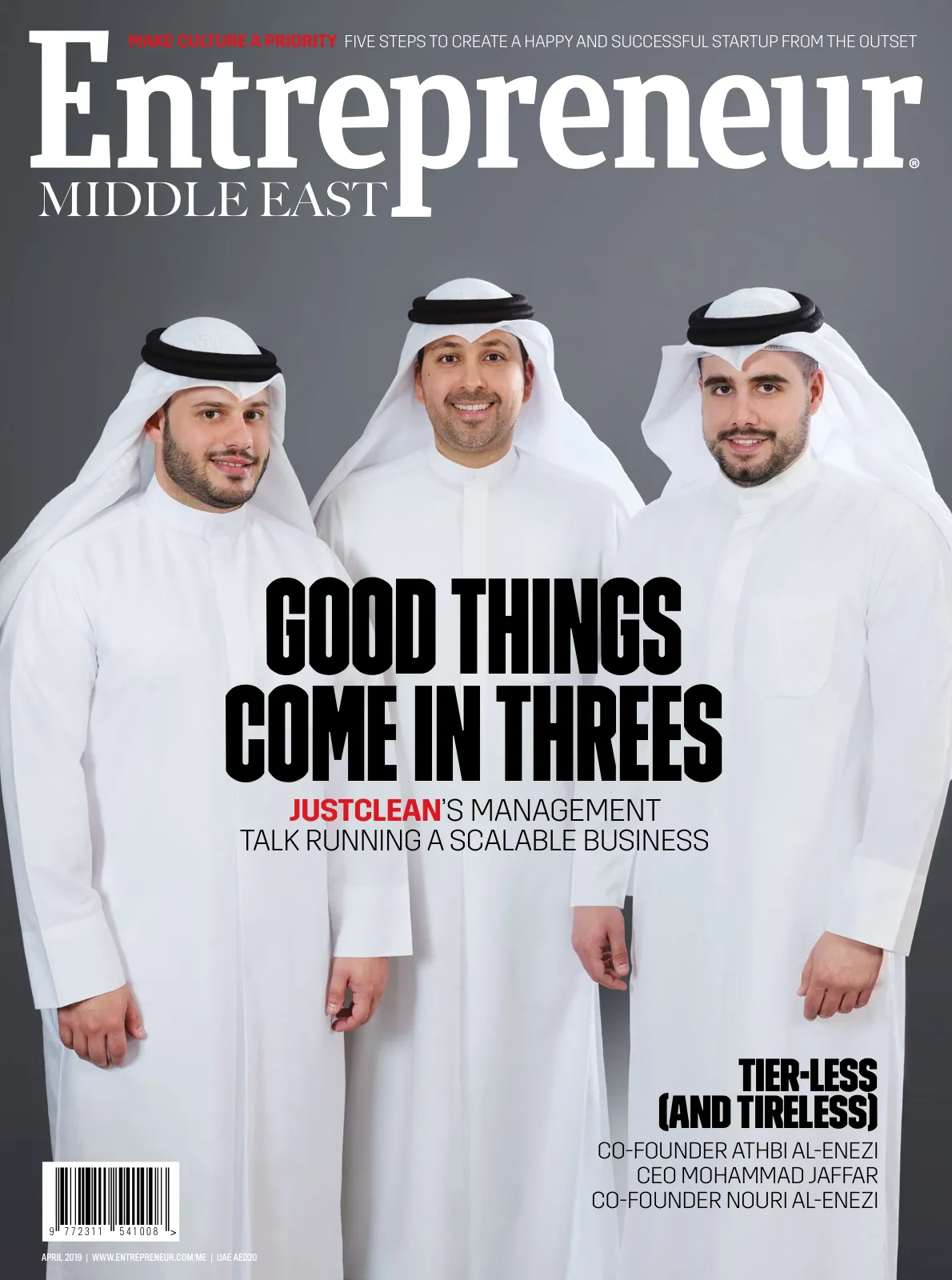
JUSTCLEAN’S MANAGEMENT
TALK RUNNING A SCALABLE BUSINESS
GOOD THINGS
COME IN THREES
CO-FOUNDER ATHBI AL-ENEZI
CEO MOHAMMAD JAFFAR
CO-FOUNDER NOURI AL-ENEZI
TIER-LESS
(AND TIRELESS)
Page 2
A brand new way to
invest in real estate!
Guaranteed 10% returns
every year for 5 years
*
Launching Nest by Arada
The Middle East’s premier
student housing complex
Walking distance from University City, Sharjah
Open to all nationalities
arada.com
800-ARADA (27232)
*T&C Apply
Page 3
3
April 2019 / ENTREPRENEUR.COM /
22
INNOVATOR:
GOOD THINGS COME
IN THREES
JustClean co-founders
Athbi Al-Enezi and
Nouri Al-Enezi, and CEO
Mohammad Jaffar talk
about running a scalable
business.
34
INNOVATOR:
COMPETITIVE ADVANTAGE
Abdulwahed Juma,
Executive Vice President
of Brand and Corporate
Communications, du,
on how the telco is
differentiating itself as
a brand in the UAE.
30
INNOVATOR
A PROGRESSIVE
PERSPECTIVE
Areije Al Shakar of Bahrain
Development Bank -who is
also the Fund Manager at
Al Waha Fund of Funds- on
how her country’s initiatives
are enabling not just its
own, but the region’s
entrepreneurial ecosystem.
60
START IT UP
ECOSYSTEM
Redefining perceptions
Amal Dokhan, Director of
Babson Global Center for
Entrepreneurial Leadership
in King Abdullah University
of Science and Technology
in Saudi Arabia, on the
Kingdom’s reception to (and
aptitude for) change.
42
CULTURE
TRAVEL
Doubling down
Basel Talal, Radisson Hotel
Group’s Regional Director
for Saudi Arabia, Kuwait,
and the Levant, on the
hospitality company building
up its presence in the
Kingdom.
46
‘TREPNOMICS
PRO
Value proposition
Massad Fares, Chairman of
Legacy Central, and Wael
El Zein, Chairman and
General Manager of Lucid
Invesetment Bank SAL,
discuss how Legacy One,
Lebanon’s first real estate
investment vehicle, turned a
crisis into an opportunity.
APRIL 2019 CONTENTS
Areije Al Shakar at
the Unbound Bahrain
held at the Bahrain
National Theatre in
March
30
80 Lucidya team
Page 4
Simplify your business
with Business Mobile Plan.
• National and international minutes
• Free calls within the company
• Devices with zero upfront
Visit du.ae/bmp
Business
Page 5
Page 6
Page 7
Page 8
COVER THE CITY
Unlocking the Power
of Digital Signage Advertising
Page 9
WITH YOUR ADS
Visit www.lifeonscreen.com
Page 10
Page 11
Call: 800 UPSALE | up.ae
*Terms and conditions apply
MOTOR CITY
Own Your Dream Home In Dubai
& Move In Today
Aed 80,000*
30 months
Post-Handover Payment Plan
50% DLD
Fee Waiver
1,2,3,4
Bedroom Apartment
Page 12
12 / ENTREPRENEUR.COM / April 2019
80
START IT UP
Q&A
Watch what they say
KSA-based startup
Lucidya wants to empower
businesses by providing
real-time analytics for their
social media platforms with
its AI-powered tools.
71
‘TREPENOMICS
SKILLSET
Driven by values
Blueground’s Amine
Housni shares five factors
needed to deliver a stand-
out, seamless, mobile-first
experience that adheres to
your business’ values.
68
‘TREPONOMICS
SKILLSET
Better together
The co-founders of Dubai-
based startup WakeCap
Hassan Albalawi and Ishita
Sood talk partnership pros.
74
START IT UP
STARTUP FINANCE
We got funded!
The stories behind the
recent fundraising wins by
MENA startups Tarjama and
Jamalon.
20
IN THE LOOP
Reinventing an industry
Plug and Play debuts travel
and hospitality accelerator
program in Abu Dhabi.
38
TECH
SHINY
#TamTalksTech
Gadgets and doodads that
you might’ve missed out on,
sourced by a tech aficionado.
Yes, it’s okay to want them
all… and no, it’s not our
fault.
60 Amal Dokhan, Director of Babson Global Center for
Entrepreneurial Leadership in KSA, talks about the Kingdom’s
reception to (and aptitude for) change.
APRIL 2019
CONTENTS
JustClean CEO
Mohammad Jaffar
with co-founders
Athbi Al-Enezi and
Nouri Al-Enezi
22
Fitbit Versa
Lite Edition
Page 13
BOOK NOW:
T: +971 4 501 5656 E: dtec@dsoa.ae W: www.dtec.ae
Dtec is expanding into Silicon Park, Dubai’s newest smart city.
Join 1000+ entrepreneurs and start your business now.
WHERE SMART ENTREPRENEURS START
BOOK NOW: 04 501 5656
dtec@dso.ae www.dtec.ae
• 24/7 access with ample parking
• Access to fundraising, acceleration & incubation programs
• Hot desk, dedicated desk and office options available
• Conference facilities & meeting rooms
• Restaurants, cafés & social areas
• Access to events, mentorship & curated list of services
• The largest startup tech community in UAE
• 10,000 sqm business centre facilities
• A one stop shop for all your entrepreneurial business needs
• Easy freezone business setup with visa processing
• Subsidized business licenses
• Plug & play facilities and high speed WiFi
Page 14
14 / ENTREPRENEUR.COM / April 2019
78 SHE CAN 2019, a conference dedicated to MENA women
entrepreneurs, hosted its third annual edition in Egypt.
APRIL 2019
CONTENTS
The launch event of
Legacy One, at the
Beirut International
Exhibition & Leisure
Center (BIEL)
46
58
CULTURE
LIFE
Riding the wave
When it comes to being
an entrepreneur, it’s you
who’s running the business,
not the other way around,
Osama Romoh writes.
55
‘TREPONOMICS
SKILLSET
Sustaining success
Dawn Metcalfe, founder
of PDSi, delves into how
culture can help your
company get ahead.
82
CULTURE
LIFE
The five-year
entrepreneurial itch
How do you keep going
when the shine has worn
off, and your passion
becomes a pain point?
54
‘TREPONOMICS
SKILLSET
Make culture a priority
Mike Cook, Chief
Marketing and
Communications Officer
at Creative Zone, lists
the five steps to create
a happy and successful
startup from the outset.
78
IN PICTURES
Sky's the limit
Egypt's SHE CAN 2019
focuses on failures
as stepping stones to
success.
40
CULTURE
TRAPPINGS
‘Trep gear
The executive selection for
the entrepreneur on your
list that has everything.
Okay, maybe for a little
self-reward as well.
Page 15
Page 16
16 / ENTREPRENEUR.COM / April 2019
SUBSCRIBE
Contact subscriptions@bncpublishing.net to receive
Entrepreneur Middle East every issue
EDITOR IN CHIEF Aby Sam Thomas editor@bncpublishing.net
CEO Wissam Younane wissam@bncpublishing.net
DIRECTOR Rabih Najm rabih@bncpublishing.net
CREATIVE LEAD Odette Kahwagi
MANAGING EDITOR Tamara Pupic
STARTUPS SECTION EDITOR Pamella de Leon
GROUP SALES DIRECTOR – B2B GROUP Joaquim D’Costa
COLUMNIST Tamara Clarke
EVENTS LIAISON Mark Anthony Monzon
PO Box 502511 Dubai, United Arab Emirates
P +971 4 4200 506 | F +971 4 4200 196
For all commercial enquiries related to Entrepreneur Middle East
contact sales@bncpublishing.net
All rights reserved 2019.
Opinions expressed are solely those of the contributors.
Entrepreneur Middle East and all subsidiary publications in the
MENA region are officially licensed exclusively to BNC Publishing
in the MENA region by Entrepreneur Media Inc.
No part of this magazine may be reproduced or transmitted in any
form or by any means without written permission of the publisher.
Printed by United Printing and Publishing
upp.ae
Images used in Entrepreneur Middle East are credited when necessary. Attributed use of
copyrighted images with permission. All images not credited otherwise Shutterstock.
Fida Chaaban
Mike Cook
Richard Dean
Amine Housni
Gautam Kumar
Megha Merani
Dawn Metcalfe
Osama Romoh
Carla Saliba
CONTRIBUTING WRITERS
entrepreneur.com/me
ACCESS FRESH CONTENT DAILY ON OUR WEBSITE!
MIDDLE EAST
EntMagazineME
@EntMagazineME
Entrepreneur-me
EntrepreneurMiddleEast
EntMagazineME
EntMagazineME
EntMagazineME
MIDDLE EAST
In addition to our print edition, we’re bringing
you all sorts of industry news on our web
mediums. Joining us online means getting
relevant business and startup content in
real-time, so you’re hearing about the latest
developments as soon as we do. We’re looking
forward to interacting with our readers on all of
our social media and web platforms- like any
thriving business, we’re looking to give and take.
#TrepTalkME is already happening on all of our
digi platforms, and all good conversations go
both ways. See you on the web!
Page 17
M E M B E R S G E T T H E B E S T R AT E S
W H E N YO U B O O K D I R E C T
radissoncollection.com
A collection of our finest hotels,
where memorable moments are made.
From Muscat to Kuwait to Riyadh.
Page 18
18 / ENTREPRENEUR.COM / April 2019
EDITOR’S NOTE
Aby Sam Thomas
Editor in Chief
@thisisaby
aby@bncpublishing.net
Someone has got to say something sooner or later
Is there a grownup in the room?
H
ow do you react to bad
behavior from people
around you? I person-
ally prefer to stay away
or simply ignore those
who choose to act in a
horrible manner, but
then again, in my line of work, I
can’t seem to avoid seeing or hear-
ing about them on a day-to-day
basis. As such, one of the things
I’ve begun to notice about these
types of people is how they all
seem to have taken on an air of
arrogant smugness in the way they
conduct themselves. They look to
be either blithely unaware (and/or)
are completely callous about their
own failings. It is both strange and
tragic that they don’t appear to be
able to see past their own inflated
sense of self. I’m particularly per-
plexed by entrepreneurs who have
this kind of an attitude, as it runs
contrary to pretty much all of the
principles that govern real suc-
cess stories in the business world.
Simultanously, I can’t help but
wonder how they get away with
acting like this- shouldn’t there be
someone around them who should
be keeping them in check?
Well, there should be- but, as
far as I can tell, there rarely is
someone like that in the proximity
of those who are behaving badly.
Maybe it’s because the ones with
the unsavory personalities are
the bosses, and therefore, nobody
dares to call them out for it. Or
perhaps it’s because they are the
top performers in the enterprise,
and so their poor behaviors are
given by a free pass by those above
them in the hierarchy. Others just
buy into the reality distortion field
perpetrated by these individuals,
and thus are dismissive of anything
that challenges that very specific
notion. Regardless of the reason
though, it seems pretty apparent
that the people who fail to act on
curbing this kind of toxic behavior
in those near them are essentially
enabling it as well. Doing this in
the context of a startup results in
the creation of a rather unpleasant
work culture. And this, when
allowed to fester, almost certainly
leads to unfavorable outcomes for
the organization at large.
So, in the work environment,
besides not condoning bad
behavior in those around you, what
can you do to make sure you are
not behaving badly? I feel like this
should start with a good honest
look at yourself, and critically
examining how people you interact
with on a regular basis respond to
your actions. Do you have someone
in your team who feels confident
and empowered enough to call
you out should you do something
wrong? How do you respond to
criticism or complaints- do you
dismiss them blindly or do you
at least give them a (real) listen?
When you feel like you’re on
morally shaky ground, is there
someone like an accountability
buddy around you who can
provide you with perspective and
direction? Take the time to find
out the answer to questions like
these for yourself.
Being self-aware can only ever do
you good.
Page 19
4 COMPETITIONS
Page 20
20 / ENTREPRENEUR.COM / April 2019
IN THE LOOP
Uber acquires Careem for US$3.1 billion
A MILESTONE FOR THE MENA
STARTUP ECOSYSTEM
Careem co-founders Magnus Olsson, Mudassir Sheikha and Abdulla Elyas
Muna Al Gurg, the only Emirati investor in
Careem, on the company's acquisition by Uber
"THE UAE HAS COME OF AGE IN TERMS
OF TECH PROWESS"
Muna Al Gurg
IMAGES COURTESY CAREEM | MUNA AL GURG
I
t’s official: Uber is
buying Careem for
US$3.1 billion. The
acquisition of the
Dubai-born Careem
by the San Francisco-
headquartered Uber is
expected to close in the first
quarter of 2020, with the
transaction consisting of $1.7
billion in convertible notes,
and $1.4 billion in cash.
The deal will see Careem
becoming a wholly owned
subsidiary of Uber, though
Careem will continue to
operate independently under
the leadership of the com-
pany's current CEO and co-
founder, Mudassir Sheikha.
“This is an important
moment for Uber, as we
continue to expand the
strength of our platform
around the world,” said Dara
Khosrowshahi, CEO, Uber, in
a statement.
“With a proven ability to
develop innovative local so-
lutions, Careem has played a
key role in shaping the future
of urban mobility across the
Middle East, becoming one of
the most successful startups
in the region,” Khosrowshahi
noted. “Working closely
with Careem’s founders, I’m
confident we will deliver
exceptional outcomes for
riders, drivers, and cities, in
this fast-moving part of the
world.”
Commenting on the acqui-
sition, Sheikha said, “Joining
forces with Uber will help us
accelerate Careem’s purpose
of simplifying and improving
the lives of people, and build-
ing an awesome organization
that inspires.”
“The mobility and broader
internet opportunity in the
region is massive and un-
tapped, and has the potential
to leapfrog our region into
the digital future,” he added.
“We could not have found
a better partner than Uber
under Dara’s leadership to
realize this opportunity.”
Uber’s buy-out of Careem is
now the largest acquisition of
a startup seen in the Middle
East so far, with the deal
amount surpassing Amazon’s
reported $580 million pur-
chase of Souq in 2017.
Careem, which was
launched in Dubai in 2012,
today operates in 120 cities
across 15 countries.
careem.com
“IT’S A BIG WAKE-UP CALL.”
That’s how Muna Al Gurg char-
acterizes the impact the US$3.1
billion acquisition of Careem by
Uber will have on the mindsets
of investors in the UAE and
the wider MENA region. As
the only Emirati shareholder
in Careem, Al Gurg, who’s the
Director of Retail at Easa Al
Gurg Group, has been hailed for
her role in enabling the creation
of the Middle East’s biggest
ever tech success story, which
is expected to inspire others in
the UAE to follow her lead in
the future.
Al Gurg, who’s known for
being an active proponent of
the MENA startup ecosystem
through her roles as Board
Member at Endeavor UAE and
Chairwoman of Young Arab
Leaders (among others), claims
to have been impressed with
the way Careem was structured
as a business from its very
beginnings. “I’ve always been a
massive supporter of Careem’s
service,” she says. “Whenever I
heard someone say, ‘Let’s call
an Uber,’ I’d quickly chime in
with a suggestion to 'go local
and use Careem instead.’”
But what about Careem made
Al Gurg want to invest in the
business? “There are many rea-
sons, but to narrow it down, it
was a mixture of a large market
size, and a proven tendency for
repeated use by customers,”
she replies. “Careem had al-
ready proven its ability to scale,
and they had the right team in
place to further grow. A lot of
hesitancy was, and continues
to be, around profitability, and
what kind of margins such
a business can make as it
matures.”
Al Gurg adds that she was
hopeful for an acquisition
when it came to the long-term
prospects of Careem. “An exit
via an acquisition was always
my base case,” she says. “Obvi-
ously, this was always going to
be dependent on the health of
the other ride-hailing startups.
During Uber’s leadership transi-
tion, I did have some concerns
about its future trajectory,
and whether it would be a
possible acquirer. When Dara
[Khosrowshahi, CEO, Uber] took
over, his background suggested
M&A was something he was
comfortable with.”
As for what Careem’s exit
means for the MENA startup
ecosystem, Al Gurg points
toward the benefits it will have
for the region as a whole. “The
impact is obvious," she says.
"It's proof that large businesses
can be built locally. Proof that
foreign companies will invest in
the region, given the right op-
portunity. With Souq and now
Careem both being acquired,
the UAE has come of age in
terms of tech prowess. Going
forward, we hope that the
trickle-down and ripple effects
from the acquisition facilitate
more innovation.”
Page 21
Page 22
22 / ENTREPRENEUR.COM / April 2019
CO-FOUNDER ATHBI AL-ENEZI | CO-FOUNDER NOURI AL-ENEZI | CEO MOHAMMAD JAFFAR
TIER-LESS (AND TIRELESS)
JUSTCLEAN’S MANAGEMENT
TALK RUNNING A SCALABLE BUSINESS
INNOVATOR
IMAGES COURTESY JUSTCLEAN
GOOD THINGS
COME IN THREES
by ABY SAM THOMAS
>>>
H
ere’s something I’ve come to realize in my
time working at Entrepreneur Middle East:
you can tell a lot about entrepreneurs by
the way they behave in a photoshoot. For
instance, the ones who make an awful
hassle about how they are snapped are
often those who have let success go to
their heads- they turn what should have been a rather
simplistic process into a painful parade of their egotistic
attitudes and whims. In stark contrast are the humbler
entrepreneurs, who are always a lot more pleasurable
to work with. It’s endearing to see them get embar-
rassed when the spotlight is on them (both literally and
figuratively), and they are very adamant about sharing
time in the limelight with partners or teams. It’s simple
why: they want the focus to be on the business they
run, and not on them per se.
It is in this latter category that I put the entrepre-
neurial trio leading the Kuwait-headquartered startup,
JustClean: in the discussion of how we’d position
co-founders (and brothers) Athbi and Nouri Al-Enezi
and CEO Mohammed Jaffar for a photograph that’d
feature all three of them, they made it clear that they
didn’t want a picture that showed any of them stand-
ing ahead of the others. The reasoning was simple: by
having themselves showcased in line with each other,
the three entrepreneurs wanted to show that they are
all equal when it comes to their work at JustClean, and
that it is their united front that makes them so impact-
ful. In this startup, no one is more important than the
other, but it’s their united front that distinguishes this
ambitious enterprise keen on making a dent in the busi-
ness realm. Now, given that we work in a region where
numbers (arguably) matter more than words, know
that these Kuwaiti innovators are aiming to solve what
they claim to be over a US$2 billion dollar problem in
the GCC- and they are setting themselves up to be the
trendsetters in this arena.
Page 23
23
April 2019 / ENTREPRENEUR.COM /
INNOVATOR
"WE EACH HAVE OUR OWN ROLE THAT
COMPLETES THE OTHERS,
AND WE ARE ALL INTEGRAL COMPONENTS IN
THE DECISION-MAKING PROCESS.”
Page 24
24 / ENTREPRENEUR.COM / April 2019
INNOVATOR
"TODAY, WE ARE A MARKETPLACE
APPLICATION PLUS WE’RE A LOGISTICS
BUSINESS AS WELL AS A SAAS (SOFTWARE
AS A SERVICE) BUSINESS. WE’RE
CURRENTLY THREE BUSINESSES IN ONE.”
JustClean CEO Mohammad Jaffar with co-founders Athbi Al-Enezi and Nouri Al-Enezi
JustClean started out with
a different name- the Al-
Enezi brothers launched
the company as Masbagti
(meaning “my laundry” in
Arabic) in 2016, billing it as
Kuwait’s first on-demand
laundry service marketplace
app. “Our journey started
with a common pain,
relatable to many- the
indefinite woes of doing
laundry,” Athbi remembers.
“When I returned to Kuwait
after being in the UK for
several years, I secured a
9-5 job where wearing a
suit to work every day was
part of the description. One
unfortunate day (or so I
thought), I was in a state of
panic because my work suits
were all at the cleaners, and
the cleaners had decided to
close on the day that I was
promised their return. So,
at 10 pm, with no suit to
wear to work the next day,
I did as any rational person
would do: I took the day off.
The subject of my leave was
titled ‘personal reasons.’
The next day, I drove to the
cleaners with my brother
in the passenger seat of my
car, and we couldn’t help
but notice the amount of
laundries that surrounded
us. Our entrepreneurial
eye kicked in, and I vividly
remember looking over at
my brother, and saying ‘Quit
your job. We are starting our
own app.’” Nouri’s response?
“I remember staring Athbi
dead in the eye, and saying,
‘We are about to start the
journey of our life.’”
And that was it- the
Al-Enezi brothers’
entrepreneurial careers
began at that moment in the
car. Once Masbagti came
into being in April 2016, it
quickly found favor with
consumers, who were only
too glad to find a faster
and more convenient way
to get their clothes picked
up, cleaned, and delivered
back to them. Laundry
service providers also came
on board the platform to
gain access to a potentially
larger customer base for
themselves. “Wherever there
is a pain, there should be
a solution to fix it,” Nouri
notes. “And what better way
to help your community
than solve an inconvenience
people may and may not be
aware of. My brother and I
knew we wanted to follow
the innovators in the market,
and lead in their steps. We
knew we were the youth of
tomorrow that could take
a risk, drop the secure 9-5,
and jump into the dynamic
startup life.” And to their
credit, the Al-Enezi brothers
moved Masbagti quite
quickly along its business
trajectory- besides working
on rapidly increasing the
number of customers as well
as the number of laundries
that were on their platform,
they also managed to get
the startup noticed in the
entrepreneurial ecosystem.
For instance, in October
2016, the company was
declared the winner in
the Startup Battle contest
at ArabNet’s inaugural
conference in Kuwait.
Page 25
25
April 2019 / ENTREPRENEUR.COM /
INNOVATOR
"WE KNEW WE
WERE THE YOUTH OF
TOMORROW THAT
COULD TAKE A RISK,
DROP THE SECURE 9-5,
AND JUMP INTO THE
DYNAMIC STARTUP LIFE.”
A JustClean team meeting
JustClean
>>>
Masbagti continued to
grow- in just a year’s time
the platform had enough
laundry partners on it to
cover the whole of Kuwait.
The co-founders were
validating their enterprise’s
business potential with, as
Athbi put it, “every closed
sale, every order that came
in, and, most importantly,
every frustrating no that
turned into a yes. We tested
our assumptions of the
market through our personal
network. We didn’t approach
any consulting companies
or conduct any formal tests;
our single validation was
the belief that success came
from the Almighty, and if we
worked hard enough, with
His blessings, we would
succeed.” It was this style
of thinking by the Al-Enezi
brothers, along with the
staggering growth they had
managed to achieve for their
enterprise, of course, that
managed to garner the at-
tention of a fellow Kuwaiti
entrepreneur: Mohammed
Jaffar. Perhaps best known in
the MENA startup ecosystem
for being the CEO of the
Kuwait-born food delivery
app Talabat.com (which he
led to its acquisition by the
Berlin-headquartered Rocket
Internet for $170 million in
2015), Jaffar had moved on
from that role to become the
Deputy Chairman and CEO
of the Kuwait-based venture
capital fund, Faith Capital.
He had been keeping an eye
on the Al-Enezi brothers and
their enterprise- and he had
an inkling that the business
was going to go places.
“When I met Athbi and
Nouri, I really liked them,
right from the first day,”
Jaffar says. “I liked their
honesty, I liked their
transparency, and I liked
the trust that they gave
me. I liked the challenge as
well- I liked the problem
they were trying to solve
with Masbagti.” As a
potential investor, in order
to understand the potential
of the business, Jaffar
engaged one of the Big Four
companies to conduct a
feasibility study for the
enterprise, and to better
understand the size of the
problem Masbagti was
aiming to solve. As it turned
out, the Al-Enezi brothers
had made inroads into what
was found to be over a $2
billion market- and given
that the laundry service
sector was almost completely
offline, Masbagti had the
unique opportunity to bring
an entire industry online.
“I shared that information
with both the founders, and I
said, ‘You know, guys, there’s
a very big problem to solve
here,’” Jaffar recalls. “And I
would love to do it with you-
to do it together with you
guys.” The proposition Jaffar
gave to the Al-Enezi brothers
was this: Faith Capital would
acquire Masbagti, and for
the first few years of the
business, Jaffar would lead
the enterprise, and in the
process, groom the Al-Enezi
brothers so that they could
take lead of it later in the
future. Of course, Jaffar’s
track record with Talabat
made him a great candidate
to take on the mantle of
CEO at Masbagti- but were
Athbi and Nouri willing
to let someone else other
than themselves to take the
lead of the startup they had
founded in the first place?
It is here that the brothers
showed what I consider to
be some exceptional wisdom
and maturity for people
within the entrepreneurial
realm- Athbi and Nouri
decided that they (and Mas-
bagti) would be better off in
the long run with Jaffar as a
guide along the way. The Al-
Enezi brothers believed that
they would be getting a lot
more than just investment if
Jaffar and Faith Capital took
over the enterprise they had
founded- and so they de-
cided to move ahead in that
particular direction.
Page 26
26 / ENTREPRENEUR.COM / April 2019
INNOVATOR
"ATHBI AND I SAW A MENTOR IN MOHAMMED JAFFAR.
WE HAD OBSERVED HIM, ALONGSIDE MANY PIONEERS IN
THE INDUSTRY, COMPLETELY REVOLUTIONIZE THE DYNAMIC
BETWEEN E-PLATFORMS AND CONSUMERS."
Athbi Al-Enezi,
co-founder, JustClean
Nouri Al-Enezi,
co-founder, JustClean
“Every startup should focus
on choosing a partner, and
not money,” Nouri says. “It
is crucial that entrepreneurs
select a mentor, and not just
someone who will finance
them. This investor should
understand the business
model, and assess specific
gaps that may be lagging the
business, or pulling it down.
Athbi and I saw a mentor in
Mohammed Jaffar. We had
observed him, alongside
many pioneers in the indus-
try, completely revolution-
ize the dynamic between
e-platforms and consumers.
Our society had shifted their
behavior from the offline
norm to online. What was
once a unicorn thought of
ordering anything online has
become a tangible reality.
His belief in advancing our
society to a more modern
and capable one that has the
ability to compete interna-
tionally on an e-level has
inspired us as entrepreneurs.
We wanted to be one of those
entrepreneurs, who took
the risk of entrepreneurship
headstrong, while maintain-
ing a firm belief of our ethics
and morals.”
“Like my brother said,
before anything, we chose
a mentor, not just an in-
vestor,” Athbi adds. “We
wanted more than monetary
assistance. We wanted
someone who carried the
beliefs that we carried, and
would empower us not only
as entrepreneurs, but in
our personal lives as well.
When you’re searching for
an investor, pursue advi-
sors who share your same
vision. You want someone
who is just as excited and
dedicated to your product as
you are. Find those advisors
who bring value- a type of
value that is intangible and
not monetary. If they share
the same value as you, the
money will follow. With
the Almighty’s plan, He
brought us together, not only
as colleagues, but as broth-
ers as well. We each have
our own role that completes
the others, and we are all
integral components in the
decision-making process.”
From his perspective, Jaffar
points toward the trust the
three of them have in each
other as the integral reason
for why they all came to-
gether to work on Masbagti-
it was a meeting of minds,
so to speak, and as such,
there was an easy alignment
of values between him and
the Al-Enezi brothers. “They
know the difference between
right and wrong,” says
Jaffar. “They’re not money-
driven… They’re very good
listeners. You know, when
it comes to entrepreneurs,
sometimes, they can become
very stubborn and they don’t
listen or they think that they
know it all. But the brothers
trust me very much; they are
very good listeners. At the
same time, from my side, I’ve
given them their space. I am
always pushing them to take
on more responsibility, and
being entrepreneurs, they
are always hungry to take
on responsibility- and they
don’t shy away from it.”
Once Faith Capital acquired
Masbagti, and Jaffar came
on board the company as its
CEO, the startup started go-
ing through a lot of changes-
maybe the most pronounced
of which was its rebranding
as JustClean, which was a
strategic decision for the
enterprise that was getting
set to grow beyond its home
base in Kuwait. But that’s
just one aspect in which
the company transformed.
“Three years ago the com-
pany had two founders only,
and their office was their
car,” Jaffar explains. “Thanks
to God, today, we are made
up of 91 employees, and we
believe by the end of this
year we will be having over
110 employees at JustClean.
We are, at the moment, in
three markets -Kuwait, Bah-
rain, and the UAE- and we
expect to be covering more
of the GCC by the end of this
year. God willing, we are
planning to enter other geo-
graphical areas in the MENA
region as well in 2020. So,
the business has grown quite
a lot in the last two years.
It’s still small, but it’s grow-
ing fast, month on month.
When we as Faith Capital
invested in the business
in 2017, the business was
a marketplace application.
Today, we are a marketplace
application, plus we’re a lo-
gistics business, as well as a
SaaS (software as a service)
business. We’re currently
three businesses in one.”
JustClean’s accelerated
growth got a further boost
in February this year when
Page 27
27
April 2019 / ENTREPRENEUR.COM /
INNOVATOR
"WE ARE, AT THE
MOMENT, IN THREE
MARKETS -KUWAIT,
BAHRAIN, AND
THE UAE- AND WE
EXPECT TO BE
COVERING MORE OF
THE GCC BY THE END
OF THIS YEAR."
Mohammad Jaffar,
CEO, JustClean
>>>
JustClean app
Faith Capital announced
it had closed a $8 million
Series A round of financing
in the startup. That round
will enable the enterprise’s
growth across the GCC
region, while also expanding
the logistics and SaaS arms
of the business. While it may
have started out with a B2C
model, JustClean has since
decided to invest in its B2B
outreach as well, by rolling
out a laundry management
solution, as well as logistical
support for the vendors in
its marketplace. This is one
of the ways in which Just-
Clean plans to distinguish
itself from the competition
it may face in this sphere as
it expands across the region.
“As JustClean, we welcome
healthy competition, as it
benefits everyone in the
market,” Athbi says. “With
that being said, Sugar Ray
Robinson once said, ‘Rhythm
is everything in boxing.
Every move you make starts
with your heart, and that’s in
rhythm, or you’re in trouble.’
When you are competing in
the market, it is better to be
the leader than the follower,
i.e. the trendsetter. This
way, you control the tides
that everyone else rides on.”
Nouri adds, “At JustClean,
we listen to our partners
and clients and move faster
than the market. We are
always quicker to respond to
changes and faster at adapt-
ing to them. We recognize
the value of our users and
partners all the same. We are
not afraid of competition; we
embrace it.”
Jaffar echoes the brothers’
sentiment when I asked him
as to what drove him to take
on an entrepreneurial role
again at JustClean, following
the success he had seen in
that space with Talabat not
too long ago. According to
him, if JustClean were able
to move the offline laundry
service industry into the
online world that would be
an achievement that would
almost certainly rival (if not
surpass as well) what he and
his team had accomplished
in the food delivery space
with Talabat. “My target now
is to do something bigger
than I did already,” he says.
“It’s just natural; it’s human
progression. You know, you
do something, and the next
time you want to do it more.”
But Jaffar makes it clear that
this is not an exercise in self-
aggrandizement either.
“I truly believe that Talabat’s
success didn’t come because
of me- it came because of
God’s blessings,” he says.
“You just have to do things
right, treat people well, and
work really well. You have to
leave the rest to the Creator.
I truly believe in all this, and
that’s what gave me the con-
fidence to start something
from scratch again. And, re-
ally, starting something from
scratch is super difficult,
super challenging,
because the risk of
failure is immensely
high. And if you fail,
people will forget
that you did Tala-
bat! So, how do you
combat the fear of
failure? By praying
to God, and working very,
very hard. God will give you
success if you do everything
right.”
This statement by Jaffar is
a testament to the integral
role his Muslim faith plays
in his personal philosophy as
an entrepreneur. Throughout
the course of our conversa-
tion, he kept referring to the
Islamic principles that he
believes in, and how apply-
ing those in his day-to-day
life had helped him attain
success in the entrepreneur-
ial realm. It’s a way of life
that he has learned from his
own family- as an example,
he pointed toward the reli-
gious ideals espoused by his
late grandfather, Mubarak
Al-Hassawi, a successful
Kuwaiti businessman in his
own right, whose biography
refers to him as “a man
ahead of his time.” “When
he passed away in 2005, he
was worth over three or four
billion dollars, and he had
thousands of people work-
ing for him,” Jaffar recalls
about his grandfather. “But
the reason why he became
successful is because he was
a very humble, religious,
kind person, and people
always wished well upon
him. And God blessed him.
So, for me, I looked up to
that, and I said to myself,
‘I will apply myself in the
business world the same way
my grandfather did.’” That,
according to Jaffar, is the
primary reason why he has
been able to find success in
the business world, and he
is eager to have the rest of
the world around him realize
this as well, which is why
he continues to espouse the
same values in his work at
JustClean as well.
“One of the things we did
at Faith Capital is that we
have taken out 10% of the
profit, and given that to the
team,” Jaffar reveals. “So, if,
in the future, God willing,
we end up achieving success,
10% of that success will go
to the team. At the same
time, we give the chance to
our team and colleagues: if
they would like to invest in
us, be shareholders, they
are allowed to. It makes
them feel that this is their
business as well; they’re
not just employees working
for a salary. We do all
these initiatives to make
people feel that this is not
Page 28
28 / ENTREPRENEUR.COM / April 2019
"WE WANTED TO BE ONE OF THOSE ENTREPRENEURS, WHO TOOK
THE RISK OF ENTREPRENEURSHIP HEADSTRONG, WHILE MAINTAINING
A FIRM BELIEF OF OUR ETHICS AND MORALS.”
INNOVATOR
Faith Capital office
Mohammed’s company, or
the brothers’ company- it’s
everybody’s company. And
again, this is part of our
Islamic values. It’s not about
belittling people, or putting
ourselves up on a pedestal-
it’s about making them feel
that they’re also part of this
equation, and give them
chances to benefit as well.”
This focus on the tenets
of Islam can be seen in the
startup’s socially responsible
initiatives as well- JustClean
has a JustGood program that
is centered on making sure
the company gives back to
the community, be it through
its sponsorship of charity
events, or collaborations
and collections to help the
underprivileged on a regular
basis. The Al-Enezi brothers
stand by Jaffar’s philosophy,
and this shows in the way
the trio work, as well as in
the policies they have put
in place at their enterprise.
“Our overall vision at Just-
Clean is to revolutionize the
laundry industry by creating
products that help all stake-
holders in the process of gar-
ment care through solutions
that address the needs and
wants of the laundries, cus-
tomers, and market at large,”
Athbi says. “In order for us
to accomplish our goals, we
invest in our most important
asset: manpower.” Nouri
adds, “When we started our
journey, we wanted to give
others the opportunity to
work in an environment that
was unbiased and humane.
We wanted to create a
culture where individuals
felt appreciated, and their
absence would be recog-
nized. An organization that
promised employees the
ability to break away from
conventional chains, be cre-
ative, and challenge them-
selves to think outside of
the box. A place where, with
mistakes, comes progression,
not judgment. By the grace of
God, we are blessed to work
alongside JustClean champi-
ons today.”
It should be rather evident
by now that as ambitious
and motivated the entre-
preneurs behind JustClean
are, they are driven by some
deeply personal values that
is centered on a purpose to
do (and enable) good through
their business. “Success for
me is to be remembered,”
Jaffar says. “How would you
be remembered when you
are no longer here? I think
about that a lot. What legacy
would I leave behind? These
are the kind of things that go
through my mind every day,
and kind of keep pushing me
forward and forward.” The
Al-Enezi brothers echo this
sentiment when I ask them
about what they hope the
next few years will look like
for JustClean. “There is no
end to JustClean, and the
potential that will arise from
it,” Athbi says. “We will,
with the blessings of the Al-
mighty, be the trendsetters.
We would like JustClean to
be live all around the GCC,
and the leader in the clean-
ing sector for users and busi-
ness owners.” Nouri feels
the same way, adding, “With
the growth of JustClean,
our plan to give back to our
communities will grow as
well. Our JustGood program
will expand to sponsor more
charities, collaborate with
more organizations, and di-
rectly help more people with
donations. The more our or-
ders increase, the more users
like you will be contributing
to a person in need.”
Page 29
Page 30
30 / ENTREPRENEUR.COM / April 2019
Amal Dokhan
The Senior Vice-President and Head of Development Services at
Bahrain Development Bank -who is also the Fund Manager at
Al Waha Fund of Funds- on how her country’s initiatives are enabling
not just its own but the region’s entrepreneurial ecosystem
by TAMARA PUPIC
AREIJE AL SHAKAR
A PROGRESSIVE
PERSPECTIVE
"BAHRAIN HAS A STRONG
ANGLE WHEN IT COMES TO
THE FINANCIAL SERVICES.
IT’S A VERY COMPETITIVE
AND CHALLENGING
ENVIRONMENT BECAUSE
YOU ARE UP AGAINST
THE INCUMBENTS AND
THE BIGGER FINANCIAL
INSTITUTIONS, BUT THERE
ARE HUGE OPPORTUNITIES
IN THAT SECTOR.”
IMAGES COURTESY AREIJE AL SHAKAR | UNBOUND BAHRAIN
INNOVATOR
Al Shakar claims that
the Al Waha aims to
help startups overcome
barriers to financing and
lack of business support
and expertise
“LOOK WHAT BAHRAIN DID-
they were able to build a pro-
gram that was ultimately able
to build the venture capital
capacity in Bahrain, and across
the region.” That’s Areije Al
Shakar, Senior Vice-President
and Head of Development
Services at Bahrain Develop-
ment Bank (BDB) and the Fund
Manager at Al Waha Fund of
Funds, imagining how people
would be talking about her
country in ten years’ time. It
sounds like an ambitious dream
for a country that is often
described as the smallest of the
GCC economies; however, in
recent years, Bahrain’s startup
ecosystem has benefitted from
a number of significant initia-
tives and reforms as part of the
country’s Economic Vision
2030 initiated by HRH Prince
Salman bin Hamad Al Khalifa,
the Crown Prince, Deputy Su-
preme Commander and Chair-
man of the Bahrain Economic
Development Board (EDB).
These include a reduction in
the minimum capital required
for starting a business, meas-
ures to enable onshore crowd-
funding in conventional and
Sharia-compliant finance, and
the introduction of a regulatory
sandbox. Nevertheless, until
last year, one important part of
this puzzle was still missing.
“One thing that we always
hear, and something that al-
ways comes up for startups, is
access to funding,” Al Shakar
tells me during our chat at
the Unbound Bahrain event at
Manama in March. “The fact
is that funding exists in the
region, but investors also need
to be encouraged to support
those opportunities. We come
from a region where the tradi-
tional asset class is investing
into things that are real estate
-things that you can touch and
feel- but with venture capital-
ists, it’s all about trust and be-
lief, and that whole belief that
technology will revolutionize
whatever industry you are in-
vesting in. Venture capitalists
also need that support, they
need the ability to breathe.
And they need partners.”
In June 2018, BDB an-
nounced that the Al Waha
Fund of Funds had success-
fully closed its US$100 million
fundraising round, making
it the first active venture
capital fund of funds in the
region. The fund’s purpose is
to provide additional capital
to innovative and technology-
driven startups in Bahrain and
across the Middle East through
venture capital funds currently
established in Bahrain as well
as by attracting new funds
to the region. “I think we are
lucky because we are small
and agile,” says Al Shakar,
responding to what armed this
small Gulf island to fight for an
asset class that many investors
Page 31
31
April 2019 / ENTREPRENEUR.COM /
>>>
"REGARDLESS OF WHETHER
YOU ARE TAPPING INTO IDENTIFYING
INNOVATION AND THE NEXT
IN-CLASS PRODUCTS OR SERVICES
THAT COULD DISRUPT YOU AS
AN ORGANIZATION OR AN INCUMBENT,
IT IS ULTIMATELY ABOUT DIVERSIFYING
YOUR INVESTMENT POOL.”
INNOVATOR
Areije Al Shakar at the Unbound Bahrain held at the Bahrain National Theatre in March
still fear. “Other countries in
the region are doing it as well,
but they are larger economies
with a lot more stakeholders,
so it might take them a little
longer. But that doesn’t mean
they aren’t doing it, because
right now, we are in discus-
sions to collaborate, as each
one of us wants to build the
region. If a company in Saudi
gets funding and wants to
expand into Bahrain, that’s a
success, regardless of whether
it’s for Saudi or for Bahrain,
it’s a success for the region. I
always say that Bahrain might
be great for one startup, but
for another startup, it might
be better to be in Saudi, and
ultimately, each person will
find what they are looking for.
What I can say about Bahrain
is that we are efficient, fast,
agile, we have talent, and, at
the same time, we have the
ease of living. Because, some-
times, when a startup comes,
it’s not about just the compa-
ny, but that they are bringing
their whole family over here.”
The fund’s limited partners
include Bahrain’s sovereign
wealth fund Mumtalakat,
National Bank of Bahrain,
Batelco Group, Tamkeen,
and Bahrain Development
Bank, which serves as the
general partner managing
the fund. “All of us came
together, put the $100 million
together, because ultimately
this is the asset class of the
future,” Al Shakar reiterates.
“Regardless of whether you
are the big guys, such as
the sovereign wealth fund,
or you are the smaller one,
like Bahrain Development
Bank, the venture world is
important. Also, regardless of
whether you are tapping into
identifying innovation and
the next in-class products or
services that could disrupt
you as an organization or an
incumbent, it is ultimately
about diversifying your
investment pool.” The idea
has been well tested– decades
before Silicon Valley became
known as home to the majority
of the world’s unicorns, the
US government had been one
of the biggest customers of
the research projects carried
by Stanford professors and
students which, eventually,
led to creating ideal economic
conditions for technology
innovation and business
growth and diversification that
Silicon Valley is known for
today. “Our fund does tap into
the emotions of the people, in
the sense that Silicon Valley
started out with the support of
the government. And another
beauty of Silicon Valley is that
they have a local talent mixed
in with foreign talent, so when
we get a question here: ‘Oh,
but how are you controlling
the competition? How are
you protecting the locals?,’ I
always say that it’s not about
that, because the best of the
best will survive in any type
of environment, but it’s about
creating opportunities [for
everyone], and about the
fact that in Bahrain, you will
always see a Bahraini working
in a team with a non-Bahraini
[and vice versa].”
The formula for this new ini-
tiative is simple: the Al Waha
Fund of Funds will distribute
financing to existing global
and regional VC funds, which
will further allocate funding to
startups. The fund has already
allocated 45% of its inaugural
$100 million to venture capital
firms, namely BECO Capital,
Middle East Venture Partners,
Wamda Capital, 500 Startups,
and European fund manager
Finch Capital, and aims to de-
ploy the remaining part within
the next couple of years. “So,
with this $100 million, we
are saying that it’s not just
us investing into a regional
venture capital fund, or funds
that have a regional angle
-although it is true that we
are ultimately trying to build
the region- but that we can do
much more for them [partners
from abroad],” Al Shakar says.
“When a venture capital firm
comes to a country, not only
do they want money (because
the truth is that there is mon-
ey everywhere), but they want
Page 32
32 / ENTREPRENEUR.COM / April 2019
INNOVATOR
"WHAT HAPPENS NEXT
IS ABOUT THE CULTURE-
THE BEST VCS WILL STAY
ALIVE AND THEY WILL
CONTINUE, AND THEY
WILL ATTRACT THE BEST
DEAL FLOW. AND THERE
WILL BE OTHER ONES
WHO WILL DIE OFF. "
Areije Al Shakar, Senior
Vice-President and Head
of Development Services at
Bahrain Development Bank
(BDB) and the Fund Manager
at Al Waha Fund of Funds
to be helped with the regis-
tration, which is the EDB, or
with creating and coordinating
their deal flow, identifying
talent, and so on. Also, we can
give them business partners.
If their portfolio companies
are looking to expand in the
region, we have the EDB to
support them straight off the
bat. It’s kind of becoming a
platform to help venture capi-
talists fund managers not only
to be able to get that fuel, but
also to scale them up and help
them succeed in building their
portfolios.”
Bahrain’s open arms position
towards startups has been
shown through many programs
of the Bahrain Development
Bank, including Rowad, a pro-
gram launched in 2015 to offer
coaching, training, mentorship,
incubation, and funding of
up to $66,000 (BHD25,000)
through its accelerator for
early-stage startups Seed Fuel.
SeedFuel currently has seven
portfolio companies of which
three have received follow on
rounds of funding with the
support from the BDB Rowad
team. Furthermore, Rowad
hosts a number of incubators,
including the Bahrain Busi-
ness Incubator Centre (BBIC),
Bahrain Women Incubator
Center (Riyadat), and the ICT
Incubator Rukn.me. Other
initiatives the country has
enacted include Flat6Labs
accelerator program, an initia-
tive of Bahrain’s employment
fund Tamkeen in partnership
with Cairo-headquartered
Flat6Labs, or a new national
bankruptcy law which was
brought in last year, and all of
them, Al Shakar says, have giv-
en results. There is no reason,
she adds, to expect the op-
posite from the Al Waha Fund
of Funds. "What we are seeing
already is that people want to
do this, meaning that fam-
ily offices are creating funds
which they are calling micro or
mini VCs to tap into this asset
class,” she says. “That didn’t
exist two years ago. Actually,
now people are quitting their
jobs and saying: ‘You know,
we want to create our own VC,
and come together as broth-
ers and sisters to ultimately
start our fund.’ What happens
next is about the culture- the
best VCs will stay alive and
they will continue, and they
will attract the best deal flow.
And there will be other ones
who will die off. That’s how I
see it.”
The capital deployed by the
Al Waha Fund of Funds will be
invested across the board, in
startups at a seed, Series A, or
Series B funding stage; how-
ever, the fund might be open
to including some later stage
investments in the future as
well. Al Shakar adds that their
primary target are MENA-
based startups, although the
VCs supported by the fund are
not prevented from explor-
ing the opportunities abroad.
“They are the experts, we are
not, but what we want them
to do for us is to build the
venture capital fund capabili-
ties here,” she explains. “They
will come and spend time here.
Some of them are setting up
offices here, and they will hire
locally. So, it’s about building
that capacity and way of think-
ing for those investments,
because traditional investing
is very different from venture
capital investing.”
At the same time, Al Shakar
is acutely aware of the criti-
cism of the region’s nascent
startup investment landscape,
Page 33
33
April 2019 / ENTREPRENEUR.COM /
"IT’S ABOUT BUILDING
THAT CAPACITY AND
WAY OF THINKING FOR
THOSE INVESTMENTS,
BECAUSE TRADITIONAL
INVESTING IS VERY
DIFFERENT FROM
VENTURE CAPITAL
INVESTING.”
THE AL WAHA FUND OF FUNDS WILL
DISTRIBUTE FINANCING TO EXISTING
GLOBAL AND REGIONAL VC FUNDS,
WHICH WILL FURTHER ALLOCATE
FUNDING TO STARTUPS.
INNOVATOR
WWW.ALWAHAFUND.COM
which local entrepreneurs
share on social media quite
often, such as the complaints
that regional investors are too
afraid to say ‘no,’ and keep on
endlessly dragging the negotia-
tions with the funds-seeking
founders, or that they are still
too risk-averse and wait for
an anchor investment before
committing funds themselves.
When asked about these is-
sues, she explains, “Yes, we
come from a culture where we
don’t want to hurt people’s
feelings, and we don’t want
to say no to your face, but
that is something that will
eventually evolve. Today, you
will find some venture capital
fund managers who will tell
you upfront: 'Sorry, this is not
what we are looking for.' And
we have to look at the positive
element coming out of that-
the people who are pitching
are actually getting feedback.
So then, the startups need to
think why the fund is not put-
ting money into them because
the ones that are really creat-
ing an opportunity will always
have investors fight over them.
Ultimately, it’s how you posi-
tion yourself.” Furthermore,
Al Shakar adds that one of the
reasons behind rejections often
is the fact that venture capital-
ists are ensuring that they
invest in ideas which they are
more knowledgeable about and
can help develop. “I respect
fund managers who say sorry,
we can’t do it,” she says. “And
it’s not because you are not a
good thing, but because I can’t
help you expand and grow to
another market, or I don’t have
the expertise, as opposed to
you getting stuck with an in-
vestor who thinks that you are
great, but then doesn’t open
any doors for you. Sometimes
that can happen. So, I think,
as much as VCs need to do
due diligence on the startup,
the startup needs to do due
diligence on that VC. There
are good startups and bad
startups, and there will always
be good investors and bad
investors.”
Although Bahrain acts as
the test bed for innovations
in all sectors, at the moment,
Al Shakar specifically advises
fintech startups to consider
setting up in the country. The
Bahrain Central Bank recently
published framework regula-
tions on a range of activities
relevant to crypto assets, cov-
ering areas from licensing and
governance to cyber security.
Furthermore, Bahrain Fintech
Bay, a public private partner-
ship platform that provides
physical space for fintech
companies which was estab-
lished last year, has already
registered 36 companies from
15 different countries. “We
have two companies which
graduated from the regula-
tory sandbox that were able
to influence the regulations,”
she explains. “In cryptocur-
rency, there are just few people
around the world doing it, but
those startups here had such
a strong impact because they
were able to speak to the head
of that department on a day-
to-day basis and build a close
relationship because the regu-
lators are also on this journey.
So, I do think that Bahrain has
a strong angle when it comes
to the financial services. It’s a
very competitive and challeng-
ing environment because you
are up against the incumbents
and the bigger financial in-
stitutions, but there are huge
opportunities in that sector.”
Al Shakar has the dreams
and ambitions of a generation
in her reach, and noting that
privilege and responsibility,
she says, “My message is that
no matter how crazy your idea
is, there are so many people
that are here, in Bahrain,
such as mentors, coaches,
and venture capitalists who
are opening their doors and
hosting office hours in Bahrain
for you to come and talk about
your idea. So, I encourage you
to explore the opportunities
that are out there, because we
will support you.”
Page 34
34 / ENTREPRENEUR.COM / April 2019
Amal Dokhan
du’s differentiating wins aren’t based on typical telco metrics
by ABY SAM THOMAS
ABDULWAHED JUMA
COMPETITIVE
ADVANTAGE
"AT DU, WE SEE OUR
SUPPORT OF STARTUPS
AS PART OF OUR
PERSONALITIES [...]
WITHIN THE SOCIETY
THAT WE ARE IN. THAT’S
OUR BRAND’S LOOK AND
FEEL, AND THAT’S HOW
WE POSITION OURSELVES
AS A BRAND."
IMAGES COURTESY DU
INNOVATOR
>>>
Juma’s comments allude to
the rather entrepreneurial
beginnings of du in the UAE- in
2007, when it launched, the
telecom landscape was, until
that point in time, dominated
by only a single player. In the
years since, du has built itself
up to become a business to
reckon with, offering every-
thing from data packages to
security solutions, (in Febru-
ary this year, the company
reported its revenue in 2018
had risen by 3.2% to $3.65
billion), and enjoying today a
rather enviable brand recall
in the UAE. But the ubiqui-
tous nature of the brand has
come with trials of its own for
Juma, who was appointed to
his role at du in 2017. “Joining
a company like du, which has
seen more than 11 years of suc-
cessful operation, is in itself a
challenge,” he says. “Because
when you join a brand that’s
not doing well, it’s easier to fix
things- no matter where you
put your hand onto, you’ll be
aiding it. But when you join
a very solid brand, a brand
that has already made it, then
it’s much more difficult to do
that, as you need to put things
in perspective.” It is thus to
Juma’s credit that during his
time at the company, du has,
through its various branding
efforts and initiatives, contin-
ued to both stick to and build
on its vision to enhance all as-
pects of their customer’s lives.
For instance, du’s award-win-
ning Post Wisely campaign was
conceptualized in response to
the digitally active lifestyles
A
bdulwahed Juma has been blessed with the gift of the gab,
and it’s something that definitely works in his favor in his
role as the Executive Vice President of Brand and Corporate
Communications at UAE telco du. Not only does he have an
extremely affable personality, Juma has a remarkable sense
of humor (the audio recording of the chat I had with him
has moments that are filled with just my uproarious laughs
at his jokes), which, when combined with his genuine interest in making
conversation, makes this Emirati executive a very easy person to talk and
relate with. As such, it should come as no surprise then that the brand he
represents espouses these values as well- it’s easy to see that du has taken
on a very humanistic approach to the way it markets itself, and Juma agrees
that that this is something that has helped the company get to where it is
today. “du, as a brand, is a success story,” he says. “It’s rare that you find a
local brand start in an overly penetrated market, and in less than 15 years,
become one of the top brands in the country, valued at US$6.45 billion.
Besides how we started, how we went about serving our customers, and
other such factors, the way we positioned ourselves, as a young, fast, funny,
and agile brand, has definitely contributed to our success.”
Page 35
35
April 2019 / ENTREPRENEUR.COM /
INNOVATOR
Abdulwahed Juma,
Executive Vice
President of Brand
and Corporate
Communications, du
Page 36
36 / ENTREPRENEUR.COM / April 2019
IF YOU AS A COMPANY
BELIEVE THAT YOU DON'T
HAVE ANY AREA OF
IMPROVEMENT, THEN
THAT'S WHERE YOU START
DECLINING AND DYING
EVENTUALLY. WE BELIEVE,
AS A PHILOSOPHY OF WORK,
THAT WE ALWAYS HAVE AN
AREA FOR IMPROVEMENT.”
INNOVATOR
A du representative
speaking to GEMS
Founders Students as
part of its Post Wisely
campaign
that people increasingly lead
today, and the company has
used its standing in the market
to impress upon consumers the
importance of maintaining a
moral compass when sharing
information online. In a similar
fashion, du’s recent Our Busi-
ness Is Trust campaign, catered
toward both large and small
enterprises in the UAE, is an
indication of how the brand
is paying attention to the cur-
rent sentiment in professional
circles, and thus making its
presence felt in the business
arena as well.
These are just two examples,
of course, but they do give an
indication of the philosophy
that governs du’s efforts in the
marketing domain- yes, the
company is, of course, keen
on driving sales for itself, but
its messaging isn’t going to
be concentrated on just that.
du is keen on being seen as a
brand that’s there for everyone
in the UAE, Juma says, and as
such, humanizing itself is an
integral part of its marketing
strategy- as an example, just
look at the youthful, respon-
sive voice that du has adopted
for its social media channels.
This strategy extends into the
events and initiatives that du
allies itself with as well- let
me acknowledge here, in the
spirit of full disclosure, that
du has been a key partner for
Entrepreneur Middle East ever
since we launched, and this
is a reflection of the company
keeping a tab on trends in the
region, wherein it noted not
just the growing popularity
of entrepreneurship here, but
also the importance of these
new companies starting up for
its own future prospects. When
I ask Juma how he goes about
explaining the return on in-
vestment (ROI) on the startup
support initiatives that du as-
sociates itself with, he replies
that a long-term perspective
is needed to understand the
reasoning for the same. “Well,
people always question the
intention of companies when
they don’t see a clear ROI,”
Juma explains. “In the case of
branding and marketing, some-
times, it’s a long-term strategy,
rather than a very short-term
strategy. At du, we see our
support of startups as part of
our personalities- it’s part of
our embedded personalities,
within the society that we are
in. That’s our brand’s look and
feel, and that’s how we posi-
tion ourselves as a brand. As
for the ROI: let’s assume that
we are supporting hundreds of
companies. Even if a small per-
centage of them make it into a
mega company, that’s our ROI.
A company that started today
with a handful of employees
can grow into a huge company
that will need data solu-
tions, security solutions, etc.
And when that happens, that
company won’t be worrying
about savings on costs when
deciding to award its con-
tracts- they will think about
the brand that was supporting
them, ever since they started,
to where they are today. That’s
a relationship that a generation
cannot break. That’s the ROI.”
At this point, I decide to ask
Juma about a very specific
communications problem faced
by people in the UAE, which is
the blockage on Skype’s use in
the country- note here that it’s
the UAE’s Telecommunications
Regulatory Authority that has
imposed this ban on Skype
and other VoIP services like it,
and as such, telcos like du are
obliged to abide by it. But, as
a company that has often de-
clared that being connected is
a basic human right, how does
du reconcile itself with the fact
that a rather popular form of
communication in the world
at large is not allowed in the
UAE? “I agree that connectiv-
ity is a basic human right, but
let's not mix connectivity with
Skype,” Juma replies. “Also,
we’ve now got alternative op-
tions with apps like C’ME and
BOTIM, which are programs
that have been licensed and
meet the minimum security
requirements that we have
to have as an operator. As
an operator, we feel we have
a responsibility to you, the
user, about your data, about
your information- of course,
now, there will be someone
out there who says that they
don’t care about this, and
they’re willing to take on the
risk, if any, of using a service
like Skype. And I’d tell him or
her, well, would you follow the
same principle if you’re going
for, say, heart surgery? Would
you let amateurs play with
your heart? It's exactly the
same metaphor. If you don't
care, somebody should care on
your behalf. In this particu-
lar case, we care about your
privacy. We care about your
information, we care about
any breach of that informa-
tion… If something were to
go wrong, the first complaint
would be to us- that we didn’t
our job right, or that we didn’t
protect you enough.” Juma
also points toward how good
connectivity actually is in the
UAE, when compared with
offerings in other countries
around the world- one cannot
deny that those of us here have
been blessed with benefits that
other nations are still strug-
gling to put into place for their
residents and citizens. At the
same time, Juma also notes
that there are reports saying
that conversations are ongo-
ing between parties to lift the
ban on services like Skype in
the UAE, and so, solving this
particular issue is indeed a
work in progress- perhaps one
just needs to wait only a little
longer for this to be resolved.
Juma’s response on the Skype
issue is indicative of du’s
openness to change, and how
it’s adapting itself to operate
in line with the demands of
the market in the UAE today.
As for the years ahead, Juma
believes that du is going to
Page 37
37
April 2019 / ENTREPRENEUR.COM /
"WHEN YOU JOIN A VERY SOLID BRAND,
A BRAND THAT HAS ALREADY MADE IT,
THEN IT’S MUCH MORE DIFFICULT TO[...]
PUT THINGS IN PERSPECTIVE.”
INNOVATOR
Abdulwahed Juma at
the 10th Globe Soccer
Awards, for which du
was a sponsor
undergo a transformation
from being a telecommunica-
tions company, to becoming a
technology company- and this
is a process that has already
begun. Consider, for instance,
du’s strategic partnership with
Smart Dubai, the government
initiative working to make the
Emirate “the world’s smartest
and happiest city.” In addi-
tion to making use of all of
the data and know-how it has
accumulated over the years,
du’s expertise in smart city
infrastructure and fostering
entrepreneurship and innova-
tion is enabling the realization
of the outcomes that Smart
Dubai has been envisioning. Be
it by using its data to predict
people’s behaviors, or by
providing knowledge that allow
sound decisions to be made,
Juma believes a paradigm
shift to be in the offing for du.
“Instead of being telco provid-
ers or telco operators, we’ll
be becoming solution provid-
ers and technology provid-
ers,” Juma says. Now, this is
certainly a forward-thinking
approach for a telco, but one
that is very characteristic of
the way du works- it’s never
been interested in following
the status quo. This particular
characteristic can be seen in
the manner du responds to
critiques and complaints on its
social channels- regardless of
how unreasonable they may be,
the replies are always polite,
and attempting to fix the
problem at hand. “We don't
believe in shutting down or
silencing the voices of people
who are complaining against
you,” Juma says. “We see this
as a feedback, no matter how
negative it is, no matter how
angry, no matter how aggres-
sive. We see it as a feedback,
and we see it as an area of im-
provement. Today, if you as a
company believe that you don't
have any area of improvement,
then that's where you start
declining and dying eventually.
We believe, as a philosophy of
work, that we always have an
area for improvement.”
According to Juma, it’s this
kind of attitude that sets du
apart as a telco in the UAE, and
when asked about his thoughts
on the competition, his humor
comes to the fore in his reply.
“Well, we look at what they
are doing… and then try not
to do it!” he laughs. On a more
serious note though, Juma says
that when it comes to compe-
tition, it’s not just the other
telco provider that du is trying
to get a leg up on. “We envision
the competition in a different
way,” he says. “We compete
with Uber. We compete with
Deliveroo. We compete with
Talabat. We’re competing with
any enterprise that gives you
a good experience, because, as
a brand that’s human-centric
and service-centric, we know
that consumers will remember
the last best experience that
they had. So, for instance, if
you’ve had a good experience
with Uber, we want it to be
comparable with the interac-
tion you have at one of our call
centers at du. So, if we want
to be the best in class, then
we need to be able to compete
with anyone who provides
you with a good experience.
We want to get a stage where
we’ll have people say, oh, this
brand’s service is not as good
as du. That’s where we see
ourselves, and that’s what we
are striving for.”
Page 38
38 / ENTREPRENEUR.COM / April 2019
GADGETS AND DOODADS THAT YOU MIGHT’VE MISSED OUT ON, SOURCED BY A TECH AFICIONADO.
YES, IT’S OKAY TO WANT THEM ALL… AND NO, IT’S NOT OUR FAULT.
RUN SMARTER
HOVR BY UNDER ARMOUR
TECH SHINY | WEBSITE TO WATCH | GEEK | MOBILE TECH | ONLINE ‘TREP | THE FIX
IMAGE CREDIT UNDER ARMOUR, APPLE, FITBIT
Under Armour UA HOVR
Under Armour
UA HOVR
Under Armour has released
five different styles of
HOVR high performance
running shoes. While each
shoe caters to a different
need from distance
training to over pronation,
they’re all outfitted with
the latest technology
from UA. The shoes are
digitally connected, with a
high-fidelity sensor in the
midsole of the right-footed
shoe that digitally connects
to the MapMyRun app via
Bluetooth Low Energy. The
sensor is low maintenance
and fully protected from the
elements, so it will last the
lifetime of the shoe without
needing a charge. This
simple, seamless connection
allows the UA HOVR shoes
to track metrics from your
run including distance,
pace, splits, cadence,
stride length, and lifetime
distance.
Page 39
39
April 2019 / ENTREPRENEUR.COM /
TECH
SHINY | WEBSITE TO WATCH | GEEK | MOBILE TECH | ONLINE ‘TREP | THE FIX
#TAMTALKSTECH Tamara Clarke, a former software development professional, is the tech and lifestyle enthusiast behind The Global Gazette, one
of the most active blogs in the Middle East. The Global Gazette has been welcomed and lauded by some of the most influential tech brands in the
region. Clarke’s goal is to inform about technology and how it supports our lifestyles. See her work both in print regional publications and online on
her blog where she discusses everything from how a new gadget improves day-to-day life to how to coordinate your smartphone accessories.
Visit theglobalgazette.com and talk to her on Twitter @TamaraClarke.
TIME FOR STYLE
APPLE WATCH HERMÈS
FIT AND FUNCTION
FITBIT VERSA LITE EDITION
Apple Watch
Hermès Series 4
Fitbit Versa
Lite Edition
The new Apple Watch
Hermès Series 4 is back
with new technology and
new color combinations
for Spring 2019: the rose
sakura joins craie and
argile, while the bleu lin is
paired with craie and bleu
du Nord. Both the 40mm
and 44mm models are
available with single and
double tour bands. Time
is displayed in a unique
new gradient style. As
the minute hand moves
forward, the color of the
screen shifts along a
gradient, which makes it
easier for you to tell the
time at a glance. The new
watch faces come with a
free watchOS 5.2 software
update. On the technical
side, Apple Watch Series 4
features the largest Apple
Watch display to date, an
electrical heart sensor,
advancements for runners
like cadence and pace
alerts, and built-in cellular
options that let you make
phone calls and send mes-
sages when you’re away
from your phone.
The Fitbit Versa Lite Edition
is designed for everyday
wear, with must-have fitness
features like automatic
activity, PurePulse 24/7
heart rate monitoring, and
sleep stages tracking. Other
attractive features include
exercise modes, GPS, four-day
battery life, and smartphone
notifications. The wearable
raises the bar for health
features with the relative
SpO2 sensor, which has the
potential to estimate changes
in blood oxygen levels to help
track conditions like sleep
apnea. Fitbit Versa Lite is
lightweight, swim-proof and
has a simple, one button
control. Versa Lite Edition
is Fitbit’s most affordable
smartwatch yet, that delivers
insights about your health and
fitness to help you live your
best life.
Page 40
THE EXECUTIVE
SELECTION
‘TREP TRIMMINGS
CULTURE
BUSINESS UNUSUAL | LIFE | TRAVEL | DESIGN | TRAPPINGS
Audemars
Piguet Code
11.59 Selfwinding
Chronograph
40 / ENTREPRENEUR.COM / April 2019
From better goods to better wardrobe bests, every issue
we choose a few items that make the approved executive
selection list. In this issue, we present our picks from
a new range of timepieces, a distinct scent for your
collection, a little something to spruce up your look, and
some leather goods worth taking a look.
DISTINCTIVE DETAIL
AUDEMARS PIGUET
At this year’s annual Salon
International de la Haute
Horlogerie watch and jewelry
show, Audemars Piguet
presented the much-awaited
Code 11.59 collection.
Embodying the Swiss luxury
watchmaker’s craftsmanship,
the timepieces in this range
feature a neo-classical style,
and a wide selection of six
in-house calibres, including
the Code 11.59 Selfwinding,
the Selfwinding Chronograph,
the Code 11.59 Perpetual
Calendar, the Selfwinding
Flying Tourbillon, the
Tourbillon Openworked,
and the Minute Repeater
Supersonnerie. All models
come in a versatile 41mm
diameter, with the collection
designed consciously to cater
to both men and women.
audemarspiguet.com
Page 41
41
April 2019 / ENTREPRENEUR.COM /
CULTURE
BUSINESS UNUSUAL | LIFE | TRAVEL | DESIGN | TRAPPINGS
EDITOR’S PICK
ASCOTS & CHAPELS
Berluti Cube Patchwork Calf
Leather Travel Bag
Mon Guerlain Eau de Toilette
Bloom of Rose
Berluti Cube Patchwork Calf
Leather Travel Bag
IMAGE CREDIT AUDEMARS PIGUET | BERLUTI | ASCOTS & CHAPELS | GUERLAIN
As bespoke tailors since 1871, Ascots &
Chapels know the way to go to spruce
up your look. Simple and versatile, these
subtle cufflinks offer an understated
way to change things up and add a
nifty detail to level up your formalwear.
ascotsandchapels.com
BLOOM BRIGHT
GUERLAIN
Created by perfumers Thierry Wasser
and Delphine Jelk, Mon Guerlain Eau
de Toilette Bloom of Rose takes in the
House’s signature components of the
Mon Guerlain line, featuring Sambac
jasmine and Carla lavender, joined by
a distinct duo- neroli and Bulgarian
rose. Fun fact: rose is part of the
Guerlinade, the olfactory signature
exclusive to the House fragrances,
making it a rightful choice for the
new Mon Guerlain creation. As for
neroli, its raw and floral scent pairs
well with the Sambac jasmine of Mon
Guerlain, and accentuates its orange
facets. Created as a floral, fresh,
and fruity scent, the Bloom of Rose
has been declared by Guerlain to be
“a composition that celebrates the
pleasure of being oneself.” guerlain.com
FORM AND FUNCTION
BERLUTI
You can’t go wrong with a brand that’s
been delivering exceptional leather goods
since 1895. Berluti’s calf leather travel bag
is just the right shape: rectangular on the
bottom, tapering up into a rounded top. It
ensures your bag is as comfortable to carry,
as well as to haul by hand. You won’t do
better for storage and simplified aesthetic
than this- whether you’re heading out for a
weekender or a quick business trip, it’s just
the thing to hold all of your essentials.
berluti.com
Page 42
42 / ENTREPRENEUR.COM / April 2019
CULTURE
BUSINESS UNUSUAL | LIFE | TRAVEL | DESIGN | TRAPPINGS
IMAGES COURTESY RADISSON HOTEL GROUP
42 / ENTREPRENEUR.COM / April 2019
DOUBLING
DOWN
Basel Talal, Radisson Hotel Group’s Regional Director
for Saudi Arabia, Kuwait, and the Levant, on the hospitality
company building up its presence in the Kingdom
Page 43
43
April 2019 / ENTREPRENEUR.COM /
“WE BELIEVE THAT SAUDI
ARABIA’S CROWN HRH
PRINCE MOHAMMED BIN
SALMAN HAS PUSHED
FORTH MANY SOCIAL
REFORMS THAT COULD
CHANGE SAUDI ARABIA ON
THE CULTURAL AND SOCIAL
LEVEL, AND ALSO DRIVE
MORE OPPORTUNITIES
IN THE FUTURE.”
CULTURE
BUSINESS UNUSUAL | LIFE | TRAVEL | DESIGN | TRAPPINGS
Nofa Resort, a Radisson Collection Hotel
Radisson Blu Hotel,
Jeddah Corniche
>>>
W
ith his
company
being one
of the first
interna-
tional hotel
groups to
expand in
Saudi Arabia, Basel Talal,
Radisson Hotel Group’s
(RHG) Regional Director for
Saudi Arabia, Kuwait, and
the Levant, believes that the
enterprise is well-positioned
to play a leading role in the
Kingdom’s plans to boost
its tourism sector- and it is
certainly leaving no stone
unturned in its efforts to do
just that. With 45 hotels and
over 10,000 rooms in opera-
tion and under development,
RHG is doubling down on
its presence in the Kingdom,
with Talal pointing out
that in the last two years,
the company has had hotel
openings under the Radisson
Blu brand in locations like Al
Khobar, Buraidah, Dhahran,
Najran, Jubail Industrial City
and Dammam. Another of its
brands, Park Inn by Radis-
son, is set to have openings
in Jeddah (RHG already has
five Radisson Blu hotels op-
erating in this city), Makkah,
and Riyadh, with the Saudi
capital also set to see a new
Radisson Blu opening in
the city’s exclusive Diplo-
matic Quarter very soon. As
should be evident by this
slew of scheduled openings,
expansion seems to be ruling
RHG’s strategy for Saudi
Arabia at the moment, and
it’s clear that Talal is looking
forward to what the future
will look like for the hospi-
tality brand in the Kingdom.
“Our growth in Saudi Arabia
is set to continue at pace,”
Talal says. “We are now de-
veloping around 20 hotels,
and we plan to introduce
more brands to the market,
such as Radisson RED, a
select service hotel brand
with a playful twist on the
conventional, and Radisson,
our new upscale brand.”
At this point, one may
wonder about the factors
that are fueling RHG’s
expansion in Saudi Arabia,
and Talal points toward the
efforts being made by the
country's government in
building up the nation as
a destination for tourism.
“The Saudi government is
investing heavily to boost
tourism, with the creation of
new demand generators, and
promotion of the destination
to new source markets,” Ta-
lal notes. “The capital city,
Riyadh, will continue to be
a key market for commerce,
where there are two mega
projects Al Qidya and King
Abdullah Financial District
scheduled for development.
The growth of hotels in the
holy cities is also set to
continue. Madina will have a
new project under the name
Knowledge Economic City,
a part of the Saudi Smart
Cities development program,
and the Al Fisliyah project
in the west of Makkah. This
is in addition to NEOM in
Al Wajh and Umluj, and
Prince Abdulaziz Bin Musa’d
Economic City in Ha’il.”
As for what is RHG’s game
plan with respect to these
projects, Talal says, “We aim
to play a leading role in the
hospitality sector that will
support these incredible
developments.”
It’s not just about the
developments in real estate
though- Talal notes that the
societal reforms that are
being spearheaded by the
government are also going
to have a massive impact on
the tourism and hospitality
sectors in Saudi Arabia. “We
believe that Saudi Arabia’s
Crown HRH Prince Moham-
med bin Salman has pushed
forth many social reforms
that could change Saudi
Arabia on the cultural and
Page 44
44 / ENTREPRENEUR.COM / April 2019
"WE ARE NOW DEVELOPING
AROUND 20 HOTELS, AND
WE PLAN TO INTRODUCE
MORE BRANDS TO THE
MARKET, SUCH AS
RADISSON RED, A SELECT
SERVICE HOTEL BRAND
WITH A PLAYFUL TWIST
ON THE CONVENTIONAL,
AND RADISSON, OUR NEW
UPSCALE BRAND.”
CULTURE
BUSINESS UNUSUAL | LIFE | TRAVEL | DESIGN | TRAPPINGS
Radisson Blu Hotel,
Jeddah Al Salam
Park Inn, Dammam
Industrial City
Basel Talal, Radisson Hotel Group's
Regional Director for Saudi Arabia,
Kuwait and the Levant
social level, and also drive
more opportunities in the
future,” he explains. “One of
the most important changes
that we witnessed in 2018
is the allowing of women in
Saudi Arabia to drive. Saudi
women are getting more
rights, which will positively
impact the hospitality sec-
tor, and we expect more
women to join the tourism
and hospitality sector in the
coming years.”
And in order to further
facilitate the entry of women
into the hospitality sector
in Saudi Arabia, Talal says
that RHG has made it a
priority to build the right
environment and culture
within the enterprise to en-
able this to happen. Perhaps
the strongest message RHG
sent out in this particular
regard was when it ap-
pointed Maram Kokandi as
the General Manager of Park
Inn by Radisson Jeddah Ma-
dinah Road- “the first Saudi
woman to ever hold this
position in the hospitality
industry,” as Talal points out
quite proudly. “We have also
appointed many women to
leadership positions in vari-
ous departments including
marketing, communications,
guest service, and human
resources,” he adds. “As an
integral part of the Group’s
efforts to develop women’s
capabilities, our Balanced
Leadership program aims to
bring diversity and integra-
tion into the Middle East la-
bor market in general, and in
Saudi Arabia in particular.”
Besides these efforts, Talal
notes that RHG is also play-
ing its part in implementing
the Saudization scheme
initiated by the government
in its workforce. “We are
delighted that we have a
very diverse workforce in
Saudi Arabia, Kuwait, and
the Levant,” Talal says. “We
have 50 different nationali-
ties working in our hotels
across Saudi Arabia, Kuwait,
Lebanon, and Libya. We
believe that people are our
company backbone. As one
of the world’s largest hotel
companies, we are always
looking for talented people
to join our team. We have a
number of initiatives that
ensure we attract and retain
the best talent from our
business schools, mentee
programs, women empower-
ment programs, and struc-
tured development plans. In
Saudi Arabia, we are very
active in finding local talent,
and promoting hospitality as
a career to Saudi nationals,
both male and female. In
October 2018, we launched
our first National Career Day
in Saudi Arabia, and held
three career days in Jeddah,
Riyadh, and Eastern prov-
ince. We were delighted to
receive over 700 CVs by tal-
ented Saudis, who are inter-
ested to work in our exciting
sector.” As for what this
signifies, combine this inter-
est seen with the expansive
agenda RHG has in place for
the Kingdom, and Talal looks
to be right in saying that the
hospitality sector is set to
flourish in Saudi Arabia- it’s
only a matter of time.
Page 45
Page 46
46 / ENTREPRENEUR.COM / April 2019
Value proposition
Massaad Fares, Chairman of Legacy Central, and Wael El Zein,
Chairman and General Manager of Lucid Investment Bank SAL,
on how Legacy One, Lebanon’s first real estate investment
vehicle, turned a crisis into an opportunity by TAMARA PUPIC
‘TREPONOMICS ETHICS | SKILLSET | MARKETING | PRO
The launch event of
Legacy One, at the Beirut
International Exhibition &
Leisure Center (BIEL)
IMAGES COURTESY LEGACYONE | WWW.LEGACYONE.CO
L
ebanon has once
again shown its un-
relenting stubborn-
ness to overcome all
these challenges,”
says Wael El Zein,
Chairman and Gen-
eral Manager of Lucid Invest-
ment Bank, talking about the
Lebanese economy’s struggles,
which include the negative ef-
fects of the outbreak of war in
neighboring Syria since 2011, a
slump in oil prices since 2014,
as well as the country’s own
governmental power vacuums,
all over the last decade. This
uncertainty has reportedly af-
fected one business sector the
most– real estate. The real es-
tate sector in Lebanon reached
its peak in 2008 when both the
country’s diaspora and foreign
buyers sought shelter from the
global financial crisis by in-
vesting in luxury second homes
in the country. However, the
events of the following decade
have caused real estate activity
to slow down, leaving many
luxury to mid-range proper-
ties to lie unsold, especially in
Beirut’s waterfront and central
district areas.
Before long, the rumors of
the real estate sector being on
the brink of collapse started
to spread. However, Massaad
Fares, Investment Committee
Member at Legacy One and
Chairman of Legacy Cen-
tral, a Beirut-based invest-
ment management company,
dismisses these as misguided
beliefs. “Currently, this sector
is going through difficult times,
which serve as a reflection of
the wider crisis Lebanon finds
itself in, but there is a sale
crisis in Lebanon which must
be differentiated from the real
estate crisis,” Fares explains.
“It’s important to note that
Lebanon has not witnessed the
phenomenon of price collapse,
and, if anything, we’ve seen
stability in the price of land.
The sale crisis is another issue,
which must be handled by
other means. In fact, we should
be proud of the Lebanese real
estate sector, and its stead-
fastness in the face of this
slowdown. Had this slowdown
occurred in any of the neigh-
boring countries and lasted for
eight years, they would have
collapsed. It highlights the
resilience of the Lebanese real
estate sector, its strength and
flexibility in adapting to the
global situation.”
Page 47
47
April 2019 / ENTREPRENEUR.COM /
"WE CAME UP WITH THE IDEA
OF CREATING AN INVESTMENT
PLATFORM THAT WOULD
INVEST IN BUYING CAREFULLY
SELECTED DISTRESSED
PROPERTIES IN GREATER
BEIRUT, IN ORDER TO SELL
THEM AT A LATER STAGE
TO LEBANON’S EXTENSIVE
DIASPORA.”
Wael El Zein, Chairman and GM of Lucid Investment Bank, during the launch event
of Legacy One under the patronage of H.E. the Prime Minister Saad Hariri
>>>
In October 2018, Fares, along
with partner and Chairman,
Namir Cortas, launched Legacy
One, often referred to as the
country’s first real estate
investment vehicle, which was
immediately endorsed by H.E.
Dr. Riad Salameh, Governor of
the Central Bank Banque du
Liban, as a means to help the
country’s real estate sector
in general, and developers in
particular. “In order to help the
sector, there was a necessity
to help developers in critical
situations, facing problems
with banks due to cumulative
loans and lack in sales, which
disrupted cashflow,” Fares
says. “And we came up with
the idea of creating an invest-
ment platform that would
invest in buying carefully
selected distressed properties
in Greater Beirut, in order to
sell them at a later stage to
Lebanon’s extensive diaspora.”
Today, Legacy One is a US$325
million real estate invest-
ment vehicle that offers $75
million in equity to Lebanese
investors and $250 million in
bonds, mainly targeted towards
Lebanese commercial banks.
The platform is one of the first
public offerings approved by
Lebanon’s Capital Markets Au-
thority (CMA) under its Series
6000 for Offers of Securities.
It is managed by Legacy Cen-
tral, and administered by Lucid
Investment Bank.
Fares explains that the Leba-
nese diaspora, especially in
North and Latin America, Eu-
rope, and the Middle East, have
always had a strong appetite
to own property in Lebanon,
but have lacked confidence in
developers and faced red tape
and insufficient after-sales
service. These are some of the
reasons why the demand in
the country’s capital Beirut
totaled 48% or 7,500 units of
what is available for sale on the
market, according to a study
done by InfoPro Research,
which also stated that the
number of units being sold has
been decreasing three years
in a row. Legacy One aims
to change that. It serves as a
one-stop shop offering buyers a
portfolio of a diversified range
of apartments, in terms of sizes
and quarters, at extremely at-
tractive prices. “The properties
acquired by the platform are
completed or nearly completed
with title deeds and/or are in
the process of acquiring the
deeds; therefore, we guarantee
peace of mind and confidence
in the products. Financial and
administrative facilities are
within our services, as well as
concierge services and after-
sales facility management.”
When it comes to the inves-
tors in the project, Fares
explains, they have been given
a unique opportunity to capi-
talize on the current stagnation
in the Lebanese real estate
market, since the Legacy One
project is expected to deliver
returns through the acquisition
and resale of developed under-
valued properties. “Real estate
investment has always been
an important component of
the portfolio of any investor,”
El Zain adds. “Recently, they
were not investing any more
in this sector, as the regional
and local situation had caused
a slowdown, especially in the
high-end apartment segment.
And Legacy One offers an
alternative investment that is
only viable in such a situation.
It is in fact a contra-real estate
investment that can only exist
in a buyers’ market. We have,
therefore, approached our
investors by highlighting these
differentiating aspects, and by
stressing on the inexistence
of the development risk, as
only finished apartments will
be acquired at very attractive
prices, and then sold through
an exhaustive and consequent
marketing machine. Finally,
the investors are swayed by the
clear profits that could be gen-
erated from this opportunity.”
On the other hand, develop-
ers and bankers consider the
bonds to be an attractive exit
opportunity. El Zain continues,
Page 48
48 / ENTREPRENEUR.COM / April 2019
‘TREPONOMICS ETHICS | SKILLSET | MARKETING | PRO
"HAD THIS SLOWDOWN
OCCURRED IN ANY OF THE
NEIGHBORING COUNTRIES
AND LASTED FOR EIGHT
YEARS, THEY WOULD HAVE
COLLAPSED. IT HIGHLIGHTS
THE RESILIENCE OF THE
LEBANESE REAL ESTATE
SECTOR."
Massaad Fares, Chairman of Legacy Central, during the launch event of Legacy One
Namir Cortas and Massaad Fares,
Chairmen, Legacy Central
“Investing wholesale in apart-
ments which developers have
been struggling to shift for
years is a great offer for them,
giving them a chance to finish
their projects, to repay their
loans, and eventually extend
their businesses by develop-
ing other projects. Banks can
also swap their exposure to
troubled project finance loans
for bonds issued by Legacy
One platform.” However, Fares
insists that Legacy One is more
than just a real estate offering
for all parties involved. “It is
an investment, an opportunity,
a legacy, a heritage, a future
income, and of course, a home,”
he says. “Opportunities come
once in a lifetime, and we be-
lieve that opportunities deliver
success. Legacy One minimizes
risks through a meticulous and
thorough due diligence process,
it also maximizes returns by
implementing creative finan-
cial reengineering, an agile
sales strategy, and an active
multi-channel marketing ap-
proach, based on a compelling
customer value proposition.”
The two partners behind
Legacy Central each bring
decades of experience in real
estate into the Legacy One pro-
ject. Fares has worked in San
Francisco, New York, Marbella,
the Gulf, and Beirut to where
he returned in 1996. He has
been at the forefront of the
Lebanese real estate industry,
working towards its increased
regulation and institutionaliza-
tion, either as the founder of
the Real Estate Syndicate of
Lebanon (REAL), or as a sup-
porter of The Real Estate De-
velopers Association - Lebanon
(REDAL) where he is the Board
Secretary. Cortas is a CPA with
a career which started in New
York with Deloitte, continued
in the UK where he worked
in finance and consultancy in
construction and real estate for
17 years. In 1997, he returned
to Lebanon and developed sev-
eral projects in Beirut Central
District. He is the President of
the Real Estate Developers As-
sociation of Lebanon (REDAL).
Similarly, El Zein started up
Lucid in 2003 in London as a
corporate finance house and
strategy advisory, offering a
one-stop shop service for high
net worth individuals (HNWI).
In 2011, it was registered
as a financial institution in
Lebanon and upgraded to an
investment bank in 2016, all
in order to contribute to the
development of the country,
he says.
El Zein explains that Lebanon
needs quick and efficient solu-
tions for the country to stabi-
lize and halt the recent decline
in overall investor confidence.
“The first such positive impact
factor was the formation of the
new national unity govern-
ment, which has clear and
achievable objectives and
projects/initiatives that, once
achieved, would offer the coun-
try an important boost,” he
says. “One of those initiatives
is the new financing schemes
in Lebanon which will be
public-private partnerships, a
major and important initiative
for the recovery of Lebanon
moving forward. It is impor-
tant not only because private
money is being channeled into
government projects, but also
since it brings much needed
governance, professionalism
and transparency into the
country.” Fares is similarly
enthusiastic about the future
of Lebanon, “Taking into ac-
count the formation of the new
government and the Cèdre pro-
ject, we are enthusiastic and
optimistic about the future.
Moreover, we are hoping that
soon the situation in the region
will improve and obviously this
will reflect on the Lebanese
economy. As for the MENA re-
gion, I have a positive outlook,
as I believe that the wars are
nearing the end, and the Arab
countries are opening up more
to the Western societies, and a
younger generation of rulers is
emerging. All this will provide
the adequate platform to do
business in the area much
more effectively.”
Page 49
A rare jewel in the rocky contours of the vast Saiq Plateau on Oman’s fabled Green Mountain,
Anantara Al Jabal Al Akhdar Resort is the highest five star luxury resort in the Middle East.
ln this extraordinary destination, the true source of adventure is revealed through Anantara’s
distinctive natural luxury and innovative Omani hospitality.
Telephone: +968 2521 8000
Email: reservations.aaja@anantara.com
Book at anantara.com
Your #MountainEscape Awaits.
VISIT ANANTARA.COM
ASIA MIDDLE EAST AFRICA EUROPE
LIFE IS A JOURNEY
Page 50
50 / ENTREPRENEUR.COM / April 2019
‘TREPONOMICS ETHICS | SKILLSET | MARKETING | PRO
Three lessons to help improve your public
speaking skills by RICHARD DEAN
[THE HOW-TO]
OWN THE STAGE
L
et’s be honest: books on public speaking are a dime a
dozen. Bookstores are bursting with the damn things. You
probably own a couple. All the evidence points to a market
that is saturated: every need met, every niche filled. Surely
the last thing the world needs is another. For a long time, I
thought so too. Then I changed my mind.
The thing that changed it was a question. I was giving
a course on public speaking when a busy executive asked me to
recommend a book -just one book- that summed up all the key
points. That’s when it dawned on me: that book doesn’t exist.
After much soul-searching, I figured out what he needed- indeed,
what every public speaker in the Middle East needs. A book that
offers three things: snappy summaries of the classic public
speaking tips; case studies of local heroes; and cheatsheets so
they can apply these ideas. I’ve spent five years researching and
writing that book. Here it is: Crowdpleaser.
Crowdpleaser summarizes, for
the first time, the 100 greatest
public speaking tips of all time.
It analyses legendary speeches
past and present –think
Martin Luther King’s I Have
a Dream and Elon Musk’s
Powerwall launch- to reveal
their secrets. It curates advice
by top coaches, from ancient
Greek philosopher Socrates
to the new communication
gurus of Silicon Valley such as
Nancy Duarte. And it shows
how discoveries in neurosci-
ence, cognitive psychology
and artificial intelligence can
transform almost anyone into
a decent talker.
These summaries solve a very
specific problem for busy ex-
ecutives, such as the guy who
asked for the book recommen-
dation in my seminar. That
problem is not a lack of good
advice on public speaking– it’s
too much good advice. All the
information you need to be a
great speaker is out there, but
it’s scattered across countless
books, blogs, seminars and
talks. There’s no way over-
worked professionals can read
them all. Crowdpleaser selects
the best of the best, and boils
each one down into an easily-
digestible, snack-sized treat.
Here’s an excerpt.
LESSON ONE
BUILD PRESENTATIONS
AROUND ONE BIG IDEA TO GIVE
THEM RAZOR-SHARP FOCUS
NANCY DUARTE | PRESENTATION
DESIGNER AND AUTHOR
Build your presentation
around one –and only one– big
idea. That’s the enduring les-
son from Silicon Valley pres-
entation guru Nancy Duarte.
“Your primary filter should
be what I call your big idea:
the one key message you must
communicate,” she says. “Eve-
rything in your presentation
should support that message.”
Page 51
51
April 2019 / ENTREPRENEUR.COM /
KEY TAKEAWAY
NO MATTER HOW
COMPLEX YOUR
PRESENTATION, BE SURE
TO WRITE DOWN YOUR
ONE BIG IDEA IN ONE
COMPLETE SENTENCE
BEFORE YOU OPEN
POWERPOINT, KEYNOTE
OR PREZI.
“A MESSAGE SHOULD BE A FULL
SENTENCE THAT’S EMOTIONALLY
CHARGED. TOPICS ARE NEUTRAL;
MESSAGES ARE CHARGED.”
‘TREPONOMICS
ETHICS | SKILLSET | MARKETING | PRO
Who is Nancy Duarte?
Nancy Duarte is Silicon Valley’s most celebrated presenta-
tion expert, having made her name creating the slideshow
for Al Gore’s climate change talks and subsequent movie An
Inconvenient Truth. She’s written several best-selling books
on presentation design, including Slide:ology and The Harvard
Business Review Guide to Persuasive Presentations.
Richard Dean is a journalist, broadcaster, and public speaker. Based
in Dubai, he’s best known as host of The Business Breakfast radio
show on Dubai Eye 103.8FM. Previously he worked for The Economist,
Reuters, Financial Times, and Bloomberg. He’s known by colleagues
as “The Three Degrees” for his BA in History; Graduate Diploma in
Economics; and MA in Mass Communication. For two years, he taught
journalism at Middlesex University Dubai. Richard’s first book, Sink or
Swim, analyzed the real estate crash that hit Dubai in the late 2000s.
Crowdpleaser is his second. Richard talks at around 50 events a year as
professional public speaker, with credits including tech giants IBM and
Facebook, banks HSBC and Emirates NBD, as well as his 2016 TEDx
Talk. A design junkie, Richard is co-founder (with his architect wife
Pallavi) of award-winning interior design firm Roar. They live in Dubai
with their two sons and two pugs.
Nancy Duarte is Silicon Val-
ley’s most celebrated presenta-
tion expert, having made her
name creating the slideshow
for Al Gore’s climate change
talks and subsequent movie
An Inconvenient Truth. She’s
written several best-selling
books on presentation design,
including Slide:ology and The
Harvard Business Review
Guide to Persuasive Presenta-
tions.
Sure, you may organize your
material into longer lists such
as “three rules” or “seven
habits.” But these should all
support just one big idea- the
North Star that guides every-
thing in your presentation.
A great example is An In-
convenient Truth by Al Gore.
Before Duarte and her team
got involved, Al Gore had been
giving presentations on cli-
mate change for years without
making much of a splash. The
Duarte slideshow changed eve-
rything, forming the backbone
of the Oscar-winning movie
that propelled Gore to the
2007 Nobel Peace Prize.
It’s a multimedia power-
house of a presentation with
more than 250 slides includ-
ing video, images, charts and
music, not to mention Gore’s
speech, which is full of person-
al stories and self-deprecating
humor. There are so many
moving parts– and they’re all
built around one big idea.
Here’s how Al Gore describes
his big idea in one sentence:
“Global warming is real, man-
made, and its effects will be
cataclysmic if we don’t act
now.” Every slide he shows,
and every word he says, sup-
ports this message.
(Remember this: your big
idea won’t necessarily be your
snappy headline. Take Al Gore:
his big idea is 17 words long,
while his movie title is just
three words. That’s OK.)
Duarte insists that this
advice is equally valid for the
kind of humdrum presenta-
tions people give to managers,
clients and staff every day,
not just world-changing Oscar
winners. When a colleague
asks you what your presenta-
tion is about, don’t reply with:
“Cost-cutting update.” That’s a
generic topic, not a big idea. Be
specific and tell them your big
idea: “The new strategy will
reduce costs by 20%, which
means bigger bonuses for
everyone.”
THREE STEPS TO ONE BIG IDEA
Duarte has a simple formula
for creating a big idea (there’s
a one-page guide on her com-
pany’s website www.duarte.
com). Here’s a summary:
> State your unique point of
view
> State what’s at stake for peo-
ple who do –or do not– adopt
your point of view
> Write these elements in a
complete sentence
Take the title of this chapter,
which I wrote using Duarte’s
formula. Let’s break it down
into the three steps.
“Build presentations around
One Big Idea…” This states the
unique point of view. It’s very
specific, and it tells you what
to do. You can agree or disa-
gree, but you know where the
speaker stands. Most people
would go with a vague, passive
topic such as: “Choosing a
subject for your presentation.”
Safe, but bland, passive, and
sitting on the fence. Always get
off the fence.
“…to give them razor-sharp
focus.” This states what’s at
stake for the audience, in this
case for people who do adopt
the point of view. This is a
positive approach focusing on
a benefit.
“Build presentations around
One Big Idea to give them
razor-sharp focus.” This takes
elements 1 and 2, and weaves
them into a complete sentence.
Finally, look at Al Gore’s big
idea from An Inconvenient
Truth. Can you spot the three
Duarte steps? “Global warm-
ing is real, man-made, and its
effects will be cataclysmic if
we don’t act now.”
Do the same for the cost-
cutting presentation. “The
new strategy will reduce costs
by 20%, which means bigger
bonuses for everyone.” >>>
Page 52
52 / ENTREPRENEUR.COM / April 2019
‘TREPONOMICS ETHICS | SKILLSET | MARKETING | PRO
Who is Carmine Gallo?
Steve Jobs wasn’t just a
great businessman and
inventor– he was one of
the great speakers of our
time. His presentations to
unveil new Apple products
were legendary. Former
CNN reporter turned
presentation coach
Carmine Gallo wrote a book
about his style called The
Presentation Secrets of
Steve Jobs; it’s one of the
best-selling books on public
speaking.
KEY TAKEAWAY
WRITE YOUR MAIN IDEA AS
ONE PUNCHY HEADLINE.
THE FEWER WORDS THE
BETTER, BUT DON’T FRET
IF IT’S NOT A SLOGAN
WORTHY OF AN EPISODE
OF MAD MEN.
STEVE JOBS IMAGE © BEN STANFIELD
Steve Jobs
LESSON TWO
WRITE A TWITTER-FRIENDLY
HEADLINE
STEVE JOBS | ENTREPRENEUR
CARMINE GALLO | AUTHOR
Boil your presentation down
to a single, snappy sentence
that would fit into a single
tweet. That’s one of the main
takeaways from the remark-
able public speaking career of
the late, great Steve Jobs, who
was the master at condens-
ing his presentations into one
catchy soundbite. However
long and complicated it may
be, anchoring it around one
punchy headline will make it
simple, clear and memorable.
Take the launch of the
iPhone in January 2007.
Jobs took to the stage at the
Moscone Convention Center in
San Francisco at 9:14 am and
finished at 11:02 am. That’s
almost two hours. But he
boiled the whole thing down
to five words: “Today Apple
reinvents the phone.”
It was the headline on the
Apple press release that day;
it was the text on the slide he
used the moment he intro-
duced the phone (at 9:44
am); it was the soundbite he
used repeatedly throughout
the day, not just in his speech
but also in TV interviews.
You can watch Jobs give this
legendary presentation on
YouTube- hearing him say
the words is a hairs-stand-
up-on-the-back-of-your-neck
moment.
Carmine Gallo, author of
the best-selling book, The
Presentation Secrets of Steve
Jobs, calls it the Twitter-
friendly headline. Gallo
defines this as “a one-sen-
tence summary that perfectly
captures the main message.”
Of course, most of us aren’t
doing anything nearly as
monumental as Steve Jobs.
Our headlines may never be
as punchy as his. But before
we give up, remember that
most of Steve Jobs’ headlines
were second- or third-rate
compared with “Today Apple
reinvents the phone.” Who
remembers “Far better at
some key task” from the iPad
launch on 27 January 2010?
Was it brilliant? No. Was it a
short, punchy one-liner that
anchored his presentation, giv-
ing focus, clarity and direction
to both speaker and audience?
Yep. Did it sell a boatload of
iPads? Hell yeah!
The point isn’t to win an
award for copywriting every
time: the point is to have clar-
ity. Writing a Twitter-friendly
headline of 140 characters or
less (about 15 words or so)
forces you to really think about
the point of your speech or
presentation. Even if it’s not
very elegant, just having it as
an anchor will make the rest of
your presentation stronger.
When I interviewed Gallo
for my radio show in 2016,
he credited three people for
the “Twitter-friendly head-
line” technique: Steve Jobs of
course, but also neuroscientist
John Medina and billionaire
investor Michael Moritz.
The neuroscientist:
Dr John Medina
Gallo recalled in our interview:
“Dr Medina told me that the
way the brain processes in-
formation, it needs to see the
big picture before the detail.
And I realized that Steve Jobs
did this brilliantly– he always
had a one-sentence summary
for every product.” (Gallo par-
ticularly likes the phrase that
launched the MacBook Air in
2008: “It’s the world’s thin-
nest notebook.”)
The billionaire:
Michael Moritz Michael
Moritz built a US$3 billion
personal fortune by being an
early investor in tech compa-
nies including Apple, Google,
and Instagram. He did it as a
partner with venture capital
firm Sequoia Capital, which
sees hundreds of pitches every
year. Gallo visited their Cali-
fornia HQ, and never forgets
this lesson: “If you walk into
Sequoia Capital today as an
entrepreneur, they will ask you
to describe your product or
service in one sentence of 10
words or less.”
Page 53
This is an excerpt from Richard Dean’s book,
Crowdpleaser: The 100 Greatest Public
Speaking Tips of All Time, from Socrates to
Steve Jobs. Published by Emerging Markets
Leadership Press, Crowdpleaser brings
together, for the first time, 100 classic tips,
tricks and hacks on the art and science
of public speaking. Spread across 362
beautifully designed pages, packed full of
illustrations, infographics, and templates,
Crowdpleaser is available in paperback at
bookstores and online priced at Dhs110
(around $30), and as an illustrated e-book.
crowdpleaser.net
‘TREPONOMICS
ETHICS | SKILLSET | MARKETING | PRO
Who is Barbara Minto?
Barbara Minto joined McK-
insey & Co. in 1963 after
graduating from Harvard
Business School. A gifted
communicator, she was
sent to London to teach
McKinsey colleagues how
to write and present clear,
concise, effective ideas.
She quit the firm in 1973
to set up her own training
company. Minto’s bestsell-
ing book The Pyramid
Principle has been through
four editions since it was
first published in 1987.
QUICK TAKES
Q&A with Richard Dean,
author, Crowdpleaser
LESSON THREE
HOW TO WRITE A KILLER
INTRODUCTION: SITUATION-
COMPLICATION-QUESTION-
ANSWER (S-C-Q-A)
BARBARA MINTO | CONSULTANT
AND AUTHOR
Minto argues that the key to
a good presentation is a killer
introduction– and offers a
step-by-step guide for crafting
one.
The trick, she says, is to
answer a question that already
exists in the mind of your
audience– either a burning
question they’re aware of, or
something nagging just below
the surface that they can’t
quite put their finger on. It’s
our job as speakers to put our
finger on it. Minto offers a clas-
sic storytelling pattern to help
us do just that. Minto created
a four-step process called Situ-
ation, Complication, Question,
and Answer. It’s best explained
with an example, so here’s
one about how a consultant
could use S-C-Q-A to prepare a
presentation for the owners of
a struggling restaurant.
Situation Begin by stating the
status quo: a non-controversial
view of the world that your
audience can relate to. (Pep-
per Pot restaurant has won
multiple awards and for years
has been the busiest, most
profitable gourmet restaurant
in town.)
Complication Something hap-
pens to upset the status quo.
(Several Michelin-starred
chefs have opened restaurants
nearby in the past year, leading
to a 30% drop in revenue for
Pepper Pot.)
Question State the burning
question this complication
poses. (What steps must Pep-
per Pot take to win back that
business?)
Answer The answer must offer
something bold and concrete
in one sentence. (Pepper Pot
must stick with its brilliant
menu that customers love– but
needs a complete overhaul of
its dated interior design.)
Once we’ve nailed the “an-
swer,” we have our introduc-
tion. The next step is to build
your entire presentation
around it.
From your perspective, why
do you think it makes sense
for people to brush up on their
public speaking skills? For
those of us who are not really
keen on a keynote on stage, do
you think they should still in-
vest in this particular skillset?
In simple financial terms, you’ll
earn more money. Warren Buffet
says MBA graduates are a US$1
million asset when they graduate.
If they take a public speaking
course, they’re immediately a
$1.5 million asset. Buffett is the
world’s third richest man, and he
says the greatest investment he
made wasn’t stocks and shares,
but a $100 Dale Carnegie public
speaking course when he was
21. He used to feel physically sick
before speaking, but the course
fixed him. Of course, learning
public speaking is about more
than just money: promoting
a worthy course, standing for
public office, teaching– there
are so many ways it can make a
difference.
Given your experience in the
media sector, what are the
biggest mistakes people make
when it comes to public speak-
ing?
1. They have a vague, wishy-
washy message. Most people
have a vague idea of what they
want to say, not razor sharp
focus. To fix this, write your
idea down in one -and only
one- snappy sentence. “Today
Apple reinvents the phone” was
the five-word message that
anchored every Steve Jobs said
at the iPhone launch. You need
your version. There are loads of
templates to help you do this in
the book.
2. Their back-up material is
abstract and theoretical. To
fix this, follow the advice of
American media trainer Brad
Phillips, who says your back-up
material should fall into three
categories: stories, statistics, and
soundbites. Especially stories.
Arm yourself with as many case
studies and real-life examples
as you can. Abstract concepts
are tough to grasp, so give an
example. That’s why I quote a
specific person -Brad Phillips- in
this answer. That's why in my
previous answer, I gave you the
Steve Jobs example.
3. They tell you that 2+2=4. This
is a crime you see repeatedly,
not just in media interviews but
in panel discussions, most of
which are truly awful. Instead,
have a bold, original point of view
that someone could disagree
with. “Update on the real estate
market” is boring. “We must
crack down on cowboy agents, or
investors will abandon this real
estate market” is bold, original
and people can disagree with it.
Who would you rather listen to?
If there's one thing you'd advise
people to do when it comes
to doing public speaking well,
what would that be?
Use the proven hints, hacks and
pro-tips of brilliant speakers and
coaches. Ever since Aristotle
published his book Rhetoric in
the fourth century BCE, experts
have been giving this advice
away either free, or for the price
of a paperback. Take it.
If I had to recommend one book
on public speaking that people
should buy right now (other
than Crowdpleaser, or course!)
it would be Slide:ology by Nancy
Duarte. Brilliant.
Page 54
54 / ENTREPRENEUR.COM / April 2019
Make culture a priority
Five steps to create a happy and successful startup from the outset
by MIKE COOK
Mike Cook is Chief Marketing and Communications Officer at Creative Zone in Dubai, UAE. Mike oversees the strategic market planning and
penetration at Creative Zone. Responsible for the development and implementation of marketing programs, he brings to the role over 20 years of
experience working and living in the Middle East. Having previously worked for several Fortune 500 companies, Mike is driven by challenge and
has seen success, in delivering unique marketing projects and driving growth in every role he has held. He graduated with a BSc degree in Product
Design and Marketing from the University of Sunderland in 2000, and has attended several Strategic Leadership programs, more recently at
Harvard Business School, Boston, Massachusetts.
‘TREPONOMICS ETHICS | SKILLSET | MARKETING | PRO
GOOD COMMUNICATION
ISN’T JUST ABOUT
MANAGEMENT. IT’S ABOUT
ALL LEVELS OF A BUSINESS,
AS WELL AS CUSTOMERS,
SUPPLIERS AND OTHER
STAKEHOLDERS.
C
reating the right
company culture
from the outset
will give your
startup more
chance of suc-
cess in the UAE.
Happy employees are 12%
more productive than the
average worker, so it pays
to have a strong company
culture from the start.
A winning culture will also
help you attract talent and
drive profits. Get it right and
employees will be clamoring
to work for you and custom-
ers will want to buy into
your culture. But to create a
happy and successful startup
from the outset, be ready to
do the following things:
1. Define your company values
What do the world’s top
startups have in common?
They’ve mastered the art of
company culture. And it all
starts with defining values.
Establishing core values
and making sure your team
upholds them from the word
“go” will help you grow your
company the way you want.
It will also provide the plat-
form to build a great team.
Be personal. Base your val-
ues around what you genu-
inely believe in. Don’t try
to copy the values of other
successful startups, whether
it’s Twitter or Airbnb. While
these companies may appear
to have similar cultures to
yours, the core values of the
founders may be quite dif-
ferent. Only you will know
what values you want your
company to stand for. Sit
down with co-founders, di-
rectors or partners and write
these values down.
Build your values into
your strategy and make sure
everyone involved in the
startup upholds these from
the outset. Typical themes to
consider include transparen-
cy, flexibility, inclusivity and
staff empowerment (as op-
posed to micro-managing).
Decide how you want to
get things done in terms
of structure and hierarchy.
This includes anything from
company policies to division
of responsibilities, perfor-
mance measurement, team
building and incentives.
Being clear and accountable
at the beginning will build
confidence in your startup.
2. Hire people who fit
Company culture boils down
to people, and the actions
they take. So, it is critical
that the people you hire
understand, and follow your
company values.
To avoid recruiting
mistakes, develop specific
hiring guidelines based on
your core values. This will
allow you to build a team
with shared common goals,
enabling people to work
together successfully.
Having a strong company
culture, or at least the values
upon which to build that cul-
ture, will help you attract the
most talented individuals.
Be clear about your values
and the culture you are de-
veloping when you interview
candidates. Check their
understanding of your values
and what they believe them
to mean. This will help you
decide which candidates are
the best fit.
3. Communicate your culture
Once you have a great team
in place, you’ll want to keep
them. At Airbnb, employees
are kept in the loop on major
company happenings and big
decisions. It sounds obvious
Page 55
55
April 2019 / ENTREPRENEUR.COM /
‘TREPONOMICS
ETHICS | SKILLSET | MARKETING | PRO
How culture can help your company get ahead by DAWN METCALFE
Sustaining success
>>>
W
e often hear about the
big deals in mergers and
acquisitions (M&A), but
the truth is that compa-
nies of all shapes and
sizes are looking for M&A opportunities
to help position themselves for growth or
deal with a looming challenge. No matter
the size though, a few things are true of
almost every M&A:
It’s really an A, not an M
Of course, there are exceptions, but,
usually, one organization ends up taking
over, i.e. their culture “wins.” It’s widely
acknowledged when speaking with busi-
ness leaders, and yet, it happens again
and again. It’s ok to acquire a company,
but when there’s a disconnect between
what you’re doing, and what you say
you’re doing, people will notice, including
your stakeholders.
Due diligence doesn’t focus on all
the right things
When preparing for an upcoming M&A,
the focus is usually external. For example:
how will doing this give us access to new
opportunities? How will this position us
better to gain market share? How will
this afford us economies of scale to keep
ahead of our competitors? The internal
focus comes after the documents are
signed, and the offices are merged. In
other words, too late.
They rarely deliver all the promise
The numbers don’t lie: very few adven-
tures into M&A deliver everything they
promised. And even fewer do so as easily
as was expected.
Here’s the secret: we know what the
problem is. And it’s not even that much of
a secret. It’s culture.
We all know culture is key. It’s key to
sustained success, and to most failures.
In fact, cultural integration was the sec-
ond most common direct factor cited for
deal failure by companies in Aon Hewitt’s
Global Survey, with eight of the top 10
factors connected to culture.
Culture is behavior. That’s it. It’s as hard
and as easy as that. And changing cul-
ture is hard, because changing behavior
is hard.
But behavior is everything. It’s an input
that leads to results. Beyond technical
skills, our behaviors are what humans
bring to the table. Just like IP, software, or
the manufacturing process, how people
behave is what distinguishes one com-
pany from another. But people are even
more important, because they use, sell,
and buy things.
So, why don’t we do it? Why don’t we
focus on culture in the way we do on
software and products? Well, it’s difficult,
isn’t it? The work involved in creating, em-
bedding, and maintaining a culture is not
fun. It involves making difficult decisions,
but it’s surprising how few compa-
nies actually do this.
Keeping employees informed gives
them a sense of ownership and
purpose in the company. This helps
drive engagement.
Good communication isn’t just
about management. It’s about all
levels of a business, as well as
customers, suppliers and other
stakeholders.
DHL was winner of the best place
to work in the UAE several years in
a row and has developed a culture
of openness and flexible working.
The company also provides access
to continuous learning and devel-
opment programs.
By winning the award, the compa-
ny has shown that it has developed
a culture it can be proud of and is
intent on communicating that cul-
ture to attract and retain talent.
4. Show appreciation
How will you show your apprecia-
tion when someone’s done a great
job? One way is to get out your
phone and Hi5 them. It’s like a real
high five for the digital age.
Hi5 is a new wave of tech compa-
nies offering novel ways to foster
company culture. The idea is to give
people “enabler tools,” so they feel
more engaged. This will enhance
performance.
As well as showing appreciation,
users can view and anonymously
rate individuals. Managers can
track the progress of employees,
and monitor goals and values across
the company via a dashboard.
Of course, you don’t need to
invest in technology to show ap-
preciation. But it certainly can
help– especially if you aim to build
a tech-savvy workforce. It can also
be a quick way to embed a fun and
inclusive working environment.
A more traditional way to show
appreciation is to offer perks. But
be creative: think about what
would really make a difference
to individual and team morale–
whether that’s free breakfasts,
exercise classes, flexible vacations,
or guest lecturers. >>>
Page 56
56 / ENTREPRENEUR.COM / April 2019
‘TREPONOMICS ETHICS | SKILLSET | MARKETING | PRO
Dawn Metcalfe is a workplace culture advisor, executive coach, author, and speaker.
She is the founder of Dubai-based PDSi, which helps individuals and teams drive
organizational and behavioral change. Dawn’s first book was Managing the Matrix;
The HardTalk Handbook is her second. Dawn speaks regularly at events and in the
media on any topic where people and business intersect. You can read more about
HardTalk at hardtalk.info, and about PDSi pds-i.com. Talk to Dawn on Twitter @DawnPDSi
REVIEW YOUR COMPANY
CULTURE ON A REGULAR BASIS.
EVALUATE HOW EFFECTIVE IT
IS AND HOW EFFECTIVE YOUR
TEAM IS IN UPHOLDING IT.
and then implementing them with a
laser focus. It can be done, but it’s drudg-
ery, and it seems most people don’t want
to do the hard work, preferring instead
to see good opportunities wasted, bad
decisions made, people disillusioned, jobs
lost, and unhappy customers.
Despite all the statistics, it’s astonish-
ingly normal to hear leaders talk about
how the cultures of the organizations
are well-aligned, and how this will facili-
tate an easier integration. To this, I ask:
“How do you know?” And the answers
are rarely reassuring.
In some ways, managing a culture is
hard- it’s time-consuming. It involves
sweating the small stuff, and making
some people unhappy. But if you’re in
a leadership position -at any level- you
have responsibilities when it comes to
culture.
1. Be clear on what you want
Spend time thinking about what you’re
trying to achieve, and then the culture
you need to make that happen. This
should not be a one-size-fits-all ap-
proach. Too many organizations say they
have the same culture- but what they
mean is they have the same cultural as-
pirations. Knowing what you really want
means you’ll have to “miss out” on the
wrong people when you hire or promote.
And be ready to say goodbye to those
who don’t see the world as you do. On the
other hand, the people who stay will sud-
denly be a lot more fun to work with.
2. Focus on specifics
Most cultures sound the same when
explained by corporate communications.
Instead of talking about vague aspira-
tions, be specific. Don’t ask somebody to
be creative; instead, set the expectation
that meetings aren’t to be held unless
they happen to answer a question; that
all attendees need to be well-briefed in
advance; that all must come with three
answers to the question asked; that
all must be prepared to take a specific
role designed to mine for conflict. Being
specific about the behaviors you will and
won’t accept helps people decide if they
belong, helps managers manage, helps
people hold each other accountable.
It also takes away anxiety. What does
“right” look like now is the question most
employees want answered- so, help
them! And the more diverse your work-
place is, the more work you’ll need to do
to ensure that everyone means the same
thing. For instance, the word “respectful”
is not terribly useful in an instruction on
behavior, but “shake hands firmly” is, and
so is “wait until your contact attempts
to shake your hand before touching his/
hers.”
3. Promote the behaviors you want
(and make the undesirable ones more
difficult)
Think about everything you can do to
achieve this. When you see an example of
what you want, celebrate success– but
keep the Chinese idiom “kill the chicken
to scare the monkey” in mind. Not liter-
ally, of course. But it’s important to have
sticks as well as carrots. And give your
people the right skills– provide them with
the opportunity to develop them through
training, coaching, and mentoring.
Although training in itself is never
enough, when it comes to developing
and maintaining culture, it needs to be
managed, constantly, because culture
touches everything, and is touched by
everything. Whether you mean them or
not, everything you do is sending signals–
particularly during periods of uncertainty,
such as in the middle of a M&A.
5. Evolve your culture as you grow
Company culture should be con-
stantly nurtured to reflect the direc-
tion you and your managers want to
take.
You will almost certainly want to
maintain certain core values, but
there are bound to be changes to the
direction you want to go in once the
company is up and running.
Review your company culture on a
regular basis. Evaluate how effective
it is and how effective your team
is in upholding it. Does the culture
need to be tweaked to reflect a
change of direction? Are you satis-
fied that all your employees uphold
your values?
Consider an annual review of your
company culture and encourage all
staff to participate. If the review re-
veals your culture isn’t as strong as
it should be, act quickly to address
the problem.
For example, is the issue poor
direction and communication or
is there an employee who doesn’t
provide the right fit? A negative
individual can soon influence other
members of a team and drive down
engagement, and may need to be
fired– however difficult that may be.
Evolving your company culture
will allow you to develop your core
values and ensure your team upholds
these values as the company grows.
Creating a great company culture
doesn’t happen overnight but you
need to be clear about your values
from day one. Once you’ve defined
them, make sure everyone upholds
them. That includes you. And of
course, be prepared to tweak them.
The most successful businesses
constantly evolve and change direc-
tion, and their company cultures
evolve too. But whatever happens,
that culture always remains at the
core of the business.
Page 57
Page 58
58 / ENTREPRENEUR.COM / April 2019
Riding the wave
When it comes to being an entrepreneur,
remember that it’s you who’s running
the business- and not the other way around
by OSAMA ROMOH
Osama Romoh is a seasoned digital marketing and advertising expert, with over 15 years of industry experience, and a businessman. An undeterred
college dropout, he is now a psychologist in the making, currently working his way to a Ph.D. at the University of Essex. If you want to learn more
from Osama, follow him on Linkedin: linkedin.com/in/osamaa. osamaa.com
CULTURE
BUSINESS UNUSUAL | LIFE | TRAVEL | DESIGN | TRAPPINGS
REMIND YOURSELF THAT A
BUSINESS IS JUST THAT, A
BUSINESS. EITHER IT PROFITS
OR IT DOES NOT. TAKE CARE
OF IT, BUT DO NOT OBSESS
OVER IT. KNOWING THAT
YOU ARE GIVING IT THE BEST
YOU COULD IS ENOUGH.
M
arch 13, 2014
was the date
I became
officially un-
employed.
I can still
vividly
remember the first feeling
I had the moment I opened
my eyes that Wednesday
morning. Freedom.
I had anticipated that day
from the time I first passed
my resignation letter. No, ac-
tually, I had wanted for that
time to come ever since the
seed of the idea to become
my own boss planted itself
in my head. I remember how
I decided to still leave the
house that morning, pos-
sibly out of habit, and went
to sit in some random café,
with the intention of doing
nothing, except brew up my
future.
Recognizing this milestone
will always feel surreal, like
trying to reminisce a mem-
ory from another lifetime.
And I have to admit that
the past half-decade has not
been kind. The years were
like a series of tidal waves
where each one was worse
than the last, and I almost
drowned.
We know this story all
too well. One comes out of
employment, sets up their
very first venture, puts all of
their heart and soul into the
business (as they should),
and gets themselves broken
when it does not work. Many
fail to compartmentalize,
and fall into the trap of
treating their brainchild
as, well, their child. Their
“baby.”
I was one of them. Having
been in the digital marketing
industry for some time, I
have dreamt of putting up
my own agency, and that’s
how Digital Lab was born.
It was the realization of me
being able to do the things I
love: impart my knowledge
by directly training people,
and earn at the same time.
The aim was simple, and
so, I assumed everything
should be easy. Yet, I com-
mitted mistakes when it
comes to entrepreneurship:
it all started when I got emo-
tionally invested.
I am known to be a very
logical person, but with
Digital Lab, I became so at-
tached that all sense went
out the window. I became
very protective of the brand,
blocking criticism, even the
well-meant ones. Just like
an overprotective parent, no
one is allowed to tell me how
I should raise my child. And
if and when someone dared
to do so, I took offense very
quickly and personally.
I also became too proud.
I pride myself for being a
perfectionist. Well, I still am,
until now. But back then was
an entirely different level of
perfectionism. The deep de-
votion I have for my business
blinded me from allowing
people to work their own
way. Yes, I micro-managed.
I felt that doing this was the
only way I can ensure the
quality of the work would be
by my standard.
There was no such thing as
teamwork. There was only
work. Work that I instructed
to be carried out, down to
the minute details.
I realized later on how un-
healthy that was, as it only
hindered everyone’s produc-
tivity, including mine, since
I had to nitpick everything,
and see to it that tasks were
done my way.
I also took too much pride
in my skills. I thought I was
knowledgeable enough to run
the entire show, what with
almost 10 years of working
experience under my belt.
I was a Director, and that
should count for something.
But this way of thinking
couldn’t be more flawed. I
wish I didn’t have to, but I
had to learn this the difficult
way.
Soon, all of this took its toll
on me and the business.
I could no longer hold my
emotions in check, and final-
ly had to swallow the bitter
truth: I had to let my baby
go, and allow someone else
to nurse it back to health.
Acceptance took a while to
come, but when it finally did,
it was exhilarating. I scru-
tinized what had happened,
where it went wrong, and
made the conscious effort to
not repeat the same errors.
First is having a certain
level of detachment. I under-
stand that finding the right
balance is no easy feat, es-
pecially when it is your very
first venture into the world
of commerce. Being partly
disengaged will allow you
to be prepared for anything,
including failure.
Page 59
59
April 2019 / ENTREPRENEUR.COM /
THE AIM WAS SIMPLE, AND
SO, I ASSUMED EVERYTHING
SHOULD BE EASY. YET,
I COMMITTED MISTAKES
WHEN IT COMES TO
ENTREPRENEURSHIP:
IT ALL STARTED WHEN I GOT
EMOTIONALLY INVESTED.
Plug and Play debuts travel and hospitality
accelerator program in Abu Dhabi
REINVENTING AN INDUSTRY
The press conference to announce Plug and Play's new travel and hospitality
accelerator program in Abu Dhabi
P
lug and Play, the Silicon
Valley headquartered
startup accelerator which
counts Dropbox and Pay-
Pal as part of its portfolio, is
partnering up with Abu Dhabi
Global Market (ADGM), Etihad
Airways, and the Abu Dhabi
Department of Culture and
Tourism for the launch of its
new travel and hospitality ac-
celerator program.
With an aim to boost the
region’s travel and hospitality
sector, the program is set to
start in the third quarter of
the year, with the first batch
of startups taking up office
at ADGM. Miral, Abu Dhabi’s
property developer behind Yas
Island, will also participate in
the program, with startups
being able to benefit from
ADNEC’s regular workshops,
private events and networking
sessions. Partners would also
be able to leverage Plug and
Play’s global ecosystem of
over 25 travel and hospitality
companies around the world.
As with other Plug and
Play’s programs, startups
would be able to join with no
equity required to be given
to the accelerator, as well as
applications from companies
of all stages from the region
and across the world are
encouraged to apply, with
opportunities to gain funding
from its in-house VC network,
build traction, gain access to
networking events and men-
torship, plus opportunities to
scale internationally from its
global network.
The launch of the program
was done at a press confer-
ence that saw the participa-
tion of Omeed Mehrinfar,
Managing Partner, Middle
East, Plug and Play, H.E. Saif
Saeed Ghobash, Undersecre-
tary, Department of Culture
& Tourism - Abu Dhabi, Peter
Baumgartner, Senior Strategic
Advisor, Etihad Aviation
Group, Dhaher bin Dhaher
Al Mheiri, CEO, Registration
Authority, ADGM, and Khalifa
Al Qubaisi, Chief Commercial
Officer, ADNEC.
Al Mheiri commented on
the program’s implications
for the region: “ADGM is
excited about the new Plug
and Play ADGM’s startup
program for the travel and
hospitality sector and looks
forward to collaborating with
the corporate partners and
startups. This new venture
dovetails with ADGM’s com-
mitment and ongoing efforts
in advancing the UAE and Abu
Dhabi’s blueprint to boost
the competitiveness and at-
tractiveness of the business
environment, particularly, in
empowering and supporting
startups and innovators from
the tourism and key industrial
sectors.”
plugandplaytechcenter.com/abu-dhabi
Remind yourself that a busi-
ness is just that, a business.
Either it profits or it does
not. Take care of it, but do
not obsess over it. Knowing
that you are giving it the best
you could is enough.
Second is to lose the
business ego. A successful
entrepreneur should be open
to evaluations. Take it all in,
the good and the bad. This
is possibly the simplest way
to know if you are doing it
right.
The third is realizing that
you cannot do everything
solely by yourself. Unless
you are omniscient, accept
that you will need help.
Up your game by acquiring
new skillsets and learning
something new, even if it
out of your comfort zone.
There will be facets of the
business that will not be to
your strengths, and you will
soon need the knowledge
or someone with the know-
how who can mobilize this
towards your business’
success.
Needless to say, you also
need to build trust. This al-
lows more room for produc-
tivity, promote growth, and
inspire confidence with the
people you work with.
Lastly, be kind to yourself.
This is probably the most
important of all.
I used to be guilty of feeling
guilty whenever I go home
early from work. And when
I mean early, it means 6 pm
in a 9-5 job. Years of being
like this made me feel so
burnt out to the point of
breaking. Being in this state
of mind is not beneficial to
entrepreneurs, as it makes
you prone to making rash
decisions which you may
regret later.
I recently felt close to
this again, and this time, I
decided to take a week-long
break to reset myself. (Not-
so) surprisingly, I found that
the business is still there,
clients are still there, and
life still goes on. Remember,
it’s you who is running
the business, and not the
business running over your
life.
The past five years has been
taxing, and now that I’ve
been thrown into the sea
of commerce, I can now
genuinely say that being
an entrepreneur is not for
the faint of heart. You need
to toughen up, so as not
to be eaten alive by bigger
fishes, or be pulled under by
challenges crashing your way.
As for me, I’ve finally
learned how to ride the
wave. Have you?
Page 60
60 / ENTREPRENEUR.COM / April 2019
Amal Dokhan, Director, Babson Global Center for Entrepreneurial
Leadership (BGCEL) in King Abdullah University of Science
and Technology in Saudi Arabia, on the Kingdom’s reception to
(and aptitude for) change by TAMARA PUPIC
Amal Dokhan
REDEFINING
PERCEPTIONS
“ENTREPRENEURSHIP
EDUCATION IS
NOW BECOMING A
COMMON THING IN
SAUDI UNIVERSITIES.
TO ADD TO THAT,
WE HAVE STARTED
PILOTS OF HAVING
ENTREPRENEURSHIP
CURRICULUMS EVEN
IN HIGH SCHOOLS.”
IMAGES COURTESY AMAL DOKHAN
START IT UP ECOSYSTEM | WHO’S GOT VC | Q&A | STARTUP FINANCE
Listing Dokhan’s current
engagements is just a tip of
the iceberg of all the projects
she has been working on that
actively contribute to Saudi
Arabia’s Vision 2030 to di-
versify its economy. When it
comes to change and innova-
tion, Dokhan says, the process
is not much different regardless
of whether it is undertaken on a
state or on a personal level, and
its first lesson is one of accept-
ance. “For me to become more
innovative, I need to unlearn
and retrain myself to accept
the new, and to see a different
path,” she says. “I come from a
very traditional upbringing and
conservative schools, but with
time, I have learnt how to throw
myself from one fear to another.
The trick is not to kill your
fears. Everybody is trying to
fight fears, but I say that fears
are good, because if you are not
afraid, you don’t have that en-
gine inside. And after fear, there
is always a reward.”
Dokhan was educated in Saudi
Arabia and the UAE where she
earned a master’s degree in
strategic marketing from the
University of Wollongong, but
that was just the beginning. She
went on to become a certified
trainer in design innovation
and change management by the
World Bank, and also earn an
executive certificate in design
thinking from the D-School at
Stanford University, as well as
certificates on entrepreneurship
and innovation from the MIT
Sloan School of Management.
To this day, her commitment to
A
mal Dokhan looks
to be a rather busy
woman these
days- she can
be found either
devising a strategy
for the Babson
Global Center for
Entrepreneurial
Leadership
(BGCEL) in King
Abdullah University of Science and
Technology (KAUST) in her role as its
Director, or teaching an experiential
class on company creation at Prince
Mohammed Bin Salman College where
she is the Director of VentureLab,
or delivering trainings in Arabic
and working on programs aligned
with Saudi Arabia’s culture with the
World Bank team that she has been
consulting with over the past few
months. In addition to all that, she’s also
teaching organizational and corporate
innovation programs in countries like
the USA, Canada, South Africa, Lebanon,
and the UAE, while also making her
presence felt as a speaker at events
around the globe- and all of what she
does has made her a very prolific
woman hailing from Saudi Arabia.
“Sometimes, you do see a surprise in
people’s eyes [when seeing a Saudi
woman expert and entrepreneur], but
also the happiness and the support,
‘Way to go, girl, keep it up,’ but I always
say that there are many women in
Saudi like me,” Dokhan says. “It’s just
that social norms are sometimes
making women feel that they should
not be visible. However, I think that
Saudi women and all Arab women
should be making themselves more
visible today, in order to set an example
for the upcoming generations, showing
them that being a working woman is
okay, that it actually means presenting
yourself in the best way possible.”
Page 61
61
April 2019 / ENTREPRENEUR.COM /
>>>
"SAUDI WOMEN AND ALL ARAB
WOMEN SHOULD BE MAKING
THEMSELVES MORE VISIBLE TODAY, IN
ORDER TO SET AN EXAMPLE FOR THE
UPCOMING GENERATIONS, SHOWING
THEM THAT BEING A WORKING
WOMAN IS OKAY, THAT IT ACTUALLY
MEANS PRESENTING YOURSELF IN
THE BEST WAY POSSIBLE.”
Amal Dokhan speaking at Startup Istanbul
self-improvement has remained
a constant. “I could easily say
that every year, I train 2,000 to
3,000 startups, not just people,
and I also do a lot of trainings
in companies and universities,
and I think that momentum of
keeping all this going has defi-
nitely sharpened my skills,” she
says. “It allows you to be able
to deal with multiple people in
different ways, and it gives you
that international vision to be
able to see things from different
perspectives. Not many people
have that, and maybe I pushed
myself a lot, but I certainly have
no regrets today.”
In 2016, Saudi Arabia an-
nounced its ambitious reform
plan -Vision 2030- to develop
a diversified economy with an
emphasis on innovation and
entrepreneurship. One of Vi-
sion 2030’s goals is to increase
women’s participation in the
workforce from 22% to 30%,
and against this backdrop,
Dokhan advises women to
overcome the remaining inter-
nal obstacles as well, such as
striving for perfection. “Women
struggle with wanting to be per-
fect, and if we are not perfect,
we don’t want to be seen, and
that is what I focus on when
working with women,” she says.
“You don’t need to be perfect,
just be good at what you do,
and give yourself a chance to
step out from where you are.
Women need that internal
confidence and peace inside to
feel that we do have an impact.
It is because women are so
precise about the type of impact
they want to make, they want
to make sure that everyone will
benefit, and they don’t want to
make mistakes, but they should
realize that even though they
are not perfect, they are already
having that impact.”
When Vision 2030 was an-
nounced, Dokhan was part of
the Entrepreneurship Center
at King Abdullah University of
Science and Technology where
she had multiple roles, includ-
ing managing the university’s
TAQADAM startup accelerator,
and co-designing and teaching
a course on entrepreneurship
and technology innovation to
master’s and post-doctoral
students. However, that was not
the beginning of her work on
building a culture of entrepre-
neurship in the Kingdom– her
career has also included stints
at the KAUST’s Seed Funding
Department and, prior to that,
at the MIT Enterprise Forum
(MITEF) Pan Arab, where
she continues to contribute.
“When we started, it was more
about how we can guide these
researchers and scientists into
a more entrepreneurial area, to
make them think of research on
a more commercialized base,”
Dokhan says. “We used to visit
universities and talk with them
about different possibilities,
such as what one can do with
an idea, what innovation and
entrepreneurship meant, and to
showcase success stories. So,
when we first started, it was all
about inspiring people to think
in this direction.”
An important part of Saudi
Arabia’s Vision 2030 is a re-
form of the country’s education
system, with various initiatives
aimed at encouraging stu-
dents to achieve above average
performance and increase their
chances for future employment.
Saudi Arabia boasts of a youth
Page 62
62 / ENTREPRENEUR.COM / April 2019
"ONCE THE GOVERNMENT HAS STARTED INJECTING
MONEY AND SUPPORTING ALL THESE INITIATIVES,
PEOPLE HAVE STARTED INTERNALIZING THE IDEA
OF ENTREPRENEURSHIP."
Amal Dokhan, Director,
Babson Global Center
for Entrepreneurial
Leadership (BGCEL) in
King Abdullah University
of Science and Technology
in Saudi Arabia
START IT UP ECOSYSTEM | WHO’S GOT VC | Q&A | STARTUP FINANCE
population of 60% to 75%,
among whom the unemploy-
ment rate is very high. One
solution to this is in Dokhan’s
domain- entrepreneurship. “A
few years ago, the Kingdom’s
education on entrepreneur-
ship itself was still early on,
and most local businessmen
were considered that some-
how naturally -they had family
businesses they would simply
continue- but working on a
new idea that would disrupt an
existing system and market was
not something that was so com-
mon,” she says. “Before that, all
these [new startup] ideas were
coming from outside. However,
today, being an entrepreneur is
something people aspire to be.
Even when I recruit, companies
ask me whether a candidate has
had a venture before. That’s a
change in the mindset, and it’s
a complete shift. So, once the
government has started inject-
ing money and supporting all
these initiatives, people have
started internalizing the idea
of entrepreneurship. Therefore,
entrepreneurship education is
now becoming a common thing
in Saudi universities. To add to
that, we have started pilots of
having entrepreneurship cur-
riculums even in high schools.”
The topic of being open to
change, she says, leads our con-
versation back to the country’s
young population, for whom
Dokhan advises a careful ap-
proach when choosing one’s ca-
reer path. “One of the definitely
interesting things that people
look into today is whether
entrepreneurship is better than
a regular career choice,” she
says. “We get that question a
lot. I always say that transition
is the best thing. Not even the
best entrepreneurs in the world
have taken 100% risk, so there
should be a gradual thinking
about the testing, the prototyp-
ing, the networking for that
idea that you have, in order to
see where it takes you before
you actually make that jump. I
would say that one of the inter-
esting things is that, when we
now go to high schools, students
speak about entrepreneurship
as if they were born like that.
As much as it is interesting
and funny, at the same time, it
shows that they are looking at
this as a natural phenomenon.
It’s no longer foreign to them, as
it was seven or eight years ago.”
Following in the government’s
footsteps, the funding for Saudi
startups from both public and
private sources has increased-
MAGNiTT reports that the dis-
closed funding for KSA-founded
startups rose from US$18.8
million in 2016 to $39.8 million
in 2017. “There are also a lot
of companies today saying that
they are using Saudi startups
rather than getting the ones
from abroad,” Dokhan adds.
“That is also a shift that, today,
a Saudi startup is given more
of a privilege. Even in the
government betting, they are
enabling them for local startups
more than before. It gives those
startups more hope, especially
to those in the B2B business.
And we want to see more B2B
deals with startups, because we
constantly need to teach them
[B2B startup founders] that be-
ing in B2B means that it might
take a longer time before the
money gets into their pockets.
For that reason, they have to
learn how to diversify into other
product lines which should help
them survive those long periods
of time.”
However, corporations,
Dokhan says, are still risk-
averse. “They still want to
take things slowly,” she notes.
“When it comes to corporates
supporting startups, it is still
not common, but if there is
a benefit they will get out of
that startup, they are willing
to give it a little bit of support
at the beginning, a deal or two
to try them out.” One solution
to this is making corporations
themselves more innovative
and inclusive of startup and
SME ideas, which is also one of
the key objectives of the Vision
2030- raising the level of SMEs’
current contribution of 20% of
GDP to 35% by 2030. However,
instilling a culture of innova-
tion in bigger companies is not
without setbacks. “In a corpo-
rate innovation setup, you have
to consider many elements,
including the stakeholders,
the customers, and so on, and
there’s much more at stake than
when we talk with a startup of
just two co-founders,” Dokhan
says. “So, then, what we do is
talk about the culture. It takes a
longer time within a corporate
that has been in business for 80
or 100 years; it actually takes us
between a year and a year and
a half to make those necessary
steps to turn that business into
a more innovative venture.”
In the long run, Dokhan sees
Saudi Arabia as an innovation-
enhancing country. “What used
to be a difficulty before is now
accessibility,” she says. “It was
never a not attractive market,
but the fact that people could
not access it was a difficulty.
Today, there is an encourage-
ment for bringing startups in,
getting funding for non-Saudi
startups, plus the ease of doing
business is attracting more
people.” However, she ends
our chat by inviting her fellow
citizens to seize the opportuni-
ties in front of them. “When
it comes to the capabilities
of people, we don’t lack that,
because we do have many young
people who are really knowl-
edgeable in certain areas, and
the fact is that no one will solve
our problems better than us,”
Dokhan says. “All these interna-
tional companies that came had
to adjust and bring local teams
on board, in order to see how
to serve our market. I get many
questions about how to navigate
the Saudi market, so the fact
that people are attracted to
come here is an indicator for
the people inside that there is
a lot we can do today. With all
the social, cultural, economic
changes that are happening, we
should enable our people to see
all these opportunities more
clearly, because we are inside
this cycle, and we often can’t
see.”
Page 63
THE VOICE OF ENTREPRENEURSHIP AROUND THE WORLD
Page 64
64 / ENTREPRENEUR.COM / April 2019
An eye for growth
ASA Ventures founder and CEO Arif Saiyad wants to empower
entrepreneurs to solve real problems by PAMELLA DE LEON
Arif Saiyad,
founder and CEO,
ASA Ventures
MONEY ASK THE MONEY GUY | VC VIEWPOINT | YOUR MONEY | ECON
"THE WHOLE POINT
OF INVESTING IN
TECHNOLOGY IS TO MAKE
LIVES BETTER NOW, AND
IN THE LONG RUN.”
D
escribing itself
as a “VC 2.0
working on a
hybrid model of
venture capital,
private equity,
incubators, and
accelerators,”
Dubai-based venture capital
firm ASA Ventures is striving
to boost the entrepreneurial
ecosystem in Dubai and
(hopefully soon) across the
Middle East as well. Estab-
lished in 2003 in Portugal,
ASA Ventures believes in
adding value through mon-
etary capital and operational
support. Operating in seven
countries with expansions
planned into five more, the
hybrid venture capital firm
boasts 30 portfolio companies
compromising of B2B and
B2C companies in various
industries, ranging from
customer satisfaction and
business optimization, and all
the way to retail and modest
fashion. The venture capital
firm currently has US$80+
million current assets under
management, with 15 success-
ful success exits in Portugal,
UK and the UAE.
Leading the firm is Arif
Saiyad, founder and CEO,
whose operational expertise
lies in machine learning, AI,
web engineering and software
development, with wide
experience in e-commerce,
marketing and business
analytics. Saiyad got into the
entrepreneurial foray as an
engineering student in Insti-
tuto Superior de Engenharia
de Lisboa (ISEL), Lisbon:
“I’m a software engineer by
trade, and I was an intern at
Microsoft, yet I’ve always had
an entrepreneurial mindset.”
Saiyad’s thirst for entrepre-
neurship drove the founder
to start his own web develop-
ment company, which proved
to be a successful venture as
Saiyad proudly states how
it became the third largest
web development company,
in terms of its sales in the
Lisbon market. It became
Saiyad’s first lucrative exit,
enabling him and ASA Ven-
tures to start investing in oth-
er businesses. It was followed
with a steady growth: from
creating its own version of
loyalty cards in Portugal with
the Cartao Pontos in 2007, to
acquiring 20% of Netanswers
in 2008, establishing interior
and design services Lahnu
Tchrass in 2009, followed by
acquiring shares for Xroomz
and starting Central de Ser-
vicos, a portal to enable users
to search for search for B2B
and B2C services in 2010.
A significant point for the
firm was in 2013 when ASA
Ventures officially moved its
headquarters to Dubai, UAE,
with its team and strategic
partners, who provided in-
sights to local conditions, af-
ter noticing the city's startup
scene. It was also when it
seed funded (and eventually
operated) mobileshop.ae. It
was a time, Saiyad comments,
when they were only a few
players in the e-commerce
scene, and brick and mortar
stores still had the reigning
upper hand. With customer
service and logistics being un-
satisfactory, there was also a
need for better prices- which
Saiyad’s online venture solved
by ensuring to offer the low-
est prices and best after-sales
customer relationship. “It's a
no-brainer: keep the customer
happy and your business will
thrive, and that’s exactly what
we did.” With this perspec-
tive, it’s no surprise that
Saiyad’s initial investment of
$30,000 turned to $3 mil-
lion. Another crucial venture
was starting Callix in 2017, a
call center service company
with a specific focus on SMEs,
which, in 2018, expanded to
Pakistan. When asked about
how he goes about deciding
on the ventures he wants to
be associated with, Saiyad re-
marks on his affinity for being
an enabler: “I’ve always been
interested in turning ideas
into reality. If it’s something
that will make things easier
and faster, then I’m on it. I
want to contribute to creating
a world where my fellow en-
trepreneurs are empowered to
help solve real life problems.”
Page 65
65
April 2019 / ENTREPRENEUR.COM /
ASA Ventures founder and CEO Arif Saiyad at GITEX Future Stars 2018
“IF YOU COME TO AN INVESTOR FOR
FUNDING, YOU HAVE TO BE TRANSPARENT
ABOUT WHERE IT’S GOING.”
ASA Ventures team
>>>
Statistics according to the
2011 Startup Genome Report
note that about 90% of
startups fail, and majority of
that, contrary to what some
may think, is not because of
the lack of funding. Saiyad
set out to lead ASA Ventures
with the purpose of tak-
ing a holistic approach to
investing, and thus “create
a positive impact by ensur-
ing startups succeed with
support from an operating
partner.” He adds, “I realized
there is a specific need for
a VC 2.0- one that will go
beyond being a financial life-
line, to an entity that is your
default business partner.” As
someone who’s been on both
sides of the table, as an entre-
preneur and investor, Saiyad
asserts how it has given him
enough experience to discern
essential “moving parts” that
are needed to drive ideas
forward when assessing deals
for ASA Ventures. “In the last
15 years, we’ve been building
our portfolio in a manner that
will enable us to support en-
trepreneurs and take them to
the next level through our in-
house synergies.” So, is there
such a thing as a “bad VC”?
Saiyad doesn’t believe so, and
notes how everyone has their
own niche and individual
“investment philosophies”
that collectively contribute to
the ecosystem. That’s not to
say ASA Ventures hasn’t had
their fair share of trials too-
similar to other entities in
the ecosystem, Saiyad affirms
that their biggest hurdle was
building the perfect team to
bring the company forward.
It’s not the shortage of talent,
but rather finding the right
people for the job. The found-
er and CEO notes that it’s due
to UAE’s diverse talent that
they’ve managed to find the
right fit, plus with the help of
Pulse, ASA Ventures’ own AI
“company executive,” which
they developed early on to
accumulate data on market
trends, analyze the company’s
own projects for inefficien-
cies, and even utilize it for
human resource functions.
When it comes to assessing
startups, Saiyad explains that
ASA Ventures, as proven from
its wide portfolio, is sector-
agnostic. “We believe [the]
next great idea can come from
any industry,” adding that
they are also stage-agnostic,
though they do give a special
focus to early-stage startups,
as it’s when the most support
is needed. With its tagline,
“growth beyond monetary
capital,” ASA Ventures is
also ready to take another
step towards invigorating
the ecosystem. Based on the
firm’s research, they found
that a number of startups in
Dubai need both a funding
and operational partnership,
as they lose time trying
to understand the startup
scene in the region. “Time
you spend from idea stage to
market viability is crucial,”
says Saiyad. “Another startup
could take its product or
service to market tomorrow,
so you really have to stay
ahead.” Instead of entrepre-
neurs setting up everything
from scratch, ASA Ventures
aim to “amplify their strength
as entrepreneurs by giving
them access to our in-house
synergies.” This was the drive
for the inception towards
the firm’s RevUp, a 12-week
accelerator program striving
to “provide actual resources
versus the typical accelerator
program” which, Saiyad says,
aims to go beyond focusing
on one or two aspects of
entrepreneurship such as
mentoring and other forms
of knowledge sharing. With
applications welcomed until
Page 66
66 / ENTREPRENEUR.COM / April 2019
MONEY ASK THE MONEY GUY | VC VIEWPOINT | YOUR MONEY | ECON
Haider Syed, Head – Business Development, ASA Ventures, Arif Saiyad,
founder and CEO, ASA Ventures, Danish Rizvi, COO, ASA Ventures
“I REALIZED THERE IS A
SPECIFIC NEED FOR A
VC 2.0- ONE THAT WILL
GO BEYOND BEING A
FINANCIAL LIFELINE, TO
AN ENTITY THAT IS YOUR
DEFAULT BUSINESS
PARTNER.”
WWW.ASA.VENTURES
the last week of April of this
year, the program is open to
startups from every sector
and industry, and from any
stage, though starts with an
MVP will have an advantage.
“We are a hands-on partner
that acts as their exoskeleton,
allowing them to do more and
do more,” as well as provid-
ing post-program assistance
through public relations,
fundraising and corporate
structuring and leveraging
ASA Ventures’ international
relations for possible global
expansions especially in the
seven countries where they
have a corporate presence,
among other benefits.
For a startup to be consid-
ered by ASA Ventures, Saiyad
looks out for five key factors.
First, it’s the founder and his
team: “When investing in a
company, we basically invest
in people.” Second, they look
at the business plan and
model, whether it’s a practi-
cal and sustainable solution
to a real problem, and if
there’s a market opportunity
for it. Third, for its potential
to grow and dominate the
current market, or will it
create a new one? Fourth is
exit strategy, while fifth and
most important, according to
Saiyad, is its social impact.
“It needs to serve a higher
purpose, and that is to change
lives for the better.” Think
you’re ready to meet inves-
tors? For that, Saiyad points
out the two main factors that
startups often miss: one, hav-
ing an attention-grabbing and
direct to the point presenta-
tion by an entrepreneur who
wears the salesman hat, and
two, getting your financials
wrong. The investor recalls
seeing overvalued startups, as
well as misaligned operating
and marketing performance
stats. It makes it all the
more important to be ready
to have a sustainable and
profitable model as they’ve
seen entrepreneurs failing to
mention their fund allocation
structure. “If you come to an
investor for funding, you have
to be transparent about where
it’s going.” Of course, once
startups receive funding, that
doesn’t mean they’re resistant
to making a few blunders too.
Saiyad reminds entrepreneurs
of the dangers of failing to
identify legitimate business
expenses, and waiting too
long to proceed to the next
fundraising round.
As a VC, Saiyad conveys
the privilege of being in the
forefront of innovation, and
having front row seats to
new tech and platforms. He
notes the focus on sustain-
able tech, health tech, and
impact investing, by saying,
“We are now seeing that the
whole point of investing in
technology is to make lives
better now, and in the long
run.” On the consumer tech
side, hardware seems to be a
high-potential sector. When
I asked Saiyad on what's a
clear indicator of a startup’s
opportunity to make a mark
in the region, he stresses that
it’s a startup’s potential to
innovate- it should be able to
introduce the next generation
of services or products, and
improve overall customer
experience. Especially for a
market like Dubai, as consum-
ers become more price and
time-conscious, it should
“lend more convenience and
savings.” That’s not to say
that it’s all about obvious
performance indicators- yes,
factors, such as revenue and
market share, constitute as
parts of a lucrative venture,
but Saiyad believes a “suc-
cessful startup” is its abil-
ity to improve the quality
of life. “A startup cannot be
considered successful if it
doesn’t serve a purpose. If
it introduces a better, faster
way to do things for its users,
financial success becomes its
natural byproduct, and that,
in my opinion, is what makes
a startup successful.”
Page 67
N-Genius, the payment
platform inspired by you.
We’re inspired by business owners who make it happen every
day across the UAE. That’s why we created N-Genius, our
intuitive payment technology platform that opens a world of
innovation for your business.
Now you can accept payments on-the-go, create powerful
business strategies, integrate payments in retail and hospitality
environments, take your business online, or simply make your
customers’ lives easier. N-Genius. We make it happen.
To make N-Genius happen for your business,
visit www.network.ae or call 8004448.
Page 68
68 / ENTREPRENEUR.COM / April 2019
Megha Merani is an independent journalist with more than 10 years of newspaper, magazine and web reporting experience in the United
Arab Emirates, writing hard news, investigative reports, features and opinion pieces. Her passion for storytelling coupled with a proven
instinct for identifying talkgenerating issues has resulted in breaking stories and insightful features that have made local, regional and
international headlines. Her work has been published across Thomson Reuters, Zawya, Bloomberg Middle East, Gulf News, former local
daily 7DAYS, and government publications.
The co-founders of Dubai-based startup
WakeCap Hassan Albalawi and Ishita Sood
talk partnership pros by MEGHA MERANI
Better together
‘TREPONOMICS ETHICS | SKILLSET | MARKETING | PRO
WAKECAP’S PITCH EARNED
RECOGNITION AND $175,000
IN FUNDING FROM GLOBAL
ENTITY HAX ACCELERATOR,
A SEED STAGE PROGRAM
FOCUSED ON HARDWARE
STARTUPS FFERS ONSITE
SUPPORT AND MENTORING
IN SHENZHEN, CHINA.
Hassan Albalawi
and Ishita Stood,
co-founders,
WakeCap
IMAGES COURTESY WAKECAP | WAKECAP.COM
M
ost people
aren’t
inclined
towards ap-
plying for
a job that
advertises
that it can’t
really pay you at the mo-
ment, but promises equity
someday in the future. But
not only did Ishita Sood
apply to it immediately, she
also accepted the role as
WakeCap‘s founder without
putting anything on paper,
and before the company was
officially formed.
“It was just instinct,” Sood
said in an interview, as
she recalled her first meet-
ing with Hassan Albalawi,
founder and CEO of Wake-
Cap. “It was just an opportu-
nity that sounded very good.
I had no idea about construc-
tion at the time. I had no idea
how this would work, how I
would be able to contribute,
and whether I’ll be able to
get paid or not.”
WakeCap is a Dubai-
headquartered construction
technology startup, and
its innovative IoT-based
enterprise solution connects
workers to site and project
managers for safer and more
efficient project delivery. The
company’s IoT device comes
integrated with construc-
tion helmets that make it
possible for management to
access workers’ attendance,
location, and accidents in
real-time.
Sood jumped in as co-
founder and Chief Opera-
tions Officer (COO) back in
mid-2017, a few months after
she’d moved to Dubai, and
began applying for jobs on
popular startups platform
MAGNiTT.
“I know that I’m not a good
fit for corporate, so I wasn’t
really applying to those
[jobs] very aggressively,
[which is why] I was focus-
ing more on startups,” she
said.
In 2018, WakeCap raised
US$1.6 million in seed fund-
ing from a group of global
and regional investors. The
startup also includes three
other founders, two who
work remotely from the
Netherlands, and one who
works from Lebanon.
“Until we formed the com-
pany officially, our relation-
ship was based just on trust,”
Sood said, adding that Alba-
lawi’s passion and dedication
towards making the idea
work was simply “conta-
gious” as they began to apply
to accelerators and incuba-
tors, as well as exploring how
to setup the company.
WakeCap’s pitch earned
recognition and $175,000 in
funding from global entity
HAX Accelerator, a seed
stage program focused on
hardware startups that se-
lects startups for investment
and offers onsite support
and mentoring in Shenzhen,
China.
The startup was also
declared the top winner of
the third cycle of the Dubai
Smartpreneur Competition,
organized by Dubai Startup
Hub, the entrepreneurship
development arm of Dubai
Chamber of Commerce
and Industry. Additionally,
WakeCap scored $25,000
at the Start-up City Pitch
Competition at The Big 5 last
year.
More importantly, accelera-
tors also helped the found-
ers figure out how to make
things official.
“We didn’t know how to do
all this,” Sood said. “This
was all suggested by HAX.
They helped us a lot with
company formation, and they
also push you towards having
more co-founders, because
they know a sole person can-
not function in all ways.”
The COO added that ven-
turing into a new territory of
so many unknowns together
is a crucial challenge for
startups, and has been both
the source of many a conflict
as well as a huge factor in
fortifying the bond between
the founders.
“We have disagreements
every now and then,” Sood
said, adding that disagree-
ments between her and Alba-
lawi have even got heated at
times. “We’ve had arguments
where I’ve been like ‘no, you
listen to me first,’ and he’s
said no and that I need to
listen to him first. [But then
we] talk about it or take
some time to think about it
and come back and share,
sort of like ‘ok, you’re right
about this one.’ This is where
a level of maturity comes in.
The good thing about Hassan
is that he’s very open with
each and every employee,
and if I don’t agree with
something, he listens. He
doesn’t impose his thoughts
on me and vice-versa, so our
dynamics overall are very
good.”
Page 69
69
April 2019 / ENTREPRENEUR.COM /
‘TREPONOMICS
ETHICS | SKILLSET | MARKETING | PRO
THE STARTUP WAS
DECLARED THE TOP WINNER
OF THE THIRD CYCLE OF THE
DUBAI SMARTPRENEUR
COMPETITION, ORGANIZED
BY DUBAI STARTUP HUB,
THE ENTREPRENEURSHIP
DEVELOPMENT ARM OF
DUBAI CHAMBER OF
COMMERCE AND INDUSTRY.
WakeCap team
Albalawi added that conflict
and debate is “normal” not
just with his co-founders,
but also with team mem-
bers because everyone is in
unchartered territory. “How
can we do things the right
way when none of us actually
know what the right way is?”
However, he added, it’s
important to put aside egos,
and focus on the greater
good. “Sometimes, maybe
we try to prove something to
the other, but this is when
I really had to be clear with
Ishita that it’s not about us,
it’s about what’s right, so we
have to admit that we don’t
know and seek the right
answer. That actually put
clarity in a lot of things. It’s
about getting the job done.”
Sood added that WakeCap
also deals with division of
work and mistakes in the
same pragmatic get-the-job-
done manner.
“We don’t define to each
other that this is mine and
this is yours,” she explained.
“You have to take account-
ability. We understand we’re
going to make mistakes, but
it’s just about being account-
able and understanding that
you made that mistake, and
this is how it can be solved
or we come together and
solve it.”
Do mistakes happen? “Oh
yes, of course,” she said.
“Because we’re still in early
stages, sometimes we miss
out on things or it’s about
how we should have done
something this way instead
of that way. It can be some-
thing as small as a decision
about buying a computer
or a car. There are so many
things you have to come to a
conclusion about so some-
times you have say ‘ok, that’s
my fault, I was supposed to
complete it, but I didn’t do
it.’”
So instead of “coming up
with a lame excuse,” she
added, members of the team
work with a “just accept it,
and see how to get it done
together, or individually” at-
titude. “It’s just about being
responsible and accountable,
because somebody has to
just do it.”
The best thing about
having a co-founder, Sood
said, is having someone to
count on especially on the
more challenging days. “I
think it’s very important to
have someone to talk to and
vent to, and somebody who
understands what is going
on and can listen to you and
calm you down. I just feel
that in this overall journey,
you need at least one person
who can just listen, if not
advise you. There are times
where we both don’t know
what to do about something,
but then, we have each other
to talk to and decide what
we think is the right thing
to do.”
Of course, it’s fun too, she
added, to share ideas and
talk about vision and future
goals. “He can take a joke on
Arabs and Saudis too,” she
joked, commenting on the
unique Indian-woman-Sau-
di-man co-founder dynamic
that she’s often asked about.
“I went to an angel inves-
tor’s network, and twice, the
investors asked me whether
he gets too aggressive or is
he imposing his thoughts
on me– because that’s the
stereotype or perception
they had of Saudi males,”
she said. “But he’s so calm,
and I can get aggressive, so
I think this perception of
Saudis is incorrect, and you
can’t really generalize. When
I met him, it didn’t feel like
he can intimidate me or boss
me around. He’s very open
to discussing things, not just
with me, but with everyone.”
Meanwhile, Albalawi’s
advice to founders in search
of a co-founder is not to “get
stuck” with the legalities
and formalities. “You have
to look at the future,” he ad-
vised. “Look first for a team
member or co-founder who
believes in your idea, and not
worry how much work he or
she already did. Look for-
ward at how much work he
or she is willing to contrib-
ute in the future.” Recalling
his first meeting with Sood,
he shared, “She basically
expressed her interest, and
was on board from the first
meeting. For me, that was
more than enough for me to
hit the ground running. So,
if you believe in the idea and
you’re on board, then just
do it.”
Page 70
70 / ENTREPRENEUR.COM / April 2019
‘TREPONOMICS ETHICS | SKILLSET | MARKETING | PRO
Lessons from our startup’s expansion into the Middle East’s
logistics sector by GAUTAM KUMAR
Winning with customization
Gautam Kumar is the co-founder and COO of FarEye, a mobility platform for business operations. A graduate from KIIT, Kumar’s efforts
to address genuine issues bagged him the ‘Social innovator of India’ under 35 award by MIT. A keen speaker and learner, he believes in an
ecosystem of free flow of knowledge and is always enthused by new ideas and partnerships.
Founders of FarEye
Gautam Kumar, Kushal
Nahata and Gaurav
Srivastava
REVENUE FROM FOOD
DELIVERY MARKET IS
EXPECTED TO GROW AT AN
ANNUAL GROWTH RATE
OF 13.6%, RESULTING IN
A MARKET VOLUME OF
US$2.804 MILLION BY 2023.
FarEye founders
Left to right:
Gautam Kumar,
Kushal Nahata,
and Gaurav Srivastava
I
have always believed
that there is no short-
cut to success. But it
cannot be denied that
in this day and age,
working smart is as
important as working
hard. And this philosophy is
closely integrated with the
solutions we develop and the
way we work.
All three co-founders
of FarEye, Kushal Nahata
(CEO), Gaurav Srivastava
(CTO) and myself, in our ef-
forts to solve everyday prob-
lems with technology, real-
ized that there are a plethora
of inefficiencies that have
been weighing down supply
chain and logistics business
for a long time, in the guise
of rising expenses, poor vis-
ibility, low productivity, and
bad customer experiences.
However, what appeared as a
challenge to other businesses
was a window of opportunity
for us.
In the face of dynamic change
across all industries, we real-
ized that no one solution fits
all. We understood this when
we began unearthing the
ground level problems that
supply chain and logistics
businesses face, and that is
why we constantly bank on
ideas and innovation, not
just standard processes.
Having established our
business in India and signing
up clients like Blue Datt and
Amway, we started exploring
other geographies. That is
when we realized how unique
supply chain and logistics
challenges can be, depend-
ing on the country you are
operating in, the people
that run organizations, and
traditions that shape the way
they live and work. And as a
co-founder, this knowledge
was a gold mine, and I got
exposed to it when I started
looking after our operations
in the Middle East.
EXPANDING IN THE MIDDLE
EAST
Known for its endless busi-
ness opportunities, and
boasting of many startup
success stories, the Middle
East is unique by its own
right, and so are its supply
chain and logistics chal-
lenges.
Owing to a high density
of cross water shipments, a
major problem that logistics
organizations stumble upon
in this region is clearing cus-
toms. The lack of availability
of a central repository of data
makes it very difficult for
shippers to quickly comply
with customs regulations.
This gets even worse in
case of reverse logistics as
businesses lose thousands
of dollars transporting ship-
ments from free zones back
to places like Bahrain, for
instance.
Even the small and medium
enterprises here have their
own problems to deal with.
For instance, in the Middle
East, small-scale restaurant
owners are finding it difficult
to compete with food aggre-
gators that have no intention
to generate profits.
Revenue from food delivery
market is expected to grow
at an annual growth rate of
13.6%, resulting in a market
volume of US$2.804 million
by 2023. This means that in-
vestors will keep pumping in
money to fund food aggrega-
tors. These food aggregators
do not always play by the
rules, resulting in a conflict
of interest between them and
small-scale restaurant own-
ers. So, how do these restau-
rants owners scale deliveries
is the question.
Predicting demand is also a
problem with regards to the
food industry. During Rama-
dan, people here eat indoors,
and hence the demand for
delivery of food drastically
shoots up, and food joints
often fail to scale according
to this demand.
Lack of geolocation tech-
nology makes the incorrect
and inadequate postal ad-
dress a major challenge for
the supply chain and logis-
tics industry in the Middle
East region. In the absence
of a proper delivery address,
delivery executives here must
endure the plight of going
through names and mobile
numbers individually to find
out the intended delivery
address.
Page 71
71
April 2019 / ENTREPRENEUR.COM /
‘TREPONOMICS
ETHICS | SKILLSET | MARKETING | PRO
W
hatever you have to do
today, chances are you
can do at least part of
it through your smart-
phone. Need to order groceries?
There’s an app for that. Car broken
down, and you need a quick replace-
ment while it’s getting fixed? Use an
app for by-the-minute rentals. Want
to book a holiday? You’ll find plenty
of apps for that too. Technology
startups are not only disrupting, but
improving the way we interact with
the world.
Mobile-first is one of the most bank-
able means of achieving growth in to-
day’s innovation-fueled world. Across
every aspect of their lives, people
today expect products and services
to be available as when and even
how they want them. The growth of
this sector is driven by apps promot-
ing car-sharing, such as Udrive, or
couture rental such as Rent-the-
Runway, and many more, which focus
on delivering experiences, rather than
ownership.
Real estate tech companies are
jumping aboard the experience-
driven, innovation-led consumer trend
to grow business on a global scale.
Tech-enabled startups have the ca-
pacity to tackle industry pain points,
such as filling out paperwork, meeting
the landlord and signing the contract
in person. They are revolutionizing
the real estate sector by leveraging
technology to develop large, readily
accessible platforms and enhance
renters’ experiences.
New wave brokerages are modern-
izing renters’ experience with the help
of technology. Short-term rental mar-
ketplaces are continuously improving
their own corner of the industry.
Virtual property tours, as adopted
by several real estate companies
both in the region and further afield,
make things even more open and ac-
cessible as prospective renters and
buyers alike are able to experience a
property that they may not otherwise
be able to access. Around the world,
co-living and roommate matching
apps are contributing to the rental
experience.
My company, Blueground, for
example, provides furnished,
move-in ready apartments for 30
days and longer stays; its online
property listing services provide
greater transparency in terms of
availabilities, while being able to see
the property makes decision-making
easier. The company aims to create
a tech-enabled living experience,
and offers live availability and prices
across its portfolio of more than 1,700
apartments in three continents and
nine cities around the world.
DELIVERING A STAND-OUT EXPERIENCE WITH YOUR TECH
PRODUCT BEGINS WITH A COMMITMENT TO YOUR CUSTOMER
by AMINE HOUSNI
Driven by values
IMAGES COURTESY FAREYE | BLUEGROUND
FarEye payments
>>
A lot of enterprises, including the
large ones, still manage supply
chain and logistics by using excels.
This results in poor visibility in-
creases lead-time, adversely affects
productivity of supply chain, in-
creases costs, and acts as a barrier
to data-driven decision making.
Also, one will be surprised to
know that almost 70% of orders in
the Middle East region are cash on
delivery. This makes cash recon-
ciliation a big problem.
WINNING WITH CUSTOMIZATION
We treat all these challenges as
great opportunities to innovate,
learn, and evolve. To cater to the
Middle East market, we have
worked day-in and day-out to
customize our offerings to address
specific gaps in some of our cus-
tomers’ supply chain and logistics
processes.
Chalhoub Group, one of the
leading retailer of high-end luxury
brands in the Middle East, is one
of FarEye’s clients. They were
facing significant challenges when
executing their last mile delivery
and providing an omnichannel
experience. To solve Chalhoub
Group’s unique set of challenges,
FarEye introduced its proprietary
workflow engine to create highly
customizable workflows. >>>
Page 72
72 / ENTREPRENEUR.COM / April 2019
An optimized website,
through which all infor-
mation is available online
alongside the ability to
instantly book a desired
property, gives all guests,
regardless of where they
might be, the opportunity
to book the ideal apart-
ment, pay the due rent,
and sign a contract
through a zero-hassle
process. Once the online reserva-
tion is made, guests have access to
on-ground support and information
through the Blueground app, and
they can get on-demand services
such as housekeeping, maintenance,
or even modify their stay by mov-
ing to another apartment in a new
neighborhood or city under the
same service agreement. The overall
experience makes it easy for renters
to turn up and simply start living,
without having to worry about the
little things.
This is the level of experience
expected in today’s convenience-
keen society. Technology is
shaping trends, driving change,
revolutionizing every corner of
business– and being able to
leverage this shift is, in our own
experience, the key to taking any
startup global in the digital era.
At Blueground, we’ve found that
delivering a stand-out, seamless,
mobile-first experience requires
adhering to a combination of values
across our business. Here are a few
of them:
1. Time is everything
We focus on creating a product and
working environment that treats
everyone’s time with the utmost
respect, which means acting with
urgency. Being fast and decisive
in your actions to get things done
gives people their time back, and
means less –or no– time wasted
finding a solution.
2. Excellence as a way of life
We believe excellence is our epic
journey, a guiding light for where we
want to take our product, relation-
ships, and the quality of our work.
You’re never done with being better,
and accepting this perception is
essential to continued growth and
development. Consider the Blue-
ground approach towards achieving
excellence: experiment, fail, learn,
succeed, refine, execute. Where we
are is important, but where we’re
headed matters even more.
3. Be caring
We care deeply about our clients, be-
cause without them, our guests and
property owners/managers wouldn’t
be here. Invest your time in creating a
product that people love by learning
what they want, and exceeding their
expectations. This is what we strive
to do, and we work hard every day to
earn our clients’ trust and respect.
4. Transparency makes everything
easier
Being transparent can be hard at
first, but it is extremely rewarding
to people and organizations in
the long-run. It fosters a culture in
which everyone is a lifelong learner
willing to take risks, to openly learn
from successes and failures, and to
share their accumulated knowledge
and wisdom. Transparency means
creating a fair, honest, rewarding,
and time-saving approach to com-
munication, cultivating meaningful
relationships, and building trust.
>>
Amine Housni is the Regional Manager of Middle East operations at
Blueground. He has more than six years of experience in finance, investment
banking, and alternative investments, including private equity, with a special
focus on technology, media, telecom, and real estate sectors in emerging
markets. Amine earned an MBA from INSEAD, a Master’s degree in strategy
from Essec Business School, and a Master’s of engineering from ENSICAEN
(National Superior School of Engineering & Research Centre). theblueground.com
‘TREPONOMICS ETHICS | SKILLSET | MARKETING | PRO
ALMOST 70% OF
ORDERS IN THE MIDDLE
EAST REGION ARE
CASH ON DELIVERY.
THIS MAKES CASH
RECONCILIATION A BIG
PROBLEM.
A Downtown Dubai bedroom on Blueground
Leveraging FarEye’s user-friendly
app, Chalhoub’s delivery executives
were able to efficiently manage
their day, easily navigate routes in
real-time, track their tasks on mo-
bile devices, and take digital proof
of deliveries. Delivery managers,
on the other hand, got real-time
visibility into ground activities
ensuring better control and predict-
ability. FarEye empowered Chal-
houb Group to provide high levels of
customer engagement, and increase
their customer satisfaction scores.
Another interesting case will be
how we helped one of Dubai’s larg-
est e-commerce brand to deliver
seamless customer experience.
This retailer was facing problems
when it came to ensuring seamless
delivery and installations of electric
goods like televisions. It would
sometimes happen that the team
responsible for installing a televi-
sion would arrive at customer’s
home even before it’s delivered.
This was seriously impacting the
organization’s customer experience.
But by leveraging FarEye’s platform,
the brand was able to efficiently
sync delivery and installation
processes.
My experience from working with
customers in the Middle East region
has made one thing very clear-
there is tremendous potential to
drive innovations in supply chain
and logistics here, and FarEye will
always strive to be at the forefront
of this transformation. We are posi-
tive about changing the way deliv-
eries are made in the region, ensure
that there is complete visibility in
the logistics processes, and ensure
predictability for exception man-
agement.
Page 73
REGISTER ONLINE FOR FREE
www.cityscapejeddah.com
Principal Sponsor
�����������
Regional Media
Partner
Gold Sponsor
Sponsored by
Supported by
Country of Honour
Organised by
Under the patronage of the Minister of Housing
HE Mr. Majed bin Abdullah Al-Hogail
5 - 7 APRIL 2019
Jeddah Centre for Forums and Events,
KSA
Cityscape Jeddah is ideally positioned to facilitate
real estate investment opportunities, attracting
homebuyers,
developers,
investors,
real
estate
professionals, and government authorities from
the region and the globe to source investment
opportunities, generate new avenues of growth, and
drive transformative change.
CONNECTING
PEOPLE, CITIES & IDEAS
Page 74
74 / ENTREPRENEUR.COM / April 2019
WE GOT
FUNDED!”
The stories behind the recent fundraising
wins by MENA startups Tarjama and Jamalon
by PAMELLA DE LEON
START IT UP ECOSYSTEM | WHO’S GOT VC | Q&A | STARTUP FINANCE
Nour Alhassan,
CEO, Tajarma
IMAGES COURTESY TARJAMA
“THE STRATEGIC
PARTNERSHIP WITH
ANOVA WILL FURTHER
STRENGTHEN TARJAMA’S
ABILITY TO EXPAND
AND SUPPORT ITS
OFFERINGS IN ALL
MARKETS, ESPECIALLY
IN THE SAUDI MARKET.”
TARJAMA
tarjama.com
The race for Arabic-focused
tools is on. Tarjama, UAE-
based language service
provider, has raised US$5
million in a Series A round
led by KSA’s Anova Invest-
ments.
Launched in 2008 by
founder and CEO Nour
Alhassan, Tarjama is a lan-
guage service provider with
presence in eight countries
that has translated over 500
million words so far. It offers
translation services in more
than 150 languages, with
over 130 full-time translation
specialists and experts in
its offices in the UAE, KSA,
Jordan, Egypt, Lebanon, and
United States. It also owns
and operates the Ureed plat-
form, a regional online mar-
ketplace for translation and
content services to connect
freelancers with startups,
SMEs and businesses.
According to a statement,
the capital infusion will be
used by Tarjama to scale
up its business operations,
as well as to further boost
its tech platforms. It also
paves the way for the launch
for Tarjama’s specialized
Arabic machine translation
engine, which will utilize AI
and other tech products. On
what prompted the startup
to launch this particular fea-
ture, Ziad Abulfealat, COO,
Tarjama, comments the deci-
sion was motivated on having
the right elements: being
an entity that translates in
technical domains, having
the required amount of data
and an exceptional tech team
utilizing the latest natural
language processing tech to
build a machine translation
Page 75
75
April 2019 / ENTREPRENEUR.COM /
engine, “which we believe
will [add] substantial value
to our clients by enabling us
to deliver certain tasks with
substantially higher speed
and efficiency.”
With the launch of such a
feature, one can question its
effect on Tarjama’s transla-
tion specialists and overall
workforce. While it can be
as a negative outcome in
most scenarios, Abulfealat
assures of its efficiency.
“In the case of our domain
specific machine translation
extracted from high-quality
and audited data, the re-
sults we’re anticipating are
higher productivity, quality,
and consistency for our
workforce. The only major
impact we’re expecting is the
ability to scale our capacities
and expedite our speed of
delivery.”
Discussing the new capital
and partnership, Alhassan
is keen on its impact for
the platform’s offerings and
tech, saying, “The strategic
partnership with Anova
will further strengthen
Tarjama’s ability to expand
and support its offerings in
all markets, especially in the
Saudi market.” Abulfealat
also notes their investor’s in-
depth market understanding,
business connections and
willingness to be involved
in promoting the company
and their services as major
benefits from aligning with
What are the top three tips
you wish you would have
known as a startup pitching
to investors?
“Worry less about securing
investment, and focus on
building a successful business.
The right investors will come
as a result. Having investors
on board is a direct form of
partnership. Make sure you’re
picking the right investors that
align with your business type
and objectives. Certain types of
investment could lead startups
to lose focus and stray away
from their main goals, dropping
long-term strategic business.
Don’t ask for more investment
that you need. This is a com-
mon mistake that we see, make
sure you don’t get diluted early
on.”
In terms of AI, translation
and producing Arabic con-
tent, how do you feel the
industry has changed over
the years?
“AI and machine learning have
had, and will continue to have,
an impact on the translation
industry. Industry players and
companies must now adapt
and innovate. The quality of
machine translation is expected
to improve in the upcoming
few years, and the roles of
translators are expected to
change to MTPE (Machine
Translation Post-Editing) as
a result of that. This is great
news for businesses, because
this would immediately mean
faster deliveries, lower prices
and higher quality in the fu-
ture.”
‘TREP TALK
Ziad Abulfealat, COO, Tarjama
Nour Al Hassan, (second from left), at the RiseUp Summit 2017 in Cairo, Egypt
Anas Nawahda,
Projects Manager, Tarjama
“IN THE CASE OF OUR
DOMAIN SPECIFIC MACHINE
TRANSLATION EXTRACTED
FROM HIGH-QUALITY AND
AUDITED DATA, THE RESULTS
WE’RE ANTICIPATING ARE
HIGHER PRODUCTIVITY,
QUALITY, AND CONSISTENCY
FOR OUR WORKFORCE."
their partner. “We also see
eye-to-eye on the direction
and growth of the company,
which I believe is critical
when looking for the right
investors.”
Anova Investments’ Execu-
tive Director, Nouf Aljeraiwi,
says the platform’s market
value was a key attribute for
the partnership: “Tarjama
took the translation industry
from a traditional business
model to a highly advanced
technologically driven
platform featuring accuracy,
speed and flexibility, all key
ingredients in today’s busi-
ness environment. As Tar-
jama strengthens its presence
in the Saudi market, Anova
Investments will support this
important phase to accelerate
Tarjama’s growth.”
As for what’s next for the
platform, besides upcoming
improvements to Ureed, ad-
ditional new functionalities
and tools to boost user expe-
rience and the launch of their
machine translation engine,
the startup has also noticed
interest from foreign markets
for content and translation
services, so the team is
looking into expanding their
language offering to cover all
common languages on Ureed.
Plus, with a new CTO on
board that comes with great
experience in digital content,
the technical team is also
expanding. And of course,
no doubt, with the backing
of their new partner, they’re
looking into expanding
business operations in KSA.
“We’re excited to innovate in
the space of Arabic content
and translation!”
Page 76
76 / ENTREPRENEUR.COM / April 2019
START IT UP ECOSYSTEM | WHO’S GOT VC | Q&A | STARTUP FINANCE
1. Focus on your biggest
market
“It does not only attract
customers, but it also attracts
investors.”
2. Start fundraising sooner
rather than later
“Start fundraising six months
at least before you run out
of cash. You need to have
enough runway- fundraising
in the Middle East is not like
Silicon Valley; it takes at least
six months here to close a
round of funding.”
3. Choose your investors
wisely
“It is easier and better to at-
tract strategic investors than
attracting financial investors.”
4. Figure out who you want
to ally with “Not all inves-
tors who indicate interest are
genuinely interested. Some
are just being courteous and
polite. Don’t chase the big
names. When your profile is
right for them, they will come
after you.”
‘TREP TALK
Jamalon founder and CEO
Ala’ Alsallal’s advice for en-
trepreneurs looking to raise
funds for their startups
IMAGES COURTESY JAMALON
“OUR NEW INVESTORS ARE
GOING TO ADD STRATEGIC
VALUE FOR JAMALON:
ANOVA INVESTMENTS FROM
SAUDI WILL EMPOWER US
TO LOCALIZE JAMALON IN
SAUDI ARABIA, ENDEAVOR
CATALYST AND 500 FALCONS
WILL OPEN UP DOORS AND
OPPORTUNITIES FOR US IN
SILICON VALLEY."
Jamalon team
JAMALON
jamalon.com
Jamalon, a Jordan-born Ara-
bic publishing platform, has
raised over US$10 million
in the first leg of its Series
B funding round. The latest
capital infusion comes from
leading investor Wamda
Capital, followed by Aramex,
and new investments from
Anova Investments, 500 Fal-
cons, and Endeavor Catalyst,
among others. Delta Partners,
a TMT investment firm, acted
as the financial advisor on
the transaction.
Founded in 2010 by founder
and CEO Ala’ Alsallal, the on-
line bookstore was launched
with the mission to provide
readers in the region with
literary content in the Arabic
language, as well as empower
MENA’s publishers, authors,
and SMEs. Currently,
Jamalon offers 10 million
publications in both Arabic
and English, and partners
with more than 3,000 Arabic
and 27,000 English language
publishers. With offices in
Amman, Dubai and Riyadh,
Jamalon has fulfillment
centers in Amman, Beirut,
Dubai, London and Riyadh.
According to its release, Ja-
malon’s revenues have grown
seven-fold since 2013, with
15% of its titles sold outside
the Middle East. Jamalon
also launched its Publish-
on-Demand (POD) service in
2016 to enable publishers to
bring their out-of-stock titles
back in-stock, allowing them
to produce books on demand,
while also enabling new
authors to test the market.
The feature also provides an
avenue for global publishers
to offer their books to the
MENA market without having
to ship them from Europe or
US, making a wider selection
of books available in the
MENA.
The new round of funds
will be used to “increase
the reach of Arabic books
across the globe,” and scale
its POD service. And with
the new capital acquired and
investors as new partners,
Alsallal is optimistic on the
opportunities it presents. “In
our Series B, Aramex remains
the leading logistics arm in
Middle East, and Wamda
[Capital] has led both our
Series A and B,” he says.
“Our new investors are going
to add strategic value for
Jamalon: Anova Investments
from Saudi will empower us
to localize Jamalon in Saudi
Arabia, Endeavor Catalyst
and 500 Falcons will open
up doors and opportunities
for us in Silicon Valley… Our
ability to service consumers
globally via Jamalon’s five
distribution hubs will grow
even further, thanks to our
data-driven approach that
caters to our customers’
needs.”
Fadi Ghandour, Executive
Chairman of Wamda Capital,
comments on how the firm is
keen on supporting Jamalon’s
growth, commending the
platform’s POD feature: “The
POD solution is an example
of how the industry is evolv-
ing, and Jamalon is primed
to capitalize on this shift and
further scale its business.”
Nouf Aljreiwi, Executive Di-
rector at Anova Investments,
notes Jamalon’s concept and
founding principles as the
platform’s driver for growth:
“Our investment will help
them grow even further, and
cement their leading position
in the Saudi Arabian market.
This is only the tip of the ice-
berg, Jamalon will continue
to realize exponential growth
over time.”
On e-commerce’s growth in
the region, Alsallal says, “The
future is here for specialized
niche e-commerce websites
such as Jamalon. It’s time
for niche e-commerce play.
More people are moving from
offline to online shopping
everyday.” With the aim of
further disrupting the MENA
publishing sector, the invest-
ment is an indication to the
steady demand for investors
within the Arabic content
and e-commerce scene- as
well as for the public’s inter-
est in real books, Alsallal
notes: “Readers still want
to turn those crisp, bound
pages!”
Page 77
THE WORLD’S
most infLuential
showcase
of mega city
projects
16-17 APRIL 2019 | DUBAI, UAE
+971 4 364 2975 enquiry@iqpc.ae
www.megacityinfrastructure.com #MCI2019
SPONSORS
ORGANISED BY:
MEDIA PARTNER:
10%
DISCOUNT
for Construction Business
News readers! Register
online with the
code ‘CBN’
H.E Marwan
Jassim Al Sarkal,
Executive Chairman,
Sharjah Investment and
Development Authority,
UAE
HEAR FROM POWERHOUSES OF INNOVATION & THOUGHT LEADERSHIP
IN MEGA PROJECTS DEVELOPMENT
Yarub Hadhrami,
Director – Affordable
Housing,
Supreme Council of
Planning, Oman
Rayan Qutub,
CEO, King Abdullah Port,
& Head of Industrial Valley
at King Abdullah Economic
City (KAEC) Saudi Arabia
Ross Thompson,
Chief Commercial and
Strategy Officer,
Abu Dhabi Ports
Page 78
78 / ENTREPRENEUR.COM / April 2019
IN PICTURES
EGYPT'S SHE CAN 2019 FOCUSES ON FAILURES
AS STEPPING STONES TO SUCCESS
IMAGES COURTESY SHECAN 2019
SHE CAN 2019, a conference
dedicated to MENA women
entrepreneurs, hosted its
third annual edition at the
Greek campus, Downtown
Cairo, Egypt, with the
theme ‘Successful Failures.'
Launched by Entreprenelle,
an Egypt-based social en-
terprise which aims to eco-
nomically empower women
through awareness, educa-
tion and access to resources,
the conference held a wide
range of panel discussions,
talks and workshops on in-
novative thinking, creativity,
technology, raising capital
and invigorating female
entrepreneurship in the
ecosystem.
Gathering more than 5,000
participants and 50 part-
ners, including UN Women,
the Swedish Embassy,
the National Council for
Women, Nahdet Masr, Avon,
Orange and Export Develop-
ment Bank of Egypt, it also
highlighted the endeavors
of Entrepenelle alumni. It
was also an opportunity for
aspiring entrepreneurs to
learn from sessions featur-
ing tips on pitching business
ideas, mentorship, as well
as startup competitions.
Female-founded startups
were also able to showcase
their products and services
in an exhibition area.
Speaking about the confer-
ence focusing on the neces-
sity to experience failure
on one’s entrepreneurial
path, Dorothy Shea, Deputy
Ambassador of the US Em-
bassy in Cairo, commented,
“As far as I’m conferenced,
the sky is the limit. Women
should be able to achieve
whatever their dreams are.
What I was struck by was
this idea of ‘successful
failures,' we need to not fear
failure, it’s not a destina-
tion, it is a stepping stone
to success. Sometimes there
can be a fear of failure, but
as part of this entrepreneur-
ship ecosystem, they are
really trying to move that
inhibition away. We learn
from our failures and then
we take our plans to the
next level. I was really in-
spired by this theme.”
Founded in 2015, Entre-
prenelle has more than 10
entrepreneurship programs
conducted in nine governor-
ates, including Cairo, Alex-
andria, Mansoura, Minya,
Assiut, Sohag and Aswan.
Page 79
Celebrating the finest achievements in the
Kingdom’s construction and real estate industry
28 APRIL, 2019
INTERCONTINENTAL HOTEL RIYADH
#CBNMEAWARDS
JO D’COSTA
JO@BNCPUBLISHING.NET
+971 50 440 2706
RABIH NADERI
RABIH.NADERI@BNCPUBLISHING.NET
+966 53 088 9199
KASUN ILLANKOON
KASUN@BNCPUBLISHING.NET
+971 4 4200 506
FOR SPONSORSHIP
FOR NOMINATIONS
VISHVANATH SHETTY
VISH@BNCPUBLISHING.NET
+971 52 674 5378
Page 80
80 / ENTREPRENEUR.COM / April 2019
START IT UP ECOSYSTEM | WHO’S GOT VC | Q&A | STARTUP FINANCE
Watch what they say
KSA-based startup Lucidya wants to empower businesses
by providing real-time analytics for their social media platforms
with its AI-powered tools by PAMELLA DE LEON
Lucidya’s humble start at STEP 2017
LUCIDYA SUCCESSFULLY
CLOSED ITS SERIES A ROUND,
RAISING AROUND $1.2 MILLION,
LED BY BUSINESS INCUBATOR
AND ACCELERATOR COMPANY
(BIAC), MONSHAAT, ABU
NAYYAN HOLDING, AND OTHER
UNDISCLOSED INVESTORS.
IMAGES COURTESY LUCIDYA
W
ith busi-
nesses realiz-
ing the need
to leverage
social media
as a market-
ing tool, and along with that,
properly analyze the data
from different channels to
cater to the right target audi-
ence, it comes as no surprise
that MENA entrepreneurs are
seeing a window of opportu-
nity in this particular space.
Noticing a gap in the growing
market of social media analyt-
ics with respect to a solution
catered toward the Arabic
language, Abudallah Aseeri,
founder and CEO, and Hatem
Kameli, co-founder and CMO,
came together to launch Luc-
idya, an AI-powered, Arabic-
focused social media listening
tool that allows businesses to
understand their customers
better by getting access to
real-time consumer insights.
Though Aseeri and Kameli
have been working on the
platform since February
2015, the startup officially
launched in late 2016, with
the enterprise taking almost
two years of R&D to develop
the high-tech product, requir-
ing immense time and effort,
wherein they also joined
KSA’s Wadi Makkah accelera-
tor program. For its business
model, Lucidya operates as
a SaaS company, wherein
it provides subscriptions to
clients to use their platform
online. As with any startup,
Lucidya faced its own share of
trials in its early beginnings.
A main hurdle Aseeri says
was gaining trust from local
companies as a startup- since
their offering requires com-
plex algorithms, most local
companies doubted the duo’s
capabilities. “They didn’t
believe that a company like us
-both Saudi and [a] startup-
could provide such insights,”
Aseeri remembers, with some
testing the product, and
despite seeing its effective-
ness, they were still doubtful
about the offering. In order to
work around this, the startup
started offering free trials
for customers, alongside an
affordable pricing model that
had both friendly payment
terms and an easy cancelation
policy. This strategy proved
to be a hit, as it encouraged
customers to subscribe and
test the product worry-free.
This led Lucidya to land a few
“big” clients, and that in turn
encouraged more prospects to
sign up for the platform.
“Step by step, the snowball
started to roll,” Aseeri says.
Though he and his co-founder
didn’t disclose any figures,
they proudly state that Luc-
idya’s sales have tripled from
last year. “The very advanced
technology we are using,
along with our uniqueness in
the region encouraged two of
the top technology companies
in the world -Microsoft and
IBM- to invite us to a very
selective program to support
us in what we do,” he adds.
They’ve piqued the interest
of investors too- the startup
initially had a financing round
two years ago from a local
VC for around US$130,000.
In January this year, Lucidya
successfully closed its Series
A round, raising around
$1.2 million, led by Business
Incubator and Accelerator
Company (BIAC), Monshaat,
Abu Nayyan Holding, and
other undisclosed investors.
The founding team’s back-
grounds certainly seemed to
have helped: Aseeri, an alum
of the US-based Virginia Poly-
technic Institute and State
University, as well as Saudi
Arabia-based King Abdullah
University of Science and
Technology (KAUST), had
founded three tech startups
in the past seven years, while
Kameli was the founder of
iClick, a startup focused on
digital marketing services,
with an educational back-
ground in IT and business as
well. Given their entrepre-
neurial stints in the region,
the duo was familiar of the
MENA’s precarious funding
landscape, which is affected
by factors like a limited num-
ber of VCs, as well as the risk-
averse mentality of investors.
However, the founder and
CEO commends the startup’s
lead investor BIAC on mak-
ing the process “less painful
and faster than expected”
Page 81
81
April 2019 / ENTREPRENEUR.COM /
1. Agility matters
“Be extra lean, because the
market conditions and regula-
tions are changing fast.”
2. Be patient
“Saudi companies, as well as
consumers, are not considered
early adopters. Make sure you
have the stamina to reach the
tipping point for your busi-
ness.”
3. Focus on future trends
“Saudi Arabia is a country that
is changing, and many things
are either surfacing or disap-
pearing with this change. So,
don’t be fooled by the current
market size for a certain indus-
try, because it might increase
or decrease rapidly, depending
on the trends in the Kingdom.
Both entertainment and tour-
ism, for example, are smaller
markets but booming, unlike
real estate, which is much big-
ger, but collapsing.”
‘TREP TALK
Abdulla Aseeri, founder and
CEO, Lucidya, shares his tips for
entrepreneurs in Saudi Arabia
Lucidya team
Abdulla Aseeri,
founder and CEO,
Lucidya
this time around, enabled in
part with the fact that BIAC
owns and operates Badir, the
incubator that Lucidya was a
part of. As for Monshaat, Abu
Nayyan, and the other inves-
tors, it was thanks to the joint
efforts of the founders and
BIAC as they scouted suitable
investors that held a similar
vision to theirs. The team in-
tends to leverage their newly
acquired capital and partners
to boost their growth as they
work on dominating the Saudi
market, and also expanding to
neighboring countries like the
UAE, Egypt, and Kuwait.
There’s definite market
value for the product. Aseeri
points out Sprout Social’s
research of how 74% of
consumers make purchasing
decisions using social media,
which makes social media a
must for businesses in this
day and age. But what makes
Lucidya stand out in the
social media analytics space
in MENA? Aseeri asserts
that their clients subscribe
to their platform as Lucidya’s
dashboard displays deep in-
sights and statistics on topics
or hashtags they’re interested
in, with its algorithms for
Arabic text analysis being
its main USP. “Lucidya can
analyze Arabic text to know
what’s behind the post,” As-
eeri explains. “This includes
the sentiment of the person
writing the post, the topics
of the post, the dialect, the
writer interests’, and much
more.” The Arabic language
is difficult to interpret, with
many forms, dialects, and
various spelling conventions,
making any system struggle
when it tries to automati-
cally take in information from
translated text. This is a
problem that Lucidya focuses
on solving with its platform,
and that speaks to the com-
pany’s specific understanding
of the region’s needs. As an
entity dealing with brands
producing content for the
Arabic-speaking audience,
Aseeri advises to “be original,
authentic, simple and local”
when it comes to social media
messaging. Successful content
tends to be the simple and
customer-centric ones, with
a common mistake being
the misrepresentation of the
common consumer: “[For ex-
ample,] showing a non-native
person in the image wearing
the traditional thobe and
shamagh in a very funny way.
This shows that the brand
either doesn’t care enough
about their consumers, or
[is] too sloppy, or both. This
affects the brand perception
negatively.”
As the startup gets set to
move along with its growth
trajectory, Aseeri echoes ev-
ery entrepreneur’s challenge
of finding the right talent as
a particular hurdle for the
enterprise. With the company
being heavily reliant on tech
in a fairly nascent industry,
the difficulty is in finding the
right talent with the right set
of skills. “The ones we found
are too expensive (because
of the competition around
them), and/or don’t want to
risk by joining a startup,” he
notes. Lucidya is tackling this
problem by hiring promising
young professionals with high
potential and passion, with
the startup investing in them
by providing internal and
external training programs
to attain skills at a level that
would be valuable for the
company. It’s an indication
to the region too- Aseeri
describes the KSA ecosystem
to be in its “infancy stage, but
progressing fast,” with a lot
of improvements, in terms
of more VCs, incubators,
accelerators, and co-working
spaces in the market. Pointing
toward recent investments
closed by KSA-born startups
such as Unifonic, Telfaz11,
and Foodics, Aseeri says that
there’s a growing confidence
from investors on Saudi com-
panies. Plus, there’s a clearer
government support for
entrepreneurship, with orga-
nizations like Monshaat and
Badir to boost the ecosystem.
As for improvements needed,
Aseeri points out that busi-
ness-friendly regulations and
investor-friendly governance
laws could be progressing bet-
ter, but he remains optimistic
that the Kingdom’s Ministry
of Commerce and Investment,
Monshaat, and SAGIA are
working towards improving
it. As for what’s next for Lu-
cidya, Aseeri says that a fully
revamped version of the plat-
form is on the cards, which
will have a new set of features
to allow customers to access
deeper insights about their
consumers. There’s also sev-
eral initiatives in the works to
increase their customer base
in Saudi Aravia, with a long-
term goal of expanding across
the MENA region and other
emerging markets.
Page 82
82 / ENTREPRENEUR.COM / April 2019
How do you keep going when the shine has
worn off, and your passion becomes a pain point?
Carla Saliba is the founder of Infographic.ly, a data-design and visualization agency based in Dubai, supporting companies communicate data
to its stakeholders clearly and effectively. Carla’s expertise has afforded her invitations to speak at international conferences, as well as train
government and educational institutions across the GCC to build design capabilities in-house. Her work with translating information through
design has gained the attention of Apple for which she delivered an inspiring and educating sessions for business professionals to delve into
creativity as part of the ‘Today at Apple’ series. Carla also devotes her time to local initiatives she is passionate about. She sits on the board of
Omneyat, and is a Responsible Leader Alumni for the BMW Foundation. Infographic.ly
The five-year
entrepreneurial itch
by CARLA SALIBA
CULTURE
BUSINESS UNUSUAL | LIFE | TRAVEL | DESIGN | TRAPPINGS
L
ast month, we
celebrated five
years in business
at my enterprise,
Infographic.ly. A
landmark, really,
when you consider
the reality of what it takes
to keep a company going
today- it’s definitely not easy!
Amidst all the celebrations, I
found myself in a particularly
reflective mood, looking back
at how we got to where we
are now- the ups, the downs,
the incredible highs, and the
crushing lows, all shaping the
business as a whole.
When the going is good, you
rarely question things, focus-
ing instead on the euphoria
that comes with running a
successful enterprise, but
when things don’t go to
plan… well, that’s when you
really find out what you’re
made of. That’s when you find
out how much grit you have
as an entrepreneur.
There are times where you’ll
find yourself staring blearily
at your laptop at 3 am won-
dering why you thought this
was a good idea. Setbacks and
hurdles become part of your
daily life, but the journey to
being a successful entrepre-
neur is rarely linear. We tend
to concentrate so much on
getting through the first year
of business that we rarely talk
about what comes next. How
do you sustain the energy, the
enthusiasm, and let’s face it,
the passion, that you had at
the beginning? It’s hard work,
and something I don’t think
we talk about nearly enough.
We’re all guilty of glorifying
entrepreneurship and failure
at times, focusing too much
on the negative aspects, when
really there is never going
to be a perfect balance, and
everyone can relate to that.
As Infographic.ly hit its
five-year milestone, the
overwhelming emotion I felt
was pride. Not just for the
company and its success,
but for myself and the team
as well. In retrospect, the
time has flown by, but during
those moments where it was
hard to keep going, we did,
and that is certainly worth
celebrating too. So, as we en-
ter our fifth year of business,
here’s how to stay positive,
productive and most of all,
passionate.
1. REMEMBER THE POSITIVE
This may seem like the easi-
est thing in the world, but it
takes just one thing to make
you feel like the world is cav-
ing in, and you’ll struggle to
remember the good. That’s
why you need to focus on
the positive where possible:
a nice comment from a col-
league, excellent feedback
from your client, or apprecia-
tion from your peers- it could
literally be anything, however
small, that keeps you going,
and fuels your motivation.
It’s worth jotting these things
down in a notebook as well,
so you can refer back to it
when you’re in need of a
boost.
2. STAY AGILE Rarely has the
economy felt so fragile and
volatile, which makes for a
challenging business environ-
ment. You’ll hear this advice a
lot, but I think it’s important
to reiterate the importance
of agility if you’re an entre-
preneur today, especially if
you’re working to something
like a five-year plan. You
may start off with one vision
in mind, but be prepared to
pivot as the market or client
demands; you need to be able
to answer to the changing
needs at the drop of a hat.
Staying rigid is a formula
for failure, as we need to
constantly adapt, and learn to
stay relevant, and being flex-
ible is a big part of that.
3. CELEBRATE THE MILESTONES
Celebrating company mile-
stones, as you would any
other big occasion, like an
engagement, birthday, or
baby shower is important.
Surrounding yourself with
a community that will sup-
port you in this aim is key,
whether that’s like-minded
colleagues, friends that have
been there from the begin-
ning, or a fellow collective
of entrepreneurs. There’s
nothing like team spirit when
it comes to being an entre-
preneur, and the thought of
celebrating these milestones
together makes a big differ-
ence.
4. HIT PAUSE Every now and
then, take a minute to collect
yourself, and pause. We’re so
engrossed in the day-to-day
of our job that we rarely step
back and see the big picture,
or look back at how far we’ve
come. Aside from helping you
to appreciate yourself more
(and let’s face it, we all need
to do that), it also validates
exactly why you started this
journey; remembering where
you began, and where you are
now. Trust me, it puts every-
thing into perspective.
While I could go on with an
endless checklist to “suc-
cess,” the most important
thing to takeaway is that
you’re not alone; we’ve all
ridden the wave of happi-
ness one minute, only to be
followed by a dishearten-
ing defeat the next. It’s a
rollercoaster, but one in
which we’re all experiencing
together. Remember that, and
you’re already halfway there.
Page 83
Business
Simplify your business
with Business Mobile Plan.
• National and international minutes
• Free calls within the company
• Devices with zero upfront
Visit du.ae/bmp
Page 84
hublot.com
Big Bang MP-11 3D Carbon.
Three-dimensional carbon case. In-house
manual-winding power reserve movement
with 7 series-coupled barrels and a 14-day
power reserve. Limited edition of 200 pieces.