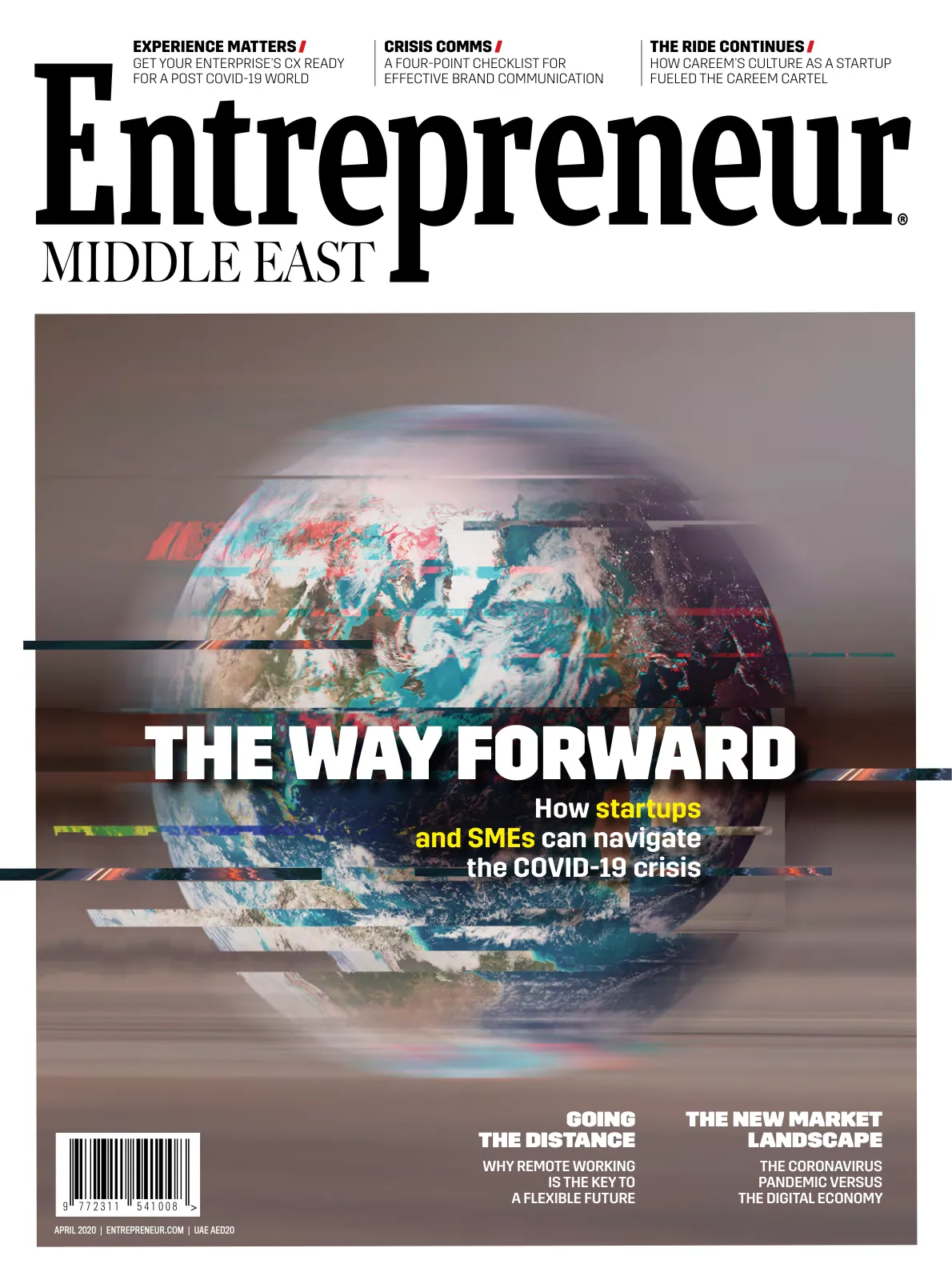
Entrepreneur Middle East, April 2020
Page 1
APRIL 2020 | ENTREPRENEUR.COM | UAE AED20
9
7 7 2 3 1 1
5 4 1 0 0 8
>
THE RIDE CONTINUES
HOW CAREEM’S CULTURE AS A STARTUP
FUELED THE CAREEM CARTEL
EXPERIENCE MATTERS
GET YOUR ENTERPRISE’S CX READY
FOR A POST COVID-19 WORLD
CRISIS COMMS
A FOUR-POINT CHECKLIST FOR
EFFECTIVE BRAND COMMUNICATION
THE NEW MARKET
LANDSCAPE
THE WAY FORWARD
THE CORONAVIRUS
PANDEMIC VERSUS
THE DIGITAL ECONOMY
GOING
THE DISTANCE
WHY REMOTE WORKING
IS THE KEY TO
A FLEXIBLE FUTURE
How startups
and SMEs can navigate
the COVID-19 crisis
Page 2
experience
downtown
living
The UAE’s most exciting new destination.
A journey of discovery for the whole family.
Where nature, fun and entertainment
come together.
800-Arada (27232)
arada.com
Page 3
3
April 2020 / ENTREPRENEUR.COM /
CONTENTS APRIL 2020
16
40
Rami Shaar and Jad Halaoui,
co-founders, Washmen
The way forward:
How startups and SMEs
can navigate through
the current turmoil
16
‘TREPONOMICS
PRO
The way forward
With small businesses
taking a hard hit from the
COVID-19 crisis, Hisham
Farouk, CEO of Grant
Thornton UAE, offers
a guide to navigate through
the current turmoil.
35
‘TREPONOMICS
SKILLSET
Experience matters
Amol Kadam on how
(and why) you should get
your enterprise’s CX ready
for a post COVID-19 world.
50
‘TREPONOMICS
PRO
Competitive advantage
Five key growth considerations
for SMEs within the
e-commerce ecosystem.
32
START IT UP
ECOSYSTEM
The new market landscape
In the wake of a pandemic,
Jad Hindy looks at the
pitfalls and opportunities
it could present for the
digital economy.
40
‘TREPONOMICS
SKILLSET
Growth trajectory
Rami Shaar, co-founder
and CEO of Washmen,
reflects on the lessons
of the development (and
expansion) of his digital
laundry startup.
62
CULTURE
LIFE
Mind over matter
Dr. Upasana Gala lists five
daily rituals to enhance
your brain health.
38
START IT UP
ECOSYSTEM
First person
NOW Money co-founder
Ian Dillon gives his take on
the impact the coronavirus
pandemic is having on
their startup, customers,
and the MENA region.
28
‘TREPONOMICS
MARKETING
Crisis comms
Sherpa Communications’
Anastasiya Golovatenko
gives a four-point checklist
for effective brand
communication through
the coronavirus outbreak.
Page 4
du.ae/business-pos
Your window to expand.
Introducing Business POS for
cashless payments with better
transaction rates.
Page 5
Page 6
Page 7
Page 8
Page 9
Page 10
10 / ENTREPRENEUR.COM / April 2020
54
CONTENTS APRIL 2020
Privilee founder
Lars Johannesen
58 How Careem’s culture as a startup fueled the Careem Cartel
26
‘TREPONOMICS
PRO
Going the distance
Infographic.ly founder
Carla Saliba on why remote
working is the key to
a flexible future.
54
START IT UP
Q&A
Going from strength to
strength
Privilee founder Lars
Johannesen on how he
went about building “the
UAE’s ultimate fitness and
leisure app.”.
58
START IT UP
ECOSYSTEM
The ride continues
Former Careem exec and
entrepreneur Zina Ajlouny
on how the unicorn
startup’s culture fueled the
Careem Cartel.
51
TECH
THE FIX
Boosting an ecosystem
The advent of digital asset
regulations in the GCC
is good for the region’s
startup landscape, says
Kokila Alagh.
48
CULTURE
LIFE
The only way is up
Motivational speaker
and best-selling author
Jonathan Yabut on rising to
greatness (with purpose).
31
MONEY
YOUR MONEY
Money matters
Nicholas Joe Correia gives
a guide to financially
sustain and protect your
business over the course of
the coronavirus pandemic.
46
CULTURE
LIFE
Real talk
Jeetendr Sehdev, New York
Times bestselling author
of The Kim Kardashian
Principle, sets the record
straight on the power of
influencers.
47
CULTURE
DESIGN
The (right) way to work
from home
Working from home can be
a hoot if you have everything
set up perfectly- here are
seven inexpensive ways to
create the perfect workspace
at home.
42
TECH
SHINY
#TamTalksTech
Gadgets and doodads that
you might’ve missed out on,
sourced by a tech aficionado.
44
CULTURE
TRAPPINGS
‘Trep gear
The executive selection for
the entrepreneur on your
list that has everything.
Okay, maybe for a little self-
reward as well.
Page 11
Ready to get
rewarded?
Join Radisson Rewards
for exclusive benefits
We can’t wait to welcome you as a member across our
six hotel brands and 1,100+ locations worldwide. Thank
you for choosing Radisson Hotels.
Award Nights
Use your points for stays - it’s that simple!
Members Only Rate
Save up to 10% when you book on
radissonhotels.com/rewards
More benefits
Including savings of up to 20% on food and
beverages, room upgrades for Elite members
and more
Join today at the front desk
or on radissonhotels.com/rewards
Page 12
12 / ENTREPRENEUR.COM / April 2020
SUBSCRIBE
Contact subscriptions@bncpublishing.net to receive
Entrepreneur Middle East every issue
EDITOR IN CHIEF Aby Sam Thomas editor@bncpublishing.net
CEO Wissam Younane wissam@bncpublishing.net
DIRECTOR Rabih Najm rabih@bncpublishing.net
CREATIVE LEAD Odette Kahwagi
MANAGING EDITOR Tamara Pupic
STARTUPS SECTION EDITOR Pamella de Leon
GROUP SALES DIRECTOR – B2B GROUP Joaquim D’Costa
COLUMNIST Tamara Clarke
INTERN Aalia Mehreen Ahmed
PO Box 502511 Dubai, United Arab Emirates
P +971 4 4200 506 | F +971 4 4200 196
For all commercial enquiries related to Entrepreneur Middle East
contact sales@bncpublishing.net
All rights reserved 2020.
Opinions expressed are solely those of the contributors.
Entrepreneur Middle East and all subsidiary publications in the
MENA region are officially licensed exclusively to BNC Publishing
in the MENA region by Entrepreneur Media Inc.
No part of this magazine may be reproduced or transmitted in any
form or by any means without written permission of the publisher.
Printed by United Printing and Publishing
upp.ae
Images used in Entrepreneur Middle East are credited when necessary. Attributed use of
copyrighted images with permission. All images not credited otherwise Shutterstock.
CONTRIBUTORS
entrepreneur.com/me
ACCESS FRESH CONTENT DAILY ON OUR WEBSITE!
MIDDLE EAST
EntMagazineME
@EntMagazineME
Entrepreneur-me
EntrepreneurMiddleEast
EntMagazineME
EntMagazineME
EntMagazineME
MIDDLE EAST
In addition to our print edition, we’re bringing
you all sorts of industry news on our web
mediums. Joining us online means getting
relevant business and startup content in
real-time, so you’re hearing about the latest
developments as soon as we do. We’re looking
forward to interacting with our readers on all of
our social media and web platforms- like any
thriving business, we’re looking to give and take.
#TrepTalkME is already happening on all of our
digi platforms, and all good conversations go
both ways. See you on the web!
Zina Ajlouny
Kokila Alagh
Lama Barr
Shahzad Bhatti
Renzo Bravo
Fida Chaaban
Nicholas Correia
Tamara Clarke
Ian Dillon
Dr. Upasana Gala
Anastasiya Golovatenko
Lahcen Haddad
Jad Hindy
Mike Hoff
Amol Kadam
Louise Jacobs
Samer Obeidat
May Rostom
Carla Saliba
Jeetendr Sehdev
Rami Shaar
Page 13
FUN COMES
GUARANTEED
YOU DECIDE WHEN THE PARTY
STOPS WITH 24HR FOOD & DRINK.
NOW OPEN AT DUBAI DIGITAL PARK.
RADISSONHOTELS.COM/RED
Page 14
14 / ENTREPRENEUR.COM / April 2020
EDITOR'S NOTE
Aby Sam Thomas
Editor in Chief
@thisisaby
aby@bncpublishing.net
BEHAVIORS TODAY WILL HAVE RAMIFICATIONS TOMORROW
This too shall pass
I
t’s only been a few weeks
since we in the Middle East
began to feel the impact of the
global coronavirus pandemic,
but in this fairly short period,
the economic slowdown it
has effected on our business
landscape has been nothing
short of monumental. And it’s
safe to say that it’s been especially felt
by those of us who are a part of the
region’s entrepreneurial ecosystem.
For us at Entrepreneur Middle East,
besides been privy to a multitude
of stories about enterprises that are
struggling to keep themselves afloat
amidst this crisis, we’ve also found
ourselves tackling the same challenges
as our peers. After all, we are a young
business too- we only celebrated our
sixth anniversary in February this
year. But, at the same time, as an
entity that has long called itself “the
voice of entrepreneurship” in the re-
gion, we’ve decided that, despite all of
what’s going on with us as a business,
we also have to continue to stay true
to our role within this ecosystem.
And that’s why we’ve kept our heads
down and focused on our work, which,
in our current setting, has meant us
bringing together everything from
insights to resources that can help
MENA entrepreneurs navigate a way
out of this unprecedented situation.
So, from thoughts on how to keep a
team motivated even while their sala-
ries are cut, or tips and tactics to how
to keep our wits about us, and, well,
not lose it, we’ve been seeking (and
pushing out) stories and solutions that
will help our community of entrepre-
neurs, startups, and SMEs get through
this crisis.
I must admit here that I’ve been more
personally invested than usual when
we embarked on this content plan for
Entrepreneur, and I feel it’s because
I’ve bought into this sentiment of
“we’re in this together.” While argu-
ably clichéd, that statement carries a
lot of significance in times like these.
I believe that if we try to operate
selfishly now, be it as businesses or in-
dividuals, then we’re almost certainly
headed down a path that won’t work
out in the long run. Because as alarm-
ing as this crisis may seem, we must
remember that it is most definitely
a temporary one all the same, and as
such, what we do now will well be
remembered in the future.
With that in mind, think twice before
you, as a corporate, drop all of your
contracts with startups and leave them
high and dry. Rest assured that your
reputation as a business partner has
already taken a hit in the community
at large. Similarly, think of the rami-
fications of your actions when you, as
a business leader, choose to let go of
your staff, so that you can continue
with your luxuries. (You’ll have this on
your conscience when you run around
spouting “I am nothing without my
team” to everyone after this crisis has
passed.)
Now, all of this is not to discount the
tough decisions many of us have to
make when going about our businesses
in extraordinary circumstances like
these- but let’s be very careful about
people who pass off poor choices as
“things they had to do because of the
crisis.” At the end of the day, it’s good
to remember that one’s behavior in
the worst situations is often the best
indicator of how one really is, and
that’s something to keep in mind for
now- and for later.
Page 15
Page 16
16 / ENTREPRENEUR.COM / April 2020
THE WAY FORWARD
16 / ENTREPRENEUR.COM / April 2020
How startups
and SMEs can navigate
the COVID-19 crisis
by HISHAM FAROUK
‘TREPONOMICS PRO
T
he COVID-19 pandemic developed as a health
crisis, moved on to becoming an economic
concern, and now has transformed into
a recession hard to stave off. The current climate has
particularly stopped the music for the VC ecosystem,
startups and small and medium enterprises (SMEs).
Indeed, small to medium size businesses are at the
front line of the battle, with the repercussions being
especially severe for them, due to higher levels of
vulnerability and limited resources.
To navigate through the current turmoil,
it is vital for businesses to be agile to respond
to today’s changing environment in a timely
manner. As such, SMEs are advised to identify,
focus, and swiftly address the key vulnerable
areas to ensure their survival and business
continuity. These main areas are finance,
operations and business models, people,
and processes- here’s a primer on how to go
about these:
Page 17
17
April 2020 / ENTREPRENEUR.COM /
THE WAY FORWARD | HOW STARTUPS AND SMES CAN NAVIGATE THE COVID-19 CRISIS
FOR YOUR BUSINESS TO SURVIVE, AND TO POTENTIALLY GROW,
THE RIGHT ENABLERS MUST BE IN PLACE, FROM A PEOPLE,
PROCESSES AND TECHNOLOGY PERSPECTIVE.
1/ FINANCE
2/ OPERATIONS AND
BUSINESS MODEL
Cash is king, and now more than ever,
is needed for survival. Here are external
and internal ways to improve, prolong
and avail liquidity.
INVESTORS AND VCS With the stock
markets taking a significant hit, the
private equity and venture capital
markets are also heavily impacted.
There is going to be a considerable dip
in startup valuations, as well as total
rounds raised during 2020. The appetite
for investment and the availability of
funds has shrunk, and it continues to
move downwards. Investors are either
selling their current shares at a loss
to prevent further financial damage,
or they have gathered their resources
to focus on their current portfolio and
support its survival. On the other side
of the spectrum, there are a few outliers
with disposable funds who are taking
advantage of below-the-market prices to
diversify and expand their investment
portfolio. That being said, it is not
wise to rely on external resources, as
all economies are in a volatile state.
The best solution would be to direct
the focus on internal resources and
capabilities.
ALTERNATIVE SOURCES OF FUNDS In
order to minimize the reliance on
traditional funding, the following
avenues can be explored:
PARTNERSHIPS AND ALLIANCES The
global implications of the outbreak have
brought both people and businesses
closer than ever, making it the best time
to take a step away from traditional
funding, and move towards partnerships
and alliances. The market demand
patterns have been disturbed, with
extreme plunges in some classes and
an upward surge in others. Thus, SMEs
need to form complementary alliances
by leveraging on each other’s resources
and capabilities, and transform into
a stronger entity that can cater to the
current market demands with agility.
This will assist with their commercial
survival while using minimal funds, as
well as helps serve their communities
and create positive PR.
BOOTSTRAPPING Back when entrepre
neurship was not a popular concept,
and investors were not keen on buying
startup shares, many entrepreneurs
started and grew their ventures by boot
strapping. It is time to take a page out
of that old book, take a proper look at
the business’ internal cash reserves, and
stretch the existing runway to leverage
all that is available. Entrepreneurs needs
to start by identifying their incurred
costs, and conducting negotiations to
minimize the direct and indirect costs
as much as possible. They also need to
explore ways to rearrange their cash
from idle facilities into their essential
working capital in order to improve their
short-term liquidity.
GOVERNMENT AIDS Government grants
have come available at a global scale,
prioritizing SMEs, startups, and entre
preneurs. This is the best non-equity
class of funding for these businesses to
take advantage of and inject internally.
The world today is no longer the same as
it was a moment ago, and it is likely to
change further and for the worse. Entre
preneurs need to stay flexible and adapt
accordingly. They can do so by adjusting
their current business models to reflect
the caused change, prioritize business
continuity, look for opportunities to gain
competitive advantage from, and ensure
minimal disruption overall.
RE-EVALUATING THE EXISTING
BUSINESS MODEL Entrepreneurs need
to separate their focus from the crisis
anxiety, and re-evaluate their proposi
tions and business models instead. It is
true that a number of SMEs, given their
line of business (mainly B2C and digital)
are less impacted, or in some cases, have
experienced higher profits, regardless
of the current crisis. However, it is a
common need to revise and redo the
old plans, and create new ones as well.
Businesses can do so by researching the
change in the market demand, identify
ing the changes in consumer behavior,
as well as the possible gaps and oppor
tunities for them to leverage and benefit
from. They need to revise their revenue
goals and product timelines, create a
new business model along with a match
ing operating plan, and ensure clear
and constant communications with the
market and their investors.
IMPROVED AND NEW PROPOSITIONS
SMEs need to guarantee churn by
developing honest and constant
communications with their current
clients, adjusting payment terms to
encourage early transfers, and >>>
Page 18
18 / ENTREPRENEUR.COM / April 2020
‘TREPONOMICS PRO
Hisham Farouk is the CEO of Grant Thornton UAE. With over 20 years of experience working with some of the largest groups in the region,
Hisham is also a member of the Board of Governors for Grant Thornton, driving the strategic direction of the brand globally as well as in the
Middle East. Hisham is well known within the region as being a specialist within this business arena. He advises numerous financial institutions
in the UAE in relation to regulatory and compliance matters and has supported many firms in dispute resolution, acting as an expert witness on
a number of arbitration cases across the industry, in particular hospitality, real estate and construction, aviation, and FMCG. grantthornton.ae
THE GLOBAL IMPLICATIONS OF THE OUTBREAK HAVE
BROUGHT BOTH PEOPLE AND BUSINESSES CLOSER
THAN EVER, MAKING IT THE BEST TIME TO TAKE
A STEP AWAY FROM TRADITIONAL FUNDING, AND
MOVE TOWARDS PARTNERSHIPS AND ALLIANCES.
3/ PEOPLE AND
PROCESSES
developing new price
points on current supplies.
Entrepreneurs are advised
to then move on to explore
innovative, and at times, even
radical ways to secure new
customers, and deliver added
value to the market. This can
be realized by restructuring
the internal resources and
capabilities to fine-tune and
tailor the current services,
as well as to come up with
new lines of offerings created
for the current demand. As
stated previously, building
alliances and joining forces
with other SMEs will also
help cater to the new market
dynamics, and prepare the
grounds for potential long-
term partnerships.
GO-TO-MARKET STRATEGY
DEVELOPMENT AND
COMMUNICATIONS Once the
newly adapted propositions
are created, it is time to
develop the go-to-market
strategy, as well as the rel
evant marketing plans and
communication channels. At
times of crisis, communica
tion should be at the fore
front of any entrepreneur’s
strategy to maintain a steady
and honest stream of mes
sages with its market. Keep in
mind that all efforts should
lead to increased credibility
and fundability- it is not the
survival of the fittest, but the
last one standing.
Your adaptability is not
limited to ensuring liquidity
and market offerings. For
your business to survive, and
to potentially grow, the right
enablers must be in place,
from a people, processes and
technology perspective.
PEOPLE First and foremost
are your people. Entrepre
neurs need to take the neces
sary measures to ensure their
teams’ safety, health, and by
extension, productivity, in
the new context. Active and
transparent communica
tion is the most important
ingredient between the entre
preneurs, investors, and their
staff: the necessary platforms
need to be built to encour
age mutual and constant
conversations between all
stakeholders. Maintaining a
weekly dialogue between the
CEOs, VCs, and employees al
lows for the exchange of valu
able guidance on the portfolio
and the overall business, and
helps with making collective
and smart decisions moving
forward.
PROCESSES The right in
ternal tools and processes
must be available, so that
the above adjustment and
changes are realized and take
effect. The entrepreneurs
need to equip their business
and their team members
to implement the needed
changes and stay adaptable.
The first step is to create
the environment wherein
the team members feel safe
and encouraged to put in
the extra effort. The leaders
themselves play a crucial
role in enabling new ways of
working: trust, empathy, and
availability of leaders are a
key enabler for the workforce
to feel empowered and com
mitted. In addition, adjusting
the existing culture helps
with aligning the people’s
mindsets to welcome the new
changes and to be able to op
erate in the new environment
in a productive manner.
The second step is supply
ing the tools needed to imple
ment the required changes
and help with business
continuity. Digital gadgets
that avail remote working,
telecommuting, and enable
all internal and external
communications are a great
example. Investing in an agile
and resilient infrastructure
might seem like a forced deci
sion now, but it is in fact, a
long-term investment that
safeguards businesses from
any turbulence that may
come.
DECISION MAKING
PROTOCOLS AND SCENARIO
PLANNING Once the new
infrastructure is in place,
the entrepreneurs need to
develop various scenarios
and forecasts, and test their
responses and strategies
accordingly. Given the ever-
changing nature of the cur
rent crisis, and the limited
available resources in SMEs,
leaders need to develop and
implement decision making
protocols to be able to remain
agile and respond swiftly to
any changes that may arrive
and with minimum involve
ment.
Now, theories to survive a
crisis is not hard to come by,
however, the success relies
on a tailored plan and its
correct and timely execution.
At Grant Thornton UAE,
we can help you navigate
through the current crisis,
and construct the building
blocks for your survival and
your future growth. History
has witnessed some of the
best companies to have been
created amidst the worst
crises- Apple, Disney, IBM,
and Microsoft are a few
examples. That said, it is
definitely a possibility for
SMEs and entrepreneurs to
not only survive the current
circumstances, but to grow
and prosper from it. Consid
ering market and industry
changes, developing a plan
to scale the business, and
transforming the operating
model and existing processes
are great places to start. In
vesting in a mindset of agility
and a structure that supports
it creates the best foundation
for small businesses to grow
big, and to remain strong.
Page 19
19
April 2020 / ENTREPRENEUR.COM /
Now, it is highly likely that your current business plan is
completely redundant at this time, and this has a very
paralyzing impact on any business as the leadership tries
to work out what to do. Given the current remote working
paradigm that many companies have put into place,
it’s now time to run your first virtual business planning
session. This can be easily achieved by using platforms
such as Zoom or other video conferencing apps.
The agenda for this session should be broken down
into where do we want to be in December 2020 in terms
of results and initiatives, then breaking this down into
monthly targets. In order to achieve this, you must identify
only the top 3-5 priorities that you will focus on during
this time. Once these priorities have been set, it’s very
important to put the right key performance indicators in
place to keep you on track, as well as to communicate
these on a very regular basis with your team.
My final recommendation would be to establish an
effective communication rhythm, and I’d suggest a
morning virtual huddle with your team where you will
celebrate successes from the day before, track your
key numbers, identify each members priorities for the
day, and flag areas where people are stuck and require
support. This should take no more than 15 minutes
every day.
Weekly hour-long virtual team meetings should be
held, ideally at the beginning of the week where you will
track your performance against the KPIs identified, share
feedback from customers and suppliers, and use the rest
of the hour solving the biggest issue facing the company
that week. By forming these habits, you will not only
ensure you will navigate these storming waters in a more
controlled way, but it will also establish good routines for
when this current crisis passes- which is the one thing
we can be certain of.
WHAT YOUR BUSINESS SHOULD FOCUS ON
AS IT NAVIGATES THE CORONAVIRUS PANDEMIC
by MIKE HOFF
Break through
Mike Hoff is CEO of MHC Consulting and Regional Group Manager of The Alpha Group. mhc.consulting
W
hile it is critical to manage your P&L account by re
ducing any unnecessary operating costs, improving
margins, and payroll cost, nothing is more critical to
your business than the oxygen that we know as cash, which
will be under tremendous pressure as revenues dry up during
the economic slowdown we are being subject to today owing
to the coronavirus pandemic. With this being the case, here
are three key areas I’d recommend businesses to focus on in
these unprecedented times.
First up would be your cash conversion cycle, which is a
reference to how fast cash moves through your business,
and into your bank account. In these times, when a lot of busi
nesses are moving to an online environment, think of ways to
speed cash through your business by improving your sales
cycle, reducing inventory to free up cash, improving ways to
deliver your product or service, and finally, improving your
billing and payment cycle as well. The second area to focus
on would be an analysis of all products and services that you
provide, rank them in order of profitability, and then remove the
least profitable from your portfolio.
The third area is to fine tune your labor’s productivity. This
is known as a labor efficiency ratio, where you calculate how
much gross profit you earn per labor hour spent. The aim here
is to increase this number by either increasing your gross
profit, or reducing your labor cost. Finally, regarding cash, en
sure that you are checking your cash balance daily, and have a
rolling 12-month cash flow forecast in place consistently. This
will identify any future time where cash may be short in supply.
Page 20
20 / ENTREPRENEUR.COM / April 2020
There’s no doubt that small businesses will be the hardest hit from the current COVID-19
pandemic. The bigger businesses have a better chance of surviving; however, small
businesses tend to live only with a few months of cash flow (at most), so when something
as significant as this hits, it can be devastating not only for the small business owner, but
also for the employees they support. So, how can small businesses survive the turbulent
times coming ahead in 2020? There’s no easy answer; however, here are a few points to start
implementing and planning at least for the next three months.
How your small business can survive the COVID-19 pandemic by SHAHZAD BHATTI
THE ROAD AHEAD
‘TREPONOMICS SKILLSET
1/ Don’t panic, take care of yourself, and keep calm
This can be difficult especially when cash is running out, but
remember to take care of yourself in a way that works for
you- for instance, eat well, and try to get some exercise in.
Taking care of yourself will help you to keep calm, which in
turn will also mean keeping your staff calm, and ultimately,
a healthier mindset for everyone to come up with innovative
ideas to move forward. If faced with some difficult decisions,
take time to balance yourself and your mind before taking
any drastic decisions. In what is a very dynamic and rapidly
changing situation, sometimes taking a step back to reassess,
asking for trusted opinions, and also keeping perspective will
help. Things will get better, and you aren’t in this alone. Ask
for emotional support where you can, and when you need it.
Page 21
21
April 2020 / ENTREPRENEUR.COM /
Shahzad Bhatti is the founder and owner of The Co-Dubai, a co-working space and one of the first small business accelerators to be certified
by Dubai SME. theco.me
WHEREVER POSSIBLE, TRY YOUR BEST TO
KEEP YOUR STAFF– THEY RELY ON YOU,
AND IF YOU HAVE MANAGED A GOOD TEAM,
THEY SHOULD BE SUPPORTING YOU. YOU
COULD TRAIN YOUR EXISTING STAFF ON
ADDITIONAL SKILLS, WHICH COULD MAKE
THEM MORE PRODUCTIVE AND EFFICIENT,
RATHER THAN HIRING MORE STAFF.
THE ROAD AHEAD | HOW YOUR SMALL BUSINESS CAN SURVIVE THE COVID-19 PANDEMIC
IMAGE COURTESY THE CO-DUBAI
2/ Tap into resources provided
by government and financial
institutions
Governments around the world are
already putting together initiatives
to support small business own
ers, and this is something that is
evolving on a daily basis. Be up to
date with how your governments
can help cut costs, as well as
other important institutions, such
as banks who also have a social
responsibility. If you’re registered
in more than one market, explore
support options in both markets.
For example, you can find out more
about the UK government support
for small businesses there, and we
are also waiting to hear from the
Dubai government about a stimulus
package to support SMEs in Dubai,
which should be announced shortly.
3/ Make a three-month
financial plan
Every small business usually has
the same key expenses, which in
clude employee salaries, office rent,
and utility bills. Further expenses
range from industry to industry.
Speak to who you need to pay in
the next three months (landlord
and suppliers), and find out what
options you have to spread out
the costs. Chances are they may
already have options in place, or
will be understanding, as it’s in
their interest to keep your business.
Always be careful when you come
up with payment plans with other
small businesses, as they also need
to keep afloat too, so this should be
fair for both of you.
Look at your personal finances, and
speak to people you may support to
have a realistic discussion on how
to control your personal spending
for the next three months. What
costs are necessary, what can be
put on hold? If you have a partner
supporting you as you grow your
business as the breadwinner, have
an open and honest discussion with
them about your immediate and
long-term plans for the business.
Also, look at ways you can cut costs.
But use this as a last measure after
we have seen at least two months
of damage from the COVID-19
pandemic. Your biggest costs would
usually be your staff and your office
rent. You could perhaps freeze hir
ing any more full-time employees,
and instead work on a project basis
with freelancers. You could also
consider downsizing your office,
and using a co-working space to
have more affordable and flexible
payment terms.
4/ Find the opportunities
It’s never nice to capitalize on
events such as this, but they can
also be a wake-up call to reconsider
how you have been doing busi
ness. In this case, is your business
model able to survive the changes
that will come from the COVID-19
pandemic? How do you expect your
customers to behave moving for
ward? What will and won’t matter
to them, and how can you accom
modate who will likely be a new
type of customer? Can you digitize
any of your products or services,
and start offering them online? Can
you implement technology to bal
ance any loss of earnings by offering
new ways to connect with your
customers?
5/ Upskill your staff
Wherever possible, try your best to
keep your staff– they rely on you,
and if you have managed a good
team, they should be supporting
you. You could train your existing
staff on additional skills, which
could make them more productive
and efficient, rather than hiring
more staff. There’s plenty of online
courses that are very affordable,
and these will allow them to focus
on other areas of the business when
their department is down- for
instance, your sales team could
perhaps also help out the market
ing team. We at The Co-Dubai top
3-5 have launched an e-course on
digital marketing for small busi
nesses that is a great way to learn
how to create digital marketing
strategies and implement them, and
it can be done from home while you
or your team is self-isolating. Look
for courses and resources similar
to this that most match your needs
and also your budget during this
time.
Page 22
22 / ENTREPRENEUR.COM / April 2020
HOW LEADERS CAN WEATHER THE IMPACT OF
THE CORONAVIRUS PANDEMIC ON THEIR BUSINESSES
ADAPTING TO
A NEW REALITY
by LAHCEN HADDAD
22 / ENTREPRENEUR.COM / April 2020
‘TREPONOMICS PRO
T
he whole world is groaning
under the impact of the
rapid spread of the coro
navirus (COVID-19), which
has struck more than 160
countries and killed thou
sands of people in China,
Italy, Iran, and Spain. The virus is, as
we speak, aggressively spreading in
France, the UK, and the United States,
while other less affected countries (in
Europe, Asia, MENA, Africa, and else
where) are rushing to take draconian
measures to thwart the rapid outbreak
of the epidemic. The World Health Or
ganization (WHO) considers COVID-19,
which has affected large numbers of
people on several continents, a pan
demic.
No one knows as yet the extent of the
economic impact of the pandemic. What
is certain is that the paralysis of air
traffic, the shutdown of tourism activi
ties in almost all markets and destina
tions, the disruption of supply chains
originating from or going through
China, the rush to purchase goods in
anticipation of health curfew restric
tions, and the possible disruption of the
labor market in many countries, all of
these will have a resounding negative
impact on production and consumption
and on global economic growth in 2020
and even in 2021.
Most businesses worldwide were to
tally unprepared for such a cataclysmic
disruption. It is quite possible that
some of them have plans to deal with
crises that may arise in relation to pub
lic opinion or customer behavior, or to
deal with a legal situation or a crisis of
confidence in the brand, etc. But none
had ever imagined a generalized as well
as a large paralysis of world economy
everywhere and at the same time. >>>
Page 23
23
April 2020 / ENTREPRENEUR.COM /
THE FIRST THING TO DO IS TO GET
EVERYONE INTERESTED IN POST-
CRISIS WORK. STAFF SHOULD
REMAIN IN CLOSE CONTACT
WITH CUSTOMERS AND EXPLAIN
THE MEASURES YOU HAVE PUT
IN PLACE, AND KEEP LINES OF
COMMUNICATION OPEN WITH
THEM THROUGHOUT THE CRISIS.
Operation: Falafel
MCKINSEY.COM/
HOW LEADERS CAN WEATHER THE IMPACT OF THE CORONAVIRUS PANDEMIC ON THEIR BUSINESSES
Unprecedented times need well-
thought solutions. Below is a set of
precautionary measures to adapt to the
reality of the pandemic and its impact
on businesses and the economy, while
waiting for the avalanche of bad news
to settle down and allow us all to as
sess the damage. This advice is based
on what we now know in late March
2020. The pandemic is still raging
as we speak, and nobody can predict
when and how it will end, or say for
sure now what its impact is or will be.
What is certain, at least as far as I am
concerned, is that it will inevitably
lead to an even deeper recession than
the one caused by the 2008 financial
crisis.
First, stay calm. Of course, it is dif
ficult to control your nerves if you
are the general manager of a hotel in
Dubai, Paris, Marrakech, New York,
Cape Town, Manila, or Barcelona,
and you see reservations vanish like
thin air, while the occupancy rate is
nosediving at high speed. However, it is
in times of crisis that your leadership
is tested. You are the leader, and lead
ers, like pilots in times of turbulence,
speak in a calm voice, to reassure, to
inform, to lead, to set the example.
Charles de Gaulle once said that "faced
with crisis, the man of character falls
back on himself. He imposes his own
stamp of action, takes responsibility
for it, makes it his own." Be the man or
woman of character for the situation
at hand. It’s daunting for sure, but you
will come out of it stronger if you lead
with force and fortitude. Remember
Doe Zantamanta’s famous saying: “It
is only in our darkest hours that we
may discover the true strength of the
brilliant light within ourselves that
can never, ever, be dimmed.” Seek light
within you and let it shine on your sur
roundings as hope; be the beacon that
leads the tribe out of troubled waters.
However, as Arjen Boin, Sanneke Kui
pers and Werner Overdijk have argued
in an article called Leadership in Times
of Crisis: A Framework for Assess
ment, leadership does not just mean
taking symbolic action, but focusing
on real issues through communication
and critical decisions related to work
management, production, relation
ships with customers, suppliers, and
the public at large. Start by protecting
yourself, your collaborators, your staff,
and your customers. The advice of
health authorities should be followed
to the letter. You can rely on the WHO
note, New Coronavirus (COVID-19):
Advice to the General Public to estab
lish clear protocols that apply to every
transaction or contact within your
business. It is true that employees,
customers, and collaborators will not
change their behavior overnight; there
fore, the extent to which the instruc
tions are followed should be assessed
daily, and regular drills should be
carried out so that health safety rules
become an integral part of daily work
management.
Set up an ad-hoc committee to
monitor the situation. The committee
should include representatives from all
relevant departments. The composition
of the committee varies from sector
to sector, and new members can be
included as needed. The mission of this
committee is to collect data, monitor
the evolution of the situation on a
regular basis, and inform top manage
ment decisions. Assessment must be
regular and continuous, especially that
government decisions, affecting your
business, change on a daily basis. As
Edwards Demming once said: “3% of
the problems have figures, 97% of the
problems do not.” Getting data for the
problem is your best way to monitor
the situation and to make informed
decisions. >>>
Page 24
24 / ENTREPRENEUR.COM / April 2020
AN ARABIC VERSION OF THIS ARTICLE WAS PUBLISHED BY HARVARD BUSINESS REVIEW ON MARCH 18, 2020, WRITTEN BY THE SAME AUTHOR
BUSINESSINSIDER.COM
‘TREPONOMICS PRO
Work to build confidence in times of
crisis. As Stephen M.R. Covey explains
in his famous book, The Speed of Trust:
The Factor That Changes Everything,
creating a culture of trust requires
behaviors and attitudes based on trans-
parency, honestly facing reality, laying
the groundwork for mutual loyalty,
correcting errors, good management of
expectations, and a sense of accountabil-
ity. In times of crisis, it is imperative to
reinforce these attitudes on a daily basis,
especially that employees and custom-
ers experience anxiety and fear as they
live through the unnerving experience
of shutdown, restrictions, and lower
productivity. The toll on confidence may
be far-reaching if you don’t act on rein-
forcing trust. Even if you make difficult
decisions about staff, it should happen
in an atmosphere of openness, transpar-
ency, and mutual trust.
Communicate regularly. Tell your
staff, your partners, collaborators, sup-
pliers, and customers all the news. Give
them a real sense of the damage. There
is no use in hiding or delaying the
publication of some news, as everybody
knows that businesses are bleeding.
Make sure everyone is informed of the
decisions you have taken, no matter
how painful they are. Keep everybody
informed as the situation unfolds. Be
the first to tell your bad news and your
good news. Own the situation, despite
the fact that COVID-19 is not of your
own making. Remember that “rumors,”
as Paul Barton said,
“are created to fill the
information void.” The
“void” is a space that is
normally yours, but you
choose to leave it empty
for others to occupy,
if you do not commu-
nicate. Make sure also
you tell all stakehold-
ers of your plan for
recovery once the storm
settles down.
Keep your employees,
don't fire them. At
times of distress, the
values of solidarity
must prevail. Preserv-
ing employees' liveli-
hoods at a time when
job opportunities are
almost non-existent
is an ethical question,
of course. But it makes good business
sense as well. Protecting human re-
sources is an investment in the future.
If you downsize and things go back
to normal in a few weeks, you will be
wasting valuable time looking for new
talent at a time when what you need
are people with already a good knowl-
edge of customers and products to help
you quickly restore your position in the
market. Always remember the famous
saying by Doug Conan, former Presi-
dent and CEO of the Campbell Soup
Company, “to win in the marketplace,
you must first win in the workplace.”
To come out of a crisis ready to “kick
back,” keep and protect your best am-
bassadors to your customers, i.e. your
employees.
Shawn D. Moone and Sue Dathe-
Douglas in their book, The Ultimate
Competitive Advantage, Why Your
People Make All the Difference and
the Six Practices You Need to Engage
Them, said that Western Digital faced
a real crisis when a devastating and
prolonged flood struck Thailand in the
summer of 2011 and almost destroyed
the Bang Pa-In Industrial Park north
of Bangkok where its production units
were located. While most companies
downsized and waited for the waters to
recede, Western Digital mobilized all its
staff to use their hands and any kinds
of tools they could find to clean and
prepare for the post-flood period. Some
staff members rowed on boats to report
to work and help with the cleaning.
When the waters receded a few months
later, Western Digital was ready to go to
business, its workforce more motivated
than ever before; they were proud they
did not give up when their company did
not give up on them.
Create a flexible plan that takes into
account all possible scenarios. The
McKinsey Institute, in an article called
COVID-19: Implications for Business,
describes two scenarios for epidemic
development based on how different
governments are managing the spread
of the pandemic. Either a progressive
control of the pandemic by mid-April
starting from East Asia, then Europe
and North America, or the pandemic
worsens and the situation remains
unchanged until May or June. On this
basis, McKinsey experts have developed
two different scenarios of the economic
impact of the pandemic. First scenario:
"large-scale quarantines, travel restric-
tions, and social-distancing measures
drive a sharp drop in consumer and
business spending until the end of Q2,"
which, in turn, will lead to an eco-
nomic recession. Low consumption and
plummeting consumer confidence will
continue through Q3 of the year, and
it will have a negative impact on busi-
ness and could lead to workers layoffs
Page 25
25
April 2020 / ENTREPRENEUR.COM /
Lahcen Haddad has been Minister of Tourism with the
Government of Morocco between 2012 and 2016. As Minister,
he has overseen the shift of Morocco towards becoming a
leading destination in the Mediterranean, Africa and the Middle
East and a reference country with regards to sustainable
tourism. Before joining the government in January 2012, Dr. Haddad worked
as an international expert in strategic studies, democracy, governance and
development, and as a certified expert in strategic planning, monitoring and
evaluation, diversity and entrepreneurship. His involvement in programs and
studies of national and international importance endowed him with a mastery
of geostrategic issues, economic development, public policy, international
relations and issues of governance at local and international levels. Haddad
also taught as a university professor for over 20 years with institutions such
as Indiana University, Saint Thomas Aquinas College in New York, the School
of International Training in Vermont, Mohamed V University in Rabat and Al
Akhawayn University in Ifrane. At the World Learning School of International
Training, he was for ten years the Academic Director for the SIT Morocco
Program and area thought leader for the Academic Directors community.
HARVARDBUSINESSREVIEW.COM
“IN A CRISIS, BE AWARE OF THE DANGER-
BUT RECOGNIZE THE OPPORTUNITY.”
JOHN F, KENNEDY
HOW LEADERS CAN WEATHER THE IMPACT OF THE CORONAVIRUS PANDEMIC ON THEIR BUSINESSES
(ibid.). Central bank interventions will
continue with "quantitative easing"
(buying guaranteed bonds to infuse
money into the market), but their effect
will remain limited.
The second scenario is prolonged
recession throughout the year, and
a sharp drop in demand, and the
emergence of a deep crisis in the labor
market (due to massive layoffs), and
persistent and sharp volatility in the
financial markets. Only the banks will
be spared this time because they have
a good capitalization and are subject
to strict prudential supervision (ibid).
You must therefore clearly study the
impact of these possible changes on the
sector in which you work and develop
an adequate plan. The first thing to
do is to get everyone interested in
post-crisis work. Staff should remain
in close contact with customers and
explain the measures you have put in
place, and keep lines of communication
open with them throughout the crisis.
You should also take advantage of the
period of low demand and production
to repair internal systems, straighten
value chains, perform internal recon-
figurations, and prepare everybody for
the recovery period.
John F. Kennedy, who lived through
the Bay of Pigs (1961-62) crisis that
almost developed into a nuclear war,
had said that “the Chinese use two
brush strokes to write the word 'crisis.'
One brush stroke stands for danger;
the other for opportunity. In a crisis, be
aware of the danger- but recognize the
opportunity.” It is at the time of crisis
that you get ready for the post-crisis
period; when things get back to normal,
it will be too late to plan and prepare.
Study your needs in capital and insur-
ance coverage. The American Small
Business Association published a note
called Coronavirus: Guidelines for
Small Business containing a series of
recommendations, consisting of assess-
ing the need for capital to compensate
for the lack in liquidity, reviewing
insurance contracts to fit the new real-
ity created by COVID-19, and assessing
the risk of disruption in the supply
chains. The disruption could come from
customers as well. In so many coun-
tries, consumers have rushed to market
stores in huge numbers “overbuying”
in fear of a possible shortage in food
and other consumer goods. This could
put you under pressure as a producer,
distributor, or service provider (hotel
or restaurant) whose business depends
on the same goods coveted by nervous
citizens these days. You must diversify
your sources of supply to be able to
make up for shortage or meet tempo-
rary higher demand for your products.
Finally, as Martin Reeves, Nicholaus
Lang, and Philip Carlsson Szlezak
confirm in an article published in
Harvard Business Review called
Lead Your Business Through the
Coronavirus Crisis, you should
now think about the lessons you
could learn from the crisis, and
prepare already for the next crisis.
It means not only psychological
and intellectual preparation, but a
real planning for the possibility of
it happening at any time. In 2017,
Microsoft co-founder Bill Gates, in
an op-ed in Business Insider, warned
that the next epidemic could be "a
super contagious and deadly strain
of the flu," and said that epidemics
are the biggest challenges the world
would know in the next few years.
The international community should
devise mechanisms, tools and proto-
cols to deal with pandemics without
shutting off the economy; the same
goes for businesses; they must
consider epidemics an inevitable
risk, just like other risks. Are you
epidemic risk-ready?
Page 26
26 / ENTREPRENEUR.COM / April 2020
‘TREPONOMICS PRO
Carla Saliba is the founder of Infographic.ly, a data-design and visualization agency based in Dubai, supporting companies communicate
data to its stakeholders clearly and effectively. infographic.ly
Why remote working is the key
to a flexible future by CARLA SALIBA
Going the distance
T
here are few things in life that can make the world
stop and take a collective pause. I can recall only
a handful of incidents during my lifetime, like
the horror of 9/11, or the fear that accompanied
the financial crash of 2008. But the coronavirus
pandemic- this is something very new and
different. The outbreak, and our subsequent
handling of it, will fundamentally change our
working lives as we know it.
Mass quarantines, closures, and cancellations are forcing our
hand, challenging the working world to adapt, and adapt fast.
At times such as this, it’s helpful to remember that we’re all in
this together. All facing the unknown. All uncertain of what will
come next. Remote working on this scale will undoubtedly be
a challenge, but there is no longer a choice for compliance- it’s
essential we get to grips with this sooner rather than later.
For most, the idea of remote working is
just that- an idea, never put into prac-
tice. Some businesses will have already
adopted flexible working as standard, in
line with changing lifestyles and a more
switched-on world. In the US alone,
there was a 159% increase in people
working remotely from between 2005-
2017, with more sectors opting into this
kind of culture. Still, there will be com-
panies now struggling to pivot, having
lagged behind in adapting their strategies
in the past, or belong to a sector that is
primarily front-facing, such as those in
the food or fitness industries.
For the latter, there will be a different
set of obstacles instead of archaic man-
agement structures to face, yet, we’ve
already seen examples of businesses get-
ting creative when working at a distance.
Personal trainers have filmed online
sessions and webinars, whilst food hubs
are creating do-it-yourself (DIY) kits or
offering free delivery, so everyone can
still enjoy the experience at home. Prior
to lockdown, this may not have been a
core part of their business model, yet,
their active response is likely to be well
remembered by their consumers once
this crisis is over.
Still, one thing is certain- it won’t be an
easy transition, but with every challenge
lies an opportunity, and as the majority
of offices move online, we have a chance
to implement effective remote work
protocols that go beyond a knee-jerk re-
sponse to the outbreak, and instead lays
the foundation for a more digitally-mind-
ed future. Ultimately, it’s up to us all to
create a framework that brings remote
working to the forefront, not as a last re-
sort or even as an alternative option, but
perhaps even as the primary way to work
moving forward.
If that sounds too bold or daring, con-
sider the circumstances that have led us
here, and what we all now face on a glob-
al scale- things have to change. Whilst
the future of work has long been a topic
up for exploration (a welcome keynote at
each World Economic Forum Summit),
few could have predicted how this pan-
demic would light a fire under the dis-
cussion. The fourth industrial age is here,
and with it, the tools and technology we
Page 27
27
April 2020 / ENTREPRENEUR.COM /
EVEN BEFORE THE CORONAVIRUS FORCED THIS
CHANGE, THE WORKING LANDSCAPE WAS ALREADY
BECOMING MORE DYNAMIC AND FLUID; THE 9-5
OFFICE LIFE NO LONGER CONSIDERED THE MOST
EFFECTIVE WAY TO MEASURE PRODUCTIVITY.
GOING THE DISTANCE | WHY REMOTE WORKING IS THE KEY TO A FLEXIBLE FUTURE
AS THE DUST BEGINS
TO SETTLE OVER THE
COMING WEEKS, WE’LL SEE
EFFICIENCIES START TO COME
UNDER THE MICROSCOPE,
WITH BUSINESSES REALIZING
THAT FOR THE MOST PART,
“OFFICE LIFE” CAN STILL
CONTINUE IN A VIRTUAL
SETTING.
need to move the conversation
forward, putting safeguards in
place so that if we were ever to
face anything like this again,
we’d be better prepared as a
nation.
Even entrepreneurs and
SMEs, who are arguably more
agile than the big corporates,
have an opportunity here to
better hone how they work.
They are also best placed to
guide others on making the
shift to remote working more
successful, especially as the
lines between work and home
will continue to blur into nor-
mality, at least for the foresee-
able future. In my company,
Infographic.ly, we adopted a
partial remote working cul-
ture from inception, opting to
become 100% fully remote/
flexible a few years ago, so for
companies like us, our opera-
tions have remained intact,
albeit with a reduced output
as a result of the current eco-
nomic climate.
What’s clear to me is that
there are always lessons to be
learnt in times of distress. It’s
when we as the human race
rally and adapt as we have
done throughout history. As
the dust begins to settle over
the coming weeks, we’ll see
efficiencies start to come un-
der the microscope, with busi-
nesses realizing that for the
most part, “office life” can still
continue in a virtual setting.
We’ve all seen that meme on
social media about meetings
that could have been emails,
and beyond the humor here,
there’s truth to these words.
We should take this time to
really review our working
structure, and identify ways in
which we can all be leaner
in our operations. Arguably,
without everyday distractions,
this is when we can be at our
most creative, free from the
general monotony of life!
Even before the coronavirus
forced this change, the work-
ing landscape was already
becoming more dynamic and
fluid; the 9-5 office life no
longer considered the most
effective way to measure
productivity. Over the years,
we’ve been fortunate to work
with some great global clients
(BCG US, for one) and our
communication has always
been managed remotely. We’ve
never met face-to-face, and yet
we operate as an extension of
their office through online chat
or email. It’s an effective and
efficient way to work that al-
lows companies to extend their
reach, without having to have
a physical presence in each
market they are active in.
This same principle ex-
tends to the workforce too. A
survey done by Buffer in 2019
reported that 99% of employ-
ees questioned would like to
work off-site for at least one
point in their career. In our
case, 60% of our employment
network is based in Lebanon,
and in times such as these,
we’re able to double down on
supporting talent in the region
and create new opportunities,
because we already have this
culture established. We’re see-
ing this thinking become more
of the norm for new mothers
too, who often struggle with
the work/life balance when
they start a family. Two of
our designers have found that
remote working has afforded
them the best of both worlds,
with everyday life just run-
ning concurrently in the back-
ground. And, if I’m honest, a
cute toddler entering the chat
frame now and again is only
going to improve your mood.
At the end of the day, no-
one will come out of this un-
scathed or unchanged. There’s
a serious humanitarian issue
at the heart of this pandemic,
and we all need to be aware
of how to flatten the curve by
minimizing our contact with
others. The economic ramifica-
tions are already happening
as this situation unfolds, but
I believe on the whole, we
will come out of this stronger
and more resilient than ever
before. “Business as usual” no
longer applies in today’s cli-
mate, so we need to find a new,
more relatable way to operate
and grow our companies; an
opportunity that remote work-
ing can afford us, but only if
we go all in. Don’t think of this
as a stopgap solution, think of
it as the next evolution of the
working world.
2020 is already going to be
remembered as the time when
humanity went into lockdown,
but I think it should stand for
something else, something
much stronger; the year that
we turned the working world
on its head and emerged in
better shape than ever. Who’s
with me?
Page 28
28 / ENTREPRENEUR.COM / April 2020
‘TREPONOMICS MARKETING
Anastasiya Golovatenko is an accomplished PR professional and business advisor who leads a Dubai-based communications consultancy
Sherpa Communications. With more than 12 years of expertise developing and executing all aspects of public relations and marketing
campaigns, she provides senior counsel to brands of any size and structure, helping them achieve business objectives and meaningful
results through the strategic use of communication. sherpacomms.com
A four-point checklist for effective brand communication
through the coronavirus outbreak by ANASTASIYA GOLOVATENKO
CRISIS COMMS
T
he coronavirus out-
break has put almost
every country in the
world on alert im-
pacting businesses
and economies.
Brands are faced
with tough decisions in the
wake of the global health crises,
forcing individuals to adapt to
evolving conditions. In the wake
of a global crisis, effective com-
munication strategies are more
important than ever, and pro-
viding transparent and consist-
ent communication is key.
Timely communication during
a crisis goes a long way, and it
can spell the difference between
a brand’s survival -even en-
hancement- and its irreversible
tarnishing. The best example
for this would be the 1982 case
of Johnson & Johnson’s imme-
diate response on the death of
seven individuals after consum-
ing their best-selling painkiller,
Extra Strength Tylenol. The
company established a set of
best practices for communicat-
ing in a crisis, including speak-
ing early, often, and directly
with its consumers, resulting
in the company to regain 95%
of market share within a few
months, and ultimately enhanc-
ing the company’s reputation.
Here’s a quick checklist for
brands on how businesses can
sustain their brand voice, keep
the communication channel
open with customers and other
stakeholders, while also main-
taining their calm:
1/ CONDUCT A SWOT
ANALYSIS Assess the various
risks associated with your
business in times of a crisis,
and identify functional leaders
from across the organization to
prioritize the issues that need
to be communicated to relevant
stakeholders. Businesses should
communicate relevant updates
from various verticals such as
supply chain, human resources,
operations, health and safety,
and more. Ask yourself these
important questions: what
processes do you have or need?
What emergencies should
you plan for? What are your
strengths and where is the
weakest point? Prioritize issues
of urgency, and address the
impacts of the circumstances
on the industry. At this stage,
it is important to identify
what value can be provided as
an organization to the wider
community. During the crisis
outbreak, it is now more crucial
than ever to keep an eye on
updates related to the industry
as well as monitor government
announcements. Set up
keywords monitoring to be
aware of the latest news 24/7;
this will help your business
respond fast to any changes on
the market or in your sector.
2/ CONDUCT A MARKET
AND AUDIENCE ANALYSIS
(AND GO ONLINE) Review
your audiences’ needs and
assess what value can your
brand provide. Segment your
audience to communicate
the information based on
their priorities and needs.
Communicate regularly with
customers, partners, staff, and
be proactive with communities.
Live streaming is now an
option, and webinars are
becoming even more popular.
It is important to share facts
in real time, and approach all
efforts individually based on
the current scenario. Armed
with industry insights, it is now
more important to develop a
communication plan that covers
what you will do, when, and
how. Define key messages for
a number of scenarios, and be
prepared to handle any incident
that may incur. It is important
that every brand is able to
handle the crisis, and is backed
up with reliable facts, media-
trained spokespeople, and the
right channels for delivery.
3/ BECOME AN AUTHORITY IN
YOUR SECTOR Produce expert-
level content that carries
insightful and useful info.
Remember, everyone is looking
a for a measured, reliable, and
authoritative voice, whether
in print, video, live or online.
This voice will need to provide
advice on reason, and bring
calm to the storm. Tailor your
message to your audiences
and utilize digital and social
media channels available to
Page 29
29
April 2020 / ENTREPRENEUR.COM /
EFFECTIVE BRAND COMMUNICATION THROUGH THE CORONAVIRUS OUTBREAK
you: website, LinkedIn,
Twitter, Facebook, Instagram,
YouTube. Social media is an
indispensable source of vital
information– we live in a
24/7 news cycle world. Social
networks have matured in
terms of their functionality,
and consumers are jumping
on to social media channels
to look for directives, making
it the easiest way for brands
to reach their audience.
But do remember, with
the amount of fake news
circulating on social media,
businesses need to deliver
content that is credible,
backed up by data and facts.
4/ RESHAPE THE WAY HOW
YOU CONDUCT BUSINESS
COMMUNICATION Conduct
webinars to educate, share
expertise, reconnect with
business partners, clients,
and vendors. Consider
public service sessions, such
as streaming live sessions
solo or with experts who
can legitimately discuss
the topic. Such online
activities are a safe way to
interact with your industry
network and consumers
while supporting them
with valuable advice and
keeping that retention level
high. To keep your business
communication efficient,
dive into the diverse world
of business apps like Zoom,
Microsoft Teams, Screenflow
(video conferencing tool for
remote communication),
Slack, Twist, Google Chats
Hangout (messaging apps
for the whole team), while
project management can
be carried out using Trello,
Asana, and Monday.
A PR checklist for entrepreneurs dealing with the COVID-19 crisis
by LOUISE JACOBSON
CONTENT COMES FIRST
What can entrepreneurs be doing PR-wise in this
time of crisis and uncertainty? Many companies in
the region have had to make budget cuts across
all lines of business, so I hope this checklist at
least helps someone who maybe doesn’t have PR
support right now.
1. DO A STAKEHOLDER SENSE CHECK You’re
probably on this already, but if not, talk to all your
stakeholders involved with comms and decision
making as soon you can. Garnering their collective
viewpoints will ensure you have everyone’s input
from the start, and it will help shape your new
strategy and make next steps easier.
2. DEFINE OBJECTIVES AND STRATEGY Your objec-
tive may be survival right now. Or it could be look-
ing at attracting a new audience. Either way think
strategically about opportunities that can make
a difference, and align PR and comms to it, but
whatever you do, do not benefit from this situation
and people’s misfortune. A phased PR strategy is a
solid idea. What do you need to do right now? And
what will you do when this is over? Because it will
be at some point.
3. RE-EVALUATE YOUR PLANS The comms plan
you had last month, or even last week, is now
defunct. Relook at all your plans now, get a new
one in place, and keep refining it as often as you
can. Things are changing all the time and you
need to make sure you’re adapting in all areas of
marcomms.
4. BE HUMAN Your overall positioning and tone
of voice should be one of safety, empathy, all
delivered in a human way. Soften language, banish
corporate jargon, and ensure sensitivity. Now more
than ever, your audience wants to see and hear
from human beings.
5. SHOWCASE STRONG LEADERSHIP You need
to show this now more than ever. Ensure clarity,
empathy, and strength via all communications.
Have you spoken to all your clients and re-assured
them? Are you checking in daily with team
members working remotely? Could you look at
some video content to convey your message in a
more human way to inspire confidence with your
stakeholders?
6. PREPARATION IS KEY Ensure you have statements
prepared for all possible scenarios you can think
of. Have you prepared for an employee contract-
ing COVID-19 and it escalating to media? Have you
got social media Q&A’s for customer concerns on
hygiene? Handling this correctly is vital. This is where
brand trust can be won and lost in an instant.
7. KEEP COMMUNICATING REGULARLY Don’t go
quiet. Even if your business has been impacted, keep
talking. Government directives are changing daily, and
you have a duty of care to reassure people that you’re
complying with them and will keep them updated
as things develop. Keep talking and listening to your
audience and customer base, the beauty of social
media is that you can have a two-way conversation.
8. BUILD CREATIVE CONTENT A content-led approach
is a great strategy for your marcomms right now, and
it can be very cost-effective- all you really need is a
decent smartphone and internet access. Remember
this isn’t a time to benefit, it’s a time to show you
care- e.g. if you’re a management consultant, could
you release some content on how organizations
should be temporarily re-structuring their businesses,
or give some practical tips on working from home and
keeping employees motivated? Get creative, but in an
empathetic and authentic way.
9. GIVE BACK We all need to help each other get
through this, so what can your business do to make
a difference? Can it donate money to charity? Could
your manufacturing facility produce garments for
those on the front line of COVID-19, or can you help
with the distance learning movement? If you make
a positive impact right now, you will generate brand
affinity, and people will remember it. Whatever you do,
please make sure it’s within legal guidelines.
10. STRESS ON MEASUREMENT AND ANALYSIS
This is still fundamental to ensuring what you’re
doing is working in the right way. Yes, the quantita-
tive metrics are still important, but more important
are the qualitative ones, bearing in mind it’s all about
humanization of our activity right now. Looking at
the comments on social media posts and getting
feedback from stakeholders will ensure that you stay
on track.
Stay safe, stay strong, and remember, this too
shall pass.
Louise Jacobson is the Managing Partner of Brazen MENA, a MEPRA and PRCA MENA Small
Consultancy of the year 2019 and 2020. She has 18 years of experience across all sectors of
PR and has worked in Europe and The Middle East. Louise is a MEPRA Strategy Board member,
Global Women in PR MENA member and industry awards judge.
COMMUNICATE REGULARLY
WITH CUSTOMERS, PARTNERS,
STAFF, AND BE PROACTIVE
WITH COMMUNITIES. LIVE
STREAMING IS NOW AN OPTION,
AND WEBINARS ARE BECOMING
EVEN MORE POPULAR.
Page 30
30 / ENTREPRENEUR.COM / April 2020
Seven steps for PR professionals to take
in times of crisis by LAMA ABDELBARR
Lama Abdelbarr leads on digital communications for Middle East and Africa at Talkwalker, a media monitoring and analytics company
that empowers over 2,000 brands and agencies to optimize the impact of their communication efforts. talkwalker.com
Hit the ground running
‘TREPONOMICS PRO
I
n times of crisis and uncertainty,
we find ourselves asking a lot of
questions about how to cope. Hu-
mans, by nature, seek comfort and
order. So, to shape up when the go-
ing gets tough, here’s a list of seven
steps that PR and communications
professionals can start taking right now:
1/ IMPLEMENT (OR PUT TOGETHER) YOUR
CRISIS COMMUNICATIONS PLAN
Ideally, you should have a crisis comms
plan in place for your business or your
clients. If not, it’s not too late to start
putting one together using a plethora of
useful templates available online and by
following the below steps. Set up real-
time alerts to monitor relevant mentions,
news alerts, updates, or guidelines that
your team and company should be aware
of. Not only is this important to stay
informed and shape your reactive com-
munications strategy, but it will also help
you with the following two steps.
2/ COMMUNICATE CLEARLY AND
CONSISTENTLY WITH STAKEHOLDERS
Create safety and security through em-
pathetic and consistent communication.
Make sure you’re speaking to both your
internal and external stakeholders as you
navigate through changing times.
Internal stakeholders (employees)
A successful company is built on its
people, before anything else. Make
sure you are communicating with them
regularly, transparently, and swiftly.
External stakeholders (clients
or investors) Again, be clear and
transparent about the changes your
business is inevitably undergoing.
Update them as regularly as needed.
Share concrete details about how this
will impact them. Have your hours of
availability changed? Are your offerings
changing? Invariably, clients and
investors will have changes on their side
too, and being honest and forthcoming is
the best way to navigate these changes to
reach a middle ground.
Media Believe it or not, during times
of crisis, the media doesn’t just want
to cover the crisis. Diversity in news is
always welcome and the media recognizes
that their audience would appreciate
positive news too. More on that below.
3/ REVISIT YOUR PLANNED CAMPAIGNS
AND OUTREACH
Revisit any digital PR campaigns you had
planned, and decide which of the three
below categories they fit into:
Can be refocused in meaningful ways to
be relevant today If you have a cam-
paign that naturally lends itself to being
re-focused to fit the current crisis situa-
tion, then you have yourself a plan. Don’t
force relevancy if it doesn’t naturally
exist, and don’t provide any misleading or
sensational information.
Cannot be explicitly refocused, but can
still be relevant today If your campaigns
can’t be refocused, no problem. There are
many journalists right now looking for
ethical, positive stories to add variety to
their news coverage. Just be mindful of
remaining empathetic with the current
situation.
Cannot be refocused, and is not
relevant at all today For campaigns that
simply don’t have a place right now, keep
them on the backburner, and maybe you’ll
even have time to refine them further, and
prepare for an epic launch when the time
allows for it.
4/ FIND WAYS TO ADD VALUE
This is not the time to upsell or take ad-
vantage of people’s needs. Rather, this is
a time where you can put (actually mean-
ingful) corporate social responsibility
strategies into place, or simply showcase
the human side of your brand. Helping
others is one of the most selfish selfless
acts available to us, and during times of
crises, we all need to feel a little good
about ourselves, and share some positiv-
ity! If there is a way to balance between
helping out and serving your business
needs, that’s lucky. If not, don’t force it.
Prioritize empathy.
5/ STAY AGILE
Yes, your daily, weekly, monthly, and
quarterly plans and forecasts will have to
change. So will your yearly ones. This is
the time to practice what we preach (or
what we write on our CVs at least) about
being agile. Start thinking about ways
you can adapt your strategy, and accept
the fact that there are a lot of variables
and moving pieces. Can you reallocate
your events or offline media budgets to
online activities that can benefit your
business? This is not to say that you
should overthink and worry about worst
case scenarios- but just start putting
Page 31
31
April 2020 / ENTREPRENEUR.COM /
HIT THE GROUND RUNNING | SEVEN STEPS FOR PR PROFESSIONALS TO TAKE IN TIMES OF CRISIS
HOW TO FINANCIALLY SUSTAIN YOUR BUSINESS OVER THE COURSE OF THE CORONAVIRUS PANDEMIC
by NICHOLAS JOE CORREIA
MONEY MATTERS
Nicholas Joe Correia is a freelance finance professional working with SMEs in Dubai focusing on building their financial position,
strengthening their performance, and preparing them for stability and growth. linkedin.com/in/nicholasjoecorreia
some initial thoughts on paper. Having a
tangible starting point can do wonders to
relieve stress and anxiety. Focus on your
short-term plans and goals too to make
sure you come out of this as strongly as
possible.
6/ FOCUS ON ONE THING YOU CAN
GROW FOR THE BUSINESS
How many times have you pushed the
deadline on a nice-to-have but not es-
sential project? How many times did you
wish you had more time to streamline
tasks, improve strategies, embellish tem-
plates, expand media and influencer lists,
etc.? Guess what? If your day-to-day
work is slowing down, this could be the
time to get these things done. This is also
the right time to invest in your online
offerings- enhancing user experience can
be more important than ever right now.
7/ FOCUS ON ONE THING YOU CAN
GROW FOR YOU
It’s easy to think that the time freed up
by reduced commute and social obliga-
tions should amount to many ticks on a
seemingly endless personal to-do-list.
But we are quickly starting to see that
the sheer novelty and scope of the cur-
rent situation is taking a toll on our abil-
ity to focus and move forward. And that’s
okay. Set a realistic and achievable goal
of one thing you would like to improve or
grow during this unique time, so you can
allow yourself to later enjoy the feeling of
accomplishment. It could be as simple as
reading a book, or as exerting as follow-
ing through with a personal project, or
signing up to an online course. Brushing
up on new industry research and trends
is also a good way to fill up slow days,
and can help you feel better equipped
to hit the ground running once order is
restored.
With the coronavirus pandemic tightening rules and restrictions
around the world, it’s natural for entrepreneurs and businesses to
see a growing concern rise with respect to surviving this market.
During these rough times, it is vital to take some time and understand
the financial position of your business, and plan for multiple possible
scenarios expected. If you are worried about the outcome of this
slowdown, there are some financial moves you can make to protect
your position. Here’s how:
1. IDENTIFY WAYS TO CUT BACK The time for a cleanse is now. Dig
into your ongoing expenses, and identify the ones you can eliminate.
In this modern age, apps and softwares help us with our day-to-day
tasks. It’s a blessing and a luxury. But this is a time to ask yourself: “Do
I need this?” Cost-cutting is not built for comfort. You will go through
changes within your business, but every little effort will help you
improve your financial health. Take it as an exercise to identify neces-
sity, and cut out luxury.
2. PLAN FOR EVERY OUTCOME There is a best-case scenario, a worst-
case scenario, and everything that falls in between. You cannot avoid
the outcome, but you can prepare yourself for it. Run various sce-
narios through your cash flow projections. Revenue will take a big hit
during this time. Payments will be slower than usual. Cash inflows will
become a burden. At this moment, we cannot predict when this pan-
demic will end. As such, if you have devised a protocol for all possible
outcomes, you’ll be ready to let it take motion when the time comes.
3. REVIEW YOUR DEBT As uncertainty grows, so will the inquiries on
debt settlement. Identify your current cash position, run through the
numbers, and create a payment plan. At times like this, it is essential
to maintain a cash flow balance. Do not pay out more than what
comes in. Pay once you get paid. It may seem plausible to clear your
debt today. However, it may not be the best decision right now. Also,
do not hesitate to reach out and ask for an extension. Everyone is in
the same position as you are. We will all get through this together.
4. FIND NEW SOURCES OF REVENUE A change in the way businesses
operate is not necessarily a bad thing. It opens the doors to a new
opportunity. Ask yourself: “How can I operate a business and offer
customers our services in this new business lifestyle?” Adapting
to the changes in the economy is how businesses make it through
difficult times. It is a new opportunity for your business to evolve in a
new, unfamiliar market.
5. PROTECT YOUR CASH FLOW Cash is the oxygen to a business. It
flows in and out, keeping the company alive. As long as you have it
flowing in, you can make it work. You cannot have a business without
cash outflows. A well-balanced cash flow maintains an equal and
controlled level of cash inflows and outflows. Engage in new payment
options to encourage cash flow. Offer early payment cashback if
possible. Survival is the key element here. Always protect your cash
position in this market.
6. MAKE THE MOST OFF CURRENT CLIENTS It is a time to support one
another, and not gain off of the situation. Treat this as an opportu-
nity to build loyalty with your clients. Offer them special rates to get
through this. Be by their side, and maintain the relationship. After all,
loyalty is the best investment a business can have. It protects future
income and influences new ones.
These are the times to protect our financial position. Take every
measure possible. At the end of the day, there is no definite way for
a business to protect itself from financial difficulties, but it all boils
down to taking smart decisions early on. Good luck!
Page 32
32 / ENTREPRENEUR.COM / April 2020
The coronavirus pandemic versus the digital economy:
the pitfalls and the opportunities by JAD HINDY
THE NEW MARKET
LANDSCAPE
START IT UP ECOSYSTEM
Page 33
33
April 2020 / ENTREPRENEUR.COM /
THE NEW MARKET LANDSCAPE | THE CORONAVIRUS PANDEMIC VERSUS THE DIGITAL ECONOMY
"Better utilization of data and
technology to drive more individualized
consumer experiences is where this
battle will be won or lost.”
Tim Jensen, Campaign Manager
at Clix Marketing
Several high-profile marketing
events have been canceled
due to coronavirus concerns.
Unfortunately, many businesses
won’t see that money back.
But even in the wake of a
pandemic, there could still be
a silver lining for marketers.
MICROSOFT.COM
>>>
W
ith busi-
nesses
closing
their doors
and gov-
ernments
urging
their citizens to stay home, the
coronavirus has had a profound
global impact. At MRM, the
company I work for, we have
shifted to working from home,
and so far, we are still deliver-
ing on our projects, and keeping
our promises to our clients.
However, we can’t deny that
companies, particularly those
dependent on marketing and
advertising, are experiencing
some of the biggest challenges.
Several high-profile marketing
events, including Mobile World
Congress Barcelona, Facebook’s
Global Marketing Summit, F8
conferences, SXSW, Salesforce
Dubai Basecamp and others
have been canceled due to coro-
navirus concerns. Unfortunate-
ly, many businesses won’t see
that money back. But even in
the wake of a pandemic, there
could still be a silver lining for
marketers.
THE SHIFT TO DIGITAL
According to analysts, Google
will likely see a 15% decline
year-over-year in travel ad
revenue in the first quarter,
and a 20% drop in the second
quarter due to the coronavirus
epidemic. Despite that, there
is still good news. Not every-
one sees budget-cutting as the
answer. Tim Jensen, Campaign
Manager at Clix Marketing,
offered his insights on Search
Engine Land: “As the tradeshow
circuit dwindles, some exhibi-
tors are looking for other ways
to fill their sales pipelines. I
just talked with one client who
is seeing several tradeshows
get canceled, and wants to put
more into digital to make up for
the lost leads they usually pick
up at events.”
Another marketing shift is
toward virtual events. Even
Microsoft decided to turn its
biggest event of the year, the
Microsoft Build, a developer
conference,, into a virtual event.
This trend presents an opportu-
nity for virtual events startups
like Hopin, which combines
Twitch-style live streams of
keynotes, Zoom-style video
conferencing for groups, and
one-to-one conversations. Even
the banking industry is turning
to digital. One example is South
Africa’s Nedbank. Nedbank
plans to accelerate the rollout of
its digital strategy across Africa
as customers avoid face-to-
face banking to reduce the risk
of coronavirus. Its long-term
target is for 75% of sales to be
through digital channels, and
for 70% of all its clients to be
digitally active.
But the shift to digital will only
become stronger, as Stuart
Mackay, General Manager at
Reprise Dubai puts it: “This is
the most significant health-re-
lated crisis that has fortunately
happened in a truly digital age.
During dark and uncertain
times like these, it’s imperative
that organizations adapt quick-
ly and seek out new growth
opportunities. The realities of
changing consumer behavior in
the digital age presents a huge
opportunity for retailers. The
optimization and simplifica-
tion of product lines, business
models, customer engagement,
and sales channels can all be
achieved through the introduc-
tion of digital technologies and
e-commerce. Better utilization
of data and technology to drive
more individualized consumer
experiences is where this battle
will be won or lost.”
THE E-COMMERCE
OPPORTUNITY
In parts of China, major retail-
ers like Starbucks, Nike, and
Apple have temporarily shut-
tered their stores, while smaller
retailers are being hit hard as
foot traffic declines. Across
the globe, the reduced in-store
activity is driving increased e-
commerce activity. For example,
Page 34
34 / ENTREPRENEUR.COM / April 2020
START IT UP ECOSYSTEM
Jad Hindy is currently the Regional Managing Director at MRM. Jad is a seasoned executive with over twenty years of experience in business
setup, startups, marketing, communication and brand building across the Middle East and North Africa region. He has advised some of the biggest
brands in the MENA region like Saudi Telecom, Jawwy, Ooredoo, du, Etisalat, P&G, Virgin Mobile, Red Bull, Unilever, Qatar National Bank, McDonald’s,
Atlantis the Palm, Uber, EmiratesNBD, Aspire, Careem, Qatar Museum Authority, and others. Jad is also a serial entrepreneur with several successful
exits (123vouchers, Netizency, ColNewMedia, Engaged Brands), and he is today a charter member and board member at TiE Dubai.
F1 driver
Lando Norris
IMAGE © LANDO NORRIS | KISSMETRICS.COM
consumers in China are turning to online
grocery shopping. According to French
retailer Carrefour, vegetable deliveries in-
creased by 600% year over year during the
Lunar New Year period. JD.com, China’s
largest online retailer, has seen sales of
everyday household items quadruple over
the same period last year. As more con-
sumers continue avoiding crowded public
places, they’ll increasingly turn to online
shopping to get their essentials.
Of course, this could still bring strain to
businesses who need to deal with poten-
tially delayed deliveries or out-of-stock
items because of increased demand. If you
sell products on Amazon, for example, it
is imperative not to run out of items to
avoid being punished by Amazon’s organic
search and advertising algorithms. If a
product is out of stock for over 30 days, it
will be treated as if it has no sales history
once it comes back in stock. This means
that the product’s ranking for its most
important keywords will drop significantly
and show up much lower in search results.
The key thing for business owners is to
keep products in stock, and be transparent
with consumers if there are going to be any
delays.
ESPORTS TO FILL THE GAP
With experts urging social distancing to
combat the virus, one of the most obvious
areas to be affected are sporting events.
This represents a big blow to market-
ers and advertisers in terms of lost ticket
sales and ad revenue. In the space of one
day, every major sports league in the U.S.
suspended operations for the next several
weeks in response to the growing pandem-
ic. Even esports are being affected, with the
League of Legends Champions Korea (LCK)
being canceled as more cases of coronavi-
rus were confirmed in South Korea.
The flip side may be that esports could
also step in and help fill the gap. For
example, the start of the 2020 F1 season
has been pushed back in the wake of the
coronavirus outbreak, with the Australian
Grand Prix canceled late last week, and
the Bahrain and Vietnam races postponed
shortly afterward. But that didn’t stop
F1 driver Lando Norris from taking part
in esports to satisfy the void. Norris,
footballer Thibaut Courtois, and Formula E
driver Stoffel Vandoorne competed against
esports professionals and YouTube stars in
a virtual Australian Grand Prix.
Joe Zoghbi, an esports expert who’s the
founder of Divine Vendetta, says “Esports
was born digitally, and while it was paving
its way in 2020 to more on-ground events,
it is a step back for sure, nonetheless,
the consumption of online gaming and
esports events viewership will dramatically
increase now, as we noticed in the current
PUBG Mobile PMCO event. Currently,
esports events are realistically the only
source of live entertainment out there,
new crowds will jump to take part of the
action, and one way or another, brands will
take notice even more and realize sooner
rather than later than it’s a must to be part
of this ecosystem.” Unlike soccer or rugby,
the billion-dollar world of esports doesn’t
require social gathering. With more live
sporting events being suspended, there
may be an opportunity for esports to at-
tract a new audience.
LESS COMPETITION = MORE MARKET
SHARE
During an economic downturn, you’ll find
that you will have less competition. In
some cases, this means you’ll be able to get
deals- like a potential reduction in pay-per-
click advertising. If the market continues
to decline, many companies will struggle to
pay off their debt, which means they could
go bankrupt, get bought out, or get bailed
out by the government. If you have cash on
hand, this could be the best time to buy out
other businesses- especially media compa-
nies. Because the more traffic you control,
the more power you will hold in the future.
Look at Neil Patel, co-founder of Neil Patel
Digital. When he bought the KISSmetrics
website for US$500,000, they had over a
million unique visitors a month. The mo-
ment he merged it into the NeilPatel.com
site, he increased his lead count by 19%,
and recuperated his investment in less
than a year. In other words, now is your
opportunity to capture market share.
While the coronavirus presents busi-
ness risks in some areas, it also offers
opportunities in others. As a marketer or
entrepreneur, the key is to acknowledge
the potential threats while exploring the
possibilities.
Page 35
‘TREPONOMICS SKILLSET
Experience
matters
HERE’S HOW (AND WHY) YOU SHOULD
GET YOUR ENTERPRISE’S CX READY FOR
A POST COVID-19 WORLD by AMOL KADAM
35
April 2020 / ENTREPRENEUR.COM /
AS MOST OF US STRUGGLE, BRANDS
DELIVERING AN OPTIMIZED, PERSONALIZED,
AND TIMELY CX WILL GAIN STRENGTH.
IN THE COMING WEEKS AND MONTHS, YOU
MUST WORK TO PRIORITIZE YOUR ONLINE
TOUCHPOINTS,
Some of you have already
responded to this situation,
and quickly resorted to digital
channels to offset losses of-
fline. It’s also worth noting
that in the place where the
breakout started, China,
brands are already leading in
digital innovations on cus-
tomer experience, while every-
where else, brands are catching
up. As a business, if you were
earlier finding excuses like “My
customers aren’t demanding
(or ready for) online orders and
fulfilment” to keep away from
investing in a digital presence,
you can rest assured that your
clientele will most certainly be
wanting that now.
Brands that have adopted digi-
tal and human-less experiences
are the brands that are leading
excellent customer experience
during this period. So, while
the priority is health and safe-
ty, business leaders have also
been thrown another challenge
in that they must consider how
this growing pandemic will im-
pact their customers and their
experience with your brand.
And this starts with an under-
standing of customer experi-
ence (CX), which is all about
knowing and responding to
customer’s needs and expecta-
tions to improve (and encour-
age) their experience, satisfac-
tion, loyalty, and advocacy.
In usual times, many brands
find it challenging to under-
stand what drives this over-
all experience, satisfaction
and dissatisfaction, loyalty
and disloyalty. But in these
unknown situations, where
unexpected, extreme, and sig-
nificant circumstances have
been inflicted on the world,
your customer’s needs and ex-
pectations can evolve in rapid
and surprising ways. Consider
the Lunar New Year period in
China, which saw a 25% rise
in smartphone screen-time
versus the same timeframe the
last year. In Italy, the country
most hit by the coronavirus
pandemic after China so far,
brands are already seeing
increases in online traffic to
their sites and social media.
Brands must thus prepare for
increases in internet time and
higher customer expectations
of digital platforms and online
response times. To capitalize
on this change in customer
behavior, and to maximize
traffic conversion, brands
must improve their digital/
online experience. But, at the
same time, it’s imperative to
adapt for this new norm where
touch-free interfaces and
touch-free customer experi-
ence will drive CX. For many
brands in China, prioritiz-
ing digital investment and
strengthening e-commerce
offerings has been the primary
solution to compensate for
lost business. Amid this crisis,
L’Oréal China moved all offline
advertising budgets to only on-
line, and saw its online make-
up sales rise in February. >>>
A
team member today mentioned to me that we
must approach a local grocery store chain to fix
its customer experience, and that made me start
thinking about this being a widespread issue among
enterprises in the region. After all, if you were a business
in the region, looking forward to 2020 with amazing hopes
and plans tucked in your marketing armory, I am sure
that, by now, all of those would have gone for a toss. If not,
then give it a few more weeks- this invisible enemy called
the coronavirus pandemic is taking a heavy toll on global
consumer brands, especially on physical stores.
Page 36
‘TREPONOMICS SKILLSET
36 / ENTREPRENEUR.COM / April 2020
CONSIDER A CHANNEL IN WHICH A HYBRID
CHATBOT CAN ADD A HUMAN TOUCH.
VIDEO INTERACTIONS, REMOTE ADVISORS,
AND HUMAN-ASSISTED ONLINE SHOPPING,
ARE JUST A FEW WAYS ON HOW WE CAN
STILL KEEP HUMAN EXPERIENCE RELEVANT.
At this juncture, depending
on your brand’s category, you
might think that your primary
focus should be your supply
chain, and not the changes in
customer preferences, atti-
tudes, or behaviors. Of course,
it’s sensible to plan for any in-
terruptions to your supply and
operations, but true customer-
centric organizations will also
prepare for how their custom-
ers’ questions and needs will
change rapidly in these coming
months. The first step is to
consider likely and possible
changes to customer needs
and journeys- and yes, it’s as
basic as that. But most brands
even today do not know or
have the customer journey
documented.
One might say that all brands
are in this together, so that
the impact will have very lit-
tle influence on your brand’s
CX, satisfaction, loyalty,
and advocacy, relative to the
competition. Yes, today’s
pandemic was unforeseen just
two months ago, and with the
news developing daily, your
brand, just like all brands and
your customers, are caught in
this rapidly evolving situation.
This is the real unknown. This
event, just like any other event
that could change consumer
expectations, activities, and
motivations, will impact the
customer perception of differ-
ent brands/industries in dif-
ferent ways.
Our opportunity to succeed
(or fail) for customers is most
significant when emotions
and needs are running high
versus in regular times when
things are going as expected.
As such, today’s unknown,
without a doubt, may be the
biggest challenge thrown at
marketers and CX profession-
als, but this might also be the
most significant opportunity
-indeed, a catalyst- to finding
ways to ignite and maintain
a customer-centric approach
in the face of the unexpected.
Here are a few ideas on how
you can do just that:
1/ DOCUMENT THE CHANGES
TO CUSTOMER’S NEEDS (AND
THEIR JOURNEY)
In pre-corona state personas,
needs and journey used to
change slowly over time. But
post-corona, we are seeing
customer awareness, pain
points, expectations, and
reactions, along with their
needs, are changing rapidly.
Add to that the ever-evolving
government directives and
restrictions, and that makes
it clear that CX teams need
to carry out efforts to build
these scenarios and use the
data they already have about
their customers to understand
the impact on their needs,
perceptions, and priorities.
One can start with drafting
the current shift, and then
forecasting the future shift
away from existing journeys
on how your customers are
affected today in their homes
and workplaces. Also note
down potential changes
in their journey, and the
touchpoints that may be
most important to them in
these times. The key thing to
remember is that it’s about
being proactive, rather than
being caught unawares.
Page 37
EXPERIENCE MATTERS | HOW (AND WHY) YOU SHOULD GET YOUR ENTERPRISE’S CX READY FOR A POST COVID-19 WORLD
37
April 2020 / ENTREPRENEUR.COM /
Amol Kadam is the co-founder of RBBi, the region’s first
specialized user experience (UX), user interface (UI) and digital
performance marketing agency, operating in Dubai since
2011. Coming from a strong creative & usability background
spanning more than 16 years, Amol has conceptualized,
designed and managed the production of several digital projects for a
global range of clients from banking, hospitality, travel, real-estate and more.
Amol’s areas of expertise include user experience, usability, online branding
and strategy, information architecture, interaction design, online and offline
interactive media, digital media. Among other strategic tasks within the agency,
his role involves creating usability and UX road-map strategies for interaction
media. Amol is the holder of a master’s qualification in HCI. He is also a certified
usability professional and a registered member of Usability Professionals
Association Worldwide. rbbideas.com
2/ DON’T WAIT TO BE ASKED;
GIVE INFORMATION
If you wait for customers to be
concerned and start wonder-
ing, or worse, start demanding
information about your brand
or services, it’s already too
late. From emails you have got
in your mailbox by now, you
can see most proactive brands
have already started communi-
cating. What should you com-
municate, you may ask. Think
about questions they may have
for your employees, or monitor
your support calls and gather
queries they are requesting.
It can be as simple as how to
keep yourselves safe in this
pandemic, or what precautions
you, as a brand, are taking
for hygiene. Consider the cat-
egory/industry you are in, and
again, refer to the user journey
mapping you have done to get
these communication points.
3/ REMEMBER THAT
SEGMENT YOU CONSIDERED
TO BE “NOT YOUR TARGET”
For most brands and CXers,
there were always customer
segments (e.g. non-tech savvy,
not digital users, Generation X,
baby boomers, etc.) that you
always considered as a sec-
ondary segment. Guess what?
Now, all these customer seg-
ments do not have any other
option than going digital. In
today’s situation, where health
and survival are dependent on
being online or human-less
channels, everyone has to fol-
low the online queue. This seg-
ment/persona, while transi-
tioning from the conventional
offline/human experience to
this new human-less channel,
is going to be edgy, reluctant,
and somewhat lost. But the
need is to look at this as an op-
portunity, and as an addition
to your online customer base.
So, start treating them with
the utmost care and personal-
ized attention. By now, if you
have not drafted and studied
their customer journey, it’s
time to do so. Understand
their pains, expectations, and
perceptions about your brand,
and you will be able to serve
them and enhance their expe-
rience.
4/ KEEP LISTENING
The need to understand how
the customer feels, what he
expects, and most importantly,
how swiftly all these attributes
change is the key to crafting an
excellent customer experience.
In these times, those changes
are going to be more frequent
and drastic. Their attitudes,
expectations, and percep-
tions are bound to change very
rapidly, so there is a need to
monitor these in real time. As
it stands, your week- or two-
week-old information is al-
ready old and irrelevant, given
the changes that are happening
day-to-day and will continue
to happen in the coming weeks
and months.
5/ HUMAN EXPERIENCE TO
HUMAN-LESS
UberEats, Amazon, Zomato,
Deliveroo, Talabat, and other
digital services are helping to
ensure a safe virus-free en-
vironment with their online
experience that removes the
need for human interaction.
We need to learn from this,
but you don’t need to develop
this capability independently.
What you need to build is the
experience that is less depend-
ent on touch or human inter-
action. Remember that it’s
not just for your customers- a
large percentage of the work-
force will be working from
home in the coming months.
Loneliness and productivity
are other factors you need to
consider in your equation.
A recent report found that up
to 20% of remote workers are
lonely due to a lack of human
interaction. It just illustrates
the need to infuse online or re-
mote interactions with human
touchpoints in a non-evasive
way. Consider a channel in
which a hybrid chatbot, where
a chatbot with a mix of both
automated and human inter-
vention, can add that human
touch. Video interactions, re-
mote advisors, human-assisted
online shopping, online con-
cierges, consultations through
video calls, etc. are just a few
ways on how we can still keep
human experience relevant.
SO: WHAT’S YOUR ONLINE CX
STRATEGY?
Since 2018, I have used a slide
from a Gartner report in many
of my talks, which goes: “80%
of brands say their companies
will compete on the basis of
CX in two years.” When this
pandemic subsides, brands
that will come through for
customers now will be the
ones that will be remembered,
and they will create long-
lasting loyalty- and you can
rest assured they’ll also be
the first to come to mind if
such a crisis reappears. At
the end of the day, one thing
is guaranteed. As most of us
struggle, brands delivering an
optimized, personalized, and
timely CX will gain strength. In
the coming weeks and months,
you must work to prioritize
your online touchpoints, so
that your brand does not
follow the same direction as
many publicly traded stocks
these days.
Page 38
38 / ENTREPRENEUR.COM / April 2020
FIRST PERSON
START IT UP ECOSYSTEM
The impact the coronavirus pandemic is having on our
startup, our customers, and our MENA region by IAN DILLON
Ian Dillon is the co-founder of NOW Money. Ian was educated at Cambridge and Exeter Universities. Whilst at Cambridge, he started a
successful e-commerce business, which has recently been sold. Ian’s former banking career was spent at HSBC, working in retail and
corporate banking and FX, before taking a management role within investment banking capital markets. In 2015, he co-founded NOW Money,
an accounts and remittance service for the unbanked population of the Middle East. He was honored with the “UAE Fintech Founder” award
at the Fintech Abu Dhabi 2019 Awards. nowmoney.me
IF THERE’S ANY REGION
IN THE WORLD THAT CAN
BOUNCE BACK QUICKLY,
AND TAKE ADVANTAGE
OF NEW WAYS OF DOING
BUSINESS THAT WILL
SURELY PREVAIL, IT IS
THE MIDDLE EAST.
T
hese are unprece-
dented times global-
ly. Seldom in human
history has there
been an event that
affects every person
wherever they are in
the world to quite the extent
that the coronavirus pandemic
already has, and will continue
to do so in the coming months
and years. As a founder of a
fintech startup, NOW Money,
I’m having a unique perspec-
tive on the way in which indi-
viduals are reacting, and how
the world of business will be
reshaped for the coming years.
Firstly, our customers. We
provide accounts for low in-
come migrant workers in the
Gulf to receive their salaries,
and allow them to make remit-
tances to their home country
directly from a smartphone
app. We have seen continued
growth through the corona-
virus pandemic and oil price
crash- in the year to date, the
trend towards using smart-
phone-based services, the is-
sues at traditional remittance
providers like UAE Exchange,
and our continued product
development and improve-
ment have led us to see strong
growth in remittances: 31%
month-on-month growth in
January, 46% in February, and
20% in March to date.
The bulk of the impact of
the pandemic for us, and all
individuals in the Gulf, will
start to show through in the
coming months. As businesses
see a slowdown, employees
will be put on unpaid leave or
laid off, which leads to reduced
salaries, spending, and, for us
at least, lower remittance vol-
umes. This will have a month
or two of lag before it starts to
show, but when it does, it will
be when the economic impact
will really begin to bite, for all
companies in the region. And
the impact of this for the low
income migrant workers and
their families, who rely on the
flow of remittances, will be
enormous.
The financial markets have
reacted with sheer panic in
early March. Such crashes are
underpinned by human psy-
chology rather than fundamen-
tals, as shown time and time
again from the crashes seen in
the US in 1929, the dot-com
bubble of 2000, the financial
crisis of 2007, the crypto bub-
ble of 2017, and right back to
the Dutch tulip bubble of 1637.
Have a look at graphs of asset
prices in each- the pattern is
remarkably similar.
NOW Money is a venture
capital funded business. These
venture capital investors,
whilst having a much longer-
term view than stockbrokers
Page 39
39
April 2020 / ENTREPRENEUR.COM /
FIRST PERSON | THE IMPACT THE CORONAVIRUS PANDEMIC IS HAVING ON OUR STARTUP, OUR CUSTOMERS, AND OUR MENA REGION
Four ways to keep your team committed
(when your enterprise is in a crisis) by MIKE HOFF
1. Communication is key
The team needs to know what
you are doing, and what you
need them to do to help. By
communicating why you took
the decision you have taken, you
are likely giving them a feeling
of relief that the company is
doing all it can to keep their jobs
alive. Keep the communication
flow going daily, hold daily virtual
huddle meetings with those still
working, focusing the message on positive
steps forward. For those that are on unpaid
leave, create a WhatsApp group for the
team, where they can ask questions and
concerns. Communicate update messages
on the chat, and answer all questions
as honestly as you can. Keeping the
communication flow moving means that
you can quickly enable the team again
when restrictions subside.
2. Ask for suggestions
It’s fair to assume that your team is
closer to the day-to-day operations of
the company than you are. As such, they
may be able to see cost savings that the
company can quickly implement, which
will make the company more agile going
forward. Ask them to contribute ideas and
suggestions in this regard.
3. Focus on your company culture
Culture is important. If you have a culture
where employees enjoy coming to work,
and are fully involved/consulted in the
company’s growth plan, then they will be
more committed to seeing the company
perform and survive in any situation. If your
culture is poor and the team is not involved
in how it operates or its performance,
then keeping the team committed to you
is going to be difficult in any situation, and
only amplified in a crisis. If you have a poor
culture, then now is the time to urgently
change this. Create cultural team leaders
within the company, and ask them what
you need to do to keep the team engaged
with you and the business. Ask for advice
and ideas, and quickly implement their
suggestions. Now is not the time to
procrastinate.
4. Celebrate success
Even in crisis situations, there are times to
celebrate. The size of the success may be
small, but any step forward needs to be a
time to celebrate. Call out those members
of the team that have done something
amazing, the team members that have
come up with an idea that makes a
difference. Now is not the time to criticize
or manage poor performance- these
judgement calls can wait until you are
able to get back to work and reflect, but
all successes need to be celebrated as a
whole team.
T
here is no denying leading a business is highly stressful at the moment,
exasperated by the uncertainly of when restrictions made because of the
coronavirus pandemic will be lifted. This uncertainly is placing a great deal of
stress on a company’s leadership team trying to keep the business viable for
the months ahead. At the same time, this situation is also placing a great deal of
stress on the company’s employees, which can take their focus away from the roles they
are needed to perform, which, in turn, are needed to keep the business on track.
However, to help ease cash flow pressures, business leaders may be forced to take the
drastic step of reducing salaries for employees, or in the worst case scenario, they may
even be asked to take unpaid leave. But if you are implementing such measures, how can
you still keep your team focused and engaged, ready to perform when they are needed?
Here are four tips to help keep your team committed:
and traders, are not immune
from panic and worries about
the future uncertainty that the
coronavirus crisis brings. Whilst
all of our investors have been
supportive and wanting to help
wherever possible, they have
clearly been rattled by the mar-
ket turmoil.
At the same time, our staff have
been amazing at NOW Money.
In our hiring process, the val-
ues we look for above all else
are grit, ability to do anything,
and independence. As a nimble,
fast-moving, and lean startup,
we don’t have the budgets or
the ability to have large, wide-
reaching HR teams, and ben-
efits packages- we have to rely
on hiring responsible, mature
people that we can pay well and
let them support themselves
far more than a larger corpo-
rate would. While this narrows
down the hiring options we have
in the good times, in adverse
scenarios like this, the policy
really comes into its own- our
staff have calmly and diligently
adapted to working from home,
and turning their hands to dif-
ferent tasks. Our people are the
main reason why we’ll come out
of the other side stronger, how-
ever that may look!
Finally, the region as a whole-
it’s fair to say that the impact
the coronavirus pandemic will
have is going to be massive and
far-reaching. However, if there’s
any region in the world that can
bounce back quickly, and take
advantage of new ways of doing
business that will surely prevail,
it is the Middle East. We are
part of a young, tech-savvy, and
ambitious population, and we
have strong leadership that has
acted decisively to support the
residents of their countries. At
NOW Money, we are excited by
the progress we will make whilst
others slow right down, and we
believe the Middle East more
widely will similarly capital-
ize on the opportunities as the
world recovers.
Page 40
40 / ENTREPRENEUR.COM / April 2020
Reflections while #stayinghome:
lessons from the development (and expansion)
of my startup, Washmen by RAMI SHAAR
Growth trajectory
‘TREPONOMICS SKILLSET
T
he entire world is currently in the throes of the coronavirus
pandemic, and while we heed the global call to #stayhome,
this time spent away from external distractions has allowed
many among us to self-reflect- including me. In my case, I’ve
been thinking about my startup, Washmen, which I launched
with my co-founder Jad Halaoui in the UAE in 2015.
"OUR EARLY GROWTH WAS
FUELED PRIMARILY BY WORD OF
MOUTH. WE BUILT A BUSINESS
THAT PEOPLE WERE EXCITED TO
USE AND TO TELL THEIR FRIENDS
ABOUT. THIS LED TO HUGE
GROWTH BEYOND THE TYPICAL
DIGITAL MARKETING ACQUISITION
CHANNELS, BUT IT WAS THE
RESULT OF LOTS OF HARD WORK
AND GOOD MANAGEMENT."
Left to right:
Rami Shaar and Jad Halaoui,
co-founders, Washmen
IMAGES COURTESY WASHMEN
Until Washmen, there had been no tech
intervention in the UAE laundry indus
try- digitizing the customer experience
as well as the supply chain gave us a
clear edge over the rest of the industry.
Also, the fact that we were new to the
industry allowed us to think of problems
from a completely new lens, unbiased
by years of doing things the way they’d
always been done. We credit our success
to this oversight. We noticed a similar
theme in other geographies too- one of
the best laundries we’ve seen globally is
in China, and it was started by someone
who had been an architect for 35 years
before turning his attention to laundry.
We started Washmen with a clear tech
advantage over our competitors, and we
then capitalized on this- our ability to
see problems from a new lens allowed
us to innovate. We identified gaps in the
classic value proposition of a laundry
and launched the “Wash and Fold”
concept, which has been very successful
in solving a problem customers have
that was previously unaddressed by
retail laundries. We were also able to
leverage the safe environment we are in
to launch “at door” pick-ups/drop-offs,
which further widened the convenience
gap between an at-home and in-store
service. Multiple innovations like these
propelled us to the forefront of the
market, and I firmly believe it’s because
we came in new to the industry, with no
status quo bias.
In the beginning, there were a few
challenges for us to overcome in the
laundry business. Our biggest challenge
when we first started was the fact that
we thought being asset-light was the
best way to operate. After all, the same
business model, which was being lauded
as the future due to the likes of Uber,
Airbnb, etc., was being taken and applied
across all industries. However, we found
that in the laundry industry, whilst it
meant lower capital requirements, it led
to lower quality control, and an inability
to innovate, despite partnering with the
best laundries in the country. As such,
our transition into a vertically integrated
laundry was the single biggest driver of
our ability to provide the ultimate cus
tomer experience.
Another challenge was the market
itself. It’s crowded with low quality
providers who provide “a service” at an
ultra-low price point, cutting corners
each step of the way. Educating custom
ers that “if it’s too good to be true, it
probably is” applied to laundry was, and
at times still remains, a challenge. While
we operate as an app-based concept,
I don’t believe it is a guaranteed way
to generate more clientele than a solid
storefront would. I don’t believe just
Page 41
41
April 2020 / ENTREPRENEUR.COM /
GROWTH TRAJECTORY | REFLECTIONS WHILE #STAYINGHOME
"WE STARTED WASHMEN WITH
A CLEAR TECH ADVANTAGE
OVER OUR COMPETITORS, AND
WE THEN CAPITALIZED ON THIS-
OUR ABILITY TO SEE PROBLEMS
FROM A NEW LENS ALLOWED US
TO INNOVATE. WE IDENTIFIED
GAPS IN THE CLASSIC VALUE
PROPOSITION OF A LAUNDRY
AND LAUNCHED THE “WASH AND
FOLD” CONCEPT."
having the business based on an app,
instead of a brick-and-mortar building,
has changed our business methods or
productivity in anyway. It’s actually a lot
more than that.
Apps, physical stores, drive-through
restaurants- my ethos is that it doesn’t
matter what establishment in which
your business is run from. At the end
of the day, the customer is looking for
a value proposition that they believe is
worth parting with their hard-earned
cash. They will only find this to be true
when they are offered a service that is
one, or many, of convenience, high qual
ity, reliability, value, etc. I truly believe
that having an app in itself means
nothing. Does this app allow you to do
something in a shorter time than you
would have otherwise? Does it make you
feel comfortable that this task is being
handled in the best way? Does it allow
you easy access to talk to someone if you
ever have any worries or concerns? Is
the service behind the app actually being
completed to a high-quality level? Do
you feel like the company on the other
side of the app listens to you when you
have something to say? These are the
things that make a difference in the suc
cess of not just app-based businesses,
but all B2C enterprises.
When it comes to growth, in terms of
our business model, whilst being asset
light posed its own challenges further
down the line, it did allow us to incubate
and grow an idea into a fully-fledged
business with relatively little capital. As
for our management style, ours is one
that is close to the ground. We’re hands-
on. We stay close to our customers, close
to our laundry partners (when we had
them), and close to our employees as
well. This allowed us to iteratively opti
mize our offering and achieve a product/
market fit, whilst solving our employees’
and partners’ pain points simultane
ously. This, in my mind, has led us to
understand the full value chain of the
laundry industry better than most, in
cluding those who have been doing this
far longer than us.
While growth is a painful process both
in business and in life, it must be done
naturally. I don’t think there is such
a thing as a hack to business growth.
Our early growth was fueled primarily
by word of mouth. We built a business
that people were excited to use and to
tell their friends about. This led to huge
growth beyond the typical digital mar
keting acquisition channels, but it was
the result of lots of hard work and good
management, so I wouldn’t necessarily
call it a hack. As we prosper, our focus is
to cement our domination in the UAE in
2020 courtesy of a number of new and
exciting things we’re developing, as well
as ramping up our marketing efforts.
After that, the UAE will become our in
novation hub, and we have exciting plans
for expansion.
Once we do expand beyond the UAE’s
borders, I feel there will be some chal
lenges to expect with such growth.
Understanding the nuances of product-
market fit in other geographies will
undoubtedly be a challenge. Our busi
ness model is not cookie-cutter, as every
market has unique characteristics i.e.
disposable income, population density,
costs, etc., but luckily, the intrinsic that
have been key to our success here, as
well as our developed expertise in clean
ing, are universal. While I have plans in
place for international expansion, I can’t
reveal much at this stage- however, the
next two years are shaping up to be very
exciting for us. Stay tuned!
Page 42
42 / ENTREPRENEUR.COM / April 2020
GADGETS AND DOODADS THAT YOU MIGHT’VE MISSED OUT ON, SOURCED BY A TECH AFICIONADO.
YES, IT’S OKAY TO WANT THEM ALL… AND NO, IT’S NOT OUR FAULT.
THINK ABOUT IT
LENOVO THINKPAD X13 AND X13 YOGA
IMAGES COURTESY ACER | LENOVO | HONOR
TECH SHINY
Designed to give you superior
functionality in a smaller, more
portable package, the latest X
series of laptops by Lenovo in-
clude many smart PC innovations
like Modern Standby always-on
technology, and Wi-Fi and unified
communications functions that
allow you to take calls while on
the system. Both X13 and X13
Yoga can be configured with clever
privacy features, which includes
the full HD 500 nit PrivacyGuard
ePrivacy display with PrivacyAlert
that helps protect your screen
from over-the-shoulder glances.
X13 Yoga is convertible and comes
packed with a Dolby Audio Speak-
er System and an optional vivid
UHD OLED display with Dolby
Vision. ThinkPad X13 Yoga and
X13 are both powered by 10th Gen
Intel Core vPro processors, and
you could also outfit ThinkPad
X13 with AMD Ryzen PRO 4000
Mobile processors.
Lenovo X13 Yoga
is convertible and comes
packed with a Dolby
Audio Speaker System
and an optional vivid
UHD OLED display with
Dolby Vision.
Page 43
43
April 2020 / ENTREPRENEUR.COM /
A NEW WAY TO LEARN
ACER FOR EDUCATION
Technology has long been
integrated in education and
workforce solutions, but
the world is more reliant
on devices now than ever
before. Amid the COVID-19
pandemic, schools across
the globe are closing physi-
cal doors in favor of virtual
classrooms, and Acer is here
to help with that. Through
Acer for Education, the
company provides end-to-
end educational support
to schools and institutions
through superior products
and adaptive software solu-
tions. As kids around the re-
gion embrace e-learning, the
team at Acer have shared
some helpful tips to ensure
efficient learning during this
period:
1. Clear out a space that’s
demarcated specifically for
studying. Make sure your
computers and laptops
are cleaned and sanitized
regularly, and all supplies
are within reach. It is also
helpful to prepare the school
bag as one normally would
for each school day.
2. Invest in reliable technol-
ogy and high internet speed,
and make sure all devices
are charged and ready to
go! It is also imperative to
ensure applications are up
to date at all times.
3. In the evenings, review
the recordings of online
classes as homework with
the kids. This will not only
help ensure the course
material has been fully
absorbed, but also prepare
them for next day’s classes.
4. Maintain a regular rou-
tine, and ensure everyone
gets enough sleep, so they
are fresh in the morning.
5. Be patient with your kids,
and instill confidence. Be
encouraging and rewarding,
so they embrace e-learning
to its greatest potential.
#TAMTALKSTECH Tamara Clarke, a former software development professional, is the tech and lifestyle enthusiast behind The Global Gazette, one
of the most active blogs in the Middle East. The Global Gazette has been welcomed and lauded by some of the most influential tech brands in the
region. Clarke’s goal is to inform about technology and how it supports our lifestyles. See her work both in print regional publications and online on
her blog where she discusses everything from how a new gadget improves day-to-day life to how to coordinate your smartphone accessories.
Visit theglobalgazette.com and talk to her on Twitter @TamaraClarke.
#TAMTALKSTECH | GADGETS AND DOODADS THAT YOU MIGHT’VE MISSED OUT ON
WATCH THIS
HONOR MAGICWATCH 2
MagicWatch 2 by Honor
runs as long as you can with
a 14-day battery life and a
Kirin A1 Chipset. Equipped
with industry-leading health
and wellness monitoring
technologies, MagicWatch
2 gives you precise health
insights when you need it,
while keeping you fully con-
nected. This wearable device
has brilliant features includ-
ing dual satellite positioning,
a heart rate monitor, built-in
speaker and microphone,
and access to smartphone
functions as well. Plus, the
stainless steel design and
stylish accessories keep you
looking good.
OH SNAP!
HONOR 9X PRO
Honor 9X Pro is designed to
help you focus and make the
most of your smartphone.
It has a 6.59-inch FullView
Display and a full camera
that’s hidden away in the
body of the phone. When
you need it, the camera pops
up, snaps a selfie in one
second flat, and automati-
cally retracts. How’s that
for a wow factor? It sports
a 48MP triple rear camera
with AI Super Night Mode
to get the perfect photo in
low light. Powered by a 7nm
Kirin 810 AI Chipset, Honor
9X has a smooth back panel
designed to create a glim-
mering X-effect to dazzle
onlookers when they see the
device in use.
Page 44
44 / ENTREPRENEUR.COM / April 2020
MIX AND MATCH
DIGEL SPRING/SUMMER 2020
For this season’s collection by Digel, the focal point for the brand
is in interchangeable individual garments for a comprehensive
look. Jackets, waistcoats, and trousers are offered separately,
and they can be matched for business and leisure looks. Their
common factor? The checked, striped, and plain materials are all
based on the same yarns, and perfectly attuned to each other. For
one, the checked jacket suits well with the striped waistcoats and
plain-colored trousers. Digel plays with two different palettes
that sets the tone: navy accents in smoky grey and cool blue,
as well as light, feathery grey and bright beige ranging towards
chocolate brown. Linen is also evident in the collection, with
comfort being an underlying characteristic of the brand. And
once again, with Digel’s ethos being on “real life, than artificial
constrictions,” the collection is portrayed not by professional
models, but by renowned personalities, with this campaign’s
focus being on New York architect Drew Seskunas. digel.de/en
Brioni SS19
Brioni SS19
CULTURE TRAPPINGS
IMAGE CREDIT DIGEL | TUDOR | SANTONI | TATEOSSIAN
‘TREP TRIMMINGS
THE EXECUTIVE SELECTION
F
rom better goods to better wardrobe bests, every
issue we choose a few items that make the
approved executive selection list. In this issue, we
present our picks from the Digel Spring/Summer 2020
range, a timepiece for the adventurer in you, and a
luxury jewelry collection worth checking out.
Kiton Fall 2019/2020
Kiton Fall 2019/2020
Digel Spring/Summer 2020
Digel Spring/Summer 2020
Digel Spring/Summer 2020
Page 45
45
April 2020 / ENTREPRENEUR.COM /
'TREP TRIMMINGS | THE EXECUTIVE SELECTION
ADVENTURE IS OUT THERE
TUDOR
First designed as a prototype for the US Navy in
the 1960s, Tudor’s new Black Bay P01 is a modern
interpretation of the multi-purpose watch. The original
timepiece was specifically required to a have 12-hour
graduated rotatable bezel, which is helpful when using
a watch as navigation tool, while also allowing for
elapsed time to be observed during a dive. The new
version stays true to this element, but with one caveat:
it’s not made for just one specific activity, and instead
embodies a multi-use design. Evident with the choice of
the hybrid leather and rubber strap, it’s suitable for the
entrepreneur with a hunger for adventure as it’s suited
for all physical activities and all climates. Running on
the manufacture caliber MT5612, the watch is encased
in a 42mm steel case with satin finish and is waterproof
up to 200m. And if you have an eye for detail, you’ll
appreciate the timepiece’s angular snowflake hands-
Tudor’s signature design trait, which was introduced in
1969. Tudorwatch.com
CREATIVE CRAFTSMANSHIP
SANTONI
Since its inception in 1975, Santoni’s vision has embodied
Italian craftsmanship and creativity. With Santoni’s
SS20 collection, there’s various styles at play to suit
every man’s style. From a gradient effect of light notes to
desert-inspired tones, there’s much to see in the range
with a palette that evokes neutral, off-white, sand, and
tan as protagonists of the collection, with touches of blue
and orange. For the boardroom, we’re eyeing the Bohemian
loafer made of calfskin, which comes with tassels and
is hand-colored in tones of dark brown. For your off
hours, we’re liking the vibe of the Carter which features a
double buckle, and polished with gradient tones of blue.
Santonishoes.com
Tudor Black Bay P01
Santoni
Carter double buckle
Santoni
Bohemian loafer
Tudor Black Bay P01
TATEOSSIAN
Hate it or love it, there’s
always a sense of playfulness
entwined with the Tateossian
brand. Founded in 1990 by
former city financier turned
jewelry designer Robert
Tateossian, the brand became
renowned for its handcrafted
and contemporary cufflinks.
Its newest men’s collection
explores a wide range of
accessories: cufflinks, money
clips, bracelets, and more for
discerning entrepreneurs.
Tateossian.com
EDITOR’S PICK
Page 46
46 / ENTREPRENEUR.COM / April 2020
CULTURE LIFE
Jeetendr Sehdev, New York Times bestselling author of
The Kim Kardashian Principle, sets the record straight on
the power of influencers by TAMARA CLARKE
Real talk
IMAGE COURTESY JEETENDR SEHDEV
L
ove them or loathe ‘em, social
media influencers are here to
stay, and not only has Jeetendr
Sehdev championed this new
segment of celebrities, he’s also
written The Kim Kardashian
Principle: Why Shameless Sells
and How to Do it Right, which has been
billed as a blueprint for selling yourself
the right way. Sehdev got onboard this
trend rather early- in 2014, he detailed
the power of YouTube stars versus
traditional celebrities in an interview
with Variety magazine, which went
viral and became one of the most cited
studies on celebrity branding at that
time. Since then, Sehdev has become
an influencer in his own right, becom
ing as recognizable as the celebrities
he talks about. He’s become widely
regarded as one of the most influential
global thinkers in the world of brand
ing, known not to hold back and instead
tell the unadulterated truth about what
drives influence.
That can be one of the reasons behind
the success of The Kim Kardashian
Principle, which was released in 2017
and ended up topping bestseller lists
around the globe. While the book is a
qualified, well-founded piece of work,
the title is an instant attention-grab
ber– which was a very clever and de
liberate ploy used by Sehdev to prove a
point about the influence of the second
eldest Kardashian sister. “I remember
coming up with the name The Kim Kar
dashian Principle quite instinctively,”
Sehdev recalls. “I was in New York with
my agent at a coffee shop. He put me on
the spot, and asked me what I wanted
to name my book, and it was one of
the first titles that came to mind. I’ve
always been inspired by strong female
leaders like Kim, who march to their
own drumbeat, and are unafraid of the
judgment from others.”
Now, while Kim Kardashian may well
be a polarizing figure in the world of
today, according to Sehdev, her busi
ness savvy, her shameless approach to
overexposure, and her massive appeal
make her a force to be reckoned with
regardless of what one may think of
her. Indeed, Kardashian has ended up
inspiring a legion of people who’ve
transformed themselves into recogniz
able brands– those who wield enough
influence to pay the bills. This is true
for the MENA region as well, with Se
hdev pointing to the UAE as an example
of a market that has social media influ
encers playing a key role in it. “Social
media influencers are huge in the UAE,”
he notes. “Look at the likes of Huda
Kattan, Taim Alfalasi, Abdulaziz Baz.
And more than half the population out
here uses social media.”
But look past the legions of fans who
bestow their appreciation on these
influencers with likes, loves, and wows,
there are also many who don’t believe
the hype- what does Sehdev have to
say about them? “Look, where there’s
success, there is going to be criticism,”
he replies. “That’s just a fact of life.
Page 47
SEVEN DESIGN TIPS TO CREATE THE PERFECT HOME OFFICE
BY MAY ROSTOM
The (right) way to work from home
W
orking from home can be a hoot
if you have everything set up
perfectly. Remote work gives
you the advantage of better work-life
balance, and takes away endless hours
of traffic stress. Given the current situ-
ation with the coronavirus pandemic,
it looks like we’re going to be stuck at
home for quite some time, whether we all
like it or not. Here are seven inexpensive
ways to create the perfect workspace
at home.
1. SEARCH FOR LIGHT When looking
for a spot to set up your home office,
choose the place with the most natural
light coming in. While your instinct might
take you to the nearest corner or wall,
facing a window or a source of light
might actually inspire you to work better
while enjoying the scenery outside. For
those long working night shifts, invest
in a warm, high-beam lamp to keep your
space and light and bright.
2. GO GREEN Adding one or two desk
plants is a great way to decorate and
creating an uplifting environment. Just
make sure you buy plants that aren’t
high maintenance and don’t require daily
watering,
3. FOLLOW THE RULES Ergonomic rules
are there for a reason. Keeping your
computer screen at eye level and elbows
rested while sitting on an ergonomic
chair are all ways to ensure a smoother,
more comfortable work process. Position
your keyboard so your forearms are
parallel to the floor. And adjust your chair
so your feet rest firmly on the floor.
4. STORE CREATIVELY Small living
spaces require extreme organization.
And since you’ll be working from home,
no one likes the look of piled up docu-
ments on a tiny desk. Invest in a fancy
bookshelf or storage cabinet to store all
your important documents. Decorate it
with small ornaments and figurines to
make it look like more than just an ugly
filing cabinet.
5. GO WIRELESS As much as you can.
Eliminating the hideous look of wires and
cables can be very relaxing to the eye.
For the devices that need cables, hide a
power strip behind your desk and plug
everything into that
6. MAKE IT PERSONAL It may sound
flimsy, but a picture of your family or pet
will have you wanting to sit longer at
your desk. Surround yourself with things
that bring positive energy to you, even if
it’s just a nice frame with a meaningful
picture in it or a travel souvenir.
7. PREP PREP PREP Before you start your
workday, make sure you have everything
you need on your desk. Pens, paper,
snacks, all of it. By eliminating the need
to get off your chair to wander around
the house looking for a pen, you will have
uninterrupted quality time to focus on
getting things done. Get a nicely divided
desk caddy to store all your office sup-
plies, and keep it handy on your desk.
REAL TALK | THE POWER OF INFLUENCERS
But it is sad how we live in
a world that tries to bring
people down instead of pulling
them up. I find it exhausting.
It reminds me of when people
laughed at the fact that I re
ferred to celebrities as brands.
Seven years later, those exact
people are writing their own
stories about celebrities as
brands.” In terms of advice for
those of us getting this kind
of criticism on social media,
Sehdev suggests holding on
to the ethos of letting your
haters be your motivators, and
thus press on and live in their
truth, no matter what. After
all, Sehdev believes that a
world where influencers have
a starring role is likely to be
the new normal. “I don’t see
teens abandoning their phones
and heading back to TV or
the cinema anytime soon,” he
says. “Besides, we’re already
seeing traditional celebrities
adopt more of the social media
influencer behavior too. So, I
suppose the question should
be: do traditional stars have
staying power?”
Now, Sehdev might not have
the answer to that particular
question, but he does know
how celebrities –and anyone
for that matter– can posi
tion themselves to win in an
ever-crowded digital world:
authenticity. “Today, audi
ences judge you on your per
sonal moral code, and whether
you put your unique self, or
the opinions of others, first,”
Sehdev says. “They respond
to people with a point of view,
people who stand for some
thing original, whether they
agree or disagree.” According
to Sehdev, being your true, un
adulterated self is what helps
you win in the long run. Just
look at Kardashian- she has,
after all, indisputably shaped
celebrity culture by overexpos
ing herself, flaws and all, to
the masses, and as such, she’s
a shining example of how
keeping it real can pay off.
Page 48
48 / ENTREPRENEUR.COM / April 2020
CULTURE LIFE
THE ONLY WAY IS UP
Motivational speaker and best-selling author
Jonathan Yabut on rising to greatness
(with purpose) by PAMELLA DE LEON
IMAGES COURTESY JONATHAN YABUT
Jonathan Yabut at Emirates
Literature Festival 2020
M
ost of us think of life as:
‘What do I do for the next
10 years?’ I think, that ap-
proach should be, when
I’ve left, what have I left?
In the end, your wealth is
determined by the people
you’ve touched.” This is how motivational
speaker and best-selling author Jonathan
Yabut describes success to me, after he
finished off a series of masterclasses at
the 12th edition of the Emirates Airline
Festival of Literature in Dubai in Febru-
ary. Assertive and articulate, Yabut ran
sessions that had him talking on boosting
one’s confidence and productivity, as well
as about being fueled by hardships and
how true grit is needed to succeed in to-
day’s world.
Yabut certainly knows a thing or two
about hard work and perseverance- he’s a
multi-awarded marketer and HR profes-
sional with over 12 years of experience
in Southeast Asia. He’s also the author
of three best-selling motivational books,
From Grit to Great, Fast Forward, and
Single, Taken, or Building my Empire,
and he has given talks and workshops on
leadership, productivity, and managing
the millennial workforce in 15 countries.
What propelled Yabut on this path though
was him joining and winning Season 1 of
The Apprentice Asia, a reality TV show
that showcased young businesspeople
competing for a six-figure salary role, beat-
ing more than 30,000 applicants in Asia.
For winning the show, he served as Chief
of Staff of AirAsia for one year, directly
reporting under its Group CEO Tony Fer-
nandes. Subsequently, Yabut started and
launched his own marketing consultancy
firm, The JY Consultancy & Ventures,
which offers marketing and talent opti-
mization services to startups and Fortune
500 companies in Asia.
His entrepreneurial pursuits notwith-
standing, Yabut says that his ultimate goal,
regardless of how his career trajectory
develops, is to enter politics in the Philip-
pines. “I want to be become the President
of the Philippines,” Yabut declares, with
his planned roadmap for this role having
him run for the country’s senate twice,
then become the Secretary of Transporta-
tion and Tourism, before putting his hat
in the ring for the esteemed role. “I want
to have a position, because I want to help
further the Philippines,” Yabut says. “They
[government roles] are the most visible,
and they make the most impact to a Filipi-
no. Transportation is so important, [while]
tourism is both marketing and economics.
You create a better image for Philippines,
you drive investments. You drive invest-
ments, you drive jobs, the quality of life
increases- and the invisible hand works
better.”
Yabut’s dream to join the political sphere
and create systemic change in the Philip-
pines is a result of how his own life has
played out so far. Born in Tondo, one of
Manila’s largest slums, Yabut remembers
how he finished his studies purely on
scholarships. “I know how both sides of
life work, and I know the science behind
people who have it, but need that ex-
tra nudge, because the opportunity just
doesn’t happen to be there,” Yabut says.
“I’ve been that guy. I know I had the grit.
I had parents who pushed me so hard. But
if it weren’t for the scholarships, I think
things would be different. The same thing
happens for anyone out there. You might
be the best employee, but if you can’t ride
the train on time, it destroys your motiva-
tion. If you provide and enable them to get
things done and let them do the rest, it’s
how a modern progressive society [can]
work.”
Page 49
49
April 2020 / ENTREPRENEUR.COM /
JONATHAN YABUT ON RISING TO GREATNESS (WITH PURPOSE)
"YOU MIGHT BE THE BEST EMPLOYEE,
BUT IF YOU CAN’T RIDE THE TRAIN ON TIME,
IT DESTROYS YOUR MOTIVATION."
Jonathan Yabut at Usana National Conference with an audience of 10,000 people
Yabut’s political ambitions
have had a role to play in
Yabut’s move into entrepre-
neurship as well- climbing the
corporate ladder might have
slowed him down in terms of
how quickly he can realize his
goals. As such, Yabut used his
winnings from The Apprentice
Asia to launch his marketing
consultancy firm. “When you
enter politics, you should be
financially stable, so that you
don’t get corrupted. That is
the ultimate objective I want, I
want to be that politician: the
Alexandria Ocasio-Cortez mod-
el, driven and funded by the
people, and therefore you don’t
owe anyone your success.” As
a way to sow the seeds to his
prospective presidential cam-
paign, Yabut explicitly states
this intention in his books, and
his stints as a motivational
and marketing speaker in a
wide variety of sectors with
companies such as Google, Ac-
centure, Unilever, and more
helps further this goal as well.
“I chose this specific business
because it still puts my name
out there. The talks allow me to
reach the audience as early as
now, planting the seeds so that
when I start running in the
government, everyone recalls
my name. The majority of our
clients are private companies,
and a lot of [their employees]
are the young ones who will
eventually be the voters.”
Setting his political ambi-
tions aside, as someone who
understands what it means
to persevere and realize one’s
goals, and further makes it his
job to help others do just that,
I ask about his thoughts on
how one can go about sustain-
ing motivation. Yabut replies
that it starts with the mindset
of understanding that motiva-
tion isn’t permanent, and that
its sources will not stay the
same. “When you have an open
mind, believing that motivation
changes from time to time, you
don’t get stuck the moment
you’ve lost it,” he explains.
“It’s not lost, it’s because you
have to find a new one… Most
people feel like they’re de-
motivated, because they feel
that they’ve lost it. Instead,
you simply need to change it,
because your life has changed.”
He also advises not to rely on
only one source of your motiva-
tion. “Don’t place [your] mo-
tivation in one basket. Spread
your eggs, just like investments
in many places.” When it
comes to Yabut motivating oth-
ers, his goal is pretty simple:
his audience should believe
they can always be a better ver-
sion of who they are. “Remem-
ber that your [glass] ceiling
could be just someone else’s
floor. For you to become the
best, don’t benchmark yourself
with yourself. Because if you
were born with low standards,
you will keep on comparing
with low standards. Determine
who’s the best, and benchmark
yourself versus that.”
My conversation with Yabut
ends with him sharing the hard
lessons he’s learnt along his
life and career so far. The first,
is on managing expectations,
which he learnt early on, after
being tasked with a project
on a three-month deadline. It
turned out to be a six-month
long concept, yet his pride kept
him from speaking up until the
last minute. “Communicate
immediately. As millennials, I
think we are scared of the fail-
ure, so we say, ‘I won’t speak
up since I can still handle it.’
But sometimes, asking for help
is more important, because the
cost of not raising it is going to
be less than the cost of regret-
ting irreversible mistakes.”
Yabut also notes that perspec-
tive is important- it’s impor-
tant for one to have the ability
to look beyond one’s own point
of view to consider another
person’s standpoint. Cultivat-
ing this skill will enable you to
convince a team member to get
a job done by considering their
personal motivations. “Some-
times you have to ask the
person what motivates them
at work, and when you know
that this is the reason why they
go to work every morning, use
that as a fuel, and the person
moves better.” He also believes
in the significance of working
on what he calls one’s individ-
ual “packaging.” “We buy items
in the grocery stores based on
how they look like, and so your
choice of words matters,” Yabut
explains. “The skill or ability to
choose your words according to
who your audience is can pro-
pel you to success. And some-
times, people promote others
not just based on how good
they are, but based on how
good they are when it comes to
communication skills. It’s not
about how you’re smart, but
how you convey the story.”
Page 50
50 / ENTREPRENEUR.COM / April 2020
Five key growth considerations for SMEs within the evolving
regional e-commerce ecosystem by RENZO BRAVO
‘TREPONOMICS PRO
WHEN CHOOSING A LOGISTICS
PARTNER FOR RETAIL AND
ECOMMERCE, SMALL BUSINESSES
SHOULD FOCUS ON THOSE THAT
CAN PROVIDE DELIVERY OPTIONS
–SPEED, COST OPTIMIZATION,
AND RELIABILITY–TO
DIFFERENTIATE THEIR OFFER.
E
conomic diversification
is critical to the future of
the Middle East region.
Regional governments
understand that creating
a knowledge and services-
based economy, where
businesses of a range of
sizes can grow, will help
achieve sustainability. As such, small
and medium enterprises (SMEs) have
increasing opportunities for develop
ment in the region.
Over the past decade, Middle Eastern
governments have been investing in
creating the right infrastructure to help
SMEs flourish. Dubai, in particular,
has set ambitious development goals in
the 50 Year Charter including the es
tablishment of the world’s first virtual
trade zone targeting 100,000 compa
nies, as well as the transformation of
universities into free zones in order
to promote economic growth and in
novation. These goals offer exceptional
opportunities for promising SMEs.
In addition, a number of measures have
been taken to reduce costs and boost
business confidence. This has led to
growth and increase in not just the
number of SMEs, but also their contri
bution to the GDP of countries in the
region. For example, in 2019 it is esti
mated that in the UAE, SMEs contrib
uted 53% to the national GDP, up from
about 49% in 2018. The UAE federal
government aims to increase this rate
to around 60% by 2021, underscoring
the importance of this contribution
in supporting the country’s long-term
economic plan.
Given the pace at which the world is
evolving, coupled with the young, digi
tally mature population in the region,
there are increased opportunities for
SMEs. Creating the right infrastructure
and opportunities for SMEs and help
ing them navigate the e-commerce,
retail and logistics waves is therefore
critical, especially for those looking to
make their mark in the e-commerce in
dustry. Here are five considerations for
SMEs to keep in mind when pursuing
growth in the e-commerce ecosystem:
1/ Know your customer
Be aware of the changing customer
expectations that are driving global
e-commerce trends, how they apply
to the business, and what can be done
to successfully adapt. Feedback from
customers and shippers highlight that
technology and digital transformation
will continue to play a critical role in
the future of e-commerce and trade.
Hence, small businesses must use data
and technology to continue to under
stand their customers’ needs, expand
their services, and select the right
partners to meet the requirements of
the demanding online shopper.
2/ Go global
The advent of the virtual marketplace
means consumers now research for the
best price, no matter where the prod
uct is, be it in the town they live in,
or another continent altogether. It has
opened doors for small and medium
companies to trade across borders in
a way that was never possible before.
Take advantage of the opportunity
to trade cross borders with ease, but
be sure to do it right by customizing
your platforms and logistics strategies
accordingly. Historically, there were
aspects of cross border sales such as
taxes and duties that were difficult to
manage; however, today, all of those
complexities can be taken care of by
logistics companies. At the end of the
day, SMEs that don’t go global will be
at a significant disadvantage in the
future.
3/ Get your channel strategy right
Depending on the growth strategy,
SMEs may need to consider direct
selling, through online marketplaces or
ecommerce platforms. With an omni-
channel strategy, off and online opera
tions need to be integrated to provide
a seamless experience to customers.
COMPETITIVE ADVANTAGE
Page 51
51
April 2020 / ENTREPRENEUR.COM /
FIVE KEY GROWTH CONSIDERATIONS FOR SMES WITHIN THE EVOLVING REGIONAL E-COMMERCE ECOSYSTEM
THE ADVENT OF DIGITAL ASSET REGULATIONS
IN THE GCC IS GOOD FOR THE REGION’S STARTUP
LANDSCAPE by KOKILA ALAGH
BOOSTING AN ECOSYSTEM
TODAY, THE GCC IS HOME
TO SOME OF THE FINEST
REGULATIONS IN THE DIGITAL
ASSET SPACE. EXAMPLES
INCLUDE ABU DHABI GLOBAL
MARKET (ADGM) IN THE UAE,
AND THE CENTRAL BANK OF
BAHRAIN, BOTH OF WHOM HAVE
BEEN LEADERS IN THIS SPACE.
>>>
W
hile some might view
regulations as a hindrance
to innovation and creativity,
in many cases, it actually
supports entrepreneurs and startups to
be able to innovate, create, and market
their products and solutions in a legally
and regulatory supportive environment.
In the GCC, this can be seen through the
framework of digital asset regulations
that are being initiated and developed
across the region.
One of the ways the digital asset
regulations in the GCC is assisting
startups is through the ability to increase
liquidity, which is a major impediment for
many startups in the region. How does
this work? When startups can issue
digital assets and exchange them, it
allows them to bring in investment from
a broader investment base, surpassing
traditional investment entities, the bank
ing sector, and family offices, but without
excluding them. Digital assets issuance is
also much more practical and easier than
conventional securities to launch.
With this new form of liquidity comes
great responsibility towards the protec
tion of investors. Unregulated digital
assets like those we witnessed in the
form of initial coin offerings are a thing
of the past. Today, instead of banning
crypto assets, regulators in the GCC have
held consultations and discussion with
market players. Today, the GCC is home
to some of the finest regulations in the
digital asset space. Examples include Abu
Dhabi Global Market (ADGM) in the UAE,
and the Central Bank of Bahrain, both of
whom have been leaders in this space.
ADGM’s framework paves way for is
suance, trading, and exchange of virtual
assets, digital securities, fiat tokens, and
other derivatives from the free zone.
Similarly, Bahrain’s framework contains
the rules concerning trading, dealing,
advisory services, and portfolio man
agement services in accepted crypto
assets as a principal, agent, custodian,
or crypto-asset exchange within or from
the Kingdom of Bahrain. Both ADGM and
Bahrain have kept the costs of incorpora
tion competitive for the startups under
their framework. >>>
Selecting the right application
program interface (API) plug-ins
and modules to enable addition
al options and integrate with
these platforms might seem like
a complicated process, which is
where a reputable logistics part
ner will step in and guide, based
on one’s needs.
4/ Focus on what you do well,
let others do the rest
Work out which partners are
needed, and create a partner
strategy to capitalize on the
most advanced capabilities
available. When choosing a
logistics partner for retail and
ecommerce, small businesses
should focus on those that can
provide delivery options –speed,
cost optimization, and reliabil
ity- to differentiate their offer.
The highest levels of service
commitment and digital inte
gration, along with automated
back-end support, visibility, and
reporting are competitive ad
vantages to build brand loyalty.
The clearance efficiency offered
by the delivery partner can also
be an important differentiator
for small companies– one wants
a partner that will ensure that
correct shipping documentation,
relevant approvals and authori
zations are in place to avoid any
delays, and ensure products are
delivered in the shortest pos
sible time.
5/ Be ready for change
Last but not the least, don’t get
locked in. E-commerce is an
emerging economy that neces
sitates flexibility, so it is critical
for SMEs to ensure they are
ready to change as it evolves in
order to successfully accom
modate changes in customer
demands and development of
new solutions. From the outside
looking in, one could think
the world of e-commerce is
fragmented and complex, with
multiple risks and as yet, un
defined rewards. However, with
the growing number of full-
Page 52
52 / ENTREPRENEUR.COM / April 2020
‘TREPONOMICS PRO
Renzo Bravo is Head of
Marketing and Strategy for
ISMEA, UPS. ups.com
Kokila Alagh is the founder of KARM Legal and STO LAB MENA. karmadv.com
CONSUMERS NOW RESEARCH
FOR THE BEST PRICE, NO
MATTER WHERE THE PRODUCT
IS, BE IT IN THE TOWN THEY LIVE
IN, OR ANOTHER CONTINENT
ALTOGETHER.
service providers and technology
solutions to facilitate the online
journey at every step of the way,
it is becoming much easier to get
a foot in the door.
Now, what SMEs need to re
member is that they don’t need
to own -or even actively man
age- all parts of the e-commerce
ecosystem. Almost every element
of the e-commerce process -from
live customer tracking, to deliv
ery options, returns management
capabilities, chatbots and contact
centers, as well as localization of
currencies, languages, and deliv
ery options- can be outsourced
to either one full service logistics
provider, or a network of players.
With the right partner, they can
gain advantage from the ability
to overcome geographical limita
tions, increase market reach, and
achieve scale- without having
to make any bricks and mortar
investments. The right partner
will also provide SMEs with the
agility and flexibility required to
tap into high growth markets. As
such, what SMEs getting into the
e-commerce space need to focus
on is finding the right partners
with the right capabilities- this is
crucial to remain competitive.
As such, today, investors are
more confident in investing in
digital assets issued under the
guidance of these regulators.
For the “once-bitten-twice-shy”
category of investors who have
lost their investments in the pre-
regulation era in digital assets,
they can find comfort in the fact
that GCC regulators are treating
digital assets at par with other
investment models. For instance,
the legal requirements of issuance of
digital securities are at par with those of
issuance conventional securities under
the ADGM framework.
Similarly, crypto assets exchanges are
treated at par with multilateral trading
facilities (MTF). This means that the
set-up and governance obligations for a
crypto-exchange are as rigorous under
the markets and infrastructure rules of
ADGM as that of an MTF. My company,
KARM Legal, has had the good fortune of
working on multiple transactions related
to digital assets, and we can safely con
clude that both ADGM and Bahrain have
taken a consumer-first approach, but at
the same time, haven’t stifled technology
in any manner.
The regulators hold detailed discus
sions on the aspects of technology
governance with the entities seeking
licenses- for instance client onboarding,
business continuity, disaster recovery
plans, and security operating procedures.
As a result, we have seen a massive
surge in the sectors of tokenization of
securities of special purpose vehicles,
fund units, and real estate investment
trusts. Different sectors like hospitality,
art, real estate, and natural resources
have also seen a significant penetration
of digital assets-based models.
Just as regulations have allowed
startups to be able to receive increased
liquidity and open their digital assets to
a wider range of investors, digital asset
regulations in the GCC have also spurred
the launch of new startups in the fintech,
regtech, insurtech, compliance, digital
identity, cyber security, and other areas.
This is paving the way for new startups
and industries to flourish in the region.
Most of the regulators in the GCC as well
as other entities have also developed
sandboxes to offer startups the environ
ment needed to develop their solutions
while adhering to laws and regulations.
These include ADGM, Dubai International
Finance Center (DIFC), and even Bahrain
Fintech Bay in cooperation with the Cen
tral Bank of Bahrain.
For instance, DIFC has recently
permitted capital raise on crowdfund
ing platforms through tokens to a few
entities under the sandbox model of
DIFC, and KARM has had the privilege of
advising a few of such participant enti
ties. In addition, another firm regulated
out of ADGM has been able to launch the
first regulated private equity financing
platform and has successfully tokenized
shares for six startups. Further, in order
to boost startups and SMEs, ADGM has
introduced a regime for digital banking
to promote financial inclusion accessing
untapped, unbanked, and underserved
clients across markets. Digital banks
focusing on lending to small and medium-
sized businesses with advances in AI,
data management, and analytics are
enabling more risk-sensitive and timely
credit decisions at a lower cost.
So, all in all, it is not just the digital as
sets regulations that are facilitating the
startups, it’s the entire GCC ecosystem
that is trying to send a message loud
and clear: stop perceiving us merely as
oil economies. We are ready for you, and
we are ready for the fourth industrial
revolution.
Page 53
Page 54
54 / ENTREPRENEUR.COM / April 2020
START IT UP Q&A
Lars Johannesen is the founder
of Privilee, a fitness and leisure
app-based membership service.
IMAGE COURTESY OF PRIVILEE/ITP
Page 55
55
April 2020 / ENTREPRENEUR.COM /
GOING FROM
STRENGTH
TO STRENGTH
GOING FROM STRENGTH TO STRENGTH | PRIVILEE FOUNDER LARS JOHANNESEN
Privilee founder Lars Johannesen on how he went about building
“the UAE’s ultimate fitness and leisure app”
by TAMARA PUPIC
“ALL OF A SUDDEN, WE STARTED
MAKING A LOT OF MONEY.
I LEARNT THE SUBSCRIPTION
MODEL PRETTY WELL THEN.”
I
t’s difficult to figure out what you are actually good
at when you’re that young,” says Lars Johanessen,
looking back at 2009, which was when he moved to
the UAE from Denmark. Today, Johanessen is the
founder and CEO of Privilee, a fitness and leisure
app-based membership service offering a five-star
lifestyle to everyone at affordable prices. In the UAE,
its current portfolio includes more than 55 luxury resorts
and beach clubs, more than 60 gyms, in addition to spas
and kids’ clubs and discounts at more than 300 restau-
rants and bars. However, his first comment does not really
fit into a usual beginning of a rags-to-riches story of a
newcomer to Dubai struggling to find his place in the city.
A decade ago, Johanessen was a 29-year-old digital entre-
preneur with a hefty exit under his belt and plenty of time
and money to be spent at the city’s beach resorts. 10 years
before that, he was a factory worker discussing startups
with a friend and colleague during their many night shifts.
Those conversations grew into CEGO, a Danish video game
developer that became the first company to gain an on-
line gaming license in Denmark and explore the country’s
casual gaming segment.
“My business partner and I started out in a basement,
and had been friends for almost seven years prior to that,
but we kind of grew apart,” Johanessen says, as he explains
what led to him exiting that business and moving to Dubai.
“I wish I had realized earlier that we were two CEOs doing
the same thing, and that we needed to split the roles, as
in, ‘You take care of this, I’ll take care of that.’ But I don’t
regret exiting that company, because I have grown much
more over here as a person.” Exiting CEGO happened in
two stages with Johanessen selling 10% of the business in
2009, and the remaining 40% in 2012, while the lessons
he had learnt would prove to be even more valuable in the
long run. “We went from casual gaming, with the adver-
tising paying all the bills, to a subscription model, where
you’re getting additional games and benefits,” he says. “So,
we went from one day thinking that ‘the advertising was
not good that month’ to introducing a subscription model,
and then, all of a sudden, we started making a lot of money.
I learnt the subscription model pretty well then.”
His first six years in Dubai could be described as a “Yay,
retirement!” dream, as he puts it. “But I got bored,” Johan-
essen says. “Then, I tried a ton of things, such as importing
paintings from China and selling them online in Denmark,
or a charity website where you could donate to charities or
you could collect money if someone was sick, or a concept I
copied from here to advertise behind receipts from stores.”
It was then during a trip to the Seychelles that Johanessen
witnessed airline crew enjoying deals and discounts not
available to the majority of people. Before long, he turned
his annoyance by this situation into a business plan to >>>
Page 56
56 / ENTREPRENEUR.COM / April 2020
START IT UP Q&A
The Privilee team
The Privilee office
in Jumeirah Lake Towers
purchase beach and pool memberships
at luxury hotels, and then allow Privilee
members to utilize them at a fraction of
the cost. The first hurdle to overcome
was getting hotels in Dubai onboard. “At
the beginning, it was quite expensive and
quite hard to get hotels to even listen to
you, so it took me a lot of money to pur-
chase memberships at a lot of properties
to ensure I had enough memberships,” he
says. “I just had
to burn through
the cash.”
Quite quickly,
however, some
of the city’s
most prestigious
hotels recognized
the benefits of
partnering with
Privilee: a cash
injection, year-
round revenue,
up-selling, and
brand awareness
among residents
of Dubai, who proved to be repeat visitors.
“For the hotels, it was tricky, because for
some of the most popular venues, we used
to conflict with their own in-house mem-
berships,” Johanessen explains. “However,
since the whole change in salaries and
packages down here, we now fit into the
market. But when we launched it, some
of the hotels used to have thousands of
members, and we were kind of steal-
ing them, because people got a Privilee
membership for a quarter of the price. It
used to cost them AED25,000, but with
us, it was just AED6,000 per year. These
days, the hotels love it, because they have
additional revenue every day of the week
in restaurants and beach clubs, which,
normally, they wouldn’t have had.”
Next, Johanessen’s eyes were set on the
city’s gyms in order to offer Privilee mem-
bers fitness membership at a lower price
and with an added benefit of access to
pools and beach clubs. “I think that over
the last 10 years, the gym market here
has changed a lot, because there was only
Fitness First before, but now there are so
many different places, and they all want
to attract customers,” he says. “So, it’s
easier for us to come in now and to buy
memberships, but we still try to protect
the gym. So, every time we do a partner-
ship with a gym, we say, ‘Okay, how do
we protect your members? What is it in
your business that you want to keep for
your in-house members?’ So, we don’t
just steal all their members, because then
Page 57
57
April 2020 / ENTREPRENEUR.COM /
“I JUST HAD TO BURN
THROUGH THE CASH.”
Lars Johannesen,
founder, Privilee
there will be dull months, and we won’t have a partner-
ship. Some of them don’t get it, but from the ones who do,
we actually end up buying more memberships, and bring-
ing more business to them.”
Today, the Privilee product offering is a digital app-based
membership that can be purchased for one-month, four-
month, and annual time frames from as little as AED529
per month. Guest passes can also be purchased for one to
four weeks at AED289 per week. Due to this price point
for a five-star offering, Johanessen says he has been able to
rely on word of mouth as the main marketing tool. Never-
theless, the Privilee team has been cautious when finding
the right message to be sent out to the market. “Because
the concept is not something you need,” Johanessen ex-
plains. “It’s a bit tricky saying, ‘You should get this,’ when
you don’t really need a beach membership, but as soon as
you try it, you can’t live without it. That story is difficult to
tell. You can’t just sell this online, because people still go,
‘Ugh, do I really need that?’ And we’ve always been very
transparent with our customers. I hate signing up people
who will come two weeks later and say, ‘Oh, but I can’t use
this on public holidays.’ It’s not me enforcing these things,
but the hotels saying that if they have 200 guests by the
pool, they can’t fit in 50 more guests. People feel that it’s
actually okay that we’re honest about what we’re doing,
and delivering on the promise.”
The Privilee office in Jumeirah Lake Towers is housed by
25 carefully selected staff members, Johanessen says. “We
actually send out job openings to our customer base, and
then we get quality candidates. I used to use LinkedIn, but
we got thousands of people who were not qualified. Going
through that is just a nightmare. So, we work with recruit-
ers, and we also do it in-house, but I still find it challeng-
ing, especially if you want to hire developers down here.
We built this office for 25 employees, and I don’t want to
fit in more people. I know from the past that as soon as we
go past 30, you don’t connect with them personally. I don’t
know anything about them. It’s not that fun to come into
work anymore, but I know it’s inevitable.” The company
broke even a couple of years ago, and Johanessen admits
that it has taken him some time to find a fine balance
between growth and costs. “I don’t like the culture of just
burning through cash to see if eventually we’re going to
make money,” he says. “We are not just another aggregator,
but we invest in hotels, and that’s why I think we’re suc-
cessful, and why they want to work with us. But, as soon
as I go to the media, people start calling me and saying
‘Hey, can we raise funds for you?’ I don’t need money. ‘Ah,
but you do need money!’ What am I going to do with it? If
there was a plan that I needed to explore, I would probably
see someone who could help me to raise funds, but as of
now, I just need to tweak the concept before we move in-
ternationally. It’s different, because I’m funding it myself.”
Fast forward a few months or years, Johanessen would
prefer for any partner to consider working with Privilee as
a no-brainer. That said, he notes that expanding Privilee
internationally will require the concept to be modified. “It
will not work in Europe; like in Italy, they have got nice
hotels, but they don’t have the resort culture,” Johanessen
says. “We can open up in Greece, but if you told someone
in Greece to pay a EUR1,000 a year to use a sun lounge,
they would have a heart attack. But this would work well
in Miami, because you’ve good weather, five-star resorts,
but it needs to be tweaked a lot over there, just like in
Singapore.” When asked if his future dreams include him
moving on from being an entrepreneur to becoming an
investor, Johanessen confesses that he’s not interested
in that shift just yet. “Just because you’re good at start-
ing something does not mean that it is easy to be on the
sidelines, and guide someone else on what they should do,”
he explains. “Some entrepreneurs are good at being inves-
tors, but that’s not my skill. A lot of entrepreneurs think
that ‘I’ll just invest in this, and I could be on the board,’
but a lot of them don’t realize that that might not be their
skillset. They’re actually good at seeing a demand some-
where and fulfilling it, or hiring the right people, or making
good business deals, but it doesn’t mean that they are good
board members.”
Page 58
58 / ENTREPRENEUR.COM / April 2020
START IT UP ECOSYSTEM
Zina Ajlouny is a Palestinian American entrepreneur. She was part of the founding team of Bonfaire -an e-commerce platform that was acquired by Moda
Operandi- in San Francisco. She currently resides in Dubai, where she worked first as a management consultant for Boston Consulting Group, then spent three
years as part of the strategy and public policy team at Careem, and is now working on a stealth startup. Zina holds a BA from the University of Michigan and
an MBA from INSEAD. Her mission is to empower the next generation of female leaders and to share positivity along the way. You can follow her journey on
Instagram @thepositivez.
The ride continues
I
was lucky to join Careem before the hype train hit it- before it
had raised more than US$770 million from investors, before it
had cemented itself as the MENA region’s first (and to-date,
only) unicorn startup valued at more than $1 billion. I joined
Careem in September 2016, a time when we were still getting
shut down by regulators in multiple countries that didn’t
know how to manage such a disruptor.
How Careem’s culture as a startup fueled
the Careem Cartel by ZINA AJLOUNY
Zina Ajlouny
IMAGES COURTESY ZINA ALJOUNY / CAREEM
When my stably employed law-
yer father asked me why, after
founding a startup, after get-
ting an MBA, and after working
at the Boston Consulting
Group, I would want to join a
what he called a “taxi compa-
ny,” my answer was always the
same. I wanted to join Careem
because I loved the people that
I had met there. I loved that
feeling I got there that I knew
I could never explain to him
or anyone who didn’t share
that same intangible feeling of
belonging at a company.
I started to realize that I loved
the people at Careem as I went
through my final interview
with our epic dealmaker, CFO
Ankur Shah, in September
2016. Thankfully for me, not
one question from Ankur that
day was about finance. Almost
every question for an hour
was centered around culture
and fit. For instance: Why did
I want to join a startup again?
Why didn’t I want to start my
own company again? Why was
this the right place for me in
that moment? Why didn’t I
want to move back to Silicon
Valley if I was interested in
technology? Why Careem?
I knew I had joined the right
place when during my first
week, I met the co-founder
of Careem, Magnus Olsson,
and he didn’t ask me once
about my work experience.
I will never forget it: in our
first introductory meeting,
he asked me if I knew what
my life purpose was, and how
working at Careem would fit
into my life purpose. That day
he also endearingly shared
(and continues to share) that
if I or anyone else ever felt like
working at Careem was not
fitting into their life purpose
anymore, there would be no
hard feelings, and that I and
everyone else should find a
place that did fit. Magnus calls
this “living your true purpose-
your calling.”
It was through instances like
these at Careem that I knew
I had joined the right place.
Even if we were getting shut
down every once in a while
-whether due to our extraordi-
nary growth, or government-
imposed restrictions- I knew
that we were at least getting
shut down with the best peo-
ple around. Funnily enough,
we still get the occasional
shutdown threat from regula-
tors, but today, we believe
it to be a systematic part of
the trend of technology and
innovation moving faster than
regulators can keep up with.
Well, that was September
Page 59
59
April 2020 / ENTREPRENEUR.COM /
THE RIDE CONTINUES | HOW CAREEM’S CULTURE AS A STARTUP FUELED THE CAREEM CARTEL
EVEN IF WE WERE GETTING SHUT DOWN EVERY ONCE
IN A WHILE -WHETHER DUE TO OUR EXTRAORDINARY
GROWTH, OR GOVERNMENT-IMPOSED RESTRICTIONS-
I KNEW THAT WE WERE AT LEAST GETTING SHUT
DOWN WITH THE BEST PEOPLE AROUND.
A Careem team photo
2016, and this is March 2020.
A lot has changed since those
early days. Since then, Careem
became the first and only
unicorn (though we preferred
the word ‘unicamel,’ because
we are local like that) exit
in the history of the MENA
region. Humbly, we became a
unicorn three times over- less
than seven years after Careem
started on the first day of
Ramadan in July 2012 (there’s
even a nod to the Rama-
dan Kareem greeting in our
name!), Uber acquired Careem
in March 2019 for $3.1 billion.
On that day, March 26,
2019, the original two
co-founders of Careem,
Mudassir Sheikha and
Magnus Olsson, went around
showing their gratitude to
everyone who had made
this milestone day possible.
That morning, Mudassir
humbly thanked everyone
from Prime Ministers to
Careem colleagues to Captains
(which is how Careem calls
its drivers) for helping fuel
this milestone achievement.
There was never ever a feeling
of arrogance at Careem, and
this was showcased in how the
founders took little credit for
this acquisition. It was always
a feeling of we have done so
little– there is so much more
left to do. It was always very
humbling, no matter what the
financial headlines said.
On the day of the acquisi-
tion announcement, Mudassir
announced the good news in a
memo to all colleagues. “This
will radically and irrevers-
ibly enhance the support
and funding opportunities
for local entrepreneurs,” he
said. “Every ecosystem needs
a landmark transaction, and
we hope this will be ours.” On
that same day, I also shared
this on my personal Face-
book page: “I’ll be betting
on a Careem mafia –a la the
PayPal Mafia– to help drive
the next set of unicorns in
the MENA region.” For the
uninitiated, the PayPal Mafia
refers to a group of people,
who after working at PayPal,
went on to further catalyze the
startup ecosystem in Silicon
Valley. This group includes
ex-PayPal’ers like Elon Musk
(founder of Tesla and Space
X), Peter Thiel (founder
of Palantir), Reid Hoffman
(founder of LinkedIn), David
Sachs (founder of Yammer),
Dave McClure (founder of 500
Startups), and Steve Chen
and Chad Hurley (founders of
YouTube).
Now, at Careem, we hadn’t
coined a name then, but it
seems our little mafia is today
poised to play an active role in
helping shape the next wave of
technology and entrepreneur-
ship growth in the region. It
seems that Careem alumni
are creating their own (legal)
mafias or cartels, staying
within the startup space in
the region, and moving to-
wards catalyzing our region’s
startup and entrepreneurial
ecosystem. And a year after
the acquisition, someone (not
me!) coined a name for this
group too: the Careem Cartel.
The Careem Cartel has moved
on to major roles within the
technology and broader busi-
ness ecosystem, some as the
founders of Careem-adjacent
businesses, while others as
founders of non-Careem-
adjacent businesses, and a few
more as key hires at growing
startups in the region. >>>
Page 60
60 / ENTREPRENEUR.COM / April 2020
THE CAREEM CARTEL HAS MOVED ON TO
MAJOR ROLES WITHIN THE TECHNOLOGY AND
BROADER BUSINESS ECOSYSTEM, SOME AS
THE FOUNDERS OF CAREEM-ADJACENT
BUSINESSES, AND A FEW MORE AS KEY HIRES
AT GROWING STARTUPS IN THE REGION.
START IT UP ECOSYSTEM
Magnus Olsson, co-founder,
Careem, at Entrepreneur Middle
East's Enterprise Agility Forum
Here is a non-comprehensive
list of who and what the
Careem Cartel are up to now,
as well as their previous roles
at Careem:
IQ Sayed, ex-VP, Global Head
of Engineering at Careem, is
now the co-founder and CTO
at Circ, e-scooter company.
Circ was acquired by Bird, a
Los Angeles-based e-scooter
company in January 2020.
Mostafa Kandil, ex-Market
Launcher at Careem, is today
the founder and CEO of Swvl,
a bus transportation network
that has raised $80 million to
date, the largest ever funding
round for an Egyptian startup.
Yusuf Saber, ex-Data
Science Lead at Careem, is
currently the co-founder
and Chief Technology Officer
at BulkWhiz. BulkWhiz is a
platform for bulk grocery and
staples delivery that recently
raised a multi-million dollar
Series A.
Belal Al-Megharbel, ex-General
Manager of Careem Cairo,
is the founder and CEO at
MaxAB. MaxAB is a supply
chain network for food and
grocery retailers that raised
$6.2M in seed investment, the
MENA’s largest seed round to
date.
Mohamed Aboulnaga, ex-
Regional Director of Careem
Egypt, is currently the co-
founder and Chief Commercial
Officer of Halan. Halan is a
ride hailing application for 2-3
seater vehicles that raised a
$20 million Series B. (10 other
ex-Careem colleagues have
also joined Halan.)
Nadia Rouchdy, ex-Director
of Sustainability and Social
Impact at Careem, is today the
co-founder at Reel Palestine,
an annual film festival.
Mossab Hussein, ex-Product
Manager at Careem, is the
co-founder and Chief Security
Officer at SpiderSilk, a
cybersecurity firm.
Zach Finkelstein, ex-VP
Corporate Development at
Careem, is the founder and
Managing Partner of Class 5
Global, a San Francisco-based
venture capital fund.
Amr Ramadan, ex-Public Policy
Manager at Careem, is the co-
founder and Project Director
at Wasla, a music festival.
Christian Eid, ex-VP Brand and
Communications at Careem
joined hands with Nadia
Rouchdy to co-found Ducklife,
a brand advisory and impact
platform. (Other ex-Careem
colleagues at Ducklife include
Steve Worobec, ex-Senior
Director of Branding and
Marketing; Ihab Ahmed, ex-
Senior Director of Social and
Content; Omar Ezz, ex-Senior
Regional Brand Marketing
Manager; Silvia Muller,
ex-Global Customer Brand
Manager.)
Ibrahim Bou Ncoula, ex-
Software Development
Manager at Careem, is the
Chief Technology Officer at
Washmen, an online laundry
service that raised $6 million.
Khaled Rashad, ex-Chair
of Architecture Council at
Careem, is today the Chief
Technology Officer at Talabat,
an online food delivery
platform.
Asma Alyamani, ex-Product
Lead at Careem, is today the
Head of Product at MamoPay,
a mindful finance application.
Stacey Pinto, ex-Senior
Corporate Affairs Manager, is
currently the Director of Brand
and Reputation at Kitopi, a
cloud kitchen enterprise that
raised $89 million.
Yamen Fakhreddine, ex-
Director of Finance, is the
Chief Financial Officer at
Sprii, an e-commerce platform
that has raised $14 million so
far.
Whether you like the arguably
obnoxious name or not, here’s
to cheering the Careem Cartel
(and everyone else) who are
fueling and following their
inner purpose. We’re all in this
ride together. Yalla, let’s go!
Page 61
MIDDLE EAST
FOR THE MOST
DARING LEADERS
FOR THE MOST
DARING LEADERS
BNCPUBLISHING.NET
Page 62
62 / ENTREPRENEUR.COM / April 2020
Five daily rituals to enhance your brain health
by DR. UPASANA GALA
Dr. Upasana Gala is the founder and CEO of Evolve Brain Training, a neurofeedback centered institute that focuses on using non-invasive brain
training techniques to maximize the brain’s true potential. evolvebraintraining.com
CULTURE LIFE
MIND OVER MATTER
S
tress seem to be an integral
part of business today, and
it’s often been perceived as a
badge of honor– something
to attest to our profession-
alism and commitment to
work. However, too much
stress -especially in the times
we are currently living through- can be
counterproductive. Here are a few power-
ful, and perhaps most importantly, painless
changes you can make today to enhance
your brain’s health, and make you more
productive and efficient, all while lowering
your stress levels too.
1/ Early to bed, early to rise
A good night’s sleep goes a long way to
make you more productive, because deep
sleep facilitates healthy brain function,
builds immunity, and even repairs muscle.
According to research by LiveScience,
lack of sleep impedes communication
between our brain cells, which can lead
to temporary mental lapses and affect our
memory and perception. Therefore, try
and commit to a fixed bed-time, ideally
sleeping between 8pm and 12am (shown
to be the prime bracket for rapid eye mo-
ment (REM) and non-REM sleep) to start
forging a habit and regulate your circadian
rhythm. Adequate sleep improves con-
centration, memory, and problem-solving
capabilities. And, it’s no coincidence that
a huge number of successful entrepreneurs
are extremely early risers. The old adage
wasn’t wrong!
2/ Declutter your mind with exercise and
meditation
This has been scientifically proven to be
an excellent way to kick start your day.
Daily meditation coupled with exercise is
a great outlet to both clear your mind and
help you plan for the day ahead. In fact,
just a 20-minute run in the morning will
go a long way in boosting your dopamine
and norepinephrine levels, improving your
motivation and productivity for the day in
return. (And no, this does not have to be
done outdoors—several fitness enthusiasts
have shown this can be done even while
staying home and respecting self-isolation
and social distancing measures!) Fur-
thermore, 10 minutes of meditation right
after waking up allows your brain to take
advantage of its creative alpha waves to
start off your day right. Some great apps to
help you with that include Headspace and
Calm. Meditation also facilitates visualiza-
tion and prioritization, ensuring that your
day can be as productive as possible.
3/ Eat the frog, and follow the 80/20 rule
The 80/20 rule, also known as the Pareto
Principle, states that 80% of outcomes are
a result of 20% of activities. So, prioritize
your tasks, and focus on the most impor-
tant things first. Not only will you get the
most pressing business done early, but
you’ll also spend less time on the small
things, saving a surprisingly large amount
of time and energy. Furthermore, this also
minimizes the chances of procrastination
seeping in, because handling one task at
a time wouldn’t leave you feeling over-
whelmed, which is a nice segue to the next
step.
4/ Break it down
Big tasks can be daunting, so why not
approach them step by step? Breaking a
big job into a number of smaller tasks that
can be accomplished relatively easily will
greatly enhance your likelihood of complet-
ing it without feeling overwhelmed.
5/ Consciously unplug from the grid
Set aside specific times of the day and plan
breaks. Whether it’s with reading a book,
making a coffee for yourself, or a chat with
a friend, it must be a total unplug. This
means no checking your emails mid-read,
no answering calls when you’re sipping
coffee, no distractions when you’re catch-
ing up with a friend. Be mindful of what
you’re doing in the moment, and really try
to switch off. You’ll return to your work
sharper, and with more enthusiasm.
6/ Use hidden time
There are many bundles of time scat-
tered throughout our day that we take for
granted. Often, when we’re in the process
of completing a task there is a lull in our
activity– this is a great opportunity to
use this time to get something else done.
Waiting for feedback from a client? Why
not tackle some administration you’ve been
putting off! Waiting on a delivery? That’s
perfect time for a stock take! Make use of
hidden time; it’s a marvelous thing.
7/ Be blown away by brain training
Brain training is a powerful way to not only
conquer stress and anxiety, but also im-
prove focus and productivity. Non-invasive
brain training techniques like neurofeed-
back use our own brain’s self-regulation
mechanisms to improve its performance.
At its essence, it’s like being able to put a
mirror inside our brain, so it can see the
flaws, and then go about correcting them.
It’s an amazing tool to enhance brain
power, and make our minds sharper.
Page 63
Your business connected
anytime, anywhere.
Introducing Business WiFi.
du.ae/business-wifi
Page 64