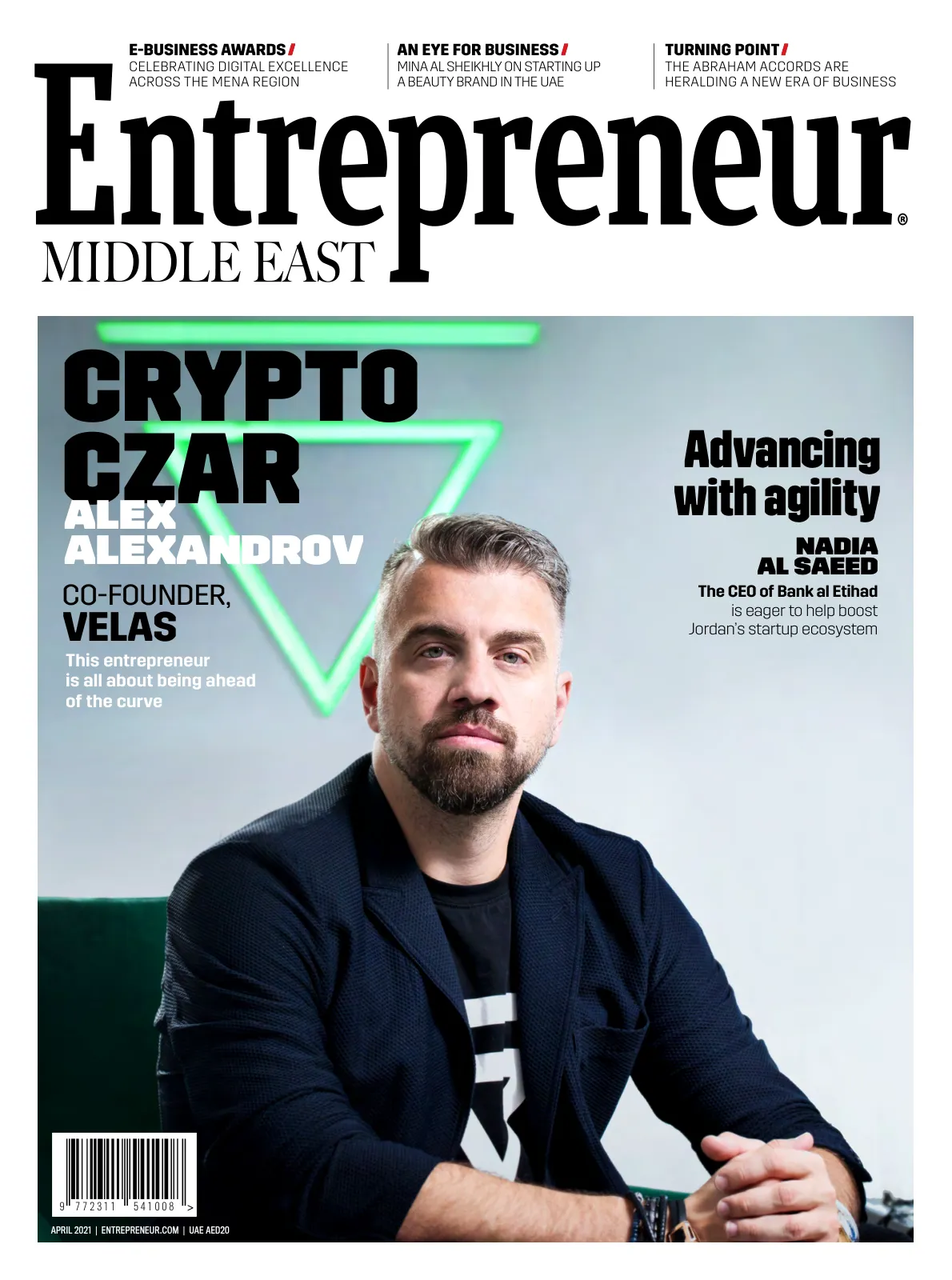
Entrepreneur Middle East, April 2021
Page 1
CRYPTO
CZAR
E-BUSINESS AWARDS
CELEBRATING DIGITAL EXCELLENCE
ACROSS THE MENA REGION
9
7 7 2 3 1 1
5 4 1 0 0 8
>
CO-FOUNDER,
VELAS
This entrepreneur
is all about being ahead
of the curve
9
7 7 2 3 1 1
5 4 1 0 0 8
>
AN EYE FOR BUSINESS
MINA AL SHEIKHLY ON STARTING UP
A BEAUTY BRAND IN THE UAE
TURNING POINT
THE ABRAHAM ACCORDS ARE
HERALDING A NEW ERA OF BUSINESS
APRIL 2021 | ENTREPRENEUR.COM | UAE AED20
ALEX
ALEXANDROV
Advancing
with agility
NADIA
AL SAEED
The CEO of Bank al Etihad
is eager to help boost
Jordan’s startup ecosystem
Page 2
Page 3
Page 4
4 / ENTREPRENEUR.COM / April 2021
CONTENTS APRIL 2021
16
INNOVATOR
CRYPTO CZAR
Alex Alexandrov
The co-founder of Velas is
all about being ahead of the
curve.
24
INNOVATOR
Advancing with agility
Nadia Al Saeed, CEO of Bank
al Etihad, who was recently
elected to be the Chairwoman
of the Board of Directors at
Endeavor Jordan, is eager
to help boost her country’s
startup ecosystem.
48
IN PICTURES
The recap
A look at the E-Business
Awards 2021, staged by
Entrepreneur Middle East,
which celebrated the digital
excellence showcasing
enterprises and entrepreneurs
across MENA.
58
START IT UP
Q&A
Zooming ahead
UAE-headquartered startup
Finalrentals is looking
to make a dent in how
traditional car rentals work in
the Middle East.
12
EDITOR’S NOTE
By Aby Sam Thomas
42
START IT UP
ECOSYSTEM
Turning point
A look at how the Abraham
Accords between Israel and
the UAE are heralding a new
era of business.
30
TECH
SHINY
#TamTalksTech
Gadgets and doodads that
you might’ve missed out on,
sourced by a tech aficionado.
56
CULTURE
BUSINESS UNUSUAL
An eye for business
Mina Al Sheikhly on starting
up a beauty brand in the UAE.
40
‘TREPONOMICS
PRO
Progressive prosperity
Veronica Juul-Nyhom
explains why gender equality
and women-centric policies
make good business sense.
36
CULTURE
LIFE
We are what we repeat
Marcus Smith gives a guide
to make building habits
(and achieving success) feel
effortless.
32
CULTURE
TRAPPINGS
‘Trep gear
The executive selection for
the entrepreneur on your list
that has everything. Okay,
maybe for a little self-reward
as well.
41
‘TREPONOMICS
MARKETING
Meet the consumer
chameleon
Michael R. Solomon reminds
businesses that instead of
categorizing customers, learn
to understand them.
Page 5
lyveglobal.com
E-COMMERCE
MADE EASY
Supercharge your ecommerce and online operations
with Lyve. Get fast, flexible, and full-featured delivery and
technology solutions that meet your customers’ needs
and allow you to focus on what you do best.
Go Lyve Today �
lyveglobal.com/ecommerce
#golyve
Page 6
6 / ENTREPRENEUR.COM / April 2021
SUBSCRIBE
Contact subscriptions@bncpublishing.net to receive
Entrepreneur Middle East every issue
EDITOR IN CHIEF Aby Sam Thomas aby@bncpublishing.net
CEO Wissam Younane wissam@bncpublishing.net
DIRECTOR Rabih Najm rabih@bncpublishing.net
CREATIVE LEAD Odette Kahwagi
MANAGING EDITOR Tamara Pupic
STARTUPS SECTION EDITOR Pamella de Leon
FEATURES WRITER Aalia Mehreen Ahmed
EDITORIAL DESIGN Christian Harb
DIGITAL SOLUTIONS DIRECTOR Mahdi Hashemi mahdi@bncpublishing.net
GROUP SALES DIRECTOR – B2B GROUP Joaquim D’Costa
COLUMNIST Tamara Clarke
PO Box 502511 Dubai, United Arab Emirates
P +971 4 4200 506 | F +971 4 4200 196
For all commercial enquiries related to Entrepreneur Middle East
contact sales@bncpublishing.net
All rights reserved 2021
Opinions expressed are solely those of the contributors.
Entrepreneur Middle East and all subsidiary publications in the
MENA region are officially licensed exclusively to BNC Publishing
in the MENA region by Entrepreneur Media Inc.
No part of this magazine may be reproduced or transmitted in any
form or by any means without written permission of the publisher.
Printed by United Printing and Publishing
upp.ae
Images used in Entrepreneur Middle East are credited when necessary. Attributed use of
copyrighted images with permission. All images not credited otherwise Shutterstock.
CONTRIBUTORS
entrepreneur.com/me
ACCESS FRESH CONTENT DAILY ON OUR WEBSITE!
MIDDLE EAST
EntMagazineME
@EntMagazineME
Entrepreneur-me
EntrepreneurMiddleEast
EntMagazineME
EntMagazineME
EntMagazineME
MIDDLE EAST
In addition to our print edition, we’re bringing
you all sorts of industry news on our web
mediums. Joining us online means getting
relevant business and startup content in
real-time, so you’re hearing about the latest
developments as soon as we do. We’re looking
forward to interacting with our readers on all of
our social media and web platforms- like any
thriving business, we’re looking to give and take.
#TrepTalkME is already happening on all of our
digi platforms, and all good conversations go
both ways. See you on the web!
Raffaella Campagnoli
Fida Chaaban
Tamara Clarke
Veronica Juul-Nyholm
Marcus Smith
Michael Solomon
Aakanksha Tangri
Page 7
Page 8
Page 9
Page 10
Page 11
Page 12
12 / ENTREPRENEUR.COM / April 2021
EDITOR'S NOTE
I
f you’re in a position of leadership,
here’s a question for you: what do you
do when someone in your team screws
up?
Yes, to err is human and to forgive is
divine, but this aphorism is rarely (if
ever) what comes to our minds when we
stand to lose a project or face a client’s wrath
because of an error made by a subordinate.
After all, it’s no fun having to take the rap
for something that’s absolutely not because of
your doing.
For entrepreneurs who run businesses, such
situations can be especially testing- imagine
having a misstep by one of your team members
being the reason for the potential loss of a cli-
ent or project that you had personally worked
hard to secure in the first place.
It’s often said that good leaders are those who
take responsibility when something goes wrong
within their teams or enterprises- but does
this statement take into account instances
where the fault squarely falls on someone else?
As someone who’s been on both sides of the
aforementioned scenario, here’s my two cents
on the matter.
There’s a quote attributed to legendary
American jazz musician Miles Davis that goes:
“If you hit a wrong note, it’s the next note that
you play that determines if it’s good or bad.”
This is the sentiment I think leaders need to
keep in mind when they find that someone in
their teams has slipped up. Sure, the impulse
would be to let them bear the brunt of their
blunder- but what if you were to take the fall
instead?
At first glance, this might seem like an
unnecessarily selfless thing to do- but do
consider the long-term implications of such an
act as well. Besides the fact that it’d let your
employee now have a real, consequence-free
chance to learn from their mistake, imagine the
amount of gratitude and goodwill it will inspire
in them as well.
As Davis indicates, such situations present
an employer with the choice of making the mo-
ment a horrific, humiliating memory in their
employee’s minds- or it could well be a lesson
in leadership they will almost certainly carry
with them through the rest of their careers.
Keeping that in mind, there is really only one
good answer to the question I posed at the
start of this write-up- and that, according to
me, is a thought worth holding on to.
TAKING ONE FOR THE TEAM
(AND WHAT DOING SO SAYS ABOUT YOUR LEADERSHIP STYLE)
Aby Sam Thomas
Editor in Chief
@thisisaby
aby@bncpublishing.net
Page 13
FUN COMES
GUARANTEED
YOU DECIDE WHEN THE PARTY
STOPS WITH 24HR FOOD & DRINK.
NOW OPEN AT DUBAI DIGITAL PARK.
RADISSONHOTELS.COM/RED
Page 14
14 / ENTREPRENEUR.COM / April 2021
IN THE LOOP
T
o celebrate the
UAE Innovation
Week running
from February
21-27, 2021, En
trepreneur Middle
East partnered
with the UAE
Ministry of Health
and Prevention
(MOHAP) to stage a series of
events designed to encourage and
bolster innovation within the
country’s healthcare sector.
Kicking off the week-long event
was the Future Health Hackathon
2071, which was organized by
MOHAP in partnership with
Entrepreneur Middle East and
BOLT. The virtual event, which
invited people from around the
world to work together on ideas
that can shape the future of
healthcare, saw more than 585
applicants and over 200 ideas
submitted from 26 countries
around the world. With the help
of distinguished speakers, men
tors, and judges along the way,
56 teams were then created, of
which 20 were then moved into
the finals. The 72-hour hack
athon then came to an end with
four winners receiving cash priz
es worth a total of US$10,000.
UAE Innovation Week 2021
THE RECAP
Biz Health : 561 registrations
Impact Health : 403
Hackathon : 600
26 countries reached
UAE
Germany
Egypt
Finland
France
Israel
India
Morocco
Russia
Slovenia
Lithuania
Serbia
Bahrain
Cyprus
Algeria
Estonia
Spain
Jordan
Kuwait
Lebanon
Latvia
Oman
Pakistan
Qatar
Tunisia
KSA
Total Registrations
561 Registrations
403 Registrations
600 Registrations
The Winners
Team P4ML Team Matense Team Neureno Team Healevate
Page 15
15
April 2021 / ENTREPRENEUR.COM /
United Arab
Emirates
35%
Indi
a
26%
Pakista
n
14%
Other
s
13%
Lebano
n
8%
Egyp
t
2%
Accessibility to
Healthcare
52.9%
AI
27.1
%
Personalized
Medicine
19.9%
585 Applications
submitted
200
+
Ideas
submitted
26
Countries
represented
446 Applicants
invited to
participate
56
Teams
formed
20
Teams
competed in
the final
Participation by country
Categories of submitted ideas
THE RECAP | UAE INNOVATION WEEK 2021
Also on MOHAP’s roster of
events for the UAE Innovation
Week this year was a webinar
on the role youth can play in
the growth and development
of the healthcare sector in the
UAE and beyond. With speak
ers like Harvard University
Junior Kavya Kopparapu (per
haps best known for being one
of TIME’s 25 Most Influential
Teens in 2018), MOHAP Youth
Council Chairman Dr. Sultan
Ahmed Al Sharif, and MOHAP
Chief Innovation Officer Saqr
Al Hemeiri, the webinar al
lowed for a lively conversation
that had attendees leaving with
insights to use in their respec
tive career journeys. With
more than 500 attendees, the
session was also a showcase of
the UAE’s interest in empower
ing its youth to safeguard the
future of the nation.
The UAE Innovation Week
2021 also saw MOHAP
welcome Dr. Eric Green,
Director of the National
Human Genome Research
Institute at the U.S. National
Institutes of Health, for a
talk on the subject of “From
the Human Genome Project
to Precision Medicine: A
Journey to Advance Human
Health.” Dr. Green, who is
known for having directed an
independent research pro
gram for over two decades
that included integral start-
to-finish roles in the Human
Genome Project and ground
breaking work on mapping,
sequencing, and character
izing mammalian genomes,
spoke at this virtual event
that had an audience of more
than 400 attendees from
around the world.
0
25
50
75
100
125
To network and meet cool people
To get valuable mentorship
To establish a partnership with
To learn how to start a business
To pitch my existing business
For the monetary rewards
Why did you attend the Future Health 2071 Hackathon?
Page 16
16 / ENTREPRENEUR.COM / April 2021
CRYPTO
CZAR/
THE CO-FOUNDER OF VELAS
IS ALL ABOUT BEING AHEAD OF THE CURVE
by ABY SAM THOMAS | PHOTOGRAPHY FAROOQ SALIK
INNOVATOR
ALEX ALEXANDROV
>>>
16 / ENTREPRENEUR.COM / April 2021
Page 17
17
April 2021 / ENTREPRENEUR.COM /
W
hile the global debate
on the long-term appeal
(and impact) of crypto-
currencies and block-
chain doesn’t seem like
it will reach a conclusive
end any time soon,
Alex Alexandrov and
Farkhad Shagulyamov
are, however, quite
clear on which side of
the discussion they are
on. “Crypto and blockchain are here to
stay,” Alexandrov declares. “It is going to
be embedded seamlessly into your digital
and physical life, and the sooner you take
the time to learn more about it today, the
more you will benefit in the future.”
Now, their position on this topic
shouldn’t come as much of a surprise-
they are, after all, entrepreneurs who are
essentially betting (and, well, capitaliz-
ing) on this realm. Besides the two being
the co-founders of Velas (“an ecosystem
of decentralized products that allow
anyone to feel the benefits of blockchain
technology”), Alexandrov is also the CEO
of CoinPayments, which has been billed
as “the largest altcoin payment proces-
sor and wallet solution in the world.”
As such, there shouldn’t be any raised
eyebrows when Alexandrov takes on an
evangelical aura to explain why all of us
-and yes, he means everyone- need to be
clued into these digital inventions that
are already making their presence felt in
the world around us. “If you are an en-
trepreneur, you must do it,” he says. “If
you are a business owner, you must do
it too. Sooner or later, people won’t be
able to avoid it. Everything that connects
us globally will be heavily reliant on the
blockchain. There is already talk about
biometric passports running on the block-
chain specifically due to the COVID-19
pandemic; it’s just another example of
how the tech is being used other than
through payment systems.”
Alexandrov is clearly someone who’s
keeping himself abreast of trends that are
moving the world in a different direction
than we are accustomed to, and that’s a
characteristic that can be chalked down
to the entrepreneurial mindset he seems
to have been born with. “I have always
been an entrepreneur at heart, ever since
I was a child,” Alexandrov says. “When
I was five or six years old, I would resell
newspapers in Odessa, Ukraine by waking
up before everyone, and buying newspa-
pers from the market while others slept. I
then sold them to the adults on the way to
work, before I took myself to school. How-
ever, at the time, being a Soviet era fam-
ily, my parents didn’t appreciate what I
did and told me to stop- I still don’t know
why!” But that didn’t (thankfully) end
Alexandrov’s entrepreneurial streak- on
the contrary, he leaned in harder to this
aspect of his personality. Fast forward a
few years into the 90s, Alexandrov started
making money off the sale and delivery of
goods his peers wanted during that time-
and that became the capital for another
new venture.
“I took the money I had earned, and I
started organizing street parties,” Alex-
androv recalls. “These then became so
popular that the police came to shut them
down, thinking that adults were up to no
good. Once they realized it was the work
of a 12-year-old, they encouraged me to
keep going, which I did until I moved to
Canada.” But even migrating to a new na-
tion didn’t dampen his entrepreneurial
spirit- in his new location, Alexandrov
found himself able to assemble computers,
and then find buyers for them online. And
while he did manage to make money off
this operation, Alexandrov found himself
wanting to earn more, and that led him to
launching a business in an entirely new
industry to do just that. “I found I could
trade my time for money, and that got me
interested in trading options and lever-
age, futures and forex,” he remembers.
CRYPTO CZAR | ALEX ALEXANDROV, CO-FOUNDER, VELAS
>>>
Page 18
18 / ENTREPRENEUR.COM / April 2021
INNOVATOR
“After the 2012 market crash, I came
across bitcoin, and quickly began
mining it at US$4 per token.”
If you’re a bitcoin enthusiast, this is
the point where you’d probably sit up
and look at Alexandrov in a different
light- his last statement makes it
clear that he’s an early adopter
when it comes to jumping on the
cryptocurrency wave, and that’s also
a testament to his eye for spotting
opportunities that others may not be
as receptive to.
“When I found bitcoin, I was
already reading a lot of economic
and banking books, so the concept of
money was already quite clear to me
(more so than your average person),
and the concept of digitizing things
was not foreign to me,” Alexandrov
says. “So, when I saw bitcoin, I
immediately recognized it as the
future, and I never had any doubts
about it. When I bought and mined
my first bitcoin at $4, I told all my
friends that this is going to reach a
million dollars per coin by 2030. As
an entrepreneur, to find an industry
that you can be at the bleeding edge
of is what we all strive to find. I was
too young to capitalize on the dot-
com boom, but I realized that bitcoin
was my chance, and my opportunity.”
It was when Alexandrov started to
sell off his bitcoin mining equipment
that he realized the appearance of
new entrants on the cryptocurrency
landscape- these are what are today
called altcoin, which essentially
refers to any cryptocurrency other
than bitcoin. “This was around the
time when litecoin first came onto
the scene, and we wanted to accept
it in addition to bitcoin,” Alexandrov
recalls. “So, we discovered a business
called CoinPayments that could
facilitate this. We were the 47th
merchant on the platform, and after
using the service, and liking it, I
ended up buying it, and moving it to
Canada.” Once again, Alexandrov was
ahead of the curve here- he saw the
potential in altcoin at a time when
there wasn’t a lot of interest in it at
all. “We entered the sector in 2013
with the pursuit and goal of becoming
the dominant payment processor
across the planet, and to make life
easier for everyone to store, send, and
receive payments in digital currencies
that we envisioned were the future,”
he says. “Since we couldn’t foresee
the future direction of crypto, we gave
every coin an equal chance, and if
they had the volume, we listed them,
and started using them for payments
and wallets for all of our customers to
be able to pay with them.”
CoinPayments may have started
out small, but the company has since
grown to become a global payment
processor for cryptocurrency and
wallet solutions. With Alexandrov
acting as the CEO of the enterprise,
CoinPayments has grown tenfold per
year since 2016, with the enterprise
stating it currently processes over
$2 billion a month in total volume.
With more than three million users
in total (of which one million are
active users), the platform currently
accepts 2,095 different kinds of
cryptocurrencies, with its offerings
used by more than 70,000 merchants
in over 200 countries around the
world. But for all the success the
platform is seeing today, it’s good
for the entrepreneurs reading this
to remember how Alexandrov got
started on this enterprise in the first
place. “My main motivation to start
CoinPayments was that I wanted to do
something in the sector, and when I
found a problem that I wanted to find
a solution for, that was what sparked
that burning interest for me,” he says.
“I think this is very common for most
entrepreneurs- for me, the trigger
was being able to accept an altcoin for
my business. CoinPayments was the
solution to my problem, and we have
grown from that initial spark. We
didn’t make much money for the first
few years, and it was a lot of work (as
it always is) to get to where we are
now, but it was worth it.”
We differentiate
ourselves
based on our
speed and low
transaction
costs. Fastest,
cheapest, best-
in-class:
it’s how we do
things at Velas.”
“
>>>
Page 19
19
April 2021 / ENTREPRENEUR.COM /
CRYPTO CZAR | ALEX ALEXANDROV, CO-FOUNDER, VELAS
Page 20
20 / ENTREPRENEUR.COM / April 2021
Much like Alexandrov,
Shagulyamov has had quite
an entrepreneurial bent of
mind as well. Shagulyamov
started his career by building
a payment and technology
company in China, of which he
was Chairman for three years.
In 2016, he became acquainted
with cryptocurrency, and
he soon made his first
investments into the space.
Shortly after, he decided to
make this into a business,
where he and his partners in
the wealth management sector
in Zurich, Switzerland, created
the first crypto international
security identification number
(ISIN). Later that same year,
Shagulyamov set up a regulated
crypto brokerage firm in the
country (which is still active
today), and he then went
on to organize a large-scale
crypto event during the World
Economic Forum in Davos in
2017, which brought leaders
in the industry together with
global leaders and economic
powerhouses. This gathering
happened through the first
major bull run for the sector,
and this event took the entire
crypto realm to a newfound
global platform.
Shagulyamov and Alexan-
drov met on a mega yacht in
Monaco, where leaders of the
crypto industry were invited
to network. The like-minded
entrepreneurs clicked from the
get go, and shortly after, they
teamed up to build the Velas
ecosystem. “Velas was founded
in 2019 in Zug, Switzerland,”
Alexandrov says. “It’s a project
designed from the beginning
to be an ecosystem in which
other solutions can be built
at scale. When you compare it
to other blockchains in 2019,
there weren’t many that could
handle as many transactions
per second, or handle a high
load of smart contract ini-
tiatives.” Alexandrov explains
that Velas came into being
after he and his team identi-
fied a need in the industry
for a fast, scalable blockchain
on which many services can
be built on top of, while also
integrating cross-chain, which
refers to the interoperability
between two relatively inde-
pendent blockchains. Velas has
thus been built on the idea of
decentralized finance (or DeFi,
as it’s more popularly known),
with Alexandrov saying that its
open-sourced blockchain eco-
system of products and servic-
es is an enabler for any kind of
tokenization project. “We also
have built something called
a ‘container system,’ which
allows for the cross-chain de-
posit and withdrawal of funds
from other blockchains,” he
adds. “There are other projects
working on this, but we dif-
ferentiate ourselves based on
our speed and low transaction
costs. Fastest, cheapest, best-
in-class: it’s how we do things
at Velas.”
It’s worth noting here that
Velas is an acronym for “virtual
expanding learning autono-
mous system”- that in itself
showcases the sheer range of
applications that Alexandrov
INNOVATOR
20 / ENTREPRENEUR.COM / April 2021
“If we can bring
value today,
then in the future,
global, full-scale
adoption will
naturally ramp up.”
Page 21
21
April 2021 / ENTREPRENEUR.COM /
hopes his enterprise will be
able to contribute to. Indeed,
one of Velas’ recent offerings
falls in the realm of social me-
dia, with its aim being to build
a more functional version of
the popular Telegram platform.
“One of the things we have
been developing that I’m re-
ally excited about is BitOrbit,
a decentralized social media
platform,” Alexandrov reveals.
“It’s a platform that allows us-
ers to integrate Telegram group
chats on top of native receive
and send payment functions.
For example, if you are an
influencer, you can take pho-
tographs and make them free
for everyone, but make other
content only accessible to pay-
ing or subscribed followers,
all on the blockchain. If you
are a musician, you can upload
some songs or content for free,
or through a preview feature,
but charge for full versions of
the tracks. We also have a non-
fungible token (NFT) market
built into the platform. All of
this is decentralized, and we
take zero fees from the plat-
form, because we’re taking a
long-term view: if we can bring
value today, then in the future,
global, full-scale adoption will
naturally ramp up.”
Perhaps one of BitOrbit’s
most appealing features is the
very fact that it is a decentral-
ized platform- something that
Alexandrov believes will garner
attention from the global inter-
net community. “We are really
excited to build a social media
platform that will be censor-
ship-resistant and democratic,”
he says. “This past year has ex-
posed how vulnerable our lives
are, so we know this is a really
timely, necessary product and
service for people to have at
their fingertips.” Much like
his mentality around CoinPay-
ments, Alexandrov describes
Velas’ BitOrbit as a platform
that he’d actually want to use
himself, and that is an indica-
tion to the tenets that drive
him as an entrepreneur today.
“BitOrbit is a social media
platform that I would want to
personally use,” he says. “I’m
not a big fan of any existing
social media platforms, so we
are building something we can
be proud of. The motivation
is never the money for me. I
could have been sitting on the
beach long ago, but I love the
opportunity to build and meet
new people every day. Business
occupies all of your mental
capacity, and there is nothing
more exhilarating than being
active with my own business,
or being involved with other
businesses at a high level.”
Alexandrov is now planning
to continue his entrepreneurial
pursuits based out of the Mid-
dle East- he’s now a resident of
Dubai, which he says is going
to be his (and Velas’) home for
the foreseeable future. “The
Middle East is a very forward-
thinking part of the world
that wants to be the definitive
global financial and technologi-
cal hub,” Alexandrov declares.
“Dubai and Abu Dhabi want
entrepreneurs to view this
part of the world as the new
Silicon Valley, and they have
provided the legal and financial
basis to make this possible.
It is literally the single best
place for any entrepreneur to
be, even those outside of the
crypto sector.” But that’s not
to say entrepreneurship here
is all roses either- and that’s
the premise for Alexandrov’s
advice for entrepreneurs in the
region (and beyond). “Don’t be
afraid of failure, and remember
that success is a habit- so, bal-
ance those two,” he says. “That
is where the magic happens. If
you can manage your failures,
but understand that you have
to succeed and continue, then
this will be the difference be-
tween your business making
money and you being success-
ful, or failing.”
According to Alexandrov,
entrepreneurship is rarely, if
ever, as glamorous as it is often
portrayed in mass media, and
understanding that is critical
for one to feel fulfilled after
taking on this career path for
themselves. “It is never like
you see on the news, or in the
movies,” he says. “Very few
people are overnight successes.
Warren Buffet said it well: ‘You
can make money, or you can
gain experience, but sooner or
later, one will be traded for the
other.’ In entrepreneurship,
there is nobody else to blame;
you have to accept all your
failures as your own, but you
keep learning and keep going,
always remembering what
your goal is- never settle.”
Shagulyamov adds, “The key
to success is building a strong
and reliable team, as well as
never ending hard work. A lot
of people come to us only after
seeing the results that are now
evident, and they think it’s an
overnight success. ‘There is no
such thing,’ I tell them- every
successful business has had at
least a few years of hard work
and sleepless nights behind it!”
For now, however, their bets
on blockchain are working out
for these two entrepreneurs;
but “the best is yet to come!”
Shagulyamov exclaims. “Velas
is going to be a major part of
the future of blockchain, and
we are here to stay.”
“ONE OF THE
THINGS WE HAVE
BEEN DEVELOPING
THAT I’M REALLY
EXCITED ABOUT IS
BITORBIT,
A DECENTRALIZED
SOCIAL MEDIA
PLATFORM.”
VELAS.COM
21
CRYPTO CZAR | ALEX ALEXANDROV, CO-FOUNDER, VELAS
Page 22
Timeless Elegance
Where modern French art de vivre meets ancient Egyptian charm.
Book your stay at sofitel-dubai-theobelisk.com
PARIS - LONDON - ROME - DUBAI - SYDNEY - MEXICO CITY
Page 23
Page 24
24 / ENTREPRENEUR.COM / April 2021
ADVANCING
WITH
AGILITY
NADIA /
AL SAEED
The CEO of Bank
al Etihad, who
was recently
elected to be the
Chairwoman of the
Board of Directors
at Endeavor Jordan,
is eager to help
boost her country’s
startup ecosystem
by TAMARA PUPIC
INNOVATOR
IMAGES COURTESY NADIA AL SAEED
24 / ENTREPRENEUR.COM / April 2021
Page 25
25
April 2021 / ENTREPRENEUR.COM /
“I believe that the way I was raised
and my experience in enabling work
environments has shaped the person I
am today,” Al Saeed says. “I started my
career at Bank al Etihad. I then moved
into a completely different sector, and
going from the private to public sector
as a Minister of ICT was a very enrich
ing experience. The shift taught me to
never be afraid of change, to keep learn
ing, to always accept and tackle new
challenges.” Indeed, in Jordan, Al Saeed
is a trailblazer of sorts when it comes
to women in the country’s workforce,
with a World Bank report in 2020 not
ing that the economic participation of
women in Jordan stands at 15%, one of
the lowest rates in the world. For that
reason, Al Saeed is a firm believer that
entrepreneurship and enabling women
in more leadership roles is a much-
needed vehicle for their economic
independence as well as social change.
“That starts at the policy level, as
women experience barriers in almost
every aspect of the labor market, in
cluding pay gaps, lack of safe transpor
tation, and affordable childcare,” she
says. “In recent years, there has been
growing focus on increasing women’s
participation in political leadership. It
is my belief that greater female repre
sentation in all aspects of the political
process leads to more inclusive and
sustainable policies on a national level.
When women are involved on a policy
level, we see more focus on quality of
life, families, gender equality, and the
inclusion of vulnerable populations.”
Al Saeed describes her years in politics
from 2003-2006 as of being “a woman
in a man’s world,” where the culture
and governing rules were different
from that which she had been used to;
however, she also notes, “My experi
ence wasn’t typical, and I was fortunate
to work with likeminded people on a
transformational portfolio.” Over the
years, Jordan has adopted a proactive
approach to increasing the representa
tion of women in politics, but Al Saeed
points out that there still are a number
of obstacles that obfuscate women’s
participation in politics in the coun
try. “Gender bias and traditional roles
continue to hold our women back,”
she says. “While it’s important for us
to help mentor and prepare women to
challenge the status quo, it is equally
important for us to challenge gender
bias wherever and whenever it occurs.”
Jordan is among 189 governments
that adopted the 1995 Beijing Dec
laration and Platform for Action, a
comprehensive roadmap for gender
equality, the empowerment of women,
and the human rights of women and
girls. One of the country’s steps that
promotes the inclusion of women in
politics is the establishment of The
Jordanian National Commission for
Women (JNCW), a semi-governmental
committee and reference authority for
all official bodies in Jordan in relation
to women’s affairs, by HRH Princess
Basma Bint Talal. Progress is slow but
still visible, Al Saeed states. According
to an OECD report, the introduction of
legislated quotas for women’s repre
sentation in decision-making bodies
at the national (2003) and municipal
level (2007) has played a key role in
increasing women’s representation in
politics in Jordan. “With increased rep
resentation, we are seeing the gender
equality agenda being pushed through
and more work being done to eliminate
gender discrimination,” Al Saeed says.
“While those efforts are admirable, we
still have a long way to go to make sure
women have equal representation and
greater political participation.”
T
he long line of accomplishments that Nadia Al Saeed
can attest to doesn’t seemingly end, and one of the
first statements made by the former Minister of
Information and Communications Technology (ICT)
of Jordan and the current CEO of Bank al Etihad in my
interview with her hints toward a leadership mindset
that has been essential for all the success she has
seen. “I’ve found that one needs to be a lifelong
learner,” Al Saeed declares, with one of the key highlights in her
pursuit of knowledge being a BA degree in business management
and economics, as well as a MBA degree she secured from the
American University of Cairo. However, she also notes that it was
her family that instilled in her the values that served as pillars
for all her choices in life. “I come from a background that valued
education and independence- my mother was a career woman, and
my father was very supportive and encouraged me to pursue my
career,” Al Saeed says. “Today, I am fortunate to have the constant
support of my husband, who has been a real partner and supporter
of my success.” In line with Entrepreneur’s central themes, what
follows here is a story of a woman who has had two successful
professional paths (“one in the public sector, as Minister of ICT, and
one in the private sector, as banker and CEO”), but it is, first and
foremost, the portrait of a woman who describes herself as “a mom,
wife, and CEO of Bank al Etihad.”
ADVANCING WITH AGILITY | NADIA AL SAEED, CEO OF BANK AL ETIHAD
“I believe that the
way I was raised
and my experience
in enabling work
environments has
shaped the person
I am today.”
>>>
Page 26
26 / ENTREPRENEUR.COM / April 2021
INNOVATOR
Al Saeed left the public sector more
aware of how much harder it was for
women to take on and succeed in leader
ship roles. In 2008, Al Saeed assumed
the role of CEO of Bank al Etihad, after
working on the bank’s new growth strat
egy as a McKinsey & Company strategy
advisor for one year. Drawing on her
experience from the public sector, she
made sure to work on creating solutions
that empower women, such as launching
the Bank al Etihad’s Shorouq, a women’s
market program that was Jordan’s first
and only full banking proposition for
women, in 2014. “Shorouq not only
ensured we implement diversity and
inclusion policies within the bank, but
that we also offer inclusive financial
and non-financial services and advice
to women,” Al Saeed says. “In my role, I
have made it a priority to use resources
to educate women about entrepreneur
ship and taking control of their finances
and lives. At Bank al Etihad, we have
built services dedicated to females at all
stages of their lives, providing them with
financial and non-financial services to
become risk takers, entrepreneurs, and
successful women in the economy.”
Today, almost half of the staff at Bank
al Etihad are women, Al Saeed proudly
notes. “Having women in positions of
power contributes to building a sustain
able country with healthy and progres
sive communities,” she says. And when
it comes to succeeding in the corporate
world, her main piece of advice is “to
constantly learn, reinvent yourself, and
adapt to the rapid changes in technol
ogy.” Another thing to focus on is the
importance of leveraging partnerships
“Your team and the ecosystem around
you, your impact and the value you
provide become greater when you join
forces with likeminded people and
organizations,” she adds. “The team
you surround yourself with is also very
important. I believe you are as good as
your team.” In addition, it is crucial to
choose a work environment wisely, Al
Saeed says. “Working in an enabling
corporate culture, one that respects
and welcomes diversity, where women
have an equal opportunity to compete,
lead, and succeed is pivotal,” she adds.
“Most importantly, once you have made
it, don’t forget to open doors for other
women by influencing decisions, poli
cies, and practices that are inclusive. In
addition, as a woman, you need to carry
yourself as a professional in a corporate
environment, so others deal with you in
the same way.”
Now, Al Saeed is not just a supporter of
Jordan’s women, but also of its youth-
she believes that it’s their savviness in
tech as well as their eagerness to learn
that have attracted global players, such
as Expedia and Amazon, to open their
regional offices in Jordan. “Jordan is
an untapped market,” she says. “Our
greatest asset remains our local talent.
When the entrepreneurial ecosystem
hype started in the region back in the
early 2010s, Jordan was at the heart of
the boom, and we saw many firsts- the
region’s first accelerator, Oasis500, was
here, Silicon Badia was among the first
VCs, and even the first regional Endeavor
offices opened in Jordan. Comparing
Jordan to our neighboring countries,
the market is in fact smaller; however,
Jordan is the place for entrepreneurs to
pilot and launch their ideas. Consider,
just to name a few, Souq, Mawdoo3,
Maktoob or Arabia Weather. They all
started in Jordan, and later on expanded
into regional markets, and they have
shaped technology and the ecosystem in
the whole region.”
Jordan’s startup landscape looks set
to now get a boost with Al Saeed having
been recently elected as the chairwoman
of the board of directors of the Jordan
outpost of Endeavor (“the world’s lead
ing community of high impact entrepre
neurs”), with her aim being to advance
the local entrepreneurial ecosystem. “I
think that we’re just witnessing the cusp
of what is possible,” she says. “Even
access to funding and investments has
witnessed significant growth, as funding
for startups and SMEs more than dou
bled over the last five years.” Al Saeed
adds that the outbreak of the COVID-19
pandemic and the urgent shift to digital
by numerous companies has again high
lighted the need to support and encour
age tech startups. “The roles of business
leaders worldwide dramatically changed
during the pandemic,” she adds.
“Having women in
positions of power
contributes to building a
sustainable country with
healthy and progressive
communities.”
“THE REGION SUFFERS
FROM SOME OF THE HIGHEST
UNEMPLOYMENT RATES IN
THE WORLD, MAINLY DUE TO A
GAP BETWEEN EDUCATIONAL
INSTITUTIONS AND THE JOB
MARKET. ORGANIZATIONS
AND SMES NEED TO WORK
ON INVESTING IN THE YOUTH
TO SHAPE THEIR SKILLS, AND
PROVIDING THE RIGHT TOOLS
AND SPACE FOR THEM TO
EXPLORE AND INNOVATE.”
>>>
Page 27
27
April 2021 / ENTREPRENEUR.COM /
ADVANCING WITH AGILITY | NADIA AL SAEED, CEO OF BANK AL ETIHAD
27
April 2021 / ENTREPRENEUR.COM /
Page 28
28 / ENTREPRENEUR.COM / April 2021
“Before COVID-19, we were focused on
fostering innovation and driving growth.
When the pandemic hit, we had to make
quick rational decisions about reinvent
ing business models, controlling costs,
maintaining liquidity, and prioritizing
business continuity in order to serve
our clients. We were forced out of our
comfort zone, and forced to adapt and
respond. It has underlined the impor
tance of resilience and agility.”
In her opinion, while the MENA region
will continue to grow in terms of in
novation and infrastructure advance
ment, with Saudi Arabia, United Arab
Emirates, and Oman leading the game
by investing in infrastructure projects,
it is also increasingly becoming a hub
for global investors and entrepreneurs.
“We’ve seen remarkable growth in the
ecosystem in terms of access to funding
through regional investors, accelerators,
and VCs. In 2020, despite the economic
repercussions of COVID-19, 469 regional
startups closed funding deals that are
worth a total of US$1 billion,” she says,
crediting the entrepreneurs behind
Maktoob, Souq, and Careem for suc
cessfully leveraging the region’s talented
youth to build multimillion dollar com
panies. However, Al Saeed is also quick
to point out the issues that remain.
“Even with all the hype around startups
in the region, business owners face
problems when it comes to hiring,” she
says. “The region suffers from some of
the highest unemployment rates in the
world, mainly due to a gap between edu
cational institutions and the job market.
Organizations and SMEs need to work
on investing in the youth to shape their
skills, and providing the right tools and
space for them to explore and innovate.
They shouldn’t expect to bring in a fully
qualified junior, but instead search for
candidates that fit the organization’s
values and work on helping them grow
and excel.” In Jordan, she adds, one of
the main obstacles is scaling. “Entrepre
neurs utilize the Jordanian market as a
launchpad, and then scale in countries
like Saudi Arabia or the UAE,” she says.
“I believe there is room for collabora
tion between markets to open up, share
resources and knowledge to give the
region an edge, and make it a hub for
investors and entrepreneurs.”
1/ Find a mentor
“Great leaders know their limits,
and they know when to ask for
help. Find someone that you
trust, and turn to them when
you need advice or a sounding
board.”
2/ Pay it forward
“Make a difference in the
lives of other existing and
aspiring entrepreneurs. Multiply
your impact by mentoring
and investing in the next
generation.”
3/ Involve younger
employees in decision making
“It’s not just about the power
of teamwork, but a lot of the
times the younger employees
see things from another
perspective, which eventually
will help in the success of your
organization.”
4/ Embrace agility
“Welcome change, and
always be ready to adapt
and respond to the needs of
your consumers and evolving
business landscape.”
5/ Communicate, listen,
and be transparent
“Transparency and honest
communication is everything in
today’s world. Whether you’re
talking to consumers on a
brand level or to employees,
leading with transparency will
build trust around you.”
Bank al Etihad CEO
Nadia Al Saeed’s tips for
entrepreneurs
THE EXECUTIVE
SUMMARY
JORDAN IS THE PLACE FOR
ENTREPRENEURS TO PILOT
AND LAUNCH THEIR IDEAS.
CONSIDER, JUST TO NAME
A FEW, SOUQ, MAWDOO3,
MAKTOOB OR ARABIA
WEATHER. THEY ALL STARTED
IN JORDAN, AND LATER ON
EXPANDED INTO REGIONAL
MARKETS, AND THEY HAVE
SHAPED TECHNOLOGY AND
THE ECOSYSTEM IN THE
WHOLE REGION.”
“In 2020, despite
the economic
repercussions of
COVID-19, 469 regional
startups closed funding
deals that are worth a
total of US$1 billion.”
INNOVATOR
Page 29
29
April 2021 / ENTREPRENEUR.COM /
Page 30
30 / ENTREPRENEUR.COM / April 2021
GADGETS AND DOODADS THAT YOU MIGHT’VE MISSED OUT ON, SOURCED BY A TECH AFICIONADO.
YES, IT’S OKAY TO WANT THEM ALL… AND NO, IT’S NOT OUR FAULT.
STREAM IT
SOUNDCORE LIBERTY AIR 2 PRO
IMAGES COURTESY SOUNDCORE | NOKIA | SWITCH
TECH SHINY
Liberty Air 2 Pro, Soundcore’s
newest high-tech earbuds, feature
advanced active noise canceling,
transparency, and PureNote driver
technology. So, what does all that
mean for you? Each earbud has
10 hardened nano layers offering
accurate sound and clarity at all
frequencies. Furthermore, the device
comes with a variety of customizable
elements such as outdoor and indoor
modes, which block out voices, and
transparency mode, which controls
ambient sounds to help you set your
personal sound profile. Fine tuning
Liberty Air 2 Pro is easier than ever
before with the updated Sound-
core app offering HearID, a simple
hearing test to help ensure the best
possible listening experience. With
individualized audio settings, virtual
assistant compatibility, fast charging
technology (you can get two hours
of playtime in just 10 minutes), and a
sleek wireless charging case, Liberty
Air 2 might be right for you.
Soundcore
Liberty Air 2 Pro
Page 31
31
April 2021 / ENTREPRENEUR.COM /
#TAMTALKSTECH Tamara Clarke, a former software development professional, is the tech and lifestyle enthusiast behind The Global Gazette, one
of the most active blogs in the Middle East. The Global Gazette has been welcomed and lauded by some of the most influential tech brands in the
region. Clarke’s goal is to inform about technology and how it supports our lifestyles. See her work both in print regional publications and online on
her blog where she discusses everything from how a new gadget improves day-to-day life to how to coordinate your smartphone accessories.
Visit theglobalgazette.com and talk to her on Twitter @TamaraClarke.
#TAMTALKSTECH | GADGETS AND DOODADS THAT YOU MIGHT’VE MISSED OUT ON
LEVEL UP
NOKIA X20
The Nokia X20 comes with a 32MP
front camera and 64MP quad camera
on the rear. The all-new Dual Sight fea-
ture activates two cameras simultane-
ously, so you can capture multiple sides
or angles of your subject. Meanwhile,
ZEISS Optics and innovative artificial
intelligence solutions offer versatile
imaging options, and with a wide 6.67”
Full HD+ punch-hole display, all of your
content will be delivered on a crisp, eye-
catching screen. Made with creators in
mind, photos can be tagged immedi-
ately using a host of watermarking op-
tions. Powered by the latest Qualcomm
Snapdragon 480 5G Mobile Platform,
X20 delivers unmatched performance.
Three years of security and software
updates offer extra peace of mind, while
the clean Android One interface and
classic Nordic design make it a desirable
choice among smartphones. Nokia X20
also comes with a 100% compostable
case, designed to be tough on the
ground, but soft on the earth as it helps
to reduce waste.
Whether you’re in the market for
office audio equipment or a speaker
to spice up backyard barbeques,
the new Switch WS-Ultra 60W
Wireless Speaker is an ideal choice.
The speaker has a powerful 60W
output with two full range drivers and
two bass drivers for an immersive
listening experience. Plus, its 7,200
mAh rechargeable battery provides
more than 10 hours of playback time.
The Switch WS-Ultra 60W Wireless
Speaker also comes with a built-in
microphone to allow for hands-free
calls and a built-in smartphone
charger, which allows you to power
up even if you’re on the go. Its sleek
design is built to last in every situa-
tion, with a handlebar and shoulder
strap for easy portability, and since it
is IPX6 Waterproof, you don’t have to
worry about unexpected rain or water
contact either. The Switch WS-Ultra
60W Wireless Speaker comes in
three striking colors: Classic Black,
Green Camo, and Pink Camo.
SOUND CHOICE
SWITCH WS-ULTRA 60W WIRELESS SPEAKER
Switch WS-Ultra 60W
Wireless Speaker
Nokia X20
Page 32
32 / ENTREPRENEUR.COM / April 2021
CULTURE TRAPPINGS
IMAGE CREDIT BRUNELLO CUCINELLI | PATEK PHILIPPE | NARCISO RODRIGUEZ | FREE YOUR SKIN
‘TREP TRIMMINGS
THE EXECUTIVE SELECTION
F
rom better goods to better wardrobe bests, every issue we choose a few
items that make the approved executive selection list. In this issue, we
present our picks from Brunello Cucinelli’s Spring/Summer 2021 line, a
timeless timepiece from Patek Phillipe, and more.
MOVING ON UP
BRUNELLO CUCINELLI
SPRING/SUMMER 2021
Striking a perfect balance between
casual elegance and contemporary
style, Brunello Cucinelli’s
Spring/Summer 2021 collection
presents a plethora of distinctive
elements. The brand’s thorough
craftsmanship can be seen in the
soft volumes of this line’s shirts,
T-shirts, polos, and trousers, all of
which evoke an air of tranquility.
The neutral tones of the collection
are eye-catching as well- the array
of warm beige, grey, and blue
colors are accented with fresh
summer hues of cobalt, aqua,
citron, and magenta.
brunellocucinelli.com
Brunello Cucinelli S/S 2021
Page 33
33
April 2021 / ENTREPRENEUR.COM /
'TREP TRIMMINGS | THE EXECUTIVE SELECTION
EDITOR’S PICK
FRESH FACETS
NARCISO RODRIGUEZ
Launched in 2021, Musc
Noir For Her is Narciso
Rodriguez’s latest
fragrance, concocted
by perfumer Sonia
Constant, with a rare
musc oil at its heart.
Along with rich leather
suede accords, the musc
is further highlighted
with the lush and
fragrant heliotrope, and
enhanced by white cedar
and rose, along with
a hint of plum. A soft,
sensual and silky scent,
it’s a versatile fragrance
that will stay with you
all through the day.
Narcisorodriguez.com
TIMELESS APPEAL
PATEK PHILIPPE
Patek Philippe introduced its first exclusively feminine
collection in 1999, which remains a personification
of the styles and sensibilities of modern women. This
year, it has debuted three new Twenty~4 models, and
we’re a fan of the Twenty~4 Reference 4910/1201R-
001, a new timepiece in rose gold with a chocolate
brown sunburst dial. As its name signifies, the watch is
meant for everyday wear and for all kinds of occasions.
Distinguished by its art-deco-inspired cuff design
(“manchette” in French), the timepiece features a
rectangular case emphasized by two rows of diamonds,
as well as Arabic numerals and hour markers in rose
gold enhanced with luminescent coating. If you’re
one for details, you’ll be glad to see that the crown is
adorned with the Calatrava cross, the brand’s signature
emblem. Patek.com
FREE YOUR SKIN
Founded by UAE-based female entrepreneur Soukaina Benlamlih
in 2020, Free Your Skin is an e-commerce platform dedicated to
transparency, clean beauty, and wellness. Featuring products
from notable cruelty-free brands, such as Miranda Kerr’s
Kora Organics, Biologi, Glow Recipe and more, the platform
also features staples from The Honest Company, such as its
Everyday Radiance Moisturizer. Suitable for all skin types, it’s a
lightweight cream designed to target dullness and level up your
Zoom-tired skin status with its vitamin and antioxidant-rich
ingredients. Freeyourskin.co
Patek Philippe Twenty~4 Reference 49101201R-001
Page 34
34 / ENTREPRENEUR.COM / April 2021
Tell us a little bit about yourself, and what you do.
I am a 29-year-old DJ and music producer, absolutely self-
made- I know what I know now, because I’ve been driven
by curiosity and passion, and whatever I’ve developed
so far has been a result of experimentation and, most
importantly, online research. We didn’t have any music
school until recently in Saudi Arabia, and so, my journey
has been all about learning how to turn into a full-time
musician and produce music on my own. On top of my
music production, I also run a radio show called Spaceship,
transmitted on MDLBeast Freqways, and I do occasional
collaborations with local fashion brands or interesting
international brands that have the same goal I have in
terms of empowering youth and especially women. Thanks
to the new direction that Saudi Arabia has taken recently
towards arts, music, and support to youth, this is a great
opportunity that is opening up a lot of new spaces for
people like me.
STRATEGY/BITES
INSIGHTS AND INSPIRATION FROM SAUDI ARABIA
by RAFFAELLA CAMPAGNOLI
Strategy Bites is a series of interviews that LIRA Strategy Partners founder and Managing Director Raffaella Campagnoli
is conducting with enterprising figures in Saudi Arabia for Entrepreneur.com. In this edition, she talks to Saudi Arabian DJ
and music producer, Nouf Sufyani, better known as Cosmicat.
NOUF SUFYANI
AKA COSMICAT
DJ and music producer
CULTURE BUSINESS UNUSUAL
Page 35
35
April 2021 / ENTREPRENEUR.COM /
How are you embracing Saudi Arabia’s
Vision 2030?
The entire movement for change in Saudi
Arabia started in 2019, ever since we had
the chance to be in touch with musicians,
which allowed us to present talents in dif-
ferent ways, and also to interact a lot with
each other. The dream I had for myself
materialized by my participation in MDL-
Beast’s flagship event, which extended
beyond the music festival itself, as it was
supporting talents like me, expressing
ourselves in a pure and open way. It had
400,000 people participating in the event
happening across three days; it was a
really incredible and unique event. Vision
2030 is thus about opening up the world
to Saudi Arabia and Saudi Arabia to the
world, and I feel lucky to be living this mo-
ment. I feel very optimistic and confident
that this is going to be the beginning of a
much greater movement that will make
Saudi Arabia eventually one of the main
global centers for arts and music in the
world.
What are the some of key changes you
are personally seeing in the Kingdom
today?
I have a lot of female friends, lots of whom
are DJs like me. They have felt supported
and inspired by other female artists, just
like I did; I actually started DJing thanks
to this great friend of mine, who excited
me so much with music but didn’t dare to
get on the spot like I did. This is remind-
ing me of the past, where people didn’t
dare to approach their passions and
their desired careers for being kind of
different, or perhaps even considered
outliers. I was a dentist some years ago,
spending my 9-to-5 job in a very common
way, and I was happy with that. So, I didn’t
really think about what would happen if
I stopped being a dentist- I just felt like
doing it, and the time felt right, and I made
the change. It was a courageous choice,
driven by passion, and now I really feel
energized and positive. I am feeling great
vibes about my choice. I am working on a
lot of releases, and I am working on a lot
of new projects. SoundCloud, Spotify, Ins-
tagram, Facebook: those are some of the
channels and platforms I use for distribut-
ing my music. You know, the best track
I am working with now has got 11,400
number of plays within a month- my high-
est record has been 25,600 plays!
What excites you about the future of
Saudi Arabia?
My hope is that nothing is going to change
back to the way it was. I live in Jeddah,
which is now a completely different city
than what it was three years ago. I want to
continue doing what I am doing with mu-
sic, as I feel this is right, and this is where
I am supposed to be– my real calling. And
that’s my message for other women in
Saudi Arabia: I would tell them to always
remember that each and everyone of us is
strong and capable to achieve whatever
it is we dream of. We’re now in the right
environment to realize all of our hopes
and ambitions- keep on being persistent,
never be intimidated, and dare. Now is the
STRATEGY BITES | NOUF SUFYANIA, AKA COSMICAT
“The best track I am
working with now has
got 11,400 number of
plays within a month- my
highest record has been
25,600 plays!”
Raffaella Campagnoli is the founder and Managing Director of LIRA Strategy Partners. With over 20 years of experience in strategy consulting in
international firms, she was formerly the Managing Director at Accenture Strategy Middle East and Turkey for nine years. Raffaella left Accenture
after 13 years at the company, during which she led transformation programs in multiple regions (Europe, US, Turkey, Singapore, Middle East),
specialized in strategic planning, operating model transformation, zero based budgeting, digital transformation and innovation, ecosystem strategy.
Raffaella has been leading impactful transformations in industries like travel and hospitality, fashion, consumer products goods, and retail, thereby
developing a trusted network of partners and experienced professionals. lira.partners
Page 36
36 / ENTREPRENEUR.COM / April 2021
G
oals and dreams motivate
us to wake up every day
and work towards success.
Having those big goals is
essential, but what defines
how you feel and who you
are when you get there is the
journey you take. Your process is more
significant than the destination itself,
and what drives growth and progress
throughout that process are the habits
you form.
Habits are routine behaviors that we
adopt and practice, often without even
being aware of them. What is fascinat-
ing about them is that when done right,
they enable you to propel yourself to-
wards success- on autopilot!
Let’s take the concept of habit creation
a step further and talk about micro-
habits. Micro-habits are habits that re-
quire very little to no effort to complete,
but they compound over time to have a
tremendous impact on your life.
Think of the potential these two ideas
have when put together. You can make
small, easy adjustments in your life in
the form of micro-habits, and their im-
pact will accrue over time to help you
achieve those big goals.
Of course, this comes with the precon-
dition that you create the right kind of
habits. They must be chosen carefully
and repeated consistently to have an
impact. You can take specific actions to
ensure your choices work in your favor,
but first, let’s understand what kind
Marcus Smith is an entrepreneur, motivational speaker, and international athlete. With a clear vision of building brands that improve people’s
lives through health, culture and environment, he has developed and established two successful businesses, including international
performance company, InnerFight, and paleo food provider, Smith St Paleo. He is the host of the InnerFight podcast, the UAE’s number 1
health podcast. innerfight.com
WE ARE WHAT
WE REPEAT
How to make building habits (and achieving
success) feel effortless
by MARCUS SMITH
CULTURE LIFE
Page 37
37
April 2021 / ENTREPRENEUR.COM /
of habits are inherently easier to
maintain. Here’s the anatomy of
what we call “effortless” habits:
1. Relevant and appropriate
If you can understand the role a
habit has to play in helping you
achieve a goal, it becomes easier to
stick to it. This concept works well
when the connection is obvious.
For example, if your goal is to im-
prove your diet, it’s not difficult to
understand how adding green veg-
etables to your lunch and dinner
every day will help you get closer
to that goal. When the correlation
between a habit and success isn’t
immediately clear, you need to
spend some time establishing this
link to convince yourself of the
power of that habit.
2. Easy to follow
Although we are capable of over-
coming immense challenges and
setbacks, the fact is we are also
quite lazy when it comes to cer-
tain areas of our life. We prefer the
easy way out, and habits are no
exception. That’s why easy-to-fol-
low practices are also the easiest
to maintain. If you find it difficult
to adopt or keep up a habit, think
of ways you can make it easier. For
example, if you want to run every
morning, keep your running shoes
and gear ready the previous night,
so that getting ready becomes a
less demanding ritual.
3. Instantly gratifying
Humans crave immediate grati-
fication, which is why we tend to
choose short-term rewards over
long-term achievements. Seeing or
experiencing rewards in the short
term may feel good for a while,
but the habits that you practice
for weeks, months, or even years
are the ones that give you con-
sistent success. They’re called
habits because they’re repeated
over time, even if they sometimes
do not make immediate sense, as
mentioned in the first point above.
We need to understand that it
takes consistent effort to create
habits that deliver long-term, life-
changing results.
Now that we know some of the
science that drives habits, we can
WE ARE WHAT WE REPEAT
When was the last time you took a moment be-
tween the never-ending Zoom calls and the chaos
of working from home to stop and appreciate how
far you have come in the past year? For many of
us, we are so focused on the next thing on our
to-do list or our list of goals that we often don’t
stop to appreciate what we have accomplished
till now. These accomplishments don’t even have
to be something mammoth, even a simple goal
of working out when you thought you couldn’t, or
getting through your unread emails is worthy of
appreciation. We often lift and support others, but
how many times do we extend the same kindness
and thoughtfulness to ourselves? Here are a few
ways you can go about empowering yourselves,
and those around you:
1. Find a mentor
Nobody is self-made in this world. Everyone has
had to reach out for help, support, and collabora-
tions in their careers and their entrepreneurial
journeys. It is important to find a mentor who can
guide you through the rough days, serve as a
sounding board when you’re overwhelmed, and
who you can turn to for wisdom when you need
to. Knowing you have a support system you can
turn to and rely on will give you that boost of
confidence during the tough moments, particularly
when you are making key decisions. Reach out to
people you admire and want to learn from- ask
them if they have the time and space to mentor
you, or to meet for virtual coffee dates, or in per-
son, if they’re comfortable.
2. Mentor someone
You have to give back- that’s how we all grow.
When you empower others, you also empower
yourself. If you’re an executive, look at tying up
with a school or your alma mater to regularly men-
tor young kids, or initiate a mentoring program
GIVE YOURSELF A PAT ON THE BACK
How to empower ourselves
(and those around us) by AAKANKSHA TANGRI
HUMANS CRAVE IMMEDIATE GRATIFICATION, WHICH
IS WHY WE TEND TO CHOOSE SHORT-TERM REWARDS
OVER LONG-TERM ACHIEVEMENTS. SEEING OR
EXPERIENCING REWARDS IN THE SHORT TERM MAY
FEEL GOOD FOR A WHILE, BUT THE HABITS THAT YOU
PRACTICE FOR WEEKS, MONTHS, OR EVEN YEARS ARE
THE ONES THAT GIVE YOU CONSISTENT SUCCESS.
Aakanksha Tangri
Page 38
38 / ENTREPRENEUR.COM / April 2021
Here’s how you can go about set-
ting up habits for success:
1. Do your homework
Make it make sense. Since we tend
to stick to habits connected to our
goal, think about how your routines
and practices are helping you on
your journey. Some connections
are not as obvious and others, so
make sure you understand a habit’s
ability to get you closer to success.
Spend time on this exercise in the
beginning, I assure you, it’s worth
it. For instance, if you aim to build
a six-figure business in two years,
and you’ve heard that it helps to
meditate for five minutes every
morning, you might have difficulty
believing this will help you reach
your goal, because the direct link
between them isn’t obvious. Doing
some research and talking to other
people who meditate regularly
could help you learn about its mer-
its. When you discover that it can
help you achieve clarity and focus,
you may recognise how it can posi-
tively impact your productivity and
efficiency, helping you get closer to
achieving your dream.
2. Start small
It’s tempting to go all out and in-
troduce many new habits at once,
but not everyone can keep up with
the rigor this demands. Introduce a
new habit or two at first, and only
when they become a natural part
of your life, incorporate new ones.
Start small and work your way up,
rather than setting yourself up for
failure by placing too many de-
mands on yourself.
3. Review often
Take stock of your journey. Which
habits are working, and which
aren’t? Why do some feel more dif-
ficult than others? You can do this
alone, or with a friend or mentor.
In any case, be open and honest.
This is about your growth and your
story. It’s good to be aware of set-
backs and obstacles, as that is the
first step to overcoming them.
4. Change things up
Some habits serve us for certain
parts of our journey, but not all are
required for the entire duration, so
it’s okay to park them and bring in
new, more powerful habits. Accept
this, and be open to reassessing as
often as you need. Keep an open
mind when you review your habits.
In the end, remember that what
we are trying to do by creating the
right habits is to build a blueprint
for success in life. This deserves
your time, commitment, and full
understanding, and if you give it
all of these, you will learn to form
habits that serve your growth.
Some of your micro-habits will stay
with you for life, and they will go a
long way towards helping you find
health and happiness. So, give it a
shot– it’s worth it.
in your organization for those who are just
kickstarting their careers. Remember how many
times you wished you had someone with more
experience you could turn to even for the most
mundane of things? Now is your chance to en-
sure those following in your footsteps have the
support they need to progress in their careers.
Some of the benefits of mentoring someone:
you improve your leadership skills and con-
fidence, reiterate your own knowledge, and
delve deeper into your own thinking during the
process, all of which play a key role in empower-
ing yourself. You may also learn something new
or get insight into the thinking of the younger
generation, which can help with your own
growth and skill development.
3. Find something you love, but it doesn’t have
to be your work
We know the old adage “Choose a job you
love and you will never have to work a day in
your life.” Well, it’s really not as easy as that.
We often get into careers because of family
circumstances, financial responsibilities, a
poor economy, or for the practicality of it. And
sometimes, even if you’re doing what you love,
it won’t necessarily be rainbows and unicorns.
You’re going to face a lot of challenges during
your professional life, and that’s only natural.
This is why it’s important to have an identity
that’s separate from what you do for a living.
Usually one of the first questions we ask some-
one when we meet them is: “So, what do you
do?” We instantly equate their worth with their
work. Think about who you are outside of your
professional life. What do you care about? What
makes you unique? What makes you proud of
yourself that isn’t related to work? This will help
ensure that when you have a bad day or are
having a tough time at work, you know you are
more than your job title.
4. Reflect and reset
Set aside time during the week or the month
-whatever works best for you- to look back, and
reflect on the highs and lows. What were the
challenges you faced? What were the positive
aspects? Were you able to meet the goals you
set for yourself, or do you need to revisit them?
Have an honest conversation with yourself. This
will allow you to focus on your strengths and
areas for growth, as well as where you need
additional support or need to change how you
approach a particular task. Objectively evaluat-
ing yourself will aid you in your journey to grow
CULTURE LIFE
Aakanksha Tangri is founder of Re:Set, a resource
platform for fostering gender, inclusivity, mental health,
and well-being. resetyoureveryday.com
IF YOU AIM TO BUILD A SIX-
FIGURE BUSINESS IN TWO
YEARS, AND YOU’VE HEARD
THAT IT HELPS TO MEDITATE
FOR FIVE MINUTES EVERY
MORNING, YOU MIGHT HAVE
DIFFICULTY BELIEVING THIS
WILL HELP YOU REACH
YOUR GOAL, BECAUSE THE
DIRECT LINK BETWEEN
THEM ISN’T OBVIOUS.
Page 39
Ready to get
rewarded?
Join Radisson Rewards
for exclusive benefits
We can’t wait to welcome you as a member across our
six hotel brands and 1,100+ locations worldwide. Thank
you for choosing Radisson Hotels.
Award Nights
Use your points for stays - it’s that simple!
Members Only Rate
Save up to 10% when you book on
radissonhotels.com/rewards
More benefits
Including savings of up to 20% on food and
beverages, room upgrades for Elite members
and more
Join today at the front desk
or on radissonhotels.com/rewards
Page 40
H
aving a diverse, gender-
balanced, and inclusive
organization is no
longer an option– it is a
necessity of the times.
Striking the right gen-
der balance, especially
across leadership roles, not only yields
incredible financial benefits, but also sets
the tone for a progressive organizational
culture that acknowledges its customer
base, values relationships, and believes in
equal human rights.
According to studies by the Interna-
tional Monetary Fund (IMF), the benefits
of closing the gender gap are larger than
previously estimated, and they can con-
tribute towards increasing GDP by up to
35%. Moreover, research from leading
management consulting firm McKinsey
& Company also outlines how gender-
diverse businesses are 15% more likely to
have financial returns above the industry
median.
The productivity and growth gains
achieved by adding women to the labor
force are testament to the fact that gen-
der diversity matters, and most recently,
we witnessed this closer to home, where
the UAE intensified its efforts to boost fe-
male representation at the highest levels
of business by announcing that all listed
companies in the country now need to
have at least one female board director.
Striking gender diversity is a delicate
balance– but it can be achieved
While there are no “quick fixes” to ensure
that companies are actively implementing
polices that support this agenda, a robust
and forward-thinking HR department
can be a catalyst in helping to narrow the
gender gap.
At my company, Canon, we are guided
by our corporate philosophy of kyosei, a
dedication to seeing all people, regardless
of culture, customs, language, or race,
harmoniously living and working together
in happiness. And across the MENA re-
gion, we are immensely proud of the fact
that more than half (57%) of Canon lead-
ership positions are filled by women.
With guidelines, HR policies, and pro-
grams that actively promote the partici-
pation of women, we have been able to
ensure that women feel supported and
secure in their jobs. A combination of
extended maternity leave, flexible work-
ing hours, part-time working facilities
for new mothers, and extended paternity
leave are just some of the elements in
place to ensure we retain our female tal-
ent.
Career advancement training is critical
Policies that ensure an accommodating
and flexible working environment are a
great start, but on their own, they are not
enough– companies that actively engage
in female career advancement strategies
are more likely to ensure female promo-
tions and retained participation in lead-
ership positions.
With this agenda in mind, Canon or-
ganizes dedicated leadership training for
women to prepare them for managerial
positions. Since its launch in 2012, 176
women have completed the training, and
they are now playing active roles in lead-
ership positions. Specifically across the
Middle East, 2020 saw the launch of the
She Rise internal program to promote,
support, and empower women in the
workplace, through inspirational talks
from female leaders as well as training
and mentoring sessions. Now in its sec-
ond year, the program is our testament
to ensuring that women at Canon Middle
East are supported to not only perform,
but excel in their careers.
Live your values in all aspects of
corporate outreach– especially
consumer focused ones
The quest for gender diversity does not
end in the board room– it permeates eve-
ry aspect of an organization. A study by
research firm Frost & Sullivan, estimated
that women would control US$43 trillion
of global consumer spending in 2020, re-
iterating the importance of ensuring that
female consumers are heard, their needs
met and most importantly, they feel “con-
nected” through similar corporate values
and ideology.
While Canon Middle East has a strong
female leadership team, this philosophy
of gender equality and female empower-
ment permeates every aspect of the busi-
ness- even its marketing campaigns. In
the tail end of 2020, Canon Middle East
Why gender equality and women-centric
policies make good business sense
by VERONICA JUUL-NYHOLM
Progressive prosperity
START IT UP ECOSYSTEM
Veronica Juul-Nyholm is the HR Director at Canon Middle East, Central North Africa, and Eurasia. During her tenure, she has implemented
and delivered a range of HR programs and policies that have supported the innovative and entrepreneurial culture at Canon. Her areas of
expertise span business planning, employee engagement, and organizational development. canon-me.com
Page 41
41
April 2021 / ENTREPRENEUR.COM /
launched its Trailblazer series to
champion pioneering individu-
als from the Middle East. It was
no coincidence that two of the
three individuals selected were
women, who were cherrypicked
to share their inspiring stories.
Canon Middle East embraced
the opportunity to share the sto-
ry of Raha Moharrak, the young-
est Arab and the first Saudi
Arabian woman to climb Mount
Everest, as well as UAE-based
award-winning singer and song-
writer Layla Kardan as a way to
help inspire a future generation
of strong women. The campaign
is now being extended into 2021
with a second season of Trail-
blazers 2.0,” where three more
female visionaries will be given a
chance to share their voices and
have their stories heard.
With our focus and com-
mitment to diversity in the
workplace and community sup-
port, Women’s Day has always
presented a significant platform
to elevate the importance of
embracing equal opportuni-
ties across the creative indus-
try. Women’s Day 2021 was
a particularly special day as
we became part of the global
#ChooseToChallenge campaign
by launching a year-long social
media initiative: “Women who
Empower.” The campaign is a
celebration of female talent from
across the Middle East with a
call to action that will culminate
in Canon facilitating opportuni-
ties to support female talent via
increased visibility, reaching
wider audiences and the ability
to take their creative projects
forward.
Canon has always been at the
forefront of fostering creative
talent, and advocating for diver-
sity and equality across all disci-
ples. Understanding and meeting
the needs of women is key to
a prosperous and progressive
organization, and I am proud to
be working towards a future that
is inclusive, inspiring, and puts
people first.
PROGRESSIVE PROSPERITY | GENDER EQUALITY AND WOMEN-CENTRIC POLICIES
F
or years, we’ve been able to get away with
putting our customers into neat little cages,
as we grouped them according to fairly broad
ranges of age or income, or we pigeonholed them
by gender. New ideas, new products, and new
styles came to life in mass media, so not surpris-
ingly, most people adopted them en masse. Year
by year, we had clear winners in domains like hit
songs, clothing styles, home furnishings, etc.
That monolithic strategy just doesn’t work in a
world where proactive consumers are waking up
and shaking those cages. Today many of us no
longer accept the labels marketers assign to us,
and with good reason. We just don’t conform to the
assumptions they make about what we do, think
and buy. As I discuss in my latest book, The New
Chameleons, many of us are looking a lot more like
consumer chameleons, who frequently change our
“colors” or identities, depending upon the contexts
in which we find ourselves.
The internet, coupled with the ability to travel
around the world (at least before COVID-19), gives
us a window into lifestyles and product options we
never knew about. Now, our dreams and aspira-
tions come from images around the world– and
often, the ability as well to procure different styles,
foods, and experiences from locales that used to
be inaccessible to all but the most affluent. These
are today’s consumer chameleons, who change
their identities faster than Cyrine Abdel Nour
changes outfits.
There’s a bit of a marketing revolution afoot. That
revolution requires marketers to revisit the cages
they’ve erected over many years. And no one is
saying that’s an easy thing to do. Conventional
marketing strategies are built upon predictability,
stability, and the comfort that comes from knowing
that we “understand” our customer yesterday,
today, and tomorrow. To accomplish this, we love
to put people into categories and often into super-
neat dichotomies– and call it a day.
Unfortunately, that strong tendency also is a
prime example of what psychologists call a nomi-
nal fallacy; the belief that because we have given
a name to something, we have therefore explained
it. So, we blithely describe our target markets
with peppy terms like millennials, empty nesters,
HENRYs (high earners, not rich yet), recreational
shoppers, etc. Then we congratulate ourselves,
secure in the knowledge that we now understand
our customers. We have safely placed them into
their cages, and affixed cute labels on the doors of
those cages.
Those cages used to be solid, and marketers relied
upon them to build a structure that formed the
basis of their traditional strategic worldview. This
rather simplistic approach worked really well for
a lot of years, so marketers can’t be blamed for
continuing to rely upon it. But that’s no longer the
case. Now, many of these comfortable cages are
opening– and fast.
Although we’re faced with a profusion of brands,
until fairly recently, we didn’t see huge differences
in consumption across groups of people, especially
when we control for income. As “tribes” waxed and
waned, they were likely to include large swaths of
the population. Fast forward to today, when we tru-
ly live in an era of market fragmentation. Just as our
TV viewing options have expanded to thousands of
channels today, the monolithic market segments
of that time have decomposed into innumerable
micro-segments.
The consumer chameleon blithely travels from
one micro-segment to another. The only constant
we can count on from our new shape-shifters is
that they will adopt the coloration of many micro-
segments in the course of a decade, a year, or
perhaps even a day. To see this splintering in action,
just visit any decent-sized magazine stand. Count
the staggering number of publications that give
us a glimpse into obscure lifestyles ranging from
yachting, to coding, to pumping iron. Stroll through
the food court in a typical shopping mall. You can
choose from a dizzying range of ethnic foods –Chi-
nese, Italian, Middle Eastern, American, Japanese,
Thai, and Mexican– or perhaps combine them all on
the same plate.
Having heard all of this, don’t despair! Creative
destruction is a good thing. We need to open these
cages if we’re going to thrive in today’s cutthroat
market. But it’s really, really tough to give up the
security that comes from thinking you know
exactly who your customers are. Successful mar-
keters understand that they have to discard their
outdated assumptions and instead do their best to
understand the journeys these chameleons take
as they explore new lifestyles.
Perhaps that calls for a renewed focus on “old-
fashioned” qualitative research in order to truly
understand the lived experiences of your custom-
ers. Most quantitative survey data tells you a little
about the what that your target market bought, but
not the why. So, take a deep breath, and get ready
to unlock those cage doors. Time to feed your
chameleons!
Don’t categorize your customers,
understand them by MICHAEL R. SOLOMON
MEET THE CONSUMER CHAMELEON
Michael Solomon is a global consumer behaviour expert, and the author of The New
Chameleons: How to Connect with Consumers Who Defy Categorization, published by
Kogan Page.
Page 42
42 / ENTREPRENEUR.COM / April 2021
START IT UP ECOSYSTEM
are heralding a new era of business
THE ABRAHAM ACCORDS
BETWEEN ISRAEL AND THE UAE
TURNING
POINT/
by TAMARA PUPIC
42 / ENTREPRENEUR.COM / April 2021
Page 43
43
April 2021 / ENTREPRENEUR.COM /
W
hen the Abraham
Accords were bro-
kered between the
UAE and Israel
last September, it
brought forward
hope for renewed
peace and greater
prosperity in the
region. While
this signals to
a future that is
yet to unfold, the value inherent in
this agreement between Israel and
the UAE has already been reveal-
ing itself from a trade and business
perspective.
Economic experts predict that
bilateral trade between Dubai and
Israel is expected to reach AED15
billion in the next few years, says
Hassan Al Hashemi, Vice President
of International Relations, Dubai
Chamber of Commerce and Indus-
try. From September 2020 to Janu-
ary 2021, as per Dubai Customs
statistics, Dubai’s trade with Israel
reached AED1 billion in value and
6.217k tonnes in volume, of which
imports were valued at AED325
million (or 718 tonnes), exports to-
taled AED607million (5.4k tonnes),
and transit trade was at AED98.7
million (52.4 tonnes). In addition,
a joint economic study recently
conducted by the Dubai Chamber
of Commerce and Industry and
Federation of Israeli Chambers of
Commerce (FICC), showed that
Israel could become one of Dubai’s
top 10 trading partners in the near
future- Dubai’s exports to Israel
is projected to reach US$4 billion
annually, as businesses on both
sides tap into synergies and build
partnerships.
Besides the potential for in-
creased trade as well as collabora-
tion in academic, scientific, and
other arenas, Al Hashemi highlights
that the timing of the Abraham
Accords -when every corner of the
world needed a helping hand to
deal with the COVID-19 pandemic-
proved to be especially ideal owing
to Israel’s vast expertise in medi-
cal research. “Since the signing of
the agreement, both governments
have committed to cooperate on
COVID-19 and other matters of mu-
tual interest,” Al Hashemi explains.
“Demand for high-tech products
is growing rapidly in the UAE and
Dubai. Israeli companies can be
successful in the development of
medical equipment, pharmaceuti-
cal products, and electronic com-
ponents. As Dubai’s healthcare
sector is quickly shifting towards
privatization, digital transforma-
tion, and medical tourism in the
wake of COVID-19, we see potential
for Israeli healthcare companies to
invest in healthtech.” Al Hashemi
also points out that there is a lot of
potential for Israeli tech startups
to bring cutting-edge solutions to
the Dubai market and vice-versa,
with e-commerce, artificial intelli-
gence, blockchain, and fintech now
becoming the key engines driving
innovation. “The pandemic also
underlined the importance of global
partnerships that enhance food
security,” he adds. “As a leader in
sustainable agriculture, Israel can
offer expertise and technologies in
this area, which the UAE can bene-
fit from as it enhances food security
and builds a green economy.”
TURNING POINT | THE ABRAHAM ACCORDS
“As Dubai’s healthcare
sector is quickly shifting
towards privatization, digital
transformation, and medical
tourism in the wake of
COVID-19, we see potential for
Israeli healthcare companies
to invest in healthtech.”
Hassan Al Hashemi, Vice President of
International Relations, Dubai Chamber of
Commerce and Industry
Left: Emirati delegation visit to Israel,
October 2020, to participate in the signing
ceremony as part of the Abraham Accords
>>>
Page 44
44 / ENTREPRENEUR.COM / April 2021
The Abraham Accords have opened regional and inter-
national possibilities that were not there before, notes
Amir Shani, Vice President of the Federation of Israeli
Chambers of Commerce. “Collaboration between both
countries will cement business trade, and there is no
doubt that any successful collaboration will lead to ben-
efits, such as lower cost of living and business prosper-
ity for both sides, especially during a world pandemic,”
he adds. “There are significant incentives that will
greatly improve logistics and the distribution of corona-
virus vaccines thanks to Israel signing the World Logis-
tics Passport (WLP) program [a major policy initiative
established to increase trading opportunities between
emerging markets], as well as a dual-way trade in high-
tech, tourism, real estate investments, agriculture-tech,
and irrigation, digital health, and more.”
One word shared by both Al Hashemi and Shani in their
respective statements is “innovation.” And that could
not be more in alignment with how Universal Strategy
Chairman Dr. Sabah Al Binali (a member of the Advisory
Board of Zayed University’s College of Business) sees
the opportunities that the Abraham Accords presented
to businesses from both countries. “It is what I call
‘innovate in Israel, commercialize in the UAE,’” says
Dr. Al Binali, who recently took on the role of Partner
and Head of the Gulf Region at OurCrowd, a Tel Aviv-
headquartered global equity crowdfunding platform for
accredited investors and angels. “Israel is globally well
known as a startup nation. Similarly, the UAE is a trade
nation, strong in transport (Etihad, Emirates), logistics
(DP World), manufacturing (KIZAD, Sharjah Industrial),
and so on. This is why the UAE is a major hub for com-
panies globally. Historically, many Israeli startups have
moved to the USA or Western Europe to commercialize.
There are many compelling arguments for such a move.
Now, the Abraham Accords provides a strong alterna-
tive for Israeli startups to remain in the middle of global
supply and demand chains.” Dr. Al Binali notes that the
opening of commercial ties between the UAE and Israel
has also created a strong foundation for a global strategy
for Emirati and Israeli companies, which is something
his company seeks to capitalize on. “OurCrowd’s strate-
gy looks at the comparative advantages that each market
has, and seeks to leverage those advantages by synergiz-
ing strengths into a global opportunity,” Dr. al Binali ex-
plains. “For example, Israel has a comparative advantage
in terms of accessing Western markets, and the UAE has
a comparative advantage in accessing Eastern markets.
When we look at the two countries not only as destina-
tion markets but as gateways to the globe, you can see
how in terms of a global business strategy the Abraham
Accords provides many opportunities.”
START IT UP ECOSYSTEM
Amir Shani,
Vice President,
Federation of
Israeli Chambers of
Commerce
“Collaboration between both
countries will cement business
trade, and there is no doubt that
any successful collaboration
will lead to benefits, such
as lower cost of living and
business prosperity for both
sides, especially during a world
pandemic.”
Page 45
45
April 2021 / ENTREPRENEUR.COM /
Neil Petch, founder and chairman of
Virtuzone, the first private company
formation operator in the GCC region,
agrees that the Abraham Accords has
put the UAE in a position to become
a gateway for Israeli innovations to
the global markets. “Any country
that has, for whatever reason, been
isolated tends to innovate,” Petch
explains. “We’ve seen that in New
Zealand and South Africa, and Israel
is a great example of that too.” In
Petch’s opinion, Israel is rich in suc-
cessful entrepreneurs who run global
businesses, and they will now seek
to structure them in the UAE. “Israel
has 23% corporation tax, it is one of
the highest tax regimes, and its entre-
preneurial businessmen have, until
now, structured their businesses
either in Israel, or they have looked
to house them, from a corporate per-
spective, in Malta, or Cyprus,” Petch
explains. “Gibraltar is also another
jurisdiction that has been used. All
three of those jurisdictions are under
quite a bit of negative publicity, so
people are looking for alternatives,
just as the Chinese are looking for
alternatives to Hong Kong.” To them,
Petch says, the stamp “Made in
Dubai” or “Made in the UAE” gives
a lot of confidence. “If you go back
a number of years, the Chinese had
been very keen to ship through Jebel
Ali into Africa with a “Made in the
UAE” stamp, and they have been able
to sell their goods at better prices
as a result,” Petch explains. “It’s the
same thing for the Israeli business
community. They know that the UAE
has an amazing brand, has been a po-
litically neutral, and is a safe, trading
nation. For those global businesses, I
think that there is an amazing oppor-
tunity. Also, the global crypto market
has exploded, and there are people all
over the world desperate to liquidate
crypto. That industry is one that
has been very strong in Israel, and it
makes sense to house those payment
gateways in the UAE.”
Apart from the already well-estab-
lished global businesses, Petch adds,
there are many Israeli entrepreneurs
interested in coming and doing
business in the UAE itself. “From
when gold was traded to India in the
1940s, to pearl trading, to dredging
the Creek, Dubai has always sought
to welcome people of all denomina-
tions, all races, and it has that great
reputation,” Petch explains. “And if
you look at our company structures
here in comparison to Israel, it’s more
of an offshore type of dynamic. It’s
much easier to set up your company
here and either operate in the UAE
or operate globally, whereas people
reading this might be interested to
go to Israel, they’re going to find that
it’s a lot harder to set up. It’s even
more important to find local partners
in Israel.” The UAE, Petch continues,
has invested in making itself the best
place to set up your business, not just
in the Middle East, but in the world.
“Going back to the 1980s when Jebel
Ali Free Zone was created, you had
this expat community, but they were
not putting their roots into the coun-
try because they were not allowed
ownership,” he explains.
Neil Petch,
founder and
Chairman,
Virtuzone
“It’s much easier to set up
your company here and either
operate in the UAE or operate
globally, whereas people reading
this might be interested to go
to Israel, they’re going to find
that it’s a lot harder to set up.
It’s even more important to find
local partners in Israel.”
TURNING POINT | THE ABRAHAM ACCORDS
>>>
Page 46
46 / ENTREPRENEUR.COM / April 2021
“And the UAE rulers and their fore-
sight changed that, and that brought
in huge levels of investment, and it led
to the growth of the UAE.” Companies
like Virtuzone, Petch adds, were cre-
ated to give foreign entrepreneurs a
great deal of security when expanding
into the UAE market, which now ap-
plies to Israelis too. “Because when
you go to a new country, you’re always
a little bit scared,” Petch says.
“We have seen a number of custom-
ers, as soon as they found out that the
UAE had opened up, they rushed, they
got on the first plane, then they part-
nered with someone immediately. And
they ended up wasting six months.
They had the wrong partner. They set
up a company with the wrong activ-
ity, whereas our job at Virtuzone is to
make people feel safe.”
Despite today’s globalized world of
business, there are cultural differ-
ences that one needs to keep in mind
when expanding into a new market,
and Dorian Barak, co-founder of the
UAE-Israel Business Council, is well
placed to advise entrepreneurs from
both countries. “Israeli business-
people should understand that the
UAE is a relationship-based market,
where a high premium is placed on
personal trust, long-term ties, and
shared goals,” Barak says. “Israel is a
far more transactional environment,
with ‘the deal’ at the center of the
relationship. This is quite similar to
what you’d expect in Europe or the
US, but at the same time Israelis tend
to be warm, hospitable, and quite
interested in knowing their partners
well.” Barak adds that, by virtue of
them both hosting arguably the Mid-
dle East’s most dynamic and advanced
societies, Israel and the UAE do share
much in common. “We are both coun-
tries where immigrants and foreigners
make up a large proportion of society,”
he explains. “Our populations are of
similar size, and our economies have
a similar GDP. However, Israel has
traditionally looked Westward to the
markets of Europe and the United
States, while the UAE is a dominant
trading center for the greater Middle
East, South Asia, and beyond. This
means that we have very meaningful
synergies that make us ideal part-
ners. As a tech leader and an export-
oriented country, Israelis will look to
the UAE, and Dubai in particular, as a
hub from which to conduct business
throughout the region, and they will
find here a very open, welcoming, ef-
ficient, and forward-thinking business
community.”
In line with this new partnership,
the UAE’s already vibrant entrepre-
neurial ecosystem has the potential
to evolve into its next stage, which
is what Dr. al Binali is the most in-
terested in. “The question to me is
not what the ecosystem is now, but
how it is evolving, and how to keep
abreast of it,” Dr. al Binali explains.
“My advice to entrepreneurs, regard-
less of which market they are based
in, is to always stay connected to all
the relevant stakeholders. Entrepre-
neurial ecosystems, by their very
nature, evolve fast… Therefore, con-
nect with all stakeholders and evolve
as you go.” For his part, Shani says
that with the Abraham Accords now
well in place, it is now the time for
businesses to take the lead in bolster-
ing the relationship between the UAE
and Israel. “Governments have played
their part and stepped aside, and now
it’s the business sector’s turn to form
true and long-lasting relationships
that will lead to economic growth for
both parties.” This is something that
already seems to be happening, with
Al Hashemi pointing out a recent joint
study by Dubai Chamber and FICC
noting the high bilateral business po-
tential that exists for Israeli and UAE
companies and investors. “We are
encouraged by the positive response
we have seen from these efforts, which
reflects a strong interest and appetite
among both Israeli and UAE business-
es,” Al Hashemi concludes.
START IT UP ECOSYSTEM
“We have very meaningful synergies
that make us ideal partners. As a
tech leader and an export-oriented
country, Israelis will look to the UAE,
and Dubai in particular, as a hub
from which to conduct business
throughout the region, and they will
find here a very open, welcoming,
efficient, and forward-thinking
business community.”
“When we look at the
two countries not only as
destination markets but as
gateways to the globe, you
can see how in terms of a
global business strategy the
Abraham Accords provides
many opportunities.”
Dorian Barak,
co-founder of the UAE-Israel Business Council
Dr. Sabah al Binali,
Partner and Head of the Gulf
Region at OurCrowd
Page 47
47
April 2021 / ENTREPRENEUR.COM /
Enter the cutting-edge, virtual venue of the Asian Business Leadership Forum - the ABLF
City - to engage with Asia’s top leaders, economists, strategists, thinkers and influencers
as they identify solutions to urgent socio-economic challenges.
Participate in monthly Virtual Conclaves, world-class forums, roundtables, masterclasses,
workshops and ABLF Partner Showcase Expo, for interactive dialogues with Asia’s
brightest minds.
UPCOMING CONCLAVE: APRIL 6, 2021; VIRTUAL VENUE: ABLF CITY.
REGISTER FOR FREE AT WWW.ABLF.COM
IN ASSOCIATION WITH
UNDER THE PATRONAGE OF
H.H. SHEIKH NAHAYAN
M ABAR AK AL NAHAYAN
CABINET MEMBER AND MINISTER OF TOLERANCE
AND COEXISTENCE, UAE
THE VIRTUAL CONCLAVE
ARE YOU PART OF ASIA’S MOST POWERFUL CONVERSATIONS OF 2021?
THE VIRTUAL CONCLAVE
APRIL 2021 DECEMBER 2021
Page 48
48 / ENTREPRENEUR.COM / April 2021
A
s a celebration of the digital excellence
showcased by enterprises and
entrepreneurs across the MENA region,
the E-Business Awards 2021 was
staged by Entrepreneur Middle East
on Sunday, March 28, 2021 at Sofitel
Dubai The Obelisk. Organized in association with the
Dubai Chamber of Commerce and Industry and Dubai
Startup Hub, and with the support of Gold Ally Creative
Zone, and Ecosystem Partner in5, the event saw a
variety of initiatives and individuals being applauded
for their achievements in the online sphere, especially
through the course of the COVID-19 crisis that struck
in 2020.
ECOSYSTEM PARTNER
GOLD ALLY
AN EVENT BY
IN ASSOCIATION WITH
A W A R D S 2 0 2 1
A PRODUCTION BY
48 / ENTREPRENEUR.COM / April 2021
Page 49
49
April 2021 / ENTREPRENEUR.COM /
E-BANKING SOLUTION OF THE YEAR COMMERCIAL BANK OF DUBAI
CLOUD KITCHEN BUSINESS OF THE YEAR IKCON
DIGITAL CAR SERVICE COMPANY OF THE YEAR SERVICE MY CAR
BEST E-PAYMENT SOLUTION FOR STARTUPS ZBOONI
DIGITIZATION SOFTWARE OF THE YEAR SAPHYTE
E-TRAVEL COMPANY OF THE YEAR PICKVISA
E-GOVERNMENT SOLUTION OF THE YEAR DARB TOLL GATE SYSTEM,
DEVELOPED BY THE INTEGRATED TRANSPORT CENTER OF ABU DHABI
DIGITAL HEALTHCARE SOLUTION OF THE YEAR SEHTEQ
BEST AUTOMATED SERVICES OF THE YEAR UAE FEDERAL AUTHORITY FOR
IDENTITY AND CITIZENSHIP FOR ITS SMART SERVICES OFFERING
BEST E-COMMERCE PLATFORM NOON
INNOVATIVE SOLUTION OF THE YEAR UAE MINISTRY OF INTERIOR’S CRIMINAL
INFORMATION SYSTEM
BEST PR & MARKETING AGENCY FOR EMERGING TECH LUNA PR
BEST NEW TRADING PLATFORM DIFX
LIFESTYLE APP OF THE YEAR X BY OJ LIFESTYLE
B2B E-MARKETPLACE OF THE YEAR BUYGRO
OUTSTANDING CONTRIBUTION TO E-BUSINESS JOHN BAILYE, FOUNDER AND
MANAGING DIRECTOR OF THE SIDEBYSIDE PARTNERSHIP
E-COMMERCE MARKETING PLATFORM OF THE YEAR ARABYADS
BEST E-SALES SOLUTION GETBEE
DIGITAL BANK OF THE YEAR MASHREQ BANK
Wissam Younane, CEO,
BNC Publishing
Winners of the E-Business
Awards 2021
49
April 2021 / ENTREPRENEUR.COM /
Page 50
50 / ENTREPRENEUR.COM / April 2021
Katie Overy, emcee
Best E-Payment Solution For Startups - Zbooni
B2B E-Marketplace
of the Year - Buygro
E-Government Solution of the Year - Integrated Transport Center of Abu Dhabi
50 / ENTREPRENEUR.COM / April 2021
Page 51
Responsible Business
The Box
Cloud Kitchen Business of the Year - IKCON
E-Commerce Marketing Platform of the Year - ArabyAds
51
April 2021 / ENTREPRENEUR.COM /
Page 52
52 / ENTREPRENEUR.COM / April 2021
Best E-Commerce Platform - Noon
Digital Car Service Company of the Year - Service My Car
E-Banking Solution of the Year - Commercial Bank of Dubai
Page 53
Innovative Solution of the Year - UAE Ministry of Interior
Digitization Software of the Year -
Saphyte Systems
Best Automated Services of the Year -
UAE Federal Authority for Identity and Citizenship
Best New Trading Platform - DIFX
Digital Healthcare Solution of the Year - Sehteq
53
April 2021 / ENTREPRENEUR.COM /
Page 54
54 / ENTREPRENEUR.COM / April 2021
E-Travel Company
of the Year - Pickvisa
Outstanding Contribution to E-Business -
John Bailye, founder and Managing Director of The SidebySide Partnership
Best E-Sales Solution - GetBee
54 / ENTREPRENEUR.COM / April 2021
Page 55
55
April 2021 / ENTREPRENEUR.COM /
Digital Bank of the Year - Mashreq
Best PR & Marketing Agency
for Emerging Tech - Luna PR
Lifestyle App Of The Year - X by OJ Lifestyle
55
April 2021 / ENTREPRENEUR.COM /
Page 56
56 / ENTREPRENEUR.COM / April 2021
M
ina Al Sheikhly is perhaps
best known as the host of
MBC Iraq’s Beit Beauty
television show, but
the 29-year-old is now
making inroads into the
entrepreneurial domain,
having recently launched her epony-
mous mascara brand in the UAE. “I’m a
firm believer in eye contact and people
being able to communicate through the
eyes in all situations of life, whether you
don’t speak the same language, or the
right words cannot be found– we express
ourselves so much through our eyes,”
Al Sheikhly says. “To add to that, any
make-up look feels incomplete without
mascara. I always thought to myself, ‘This
mascara would be perfect, if only…’ There
was always something missing for me,
and that’s how my mascara brand journey
started. I couldn’t find any mascara to
fulfill my criteria, so I came up with one
myself.”
Teaming up with Emad Khaffaf, a beauty
industry expert, Al Sheikhly took three
whole years to test and refine her future
product- the timeframe is worth noting
since mascaras usually take between
six and 12 months to be developed and
released into a market. Released in two
varieties, Tailored and Elevated, Al
Sheikhly says she has built an A-class
product in terms of quality, packaging,
and experience. “Our most compelling
USP would definitely be our formula and
brushes,” Al Sheikhly explains. “They
are co-related, which is why the formula
is water-resistant, buildable, and very
light on a woman’s lashes; the whole ap-
plication process is smooth, and it really
highlights them.”
Priced at AED70 (US$19), the two mas-
cara brands have sold 55,000 units so far,
generating $1,045,000 in revenue in less
than six months, with Al Sheikhly reveal-
ing that the brand’s top-selling countries
include Iraq, UAE, KSA, and the US.
Its success is interesting given that the
brand essentially came into the being in
the middle of the global COVID-19 crisis;
however, the pandemic has proven to be a
blessing in disguise. “Beauty was the last
thing on anyone’s mind when COVID-19
stepped in, so it delayed the launch for
three months when the outbreak began,”
Al Sheikhly remembers. “There was a lot
of uncertainty, and it wasn’t the right
time to introduce new products in the
market. We ended up launching in sum-
mer, July 2020 to be precise, which is
usually known to be the least successful
season for any new product to launch.”
However, the campaign that followed
the later-than-planned launch of her
brand turned out to be successful exactly
because of the reason that delayed it
in the first place. “There’s an emphasis
on the eyes now, since it’s mandatory
to wear face masks,” Al Sheikhly says.
Mina Al Sheikhly on starting up a beauty
brand in the UAE by TAMARA PUPIC
AN EYE FOR BUSINESS
CULTURE BUSINESS UNUSUAL
“ I COULDN’T FIND
ANY MASCARA
TO FULFILL
MY CRITERIA, SO
I CAME UP WITH
ONE MYSELF.”
IMAGES COURTESY ELEVATED
Page 57
57
April 2021 / ENTREPRENEUR.COM /
“Essentially, they are the only
part that’s not covered, and
lots of women use mascaras
or other eye makeup to really
make their eyes stand out.
Our campaign ended up being
hugely successful– thanks
to COVID-19! My customers
were, in fact, so excited that
my website crashed in the
first few hours of launching,
because there were so many
of them trying to access
it!” Of course, Al Sheikhly’s
large social media following
has come in handy in this
regard- the entrepreneur has
over 2.6 million followers on
Instagram “The social media
content is from the heart,
the collaborations I work on
are from the heart too, and
I don’t work on anything
that I feel doesn’t benefit
my following in any way. I
wear mascara almost every
day… so there you have it. 2
become 1,” she declares.
Having had such a whirl-
wind experience as an
entrepreneur, Al Sheikhly is
honest in her advice for her
peers in the MENA busi-
ness ecosystem. “The region
is, in fact, a blessing and a
curse- a blessing for so much
opportunity, and a curse for
teething stages in the world
of entrepreneurs, and I speak
about beauty in specific when
I say so,” she says. However,
she also admits that the
improvements in the UAE’s
business sector on a daily
basis are vast. “We live in a
city like Dubai, where impos-
sible is nothing, so eventually
we find a way to make it all
work,” she says. Her other
advice relates to knowing
one’s audience: “Dive deep
into why they would want
your product,” she says. “It’s
no longer just about the 4Ps
(product, price, place, and
promotion) and the SWOT
(strengths, weaknesses,
opportunities, and threats)
analysis, it’s also about the
emotive reason behind buy-
ing your product/service. In
recent years, for example,
supporting regional products
has become a broad topic
that is being implemented
by consumers, and retailers
to support their region. Im-
mersing yourself around your
immediate audience allows
you to start regionally, and go
global.”
In terms of the future, Al
Sheikhly’s plans for the busi-
ness include an expanded
mascara line, as well as a
continuing focus on creating
beauty products relating to
the eyes. And arming her in
her journey to realizing those
goals is patience, she says.
“Longevity and consistency
are key,” Al Sheikhly says.
“Slow and steady really does
win the race. Seeing the
numbers roll in the short-
term doesn’t mean that this
will be the case in the long
term. Some entrepreneurs go
all out in the beginning when
it comes to products, ideas,
etc., and then it all dwin-
dles. I personally prefer and
believe in building this little
empire step by step.”
AN EYE FOR BUSINESS | MINA AL SHEIKHLY
1. Don’t go at it alone
“Even if it’s a friend helping
you part-time, or it’s just one
colleague, the energy exuded
when everyone is aligned
is magical for incredible
performance. The power of a
team, however small, works
wonders for any business.”
2. Be open to feedback
“Feedback of all kinds are
welcome, and should be
listened to, digested, either
taken on board, or not. It’s all
good.”
3. Quality over quantity-
always
“If you want to create a product,
make sure it is a good one,
and even if production is a bit
more expensive, it’s better to
work on smaller quantities
and have a great product, than
compromising the latter. Your
product needs to speak for
itself, this is what will make it
successful.”
4. Time management is critical
“Use your time wisely- you
need to be able to prioritize,
and sometimes, compromise
as well.”
5. Don’t settle for short-term
cash rewards
“Always aim to improve, broaden
your line, be better, think bigger.
Use your opportunities to your
advantage and keep creating.
Most importanly, don’t slow
down after you cut your ‘first
big cheque’.
‘TREP TALK
Tips for entrepreneurs
from Mina Al Sheikhly
“OUR MOST COMPELLING USP
WOULD DEFINITELY BE
OUR FORMULA AND BRUSHES.”
Page 58
58 / ENTREPRENEUR.COM / April 2021
by AALIA MEHREEN AHMED
UAE-headquartered startup
Finalrentals is looking
to make a dent in how
traditional car rentals work
in the Middle East (and
around the globe)
Zooming
ahead
START IT UP Q&A
IMAGES COURTESY FINALRENTALS
Page 59
W
hen you run a startup
that you started with
roughly AED15,000 as
operating capital, it is
important to do things
differently!” This is how
Ammar Akhtar, CEO and
co-founder of Dubai-based car rentals
startup Finalrentals characterizes his en-
trepreneurial trajectory.
Launched in 2016, Finalrentals was cre-
ated to address some specific loopholes
in the traditional car rental industry that
Akhtar had spotted thanks to his decade-
long experience in the sector. His own
personal journey in the car rental indus-
try began in 2006, when he moved to the
UAE from Pakistan in search of better op-
portunities. Soon after, he landed himself
a role as the Chief Software Architect to
build a website and an online car rental
booking system for Dubai-based car
rental firm Budget Rent a Car. This was
a move that, he says, inspired him to be-
lieve that “I didn’t choose the industry,
but the industry chose me.” He adds, “I
realized that this could be my niche.”
His job at Budget Rent a Car resulted
in Akhtar’s many more stints making
web booking platforms for over 100 car
rental companies across the globe, in-
cluding UAE-based car rental firms, such
as Thrifty, Dollar, and Payless. “While
working on those projects, I was lucky to
get exclusive access to the industry,” he
recalls. “I am a very curious person, and
I always liked learning about new things,
and this attitude helped me understand
the ins and outs of the car rental industry
from procurement, to operations, to sale,
to pricing, to the rental agreements.”
But even after spending numerous years
in the industry, Akhtar was not person-
ally convinced that the traditional car
rental model had fully evolved into a
wholesome experience for the final cus-
tomer. “In over 11-12 years of this experi-
ence, there was a storm brewing inside
me,” remarks Akhtar. “The car rental
companies do a lot, they have hundreds
of employees and locations, and plenty
of cars and resources, but the digital
user experience almost never transpired
from digital to the real thing when they
received the car. The customers always
complained about less transparency and
hidden charges during online booking. I
could see that no matter how awesome
the tech built by me was, the user experi-
ence was going nowhere.”
With an impressive stock of industry
knowledge under his belt, and a vision to
create something more holistic in its ap-
proach, Akhtar launched Finalrentals in
December 2016 with a very small amount
to boast as capital and absolutely no
funding. “I started it with AED32,000,
and after licensing and other costs, the
net operating capital I had in my hands
at the time of launching Finalrentals was
AED15,000, to be exact,” recalls Akhtar.
“I was coming from my software architect
background, working as a leader of engi-
neering and design teams, and knew very
little about startups and funding. We are
a very lean organization by design. We do
not work on high cash flow, we don’t rely
on any kind of loan or debt, and 100% of
our revenues are in real time.”
Operating on the basis of a commis-
sion-based model, and with access to
over 400 locations and 98,000 vehicles
across the UAE, Finalrentals offers car
rentals from top car rental companies in
the UAE on a daily, weekly, or monthly
basis, and with free delivery to the cus-
tomer’s doorstep. “Our business model
is totally based on commission on every
transaction,” explains Akhtar. “We earn
roughly around 5-15% on every transac-
tion that happens on Finalrentals, and
that obviously depends on the model and
supply/demand metrics fueled by the
dynamic of car pricing that runs in the
background. It also creates a fantastic
comparison visual for our users, because
they can compare the prices of the cars
from many different companies under
one umbrella based on their preferred
location and car rental dates.”
ZOOMING AHEAD | FINALRENTALS
Ammar Akhtar, CEO and founder, Finalrentals
“IT IS OUR DEEP TECH
INTEGRATION THAT HELPS YOU
GET THE BEST PRICE WITH
TRANSPARENT TERMS AND
CONDITIONS (THE FINAL IN THE
COMPANY NAME COMES FROM
THAT VISION), AND THE WHOLE
PROCESS IS DIGITAL THROUGH
WEB AND APP INTERFACES.”
>>>
Page 60
60 / ENTREPRENEUR.COM / April 2021
Interestingly, the move not to raise funds
was not a planned one initially, but now,
it is a completely voluntary decision,
says Akhtar. “It was not intentional
to not raise funds then, but today it is
intentional, and we are a very stable
tech startup as Finalrentals is 100%
bootstrapped till date and growing!” On
the surface, the business model seems
to be as straightforward as it gets with a
car rental firm. But Akhtar emphasizes
that there is a major differentiating
factor at Finalrentals. “The main USP of
Finalrentals is that we do not run it like
any other aggregator,” he says. “It is our
deep tech integration that helps you get
the best price with transparent terms
and conditions (the Final in the company
name comes from that vision), and the
whole process is digital through web and
app interfaces.”
When asked what “deep tech
integration” entails, Akhtar impresses
with his appraisal of the methodology
used at Finalrentals. “If you check online,
it is possible that you will never see an
ad of Finalrentals anywhere,” he says.
“We try not to spend on advertisements
as we cannot afford to, so 100% of our
revenues comes from organic traffic. We
have created a deep tech layered module
that we call ‘SEO DIP,’ and that was
invented by me during the early days of
Finalrentals. SEO DIP helps with ranking
pages on Google more effectively, and we
target long tail keywords, intelligently.
So, for example, if you go to Google and
search “rent a car in Karama,” or “rent a
car in Dubai Mall,’ it is possible you will
find Finalrentals appearing on the first
page of search results.”
Akhtar’s own innovation, therefore,
has helped the firm remain profitable
over the years despite the lack of funding
and a very limited budget on marketing.
“This combination of ‘price married
with search engine visibility’ is our
USP, and the tech is learning itself and
maturing on a daily basis thanks to AI,”
he says. The core aim for Akhtar, as the
Finalrentals website mentions, is to
make “car rentals as easy as ordering
food.” But as was the case for businesses
across the globe, the COVID-19 pandemic
put a brake to Finalrentals’ operations
just as they were planning to speed
ahead. “It was tough for us,” he recalls.
“From March 2020 till August 2020
almost, all car rental locations were
closed due to the on-and-off lockdowns,
and because car rentals is considered as
a non-essential sector. I have to admit
that for the first couple of weeks, I had
no idea what to do, it was all blurry. But
then composure prevailed, and I told my
team that we are not letting anyone go.
Let’s focus on our product, and make it
better!”
This focus towards better product
development resulted in the launch of a
door-to-door car delivery system, and
the launch of a booking engine called
BLADE, which is aimed at making non-
stop bookings available via Finalrentals.
“We call it BLADE, because it is as
cutting edge as tech can be,” adds Akhtar.
Consequently, despite having to revise its
initial growth predictions, Finalrentals
was able to exceed its targets in 2020
through some quick pivots- the startup
was able to gain 1.5 times more “car
rental days” as compared to 2019.
But the pandemic also brought to the
forefront one very significant loophole
in traditional car rental models- the
growing irrelevance of fixed locations.
“I see a lot of automation where a
customer can tap and collect the car from
their pinned location- this concept is
already there in the car sharing business
model, but traditional car rentals are
still far behind,” says Akhtar. “Internally,
we are working on a technology called
Finalrentals Air that will bring the
keyless car collection anywhere the
customer wants by just unlocking the car
from the app. It will be available in the
late spring of 2021.” A new app isn’t the
only project in the pipelines for Akhtar
and his team. In addition to expanding
further into the region, particularly
Saudi Arabia and Qatar, the firm will
also be setting up a presence in the EU
with the opening of a Finalrentals office
in Poland.
With all this to look forward to, it
is unsurprising to know that Akhtar’s
goals for the future of Finalrentals aren’t
restricted by geography. “My dream is to
make Finalrentals the largest car rental
ecosystem in the world,” he remarks.
“With the marketplace working really
well in the UAE, we are now on the move
to take it to the global level.”
START IT UP Q&A
“WE ARE WORKING ON
A TECHNOLOGY CALLED
FINALRENTALS AIR THAT WILL
BRING THE KEYLESS CAR
COLLECTION ANYWHERE THE
CUSTOMER WANTS BY JUST
UNLOCKING THE CAR FROM THE
APP. IT WILL BE AVAILABLE IN THE
LATE SPRING OF 2021.”
Page 61
61
April 2021 / ENTREPRENEUR.COM /
Page 62
62 / ENTREPRENEUR.COM / April 2021
W
hen you’re someone
who’s going out on a
limb and trying to start
something of your own,
confidence is one of the
key things you need to have in your
arsenal as an entrepreneur. But how
does one actually exude confidence?
Maybe it’s something we are all born
with- and all we need to do is just
build on it.
This was the theme of the “The
Business of Confidence” panel dis-
cussion that was staged by Entrepre-
neur Middle East and Volkswagen
Middle East in March at A4 Space in
Alserkal Avenue, Dubai, which was
held on the sidelines of the launch of
Volkswagen’s new T-Roc in the UAE.
The conversation, which built on the
T-Roc’s tagline of “Born Confident,”
featured prominent voices from the
UAE’s startup ecosystem giving their
respective takes on the business of
confidence.
Hosted by Entrepreneur Middle
East Editor in Chief Aby Sam Thom-
as, the discussion featured Bukhash
Brothers founder Anas Bukhash, The
Modist founder Ghizlan Guenez, and
Halahi co-founder Sara Al Madani
giving their viewpoints on how confi-
dence has fueled their entrepreneur-
ial trajectories. In a freewheeling
conversation, the speakers shared
with the audience both personal and
professional perspectives on the idea
of confidence, which allowed for an
informal, and insightful experience
for everyone involved.
Check out “The Business of Confidence”
panel discussion in full on the Volkswagen
Middle East YouTube page:
youtube.com/c/VolkswagenMiddleEast
IN PICTURES
THE RECAP
Staged by Entrepreneur Middle East and Volkswagen Middle East
THE BUSINESS OF CONFIDENCE
Page 63
arada.com
At Arada, we build high quality communities.
Diverse neighbourhoods that come to life when
people share, exchange and celebrate.
arada.com
At Arada, we build high quality communities.
Diverse neighbourhoods that come to life when
people share, exchange and celebrate.
discover
Page 64