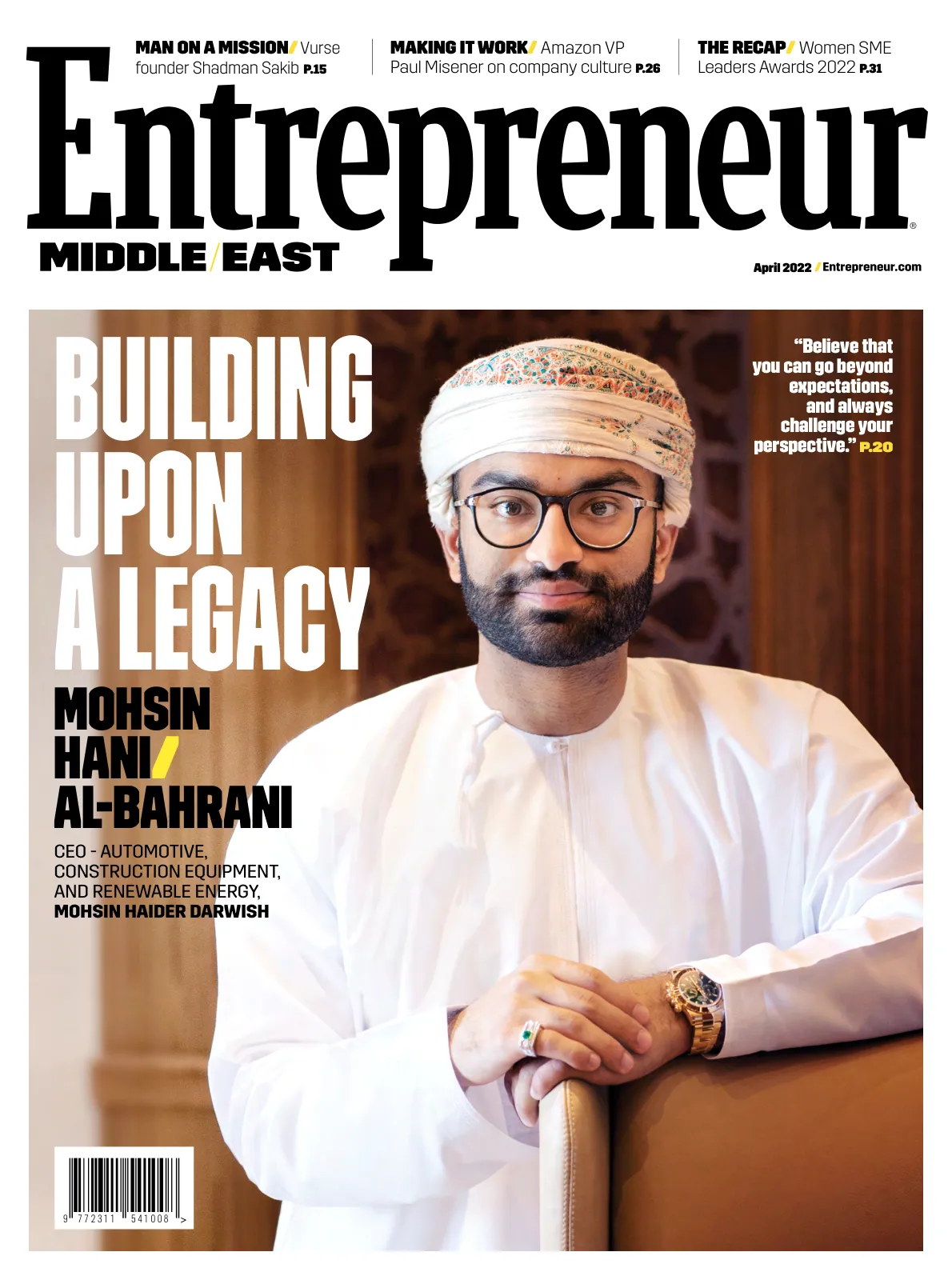
Entrepreneur Middle East, April 2022
Page 1
April 2022
9
7 7 2 3 1 1
5 4 1 0 0 8
>
THE RECAP/ Women SME
Leaders Awards 2022 P.31
MAN ON A MISSION/ Vurse
founder Shadman Sakib P.15
MAKING IT WORK/ Amazon VP
Paul Misener on company culture P.26
BUILDING
UPON
A LEGACY
“Believe that
you can go beyond
expectations,
and always
challenge your
perspective.” P.20
MOHSIN
HANI/
AL-BAHRANI
CEO - AUTOMOTIVE,
CONSTRUCTION EQUIPMENT,
AND RENEWABLE ENERGY,
MOHSIN HAIDER DARWISH
Page 2
Applications are now open for the Be Bold 2022 program, a unique collaborative initiative
that aims to empower a network of health innovators from both the public and private sectors
to design new health programs focused on the well-being of the UAE’s citizens and residents.
Get Involved in the UAE’s First
Public-Private Health Initiative
Page 3
APPLY NOW
*Limited Availability
REIMAGINE HEALTHCARE
SYSTEMS AS PER THE UAE’S
FORWARD-THINKING STRATEGIES
BECOME AN ACTIVE AGENT
OF CHANGE IN THE GLOBAL
HEALTHCARE SECTOR
BE PART OF AN EXCLUSIVE
NETWORK OF INNOVATORS IN
THE HEALTHCARE SPACE
IMPACT
In collaboration with
Page 4
4 / ENTREPRENEUR.COM / April 2022
Contents/April 2022
P.20
Building
Upon a
Legacy
Mohsin Hani Al-Bahrani, CEO
- Automotive, Construction
Equipment, and Renewable
Energy at Mohsin Haider
Darwish, on following in
the footsteps of a visionary
business leader.
by TAMARA PUPIC
P.26
Making it
Work
Amazon’s Paul Misener
on fostering a winning
company culture
(and how his trillion-
dollar enterprise
continues to learn from
startups).
by PAMELLA DE LEON
P.15
Man on
a Mission
Vurse founder Shadman
Sakib is betting big on
his interactive short video
platform that’s set to launch
in the second half of 2022.
by ABY SAM THOMAS
UAE-based entrepreneurs Ranya
and Khaled Fadly launch KR & Co
to unify the 17 food and beverage
concepts they have launched
since 2017. by AALIA MEHREEN AHMED
P.63
Shaking Up
the (Food) Scene
FEATURES
STARTUP SPOTLIGHT
IMAGE COURTESY KR & CO
Page 5
Page 6
Page 7
Page 8
Page 9
Page 10
10 / ENTREPRENEUR.COM / April 2022
60 Boss Better
In the era of “The Great
Resignation,” entrepreneurs and
business leaders need to add soft
skills to their arsenal.
57 A Roller Coaster Ride
SOUSHIANT ZANGANEHPOUR takes
a deep dive into the ups and
downs of building a tech startup
in uncertain times.
62 Reward and Retain
FarEye co-founder and CEO
KUSHAL NAHATA shares his insights
for fostering a positive culture in
workplaces forever changed by
the COVID-19 crisis.
‘TREPONOMICS
EDITOR IN CHIEF Aby Sam Thomas
aby@bncpublishing.net
CEO Wissam Younane
wissam@bncpublishing.net
DIRECTOR Rabih Najm
rabih@bncpublishing.net
CREATIVE LEAD Odette Kahwagi
design@bncpublishing.net
MANAGING EDITOR Tamara Pupic
tamara@bncpublishing.net
STARTUPS SECTION EDITOR Pamella de Leon
pamella@bncpublishing.net
FEATURES WRITER Aalia Mehreen Ahmed
aalia@bncpublishing.net
DESIGNER Simona El Khoury
DIGITAL SOLUTIONS DIRECTOR
Mahdi Hashemi mahdi@bncpublishing.net
HEAD OF INNOVATION
Sarah Saddouk sarah@bncpublishing.net
GROUP SALES DIRECTOR – B2B GROUP
Joaquim D’Costa jo@bncpublishing.net
COLUMNIST Tamara Clarke
CONTRIBUTING WRITERS
Fida Chaaban, Kushal Nahata, Jalaja Ramanunni,
Soushiant Zanganehpour
SUBSCRIBE
Contact subscriptions@bncpublishing.net to receive
Entrepreneur Middle East every issue
COMMERCIAL ENQUIRIES
sales@bncpublishing.net
ENTREPRENEUR.COM
Access fresh content daily on our website
All Rights Reserved 2022. Opinions expressed are solely those of the contributors.
Entrepreneur Middle East and all subsidiary publications in the MENA region are
officially licensed exclusively to BNC Publishing in the MENA region by Entrepreneur
Media Inc. No part of this magazine may be reproduced or transmitted in any
form or by any means without written permission of the publisher. Images used in
Entrepreneur Middle East are credited when necessary. Attributed use of copyrighted
images with permission. All images not credited otherwise Shutterstock. Printed by
United Printing and Publishing.
PO BOX 502511 DUBAI, UAE
P +971 4 4200 506
Contents/April 2022
66 Democratizing Real Estate
Dubai fintech startup Stake offers
a simple and accessible way for
investing in real estate properties in
the UAE. by PAMELLA DE LEON
71 Enabling Efficiency
Dubai-based Klaim is helping
healthcare providers in the MENA
do away with delayed medical
insurance claim payments.
by AALIA MEHREEN AHMED
76 Straight Outta Doha
Qatar-born app Turismo aims to
digitize the MENA region’s tourism
and hospitality sectors.
by PAMELLA DE LEON
STARTUP
SPOTLIGHT
EntMagazineME
Entrepreneur-me
← SARA BOUERI, Senior
HR Director at Ras Al
Khaimah Tourism
Development
Authority (RAKTDA)
P.58
Page 11
Page 12
12 / ENTREPRENEUR.COM / April 2022
Editor’s Note/
Editor’s Note/
T
here was once a time when I was a fervent
advocate for being nice at work, but experience
and expertise have since made me reconsider
whether this is an ideology one should actually
embrace in the world of business. Because
while being nice can cover a myriad of positive
behaviors like courtesy and decency, it can also
result in, say, you agreeing to something you
don’t want to, or you being hoodwinked by
more nefarious players on partnerships, simply
because no one wants to rock what might appear (on the
surface at least) to be a stable boat.
This might seem to be at odds with much of the
conversations surrounding work today, especially when it
comes to ideas on building a wholesome company culture.
But I think this only serves to prove my point- just
because something I said upsets the status quo doesn’t
necessarily mean it’s wrong.
One could, perhaps, dress up an uncomfortable situation
in layers of niceness (often to the point of obscuring the
entire matter at hand), but when has sugarcoating things
that actually need to be said ever solved a problem?
Indeed, our human need to be liked drives much of the
niceness we display in the world of work. That might seem
like a positive at face value, but let’s take a moment to
remember what is said about too much of a good thing.
An irreverent need to people-please can lead one to be
either taken for granted or for a ride, and, well, I haven’t
still seen a valid argument made for being treated like a
doormat. Plus, we’ve all heard about the dangers of
surrounding ourselves with only “yes” people, and yet, that
is the kind of behavior that most of us encourage in our
circles at work. The ones skilled in the art of polite
deception often enjoy a free pass, while those who point
out the hard truths are deemed to be troublemakers.
Now, this is not to say that we need to behave like
disagreeable villains in the workplace. I think there’s an
easier alternative at hand: choose fairness over niceness.
Those two paths of action may seem the same, but there is
a very important difference- the latter is (arguably)
governed by a fear of ruffling feathers, while the former is
focused on just doing the right thing.
Indeed, being fair may require you to make difficult
choices, but its value lies in the fact that you will never be
short-changed for doing so. At the same time, it will also
never disparage those who truly have your best interests at
heart. That’s a real win-win situation- and one that I’d
urge all entrepreneurs out there to get behind. Not only
will this strategy help you do good business, it’ll also help
you run a good one.
Aby Sam Thomas
Editor in Chief
@thisisaby
aby@bncpublishing.net
GOOD BUSINESS DOESN’T ALWAYS NEED TO BE “NICE”
Being fair is -perhaps- the most underappreciated strategy in today’s workforce
Page 13
Page 14
Page 15
15
April 2022 / ENTREPRENEUR.COM /
Man on a Mission
Vurse founder Shadman Sakib is betting big on his interactive short video platform
that’s set to launch in the second half of 2022 by ABY SAM THOMAS
→ According to Shadman Sakib,
his company, Vurse, could
well be the harbinger of
cutting-edge tech that can come
out of the UAE and, indeed, the
wider MENASA region.
IMAGES COURTESY VURSE
Page 16
16 / ENTREPRENEUR.COM / April 2022
WE ARE NOT COMPETING WITH TIKTOK, WE’RE NOT COMPETING WITH INSTAGRAM,
WE’RE NOT COMPETING WITH ANYONE. THE ONLY THING THAT WE ARE DOING IS THAT
WE ARE CREATING AN ALTERNATE SOLUTION FOR ALL THE THINGS THAT ARE MISSING.
B/The Big Idea
A
t 26 years of age, Shadman Sakib exhibits the drive and dedication that I’ve seen in several
other startup founders belonging to that particular age group, but I can’t help but feel that
there’s something decidedly different about the zeal with which this serial entrepreneur is
going about building his latest enterprise, Vurse, which he bills as “an interactive short
video platform”, that is set to launch in the second half of 2022. Perhaps this is because of
how big of an impact Sakib believes Vurse is going to have in the world of today- that’d
also explain why he is extremely tight-lipped when it comes to sharing details about his
new venture, as he’s quite wary about his idea being usurped by other players in this amazingly lucrative -but
equally competitive- sector.
“Vurse is one of the world’s first
very few decentralized social
media platforms,” Sakib tells
me. “What we are doing is we
are focusing on the interaction-
if you see all the other
platforms that are out there
today, they’re focusing on the
consumption, while we are
focusing on the interaction… If
you see the current way in
which social platforms operate,
they just allow you to consume
a video, and the only way that
you can interact with them is
by commenting, sharing, or
‘liking.’ However, what we have
done is that we’ve reinvented a
way in which a viewer can
interact with the content
creator, which will also give the
latter a better understanding of
how they can improve their
content at a later stage...
Everything that we have built
has been based on such
interactions, with the entire
idea being to create a platform
that gives the power of the
content to the users them
selves.”
If it seems like Sakib is being
too vague with his explainer
about what the Vurse platform
does, well, that’s because he is
deliberately being that- how
ever, he does underline the fact
that his company aims to
subvert paradigms that
currently govern the global
social media landscape. “Today,
the ownership of content that
exists on such platforms
actually goes to the companies,
but we are changing that
model,” Sakib explains. “That’s
the most I can say about the
decentralized part of Vurse
right now.” And as for whether
he’s worried about how Vurse
will be able to stand out in a
world that’s currently being
pervaded by the likes of TikTok
and Instagram, Sakib disproves
that notion while directing a
knowing smile at me. “We are
not competing with anyone,” he
declares. “We are not compet
ing with TikTok, we’re not
competing with Instagram,
we’re not competing with
anyone. The only thing that we
are doing is that we are
creating an alternate solution
for all the things that are
missing. So, once that happens,
we can all coexist. That’s how I
see it, but when we start
coexisting, if we take more
space, then…”
Sakib doesn’t finish that
sentence, but I think his words
-or the lack thereof- say a great
deal about the potential he
foresees for the company he is
building. But how is Vurse
going to make money, I ask- is
it aiming to be driven by
advertising, or will it be
subscriptions that fuel the
company? Sakib replies to my
query with yet another one of
his knowing smiles. “It’s very
hard to disclose, but what I can
say at the moment is that it is
not subscription-based,” he
says. “It’s completely free, users
can access it at anytime,
anywhere they want to,
because our main idea is to
make it as accessible as
possible, and as easy as possible
for the users to find it. But
what we did differently, unlike
the other platforms, is that we
built this platform to generate
revenue. In fact, we made sure
that we do not only generate
revenues for ourselves, but also
for the content creators- our
idea aims to promote content
creators, and make the
platform a content creator-
making machine. Our idea is
not to put the spotlight on the
platform, but instead on the
content creators themselves,
and once that happens, and we
are able to generate revenue for
the content creators, I think
that will create a good
ecosystem for both the
company and the community
that we are building around it.”
As someone who has long
been wanting to tap into the
opportunities presented by
the evolution of how people
interact with each other in the
last couple of years, Sakib
appears to be very cool and
collected about the aspira
tions he has for Vurse. But his
current profile as a very
focused entrepreneur might
come as a surprise to those
who knew him in his younger
years, especially as a child
growing up in a household led
by his father, who occupied a
senior role in Bangladesh’s
military forces. “I was never a
bright student,” Sakib admits.
“But I was always an explorer.”
As such, while Sakib may not
have been on the right side of
education as it was adminis
tered to him, he remembers
being curious and inquisitive
always, wanting to under
stand why things were done
the way they were, and what
could be possibly done to get
them to be better. It’s this
philosophy of thought that
governed his mindset as he
went on to the US and then
the UK for his higher
studies- and it also explains
why he decided to lean into
his entrepreneurial flair at the
same time.
Page 17
17
April 2022 / ENTREPRENEUR.COM /
Sakib’s professional career thus
could be said to have started
with him making use of a
friend’s father’s unused auction
license to buy and sell cars in
the American state of Florida,
and that journey went on to see
him launch a variety of
companies -some good, some
bad- on the road to him launch
ing Vurse. Of course, a lot of
lessons have been learnt along
the way- from the importance
of organizing and structuring a
company properly, to being
prudent and not hasty about
one’s finances when building a
business, Sakib has had
firsthand experience of both the
joyous highs and the depressing
lows that characterize many an
entrepreneurial trajectory. “I
have done things that could
have literally killed me
financially, but I’ve done it
anyway,” Sakib recalls. “But
sometimes it went bad,
sometimes it went well, but it
all gave me a lot of stories to
tell. And at the end of the day,
when I look back, I really like
them all, so I wouldn’t change
any of it.”
This is the intrepid spirit
that Sakib is using to lead
Vurse to its unveiling later this
year. He and his team have
been working remotely on the
venture up until very recently,
with people spread primarily
across the US and the UK;
however, Sakib is now working
on bringing them together to
work from a headquarters that
he’s setting up in Dubai.. The
UAE is a strategic choice for
Sakib- he points out that while
Dubai has definitely had its
tech startup ecosystem flourish
over the last couple of years,
there has been a dearth of deep
tech companies that have
actually been born or developed
here, and that’s a vacuum that
Vurse can certainly (and easily)
fill. According to Sakib, Vurse
could thus well be the
harbinger of cutting-edge tech
that can come out of the UAE
and, indeed, the wider
MENASA- and the population
in the region serves as the
perfect testbed for such an
offering as well. “We’re
targeting the Gen Z audience to
start with, and even the
younger audience, so that our
community can grow with us,
as we are very young ourselves,
and our community is young
too,” he says. “So, we want to
grow up together, and help
each other as much as we can,
and we’re trying to start it all
with the Middle East and
India.”
And while Sakib may refuse
to share any more details about
the roll-out he has in mind for
Vurse, he does offer a peek into
the potential he sees for the
platform, as well as the
gratification he hopes to
personally gain from it. “I
would love to see someone
using it when I’m walking on
the street- I just literally live for
that,” Sakib says. “I would want
to walk on the street and
someone to cross me, and I
would get to see my platform
on their phone.” It may sound
like a simplistic dream, but it’s
one that is enough to drive
Sakib’s work on Vurse- and if
his commitment to this venture
is any indication, then this busi
ness is definitely one to watch.
Stay tuned!
← For Sakib, just seeing
someone use Vurse will be one
of the most rewarding things he
expects to gain from launching
the enterprise. “I would love to
see someone using it when I’m
walking on the street,” he says.
“I just literally live for that.”
Page 18
come as
you are.
Page 19
@ / # 25hourshotels
#hellodubai
we are now open!
25% off,
book via
enjoy
25hours-hotels.com
Overlooking the museum of the future, near dubai international
financial centre, 25hours hotel one central boasts 434 rooms
and suites in addition to flexible events and co-working spaces.
A total of four characterful restaurants and bars take guests on
a culinary trip around the world from northern india to the beer
gardens of bavaria: this is where urban nomads meet desert
flowers, where local heroes meet the well-traveled. Alongside
rental of mini cars and schindelhauer bikes the hotel will also
feature the extra hour spa, rooftop pool and dubai's first
mixed-gender rooftop sauna.
434 rooms | co-working spaces | monkey bar | tandoor tina
ernst | nomad dar bar | rooftop pool & sauna | spa | gym
Page 20
20 / ENTREPRENEUR.COM / April 2022W
hen it comes to launching and running
businesses, entrepreneurs today usually hope to
have their enterprises follow a path of
exponential growth that allows them to build,
sell, and make a profit on one undertaking, and
then move on to the next big thing very quickly.
This is quite a shift in mindset when compared
to the thought processes showcased by earlier
generations of entrepreneurs, who were known
to be keen on building businesses that stand the
test of time, having an impact, and leaving a
legacy that lasts long after the founders are
gone. Mohsin Hani Al-Bahrani, CEO of the Oman-
headquartered Mohsin Haider Darwish’s (MHD) Automotive,
Construction Equipment, and Renewable Energy (ACERE)
vertical credits his grandfather, the late Mohsin Haider
Darwish, for having this visionary, long-term approach when
founding his eponymous family business in 1974. Indeed, it’s
that strategy that has led to MHD’s growth over the years,
with it becoming a corporation in 1987. “Since then, the
company has continued progressing to become one of the
most successful privately owned business conglomerates in
Oman,” Al-Bahrani notes. Another point that Al-Bahrani
commends his late grandfather for is insisting on the larger
societal good as a key objective for the business from the
outset. “My grandfather was so far-sighted that when he
started his business about half a century ago, he always
linked the growth of MHD to the growth of Oman,” Al-Bahrani
adds. “He firmly believed that the success of a business has
no value if it doesn’t lead to national development. A modern-
day entrepreneur also needs to be empathic, genuine, and
considerate towards the needs of others. In this technological
and fast-moving business world, he should be more humane
than ever. This is my idea of the modern-day entrepreneur.” }
→ MOHSIN HANI AL-BAHRAINI
joined Mohsin Haider Darwish LLC
after earning a master’s degree in
social science and public policy
from King's College London, fueled
by a desire to carry on his
grandfather’s legacy, and live up to
the vision he had for the family
business.
In his role as CEO of MHD ACERE,
Al-Bahrani has led several strategic
and business initiatives for the
business, which include bringing in
the renewable energy division into
the vertical, as well as its recent
tie-up with Swedish-Swiss
multinational, ABB.
by TAMARA PUPIC
BUILDING
UPON
A LEGACY
MOHSIN HANI AL-BAHRANI
CEO - AUTOMOTIVE, CONSTRUCTION EQUIPMENT, AND RENEWABLE ENERGY,
MOHSIN HAIDER DARWISH
IMAGES COURTESY MHD ACERE
Page 21
21
April 2022 / ENTREPRENEUR.COM /
“I am committed to
elevating Shams
into becoming
a global media hub.”
21
April 2022 / ENTREPRENEUR.COM /
Page 22
22 / ENTREPRENEUR.COM / April 2022
↓ MHD LLC is the official Jaguar Land Rover importer in Oman.
A
l-Bahrani joined MHD
after earning a master’s
degree in social science and
public policy from King’s
College London, fueled by
a desire to carry on his grandfather’s
legacy, and live up to the vision he
had for the family business. “I
started as a summer intern in
automotive brands, like Jaguar and
Land Rover, where I gained
firsthand experience in the indus
try,” Al-Bahrani recalls. “At MHD, I
worked as the Director of Automo
tive, and in 2020, I was promoted to
become the CEO of MHD ACERE.”
MHD ACERE was created after
merging MHD’s automotive,
construction equipments, and
renewable energy departments
under one umbrella, which has led
the group to enter a new phase of
growth. “MHD is currently home to
more than 10 automotive brands
since we have successfully brought
prominent brands, such as McLaren
and others, to Oman,” Al-Bahrani
says. “In addition to that, we
performed outstandingly in the
sales, after sales, marketing, and
network development of the UK
motoring brand MG, earning MHD
the Grand Prix 5 Star Distributor
Award at at the Virtual Dealer
Awards by SAIC Motor and MG
Middle East.” The merger also
allowed Al-Bahrani to lay the
foundation for MHD’s future
success too. “We have launched a
renewable energy division, intro
ducing the ABB brand of chargers
for electric cars, solar panels,
construction equipment, and
different sustainable solutions that
are aligned with the goals of the
Oman Vision 2040, which we are
committed to contribute to by all
means,” he adds.
As was the case for pretty much
every other business, MHD ACERE
also had to weather the effects of the
COVID-19 pandemic that broke out
in 2020. “As a result of the pandem
ic, and like many other automotive
businesses, the growth of MHD was
hindered,” Al-Bahrani says. “But we
kept high hopes, and tried to see
new opportunities, and take
advantage of the challenges. We
sought to integrate some of MHD’s
verticals to optimize operations. We
also strengthened our presence
online through expanding our
virtual network, and launching
e-commerce portals to facilitate a
safe and simple purchase experience
for our customers from the comfort
of their homes.” According to
Al-Bahrani, the lessons learnt from
such challenging times have proved
to be essential for the company’s
future progress. “One is changing
the way we approach business by
becoming more aggressive, using
whatever tools at our disposal, and
seizing every opportunity, big and
small,” he says. “Moreover, we had to
be creative and find ways to go
around obstacles to grow, while
remaining focused on our goals.”
→ Mohsin Haider Darwish LLC is one of the largest and
most successful privately owned business houses in
the Gulf region, dating back to over half a century. The
family proprietary business was converted to its
present form of a corporate entity in 1987.
MHD AUTOMOTIVE, CONSTRUCTION EQUIPMENT AND
RENEWABLE ENERGY is a vertical established under
MHD LLC, with diverse interests across established
and emerging industries. With the strength of a rich
history, and a firm belief for the future, MHD ACERE is
looking to power the future of Oman.
Page 23
23
April 2022 / ENTREPRENEUR.COM /
T
his mindset stems from the strategy that he uses for
leading MHD ACERE, which rests upon a belief that
the role of a CEO stretches beyond only administrating
the overall operations of a company. “He or she should
be a friend of their colleagues, a coach, a leader, a
motivator, and much more,” Al-Bahrani explains. “I try to
perform all these duties with utmost sincerity, yet I discourage
a strict top-down approach in a company. At MHD ACERE,
every employee is a valuable asset of our company, and an
integral part of the company’s ideation and decision-making
process. This stood as MHD culture over the past years, and I
have endeavored to maintain and honor that.” Looking back
on his time at MHD, there are two achievements that
Al-Bahrani is particularly proud of. “One of the key moments
that I believe made a pivotal turn in my career at MHD is
successfully attracting world-class automotive brands such as
McLaren, Jaguar Land Rover, and Hongqi to our group,” he
says. “This has opened several prospects, and helped accelerate
the following stages of growth. I am also proud of establishing
the renewable energy division, which will be the pioneer of
turning Oman into a futuristic, sustainable, and eco-friendly
state. Additionally, we have achieved extraordinary growth of
MG, and expanded the brand’s dealership in different regions
in Oman.”
Al-Bahrani wants to keep automotive services as a focal point
for MHD ACERE, which is evident from him establishing its
AutoExpert initiative, which provides premium off-roading
products from Australian manufacturer and supplier of
suspension parts Ironman 4×4, as well as car care products
from British manufacturer Autoglym, along with offering car
valeting and detailing services. Furthermore, the newly-
formed MHD Rental and Leasing division provides hassle-free
rental and leasing of a wide range of vehicles. Having added
other growth verticals that include the aforementioned
construction equipment and renewable energy departments,
Al-Bahrani has also launched MHD ACERE’s HospiCare
division by partnering with the best global medical brands to
bring some of the best medical equipment to Oman. It’s thanks
to such efforts that Al-Bahrani believes MHD ACERE will be a
key contributor to Oman’s Vision 2040, which aims at develop
ing a sustainable and diversified Omani economy driven by the
private sector. “Oman has a promising business environment,
with its basic infrastructure, and abundance of opportunities in
its budding market,” he says. “Oman is considered one of the
most politically stable and developed countries in the Arab
world, as maintained by many international indices. It is known
for its safety and peacefulness in different aspects. I believe that
this is the main strength for a business hub.” }
AT MHD ACERE, EVERY EMPLOYEE IS A VALUABLE ASSET OF OUR COMPANY,
AND AN INTEGRAL PART OF THE COMPANY’S IDEATION AND DECISION-
MAKING PROCESS. THIS STOOD AS MHD CULTURE OVER THE PAST YEARS.
→ MHD ACERE Auto Expert showroom opening in Azaiba
Page 24
24 / ENTREPRENEUR.COM / April 2022
WE HAD TO BE CREATIVE AND FIND WAYS
TO GO AROUND OBSTACLES TO GROW, WHILE
REMAINING FOCUSED ON OUR GOALS.”
H
aving said that, Al-Bahrani
says that it is crucial to
further enable the Omani
private sector through
different governmental
incentives and regulations in order
to boost the country’s socio-econom
ic development. This approach, he
adds, needs to be applied across all
the GCC markets. “The entrepre
neurial ecosystem in the member
states of the GCC is rapidly evolving
in conjunction with the rising
economic diversification movement,
and therefore, the opportunities are
increasing,” Al-Bahrani says.
“However, creating a more friendly
atmosphere for entrepreneurs can
be challenging, as it requires a
balanced strategy of establishing a
venture-attracting market, facilitat
ing policies, proper funding, and
other supporting methods.” But
given that regional markets are still
growing and developing, Al-Bahrani
advises fellow entrepreneurs to be as
agile as possible to adapt to their
circumstances. “They need to
possess the mental flexibility to go
beyond their business vision,”
Al-Bahrani adds. “To be successful,
they need to maintain authenticity
and take unconventional routes, as
opposed to constraining themselves
with fixed road maps.”
Given his time at the helm of MHD
ACERE, Al-Bahrani is someone
other CEOs can certainly learn from
when it comes to leading their
respective businesses. “My first word
of advice to fellow CEOs is never let
failure get to your heart, but also,
don’t let success get to your head,” he
says. “Setbacks exist to teach us
lessons, but it is also easy to forget
the importance of consistency in the
euphoria of victory. Just keep the
balance, and do not let any of the
two extremes take over you.”
Speaking to entrepreneurs specifi
cally, Al-Bahrani says that keeping
one’s passion alive for what one does
is crucial. “Passion is the most
efficient fuel to success,” Al-Bahrani
declares. “It will take you every
where you want to go, if you add
hard work to the equation. Lastly,
believe in yourself. Believe that you
can go beyond expectations, and
always challenge your perspective.
This is how you guarantee self-im
provement.”
Page 25
Page 26
26 / ENTREPRENEUR.COM / April 2022
}Prior to joining Amazon in 2000, Misener was an
engineer, lawyer, and astrophysicist who had brought his
expertise to advise numerous policy and technology
organizations during his career. For instance, he served as
the Senior Legal Advisor to a commissioner of the US
Federal Communications Commission, he also co-found
ed and led the Internet Access Coalition, and he contin
ues to be on the board of a number of organizations in the
Amazon’s Paul Misener on fostering
a winning company culture
(And how his trillion-dollar enterprise
continues to learn from startups)
by PAMELLA DE LEON
IMAGES COURTESY STEP CONFERENCE
MAKING
IT WORK
R
ather than spending more time
gathering more data and being hesitant
to launch, why not just launch it, and if it
doesn’t work out, why not just keep
trying?” This ethos of being open to
experimentation and failure is how Paul
Misener, Vice President for Global
Innovation Policy and Communications
at Amazon, describes how his company
-one of the world’s most valuable brands, by the
way- continues to foster a culture of innovation
and entrepreneurial spirit within the enterprise.
Misener talked about this at great length in his
talk at this year’s edition of STEP Conference in
February in Dubai, and shortly after he
addressed the crowd, I got the opportunity to
speak with the Amazon veteran in a
freewheeling conversation that had him
explaining (and advocating) the innovative
mindset his company professes.
→ PAUL MISENER IS AMAZON.COM’S
VICE PRESIDENT FOR GLOBAL
INNOVATION POLICY AND
COMMUNICATIONS. An Amazon VP
for 22 years, Paul has long
participated in Amazon’s history,
culture, and methods of sustained,
customer-obsessed innovation,
especially in the context of
Amazon’s Leadership Principles.
Page 27
27
April 2022 / ENTREPRENEUR.COM /
US, advising on economic development,
technology, education, and public affairs.
While Amazon famously started as an
online bookseller in 1994, its success had
propelled by the late 90s and early
2000s, having broadened its retail
categories, as well as launched its IPO on
the NASDAQ market in 1997. So, what
led Misener to join Amazon in its early
days? “I felt the company had a lot of
opportunity,” he replies. “But it was really
about spending time with [Amazon
founder and Executive Chairman] Jeff
[Bezos], just getting to know him and
hearing his vision, and I thought to
myself, I want to work for this man.”
Misener has since gone on to be dubbed
as Bezos’ “righthand man for all things
innovation,” but he points out that that
title isn’t entirely true. “The characteriza
tion isn’t easily accurate, because
everyone in the company is required to
be innovative,” Misener says. “It’s not just
a separate group of people or an
individual that are innovators; everybody
is.” Elaborating his affinity with Bezos,
Misener states that he has a learnt a lot
from the founder over the years. Five
years after joining the company, the duo
had a talk that Misener continues to }
THE UAE WAS AN AUTOMATIC CHOICE, GIVEN THE
DEEP TECH PENETRATION ENABLING ECOSYSTEM,
AND A MARKET THAT HAS ALWAYS BEEN EARLY ADOPTERS
OF TECH-ENABLED BUSINESS TRANSFORMATION.
Page 28
28 / ENTREPRENEUR.COM / April 2022
fondly remember. “We sat down and
decided that we had a culture, and we
wanted to describe it. So, we undertook
the exercise of writing down what the
culture was at that moment- it wasn’t
what we hope to be, it wasn’t fiction, you
know? It was a very honest assessment
of who we were, and how we did
business, and those become the first
version of our Leadership Principles.”
Though it has changed over the years,
Amazon’s Leadership Principles remain
a mainstay of the company, with it
currently consisting of 14 values that
guide it and its employees, which
include being customer-obsessed,
having ownership, learning to be
curious, and more. As per Misener, it
acts as a prescriptive for everyone who
becomes a part of the company. “They
tell new Amazonians, and remind older
Amazonians, about what our culture is,”
he explains. “So, it became a way of
thinking. It’s not saying that Amazon
has the best culture; it’s certainly not the
only culture, it just happens to be our
culture.” Misener also highlights that
when Bezos moved on from his role as
the company’s CEO to its Executive
Chair, change also came to strike
Amazon’s Leadership Principles. “We
adopted new Leadership Principles,
which are, explicitly, aspirational,” he
says. “We want to become, first, the best
employer, and secondly, we want to do
better by our communities. These are
both areas where we recognize that we’re
doing something, but we could be better
in both, so these are aspirational parts of
our culture.”
}Interestingly enough, all of this has
now turned into an important aspect of
Misener’s current advocacy at Amazon.
Up until 2016, Misener established and
led the global public policy operations
division, which involved building
relationships with governments across
the world. His current role, which he
has had for over five years, is a lot more
focused on strengthening company
culture. “I’m looking out for the
protection and continuation of
Amazon’s culture, as well as the
thoughtfulness of our leadership
principles, especially as we’ve grown so
much in recent years,” he explains.
“This will help ensure that newer
employees understand the importance
of culture at Amazon, and also give
them an opportunity to experience how
this culture is going to apply through
the years.”
According to Misener, Amazon’s
obsession with its customers is the most
important factor to understand the
company’s approach to culture and
innovation. “Everything we do has
something for our customer in mind,”
he says. “So, we don’t innovate and
“IT WAS REALLY ABOUT
SPENDING TIME WITH
[AMAZON FOUNDER AND
EXECUTIVE CHAIRMAN] JEFF
[BEZOS], JUST GETTING TO
KNOW HIM AND HEARING
HIS VISION, AND I THOUGHT
TO MYSELF, I WANT TO
WORK FOR THIS MAN.”
→ PAUL MISENER, Vice President
for Global Innovation Policy
and Communications at Amazon
Page 29
29
April 2022 / ENTREPRENEUR.COM /
invent just for the sake of it;
we really want to do
something that is designed to
get our customers, so
customer obsession is first.” A
second factor to note lies in
the fact that the company
continues to encourage a
startup-like mindset within
the business, “We want to
operate like a startup, so we
have mechanisms that allow
us, as a large organization, to
still behave much more like a
smaller organization, which
means being nimble, being
quick to act, quick to think,
and willing to take risks,”
Misener explains. “As we’re
trying to innovate, we’re not
afraid of experimenting, and
actually failing to do things…
As we’re trying to develop
new products and services for
our customers, we want to do
those failures before it gets to
the customers. But to do
anything new and innovative,
you must experiment and
that must entail the possibil
ity of failure.”
}Given that Misener
emphasized Amazon’s
insistence on maintaining
the entrepreneurial spirit of a
startup, one wonders what
this exactly entails for a
trillion-dollar company.
Again, Misener refers back to
being deeply customer-
focused, pointing to what
Bezos and his team internally
call “having a Day 1 mental
ity.” In a 1997 letter to
shareholders, Bezos outlined
how this business outlook is
fundamental to Amazon’s
success, which involves
relentlessly focusing on
customers, long-term value,
and making bold moves. “Day
1 means that we’re not ever
looking back, and getting
comfortable on the things
that we’ve already done,”
Misener explains. “We’re
always looking ahead for
what we can do better for our
customers.”
}Another way the company
ensures a startup-like
culture is by encouraging
small teams to operate very
independently within the
company as they innovate.
“[In doing so,] it doesn’t
require all sorts of corporate
approval across the entire
organization to try new
things,” Misener says, while
also noting that employees
are also empowered to be
innovative. “I think all our
employees, no matter what
role they have, they are
expected to invent on behalf
of customers. Those inven
tions can be small improve
ments deployed over large
numbers of items, or many
years, or they can be
fundamental innovations that
are sort of world-changing.”
}Looking at Misener’s track
record as an Amazon
executive for 22 years, I ask
his thoughts on staying
passionate and avoiding
burn-out in his role. To this,
Misener indicates the
significance of truly believing
in what his enterprise is all
about. “I believe in what we’re
doing, I really do,” he says.
“It’s an idea that we would
love to see imitated. I can see
others do the kinds of things
we do, and that’s great, and
that makes it better for all
customers, so I really believe
in the mission, and what
we’re doing. It gets me up in
the morning!” On that note,
when asked on his thoughts
to share his advice for
entrepreneurs wanting to
realize their ambitions,
Misener replies, “It’s hard,
because they’re in very
different businesses, but I
would say, focus on solving a
problem for customers. Don’t
just have a technology for the
sake of technology. Because it
might be interesting, it might
be a great little invention, but
if it doesn’t solve a problem
or somebody, then it’s
impractical. I would really
figure out how to do and take
care of some challenge or
pain point for some group of
customers, and your business
will be very successful if you
can help people that way.”
WE WANT TO OPERATE LIKE A STARTUP, SO WE HAVE MECHANISMS THAT ALLOW US,
AS A LARGE ORGANIZATION, TO STILL BEHAVE MUCH MORE LIKE A SMALLER
ORGANIZATION, WHICH MEANS BEING NIMBLE, BEING QUICK TO ACT, QUICK TO THINK,
AND WILLING TO TAKE RISKS.
→ AMAZON main
headquarters in Seattle,
Washington
Page 30
30 / ENTREPRENEUR.COM / April 2022
Page 31
T
he inaugural Women SME Leaders Awards, a virtual event staged by
Mastercard and Entrepreneur Middle East on March 29, 2022, celebrated some
of the region’s most enterprising women-owned and run SMEs across the
Middle East and Africa (MEA) region.
Hosted by emcee Jessy El Murr, the event honored the achievements of
women in 22 different categories from across the region, with the winners selected
by a panel of judges consisting of Amnah Ajmal, Executive Vice President, Market
Development, Eastern Europe, Middle East, and Africa for Mastercard, Mona Zulficar,
Chairperson of EFG Hermes Holding, Nejoud Al Mulaik, Director of Fintech Saudi, and
Tamara Pupic, Managing Editor of Entrepreneur Middle East.
THE RECAP
TAMARA PUPIC
MANAGING EDITOR |
ENTREPRENEUR MIDDLE EAST
NEJOUD AL MULAIK
DIRECTOR |
FINTECH SAUDI
AMNAH AJMAL
EXECUTIVE VICE PRESIDENT, MARKET
DEVELOPMENT, EEMEA | MASTERCARD
MONA ZULFICAR
NON-EXECUTIVE, CHAIRPERSON |
EFG HERMES HOLDING
THE JURY
31
April 2022 / ENTREPRENEUR.COM /
Page 32
THE LOGISTICIAN
SIDDHI JOSHI
CEO, EMOVERS LLC
“ R e m e m b e r, y o u a r e t h e m o s t v a l u a b l e
i n v e s t m e n t y o u w i l l e v e r m a k e .”
“ W h a t y o u c o n s i d e r t o b e y o u r
b i g g e s t w e a k n e s s w i l l t u r n o u t t o b e
y o u r b i g g e s t a s s e t .”
F
or Siddhi Joshi, CEO of Emovers, winning the
title of The Logistician at the Women SME
Leaders Awards 2022 is an indication of how
she has managed to stand out in the male-
dominated logistics industry. “With the rise of
female entrepreneurs and more and more women
entering the business sector, and having employed
many women in our verticals, I firmly believe that
nothing is stronger than a broken woman who has
recreated herself,” Joshi says. “She can overpower
everything that is meant to destroy her. She can
evoke who she was, and she can transform the
game. She never dreams of success, but works for
it. She is strong enough to stand for herself, and for
everyone else. I wish success to not only women but
everyone, and remember, you are the most valuable
investment you will ever make.”
THE F&B LEADER
ERIKA DOYLE
FOUNDER AND MANAGING DIRECTOR,
DRINK DRY
A
s someone is who is blazing a trail of her own
in the industry that she operates in, Erika
Doyle, founder and Managing Director, Drink
Dry, didn’t hesitate to share her insights for other
female entrepreneurs wanting to follow her lead. “My
most important message to other women is to be
brave and put their fears aside,” Doyle said. “We are
naturally brilliant at multitasking, and that is such a
vital skill to have when running a startup business.
Trust yourself, and be authentic in everything that
you do- you will be surprised to learn that what you
consider to be your biggest weakness will turn out to
be your biggest asset. For me, a lack of experience in
the F&B industry turned out to be my biggest
strength, because I did not have any preconceived
ideas, and we had no limitations to what we thought
we can achieve!”
32 / ENTREPRENEUR.COM / April 2022
Page 33
THE REAL ESTATE LEADER
HELEN CHEN
CO-FOUNDER AND CEO, NOMAD HOMES
“ S u r r o u n d y o u r s e l f w i t h p e o p l e w h o
a r e a l i g n e d w i t h t h e v i s i o n a n d
m i s s i o n o f y o u r c o m p a n y.”
“ U s e y o u r i n t u i t i o n a n d e m o t i o n a l
i n t e l l i g e n c e , t e a c h y o u r w a y s t o y o u r
p e e r s a n d s t a k e h o l d e r s .”
H
elen Chen, co-founder and CEO of Nomad
Homes, believes that one of the reasons for the
success she has seen in her business is thanks to
the fact that she has the backing of powerful women,
which include some of her enterprise’s board members
who, besides having the funds to support her endeavor,
also have incredible operational expertise in building and
scaling technology companies. That should explain the
answer she gave when asked about advice she’d give
other female entrepreneurs like herself. “Surround
yourself with people who are aligned with the vision and
mission of your company, and who are in it to build the
company,” she says. “When you start your own company,
it’s important to focus on your own business, and listen
to your customers. An eager attitude to learn forms the
core of any business, and helps to constantly evolve and
learn from those around us, as well as from our team
mates, internally.”
THE HOTELIER
JUDIT TOTH
FOUNDER AND CEO, VIVERE HOSPITALITY
D
espite the uncertainty of the business and
instability of the market in recent years, this
achievement is a confirmation of hard work and
focus on my goal of creating my own hotel brand paid
off in the best ways.” That’s the sentiment shared by
Judit Toth, founder and CEO of Vivere Hospitality and
General Manager at Ink Hotel, after winning The
Hotelier title at the Women SME Leaders Awards
2022. “My message to all the ladies out there is to
dream big, find your support system, and collaborate
with each other,” Toth adds. “Use your intuition and
emotional intelligence, teach your ways to your peers
and stakeholders, and bring people together. The
hospitality and tourism industry has a long way to go in
terms of development in our region, especially in the
fintech area, and disruption is what will enable change,
and what the industry truly needs. If you dare, disrupt
to the maximum!”
April 2022 / ENTREPRENEUR.COM / 33
Page 34
THE TECHIE
OLUWADAMILOLA
SOYOMBO
FOUNDER AND CEO, SKOOQS CREATIVE
“ C o n s t a n t l e a r n i n g a n d a c c o u n t a b i l i t y
i s i n e v i t a b l e , h e n c e a l l o w i n g fo r g r o w t h .
D r i v e o r v i s i o n i s a l s o a k e y s u s t a i n e r.”
“ D o n ’ t b e a f r a i d t o m a k e m i s t a k e s ;
h o w e v e r, m a k e s u r e t o o w n y o u r
e r r o r s , a n d l e t t h e m f u e l y o u r g r o w t h .”
W
hile she appreciates the validation that
winning The Techie title at the Women SME
Leaders Awards 2022 gives to her and her
company, Skooqs Creative, Oluwadamilola Soyombo
would rather use the spotlight to encourage more
women to enter the STEM field. “The technology field is
growing, and women deserve an equal opportunity to
take openings within STEM,” she says. “My growth
strategy has always been around leveraging the
community, I am a part of several women-focused tech
communities, and I also have my own community of
women in tech. With that, constant learning and
accountability is inevitable, hence allowing for growth.
Drive or vision is also a key sustainer for me, and
therefore, I advise other women to have a vision
greater than yourself. Doing a greater good for the
world at large, while building a successful profitable
business, is something I’ll always come back to.”
THE PROFESSIONAL SERVICES LEADER
SHAYDA SHARFAEI
HEAD OF PROFESSIONAL SERVICES,
BRIDGE MEDICAL GPO
S
hayda Sharfaei, Head of Professional Services,
Bridge Medical, believes that female entrepreneur
ship is a critical foundation of any successful
economy. “As someone who has spent the last few years
in leadership roles, I am well aware of the hurdles that
women face in the workplace, and my advice to women
who are on the same path is to remain self-confident, as
hard work and perseverance lead to success,” she says.
“Don’t be afraid to make mistakes; however, make sure
to own your errors, and let them fuel your growth.
Successful leaders are transparent with themselves and
others about their failures in order to create a learning
environment. It is critical to develop resilience, and
acknowledge that negativity and rejection are not
gender-specific in this industry. Finally, have faith in your
team and support systems, because they see your worth
and will work with you to achieve your goals. I believe
that female leaders are paving the way ahead, and the
future will be bright for us in business.”
34 / ENTREPRENEUR.COM / April 2022
Page 35
THE INVESTOR
MARYAM FOULADIRAD
CEO, FUNDII
“ T h e r e i s n o l i m i t a t i o n fo r [ w o m e n ] t o b e
s u c c e s s f u l i f, a n d o n l y i f, t h e y t r u l y
b e l i e v e i n t h e m s e l v e s .”
“ I e n c o u r a g e e v e r y j o u r n a l i s t a c r o s s t h e w o r l d
t o c o n t i n u e t o b e u n a p o l o g e t i c a l l y p r o fe s s i o n a l
i n t h e i r r e p o r t i n g a b o u t [ . . . ] w o m e n ’ s r i g h t s ,
f r e e d o m o f e x p r e s s i o n , a n d p o v e r t y.”
H
aving won The Investor title at the Women SME
Leaders Awards 2022, Maryam Fouladirad, CEO,
Fundii, urged other women to follow in her
footsteps in terms of going after the ambitions they have
for themselves. “I would like to encourage other women
to pursue their dreams and passions, and knowing the
fact there is no limitation for them in the world to be
successful if, and only if, they truly believe in themselves,
their knowledge, and their capabilities,” she says.
The Women SME Leaders Awards 2022 is the first initiative of its kind to recognize and showcase women-owned and run SMEs in the Middle East and
Africa with a turnover of less than US$13.6 million and employing between six to 50 people.
THE MEDIA LEADER
MENNA FAROUK
JOURNALIST, THOMSON REUTERS FOUNDATION
A
ccording to Menna Farouk, a journalist at the
Thomson Reuters Foundation, winning The Media
Leader title at the Women SME Leaders Awards
2022 has motivated her to aim for greater success in her
career, and she hopes her peers in the industry will follow
suit. “Recognizing my work at the Thomson Reuters
Foundation is not only a great push for me, but it can also
inspire other journalists across the Middle East to continue
their reporting amid difficult circumstances,” she says. “I
encourage every journalist across the world to continue to
be unapologetically professional in their reporting about
hot topics, especially when it comes to women’s rights,
freedom of expression, and poverty.”
April 2022 / ENTREPRENEUR.COM / 35
Page 36
THE ARTIST
NADINE ABDELGHAFAR
FOUNDER, ART D’ÉGYPTE
“ Fa c e a l l y o u r fe a r s , f i n d s o l u t i o n s , s t o p
b l a m i n g [o t h e r s ] ! T h i s a w a r d g i v e s a l l
w o m e n h o p e a n d m o t i v a t i o n t o k e e p g o i n g .”
“ C o l l a b o r a t e a n d c o n n e c t w i t h
l i k e - m i n d e d p e o p l e i n y o u r i n d u s t r y, a n d
fo c u s o n c o l l a b o r a t i o n o v e r c o m p e t i t i o n .”
T
here can be no mistaking the joy Nadine Abdel
ghafar, founder of Art D’Égypte, had on receiving
The Artist title at the Women SME Leaders
Awards 2022. “This award is a recognition of our last
four years of hard work, sleepless nights, tears, and
joyful memories that will last forever,” she says. “It
wasn’t easy for me nor my team, but we believed that
we could do it and we did it! Yet, this is not the end; it is
the start of a new era for Art d’Égypte, the beginning
of a new path that will always keep us challenged!” And
that’s the sentiment Abdelghafar echoes in her
message for other women in business: keep going, and
never stop dreaming. “Believe in yourself, and although
it is hard, don’t give up!” Abdelghafar says. “Face all
your fears, find solutions, stop blaming [others]! This
award gives all women hope and motivation to keep
going, and definitely one day, she will shine in her own
way.”
HOME-BASED BUSINESS OF THE YEAR
HADIL AL KHATIB
FOUNDER, THE BROTH LAB
“
I don’t believe a woman’s drive is to be socially
recognized, because in our innate DNA, we give
unconditionally, whether as partners, mothers, or
sisters, we give and give more expecting no return,” says
The Broth Lab founder Hadil Al Khatib, who won the
Home-Based Business of the Year title at the Women
SME Leaders Awards 2022. “Hence, to be recognized by
Entrepreneur and Mastercard is so refreshing, and I am
truly grateful and honored to be part of this celebration.”
When asked to share her advice for other women who
want to build their own entrepreneurial trajectories,
Al-Khatib replies, “My message for every woman wanting
to launch her own business or concept is to collaborate
and connect with like-minded people in your industry, and
focus on collaboration over competition. Please connect
with me, and let’s work on creating some magic together.
My Instagram is @healwithhadil; my page is always open
to women! Let’s support one another.”
36 / ENTREPRENEUR.COM / April 2022
Page 37
MOMTREPRENEUR OF THE YEAR
JENNIFER MANSOUR
FOUNDER, LITTLE MELLY
“ W e ’ r e h e r e t o [ . . . ] e m p o w e r m o t h e r s
t o a c h i e v e t h e i r d r e a m s . W e ’ r e h e r e t o
b e t h e l i n k t h a t c o n n e c t s b o t h s i d e s .”
“ D o n o t d o u b t y o u r a b i l i t i e s , d o n o t
fe e l g u i l t y a b o u t p u r s u i n g y o u r g i f t s ,
o r p r o g r e s s i n g i n y o u r c a r e e r.”
A
s the recipient of the Momtrepreneur of the Year
title at the Women SME Leaders Awards 2022,
Jennifer Mansour, founder and Mom-in-Chief at
Lebanon-based baby food brand Little Melly, believes
the win to be more proof that there’s really nothing
stopping mothers like herself from being successful
businesswomen too. “Little Melly is our platform to
raise awareness that mothers no longer have to
sacrifice their careers for their family, or vice versa,” she
says. “We’re here to balance the two, and empower
mothers to achieve their dreams. We’re here to be the
link that connects both sides.”
THE EXECUTIVE
SHEILA MALLOWAH
FOUNDER AND PRINCIPAL CONSULTANT,
ZOEL CAPITAL
A
s happy as she is to win the title of The
Executive at the Women SME Leaders Awards
2022, Sheila Mallowah, founder and Principal
Consultant, Zoel Capital, says that she feels awarded
every time she helps families secure financial freedom
and build wealth that is transferable to generations
using non-traditional ways. To every woman
attempting to transform their specific fields of work,
Mallowah urges them to remember that it is “our duty
to be role models and champions for other women.”
“Do not doubt your abilities, do not feel guilty about
pursuing your gifts, or progressing in your career,” she
adds. “You have it within you to explore all the gifts
within you, while balancing all else in your lives. Indeed,
there will be challenges; however, each experience
challenges our thinking, takes us out of our comfort
zones, and makes us stronger, allowing us to rise up,
and stand tall, once again.”
April 2022 / ENTREPRENEUR.COM / 37
The inaugural Mastercard SME Confidence Index conducted in 2021
revealed that 81% of women entrepreneurs in the Middle East and
Africa have a digital presence for their businesses, compared to 68% of
their male counterparts.
Page 38
THE FASHION & BEAUTY LEADER
SALAMA MOHAMED
FOUNDER, PEACEFULL
“ D o n ’ t b e a f r a i d t o t r y n e w,
u n e x p l o r e d , a n d u n e x p e c t e d t h i n g s .”
“A l w a y s w o r k i n y o u r d h a r m a a n d y o u r
p u r p o s e , a n d t h e r e s t w i l l f a l l i n t o p l a c e .”
F
or Salama Mohamed, founder of Peacefull,
launching a skincare brand has been a deeply
rewarding experience in that it led her to see
firsthand that “we could make a difference in people’s
lives, and then, as their relationship with their skin grows
stronger, to know that we played a part in that.” And it
is this feeling of satisfaction that Mohamed urges her
fellow female entrepreneurs to look forward to as they
pursue their goals, especially in a nation like the UAE,
“where anything is possible, a country that is not afraid
of putting itself out there as the first and the innovator.”
“As you know, the hardest path is the road not travelled,
the one you have to create for others to follow along the
way,” Mohamed explains. “So, when you’re surrounded
by leaders, and people who are growing and striving to
become better every single day, it trickles down to the
very way you live your life. Even when they reach the top,
they remind you that excellence is an ever-growing,
ever-evolving construct, so it inspires you to work at
being the best you can be, to work harder, dream bigger,
and not be afraid to try new, unexplored, and unexpect
ed things.”
THE DESIGNER
MAZ HAKIM
FOUNDER, ESPAND
E
spand means so much more than just fashion
to its founder Maz Hakim, as the brand pays
homage to her Afghan heritage and her
family’s refugee journey, allowing her to showcase
what her country is really about. “It is color,
creativity, positivity, art, poetry, music and fashion,”
Hakim explains. “I want to continue promoting
Afghanistan’s culture and history, and be a part of
its healing.” While Espand began as a small project
during the COVID-19 crisis, it has since grown very
quickly, and Hakim advises other women to
remember this as they chase after their own hopes
and dreams. “If you have an idea or a dream, don’t
overthink it– just start,” she says. “The hardest part
is starting, but once you start, the universe paves
the way for you; doors and opportunities will open
up. Always work in your dharma and your purpose,
and the rest will fall into place.”
38 / ENTREPRENEUR.COM / April 2022
Page 39
THE EDUCATOR
ABIMBOLA OGUNDERE
CEO, LEARNING AS I TEACH FOUNDATION
“ T h i n k o f h o w y o u c a n m a k e i m p a c t
w i t h y o u r p a s s i o n . B e c l e a r, b e c o m m i t t e d ,
b e c o n s i s t e n t .”
“ W e h o p e t o i n s p i r e o t h e r w o m e n - o w n e d
S M E s t o p o s i t i v e l y c h a n g e t h e l i v e s o f
o t h e r s .”
T
he Learning As I Teach Foundation works on
improving the quality of education received by the
average African child by empowering and equipping
teachers, school leaders, and edupreneurs across the
continent, and that in itself feels like winning an award
every day, says Abimbola Ogundere, CEO, Learning As I
Teach Foundation. But Ogundere says that winning the
title of The Educator Award at the Women SME Leaders
Awards 2022 is especially special as it could bring
increased interest in what her enterprise does. “The
education sector needs all the support it can get to
deliver the future of our world,” she says. “As Ed Markey
rightly stated, ‘Education is not only a ladder of opportu
nity, but it is also an investment in our future.’ And to
other women around the world, I want to say: know
yourself, know your passion. Think of how you can make
impact with your passion. Be clear, be committed, be
consistent, be collaborative, be gritty, and most impor
tantly, have faith.”
THE RETAILER
CAROLE KINOTI
FOUNDER, CAROLE KINOTI BRANDS
C
arole Kinoti, founder, Carole Kinoti Brands
believes that with the right environment and the
right support, women can create businesses
that sustainably solve society’s problems while also
giving opportunities to the most vulnerable. “One
example is our Mavazi Elevate Program, whose guiding
ethos is ‘Turning Talent into Trade,’ which has shown
that creatives can design and manufacture appealing
clothing using sustainably sourced materials. This
reduces the carbon footprint while boosting economies
at the local community level. Plus, the program has
encouraged the youth to harness their talents,
continuously improve on their designs, and manufac
ture clothing and other items to acceptable standards.”
While this is her enterprise’s story, Kinoti hopes other
female entrepreneurs will be inspired to create projects
of similar social importance and impact. “We hope to
inspire other women-owned SMEs to positively change
the lives of others,” she says.
April 2022 / ENTREPRENEUR.COM / 39
Page 40
THE HEALTH CUSTODIAN
SOPHIE SMITH
FOUNDER AND CEO, NABTA HEALTH
“ Fo c u s o n d o i n g , n o t o n b e i n g . Tr u e
s u c c e s s i s fo u n d i n t h e t h i n g s w e
a c c o m p l i s h , i n t h e t h i n g s w e b u i l d , a n d t h e
d i f fe r e n c e w e m a k e .”
“ T h e r e a r e a l w a y s c h a l l e n g e s , b u t
w h a t i s m o r e , t h e r e i s a l w a y s a w a y t o
e v o l v e , t o i m p l e m e n t , a n d t o s u c c e e d .”
T
he mission of Nabta Health is to empower
women in emerging markets to effectively
manage their health, and its founder Sophie
Smith considers fulfilling this mission not just her
occupation, but her vocation. In line with that, Smith’s
advice for other enterprising women is to find the
space they are meant to be playing in, and then own it.
“To women who look at things we have achieved as a
company, or things I have achieved personally, and
wonder about their own success trajectory, I say: focus
on doing, not on being,” Smith says. “True success is
found in the things we accomplish, in the things we
build, and the difference we make. Whatever we
become -good or bad- is a byproduct of that doing.”
THE VISIONARY
JENNIFER SAULT
FOUNDER AND MANAGING DIRECTOR,
THRIFT FOR GOOD
D
ubai-based Thrift for Good aims to rehome beloved
clothing and accessories to reduce waste and help
children around the world by donating 100% of their
profits to local non-profit Gulf for Good. And now, having
won at the Women SME Leaders Awards, Thrift for Good
founder Jennifer Sault hopes that the visibility from the
accolade will help the company achieve its vision of having
a Thrift for Good store in every community in Dubai and
beyond. “It is a truly needed social enterprise to put a new
face to fashion in the UAE, making quality clothing not only
accessible, but also sustainable,” she says. And for other
women wishing to follow in her footsteps, Sault has one
piece of advice: just don’t take no as an answer. “There are
always challenges, but what is more, there is always a way
to evolve, to implement, and to succeed,” Sault says.
40 / ENTREPRENEUR.COM / April 2022
The inaugural Mastercard SME Confidence Index conducted in 2021 revealed that 81% of women entrepreneurs in the Middle East and Africa have a
digital presence for their businesses, compared to 68% of their male counterparts.
Page 41
THE HUMANITARIAN | THE CHANGEMAKER
GEHAD HAMDY
FOUNDER AND MANAGING DIRECTOR,
SPEAK UP
“ B u i l d a c o m m u n i t y w h e r e w o m e n o f a l l
r a c e s c a n c o m m u n i c a t e a n d c o n t i n u e t o
s u p p o r t a n d t a k e c a r e o f e a c h o t h e r.”
“A l w a y s d r e a m b i g , a n d s e t b i g g e r
g o a l s fo r y o u r s e l f, w h e r e y o u m o d e l
w h a t y o u s e e .”
H
aving won two different titles -The
Humanitarian and The Changemaker- at the
Women SME Leaders Awards 2022, Gehad
Hamdy, founder and Managing Director, Speak Up,
believes that celebrating the achievements of women
will empower other women “until we defy all these
stereotypes, and reach to a point when there will be no
female leaders, there will be just leaders.” That
sentiment would thus explain Hamdy’s answer when
asked to shared her advice for other women in
business. “My message to other women is that there is
no limit to what we, as women, can accomplish,” she
says. “Believe in yourself, help others whenever you can,
and try to build a community where women of all races
can communicate and continue to support and take
care of each other.”
THE LEADER OF TOMORROW
WAFA ALOBAIDAT
FOUNDER AND CEO, PLAYBOOK
W
hile Playbook founder and CEO Wafa Alobaidat
is glad to have been declared the winner of The
Leader of Tomorrow title at the Women SME
Leaders Awards 2022, she admits that the journey she’s
had to reach this accolade has been a tough one. “It can
get really lonely as an ambitious woman, whether you’re a
female founder or a young corporate executive, as you
raise funds and grow your team,” she says. “Also as a
corporate executive, it’s extremely challenging to be over
qualified, and not get those leadership positions. So, in my
experience, I’ve always thrived by joining a community of
likeminded women, mentors, and advisors.” As such,
Alobaidat’s advice for other women wanting to realize
their professional goals is to be proactive in building what
she calls a personal advisory board. “You should always
dream big, and set bigger goals for yourself, where you
model what you see,” she adds. “Spend at least a few
hours a week connecting to your customers, advisors, and
mentors, asking for feedback, so that you can constantly
be improving, enhancing, and elevating yourself. And lastly,
we need women supporting other women, and being more
embracing and open to amplifying each other’s voices.”
April 2022 / ENTREPRENEUR.COM / 41
Page 42
42 / ENTREPRENEUR.COM / April 2022
Go green →
/Virgin Mobile
Biodegradable SIM
B/Gear
#TamTalksTech
Gadgets and doodads that you might’ve missed out on,
sourced by a tech aficionado. by TAMARA CLARKE
← Listen good
/Jabra Elite 7
Jabra has refreshed its lineup of earbuds with the new Elite 7
Pro and Elite 7 Active. Both models boast advancements
with fit, design, and the audio experience. Jabra Elite 7 Pro
features the brand’s MultiSensor Voice technology for
professional-grade audio, nine hours of non-stop play time
with active noise cancellation (which increases to 35 hours
with the case), and built-in virtual assistants including Alexa,
Siri, and Google Assistant. Elite 7 Active keeps you going
with the design guaranteed to give you the best fit even
when you’re working out. Whatever your lifestyle, there’s an
Elite pair of headphones for you.
TAMARA CLARKE, a former software development professional, is the tech and lifestyle enthusiast behind The Global Gazette, one
of the most active blogs in the Middle East. The Global Gazette has been welcomed and lauded by some of the most influential tech
brands in the region. Clarke’s goal is to inform about technology and how it supports our lifestyles.
Talk to her on Twitter @TAMARACLARKE. theglobalgazette.com
IMAGES COURTESY VIRGIN | REALME | JABRA ELITE
Virgin Mobile UAE has introduced a
new biodegradable sim card as a
sustainable option for its customers in
the country whose devices cannot yet
accept eSIMs while requiring no plastic
at all. The new biodegradable SIM is
made from an oxo-biodegradable
plastic that breaks down into tiny
pieces and slowly degrades in the
presence of oxygen and ultraviolet
light. When placed in a landfill, the
degradation process can take as little
as 4-6 months. This offers a significant
improvement when compared to the
estimated hundreds of years normal
plastics can take to decompose. Virgin
Mobile UAE will progressively phase
out single-use plastic SIM cards as
part of the company’s commitment to
being sustainable and contributing to
its mission of being carbon negative.
Picture perfect ↑
/Realme 9 Pro+
Realme 9 Pro+ is back with a new processor, the
MediaTek Dimensity 920 5G, which increases
performance across the board. Furthermore,
Realme 9 Pro+ is the first mid-range smartphone
to sport the Sony IMX766 camera, which
includes a 1/1.56" sensor, optical image
stabilization, electronic image stabilization, and
artificial intelligence-powered Noise Cancellation
3.0 technology for enhanced picture quality. On
the outside, the device has unmatched
aesthetics thanks to Light Shift Design, which
enables the device to change colors. Precise
engineering and the use of OCA organic
photochromic materials enable the rear of the
phone to turn from blue to red within three
seconds when exposed to normal sunlight,
making Realme 9 Pro+ picture perfect, inside
and out. Fun fact: the device’s Super AMOLED
screen has an in-display fingerprint sensor that
can detect your heart rate.
Page 43
lyveglobal.com
E-COMMERCE
MADE EASY
Supercharge your ecommerce and online operations
with Lyve. Get fast, flexible, and full-featured delivery and
technology solutions that meet your customers’ needs
and allow you to focus on what you do best.
Go Lyve Today �
lyveglobal.com/ecommerce
#golyve
Page 44
44 / ENTREPRENEUR.COM / April 2022
B/Gear
IMAGES COURTESY RITUALS
EMBRACE
THE UNEXPECTED →
Rituals
We are loving Amsterdam-born
luxury cosmetics brand Rituals’
limited edition Serendipity
collection, with the range including
body and home care products that
have been formulated using
opulent oils to nourish one’s skin.
We’re particularly impressed with
its eau de parfum for men, which
has been infused with the soothing
and warm notes of almond oil, as
well as the contrasting scents of
cardamom, oakmoss, and earthy
chypre accords. Trust us, this
one’s a must-have. rituals.com
Serendipity collection,
including body and
home care products
From better goods to better wardrobe
bests, every issue, we choose a few items
that make the approved executive selection
list. In this issue, our picks include Tory
Burch’s Ramadan capsule collection, a new
scent for your collection, and more.
The Executive
Selection
Page 45
45
April 2022 / ENTREPRENEUR.COM /
BAG IT UP ↓
Santoni
In today’s world of entrepreneurship,
casual is the new business- looks are
meant to be modern, colorful, and
comfortable. If you subscribe to this
school of thought, we think that you’ll take
to this royal blue leather backpack and
duffle bag from Santoni’s Fall/Winter 2022
collection. Crafted from naturally tanned
leather, the piece has been enhanced with
practical handles and inside pockets, as
well as adjustable straps for a custom fit.
Whether you’re heading out for a day at
your co-working space, or making a quick
trip out for an overseas conference, you
simply can’t go wrong carrying this piece
of baggage. santonishoes.com
GOLDEN CONCEPT ↑
Love your Apple Watch, but wish it’d looked, well, more stylish? Then say hello to
Golden Concept, the brand that will give your Apple Watch the oomph you want for it.
Launched by Puia Shamsossadati in 2015, Golden Concept produces industrial,
versatile, and iconic cases that will get your Apple Watch to fit in with your personal
sense of style without compromise. Inspired by Swiss horology brands, its newest
collection offers timeless, vibrant cases that feature natural colors and distinct
designs. From screws that resemble a bezel in a traditional Swiss watch, to cases
that are beveled at the corners, it’s details such as these that will allow you to mesh
Apple’s tech with the elegance that is characteristic of a more traditional timepiece.
With a range of designs and color palettes, there’s a wide selection to choose from,
which will leave you feeling spoilt for choice too. goldenconcept.com
EDITOR’S PICK
Royal blue
leather
backpack and
duffle bag from
Santoni’s Fall/
Winter 2022
collection
Golden Concept vibrant
cases that feature natural
colors and distinct
designs
Eleanor family, and all of them have the
iconic Tory Burch logo in sculptural brass.
Our favorite from the lot? The metallic clutch
with its golden twisted rope handles! The
perfect addition to any iftar or suhoor look,
these pieces certainly embody effortless
everyday glamour, and can be bought online
and at all Tory Burch stores in the region.
toryburch.com
ALL IN THE DETAILS ↓ /
Tory Burch
Just in time for Ramadan, Tory Burch is
rolling out a capsule collection that has
been designed exclusively for the Middle
East. As an homage to the refined styles of
Middle Eastern women, the collection
includes an assortment of leather goods
that include four signature handbag
silhouettes, chic slides, and a classic loafer.
Each piece is from the brand’s distinct
IMAGES COURTESY GOLDEN CONCEPT | SANTONI | TORY BURCH
Tory Burch is rolling out
a capsule collection
that has been designed
exclusively for the
Middle East.
Page 46
Page 47
47
April 2022 / ENTREPRENEUR.COM /
A Roller Coaster Ride
A deep dive into the ups and downs of building a tech startup in uncertain times by SOUSHIANT ZANGANEHPOUR
Back in 2019, I shared with Entrepreneur Middle
East my company Swae’s founding story, and our big
vision of the need to upgrade the decision-making
process for organizations and government institu
tions, so that they become more compatible to the
needs of the future, as well as the direction the
world was headed in. The article allowed us to share
the common trend we saw across many types of
organizations in which most people feel like they
lack a voice, and that they are unable to influence
the major business decisions made that have an
impact on their lives. }
Page 48
48 / ENTREPRENEUR.COM / April 2022T
his is often the consequence of either closed
cultures, outdated structures, or an over-
reliance on a top-down decision-making
process. As a consequence, many in such
companies are disengaged, and the impact
on the organizations is very visible– 3x higher
disengagement rates, 3x higher absenteeism
rates, and 34% lower productivity rates per
employee on average. Thankfully (though
slowly), this trend is causing many leaders to
come to terms with their structural or
cultural shortcomings, and begin reconsider
ing how they include others in decision-making processes,
shifting company cultures to be more inclusive.
Even so, today’s most consequential institutions (govern
ments, corporations, international institutions) make their
most important decisions through top-down hierarchical
processes. They invite stakeholders’ to share preferences
through one-directional and periodic surveys or consulta
tions, and use representatives to filter information up the
hierarchy precluding regular, meaningful, and unfiltered
participation of most stakeholders into the process from the
bottom-up. Resulting “decisions” appear to be foregone
conclusions and the process some tokenism to appease
stakeholders. But our ever-advancing communication
technologies are challenging these outdated processes and
cultural artefacts, enabling direct, instantaneous and
peer-to-peer communication, allowing for anyone to make
their voice heard and for any brave leader to efficiently
access distributed intelligence from the crowd. Indeed, we’re
even seeing the the first-ever forms of distributed autono
mous organizations (DAOs) that control billions of dollars
in assets and are governed based on collective input and
bottom-up decision making.
‘T/Skillset
THANKFULLY (THOUGH SLOWLY), THIS TREND IS CAUSING MANY LEADERS TO COME TO
TERMS WITH THEIR STRUCTURAL OR CULTURAL SHORTCOMINGS, AND BEGIN
RECONSIDERING HOW THEY INCLUDE OTHERS IN DECISION-MAKING PROCESSES,
SHIFTING COMPANY CULTURES TO BE MORE INCLUSIVE.
Page 49
49
April 2022 / ENTREPRENEUR.COM /
Over this period, Swae
began carving out its niche
and penetrating the market.
The platform amassed close
to 40,000 users from clients
all over the globe, including
some of the world’s top
organizations such as the
United Nations, the
governments of Mexico and
Chile, as well as blue chip
corporations such as Bosch,
Etihad Airways, LifeLabs,
and EMC Insurance. After
winning the New Shape
Prize and securing a
CAD750,000 non-dilutive
grant, we were able to
successfully fundraise, 20
months later, an additional
CAD750,000 seed round (a
50% increase from the initial
CAD500,000 raise) led by
William Eisenmann, former
Head of Engineering at
Netflix and other notable
investors. We even had the
time to produce a swanky
explainer video showing how
Swae works– condensing a
rather complex technological
concept and narrative down
into something relatable and
fun for anyone.
But since publishing the
article in 2019, no one could
have really predicted that
there would be a global
pandemic that would turn
every assumption we had on
its head. From the unique
lens of Swae, the coronavirus
pandemic was a positive
forcing function– the
challenges that organizations
face with adapting to change,
improving inclusivity, and
decision-making processes
only accelerated, and came
to the forefront. There was
no more hiding them
between the natural cracks
that are revealed during
growth– they became
prominent issues to solve for
today. Thanks to the
COVID-19 crisis, the ensuing
market volatilities and the
revamped nature of work,
organizations began to wake
up to the need to create
internal systems to help
them listen at scale, to create
a working environment that
promoted psychological
safety and inclusion, to
create a welcome atmo
sphere so they can ensure as
many voices as possible are
heard and engaged (instead
of just those of the loudest or
the most powerful few at the
top), to source creative
solutions to the new
problems they face and
enable good ideas with
meaningful action. Some
realized building these
adaptive muscles would be
their key to surviving
through the pandemic.
In today’s era, there really is
no excuse for organizations
and leaders not to leverage
the available but untapped
collective intelligence that
resides within them. We have
the technology to do this
efficiently– research shows
that crowdsourcing reveals a
high enough quality of
solutions to problems to be
worthwhile, and modern
culture is progressing
enough for people to expect
this level of transparency and
inclusion in the
decision-making process,
especially when it comes to
decisions that have a big
impact on their lives.
Leaders and organizations
that fail to listen and update
their processes to meet the
world where it is (and where
it’s headed) will be left
behind. No one wants a part
of the outdated reality they
have to offer.
But before we could get to
all of this, we at Swae hadn’t
factored in the effect the
COVID-19 crisis would have
on us as an organization– we
nearly went under. As it
generally goes, building a
tech startup, or any startup
for that matter, is a roller
coaster ride. And building a
tech startup during a global
pandemic brought a level of
challenge that I had never
faced in my life. At the outset
of the pandemic, Swae was
thrown into a number of
crises, and we had to
overcome many headwinds
to adapt ourselves to the new
reality. The challenges that
hit when 2020 came all
centered around planning
and maneuvering through
massive uncertainty:
uncertainty about what our
clients were going through
and if they had the available
budgets to invest in our
solution, uncertainty about
where funding would come
from and how to fundraise
without in-person roadshows
and meetings, uncertainty
about the impact of the
pandemic on recruiting
global talent and team
formation, and uncertainty
about how to grow a team
and instill the right culture
while being entirely remote-
the list goes on.
Since 2019, the landscape
and market we’ve entered
has changed in ways that I
couldn’t have predicted. The
COVID-19 crisis came and
hit everyone like a wrecking
ball- the workplace became
remote, and decision-mak
ing, team collaboration, and
innovation (the things that
Swae does) had become far }
↓ SWAE IS AN AI-ENABLED PLATFORM giving users tools to
better express themselves, and participate and influence
decision-making processes and governance.
Page 50
50 / ENTREPRENEUR.COM / April 2022
more complex and fragmented than we
ever imagined before. The toll the
pandemic has had on people on all
levels means what we do for employees
(and leaders) is so much more
profound. At Swae, this shift certainly
forced us to re-evaluate and reinvent
how we support organizations, and
we’re far stronger for it. Initially, we
resisted the changes thrown at us, but
we learned quickly not to fight them.
We reminded ourselves that we aren’t
the only company that was massively
affected during these highly unstable
times, and it ended up being an
opportunity for us to get really clear on
what we’re doing, and learn how to
overcome big hurdles as a team.
Embracing the uncertainty helped us
find solutions, and come a long way.
One by one, we faced each challenge
thrown our way and found a solution to
maneuver past it.
From all the ups and downs we went
through as a result of the COVID-19
crisis, to some early learning moments
predating the pandemic, here are the top
five challenges that we have endured
since launching Swae, how we overcame
them, and what we learned about about
hiring, team formation, strategy, as well
as ways to enhance our technology in the
process.
1/ LOSING AN ANCHOR CLIENT AT THE
OUTSET OF THE PANDEMIC At the outset
of the COVID-19 crisis, we lost our first
and largest-paying customer, Etihad
Airlines. When the wrecking ball of the
coronavirus pandemic came crashing in,
the impact on global airlines was swift,
immediate, and painful. Etihad saw an
80% reduction in sales, and it cancelled
all major enterprise contracts to reduce
their bleed, including ours. Our entire
pipeline of enterprise deals also
disappeared into thin air. The crisis also
indefinitely delayed the start of many
projected client projects, and/or made the
business case challenging to argue for.
To respond, we quickly turned on a dime
to minimize our burn rate and preserve
cash flow. To replenish our lost projected
cash flows, we began applying for grants
and thinking of new markets for our
product. We eventually leveraged
government support and grants to help us
recover 40% of the lost revenue to
manage through this period of uncer
tainty. Also, knowing we weren’t the only
ones facing difficult times, we understood
that many organizations and local
governments were struggling to adapt to
virtual, all-digital, decision-making
during this prolonged period of uncer
tainty. We came together and began
brainstorming more immediate and
shorter use cases of the product.
From listening to clients, we learned
that people could use Swae to manage
remote annual general meetings, and
even use it to crowdsource content and
agendas for virtual meetings and events.
We felt there was a way to adapt our core
product (to be more nimble to launch and
easier to configure) to help others, while
allowing us to earn short-term revenue.
Two months after losing Etihad, in May
2020, we launched three complementary
products to enable teams to make
collective decisions over the internet
quickly, conveniently, and safely. These
included Swae for digital annual general
meetings, Swae for digital policy making
and governance, and Swae for remote
team decision-making.
2/ LOSING ANCHOR FUNDERS AT THE
BEGINNING OF THE PANDEMIC In
January 2020, we launched a
CAD500,000 seed round, and quickly
closed the first CAD150,000 for it. As
mentioned earlier, in February 2020, we
also closed our first six-figure annual
commercial contract with Etihad
Airways, after a year-long pilot of our
platform inside the organization. The year
was thus off to a great start- or so we
thought. With enough investment closed
and expected revenues from our first
annual recurring revenue (ARR) contract
(as well as a pipeline of CAD500,000-
1,000,000 worth of enterprise deals), we
decided to pause our fundraise and
instead focus on going to market with our
product. After all, anyone who has built
an early-stage startup knows that
fundraising is a very intense and
distracting process, and we thought the
time would be better spent closing new
deals.
But, hindsight is 20/20- no pun
intended. The lesson we learnt was that
when you have momentum, never stop!
That was our biggest mistake. After we
paused our round, in March, everything
changed. Etihad cancelled its contract,
and our entire pipeline of enterprise deals
also disappeared after. Now, with no
anchor deal and no pipeline of deals, how
easy do you think it was to raise funds?
When we tried to revive the fundraise,
two committed anchor investors
‘T/Skillset
↓ DESPITE THE UNCERTAINTIES created by the pandemic, the Swae team came together and
collectively decided to do whatever it could to keep the mission and dream of Swae alive.
THE TOP FIVE CHALLENGES
WE FACED
(AND HOW WE OVERCAME THEM)
Page 51
51
April 2022 / ENTREPRENEUR.COM /
immediately retracted their
commitments to invest due to
the impact of the COVID-19
crisis on their portfolios,
general cash availability, and
the grim future that presented
itself. Their canceled commit
ments combined with the
comical series of other
debacles significantly changed
our cash flow projections and
reality. One day, we were
projecting more money than
we needed; the other day, we
could barely fund ourselves. It
was a vicious circle that would
not cease. Without any new
confirmed investment or
revenues, we were projecting
an end date of Swae for
December 31, 2020.
But given that we had this
clear end date in site, we also
knew we had to prolong our
burn rate for as long as
possible. So, we came together
as a team and decided to
restructure, opting to reduce
our salaries as a last-ditch
attempt to save the company.
Each of us came to the table
with an open mind, and
depending on our individual
situations, we offered to give
up some portion of the salary
that we had derived from
Swae. While the minimum
amount reduced was 30%,
most offered to give up 100%
of their salaries. And instead
of a salary, the team would
earn what they had sacrificed
in equity with a sizeable risk
premium and a bonus as
well- that seemed fair. I took
the first heavy paycut, and
then, all other part-time
contractors voluntarily
contributed their entire
salaries to Swae in exchange
for equity. Additionally, the
leadership at our outsourced
tech team bravely offered to
contribute some engineers to
our cause without pay for a
long enough period to help us
with ongoing client implemen
tations and progress against
our roadmap.
This experience was a
transformational and cathartic
moment for us as a team.
During a global pandemic,
amidst all the uncertainties
surrounding our individual
lives, the team came together
and collectively decided to do
whatever we all could to keep
the mission and dream of
Swae alive. That experience
brought everyone together in
ways that superficial team-
building exercises simply
don’t. When faced with a
crisis, the team stepped up.
Until this day, that moment
acts as an an enormous source
of mutual trust and kinship-
like a binding agent between
all of us. It’s cemented part of
our culture in that we simply
don’t give up when we face
adversity, and instead, we
accept reality we come
together to look for solutions.
That crisis gave us a resound
ing amount of confidence to
face the future, irrespective of
what it presented.
The internal restructuring
allowed us to extend our
runway by an additional nine
months, allowing us to get to
the other end of 2020 and
successfully enter 2021.
During these turbulent
months, a silver lining
emerged. Investors stopped
seeing the COVID-19 crisis as
a massive interruption, and
began seeing the long-term
implications of it on the future
of work and society. Almost
instantly, many began to see
Swae as a potential source of
solutions for the new
complexities of working
remotely during a pandemic.
The explosion and irreversible
long term impacts of remote
working, the accelerated
adoption of digital tools, and
new challenges associated
with collaboration, maintain
ing engagement, and
decision-making increased the
projected market size and
opportunity for remote
collaboration tools from
US$18 billion to $60 billion
(almost a 4x increase) from
2021-2024. This new framing
of the needs of the future
workplace began changing
Swae’s market perception, and
only increased interest in
Swae. After a few short
months, we were able to land
our lead investor, William
Eisenman, former CTO and
Head of Engineering of
Netflix, and were able to finish
raising our seed round, which
ended up also becoming
oversubscribed.
3/ NO CHIEF TECHNOLOGY
OFFICER (CTO)? NO
PROBLEM! We went through
two (yes, two!) CTOs but we
still built the platform without
that leadership position filled.
Here’s the backstory: when
Swae initially launched, I
bootstrapped the company
from my savings, and we didn’t
have a CTO. We used the
limited resources we had and }
DURING THESE TURBULENT MONTHS, A SILVER LINING EMERGED. INVESTORS
STOPPED SEEING THE COVID-19 CRISIS AS A MASSIVE INTERRUPTION, AND BEGAN
SEEING THE LONG-TERM IMPLICATIONS OF IT ON THE FUTURE OF WORK AND SOCIETY.
Page 52
52 / ENTREPRENEUR.COM / April 2022
our intimate knowledge of the
problem to outsource the
build out of a prototype- the
team that did it is the team we
still work with to this day. At
that time, our needs were
basic. But after winning the
New Shape Prize and getting a
CAD750,000 non-dilutive
injection of cash and some
validation, we were ready to
expand the team. We began
recruiting for a CTO,
searching for a strong
technical lead, full stack
developer, and artificial
intelligence (AI) programmer
to assume the responsibility of
shaping our product,
prototyping new features, and
leading our AI development.
We received over 400
applicants, and we then
successfully hired a former
Amazon employee, who was
on Alexa’s natural language
generation team (they are the
ones who enabled Alexa to
have a nine-minute-long natu
ral conversation with anyone
about any topic) as our new
CTO. He was a full stack
developer, architect, and a
natural language processing
and generation specialist- a
real unicorn! Or so we
thought- after working with
this individual for a short
seven-week period, things did
not work out as we had
imagined. He was brilliant,
but the interpersonal fit was
quite off. Our working styles
and expectations about how to
manage Swae became more
incompatible over his short
tenure.
Fast forward six months
after his departure, we were
able to find a more suitable
CTO with the right balance of
interpersonal, leadership, and
technical skills to be a better
fit for what we needed for the
phase of development of the
company. She helped improve
the product, and she also
launched the newest version
of Swae. Though she was with
Swae for nearly two years, in
May 2021, she also parted
ways owing largely to
important differences in
perspective and expectation
about the responsibilities and
tradeoffs of being a co-found
er, the overall product
experience, and the company’s
direction.
Now, when we were
recruiting for either CTO, my
team and advisory board
identified some potential red
flags with each candidate
throughout the process, and
even discussed scenarios that
could arise in the working
relationship with either
person that may be difficult to
manage, but I ultimately
decided that we needed to be
practical, and that we as a
team would try to deal with
these concerns if and when
they came up. Being a
first-time tech founder
(though a serial entrepre
neur), I had convinced myself
that we really needed a senior
CTO with the skillset they had
to accomplish the technologi
cal goals we had in mind with
the product, and without their
skillset we were screwed. But
the truth is that I short
changed our long-term needs
for the short-term pressures.
In fact, I disproportionately
prioritized the skills I’d need
from a CTO over the right
mindset and expectations
about what it means to build a
startup, and I’ve since learned
to never do this again. This
was a costly mistake and a
valuable lesson– especially
when my gut was telling me to
not to go ahead. Though
exhausting and expensive, we
learned very valuable lessons
in both cases about how to
pick the people we want to
work with. Moving forward,
we only make hiring decisions
if the gut feels right, and we
won’t compromise that
intuitive feeling in order to be
“sensible.” We balance skills
with mindset and fit, and we’ll
never make the same
compromises we did
previously, simply because
they have been proved to be
unsustainable.
Initially, we panicked about
the fact that we couldn’t build
a tech platform without a
strong technical lead. But the
experience of going through
two CTOs and having to
launch a product without
them proved that I was wrong.
We realized instead that we
could distribute the tasks of
the CTO into the existing roles
we had amongst our team.
The distribution of responsi
bility, combined with strong
sprint defining, bi-weekly
demo, and quality assurance
processes meant that we were
↑ INVESTORS SOON BEGAN TO SEE SWAE as a potential source of solutions
for the new complexities of working remotely during a pandemic.
‘T/Skillset
MOVING FORWARD, WE ONLY MAKE HIRING DECISIONS IF
THE GUT FEELS RIGHT, AND WE WON’T COMPROMISE THAT
INTUITIVE FEELING IN ORDER TO BE “SENSIBLE.”
Page 53
53
April 2022 / ENTREPRENEUR.COM /
able to develop new features, and iterate the product consistently
and affordably, without needing to rely on a figurehead. With
hindsight, we also realized that we were too early to need the
skillset and seniority of a CTO, and instead, we could make similar
progress with a strong senior developer instead. Indeed, adding
the layer of a CTO would only be relevant after a few more years of
traction and greater complexity of the product.
And even though the company was without a CTO, the engineer
ing process and team did not fall by the wayside. The team in
Vancouver and India stepped up to ensure things remain on track,
features were released under the expected conditions, and the
platform relaunch timelines are met. To make up for the gap, we
have since instituted new processes and meetings that include
more critical roles, like weekly demos by the engineering team,
priority-setting meetings that include design, product, and
engineering together, etc. Not having a CTO has also allowed us to
save a significant amount in monthly recurring salaries and
expenses to help prolong our burn rate.
As of now, we still don’t have a CTO. We have decided that our
“departments” will remain headless, as we realized that we didn’t
need a multi-layered C-level or VP-level role in every department
of our startup. When everybody has a voice and everyone is equally
accountable, this becomes the bottom-up way (or, as we like to call
it, the Swae way) to drive all the important aspects from market
ing, sales, product development, and customer success and
improvement. Ultimately, what we decided is that everyone has
autonomy, but everyone owns unique directives. Often, things
come back to me, because the ultimate vision of any organization
has to be driven by its core person(s), and I’ve been researching the
concepts and methodologies underlying Swae and its potential to
impact the world for a much longer time than anyone else on the
team. This has worked really well thus far, and it also makes us
much more responsive, so we are practicing what we preach.
4/ LACKING ESSENTIALS FOR STRATEGY AND GO-TO-MARKET
As is typical in a startup’s initial launch phase, there’s often a
lack of clarity in some key areas around marketing and sales. At
Swae, we had a bit of a rough start when we realized that we
didn’t have some key strategic details fully fleshed out. Since
Swae had so many use cases and was an organization- and use
case-agnostic tool, we didn’t have a rigid and well-defined
understanding of our ideal customer archetype. This led us
down the path of being everything to everyone initially, which is
a perfect recipe for dilution and failure.
Realizing this was a flawed approach, we invested time in
gathering information and conducting research to create
archetypes (or personas) of who we serve– this was critical to
some early successes. Once the archetypes were in place, we
began learning what objections people had to saying yes or no,
and then redesigning our pitches to address those upfront,
before we face long sales cycles that go nowhere real fast. Not
having that sound structure led us to realize it was necessary to
deeply understand the people that we need to connect with, and
learn how to work through the objections. We’re making these
powerful changes for our sales and marketing output to help us
make a larger impact overall.
5/ FUNDRAISING AND HIRING REMOTELY Fundraising without
face-to-face meetings was much more challenging than
anticipated, as was building a team and instilling culture totally
remotely. When face-to-face interactions became undoable, we
had to innovate on the format of the meetings to make them
personable, while creating important systems and structures to
support culture building. As most know, video conferencing is
laborious and can be very impersonal. To make genuine
connections on video, we decided to try to be more vulnerable
and open with our prospective investors, clients, as well as our
teams about the experiences we were facing trying to juggle this
new life at home.
In many cases, instead of trying to portray the utmost
professional insincerity about the challenges of integrating
work and life in one place, we would instead celebrate and even
pre-empt the possible interruptions our calls would face when
my two girls or our investors’ children would “child bomb” our
zoom calls. This acted as natural ice breakers that built trust.
Our calls would always start with a check-in to see how the
other person was managing. We would solicit “the funniest
Zoom experience this week” stories from anyone who would
like to share. With prospective clients and investors, we would
dress more casually for the calls, and keep our videos on so
people could see our faces. We would also try to remove filters
so people could see our living circumstances. In my case, I had a
backdrop of decorative masks that greeted most people in my
Zoom calls. This would naturally lead to a conversation about
the origins of the masks, as well as about the good old times
when we could travel freely to visit remote parts of the world.
To facilitate team building, we even experimented with casual
get-togethers over Zoom on Thursday or Friday nights, where
we would talk about anything but work. We would get to see
other rooms in people’s houses, hear about their favorite drinks,
meet their partners who would join our calls, and generally }
ALL IN ALL, WE DID OUR BEST TO
THRIVE DURING THE MOMENT, AND
SOME OF THESE INITIATIVES PAID OFF.
↓ SWAE IS ULTIMATELY ATTEMPTING TO PROVE that a bottom-up
system of decision sourcing can be as equally good or more effective
than the top-down processes followed by most organizations today.
Page 54
54 / ENTREPRENEUR.COM / April 2022
build greater empathy for each colleague
and their circumstances. All in all, we did
our best to thrive during the moment,
and some of these initiatives paid off. We
built a great, trusting, team culture and
sense of camaraderie. The solid team we
invested in is still in place as of 2022,
even though we had retracted twice since
2019, given the market challenges and
global uncertainties.
Best of all, even with these challenges,
we were able to fundraise a CAD750,000
seed funding round from some notable
investors, and we’ve thus got the financial
runway to build the version of the
product of our platform, and really move
forward in a more progressive manner.
At the core, Swae’s mission has stayed the
same– to give everyone an equal voice in
raising solutions and shaping decisions,
allowing organizations (even government
systems) to uncover and benefit from the
untapped collective intelligence from
within, through a robust and innovative
platform of idea meritocracy and bottom-
up decision-making. Indeed, the sheer
pace of adaptation to change that’s
required of organizations today thanks to
the COVID-19 crisis has set the scene for
Swae. Over the past 12 months, the
results from implementing Swae for
various clients speak for themselves, and
this has made us more proud than
anything else amid such harsh times.
While Swae is proud of these achieve
ments and remains laser-focused on
helping traditional organizations shed
more light on their challenges, providing
a reliable platform where they can source
ideas from the people within to create
more inclusive cultures as well as a more
equitable playing ground, we do have a
more grandiose vision about implement
ing Swae in more consequential
environments. We are committed to
bringing innovation to our democratic
systems, to decentralize and further
democratize democracy. We want to
inspire ideas and stimulate debate
around new, more effective forms of
global governance at the highest levels in
the most important governing bodies of
our times, whether it be in major cities,
states, or countries.
Swae is ultimately attempting to
prove that a bottom-up system of
decision sourcing can be as equally good
or more effective than the top-down
processes we have in place today in most
organizations. At a minimum, the
immersive and bottom-up process Swae
is promoting can live side-by-side with
top-down processes, to complement what
is in place, to ensure those that are
marginalized have a chance of
participating, and their unrevealed ideas
are heard and actionized to ultimately
benefit the organizations that employ or
are responsible for them.
We envision a world in the not-too-
distant future where decision-making
and policy-making processes are much
more accessible within our cities, thanks
to a combination of new institutions,
education, cultural norms, and powerful
technology, allowing citizens to have a
more direct say in the decisions that
impact their lives. One day, we also see
Swae displacing the need for elected
representatives to intermediate on their
behalf. We believe Swae can transform
the relationship between elected
representatives and citizens, fundamen
tally changing how citizens have a
meaningful voice in policy design and
prioritization, and, ultimately, how they
shape decisions within the democratic
system.
Where we see the greatest
opportunity for these ambitions and
vision to realized is within the world of
Web3 with the explosive growth and
mainstreaming of decentralized
autonomous organizations (DAOs). At
its essence, Swae is an end-to-end
proposal development and collective
decision-making system that helps
groups of people in traditional
organizations make sense of their
members desired wants, needs, and
reveal hidden opportunities for
consideration into organizational
decisions. Given the rise of Web3 and the
growth of DAOs, Swae’s platform and
proposal development system can
significantly improve the inefficiencies
and poor user experience associated with
raising, deliberating, and voting on
proposals using traditional tools like
Discord, Telegram, Forums, and the like.
Whatever direction the world goes in
and we head towards, we must all accept
that our current systems for decision-
making are becoming less and less fitted
for our new age, and that we need new
actors, new operating assumptions, and
new norms of cooperation to help
reframe our priorities and uphold the
needs of humanity first. We need new
processes and improved participation
methods in order to create new solutions
that prioritize and give political weight to
ideas that advance humanity, preserve
and benefit all of our species, above a
narrow set of national self-interests. And
all of this can happen using the founda
tion we’ve built for Swae, and it will be
our next big evolution of the technology
we’ve built. I’m sure it sounds a bit
nebulous- but watch this space!
Soushiant Zanganehpour is
an Iranian-Canadian social
scientist and entrepreneur.
He is the founder and CEO
of Swae, a platform for
crowdsourcing innovation and making
inclusive decisions, powered by artificial
intelligence.
His career spans the fields of policy
making, management consulting, and
entrepreneurship, with a focus on
businesses creating positive social and
environmental impact. Prior to Swae,
Soushiant was the Head of Strategy and
Operations for the Skoll Centre for Social
Entrepreneurship at The University of
Oxford in the United Kingdom, and he
later founded Tribeca Impact Partners, an
innovation and sustainability advisory
firm helping organizations understand
disruptions and build the capacity to
innovate. He has been an advisor for and
delivered high impact projects to Nike,
Nespresso, Merck, Chivas Regal, The
European Commission, and the
governments of Dubai, India, and Kuwait.
swae.io
‘T/Skillset
LOOKING AHEAD
THE FUTURE
ACCORDING TO SWAE
Page 55
AWARDS
2022
BY
RECOGNIZING THE MOVERS AND SHAKERS OF
THE MENA REGION'S DIGITAL BUSINESS LANDSCAPE
F O R C O M M E R C I A L E N Q U I R I E S , C O N TA C T:
M A H D I @ B N C P U B L I S H I N G . N E T
NOMINATE NOW
MAY 19, 2022 | DUBAI
E - B U S I N E S S A W A R D S . C O M
# E N T M E A W A R D S
Page 56
‘T/Pro
Boss
Better
In the era of “The Great Resignation,”
entrepreneurs and business leaders
need to add soft skills to their arsenal
56 / ENTREPRENEUR.COM / April 2022
by JALAJA RAMANUNNI
Page 57
57
April 2022 / ENTREPRENEUR.COM /
The coronavirus pandemic
disrupted businesses at
every level, and as a result,
impacted the way they were
run as well- many in a
negative manner. No one set
out to be a bad boss. But
then, no amount of experi
ence or b-school training
could have prepared us for
the leadership challenges
that tagged along with the
COVID-19 crisis.
Today, employees feel
differently about their work,
and managers need to
respond to this shift. This
new reality demands a new
leadership style. Here in the
Middle East, entrepreneurs
are realizing the value of
leading with compassion at
their respective enterprises.
C
hristian Eid is the
founder and CEO of
Ducklife, a boutique
advisory that helps busi
nesses to strategize, launch,
and grow. He also recently
launched No Bueno, a job
platform that matches
recruiters and job seekers
based on factors like values,
personality, technical skills,
and soft skills. Now, Eid is
someone whose views on
leadership have evolved over
time- as he puts it: “For
several years, I was obsessed
with conventional traits like
productivity, discipline, and
motivation. Skills like
communication, self-aware
ness, and being emotionally
available were not in my mix
originally.” But after 15 years
on the field, Eid now feels
emotional intelligence is the
most important attribute of a
leader. “The ability to
understand people is
absolutely the biggest skill
that a leader must possess
today,” he declares. “It goes
beyond setting a direction
and vision, articulating
expectations, and motivating
people.”
According to Harvard
Business Review’s 2016
empathy index, the top 10
companies with an empa
thetic culture in 2015
increased in value more
than twice as much as the
bottom 10, and they also
generated 50% more
earnings- this indicates a
correlation between
departments with higher
empathy and those with
high performers. More
recently, consulting firm EY
conducted a survey of over
1,000 Americans in 2021, of
whom 54% decided to leave
their jobs because they
believed their employers
weren’t empathetic to their
struggles at work.
The COVID-19 crisis has
seen the term “decency” gain
more popularity in leader
ship vocabulary. A simple
trait that perhaps isn’t
talked about enough,
decency can be described as
a genuine desire to do right
and leave no one behind.
The term “decency quotient”
(DQ) was coined in 2017 by
Mastercard Executive Chair
man Ajay Banga, who said it
is what inspires people to
believe that you have their
back; it lets them know they
can bring their hearts and
minds to all they do.
Leaders with DQ under
stand that their decisions
aren’t only about making a
business profitable, but they
can also highly influence an
individual’s life.
S
ara Maria Boueri is
the Senior HR
Director at Ras Al
Khaimah Tourism
Development Authority
(RAKTDA). Over the last
two years, Boueri claims
that RAKTDA has been
able to transform its work
culture at zero cost, with
the entity also recognized
for the same in 2021 by
Great Place to Work
Middle East. According to
Boueri, the importance of
decency in leadership
cannot be emphasized
enough. “Empathy and
emotional intelligence are
hot topics in leadership,
but decency goes one step
further,” she explains. }
W
hen I asked five business leaders in the Middle East
to name an essential quality that they believed was
necessary to steer their enterprises to success in “the
new normal,” they listed emotional intelligence,
decency, active listening, delegation, and empathy.
It seems that the spotlight is now on soft skills.
← CHRISTIAN EID,
founder and CEO of
Ducklife
Page 58
58 / ENTREPRENEUR.COM / April 2022
“Decency means ensuring that everyone
at the workplace feels valued. Empathy
doesn’t always come naturally, and it
shouldn’t be pushed, because people can
feel the inauthenticity. Decency,
however, is easier to relate to. It’s about
doing the kind thing whenever we can,
and supporting employees even if we
cannot necessarily empathize with their
situation. There are times when we
didn’t hire solely based on talent despite
the candidate’s experience and qualifica
tions, because we felt they didn’t share
our common values. One way we assess
how they would fit into our culture is by
asking them about the last time they did
something kind, and what they did.
We’re not expecting huge gestures, but if
they can’t answer it with ease, that’s a
red flag for us. On top of being qualified
to do the job, we are looking for an
ability to think beyond ourselves about
the greater community.”
For business leaders wanting to plug
gaps that may exist in the organizations,
Boueri believes the best way for them to
do this is by approaching their employ
ees directly to simply reveal these issues
to them. “As entrepreneurs and
employers, we’re scared to ask employ
ees what’s bothering them- we’re
terrified they want something monetary
that we can’t provide,” Boueri says. “But
based on experience, the top five things
employees want us to change in the
short term do not involve money. Ask
your employees what you’re doing
wrong, and how you can improve.”
O
ne of the biggest factors cur
rently driving changes at the
workplace is that employees
want to be happy. Think about it: we
spend a seven to nine hours a day at
work, even if it is remote. As such, if an
organization doesn’t maintain a culture
of keeping its people happy, they will
walk away. And that should be enough
incentive for businesses to adopt an
operating model that considers human
needs along with business objectives.
Great Place to Work is a global authority
on workplace culture. They survey
employees at an organization by
collecting information anonymously,
and then evaluating how they perceive
their employer in terms of trust,
leadership effectiveness, ability to
maximize human potential, and
organizational values. The employer
gets certified based on how much it
scores, and based on such results, Great
Place to Work compiles a list of the best
workplaces in several categories and
geographies. Ibrahim Mougharbel,
Managing Director, Great Place to Work
Middle East, reveals that his entity’s
interactions with organizations in Saudi
Arabia, United Arab Emirates, Kuwait,
Oman, Bahrain, and Qatar has tripled
since May 2020- a sign that workplaces
in the region are showing a greater
understanding of the importance of
company culture.
“Multinationals and government
entities are investing heavily in the
happiness of their employees, and the
trend is trickling down to SMEs and
private enterprises in the region,”
Mougharbel says. “I see a drastic change
in their intent– businesses are adding
employee satisfaction to their key
performance indicators. They are
looking beyond getting certified and
listed in the survey. Leaders work with
us to understand how to build a better
work culture and experience for their
people.”
Such changes are in stark contrast to
the manner in which businesses in the
region have been known to use the
element of fear to tighten the grip
around their employees at their
respective enterprises. “It worked for
employers before the pandemic, but this
never was a sustainable model,”
Mougharbel notes. “Employees who feel
intimidated have no space for creativity
or innovation. Firstly, every industry is
hiring in the region, and employees
know they have better options. Second
ly, the recent visa reforms have opened
up new ways of working. The UAE’s
MULTINATIONALS AND GOVERNMENT ENTITIES ARE
INVESTING HEAVILY IN THE HAPPINESS OF THEIR
EMPLOYEES, AND THE TREND IS TRICKLING DOWN
TO SMES AND PRIVATE ENTERPRISES IN THE REGION.
← SARA BOUERI,
Senior HR Director at
Ras Al Khaimah
Tourism Development
Authority (RAKTDA)
‘T/Pro
Page 59
59
April 2022 / ENTREPRENEUR.COM /
golden visa, five-year visa, and green
visa, for instance, enable people to
adopt new working models and sponsor
their families, removing the fear factor.
It is unfortunate that it took a pandemic
for the corporate world to open its eyes,
but the business environment is
changing for the better.”
N
avigating “the new normal” has
also resulted in business leaders
having to learn and adopt new
behaviors for themselves, one of which
is the art of delegation. This is a skillset
that’s especially important for entrepre
neurs to grasp, because, well, they often
simply want to be a part of daily
operations. After all, it is a business that
they created, and they love being the
go-to person for everything. Why is it
necessary to make the business
self-sufficient without them? Eid has
the answer to that query. “If you are
always at the front of your business, you
are failing,” he declares. “It struck me
when my mentor told me that I’m not
building value if the business always
needs my presence. We may have the
right people in our team, but if we’re
constantly required to be at the helm,
we haven’t motivated them enough or
given them the confidence to make
decisions without us. Leading should be
intermittent- you should be available to
take a decision when they need you.
However, it is easy to lose perspective
and cripple them.”
In other words, the aim should be to
create a system that can run itself- else,
you may be the one standing between
your business and its growth. This is
something that Michele Johnson can
testify to- she is a UAE-based entrepre
neur who worked as the Regional HR
Director for the Middle East and Africa
at Johnson Controls before she co-
founded homegrown Dubai eatery,
Pitfire Pizza, with her husband. “As a
manager, one of the most important
leadership skills is the ability to
delegate, and the ability to know what to
delegate,” Johnson says. “Too often,
people are put into a position with the
title of manager, without knowing what
it takes to be a manager.”
J
ohnson remembers having to deal
with such truths when Pitfire Pizza
was gearing up for expansion just
about two years ago. “I knew that the
skills and experience that helped us get
this far weren’t enough to take us
forward,” Johnson recalls. “We brought
in consultants to help scale up and
professionalize our business, and in the
process, we restructured the team to
support our growth. It is crucial for
entrepreneurs to lead at the initial stage
of a business, because it’s our job to
convince people to join something that
isn’t established yet. But as your
business grows, you ask yourself if
you’re the best person to scale it.
Surround yourself with strong and
successful people who balance out the
qualities that you don’t have.”
Johnson’s sentiments on this topic are
backed by Anisha Oberoi, founder and
CEO of Secret Skin, a UAE-based
startup that provides ethically sourced
sustainable beauty and skincare brands
from around the world. “Recently, we
decided to onboard a senior manager to
elevate existing capabilities, one who
knows certain aspects of the market
better,” Oberoi reveals.
“We expect to have some feathers
ruffled, and current efforts redirected. A
part of leadership is the ability to feel
secure, empower, and enable managers
to run things the way they see fit,
without feeling territorial or being
restrictive.” According to Oberoi, the
provision for organizations to have
conversations about mistakes is equally
important, which also means providing
a safe space for teams to communicate.
“The region is a melting pot of cultures-
understanding and respecting cultural
nuances and sensitivities is key in
communication,” she says. “Everyone at
the organization should have the
confidence to approach you without
fear, and say, ‘This isn’t working; let’s
shift direction.’ We recalibrate, and
that’s how an engaged team works.” }
AS A MANAGER, ONE OF THE MOST IMPORTANT LEADERSHIP
SKILLS IS THE ABILITY TO DELEGATE, AND THE ABILITY TO KNOW
WHAT TO DELEGATE.
↑ MICHELE JOHNSON,
co-founder of Pitfire Pizza
↑ IBRAHIM MOUGHARBEL
Managing Director of Great Place to Work
Middle East
Page 60
60 / ENTREPRENEUR.COM / April 2022
M
ost of us have it
etched in our minds
that mistakes are a
big no-no. But a fear of
vulnerability and looking
incompetent holds us back,
and unless we normalize
making mistakes, nobody
learns. And this applies to
business leaders as well- peo
ple in such positions should
accept the eventuality that
they may make wrong
decisions as they govern their
enterprises. “But the best
leader also makes a high
number of good decisions,”
Eid adds. “You can do that
only when you are aware of
your organization. Listen to
inputs that come from
employees, customer
feedback, operations team,
reports, and technology,”
acknowledges Eid. And if
business leaders want to be
more confident about making
mistakes, Boueri suggests that
they make it a point to be
clear about the state of their
enterprise’s finances. “It is the
most important skill anyone
needs to know, regardless of
their position: how the money
comes in, and how the money
goes out,” she explains. “Once
you understand finance, you
know where you can take
risks, how much at leverage
you have, and what your
strategy should be. We
challenged this mentality at
RAKTDA and worked
towards creating a culture
where it’s okay for both
employees and leaders to
make mistakes- because it
means they are learning. We
let our leaders and employees
know that we didn’t expect
perfection from anyone, and
with that mindset, we have
created a culture of coaching
and continuous development.”
Boueri points out that
RAKTDA also worked with
employees to remove
irrational expectations from
their leaders. “When we
receive complaints from
employees about their
leaders, we repeat the same
message- leaders can make
mistakes too,” she says. “It’s
how they learn to be better
leaders. The aim is to ensure
that everyone is treated fairly.
However, if employees don’t
receive the bare minimum of
fairness, we immediately
intervene by getting all the
facts and coaching our
leaders. We do not expect
changes overnight, but we do
expect tthem to evolve
consistently.” Active listening
and communication are
essential to achieve this
alignment, Mougharbel
stresses. “Make it about the
people,” he says. “Ask them
what they need regularly. For
instance, people feel they
deserve a promotion, but it
was given to a colleague. Did
the manager communicate to
you why it was given to
someone else and not you?
That accountability and
responsibility to make things
clear falls on the manager.”
Businesses will struggle to
survive if they fail to commu
nicate with employees in the
era of “The Great Resigna
tion,” and it’s time for
managers to recognize that
employees have the upper
hand.. They expect everything
from their workplaces- and
rightly so. A few years ago,
people prioritized their job
titles, salaries, and brand
values. While they may
continue to want all of that
today, they’d want it to be at a
workplace that respects them
and provides an environment
where they can bring out their
best. “The GCC has been a
trendsetter in every aspect,”
Mougharbel says. “Workplac
es here have improved, but
when we take a global
perspective, there’s a long way
to go. We are improving, but
are we there yet? No. I
certainly hope to see busi
nesses from the region take a
lead in workplace satisfac
tion.”
The COVID-19 pandemic,
ruled by unfamiliarity, is
testing business leaders
around the world. With no
end in sight, its consequences
are likely to last long. A
change in mindsets and
sensitivity to employees’
needs will thus not only
ensure smooth business
processes, but will be
beneficial to organizations
even after the crisis has
passed.
Besides, it never hurt to be a
good human being.
Jalaja
Ramanunni is an
independent
business
journalist who lives in Dubai. As
a writer, she looks for the human
element behind brands and
people. Working in business
journalism and B2B content for
13 years has sculpted her
communication skills as well as
an intuitive capability to
understand people better. She
loves asking questions and never
stops learning. While writing
keeps her rooted, yoga inspires
her to live each moment more
mindfully.
→ ANISHA OBEROI,
founder and CEO of
Secret Skin
‘T/Pro
A PART OF LEADERSHIP IS THE ABILITY TO
FEEL SECURE, EMPOWER, AND ENABLE
MANAGERS TO RUN THINGS THE WAY THEY
SEE FIT, WITHOUT FEELING TERRITORIAL OR
BEING RESTRICTIVE.
Page 61
61
April 2022 / ENTREPRENEUR.COM /
AMIDST THE PHENOMENON THAT IS “THE GREAT RESIGNA
TION,” retaining and rewarding talent has never been more
important. In 2021, over 38 million people quit their jobs
globally. To put that into perspective, that is equal to 70%
of the GCC’s population.
There are many reasons that have contributed to this,
including compensation packages and access to flexible
working. As a business in the intelligent delivery management
space, the last two years have been a period of rapid growth
for us at FarEye. Luckily, since our foundation in 2013, we have
endeavored to develop a culture of innovation, trust, ownership,
and commitment.
We view our people as entrepreneurs and intrapreneurs who
have helped us build a successful business, and we wanted to
ensure we had something in place to recognize their contribu
tions. This can be done in various ways, from bonuses through
to a profit-sharing plan. For us, an employee stock ownership
plan (ESOP) was the perfect solution to allow our team to
reap the rewards, as we continue to grow from strength to
strength.
We revised our ESOP program last year to make it more
employee friendly, and democratize ESOP grants to a
significant section of our 700+ employees globally. We
introduced an ESOP buyback program that allows eligible
employees to liquidate a fixed proportion of their vested
ESOPs. This year, the combined value of this was US$1.22
million. There has been no distinction made between present
and past employees, as we look to acknowledge the contribu
tion of all members of the FarEye family in our journey.
So, how do you go about putting an ESOP in place? Here are
a few steps to get you started.
1/ Identify whether an ESOP is right for your business Before
embarking on the ESOP journey, you need to ensure that
other existing business owners are willing to sell. You will also
need to consider if you are comfortable with those who
participate in the program to become beneficiaries of a plan
that holds stock in their names, giving them voting rights
within the business. If so, read on to the next step.
2/ Conduct a feasibility study and valuation The feasibility
study can be done inhouse or by an external consultant. What
you need to assess is how much extra cash flow the company
has to devote to the program, whether the company has
adequate payroll for ESOP participants to make the contribu
tions deductible, and, finally, estimate what the repurchase
obligation will be, and how this will be handled by the
company. Once this is complete, you will need to conduct a
company valuation through an independent valuation expert.
3/ Establish a trust to buy your stock This trust will own the
stock and allocate the shares to the individual employee’s
accounts. The shares allocated can either be based on the
employees pay, seniority, or a more equal formula. Those on
the ESOP program can get the stock after they leave the
company, or through a buyback program, which allows eligible
employees to liquidate a fixed proportion of their vested
ESOPs.
This is the premise that our revised ESOP was set on in
2021. FarEye started out as an idea –a dream– of democratiz
ing awesome deliveries for businesses globally. Less than a
decade in, we have over 150 clients and a 700+ strong team,
empowering billions of shipments to homes across the globe.
The truth is that our success would not have been possible
without the relentless efforts and never-ending passion our
people bring to work every day. As an SME,, rewarding the
efforts of employees who share your dream and turning it into
their passion should be a priority. Once you get this right,
you’re on the right track to building a long-lasting, positive
culture that will attract and retain the best talent and take
your business to new heights.
Kushal Nahata is the co-founder and CEO of FarEye,
whose cutting edge logistics technology stack is
delivering never-seen-before efficiencies for hundreds
of customers across the globe. getfareye.com
‘T/Skillset
Fostering a positive culture amidst “The Great Resignation” by KUSHAL NAHATA
Reward and Retain
Page 62
FUN COMES
GUARANTEED
YOU DECIDE WHEN THE PARTY
STOPS WITH 24HR FOOD & DRINK.
NOW OPEN AT DUBAI DIGITAL PARK.
RADISSONHOTELS.COM/RED
Page 63
63
April 2022 / ENTREPRENEUR.COM /
Shaking Up the (Food) Scene
UAE-based entrepreneurs Ranya and Khaled Fadly launch KR & Co to unify the 17 F&B
concepts they’ve launched since 2017 by AALIA MEHREEN AHMED
← RANYA AND KHALED FADLY,
co-founders, KR & Co
Page 64
64 / ENTREPRENEUR.COM / April 2022
S/Growth
F
our years. 17 F&B concepts. 21
locations. And now, one umbrella firm to
house all of it. That is one way of
summarizing the launch of Kreative
Restaurants & Co (KR & Co), a UAE-
based multi-concept holding company
that operates the plethora of food
brands launched by husband-and-wife duo,
Khaled and Ranya Fadly. The Fadlys started out
in the F&B business in 2017 by launching Poke
& Co, which, as its name suggests, is centered
on its offering of poke, the Hawaiian specialty
that they make using the traditional ingredient
of raw fish, as well as alternatives like cooked
chicken, salmon, shrimp, and tofu. “We’d always
dreamt of opening our own restaurant, but we
knew that for us to be successful, we had to
be different,” Khaled says, as he recalls the
venture’s launch. “It was during a trip to
London that we tried poke for the first time,
and we immediately predicted that this fresh
and healthy concept would excel greatly in the
UAE. We believed in our idea so strongly that
we decided to leave the safety and stability of
our corporate jobs and launch our very first
restaurant, Poke & Co.”
Four years since that first
plunge into entrepreneur
ship, the duo now operates
17 “& Co” brands across 21
locations in six Emirates,
using a combination of
brick-and-mortar restau
rants, as well as delivery-only
outlets. 13 of its brands,
including Mochi & Co, Keto
& Co, Bagel & Co, Salad &
Co and Asian & Co, operate
as delivery-only concepts,
across the 21 locations, while
Poke & Co, Acai & Co, and
Chick’n Co also operate also
as dine-in restaurants. “We
also offer Prep & Co, which is
a monthly subscription
service that provides daily
meals across several dietary
plans to customers UAE-
wide, whereas Cook Fresh
offers at-home meal kits that
are delivered directly to our
customers,” Ranya adds.
Now, with the launch of
KR & Co, a 10,000 sq. ft.
central production facility in
Dubai that operates on a
cloud kitchen business
model, the Fadlys are looking
to further cement their
position in the UAE’s F&B
sector, with all 17 of their
concepts now set to be
operated under a single
umbrella. According to
Ranya, there are plenty of
reasons that led to the rapid
expansion of their brands,
which also ultimately led to
the creation of KR & Co. The
quintessential entrepreneur
ial traits like risk-taking and
adaptability to market trends
are mentioned, but there is
one element in particular
that appears to have been a
constant for the co-founding
pair right from the start.
}“Following our initial
launch, our community of
loyal diners grew, and we
took the time to listen to
their feedback, and then
made alterations that were
recommended by them,”
Ranya says. “We focused
exclusively on creating quality
brands that added valuable
and customizable dining
experiences with extensive
ordering options. Most of our
brands today allow customers
to build their own dishes, or
fully customize an existing
menu item.” And throughout
their entrepreneurial journey
so far, Khaled says the duo’s
passion for food has been a
→ KR & Co’s Dubai-based
10,000 sq. ft. central
production facility
operates on a cloud
kitchen business model
IMAGES COURTESY KR & CO
Page 65
65
April 2022 / ENTREPRENEUR.COM /
constant driving force. “Four years later, we are still as
passionate about what we do, and continuously embrace the
thrill and excitement of launching a new brand, a new location,
or even a new vertical,” he says.
}This consistent growth is, in many ways, reflective of the
local F&B industry in itself. In 2021 alone, over 1,300 new F&B
outlets were launched in Dubai- a statistic that depicts just
how saturated and competitive the sector is. But this is also an
industry that has collectively felt the negative effects of the
COVID-19 pandemic over the past two years. Here is where the
Fadly’s story becomes intriguing. While many of their peers
struggled with the unpredictability of the COVID-19 crisis, the
Fadly’s launched over 10 virtual F&B brands and 13 dine-in
locations, while also managing to keep their entire team on
board. “At the start of the pandemic, we only had three brands
and eight brick-and-mortar locations, with a very big focus on
dine-in,” Khaled notes. “But as restrictions were implemented,
we lost more than 70% of our sales overnight, and we had to
make a call on our next steps. We were faced with two options:
either scale down our operations and team, or pivot our
business model and focus on our deliveries and cloud kitchens.
Being the risk-takers that we are, we chose the second option
and expanded our business, believing it was the only way we
would survive the loss of sales.”
Their aforementioned approach of constantly seeking
consumer feedback would also explain why Ranya and Khaled
specifically opted to focus on a cloud kitchen model for their
business during this period. “The main reason for our shift to
cloud kitchens is due to the change in our consumers’ behav
ior,” Ranya explains. “With more people working remotely, we
noticed that a customer would visit one of our branches three
times a month, whereas that same customer could get a meal
delivered from any of our concepts every single day!” Khaled
also points out that making use of a hybrid model of cloud
kitchens and brick-and-mortar establishments has largely
worked in their enterprise’s favor throughout the pandemic.
“Having direct storefronts available to the public allows
customers to physically experience our brand ethos, as well as
build trust with our brands by seeing our quality and food
safety standards,” he says. “But having cloud kitchens that offer
immediate and convenient delivery also allows customers to
enjoy our brands from the comfort of their homes.”
}It is this success that the Fadly’s now hope to replicate
through the launch of KR & Co- a move that signals the start of
their expansion plans outside the UAE too. “We are currently
developing over 15 new brands, and we are also aiming to
launch our first locations outside of the UAE, with plans to
expand into Saudi Arabia and Oman in March, as well as
multiple locations in major capital cities such as Paris, London,
and Madrid in the next three to six months,” Ranya says.
Moving forward, with so many different cuisines and concepts
under their supervision, the husband-and-wife duo remain
confident about one thing: the quality of food they provide.
“We aim to become our customers’ one-stop-shop for food
delivery, offering a consistently pleasant experience regardless
of what is ordered,” says Khaled. “Eventually, in the long run,
we also aim to create virtual food halls that combine all our
brands in one physical space where customers can select
multiple dishes from across all of our menus!” .
WE FOCUSED EXCLUSIVELY ON CREATING
QUALITY BRANDS THAT ADDED VALUABLE
AND CUSTOMIZABLE DINING EXPERIENCES
WITH EXTENSIVE ORDERING OPTIONS.
Page 66
66 / ENTREPRENEUR.COM / April 2022
S/Q&A
D
ubai’s real estate sector continues to grow, with the annual
transaction report issued by the Dubai Land Department
showing that the industry has recorded more than 84,000
property transactions worth a total of AED300 billion in 2021.
This is an indication of how the real estate industry remains
a tangible and stable asset class in the UAE, and as such, one
digital platform wants to empower people to invest as much
as they want to in real estate properties. That’s the premise of Stake, a
Dubai-based real estate investment platform, wherein, for as low as
AED500 (approximately US$130), its users can start investing in real
estate properties, without having to buy it themselves, or spending a
substantial amount of capital.
Democratizing Real Estate
Dubai fintech startup Stake offers a simple and accessible approach to investing
in real estate properties in the UAE by PAMELLA DE LEON
Launched in January 2021, the
Stake platform was founded by
Rami Tabbara, Manar
Mahmassani and Ricardo
Brizido. The co-founders boast
impressive backgrounds:
Tabbara, co-CEO, was a former
Senior VP of Sales at Damac
Properties and has worked for
over 15 years in real estate,
Mahmassani, who is also the
co-CEO, has more than 15
years of experience as an
investment banker at Deutsche
Bank and Falcon Group, while
CTO Brizido is a tech wizard
known for growing digital-
enabled businesses, with the
most recent of them being
equity crowdfunding platform
Seedrs. According to the trio,
they were prompted to launch
Stake after realizing a gap in
real estate investing in Dubai.
}“[There was] no transpar
ent and easy way for
investors from all over the
world to participate in the
Dubai property market.”
Tabbara says. “The MENA
region has a huge affinity to
real estate, but there are many
barriers that prevent everyday
investors from participating in
this asset class, such as the
high cost of entry, lengthy
paperwork, opaque pricing,
and overall clunky transac
tional process. Stake solves all
these issues.” The team started
working on the business during
the COVID-19 pandemic, with
the licensing process for the
enterprise taking around nine
months. Today, it’s registered in
→ Stake co-founders RAMI TABBARA,
MANAR MAHMASSANI, and RICARDO BRIZID
IMAGES COURTESY STAKE
IMAGES COURTESY STAKE
Page 67
67
April 2022 / ENTREPRENEUR.COM /
the Dubai International
Financial Center (DIFC) and
is regulated by the Dubai
Financial Services Authority
(DFSA).
With a vision to empower
everyone to own and build
wealth through real estate,
the team prioritizes
developing a simple,
transparent, and hassle-free
process for its users. This
begins by identifying the best
properties in the market-
Mahmassani explains that
the company is currently
focusing on Dubai, but that
other locations like the UK
and KSA are in the offing. If
a property meets Stake’s
initial acceptance criteria,
the team carries out a
rigorous due diligence
process, supported by its
in-house proprietary
machine learning model,
developed in collaboration
with the Massachusetts
Institute of Technology
(MIT). Based on this
analysis, Stake negotiates a
price with the seller. After an
asset is selected, it is put up
on the platform for anyone
to buy shares in it at costs as
low as AED500.
“A key condition in our
selection process is that the
property is already rented,
and therefore, delivers a
steady income stream for
investors from day one,”
Mahmassani explains. “The
real estate market can be
quite opaque, so we are big
on transparency, that’s why
we provide all the data you
need to make an informed
investment decision,
including an info memoran
dum, financial projections
and a third-party valuation
report.” And once a user
picks a property and decides
how much they want to
invest, the combined capital
investment from other
investors will go into a
segregated bank account
until the capital meets the
target purchase price.
}Finally, when a property is
100% funded, Stake buys
the asset through the use of a
DIFC-based special purpose
vehicle (SPV). “The SPV
then becomes the new owner
of the property, and every
investor who participated
gets issued shares in the SPV
proportionate to their
investment amount,”
Mahmassani says. “For
example, if you invest
$20,000 in a property worth
$200,000, you will own 10%
of the property, and
therefore, you will have a
right to 10% of the rental
income from the property, as
well as 10% of the profit
from appreciation in the
value of the property.” If the
property is acquired, Stake
handles all operational
matters such as upkeeping
and managing tenants- in
vestors can simply receive
monthly dividends from
rental returns in their Stake
wallet, which they can either
withdraw, or invest in other
properties on the platform.
Finally, depending on the
target hold period, when it
comes to the exit process,
Stake will manage the sale
process as well.
Talking about hurdles that
they’ve faced building Stake,
Tabbara gets candid in
pointing out that the biggest
challenge they’ve encoun
tered was raising awareness
about the enterprise,
especially within the region’s
booming fintech space.
“With so many fintech
companies being launched in
the UAE and in the region in
general, it becomes harder to
reach consumers, especially
on the B2C side,” Tabbara
says. “When we realized we
had to be different and ‘loud
er,’ we focused heavily on our
marketing, branding, and
technology offering to
differentiate us over others
in the market. We knew that
if we were successful in those
three channels, we would be
able to grow and scale our
userbase.”
}The team also capitalized
on their unique selling point,
which, according to Tabbara,
is their speed. “In our first
year, we were able to achieve
many firsts in the industry,” }
THE TEAM STARTED WORKING ON THE BUSINESS DURING
THE COVID-19 PANDEMIC, WITH THE LICENSING PROCESS FOR
THE ENTERPRISE TAKING AROUND NINE MONTHS.
Page 68
68 / ENTREPRENEUR.COM / April 2022
S/Q&A
}It’s now or never “The COVID-19 pandemic has accelerated
so many changes in our everyday lives. The hyper-digital world
we live in is turning whole industries on their head, and the
pace of change is more rapid than ever. With this backdrop, a
higher than usual percentage of people are open to trying new
things. If you’ve found a problem that is big enough and a
purpose that is worth being persistent about, it has never been
a better time to innovate and try to crack it. So, go out and do
it!”
}Risk leads to reward “Starting a business is a high stakes
game, a rollercoaster ride that challenges your deepest
convictions about yourself and your business. Remember that
it’s hard for a reason, if you get it right, the highs make up for
everything else. So, play the game knowing that the volatility is
all part of the process. Be willing and ready to push yourself to
new limits, and savor the great moments when they come.”
}Experimentation is part of the process “In so many cases,
the path you set out to take ends up being very different than
your original plan. Your assumptions get stress-tested, and
that’s why it’s so difficult to build at the same time as you’re
learning. A fascinating part I find about building a business is
that when you set out on a certain direction, you don’t know
what’s on the other side, or even along the way. It’s really a
thrilling adventure in that you see all sorts of new pathways
open up that you had never thought of before. So, be quick on
your feet and flexible. Iteration is part of finding what works.
And always have a bias for action. Shipped is better than
perfect!”
he explains. “We were able
to sell the highest value
crowd-invested residential
unit in the MENA, release
the first and only digital real
estate investment app, and
be the first digital real estate
investment platform to get
Shariah certification. All of
these would not have been
possible if not for speed.”
For this, he commends his
team. “We were able to put
together a team that is
highly experienced in real
estate, finance, technology,
and marketing,” he notes.
“These strengths have
allowed us to be better and
different than our competi
tors.”
}And Stake’s strategy
seems to have worked out
well: according to Mahmas
sani, in its first year, the
enterprise has listed more
17,000 customers from 30
countries and over 100
different nationalities. “We
completed a total of 30
property investments on the
platform, and reached $10
million in assets under
management,” he points
out. Stake has also signed a
partnership with regional
media conglomerate MBC
Group that allows the
former to leverage the
latter’s digital platforms and
channels, while the release
of its app (available for iOS
and Android users) marks
its shift to becoming a
mobile-first product as well.
The startup has gained the
interest of investors too- last
year, Stake closed a $4
million seed round led by
Combined Growth Real
Estate. The lead investor is
a company led by Amer
Hammour, who is the
founder and Chairman of
Madison Marquette, a
US-based real estate
investment management
company with $6 billion of
assets under management.
Other participants in the
round include Dubai-based
private family office Vivium
Capital, UK-based Verve
Ventures, KSA’s Lama
Holding, Saudi angel
investor Mishaal Alireza, as
well as the shareholders of
the UK’s Chalgrove
Properties Limited.
As for what’s next, Brizido
says that he and his team
are focused on rolling the
Stake mobile app across the
MENA region, which they
also plan to use as a
launchpad to move into new
markets, starting with Saudi
Arabia later this year. At the
same time, they have an
ambitious long-term goal
for Stake, with Brizido
saying, “Our target is
bringing the Stake invest
ment platform to another
level- focusing mainly on
the automation where our
investors can select an
investment strategy, and we
would automatically
diversify their holdings
across different properties
and geographies.” The Stake
team also aim to bring
down the barriers for liquid
ity by building a secondary
market to enable users to
sell their “stake” in a
property to others in an
efficient and cost-effective
way. And the end goal? “To
be the leading fractional
ownership platform for real
estate in MENA,” he says.
“We have a very ambitious
team, and we see ourselves
solving many of the
problems and pain points
across the real estate capital
stack, evolving into a
marketplace with multiple
products and scaling
through digitization and
mass accessibility.”
WHEN WE REALIZED WE HAD TO BE DIFFERENT AND ‘LOUDER,’ WE FOCUSED HEAVILY
ON OUR MARKETING, BRANDING, AND TECHNOLOGY OFFERING TO DIFFERENTIATE US
OVER OTHERS IN THE MARKET. WE KNEW THAT IF WE WERE SUCCESSFUL IN THOSE
THREE CHANNELS, WE WOULD BE ABLE TO GROW AND SCALE OUR USERBASE.
Stake co-founders Rami Tabbara, Manar
Mahmassani, and Ricardo Brizido share
their tips for aspiring entrepreneurs
'TREP TALK
Page 69
Page 70
70 / ENTREPRENEUR.COM / April 2022
S
Q&A
W
hen it comes to the
financial stability of
healthcare providers in
the MENA region, there
is one particular issue
that has long proven
to be a pain point for
them: delayed and/or
rejected insurance claim payments.
In fact, as per research done by
UAE-based fintech firm Klaim, it
takes between 112 and 270 days
for healthcare insurers to receive
cash for services that are only
available through submitted
medical claims. “Additionally,
between 15% and 30% of medical
claims in the UAE are rejected by
insurers and must be resubmitted
for processing,” says Karim Dakki,
co-founder and CEO, Klaim. “Often
when claims are rejected, the
second submission will be ignored.
Insurance companies limit entry
into their network and negotiate
very low rates- a reality that further
harms healthcare providers already
having to deal with payment
delays and complex medical claims
processing.”
IMAGES COURTESY KLAIM
Enabling Efficiency
Dubai-based Klaim is helping healthcare providers in the MENA do away with delayed
medical insurance claim payments by AALIA MEHREEN AHMED
/
Launched in 2019, Klaim aims to
address this issue by becoming an
intermediary in the traditional payment
cycle. Through this approach, KLAIM
then enables quick cash replenishment
of a medical entity’s insurance claims.
But before delving into how this is
achieved, it is good to understand the
gravity of the core problem. “The
payment of insurance claims is a
cumulative process, which means it may
take up to two years before some claims
turn to cash,” explains Dakki. “This rate
of rejection of medical claims makes it
difficult for the healthcare industry to
sustain its growth and meet analysts’
high expectations.” In fact, the ripple
effect of what seems to primarily be a
Page 71
71
April 2022 / ENTREPRENEUR.COM /
finance-related issue for
medical firms, is one that can
be directly felt by the patients
too, says Dakki. “Many
healthcare providers,
especially small ones and
hospitals who can’t access
business loans, are facing
persistent cash flow chal
lenges that threaten their
existence, and, sometimes,
put the patients at risk,” he
points out.
The good news, however, is
that this problem is solvable.
“Although 15%-30% of new
claims and 15% of resubmit
ted claims are rejected, 86%
of these claim denials can be
avoided,” says Dakki. “The
lack of better managerial and
processing systems is still
causing healthcare providers
to lose revenue, contributing
to the overall cash flow
problem.” And this is exactly
where his enterprise’s
offering comes in. “At Klaim,
we provide access to working
capital and a better claim
management platform, all
under one umbrella,”
explains Dakki. “Our
objective is to help health
care providers get paid faster
for their medical claims. We
believe the only way to do
this is to have a combination
of technology, a claim
management platform with
automation, and also extend
working capital to healthcare
providers.”
The first step in this
combined process involves
healthcare providers to
create an account with
Klaim, following which the
entity’s financial perfor
mance will be evaluated.
After that, once a healthcare
provider signs a contract
with Klaim, it becomes
eligible to receive medical
claim payments in cash
within seven days. Here,
Klaim charges a processing
fee, which is calculated as a
percentage of the value of a
given claim. “We use
technology to assess and buy
claims that have a very good
chance of being paid by the
insurer (low-risk claims), and
typically reject ones that
don’t have such chances,”
explains Dakki. “With this
advanced payment system,
healthcare providers can
cash in on their medical
claims quickly, giving them
the positive cash flow and
working capital they need to
support growing operations.”
But how does Klaim ensure
its own profitability amid
this process? “When the
insurer is ready to pay, the
money is finally recovered by
us,” explains Dakki. He then
goes on to explain the
company’s three main
sources of revenue. “As a
software as a service (SaaS)
provider, there is a subscrip
tion fee that is paid for
accessing Klaim’s software,”
he explains. “We also charge
a flat fee or percentage on
billing revenue when the
healthcare providers
completely outsource the
claims collectivity to us. And,
finally, we charge a receivable
purchase fee, which is a
typical discount on the claim
nominal value. ”
Three years into the
business, Dakki and his team
have big plans for Klaim’s
future. For one, they hope to
deploy at least US$50
million of capital to 50-75
healthcare facilities in the
UAE alone. In the years to
come, the firm also has plans
to utilize another $200-300
million in Saudi Arabia as
well, in a bid to “become the
ATM of healthcare providers
in the MENA region.” A
major step towards that
dream was realized when
Klaim signed a memoran
dum of understanding
(MoU) with Alkhair Capital
Saudi Arabia, a financial
institute licensed by the
Saudi Arabian Capital
Markets Authority, in
January 2022.
The MoU between the two
entities has led to the launch
of investment products
worth $50 million to better
support healthcare service
providers in the MENA
region. “The growth and
prosperity of the healthcare
sector depend on the
financial stability of health
care providers, and we are
pleased that through this
partnership, we can facilitate
the collection, provide the
necessary cash flow and help
more healthcare providers
achieve this stability,” says
Dakki. “So, our objective now
is to deploy the maximum
amount of this capital as
quickly as possible within the
largest number of centers
first in the UAE, then Saudi
Arabia and Oman.” And with
over 190 healthcare provid
ers already on its platform
(and not to mention having
already processed claims
worth $670 million), Klaim
seems to be all set to flourish
as an enterprise- it’s probably
only a matter of time!
THE PAYMENT OF INSURANCE CLAIMS IS A CUMULATIVE
PROCESS, WHICH MEANS IT MAY TAKE UP TO TWO YEARS
BEFORE SOME CLAIMS TURN TO CASH.
→ KLAIM offers a combination of
technology, a claim management
platform with automation, and also
extends working capital.
Page 72
72 / ENTREPRENEUR.COM / April 2022
This is what led Farouk to band
together with co-founder and
CTO Zeba Rahman, a full-stack
engineer with 10 years of
experience in the mobile app
industry, in January 2021 to join
the Digital Incubation Center’s
startup incubator program,
established by Qatar’s Ministry of
Transport and Communication,
to find a fitting solution to the
aforementioned problems. And
that journey ended up with the
two launching Turismo in
November 2021. Farouk de
scribes it as a “localized market
place for location-based inbound
and outbound experiences, trips,
cultural tours, activities, lodging,
and entertaining events in the
region, as well as personalized
trips and experiences using
artificial intelligence technology.”
}With a vision to disrupt
domestic tourism and hospitality
operations in Qatar, Egypt, and
the MENA region through digital
transformation, Farouk notes
that Turismo’s goal is to offer a
seamless and worthwhile
experience in the region, for both
residents and visitors alike. “It
might seem to be a risky decision,
but I believe Turismo is the right
solution at the right time,” says
Farouk. The CEO believes that
the platform solves many issues
in the industry, including the
inefficient value chain and low
margins for tourism vendors due
to offline operations, as well as
poor customer experience due to
offline market and unawareness
of hospitality operations on
cultural sites. “70% of tourism
companies and agents in Egypt
alone are underserved and
running offline without any
technology nor safe payment
methods,” Farouk adds.
Turismo is a localized solution,
and this, according to Farouk, is
what makes it distinct in the
market. “For example, in Qatar,
we align with the country’s vision
and we aim to digitize sports and
Straight Outta Doha
Qatar-born app Turismo aims to digitize the MENA region’s tourism and
hospitality sector by PAMELLA DE LEON
I
n 2017, as a fresh expat in Qatar, Nada Farouk found herself rather
bored, with nothing to do except to shop or dine. Following the
recommendation of a colleague, she decided to try out a dhow boat
cruise over the weekend, but she found it hard to find reliable
information about it online. Then, when she went to the venue,
Farouk found the process to be rather unorganized- as she recalls,
“They were lacking the basic hospitality operations, and it wasn’t a
cool experience at all.”
→ LAUNCHED IN 2021 BY NADA
FAROUK, Turismo's vision is to
disrupt domestic tourism and
hospitality operations in Qatar,
Egypt, and the MENA region
through digital transformation.
S/Q&A
This is a problem that tourists and new expats often face in Qatar and other countries in the
MENA region- after all, a lack of local knowledge and cultural background can make it
difficult to navigate a new country. Farouk, a management consultant with a chemical
engineering background, found herself pondering about this issue for quite a long while
-three years, to be exact- and realized a solution still hadn’t appeared in the market. “I
thought there should have been a better way to promote such activities in Qatar, especially
when Qatar is the first Arab Muslim majority country to host the upcoming FIFA World Cup,
which is a golden opportunity that should be well leveraged,” she says.
IMAGES COURTESY TURISMO
Page 73
73
April 2022 / ENTREPRENEUR.COM /
cultural tourism. However, in
Egypt, our goal is different.”
In addition, the platform
offers to solve lead time for
customers to book instantly
entertainment activities,
trips, tours, lodges and
rentals on demand. “Basically,
we solve the problems and
spot the opportunities in each
single country we operate in,”
Farouk explains. “We are not
another TripAdvisor, it’s not
just about being a market
place. In an ever-evolving
digital world, the industry in
the region needs to redefine
itself to cope with the digital
transformation, [and] that’s
why we are here.”
}Talking about competitors
in the market, Farouk and
her team notes that their
strategy is targeting a niche.
“Understanding that niche
from millennials and
Generation Z, and the value
behind delight is what makes
us unique. We are imple
menting insights quickly,
including agile, incorporating
predictive analysis and
iterating journeys with
customers to understand
them better and make their
experience unique with us.”
Available as an app for iOS
and Android devices, the
self-funded startup is free for
all users, with commission
generated from its service
providers.
As a team of eight working
across Qatar, Egypt, Pakistan
and India, the young startup
has built successfully strong
partnerships with 99% of the
country’s tourism service
providers, according to
Farouk. Some of the Qatar-
based providers it works with
include 365 Adventures
Qatar, Qatar Flying Club,
Nomadik Hub Dive Center,
Prime Marine, Victoria
Travels, Murex Activities &
Tours, along with kitesurfing
certified professionals and
licensed yachts and water
craft owners. After a year in
operation, Turismo has also
been able to enter the Egypt
market, bringing more
partnerships and a wider
network for its vendor and
customer base.
}Turismo thus believes in
the potential presented by
the MENA region’s cultural
heritage, natural and
religious tourism assets, and
keeping them going in a
sustainable manner -without
getting impacted by external
risks- is what Farouk and her
team are keen on realizing
through continuous innova
tion. “We want to be pioneers
in digitalization and sustain
ability, along with maintain
ing our environmental, social
and governance values with
the aim of making the
regional destinations more
resilient, lively, and better
places for locals and visitors,”
she explains.
When talking about her
journey building a startup in
Qatar, Farouk is candid about
her experience, saying, “The
absence of regional VCs and
accelerator programs, in
addition to the lack of
IMAGES COURTESY TURISMO
}Know the basics “Understand business pivots, and have a
clear pivot strategy on when, what, and how to pivot effectively
with minimum loss.”
}Use a lean approach “Be careful with your finances at the
early stages of your startup. Avoid unnecessary overheads, and
learn to efficiently optimize and utilize your resources.”
}Keep it real “Face it till you make it. You don’t need to fake
anything or prove anything to anyone. Don’t lie to yourself if
something is not working, face the brutal facts with versatility,
confidence, and faith that your hard work will eventually pay off.
And most importantly, put your mental health your number one
priority, always.”
Turismo founder NADA FAROUK’S tips for
entrepreneurs
'TREP TALK
awareness about the
startup ecosystem, makes
the retention of entrepre
neurs in Qatar quite low.”
However, she notes that
the key benefit was the
ability to test Turismo’s
technology in a small
market, iterate and utilize
insights quickly. And when
asked about Turismo’s
future plans, Farouk paints
an optimistic vision. “We
dream big, we believe that
the future is in developing
smart cities,” she declares.
“We want to do our part,
and contribute to building
the [future] of smart
tourism.”
IT MIGHT SEEM TO BE A RISKY
DECISION, BUT I BELIEVE TURISMO IS
THE RIGHT SOLUTION AT THE RIGHT TIME.
Page 74
74 / ENTREPRENEUR.COM / April 2022
The event was staged to an
in-person audience, and was
simultaneously broadcasted
live to pre-registered online
attendees. The day’s
proceedings were started
with opening speeches from
Megan Gregonis, United
States Consul General to
Dubai, as well as Meghan
Hagberg, Senior Vice
President, Business Council
for International Under
standing (BCIU). This was
followed by a keynote speech
by Ramy Koussa, Associate
VP MENAT, Organon, who
presented the impact of
Organon’s innovative
solutions that serve people in
more than 140 markets
around the world.
The ensuring panel discus
sion, moderated by Entre
preneur Middle East Manag
ing Editor Tamara Pupic,
featured H.E. Dr Nada Al
Marzouqi, Director of Public
Health, UAE Ministry of
Health and Prevention
(MOHAP), Dr. Shamsa Al
Awar, Chair, Obstetrics and
Genecology Department,
UAE University, Mazen Alta
ruti, President, LAMERA,
Organon, Ahmed Alfi, Chair
man, Sawari Ventures, and
Sophie Smith, CEO, Nabta
Health. As experts in their
respective fields, the
speakers delved into how
innovation in life sciences as
well as technology is
disrupting the women’s
health space.
The many unmet needs in
women’s healthcare and the
opportunities in the industry
that cater to these were one
of the key highlights of the
discussion. The speakers also
looked into the role of the
private sector, especially
female-founded startups,
which has traditionally been
an overlooked segment of
the healthcare and life
sciences industry. Speaking
on the panel, Altaruti said,
“We are committed to
advancing women’s
healthcare across the region
by listening to and address
ing their unmet needs. The
future of healthcare is
digital, and with 50% of
femtech companies run by
female entrepreneurs, and
5.8% of all femtech compa
nies located in MENA. At
Organon, we are keen to
provide them with the
support they need. By
leveraging innovation in the
female startup space, and
the insights of these women,
together we can advance
women’s healthcare in the
Middle East.”
On his part, Ahmed Alfi,
founder of Flat6Labs and
Chairman of Sawari
Ventures, touched upon how
one of the key challenges fac
ing Middle Eastern female
entrepreneurs is access to
funding. “Despite this, the
femtech sector shows great
promise in delivering critical
innovations needed to
improve women’s health
care,” he said. “Accordingly,
we must raise the opportuni
S
Ecosystem
/
O
n February 24, 2022, global healthcare company
Organon and Egypt-based seed and early-stage
venture capital firm Flat6Labs, in partnership with
Entrepreneur Middle East, staged a policy
discussion titled “How Innovation Is Transforming
Women’s Health” at Expo 2020 Dubai’s USA Pavilion.
Here For Her Health
Global healthcare company Organon and Egypt-based Flat6Labs
partner to elevate women’s health innovation across the MENA
↑ MAZEN ALTARUTI, President, LAMERA, ORGANON, and RAMY KOUSSA,
Associate VP MENAT, Organon, with their guests at the event
IMAGES COURTESY ORGANON | FLAT6LABS
Page 75
75
April 2022 / ENTREPRENEUR.COM /
ties for success among
women by providing them
with the tools and resources
they need to succeed in
finding and gaining access to
funding.”
Dr. Shamsa Al Awar, Chair
of Obstetrics and Gynaecol
ogy Department at UAE
University, noted that the
femtech sector, despite being
a relatively young sector, has
shown great promise to
address some of the leading
health concerns of women in
the region. “Women’s
reproductive health is a key
consideration in the digital
health space, helping
empower women to take
critical decisions regarding
their health and wellness,”
she said. “The sector is on the
verge of transforming
women’s healthcare. I look
forward to seeing what
innovators in the space come
up with in the future to help
solve the wellbeing challenges
we face. Further it a duty for
the innovators to clear the
possible burden of the new
innovations on women
mental and physical health
such as stress exerted by the
new changes.”
Meanwhile, Dr. Nada Al
Marzouqi, Director of Public
Health, UAE Ministry of
Health and Prevention,
highlighted her entity’s
specific focus on advancing
women’s healthcare in the
UAE. “Understanding and
addressing women’s unmet
healthcare needs is key to
achieving our MOHAP vision
of an effective and sustain
able healthcare system for a
happy society. By collaborat
ing and engaging with
organizations such as
Organon, we can work
towards empowering women
and creating stronger, health
ier and more resilient
societies.”
Sophie Smith, CEO of
Nabta Health, shared her
views on what innovation in
the healthcare sector should
translate to. “With barriers to
access in both tech and
healthcare, supporting
women in these sectors in
MENA is critical,” she said.
“By leveraging female-led
innovation in the digital
sector, we are tapping into a
valuable opportunity to
empower women and
improve their health.”
The panel discussion comes
on the back of an ongoing
partnership between
Organon and Flat6Labs,
which has seen the two
organizations partner to
launch their Femtech
Accelerator Program. The
program is designed to help
female-founded digital health
startups across the MENA
that address unmet female
healthcare needs in line with
Organon’s mission. Partici
pating startups will receive
wide-ranging support to
support and grow their
businesses, including
building products, testing the
market fit, improving
operating models and gaining
access to funding. flat6labs.
com/program/femtech-accel
erator-program.
AT ORGANON, WE ARE KEEN TO PROVIDE THEM WITH THE SUPPORT
THEY NEED. BY LEVERAGING INNOVATION IN THE FEMALE STARTUP
SPACE, AND THE INSIGHTS OF THESE WOMEN, TOGETHER WE CAN
ADVANCE WOMEN’S HEALTHCARE IN THE MIDDLE EAST.
↑ As experts in their
respective fields, the
speakers delved into how
innovation in life sciences
as well as technology is
disrupting the women’s
health space.
↑ Moderated by Entrepreneur Middle East Managing Editor TAMARA PUPIC,
the panel featured H.E. DR NADA AL MARZOUQI, Director of Public Health,
UAE Ministry of Health and Prevention (MOHAP), DR. SHAMSA AL AWAR,
Chair, Obstetrics and Genecology Department, UAE University, MAZEN
ALTARUTI, President, LAMERA, ORGANON, AHMED ALFI, Chairman, Sawari
Ventures, and SOPHIE SMITH, CEO, Nabta Health.
Page 76
76 / ENTREPRENEUR.COM / April 2022
T
he 2022 edition of the Global
Entrepreneurship Congress
(GEC 2022), which was held in
Riyadh, Saudi Arabia from
March 27-30, 2022, was able to
secure a total of US$13.8 billion
of investment to promote
entrepreneurial activity in the
Kingdom.
Co-hosted by Monsha’at, Saudi
Arabia’s General Authority for Small
and Medium-Sized Enterprises, and
the Global Entrepreneurship Network
(GEN), GEC 2022 was staged under
the slogan, “Rethink, Reboot,
Regenerate.”
The funds secured during the
four-day event has been directed
towards a variety of programs and
projects, including everything from
providing new financial products for
entrepreneurs and mentorship
schemes, to direct investments and
loan guarantees.
“Finance is the lifeblood of the
entrepreneurial ecosystems, and to
move ahead, we need to make sure the
right investors are connected to the
right entrepreneurs,” said H.E. Saleh
Ibrahim Alrasheed, Governor of
Monsha’at, in a statement. “GEC 2022
in Riyadh has helped fulfil that critical
task, underlining the significant
interest that the entrepreneurial
ecosystem in Saudi Arabia is attract
ing.”
Jonathan Ortmans, founder and
President of GEN, added, “Saudi
Arabia is leapfrogging economies
around the world in becoming an
influential entrepreneurship and
innovation ecosystem. It’s an exciting
time to be starting a new business in
Saudi Arabia, and we are excited to
help in this journey with GEN’s
programs, knowledge, and networks
earned from accelerating other
ecosystems around the world.”
GEC 2022 saw thousands of entrepre
neurs, investors, ecosystem leaders,
and policymakers visit Saudi Arabia
to sign deals, make connections, and
share expertise, with major players in
the space also using the event to
unveil their respective plans to expand
into the Kingdom.
The event also hosted several
noteworthy speakers from around the
world, which included Apple co-
founder Steve Wozniak, who offered
details about his new space venture,
Privateer, as well as Netflix co-founder
Marc Randolph, who shared his
insights on what it takes to become a
successful entrepreneur.
Key announcements made at GEC
2022 include the $3.2 billion declared
by Saudi Arabia’s Small and Medium
Enterprises Bank to finance new
businesses, as well as investments
estimated to be worth $1 billion
declared by the Kingdom’s Ministry of
Investment, which also announced
licensing for international companies
to enter the country’s domestic
market.
The event’s first day alone saw 34
agreements including those with
companies expanding into the Saudi
domestic market like Lenskart,
GoDaddy, Kitopi, and Cars24. At the
same time, the Social Development
Bank announced the launch of new
products and initiatives to support
and empower entrepreneurs with a
value of almost $3 billion.
In The Loop/
SHAPING THE FUTURE
GLOBAL ENTREPRENEURSHIP CONGRESS 2022
SECURES US$13.8 BILLION OF INVESTMENT TO PROMOTE
ENTREPRENEURIAL ACTIVITY IN SAUDI ARABIA
IMAGES COURTESY GEC 2022
↑ H.E. SALEH IBRAHIM ALRASHEED,
Governor of Monsha’at
Page 77
Homes from
AED587,000
*
*T&C apply
Boulevard living in harmony with nature
Invest in upscale 1, 2 and 3 bedroom apartments featuring direct access to green parks
with sports facilities and a busy boulevard with retail and dining experiences. Enjoy exclusive
access to a residents’ only gym and swimming pool, and benefit from smart home features
and premium white goods included as standard with every home.
Page 78