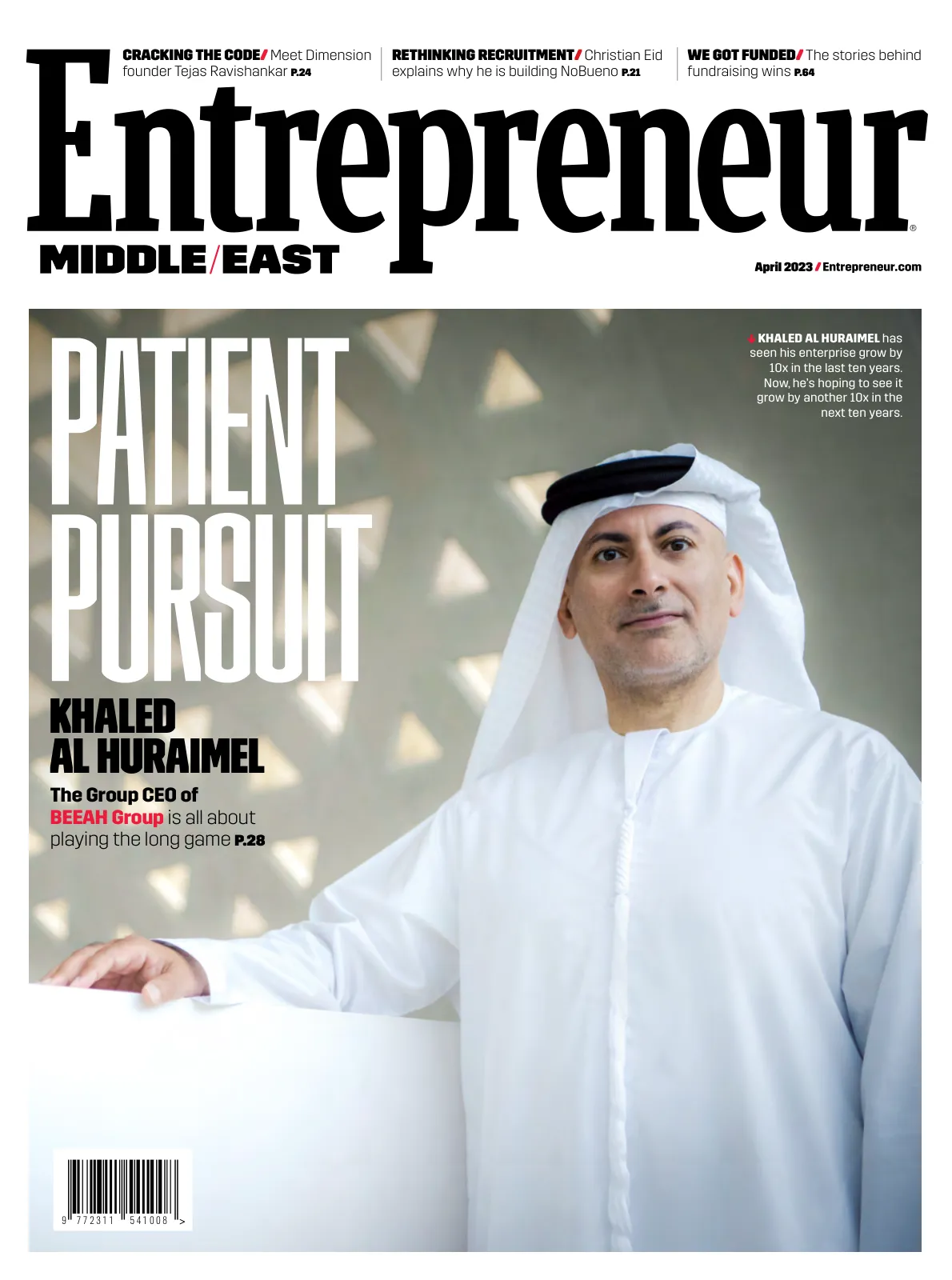
Entrepreneur Middle East, April 2023
Page 1
9
7 7 2 3 1 1
5 4 1 0 0 8
>
April 2023
PATIENT
PURSUIT
RETHINKING RECRUITMENT/ Christian Eid
explains why he is building NoBueno P.21
WE GOT FUNDED/ The stories behind
fundraising wins P.64
CRACKING THE CODE/ Meet Dimension
founder Tejas Ravishankar P.24
Khaled
Al Huraimel
The Group CEO of
BEEAH Group is all about
playing the long game P.28
↓ KHALED AL HURAIMEL has
seen his enterprise grow by
10x in the last ten years.
Now, he’s hoping to see it
grow by another 10x in the
next ten years.
Page 2
Page 3
Page 4
2 May 2023 | 2.00 PM GST
VIRTUAL EVENT
To celebrate women business leaders across Eastern Europe, Middle East
and Africa, Mastercard is partnering with Entrepreneur Middle East to
stage the Women SME Leaders Awards 2023.
In its second edition, the Women SME Leaders Awards is inviting women to
nominate themselves and their organizations to be recognized and rewarded
for their achievements and accomplishments through the past year.
There are no costs for attending or nominating at this event.
Celebrating women business leaders across
Eastern Europe, Middle East and Africa
A W A R D S 2 0 2 3
Page 5
WOMENSMELEADERS.COM #WOMENSMELEADERS
Nominate Now
Page 6
6 / ENTREPRENEUR.COM / April 2023
Contents/April 2023
P.28
Patient
Pursuit
KHALED AL HURAIMEL
The Group CEO of BEEAH has seen
his enterprise grow by 10x in the
last ten years. Now, he’s hoping to
see it grow by another 10x in the
next ten years.
FEATURES
IMAGE COURTESY MAEYA
← Former Saudi Arabian
bodybuilder
SOMAIAH AL DABBAGH,
founder of the
UAE-based online
luxury women’s
activewear brand
Maeya
BUSINESS
UNUSUAL
P.21
Rethinking
Recruitment
Christian Eid, the entrepreneur
behind NoBueno, explains why he
is building the enterprise.
P.24
Cracking
the Code
16-year-old Tejas Ravishankar is
hoping to harness (and celebrate) the
magic of coding through his software
developer experience platform,
Dimension.
Page 7
Page 8
Page 9
Welcome to the
E X C E P T I O N A L
An iconic hotel featuring
luxury rooms and apartments
with trendy dining options
in the heart of Riyadh
BOOK NOW
Mansard Riyadh, A Radisson Collection Hotel
4248 Prince Mohammed Ibn Salman Ibn Abdulaziz Road, Riyadh 6721-13315, Saudi Arabia
00966118290900 info.mansard@radissoncollection.com
radissonhotels.com/collection
Page 10
10 / ENTREPRENEUR.COM / April 2023
EDITOR IN CHIEF Aby Sam Thomas
aby@bncpublishing.net
CEO Wissam Younane
wissam@bncpublishing.net
DIRECTOR Rabih Najm
rabih@bncpublishing.net
CREATIVE LEAD Odette Kahwagi
design@bncpublishing.net
MANAGING EDITOR Tamara Pupic
tamara@bncpublishing.net
FEATURES WRITER Aalia Mehreen Ahmed
aalia@bncpublishing.net
REGIONAL DIRECTOR
Mahdi Hashemi mahdi@bncpublishing.net
HEAD OF INNOVATION
Sarah Saddouk sarah@bncpublishing.net
GROUP SALES DIRECTOR – B2B GROUP
Joaquim D’Costa jo@bncpublishing.net
COLUMNIST Tamara Clarke
CONTRIBUTING WRITERS
Samer Asfour, Fida Chaaban,
Christian Eid, Jack Kidd, Peter Mackintosh,
John Mullins, Ruwaida Abela Northen,
Ghady Rayess, Shaun Robison
SUBSCRIBE
Contact subscriptions@bncpublishing.net to receive
Entrepreneur Middle East every issue
COMMERCIAL ENQUIRIES
sales@bncpublishing.net
ENTREPRENEUR.COM
Access fresh content daily on our website
All Rights Reserved 2023. Opinions expressed are solely those of the contributors.
Entrepreneur Middle East and all subsidiary publications in the MENA region are
officially licensed exclusively to BNC Publishing in the MENA region by Entrepreneur
Media Inc. No part of this magazine may be reproduced or transmitted in any
form or by any means without written permission of the publisher. Images used in
Entrepreneur Middle East are credited when necessary. Attributed use of copyrighted
images with permission. All images not credited otherwise Shutterstock. Printed by
United Printing and Publishing.
PO BOX 502511 DUBAI, UAE
P +971 4 4200 506
April 2023
EntMagazineME
Entrepreneur-me
Contents
Contents
59 Fashion meets function
Former Saudi Arabian bodybuilder
Somaiah Al Dabbagh wants women to
feel comfortable in their skin through
her size-inclusive luxury activewear
brand.
64 “We got funded!”
The stories behind the recent
fundraising successes seen by
MENA-based startups COFE and
Nuqtah.
68 In focus
A roundup of up-and-coming startups
in the Dubai-based Mohammed Bin
Rashid Innovation Fund accelerator
program that you should be keeping
an eye on.
STARTUP
SPOTLIGHT
‘TREPONOMICS
45 The hustle is real
Nested VFX Founding Partner and CEO
Samer Asfour shares lessons learnt
through the course a three-year-long
entrepreneurial journey.
49 Building talent solutions to
attract, retain, and evolve
Aspexx Digital co-founders Peter
Mackintosh and Jack Kidd give the low-
down on crafting the perfect employee
experience to attract, retain, and evolve
your prospective and current talent.
52 It all started with a “no.”
(But it led to a US$1.5 billion
story in the end!)
An excerpt from John Mullins’
new book, Break The Rules! The 6
Counter–Conventional Mindsets Of
Entrepreneurs That Can Help Anyone
Change The World.
56 Caviar dreams (on an instant
noodle budget)
Behind every success story lies years of
commitment, diligence, and the maturity
to embrace both failure and triumph
alike, says JRN Consultancy co-founder
Ruwaida Abela Northen.
→ KHALED AL HURAIMEL
is the Group CEO of
BEEAH Group
↑ Recognizing sustainability and
technology as the pillars for a modern
economy, BEEAH GROUP invested in a
comprehensive, full-circle strategy for
the future, and expanded into the
fields of renewable energy, green
mobility, transport, education, and
technology.
Page 11
Page 12
Page 13
Page 14
14 / ENTREPRENEUR.COM / April 2023
Editor’s Note/
Editor’s Note/
O
f all the emotions that stand the
chance of being displayed at work,
anger seems to be the one that most
of us are absolutely wary of. Not only
are we absolutely apprehensive of
facing the brunt of another’s outrage,
many of us also shy away from
exhibiting any ire whatsoever even if
the situation demands it.
It’s easy to understand why
though- most of us have been trained
to believe that airing our
aggravations in the workplace is unprofessional and
not conducive to a healthy company culture. But how
wholesome can a work environment be when it’s one
where you have to keep mum and carry on a charade
even when your sensibilities are being assaulted on a
day-to-day basis?
I feel like the reason why anger gets such a bad rep in
the workspace is because of its potential to become
disrespectful and thereby make the environment we
spend an estimated one-third of our lives in toxic as
hell. And while it certainly should not be allowed to
go unchecked and without fear of consequence, I
believe that it’s important to recognize that anger is
as human an emotion as joy. And so, if we’re willing
to make space for the latter in our workplaces, we
need to learn to do the same for the former -or any
other feeling, really- as well.
As I see it, the key to making anger an emotion for
good in the workplace lies in how it’s displayed, as
well as in what happens after it makes its presence
felt. If, for instance, the anger can be properly
justified, then what needs to happen is a careful (and
constructive) conversation that should lead to the
necessary solutions being put in place for the same.
On the other hand, if one’s emotion is misplaced,
then the reaction to it needs to be studied but
empathetic- and the instigator also needs to be open
enough to see the error in their judgement or
reaction.
A healthy workplace, to me, would be one where
every member, regardless of rank, age, or gender,
feels safe and confident in expressing what
aggravates them, and, perhaps more importantly,
also be heard with the common goal of making
things better for everyone involved.
Personally, my team and I have a penchant for
finding the humor in our outbursts after our nerves
have suitably calmed; they often morph into
treasured memories down the road. There’s a special
kind of strength and support to be found in teams
that like to keep things real- and losing your cool is a
part of that.
Aby Sam Thomas
Editor in Chief
@thisisaby
aby@bncpublishing.net
SEEING RED
Redefining anger in the workplace
Page 15
The old playbook doesn’t work.
THE
ADVERTISING
FORMULA
IS BROKEN
Capturing the aaennon of customers
is no longer easy.
Where ads are actually watched.
WE CAN HELP
Page 16
16 / ENTREPRENEUR.COM / April 2023
BUILDING FOR THE FUTURE
Healthcare stakeholders came together at The Shift to lay the groundwork for the UAE
Ministry of Health and Prevention’s Innovation Strategy for 2023-26 by AALIA MEHREEN AHMED
F
uture-oriented gameplans that
can elevate the UAE’s
healthcare ecosystem’s overall
performance formed the crux of
discourse at The Shift, a special
event staged by the country’s
Ministry of Health and Prevention
(MOHAP) at its headquarters in Dubai
on Tuesday, February 28, 2023. Initiated
as an event to lay the groundwork for
MOHAP’s innovation strategy for 2023
to 2026, The Shift brought together
multiple stakeholders from across the
UAE healthcare ecosystem to discuss
how the country can cement its
position as having one of the world’s
best healthcare sectors.
In The Loop/
The Shift’s itinerary was drawn largely from the words and vision of H.H. Sheikh
Mohammed bin Rashid Al Maktoum, Vice President and Prime Minister of the
UAE and Ruler of Dubai, who was reported to have recently said, “Our goal is to
create a vibrant global healthcare hub that serves not only the needs of the people
of our nation, but also caters to the growing requirements of our vast region.
Aligned with our goal of making the UAE one of the world’s best places to live
and work, we are on a constantly evolving journey to raise standards of human
development and welfare.”
In his keynote address at The Shift, Saqr Al Hemeiri, Chief Innovation Officer
and Director of Strategy and the Future at MOHAP, touched upon how securing
the future of the country’s healthcare sector will need a collaborative effort from
private and public players within the ecosystem. “Today, we’re starting on a new
healthcare agenda for 2023-26, and this will involve facing challenges that we
may not have faced before,” Al Hemeiri said. “This means we will have to better
adapt to change. However, tackling and finding the solution to such hurdles
cannot be done in silos, which is why events like The Shift are important for the
ecosystem.”
The event also saw key stakeholders from the UAE’s healthcare sector com-
menting on how their industry could be revolutionized. In a panel discussion
moderated by Sally Mousa, Dr. Erik Koornneef, Director of Research and
Innovation, Pure Health, Ghada Sawalmah, CEO, Gargash Hospital, Dr. Shadab
Khan, Director of Artificial Intelligence and Applied Sciences, G42 Healthcare,
↑ At The Shift, MOHAP recognized its partners in the private and public sectors, which included Entrepreneur Middle East.
Page 17
17
April 2023 / ENTREPRENEUR.COM /
Rania Ashraf, Director of Government
Affairs and Policy, Janssen GCC, and
Khaldoon Bushnaq, co-founder and CEO,
Alma Health, shared their viewpoints on
what a new era of healthcare could look
like.
“I think the challenges that we will face
will be all about humans, all about
behaviors,” Dr. Koornneef said. “So, this
event is called The Shift, and I believe the
shift in the future of healthcare will be
much more focused on wellness instead of
illnesses.” Dr. Koornneef then also spoke of
how new technological innovations such as
ChatGPT, a chatbot powered by artificial
intelligence (AI), can prove to be a major
catalyst in furthering the UAE’s innovation
strategies in healthcare.
Adding to this point was G42 Health-
care’s Dr. Khan, who iterated how AI can
reimagine the way healthcare services are
provided to the end users. “I believe AI will
be massively important in improving care
outcomes,” Dr. Khan said. “We know that
the World Health Organization estimates
that there will be a shortage of 10 million
care professionals by 2030. So it is
imperative that we figure out a way to
support our care professionals with all the
technological tools they need to deliver care
better and faster.”
Janssen GCC’s Ashraf then steered the
conversation towards the lingering need to
ensure preventative measures exist within
healthcare. “Off the top of my head, I can
tell you that in the case of cancer, a delay in
diagnosis by just four weeks can lead to an
increase in the rate of mortality, across at
least seven to eight cancer types…just four
weeks!” Ashraf added. “If you look at diabe-
tes patients- uncontrolled diabetes leads to
a 20% increase in cardiac events. That’s
one in five patients, and we’ve got a lot of
diabetes patients in the UAE. So I think
there’s no going away from trying to
include prevention in all of its methods.
Whether it is prevention before the disease
happens, or prevention of consequences by
ensuring that we do early detections.”
On his part, Alma Health’s Bushnaq spoke
at length about how the mindset of patients
in the country is changing towards
innovations in the healthcare space,
particularly owing to their proven
efficiency during the peak of the COVID-19
pandemic. “Something we’ve noticed at
Alma Health, as a digital healthcare
provider that is fully licensed in the UAE, is
that patients have the same expectations
from the growing digital healthcare
providers in the country as they do from
the brick and mortar medical entities,” he
said. “So it is not that they want their
medications to be provided as quickly as
possible or consult a doctor as quickly as
possible- what they seek is improved
clinical outcomes. This is exactly what their
expectations are!”
Gargash Hospital’s Sawalmah, however,
pointed out that while this shift in mindset
is promising, there are also many patients
who still remain unsure about the benefits
of digital health. “Having the patient
understand how this is a benefit is still a
challenge,” Sawalmah added. “There is this
perceived fear that the use of machines and
AI can just go the other way! And then you
have statements by Elon Musk who has
said that we might need to slow down on
the development of AI, adding to that fear.
That is what is in the faces of everyone, and
that is what the patient reads. But we need
the patient -who is the most important
person in this scenario- to play a proactive
part in the adoption of telemedicine, AI
tools, and the like. That is what will lessen
the costs and push us to the next level of
collaboration- where it’s not just between
the public and private sectors, but also with
the general public.”
In a neat implementation of Sawalmah’s
concern, following the event’s proceedings,
attendees of The Shift were invited to
participate in roundtable discussions
looking into the various considerations that
MOHAP should keep in mind for its new
innovation strategy. The conversations that
ensued touched upon topics ranging from
the UAE’s legislative system and policies
when it comes to healthcare, to the
education and training of the next
generation of healthcare workers.
mohap.gov.ae
TACKLING AND FINDING THE SOLUTION TO SUCH
HURDLES CANNOT BE DONE IN SILOS, WHICH IS WHY
EVENTS LIKE THE SHIFT ARE IMPORTANT FOR THE
ECOSYSTEM.
↑ SAQR AL HEMEIRI, Chief Innovation
Officer and Director of Strategy and the
Future at MOHAP
↓ PANEL DISCUSSION The Shift: Revolutionizing Healthcare in The UAE
IMAGES COURTESY MOHAP
Page 18
V got it all
• V Hotel Dubai’s party suite promises to be the ultimate des-res
• The grand Amazing Room as the perfect event venue with illumining walls
• A hotel that blurs the lines between work and play
• Retro-futuristic, picture-perfect guest rooms for friends to party under one roof
• Located in the heart of Dubai and by the banks of Dubai Water Canal
Page 19
V Hotel Dubai, Curio Collection by Hilton
Al Habtoor City, Sheikh Zayed Road, Dubai, UAE
T: +971 4 436 6666
thevhoteldubai.com
V Hotel Dubai, Curio Collection by Hilton
is fully eligible for Hilton Honors rewards programme
Page 20
Page 21
21
April 2023 / ENTREPRENEUR.COM /
Rethinking Recruitment
The entrepreneur behind NoBueno explains why he is building the enterprise
by CHRISTIAN EID
→ CHRISTIAN EID is the
founder of DuckLife, a
branding agency and
NoBueno, a talent matching
platform.
IMAGES COURTESY NO BUENO
Page 22
22 / ENTREPRENEUR.COM / April 2023
B/The Big Idea
Now, it would be naive to launch a startup just because
something doesn’t work well. Very few things work well,
and just because there’s friction, it doesn’t immediately
warrant diving into and going down the road of ridiculous
sacrifice. But, there’s something else that really bugged
me. The more I unraveled recruitment, the more the
problem became critical. The process, even if digitized
today, is broken, and it has remain unchanged for
centuries. And the result of archaic processes means that
today there is extreme bias in how opportunity finds
people.
I’ll explain. Let’s start with job descriptions. What a load
of garbage. The starting point of every job seems to always
begin with a couple of pages of words that are meant to
articulate the company, the role, and relevant responsibili-
ties. And yes, at the onset, it sorta makes sense, but I’ll
break down why this is so flawed.
Job descriptions, when done right, take time. Identifying
precisely the skills and profile you’re looking for needs real
attention to detail. Today most, if not all, hiring managers
group a bunch of skills and profile definitions together,
making no distinctions between the must-haves or the
nice to-haves. It’s an almost copy-paste process with little
differentiation. And since time is a commodity that has
increasingly become scarce, we cannot assume that we’ll
invest enough time to write job descriptions that do us
justice. So, this means our starting point is almost always
off to a bad start.
Job descriptions do not give any view of the character
and personality that would suit the role. Sure we can list a
bunch of attributes that we’d be looking for, but how do we
measure the weight and depth of those attributes by
simply describing them? We can’t. Neither a job seeker, nor
a recruiter can understand and articulate a line manager’s
or collaborating teams’ personality traits that would
perfectly match any new joiner’s.
Job descriptions are merely opportunity identifiers
signaling for attention to those who seek. And yep, you
guessed it, you’re speaking to those whose attention is
available. Not merely a fraction of the talent that would be
relevant for the role. Most people are already employed, and
they are often oblivious to a new opportunity. In short, job
descriptions are paired with resumes, not people.
Job descriptions are loaded with bias. Beyond basic
technical skills, our natural talent search process is lazy. We
look for pillars of presumed truth to reduce the number of
profiles we look at. Were they at Google? Did they go to a
prestigious university? Do they have a certain degree?
Bottom line, job descriptions often list requirements that
have no proven bearing on the ability and relevance to the
role we’re hiring for. They are instead there to limit the
I
know nothing about recruitment.
Wait, let me rephrase. I know a lot
about building teams, but nothing
about traditional recruitment per se.
But on the things I do know, I’ll begin
with the obvious reality that
nobody, and I do mean nobody, is
happy with their recruitment
process or tools. Leaders, hiring
managers, talent acquisition teams,
headhunters, and recruiters -as a
whole- don’t hold back on their discontent
with the status quo. (Ask them!) And if that
weren’t enough, try speaking to job
seekers. How did it feel the last time you
looked for a job? Total rubbish!
IF WE’RE GOING TO BE HONEST WITH
OURSELVES, RECRUITERS ARE ONLY AS SUCCESSFUL
AS THEIR ABILITY TO BUILD VAST NETWORKS THAT
IMPROVE THEIR ABILITY TO SEARCH.
→ Christian Eid,
founder, NoBueno
Page 23
23
April 2023 / ENTREPRENEUR.COM /
number of candidates we consider.
In the absence of better measure-
ment, we resort to assumed bias to
do most of our filtration and
qualification.
If you’ve managed to read this far,
thank you, but I’m not done. Let’s
touch on a few other things that
make recruitment a total night-
mare.
Resumes. I’ll keep this one short.
In this growingly competitive
world, where technology has
digitized the process, making apply-
ing a one-click affair, do we really
believe that job seekers are honest
in their representation? Were they
ever? Right out of college, we’re
taught to play the part and almost
over-embellish our abilities and
capabilities. And so today’s
fast-paced, time-sensitive, and
hyper-competitive world has
resulted in resumes full of bent
truths desperate to stand out from
the crowd. Let’s put it this way, is
anything real on Instagram and
Tiktok? Why would LinkedIn be
any different? Job descriptions and
resumes need to go.
So much more can be elaborated
on, but let’s move on to another
angle. Let’s look at the value of
human capital. How is it valued? Is
it based on merit and true market
value? Hell no. What you earn
today is likely impacted by a variety
of the following:
The hiring company’s budget and
perceived value of the role title
vis-a-vis other roles
Competitiveness (supply) and
demand of the role within your
market (and maybe neighboring
markets)
Your gender, race, character, and
ability to sell yourself (I hated
writing this line)
On the flip side, what you paid at
the pump this week, or how much
your coffee cost this morning was
determined by the free market
dynamics of demand and supply.
For some reason, what we earn
today seems to have been influ-
enced by so many factors outside of
our control that we end up being
victims of our society’s disillusioned
measure of our value. What if we
had a consistent, and more global,
view of our market value based on
an average of opportunities that
match our abilities and suitability?
Being in India, Ukraine, China,
Canada or Germany shouldn’t
influence our average global market
value, especially in a globalized
remote workforce.
Finally, and what is obvious but
never discussed, is search. Search,
and your ability to search, deter-
mines pretty much everything.
Most would refer to it as network-
ing, but if we’re going to be honest
with ourselves, recruiters are only
as successful as their ability to build
vast networks that improve their
ability to search. In other words, job
descriptions meet candidates so
long as either side’s search some-
how joins through a close enough
degree of separation. Good for the
extrovert, and bad for the introvert.
Now sure, a trusted network may
provide a potentially more qualified
channel, but it would also be fair to
assume that searching merely
within a closed network (large or
small) greatly hinders the likeli-
hood of landing the best match.
I decided to build NoBueno,
because finding talent, or a job,
cannot continue to be this broken if
we’re to build a future that adapts
faster to the needs of our planet,
economy, and moral progression.
We cannot accept that the very
lifeline of economic development
and human capital is left to a
process that is so rooted in
dysfunction that it undermines our
ability to build better, faster, and
more productive teams.
We have to solve this. And I’m
going for it.
Christian Eid is the founder of
NoBueno, an enterprise that wants
you to never, ever look for a job
again. nobueno.com
Page 24
24 / ENTREPRENEUR.COM / April 2023
T
he surprise that
comes with
finding out that
Tejas Ravishankar,
founder of
UAE-based developer
productivity and experience
platform Dimension, is only
16 years old, is a reaction that
very quickly wears off- simply
because it is much easier to be
enthralled by the teenager’s
business vision instead. “My
journey as a developer began
[in 2020] when I was 13 and
in the eighth grade,”
Ravishankar recalls. “The
lockdown [during the
COVID-19 crisis] meant no
interactions with friends, and
it gave me ample time to
explore coding. I found it
magical that you could create
whatever you imagined by
keying in a few commands.
Soon, I was spending most of
my time developing software.
However, as a coder working
on building my own tools and
contributing towards other
open-source projects, I faced
several issues. And I realized
that other developers faced
similar hurdles as well.
Dimension was, therefore,
born out of the desire to bring
the magic back into building
software.”
Now, to understand
Dimension, it is important to
first understand why it targets
open source projects in
particular. You see, unlike
proprietary software, the very
nature of open source
software entails that a given
project’s code can be accessed
and modified by anyone in
the public domain. From the
complexities of not knowing
which source has modified a
code, to the difficulties in
ensuring a shared vision
across a developer team, open
source projects come with
their own particular sets of
challenges. “Lack of proper
16-year-old Tejas Ravishankar is hoping to harness (and celebrate)
the magic of coding through his software developer experience
platform, Dimension by AALIA MEHREEN AHMED
Cracking the Code
B/The Big Idea
IMAGES COURTESY DIMENSION
Page 25
25
April 2023 / ENTREPRENEUR.COM /
integrations also result in sub-par
developer experience,” Ravishankar
adds. “Too many tools, hundreds of
tabs and switching through numerous
sites results in a slow, fragmented, and
painful development process.” And it is
precisely to address these issues that
Ravishankar started building
Dimension in 2022. “It aims at being
the unified interface for software
development- where the world’s best
developer tools are integrated along
with excellent project management
capabilities, chat facilities for real time
collaboration, and easy deployment
that will enable engineering teams to
develop and deploy software at record
speed. It thus brings a “whole new
dimension” to developer experience
end-to-end, from building, managing,
communicating, tracking and
deploying, all in one place. Dimension
can be used by individuals, as well as
engineering teams of all sizes.”
As a platform that can be built on and
easily integrated into hundreds of
software development tools such as
GitHub, Linear, Cloudflare, and Vercel,
Dimension thus helps developers
manage their codes, domains, software
deployments, and projects on a single
platform. “We’re currently in the
process of developing our core
platform,” Ravishankar reveals. “We
expect to launch the minimum viable
product (MVP) private beta in a couple
of months. Several companies and
open-source projects -such as SolidJS,
a Javascript platform that helps build
user interfaces, Tabler, a web
application development platform, and
Astro, an all-in-one web framework
designed for speed- are already on the
waitlist to use our private beta. We also
have more than 600 developers
waitlisted for Dimension. Currently,
there are three full-time and four
part-time employees in our team.”
Now, one might think that the zeal
and relentless energy of youth may be
seen as assets in the world of
entrepreneurship. But as it turns out, it
was Ravishankar’s age -or rather, the
perception of the level of maturity at
such an age- that proved to be the
biggest thorn in his journey. You see, in
February 2023, Dimension raised a
pre-seed funding of US$150,000 in a
round led by Antler India, the Indian
arm of Singapore-headquartered
early-stage global venture capital (VC)
firm, Antler. But that milestone came
after a series of rejections from
investors. “Being a minor adds to the
disadvantage in certain situations,”
Ravishankar says. “People don’t take
you seriously, and it can get frustrating
at times, and so, I have a lot of
gratitude towards all those who have
put their faith, time, and capital in
Dimension. I have been regularly asked
how I can pursue Dimension alongside
school, and I have been turned down
by many venture capitalists for the
same reason. However, talking to many
of them helped me continuously evolve
my pitch. The refined pitch, combined
with investment from notable
individuals from the developed tooling
space, helped in raising from a VC
fund.”
I’m sure many of you might now be
intrigued to know exactly how
Ravishankar manages to allocate time
to both his academic and
entrepreneurial responsibilities. He is,
after all, a Grade 11 student pursuing
his A-levels with maths, physics,
economics and business studies as his
core subjects. “Juggling company
work with academics is challenging,”
Ravishankar admits. “But besides
going to school, I invest around
60-65% of my time on Dimension. I
also managed reasonable grades in
my General Certificate of Secondary
Education (GCSE) 10th exams by
getting a 4.0 grade point average
(GPA), with an A* grade in computer
science, business, mathematics and
physics. The time I spend at school
helps me in connecting with my
friends. But besides that, I hardly have
time for anything else.” A key driving
force behind Ravishankar’s ability to
balance school work with running a
startup is, unsurprisingly, his parents.
“My parents have always been
supportive of my dreams,” Ravishankar
says. “However, they have been
insistent on having a strong academic
foundation. As Dimension started
getting serious interests from angel
investors and venture capital funds, I
had to convince my parents to allow me
to accept investment offers.”
This, of course, would be the perfect
time to introduce who the teenager’s
parents are. “My mom’s name is Roopa
Hariharan,” Ravishankar says.
Hariharan, you will find, is the founder
of PureCult, an India-based eco-
friendly home cleaning products
company. But it is when he has to
disclose his father’s name, that there is
the slightest hint of trepidation
-evident even through our email
conversations- from Ravishankar. You
see, Ravishankar’s father is G. V.
Ravishankar, the Managing Director of
the Indian arm of American VC firm,
Sequoia Capital. And, as his son,
Ravishankar remains acutely aware of
the business optics of such a dynamic.
“My father is indeed Sequoia India’s G.
V. Ravi Shankar, but I just want to note
that he didn’t help me at all with the
fundraising process- many people tend
to assume that,” Ravishankar clarifies.
“My dad did invest an amount from the
family, but I was the one who found
introductions, and pitched to the right
investors.”
It becomes clear at this point that this
young man is adamant on making it on
his own, without falling back on his
parents’ laurels. “I started working on
Dimension about six months back,
with a few of my friends contributing
towards it,” Ravishankar says. “I was
funding it by working part time on
paid internships, while working on
Dimension and balancing my academic
commitments in parallel. At one point
I was working three internships just
THE REFINED PITCH, COMBINED WITH INVESTMENT
FROM NOTABLE INDIVIDUALS FROM THE DEVELOPED
TOOLING SPACE, HELPED IN RAISING FROM A VC FUND.
Page 26
26 / ENTREPRENEUR.COM / April 2023
to fund Dimension. I have
been involved in all aspects
of Dimension- from company
formation, talking to several
investors for fundraising,
engineering certain parts of
the software, designing the
overall user experience and
front-end, hiring talent for
the company, and managing
the deliverables of employ-
ees. Since I am a minor,
however, my mother helps
with some of the banking
and accounting work.”
Ravishankar’s inclination
towards solving matters on
his own appears to be
something of an innate
quality- that would perhaps
explain why his entrepre-
neurial flair was showcased a
long time before he launched
Dimension. “When I was
eight years old, alongside my
friends, I started baking and
selling food within the
community,” Ravishankar
reveals. “It helped me
understand how to collabo-
rate with others, and to
understand customer needs
and feedback. But I have also
had to move between
multiple schools. When I
moved in the fifth grade to a
new school, I was bullied. It
was mentally stressful for me,
and I was struggling to make
friends. It took me a whole
academic year to settle in. It
was then that I learnt to
ignore toxic people, and to
stand my ground around
bullies. I refused to take my
parents’ help on this issue,
and I wanted to deal with it
myself. I am glad I went
through the experience, as it
made me stronger.” Ravis-
hankar’s decision to remain
undeterred in the face of
negativity has helped him
flourish in other fields too.
“Until seventh grade, I was
into music,” Ravishankar
says. “I pursued Hindustani
classical vocals from the age
of four, for about six years,
and then switched to western
vocals. I was really into
creating music too. As a kid,
I also enjoyed biology and
thought I could pursue music
or medicine as a career.”
Eventually, however,
Ravishankar’s interests
forayed into software
programming, which he first
got acquainted with by
enrolling for courses at
Udemy, a US-based online
learning and teaching
marketplace. “Learning on
my own through Udemy
courses gave me the
flexibility to learn what I
wanted,” he says. “I partici-
pated in a couple of hack-
athons and won them, which
boosted my confidence, and I
felt encouraged to dive
deeper and take on more
complex challenges. I picked
up programming languages
such as Dart, Python, and
Rust along the way, and
started working on building
software tools.” This path of
self-study is also what led
Ravishankar towards the
software-led venture he built
before he launched Dimen-
sion. “Like I mentioned
earlier, I find the world of
programming magical,” he
says. “Code turns our
imaginations into reality.
Programming also gave me
the opportunity to individu-
ally contribute to solving real
world problems. When the
Ukraine war started, I was
disturbed by the number of
people displaced. So, I built
an app called Kyiv, with the
intent to securely connect
help seekers and providers.”
As an app that was built in
two weeks, during the onset
of the Russia-Ukraine war in
2022, Kyiv offered users with
a map to find the closest help
locations, and also provided
updated listings on food,
shelter, healthcare, transport.
The lessons Ravishankar
derived from creating Kyiv
have certianly played a role
in how he has gone about
creating Dimension. And
when it comes to the road
ahead, Ravishankar displays
the same laser-focused vision
that has been evident
throughout his entrepreneur-
ial journey so far. But he’s
also not getting too far ahead
of himself, the teenager
assures me. “Right now, we
are focused on the minimum
viable product and beta
testing, which should happen
over the next two to three
months,” Ravishankar says.
“This is a crucial step that
will help us in validating our
product, and in receiving
inputs for improvement. It is
difficult to say where I see
myself in, say, the next 5-10
years. However, the journey
so far with Dimension has
given me invaluable experi-
ence. I hope to continue
learning in all aspects, and
hope Dimension takes off
and becomes the go to
platform for all developers
and engineering teams.”
LEARNING ON MY OWN THROUGH
UDEMY COURSES GAVE ME THE
FLEXIBILITY TO LEARN WHAT I WANTED.
B/The Big Idea
Page 27
Page 28
28 / ENTREPRENEUR.COM / April 2023
REEL STAR was designed,
from the ground up, to be a
community-focused, global,
social media and
entertainment app which
empowers users to create,
share and trade content
with a worldwide audience.
↓ KHALED AL HURAIMEL is the
Group CEO of BEEAH Group
Page 29
29
April 2023 / ENTREPRENEUR.COM /
The Group CEO of BEEAH has seen the enterprise grow by 10x in the last ten years.
Now, he’s hoping to see it grow by another 10x in the next ten years. by ABY SAM THOMAS
| PHOTOGRAPHY ULYSSIS CASTILLO
PATIENT
PURSUIT
KHALED/ AL HURAIMEL
ontinued growth” was the headline I gave the piece that I wrote after
interviewing BEEAH Group CEO Khaled Al Huraimel in 2014, which was a
nod to the underlying principle that I felt was driving his ambitions and
aspirations for the UAE-born enterprise at that time. Nearly a decade
later, as I chatted with Al Huraimel in March this year, I felt like not much
had changed in terms of this Emirati executive’s psyche with respect to
the business he leads- but I certainly cannot say the same about the
company itself. Under Al Huraimel’s stewardship, BEEAH has undergone a
massive transformation in the last couple of years- while it had come into being in
2007 in Sharjah as a public-private partnership company primarily focused on
environmental and waste management, it is today a diversified investment holding
group with operations in a variety of sectors, as well as a plethora of geographies.
As such, its newly opened headquarters in Sharjah -a stunningly grandiose struc-
ture designed by the Pritzker Architecture Prize-winning Zaha Hadid- can therefore
be easily seen as a symbol of the striking success that BEEAH has seen so far- but
it can also be portrayed as a portent of its wins to come as well. “In the last 10
years, we grew by about 10x,” Al Huraimel says. “And now, we expect to grow by
another 10x in the next 10 years.”
Page 30
30 / ENTREPRENEUR.COM / April 2023
N
ow, as much as BEEAH has changed in the years
since it was established, the company’s vision
-much like Al Huraimel’s own mindset- hasn’t
wavered- it continues to, as its website declares,
envision a future built on sustainability,
empowered by digitalization. “We’ve been
focused on two pillars always- sustainability and
digitalization,” Al Huraimel says. “When we
started 15 years ago, our aim was to tackle environmental
challenges this region is facing, and the first challenge we
looked at was waste management. Our region, the GCC, had,
at that time, the highest generation of waste per capita in the
world- in the UAE, it was about 2.5kg per person, per day. So,
we started our journey with the aim to tackle that problem.”
BEEAH was founded following a decree from H.H. Sheikh
Dr Sultan bin Muhammad Al Qasimi, the Ruler of Sharjah,
which was how it embarked on a mission to make the city the
first in the Middle East to achieve zero waste to landfill, a
target that the organization grows closer to every day. Driven
by the vision of the Ruler of Sharjah and the UAE’s national
sustainability agenda, BEEAH’s innovative waste manage-
ment efforts already achieved the Middle East’s highest
landfill waste diversion rate- over 76%.
Such an achievement has been made possible thanks to BEEAH
putting together a state-of-the-art waste management center,
which includes a material recovery facility (which processes over
600,000 tons of municipal solid waste annually), a construction
and demolition waste recycling facility (which processes over
500,000 tons of this kind of waste annually), as well as a biomass
facility (which processes 200 tons of waste daily to generate
alternative fuel), among others. Last year, BEEAH inaugurated a
commercial scale waste-to-energy plant in Sharjah that is set to
divert 300,000 tons of waste from landfills yearly, while produc-
ing 30 megawatts of low-carbon electricity- it’s the first facility of
its kind in the Middle East, and it is what is expected to push the
Emirate to become the region’s first zero-waste city. After
reaching this target, BEEAH is then going to repurpose Sharjah’s
Al Saja’a landfill into becoming a solar energy farm- the first
phase of the project will see it converted into 270,565 sq. m. of
solar area with a projected output of 24 megawatts, and the
second phase will convert an additional 200,099 sq. m. of solar
area to produce 16 megawatts of solar power.
“We asked ourselves: how can BEEAH keep growing? We saw two ways in which
we could do it: geographic expansion, or diversification. We did both.”
↓ BEEAH GROUP’S APTITUDE FOR LEADING BY
EXAMPLE is best showcased at the organization’s
new headquarters- designed by the world-renowned
Zaha Hadid Architects, the headquarters redefines
the benchmark for green buildings.
Page 31
31
April 2023 / ENTREPRENEUR.COM /
BEEAH has thus been doing some
pioneering work in Sharjah, and its
achievements in the Emirate have certainly
got it noticed, with the company becoming
the recipient of several industry awards
and international accolades over the years.
At the same time, with growth always
being a target for BEEAH, such
accomplishments have also allowed it to
make inroads into new markets as well. Al
Huraimel points out here the company had
realized quite early on in its journey that
Sharjah alone is a comparatively small
market for it to tackle, and so, it always had
a plan in mind to make its presence felt in
other locations as well. BEEAH thus
started to secure deals and launch
operations in the UAE’s other cities like
Abu Dhabi, Dubai, Al Ain, and Ajman, and
this has now made it one of the largest
waste management companies in the
country. “That being said, we saw this
coming years ago,” Al Huraimel interjects.
“So, we asked ourselves: how can BEEAH
keep growing? We saw two ways in which
we could do it: geographic expansion, or
diversification. We did both.”
BEEAH started securing non-UAE
contracts in 2020. The first of these was
announced in January that year, with the
company being appointed as the waste
management partner for Egypt’s New
Administrative Capital (NAC), a new urban
development that’s been aimed as an
extension of its capital city of Cairo, which
will be spread across 71,400 hectares and is
expected to house a population of 6.5
million. At the time, the deal was billed as
largest waste management contract in the
MENA, and BEEAH decided to set the bar
high for itself by aiming for an 80% waste
diversion rate in the new city. In August
that same year, BEEAH was awarded three
contracts for waste management in Saudi
Arabia’s holy city of Madinah, which
covered its North, West, and East regions.
BEEAH’s services are thus spread over
70% of the city today, with Al Huraimel
noting that the company has currently got
more than 3,000 of its staff there, all of
whom serve a population of 1.2 million
people. Last year, BEEAH went on to
secure its second contract in Egypt, with it
partnering with Green Planet -one of the
country’s emerging environmental services
company- to deliver waste management
and city cleaning services for a period of 10
years in the city of Sharm el-Sheikh, the
site for 2022’s Conference of the Parties of
the United Nations Framework Convention
on Climate Change, aka COP27.
According to Al Huraimel, BEEAH is
currently settling itself into the new
markets it is operating in, but its growth
ambitions aren’t done yet- East Africa is on
the cards, he says, as are other promising
locations around the world. At the same
time, the company has also been pursuing
an aggressive diversification strategy, with
BEEAH setting up ventures in a number of
sectors other than waste management. One
of these is Evoteq, “a solutions provider
that champions technological innovations
and digital transformation,” which BEEAH
launched in 2017. Having developed a
platform called SmartTrack, a system that
allows one to track and trace products from
the point of production all the way to the
consumer, Evoteq has since adapted its
solution for the UAE Ministry of Health
and Prevention to deploy as Tatmeen, the
country’s first track and trace solution for
pharmaceuticals. Another of BEEAH’s
ventures is re.life, an enterprise that
launched in 2021 and currently has two
platforms under it: re.life collect, an
on-demand solution that connects users to
“a verified community of moving and
transportation companies,” and re.life
market, a virtual marketplace for the
buying and selling of recyclables.
Of the two, it’s re.life market that I’d now
like to draw your attention to- it was the
winner of the B2B Platform of the Year
award at Entrepreneur Middle East’s 2023
E-Business Awards, which was in recogni-
tion of the platform being able to record
over AED100 million worth of trades of
recyclable material in 2022. “This year, we
expect over AED300 million worth of trade
to happen on re.life market,” Al Huraimel
says. “We’ve already opened an office in
India, and the vision for re.life market is for
it to be a global marketplace -the number
one marketplace- for trading recyclable
commodities, bringing buyers and sellers
together, and eliminating the middlemen.”
Much like Evoteq, re.life has been operat-
ing as a startup since it launched, which
makes its achievements so far no small feat,
and the fact that Al Huraimel is proud of
both ventures is pretty apparent in the way
he talks about them. Their successes also
bode well for the prospects of BEEAH’s
newest digital undertaking, which is a joint
venture with Khazna Data Centers (one of
the largest wholesale data center providers
in the MENA) to develop and launch the
first Tier 3 data center in Sharjah.
Page 32
32 / ENTREPRENEUR.COM / April 2023
Its tech ventures notwithstanding, Al Huraimel adds here that
BEEAH is also diversifying into new but more traditional sectors
like real estate, energy, and healthcare. The first of these is tied to
the work BEEAH did to develop its new headquarters in
Sharjah- it is, after all, one of the most sustainable and most
technologically advanced buildings in the region, and the
experience and expertise the company gained while building it
has led to the creation of its own real estate arm. Al Huraimel
reveals that a real estate development is in the works in the same
location as that of BEEAH’s headquarters, with the area set to
become “a smart and sustainable district” in Sharjah. Meanwhile,
in the energy sector, BEEAH has already shown what it’s capable
of with the launch of its waste-to-energy plant last year; in the
works is a waste-to-hydrogen plant, also the first of its kind in
the region. While aligning with BEEAH’s zero-waste targets, the
plant will also produce fuel cell grade hydrogen in support of
zero-emissions mobility in the UAE. Al Huraimel also shares that
BEEAH is looking into building a medical district in Sharjah-
this will host what he calls “the hospital of the future,” which will
be built in partnership with a consortium of Harvard Medical
School-affiliated hospitals from the US.
All of what BEEAH is doing now is certainly a rapid evolution
from its origins as a waste management company with about 40
people on its payroll- but it is also a testament to the dynamic
and visionary outlook with which this business -now with over
13,000 employees- has been led since its start. “It is imperative
that future cities and future economies are sustainable,” Al
Huraimel says. “Achieving and maintaining sustainability is not
possible without technology. I knew that we needed to keep
exploring what’s coming next in technology, because that’s going
to help us be more sustainable. In our DNA as an organization, it
was clear that both sustainability and technology needed to come
together in all that we do.” Al Huraimel’s ethos can thus explain
why his company has been ahead of the curve in terms of its
interest in and adoption of cutting-edge tech- for instance, the
rest of the world might only now be catching up with the
potential presented by artificial intelligence (AI), but BEEAH
has been working with it for the last few years now. For instance,
the technology has, for one, been put to use in robots that
segregate waste at its commercial and industrial waste recycling
facility, and it’s also been deployed in its command center to
track all of its vehicles and advise on the most efficient routes,
depending on when bins tagged by radio frequency identification
(RFID) indicate they are full and ready for pick up, as well as
traffic conditions.
But if one needs a more visible example of AI at work at
BEEAH, one needs to only take a look at its beautifully head-
quarters, operating at LEED Platinum standards. Johnson
Controls, “the global leader for smart, healthy, and sustainable
buildings,” powers the building with its OpenBlue digital
technology, thereby making it the first fully AI-integrated
building in the Middle East. As for what this actually translates
into: well, for starters, think secure, friction-free access into the
building, not just for regular occupants, but visitors as well.
Meanwhile, predictive AI helps control light and temperature
based on number of occupants, individual preferences, time of
day and, of course, optimizing energy consumption for the
highest levels of efficiency. Work is also underway on the
OpenBlue companion app, which, when activated in the
→ ARTIFICIAL INTELLIGENCE
has been put into use in a lot of
BEEAH Group’s operations, including
at its waste recycling center.
Page 33
33
April 2023 / ENTREPRENEUR.COM /
headquarters, can act as a concierge
helping building occupants with
everything from locating meeting spaces,
to ordering a beverage, or even as a
personal assistant for employees to book
appointments with their peers, or simply
to access news and information. From an
operational standpoint, Al Huraimel
points out that AI-based tools like
ChatGPT are already being made use of
by BEEAH’s marketing and comms
teams, and he also reveals that he hopes
to see such technologies having a more
active role in its finance department as
well.
If it isn’t already clear by now, then let
me state for the record that Al Huraimel
is obviously the man at BEEAH spear-
heading its forward-thinking initiatives,
and a lot of that has to do with his innate
personality as well. “I think that when I
see an opportunity, it just stays in my
mind until I do it,” Al Huraimel says, in
response to my question about his
personal drivers for doing what he does
on a day-to-day basis. Such a philosophy
would also explain why Al Huraimel has
quite a few business interests outside of
BEEAH- you see, besides being a
seasoned executive who has previously
worked at companies like ENOC and
Nakheel, he is also a serial entrepreneur
with a number of ventures under his belt.
One of them is Bait Al Kandora, which Al
Huraimel launched in 2015 as the first
Emirati designer menswear brand in the
UAE, and then went on to become a
market leader. There’s also Omada, which
is today a full-fledged marketing
technology group, as well as Dar Al Aqar
Real Estate, which Al Huraimel describes
as “a boutique premier real estate
advisory and investment and brokerage.”
More recently, Al Huraimel had an active
role to play in the 2022 launch of Bedu,
which today bills itself as “a Dubai-based
digital pioneer that operates at the outer
reaches of the Web3 frontier, providing
metaverse, blockchain, and non-fungible
token (NFT) solutions.”
While Al Huraimel says he is typically
quite hands-on when it comes to the early
days of the enterprises he launches, he is
happy to take on a back seat when they
come into their own, and then let them
have their own leaders, teams, etc.
governing them. This is true of Al
Huraimel’s current association with all of
the aforementioned ventures, and that is
also an indicator of his personal mentali-
ties as a business leader. “I want to see
others succeed,” Al Huraimel tells me.
“For instance, with Bedu, I have a CEO,
and I want him and his team to succeed,
and I want to provide them with the and
the foundation, then let them run with it.
At BEEAH too, now, I want to build the
next level of leadership to take charge of
the enterprise. BEEAH has grown quite
well in the last 10 years, and now for the
next 10 years, we want to see much bigger
growth; that’s our plan. But this ‘bigger
growth’ is not me- I need to develop the
next generation of leaders to take BEEAH
to the next level. So, if I want to grow by
10 times in the next 10 years, it needs a
lot. And so, this year, we’re focusing on
spending much more on preparing the
next level of leaders to take on whatever
challenges lies ahead.” Al Huraimel is
thus clearly thinking about the long game
at BEEAH. And if the successes he has
engineered so far are any indication, then
all signs point to a continued trajectory of
growth for BEEAH in the foreseeable
future- and thereafter as well.
“I NEED TO DEVELOP THE NEXT
GENERATION OF LEADERS TO TAKE
BEEAH TO THE NEXT LEVEL.”
↑ FOUNDED IN 2007, BEEAH GROUP began
its journey as a Sharjah-based public-
private partnership company, primarily
concerned with environmental and waste
management. Recognizing sustainability
and technology as the pillars for a modern
economy, BEEAH Group invested in a
comprehensive, full-circle strategy for the
future, and expanded into the fields of
renewable energy, green mobility, transport,
education, and technology.
Page 34
Page 35
Page 36
FUN COMES
GUARANTEED
YOU DECIDE WHEN THE PARTY
STOPS WITH 24HR FOOD & DRINK.
NOW OPEN AT DUBAI DIGITAL PARK.
RADISSONHOTELS.COM/RED
Page 37
37
April 2023 / ENTREPRENEUR.COM /
Ahead of the curve →
/Oppo Reno8 T 5G
B/Gear
#TamTalksTech
Gadgets and doodads that you might’ve missed out on,
sourced by a tech aficionado. by TAMARA CLARKE
← Balancing act /Acer TravelMate B5 14
Powered by a next-generation Intel Core i3-N305
processor, the Acer TravelMate B5 14 comes with
a 14-inch full HD (1920x1080) display, and gives
you up to 7.5 hours of battery life on a single
charge. For added convenience and functionality,
the TravelMate B5 14 includes two USB 3.2 Gen 1
Type A ports, a USB 3.2 Gen 1 Type-C connector,
Intel Wi-Fi 6E and 2x2 MU-MIMO for fast and
uninterrupted network connectivity when online. It
also includes Acer’s User Sensing Software,
designed to help protect your privacy, and
develop better habits when using your laptop.
Completing its bundle of advanced protective
software, the User Sensing AutoLock capabilities
with optional built-in proximity sensors allow for
accurate detection of your presence, and it
triggers the screen to automatically lock when
you’re away from your laptop. The device also
has an additional HDR camera with webcam
privacy shutter, as well as dual digital
microphones with Acer’s PurifiedVoice to
suppress background noise when on a call. All of
these features combine to help you efficiently
balance the daily demands of your work load.
TAMARA CLARKE, a former software development professional, is the tech and lifestyle enthusiast behind The Global Gazette, one
of the most active blogs in the Middle East. The Global Gazette has been welcomed and lauded by some of the most influential tech
brands in the region. Clarke’s goal is to inform about technology and how it supports our lifestyles.
Talk to her on Twitter @TAMARACLARKE. theglobalgazette.com
IMAGES © OPPO | APPLE | ACER
The Oppo Reno8 T 5G features a special
micro curve at a precise 56-degree angle
with an arc height of 1.9mm, giving it a
striking, three-dimensional design. The
larger 6.7-inch, punch-hole AMOLED
screen also offers a more immersive,
boundless viewing experience with a 93%
screen-to-body ratio. Even with a nearly
edge-to-edge screen and a larger battery
for better performance, the device
measures approximately just 7.7mm in
thickness, and weighs only 171g. Its dual
camera design includes two vertically
aligned camera modules, bonded together
by an aluminum alloy metal decorative
base that encircles the camera modules at
a height 0.2mm higher than the lenses,
which will protect them from scratches
when the phone is placed on a flat surface.
The main 108MP portrait camera is
housed in the upper module, while the
microlens camera, depth camera, and
flash are found in the lower module.
Thanks to the micro curves of the screen,
Oppo Reno8 T 5G has a smooth, rounded
appearance, and it feels good in the palm
of your hand whether you’re watching
videos, reading content, or gaming.
Watch out ↓
/Apple Watch Series 8
Apple Watch Series 8 features the
beloved design of Apple Watch, including
a large, always-on retina display made of
strong crack-resistant front crystal. The
large display accommodates all of your
favorite applications, and makes tapping,
typing, and swiping easy. Even better, the
watch is dust- and water-resistant with
an IP6X certification as well as a WR50
rating. With all-day 18-hour battery life
and advanced health sensors, Apple
Watch Series 8 provides insights to help
you better understand your health with
features such as the ECG app, fall
detection, temperature-sensing
capabilities, retrospective ovulation
estimates, crash detection, and more.
From tracking your sleep patterns to your
heart rate, Apple Watch Series 8 can
really help you get a handle on your
health- and you can look good doing it.
Apple Watch Series 8 is available in
midnight, starlight, gold, silver, graphite,
space black, and (PRODUCT) RED.
Page 38
38 / ENTREPRENEUR.COM / April 2023
B/Gear
Los Angeles native Mike Amiri
launched his namesake brand in 2014,
and the Amiri label is today billed as
one of the fastest growing businesses
in the American luxury fashion market,
celebrated for both its bold, artistic
vision, as well as its refined, world-
class craftsmanship. For its Spring/
Summer 2023 line, Amiri has been
inspired by “Californian clear sky
dreaming,” with the collection
conjuring up a world of limitless
possibility. Set inside Paris’ Jardin des
Plantes, the season’s emblematic
signatures are framed: relaxed,
reconstructed tailoring, contemporary
craft, and the house’s skate-inspired
MA-1 sneaker silhouette. amiri.com
From better goods to better wardrobe bests,
every issue, we choose a few items that make
the approved executive selection list. In this
edition, our picks include Fendi, Perpétuel,
Paco Rabanne, and more.
The Executive
Selection
LIMITLESS POSSIBILITIES → AMIRI SPRING/SUMMER 2023
Page 39
39
April 2023 / ENTREPRENEUR.COM /
French haute couture house Maison Margiela
has joined hands with global fashion eyewear
brand Gentle Monster to bring out a genderless
eyewear line (which includes sunglasses and
spectacles) that encompasses 11 designs
across numerous colorways. A collaboration
centered on the brands’ shared belief in
experimental craftsmanship, its designs have
been structured in acetate, and they have been
interpreted in glossy colors and effects spanning
black, white, grey, cream, transparent, and
tortoiseshell. maisonmargiela.com
EDITOR’S PICK
MAISON MARGIELA X GENTLE MONSTER
IMAGES COURTESY AMIRI | TUDOR | CHOPARD | MAISON MARGIELA - GENTEL MONSTER
IN VOGUE ↓
Chopard Alpine Eagle
Middle East edition
After Aletsch Blue, Bernina Grey, and
Absolute Black, Swiss watchmaker
Chopard has come out with a new color
on the dial of its timepieces in the Alpine
Eagle collection: Pine Green. And while
this new shade is inspired by the natural
colors shaping the beauty of the Alpine
biotope, it is also indicative of this
timepiece being the Middle East edition
of the Chopard Alpine Eagle- the color
green is, after all, particularly well-
represented in Arab culture. Made from
the brand’s exclusive and highly
luminous Lucent Steel A223, this watch
beats to the rhythm of the Chopard
01.01-C movement, and it has a
textured dial that features Urdu numerals
articulated around its center, as well as a
radiating pattern that is reminiscent of
the eye of an eagle. For the collectors
out there, do note that this series is a
100-piece limited edition of the sporty-
chic timepiece- so, get it while you still
can! chopard.com
A PEDALING PARTNERSHIP
TUDOR JOINS THE GIRO D’ITALIA AS OFFICIAL TIMEKEEPER
Swiss watchmaker Tudor has been
announced as the official timekeeper for
the Giro d’Italia, one of the most
prestigious Grand Tours in the
professional cycling circuit, with its
coveted maglia rosa -i.e. the pink jersey
that represents victory in this race-
having over a century of storied history
behind it. For many cycling fans, the
Giro d’Italia -which came into being in
1909- represents the most exciting race
event on the calendar, as the race is
perceived as the most difficult, the most
beautiful, and the most festive of the
Grand Tour calendar. Tudor’s partnership
with this historic event is thus
representative of the brand’s daring
spirit living in every cyclist who
competes in the Giro d’Italia, while also
cementing its presence in the
professional cycling landscape.
tudor.com
Page 40
40 / ENTREPRENEUR.COM / April 2023
Reis is particularly pleased to find such a
vibrant community of watch lovers in the
region, as they seem to be passionate enough
to help him and WatchBox to drive change in
the luxury e-commerce sector. That vision -to
shape the future of tech-enabled luxury
commerce through the strategic use of
technology, innovation, and deployment of
capital- is why he joined Liam Wee Tay and
Danny Govberg to launch WatchBox in 2017.
It is also with this premise that Reis devised
the company’s global commercial strategy,
which has led it through a number of
milestones over the years, chief among them
being a joint venture with Ahmed Seddiqi &
Sons, one of the largest authorized dealers of
luxury watches in the Middle East, in the
UAE in 2019. “We recognize a growing
appetite in the region for elite independent
watchmaking, a category that is appreciated
and shared by a robust community of
collectors,” Reis notes. “There’s a special
sentiment across the watch community built
around knowledge exchange, making
experiences like our Retrospective Exhibition
particularly in tune with the region.”
WatchBox CEO Justin Reis is making change happen
in the horological industry by TAMARA PUPIC
A Celebration
Of Time
I
n February this year, WatchBox, a global e-commerce platform for
buying, selling, and trading pre-owned luxury watches, staged its
traveling Retrospective Exhibition in Dubai to allow visitors to
experience an unparalleled range of both vintage and current
production timepieces from De Bethune, F.P. Journe, and other
renowned watch brands. It was also an opportunity for WatchBox
CEO Justin Reis to meet members of the watch collector
community in the Middle East, and observe their strong appreciation
for watch brands. “The market for pre-owned luxury watches in the
UAE is quite strong, with a growing demand for ultra-rare and
collectible timepieces by both established, traditional brands, as well
as niche independent watchmakers,” Reis says. “Collectors have a
consistent eye for quality and intriguing aesthetics, and they are
seeking opportunities to engage and just play with watches.” And to
give an example of how palpable the fervor for watches is across the
GCC region, Reis mentions learning about some super niche behaviors
in the UAE: “One particular collection included 37 baguette-set [Rolex]
Daytonas,” he says.
B/Q&A
↑ WatchBox CEO Justin Reis (center) with guests at
the Retrospective Exhibition in Dubai
Page 41
41
April 2023 / ENTREPRENEUR.COM /
While leading WatchBox to
establish a footprint in the
world’s major watch markets,
Reis has gained interesting
insights into the preferences of
its clients globally- for
instance, he describes the
collector markets in Singapore
and Hong Kong as being
incredibly robust, and “with a
proclivity for special, limited,
rare, and exclusive watches by
the most respected brands.”
Reis adds, “We’ve had the
opportunity to see the most
unbelievable watches in our
clients’ personal collections
-pieces that we’ve only heard
rumors of existing- drawing
parallels to the realm of
high-end art collecting.
Mature collectors there have a
knack for identifying
horological trends before they
travel westward, and we’re
seeing this now with respect to
conservative watch
dimensions.” Meanwhile,
clients in Europe prefer classic
shapes, sizes, and
complications, Reis notes.
“European collectors are
drawn towards time-honored,
established brands celebrated
for their rich heritage and
exquisite craftsmanship, and
there’s also great support for
independent watchmakers.” As
for the US, Reis says that the
market there is characterized
by a great diversity in collector
interest. “The concept of a
‘collector’ there is more about
mindset, and less about the
specific watches in one’s
personal collection,” he
explains. “The American
watch community is active and
growing, with widespread
interest in the major,
established brands. The
success of the independent
category in recent years has
given newer collectors the con-
fidence to invest in high-end
independent brands and
watchmakers, stepping
beyond what was once their
collecting comfort zone.”
}When asked how WatchBox
differentiates itself from its
competitors in all these
markets, Reis points out that
the company is structured in a
way to be a lifelong partner to
its clients. “This is built upon a
foundation of trust, education,
and a shared passion for
watches,” he says. “Our
inventory is a perfect
complement to this passion.
WatchBox is home to the
greatest collection of watches
–from special pieces by
independent brands and
watchmakers, to an extensive
selection from the top
brands– all of which is owned,
and in peak condition. As an
inventory-based operation,
WatchBox authenticates and
invests in every piece that we
sell, and our global quality
IMAGES COURTESY WATCHBOX
WATCHBOX HAS A PRESENCE IN 12 LOCATIONS ACROSS SEVEN
COUNTRIES TODAY, AND MAINTAINING A HIGH LEVEL OF ENERGY, QUALITY
STANDARDS, AND EXCELLENCE ACROSS ALL TOUCH POINTS HAS BEEN A
LEARNING EXPERIENCE.
↑ (L-R) Luca Bozzano, General
Manager, WatchBox MENA, Wei
Koh, founder of Revolution
Magazine and The Rake, Dr. Malek
Bin Easa, founder of Emirates
Watch Club, and Sara Barakat,
WatchBox PR
Page 42
42 / ENTREPRENEUR.COM / April 2023
standard ensures that each watch will be
as close to ‘mint’ condition as possible,
without compromising value at the time
of sale.”
}With a wealth of experience in private
equity investing, Reis’ expertise has been
particularly valuable for WatchBox
securing funds for its growth, including its
recent raise of US$165 million. “It’s a
milestone investment, because it supports
our global expansion efforts, inventory
growth, and initiatives to further develop
the WatchBox community,” he says. “We
entered new markets in 2022, including
Zurich, Riyadh, and Shanghai.” At the
same time, WatchBox also introduced its
Collector’s Lounge concept [an immersive
experience that combines a private
showroom, a boardroom, a hands-on
watch lab, and an event space] to key US
markets, including New York, Los
Angeles, Miami, and Boca Raton, Florida.
“As of January 2023, we are officially open
in each of these cities,” Reis adds.
No growth comes without challenges,
and Reis says here that the WatchBox
team is trained to handle a whole range of
potential obstacles, from practical logistics
and keeping their focus on every
discerning client, to keeping an eye on the
industry’s primary and secondary
markets. “WatchBox has a presence in 12
locations across seven countries today, and
maintaining a high level of energy, quality
standards, and excellence across all touch
points has been a learning experience,” he
says. ”Personal relationships are at the
core of everything we do, and while our
business is growing at a remarkable rate,
we cannot lose sight of each individual
client need. This extends from a single
phone conversation between a client and
client advisor, to creating meaningful,
educational content for different markets,
different languages, and different cultures,
while also maintaining the sense of one
global WatchBox community.”
}As a leader of a company that bills itself
to be “home to the greatest collection of
pre-owned luxury watches,” it is only natu-
ral that Reis is also strongly in favor of
promoting the interdependence of the
primary and secondary markets, which,
he notes, is still challenging for most of
the watch industry to accept. “We’ve seen
a shift in the mindset and dialogue
amongst collectors in the last several
years, as they recognize the value and
connectedness of both markets, and the
industry needs to understand that the
complete client experience lies in the
merging of these markets,” Reis explains.
“This challenge needs to be addressed at
an accelerated pace to keep up with
customer expectations.” One sign of this
connectedness of the primary watch
market and the secondary watch market,
Reis explains, is in the easy flow of trends
from one to another, with collectors
seeking access, quality, and inherent value
through trustworthy partners in both.
However, there is one specific category
that Reis would like us to keep an eye on,
and that is the independent segment-
watch brands that are independent of any
large groups.
B/Q&A
↑ Members of Ladies Watch Club
Page 43
43
April 2023 / ENTREPRENEUR.COM /
Justin Reis, co-founder and CEO of WatchBox,
shares his tips for watch collectors
THE EXECUTIVE SUMMARY
}DO YOUR
RESEARCH, AND
ENJOY THE
PROCESS OF
COLLECTING AND
ADMIRING
WATCHES. “From the
accessibility of information
and an educational
standpoint, there has
never been a better time
to be a watch collector.
The new entrant consumer
has so much at their
fingertips, from the history
of brands, to models and
collections, innovative
technologies, materials,
endless reference
numbers, transparent
data, and pricing
information. WatchBox is
all in on education, and
through our in-house
media division, we have
produced over 7,000
individual hands-on watch
reviews (in addition to
other programming) to
quite literally, bring a
brand catalog to life,
communicating functions,
features, provenance, and
context.”
}BUY WATCHES
THAT YOU TRULY
LIKE, AND TRADE
PIECES THAT NO
LONGER BRING YOU
ENJOYMENT, OR
THAT SERVE AS
STEPPINGSTONES
TO SOMETHING
ELSE– THINK
BEYOND RESALE
VALUE. “While the
WatchBox model
positions pre-owned
watches as a tradeable
asset class with the
benefits of real-time,
market-driven pricing, we
do not look at timepieces
as ‘financial investments’-
this is a hobby of passion.
Whenever there is an
imbalance or shift
between supply and
demand, the opportunities
to buy great product at
great value will rise. Yet, if
the market shifts and
financial conditions
change, and you truly love
the watches in your
collection, you will be far
less disappointed than if
you only purchased
watches based on hype
and speculation.”
}DEVELOPING A
TRUSTING
RELATIONSHIP
WITH THE SELLER
OR DEALER IS
AMONG THE MOST
IMPORTANT
FACTORS IN
COLLECTING,
WHETHER YOU ARE
A NOVICE OR
EXPERIENCED
COLLECTOR. “This
extends from a guarantee
of authenticity to a watch
being in the condition
described when it arrives
at your doorstep, a
warranty to cover issues
related to mechanical
defects, transparency into
market value, and a
commitment to help you
find the right watch for
you. Trust is the
foundation for so much
enjoyment, for both the
collector, and a company
like WatchBox. Our team
is truly obsessed with
watches, and we really
enjoy sharing in our
clients’ collecting
journeys.”
“Waiting lists at leading brands have been established to manage
the overflow of orders in excess of available production capacity,”
he says. “A strong secondary market for independent watch
brands has since emerged, resulting in upward market
adjustments of the most sought watches. Simultaneously, as
consumers learn more about the category, the rare, early examples
from leading independent watchmakers are increasingly
recognized for their highly collectible status.” From Reis’
perspective, WatchBox is a strong supporter of pioneering
independent brands, which include names like De Bethune, F.P.
Journe, Greubel Forsey, Grönefeld, H. Moser & Cie., MB&F, and
Voutilainen, exactly because they have institutionalized this type
of manufacturer. “Volumes have increased as early-adopters no
longer comprise the majority client in this segment,” Reis explains.
“With a healthy secondary market, buying an independent brand
watch no longer feels like the risk it represented when these
brands and the independent genre were newly established.”
}Looking to the future, Reis says, his team will continue
developing the WatchBox community “by bringing together
collectors and the world’s most collectible watches, and sharing in
experiences of discovery, education, and absolute enjoyment.” He
adds, “Events such as our F.P. Journe and De Bethune
retrospective exhibition, and informal gatherings across our global
locations, will be a centerpiece to this year’s strategy.”
↑ Justin Reis, co-founder and CEO of WatcBox
Page 44
Page 45
45
April 2023 / ENTREPRENEUR.COM /
The
Hustle
is Real
Lessons learnt through
the course of
a three-year-long
entrepreneurial journey
by SAMER ASFOUR
J
anuary 2023 marked the third anniversary of Nested
VFX, the post-production and visual effects studio that I
founded with my two partners, Deena Bibi-Lee and
Anthony Geara in the UAE. What started as a dream in
Lebanon in early 2018 (if we even allowed ourselves to
consider it as such in those early days) has turned into
a household name with offices in Dubai and Riyadh, as well as
expansion plans across multiple cities around the globe.
Now, if all you have is cash sitting on the side, and you’re
eager to invest in a high-return startup or business, this article
is not for you. I consider myself to be the least qualified to give
investment and financial advice, and you’ll be way better off
reading more authoritative voices in the field and following
their advice. That said, there is one thing I pride myself on, and
that’s being passion-driven. Not to say that it always played to
my benefit, but when I have my mind set on a goal, no matter
how much the odds are against me, I always take a nosedive,
and work tirelessly to change them.
Truth be told, it is very likely that your lifelong project is not
one of these trendy ideas that will have investors pouring
their money into it. If you are one of those only left with a
great idea that only makes sense to them (and a minimal
cash resource), what I share here can perhaps serve you as
an inspiring guide on how to make it work. A warning before I
start though- this is by no means the winning recipe, and, in
most cases, the journey will leave you disappointed if not
devastated. So, consider those points carefully before
following in our footsteps!
Page 46
46 / ENTREPRENEUR.COM / April 2023
1} THE HUSTLE IS REAL
At the start of our entrepre-
neurial journey, when we got
tired of being let down by
prospective investors, and
then decided to finally take a
leap and take matters in our
own hands, the stars were not
lined up for us, to say the
least.
For starters, I had all my
savings blocked overnight in
Beirut, and I had to painfully
watch their value spiral down
when the economic crisis hit
Lebanon in late 2019.
However, my partner and I
had already decided on a plan
of action by then. We had set
our sights on moving our base
to Dubai, and we were
determined not to let
anything stand in our way. As
such, we literally scraped
whatever cash we could
gather, and that’s how we
ended up getting an office in
the heart of Dubai Studio
City.
Having next to no knowl-
edge back then of the
technicalities and legalities
surrounding starting a new
business, we were over-
whelmed -but still not
dismayed- by the amounts
unaccounted for costs, as well
as the mountains of paper-
work needed. And that brings
me to my first piece of advice
for entrepreneurs: no matter
how much you have re-
searched, research more. Ask
people that walked through
this path before you about
their experiences and hurdles.
Invest in legal, insurance,
and, most importantly,
accounting advice, primarily
when registering for taxes,
and opening a bank account-
which is the hardest of them
all! Plus, always account for
fitting, network cabling,
electricity wiring, and the
procedures for moving
furniture in, especially if you
are opting for a shell and core
office in a managed business
community. Also, don’t
overspend, but don’t also
cheap out on your founda-
tions, since any amount you
save initially can come back
to haunt you down the line.
Our hurdles did not stop
there, however. By then, we
had reached the beginning of
2020, and little did we know
that the world was on the
verge of a life-altering
pandemic. And, sure enough,
a week after we were handed
the keys to our newly finished
and fitted office, we were
heading for a complete
lockdown thanks to the
advent of the COVID-19
crisis. Back then, giving up on
our dreams was not only
justifiable, but, by all
accounts, perhaps the only
sane thing to do.
But thankfully, we didn’t.
2}CHOOSE YOUR BASE
CAREFULLY
I believe that Dubai (and the
United Arab Emirates) was
hands down the best place
across the globe to manage
the coronavirus pandemic; if
we were in any other city, I
doubt I would be here telling
this tale. Indeed, we were
lucky to be back at the office
in May 2020 with clients
attending live editing
sessions, while most of the
world was still in lockdown.
It is essential to know what
any city you are opting to
start in has to offer. Although
the film and series industry is
still modest across the region,
Dubai is the hub for TV and
online commercials, with
‘T/Pro
TO BE SUCCESSFUL, YOU NEED ALWAYS TO PUT YOURSELF IN
YOUR CLIENT’S SHOES, AND UNDERSTAND WHAT THEY WANT-
AND REMEMBER THAT WHAT THEY WANT MIGHT BE DIFFERENT
FROM YOUR IDEAL SCENARIO FOR RUNNING YOUR BUSINESS.
Page 47
47
April 2023 / ENTREPRENEUR.COM /
every worldwide advertising agency and brand having
branches here. And, since the media and advertising
industry was -and still is- our main target, starting in Dubai
was the most reasonable course of action.
3}CHOOSE YOUR BUSINESS PARTNERS WISELY
Those long hours you will put in before your business can
stand on its own feet can seem very long and never-ending if
you don’t have a partner along the ride. Looking back, I
know I would not have been able to make it.
Choose your partners wisely, though. Don’t go in with
someone only suitable for the time being. I have seen far too
many ventures fail, because the partners broke up early in
the game. Instead, go with someone that you trust that they
will stand by your side, not only now but for the years to
come.
You will undoubtedly face difficulties, disagreements, and
different management styles. You will fight, and even go to
war against each other at times, but you should always have
faith in one another, and know that no matter how signifi-
cant the troubles and obstacles are, you will always have
each other’s back.
4}KNOW YOUR TARGET MARKET
Every industry has its own modus operandi, and knowing
your industry’s one is a must. To be successful, you need
always to put yourself in your client’s shoes, and understand
what they want- and remember that what they want might
be different from your ideal scenario for running your
business. You need to be patient, and not force your way- at
least not at first. You should not only know what your clients
want, but also know what they want but don’t know that
they want. Be one step ahead of them in your offerings, and,
bit by bit, show them that the way you do business, although
different, is more beneficial for them.
Also, remember that you’re a business owner now, ready to
go full-length to win a contract. Still, the decision-maker in
front of you is usually an employee by the end of the day, and
the less headache and work you throw their way, the more
they will appreciate working with you. Be respectful of
everyone and of everyone’s time, no matter how low in the
pay scale they are. In our fast-moving world, there is a big
chance in six or seven years, that same intern sitting on the
side taking notes will be a general manager or CEO with
whom you’ll be eager to have a couple of minutes of their time
to give them your elevator pitch- true story, by the way!
↑ Work by Nested VFX
Page 48
48 / ENTREPRENEUR.COM / April 2023
Most importantly, don’t
shoot yourself in the foot.
When you’re in an entan-
gled industry like the one
my company is in, never
offer services that might
portray you as a competitor
to your clients. Even
remotely taking one project
that might have otherwise
come their way is enough to
get you blacklisted. Doing
this will narrow down your
pool of clients significantly.
That said, make sure you
also diversify your clients.
Try not to have any client
bring in more than 15% of
your revenue. Otherwise,
you will transform yourself
and your business into a
glorified employee.
5} KEEP YOUR CLIENTS
CLOSE AND YOUR
COMPETITORS CLOSER
If knowing your clients’
modus operandi is essential,
knowing your competitors’ is
paramount. Identify your
competitors, and differenti-
ate yourself. They might have
a lead in the market over
you, but you have your
innovation, passion, and
enthusiasm, and that’s the
kind of magnet that is
enough to shift market
polarities.
If you’re an underdog,
brace yourself as one, and be
the disruption your industry
so desperately needs. Don’t
be afraid to think outside the
box. And, whatever you do,
do not compromise on the
quality of your product and
services. Always respect the
deadlines you agreed on.
Even if your client may not
eventually honor them on
their part, do your job, and
deliver every milestone on
time.
6}BE FAIR TO YOUR STAFF
(AND TO YOURSELF)
When you’re in the trenches
fighting to win your first big
contract, always be mindful
of your team; without them,
you cannot deliver. If you
don’t take heed of them, you
will find yourself quickly
carried away, and committing
to unrealistic deadlines and
budgets that will leave your
team tired, resentful, worn
out, and looking elsewhere.
Don’t drain your team, and
don’t drain yourself as well.
You need to stay sharp,
focused, and with enough
energy to win the next
project, and the next one,
and the next. Learn how to
delegate, and trust who you
hire. Put any ego aside
(you’re the boss, you already
won), and hire staff that can
do things better and
differently than you.
Also, do offer competitive
prices, but don’t cheapen
yourself. Once you are
portrayed as the cheap
solution in your clients’ eyes,
they will be reluctant to
pay you more down the
line. Also, you will be
automatically dismissed
from the more prestigious
projects. Remember, a
street-made shawarma
sandwich might be tastier
than any grilled salmon for
some, but you will only see
salmon and caviar served
in Michelin-star restau-
rants. Be that salmon and
caviar.
7}DON’T LAY DOWN YOUR
ARMS ALONG THE JOURNEY
After this three-year run
with my business, sitting
and resting to admire the
achievements we’ve had so
far is a well-earned
blessing. However, my
partners and I know too
well that while we rest,
others are still in the race.
And so, we always stand
up, and continue the run-
and so should you.
Keep the run going, and
always surround yourself
with new blood ready to
push further with you. I
have seen many companies
with my own eyes that,
after losing their stamina,
quickly shrink and lose
ground even after 20 years
in the business.
In the end, always
remember your initial goal,
and never lose the spark
that made you start in the
first place.
Samer Asfour
is the
Founding
Partner and
CEO of Nested
VFX. nestedvfx.com
LEARN HOW TO DELEGATE, AND TRUST WHO YOU HIRE. PUT ANY
EGO ASIDE (YOU’RE THE BOSS, YOU ALREADY WON), AND HIRE
STAFF THAT CAN DO THINGS BETTER AND DIFFERENTLY THAN YOU.
‘T/Pro
Page 49
BUILDING TALENT
SOLUTIONS
TO ATTRACT, RETAIN,
ANDEVOLVE
DESIGNING
DIGITAL
EXPERIENCES
[THE HOW-TO]
by PETER MACKINTOSH AND JACK KIDD
‘T/Pro
49
April 2023 / ENTREPRENEUR.COM /
Page 50
50 / ENTREPRENEUR.COM / April 2023
At Aspexx Digital, we often get asked
about the “stages” for an interview, and
how many we’d recommend. For most
roles at the top level, it should be three to
four rounds. The first stage should focus
on the cultural fit, but it should be a
two-way chat that allows the candidate to
share their experience/motivations, while
the interviewer should disclose more
about the company vision/journey. It
should be conversational and create a
welcoming atmosphere.
The second stage should test the
candidate’s ability with a task or
presentation. We then usually push for
an additional “round” where potential
hires get a meet and greet with the team
they will be working with. We have found
this to be a particularly successful way of
closing the deal, and minimizing back
and forth. The final round is usually
more of a formality to meet key
stakeholders, and tick off any remaining
queries from both parties.
NEW HIRES SHOULD MEET EVERYONE (FROM THE CEO
DOWN) IN THE COMPANY STRUCTURE, EVEN IF THEY AREN’T
GOING TO BE WORKING WITH THEM THAT CLOSELY.
I
t’s easy to take good design for
granted. Often, we don’t give it a
second thought as we pick up
our pre-ordered coffee, breeze
through airport security in
minutes, or buy a new pair of
sneakers, but behind the scenes,
everything has been methodically
mapped out, tested, and tweaked to
ensure the best possible customer
experience at every touchpoint.
Frictionless experiences are
expected in today’s connected world,
and for designers, the UAE is the best
kind of playground to really push the
boundaries of what’s possible. There
is a willingness to try new things and
keep evolving; the result being a
thriving digital ecosystem that is
disrupting the way we do things. It’s
this growth that’s led to a massive
demand in improving user experience
(UX) across the board and more
responsive web platforms/ apps
being created as a result.
→ PETER MACKINTOSH and JACK KIDD,
co-founders, Aspexx Digital
‘T/Pro
Page 51
51
April 2023 / ENTREPRENEUR.COM /
RETAIN/ HOW TO CREATE A THRIVING
ENVIRONMENT
Say you have found your perfect hire, but
you haven’t put much thought into the
onboarding process. A major red flag for
any new employee is when companies
don’t get this right. In truth, onboarding
should begin from the minute your offer
was accepted. Not the day before
starting, the morning of, or the end of
the first week. You don’t need to
overthink it, just get the basics right.
For starters, set up the new hire’s
workstation ahead of time. Allocate
them a desk, upload all the software they
will need, set up their email, and grant
them access to the building. This ensures
that they can hit the ground running
from Day 1. Remember also that it can
be daunting starting at a new company,
so ease them into it, and ahead of their
official start date, assign them a buddy
who can show them the ropes, offer
practical advice, and give them the office
tour.
New hires should meet everyone (from
the CEO down) in the company
structure, even if they aren’t going to be
working with them that closely. It helps
them to understand who is responsible
for what, easing their transition into the
new work environment. These actions
may seem small and trivial, but it sets
the tone for how the working
environment will be. If they feel
welcomed and included, then, over time,
they will become more confident and
contribute more.
EVOLVE/ THE APPROACH TO LIMITLESS
INNOVATION
If you’ve nailed the first two pillars, then
now is the time to think beyond
immediate retention, and encourage
long-term loyalty. Think of the digital
and design industries as being constantly
in motion. If you slow down, you’ll
struggle to catch up. If you stop, you’ll
fall off the radar altogether.
In our experience, the main way to
boost creativity and innovation is to offer
unrivaled opportunities for progression.
Not what you were expecting? It may
surprise you, but money isn’t everything,
particularly in this vertical. Designers
like to build, be a part of the process, and
influence real world practical application
through thoughtful design.
In parallel to this, organizations no
longer want to rely on agencies to help
them achieve their design ambitions;
they want to be in the driving seat. As
key regional players pave the way for
expansion, fleshing out their own teams
to build and scale experience design, it
opens a whole new realm of possibilities
for current and future talent to thrive.
Ultimately, the UAE is always looking
to evolve and mature; however, there is
only so much that can be achieved with
ambition and investment alone. It takes
the right people to make this vision a
reality. If the two can align, then the
potential for even greater service and
experience-led design is limitless.
Peter Mackintosh and Jack Kidd are
co-founders of Aspexx Digital, a talent
solutions consultancy that supports
companies in building and scaling
experience design, innovation, product,
digital, and technology teams across the
UK, Mainland Europe, and the Middle
East. aspexx.digital
THE SECOND STAGE SHOULD TEST THE CANDIDATE’S
ABILITY WITH A TASK OR PRESENTATION. WE THEN USUALLY
PUSH FOR AN ADDITIONAL “ROUND” WHERE POTENTIAL HIRES GET
A MEET AND GREET WITH THE TEAM THEY WILL BE WORKING WITH.
Page 52
52 / ENTREPRENEUR.COM / April 2023
I
t was 1984, and Lynda
Weinman had just bought a
Macintosh computer.
Thanks to its user-friendly
interface, Weinman, with the
occasional help of Macintosh
user group meetings, taught
herself how to use it. “I was
doggedly persistent and
stubborn about wanting to learn
it. You could just try everything
and you’re not going to break it,”
she remembers. Before long, she
was getting hired to do contract
work for Hollywood animators,
including working directly with
film director William Shatner,
where she worked on
animations for the movie Star
Trek V: The Last Frontier. What
she didn’t yet know how to do,
she figured out.
By the early 1990s, she found
herself teaching graphic arts at
the Art Center College of Design
in Pasadena, California, where
she was teaching students how
to use tools like the
then-new-fangled Photoshop,
Illustrator, and other computer
graphics software. She was
looking for a web design book
that she could assign to her
students. Searching the
bookstore, she grew more and
more frustrated. She found only
complicated technical guides
that were impossible for the
average person to understand.
“I remember thinking, maybe
this book doesn’t exist yet,” she
says. “I went home from the
bookstore, and wrote the book
proposal.” Alas, the proposal
was rejected.
Ever-persistent, as was her
style, Weinman convinced a
magazine publisher to let her
publish her book chapters as a
series of monthly columns.
While researching one of the
chapters, she came across a
website called debbie.com,
which was compiling all the
“Debbies” on the internet,
consisting of only about 20
Debbies at the time! “I wonder
if lynda.com is available,” she
asked herself. It was, and for
US$35 she bought it, using it as
her sandbox to teach herself
web design, and as a place
where she could gather and post
resources to which she could
refer her students.
Eventually, she found a
publisher, a division of
Macmillan, to publish her first
book, Designing Web Graphics,
in 1996. “It’s a book on web
design, but no one has a
website! They did not have a
website!” she exclaimed. “Art
Center doesn’t! But I do!” The
book quickly became the
top-selling web design book in
the world. The Lynda.com
website, mentioned therein, got
more and more popular, and
before long it was ranked
among the top 100 websites in
the world. Weinman began
getting teaching and speaking
gigs about web design anywhere
and everywhere.
With a highly successful first
book, plus a second one with
her husband Bruce Heavin also
in print, the couple decided to
quit their day jobs, and move to
Ojai, an idyllic resort town not
far north of Los Angeles. Heavin
had an idea. “If they’ll pay for
you to teach a workshop in
Peoria, Illinois, why wouldn’t
they pay for you to have a
workshop in Ojai, California,
and why don’t we produce our
own workshops?” But there was
nowhere they could find to
teach. Another “No.”
Fortuitously, they were able to
convince a local school to let
them use its computer lab
during spring break. In 1996,
they placed an ad on Lynda.
com. The workshop sold out,
with one of the attendees
coming from as far away as
Vienna, Austria.
In 1998, the couple opened a
school, the Ojai Digital Arts
Center, and started hiring other
teachers that Weinman knew
from the speaking circuit. “We
had so many customers, we
were turning them away,” she
says. In the school’s first year in
business, it did $1.7 million in
revenue, with payment made
weeks or months in advance.
Even leading companies like
Adobe and famous personalities
like Martha Stewart were
sending their employees.
Weinman was eager to publish
more books on additional topics
in her burgeoning field. But her
publisher didn’t see eye to eye
with her for some of them. She
turned to video, using the main
recording and playback medium
of that time, video home system
(VHS) tapes. Soon, checks were
‘T/Pro
(But it led to a US$1.5 billion story in the end!)
by JOHN MULLINS
It All Started
With a “No.”
[Editor’s note: This is an edited excerpt from John Mullins’ new book, Break
The Rules! The 6 Counter–Conventional Mindsets Of Entrepreneurs That
Can Help Anyone Change The World.]
Page 53
53
April 2023 / ENTREPRENEUR.COM /
arriving in their post office box, with the
training tapes shipped out the same way. It
was a simple mail order business. The
business grew, and by 2001, annual
revenue hit $3.7 million.
But the attacks on New York City’s Twin
Towers on September 11, 2001, caused air
travel to dry up overnight. “No one wanted
to come to Ojai, California, for a training
class,” Weinman recalls. At the same time,
the dot-com boom of the late 1990s was
turning to dust. “People who had been
paying to come to our workshops had been
doing it with funny money. We were very
worried that we were going to go out of
business.” Staff was cut from 35 to 9 to
keep the business afloat. Then Heavin
came up with another idea. “There’s only
so much you can do with a couple of kids
in a shipping room.” He wanted to start
selling their videos online.
They started with 24 courses in 2002,
the same things they’d been teaching and
writing about. “We were way too early,”
recalls Weinman. The internet was dial-up
in those days, and bandwidth was limited.
By the end of the first year, they had only
1,000 customers paying $25 per month for
a subscription that provided access to all
their titles. Worse, subscriptions were
cannibalizing the sale of the stand-alone
videos, which were being sold at $150
each. Nonetheless, sales grew and within
less than five years, the company was back
to its pre-2001 revenue level.
They stopped in-person classes. Stopped
writing books. No more DVDs. They went
all-in on the online idea. As it turned out,
people everywhere who taught Photoshop
and web design were using Weinman’s
courses, and bringing them into their
schools and into their companies. Says
Heavin, “We’d be installed in all of Apple,
all of Adobe, all of Microsoft, all of Google.
And the employees were starting to
demand that companies bring it in. It was
just a word-of-mouth thing.”
In 2007, having passed the
100,000-subscriber milestone, they
brought in an outside CEO, Eric Robison.
“We were fumbling with success,” says
Heavin. “Here I am an art student, and
Lynda is a teacher. We had no business
background.” Revenue had hit $10 million,
and California’s venture capital community
had noticed. The phone was ringing off the
hook. As the new team took shape, they
stepped on the gas. Sales reached $100
million in 2012. In 2013, somewhat
reluctantly, the couple finally took outside
investment.
The business grew even faster, and in
2015, LinkedIn made an unsolicited offer
to buy the business. LinkedIn wanted to
broaden its business from helping its users
with “how to get a job,” and add “how to
get trained.” LinkedIn paid $1.5 billion for
the business, which they subsequently
rebranded as LinkedIn Learning. The
business that Weinman and Heavin had
lovingly nurtured for nearly 20 years had
made its mark!
Arguably, Weinman changed the world
for many of the more than four million
students who took one or more of Lynda.
com’s online courses. New skills. New
passions. New jobs. New careers. Lynda
Weinman is the poster child, the exemplar
entrepreneur, perhaps, whose journey
foretells the lessons I impart in my book.
In my view, it was Weinman’s innate
entrepreneurial mindset, as much as her
superb pedagogy, that made her journey so
successful. Fortunately for you, you don’t
have to have been born with these six
break-the-rules elements of an
entrepreneurial mindset. You can learn
them, and apply them. After all,
entrepreneurs are made, not born- at least
most of the time!
John Mullins is an internationally
recognized thought leader on
entrepreneurship, professor of
management practice at London Business
School, and a best-selling author whose
newest book is ‘Break The Rules! The 6
Counter–Conventional Mindsets Of
Entrepreneurs That Can Help Anyone
Change The World’. johnwmullins.com
I REMEMBER THINKING, MAYBE THIS BOOK
DOESN’T EXIST YET. I WENT HOME FROM
THE BOOKSTORE, AND WROTE THE BOOK PROPOSAL.
↑ JOHN MULLINS
↑ LYNDA WEINMAN
Page 54
54 / ENTREPRENEUR.COM / April 2023
T
he popularity of cryptocurrencies
has skyrocketed in recent years as a
result of enhanced accessibility and
news of record-breaking price
surges. This inexorable rise has
made millionaires of some, but its
notorious volatility has also left many
investors nursing substantial losses.
These extreme fluctuations in value, as
well as the lack of scalability, has
ultimately impeded the widespread
adoption of cryptocurrency as a payment
method. Its shortcomings have, however,
given rise to new types of digital
currencies, attempting to succeed where
their predecessors fell short.
One promising innovation is stablecoins.
Over the past two years, the number of
stablecoins in circulation has increased
exponentially, currently valued at more
than US$100 billion. This upwards
trajectory stems from the defining
characteristic of stablecoins; they are
backed by a reserve asset in a 1:1 ratio,
most commonly American dollars or
precious metals. As a result, its inherent
value should not be affected by external
movements, as is the case with
conventional cryptocurrencies.
In fact, stablecoins are quickly becoming
the primary competitor to fiat currencies
by offering the speed and cost benefits of
cryptocurrencies such as Bitcoin- but
without the price volatility.
Like cryptocurrencies, stablecoins are
exchanged via distributed ledgers known
as blockchains. These blockchains use
computer algorithms to verify exchanges,
eliminating the traditional role of banks or
credit card companies. In doing so, they
also eliminate the fees associated with
intermediaries, lowering overall
transaction costs. Stablecoin blockchains
are also typically faster than their crypto
cousins. In fact, Diem, Meta’s stablecoin,
is expected to process at least 1000
payment transactions per second. If
successful, Diem will process transactions
2.5 times faster than SWIFT, the world’s
largest facilitator of international
payments.
}But what does this mean for the general
public? Well, for one, the speed and low
cost of stablecoin transactions will
significantly improve cross-border
payments, and ultimately enhance
financial inclusion on a worldwide level.
‘T/Money
Digital currencies may well be the way forward- but not all of them
are going to make it by GHADY RAYESS
The Future Of Money
Page 55
55
April 2023 / ENTREPRENEUR.COM /
Global stablecoins can make international
transactions more accessible by allowing
consumers to send money directly
through any mobile device or digital
wallet, without needing a deposit account.
This can greatly benefit people in
countries with underdeveloped financial
infrastructure, who may not have access to
efficient or affordable payment options.
Stablecoins also eliminate foreign
exchange fees to make cross-border
payments more affordable- a particular
advantage, for instance, to the blue-collar
workers in the Middle East that regularly
send money back home to their families.
The principal goal of stablecoins is to
offer an alternative to cash by
streamlining payments among consumers
on a day-to-day basis. But they also hold
promising potential for investors. By
merging the favorable qualities of both
digital and fiat money, stablecoins act as
an effective on-and-off ramp between the
two worlds. They can be easily converted
into national currencies at a fixed
exchange rate, so that users can
effortlessly move funds from their bank
accounts to stablecoin wallets, and vice
versa. This provides financial institutions
and investors with greater confidence to
enter the cryptocurrency trading arena, as
they can easily convert their holdings back
into their national currency if needed.
}Despite their potential to bring about
many benefits, stablecoins can present
some risks if not regulated. Their
increasing popularity and adoption in the
mainstream financial landscape has raised
concerns among regulators. The rise of
stablecoins resembles the “Free Banking
Era” of the 19th century, when private
American banks were able to issue their
own currencies. When consumers lost
confidence in a particular bank, they
would attempt to withdraw their funds all
at once. This often triggered a “bank run,”
where many customers rushed to
withdraw their money at the same time,
causing the bank to run out of cash, and
ultimately leading to its failure.
The same concern exists with
stablecoins. While some issuers
transparently disclose the assets they hold
to back their coins, they are not subject to
the same stringent reserve requirements
as traditional financial institutions,
particularly if the issuer is a private
organization. This therefore leads to
skepticism about whether stablecoin
issuers have enough reserves to maintain
the fiat ratio of 1:1 during times of crisis.
}The Tether scandal intensified these
apprehensions, as the market-leading
stablecoin issuer faced multiple allega-
tions of not being transparent about the
extent of its reserves. In 2021, Tether
settled with the New York Attorney
General’s office over charges that it falsely
claimed that its stablecoin was backed 1:1
by US dollars at all times. The settlement
required Tether to pay $18.5 million in
penalties, provide regular reports on its
reserves, and cease trading with New York
residents. Despite the settlement, the
concerns surrounding the lack of oversight
and transparency in stablecoin issuance
and backing continue to persist.
However, when issued by reliable
organizations, private or government
regulated, stablecoins can be
advantageous. For instance, in the case of
initial coin offerings (ICO) or stable token
offerings (STO), investors can be paid out
in stablecoins. This means investors’ funds
will be subject to less volatility, and more
suitable as stored value than less stable
cryptocurrencies. The question therefore
is: how can we enjoy the potential benefits
of stablecoins while maximizing trust in
the issuers behind them?
This is where central bank digital
currencies (CBDCs) come in. These fully
digital currencies are similar to
stablecoins in that they offer all the same
benefits, namely, greater convenience and
accessibility. Like stablecoins, CBDCs can
be transferred quickly and efficiently,
enabling faster and cheaper transactions
than the fiat alternative. Moreover, CBDCs
are just as borderless as their privatized
counterparts, using blockchain technology
to eliminate the need for intermediaries
such as banks or foreign exchange
services.
}Stablecoins and CBDCs can coexist, and
both can be regulated by financial
institutions. However, there are some key
differences between the two. Rather than
being pegged to an underlying asset,
CBDCs are designed to function as a
digital version of a country’s fiat currency,
directly issued by governing authorities.
Stablecoins do not have exchange value
with another currency, not even with the
fiat currency by which it is backed.
Backed by a central bank, CBDCs can be
converted to fiat currency, providing a
more standardized and regulated
framework to ensure safety and stability,
as well as greater trust and confidence in
its use.
}CBDCs are also designed to offer even
greater interoperability with other digital
currencies and payment systems, due to
their centralized and standardized nature.
Stablecoins, on the other hand, can be
fragmented across multiple platforms,
and they may face challenges in achieving
the same level of interoperability.
Undoubtedly, both stablecoins and
CBDCs have the potential to play an
important role in the future of finance.
But while stablecoins unlock exciting
possibilities as an investment currency
and store of value, their role in the future
of finance is likely to end there. CBDCs,
on the other hand, are primed to take
over as the backbone of everyday
payments and financial services due to
the increased security, trust, and agility
they offer through a regulated compliance
framework.
Ghady Rayess is the
co-founder and Managing
Director of FOO, an
award-winning B2B fintech
company focused on empowering
businesses with in-house built innovative
products. foo.mobi
I REMEMBER THINKING, MAYBE THIS BOOK
DOESN’T EXIST YET. I WENT HOME FROM
THE BOOKSTORE, AND WROTE THE BOOK PROPOSAL.
Page 56
56 / ENTREPRENEUR.COM / April 2023
They want to be “the big boss”
before they’ve even learned to
answer the phone. I can’t help but
wonder if we can really blame
them, given that they’ve been fed a
steady diet of TikTok-ers who
turned into entrepreneurs and tech
prodigies, and became billionaires
before they hit 30.
This has led many to believe that a
lustrous career should come with
no effort. The truth, however, is far
less glamorous.
In their feverish quest for quick
wins and instant stardom, are they
missing out on the real meaning of
success?
}Let’s talk about salaries, for
starters. With their rose-colored
glasses firmly in place, many young
workers have developed an
over-inflated sense of worth,
demanding high-paying positions
as soon as they get out of school.
There’s a certain naiveté to this
mindset that’s almost endearing,
but as they trek into the job market
with their heads held high (and
their expectations even higher),
their fantasies are quickly shattered
by the harsh reality of entry-level
salaries, and the fact that they
actually need to put in the work.
}Now, don’t get me wrong. I’m all
for seizing opportunities and
pursuing dreams. Still, there’s
something to be said for the
wisdom that comes from experi-
ence gained at work, and this
generation’s adamant refusal to
respect -and learn from- those who
have blazed the trails before them
is both disheartening and self-
sabotaging.
I suspect they genuinely believe
that idea of “paying your dues” is
antiquated, as archaic as the rotary
phone, or dial-up internet. They
laugh at the thought of working
their way up from the bottom,
convinced they’re destined for
greatness from day one. But what
they fail to realize is that the road
to success is paved with failures,
‘T/Pro
Behind every success story lies years of commitment, diligence,
and the maturity to embrace both failure and triumph alike
by RUWAIDA ABELA NORTHEN
Caviar Dreams
(On An Instant
Noodle Budget)
W
e live in an era where reality television stars
become presidents, and the words
“influencer” and “entrepreneur” are often
interchangeable- it’s perhaps no surprise
then that today’s newbie employees seem to
have an insatiable appetite for instant wins.
They want to ride the express elevator all the way
to the top, skipping the years of sweat and tears it takes to truly
comprehend the intricacies of their chosen profession.
Page 57
57
April 2023 / ENTREPRENEUR.COM /
and that sometimes, the most valuable
lessons are learned from the mistakes
we make along the way.
I strongly suspect that this delusional
mindset results from the “participation
trophy” culture, where everyone is a
winner, and no one has to work hard to
achieve greatness.
The reality television-fueled myth of
instant success has been immersed into
their psyche, creating a generation with
a distorted sense of entitlement.
It’s as if they expect their lives to be an
Instagram Reel of glitzy parties, red
carpets, and truffle burrata, with little
regard for the blood, sweat, and tears
that must go into crafting those
seemingly effortless moments.
We must remember that behind every
success story lies years of commitment,
diligence, and the maturity to embrace
both failure and triumph alike.
Starting at the beginning doesn’t mean
settling for less. It means you’re laying
the groundwork for a flourishing future.
We must remember every accomplished
person started somewhere.
Oprah Winfrey was a local news anchor
before she became the queen of talk
shows. J.K. Rowling was a struggling
single mother before she wrote the Harry
Potter books. And Steve Jobs started
Apple in his parent’s garage.
}The corporate world is not a unicorn
field of dreams, and the sooner young
professionals accept this reality, the
better equipped they will be to thrive in a
cutthroat environment. No one starts at
the top; we have had to learn, adapt, and
grow through trial and error, facing
challenges and setbacks along the way. It
is in overcoming these obstacles that we
gain the experience, skills, and resilience
needed to ascend the corporate ladder.
While it is crucial to have big dreams
and even bigger ambitions, it is equally
important to set realistic expectations
while working hard and persevering
against the odds. It is very much like
trying to hail a taxi in the Dubai World
Trade Centre neighborhood when
GITEX is being staged at that location-
one must remain committed to the task
at hand, and not give up on reaching
their final destination.
Let us also talk about the elephant in
the room: salaries. While it’s endearing
to believe that one can just walk straight
into a cushy job with fabulous perks, the
reality is that our young protagonists
might be biting off more avocado toast
than they can chew.
But it’s not just about the money. It
seems that these aspiring trailblazers
have also adopted a rather cavalier
attitude towards experience, brushing off
the wisdom of their seasoned colleagues
like fluff on a Chanel jacket. It’s as if the
very idea of “paying your dues” has
become an antiquated punchline in the
sitcom of their professional lives.
It’s as if these young workers believe
that they already know everything there
is to know. and that the wisdom of those
who have walked the path before them is
irrelevant.
Alas, they must come off their grass-fed
horses, and embrace the trials and
tribulations of the journey. It’s time to
learn from those who have come before,
to respect their experience, and to
understand that true success is earned,
not handed to us on a silver platter.
They should think of their careers like a
perfect hand-stitched Birkin– it takes
time, attention to detail, and a lot of hard
work to create a masterpiece.
Real success begins with the eagerness
to learn, hustle, and grow- with a side of
organic avocado toast, of course.
With over two decades of experience tucked
under her designer belt, Ruwaida Abela
Northen has become a veritable virtuoso in
the realms of consumer marketing,
corporate communications, and
high-impact campaigns, not to mention her
finesse in public and media relations.
Ruwaida’s odyssey began with the
Corinthia Group in Libya, then she hopped
over to Malta with Starwood, and further
jetted to Bahrain with the Ritz-Carlton.
From there, it was off to Qatar, where she
worked her magic with Shangri-La Group.
Climbing the corporate ladder with agility
and determination, Ruwaida ultimately
ascended to the role of Vice President for PR
and Corporate Communications,
shattering glass ceilings as the first Arab
woman to hold such a position in the
company’s history.
In 2021, Ruwaida decided to chart her
own course, establishing JRN Consultancy,
a boutique agency specializing in luxury
lifestyle, travel, and hospitality. With its
headquarters nestled in the glitzy skyline of
Dubai and representation in Qatar and
Saudi Arabia, JRN embodies the spirit of a
“journey.” A fierce advocate for female
empowerment, Ruwaida has built an
all-women team, who, under her guidance,
are conquering the world one luxury
experience at a time. jrnconsultancy.com
WHILE IT IS CRUCIAL TO HAVE BIG DREAMS AND EVEN BIGGER
AMBITIONS, IT IS EQUALLY IMPORTANT TO SET REALISTIC
EXPECTATIONS WHILE WORKING HARD AND PERSEVERING
AGAINST THE ODDS.
→ Ruwaida Abela Northen
Page 58
Page 59
59
April 2023 / ENTREPRENEUR.COM /
Fashion Meets Function
Former Saudi Arabian bodybuilder Somaiah Al Dabbagh wants women to feel comfortable in their skin through
her size-inclusive luxury activewear brand by AALIA MEHREEN AHMED
IMAGES COURTESY SOMAIAH AL DABBAGH
→ THE KEY TO AL DABBAGH’S
endeavors in making Maeya
accessible to the masses has been
to make sure it is inclusive of every
woman’s unique body shape.
Page 60
60 / ENTREPRENEUR.COM / April 2023
You see, Al Dabbagh’s career graph first
started out as a finance professional- a
job she held onto until 2014. But that
was just before she became the first
Saudi woman to have competed in a
bodybuilding and fitness contest staged
by World Beauty Fitness and Fashion
(WBFF), a US-based international
fitness pageant organizer. Indeed, in
2015, Al Dabbagh kickstarted her
bodybuilding career by taking part in
the WBFF Worlds Las Vegas. She then
went on to partake in multiple WBFF
female fitness competitions such as the
WBFF Pro World Champion in 2017
and the European ProAm London in
2018. This was a career shift that
resulted in Al Dabbagh even being
awarded a WBFF Pro Card, a title that
recognizes an individual as a certified
fitness and bodybuilding professional.
“I had a career in finance; it was a
challenging and rewarding job that
taught me a lot about strategy,
planning, and attention to detail,” Al
Dabbagh recalls. “However, after some
time, I realized that I wanted to pursue
a career that aligned more closely with
my personal interests and passions.
That’s when I discovered bodybuilding
and fitness. It started as a personal
interest, but it quickly became a
lifestyle and a passion. I was fascinated
by the science behind fitness and
nutrition, and I loved the feeling of
pushing my body to new limits.”
Al Dabbagh’s experience as a bodybuild-
er, however, opened her eyes to an issue
that she herself needed a solution for. It
was an observation that eventually led to
the creation of her brand, Maeya, whose
name is phonetically derived from the
second half of her own first name. “As a
bodybuilder, I struggled to find active-
wear that met my needs- clothing that
was both stylish and functional,” she
says. “That’s when I realized that there
was a gap in the market that I could fill.
I had the business acumen from my
finance background, and the personal
passion and understanding of the needs
of fitness enthusiasts from my body-
building experience. It was the perfect
combination to create Maeya. So, the
journey from bodybuilder to entrepre-
neur was a natural progression for me.”
Launched in 2020, Maeya’s clothing
line-up includes leggings, sport tanks,
fitness shorts, t-shirts and loungewear
designed for women, irrespective of their
age or size.
}The brand’s underlying ethos, therefore,
is to marry fashion with functionality.
And Al Dabbagh says she spent plenty of
time doing the groundwork to bring this
vision to fruition. “I founded a brand
aimed at providing stylish and high-
quality wardrobe options for women
from all walks of life,” Al Dabbagh
explains. “After two years of research and
brand development, my goal was to
empower women and enhance their
confidence by offering versatile and
fashionable activewear for daily use. As a
fitness enthusiast, I identified a market
gap for activewear that combined
fashion and functionality. And so, with
Maeya, my goal is to make a positive
impact on the world by promoting
physical and mental well-being through
a healthy and active lifestyle.” With a
direct-to-consumer (D2C) and business-
to-consumer (B2C) multichannel retail
model, Maeya sells its products through
its online store as well as via select retail
partners. “This strategy increases
customer loyalty and lifetime value, as
customers can purchase Maeya through
multiple touchpoints and the revenue
model is based on the sales of our
products through these channels,” Al
Dabbagh adds.
But the key to Al Dabbagh’s endeavors in
making Maeya accessible to the masses
has been to make sure it is inclusive of
every woman’s unique body shape.
Through this, the founder hopes more
women will feel comfortable and
confident enough to foray into their own
individual journeys towards healthy
lifestyles. “At Maeya, we strive to create
activewear that not only performs well,
but also makes women feel empowered,”
Al Dabbagh says. “When a woman wears
Maeya’s clothing, we want her to feel
comfortable, stylish, and supported in
whatever activity she’s engaged in. Our
clothing is designed to move with the
wearer, providing a perfect fit and
offering the support and coverage
needed for any activity. Our commitment
to quality, style, and innovation is at the
core of everything we do, and we believe
that this is reflected in the experience
our customers have when wearing
Maeya.”
But part of feeling your best is to also
look your best. And Al Dabbagh says her
startup has left no stone unturned in
ensuring it offers a collection that is
fashion-forward and chic. “At Maeya, we
believe that fitness and fashion are not
mutually exclusive, but rather an
essential amalgamation,” she says. “We
therefore place a strong emphasis on
S/What’s New?
F
inance. Bodybuilding.
Fashion. Ordinarily,
each of these would
appear to be
completely unrelated
fields. But in the
entrepreneurial
journey of Saudi Arabian
national Somaiah Al Dabbagh,
you will find that all three had
a collective role to play when
she founded her UAE-based
online luxury women’s
activewear brand Maeya.
Page 61
61
April 2023 / ENTREPRENEUR.COM /
style and design, taking inspiration
from the latest fashion trends, to create
unique and distinctive pieces that our
customers will love. While my own
preferences have certainly influenced
Maeya’s offerings, we strive to offer
something for everyone. Our activewear
collection is designed to be inclusive,
and to cater to a wide range of personal
styles and preferences. We also place a
strong emphasis on customer feedback,
constantly seeking input to improve our
offerings, and ensure that we’re meeting
the needs and desires of our customers.”
}With great fashion, however, come
great sustainability responsibilities.
After all, the global fashion industry is
currently in the midst of advocating for
products and operations that don’t
harm the environment. From circular
fashion models that reuse and recycle
fabrics, to the use of plastic-free
resources, fashion sustainability is a
global movement that began after the
revelation of some distressing studies.
As an entity that views itself as a part of
the fashion ecosystem, sustainability
became a serious point of consideration
for Maeya as well. “We take great care
in selecting materials that are not only
comfortable and durable, but also safe
for our customers and the environ-
ment,” Al Dabbagh says. “We strongly
believe that using non-toxic fabrics is
the right thing to do, as it aligns with
our values of promoting wellness and
sustainability. Many conventional
fabrics and synthetic materials used in
fashion today can have harmful effects
on the wearer’s health and the environ-
ment, so we prioritize selecting
non-toxic materials. It is our responsi-
bility as a brand to make a conscious
effort to minimize our carbon footprint,
and leave a positive impact on the
world, and using non-toxic fabrics is
just one way we are working towards
achieving that goal.”
AS A FITNESS ENTHUSIAST, I IDENTIFIED A MARKET GAP FOR ACTIVEWEAR THAT
COMBINED FASHION AND FUNCTIONALITY. AND SO, WITH MAEYA, MY GOAL IS TO
MAKE A POSITIVE IMPACT ON THE WORLD BY PROMOTING PHYSICAL AND MENTAL
WELL-BEING THROUGH A HEALTHY AND ACTIVE LIFESTYLE.
Page 62
62 / ENTREPRENEUR.COM / April 2023
Indeed, in a bid to stay true to their
sustainable fashion goals, Al Dabbagh
and her team have also come up with a
“mix and match” option for their clothes.
“Our decision to offer mix and match
options for our activewear collection was
rooted in our commitment to sustain-
ability and promoting a circular
economy,” Al Dabbagh explains. “We
wanted to offer our customers the ability
to extend the life of their activewear
wardrobe by allowing them to combine
various pieces to create new looks and
styles. This not only enables customers
to get more wear out of their existing
Maeya pieces, but it also helps to reduce
waste and promote an eco-friendlier
approach to fashion. Additionally, our
mix and match options offer versatility
and allow customers to customize their
active wardrobe to fit their individual
style and preferences.”
Of course, creating a startup that so
seamlessly ties together fashion, fitness,
and sustainability is no mean feat for a
new entrepreneuer. When asked how she
managed to bring such a concept to life,
Al Dabbagh credits Maeya’s success to
her days as a professional athlete. “As a
bodybuilding and fitness athlete, I had to
put in a lot of effort and dedication to
achieve success, and the same principles
apply to entrepreneurship,” she says. “I
learned that there is no substitute for
hard work, and that every challenge can
be overcome with determination and
resilience. Overall, my experience as an
athlete has been invaluable in shaping
my mindset, and preparing me for the
challenges of entrepreneurship.”
}That would perhaps explain why -in a
true show of how no job is too menial or
insignificant for an entrepreneur- Al
Dabbagh took it upon herself to juggle
many responsibilities at the same time..
“I have taken on multiple roles, includ-
ing photography, social media manage-
ment, marketing, and customer service,
allowing us to prioritize finances towards
the product and maintain financial
stability,” Al Dabbagh reveals. “Until
January 2023, we operated with only a
few freelancers as needed, and I
personally handled tasks that I was capa-
ble of executing effectively, which not
only saved costs, but also allowed me to
build my skillset. The quality of our
activewear has generated sales and
sustained steady growth without
external investment, and my ability to
effectively manage the business with
limited resources speaks to my entrepre-
neurial spirit and efficiency.”
Throughout Al Dabbagh’s journey,
there is an easily observable level of self
assuredness that many entrepreneurs
would aspire towards. So when asked
what her advice would be to those who
are still grappling with fear or doubts, Al
Dabbagh shares an important reminder.
“Recognize that fear is a natural
emotion, and that it can often be a
positive indicator that you are stepping
outside your comfort zone, and onto the
path of growth and
achievement,” she says.
“It is important to
acknowledge your fears,
but it is equally impor-
tant to challenge and
overcome them.
Another key piece of
advice is to focus on the
positive outcomes of
taking the leap of faith,
such as personal and
professional growth,
financial stability, and
the ability to make a
positive impact in the
world. These positive
outcomes can serve as a
source of motivation,
and give you the courage
to move forward despite
your fears.”
}As for Maeya, the next
step forward for the
brand lies in expanding
its online presence,
whilst simultaneously
opening physical stores,
starting with one in Dubai. “Our
objective is to collaborate with addition-
al online retailers in the UAE and
globally, and potentially broaden our
range by offering athletic wear for men
and children,” Al Dabbagh reveals.
“While customers in KSA and the USA
can presently purchase items directly
from our website, we have plans to
partner with Ounass and Namshi in the
future. Furthermore, we are seeking an
online retail partner in the UAE, and we
hope to work with Bloomingdales in due
course. Going forward, our focus is on
expanding into new markets in the GCC
and USA, while continuing to offer
innovative design, meticulous attention
to detail, and exceptional quality
products to our customers.”
S/What’s New?
I LEARNED THAT THERE IS NO SUBSTITUTE FOR HARD
WORK, AND THAT EVERY CHALLENGE CAN BE
OVERCOME WITH DETERMINATION AND RESILIENCE.
Page 63
MEDIA
MEDIA
MEDIA
marketing@y5media.net
+971 56 1371027
WiFi Advertisement
Grow Your Business with
MEDIA
MEDIA
MEDIA
Our Proud Customers
MEDIA
www.y5media.net
Page 64
64 / ENTREPRENEUR.COM / April 2023
S
COFE, A UAE-headquartered online
platform for coffee brands, has raised
US$15 million in a Series B funding
round led by Wa’ed Ventures, a venture
capital firm owned by Saudi Aramco.
The round also saw the participation of
eWTP Arabia Capital (eWTPA), the
investment arm of China-based venture
capital (VC) firm eWTP Capital, which is
backed by Saudi Arabia’s sovereign wealth
fund Public Investment Fund (PIF) and
China-based e-commerce platform
Alibaba Group. Three other Kuwait-
based investment companies also took
part in the round, including Al Imtiaz
Investment Group, a Shari’ah compliant
investment group, KISP Ventures (KFH
Capital), an early-stage Shari’ah compli-
ant tech VC firm, and Rasameel Invest-
ment Company, a wealth management
fund.
Launched in 2018 by Ali Al Ebrahim,
COFE is an online marketplace for global
and regional coffee companies. Having
recognized a supply chain gap between
local farmers, roasters, and coffee shops,
Al Ebrahim built the COFE platform
using a farm-to-cup approach, i.e.
working directly with local/regional coffee
bean farmers. Once downloaded, the
COFE app offers its users access to a wide
range of international franchises as well
artisanal coffee brands through multiple
premium services. And by catering to
customers in Kuwait, UAE, Saudi Arabia,
and Egypt, COFE has already made an
indelible mark in the MEA coffee
industry, a $44 billion market, as per a
Mordor Intelligence report.
But now, with new capital at its
disposal, Al Ebrahim believes his startup
can address issues that stall chances of
further growth for the regional coffee
market. “The funding we’ve received
helps us not only strengthen our current
tech, but also develop features that we
know will tackle existing challenges that
both our users and vendors may be
facing,” Al Ebrahim said in an interview
with Entrepreneur Middle East. “We want
to build our platform to be a complete
solution where vendors can find every-
thing from having a customizable online
store front, to rewards programs,
marketing tools, and even facility
management. We want to help them
tackle everything, so they can focus on
/Startup Finance
“WE GOT FUNDED!”
The stories behind the impressive investments raised by MENA-based startups
Cofe and Nuqtah by AALIA MEHREEN AHMED and TAMARA PUPIC
COFE
cofeapp.com
WITH THIS FUNDING ROUND, WE PLAN TO EXPAND
AND OFFER OUR SERVICES. OUR AIM IS TO
STRENGTHEN OUR POSITION IN THE MENA MARKET,
AND THEN PROBABLY EXPAND TO THE UK AND EUROPE.
↑ALI AL EBRAHIM,
founder and CEO, COFE
IMAGES COURTESY
Page 65
65
April 2023 / ENTREPRENEUR.COM /
what they do best- make that perfect
cuppa.”
Al Ebrahim adds that a portion of the
funds will be especially allocated towards
tailored customer experiences. “In the case
of users, there is a rising preference for
home brewing and specialty coffee, both
things that are not always available on
one-size-fits-all platforms,” he adds. “COFE
is quickly becoming a platform where all
the different coffee lovers can find
whatever it is that they are looking for.
Lastly, with this funding round, we plan to
expand and offer our services. Our aim is
to strengthen our position in the MENA
market, and then probably expand to the
UK and Europe.”
}Of course, COFE’s inclination towards
further innovation isn’t a consequence of
just this particular funding round. Over
the years, the platform has added other
services such as coffee beans, machines,
and other home brewing accessories to its
list of offerings. “COFE’s very inception is
based out of innovation- when trends
started to shift where you could see people
wanting to pick up their coffee on their way
to work and other commitments, just as
much as they liked to sit in coffee houses,
we came up with COFE which was focused
on pick-up,” said Al Ebrahim. “But just as
we were beginning to settle in, the
COVID-19 crisis happened- coffee shops
and other establishments were forced to
shut down, and in many places, our
vendors were left with zero revenue
streams. This is when we started on the
idea of building up on our home brewing
segment. This worked both for the supplier
and the consumer. So much so that we
have now launched COFE Market, where
we have already onboarded 107 roastaries
(35 in Kuwait, 41 in KSA, and 31 in UAE).
Moreover, over 110,000 product stock
keeping units have also been acquired and
featured on the application since 2022.”
Consistent with its ability to stay atop the
latest trends, COFE has also capitalized on
the worldwide growth of subscription-
based services with the launch of a 30-day
COFE Subscription. “As consumption
habits change, COFE is always developing
technology and product-based solutions,”
Al Ebrahim said. “The worldwide
subscription industry has shown tremen-
dous growth within a year, and it has
increased from $119.4 billion in 2022 to
$196.35 billion in 2023, with a compound-
ed annual growth rate of 64.4%. The
30-day COFE Subscription feature allows
our users to pre-pay for their daily caffeine
for 30 days, saving them time taken to
order the same thing everyday, and also
adding more value to their money through
deals, bundles, and discounts. COFE is the
first marketplace in the region that allows
customers to subscribe to a service of this
kind.”
}Indeed, this innovation-driven
approach has ensured consistent growth
for the startup in Saudi Arabia in particu-
lar. Soon after its move into the Saudi
market in 2020, the COFE app was listed
as one of the Top 10 Most Downloaded
Food Delivery and Restaurant Apps (2021)
in the Kingdom in a survey conducted by
the Communication and Information
Technology Commission. COFE was also
chosen as the official partner of Riyadh
OUR SOLUTION PROMOTES A
FORMIDABLE ALLIANCE AMONG
NATURE, IOT, AND SMES THAT WILL
DISRUPT CENTRALIZED SANITATION
↑ The COFE team
Page 66
66 / ENTREPRENEUR.COM / April 2023
Season 2022, an annual pop culture
festival held in the capital city. COFE has
also engineered a partnership with the
PIF-backed Saudi Coffee Company,
which resulted in a $319 million
investment that will be used to develop
the national coffee sector over the next
decade.
Commenting on his enterprise’s
investment in COFE, Fahad Alidi,
Managing Director at Wa’ed Ventures,
said, “Our mission is to advance
sustainable innovation within emerging
tech segments in the Kingdom. The
founding team at COFE, supported by its
cutting-edge platform, will disrupt a
multi-billion-dollar market fueled by a
nation-wide initiative supporting its
growth for years to come. We look
forward to backing COFE’s growth, as it
continues to lead the digitalization of
farm-to-cup consumerism across the
region.”
}Veteran Chinese entrepreneur and
eWTPA founder Jerry Li shared similar
sentiments when commenting on why
his enterprise was keen on partaking in
COFE’s Series B funding round. “We
partner with like-minded entrepreneurs,
and support the growth of promising
businesses in the GCC region,” Li said.
“We believe our investment, combined
with strategic assistance, will provide
COFE with resources to scale and grow.
Our investment is a testament to our
commitment to promote innovation in
the region.”
Al Ebrahim, on his part, remains
committed to his mission to keep
introducing innovative solutions into the
regional coffee market. “From marketing
tools that enable its vendors to stream-
line their ad budgets, to providing
maintenance solutions, and eventually
the ability for retail chains to buy beans
directly from the local farmer, COFE is
on its way to become the complete
farm-to-cup solution,” he reveals. “With
regards to the farm-to-cup approach, we,
at COFE, are aspiring to be more than
just a logistics brand. We connect all
kinds of COFE producers to COFE
consumers, whether it is through
international franchise brands, local
coffee roasters, or the farmers.”
NUQTAH, SAUDI ARABIA’S FIRST
non-fungible token (NFT) market-
place platform, has raised a seed round
of funding led by Hong Kong-based
venture capital firm Animoca Brands
with participation from blockchain
platform Polygon and a few regional
investors. The new investment will be
used to scale up Nuqtah’s business over
the next 12 months in the areas of
product development, marketing,
talent acquisition, and other opera-
tions.
Nuqtah was founded in 2021 by
Salwa Radwi, a photographer, artist,
and Web3 and blockchain advocate,
and one of the first female founders
and CEOs in Saudi Arabia’s NFT
scape, and co-founders who boast
industry experience by working for the
likes of Careem and Oracle.
With a license from the Ministry of
Communications and Information
Technology and Ministry of Invest-
ment in Saudi Arabia, Nuqtah quickly
gained traction in the Kingdom given
that it allowed users to easily build,
deploy, and monetize NFT collections
without having to navigate compli-
cated blockchain infrastructure.
“Nuqtah’s traction has actually hit a
groundbreaking 10,000 users this
month, after our last investment
announcement,” Radwi adds. “We have
a few thousand NFTs listed as well,
and our B2B arm has been able to
enable an even large audience via some
of the largest art and media enterpris-
es in the region, meaning that galleries
and institutions can enable their own
artists with their own NFTs, on their
own websites, through Nuqtah’s
platform. That’s the impact we believe
in.”
However, it has not always been an
easy ride for Radwi and her team of 15
to develop Nuqtah. “Saudi Arabia
ranks as one of the most tech-driven
economies in the world with more
than 68% of population being less
than 30 years old, which really makes
the entire Kingdom hungry for new
innovative ideas and tools; however,
despite this hunger and inquisitive
mindset, I believe the full reigns of
Web3 are yet to hit the region, making
it our job to carry the torch of this
extremely powerful industry for the
region,” she explains. But the potential
of Nuqtah to empower local artists and
technical talent to develop the Web3
industry in Saudi Arabia and the
broader region is what has allowed it
to secure the backing of Animoca
Brands. “Our investment into Nuqtah
is another meaningful step in our
commitment to build up the Web3
industry in the MENA region, as well
as to develop our own capabilities in
the region,” says Animoca Brands
co-founder and executive chairman
Yat Siu. “Nuqtah is an important
pioneer, and we anticipate that it will
greatly help to boost Web3 and NFT
adoption in the Middle East. We will
continue to expand our operational
presence, and collaborate with local
strategic partners looking to adopt
Web3.”
When asked about her experience
of pitching to Web3 investors, Radwi
replies that she sees them as “true
visionaries for trusting founders, and
their instinct in this new and exciting
industry.” She adds, “Investors
investing today are truly winners of the
long haul, as they see the inevitability
of this technology, and they can see
and predict patterns of past success
stories in different industries.” That
said, pitching in the Web3 sector
requires a lot of grit, says Radwi.
“Be ready not only to introduce the
problem and solution, as most
founders usually do, but also the
technology itself, and how it has
already began changing the world
across borders,” she explains. “Accept
that you as a founder are here to
innovate, adapt, and do whatever it
takes to reap the impact of this new
technology. Therefore, be open to
NUQTAH
itsnuqtah.com
S/Startup Finance
IMAGES COURTESY NUQTAH
Page 67
67
April 2023 / ENTREPRENEUR.COM /
testing, learning, and listening to your
users. Most importantly, stick by your
promise. Show these investors that
you will not stop until this works, and
that you will not rest until you are a
major part of the history in the
making of not only the world of
blockchain technology, but also the
region as whole.”
}With a number of reports indicat-
ing that the NFT market is getting
back on track from the multiple
crypto crashes in 2022, Radwi
considers that the difficult period did
some good by revealing true enablers
and true passion projects in the sector.
“The major trend and most exciting
part of this current time is seeing
NFTs and blockchain being used for
real life solutions,” she says. “Really
cranking how this technology is
already enabling gamers for new lines
of financial stream, empowering
creators to create and own with ease,
allowing media production houses not
to lease, license, and IP their assets
but to own and sell them for means.
These are but few examples of real life
needs that are being solved thanks to
the NFT scene.”
And speaking of her expectations of
the NFT space particularly in Saudi
Arabia for 2023, Radwi draws her
enthusiasm for the sector from some
interesting statistics, starting with a
2022 report by Boston Consulting
Group that showed that there are 23.5
million gamers in the MENA region.
“That’s almost 70% of the entire
population, and so you can realize
that these are generations already
familiar with online purchases, assets,
and interactions, and these are the
interactions that the NFT market will
use to grow in the region. As a result
of that, we can see a 195% year-on-
year growth in crypto transactions.
That’s insane. Plus, the government
continues to promise billions of
dollars towards new and innovative
tech models, and so put all of the
above in the equation, and my
prediction would be that the growth
of the NFT space in the region is
inevitable!”
}Don’t stay in a
boring 9-5 job “If you
long to be a creative, the
creator economy exists for
you, and you should be an
essential part of it.”
}Do a lot of
research “This space
can be intimidating, but you
won’t know unless you try,
so getting in at the right
time can compensate time
and growth for years of a
mundane posting.”
}Adapting for the
region is key “Learning
from the international
market is great; however,
what makes arts powerful is
culture. Embrace our rich
history, and flaunt it,
because that in itself is a
power that can never be
overused.”
Nuqtah co-founder
Salwa Radwi advises
NFT creators
‘TREP TALK
Page 68
68 / ENTREPRENEUR.COM / April 2023
}Now, as is the case for many startup ideas, DarDoc was born out
of a situation where one of the co-founders had to face the brunt of
solvable inefficiencies. “I used to suffer from an auto-immune
disorder, which required a nurse to administer me with injections at
home,” Suresh recalls. “Upon noticing severe irregularities in
accessing home healthcare within the UAE, particularly with the
reliance on a lot of manpower and traditional pen-and-paper
methods of tracking patient information, I decided to join hands
with Masri to address these challenges. We then developed a cloud
operation suite that digitizes home healthcare services, reducing the
cost of operations for providers, and increasing the quality of care for
patients. DarDoc streamlines the entire home healthcare process,
from scheduling appointments to tracking patient data. Our mission
is to make home healthcare services more accessible and affordable
for everyone in the UAE, and thereby create a more equitable
healthcare system.”
DarDoc
/dardoc.com/
S/Q&A
A roundup of the up-and-coming startups in the Dubai-based Mohammed Bin Rashid
Innovation Fund (MBRIF) accelerator program that you should be keeping an eye on
by AALIA MEHREEN AHMED
IN FOCUS
W
hen it comes to innovation within
the UAE’s healthcare sector,
home-based healthcare is an
area that continues to seek
improved services. And tending
to this need in the industry is
UAE-based startup DarDoc.
Launched in July 2021 by Samer Masri and
Keswin Suresh, DarDoc is a healthcare app that
enables patients to receive a variety of services
from the comfort of their homes. “What sets
DarDoc apart from other players in the home
healthcare market is our comprehensive
approach to healthcare services,” Suresh says.
“While other players may offer a simple booking
page on their app or website, we go beyond that
by offering real-time reporting and monitoring,
providing patients with a truly immersive
healthcare experience. Additionally, our cloud-
based suite of tools for healthcare providers
allows for seamless coordination and real-time
analysis of patient data. DarDoc’s unique
combination of mobile application and cloud-
based operation suites therefore not only offers
a convenient and accessible solution for
patients, but also empowers healthcare
providers with the tools they need to provide
high-quality care.”
IMAGES COURTESY DARDOC
→ DARDOC CO-FOUNDERS
Keswin Suresh
and Samer Masri
Page 69
69
April 2023 / ENTREPRENEUR.COM /
}With a team of eight full-time
dedicated healthcare professionals,
DarDoc has already served over 4,000
patients across the UAE, and recorded
over 50,000 nursing hours on its home
healthcare platform. Among the many
services DarDoc offers its users include
special care for newborn babies by
certified caregivers (who can be booked
for as little as four hours, to as long as a
month), 24x7 home nursing for the
elderly, as well as physiotherapy services
at home. The platform also offers flu
vaccines and dialysis at home, as well as
vitamin intravenous therapy drops and
vitamin tests. Patients can also take
thyroid tests and food intolerance tests
at home using DarDoc. “Our team is
composed of talented professionals from
various backgrounds, all dedicated to
leveraging technology to improve
healthcare outcomes and patient
experiences,” Suresh adds. “We operate
on a self-pay model, where patients pay
for each home visit. Our fees are
competitive with traditional healthcare
providers, making it affordable for
patients to access quality healthcare
services from the comfort of their
homes. Our revenue model is thus
centered around providing affordable
home healthcare services in the UAE
through our self-pay model, while also
working with insurance providers to
offer insurance powered medical care
soon.”
As a solution that operates at the inter-
section of medical technology and
patient care, Suresh is aware that
maintaining a human touch will offer
his startup a formidable edge in the long
run. “We recognize that technology is
only one part of the equation,” he says.
“At DarDoc, we understand that
healthcare is a deeply personal and
emotional experience, and we strive to
provide compassionate care to every
patient we serve. To ensure that we
maintain a strong human connection
with our customers, we have established
a toll-free customer support system.
This allows us to hear and attend to
patient feedback and concerns prompt-
ly, ensuring that every patient feels
heard and cared for.”
}In the nearly two years since its
launch, DarDoc has thus ensured that
thousands of patients across the UAE
have benefited from its solution. But it
wasn’t always smooth sailing in
reaching out to the patients, Suresh
reveals. “One of the biggest challenges
we faced was the need to build aware-
ness about our services, and educate
customers about the benefits of home
healthcare,” he says. “However, with the
support of the Dubai community and
our dedicated team, we have been able
to overcome these challenges, and build
a successful business. Particularly in the
case of the MBRIF program, we were
drawn to its focus on promoting
innovation and entrepreneurship in the
UAE, which we believe is essential for
the continued growth and development
of the region.”
But reaching a wider audience wasn’t
all that the MBRIF accelerator
program had to offer to DarDoc. “In
addition to the program’s overall
mission, we were also impressed by the
range of support services that it offers,
including access to funding, mentor-
ship, and training,” Suresh says. “These
resources have been invaluable for our
startup, as we navigate the early stages
of growth and development. Another
unique aspect of the MBRIF program
that stood out to us was the emphasis
on sustainability and social impact. As
a healthcare startup, we are committed
to making a positive difference in the
lives of our patients, and we were
pleased to see that the program shares
this commitment to creating a better
future for all.”
Having already raised a pre-seed
funding round of US$600,000, Suresh
believes his startup is well positioned to
continue its journey in making home
healthcare services accessible to more
patients across the UAE. “We are
currently in the process of raising a seed
round and will be making an announce-
ment soon,” Suresh says. “Looking
towards the future, DarDoc has the
potential to significantly transform the
healthcare landscape in the UAE by
providing affordable and accessible
healthcare services to patients in the
comfort of their homes. We believe that
our innovative platform and focus on
digitizing home healthcare operations
will enable us to scale the business, and
achieve long-term success.”
WE UNDERSTAND THAT HEALTHCARE IS A DEEPLY
PERSONAL AND EMOTIONAL EXPERIENCE, AND WE
STRIVE TO PROVIDE COMPASSIONATE CARE TO
EVERY PATIENT WE SERVE.
→ AMONG ITS MANY SERVICES, DARDOC
offers special care for newborn babies by
certified caregivers
Page 70
70 / ENTREPRENEUR.COM / April 2023
}When I joined BBD as its CEO back in
November 2016, I did so with the single
intention of growing and scaling the
business, raising capital, and/or selling
it. It was ambitious, but I’d already
worked in the sector for eight years, and
I’d seen the potential from my previous
roles, and I thought that the time was
right to give it a go. After all, it’s no
secret that the MENA private education
sector is the largest in the world, and it
is often referred to as the crucible for
private education.
Both Ralph and I had previously
worked for large organizations before,
so the challenge of growing a small
business into something bigger was
attractive in a variety of ways. Ralph
was previously Director-General of
Schools for the UK government, and,
between 2009 and 2012, he was COO
and CEO at the UAE-based GEMS
Education. As for me, I had previously
worked for educational consultancy
company SSAT Middle East, and
between 2008-2014, we operated 47
public schools in Abu Dhabi, and also
various private schools in the region.
In a small business, the buck stops
with you; you are required to manage
the entire admin aspect of the business,
whilst doing business development,
whilst being part of operations. And
when the buck stops with you, it’s very
easy to get up in the morning, and it’s
very easy to work 24 hours a day, seven
days a week. I don’t care how many
TED Talks there are, how many
internet memes there are about
wellbeing and all that- you simply
cannot substitute the level of
personal accountability that comes
with being the CEO of a small
business.
In a large corporate organization,
you have a legal department to throw
stuff at, you have a finance
department to rely on, and you often
have a marketing department who
will write content and drive sales.
Within a small business, resources
are limited; so, it means that you
have to get involved with everything
and learn everything. This small
business mentality is the edge that
has set us apart in building BBD,
and the culture our team inhibits.
Lessons learnt growing an education management
consultancy into an international operator by SHAUN ROBISON
From Startup To
Scaleup
B
BD Education is a management and consulting
business that was set up in 2012 by Professor Ralph
Tabberer to pioneer professional educational services
for the emerging schools’ markets in the GCC. It has
won licenses for -and established- more international
schools in the GCC region than any of its competitors.
Expert staff cover all features of school operations:
academics, financials, facilities management, school design,
procurement, human resources and recruitment, admissions and
student services. It’s incredibly niche, and it can be quite
turbulent as the organization services the sensitive space
between investors and educators.
→ SHAUN ROBISON
S/Ecosystem
Page 71
71
April 2023 / ENTREPRENEUR.COM /
}When we wrote our original business
plan in 2016, we defined our business
objectives into three simple categories
so that we could easily assign time and
allocate resources, and also develop a
language to discuss our business objec-
tives. This, we believed, would be our
pathway to our bigger goal. As such,
between 2016-2020, we mainly
operated in Dubai and Abu Dhabi, but
we also delivered services in Egypt,
Bahrain, Qatar, Jordan, Saudi Arabia,
and Singapore.
Right before the COVID-19 crisis
struck in 2020, we had physical
projects in the UAE and KSA, and we
were just starting a project in
Ahmedabad, India as well as in
Jakarta, Indonesia. But everything
switched to Zoom almost immediately,
and the schools we were planning to
open ground to halt.
Like everyone else, the uncertainty
that resulted from the coronavirus
pandemic caused us to rethink and
reevaluate every aspect of our business.
Education, it seemed, was in the global
spotlight, and despite the pandemic’s
negative impact, our services seemed to
be more in-demand, because investors
and schools were forced to rethink their
strategies and operating models.
Whilst the majority of companies
around the world made cuts to salaries
and shed some of their workforce, we
took a different approach. We told our
team that they would not be getting a
salary cut, but we expected them to
work six days a week, with weekend
schedules, to accommodate our clients
in different time zones and countries.
We needed to sharpen our tools,
sharpen our delivery, and simply
over-deliver in order to sustain
ourselves during the pandemic.
Ultimately, this has paid off in
dividends for our culture, because
everyone took the lead, and everyone
stepped up, and this upskilled several
staff members in different areas of the
business. And once business resumed to
relative normality, the demand for our
services returned to the levels we had
seen prior to the COVID-19 pandemic
here in the UAE and KSA.
One of the projects that really caught
our attention then was a future
education-focused project. Since 2021,
we have been heavily invested in
research on innovative schools around
the world, future trends in the
workplace, and what this means for
education. It’s clear that since the
pandemic, governments are rethinking
education in more radical ways, and
we’re proudly at the forefront of this.
The Middle East region has been
quick to recover from the pandemic,
with schools recognizing the need for
added capabilities in digital learning
due to the crisis. The region remains the
fastest moving in the world in terms of
the growth of international schools.
Expansion is already back underway,
because of the welcoming and mature
regulatory environment that has been
built, first in Abu Dhabi, then Dubai
and Doha, and now, in Riyadh and
other leading cities in Saudi Arabia.
This momentum led to us being
acquired in May 2022 by Pansophic
Learning, the large international
education operator, as part of its
strategy for expanding in the region,
through its new entity, Global Schools
Management (GSM) Middle East. The
Group educates over 35,000 students
across its schools and nurseries in the
US, the UK, Switzerland, and Uganda.
The founder of Pansophic Learning,
Ron Packard, is a visionary, global
educator, and entrepreneur who was
previously the founder and long-time
CEO of K12 Inc. (He oversaw the
growth of K12 from just an idea to
almost one billion dollars in revenue,
making it one of the largest education
companies in the world.)
With the acquisition of BBD, GSM
Middle East launched its operating
entity. Then, in October last year,
Safanad, a global principal-led
investment house and GSM announced
an initial planned investment of $200
million in the MENA region’s education
sector during the sixth edition of the
Future Investment Initiative (FII). As
part of this announcement, the two
entities have made a commitment to
invest significantly beyond this to
acquire, manage, and develop multiple
charter, online, early learning, and K-12
private schools independently, and in
partnership with regional governments.
So, what could other startups learn
from our story so far? Well, for starters,
avoid following cliches about startups,
and whatever trends may be doing the
rounds today. The truth remains that
fostering a good small business culture,
having a strong entrepreneurial spirit,
and developing a set of industry tools
and habits are things that can actually
pay off in the long run.
Nothing substitutes personal
accountability, managed risk-taking,
and being able to sell your services and
products to people that might need
them.
Shaun Robison is an entrepreneurial chief
executive who has delivered exceptional
results across the MENA education sector.
Shaun has worked with investors,
operating companies, consultants,
teachers, and government regulators to
plan, license, deliver and scale projects.
Shaun has published education research
in a range of academic journals, covering
the Middle East education sector, whilst
also advising some of the region’s largest
groups, such as the Adani Group in
Ahmedabad, LIPPO Capital in Jakarta,
The City Schools Group, and The Sobha
Group in Dubai. Shaun has also been an
Advisor to the Executive Council of Dubai
and the Ministry of Finance, Oman.
Shaun holds a PhD in education, and he
is a Governor for the IDEA Early Learning
Center. He is also a regular contributor to
The Business Breakfast show, which
occupies the prime-time slot in the
mornings on the Dubai Eye 103.8 radio
channel. gsm.education
EDUCATION, IT SEEMED, WAS IN THE GLOBAL SPOTLIGHT, AND
DESPITE THE PANDEMIC’S NEGATIVE IMPACT, OUR SERVICES SEEMED
TO BE MORE IN-DEMAND, BECAUSE INVESTORS AND SCHOOLS WERE
FORCED TO RETHINK THEIR STRATEGIES AND OPERATING MODELS.
Page 72
72 / ENTREPRENEUR.COM / April 2023
}For that reason, Al Pachachi explains that
Beban was launched with a few goals in
mind. “We wanted to shed light on merited
entrepreneurs to inspire the pursuit of
entrepreneurship as a viable career path,
and to facilitate co-investment opportuni-
ties in promising businesses and empower
them to create their success stories,” she
notes. “And finally, to encourage private-
public partnerships, as the private sector
possess the capital, expertise, and networks
to strategically accelerate the growth of
businesses to expand beyond local borders
across the region and the world.”
Beban was launched in February 2022,
and it has aired two seasons to date. The
show is a regional investment platform
where entrepreneurs get to pitch for
equity investment, but they also receive
intensive training, mentorship sessions
with industry specialists, and regional
exposure to catalyze their success. This
year, Beban’s second season was aired on
Bahrain TV, AlRai TV, and Dubai TV,
and it was also available on the
video-on-demand platform, Shahid. The
number of applications exceeded 600
from Bahrain and the UAE, as Beban
Season 2 expanded to the UAE in
partnership with the UAE’s Ministry of
Economy and The Entrepreneurial
Nation.
Hope Ventures General Manager Fajer Saleh Al Pachachi
explains the motivations underlining her enterprise’s production
of the entrepreneurship-themed reality television show, Beban
Unlocking Opportunities
B
eban, the entrepreneurship-themed reality
television show produced by Bahrain-based Hope
Ventures, the investment arm of Hope Fund, brings
an element of entertainment to traditional equity
investment, while boosting the region’s
entrepreneurship ecosystem.
When asked about the reasoning behind
launching Beban, Fajer Saleh Al Pachachi, General Manager
of Hope Ventures, points out that her entity is a fund
established by a royal decree by His Majesty King Hamad bin
Isa Al Khalifa of Bahrain, which is aimed at furthering
entrepreneurship in the country. As such, the team at Hope
were considering innovative ways not only to find and
facilitate co-investments in more and more promising
businesses, but also to inspire and empower more startup
success stories along the way.
S/Ecosystem
→ Sami Alabbasi, serial entrepreneur, Suhail Algosaibi, angel
investor and Chairman of Tenmou, Faris Al lKooheji, CEO of ME&F
Holdings, and HE Aymen bin Tawfiq Almoayed, Chairman of Hope
Fund, evaluate a pitch on the Beban show.
IMAGES COURTESY BEBAN
Page 73
73
April 2023 / ENTREPRENEUR.COM /
}Throughout both of its seasons
combined, the Beban show has,
so far, featured 62 participants
from Bahrain and the United
Arab Emirates. Al Pachachi adds
that one of the recent additions
to the show is Beban Crowd-
funding, an equity-based
crowdfunding platform that
allows viewers to invest in-real
time in opportunities being
pitched on the show. “The
introduction of Beban Crowd-
funding makes the Beban
television show the first
interactive reality television
show in the world with a
crowdfunding element to it,” Al
Pachachi highlights.
Through the show itself, over
US$6.26 million of investments
were raised by 30 businesses,
with over $320,000 worth of
business perks offered by the
show’s partners and panelists
through their networks. The
three biggest co-investments
made on the show to date
include YAS Holdings raising
$1.3 million from Hope
Ventures and Infracorp, the
social infrastructure arm of
Bahrain-based GFH; logitech
startup Parcel raising $1 million
through a co-investment by
Saudi Arabia’s first tech unicorn
Jahez and Abdulla Almutawa,
the entrepreneur behind
Kuwait-born enterprises,
Carriage and Cari, alongside
Hope Ventures; and lastly
edtech startup Lumofy raising
$500,000 from Bahrain-based
JEO Capital Management, two
Saudi angel investors, and Hope
Ventures.
}Al Pachachi points out that
Beban has a rigorous selection
process conducted by Hope
Ventures where they screen all
applications, and then select a
certain number of entrepreneurs
who take part in an intensive
training bootcamp to develop
their financial skillsets, practice
pitching in Arabic, strategize
their expansion plans, and
develop other skills, before
being shortlisted to pitch on the
show. When talking about
investments, Al Pachachi says,
“Since the show aims to shed
light on promising opportunities
across the region, we at Hope
matchmake investment
opportunities with strategic
investors who can accelerate
entrepreneurs’ growth into new
markets, utilizing their on-the-
ground know-how, expertise,
and networks within their home
markets.”
Al Pachachi adds here that, in
fact, matchmaking investors and
startups is actually at the core of
what Hope Ventures does.
“Because we know how
extensive and cumbersome
fundraising can be for both
entrepreneurs and investors, we
at Hope, through the Beban
television show and the
crowdfunding platform, ease the
process for the founders while
easing access to a vast pool of
promising opportunities for the
investors, bearing in mind the
strategic element,” she says.
“Today, businesses need to
adhere to different regulations
and understand different
requirements to access each
market, and Beban creates a
seamless and efficient way for
companies to scale by matching
companies with regional
investors who can minimize the
challenge of expansion.”
Al Pachachi concludes by
saying that her ambition for the
show includes expanding it to
different countries across the
MENA region in order to create
a regional investment platform
with a pipeline of quality deal
flow opportunities from MENA
countries. This, according to
her, will further encourage and
promote a borderless flow of
investment and business
growth, inspiring a new
generation of entrepreneurs to
emerge. hopefund.bh/beban
}Take the leap of faith, and apply
“The show is sector-agnostic, which means that
businesses of any sector and any size are welcome
to apply for the chance to raise funds, and promote
their businesses on a regional platform. Seize this
opportunity to accelerate the growth of your
business with strategic guidance from reputable
investors. Don't wait for the opportunity; grab it.”
}Watch the show
“Season 2 is available for free viewership on the
region's first and biggest video-on-demand
platform, Shahid. Watch how other entrepreneurs
pitched their businesses, and how negotiations
went. Be inspired by the success stories that
resulted from the show. Be humble, and learn. This
is a chance for you to gain insight into what
happens between investors and founders behind
closed doors- every pitch has a lesson to be learnt.
Listen carefully, and reflect it in your journey.”
}Believe in yourself and in your
business
“A good entrepreneur is daring. A lot of successful
entrepreneurs took the leap of faith, and started
their own business even though it was scary. With
hard work and persistence, you could be one of the
entrepreneurs receiving funding to grow, and
become a regional and global success.”
}Be open to change
“When you register for Beban, if you are shortlisted,
you undergo an intensive training bootcamp, where
you get to develop and hone your business skills in
many areas, from financial modeling and planning,
to expansion plans to even pitching. This means
that your business might be subject to changes, and
that is something you need to be open to, especially
given the fact that if you do receive an investment
through the show, you will need to welcome
investors who will help your business grow.”
Hope Ventures General Manager Fajer
Saleh Al Pachachi on how
entrepreneurs can be a part of the
Beban television show
MAKING THE CUT
Page 74
74 / ENTREPRENEUR.COM / April 2023
THE 2023 EDITION OF THE E-BUSINESS
AWARDS, which was staged by
Entrepreneur Middle East on March 13,
2023 in the UAE at Sofitel Dubai The Palm,
celebrated the individuals and enterprises
making their presence felt on the MENA
region’s digital business landscape.
As a celebration of the digital excellence
seen in the region over the course of the
last 12 months, the E-Business Awards
2023 was an invite-only event that was
staged with the support of Numai Real
Estate and Fluidmeet.
A production of BNC Publishing, the
media house behind Entrepreneur
Middle East, the E-Business Awards
2023 saw some of the brightest names
in the regional business landscape be
recognized for their contributions to the
ecosystem at large.
The full list of winners of the E-Business Awards 2023 is listed below:
MOST INNOVATIVE E-SOLUTION OF THE YEAR STELLA STAYS
E-PAYMENT SOLUTION OF THE YEAR QASHIO
F&B PAYMENT SOLUTION OF THE YEAR SPADES
BLOCKCHAIN SOLUTION OF THE YEAR REELSTAR
B2B PLATFORM OF THE YEAR RE.LIFE
DIGITAL LUXURY PLATFORM OF THE YEAR WATCHBOX
SERVICE PLATFORM OF THE YEAR WASHMEN
OTT PLATFORM OF THE YEAR TOD
E-SOLUTION PROVIDER OF THE YEAR AESERVER.COM
DIGITAL HEALTHCARE PROVIDER OF THE YEAR MYASTER
E-COMMERCE SERVICE PROVIDER OF THE YEAR SHAPES DEFINED
E-BUSINESS OF THE YEAR IDEALZ
DIGITAL BANK OF THE YEAR MBANK
PAYMENTS GATEWAY OF THE YEAR TELR
PROPTECH COMPANY OF THE YEAR YARDI
FINTECH COMPANY OF THE YEAR TAP PAYMENTS
ECOSYSTEM ENABLER OF THE YEAR ZAIN GREAT IDEA
INVESTOR OF THE YEAR ASTRA TECH
DISRUPTOR OF THE YEAR IDEALZ ONE
Page 75
Real Estate
75
April 2023 / ENTREPRENEUR.COM /
Page 76
76 / ENTREPRENEUR.COM / April 2023
MOST INNOVATIVE E-SOLUTION OF THE YEAR
STELLA STAYS
DIGITAL LUXURY
PLATFORM OF THE YEAR
WATCHBOX
BLOCKCHAIN
SOLUTION OF THE YEAR
REELSTAR
Wissam Younane, CEO, BNC Publishing
Page 77
77
April 2023 / ENTREPRENEUR.COM /
DISRUPTOR OF THE YEAR
IDEALZ ONE
ECOSYSTEM ENABLER
OF THE YEAR ZAIN
GREAT IDEA
DIGITAL BANK OF THE YEAR MBANK
Page 78
78 / ENTREPRENEUR.COM / April 2023
INVESTOR OF THE YEAR
ASTRA TECH
PAYMENTS GATEWAY OF THE YEAR
TELR
E-BUSINESS
OF THE YEAR
IDEALZ
Page 79
79
April 2023 / ENTREPRENEUR.COM /
E-SOLUTION PROVIDER OF THE YEAR
AESERVER.COM
PROPTECH COMPANY OF THE YEAR
YARDI
FINTECH COMPANY OF THE YEAR TAP PAYMENTS
Page 80
80 / ENTREPRENEUR.COM / April 2023
DIGITAL HEALTHCARE PROVIDER OF THE YEAR MYASTER
E-COMMERCE
SERVICE
PROVIDER OF THE
YEAR SHAPES
DEFINED
OTT PLATFORM OF THE YEAR TOD
TOM URQUHART, EMCEE
Page 81
81
April 2023 / ENTREPRENEUR.COM /
CONSTRUCTION FIRM OF THE YEAR
SOBHA CONSTRUCTION
F&B PAYMENT SOLUTION OF THE YEAR SPADES
B2B PLATFORM OF THE YEAR RE.LIFE
SERVICE PLATFORM
OF THE YEAR
WASHMEN
E-PAYMENT SOLUTION OF THE YEAR QASHIO
Page 82
82 / ENTREPRENEUR.COM / April 2023
BETA LAB, a venture capital
and co-creation studio
dedicated to fostering deep
technology startups, has
launched in Saudi Arabia
with the support of the KSA
Ministry of Investment,
Future Investment Initiative
(FII) Institute, KBW
Ventures, and a number of
other global partners.
Led by CEO Abdulrahman
Alolayan, Beta Lab is set to
provide a range of services in
the realms of product
development, business
development, capital, and
more, to help entrepreneurs
turn their innovative ideas
into successful businesses. In
addition, the studio’s team of
experienced professionals
will work closely with each
startup to help them
navigate the unique
challenges of the startup
lifecycle.
“We are excited to launch
Beta Lab, and to play a role
in shaping the future of the
startup ecosystem in Saudi
and the region,” said
Alolayan, who was also the
Founding CEO of Taibah
Valley and Dammam Valley.
“Deep tech has the potential
to change the world in
countless ways, and we
believe that by providing the
resources and support that
these startups need, we can
help them achieve their full
potential.”
Beta Lab’s launch in
Riyadh saw the attendance
of a range of dignitaries from
the KSA ecosystem including
H.E. Khalid Al-Falih, Saudi
Arabia Minister of Invest-
ment, Rakan Tarabzoni,
COO of FII Institute, and
KBW Ventures founder and
CEO HRH Prince Khaled
bin Alwaleed, who is known
as the region’s first venture
capitalist to invest in deep
technology startups.
Commenting on the studio’s
launch, H.E. Al Falih said,
“Beta Lab’s launch is in line
with the Kingdom’s Vision
2030, which aims to
diversify the economy, and
support the growth of
innovative startups. We are
confident that the studio’s
focus on deep technology
will bring significant value to
the Kingdom’s startup
ecosystem, and help drive
economic growth.”
Beta Lab aims to attract
global startups to Riyadh in
order to capitalize on the
Kingdom’s strategy to act as
a regional hub for global
talent, while also fostering
local potential with a
homegrown launchpad. It is
currently accepting
applications from
entrepreneurs and startups
from around the world
through its website.
blab.com.sa
In The Loop/
IMAGES COURTESY BETA LAB
Shaping the Future
Beta Lab, a venture capital fund and co-creation studio focused on deep tech startups,
launches in Riyadh
↑ H.E. Khalid Al-Falih,Saudi Arabia Minister of Investment, Fahad
Alnaeem, Deputy Minister for Sector Investment Development, Ministry
of Investment, Abdulrahman Alolayan, CEO, Beta Lab, and HRH Prince
Khaled Bin Alwaleed, founder and CEO, KBW Ventures
↓ BETA LAB LAUNCHES with Saudi Ministry
of Investment
Page 83
Page 84
S E E K B E Y O N D
C O D E 11 . 5 9
B Y A U D E M A R S P I G U E T
S T A R W H E E L