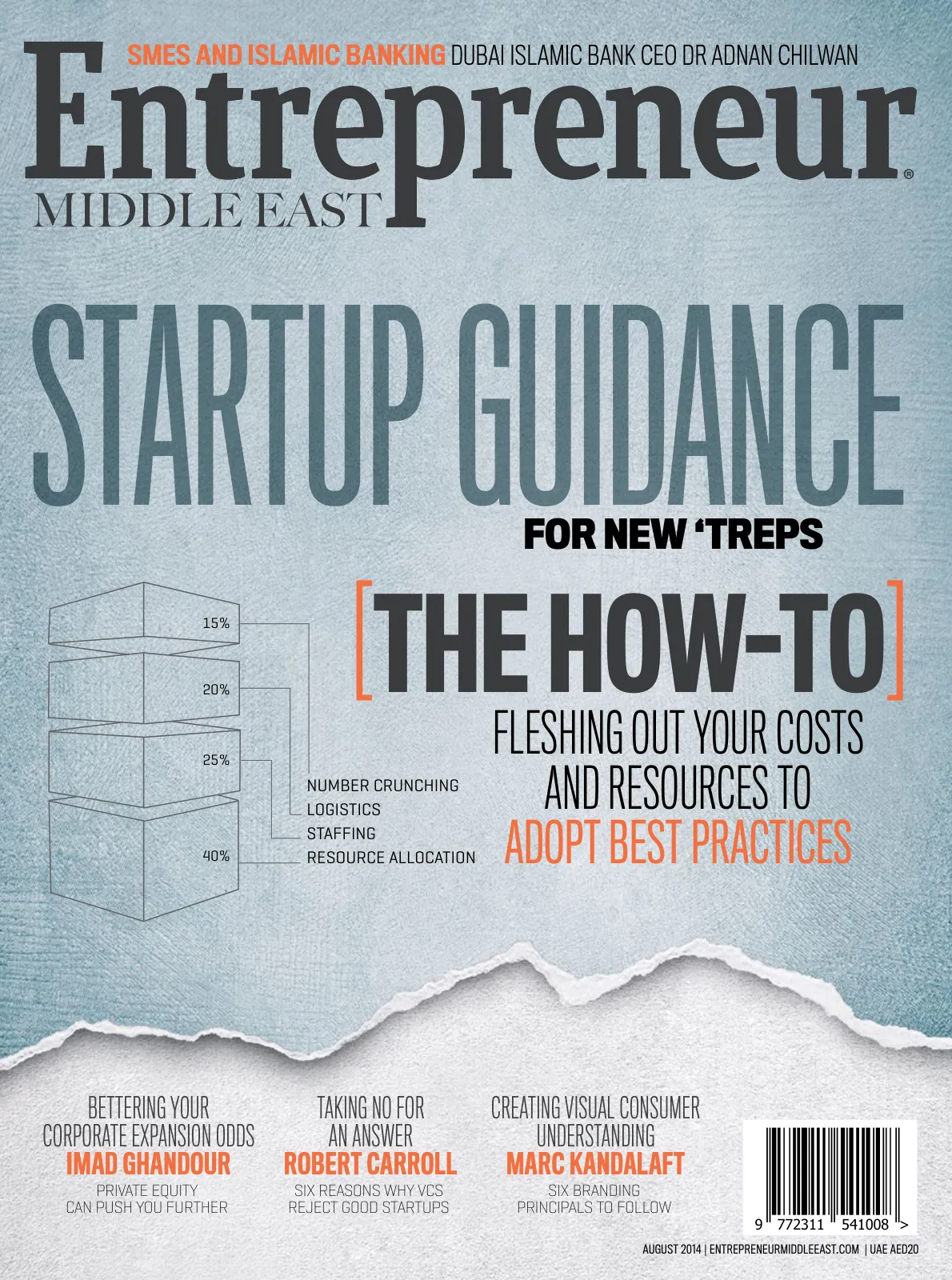
Entrepreneur Middle East, August 2014
Page 1
AUGUST 2014 Entrepreneur
1
STARTUP GUIDANCE
Private Equity
can push you further
Bettering your
corporate expansion odds
Imad Ghandour
Six reasons why VCs
reject good startups
Taking no for
an answer
Robert Carroll
Six branding
principals to follow
Creating visual consumer
understanding
Marc Kandalaft
SMEs and Islamic banking Dubai Islamic Bank CEO Dr Adnan Chilwan
AUGUST 2014 | ENTREPRENEURMIDDLEEAST.COM | UAE AED20
9
772311
541008 >
Fleshing out your costs
and resources to
adopt best practices
FOR NEW ‘TREPS
[THE HOW-TO]
Number crunching
logistics
staffing
resource allocation
15%
20%
25%
40%
Page 2
Entrepreneur AUGUST 2014
2
CONQUER YOUR LUXURIOUS SIDE
One look is good, but a double take is what we all want in life. Patrol’s premium interior
and refined exterior means you are always the one that others are looking out for.
The Hero of all terrains in life
Stylish New Look | Premium Interior | Advanced Technology
THE NEW 2014 NISSAN PATROL
facebook.com/NissanME
/NissanME
nissanpatrol-me.com
• Saudi Arabia: Alissa Automotive, Tel: 92002 7744, Alhamrani United Co., Tel: +966 2 6696690 • Dubai & Northern Emirates: Arabian Automobiles,
Tel: +971 4 2952222 • Abu Dhabi & Al Ain: Al Masaood Automobiles, Tel: +971 2 6811118 • Kuwait: Abdulmohsen Abdulaziz Al Babtain Co., Tel:
+965 1804888 • Oman: Suhail Bahwan Automobiles, Tel: +968 24560111 • Qatar: Saleh Al Hamad Al Mana Co., Tel: +974 4 4283333 • Bahrain: Y.K.
Almoayyed & Sons BSC(C), Tel: +973 1 7732732 • Lebanon: Rasamny – Younis Motor Co. S.A.L. – RYMCO, Beirut, Tel:+9611 273333 • Jordan: Bustami
& Saheb Trading Co.L.T.D., Amman, Tel: +962 6 5532456
Page 3
AUGUST 2014 Entrepreneur
3
48 Robots without feelings,
visionary Ray Kurzweil, and
everything else in the quickly
advancing sphere.
CONTENTS
AUGUST 2014
16
Startup guidance for
new entrepreneurs
The how-to: Number
crunching, logistics,
resource allocation and
staffing
You may not have the
formal business training
acquired through in-
market experience, but
the basics can be learned
quickly enough. Focusing
on these essential
elements gives you a
pretty good idea of where
to go, and how to get there
by fleshing out costs and
resources. Newly left the
corporate scene? Use this
guide as a refresher for the
details you’ve forgotten on
your way up.
32
TECH
ONLINE ‘TREP
Four GCC brands doing
social media… right
From Twitter to YouTube,
there are some regional
accounts distinguishing
themselves online,
and this is how they’re
doing it. Four aspects
to consider? Identity,
engagement, content, and
platform.
48
ASK A GEEK
Forget the Irish, the robots
are coming
An interview with Golnaz
van Huyssteen on A.I.’s
current state. Read about
robots without feelings,
visionary Ray Kurzweil,
and everything else in the
quickly advancing sphere.
64
SHINY
The things we want
Gadgets and doodads
that you might’ve missed
out on, sourced by a tech
aficionado. Yes, it’s okay to
want them all… and no, it’s
not our fault.
WILD CAT IMAGE © BOSTON DYNAMICS
Page 4
Entrepreneur AUGUST 2014
4
CONTENTS
AUGUST 2014
14
EDITOR’S NOTE
By Fida Z. Chaaban
36
CULTURE:
LIFE
Stress-management tactics
that you haven’t tried
Do you ascribe to the be-
lief that taking your work
home with you is a bad
idea? We have some tips
that suggest otherwise.
56
DESIGN
Creating visual consumer
understanding
Marc Kandalaft discusses
six branding principals to
take into consideration
when developing your
brand’s identity and a
cohesive visual strategy.
60
TRAVEL
The “hotel within a hotel”
Regional business takes
you to Riyadh? Then it’s
time you heard more about
The Ritz-Carlton in the
Kingdom, directly from
the property’s GM Adel Al
Mahboob.
66
TRAPPINGS
‘Trep gear
The executive collection
by Montblanc for the
corporate overachiever on
your list (or even a little
self-reward). Travelling?
Chanel’s got some great
fragrance alternatives
for the summer. And yes,
sportswear done right by
German pro golfer Martin
Kaymer.
30
‘TREPONOMICS:
SKILLSET
Method is the key to
your end game
Sales excellence in five
steps. Among them?
Margin management
to help you boost
profitability with the right
prices.
38
ESQUIRE GUY
Getting people to embrace
your next big idea
Ross McCammon gives
you a few smooth tips on
wowing your audience.
You need to try to share
it at the right time and
with the right measure of
enthusiasm.
90 Betabrand
funds designer’s
space-inspired
clothing line
88 Techie art goes global
Page 5
AUGUST 2014 Entrepreneur
5
INTERIORS
468374677
800
At Al-Futtaim Interiors we know that a comfortable and functional office space
inspires great work. That is why we deliver more than just office furniture.
Call us today for:
• Office Fit Out
• Office Furnishings
• Filing and Storage Installations
• Ideas on creating a great work environment!
INTRODUCING YOUR NEW PARTNER FOR
CREATING INSPIRATIONAL OFFICE SPACES
WHERE THE MOST
INSPIRING VIEW FROM YOUR
OFFICE... IS THE OFFICE
Page 6
Entrepreneur AUGUST 2014
6
CONTENTS
42
‘TREPONOMICS:
SKILLSET
The power of architecture
Do you think your
surroundings don’t make
a difference? This is how
the world around you
shapes your thoughts
and actions, and most
importantly your ability
to produce creative
content.
44
ASK A PRO
Human capital is your most
valuable business asset
Bayt.com’s Suhail
Al-Masri talks about
stats and remedies for
employee turnover in
the Middle East. Read
his analysis on what may
work for your business,
and why there is no one-
size fits all solution.
82
START IT UP:
WACKY IDEA
Typography matters
Startup founder Otba
Mushaweh aims for
Arabic font excellence
with TypeStage. And yes,
he admits that it’s been a
long and bumpy ride.
84
START IT UP:
Q + A
Success from the
ground up
Emirati ‘trep Ahmed
AlMentheri talks about
getting his startup off
of the ground, and what
sort of help Tejar Dubai
can give you.
86
STARTUP FINANCE
The world is not enough
Simon Hudson isn’t
James Bond, but he is
a ‘trep who recently
opened up a new section
of his startup in Istanbul.
This is how he did it,
and what you need to
consider when branching
out.
24
MONEY:
YOUR MONEY
SMEs are increasingly taking
to Islamic banking
Dubai Islamic Bank CEO
Dr. Adnan Chilwan
discusses entrepreneurs
opting for faith-based
finance, and why you
might decide to take your
business there, too.
72
VC VIEWPOINT
Six reasons why VCs reject
good startups
Venture capitalist Robert
Carroll admits that he says
no to a lot of startups that
pitch him. Find out why
you might’ve fielded a VC
rejection, and what you can
do about it.
68
ASK THE MONEY GUY
Bettering your corporate
expansion odds
Imad Ghandour wants you
to know that behind many
successful companies there
is probably a great private
equity fund, and he’s got
the case studies to prove it.
AUGUST 2014
90 App pays users to get crowdsourced business insights
42 The power of
architecture
24 Dubai Islamic Bank CEO
Dr. Adnan Chilwan
Page 7
AUGUST 2014 Entrepreneur
7
EUROTECH Programs and
Conferences 2014
AN AWARD WINNING COMPANY IN THE AREAS OF TRAINING FOR 2013
EUROTECH the regional experts in the workforce arenas of
• PETROLEUM, OIL & GAS
• HUMAN RESOURCES & TRAINING
• MANAGEMENT & LEADERSHIP
• COACHING
• SOFT SKILLS
• CONTRACTS & TENDERS
• PUBLIC RELATIONS
• FINANCE, BUDGETING & COST CONTROL
• PURCHASING INVENTORY & MATERIAL
• IT & TECHNOLOGY
• STAFFING SOLUTIONS IN THE AREAS OF OFFICE
SUPPORT STAFF
Learn more about EUROTECH’s diverse
programs and conferences by visiting our
headquarters.
Ask for the 2014 EUROTECH information
package discussing areas of coaching,
petroleum, gas and oil engineering,
mechanics, safety and security, maintenance
and general services, banking and
investments, and marketing and customer
service, in addition to EUROTECH programs
broadcast in English
United Arab Emirates +971508587826
Kingdom of Saudi Arabia +966561756208
Kuwait +96522475902/3/4/5
Lebanon +9613044090
www.eurotechintl.com
Page 8
Entrepreneur AUGUST 2014
8
SUBSCRIBE
Contact subscriptions@bncpublishing.net to receive
Entrepreneur Middle East every issue
EDITOR IN CHIEF Fida Z. Chaaban editor@bncpublishing.net
MANAGING DIRECTOR Walid Zok walid@bncpublishing.net
DIRECTOR Rabih Najm rabih@bncpublishing.net
DIRECTOR Wissam Younane wissam@bncpublishing.net
SALES DIRECTOR Oliver Amos oliver@bncpublishing.net
PUBLISHER Nehme Abouzeid
CREATIVE LEAD Odette Kahwagi
ONLINE LIAISON Kareem Chehayeb
COLUMNIST Pamella de Leon
WEB DIRECTOR Haydar Mtayrek
Asheesh Advani
Robert Carroll
Amal Chaaban
Youmna Chagoury
Kareem Chehayeb
Tamara Clarke
James Clear
Annette Ehrhardt
Imad Ghandour
Simon Hudson
Marc Kandalaft
Danielle Kamar
Maria Elena Kassab
Lovrenc Kessler
Dana Khairallah
Pamella de Leon
Ross McCammon
Wassim Mourtada
Suhail Al-Masri
Shoug Al Nafisi
Octavia Nasr
Rani Nasr
May Rostom
Geoff Weiss
Erika Widen
CONTRIBUTING WRITERS
PO Box 502511 Dubai, United Arab Emirates
P +971 4 4200 506 | F +971 4 4200 196
For all commercial enquiries related to
Entrepreneur Middle East contact
sales@bncpublishing.net
All rights reserved © 2014.
Opinions expressed are solely those
of the contributors.
Entrepreneur Middle East and all subsidiary
publications in the MENA region are officially
licensed exclusively to BNC Publishing in the
MENA region by Entrepreneur.
No part of this magazine may be reproduced or
transmitted in any form or by any means without
written permission of the publisher.
www.entrepreneurmiddleeast.com
WE’RE HEAVILY INVESTED IN OUR WEB PRESENCE
In addition to our print edition, we’re bringing you all sorts of
industry news on our web mediums. Joining us online means getting
relevant business and startup content in real-time, so you’re hearing
about the latest developments as soon as we do. We’re looking
forward to interacting with our readers on all of our social media and
web platforms- like any thriving business, we’re looking to give and
take. #TrepTalkME is already happening on all of our digi platforms,
and all good conversations go both ways. See you on the web!
IS DIGITAL
MIDDLE EAST
Printed by Raidy Emirates Printing Group LLC
www.raidy.com
EntMagazineME
@EntMagazineME | @Fida
Entrepreneur-me
EntrepreneurMiddleEast
EntMagazineME
EntMagazineME
EntMagazineME
MIDDLE EAST
In-house photography Mohammad Sajjad. Images used in Entrepreneur Middle East
are credited when necessary. Attributed use of copyrighted images with permission.
All images not credited otherwise Shutterstock.
Page 9
AUGUST 2014 Entrepreneur
9
Page 10
Entrepreneur AUGUST 2014
10
FEEDBACK
We’ve gotten tons of pictures via Twitter and Instagram, and here are a
few of our favorites. If you see a copy of any edition of Entrepreneur MENA,
tweet an image our way or tag us on Instagram. All of our reader images
end up getting pinned to our Pinterest Show & Tell board. We’re happy to
see our readers interact with us across all mediums- and we talk back!
Business efficacy...
in real-time
It’s not social media if you don’t talk back
We’ve developed quite an active sharing culture on our
Facebook page. Here are the top shared post for the
month. Join us and be part of the information exchange!
1. Five things you need to know
as an entrepreneur
2. Don’t wait for motivation,
do this instead
3.Feel the freedom of business
independence
Sharing economy?
Yes, and it’s fully organic!
Page 11
AUGUST 2014 Entrepreneur
11
Page 12
Entrepreneur AUGUST 2014
12
Page 13
AUGUST 2014 Entrepreneur
13
Page 14
Entrepreneur AUGUST 2014
14
EDITOR’S NOTE
A
rtists (especially
counter-culture types),
the ever-present I’m-so-
misunderstood crowd, and
lately, successful entrepreneurs, are
all categories of people that can often
be heard referring to themselves as
“different”. They openly acknowledge
that they exhibit out of the norm
behaviors, and being “different” has
become somewhat synonymous with
being an unorthodox thinker. March-
ing to your own drummer -in matters
both personal and professional- has
largely lost the stigma that it was
formerly associated with, and “differ-
ent” as an adjective has (for the most
part) lost its negative connotation.
No one wants to fit in anymore, and
with good reason.
Thousands of companies (maybe
even tens of thousands) have now
realized the value of promoting their
“abnormal” business models and
individualistic corporate cultures.
Phrases like “celebrate your indi-
viduality”, “because you’re different”,
and “be uniquely you” are only a few
of the taglines that became marketing
vogue. In the process, they ironically
ceased to be “different” because
everyone was using them. It’s worth
remembering that only a few years
ago, being “different” was frowned
upon, and almost everyone wanted to
project some semblance of “normal”
to the outside world. No one wanted
to accentuate their uniqueness, and it
wasn’t very flattering to call yourself
“crazy”- even in a context like, “I
worked straight through the weekend,
I must be crazy!” If you worked
straight through the weekend (like I
did), then you are indeed crazy, and
I still don’t consider that one good
(despite the fact that it may make you
an overachiever).
I’ve had a number of startup found-
ers comment (unhappily) that they
were positioned as a Wacky Idea
in our Start It Up section. In short,
that label was coined by our parent
magazine, Entrepreneur, to describe
original thinkers with companies that
stand out. This is generally consid-
ered a good thing in a business con-
text; these same Wacky Idea startups
develop interesting solutions to com-
mon problems. ‘Treps, if we position
you as a Wacky Idea, it doesn’t mean
that it’s so implausible that it ceases
to be a lucrative model and a viable
business. On
the contrary,
it means it’s
a rare gem
of an idea,
and yes, that
we’re cel-
ebrating your
individual-
ity. If your
startup ends
up in the magazine, know that it’s
because you were being uniquely
you, and crazy enough to work
through the weekend, and finally,
because you’re different. They’re all
compliments, no matter how cheesy
they may sound.
On the spectrum of human behavior,
you might very well register as insane
Normality and the lack thereof
Fida Z. Chaaban
Editor in Chief
@fida
editor@bncpublishing.net
Page 15
AUGUST 2014 Entrepreneur
15
Page 16
Entrepreneur AUGUST 2014
16
STARTUP
GUIDANCE
Y
ou may not have the formal business
training acquired through in-market
experience, but the basics can be learned
quickly enough. Focusing on these essential
elements gives you a pretty good idea of
where to go, and how to get there by fleshing
out costs and resources. If you’ve had in-mar-
ket experience from being part of a corpora-
tion, use this guide as a refresher since you’re
ostensibly working with way less capital and
staff than the company you left when you
joined the entrepreneurial ranks.
FOR NEW
ENTREPRENEURS
[THE HOW-TO]
Number crunching
logistics
staffing
resource allocation
By Asheesh Advani
15%
20%
25%
40%
Page 17
AUGUST 2014 Entrepreneur
17
When starting out, financial
forecasts may seem over-
whelming. We’ll help you
conquer the numbers with this
easy-to-follow guide to fore-
casting revenues and expenses
during startup.
Forecasting business rev-
enue and expenses during
the startup stage is really
more art than science. Many
entrepreneurs complain that
building forecasts with any
degree of accuracy takes a lot
of time- time that could be
spent selling rather than plan-
ning. But few investors will
put money in your business if
you’re unable to provide a set
of thoughtful forecasts. More
important, proper financial
forecasts will help you develop
operational and staffing plans
that will help make your busi-
ness a success.
Here’s some detail on how to
go about building financial
forecasts when you’re just
getting your business off the
ground and don’t have the
luxury of experience.
1. START WITH EXPENSES,
NOT REVENUES.
When you’re in the startup
stage, it’s much easier to fore-
cast expenses than revenues.
So start with estimates for the
most common categories of
expenses as follows:
Fixed Costs/Overhead
> Rent
> Utility bills
> Phone bills/
communication costs
> Accounting/bookkeeping
> Legal/insurance/
licensing fees
> Postage
> Technology
> Advertising and marketing
> Salaries
Variable Costs
> Cost of goods sold
> Materials and supplies
> Packaging
> Direct labor costs
> Customer service
> Direct sales
> Direct marketing
Here are some rules of thumb
you should follow when fore-
casting expenses:
> Double your estimates for
advertising and marketing
costs since they always esca-
late beyond expectations.
> Triple your estimates for
legal, insurance and licensing
fees since they’re very hard
to predict without experience
and almost always exceed
expectations.
> Keep track of direct sales
and customer service time as
a direct labor expense even if
you’re doing these activities
yourself during the startup
stage because you’ll want to
forecast this expense when you
have more clients.
2. FORECAST REVENUES USING
BOTH A CONSERVATIVE CASE
AND AN AGGRESSIVE CASE.
If you’re like most entre-
preneurs, you’ll constantly
fluctuate between conserva-
tive reality and an aggressive
dream state which keeps you
motivated and helps you
PART ONE
FIGURING OUT YOUR COMPANY’S
NUMBERS
HOW-TO FORECAST REVENUE
AND GROWTH
Double your estimates
for advertising and
marketing costs since
they always escalate
beyond expectations.
Page 18
Entrepreneur AUGUST 2014
18
inspire others. I call this
dream state “audacious
optimism”.
Rather than ignoring the
audacious optimism and cre-
ating forecasts based purely
on conservative thinking, I
recommend that you embrace
your dreams and build at
least one set of projections
with aggressive assumptions.
You won’t become big unless
you think big! By building
two sets of revenue projec-
tions (one aggressive, one
conservative), you’ll force
yourself to make conservative
assumptions and then relax
some of these assumptions
for your aggressive case.
For example, your conserva-
tive revenue projections
might have the following
assumptions:
> low price point
> two marketing channels
> no sales staff
> one new product or service
introduced each year for the
first three years
Your aggressive case might
have the following assump-
tions
> low price point for base
product, higher price for
premium product
> three to four marketing
channels managed by you and
a marketing manager (con-
tinue on to the second half of
this how-to guide learn how
you can afford a marketing
manager)
> two salespeople paid on
commission
> one new product or service
introduced in the first year,
five more products or services
introduced for each segment
of the market in years two
and three
By unleashing the power
of thinking big and creating
a set of ambitious forecasts,
you’re more likely to generate
the breakthrough ideas that
will grow your business.
3. CHECK THE KEY RATIOS
TO MAKE SURE YOUR
PROJECTIONS ARE SOUND.
After making aggressive
revenue forecasts, it’s easy
to forget about expenses.
Many entrepreneurs will
optimistically focus on reach-
ing revenue goals and assume
the expenses can be adjusted
to accommodate reality if
revenue doesn’t material-
ize. The power of positive
thinking might help you grow
sales, but it’s not enough to
pay your bills!
The best way to reconcile
revenue and expense projec-
tions is by a series of reality
checks for key ratios. Here
are a few ratios that should
help guide your thinking:
1. Gross margin What’s the
ratio of total direct costs to
total revenue during a given
quarter or given year? This
is one of the areas in which
aggressive assumptions typi-
cally become too unrealistic.
Beware of assumptions that
make your gross margin
increase from 10% to 50%. If
customer service and direct
sales expenses are high now,
they’ll likely be high in the
future.
2. Operating profit margin
What’s the ratio of total
operating costs -direct costs
and overheard, excluding
financing costs- to total rev-
enue during a given quarter
or given year? You should
expect positive movement
with this ratio. As revenues
grow, overhead costs should
represent a small proportion
of total costs and your op-
erating profit margin should
improve. The mistake that
many entrepreneurs make is
they forecast this break-even
point too early and assume
they won’t need much fi-
nancing to reach this point.
STARTUP
GUIDANCE
FOR NEW
ENTREPRENEURS
As revenues grow,
overhead costs should
represent a small
proportion of total costs
and your operating profit
margin should improve.
What’s the ratio of total
direct costs to total
revenue during a given
quarter or given year?
This is one of the areas
in which aggressive
assumptions typically
become too unrealistic.
By building two sets of
revenue projections
(one aggressive, one
conservative), you’ll
force yourself to make
conservative assumptions
and then relax some of
these assumptions for
your aggressive case.
Page 19
AUGUST 2014 Entrepreneur
19
3. Total headcount per
client If you’re a one-man-
army entrepreneur who plans
to grow the business on your
own, pay special attention to
this ratio. Divide the number
of employees at your company
-just one if you’re a jack-of-all-
trades- by the total number of
clients you have. Ask yourself
if you’ll want to be managing
that many accounts in five
years when the business has
grown. If not, you’ll need to
revisit your assumptions about
revenue or payroll expenses
or both.
Building an accurate set of
growth projections for your
startup will take time. When
I first started my company, I
avoided building a detailed
set of projections because
I knew the business model
would evolve and change. But I
regret not spending more time
on business planning since I
would have avoided several
expenses along the way. The
company’s board of directors
now requires me to prepare
quarterly updates to our fi-
nancial projections. Now when
I lapse into fits of audacious
optimism, the projections
force me to forecast what
these dreams mean for the
company’s bottom line.
When getting your company
off the ground, there are ways
to compensate workers that
won’t break the bank.
Q I need to hire three employees
to help get my business started,
but I don’t have enough financ-
ing to pay the salaries for all
three. Should I try to raise more
money before hiring anyone or
should I hire just one employee
and hope that I can make it
work with limited resources?
A Every entrepreneur faces the
question of how to pay employ-
ees during the startup stage
when money is tight and the
business has yet to prove itself.
You’ll be able to determine the
right answer to your question
by understanding the nature
of your business and your
appetite for risk. If your busi-
ness growth is best executed
in small steps, your staffing
strategy should be very differ-
ent than if your business needs
financing in large portions. For
example, if your business is a
restaurant, it would be foolish
to try to launch it without
adequate staff and equipment.
Alternatively, a one-man army
could be the best way to start
an import-export business or
consulting practice.
If you’re convinced your busi-
ness needs three employees
to get off the ground, you
shouldn’t launch it until you
can hire all three. This is a
surefire way to increase the
possibility that your business
will fail due to poor execu-
tion. If you don’t have enough
money to pay for three em-
ployees, there still might be a
way to make it work. Here are
some creative ways to compen-
sate your employees during the
startup stage:
1. Hire stay-at-home moms
and dads Part-time employ-
ees, particularly stay-at-home
moms and dads, are a secret
weapon for startups. When
my company first launched,
we advertised for “flex time”
employees in local papers and
were surprised by the number
of highly qualified applicants
we received. For less than half
the cost of full-time staff, it’s
possible to attract experienced
employees to your company.
If you plan to hire a stay-at-
home parent to work at your
company, be wary of assigning
them critical time-sensitive
projects. Keep in mind that if
you’re not paying them enough
to cover adequate child care,
they’ll be unable to prioritize
business meetings over per-
sonal meetings if they have a
sick child or family situation
to deal with.
PART TWO
Staffing and resource allocation
How-to pay employees during
the initial stages
Keep track of direct sales
and customer service time
as a direct labor expense
even if you’re doing these
activities yourself
Page 20
Entrepreneur AUGUST 2014
20
interns are not like part-time
employees who are primarily
interested in a paycheck: You
can’t expect to give them
menial work for the duration
of their internship.
One of the most common
ways that cash-strapped
entrepreneurs hire
employees is by convincing
them to accept deferred
or delayed compensation.
2. Defer compensation
One of the most common
ways that cash-strapped en-
trepreneurs hire employees is
by convincing them to accept
deferred or delayed compensa-
tion. There are different ways
to do it: a deferred cash bonus
until the business generates a
certain amount of revenue; an
increased salary when the em-
ployee hits performance mile-
stones; or back-pay provided
when the business becomes
profitable. I recommend offer-
ing an increased salary rather
than a cash bonus or back-pay
because one-time lump sum
payments tend to offer short-
lived gratification and tend
to give you less bang for the
buck. In addition, employees
feel more pride when their sal-
ary is permanently increased
due to business progress or
personal achievement.
If you choose to offer de-
ferred compensation, it’s very
important to consult an attor-
ney about how to write the of-
fer letter for the employee. For
example, even using the term
“deferred compensation” (as
opposed to “bonus payment”
or “performance incentive”)
can create a binding liability
for your company. This is one
of the areas where spending
a few hundred dollars for an
attorney to provide you with a
sample offer letter could save
you thousands later.
3. Use equity and stock
options Another alternative
is to offer employees equity
grants or stock options instead
of cash. This is only a viable
alternative for companies
that have realistic prospects
for liquidity; in other words,
don’t offer stock options if you
don’t think they’ll be worth
anything. Most companies
are never sold and never have
an IPO, so it’s unlikely that
stock options are a worthwhile
compensation tool.
Nevertheless, stock options
tend to motivate employees
more than cash bonuses at
the startup stage. The cocktail
party crowd has romanticized
stock options, and employees
still find them appealing, even
if they’re unsure about their
true value. My advice is to
avoid stock options (and the
legal costs of setting them up)
unless you genuinely believe
they’ll be valuable one day.
4. Employ interns and
volunteers Hiring unpaid
staff is an obvious solution
for startups but one that’s
often overlooked. Colleges
and universities are teeming
with bright young workers
willing to work part-time or
full-time during vacations to
gain experience. Just posting
an internship announcement
at your local college will draw
applicants.
It takes effort to set up a
win-win situation for both
intern and employer, however.
It’s important to remem-
ber that interns are not like
part-time employees who are
primarily interested in a pay-
check: You can’t expect to give
them menial work for the du-
ration of their internship. One
way to motivate interns is to
ask them to list their learning
objectives for the internship.
Have monthly meetings with
them to track how well they’re
doing on reaching these objec-
tives. Then even doing menial
work becomes tolerable if it’s
put in context.
5. Focus on revenue
As any entrepreneur will tell
you, the best way to pay for
three employees when you
only have the financial re-
sources to hire one is to gener-
ate more revenue. The first of
the three employees you hire
should be the one that will get
you closest to generating sales
so you can afford to hire the
other two. It’s never too early
to start selling-or pre-selling-
your product to get funds in
the door.
STARTUP
GUIDANCE
FOR NEW
ENTREPRENEURS
Page 21
AUGUST 2014 Entrepreneur
21
In this issue check out regional startups
like Task Spotting, Typestage, and Melltoo
in our Start It Up section!
Online you can see startups featured in
previous print editions, as well as some web-
exclusive features.
Visit us on the web
entrepreneurmiddleeast.com
Access our full online archive
issuu.com/entmagazineme
If you’re a promising startup in the MENA
region we want to hear from you.
Send an email to our Editor in Chief
editor@bncpublishing.net
Want to hear a response from us in
real-time? Tweet at @EntMagazineME or
directly at our Editor at @Fida. It’s not social
media if you don’t talk back: Entepreneur
Middle East is business efficacy in real-time.
THE REAL DEAL
Page 22
Entrepreneur AUGUST 2014
22
Page 23
AUGUST 2014 Entrepreneur
23
Page 24
Entrepreneur AUGUST 2014
24
DUBAI ISLAMIC BANK CEO DR. ADNAN CHILWAN
DISCUSSES ENTREPRENEURS OPTING FOR FAITH-BASED
FINANCE, AND WHY YOU MIGHT DECIDE TO TAKE YOUR
BUSINESS THERE, TOO
money ask the money guy | vc viewpoint | startup financE | your money
ON AN EVEN KEEL
SMES ARE
INCREASINGLY
TAKING TO ISLAMIC
BANKING
T
he principles of Islamic finance are rooted in
fairness and transparency, and we are seeing that an
increasing number of businesses are looking to work
with banks that have these ethical business practices
at their core,” explains CEO Dr. Adnan Chilwan, Dubai
Islamic Bank (DIB). This, according to Dr. Chilwan,
is one of the reasons that the Islamic finance sphere
demonstrated “a greater degree of resilience when
compared to conventional banks” during the most recent
financial crisis. The bank also noticed an upswing of
fresh clients, partly due to what he considers a shift in
perception. “We saw that many governments, businesses
and individuals now view it as a more genuine and fair
way of banking. For SMEs in particular, Islamic banking
provides safe and reliable access to finance, in addition
to a variety of market-leading products and services.”
Appointed to the position of CEO last year, Dr. Chilwan is
quick to note that DIB boasts four decades in the Islamic
banking space, and that the institution is “the first Islamic
bank in the world.” Nearly 20 years into his lengthy career
in banking, the CEO is one of the biggest proponents
of this particular type of faith-inspired finance, and he
is certain that SMEs are gravitating their way for both
market benefits and security: “DIB has built a reputation
for constantly developing innovative products that are
strictly Sharia-compliant and protect our customers
whilst helping them fulfill their growth plans.” Growth
plans that Dr. Chilwan says promote values in common
with Islamic finance like openness and opportunity for
all. While not all SMEs are going to opt for faith-based
finance options, studies indicate both greater interest and
investment into the space, and not just in the GCC.
“
Page 25
AUGUST 2014 Entrepreneur
25
HOW DO ISLAMIC
BANKING PRACTICES
ENCOURAGE AND FOSTER
ENTREPRENEURSHIP?
With a philosophy rooted in
fairness and transparency,
Islamic banking encourages
practices that promote
the betterment of the
community. To this end, the
entrepreneurial spirit has
the same values that are
espoused by Islamic banks.
By providing access to these
ethical financial services, we
encourage the growth of SMEs
in the country that not only
provide valuable jobs, but
have an important impact in
creating a more sustainable
economy. DIB in particular
works on a personalized level
with entrepreneurs and small
businesses to understand how
we can best support them
and foster growth. With a
constantly evolving offering,
high finance amounts and
rapid approvals, we offer
business finance solutions
that unlock invaluable
opportunities for SMEs.
ARE SMES THAT GRAVITATE
TOWARD DIB CONCERNED
PRIMARILY WITH FAITH
OR DO YOU HAVE CLIENTS
THAT LOOK AT THE OPTIONS
STRICTLY FROM A BUSINESS
PERSPECTIVE?
Since its inception, DIB has
launched innovative Sharia-
compliant banking services
that compete on an equal
footing with products from
conventional lenders. With
this reputation as a pioneer
in the industry and our well-
established commitment to
providing ethical banking
services, SMEs in the market
are increasingly choosing
to bank with us. In fact, if
we look at the industry on
a broader level, there is a
growing demand for Islamic
banking services across the
MENA region, with a recent
survey from the International
Finance Corporation (IFC)
revealing that over 32% of
the overall SME population
is eager for access to
Islamic finance, according
to the Islamic Banking
Opportunities across Small
and Medium Enterprises in
MENA report. Consequently,
it is evident that businesses
are not necessarily looking at
Islamic banking for religious
reasons, rather, they are also
seeing its benefits from an
economic perspective.
What sort of services
does DIB NOTICE
ENTREPRENEURS OPTING
FOR? IS WORKING CAPITAL
THE MAINSTAY?
While providing access to
working capital finance is
a key component of our
offering for SMEs, the
bank has a range of other
services that have been
developed to cater to the
needs of all the companies
in this sector. In addition to
capital expenditure finance,
contracting and fleet finance,
as well as flexible repayment
options, we have invested
in dedicated relationship
advisors that are able to
advise small businesses based
on a thorough understanding
of their financial capabilities
and ambitions. We have also
allocated a large degree of our
product development focus
and expertise to ensure we are
continually innovating and
diversifying our services to
provide a customer experience
that goes well beyond the
norm.
HOW LONG HAS DIB
MADE THE SME SPHERE A
PRIORITY?
The SME sector is clearly
important to the sustainable
development of the UAE,
contributing to 60% of its
non-oil GDP and 86% of
private sector employment.
As the engines of the local
economy, these small
businesses and startups
are critical in promoting
innovation and economic
growth, and given its
importance, we have invested
in developing a unique array
of Sharia-complaint products
to meet their needs. Given
our emphasis on supporting
Dubai’s long-term ambitions,
we strongly believe that
fostering the growth of these
SMEs is our responsibility.
Indicative of our success, we
have seen that consumer and
SME-lending together now
form the largest business
for the bank, and DIB boasts
one of the widest networks
in the country. In fact, since
the financial crisis our core
“DIB HAS BUILT A
REPUTATION FOR
CONSTANTLY DEVELOPING
INNOVATIVE PRODUCTS
THAT ARE STRICTLY
SHARIA-COMPLIANT AND
PROTECT OUR CUSTOMERS
WHILST HELPING THEM
FULFILL THEIR GROWTH
PLANS.”
Q + A
Is Islamic finance a fit for
your business?
Dubai Islamic Bank CEO
Dr. Adnan Chilwan
AUGUST 2014 Entrepreneur
25
Page 26
Entrepreneur AUGUST 2014
26
and our client base has nearly
doubled, highlighting our
widely-recognized ability to
help SMEs enter the next
phase of their growth journey.
WHAT SERVICES AND
PRODUCTS ARE SME CLIENTS
USING? IN 2013, HOW MUCH
OF YOUR BUSINESS WAS
WITH SMES?
DIB recently launched a
comprehensive SME offering
targeted towards this critical
and growing sector in the
country. The revamped and
comprehensive product
and services suite primarily
focuses around the liquidity
management and working
capital finance needs of
the customers across this
segment. Although still in
a relatively nascent stage,
there has been aggressive
push during 2014 to improve
volumes from existing
customers as well as to focus
on acquiring new ones. This
business segment offers a
huge upside for the bank as
we are barely scratching the
surface with overall lending
just above the 2% mark (up
from under 1.7% in 2013) of
the bank’s total loan book,
and trade finance moving
into double digits at just over
10% compared to under 8%
last year. Not only do we see
a massive growth potential
with this new initiative, but
we also see positive impact
on the overall yields as the
margins in this segment are
akin to consumer finance and
hence quite lucrative.
TAKING INTO
CONSIDERATION THAT THE
ISLAMIC BANKING SPACE IS
HIGHLY COMPETITIVE, WHAT
INITIATIVES HAS DIB PUT
INTO PLACE TO CONTINUE TO
ATTRACT NEW SME CLIENTS?
Over the last few years we
have seen a greater push in
the Islamic banking space,
as an increasing number of
conventional lenders are
recognizing the value and the
demand for Sharia-compliant
banking services. Due to this
growth, banks in the space
have been pushed to invest in
innovation and in the delivery
of high-quality services. We
have led the way in this regard
through the development
of a diverse suite of Sharia-
compliant products. Our SME
Business Solutions Initiative
provides entrepreneurs and
small business owners with
money ask the money guy | vc viewpoint | startup financE | your money
ENABLING ENVIRONMENT AND SUPPLY SIDE ANALYSIS (SME & ISLAMIC SME)
CHALLENGES FACED BY SMES ACROSS COUNTRIES
ENABLING ENVIRONMENT AND SUPPLY SIDE ANALYSIS AND CHALLENGES FACED BY SMES ACROSS COUNTRIES SOURCE ISLAMIC BANKING OPPORTUNITIES ACROSS SMALL AND MEDIUM ENTERPRISES IN MENA REPORT IFC
Page 27
AUGUST 2014 Entrepreneur
27
access to a broad range of
customized solutions that
have been designed to support
their needs and growth
ambitions. In addition to
business accounts services,
cash management tools, and
trade and treasury products,
as well as business credit
cards, we have also recognized
the growing demand for
access to digital banking in
this space. Our electronic
banking platforms have been
designed to meet these needs
and have allowed us to engage
customers more effectively
through these technological
propositions. These initiatives
have distinguished DIB in
the market and are evidence
of our well-established
reputation as the most
progressive Islamic bank in
the industry.
DIB IS TO ACQUIRE “A 40%
STAKE” IN INDONESIAN
ISLAMIC FINANCIAL
INSTITUTION PT BANK PANIN
SYARIAH. HOW DOES DIB
COMPARE TO OTHER GCC-
BASED ISLAMIC BANKS IN
TERMS OF GROWTH?
We have been able to pursue
further growth internationally
thanks to the strong position
the bank is in today. With a
robust balance sheet, strong
capital position and ample
liquidity, DIB is now well-
positioned to embark on a
new growth strategy that
will also allow us to take
advantage of the positive
macro-economic climate.
Part of this approach involves
supporting our expansion in
the UAE through inorganic
growth abroad. DIB’s
recent investment in the
Indonesian lender PT Bank
Panin Syariah is indicative
of this strategy of taking our
well-established expertise
in Islamic banking to other
markets and partnering
with institutions that have
valuable local knowledge. We
are also looking at promising
opportunities in Kenya
that will further build on
our successful operations
in important markets like
Pakistan, Jordan, Bosnia, and
Sudan. We are also seeing a
trend across the industry as a
number of conventional and
Islamic lenders have looked
to grow their businesses
through acquisitions. The
general positive economic
climate in most parts of the
GCC, particularly the UAE, is
fuelling these sentiments.
THE LABEL “CONVENTIONAL
BANKING” IS COMMONLY
USED WHEN CONTRASTED
WITH “ISLAMIC BANKING”.
FROM A SOCIOLOGICAL
PERSPECTIVE DO YOU
FEEL THAT THE TERM IS
APPROPRIATE?
Islamic banking is a
relatively new concept when
compared with the age-old
and established traditional
or “conventional” banking
business. Although, only
around 40 years-old, it
has made huge gains and
continues to surpass the
growth of the conventional
sector, at least in the core
markets. Various terms are
being used for Islamic banking
as well, such as “participation
banking” [and] “ethical
banking” amongst others,
but that obviously would not
make the non-Islamic banks
unethical. Hence, I do not see
Islamic banks being viewed as
unconventional just because
the non-Islamic players are
referred to as “conventional”.
We, at DIB, have positioned
ourselves as a bank for all
and though Islamic banking
is in our DNA, we do not limit
ourselves to just a portion
of the market or customer
base. We know that we
have the products, services,
capabilities and the reach to
target every single prospect
looking for banking services
and not just the core Islamic
niche and that has been the
secret of our success so far in
any market we operate in.
“DIB WORKS ON
A PERSONALIZED
LEVEL WITH
ENTREPRENEURS AND
SMALL BUSINESSES
TO UNDERSTAND
HOW WE CAN BEST
SUPPORT THEM AND
FOSTER GROWTH.”
Dubai Islamic Bank
SME PERCENTAGE AS A PERCENTAGE OF TOTAL LENDING SOURCE ISLAMIC BANKING OPPORTUNITIES ACROSS SMALL AND MEDIUM ENTERPRISES IN MENA REPORT IFC
Page 28
Entrepreneur AUGUST 2014
28
IN THE LOOP
C
orruption (or allegations of corruption) seems to
be a fad among French leaders. Former President
Nicolas Sarkozy has been hoping to make an im-
pressive political comeback after losing to François
Hollande in the 2012 elections. That won’t happen
anytime soon by the looks of it: Sarkozy was charged
with corruption based on allegations that he received
up to €50 million from late Libyan dictator Muammar
Gaddafi in illicit campaign financing. Apparently, the
aforementioned funds were received during the 2007
elections where Sarkozy won the presidency. That’s not
all that’s plaguing Sarkozy’s reputation these days, in
another case the ex-president was accused of receiving
political support from business magnate Bernard Tapie,
with giving him €400 million in return… from the
state. Tapie too has been charged numerous times for
corruption and tax fraud. Birds of a feather might pos-
sibly serve prison sentences together? In mid-July, Le
Monde newspaper published transcripts of a phone call
between Sarkozy and his lawyer, Thierry Herzog. The
plan? Helping Judge Azibert in exchange for informa-
tion. The judge has a history of this; he has previ-
ously been charged for illegally sharing info. Though
the phone Sarkozy used was registered to a different
name, he wasn’t able to get away with it. Perhaps he
forgot that while French presidents are immune from
prosecution while in office, he is no longer above the
law once his term ends. This all sounds super intense,
but just two years ago former President Jacques Chirac,
who held French office from 1995 to 2007, was charged
due to actions he made as mayor of Paris. He paid
members of his political party for municipal jobs that
were made up, basically using state money to finance
his political party. He was given a two-year suspended
sentence, which means that Chirac has the opportunity
to remain jail-free if he doesn’t get himself into any
more trouble. Sarkozy on the other hand, could face
over 10 years in jail if found guilty. Hollande will be
running again in 2017, but we don’t anticipate Sarkozy
as an opposing candidate.
FORMER FRENCH
HEAD OF STATE
FACES CORRUPTION
ALLEGATIONS
T
wo years. That’s how long
a Mississippi baby went
without antiretroviral therapy
before signs of the HIV virus were
redetected in the child’s system- a
“punch in to the gut,” as pediatric
HIV specialist Dr. Hannah Gay said
on the disappointment of research-
ers hoping to find a cure. Last year,
the prematurely-born baby girl made
news headlines for being “func-
tionally cured” after immediate
administration of a liquid antiret-
roviral at the University of Missis-
sippi Medical Center by Dr Gay. The
child showed no signs of the virus
afterwards, continuing treatment
for 18 months. The girl returned to
the hospital a few months ago with
still no sign of the virus, surviving 27
months without treatment. Unfor-
tunately during a routine checkup in
early July, testing indicated that the
virus had begun to replicate prompt-
ing doctors to administer anti-HIV
drugs. In all likelihood, the treat-
ment will have to be continued for
the foreseeable future. Researchers
remarked that while it was disap-
pointing that the virus returned, the
positive side is that she was able
to remain treatment-free for two
years. This suggests to researchers
that while “very early therapy” did
not remove the “reservoir of HIV-
infected cells”, virus development
was reduced (National Institutes
of Health). In more promising HIV
news, Gizmodo reported that scien-
tists are tinkering with using genome
editing technology, a possible cure
for even latent infections. Previ-
ously, there have been cases where
they’ve cut out the DNA sequence
of a specific human protein that the
HIV virus fastens itself to. Instead of
editing human genes, Dr. Kamel Kha-
lili’s study is going straight for the
HIV, possibly preventing more new
infections. There are still challenges,
but if they can be met then genome
editing might just be one route to
developing a cure.
Child thought to be “cured” of HIV shows
renewed signs of infection
Child mortality has been an issue the Indian government has been tackling for
a while. Prime Minister Narendra Modi announced that four vaccinations will
be provided for free as part of India’s program to decrease child mortality. The
vaccinations combat polio, rubella, rotavirus, and Japanese encephalitis, all
which have been the cause of a high number of deaths among Indian children.
A statement by Prime Minister Modi stated that approximately 80,000 children
die from diarrhea due to rotavirus, and hundreds die as a result of encephalitis
annually. While these vaccinations are available in India, they are only offered
through private hospitals, making it out of reach for a large percentage of
Indian families. One of India’s biggest challenges is the ever-growing population
coupled with difficult conditions
(including sanitation issues),
creating a perfect environment
for the spread of disease. Over-
all, India is providing a total of
13 free vaccinations to fight vari-
ous life-threatening ailments,
meaning that preventative public
health has been pushed high on
the Indian government agenda.
India to administer free
vaccinations to the public
Former President
Nicolas Sarkozy
HIV virus
Page 29
AUGUST 2014 Entrepreneur
29
The United States Transportation
Security Administration, better known
as the TSA, is adopting new security
tactics that are headline-worthy. Pas-
sengers flying into the United States
must have their phones and tablets
charged and powered-on. While airport
security already screens your electronic
devices, they may now ask you to turn
some of them on; the TSA stated that
checking devices is necessary because
they can be used as hidden bombs. If
the device is faulty or has an empty
battery, you’ll have to leave it behind.
This may sound excessive, but at
some point no one thought a bottle of
water could be used inflight to cause
mayhem. The TSA previously made
headlines by introducing backscatter
x-ray machines at U.S. airports. People
felt uncomfortable knowing that their
body parts would be revealed at airport
security, and the option of having a
public or private pat down wasn’t suf-
ficient either. As of May 2013, these
x-ray machines have been removed
from airports. When it comes to check-
ing phones and tablet devices, many
travelers will wonder to what extent
their private information will be read
and exposed. Are they going to start
looking through your videos, pictures,
contacts and text messages? Where is
the line drawn with this new security
measure? People will be keeping a
close eye on the TSA, who have prom-
ised travelers at American airports that
they’ll strive towards providing security
with the least inconvenience possible.
TSA adjusts U.S. airport security measures
to include mobiles and tablets
F
acebook has given users one more
reason to suspect their intentions. The
social network has been the target of
worldwide backlash after news broke that
they conducted a psychological experi-
ment on nearly 700,000 users’ emotional
state- without their consent. For one week
in January 2012, using an algorithm, data
scientists manipulated what users saw on
their newsfeed. A segment of users were
shown content meant to trigger happier
emotions, and others were presented with
content identified as more sad in tone. The
test? At the end of the week, they wanted to
determine whether the manipulated users
were more likely to post positive or negative
content in response to what they’d been ex-
posed to on their respective timelines (The
Atlantic). In research terms, the concept
they were looking for was the “emotional
contagion” via social platforms. Why is this
such a big deal? Facebook user data has
been observed by other studies in the past,
but this study, published in Proceedings of
National Academy of the National Academy
of Sciences, actually went leaps and bounds
further by influencing user emotions.
Facebook’s lengthy terms of service states
that users allow their data to be used for
“analysis, testing, [and] research.” So yes,
legally, they can use you as a lab rat- you’re
basically volunteering by having a Facebook
account. Nonetheless it hasn’t stopped
people from showing their disdain of the
experiment with some commentators even
going so far as to suggest that the emotional
manipulations might have triggered partici-
pants to contemplate suicide, ostensibly due
to being sad after exposure to negative con-
tent in that timeframe. What’s more? Users
are ticked off that even after the study was
conducted, they weren’t informed that their
feed had been altered for research purposes.
As a response to public fury, one of the
paper’s authors Adam Kramer responded in
a Facebook post that the research was done
“to learn how to provide a better service,”
and referenced “internal review practices”
after discussions whether it was reviewed by
an institutional review board. According to
The Atlantic, the study found that emotion-
al states can be “transferred”, meaning that
people can have the same emotions unknow-
ingly just by reading each someone else’s
newsfeed. Further, they found that when the
researchers limited the amount of positive
or negative emotional content, people also
reduced the amount of emotional content
they posted on Facebook. But should we
even be surprised that our platforms are al-
tered? WSJ reports that two years ago, users
were locked out of their accounts and had
to prove they were real- for a test to “help
improve Facebook’s antifraud measures.”
And it’s not just Facebook who researches
users and their data- others include house-
hold names like Yahoo Inc., Microsoft Corp.,
Twitter Inc., and Google Inc. Is this freaking
you out? Maybe it’s time to commit social
media suicide and look for that deactivate
account button.
emotional contagion?
Testing out social media
Facebook admits to influencing “sadder” users for experiment
Page 30
Entrepreneur AUGUST 2014
30
Sales excellence in
five steps
1. SALES STRATEGY
Set your priorities right: Putting
the right sales targets and budgets
in place can only be done when
you are fully knowledgeable of the
strategic importance of markets
and customer segments. Yet this
knowledge is often what’s missing:
At a manufacturer of machine
tools, the head of sales saw India
as the most important future
market. The vice-head of sales,
however, felt that international
marketing for highly complex
specialty products was the most
important aspect. To set their
priorities, all product and cus-
tomer segments including sales
regions were analyzed according
to attractiveness, competitiveness
and positioning advantages for
the company. The result: While
India posed the greatest potential,
the company had a weak pres-
ence there. In terms of specialty
products, however, the company
was a world market leader. As a
consequence, the company set for
both markets diverse, but specific
and well-coordinated sales strate-
gies and targets.
2. MARKET APPROACH
Ensure growth with the best pos-
sible market development: What is
the best mixture of direct and indi-
rect as well as physical and digital
sales channels? The machine tool
manufacturer decided to build
its own sales subsidiaries in core
markets while deploying agents in
India for the time being to pen-
etrate the market most efficiently.
The sales managers discovered
even more growth potential in a
deeper analysis: The market vol-
ume of all offers and won contracts
were compared for all
parts markets. In one
region, the sales team
took part in almost
90% of all tender
processes, but they
won less than 15% of
them. An enhanced
approach to assess-
ing and prioritizing
inquiries considerably
increased the rate of
closed deals within a
short time.
TREPONOMICS
ETHICS | ESQUIRE GUY | SKILLSET | MARKETING | PRO
I
n the tough economic environment today,
sales departments in the Middle East are
facing immense challenges stemming from
demands for higher revenue growth and cost
efficiency. Mature sales structures are being put
to the test everywhere. Large corporations and
mid-sized firms are striving to improve their
sales excellence in order to profit even more
from the sales side. The ideal sales organization
may look different depending on the industry
and company, but a sales optimization always
involves five components:
HOW MANY HUNTERS AND
FARMERS DOES YOUR SALES
ORGANIZATION NEED?
WHAT ABOUT KEY ACCOUNT
MANAGERS AND IN-HOUSE
SALES? HOW SHOULD
RESPONSIBILITIES AND
INTERFACES BE ORGANIZED?
BOOST PROFITABILITY WITH
THE RIGHT PRICES: YOUR
TYPICAL SALES REP PAYS
GREAT ATTENTION TO THE
NUMBER OF CLOSED DEALS,
BUT THE PROFITABILITY OF
ORDERS IS OFTEN NEGLECTED.
ENSURE GROWTH
WITH THE BEST
POSSIBLE MARKET
DEVELOPMENT:
WHAT IS THE BEST
MIXTURE OF DIRECT
AND INDIRECT AS
WELL AS PHYSICAL
AND DIGITAL SALES
CHANNELS?
By Lovrenc Kessler and Annette Ehrhardt
Method is
the key
to your end
game
Entrepreneur AUGUST 2014
30
30
Page 31
AUGUST 2014 Entrepreneur
31
3. STRUCTURE IS KEY
Create sales structure efficiency
with the right sales organization:
How many hunters and farmers
does your sales organization need?
What about key account managers
and in-house sales? How should
responsibilities and interfaces be
organized? The sales organiza-
tion of a logistics provider had
grown disorganized over time and
was quite inefficient. The sales
organization benefited greatly from
re-classifying its A/B/C custom-
ers in sales. It also systemati-
cally transferred D customers to
in-house sales and ensured that
several hunters focused more
strongly on customer acquisitions.
At the same time, sales processes
were revised to give the sales force
more time for core sales activities.
Before this, they spent too much
time on administrative tasks such
as filling out forms about customer
visits.
4. MARGIN MANAGEMENT
Boost profitability with the right
prices: Your typical sales rep pays
great attention to the number of
closed deals, but the profitabil-
ity of orders is often neglected.
As a result, a screw manufac-
turer decided to revise its discount
system for small and mid-sized
customers. Compulsory escalation
rules were set for every situation.
They stipulated which discount
amounts required authorization
from a superior. Already in the first
month, there was a clear drop in
the number of discounts. For key
accounts, customer-specific pricing
was systematized. A tool on lap-
tops told sales reps the ideal target
price for every order– depending
on customer type, product type,
delivery time and further criteria.
This price served as a guideline
in negotiations. Furthermore, by
restricting the amount of unco-
ordinated discounts, there was a
significant increase in margins.
5. CONTROLLING AND
REMUNERATION
More transparency and better
steering: At the screw manu-
facturer, a new sales controlling
system was set up that delivers a
multi-dimensional revenue and
profit margin analysis at the push
of a button. The analysis quickly
pinpoints and corrects inefficien-
cies on regional, product group
and individual employee levels.
What’s more, the margins of the
screw manufacturer benefited from
changes in sales remuneration. The
bonus no longer depended solely
on revenue, but also on how well
the target price was achieved in
negotiations.
There is no one optimal way of
organizing your sales division, but
there is the one right path to sales
excellence. This path will take you
through fives steps covering sales
strategy, market approach, sales
structure, margin management and
controlling/remuneration. The end
game, strong sales, needs direction
and implementation before it can
really take off and achieve maxi-
mum results.
AUGUST 2014 Entrepreneur
59
Lovrenc Kessler is Managing Director
of Simon-Kucher & Partners’ Middle
East office in Dubai.
Annette Ehrhardt is a Senior Director
with Simon-Kucher. Simon-Kucher
is a global consulting firm with 700
professionals in 27 offices worldwide
focusing on Smart Profit GrowthSM.
Founded in 1985, the company has
almost three decades of experience
providing strategy and marketing
consulting.
A
fter China’s last “mission: sky high” came
to a halt less than a year ago, plans for a
new venture are currently pending gov-
ernment approval. The ambitious kilometer-high
building in Wuhan is to be built on an island in
a lake with projected completion by 2017/2018.
If all goes to plan, it will reign supreme- at least
until the Kingdom Tower in Saudi Arabia is com-
plete in 2019. The planned building is part of the
two Phoenix Towers intended to revive Wuhan,
bringing together culture and environmental
responsibility. The towers are set to house sev-
eral futuristic restaurants, a commercial center,
and the world’s tallest kaleidoscope. The cherry
on top? Taking an eco-friendly angle, the tow-
ers will reportedly feature pollution-absorbing
surfaces, suspended gardens, biomass boilers,
and use enough renewable power to fuel both of
the buildings as well as the neighboring areas.
Wuhan’s new symbol is to reflect the dualism
in Chinese culture, and will (surprisingly) sport
the color pink, meant to reflect sunset colors. If
the project delivers all that it is promising, the
Phoenix towers might just hold the key to solv-
ing China’s major pollution problem, in addition
to boosting the area’s eco-tourism.
Wuhan reaches
for the sky
You may be so-over with the race
to build the tallest building, but
China isn’t
Phoenix Towers 3d rendering ® chetwoods architects
PUTTING THE RIGHT SALES
TARGETS AND BUDGETS IN PLACE
CAN ONLY BE DONE WHEN YOU
ARE FULLY KNOWLEDGEABLE
OF THE STRATEGIC IMPORTANCE
OF MARKETS AND CUSTOMER
SEGMENTS.
Page 32
Entrepreneur AUGUST 2014
32
TECH
SHINY | WEBSITE TO WATCH | GEEK | MOBILE TECH | ONLINE ‘TREP | THE FIX
FOUR GCC BRANDS DOING
SOCIAL MEDIA... RIGHT
Identity, engagement, content and platform all make
a difference when it comes to digi
1. PEPSI ARABIA
Pepsi’s approach to maintaining a unique
social presence was to give it a personality
trait in keeping with its brand positioning.
Pepsi worked to add a carefree attitude
to their social presence by promoting
#YallahNow in support of their “Live for
Now” identity. The brand hosted online
campaigns, games and applications all
revolving around the hashtag and living life
to its fullest, with the product itself coming
in as a secondary focus. #YallahNow has
become an attitude, a way of life that is
bound to Pepsi Arabia’s social identity,
leaving no cracks for competitors to try
and exploit. They have also cleverly used
their carefree persona as a uniting thread
for their other social campaigns like the
ongoing #FutbolNow, which similarly
focuses on living in the moment.
By Danielle Kamar
W
ith the increase of organizations on social
media and the lack of copyright laws to
protect social campaigns, brands have
been forced to push boundaries and create stron-
ger, more durable strategies that cannot easily be
copied. Some of the best approaches have taken to
creating a social presence feeding off the brand’s
identity, an element too strong for a competitor
to add to its own mix. These four regional brands
have managed to do so successfully and have
become so synonymous with the social persona
they created for themselves that it is now impos-
sible to disconnect them from it. Each of these four
approaches offers a different facet of how to create
a social presence reflective of the company’s core
attributes.
Page 33
AUGUST 2014 Entrepreneur
33
2. NESCAFÉ ARABIA
This brand is a good example
of how to use social media
with a bit of light humor. Their
social presence links Nescafé
to playfulness through share-
able, quirky content. Their
posts, especially on Twitter,
focus less on promoting their
product and more on
tongue-in-cheek updates,
whether related to coffee or
not. They’ve been jumping in
on trending hashtags and big
events, creating a presence
fans can follow in part out of
brand loyalty and in part to
see their take on happenings
and social conversation.
3. MARKS & SPENCER ARABIA
This retail store has taken a
different, more subtle route
to maintaining a unique social
presence. Marks & Spencer
took to YouTube with their self-
produced series London Calling.
The short webisodes tell the
story of two sisters through
their Skype sessions with family
and friends. The product place-
ment discreetly appears in every
other video. The brand’s identity
comes through the actual char-
acters of the series, all of which
can appeal to different follower
age segments.
4. SHAHID.NET
On the surface, it seems easy
for a video on demand (VOD)
service to draw in followers and
establish a strong social pres-
ence but competition is fierce,
especially when it comes to
recency of programs. One way
Shahid managed to distinguish
its social presence from that of
its competitors was by becom-
ing a hub of interaction about
television series. The strategy
was slightly shifted to prioritize
a majority of simple, day-to-day
engagement posts with fans,
in addition to the occasional
updates of available series to
watch. It was a small change to
the overall approach that turned
Shahid from a distant VOD
platform to the goto “person”
to discuss series with.
Page 34
Entrepreneur AUGUST 2014
34
MARKETING
MANIA
Brands compete in a tournament
of their own By Kareem Chehayeb
NIKE AND ADIDAS GO
NECK-AND-NECK
The World Cup was not just a
competition between 32 of the
world’s best football teams.
It’s not just about whether
Argentina can knock out the
Netherlands or if Lionel Messi
can outscore Robin Van Persie.
It’s also about whether Nike is
going to knock out Adidas for
first place or whether Puma’s
brand is going to expand to
make it out of a distant third.
The brands used and abused
by football teams are impor-
tant, and it goes way beyond
having their logo stitched on
a national team’s football kit.
Brands like Nike or Adidas
sponsoring one of the world’s
best football players is a huge
deal; seeing Portugal’s Cristia-
no Ronaldo running around in
Nike cleats can mean millions
more added to the sports gear
manufacturer’s balance sheet.
Let’s take a look at Nike’s
tactics. Long story short,
they’ve been all about spon-
soring as many high profile
players as possible. Makes
sense, doesn’t it? The more
celeb brand ambassadors
the better: From the 10 most
marketable football players in
the world, Nike has bagged six,
with Adidas only having three
on their roster and Puma just
one. Nike’s star player is Real
Madrid’s Portuguese superstar
Cristiano Ronaldo, awarded
the Ballon d’Or in January-
making him officially the best
player in the world (ending
Argentina’s Lionel Messi’s
four-year run). While Adidas
do have Messi on their roster,
Ronaldo has proven to be a
much more marketable player,
with 28.2 million followers on
Twitter as opposed to Messi
who surprisingly has less than
2 million.
Despite that, Adidas recently
retaliated with a sucker punch
that arguably took Nike back
to the drawing board. After
Nike released an impressive
ad in late April featuring their
stars, including England’s
Wayne Rooney, Brazil’s Ney-
mar, and Portugal’s Ronaldo
hitting 87 million views as of
mid-July, Adidas came back
with an ad of their own featur-
ing Argentina’s Lionel Messi,
Holland’s Robben Van Persie,
among others in their roster.
The ad, released in late May, is
approaching 50 million views
and viewership grew at a much
more rapid rate than Nike’s.
Adidas have also had the bene-
fit of having eight of their play-
ers make it to the World Cup
Final, including German striker
Thomas Mueller and Lionel
Messi from Argentina. They
intelligently set up an Adidas-
oriented video to promote the
final between Argentina and
Germany, garnering 14 million
views in just two days.
It’s a close marketing cup
between the two brands, but
it looks like Nike will edge
out the competition on this
one again. Adidas becoming
a greater threat meant that
Nike had to pull off something
new… like a viral social media
trend with a hashtag. Enter
Zlatan.
One of Nike’s footballing stars
is Sweden’s Zlatan Ibrahimov-
ic. The versatile and skilled
striker, currently playing for
France’s Paris Saint-Germain,
was missed in this year’s
World Cup, with Sweden not
qualifying after losing to Por-
tugal during the qualification
stages back in November. Ibra-
himovic is known for his cocky
attitude, and recently made a
few absurd statements at press
conferences including these
TREPONOMICS
ETHICS | ESQUIRE GUY | SKILLSET | MARKETING | PRO
WORLD CUP OVERVIEW
#DARETOWHO?
Page 35
AUGUST 2014 Entrepreneur
35
CHARTS © CNN, TOP TO BOTTOM: FIFA, WORLD BANK, UK CENSUS, SPORTING INTELLIGENCE. WRITTEN BY RICHARD GREENE; DESIGNED BY INEZ TORRECNN | ‘FIFA, WORLD BANK, UK CENSUS, SPORTING INTELLIGENCE GRAPHIC NURAL CHOUDHURY
two gems: “The World Cup is nothing
without me,” and “An injured Zlatan is a
pretty serious thing for any team.” With
Ibrahimovic missing the World Cup, and
having to make waves that will keep him
relevant even during the summertime,
Nike flexed their social media skills and
combined it with Zlatan’s sarcasm and
arrogance creating marketing magic. In
March 2014, Ibrahimovic launched his
#DareToZlatan trend on his Twitter and
Facebook accounts achieving virality in
a matter of hours. With his campaign
resembling the infamous series of Chuck
Norris “facts”, his supporters began
to ask him questions about “daring to
Zlatan”, expecting witty rejoinders.
“Zlatan is just a human. The same way a
great white shark is just a fish.” Oh, and
a trilogy of videos goes without saying,
whether it’s juggling a football with his
feet surrounded by the lava of an active
volcano or facing a vicious tiger on a
mountain top. This is also probably
going to increase sales of I Am Zlatan
Ibrahimovic, his autobiography. What
a way to promote a footballer off of the
pitch!
While people were occupied with
the World Cup, football fanatics who
are active on social media were still
closely monitoring Ibrahimovic, who
was “Zlataning” constantly despite not
taking part in football’s biggest event.
And to those who doubted Nike with
this campaign think of it as such: Could
Ibrahimovic be the testing ground for a
whole new way of marketing and brand-
ing football players? It was relatively
risk-free to try it out with a player who
didn’t make it to the World Cup. With
#DareToZlatan campaign emerging suc-
cessful, who knows what we might see
with other football players in the near
future.
ANALYZE THIS CNN’S WORLD CUP
Germany’s fourth World Cup victory -its first
in 24 years- wasn’t enough for CNN who
claim that Brazil should have been victorious
at the 2014 World Cup. Instead of focusing
on the field, CNN did an overview using
information from FIFA, the World Bank, the
UK Census and Sporting Intelligence. They
created an index and ranked the 32 partici-
pating teams averaging three factors: annual
salaries of coaches, population size, and of-
ficial team rankings. How did they do? Well,
Spain and Italy made it to CNN’s top four, but
in reality bottomed out in the group stages of
the World Cup. Argentina, who were second
place, ranked 11th using CNN’s index, and
Costa Rica, the underdogs who made it to
the quarter finals in the tournament, were
ranked at 27. Germany was quite accurate;
the champs placed second on CNN’s listing.
WHILE PEOPLE WERE OCCUPIED WITH
THE WORLD CUP, FOOTBALL FANATICS
WHO ARE ACTIVE ON SOCIAL MEDIA
WERE STILL CLOSELY MONITORING
IBRAHIMOVIC, WHO WAS “ZLATANING”
CONSTANTLY DESPITE NOT TAKING
PART IN FOOTBALL’S BIGGEST EVENT.
Page 36
Entrepreneur AUGUST 2014
36
G
iven that we’re social
beings, you’d have to
agree that a lot of the
stress that we come across in
life is intrinsically linked to
our relationships. The more
interpersonal baggage you’re
dealing with, the less you are
able to focus on getting the
job done. Stress isn’t a one-
off situation, hence the need
to be properly managed. If not
handled well, it can be a life-
long –or short– problem. One
thing leads to another and it
can become overwhelmingly
negative on so many levels.
Consider these four steps
to stop personal stress from
getting to you, and getting the
better of your work day:
Regain your sense of
control Sometimes when
nothing else seems to be run-
ning smoothly, the only thing
that probably is would be your
job- treat it as a safe haven.
Knowing that you’re there for
the qualities you possess, and
to your liking, you’re in a place
that both suits you and is suit-
able for you, you’re undoubt-
edly in a position of power.
Given these relatively fixed
conditions, the only remaining
variable is your wanting to
make things happen. Take this
first step.
Stick to your list of
tasks Keep your mental focus
by taking control of what you
can actually create, change or
improve. We tend to be driven
more by matters related to
others, and so remember that
there are those who depend on
your efficiency, effectiveness,
and accuracy. Consider this
your waking up on the right
side of the bed. You can man-
age a list much better than you
can manage a relationship.
Channel your energy
towards a challenge
Rising to the occasion is not
only an accomplishment, but
it’s also a discovery of your
skill, discipline levels, and
determination. It acts as a re-
affirmation of what is already
there, and an empowerment
that is worthy of your atten-
tion. Take a moment to take it
in, then decide where best to
aim that excess energy.
Manage a win, then take
it home Accept the good
that is happening to you and
around you. At times when
things are difficult, we tend
to go blind to whatever good
there is. Whether we like it or
not, we tend to choose to stay
miserable– I’m not so sure, but
it might be the easier way to
go. That said, if you get a pat
on the back then embrace it;
it was well deserved. This is
baggage you want to take home
with you.
In stressful situations, con-
trary to popular say-so, don’t
leave work at the door when
you come home especially if
it’s the most stable part of
your day. This idea may seem
to counter popular logic, but
don’t nay say it just yet. Your
productivity is there for you to
lean-on for strength. It’ll give
you that push to handle what’s
happening on a personal level,
and allow you to think more
clearly. You aren’t weak any-
more, and so you’re confront-
ing the issue while having the
upper hand. Most importantly,
it’ll teach you how to be resil-
ient, and better handle that
kind of stress the next time
around. Make the right deci-
sions, and stress might just be
your greatest motivator.
CULTURE
business unusual | LIFE | TRAVEL | DESIGN | TRAPPINGS
Going against the grain
Stress-management tactics that
you haven’t tried By Shoug Al Nafisi
Rising to the occasion is not
only an accomplishment,
but it’s also a discovery of
your skill, discipline levels,
and determination Take a
moment to take it in, then
decide where best to aim that
excess energy.
Knowing that you’re
there for the qualities
you possess, and to your
liking, you’re in a place
that both suits you and
is suitable for you, you’re
undoubtedly in a position
of power.
Page 37
AUGUST 2014 Entrepreneur
37
CULTURE
business unusual | LIFE | TRAVEL | DESIGN | TRAPPINGS
With no shortage of debate
about land claims in the MENA
region, here’s another one
for you to wrap your head
around. No, this isn’t about the
ISIS agenda or the occupied
Palestinian territories, it’s
about a little “princess” named
Emily. Jeremiah Heaton was
asked by his seven year-old
daughter whether or not she
could ever be a real princess.
While most parents would just
leave it at child’s play, Heaton
researched how he could make
himself king, by default making
Emily a princess. His tenacious
attitude led him to trek to Bir
Tawil, an 800 square-mile
area along the border of Egypt
and Sudan, and “claim” it by
planting a flag designed by
his children. Although there
have been online claimants
to the land, Heaton believes
that his physical journey could
legitimize his claim and is now
apparently seeking “formal
recognition” from African
countries (Huffington Post).
Believe it or not, it’s been left
unclaimed because of being
unwanted by nearby regions. A
1902 treaty states that Hala’ib
is Sudan’s and Bir Tawil is
Egypt’s but because both want
the larger region Hala’ib, they
only acknowledge the treaty
that awards Hala’ib to them-
leaving Bir Tawil unclaimed.
Other controversial (and
serious) flag-plantings have
occurred in the past decade,
but on more of an interna-
tional scale- in 2007 a Russian
submarine placed a flag on
the seabed of the North Pole.
It caused a bit of a kerfuffle-
Canadian Foreign Minister
Peter MacKay said, “This isn’t
the 15th century. You can’t go
around the world and just plant
flags and say: ‘We’re claiming
this territory,’” (The Guardian).
According to NBC News, Rus-
sian Foreign Minister Sergey
Lavrov retaliated publically
stating that “whenever explor-
ers reach some sort of point
that no one else has explored,
they plant a flag. That’s how it
was on the moon, by the way.”
The chilly exchange between
the two dignitaries sparked
international headlines, with
The New York Times calling the
Russian expedition an “openly
choreographed publicity stunt.”
Emily and her small MENA
kingdom have also made media
waves, although we doubt the
newly minted nation will have
the same long-term implica-
tions that the Arctic race will.
A WHOLE NEW WORLD?
DAD CLAIMS LAND IN EGYPT AND SUDAN SO
DAUGHTER CAN BE A “REAL PRINCESS”
The tantalizing and contentious
dream of a 30-hour workweek is
now a reality in Sweden’s second-
largest city of Gothenburg. A
year-long trial will compare two
factions of municipal workers- a
control group who will stick to
a 40-hour workweek and a test
group that will have their hours
slashed with all salaries remain-
ing the same. The aim of the ex-
periment? Determining whether
reducing work hours might lead
to increased productivity and
fewer sick days. Initially brought
forth by the city council’s major-
ity coalition of Social Democrat
and Green parties in April of this
year, the program officially kicked
off in July. Gothenburg’s Deputy
Mayor, Mats Pilhem, noted that
a Swedish car factory in the city
had employed a similar model
to great success, but opponents
in the city council referred to the
proposal as a “dishonest and
populist ploy” that would bear
no impact on worker quality. A
similar experiment involving 250
workers in the Swedish town of
Kiruna was scrapped in 2005
after 16 years. With shrinking
hours, job pressures intensified
and as a result, the city council
concluded that sickness actu-
ally increased (The Local). The
Swedish government is set to
test out a new workday paradigm
that may leave hyper-engaged
entrepreneurs who work around
the clock -and still manage not to
accomplish everything- scratch-
ing their heads. These types of
experiments have taken place in
other countries (The Indepen-
dent), but typically they’ve been
nixed as a result of the stigmas
surrounding laziness.
Sweden launches six-hour workday experiment
On the clock
Would you help to crowdfund a bowl of potato salad? Even if you
won’t back it, tons of other people will. Zack “Danger” Brown
from Columbus, Ohio must have been extremely bored when
he decided to set up his Kickstarter campaign on July 3. His
initial goal was a whopping USD$10 for plain ole’ potato salad.
As of July 15, Brown had raised over $50,000. He began by
giving away different incentives and perks, letting donors pick
certain ingredients to be added to the potato salad, and giving
away t-shirts and hats. He even promised to throw a pizza party.
“Chef” Zack Brown is also working on a potato salad recipe book,
each inspired by the cuisine of one of his international backers.
In an interview with the Chicago Tribune, Brown said that most
of the money will go to charity after alleviating the costs of
owner perks. We get it, the internet loves a laugh. Now in other
(serious) crowdfunding news, a team in Montreal are trying to
produce and distribute their “Riverlutionary” turbine. The turbine
will help generate electricity in impoverished areas near water
reserves, which
sounds like a great
(and worthwhile)
concept.
Unfortunately,
the Montreal
hopefuls have
only generated
$3,416 of their
$50,000 goal.
Maybe the potato
salad peeps could
shift some of their
support over?
Potato Salad
Crowdfunding Campaign
Goes Crazy
Jeremiah
Heaton
JEREMIAH HEATON IMAGE SOURCE FACEBOOK.COM
See this article in its entirety at
Entrepreneur.com
Page 38
Entrepreneur AUGUST 2014
38
ETHICS | ESQUIRE GUY | SKILLSET | MARKETING | PRO
KEY TECHNICAL MATTERS
TREPONOMICS
getting people to embrace
your next big idea
The Esquire Guy on
By Ross McCammon
T
his isn’t the kind of meeting
where you want something
and the other person knows
you want that thing. This is about
a meeting in which you are the only
one who knows you’re trying to win.
It’s a secretive thing. You have an
idea you know you want to share;
nobody but you knows you want
to share it. And you need to try to
share it at the right time and with
the right measure of enthusiasm.
The hope is that your idea will
seem like a brilliant gift. Because
these types of unsolicited ideas
often just fizzle. We mistime their
introduction. Or we misgauge the
climate in the room. Or we don’t
couch it in the right way. So, how
should you approach this? How do
you get your point across without
being overbearing and overzealous?
How do you win a meeting when
nobody else even knows there’s a
game afoot?
Your eye is on the prize. But in
many cases that prize is something
only you are seeing. Which is why
you have to persuade people to see
it and to agree with it. And persua-
sion requires subtext and clues,
rather than selling. It’s more subtle.
(But not wishy-washy.)
Studying persuasive tactics in
meetings was a key part of research
conducted by Cynthia Rudin, as-
sociate professor of statistics at the
Massachusetts Institute of Technol-
ogy, and Been Kim, an MIT Ph.D.
candidate. They found that it’s
possible to predict how an idea will
be received by studying the language
used to deliver it. Proposing an idea
that agrees with what has been said
in the past usually leads to a “Hell,
yeah!” from all parties. In fact -and
really, this is true- proposals that
include the word yeah tend to do
well because they show agreement
with other people in the room. This
is the key bit of etiquette of a meet-
ing (and, frankly, anything involving
working with people): acting like
you’re on a team.
YOUR EYE IS ON
THE PRIZE. BUT
IN MANY CASES
THAT PRIZE IS
SOMETHING ONLY
YOU ARE SEEING.
WHICH IS WHY
YOU HAVE TO
PERSUADE PEOPLE
TO SEE IT
AND TO AGREE
WITH IT.
> Sit up straight.
> Straighter.
> OK, now you’re standing.
> Sit back down and seem vigilant,
attentive.
> This suggests respect for all
other ideas being floated, so your
idea will be couched in respect and
will elicit more approval because
of it.
> Timing isn’t everything.
> But it’s pretty important.
> No interrupting anyone in order
to voice your idea.
> If your idea does not pertain to
the subject at hand, do not voice it.
> The most compelling ideas
seem to serve everyone in the
room.
> Or better yet: the business.
> An idea should be framed as
an agreement with ideas already
floated. It should put you on the
side of the collective.
> Never “float” an idea. Launch
it, push it into the stream, yell at
it with a bullhorn until it scowls
at you. But don’t float it. If an
idea is merely floated, then it
appears to be dead in the water,
even if it’s good.
> Anticipate three different
challenges to your idea. And have
answers ready.
> Always offer a segue from
someone else’s idea to your own.
A simple bridge, such as …
> That’s a great point, Kyle. You
made me think about another
approach.
> I like what Kyle said. Here’s
something else along those lines.
> Kyle, I’m listening, and I’m
loving, and if you’ll allow me to
attach a caboose to that train
you’re driving…
> Your idea should not be a
caboose.
Page 39
AUGUST 2014 Entrepreneur
39
For what it’s worth, here’s a full
list of words that Rudin and Kim
found to be associated with persua-
siveness: yeah, give, menu, start,
meeting, touch, discuss, find, mar-
ket, yellow, work, good, fruit, logo,
people, side, number, presentation,
things, chip, stick, gonna, informa-
tion, talk.
So if you really want to lock things
down, here’s the best proposal ever,
scientifically speaking: “Yeah, Kyle
makes a good point in his presenta-
tion about the fruit market. But I
want to give you something else
to discuss. Two words: chip stick.
It’s information. It’s gonna work.
It’s gonna touch your heart. It’s
gonna start things.” (Rudin had no
comment on the wisdom of this
proposal.)
Now, back to your little secret:
Your idea may be accepted on its
merits, but that acceptance will be
curbed by suspicion about just what
it is you’re up to and what team
you’re really playing for- the team or
your team (i.e., a team of one).
The key to keeping the team
stink eye at bay -and to prevent
anybody from leaving a “There’s no
‘I’ in team” mug on your desk- is
graciousness. Even selflessness.
The key is to let others’ ideas be the
context for your own. Says Rudin:
“I don’t think there’s anything you
could do to truly ensure that you’re
going to ‘win,’ but at least you can
increase the chances by understand-
ing [your peers’] goals and framing
your suggestions as agreements.”
Daniel Putterman, co-founder
and CEO of online storage service
Pogoplug, says another crucial part
of presenting an idea is the prepara-
tion you undertake before walking
in the room. “An obvious compo-
nent of any meeting is knowing
what you want,” he says. “That’s
the easy part. What’s substantially
more critical is knowing what your
counterpart wants.”
The key is learning as much about
the company and the individuals
in the meeting as you can. “I think
people underestimate the power of
that,” Putterman points out. “You’re
saying, ‘You are important to me.’”
And if you’re saying that, you’re
saying, “I agree.” You agree that this
is a team, and that good things are
going to happen. And you agree that
your idea is but one good idea in a
landscape of good ideas.
What a view.
So, you’ve set the stage. You’ve
established the context. People are
listening. They’ve been flattered by
your attention and agreement. The
tough part’s over. They’re on your
side. They’re ready for the idea. All
you have to do now is say it.
See this article in its entirety at Entrepreneur.com
THE MEETING-WIN GAUGE
Least
important
person
in room
perks up
Most
important
person
in room raises a
single eyebrow
Most
important
person laughs
(with you,
not at you)
Most important
person squints,
as if wondering
if idea would
work
Most important
person nods
head
Most important
person starts
pontificating
about the
business
1950s talent
yells out, “It’s
gold, I tell ya!
Gold!”
Most
important
person raises
both eyebrows
Most
important
person opens
eyes wide
Most important
person squints,
as if imagining
idea in place
Most important
person tells
least important
person to wake
up and listen to
this
Most important
person smiles,
shakes your
hand and says,
“Well done.”
Streamers
and confetti
(metaphorical)
SMALL WIN
BIG WIN
Page 40
Entrepreneur AUGUST 2014
40
And here lies the one ques-
tion people often forget to ask
themselves: Does your business
need translation services or does
it need interpretation services?
What is the difference between
an interpreter and a transla-
tor, what do they do, and when
should you turn to one and not
the other?
As a general rule, translators
and interpreters both start off
at the same point in university
usually taking the same courses
for the first three to four years.
After earning a BA in Languages,
they are split. The translators
keep taking translation classes
for two years to earn a MA in
Languages and a Translator’s
Diploma. Those who want to
become interpreters have to
pass an entrance exam, perform-
ing oral tasks before a jury- they
are tested for speed of thought
under stress, personal culture,
and language skills; they then
take oral translation classes and
earn their MA in Languages, and
an Interpreter’s Diploma.
What’s the difference?
While both translators and in-
terpreters work with languages
their tasks differ: Transla-
tors convert written material
from one language (the source
language) to another (the target
language), while interpreters
perform the same task orally. It
is imperative to understand that
most interpreters do translation
work, but translators are not in-
terpreters. It takes training and
experience to be able to perform
simultaneous interpretation. It
is also necessary to understand
that some translators become
highly specialized in a certain
field of work, which makes them
the best choice for specific types
of translation such as sensitive
legal subjects or precise medical
reports. Some translators do
liaison interpretation, which
ensures communication between
two people or among a small
group. However, some transla-
tors have posed as simultane-
ous interpreters, only to come
into the booth and flounder
about, unable to keep up with a
speaker.
Translators In most cases,
translators work on various
types of written documents
including legal and government-
issued paperwork (birth
certificates, ID cards, court
transcripts), literature (novels,
manuals), and in creative spaces
(movie subtitling), and mediums
like newspapers, news agencies,
websites… They work within
deadlines, generally charge their
clients per word or per page, and
can become sworn translators to
work on official documents.
Interpreters There are two
main types of interpretation:
simultaneous (usually
Traduttore,
Traditore*
W
hen thinking about ways to make
international business easier, the legend
of the Tower of Babel often springs to
mind: Wouldn’t it be easier if we all spoke one
language? Unfortunately for the business world –
and fortunately for cultural diversity– that is not the
case, even though some languages (such as English)
are spoken more or less fluently by a growing
number of businesspeople. When the language
barrier becomes too great, the only solution is to
transfer information from one language to another,
by way of a translator or an interpreter.
Interpretation vs. translation
Which is right for your business?
By Maria Elena Kassab
*Translator, traitor An old Italian proverb, which warns people of untranslatability, or an utterance for which no equivalent
can be found in another language.
TREPONOMICS
ETHICS | ESQUIRE GUY | SKILLSET | MARKETING | PRO
Translators convert
written material from
one language (the source
language) to another
(the target language),
while interpreters perform
the same task orally.
Contrary to popular belief,
not all interpreters look
like Nicole Kidman in 2005
blockbuster, The Interpreter.
They don’t uncover
assassination plots, and
they don’t necessarily save
the world.
Page 41
AUGUST 2014 Entrepreneur
41
performed with interpreting
equipment), and consecutive
(the interpreter listens to a
portion of a speech and then
interprets it as the speaker waits
in silence). Interpreters usually
work in conferences, workshops,
international meetings or
summits, often traveling
constantly for work. They
charge per day, and a client will
need to pay for their travel and
accommodations in the event
that the booking requires it.
“But I can speak
French, can’t I be an
interpreter?”
A lot of people all over the world
speak more than one language,
but they cannot all translate
from one of these languages into
another. For quality work, one
must request the services of
someone with a degree in trans-
lation or interpretation, and it
is sometimes necessary to seek
out someone who specializes in
a certain field. It is completely
irrational to expect a translator
or an interpreter to be fluent
in every language spoken on
the planet. In the GCC, English
and Arabic are the two most
requested languages, whereas in
North Africa French takes prec-
edence in some transactions.
In Lebanon, translators and
interpreters work into and from,
Arabic, French, and English.
Some of them learn an extra lan-
guage and work that into their
language combinations. Arabic
is not that high on the list of
languages requested in Europe,
and in parallel, Bulgarian, for
example, is not highly requested
in the Arab world.
Bidding wars
When contacted by a client,
both translators and inter-
preters can offer bids, and the
main problem here lies within
fee-slashing. In an effort to win
over a client –and often in the
context of professional rivalry,
which can become quite bitter–
translators and interpreters will
slash their fees and lower their
prices ridiculously. This can be-
come a problem when the work
delivered is of low quality (on
par with the slashed prices). It
can also become a problem when
clients become used to a certain
lower price given by some, and
refuse to pay the regular fees for
higher-quality work, a problem
slowly spreading throughout the
MENA region.
What not to expect
from your translator
or interpreter
Contrary to popular belief, not
all interpreters look like Nicole
Kidman in 2005 blockbuster,
The Interpreter. They don’t
uncover assassination plots, and
they don’t necessarily save the
world. Joking aside, you do need
to be aware that translators are
not human dictionaries. They
need context before they can
execute word translation, be-
cause a term changes meanings
depending on whether or not it
came from a legal document or
a book about magical slippers.
Another common misconcep-
tion? All interpreters work for
the UN- this is not true. They
often work as freelancers, and
have short-term contracts with
clients from various internation-
al, regional, and local organiza-
tions and companies, and have
other jobs teaching languages,
translation or interpretation.
You should also be aware that
not all translators work in sub-
titling, and not all translators
are sworn translators with their
own translation offices. They
also often work as freelancers,
taking on other jobs, such as
teaching.
Maria Elena
Kassab is
a freelance
conference
interpreter
and translator,
working with
clients across
the MENA
region in English, Arabic, and French.
Kassab is also a published writer in
both English and Arabic publications,
with her portfolio including print and
web mass mediums. Connect with her
on LinkedIn and follow her on Twitter
@ElenaKassab
August 2014 Entrepreneur
49
If you’re a designer or you work
in print media production, you’ll
most likely recognize lorem
ipsum. Or you may be a client
who’s all too familiar with re-
ceiving these in prototypes. Be-
lieve it or not, since the 1500s,
surviving five centuries and the
shift to electronic typography,
lorem ipsum has been the
standard filler text in design
worldwide. By having words
that viewers don’t understand,
people can see how the design
and typography will look like
when the text is placed without
being distracted by actual text
content. Many people think it’s
meaningless, but au contraire-
as it turns out, lorem ipsum
is “slightly jumbled Latin”,
coming from the fragments
of “section 1.10.32-3 from
Cicero’s de Finnibus Bonorum
et Malorum” (The Extremes of
Good and Evil) which starts off
as “Neque porro quisquam est
qui dolorem ipsum quia dolor
sit amet, consectetur, adipisci
velit”, meaning “there is no
one who loves pain itself, who
seeks after it and wants to have
it, simply because it is pain.”
According to Sean Herron of
open.NASA, it dates back to 45
B.C. from a thesis on ethics,
popular in the Renaissance. The
mixed-up version began to be
used in the 1500s as filler text.
Today, the many online lorem
ipsum generators are joined by
fun filler text generators like
Space Ipsum (NASA’s project
of creating filler text based on
archival space quotes), Whedon
Ipsum (quotes from TV and
film works of Joss Whedon like
Buffy the Vampire Slayer and
Angel), and finally, Cupcake
Ipsum (words like marshmallow
and chocolate). Lorem ipsum is
now art for art’s sake: ars gratia
artis. By PamelLa de Leon
Lorem ipsum...
what?
The story behind
the “dummy” text
that caught on
LOREM IPSUM
Lorem ipsum dolor sit
amet, consectetuer
adipiscing elit. Nam nibh.
Nunc varius facilisis
eros. Sed erat. In in velit
quis arcu ornare laoreet.
Curabitur adipiscing
luctus massa. Integer ut
purus ac augue com-
modo commodo. Nunc
nec mi eu justo tempor
consectetuer. Etiam vitae
nisl. In dignissim lacus
ut ante. Cras elit lectus,
bibendum a, adipiscing
vitae, commodo et,
dui. Ut tincidunt tortor.
Donec nonummy, enim
in lacinia pulvinar, velit
tellus scelerisque augue,
ac posuere libero urna
eget neque. Cras ipsum.
Vestibulum pretium, lec-
tus nec venenatis volut-
pat, purus lectus ultrices
risus, a condimentum
risus mi et quam. Pel-
lentesque auctor fringilla
neque. Duis eu massa ut
lorem iaculis vestibulum.
Maecenas facilisis elit
sed justo. Quisque volut-
pat malesuada velit.
Nunc at velit quis lectus
nonummy eleifend.
Curabitur eros. Aenean
ligula dolor, gravida auc-
tor, auctor et, suscipit
in, erat. Sed malesuada,
enim ut congue phare-
tra, massa elit convallis
pede, ornare scelerisque
libero neque ut neque.
In at libero. Curabitur
molestie. Sed vel neque.
most interpreters do
translation work,
but translators are
not interpreters. It
takes training and
experience to be able to
perform simultaneous
interpretation.
Page 42
Entrepreneur AUGUST 2014
42
HOW THE WORLD AROUND YOU SHAPES
YOUR THOUGHTS AND ACTIONS By James Clear
TREPONOMICS
ETHICS | ESQUIRE GUY | SKILLSET | MARKETING | PRO
I
n 1952, polio killed more
children in America than
any other communicable
disease. Nearly 58,000 people
were infected that year. The
situation was on the verge
of becoming an epidemic
and the country desperately
needed a vaccine. In a small
laboratory at the Univer-
sity of Pittsburgh, a young
researcher named Jonas Salk
was working tirelessly to find
a cure. Years later, author
Dennis Denenberg would
write, “Salk worked sixteen
hours a day, seven days a
week, for years.”
Despite all his effort, Salk
was stuck. His quest for a
polio vaccine was meeting
a dead end at every turn.
Eventually, he decided that
he needed a break. Salk left
the laboratory and retreated
to the quiet hills of central
Italy where he stayed at a
13th-century Franciscan
monastery known as the
Basilica of San Francesco
d’Assisi. The basilica could
not have been more different
than the lab. The architecture
was a beautiful combina-
tion of Romanesque and
Gothic styles. White-washed
brick covered the expansive
exterior and dozens of semi-
circular arches surrounded
the plazas between buildings.
Inside the church, the walls
were covered with stunning
fresco paintings from the 14th
and 15th centuries and natu-
ral light poured in from tall
windows. It was in this space
that Jonas Salk would have
the breakthrough discovery
that led to the polio vaccine.
Years later, Jonas Salk would
say that “the spirituality of
the architecture there was so
inspiring that I was able to do
intuitive thinking far beyond
any I had done in the past.
Under the influence of that
historic place I intuitively de-
signed the research that I felt
would result in a vaccine for
polio. I returned to my labora-
tory in Pittsburgh to validate
my concepts and found that
they were correct.”
Today, the discovery that
Salk made in that Italian mon-
astery has impacted millions.
Polio has been eradicated
from nearly every nation in
the world. In 2012, just 223
cases were reported globally.
Did inspiration just happen to
strike Salk while he was at the
monastery? Or was he right
in assuming that the environ-
ment impacted his thinking?
And perhaps more important-
ly, what does science say about
the connection between our
environment and our thoughts
and actions? And how can we
use this information to live
better lives?
THE LINK BETWEEN BRAINS
AND BUILDINGS
Researchers have discovered
a variety of ways that the
buildings we live, work, and
play in drive our behavior and
our actions. The way we react
and respond is often tied to
the environment that we find
ourselves in. For example,
it has long been known that
schools with more natural
light provide a better learning
environment for students and
test scores often go up as a
result. It’s worth mentioning
that natural light and natural
air are known to stimulate
productivity in the workplace
as well. Additionally, buildings
with natural elements built
into them help reduce stress
BUILDINGS WITH NATURAL
ELEMENTS BUILT INTO THEM
HELP REDUCE STRESS AND CALM
US DOWN. SPACES WITH HIGH
CEILINGS AND LARGE ROOMS
PROMOTE MORE EXPANSIVE AND
CREATIVE THINKING.
THE POWER OF
ARCHITECTURE
Adobe office campus
in Utah
adobe office campus image rapt studio | GRAND PIXEL CORPORATION IMABE O+T
Entrepreneur AUGUST 2014
42
Page 43
AUGUST 2014 Entrepreneur
43
and calm us down- think of
trees inside a mall or a garden
in a lobby. Spaces with high
ceilings and large rooms
promote more expansive and
creative thinking. So what
does this link between design
and behavior mean for you
and me?
CHANGE YOUR
ENVIRONMENT, CHANGE
YOUR BEHAVIOR
Researchers have shown that
any habit you have -good or
bad- is often associated with
some type of trigger or cue.
Studies have shown that these
cues often come from your
environment. This is impor-
tant because most of us live
in the same home, go to the
same office, and eat in the
same rooms day after day. And
that means you are constantly
surrounded by the same envi-
ronmental triggers and cues. If
your behavior is often shaped
by your environment and you
keep working, playing, and
living in the same environ-
ment, then it’s no wonder that
it can be difficult to build new
habits. The research supports
this. Studies show that it is
easier to change your behavior
and build new habits when
you change your environ-
ment. If you’re struggling to
think creatively, then going to
a wide open space or moving
to a room with more natural
light and fresh air might help
you solve the problem. (Like
it seemingly did for Jonas
Salk.) Meanwhile, if you need
to focus and complete a task,
research shows that it’s more
beneficial to work in a smaller,
more confined room with a
lower ceiling (without making
yourself feel claustrophobic,
of course). And perhaps most
importantly, simply moving to
a new physical space -whether
it’s a different room or halfway
around the world- will change
the cues that you encounter
and thus your thoughts and
behaviors. Quite literally, a
new environment leads to new
ideas.
PUT THIS INTO PRACTICE
In the future, I hope that
architects and designers will
use the connection between
design and behavior to build
hospitals where patients heal
faster, schools where children
learn better, and homes where
people live happier. That
said, you can start making
changes right now. You don’t
have to be a victim of your
environment. You can also be
the architect of it. Here’s my
simple two-step prescription
for altering your environment
so that you can stick with good
habits and break bad habits:
1. To stick with a good habit,
reduce the number of steps
required to perform the
behavior.
2. To break a bad habit,
increase the number of steps
required to perform the
behavior.
Some examples?
•Want to watch less TV? Un-
plug it and put it in a closet.
If you really want to watch a
show, then you can take it out
and plug it back in.
• Want to drink more water?
Fill up a few water bottles and
place them around the house
so that a healthy drink is
always at hand.
• Want to start a business?
Join a co-working space where
you’re surrounded by dozens
of other business owners.
These are just a few ex-
amples, but the point is that
shifting your behavior is much
easier when you shift to the
right environment. Stanford
professor BJ Fogg refers to this
approach as “designing for la-
ziness.” In other words, change
your environment so that your
default or “lazy” decision is a
better one.
By designing your environ-
ment to encourage the good
behaviors and prevent the
bad behaviors, you make it far
more likely that you’ll stick to
long-term change. Your actions
today are often a response to
the environmental cues that
surround you. If you want to
change your behavior, then you
have to change those cues.
James Clear
writes at
JamesClear.com,
where he uses
behavior science
to share ideas for
mastering your
habits, improving
your health, and increasing your
creativity. To get useful ideas on
improving your mental and physical
performance, join his free newsletter
JamesClear.com/newsletter, to have
James speak at your entrepreneurial
event contact him
jamesclear.com/contact
IF YOU NEED TO FOCUS
AND COMPLETE A
TASK, RESEARCH
SHOWS THAT IT’S MORE
BENEFICIAL TO WORK
IN A SMALLER, MORE
CONFINED ROOM WITH
A LOWER CEILING
A version of this article was first
published on JamesClear.com
Grant Pixel
Coroporation
Grant Pixel Coroporation
Page 44
Entrepreneur AUGUST 2014
44
The Bayt.com Workplace Dynamics in the MENA Region
June 2013 poll points out several trends among professionals
in MENA with regards to their job search, top industries and
HR trends, why professionals would leave their job, and what
they most desire from an ideal job and manager. Challenge
is obviously important, as 17.5% saw no clear advancement
path in the organization which prompted them to leave their
job. In their next job, the majority of professionals (20.3%)
are looking for companies that will help them develop
their skills and provide learning opportunities and training
programs. Eight out of every 10 respondents (81.6%) have
an online CV and professional public profile, and 96.6% are
always open to new career opportunities. According to this
poll, the industries that are seen to attract the most talent
are oil, gas and petrochemicals (30.2%), followed by infor-
mation technology (IT) and telecommunications (24.1%).
The poll, Employee Retention in the MENA Workplace,
found that most professionals in the region claim that the
average amount of time they have spent in a job is no more
than five years: 27.7% have stayed between two to five years,
20.5% have stayed for no more than two years, while 22.2%
have stayed for an average of less than one year in a given
job. While a whopping 54.7% state that they want to leave
their job immediately, only 16.4% intend to stay in their
By Suhail Al-Masri
TREPONOMICS
ETHICS | ESQUIRE GUY | SKILLSET | MARKETING | PRO
STATS AND REMEDIES FOR EMPLOYEE
TURNOVER IN THE MIDDLE EAST
HANG ON TO YOUR MOST
VALUABLE BUSINESS ASSET
HUMAN CAPITAL
T
here’s no doubt about it: Today’s
employees are harder to retain, and
the majority of professionals in the
Middle East seem to agree on this point as
well. In fact, 60.2% of those who took part
in Bayt.com’s Employee Retention in the
MENA Workplace poll (February 2013) said
that, compared to previous generations,
employee retention now is lower.
Employee turnover is a hot topic in today’s
workplace and HR circles, and leading
organizations recognize the importance
of actively measuring, monitoring, and
maximizing the level of loyalty and
engagement amongst their employees and
ensuring it is not left to chance.
Page 45
AUGUST 2014 Entrepreneur
45
current job until retirement. 36.8% of
respondents hope for career longev-
ity and would never want to retire,
as per the Employee Retention in the
MENA Workplace poll. Interestingly, the
departments with the highest turno-
ver in the MENA region are Sales and
Marketing (43.9%). IT comes second on
the list at 14.3%.
Providing a more competitive salary
is considered the most important fac-
tor in employee retention by 26.6% of
respondents, followed by performance
recognition (17.7%) and good manager-
employee relationships (17.6%). Nine
out of 10 (86.1%) also state that having
higher levels of job security will improve
retention rates. The Bayt.com Employee
Motivation in the MENA survey (Janu-
ary 2013) data indicates that 47% of
professionals in the MENA consider rec-
ognition of one’s work the key element
that drives motivation, closely followed
by training and development (45%)
and career advancement opportunities
(42%). Training is very, very important.
In fact, the aforementioned Workplace
Dynamics in the MENA poll shows that
the majority of professionals (20.3%)
are looking for companies that will help
them develop their skills and provide
learning opportunities and training
programs. Surprisingly, only 19% look
EMPLOYEE RETENTION IN THE MIDDLE EAST AND NORTH AFRICA REPORT BAYT.COM
Page 46
Entrepreneur AUGUST 2014
46
for a good work environment.
In light of these numbers, employ-
ers in the MENA should recognize the
importance of fostering an environment
of growth and learning to bring out the
best in their employees. Companies can
develop in-house training departments,
ally themselves with special training
houses and universities, send employees
to relevant external training programs,
offer internal rotational programs and
overseas assignments as a key career
development opportunity, and commit
to their employees learning and devel-
opment in a multitude of other creative
and meaningful ways. Besides the com-
pany’s training activities, career plans
and professional development oppor-
tunities should be routinely discussed
and formalized. Employees that feel the
company has invested in them in this
manner are far more likely to remain
loyal to their company. The November
2012 Work Satisfaction in the MENA
poll demonstrates that management
style also plays a significant role in em-
ployee levels of satisfaction: 27.6% feel
that management in their company is
unprofessional, 36% confirm that com-
munication channels are open but not
enough, and 39.2% don’t feel there are
enough opportunities for advancement
and promotion at their company.
Conducted in February 2014, What
Makes a Company an Attractive Place
to Work?, a poll by Bayt.com reveals
that half of the poll’s respondents would
rather work at a company where they
feel the work they do is part of a greater
TREPONOMICS
ETHICS | ESQUIRE GUY | SKILLSET | MARKETING | PRO
Page 47
AUGUST 2014 Entrepreneur
47
purpose, with 22.6% wanting to believe
in the company’s mission, vision and/
or values. According to the results, a
company that provides opportunities
for professionals to do their best while
leading them on a successful career path
is most appealing to 19.7% of polled
professionals; companies that provide
training and development opportuni-
ties, and also companies that encourage
new ideas and innovations appeal most
to one out of 10 respondents, respec-
tively. For seven out of 10 respondents
(65.6%), all of the aforementioned
criteria are equally important.
Basically four elements are the ticket
to staff retention and happiness: open
communication channels, a clear career
path, good training opportunities, and a
competitive pay are absolutely vital for
smooth sailing in a business. These are
the pillars of employee loyalty in your
company. Listening to employees’ opin-
ions and feedback is a surefire way to
communicate your appreciation and re-
spect. Learn from them what they hope
to contribute to the business, how they
see the business moving and improving,
and where they see themselves down
the line. Having the opportunity to
share their thoughts and ideas and the
authority to take decisions that relate
directly to their roles are great boosters
for both self-esteem and job loyalty.
Suhail Al-Masri is the VP of Sales at Bayt.com.
Al-Masri has more than 20 years of experience
in sales leadership, consultative sales, account
management, marketing management, and
operations management. His mission at
Bayt.com goes in line with the company’s
mission to empower people with the tools and
knowledge to build their lifestyles of choice.
Signs of the Changing Workplace Dynamics in the Middle East and North Africa
WORK SATISFACTION IN THE MIDDLE EAST AND NORTH AFRICA REPORT BAYT.COM | SIGNS OF CHANGING WORKPLACE DYNAMICS IN THE MIDDLE EAST AND NORTH AFRICA REPORT BAYT.COM
Page 48
Entrepreneur AUGUST 2014
48
TECH
SHINY | WEBSITE TO WATCH | GEEK | MOBILE TECH | ONLINE ‘TREP | THE FIX
The evolution of artificial intelligence
Golnaz van Huyssteen
ROBOTS WITHOUT FEELINGS, VISIONARY
RAY KURZWEIL, AND EVERYTHING ELSE IN
THE QUICKLY ADVANCING SPHERE THAT YOU
DON’T KNOW ENOUGH ABOUT By Rani Nasr
THE ROBOTS
ARE COMING
Forget the Irish,
O
perations Manager of the
Robot Technology Exhibi-
tion (RTEX), Golnaz van
Huyssteen, discusses the what,
who, and when, of A.I., and
how it’s going to change pretty
much everything. The upcom-
ing event takes place this fall
at The Meydan, Dubai. From
September 28-30, 2014, RTEX
will present the latest and
greatest in Robotic Technolo-
gies (RT). This year, RTEX is
“focused on industrial automa-
tion, town automation (Smart
City Concept), logistics and
material handling, unmanned
and remotely-controlled
systems, and healthcare and
consumer robots.” Optimisti-
cally, van Huyssteen says that
commercially the implications
are worth taking seriously, and
there is money to be made in
the industry, especially in the
region. “Robotics in the Middle
East has been gaining steady
ground in the last few years
Wild Cat,
Boston Dynamics
WILD CAT IMAGE © BOSTON DYNAMICS
Page 49
AUGUST 2014 Entrepreneur
49
Remember those MSN messenger chatbots
that you were once curious or bored enough
to chat with? Back then, it was fairly obvious
when you were conversing with a bot, but
times have changed… drastically. At UK’s
University of Reading, a computer bot named
“Eugene Goostman” deceived judges into
thinking it was a 13-year-old Ukrainian boy,
becoming the first computer ever to pass the
Turing Test. Conceptualized by Alan Turing in
the 50s, the Turing Test proposes that if 30%
of people can’t determine a human from a
machine during conversation, it could indicate
that the machine is able to “think” (The Wire).
The test was a conversation with no scripts or
topics, designed to stimulate a free-flowing
conversation with a human stranger. If one-
third of judges think it is human, the bot
passes the test. Previous attempts to dem-
onstrate the ability to “think” have failed to
convince judges, until the Eugene Goostman
incident. The brainchild of computer engineers
led by Vladimir Veselov and Eugene Dem-
chenko, Goostman’s identity consists of liking
hamburgers and candy, having a dad who is a
gynecologist, and his significant age -helping
him pass off claiming to know everything, yet
not actually knowing everything– which the
judges would credit to youth, not a lack of hu-
manity. It’s still far from the likes of the movie
Her (see more about that in this feature),
but it’s another baby step closer to having a
relationship with A.I. don’t you think?
and have shown huge potential
for growth and new invest-
ment opportunities. According
to the International Federation
of Robotics (IFR), by 2015
the worldwide robot sales is
estimated to increase by 5%
on an average as a result of the
opening up of huge consumer
markets, including the Middle
East region.” In terms of the
GCC, she adds that the UAE
in particular is distinguish-
ing themselves in the sphere.
The Gulf nation is at the
forefront of growth “with the
implementation of new robotic
and automation solutions
across various sectors, creat-
ing employment opportuni-
ties, attracting international
investors, and catapulting the
Emirates to becoming the ro-
botics hub of the region.” One
recurrent problem that came
along with many technological
trends that emerged during the
past century is sustainability.
We’ve all heard of robots being
built to clean the air, and filter
the water; is RT the solution
to environmental health and
welfare? “Our objectives for
organizing this exhibition
are to educate and raise the
awareness of a technology that
we believe can provide solu-
tions to a smarter and more
sustainable way of living.”
www.rt-exhibition.com
Q + A
ROBOT RUNDOWN
FOR THOSE ONLY FAMILIAR WITH
ROBOTS THROUGH SCI-FI FLICKS,
CAN YOU BRIEF US ON THE
SCIENTIFIC STATUS QUO OF RT?
For the first time in human
history, mankind has the ability
to delegate most of the tasks
it performs on a daily basis to
robots. It has reached to a point
where without the use of RT, we
will notice a significant change
in the way we live our daily
lives. We have robotic surgeries
being performed with limited
human intervention. Human-
oids and Androids like Asimo
and Robina can run, climb stairs
and perform everyday tasks.
Companies such as Boston Dy-
namics with Big Dog and Pet-
man are pushing the boundaries
to what robots can do. Robotics
is even making disabilities a
thing of the past with advanced
exoskeletons and robotic limbs
that bear a striking resem-
blance and feel like real limbs.
Equally advanced are industrial
robots that are implemented
for manufacturing processes, or
Automation Systems that can
run and control entire processes
in a building, power plant,
commercial business etc. There
are a few major differences
between these robots and the
ones in movies: firstly, robots
lack the technology needed to
experience and exhibit human
like emotions. Complicated
human emotions such as love,
empathy, sympathy etc. are
quite difficult and complex for
A.I. (Artificial Intelligence) to
comprehend. Secondly, they do
not have a capability to make
decisions freely, in other words
their logic is programmed and
can only operate on that pro-
grammable logic. And thirdly,
real robots cannot be good or
evil, they will be what they have
been programmed to be.
DO YOU THINK WE ARE READY FOR
SUCH A DRASTIC CHANGE IN HOW
WE GET THINGS DONE?
Robotics is one of those
technologies which has been
operating and making our lives
better behind the scenes. In the
UAE, robotics has already been
implemented throughout, espe-
cially in the past five years.
Robotics and Automation are
common in the UAE espe-
cially in the fields of energy
generation, mass transit (Dubai
Metro), parking management
“I’M A REAL BOY!”
ROBOT FOOLS JUDGES
INTO BELIEVING HE’S A LIVING,
BREATHING BEING
ROBOT RUNDOWN
Q + A
RTEX 2013 competition
Golnaz van
Huyssteen
Page 50
Entrepreneur AUGUST 2014
50
systems (DIFC’s robotic car
park), government and security
services (drones for border
surveillance and deliveries),
logistics and infrastructure
(automated warehouses) etc.
As such, further investment
will not cause a drastic change
in our way of life but further
improve our lives through vari-
ous means.
From your experience with
RTEX, can you tell us about
your personal favorite robot
and what it does?
I’m absolutely fascinated with
drones and other unmanned
systems. There is no better
or faster way to bring food
and medicine to remote areas;
there is no other way to survey
our deep oceans than with a
remotely operated underwater
vehicle; there is no chance for
human error in an unmanned
train.
Sadly, due to their use for
military purposes, drones in
particular have a bad reputa-
tion, which I’m sure will change
within the next one or two
years when they will be more
and more implemented for
civilian and commercial use.
RT is proving its money’s
worth when big companies
such as Google spend
billions to acquire companies
like Boston Dynamics and
many others that have
focused their efforts on
manufacturing somehow
shocking life-like robots.
Can you give us some insights
on the future of RT where
robots like Big Dog are worth
billions of dollars?
One of the fundamental points
of the robotics industry is to
make the technology applicable
and feasible for usage on a
daily basis. That is why I don’t
think robots such as Big Dog
or Asimo will be worth billions
of dollars. I’m sure the cost of
research and development will
increase as the demand for
robots increases, but with this
increase in research and de-
velopment, there will be steps
taken to ensure it is feasible
and economical to operate thus
increasing and encouraging
the usage of robotics. Over
the next few years, the focus
will definitely shift away from
implementing robots for mili-
tary use towards their use for
commercial and manufacturing
purposes. The implementation
of robotics and RT will yield
significant results in the areas
of medicine, exploration, com-
mercial purposes like energy
generation, and civil service. In
the right hands, I don’t antici-
pate any negative side effects;
human life will become safer,
more flexible, smarter and
THE IMPLEMENTATION
OF ROBOTICS AND RT
WILL YIELD SIGNIFICANT
RESULTS IN THE AREAS OF
MEDICINE, EXPLORATION,
COMMERCIAL PURPOSES
LIKE ENERGY GENERATION,
AND CIVIL SERVICE.
TECH
SHINY | WEBSITE TO WATCH | GEEK | MOBILE TECH | ONLINE ‘TREP | THE FIX
Big Dog,
Boston Dynamics
BIG DOG IMAGE © BOSTON DYNAMICS
Entrepreneur AUGUST 2014
50
Page 51
AUGUST 2014 Entrepreneur
51
more sustainable.
Ray Kurzweil’s Law of
Accelerating Returns states
that technology is advancing
at an exponentially increasing
speed. Sophisticated
technology “set in a world of
rapidly accelerating progress
leads to the emergence
of more sophisticated
technologies separated by
shorter and shorter time
intervals, until a point beyond
human comprehension is
reached.” How does this apply
to the robotics industry?
In his 2001 The Law of Acceler-
ating Returns essay, Ray Kurz-
weil implies through his law
that a technological singularity
will occur in our lifetimes- in
2045. The singularity is a point
where machine intelligence will
surpass human intelligence.
The Law of Accelerating Re-
turns has a direct implication
W
e’ve all been in
debates about smart-
phone superiority:
Apple vs. the Google phone.
Except for the hardcore fanatics,
we have given up on finding
out which is better and left the
device war to unfold on its own.
It was quite amusing for a while
until recently, when things
got a bit creepy. Over a span
of few weeks, we heard about
Google acquiring eight robot
companies, one A.I. company,
and selling Motorola Mobility
for a price significantly lower
than what they paid for it back
in August 2013. What exactly
is going on? The answer is Ray
Kurzweil. For those of you un-
familiar with the name, you’re
definitely familiar with one of
his many inventions. Kurzweil
is the genius behind everything
from music synthesizers (when
a keyboard makes a violin sound
and so on), to speech recogni-
tion programs.
Renowned for his Law of Ac-
celerating Returns, stating that
technological change builds on
technological change to pro-
duce even faster technological
change, Kurzweil posits that
technologies allow other tech-
nologies to exist. An easy exam-
ple of this is that the transistor
allows the computer to exist
and the computer allows data
storage to exist and data storage
will allow A.I. to exist and so on.
There is also an equation that
computes the rate of processing
power per dollar value over
time, which Kurzweil maintains
has been accurate for the past
30 years. Kurzweil joined Google
in December 2013, shifting the
tech battle from producing user-
friendly, colorful smartphones
into who can develop a bigger
(and badder) A.I. faster- ulti-
mately achieving singularity and
transhumanism.
After being a well-established
entrepreneur and futurist for
decades, Kurzweil decides to
get his first job at a company he
doesn’t own. Why? Probably
because one billion people use
Google’s engine and devices on
a daily basis. It is the number
one influencer on the planet,
and the main data collector of
human behavior. He who has
the knowledge has the power.
Kurzweil claims his main aim is
to leverage human knowledge,
and Google is the only company
in the world with the capacity
of infinite data, coupled with
funds and steely-eyed ambition.
One of the first projects
Kurzweil is building at Google
is dubbed a “cybernetic friend”
who knows you better than you
know yourself: “I envision in
some years that the majority of
search queries will be answered
without you actually asking,”
he stated during a lecture at
Singularity University’s NASA
campus. How is this all going to
happen? The general direction
of Kurzweil’s work is detailed
in his book How to Create a
Mind. The basic premise is that
all knowledge is hierarchical
and the neocortex found in
mammals has only just evolved
to understand and decipher
the structure of the world. By
reverse engineering its mechan-
ics, Kurzweil aims to create
a digital mind that not only
understands data, but can also
analyze it and communicate in
human language. So instead of
Google simply answering your
caveman queries, it’ll be able to
know why you’re interested in
that topic in the first place, and
give you answers for things you
didn’t even know that you want-
ed to know (but will ultimately
help to serve your purpose).
Would you want a cybernetic
best friend that knows every-
thing about you, and is able to
give you advice on how to be-
come the best version of your-
self using the combined sum of
all human knowledge? Tempting
as it may sound, Google now
knows more about you than you.
And of course there is still the
unanswered question, what are
the robots for? We’ll have to
wait and see, unless of course
our cybernetic best friend can
work it out logically for us- and
let’s hope it will be a lot less
captivating than Joaquin’s
Samantha.
Joaquin Phoenix’s Her
might be closer than you think
Ray Kurzweil is building your cybernetic
super best friend
Ray Kurzweil
RAY KURZEIL IMAGE SOURCE THE COMMONS | HER MOVIE POSTER COURTESY ITALIA FILM
Page 52
Entrepreneur AUGUST 2014
52
TECH
SHINY | WEBSITE TO WATCH | GEEK | MOBILE TECH | ONLINE ‘TREP | THE FIX
on the robotics industry, and at
the current rate of technologi-
cal breakthroughs, we can see
that there is merit to Kurzweil’s
law. If one studies the robotic
industry and the rate and speed
of development from the devel-
opment of the first autonomous
robot in 1948 to today, we can
see that the rate of development
has more than doubled in the
last 10 years. I am certain that
in the not so distant future a
point will come when A.I. is far
greater than human intelligence,
and what effect this will have on
mankind no one can be sure. For
right now, it is beyond compre-
hension and is the stuff movies
are based on.
Will there be programs to
encourage spreading the
robotics building knowledge
over the Middle East?
The RT sector is one that
goes beyond borders; it is a
truly global industry with new
advancements and ideas coming
from all over the world. The
main contributors right now are
the MIT Robotics lab, Carnegie
Mellon University’s Robotics
Lab, Boston Dynamics, Kuka,
Honda, and Toyota Robot-
ics. These research labs and
companies are on the forefront
on the development of RT with
announcements about research
milestones or revolutionary new
robots being released almost on
a daily basis. As of now, there
has been limited support from
governments of the region to
acknowledge the importance of
robotics in the Middle East. In
time this will change, but right
now there is an increasing trend
to address this issue and we are
seeing that there are signs that
the Middle Eastern governments
are starting to take notice. It’s
quite a different story when you
look at the private sector. The
education sector has noticed the
significant interest and hence,
various companies offer interna-
tionally certified robotic-based
educational programs to schools
and universities, and this in turn
creates young enthusiastic inno-
vators and inventors that will be
key to the success of the robotic
industry in the region.
HIGH HOPES
Abu Dhabi Media Summit 2014
With the Middle East’s media and entertainment industry
the sixth fastest growing market at 10%, can we expect
Abu Dhabi to eventually become a regional media hub? The
fourth edition of the Abu Dhabi Media Summit is taking place
from November 18-20 at the Rosewood Hotel organized by
twofour54, Abu Dhabi’s Media Zone Authority. This year’s
theme? “Driving and Sustaining Future Media in MENA and
Beyond.” The organizers hope that this will be high-attendance
edition, having lured homerun names like Bill Gates, Rupert
Murdoch, and James Cameron for previous summits. The
future of media is definitely something to keep an eye on, with
technological innovations playing a huge role in the industry’s
swift evolution. We’ll see you there!
LS3, Boston Dynamics
LS3 IMAGE © BOSTON DYNAMICS
Page 53
AUGUST 2014 Entrepreneur
53
TECH
SHINY | WEBSITE TO WATCH | GEEK | MOBILE TECH | ONLINE ‘TREP | THE FIX
REACHING THE KEY SEGMENT
du courts the UAE SME crowd
Q+A du Chief Commercial Officer
Fahad Al Hassawi
The number of businesses using du
services is reportedly over 90,000. What
percentage of du’s B2B client is SMEs?
A majority of our base in the business
market constitutes of SME customers. We
have had great success and traction with
the SME customers because of our clear
SME strategy. Our value propositions,
products, marketing to the SMEs and
our distinct channel strategy has helped
us gain an excellent traction with our
customers. On the product portfolio side
we are clear leaders. We have constantly
brought in new innovations which has
been in line with the SME needs.
What services are being utilized most?
Mobility contributes about 70% of our
revenue and there has been growth across
both voice and data. The data growth has
been super but we believe that there is
more opportunity on this space. We also
have a good traction on our Fixed and
Broadband services, we are only limited
by our reach in this space. IPTV has been
growing steadily as well. We had good
success on the subscription of our TV
services because of the FIFA World Cup.
We now have a small factor of our reve-
nues coming from few managed and cloud
services. This is an opportunity of growth
for us, and in the coming two to three
years the revenue from these services will
grow at a healthy percentage.
How did du determine what amount of
each facet of the SME plans would be best
for their business clients?
What is important to us is that we create
value for our customers and yet at the
same time create value for the company.
We continuously speak to our customers
to understand their changing needs, we
follow the trends that affect the market-
place, we take feedback and inputs from
our customers and partners in the design
of our products, we also look at the pric-
ing aspects and value aspects that affect
the customer, the experience that the
customer enjoys and the marketing and
sales channels that we deploy to serve our
customers. The evolving customer needs
is key for us and we put the customer
first in the design of our proposition. We
believe that this approach has been one
of our key reason of success in the SME
segment.
Why has du decided to develop strategic
SME plans?
At du, we are constantly looking at new
ways of adding value for our customers.
We were the first ones in the market to
have a clear strategy for the SME seg-
ment. In keeping with the same view we
came up with a proposition which enables
more savings to the du SME customers. If
we look at the macroeconomic environ-
ment today, there is a positive sentiment
in the market, which is leading to the
growth of the SMEs in the UAE, leading
to more employment. This means more
number of lines that the SME customer is
subscribing to more business lines from
du. Based on this need, we have created
this extra value for our SME customers.
The feedback from the market is very
positive and is in line with always being
the first to provide innovative services.
The evolving customer needs
is key for us and we put the
customer first in the design
of our proposition. We believe
that this approach has been
one of our key reason of
success in the SME segment.
Page 54
Entrepreneur AUGUST 2014
54
READ BETWEEN
THE LINES
BUSINESS BOOK RUNDOWN
By Amal Chaaban
J
ust because an author demonstrates great sales doesn’t mean their
business advice is applicable in the boardroom or even good for practi-
cal application otherwise. Our reviewer takes a look at some of the
titles getting hype recently and gives you the executive summary. Before
you hit the business bestseller aisle, read these reviews to see which of
these known books are actually worth your while.
It seems that every year someone
somewhere in publishing decides that
we need another book on women, how
there’s a lack in female confidence, and
what should be done to correct the
situation. Unfortunately, 2014 keeps to
that tired vein. The Confidence Code is
only slightly different than the rest of
the crop in that the authors researched
genetic and neurological factors that may
affect confidence. Kay and Shipman pro-
vide several snippets of interviews; the
women in turn confess their inner angst
and self-doubt, and share how they rose
above it. There are no real new methods
for gaining confidence mentioned, and
from what this reviewer could see there
are no actual practical applications
that serve people on a day-to-day basis.
There are plenty of exhortations to do
(even if you don’t feel confident), and
even more examples of women doing
until they felt confident so that’s some-
thing redeemable in this book. If they’d
included exercises or methodology to
actually improve confidence levels, this
would have been an all-around better
read.
At first glance, this book looks
like a trite, kitschy and useless
amount of reading. Once you
get past the introductions and
into the flesh of the book, you
realize that the claims the
author makes are not hyper-
bole. The Curriculum is all
practical application and very
little business school learn-
ing. There are no outlandish
claims made about improving
your performance, instead
Bing cites real-world work-
place mistakes and chooses
to remedy the instances with
practicality. There are exercises
throughout the book and there
are amusing anecdotes as well-
making it a pleasurable read.
The standout in this book is
that it is removed from a school
environment, instead it’s tailor-
made for the workplace so in-
structions are simple, direct and
easily applied. There is plenty of
kitsch (and humor) in this book,
but it is undeniably useful ad-
vice and practical. Give this as a
gift to a person who has no clue
as to why they’re floundering in
the workplace.
The Curriculum
Everything You Need to Know to Be a Master of Business Arts
Stanley Bing
The Confidence Code
The Science and Art of Self-Assurance and What Women Should Know
Katty Kay and Claire Shipman
CULTURE
business unusual | LIFE | TRAVEL | DESIGN | TRAPPINGS
Page 55
AUGUST 2014 Entrepreneur
55
Keeping with the theme of Freakonom-
ics and Superfreakonomics, economist
Levitt and journalist Dubner have
penned a new tome, but this time they
discuss how to apply lessons gleaned
from the previous two works. With a
writing style that is pithy and humor-
ous, topics that are potential conver-
sation-killers (and sleep-inducing)
suddenly become interesting. One of
the best takeaways from this book that
will benefit businesses most is that in
order to actually accrue useful data,
you may have to experiment and look at
things differently. Among the numer-
ous examples throughout Think Like
a Freak two stand out most: a meet-
ing the authors attended with current
British Prime Minister David Cameron
(pre-entering office), and an experi-
ment they requested a company to ex-
ecute. Both of these instances highlight
an unwillingness to change- mostly due
to an entrenched belief that changing
how something is done too radically is
bad. The book is fascinating, and when
applied to the world of business, it
becomes a critical read.
If there is anyone out there who is quali-
fied to write about financial crisis, it’s
Tim Geithner. As a witness to not just
the major crisis, but also to several minor
crises leading up to the big 2008 crash,
Geithner is able to discuss both the
crisis and the subsequent causes of any
resulting financial shenanigans. Stress
Test doesn’t just rehash old news, it gives
new insight into how a crisis is born,
how mob mentality (like bank runs by
the public) has real influence in worsen-
ing a situation, and most importantly,
how politics factor into how regulation
is established. The particular standout
in this book is how many times people
complained about Wall Street needing
regulation, but lacked political will to do
so. Geithner notes one particular case
where concerns were voiced about lack
of derivative oversights -one of the major
causes of the crisis in 2008- only leading
to the person’s political evisceration.
Read Stress Test before you invest.
Stress Test
Reflections on Financial Crisis
Timothy F. Geithner
Think Like a Freak
Steven D. Levitt & Stephen J. Dubner
Potterheads, we’ve got good news for you.
(Although if you were a true fan of the wizarding
franchise, you’d have known this already.)
Bestselling author J.K. Rowling, the bewitching
pen behind the Harry Potter series, has
published a new short story that takes place
years after The Last Battle. Available for readers
on the Pottermore website, the story is written
from a character’s perspective (gossip columnist
Rita Skeeter). The Harry Potter movie series
has thus far accumulated over US$1,341,511,219
beating out Star Wars: Episode 1 The Phantom
Menance by over $300 million worldwide gross
(Box Office Mojo). This, in addition to other
income generated from the boy wizard, ranked
Rowling on the Forbes list in 2011 only to see her
drop off in 2012 after donating an estimated
$160 million. Her latest work, The Casual
Vacancy, is slotted to become a BBC miniseries,
and Rowling is still raking in the royalties from
Pottermore, a website that distributes Harry
Potter e-books. Rowling held onto the e-book
rights rather than signing them over to a
publisher, and can count on the merchandise
and numerous other revenue streams as well-
there is also the theme park angle to consider.
In her newest Potter release, Rowling has
written about the globally-revered characters
as adults for the first time since Harry Potter
and the Deathly Hallows. While the novelist’s
spokesperson claims that there are “no plans”
for more books (The Bookseller), we can’t help
but hope. There may still be a magic trick or two
up Rowling’s sleeve, especially since the boy
wizard is a moneymaking machine.
J.K. Rowling publishes surprise
new short story via Pottermore
“Accio” royalties
J.K. Rowling
J.K. ROWLING IMAGE © S_BUCKLEY /SHUTTERSTOCK
AUGUST 2014 Entrepreneur
55
Page 56
Entrepreneur AUGUST 2014
56
SIX BRANDING PRINCIPALS TO TAKE INTO CONSIDERATION
WHEN THINKING VISUAL
IDENTITY
YOUR CORPORATE
CREATING CONSUMER
UNDERSTANDING
CULTURE
business unusual | LIFE | TRAVEL | DESIGN | TRAPPINGS
T
he search for mean-
ing and identity has
always been and
always will be a very
deep need. The desire to
deliver a specific message
to consumers, reflect a
contemporary image in the
business arena, attract and
retain clients, and to enter
the market competition
in this era of globaliza-
tion generates a strong
desire for identification.
Globalization in particular
generates a strong desire
for identification: Imagine
300 million entrepreneurs
trying to launch 150 million
new businesses every year
of which only one third will
see the light of day.
The ultimate reason that
major market players
engage with and work
seriously on the identi-
fication process? Simply
because brand identity has
powerful symbolic value.
After almost fifteen years
of identity development
experience with both small
and large firms and multi-
national corporations from
different sectors of activity
and across four continents,
By Marc Kandalaft
Page 57
AUGUST 2014 Entrepreneur
57
I would say that to be effi-
cient and results-oriented,
brand identity should com-
ply with six principles:
1. UNIQUENESS
AND RECOGNIZABILITY
A brand should be indi-
vidualized, patented and
customized, enabling the
consumer to immediately
recognize the product and/
or the service it represents.
2. Adherence
and faithfulness
Business leaders should
not limit themselves to
mere differentiation. They
understand that they have
to go further with the
brand creation process
as they ultimately aim to
provoke both internal and
external adherence and
faithfulness.
3. Sustainability
and trends
Brand creation should
not be dictated by trends.
Brand identity cannot
merely rely on logos or
colors or graphic lines-
solid identity foundations
are required for a lasting
formula.
4. Adaptability
and change
Brand identity is flexible
and open to life. Unlike
living entities doomed to
disappear and die once
they become static and
motionless, brands last
and outlive. This is not
because of their strength
or intelligence, but
rather because of their
innate ability to evolve
by embracing change and
progress thus persisting
durably.
5. Interconnection
and coherence
Brand creation is not a
patchwork operation, it is
an elaborate mechanism.
Just like the high preci-
sion movements of all
the components of a good
watch work simultaneously
to deliver the correct time,
so must the different ele-
ments of an identity work
together to build a sharp
brand. With this in mind,
understand that intercon-
nection and coherence
contribute to generating
trust in a brand.
6. Universality
and niches
In a globalized market
where we are all increas-
ingly faced with the
difficult challenge of
universality, it begs the
question: Should brands be
able to speak to everyone
and in every culture? The
more a brand is universal,
the greater its edge over the
competition.
A BRAND SHOULD BE INDIVIDUALIZED,
PATENTED AND CUSTOMIZED, ENABLING
THE CONSUMER TO IMMEDIATELY
RECOGNIZE THE PRODUCT AND/OR
SERVICE IT REPRESENTS.
Conceptual brand artwork by Marc Kandalaft Design
Page 58
Entrepreneur AUGUST 2014
58
I strongly believe that
observation is among the
top qualities required in first
analyzing then understand-
ing, subsequently injecting
these into design thinking
to effectively innovate.
Aesthetics -as the result of a
delicate, clever and thorough
work process- must be
accomplished with a great
sense of care, grace, and
simplicity. I like to refer here
to Kenya Hara’s Craftsman’s
Spirit- another facet (that
of luxury) which lies in the
invisible and in the detail,
and ultimately makes all the
difference.
If science concerns itself
with what things are and
how things could become,
design then is the study
and execution of how things
should be, making life easier,
safer, more effective, more
enjoyable, more intelligible,
and overall more meaningful.
CULTURE
business unusual | LIFE | TRAVEL | DESIGN | TRAPPINGS
Marc Kandalaft is the founder of the
strategic creative bureau of Marc Kan-
dalaft Design (MKD), a multidisciplinary
consultancy firm empowering strategy
and branding through the mastery of
design. MKD is based on a philosophy of
reconciling art and industry, commercial
efficiency, and creative power, offering
branding, design, and communication
services. After establishing clientele in the
Middle East, Europe and North America,
MKD operates mainly in Paris and Mon-
treal, but also frequently in Beirut and
New York City for businesses in luxury,
commerce, industry, services, cultural
affairs, and interior design. Kandalaft
attended l’ESAG Penninghen in Paris
studying under the tutelage of eminent
figures in graphic design and photography
such as Roman Cieslewicz, Peter Knapp,
Michel Bouvet, and Etienne Robial. In
1999, Kandalaft was conferred his Mas-
ters with honors with the title of artistic
director in graphic arts and digital design.
Kandalaft is a board member of the
Society of Graphic Designers of Québec
SDGQ, a Member of Mission Design, and
acts as a mentor for the HEC Startup
Weekend and the Adobe Mentorship
Program, in addition to being an active
participant in various relevant university
conferences across Canada and France.
BUSINESS LEADERS
SHOULD NOT LIMIT
THEMSELVES TO MERE
DIFFERENTIATION. THEY
UNDERSTAND THAT THEY
HAVE TO GO FURTHER
WITH THE BRAND
CREATION PROCESS
AS THEY ULTIMATELY
AIM TO PROVOKE
BOTH INTERNAL AND
EXTERNAL ADHERENCE
AND FAITHFULNESS.
Conceptual brand artwork by Marc Kandalaft Design
Page 59
AUGUST 2014 Entrepreneur
59
For ‘treps in arenas of art and design, it’s time to get familiar
with “the scene”: Announced last year, the Dubai Design
District (d3) has issued more than 140 licenses for design and
luxury businesses to make the upcoming district their home
base. Launched by UAE Vice President, Prime Minister and
Ruler of Dubai, His Highness Sheikh Mohammed bin Rashid
Al Maktoum and developed by TECOM Investments, d3’s main
goal is to act as a “catalyst” for the MENA region’s fashion and
design community. Their intention? To foster an environment
where local creative talent can prosper... and eventually
go global. With UAE’s luxury, fashion and interiors market
accounting for Dh23 billion, it’s a market ripe for d3’s vision. To
be situated near Dubai Mall, the district will feature collaborative
workspaces, galleries and workshops to encourage learning
and interaction, with emerging and established alike from the
design, fashion and art communities. There will also be pop-up
shop areas, design hotels, office spaces and an event space,
with the area having touches of distinctive street furniture and
public art. To make sure that the new digs are top-notch, the d3
team crowdsourced the design from focus groups and feedback
sessions in the UAE during development phase, cultivating
ownership from the creative cliques for their potential new
creative hub. According to Dr. Amina Al Rustamani, the Group
CEO of TECOM Investments, the Dh4 billion project, currently
on phase one of three, is set to open their doors in 2015 with
phase one (Gulf News). Entrepreneurs in the creative industries,
you’ve got time to prep for the launch… now get to work.
CULTURE
business unusual | LIFE | TRAVEL | DESIGN | TRAPPINGS
THE CREATIVE DISCIPLINES NEED
LOOK NO FURTHER
AUGUST 2014 Entrepreneur
59
Rendering of
Dubai Design District
Aerial
rendering
of Dubai
Design District
Page 60
Entrepreneur AUGUST 2014
60
A
del Al Mahboob, Gen-
eral Manager of The
Ritz-Carlton Riyadh, is
big on “thoughtful extras” for
their business travelers. Al
Mahboob, a 30-year veteran of
the hospitality industry, says
that 50% of their guests are
visiting the Kingdom’s Ritz-
Carlton for business purposes.
Those guests, regardless of
the purpose of their visit, are
pampered; the hotel often
refers to the property as “pala-
tial” and with good reason: it
was originally built as a guest
palace and then repurposed as
a hotel.
“Many frequent business
travelers across the world have
become accustomed to living
out of a suitcase, and travel-
ing from country to country
or back and forth within the
same country as part of their
work routine. We try to break
that monotony by offering
them an experience that they
will always remember, from
their exemplary surroundings
and luxury services to the
thoughtful extras that guaran-
tee a seamless stay for them.”
This year alone, the property
has hosted a number of re-
gional conferences including
the Arab Economic Summit,
and conferences for internal
governmental agencies like
KSA’s Ministry of Higher Edu-
cation and the Ministry of De-
fense. A European contingent
was welcomed in March of
this year for the 2014 Belgium
Economic Mission, focusing
on trade relations and oppor-
tunities.
Al Mahboob, a Saudi Na-
tional, graduated with a degree
in hospitality from Cornell
University, and has spent
the last three decades in the
industry working with both
international and regional
brands. “Following my time at
the Intercontinental Riyadh, I
took on the position of General
Manager for the Al Direya
Palace for Royal Protocol in
Riyadh. Al Direya Palace plays
host to all the top political
delegates, visitors and VIPs to
the country. My last role be-
fore joining The Ritz-Carlton,
was as General Manager for
the Crown Plaza Al Khobar.”
CULTURE
business unusual | LIFE | TRAVEL | DESIGN | TRAPPINGS
Ritz-Carlton’s Adel Al Mahboob insists on the executive experience
Putting KSA on
your agenda
The Ritz-Carlton Riyadh lobby
Page 61
AUGUST 2014 Entrepreneur
61
Recommended by the GM
EXEC STAY
“With 49 exquisitely appointed
two-bedroom Royal Suites of
palatial proportions of more
than 425 square meters -each
adorned with jewel-toned ame-
thyst, amber, royal blue or em-
erald schemes- guests can look
forward to getting comfortable
in relaxed elegance. The spa-
cious suites offer luxury as well
as comfort in refined surround-
ings. Each suite features a liv-
ing and sleeping area, separate
office with working station
and dining room that can ac-
commodate up to 14 guests.
The suites are equipped with
modern-day requisites for the
global traveler including iPod
dock and high-speed internet
for seamless gaming sessions.
There are also 50 opulent, one-
bedroom Executive Club Suites
of 100 square meters each-
ideal for senior corporate titans
and political delegates.”
OPTIONS
“The Executive Club Suite
guests can take advantage of
a number of perks, including a
lavish guest experience at the
Club Lounge with five-course
meals and an extensive bever-
age menu throughout the day,
in addition to enjoying comple-
mentary airport transfers.
Business travelers are also
able to take advantage of the
onsite expertise available in the
hotel’s business center, which
offers an A-to-Z of services
from document binding to pho-
tocopying and printing.”
CONNECTIVITY
“The elegantly-styled rooms
and lavish suites fuse luxury
with practicality, and come
equipped with comfortable
working desks, iPod docks,
high-speed internet access,
flat-screen televisions, and
DVD players. Created especially
with business guests in mind,
Club rooms and Executive Club
Suites provide a raft of added-
value extras including compli-
mentary wireless internet and
exclusive 12-hour access to the
Club Lounge.”
DOWNTIME
“Equal attention is given to
leisure downtime, with the
hotel’s recreational facilities
providing much-needed respite
at the end of the business day,
and including a full-service
men’s health club, dedicated
male-only spa, and indoor
swimming pool. Also Strike
Bowling Alley is the perfect
place for leisure downtime and
for meeting friends; six bowl-
ing lanes, a 100-inch TV, Play-
Station and billiards means
that there’s never any shortage
of fun to be had.”
Executive Suite
Royal Suite
bedroom
GM Adel Al Mahboob
RCR Club Lounge
Page 62
Entrepreneur AUGUST 2014
62
‘Trep trimmings
The executive
selection
For the entrepreneur on your list
that has a discerning eye, Montblanc
has a fine range of executive-
appropriate better goods as part
of their 90-years celebration. The
Montblanc Meisterstück selection
includes timepieces manufactured in
Villeret and Le Locle Switzerland,
and accessories for both men and
women designed in Paris.
For both
Montblanc Meisterstück soft
grain leather range available
in black or beige, lined with a
Jacquard pattern based on the
brand’s 1924 logo.
For her
Montblanc Meisterstück
slim tote bag with reinforced
handles, externally
embellished with the
hallmark snow-cap emblem
cast in resin.
For him
Montblanc Meisterstück
wallet, externally embellished
with the hallmark snow-cap
emblem cast in resin.
THE LEATHERS
For your engagements that
call for some impactful (yet
elegant) hardwear, opt for
suitable cufflinks. A hallmark
pair of cufflinks are essential
for the executive wardrobe.
MONTBLANC
MEISTERSTÜCK CUFFLINKS
A streamlined bar-motif
set of cufflinks finished in a
red gold-color with discreet
etching.
DRESS FOR SUCCESS
EDITOR’S PICK
CULTURE
business unusual | LIFE | TRAVEL | DESIGN | TRAPPINGS
Montblanc Meisterstück
Soft Grain Collection
slim tote bag
Montblanc Meisterstück Soft Grain Collection wallet
Montblanc Meisterstück Collection
90 Years Collection Cufflinks
Montblanc
Monograin
Collection
in full grain
leather
cufflinks
IMAGES © MONTBLANC
Page 63
AUGUST 2014 Entrepreneur
63
CULTURE
business unusual | LIFE | TRAVEL | DESIGN | TRAPPINGS
Rather than packing your full-size
grooming products for travel (or
your gym bag), opt for these handy
minis that are small enough to make
it past even the most stringent
airport security. Chanel’s range of
handbag-friendly fragrances come
in an ergonomic twist-and-spray
format, meaning leakage and acci-
dental sprays won’t be an issue. The
aluminum case is presented as one
already-full spritzer with two refills,
meaning that each of the fragrances
come in three 20mL formats for a
total of 60mL per package. The best
part? The atomizers are safe to place
with both your clothing and electron-
ics since a twist is needed to release
the spray function.
Flight-friendly grooming
essentials
Chanel for ‘treps
on the go
For her Pink pepper, jasmine and
patchouli are only some of the notes
that make Chanel Chance a great staple
fragrance. The award-winning original
Eau de Toilette is now joined in travel
format by Chance Eau Fraîche, a light
alternative suitable for extreme summer
heat. Chance Eau Fraîche, with notes of
Water Hyacinth and citrus, has a differ-
ent finishing scent than the original, and
dries down beautifully.
For him For a good staple scent,
choose Bleu de Chanel Eau de Toilette.
Bleu’s notes of vetiver, sandalwood and
cedar (all used throughout history by
the finest perfurmers), and the unlikely
pink pepper, frankincense and labdanum
make it a great go-to scent. For those of
you who’ve had enough of the steamy
weather, opt for the always-cool Allure
Homme Sport Eau Extrême- it’s a fresh
take on the original with notes of Moroc-
can Cypress and Venezuelan Tonka Bean.
Teeing off with
distinction
We like German golf pro Martin Kaymer dressed to the
nines by Hugo Boss while teeing off successfully at the
U.S. Open in Pinehurst, North Carolina that took place
in June. The 29 year-old champion finished the tourna-
ment with an 8-stroke win over the competition and
was -9 under par. German design house Hugo Boss is
having a great year in terms of “friends of the brand”-
they also dressed the German football team who took
home the World Cup last month.
Martin Kaymer
dressed exclusively
by Hugo Boss
IMAGES © chanel
martin kaymer images © hugo boss
Page 64
Entrepreneur AUGUST 2014
64
#TAMTALKSTECH
British Airways wants to read your mind-
literally. The airline has started testing the
“happiness blanket”; a blanket woven with
fiber optics, using neuro-sensors to measure
a person’s brainwaves. It changes color,
from red to blue, to show when sleeping
passengers are most relaxed. According to
British Airways Managing Director Frank van
der Post, this tech is being used by the airline
to help shape how service is delivered on-
board aircrafts. Imagine that. Your biological
response to inflight services may change how
this airline will choose food, schedule their
meal times, and even the types of films they
opt to show. Traditional surveys are slowly
falling out of fashion, and this is one step
closely to the future of targeted (and tailored)
consumer experiences. The next time you fly
with them, sit back, relax, grab a blanket…
and give them a piece of your mind.
Happiness is a state of flight?
British Airways is measuring customer satisfaction
with fiber optic tech
Candid cameras
for your
summer vacay
SAFARI SNAPSHOTS
FUJIFILM’S FINEPIX XP70
The Fujifilm FinePix XP70 is made for the
outdoorsy types: It complies with IP68 stan-
dards, making it waterproof up to 10 meters,
shockproof, and operates in temperatures
as low as -10°C. XP70’s LCD comes with an
anti-reflection coating, making it easier to
view or capture images in bright sunlight.
A great spec of this particular camera? Its
16.4 MP CMOS sensor renders detailed shots
making it ideal for outdoor adventure activi-
ties… and your leisurely picnic in the park.
WATER WONDERS
CANON POWERSHOT D30
The Canon PowerShot D30 is the world’s
deepest waterproof compact camera deliver-
ing impeccable shots at depths as low as 25
meters. The durable body -both slim and
lightweight- makes the PowerShot D30 just
as good for snowy-scenes, and even hiking.
This model includes a special underwater
shooting mode and Custom White Balance
function for adjusting natural color settings
while submerged. Whether capturing photos
with the 121 MP HS System or a super slo-
mo movie with Movie Digest, the PowerShot
D30 can add a splash of inspiration to your
summer memories.
SUMMER IS HERE IN
FULL SWING, AND SO
ARE THE GADGETS
THAT YOU NEED TO
CAPTURE AND SHARE
YOUR BEST MOMENTS.
WHETHER YOU’RE OFF
SCALING KILIMANJARO
OR CONQUERING A
MASSIVE WATERSLIDE,
THERE’S A CAMERA TO
MEET YOUR NEEDS.
TECH
SHINY | WEBSITE TO WATCH | GEEK | MOBILE TECH | ONLINE ‘TREP | THE FIX
Page 65
AUGUST 2014 Entrepreneur
65
#TamTalksTech Tamara Clarke,
a former software development
professional, is the tech and lifestyle
enthusiast behind The Global Gazette,
one of the most active blogs in the
Middle East. The Global Gazette has
been welcomed and lauded by some of
the most influential tech brands in the
region. Clarke’s goal is to inform about
technology and how it supports our
lifestyles. See her work both in print
regional publications and online on her
blog where she discusses everything
from how a new gadget improves day-
to-day life to how to coordinate your
smartphone accessories.
Visit www.theglobalgazette.com and talk
to her on Twitter @GlobalGazette.
Lenovo has added the new
FLEX 2 to their family of
existing dual mode laptops.
Available in two models, 14
and 15.6 inch, use it in tradi-
tional clamshell laptop mode
for high productivity or simply
flip the keyboard 300 degrees
beneath the screen to transi-
tion into stand mode. Lenovo
is taking their FLEX range to
the next level by providing a
better user experience thanks
to advancements in process-
ing, storage and memory.
With choices of the latest Intel
and AMD processors, three
storage options -up to 1 TB of
HD or hybrid SSHD storage
or up to 256 GB SSD storage-
you can also look forward to
long battery life. In addition
to the fine tuning under the
hood, Lenovo has
also given the FLEX 2 a good
looking makeover: customize
your FLEX 2 with one of five
available colors including a hot
tamale red and not-so-mellow
yellow. Flexing some tech
muscle just took on a whole
new meaning!
TECH
SHINY | WEBSITE TO WATCH | GEEK | MOBILE TECH | ONLINE ‘TREP | THE FIX
You’re flexible! Lenovo flex 2
Page 66
Entrepreneur AUGUST 2014
66
CULTURE
business unusual | LIFE | TRAVEL | DESIGN | TRAPPINGS
IT’S NOT JUST ABOUT
STABILITY VS. SPONTANEITY
Four ways that being a freelancer
is better than being an employee
1. Freedom
That urban myth that freelancers are
the most-free people on earth? It might
be urban but it’s not a myth. It’s real.
We’re free people; we’re free to live
wherever we want without taking into
consideration commute time (and dis-
comfort); we’re free to travel the world
over for four months if we choose to.
We’re free to work on New Year’s Eve
and we’re free to say no. We must bear
the consequences of our decisions but
that’s the point: We take the decisions.
2. Time Management
To be sustainable and even make big bucks,
us freelancers might need to work approxi-
mately the same amount of hours as full-
time employees, but we can manage our
working hours the way we want to. We can
spend the day at the beach and then work
until five in the morning. Yes, we need to
respect deadlines. Yes, staying awake until
sunrise everyday is not the healthiest thing
to do, but as long as we deliver, we can do
whatever the hell we want with our days
(and nights). Our time, our rules.
3. Risk-free
I know this sounds controversial. In most
developed countries, there are perks that
come with full-time employment –think
health insurance and other benefits - but
being your own boss gives you a certain
type of security. No one can force us
to do something we’re reluctant to do,
whether it’s writing an article that serves
an advertiser’s interests or sign a very
cheap-looking website with our name.
We don’t risk anyone imposing a project
on us, and we don’t risk seeing the boss’
second-generation cousin climbing the
ladder instead of us.
4. Sense of self-achievement
A lot of freelancers I know often ask for
lower rates than what they should be get-
ting. There seems to be a universal lack
of self-confidence –and sometimes even
self-shaming- in the world of freelanc-
ing; people seem to think that those who
can’t work freelance, and we often as-
cribe to that myth. However, freelancers
who know their value get a much bigger
sense of self-worth than full-time em-
ployees- blame it on all those employers
who take pleasure in not rewarding their
employees for their individual achieve-
ments. When we’re commissioned for
a project, we know it’s because of our
quality work, not because we “belong”
to a multinational company with glitzy
downtown headquarters.
By Youmna Chagoury
YES, STAYING AWAKE UNTIL
SUNRISE EVERYDAY IS NOT THE
HEALTHIEST THING TO DO, BUT
AS LONG AS WE DELIVER, WE
CAN DO WHATEVER THE HELL
WE WANT WITH OUR DAYS (AND
NIGHTS). OUR TIME, OUR RULES.
I
’ve been a part-time employee. I’ve also been a full-time
employee. And since December 2013, I’m a freelance
writer, editor, and translator. I’m glad I’ve spent some
time in a regular working structure but I love my free-
lancer status and I wouldn’t have it any other way. It is so
much better than a nine to five job and here’s why:
Page 67
AUGUST 2014 Entrepreneur
67
Happiness, available at Lulu.
We at Lulu have always been trying to
widen our network, expand our range,
innovate our promotions and improve
our service so that more than 570,000
shoppers who come to our 106 stores
across the region daily, get exactly
what they want,
Happiness!
Ranked as No.1 Hypermarket Chain in the region by PlanetRetail UK.
Page 68
Entrepreneur AUGUST 2014
68
money ask the money guy | vc viewpoint | startup financE | your money
B
ehind many successful
companies there is probably
a great private equity fund,
and I have the case studies to prove
it. I’m sure many entrepreneurs may
disagree with my statement- includ-
ing those that have tried partnering
(unsuccessfully) with private equity
funds both inside and outside of the
MENA region. But consider that all
of the following regional corporate
leaders (just to name a few) have
been backed by private equity (PE)
during a stage of their journey:
the region’s number one business
portal Zawya, the region’s number
one courier Aramex, the market
leader in regional interior contrac-
tors Depa, the leading regional
water engineering outfit Metito,
the top regional radiology center
chain Technoscan, the premier lab
chain AlBorj Labs, the region’s top
low-cost aviation brand Air Arabia,
and finally, Kids First Group, the
foremost regional nurseries chain.
The list is endless, but those are the
easily-recognizable MENA players
that have demonstrated serious
achievement across industries.
One of the least acknowledged –
yet universally substantiated– facts
about private equity is that it im-
proves the prospects of success and
growth by providing smart money
for companies. A recent Ernst &
Young report on the performance of
private equity backed companies in
the U.K. revealed that on average,
PE backed firms had faster growth
in revenues, profits, employment
and productivity compared to
economy-wide measures and listed
companies.
A company we had invested in a
decade ago was a successful second-
generation company founded in the
1960s. The business was a regional
leader in the water sector, and was
performing well by all measures.
Its founders and management were
on top of their game and globally
recognized, yet our involvement
and support allowed this company
to reach global prominence. Their
revenue quadrupled, and their
profits increased by a factor of ten.
Currently, that very same compa-
ny’s operations extend from China
to Morocco. Success fuels success:
Investors, banks, and financial
institutions are queuing now to
fund its global expansion. In a more
recent investment in a nascent but
very well managed educational
company, we were able to take a
local small-scale operation and
help it become a regional corporate
leader in a matter of three years by
lining up and funding acquisitions
across the region. Growing at more
than 80% yearly, banks lined up
to fund its growth. First real estate
developers invited the company to
participate in their new communi-
ties, then talented principals and
managers were keen to be part of
their new found success. In both ex-
BETTERING YOUR
CORPORATE
EXPANSION ODDS
By Imad Ghandour
The right private equity backing can fuel
your company’s growth
ONE OF THE LEAST
ACKNOWLEDGED YET
UNIVERSALLY SUBSTANTI-
ATED FACTS ABOUT PRIVATE
EQUITY IS THAT IT
IMPROVES THE PROSPECTS
OF SUCCESS AND GROWTH
BY PROVIDING SMART
MONEY FOR COMPANIES.
Page 69
AUGUST 2014 Entrepreneur
69
Imad Ghandour
is the Co-founder
and Manag-
ing Director of
CedarBridge,
where he focuses
on investing in
growth compa-
nies in MENA
region. Ghandour has more than 10 years
of experience in private equity and invest-
ments throughout the Middle East and
China, and specializes in the education and
healthcare sectors. He is also a co-founder
of the MENA Private Equity Association,
and was awarded by Private Equity World
the prestigious Private Equity MENA Merit
Award for 2011. Talk to him on Twitter
@iighandour.
amples, private equity role was
complimentary -but critical- to
that of the founders. It brought
financial backing to the table
that few founders have easy-
access to, and are generally not
capable of generating on their
own, despite obvious merit.
But besides the deep pockets,
a well-established fund brings
with it strategic support, high-
level contacts, global business
development capabilities, ac-
cess to bank loans, and a wealth
of experience. It is a win-win
partnership between the smart
money of a private equity fund,
and the vision and hard work of
an ambitious founder.
Admittedly, there is a caveat:
Not all such partnerships are
destined for glory. Some have
failed due to lack of under-
standing of the nature of the
relationship between partners
of different stripes. Here are few
tips on how to make your next
private equity partnership work
better for your company:
1. PARTNER WITH THE BEST
There is a wide discrepancy in
performance of different private
equity funds. There are few that
are good to great, a few that are
very bad, and the bulk hover
around average in terms of all
the factors discussed. Don’t let
the fund choose you, it’s better
if you choose the right fund.
Hook yourself to a star private
equity fund that has a track
record of success.
2. FOCUS ON VALUE-ADD MORE
THAN VALUATION
More often than not, entrepre-
neurs focus on the valuation of
their company before focus-
ing on the other value-added
qualities of the incoming private
equity partner. And here is the
dilemma: The best private equity
funds will be the least willing to
overpay for their investments.
Remember, keeping your eye on
the prize doesn’t mean eyeing
the dollar signs.
3. ACKNOWLEDGE THAT
PRIVATE EQUITY FUNDS HAVE
DIFFERENT AGENDAS
Negotiating with private equity
funds is a frustrating endeavor.
Their conditions, limitations,
risk-averseness, short-termism,
and business conduct seems to
be at odds with the character
of most entrepreneurs. In order
to succeed, lead the negotia-
tions and propose win-win
solutions. At the end of the day,
private equity funds are simple
to satisfy- just deliver for them
financial returns over the years.
It is a love story that is destined
to end amicably in few years, so
manage it as such.
4. IT IS A LONG-TERM PERSON-
AL RELATIONSHIP, NOT JUST A
BUSINESS CONTRACT
Whatever deal you ink with
your new private equity partner,
the paper contract will soon
fade away, leaving only the
reality of the personal relation-
ship. In this regard, the stability
and the longevity of the private
equity team is critical. You
don’t want to deal with a new
person every month, for obvious
reasons.
5. TRANSPARENCY IS KEY FOR
LONG-TERM TRUST
Do put in the effort to continu-
ously inform your partner, and
avoid any situation that may
question your integrity or create
any misunderstanding. Trust
takes years to build and only a
day to demolish.
Most, if not all, entrepreneurs
will require access to funding
as they head toward business
success. There’s no point in
highlighting that private equity
funds think and act differently
than entrepreneurs; it’s clear
that they are genetically dif-
ferent. But private equity, with
its focused and experienced
fund managers, remains the
best-suited form of funding,
especially in the early stages
of company formation, and
the onus of choosing the right
private equity partner -and con-
sequently ensuring the partner-
ship success- remains on you as
the entrepreneur.
Average for British-backed PE firms
Listed British companies unweighted average
Listed British companies weighted average
Financial performance
6.8%
5.8%
4.6%
4.3%
3.7%
3.8%
Reported revenue
Reported EBITDA
FINANCIAL PERFORMANCE CHART SOURCE ERNST & YOUNG REPORT, 2013 BVCA ANNUAL REPORT ON THE PERFORMANCE OF PORTFOLIO COMPANIES, VI
Page 70
Entrepreneur AUGUST 2014
70
OF INVESTMENT
OPPORTUNITIES
250+
110+
1,000s
EXHIBITORS
COUNTRIES
Project
Marketing Sponsor
Foundation Sponsors
Official Mortgage
Provider
Gold Sponsor
Official Broker
Official Architect
Silver Sponsors
Page 71
AUGUST 2014 Entrepreneur
71
21 - 23 September 2014,
Dubai World Trade Centre, UAE
Cityscape Global 2014 is the largest and most influential real
estate investment and development event for emerging
markets globally. Bringing together investors, developers, real
estate professionals and global industry leaders, there is no
better place to find investment opportunities.
THE PRIME LOCATION FOR
REAL ESTATE INVESTMENT
Register now
for FREE entry!
+971 4 336 5161
www.cityscapeglobal.com
cityscapeglobal@informa.com
Follow us on:
Organised by
Regional
Broadcasting
Partner
Official
Online Partner
Property
Registration
Trustee Partner
Supporter
Co-located Conferences
Partner
Official
Business
Publication
Page 72
Entrepreneur AUGUST 2014
72
It happens to the best of us
Taking no for
an answer?
Despite your own familiarity with
the word “no”, rejection still hurts. As
a venture capitalist, I have to say “no”
to a lot of good startups and founders.
It’s just the nature of the game- a firm
can only invest in so many companies.
In order to prime your expectations,
and hopefully lessen the blow, here
are the six main reasons why venture
capitalists often decline to work with
good startups.
YOU NEED MORE TRACTION
Venture capital funds usually
invest according to a fund strategy,
which pretty much always indicates
the stage of companies they invest
in. If you are an idea stage company
trying to raise capital from an early
stage fund, you will probably get told
to come back later with more traction.
You will hear the same rejection if
you are an early stage company trying
to raise capital from a growth equity
fund. Traction is good regardless of
wherever you’re pitching your startup,
but it will definitely matter to some
funds more than others.
WE HAVE A COMPETING
PORTFOLIO COMPANY
Venture capital is a game of picking
winners, and investors often don’t
have much to work with. Once they
choose to invest in a startup in a
particular space, it’s very difficult for
investors to bring in any other similar
startups. For example, once there is an
ephemeral messaging app in the port-
folio -there are too many to choose
from right now- it doesn’t make sense
In another sense, entrepreneurs often
hear many “no’s” along the path to suc-
cess. Young Walt Disney was fired by a
newspaper editor because he “lacked im-
agination and had no good ideas.” He went
on to build a creative media empire. Steve
Jobs was fired from his own organization
and returned to build Apple- turning it
into one of the world’s most valuable
companies. Oprah Winfrey lost her job as
a reporter because she was “unfit for TV.”
These three visionaries have all prob-
ably looked back on their “no’s” and said
something to the effect of “Suckas!”
money ask the money guy | vc viewpoint | startup financE | your money
SIX REASONS WHY VCS REJECT GOOD STARTUPS
I
n one sense, successful entrepreneurs seem to say “no” more
than the average person. Greg McKeown, author of Essentialism:
The Disciplined Pursuit of Less, gave this advice to entrepre-
neurs on HuffPost Live: “The temptation all over the place... is to
do more. The brutal reality of trade-offs is you cannot.” He urged
entrepreneurs to “narrow their focus.” Entrepreneurs tend to
have a vision and must avoid all distractions in order to achieve it.
Someone who says “yes” to many things is probably saying “no” to
more important things.
IF YOU ARE AN IDEA STAGE
COMPANY TRYING TO RAISE
CAPITAL FROM AN EARLY
STAGE FUND, YOU WILL
PROBABLY GET TOLD TO
COME BACK LATER WITH
MORE TRACTION. YOU WILL
HEAR THE SAME REJECTION
IF YOU ARE AN EARLY STAGE
COMPANY TRYING TO RAISE
CAPITAL FROM A GROWTH
EQUITY FUND.
By Robert Carroll
Oprah Winfrey
Page 73
AUGUST 2014 Entrepreneur
73
to add one more. This is because
the success of one investment
might destroy the success of
another. So if a VC rejects you
on the grounds of a “competing
portfolio company”, don’t waste
your time feeling bad. Just go
find another VC.
YOU’RE TOO LATE
Trends come and go, and so do
investment opportunities. As
social media investments con-
tinue to wind down, something
else will crop up as the next hot
thing. Tech has a short shelf
life, as you may notice when you
open your desk drawer and see
your dead first edition iPhone
(which only launched seven
years ago). If you’re too late to
the game, you won’t likely find
an investor.
YOU’RE TOO EARLY
An early idea can look just as
bad as a late one. Although tech
prides itself in being ahead of
its time, investors usually look
for obvious wins (obvious to
them, but not yet obvious to the
masses). They like to leave the
crazy ideas to the research labs.
YOU’RE TOO EXPENSIVE
Valuation is a difficult subject to
discuss because it’s highly subjec-
tive. The bottom line is that if
your valuation seems too high in
comparison to your past achieve-
ments and future roadmap, you
likely won’t get an investment.
Your options are to (a) negoti-
ate down to a lower valuation,
(b) find another investor, or (c)
finance your startup in some
other way.
WE’RE UNSURE
The VCs you are talking to may
keep you hanging on for a long
time. This is probably because
they’re unsure whether they
want to invest or not. As one
entrepreneur put it, “time kills
deals.” If you’re dealing with
slow investors, move on.
Study these six reasons and
use them to your advantage.
Self-awareness is key to
negotiation with VCs. Under-
stand your company, competi-
tors, and the venture firm from
which you are seeking invest-
ment. You must understand
what the different stake-
holders want in order to get
what you want. Even then, you
may still get a no, but remem-
ber that Oprah, Steve, and Walt
are right there with you.
Guess who took home the winning title for using complex math in
real life? Organized by the Institute of Management Accountants
(IMA), the Institute of Management Technology Dubai (IMT) won
the IMA Middle East Student Case Competition 2014, taking home
the top prize of USD$3,000, while runner-up Middlesex University
Dubai were awarded USD$2,000. After being asked to display
their analytical skills by solving a management accounting case,
the top four teams showcased their case study to a panel consist-
ing of industry experts. The teams were judged based on their abil-
ity to develop a business strategy, as well as the implications and
the resources-used. Launched in 2012 to encourage fresh finance
and accounting industry talent in the MENA region, the contest re-
ceived 22 entries from 18 universities. The hopefuls competing for
the IMA Student Case Competition 2014 prize included students
from UAE, Egypt, Saudi Arabia, Lebanon, and Bahrain.
NUMBERS FTW!
IMT Dubai named as winners
in student competition
Robert Carroll works with
Oasis500 to fund and
coach startups throughout
the world. His work with
entrepreneurs began at a
venture seed fund in Utah
and a tech startup in Silicon
Valley. Stay in touch by
following @robgcarroll on
Twitter and subscribe to
his weekly newsletter on
JordanVC.com
THE VCS YOU ARE TALKING
TO MAY KEEP YOU
HANGING ON FOR A LONG
TIME. THIS IS PROBABLY
BECAUSE THEY’RE UNSURE
WHETHER THEY WANT TO
INVEST OR NOT. IF YOU’RE
DEALING WITH SLOW
INVESTORS, MOVE ON.
NEW YORK TIMES BESTSELLER
Page 74
Entrepreneur AUGUST 2014
74
start it up
Wacky idea | who’s got VC | Q&A | STARTUP FINANCE
T
he taxi takes an hour to pick you
up, the driver is unaware of your
destination, and to boot doesn’t
have change. With the inconvenience
of commuting and taxis, consumers are
looking for other options. There’s a rise in
transportation startups across the GCC;
in some ways they’re similar, but for the
most part they’re not. Wondering what
the differences are? We asked the found-
ers of Careem and Carpool Arabia.
Idea
Careem, an “online chauffeur-driven car
service”, was ignited from the co-found-
ers’ frustration. Mudassir Sheikha and
Karl Magnus Olsson were disappointed
with transportation services and both had
aspirations of building something that
would have a positive impact. As manage-
ment consultants who were always on the
go, the duo felt how adeptly the airlines
and hospitality industries addressed their
clients, and found that car services were
insufficient. Two years ago, the duo wrote
down what they now call “Careem Values”
and developed a six-week plan to launch
a pilot that included developing the first
version of the web platform and app,
signing up transport companies, training
drivers and getting a pilot customer on
board. Their initial targets were corpo-
rate customers, and though that’s still a
segment of their business, the consumer
business side is growing swiftly.
Startup Carpool Arabia lets users
carpool to different venues, triggered by
founder Benjamin de Terssac’s commuter
stress. He observed that most cars on the
road were occupied by just the driver, and
that there was a lack of affordable alter-
natives- not to mention the congested
traffic. After researching and establishing
that others were facing the same issue, de
Terssac decided to localize the success-
ful carpooling concept for the Middle
East market. In late November 2013, de
Terssac convinced the previous CTO of his
former startup TaskMine, Leejo Pylappan,
to join in launching the “green project”
during Startup Weekend Dubai, where the
rest of the team was formed. Six weeks
later, CarpoolArabia.com was opened
for beta users and officially launched on
February 2014.
Function
Careem is a “value-added aggregator of
the chauffer-driven cars in the Middle
East.” Working with licensed transport
companies, they screen and train their
drivers who are GPS-equipped. The
company handles sales and marketing,
web platform and app development to
take and manage bookings, and call center
operation for customer service and driver
support. Once you’ve downloaded the
app or visited the website, select a pickup
location and a drop off location; the app
will find a nearby car and you’ll be able
to track progress on a real-time map, in
addition to paying with credit card or
cash for credits. Based on distance and
time spent waiting, prices differ from on-
demand to pre-scheduled services.
Carpool Arabia has two services avail-
able; first off they’re a corporate carpool-
ing service for companies, and secondly
by letting individuals share the ride
and cost with other users (“like Airbnb
but for rides”), they’re introducing a
transportation system that’s affordable,
reduces traffic and carbon footprint, and
lessens the stress of driving solo. On their
website, drivers can see a directory of
others offering a ride specifying itiner-
ary and passenger fee. Passengers use
the Carpool Arabia internal messaging
service to plan pick up and drop off and
discuss detours, without disclosing email
addresses, but you are free to disclose
other details. Prices are based on Carpool
Arabia suggestions, calculated per itiner-
ary and driver-incurred cost. Drivers
offering a ride can also specify the price
depending on the quality of the service
they are offering (Silver/Gold/Platinum),
but location, time or date is not taken
into consideration when suggesting pas-
senger fee.
While Careem is looking to hit their
break-even point in a year’s time, Carpool
Arabia has a two-tier ROI plan that in-
volves e-commerce and user onboarding.
Battle of the doppelgänger
startups that want to take
you places
Overview Careem vs. Carpool Arabia
By Pamella de Leon
Page 75
AUGUST 2014 Entrepreneur
75
Careem is currently operating
at a “99.3% punctuality rate”
with a condition that if a car
is five minutes late to a pick up,
the trip is free.
UBER vs. Lyft
Dubbed as the UBER of the Middle East,
Careem proves to be a worthy opponent by
tailoring to region-specific needs like car
pre-booking and guaranteed punctuality.
According to Sheikha, Careem is currently
operating at a “99.3% punctuality rate”
with a condition that if a car is five minutes
late to a pick up, the trip is free. You can
use Careem without a credit card by buying
credits with cash from the website. The app
and website is modified to accommodate
regional “addresses”, since directions here
are mostly landmark-based. Originally
started as a web platform for corporates, it
grew as customers started requesting being
able to book and track rides on mobile.
As a ride-sharing company, Carpool Ara-
bia has to contend with its U.S.-counterpart
Lyft. “Carpool Arabia and Uber/Careem
have a different business model,” says de
Terssac, not the least of which is fares. A
ride between Dubai Marina and Abu Dhabi
costs 25 AED for a Silver car seat, 31 AED
for a Gold car seat, and 40 AED for a Plati-
num car seat- quite a difference since the
same UBER ride can cost between 230 AED
and 400 AED. In contrast, Carpool Arabia
doesn’t own any of the cars and doesn’t
sub-contract transport providers, and they
don’t charge drivers or passengers
user-fees for services. Simply put, they
want to cultivate a “community of enthu-
siasts who want to promote the concept of
carpooling in the UAE.”
Safety and legality
Both companies act as the middleperson, so
guaranteeing legality and safety is an issue.
Careem works with transport companies
licensed by local regulators such as the RTA
and TransAD, and credits technology for
transparency. Users can access the driver’s
name and license plate, are able to see
real-time map tracking, on top of free call
center contact for inquiries and ride-rating.
Cars are inspected for safety and comfort,
and drivers are tested on driving safety,
navigation knowledge, communication and
customer skills.
In Carpool Arabia’s case, there’s still a
misconception that it’s likened to “car lift-
ing”, though carpooling has been approved
in Dubai since 2008 and positively-pro-
moted by the RTA since it reduces traffic.
The only catch? Users who wish to carpool
with a non-family member/friend/co-work-
er, should “obtain and carry all necessary
permits through the Sharenkni.ae portal”
as stated on the RTA website and Carpool
Arabia’s terms and conditions. The ride-
sharing company encourages user comfort
through measures of social media profile
authenticating, community feedback about
the driver/passenger, internal messaging,
self-selection, and even ladies-only options.
Market penetration
Initially funded by the founders (later
raising funding from regional angel
investors and Saudi Telecom Ventures),
Careem’s market penetration covers the
GCC business travel market through their
contact with professional service firms, as
well as being a hit for school runs due to
safety features and airport drop offs where
punctuality is essential. Where and when
are they most popular? Female passengers
in Saudi Arabia for work/leisure commute,
and during night-out traffic hours in UAE
and Qatar.
Similarly, Carpool Arabia is self-funded
by the co-founders who are hoping to close
a round of funding in September. The
startup currently has 380 registered users
“with an average growth of 50% month-
over-month,” and 1440 offered rides on
the website directory– the majority being
trips between home and work. With their
corporate services, of the 40 companies
they pitched a few that have signed on are
du, NBAD, Majid Al Futtaim, MBC, and
PepsiCo, and thus far, they’re receiving
positive program feedback.
Social media
Careem’s #thinkcareem hashtag is their
way to “become an integral part of people’s
daily lives” (along with creating awareness
by offering their services for local events).
It’s interesting to note that consumers have
been using the service in different ways
than originally designed: errand-based
trips like document transport, and even
picking up dinners from restaurants that
don’t offer home-delivery. Carpool Arabia
has taken to sharing traffic news on their
timeline to update their riders to facilitate
trip-planning, and they also maintain a
blog about transportation.
Plans
Currently operating in Dubai, Abu
Dhabi, Doha, Riyadh, Jeddah, Beirut and
Damman, Careem promises to launch in
more Middle East cities, and “get involved
in the movement of things in addition to
people.” Carpool Arabia will be introducing
a revamped website with new community
features like joining the Dubai Marina
or Torch Tower communities to “social
carpooling” participation. In the works
is a new pricing schema for corporate
carpooling, a mobile app, an online
payment gateway, and expansion in the
MENA region.
Careem Co-founders, left to right:
Muddassir Sheikha and Magnus Olsson
Carpool Arabia Co-founders, left to right:
Leejo Pylappan, Benjamin de Terssac, and Guillaume Arnaud
WHO’S WHO
Carpool Arabia has two services
available; first off they’re a
corporate carpooling service for
companies, and secondly by letting
individuals share the ride and cost
with other users
Page 76
Entrepreneur AUGUST 2014
76
I
f you fancy yourself as a spy
in town for a covert operation
in true Mission Impossible
form, then you might enjoy this.
Launched in June at ArabNet’s
Digital Summit, Task Spotting is
an app that lets smartphone us-
ers look for missions in nearby
locations using GPS for compa-
nies seeking data collected by
the end-user. With 300 missions
online so far, each mission lists
tasks to places consumers
frequent. Some interesting
(and relatively easy) ones that
we noticed? Shawarma tasting
and checking out car prices by
taking pictures or answering
questions and earning Spotters
cash rewards. Yes, you read that
right –Spotters actually get paid
via PayPal or exchange centers.
As Dubai and Abu Dhabi join the
list of most expensive cities for
expats in the Middle East (Emir-
ates 24/7), the cost of living are
much higher, and people are
opting for a way to gain a little
extra cash legally. Starting with
an idea to “develop an effective
way for businesses to get real-
time visibility and market in-
sights”, the Task Spotting team
asked companies what they
needed in terms of data, and
their results indicated that speed
and quality were top areas of
interest. Bringing this need and
technology to smartphones was
the next step: “Imagine being
able to reach out to thousands
of consumers, ask them for the
information you need from the
market and receive it back accu-
rately and in real-time, all at the
touch of a button,” says Karim
Aly, the startup’s CEO and
co-founder. With a background
in investment and strategy,
the 35 year-old MBA INSEAD
grad is no newcomer to the
‘trep scene, having seven years
under his belt with his previous
company Ecobility ranked as
“#1 SME in the UAE” (AllWorld
Network) and “#1 SME in Dubai”
for both financial performance
and overall growth (Dubai
Economic Department). Joined
by Aly is Dirk Stevens as Head
of Business Development and
in-house life coach, a veteran in
enterprise software sales and a
MBA INSEAD graduate. Stevens
previously handled regional
business development at Advent
Software. Task Spotting’s Head
of Operations, Walid Sherif,
graduated from American Uni-
versity in Cairo and has a com-
modity trading background.
Bootstrapped by the founders
from concept to realization, the
app is breaking the state of how
companies coordinate market
research. For the UAE, it’s the
first app that pays users with
real cash, and the first platform
in the UAE and Middle East to
utilize crowdsourcing to get
real-time business info from the
consumer’s perspective. Why
did they decide to use crowd-
sourcing? Efficiency. Although
data accuracy and relevance is
still very much a priority, some
may argue that gone are the
days when companies relied on
traditional research firms- they
can receive information in days,
rather than weeks. The platform
combines crowdsourcing with
mobile tech, “by allowing
businesses to capture informa-
tion from precise locations, in
real-time by leveraging smart-
phone users.” Plus, with the
smartphones today, businesses
can also increase their insights
using photos, videos and audio
to enrich the Spotters’ answers.
APP PAYS USERS TO GET
CROWDSOURCED BUSINESS INSIGHTS
By Pamella de Leon
“Your mission, should
you choose to accept it…”
start it up
Wacky idea | who’s got VC | Q&A | STARTUP FINANCE
“Imagine being able to
reach out to thousands
of consumers, ask them
for the information you
need from the market and
receive it back accurately
and in real-time, all at the
touch of a button”
Page 77
AUGUST 2014 Entrepreneur
77
>>>
The possibilities of how it can
be used are endless, but for
now the most common angles
are “retail execution audits,
competitive intelligence sur-
veys, and mystery shopping.”
It’s quite a playground for busi-
nesses to look for virtual work-
force too, with Aly coining it as
an “outsourcing marketplace.”
Except in Task Spotting’s case,
businesses are considered
“clients” needing “real-time in-
sights” while “freelancers” are
onsite customer survey-takers
using an app. An impressive
feat, considering how it brings
the two to collaborate using a
tool such as Task Spotting.
How is it different from
virtual assistant platforms?
Quite different as a matter of
fact, wherein virtual assistant
platforms are C2C (customer-
to-customer) business models,
whereas Task Spotting is a
B2C (business-to-consumer)
stand. Although commending
the well-proven business model
and an easier tactic to execute,
Aly dreams of a more “ambi-
tious” platform. “We wanted to
solve a real business issue and
disrupt the status quo by har-
nessing the powers of mobile
technology.” Disrupt the status
quo, indeed. It seems to have
attracted a warm welcome to
its user base too, with word of
mouth being their key catalyst
that brought more than 2000
Spotters and other markets
from the MENA region asking
when missions will be live in
their cities. Their early adopt-
ers are mostly “stay-at-home
moms, cabin crew, teachers,
retail professionals, and college
students.” Task Spotting is an
app that essentially trusts us-
ers to do tasks, what were the
challenges of convincing users
and businesses of its function-
ality? How were prospective
users and companies convinced
and guaranteed payment?
Aly admits it may seem as a
“too good to be true” concept,
which is why they were initially
met with skepticism. But the
team squashed naysayers via
demonstrated results– and it
worked. With businesses, Aly
counts themselves as fortunate
for having “willing” partners
at launch, pleased with Task
Spotting’s quality, speed and
accuracy. In terms of Spotters,
“we had a few enthusiastic
Spotters who took a leap of
faith on us by being the first
to complete missions.” After
earning their cash rewards,
word spread around the com-
munity with one Spotter couple
earning over AED1000 for
completing missions over the
course of a weekend. “I think
it’s safe to assume that they’ve
now become two of our biggest
brand ambassadors,” says Aly.
Every startup faces road-
blocks, and Task Spotting has
definitely had their share of
hurdles. “I won’t sugar coat it-
it was very, very challenging.”
During the development and
testing stage, their resolve was
pushed to the edge: “Every
line of code has implications
on the entire infrastructure
so the development phase
involved a steep learning curve
for us and required months
of testing to get it to where
it is today.” Their process will
“continue to evolve” from days
of bootstrapping the company
“to the tune of US$200,000”
to currently having prospective
investors –initiated from the
investor’s side, a humbling and
proud moment for Aly- and
finally to launching at ArabNet
that provided them more
opportunity for exposure and
networking, they’ve come a
long way. After nine months in
development and their recent
launch in the UAE proving to be
positive from both sides of the
market, Task Spotting is more
confident. “We feel comfortable
with accelerating adoption and
executing our regional growth
plan, and [we] will be looking to
raise our first round of institu-
tional capital (Series A)” with
a target to raise “between $1.8
million and $2.0 million”.
What’s next for Task Spot-
ting? Post launch, the team has
thus far been pleased with the
results and feedback. They do
have plans for “evolution and
enrichment”, but it’s less about
their “vision and more about a
process of discovery.” For now,
they want to reflect and gather
more feedback “before we
embark on a specific strategic
plan”, adding how they want
to “create value” for both
businesses and Spotter com-
munities.
ROI “The monetization model
is simple; it’s built primarily on
a pay per use basis. Companies
pay for the missions they launch
using a linear pricing model driven
by the number of questions they
need to ask and the volume of
responses they need. Although I
can’t go into specifics about our
break-even point (BEP), let’s just
say we’re measuring in months,
not years.”
FUNCTIONALITY “A typical
mission can earn a Spotter
anywhere from AED 20 to AED
75 in cash rewards. Once a
mission is completed successfully,
Spotters accumulate digital credit
in their wallets, which can be paid
out at anytime to their PayPal
accounts, redeemed in cash at
one of our 200 payment options
in the UAE or alternatively, for
those who are feeling big-hearted,
donated to a local charity.”
LOGISTICS “There are no real
criteria per se [to put a mission
on the map], but before a mission
can go live on the app, it does
need to go through our vetting
process for approval. Having
said that, Task Spotting was
developed to help businesses
across the spectrum that are
looking to gain real-time access
to information, whether that
be a local F&B startup or a
multinational FMCG [Fast Moving
Consumer Goods] player. As long
as the missions are compliant
with our terms of service, and
the company posting them is
genuine, then their missions
should move swiftly through our
verification process and be live on
the app in no time at all.”
The Deets
Task Spotting
“Every line of code has
implications on the
entire infrastructure so
the development phase
involved a steep learning
curve for us and required
months of testing to get it
to where it is today.”
Task Spotting founders, left to right:
Head of Operations Walid Sherif, CEO Karim Aly,
Head of Business Development Dirk Stevens
Page 78
Entrepreneur AUGUST 2014
78
I’m married to my co-founder
Morrad. Together, we built
Melltoo from scratch and
are now a team of six. When
we first landed in Dubai, we
thought we would be the only
married couple in the startup
scene. Since then, we’ve
met Guiddoo and The Curve
among others, all married co-
founding teams in the startup
trenches. I spoke to Maya and
Ghassan of The Curve and
Nidhi and Vineet of Guiddoo
in a bid to understand how be-
ing married to our co-founders
makes us different from other
teams.
SHARED EXPERIENCES
ARE AT THE ROOT OF COUPLE
STARTUPS
Couples founding startups are
not as counter-intuitive as it
seems. The most successful
startups are founded by people
trying to solve a problem
they personally encountered.
As it turns out, there are
no individual problems for
couples- one spouse’s problem
inevitably becomes the other
spouse’s concern.
In our case, Melltoo was born
out of Morrad’s experience
with buying a used car in
Dubai. His two-month ordeal
of tracking down sellers, weed-
ing out lemons, and scribbling
notes on scraps of paper
strewn all over the house was
as frustrating for me as it
was for him. We knew there
had to be a better way, so we
decided to build a mobile app
that makes buying and selling
social and enjoyable. Similarly,
the idea for Guiddoo developed
from one couple’s ruined trip
to the Eiffel tower. Nidhi’s
dream of visiting the French
monument with her husband
Vineet was ruined when they
were misdirected and ended up
on the wrong floor- they lacked
the ease of having someone to
direct them. That’s when they
came up with the idea of a tour
guide that they could take with
them everywhere- Guiddoo,
a personal tour guide in your
pocket.
As for The Curve, the light
bulb moment emerged from
Maya’s frustration with the
lack of personal enrichment
options in Dubai; or rather, the
lack of an easy way to find out
about them. While Ghassan
himself wasn’t looking to take
classes, he empathized with
his wife’s desire to learn new
skills and develop a hobby.
Nonetheless, the skeptic in
Ghassan pushed the pair to do
the necessary market research.
They discovered the need
resonated across a sample of
By Sharene Lee
CULTURE
business unusual | LIFE | TRAVEL | DESIGN | TRAPPINGS
T
he term “startup co-founder” evokes images of young, single,
(primarily) male hackers working furiously out of their college dorm
rooms, slurping cup-o-noodles. Married couples -worse, married
with children- don’t usually enter the equation in the public headspace.
Fortunately, the startup demographic is diversifying. In the MENA region,
women account for 35% of all startups1 and married co-founding couples
are the new demographic to watch.
These relationships have gotten
billion dollar valuations
the (startup) mob
Married to
Melltoo founders
1 “Untraditional choice: The Middle East beats the West in Female Tech Founders”
http://www.economist.com/news/business/21581740-middle-east-beats-west-female-tech-founders-untraditional-choice
What do Eventbrite, Modcloth, and Popsugar Inc
have in common?
ANSWER In addition to valuations in the US$1B range, all three
startups were founded by married couples.
STARTUP
TRIVIA
Page 79
AUGUST 2014 Entrepreneur
79
UAE residents, and then began
to build a solution. That’s
how The Curve became UAE’s
first online booking engine for
classes and courses.
EMOTIONAL EMPATHY, TRUST,
AND ROLE CLARITY IS CAPITAL
FOR STARTUPS
Workplace romances are
generally frowned upon- some
VCs2 have stated outright
state that they will not invest
teams3 that are family-based.
The perception is that emo-
tional engagement impairs
judgment in a professional
setting. This might be the
case for employees in the
corporate world, but startups
are the antithesis. Building
a startup is an emotionally-
charged experience likened to
a rollercoaster ride. All startup
founders will testify to the
constant ebb and flow of highs
and lows. The most effective
founders are those who can
maintain an even key most
of the time. As a result, emo-
tional empathy is highly prized
in such an environment.
There are times when
the amount of work seems
overwhelming and I feel like
throwing in the towel. That’s
when I need to vent, and yes,
even “lose it” before I can get
back on track. If my co-found-
er in Melltoo were not my hus-
band, he would probably not
understand my “process”; he’d
most likely lose faith and start
looking for someone else to
work with that doesn’t exhibit
emotional waves. Fortunately,
Morrad knows how to get me
to snap out of it! Similarly,
Maya and Ghassan prize their
ability to be frank with each
other, and they believe that
“spouses are less afraid to be
honest, as the foundation of
their marriage provides the
security to be able to say what
they really mean.”
TRUST AND COMMITMENT
ARE HEIGHTENED IN MARRIED
STARTUP SCENARIOS
Too often, startups fail before
they even start because
co-founders are not equally
committed or trust is broken4.
With married co-founders,
there is much more at stake
than the health of a business.
Firstly, married often means
that you’re done with college
and have other financial com-
mitments. Melltoo has five
children and Guiddoo and The
Curve are both expecting at
present. As The Curve puts
it: “A spousal team is defi-
nitely more heavily invested
in a business, as the burden of
sacrificing either one or both
your steady salaries constantly
weighs on you. This drives you
to work harder to grow the
business in order to offset the
financial pressure your family
is facing.” Secondly, working
against your co-founder is
equivalent to working against
yourself, not to mention an
attempt at marital suicide.
Guiddoo echoes this senti-
ment: “The major strength of
married co-founders is the
commitment to the startup,
because both of us know what
is at stake and are in the same
boat.”
ROLE CLARITY IS WELL DEFINED
IN MARRIED STARTUPS
Successful co-founders have
complimentary skillsets and
well-defined roles- think Steve
Jobs and Steve Wozniak. Start-
ups, especially those in the
early stage, don’t have extra re-
sources to squander, meaning
that each co-founder should
be adding value in whatever
he/she is doing. If role clarity
is absent and two or more co-
founders are doing the same
job, then work is most likely
being replicated and resources
wasted or underutilized. In the
case of married co-founders,
each spouse is well aware of
the other’s abilities and knows
where not to tread.
Morrad is the ideas guy,
the visionary, the one who
motivates and inspires. I’m
the one knee-deep in the
logistics, turning ideas into
actionable plans. At the idea
stage, Morrad knew he wanted
Melltoo to be a platform for
buying and selling with an
Instagram-like interface with
WhatsApp integration. I wrote
up the comprehensive feature-
set, created wire-frames and
screen flows, and made sure
the end product matched the
initial idea. The Curve team’s
skillsets are also varied: Maya
brings her extensive marketing
experience to the table while
Ghassan contributes with
years of investment experi-
ence and a legal background.
She focuses on recruiting
business partners, develop-
ing workshops and operation
management while Ghassan
handles the financial aspects
and topline strategy. Being
married and knowing each
other’s strengths and weak-
nesses helps establish role
clarity early on to maximize
available resources.
The Curve
founders
Guiddoo
founders
2 “Why VCs rarely back family founders” http://fortune.com/2011/08/30/why-vcs-rarely-back-family-founders/
3 http://www.quora.com/For-VCs-why-the-aversion-to-working-with-co-founders-who-are-married-to-each-other
4 “Co-founder breakups” http://blog.harjtaggar.com/co-founder-breakups
Page 80
Entrepreneur AUGUST 2014
80
Melltoo
A mobile marketplace and a community
for buyers and sellers to exchange
pre-loved and new belongings.
Melltoo is available for iOS and Android.
www.melltoo.com
Guiddoo
Your personal tour guide that puts
history, arts and culture in your
pocket. Guiddoo is available for iOS,
Android and Windows.
www.guiddoo.com
The Curve
An online booking portal for classes
and courses in the UAE.
www.theCurve-ME.com
WHO’S WHO
CULTURE
business unusual | LIFE | TRAVEL | DESIGN | TRAPPINGS
Co-founders butt heads
about everything, from
major aspects like devel-
opmental priorities and
market segmentation to
minutia like the color
of the business cards.
Conflict between married
co-founders usually pans
out in one of two ways:
Either your marriage
has taught you how to
handle conflict between
yourselves or professional
conflict can evolve into
personal drama. Guiddoo
cautions that “disagree-
ments can turn into
full-blown arguments, and
it is important not to take
each other for granted.”
The Curve suggests that
you “respect each other’s
opinion, and always hear
the other person out.” At
Melltoo, we take turns to
speak- not only does this
resolve conflict, but we’ve
also come up with many
brilliant ideas when we’re
forced to hear each other
out.
MAKE AN EFFORT TO
SEPARATE WORK AND FAMILY
BY ALLOTTING TIME
The startup journey is so
consuming that it’s easy
to forget that anything
else exists. Non-married
startup founders are jolted
back to reality when they
go home to their families,
but married co-founders
often don’t have this es-
cape. Other married cou-
ples talk about baby’s first
steps or their 10 year-old’s
great test score. My hus-
band and I talk about user
privacy on Melltoo, and
our kids are chanting lines
from our video explainer!
We have to enforce “No
Melltoo” hours and zones
in the house. Definitely
make time for your family,
especially for the kids.
Adults can postpone
emotional fulfillment but
children cannot. Advice
from The Curve? “Leave
work at work.” Guiddoo’s
summation of this particu-
lar challenge? “There are
endless possibilities and
the sky’s the limit when
a married couple works
together for the same goal.
Take advantage of each
other’s skillsets, and aim
for balance between work
and home. Easier said than
done!”
Conflict management is a valuable skill
for every startup founder
NAVIGATE A MARRIED STARTUP
THE HOW-TO
Qatar’s academic institutions
have been keeping a close eye on
the country’s growth, including
their media sector. With Qatar
aiming to be a knowledge-based
economy, a healthy and grow-
ing media sector is considered
key. Northwestern University
in Qatar (NW-Q) studied and
researched the media sector’s
growth in Qatar for the past
two years, led by Dean and CEO
of NW-Q, Everette E. Dennis.
Due to the project’s success,
Dennis and co. were awarded
a US$850,000 grant from the
National Priorities Research Pro-
gram. The grant will help them
keep the project going until
2017. With the first and second
editions of the survey published
by various international media
outlets, it’s more than likely that
people will be interested in keep-
ing up with future findings. The
team will also present their find-
ings at an international media
conference in Montreal.
Learning is earning
Researchers based at Northwestern University
in Qatar awarded grant
Entrepreneur AUGUST 2014
80
Fatma Al Remaihi Doha Film Institute, Director of the Ajyal Youth Film Festival and Head
of Programs, Sara Abdulaziz Al Derham NU-Q student, Justin Martin Assistant Professor
in Residence NU-Q, Robb Wood Director of Strategic Partnerships NU-Q
Page 81
AUGUST 2014 Entrepreneur
81
Page 82
Entrepreneur AUGUST 2014
82
TypeStage founder, Otba
Mushaweh, is a Syrian
graphic designer with over
a decade of involvement in
the field. Due to the lack of
graphic design programs in
Saudi Arabia, where he was
brought up, he says that he
found himself stuck in a rut.
“This forced me to look for
another path, and I ended
up studying information
technology at the Arab Open
University, a branch of Brit-
ish Open University, where I
received a bachelor’s degree
in Information Technology.”
After working as a freelance
graphic designer for some
time, he started a small
design studio called Logos
Guide in 2006 that earned
third place in a competition
in Dubai. Four years later
in 2010, he started Logo
Talks, which he describes
as an “online magazine for
students and professional
designers who are inter-
ested in expanding their
knowledge of logo design,
brand development, typeface
creation, and typography
techniques.”
After elaborating on Ara-
bic’s illustrious history of
typography and calligraphy,
he gave us the scoop on the
issues he’s trying to sort out
with TypeStage. Mushaweh
told us that while many
designers claim that there
are almost 500 Arabic fonts,
90% are “unsuitable for
the web, either for aesthetic
aspects or for technical
aspects.” Contrasting this
number with 150,000 plus
Latin-based fonts, Mush-
aweh was also inspired to
start TypeStage due to the
impact the lack of Arabic
fonts make for consum-
ers and businesses alike.
Discussing the one mainstay
dreaded font that many
businesses struggle to work
with for their web and mul-
timedia content, he explains
that it is a “default font
on most computers, which
sometimes has a problem
in the justification, legibil-
ity or in readability rate at
some sizes.” It sounds like a
herculean task, and with a
team of only Otba Mush-
aweh and his developer,
that’s an understatement.
While he plans on working
with external font designers
Typography
matters
Startup founder Otba Mushaweh
aims for Arabic font excellence with
TypeStage
By Kareem Chehayeb
W
e tend to forget that Arabic fonts on word proces-
sors are very limited… or even that a multitude of
them exist. In fact, options are so limited that I’m
not even able to pick one to create a typography taboo à la
Comic Sans. Setting humor aside, can you imagine how chal-
lenging it must be for web developers and designers to have
such a limited set of Arabic fonts at their disposal? I sure can.
Saudi-based Syrian ‘trep, Otba Mushaweh, is working night
and day to solve that problem with TypeStage.
Otba Mushaweh
start it up
Wacky idea | who’s got VC | Q&A | STARTUP FINANCE
Page 83
AUGUST 2014 Entrepreneur
83
in the near future, for now it’s
a small, internal team.
Without any angel inves-
tors, Mushaweh explains that
TypeStage’s funding has all
been a personal investment.
Since the startup is just under
one year-old, this doesn’t
sound out of the ordinary,
but the founder admits that
TypeStage’s costs are astro-
nomical. “Designing profes-
sional Arabic fonts cost us an
arm and a leg, but I’m trying
to manage as much as pos-
sible.” ROI? Out of the ques-
tion. What does their current
typographical arsenal look
like? “Most of our designs are
between the Naskh style for
text and Kufi Style for head-
ings and short paragraphs,”
he explains, adding that they
also create hybrid fonts that
merge both styles. In addi-
tion to Arabic, they also offer
Urdu and Farsi fonts, seeing
as they both are languages
that are “derived from the
Arabic alphabet.” These two
demographics offer Mushaweh
a window of opportunity:
“Those markets are quite in-
teresting as well, as they have
tens of millions of users and
they are extremely interested
in typography.” Presently,
three different plans are of-
fered for potential customers,
depending on number of fonts
on offer and web traffic. “The
first bundle is free with lim-
ited features,” said Mushaweh,
“such as using only one font
per website within 5000 page
views per month.” The second
bundle targets larger web-
sites, and has some additional
features like “two fonts per
website within 100,000 page
views per month.” The third
plan is the largest, offering an
even larger number of fonts
and up to two million monthly
page views.
The response? So far so
good, but there is much work
to be done. “Arab users are
looking for a variety collection
of professional Arabic web-
fonts,” but a heavy dedication
of time and other resources
is needed to make this all a
reality. Likely this will pave
the way for TypeStage’s first
phase growth and expansion,
since a service like this is in
high demand across the GCC
and throughout the Arabic-
speaking world. Stressing on
the amount of online media,
newspapers, and magazines
that all demand Arabic fonts,
one specific example is that
TypeStage were asked to de-
sign a traditional Naskh web
font. Currently, Mushaweh is
working on a partnership with
a large regional company, and
new Arabic fonts. The founder
encourages people to speak,
write, and read in Arabic, and
to ultimately “revive” the
tradition of Arabic typography,
which he describes as “one of
the oldest and most amazing
typography histories in the
world.” With all that said,
what’s Mushaweh’s favorite
font? “Actually, I am working
hard on all my designs, so I
love all of them. Each one of
them has its special kind of
flavor.”
while many designers claim that
there are almost 500 Arabic fonts,
90% are unsuitable for the web,
either for aesthetic aspects or for
technical aspects.
يا نسيم الريح قولي
للــــرشــــا
لــم يــزدنــي الــورد
إآل عـــطـــشــا
Neen Font
Alnada Font
30 px
محيي الديــن بن عربي
Neen Font
60 px
Page 84
Entrepreneur AUGUST 2014
84
E
mirati entrepreneur Ahmed
AlMentheri encountered the
same problems that a lot of
other young enterprise hopefuls
mention- closed doors, and a lack
of hard knowledge as to the process
of converting an idea into a real
business. His UAE-based company,
Kaizen Blitz LLC (KB), is working
with one product at present, an
energy drink made in the U.S. named
+RED. He’s currently employed in
the oil and gas sector, and prior to
launching KB did mostly “small
business deals like selling plate
numbers and classic cars.” As for the
concept behind his new company’s
corporate identity? AlMentheri
explains that the Japanese name is
“well-known in quality control,” and
that their brand means “continuous
improvement”. Improvement indeed,
working with his co-founder, Walid
Alkhaili, the duo wanted to get
their idea off the ground, and went
to Tejar Dubai for guidance after a
slew of disappointments. “I came
up with the idea when I was looking
for a franchise to bring to the UAE,
but with the demanding needs of the
franchises we instead decided to cre-
ate our own brands and to find new,
unique brands to bring to the Middle
East.” AlMentheri has plans to do a
whole lot more, both with his own
company and to support the SME
space in the country. “Emiratization
is one of the most important issues
that we all have to support for the
UAE’s future,” says AlMentheri
adding that once KB grows in size
and need, employing the country’s
nationals is high on their priority
agenda. KB’s ambitious plans also
include another facet of Emiratiza-
tion: promoting and distributing
products abroad that are developed
in the UAE by Emiratis. As for the
determination and motivation
entrepreneurs need to keep going,
AlMentheri says that “for me it’s a
passion. Once you have passion for
what you are doing, you will always
be motivated to see it build from
ground up.”
start it up
Wacky idea | who’s got VC | Q&A | STARTUP FINANCE
Building startup success
from the ground up
Emirati ‘trep
Ahmed AlMentheri
certified
graduate
sponsored by dubai
chamber in the spirit
of facilitating emirati
achievement via
entrepreneurship
Page 85
AUGUST 2014 Entrepreneur
85
What is the business
model behind Kaizen Blitz
(KB)?
Kaizen Blitz now has one
product for distribution in the
Middle East: +RED Elixir made
in USA. We are looking for
sub-distributors in a couple
of countries. KB is not only a
distribution company, we invest
in other F&B sectors. We are
developing new plans to serve
SME needs in the UAE by sup-
porting their distribution and
plans to produce more of their
products. KB’s long-term goals
is to be a pioneer in the F&B
sector of creating our made in
UAE innovative products, and
with our distribution and central
kitchen we will support the
SME businesses by providing
them with their needs to grow.
We also have other ideas that
are [currently] under study to
provide SMEs and home busi-
nesses with needed support.
For now, I’m committed to grow
KB’s distribution and invest-
ments. I’m currently working
with Mubarak Al Suwaidi,
founder of Suwaidish Tech-
nologies, to develop a smart
application for the government
that we hope will be launched
later next year. Our vision is to
take the country to a smarter
level that will help the country
[move toward] the mission that
our leaders want.
What was the hardest
part of your launch and
execution of KB?
The hardest part was the
approvals. We approached
a couple of governmental
organizations and we found
out that you don’t get the
right information or there is no
communication with the other
organizations, and there is no
support for the young entre-
preneurs. As a businessperson,
you are committed 26 hours
a day, seven days a week- not
24 hours and it’s not like being
an employee where you work a
couple of hours, go home and
forget about it. You have to give
your time, your passion, and
your soul.
What process did you
go through with Tejar
Dubai?
I went to Tejar Dubai after go-
ing to several private and gov-
ernmental organizations to sup-
port me with my startup, and
to find funds and mentoring. I
didn’t find the help I needed so I
went to Tejar Dubai as a last ef-
fort and they gave me the sup-
port and mentoring that other
institutions or organizations
didn’t give, and closed the door
on us. We went through several
steps with Tejar Duabi; first was
the introduction meeting and a
brief about our business idea.
We sent them our profile and
a more detailed business plan
for the project. In the second
meeting we discussed the best
way to reach the right business
and financial plans. Mr. Fadi El
Ghattis was great at mentoring
us along the right path and
made us [provide] more infor-
mation so that we could cover
all of our weak areas. We then
had more meetings with him
till we were ready for the panel
presentation. We’ve learned
a lot from him and [H.E.] Mr.
Hisham Al Shirawi- the panel
gave us guidance, mentorship
and workshops that gave our
knowledge strength, and how
to do the right processes and
to grow our business. We are
[also] working with them for the
financial support. I really think
that every Emirati with an idea
that he or she thinks is unique
-or if he or she has the passion-
they should seek Tejar Dubai’s
help. We are like family, all of us
learn from each other.
Tejar Dubai is a development
program committed to nurturing
potential UAE nationals into becom-
ing entrepreneurs. Launched last
year under the patronage of H.H.
Sheikh Majid bin Mohammed bin
Rashid Al Maktoum, Chairman of
Dubai Culture and Arts Authority,
the program identifies, develops, and
mentors promising UAE nationals to
expedite the growth of an embryonic
business idea and advance it to the
point of being ready for immediate
implementation.
www.tejardubai.ae
@TejarDubai TejarDubai
‘TREP TALK Q+A
Page 86
Entrepreneur AUGUST 2014
86
F
or all of our regular readers,
you will by now have read my
personal view and experiences
from the past seven months. We
have looked at the steps to take when
looking to raise that all important
seed capital, how and where to spend
your startup cash, when to focus
on sales and how to approach sales
overall, in addition to putting together
an action plan for the hot summer
months. For the month of August, I
want to discuss my experiences on
expanding your business into other
countries and offer some advice
based on my firsthand experience.
Just 11 months in, the tech company
I founded, brndstr.com, has recently
spread its wings to open operations in
Istanbul, Turkey. I am actually writing
this article during my return flight to
Dubai from a business trip there.
As a startup and especially one in
the tech industry, the world is a very
small place. For Brndstr who works
closely with Twitter and Facebook,
social media companies based online
can be seen globally in just a few
clicks. As a business needing to
generate revenue, knowing how to
capitalize from the potentially mas-
sive online reach and what steps to
take can sometimes be overwhelming.
When Brndstr first launched, we part-
nered with local brands such as Virgin
Megastore, UBER and Trolley.ae.
The campaigns we ran were all very
much based on the user being based
in Dubai. However when we launched
our iOS mobile app for the World
Cup, and the WSJ covered our seed
raise, everything changed. On a week-
ly basis we started to receive inbound
enquires asking what campaigns
were available in other countries, and
when would Brndstr launch in their
respective cities. As you can imagine,
this is an amazing feeling and perfect
for a startup- knowing how to turn
this into dollars however is a different
problem all together.
We sat down in the Brndstr head of-
fice and decided to look at cities close
to Dubai with the most potential for
our product, and what city could real-
istically act as a case study for future
expansion. My advice to anyone faced
with a similar problem? Definitely
walk before getting out your running
shoes- from the day we decided to
expand into Turkey until the day I
boarded a plane so many issues arose.
If you are looking to grow, get a case
study and pilot checked off first. The
mistakes you will make during this
initial process will save you a lot of
time and money later on- consider
this a valuable learning exercise. Once
your destination is set and everything
is in place, how do you connect this to
the rest of your business infrastruc-
ture? I can only comment from my
own experience, however it all comes
Your startup is ready to go global?
Take it one city at a time
The world is not enough
start it up
Wacky idea | who’s got VC | Q&A | STARTUP FINANCE
By Simon Hudson
If you are looking to grow, get a
case study and pilot checked off
first. The mistakes you will make
during this initial process will
save you a lot of time and money
later on- consider this a valuable
learning exercise.
Page 87
AUGUST 2014 Entrepreneur
87
Simon Hudson is
the CEO and Founder
of Brndstr.com.
Having recently closed
a large funding round,
Hudson is well versed
with the challenges
ahead of any startup.
Prior to becoming an
entrepreneur, Hudson
worked as Marketing
Director for Trump
Towers in Miami and more recently as a senior
figure at Groupon Middle East. Over the past two
years he has been busy helping to grow, build
and develop the Dubai startup circuit. As the
Founder of ThinkTank.ae, ex-Chapter Director
for Startupgrind.com, moderator of the previous
Young Arab Leader event, and a coach at this
year’s Dubai Startup Weekend, in addition to
contributing the monthly entrepreneur column for
newspaper 7days UAE, Hudson is well positioned
to offer help and advice to any budding
entrepreneur.
back to the initial setup and formation of
your business. If you’ll recall, in my first
article I discussed how legal advice and a
team are very important. We knew from
day one we would want to expand, but I
never expected it to be so fast- with tech
today and living in a fast-paced world,
anything can happen. Because we had set
the structure fleshed out initially, ignit-
ing a satellite office in another part of
the world was pretty easy. As always the
staff and team you hire to spearhead the
operations was the most difficult piece of
the puzzle.
I am pleased to say that six weeks
from making the decision to break into
another city we are all set and our first
campaign will be launching this month.
Now that we have a pilot to base our
future decisions on, the next city should
be a breeze! ‘Treps, if your startup begins
to gain traction and you believe there
is potential in other parts of the world,
my advice is go for it. If however your
setup did not take this into account from
day one, get help and seek expert advice
before booking your plane ticket.
Good luck fellow globetrotters, and I’ll
catch you in September to see how things
are progressing.
W
e didn’t just test drive the
new Nissan Patrol, we actu-
ally put it through the ringer
for over a week. The Patrol, tagged
as “tough on the outside, welcoming
on the inside”, actually is tough on the
outside and chillaxed on the inside.
The hour-long commutes are much
more bearable since it’s roomy and
bright. You’ve got to sit in on three
conference calls today? Take them in
while you’re traffic – Bluetooth hands-
free of course- since the interior is
pretty lush with climate-controlled
front seats. Parking and orientation
issues are addressed by Nissan’s
third gen Around View Monitor using
four different cameras. Do take this
4X4 off-roading in the desert, and
for those of you who check off the
adventurer category, the roof rails will
prove useful (in addition to adding
an attractive aesthetic element). For
manual transmission fans out there,
the Patrol is good news since it’s the
first V8 in its category to cater to
your love of control. Eco-conscious?
It’s relatively fuel-efficient in terms
of SUVs, and Nissan has opted for
reduced emissions with the Patrol.
Young ‘treps, as one of the most
stable and stimulating rides that we’ve
seen this year, the investment pays
for itself. Versatile, good looking, and
most of all, a smooth ride. Start your
engines!
Trek in and out of city limits with
Nissan Patrol 2014
Entrepreneur’s choice
Because we had set the
structure fleshed out initially,
igniting a satellite office in
another part of the world was
pretty easy. As always the staff
and team you hire to spearhead
the operations was the most
difficult piece of the puzzle.
Page 88
Entrepreneur AUGUST 2014
88
I
magine watching a tree grow in a matter of
minutes. Now imagine that it’s your very own
heartbeat that transforms that seedling into a
towering elm or cedar. Artist Naziha Mestaoui had
a vision paired with an environmental passion: She
makes trees grow, both virtually and physically.
One Beat One Tree is an art installation that cre-
ates a 3D “light forest” where visitors interact with
the art. A virtual seed is planted for participants
that grows within seconds to the rhythm of their
respective heartbeats, making the experience per-
sonal to each visitor. Mestaoui’s art goes further
than digital experience- for each virtual tree seed, a
real treed seed is planted in Ghana’s Kuapa Kokoo
plantation. According to the Huffington Post, since
inception Mestaoui’s project has planted 13,000
trees in an effort to improve biodiversity and forest
landscapes. By Youmna Chagoury
With every beat of my heart
Techie art installation with tangible
user-generated results
CULTURE
business unusual | LIFE | TRAVEL | DESIGN | TRAPPINGS
Entrepreneur AUGUST 2014
88
www.electronicshadow.com www.nazihamestaoui.com
Page 89
AUGUST 2014 Entrepreneur
89
Enterprise
Agility
Awards
2014
OF THE YEAR
IN ASSOCIATION WITH
In recognition of the highly active community of
entrepreneurs, the first annual Enterprise Agility
Awards: Entrepreneur of the Year staged in association
with du, will take place in October in Dubai
www.EntrepreneurMiddleEast.com
ENERGY
STARTUP OF THE YEAR
AVIATION
HEALTHCARE
CONSTRUCTION
HOSPITALITY
RETAIL
EDUCATION
CONSULTANCY
LIFETIME ACHIEVEMENT
RETAIL BANKING
ISLAMIC BANKING
INFORMATION TECHNOLOGY
BANK OF THE YEAR
VENTURE CAPITAL
PRIVATE EQUITY
LOGISTICS
FASTEST GROWING
INSURANCE
REAL ESTATE
Page 90
Entrepreneur AUGUST 2014
90
B
etabrand, a Kickstarter-
like crowdfunding
platform for designers,
recently got all universal wid’
it. “Designers use Betabrand
like Kickstarter, but get to take
advantage of our manufactur-
ing capabilities,” explained
founder Chris Lindland via an
email exchange. “This guaran-
tees production of successful
ideas and far faster delivery.”
In light of all the space-talk
floating around the GCC
since the announcement of
the ambitious send-an-Arab-
to-space program, we got in
touch with Steven B. Wheeler,
the designer behind the Space
Jacket, who used Betabrand to
crowdfund his line.
SPECS
“I made the first prototype of
the Space Jacket in my free
time because I’ve been in love
with space exploration for as
long as I can remember, and I
loved the challenge of working
with new materials in interest-
ing ways. I pulled together
some high-tech components
and drew upon my experience
-formerly I designed men’s
technical outerwear at The
North Face- to design and sew
the prototype myself. I chose
Tyvek, Primaloft, and 15d nylon
taffeta for their light weight
and performance qualities,
and because of how strikingly
similar they looked to various
materials used in the space
program.”
PROTOTYPE
“When I wore it to work the
next day, Chris [Lindland] took
one look at it and explained to
me this could be way bigger
than just a one-off prototype
GOING WHERE NO ARAB HAS GONE BEFORE?
UAE announces space exploration intentions
CULTURE
business unusual | LIFE | TRAVEL | DESIGN | TRAPPINGS
for myself, and showed pictures
of it to contacts in various parts
of the space industry. I was
totally blown away by the re-
sponses! When we were invited
out to visit some of the private
space science labs in the area,
people went bananas! Word
spread like wildfire too, getting
passed along to scientists,
astronauts, and private-sector
companies like SpaceX. It’s been
very humbling and gratifying
to show it to scientists and
engineers in the space program
and have them appreciate what
I made as an homage to them.
I never imagined the effect that
my little side project would
have, and I’m thrilled to be tak-
ing the journey together with
Betabrand!”
DOMINO EFFECT
“Not only has the Space Jacket
itself been a huge success for
us, but it’s inspired others to
come up with space-themed ap-
parel ideas of their own. We had
an event [one month] ago where
we hosted space-industry ex-
perts, researchers, and design-
ers here at Betabrand HQ for a
collaborative design session to
come up with new ideas- some
of which are already on our
crowdfunding page, and will be
followed by many more.”
Look who is joining the race to
space: UAE is planning to send
an unmanned probe to Mars
by 2021, making the mark for
Middle East’s first mission to
space. In addition to that, a UAE
Space Agency will be created for
UAE’s space technology sector
and establishing the region as
a global player in aerospace.
An intention to send the first
Arab to space has also been
announced in tandem with the
mission to Mars. Exploring
Mars with other eight countries,
the nine-month expedition will
coincide with the UAE’s 50th
formation anniversary. UAE
President, His Highness Sheikh
Khalifa bin Zayed Al Nahyan,
commended the initiative saying
that it “represents the Islamic
world’s entry into the era of
space exploration” (WAM). His
Highness Sheikh Mohammad
bin Rashid Al Maktoum, Vice
President and Prime Minister
and Ruler of Dubai, discussed
the space program in terms
of the “epic challenges [that]
inspire us and motivate us.” The
project is a monumental point in
the UAE’s development with the
Gulf nation’s space technology
investments already exceed-
ing AED 20 billion (WAM), on
par with the growing global
investment interest in the “Final
Frontier”. LLAP!
Crowdfunding
spacewear
Betabrand funds designer’s space-inspired
clothing line
MARS IMAGE SOURCE THE COMMONS
The deets
Space Jacket designer
Steven B. Wheeler
Page 91
AUGUST 2014 Entrepreneur
91
Page 92
A UNIQUE COLLECTION OF EXTRAORDINARY
INDIVIDUAL HOTELS. ENRICHED WITH THE CHARACTER
OF LOCAL CULTURE. INSPIRED BY THE LIFESTYLE
OF THE MODERN LUXURY TRAVELLER.
SYMPHONY STYLE HOTEL, KUWAIT
DISCOVER MORE LUXURY INDIVIDUAL HOTELS AT
QUORVUSCOLLECTION.COM
INDIVIDUAL
LUXURY