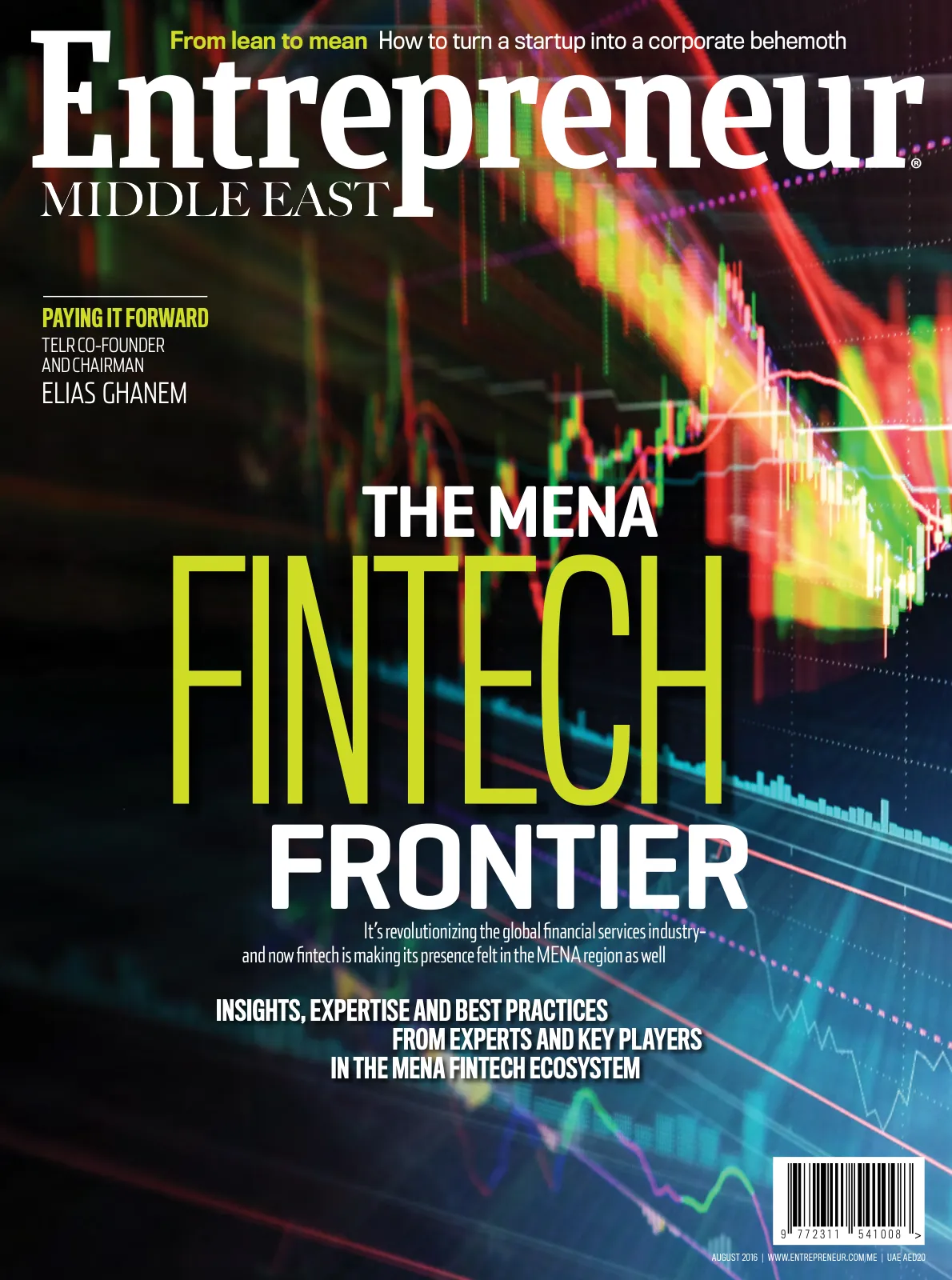
Entrepreneur Middle East, August 2016
Page 1
Insights, expertise and best practices
from experts and key players
in the MENA fintech ecosystem
It’s revolutionizing the global financial services industry-
and now fintech is making its presence felt in the MENA region as well
THE MENA
FINTECH
FRONTIER
From lean to mean How to turn a startup into a corporate behemoth
august 2016 | www.entrepreneur.com/me | UAE AED20
9
7 7 2 3 1 1
5 4 1 0 0 8
>
Elias Ghanem
Telr co-founder
and Chairman
Paying it forward
Page 2
BREITLING.COM
WELCOME TO OUR WORLD
AVENGER BLACKBIRD
At the heart of the most extreme missions you’ll fi nd exceptional men
prepared to entrust their security only to the most high-performing
instruments. At the heart of exceptional missions you’ll fi nd the Breitling
Avenger. A concentrated blend of power, precision and functionality,
Avenger models boast an ultra-sturdy construction and water resistance
ranging from 100 to 3000 m (330 to 10,000 ft). These authentic instruments
for professionals are equipped with selfwinding movements offi cially
chronometer-certifi ed by the COSC – the only benchmark of reliability
and precision based on an international norm. Welcome to the world of
extremes. Welcome to the Breitling world.
Page 3
august 2016 Entrepreneur
3
75 BMW, Mobileye, and Intel team up to build self-driving cars
CONTENTS
august 2016
26
Paying it forward
Elias Ghanem
The co-founder and chairman
of Telr is keen on giving back
to the MENA entrepreneurial
ecosystem.
20
Building brand
allegiance
Christopher Buxton
Lexus UAE’s Managing Direc-
tor makes strategic market
growth a matter of fact.
14
EDITOR’S NOTE
By Aby Sam Thomas
66
START IT UP:
Q&A
The newsmaker
Eventtus co-founder and
CEO Mai Medhat on sharing
a stage with US President
Barack Obama and Facebook
CEO Mark Zuckerberg.
56
TECH:
SHINY
#TamTalksTech
Gadgets and doodads that
you might’ve missed out on,
sourced by a tech aficionado.
Yes, it’s okay to want them
all… and no, it’s not our
fault.
Insights, expertise and best
practices from experts and key
players in the MENA fintech
ecosystem.
Shailesh Dash Al Masah
Capital Management
Ihab A. Khalil BCG Middle East
Steve Haley MAGNiTT
Omar Soudodi PayFort
30
INNOVATOR:
The MENA fintech
frontier
It’s revolutionizing the global
financial services industry-
and now fintech is making
its presence felt in the MENA
region as well.
Mai Medhat, co-founder
and CEO, Eventtus with
President Barack Obama,
Facebook CEO Mark
Zuckerberg and other
entrepreneurs at GES 2016
66
IMAGE COURTESY EVENTTUS, GES 2016
Page 4
Page 5
Page 6
Entrepreneur august 2016
6
CONTENTS
august 2016
72
Eric Ries, entrepreneur and
author recognized for pioneering
the Lean Startup movement
52
72
MONEY:
ASK THE MONEY GUY
The modus operandi
Six things investors look
out for before acquiring an
enterprise.
76
STARTUP FINANCE
Easier said than done
Crowdfunding your
startup? Be prepared to
work for it.
50 Cashing in on Pokémon Go
57 WD
My Passport
Wireless
63
CULTURE:
LIFE
The downside of work-life
balance
James Clear explains how
understanding the Four
Burners Theory can help us
attain the success we want
in life.
42
‘TREPONOMICS:
PRO
Unlocking the secrets of
career success
Bayt.com’s Lama Ataya says
that for you to reach your
peak potential, you need to
start by defining what being
successful means to you.
50
MARKETING
Cashing in on Pokémon
Go
Six ways MENA brands
can benefit from the viral
game taking over the
world.
60
ESQUIRE GUY
According to Ross
McCammon, the first
step in giving advice is:
do not give advice. Listen
instead.
52
PRO
From lean to mean
How to turn a startup
into a corporate
behemoth- is the lean
startup method right for
your venture?
Page 7
Page 8
Entrepreneur august 2016
8
CONTENTS
27
Henri Asseily,
Manager Partner,
Leap Ventures
74
money:
VC VIEWPOINT
Understanding the VC
business model
BECO Capital CEO Dany
Farha dispels the myth that
VC is a “gamble,” where
people invest and hope for
the best.
78
START IT UP:
ECOSYSTEM
Empowering the
future
Here are three things you
can start doing to empower
youth in your startup or
corporation in the MENA
region.
82
culture:
LIFE
Breaks lead to
breakthroughs
Mark Sephton explains
why it’s important to re-
member that, sometimes,
to get ahead, we have to
stop and take time to re-
fuel. Taking a vacation is a
good way to do that.
58
TRAPPINGS
‘Trep gear
The executive selection
for the entrepreneur
on your list that has
everything. Okay, maybe
for a little self-reward as
well.
76 Elias Ghanem, co-founder, Telr and Resident
Mentor, UK Lebanon Tech hub
59
Bremont Boeing
247
Lexus UAE’s
Managing Director
makes strategic
market growth a
matter of fact
20
august 2016
Page 9
,
,
Page 10
Entrepreneur august 2016
10
SUBSCRIBE
Contact subscriptions@bncpublishing.net to receive
Entrepreneur Middle East every issue
EDITOR IN CHIEF Aby Sam Thomas editor@bncpublishing.net
CEO Wissam Younane wissam@bncpublishing.net
MANAGING DIRECTOR Walid Zok walid@bncpublishing.net
DIRECTOR Rabih Najm rabih@bncpublishing.net
CREATIVE LEAD Odette Kahwagi
STARTUPS SECTION EDITOR Pamella de Leon
COLUMNIST Sindhu Hariharan
COLUMNIST Tamara Clarke
COLUMNIST Shoug Al Nafisi
COLUMNIST Erika Widen
EVENTS LIAISON Mark Anthony Monzon
PO Box 502511 Dubai, United Arab Emirates
P +971 4 4200 506 | F +971 4 4200 196
For all commercial enquiries related to
Entrepreneur Middle East contact
sales@bncpublishing.net
All rights reserved © 2016.
Opinions expressed are solely those of the contributors.
Entrepreneur Middle East and all subsidiary
publications in the MENA region are officially licensed
exclusively to BNC Publishing in the MENA region by
Entrepreneur Media Inc.
No part of this magazine may be reproduced or
transmitted in any form or by any means without written
permission of the publisher.
Printed by Raidy Emirates Printing Group LLC
www.raidy.com
Images used in Entrepreneur Middle East are credited when necessary. Attributed use of
copyrighted images with permission. All images not credited otherwise Shutterstock.
Lama Ataya
Fida Chaaban
James Clear
Shailesh Dash
Dany Farha
Steve Haley
Ihab A. Khalil
Ziad Matta
Nadim Majdalani
Ross McCammon
James Pass
Neil Petch
Soukaina Rachidi
Tareq Samara
Mark Sephton
Kim Lachance Shandrow
Omar Soudodi
Erica Werneman
CONTRIBUTING WRITERS
www.entrepreneur.com/me
Access fresh content daily on our website!
MIDDLE EAST
EntMagazineME
@EntMagazineME
Entrepreneur-me
EntrepreneurMiddleEast
EntMagazineME
EntMagazineME
EntMagazineME
MIDDLE EAST
In addition to our print edition, we’re bringing
you all sorts of industry news on our web
mediums. Joining us online means getting
relevant business and startup content in
real-time, so you’re hearing about the latest
developments as soon as we do. We’re looking
forward to interacting with our readers on all of
our social media and web platforms- like any
thriving business, we’re looking to give and take.
#TrepTalkME is already happening on all of our
digi platforms, and all good conversations go
both ways. See you on the web!
Page 11
I see Jannah.
I like Jannah.
I book Jannah.
JannahHotelsandResorts
jannahhotels
JannahHotels
800 - JANNAH (526624) / +971 2 652 6777
book@jannah.ae
www.jannah.ae
Page 12
Page 13
Page 14
Entrepreneur august 2016
14
EDITOR’S NOTE
Aby Sam Thomas
Editor in Chief
@thisisaby
aby@bncpublishing.net
A tale of two pitches
Entrepreneurship leaves no room for laziness
A
couple of months ago,
I was emailed by the
representatives of two
different startups, both of
whom were pitching their
respective enterprises to
get coverage in Entrepre-
neur Middle East. Now, we get a
lot of such pitches, and as a team,
we do try to go through all of them
and make informed decisions on
which of these should actually
make it to our print pages or web-
site. In this particular case, I was
reviewing both pitches, and while
they were interesting in their own
right, I didn’t find them impres-
sive enough or mature enough as
a startup to warrant a presence in
the magazine then. Subsequently,
I declined both of these pitches,
explaining that the current states
of their companies didn’t make
them a fit for us at that point in
time, and I proceeded to (almost)
forget about them.
But then, last week, these two
startups reached out to me again,
once again hoping to be featured
in the publication. This is where
it gets interesting: one of these
startups sent me a pitch that was
almost an exact replica of their
email from months ago, while the
other chose to give me new details
relating to the current state of
their enterprise (including stats
and figures in terms of their user
numbers, funding status, and
more). I’ll admit here that from a
personal point of view, the latter
enterprise, much like the first time
it had contacted me, didn’t really
excite me this time either- but the
very fact that this company had
bolstered its pitch by responding
to my doubts about it the last time
around made me sit up and take a
second look at it. The founders had
noted the issues I had with them
months ago, and followed up with
an effective reply to them.
And as for the first startup: no
prizes for guessing what happened
to that pitch. That company got a
“no” from me again, and the abject
laziness it was showcasing by recy-
cling an old email made the enter-
prise seem all the more lackluster.
In the meantime, I’m reconsidering
the second company, all because
its representatives took the time
to make a renewed case for their
startup and how it had grown over
the past few months.
So, what are the key takeaways
here? Well, firstly, when we, as
editors, say no to your startup’s
pitch, don’t consider it as the be-
all and end-all of your interaction
with us. We’re definitely open to
being pitched again, and contrary
to popular thought, we are open
to reconsidering our stances
on your enterprises. But when
you do reach out to us for the
second time, don’t be lazy- give
us fleshed-out information that
would make us want to take notice
of your company. Respond to our
criticisms, showcase the wins that
you have achieved, prove to use
that your business is sustainable
and growing. If you send us the
same old boring pitch to us again,
well then, in the words of Kim-
berly “Sweet Brown” Wilkins in
her 2012 viral video: “Ain’t nobody
got time for that!”
Page 15
august 2016 Entrepreneur
15
Page 16
Entrepreneur august 2016
16
A scene from the 2015
Seedstars Summit in
Switzerland
IN THE LOOP
A three-word-solution to the Middle East’s
logistic woes
Aramex invests US$2 million in what3words
Bahrain to play host to
Seedstars GCC 2016
what3words App
IMAGES COURTESY ARAMEX, WHAT3WORDS AND SEEDSTARS
I
spent my weekend at guess.min-
eral.soils.” Don’t be taken aback
if a friend in Dubai says that to
you: those three words refer to
the unique codes assigned to
Dubai’s popular landmark Palm
Jumeirah by UK-based what-
3words’ universal addressing system.
what3words assigns three-word ad-
dresses to locations by segregating the
entire world into global grids of 57 tril-
lion 3m x 3m squares. By doing so, the
startup wants to ensure that “everyone
and everywhere now has an address,”
and the use of words instead of long
complex coordinates makes it simpler
to find and share locations accurately.
Noting how the location simplifying
solution has the potential to make life
easier for everyone -from navigators
to logistics companies to the govern-
ment- logistics giant Aramex recently
announced its investment of US$2.94
million in what3words. This invest-
ment forms a part of an $8.5 million
Series B funding in what3words,
involving previous investors Intel
Capital and British funds Force Over
Mass and Mustard Seed. According to
a statement by Aramex, the company
expects the address solution to com-
plement Aramex’s
e-commerce delivery
activities, and assist
it in its mission to
improve last-mile
delivery solutions
across the region.
“By integrating
three-word address-
es into our e-com-
merce operations
across the Middle
East, Africa and
Asia, we are now
better able to reach more consumers
worldwide, even those in difficult to
access locations,” Hussein Hachem,
CEO of Aramex, says in the state-
ment. Aramex has already invested in
a number of upstarts to strengthen its
last-mile delivery including Grab.in
and Logisure in India, Shippify in
South America, and CashBasha in
Jordan and Saudi Arabia. With a lack
of standard addressing systems in the
Middle East region, efficient logistics
systems continue to be a key barrier in
e-commerce ventures scaling up, with
e-commerce businesses bearing huge
costs in failed or delayed deliveries.
what3words’ tool is in the form of a
plug-in for businesses and individuals
with their algorithm turning geo-
graphic coordinates into three-word
addresses using a geocoder. Logistics
software provider Blackbay, address
verification platform Allies, and UK-
based Direct Today Couriers are some
entities that have already integrated
what3words to their operations.
Mongolia’s state-owned postal delivery
service Mongol Post also adopted
what3words as a national addressing
standard in May 2016. With its latest
raise, what3words plans to put the
funds to use for further global expan-
sion, to launch a new voice recognition
product, develop its unique address
system in several Asian languages, and
support the growth of its team. The
solution is currently available in 10
languages including English, Russian,
French, Spanish, Turkish and others
(Arabic is also on the cards), and is
used in more than 170 countries.
Seedstars World, an emerging-markets
focused entrepreneurship forum, is
back this year to scout for promising
GCC startups, and in a first, the action
this time is centered around Bahrain.
Seedstars GCC 2016, to be held on
September 24, 2016 in Manama, will
see startups from across the GCC pitted
against each other in a pitch competition.
A jury panel comprising of Pierre-
Alain Masson, co-founder, Seedstars,
Mohamed Altawash, founder, MBAN,
and Trey Goede, Origination, Investment
and Portfolio Management, Aramco
Entrepreneurship Ventures, will assess
startup pitches to award promising seed
stage startups. Besides pitching sessions,
the event will also host fireside chats,
keynotes and panel discussions. Two
winning startups will represent the region
in the global Seedstars Summit taking
place in Switzerland in March 2017, to
compete for investments worth over US$1
million.
The global Seedstars Summit brings
together key entrepreneurs, investors,
corporates and institutions from the local
ecosystem, offering opportunities to build
business relationships with investors and
other partners and accelerate growth.
Workshops, panel discussions and
keynote addresses are all part of the
summit, in addition to the competition.
At each local edition of Seedstars, 10-12
startups are pre-selected and given a
platform to showcase their venture.
Earlier, in May 2016, the UAE round of
Seedstars, held in partnership with in5,
saw nine startups present their ideas to
a jury. Asafeer Education Technologies,
a company that provides schools with an
online Arabic digital library, won the first
place and won a chance to participate at
the global summit. Swiffix, an on-demand
home and car service app, came in second
place, and OTTAA Project, a visual
communication platform for the speech
impaired, came third.
Page 17
Page 18
BORN TO CHALLENGE
The First Ever Infiniti Q30
Create your own way. Like the first ever Infiniti Q30. With its unique design,
assistive technology and responsive handling. The others will just have to follow.
The new Infiniti Q30
• Saudi Arabia: Al Ghassan Motors: 8003060030 • Dubai & Northern Emirates: Arabian Automobiles Co., Main Showroom, Tel: +971-4-4079500 • Abu Dhabi &
Al Ain: Al Masaood Automobiles, Tel: +971-2-8883666 • Kuwait: Abdulmohsen Abdulaziz Al Babtain Co., Tel: +965-1-804 888 • Oman: Suhail Bahwan Automobiles,
Page 19
InfinitiMiddleEast
InfinitiME
InfinitiMiddleEast
InfinitiMiddleEast
Tel: +968-2-4661776 • Qatar: Saleh Al Hamad Al Mana Co., Tel: +974-44283366 • Bahrain: Y.K. Almoayyed & Sons., +973-17732732 • Lebanon:
Rasamny Younis Motor Company S.A.L., Beirut, Tel: +961-1-273333 • Jordan: Bustami & Saheb Trading Co. Ltd., Amman, Tel: +962-6-5520333
Infiniti-me.com
#BornToChallenge
Page 20
Entrepreneur august 2016
20
innovator
“our constant push is to
lift that [level of customer
service]. I want people talking
about Lexus in dinner parties,
in majlises, about the service
they got. The cars, I am
absolutely committed to;
they are probably some of the
best you can buy. But I want
the service to be something
that would make them go, ‘You
know what- I had a problem,
and it just went away.’”
Christopher Buxton, Managing Director,
Lexus UAE
Page 21
august 2016 Entrepreneur
21
T
here is an email that
is sent out every day
in the Lexus UAE of-
fices, which contains
what is essentially a
summary of all the
calls made to its cus-
tomer service center
on that date, touching upon the issues
and problems that caused each call to
happen in the first place. Of course,
there is a dedicated team at Lexus that
is responsible for looking through this
list, and ensuring that each concern
there is responded to effectively- but I
admit to have been a little taken aback
when Lexus UAE Managing Director
Christopher Buxton told me that he
made it a point to carefully peruse this
list every day as well. It’s a level of
involvement that I would have expected
from the founder of a startup, sure,
but given that this statement came
from an executive as high up on the
ranks as Buxton, at a company the size
and stature of Lexus- well, it came as
a bit of a surprise. Buxton noticed my
astonishment though, and he quickly
downplayed the significance of what
he did (“It sounds fantastic, like I’m an
angel, but I’m not!”), adding that Lexus
didn’t receive a lot of complaints any-
way- but this particular activity and his
enthusiasm for it (“I love doing it!”) is
indicative of how he goes about his role
at his company: for Buxton, ensuring
his customers have great experiences,
throughout their transaction cycles, is
key to furthering his business’ growth.
But more about customer service
later- first, Buxton. Having previously
worked with automobile brands like
Bentley, BMW, Ford, and Mercedes
Benz, Buxton –who says he’s “been in
the car industry all his life”- had been
with Lexus UAE for two years before
he became its Managing Director in
2015. As a signature luxury brand under
the Toyota marquee, Lexus has had a
pretty good run in the UAE, where it is
exclusively distributed by Al-Futtaim
Motors, with Buxton saying that Lexus
owns the second place in the country’s
luxury market. (For those of you in the
UAE, this shouldn’t come as a surprise,
considering the sheer number of Lexus
LX cars that one sees on the road here!)
“So far this year, we’ve been growing
market share,” says Buxton. “The mar-
ket’s down -the whole market is down-
the luxury market is down about 8%.
We’re only down 2%. And last month
[June], we had a record month- we sold
more cars than we’ve ever sold. So we’re
okay.” In terms of customers, Buxton
says that Lexus has been lucky in being
able to secure a strong Emirati clientele.
“I think if I break down my customer
base at the moment, we have a very
loyal local following,” he says. “Probably
50-60% of my buyers are Emiratis.” >>>
Lexus UAE’s Managing Director makes strategic
market growth a matter of fact
Building
brand
allegiance
Christopher
Buxton
By Aby Sam Thomas
Lexus RX 450h - Hybrid
images courtesy lexus
Page 22
Entrepreneur august 2016
22
innovator
Lexus LC 500h - Hybrid
While Lexus does also enjoy a fairly
healthy level of interest from the expat
population here, Buxton says that it is
something that the company is keen on
improving. After all, there are potential
customers out there who simply aren’t
familiar with the Lexus name- the
brand is relatively young, having been
launched only in 1989, whereas its
major competitors have been around for
more than a hundred years.
With that being the case, getting
the Lexus brand more out there in
the mainstream consciousness seems
to be the reasoning behind its recent
move into the lifestyle sector with its
Intersect By Lexus concept. Described
as “a place where creative minds meet
and share ideas,” Intersect By Lexus
was first launched in Tokyo in 2013,
followed by an installment in Dubai
in 2015, and a third location has now
been announced for New York City
in 2017. If one goes by its location in
Dubai at Dubai International Financial
Center’s Gate Village, then Intersect
By Lexus –which features a dining
area, a fairly well-stocked library, and
a “garage” downstairs that is more of
a lounge-cum-gallery- is, in essence,
a brand experience space, although it
does not (to its credit, really) hit you in
the face with a load of Lexus-themed
marketing collateral. As Buxton points
out, the branding in the space is more
subliminal- there are hints thrown
about in the Masamichi Katayama-
designed interiors that nod to the
Lexus brand dynamic. For instance, its
bamboo façade, featuring spindle grille
motifs, is a nod to the spindle grille
that is today a key characteristic of cars
made under the Lexus banner- but hey,
if visitors to Intersect By Lexus don’t
see that reference, Buxton is okay with
that. “Ideally, what we are hoping for, if
I’m really honest, is someone coming in
who hasn’t really touched Lexus before,
sit down [here], and enjoy it. We’ve got
very high levels of service and food- it’s
not fine, fine dining; it’s not stuffy, it’s
casual. We expect people to treat this
as their own home… It’s a very calm
and relaxed place. So it’s a way they
can come in, and slowly but surely, they
may say, what’s the Lexus connection,
and then, yeah, we are happy to talk
to them about it. But it is specifically
somewhere to actually enjoy the Lexus
brand and lifestyle- but not the car.”
And Buxton is right- while there are
car elements thrown all about the inte-
riors at Intersect By Lexus (my favorite
of these is in the garage, where a wall
has been entirely covered by hundreds
of toy cars, all of which are models of
Lexus cars from years past), none of
this really screams Lexus at you- and
according to Buxton, this aspect serves
this particular space better. “I’m per-
fectly happy for someone to come in,
enjoy a nice meal, good service, walk
away, and not even have seen Lexus,”
he says. “Because if we have given them
good service and good food, they’ll come
back. And if then, on the fourth or fifth
trip, they think, oh, this is Lexus- the
one thing they will get from that is
Lexus gives good service. So if they do it
here, why shouldn’t they be able to do it
in a car scenario?” The aim, therefore,
with Intersect By Lexus seems to be
to try and instill the germ of a feeling
about Lexus in its patrons (most of
whom, Buxton notes, currently don’t
drive a Lexus), which will, hopefully, get
them to include the brand in their mind
when they do get around to buying a ve-
hicle in the future. The company is thus
playing the long game here, which also
affords Buxton and his team at Intersect
By Lexus the time to experiment, try out
new things, and build it up as they go
along. The approach is thus rather en-
trepreneurial in its nature, with Buxton
saying he and his team are continuing
to debate and figure out how much they
want to “plug” the Lexus brand at Inter-
sect By Lexus. “We’re kind of learning
as we go along, as to how much we can
push it,” he explains. “Yes, the ultimate
objective of Al-Futtaim [and] Lexus is
to sell cars, to look after people. With
Intersect By Lexus, it’s not the same
objective. Intersect By Lexus is about
opening up the brand to people, at a
very subliminal level, [with] no com-
mitment at all. Who knows where that
will go to in the future- but I think it is
something we are learning from.”
It’s clear from Buxton’s strategy for
Intersect By Lexus that this executive
places a lot of importance on customer
service in bringing in (and retaining)
clientele, and this is a principle he
extends to his business of selling cars
as well- as evidenced by his aforemen-
tioned ritual of going through customer
complaints every day. “The Lexus brand
is built on customer service,” he reiter-
ates. “As I said, we’ve never been racing
in terms of global spheres. So, we have
to really give fantastic customer service
on the sales and after-sales back-
ground.” This is, in effect, the modus
operandi with which Buxton hopes to
lure in new customers to Lexus. “What I
want to do is not just sell the car –and I
know this sounds a bit cliché- I actually
want to give very good customer service.
I want to be able to sell cars on the back
of customers thinking, ‘That [the ser-
vice] was fantastic.’ If I’m really honest,
customer service levels here, compared
to elsewhere in the world, are not where
they should be, whether it be automo-
tive, banking, whatever it is. And our
constant push is to lift that [level of
customer service]. I want people talking
about Lexus in dinner parties, in majlis-
Page 23
august 2016 Entrepreneur
23
“Intersect By Lexus is about opening up
the brand to people, at a very subliminal
level, [with] no commitment at all. Who
knows where that will go to in the
future- but I think it is something we are
learning from.”
Mark Ronson at the
Dubai launch of Intersect
By Lexus in 2015
es, about the service they got. The cars,
I am absolutely committed to; they are
probably some of the best you can buy.
But I want the service to be something
that would make them go, ‘You know
what- I had a problem, and it just went
away.’” According to Buxton, training
staff is key to delivering such levels of
customer service, and the importance
of actually listening to clients cannot
be understated. Buxton says he doesn’t
want to simply satisfy customers; he
wants to “delight” them.
Another aspect of catering to custom-
ers is keeping an eye on the market,
both local and global, and how its
changing dynamics could affect clients.
When it comes to Lexus in the UAE,
this involves the country embracing the
global trend toward more eco-friendly
vehicles on the road, and Buxton feels
that this is something that will happen
sooner than later. In this matter though,
Lexus is ahead of the curve in this
department, with the UAE already host
to its range of luxury hybrid vehicles
like the LSh, RXh, GSh and CT, and they
are already gaining interest in terms of
customers. In fact, in May, Al-Futtaim
issued a statement noting that Lexus
hybrid sales had grown by 25% in the
first quarter of this year, as compared to
the same period last year. Buxton notes
that this interest in hybrid vehicles
could see a further jump if the govern-
ment here (like other countries of the
world) makes a more concerted effort
towards encouraging their use- and
again, the likelihood of that happening
seems very close, given the country’s
push towards sustainability, clean air
and other such green initiatives. With
that being the case, Buxton says that
he and his team in the UAE have their
work cut out for them. “What you need
with a hybrid is you need a buyer that
is cognizant of what that car is,” he
explains. “Our job -if I’m really honest-
we need to educate. Usually, when pet-
rol is expensive, when fuel’s expensive,
you’ve got something on your side to do
it [encourage use of hybrids]- here it’s
not. But in terms of maintenance, and
how green the car is, we’ve got some
clear advantages. So, we are hoping
that the government moves forward
with legislation- and that’s what drives
hybrid sales in countries; usually, the
government brings in a financial aspect:
in the UK, for instance, you didn’t have
London congestion charge if you own a
hybrid, and so on, etc. So if that comes
in here, we are hoping that with the
investment that our parent company
have made in hybrid technology, we >>>
Page 24
Entrepreneur august 2016
24
innovator
Intersect By Lexus
in Dubai
Design matters
Intersect by Lexus in Dubai
Launched in December 2015, with interna-
tionally renowned DJ and music producer
Mark Ronson in attendance, Intersect By
Lexus in Dubai has been described as “a
unique luxury space where people can expe-
rience what is truly quintessential of Lexus,
without getting behind a steering wheel.”
Japanese designer Masamichi Katayama,
founder of interior design firm Wonderwalls,
developed the Dubai concept, which is
based off his design of the first Intersect
By Lexus location in Tokyo. “This project
is not just about creating a restaurant, but
rather an environment,” Katayama said.
“As an incubation platform generating new
innovative ideas and concepts, it has been
designed to capture the feeling of a lounge,
allowing people with shared values to come
together and interact in a relaxed yet inspir-
ing atmosphere.”
www.lexus.ae/lexus-world/intersect-by-lexus
can provide a range of hybrids to the
buying public. So I think that’s the next
step going forward. In a way, it’s quite
sad because you’ll probably see less
big SUVs on the road. But in the long
term, for the climate, for the planet,
everything we should be looking at, that
other countries are already doing, we
should catch up.”
Of course, when it comes to educating
customers about hybrids, besides the
advertising and marketing campaigns
that can help in this regard, the im-
portance of a well-trained staff that
knows how to interact with and respond
to queries from customers is critical.
Again, Buxton circles it all back to
emphasize the importance of ensuring
a great and fulfilling experience for the
customer- this is, in his opinion, the key
principle that will help any enterprise
succeed. “Customer service and quality,
regardless of whether you are selling
cars, food, jackets, anything, [is what
is important],” Buxton says. ”Under-
standing your customer, being very
flexible with what your customer wants,
providing the highest level of quality
you can- it is [critical in] any business...
In any business, just listen to your
customers as much as possible. Gain as
much feedback as you can.” At the same
time, Buxton urges businesses, startups
and conglomerates alike, to never forget
what their respective brands stand for-
this is what ensures success that can
be sustained, especially when it is an
entrepreneurial venture or upstart. “Be
absolutely true to your brand values,
and not to let anything get in your
way… If they’re right for the brand else-
where, just stick to them all the time,
even if it’s not going well. Stick to your
brand values, stick to your beliefs, all
the way through. And it’ll come good in
the end. And that’s it, really.”
Page 25
At TIME Hotels, our simple approach to hospitality means that you can always expect to receive
the warmest welcome straight from the heart and an uncomplicated yet professional service delivery.
Whether for business or leisure, short-stay or long stay, we currently have four different product
brands represented across a growing portfolio of properties. To find out more about our present and
future prime locations, visit www.timehotels.ae
www.timehotels.ae
PLE APPROACH
PLE APPROACH
S
PR
PR
T
E HOTELS
E HOTELS
E LOCATIONS
E LOCATIONS
Page 26
Entrepreneur august 2016
26
A
sk Elias Ghanem to
offer his insight on
what it’s really like to
be an entrepreneur,
beyond all the appar-
ent glitz and glamour,
and he doesn’t mince
words. Describing the
process of starting a company to be akin
to “having a baby,” the entrepreneur
explains how drastically life changes, and
how there’s no end in sight to the hus-
tling. “Ask any mother how difficult but
rewarding it is to have a child, and there
you go,” he says.
Ghanem started his career with
leadership roles in payment giants like
VISA and PayPal, and was a key force in
launching PayPal in the MENA region,
which he helped run for almost two years.
It was during his tenure at PayPal that
several large merchants were brought on
board, with the service also launching in
Egypt during that period. But after real-
izing that the MENA economy needed a
more “hands on, home-made” payment
solution capable of handling specific local
aspects, Ghanem left PayPal to found Telr
(derived from the word teller), an emerg-
ing markets-focused online payment
gateway. “That [the realization] was the
moment of truth [for me] to leave PayPal
and try to do something on my own,” says
Ghanem. In a short span of time, Telr was
able to do a lot: raising funds across the
MENA and Asia, acquisitions and cor-
porate partnerships, as well as winning
accolades in the region’s ecosystem. Telr
operates as a single window e-commerce
solution- facilitating secure online pay-
ments through their gateway, enabling
creation of e-commerce stores through
their “Store Builder” solution, and also
supporting cash flow of SMEs through a
merchant advance system. Telr’s platform
also enables businesses to manage pay-
ments through the web, mobile and even
social media accounts- small wonder
then the company was awarded the title
of “Best Payments Product” at The Asian
Banker’s second Annual MEA Awards in
2015.
But Ghanem’s innate desire to constant-
ly build new solutions prompted him to
move on to a mentoring role at Telr (tak-
ing up the role of Chairman) in just over
a year of founding the company. Ghanem
says that the huge progress made by Telr
in such a short time was his cue for the
move. “It was a wake-up call telling me,
‘You have done a lot in a single year, had
to let a lot go, so get yourself back a life,
and focus on what you like,’” he says.
And what Ghanem went on to do next
is a clear reflection of what he’s most
passionate about. With a fierce focus
on growing the region’s entrepreneurial
community, Ghanem put on his advisory
cap, taking on the important task of men-
toring various small businesses across
the region. Desiring to “dedicate 2015
to coaching,” Ghanem became Chairman
of Zoomaal (a leading crowdfunding >>>
Paying it
forward
Telr co-founder and Chairman
Elias
Ghanem
By Sindhu Hariharan
innovator
“Entrepreneurs in this
side of the world tend
to keep their idea to
themselves, rather than
looking for partner-
ships, collaboration,
mergers, etc.”
Page 27
august 2016 Entrepreneur
27
“Please don’t
try to build a
business model
on your own [as
entrepreneurs],
but rather
surround
yourself with
people who know
how to do it.”
Elias Ghanem, co-founder, Telr and Resident Mentor,
UK Lebanon Tech hub
Page 28
Entrepreneur august 2016
28
innovator
“VCs in the region are either
ex-bankers or wanna-be
bankers, they are greedy,
unfair and not risk takers
(of course there are
great exceptions to that
statement), they over
negotiate terms, kill any
valuation, highly dilute
the entrepreneurs, delay
forever cash payments,
and barely educate
entrepreneurs about term
sheet components.”
platform in MENA), a board member in
Bridg (a smartphone payment platform
using Bluetooth), as well as in Paykii (a
solution for cross-border bill payments).
He also became a Resident Mentor at the
UK Lebanon Tech hub, an accelerator
representing a joint effort on part of both
countries to foster innovation. And it
doesn’t end there- Ghanem is also an in-
vestor always on the lookout for ventures
disrupting traditional payment systems.
With fintech being at the center of the
funding and innovation action in the
global entrepreneurship scene, the sector
is making tangible progress in developed
economies, but it’s safe to say that the
role played by technology in financial ser-
vices industry of emerging markets leaves
a lot to be desired. Ghanem seems to
agree with this popular thought when he
says that fintech is at its “infancy stage”
in the MENA region. Discussing the cur-
rent and future prospects of the region’s
fintech space, Ghanem opines that it still
remains a habit and quite common in the
region to go to a physical branch to carry
out transactions, despite emergence of
alternatives. “Digital signature is strug-
gling to become mainstream, banking
apps only offer very basic services, and
very few banks are adopting the fintech
wave,” he says. Talking about global
banks setting up in-house accelerators to
develop solutions, Ghanem praises Emir-
ates NBD and its recent fintech challenge,
which seems to be leading the change
among MENA banks to institutionalize
support for fintech entrepreneurs. He
also lists various areas where MENA’s
fintech entrepreneurs could make a mark,
including opportunities to set up a fully
digital bank, online payment gateways,
and promoting “financial inclusion for
the millions of unbanked,” among oth-
ers. Analyzing the geographic reach of
fintech among the region, Ghanem says
that Dubai is clearly leading the way,
and Egypt too presents great potential
“thanks to its local critical mass.” He
is, however, most excited about Iran,
where “fintech is definitely making fast
progress.” With so much going in favor
of fintech startups in MENA, what then
stands in the way of a fintech wave in
MENA? There are two key hurdles, ac-
cording to Ghanem. “The single largest
challenge is customer KYC (Know Your
Customer) that remains very antique in
MENA, as there is no national ID number
with a proper credit bureau,” he says. As
explained by Ghanem, this creates a need
for customers to go in person to the bank
and provide several documents to be
stamped, notarized or checked. The other
challenge is a lack of regulatory frame-
work or acceptance of digital signature,
which remains a significant hurdle for
fintech to gain steam in this region.
With a ringside seat to the daily
struggles and victories of the region’s
entrepreneurs, Ghanem is perhaps the
best person to shed light on factors that
stand in the way of the region’s startups
achieving scale and making it big. “Cash,
talents and co-working environment,”
says Ghanem, responding to the question.
Though VC money is growing, he says
that it seems to barely reach entrepre-
neurs, especially “at seed stage before
launch,” and sees it as a chicken-and-egg
problem, where investors demand to see
“traction,” and founders need cash to
show any traction. “VCs in the region are
either ex-bankers or wanna-be bankers,
they are greedy, unfair and not risk tak-
ers (of course there are great exceptions
to that statement), they over negotiate
terms, kill any valuation, highly dilute
the entrepreneurs, delay forever cash
payments, and barely educate entrepre-
neurs about term sheet components,”
laments Ghanem. Founders need to let
go a lot of their freedom and must accept
that increasingly deals are being shared,
and co-investment is becoming common,
he adds. However, he admits that not
all parts of MENA suffer from the same
drawbacks. Dubai-based investors, he
says, are doing a better job in educating
entrepreneurs and taking risks. Similarly,
he believes talent is scarce in the region
and is distributed in an “unbalanced
Page 29
august 2016 Entrepreneur
29
Startup shout-outs
“I like entrepreneurs that solve
problems and impact millions
of people. I am a huge fan of
four entrepreneurs that run two
startups. [First] Bridg- run by two
young guys, Moussa Beidas and
Nadim Jarudi, who decided to
disrupt the old fashioned “point
of service” device that should go
to museums anytime soon. [Sec-
ond] Paykii- run by Fabian Saide
and Nelson Irizarry, who, decided
from Washington and Mexico,
to help all migrant workers pay
bills in their home country from
their working place. MENA is the
second largest host of migrant
workers, and Paykii has already
signed agreements with several
money transfer and bill payment
aggregators in MENA, Asia,
LATAM and the US.”
Advice for aspiring
entrepreneurs
“[Firstly,] be aware that entre-
preneurship is 1% glamorous
and 99% insanely difficult.
[Second,] be willing to invest
the double of your last yearly
income with a 90% risk of losing
it all. [Finally,] don’t go alone to
the toughest work in your life,
surround yourself with more
prepared people. Be aware that
corporate life (including startups)
is a jungle, and trust is always a
factor that evolves very quickly. If
you start alone, wait to give the
‘co-founder’ title until you really
trust your partner.”
Tips for entrepreneurs
raising funds
“Investors want to hear a story
that makes them dream. It’s not
about you; it’s about the problem
you are solving. Keep it short,
sharp, precise. Your background
is only useful to give credibility
(we don’t care who you know,
where you lived, or where you got
your first diploma). Don’t pitch if
you are not ready- rehearse, re-
hearse, rehearse before pitching.”
‘Trep Talk ME
Elias Ghanem
Elias Ghanem, co-founder, Telr and Resident Mentor, UK Lebanon Tech hub
www.telr.com | www.uklebhub.com
manner” and considers co-
working spaces as essentials
to foster creativity, where
entrepreneurs from diverse
backgrounds can work to-
gether. But Ghanem does not
hold back from also pointing
out mistakes he notices
entrepreneurs making in
formulating their business
models. “Please don’t try
to build a business model
on your own [as entrepre-
neurs], but rather surround
yourself with people who
know how to do it,” Ghanem
advises founders. He urges
the region’s entrepreneurs to
stop chasing “shiny objects” -a problem
he finds common to emerging markets-
and go after real solutions even if they
require taking risks. Tendencies to go
for a high valuation early on, building
businesses alone leading to a “failure rate
[which] is exponential,” and “offering the
co-founder title to anyone,” are some of
the red flags he observes in the business
model of upstarts today.
Drawing from his own experience, the
fintech evangelist is a firm believer that
a stint in the corporate world guided his
business management strategies. “I think
Telr would not have been where it is
without our [team’s] collective corporate
background,” he admits, attributing Telr’s
success to “business processes, credibil-
ity and the network” that the founders
acquired during their days in the cor-
porate world. Ghanem is also candid in
offering his thoughts on what the region’s
entrepreneurs lack from an execution
point of view: a partnership spirit. “En-
trepreneurs in this side of the world tend
to keep their idea to themselves, rather
than looking for partnerships, collabora-
tion, mergers etc.,” he says. And what is
the one thing he would like to drill into
the entrepreneurs he works with? He
chooses to offer hustlers a reality check
on entrepreneurship, warning them that
they are getting into an “emotional roller
coaster.” “You’ll be drained, as emotions
goes every minute to the roof or down,
depending on if you have an article in a
magazine, or if you read your competition
has done a better product… This is the
glamorous life ahead of you,” he warns,
matter-of-factly.
Page 30
Entrepreneur august 2016
30
Insights, expertise and best practices
from experts and key players in the MENA
fintech ecosystem
It’s revolutionizing the global financial services industry-
and now fintech is making its presence felt in the MENA region as well
Ihab A. Khalil
BCG Middle East
Shailesh Dash
Al Masah Capital Management
Omar Soudodi
PayFort
Steve Haley
MAGNiTT
THE MENA
FINTECH
FRONTIER
Entrepreneur august 2016
30
Page 31
august 2016 Entrepreneur
31
By Ihab A. Khalil
A revolution in the payments industry
The rapid growth
of fintech
In recent years, fintech
companies, which are mostly
startups, have increased
dramatically in number
–from about 1,000 in 2005
to over 8,000 in 2016–
and have harnessed new
cutting-edge technologies
to provide financial ser-
vices while sidestepping the
legacy cost structures and
regulatory constraints of
traditional banks.
On a global scale, the retail
digital payments industry is, to-
day, in the throes of profound
change, triggered by a number
of key factors. First, when mak-
ing payments, consumers in this
day and age want omni-channel
solutions, security and value-
added services that offer more
than just seamless conveni-
ence. Secondly, merchants, on
their part, want lower cost
payments and easy integration
with value-added applications.
www.sofi.com
Insights, expertise and best practices
from experts and key players
in the MENA fintech ecosystem
THE MENA
FINTECH
FRONTIER
S
ince its inception,
the vast, fast-paced
world of fintech
–the intersection
of two dynamic in-
dustries– has irrevocably re-
defined, retransformed, and
reshaped the sphere of busi-
ness. In just over a decade,
a plethora of trends have
punctuated the fintech land-
scape, giving rise to a new
era of investment, customer
service, and digital innova-
tion. More importantly, this
fintech revolution has turned
conventional approaches to
financial technology on their
heads.
In recent years, fintech
companies, which are mostly
startups, have increased
dramatically in number –
from about 1,000 in 2005
to over 8,000 in 2016– and
have harnessed new cutting-
edge technologies to provide
financial services while
sidestepping the legacy cost
structures and regulatory
constraints of traditional
banks. Collectively, fintech
firms now offer services cov-
ering many of the traditional
business lines of retail and
other banks, from credit
cards and loans to payments,
cross-border transfers, and
digital currencies.
Today, globally, fintech
funding is increasing at an
accelerating rate: the US$5.5
billion in total funding of
eleven years ago has skyrock-
eted to a cumulative $78.6
billion, according to the
Boston Consulting Group’s
fintech database. Geographi-
cally, North America players
have received the greatest
absolute level of funding
–about 71% of total fund-
ing– while Asia Pacific ones
have attracted the highest
share. In parallel, within that
specific time frame, fintech
offerings have focused in
particular on consumer- and
corporate-banking activities;
in fact, companies targeting
consumer and corporate
customers have attracted
the greatest share of invest-
ments.
Remarkably, since 2011, a
total of six non-public firms
–SoFi, Alipay, Avant, One97
Communications, Zenefits
and Square– have garnered
more than $500 million
of cumulative investment.
In addition, more than 15
unicorns –startups with
valuations of $1 billion or
more– have emerged with an
aggregate valuation of over
$50 billion.
There is no denying that
fintech’s emergence as a
full-fledged worldwide
phenomenon has been
sparked by steady, strategic
investments and tremendous
growth– driven primarily by
three popular investment
categories: payments, lend-
ing/crowdfunding, and data
& analytics. Overall, the pay-
ments cluster –comprising
consumer payment services,
merchant payment services,
new payment types and
infrastructure and ancil-
lary services– has received
the largest investment as a
category (30%) and is cur-
rently dominating the fintech
landscape, exhibiting rapid
growth across an increasingly
diverse product mix.
On a global scale, the retail
digital payments industry
is, today, in the throes of
profound change, triggered
by a number of key factors.
First, when making pay-
ments, consumers in this day
and age want omni-channel
solutions, security and
value-added services that
offer more than just seam-
less convenience. Secondly,
merchants, on their part,
want lower cost payments
and easy integration with
value-added applications.
Moreover, digital giants and
new entrants are vying for
digital transactions and firms
are shifting towards revenue-
sharing models, such as
Apple Pay. From a technology
standpoint, biometrics and
tokenization are driving a
step change in security and
convenience.
The reality is, new break-
through technologies and
digitization initiatives are
reinventing the “art of the
possible” in payments and
ushering in a new world of
multiple wallets, “devices,”
and supporting infrastruc-
ture. More specifically, they
are simplifying the payment
process and rendering it
invisible. >>>
Page 32
Entrepreneur august 2016
32
By Steve Haley
Fintech startups are making waves
in the Middle East
Surging ahead
Ihab Khalil is Partner & Managing Director at BCG Middle
East. Based in Dubai, Ihab is a core member of BCG’s Principal
Investments and Private Equity (PIPE) and Financial Services
practices. He specializes in investment strategy formulation,
asset allocation, portfolio review and restructuring, M&A and
due diligence support, performance improvement, operating model design and
corporate governance. Before joining BCG, Ihab worked at Booz & Company
for a total of nine years. Ihab holds a bachelor’s degree in Engineering from
the American University of Beirut and an MBA from INSEAD.
Insights, expertise and best practices
from experts and key players
in the MENA fintech ecosystem
THE MENA
FINTECH
FRONTIER
Together, these forces are
radically altering the pay-
ments space and helping to
reevaluate the needs of both
consumers and merchants–
leaving ample room for fin-
techs to irreversibly change
the game.
The vast appeal of fintechs
lies in their ability to offer
a differentiated business
model, deliver an enhanced,
personalized customer
experience and tap into the
power of digital to ensure
end-to-end business value.
And that is precisely why
payment fintechs –which
include digital wallets,
integrated Point of Sale
(POS) systems, person-to-
person (P2P) payments and
cross-border transfers– are
disrupting the industry to
varying degrees.
With this in mind, an im-
mediate question arises as
to how exactly fintechs are
impacting banks.
The answer? It varies
depending on the type of
disruption.
To determine whether the
fintech ecosystem poses a
threat or presents an oppor-
tunity, banks need to adopt
a multi-phased assessment
framework that begins with
three questions:
• Does it scale?
• Does it provide real value
to consumers?
• Does it provide real value
to merchants?
If the answer to all three
questions is “yes,” then the
next obvious question is:
what is the impact on your
economics?
If it is likely negative, then
it is most probably a threat.
By contrast, if it is poten-
tially positive, then it may
bring forth an opportunity.
Typically, the emergence
of digital wallets is more op-
portunity than threat: after
all, it cements card usage at
POS systems and offers the
chance to build digital wal-
let leadership. On the other
hand, new POS technology
can hinder small business
relationships– it can take
merchant acquiring busi-
ness and offer value-added
services.
Simplified P2P systems
are a potential threat only
if the scope is extended.
They could win consumers
thanks to their ease of use,
prompt a move towards POS
systems, offer other finan-
cial services, and promise
value-added services. Lastly,
cross-border transfers are
generally classified as a
threat as they can capture
high margin business and
eventually reach small busi-
nesses.
Based on this, it is clear
that the size of the prize that
fintechs could grab remains
to be seen; it all depends on
banks’ respective reactions,
the sweeping changes in the
ecosystem, and the creation
of attractive alternative
revenue streams. Fintechs
also spawn opportunities for
inorganic innovation in the
banking sector; they can be
acquired to offer pioneer-
ing services– in a manner
that is faster and cheaper
than would otherwise be
possible (if they built them
in-house).
In spite of the rise of the
fintech tsunami, banks
remain well protected by
regulations particularly with
regards to deposit holding.
As a result, while fintechs
can pose a threat for part of
the core business of banks,
they also open up avenues
for innovation for other di-
visions of the organization.
In short, adequately as-
sessing the risk is what it all
boils down to.
F
intech, i.e. financial
services technol-
ogy, was the startup
buzzword of 2015,
with the sector
boasting of over US$3 billion
in venture investments, which
shouldn’t be surprising in the
wake of a global economic
crisis that highlighted the
industry’s need for disruption.
According to CB Insights, 19
fintech startups have joined
the exclusive “unicorn club”
of venture-backed companies
valued at over $1 billion, many
of which are in wealth manage-
ment, peer-to-peer lending
marketplaces, price compari-
son and payments. Payment
companies alone raised $3.3
billion in venture funding last
year. But what does that mean
for emerging markets like the
Middle East, Africa, Southeast
Asia and India? Companies in
these regions usually fall into
two categories: one, those that
alter tried and true models
from the U.S. and Europe to a
new market, or two, those that
create a new product tailored
to the large unbanked and
under-banked populations.
In markets like Africa and
SE Asia, we’re seeing the
latter, with technologies
around mobile money and
“last mile innovation” to bring
new products and services to
customers that are not already
connected to the banking and
payment infrastructures of
more developed economies. In
the Middle East, most fintech
startups are taking some of
the most successful business
models of the U.S. and Europe
and tailoring them to the cus-
tomers and regulations of the
region- although that’s easier
said than done. And if fintech
was the global buzzword for
startups in 2015, it’s looking
to be just that for 2016 in the
Middle East. PayFort, which is
Page 33
august 2016 Entrepreneur
33
MadfooatCom closed an invest-
ment round last year (Series A
with $5 million), and is looking to
expand into the region and Africa
this year. Their major growth
came from a contract from the
Central Bank of Jordan to create
and administer the country’s
national electronic bill pre-
sentment and payment service
gateway, eFawateerCom.
The MadfooatCom team
IMAGES COURTESY FINERD, ALIPAY, SOFI, MADFOOATCOM, DEMOCRANCE
Insights, expertise and best practices
from experts and key players
in the MENA fintech ecosystem
THE MENA
FINTECH
FRONTIER
enabling online payments all
over the region, has announced
the launch of its Fintech Fac-
tory, a startup accelerator in
Dubai that will invest in and
enable 4-5 startups this year.
Last year, Egypt’s bill payment
service Fawry brought to the
region one of its biggest equity
exits, rumored to be at $100
million.
New exciting fintech startups
are thus popping up every
month, and MAGNiTT (of
which I am in the advisory
board of) is a platform that can
help you connect with some of
the most interesting ones here
in the Middle East. Here are
three fintech sectors that have
caught my eye, and the MENA
startups making their presence
felt in these spaces:
1. Crowdfunding
Crowdfunding consists of
three main categories: rewards
crowdfunding (e.g. Kickstarter,
Indiegogo), peer-to-peer lend-
ing marketplaces (e.g. Lending
Club, SoFi, Prosper, Funding
Circle), and equity crowdfund-
ing (e.g. Angelist, Crowdcube).
In the highly regulated Middle
East, P2P lending is still in its
early stages, but with highly
exclusive formal lending across
the region and the huge suc-
cess of lending platforms in the
US and UK, we’re likely to see
a lot more from the trailblaz-
ers at Beehive (UAE-based
and UAE-focused) and Liwwa
(Jordan-based and region-
focused).
Liwwa recently closed an
impressive $2.3 million funding
round led by Silicon Badia to
build up their ability to assess
an applicant using technology
rather than traditional credit
ratings that have made most
banks in the region ineffec-
tive at growing SMEs. In one
year, they have lent over $1.6
million to 75 companies, and
with current applications for
over $50 million from qualified
companies, the startup has
definitely shown the demand
for its product. Co-founder and
CEO Ahmed Moor started the
company out of Harvard, and it
boasts of international rockstar
advisors like Prosper’s Chris
Larsen.
Zoomaal, founded in 2012 in
Lebanon and led by founder
and CEO Abdallah Absi, is on
a mission to “bring back Arab
creativity.” By focusing on
rewards rather than lending
or equity, Zoomaal has fewer
legal challenges to getting
sustainable projects funded
and building a community of
Arab funders. With funding
from MEVP (Lebanon), Sawari
Ventures (Egypt), Cairo Angels
(Egypt), Hivos (Netherlands)
and Wamda (UAE), Zoomaal
has launched over 100 success-
ful funding campaigns totaling
over $1.3 million for projects.
Look for their expansion into
Turkey in the coming months.
Perhaps most impressively,
projects funded through Zo-
omaal have created over 500
jobs, most of them going to
women. That’s an impact ROI
most development organiza-
tions only dream of.
2. Wealth management
Innovation in wealth manage-
ment began with exchange
traded funds (ETFs) like Van-
guard and online day trading
(E*Trade), but more recently it
has opened up to robo-advi-
sors, online wealth manage-
ment tools that exclusively use
algorithms to invest in public
markets, drastically reducing
management fees for custom-
ers and cutting out traditional
financial advisors. The biggest
names, Wealthfront and Bet-
terment, are both valued more
than half a billion dollars, and
have a combined over $5 billion
under advisement or manage-
ment. However, regional
regulations that cover financial
advisory and the specific needs
of their customers mean that
we’re unlikely to be able to take
advantage of their low fees and
user-friendly platforms. Luckily
for the Middle East retail inves-
tors, there is now an alternate
option.
Finerd went live in September
2015, which was when it
onboarded its first client as
well. They are focusing on
mid-career professionals with
around $100K-$200K in liquid
assets. They’ve recently been
accepted into TURN8’s accel-
erator program, and the >>>
Page 34
Entrepreneur august 2016
34
Steve Haley has been leading diverse mission-driven teams for 17 years in 8 different countries between work in the military, mathematics,
humanitarian assistance, economic development. He is currently an advisor to MAGNiTT and previously worked with Eureeca focused on providing
transparent access to private capital markets through crowd investing. He has worked in Italy, Austria, Iraq, Lebanon, Yemen, Libya and Egypt,
leading teams as large as 350 people. In 2011, Steve founded MC Egypt as a social investment company, leading the development of an early stage
fund of funds to increase access to capital. Steve holds Bachelor’s Degree in Applied Mathematics from West Point, and a master’s in Theoretical
Mathematics from the University of Padova.
www.democrance.com
Insights, expertise and best practices
from experts and key players
in the MENA fintech ecosystem
THE MENA
FINTECH
FRONTIER
investment and in-kind as-
sistance will bring their much-
awaited Sharia-compliant prod-
ucts to market later this year.
Due to regulations requiring
in-person KYC in the UAE, they
are only looking at bringing on
new clients in Dubai, but with
regulators in both Dubai and
Abu Dhabi taking a close look
at the potential for fintech,
Finerd will be well positioned
for much wider access to inex-
pensive and timely investment
opportunities.
3. Payment solutions
The payment solutions sector
is where the Middle East has
seen the largest fintech innova-
tions (I’ve already mentioned
PayFort and Fawry), but it
needs much more to allow
for e-commerce to thrive, as
it has in nearly every other
market. A big part of that falls
on regulators and central
banks to modernize, but also
on entrepreneurs to find ways
through partnerships and
innovative products to demon-
strate real value to customers.
Several companies are provid-
ing merchants better access to
customers that already have
electronic payment means such
as credit cards (think Square
and ApplePay in the U.S.), like
PayMob, PayMe, and Bridg.
MadfooatCom, the Jordanian
bill payment and payment
service company that got its
start at Oasis500, is expanding
the successful bill payment
focus, creating a platform for
customers to inquire and pay
their bills in a single location
via their banks’ online chan-
nels. It can be tied into other
payment solutions as well,
bringing an important use
case to innovations like mobile
wallets. CEO Nasser Saleh got
the idea for MadfooatCom after
coming back to Jordan from
working abroad and standing
in line after line trying to pay a
few simple bills.
MadfooatCom closed an
investment round last year
(Series A with $5 million), and
is looking to expand into the
region and Africa this year.
Their major growth came from
a contract from the Central
Bank of Jordan to create
and administer the country’s
national electronic bill present-
ment and payment service
gateway, eFawateerCom. While
Saleh refers to this occurrence
as being “lucky,” that doesn’t
give credit to the years of work
perfecting their product to a
point that they were chosen by
the regulator. Since launching
eFawateerCom, MadfooatCom
is now working with 49 billers
and connected to 23 of Jor-
dan’s 25 banks. They process
more than 4000 bill payments
daily and growing, and to date
have processed more than
$100 million of paid bills.
4. Retail financial
services
Sometimes, existing financial
institutions are slow to adapt
their sales channels and prod-
ucts to an online world, or their
products are too complicated
to be easily understood, which
in the UK and US led to a
growth in financial services
comparison websites and what
CB Insights has outlined in
their The Unbundling of Banks
infographic. But it also allows
for new products and services
and new ways for traditional
financial institutions to reach
customers. Feloosy is looking
at companies like Acorn, who
have made saving money faster
and simpler for millennials,
but with an Arab twist. With a
Feloosy account, you’ll be able
to put small amounts of money
into an investment account to-
wards a specific goal, whether
a car, television, or education.
This can be a very exciting
prospect if they can tie it into
PayFort’s payment gateway
and souq.com’s merchants.
compareit4me.com, until re-
cently, focused solely on com-
paring banking products and
services helping new clients
select the best banking op-
tions. Their revenue came from
the banks who paid for leads,
much like their counterparts in
the UK. However, a couple of
weeks ago, they launched their
end-to-end car insurance com-
parison platform, which allows
users to compare instant car
insurance quote and buy online,
a first in the MENA region. The
new product has already gener-
ated more than 20,000 quotes
and sold more than 600 car
insurance policies.
compareit4me.com has
placed a strong emphasis on
customer service, by hiring a
customer support team from
some of the leading insurers
in the UAE. When we think of
comparison websites, we usu-
ally think “price comparison,”
but CEO Jon Richards is quick
to contest the idea. For him,
compareit4me is a “value com-
Page 35
august 2016 Entrepreneur
35
Flat6Labs and Barclays
launch 1864 Accelerator to focus
on fintech in Egypt
democrance provides a fintech
solution that makes insurance
affordable and accessible
to the people who need it the
most. It’s affordable, because
it distributes, administers
and services insurance
policies only through the
mobile phone, which results
in considerable cost savings
when compared to the
traditional insurance model.
Ramez Mohamed, CEO, Flat6Labs
at the launch of 1864
1864 Fintech Accelerator
Insights, expertise and best practices
from experts and key players
in the MENA fintech ecosystem
THE MENA
FINTECH
FRONTIER
parison” platform, and it’s been
evidenced by data: 85% of
their clients do not choose the
cheapest quote, instead opting
to get the right level of cover.
Democrance is also planning
to disrupt the insurance market
by partnering with insurance
companies and mobile opera-
tors to offer insurance to the
underserved micro-insurance
market in the Middle East
and North Africa. The startup
provides a fintech solution that
makes insurance affordable
and accessible to the people
who need it the most. It’s af-
fordable, because it distributes,
administers and services insur-
ance policies only through the
mobile phone, which results in
considerable cost savings when
compared to the traditional in-
surance model, and it’s accessi-
ble, as insurance premiums are
also collected through mobile
payment channels instead of
traditional banking ones, which
the low-income population do
not normally have access to.
Democrance also conducts
in-depth customer research
and help insurers shift existing
products to fit the unanswered
needs, then use their mobile
technology platform and
partnerships with telecom
companies to offer and sell
these micro insurance products
at scale. Only 5-10% of the
MENA population currently
has insurance, while only 0.3%
of the population have access
to micro-insurance. These
numbers have stagnated, and
Democrance plans to bring the
security that comes with life,
health and other kinds of insur-
ance to the masses.
W
ith a large section
of Egypt’s
population being
underserved in their access
to financial services,
the country is emerging
as a hotbed for fintech
ventures. Recognizing this
momentum, Flat6Labs in
partnership with Barclays
Bank, Egypt has launched
1864 Accelerator, a
fintech-focused startup
accelerator to support
fintech innovation in Egypt.
In a statement, commenting
on how 1864 can benefit
aspiring entrepreneurs in
Egypt, Ramez Mohamed,
CEO, Flat6Labs, says,
“Those who excel during the
selection process qualify for
seed funding from Flat6Labs
to establish a strong
foundation for their projects,
and [they] will be mentored
by a team of experts to
ensure the success and
sustainability of their startup
companies.”
When considering
applicants, 1864 Accelerator
will primarily be looking at
scalability and monetization
strategy of the ideas, and
also evaluate “the character
and potential of each team.”
The accelerator proposes to
choose eight to ten teams
for its first cycle, which lasts
for 14 weeks. “Each team will
receive up to EGP150,000
in seed funding [from
Flat6Labs], and a whole
host of other services that
include, but are not limited
to $300,000 in perks and
services from our partners,
industry support by Barclays
Bank Egypt, as well as legal
support,” says Omar Badr,
Communications Manager,
Flat6Labs. By providing
six months of shared
office space to the selected
startups, the accelerator also
plans to create a community
of fintech innovators in
Egypt through weekly
pitch nights and business
networking events. Badr
says the accelerator hasn’t
yet planned for subsequent
cycles, as it is currently
focused on executing “the
best in class experience
and support for fintech
ventures in Egypt.” As
part of the partnership,
Barclays Bank, Egypt is
also contributing to the
program with its financial
and banking expertise, and
will also offer other kinds
of support. Flat6Labs, on
the other hand, will bring in
their know-how of running
accelerator programs and
will be responsible for 1864
Accelerator’s execution.
Discussing the reasons
for choosing Egypt as the
base, Badr says that the
country has a large scope
for fintech proliferation in
both the low end and high
end of the market. He cites
success stories of Fawry,
Egypt’s leading electronic
bill payment platform, as
evidence of the country’s
potential. With fintech
ventures ranging from
alternative forms of lending
to payment processing
systems, Flat6Labs believes
that “if these companies
can exist elsewhere,
then why not in
Egypt or the Middle
East.” While it is a
nascent concept for
the Egypt ecosystem,
fintech holds
promising growth
opportunities, but
educating customers
on going digital
for their financial
activities continues
to be a key challenge-
and one that 1864
hopes to address.
www.1864accelerator.com
Page 36
Entrepreneur august 2016
36
By Shailesh Dash
A VC’s perspective on the MENA fintech ecosystem- and why regulatory
environments need to change for this sector to thrive
Moving mainstream
0
20
40
60
80
100
East Asia &
Pacific
Europe &
Central Asia
High-income
OECD
economies
Latin America
& Caribbean
Middle East
South East
Sub-Saharan
Africa
Financial Institution Account
Financial Institution and Mobile Money Account
Mobile Money Account
69%
34%
46%
14%
51%
94%
51 %
World
(Adults with an Account (% 2014)
Fintech should support financial access and inclusion in meNA
Insights, expertise and best practices
from experts and key players
in the MENA fintech ecosystem
THE MENA
FINTECH
FRONTIER
T
he fintech sector has
emerged as the poster
child of global invest-
ment activity in the
past five years, with
more than US$50 bil-
lion invested in almost
2,500 companies since
2010. We have seen fintechs grow from
being mere startups offering payment
solutions to transforming the global
financial services industry during that pe-
riod. Post 2009, consumers have become
more receptive to alternative channels of
payment, lending, fundraising, etc., and
in the meantime, fintech has also emerged
as a game changer for SMEs, offering
innovative tailor-made products, such as
marketplace lending, crowdfunding, and
tech-enabled payments, especially when
lending from traditional banks was tiring
and futile.
Consequently, fintech companies have
attracted significant interest from venture
capitalists (VCs) as the value of invest-
ments grew multifold since 2010, from
US$1.8 billion to US$22.3 billion at the
end of 2015. Moreover, fintech invest-
ments grew by 75.5% in 2015, outpacing
the 29% growth in the overall venture
space, which affirms the sector’s position
as a hot ticket in the financial service
space. Additionally, 2015 witnessed sev-
eral fintech IPOs such as PayPal, Square,
WorldPay, and First Data commanding
multi-billion dollar valuations. On the
other hand, 2015 also saw the demise of
some iconic industry players, most no-
tably Powa, which built mobile payment
products and was once considered one of
the UK’s brightest tech startups, valued
at US$2.7 billion in 2015.
I believe that the fintech sector is reach-
ing the next level of maturity and moving
into the mainstream. However, the fin-
tech industry remains at a nascent stage
in the MENA region, despite favorable
demographics (highly educated people,
high levels of income and high smart-
phone penetration rates) and several
digital transformation drives initiated by
regional governments. Lagging regulations
in most sectors, combined with limited
private sector interest, and dominance of
cash as the preferred mode of payment
remain the key bottlenecks for develop-
ment of fintech in the region.
In the region, we have already seen sev-
eral fintech companies making a mark on
the regional financial services industry.
For instance, alternate payment systems,
such as CashU, are slowly gaining popu-
larity on the back of increasing e-com-
merce transactions, while crowdfunding
(Eureeca, Aflamnah and Durise) and peer-
to-peer lending (Beehive) platforms have
emerged as potential gamechangers for
regional SMEs that find it difficult to ob-
tain financing from traditional channels.
I believe that the long-term shift in the
MENA financial services domain has only
just begun, with more personalized prod-
ucts and services such as Islamic finance,
remittances, insurance, and investment
advisory services lurking to be introduced
in the horizon. Further, it is important to
note these fintechs primarily target less
profitable/untapped segments, which
was not serviced by traditional financial
services institutions, and therefore their
rise should be regarded as an evolution
of regional financial services industry,
rather than its disruption.
Although, it would not be appropriate to
compare the region’s fintech sector to its
global peers, as it is still in early stages,
but we are clearly seeing an increase
in interest from VC players, with the
number of fintechs growing rapidly in
the region. Given that we are still in an
early stage, the VCs will have significant
opportunity to capitalize on the poten-
tial growth prospects as seen in global
markets. Further, we have seen several
regional players such as Fawry, Zoomaal,
Compareit4me, and Liwwa attracting the
interest of VC firms and raising millions
of dollars to fund their business. The
valuation of many such startups have
increased significantly in a short span of
time, and I believe this will lead to the
rise of new unicorns in the region going
forward. Although, the rising number of
fintech startups will eventually increase
Page 37
august 2016 Entrepreneur
37
Shailesh Dash is the founder, CEO and Board Member of Al Masah Capital. A veteran of the MENA alternative investments sector, Dash has over
20 years of alternative investment experience. In 2010, he started Al Masah Capital, which has successfully raised over US$1 billion and established
itself as one of the fastest growing alternative investment management and advisory firms focusing on the MENA & SE Asia region. Before Al
Masah Capital, Dash had managed $4 billion of assets and executed 14 IPOs and five trade sales. In addition, he created the second largest PE
business in the MENA region (extrapolated from rankings of PEI Asia) and served on the boards of 12 companies.
charts © regional sme and venture capitalism july 2016 report
MAJOR PLAYERS IN MENA’s FINTECH INDUSTRY
Established: 2013
Country: UAE
Business Segment: Crowdfunding
Overview: Eureeca is a global equity
crowdfunding
platform.
It
enables
members to buy shares in growth-
oriented businesses.
Key Investors: NA
Funding Rounds: NA
Established: 2012
Country: UAE
Business Segment: Crowdfunding
Overview: Aflamnah is an advisory
committee that is made up of leading
figures from the fields of business,
finance, creative, etc.
Key Investors: NA
Funding Rounds: NA
Established: 2014
Country: UAE
Business Segment: Crowdfunding
Overview: DURISE is a real estate
crowdfunding platform in the Middle East.
Where investors can invest on their own
terms.
Key Investors: NA
Funding Rounds: NA
Established: 2012
Country: Lebanon
Business Segment: Crowdfunding
Overview: Led by Founder and CEO
Abdallah Absi, Zoomaal connects projects
in the Middle East to funders from around
the world.
Key Investors: The Wamda Capital Fund,
Sawari Ventures I
Funding Rounds: Undisclosed (July.2013)
Established: 2012
Country: Jordan
Business Segment: P2P Lending
Overview: Liwwa, is a peer to peer
lending platform in the MENA region. It
connects small and medium businesses
with fixed-income investors.
Key Investors: Badia Impact Fund
Funding Rounds: 2.3$ mn (April.2016)
Established: 2015
Country: UAE
Business Segment: Wealth Management
Overview: Finerd is an automated
investment
service.
It
provides
investment solutions.
Key Investors: NA
Funding Rounds: NA
Established: 2011
Country: UAE
Business Segment: Wealth Management
Overview: compareit4me.com is the
finance comparison site in the Middle
East, helps users to find and compare
credit cards, bank accounts, etc.
Key Investors: STC Ventures
Funding Rounds: 3$ mn (Sept.2015)
Established: 2011
Country: Lebanon
Business Segment: Wealth Management
Overview: Bnooki is an online platform
that has data related to financial products
and services offered by banks and
financial institutions in Lebanon.
Key Investors: NA
Funding Rounds: NA
Established: 2015
Country: Egypt
Business Segment: Wealth Management
Overview: Feloosy is a firm that helps save
up for any financial goals. It customizes a
personalized saving plan to help reach
targets.
Key Investors: NA
Funding Rounds: NA
Established: 2015
Country: UAE
Business Segment: Insurance
Overview:
Democrance
provides
insurance for both insurance companies
and mobile network operators.
Key Investors: NA
Funding Rounds: NA
Established: 2001
Country: Lebanon
Business Segment: Technology Solutions
Overview: Established in 2000, Netiks is
an e-business solution provider present in
the Lebanese market.
Key Investors: NA
Funding Rounds: NA
Established: 2014
Country: UAE
Business Segment: Technology Solutions
Overview: Scribill Pay is a software
development company in websites design
and
development,
web
application
development, social media marketing,
etc.
Key Investors: NA
Funding Rounds: NA
major players in mena’s fintech industry
Insights, expertise and best practices
from experts and key players
in the MENA fintech ecosystem
THE MENA
FINTECH
FRONTIER
the competition, I believe it
will augur well for innovators
and investors as the industry
evolves over the next few
years.
A fintech startup in the
MENA needs to be fostered
from its inception, so as to
become an industry unicorn
in a rapidly changing envi-
ronment. The real value in
investing would be either
at the seed level, or at early
rounds of capital raising activ-
ity, as valuation shoots up by
multiples in a very short span
of time. Having said that, for
institutional investors such
as PE firms/funds and family
businesses, there is an oppor-
tunity to partner and incubate
the ecosystem by lending
support and resources to
regional fintech startups who
are aspiring to convert their
bright ideas into reality.
As a strategic investor, we
would look at companies/
ideas that would have the
potential to transform the
financial services industry
and ease the traditional
processes and services offered
by banks. Further, we believe
in partnering with companies
from the initial stages until
they become industry leaders.
We have seen similar break-
throughs in the global fintech
sector and believe that similar
success stories can be repli-
cated within the region pro-
vided they have the right ideas
and management to navigate
through the business cycle.
In my opinion, the solutions-
driven fintech startups are
likely to become an important
part of the financial services
infrastructure, and they have
the ability to transform into
next generation unicorns.
There are two big challenges
for fintech companies in
the region: lack of access to
finance and the regulatory
environment. Firstly, VC-
related entrepreneurship is at
a relatively nascent level, and
the lack of exit options within
the region is also making VC
investors wary of investing in
such technologies. Further,
raising funds for VCs has been
challenging, mainly due to
limited track records coupled
with family groups preferring
to invest through their own
private offices. Secondly, the
regulatory framework in the
region is still difficult for
fintech companies, especially
those that directly compete
with traditional regional
banks. Hence, I believe that
for the industry to evolve,
governments will have to play
an important role in fostering
the fintech ecosystem in the
region.
Going forward, I believe that
the regional fintech outlook
remains promising, despite
being at a nascent stage
compared to the global fintech
industry. Regional firms have
made their mark by targeting
less profitable/untapped seg-
ments and by delivering better
customer experience, and
therefore, their future growth
potential should not be under-
estimated. I think the acceler-
ated adoption of fintech by
regional financial institutions
will assist in bridging the gap
between regional financial ser-
vices and their western coun-
terparts. However, I strongly
believe that the regulatory
environment would be critical
for growth going forward, and
the ability of fintechs to oper-
ate and adhere to stringent
and rapidly changing regula-
tions will be key to success.
Page 38
Entrepreneur august 2016
38
The PayFort story
By Omar Soudodi
we needed to ensure that we
don’t ignore startups- we
wanted to help eliminate
some of the barriers they
face today in terms of
payment. This led us to having
two concentrations at the
company: separate tech teams,
one focusing on Enterprise,
and the other focusing on
startups.
Omar Soudodi,
Managing Director,
PayFort
How to start (and scale)
a fintech startup in the Arab world
Insights, expertise and best practices
from experts and key players
in the MENA fintech ecosystem
THE MENA
FINTECH
FRONTIER
A
ll successful
startups have one
thing in common:
they all solve
a problem or a
set of problems
pertaining to their
addressable mar-
ket. Some problems are bigger
than others, thus the size of
the market, the team, and the
potential value/contribution
a startup can make on its eco-
system are important factors
that count toward its success.
When it comes to ensuring the
success of your fintech start-
up, the key rule to follow is to
pick a big problem to solve,
which has a huge addressable
market, and then come up
with a plan to solve it.
Online payment in the
Arab world face many chal-
lenges, first on the supply
side, wherein companies,
mostly startups, face issues
in accepting online payments,
due to the hassles involved in
being accepted by acquiring
banks. At the same time, some
big offline conglomerates tend
to struggle with establishing
an online presence, thereby
leaving a supply gap in the
market. On the demand side
(i.e. the end consumers), some
customers don’t trust the
websites they are buying from,
hesitate to use their cards
online, or simply do not have
a credit/debit card, which
represents around 80% of the
total population in the Arab
world. As a result, this leaves
companies and organizations
with somewhat limited pay-
ment options to offer for its
end-users.
PayFort started a few years
ago with one objective, which
was to “solve the online pay-
ment problem in the Arab
world,” as part of the Souq
Group of Companies. The
co-founding team -around
eight of us- came together
with different backgrounds:
banking, online payment, mar-
keting/business development,
finance, and of course, tech,
and we started with scoping
out the problem of online pay-
ment. We quickly found out
that there was not just one is-
sue, but many: these included
the time taken for companies
to go online, friction on the
checkout page from lack of
payment methods, trust is-
sues, low purchasing power
in certain markets, low credit
card penetration- the list went
on and on.
At first, the task of solv-
ing some of these problems
felt overwhelming, but we
understood that we needed
to think long-term, and break
this one big problem to many,
and develop products/services
in order to solve most of them.
We had to factor in more time
for our plan, since fintech
requires adherence to regula-
tory requirements, which start
with local laws, then Payment
Card Industry (PCI) stan-
dards, and further ensuring all
security measures have been
taken, since we are, after all,
in the business of trust.
Fortunately for us, in the
past few years, the Arab world
have been witnessing a major
transformation in fintech in
general and in online payment
in particular, with many local
payment methods establishing
themselves in various markets
such as Fawry in Egypt, Sadad
in Saudi Arabia and E-Dirham
in the UAE to name a few,
which allow end-users to pay
online and thus became an
integral part of our ability to
enable companies to convert
more browsers into paying
customers.
After months of operations
serving just one country, i.e.
the UAE, our ambition was to
grow our product offering to
extend to other markets. We
also wanted to address some
of the other problems we had
initially identified, and fine-
tune them by listening to our
merchant base, the issues they
face, their likes and dislikes,
and what they needed to grow
their respective businesses.
Fueled with resolve, our team
started working on many
fronts in this regard, which
included growing in new mar-
kets such as KSA and Egypt,
generating new product lines
to grow conversion on our
merchants checkout pages, in-
creasing end users’ purchasing
power, and minimizing pay-
ment failures. This meant that
we needed to grow our team in
engineering, business develop-
ment, finance, operations,
relationship management,
and risk, so as to ensure that
we deliver what we promise
to our merchants. One of the
biggest challenges in realizing
this was communication
between different people in
different departments and
countries- speed was of the
essence here, especially being
a service provider, we needed
to react fast to our merchants
needs. In today’s day and age,
you’d think that with all of the
tech available, communication
shouldn’t have been an issue-
but it was! This was mainly
Page 39
august 2016 Entrepreneur
39
due to the abundance of media
where our team members
communicated -email, What-
sApp, SMS, phone, Skype,
etc.- and so, a lot of informa-
tion was decentralized, sitting
on way too many threads,
which created a challenge to
support, innovate, and grow
fast.
The ability to communicate
clearly and collaborate is very
important for every company
to scale. This issue among
others was addressed at the
PayFort Congress, an annual
event where we bring every-
one together for a couple of
days, during which the team
agreed to consolidate com-
munication in one medium.
After a few weeks of research
on this topic, our team agreed
on a collaboration tool that we
now all use to communicate,
collaborate and track all proj-
ects, tasks and deliverables.
In the meantime, our annual
event has become a chance for
all of us to sit down and dis-
cuss our company roadmap,
as well as brainstorm new
product ideas such as Install-
ments and the yearly State of
Payments report.
The culture of sharing, open-
ness, and being flat also paved
the way for PayFort to adopt
a light version of holacracy in
terms of governance, enabling
teams to have the autonomy
of being self-managed circles,
rather than sticking to the tra-
ditional corporate hierarchy
wherein decisions trickle from
above, which is sometimes
very slow in adapting to the
constant change and meeting
demands. Quickly adapting to
change and innovation is a key
factor of success, and it can
only take place in a healthy
and nurturing culture.
Another important element
of scaling is focus. Given
PayFort’s broad audience that
includes everyone from large
corporations to airline compa-
nies, and government entities
to startups, we realized we
needed to have two disciplines
for the company. The first
of these was Enterprise, or
the FORT, a product that can
withstand supporting large
volumes, has all the payment
methods from around the re-
gion, and offers many services
to allow companies the ability
to build their own payment
stacks. However, at the same
time, we needed to ensure that
we don’t ignore startups- we
wanted to help eliminate some
of the barriers they face today
in terms of payment. This led
us to having two concentra-
tions at the company: separate
tech teams, one focusing on
Enterprise, and the other
focusing on startups, which
eventually led PayFort to ac-
quiring a startup called White
Payments that was working in
this space. This is now called
START (www.start.payfort.
com), and it allows startups
to start accepting payments,
by streamlining both the
bank onboarding process, and
integrating the technology on
their checkout pages.
It is very difficult in today’s
fast paced digital economy to
keep up with innovation as
well as cope with consumer
behavior, and in order to
keep up with these demands,
PayFort started investing in
integrating with other compa-
nies to seamlessly offer vari-
ous services to our merchants,
rather than developing all so-
lutions in-house. This allows
us to solve problems faster,
and maintain our focus on
building and scaling our core
competencies and expanding
in new markets as well. Cur-
rently PayFort is in six coun-
tries around the region, UAE,
KSA, Egypt, Jordan, Qatar, and
Lebanon, with over $1 billion
in processed payment volume
in 2015, and plans to expand
in other parts of the region
and beyond in 2017, with a
clear path to profitability.
6b
5b
4b
3b
2b
1b
0
2015
2014
AIRLINES
TRAVEL
ECOMMERCE
ENTERTAINMENT
4.70b
5.62b
1.14b
1.65b
2.30b
2.84b
0.09b 0.13b
#stateofpayments
MARKETSIZE
UNITED ARAB EMIRATES
Omar Soudodi is the Managing Director of PayFort, the Arab world’s online payment gateway. Soudodi brings entrepreneurial innovation and extensive dotcom
expertise to PayFort, coupled with strong management experience in the financial sector in the Middle East and the United States. Soudodi was previously the
general manager of Souq.com Egypt, the largest online retailer in the Arab world where he oversaw the launch and the successful growth of the portal since 2009.
Prior to that, Soudodi was behind the creation and launch of Accelarabia.com in 2006, where he founded the region’s first online mortgage aggregator, earning
him regional recognition and nominations for multiple entrepreneurial awards. Before his entrepreneurial accomplishments in the Middle East, Omar spent 10 years
building a successful banking career in the United States where he held several senior roles in commercial, international and private banking.
www.payfort.com | state of payments 2016 report by payfort
Insights, expertise and best practices
from experts and key players
in the MENA fintech ecosystem
THE MENA
FINTECH
FRONTIER
Page 40
Page 41
Page 42
Entrepreneur august 2016
42
ETHICS | ESQUIRE GUY | SKILLSET | MARKETING | PRO
TREPONOMICS
Unlocking the secrets of
career success
Start by defining what being successful means to you
By Lama Ataya
it’s great to sit back and listen to experts’
perspectives and join in healthy classroom dis-
course in a very structured dedicated environ-
ment every now and then. If you cannot physi-
cally attend courses, you may want to try online
courses, such as the ones offered by Bayt.com.
A Bayt.com poll on online education has shown
that 39.3% of professionals in the region say
they would consider pursuing an online course,
if given a chance.
O
f all the goals we set in life, being
successful is probably the one that
stands out the most. But what is
it that makes some people more
successful than others? Are they
smarter, or do they work harder? Are they
risk-takers, or do they have powerful con-
nections? And what is success, really?
What is success?
Oxford Dictionaries defines success as
“the accomplishment of an aim or pur-
pose.” To be successful, you must achieve
your predefined goal and be satisfied with
the outcome.
According to the Bayt.com Secrets of
Career Success in the Middle East and
North Africa, June 2016, success con-
sists of a number of different factors, and
insights from polled respondents illustrate
how closely connected these factors may
be. When it comes to defining success, the
majority of professional respondents in
the Middle East and North Africa (MENA)
region say that their ultimate vision of
success is being a true innovator, creator,
or pioneer. A quarter stated they believe
that their success comes from working in
a career they absolutely love, while only a
minority (5.6%) sees the accumulation of
wealth or net worth as the ultimate defini-
tion of success.
Finding your own definition of success
Wondering about what it takes to be suc-
cessful? That’s a bit of a tricky question,
because success means a lot of different
things to different people. The only way to
be sure you are truly successful is to define
your very own success. Here are three es-
sential pointers to help you.
1. A powerful network
The Bayt.com Secrets of Career Success
in the Middle East and North Africa poll
shows that nine in 10 respondents believe
that networking and maintaining relation-
ships has been important in their career
success. Highly successful professionals
understand that they cannot achieve suc-
cess alone or in a vacuum. They invest
time and energy in building and nurturing
relationships that last over time. They also
develop an empowering, engaged network
that paves the way for their success. These
relationships should be built on trust,
honesty, integrity, and common values.
Those who exert their power to hurt or
diminish others, or invest in office politics
only because they think they’ll “win”
that way, will be very disappointed. In
fact, when asked about the biggest career
mistake that a professional can make,
nearly one-fifth (17.9%) of respondents
to the Bayt.com Secrets of Career Success
in the Middle East and North Africa poll
indicated that poor ethics and integrity are
most detrimental to one’s career.
2. Hard work
Being successful requires commitment
that doesn’t wane. It takes believing
that you can create movement in your
life and business, even when the waters
are still and the world is giving evidence
that you’re not going to make it to your
destination.
According to the Bayt.com Secrets of Ca-
reer Success in the Middle East and North
Africa poll, nearly one-third (29.1%) of re-
spondents owe their career success mostly
to hard work, while far fewer chalk it up
to intelligence (5.6%) or luck (3.6%).
Working hard doesn’t mean that you
should continue on your course blindly,
crashing into the rocks without modifying
your course. It means that you know when
you need help, and you ask for it before
it’s too late. You commit yourself to your
goals without doubt, without reservation,
and do what’s required, while at the same
time learn to be flexible. Professionals that
work hard and realize they have vulner-
abilities and gaps in their knowledge and
ability, and are determined to close these
gaps, succeed at a much higher level than
those who hide their heads in the sand.
3. Lifelong learning
Alvin Toffler said, “The illiterate of the
21st century will not be those who cannot
read and write, but those who cannot
learn, unlearn and relearn”. Education and
learning, both prior to beginning a career,
as well as on the path to success, seem to
be important components in the recipe for
success. When asked about the best source
of learning for career growth, responses
were generally comparable. Results from
the Bayt.com Secrets of Career Success
in the Middle East and North Africa poll
cited the following sources in order of
importance: university courses or profes-
sional programs (16.3%), online courses
(10%), books (9.6%), career-specific
internet sites (7.5%), internet forums >>>
Page 43
august 2016 Entrepreneur
43
infographic © bayt.com
Page 44
Entrepreneur august 2016
44
Lama Ataya heads the marketing department at Bayt.com and within that role is also responsible for communications, content, community experience, and
corporate social responsibility. Bayt.com is the #1 job site in the Middle East with more than 40,000 employers and over 25,500,000 registered job seekers
from across the Middle East, North Africa and the globe, representing all industries, nationalities and career levels.
ETHICS | ESQUIRE GUY | SKILLSET | MARKETING | PRO
TREPONOMICS
Whatever format your group takes, it is
bound to result in synergies that improve
and augment your knowledge. Companies
and professionals across various indus-
try and career spectrums partake in spe-
cialist discussions online, like on Bayt.
com Specialties, greatly expanding their
knowledge and the knowledge of others
by sharing what they know.
infographic © bayt.com
and discussion groups (7.1%), industry
conferences and forums (4.3%), and
business magazines and journals (2.7%).
Approach the process of ongoing learning
with zest and ardor. Here’s how:
I. Read literature related to
your career
While 77.9% of respondents to a Bayt.com
poll indicated they read constantly, 69.6%
said they believe reading is vital to their
career progress. Many books are absolute
business classics in a general sense, while
others may be very specific to your chosen
domain; consult book reviews and indus-
try journals when uncertain, and always
aim to stay ahead of the curve in your
career reading.
II. Develop interests in non-job
related areas
You would be surprised at the value you
can derive both in your career and in
your life in general from becoming better
rounded in your knowledge and skills in a
matter you are passionate about, even if it
seems unrelated to your career. Most skills
are transferable and you are sure to find
some way to incorporate your learning in
your job at some point.
III. Take online courses
It’s great to sit back and listen to experts’
perspectives and join in healthy classroom
discourse in a very structured dedicated
environment every now and then. If you
cannot physically attend courses, you
may want to try online courses, such as
the ones offered by Bayt.com. A Bayt.com
poll on online education has shown that
39.3% of professionals in the region say
they would consider pursuing an online
course, if given a chance.
IV. Join discussions in your fields
of interest
By joining a group, you will fuel your
interests, challenge and reinforce your
lessons, and keep the flame alive. It can
be a general book club you join or a group
specific to your area of interest, e.g. an
engineering or entrepreneurship society,
accounting forum, etc. Whatever format
your group takes, it is bound to result in
synergies that improve and augment your
knowledge. Companies and profession-
als across various industry and career
spectrums partake in specialist discus-
sions online, like on Bayt.com Specialties,
greatly expanding their knowledge and the
knowledge of others by sharing what they
know.
A final word
Taking charge of your own professional
destiny with a unique definition of success
will put you on the true path to satisfac-
tion. For some, success may mean winning
at office politics or earning a specific
amount of money or even achieving a cer-
tain level of social status and prestige, but
for most people, those achievements won’t
result in true satisfaction. Understand-
ing what really satisfies you is the key to
building, pursuing, and hopefully reaching,
goals that truly matter.
Page 45
Porto Arabia Towers
Doha, Qatar
������������������������������
Hill International
The Global Leader in Managing Construction Risk
www.hillintl.com
�����������������������������������������������������������������������
���������������������������������������������������������������������
��������������������������������������������������������������������������
������������������������������������������������������������������������
�������������������������������������������������������������������������
���������������������������������������������������������������������
��������������������
����������������������������������������������������������������������������
���������������������������������������������������������������������
�������������������������������������������������������������������������
�����������������������������������������������
��������������������������
�������������������������
��������������������������
If you can imagine it, we can manage it.
��������������������
Doha, Qatar
��������������
Doha, Qatar
Viva Bahriya Towers
Doha, Qatar
Page 46
Entrepreneur august 2016
46
A Middle East-born brand makes its way to London
Crossing shores
By Ziad Matta
“The idea of taking Boutique 1
outside the region has developed
slowly over a long period. We
have received many requests over
the years from many different
parts of the world to open
Boutique 1 stores but a couple of
factors finally convinced us to
do so.”
Ziad Matta is the co-founder and co-CEO of Boutique 1 Group, a leading luxury fashion retailer which offers curated fashion with a distinctive
point of view within a multi-brand environment including a global online boutique at www.boutique.com. The Boutique 1 store network currently
includes stores in Dubai, Abu Dhabi, Beirut, and a newly launched European flagship in London.
The Boutique 1 store
in London
CULTURE business unusual | LIFE | TRAVEL | DESIGN | TRAPPINGS
I
nternational brands have
always flocked to the UAE
and the Middle East look-
ing to take advantage of
a growing market. In the
sector that we operate in,
luxury fashion retail, this
has generally meant brands
opening stores in the Middle East,
mostly as franchised operations.
Over the past few decades, there
have been hundreds of brands from
outside the region that have opened
stores in the Middle East in this
manner. This influx has also taken
the form of department stores set-
ting up here- Saks Fifth Avenue
from the US, Harvey Nichols from
the UK, and Galeries Lafayette from
France have all opened in Dubai and
other cities in the region. However,
there have been only a few brands
from the Middle East that have
become world-class global brands,
with operations across the world.
The traffic here has mostly been
one-way with foreign brands coming
into the Middle East, and it has been
very rare for Middle East brands to
expand outside the region. In fact, in
retail, brands from the region that
have made it internationally can
be counted on one hand. With this
being the case, we are proud that
our brand Boutique 1 is one of the
few brands that were born in the
Middle East, and have now success-
fully expanded to a market outside
the region. We are not the first or
the only brand to do so, but it is
still a rather rare occurrence to see
a Middle Eastern brand in the shop-
ping streets of countries outside the
region.
The idea of taking Boutique 1 out-
side the region has developed slowly
over a long period. We have received
many requests over the years from
many different parts of the world to
open Boutique 1 stores but a couple
of factors finally convinced us to do
so. One of these was when inter-
national department stores opened
in our home market of Dubai- we
were concerned that our business
would suffer. However, this never
happened, and our business has
grown steadily. This in turn made
us realize that we could compete
against these stores very effectively.
If we could compete against them
successfully here in Dubai, then
there was no reason to think that
we could not compete against these
same stores in other parts of the
world, even in their home countries.
At the same time, when we launched
our e-commerce operations in 2010,
our target was to serve the region’s
customers, but we quickly discov-
ered that our products, as well as
the service we offered, were equally
attractive to a global audience. For
example, even though we did not
target these countries and did not
invest in marketing to them either,
the US and the UK were amongst
our top countries in terms of online
visitors and sales.
London was the natural place for
us to expand outside the Middle
East. It is a city that we are very
familiar with. It is a very interna-
tional and cosmopolitan city that
has a mix of affluent residents and
also attracts a large number of tour-
ists- it has similarities with Dubai
in this respect. The synergy between
London and Dubai is also strong in
other ways, with many Dubai resi-
dents having second homes in Lon-
don, while many London residents
are familiar with Boutique 1 through
their trips to Dubai. With the UK
featuring in our top three countries
for our online store (without us even
Page 47
august 2016 Entrepreneur
47
“If you have a concept
that is trading success-
fully in Dubai, it is likely
that you are competing
against established in-
ternational players- and
doing so effectively.”
The Boutique 1 store
in London
www.boutique1.com
targeting the country), the
decision was easy to proceed
with a store in London.
Once we decided where
we wanted to go to, the next
step was to secure the right
location in London, a loca-
tion that would enable us to
attract the local clientele but
also cater to the tourists vis-
iting the city. It had to be a
location that was big enough
to do what we wanted to do,
but not so big as to lose the
feeling of a boutique, which
is central to our
retail philoso-
phy. At the same
time, we needed
a location that
was not only
right for the
present, but
also right for the
long term. We visited count-
less locations, and finally
settled on a new development
that Cadogan Estates was
building on Sloane Street
near Sloane Square. In ad-
dition to the existing luxury
brands in its vicinity, there
were other exciting things
in the pipeline in the area,
including a Hotel Costes, a
Belmond Hotel, and a Ray-
mond Blanc restau-
rant. With entrances
from both Sloane
Street and from the
courtyard on Pavilion
Road, and add to that
the possibility of
external seating for
our café that forms
part of our concept
for the London store,
this location really
ticked all the boxes
on our list.
Although London is
a mature market with
many established
players -some may
even argue that it is
saturated– Boutique
1 offers a unique
proposition with a compel-
ling combination of some of
the world’s most desirable
brands, a clear high fashion
point of view, exclusive
pieces, a wide assortment >>>
Page 48
Entrepreneur august 2016
48
“when we launched our
e-commerce operations
in 2010, our target was
to serve the region’s
customers, but we
quickly discovered that
our products, as well as
the service we offered,
were equally attractive
to a global audience.”
Thrills ahead
Six Flags Dubai begins second
phase of construction
The Boutique 1 store
in London
Six Flags Dubai rendering
dubai parks and resorts
CULTURE business unusual | LIFE | TRAVEL | DESIGN | TRAPPINGS
of fashion from denim and
casual to evening gowns, plus
other categories such as gift-
ing (home accessories, books,
etc.), all under one roof, but
with the service and mindset
of a boutique. We have also
teamed up with David Wad-
dington and Pablo Flack of
the renowned restaurant
Bistrotheque to create April’s,
a small but perfectly formed
café that is an important part
of our London proposition.
A key part of our strategy is
the integration between the
London operation and the
Middle East operations, so
that customers are recognized,
no matter where they shop.
Customers who are members
of our loyalty program can earn
and redeem Boutique 1 Re-
wards Credit in all countries,
as well as through their online
purchases. Integration between
offline and online is also key,
with customers being able to
click and collect, reserve items
online to try on in store, and
other such services.
Dubai has become a sophisti-
cated and competitive market,
and there are brands made
in Dubai that could compete
effectively in any market they
choose to operate in. If you
have a concept that is trading
successfully in Dubai, it is
likely that you are competing
against established interna-
tional players- and doing so
effectively. But this does not
mean that taking your brand
outside the region is always
the right course of action.
There are great opportunities
for growth within the region,
so it is not always necessarily
sensible to expand outside
the region. The luxury fashion
retail market is quite specific,
and by nature of what we do
we appeal to a global customer,
this may not be necessarily the
case for other brands/sectors.
But for those who are looking
to expand internationally, our
experience demonstrates that
it can be very rewarding.
Adding its name to the theme parks that will
be opening soon under the Dubai Parks and
Resorts development is Six Flags, the world’s
largest amusement park corporation- and
Six Flags Dubai has already started its phase
two of construction on its Dubai edition.
Scheduled to open in 2019, Six Flags Dubai
will be spread across 3.5 million square
feet, estimated to cost AED2.6 billion. It will
include 27 rides in six themed zones: Thrill-
seeker Plaza, Magic Mountain, Fiesta Texas,
Great Escape, Great Adventure and Great
America. Earlier this year, via debt and equity
funding, Dubai Parks and Resorts secured
AED1.68 billion of funding raised through
the Rights issue, with AED993 million of
that raised through debt financing from Abu
Dhabi Commercial Bank, Dubai Islamic Bank,
and Sharjah Islamic Bank (Zawya).
Six Flags Dubai will be situated alongside
other destinations of Dubai Parks and Re-
sorts: motiongate Dubai, featuring characters
from DreamWorks Animation, Sony Pictures
Studios and Lionsgate; Bollywood Parks
Dubai dedicated to showcasing “authentic
Bollywood experiences”; and LEGOLAND
Dubai and LEGOLAND Water Park, which
will bring the LEGO brand to the Middle
East through its interactive theme park and
water park for families and children. The
entire theme park destination will be linked
together by Riverland Dubai, a retail, dining
and entertainment walkway at the destina-
tion, as well as Lapital Hotel, a Polynesian-
themed resort that will be managed by
Marriott. And with the planned Warner Bros.
World in Yas Island Abu Dhabi too (which will
feature characters under the DC Entertain-
ment umbrella, among others), it looks to be
theme parks all around in the UAE. Get ready
to queue up!
Page 49
Certo suited up for you, come and
discover our hospitality the Italian way.
To book email certo.mediacity.dubai@radissonblu.com or call 04 366 9131
Page 50
Entrepreneur august 2016
50
TREPONOMICS
ETHICS | ESQUIRE GUY | SKILLSET | MARKETING | PRO
By James Pass
Cashing in on Pokémon Go
Six ways MENA brands can benefit
from the viral game taking over the world
There are many ways brands can
take advantage of Pokémon Go
to increase brand visibility on
social media and connect with
their target audience online.
With a few easy steps, you can
encourage Pokémon players
to win prizes, get discounts or
meet new friends in your store.
Just keep it fun and simple, and
people will come to you.
B
y now, you have
probably already
heard of Pokémon
Go, the mobile
game that has
its players move
throughout the
real world to hunt
for and capture digital Poké-
mon. With the game yet to
officially debut in the region,
you might consider it irrel-
evant to your business at first,
yet companies that will be first
to find a way to capitalize on
the game’s concept here have
a great opportunity to attract
and engage with current and
new customers across the
globe, investing just a fraction
of their marketing budget. If
you haven’t looked at how
your business can benefit from
the massive cultural phenom-
enon, it’s really about time!
Pokémon Go is one of the
most important new advance-
ments in gaming in over a
decade. In less than a week
after the launch, the game has
experienced the same levels of
daily interaction as Twitter,
Snapchat and even Facebook
with people spending around
4-6 hours a day playing the
game. Many companies now
use the new game as a very
cost effective viral marketing
tool worldwide. So the ques-
tion is, how can a seemingly
niché mobile game benefit
businesses in this particular
region?
1. Catch them all- as
potential customers
We must admit that every-
thing starts with explora-
tion and research. In order
to benefit from the game,
first, it will be essential to
understand its concept. If
you have an opportunity to
download and try the game
yourself, or simply read and
research about it online,
that should be a part of your
business agenda or weekend
plans. As the game uses
location-based algorithms to
place the Pokémon around
town, understanding the key
landmarks such as Pokémon
Gyms and PokéStops and its
whereabouts to your business
would be your first step. While
brands can’t choose the sites
for these (at least not right
now), some lucky enough have
found themselves on the map
in the center of the players’
activities- which presents
an opportunity that can help
them convert virtual players
into real customers.
2. Tailor your marketing
offering
Brands around town can now
engage with game users by tai-
loring their marketing strategy
around the new augmented
reality game. From capitalizing
on offering free Wi-Fi to grant-
ing a giveaway for catching
Pokémon, there are numer-
ous ways brands can now
attract and engage with their
customers online and offline.
Shopping malls, restaurants,
and small stores can use the
game as part of their overall
marketing strategy, by offer-
ing discounts for customers
with certain Pokémon tribes,
organizing meet up sessions,
developing special offerings for
guests. Businesses will need
to think out of the box to find
a way to complement their
offering. For example, Dubai
Metro could easily capitalize
by bringing awareness of their
free Wi-Fi at their stations,
as well as multiple terminals
across the city that allows
users to find and catch new
types of Pokémon without
having to walk in the summer
heat. If you are in an automo-
tive industry, feel free to offer
your customers “Pokémon
tours” that will help catch the
creatures faster.
3. Drive customer
engagement online
There are many ways brands
can take advantage of Poké-
mon Go to increase brand
visibility on social media and
Page 51
august 2016 Entrepreneur
51
connect with their
target audience online.
With a few easy steps,
you can encourage
Pokémon players to win
prizes, get discounts
or meet new friends in
your store. Just keep
it fun and simple, and
people will come to
you. Take a photo, tag,
post and share– some
of the simplest tactics
for your customers to
follow. Marketers can
also advertise their
campaigns on social
media channels (i.e.
Facebook, Instagram or
even Twitter), organize
educational webinars or online
chats.
4. Be helpful
Augmented reality games can
quickly “kill” smartphone bat-
teries. Shops or telecom opera-
tors can be of help to Pokémon
Go players by turning their
numerous venues into “charging
stations.” This will not only sup-
port the gamers and build brand
loyalty, but will also increase the
foot traffic to your store.
5. Launch smart
activation campaigns
If you are in the event industry
or planning to launch a new
product/service by yourself,
you can plan it bearing in mind
Pokémon players’ hot spots like
Pokémon Gyms and PokeStops.
You can even design creative
merchandise and marketing col-
laterals for your guests to stay
engaged.
6. Host meetups and
unite fans
Meetups are a great way to
attract people into stores, and
thus enhance brand visibility.
For example, if you were lucky
to be gifted with a Gym at your
location, you can host virtual
battles with real awards for the
winning team. For businesses
that were not so fortunate to
be located near game’s key
hubs, there are still numerous
opportunities- you just need
to be more creative. Use “lure
modules” and attract lovely
creatures to your location. Or
why not set up a food station to
energize hungry Pokémon hunt-
ers with filling snacks– such
options are easy and inexpensive
ways of increasing foot traffic.
Being on top of viral trends is
becoming essential for busi-
nesses to stand out and survive
in the saturated market. Small
and medium companies now
have a great opportunity to build
and grow their business without
spending much on advertising
and big marketing campaigns.
Keeping customers close to your
heart, following their interests,
and understanding their needs
allows brands to engage with
target audience on a deeper
level, helping your brand remain
relevant and fresh.
So, how is your brand going to
benefit from Pokémon Go?
Big deal
AccorHotels acquires FRHI, bringing in
Qatar Investment Authority and Kingdom
Holding Company as stakeholders
| in the loop |
James Pass is a passionate entrepreneur, international brand
consultant and accomplished graphic design expert with 20 years
of global experience. Before opening James Pass Design (JPd),
he spent nearly two decades establishing himself as a lead design
director at global branding agencies such as Fitch and Landor
Associates. Founded in late 2012, JPd is a branding and communication agency
located in Dubai’s creative hub, Sufouh Gardens.
image credit twitter.com
A rendering of AccorHotels’
upcoming properties at
Jumeirah Village Triangle in
Dubai, UAE
French hospitality group Ac-
corHotels has ramped up its
hospitality portfolio with the
acquisition of FRHI Hotels
and Resorts (FRHI), which
will see Accor operating and
managing 150 hotels in the
Middle East, comprising more
than 45,000 rooms across
the luxury and economy seg-
ments. The deal brings three
reputed hospitality brands
-Fairmont, Raffles and Swis-
sotel- into Accor’s network.
Accor has sealed the acquisi-
tion by entering into a stock-
swap deal with two prominent
entities in the region- Qatar
Investment Authority (QIA)
of Qatar and Saudi Arabia’s
Kingdom Holding Company
(KHC), both former share-
holders in FRHI, who have
now gained respective stakes
of 10.4% and 5.8% in Accor
and also been allotted seats
in its Board. According to a
statement on the deal, the
transaction with QIA and KHC
accounted for $840 million
in cash payment and issue
of 46.7 million AccorHotels
shares. Ali Bouzarif and Aziz
Aluthman Fakhroo from QIA
and Sarmad Zok from KHC
will join AccorHotels’ Board.
Commenting on the deal,
Sébastien Bazin, Chairman
and CEO, AccorHotels, says
that with “two renowned in-
vestors that are great special-
ists of the global hotel sector
becoming new shareholders,”
AccorHotels stands to gain a
lot with their expertise. Rep-
resentatives of both QIA and
KHC Group noted that the
FRHI acquisition is likely to
position AccorHotels as a key
player in the luxury hospitality
industry and strengthen its
status as a leading hotel op-
erator. Accor expects the deal
to generate “approximately
€65 million in revenue and
cost synergies.” The company
also looks forward to expand
its customer database, thanks
to integration of FRHI’s
customer base- that includes
three million loyalty members,
75% of whom are in North
America. To support the ac-
quisition and ensure seamless
integration of the FRHI Group
with AccorHotels, Accor has
appointed Chris Cahill as
the Group’s Chief Executive
Officer, Luxury Brands in a
newly created role.
Page 52
Entrepreneur august 2016
52
TREPONOMICS
ETHICS | ESQUIRE GUY | SKILLSET | MARKETING | PRO
By Neil Petch
How to turn a startup into
a corporate behemoth
From lean
to mean
eric schmidt image © federic legrand - comeo / shutterstock
To improve outcomes and ensure
full accountability, the lean
approach puts a lot of focus on
how we measure progress, set
milestones and prioritize work.
Documentation and processes
are a necessary evil, hence the
rise of a myriad of highly suc-
cessful enterprise software
companies .
Alphabet Executive
Chairman and
former Google
CEO Eric Schmidt
G
oogle started
with a couple of
friends tinker-
ing around in a
garage, as did
Apple. Face-
book started
with some drunken students
messing about in a dormitory
at Harvard University. Not so
long ago, Snapchat only had
a small number of develop-
ers that could be counted
in the low double digits. In
2014, WhatsApp reportedly
only had 55 employees. All
these trailblazers took their
inspiration from Bill Gates
and Paul Allen, who started
Microsoft with no capital at
all back in the 1970s. These
are not apocryphal stories.
They actually happened. So
what do these anecdotes tell
us? Well, to use the manag-
er-ese, they are examples of
lean startups (although they
did not know it at the time)
and minimum viable prod-
ucts (in other words, taking
an embryonic product to
market and then engaging in
an iterative process to evolve
said product once it has been
proven that there is a mar-
ketplace for it). The trendy
pointy-heads out there in
Silicon Valley prefer to call
this low-finance approach
“bootstrapping.”
The companies listed above
all went through this phase
and built huge user bases
before moneyed venture
capitalists swooped in to pro-
vide game-changing capital,
critical mass and the oppor-
tunity to become “unicorns”
(companies with $1bn-plus
valuations).
So how useful is the “lean
startup” case study to the
entrepreneurs of tomorrow?
What is the methodology
behind it? Where did the
theory come from? And most
importantly, does it work?
After all, the popularity of a
particular business practice
or buzzword very rarely cor-
relates with real-world effec-
tiveness. For every unicorn,
there are, after all, hundreds
of thousands (if not millions)
of failed companies.
Let us look back. The lean
startup theory was the
brainchild of serial entrepre-
neur Eric Ries. Having seen
three promising firms fall
by the wayside in the early
2000s, Ries spotted one
single common denomina-
tor. He believed that all three
of his failed ventures did
so because: “I was working
forward from the technology,
instead of working backward
from the business results
you’re trying to achieve.”
Based on this eureka mo-
ment, Ries set about develop-
ing a new methodology for
those launching a business-
one that focused on getting
products and services to
market quickly, through what
he called “hypothesis-driven
experimentation, iterative
product releases and vali-
dated learning.”
Essentially, Ries felt that
many fledgling companies
spent far too much time and
money on developing a single
product before launch– in
many cases, only to see it fail.
Under his philosophy, start-
ups instead work on several
smaller development cycles–
launching nascent MVPs,
measuring their success and
using feedback from early
adopter customers to tailor
the product to the audience
already using it. Then this
cycle is repeated again and
again.
Despite only coining the
term as recently as 2008,
Ries has proved the theory
through practical examples.
His principles are now taught
in business schools around
the world, including Harvard,
where the next Bill Gates or
Mark Zuckerberg is just as
likely to drop out as finish
the degree. Nevertheless, de-
spite the somewhat unhelpful
establishment credentials,
many agile executives such as
those at Dropbox and Inuit
credit the lean startup theory
with helping to get their
businesses off the ground.
With that in mind, it is time
to examine the methodology.
Method in the
madness
To paint a clear picture of the
concept, we must look at its
five core principles:
1. Entrepreneurs are
everywhere
This principle is simple.
Basically, anyone can be an
entrepreneur. You don’t need
an office in Silicon Valley or
a chill-out room filled with
beanbags. All it takes is the
ability to think big, start
small and scale fast.
2. Entrepreneurship is
management
If you are an entrepreneur
who wants to scale fast, then
Page 53
august 2016 Entrepreneur
53
“I was working forward from
the technology, instead of
working backward from
the business results you’re
trying to achieve.”
eric ries image courtesy creative commons (JD Lasica / flickr) | dropbox image © dennizn / shutterstock
Eric Ries, entrepreneur and
author recognized for pioneering
the Lean Startup movement
sitting in the corner throw-
ing out million dollar ideas is
just not enough. Remember,
you are starting small– that
means with just you. There-
fore, entrepreneurs must
have the required skills to
understand and implement a
clear business model.
3. Validated learning
The purpose of a startup is
not to provide products or
services, serve customers
or even make money. It is to
learn how to build a sustain-
able business. Validated
learning, then, is the process
of running experiments with
your product to test its worth
and determine the feasibil-
ity of your vision. Through
validated learning, entre-
preneurs can identify and
address the key risks before
making adjustments to im-
prove offerings.
4. Innovation
accounting
To improve outcomes and
ensure full accountability,
the lean approach puts a lot
of focus on how we measure
progress, set milestones and
prioritize work. Without
these clear and measurable
metrics, progress is likely
to be slow or non-existent.
Documentation and pro-
cesses are a necessary evil,
hence the rise of a myriad of
highly successful enterprise
software companies (many of
which themselves began as
lean startups).
5. Build-measure-learn
This is the key principle. To
reiterate, the fundamental
goal of a startup is to turn
ideas into a viable busi-
ness. The most effective way
to do this is to create an
MVP, measure how custom-
ers respond and then learn
whether to pivot or perse-
vere with your offering. This
feedback loop should be at
the heart of every business
function, if you are to create
a virtuous cycle of iteration
leading to customer approval
and eventually revenue.
Lean: from theory to
reality
But does all this academic
theory really translate to
the real world? Well, clearly
it does, as the triumph of
companies such as Dropbox
and Airbnb goes to show. As
already mentioned, Facebook
too followed many of the lean
startup rules. It launched
early, measured success,
learned and improved upon
its offering quickly and
frequently. And its founder is
still accountable and at the
heart of the company.
By finding the customer
first and building second, the
method removes one of the
biggest pitfalls of the modern
entrepreneur: market need.
According to VC database
CB Insights, a lack of market
need is the number one
reason why firms fail. The
lean approach circumnavi-
gates this problem, though,
by going straight to market–
establishing an audience
before throwing time and
resources at a product that
is not wanted. This method
allows entrepreneurs to carry
out research and develop-
ment on the fly on a small
budget, once again reducing
the time and cost of bringing
a product to market.
In addition, the lean ap-
proach encourages entrepre-
neurs to pivot. This agility
is invaluable. Any emerging
business prodigy worth their
salt will tell you that the
ability to know when to >>>
Page 54
Entrepreneur august 2016
54
Neil Petch is the Chairman of Virtugroup. Petch founded Virtuzone in 2009 before launching Virtugroup, a holding company that has a wider mandate
of supporting startups from establishment; to successful market entry; and all the way through to exit. Petch is also the Chairman of DIFC-regulated
GMG, established in 2010 with offices in Dubai, UAE and London, U.K., providing brokerage services for commercial and investment banks globally.
His most recent venture, PrimalMD, was launched in the health sector and focuses on helping doctors addressing the root cause of illness rather than
simply treating the symptoms.
TREPONOMICS
ETHICS | ESQUIRE GUY | SKILLSET | MARKETING | PRO
By finding the customer first and
building second, the method removes
one of the biggest pitfalls of the
modern entrepreneur: market need.
According to VC database CB Insights,
a lack of market need is the number
one reason why firms fail. The lean
approach circumnavigates this
problem, though, by going straight
to market– establishing an audience
before throwing time and resources
at a product that is not wanted.
www.airbnb.com
change direction is one of the
greatest skills you will ever
possess. While most busi-
ness models acknowledge
that there may come a time
when the need to pivot is
required, the lean approach
actively encourages it: if your
current tactic is not working,
change it. As entrepreneurs
are nowhere near as invested
–in terms of time, money and
resource– when launching
a project, pivoting becomes
much easier and far less
risky.
Those are the positives. But
what about the negatives?
They are certainly there. For
example, while fast-tracking
a product to market has
many benefits, there is one
rather obvious downside
too: damage to reputation.
Should you launch an infe-
rior product, can you really
trust consumers to return
based on the promise of an
improved offering- once your
brand credibility has already
taken a hit? Even
if you can, for
how long can
you expect your
customer base
to grow with you
when they have
needs that must
be met now– not
tomorrow?
There is anoth-
er issue as well.
Very often, the
market does not
really know what
it needs. Henry
Ford, no business
slouch himself,
famously said:
“If I had asked
people what they
wanted, they
would have said
faster horses.”
This sums up
why establishing the wants
of the market is not always
a good starting point for a
business venture.
Did people know they want-
ed an iPhone before they saw
it in all its shiny glory? No,
they did not. What is more,
there is a long list of hugely
successful companies that
came to market in absence of
any real need for their offer-
ings- our old friends, Google
and Facebook, to name but
just two.
The big question:
so should you be working
lean?
The answer comes down to
the type of business you run
and the amount of resource
you have behind you. For
many entrepreneurs, the lean
approach is perfect. You have
got the idea, now run with
it: work up an MVP, get it
out there and improve it on
the hop. For others –namely
those bringing to market
long-term solutions to big
problems– the lean approach
is simply not viable. Some
offerings can be worked up
very quickly, others simply
cannot. Doing so is only going
to undermine your business
in these cases.
The fact is the traditional
approach to product devel-
opment and “go to market”
strategy has been around for
some time, for the sim-
ple reason that it works.
Although, that is not to say
any new approach should be
dismissed out of hand. The
lean approach has proven
successful for a host of busi-
nesses across an array of
industries. But, of course,
it is not going to work for
everyone.
One of the major criticisms
that the lean approach faces
is that it treats all businesses
the same –a one-size-fits-all
approach– and that is worth
keeping in mind. If you are
the type of entrepreneur
that likes to work fast then
it could be for you. If, on the
other hand, you feel your
product needs fleshing out
before it reaches its target
audience, then it is perhaps
worth exploring other more
traditional avenues.
Bootstrapping (let’s face it,
this expression sounds much
more fun than “lean start-
up”) is producing some of the
most disruptive technology
companies on the planet.
Once the MVP is proven,
they scale at an astonishing
rate. Indeed, firms like Uber
and Airbnb are changing the
way we live our lives; going
from lean startup to corpo-
rate behemoth in the blink of
an eye. Perhaps you too can
create another unicorn. But if
not, do not be too concerned.
Your worst failure often leads
to your defining success.
That maxim is as true in
traditional business models
as it is with lean startups.
Page 55
Page 56
Entrepreneur august 2016
56
TECH SHINY | WEBSITE TO WATCH | GEEK | MOBILE TECH | ONLINE ‘TREP | THE FIX
From cameras to drones, this month’s
tech picks showcase products that
you’d want to have by your side when
traveling this summer- and yes, it’s
okay to want them all!
Merlin Digital HexaCopter UAV
Merlin Digital
HexaCopter UAV
HexaCopter UAV is a drone
featuring six motors and six
high-power propellers, an
improvement over the standard
quadcopter design. The six-
axis gyroscope makes it easier
to maneuver and better stabi-
lizes the device when capturing
aerial photos and videos. There
are two ways to control it- use
either the free smartphone app
or the 2.4GHz RF controller
that comes with the device.
Using Merlin’s HexaCopter
UAV app, which connects to
the drone’s onboard Wi-Fi
network, you can control
HexaCopter up to 50 meters.
The built-in camera lets you
shoot live, real-time videos
and save pictures directly to
your smartphone. The 2.4GHz
radio frequency controller has
three speed control options
-Slow, Medium, and High- al-
lowing you to fly the way you
want under different flying
conditions. It includes precise
ascend/descend, forward/back-
ward, and roll/tilt functions on
a simple interface. HexaCopter
UAV is compact, easy to store
and simple to use, making it
the perfect eye in the sky.
Eye in the sky
Merlin Digital introduces new range of drones
Merlin Digital HexaCopter
UAV smartphone app and
2.4GHz RF controller
Page 57
august 2016 Entrepreneur
57
#TAMTALKSTECH Tamara Clarke, a former software
development professional, is the tech and lifestyle enthusiast
behind The Global Gazette, one of the most active blogs in
the Middle East. The Global Gazette has been welcomed and
lauded by some of the most influential tech brands in the
region. Clarke’s goal is to inform about technology and how it supports our
lifestyles. See her work both in print regional publications and online on her
blog where she discusses everything from how a new gadget improves day-
to-day life to how to coordinate your smartphone accessories.
Visit www.theglobalgazette.com and talk to her on Twitter @TamaraClarke.
It has been billed as “the most
advanced, efficient and refined
sports saloon car that Jaguar
has ever produced,” and while
that may well be the case, the
XE continues to stay true to the
distinctive design and dynamics
one has come to expect from
the Jaguar brand. The athletic-
looking vehicle -brownie points
for those of you who note its
structure’s similarity to that of
a jaguar, crouching and ready
to pounce- offers the choice
between the 2.0 liter 4-cylinder
turbocharged diesel (180PS)
engine from Jaguar’s Inge-
nium range, and the 2.0 liter
4-cylinder turbocharged petrol
(200PS) and 2.0 liter 4-cylinder
turbocharged petrol (240PS)
engines. While powerful perfor-
mance is a given, the XE also
offers an optional Configurable
Dynamic system, which allows
the driver to set up dynamics
for throttle mapping, gearbox
shift points and steering to
suit their performance driving
needs. Add to that the luxurious
leather finishing in the XE’s
interior (which can be personal-
ized too, by the way), and one
can rest assured of a ride that’s
as comfortable as it is powerful.
www.jaguar-me.com
The New Jaguar XE Is True To Form
‘Trep’s Choice
Picture this
Panasonic launches LUMIX GX85
Store it
My Passport Wireless by WD
Panasonic introduced its new
DSLM (Digital Single Lens
Mirrorless) camera, the LUMIX
GX85, which shoots vibrant,
high quality images using a new
5-axis Dual Image Stabilizer and
an electromagnetic shutter drive.
LUMIX GX85 records high-
resolution 4K video with 8 MP
photo extraction and captures
4K photos using three exclusive
modes including 4K Burst, 4K
Burst (Start/Stop), and 4K
Pre-burst. Even better, LUMIX
GX85 enables 4K Live Cropping
during video recording. It also
integrates Wi-Fi connectivity
for instant image sharing. Once
you connect the camera to a
smartphone or tablet, installing
the Panasonic Image App is
simple and allows you to shoot,
browse and share images
remotely. For even more creative
photography, the LUMIX GX85
integrates a new L. Monochrome
mode, which produces pictures
with rich gradation like that of
a B/W film. The other
new additions are Focus
Bracket and Aperture
Bracket, which allow
you to choose your best
shots after you’ve taken
them. LUMIX GX85
packs a host of advanced
technologies in a light
and compact body, which
means you’d want to take
it wherever you go.
Let’s face it: deleting photos is no
fun, and sometimes downright
heartbreaking. But now there’s a
way to keep all of your memories
intact with My Passport Wireless-
the wireless drive for all of
your devices. Free up space on
your tablet and smartphone
by backing up or transferring
your photos and videos from
your SD card (this device has a
built-in slot for that), and keep
on clicking! It’s wireless, portable,
and has up to six hours of
continuous video streaming, and
up to 20 hours of standby time.
My Passport Wireless can also
act as a Wi-Fi hub to share an
Internet connection with multiple
devices. Who could ask for more?
Whether you’re a professional
photographer, a hobbyist or
simply a casual clicker, My
Passport Wireless is an ideal
travel companion.
Panasonic LUMIX
GX85
WD My Passport
Wireless
IMAGES COURTESY MERLIN DIGITAL, PANASONIC, WD, JAGUAR
Page 58
Entrepreneur august 2016
58
‘Trep trimmings
The executive
selection
Tateossian SS16
cufflinks
F
rom better goods to boardroom wardrobe bests,
each issue we choose a few items that make the
approved executive selection list. In this issue,
we present the gentleman’s guide to anti-aging
skincare, a summer style checklist, and some wrist
candy that you can get away with at the office.
‘Treps summer style checklist By Tareq Samara
Wear it your way
business unusual | LIFE | TRAVEL | DESIGN | TRAPPINGS
CULTURE
EDITOR’S PICK High rollers
Tateossian’s newest range is a lot of fun. Pick up the chess-
themed cufflink set for yourself, and for gifts, pick up the casino-
inspired pair. Roll the dice, or play a little game of pinball… We
guarantee that being at the office will be so much more engaging
with these SS16 whimsical pieces. www.tateossian.com
Fashion changes every season,
and there are a lot of things
coming in and going out of
the fashion world. With all of
these shifting trends, choosing
what to wear can be a difficult
task. Here are five fashion
ideas for men in line with
summer’s runway trends:
1. Bright colors
Whether it be tops or bot-
toms, bright clothing colors
are always timely in the heat
of summer. You’ll look and
feel fresh, and bright colors
absorb less heat, giving your
skin plenty of room to breathe
naturally while on the move.
The bright colors trend also
applies to shoes; black leather
loathers are not ideal for the
summer months. It’s time for
a change!
2. Linen shirts
One of the best fabrics of
summer, a good linen shirt is
pretty much as comfortable
as you can get in the heat.
Choose a bright colored, fine
linen, button-up shirt and pair
it with shorts or chinos and
a pair of lightweight canvas
shoes. Bam, you’re ready!
3. Polo shirts
Also known as the tennis
shirt, a polo shirt is what we
all have been wearing for as
long as most of us can remem-
ber. A fitted polo shirt can be
one of the most versatile items
you have in your closet. When
purchasing a polo, ensure that
the sleeves are fitted. Pair your
bright polos with anything
from chinos to jeans
to shorts.
4. Flat shorts
A pair of simple, good quality
flat front shorts can be mixed
and matched with all of your
separates. You can wear a
button-up shirt with these
shorts, and top off the look
with your favorite pair of
casual sneakers.
5. Slim-fit chinos
When paired with a properly-
fitted shirt, chinos can be the
trendiest type of slacks in your
wardrobe. Chinos can also be
worn casually, when matched
with trendy canvas sneak-
ers. Opt for these pants when
heading for a summer lunch or
casual dinner; you’ll welcome
the cooling effect.
And just because it’s hot
out, doesn’t mean you’re going
to skip accessorizing. Add
a whimsical touch to solid
colored outfits with pocket
squares, bracelets or interest-
ing cufflinks.
www.boxknocks.com
Page 59
august 2016 Entrepreneur
59
image credit tateossian, bremont, clarins
Bremont
Boeing 247
The RM 27-02
Improving the skin
you’re in
A gentleman’s guide to anti-aging products
Bremont’s co-founders, Nick
and Giles English, both pilots
and entrepreneurs, kept
their eyes on the skies, and
of course, those who owned
the skies. In 2014, the fine
watchmaker partnered with
one of aerospace’s best-known
names: The Boeing Company.
The result? The Bremont Boe-
ing 100, a range of titanium
timepieces with highlighted
minute markers and exhibition
case backs. www.bremont.com
Keeping time Bremont Boeing 100
Clarins for Men
Line Control Balm
and Line Control
Eye Balm
Why do I need to use
a moisturizer?
Moisturizer serves a number
of purposes. Primarily, you
can expect to have a hydrated
and suppler facial and shaving
area if you consistently apply a
good quality moisturizer. When
your face and shaving area are
hydrated, this leads to an overall
better shave, and your skin actu-
ally looks healthier and brighter.
Ideally, your moisturizer should
have a number of benefits other
than hydration, like radiance
enhancement or anti-aging
properties. If you’re in your early
20s, a brightening moisturizer
can help give you an energized
and healthy look. For gentlemen
30 and above, you’re going to
look for an anti-aging moistur-
izer that both addresses and
prevents things like fine lines and
encourages lifting.
Why do my eyes need
a separate product?
There are specific creams for-
mulated specifically for the zone
surrounding the eye. The skin
in the eye area is much thinner
than the rest of the skin on your
face, and requires a formula that
is both tested for that sensi-
tive zone and has eye-specific
benefits.
What do I need to do?
The best way to go about
skincare for men is by starting
simply- once you master the
basics, you can get into a more
complex routine if you feel the
need to do so. Twice daily, you’ll
need to begin by cleansing the
skin gently. The temperature of
the water should be lukewarm,
not hot, and a small amount of
cleanser should be used. On a
cleansed skin, apply a thin, even
layer of moisturizer all over the
face and the shaving area, and a
small amount of eye cream to the
orbital bone of both eyes. If you
opt for an aftershave, you can
forgo moisturizing your shaving
area or you can layer your mois-
turizer on top. The last tip works
best for men with dry skin. Oilier
skin requires a specific moistur-
izer that can also have mattifying
and oil-control benefits.
What should I try?
The Clarins for Men Line Control
Balm for Face and the Clarins
for Men Line Control Eye Balm.
Ophthalmological and dermato-
logical testing has rendered the
Eye Balm safe for use, and the
eye area will appear brighter, less
puffy, and fine lines and wrinkles
will gradually appear smoother.
www.clarins.com
Page 60
Entrepreneur august 2016
60
TREPONOMICS
ETHICS | ESQUIRE GUY | SKILLSET | MARKETING | PRO
KEY TECHNICAL MATTERS
When asked to offer advice, first, do not offer advice.
Instead, listen. And then, listen some more.
When the advice seeker has stopped talking, continue to
listen.
You are not doing it right unless it is awkward.
You are listening for clues that will help you know if you
are the right person to be giving advice, because you might
not be.
In which case, you should point out someone who is.
(Which is very good advice.)
Don’t tell the advice-seeker what to do.
Being direct is not a virtue.
Instead, ask questions- not only to help you understand
the problem, but to help them to understand the problem.
The problem might not be a problem at all.
It might be a mere situation. Could be just a condition.
Maybe it’s only a thing.
A thing does not require advice.
If you deem the situation advice-worthy and yourself
mentor-worthy, then speak energetically.
Motivate as much as you direct and instruct.
Use motivating language like: “You’re not the first person
who’s had this dilemma.” And: “The problem is not as
complicated as you think.” And: “I can’t wait to find out
what you have decided.”
Avoid negative language, like: “I was once like you.”
Or “This is important, because?” Or “Sorry, I nodded off.
I was sleep-listening.”
The Esquire Guy on how and
when to give advice
By Ross McCammon
(Hint: it’s not as simple as you think)
stay focused on the seeker’s prob-
lem, ask questions and then offer
some paths forward. Giving good ad-
vice isn’t about solving a problem;
it’s about making the problem easier
to understand. It also involves en-
couragement to act.
T
he first step in giving
advice is: do not give
advice. Listen instead.
The advice-seeker must
establish:
1. The problem and why it’s impor-
tant.
2. Possible solutions. (The seeker
needs to have done at least as much
work as he’s asking you to do.)
3. Why you’re appropriately posi-
tioned to help.
“The presumption of expertise is a
natural impulse. They asked me for
advice, ergo I must know something
about that subject!” says David
Garvin, a Harvard Business School
professor and co-author of the
Harvard Business Review paper The
Art of Giving and Receiving Advice.
“Unfortunately, often that’s not the
case. So the thing to do is make sure
you’re well-positioned and have
sufficient expertise and knowledge
to be the advisor in the first place.”
Do you actually have experience
with a similar problem? Maybe the
answer is no. If that’s the case, then
you should direct the advice-seeker
to someone else.
Things might even end there. That
may be the only thing the seeker
really wants out of the interaction.
“Sometimes it’s hard not to inter-
rupt and say, ‘Oh! I know this! I can
help you,’” says Jessica Livingston,
co-founder and partner at the Y
Combinator accelerator. “Even
though you may be thinking, it’s
taking a long time for them to tell
me the half-hour-long buildup to
the problem, sometimes they need
that half-hour-long buildup because
it’s a really traumatic thing that
they haven’t been able to talk to
anyone else about.”
Sometimes people asking for
advice don’t actually want any.
They just want someone else to help
shoulder the burden. They want
their problem out in the open, so
they can deal with it.
And now for some advice
on advice
The second step is: give infor-
mation. According to research
conducted by Reeshad Dalal, an
associate professor at George Mason
University, and Silvia Bonaccio, an
associate professor at the Univer-
sity of Ottawa’s Telfer School of
Management, there are four types
of advice.
Page 61
august 2016 Entrepreneur
61
Dos and don’ts
David Garvin and Joshua Margolis, professors who
wrote the Harvard Business Review article The Art of
Giving and Receiving Advice, say good advice involves
the following:
> Finding the right fit
> Developing a shared understanding
> Crafting alternatives
> Converging on a decision
> Putting advice into action
Giving advice should not involve:
> Overstepping boundaries
> Misdiagnosing the problem
> Offering self-centered guidance
> Communicating poorly
> Mishandling the aftermath
And it should definitely not involve:
> Taking responsibility for the seeker’s eventual action.
“Both the decision and the consequences are [the
advice-seeker’s],” Garvin stresses, “not yours.”
The main thing is: don’t provide
answers. And don’t say what you
would do, which sounds helpful,
but is actually self-centered and
most likely irrelevant. Talk about
a similar situation you’ve dealt
with in your personal life, but
tell the seeker that your advice
is a parable, not a pattern. (Note:
at no point should you say: “I will
now deliver unto you a parable.”)
1. Advice for. (“Walk out of here and
don’t look back.”)
2. Advice against. (“Don’t walk out
of here. What are you, crazy?”)
3. Information. (“Here’s some infor-
mation about what it’s like to not
have a job.”)
4. Decision support. (“You should
talk to your wife about quitting
your job. She might have some
opinions on the matter. Consider
inviting your children as well.”)
When Dalal and Bonaccio asked
what kind of advice subjects wished
to receive, they consistently pre-
ferred being provided with informa-
tion about one or more options (as
opposed to being advised to “do
this” or “don’t do that”).
The problem is that delivering
information requires time and
thought. It’s a lot easier to speak
in platitudes about how to come
to a decision or to just recommend
a specific action. Researchers who
have studied giving and receiv-
ing career advice have shown that
advisors tend to evaluate a decision
according to a single attribute or
dimension. (“If you leave your job,
you won’t be making any money.”)
But advice-seekers are weighing a
decision against many dimensions.
The main thing is: don’t provide
answers. And don’t say what you
would do, which sounds helpful,
but is actually self-centered and
most likely irrelevant. Talk about a
similar situation you’ve dealt with
in your personal life, but tell the
seeker that your advice is a parable,
not a pattern. (Note: at no point
should you say: “I will now deliver
unto you a parable.”)
Says Garvin: “Our tendency is to
say, ‘That reminds me of XYZ.’ Well,
sometimes the resemblance is accu-
rate, but more often it’s superficial,
and you need to go deeper to find
out whether the analogy has legs, or
whether the situation the person is
facing is fundamentally different in
important respects.”
Instead, stay focused on the
seeker’s problem, ask questions and
then offer some paths forward. Giv-
ing good advice isn’t about solving
a problem; it’s about making the
problem easier to understand. It
also involves encouragement to act.
“The mark of the best advisors
is that people leave their meetings
not only with clarity and direction
but with energy in their step- a
refreshed or renewed sense that
there’s a path forward, a feeling
they can conquer the problem,”
Garvin says.
The great secret of advice is that
its value is not in direction but in
information and motivation. When
offering advice, inform more than
you advise. And listen more than
you talk. Talking presumes that you
have the answer. But you don’t have
the answer: they do. Your job is to
help them find it.
Which brings us to the third and
final step: walk out and don’t look
back. Not them. You. You have your
own problems.
See this article in its entirety at entrepreneur.com
Page 62
Entrepreneur august 2016
62
How understanding The Four Burners Theory can
help you become successful By James Clear
The downside
of work-life balance
CULTURE
business unusual | LIFE | TRAVEL | DESIGN | TRAPPINGS
The Four Burners Theory by James Clear
O
ne way to think
about work-life
balance issues is
with a concept
known as The
Four Burners
Theory. Here’s how it was
first explained to me. Imagine
that your life is represented
by a stove with four burners
on it. Each burner symbolizes
one major quadrant of your
life.
1. The first burner represents
your family.
2. The second burner is your
friends.
3. The third burner is your
health.
4. The fourth burner is your
work.
The Four Burners Theory
says that “in order to be suc-
cessful you have to cut off one
of your burners. And in order
to be really successful you
have to cut off two.”
Three views of the
four burners
My initial reaction to The
Four Burners Theory was to
search for a way to bypass
it. “Can I succeed and keep
all four burners running?” I
wondered.
Perhaps I could combine two
burners. “What if I lumped
family and friends into one
category?”
Maybe I could combine
health and work. “I hear
sitting all day is unhealthy.
What if I got a standing
desk?” Now, I know what you
are thinking. Believing that
you will be healthy just be-
cause you bought a standing
desk is like believing you are
a rebel because you ignored
the fasten seatbelt sign on an
airplane, but whatever.
Soon I realized I was in-
venting these workarounds
because I didn’t want to face
the real issue: life is filled
with tradeoffs. If you want
to excel in your work and
in your marriage, then your
friends and your health may
have to suffer. If you want
to be healthy and succeed
as a parent, then you might
be forced to dial back your
career ambitions. Of course,
you are free to divide your
time equally among all four
burners, but you have to ac-
cept that you will never reach
your full potential in any
given area.
Essentially, we are forced to
choose. Would you rather live
a life that is unbalanced, but
high performing in a certain
area? Or would you rather
live a life that is balanced,
but never maximizes your po-
tential in a given quadrant?
What is the best way to han-
dle these work-life balance
problems? I don’t claim to
have it figured out, but here
are three ways of think-
ing about The Four Burners
Theory.
Option 1
Outsource burners
We outsource small aspects
of our lives all the time. We
buy fast food so we don’t
have to cook. We go to the dry
cleaners to save time on laun-
dry. We visit the car repair
shop so we don’t have to fix
our own automobile.
Outsourcing small portions
of your life allows you to save
time and spend it elsewhere.
Can you apply the same idea
to one quadrant of your life
and free up time to focus on
the other three burners?
Work is the best example.
For many people, work is the
hottest burner on the stove. It
is where they spend the most
time and it is the last burner
to get turned off. In theory,
entrepreneurs and business
owners can outsource the >>>
Page 63
For more information or to book, please call 800-ANDALUS (2632587) / +971 2 652 6722
book@andalus.ae | www.andalus.ae
ome
pursue
happiness.
Others
create it.
S
Page 64
Entrepreneur august 2016
64
James Clear writes at JamesClear.com, where he uses behavior science to share ideas for mastering your habits, improving your
health, and increasing your creativity. To get useful ideas on improving your mental and physical performance, join his free newsletter
JamesClear.com/newsletter. To have James speak at your entrepreneurial event contact him jamesclear.com/contact
The Business
Poupette à la Plage
www.poupettealaplage.com
The ‘Trep
Managing Partner and CEO
Rabee Abu Kishek
Q You launched the business
with your wife as your business
partner: what are your tips on
working together as co-found-
ers?
A “Divide roles and responsibili-
ties from the start! Supporting
each other is also important,
as inevitably with any entrepre-
neurial venture, the business
will go through some rough
patches, especially early on.
Stick to it and keep believing in
your goals. Celebrate success
and take time off work to spend
quality time as a family.”
‘TREP TALK ME
CULTURE
business unusual | LIFE | TRAVEL | DESIGN | TRAPPINGS
work burner. They do it by
hiring employees.
Parenting is another exam-
ple. Working parents are of-
ten forced to “outsource” the
family burner by dropping
their children off at daycare
or hiring a babysitter. Calling
this outsourcing might seem
unfair, but -like the work
example above- parents are
paying someone else to keep
the burner running while
they use their time elsewhere.
The advantage of outsourc-
ing is that you can keep the
burner running without
spending your time on it. Un-
fortunately, removing your-
self from the equation is also
a disadvantage. Most entre-
preneurs, artists and creators
I know would feel bored and
without a sense of purpose if
they had nothing to work on
each day. Every parent I know
would rather spend time with
their children than drop them
off at daycare.
Outsourcing keeps the
burner running, but is it run-
ning in a meaningful way?
Option 2
Embrace constraints
One of the most frustrating
parts of The Four Burners
Theory is that it shines a light
on your untapped potential.
It can be easy to think: “If
only I had more time, I could
make more money or get in
shape or spend more time at
home.”
One way to manage this
problem is to shift your focus
from wishing you had more
time to maximizing the time
you have. In other words, you
embrace your limitations.
The question to ask yourself
is, “Assuming a particular set
of constraints, how can I be
as effective as possible?”
For example:
• Assuming I can only work
from 9am to 5pm, how can I
make the most money pos-
sible?
• Assuming I can only write
for 15 minutes each day, how
can I finish my book as fast as
possible?
• Assuming I can only ex-
ercise for three hours each
week, how can I get in the
best shape possible?
This line of questioning
pulls your focus toward
something positive (getting
the most out of what you
have available), rather than
something negative (wor-
rying about never having
enough time). Furthermore,
well-designed limitations
can actually improve your
performance.
Of course, there are disad-
vantages as well. Embracing
constraints means accepting
that you are operating at less
than your full potential. Yes,
there are plenty of ways to
“work smarter, not harder”
but it is difficult to avoid the
fact that where you spend
your time matters. If you
invested more time into your
health or your relationships
or your career, you would
likely see improved results in
that area.
Option 3
The seasons of life
A third way to manage your
four burners is by breaking
your life into seasons. What
if, instead of searching for
perfect work-life balance at
all times, you divided your
life into seasons that focused
on a particular area?
The importance of your
burners may change through-
out life. When you are in your
20s or 30s and you don’t
have children, it can be easier
to get to the gym and chase
career ambitions. The health
and work burners are on
full blast. A few years later,
you might start a family and
suddenly the health burner
dips down to a slow simmer
while your family burner gets
more gas. Another decade
passes and you might revive
relationships with old friends
or pursue that business idea
you had been putting off.
You don’t have to give up on
your dreams forever, but life
rarely allows you to keep all
four burners going at once.
Maybe you need to let go of
something for this season.
You can do it all in a lifetime,
but not at the same damn
time. In the words of Nathan
Barry, “Commit to your goal
with everything you have- for
a season.”
For the last five years, I have
been in my entrepreneurship
season. I built a successful
business, but it came with
costs. I turned my friends
burner way down, and my
family burner is only running
halfway.
What season are you in
right now?
Work-life balance:
which burners have
you cut off?
The Four Burners Theory
reveals an inconsistency
everyone must deal with:
nobody likes being told they
can’t have it all, but everyone
has constraints on their time
and energy. Every choice has
a cost. Which burners have
you cut off?
Page 65
Page 66
Entrepreneur august 2016
66
The newsmaker
start it up
ecosystem | who’s got VC | Q&A | STARTUP FINANCE
Eventtus co-founder and CEO Mai Medhat
How this Egyptian entrepreneur built a startup and went on to share a stage
with US President Barack Obama and Facebook CEO Mark Zuckerberg
“The Egyptian market is large. It’s very normal to
go to an event and find 5,000+ attendees, and so,
it is a good place to validate and test things,” she
says. She also mentions that Egypt offers wannabe
entrepreneurs the space to correct themselves
and pivot, and with numerous quality educational
institutions in the country, finding talent isn’t
too hard either.
By Sindhu Hariharan
Mai Medhat, co-founder and CEO, Eventtus with
President Barack Obama, Facebook CEO Mark Zuckerberg and
other entrepreneurs at GES 2016
Brought to you by
B
eing rec-
ognized
at public
places and
fielding
requests
to pose
for selfies
doesn’t typically figure in ev-
ery entrepreneur’s wish list,
but there’s no denying that
such a recognition can do
wonders to the acceptance
of entrepreneurship in any
society. Egyptian entrepre-
neur Mai Medhat, who is
the co-founder and CEO of
Eventtus, admits to have
realized this after her tryst
with fame at Global Entre-
preneurship Summit (GES)
2016 in June this year. It
would have been quite hard
for anyone following the
Middle East entrepreneur-
ship space to have missed
the moment when the Arab
world was propelled into the
spotlight as Medhat shared
the stage with US President
Barack Obama, Facebook
CEO Mark Zuckerberg, and
other entrepreneurs at GES
2016 in Silicon Valley.
As I sit down for a chat
with Medhat, it’s clear to
me that the attention that’s
been coming her way rests
partly uneasy on her, and she
admits to haven’t processed
all of it yet. “Someone at
the mall recognized me, and
it happened at the airport
too, when people wanted
to click a selfie with me- all
this is very new to me,” she
explains bashfully. But she
does reiterate that being
Page 67
august 2016 Entrepreneur
67
What is GES 2016?
The Global Entrepreneur-
ship Program is an initiative
launched by US President
Barack Obama from Egypt
in 2009, when he declared
his government’s intention
to host annual Summits on
entrepreneurship to forge ties
between the business world in
the US and countries around
the world. GES 2016, hosted
at Silicon Valley, is the seventh
edition in a series previously
hosted by the US, Turkey, UAE,
Malaysia, Morocco, and Kenya.
At GES2016, starting with a
quip on how he will have to
wait another six months to ap-
pear in public wearing a T-shirt
like Zuckerberg, Obama went
on to reveal how the Summit
has, since its inception, helped
17,000+ entrepreneurs “con-
nect with each other, access
capital, find mentors, and
start new ventures” over the
years. He applauded efforts
of tech companies “commit-
ting to make their technology
workforces look like America,”
noting companies’ moves to
publish data on diversity. While
acknowledging the complexi-
ties plaguing policymakers in
promoting open social plat-
forms (“which can also em-
power some bad people”), he
noted that blocking informa-
tion flows is not the answer, as
it then gets hard to foster an
entrepreneurial culture.
Eventtus has grown from feature to feature-
launching its app, working with more than 800 or-
ganizers, and creating and e-managing 8,000+ events.
They have gone from attending conferences to cre-
ating a product managing the very events they went
to- ArabNet Digital Summit, Step Conference, RiseUp,
and Dubai Expo 2020 are among the regional events
using the app today.
Mai Medhat, co-founder and CEO,
Eventtus with President Barack Obama
at GES 2016
IMAGES COURTESY EVENTTUS, GES 2016
at GES 2016 was a “great
experience,” meeting hus-
tlers from across the globe,
which made her realize how
entrepreneurs everywhere
in the world are fighting the
same battles. She considers
her presence onstage as a
sign that “the [Middle East]
region has all the capabilities
and skills [as other nations],
[and] we just need to dream
big, go there and achieve it.”
From a personal standpoint,
Medhat is also glad that her
presence helped put the fo-
cus on “the region, its start-
ups, and their potential.”
A technology entrepreneur,
Medhat started to dream big
while at college, and is today
“on a mission to mobilize
events” with Eventtus, a web
platform and mobile app for
events planning, networking
and ticketing. Having been
friends for over a decade,
classmates in college, and
partners on most university
projects, Medhat and co-
founder Nihal Fares always
dreamt of building some-
thing together and running a
business. Medhat recalls the
days when the duo would be
huddled over a “livestream
of TechCrunch events,” or
obsessively following every
development in the startup
world. “We used to attend a
lot of events and exhibitions,
and we always felt that there
is a gap,” Medhat remem-
bers. This hit them more
clearly in the case of events
in the entrepreneurship
space (where most attendees
aim to network with one
another and make business
connections), where they
faced difficulties recognizing
delegates and connecting
with them. This was the
moment Medhat and Fares
understood that there was a
problem here that technol-
ogy could address.
Deciding that the issue
merited their full-time
focus, they quit their jobs
as software engineers, and
started Eventtus in 2012, de-
veloping a basic web version
as a concept that they could
validate with event organiz-
ers. The rest, as they say, is
history. Since then, Eventtus
has grown from feature to
feature- launching its app,
working with more than
800 organizers, and creat-
ing and e-managing 8,000+
events. They have gone from
attending conferences to
creating a product managing
the very events they went
to- ArabNet Digital Summit,
Step Conference, RiseUp,
and Dubai Expo 2020 are
among the regional events
using the app today. If the
numbers and client portfolio
doesn’t amaze you, consider
that Eventtus launched at
a time when even the term
“startup” was quite alien
to Egypt, and an enabling
environment was almost
non-existent with very few
mentors and no accelera-
tors. Ask Medhat how they
managed this feat, and all
you get is positivity. Despite
the challenges, she prefers
to talk about how Egypt
nurtured their growth. “The
Egyptian market is large. It’s
very normal to go to an event
and find 5,000+ attendees,
and so, it is a good place to
validate and test things,” she
says. She also mentions that
Egypt offers wannabe entre-
preneurs the space to correct
themselves and pivot, and
with numerous quality >>>
Page 68
Entrepreneur august 2016
68
start it up
ecosystem | who’s got VC | Q&A | STARTUP FINANCE
“I am a person who recognizes that
though I may have the tech back-
ground and complete knowledge of
my product, I need to learn business
management, and I went ahead and
learned it. I am not afraid.”
Mai Medhat, co-founder and CEO, Eventtus with
President Barack Obama, Facebook CEO Mark Zuckerberg and
other entrepreneurs at GES 2016
educational institutions in
the country, finding talent
isn’t too hard either.
Listening to Medhat talk
excitedly about Eventtus’
journey, I realize that she
is perhaps a good example
of the popular belief that
you don’t need to go to a
B-School to excel as an
entrepreneur. A long pause
greets me when I quiz
Medhat about her transition
from a software engineer to
a CEO. “It was very hard and
very challenging,” she admits
slowly- but the way she
handled the challenge should
serve as a good lesson for
every aspiring entrepreneur.
“We try things, we learn; if it
doesn’t work, we try another
way, and [ensure] we don’t
commit the same mistake
again,” she says. She also
gives credit to an aspect of
her personality that helped
her in growing the business.
“I never get tired and I am
not afraid to go to mentors
and ask them about any-
thing,” she explains. “I am a
person who recognizes that
though I may have the tech
background and complete
knowledge of my product,
I need to learn business
management, and I went
ahead and learned it. I am
not afraid.” The importance
of mentorship is also a fac-
tor she stresses on. “These
[mentors] are people who
have done it before, they
have the experience. They
work with a lot of startups
and they see it repeated
everywhere,” she says. For
Medhat, support even came
from her friends and peers
in the ecosystem- people she
says she could just reach out
to whenever she needed as-
sistance and advice.
Medhat follows the same
strategy in managing her
team. Believing in a trans-
parent and supportive work-
place, she says: “Culture
is everything.” In fact, the
startup has a team-fit inter-
view as part of its hiring pro-
cess, which every candidate
needs to clear. “We always
try to hire people smarter
and better than us. You can
always learn engineering and
technical aspects, but it’s
more important to look for
people who can contribute
to the company’s culture.”
Another way Eventtus
ensures a quality product is
by making developers attend
a few of the client events
and learn about customer
experience first-hand. “It’s
important for developers to
see how people use the tool,”
she says. “They can then
relate to it better.” Medhat
says Eventtus constantly
iterates the product, and
is now working on features
supporting the generation
of analytics, for organiz-
ers to measure the return
from events. In terms of
expansion, while the Middle
East remains a focus in the
short term, their ambitions
include building a base in
European markets too.
In order to achieve the
scale Eventtus envisions
for itself, Medhat counts
fundraising as one of the
priorities in the near future.
Having secured a seed fund-
ing of US$175,000 from
Vodafone Ventures and Cairo
Angels in November 2013,
Eventtus then raised an
undisclosed amount from >>>
Page 69
Big
Ideas?
Can your idea change the world?
The global digital economy is transforming lives every day. The Innovation 4
Impact competition is open to any company, and to digital entrepreneurs of all
faiths. Only business ventures which have an economic and social impact on
the Islamic digital economy will be considered.
If your startup is addressing this opportunity, the Innovation 4 Impact
Competition is your chance to pitch at the Global Islamic Economy Summit
(GIES) on 11-12th October.
Visit Innovation4impact.com
#innovation4impact
Page 70
Page 71
august 2016 Entrepreneur
71
‘Trep Talk ME
Mai Medhat co-founder and CEO, Eventtus
Mai Medhat,
co-founder and CEO,
Eventtus
GES 2016
start it up
ecosystem | who’s got VC | Q&A | STARTUP FINANCE
leading regional investors
MEVP and Raed Ventures
(Saudi Arabia) in early
2016. Medhat believes that
Egypt’s funding scene lacks
a crucial middle ground
between angel investors and
large VCs. “There is a gap
in the funding, especially in
the seed round- say a gap
between EGP100,000 and
EGP5 million,” she explains.
This is one of the reasons,
she says, Eventtus has
expanded to UAE- to reach
out to a broader variety of
investors. Medhat has also
learnt a few key lessons
from her fundraising expe-
rience: “Do your homework
and chase investors who are
interested in your industry,
because they will be more
valuable to you than any
other investor,” she notes.
She also stresses on the
need for both founders and
investors to be aligned with
the vision of the enterprise-
it’s not just about financial
stability.
Social media is another
tool that helped Eventtus
grow at such a rapid pace.
Medhat says their biggest
breaks can be attributed
to the brand awareness
they possessed, engaging
with ecosystem partners
on social media. A chance
meeting with an acquain-
tance that connected her
to founder of STEP Confer-
ence resulted in Eventtus
bagging one of its biggest
clients today. “They [STEP]
had already heard about us,
because we used to engage
with them on social media
whenever we launched
a new feature,” she ex-
plains. Looking ahead, the
founder’s presence at GES
can certainly do wonders to
Eventtus’ prospects, and in
fact, it already has. Medhat
says that Eventtus is in pre-
liminary talks with many
potential clients they met
at GES that may translate
into actual business oppor-
tunities. She also claims to
have noticed other impacts
from the much-talked-of
event. “We found that
we were trending on the
app store for three days
after that [GES],” she says.
“The number of users
and requests we got after,
we are still filtering all of
that to understand the
ROI.” Here, my curiosity
gets the better of me, and
I can’t help but grill her
again about how she feels
about all the attention.
“It’s a mixed feeling,” she
confides. “Though I am
still trying to get used to
the attention, it makes me
happy to think that people
[entrepreneurs] may feel a
sense of hope when they see
me there and dream big.”
And that’s something the
region’s ecosystem can defi-
nitely use- success stories
that help entrepreneurship
go mainstream, inspiring
future generations with
resourceful ideas.
On getting to the
stage at GES 2016
“I registered online to be an
attendee at GES 2016, just
like all other people. I got
my acceptance, and I flew
from Dubai to San Francisco
only as an attendee. Then,
just three days before the
event, when I was there, I
got an email from one of
the organizers that they
wanted to meet with me,
and understand Eventuss’
journey, as they found it
interesting. I met them on
a Tuesday for a casual chat
about Eventuss, and I could
see that they were quite im-
pressed. The next day, I was
told that I would be on stage
with POTUS [President of
the United States] and Mark
Zuckerberg!”
Entrepreneurship
in Egypt
“I would say we have all the
separate ingredients for suc-
cess [in Egypt], but we need
to bring it all together. We
need more success stories
that can inspire. We have
the consumer base; we have
the technology. What we
need is more investments
and collaboration between
corporates and startups.
Here in Dubai, you can find
corporates using products
and services from startups-
the spirit is there. It’s harder
to achieve that in Egypt. We
need more trust in startups
and startups also need to
dream bigger in terms of
branding and
marketing.
There are many
startups from
Egypt such
as Instabug,
Kijamii,
Integrate and
Wuzzuf- they
all have great
products and
[are] grow[ing]
their businesses rapidly
and [have] managed to get
regional and global reach.”
Being a woman in tech
“I have seen various reac-
tions when going in front
of people as a woman
entrepreneur. I have seen
people who are interested,
and also people who don’t
take you and the product
seriously. Honestly, I hate
being labeled as a female
entrepreneur. It’s very hard
to start and run a venture–
launch a product, gain
customers, attend meetings
and meet investors, it’s hard
for everyone, and more so, if
you don’t have the required
skills and qualifications.
It’s the same for male or
female entrepreneurs.
When it comes to funding,
no one will give you money
unless you prove that you
can do something– applies
to males and females. I feel
what we should focus on is
making more girls learn [to
work with] computers. My
class had a 70-30 [ratio in
terms of] female population,
and we clearly have more
girls learning tech in the
region’s universities. The
problem is the gap that’s
created after that. We
need more awareness and
spotlight on women in tech.
For instance, we need to see
a situation where women
engineers who have all the
skills conduct technology
workshops.”
Page 72
Entrepreneur august 2016
72
money ask the money guy | vc viewpoint | your money | ECON
IMAGES COURTESY SUSHIART
Six things investors look out
for before acquiring
an enterprise By Nadim Majdalani
The modus
operandi
SushiArt’s location
in Abu Dhabi
M
aking an
acquisi-
tion can
be an at-
tractive
propo-
sition
for many reasons, whether
it is driven by the synergies
between two companies,
or simply to eliminate the
competition. As an investor,
there are steps you must take
to analyze the impact of an
acquisition on your existing
business. For our company
eathos’ recent acquisition of
SushiArt, our team followed
six steps that ultimately led
to the decision to welcome
the brand into our existing
portfolio of franchises.
1. Does the brand fit?
Firstly, you should analyze
how the brand fits with your
high level strategic objectives
and the other brands that
make up your existing port-
folio. Our company, eathos,
focuses on fast casual and
casual dining restaurants as
they have the highest scal-
ability potential, so the first
and most important thing is
to ensure that the brand you
are looking at falls within
these segments, and does not
directly compete with any
of your existing brands, for
diversification purposes. Ad-
ditionally, we had specifically
targeted the sushi segment,
given the increasing consum-
er focus on the freshness and
healthiness of their meals.
2. Identify a motivated
and reasonable
partner
Establish early on that you
are dealing with a rational
seller, experienced or well
advised, and with reason-
able valuation expecta-
tions. It can be a fantastic
product or service, but
if you can’t get to terms
with the existing owners
of the business, there is
no point in pursuing the
opportunity any further.
When buying a franchise
there are additional mov-
ing parts that can add a
layer of complication. The
transaction usually involves
three different parties: the
buyers, the sellers and the
owners of the franchise,
who need to vet their new
franchisee. In this situation,
making sure all parties are
aligned early on is key.
For our acquisition of
SushiArt, after reviewing
high-level financial informa-
tion, the first thing we did
before diving into a detailed
due diligence exercise, was to
agree on the purchase price
with the sellers of the fran-
chise. We then asked to be
introduced to the franchisor
to confirm they were fine
with eathos becoming their
franchisee in the Middle
East, and renegotiate some
fundamental terms of the
franchise arrangement.
3. Showcase proof of
concept
This sounds obvious, but
it is essential and has to
be analyzed the right way.
You must look deeply into
the brand, and ascertain
proof of concept. From a
financial perspective, this
is usually done by analyzing
the revenues, profitability
and return on investment
across multiple locations,
and the underlying growth
of the business. SushiArt
opened four locations ahead
of eathos acquiring it, all of
them being profitable, with
the more mature location
still exhibiting double-digit
growth. This is quite impres-
sive in the current trading
environment, and shows that
the concept can be successful
across different types of loca-
tions, whether they are office
clusters or tourist destina-
tions, in both Dubai and Abu
Dhabi.
It is also important to take
the vantage point of the
consumer and hear what
they have to say about the
brand and their competitors.
Not so long ago, this used
to be quite a lengthy and
expensive task that involved
running surveys or focus
groups, but consumer rat-
ings have now become much
Page 73
august 2016 Entrepreneur
73
It is not sufficient to
have a scalable concept-
you also need to make
sure that the company
is adequately equipped
to seize the growth
opportunities. Do you
have the right standard
operating procedures,
manuals and recipes in
place to profitably grow
the business?
Nadim Majdalani is the Chief Financial Officer and Business Development Director at eathos. Nadim is one of the founding members of eathos. He
previously spent nine years with the global firm Quilvest Private Equity, with a concentration on deal sourcing, execution and post-acquisition support
in the F&B/restaurant sector. During his tenure, Nadim worked closely with a number of portfolio companies including YO! Sushi, supporting them in a
range of strategic, financial and operational activities. Nadim holds a MBA from Harvard Business School, MS from Stanford University and BE Hons.
from the American University of Beirut.
SushiArt’s location in Abu Dhabi
SushiArt’s location
in DIFC
more transparent, thanks
to websites like Zomato and
TripAdvisor, which allow us
to easily assess the quality
of the product and customer
service in comparison to
direct competitors.
4. Scaling the business
If the concept has been
proven successful, we then
need to look at its potential
to scale, and whether there
is room for expansion, in its
home market or regionally.
Taking F&B as an example,
fine dining tends to be less
scalable, as so much of the
concept and the attraction
is related to the uniqueness
of the venue or an individual
chef, whereas casual dining
outlets can expand much
faster.
We believe that right now,
the biggest opportunity for
growth in the GCC for the
F&B sector is the Saudi
Arabia market, due to its size
and relatively less competi-
tive landscape as compared
to the UAE. SushiArt, thanks
to its flexible multi-format
concept and the combination
of a strong dine-in business
and a state-of-the-art home
delivery operation, is very
well positioned to reach sig-
nificant regional scale in the
coming years, and this was
certainly a decisive factor in
our investment decision.
5. Readiness to scale
It is not sufficient to have
a scalable concept- you
also need to make sure that
the company is adequately
equipped to seize the growth
opportunities. Do you have
the right standard operat-
ing procedures, manuals and
recipes in place to profitably
grow the business? Having
all of these in place frees you
from having to rely on a few
key people, and one of the
advantages of the franchise
model is that the ground
work has already been laid
out, and these types of pro-
cesses are already in place.
From there, you can slightly
adjust for local market
specificities if needed, and
proceed smoothly.
6. Look at the human
capital
We have built eathos with
the objective of hiring top-
level professionals, and we
have the same objective with
the brands we acquire. It is
important to look at the peo-
ple you’re hiring, and if they
fit the existing work culture.
Are they retainable, and can
you offer them opportunities
to grow within your organi-
zation? At SushiArt, we have
found a young and motivated
team, and we were able to
retain all staff members.
Finally, just a few words
directed to professionals who
happen to be on the other
side of the table. If you are a
brand owner looking to raise
capital to grow your concept,
you should be very diligent
in selecting the right partner,
keeping in mind the longev-
ity of the relationship. It is
important not to just focus
on who is going to pay the
most upfront, but rather on
who is going to be there and
supportive in the long term,
who will understand the
challenges you are facing on
a daily basis, and who will
contribute to the growth
of the business. Although
difficult, relinquishing some
control to a professional
value-add partner may be
the best decision for long-
term value creation.
Page 74
Entrepreneur august 2016
74
F
irstly, we need to
address the business
model of venture
capital (VC), and
in doing so, dispel
the myth that VC is
a “gamble,” where
we invest and hope
for the best. The business
model of more traditional
investment asset classes such
as private equity and asset
management is governed by
the mathematical concept of
outperforming on a normal
distribution graph. That
means that most investments
end up slightly below or
ahead of the mean/median,
and those investors that
outperform an index, end up
with a slightly higher weight-
ing of their investments to
the right of the mean/median.
In VC, our business model is
governed by the “power law”:
what this means in essence, is
that out of every ten early-
stage investments, around
two will create all the returns
and the rest will underper-
form by generating little to
no returns. Once this concept
has been understood, it is
then easier for our investors
to understand our business
model.
We are in the business of
taking calculated risks invest-
ing in strong entrepreneurial
teams. The other key mathe-
matical driver to understand-
ing our business model is that
we invest in <1% of the deals
that we see every year. That
means if we see 1000 deals,
which we are on track to see
this year, we will invest in
<10 deals at the early stages.
It is worth noting that we
have waited four years for
the MENA ecosystem to grow
and mature to a level whereby
we will see 1000 deals this
year. The final mathemati-
cal concept for investors to
understand is that of “disci-
pline,” which is the discipline
we have to maintain in only
following on with further
funds in those teams who
demonstrate strong execu-
tion amongst other business
drivers.
How the deal flow works
Top quartile VC funds
generate strong returns
of >30% internal rate of
returns (IRRs). The top
one percentile, meaning
those that generate better
returns than 99% of their
peers, generate outstanding
returns of 70%, and even
90% in some cases. These
top one percentile firms
invest in 0.5% of the deals
they see, have three or
four companies generating
multiple times the entire size
of the vintage in question,
and a small proportion of
their dry powder goes to
the investments that don’t
perform, in some cases as
little as 20%, which comes
down to a rigorous and
disciplined approach to
deploying follow-on funds.
These top one percentile
firms receive the best deal
flow which comes down to
having a team of partners
who hail from entrepreneurial
backgrounds, being ex-found-
ers matched by functional
experts, who work tirelessly
to grow their ecosystem and
specifically their portfolio
companies. We at BECO have
configured ourselves accord-
ingly and are building out
a family of mission-driven
entrepreneurs and functional
experts to make a significant
impact in finding and funding
the best teams to build large
businesses that can make a
tremendous impact on our
region and make it a better
place to live and work.
money ask the money guy | vc viewpoint | your money | ECON
By Dany Farha
Understanding the VC
business model
Dany Farha is the co-founder and CEO at BECO Capital, a venture capital firm that provides early stage growth capital and hands-on operational
support for technology companies in the MENA region with a focus on the GCC. Farha has a 20-year track record in the region as a successful
serial entrepreneur and investor. A graduate from UCL in London in Management Sciences and Finance, he currently sits on the board of the
Propertyfinder Group and several other portfolio companies.
Expected Returns by BECO Capital
Graph courtesy beco capital
Page 75
august 2016 Entrepreneur
75
Ride into the future
BMW, Mobileye, and Intel team up to
build self-driving cars
Intel CEO Brian Krzanich,
Harald Krüger, Chairman
of the Board, BMW, and
Mobileye co-founder,
chairman and CTO
Professor Amnon Shashua
Representatives of the three companies with the BMW i Vision Future Interaction car
images courtesy bmw group
Why your mission
matters
This brings us to the next
extremely important mat-
ter: mission. We believe
that the best entrepreneurs
are mission-driven which
drives them with the passion
required to obsess about
solving a big problem, no
matter how hard things get.
We ourselves at BECO are
mission-driven. Our mission
is to leapfrog our region to
participate in the techno-
logical revolution that is
upon us and is only going to
accelerate over the coming
decades.
We believe that investors
have bought into our vision,
mission and strategy, and
once on board, they will
support us when they can,
but broadly, they give us the
freedom to execute. We have
a strong fiduciary obliga-
tion to our shareholders and
with this ensure a very high
level of governance around
keeping our shareholders up-
dated on our progress. We do
this by sending out regular
business updates, newslet-
ters, detailed semiannual
and annual reports, audited
financial statements, and we
organize an annual general
meeting where we present
the past, present and future
with detailed updates from
the BECO team, portfolio
companies and the profes-
sional service providers that
we work with to produce
accurate and high quality
reporting. All this is sup-
ported by a very high quality
board of directors, who meet
at least quarterly and work
tirelessly to steer, ensure
shareholder value creation
and accountability through a
strong best in class govern-
ance framework.
This is no different to what
we as investors expect from
our portfolio companies and
hence, we lead by example,
and expect the same excel-
lence.
A
new contender has
joined the race to
bring out autono-
mous cars on urban
roads. Automotive giant BMW
Group, chip manufacturer
Intel, and machine learning
firm Mobileye have signed a
partnership to manufacture a
fully autonomous self-driving
car. According to a statement,
the companies will jointly
develop required systems
to bring self-driving vehicle
BMW iNEXT into production
by 2021. “The BMW iNEXT
model will be the foundation
for BMW Group’s autono-
mous driving strategy and
set the basis for fleets of fully
autonomous vehicles, not only
on highways but also in urban
environments for the purpose
of automated ridesharing
solutions,” BMW says in the
statement. While BMW will
bring in its automotive exper-
tise, Mobileye will contribute
with its machine-learning and
sensor capabilities, and Intel
will provide the technology
framework required to make
connected cars.
Recognizing the need for
end-to-end solutions to
achieve complete automation
in cars, the trio aims to set an
industry standard and define
“an open platform for autono-
mous driving.” Addressing a
gathering at the BMW’s head-
quarters in Munich in July, the
company representatives said
that the iNEXT model would
be capable of achieving “level
3 to level 5” of self-driving,
and the technology will also be
made available to other auto
manufacturers at a later stage.
In self-driving vehicle parlance,
level 3 refers to a stage that
enables drivers to not only
take their hands off the steer-
ing wheel, but also achieve
“eyes off.” Level 4 refers to
taking the “mind off,” mean-
ing drivers can use their time
in the car for leisure or work.
Level 5, the final stage, signi-
fies a car navigating the roads
without any human driver.
Though the announce-
ment comes at a time when
a fatal crash in July of a
Tesla Autopilot technology
car has raised questions on
the safety of self-driving cars,
BMW, Intel and Mobileye are
“convinced that automated
driving technologies will make
travel safer and easier.” In
recent years, buyers are plac-
ing increased emphasis on the
technological features of a car
while buying, leading to a rise
in collaborations between auto
companies and tech firms in
car manufacture. Manufac-
turers such as Audi, General
Motors, Daimler and others,
have all announced plans to
be a part of the driverless
cars wave, and tech giants like
Google and Tesla have made
notable progress.
Page 76
Entrepreneur august 2016
76
start it up
ecosystem | who’s got VC | Q&A | STARTUP FINANCE
Crowdfunding your startup? Be prepared
to work for it By Erica Werneman
Easier said than done
M
ost startups
I know in
Europe and
the US have
used some
form of
crowdfund-
ing as part
of their
funding and marketing
strategies. There are a lot of
good reasons for this, and
I’m sure crowdfunding will
increase in popularity in the
Middle East over the com-
ing year. But, at the same
time, let’s not fool ourselves:
crowdfunding is not as easy
as creating a profile and then
watching the money roll in.
In fact, I’d say it is prob-
ably one of the most time-
consuming ways you can use
to raise funds, and a badly
prepared campaign will do
more harm than good. We
successfully completed our
Kickstarter crowdfunding
campaign for Tibba, a peer-
to-peer skill-sharing plat-
form for small businesses
and freelancers in June, and
it was a massive learning
curve. There were midnight
calls to the Kickstarter
support center in New York
when the video on our cam-
paign page stopped working,
messages from various
people that tried to pledge
but couldn’t get through the
payment gateway, hundreds
of emails from PR companies
that threatened the failure
of our campaign if we didn’t
enlist their services, and on
the top of it all, we also had
to continue to actually work
on building our business as
well. Keeping that in mind,
here are some insights from
our crowdfunding experience
that, hopefully, could be of
help to you and your enter-
prises as well.
What is crowdfunding?
Crowdfunding platforms like
Kickstarter and Indiegogo al-
low you to test the potential
demand for a new product,
before you actually start
manufacturing it. Contrary
to what most people think,
don’t consider it as just a
way to fund your company.
Think of it instead as a way
of creating your first mini-
mum viable product (MVP),
and to see if people really
want what you’re offering.
Once you gauge that interest,
then you can go look for big-
ger funding sources.
How much should you
raise with your crowd-
funding campaign?
Don’t just pick a number
that sounds good- it has
to be reasonable and
achievable. It’s better to
have a lower figure and get
overfunded, than not reach
your target at all. After
all, Kickstarter is an all or
nothing game- if you don’t
reach your target, you don’t
get anything. We picked a
relatively low figure that we
were sure we would be able
to reach. You can always add
stretch goals later.
It’s all about
preparation
If your idea of crowdfunding
is to put together a campaign
and then hope for the best,
then rest assured that it isn’t
going to pan out the way
you want it to. Organizing
a crowdfunding campaign
is a lot of hard work, and it
will take months to prepare.
Take a look at the successful
campaigns. They are pretty
slick, right? That should be
the standard you’re compet-
ing against. The campaign
has to be visually appealing
and contain the right infor-
mation, but that’s actually
the final stage of the process.
The hard part is getting
people to actually visit your
page.
Contrary to popular
imagination, crowdfund-
ing platforms aren’t full of
kind-hearted individuals or
early adopters looking for
their next purchase. From
our analysis, we had to pull
around 96% of all pledges
to the site ourselves. Kick-
starter supplied a paltry 4%
of pledges (the US$1 kind)
and they took close to 10%
of our funds (with all the
transaction fees)– yes, it’s
a pretty good business for
them! Unless you become a
“Staff Pick” or something
similar, you can safely as-
sume Kickstarter will do
nothing at all to promote
you, and thus, you become
solely responsible for pulling
all the traffic to your page.
And in the end, you then get
Page 77
august 2016 Entrepreneur
77
Erica Werneman is the co-founder of Tibba, a marketplace and payment solution that combines cash and barter in a dual-currency approach.
Tibba’s ambition is to provide a global payment alternative that is sustainable and non-debt driven. In the spirit of sharing, Erica and her co-
founder Yasmine Akermark regularly speak at events and always welcome questions on everything from fintech, the sharing economy, running a
startup and women in tech. Contact them on hello@gotibba.com.
www.kickstarter.com
Crowdfunding platforms like
Kickstarter and Indiegogo allow
you to test the potential demand
for a new product, before you
actually start manufacturing it.
Contrary to what most people
think, don’t consider it as just a
way to fund your company. Think
of it instead as a way of creating
your first minimal viable prod-
uct (MVP), and to see if people re-
ally want what you’re offering.
to pay Kickstarter commis-
sion for the pleasure as well.
(I’m not bitter!)
So, with that in mind,
you’ve got to get really seri-
ous about marketing your
crowdfunding campaign.
We’ve posted a lot more
detail on our blog about our
marketing campaign (includ-
ing templates of emails and
our overall strategy), so if
you’re interested, do check
it out at www.gotibba.com/
blog. For those of you that
prefer a summary or an
overview, consider the fol-
lowing:
1. Focus on markets that
matter
It’s so easy to waste hours
on something that looks cool
but yields no result at all,
so be strategic about your
efforts. Besides friends and
family, who would actually
pay for your product right
now? At the end of the day,
Kickstarter lets you pre-sell
your items to an audience
before you actually manu-
facture the items, so don’t
waste time on marketing
strategies that don’t target
the right people. An article
in a niche magazine with
readers that would love your
product is a lot better than a
national newspaper. It’s cool
seeing your name in print,
yes, but remember that
today’s newspaper is tomor-
row’s garbage. Digital lives
on. Focus on digital sources,
rather than print media.
2. Prep and automate
Don’t do ad hoc responses
to everyone, or rewrite the
same email a million times.
If you are approaching blog-
gers or writers in a specific
area, then spend your time
on a great template email
that can be personalized ac-
cording to the circumstanc-
es, rather than rewriting
the same thing each time.
If you’re super prepared,
you can do a whole folder of
responses and emails, and
then ask friends and family
to help out. If it’s all at their
fingertips, then it’s a lot
easier to delegate.
3. Get engagement from
your network
Identify the connections or
influencers you already have
in your own personal net-
work. An introduction from
a friend is a lot likelier to get
you an article than a cold
email (not least because if
they ignore you, there is al-
ways the awkward possibil-
ity of running in to you at a
social event. Or your friend.
Awks). Find out how you are
connected to the people you
want to reach (try LinkedIn
or Facebook), and don’t be
shy about reaching out to
people.
Next, get your ten closest
friends, and ask them to
think of ten other people
that would be interested in
your product, and then ask
them for introductions. Set
up a Facebook event with a
countdown to your launch.
Get all those people to com-
mit to sharing your news
and updates (and to pledge
at least $1 each). People like
to follow trends and to back
a winner. Before you launch,
you should already know
that you’ll reach at least
20% of your target in your
first 24 hours. If you can’t
even get your friends to back
your project, then you’re in
trouble! If all your friends
are behind it, you’re on to a
winner!
Final thoughts
We found out (too late) that
digital products and apps
in particular tend to do
rather poorly on crowdfund-
ing platforms. It took a lot
of work for us to hit the
target, and, to be honest, in
hindsight, I’m not sure it
was worth the hassle. There
are far easier ways of getting
cash, and we’ve had far more
successful marketing cam-
paigns. That said, it’s done,
we got what we needed, and
we really learnt a lot from
the experience. The best
thing is that it forced us to
get out there and start con-
necting with our community.
We’ve had a lot of really cool
(and useful) introductions
come out of the campaign
(albeit indirectly), and a
number of investors ap-
proached us following the
successful completion of our
Kickstarter campaign- to
them, it’s a sign of credibility
and future demand.
So, if you go for a crowd-
funding campaign, then re-
ally go for it. Crowdfunding
can give your startup a real
boost, but nothing worth
having ever comes easy, and
crowdfunding is no excep-
tion.
Page 78
Entrepreneur august 2016
78
Three ways to promote youth participation
in the MENA region
By Soukaina Rachidi
Empowering the
future
Soukaina “Soukie” Rachidi is the founder and author of the Soukie Speaks blog. Before becoming a full-time writer, Soukaina was the Media
Relations Coordinator at Melltoo Marketplace, a dynamic Dubai startup, where she was responsible for forging new partnerships with like-minded
entrepreneurs in the Middle East startup scene. soukiespeaks.com
start it up
ecosystem | who’s got VC | Q&A | STARTUP FINANCE
A
s a young person in
the 21st century, I
find it very difficult
to understand why
there is such a resist-
ance, be it conscious
or subconscious,
to including youth
in our major socio-
economic and development institutions.
According to a UNDP report entitled
Enhancing Youth Political Participa-
tion throughout the Electoral Cycle
published in 2012, people between the
ages of 15 and 25 represent one-fifth of
the world’s population. However, the
average age of parliamentarians globally
is 53. If such a substantial percentage
of the world’s population is below the
age of 25, why isn’t this reflected in our
“institutions of change”?
According to The Deloitte Millennial
Survey 2016, “millennials feel
underutilized and [believe] they’re not
being developed as leaders and they
“often put their personal values ahead
of organizational goals.” This thus
leads them to shun potential employers
and assignments that represent
contradictory values. As Daniel H. Pink
shares in his book, A Whole New Mind,
“abundance, Asia, and automation”
have changed the way that millennials
conceptualize the world and their role
in it- a reality that is pushing them to
leave “conventional” institutions that
don’t accommodate their values to join
or create ones that do.
If we want to promote safe, productive
and sustainable societies, we have to
stop punishing youth with narratives
that cite them as “the root of all our
problems.” Unfortunately, a lot of the
time, young people feel that it doesn’t
matter what they do, because when they
aren’t being chastised for being “lazy”
or “complacent,” they are usually being
undermined by development rhetoric
that makes them feel like an unwelcome
nuisance. We have to stop referring
to the future of the MENA region as
a “youth bulge” or a “public policy
challenge,” especially when their desire
to be impact-driven leaders isn’t being
welcomed or rewarded by most of our
social and economic institutions.
If we aren’t creating institutions,
policies and narratives that enable
our youth to become the leaders of
the future, what are we doing? The
widespread inclusion of youth in the
MENA region, and beyond, can no longer
be a point of contention or debate. The
youth of today are the citizens, business
leaders and social influencers of
tomorrow, and if we are not empowering
them to join our social, political and
economic frameworks, then we are
condemning these institutions to failure
and irrelevance. Regardless of whether
you’re an innovator in the startup
world or the corporate world, we all
have a responsibility as a community
to “activate” our youth, and use their
“abundance” to drive our social and
economic growth.
Here are three things that you can
start doing to empower the future
of tomorrow in your startup or
corporation.
1. Establish partnerships with
local educational institutions
The World Economic Forum recently
identified cognitive flexibility,
negotiation, service orientation,
judgment and decision-making,
emotional intelligence, coordinating
with others, people management,
creativity, critical thinking and
complex problem-solving skills as the
top ten skills that will be needed for
professionals to thrive in the workplace
by 2020. Do startups and corporations
know what each of these skills are, and
why they are vital to the workplace? If
they do, what are they doing to prepare
the existing and future workforces
to acquire these skills? One of the
recurring complaints that I hear in
the business sector, especially from
startups, is that there’s a mismatch
between their needs and the skills
available in the MENA’s talent pool.
While this may be true, it’s also true
that startups and corporations in
the region haven’t really been taking
ownership of their part of the solution.
If the business world wants to be
able to recruit talent that meets their
needs, then they have to be willing to
partner with educational institutions
at all levels, and invest in initiatives
that will get young students on the
“right” track to succeed in their
workplaces. I’m not asking startups
or corporations to reform the entire
educational system- all I’m suggesting
is that they help facilitate human
capacity-building opportunities that
will ultimately serve their long-term
growth- and ours. Whether they help
Page 79
august 2016 Entrepreneur
79
Infographic via The Deloitte Millennial Survey 2016
by developing university curricula or by
hosting capacity-building workshops at
high schools, the business world needs
to take a more proactive role in molding
and investing in the educational
institutions that are producing their
future workforce.
2. Make youth empowerment a core
business value
Considering that the MENA region’s
youth unemployment rate is the
highest in the world, it should be every
business’ moral responsibility to have
youth empowerment be a part of their
DNA. By 2025, it is estimated that
millennials will make up 75% of the
workforce, and eventually, the entire
future customer base as well. So, it is
in the best interest of entrepreneurs,
who are just starting their journey,
to establish sustainable ventures
that integrate flexible HR policies,
continuing learning and educational
reform as a part of the “bedrock” of
their enterprise. On the other hand,
it is necessary for the world’s biggest
corporations to start evolving their
vision, work cultures and CSR efforts,
so they can retain their millennial
employees and remain relevant in the
current market.
Whether they’re aligning, or re-
aligning company values to incorporate
more “youth-friendly” ones, startups
and corporations need to seize this
unique opportunity to consult young
people and involve them in the
transformation process. In addition to
involving youth in the transformation
process, there are also various
international organizations and NGOs
that can help startups and corporations
structure and optimize their youth
empowerment efforts. The Office of the
UN Secretary General’s Envoy on Youth
is a great resource for anyone who wants
to learn more about what is going on
in the “world of youth empowerment”
and find ways to support the amazing
young “movers and shakers,” who are
already addressing the globe’s various
development challenges through the
UN’s 17 Sustainable Development Goals.
3. Use your voice to mainstream
youth concerns
Last, but certainly not the least, many
businesses underestimate how simple
and cost-effective empowering youth
can actually be. Many startups, and
most corporations, have thousands, if
not millions of followers, on their social
media accounts. They also have digital
marketing and social media experts
with the knowledge and budgets to get
their message across to any audience
in the world. So, imagine if Starbucks
decided to do an Instagram feature on
young female managers every week,
highlighting the need for gender equality
and decent work opportunities in
the region? Imagine if Samsung used
Snapchat to highlight the innovative
work that young Arab entrepreneurs
are doing with their technology? Every
business, no matter how big or small,
has the ability to change the way
they allocate their resources, so they
can use their voice to promote youth
empowerment efforts that are also
lucrative for their brand.
Another way that businesses can
empower youth is to voice their
concerns at international conferences
and industry events. Unfortunately,
even when an event is about youth
empowerment, there is very little youth
representation. With that in mind,
more business influencers need to push
industry event planners to make youth
participation and issues a priority on
their agenda. On the other hand, if
businesses are hosting their own events,
they should commit to inviting youth >>>
Page 80
Entrepreneur august 2016
80
Bridging Lebanon’s
skills gap
SE Factory launches bootcamp
for tech graduates
A session in progress
SE Factory Demo Day
start it up
ecosystem | who’s got VC | Q&A | STARTUP FINANCE
Zeina Saab, CEO, The Nawaya Network
and co-founder, SE Factory always
used to wonder why even though
large numbers of computer science
students graduated in Lebanon each
year, they were not securing appropriate
employment in the industry. That’s
why Saab and Fadi Bizri (formerly
MD of Bader Young Entrepreneurs
Program and now Partner at B&Y
Venture Partners) decided to jointly
create SE Factory (a joint initiative
between Nawaya and Bader Young
Entrepreneurs Program) to upskill
tech enthusiasts and graduates of
the country to meet the requirements
of tech companies today. SE Factory
is structured as a three-month
coding bootcamp to provide under-
privileged and low-income youths with
employment and entrepreneurship
opportunities.
Speaking about the
motivation for the
initiative, Saab says,
“We thought we
needed to establish
a practical coding
program that allows
computer science/
engineering students
from all backgrounds
and socio-economic
levels to benefit from
an opportunity to take
their skills to the next
level, and become highly employable
within a very short period of time.”
Launched in March 2016, SE Factory’s
pilot batch saw 43 students apply
for the bootcamp, from which eight
aspiring tech entrepreneurs were picked
for the program. Asfari Foundation,
Bank Audi, Bank Al Mawarid, and
Berytech were the sponsors for the
first batch. From an online shift
scheduling tool to manage team tasks
and schedules, to a web application
that promoted recycling of waste
in households, to an e-platform for
freelance workers and other such
projects, the students used the camp to
develop their ideas and also showcase
them at the conclusion of the camp. “It
[SE Factory] literally changed my way
of thinking about a lot of things, not
just in coding,” says Hassan Salem,
one of the participants. “It improved
my soft skills and passion to learn and
developed my skills in every single
moment, thus it has changed a big part
of my personality,” he adds.
www.sefactory.io
to attend these events, so they can
directly provide our community
stakeholders with the insight they need
to create a better future. Regardless
of the size of an event, where it is
hosted or who is hosting it, startups
and corporations need to start using
their social influence to promote
youth concerns, so they can become a
mainstream voice in our international
and business development discourse.
At the end of the day, I think it is
important to highlight that young
people don’t expect members of the
business world to invest with no return.
They’re merely asking startups and
corporations to align and optimize their
internal policies and “bottom line”
with the interests of youth. In an earlier
Deloitte Millennial Survey published in
2014, research found that “[w]hile most
Millennials (74%) believe business is
having a positive impact on society by
generating jobs (48%) and increasing
prosperity (71%), they think business
can do much more to address society’s
challenges in the areas of most concern.”
So, the youth aren’t as negative or
apathetic about the formal workforce
yet. However, if businesses don’t change
now, this might not always be the case.
If startups and corporations start to
champion the cause of youth capacity
building, not only will they become
pioneers in transforming the workforce
on a global level, they will also create
a generation of loyal employees, brand
ambassadors and clients.
However, if the business sector
continues to overlook young people’s
professional and personal needs, they
run the risk of alienating their future
consumers, or much worse. As a young
educated person, it is infuriating to
hear people refer to youth’s legitimate
request to create “ecosystems of
success” for all as “entitlement.” But,
for all intensive purposes, they’re
right. Young people in the MENA
region are entitled to be a part of
institutions that enable them to access
relevant education and decent working
conditions that allow them to live with
dignity and purpose. We’re not asking
for charity, and we’re not asking for
anyone to lower their standards. All
we’re asking is that the stakeholders of
our communities create spaces for us
toparticipate, so that we can create a
more sustainable, profitable and ethical
future together.
Page 81
Page 82
Entrepreneur august 2016
82
By Mark Sephton
business unusual | LIFE | TRAVEL | DESIGN | TRAPPINGS
CULTURE
Breaks lead to breakthroughs
Mark Sephton is an international personal mentor to entrepreneurs, basing his program on
a GPS system with eight key fundamentals. This system reveals blind spots, efficiencies
and deficiencies, and is used to find your “inner sniper” to improve your instinct, producing
devastating results in your own revolution of discovery. www.marksephton.com
Sun, sand, an iPhone in your hand. If this is
your idea of vacation, something’s wrong
with this picture. Sad as it is, staying
plugged in -and even working- on holiday
is the new norm. For most of us, whether
poolside or at the beach, or tucked away in
a tent or a cruise cabin, our smartphones,
laptops and tablets are always faithfully by
our side or in our hands. We don’t know
when to quit.
Um, hello. Wake up, not-so-happy camp-
er. In case you forgot, the whole point of
taking time off of work is to recharge your
mind, body and soul- not your godforsaken
glowing gadgets. They don’t call it digital
detox for nothing. By now you should know
that you have to disconnect to reconnect.
When we do temporarily kick the tech
addiction and unplug on holiday -c’mon,
you can do it- we return to the office
refreshed, relaxed and ready to tackle,
yep, more work. When we don’t, medical
and mental health professionals warn that
we’re not doing a body good. And they’re
right: we suffer from poor concentration,
shoddy sleep patterns, eye irritation, sloppy
posture and… let’s just stop there for now.
Not to mention how dorky we look zombie-
ing out on our phones when we should
be soaking up the sights and engaging in
good, old lowercase “f” face-time with our
travel mates.
Before you brave a tech-free vacation, or
even a staycation, do yourself a big favor
-and your clients and/or co-workers- and
give them a heads up that you won’t be an-
swering email or calls. Basically, tell them
to buzz off in a nice way and then banish
the guilt. You owe yourself some tech-free
downtime, worker bee, and you know it.
Facebook, Twitter and Instagram can wait,
but your health and wellbeing can’t.
By Kim Lachance Shandrow
Digital detox
Why you really need to unplug
while on vacation
See this article in its entirety at entrepreneur.com
I
’ve recently returned from a week’s
vacation. In the entrepreneurial
world, we’re used to the hustle of
working long hours and sacrificing
fun, hobbies and recreational activi-
ties to establish or maintain our busi-
ness. We’ve all been guilty of this from
time to time- but I always advocate
for the taking of regular breaks to restore
(and bring) balance to your life.
It’s important to remember that, some-
times, to get ahead, we have to stop and
take time to refuel. It is neither healthy
nor productive to keep pushing on empty.
And, it’s not only you who suffers when
this happens- those around you are af-
fected too.
Having a relatively young family, it’s
important to me to take time out and
prioritize my children and family. I’ve
often said I’m not willing to be the great-
est professional mentor, if the trade-off
is I can’t be the greatest father to my
children. Taking time out isn’t only for
our benefit, but for the benefit of those
around us. I schedule one-on-one time
with my children every week, so they
know they have quality time alone with
me, when I’m engaged and listening. This
time also really helps them understand
what I do for a living. When I tell them I
have a meeting, they say, “What, like you
and I now, daddy?”
While making time for ourselves each
week is a great start, it won’t be enough
to recharge one’s batteries. Taking a
vacation protects the quality time we all
need to have with those who are dear
to us and, in so doing, re-energizes us
as entrepreneurs as well. Here are four
reasons to take a vacation:
1. Refuel We all need to have adequate
rest and recovery. We can’t afford to
overstretch ourselves. Tension can be
productive, but when we’re overbur-
dened, and that tension turns into
unhealthy stress, something will break.
Just like an elastic band, when you’re
overstretched, you will snap, and we all
know how painful a snapped elastic band
can hurt your finger.
2. Change of environment When we
become familiar with the environment
we are in, we can become stale, stagnant
and repetitive. Whenever I travel or
spend time in a different environment,
it spikes my creativity and imagination.
The wonders of new scenery bring heal-
ing and a freshness to your mood, ideas
and thoughts.
3. Connection Getting time out gives
you the opportunity to give the best of
yourself to those who love you the most.
When we’re hustling and working flat
out (and there will be times we all have
to do that), those who love us need to
know we haven’t forgotten about them,
and that we still do care. Children spell
love as “T-I-M-E,” so when we take time
to be fully focused on our families and
those dear to us, it strengthens bonds.
4. Rest There’s nothing like a vacation
to help you catch up on some much-
needed sleep. When we don’t have to
work at a set time, when we don’t have
to set the alarm and we can be a little
more leisurely and relaxed, it enables us
to sleep longer and better. Although it’s
important (like a diet) that we don’t yo-
yo with our sleeping patterns, an extra
30 minutes of sleep can help with muscle
fatigue, strengthen your brain’s ability
to focus and problem-solve, and put you
in a better mood, with increased energy
levels.
Page 83
An oasis of tranquillity
The epitome of modern luxury
Discover the Hormuz Grand Hotel, Muscat
HORMUZ GRAND HOTEL, MUSCAT
Explore www.hormuzgrandhotel.com
MUSCAT EDINBURGH KUWAIT
QUORVUSCOLLECTION.COM
Page 84
At HSBC, our unique global network in over 60 countries,
where 90% of the world’s trade and capital flows originate,
provides you with immediate access to a world of
opportunities wherever your international business takes you.
So when entering a new market, you will not do so alone,
our in-depth knowledge of your business will go with you.
Our local experts on-the-ground will help you set up working
relationships with new partners quickly, easily and confidently.
Smoother global expansion. One of the benefits of partnering
with a bank that has both the expertise and in-depth
understanding of your business, to support your
ambitions globally.
Find out more at
www.business.hsbc.ae/network
Issued by HSBC Bank Middle East Limited U.A.E Branch, P.O.Box 66, Dubai, U.A.E, regulated by the Central Bank of the U.A.E for the purposes of this promotion and lead regulated by the
Dubai Financial Services Authority. CRN 160471. © Copyright HSBC Bank Middle East Limited 2016 ALL RIGHTS RESERVED. No part of this publication may be reproduced, stored in a retrieval
system, or transmitted, in any form or by any means, electronic, mechanical, photocopying, recording, or otherwise, without the prior written permission of HSBC Bank Middle East Limited.
OPENING THE DOOR
TO A WORLD OF
OPPORTUNITIES.