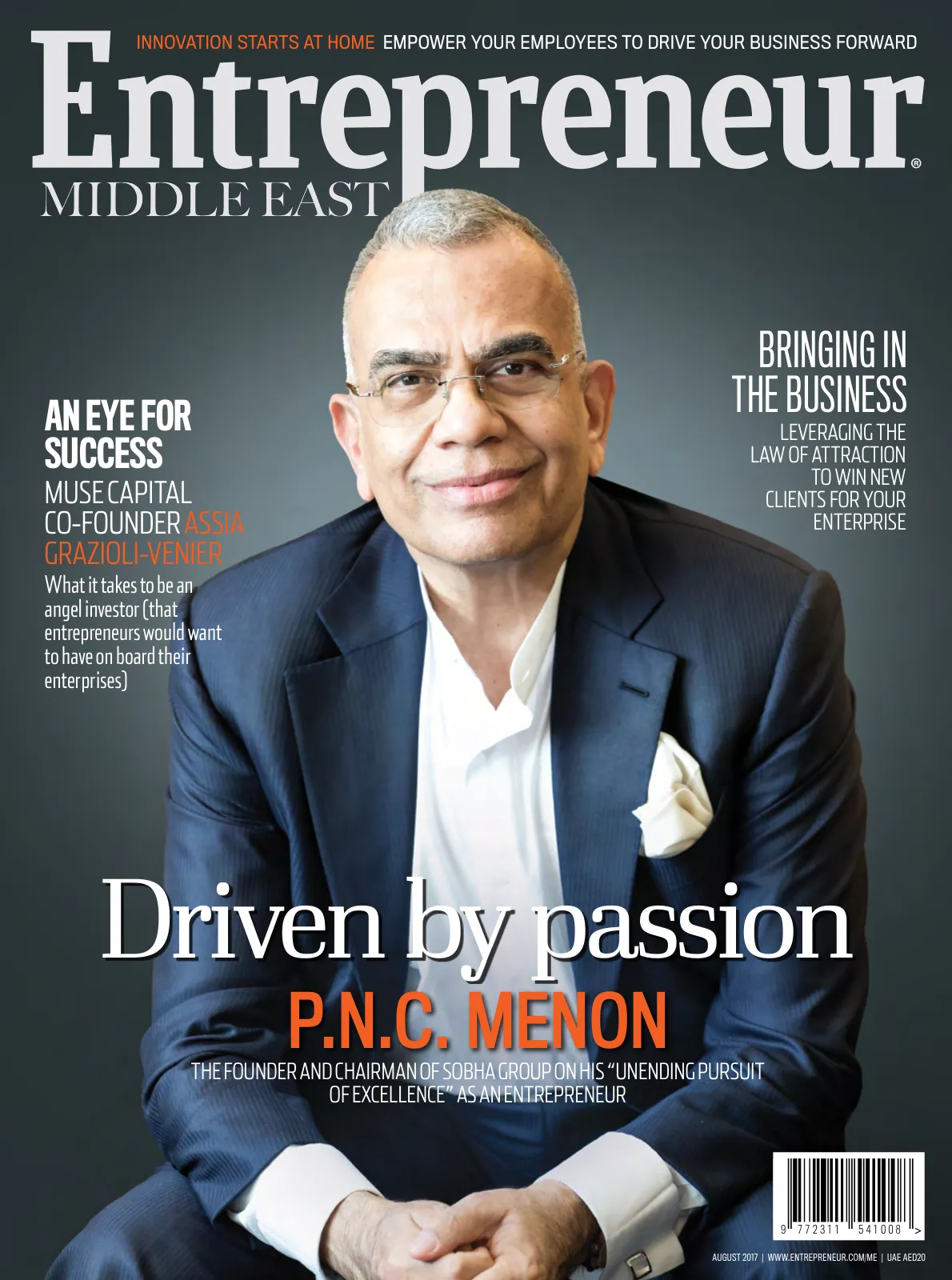
Entrepreneur Middle East, August 2017
Page 1
Innovation starts at home Empower your employees to drive your business forward
Bringing in
the business
Leveraging the
law of attraction
to win new
clients for your
enterprise
An eye for
success
Muse Capital
co-founder Assia
Grazioli-Venier
What it takes to be an
angel investor (that
entrepreneurs would want
to have on board their
enterprises)
Driven by passion
August 2017 | www.entrepreneur.com/me | UAE AED20
9
7 7 2 3 1 1
5 4 1 0 0 8
>
The founder and Chairman of Sobha Group on his “unending pursuit
of excellence” as an entrepreneur
P. N. C. Menon
Page 2
Page 3
august 2017 Entrepreneur
3
CONTENTS
august 2017
20
INNOVATOR:
Driven by passion
PNC Menon
The founder and
Chairman of Sobha Group
on his “unending pursuit
of excellence” as an
entrepreneur.
26
INNOVATOR:
An eye for success
Assia Grazioli Venier
The co-founder of Muse Capital
on what it takes to be an angel
investor (that entrepreneurs
would want to have on board
their enterprises).
30
‘TREPONOMICS:
PRO
Understanding the Middle
East’s skills gap
Market trends are
reprioritizing valuable
skills, and in some cases,
demanding completely
new competencies, writes
Bayt.com’s VP of Employer
Solutions, Suhail Al-Masri.
70
MONEY:
VC VIEWPOINT
Envisioning potential
Enabling Future’s managing
partners Saad Umerani
and Hubertus Thonhauser
explain the Dubai-based VC
firm’s investment approach
and considerations.
72
START IT UP:
Q&A
Inspiring loyalty
Alborz Toofani, founder and
CEO of Snappcard, looks
back at his entrepreneurial
journey over the past five
years.
82
‘TREPONOMICS:
PRO
Innovation starts at home
Salman Dawood Abdulla,
Executive Vice President,
EHSSQ and Business
Transformation at Emirates
Global Aluminium
(EGA), makes the case
for empowering one’s
employees to drive
innovation.
26 Assia Grazioli Venier, co-founder, Muse Capital
20
PNC Menon,
founder and Chairman,
Sobha Group
Page 4
Page 5
Page 6
Page 7
Page 8
Page 9
Page 10
Entrepreneur august 2017
10
CONTENTS
August 2017
50
CULTURE:
LIFE
Fueling the future
Tanvir Haque, founder,
Freshstone Consulting,
explores ways in which
educators can identify
innate entrepreneurial skills
in children at a crucial age,
and support their growth.
78
START IT UP:
Q&A
Conquering the globe
Dubai-based startup
Shedul’s software for the
beauty industry has been
adopted by over 40,000
merchants in more than 120
countries- in a span of just
two years.
34
TECH:
THE FIX
Blockchain: [much] more
than a buzzword
Ian Dillon, co-founder, Now
Money, explores how the
fintech innovation can make
a positive impact on global
issues.
44
CULTURE:
TRAPPINGS
‘Trep gear
The executive selection for
the entrepreneur on your
list that has everything.
Okay, maybe for a little self-
reward as well.
46
‘TREPONOMICS:
ESQUIRE GUY
Happy endings
The Esquire Guy walks you
through the best way to
wrap up a business meeting.
42
TECH:
SHINY
#TamTalksTech
Gadgets and doodads
that you might’ve missed
out on, sourced by a tech
aficionado. Yes, it’s okay
to want them all… and no,
it’s not our fault.
42 Huwaei Honor 9
78
William Zeqiri,
co-founder and
CEO, Shedul
50 Educators have key roles to play in nurturing their students’
entrepreneurial spirit
Page 11
Page 12
Entrepreneur august 2017
12
72
CONTENTS
August 2017
34 Blockchain: [much] more than a buzzword
44
Hublot
Classic Fusion
Chronograph
Berluti
Snappcard’s Emre
Kistak, Managing
Partner UAE, Alborz
Toofani, founder and
CEO, and Onur Witt,
Creative Director
56
‘TREPONOMICS:
SKILLSET
Building your personal
infrastructure
Business coach Murtaza
Manji offers five
suggestions to help you
achieve excellence- be it
personal or professional.
38
TECH:
ONLINE ‘TREP
Usability first
Clinton O’Leary, Chief
Commercial Officer of
Yvolv, says it’s key to
pay attention to the user
experience aspect of your
tech product.
66
START IT UP:
ECOSYSTEM
Reimagining Iraq
Things are moving in the
right direction for the
country’s entrepreneurial
ecosystem, notes Marwan
Ahmed, Director, Mishwar,
a grocery delivery startup in
Baghdad.
16
EDITOR’S NOTE
By Aby Sam Thomas
60
CULTURE:
BUSINESS UNUSUAL
Gifting done right
UAE startup joi wants to
become the go-to portal for
all things gifts.
48
CULTURE:
LIFE
Constraints make you better
James Clear on why the right
limitations help in boosting
performance.
Page 13
Page 14
Entrepreneur august 2017
14
SUBSCRIBE
Contact subscriptions@bncpublishing.net to receive
Entrepreneur Middle East every issue
EDITOR IN CHIEF Aby Sam Thomas editor@bncpublishing.net
CEO Wissam Younane wissam@bncpublishing.net
MANAGING DIRECTOR Walid Zok walid@bncpublishing.net
DIRECTOR Rabih Najm rabih@bncpublishing.net
CREATIVE LEAD Odette Kahwagi
MANAGING EDITOR Tamara Pupic
STARTUPS SECTION EDITOR Pamella de Leon
COLUMNIST Sindhu Hariharan
COLUMNIST Tamara Clarke
COLUMNIST Shoug Al Nafisi
COLUMNIST Erika Widen
EVENTS LIAISON Mark Anthony Monzon
PO Box 502511 Dubai, United Arab Emirates
P +971 4 4200 506 | F +971 4 4200 196
For all commercial enquiries related to
Entrepreneur Middle East contact
sales@bncpublishing.net
All rights reserved © 2016.
Opinions expressed are solely those of the contributors.
Entrepreneur Middle East and all subsidiary
publications in the MENA region are officially licensed
exclusively to BNC Publishing in the MENA region by
Entrepreneur Media Inc.
No part of this magazine may be reproduced or
transmitted in any form or by any means without written
permission of the publisher.
Printed by Raidy Emirates Printing Group LLC
www.raidy.com
Images used in Entrepreneur Middle East are credited when necessary. Attributed use of
copyrighted images with permission. All images not credited otherwise Shutterstock.
Marwan Ahmed
Suhail Al Masri
Fatima Al Shirawi
Helen Al Uzaizi
Fida Chaaban
Matthew Chaban
James Clear
Nick Davis
Salman Dawood Abdulla
Ian Dillon
Tanvir Haque
Shelina Jokhiya
Murtaza Manji
Ross McCammon
Jasmine Montgomery
Clinton O’Leary
Hubertus Thonhauser
Saad Umerani
CONTRIBUTING WRITERS
www.entrepreneur.com/me
Access fresh content daily on our website!
MIDDLE EAST
EntMagazineME
@EntMagazineME
Entrepreneur-me
EntrepreneurMiddleEast
EntMagazineME
EntMagazineME
EntMagazineME
MIDDLE EAST
In addition to our print edition, we’re bringing
you all sorts of industry news on our web
mediums. Joining us online means getting
relevant business and startup content in
real-time, so you’re hearing about the latest
developments as soon as we do. We’re looking
forward to interacting with our readers on all of
our social media and web platforms- like any
thriving business, we’re looking to give and take.
#TrepTalkME is already happening on all of our
digi platforms, and all good conversations go
both ways. See you on the web!
Page 15
etro.com
Page 16
Entrepreneur august 2017
16
EDITOR’S NOTE
Aby Sam Thomas
Editor in Chief
@thisisaby
aby@bncpublishing.net
Time is money
Are you burning through a modern currency?
A
s someone who often
feels there aren’t enough
hours in the day to fin-
ish all of the tasks on my
plate, I am always be-
fuddled by those who seem to have
time to spare for meetings with
me on a work day, with the agenda
primarily being “just to catch up.”
In the modern economy, time re-
ally is money. How are you spend-
ing it? Is there an ROI?
“Catch up” requests, especially
when they come from entrepre-
neurs, often set off warning bells in
my head. If your aim with a meet-
ing is to apparently only exchange
pleasantries with me, rest assured
that I am already skeptical about
you and your intentions, and I defi-
nitely do not appreciate the seem-
ing disregard for my time as well.
Sure, there may be something you
actually want to discuss in person
with me- but if that is indeed the
case, wouldn’t it be better if you
simply laid that out in your first
email requesting the meetup? For
one, that’d help me see if we can
get things done over email itself (or
maybe a call), and if not, we’d now
be clear about the main points of
discussion when we do meet with
each other- surely, that’d be a bet-
ter use of time, be it yours or mine!
One important note here though:
if you are going to set an agenda for
a meeting, make sure it is specific
and to the point. For instance,
requesting me for a meeting “to ex-
plore collaboration opportunities”
doesn’t mean anything to me- I’d
much rather have you do some re-
search of your own, and then come
to me with potential action items
that could work for the both of us.
For one, this shows me that you
have seriously looked through
our work, and found out ways to
perhaps add value to what we do,
while satisfying your own priori-
ties- a win-win situation, if you
will, and that is often enough for
me to want to invest my time with
you. As entrepreneurs, you don’t
have the luxury of wasting your
time- and you sure as heck cannot
expect anyone else to set aside
their time for you for no reason.
Keep it real, people.
Page 17
Page 18
Entrepreneur august 2017
18
IN THE LOOP
Flat6Labs Cairo announces first close of
its EGP100 million fund
Enabling Egypt’s
ecosystem
www.ibtikarfund.com | flat6labs
Building a community
Palestine early-stage VC firm Ibtikar Fund raises
US$2.5 million from regional and global investors
Ahmed El Alfi, founder, Flat6Labs, H.E. Dr. Sahar Nasr, Minister of Investment and International
Cooperation, and other officials at the MIIC signing event
investing in
innovative palestinian
startups
E
arly-stage startups in Egypt,
the time is ripe to get your
pitch decks ready, and pre-
sent your venture to Flat6Labs
Cairo. The accelerator program
has announced the first close of
its EGP100 million Cairo fund
called Flat6Labs Accelerator
Company, which, according to
Flat6Labs, will help them “di-
rectly support over 100 Egyptian
early stage-startups over the
upcoming five years” with seed
funding of up to EGP1 million per
startup, training, mentorship and
a host of other services. This in
turn will help create “more than
1,000 high-impact jobs” in the
Egyptian market, says Flat6Labs.
The close of this round is
supported by commitments
from Egypt Ventures- a com-
pany of the Egyptian Ministry
of Investment and International
Cooperation (MIIC) managed
by NI Capital, and the Egyptian-
American Enterprise Fund
(EAEF) with each party pooling
in EGP10 million each. With
this financial injection, Egypt
Ventures and EAEF join the In-
ternational Finance Corporation
[that invested EGP50 million in
November 2016] in the list of
strategic institutional backers
supporting Flat6Labs’ mission to
help grow Egypt’s entrepreneur-
ship community.
“The fund will provide seed
funding of EGP500,000 upon
joining the accelerator (250,000
in cash, and 250,000 non-cash
investment), and up to EGP1
million per startup in follow-up
investment, allowing Egyptian
startups to reach their customer
base and scale their operations
locally and regionally,” says Wil-
lie Elamien, Managing Director,
Flat6Labs Cairo. While MIIC says
it aims to support entrepreneurs
develop their skills by provid-
ing a conducive environment for
growing their business, EAEF, on
its part, has said that it identi-
fied a shortage of seed capital in
Egypt, and decided to align with
Flat6Labs to help address the
gap.
As an early-stage startup
accelerator, Flat6labs supports
startups at “idea, concept or
prototype or early-revenue gen-
eration stages” and Elamien says
“they are sector agnostic, [but]
are particularly interested in
[supporting] education, health-
care, fintech, digital content,
consumer internet and ICT start-
ups.” Flat6Labs Cairo’s ninth
accelerator cycle is scheduled
to start later this summer, and
according to the organization,
the cycle has already witnessed
an “unprecedented” number
of applications- with over 500
Egypt-based companies compet-
ing for a space in the program
and to receive seed funding.
www.flat6labs.com/location/cairo
F
inancial support, espe-
cially in the early stages
of a business lifecycle is a
missing link most startups in
Palestine (and perhaps in many
parts of the Middle East) suffer
from. Helping make things
better for Palestine’s entrepre-
neurs in this regard is Ibtikar
Fund, an early-stage venture
capital fund with a mission to
“close a critical funding gap
between acceleration and VC,
and other later-stage investors”
for Palestine startups. And now
the VC firm has got a boost
in achieving this objective, as
it has announced raising an
investment of US$2.5 million
in July 2017 from the Interna-
tional Finance Corporation (IFC),
the Dutch Good Growth Fund
(DGGF), and Reach Holding (a
Middle East-based global entity
headquartered in Palestine) as
investors. With this raise, Ibtikar
increases its capital to $10.45
million, giving it the ability
to invest in more Palestinian
startups.
“We look for ideas and start-
ups that are scalable, and which
serve the MENA region or glob-
al need,” declares the website of
Ibtikar (meaning innovation in
Arabic), which launched in May
2016, and has made 14 invest-
ments in Palestinian startups so
far, and growing. “These new
investments are a validation
of our work over the last two
years, and a vote of confidence
in our management,” Habib
Hazzan, Managing General
Partner, Ibtikar, said in a state-
ment. “We are glad that the
IFC, DGGF and Reach Holding
agree with our current investors
in the potential of Palestinian
startups and welcome them to
our fund,” he added.
As per Ibtikar Fund’s invest-
ment strategy, laid down on
its website, the firm supports
companies in two stages- seed
and early-stage, and is looking
to “invest in highly-skilled and
complementary management
teams that are willing to take
risks and go out of their com-
fort zones.” At the seed level,
the Fund looks for entrepre-
neurs through local accelera-
tors, and it also remains open
to make Series A investments
in its portfolio companies. Man-
aged by Hazzan and Ambar
Amleh, the Fund benefits from
the involvement of some of the
country’s renowned business
executives- its board is chaired
by Hashim Shawa, Chairman
and General Manager of the
Bank of Palestine (the fund’s
anchor investor), and includes
Zahi Khouri, Chairman and CEO,
National Beverage Company.
While this marks the first in-
vestment in Palestinian venture
capital and in MENA region
overall by DGGF, this is IFC’s
first investment in Palestine’s
ecosystem and the second
under its new Startup Catalyst
initiative (the first was its
support to Flat6Labs Cairo in
Egypt). “We believe Ibtikar can
play a pivotal role in strength-
ening the area’s entrepreneurial
ecosystem, creating jobs, and
attracting more investment,”
Mouayed Makhlouf, IFC’s
Regional Director in the MENA
region, said in a statement.
Page 19
Page 20
innovator
innovator
Entrepreneur august 2017
20
“This is my playing
ground- it’s not
work! I get maximum
enjoyment from this…
It is [my] passion.
It’s not business;
it’s a very personal
thing.”
P. N. C. Menon, founder and Chairman,
Sobha Group
Page 21
august 2017 Entrepreneur
21
Driven by
passion
innovator
Sobha Group founder and Chairman P. N. C. Menon
By Aby Sam Thomas
“[dubai] is one of the best places
to do business. You are not
disturbed in any way; you just
do whatever you want to do to
be the best. Every opportunity
is provided by the environment
and the country.”
Image courtesy Sobha Group
>>>
P
. N. C. Menon is a detail-
oriented person- that
particular aspect of his
personality became quite
clear to me as soon as I
began my conversation
with the 68-year-old
entrepreneur. I could
see Menon’s inquisitive
nature come to the fore as he peppered me
with questions relating to my background
and career so far- he was interested in
knowing the specifics, he wanted to know
the how and the why. (The fact that Menon
had actually listened to me and registered
all that I said became apparent when he
later introduced me to other members of his
organization by correctly recalling all of the
particulars that I had told him.) Of course,
such attention to detail is one of the many
traits that has stood Menon in good stead
over the course of what can be described as
a truly remarkable entrepreneurial journey,
which sees him today at the helm of the
Sobha Group, which was established back
in 1976 in the Sultanate of Oman. As its
founder and Chairman, Menon has essen-
tially spearheaded the growth and develop-
ment of the Sobha brand for over 40 years
now, and he continues to do that to this
very day- when I ask him what drives him
to come to work every day, he laughs and
replies: “This is my playing ground- it’s not
work! I get maximum enjoyment from this…
It is [my] passion. It’s not business; it’s a
very personal thing.”
Page 22
Entrepreneur august 2017
22
innovator
“Diversify, get into something else. Move into
another geography… The growth is never-
ending. Even for the biggest companies in the
world, I’d say that there is a tremendous
amount of opportunities for them to grow
further. Sometimes it may not be in the same
domain- you just have to take a diversion.”
A Sobha Group residential project
Given that response, it’s easy to see
where Sobha Group got its “Passion At
Work” motto from- Menon certainly
seems to live by that principle, and
his company is following his lead in
terms of what he calls “an unending
pursuit of excellence.” With operations
in India and the Middle East, Sobha
has, since its inception, delivered over
89.64 million square feet of real estate
projects, and is currently at work on
71 projects with a developable area of
101 million square feet. In India, where
Sobha Limited is a listed entity, it was
recently declared by the 2016-17 Brand
X Report to be “the top national realty
brand across asset class” for the third
consecutive year. In contrast to that,
Sobha is a relatively new entrant in
the UAE’s real estate space, but the
developer has still managed to garner
quite a lot of attention and interest for
its current projects, which include the
US$4 billion Sobha Hartland and the
$8 billion Meydan Sobha District One
developments in Dubai. With regard
to the current state of the real estate
market, Menon notes that while there
may have been challenging times in the
past year, he’s expecting an uptick in
activity in 2017. “The real estate busi-
ness is cyclical, the world over; it’s not
only Dubai,” he explains. “According to
me, this year, we have gone into a posi-
tive cycle.”
This, of course, bodes well for Sobha
as an enterprise in the UAE’s real estate
sector, where it hopes its finesse and
expertise (Menon notes the company’s
capabilities as a backward integrated
institution as being one of its main dif-
ferentiators), as well as the uncompro-
mising quality of its products, will help
it become a market leader in this par-
ticular space. Of course, Menon’s track
record so far does tip the odds in his
favor- after all, Menon’s now legendary
success story began with the Indian
entrepreneur arriving in Oman with
only seven dollars to call his own in
1976. With borrowed capital, he set up
a small business that dealt in furniture
and interiors on the streets of Muscat,
and this outfit grew slowly (but surely)
into an enterprise that became known
for its quality of work. As time passed,
the company began securing a number
of noteworthy interiors contracts,
including projects from the Sultan’s
office, which led to its next phase of
growth. As the business solidified its
presence in the Gulf, Menon then made
a move into India’s property sector
by setting up Sobha Limited in 1995,
which has since become the country’s
third largest real estate development
company, in terms of total square feet
delivered. In the meantime, Sobha
also made its entry into the UAE’s real
estate scene in 2003, with the Dubai-
headquartered company focusing pri-
marily on residential and commercial
projects. Menon has nothing but good
words to say about doing business in
Dubai- he’s an unabashed admirer of
the growth the Emirate has seen so far,
and he is definitely on board to partici-
pate in its continued development in
the years to come. “It is one of the best
places to do business,” Menon declares.
“You are not disturbed in any way; you
just do whatever you want to do to be
the best. Every opportunity is provided
by the environment and the country.”
At this point, it’s pretty easy to see
that Menon has accomplished a lot –a
lot- over the course of his entrepre-
neurial career. But what’s particularly
interesting to note about his journey
so far is that when Menon reaches a
particular stage of success, he then
goes and raises the bar for himself, by
setting new goals to aspire toward. It’s
a curious little trait- but it also makes
it clear that Menon, as an entrepreneur,
is never complacent. “You are born
with that kind of outlook, you know,”
he says. “You are never happy with
what you do- there’s always a feeling
that there’s a gap. And when you fill
that gap, there’s another gap- so it’s
an unending pursuit of excellence. I
don’t think you can go to market and
start developing that quality- it’s in the
DNA of a person, who looks for that
perfection.” As the saying goes, noth-
ing succeeds like success, and Menon
believes in that wholeheartedly- ac-
cording to him, there is no finish line to
the growth one can aspire to for their
enterprise. “As a businessperson, you
cannot [ever] say that you’ve reached
the peak of whatever you wanted to
achieve,” he says. “You cannot say that
Page 23
august 2017 Entrepreneur
23
“You’ve got to be extremely patient.
You’ve to be extremely careful with
your name and reputation- build that,
create a strong foundation, and then
success is automatic. But if you’re going
to be in a hurry, you’ll have a weak
foundation, and you will collapse.”
P. N. C. Menon,
founder and Chairman,
Sobha Group
>>>
there is no further scope for
you to grow. Diversify, get
into something else. Move
into another geography…
The growth is never-ending.
Even for the biggest com-
panies in the world, I’d say
that there is a tremendous
amount of opportunities for
them to grow further. Some-
times it may not be in the
same domain- you just have
to take a diversion.”
Menon’s refusal to budge
from the high standards he
has set for the company has
also led him to have a repu-
tation, among some of his
staff at least, as he himself
put it, of being “a terror.”
Sobha Group President
Jyotsna Hegde tells me that
there were times not too long
ago when Menon would lose
his cool at subordinates who,
say, had made a mistake,
or hadn’t ascribed to the
same level of perfection he
believed in. But Hegde notes
that such temper flare-ups
were simply a reflection
of Menon’s passion for his
work- he just couldn’t see
why others didn’t share
that feeling. “When you
look at it from his side, it
was frustration,” Hegde
explains. “Because he gets
it so quickly, and he knows
it so quickly- and he is frus-
trated that you don’t get it…
Once you understand that,
then you see the value of
everything you thought was
difficult, and you become
accepting.” However, this
matter is no longer a topic of
discussion at Sobha, Hegde
Page 24
Entrepreneur august 2017
24
innovator
innovator
“You are never happy with what you do-
there’s always a feeling that there’s a gap.
And when you fill that gap, there’s another
gap- so it’s an unending pursuit of excellence.
I don’t think you can go to market and start
developing that quality- it’s in the DNA of a
person, who looks for that perfection.”
P. N. C. Menon,
founder and Chairman,
Sobha Group
reveals- Menon’s temper issues are
now a thing of the past. Last year -on
October 3, 2016, to be exact (yes, Me-
non remembers the date all too well)-
Menon lost his temper for some reason
in the office, following which Hegde
told Menon that his actions would hurt
the confidence of the young upstarts
who had joined their company, and
might even cause them to leave. “So,
she said, you know, this will kill our
company,” Menon recalls. “If you want
to build a professional company (which
we are looking at, definitely), she said,
you need to please stop doing this, and
it will be in the interests of the institu-
tion. I said, give me three months’
time.” Did it work? “I have now
completed 10 months without shout-
ing,” Menon says, happily, with Hegde
confirming the veracity of this state-
ment. Of course, this is just another
testament to Menon’s psyche- he just
needs to be convinced of the right-
ness of a particular course of action.
And once he has done so, it’ll be hard
to budge him even a little from that
particular path- a quality that seems to
have kept him on the right track for all
his years in business.
For people who are just entering the
Middle East arena to set up their busi-
nesses, the environment they have in
front of them today is a lot different
from the one Menon set foot in all
those years ago. Menon notes that en-
trepreneurs today seem to be in a hurry
to see their businesses succeed- it’s a
characteristic that he –no surprises
here- is not particularly fond of. “We
should never be in a hurry,” he says.
“The foundation, you know, is horizon-
tal, and the growth is vertical. And the
foundation of the business has to be
done effectively… This is where I have
seen most of the people fail [with their
businesses]. They are in a hurry, they
want to be a billionaire, they want to
get to X/Y/Z- [but] it will not happen
like that. You’ve got to be extremely
patient. You’ve to be extremely careful
with your name and reputation- build
that, create a strong foundation, and
then success is automatic. But if you’re
going to be in a hurry, you’ll have a
weak foundation, and you will col-
lapse.” It may be a real estate-centered
analogy, but Menon knows what he’s
talking about- building the Sobha
brand to what it is today has, of course,
taken an awful lot of patience and
hard work, but it has also involved an
absolutely strict unwillingness to cut
corners in any aspect of the business.
It’s a value system that Menon has put
in place at the top, and he believes it
has indeed differentiated the company
from its peers, and also ensured its
longstanding success. “If you start
chasing money in any business, you will
fail,” Menon declares. “Start chasing
success- money is only a byproduct.”
Page 25
THE HOME OF
REAL ESTATE INVESTMENT
REGISTER ONLINE » SAVE AED100
Dubai World Trade Centre, UAE
Cityscape Global 2017 is the largest and most influential real
estate investment and development event for emerging markets
globally. Bringing together investors, developers, government
officials and real estate professionals, there is no better place to
find investment opportunities and new business partners.
THE LARGEST AND MOST INFLUENTIAL REAL ESTATE INVESTMENT AND
DEVELOPMENT EVENT FOR EMERGING MARKETS GLOBALLY
11 - 13 SEPTEMBER 2017
+9714 336 5161 info@cityscapeglobal.com www.cityscapeglobal.com
Visit the show
for EXCLUSIVE
DISCOUNTS AND
OFFERS!
Official Business
Website
Business Partner
Projects Marketing
Sponsor
Organised by
Official Russian
Partner
Platinum Sponsors
Foundation Partners
Strategic Partner
Official Classified
Partner
Silver Sponsor
Page 26
Entrepreneur august 2017
26
Muse Capital co-founder Assia Grazioli-Venier
on what it takes to be an angel investor (that entrepreneurs
would want to have on board their enterprises)
images courtesy muse capital
By Tamara Pupic
innovator
Assia Grazioli-Venier is a Los Angeles-based media executive, angel investor and advisor
to high-growth tech startups and investors.
T
here is a list
of character
traits that
entrepreneurs
look for (or
should look
for) in an
angel investor, with putting
a signature on the back of
a check or on the bottom
of contracts being just one
of them. Various accounts,
including those often featured
in our magazine, favor pos-
sessing industry expertise,
facilitating introductions
to their broad networks of
contacts, following a code of
conduct (this seems to have
risen in importance only
recently), and the list -by no
means exhaustive- goes on.
There are different degrees
of all of those as well. But
when it comes to assessing
an angel’s belief in the less
experienced, how high would
you rate someone who sees
“no” as “on” as being one of
their strengths? This may
be an everyday battle for
someone with dyslexia, like
Assia Grazioli-Venier, but
this Los Angeles-based media
executive, angel investor and
advisor to high-growth tech
startups and investors has
found value in what many
may consider a hindrance.
Speaking at a TEDxLUISS
edition in her native Rome
last year, she shared her ex-
perience with dyslexia as one
example of how she learnt to
endorse disruption from an
early age. “Life has already
taught me how to anticipate
the unexpected, and not re-
sist disruption, but embrace
the change,” she says, in her
talk. As Grazioli-Venier sees
it, achieving the impossible
and never taking no for an
answer is part of her daily
agenda- and in today’s entre-
preneurial age, that is a skill
definitely worth having.
“The best advice I can give
an entrepreneur is to go with
conviction, surround yourself
with the smartest people
(smarter than you), and be
firm but flexible with your
idea,” she says. “Most of the
most successful businesses
today had naysayers, and in
fact, some could say that the
more naysayers you have,
the better the idea could be.”
One example, she notes, is
Sweden’s music streaming
company Spotify, which is
reportedly valued at US$13
billion, where she has served
as its Director of Special
Projects for over six years.
“When I started advising the
founder, Daniel Ek, and the
business, Spotify had under
100 employees, and although
they had a proven business
model in their local Sweden,
everyone was telling them
they were crazy,” Grazioli-
Venier says. “They were
told there was no way that
streaming could reinvigorate
the music business, not to
mention their lofty claims
that streaming would inject
more money into the music
business than ever before.
And Spotify was marred by
disbelievers, with talent and
industry folks buying into
unfounded negative stories
in the press that it wasn’t
paying artists. But Spotify
persisted, proved their model,
built their product, evolved
it continuously to attract
and retain loyal customers,
and have since pumped the
music industry with billions
of dollars.”
Grazioli-Venier is today also
on the board of advisors of
Northzone, a European tech-
nology investment company
whose portfolio includes Spo-
tify, iZettle, MarketInvoice,
Outfittery, Trustpilot, Fyndiq
and Qapital. Furthermore,
since 2012, Grazioli-Venier
has been on the board of
Italy’s Juventus Football
Club, being the first female
and youngest board member
to serve in such a role in
the club’s history. With this
professional background,
Ivy League education, and
an obviously undefeatable
personality, she stepped
into a new role in 2016 by
co-founding Muse Capital,
an early-stage strategic
angel investment fund that
focuses on consumer-facing
entrepreneurs and technolo-
gies. Network and experience,
she says, are something that
most young entrepreneurs
don’t have, but both are vital
to a fledgling startup. For
that reason, Grazioli-Venier
explains that a good angel
investor needs to have the
power, experience, and influ-
ence to help an entrepreneur
bring his or her vision to
life. “A great example of this
is our role as investors and
advisors to our portfolio
company, ReplyYes,” she
says. “When we met them,
they had an excellent team, a
proof of concept and revenue,
but had been declined by 26
Page 27
august 2017 Entrepreneur
27
>>>
“You invest in 100, hoping for
one big win, but you can only
do that when the 100 you have
invested in are well-managed,
great ideas led by truly
talented entrepreneurs.”
“There is incidentally no shortage of
women entrepreneurs, as Al Masah
Capital estimated in 2016 that women-led
SMEs in the Gulf are worth $385 billion.”
Muse Capital co-founders
Assia Grazioli-Venier and
Rachel Springate
investors. Within two weeks
of us investing, we had raised
them just under $2 million
from leading funds in the US,
and supercharged their busi-
ness development outreach
to generate revenue more ag-
gressively. This led to further
investments by Disney, for
example, who have now taken
them into their accelerator
program.”
This autumn, Grazioli-Veni-
er will attend the 19th Global
Women In Leadership Eco-
nomic Forum in Dubai, where
she will be delivering a key-
note address. With respect
to the UAE’s entrepreneurial
ecosystem, Grazioli-Venier
notes quite gladly that the
number of angels, incubators
and accelerators here are all
on the rise. “I am thrilled to
see that some of the most
prominent angel networks
are centered on women, such
as WOMENA that unites high
net worth women to make
joint investments, and the
Women’s Angel Investment
Network (WAIN) that brings
together female investors to
support women entrepre-
neurs. There is incidentally
no shortage of women entre-
preneurs, as Al Masah Capi-
tal estimated in 2016 that
women-led SMEs in the Gulf
are worth $385 billion. There
is still a deficit of venture
capitalists in the region, and
those that have been there
have not historically made
any significant plays. But this
is slowly changing.” Dubai,
by itself, is turning into a real
startup hub, she adds. “Until
recently, the UAE has been
leagues behind the Valley, or
even cities like New York, DC,
and London. It has struggled
to get there because, while
historically the wealth was
there, the talent was not.
After all, the Zuckerbergs of
the region knew they were
likelier to succeed if they
relocated to an already estab-
lished hub like San Francisco.
But this has been changing
significantly over the last
1.5 years. The government is
pumping funds into Dubai’s
free zones and mini cities–
Internet City is a good ex-
ample. Also, whereas money
used to immediately leave
Dubai to Europe, for example,
investors are now staying
put. After Brexit and the
potential breakdown of the
Eurozone, people are playing
it safe and doubling down at
home. So, over the last two
years, we’ve seen a sudden
jump in activity in the UAE,
with Dubai finally becoming
a major hub. It is now a cool,
hip, and savvy environment,
encouraging and attracting
talent as well as funds. Tal-
ent is now not just cropping
up, but staying.”
In her opinion, the UAE, as
a burgeoning ecosystem that
is not yet ripe and matured,
needs young, experienced
strategic investors, who work
alongside institutional inves-
tors, with a global vision and
a local approach. The reasons
are plenty- Careem, Fetchr,
Bayzat, Souqalmal, and
Laundrybox are just a few
examples of UAE-based start-
ups that can go global, she
adds. From her personal per-
spective, she reveals that the
Muse Capital team plans to
raise capital for one of their
funds to invest in a well-
balanced array of innovative
startups both in the US and
the UAE over the next five
years. So, what is their take
on the next big disruption?
Rachel Springate, co-founder
at Muse Capital, says that
it will come from artificial
intelligence. “First, there
was the internet/web, then
mobile, but now the future is
voice and using AI-enabled
voice assistants,” she says.
“We will be controlling all
aspects of our daily life with
our voice, from summoning a
car, to navigation to control-
ling our homes to ordering
groceries, and so on. The ear-
liest iterations like Siri and
Alexa/Google Home are just
the beginning.” Meanwhile,
the fund’s associate Zach
White thinks that emerging
innovations in the financial
service industries will be the
largest technologically-driven
disruptive force across the
globe in the next decade.
“With the proliferation of
data-intensive platform-
based services offering a
wider range of products, the
average retail investor will
Page 28
Entrepreneur august 2017
28
innovator
Muse Capital co-founder Assia
Grazioli-Venier spoke about her
battle with dyslexia at a TEDxLUISS
edition in Rome last year
“While the right investors will increase
your startup’s success rates, the wrong
ones will put your business on the
wrong trajectory, waste your time, and
even cause you to miss opportunities to
raise more money.”
Grazioli-Venier is the first female and youngest board member to serve has been on
the board of Italy’s Juventus Football Club
have access to more sophis-
ticated capabilities around
their finances than ever
before,” he explains. “Once
niche areas of finance with
little traction, services such
as P2P lending, cryptographic
exchange, mobile payments
and banking, and fully au-
tomated advice and wealth
management are all examples
of the democratization of the
industry. The flattening effect
of this once very institution-
ally operated business, in
combination with greater di-
rect access to the internet as
well as sources of data, will
cause the average individual
consumer to benefit most. As
the increase in financial of-
ferings drives prices down as
a whole across the industry,
large banks and financial
institutions will need to
aggressively and continually
pivot in order to offer consis-
tent value to their clients.”
To all of those willing
to support these kind of
forward-thinking ideas in the
UAE, Grazioli-Venier’s advice
is to be patient and optimis-
tic. “Investing, especially an-
gel investing, is ultimately a
game of Russian Roulette,”
she says. “You invest in 100,
hoping for one big win, but
you can only do that when
the 100 you have invested
in are well-managed, great
ideas led by truly talented
entrepreneurs. As talent
stays in the region, strategic
investors start investing, and
titans of the business world
get involved, the environment
will be more open to risk.”
Grazioli-Venier is also hope-
ful about seeing more people
become angel investors in
the region- but for that to
happen, she notes that some
misconceptions about this
space need to be eliminated.
“The biggest misconception I
see from new angel investors
is that they want to fund
exciting projects, rather than
supporting incredible teams,”
she says. “They become
infatuated with an idea, and
get involved so they can help
bring it to life. There are
a couple of problems with
this. The first is that an idea
is nothing without a smart,
capable, visionary founder at
the helm, along with a strong,
vital team. Even with an an-
gel’s investment and
support, the concept
will come to nothing
with a weak team.
The second reason
not to get infatuated
with an idea is that
ideas change. If an
angel only invests in
a company because
they’re in love with
their idea, they’ll be
disappointed when
the practicalities
mean the concept
has to evolve into
something differ-
ent. They might
even hang on to the
original idea for way
too long, holding the
company back from
doing what it has
to. Another misconception
angel investors have is that
they’re going to be a part of
the company and its lifestyle.
While many startups have
a great team and exciting
environment, angel investors
cannot be there to make
friends. An angel investor
needs to give the company
space and distance to carry
its idea to execution. Becom-
ing friends with the team
might be tempting, but it will
ultimately waste time they
need to become successful.”
This can lead to destructive
behaviors that angel inves-
tors need to be wary of, says
Grazioli-Venier. “There is
often an innate passion that
an angel investor has towards
the company she or he is
investing in,” she explains.
“And that passion can be
funneled to accelerate the
business, but can also lead
to an over indulgent investor
who sees himself as co-CEO.
Or worse, co-founder. One
of the most destructive
behaviors an angel investor
can exhibit is a thirst for
power. When you invest in a
company, they are necessarily
reliant on you. It’s all too
easy to start feeling the allure
of that power, and expect re-
spect, flattery, and subservi-
ence. Once an investor has
this attitude, the company
is in trouble, as they’re ex-
pected more and more to
bend to the will of the inves-
tor, rather than doing what
they know is best for their
company.” To prevent such
situations from happening,
Grazioli-Venier says that the
onus is on entrepreneurs to
pick the right investors to
associate with. “Founders
should be on the lookout for
these behaviors when look-
ing for an angel,” she says.
“While the right investors
will increase your startup’s
success rates, the wrong ones
will put your business on the
wrong trajectory, waste your
time, and even cause you to
miss opportunities to raise
more money. Conversely,
founders might endow their
angels with this power. They
might expect the angel to be
a miracle worker, who can
give them all the money, con-
nections, and customers they
need. Angel investors need to
look out for this and not feed
this behavior. They need to
strip the founder of their il-
lusions, and work with them
on the foundation of what is
realistically possible.”
Page 29
Page 30
Entrepreneur august 2017
30
ETHICS | ESQUIRE GUY | SKILLSET | MARKETING | PRO
TREPONOMICS
Understanding
the Middle East’s
skills gap
www.bayt.com
Market trends are reprioritizing
valuable skills, and in some cases,
demanding completely new
competencies By Suhail Al-Masri
Most critical skills for junior positions
Creative thinking
Global mindset
Design / visual thinking
Time management
Logical / critical thinking
Entrepreneurship
People management
Team work
Written communication
Emotional intelligence
Job-specific skills
Technology and computer skills
66
66
76
87
73
49
59
78
53
50
59
29
31
34
34
38
39
40
40
41
43
44
47
60
Employers
Employees
U
nemployment is one of the
biggest challenges that the
Middle East faces, and has
faced for quite some time. In
this very youthful part of the
world, competition for jobs creates an
overwhelming amount of pressure on
job seekers and on companies alike.
Job seekers now have to go several
extra miles to stand out from the large
applicant pool. Businesses and organi-
zations are often bombarded by the
volume of applications and are chal-
lenged to narrow down the prospects
and make the most confident hiring
decision.
Even startups that are just begin-
ning to dip their toes in the water can
easily receive hundreds of applica-
tions, emails, and pleading letters for
the handful of positions they offer at
a time.
But there is another big elephant in
the room that we must confront, and
it is known as the skills gap. No, this
is not just a buzzword that is thrown
around in research conferences and
thought leaders’ Twitter feeds. This is
a serious issue that affects everybody
in the marketplace– employers and job
seekers alike.
Skills gap is the difference between
the skills required on the job and the
actual skills that the job seeker (or
employee) possesses. As a matter of
fact, 65% of business leaders and
59% of job seekers who participated in
the Bayt.com 2017 Middle East Skills
Report believe there is a skills gap in
the market.
For a starting place, think about the
technological acceleration, and how
it is impacting the type of skills that
are in demand. The number of people
who are online as well as the amount
of data they are generating is growing
exponentially. The development of vir-
tual and augmented reality as well as
the Internet of Things (IoT) is opening
up many possibilities for new types of
work (i.e. remote patient screening and
smart contracting).
Another example is the shared
economy services. Think of Careem,
Airbnb, and Udemy as examples. These
new platforms empower the individual
to be a self-employee, self-promoter,
self-marketer, and, in a way, an overall
entrepreneur.
As a result, these market trends are
reprioritizing valuable skills, and in
some cases, demanding completely new
competencies.
Today’s most critical skills
Luckily, most of the skills that are in
high demand remain to be soft and
transferrable. According to employers,
the top three most important skills
for mid-career or junior positions are
teamwork (83% of employers said it
is very important), time management
(80% said it is very important) and
written communication (76% said it is
very important).
Job seekers also agree; 84% of them
said that teamwork is a very important
skill, 83% said time management is
very important, and 79% said written
communication is very important.
It is positive to note the fact that
employers and junior job seekers agree
on the most critical skills. From a job
seeker’s perspective, knowing what
employers expect from you and being
right about it can only help one focus
on developing those particular skills
and land a job faster.
Page 31
august 2017 Entrepreneur
31
JUNIOR ROLES
Employers
Job Seekers
Team Work
83
84
76
79
Written Communication
80
84
Time Management
66
70
Technology and Computer Skills
Job-specific Skills
68
74
People Management
67
76
55
60
Creative Thinking
Emotional Intelligence
62
74
Logical / Critical Thinking
58
67
Design / Visual Thinking
Entrepreneurship
53
60
48
62
Global Mindset
51
60
ETHICS | ESQUIRE GUY | SKILLSET | MARKETING | PRO TREPONOMICS
what are today’s most critical skills?
junior roles
When it comes to senior roles, the top
three most important skills are time
management (89% of job seekers and
employers said it is very important),
team work (88% of employers said it is
very important and 89% of job seekers
said it is very important) and people
management (87% by both).
There is a large agreement between
employers and job seekers regarding the
critical skills for this career level. There
are, of course, some small differences
in their ratings of importance for each
skill, but only one is big enough to indi-
cate that it is not due to chance: visual
thinking. 75% of employers rated it as
very important while 69% of job seek-
ers said it is very important. Creating
powerful, highly visual presentations is
a great way to influence and stand out
as a senior resource in the company.
Senior job candidates should realize
how critical it is and allocate time to
develop it.
Matching talent with
opportunities
So, given that job seekers and employ-
ers agree on the most important skills
in today’s marketplace, how difficult
is it for job seekers to find jobs and for
those hiring to find skilled talent?
Finding good candidates for junior or
mid-career positions is very difficult for
about one in three companies (32%). It
seems a little easier for junior candi-
dates to find a job matching their skills,
whereas a quarter of them claimed that
it is very difficult to find jobs matching
their skills level.
There is a much bigger gap between
what employers and job seekers think
when it comes to senior roles. Just
under a quarter (24%) of senior job
seekers have reported that it is very
difficult to find a job matching their
skills. On the other side, the major-
ity of businesses (58%) face major
challenges in sourcing employees with
relevant skills for senior positions. This
may be surprising because it seems that
the skills gap in the Middle East is not
a matter of awareness, and despite the
fact that companies can probably bet-
ter communicate their required skills,
there is already a common knowledge
about them in the marketplace.
What if the skills gap does not come
from a lack of agreement on what the
important skills are but from a mis-
match in the assessment of one’s skills?
What if job seekers and employees be-
lieve they are doing a great job on these
critical skills, while hiring companies
think the contrary?
Spotting the mismatch
Job seekers and employers are very
aligned on the skills that are most
important in the market nowadays. Yet,
both parties are challenged and most
employers are having difficulties find-
ing the type of skills they need in their
prospective employees. So, what skills
are the most difficult to find, and how
do job seekers evaluate themselves on
these skills?
When looking to hire for mid-career/
junior positions, 47% of employers
surveyed said that they face the most
challenges when searching for candi-
dates skilled at creative thinking. 44%
of employers said global mindset is very
difficult to find, and 43% said visual
thinking is very difficult to find.
Job seekers seem to tell a similar story
by rating themselves lowest on two of
these skills. Only 50% of job seekers
claimed to be “very good” at global
mindset and 53% claimed to be “very
good” at visual thinking.
However, there is a discrepancy in
their evaluation of their creative think-
ing skills against what employers said:
59% of job seekers evaluate themselves
as “very good,” while 47% of employ-
ers say it is “very difficult” to find this
skill. It seems clear that candidates
overrate themselves on this skill and it
may be that “creative thinking” means
different things to businesses and can-
didates altogether.
For senior roles, 53% of employers
claimed that it is “very difficult” to find
candidates who possess creative think-
ing. 51% of employers said the same
about critical thinking, while 49% said
that about global mindset.
Similarly, to junior roles, job seek-
ers rate themselves highly on the most
critical skills. 93% of them said they
are “very good” at team work, 87% said
they are “very good” at time manage-
ment, 87% said they are “very good” at
written communication, and 86% said
they are “very good” at people manage-
ment. >>>
Page 32
Entrepreneur august 2017
32
ETHICS | ESQUIRE GUY | SKILLSET | MARKETING | PRO
TREPONOMICS
Suhail Al-Masri is the VP of Employer Solutions at Bayt.com. Al-Masri has more than 20 years of experience in sales leadership,
consultative sales, account management, marketing management, and operations management. His mission at Bayt.com goes in line with
the company’s mission to empower people with the tools and knowledge to build their lifestyles of choice.
Employers
Job Seekers
Team Work
Written Communication
Time Management
Technology and Computer Skills
Job-specific Skills
People Management
Creative Thinking
Emotional Intelligence
Logical / Critical Thinking
Design / Visual Thinking
Entrepreneurship
Global Mindset
89
89
88
89
87
87
84
86
84
81
83
82
79
81
81
77
75
70
74
71
73
71
75
69
SKILLS?
SENIOR ROLES
Creative thinking
Logical / critical thinking
Global mindset
Time management
Entrepreneurship
Team work
Design/ visual thinking
People management
Job-specific skills
Emotional intelligence
Technology and computer skills
Written communication
87
77
80
86
67
93
69
87
67
76
74
40
41
42
42
44
44
45
46
47
49
51
53
80
Employers
Employees
Most critical skills for senior positions
what are today’s most critical skills?
senior roles
However, on time management and
team work, the gap between candi-
dates’ evaluation and businesses’
difficulty in finding the right skills is
to the extreme: for time management,
87% of candidates rate themselves as
very good, while 47% of companies
said they have big difficulties in finding
good candidates with this skill. Simi-
larly, for team work, 93% of candidates
rate themselves as very good, while
45% of recruiters find it very hard to
find good employees with this skill.
On job seekers’ self-evaluations, the
Bayt.com study revealed that they
rated themselves highest on the same
skills they said are the most important.
This is consistent but may also suggest
that candidates feel compelled to say
that they perform well on the skills
they had identified as being critical.
In conclusion, it is evident that the
mismatch is between the skills compa-
nies have difficulty to hire for and the
job seekers’ self-rating on these skills.
This means that job seekers often over-
rate themselves, when in fact they need
to take certain measures to upgrade
and develop their skills.
In light of the market trends and the
mismatch discussed above, it becomes
clear that the skills gap is a fully
relevant topic today, and everybody
should pay attention to it.
Without doubt, working within
these conditions requires the effort of
everyone involved in the marketplace–
governments, educational institutions,
businesses, and individuals. But com-
panies of all sizes can also champion
this process by investing in the training
and professional development of their
current talent, as well as their prospec-
tive pipeline.
It is also very wise for employers
to maintain close contact with the
technological changes at the macro
level, but also when it comes to talent
acquisition and skill matching tools
such as Bayt.com. Over 40,000 em-
ployers rely on Bayt.com for the hiring
technology as well as the latest market
insights and data, and millions of tal-
ent matches have been made success-
fully. Bayt.com is home to more than
28.5 million CVs that employers can
navigate and hire from. Companies who
use Bayt.com rely on its powerful tech-
nology that simplifies and streamlines
the screening and shortlisting process
through precise filtering tools, ranking
algorithms, screening questionnaires
and assessments, and many other tools
that make skill verification and match-
ing talent significantly easier. This way,
companies looking to hire can bypass
the tedious stages, and focus on the
most qualified candidates.
Page 33
T&Cs apply
Simply refer a friend who is looking to set up a business in the UAE and
receive up to AED 2,500
Go to www.vz.ae/referral and fill out the form to introduce your friends
and get them set up today.
Money
doesn’t grow
on trees?
At Virtuzone it does – for you
VZAE
8923
Page 34
Entrepreneur august 2017
34
TECH SHINY | WEBSITE TO WATCH | GEEK | MOBILE TECH | ONLINE ‘TREP | THE FIX
Blockchain
[much] more
than a buzzword
By Ian Dillon
Entrepreneur august 2017
34
Page 35
august 2017 Entrepreneur
35
In the scenario of a cross-border money
transfer, blockchain simply rearranges
the same parties, so they instantly receive
the same information simultaneously.
This is like Google Docs updating everyone
at the same time. All parties receive the
encrypted transaction information at
the same time.
William
Mougayar
images © william mougayar | wiley
B
lockchain is
the big buzz-
word in finan-
cial services at
the moment,
seen as the
next big thing,
much like “big data” was be-
fore it, and the “cloud” was
before that. If you’re like me,
you’ve likely been to a num-
ber of blockchain confer-
ences, forums and seminars
where you find yourself sur-
rounded by slightly bemused
bankers, lawyers and other
professionals who are all
excited to be part of this next
great innovation in fintech.
However, it quickly becomes
apparent that few, if any,
of the attendees at these
events arrive or leave ever
knowing what blockchain
actually is, what applications
it will have, or when. As the
co-founder of NOW Money,
a startup using innovative
fintech to solve problems of
financial inclusion and re-
mittance costs in the Middle
East, I am excited about the
opportunities that block-
chain will bring in so many
areas– but most significantly,
the impact it could make for
the two billion unbanked
people across the world.
So, what is blockchain?
Blockchain was actually
developed in 2008 as the in-
frastructure behind bitcoin.
Bitcoin has had a bumpy ride
so far, and whether it will
prove to be widely successful
remains to be seen. However,
blockchain is proving to
be far more important and
wide-reaching than perhaps
even its creators imagined,
with applications being com-
pletely separate to bitcoin.
But it’s far from the first
time an invention has uses
far beyond its original pur-
pose– Play-Doh was origi-
nally a (mediocre) wallpaper
cleaner before being adopted
as one of the most successful
toys of all time.
Blockchain is simply a
refined method of relaying
and verifying information.
William Mougayar, author
of The Business Blockchain,
uses a wonderful analogy of
the way in which blockchain
works versus existing meth-
ods, saying the traditional
way of sharing documents
is to send a document to
another recipient, and ask
them to confirm or make
revisions to it. The problem
with this is that you need to
wait until receiving a return
copy before you can see or
make other changes, because
you are locked out of editing
it until the other person is
done with it. Two owners
can’t be editing the same
record at once. By the same
analogy, he says, blockchain
is like Google Docs- both
parties have access to the
same document at the same
time, and the single version
of that document is always
visible to both of them.
We can use the above anal-
ogy and apply this to a
real-life example of sending
money to another country.
This is a familiar, expensive
and opaque process that
most people have been
through. The traditional
method using SWIFT takes
3-5 days. By Mougayar’s
analogy, this is the docu-
ment being passed from one
party to the next. It’s easy to
see how this takes so long.
Each bank takes its time to
process the transaction and
pass it onto the next– hence
why the recipient can be
waiting up to five days to
receive their money. It also
gives criminals a number of
opportunities to intervene.
Any modifications made -in-
tentionally by criminals or
unintentionally through er-
rors- are then passed on like
Chinese Whispers. The slow
processing time and risks
inherent with this model
mean that banks have to al-
locate capital to insure them
against these risks– costs
which end up being passed
onto the consumer.
In the scenario of a cross-
border money transfer,
blockchain simply rearranges
the same parties, so they
instantly receive the same
information simultaneously.
Again, to use Mougayar’s
analogy, this is like Google
Docs updating everyone
at the same time. All par-
ties receive the encrypted
transaction information at
the same time. Provided all
parties confirm with the
same details, the transac-
tion is processed instantly.
If there are any anomalies,
the transaction will not
be sent. For a criminal to
intervene, they would need
to successfully hack each of
the banks at exactly the same
time– although theoretically
possible, the chances of this
happening are close to zero.
All of this means that the
risk to banks is almost elimi-
nated, reducing their costs–
and these cost reductions
should (in theory) be passed
onto consumers. Transac-
tions are also fully traceable
–meaning that consumers
know where their money
is and when it has been
successfully received– in
stark contrast to the current
system, where seemingly no
one knows where the money
is for the few days after you
send it.
All of this is very nice, of
course, but how could this
benefit the two billion cur-
rently unbanked individuals,
many of whom live in rural
Africa and Asia? Remit-
tances from abroad are the
lifeblood of many families
and even economies around
the world. For example,
the World Bank estimates
that 32% of Nepal’s GDP
comes from money sent from
abroad. That’s a staggering
amount. Even in the huge
1.3 billion-person economy
of India, foreign remittances
received make up 3.3% of
their US$1.9 trillion GDP.
Remittances to the develop-
ing world total half a trillion >>>
Page 36
Entrepreneur august 2017
36
TECH SHINY | WEBSITE TO WATCH | GEEK | MOBILE TECH | ONLINE ‘TREP | THE FIX
Blockchain is an important fintech
innovation- it will allow companies and
individuals to agree and settle contracts
and transactions very quickly and
efficiently, and removes the need for
intermediaries or central counterparties.
dollars annually, and are
worth three times more than
the global aid budget. These
remittances often support
the poorest or most needy of
the population. The average
NOW Money customer in
the UAE sends 65% of their
earnings back to their fami-
lies, predominantly in India,
Pakistan, Bangladesh and
the Philippines, and each
worker’s monthly remittance
supports 5-10 family mem-
bers in their home country;
sometimes as many as 20.
African countries are also
highly reliant on remittanc-
es; however, they face the
highest remittance costs in
the world. Remittance costs
average 10% in sub-Saharan
Africa, and can reach as
high as 20%. That means if
someone sends $100 back
to their family in Botswana,
their family will receive just
$80. The Financial Times
estimates the cost of this
to African people to be a
“supertax,” totaling over $2
billion per year.
These costs, delays and in-
efficiencies are not absorbed
by the banks; they are passed
on to the consumer, the very
people that need the money
the most. Blockchain, in the
example of remittances, has
the capability to dramatically
reduce costs and time taken
for the recipient families to
receive the money. This will
have a direct and positive
impact on the populations
that need it most.
Fintech as a power
for good
It is heartening to see wide-
spread and growing support
for fintech companies and
innovations, and blockchain
in particular, being shown by
countries in the Middle East,
given that it is estimated
that 80% of the world’s
unbanked live in Muslim ma-
jority countries.
However, with all the talk
of fintech and blockchain,
I often feel that the “why”
about the importance of all
this gets forgotten. Why does
access to modern financial
services help improve the
lives of the unbanked? Why
is fintech so important to
solving the global issue of
financial inclusion? And why
will fintech do this, when
nothing else before it has?
After all, banking has –in
some form or another– been
around since before the
Ancient Greek and Roman
periods. The first banking
systems were founded to
facilitate trade in the MENA
region, however, today, 86%
of the population in MENA
are excluded from financial
services. Why have banks
throughout history exclu-
sively served the wealthiest
in society, when by the very
virtue of being able to ac-
cess banking services, these
people have been able to
grow their wealth further?
As I outlined earlier,
blockchain reduces manual
processes, and therefore the
time taken, in sharing and
updating information. This is
not only a major advantage
to the customer, but also to
the bank or other institution
processing information– as
they can now do so far more
quickly and efficiently. In
this sense, blockchain is no
different to almost all other
fintech innovations. They all
focus on improving the cus-
tomer experience, efficiency
for the financial institution,
and often both. Modern
fintech innovations (such as
blockchain) are just the lat-
est in a series of innovations
that have occurred to date,
including the introduction
of core banking systems
in the 1970’s and 80’s, the
introduction of ATMs in the
1990’s, and the introduction
of mobile money (e.g. M-
Pesa in Kenya) in the 2000’s.
Possibly the first modern
example of fintech including
financial inclusion is the
introduction of core bank-
ing systems in the 1970’s.
Before the introduction of
core banking systems, each
bank branch manually pro-
cessed its own transactions
by hand. Unsurprisingly,
this was a labor-intensive
process– and consequently
a very expensive one. These
costs were passed onto con-
sumers. Only the wealthiest
could afford to sustain
these costs, and therefore,
only the wealthiest had a
bank account. Core banking
introduced an IT system that
allowed a network of bank
branches to all be connected,
and log and settle transac-
tions on the central “core” IT
system. This drastically re-
duced processing times and
costs to the bank of provid-
ing a simple bank account,
meaning that banks could
profitably bank less wealthy
customers for the first time.
In Europe, in the period
between 1975-1985 that core
banking systems were intro-
duced, the number of people
with bank accounts tripled.
Page 37
august 2017 Entrepreneur
37
Ian Dillon is the co-founder of NOW Money. Ian was educated at Cambridge and Exeter Universities, and while at Cambridge, he started a successful
e-commerce business which has recently been sold. Ian’s former banking career was spent at HSBC, working in retail and corporate banking and
FX, before taking a management role within investment banking capital markets. In 2015, he co-founded NOW Money, an accounts and remittance
service for the unbanked population of the Middle East.
People could, often for the
first time, receive interest
on everyday savings; and get
finance to start businesses,
finance major purchases
such as houses and cars; all
of which helped contribute
to an increase in standard of
living. Another example is
the aforementioned M-Pesa.
By simply allowing custom-
ers to access finances via
their mobile phone –close
by and convenient, unlike
the few bank branches
around in Kenya– M-Pesa
tripled financial inclusion
between 2006 (the year
before its launch) to 2013. It
is estimated to have directly
lifted 850,000 people out of
poverty, with up to 50% of
Kenya’s GDP flowing through
M-Pesa.
So, it is clear that fintech
innovations will allow great-
er access to the financial
system for unbanked indi-
viduals. Blockchain is widely
anticipated to be the latest
in a line of fintech innova-
tions to shape the future of
our economies and business
ecosystems. The next wave of
innovation could make finan-
cial inclusion possible for all,
and the need for this in the
MENA is especially pressing,
given the astonishing amount
of financial exclusion in the
region. But how will bring-
ing these people into the
financial system change the
world, or even the business
landscape? And how will this
affect us as individuals?
Bringing an individual into
the formal financial system
allows them to build a credit
history, access credit, start
companies, pay for goods and
services online, among many
other things. All of these
actions help individuals grow
their wealth and improve
quality of life. In the UAE,
Moody’s research implies
that a 20% increase in card
penetration would bring
a 0.5% increase in GDP,
worth $8 billion a year, and
generate 100,000 new skilled
jobs. It creates a raft of new
opportunities in online
retailing, credit and lend-
ing, loyalty and many other
areas. People can access the
world of opportunity that the
privileged few of us couldn’t
imagine our lives without.
Fintech innovations are
changing the face of com-
panies. 20 years ago, it was
inconceivable that a company
in the UAE without stores
could grow from nothing to
being a sustainable and prof-
itable business sold for $650
million within 12 years- this
year, Souq.com has done just
that. And this achievement
has been realized with 86%
of the population unable to
access its services- imagine
the opportunity if we get this
population into the financial
system, and able to purchase
goods and service online.
Blockchain is an important
fintech innovation- it will
allow companies and indi-
viduals to agree and settle
contracts and transactions
very quickly and efficiently,
and it removes the need for
intermediaries or central
counterparties. This is espe-
cially relevant within Islamic
finance –one of the core prin-
ciples of which is to have en-
forceable contracts which are
fair, transparent and agree-
able between parties– where
the opportunity to help its
community is the largest.
The huge potential reduction
in cost of transactions that
blockchain brings means its
reach and potential impact is
enormous. It is important to
remember that blockchain is
just the latest in a long line of
fintech innovations that have
changed the face of business
for consumers– however, this
time, it really could make the
final leap required to making
the world a fairer, more in-
clusive, and more prosperous
society– and this will benefit
us all, and who knows– one
day, blockchain could per-
haps be more famous than
Play-Doh.
Page 38
Entrepreneur august 2017
38
Usability first
Pay attention to the user experience
aspect of your tech product- that’s key
to its success By Clinton O’Leary
Clinton O’Leary is the Chief Commercial Officer of Yvolv, a
technology joint venture between Alibaba Cloud and Meraas.
TECH SHINY | WEBSITE TO WATCH | GEEK | MOBILE TECH | ONLINE ‘TREP | THE FIX
W
ith digital
transformation
enveloping every
aspect of our
lives, or rather, the entire
human civilization adapting
to the digital way of life,
user experience has evolved
as a characteristic worth
investing in with world’s best
technologies and technical
minds. At the center of this
transformation, resides the
customer– the ever maturing
and evolving customer. User
appeasement is at the center
of how user experience is
ideated upon, planned, and
finally implemented.
In recent years, websites
and web applications have
undergone significant changes
and have experienced a
fundamental shift in their as-
sessment of user-product in-
teractions. Emotional aspects
are becoming more important
than traditional aspects,
such as mere usability and
functionality. How and what
is the user experiencing with
the product? A once one-way
static medium has evolved
and advanced into a very rich
and interactive experience.
Design professionals use the
phrase “user experience de-
sign” to describe certain user-
centered design methods,
design mentality, standard
tools, and techniques used to
produce desired effects in a
person or persona. The advent
of user-centric designs, web
accessibility, and usability
transformed the way websites
were created. Gone are the
days when a website had the
looks of a simpleton with the
products elementarily listed.
Today’s websites and applica-
tions are glossy, user-centric,
multiple-view abled, and a
result of psycho-analytical
study and research on human
buying behavior.
THE TRANSFORMATION
OF THE WEB
Traditionally, only two fac-
tors influenced design– what
would look good, and would
the client like it. The last de-
cade witnessed a transforma-
tion of the web. The number
of web users has increased
globally to roughly 3.4 billion
users. The increase in access
to the internet via various
devices, like mobiles, tablets,
laptops and desktops along
with more browser options,
and various internet connec-
tion types, has resulted in the
surge of accessibility. Your
favorite product is no longer
just available only behind the
glass showcase of the brand’s
outlet, or on the shelf of your
daily grocery store; rather it
could be in your pocket or on
your desk, accessible with
the touch of a few buttons. It
is because of this factor that
user experience is of such
criticality.
This multidimensional
concept goes beyond the tried
and tested task-oriented ap-
proach of traditional human-
computer interaction (HCI)
and brings out facets of fun,
pleasure, beauty and personal
growth. Apart from basic us-
ability, enjoyability is a vital
part of user experience. This
paramount shift from usabil-
ity to experiential factors has
forced researchers to consider
what user experience is, and
how to evaluate and improve
upon it. User experience
(UX) outlines the individual
expectation, evaluation, cog-
nition, and communication of
a product interaction by the
user. Not paying attention to
user experience during the
development of technically
mature products can result in
absolute failure. However, by
focusing on positive experi-
ence design during product
development, the potential to
create exciting products and
customer loyalty increases
manifold.
A study conducted by
Institute of Electrical and
Electronics Engineers gives a
better understanding of the
criticality of user experience
design and on why software
fails. The result shows that
organizations spend almost
US$1 trillion on Information
Technology (IT). 15% of these
IT projects are estimated to be
abandoned or failed because
of poor user experience.
Failure of these projects is
avoidable. Some of the rea-
sons why a software fails are:
unrealistic project goals, inac-
curate assessment of needed
resources, poor reporting
tools, unmanaged risks, com-
mercial pressures, and use of
immature technology. Focus-
ing on user experience by way
of stakeholder interviews,
user research, user-centered
design, and experience design
can help resolve some of these
issues.
Building a great user experi-
ence requires research and
planning to determine what
the customer needs, where
each element should go,
and what the design should
convey. Here are the most im-
portant aspects of an efficient
user experience design:
Discovery Discovery is a huge
part of user experience. It
includes seamless and unique
interactions with the key
stakeholders, learning every
aspect of the customer’s
business. Often, stakeholders
might have different goals,
which, might overlap. Based
on the research, the UX
designer needs to prepare
feedback and plan the design
accordingly. The product
structure, content and audi-
ence are a direct reflection of
these discovered goals.
Building personas After goal
setting, the next step is to
identify the customer base
and create personas. Personas
are the personification of us-
ers who will use the product.
A product can have multiple
personas, and each per-
sona can have different back-
grounds, personalities, needs,
and end goals. Segregating the
personas and identifying the
course of action helps provide
the best possible experience.
Content is key Understanding
the goal and audience helps
develop the right content.
Creating engaging and
relevant content is key. Con-
sidering the shorter attention
span of users, engaging them
quickly is critical. Provid-
ing users the right kind of
content plays a major role in
customer branding.
Business benefits Cost saving
is one of the primary benefits
of user experience. A survey
conducted by Econsultancy,
reveals that almost three-
Page 39
The UAE could soon see the future of logistics in its surroundings
| in the loop |
august 2017 Entrepreneur
39
Today’s websites and
applications are glossy,
user-centric, multiple-view
abled, and a result of
psycho-analytical study and
research on human buying
behavior.
Image courtesy Space Autonomous Drones
quarters of companies con-
sider the role of user experi-
ence relevant for escalated
sales and conversions. The
study was carried out in as-
sociation with WhatUsersDo,
and involved more than 1,400
digital and e-commerce pro-
fessionals.
USER EXPERIENCE IN THE
MIDDLE EAST
The Middle East is no excep-
tion to the global digital
transformation, nor is the
importance of an effective
and efficient user experience.
With world’s top brands
rushing towards the Middle
East to cater to the shopping
friendly region, the existence
of a customer friendly yet
result-oriented user experi-
ence is nothing less than dire
necessity.
Over the last decade, data
flow connecting the Middle
East with the rest of the
world has witnessed a
substantial increase, almost
more than 150-fold. The
Middle East is at the center
of a digital transformation.
Several Middle Eastern na-
tions, including the UAE and
Bahrain, are at the forefront
of this digital transformation.
According to Digital McK-
insey reports, there are 128
million active smartphone
users, and as this represents
only 53% penetration, sig-
nificant headroom remains.
The MENA region recorded
the highest mobile data
traffic growth in the last few
years. The most interesting
forecast is an increase in
3G/4G users from 170 million
to 330 million by 2020. Con-
sidering these developments,
digital-first organizations
are leveraging the structural
shift in how industries treat
customers. In its Q1 forecast,
eMarketer predicts the UAE
and Saudi Arabia will witness
an 80% increase in internet
users by 2020.
The standard procedure
for designing a good user
experience is consistent
across the globe. There is
no independent “Middle
East user experience.” It is a
design where the experience
revolves around the user.
What it requires is a better
understanding of the user’s
needs, motivations, and
goals. After all, the Middle
Eastern user experience may
incorporate unique trends
from the region, but the user-
centered experience remains
the same.
P
eople in the UAE could soon
receive their online shopping via
autonomous drone delivery service if
everything goes according to the plans of
Space Autonomous Drones, a new Dubai
company created as a result of partner-
ship between UAE-based tech company
Eniverse Technologies and San Francisco-
based drones maker Skycart as announced
in July. Currently seeking legal approval
from the Dubai government, Space Au-
tonomous Drones estimates the launch of
the service to be “between 2018 and 2019,”
and expresses confidence in a statement
that “it will fulfill all the legal criteria and
kickstart operations ahead of schedule.”
Once launched, Space Autonomous
Drones’ technology will enable shipping of
products weighing up to five kilograms to
locations across Dubai in “30 minutes or
less.” The drones, which will run with a pro-
prietary mobile application, will allow users
to track and manage their orders as well.
“We have already manufactured and tested
the drones in San Francisco, and done a full
operational test with Swiss Post in Switzer-
land, and in September [2017], we are con-
ducting first delivery test in Dubai, aiming
at getting the regulation approvals to start
operations between March and September
2018,” notes Mohammed Johmani, CEO,
Eniverse Technologies, and founder, Space
Autonomous Drones, speaking about the
plans for launch. Johmani says the com-
pany plans to price the solution between
AED10-15 per delivery, while traditional
deliveries usually cost up to AED25. “This
shows you the economics of the concept in
comparison to the tradi-
tional delivery methods,”
he adds.
As industry reports
estimate the demand for
drone technology in the
Gulf region to reach over
US$1.5 billion by 2022,
Space Autonomous
Drones aims to capture
a part of this market
by collaborating with
established companies
that would be interested
in the tech such as Emirates Post, DHL,
Aramex, and others, for smart drones ship-
ping solutions. Johmani says the growing
e-commerce industry in the MENA region,
gives them “an integration opportunity”
with companies like Souq.com, for instance.
“Souq at the moment uses more than
200 bikes to deliver their items to their
customers in Dubai alone, which has a high
operational cost attached to it from Salik,
to fuel and drivers associated costs; Space
Autonomous drones will cut these costs to
almost zero, hence we are actually creating
a new market and category in the logistics
industry,” he says.
As part of the partnership, the US-based
Skycart will bring its drones experience and
technology to the UAE, while Eniverse (a
company that prides itself on “incept[ing]
ideas that become successful businesses”)
will “draw the operational structure of
Space Autonomous Drones,” to meet all
regulatory requirements of the UAE. With
the UAE’s emphasis on Smart City initia-
tives, and with governmental entities such
as RTA and Dubai Future Accelerator using
technology to improve quality of living for
Dubai residents (for instance RTA’s autono-
mous air taxi, which was tested in June
2017, and is set to start the trial operation
soon), Johmani is confident that “Dubai
-through its Dubai 10X program and
Dubai Future Accelerators- will realize the
potential of the autonomous drones, and
its positive impact on Dubai’s economy.”
Here’s hoping to catch soon the drones in
action in the UAE skies!
Page 40
Entrepreneur august 2017
40
Turning
good
employees
into great
leaders
TREPONOMICS
ETHICS | ESQUIRE GUY | SKILLSET | MARKETING | PRO
Nick Davis is a business psychologist and Director at Davis Associates, an HR consultancy based in Surrey, UK. Davis uses his knowledge and
expertise to improve organizational performance for companies around the world.
Secure your company’s future
by investing in the right people
By Nick Davis
Great leadership matters. Regardless
of whether your company is a global enter-
prise or an SME, you should be concerned
with succession planning. You’re going to
want to ensure that the right people are be-
ing trained, and given the tools they need to
become your inspirational company leaders
of tomorrow. Without the right people,
your company is likely to have a short
future and lose out to competitors who
have put solid, well-constructed leadership
development plans in place.
So how does a company appropriately se-
lect, manage and encourage leaders so that
they are able to reach their potential and
unite a team? There are a number of ways
of doing so- and it all begins with recruit-
ment and hiring for potential. You then
need to take the necessary steps to ensure
these employees are given the opportuni-
ties, confidence and training necessary
to excel beyond their own expectations,
remembering the whole time that great
leaders are not born- they are developed.
If you expect excellence and demonstrable
leadership from certain employees, you
need to invest in them and provide them
with the tools to grow.
Excellent leadership begins with
recruitment assessment
When hiring for a given position, it is a
wise move to look to the future. For most
roles, you don’t want to hire someone you
believe has no potential to improve, climb
the ranks or provide further value down the
line. It’s a much smarter decision to recruit
an individual who is proactive, willing to
learn and who is both enthusiastic about
improving the company as well as them-
selves.
If you think this sounds like a complicated
task, you’d be right. Not only do you have
to consider leadership skills and charac-
teristics for both current and potential
future positions but you also need to take
into consideration those personalities who
would best fit within your existing (or
desired) company culture. This will require
a comprehensive analysis of the critical role
competencies, what your company stands
for, what its values are and where it aims to
be in two to five years’ time.
In order to obtain as much objective and
reliable data as possible, many companies
decide to make use of psychometric testing.
In fact, approximately 80% of the Fortune
500 employ psychometric tests in some
way or form. During the recruitment as-
sessment process, you’ll be able to explore
each candidate’s personality, leadership
capability, motivations and attitudes, as
well as managerial judgement, potential
behavioral derailers under pressure and
cognitive abilities. When the results of
these assessments are analyzed and verified
by an expert business psychologist, in com-
bination with an array of other structured
behavioral exercises, they form a much
fairer guide than relying on gut instinct or
the poor predictive validity of the aver-
age unstructured job interview. By putting
in place such an objective and thorough
recruitment assessment process you can
alleviate many of the cognitive biases that
sabotage recruitment practices, you can
pinpoint leadership potential early on, and
you will improve staff retention rates.
Know who to promote (it isn’t
always easy)
If you have recruited selectively and wisely,
your workforce should now be populated
with eager, intelligent and engaged employ-
ees. With the cream of the crop, how do
you know who to promote, or who to offer
leadership development?
There are a lot of misconceptions about
leadership, and acting on these misconcep-
tions can prove pricey in a number of ways.
For example, you don’t want to simply
promote your top performing employees.
They might be excellent in their current
role, but do they have the necessary charac-
teristics required to lead a team? Can they
motivate and inspire, while uniting a team
behind a given project? Are they constantly
micromanaging? Do they exhibit trust and
instill it in others? Similarly, you don’t
want to promote those who are simply the
most extroverted and confident. Keep an
eye out for quieter, calmer employees who,
despite their introverted nature, are able to
motivate others to be productive.
You don’t want to waste time and money
backing the wrong employees for top posi-
tions. Put in place thorough development
centers to assess for key leadership compe-
tencies and don’t overlook certain employ-
ees just because they’re not aware of their
own leadership potential.
Let your employees know you
promote from within
There are a lot of benefits, financial and
otherwise, to promoting from within. Your
existing employees have shown themselves
to be reliable, are aware of the company
culture, and they know how the business
operates. On average, external hires also
tend to perform worse than those hired
from within. On top of this, promoting
existing employees can do wonders for
company morale. Once your company
Page 41
august 2017 Entrepreneur
41
Algorithm-based online recruitment startup Bloovo.com
closes US$3 million funding
“We got funded!”
Image courtesy Bloovo.com
| STARTUP FINANCE |
Ahmad Khamis,
co-founder and CEO,
Bloovo.com
U
AE’s algorithm-based online recruit-
ment platform Bloovo.com has
closed a US$3 million funding round
in June 2017, led by GCC-focused private
equity firm Noble Partners with participa-
tion from ProCapita from Kuwait, Oman’s
Mohamad Moosa Abdulrahman Investment
office, Al Serkal and Al Shafar from the
UAE, among others.
With this financial injection, Bloovo.com
aims to accelerate growth across MENA
(by expanding in Saudi Arabia), enter
Indian market, invest in advertising, and
strengthen its team to support operations,
aiming to grow the current 16-member
team to 40 by the end of 2018. The HR
tech startup, which started operations in
January 2016, says both business and team
size has gained momentum since then, with
its employer base (clients) growing from
260 in 2016 to over 1,850 employers as of
May 2017.
“The job mismatch problem is a univer-
sal one, and what we try to do at Bloovo.
com is to find the means to solve such a
problem through the use of data science
and advanced algorithms to make job
matching a reality,” says Ahmad Khamis,
the startup’s co-founder and CEO. Explain-
ing a few of the company’s core offerings,
he says its features include “scientific
matching percentages, probabilities of suc-
cess, candidate 30-second pitching videos,
insightful dashboards for both employers
and job seekers, in addition to an advanced
but smart online recruitment monitoring
software for employers.”
The entrepreneur holds a firm belief that
with data playing a huge role in the lives of
individuals and companies when it comes to
decision making, Bloovo.com’s premise to
utilize big data to streamline the recruit-
ment process has potential to scale as a
business- both in the MENA region and
globally. Acknowledging that the Middle
East is home to numerous conventional
recruitment portals, he adds that, at Bloovo.
com, “adopting data science in the recruit-
ment play was [their] theme.”
Besides creating a product that scientifi-
cally ensures appropriate fit for open roles,
with growing concerns of robots and other
technology taking over human jobs, Khamis
says he wanted to “create something that
is algorithmic, [and hence] would not only
survive in the technological disruption
era, but be a best choice when it comes to
recruitment.”
As for his experience in raising funds for
Bloovo.com in the region, he believes that
since the founding team is “well-connected”
in the GCC business circles [founders’
background is in private equity and they
are serial entrepreneurs], it gave them
something to leverage on. “You should be
prepared to answer any question relating
to your venture, your differentiation, the
industry you are in, and its dynamics. Sur-
round yourself with at least one strong and
exposed co-founder, and be ready to work
48 hours non-stop- no holidays, no rest,
and more importantly you should never
give up,” says Khamis, sharing takeaways
for MENA’s aspiring entrepreneurs from his
own fundraising experience.
knows that you favor existing
employees, you begin to develop
a more loyal reputation, which
will actually facilitate future
recruiting efforts. It will also
demonstrate to your current
employees that you are invested
in them and their futures. This
means they will be able to
more confidently work towards
a leadership role with your
organization, instead of looking
for opportunities elsewhere.
Many companies decide
to use leadership
development programs
Deciding who to promote to a
leadership position is only part
of the battle. You then have to
give them the developmental
support required to become a
great leader. This can be done
in many ways, and some com-
panies choose to utilize leader-
ship development programs.
Such a program should be
tailored to your needs and can
help potential leaders learn
how to cope with the complexi-
ties inherent to a managerial
position. Employees will also be
able to explore what leadership
means to them in their role and
company, what the positive and
negative consequences of their
natural style of leadership may
be, how to cope with change
and deal with the pressures of
the role.
Behind every great CEO
is an executive coach
Executive coaching is a confi-
dential, one-on-one experience,
wherein the executive is given
impartial, third-party sup-
port, which ultimately allows
them to take charge of their
own professional development.
Many executives feel a sense of
isolation in their senior role,
especially when faced with
crucial decisions. Coaching can
facilitate this transition and
make the whole process seem
less daunting. A coach will help
shine a spotlight on behaviors
that if overplayed can become
counterproductive and impede
leadership effectiveness. This is
perhaps why Psychology Today
has stated that “every CEO
needs an executive coach.” At
a time when CEOs and senior
managers are facing more chal-
lenges and pressures than ever,
a little help can go a long way-
particularly given the tendency
CEOs have to burning out.
There are a number of ways to
encourage employees to develop
and become excellent future
leaders, but as no leader is born
with all the skills and strengths
necessary, they need their com-
panies to lend a helping hand.
Put in place thorough
recruitment assessment
processes. Highlight potential
and succession plan through
structured development
centers. Give your leaders
the training necessary
through a tailored leadership
development program. Then
support those in senior
positions through executive
coaching. Demonstrate to your
employees that you have faith
in their abilities, you appreciate
their efforts, and you believe
they have the building blocks
for leadership. In time, you’ll
benefit from dozens of potential
future leaders.
Page 42
Entrepreneur august 2017
42
TECH SHINY | WEBSITE TO WATCH | GEEK | MOBILE TECH | ONLINE ‘TREP | THE FIX
Gadgets and doodads that you might’ve missed out on, sourced by a tech aficionado.
Yes, it’s okay to want them all… and no, it’s not our fault.
Style and substance
huawei Honor 9
Honor 9
smartphone
Honor 9 smartphone
Huawei has launched the
new and improved Honor 9
smartphone. The upgraded
flagship device features a
dual-lens camera, which
includes a 20MP mono-
chrome lens and a 12MP RGB
lens with hybrid zoom and
Huawei Histen 3D sound field
technology that has three dif-
ferent modes -near, front and
wide- to replicate surround
sound. Huawei also leveraged
partnerships with Grammy
Award winner Rainer Mailler
and Monster for audio fine-
tuning and optimization.
Thanks to its 5.15-inch FHD
screen with 428 PPI, offering
true-to-life color reproduction
and color saturation levels
of up to 96%, this device
is certainly nice to look at.
The sunlight, night, and eye
comfort modes ensure that
your screen looks great, no
matter when or where you
are. Huawei also continues
its commitment to security
with Honor 9’s front-facing
fingerprint sensor, which
lets you quickly unlock your
device without picking it up.
Honor 9 is uniquely designed
with a curved 3D glass back
and metal frame, and for a bit
of additional style, it’s now
available in a cool new color
called Glacier Grey as well.
Page 43
august 2017 Entrepreneur
43
#TAMTALKSTECH Tamara Clarke, a former software development professional, is the tech and lifestyle enthusiast behind The Global Gazette, one
of the most active blogs in the Middle East. The Global Gazette has been welcomed and lauded by some of the most influential tech brands in the
region. Clarke’s goal is to inform about technology and how it supports our lifestyles. See her work both in print regional publications and online
on her blog where she discusses everything from how a new gadget improves day-to-day life to how to coordinate your smartphone accessories.
Visit www.theglobalgazette.com and talk to her on Twitter @TamaraClarke.
TECH
SHINY | WEBSITE TO WATCH | GEEK | MOBILE TECH | ONLINE ‘TREP | THE FIX
Print on the go
HP Sprocket
Touchscreens all around
Sony Xperia Touch
IMAGES COURTESY: huwaei | sony | hp
Sony
Xperia Touch
Sony Xperia Touch
Sony
Xperia Touch
HP Sprocket app
HP Sprocket
Sony Xperia
Touch
HP puts the fun back in
photography with the Sprocket
Photo Printer. This pint-sized
device prints 2x3 inch photos
on peel-and-stick paper that’s
both tear and water resistant.
Sprocket is petite, portable, and
it truly does fit into your pocket.
It uses HP ZINC Photo Paper,
which eliminates the need for
ink cartridges and prints vibrant,
smudge-proof photos in a
matter of seconds. You can also
print from your mobile device
running iOS or Android using
the HP Sprocket app. Sprocket
is available in white with rose
gold accents, and comes with a
10 pack of HP ZINC Photo Paper
to get you started.
Sony is pushing past its
competitors with the launch of its
new smart projector, the Xperia
Touch. Built with the latest
Sony intelligence, this compact
and lightweight short-throw
projector transforms a wall,
table, floor, or any flat surface
into an interactive 23-inch HD
touchscreen. Whether you want
to play games on the living room
floor, project a recipe onto the
kitchen counter, or simply make
your wall a message board,
Xperia Touch adds a whole new
dimension to your home. The
projector features presence
sensing technology, two-way
stereo speakers, horizontal and
vertical displays. It’s also Wi-Fi
connected and compatible with
Android apps and games in the
Google Play Store.
Page 44
Entrepreneur august 2017
44
images courtesy Salvatore Ferragamo, Hublot, Tom Ford
business unusual | LIFE | TRAVEL | DESIGN | TRAPPINGS
CULTURE
‘Trep trimmings
The executive selection
From better goods to better wardrobe bests, every issue we choose a few items that make
the approved executive selection list. In this issue, we present our selections from the
Salvatore Ferragamo Spring/Summer 2017 range, a timepiece combining the best of two
brands, and an eyewear piece worthy of your collection.
ON THE CLOCK
Salvatore
Ferragamo
SS17
Salvatore Ferragamo SS17
Salvatore Ferragamo SS17
OFF THE CLOCK
Salvatore
Ferragamo
SS17
OFF THE CLOCK
Salvatore
Ferragamo
SS17
WINNER TAKES ALL
Salvatore Ferragamo
Spring/Summer 2017
Fresh from the departure of the
House’s former Creative Director,
Massimiliano Giornetti, Salvatore
Ferragamo showcases a renewed
take on the brand that hints at
adventure. Bringing in dark toned
jackets atop silk shirts, the SS17
collection makes for the ideal
summer scenester suit. The pieces
are light and comfortable, without
sacrificing structure. Along with
office attire, you’ll find variations
for both streetwear and sportswear.
Need to tone down your ensemble
for a casual night out? Look no
further, Ferragamo’s latest line goes
the extra mile. www.ferragamo.com
A-GAME
SS17’s pocket squares
Completing Salvatore Ferragamo’s SS17
range is the interesting selection of
suited up pocket squares. Step up your
game with the House’s fine silk pocket
squares. Need a touch of excitement to
change up your existing wardrobe sta-
ples? Then opt for a few of these beau-
ties, which will instantly add a burst of
color and personality. After all, it’s the
details that count. www.ferragamo.com
Page 45
august 2017 Entrepreneur
45
Classic Fusion Chronograph Berluti
Tom Ford
Private Eyewear
Collection
Tom Ford
Private Eyewear
Collection
Tom Ford
Private Eyewear
Collection
Tom Ford
Private Eyewear
Collection
TEAM PLAYER
Hublot x Berluti
Worthy collabs often produce
the best results. Bringing
together the watchmaking
expertise of Hublot and fine
leather craftsmanship of Berluti
is always a good idea, and we’ve
got proof as this is the second
time the two tag team created
an especially noteworthy piece.
With the Hublot Hublot Classic
Fusion Chronograph Berluti
edition, the brand wanted to
improve it by applying the
concept on a chronograph- a
concept that may seem simple,
but still requires (and shows)
skill in having a dial, and two
counters made of leather.
Available in two styles, black
ceramic and warm gold, as well
as black leather and brown
leather, this timepiece is sure to
up your ante.
www.hublot.com
Editor’s pick
Tom Ford
If there’s a brand that has become known for mastering
flattering looks, it’s Tom Ford. Smart enough to be paired
with a suit, and cool enough for the weekend, we’ve taken
a shine to the brand’s Private Eyewear Collection. Made
with Japanese titanium for an ultra-light weight feel, the
photochromic lenses will also darken and lighten depending
on illumination levels. Look sharp! www.tomford.com
Page 46
Entrepreneur august 2017
46
TREPONOMICS
ETHICS | ESQUIRE GUY | SKILLSET | MARKETING | PRO
The Esquire Guy walks you through the best way
to wrap up a business meeting
By Ross McCammon
KEY TECHNICAL MATTERS
Happy endings
this is about what happens after
the meeting has already ended. The
handshaking. The small-talking.
The walking to the door. The asking
where the restroom is. This is about
leaving- but in a meaningful way.
L
ast impressions are under-
rated in business. Else-
where? Not underrated. At
a restaurant: dessert. At
the Olympics: closing cer-
emonies. At the end of The Cannon-
ball Run: a hilarious blooper reel.
But at the end of a meeting? Some
handshakes and business cards.
What restaurateurs and Olympics
organizers and movie producers
know that the rest of us don’t is
that a good ending magically makes
you think that everything preceding
it went off better than it actually
did. The last impression is a power-
ful thing. The ending is important.
Especially in a meeting room.
To be clear: this isn’t about end-
ing a meeting. Ending a meeting has
never struck us as all that difficult.
This is about what happens after
the meeting has already ended. The
handshaking. The small-talking.
The walking to the door. The asking
where the restroom is. This is about
leaving- but in a meaningful way.
What you do
Obviously, you shake hands with
everyone. Obviously, you smile. The
key is to shake hands and smile in a
way that suggests you are, say, 30%
more pleased with how things went
than you actually are. Politicians do
this all the time. Especially after a
debate. Fathers of the bride do this,
too. So do the North Koreans after
their leader says something. The
scientific term for it is: Post Event
Feigned Delight. Used in a sentence:
“Bob, nice work in the meeting, but
would it have killed you to have
upped the PEFD a little?”
This is straightforward if the
meeting was innocuous. But
what if the meeting was difficult?
For advice on that, we turn to
a group of people who have
been indispensable to us when
discussing meeting etiquette in the
past, people who have witnessed
more difficult meetings than almost
anyone: former White House press
secretaries.
No matter how contentious the
meeting, always shake hands
with your counterparts while
looking them in the eye and saying
something positive.
No hugs.
No high-fives.
No butt slaps.
If you’re hosting the meeting, see
your guests out as far as the door or
elevator.
Talk about anything except what
you just met about.
After a great meeting, don’t say,
“Great meeting!”
After a bad meeting, don’t say, “Bad
meeting!”
After a ho-hum meeting, don’t say,
“Ho-hum meeting.”
In fact, never, under any
circumstances, say “ho-hum,” ever.
Do not say, “Hey, let’s be careful
out there” … unless you just
wrapped up a meeting with your
fellow police officers.
Do not hand out gold stars to those
who did a good job.
Even metaphorically.
The best attitude to have while
leaving a meeting room is: hopeful.
The second best attitude to have is:
kind of hopeful.
Do not tout the quality of your
doodling.
Unless it is of remarkably high
quality with fine lines and a certain
panache.
Leave the last doughnut.
You can go back in a few minutes and
grab it after everyone else has left,
but for now, just walk away from
the doughnut.
Page 47
august 2017 Entrepreneur
47
How to wrap up a meeting
Template 1
For when you want to make sure
each person knows that you value
their time, talents and hard work:
“Well, I think this has been a
[positive adjective] discussion of
[meeting subject]. We’ve figured
out how to fix [the problem]. We’ve
discussed new ways to [tasks]. And
[name of person in meeting] showed
us how to sleep with his eyes open.
Oh [name of person in meeting], I’m
kidding! Your input was [positive
adjective] as always. So unless
anyone has any questions, I think
we’re in [middling-to-positive
adjective] shape for now. Thanks,
everyone.”
Template 2
For when you’re not all that
concerned if each person knows that
you value their time, talents and
hard work:
“We’re done. Hand me that Boston
cream. I like a good Boston cream.”
See this article in its entirety at Entrepreneur.com
The question often comes up of
who to talk to when leaving
a room. You want to engage
whoever’s nearby. Because that’s
the most social thing to do.
“In a meeting that has been
contentious, with some difficult
emotions expressed, it’s never
good to have people leave a room
angry, because it’s not going to
serve whatever common purpose
you were trying to address.”
“In a meeting that has been conten-
tious, with some difficult emotions
expressed, it’s never good to have
people leave a room angry, because
it’s not going to serve whatever
common purpose you were trying
to address,” says Mike McCurry,
former press secretary for the Clin-
ton administration. “There has to
be some kind of acknowledgement
that there was a difficult conversa-
tion. To name the difficulty and to
acknowledge that we’ve dealt with
the difficulty, even if it’s unresolved,
it leaves people thinking their
emotional input to the meeting has
been acknowledged.”
Establish common ground even
if you couldn’t find any in the
meeting. Irony and sarcasm can
be useful. (“Well, that was easy.”)
But I think it’s better to be honest.
(“Well, that blew.”) Then pro-
ceed to have an equally authentic
conversation that has nothing to
do with what you just met about.
In other words, move on- which is
what you’re physically trying to do
anyway.
In the interest of equal time,
here’s Dana Perino, former press
secretary for the George W. Bush
administration: “If the meeting
didn’t go well, having a chance to
say something that is more person-
al, or neutral, is good. In the brief-
ing room, even if I wanted to scream
inside or sometimes cry, I wouldn’t
let them know it. It’s a little bit of
a poker face, but also a grounded-
ness that I believe in what I said, I
believe in my idea and I’m grateful I
met these people.”
The question often comes up
of who to talk to when leaving a
room. You want to engage who-
ever’s nearby. Because that’s the
most social thing to do. “There’s a
tendency for people when they are
getting ready to leave a meeting to
go talk to the highest-ranking per-
son in the room,” McCurry says. “I
always sought out the person that
for whatever reason hadn’t partici-
pated very much.”
It’s an interesting notion.
Not only is it a generous act, but
it also fulfills the mission of the
meeting in the first place: to get key
people into the room so everyone
can participate. You’re retroactively
imposing that participation upon
the reticent, but still.
What you communicate
The main message you want to
impart is: gratitude. “You never
know if those meetings are going to
lead to something else,” Perino says.
“And the people you meet on the
way up are the same people you’re
going to see on the way down. So,
you’d better be nice to every single
one of them, and take that oppor-
tunity to thank somebody for their
valuable time, and smile and hold
your head high as you walk out. One
of the highest compliments you can
get from somebody is, ‘I’m so grate-
ful you gave me any time at all.’”
But don’t linger. Everybody has
work to do, and your business has
concluded. So, move along. Walk
and talk. After all, as Perino told us,
“No one will believe you value their
time if you seem to be wasting it.”
What’s going on when you’re
leaving the room is socializing. The
business is over. The process of be-
coming people who aren’t obsessed
only with numbers and strategy has
begun. A meeting is an alternate
reality that you should consciously
transition out of. When you’re
leaving the room, you and everyone
else become re-humanized. You’re
putting yourself back in the context
of real life, which is useful, because
that’s where the best ideas happen
anyway.
Page 48
Entrepreneur august 2017
48
James Clear writes at jamesclear.com, where he uses behavior science to share ideas for mastering your habits, improving your health,
and increasing your creativity. To get useful ideas on improving your mental and physical performance, join his free newsletter
jamesclear.com/newsletter. To have James speak at your entrepreneurial event contact him jamesclear.com/contact
CULTURE
business unusual | LIFE | TRAVEL | DESIGN | TRAPPINGS
By James Clear
Constraints
make you better
Why the right limitations boost performance
AFF AIS Futsal
Championship 2016
futsal image © feelphoto / shutterstock
I
n 1930, a 23-year-old teacher in
Uruguay named Juan Carlos Ceriani
created a new sport. Ceriani wanted
to design a game that was similar to
soccer, but that his students could
play indoors throughout the year.
His new game became known as
futsal.
Futsal is very similar to soccer, but it
has a few important differences. First,
it is played in a much smaller area. (Ce-
riani designed the game so that it could
be played on YMCA basketball courts.)
Second, the ball is smaller and has less
bounce than a regular soccer ball. Third,
there are only five players per side
rather than the typical eleven players
per side in a soccer match.
This combination of factors -a tighter
playing environment and a less bouncy
ball- requires futsal players to develop
more creative ball skills because they
are constantly playing in crowded
spaces. Additionally, because there are
fewer players, each person touches the
ball much more than they would in a
standard soccer match. In fact, accord-
ing to research quoted by Daniel Coyle
in his book The Talent Code, futsal
players get 600% more touches during
a typical game than soccer players do.
Throughout the 1930s and into the
1940s, futsal migrated from Uruguay
to Brazil, where the Brazilians fell in
love with the new game. (Even today,
over 75 years later, more people play
futsal in Brazil than soccer.) It’s hard
to say why futsal became so popular
in Brazil, but one thing is for sure: the
young Brazilians who grew up playing
futsal throughout the 1940s and 1950s
developed incredible ball handling and
technical skills.
Eventually, these children grew into
adults and made the transition from
futsal to soccer. The athletic creativity
they developed in those futsal games
would help the Brazilians to shine on
the world stage. During the 12-year
span from 1958 to 1970, there were four
World Cup championships. Brazil won
three of them.
Constraints accelerate skill
development
It is common to complain about the
constraints in our lives: too little
time, not enough money, too small of
a network, barely enough resources.
Certainly, some of these constraints do
hold us back. However, there is also a
positive side. The constraints in our
lives often force us to make choices and
cultivate talents that would otherwise
go undeveloped. Constraints drive
creativity and foster skill development.
Just as the constraints of futsal forced
Brazilian children to develop creativity
and better ball handling skills, con-
straints can also drive your own skill
development. In many ways, reaching
the next level of performance is simply a
matter of choosing the right constraints.
How to choose the right
constraints
From what I can tell, there are three
primary steps to follow when using
constraints to improve your skills.
1. Decide what specific skill you
want to develop. The more specific
the skill, the easier it will be to design
a good constraint. For example, futsal
didn’t help players develop the skill of
being good at soccer. That’s too general.
It helped them develop creative ball
handling skills, which turned out to be
valuable in the game of soccer.
Similarly, you shouldn’t try to develop
the skill of being “good at marketing,”
for example. It’s too broad. Instead,
focus on learning how to write compel-
ling headlines or analyze website data-
something specific and tangible.
2. Design a constraint that
requires this specific skill to be
used. There are three main options for
designing a constraint: time, resources,
and environment.
Time Give yourself less time to accom-
plish a task or set a schedule that forces
you to work on a skill more consistently.
Resources Give yourself fewer re-
sources (or different resources) to do a
task.
Environment According to one study,
if you eat on 10-inch plates rather than
12-inch plates, you’ll consume 22%
fewer calories over the course of a year.
One simple change in environment
can lead to significant results. In my
opinion, environmental constraints are
best because they impact your behavior
without you realizing it.
Page 49
august 2017 Entrepreneur
49
UK Lebanon Tech Hub gets US$3.2 million boost
for Lebanese tech startups
The six ventures selected to be a part of The Nucleus program
Accelerating ideas
Startups showcase
| IN THE LOOP |
I
n the spirit of fueling the growth
of Lebanon’s ecosystem further,
the UK Lebanon Tech Hub
(UKLTH) has launched The
Nucleus, a venture building program
whose objective is to turn tech
ideas and minimum viable products
into marketable solutions- and it
commences with offering financial
support too. The Central Bank of
Lebanon will fund the UKLTH with
US$3.2 million -in parallel to the
fund pledged by the UK Embassy-
totaling its funding to $6.4 million,
as announced by Nicolas Sehnaoui,
Chairman of the UKLTH, during the
launch.
From 176 applications, with 37
applicants from outside Lebanon,
20 startups were chosen to attend
a week of product development
workshop. After a week, six startups
were shortlisted to join The Nucleus’
full three-month acceleration
program. The six startups would
receive an investment of $20,000
in cash and $30,000 in services, in
return for a 5% equity stake. Over
the course of three months, startups
would undergo workshops on finance,
legal structures, raising funds,
marketing and sales, as well access
to office space, legal and auditing
services support, and HR services.
After the program, alumni startups
can still receive support through
facilitating partnerships and potential
investments.
DOX An energy startup offering
predictive maintenance algorithm to
monitor the performance of drones.
www.dox.tech
HANDISS A platform for engineer
and architect freelancers in the
construction sector.
www.handiss.com
Imagineme An online publishing
platform utilizing augmented reality to
create personalized children’s book.
www.imagineme.in
JALEESA A tech-driven platform
connecting parents with verified
caregivers.
www.jaleesa.co
LGALX A platform offering legal
answers and services using AI and
blockchain tech.
www.lgalx.com
NOTIFER An app aiming to boost
your memory and productivity with
actionable reminders.
www.notiferhub.com
A scene from the launch of
The Nucleus program at
UK Lebanon Tech Hub
image courtesy UK Lebanon Tech Hub
3. Play the game. Constraints can
accelerate skill development, but they
aren’t a magic pill. You still need to put in
your time. The greatest Brazilian soccer
players were still playing futsal all the
time. The best plan is useless without
repeated action. What matters most is
getting your reps in.
The idea in practice
I am currently experimenting with dif-
ferent constraints to boost my skills in
certain areas. Here are a few skills I have
been working to develop and the con-
straints I am placing on myself to make
them happen:
Writing skills I want to be a better
writer, so I set a schedule where I have to
publish a new article every Monday and
Thursday. The schedule is my constraint.
It doesn’t matter how good or how bad
the article is. It doesn’t matter how long
or how short it is. I have to get something
out every Monday and Thursday. This
forces me to be creative and to do the one
thing that good writers do: write. I don’t
always hit the mark, but I have stuck
with this schedule for two years and I’ve
written over 200,000 words.
Strength skills I only lift three days
per week. To someone who doesn’t work-
out, this might sound like a lot. However,
many strength athletes train four to six
days per week, sometimes twice per day.
With restricted training time, I have to
be very deliberate with my workouts if
I want to make progress. Right now, I’m
prioritizing foundational strength over all
else. I’ll move on to in-depth technique
development once my strength levels are
higher.
Storytelling skills I have some
friends who are amazing storytellers. I’ve
never been great at it, but I’d like to get
better. The constraint I’ve placed on my-
self is scheduling talks without the use of
slides. My last five speaking engagements
have used no slides or a few basic images.
Without text to rely on, I have designed
a constraint that forces me to tell better
stories so that I don’t embarrass myself
in front of the audience.
What do you want to become great at?
What skills do you want to develop?
Most important, what constraints can
you place upon yourself to get there?
Knowing the answer to this can help you
get to your goals quicker. Good luck!
Page 50
Entrepreneur august 2017
50
Tanvir Haque is currently the Chief Commercial Officer at Lifecare International, and he is the founder and Non-Executive Director of
Freshstone Consulting. He thrives on developing customer-centric business relationships, and as such he is currently focused on revolutionizing
Lifecare’s customer experience and driving the company’s digital transformation plans– all with the aim of unlocking Lifecare’s full technology
potential. With a career spanning back more than 20 years, Tanvir’s experience has been gathered in professional services, banking, and
telecommunications, having worked with PwC in Sydney, Andersen in Sydney and London, and Standard Chartered Bank in London.
Fueling the future
Educators have key roles to play in nurturing their students’
entrepreneurial spirit By Tanvir Haque
business unusual | LIFE | TRAVEL | DESIGN | TRAPPINGS
CULTURE
W
hen you stand up in front
of a classroom and impart
knowledge, you have
genuine power, and that’s
why educators can make a
real difference to the future
success of their students. But it is not
as simple as merely equipping them
with the necessary tools. Instead, it is
about identifying their innate talents
at a crucial age, and supporting them
to grow into the entrepreneurs and
leaders of tomorrow. So, how can you
go about doing this? Well, there are
some remarkable tools, resources, and
methods you can apply.
The data shows young people really
are our future
What makes a successful entrepreneur?
Many think that a business person
is merely “created” through their
upbringing, their lifestyle choices, and,
indeed, their level of education. While
all of the above may well be true, data
shows that there could also be a natural
element to entrepreneurship. In other
words, what if these traits were innate?
The chances are they might be.
Contrary to popular belief, children
have been known to start exhibiting
entrepreneurial behavior from as young
as five. Yes, it is at this formative time
that there are noticeable differences
between them and their peers. While
many may simply overlook the charac-
teristics associated with entrepreneur-
ship in children, educators have a core
duty to identify and nurture them. Case
in point, there is a huge body of evi-
dence, well documented in the Acade-
my of Entrepreneurship Journal, which
suggests that educators do indeed
play a vital role in the future business
pursuits of their students. As they note,
“Students’ entrepreneurial self-efficacy
can be enhanced by positive, encourag-
ing comments from teachers.”
Armed with this knowledge, it is,
therefore, crucial that educational
institutions put great emphasis on their
students’ entrepreneurial traits from
the earliest possible age.
The challenge of spotting a young
entrepreneur
There is no doubt in my mind that
there are children out there with
entrepreneurial spirit who slip under
the radar. For whatever reason, these
individuals are not given the help they
need to thrive in the future. While
they may still succeed off their own
back, a little encouragement could go a
long way. Research from the Institute
of Education (University of London)
shows that there are some small, yet
fundamental differences between future
entrepreneurs and their peer group.
Here are some of the institute’s findings
around the signs exhibited by children
at 10 years of age:
Extremely high levels of self-
esteem
It takes no great leap of imagination to
understand that self-esteem is linked
to entrepreneurship. In truth, it takes
a great amount of confidence to start
and sustain a business in the long
term. According to the research, future
entrepreneurs scored 0.13 on this trait,
whereas their peers averaged at -0.01.
It is therefore fair to say that entrepre-
neurial students tend to be more outgo-
ing and confident than is the norm for
their age group.
High levels of self-regulation
In the same respect, business owners
need to regulate their own lifestyles
and workflows. You may think that
this is a learnt characteristic, but the
findings tell a different story. In fact,
entrepreneurial children came in at
0.15 on self-regulation. Compared to
the average of their peers, which was
-0.01.
Slightly higher IQ levels
Now, here’s a surprise for most of us.
While some imagine that entrepre-
neurs are vastly more intelligent than
those around them, the results show
something altogether different. In real-
ity, there was only a variation of 0.01
between the two sets of students.
Lower reading abilities, but higher
math abilities
Finally, it is worth considering chil-
dren’s aptitude for basic skills, such
as math and reading. According to the
sample, students who went on to be
entrepreneurs had higher math abilities
than their peers and yet lower reading
skills. While these results won’t be true
in all cases, you should keep them in
mind.
Page 51
august 2017 Entrepreneur
51
www.gallup.com | www.psychometrictest.org.uk
>>>
Of course, merely noticing
these traits is not enough to
brand a student as a “young
entrepreneur.” Still, if an
educator does notice these
signs, there are some spe-
cific scientific tools that are
out there which may help.
In using them, teachers will
have the chance to identify
students within their class-
rooms who may be the next
generation of entrepreneurs.
Scientific tools that
identify entrepreneurial
traits
There is not an exact science
to figuring out what makes
someone an entrepreneur.
However, there are tools
which allow you to identify
students with these traits.
So, it may be worth, as
an educator, having your
students complete these
assessments so that you
may better understand their
talents. Here are a couple of
options that you may wish
to consider when finding the
entrepreneurs and leaders of
tomorrow in your institute.
The Builder Profile 10
(BP10) Assessment by
Gallup
One of the most direct
ways to establish whether
someone has a natural talent
for the world of entrepre-
neurship and business is to
check out which traits they
currently possess. Gallup
offer the BP10 Assessment
on their main site, which is
available at a charge and can
identify such traits. The tool
is centered around 10 core
talents that are essential in
any entrepreneur and seeks
to find out whether indi-
viduals already have them.
When you have bought the
test on behalf of your insti-
tute, you will be able to use
it with your students and in
the classroom environment.
Each student will have to
take a 30-minute assess-
ment and the results will be
almost instantaneous. The
results come in the form of
an in-depth evaluation of
each student’s strengths and
depths of the 10 core en-
trepreneurial talents. Using
them, an educator should be
able to gain a stronger un-
derstanding of those whom
they teach.
The Open Psychometric
Test Resource
Should finances be an issue,
there are also free resources
online which may be equally
as effective. One such place
that you can find a wealth of
useful tools and information
is the Open Psychometric
Test Resource, a collabora-
tive project established by
UK universities and research
students. Here you can ac-
cess tests revolving around
aptitude, leadership, nu-
merical skills, and, indeed,
entrepreneurship. The test
looks at key attributes,
such as creativity, passion,
control taking, achievement
striving, and industrious-
ness. Each candidate simply
has to answer 50 questions,
saying whether they agree
with each statement using
a measure of “very inaccu-
rate” to “very accurate.” The
results will then offer a full
breakdown of the student’s
abilities.
How to nurture young
entrepreneurs
Once an educator has used
the above information and
tools to identify gifted stu-
dents within their institute,
their job is by no means
over. The stumbling block
for many, though, is how to
take the next step and nur-
ture the talents that these
young people possess. To aid
you with this conundrum,
it’s worth looking at the
research from the Academy
of Entrepreneurship Journal
once more for some useful
insights to use in classes and
workshops.
First identify, then develop
natural talent If a young
person has completed the
BP10 and it has shown
that they have particularly
strong business building
talents, then it is important
to understand this is only
the beginning of the story.
Working from the assess-
ment results, the educator
can provide further learning
activity to nurture these
talents– starting with the
amount of time and focus
that these areas are given on
a daily basis.
Page 52
Entrepreneur august 2017
52
business unusual | LIFE | TRAVEL | DESIGN | TRAPPINGS
CULTURE
Helen Al Uzaizi is the CEO of BizWorld UAE and founder of the entrepreneurship education
platform for the MENA region, Future Entrepreneurs. With a 15+ year career in the corporate
and startup world, Helen directed her passion to the entrepreneurship education field,
working to instill the entrepreneurial mindset in the next generation of leaders.
Entrepreneurial parents, here’s what you need to pass on to your kids
Entrepreneurs raising
entrepreneurs
By Helen Al Uzaizi
Think about curriculum development
Once talent is identified, there needs
to be methods in place for students
to nurture and develop their innate
talent. One key aspect for educators to
consider is creating a curriculum that
allows students to “practise” their tal-
ents, much as they would practise any
of the traditional subjects. The objec-
tive is to develop talents into strengths.
Learning experiences with entrepreneurs
“Vicarious learning” is the act of
experiencing and taking on knowledge
from the success of others. For ex-
ample, teachers may invite successful
entrepreneurs into the classroom to
deliver speeches or even skill lessons.
Over the years, there have been various
studies to support the idea that this
technique is effective on a small scale.
The inclusion of entrepreneurs and
business owners within an educational
setting may seem unusual, but it is one
that could seriously pay off in terms of
results.
Positive reinforcement from teachers
While every educator seeks to encour-
age their students, there may be a
deeper meaning behind this act. In
fact, the research suggests that “verbal
persuasion” -giving children positive
reinforcement on their successes- can
help to boost their leadership skillset.
Fear prevention lessons Of course,
one of the major things that holds
young people back when it comes to
entrepreneurship is the fear of failure
itself. Hence, the research suggests
that teachers should work alongside
students to diminish fears surrounding
autonomy and leadership. In doing
so, they can help to give young people
the confidence they need to start up a
business alone in the future.
After identifying the necessary traits
and including the above-mentioned
approaches in the classroom, educa-
tors can give their students a fighting
chance in the arena of leadership and
entrepreneurship. Nurturing select
students in this area will not only
give them confidence, but gives them
the best possible chance of realizing
their potential. It is in this way that
modern-day educators can truly make
an impact on the future.
The entrepreneurship road hasn’t always
been easy, but one thing is for sure, it has
taught you some valuable lessons- and for
some of us, we wouldn’t have it any other
way. Whether you would like your children
to follow in the same path, or take over the
business you have established, passing on
some of the knowledge you learned along
your journey can help them succeed in
theirs. These lessons will help your children
regardless of the path they choose in life,
make them well-rounded individuals, and
give them the ability to take on any future
challenge.
The value of money and how to
manage it If you recall how hard you had
to work to earn your first dollar, this gave
you a deeper sense of appreciation and
understanding of the value of money. While
your children may have it easier than you,
they still need to learn the value of their
work and what it takes to earn money. Just
as important, they need to know what to
do with that money when they do earn it
and this requires a basic level of financial
literacy. One way to start is to give your
child opportunities to earn money by doing
chores or helping out around the house. You
should also help them take that money and
put it into a bank account so they develop a
basic understanding of saving, interest, and
investing.
Reward their curiosity A healthy
sense of curiosity has propelled many en-
trepreneurs to create innovative businesses
and find creative solutions to age-old
problems. This sense of curiosity however
needs to be nurtured and encouraged at a
young age. Rewarding your child’s curiosity
and encouraging them to pursue methods
of finding their own answers will help them
throughout their entire careers. They will
learn to question information and think
critically about daily challenges, a valuable
trait for independent individuals and innova-
tors in any field.
The value of giving back to the com-
munity Entrepreneurs face a great deal of
loneliness during their journey, a fact you
may be all too familiar with. One way entre-
preneurs find fulfilment and the energy to
keep going is helping others around them.
Developing a sense of belonging to the
community will give your children greater
perspective on the world around them and
the problems facing their immediate com-
munity. You can start by setting an example
for your children by volunteering in various
community initiatives and exposing them to
regular activities like food donation drives or
environmental projects. You will be teaching
your children that they can make a differ-
ence if they participate, a belief they will
carry into adulthood.
Cultivate empathy Empathy is a crucial
skill that needs to start at home. Relating to
others’ emotions and working with people
to help accomplish their goals is a vital skill
for entrepreneurs. Being empathetic is the
difference between an effective leader who
is respected and one who is not much liked
by their employees. You can set an example
for your kids by showing them how to
listen to others and the value of supporting
those around them. Emotional intelligence
requires a role model who practices active
listening, understanding, and is consistently
respectful to others.
Embracing failure and remaining
positive Did you give up after your
first failure? Probably not, otherwise you
wouldn’t be where you are today. Failure
carries a heavy stigma in our society, but
in the world of entrepreneurship, it’s a
fundamental part of the equation. Many en-
trepreneurs fail, but it’s the successful ones
who didn’t give up and tried again. Fear of
failure is learned at an early age, but if you
want to raise a successful entrepreneur, you
need to show them how to deal with it in a
healthy way while remaining positive. Even
more important, you need to guide your
child (at a healthy distance as to maintain
their independence) through their failure
so they can learn from the experience. As
they learn to embrace failure, your child
will develop resilience which will help them
overcome setbacks in the future and keep
moving forward.
Page 53
Page 54
Entrepreneur august 2017
54
By Matthew Chaban
Leveraging the law of attraction to win new
clients for your enterprise
Bringing in the business
Matthew Chaban is the founder of Marketing Masters Consulting, and he helps companies and consultants with impressive growth trajectories
to date reach their next level of growth. Chaban relishes the challenge of championing innovation and growth within a company, and he writes
regularly on strategic marketing and entrepreneurship.
TREPONOMICS
ETHICS | ESQUIRE GUY | SKILLSET | MARKETING | PRO
A
highly profitable busi-
ness with year on year
revenue growth, an
impressive list of high-
value clients, and an excep-
tional brand that attracts
a continual stream of new
opportunities– this is a dream
business enterprise that so
many aspire to, but only few
achieve… why?
Is it actually possible to
build a business like this? If
we look to the many talented
entrepreneurs who started
out on shoestring budget and
went on to build global busi-
ness empires, then the answer
is a resounding yes.
So, what key element sepa-
rates those that achieve this
level of success and those that
don’t?
I think the answer can be
found in the law of attraction.
One of my favorite mentors
Jim Rohn once said: “Success
isn’t something you pursue,
it’s something you attract,”
and this appears to be self-
evident when you look at
successful entrepreneurs all
over the world.
Successful entrepreneurs
aren’t cold calling hundreds
of people begging them to buy
their products or services.
Nor are they engaged in high
pressure sales tactics or inter-
ruptive advertising, yet they
have hundreds, thousands,
or even millions of customers
lining up to use their products
or services. We only need
to think of people like Mark
Zuckerberg, Steve Jobs, Rich-
ard Branson, and Bill Gates, to
name a few.
Well, you might say, these
people just got lucky. They
were just in the right place at
the right time. But how ex-
actly do you position yourself
to be in the right place at the
right time?
Through the law of attrac-
tion. Put simply, the law of
attraction means you will at-
tract what you focus upon.
In business, there are four
steps we can follow to lever-
age the law of attraction.
1. Know who you want to
attract The first step is to
have a crystal-clear idea of
who you want to attract into
your business. For example,
it could be attracting lucra-
tive new clients, reputable
business partners or talented
new team members into your
business. Let’s take a look at
attracting new clients as an
example. If your business is
looking to attract new clients
who are entrepreneurs, you
will need to know more than
some simple demographics
such as their age, location or
industry. You will need to get
an in-depth understanding of
their wants, their needs, their
interests and their challenges.
The clearer your picture is
of precisely who you want
to attract, the easier it will
be for you to identify where
those people are, and when
they present themselves (also
known as, “being in the right
place and right time”).
2. Be who you want to
attract The second step is
somewhat counterintuitive,
and because of this it usually
is where most people give up,
however they do so at great
loss because actually being
the person you want to attract
opens new levels of insight
and understanding. Let’s take
the entrepreneur example
again- your business is look-
ing to attract passionate,
proactive entrepreneurs who
desire to build disruptive,
game changing businesses.
Being the person you want
to attract (i.e. the passionate
entrepreneur), will enable you
to gain firsthand, personal, in-
depth insight into the wants,
needs, interests and chal-
lenges of entrepreneurs on an
emotional as well as intellec-
tual level.
3. Share with who you
want to attract Once you
have a clear understanding
of who you want to attract,
and you’ve gained an in-depth
understanding of their wants,
needs, interests and chal-
lenges by actually embodying
that person yourself, you’re
now able to combine this
understanding and insight
with your talents to create
something innovative and
outstanding. It might be a
product or a service, as long
as it’s something that helps
the people you want to at-
tract. The next step is to share
that creation with them!
Share a piece or a part of
what you’ve created. Educate,
showcase and demonstrate
what you’ve created. Tell a
story about how it can help
them and add value. Sharing
what you have created shows
to the people who you want to
attract that you not only have
a deep understanding about
them, but in fact that you
are one of them. And that’s
the secret why step two is so
important– we attract what
we are.
4. Partner with who you
want to attract The final
step is to form mutually
beneficial relationships or
partnerships with the people
who you are now attracting
into your business. Using our
example, it means partnering
with new potential clients
who are entrepreneurs. They
see that you understand them
and are in fact an entrepre-
neur yourself, which naturally
attracts them to you, because
you’re attracting what you
are. The more people you at-
tract, the more partnerships
you can form and this begins
an upward cycle of attraction
and partnering which can
propel you and your business
to new levels of success you
previously thought unattain-
able.
Most unsuccessful business-
es focused on selling alone,
skip the first three steps and
jump straight into the final
step of trying to win a new
client. In sales and market-
ing, we have terminologies for
this, such as “client-conver-
sion,” and “closing the sale,”
however, in reality, we’re
not closing or converting
anything. The person we’re
looking to form a relation-
ship with is choosing to
engage with us, because we’ve
attracted them. The more
attracted they are to us or our
business, the more likely they
will be to partner with us and
become a client.
Page 55
advertorial
Driven by duty
H.E. HESHAM AL QASSIM
The CEO of wasl Asset Management
Group on how his company is
helping make Dubai “the best city
to visit, work and live in”
H.E. Hesham
Al Qassim,
CEO, wasl
Mandarin Oriental
Jumeira
august 2017 Entrepreneur
55
As Dubai gets closer to its hosting
of Expo 2020, can you talk about
how wasl is contributing to ensuring
the success of this mega event?
“Everything we do at wasl is driven by a
duty to support the government’s vision
of making Dubai the best city to visit,
work and live in. We are pleased to be
furthering this ambition with the launch of
an unprecedented number of major hotel
projects in 2017, which will bring globally
acclaimed hospitality players including MGM,
Mandarin Oriental and other renowned
names to Dubai. By working with such
celebrated hotel and resort operators, we
are significantly raising the bar of excellence
across the board– from mid-range to
the height of luxury. We are confident
that these projects will cement Dubai’s
position as one of the world’s favorite
destinations by offering not only tourists,
but also residents and visitors, ever more
extraordinary experiences and opportunities.
Our projects are particularly important
in the wider context of Expo 2020, which
is fast approaching and will see Dubai
receiving millions of new visitors. We
are fully committed to supporting our
government’s high aspirations for Expo
2020, and our mega hospitality projects
will ensure that our international guests
are catered to in the world-class style that
Dubai has become globally renowned for.
H.H. Sheikh Mohammed bin Rashid Al
Maktoum, Vice President and Prime Minister
of the UAE and Ruler of Dubai, launched
the one million square foot, semi-artificial
island on Jumeira’s beachfront in March of
this year. This project will see wasl bringing
the MGM Hotel and Bellagio Resort to the
Middle East for the first time. Construction
work for the project will commence in
December of this year, and the hotels are
due for completion within only four years.
wasl is also working on Dubai’s second
luxury Mandarin Oriental hotel, which
is due to open in November 2020. This
will be the second Mandarin Oriental by
wasl; the first one is being developed
on Jumeira’s beachfront and is due to
open in the fourth quarter of 2018.
Alongside the MGM and Mandarin Oriental
projects, wasl has recently launched the
Hyatt Centric The Palm Dubai hotel, which
will be the first from the Hyatt Centric brand
in the region. Designed with the modern-
day and responsible traveler in mind, the
rooms will be equipped with environmentally
conscious bath products and Bluetooth-
enabled electronics. The project is due
completion in the fourth quarter of 2018.”
Tell us about wasl’s existing projects
such as wasl Gate and wasl Tower-
what do you think these projects will
add to Dubai’s real estate landscape?
“Amana Contracting is due to commence
site work at wasl Gate soon and will be
responsible for the project’s first phase,
which includes 256 townhouses and a
community center. The second phase
will feature 1,440 hillside apartments,
which are currently under design, and a
contractor will be appointed by Q1 2018.
The wasl Gate project will be accompanied
by a lifestyle-oriented hospitality and
entertainment offering, a world-class sports
complex, K-12 schools with international
curriculums, and a central park connecting
the community’s commercial and residential
neighborhoods. The project is due
completion in the fourth quarter of 2019.
As for wasl Tower, Arabtec was appointed
in May of this year as the contractor for
the 63-storey mixed-use development,
where site work is expected to commence
soon. The project includes residential,
commercial and hospitality elements
as the tower will contain not only 148
luxurious residential apartments and a
full suite of sports facilities, retail outlets,
restaurants, cafés and other services,
but also the five-star Mandarin Oriental
hotel with a further 257 rooms.
wasl Tower will incorporate ceramic
façades with photovoltaic solar panels to
help regulate its interior temperature and
reduce ambient noise, while its vertical
garden will support sustainability and help
to significantly reduce the tower’s carbon
footprint. The development will provide a
fully integrated residential offering and is
being developed as a commanding addition
to the city’s skyline. The tower is due
completion in the fourth quarter of 2020.
We are confident that each of these unique
projects will contribute significantly to
Dubai’s flourishing real estate landscape in
their own way, and together they will bring
thousands of new residential units onto
the market. These projects will also further
enhance wasl’s property portfolio, as above
all we are committed to supporting the
government’s vision of making Dubai the
world’s top residential destination by 2021.”
What are some of the other
projects in wasl’s pipeline that
you would like to highlight?
“We recently announced a new project
in Warsan, which has been launched as
part of our strategic preparations for
Expo 2020 and will deliver much needed
accommodation for hospitality staff. The
project will comprise of 26 buildings in a
resort-style lay out and is distinguished
from other developments by the fact that
it will provide hospitality employees with
3,866 residential units spread over a
built-up area of 2.6 million square feet.
We also have several other projects in the
pipeline such as our development in Qusais
5, which is aimed at low and middle-income
tenants. An infrastructure contractor has
recently been appointed to undertake the
work on the project’s 62 buildings, which
will bring 6,200 units to the area on a 4.4
million square foot site. The project will
also feature high-end facilities and modern
infrastructure, as well as parks, schools
and kindergartens. It will be handed over
in phases, with the first phase due for
completion by May 2020 and the second
phase due for completion by March 2022.
Another upcoming development is our
project at Ras Al Khor, which has been
launched to provide low to middle-income
earners with 2,500 residential units housed
in 42 buildings. Infrastructure works are
almost complete and the main package is
expected to begin in July 2017. The main
contractor has commenced mobilization
for phase one with enabling works in
progress, and work for phase two and
phase three is in the preparatory stage.
Residents will be provided with every
comfort, including health clubs, a school,
a mosque, retail shops, and green gardens
with water fountains. The project is due
for completion by November 2020.”
Page 56
Entrepreneur august 2017
56
TREPONOMICS
ETHICS | ESQUIRE GUY | SKILLSET | MARKETING | PRO
Warren Buffett put it best when he said:
“The best investment you will ever make is in yourself”
By Murtaza Manji
Building your personal
infrastructure
Murtaza Manji is an award-winning business coach and the founder of Kaizen Consulting, the first ActionCOACH firm in the Middle East. In the last
six years, he has worked with over 400 successful CEOs, directors and business owners from over 15 different industries in Dubai and London to
achieve higher profits, greater productivity from their teams, and sustainable growth by creating efficient systems and structures. Find him on Twitter
at @CoachMRM.
I
nfrastructure (noun): The basic physical
and organizational structures and facilities
(e.g. buildings, roads, power supplies)
needed for the operation of a society or
enterprise.
Living in the amazing city of Dubai, we
can almost be forgiven for taking the
brilliant infrastructure around us for
granted. Assume, for a minute, if Sheikh
Zayed Road was closed for a day, or if
the metro stopped working, or if the
sewage treatment facilities, or telecom-
munication hubs, or the airport were to
get intermittently interrupted. We have
become so accustomed to having these
services available to us that we almost
don’t notice them anymore.
Yet, there was a time -not too long ago-
when a lot of these were less reliable, or
perhaps even non-existent. Sending an
SMS was a big deal 20 years ago, and
MMS was expensive (anyone remember
MMS?), but today, I can scan a check on
my phone, submit it via an app, and have
the money transferred to my account
in seconds. Building the infrastructure
necessary to meet the requirements of
a country is no easy task- look at all the
countries in the world that know what
they need today, but aren’t able (or will-
ing) to deliver it to their people. Antici-
pating what a country will need in a year
-or five years, or a decade- in advance,
and investing in building it is a whole
other level of brilliance and foresight.
In admiring all this that we are blessed
to have around us, however, there is a
big lesson to be learnt: to be world-class
tomorrow, the time/money/effort invest-
ment needs to be made today. No project
with a large, sustained impact can be
built in a hurry.
You wouldn’t live
in a tower that
was designed and
built overnight,
nor would you
put your hard-
earned money in
buying shares in
a company that
launched yes-
terday and went
public today. Yet,
you are investing
all your effort, all your resources, and
gambling your future -as well as the
future of your family, friends, employ-
ees, families of your employees- on one
investment: you.
You are today the sum total of your
experiences and learnings over your
lifetime, minus the lessons you have
not yet learnt. Question: are you a solid
investment?
To answer that question, let’s consider
what a “sound investment” comprises.
Besides the obvious financials, what else
would you consider when buying shares
in a company? Its history to date, its
management (and their reliability), its
performance and growth across multi-
ple sectors, the clarity of its plans, its
provisions for setbacks, its potential for
scaling up… Now, if you were to score
yourself on these factors, how well
would you do?
The truth is, doing all of the above
alone is tough. It would take a very spe-
cial sort of person enjoying very unique
circumstances to be able to accomplish
it. Most of us have multiple demands on
our money, time, and resources. From
families, to work, to hobbies, juggling
them all while still focusing on bettering
ourselves is, well, hard! If we take “doing
it alone” off the table, then we are left
with two options. The first is -regret-
tably- the more commonly selected one:
doing nothing at all. “If I can’t do 100%,
what’s the point of starting?” There is
enough logic there to reinforce a limit-
ing belief, and, for some people, that is
enough.
Another -smaller- group of people have
a different solution. They don’t try to do
it alone, because they know the diffi-
culty, and they don’t do nothing because
they recognize the price of inaction. For
Page 57
august 2017 Entrepreneur
57
I
f you are a part of today’s
digital marketing industry,
you have undoubtedly heard
the term “content is king,”
over and over again in your
line of work. However, Pay-
Fort’s recent infographic on
content marketing stresses
that creating content for the
sake of creating helps no one,
and what matters is creat-
ing content that nudges new
users to come to you. The
study, offering seven tips to
“create content that creates
customers” finds that 80% of
businesses are using content
marketing but only 38% use
it to drive sales.
One of the strategies the
infographic offers is to create
content that relates to typical
“pre-buying” themes, which
customers are likely to re-
search on before dealing with
your company. Also critical is
the formats of content- cre-
ate materials that people can
download and own, since
such resources are found to
be more valuable than just a
webpage. Ultimately, includ-
ing a “strong and smart” call
to action will likely determine
the success of any content
marketing effort, ensuring
prospective customers to
take the next step, says the
infographic.
www.payfort.com/blog
Creating content that creates
customers
80% of businesses are using content marketing,
but only 38% use it to drive sales
them, doing it well requires
doing it together. They invest
in their personal infrastruc-
ture, by building the channels
to share information and re-
sources, by creating systems
to help prevent overwhelm,
and by developing sup-
port networks to help them
achieve their personal and
professional goals. For them,
there is no “if” when it comes
to getting what they want to
get- only “when,” and “how.”
If achieving excellence
-personal or professional- is
your target, and perhaps if
you have already begun feel-
ing the overwhelm of trying
to do it yourself, here are five
“personal infrastructure”
suggestions that can help you
succeed.
1. Fix the cracks
Where are you losing time,
effort, money, and/or energy?
These are precious resources,
and losing what you need to
keep growing is the best way
to stunt your growth. Areas
to improve on: have good
time management systems
in place, create and follow a
personal budget, sleep and
eat properly, and monitor
your mood. Once you identify
where the leak is, stop every-
thing to fix it immediately.
2. Clear the drainage
While what we need is eas-
ily lost, what we don’t need
somehow manages to stick
around. There will always be
wastage, and a good system
has an efficient disposal
mechanism. Cutting out the
clutter in your life and work
will leave you with more
time and space to focus on
the necessary. Some areas
to look into, and work on
may include: organizing your
physical space, managing
typical challenges, and learn-
ing to ‘let go’ of things beyond
your control.
3. Have a majlis
In Arab culture, a majlis was
a place where people would
regularly sit and meet, both
socially and for work. It
was a place where the focus
was on human-to-human
communication. Today, we
have such a massive reli-
ance on technology that we
are losing the benefit of real
human interaction. Create a
space -both physically and
in your calendar- to meet
with friends, colleagues and
guests. No amount of emails
can communicate the trust
conveyed in a handshake,
and no voice message can
truly convey the happiness
of laughter. Develop strong
friendships, nurture them,
and use the power of rela-
tionships to your advantage.
4. Build a “city of you”
The idea behind allocating
entire areas to one activity is
to boost chances of success
in that focus area. Create a
professional “city” around
you, where every element is
designed to help you excel.
You are what you make of
yourself, so from office spaces
that you enjoy working from,
to people who support you,
each customizable ingredi-
ent in your environment
should be part of your recipe
for success. While there are
some things that you can’t
influence, you can definitely
have metrics to track your
professional growth (not just
activity), carve out learning
and self-development times,
get a coach or mentor to
accelerate your growth, and
continually seek out con-
structive feedback. There is a
huge difference between ten
years of experience and one
year experience repeated ten
times.
5. Do a “happiness survey”
At the end of the day, what
more do we want from life
than to be happy? Stop and
reflect on your life, look back
at your journey at appropri-
ate intervals (birthdays are
a good one) and study your
highs and lows. Gratitude
for what you have today
is powerful, and reflection
on the challenges will help
you prepare to face them in
your future. Invest in your
learning, your reading, and
your health. Your days at the
peak of your game are already
limited by time, don’t allow
them to finish any sooner.
In the GCC, Mecca and
Medina are perhaps the only
locations that had something
truly unique. All the other
natural resources that the
UAE enjoys are similar to the
resources of the other Arab
countries. Yet, this country
is leading the way in terms of
growth, business success and
quality of life. The investment
made by the country into
itself has paid back hundreds
of times over, and will keep
paying back. The people who
take this same approach to
life see the same results, and
it is not just multi-million-
aires and CEOs. All around
us, there are people who have
done and are doing what
needs to be done to ensure
their success. What we see is
a result of years of efforts and
investments. It is more than
worth it. The takeaway to live
by, in the words of Warren
Buffet, is: “The best invest-
ment you will ever make is in
yourself.”
Page 58
advertorial
Enabling the future
Tailored telco solutions
nurturing entrepreneurs
of today and tomorrow
By Fahad Al Hassawi,
Chief Commercial Officer, du
Fahad Al Hassawi,
Chief Commercial
Officer, du
Entrepreneur Middle East’s Agility
Forum 2016 presented by du
Entrepreneur august 2017
58
A
large number of the
world’s greatest entre-
preneurs started their
businesses with apprentice-
ships, with the original concept
of earn while you learn. At
du, we have recognized a new
breed of entrepreneurs; the
youth, and we have fostered
the importance of encouraging
entrepreneurship in the region
in order to drive the economy
from a grassroots level.
Since its establishment in
2006, du has provided support
to the UAE’s entrepreneurial
scene in various ways. du has
created tailored telecommuni-
cations solutions for small and
medium enterprises (SMEs),
such as the Business Mobile
Plan that ensures uninterrupted
communication and optimum
cost-savings. Colleagues can
call each other for free and flex-
ible add-ons meet businesses’
day-to-day requirements. In
addition, the Business Connect
and Office Devices plans from
du provides businesses with a
one-stop shop solution, includ-
ing faster broadband, devices
such as tablets and smart-
phones, MS Office 365 with
free business emails, 1 terabyte
(TB) of cloud storage, and ap-
plications including Word, just
to name a few. These tailored
plans provide significant cost
savings for entrepreneurs.
As a UAE company, du’s pri-
mary responsibility is to benefit
the community. du interacts
with the community regularly
and believes in supporting lo-
cal enterprises. The UAE is a
great place to start a business
and the economy relies on the
contribution of SMEs. In fact,
the UAE is in the top 20 for
entrepreneurial attitude, activity
and aspiration. du believes in
supporting entrepreneurs and
SMEs in their journey, as they
grow their business, through
tailored solutions, engagement
programs, funding events, du
operates with a 360-degree ap-
proach to promoting business.
Highlighting this support, du
extended its entrepreneurial
branch to The Entrepreneur
show, which allowed aspir-
ing entrepreneurs to promote
their ideas to future partners
and investors that contribute
meaningfully towards the social
development of communities.
We created the nation’s first
reality TV show in 2012, which
provided seed funding and
mentorship to a new genre of
driven and creative entrepre-
neurs. As an organization, du
also regularly works with or-
ganizations in all different sec-
tors of business including DED,
Microsoft, Wamda and Dubai
SME. Furthermore, du has sup-
ported events in the UAE such
as the Young Entrepreneur
Competition for three consecu-
tive years since 2014, which
provides advice and opportuni-
ties to SMEs on procurement
and contracting procedures.
In support of the youth of the
UAE, du introduced its youth
entrepreneurship program, the
Agent 055 Network initiative
to emphasize innovation in
2015, as well as diversification
of revenue streams towards
being a knowledge-based
economy. The du Agent 055
Network is aimed at promoting
entrepreneurship as a viable
career option among college
and university students. The
project combines the dual
benefits of gaining training
and experience by working on
behalf of a reputed organiza-
tion and earning an income.
During Entrepreneur Middle
East’s Enterprise Agility Forum
presented by du in 2016, du
drove the conversation around
how corporate entities in the
Middle East and North Africa
can engender a more support-
ive ecosystem during a panel
discussion. The open forum
session was a great way for
SMEs to interact with large
enterprises and a diverse range
of other startups to exchange
learning experiences. During
a panel discussion, du’s SME
Business Head discussed the
various challenges for corporate
enterprises looking to sup-
port the SME sector. This year,
du also supported the STEP
conference, which is an event
that brings together MENA
entrepreneurs, investors, and
tech and media enthusiasts
from the technology, digital and
entertainment industries in a
three-day event. In addition, our
support ranged across to the
#xtalk concept, which consisted
of a series of interactive discus-
sions between entrepreneurs
organized by TiE, a prominent
non-profit global community of
successful Indian executives.
Entrepreneurs can change the
way we live and work and are
a great national asset, their
innovations can improve life
aspects in many ways. At du,
we believe in providing as much
support as possible through
a well-rounded approach to
promoting business for the
UAE, and creating a prosper-
ous society for many years to
come through our solutions
and entrepreneurial support.
Page 59
august 2017 Entrepreneur
59
Shelina Jokhiya is the founder of UAE-based startup Decluttr Me. DeCluttr Me has recently become the first international accredited member
of the Association of Professional Declutters and Organizers U.K. (APDO).
CULTURE
business unusual | LIFE | TRAVEL | DESIGN | TRAPPINGS
By Shelina Jokhiya
Better safe than sorry
Think before you tweet (or talk, for that matter)
Dubai
Here’s the ugly truth: you are
not immune in a village like this.
Before you write something on
social media, or talk too much
in this village, think about who
will be the recipient, and the
potential people with whom they
could share your details.
L
iving in Dubai is like living in a
village. This Emirate may look like
a huge city, but there are often only
two or less degrees of separation
between everyone here- for me, it’s
one degree, in most cases. How is
that possible? Shouldn’t there be at
least five degrees of separation (as we all
have with Kevin Bacon)?
Well, if you are on social media, it is
easy to connect with a mixture of people
in this town. Social media is huge here,
and everyone is connected to some-
one on one of the platforms, whether
it is Facebook, Twitter, Instagram or
LinkedIn. In addition, if you are an en-
trepreneur like me, you attend various
networking events on a monthly basis,
where you meet people you either know
in real life or from social media. There
are always new people to meet at these
events. You start talking and realize
during the chat that you know the same
people either from Dubai, or sometimes
even globally. If we don’t seem to have
connections whilst talking, I usually
find that they are connected to several
people I know on LinkedIn (when I add
them post-networking).
So, why am I talking about Dubai be-
ing like a village, where a lot of you will
often have just one degree of separation
from everyone else? Because I’ve found
that people here tend to forget about
this particular premise, especially when
networking or on social media, and
provide strangers with their personal
details or gossip about other people.
They seem to think that there will be no
repercussions for providing too much
information.
I’ll give you an example. On a Fa-
cebook group for businesswomen, a
lady asked for help with growing her
business. Without going into the details
of the post, she wrote a few posts on
her personal life, including informa-
tion most of the followers on the group
didn’t know about, but I know that a
lot of people knew who she was refer-
ring to in her post. By revealing her
personal life, she demonstrated that she
didn’t know (or didn’t care) that Dubai
was like a village, she lost trust among
her peers, and most importantly, she
lost her credibility as well. Her prod-
uct is awesome, but now I would never
recommend her to my clients, friends,
and followers on social media due to the
content of her posts, and also due to the
fact that she decided to post such per-
sonal information to strangers. I could
share my views on this person to my
close friends, who may then pass it on
to other people. Within a short space of
time, she would then be known not for
her great product, but for her indiscre-
tions on social media.
I was fortunate to join the social media
world when many of its platforms were
just starting out, and so I could make
mistakes, be more open even, but that’s
something you just can’t do now! You
must be careful about what you write
on these platforms. You can’t have
Twitter fights like in the good old days
(I had some epic, awesome ones in the
past)- you must now remember that
such posts will be seen by potential
customers, employers, or friends, with
this being the case, it’s better to be safe
than sorry.
The same rule applies when meeting
people in real life. You cannot talk about
people to strangers without think-
ing there will be repercussions. In all
likelihood, the listener will either know
who you are talking about, or knows
someone who knows them. If you say
something negative about this person, it
will come back to them, and this could
be detrimental to your life here in a
way that you did not envisage when you
started talking.
Now, I’m no angel. I have made mis-
takes and made enemies in this village.
I have a low tolerance for nonsense,
and so I will be quite blunt with people
online or offline if they are being intoler-
able. I am known in the village as being
frank and quite blunt, but I know my
limit. Over time, I have created a filter to
ensure I don’t get myself into trouble for
my comments and retorts to intolerable
people. I also have a trusted network of
people I can talk to about the village.
Unfortunately, a lot of people have
either not learnt the art of diplomacy
and restraint, or think they are immune
to it. Here’s the ugly truth: you are not
immune in a village like this. Before
you write something on social media,
or talk too much in this village, think
about who will be the recipient, and the
potential people with whom they could
share your details. Do you really want
everyone to know your business?
Page 60
Entrepreneur august 2017
60
business unusual | LIFE | TRAVEL | DESIGN | TRAPPINGS
CULTURE
Gifting done right
Startup joi wants to become the go-to portal for all things gifts
By Pamella de Leon
With operations in UAE
and KSA markets,
joi works with
well-liked brands as
merchant partners
such as jones
the grocer, Lime
Tree Café, Edible
Arrangements, Godiva
and Magnolia Bakery.
“The sentiment behind send-
ing a gift was lost along
the way. It’s not just about
delivering a package. It’s
about making the person
feel truly special.”
The joi team
I
f you always find yourself
in a bind when it comes
to figuring out a good,
thoughtful gift, this
MENA startup can help
save the day. The brain-
child of Ritesh Tilani
and Alper Celen, joi is a
web and mobile gifting
platform offering a variety
of more than 1,000 refined
selections. The entrepre-
neurial duo built joi after
noticing a lack of reliable gift
platforms in the region- they
sought quality and curated
product selections, packaged
as a one-stop shop covering
everything from flowers to
cakes, with reasonable prices
and guaranteed same-day
delivery, done in “a present-
able way that made the
recipient truly feel special.”
And it is this idea that drives
their platform: “joi focuses
on the sentiment behind
gifting,” says Tilani, noting
how other sites had made
the process seem purely
transactional. “The senti-
ment behind sending a gift
was lost along the way. It’s
not just about delivering a
package. It’s about making
the person feel truly special.”
joi offers its users an intui-
tive interface that lets them
focus solely on selecting the
right gift, either from their
desktops or their mobiles,
and in case any help is
needed, one of joi’s Angels
(i.e. the company’s customer
care representatives) are on
hand via live chat or phone
to assist with selection.
The platform offers curated
products from flower ar-
rangements, eateries, gift
baskets, novelty gifts like
personalized jewelry and
grooming products, and
experience-based packages,
even for same-day delivery
when possible, with a weekly
or monthly subscription for
flowers available. For enter-
prises, there’s also joi@work
to exhibit appreciation for an
employee or client’s loyalty,
with even a ‘sorry-as-a-
service’ package available to
help diffuse an unpleasant
situation, such as when a
client encounters a negative
experience with a company’s
service. With operations in
UAE and KSA markets, joi
works with well-liked brands
as merchant partners such as
jones the grocer, Lime Tree
Café, Edible Arrangements,
Godiva and Magnolia Bakery.
On the tech front, they’ve
built the joiCam feature on
the app to allow senders to
record a video or audio mes-
sage for recipients to play,
and reply to it too. Users can
also check on their gifts’ de-
livery status through SMS or
push notifications, make use
of a calendar feature to mark
significant days throughout
the year, and also enjoy
a notification service for
special days with suggested
gift ideas. There’s also the
automated and intelligent
joi Assistant, which recom-
mends gifts based on the
recipient’s characteristics
and preferences.
On top of all of the above
features is the startup’s
dedication to offering qual-
ity customer satisfaction,
which, Tilani says, is one
of joi’s core USPs. Ensuring
their portfolio has a special
touch of “joi” in all aspects,
their customer care is
ensured by joi’s Angels, and
gifts are hand-delivered by
Agents of joi in concierge-
style uniforms for recipients
Page 61
august 2017 Entrepreneur
61
joi co-founders and co-
CEOs Ritesh Tilani and
Alper Celen have both
had prior experience with
entrepreneurship. Celen was
behind KSA’s Groupon-like
startup Fursaty, FoodOn-
Click.com’s KSA operations,
Kenya-based MondoRide.
com and Verity Decision
Analytics, as well as being
an angel investor and advi-
sor to tech startups such
as Video on Demand (VOD)
platform Mubi.com. On
the other hand, Tilani co-
founded cross-border busi-
ness development company
EXA Partners, CareZone, a
mobile loyalty platform for
social good, and headed
iMENA Group’s UAE of-
fice to support portfolio
companies, besides being a
mentor, angel investor and
board member to various
startups and accelerators.
In 2015, the duo launched
enhance, a holding company
developing web and mobile-
enabled businesses in
MENA, building businesses
from scratch- joi is the first
venture under its portfolio.
“Convertible notes are becoming the norm,
which speeds up fundraising; the lack of
which, was the main reason I had to shut
down one of my previous startups.”
The executive summary
joi co-founders Ritesh Tilani and Alper Celen
www.joigifts.com
Gifts are hand-delivered by Agents of joi in concierge-style uniforms
to feel special too. Fun fact?
These Agents of joi don’t
just deliver physical gifts,
but also experiences, like
singing telegrams. Be it with
a Happy Birthday medley,
Jingle Bells for Christmas
(dressed as Santa Claus, of
course), or Nat King Cole’s
L.O.V.E for anniversaries
(which turned out quite
popular for Valentine’s Day),
Tilani says such efforts leave
their gift recipients feeling
extra special. However, the
joi team have had troubles
resulting from these offer-
ings as well- on a Valentine’s
Day, for instance, after
receiving more orders than
expected, they ran into
delays in delivery. But joi’s
response afterward is what
is noteworthy: the team
called every inconvenienced
customer, with even Tilani
and Celen joining in to
apologize, explain the
circumstances, and offer
solutions. “[We] managed
to convert some of these un-
happy customers into loyal
joi patrons with our honesty
and sincerity,” Tilani says.
Launched in late 2015, the
co-founders call joi’s de-
velopment stage as a “chal-
lenging time.” They wanted
to launch with complete
features from the start, so
it took longer as they had
to build the backend with
the web and mobile web
versions first, followed by a
mobile app. They utilized a
full stack of marketing and
analytics tools, and opened
in Dubai with just a call
center as customer care, and
an operations team with two
agents and delivery vans. As
a startup reliant on logistics,
outsourcing delivery was an
option; however, since the
startup aimed to make the
receiving of gifts an experi-
ence by itself, assigning such
a vital feature to a third
party was out of the ques-
tion. Finding the right talent
was also an early hurdle for
the startup, in addition to
getting brands on board.
What got them through?
“Perseverance and believing
in the vision were the keys
there,” Tilani replies. The
platform’s customer base
addresses the needs of those
looking for convenience,
quality and value for money,
and so far, they’ve made
their mark. The team found
that their users are loyal:
“Once someone uses joi,
they keep coming back on a
regular basis. So, the chal-
lenge is, just getting them
to try it once,” says Tilani,
and added they’re utilizing
online marketing chan-
nels to target customers.
Today, joi has grown from
its launch market in Dubai,
to Abu Dhabi and Sharjah
in the UAE, and Riyadh,
Jeddah and Medina in KSA.
Owned by enhance, a UAE-
based holding company with
backing from Silicon Valley-
based 500 Startups, as well
as angel investors from the
US, Europe and the GCC, joi
is currently in the process
of finalizing a seed funding
round of US$1.5 million.
As someone who has been
familiar with the MENA
ecosystem for a while now,
Tilani believes that it is
today a better environ-
ment with more startups,
entrepreneurs, investors
and global players. He notes,
“Convertible notes are
becoming the norm, which
speeds up fundraising; the >>>
Page 62
Entrepreneur august 2017
62
business unusual | LIFE | TRAVEL | DESIGN | TRAPPINGS
CULTURE
Ritesh Tilani, co-founder and co-CEO, joi
‘TREP TALK
Cacti
arrangements
from joi’s
platform
“We think there’s a real
opportunity to innovate in
this space by using technol-
ogy, not just at a regional
level, but also globally.”
Ritesh Tilani,
co-founder
and co-CEO,
joi
lack of which, was the main
reason I had to shut down
one of my previous startups.”
He still sees a need for more
government entities to step
up in decreasing red tape
and costs of starting new
business, including funding
and supporting early-stage
startups. As for joi itself,
Tilani says the plan is for it
to explore new markets, and
developing more apps with
new features is also on the
agenda. AI is also an area
they’re interested in explor-
ing, as they hope it would
increase engagement and
loyalty, particularly in being
able to intelligently predict
a user’s needs and offer
recommendations without
prompt. In the near future
though, joi Luxury, a new
sub-brand would be launch-
ing for a different clientele,
with its customer base and
marketing strategy differing
from the main portal. At the
same time, Tilani says that
they’re working on strength-
ening their tech for more
tools to boost their customer
service, while also upgrad-
ing its delivery and routing
process. In the longer term,
the platform wants to step
up by enabling users to send
gifts globally, as well explore
including a gift concierge
service, bots to provide
relevant suggestions, and
leverage big data to identify
trends to offer better prod-
ucts to its customers. “We
think there’s a real opportu-
nity to innovate in this space
by using technology, not just
at a regional level, but also
globally,” Tilani says, noting
the opportunity for joi to
become a household name
in the MENA (and beyond)
when it comes to gifting- and
from the looks of it, joi could
be well on its way to becom-
ing just that.
What drives you forward as
an entrepreneur? How do
you deal with setbacks?
“The thing that motivates
me the most is the desire to
make an impact, to make a
difference. I want to make a
positive change to the world
around me. CareZone was an
attempt at exactly that, to
empower people to give to
their favorite causes without
having to give anything extra
out of their own pockets, and
to encourage brands to give
back to the community. With
joi, we’re making people’s
special moments a little more
special. We called the holding
company enhance for the
same reason. It helps make a
positive difference in the lives
of the digital users it touches.
I’ve had my fair share of
setbacks in life, but I don’t
look at them as failures. I
look at them as opportunities
to learn what not to do next
time. And then you just have
to get up and get back on that
saddle. As long as you don’t
lose sight of the bigger goal,
hitting a few stumbling blocks
along the way shouldn’t
change much.”
What are your tips to fel-
low entrepreneurs who are
in the process of working
with strategic partners for
their startup?
“I would suggest you think
about the potential partner
and what they value. Think
about how you can fill that
gap for them. It could be an
opportunity to bundle your
service with their offering to
differentiate themselves from
their competition. This is a
very common way for larger
partners to drive customer
adoption and increase loyalty.
Perhaps as a startup, you
[could] offer access to a niche
audience that is of interest
to the potential partner.
Whatever you do, don’t think
about how you’re going to be
profitable on Day 1. Invest in
the relationship.”
What are your top three
tips for an entrepreneur to
start a business in MENA?
“[First], don’t start a business
for the sake of starting a
new business. Identify a real
problem and find a feasible
solution for it that somebody
would pay for. Building a
solution for a problem that
doesn’t exist, or doesn’t
apply to most people, is one
of the biggest mistakes I’ve
seen first-time entrepreneurs
make.
[Second], study the market
to make sure you know who
your competitors are, and
what they’re offering. If there
are offerings that are similar
to yours, it’ll be difficult to sell
your product as a brand new
company. Always differenti-
ate, and provide something
that your competitors don’t.
That’s how you’ll get your
customers’ attention.
[Third], don’t hire employ-
ees. Recruit believers. These
are people who see the vision
and will work day and night
alongside you to make it
happen. And don’t sacrifice
on talent. Surround yourself
with A-players, people who
have excelled at what they
do. That’s the best way to
succeed.”
Page 63
Using the right hues in your workspace can
help with your business goals
By Fatima Al Shirawi
Colors of success
Fatima Al Shirawi is the founder of The Gracious F, a Dubai-based color consultancy business. Al Shirawi is a graduate of George Washington
University with a BA in Sociology and Marketing, and holds certifications from Polimoda Fashion School in Florence and London College of Fashion.
She is also a qualified certified color consultant by the Colour Affects Institute.
business unusual | LIFE | TRAVEL | DESIGN | TRAPPINGS CULTURE
The Gracious F
Feng Shui
The Gracious F
color kit
Image courtesy The Gracious F
T
he workplace is the
initial foundation for
any entrepreneur to
succeed, and with
that being the case,
one must take extra
care when designing the same
for one’s business. An impor-
tant decision to be made in
this process is choosing the
right colors for your sur-
roundings at work- after all,
with color psychology becom-
ing increasingly prevalent, it
has been proved that being
exposed to colors can affect
one’s moods. As a result,
adding the right shades of a
certain color in the workplace
can indeed help promote the
creativity and productivity of
an individual that’s working
for you. As the founder of The
Gracious F, a Dubai-based
color consultancy business,
here are a few of my ideas
that can help you create a
working environment that is
conducive to strong business
growth.
Before designing your
workspace, it is important to
take into consideration your
own personality and personal
choices, and then identify
which color group you belong
to. There are four color
groups: Firelight, which iden-
tifies to the colors of autumn;
Starlight, which identifies to
the colors of winter; Morn-
inglight, which identifies
to the colors of spring; and
Dreamlight, which identifies
to the colors of summer. It
is advisable to hold a color
consultation in order to de-
termine the right color group
that applies to you. You will
be given a color kit to help
guide you towards the correct
color palette, which will help
influence your choices in
terms of style and colors that
you can then apply in any
working environment.
Studies have shown that
80% of our color choices are
subconscious, therefore we
must consciously be aware of
the affects they can have on
us and our decisions, as well
as the impact it has on our
clients’ and consumers’ be-
havior. When entrepreneurs
discover and surround them-
selves with the correct colors
from their palette, it will
automatically stimulate crea-
tivity and help them to focus
on important elements of
their business goals. In addi-
tion, adding furniture pieces
with the right shades of blue
from your palette helps with
focus and communicating
ideas better when executing
plans and strategy. Another
color that can influence your
personality is black, which
will only work best with a
starlight personality. Black
helps to create an atmos-
phere of authority and power,
which helps an individual
become more confident in
their business choices.
Once you have identified the
colors you will use in your
workspace, it is advised to
follow the rules of feng shui
to help harmonize your work-
ing environment. Feng shui is
a great tool for creating bal-
ance and capturing a person’s
wellbeing as well as balancing
their productive life, emo-
tions and environment. At
this stage, it is imperative to
identify the right placement
for your work interiors. In
order to create an environ-
ment where you feel calm
and stable, it is advisable to
position your back to a solid
wall or item to position a
force of stability behind you.
It is also advised to refrain
from positioning your desk
near the door or window, as
it transfers the energy out of
the working area.
Entrepreneurs must also
identify the purpose of each
departmental workspace, as
different colors impact differ-
ent professions. For instance,
if we take the reception area,
which has an impact on a
client’s first impression of
your business, applying ele-
ments of beige and yellow to
the room can help achieve
a feeling of friendliness and
reassurance. For the account-
ing department, it is advised
to use hues of blue in the
furniture to subconsciously
help the employees to focus,
as they are constantly dealing
with numbers. For the human
resources department, em-
ployees need to feel balanced
and reassured, and since
green is the universal color of
love, it is a great hue to use.
Furthermore, in order to have
a positive impact on clients,
entrepreneurs should use
different shades of brown and
beige in meeting rooms, as
these hues help create an am-
biance of calmness, reliability
and security, while subcon-
sciously building trust.
It is most definitely a big
risk to start your own busi-
ness concept, however being
determined and positive
throughout the process will
help you strengthen your
enterprise, and take it to the
next level. Creating a positive
workspace environment is
crucial in having a thriving
business, and keeping that in
mind, entrepreneurs would
be wise to use the correct
shades that match their per-
sonality in their workspace.
Page 64
Entrepreneur august 2017
64
compareit4me rebrands to yallacompare
It’s party time!
in pictures
S
ay goodbye to compareit4me-
and welcome yallacompare! The
Middle East’s leading com-
parison site has gone in for a re-
brand, with the change happen-
ing as the company gets set to scale up
with an entry into Saudi Arabia. For the
homegrown brand offering comparisons
on everything from personal loans and
flight tickets, to telecom packages and
car insurance, the rebranding signifies
the comparison site’s strategy to appeal
more strongly to its customers in the
Middle East.
“When we first started the company,
we had no idea that it would become
the business that it is today,” said yal-
lacompare CEO Jon Richards, in a state-
ment. “We honestly didn’t think ahead
to international growth and expansion,
and we didn’t realize that what we’d
built would become as successful as it
has been across the MENA region. Our
success outside of the UAE is what’s
informed our decision to create a brand
that better represents our English- and
Arabic-speaking customers. Today, we
compare everything from personal loans
to flight tickets; we’re the largest insur-
ance aggregator in the Middle East by a
considerable margin; and we’re active
in nine markets across the region. We
needed an identity that better reflected
these realities.”
Samer Chehab, COO of yallacompare,
added, “The Saudi Arabian factor
was crucial in our decision to rebrand
to yallacompare. In several markets
around the Middle East, including
Saudi, we’ve been operating under
the amwalak.com brand name, as it
resonated more with markets in which
Arabic is the primary language. With
yallacompare, we’re bringing everything
together under one roof, in an easy-to-
understand, powerful call to action. Do
you need a financial product or insur-
ance policy? Yalla, compare!”
To celebrate its new identity, yalla-
compare threw a party at its headquar-
ters, and by the looks of it, it looks to
have been one heck of a party- here’s
one startup that certainly seems to
believe in the “work hard, party harder”
maxim! www.yallacompare.com
Page 65
august 2017 Entrepreneur
65
Onward and upward
The yallacompare timeline
August 2011 compareit4me.com launched in the UAE
April 2014 compareit4me signs first round of investment
with a group of angel investors led by Jonathan Hall of
Mulverhill Associates.
May 2014 Launch of the second version of compareit4me.
com- responsive and completely rebranded.
August 2014 Launch of compareit4me Bahrain
December 2014 Launch of compareit4me Kuwait
April 2015 Launched in Saudi Arabia under the brand
amwalak.com (“your money” in Arabic); this offers the
same finance comparison services to users in the Kingdom.
July 2015 Launch of amwalak Egypt
July 2015 Launch of compareit4me Lebanon
September 2015 compareit4me announces that it has
raised $3 million in VC funding. The funding was led by
STC Ventures, the VC arm of Saudi Telecom, with backing
from Wamda Capital and Dubai Silicon Oasis Authority
November 2015 Launch of amwalak Jordan
January 2016 Launch of amwalak Oman
February 2016 compareit4me launches the UAE’s first
ever car insurance comparison portal
September 2016 compareit4me announces that it has
raised a further $2.3 million in bridge funding from existing
investors, as well as a few new ones. The money goes
towards building out a state-of-the-art call center designed
to serve the company’s insurance customers.
April 2017 compareit4me launches the UAE’s first
automated online health insurance comparison portal,
allowing users to compare and buy health plans from the
leading providers online.
May 2017 compareit4me announces that it has raised
over $3.5 million in an initial closing as part of a larger
Series B round of funding. This takes the total amount of
money that the company has raised to well over $9 million.
July 2017 compareit4me starts a new chapter in its
history by rebranding to yallacompare.
Page 66
Entrepreneur august 2017
66
start it up
ecosystem | who’s got VC | Q&A | STARTUP FINANCE
Things are moving in the right direction for the country’s
entrepreneurial ecosystem By Marwan Ahmed
Reimagining Iraq
Marwan Ahmed is an entrepreneurship evangelist who’s the co-founder of The Week bootcamp, and the Director of Mishwar, the only grocery
delivery startup in Baghdad.
most of the country’s
money is being
circulated internally,
with some good
amounts being
spent on shopping,
whether it is on
smartphones, parcels,
car accessories, and,
of course, the big one:
food.
Erbil, Iraq
I
nvestments in
frontier markets
–which, for
the uniniti-
ated, refer to
markets around
the world that
are beginning
to develop and
have yet to become com-
pletely stable- are not new
in the global scene. There
has been a great increase in
the amount of investments
in this space over the past
6-7 years- for instance,
in the US, investments in
these markets are now four
times the size of internal
investments made there,
in comparison to 2010,
when both of the invest-
ments gauge were on equal
footing. The reason for this
is pretty straightforward:
frontier markets typically
trade at cheaper valuations
than their more developed
peers, and have much higher
returns on investment when
things click.
With this being the case,
Iraq is today considered a
frontier market -and even
an untapped market- when
it comes to investing in tech
startups. Iraq has one of the
most youthful populations
in the world, with the UN
noting that about 60% of its
2015 estimate of 37 million
people are under the age of
25. At the same time, the
unemployment rate in 2016
was 16%, up from nearly
15.5% in 2015, and 14.9% in
2014, according to the World
Bank. Internet penetration
in Baghdad is at a record
level, with data plans being
more and more affordable,
and smartphone penetration
at almost 90% within the
17-40 age group.
While oil revenue makes up
nearly 95% of Iraq’s budget,
the country has been reeling
under an economic crisis
since 2014, when prices
began falling from a high of
above $100 a barrel. The
rise of ISIS in 2014 made
the situation even worse. All
the projects were affected
one way or the other, with
some even being shut down.
The government and other
foreign entities focused on
fighting the enemy, starting
a long and expensive war. At
the same time, every major
businessman or contractor
had to look for alternatives
to their traditional lines
of business. Just as the
government started to think
about the diversification of
its resources, those busi-
nessmen started to think
about how to develop other
revenue streams, meaning
that money should no longer
be spent on oil rigs, heavy
machinery, etc.
Having said that, most of
the country’s money is being
circulated internally, with
some good amounts being
spent on shopping, whether
it is on smartphones, par-
cels, car accessories, and,
of course, the big one: food.
Iraqis tend to spend most
of their money internally,
due to the decades of living
in isolation from the world
since the 1990 economic em-
bargo. Two generations grew
up without being exposed
to the culture of vacationing
outside the country. In ad-
dition, Iraqi youths are not
well-versed travelers when
compared to their counter-
parts in Turkey, Iran, and
the GCC, because of the
difficulties in obtaining
foreign entry visas. As a
result, this massive pur-
chasing power has been
considered able to accom-
modate the exponential in-
Page 67
august 2017 Entrepreneur
67
since the plunge in oil prices, many
businessmen pivoted from depending
on the dried resources of governmen-
tal contracts to starting up their
own businesses that target the local
market’s lack of leisure spots. In sum,
entrepreneurs have finally started
putting money into businesses other
than restaurants.
Image courtesy Mishwar, Foodo | www.careem.com | erbil image © shutterstock
crease in new restaurant and
coffee shop openings over
the last three years.
Alongside this, since the
plunge in oil prices, many
businessmen pivoted from
depending on the dried
resources of governmental
contracts to starting up
their own businesses that
target the local market’s
lack of leisure spots. In sum,
entrepreneurs have finally
started putting money into
businesses other than res-
taurants. For example: four
waterparks are now being
constructed in Baghdad,
and four major malls will be
added to the existing two.
Other small businesses, such
as paintball fields and escape
room lounges, are also mak-
ing their presence felt as
examples of unconventional
businesses in the country.
However, the vast majority
of investors and business-
men are still not entrepre-
neurial minded, and seem
rather distant from investing
or backing any startup. The
reason might be that they
don’t understand them, or
they have not yet seen a
model that could be con-
sidered a success story that
would inspire them to follow
suit. Some rare exceptions in
the market are two rela-
tively well-funded startups,
namely the e-commerce
platform Shoppini, and the
food delivery app Foodo. Yet,
the entrepreneurial ecosys-
tem has grown significantly,
although still very small in
size- for instance, one can
now spot three delivery
apps, three taxi-hailing apps,
a dozen shopping websites,
and a grocery delivery ser-
vice as well in the country
today.
In terms of investment,
foreign money looks hardly
accessible, as regional accel-
erators, VCs, and other key
players are not making any
effort to put Iraq on their
future agendas. However, a
recent move might be a game
changer: Careem is explor-
ing Iraq by entering Erbil.
Although the Careem service
still isn’t operational, they
have hired a team, but the
question is: why Erbil?
The answer is yet not clear
enough, but we can assume
it is due to this city in the
Kurdish region being con-
sidered safe according to the
region’s standards.
Another improvement in-
cludes two main Iraqi mobile
operators -Zain and Asia
Cell- developing two mobile
wallets- Zain Cash and Asia
Hawala. Although both are
still barely at the first mile
of the one-thousand-mile
journey to get the needed
traction to sustain their
business, it is still a valid
reason for investors to think
positively of what is yet to
come. To accelerate the ef-
fectiveness of these mobile
wallets and make them more
appealing to the public, the
two telcos have started offer-
ing a bunch of services, such
as the ability to purchase
iTunes, Steam, and Google
Play cards directly from your
phone, thereby killing a pain
point that long existed in the
Iraqi market. Zain Iraq later
stepped in to boldly embrace
an e-commerce website
called Chanbar, which is
a marketplace for brick-
and-mortar stores that are
already conducting or willing
to conduct business uncon-
ventionally, which basically
means marketing and taking
orders through Facebook.
Things are about to move
in the right direction in the
future due to different fac-
tors, such as Careem’s entry
to the Iraqi market, one
of the food ordering apps
making it to the threshold
of 1,000 orders per day, or
local government and inter-
national aid agencies making
more pragmatic moves. Es-
tablishing co-working spaces
could be another force that
would help support the
ecosystem as seen in other
neighboring countries. Just
recently, a co-working space
has opened in Erbil, and
another one is in the plan-
ning phase at The American
University of Iraq Sulaimani.
Zain Iraq and Iraqi Private
Banks League are also in the
process of building their own
separate co-working spaces.
The startup movement
has just started gaining
the required momentum
regionally, being fairly new
to everyone, not necessar-
ily only Iraq. The above-
mentioned decisions will
certainly have an impact on
the Iraqi market in general,
but also on drawing eyes to
the potential of the country’s
untapped startup market in
particular. It will reimagine
Iraq in the eyes of VCs and
regional players. The trick is:
who will get there first and
surprise everyone? After all,
these first strategic entries
and partnerships will be able
to shape the market in the
coming year, and yield the
best returns as well.
Page 68
Entrepreneur august 2017
68
By Jasmine Montgomery
How to market even in a post-conflict zone
Branding in Baghdad
start it up
ecosystem | who’s got VC | Q&A | STARTUP FINANCE
Jasmine Montgomery is co-founder and CEO of Seven Brands, an advertising and social media agency focused on high-growth emerging markets.
Before setting up Seven, Montgomery was managing director of FutureBrand London. As head of branding for Singapore’s largest bank, DBS, she
had firsthand experience building an international brand. Her background is in brand strategy, naming and market research, at companies such as
Interbrand, Millward Brown and Fitch. Montgomery was listed by London’s Sunday Times as one of the 35 Most Influential Women Under 35. The
American-born Montgomery, who has a magna cum laude B.A. from Harvard University, is currently writing a book on global branding.
See this article in its entirety at Entrepreneur.com / baghdad image © shutterstock
Baghdad, Iraq
C
lad in a flak jacket
and flanked by
security guards, I re-
cently spent a week in
Baghdad as part of a
branding research pro-
ject. That’s what I do:
my U.K.-based Seven Brands
specializes in creating, design-
ing, marketing, advertising and
managing international brands
that appeal to multi-cultural
audiences.
We help global businesses
reach the least accessible audi-
ences in the world- like the au-
dience in Iraq, where the lesson,
it seemed to me, was that, at its
best, branding is hope.
Why, for example, in a place
where the roads are pock-
marked from car bombs and
the detritus of war litters the
streets, would 17-year-old girls
be obsessed with Michael Kors
handbags? Why do brands mat-
ter in a city where practically
every resident has a personal
story of tragedy?
The director of news at Al-
sumaria TV described the Iraqi
mentality this way: “Twenty
people will die in a car bomb,
and everyone cleans up, and
then gets on with their lives
within half an hour,” he said.
“They want to live.”
This desire to restore normalcy,
recover and rebuild is evident
in small pockets of affluence
across Baghdad. In Iraq’s
capital, brands like Timberland,
Mont Blanc and Ray Ban are
starting to appear. Apple’s
iPhone 6 was a sell-out when
it launched in Iraq at the begin-
ning of 2015.
Why is this? Aspirational
brands represent hope. People
associate these world-famous
names with the better lives
they hope to build. The impli-
cation here is that it’s up to
brands to decide whether they
should exploit this hope, or
seek to live up to it.
Opportunities exist
where others fear
to go
Western brands have struggled
for years to resonate with Iraqi
consumers in the war-ravaged
country. In Iraq, the period
of United Nations-imposed
sanctions, from 1990 to 2003,
prevented most international
companies from doing business
there. And the security situa-
tion since the sanctions were
lifted has deterred many from
entering the market.
So, the gap created has been
filled, to some degree, by
brands from the Muslim world,
like Tche, a Jordanian dining
chain; Papa Roti, a snack bar
from Malaysia; and Saipa, an
Iranian car brand that is the
preferred vehicle for Iraqi taxis.
Places where global brands
cannot or will not operate are
an opportunity for regional
brands.
Hopefully, the future will also
see the emergence of local Iraqi
brands that target their own
people and offer a uniquely
Iraqi vision of “lifestyle” in
post-reconstruction Baghdad.
Trademarks are tricky
Fakes abound in Baghdad. For
example, fast food chains such
as Kentucky Fried Chicken and
McDonalds, which were origi-
nally set up in the Iraqi capital
for the U.S. and British military,
disappeared when the troops
withdrew. But their influ-
ence lives on in the numerous
rip-offs which have appeared
throughout the city.
Specifically, there are KFG
(Kentucky Family Group), Ken-
tucky Chicken (complete with
an image of Colonel Sanders)
and MgDonalds outlets every-
where. Young girls carry fake
Michael Kors handbags. There
is also a large “gray market”
for mobile phones that includes
fake iPhones, in order to avoid
the 18% duty that the govern-
ment puts on telecoms in Iraq.
Trademark protection? The
traditional methods will not
be strong in places like Iraq for
some time. Global companies
need to decide whether to
expose their brands to such a
market. Some will choose to go
ahead, knowing that the gray
market in the long run is creat-
ing demand for the real thing.
Others may create brands
especially for new frontier mar-
kets in order to establish them-
selves without exposing their
valuable international brands to
an unregulated market.
Don’t advertise- make
the world a better
place
Visually, Baghdad is chaos.
The detritus of destruction is
everywhere. Piles of bricks, like
anthills, pockmark the pave-
ments. Architectural aesthetics
have given way to fortifica-
tions, occasional traces of past
beauty assaulted by barricades.
Everything seems random, jum-
bled, as if an earthquake had
occurred.
In the city center, local brands
(and some international ones)
have plastered billboards above
disheveled shops, in a chaotic
mosaic that replicates the gen-
eral landscape of the city.
But people don’t seem to
mind because, right now, the
main thing on the minds of
most Iraqis is the hope for a
peaceful future where they
can resurrect their devastated
country and their families’
future within it.
Any marketer who adds
another billboard is simply
adding to the general noise and
chaos. Yet there are small green
shoots of recovery. In places
like Mansour Mall and Mado
café, a visitor sees glimmers of
the emergence of a new city, a
Baghdad filled with color, lights
and sparkle.
So, if your brand wants to
stand out, don’t put up another
billboard. Be a part of the re-
construction story, rebuilding
the devastated infrastructure,
and bringing beauty and order
back to people’s lives. How to
do that? A brand that put in
street lighting (maybe branded
with illuminated logos), or
built (branded) bus shelters or
lifestyle cafes would win hearts
much more successfully than a
brand that simply advertised.
This is a lesson that applies to
brands seeking entry in many
parts of the world: don’t put
up another billboard. Instead,
make the world a better place.
Page 69
Accelerate SME members can apply for Trust Rating, an assessment
by Thomson Reuters StarMine®, which provides a reliable indicator of
a business’ financial health. Rated members can use the credibility their
Trust Rating provides to access funding options and benefit from a more
fast-track application process through Accelerate SME.
Accelerate SME offers the following resources and support
for business owners, entrepreneurs and SME employees.
Sign up to AccelerateSME.com to take your business to the next level.
Visibility
Raise your online presence and leverage the tools,
information and online community to increase
market awareness of your business.
Community
Connect with other professionals in a safe virtual
environment where you can increase your visibility,
raise your profile, network with your peers, and share
professional experiences.
Access to Funding
Leverage our network of partners to find funding
options that suit your unique business needs.
Workflow Solutions
Unlock access to workflow solutions to improve
operational efficiency, institutionalise your new
business, and enable growth.
Industry Insights
Access relevant data, information and industry
insights you need to find trusted answers that will
better inform your day- to-day business decisions.
Business Resources
Search our catalogue of business resources and
professional templates to find relevant tools that
can be applied in your workplace.
Business Development Opportunities
Gain the latest intelligence on your industry and
generate new prospects and potential clients.
Increase Efficiency
Incorporate our innovative workflow solutions into your
day-to-day business processes to boost performance.
Discover Partners
Build valuable connections with professionals
and other entrepreneurs, and forge potential
partnerships to achieve success.
Trusted Legal Information
Leverage our trusted legal content to navigate
the challenging rules and regulations governing
business set-up and management in MENA.
Market Intelligence
Access the relevant data, information and industry
insights you need to find trusted answers and grow
your idea to a viable business opportunity.
Reliable Business Templates
Search our catalogue of professional business
templates to find relevant resources and reduce
the administrative burden involving in starting a
new business venture.
ACCELERATE SME
TRUST RATING
ACCELERATESME.COM
Page 70
Entrepreneur august 2017
70
money ask the money guy | vc viewpoint | your money | ECON
Saad Umerani and Hubertus Thonhauser are the Managing Partners of Enabling Future, a sector agnostic venture capital firm
headquartered in Dubai, UAE. Enabling Future provides seed and early-stage funding to entrepreneurs who challenge conventional
wisdom and look to create true disruption.
Envisioning
potential
By Saad Umerani and Hubertus Thonhauser
Understanding the methodology that drives a VC firm’s investment approach
will better your startup’s chances of getting funded
A
s a venture capital firm head-
quartered in Dubai, there are a
couple of things that make our
organization, Enabling Future,
stand out from its peers in the industry
here. Firstly, we are not solely focused on
the MENA region- we are actively explor-
ing investment opportunities in the US,
Europe or Asia. 60% of our investments
have been made in companies outside the
region. We are affiliated to six investors
networks in the US, Europe, Australia,
and MENA, and this enables us to be ex-
posed to different startups and advisors
or experts from a variety of industries, to
keep an open mind.
We are often asked what remains
constant in our investment approach, or
what connects the startups that we in-
vest in, and the answer to that is we have
a very strong methodology in choosing
startups that offer solutions to real life
problems. At the moment, the partner-
ship has a portfolio of 12 companies, val-
ued in total over US$1 billion. We chose
these startups through a process which
has become our own, and it’s worked re-
ally well for us so far- here’s an explainer
for the same.
In terms of our methodology, we have
developed a structured assessment
process, consisting of checklists, which
we adapt according to the development
stage of the startup, and which we also
constantly update based on our learning.
At first, it’s very important to understand
the knowledge level, the professional
qualities, the level of commitment and
the dynamics of the founding team. For
us, the founding team is key. After all,
down the road, say, in three years’ time,
the company will look very differently
from what we discuss in the first meet-
ing. We are data-driven investors, and as
a result, we like to see how the founders
are going to stir the company forward,
and develop their strategy applying
financial metrics and KPIs.
What we want to know and see is the
founding team’s way of thinking and
capabilities. We want to see that the peo-
ple whom we are talking with have the
capacity to anticipate changes needed,
and to implement them. Due diligence is,
of course, very important, but, some-
times, one meeting with an entrepreneur
is often enough to decide if we want to
work with them. For example, in the first
few minutes of meeting Stuart Oda, the
founder of Alesca Life, a startup that
offers urban farming solutions, we knew
we wanted to work with him, purely
because of his knowledge and passion for
what he does.
Secondly, we evaluate the startup’s
perspective on the market. Are they
solving a problem, and are they the best
at solving the problem they are tackling?
And do they have the potential to gain a
monopolistic position in their segment?
At this moment, it’s very important to
leave your personal interests aside. You
cannot make assumptions about what
works or what doesn’t without putting
yourself in the shoes of the customer.
Having a structured mindset is essen-
tial- we reach out to advisors or experts
from the specific industry of the startup,
and we try to understand the challenges,
distortions, opportunities of the market
and the size of the addressable market.
For example, one of the most success-
ful businesses that we invested in was
Babil Games- despite not being gamers
ourselves, we knew that it was a very
interesting segment, and we understood
its potential.
This is thus an important part of our
process: we try to understand if there
is any real competition for the solution
that the startup has designed, how big
is the market, and what is the long-
term potential. We like startups that
are driven, passionate, and can envision
Page 71
august 2017 Entrepreneur
71
money
ask the money guy | vc viewpoint | your money | ECON
H
ere’s a homegrown company
that has a mission statement
to simplify the lives of people
in the Middle East, and it’s putting
money where its mouth is: ride-
hailing app Careem has announced an
investment of US$500,000 in Egypt’s
homegrown bus transportation
startup Swvl. The company, which
aims to reinvent the daily commute of
Egyptians by enabling riders heading
in the same direction during morning
and evening commutes to share a
ride in a van or bus, was founded by
Mostafa Kandil, a former member of
the Careem team. A Reuters report
notes that Swvl is not an on-demand
service like Careem or Uber, but a bus
transportation service where pas-
sengers can reserve and pay their fare
through the company’s mobile app.
As per a statement on the seed
funding, Swvl proposes to utilize
the investment to “expand into new
cities and markets, as well as roll out
new product features within its app,
including new payment options.” With
this investment, Careem’s co-founder
and Chief Experience Officer Magnus
Olsson also joins the Swvl’s Board.
“Swvl and Careem share a similar
mission in that we both wish to solve
the transportation challenges facing
the MENASA region,” Olsson says
in the statement. “Our investment
in the company is a clear bet on the
value we believe Swvl will bring to the
Egyptian people, and further fulfills
our promise to be a source of inspira-
tion to local startups. We’re also proud
to have played a part in promoting
entrepreneurship in the region,” he
adds, explaining Careem’s reasons for
investing in Swvl.
Founded in March 2017 by Kandil
and co-founders Mahmoud Nouh
and Ahmed Sabbah, Swvl aims to fill
the gaps in “affordable, reliable and
convenient” public transportation in
Egypt and other emerging markets.
The app users simply need to enter
their exact pick-up and drop-off
location to reserve a spot, and can
also track bus/van location on the
app. Currently accepting payments
via credit card, the company says
it plans to “roll out four additional
payment options over the next few
months including wallets, cash on
delivery and more.” Swvl co-founder
and Chief Hustler Kandil believes that
Careem’s investment will enable them
to re-model Egypt’s mass transporta-
tion system, and hopes to gain from
Careem’s vast local knowledge built
over the years.
Just earlier in June, Careem an-
nounced the second close of its Series
E funding round raising US$150
million, and thereby cemented its
position as the Middle East region’s
homegrown unicorn (or unicamel, as
the company refers to itself). This ac-
quisition of a minority stake in Swvl is
not Careem’s only initiative to develop
public transportation systems in the
region. In 2016, the startup partnered
with NEXT Future Transportation to
bring driverless transportation solu-
tions to the MENASA region.
Careem backs Egypt-based transportation startup Swvl
with seed funding
Enabling the MENA ecosystem
http://swvl.io
and build the world of tomorrow, today.
This is connected to the reason why we
like to read science fiction: it gives you a
sense of how the world will look like in
the future, and it enables the mind to be
creative and imaginative, and not reject
revolutionary ideas that might seem out
of the ordinary.
During the early stages of the com-
pany, we often act as constant sparring
partners to the entrepreneur, while also
being facilitators to their growth through
our international network. At the same
time, our role changes once the company
reaches later stages with new lead inves-
tors joining. For instance, in the case of
Babil Games, Hubertus was involved in a
double role, as investor and co-founder,
being involved in all corporate matters,
until the negotiation terms of the exit.
In post-Series B companies like Thrive
Market, with valuations north of $500
million, we became passive investors,
although still maintaining a healthy
relation with the founders and some lead
investors.
One thing we really care about is the
way Enabling Future operates after the
investment has been made. We want
founders to know we are one phone call
away, and that they are not in this by
themselves. Founders usually tend to get
lonely in hard times, and these are the
times they need to talk to their investors
and regain their confidence. That is the
most exciting part, being supportive and
watching the startup transform and grow.
The best thing a VC firm can do is be
good to the founders of the startups they
are investing in. We are very supportive,
we make connections, we give advice,
and we are there if they need us.
As for the road ahead, we have a flexible
structure that allows us to take the best
of both worlds, angel and VC invest-
ments. One of the key things we think
about while investing in startups outside
the region is that we can plan a stra-
tegic role in bridging the gap for these
companies to the Middle East. We like to
discover companies such as OfficeRock,
and see their potential and relevance
for the Middle East market, and then
support their growth. We don’t have a
specific mandate; we can do the deals
we want to do. We are going to continue
looking for teams who are driven by pas-
sion, empowering startups that aim to
solve problems. By doing this, we want to
build our credibility, as well as a success-
ful track record of exit strategies.
Page 72
Entrepreneur august 2017
72
Alborz Toofani, founder and CEO of Snappcard,
looks back at his entrepreneurial journey over the past five years
By Tamara Pupic
Snappcard’s Emre Kistak,
Managing Partner UAE,
Alborz Toofani, founder
and CEO, and Onur Witt,
Creative Director
Alborz Toofani’s entrepreneurial
journey started in July 2012, which
was when he -23 years of age at the
time- moved from Germany, where he
was born and raised, to Dubai where
he started up Snappcard, a mobile
customer loyalty app, after spotting a
gap in the market for a digital loyalty
program catering for the region’s tech
savvy population. Five years later,
Snappcard has evolved into a business
intelligence and consumer engagement
digital platform that now covers about
700 locations in three markets -UAE,
Kuwait, and Bahrain- in addition to
a few clients in Saudi Arabia, Turkey
and Germany. The Snappcard app
has been downloaded 2,000 times, of
which 1,000 have turned into active
users, collecting close to 4,000 snaps
or points per day, which has resulted
in US$2.2 million worth of rewards to
date.
However, there is much more to this
story than meets the eye. “As an entre-
preneur, I am now more drawn towards
things that have an impact,” Toofani
says. “I started Snappcard based on an
opportunity. I have always been very
good at spotting opportunities as well
as dealing with people. When I started,
I didn’t have a passion for customer
loyalty, but for building a business. I
was 23, and I wanted to build some-
thing that created value. However, I’m
now more interested in making an im-
pact. Giving back is very important to
me now. I was lucky enough to be men-
tored by people, such as Roland Daher,
Head of Dubai 100, and Will Hutson,
founder of LMTD, and now I’m trying
to pass that on. I’m also very drawn to
seeing whether there is an angle where
we [Snappcard] can make more social
impact. Before, my goal was to create
purpose for myself, now my vision is to
create purpose for other people.”
Before buying a one-way ticket to
Dubai, Toofani had graduated from
Cologne Business School, started a real
estate business, using profits to pur-
chase five real estate units and even-
tually becoming a rentier, and -also
in Germany- spent two years working
for a boutique angel fund, focusing
on different aspects of its investment
process, from sourcing the deals to
post-investment support. In 2012, digi-
talizing loyalty cards, he says, seemed
an idea worth pursuing since “it was
not about trying to reinvent the wheel.”
With $120,000 in his pocket, having
sold one of his apartments in Germany,
Toofani headed to Dubai. “The reason
was that I had a friend who had sold a
Page 73
august 2017 Entrepreneur
73
www.snappcard.com
‘TREP TALK
“We are enabling brick and
mortar businesses to compete
in the digital world.”
Snappcard covers 700 locations
in the UAE, Kuwait, and Bahrain,
in addition to a few clients in
KSA, Turkey and Germany
start it up
ecosystem | who’s got VC | Q&A | STARTUP FINANCE
business in Germany and moved to Abu
Dhabi,” he says. “I knew I wanted to do
something towards loyalty and retail,
and I thought Dubai would be a great
place for that. So, I did market re-
search, deciding between Istanbul and
Dubai. The reason I chose Dubai was
because the city has the highest smart
phone penetration in the world, the
highest spa per square meter density
and one of the highest restaurant per
square meter density in the world, in
addition to a huge eating out culture,
and no taxes. So, it was the aggrega-
tion of those facts that made me choose
Dubai.”
Toofani’s aim with Snappcard was
to capture the complexity of custom-
ers’ everyday purchasing decisions
and simplify it for businesses, but only
those which already have a customer
base and can embrace high-quality,
actionable customer loyalty data. “We
don’t refer to markets as countries but
cities, because we are looking at net-
work effects, and the most important
factor for a city is the density of good
merchants,” he says. “What constitutes
a good merchant is yet to be defined,
but the point is that if you have a coffee
shop and your coffee is not good, Snap-
pcard can’t help you. We have a lot of
people approaching us, but we don’t
sign them up because we they come
with wrong expectations. If you have a
good business, we can help you make it
great, but if you don’t have a customer
base, we can’t help you. We have a vet-
ting process in place for that reason.”
The Snappcard app was officially
launched -first on iOS and later on
Android- in July 2013, after Toofani
registered a British Virgin Islands hold-
ing company that is today the umbrella
entity for the three sister companies
in the UAE, Kuwait and Bahrain. In the
UAE, Snappcard was a part of the first
batch of startups in the in5 incubator.
The geographical expansion started in
the summer of 2014, with Turkey be-
ing the first international market they
entered but also exited. “We started
very slowly in Turkey,” Toofani says.
“The way I launch markets is very lean.
We hire one person, we test it, and if it
goes well, we allocate a bigger budget.
We have a four-stage growth plan for
each market. In Turkey, we had eight
employees at one point and 120 cus-
tomers, but when the coup [the failed
coup d’etat against Turkish president
Recep Tayyip Erdoğan attempted in
Istanbul on July 15, 2016] happened,
half of them closed their businesses.
During the following six months, many
small retailers there were struggling a
lot because they lost revenue from tour-
ism and even the locals started going
out less. We downsized from eight to
four people, and our last employee left
two months ago. So, we took a year to
downsize Turkey, although we still have
about 15 bigger customers there who
are being serviced from here.”
Over the same time, Snappcard’s mis-
sion has become clear to Toofani. “We
are all about enabling the merchant,”
he says. “Too many times in history
it happened that a new or tech player
came, disrupted a market, and left the
merchant bleeding. So, for all those
merchants who might be left out, we
give them an amazing piece of technol-
ogy, and if they utilize it correctly, they
can compete in the digital world. If
you look at retail, they have hundreds
of customers every day and they have
no clue who those customers are. The
reason why they are losing from online
stores is because e-commerce tells you
how much traffic you are getting, what
your conversion rates are, and so on.
Therefore, our solution enables offline
stores with the exact same tools. We are
enabling brick and mortar businesses to
compete in the digital world.”
Describing Snappcard as a technology
enabler, Toofani says that they charge
a fixed fee of AED800 per month for
a full-service solution package, which
includes consultations, setting up a
system, creating and producing the
artwork, and regular visits by the Snap-
pcard team to firstly train the client’s
staff, and secondly, review the collected
data on a quarterly basis. “So, we are a
SaaS, but it is a handhold, ongoing so-
lution. We are constantly in touch with
our clients since self-service solutions
don’t work in this region,” he adds. This
steeled determination to empower tech-
nologically challenged business owners
has led the Snappcard team to develop
four additional verticals, namely CRM,
customer feedback, ordering for deliv-
ery and pickup, and campaigns, having
realized that businesses needed a clear
road map for how to cater for their
customers’ needs. “We started as a loy-
alty program, but we have expanded to
include much more than that, because
we realized that loyalty itself is good
but not good enough for merchants,” >>>
Page 74
Entrepreneur august 2017
74
“Raising from angels is easier in a sense
that you know where you are standing,
it’s their own money.”
Snappcard users
have collected
4,000 snaps or
points per day,
resulting in US$2.2
million worth of
rewards to date.
start it up
ecosystem | who’s got VC | Q&A | STARTUP FINANCE
Toofani says. “What we are focusing
on now is customer engagement. For
the consumer side, it is about loyalty
rewards, getting extra points for giving
feedback every month, getting extra
points if you share it on social media,
and so on. For the merchants, it is
about business intelligence and con-
sumer engagement.”
Since we are on the topic of empow-
ering others, Toofani adds that he is as
big a supporter of his 18-strong team,
as he is of his clients. He says that there
are lots of considerations that tend to
lead to him hiring a candidate, but key
among them is assessing the candidate’s
cultural fit. “I follow the rule that I will
never hire somebody to do something
new,” he says. “I have always hired to
increase efficiency, so it has been either
hiring for something I was doing or
somebody on my team was doing, but it
grew. I do a lot based on the need and
because of that my role has changed
multiple times. Finding talent is one of
the biggest challenges. Only one person
on my team was hired through a job
post. I rely on recommendations from
my existing employees or my network.
The hardest position to fulfill, and even
to understand, was COO. I wanted to
move out of day-to-day, but it was hard
for me to even define that role. For
example, we moved from six different
platforms to Salesforce three months
ago. That’s what the COO role is about-
looking at existing processes and
optimizing them by hiring somebody
or by driving more technology. I hired
somebody for that one and a half years
ago, and it didn’t work out. One of my
major lessons is that I tend to try to fix
people, and I should have let go of that
person after two months, but I tried for
five months. Then I realized that I had
somebody internally who could fulfill
that role. Over the last nine months,
I’ve had the management team in place,
who all have equity in the company,
and we make every decision together. I
have one vote only. That has helped me
in terms of leadership, but also in not
needing to be involved in day-to-day. It
was crucial for me that after some time,
it would evolve beyond me.”
For many startup founders, less
time spent solving the company’s
everyday problems means more hours
of being glued to their laptops working
on investor pitch decks and other
fundraising-related requests. Not for
Toofani- following his initial capital
injection, Snappcard has raised about
$2.5 million in eight angel rounds.
“Fundraising is the hardest part of
starting up a business in this region,”
he says. “Angels are good, but there
is another side of the coin to that as
well, especially for first-time angels.
Although it is easier to get money from
them, some of them want to be involved
too much, get emotional and don’t
know where the boundaries are.”
However, talking with Toofani gets
particularly interesting when he
expands on the region’s investment
landscape. “I know all the VCs here,
and I respect them. Many of them don’t
waste your time, but some do end up
dragging you along. As a sole founder,
when I go into fundraising, it means
that the company is not growing. The
VCs here take a really big pride in
saying that they met with 400 startups
and invested in only four. It feels like
that they all get credibility because they
are so amazing that they only chose
four. I understand that it is one of their
requirements to report to their LPs,
but for a fact, out of 400 they met, they
knew that they would not invest in 200
of them, even before meeting them. I
don’t agree with that, and choose to put
more effort into growing my business
and trying to raise from people who
make more sense. All my investors add
value. Raising from angels is easier in
a sense that you know where you are
standing, it’s their own money.” As
for Snappcard itself, the path ahead
is two-fold: raising a $3 to $5 million
investment round, or being acquired
(or acqui-hired) by a larger corporation
which “can give it that exponential
growth that it needs.” Toofani adds: “If
we go for an M&A, I don’t need to go
out, I don’t need to sell my shares. The
people on the management team still
have about 60% of the company, so we
can convert it into the new shares of
the new entity because we believe in
the business. That makes a deal much
easier. Some of our investors think the
same, especially the bigger ones who
would prefer to be a part of a bigger
thing. So, it should be an M&A that
makes sense.”
While it seems that he could poten-
tially be getting close to the end of one
stage of his entrepreneurial journey,
Toofani exudes calmness and confi-
dence when talking about the choice
he made five years ago. “I always say
it’s tough, but it is worth it if you do it
well,” he says. “Some businesses, you
cannot start from here. The likes of
Instagram, meaning any business that
does not have revenue, or does not have
short-term revenue goals, will never
come out of the region, because the
funding ecosystem will not fund it for
a year or two, not knowing whether or
when it will make money. The educa-
tion in this area is improving now, but
still, if there is no revenue, there is no
funding. So, certain business models
you cannot start from here, but from
London, Berlin, the US, and so on.
Then, they wonder why there is no
startup that starts in the Middle East
and goes globally- it is because the
funding ecosystem does not allow it,
not yet at least.”
Page 75
Re - Imagining
Realities
+971 4 308 6282 / 4090 / 6566 / 6077
sales@gitex.com
gitex.com
Dubai’s digitisation
initiatives could generate
a potential USD 4.87 billion
in value by 2019”
John Chambers,
Chairman, Cisco, 2017
“
Organised by
Exclusive Digital
Transformation
Partner
Official Airline
Partner
Official Courier
Handler
Official Publisher
Official Publication
Supporting 145,000 trade attendees with
their Digital Transformation initiatives
B U S I N E S S
C O N T E N T
N E W F O R 2 0 1 7
53% of attendees have a live RFP
83% of visitors do NOT attend
any other event
60% of visitors are Sourcing new
suppliers
6,048 Meetings happen through
our Matching Portal
CONTACT OUR TEAM FOR REMAINING PARTICIPATION OPPORTUNITIES
Fintech program
Smart Manufacturing
& Data Centre area
Future Tech: public private
partnership program showing
AR, AI, VR, Autonomous System
& Robotics Solutions
9 Vertical Conferences
5 High Profile Workshops
1 Visionary,
prototype-led Summit
2nd Year of stellar startup line up
@ GITEX Futurists
Dubai attracted USD 7 billion in Foreign Direct Investment in 2016, with 73% directed to tech projects
CALLING out All innovators in 5G AR, VR, Artificial Intelligence,
Big Data, Cloud, Cyber Security and IoT
Page 76
Entrepreneur august 2017
76
start it up
ecosystem | who’s got VC | Q&A | STARTUP FINANCE
Startup PayMob wants to make Egypt (and the whole MENA region)
transact from their mobile phones
By Pamella de Leon
Let’s go cashless
Alain El-Hajj, co-founder and COO, Islam Shawky, co-founder and CEO, Mostafa Menessy,
co-founder and CTO
Shedul.com
co-founders
William Zeqiri and
Nick Miller
A
ccording to PayFort’s
State of Payments
2016 report, 42% of
Egyptian consumers shop
online, yet 91% of Egyptian
shoppers still use cash on
delivery as a payment op-
tion. It’s not surprising, as
the country predominantly
has cash-driven businesses,
with Harvard Business
Review citing that only 10%
have access to a bank ac-
count, and 94% of financial
transactions are conducted
in cash. In a cash-dominated
society, financial inclusion
is essential for individuals,
enterprises, and economies
alike to prevent hurdles to
progress- and this is the
opportunity that PayMob is
trying to tackle. The startup
is an electronics payments
solutions provider converting
cash payments to electronic,
using existing payment chan-
nels such as credit card, mo-
bile wallet and cash. Based
in Egypt, the fintech startup
is co-founded by CEO Islam
Shawky, COO Alain El-Hajj,
and CTO Mostafa Menessy.
Given Egypt’s reliance on
cash, El-Hajj says that its
economy is at risk to lose
money through cash-based
fraud, theft, costly insurance,
as well as from the time-
consuming task of counting
and reconciling cash bal-
ances- and digital payments
can definitely help reduce
this kind of waste. Shawky
also points out that the focus
on cash excludes people
from the financial system
and its benefits, and PayMob
can help turn that around,
saying, “We’re working on
empowering the masses
with tools to perform digital
transactions, and get access
to financial services using
their mobile phones.” The
startup provides solutions
for both sides of payment,
issuance and acceptance.
Menessy explains that from
the issuance side, PayMob
develops white-labeled
mobile wallet products for
mobile network operators
and banks. He adds that the
mobile wallet solutions that
they provide allow for inter-
operability- meaning, “a user
from one wallet provider can
engage with users from other
providers.” On the accept-
ance side, PayMob enables
merchants to accept pay-
ments from their customers
using various payment chan-
nels. El-Hajj points out, “You
should never miss a transac-
tion, because your cus-
tomer didn’t find a suitable
payment method.” Working
with both the issuance and
acceptance sides of pay-
ments, the co-founders say
they have a distinct perspec-
tive to the problems from all
angles, thus making it easier
to offer solutions to improve
the experiences of both end
consumers and merchants.
Founded in 2013, the
co-founders were originally
working on a social e-com-
merce project, and pivoted
when they realized that being
in a cash-dominant market
will hinder the growth of e-
commerce ventures. Boot-
Page 77
august 2017 Entrepreneur
77
www.paymobsolutions.com
What drives you forward
as an entrepreneur?
Islam Shawky, co-founder and CEO,
PayMob: “A grand vision that
sometimes can’t be articulated,
and a team that fully believes in
the vision and their willingness
to sacrifice to reach it. The scale
that we are dealing with, the
opportunity of being able to touch
millions of people’s lives and
trying to make them easier, is very
exciting. I believe this love and
passion that comes from being
totally invested in the vision is
what drives the team to spend
sleepless nights in the office and
work on holidays.”
What are some of the
current trends you see in
the fintech sector?
Alain El-Hajj, co-founder and COO,
PayMob: “We believe the attention
and support that the Central Bank
of Egypt is giving to financial
inclusion is extremely important
and beneficial to all stakeholders
of the ecosystem. There have been
nationally-run TV ads from the
Central Bank showcasing mobile
wallets, which is unprecedented
in terms of national support for a
financial initiative.”
How do you see Egypt’s
fintech ecosystem
progressing in the future?
Mostafa Menessy co-founder and
CTO, PayMob: “We believe the
infrastructure we helped building
along with our partners is at a very
mature stage. What is missing
now are campaigns to spread
awareness. It is very challenging
to change what people have been
used to doing for hundreds of
years, i.e. paying in cash for goods
or services. But we’re working with
all types of organization and from
all angles to make mobile wallet
technology ubiquitous. As Alain
mentioned, we’re now starting to
see national campaigns for mobile
wallets, so the puzzle is almost
complete.”
‘TREP TALK
“What we envision in the foreseeable
future is a cashless society where users
rely on the mobile devices to perform
all financial services. We want to make
sending a payment as easy as sending an
SMS or a Whatsapp message.”
strapping funds, they decided to build
PayMob to solve the payments problem.
Shawky says that as of June this year,
PayMob processed over EGP3.8 million
through different products, with the
platform today having around 150 mer-
chants using it, including Jumia, The
GrEEK Campus, Yashry and Easy Taxi.
Currently focusing on Egypt’s market
(with an eye to enter other markets),
the startup received an undisclosed
seed funding from Egypt-based A15 a
year ago, and with A15’s background of
investing in digital products, particu-
larly online and mobile solutions, the
co-founders count on their support as
a strategic move. As for its business
model, PayMob takes, as a commission,
a transaction fee for its processing ser-
vices. The startup has five core services:
online payments, mobile wallet pay-
ments, in-store payments, standalone
checkout to let users pay using credit/
debit card, and card on delivery. The
card on delivery feature is a patent-
pending service, allowing customers
to pay with their MasterCard and Visa
credit/debit cards from their doorstep.
This is an indication to the startup’s
future outlook- Shawky says they view
the cash mentality as their biggest
competitor, and so rely on partnerships
in the ecosystem to “create the big-
gest impact.” For instance, PayMob has
partnered with MasterCard to launch
a mobile wallet solution for Vodafone,
and there’s also the cash on delivery
service with Arab African Interna-
tional Bank (AAIB). These partnerships
have been essential in developing new
products too- for its new payment ac-
ceptance service, Accept, the startup
has partnered with AAIB, MasterCard,
Egyptian Banks Company and Vodafone
too. A product of PayMob, Accept is a
payment aggregator providing online
and offline businesses with payment ac-
ceptance services whether in store, cash
on delivery, credit card on delivery,
mobile wallets, and online and mobile
payments gateway. A note here: all of
this didn’t quite come as easy for the
co-founders- as young 20-something
‘treps, Shawky recalls that an early hur-
dle was convincing partners that they
have the know-how and capacity to
execute critical systems handling trans-
actions. Though it took time, with their
early mentors’ support, coupled with
their persistence and commitment, the
team built and grew their partnerships.
When asked regarding most-oft con-
cerns of MENA consumers on unfamili-
arity with online payments, or privacy
and security issues, Shawky asserts
that it’s all about educating users to
build trust. As they comply with inter-
national standards for payments pro-
cessing, handling questions is an easy
process of discussing with clients, and
developing materials to educate them.
At the same time, Shawky counters that
most concerns are around credit card,
and how Egypt is starting to foster a
mobile wallet-friendly culture, saying,
“Mobile wallets are associated with
much higher levels of trust.” Partnering
with banks and mobile network opera-
tors, plus retail chains, the startup uses
the reach and infrastructure in Egypt to
educate, onboard and handle inquiries.
The startup also works with partners
and clients in other sectors wherein
mobile wallets can offer a solution to
traditional payment processes through
a cost-effective payment method. As
an example, Shawky says: “For micro-
finance loan payments, when it’s easier
and cheaper to use a mobile wallet,
rather than make a long journey to
make a cash payment in person, it be-
comes an easy decision for users to use
mobile wallets.”
So, is going entirely cashless really
possible for the region? While it con-
tinues to gain traction, the CEO admits
that they are just at the tip. Cash is still
dominant, but Shawky notes the growth
rate of users joining cashless initia-
tives. “Even developed markets aren’t
100% cashless, and though, yes, we’re
at an early stage, it’s a process that has
started, [and it] can’t be stopped.” With
the startup’s vision to “never miss a
transaction,” in the next few months,
besides continuously catering to their
clients’ needs, the co-founders plan
to form further strategic partnerships
to develop new solutions and services
regionally. “What we envision in the
foreseeable future is a cashless society
where users rely on the mobile devices
to perform all financial services. We
want to make sending a payment as
easy as sending an SMS or a Whatsapp
message.”
Page 78
Entrepreneur august 2017
78
start it up
ecosystem | who’s got VC | Q&A | STARTUP FINANCE
Dubai-based Shedul’s software for the beauty industry has been adopted
by over 40,000 merchants in more than 120 countries-
in a span of just two years By Sindhu Hariharan
Conquering the globe
“Our technology is helping
businesses optimize their
schedule with real-time
online availability, and in some
cases, it has increased user
revenue more than 30%.”
“We are a global
business with most
users internationally,
and we just happen
to start the business
in Dubai… Our story is
that we are serving
the globe out of Dubai,
rather than targeting
the local market.”
Shedul.com
co-founders
William Zeqiri and
Nick Miller
B
e it to get a ride to
work, or to indulge
our food cravings,
technology seems to
be propelling most
aspects of our lives today,
and so, it shouldn’t come
as a surprise that this kind
of disruption is hitting the
beauty and wellness indus-
tries too. Consider Shedul,
a booking and scheduling
platform for salons, spas, and
other wellness businesses,
the brainchild of entrepre-
neurs William Zeqiri and
Nick Miller. “We did some
research and found out that
the majority of businesses in
the beauty industry operate
offline, without any software
at all. 52% of salons in the US
still manage their bookings
with pen and paper,” says co-
founder and CEO Zeqiri.
Looking to change that,
in 2015, the duo launched
Shedul, which Zeqiri declares
to be “the world’s first sub-
scription-free platform.” The
cloud-based software is acces-
sible via an internet connec-
tion on any device, with most
users found to be accessing
the platform on their mobiles.
Besides taking the hassle out
of operations management for
salons by automating key pro-
cesses such as appointment
bookings, customer records,
inventory, financial reporting
and other tasks, this platform
is also addressing a key chal-
lenge for the industry- that
of resource utilization. “The
main pain point is the inef-
ficient utilization of appoint-
ment schedules, which is
causing low occupancy rates
for businesses and loss of
revenue,” says co-founder and
COO Miller. “Our technology
is helping businesses optimize
their schedule with real-time
online availability, and in
some cases, it has increased
user revenue more than
30%.”
Shedul’s software enables
salons, spas, and other well-
ness businesses schedule ap-
pointments, reduce no-shows
with the help of automated
reminders, and undertake
point-of-sale activities among
other tasks. The entrepre-
neur says given the status of
occupancy rates in the beauty
and wellness industry, and
with industry players “los-
ing billions of dollars [due to
occupancy issues],” Shedul’s
technology helps connect
small businesses directly to
demand. However, the biggest
credit for Shedul’s growth tra-
jectory (the portal claims over
40,000 merchant sign-ups
in more than 120 countries,
in under two years) should
go to its free-to-use model.
“Our monetization strategy is
to charge a small commission
fee per booking on our soon-
to-be-launched consumer
marketplace, and keeping the
main SaaS [Software as a
Service] tool free,” says Ze-
qiri, explaining the startup’s
aggressive user acquisition
strategy while keeping an eye
on revenue.
It’s also this growth (which
the founders consider “almost
entirely organic through
word-of-mouth”) that helped
the startup close a US$6 mil-
lion round of Series A financ-
ing, backed by both MENA
and Silicon Valley investors in
June 2017. Led by Middle East
Venture Partners (MEVP),
and backed by Dubai’s BECO
Capital and San Francisco-
based Lumia Capital (a VC
firm that backs the Middle
East ride-hailing app Careem,
among many other startups),
the new round of funding also
follows an earlier seed round
(also led by MEVP) in October
Page 79
august 2017 Entrepreneur
79
images courtesy shedul
What are your thoughts on
the MENA entrepreneurship
ecosystem, and its evolu-
tion over the years?
“The entrepreneurship
ecosystem has grown
tremendously over the last
four years. With this fast
expansion, consumer behavior
is changing, and new forms
of businesses are simplifying
means of interaction. For [a]
thriving startup ecosystem,
it’s important that local
policies and regulations adapt
to these new technology-
enabled business models.
Dubai, in particular, has
been very progressive at
embracing the latest trends. It
is refreshing to see the advent
of big traditional players now
entering the startup and
technology ecosystem. For
example, Alabbar [Mohamed
Alabbar] has become very
active in this space.”
Based on your current
fundraising experience, what
would be your top three tips
for the region’s startups to
pitch and clinch funding for
their ventures?
“[First], solve a real-world
problem with an innovative
product. [Second], demonstrate
traction and growth with
users. [Third], articulate a clear
monetization strategy. Before
approaching any investors it is
important to build and operate
a working product that has real
customers using it, to show a
trend of at least three months
of strong growth and traction,
and to be meticulous with your
unit economics, P&L reporting,
and burn rate.”
William Zeqiri, co-founder and CEO, Shedul
‘TREP TALK
William Zeqiri,
co-founder
and CEO,
Shedul.com
“Before approaching any
investors it is important
to build and operate a
working product that has
real customers using it.”
2016. Without going into the
details, the entrepreneurs
say they plan to use the
funds to expand their prod-
uct development and engi-
neering teams to support the
roll out of some new features
of their platform. The found-
ers’ feeling of triumph is
apparent as Zeqiri notes that
they had aimed for the best
VCs in the region, and so
managing to seal a deal with
them was definitely music
to their ears. “It’s critical
to align on the big picture
or vision with VCs, before
getting into the detailed
analysis [of the deal]. Being
a global company, we got lots
of interest from international
VCs, and are proud to have
San Francisco-based Lumia
Capital joining the round,”
he says. The investors too are
upbeat about the startup and
its product, with MEVP’s
managing partner Walid
Mansour noting in a state-
ment that Shedul is a “truly
global success story, [as] the
growth they achieved in two
years is remarkable.” Chris
Rogers, partner at Lumia
Capital noted that Shedul
has “made best-in-class
software accessible to the
massive beauty industry,
which still largely operates
offline.”
While the company notes
that “millions of book-
ings” are made through
the platform each month
growing at an average rate of
35% month-on-month, it’s
significant (and also intrigu-
ing) to note that almost
half of this Dubai-based
startup’s users are in the US
(40%), followed by the UK
(15%), Australia (11%), and
Canada (7%). The MENA
market, where they have
about 2,000 salons and
spas using their platform
till date, is hence still a
growing geography for the
tech startup and represents
about 5% of their total user
base (with more than half in
the UAE). “We are a global
business with most users
internationally, and we just
happen to start the busi-
ness in Dubai… Our story is
that we are serving the globe
out of Dubai, rather than
targeting the local market,”
explains Zeqiri. The entre-
preneurs’ lofty ambitions for
their scheduling platform
is to “process over $1.5
billion worth of appoint-
ment bookings by the end of >>>
Page 80
Entrepreneur august 2017
80
Why did BECO Capital
decide to get on board as
investors- what impressed
you about Shedul?
“The management team at
Shedul is extraordinary. They
are second-time entrepreneurs
who have a long working
relationship, and have clearly
demonstrated superior
execution capabilities. Given
the relatively short life of the
company, the product they
have built is outstanding,
relative to others in the market
with rave reviews from a sticky
customer base. Furthermore,
we love their vision and
ambition. Will and Nick are
looking to build something
truly transformational that
will disrupt the spa industry
globally. We are honored to
be part of their journey and
will do our best to help them
succeed.”
Do you see Shedul evolv-
ing as a profitable business
with their free-software
model? Financially, what
excites BECO Capital in the
deal?
“Every business needs to find
a revenue stream that scales,
and Shedul has plans to do
that. At the moment, their
focus is purely on product,
experience and ensuring their
customers are happy. Once
they have achieved scale and
high retention, they will be able
to monetize through various
business models. They already
process tens of millions of
dollars in bookings per month,
and they are looking to launch
a marketplace, which should
capture some of those dollars.
If they can execute on that
plan, the potential revenue
scale is enormous, not-to-
mention, the ancillary revenues
that can exist in the future.”
Amir Farha, co-founder and Managing Partner, BECO Capital
Investor viewpoint
start it up
ecosystem | who’s got VC | Q&A | STARTUP FINANCE
Amir Farha,
co-founder
and Managing
Partner,
BECO Capital
“Our monetization strategy is
to charge a small commission
fee per booking on our soon-
to-be-launched consumer
marketplace, and keeping
the main SaaS [Software as a
Service] tool free.”
Nick Miller,
co-founder and
COO, Shedul.com
images courtesy shedul | beco capital
2017,” and they believe they
are on track to achieve this.
“Word-of-mouth factor is
strong, our users are the best
ambassadors spreading the
word within their own com-
munity,” says Miller. “We
have a solid 5/5 user rating
on Capterra.com [a platform
that helps businesses find
the right software for their
operational needs], and
believe that if users require
training on how to use our
system, we have not done a
good job building it.”
In line with this belief, the
team finds that merchants
adopting Shedul often “rave
about its easy setup and
intuitive interface, as well
as its personable customer
support.” The founders are
also grateful for the vo-
cal backing they get from
their partners, which, they
believe, has a key role to play
in their software becom-
ing a familiar name in the
global beauty and wellness
industry. Moreover, from not
even being in the reckoning
just over a year ago, Shedul
has also managed to bag top
slots in Capterra’s independ-
ent review reports for 2017’s
Top 20 Salon Management
software under the cat-
egories of “Most Popular”,
“Most User-Friendly” and
“Most Affordable” software.
With netizens the world
over more confident than
ever to book and pay for
local services online, SaaS
products are in fact already a
norm when it comes to food
delivery, transportation,
and other basic services,
and the entrepreneur duo
behind Shedul are confident
that the beauty and well-
ness space is also making
the transition at a positive
pace. Interestingly, in a bid
to prevent users from leaving
its apps, tech titan Google
too launched “Reserve with
Google” in July 2017- a fea-
ture (in the US) that lets us-
ers book health and wellness
appointments directly from
its Search or Maps apps
via a “book” button. Such
enormous competition not-
withstanding, Shedul has its
eyes set to help businesses
in the salon and spa indus-
try thrive- and armed as it
is with a business model
tailored to take advantage
of the SaaS boom, as well as
a passionate and ambitious
team, the company seems to
be well on its way to real-
izing its goals.
Page 81
Page 82
Entrepreneur august 2017
82
Empower your employees to drive
your business forward By Salman Dawood Abdulla
Innovation starts
at home
Salman Dawood Abdulla has served as Executive Vice President, EHSSQ and Business Transformation at Emirates Global Aluminium (EGA) since
2016, and has a wealth of experience designing, building, operating and maintaining large industrial plants. Since joining DUBAL (which merged
with Emirates Aluminium (EMAL) to form EGA), in 1984 as an engineering apprentice, he was promoted through the ranks to a number of senior
positions, including General Manager of Power & Desalination at DUBAL, Chief Operations Officer and Vice President of Operations at EMAL, and
then Senior Vice President of Al Taweelah Operations, before being promoted to his current role.
TREPONOMICS
ETHICS | ESQUIRE GUY | SKILLSET | MARKETING | PRO
T
he word “innovation”
is thrown around so
much in business that
at times it seems like
just a buzzword- a
canned excuse to
change how things are done.
The word has become so
overused, that it’s easy to lose
sight of the value of genu-
ine innovation to business
strategy.
Today’s businesses operate
in a complex environment.
Climate change, skills gaps in
the labor force, and the need
to maintain healthy mar-
gins in the face of financial
pressures are just some of
the challenges that we face.
Innovation, when correctly
implemented, can add value
to existing strategies and en-
able targets to be met.
The impetus towards in-
novation is especially strong
in the UAE. Innovation is a
central pillar in the delivery
of UAE Vision 2021 and the
government’s plan to shift to
a knowledge-based economy.
There is a clear recognition
from businesses that genuine
innovation has the capacity
to give us an advantage in
the marketplace. But where
do the earth-shaking ideas
that we call innovation come
from? Some companies are
turning to “innovation con-
sultancies,” paying millions
of dirhams for third-party
consultants to tell them how
to improve their processes
and products.
Yet, that kind of investment
begs the question: “Why are
we looking outside the busi-
ness when our employees sit
closest to our problems?”
When we outsource idea
generation, we are adding
to our expenses and telling
our employees that they’re
not paid to think. Also, is the
final product really our own
innovation? Such a scenario
stifles innovation within an
organization.
An employee-based pro-
gram that is equitable and
has built-in incentives can
generate both innovation and
engagement. It promotes true
grassroots innovation from
within the organization.
The impact of a well-run
suggestion scheme is some-
thing that we at Emirates
Global Aluminium (EGA)
know firsthand. EGA has had
a suggestion scheme since
1981. Just since 1999, it has
generated over 220,000
actionable ideas that have
delivered more than US$70
million audited savings to the
business.
By opening up direct access
to the company’s decision-
makers, EGA has nurtured a
deeply motivated and loyal
workforce. More than 600 of
our employees have worked at
EGA for more than 25 years.
Here’s how you can go about
implementing an employee
suggestion program in your
organization:
1. Empower the employee
The first step to implement a
robust scheme is recognizing
your employees’ potential to
innovate. When employees
feel ignored, they may think
that innovation is futile, but
when they feel listened to,
they speak up. Employees
responsible for the workplace
have an in-depth knowledge
of their jobs, and this enables
them to generate ideas that
are incremental and foster
a work environment which
makes jobs easier and safer to
do. Incremental innovation or
improvements are imperative
as they add and sustain value
to existing processes, prod-
ucts and services. In the long
run, such innovation plays an
important role in maintaining
the organization’s competitive
position in the market.
In other words, step away
from the suggestion box and
provide a forum to employees
that puts them in charge. At
EGA, supervisors directly
assess, scrutinize and provide
feedback on an idea. This
means that on any given
day, employees can discuss
directly with their managers
and entrust them with their
ideas in a safe space. On top
of that, we have also found
that transparent processes
with categories and criteria
reassures our employees that
the scheme is not a black
hole. A successful submission
has a clear journey. Likewise,
if an idea is unsuccessful,
one’s supervisor can explain
why the idea is not feasible
and work with the employee
to make it a worthwhile sug-
gestion.
2. Sharing the benefits
Companies renowned for
their innovation like Google
and Facebook invest signifi-
cant amounts to nurture em-
ployee innovation schemes.
Investment helps employees
to understand the real value
that their input has had on
the business. At EGA, we
consider the monetary value
of every idea we receive and
ensure that we have enough
budget to turn it into a real-
ity, and share the returns. The
employee, the supervisor and
the department representa-
tive all benefit monetarily,
sharing a percentage of the
savings from the implementa-
tion of their idea.
3. Celebrate success
together Celebrating
employees’ innovation is an-
other simple but enormously
impactful way to endorse
the scheme and gain loyalty
and buy-in. Be it an internal
awards event where you rec-
ognize employees in front of
their peers or a nation-wide
competition, you will stand to
motivate your internal inno-
vators and develop a reputa-
tion as a company carried by
its people.
No matter what route you
take, no one can know the
business better than the peo-
ple who live and breathe the
operations every day. When
we empower them to share
their feedback and make sug-
gestions, we give them a stake
in the future and accelerate
our mutual success.
Page 83
Page 84