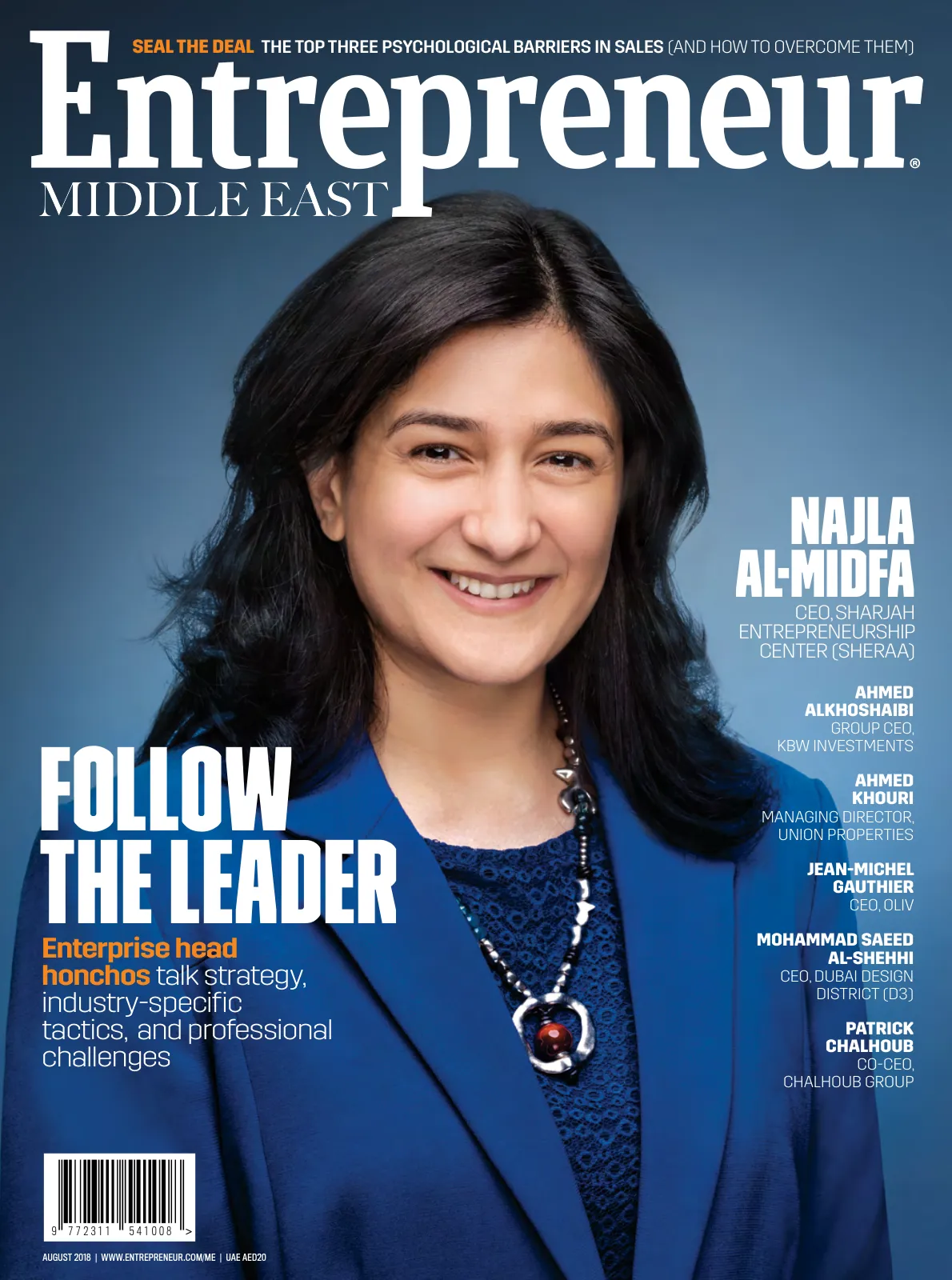
Entrepreneur Middle East, August 2018
Page 1
AHMED
ALKHOSHAIBI
GROUP CEO,
KBW INVESTMENTS
AHMED
KHOURI
MANAGING DIRECTOR,
UNION PROPERTIES
JEAN-MICHEL
GAUTHIER
CEO, OLIV
MOHAMMAD SAEED
AL-SHEHHI
CEO, DUBAI DESIGN
DISTRICT (D3)
PATRICK
CHALHOUB
CO-CEO,
CHALHOUB GROUP
AUGUST 2018 | WWW.ENTREPRENEUR.COM/ME | UAE AED20
9
7 7 2 3 1 1
5 4 1 0 0 8
>
SEAL THE DEAL THE TOP THREE PSYCHOLOGICAL BARRIERS IN SALES (AND HOW TO OVERCOME THEM)
NAJLA
AL-MIDFA
FOLLOW
THE LEADER
Enterprise head
honchos talk strategy,
industry-specific
tactics, and professional
challenges
CEO, SHARJAH
ENTREPRENEURSHIP
CENTER (SHERAA)
Page 2
Wake up to
Following outstanding sales in phases 1, 2 & 3,
ARADA presents Nasma Residences Phase 4.
Located in the lush surroundings of
a record-breaking community.
from AED 899,000
*
BAREEM TOWNHOUSES
800-ARADA (27232)
arada.com
• No service fee for life
• Pay 60% on completion
• Up to 10% ROI
Visit our Sales Office
Badriyah Ballroom,
Radisson Blu Resort, Sharjah
10am – 7pm
*T&C apply
No residency visa required to buy property
Open to all nationalities
Page 3
3
August 2018 / ENTREPRENEUR.COM /
34 A scene from the launch of Oliv
28
Najla Al-Midfa,
CEO, Sharjah
Entrepreneurship
Center (Sheraa)
AUGUST 2018 CONTENTS
22
INNOVATOR:
FOLLOW THE LEADER
MENA business leaders
across different industry
sectors talk strategy,
industry-specific
tactics, and professional
challenges.
38
INNOVATOR:
INNOVATING GOVERNANCE
Singularity University
co-founder and Executive
Chairman Dr. Peter H.
Diamandis explores the future
of voting, policy-making and
legislation.
46
‘TREPONOMICS:
PRO
Love where you work
Bayt.com’s VP of Employer
Solutions Suhail Al Masri
lists the essential elements
of a meaningful company
culture.
74
START IT UP:
ECOSYSTEM
Inclusive innovation
VilCap Innovations’ Senior
manager Heather Matranga
and MetLife Foundation’s
Program manager Sarah
Willis explain the impact the
Middle East’s fintech boom
has on the region’s economic
inequality.
50
‘TREPONOMICS:
PRO
Retaining talent
Abdulmuttalib (Talib)
Hashim, founder, TBH
Consultancy, explores six
reasons why GCC employers
are losing their best
employees.
84
START IT UP:
ECOSYSTEM
Investing in success
Telcos can (and should) play
a vital role in the success
of Middle East’s millennial
entrepreneurs, says Hany
Fahmy Aly, Executive Vice
President - Enterprise
Business at du.
Page 4
Page 5
Page 6
Business Data SIM plans.
The power of high-speed data on the move.
•
Special promotional prices
•
Range of the latest tablets
•
Live tracking of data consumption
du.ae/businessdatasim
Page 7
Page 8
Page 9
Page 10
Page 11
Page 12
12 / ENTREPRENEUR.COM / August 2018
24 Patrick Chalhoub, co-CEO, Chalhoub Group
AUGUST 2018
CONTENTS
76
54
‘TREPONOMICS:
MARKETING
Expand your reach
Ekaterina Vasina, Content
Editor, Admitad Academy,
helps you understand how
affiliate marketing can
help you grow beyond your
(current) borders in a three-
part guide.
82
START IT UP:
Q&A
Industry insiders
Sabina Marini and Saif Saud,
the entrepreneurs behind
global PR consultancy Haute
PR + STYLE, talk about
building and growing their
enterprise over 15 years.
Zeid Husban,
founder and CEO,
POSRocket
66
‘TREPONOMICS:
PRO
Keeping your brand
relevant
Consumer-facing brands
should evolve with the
ever-changing needs of
the modern customer,
while preserving their
heritage, and yet,
moving forward, writes
McDonald’s UAE General
Manager Walid Fakih.
76
START IT UP:
STARTUP FINANCE
We got funded!
MENA startups gain
momentum: Jordan-based
POSRocket receives a
US$1.5 million boost,
while UAE-based souKare
raises US$400,000 in
seed funds.
44
CULTURE:
TRAPPINGS
‘Trep gear
The executive selection for
the entrepreneur on your
list that has everything.
Okay, maybe for a little self-
reward as well.
44
Chopard L.U.C. 150
“All-in-One”
Page 13
Page 14
14 / ENTREPRENEUR.COM / August 2018
32 Ahmed Alkhoshaibi, Group CEO, KBW Investments
36
AUGUST 2018
CONTENTS
80
START IT UP:
Q&A
Solving the social paradox
Tech startup Calio,
founded by entrepreneurs
Latif Baluch and Ramy Al
Kadhi, is reimagining (and
reinventing) the calendar
app.
64
‘TREPONOMICS:
PRO
Seal the deal
Stefanie Fernandez, Head of
Sales Solutions – MENA at
LinkedIn, lists the top three
psychological barriers in
sales (and how to overcome
them).
62
‘TREPONOMICS:
PRO
Boosting business
Ian Golding, a Certified
Customer Experience
Professional, writes on ways
to turn customer happiness
into a sustainable reality for
your enterprise.
52
‘TREPONOMICS:
PRO
Overcoming lawyerphobia
Ahmed Arif, Principal,
Support Legal, on why it’s
imperative for startups to
get proper legal support for
their enterprises.
68
‘TREPONOMICS:
SKILLSET
Shahzad Bhatti, founder,
Co-Working Popup and
Share This Space, lists six
steps to make your pop-up
concept a success.
42
TECH:
SHINY
#TamTalksTech
Gadgets and doodads that
you might’ve missed out on,
sourced by a tech aficionado.
72
‘TREPONOMICS:
PRO
Leaving a legacy
Louise Koch, Corporate
Sustainability Director,
Dell in Europe, Middle
East and Africa, explains
why your business’ success
requires a sustainability-
first approach.
60
‘TREPONOMICS:
PRO
Thinking about how
we think
Marc Le Menestrel,
Visiting Professor for
Corporate Governance and
Sustainability, INSEAD,
Singapore, asserts that the
key to business success
lies in cultivating agility in
decision-making.
d3 Design Quarter
43
BlackBerry KEY2
Page 15
C O M E TO T H E B L U ,
S TAY F O R T H E V I E W
TAKE IN THE SPECTACULAR VISTAS OF THE DUBAI SKYLINE, THE DUBAI CANAL AND BURJ KHALIFA
FROM THE NEW RADISSON BLU HOTEL, DUBAI WATERFRONT. THE PERFECT PLACE TO CAPTURE THAT ULTIMATE
PICTURE MOMENT, WHETHER THAT’S FROM THE HOTEL’S PRIVATE ROOM BALCONIES, MEETING ROOMS,
SPA OR RESTAURANT TERRACES. THE HOTEL IS IN THE HEART OF THE ACTION AND WALKING DISTANCE
TO THE BEST SHOPPING AND ENTERTAINMENT IN DUBAI.
NOW OPEN IN BUSINESS BAY
Radisson Blu Hotel, Dubai Waterfront, Business Bay, PO box 16021, Dubai
T: +971 4 249 7800 info.waterfront.dubai@radissonblu.com radissonblu.com/hotel-dubaiwaterfront
Page 16
16 / ENTREPRENEUR.COM / August 2018
SUBSCRIBE
Contact subscriptions@bncpublishing.net to receive
Entrepreneur Middle East every issue
EDITOR IN CHIEF Aby Sam Thomas editor@bncpublishing.net
CEO Wissam Younane wissam@bncpublishing.net
DIRECTOR Rabih Najm rabih@bncpublishing.net
CREATIVE LEAD Odette Kahwagi
MANAGING EDITOR Tamara Pupic
STARTUPS SECTION EDITOR Pamella de Leon
FEATURES EDITOR Sindhu Hariharan
GROUP SALES DIRECTOR – B2B GROUP Joaquim D’Costa
COLUMNIST Tamara Clarke
EVENTS LIAISON Mark Anthony Monzon
PO Box 502511 Dubai, United Arab Emirates
P +971 4 4200 506 | F +971 4 4200 196
For all commercial enquiries related to Entrepreneur Middle East
contact sales@bncpublishing.net
All rights reserved 2018.
Opinions expressed are solely those of the contributors.
Entrepreneur Middle East and all subsidiary publications in the
MENA region are officially licensed exclusively to BNC Publishing
in the MENA region by Entrepreneur Media Inc.
No part of this magazine may be reproduced or transmitted in any
form or by any means without written permission of the publisher.
Printed by United Printing and Publishing
www.upp.ae
Images used in Entrepreneur Middle East are credited when necessary. Attributed use of
copyrighted images with permission. All images not credited otherwise Shutterstock.
Suhail Al Masri
Ahmed Arif
Shahzad Bhatti
Fida Chaaban
Dr. Peter Diamandis
Hany Fahmy Aly
Walid Fakih
Stefanie Fernandez
Ian Golding
AbdulMuttalib Hashim
Louise Koch
Marc Le Menestrel
Heather Matranga
Ekaterina Vasina
Sarah Willis
CONTRIBUTING WRITERS
www.entrepreneur.com/me
ACCESS FRESH CONTENT DAILY ON OUR WEBSITE!
MIDDLE EAST
EntMagazineME
@EntMagazineME
Entrepreneur-me
EntrepreneurMiddleEast
EntMagazineME
EntMagazineME
EntMagazineME
MIDDLE EAST
In addition to our print edition, we’re bringing
you all sorts of industry news on our web
mediums. Joining us online means getting
relevant business and startup content in
real-time, so you’re hearing about the latest
developments as soon as we do. We’re looking
forward to interacting with our readers on all of
our social media and web platforms- like any
thriving business, we’re looking to give and take.
#TrepTalkME is already happening on all of our
digi platforms, and all good conversations go
both ways. See you on the web!
Page 17
#BeatTheHeat
THIS SUMMER.
CAMBODIA CHINA INDONESIA MALDIVES MOZAMBIQUE PORTUGAL OMAN QATAR
SRI LANKA THAILAND UNITED ARAB EMIRATES VIETNAM ZAMBIA
LIFE IS A JOURNEY. Visit anantara.com
Al Jabal Al Akhdar 30°C
Muscat / Dubai 46°C
Cool off at the highest five star resort in the Middle East.
Only a short 4 ½ hours drive from Dubai or Abu Dhabi and 2 hours from
the new Muscat International Airport, enjoy a journey past date plantations
and dramatic Omani mountain ranges to reach our majestic hideaway.
Choose your ideal haven – a spacious room with a captivating canyon view,
a private pool villa with garden or cliff views. An abundance of
Spa and Recreation activities from hiking to sunrise yoga.
GCC RESIDENTS PACKAGE*
Up to 30% off Best Flexible Rate for a room or villa
Daily buffet breakfast for two persons
Daily dinner for two persons
Up to 20% off Anantara Spa
Up to 20% off food & beverage in all outlets
Book at anantara.com and get resort credit of up to OMR 20.
*terms and conditions apply.
Page 18
18 / ENTREPRENEUR.COM / August 2018
I
’ve lost count of the number
of times we at Entrepreneur
Middle East have featured
content explaining why you, as
an entrepreneur, should have
the best of people working
alongside you as you build up
a business. Of course, this is easier
said than done- great hires often
ask for great packages, and startups
don’t usually have the budgets
to spare for this. But lately, I’ve
noticed a few situations where en-
trepreneurs, after they’ve somehow
managed to secure the right people
on board their enterprises, then go
on to lose these individuals, as they
find themselves unable to work well
with each other.
More often than not, the reason
for such rifts can be drawn down to
what is, quite simply, a clash of egos
between the entrepreneur and the
employee. While it’s a nice thing to
say that you want to recruit people
“better than you” in your organiza-
tion, this means that you need to let
them take the lead (and thus excel)
in whatever they were hired to do-
and insecure leaders with overtly
inflated senses of self might find this
hard to manage. However, getting
past your ego is absolutely critical
to getting your venture ahead- rest
assured that if you clip the wings of
the people in your enterprise, then
your business is certainly not going
to take flight, no matter how much
you may try on your own.
Facebook CEO Mark Zuckerberg
touched upon this topic in an epi-
sode of Masters of Scale, a podcast
hosted by LinkedIn co-founder Reid
Hoffman, where he talked about
his hiring of Facebook COO Sheryl
Sandberg, whom he acknowledges
as having strengths that he himself
doesn’t possess- but that’s not
something that bothers him. “When
I look at my friends who were run-
ning other good companies, the
single biggest difference that I see
in whether the companies end up
becoming really great and reaching
their potential, or just pretty good,
is whether they’re comfortable and
really self-confident enough to have
people who are stronger than them
around them,” Zuckerberg declares.
“I’ve adopted this hiring rule,
which is that you should never hire
someone to work for you unless you
would work for them in an alternate
universe. Which doesn’t mean that
you should give them your job; but
just if the tables were turned and
you were looking for a job, would
you be comfortable working for this
person? I basically think that if the
answer to that is ‘no,’ then you’re
doing something expedient by hiring
them, but you’re not doing as well as
you can on that. There are all these
things that Sheryl, for example, is
just much stronger than me at, and
that makes me better, and makes
Facebook better. And I am not afraid
or threatened by that- I value that.
That’s what makes Facebook good.”
Now, given recent developments,
while there’s a whole other discus-
sion to be had on whether Facebook
is “good,” I do believe that Zuck-
erberg is on to something when it
comes to figuring out the best people
to hire, and how one should interact
with them once they come onboard.
It’s a lesson all leaders need to take
to heart, especially when it comes
to their executive teams- and it can
surely help push your businesses up
the ladder of success as well.
Aby Sam Thomas
Editor in Chief
@thisisaby
aby@bncpublishing.net
Musings on Mark Zuckerberg’s human capital hiring rule of thumb
Capital gains
EDITOR’S NOTE
Page 19
Page 20
20 / ENTREPRENEUR.COM / August 2018
R
unning under
the “One Team
Co-Creating
the Future”
theme, the Dubai
Future Founda-
tion (DFF) has
concluded its fourth edition
of the Dubai Future Ac-
celerators (DFA) program.
The nine-week program
was held at its headquar-
ters in collaboration with
12 government entities and
37 local and international
companies. As part of DFF’s
initiative, Dubai Future Ac-
celerators seeks to enable
the collaboration of govern-
ment and private companies
with emerging technology
companies. The program also
launched a two-week student
training program, wherein 10
students experienced work-
ing with government organi-
zations and tech companies-
a first for the DFA in a bid
to empower entrepreneurial
youth in the country.
Saeed Al Falasi, Executive
Director for Projects of the
Future at DFF, commented
on how the program reflected
Dubai’s enthusiasm in pro-
moting science and support-
ing talents, reinforcing UAE
as a global hub for innovative
technologies: “Dubai Future
Accelerators has become a
global platform and a mile-
stone event that reflects the
UAE’s keenness to promote
global cooperation in order
to address future chal-
lenges and introduce the
latest technology solutions
to today’s and tomorrow’s
challenges, and help create
a better future for all.” He
emphasized the importance
of DFA’s collaboration with
the 12 government entities,
saying, “The participating
government entities re-
viewed the latest innovations
in shaping the future that are
in line with the challenges
that were announced, using
artificial intelligence tech-
nology and digital transac-
tions systems that keep up
with the Fourth Industrial
Revolution.”
The government establish-
ments evaluated a range of
future challenges in strategic
sectors such as the security
sector, occupational safety,
infrastructure, health, trans-
portation, communication,
knowledge, humanitarian,
and others. Dubai Police
looked into the challenge of
reducing the rate of violence
by 25% in 2021 and de-
ploying AI to support emer-
gency response, while Dubai
Municipality and Dubai
Health Authority looked
into managing public health
services using AI tools. The
Knowledge and Human
Development Authority, RTA,
Etisalat Digital, Smart Dubai
Office, du, Dubai Economic
Department and the Moham-
med bin Rashid Al Maktoum
Global Initiatives also looked
into future challenges for the
startups to address.
Startups that were a part of
the cohort included Intuitu
Analytics, an advanced ana-
lytics and big data startup
offering analytics-based
solutions and AI-based
asset management; Emarat-
ech, part of the Investment
Corporation Dubai, an online
technology solutions and
consulting company; Votek,
a software company spe-
cializing in Arabic speech
recognition solutions and
artificial intelligence; ISnSC,
an information security R&D
house specializing in protect-
ing information and data;
and Smart IoT, a startup
providing IoT services such
as controlling, monitor-
ing, reacting and real-time
reporting.
The program saw the sign-
ing of 27 Memorandums
of Understanding between
companies and govern-
ment entities, aligned with
the vision of H.H. Sheikh
Mohammed bin Rashid
Al Maktoum to establish-
ing UAE and Dubai as the
global hub to build and grow
innovative solutions. It
welcomed the participation
of a number Dubai govern-
ment executives including
H.E. Humaid Mohammed
Obaid Al Qatami, Chair-
man of the Board of Dubai
Health Authority; H.E. Major
General Abdullah Khalifa Al
Marri, Commander in Chief
of Dubai Police; H.E. Dawood
Abdulrahman Al Hajri,
Director General of Dubai
Municipality; H.E. Mattar
Mohamed Al Tayer, Chair-
man and Executive Director
of the Roads and Transport
Authority; H.E. Sami Ahmad
Dhaen Al Qamzi, Director
General of the Department of
Economic Development; H.E.
Saeed Mohammed Al Tayer,
Managing Director and CEO
of Dubai Electricity and
Water Authority; H.E. Major
General Mohammed Ahmed
Al Marri, Director General
of GDRFA Dubai; H.E. Dr.
Aisha Bishr, Director General
Smart Dubai; Abdulla Al
Mane, General Manager of
Etisalat - Dubai Region; and
Osman Sultan, CEO of du,
among others.
www.dubaifutureaccelerators.com
IN THE LOOP
Government entities and startups partner up for the fourth
cohort of Dubai Future Accelerators
Ideas take flight
The fourth cohort of Dubai Future Accelerators
Page 21
VZAE
8923
Earn up to AED 3,000 in 3 simple steps
Go to vz.ae/referral for more information
Here is your chance to make up to AED 3,000 simply by referring a friend who is
looking to start a company.
With over 14,000 companies incorporated since 2009, we are proud that the
majority of our clients have been referred to us by other happy clients.
Your friends can trust us to help get their businesses off to a flying start.
T&C
l
Send your friend’s
contact details to us.
Once the company
is successfully set up,
you will receive your
referral fee.
We will contact your
friend and provide
the most suitable
company set-up
solution.
Page 22
22 / ENTREPRENEUR.COM / August 2018
THE LEADER
FOLLOW
ENTERPRISE HEAD HONCHOS
TALK STRATEGY, INDUSTRY-SPECIFIC
TACTICS, AND PROFESSIONAL
CHALLENGES
AHMED KHOURI
MANAGING DIRECTOR,
UNION PROPERTIES
AHMED ALKHOSHAIBI
GROUP CEO, KBW INVESTMENTS
PATRICK CHALHOUB
CO-CEO,
CHALHOUB GROUP
MOHAMMAD SAEED AL-SHEHHI
CEO, DUBAI DESIGN DISTRICT – D3
NAJLA AL-MIDFA
CEO, SHARJAH ENTREPRENEURSHIP
CENTER - SHERAA
JEAN-MICHEL GAUTHIER
CEO, OLIV
Our six picks for business leaders across different
industry sectors who have impacted the MENA market,
and continue to shape its corporate trends
Page 23
23
August 2018 / ENTREPRENEUR.COM /
A
company that
doesn’t innovate
in its operations
and products
cannot survive in
the marketplace
nowadays.” With
a declaration like that, Union
Properties Managing Director
Ahmed Khouri makes it clear
that he is not someone who
believes in sticking to the
status quo. And for someone
who works in the real estate
space of the UAE, this might
seem like a hard principle to
abide by- but then again, as
Khouri’s statement notes, re-
inventing and rethinking how
business is done is the only
way to move forward in the
current economic landscape.
This is especially true for an
enterprise like Union Proper-
ties- the three-decade old
company has had to grapple
with tough market conditions,
which saw it, in 2017, report
a net loss of AED2.3 billion,
alongside a profit of AED211
million. Of course, this sce-
nario demanded action, and
that led to Union Properties
making a concerted effort in
turning things around for the
business. “2017 was a turning
point in Union Properties’
work plans,” Khouri remem-
bers. “The new board team
conducted a thorough review
of the organization strategy,
and as a result, a renewed
emphasis has been put on
developing recurring revenue
streams for the group, to pro-
vide a stable, long-term, and
balanced business model.”
It is thus this new strategy
that can be referred to as the
basis for all of the actions that
Union Properties has taken
in the recent past. One of its
diversification measures was
to form a new investment arm
in October 2017 called UPP
Capital Investment, which
specializes in direct and indi-
rect real estate investments,
and will provide in-house ex-
pertise to support the group’s
long-term strategy. Earlier
this year, Union Properties
sold off its entire stake in
utilities company Emicool to
Dubai Investments for a sum
of AED500 million, while its
facilities management subsid-
iary ServeU was in the news
in June for aiming to launch
an IPO in September. Union
Properties also announced in
January that it had acquired a
5.7% stake in Egyptian devel-
oper Palm Hills Development,
which signaled its renewed
interest in moving into new
markets. And it does look like
measures like these did have
an impact- Khouri noted that
profits amounted to AED180
million in Q1 of 2018, com-
pared to AED42.5 million in
the same period, a year earlier.
“Union Properties is entering
a new chapter of success with
a new management vision
and internal restructuring,
and a new growth plan with
clear strategy across all our
subsidiaries and operations,”
Khouri says. “We are com-
mitted to good governance,
transparency, and making
profits for our stakeholders,
while exploring new business
opportunities.”
With respect to the road
ahead for the business, Khouri
says that Union Properties
will continue playing to
its strengths, with its real
estate arm remaining a key
component for the company’s
development today, and in the
years to come. “We focus on
investing in viable ventures
and continue to do what
we do best: build top qual-
ity communities that cater
for different segments and
lifestyles in Dubai,” Khouri
says. “The real estate and
developments arm of the
business remains the big-
gest contributor, as a result
of the high demand on our
projects, which is known in
the market for its high quality.
Having said that, the service
and industrial sector is also
performing very well today.”
Note here Khouri’s stress
on quality when it comes to
Union Properties’ offerings:
this is, according to him, a key
component for the brand’s
current -and future- standing
in the market. “Our commit-
ment to quality and our focus
on liability will always remain
at the heart of our communi-
ties,” he explains. “We are
guided by our core principles
of quality, service, creativ-
ity, attention, integrity and
diversity to delivery for the
people who buy units in our
developments, who live in our
communities, and who invest
in our company.”
As for his own personal
strategy when it comes to
managing an enterprise like
Union Properties, Khouri
is someone who believes in
leading from the front. “There
is no substitute for a leader
rolling up their sleeves, and
getting personally involved,
when significant financial and
symbolic value is at stake,” he
notes. But Khouri also makes
it clear that a strong, moti-
vated team is essential for any
enterprise to get ahead in the
game- and it’s up to its leader-
ship to make sure the people
onboard are inspired enough
in that regard. And why is do-
ing this so important? Khouri
points toward human nature
to explain: “People will go
to extraordinary lengths for
causes they believe in.”
AHMED KHOURI
“
MANAGING DIRECTOR, UNION PROPERTIES
“We are committed to good governance,
transparency, and making profits for
our stakeholders, while exploring new
business opportunities.”
ENTERPRISE HEAD HONCHOS TALK
STRATEGY, INDUSTRY-SPECIFIC TACTICS,
AND PROFESSIONAL CHALLENGES
FOLLOW
THE LEADER
Ahmed Khouri,
Managing Director,
Union Properties
IMAGE COURTESY UNION PROPERTIES
by ABY SAM THOMAS
Page 24
24 / ENTREPRENEUR.COM / August 2018
T
he main rule about
interviewing
Patrick Chalhoub,
the co-CEO of the
Chalhoub Group, a
luxury retail giant
founded in 1955 in
Damascus, is not to run out of
patience.
I am in what is called “The
Library,” which serves as a
waiting room at the Group’s
headquarters in Dubai Design
District (d3). The expansive
room includes two almost
identical sitting areas -the
business is jointly run by
brothers Patrick and Anthony,
the sons of founder Michael
Chalhoub- with black leather
sofas and side tables on each
side, framed by elegant stand-
ing lamps, and surrounded by
bookshelves stocked with dec-
orative art pieces, a collection
of business award trophies,
and books on leadership, re-
tail, and startup success. The
latter entertains me for nearly
half an hour, after which I am
joined by the Group’s Com-
munications Director. Then,
Patrick Chalhoub storms in,
panting and apologizing for
keeping me waiting, with
his face breaking into a grin.
My tolerance is then gener-
ously rewarded with sufficient
time, lengthy explanations,
and many more smiles from
Chalhoub.
In a similar fashion, the
immense fortunes of the
Chalhoub family might have
not been amassed without
them belatedly altering their
tactics and going full steam
ahead thereafter. In 1965, a
decade after opening their
first international boutique
Christofle in Damascus, the
economic uncertainty in Syria
urged Michael and his wife,
Widad Chalhoub to move their
business to Beirut. Another
decade later, in 1975, the fam-
ily relocated to Kuwait due to
the civil war in Lebanon. By
the time Iraq invaded Kuwait
in 1990, the two Chalhoub
brothers had been actively
involved in the family busi-
ness, and, just before the war
started, decided to move its
operations to Dubai. Today,
Chalhoub Group operates
more than 600 retail stores
in 14 countries, employing
more than 12,000 people from
100 different nationalities.
It is comprised of over 125
companies, affiliates and joint
ventures. “When you face ad-
versity, there are many nega-
tive elements, but positive
ones as well,” Chalhoub says.
“Perhaps these movements
assembled us closer together.
I would say that there was
more unity among us, created
by that adversity, which put
us together to fight against it.”
These days, however, Patrick
Chalhoub seems to be fighting
the same battle, yet not across
geographies, but between the
online and offline worlds.
Before we delve into details of
the group’s plans to digitally
reinvent itself, Chalhoub gives
a detailed account of its past.
“Since inception, our business
has been an original business,
which means that it was
conceptualized and founded
by my father in 1955, after he
worked in a retail store for
two years,” he says. “At that
time, he felt that the Syrian
market was too small for
luxury products, and that he
either had to diversify or to
expand regionally, and thus he
saw opportunities in the Gulf.
Because of this regional view
from the outset, we’ve always
felt that if the business stops
or slows down somewhere,
it will continue to grow in
the rest of the region. Also, I
would say, the business was of
a size which was more easily
managed. It was a small en-
terprise with less complexity,
maybe less opportunity as
well, but due to less complex-
ity, we felt like it was one big
family.”
Chalhoub continues, “When
we moved from Syria to
Lebanon, I was very young,
but when we moved from
Lebanon to Kuwait, I had just
turned 18 at the time. I was
more mature, and I remember
that we moved for six months
only. We had a small office in
PATRICK CHALHOUB
CO-CEO, CHALHOUB GROUP
“From being brand-focused, we have
become customer-focused.
Rather than having our customers
coming to us, we are now going to them.”
ENTERPRISE HEAD HONCHOS TALK
STRATEGY, INDUSTRY-SPECIFIC TACTICS,
AND PROFESSIONAL CHALLENGES
FOLLOW
THE LEADER
Patrick Chalhoub
at the 2018
Chalhoub Group
annual seminar
IMAGE COURTESY CHALHOUB GROUP
by TAMARA PUPIC
Page 25
25
August 2018 / ENTREPRENEUR.COM /
Kuwait, which was actually
a workshop for spare parts. I
moved to France to continue
my studies, but the rest of
my family moved to Kuwait,
and they were living in that
office. At night, they would
turn sofas into beds, and the
office desk into a dining table.
There were eight or nine of
our colleagues with my family
at the time. One of the reasons
for living in that office was
because they thought it would
be only temporary, however,
our headquarters stayed there
for 15 years. Of course, not in
the same office. Then, when
the Iraqi invasion happened
in Kuwait, my brother and I
took the decision to move to
Dubai, but we first stayed in
Paris, and we repeated what
our parents had done, but in
a different way. We invited
our colleagues who had also
fled Kuwait to come, live, and
work in our house in Paris. We
also believed it would be only
temporary. Then we decided
to move to Dubai because
it was more practical. But
these two stories show that
sometimes you have to shrink
in order to grow, you have
to push through conditions
that are not the best. It also
reminds me of the startup
mentality that you have to
work day and night for some-
thing to pick up.”
In the region’s startup
circles, Chalhoub is one
of just a handful of greats
always ready to advise young
entrepreneurs. He is a Board
Member of Endeavor UAE, the
local chapter of the New York-
based high-impact entrepre-
neurship platform Endeavor.
As a member of the Dubai
Design and Fashion Council,
he works on nurturing young
talent in order to position
Dubai amongst the 10 global
cities in fashion and design.
Chalhoub takes a particular
interest in the young –Genera-
tion Y (born between 1975 and
2000) and Generation Z (born
in 2000 and onwards)– who,
he says, have been redefining
not only the region, but his
business as well. According to
a 2016 UN report, they now
form a large and active por-
tion of GCC consumers: 52%
of the population in Saudi
Arabia, 51% in Oman, 49% in
Bahrain, 47% in Kuwait, and
40% in the UAE. “I’ve really
noticed a big wind of change
in the region,” Chalhoub says.
“This young generation who,
at one point in time, I’m sorry
to say it, used to be spoilt,
take things too easily, and stay
in their comfort zone, is today
extremely engaged. It makes
me so happy to say that they
have plenty of ideas and want
to work on them. They went
from being passive people who
wanted to live on the glory of
their parents, to people who
are challenging everything in
the world.”
One of them is his son
Michael Chalhoub, whose
own break in business came
very early when he founded
Sport360, an online sports
portal in English and Arabic.
When it comes to the often
sensitive topic of succession
in family businesses, Chal-
houb says that the transfer
from the second to the third
generation poses many
challenges that they have
already been preparing for.
“From the first to the second
generation, I would say, it is
usually quite an easy ride,
because we have all lived in
the same home, we have seen
the business growing with
the first generation, and we
have accompanied them on
their journey since we were
born. In our family business,
we are only two brothers, and
both of us have been engaged
[in the business],” he says.
“From the second to the third
generation, it is usually a
very critical moment for all
family businesses, because,
firstly, the family business is
usually more established. For
example, we went from 100
to over 12,000 people, and it
has become another kind of
company, meaning that strong
governance has been put in
place. That is important, but
it removes the soul of the
family business a little bit. In
our case, since the business
has become so complex, it is
important to have clarity with
the third generation. So, we
have established a few prin-
ciples for them.”
Chalhoub then goes on to
list out these guidelines. “The
first one is that there is no ob-
ligation to join the business,
but in order to do so, you
must want it, and you must
earn it. The second one is to
say that even if you are not in
the business, you have a role
of the owner, which is differ-
ent from the role of the man-
ager. In my and my brother’s
case, that was never a ques-
tion, we were immediately
both the owner and the man-
ager. But with the size and the
governance structure that we
have today, our children can
separate these two roles. They
can inherit shares, without an
obligation to be in the busi-
ness. We have also established
some rules in case they decide
to disinvest. My brother and
I made sure to teach them
how to be good owners, which
means to obey strict gover-
nance, to know how to assess
whether somebody is or is
not a good manager, to sell
in an intelligent manner, and
not to go against each other,
and so on. The third rule is
that before working in the
family business, they should
do something else. Both
education and experience are
important to us, meaning that
it is important that our chil-
dren are business-minded and
street-smart at the same time.
Lastly, it is about making sure
that people who haven’t lived
under the same roof but have
even lived in different coun-
tries and have gained different
perspectives are able to work
together.”
“SOMETIMES YOU
HAVE TO SHRINK IN
ORDER TO GROW,
YOU HAVE TO
PUSH THROUGH
CONDITIONS THAT
ARE NOT THE BEST.”
Given your experience in the
business realm, what would be
your advice for entrepreneurs
today?
“Patience and persistence. A lot
of entrepreneurs are very impa-
tient and tend to abandon their
projects very quickly. Sometimes
things take more time, so they
need to be persistent. Not to be
patient forever but also not to
change your course too quickly.
We live in a collaborative world,
so it’s great to have mentors,
spend time with them, seek
their advice, but you sometimes
need to listen to them. You don’t
necessarily need to follow their
advice but at least listen to it.
Collaborate rather than trying to
reinvent everything yourself.
Lastly, they need to keep in
mind that there is a difference
between starting up and scaling
up your organization, which is
that when scaling up, you need
other people and certain compe-
tences that you don’t have. This
is an area where entrepreneurs
get uncomfortable because they
are used to doing everything on
their own.”
ASK THE EXEC
PATRICK CHALHOUB,
CO-CEO, CHALHOUB GROUP
ENTERPRISE HEAD HONCHOS TALK
STRATEGY, INDUSTRY-SPECIFIC TACTICS,
AND PROFESSIONAL CHALLENGES
FOLLOW
THE LEADER
>>>
Page 26
26 / ENTREPRENEUR.COM / August 2018
Once the time comes, the
third generation of the Chal-
houb family will face their
own set of market challenges,
some of which have already
shaken the family’s business
to the core. Over the past few
years, Chalhoub has spoken
openly and often about the
group’s difficulties in adjust-
ing its traditional retail
brick-and-mortar model to
the fast-paced digital world.
In 2015, business growth was
stagnant. In 2016, the figures
also didn’t paint a particularly
sunny picture- only 1% busi-
ness growth, with the Group
closing more and opening few-
er shops than planned, trying
to adapt its strategy to the
new consumption patterns
arising from e-commerce and
online retail growth. “Since
July 2015, the economic
situation in the region has
become more complicated,”
Chalhoub explains. “The first
big change was the drop in
oil prices, which has shaken a
lot of businesses and changed
consumer habits. However,
the second change was more
important for me, and it was
that our consumers changed
a lot. So underneath this
economic slowdown there was
another, much deeper change,
and it was the shift in our
customers’ mindsets. Perhaps
this other phenomenon was
sped up due to the economic
slowdown, but nevertheless,
in July 2015, it took us time
to understand that there was
another challenge.”
“So, as soon as we felt the
importance of being more
digital, more connected, we
took the first step, but it was,
I would say, late,” Chalhoub
notes. “We should have taken
it before. Our first step was
to create a digital center in
order to enter the digital
world. However, although we
felt that we were moving in
the right direction, we weren’t
necessarily doing it in the
way that was sustainable for
the future. The reason is that,
at first, we felt that going
digital was just a marginal
part, whereas it wasn’t, it
influenced everyone and
everything. We couldn’t have
only one part of the organiza-
tion looking into this, as we
had initially thought, but
we had to make sure that
everyone was included. So,
from January 2016, it took
us six months to formulate
our digital strategy, but when
we did it in July 2016, we
felt that it shouldn’t be only
digital transformation, but the
overall transformation of the
organization, including the
change in our culture, our be-
haviors, our processes, and so
on. It was about making sure
that people made quick deci-
sions using digital technology
in order to be relevant to the
consumers, who, at their end,
were also moving very quickly.
So, it wasn’t about going from
point A to point B anymore,
because point B was continu-
ously changing.”
Once again, the Chalhoub
Group demonstrated that it is
never too late to amend its ap-
proach and catch up quickly.
The Group has already been
active in educating their em-
ployees on how to serve their
customers better, such as es-
tablishing the Chalhoub Retail
Academy in 2007, and also
developing a professorship
in luxury brand management
with the American University
of Sharjah (AUS). This year,
the Chalhoub Group also
entered into a joint venture
agreement with the UK-based
Farfetch, which allowed the
Group to feature some of its
brands on the Farfetch online
platform. As part of the agree-
ment, Chalhoub has agreed
to share its distribution and
marketing services with the
Farfetch e-commerce platform
and curate content in Arabic.
However, at the beginning
of 2018, the Group set a
900-day timeline to realize
the digital transformation
across its entire network. The
process is split into 10 phases
of 90 days each, in order to
measure progress more easily
and make timely adjustments
where needed. “We set up
seven guiding principles and
changed our vision from be-
ing a traditional distributor
and retailer of luxury in the
Middle East to becoming an
agile organization that places
convenience at its custom-
ers’ fingertips,” Chalhoub
says. “So, from being brand-
focused, we have become
customer-focused. Rather
than having our customers
coming to us, we are now go-
ing to them.”
Two important pillars of the
Group’s 900-day makeover
are Ibtikar, an innovation
lab for the Chalhoub com-
munity to foster new ideas,
and the Greenhouse, an ac-
celerator program for creating
technology-driven solutions
to address the group’s brands’
specific pain points. “We have
decided to empower our team
so that if their idea succeeds,
we will scale it quickly, but
we wouldn’t fire people who
failed, but learn with them,”
Chalhoub says. “So, both
failures and successes have
become sharing moments.
We invited our employees
to work on their ideas and
develop a proof of concept
with our support, giving them
three months to move away
from their day-to-day work
but remaining on the same
salary and with the job being
secured after this period in
the case that the idea fails.
When we launched Ibtikar,
we had 150 employees coming
up with the ideas, three were
chosen and they got three
months to work on them. One
has been retained and we will
invest in it, one girl got three
more months to develop hers,
and one has been rejected.
We launched the Greenhouse
being aware that we have
not only big competitors, but
also startups that we feel
threatened by. So, we decided
to consider those startups as
our allies. For that reason,
the Greenhouse is open to
any entrepreneur in the tech
retail space. We offer a work-
ing space, mentorship, and so
on, but what we have noticed
that startups need most is not
money but a ground to test
their proof of concept. And
through our more than 600
retail stores or 10 websites
they can do that- test their
technologies. If it works, we
scale it up with them through-
out the group. So, the message
for entrepreneurs and our
team is that if you have an
idea, make it happen, and
we’ll support you.”
ENTERPRISE HEAD HONCHOS TALK
STRATEGY, INDUSTRY-SPECIFIC TACTICS,
AND PROFESSIONAL CHALLENGES
FOLLOW
THE LEADER
“We changed our vision from being a
traditional distributor and retailer of luxury
in the Middle East to becoming an agile
organization that places convenience at
its customers’ fingertips.”
Patrick Chalhoub,
co-CEO,
Chalhoub Group
IMAGE COURTESY CHALHOUB GROUP
Page 27
Page 28
28 / ENTREPRENEUR.COM / August 2018
NAJLA AL-MIDFA
CEO, SHARJAH ENTREPRENEURSHIP CENTER - SHERAA
“My mantra is simple: keep the passion alive,
and get things done. The two go hand-in-hand,
because without passion and commitment,
the quality of the work suffers.”
ENTERPRISE HEAD HONCHOS TALK
STRATEGY, INDUSTRY-SPECIFIC TACTICS,
AND PROFESSIONAL CHALLENGES
FOLLOW
THE LEADER
28 / ENTREPRENEUR.COM / August 2018
by TAMARA PUPIC
Page 29
29
August 2018 / ENTREPRENEUR.COM /
J
ust before this year’s
summer started,
news broke that
Najla Al-Midfa had
been promoted to
the position of Chief
Executive Officer of
the Sharjah Entrepreneurship
Center (Sheraa), a launch pad
for the UAE’s aspiring and es-
tablished entrepreneurs, and
a subsidiary of the Sharjah
Investment and Development
Authority (Shurooq). In be-
tween many genuine messages
of congratulations spreading
across social media, there
seemed to be some confu-
sion over what her job title
had been until then -it was
General Manager- as people
had become quite used to wit-
nessing Al-Midfa going above
and beyond the call of duty.
This by itself provides the
crucial insight into Al-Midfa’s
approach to her work -novel,
hands-on, and no-nonsense-
as well as the effects it has
brought about in her sphere
of influence- discernible,
profound, and lasting.
In January 2016, Al-Midfa
launched Sheraa –meaning
“Sail” in Arabic- under the
patronage of H.E. Sheikha
Bodour bint Sultan bin
Muhammad Al Qasimi,
Chairperson of Shurooq, at
the American University of
Sharjah. In just over two
years, the Sheraa team has
inspired a loyal community
of over 6,000 entrepreneurs,
regularly hosting public work-
shops and events with over
300 local and international
speakers. Its main activity -a
full-stack entrepreneurship
program catering to startups
at all stages: pre-seed, seed,
and Series A- has produced
even more spectacular results.
At the pre-seed stage, Sheraa
has helped almost 200 aspir-
ing entrepreneurs develop
and validate their business
ideas. Of these, more than
50 have been incubated and
supported, while building
their prototypes and gaining
initial traction in the market-
the three top performers last
year made over US$80,000
in sales revenue. Additionally,
30 startups have graduated
from Sheraa’s seed and Series
A stages, having raised over
$12 million in investment to
date. These startups continue
to generate over $8 million in
annual recurring sales, and
have also created jobs for over
100 employees.
Al-Midfa puts much of the
success down to the backing
of the Sharjah government,
which has allowed her team
the freedom to experiment
with the offerings in their
programs, taking the time to
analyze where the gaps in the
ecosystem lie, and how best
to fill them. Sharjah itself, as
one of the UAE’s more ambi-
tious emirates, does offer a
solution for one of the biggest
hurdles entrepreneurs face
-keeping costs down, and
hiring the right people. Go-
ing forward, Al-Midfa says,
it will be all about ensuring
consistency. “We know that
building an ecosystem takes
time, especially when one
must also instill an entrepre-
neurial culture, and so we
have worked to perfect our
programs and continue to run
them every year,” she says.
“If there are elements that
do not quite work, we change
them. We have always been
open to feedback from our
stakeholders, especially our
entrepreneurs, and this has
been instrumental towards
our progress.”
Al-Midfa opines that
the UAE as a whole has
vastly improved its business
climate, having adopted
entrepreneurship-friendly
measures, including increased
licensing opportunities,
easing the visa process, and
mobilizing full support for the
private sector. At the moment,
she says, the main challenge
startups face is market access.
“Sheraa seeks to change that
by partnering with different
stakeholders to cultivate a co-
operative, supportive ecosys-
tem that helps startups grow,”
Al-Midfa explains. “One way
we do this is through our
Supplier Matchmaking Day,
which has had resounding
success thus far. We held
our first event last April,
under the Arab Supply Chain
Impact Initiative, and had 16
MoUs between participating
startups and government and
corporate entities signed on
the day.” Al-Midfa attributes
much of Sheraa’s success
also to their local and inter-
national partners, including
Air Arabia, Bee’ah, Crescent
Enterprises, Sharjah Media
City – Shams, and Sandooq
Al Watan, as well as the
American University of Shar-
jah and University of Sharjah.
“Also important is ensuring
that we are contributing to
cultivating an environment
that supports creativity and
divergent thinking in Shar-
jah,” she says. “To do this, it
has been necessary to engage
with stakeholders across aca-
demia, government, and the
private sector –in addition to
entrepreneurs, of course– and
aligning them around Sheraa’s
mandate. For Sheraa’s impact
to be truly scalable, I am con-
stantly on the lookout for op-
portunities to refine Sheraa’s
strategy to pursue geographic
and programmatic expansion
opportunities, while estab-
lishing a financially sustain-
able model to support these
growth aspirations.”
The Sharjah Entrepreneur-
ship Festival (SEF), a two-day
annual festival that brings
together different stakehold-
ers to network and inspire
further innovation, has been
another crucial vehicle for
growing Sheraa’s community
and expanding its reach to
the wider ecosystem. Over
2,000 entrepreneurs, inves-
tors, mentors, and ecosystem
supporters attended the first
rendition, held in November
2017, which featured over 60
inspirational talks with 150
local and international speak-
ers. The success and impact
of this event and other Sheraa
programs led to the entity
“THE ECOSYSTEM
CANNOT THRIVE
WITHOUT PASSIONATE,
CREATIVE, DETERMINED
PEOPLE PAVING THE
WAY, AND THOSE ARE
EXACTLY THE TYPE OF
PEOPLE SHERAA SEEKS
TO ATTRACT.”
ENTERPRISE HEAD HONCHOS TALK
STRATEGY, INDUSTRY-SPECIFIC TACTICS,
AND PROFESSIONAL CHALLENGES
FOLLOW
THE LEADER
IMAGE COURTESY SHERAA
>>>
Page 30
30 / ENTREPRENEUR.COM / August 2018
winning the Entrepreneurial
Ecosystem Development
Award at the 2017 Enterprise
Agility Awards, presented by
Entrepreneur Middle East.
With the stage now getting
set for the 2018 edition of
SEF, Al-Midfa credits all of
Sheraa’s successes and en-
deavors so far to her 15-per-
son team who, she says, are
young, high-performing,
passionate go-getters and
believers in Sheraa’s mission
and in the power of human
potential. “As the CEO of
Sharjah Entrepreneurship
Center, my main role in-
volves curating the culture
of not only our team, but
also the entrepreneurial
community as a whole,” she
explains. “The ecosystem
cannot thrive without pas-
sionate, creative, determined
people paving the way, and
those are exactly the type
of people Sheraa seeks to
attract.”
Sheraa encourages startups
in five focus areas: travel
and tourism, sustainabil-
ity, social enterprise, the
creative economy, and
Emirati innovation. As a
whole, however, it remains
industry-agnostic, because
all sectors have room for
innovation, Al-Midfa says. In
startup founders, she looks
for passionate, driven, and
knowledge-hungry people.
When it comes to their fledg-
ing businesses, she bases her
decisions on the quality of
their idea, its scalability and
potential for success, as well
as its ability to disrupt the
market. Al-Midfa adds, “We
want to encourage entrepre-
neurs to come up with mar-
ket-worthy solutions that are
in line with their passions
and what they have expertise
in, rather than just what they
think is ‘trending.’ At the
end of the day, we look for
truly high-growth startups
that are transforming the
entrepreneurial landscape.
However, I do believe the
word innovation is overused,
but the overuse does not
necessarily invalidate its im-
portance- rather, it points to
the fact that everyone knows
it is something that is vital
to encourage, but they do not
fully understand what it is,
or how to do so. Instead, they
tend to assume that anything
related to ‘tech’ or following
the latest entrepreneurial
trend is what’s innovative.
Entrepreneurial innovation
is, in its simplest definition,
making something better.
This could mean improving
an existing model or creating
a completely new product or
service, but if it’s bettering
the current iteration and our
society, then it is innova-
tive.”
To Sheraa’s startup found-
ers -future leaders of their
respective industries- Al-
Midfa offers a special piece
of advice: their assertiveness
must not give way to plain
stubbornness. “First and
foremost, they must believe
in the organization’s mis-
sion, and they must trust
the team they have chosen to
help achieve it. They must be
confident and able to assert
themselves both internally
and with external stakehold-
ers, in order to build the
company’s reputation as
being bold and true to their
word. However, a good leader
must have a certain degree of
empathy and open-minded-
ness, as well as the ability to
think flexibly. Essentially, all
the traits that make a good
entrepreneur tend to make a
good leader.”
We end our interview
taking one more look back,
and, in hindsight, there is
no matter for regret when it
comes to Sheraa’s journey so
far. “I am incredibly proud of
how far we have come, and I
do not think I would do any-
thing differently,” Al-Midfa
concludes. “However, given
the pace of our progress, I
would want to remember to
slow down and appreciate
our achievements and savor
our successes, to ensure we
are consistently and sustain-
ably growing. We are in this
for the long haul, and there
are no shortcuts to building
an ecosystem- it takes time
and commitment. My mantra
is simple: keep the passion
alive, and get things done.
The two go hand-in-hand,
because without passion and
commitment, the quality of
Patrick Chalhoub
co-CEO,
Chalhoub Group
What are your five tips for
entrepreneurs to build a
sustainable business?
1. BUILD A PASSIONATE TEAM
(AND EMPOWER THEM) “Your
team is one of the biggest invest-
ments you will make. Hiring the
right talent, and trusting them to
deliver without micromanaging,
is vital for the success of your
company. However, a light touch
does not mean you should be
afraid to let go of someone who’s
not performing.”
2. KNOW YOUR BUSINESS
INSIDE OUT “Be aware of all the
inner workings of your startup.
Learn to manage your costs, man-
age your staff, and put policies
in place that ensure everything
runs smoothly. Also, know when a
project just is not working out, and
learn to let it go.”
3. JOIN A SUPPORTIVE
COMMUNITY “Being an entrepre-
neur can be incredibly lonely. It is
so important to join a community
of fellow entrepreneurs, through
programs such as Sheraa’s, so
you have people who can encour-
age and support you through the
ups and downs of running your
business.”
4. DON’T LOSE SIGHT OF YOUR
MISSION “It can be easy to get
distracted, whether by a new proj-
ect, a new contract that doesn’t
quite align with your mission, or
a new commitment. Learn to say
no to the things that detract from
your core mission– that is how
you ensure long-term growth.”
5. HAVE FUN “If you’re not pas-
sionate about your business, it
will show, and it will reflect in your
work. Have fun, enjoy what you do.
But also know when it’s time to
take a break. Burnout is very real.”
ASK THE EXEC
NAJLA AL-MIDFA, CEO,
SHARJAH ENTREPRENEURSHIP
CENTER - SHERAA
“WE HAVE ALWAYS BEEN OPEN
TO FEEDBACK FROM OUR
STAKEHOLDERS, ESPECIALLY
OUR ENTREPRENEURS, AND
THIS HAS BEEN INSTRUMENTAL
TOWARDS OUR PROGRESS.”
Sheraa has a loyal community
of over 6,000 entrepreneurs,
attending their public
workshops and events with
over 300 local and international
speakers.
ENTERPRISE HEAD HONCHOS TALK
STRATEGY, INDUSTRY-SPECIFIC TACTICS,
AND PROFESSIONAL CHALLENGES
FOLLOW
THE LEADER
Page 31
OCTOBER 29-30, 2018
APPLY NOW! WWW.ABUNDANCE360.COM/DUBAI
IN PARTNERSHIP WITH:
Being offered for the first time in
the Middle East, Africa & South
Asia, Abundance 360 is Peter H.
Diamandis' mastermind for CEOs,
entrepreneurs, executives, investors
entrepreneurs, executives, investors
and government leaders. Join
Peter's Community and attend the
Abundance 360 Dubai Summit to
learn about the most exciting
developments in disruptive
technology and innovation.
Topics will include Computation,
Topics will include Computation,
Sensors, Networks/loT, Artificial
Intelligence, Longevity, Robotics,
Virtual Reality, Augmented Reality,
3D Printing and Blockchain.
LEVERAGE EXPONENTIAL
TECHNOLOGIES, TRANSFORM YOUR
ORGANISATION AND DISRUPT
YOUR INDUSTRY
Page 32
32 / ENTREPRENEUR.COM / August 2018
A
s the Group
CEO of KBW
Investments,
Ahmed
Alkhoshaibi
oversees a
portfolio group
whose member
companies operate in a di-
verse range of sectors, which
include property (ARADA),
construction (Klampfer Elec-
tro Mechanical Contracting
(KEMC)), manufacturing (Rai-
mondi Cranes), engineering
(Arcadia Engineering), finance
(Crestmount Capital), and
more. Founded by HRH Prince
Khaled bin Alwaleed bin Talal
in 2013, KBW Investments
has managed to steadily
make its mark in the region’s
business landscape, thanks
to the various enterprises
under its helm carving out
successes of their own in their
respective industry sectors.
“From a personal perspective,
I was extremely proud when
ARADA’s first project, Nasma
Residences, sold out its first
phase in a little less than a
month,” Alkhoshaibi says, as
he recalls the achievements
KBW Investments currently
has to its credit. “Coming up
with a vision and a strat-
egy to support that vision
is certainly important, but
having that strategy tested in
the market and seeing such
a strong result in so short a
time vindicated the significant
efforts that our shareholders
and staff had put in to get
this project off the drawing
board. In a span of 12 months,
Raimondi has launched three
new products applying Silicon
Valley-type approaches like
UX and UI that have never be-
fore been used in that sector.
Arcadia Engineering recently
began work on Bucharest’s
new IKEA, a landmark for the
company, and also developed
detailed plans as the general
designer of an Olympic-level
skating rink, adding to its
portfolio of high-level sport-
ing facilities. Our mechanical,
electrical and plumbing
(MEP) enterprise, KEMC, has
showed so much promise,
that we recently acquired the
shares of one of the founding
partners.”
With KBW Investments op-
erating in what is arguably a
heady mix of sectors, Alkhos-
haibi admits to the challenges
involved in leading such a
portfolio group, but also adds
that adhering to a few key
principles has helped him
manage the task well all the
same. “Running a company
with many different segments
that all require analysis in
decision making is probably
one of the most challenging
things anyone will ever do,”
Alkhoshaibi says. “Being
detail-oriented is extremely
important, whether working
with small or large amounts
of capital, and the bigger the
bid, the pickier you need to
be. That isn’t to say you need
to micromanage every single
facet of the business, but you
need to know your books. If
you don’t know your numbers,
you’re headed for difficulties
quite quickly. What I consider
to be absolutely essential to
growth is the recruitment of
tier one talent. Many times, I
have made note of exceptional
people, only later to have
offered them a role when the
situation arose. Don’t ignore
these exceptional people in
the market, and do establish a
relationship, as later on, they
might be the key to the next
expansion level you are look-
ing to undertake.”
Of course, it’s one thing
to keep an eye out for good
talent- but Alkhoshaibi adds
that KBW Investments has
also made it a priority to make
sure the best come to it as
well. “We are flooded across
every tier of the business with
people who are looking to join
our company,” he notes. “One
of the reasons we are able to
attract quality talent is our
communications schema.
When you share news regu-
larly, transparently and across
multiple mediums, including
social media, you gradually
become known in the market.
ENTERPRISE HEAD HONCHOS TALK
STRATEGY, INDUSTRY-SPECIFIC TACTICS,
AND PROFESSIONAL CHALLENGES
FOLLOW
THE LEADER
Ahmed Alkhoshaibi,
Group CEO,
KBW Investments
AHMED ALKHOSHAIBI
GROUP CEO, KBW INVESTMENTS
“Running a company with many different
segments that all require analysis in
decision making is probably one of the most
challenging things anyone will ever do.”
by ABY SAM THOMAS
Page 33
33
August 2018 / ENTREPRENEUR.COM /
Communicating responsibly
can help you to attract tier
one people to your organiza-
tion, despite not having large
budgets, and other add-ons
like stock options.” But what
about the oft-repeated com-
plaint that, well, good people
don’t come cheap, and, as a
result, it’s hard to keep them
around? “Mitigating salary
concerns can be as easy as
negotiating vacation times,
premium health packages, and
ensuring that there is room
for upward mobility within
the organization,” Alkhoshaibi
replies. “Retention and re-
cruitment are both addressed
by the previous points; how-
ever, in the case of retention,
acknowledging exceptional
work and rewarding employ-
ees on a timely basis are both
critical components, and will
have a distinct impact on your
bottom line. Replacing strong
team members is expensive,
and again, like any other
business scenario, you need
to consider opportunity cost.
In one of our companies, Rai-
mondi Cranes, we have em-
ployees who have an invalu-
able storehouse of knowledge
that exceed 20 years of manu-
facturing heritage. Replacing
these key loyal staff members
is not only impossible, it
deprives future employees
from learning knowledge that
would otherwise be lost.”
For an organization of its
scale, KBW Investments may
not seem like an enterprise
that’d work with a startup-
like atmosphere, but then
again, for an enterprise driven
by the entrepreneurial vision
of its founder and Chairman
Prince Khaled, it shouldn’t
be a surprise to learn that it’s
keen on employing innovation
in all that it does as well. But
in an era where entrepreneur-
ship and innovation have
almost become buzzwords
of sorts, Alkhoshaibi is clear
that his enterprise needs to be
built up on the true meanings
of those terms. “Every busi-
ness finds it desirable to be
associated with the intrepid
life of an entrepreneur, but
what’s often forgotten is
the day-to-day struggle of
mobilizing a startup,” he
says. “That said, innovating
in a larger organization, even
at the conglomerate level, is
often just as -if not more-
challenging, because you are
dealing with layers of approval
and bureaucracy. There is
always room for innovation.
The label of what is and what
isn’t innovative often comes
down to clever marketing and
strong communications. Some
of the least innovative but
most stable entities are con-
sidered innovative, when they
are actually just using a tried
and tested business model. In
the current economic climate,
innovation can take on the
meaning of being able to con-
tinue to drum up new revenue
channels, consistent commer-
cial activity, and maintaining
strong operating capital.”
Given the state of the mar-
ket today, new enterprises
considering starting up in
the region may feel like the
environment is not particu-
larly favorable for them- but
Alkhoshaibi says it’s all a
matter of perspective. “There
is never going to be a perfect
time to start a business,” he
declares. “Many products
taken to market are ahead of
trend, and many, similarly,
are behind trend. Both of
these scenarios are common
and carry high levels of risk.
The essential questions to
ask when deciding whether
or not you should go forward
with your startup are not
about timing; they are more
about market fit. I believe the
match of location and service
offering are more important
as benchmarks of success.”
And for those of you seeking
motivation to go ahead with
your entrepreneurial ideas,
Alkhoshabi points toward
the past to look toward the
future. “There are many
rehashed stories of products
that have been successful
in the past three years but
were rejected by some of the
world’s greatest investors a
decade ago,” he explains. “So,
the questions you should be
asking are: how much com-
petition do you have? What
is your USP? Are you able to
gain a sizeable market share,
and if so, how? If there are 10
other companies with greater
resources and stronger infra-
structure, then you must have
a differentiator that will en-
able you to generate traction.
These questions hold true
across the many continents
in which we at KBW Invest-
ments operate, and they can
be applied across a variety of
sectors. Market need and how
well you answer that need is
always the essential element
that needs to be examined
prior to investing your capital
in new venture.”
“BEING DETAIL-ORIENTED
IS EXTREMELY
IMPORTANT, WHETHER
WORKING WITH SMALL
OR LARGE AMOUNTS OF
CAPITAL, AND THE BIGGER
THE BID, THE PICKIER
YOU NEED TO BE.”
ENTERPRISE HEAD HONCHOS TALK
STRATEGY, INDUSTRY-SPECIFIC TACTICS,
AND PROFESSIONAL CHALLENGES
FOLLOW
THE LEADER
IMAGE COURTESY KBW INVESTMENTS
What are your five tips for entrepre-
neurs to achieve success with their
enterprises?
1. EMPOWER SENIOR STAFF TO MAKE
DECISIONS “If you cripple your senior
staff, you will end up becoming a
one-man show. There is strength
in numbers, allowing respective
team members to draw on different
knowledge bases and skillsets.
Crippling your team’s decision-making
ability leads to inertia, meaning
nothing gets done until you as the
founder can sign off.”
2. ADVOCATE FOR WORK-LIFE
BALANCE ACROSS ALL LEVELS OF
YOUR COMPANY “Startups often do
the 24/7 work mode, and consider it as
business as usual. This is a fallacy; all
that will do is generate discontent, dis-
traction, and a run-down organization.”
3. ENSURE THAT YOU HAVE A
MARKETING BUDGET “Startups often
push marketing and communications
to the wayside. Where there is no
marketing, there is no lead generation,
and therefore, there are no custom-
ers. Reaching profitability is directly
impacted by your brand awareness
quotient.”
4. BUILD RELATIONSHIPS “Your ven-
dors and your clients are more likely
to support you with premium budgets
and business allocation if you have
a strong relationship. Relationships,
while not directly quantifiable, will
both save and generate money in the
long run.”
5. SERVICE IS AN ONGOING CRITERION
FOR SUCCESS “After you’ve made the
sale or sealed that deal, your service
levels are just beginning. Oftentimes,
companies make the mistake of ne-
glecting existing or past clientele. This
goes back to both relationship and
reputation management. There is op-
portunity cost in ignoring commercial
service that goes over and above what
is actually laid out in the contract.”
ASK THE EXEC
AHMED ALKHOSHAIBI, GROUP CEO,
KBW INVESTMENTS
Ahmed Alkhoshaibi, Group CEO,
KBW Investments
Page 34
34 / ENTREPRENEUR.COM / August 2018
I
f you, as an entrepre-
neur, could turn back
time, what would you
have done differently
along the journey of
your startup? For
Jean-Michel Gauthier,
co-founder and CEO of the
Dubai-headquartered careers
platform Oliv (formerly
known as InternsME), the
answer is, well, not a lot. “I’d
do most of what we’ve done,
except much faster,” Gauthier
says. “A specific improve-
ment would be to increase
our product centricity from
the start, and build at a more
global scale in mind, at an
earlier point.”
One can unpack quite a lot
about Gauthier and Oliv from
this answer of his. For one,
here’s an entrepreneur who’s
clearly fueled by his absolute
conviction in what his startup
offers, and the promise of
what it can do for the MENA
region- Gauthier has always
stated that he started his
company with an aim to
reduce youth unemployment
in the Arab world, and that’s
the mission that Oliv remains
rooted on. “Our focus in the
early days of Oliv was always
on building the right team,
and fostering an impact-
driven culture,” Gauthier says.
“Whilst our platform was
pretty basic in the beginning,
we managed to hire talented,
hard-working people who
were completely aligned with
our vision of defeating youth
unemployment in the region.
With this we were able to
hit the market early with an
MVP and start offering a solu-
tion. Today, we tenaciously
pursue our North Star metric:
number of placements. That’s
our value driver. Defining
this as early as we did in the
lifetime of the company meant
we have been able to connect
everything back to a single
important goal, which is a
very powerful motivator for
the team.”
Oliv today declares itself to
be “the world’s fastest career
platform experience built
with the youth in mind.” As
a marketplace that connects
youth in the MENA region
with leading employers in
a variety of industries, Oliv
aims to help students and new
graduates secure everything
from internships to part-time
and graduate jobs. In the years
since its inception, Oliv claims
to have screened more than
150,000 university students
and fresh graduates for the
platform, which today has
more than 1,000 businesses
–ranging from startups to
corporates- using it to fill
their talent needs. “In terms
of impact, we’re very proud
of the 3,000+ placements
(internships and full-time
graduate jobs) we’ve been able
to facilitate to date, and help
young people in the region
start their careers in organiza-
tions like Careem, Coca-Cola,
Emaar, Samsung, and many
more,” Gauthier says. “The ac-
tivity and engagement on the
platform is up to 1,000+ em-
ployer-candidate interactions
(such as interview invitations)
being initiated monthly.” And
the work that Oliv has been
doing hasn’t gone unnoticed.
Besides securing a slew of
awards and accolades over
the years (it won the Digital
Startup of the Year title at
Entrepreneur Middle East’s
Enterprise Agility Awards in
2016), Gauthier’s company
was also the recipient of the
first disbursement of funds
made by the AED2 billion
Mohammed Bin Rashid In-
novation Fund, an initiative
that has been conceived and
sponsored by the UAE’s Min-
istry of Finance.
Oliv’s innovative offering is
what has allowed the startup
to achieve all that it has so
far- there aren’t many other
enterprises that can claim to
showcase that kind of inven-
tiveness in what they do. And
Gauthier is cognizant of this
fact. “Innovation is definitely
a buzzword nowadays,” he
says. “We see a lot of incre-
mental innovation, where
entrepreneurs improve exist-
ing processes and solutions in
a few small ways. Depending
on the size and maturity
of the market, this can be
enough to build a business,
but what excites me most,
and what I’d love to see more
entrepreneurs strive towards,
are innovations that are a 10x
JEAN-MICHEL GAUTHIER
“THE FUTURE BELONGS TO
FAST-MOVING, CUSTOMER
CENTRIC STARTUPS, AND
SMES THAT ARE ABLE
TO CAPITALIZE ON THE
NEEDS OF, AND DELIVER
DIFFERENTIATED VALUE
TO, THE MARKET.”
CEO, OLIV
“We’ve focused on the things larger organizations
can’t always offer: an entrepreneurial work
environment, empowerment, meaningful work,
a learning-based culture, and a dynamic,
close-knit team.”
ENTERPRISE HEAD HONCHOS TALK
STRATEGY, INDUSTRY-SPECIFIC TACTICS,
AND PROFESSIONAL CHALLENGES
FOLLOW
THE LEADER
Jean-Michel Gauthier,
CEO, Oliv
by ABY SAM THOMAS
Page 35
35
August 2018 / ENTREPRENEUR.COM /
improvement over what’s
currently available. In other
words, innovate, and build
something that makes the old
way redundant.” And keep-
ing this in mind, the region,
according to Gauthier, still
offers a minefield of opportu-
nities today. “It’s definitely a
good time to start a business
in the MENA. Every year our
markets evolve, new oppor-
tunities present themselves,
and more success/failure sto-
ries become available to learn
from. The future belongs
to fast-moving, customer-
centric startups, and SMEs
that are able to capitalize
on the needs of, and deliver
differentiated value to, the
market. There are many
opportunities in localized
software, ‘productizing’ pro-
fessional services, as well as
within the large, incumbent
industries which are also ripe
for disruption- for example:
banking, insurance.”
From a leadership point
of view, Gauthier acknowl-
edges that running a startup
requires a plethora of skills,
and his approach toward
it has evolved through the
years. “As a startup CEO, you
have to wear multiple hats
and constantly shift gears,
between being an entrepre-
neur, innovator, fundraiser,
problem-solver, manager, and
mentor,” Gauthier explains.
“Today, most of my time
is spent on the important
things: helping the team (any-
thing from providing feedback
on work/plans, coaching,
helping with customers and
deals), recruiting new talent,
and gearing Oliv up for inter-
national expansion.” Much
like other leaders of repute,
Gauthier is insistent on his
team’s integral role in the
success Oliv has seen so far,
and that governs his attitude
towards them as well. “For
almost all businesses, finding
the right team is the absolute
make-or-break,” he notes.
“For early-stage companies,
the challenge is in attracting
the talent that has a lot of
other options available to
them from larger companies,
including better pay, more
stability and security, and ad-
ditional benefits. To overcome
this, we’ve focused on the
things larger organizations
can’t always offer: an entre-
preneurial work environment,
empowerment, meaningful
work, a learning-based
culture, and a dynamic, close-
knit team. The launch of our
employee stock option plan
has been a major milestone in
offering upside to reward and
recognize our team’s owner-
ship mentality, and long-term
commitment to Oliv.”
This emphasis on the people
in his team also explains
Gauthier’s interactions with
them as their leader. “Great
leadership starts with great
communication,” Gauthier
says. “Being transparent and
authentic are key, especially
when inspiring a millennial
team. This means being brave
enough to let them know
when something hasn’t gone
right, or when you’ve made a
mistake. It’s also important
for leaders to be fiercely
accountable, to set high
standards for themselves,
and to reflect the work ethic
they want embodied in the
team. Training, motivating
and trusting your team to
get things done (without
micromanagement) empow-
ers them to operate like
owners. The best leaders are
able to do this whilst making
tough decisions with limited
information, under tight time
constraints, and are resilient
when things don’t go to plan.”
It’s a formula that has worked
so far for Gauthier- and it’s
one that will surely stand him
in good stead as Oliv makes
its way into the future. And
yes, this is an enterprise you
should keep an eye on- it
definitely seems to be going
places.
“The challenge is in
attracting the talent
that has a lot of other
options available to them
from larger companies,
including better pay, more
stability and security,
and additional benefits. “
ENTERPRISE HEAD HONCHOS TALK
STRATEGY, INDUSTRY-SPECIFIC TACTICS,
AND PROFESSIONAL CHALLENGES
FOLLOW
THE LEADER
IMAGE COURTESY OLIV
What are your tips for
entrepreneurs wanting to find
success with their enterprises?
1. COMMUNICATION MATTERS
“Keep communicating- when
times are good and also when
times are bad. Silence and
opaqueness from leadership
does not default to positivity in
teams.”
2. ASK FOR FEEDBACK “Be open
to criticism, and continuously
develop yourself. This sets a
strong example for your team to
follow.”
3. INVEST YOUR TIME IN HIGH
LEVERAGE ACTIVITIES “Speak to
your team members one-on-one,
mentor them to find solutions to
problems, and gather information
that helps you make better
decisions for everyone.”
4. TRAIN AND MOTIVATE “These
should be amongst your daily,
ongoing initiatives. As soon as
you have team members ready
to train and motivate others, let
them.”
5. LOOK AFTER YOURSELF
“Find time to take care of your
own mental well-being, grow
your resilience, and reflect on
successes and failures.”
ASK THE EXEC
JEAN-MICHEL GAUTHIER,
CEO, OLIV
A scene from
the launch of Oliv
A scene from
the launch of Oliv
Page 36
36 / ENTREPRENEUR.COM / August 2018
F
or an urban develop-
ment that’s been
around in the UAE
for only a relatively
short period of time,
Dubai Design
District –or d3, as
it’s perhaps more popularly
known- does have the distinc-
tion of having carved out a
unique identity for itself in
the Middle East as a com-
munity that is “a home for the
region’s creative thinkers.”
And just a walk through d3
is enough to make us believe
in this community’s premise-
be it with the whimsical art
installations that pop up at al-
most every corner, or with the
sheer range of entrepreneurial
endeavors that have found a
home here, it’s pretty evident
that d3 –a project by TECOM
Group, a member of Dubai
Holding- is very much a grow-
ing (and bustling) ecosystem
that’s welcoming of inventive,
innovative ideas.
And for d3 CEO Moham-
mad Saeed Al-Shehhi, the
community’s development
is the result of a collective,
cooperative approach that
has set the tone for what it is
today. “Firstly, it is the people
who are at the heart of d3 that
have given it the unique spirit
that the district has become
synonymous with,” Al-Shehhi
says. “We have around 500
creative partners and retail-
ers in our 11 buildings, and
each of them have made our
creative community what it is
today. Collaboration has also
been key in the development
of d3, from the way that we as
a developer worked with the
existing creative community
in Dubai to understand what
they wanted from a design
district, to now where our
own creative partners col-
laborate. Of course, none of
this would have been possible
without the vision of H.H.
Sheikh Mohammad bin Rashid
Al Maktoum, Vice President
and Prime Minister of the
UAE, and Ruler of Dubai.
Dubai Holding and TECOM
Group have also been a pivotal
part of the development of
d3, from both an industry and
corporate perspective.”
With design being a key ele-
ment on which d3 was built
(and named), Al-Shehhi says
that the community has made
sure to never lose sight of this
fact in terms of developing its
own presence and brand in
the region. “At the center of
d3 are our core values which
are to unite, create, and in-
spire,” he explains. “There are
many designers and creatives
within the region, and d3
hopes to bring them together
to inspire creativity and col-
laboration. We believe it is
important to promote local
talent by providing a platform
where they can showcase
their skillset and works. We
have supported homegrown
events such as Dubai Design
Week and Fashion Forward,
which have spotlighted
emerging brands at a local and
international level. Our future
aspirations are to continue
supporting the growth of the
design industry in the region,
and to place UAE on the map
of global design destinations.”
Of course, d3 is well on its
way to doing just that- Al-
Shehhi points out that he
has been able to witness the
growth of a community that
now stands at 8,000 people,
over 43 successful retail out-
lets, and around 500 business
partners, which include both
regional SMEs and globally
recognized brands. The com-
munity has also managed to
garner quite a bit of interest
in itself as well- d3’s hosting
of the annual Dubai Design
Week has led to more than
more than 70,000 people visit
the location over a period
of five days, which in itself
provides a trove of informa-
tion and insights for it to
further develop itself. “We
are continually challenging
and innovating the way our
business operates,” Al-Shehhi
notes. “It is important for us
to offer the best experience for
our customers and visitors.
To do this we have to engage
with them, and listen to the
feedback they have to share.”
ENTERPRISE HEAD HONCHOS TALK
STRATEGY, INDUSTRY-SPECIFIC TACTICS,
AND PROFESSIONAL CHALLENGES
FOLLOW
THE LEADER
Ahmed Alkhoshaibi,
Group CEO,
KBW Investments
MOHAMMAD SAEED
AL-SHEHHI
CEO, DUBAI DESIGN DISTRICT – D3
“From a personal standpoint, I am a
great believer in empowerment and
trust, and with that, comes creativity
and innovation.”
by ABY SAM THOMAS
“OUR FUTURE ASPIRATIONS
ARE TO CONTINUE
SUPPORTING THE GROWTH
OF THE DESIGN INDUSTRY
IN THE REGION, AND
TO PLACE UAE ON THE
MAP OF GLOBAL DESIGN
DESTINATIONS.”
Mohammad
Saeed Al-Shehhi,
CEO, d3
Page 37
37
August 2018 / ENTREPRENEUR.COM /
For those of us working in
or closely with the startup
ecosystem of the region, Al-
Shehhi’s approach towards
developing d3 may sound
quite similar to that of many
an entrepreneur wanting to
keep their fledgling enter-
prise ahead of the game at
all times. Al-Shehhi agrees
with the comparison- in-
deed, he refers to d3 as an
entrepreneurial venture by
itself, which means that it
too has had to deal with the
challenges that come with
these kinds of endeavors.
And yes, finding the right
people to come onboard d3
was chief among them. “It
was important to find the
best resources to enable this
project,” Al-Shehhi says.
“We were a startup, and it
can be difficult for people
to adapt to that mentality,
when coming from an exist-
ing organization that has
established processes and
procedures. We looked for a
team that had the ability to
multi-task, and can adapt to
change.” With that being the
case, Al-Shehhi has tuned
his leadership strategy in
accordance with the model
that d3 was built on. “From
a personal standpoint, I am
a great believer in empower-
ment and trust, and with
that, comes creativity and
innovation,” he declares.
Al-Shehhi believes that
business leaders today need
to engage with and under-
stand the priorities of all
stakeholders, with the focus
remaining on reliably deliver-
ing business results. With
the environment around us
changing as it is, Al-Shehhi
also notes that businesses
need to have a proactive
approach towards these de-
velopments, and it thus falls
upon the leaders of these
enterprises to make decisions
with speed and conviction.
“Sometimes, a wrong deci-
sion can be better than no
decision or direction at all,”
he points out- a note that’s
worth taking to heart by all
you bosses out there. Making
the decision to move ahead
with their dreams now is
something Al-Shehhi advises
all wannabe entrepreneurs in
the region to do as well- the
time to act is now, he says.
“With all the big announce-
ments for supporting SMEs
in the UAE and in the region,
specifically in Saudi Arabia
and Egypt, I really believe
it’s time for entrepreneurs to
start their business, and ride
along the wave,” Al-Shehhi
says. “I believe creative, in-
novative, and tech solutions
are the way forward.” Here’s
hoping.
ENTERPRISE HEAD HONCHOS TALK
STRATEGY, INDUSTRY-SPECIFIC TACTICS,
AND PROFESSIONAL CHALLENGES
FOLLOW
THE LEADER
IMAGE COURTESY D3
What are your tips for
entrepreneurs wanting to find
success with their enterprises?
1. SET GOALS “Set clear and
realistic top-level goals, then
start developing smaller goals
(your strategy) that will help you
achieve the larger goals. This will
help you to keep track of your
progress, and aid you in assess-
ing priority tasks.”
2. NETWORK “Spend time con-
necting with experts and other
like-minded entrepreneurs in
your industry or related indus-
tries. Listening to other people’s
journeys, struggles, and suc-
cesses is valuable information.”
3. BE CREATIVE “Always try to
push the limits of your thinking,
and elevate your ideas.”
4. BE PASSIONATE “Follow your
passion, and love what you do.”
5. KEEP AN EYE ON WHAT’S NEXT
“Stay on top of trends. Always
think of ways to differentiate
your brand from others, and be
innovative. Study your environ-
ment, and your target audience.”
ASK THE EXEC
MOHAMMAD SAEED AL-SHEHHI,
CEO, D3
d3 Design Quarter
d3 Design Quarter
Page 38
Innovating
governance
Evaluating the future of voting, policy-making
and legislation by DR. PETER H. DIAMANDIS
INNOVATOR
38 / ENTREPRENEUR.COM / August 2018
Page 39
39
August 2018 / ENTREPRENEUR.COM /
I
often speak about the
importance of experimen-
tation.
What about experiment-
ing with how we govern
ourselves?
As exponential technolo-
gies disrupt managerial sys-
tems in the private sector, I’m
struck by the question: can we
run meaningful experiments
with government- how we vote,
create policy, and legislate?
This article is an exploration
of three opportunities that
might offer the prospect of
iteration around governance.
OPTION 1
SMALL, ISOLATED GEOGRAPHIC
REGIONS
Despite the fact that “all land
has been accounted for,” I
think there are a number of
small communities, countries,
city-states, and towns that
should step up and test differ-
ent governance models.
Their “smallness” is impor-
tant– it gives these groups
agility, tight feedback loops,
and a chance to test ideas with
relatively minimal resources
(financial, human, and other-
wise).
On a national scale, we’re
already seeing countries like
Finland (5.5 million people)
and Switzerland (8.5 million
people) experimenting with
universal basic income. While
this is not a “new political
system,” it is at least a new
feature within one that is, one,
tricky to test and, two, might
have dramatic implications on
other, larger systems.
In academia, groups like
Stanford’s Political Science De-
partment have formed research
networks of social scientists
applying experimental methods
to the study of governance and
politics in developing coun-
tries.
And even at the smallest
scale, we’re seeing com-
munities like Burning Man
(~70,000 people) experiment
with some radical notions
of governance by gathering
for a week in the middle of a
desert. Attendees, known as
“burners,” agree to a set of 10
principles, such as: “radical”
inclusion, self-reliance and
self-expression, community
cooperation, civic responsibil-
ity, gifting, decommodification,
participation, immediacy and
leaving no trace.
We need to encourage more
communities to step up and
attempt new governing models,
and then share their results.
Interestingly, improvements
in our transportation systems
(autonomous driving, point-to-
point aerial transport, Hyper-
loop) will stimulate growth of
new cities in underdeveloped
areas all over the world. Per-
haps many of these will try to
reinvent their political systems
from first principles.
We’ve also seen the emer-
gence of free zones. Starting
as an experiment in Shannon,
Ireland, the concept was an
attempt by the Irish govern-
ment to promote employ-
ment within a rural area, and
generate revenue for the Irish
economy. Enormously suc-
cessful, the system is still in
operation today.
Similarly, several free zones
in the UAE are driving foreign
direct investment (FDI) in
the country and the GCC at
large. In Dubai, for instance,
free zones are largely aimed at
boosting growth and diversify-
ing the economy, with a focus
on technology and innovation.
I imagine smaller nations,
from Iceland and Cyprus to
Tonga and Isle of Man, might
take it upon themselves to
experiment with free zones as
well as provide safe havens for
prototyping future regulatory
frameworks for global trade
and digital nations. Dubai is
leading the charge in the Mid-
dle East with formal “regula-
tory hacking” accelerator
platforms, designed to disrupt
regular modes of government
services delivery.
In addition to these platforms
and free zones, various other
ideas might include:
An all-digital,
decentralized currency
There are many advantages to
having a decentralized, digital
currency like Bitcoin, built
on the blockchain protocol.
For one, the transparency and
accountability of transactions
would deter corruption. Ad-
ditionally, there would be no
fees associated with transfer-
ring money from country to
country. No large banks or
centralized government agen-
cies would be required to serve
as middle men. And when
managed properly, there would
be a much lower risk of capital
being stolen.
A digital vote (true democracy)
One person, one vote, on every-
thing! If everyone could vote
from his or her smartphone,
we’d have record-shattering
voter turnout. But what about
votes on subjects that I’m not
knowledgeable about? Sure, I
could vote for the US Presi-
dent, but what do I know about
educational reform or tax
laws? How might the average
citizen vote on these matters?
Well, that’s where the next
experiment comes in…
INNOVATOR
HUMANS WILL BECOME
MULTIPLANETARY IN
OUR LIFETIME. THIS
WILL BE AN INCREDIBLE
OPPORTUNITY TO
EXPLORE ENTIRELY NEW
WAYS OF BUILDING
COMMUNITIES, LITERALLY
FROM THE GROUND UP.
>>>
Page 40
40 / ENTREPRENEUR.COM / August 2018
A new form of representative
voting
Rather than assign my vote to a
specific politician per se, what
if I assign my vote on a specific
topic to a colleague who I trust
who knows the subject? So, for
instance, you might say, “If the
vote has to do with space, as-
sign my vote to Peter Diaman-
dis.” If the vote has to do with
genetic issues, assign it to your
geneticist of choice.
OPTION 2
COLONIES ON MARS AND
IN SPACE
Speaking of underdeveloped,
unclaimed areas: let’s not
forget about space!
In the long-term, what kind
of governance will we have on
Mars, the Moon, or perhaps in
a free-floating O’Neil Colony?
Humans will become mul-
tiplanetary in our lifetime.
Entrepreneurs like Elon Musk,
Jeff Bezos, Richard Branson,
Paul Allen -and Yours Truly-
are working diligently to make
this a reality.
SpaceX is aiming for a
manned mission to Mars as
soon as 2024.
This will be an incredible
opportunity to explore entirely
new ways of building com-
munities, literally from the
ground up.
Surely, we can do better with
these new societal develop-
ments than we have on terra
firma.
OPTION 3
VIRTUAL WORLDS
In my opinion, perhaps the
most exciting opportunity for
experimentation lies in the
governance of virtual worlds.
As VR technology exponential-
ly improves, I believe that we
are going to be spending a lot
of time in virtual reality over
the next two decades.
As such, each of us may end
up having “multiple citizen-
ships” in the future.
You’ll have a citizenship in
the country where you were
born, defined by your geo-loca-
tion at your moment of birth.
But, more importantly, we’ll
also have a citizenship by
“choice” in the virtual world(s)
where you spend the most
time socializing, playing and
working.
You can join communities of
like-minded individuals, based
on your interests and values,
rather than your geographic
location at birth.
There might be a part of a
virtual world for people who
love space. Or those interested
in exponential technologies
and solving grand challenges
(like what we are creating at
Singularity University). Or for
artists and musicians. Or for
athletes. Magicians.
Only your imagination will be
the limiting factor.
These worlds, digitally in-
habited by human avatars, will
become places for rapid ex-
perimentation with governance
systems and political processes
like those mentioned above.
But, in the meantime: why is
change in governance so hard
in the real world?
Making change happen
Why is it so difficult to try
new things with our existing
governance systems?
Well: it’s largely for three
reasons.
First, those who rule make
the rules. Special interest
groups and incumbents write
the rules that benefit them the
most. Laws were created to
support the current establish-
ments, not to support possible
future interests.
Second, most of today’s
legal systems were designed
hundreds of years ago, before
things like information tech-
nology, the internet, mobile
phones and computers even
existed.
Third, one of the major
reasons for government is sta-
bility. Most people hate change
and like waking up in the
morning knowing that much
hasn’t changed, that the rules
of the game are still in play. But
while governments are linear in
nature, technology is exponen-
tial and requires agility.
Beyond this, self-interested
parties, corruption, disagree-
ment on ideology and cultural
values create extraordinary
gridlocks, preventing change.
The reality is that govern-
ments don’t change gracefully-
they change disruptively. My
hope is that these new outlets
(small communities, space,
VR) will allow us to experi-
ment and iterate, rather than
radicalize and disrupt.
My hope is that we will find
ways to better organize our-
selves and work together.
Our future requires agility. A
lot is about to change. Which
countries or city states will
lead this reinvention?
Dr. Peter H. Diamandis is an international pioneer
in the fields of innovation, incentive competitions,
and commercial space. In 2014, he was named one
of “The World’s 50 Greatest Leaders” by Fortune
Magazine. In the field of innovation, Diamandis is
founder and Executive Chairman of the XPRIZE
Foundation, best known for its $10 million Ansari
XPRIZE for private spaceflight. Diamandis is also
the co-founder and Vice-Chairman of Human
Longevity Inc. (HLI), a genomics and cell therapy-
based diagnostic and therapeutic company focused
on extending the healthy human lifespan.
He is also the co-founder and Executive Chairman
of Singularity University, a graduate-level Silicon
Valley institution that studies exponentially growing
technologies, their ability to transform industries
and solve humanity’s grand challenges. In the field
of commercial space, Diamandis is co-founder/
Co-Chairman of Planetary Resources, a company
designing spacecraft to enable the detection and
prospecting of asteroid for precious materials. He
is also the co-founder of Space Adventures and
Zero-Gravity Corporation. Diamandis is The New
York Times bestselling author of Abundance – The
Future Is Better Than You Think and BOLD – How to
go Big, Create Wealth & Impact the World.
He earned an undergraduate degree in Molecular
Genetics and a graduate degree in Aerospace
Engineering from MIT, and received his M.D. from
Harvard Medical School. www.diamandis.com
Dr. Peter H. Diamandis
INNOVATOR
This is the second article of a four-
part series by Peter H. Diamandis,
M.D., co-founder and Executive
Chairman at Singularity University,
on how exponential technologies
will create abundance and
opportunities for entrepreneurs
and governments alike.
Dr. Diamandis will be in Dubai on
Oct 29-30, 2018.
Contact team@a360dubai.com
with comments or feedback.
Page 41
Page 42
42 / ENTREPRENEUR.COM / August 2018
Sony has launched a line-up
of EXTRA BASS wireless
speakers. With portability,
durability and EXTRA BASS
sound, these speakers
provide the ultimate listening
experience. You can create a
concert with three-dimensional
sound right in your living
room with Live Sound mode.
Available in three colors, the
new fabric material design
of the speakers is robust,
washable, waterproof, and
dust proof with an IP67 rating.
Additionally, the rustproof
feature allows you to enjoy
your music at home and
during a day at the beach too.
EXTRA BASS speakers are
compact and stream all day
with a 24-hour battery life.
These models can also be
connected to up to 100 other
Sony speakers for maximum
sound using Party Booster,
a built-in accelerometer that
generates a sound and lighting
reaction. The SRS-XB31 is
equipped with multi-color
line lights and flashing strobe
effects, while SRS-XB21 has
a single-color line light. The
SRS-XB41 will create an EDM
atmosphere at home with
speaker lights, multi-color
line lights and even flashing
strobe lights. With great
sound, light show capability
and interconnectivity, EXTRA
BASS speakers really get the
party started.
GADGETS AND DOODADS THAT YOU MIGHT’VE MISSED OUT ON, SOURCED BY A TECH AFICIONADO.
YES, IT’S OKAY TO WANT THEM ALL… AND NO, IT’S NOT OUR FAULT.
ALL ABOUT THAT BASS
SONY EXTRA BASS SPEAKERS
TECH SHINY | WEBSITE TO WATCH | GEEK | MOBILE TECH | ONLINE ‘TREP | THE FIX
IMAGE CREDIT SONY, BLACKBERRY
Jabra Elite Active 65t
earbuds
Sony EXTRA BASS
wireless speakers
Page 43
43
August 2018 / ENTREPRENEUR.COM /
Sony has expanded its popular
Cyber-shot RX100 series with
the RX100 VI, the first to
include a high magnification
zoom lens. It has an impressive
ZEISS Vario-Sonnar T* 24-
200mmi F2.8-F4.5 lens, and
a one-inch stacked 20.1 MP
Exmor RS CMOS image sensor
with DRAM chip, as well as
an upgraded BIONZ X image
processor. Additionally, the
RX100 VI features an efficient
Fast Hybrid AF system with
315-point phase-detection AF
points on the sensor. It can
also shoot at up to 24 fps at
full resolution with continuous
AF/AE tracking. The pocket-
sized camera is packed with
a variety of video capabilities
that include Fast Hybrid AF,
4K HDR compatibility, 120p
Full HD mode, Picture Profile,
proxy recording and more.
The RX100 VI is also able to
record super slow-motion
video at either 240 fps, 480
fps, or 960 fps. The RX100
VI boasts impressive technical
specs but it’s also easy to use.
It has a touch shutter that
can be activated by tapping
the back-LCD screen, a zoom
lever with customizable zoom
speeds and an LCD that can be
rotated 180 degrees upward
or 90 degrees downward for
a variety of shooting angles.
There is also a Monitor Auto
Off function that boosts max
number of still images by up to
30%. The camera is also Wi-Fi,
NFC, and Bluetooth compatible
which makes sharing your
photos easy.
The new BlackBerry KEY2
brings together iconic
BlackBerry features with
new experiences that include
a dual-rear camera, a more
intelligent keyboard, and
improved privacy controls. The
enhanced keyboard makes typ-
ing on-the-go effortless with
increased key height by 20%
and a new matte finish on the
keys, which renders a more
accurate typing experience. It
also includes an in-keyboard
fingerprint scanner with
updated mechanics for an
improved tactile response
and convenience. Speed Key,
a brand new addition to the
BlackBerry keyboard, is a
shortcut to access a number
of functions on your device
at any time, eliminating the
need to return to the home
screen on your device. Just
press Speed Key along with
any of your customizable 52
shortcuts to instantly access
frequently used apps, call a fa-
vorite contact, or access other
immediate functions. The
BlackBerry KEY2 also features
a more impressive BlackBerry
camera experience with the
introduction of the first dual-
rear camera on a BlackBerry
smartphone. The dual 12MP
cameras bring improved auto
white balance, faster auto fo-
cus, better image stabilization
and new photo capture capa-
bilities. BlackBerry KEY2 also
introduces new capture modes
and Optical Superzoom which
makes it possible to capture
better photos with greater de-
tails from further away. With
integrated Google Lens, you
can search and obtain informa-
tion more quickly and easily.
BlackBerry KEY2 is the most
secure Android smartphone.
It comes preloaded with the
DTEK by BlackBerry security
application. The device of-
fers up to two days battery
life, 6GB of memory and is
available in 64GB and 128GB
storage variants- both offering
expandable storage MicroSD
support. Powered by a Qual-
comm Snapdragon processor,
the BlackBerry KEY2 gives
users all the power they need
to get more done wherever the
road takes them.
TECH
SHINY | WEBSITE TO WATCH | GEEK | MOBILE TECH | ONLINE ‘TREP | THE FIX
#TAMTALKSTECH Tamara Clarke, a former software development professional, is the tech and lifestyle enthusiast behind The Global Gazette, one
of the most active blogs in the Middle East. The Global Gazette has been welcomed and lauded by some of the most influential tech brands in the
region. Clarke’s goal is to inform about technology and how it supports our lifestyles. See her work both in print regional publications and online on
her blog where she discusses everything from how a new gadget improves day-to-day life to how to coordinate your smartphone accessories.
Visit www.theglobalgazette.com and talk to her on Twitter @TamaraClarke.
LOCKED AND LOADED
BLACKBERRY KEY2
PICTURE PERFECT
SONY RX100 VI
Sony Cyber-shot
RX100
BlackBerry KEY2
Page 44
FORM AND FUNCTION
CHOPARD
Launched in celebration of
Chopard’s 150th anniversary, the
brand has gone all out with its
L.U.C. 150 “All-in-One,” which
owes its initials to founder Louis-
Ulysse Chopard. The timepiece
has 14 indications with two dials,
which includes astronomical
and calendar functions, and a
tourbillon. Offered in two new
10-piece limited editions, encased
in 46 mm cases, one is available
in gray blue dial, while the other
is available in 18k rose gold. It
bears other distinctive features:
a date display, a month and leap
year at 3 o’clock, a tourbillon
indicating seconds at 6 o’clock,
and the perpetual calendar’s day
of the week display with a 24-
hour indication at 9 o’clock.
www.chopard.com
THE EXECUTIVE
SELECTION
From better goods to better wardrobe bests, every issue we choose
a few items that make the approved executive selection list.
In this issue, we present selections for your next summer escapade,
a notable new fragrance for the season, and more.
IMAGE COURTESY CHOPARD
‘TREP TRIMMINGS
CULTURE
BUSINESS UNUSUAL | LIFE | TRAVEL | DESIGN | TRAPPINGS
44 / ENTREPRENEUR.COM / August 2018
Chopard L.U.C. 150
“All-in-One”
Page 45
45
August 2018 / ENTREPRENEUR.COM /
IMAGE COURTESY SACOOR BROTHERS, TOM FORD, MONTBLANC
CULTURE
BUSINESS UNUSUAL | LIFE | TRAVEL | DESIGN | TRAPPINGS
Bremont ALT1-C
STYLE ON THE MOVE
MONTBLANC
Ready for your summer
escapade? Travel with ease
and style with Montblanc’s
luggage collection. With five
different varieties from cabin
size to large suitcases, it
features various front pockets
for easy access, a power
bank option to keep you
connected, and ample storage
space. Crafted in Italy, the
collection takes in German
mechanics and Japanese high-
performance tech, combining
lightweight polycarbonate
with distinct leather
trimming for an urban look.
If you look close enough, the
front panel is embossed with
the signature Montblanc “M,”
while a leather insert on the
side will let you make it your
own with a personalization
option. With adept durability,
craftsmanship and smart
functionality, whether you
use it for a weekend jaunt or
your next business trip, it’s a
definite investment for your
wardrobe.
www.montblanc.com
STYLE AND SUBSTANCE
GENTLEMAN BY SACOOR
BROTHERS
For the first fragrance
under the Sacoor Brothers
label, the Gentleman eau de
parfum seeks to capture the
epitome of the modern man,
representing refinement
and integrity, hence the
eponymous name. Gentleman
blends in notes of mandarin,
cardamom, geranium, rose,
orange blossom, cinnamon and
leather. For a fresh spritz ideal
for the summer, this one is
worth trying out.
www.sacoorbrothers.com
CLEAR CHIC
TOM FORD
For a fresh look with a minimal-
ist vibe, take on the translucent
trend with a pair from Tom Ford’s
eyewear collection. Available
in various bright colors, these
unisex pairs are perfect staples to
your accessories collection.
EDITOR’S PICK
Gentleman by
Sacoor Brothers
Tom Ford eyewear
Page 46
46 / ENTREPRENEUR.COM / August 2018
A
common word that everyone encounters on a
regular basis in the corporate world is “company
culture.” It is the unspoken rule that culture shapes
behavior and continues where the employee
handbook stops; it shows employees what values
are most important; it guides them on how to act, react, and
respond to expected or unexpected events; and it draws
the framework of co-working and collaborating for the com-
mon goals and objectives of the company. Company culture
dictates whether an employee feels comfortable to tell their
boss about new ideas or existing problems, for instance.
THE ESSENTIAL ELEMENTS OF A MEANINGFUL
COMPANY CULTURE by SUHAIL AL-MASRI
‘TREPONOMICS ETHICS | SKILLSET | MARKETING | PRO
LOVE WHERE YOU WORK
GRAPHS © BAYT.COM
Culture tells employees
how to take their own
daily decisions and what
to do even when the
manager isn’t present
to provide guidance
and feedback. Each
company has its unique
corporate culture.
SOME JOB ROLES
ARE CHALLENGING
AND REQUIRE
HANDLING DIFFICULT
TASKS AND MANY
RESPONSIBILITIES,
WHICH IS WHY
WORK CULTURE AND
WORK ENVIRONMENT
SHOULD SERVE
TO ENCOURAGE,
COMFORT, FACILITATE,
AND REDUCE STRESS.
According to the Bayt.com Ideal Work-
place in the Middle East and North Africa
Survey, good ethics and practices (53%)
and friendly company culture (37%) are
the top two most attractive business val-
ues to job seekers. Culture tells employees
how to take their own daily decisions and
what to do even when the manager isn’t
present to provide guidance and feedback.
Each company has its unique corporate
culture. However, the common thought is
that culture relates to employees and en-
sures they have a productive yet engaging
work environment.
A question that often arises is why
should a manager or a shareholder care
about the company culture, and why
should they invest in developing, defin-
ing, and communicating this culture? The
simple answer would be that employees
should wake up every day energized and
excited to head to their office, rather
than dreading the idea of working. They
should be looking forward to their working
day. Or at the very least, they should feel
comfortable, safe, valued, and respected in
their work space. In fact, employees who are
happy with their jobs find it hard to leave
their company as they enjoy the challenges
associated, their co-workers, and the whole
working environment. Some job roles are
challenging and require handling difficult
tasks and many responsibilities, which is
why work culture and work environment
should serve to encourage, comfort, facili-
tate, and reduce stress.
But it isn’t merely an issue of engagement
and attrition. Attracting and hiring talent are
also largely influenced by company culture.
The Bayt.com Ideal Workplace in the Middle
East and North Africa Survey also revealed
that one in two professionals say culture is
a determining factor in joining a company
or another. That is another big reason as to
why shareholders and managers should be
concerned about workplace culture.
DEFINING YOUR CULTURE
Company culture plays an important role
throughout the recruitment process. Job
seekers look for companies that have a posi-
tive reputation and a healthy culture. It is
unrealistic for instance to look for independ-
ent talent who has leadership potential when
the company’s current practices and struc-
ture severely limits employee autonomy.
As a manager, you know that the type of
talent you are able to attract and compete for
in the market is influenced by what you can
offer them in return. The highest caliber of
talent can be demanding, not only in terms
of expected pay and benefits, but also in their
ideal work environment and culture.
But talent needs should serve as a basis
for defining your company culture. Is your
business in need of creative people? If so, do
you offer the environment, tools, and policies
that encourage less-restrictive and creative
Page 47
47
August 2018 / ENTREPRENEUR.COM /
practices? What about communication
practices? Can you adopt open communi-
cation strategies in your company?
As soon as candidates step into your
company, they should feel that your work
environment is well-aligned with their ex-
pectations of your company culture. In a
survey conducted by Bayt.com, Top Indus-
tries in the Middle East and North Africa
2018, only one in two MENA professionals
are satisfied with their current work cul-
ture, which can be seen as a red flag.
Once you focus your company’s atten-
tion on the workplace culture and envi-
ronment in light of your targeted talent,
then you’ll automatically be able to create
the guides and principles that everyone
will be working within, and you will be
known for the values or work styles you
choose to highlight in the job market and
your respective industry.
COMMUNICATING YOUR CULTURE
It isn’t enough to come up with the dif-
ferent values and elements that make up
your company culture. Communication is
the next essential step in ensuring that,
one, your entire workforce is aligned and
in harmony with your culture, two, you
are using your work culture to gauge and
improve metrics related to talent reten-
tion, and three, you are communicating
your culture externally to potential talent.
Bayt.com’s Ideal Workplace in the Middle
East and North Africa Survey has shown
that word of mouth (25%), followed by
online company pages targeting job seek-
ers (24%) and social media (22%), are
perceived as the best ways to promote
company culture among job seekers.
Nowadays, many companies are turning
to what is known as “employer branding”
as a method to show their unique culture
and everything that makes the company
a great place to work for. An effective
employer branding tool affords companies
the ability to visually showcase their work
environment and cultural elements, target
relevant talent groups, communicate and
engage with target talent through their
content, and measuring and analyzing the
power of their employer brand.
HIRING CANDIDATES BASED
ON CULTURE-FIT
According to Harvard Business Review,
employees can be split based on their
culture-fit and performance. For instance,
employees who work hard and are highly
productive but don’t fit within the compa-
ny culture (also known as “vampires”) can
be incredibly problematic. The hard truth
is, these employees should be dismissed
as their thoughts and approach could be
harmful to the company’s culture, which
reflects directly on the company itself.
Employees portray the company’s image
in public and in any place or event they at-
tend. Any work-related conversation, even
in a casual setting, can convey the percep-
tion of the individual about the company
they work for. If the employee fits in the
culture and shows positive interests, then
there is a high probability that this will be
reflected on the company’s own reputa-
tion. For startups and small enterprises,
this can be very beneficial or very harmful
as word-of-mouth among a relatively
small audience can make a huge impact.
ENSURING EMPLOYEES UNDERSTAND THE
COMPANY’S VALUES, MISSION, AND VISION
“Why do you want to work for us? What
do you know about our company?” These
famous questions used in job interviews
give so many cues between the lines about
how the candidate’s fit into the company.
Candidates who mention a specific reason
as to why they want to join the company
have probably done their research on the
company’s background and culture, which
is a good sign.
COMPANY CULTURE PLAYS AN
IMPORTANT ROLE THROUGHOUT
THE RECRUITMENT PROCESS. JOB
SEEKERS LOOK FOR COMPANIES
THAT HAVE A POSITIVE REPUTATION
AND A HEALTHY CULTURE.
‘TREPONOMICS
ETHICS | SKILLSET | MARKETING | PRO
5
7
4
6
7
8
4
4
3
6
7
5
3
4
3
4
4
6
4
4
2
7
3
1
44
39
44
40
42
35
42
51
46
42
42
47
48
51
49
50
47
51
49
41
48
45
49
47
Total
UAE
Saudi
Arabia
Kuwait
Bahrain
Oman
Lebanon
Jordan
Egypt
Morocco Algeria
Tunisia
Don't know/ Can't say
I don't pay attention to company culture
It is important but not a determining factor
It is one of the determining factors
Importance of company culture
Half (48%) of respondents claim company culture is a determining factor in joining a company.
>>>
Page 48
48 / ENTREPRENEUR.COM / August 2018
‘TREPONOMICS ETHICS | SKILLSET | MARKETING | PRO
Suhail Al-Masri is the VP of Employer Solutions at Bayt.com, the #1 job site in the Middle East with more than 40,000 employers and over 30,600,000
registered job seekers from across the Middle East, North Africa and the globe, representing all industries, nationalities and career levels. Masri has more
than 20 years of experience in sales leadership, consultative sales, account management, marketing management, and operations management. His
mission at Bayt.com goes in line with the company’s mission to empower people with the tools and knowledge to build their lifestyles of choice.
decisions or influence critical strategies
pertaining to company culture, values, and
direction, then it is safe to say that reten-
tion and attraction measures will head
south.
Some companies make this mistake as
they are growing. They involve fewer em-
ployees in key decisions because it is more
logistically complex to involve everyone.
But such practice easily reflects on the
business and it quickly becomes a work-
place culture that employees shouldn’t be
involved in decision making and strategy
building.
Employees will eventually perceive
their roles as effortless and mechanical.
It becomes a procedure of going to the
office, doing what they are asked to do,
and working hard for someone else’s goals
rather than their own. In most cases, this
isn’t what employees look for. They look
for a company that hears their suggestions
or decisions and a place where they can
show significant impact towards the bigger
company goals.
At the end of the day, it is important
to understand that the process of creat-
ing and implementing a unified company
culture is not a static process. It should
involve the voice of all employees and
stakeholders and should be adaptable to
changes, especially for new companies and
startups that are growing and changing
rapidly.
No doubt that a person can’t be fully as-
sessed from a 30-minute interview, and
what they claim in terms of personality
and cultural alignment doesn’t always
materialize in real life. Nonetheless, that’s
why it is essential to use the onboarding
period to observe and truly assess to what
degree the employee understands and
ascribes to the company culture, vision,
mission, and values.
Even existing employees need a fre-
quent refresher on these essential culture
components, what they mean, how they
can impact their work, and how they can
use them to their advantage. Speaking
of mission specifically, if an employee is
committed to the job, it becomes their
daily motivation to wake up energized and
excited for work, knowing that they are
fulfilling a big goal and working collabora-
tively towards a defined mission.
Likewise, an assessment of employee’s
alignment with the company’s core princi-
ples and values can be a positive rein-
forcement of the employee’s essential role
and significance for the company.
ACKNOWLEDGING THAT MANAGERS AREN’T
THE ONLY DECISION MAKERS
Positions, titles, or age should not dictate
the process of defining, communicating,
and implementing the company culture.
At the end of the day, all employees can
learn something new from each other and
it is very hard to find one person who has
answers to everything.
When a company decides that only
senior employees and managers can make
12
14
20
20
15
22
24
12
14
16
15
16
18
21
12
16
17
16
16
17
18
39
35
29
30
36
29
28
25
21
19
18
17
14
9
Working hours
Work culture
Training and development
Job security
Work–life balance
Career growth
Salary packages
(inclusive of non-monetary benefits)
Completely Dissatisfied
Somewhat Dissatisfied
Neither dissatisfied nor satisfied
Somewhat Satisfied
Completely Satisfied
Satisfaction with current/ most recent industry
An effective employer
branding tool affords
companies the ability to
visually showcase their
work environment and
cultural elements, target
relevant talent groups,
and analyzing the power
of their employer brand.
POSITIONS, TITLES,
OR AGE SHOULD
NOT DICTATE
THE PROCESS
OF DEFINING,
COMMUNICATING,
AND IMPLEMENTING
THE COMPANY
CULTURE.
Page 49
Cityscape Global has grown to become the largest and most
trusted annual meeting point for the property market to
stimulate cross-border investment, promote transparency in
the market, and propel the industry across the globe. The event
attracts a dynamic list of investors, homebuyers, developers,
government authorities, and real estate professionals.
THE HOME OF
REAL ESTATE INVESTMENT
Dubai World Trade Centre | UAE
2 - 4 OCTOBER 2018
+9714 336 5161 info@cityscapeglobal.com www.cityscapeglobal.com
DRIVING REAL ESTATE INVESTMENT OPPORTUNITIES
ACROSS PROPERTY MARKETS GLOBALLY
Strategic Partner
Official Airline
Platinum Sponsor
Platinum Sponsor
Platinum Sponsor
Official Arabic
Newspaper
Official Business
Magazine
Organised by
Regional Media
Partner
�����������
Regional TV News
Partner
Official Russian
Publication
REGISTER
ONLINE AND
SAVE AED100
Page 50
50 / ENTREPRENEUR.COM / August 2018
S
peak to almost
any HR leader
or company
boss in the GCC
nowadays about
their biggest HR
concern, and
the term “staff
retention” will
jump immediately at your
face. And by retention, lead-
ers mean that they are really
interested in keeping their
top talent, and letting go of
employees they feel don’t
play a role in driving the
business.
As heartless as it may sound
to some of you, this type of
thinking does make sense.
According to studies by
leading human resource
consultancy firm Aon, more
than 60% of organizations
they had surveyed said
that “an inability to retain
key employees contributed
to deals not meeting their
goals.” Losing top talent
can be an expensive affair
for employers, due to the
substantial costs associated
with finding, employing and
training a replacement.
Another reason why many
bosses lose sleep over the
possibility of losing their
top talent lies in the fact
that when such talent leave,
they often take with them
the relationships they have
developed and nurtured for
their employers throughout
their duration in the
company. Ouch!
Bosses are not the only
ones losing sleep- employees
are also very concerned
about their future in their
jobs. Several surveys,
including a Nielsen report
conducted recently, showed
that “job security” was
the top concern among
employed residents in the
country. Interestingly, in the
UAE, this fear is also shared
by Emirati nationals, who
regard “job security” as the
most important factor in
any career choice they make,
beating salaries and benefits
offered according to a
survey conducted by Boston
Consulting Group in 2015.
From the jobseekers I speak
to regularly, I can confidently
say that sentiment has not
changed much.
The question here is, could
the fall in oil prices and
the challenging global and
local economic climate be
the only reasons why both
expat and local talent are
leaving their jobs? Should
these be the only reasons
organizational leaders
should be concerned about
when trying to retain talent?
Well, I believe that there
are other reasons behind
top talent leaving their
organizations, and they often
happen right under the very
noses of the organization’s
leadership, and taken for
granted until it is too late.
Here is, in my opinion, a
list of six nonsensical HR
practices in the GCC region
that drive good employees
away:
1. False sense of security
that employees are less likely
to leave due to lack of career
opportunities in the market
I once posed a question to
my followers on LinkedIn
asking them if they thought
that the current job market
was an “employer” or an
“employee” market? There
was a clear divide: HR
managers, recruiters, and
managers believed strongly
that it was an employer’s
market, and employers have
the upper hand in dictating
when, who, and how they
attract talent- but jobseekers
believed otherwise. I have
seen how this false sense of
security influence how man-
agers treat their employees
until it’s too late.
2. Lack of clarity and
transparency
I have seen this transpire
across the various functions
of the talent management
process in organizations. For
example, the recruitment
process would produce vague
job roles and responsibilities.
Another example is when
the HR function does not
define and communicate the
company’s employee value
proposition (EVP). The EVP
can be better described as
the “What’s In It For Me
(WIFM)” paradigm, as it’s
really the set of rewards,
benefits, and incentives
the prospective or current
employee receives in return
for their performance in the
workplace. Another major
culprit here is the lack of
clarity when it comes to
salaries and benefits offered
to prospects. Similarly,
many employees I speak to
complain of not being able to
crack through the glass ceil-
ing and progressing higher
due to the lack of clarity -and
fairness- when it comes to
the employee’s access to de-
velopment opportunities. It’s
‘TREPONOMICS ETHICS | SKILLSET | MARKETING | PRO
Retain
your talent
Six reasons why GCC employers
are losing their best employees
by ABDULMUTTALIB (TALIB) HASHIM
Page 51
51
August 2018 / ENTREPRENEUR.COM /
quite common to hear em-
ployers tell their employees
that they are cutting down
on development plans for
short-term gains. Employees
are then told to “just get on
with it,” since the company
is focused on “more pressing
priorities.” However, we tend
to forget that what makes
human beings unique as
a species is their need for
progression, whether it is
mentally, spiritually, physi-
cally, or financially. Employ-
ers should not take this need
for granted, as it will always
be there, regardless of the
level the employee is in the
organization’s hierarchy.
3. Nepotism and favoritism
(a.k.a. wasta in the local
Khaleeji dialect)
I have always described
wasta as the elephant in
the room that nobody wants
to talk about openly. In my
experience, wasta has been
blamed for everything from
hiring decisions employers
make, access to internal op-
portunities, career growth
and promotions, to who
is the boss’s favorite, and
who gets the office with a
nice view. I’ve heard it all.
Managers might take wasta
for granted, but employees
feeling frustrated of what
they see as injustice will not
take it for granted for too
long, and it’s only a matter
of time before they pack up
and leave.
4. Entrusting promising
talent to line managers
who lack the competency
or trust to engage and lead
their teams
A white paper titled Talent
2021 published by Aon in
2017 referred to the re-
sults of a survey that showed
that 83% of millennial
respondents cited “trust-
worthiness” as their primary
concern when it came to
their relationship with their
managers. I really liked what
the white paper describes in
a nutshell what every leader
can do to boost trustworthi-
ness in their organizations:
“walk the talk, and tell it the
way it is.” This, in my view,
translates to leaders who
embody the organization’s
culture, while giving honest
and transparent feedback.
5. Ancient and outdated
attendance policies
I recently brought up this
topic on Twitter, and got a
good number of people share
their views and experience
on this. One of them was
an Emirati who articulated
what he felt about employ-
ers’ attitude to attendance in
the region, noting that some
organizations were not being
sincere when it comes to all
the talk about engagement
and employee productivity.
He said: “In reality, employ-
ers who say that would, in
truth, love it if there was an
option to have every employ-
ee wear an ankle bracelet.”
Whether you agree with his
point of view, or find it to be
too harsh, it is unfortunately
a popular sentiment among
employees in the market.
6. Confusing loyalty with
engagement
American businessman
Harvey Mackay once said:
“Employee loyalty starts
with employer loyalty. Your
employees should know
that if they do the job they
were hired to do, with a
reasonable amount of com-
petence and efficiency, you
will support them.” It’s no
secret that organizations are
worried about the uncer-
tainty shrouding the global
and regional market. This
uncertainty unfortunately
continues to dictate not only
the strategy, but the attitude
organizations adopt towards
its workforce as well. I have
always found it strange when
employers expect employees
to put their careers on hold,
and stick to the organization
through thick and thin, while
the company -hopefully-
sorts itself out. HR has come
a long way from an emphasis
on loyalty, to embracing
the concept of engagement.
Aon, for example, defines
engagement as the emotional
and intellectual involvement
that motivates employees to
give their best. Notice that
engagement, unlike loyalty,
is not bound by time, type of
relationship, or blind faith
in the boss. It’s because of
this that I find engagement a
more befitting goal to pursue
in today’s workplace, espe-
cially among a millennial
workforce. We already know
that millennials see little
benefit in staying in one firm
for life. Instead, they want
work that will make good use
of their skills, while it helps
them grow new skills, work
that will challenge them,
work that is meaningful to
them, and finally work they
get recognition for.
Economic and geopolitical
factors aside, I have always
believed that the organiza-
tion’s approach to harness-
ing its human capital in the
most optimal way is key
towards achieving success
and long-term sustainability.
This is evident from the most
successful global companies,
as well in the philosophy
top CEOs adopt in running
their businesses. Each per-
son is unique in their own
way, however, according to
self-development guru and
author Anthony Robbins,
we all share six human
needs: we long for Certainty,
Variety and Change, we want
to feel Significant, we long
for Connection with others
around us, we want to feel
that we are Contributing to
something wherever we are,
and finally, we will always
look for Growth. Employers
would do well to heed these
basic human needs if they
want to retain their talent,
and keep them engaged.
‘TREPONOMICS
ETHICS | SKILLSET | MARKETING | PRO
Abdulmuttalib (Talib) Hashim is an Emirati entrepreneur, Emiratization and workforce localization expert, and founder of TBH Consultancy, a
localization consultancy firm. TBH is the first advisory firm with a full-fledged focus on Emiratization and localization in the GCC. Talib is also an
Associate Partner with Global Human Resource consulting firm, Aon. Through his work, Talib has been instrumental in advising senior managers
on issues related to adopting the most effective ways to attracting, engaging and developing their local talent. Talib is also a coach and mentor
for entrepreneurs. He has mentored UAE nationals in local programs such as The Emirati Launchpad by Impact Hub, The EAAGY Awards for Gulf
Social Entrepreneurs, and Emirates Foundation’s KAFA’AT Program for Emirati Entrepreneurs.
Page 52
52 / ENTREPRENEUR.COM / August 2018
We know that lawyers often get a bad
rap, and that many entrepreneurs are
fearful of engaging with them. Many
entrepreneurs think that lawyers are
prohibitively expensive and are not
financially viable, and therefore put
them at the bottom of their priority list.
Entrepreneurs can be so focused on the
development and growth of their start-
ups, and so sure of their product or ser-
vice, that they tend to address the more
immediate issues of funding or product
development, while overlooking the legal
risks that their organization may face
down the track.
The failure statistics are alarming and
access to quality legal services is often
a key factor in a startup’s failure. When
money is tight, entrepreneurs may resort
to Dr. Google (downloading unsuitable
contract templates off the internet),
or avoid spending precious cash on
expensive lawyers. With early legal deci-
sions having a significant impact on the
safeguarding of a business as it scales,
overcoming “lawyerphobia” early on in a
company’s development can prove cru-
cial to the success of a startup or SME.
Don’t become another statistic. Here
is a list of the top things that can, and
do, go wrong for entrepreneurs without
proper legal support.
1. LACK OF STRUCTURE
A common mistake made by entrepre-
neurs early on is failing to choose the
right legal entity to operate their busi-
ness. There are multiple organizational
structures available and using the cor-
rect one can be critical to ensuring that
your business is successful. With so
many alternatives, and without seeking
legal advice, the choice can be over-
whelming, and the temptation strong,
to choose the cheapest or fastest form
and location. Failing to choose the right
structure can be extremely costly –both
in terms of money and time– if you make
the wrong choice and need to rearrange
your company structuring later during
an investment round or exit.
‘TREPONOMICS ETHICS | SKILLSET | MARKETING | PRO
Ahmed Arif is a Principal at Support Legal, a NewLaw provider of world class legal advice, delivered by expert lawyers with more than 10 years’
experience gained at the world’s top firms, at an accessible, fixed price point and deployed using cutting-edge legal technology. Ahmed spent over
10 years with Freshfields Bruckhaus Deringer in Dubai, specializing in mergers and acquisitions and advising on some of the largest transactions
in the region. Whilst there, he was also involved in, and is passionate about, deploying new legal technology to help lawyers work in the way that
clients want, not the way that lawyers are used to. Advising both strategic and financial investors across the Middle East, Africa, Turkey and
Southeast Asia, he has been involved with a number of precedent-setting deals. These include the first bank merger in Abu Dhabi, the first bank
disposal in Jordan, one of the largest technology investments in the region and the first acquisitions by international private equity houses into the region. He also
spent almost a year on a secondment to HSBC’s Global Group mergers and acquisitions function.
T
he UAE startup ecosystem has developed significantly in
the last couple of years and is leading the MENA region in
terms of investments. In 2017, US$560 million was invested
in 260 startups, according to research from community
platform MAGNiTT. With the UAE committed to strengthen-
ing its non-oil sector through diversification, startups and
SMEs are rightly being recognized for the crucial role they
can play in achieving this goal. This makes the case for access to
proactive and sound legal advice for startups even stronger.
Getting proper legal support for your startup by AHMED ARIF
Overcoming lawyerphobia
Page 53
53
August 2018 / ENTREPRENEUR.COM /
2. FOUNDERS’ AGREEMENTS
Many new companies fail
to establish a well-written
Founders’ Agreement that
explicitly outlines duties and
obligations of each partner.
When there is more than one
founder, a Founders’ Agree-
ment is crucial for solving
issues that may arise in the
future. It is normal to believe
nothing could possibly go
wrong and you and your fel-
low founders will be friends
forever. Entrepreneurs often
wait too long to ask them-
selves the tough questions,
and to think about how they
will deal with the challenges
that may arise in the life of
their business. It is easier to
discuss worst-case scenarios
while the going is good than
to be unprepared if the rela-
tionships go sour. Discussions
between founders must be
both objective and honest,
and consider the current situ-
ation and future scenarios for
the business and its found-
ers. What are the roles and
responsibilities of each of the
founders? What happens if
one of the founders wants to
leave?
3. INTELLECTUAL PROPERTY
ISSUES
If you have developed a
unique product, a world-
changing idea, or an eye-
catching name for your
business, you should consider
taking appropriate steps to
protect your intellectual
property. It is important to
ensure that your company
obtains all the legal rights to
own or license the intellectual
property the founders have
created and which are vital
to running the business. It
is relatively easy and inexpen-
sive to assign this IP to the
company at the time it is
incorporated. The assignment
process can then be built into
your employment agreements
as you move forward, allow-
ing employees to transfer the
ownership of any IP they cre-
ate during their employment,
to the company.
Intellectual property rights
will be a key area of focus
for any investor doing due
diligence on your company, so
it is important to get it right
from the start. Entrepreneurs
should continue conducting
regular reviews to ensure that
the company’s business is
not exposed to infringement
claims and force them into
costly changes to the busi-
ness.
4. LACK OF EMPLOYMENT
DOCUMENTATION
As your team grows,
you’ll want to have a solid
foundation of employment
documents. Business startups
often encounter employee-
related problems, but this can
be avoided with a comprehen-
sive set of employment docu-
ments, giving everyone a clear
view of the rules, regulations
and expectations in your
workplace.
Examples of essential em-
ployee documents are the
following:
> Offer Letter (basis on which
employment is offered and
addresses immigration pro-
cedures)
> Employment Agreement
(compensation, role respon-
sibilities, working hours,
grounds for termination,
ownership of IP)
> Company policies (policies,
procedures and expectations
on various matters e.g. annual
leave, social media, dress
code)
> Record-keeping (including
emergency contact details,
annual leave, sick days, days
in lieu, length of service, per-
mission to make deductions
from salary, such as housing
loan, etc.)
> Pay slips
> End-of-employment/ter-
mination letters (including
calculation of end of service
gratuity and any other deduc-
tions)
5. NOT HAVING TERMS OF USE
AND PRIVACY POLICY FOR
YOUR WEBSITE
This task may not be your
first priority, but these parts
of your website come under a
surprising level of attention,
especially given the recent
global focus on General
Data Protection Regulation
(GDPR). For most businesses,
launching a website will
follow shortly after the incor-
poration process is complete.
While most websites seem to
have one, there’s actually no
legal requirement for defining
Terms and Conditions. These
may not be required by law,
but it’s still a smart thing to
include.
Your Website Terms of
Use is the legal agreement
between a user and your busi-
ness. Users of your website
or app agree to the terms and
conditions they will follow
when accessing that website
or app, regardless of whether
they purchase your products
or services, and is designed
to protect you from misuse
of your website by users. It
can also limit your liability
if something goes wrong and
your website or app doesn’t
function as you intended.
A Website Privacy Policy sets
out the terms on which your
business collects, manages,
stores and uses personal
information users share with
you through your website.
GDPR or other privacy laws
may not directly apply to
your business but you can
set your business apart from
your competitors by follow-
ing global best practice and
showing respect for your
users’ privacy by having a
Website Privacy Policy.
6. LACK OF BUSINESS TERMS
AND CONDITIONS
A common cost-cutting mea-
sure by new entrepreneurs is
having a poorly-drafted set of
terms and conditions which
don’t accurately reflect how
the business operates or none
at all. Your Business Terms
are essentially a contract
governing your relationship
with each of your customers.
Think carefully about how
your business operates, and
how it may operate in future,
when drafting your Business
Terms. Review them regularly
as your business grows or
changes.
The key provisions in your
Business Terms will be
dictated by commercial deci-
sions (e.g. your company’s
sales process, variations to
the scope of work, delivery,
warranties and payment
options). Involve employees
from across your business
when drafting your Business
Terms and ensure that they
follow them in day-to-day
operations.
‘TREPONOMICS
ETHICS | SKILLSET | MARKETING | PRO
It is important to ensure
that your company obtains
all the legal rights to own
or license the intellectual
property the founders have
created and which are vital
to running the business.
IF YOU HAVE DEVELOPED
A UNIQUE PRODUCT,
A WORLD-CHANGING IDEA,
OR AN EYE-CATCHING
NAME FOR YOUR
BUSINESS, YOU SHOULD
CONSIDER TAKING
APPROPRIATE STEPS
TO PROTECT YOUR
INTELLECTUAL PROPERTY.
Page 54
54 / ENTREPRENEUR.COM / August 2018
T
he prospects of
expanding your
business into a new
country is an excit-
ing one. Maybe
your home market
has not been the
perfect fit, or perhaps you’ve
realized a great deal of success
there, and you’re ready to
move outward.
But before taking on the
challenges of breaking into a
new market, it’s important
to have two very important
things figured out: that users
in that country are potentially
interested in your products,
and no less important, that
your company possesses all
facilities to do it.
First, do some research to
see whether there is demand
for your products in the coun-
try you want to break into. For
instance, one would have to
recognize that it will be hard
for an online store with ordi-
nary clothes to enter the Chi-
nese market, as e-commerce
giant Alibaba is very popular
among Chinese consumers.
You should understand
the profile of your potential
customers in that country
as well: whether they are
women, men, or both, as well
as an age range. Be conscious
of your customers’ lifestyles,
so that you can be better
informed about which product
characteristics to emphasize,
and also understand your
customers’ behavior. All of
this will help you to compile
an offer to show publishers
the best way to promote your
company.
Next, it’s imperative to
understand the competitors
you’ll face in the new market.
If there are several successful
companies from your industry
in the country, look at what
they do, and how they run
their business there. Then,
come up with a model that’s
better and more attractive.
Alright, then. Once you are
sure that it is the right time
and your company is ready
to enter a new market, that’s
when you need to consider
affiliate marketing, as it can
help your business make its
move safely and effectively.
PART ONE
WHAT IS AFFILIATE
MARKETING?
(AND WHY DOES IT MATTER?)
When you are trying to break
into a new market, you’ll need
to get the word about your
business out there, and that
essentially makes you an ad-
vertiser. You have some prod-
ucts and/or services that you
want to sell abroad. Now, the
publishers are those who will
do your marketing and promo-
tion work for you. Publishers
are usually professionals in
online marketing who know
how to promote any product
to various audiences.
Now, you can have more than
1,000 publishers who can
promote your offer- which can
make it hard for you to deal
with them on your own. And
this is where affiliate networks
come into action. Affiliate net-
works help advertisers build
strong partnerships with pub-
lishers, providing many tools,
statistics, a platform, payment
methods, and other resources
that benefit all parties.
Entering a new market
with the help of an affiliate
network can thus save you
time and money. Almost the
only thing you need is to pay
for the result you set. Keep
in mind you can also leverage
affiliate marketing with where
you’re already doing business,
and it will increase your sales
there as well.
EXPAND
YOUR REACH
Understanding how affiliate marketing
can help you grow beyond your (current) borders
by EKATERINA VASINA
‘TREPONOMICS ETHICS | SKILLSET | MARKETING | PRO
Page 55
55
August 2018 / ENTREPRENEUR.COM /
‘TREPONOMICS
ETHICS | SKILLSET | MARKETING | PRO
There are several advantages
to joining an affiliate network,
no matter which market you
are targeting. At Admitad, for
instance, around 700,000
publishers have joined our af-
filiate network, and have been
working with it and promot-
ing various kinds of offers.
Publishers hail from different
countries, so they know how
to promote the goods in their
country.
At the same time, you
don’t need to have an online
marketing department in
the country where you want
to enter, nor do you need
to spend on agencies for
customers to learn about
your brand. But you will need
one employee, perhaps from
your marketing department,
who will monitor the whole
process and make sure that
figures and analytics are cor-
rect.
Also, you pay only for the
result: if you want publishers
to drive sales, then indicate
that the required outcome is
a sale, and pay only for that.
You include the reward to the
publisher in the margin re-
ceived from the sales executed
on that site, so you don’t need
to make many different cal-
culations. There’s no need to
allocate expenses on attract-
ing customers, nor to devote
budgets to testing marketing
and promotion campaigns,
simply because publishers
will do all of this for you. You
set the rules of your offer, and
publishers follow them to get
the reward.
PART TWO
HOW DO YOU GO ABOUT
AFFILIATE MARKETING FOR
YOUR COMPANY?
Let’s imagine that your
company has decided to sell
its products and services in
India, so you go to an affiliate
network. Pay special attention
to the offer you make with the
publisher, as it is the founda-
tion of your success. Here are
the main points which you
should pay attention to while
filling out the offer:
1. Action
You should indicate the action
for the performance you pay
for. There are several action
types: sale, order, lead, install,
view, and click. If your goal is
sales, make the required ac-
tion a sale.
2. Geography
You can choose to attract sales
from any country, but if you
want to expand into the mar-
ket of any country in particu-
lar, specify that in your offer.
You can also set the rules so
that the publisher’s reward
varies depending on the
country where the customer
made the purchase. It is better
to indicate that required ge-
ography (i.e., the destination)
isn’t the country you received
the order from, but rather the
country where this order must
be shipped.
3. Audience
Try to describe your target
audience in as much detail
as possible, so that publish-
ers know how and to whom
to promote your products.
Share some insight about your
audience.
4. Product
You and your colleagues know
your product like nobody else
in the world, so try to make
sure that you have highlighted
all of the best features of your
product. Publishers get ac-
quainted with your products
through the offer, so the better
you describe your goods, the
easier it will be for a publisher
to promote it.
5. Traffic
Be mindful of your traffic
sources such as contextual
advertising, email marketing,
cashback, coupons and so on.
Be especially careful and at-
tentive as publishers can use
traffic sources unfairly, such
as use cookie stuffing to show
better results. This will lose
you money, so don’t forget to
forbid unwanted traffic like
brand bidding, adult website
traffic and any other sources
which your company doesn’t
accept.
Set rules to indicate any ad-
ditional terms. Once the offer
is set, send it to the manager
of the affiliate network, and
the manager will upload it to
the catalogue of programs.
Then, the affiliate network
informs the publishers about
your offer, and they start
working with it and promot-
ing it.
PART THREE
WHAT DO YOU GET FROM
WORKING WITH AFFILIATE
NETWORKS?
Making use of an affiliate
network will, for starters, get
your potential customers to
notice and become acquainted
with your company and its
products/services. Publishers
use various types of ads to
promote your brand, and they
will present your products in
the best and most attractive
ways so that users will both
learn about the brand, and
also want to buy from it. The
more publishers that have
taken your offer, the more
ads your customer will see on
social networks and on other
sources. Thus, your brand
awareness will gradually
increase in the market.
Through an affiliate network,
you can also make deals with
local influencers who will
promote and recommend your
products to their subscribers.
Nowadays, cooperation with
influencers has become one
of the most effective ways of
promotion. Subscribers are
very loyal to the bloggers they
follow, and they actually listen
to what influencers recom-
mend. To motivate their sub-
scribers even more, you can
give a special promo code for
a discount to the influencer,
who will then share it with
his/her viewers.
The most satisfying result is
when publishers drive sales
for you. They are motivated
to promote your brand, and
do their best to make users
buy your products, as their
reward depends only on the
number of sales (or whatever
the required action) they have
attracted.
But keep in mind that pub-
lishers won’t be able to attract
sales for millions of dollars
in one month- or maybe they
will, as every rule has excep-
tions. Either way, you need to
allocate enough time for them
to launch and test out promo-
tion campaigns. Publishers
need approximately two or
three months to test several
AFFILIATE NETWORKS HELP
ADVERTISERS BUILD STRONG
PARTNERSHIPS WITH PUBLISHERS,
PROVIDING MANY RESOURCES
THAT BENEFIT ALL PARTIES.
>>>
Page 56
56 / ENTREPRENEUR.COM / August 2018
business models and cam-
paigns. After compiling results
from the campaigns, they
choose the most effective and
profitable ones. But in order
to evaluate the efficiency of
the affiliate program fairly and
correctly, you need to allocate
at least two or three months.
PART FOUR
WHAT RESULTS CAN YOU
EXPECT FROM AFFILIATE MAR-
KETING?
As an advertiser, you should
be ready for an increase in
orders. Some advertisers
have faced the situation that
affiliate marketing worked
too well. They brought in
a lot more orders, but they
couldn’t complete them, be-
cause they didn’t have enough
of the product. So, what
happened in the end? The
customer was disappointed,
because they didn’t get their
order. At the same time, the
publisher no longer wanted to
work with the advertiser, as
they had attracted sales but
didn’t get the reward, and the
advertiser, of course, wasn’t
satisfied either.
In order to prevent such a
scenario for your company,
here is a brief checklist on
what you should be ready for:
1. Language
Your website should be ready
for the new audience. If you
are going to expand to the
Spanish market, translate
your website in Spanish, as
you can’t be sure that all your
potential customers know
your language. If you’re not
able to get the local language,
then, at the very least, trans-
late your website to English.
2. Currency
It’s best to let customers
choose their currency, as it is
more convenient for them. For
example, if you are expanding
into Spain, add the opportu-
nity to choose euros, which
will remove unnecessary bar-
riers on the way to purchasing
your goods.
3. Mobile-ready
Mobile traffic is increasing all
over the world nowadays, and
customers often make even
minor purchases via mobile.
With this in mind, you should
create a mobile version of
your website, so that users
who use smartphones to buy
goods don’t leave your web-
site because they come across
a lagging desktop version.
4. Customer support
Be ready for new customers
who need help making their
first purchase. Hire some
employees who know the lan-
guage of the country you are
expanding (in a perfect world)
or at least English.
5. Local logistics
It is necessary to establish
a supply chain for the new
country where you’re going
to be selling your product.
Know that free shipping wins
over many customers, so make
deals with local distributors,
or specify any other delivery
channels. Most of the cross-
border stores deliver goods in
about a month, so if you offer
delivery within 1-2 weeks, it
will be a huge advantage.
6. Key dates
Check local holidays and other
seasons of high demand- for
example, before Christmas, or
New Year, and so on.
7. Segment
And last but not the least, it
should be relevant to your
company to work with affiliate
networks. Affiliate marketing
works well for the e-com-
merce segment and others. On
the contrary, it is usually less
efficient for B2B sales. Each
company should be consid-
ered individually.
Generally speaking, affiliate
networks provide a unique
opportunity to enter the mar-
ket of a new country- whether
it is India, China, Russia,
Germany, the US or any other.
There are many advantages to
promoting your product this
way. It’s (relatively) painless,
and you don’t risk anything,
since you only pay for results.
But, easy as it is, you will still
need to perform simple ac-
tions like filling out the offer,
and making sure that there
is money in your account, so
that publishers can get paid.
You will also need to set up
integration with an affiliate
network, and reconcile your
statistics monthly. Moni-
tor also the statistics of the
affiliate network approving or
declining orders, so you can
determine which publishers
get the rewards, as well as
to make sure no publishers
are scamming you. In the
end, working with affiliate
networks is definitely worth
trying, and it can bring in
millions of dollars of more
sales.
‘TREPONOMICS ETHICS | SKILLSET | MARKETING | PRO
Ekaterina Vasina is the Content Editor at Admitad Academy, and is currently studying PR and Advertising at the Russian State University for
the Humanities. Before taking up the position of Content Editor at the Admitad Academy, she worked as a Junior Conference Producer holding
international summits for the retail industry. www.admitad.com
AFFILIATE NETWORK LAYOUT
AFFILIATE NETWORK LAYOUT COURTESY ADMITAD ACADEMY
Page 57
>>>
+971 6 7431333, +971 6 7030691 - 96 admissions@gmu.ac.ae www.gmu.ac.ae
UNDERGRADUATE PROGRAMS
• Bachelor of Medicine and Bachelor of Surgery
• Bachelor of Biomedical Sciences
• Associate Degree in Pre-Clinical Sciences
• Doctor of Dental Medicine
• Doctor of Pharmacy
• Bachelor of Physiotherapy
• Bachelor of Science – Medical Laboratory Sciences
• Bachelor of Science – Medical Imaging Sciences
• Bachelor of Science – Anesthesia Technology
• Bachelor of Science in Nursing
GRADUATE PROGRAMS
• Joint Masters in Health Professions
Education (FAIMER)
• Master in Public Health
• Master of Physical Therapy
ADMISSIONS
OPEN
2018-19
Page 58
58 / ENTREPRENEUR.COM / August 2018
ADVERTORIAL
T
he free zone concept
is an intrinsic factor in
the unparalleled growth
of Dubai as a regional
trading hub. So, it’s entirely
appropriate that we needn’t
look far afield for the free zone
honoured as the world’s number
one. For the last three years
in succession, Financial Times
fDi magazine, in its Free Zones
of the Year competition, voted
Dubai Multi Commodities Centre
(DMCC) as “Winner - Global
Overall.” Moreover, DMCC has
been acclaimed as the fastest-
growing free zone in the GCC
and is also unique in that it
remains the only international
commodity centre in the region.
While all residents of the UAE
will be familiar with the reputa-
tion of DMCC, it’s worth explain-
ing at the outset that this free
zone authority was established
with an important dual purpose.
Firstly, to provide the physical,
market and financial infrastruc-
ture required to establish Dubai
as a hub for global commodities
trade. Then, as a geographi-
cal jurisdiction providing both
a physical and virtual home to
member companies who can
enjoy the diverse benefits of life
as a trading entity in a free zone.
Today, DMCC has more than
15,000 member businesses, a
number growing at the rate of
170 per month. At the core of
this appeal is the powerful free
zone mantra that expatriate
owners of member businesses
can enjoy all the benefits of
100% ownership.
DOING THINGS DIFFERENTLY
DMCC has always been at the
forefront of innovation. A key ex-
ample is the fact that it was the
first free zone in the GCC to offer
a completely online registration
platform. The Digital Transfor-
mation Programme allows com-
plete, 360-degree online visa
and licensing facilitation- mean-
ing supercharged registration
timings, and the fact that it is
now possible to go from arrival
to free zone status in an average
of only eight days.
Moreover, in 2016, DMCC joined
forces with Furutreagenda.org
and the Centre for Economics
and Business Research (Cebr) to
create a powerful, penetrating
study of the trends impacting
and empowering global trade:
The Future of Trade. A highly
influential report, it suggested
that the full digitalisation of
commerce could lead to a six-
fold increase in the number of
businesses that export goods- in
other words, between 100 mil-
lion and 350 million businesses
would become engaged in global
export trade for the first time.
Another conclusion was that
digital currencies represent a
powerfully cost-effective future
for the world of trade and could
save economies as much as
1.5% of GDP.
DMCC also leads the pack
in other areas: its partnership
with Emirates NBD led to the
first ever corporate credit card
between a bank and a free
zone. It can also facilitate the
most critical factor of all for an
SME- working capital, which can
actually be provided upfront to
member businesses meeting
selected terms and conditions.
It’s also worth mentioning
that DMCC in fact comprises
four diverse trading platforms:
the Dubai Gold & Commodities
Exchange, the Dubai Diamond
Exchange, the Dubai Pearl
Exchange, and the DMCC Tea
Centre. There is also a raft of
innovative products and value-
added services such as DMCC
Tradeflow and the Dubai Good
Delivery Standard for Gold.
With the latter, DMCC is one of
the few entities in the region at
the vanguard of the complex
sustainability issues surrounding
mining and extraction.
AN ECOSYSTEM THAT FINDS
SOLUTIONS
DMCC is part of the government
of Dubai, with a core remit of
bringing businesses into Dubai
and then helping them be suc-
cessful- whether it is in trading,
services or the industrial sector.
It functions by creating an
ecosystem that helps companies
get a soft landing into Dubai,
and creates connections and
networks as quickly as possible
for them.
DMCC has also been a pioneer
when it comes to answering
another key question: where and
how can a business best set up
an office? Plus, how should it do
so in a way that is affordable,
fast and projects a highly profes-
sional image from day one?
While the geographical advan-
tages of DMCC are well-known
-along with the spectacular
landscape of 85 towers (which
will soon include the world’s
highest commercial skyscraper)-
DMCC has always been keen to
work with acknowledged world
leaders in office provision, and
its latest business innovations
result from a powerful alliance
with Servcorp, providers of the
world’s finest flexible workspace
solutions. Representing 40,000
members worldwide, across 54
cities in 23 nations, Servcorp is
Working with the best
SERVCORP DELIVERS OPPORTUNITIES
PIONEERED BY THE WORLD’S NO.1 FREE ZONE
Almas Tower,
JLT, Dubai
Servcorp,
Almas Tower,
JLT, Dubai
Page 59
59
August 2018 / ENTREPRENEUR.COM /
also well-placed to understand
the very particular requirements
of entrepreneurial startups, with
their need for value and a time-
saving, one-stop platform.
FLEXIBLE WORKING - LOBBYING
FOR A NEW BENCHMARK
With its finger very much on
the pulse of change, Servcorp
has been well-placed to lobby
DMCC to maximise the cost-
effectiveness of business set-up
in the free zone by allowing
registration based on a Flexible
Workspace. Businesses can
register for a coworking space
at a Servcorp office, or register
centrally with DMCC and reap
the benefits of a virtual office.
Using its comprehensive
industry feedback, Servcorp
has helped DMCC draft
extensive new proposals
for flexible working, which
include a groundbreaking
recommendation for a minimum
workspace of 25-30 sq. feet.
This is a key step in allowing
small and medium businesses to
benefit from all the advantages
of a prestigious address, landing
phone numbers and office
support, without committing
to dedicated office space.
The reality is that Servcorp
has invested more than $100
million in IT and telecoms to
ensure clients receive the best
service possible. Plus, as a
specialist in Flexible Workspace
solutions, Servcorp can meet
the needs of many styles of
business, regardless of sector or
specialisation.
THE IMPORTANCE OF FLEXIBLE
WORKING
Servcorp’s commitment to flex-
ible working aligns with leading
international practice, which
increasingly recognises the
tremendous interest in flexible
working and its undoubted com-
mercial benefits. Worldwide,
flexible working is a key factor in
the working practices favoured
by a new generation of millen-
nials, startups, and innovative/
creative entrepreneurs. In fact,
the vibrant growth of the flex-
ible working phenomenon is a
headline success story of global
business: by 2017, the number
of flexible workspaces interna-
tionally had reached 15,500- a
staggering rise from the 2011
figure of just over 1,100. By the
end of 2018, the figure looks
set to rise to 18,900. Currently,
there are estimated to be ap-
proximately 1.3 million people
working in flexible workspaces
globally. According to property
and investment titan Jones Lang
LaSalle, by 2030, up to 30% of
all office space will be, in some
form, flexible, or have an open
layout design.
UNRIVALLED LOCATION -
AND VISION
Servcorp’s offer in DMCC is at
the epicentre of the free zone
itself, offering the best possible
strategic, transport and com-
mercial advantages: Level 54
of the prestigious Almas Tower.
Not only does this location offer
exceptional coworking environ-
ments, but a client-first mental-
ity that ensures businesses can
enjoy a host of bespoke contract
options. Servcorp’s desk service
can even carry out the seam-
less, end-to-end registration
and licensing of a business with
DMCC. The focus is to provide a
solution for everyone, encour-
aging diversity and entrepre-
neurship while removing the
potential hurdles to start-up and
growth.
This means that, in reality, a
business can -depending on its
budget- register for a desig-
nated office or take the option
of a highly affordable virtual
office, with packages starting
at only AED800 per month.
What’s more, this will access
an absolutely premier cowork-
ing space, making the address
a first choice amongst serviced
offices in Dubai.
Having worked closely with
DMCC since its inception,
Laudy Lahdo, General Manager,
Servcorp Middle East, com-
mented on the free zone’s
unique offer and its relationship
with Servcorp: “DMCC is a prime
innovator in offering the com-
prehensive solutions afforded
by a vibrant, forward-thinking
ecosystem. Servcorp is proud to
partner a free zone committed
to innovation and -above all- to
the ease of business start-up
and growth. With our finger on
the pulse of change, we have
always been driven by the need
to provide solutions in markets
where the dynamics of business
are changing rapidly and where
entrepreneurs have to move
quickly and cost effectively. The
feedback that we have shared
with DMCC has led to pioneering
environments and the creation
of workspace and registration
facilities that are second to none.
Moreover, incoming businesses
can also access the extensive
Servcorp Community in DMCC,
empowering networking and
market intelligence. Together,
Servcorp and DMCC see Flexible
Working as a passport to chan-
nelling and nurturing growth and
we urge every SME to explore
the opportunities available here.”
Looking at the dynamic free
zone climate and the advan-
tages offered by DMCC, Ahmad
Hamza, Director of Operations,
DMCC, explained, “At DMCC we
provide our business community
of over 15,000 companies with
the infrastructure, products, and
services they need to innovate
and boost growth in a pro-busi-
ness, collaborative, international
environment. We also recog-
nise that the requirements of
a startup is very different to
that of a large corporation. So,
when we can collaborate with
businesses like Servcorp to help
meet the demand for more flex-
ible workspaces by providing the
right amount of regulation as
well as cost effective coworking
spaces that foster creativity,
collaboration and sustainable
economic growth, we welcome
these initiatives.”
ADVERTORIAL
Laudy Lahdo, General Manager,
Servcorp Middle East
Ahmad Hamza, Director of Operations,
DMCC
Page 60
60 / ENTREPRENEUR.COM / August 2018
L
et’s say a store
has been sell-
ing large snow
shovels for
US$15. The
morning after
a major snow-
storm, the
store raises its
price to $20. Is this accept-
able?
A large majority of busi-
ness people in my seminars
answer that yes, it is ac-
ceptable to raise the price of
shovels after a storm. They
invoke the law of supply
and demand; they quote the
example of street selling of
umbrellas when it rains;
they explain that the com-
petitive context would not
let them survive otherwise;
they blame the customers
for not having anticipated
the storm, and many other
reasons that resemble ex-
cuses.
In reality, they don’t really
think about whether it is
acceptable or not for the
store to raise its prices. They
react, and then they think
about how they can justify
their “choice.”
Their reaction mostly
comes from an implicit and
unconscious identification
with the business owner.
From this perspective, they
expect that raising the price
of the shovels will help them
make more profit. This is the
way they think.
But a seminal study by The
American Economic Review
found that 82% of people
(not business people, but a
representative sample) do
not think it is acceptable to
raise the price of the snow
shovels after a storm. If the
local customers are similarly
minded, they are likely to
be angry and lose trust in
the shop if it does so. They
will certainly refrain from
buying anything else they do
not absolutely need, and will
consider that the shop is out
to exploit them as much as
it can.
Over the long-term, then,
it could be bad for busi-
ness to raise the price of
snow shovels after a storm.
It is thus crucial to realize
how business leaders tend
to be conditioned to think
a certain way, e.g. the idea
that they should exploit
all available opportunities
for profit maximization.
When this way of thinking
directly clashes with the
ethics of their customers,
respect for nature or the
will of their government, it
can lead them to take wrong
decisions and eventually
destroy opportunities and
lose profits.
Thinking about
how we think
The way we think is a part
of our experience of life,
but also helps shape it. It is
what makes us smart, or not
so smart after all.
Each one of you has a very
unique way of thinking.
I do too. No two people’s
minds operate in precisely
the same way. Furthermore,
each of us is capable of many
different kinds of thinking,
not only depending on what
we think about, but also de-
pending on what we want to
do, say, understand, or even
who we want to be.
Being aware of our way of
thinking, of its uniqueness
and at the same time of its
commonality with others’
ways of thinking, helps us
exercise one of our most
The key to cultivating agility in decision making
by MARC LE MENESTREL
Thinking about how we think
‘TREPONOMICS ETHICS | SKILLSET | MARKETING | PRO
Marc Le Menestrel is Visiting Professor for Corporate Governance and Sustainability at INSEAD, Singapore. Marc teaches and coaches senior
executives and board directors on high level performance and leadership as well as the exercise of wise power in governance, sustainability, anti-
corruption and risk management. Leading companies and academic institutions are using his expertise and innovative pedagogical approaches to
inspire leaders in search of both performance and meaning. Marc is also tenured professor at University Pompeu Fabra (Barcelona).
As visiting professor, he is affiliated with the INSEAD Corporate Governance Centre and the Social Innovation Centre. He also teaches the ethics
of sustainability leadership at the Cambridge University Institute for Sustainability; and is a regular contributor to the Lisbon MBA. Marc co-leads
the African Directors Program, a joint collaboration between INSEAD and Stellenbosch University. He is advisor to the World Economic Forum on its Partnering
Against Corruption Initiative.
THE WAY WE THINK
IS A PART OF OUR
EXPERIENCE OF LIFE,
BUT ALSO HELPS
SHAPE IT. IT IS WHAT
MAKES US SMART,
OR NOT SO SMART
AFTER ALL.
Page 61
61
August 2018 / ENTREPRENEUR.COM /
IMAGE CREDIT YOUTUBE
critical abilities as decision
makers: namely, choosing
the way we think.
At the global level, our
historical moment demands
that we make this choice
carefully, because new
technologies and political
events are critically altering
our world, including how we
do business. Such sweeping
transitions are dangerous
and we often prefer not to
think about them. Still, they
can also be an opportunity
to make things better. Above
all, we need to adjust our
ways of thinking to meet
the fast-changing world
around us. As Einstein put
it, “A new type of thinking
is essential if mankind is to
survive and move toward
higher levels.”
Of course, we know that
we are free to think what we
want. But choosing how we
can think about something
is difficult. Often, we believe
that there is only one way
to think about something,
as in our example of busi-
ness owners esteeming five
additional dollars per shovel
above their most valuable
asset: customer relation-
ships. However, there are
always many ways to think
about something.
Consciously choosing the
way we think is the expres-
sion of a unique freedom
that human beings pos-
sess and can nurture. It is a
way to be free, at the most
evolved and beautiful level.
In my teaching, I invite
participants to learn differ-
ent ways of thinking in order
for them to nurture their
freedom and their power.
With freedom and power
comes responsibility. I am
inviting them to be respon-
sible for what they do with
this thinking agility. They
can use it to think more, or
less, to think in a more al-
truistic manner, or in a more
self-interested direction.
They can use it to better
understand the world of
business and be more agile
in their way of thinking.
Decision making
for leaders
This is a crucial skill for
today’s leaders. Being able
to understand different per-
spectives helps to anticipate
the reaction of customers
and to evaluate ethical risks
in decision making. It is
also critical to genuinely
assess how various options
align with the values of
the organization and of its
people. Business people need
to be trained not to make
decisions blindly, especially
decisions where core values
are implicated. They need
to learn to avoid the trap of
justifications, to analyze and
to think about all dimen-
sions of a decision before
acting, and especially before
communicating.
For example, if you owned
the store that sold shovels,
the better business decision
might be to lower prices af-
ter a snowstorm. How many
more customers may come
as a result? What would be
the effect of securing their
trust? How would this newly
generated goodwill impact
sales more broadly, beyond
the snowstorm emergency?
There is no definite answer
to whether one should
raise the price or not after
a storm, but we should not
simply react because there
are compelling reasons to
think seriously about both
alternatives.
Leadership is an art as
much as a science. It can be
learnt by nurturing con-
versations where the mind
is not necessarily driving
the decision, but where the
heart and the soul help re-
mind it to stay open to other
avenues of thinking.
‘TREPONOMICS
ETHICS | SKILLSET | MARKETING | PRO
CREATIVES INVITED
YOUTUBE NEXTUP SEEKS TO NURTURE THE ARAB
WORLD’S EMERGING CREATOR COMMUNITY
Are you a creative in the
MENA region who breathes
video content, and is hustling
to get more eyeballs for your
productions? YouTube wants
to help you (and the entire
Arab creator community)
with its new YouTube NextUp
contest in Dubai. Aiming to
find and develop the next
generation of the region’s
creatives, the contest will
help participants learn to
create better videos, get more
subscribers and take their
channel to the next level.
Those interested to enter
the challenge must have a
channel that counts between
10,000 - 100,000 subscrib-
ers, monetization-enabled,
and have at least three videos
uploaded in the last 90 days.
With an objective to recognize
12 emerging creators making
creative and exciting videos in
the Arab world, the challenge
promises an all-expenses
paid trip to Dubai in Novem-
ber this year to attend the
2018 YouTube NextUp creator
camp (a five-day crash course
on producing content for the
medium), production classes
and filming opportunities at a
dedicated space, mentorship
from experienced creators
(including NextUp alumni),
three months of support
from the YouTube Content
Partnerships team, among
other benefits.
In its third year currently,
Youtube NextUp 2017 is re-
ported as having “left a great
impact on its alumni,” as per
its website. “More than half
of the winners surpassed the
100,000 subscriber mark,
while the other half noticed a
major increase in total watch
time on their channels,”
reads the website. Last year’s
NextUp took nine creators
from four different countries
to London for a five-day
camp, where they met with
the region’s top creators and
media professionals, learning
production essentials like
lighting, audio, storytell-
ing, camera, and editing
techniques. www.youtube.com/
yt/creators/nextup
A scene from an earlier edition of YouTube NextUp
Page 62
62 / ENTREPRENEUR.COM / August 2018
O
ver time, several
words have been
used to describe
the organiza-
tional focus on
customers. They
include customer
experience, customer focus,
customer centricity, customer
service, customer success,
customer outcomes, customer
relationship management and
customer management. The
fact that there are so many
variants at least demonstrates
that the world of business
does, deep down, recognize
that customers are connected
to the reason their organiza-
tion exists in the first place.
Over the last couple of years,
a new word has firmly worked
its way into the business
dictionary, as one directly
related to the word, customer.
Very much inspired by H.H.
Sheikh Mohammed Bin
Rashid Al Maktoum, Vice
President and Prime Minister
of UAE and Ruler of Dubai,
“customer happiness” is
becoming as commonplace in
the rhetoric of business lead-
ers as customer experience
or customer service. Indeed,
the Smart Dubai Happiness
Agenda states that “we are
fueling a city transformation
to happiness. Adopting a glob-
ally unique, science-based
and methodical approach, we
are measuring, impacting, and
sustaining happiness for the
whole city.”
Whilst it could be argued
that there is a lack of consis-
tent clarity with regards to
the true meaning of any of
the customer suffixes, with
“happiness” becoming more
prominent as an aspiration,
it is important to understand
exactly what it means. Ac-
cording to Wikipedia, hap-
piness can be defined as “a
mental or emotional state
of well-being which can be
defined by positive or pleas-
ant emotions ranging from
contentment to intense joy.
Happy mental states may
reflect judgements by a person
about their overall well-
being.”
If we dig deeper into this
definition, the words “positive
or pleasant emotions ranging
from contentment to intense
joy” really stand out. These
words are without question,
directly applicable to the
outcome of any experience
a customer has with an
organization.
All experiences a customer
has contain three component
parts:
1. FUNCTIONAL
Does the customer journey do
what the customers want?
2. ACCESSIBLE
How easy is it for customers
to do what they want?
3. EMOTIONAL
How does the experience
make the customers feel?
Of the three components, the
most important one is the
emotional component. This is
because the thing a customer
is most likely to remember
about their experience with
an organization is “the way
the experience made them
feel.” With all experiences, we
will remember one of three
things:
> Very good things
> Very bad things
> Nothing at all.
By far, the worst of the
three emotions is the last
one, “nothing at all.” Even
if something goes wrong, it
creates an opportunity for
an organization to leave the
customer remembering the
way they got it right. Creating
an emotional link with
customers demonstrates the
ability to identify the “wow”
moments in the customer
journey –the compelling
brand proposition that leaves
customers in no doubt as to
why they keep coming back–
and telling all their friends to
do the same.
‘TREPONOMICS ETHICS | SKILLSET | MARKETING | PRO
Boosting business
TURNING THE CONCEPT OF CUSTOMER
HAPPINESS INTO A SUSTAINABLE REALITY FOR
YOUR ENTERPRISE by IAN GOLDING
TO CREATE CUSTOMER
HAPPINESS, IT IS EQUALLY
AS IMPORTANT TO CREATE
EMPLOYEE HAPPINESS.
THE EMOTIONAL
COMPONENT OF THE
EXPERIENCE IS MOST LIKELY
TO BE INFLUENCED BY THE
EMPLOYEES THE CUSTOMER
INTERACTS WITH.
Page 63
63
August 2018 / ENTREPRENEUR.COM /
With this in mind, how do
organizations determine what
really does make customers
happy? How do they find
what it is that needs to be
done to create an emotional
connection that will result
in a customer remembering
their experience with them
for the right reasons? To cre-
ate a feeling of happiness?
To know what makes
customers happy, it must
be possible to define their
core “needs and wants.” A
customer need is something
that is very important, rather
than just desirable, and is a
necessity or a basic require-
ment– an airline getting you
to your chosen destination
on time, for example. What
customers want, represents
the touchpoints in the cus-
tomer journey that are likely
to “exceed expectation”– the
sprinkling of fairy dust, as I
often call it.
Your ability to give custom-
ers what they want will
enable your organization to
differentiate itself. For an
organization to create a sense
of happiness with a customer,
it must be able to consistently
leave the customer feeling as
though their basic require-
ments –their needs– are
being met. We must be able
to get the fundamental basics
right before we even start
thinking about things that
may delight the customer.
In 2013, I conducted an
independent research study
to understand exactly what it
was that customers “wanted”
from organizations. I have
always been intrigued to
know exactly what is most
important to us as consum-
ers. I distributed a survey to
people within my networks
on LinkedIn, Facebook, and
Twitter. The survey contained
five simple questions:
1. What are the three most
important things to you as a
customer (consumer) of an
organization?
2. What irritates you most as
a customer based on recent
experiences?
3. Which organizations do
you, or have you transacted
with who deliver excellent
customer experiences in your
opinion?
4. Do you ever recommend
organizations you have trans-
acted with to friends, family
or acquaintances?
5. Have you ever used social
media (Twitter or Facebook)
to interact with an organiza-
tion when requiring customer
service or help?
What customers “wanted”
in 2013, is unlikely to be re-
markably different in 2018. It
is also interesting to note that
what makes people happy –in
other words, what customers
will remember about their
experience for the right rea-
son- is as much about getting
the basics right, as it is about
“wowing” them.
What really makes custom-
ers happy, brings me back
to the Wikipedia definition
of happiness –the ability to
create “a mental or emotional
state of well-being which
can be defined by positive or
pleasant emotions ranging
from contentment to intense
joy.” To achieve this, we must
be able to fulfil the basic
needs of customers –every
time– whilst demonstrating
that we are able to do things
that unexpectedly give them
joy from time to time.
If customer happiness is going
to be achieved, it is critical
that an organization possess-
es the skills and competencies
to make it a reality. The ex-
perience a customer has with
an organization is what will
determine their state of hap-
piness. Customer experience
management is something
that cannot happen by ac-
cident. It requires skilled
professionals working with
and embedding a framework,
to ensure an organization can
work towards the delivery of
the desired customer experi-
ence– the experience it wants
its customers to have.
It is also critical to under-
stand, that to create customer
happiness, it is equally as
important to create employee
happiness. The emotional
component of the experience
–the way an organization
makes its customers feel– is
most likely to be influenced
by the employees the cus-
tomer interacts with. In fact,
the customer culture of an
organization is defined by its
people– which is why the way
your customer feels is most
likely to determined by the
actions of your employees.
The words, customer
happiness, are ones that
all organizations should be
focusing on understanding.
Understanding what will lead
to customers being happy and
whether it is being achieved.
To deliver a world where
customers are happy –consis-
tently and sustainably– the
following must be in place:
> A clear understanding of
who your customers are, and
their needs and wants
> An understanding of what
you want their experience to
be– how do you want them
to feel
> An understanding from all
employees of the role they
play in delivering the cus-
tomer experience
> A focus on treating your
employees in the same way
you expect them to treat your
customers
> A structured framework
to continuously manage the
customer journey– increasing
its ability to meet the needs
and wants of customers
If you do not know whether
your employees and custom-
ers are happy, then you must
ask them. Creating a strong
emotional connection with
both employees and custom-
ers and acting on their con-
cerns, will very likely enable
an organization to not just
survive, but to achieve a long
future of sustainable growth.
‘TREPONOMICS
ETHICS | SKILLSET | MARKETING | PRO
Ian Golding is a Certified Customer Experience Professional (CCXP) and a certified Lean Six Sigma Master Black Belt. In his corporate career
spanning 17 years, he has worked with The Royal Bank of Scotland, GE Commercial Finance, GE Reinsurance and Brake Brothers Foodservice. In
his last permanent role as Head of Group Customer Experience, Ian developed and deployed the Customer Experience strategy for one of Europe’s
largest online retailers, Shop Direct. Ian has published over 500 articles on the subject and delivered keynote speeches globally. Ian also served
on the inaugural Board of Directors of the Customer Experience Professionals Association (CXPA). Ian was the first person in the world to be
authorized by the CXPA to teach the CCXP accreditation. In 2015, Ian became an advisor and featured columnist for CustomerThink, a global online
community of business leaders striving to create profitable customer-centric enterprises which attracts 80,000+ visitors per month from 200 countries.
Ian is a keynote speaker at the Customer Happiness Summit and Awards 2018, which is scheduled to happen in Dubai, UAE on October 18, 2018. www.chsa.ae
FOR AN ORGANIZATION
TO CREATE A SENSE OF
HAPPINESS WITH
A CUSTOMER, IT MUST
BE ABLE TO CONSISTENTLY
LEAVE THE CUSTOMER
FEELING AS THOUGH
THEIR BASIC
REQUIREMENTS –THEIR
NEEDS– ARE BEING MET.
Page 64
64 / ENTREPRENEUR.COM / August 2018
W
hat are the
biggest
roadblocks
in closing a
deal? We’re
all familiar with the usual
culprits: establishing ur-
gency, gaining a warm intro,
competing against lower
prices, overly long sales
cycle, etc.
While these can be chal-
lenging obstacles, you won’t
have trouble finding an
assortment of proven sales
tactics designed to overcome
them. On a deeper level,
though, there are also a
number of psychological fac-
tors that tend to derail B2B
sales, and because these are
more innate and ingrained,
they can be much more dif-
ficult to surmount.
It’s true: the brain works in
mysterious ways. But recog-
nizing some of the underly-
ing cognitive drivers that
commonly stall out deals
can bring clarity, helping us
to alter our approaches, and
minimize these barriers.
Here are three common
psychological barriers in
sales, and how you can over-
come them:
1. DECISION FATIGUE
One landmark research
study found that “people
who had more choices were
often less willing to decide
to buy anything at all,”
suggesting that “choice, to
the extent that it requires
greater decision-making
among options, can become
burdensome and ultimately
counterproductive.” This is
a form of analysis paralysis.
When making a significant
B2B purchase decision, the
stakes are much greater,
so this effect tends to be
heightened in such sce-
narios.
What should you do?
You can’t control the num-
ber of options a prospective
buyer faces in the open
market. But you can control
the way you present and
deliver information when
engaging them. The simpler
you make this experience on
their end, the better your
chances of avoiding paralysis
by analysis. Take unneces-
sary decisions out of the
equation, streamline your
message, and drill down to
the bare essentials. Research
ahead of time so you can
eliminate extraneous ques-
tions. Remember, the less
information you cram into
a buyer’s brain, the more
clearly they’ll be able to
evaluate your offering.
2. ANTICIPATED REGRET
This theory is also referred
to as regret aversion, and
suggests that people will
sometimes stall in making a
decision because they (often
subconsciously) dread the
future remorse of making
the wrong choice. Regret is a
powerful negative emotion,
and in cases like this, its
mere prospect can interfere
with our rational thought.
This dynamic comes into
play for many everyday
decisions, but again, it’s
magnified in a B2B pur-
chasing situation because
choosing the wrong solution
could lead to professional
ramifications and emotional
strain.
What should you do?
The way to overcome antici-
pated regret is taking every
step you can to eliminate the
feeling that a buyer will ulti-
mately realize they should’ve
gone another direction. And
that means positioning your
solution as the best one for
them, based on their specific
circumstances and needs.
Most sellers recognize that
it’s bad form to rail on the
competition directly during
the sales process, but there
are ways to subtly cancel out
reservations. An account-
based approach is helpful
here because it enables your
sales and marketing teams
to develop an acute under-
standing of the organization
you’re pursuing, so you can
tailor the pitch and explain
why your solution is the
exact one for them. Addi-
tionally, social proof carries
weight here. When a buyer
sees that others with similar
needs have done business
with you and wound up
satisfied, it helps reduce the
potential for regret aver-
sion. Case studies, customer
reviews, and referrals (es-
pecially from someone the
individual is already familiar
with) can be profoundly
impactful.
3. LACK OF TRUST
This is the number one in-
hibitor of relationship-build-
ing and forward progress
in sales. In fact, it’s usually
the top barrier in getting a
response or starting a con-
versation in the first place.
When the B2B decision-
maker sees you as a stranger
operating out of self-interest,
gaining sway and influence
Seal the deal
The top three psychological barriers in sales
(and how to overcome them)
by STEFANIE FERNANDEZ
‘TREPONOMICS ETHICS | ESQUIRE GUY | SKILLSET | MARKETING | PRO
Stefanie Fernandez is the Head of Sales Solutions MENA
at LinkedIn. www.linkedin.com/in/stefanief
WHEN THE B2B DECISION-
MAKER SEES YOU AS A
STRANGER OPERATING OUT
OF SELF-INTEREST, GAINING
SWAY AND INFLUENCE WITH
THEM CAN BE EXTREMELY
DIFFICULT.
Page 65
65
August 2018 / ENTREPRENEUR.COM /
with them can be extremely
difficult. It doesn’t help that
salespeople in general carry
a negative stereotype in the
eyes of some. Sales pros who
can consistently overcome
this barrier have a dramatic
advantage over the field. But
it’s not easy.
What should you do?
There are no shortcuts here-
trust is earned, not given.
The vital process of building
trust begins before you reach
out and continues through
the follow-up phase and
beyond. It requires taking
an earnest interest in the
prospect’s pains and needs
and demonstrating this in
authentic and genuine ways.
Some good methods for do-
ing so? Establish your cred-
ibility through a consistent,
interactive, and insight-driv-
en social presence. Do them
a favor before ever asking
them to do you one. Build a
network of strong relation-
ships, LinkedIn connections,
and endorsements so that
your reputation speaks for
itself. Keep in mind that
as difficult as trust is to
develop, it is equally easy to
break. As long as you take a
consultative approach guided
by honesty above all, you’ll
be on the right track.
Those old inevitable road-
blocks will continue to arise
along the journey to convert-
ing a sale, but for today’s
sales pros, an approach
designed to overcome these
dissonance factors -simplify-
ing your pitch, minimizing
anticipated regret, and
building authentic trust- is a
no-brainer.
‘TREPONOMICS
ETHICS | ESQUIRE GUY | SKILLSET | MARKETING | PRO
The Mohammed bin Rashid
Innovation Fund (MBRIF), a
fund sponsored by the Minis-
try of Finance, and operated by
Emirates Development Bank,
has announced a financial
investment in the form of
a loan in Lamsa World, an
educational and entertainment
platform and app for children
in the Arab world.
Lamsa delivers interactive
content that has a Finnish
framework in the fields of
early childhood education,
and the SME aims to utilize
the current funding boost to
collaborate with education
and child development experts
globally, and across the MENA
region with a view to develop
its proprietary technology
that’s adapted to Arabic. As
per a statement, Lamsa World
said that it will be using the
funds from MBRIF to “expand
its research and development
activities, bringing advanced
technologies and new charac-
ters to the region’s education.”
“The MBRIF funding will
facilitate geographic expan-
sion,” said Badr Ward, founder
and CEO, Lamsa World.
“Already, in the family and kids
categories, we are the number
one app on both Google Play
and the Apple App Store
across more than 10 markets
in the MENA region. This is
indicative of the significant
momentum that Lamsa has
gained over the past five years,
and we expect to build heavily
on this progress, as a result of
the funding we have received.”
Commenting on the invest-
ment, Haytham Kamhiyah,
CEO, Emirates Development
Bank, said, “We’re excited to
announce our partnership with
Lamsa as they accelerate the
adoption of e-learning and
original digital content in the
region. The Mohammed Bin
Rashid Innovation Fund rec-
ognizes the innovation at the
heart of Lamsa’s product and
their commitment to solving
local challenges. As MBRIF’s
portfolio grows, we continue
to identify and engage with
entrepreneurs who are push-
ing the limits of innovation to
bring unique ideas and solu-
tions to life.”
Speaking about Lamsa’s
business proposition, founder
and CEO Ward said, “There
is a notable need for higher
quality across the board when
it comes to Arabic language.
Lamsa is successfully con-
fronting this linguistic deficit
by providing high-quality
Arabic language content for
children throughout the Middle
East. With a team of 22 ex-
perts across a range of fields
-from early childhood develop-
ment and education to graphic
design and augmented reality
technologies- we are delivering
a cutting-edge product that
has a track record in these
regional challenges.”
Lamsa’s platform hosts a
library of content (tailored
for children aged up to 12
years old) including stories,
games and videos that are
incorporated with the local
Arabic flavor and values, and
meet international standards.
Lamsa is available across
Android and iOS platforms,
and in 2017, the app reports to
have recorded over four million
downloads, with total cumula-
tive downloads exceeding 12
million, currently.
Commenting on the funding
ecosystem for SMEs in the
region, Ward added, “Small
businesses seeking growth
funding have had limited op-
tions. There are certainly more
and more up-and-coming
venture capital companies,
however, they largely tend to
focus on early-stage startups
and seed funding. Conversely,
private equity companies
generally concentrate on late
stage investments. MBRIF has
successfully addressed this
gap in the market by providing
growth funding options.”
www.lamsaworld.com
www.mbrinnovationfund.ae
UAE edtech startup Lamsa World secures investment from MBRIF
that will help it facilitate further geographic growth
EXPANDING HORIZONS
Badr
Ward,
CEO,
Lamsa
THE VITAL PROCESS OF BUILDING
TRUST BEGINS BEFORE YOU
REACH OUT AND CONTINUES
THROUGH THE FOLLOW-UP
PHASE AND BEYOND.
IMAGE CREDIT LAMSA | WWW. MBRINNOVATIONFUND.AE
Page 66
66 / ENTREPRENEUR.COM / August 2018
I
n a time of constant
change and increasing
customer expectations,
the greatest danger
facing most brands
today is loss of brand
relevance. Markets are
constantly shifting, with
new technologies popping up
every day, changing the cus-
tomer experience practically
by force. As more informed
spenders, customers expect
more from the brands they
buy from.
In order to survive, brands
need to evolve in a way that
differentiates them from
their competitors, and at the
same time meets the needs
of the customers who matter
to their business. Oftentimes
faced with an issue of rel-
evance, brands struggle be-
tween two ends– wanting to
gain parity with competitors
and adapt to market needs,
while feeling worried about
losing established brand
heritage and credibility.
At McDonald’s, we are cur-
rently celebrating the 50th
anniversary of our legendary
Big Mac. Although this sand-
wich is synonymous with
the McDonald’s brand, it is
unrealistic to think we con-
tinue to do the same thing,
offer the same food we have
done for decades, and still
resonate with a completely
different type of consumer.
In a continuously changing
marketing landscape, how
can brands continue to own
the conversation? Here’s
how we are doing it.
1. EMBRACE CHANGE
Comfort and stability are
tempting, but they only last
so long. To be successful,
you have to preserve your
values and tradition, how-
ever, this has to be within
the context of current times,
customer expectations and
requirements. Before you
know it, the market will flip
on its head and if you’re not
agile, you’ll be left behind.
One of the biggest challenges
all brands face is how to
stay at the top of consum-
ers’ minds as their tastes
continue to evolve. Your
business must become a col-
lective agent of change, and
brands unwilling or hesitant
to do so quickly become ir-
relevant.
At McDonald’s UAE, for
example, we have a keen
focus on something we call
the Experience of the Future,
which has included every-
thing from our digital order-
ing kiosks and table service
to our mobile apps. These
tools and small yet impact-
ful updates have allowed
us to maintain a modern
in-restaurant experience for
our customers.
2. INNOVATE
When you provide memo-
rable experiences and excit-
ing new opportunities, you
show your customers you
are passionate about staying
current, embracing change,
and providing the best
experience for them. Get in
there, on the ground with
your customers to find out
what new things they’re do-
ing and what they’re hoping
[Ceaseless innovation is key]
KEEPING
YOUR BRAND
RELEVANT
CONSUMER-FACING ENTERPRISES NEED TO
EVOLVE WITH THE MODERN CUSTOMER
by WALID FAKIH
‘TREPONOMICS ETHICS | SKILLSET | MARKETING | PRO
Walid Fakih is the General Manager at McDonald’s UAE. Having been appointed in 2013, he is responsible for the day to day operations of the
business, and driving future growth. With a significant number of years of both international and regional FMCG management experience, Walid is a
key asset to the continuous growth, development, and management of McDonald’s UAE, and an important member of the management team.
Prior to his appointment as General Manager, Walid worked as a Supply Chain Director for McDonald’s in the UAE. He also previously worked as
a Supply Chain Administrator at the McDonald’s France distribution center, before relocating to the UAE as a Business Development Manager for
McDonald’s UAE. Prior to that, Walid gained experience in the FMCG industry during his years at Coca-Cola and Procter & Gamble. Walid holds a
Master of Business Administration (MBA) from HEC Paris School of Management and a Bachelor of Arts in Economics from the American University of Beirut.
A McDonald’s
outlet in Dubai
IMAGE COURTESY MCDONALD’S UAE
Page 67
67
August 2018 / ENTREPRENEUR.COM /
to see from your brand in
the future. The best brands
don’t react to consumer
trends after they manifest,
they lead on them.
However, all these in-
novations would amount
to nothing if the product/
service –in our case, the
food we serve- did not live
up to the customers’ expec-
tation. And this is trickier
than one would imagine. It’s
a fine balancing act between
reinventing the old favorites
to meet the requirements
of the current consumer,
whilst constantly adding
new choices to the menu.
For instance, with customers
being much more informed
and aware in terms of what
they’re eating, we created a
mayonnaise that has 50%
fewer calories, and we use a
healthier blend of sunflower
and canola for frying with
80% less saturated fat; we
are always mindful of what
the consumer wants. The
customers are evolving, and
companies that don’t, will
fall behind.
It is also necessary to bear in
mind the needs and prefer-
ences of the local customer.
A company may have a suc-
cessful formula globally, but
that alone is no guarantee
of success on a regional or
local level. Even though Mc-
Donald’s is an international
conglomerate, our menus in-
corporate an array of options
that appeal to the taste and
preference of local custom-
ers. For instance, during Ra-
madan, we added a date pie
to the menu, while, in line
with local traditions, all our
ingredients are inspected
and approved by local au-
thorities and halal officers at
the countries of export and
upon arrival at port of entry.
Every company has to be
respectful of local traditions
and culture, and weave their
business strategy around it,
and not vice versa.
3. LISTEN TO YOUR
CUSTOMERS
Every consumer facing
brand needs to continuously
innovate and not be afraid
to challenge the status quo
when there is a need. And
this can only be achieved
with a deep insight into
what the customer wants, as
well as the current trends.
Sometimes brands forget to
listen to their customers.
Even if feedback is negative,
it can include useful infor-
mation about how customers
perceive your brand. If you
hear directly from customers
about what they want to see
from you, listen to them as
often as possible.
Something that we’ve
implemented to allow us
to do this is that we have
appointed Guest Experience
Leaders, who are front of
house staff dedicated to giv-
ing customers a memorable
dine-in experience. They’re
there not only to ensure
their visit is seamless,
but also to listen to their
thoughts and feedback. This
has helped us maintain this
ongoing conversation mas-
sively.
Brand relevance is never
a sure thing. Anything can
change at any moment.
As a result, smart brands
understand the rules of rel-
evance, and earn and re-earn
their position in the market
place each and every day.
So, take time to consider
how you can build a more
relevant brand. Maintaining
brand relevance is the key
to remaining valuable to
the people who matter to
your business and where it’s
headed.
In essence, for a brand to
retain relevance in this age
of fleeting customer loyalty,
it has to constantly inno-
vate, adapt to change, and
make sure to be constantly
aware and listening to its
stakeholders. However, it
has to do so with one eye
on its history and tradition.
A legacy is built over years
and there is a real danger of
a company getting carried
away in keeping up with the
current trends and squan-
dering it all away. With the
right balance, you can retain
both modernity and tradi-
tion, and that’s the recipe to
remain relevant, no matter
what the pace of society.
‘TREPONOMICS
ETHICS | SKILLSET | MARKETING | PRO
IN ORDER TO SURVIVE,
BRANDS NEED TO
EVOLVE IN A WAY THAT
DIFFERENTIATES THEM
FROM THEIR COMPETITORS,
AND AT THE SAME TIME
MEETS THE NEEDS OF THE
CUSTOMERS WHO MATTER
TO THEIR BUSINESS.
A McDonald’s outlet in Dubai
A McDonald’s outlet in Dubai
Page 68
68 / ENTREPRENEUR.COM / August 2018
I
f you’re a small business, an e-
commerce business, a creative,
artist, a burgeoning brand, or
even a well-established brand,
pop-ups are a great oppor-
tunity to launch your brand,
grow its profile, generate sales,
build collaborative relation-
ships, and connect with new customers
in new locations. If you’re an online
business, they’re a great way to connect
with existing and new customers in
general, allowing them to have an offline
brand experience that otherwise may
not happen. Depending on the nature
of your pop-up, they also have great
potential to generate public relations or
marketing opportunities to expand your
company or brand’s reach even further
and for an extended period of time.
So, what makes for a successful pop-
up? Show up, pop-up, job done, right?
Not exactly. At my company, Share This
Space, we help brands connect with
spaces across the UAE that they oth-
erwise may not have access to. Think
some of the UAE’s top malls, theme
parks, and even an abra on the Dubai
Creek. Brands that worked with us have
popped up in all these locations and
more with great success. We’ve seen our
share of pop-up retail and F&B outlets,
brand activations, and even pop-up art
galleries, exhibitions and museums.
Having seen firsthand what works,
what doesn’t, and working with our
clients through pain points and chal-
lenges, we’re sharing our six-step pro-
cess to make any pop-up a success:
1. ASK “WHY” AND SET KPIS
The answer should be more defined
than pop-ups are cool, or that “I’ve
seen X, Y, or Z brand do a pop-up, so
we should be doing it too.” Think about
what you want to achieve from the
pop-up. Is it to launch? Do market re-
search? Test a new product or market?
A pure play for sales, build customer
relationships, or to achieve press cov-
erage? Once you have your objec-
tives outlined, consider if it would be
worth partnering with another brand
to launch the pop-up. This can help
alleviate costs, while at the same time,
open up your brand to a new audience.
At this stage, you should also consider
how long you’ll hold your pop-up for.
With sales and building awareness
often key objectives, we highly recom-
mend holding a pop-up for at least a
month, as it allows for word of mouth,
repeat visitors, while at the same time,
easing those fixed costs such as décor
elements. Lastly, in this step, think
about how you’ll measure success –
sales figures, expanding your customer
database, direct and positive feedback–
these will vary, but clear objectives and
defined KPIs will help inform other
decisions along the way.
2. LOCATION, LOCATION, LOCATION
There’s no two ways around it, location
matters. Based on your objectives, pick
a location that suits your needs, has the
right type of footfall, and/or is unique,
is easily accessible, and is aligned
with your brand. Look what extras the
venue provides: is it free Wi-Fi, free
and ample parking, décor elements that
you can use? Is this venue of interest
already to your target audience, and can
they, or are they, willing to help drive
traffic to the pop-up as well? Using a
platform like Share This Space to find
locations also helps, as it cuts down
research time with the answers to the
important questions often outlined on
the platform.
3. LOOK OUT FOR LICENSES
Having all your paperwork in order is
one of the most important factors in the
pop-up process. A good rule of thumb
is that once you have a shortlist of
potential pop-up locations, check with
your preferred venues on what licenses,
permissions, or paperwork they require.
‘TREPONOMICS ETHICS | SKILLSET | MARKETING | PRO
by SHAHZAD BHATTI
SIX STEPS
TO MAKE
YOUR POP-UP
A SUCCESS
POPSTAR
Shahzad Bhatti is the founder of the Co-Working Popup and Share This Space, the region’s first online booking platform to offer brands,
creatives, SMEs and entrepreneurial minded individuals flexible, short-term and cost-effective access to some of the region’s most sought-after
developments, districts and venues for a range of uses including events, retail activations and pop-ups, art installations and food and beverage
concepts. www.sharethisspace.ae www.thebureaudubai.com/co-working-popup
WITH YOUR OBJECTIVES IN MIND,
WHAT EXPERIENCE DO YOU WANT
TO PRESENT FOR YOUR CLIENTS?
USE YOUR OBJECTIVES AS A
GUIDE FOR THE LAY-OUT, SIGNAGE,
AND OVERALL DESIGN.
The Co-Working Popup,
Souk Al Bahar,
Downtown Dubai
IAMGE COURTESY CO-WORKING POPUP | SHARE THIS SPACE
Page 69
69
August 2018 / ENTREPRENEUR.COM /
For example, those wishing
to “pop-up” in any of Dubai’s
malls, would need a main-
land trade license to do so.
Requirements will vary by
location, with some requir-
ing more than others, so it’s
always best to check with
your preferred or shortlisted
venues.
4. DESIGN, LAYOUT, AND ALL
THAT OTHER STUFF
Location and licenses sorted,
it’s time to start planning the
logistical particulars of the
pop-up. With your objectives
in mind, what experience do
you want to present for your
clients? Use your objectives
as a guide for the lay-out,
signage, and overall design.
Look at what is currently
available at the venue, and
what you currently own
or have, to identify gaps in
terms of the dressing and
design of the space. Compa-
nies like Desert River offer
rentals of things such as
furniture and displays across
many different themes.
Storage should also be a
key consideration, as well a
point of sales systems. Tap,
for example, is a great online
payment gateway that can be
used during a pop-up. When
considering these elements,
look at all of them through
a creative lens as well as
through the eyes of your
customer. Think of what will
create conversations with
your audience, attract people
to visit the pop-up, or even
be of interest to media. Also,
planning a photo opportunity
or design features within the
pop-up can also lend itself
to some great user generated
content from your custom-
ers, which will help share the
word.
5. BUILDING BUZZ
Once all the groundwork
for your pop-up is laid or
perhaps in concert with the
planning process, the ques-
tion should then be: how are
you going to build awareness
or buzz and drive traffic to
your pop-up? If you’re a
brand that is working with
a communications consul-
tancy across traditional
or social media channels
already, talk to them about
the proposed pop-up early,
as they may be able to add
valuable thoughts on loca-
tion, design, overall concept,
and how to best leverage and
promote the pop-up. If you
don’t regularly work with a
consultancy, or don’t have
access to this type of advice,
you should first look at the
low-hanging fruit– your ex-
isting networks. The venue,
for example, dependent on
your agreement with them,
they may be able and willing
to help share the word about
your pop-up through their
social media channels, web-
site, and EDMs. Also, look
at your existing customer
or client base, friends of the
brand, and influential identi-
ties that you may have es-
tablished relationships with.
Would it be worth offering
your customers something
new to visit the pop-up:
a gift, special discount, or
a limited edition product,
or a referral discount for
bringing a friend or family
member along with them?
Also look at what is unique
about your pop-up, highlight
whatever your USPs are in
an invitation and also in a
media alert to be sent to
journalists and bloggers that
may be interested in your
concept. Listings sections
across the major newspapers
may also share the news,
and of course, don’t forget to
highlight the news through
your own social media chan-
nels. To build buzz effectively
however –especially through
partner networks and friends
of the brand- it really helps
to have assets such as high
resolution photography, and
creative assets that include
social media friendly photos
and graphics that are tai-
lored for various platforms
(Facebook, Instagram-
including stories, Twitter).
If you don’t have access to a
designer, apps like Canva are
a great solution for some DIY
posters, invites, and social
media creative assets.
6. MEASURING SUCCESS
While not a planning stage
or step, measuring success
is just as important. Did you
set out what you wanted
to achieve from the pop-
up? Were there pleasant
surprises or certain things
that didn’t work out as an-
ticipated? Review both the
successes and pain points
through a learning lens: why
was one element successful,
and not the other? Many of
these learnings will not only
be valuable for future pop-
ups, but also for your wider
business model.
ONCE YOU HAVE A
SHORTLIST OF POTENTIAL
POP-UP LOCATIONS, CHECK
WITH YOUR PREFERRED
VENUES ON WHAT
LICENSES, PERMISSIONS, OR
PAPERWORK THEY REQUIRE.
‘TREPONOMICS
ETHICS | SKILLSET | MARKETING | PRO
Kartell pop-up at Tom & Serge
by Share This Space
Page 70
70 / ENTREPRENEUR.COM / August 2018
ADVERTORIAL
Our Space, the coworking brand with
global aspirations, has a lot to offer to
an evolving industry. Having recently
opened its flagship workspace in
Dubai, pioneering a new approach
to productivity and well-being, the
concept is designed to boost creativity
and enable entrepreneurs to focus on
their passion.
According to recent research, 1.7
million people will work in coworking
spaces by the end of 2018, and the
exponential growth can be attributed
to a global shift in the way that people
work. This change started with the pro-
liferation of portable technology and
a thriving coffee shop working scene,
that continues to evolve and adapt to
the demands of a new generation of
workers.
The whole idea of coworking is that
people only use the space they need
when they need it. Add to that the de-
mands and expectations of a younger
workforce - who want everything on
tap, from seamless technology to life-
style comforts and more dynamic en-
vironments - and it’s apparent that the
traditional office will no longer suffice.
What’s more, the popularity of cowork-
ing is not only increasing amongst
entrepreneurs, but larger companies
are also seeing the benefits.
Our Space is positioning itself at
the forefront of this global megatrend
by creating coworking centres that
help members feel and function at
their best. And with 24 locations due
to open in key gateway cities across
the globe, the company is committed
to playing a key role in changing the
landscape of the industry.
When you step inside Our Space, a
combination of smart technology and
beautiful interiors creates a relaxed,
efficient ambience Inspired by nature,
the state-of-the-art business cen-
tre brings the outside in, with living
walls and an abundance of plants
throughout, whilst an on-site massage
therapist is available to ease away the
strain.
Occupying 22,500 square feet on the
second floor of the Lamborghini Dubai
building on Sheikh Zayed Road, it of-
fers a premium location close to Mall of
the Emirates and right next to the FAB
Metro Station, with easy access to old
and new Dubai; an area that is usually
too expensive for small businesses.
“We believe that Our Space offers
something completely unique for the
city’s growing number of entrepre-
neurs in terms of both environment
and efficiency” says Our Space CEO,
Kevan Halliwell.
A new way to work
Coworking brand Our Space turns hot-desking on its head,
with a focus on workplace wellness
Page 71
71
August 2018 / ENTREPRENEUR.COM /
“We offer a range of value-packed
membership options, and not only do
our members get a fantastic working
environment to support their well-
being, they also get a hassle-free way
to set-up their businesses quickly and
easily while they focus on the key task
of generating business to ensure the
best chance of success.”
With more than 400 workspaces,
including a range of hot desks and
private desks, 24/7 access, and private
video conferencing pods, entrepre-
neurs can expect much more than
just a workspace and Wi-Fi package.
What’s more, all members can enjoy
the features on offer, regardless of
which membership option they go for.
And with an emphasis on flexibility,
businesses can grow with the space
as and when they need to.
The on-site café Verde by Bystro
means that members don’t even need
to stop for lunch if they don’t want to.
Operated by Timeout Dubai’s award-
winning café brand of 2018, it provides
a ‘Be The Best You Can Be’ menu of
healthy options in keeping with the
brand’s wellness values, not forgetting
a range of delicious premium coffees,
teas, smoothies and health shots for
those in need of an energy boost. Plus
there are a number of other lifestyle
benefits to look forward to over the
next few months, including crèche
facilities, a women’s only workspace
(WOW) area, Zen Room, Tantrum
Room, Ladies Salon, and Games
Room.
For entrepreneurs and small com-
panies, another major draw is the
possibility to connect and collaborate
with other like-minded businesses.
Our Space CEO Kevan Halliwell com-
mented: “It’s very common to see
members finding similar startups to
themselves and bartering or trading
on the services they offer. For exam-
ple, a one-woman social media expert
might offer her services for free to an
accountant, in exchange for doing her
books.”
With a passion to help members suc-
ceed, Our Space will also be offering
an extensive range of member events
to not only encourage collaboration
but also to provide access to expert
speakers, Venture Capital providers
and mentoring, networking and even
a platform to launch their business or
increase awareness of their products
or services.
Whether you’re looking for a single
desk, an impressive space to bring
clients, or a private office for a small
team, Our Space has thought of eve-
rything to connect humans, nature and
technology, through thoughtful design
and an unparalleled member experi-
ence. Better still, this inspirational hub
is the perfect place to share ideas,
network, and thrive within a dynamic
coworking community.
For more information, please visit
www.ourspace.work
ADVERTORIAL
Our Space is currently offering Entrepreneur
Middle East readers a complimentary day pass
to experience this amazing space for yourselves,
in addition to a special offer on memberships.
Call 800 OUR SPACE (800 687 77223) and quote
‘Entrepreneur’ to book your complimentary day
and find out more.
Page 72
72 / ENTREPRENEUR.COM / August 2018
‘TREPONOMICS ETHICS | SKILLSET | MARKETING | PRO
Your business’ success requires a sustainability-first approach
by LOUISE KOCH
Leaving a legacy
W
e can never know for sure what lies ahead; however,
with the world’s population growing exponentially and
set to reach 8.5 billion people by 2030, we do know
that business as usual cannot continue if we want to
ensure a healthy, prosperous future for our society and
planet. With more people comes additional strain on our
resources: think more cars, more clothes, more gadgets,
more appliances, and more energy– which is not sustainable with our current
model. We must consider the impact we are having both individually and
collectively on the world around us, and we have to start making plans now.
Businesses have a respon-
sibility and must play a sig-
nificant role in this discus-
sion. CEOs and leaders are
focused on achieving growth,
market share and greater
profit margins, but there is
an opportunity to embed
sustainability into their
business models, so that it
supports these goals, while
using their size and influence
to deliver scalable, impactful
change.
Take single use plastic
straws as an example. One
individual can make the
choice to not use plastic
straws, and it could elimi-
nate hundreds of straws
from our environment
over the course of a year,
but when large companies
remove them from their
operations, that number
multiplies dramatically, and
potentially eliminates mil-
lions of plastic straws from
littering the environment
and entering landfills.
WHAT IS A LEGACY,
AND WHY IS IT IMPORTANT?
A legacy is about creating
something that leaves a last-
ing impression or impact.
But how can a business go
about having a planned,
deliberate, and tangible
impact? Put simply, it starts
with your expertise and your
people. It’s about making a
commitment to do good, and
instilling that in the culture
and values of the business.
For us at Dell, this is about
putting our technology and
our talent to work where we
can achieve the most good
for the world around us.
Leaving a legacy in this
context is more than just a
“nice thing to do.” If busi-
nesses set goals which drive
innovation, sustainability,
diversity, and collaboration,
these objectives will in turn
result in tangible business
benefits.
Page 73
73
August 2018 / ENTREPRENEUR.COM /
Customers are increasingly
concerned about the social
and environmental impact of
the products they buy, and,
according to a recent study,
66% of customers are will-
ing to pay more for products
and services from compa-
nies with strong corporate
responsibility programs.
Having a lasting positive
impact means that we can’t
just do “less bad,” but both
as individuals and as busi-
nesses, we must find ways
to do more good and in a
sustainable way, that also
inspires others to follow
suit. This is more than just
about doing the right thing.
It’s about building a better
business: unleashing innova-
tion, and creating efficiency
without compromising.
But what can, and should
businesses actually do, both
in the short and longer term
to drive change?
LEADING THE WAY
It can be difficult to know
where to start, but it comes
as no surprise that for a
business to leave a legacy,
there must be a leader to
drive it. But the challenge
for any large organization,
with so many societal and
environmental aspects that
need tackling, is how do we
ensure we are being strategic
and applying our expertise
where we can offer the most
value and impact? Here
are some of our focus areas
that help shape our actions,
which can be applied to most
large organizations seeking
a structure and strategy for
their own legacy:
1. We focus on our customers
We keep the customer fore-
most in our mind, linking
our corporate responsibility
goals back to providing them
with value.
2. We drive innovation
Empowering our teams to
employ creativity and an
entrepreneurial spirit drives
better social and environ-
mental outcomes.
3. We collaborate
Success does not happen in
a vacuum. Working together
toward common goals, in-
corporating diverse perspec-
tives, and drawing on each
other’s strengths are critical.
4. We scale for success
We know that we have to
take advantage of our world-
wide reach and view our ac-
tivities through a global lens.
Our goal with pilot projects
is to “crawl-walk-run”– if it
isn’t something we can do at
scale, it’s not going to trans-
form our business, or have
the level of impact we want.
5. We are motivated to do
the most good
For a long time, sustain-
ability meant doing “less
bad.” But our efforts imagine
something bigger, and better.
We believe that technology
can create positive social and
environmental change– ac-
tual “good” that will build a
better tomorrow. That will
be our Legacy of Good.
TAKE THE FIRST STEP
TO BUILDING THE FUTURE
The future requires a real
change in mindset around
creating value, and it will
take new types of collabora-
tions that leave a lasting,
positive impact.
This isn’t just the right
thing to do for the long-term,
we also see that it is becom-
ing increasing central to the
success of business today.
According to the Better Busi-
ness, Better World report,
there is an estimated global
market potential of US$12
trillion annually connected
to meeting the United Na-
tions Sustainable Develop-
ment Goals for 2030.
Furthermore, putting sus-
tainability at the center stage
regionally, the Ministry of
Climate Change and Envi-
ronment (MOCCAE) in the
UAE launched the National
Climate Change Plan 2017-
2050 last year referring to
Sustainable Development
Goal 13 on climate change
in the UN 2030 Agenda for
Sustainable Development.
This plan aims to implement
green growth plans and ad-
dress the impact of climate
change. In addition, at the
World Government Summit
2018, MOCCAE in collabo-
ration with the Ministry of
Foreign Affairs and Interna-
tional Cooperation (MoFAIC)
launched The Climate Pro-
ject, which aims at delivering
climate initiatives that touch
the lives of 10,000,000
people by 2020 and will
function under three main
pillars: Gender and Youth,
Extreme Weather Events,
and Sustainable Solutions.
This new mindset is also
critical to the upcoming
workforce. Millennials now
make up a majority of the
workforce and according to a
Cone Communications sur-
vey, 64% of them won’t take
up a job in a company that
isn’t socially responsible.
Additionally, 83% of millen-
nials would be more loyal to
a company that helps them
contribute to social and en-
vironmental issues- demon-
strating that CSR is not only
a good idea, but it’s now vital
to a brand’s success.
Now more than ever, leaders
must seriously consider,
decide and act on the last-
ing impact they can have to
ensure business longevity,
while deliberately creating
a legacy today for a better
world and society tomorrow.
‘TREPONOMICS
ETHICS | SKILLSET | MARKETING | PRO
Louise Koch is the Corporate Sustainability Director for Dell in Europe, Middle East and Africa. Her work is driven by a passion to build a better world
through business. Louise believes that business holds an unlimited potential to develop sustainable solutions by activating the power of innovation,
business thinking, and global relations. Louise is the focal point for Dell’s corporate sustainability in EMEA, working closely with colleagues,
customers and partners to share and develop Dell’s corporate sustainability program and identify new opportunities for business development
through sustainability. In February 2016 Louise was listed as the Global 100 Most Impactful CSR Leaders by the organization World CSR Day. She
holds a Master’s degree in anthropology and innovation from the University of Copenhagen.
MOCCAE IMAGE COURTESY WWW.WAM.AE
THIS IS MORE THAN JUST
ABOUT DOING THE RIGHT
THING. IT’S ABOUT BUILDING
A BETTER BUSINESS:
UNLEASHING INNOVATION,
AND CREATING EFFICIENCY
WITHOUT COMPROMISING.
H.E. Dr. Thani bin Ahmed
Al Zeyoudi, UAE Minister
of Climate Change and
Environment, at an event
Page 74
74 / ENTREPRENEUR.COM / August 2018
History tells us that any new
technology can lead to one of two
diametrically-opposed social outcomes:
the technology can help balance the
distribution of global wealth, or it can
deepen economic and social inequality.
The financial technology (fintech)
revolution in the Middle East has led
to just such an inflection point, but to
what end? Will the new crop of fintech
companies increase or decrease the
staggering levels of inequality in the
region?
The past decade has shown that fintech
can be a powerful force for equality.
Blockchain, data analytics, and mobile
phone technology are evolving at break-
neck speed and have shown potential
to bridge the gap between the rich and
the poor. Safaricom’s mobile-money
platform, M-Pesa, reaches an estimated
96% of households in Kenya, and is
credited with lifting at least 200,000
Kenyan households out of poverty.
The Indian mobile wallet, PayTM, has
nearly 200 million users, including
women and rural families that can now
participate in the digital economy.
Will the Middle East produce compa-
nies of the same caliber and social im-
pact? There is certainly an opportunity,
thanks to three factors.
The first factor is necessity. The
Middle East is in dire need of ideas to
bridge the massive gulf between the
rich and the poor. The region leads the
world in economic inequality, where
the top 10% of the population enjoy
about 60-66% of the region’s income.
86% of the adult population is under-
banked, which means they don’t have
access to services at formal financial
institutions. This provides a tremen-
dous market opportunity.
The second factor is a wealth of
ideas. Governments like the United
Arab Emirates and Jordan are invest-
ing in entrepreneurship and small
and medium enterprises, including
fintech, to diversify and grow their
economies, and the number of fintech
companies in the region have more
than doubled. Several of them have
a financial health focus. NOWMoney
provides mobile banking technology
to bring accounts and remittances to
the largely unbanked 26 million low-
income migrant worker population in
the GCC. Uhoncho and Ennota are two
startups that provide unbanked small
business owners and freelancers with
important financial tools to manage
their expenses, track profits and losses,
and conduct analysis on key business
financials. Maliyya and Solfeh are
building Sharia-compliant lending
and borrowing platforms for Muslims
whose religious beliefs prevent them
from using traditional banks.
The impact of the Middle East’s fintech boom on economic
inequality in the region by HEATHER MATRANGA and SARAH WILLIS
Inclusive innovation
R
ecently, a collection of social enterprise and entrepreneur-
ship experts convened at Amity University in Dubai for the
second annual National Treasure Conference, a gather-
ing focused on the role that socially responsible for-profit
ventures should play in achieving the Sustainable Develop-
ment Goals set by the United Nations in 2015. One conversation that
was surely on the minds of many of the participants: will the Middle
East’s fintech boom increase -or decrease- economic inequality?
Heather Matranga is Senior Manager of VilCap Innovations at
Village Capital, where she leverages Village Capital’s expertise,
network and award-winning programming to help institutions,
foundations, investors, and governments analyze, engage and
invest in entrepreneurial solutions to create an inclusive and
sustainable world. Heather leads Village Capital’s work in the
Middle East and North Africa. She is also the author of Breaking the Pattern.
Most recently, Village Capital teamed up with MetLife Foundation to host a
Financial Health Forum in Dubai, where they provided investment readiness
support to 12 fintech entrepreneurs.
Sarah Willis is a Program Manager at MetLife Foundation
where she oversees a global portfolio of financial inclusion
initiatives focused on digital and innovation. In addition, she
leads the strategy and implementation of the Foundation’s
outcomes measurement efforts. Prior to joining MetLife
Foundation, Sarah served as a senior associate at the Clinton
Global Initiative (CGI), where she worked on CGI’s expansion into Europe, the
Middle East and Africa. She has designed and authored research on private
sector-led solutions to SME development in Turkey with the MasterCard Center
for Inclusive Growth.
BLOCKCHAIN, DATA ANALYTICS,
AND MOBILE PHONE TECHNOLOGY
ARE EVOLVING AT BREAKNECK SPEED
AND HAVE SHOWN POTENTIAL TO
BRIDGE THE GAP BETWEEN THE RICH
AND THE POOR.
START IT UP ECOSYSTEM | WHO’S GOT VC | Q&A | STARTUP FINANCE
Page 75
75
August 2018 / ENTREPRENEUR.COM /
Finally, investors are paying attention.
In 2016, fintech investment in the
Middle East totaled US$18 million. In
2017, that number was surpassed with a
single investment, a $20 million round
raised by the Saudi Arabia-based pay-
ment platform PayTabs. While year-end
results are still being counted, Wamda
Research Lab forecasted that invest-
ment in 2017 would top $50 million.
Still, it is an open question whether
these early-stage companies will get the
investment they need to scale and have
a broad impact like M-Pesa. What kind
of businesses will venture capital flow-
ing to the region support?
We see two options. One scenario: the
future of the financial services industry
will be built with just existing clients
in mind. In this scenario, only innova-
tions that improve the bottom line
for large financial institutions or the
wealthiest individuals will succeed. As a
result, inequality is exacerbated by new
technologies when the only “winners”
are the already-wealthy, and lower and
middle-income people lack access to the
potential benefits.
Silicon Valley provides a glimpse at
what the first scenario could look like.
Silicon Valley investors tend to favor
new technologies that are on track for
high growth, but do not necessarily
improve the lives of the underserved,
such as the “new Uber for dry cleaning
services.” As one example from the
financial sector, Silicon Valley investors
have poured money into robo-advisory
services that help people make better
decisions about investments, but also
charge high fees, limiting who can
participate in these wealth generating
activities.
A second scenario: the future of
financial services will be built around
improving the financial health of soci-
ety- startups providing the tools to help
low-to-middle income households build
healthy financial habits, weather finan-
cial shocks, and plan for the future.
M-Pesa shows us what the second
scenario could look like. To make the
second scenario a reality, investors
need to look beyond the token Silicon
Valley startup. Instead, investors
should focus on innovations that are
improving the livelihoods of individu-
als and families, where the market
opportunity is huge.
As the participants at the National
Treasure Conference discussed, global
trends point to rising disparities in
income growth– which means that
the world’s poorest 10% have gained
very little, while a small concentrated
group of people at the top have made
significant gains. Technology for tech-
nology’s sake won’t chip away at these
persistent headlines. But, with the
right resources and customer-centric
lens, the fintech explosion in the
Middle East is cause for hope.
MAKE A DIFFERENCE
APPLICATIONS INVITED FOR THIS YEAR’S C3 SOCIAL IMPACT ACCELERATOR
PROGRAM, WHICH WILL BE A PARTNERSHIP BETWEEN C3 AND HSBC
Social entrepreneurs, here’s an opportunity
for your venture to gain a boost. Consult
and Coach for a Cause (C3) is partnering
with HSBC to expand the C3 Social Impact
Accelerator program- a program that
supports entrepreneurs solve major social
challenges, and invites applicants from
UAE, Egypt, Kuwait, and Oman.
Out of the applicants, 20 teams would
be shortlisted to participate in a week-long
program in February 2019 that will be
run with impact investors and other key
experts from the social enterprise industry.
To be eligible, enterprises must be opera-
tional for at least two years and already
generating revenue, and have founders
that are committed to their enterprise
on a full-time basis and fluent in English.
Startups must also be contributing to at
least one of the UN Sustainable Develop-
ment Goals, which focus on challenges
like poverty, hunger, healthcare, education,
gender equality, clean energy and more.
Participants will have the opportunity to
access workshops on generating revenue,
best pitching practices and governance
and social impact measurement. Plus,
you can also receive one-on-one support
from business and social impact experts,
as well as introductions to corporate
organizations, receive media coverage, and
referrals to C3 and its partners networks.
It will also feature a board simulation and
a pitch competition, and the winner of the
program would receive an equity-free cash
prize of US$10,000.
Encouraging entrepreneurs to take
advantage of the opportunity, Medea
Nocentini, co-founder of C3, commented
on the program’s distinct model: “It is
designed to help entrepreneurs develop
the skills they need to deliver their social
business goals. It is a unique model that
relies on the efforts of multiple experts,
and provides tailored training to those
seeking to make a lasting difference and
do business differently. We are so happy to
be partnering with HSBC on what we con-
sider is a one-of-a-kind impact accelerator
program in the region.”
Working with more than 250 entrepre-
neurs, 1,000 experts and 10 corporate
partners, C3, currently in its sixth year in
business, has sought to provide avenues
to empower social enterprises. Previous
winners from C3’s Social Enterprise Impact
Accelerator 2017 include Democrance, an
insurance tech company that has raised
$800,000 in a recent round, and Roots
Bistro, a UAE-based sustainable restau-
rant. Further, Evolvin’ Women, a platform
providing employment opportunities for
women from developing countries, has
also secured a spot in Dubai Startup Hub’s
Market Access program.
The deadline for entries is October 15,
2018—apply today!
www.wegrowwithc3.com/social-impact-accelerator-
program
THE FUTURE OF FINANCIAL SERVICES
WILL BE BUILT AROUND IMPROVING
THE FINANCIAL HEALTH OF
SOCIETY- STARTUPS PROVIDING
THE TOOLS TO HELP LOW-TO-MIDDLE
INCOME HOUSEHOLDS BUILD
HEALTHY FINANCIAL HABITS.
Page 76
76 / ENTREPRENEUR.COM / August 2018
POSROCKET
www.posrocket.com
Jordan-based POSRocket,
a startup that offers cloud-
based point-of-sale (POS)
systems to the MENA region’s
businesses, has raised US$1.5
million in a funding round
led by Algebra Ventures,
with participation from KISP
Ventures, Arzan VC, Financial
Horizon Group, and two other
undisclosed angel investors.
With this being the second
round of funds raised by
the enterprise, founder and
CEO Zeid Husban notes that
POSRocket has secured close
to $2.15 million in its funding
to-date.
The startup aims to utilize
the funding proceeds to
further build on their accom-
plishments, and is looking at
making focused investments
in the areas of product
research, operations manage-
ment, and talent. “In terms of
R&D, we’ll continue building
our product, improving it, and
adding new features,” Husban
says. “In operations, we’ll
build internal and external
teams, and utilize advanced
tools to aid and automate.
We’ll expand our sales to
areas that are untouched in
the MENA region.” Addition-
ally, the startup also wants to
invest in long-term partner-
ships to achieve their goals
with regard to market pen-
etration. “We will be heavily
investing in our team, in all
angles: training, strengthen-
ing and exposing them,
improving their abilities and
capabilities, self-esteem and
personal lives,” Husban adds.
Launched in 2016, POS-
Rocket develops cloud-based
POS software for restaurants
and other retailers. The
software helps small busi-
nesses to scale operations
by optimizing staffing deci-
sions, managing inventory,
generating sales reports, and
–most importantly- allowing
owners to remotely monitor
transactions in real time.
Husban previously launched
and successfully exited food
delivery startup iFood in
Jordan (which was acquired
by Delivery Hero), and it was
while running iFood that the
Jordanian realized that legacy
POS systems in the region
were outdated, complex, and
expensive. “We struggled
with point-of-sale systems,”
he remembers. “We could
not fully automate the pro-
cess, reduce our overheads,
eliminate wrongly handled
orders, nor further enhance
our customer experience.
That’s when we realized that
there’s a gap.” As a software
as a service (SaaS) company,
the product is sold in basic,
pro and premium subscrip-
tions, and customized to
suit various merchant types.
And for the modern retailer
who seeks billing systems
that are visually appealing,
POSRocket also sells its own
branded hardware.
As the startup aims to
change the way businesses
undertake the monotonous
billing activity, its efforts
to bring in automation and
efficiency at the point of sale
has also been recognized
by regional VC firm Jabbar
Internet Group and Jordan-
based accelerator Propellor
Inc., who were part of the
startup’s initial funding
round. “Looking back at the
first round of investment, we
successfully solidified our
value proposition, employed
the right talent, crafted our
operations, and embossed our
brand identity in the Jorda-
nian and Egyptian markets,”
says Husban. With regard to
the current funding, Husban
believes that having an op-
eration in Egypt opened the
doors for them to access local
investors. “Algebra Ventures
are very well known for back-
ing some of Egypt’s most suc-
“WE GOT FUNDED!”
MENA startups gain momentum: Jordan-based startup POSRocket
receives a US$1.5 million boost, while UAE-based souKare raises
US$400,000 in seed funds by SINDHU HARIHARAN
START IT UP ECOSYSTEM | WHO’S GOT VC | Q&A | STARTUP FINANCE
IMAGE CREDIT POSROCKET
POSRocket
team
“WE WILL BE HEAVILY
INVESTING IN OUR TEAM,
IN ALL ANGLES: TRAINING,
STRENGTHENING AND
EXPOSING THEM, IMPROVING
THEIR ABILITIES AND
CAPABILITIES, SELF-ESTEEM
AND PERSONAL LIVES.”
Page 77
77
August 2018 / ENTREPRENEUR.COM /
cessful tech startups. After
closing the first round, I met
Ziad Mokhtar in Egypt dur-
ing a business trip. Our talk
that day established a belief
in the vision and a com-
mon foundation of interest,
leading Algebra Ventures to
become the lead investors in
this round,” he explains. The
process, he says, was fairly
logical and straightforward.
“We shared documents and
commenced through T&Cs,
which normally goes a few
times back and forth. Algebra
Ventures then proceeded with
their due diligence, subse-
quently bringing this round
to a close.”
As for the investor Algebra
Ventures, its Managing
Partner Ziad Mokhtar is
clearly buoyed about the
firm’s investment in the
Jordan startup. “POSRocket
brings together an excellent
team, a compelling product
vision, and a sizable market,”
says Mokhtar. “We are
impressed by Zeid’s and his
team’s previous experiences
and how they are manag-
ing POSRocket. They are
transforming the way F&B
and retail use technology in
an increasingly connected
world. They are also changing
the way different innovative
startups can collaborate.” He
also agrees with, and sees a
clear upside in POSRocket’s
strategy of growing the POS
market in the Middle East,
starting with small and
medium businesses. Husban
can’t stress enough on the
importance of “being on the
same page with investors”
for him, as a startup founder.
“Their [investors’] knowl-
edge and input are essential
in drawing strategies and
tactics. They are veterans in
their field, and know exactly
how to calculate risks and
where to -and not to- invest,”
he says. Algebra Ventures
invests in early-stage technol-
ogy startups that have the
potential to transform busi-
ness sectors across Egypt and
MENA, and their core areas of
interest include technology,
fintech, business software
and platforms, marketplaces,
and consumer internet.
Husban, who’s already man-
aged a food tech venture, also
ensured that he leveraged his
existing business networks in
charting a customer acquisi-
tion strategy for POSRocket.
As a result, the majority of
the SaaS company’s custom-
ers hail from the MENA’s
booming F&B vertical.
“Restaurants are opening up
almost everyday making it a
very attractive segment. Nev-
ertheless, our product is de-
signed and proven to cater to
other verticals including -but
not limited to– retail such as
boutique and mobile shops,
services such as salons, spas
and dry cleaners, entertain-
ment such as sports venues,
kids and activity centers.”
The product is especially
a good fit for SMEs, since
being cloud-based, custom-
ers don’t need to set up any
servers or complex network
infrastructure, nor need an
IT professional to maintain
the system. “We allow small
business owners to invest in
a POS system that is built
for them, utilize over 90% of
the features and pay only a
small monthly fee, as opposed
to traditional point of sale,”
Husban explains.
Having launched in Jordan
-a nation commonly regarded
as a source for quality tech
talent in MENA- Husban
believes that Jordan’s busi-
ness ecosystem “is a great
market to MVP.” Most
importantly, hailing from the
country, he also believes that
the “hometown” factor can
help entrepreneurs leverage
lifelong relations. “Jordan
has the potential to mature
into a notable tech hub for
the MENA region, but needs
to be given time,” he says,
drawing attention to the
improved government sup-
port in recent times. “It is not
perfect however; Jordan is
small, and businesses cannot
scale within,” he adds. Having
said that, it’s possible that
the efforts and success stories
of entrepreneurs like Husban
can definitely help improve
prospects for Jordan’s future
entrepreneurs- and that’s
something worth looking
forward to.
What are your three top tips
for the region’s startups to
pitch and clinch funding for
their ventures?
“Firstly, a clear pitch deck
including clear well-calculated
numbers, in addition to a
sensible valuation and a
reasonable ask. Secondly, show
a balance between intellectual
property and revenue. If the
scale is slightly tipping to one
end, it’ll be very tough! Thirdly
and most importantly, [have]
a great story to tell. It’s got
to be; if it ain’t innovative,
impactful and inspirational, it
simply won’t sell, and certainly
will not deliver.”
‘TREP TALK
Zeid Husban, founder and CEO,
POSRocket
“LOOKING BACK AT
THE FIRST ROUND
OF INVESTMENT, WE
SUCCESSFULLY SOLIDIFIED
OUR VALUE PROPOSITION,
EMPLOYED THE RIGHT
TALENT, CRAFTED OUR
OPERATIONS, AND
EMBOSSED OUR BRAND
IDENTITY IN THE JORDANIAN
AND EGYPTIAN MARKETS.”
Ziad Mokhtar, Managing Partner,
Algebra Ventures
Zeid Husban, founder and CEO, POSRocket
>>>
Page 78
78 / ENTREPRENEUR.COM / August 2018
SOUKARE
www.soukare.com
souKare.com, a Dubai-based
lifestyle and healthcare
e-commerce platform, has
raised US$400,000 in seed
funding from GCC-based angel
investors including CEOs,
partners and senior manage-
ment professionals belonging
to consulting firms, private
equity, and startups, among
others. This is the startup’s
first fundraising round involv-
ing external investors.
Launched initially as an
online store for contact lenses
in the UAE, souKare subse-
quently piloted to deal in fit-
ness and other lifestyle items,
and is now currently live in
the UAE and KSA. The com-
pany believes that its unique
value proposition “lies in its
customer centric approach,
including 90-minute home
delivery for all in-stock items
within Dubai, and express
shipping worldwide.”
“Going forward, with the
funding proceeds, our first
goal would be to maintain and
further optimize our highly
reviewed customer experi-
ence, and secondly to expand
the product collection,” says
Faraz Khan, founder and CEO,
souKare.com, speaking about
the investment. “This would
involve further broadening
the fitness category, as well
as including more products to
complete the healthcare and
lifestyle segment needs. Geo-
graphic expansion is also on
the roadmap, primarily across
the broader MENA region.”
Providing access to a portfo-
lio of brands such as Acuvue,
Solotica, Bella, Optimum
Nutrition, and many others,
entrepreneur Khan takes pride
in the ease of ordering, the
90-minute delivery premise,
multiple payment options,
and the after-sales support
that souKare.com provides its
users. “There are currently no
companies offering the same
product mix or service level
commitment as souKare,”
he says. “The online website
experience, instant calls to
customers for order confirma-
tion, delivery scheduling,
and real-time delivery are
unmatched in the market, ul-
timately differentiating souK-
are from other lifestyle/health
e-commerce enterprises.”
Khan also points out that the
e-commerce portal commit-
ted to 90-minute delivery
for all in-stock items within
Dubai, from the first day of
their launch, and have been
fulfilling it through a number
of highly optimized processes.
“These include our delivery
confirmation process where
every customer is called as
soon as the order is placed
to schedule delivery; our
dedicated fleet of bikers are
then dispatched through a
customized dispatch process
that enables them to fulfill
the orders within the given
timeframe,” he notes.
Offering the investor
perspective, Yousuf Siddiki,
Partner, ValuStrat -and an
investor in souKare- said in a
statement: “I see great poten-
tial in the online market for
lifestyle and healthcare prod-
ucts and services. I am a big
believer in souKare’s vision to
provide a simpler, safer and
superior solution to custom-
ers, and redefine the sector.”
IMAGE CREDIT SOUKARE
START IT UP ECOSYSTEM | WHO’S GOT VC | Q&A | STARTUP FINANCE
“GOING FORWARD, WITH
THE FUNDING PROCEEDS,
OUR FIRST GOAL WOULD
BE TO MAINTAIN AND
FURTHER OPTIMIZE
OUR HIGHLY REVIEWED
CUSTOMER EXPERIENCE,
AND SECONDLY TO
EXPAND THE PRODUCT
COLLECTION.”
“THERE ARE
CURRENTLY NO
COMPANIES OFFERING
THE SAME PRODUCT
MIX OR SERVICE LEVEL
COMMITMENT AS
SOUKARE.”
Faraz Khan,
founder,
souKare.com
souKare.com products
Page 79
Page 80
80 / ENTREPRENEUR.COM / August 2018
D
espite its name, most
people would agree
that social media
is anti-social at its
best- that’s what the
entrepreneurs behind tech-
nology startup Calio refer to
as the “social paradox,” with
co-founder Latif Baluch saying
that though such technology
was built to bring people
closer, it’s actually taking us
further away from each other.
“People spend a huge amount
[of time] on social media,
connecting with their friends,
but they can’t get through a
dinner without being on their
phones,” says Baluch, who
noted this to be an issue he
was facing with his own best
friend, Ramy Al Kadhi. “De-
spite being best friends, we
struggled to actually see each
other,” remembers Baluch.
“Working in quite intense sec-
tors, we quickly learnt the im-
portance of a well-organized
work calendar- unfortunately,
this didn’t translate to our
personal lives.” This ultimate-
ly became the catalyst that
got him and Al Kadhi to start
their enterprise, Calio, an
events platform and calendar
app, in October 2017. While
researching on the technolo-
gies around social activities
and events, Baluch and Al
Kadhi soon realized that
though millions of people use
calendars every day, most of
which were quite functional,
these were still perceived as
being too “corporate” or for-
mal, and not much fun to use
for one’s personal needs. This
led to the conceptualization
and creation of Calio- a calen-
dar app that’s more personal,
more social, and also connects
you with communities and
businesses of choice around
you.
While Baluch left a cushy
corporate position at Bank
of America Merrill Lynch to
teach himself to design and
code before starting Calio, Al
Kadhi came to the enterprise
with five years of experience
of digital advertising at Om-
nicom Media Group, as well
as an entrepreneurial venture
of his own. The enterprising
duo launched Calio on the iOS
platform first, and then on
Android shortly after, with the
app aiming to help users con-
nect with family and friends,
share and schedule events,
create reminders, and more.
The app also has a feature
enabling you to follow your
favorite local businesses (a.k.a
“hosts”) to discover events,
and get them added straight
to the calendar- events get
their own chat interfaces
too. Not just that, Calio also
syncs with other conventional
calendar tech platforms such
as Gmail, Outlook, etc., and
social platforms like Facebook
as well. Baluch says that while
Calio has been generating rev-
enue, it hasn’t made a profit
as yet- but that’s something
the founders don’t seem to be
too worried about, given their
game-plan for the venture.
“Many startups immedi-
ately focus their attention on
growth; all our resources are
[currently] focused on devel-
oping an incredible product,
and building a community,”
Baluch explains. Though the
product is in its early stages,
the entrepreneur is quite clear
of its evolution. “Once Calio is
mature, it will essentially be
a marketplace between users
and businesses,” he predicts.
“For users, we’ll have a free-
mium model, subscribing to
premium for additional calen-
dar features; from businesses,
we’ll generate revenue by
allowing them to sell tickets,
and advertise certain events
on our platform. We’re also
building smart integrations
and white label solutions.”
Cognizant of the fact that
apps and app-based busi-
nesses are, often, on a stand-
alone basis, very difficult
to monetize at a large scale,
Baluch firmly believes that it
is the utility of the underlying
service that often determines
success of an app. As for
how this applies to Calio, Al
Kadhi says that the digital
explosion around us has cre-
ated an undeniable need for a
tool that allows people to be
more productive and do more
with their time. He adds that
the acquisition of electronic
calendar service Sunrise by
Microsoft in 2015 (and its
subsequent merger with the
larger Microsoft Outlook en-
terprise) convinced the Calio
team that there was an obvi-
ous market demand for a more
personal calendar service, that
was strong on design. “Lastly,
we’re noticing an obvious
trend toward aggregation; [for
instance] Twitter for News,
Medium for Blogs, Instagram
for Photos, and [similarly, it
can be] Calio for events and
bookings,” Al Kadhi says.
Baluch adds, “Calendars on
your smartphone are quite
basic and the technology has
SOLVING
THE SOCIAL
PARADOX
Latif Baluch and Ramy Al Kadhi
Calio’s founders want to update
your calendar app by SINDHU HARIHARAN
START IT UP ECOSYSTEM | WHO’S GOT VC | Q&A | STARTUP FINANCE
“WE’RE BUILDING THE
TOOLS FOR BUSINESSES
TO INTEGRATE WITH
CALIO, CREATE THEIR OWN
CONTENT AND ENGAGE
WITH THEIR USERS. THIS IS
MORE SCALABLE.”
Calio app
Left to right:
Calio co-founders
Ramy Al Kadhi
and Latif Baluch
IMAGE CREDIT CALIO
Page 81
81
August 2018 / ENTREPRENEUR.COM /
not really evolved in the last
10 years. There are alternative
calendar apps that have nice
UI, but don’t really have their
own robust infrastructure;
they use your Google or Out-
look calendar data.” And the
fact that Calio is building such
a calendar technology from
scratch is an aspect Baluch
counts among its differentia-
tors.
Established in London as
its headquarters, Calio may
not be a MENA startup in the
strictest sense of the term, but
besides the founders’ own ori-
gins, the app reports to have
roughly 1,500 MENA-based
users (at the time of writing)
without any paid marketing
initiatives. “Apple featured
us across the Middle East in
March [2018], highlighting
our ability to sync all your
calendars in one place,” says
Al Kadhi. “Given the startup
ecosystem, we decided to set
up HQ in London. Once we
raise seed funds, we will hire
some full-time employees in
Dubai. In Dubai, our focus will
be to organize and sponsor a
lot of events, predominantly
supporting the art and well-
ness communities. We will
kick off with a big Calio art
exhibition when the weather
cools down.” Baluch cites
London’s support system,
funding initiatives and ac-
cess to talent as key reasons
Calio decided to set up base
in the city, before opening up
in Dubai. As for the MENA’s
entrepreneurial ecosystem,
Baluch says that it’s “heading
in the right direction, but it’s
still very young, and frankly,
quite far behind other re-
gions.” Baluch believes that in
order to improve the mindset
and attitude towards tech
startups, the region “needs
to change from all parties
involved- founders, investors,
and society as a whole, [and]
recent exits like Souq.com and
Talabat have certainly helped
catalyze this.” Al Kadhi feels
that talent could be another
factor slowing the progress
for the region. “Being a rela-
tively young market, there is a
smaller pool of highly skilled
talent to hire from. In a world
where tech is so important,
there just aren’t many world-
class designers or developers
in the MENA. Then, once your
product is ready, you need
people who have experience
in scaling a business. In the
region, there are just less
people who have done it.
The shorter-term solution to
attract from abroad, but as a
startup, this can be really dif-
ficult given the visa process.”
As the mobile apps market
(and especially social plat-
forms) experiences exploding
growth, the creators of Calio
are well aware that their prod-
uct has its work cut out to
stand out in such a crowded
space. “[A] core difference
between us and other events
or social apps is our calen-
dar focus,” Baluch says. “A
good calendar is useful on a
standalone basis (i.e. without
friends or access to events).”
The second differentiation
he notes is their business
model itself. “We’re building
the tools for businesses to
integrate with Calio, create
their own content and engage
with their users. This is more
scalable.” He also realizes
that the biggest issue most
app businesses face is that of
user retention, but remains
confident that users would
stick and return to the Calio
platform with continuous
usage. And the other thing
that seems to be moving in
a positive trend for Calio is
the adoption of its product.
“We’re constantly speaking to
users, and doing focus groups
to get feedback,” says Baluch.
“Data-wise, we focus on real
engagement, which is a user
actually creating an event,
joining an event, or connect-
ing with a business account.
Looking at our May cohort
[data], 66% of new users
were engaged.” Rated 4.7 on
Apple’s App Store (“without
prompting people to rate”), a
look through Calio’s reviews
on both the iOS and Android
store can give you a feel of
the satisfaction levels when it
comes to the user experience,
convenience, and utility of the
product.
While it is a venture born
out of sleepless nights, a lot
of hustling, and almost all of
the financial savings of the
entrepreneurial duo, Calio
has also managed to secure
angel investment of £135,000
(approx. US$177,000) from
undisclosed investors, and
though the amount may not
be a lot in the space in which
they operate, the founders
say they are quite happy with
how far they’ve come since
their launch. However, like
all entrepreneurs who are
steadfast in their goals, the
founders of Calio too have
a clear idea of the key chal-
lenges the business needs to
adapt to, in order to scale.
Baluch believes that tackling
social behavior is likely to be a
key issue to tackle for Calio to
grow. “Calendars are generally
seen as a work or corporate
tool, and most people spend
their time on their phones
scrolling through social media
or on messaging apps. We’re
tackling this through product
design and branding- build-
ing something that’s familiar
enough it’s easy to use, but
with unique enough features
that give that ‘wow’ factor,”
he says. On the other hand, Al
Kadhi is keen on ensuring the
quality of events that’s hosted
or promoted on Calio. “We’re
being selective on which busi-
nesses can create accounts
on Calio. We need to be wary
not to be short-sighted when
allowing businesses onto the
platform; often a difficult
choice when revenue comes
into play,” notes a pragmatic
Al Kadhi. The startup may
have a tough road ahead- but
Al Kadhi and Baluch are sure
Calio can get through it all
the same. All the best to the
entrepreneurs!
What are your top three tips
for an entrepreneur to start a
business?
1. Find role models
“In my time at Omnicom, I was
lucky to meet Elie Khouri, CEO
of the company. Throughout my
time, he had an open-door policy,
and always encouraged me to
explore my ideas, and harness
my entrepreneurial spirit.”
2. Get rid of your ego
“You can’t really run a business
with a big ego, as you need to
tough it out, and learn to know
when you’re wrong. The startup
life is not as glamorous as it
might seem!”
3. Just start
“If you have an idea, just get
going; ask for that meeting,
design that first app page, or
write down the business plan.
Motion leads to momentum!”
‘TREP TALK
Ramy Al Kadhi, co-founder and
Growth Lead, Calio
Calio app
Page 82
82 / ENTREPRENEUR.COM / August 2018
S
abina Marini,
founder and CEO of
Haute PR + STYLE,
an international
consultancy on
event management,
public relations, fashion
styling and image develop-
ment, was only 15 years old
when she decided that, one
day, should would be her
own boss. Over the ensuing
years, this determination
influenced many decisions
she would make, from the
school she would attend, the
company she would intern
in, the person she would
consider her mentor, the city
she would live in, and so on.
15 years later, her business
Haute PR + STYLE covers the
full spectrum of public rela-
tions needs for some of the
world’s most recognizable
brands from its headquarters
in Dubai and operational
divisions in Riyadh, Jeddah,
Paris, Milan, and London. “I
started from scratch, little
by little,” Marini says. “I am
Italian, so we keep things in
the family. I don’t depend
on anyone financially, but
only on the fruit of my work.
For that reason, Haute PR +
STYLE is the result of years
of perseverance and continu-
ous learning. It is built on
word of mouth about our
success. The professionalism
of our work is our business
card, and for that reason,
we don’t advertise. We are
the industry insiders with
the best connections in the
East and the West, but this
was not a one-day wonder;
it took 15 years to build and
develop.”
Haute PR + STYLE prides
itself in having a well-
balanced pool of talent which
combines the knowledge and
experience across geogra-
phies. All of her staff, Marini
explains, have a penchant
for building long-standing re-
lationships, as she considers
the company’s “network to
be its net worth.” She adds,
“We don’t look for personal
fame, but for our clients’
continuous trust and recog-
nition. Our clients sign up
for long-term contracts, and
they recommend us to their
partners. Staff turnover rates
in big companies are high,
and this is why we work hard
on building strong relation-
ships with all the people we
work with, from the secre-
tary to the general manager.
We believe in respecting
others, in treating others
the way we would wish to
be treated. You can never
go wrong with that, because
people understand that we
don’t want their money, but
that we want them to suc-
ceed, which in turn becomes
our success as well.”
Marini describes herself as
being straightforward and as
an entrepreneur who does
not take “no” for an answer.
“My style might not work
for you if you want to start
with a bang on day one,” she
says. “I don’t over-promise
but I over-deliver, and I put
my heart and soul into what
I do. It has to be perfect,
irreproachable. For that
reason, the main lesson I
have learnt is that you might
get a no, a rejection, a snub
from people who think they
are better than you at times
or older than you, but this
should never stop you from
achieving your goals. If you
persist in your vision, plan
for it, and create momentum,
you willl succeed. I believe
that having a clear vision and
good time management in-
evitably creates momentum,
momentum creates visibility,
and visibility creates trust.”
Last year, Marini added a
new business division for Im-
age Development and Talent
Management led by the com-
pany’s Partner and COO Saif
Saud, who has been tasked
with connecting internation-
ally recognized brands with
locally acclaimed talents.
“For me as a Saudi business-
man, the main reason behind
Industry insiders
HAUTE PR + STYLE’S SABINA MARINI AND SAIF SAUD
“The professionalism of our work is our business card.”
by TAMARA PUPIC
START IT UP ECOSYSTEM | WHO’S GOT VC | Q&A | STARTUP FINANCE
IMAGE CREDIT HAUTE PR + STYLE
“WE ARE THE INDUSTRY
INSIDERS WITH THE BEST
CONNECTIONS IN THE
EAST AND THE WEST, BUT
THIS WAS NOT A ONE-
DAY WONDER; IT TOOK
15 YEARS TO BUILD AND
DEVELOP.”
Sabina Marini,
founder and CEO,
Haute PR + STYLE
Page 83
83
August 2018 / ENTREPRENEUR.COM /
establishing Haute PR +
STYLE’s Talent Management
division was to help athletes
and artists from Saudi
Arabia and the GCC, and to
contribute to the new vision
of Saudi Arabia 2030,” Saud
says. “As we all know, sports
and arts play a significant
role here, and my dream is to
bring the US experience to
the GCC and to Saudi Arabia.
If you want your athletes and
champions to shine, you need
to find them good reliable
partners to sponsor them.
Starting from sports equip-
ment companies to fashion
houses, our team makes sure
that our athletes get the
sponsorships they deserve.
It’s a new market, and it’s a
big challenge, and we’ve seen
a lot of athletes turned into
fashion and media icons like
Cristiano Ronaldo, LeBron
James, Lewis Hamilton,
and Usain Bolt. I’m a strong
believer that Saudi Arabian
athletes have what it takes to
be endorsed and sponsored
by the biggest and the best
names in the world.”
Saud’s conviction has been
recognized by Saudi athletes
and artists, such as Saeed Al
Muwallad, a Saudi profes-
sional footballer for Pro-
League club Al-Ahli and the
Saudi Arabian national team;
Mohammed Al-Owais, a Sau-
di professional goalkeeper for
Al-Ahli and the Saudi Ara-
bian national team; and the
winner of the fourth season
of The X Factor Middle East,
Hamza Hawsawi. “Our goal
is to work with the best, and
we were very lucky to sign
a deal with Al Muwallad,”
Saud says. “As he was the
first superstar to sign with
Haute PR + STYLE, it was a
true challenge in every as-
pect, especially because our
talent and image consultancy
management division was
brand new, so we had to map
out a plan with the help of
our marketing team. Working
with the best always makes
things easier. A big name like
Al Muwallad’s makes a good
investment for any company,
but this is where our work
and reputation come in– hav-
ing a good relationship with
the biggest companies in
the world and a good track
record, and successful col-
laborations with them made
it easier for us to connect
them with Al Muwallad.”
The company’s commitment
to its clients is also visible
through Marini’s leadership
style- her days last 18 hours,
she says, and she makes it
a point to be reachable on
three phone numbers and
three email accounts at all
times. “I am very hands-on,
and this is what my clients
like about me,” she says. “I
try to reply to all my clients’
emails personally, and I am
the first one to turn up for
event set-ups. I check on
my teams in the different
markets every day, call my
partners, touch base with
my collaborators, my clients,
the influencers with whom
I work regularly, and I make
sure I know what’s going on
around me.” On her personal
agenda is meeting at least
two new people daily that is
aimed at growing not only
her network, but expanding
her horizons, which she
considers to be the secret of
discovering and understand-
ing potential opportunities.
Similarly, she inspires her
team to continue growing
as well. “We always put the
team in situations where they
can really learn,” she says. “I
went to one of the best busi-
ness schools in Europe, and
yet, I learnt the best lessons
through practice- learning
how processes, minds, and
hearts work. I still believe
that a good school is vital
to access the best jobs, but
it’s not enough if you are not
ready to roll up your sleeves.”
Marini’s main advice for
other entrepreneurs is two-
fold. Firstly, they should
maintain cash flow at all
times, keeping in mind that
when things get rough, they
will be the ones who have to
keep boats afloat. Secondly,
she advises a balanced ap-
proach to promoting oneself.
“It might be a paradox, but as
a PR expert, I advise people
not to give out too much
information and too often,”
Marini concludes. “We work
mostly with luxury and life-
style brands, and I treat my
clients’ image as I deal with
a luxury brand, which means
that being in someone’s face
is not a style you want to
adopt. It goes with the way
you dress, the way you speak,
the way you appear in public
and online. For some people,
even bad news is news, [but]
not for us. We don’t play
with people’s reputations,
and the way this can impact
their personal life. This is
why we are called HAUTE,
we don’t cater for everyone,
we tailor for those who un-
derstand, and consequently,
trust us.”
“I’M A STRONG BELIEVER
THAT SAUDI ARABIAN
ATHLETES HAVE WHAT IT
TAKES TO BE ENDORSED
AND SPONSORED BY THE
BIGGEST AND THE BEST
NAMES IN THE WORLD.”
Saif Saud,
Partner and COO,
Haute PR + STYLE
Page 84
84 / ENTREPRENEUR.COM / August 2018
M
uch like many other aspects of
modern life and business, mil-
lennials have come to dominate
the entrepreneurial landscape.
They have all the right characteristics to
make waves as entrepreneurs: not only
do they comprise one of the largest gen-
erations in history, but they are also the
most educated and the most technologi-
cally versed generation. This is especially
true in the Middle East, which boasts the
largest proportion of millennial entre-
preneurs in the world, according to a
recent report by HSBC Private Bank.
Millennials are driven towards en-
trepreneurship by their desire to work
autonomously combined with their
eagerness to make a difference in the
world. They are a career-oriented cohort
with a knack for creativity and innova-
tion– and in the Middle East, a region
known as a global innovation hub built
on a foundation of technological develop-
ment, millennials are poised to lead the
entrepreneurial charge in the coming
years.
In today’s digitally driven world, mil-
lennial entrepreneurs have an advan-
tage over their older counterparts from
previous generations. They are the
world’s first digital natives, having grown
up with smartphones and the internet
always available, and as such, they are
more knowledgeable and comfortable
with the technology that has shaped
our modern lives. They are intellectu-
ally equipped to conquer the world’s
challenges and build businesses that can
flourish– but just as technology works in
their favor as entrepreneurs, so too does
it hinder them.
To succeed in today’s competitive busi-
ness landscape, entrepreneurs must have
access to the digital tools and technolo-
gies that have become commonplace in
established companies’ operations. This
is where telecoms operators come in. As
businesses become increasingly digi-
tal every day, telcos provide necessary
resources such as IT tools and services,
digital infrastructure, and connectivity–
all of which are vital in entrepreneur-
ial endeavors. Millennials are already
equipped with the ambition, vision,
and disruptive mindset they need to get
their business ventures off the ground,
but without the right digital resources,
they will scarcely move beyond the early
stages of business development.
It is not by coincidence that the now-
pervasive global giants that began as
millennial-founded startups, such as
Uber, Venmo, and Airbnb, operate almost
exclusively through digital means. Their
founders saw an opportunity in digitali-
zation and seized it, and as the world has
grown increasingly dependent on tech-
nology, they have continued to capitalize
on this trend. Their success has grown in
tandem with the presence and availabil-
ity of connectivity, and information and
communications technology (ICT) on a
global scale, reflecting the value of digital
resources in entrepreneurial success.
In order for budding entrepreneurs to
compete with larger and more estab-
lished entities, they must have access
to the same digital resources. Afford-
able and accessible digital services have
become a necessity in this regard, and
for operators seeking to make the most
of the immense opportunity available
in the millennial market, it will be vital
to cater to these needs. In the face of
a global technological transformation,
entrepreneurial endeavors will come to
depend largely, if not entirely, on the
availability of advanced digital service
and solutions– and it will be up to telcos
to ensure that they can prosper.
Equipping entrepreneurs with the tools
and technologies that will enable them to
succeed is a mutually beneficial under-
taking for both provider and recipient.
By creating new business models tailored
to meet the needs and foster the growth
of millennial entrepreneurs, operators
can capture the market opportunities
that come with providing for an unprece-
dentedly large and influential generation.
By investing in the success of the world’s
young business leaders, telcos are paving
the way for technological evolution and
adaptation– which is vital for their long-
term sustainability.
In the Middle East, telecoms providers
are already making strides to nurture
the entrepreneurial spirit in millennials.
For example, du, the leading telco in the
UAE, has undertaken a range of initia-
tives designed to help entrepreneurs
build sustainable businesses. With ser-
vices and solutions including WiFi UAE,
a nationwide service that provides WiFi
access to the public; and Smart Con-
cierge, which uses blockchain technology
to help businesses streamline and solve
visitor management problems, du is sup-
porting entrepreneurship and connected
business across the UAE.
For operators in an age of digitalization,
entrepreneurship presents an oppor-
tunity to increase footprint through
providing connectivity infrastructure and
business services through the disruptive
technologies that align with the disrup-
tive entrepreneurial business model.
As millennials continue to infiltrate the
entrepreneurial space in the coming
years, it will be in the operators’ best
interest to devise a plan to cater to bud-
ding entrepreneurs’ needs in terms of
connectivity, digital resources, and ICT
solutions.
Hany Fahmy Aly is Executive Vice President – Enterprise Business at du. Hany brings more than 18 years of experience to his position at du, where
he heads up the company’s Enterprise Business division. His past experience leaves him well-positioned to do this, having worked in diverse sectors
such as marketing, sales, customer experience and relationship management, with a strong foundation of financial skills. Prior to joining du in 2013,
Hany worked with Vodafone in Egypt, where he spent 13 years working up to the position of Chief Business Officer. Hany started his professional
career with Procter and Gamble in Egypt. Hany holds a Master of Business Administration from Columbia Business School in New York, from which
he graduated with honors.
Telcos can (and should) play a vital role in the success of
millennial entrepreneurs in the Middle East by HANY FAHMY ALY
Investing in success
START IT UP ECOSYSTEM | WHO’S GOT VC | Q&A | STARTUP FINANCE
Page 85
Take your business to
new heights.
Business Complete
Give your business all the tools it needs to reach its
maximum potential with our Business Complete Plan.
• High-speed internet
• Business devices
• Free Wi-Fi router
• Free national and international minutes
For more information, call 800 188 or visit
du.ae/businesscomplete
Page 86