Entrepreneur Middle East, August 2019
Page 1
AUGUST 2019 | WWW.ENTREPRENEUR.COM/ME | UAE AED20
9
7 7 2 3 1 1
5 4 1 0 0 8
>
MONEY MATTERS
FIVE WAYS TO AVOID BANKRUPTCY
WHEN STARTING A NEW COMPANY
TAPPING INTO TRENDS
FLUIDMEET HELPS ENTREPRENEURS
AND SMES FIND THE RIGHT SPACE
MORE THAN JUST A NEW LOOK
THE EVENTTUS GUIDE TO EXECUTING
A REBRANDING EFFORT
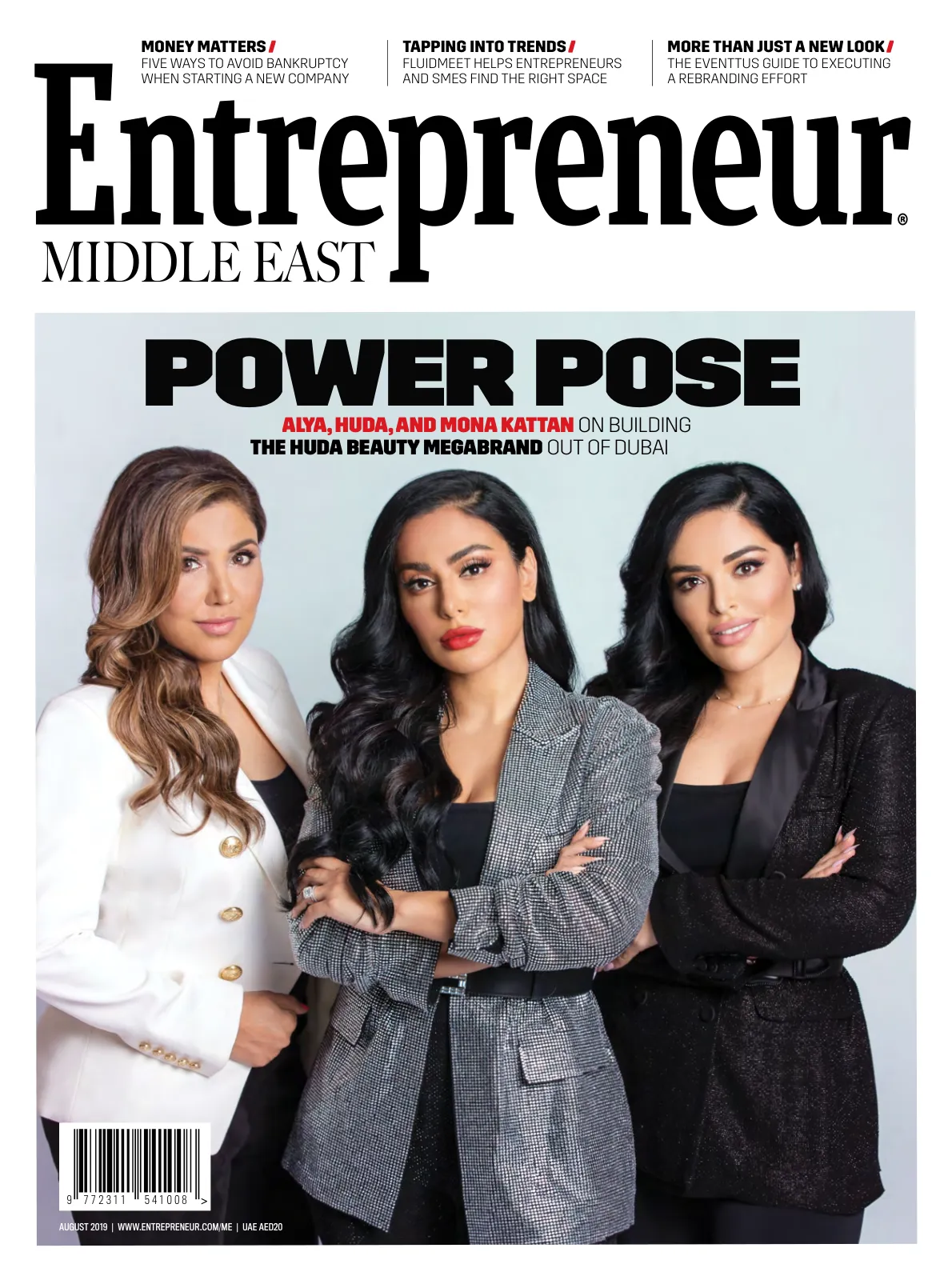
POWER POSE
ALYA, HUDA, AND MONA KATTAN ON BUILDING
THE HUDA BEAUTY MEGABRAND OUT OF DUBAI
Page 2
A brand new way to
invest in real estate!
Guaranteed 10% returns
every year for 5 years
*
Launching Nest by Arada
The Middle East’s premier
student housing complex
Walking distance from University City, Sharjah
Open to all nationalities
arada.com
800-ARADA (27232)
*T&C Apply
Page 3
3
August 2019 / ENTREPRENEUR.COM /
58 Why 2019 and 2020 will be great vintage years for investing in the UAE and KSA
Huda, Mona and Alya
Kattan talk about
building the Huda Beauty
megabrand out of Dubai
24
CONTENTS AUGUST 2019
24
INNOVATOR
POWER POSE
Huda, Mona and Alya
Kattan talk about
building the Huda Beauty
megabrand out of Dubai
(and no, they aren’t done
with their ambitions
just yet).
30
INNOVATOR
CARVING YOUR OWN
IDENTITY
Maximillian Büsser, founder
of Maximilian Büsser and
Friends (MB&F), hints that
the secret to retaining a grasp
on something is in ultimately
letting it go.
36
INNOVATION
FOR IMPACT
IN THE RIGHT PLACE
(AT THE RIGHT TIME)
While it has always been
seen as an attractive market,
Saudi Arabia is now being
increasingly seen as the
location to start a business
in the Middle East.
74
START IT UP
Q&A
Powering strategy
Soushiant Zanganehpour,
founder and CEO of Swae,
on how his startup aims to
upgrade the decision-making
process.
58
MONEY
ECON
The new normal
Ziad Awad of Awad Capital
explains why 2019 and
2020 will be great years for
investing in the UAE and
KSA.
56
‘TREPONOMICS
SKILLSET
To EMBA, or not to EMBA?
Maryke Luijendijk, Program
Director for the Executive
Master of Business
Administration (EMBA)
at American University in
Dubai, explores the benefits
of an EMBA.
Page 4
Stay connected to your
business around the world
with our new roaming pack.
Enjoy unlimited outgoing minutes and
5 GB data for 7 days for just AED 300.
du.ae/vdroaming
Page 5
Page 6
Page 7
19
Page 8
Page 9
Call: 800 UPSALE | up.ae
*Terms and conditions apply
MOTOR CITY
Own Your Dream Home In Dubai
& Move In Today
Aed 80,000*
30 months
Post-Handover Payment Plan
50% DLD
Fee Waiver
1,2,3,4
Bedroom Apartment
Page 10
Page 11
Page 12
COVER THE CITY
Unlocking the Power
of Digital Signage Advertising
Page 13
WITH YOUR ADS
Visit www.lifeonscreen.com
Page 14
14 / ENTREPRENEUR.COM / August 2019
While it has always been
seen as an attractive
market, Saudi Arabia is
now being increasingly
seen as the location to
start a business in the
Middle East.
36
74 Vancouver-based Swae aims to disrupt the overly centralized, top-down
and outdated hierarchical process of decision-making.
CONTENTS AUGUST 2019
Huawei
FreeLace
69
‘TREPONOMICS
PRO
Ahead of the curve
Cecilia Reinaldo, CEO
of Home Owners Direct,
discusses how tech-savvy
customers are transforming
the property market.
44
CULTURE
TRAPPINGS
‘Trep gear
The executive selection for
the entrepreneur on your
list that has everything.
Okay, maybe for a little self-
reward as well.
22
IN THE LOOP
Broadening horizons
New Delhi-based ShipsKart
and Bangalore-based Loktra
are declared winners of
the Dubai Startup Hub
Roadshow in India.
78
START IT UP
Q&A
Tapping into trends
UAE platform fluidmeet
helps entrepreneurs and
SMEs find the right space to
meet their needs.
54
‘TREPONOMICS
PRO
The new wave
Telecom breakthroughs are
the key to transforming SME
futures, says du’s Hany Aly.
46
START IT UP
ECOSYSTEM
Enterprise island
An exploration of the
business ecosystem in
Malta.
42
TECH
SHINY
#TamTalksTech
Gadgets and doodads that
you might’ve missed out on,
sourced by a tech aficionado.
Page 15
800 9090 rta.ae
Purchase your ticket and relax in our new air-conditioned
station at Dubai Festival City. Cruise between the mall
and the Al Jaddaf Marine Station or easily connect to your
journey onward as we are integrated with the
Creek Metro Station.
Enjoy easy
connectivity across
the Al Jaddaf area.
BM2
BM2
DC1
BM2
DC1
DC1
Creek Park
Dubai Creek Harbour
Dubai Festival City
Deira City Centre
Dubai Creek
Floating Bridge
Floating Bridge
Garhoud Bridge
Business Bay
Crossing
Business Bay Canal
ZAA'BEEL
AL GARHOUD
AL RASHIDIYA
Dubai Design District
Dubai
Festival City
Dubai Creek Golf
& Yacht Club
Al Boom
Tourist Village
Creek Park B
Creek/Al Jaddaf
Creek Park A
Metro Green Line
Abra
Water Bus
Routes
Abra and Ferry timings:
Air-conditioned Abra
Al Jaddaf Marine Station
to Dubai Festival City
(BM2)
Saturday – Thursday
7:00 am - 12:00 midnight
Friday
9:00 am - 12:00 midnight
10 minutes (Peak Hours)
20 minutes (Off-peak Hours)
AED 2 per person,
per trip in one direction
Ferry
Round Trip – DFC
Every day
4:00 pm
Min. of 8 passengers
Timings
Frequency/Fares/Features
For detailed timings and information, visit the respective customer service office inside the station.
Children under 5 years travel for free only for commuter trips.
Page 16
16 / ENTREPRENEUR.COM / August 2019
Maximillian Büsser,
founder, Maximilian
Büsser and Friends
(MB&F)
30
72 Washmen and FineDine secured their latest fundraising wins
42 Samsung Galaxy Fold
CONTENTS AUGUST 2019
80
START IT UP
Q&A
Driving efficiency in the
automotive industry
UAE startup AlgoDriven
uses its proprietary data
platform to help accurately
price and identify used
cars.
64
‘TREPNOMICS
MARKETING
More than just a new look
The Eventtus guide to
successfully executing a
rebranding effort, as told
by the brand’s Head of
Marketing, Muhammad
Omar.
82
START IT UP
STARTUP FINANCE
Money matters
Jimmy Haoula rounds up
five factors to keep in mind
to avoid bankruptcy when
starting a new startup.
52
CULTURE
LIFE
Start ‘em young
Helen Al Uzaizi lists three
ways entrepreneurial
thinking can help kids all the
way to adolescence
(and adulthood as well).
72
START IT UP
START IT UP FINANCE
“We got funded!”
A look into how Washmen
and FineDine secured their
latest fundraising wins (and
what one can expect to see
from them in the future).
62
‘TREPONOMICS
SKILLSET
Get your message across
Agga Consulting’s
Antigone Christofides
gives a guide to the 10 core
elements on what makes
for a good pitch for funds
from investors.
Page 17
Page 18
18 / ENTREPRENEUR.COM / August 2019
SUBSCRIBE
Contact subscriptions@bncpublishing.net to receive
Entrepreneur Middle East every issue
EDITOR IN CHIEF Aby Sam Thomas editor@bncpublishing.net
CEO Wissam Younane wissam@bncpublishing.net
DIRECTOR Rabih Najm rabih@bncpublishing.net
CREATIVE LEAD Odette Kahwagi
MANAGING EDITOR Tamara Pupic
STARTUPS SECTION EDITOR Pamella de Leon
EDITORIAL ASSISTANT Junaid Seraj
GROUP SALES DIRECTOR – B2B GROUP Joaquim D’Costa
COLUMNIST Tamara Clarke
PO Box 502511 Dubai, United Arab Emirates
P +971 4 4200 506 | F +971 4 4200 196
For all commercial enquiries related to Entrepreneur Middle East
contact sales@bncpublishing.net
All rights reserved 2019.
Opinions expressed are solely those of the contributors.
Entrepreneur Middle East and all subsidiary publications in the
MENA region are officially licensed exclusively to BNC Publishing
in the MENA region by Entrepreneur Media Inc.
No part of this magazine may be reproduced or transmitted in any
form or by any means without written permission of the publisher.
Printed by United Printing and Publishing
upp.ae
Images used in Entrepreneur Middle East are credited when necessary. Attributed use of
copyrighted images with permission. All images not credited otherwise Shutterstock.
Lama Abdelbarr
Helen Al Uzaizi
Hany Aly
Ziad Awad
Fida Chaaban
Antigone Christofides
Jimmy Haoula
Maryke Luijendijk
Megha Merani
Muhammad Omar
Cecilia Reinaldo
Omar Tahboub
CONTRIBUTING WRITERS
entrepreneur.com/me
ACCESS FRESH CONTENT DAILY ON OUR WEBSITE!
MIDDLE EAST
EntMagazineME
@EntMagazineME
Entrepreneur-me
EntrepreneurMiddleEast
EntMagazineME
EntMagazineME
EntMagazineME
MIDDLE EAST
In addition to our print edition, we’re bringing
you all sorts of industry news on our web
mediums. Joining us online means getting
relevant business and startup content in
real-time, so you’re hearing about the latest
developments as soon as we do. We’re looking
forward to interacting with our readers on all of
our social media and web platforms- like any
thriving business, we’re looking to give and take.
#TrepTalkME is already happening on all of our
digi platforms, and all good conversations go
both ways. See you on the web!
Page 19
Page 20
20 / ENTREPRENEUR.COM / August 2019
There’s no real formula (or benchmark) for success…
except the one you set for yourself
Redefining definitions
Aby Sam Thomas
Editor in Chief
@thisisaby
aby@bncpublishing.net
EDITOR'S NOTE
I
n my role as Editor in Chief of
Entrepreneur Middle East, one
of the things I often get asked by
those who are venturing into (or
have just started working in) the
media industry is about what
advice I could give them that
would help them grow and succeed in
their careers in this particular sector.
I’ll admit here that I am always
conflicted about how I go about
answering this question- I mean, I
could make use of the almost staid
(but true, regardless) response that
delves into the importance of working
hard, having a strong work ethic,
and so on and so forth. But that
answer doesn’t take into account
the privileges I had in my life so far,
which can range from, for instance,
having supportive friends, family,
and mentors who pushed me (and
my dreams) ahead, to, well, the sheer
luck that I had in certain situations
that simply played to my advantage.
It is for this reason that I’m not
entirely comfortable with the
notion that there are these so-called
“recipes for success” for the world
of today- and yes, I do acknowledge
the irony here in that I almost always
ask entrepreneurs I interview for
this publication to tell me their tips
and tricks to triumph in the startup
space. However, the way I see it is
that everyone has their own versions
of strategies and schemes that have
helped them get ahead, and yes, there
are definitely pointers and lessons
one can glean from them. However,
they should definitely not be seen
as a cookie-cutter formula that you
can just copy and paste into your
own lives and careers. After all, what
worked for me doesn’t necessarily
have to work for you, and, perhaps
more importantly, it’s important to
realize that all of us going through
life are actually just making it up as
we go along.
You see, regardless of the amount
of wins we may have under our belt,
or the years of experience that we
can boast of, it’s pretty safe to say
that none of that can be taken as a
definite confirmation of how things
could go in the future- and this needs
to be remembered when we’re being
subjected to advice from everyone
around us. I found validation for this
particular paradigm from a tweet by
Glitch CEO Anil Dash (@anildash
was declared one of Twitter’s best
accounts by Time magazine in 2013),
which said: “One of the weirdest
things about being a CEO is I end up
seeing a lot of media and advice aimed
toward entrepreneurs, or offering
tips on how to succeed in business,
and my overwhelming response to it
all is NO ONE KNOWS ANYTHING!
Honestly. Almost all the advice is
overstated.”
In the same thread, Dash went on to
say that all of us need to define our
own notions of success, and that we
should “reject any advice that's not
relevant to your context, consider
the source for any recommendations
that you read, evaluate people's
thoughts and ideas through the lens
of their actual impact on the world,
[and] engage with systems on your
own terms.” I agree with all of these
pointers, and while it has taken a
good while for me to come to this
kind of understanding (and truth be
told, I still slip up on this more often
that I care to admit), it certainly is in
line with what I tell those who come
to me for advice. While it’s always
good to follow in the footsteps of your
role models, do not limit yourself to
them, or judge yourself harshly if you
find yourself falling short of what
they do- it’s more important that you
find your own path, figure out things
that work for you, and march to the
beat of your own drum. At the end of
it all, you should be the one defining
what success means to you- not
anyone else.
Page 21
A MEMBERS OF EMIRATES TRANSPORT BUSINESS CENTERS:
Page 22
22 / ENTREPRENEUR.COM / August 2019
IN THE LOOP
DUBAI STARTUP HUB ROADSHOW EVENT IMAGES COURTESY DSH
At Dubai Startup Hub Roadshow event- delegates and startup participants
Wissam Younane, CEO of BNC Publishing, the media house
behind Entrepreneur Middle East, and Dr. David A. Schmidt,
President, American University in Dubai
Entrepreneur Middle East has entered into a
partnership with the American University in
Dubai that will see the two entities collaborate
on promoting entrepreneurship and its education
among youth in Dubai and the UAE.
A memorandum of understanding between
the two parties was signed in July by Wissam
Younane, CEO of BNC Publishing, the media
house behind Entrepreneur Middle East, and Dr.
David A. Schmidt, President, American University
in Dubai, in the presence of personnel from both
organizations.
“A partnership between these two powerhouses
is essential in magnifying the importance of higher
education, in all the forms it takes, in the Middle
East,” said Dr. Schmidt. “We are thrilled to have
this platform to share our insights on our programs
and the higher education landscape as a whole.”
“At Entrepreneur Middle East, we’ve always been
dedicated to furthering entrepreneurship and
its appeal in the region, and we believe that this
partnership with the American University in Dubai
only serves to bolster this particular objective,” said
Younane. “There are definite synergies between
the university’s innovation-focused initiatives and
our own pursuit of elevating the regional discourse
on entrepreneurship and business, and so, there’s a
lot to look forward to in our collaboration together.”
This collaboration with Entrepreneur Middle
East comes close on the heels of the American
University in Dubai’s launch of its new Innovation
Center as well as its new Executive MBA course,
both of which aim to foster and empower future
entrepreneurs and business leaders in the region.
T
wo innovative startups from
India have won free office space
and company set-up support in
Dubai at a pitch competition during
the first ever Dubai Startup Hub
Roadshow hosted in India at Delhi
and Bangalore.
Organized by Dubai Startup Hub
and Dubai Technology Entrepreneur
Campus (Dtec), a wholly-owned tech
startup hub by Dubai Silicon Oasis
Authority, the competition received
entries from more than 200 startups
in India. 16 startups were shortlist-
ed, and they pitched their businesses
for an opportunity to expand their
operations into Dubai.
New Delhi-based B2B e-commerce
platform for marine procurement
ShipsKart claimed first place, win-
ning free office space and business
set-up support at Dtec for one year.
Meanwhile, second place winner
Loktra, a Bangalore-based banking
operating system delivering bank-
ing as a service, received flexi-desk
space at Dtec and company set-up
support for a year.
Omar Khan, Director of Interna-
tional Offices at Dubai Chamber of
Commerce and Industry, said in a
statement that the winning startups
offer unique business concepts that
meet market needs and support
Dubai’s Smart City vision. Khan pre-
viously noted that Indian businesses
are well represented within Dubai’s
business community, and that 30%
of startups registered with Dubai
Startup Hub members are Indian-
owned. More than 38,000 Indian
companies are Dubai Chamber
members.
Commenting on the occasion, Hans
Henrik Christensen, Vice President
of Dtec, said: “The noteworthy suc-
cess achieved through this roadshow
reflects the Indian investors’ and
entrepreneurs’ confidence in Dubai,
due to its vibrant growing entrepre-
neurial ecosystem. Innovation is at
the core of the sustainable develop-
ment drive of the UAE, and a pillar
in boosting its competitiveness.”
The Dubai Startup Hub roadshow
to India was supported by Startup
India and NASSCOM 10000 Start-
ups, in addition to Dtec, and STEP
Group. The roadshow included visits
to New Delhi and Bangalore, round-
table and panel discussions, and
success stories from Indian startups
that have benefited from the Dubai
Startup Hub platform and built suc-
cessful businesses in Dubai.
The three-day roadshow also
provided a platform for Indian
startups to learn about Dubai’s
entrepreneurial ecosystem, and the
vast opportunities, programs and
resources it has to offer.
dubaichamber.com/dubaistartuphub
New Delhi-based ShipsKart and Bangalore-based
Loktra declared winners of the Dubai Startup Hub
Roadshow in India by MEGHA MERANI
BROADENING HORIZONS
Entrepreneur Middle East inks MoU with
the American University in Dubai
PARTNERS IN PROGRESS
Page 23
The iconic jewel of Kuwait City; Symphony Style Kuwait
commands the finest views of Kuwait’s bay.
An oasis of calm amidst the city’s vibrant energy
designed for lofty living.
Welcome to the
EXCEPTIONAL
radissoncollection.com/symphony-style-hotel
A R A D I S S O N CO L L E C T I O N H OT E L
Page 24
24 / ENTREPRENEUR.COM / August 2019
"WE ARE KIND OF
RE-LEARNING WHAT IT
MEANS TO BE A WOMAN
RIGHT NOW, AND I THINK
THAT THE MIDDLE EAST WILL
BENEFIT FROM THAT.”
INNOVATOR
Left to right:
Alya, Huda, and Mona Kattan
Page 25
25
August 2019 / ENTREPRENEUR.COM /
POWER POSE | BUILDING THE HUDA BEAUTY MEGABRAND OUT OF DUBAI
POWER
POSE
HUDA KATTAN MONA KATTAN ALYA KATTAN
The Kattan sisters on building the Huda Beauty megabrand out of Dubai
(and no, they aren’t done with their ambitions just yet)
by TAMARA PUPIC / PHOTOGRAPHY FAROOQ SALIK
>>>
I
n person, Huda Kattan, the driving force
behind one of today’s fastest growing
beauty brands, Huda Beauty, radiates
steely self-assurance. Not that I have
expected anything different from a
woman who is currently ranked 36 on
Forbes’ list of “America’s Richest Self-
Made Women.” Sitting beside me at
the brand’s headquarters in Dubai, she
looks as striking as seen on the front
cover of this issue- the abundant curls
of black hair frame her flawless face,
complete with immaculate makeup,
and she is dressed for not just any,
but exactly the type of success she
wants in a sequined power suit. And,
during the interview, she wants to
broach the topic I least expect. “When you hit a certain
level of success, you realize that it can cause some really
serious issues to come up,” Huda says. “And if you don’t
find the right way to deal with it, it could make you very
depressed, very purposeless. It’s scary.”
Up until now, Huda has used a makeup brush as an
empowerment tool to guide women on how to paint
their own stories of betterment on their own faces.
Over almost a decade, her brainchild Huda Beauty has
grown from a blog to a beauty brand that now offers 213
products across five categories (complexion, lips, eyes,
body, and tools), the newly-launched sub-brand Kayali, a
fragrance line developed by her sister Mona Kattan, while
an arsenal of the brand’s skincare products is also in the
works. However, what makes the story of Huda Beauty
extraordinary is that Huda is now willing to take all those
layers of makeup off, confront her insecurities, and learn
how to feel truly confident inside- while sharing it all with
her 40 million and more followers, of course. “A lot of issues
from my childhood were driving me, and I had no idea,” she
says, adding that she has been working with a life coach
over the last couple of years. “I never felt like I belonged
in society, I never felt really comfortable in my own skin,
and there are literally billions of people who feel like that.
However, I never understood that it was the thing that
gave me my drive, that I always wanted to prove that I was
good enough.”
Page 26
26 / ENTREPRENEUR.COM / August 2019
“WE REALLY WANT TO
REVOLUTIONIZE THE BEAUTY
INDUSTRY ITSELF, BY GIVING THE
HIGHEST QUALITY PRODUCTS
TO THE CONSUMER AT A LOWER
PRICE, WHICH WILL REALLY
DISRUPT THE INDUSTRY,
AND WILL GIVE MORE TO THE
CONSUMER. HUDA HAS ALWAYS
BEEN REALLY FIRM ABOUT
GIVING BACK."
INNOVATOR
Huda Kattan,
founder and CEO,
Huda Beauty
A turning point for Huda (and
Huda Beauty) happened in
2017 when the Kattan family
agreed to sell a small stake in
the business to TSG Consumer
Partners, a San Francisco-
headquartered private equity
firm focused exclusively on the
branded consumer sector. It
was a positive change that hard
work and perseverance had
brought to Huda Kattan, but
surprisingly, it also uncovered
that, in her mind, she was
partially still a person she
used to be: an American-born
daughter of Iraqi immigrants
exposed to daily bullying due
to her ethnicity. “Getting our
investment meant that we
were now good enough, and it
made me question to whom I
was trying to prove it. I actu
ally went through a lot of get
ting to know myself after that
happened. It’s crazy, because
you think it’s the best thing
that could ever happen, but
I’ve heard it from so many of
our friends, and it is that after
they get these crazy valuations
and crazy investments, they hit
rock bottom, because all of a
sudden, they realize that they
have been doing everything for
society, and never for them
selves. And then, they have
to question themselves, like,
‘Why do I actually care?,’ and
that is such a hard conversa
tion to have with yourself.”
In opening up on this topic,
Huda proves that she is a part
of the millennial generation
that is prioritizing purpose
over profits- according to
Deloitte’s 2018 Millennial
Survey, 80% of millennials
believe businesses should make
a positive impact on society
and the environment. On her
part, Huda is eager to inspire
an honest dialogue around dif
ferent self-confidence related
personal challenges. “They
[millennials] want to buy from
brands that are sustainable,
because they want to be a part
of the companies that are doing
something good for this world.
I think that there will be an
even bigger shift in the world,
and people will need to be
vulnerable enough to be able to
expose their imperfections in a
way that can be very challeng
ing,” she says. “It’s really hard
to actually say, ‘I don’t love
myself enough,’ but it’s such
an important conversation to
have, because you can only get
over those things when you
start talking about them. Peo
ple see me from the outside,
all this hair and makeup and
our glamour team that does all
this stuff, and think I cannot
not feel self-love, but I do, and
I see it in other people. It’s
like a wound that they carry
with themselves.” Her wound,
which she now describes as the
ugly child syndrome, inspired
her passion for cosmetics,
turned her into an expert on
beauty products, and became
the main pillar of her brand.
“The heartbeat of the company
is definitely that transforma
tional idea, the idea that you
can transform, and be beauti
ful. The vision of the company
is definitely to allow people to
understand their capabilities,
and how far they can go.”
With us are Huda’s sisters,
Mona and Alya Kattan, who
both have stakes and executive
positions in the company-
Global President, and Chief
Instagram Officer, respectively.
Spending an hour with the
three Kattan sisters -all three
of whom come across as kind,
thoughtful, and sincere- it is
evident that the family sup
port has been crucial for the
Huda Beauty brand to grow
in its influence and ubiquity
at such a fast pace. To give
you an example: when Huda
says that her first few video
tutorials “were not done very
well,” the soft-spoken Mona
jumps in saying, “Not very
well, but you did it.” Instantly,
the ever-supportive Alya, who
is the eldest among them,
adds, “Huda knows how to do
everything, you know, even
to edit her videos, so she was
blogging, shooting, editing,
really doing everything. People
don’t realize how much work it
was. We would see her sleep
ing with her laptop in her lap.
And today, she always makes
products for herself first, and
she will consumerize them af
terwards only if they are good
enough.”
The Huda Beauty blog
launched in 2010, and in a
region where people don’t
shy away from spending on
cosmetics and personal care
products- according to Eu
romonitor International, con
sumers in the UAE are forecast
to spend US$294 per capita on
cosmetics and personal care
by 2020. However, a makeup
artist at the time, Huda only
intuited the opportunities
her blog might offer. “All the
makeup artists I was working
with were telling me, ‘You’re
so stupid, you’re giving away
your tips, nobody is going to
book you,’ and I did not really
understand the value of it un
til much later,” Huda recalls.
Page 27
27
August 2019 / ENTREPRENEUR.COM /
“THE VISION OF THE COMPANY
IS DEFINITELY TO ALLOW
PEOPLE TO UNDERSTAND THEIR
CAPABILITIES, AND HOW FAR
THEY CAN GO.”
POWER POSE | BUILDING THE HUDA BEAUTY MEGABRAND OUT OF DUBAI
Alya Kattan,
Chief Instagram
Officer, Huda
Beauty
Mona Kattan,
Global President,
Huda Beauty
>>>
“I got pregnant, and could not take as
many makeup jobs, but then a Sheikha
from Abu Dhabi called me, and was
willing to pay for what I would normally
charge for a week, and it was then that
I realized that there was something in
it, in my blog. All of a sudden, and very
quickly, I was elevated, and people saw
me as somebody who knew something.
From then on, it did take some time for
the blog to become interesting globally,
but I will say that I have been very dili
gent and very focused.”
Mona adds that another reason for the
blog gaining a huge amount of traction
and credibility is in Huda being vehe
mently against advertising from day one
until today. Indeed, Hopper, an Insta
gram scheduling tool, recently revealed
that Huda Kattan topped
Instagram's 2019 Rich
List in the beauty category,
with the ability to charge
$91,300 (Dh335,344) for
a sponsored post on the
photo-sharing app- if she
wanted to, of course. “I
was in PR at the time, and
people were chasing me
asking what Huda’s rate
was, and what they could
do to get her to review their
company,” Mona recalls.
“And I was like, ‘You need
to have a good product.’
She was super authentic
and genuine, and she really
cared.” Huda adds, “It was
weird, because, at the
time, bloggers were like, ‘We’ll go
to events across the world, and we
will party and get free products.’
And I would be the only one sitting
behind with a scientist.” Huda’s
particular work ethic has been in
stilled in the Huda Beauty brand as
well, with Mona saying, “We really
want to revolutionize the beauty
industry itself, by giving the highest
quality products to the consumer
at a lower price, which will really
disrupt the industry, and will give
more to the consumer. Huda has
always been really firm about giving
back, and I think we have made
other brands think about that as
well.”
Huda can go deep on all of her
products, but we start with the very
first one- a series of false eyelashes
whose release in February 2013 by
beauty retailer Sephora at Dubai
Mall marked the launch of the Huda
Beauty cosmetic line. A year before,
in 2012, Huda took her beauty tips
to YouTube and Instagram, which, in ad
dition to her blog, were the only market
ing channels used to promote her first
product. Sephora Dubai Mall expected to
sell roughly 7,000 units of the lashes in
a year, after comparing them with other
brands in the lash category. Instead, what
happened was, the 7,000 units were sold
in a week. “They told us that we were
a no-name, but we blew the numbers,
we blew the established brands, and on
the first day only, I think, we sold 2,000
lashes,” Huda says. “There were not many
press who featured us back then, they
were all like, ‘You’re a blogger,’ because
at the time, no one knew what bloggers
would become. It was a weird time for us,
to be honest, because it was one of the
very first times that an influencer was re
leasing a product, but Sephora MENA had
a great General Manager who was like,
‘Let’s do it,’ but then Sephora US said no,
Sephora Europe ignored us, and they kept
on saying no for years, which is crazy,
because now we are like the number two
brand in Sephora Europe.”
Page 28
28 / ENTREPRENEUR.COM / August 2019
"WE WERE HOLDING OURSELVES
BACK, BECAUSE WE SAID, ‘WE
ARE IN DUBAI, SO WE CAN’T
BE COMPETING AGAINST THE
BIGGEST BLOGGERS, AND THE
BIGGEST COMPANIES IN THE US.’
BUT I FEEL THAT THAT SHIFTED
IN 2016, WHEN I WAS LIKE, ‘WAIT,
WHY CAN’T WE BE THE BIGGEST
IN THE WORLD?’ AS SOON AS
THAT SHIFT HAPPENED IN THE
BRAIN, THAT’S WHEN THE THINGS
CHANGED OUTSIDE AS WELL.”
INNOVATOR
"WE STILL
HAVE SO
MUCH WORK
TO DO, AND
I DON’T
THINK THAT
WE ARE
ANYWHERE
CLOSE TO IT.”
“We really want to revolutionize
the beauty industry itself by
giving the highest quality products
to the consumer at a lower price."
Building a beauty brand from
scratch with only four people
-the three sisters and Huda’s
assistant- and without proper
infrastructure was a challeng
ing endeavor, Huda recalls.
“The distributor we were
working with was really taking
advantage of the fact that we
were a small company,” she
says. “They were not paying us
the right way, they were not
ordering right quantities, so
we were always out of stock,
and we were literally dying as a
brand, because of our distribu
tor. I want to say this to all
young businesses, because, in
the beginning, it is really chal
lenging, because you have no
other choice. Those were two
most challenging years of my
life, because you didn’t know
whether you’ll survive. You
know that you have an amaz
ing product, but you don’t
know whether you are going to
be able to continue. When we
finally managed to save enough
money, my husband joined us,
and we were able to get rid of
our distributor.”
In 2015, Christopher Gonca
lo, Huda’s husband, joined the
company as its Chief Operating
Officer, and he created a prop
er distribution channel that
enabled the company to finally
fund their cosmetics. A year
later, the company launched
the Huda Beauty makeup line;
however, it brought Huda face-
to-face with one more of her
self-limiting beliefs. “For the
longest time, we were hold
ing ourselves back, because
we said, ‘We are in Dubai, so
we can’t be competing against
the biggest bloggers, and the
biggest companies in the US.’
But I feel that that shifted in
2016, when I was like, ‘Wait,
why can’t we be the biggest in
the world?’ As soon as that
shift happened in the brain,
that’s when the things changed
outside as well.”
Since then, the company has
experienced an astonishing
level of growth- only over
the last two years, the
Huda Beauty global in-store
distribution has grown by
roughly 18 times. The team
has grown exponentially too-
according to the company,
in December 2017, it had 115
employees globally, and that
figure has doubled now. While
2017 was marked by them
bringing private equity on
board, 2018 was marked by the
company’s global expansion,
with Huda Beauty opening its
first offices in the US and UK.
However, Huda says she is only
getting started. “Originally, my
goal was to become number
one blogger in the Middle East,
but before you even reach a
goal, you don’t even realize
that you have a new goal,” she
says. “You don’t even take a
minute to think that you’ve
reached it, because you’ve
already moved on to the next
goal. And so now, I still feel
that we are at the beginning of
doing things. There are some
very influential companies in
the world, like Apple, Google,
Amazon, and to me, that is
where I want us to be. So, I
think that we still have so
much work to do, and I don’t
think that we are anywhere
close to it.”
In 2018, the Kattan sisters
also launched into the
fragrance category. A passion
of Mona, the company released
a collection of four scents
(Elixir, Citrus, Musk, and
Vanilla) under the brand
name Kayali (meaning “my
imagination" in Arabic),
priced from $85 to $118. The
four fragrances are designed
to introduce the rich heritage
of fragrance layering of the
Middle East to the West.
“When I got my first job at 14,
I spent money on fragrances,
and during my whole time at
university, I used to do side
jobs, promoting or modeling,
and all my money was spent on
expensive perfumes, so I have
this attachment to fragrance,
because it makes me feel
good,” Mona explains. “That
confidence that Huda feels
through beauty, I feel through
fragrance. It instantly changes
my mood. It’s so strong and
powerful what it does to your
brain, it can ignite memories
and emotions.”
Recently, the Kattan family
has also set up a family office,
Huda Beauty Investments,
which includes an early
investment fund for women
starting consumer-facing
Page 29
29
August 2019 / ENTREPRENEUR.COM /
POWER POSE | BUILDING THE HUDA BEAUTY MEGABRAND OUT OF DUBAI
Left to right:
Mona, Huda, and Alya Kattan
brands. “In the Middle
East, for the longest time,
women were expected to be
completely reliant on their
husbands, but there is a shift
happening, and I do want
Middle Eastern women, Arab
women, Muslim women, to
feel empowered to do things,
to support their families, but
also to understand that their
success does not change things
in the house, which is the
scary part,” Huda says. “My
husband is still the king of
my castle, and at home, I am
a very different person than I
am in the office. When needed,
I was the king of the castle,
because protecting the home
is important, but it took me a
long time to realize that being
an alpha female was not what
I needed to be. Actually, I lead
with my feminine energy, but,
at the same time, I can be very
firm and very tough. So, I feel
that we are kind of re-learning
what it means to be a woman
right now, and I think that the
Middle East will benefit from
that.” Having spent a morning
with these three women who
have built a brand valued at
over $1 billion, one thing is
clear to me: the Kattan sisters
do not waste their gifts, even if
they come in the form of their
deepest wounds- and neither
should you.
Page 30
30 / ENTREPRENEUR.COM / August 2019
CARVING
YOUR OWN
IDENTITY
A CLASS APART
>>>
Maximillian Büsser, founder of
Maximilian Büsser and Friends (MB&F),
hints that, in life and business,
the secret to retaining a grasp on
something is in ultimately letting it go
by TAMARA PUPIC
IMAGE CREDIT MB&F
INNOVATOR
Page 31
31
August 2019 / ENTREPRENEUR.COM /
Maximillian Büsser,
founder, Maximilian Büsser and Friends
"WHEN YOU FOUNDED
A COMPANY YOURSELF, ALL
ALONE IN YOUR LITTLE FLAT, AND
YOU’VE DONE EVERYTHING FOR
IT, AND YOU’VE MICROMANAGED
EVERY-SINGLE THING, YOU HAVE
TO LET GO AT SOME POINT.."
CARVING YOUR OWN IDENTITY | MAXIMILLIAN BÜSSER
>>>
T
o rebel against many aspects of
the traditional watchmaking in
dustry and start an independent
brand right out of your living
room is brave; and then to not
fail at it, but 15 years later, be
praised for a creative approach
to watchmaking, is noteworthy.
Key to this, as explained by Maximillian
Büsser, founder of Maximilian Büsser and
Friends’ (MB&F), dubbed the world’s first
horological concept brand, is not having
it any other way. “Making sure that I’m
free, creatively, financially, and in any
other way, has been all I’ve been doing for
14 years,” says Büsser. “I think that brings
a lot of envy but a positive envy from big
players who, I have to say, have always
been very kind to us. Because we’re not
competitors, we’re not taking sales off
them, and, as they can see, it hasn’t been
snowballing.”
Büsser is talking about how his indepen
dently-owned company has managed to
survive in a landscape dominated by the
“big boys” of the world’s watchmaking in
dustry. He founded MB&F, also described
as the world’s first horological laboratory,
in 2005 in his Geneva flat in Switzerland,
dreaming of developing radical horologi
cal concepts by working in small, hyper-
creative groups, and that was it– there
has been no revenue target added to his
goal ever since. “We’ve got a very bipolar
industry today, meaning that the very big
boys are enormous now, and they’re all
marketing-driven companies, concerned
about how to ensure growth, and how to
come up with products that please a great
er number of people. Therefore, it causes
Page 32
32 / ENTREPRENEUR.COM / August 2019
"THE HIGHER YOU GET INTO
POSITIONS OF POWER,
THE MORE YOU GET INTO
POWER STRUGGLES.”
IMAGE CREDIT MB&F
"WE ARE ABLE TO PROTECT OUR CLIENTS' MONEY
AT ALL COSTS, AT ALL TIMES. AND IT'S GREAT FOR
THE CLIENTS JUST TO KNOW THAT. BECAUSE IF
YOU'RE DOING EVERYTHING THROUGH A FUND,
SOMETHING YOU CAN'T PHYSICALLY SEE OR
TOUCH, IT BECOMES A LOT MORE DIFFICULT. SO
THAT'S OUR FRAMEWORK, TO OFFER CLIENTELE,
RETAIL OR INSTITUTIONAL, SOMETHING PHYSICAL,
SOMETHING TANGIBLE.”
Omar Jackson,
Partner, Berkely Assets
“WE’VE GOT COMPLETE
ARTISTIC CURATION IN
THE CONTRACTS, AND THE
ONLY THING THAT I WILL
ACCEPT IS THAT NOTHING
CAN BE PRESENTED IN THE
GALLERY IF WE HAVEN’T
SAID IT’S OKAY.”
Maximillian Büsser,
founder, Maximilian Büsser and Friends
INNOVATOR
less innovation, fewer risks,
and less and reduced creativ
ity,” Büsser says. “And then, on
the other side of the spectrum,
you’ve got the small guys, like
us -and we’re not the only ones
who do it- because it’s our life,
we don’t care if people will
like what we do or not. We just
want to create some incredibly
creative products. We have
got a micro voice, compared to
these big guys. I often feel like
a dolphin in the ocean, and you
send your sonar out, and there
are millions of fish, and nobody
gets it, and then from time to
time, you get your sonar back,
and you’re like, whoa, some
body has resonated on the
same wavelength. It’s the same
thing for our clients.”
It is true that, when com
pared to other luxury watch
brands, there are just a
handful of MB&F clients –
Büsser states that, since the
company’s inception, not
more than 2,300 pieces have
been manufactured and sold,
which represents about 800
clients– however, they are a
niche clientele willing to pay
top dollar for these time
pieces. According to the MB&F
website, the prices range from
CHF20,000 to CHF400,000
(and are subject to change).
“I had a big collector come in
the other day who bought his
first MB&F, and told me, ‘You
know what, when I wear my
Patek Philippe, or my Richard
Mille, nobody ever speaks to
me,” Büsser recalls. “I can see
that they see what I’m wear
ing, but they don’t speak to
me. When I wear an MB&F,
they come up to me, from any
social strata, saying, ‘Excuse
me, what is that?’ And then I
tell them the story.’” Accord
ing to Büsser, his clientele are
courageous, self-asserted, and
don’t care about showing off.
As such, his clients are unique
and unpredictable to Büsser
himself as well. “Our sales in
Dubai have been a big surprise
for us, in that that an enor
mous part of our revenue here
is tourist-based, and actually,
residents don’t account for
much in the success of this
gallery,” Büsser says, noting
that the Middle East repre
sented 8% of the MB&F sales
in 2018, which is estimated
to rise to 14% in 2019. “We
were looking at the numbers
from the beginning of this year
and we’ve done incredibly
well here, I think we’ve sold
11 watches, which is a lot and
means that 5% of my yearly
production was sold in just six
months here, but none to any
UAE resident. The new clients
were from countries where we
have no retailers, where we
don’t do any PR, where we
don’t even know how to ac
cess press in those countries,
but still, people come in, and
they already know the brand,
and they spend half an hour
here, and say, ‘Okay, I want a
AED600,000 watch.’ I’m like,
whoa, and then you realize the
power of social media today,
even at our price points. That’s
actually what’s driving most
of our business today. When I
started the company, I used to
say that we couldn’t have done
this without the internet, but
now, it’s [impossible] without
social media. That’s amazing.”
I got to meet with Büsser
at the M.A.D. Gallery (Me
chanical Art Devices) in the
Dubai Mall, one of four he has
opened worldwide. The other
three are in Geneva, Taipei,
and Hong Kong. The four
M.A.D. Galleries showcase
MB&F’s machines and col
laborations, as well as kindred
mechanical and kinetic artists.
Apart from the one in Geneva,
the other three are franchises.
“We’ve got complete artistic
curation in the contracts,
and the only thing that I will
accept is that nothing can
be presented in the gallery if
we haven’t said it’s okay,” he
says. “Most of the partners
are more into retail, and this
is not their theme. Although
they can come up with ideas,
we basically do all the work of
finding the artists. And then
we organize that the artist’s
Page 33
33
August 2019 / ENTREPRENEUR.COM /
MB&F M.A.D. Gallery
MB&F Horological Machine N¯9 Flow (HM9)
CARVING YOUR OWN IDENTITY | MAXIMILLIAN BÜSSER
>>>
work goes from one gallery to another.
What’s important is that the galleries buy
directly from the artists. We don’t mingle
in that, we don’t make any money, it’s just
a curation platform.”
Before we delve into why Büsser has
chosen to make Dubai a home for his
family, despite the company with all of
its 25-member staff still being located
in Geneva, we talk about a turning point
that led to him establishing MB&F in
the first place. Perhaps not surprisingly,
there was an earlier career, and there were
struggles, many of them. Büsser’s love for
high-end horology was nurtured by his
first employer, Jaeger-LeCoultre, where he
spent seven years in senior management
positions, and in 1998, aged 31 at the time,
he was appointed Managing Director of
Harry Winston Rare Timepieces in Geneva
for another seven years. The results were
a 900% increase in turnover, and the
positioning of Harry Winston as one of the
leaders in this very competitive segment.
However, to everyone’s surprise, Büsser
declined a generous new contract from
Harry Winston, opting instead to follow
his dreams. Here’s why: “The higher you
get into positions of power, the more you
get into power struggles,” he says. “It’s as
if people come to work in the morning, and
put their coat of ethics on a hanger. This
dogfight where it’s okay to lie, it’s okay to
backstab, it’s okay to do politics, it’s okay
to manipulate, because you want to make
money. So, when the grail is money, you
have all these deviate social behaviors. I
came from no money, I made money, and
then I realized that having money in those
sorts of circumstances was the worst
thing ever, so I realized that money was
absolutely not what was going to make me
happy, but being proud and trying to abide
by the values my parents had.”
Born in Italy, growing up in Switzer
land, and now being a resident of Dubai,
Büsser has developed a cross-cultural,
broad-based approach to life and to
business. Even more because he grew
up in a multi-cultural environment and
family– his father was a Swiss diplomat
who met his mother, an Indian national,
in Mumbai. “She was a Zoroastrian, and
Zoroastrians abide by three simple rules
-good thoughts, words, and deeds- and my
mom was the epitome of that,” he says.
“But, when you try to do that in business,
you get massacred. So, I just wanted to
put myself in a situation where I could
keep those values.” Therefore, in 2005,
with CHF900,000 of personal savings,
Büsser started out by working alone in
his flat for the first two years. However,
he got six retailers on board, all of them
agreeing to pay him in advance one-third
of the price for his first watch line, the
Horological Machine (HM1), which he
would deliver two years later. One of those
clients was Ahmed Seddiqi & Sons, the
Dubai-born family business that’s today
the largest retailer of Swiss brand watches
Page 34
34 / ENTREPRENEUR.COM / August 2019
Omar Jackson,
Partner, Berkely Assets
“I BUILT MB&F AS MUCH AROUND
MY STRENGTHS AS AROUND MY
SHORTCOMINGS. I HATE MANAGING
PEOPLE, IT TAKES ALL MY LIFE FORCE
OUT OF ME. MANAGING PEOPLE
IS MANAGING OTHER PEOPLE’S
PROBLEMS, WHEREAS I JUST WANT
TO CREATE. SO, THIS HAS BEEN
A LONG JOURNEY. FROM DOING
EVERYTHING MYSELF TO SAYING, ‘I
DON’T EVEN WANT TO BE THE CEO
ANYMORE.’"
“TALKING ABOUT NOT HAVING REGRETS,
EVERY TIME I’VE READ A BIOGRAPHY OF
A GREAT ENTREPRENEUR, THE NUMBER
ONE REGRET AT THE END OF THEIR LIFE
WAS NOT SEEING THEIR CHILDREN
GROWING UP."
IMAGE CREDIT MB&F
Maximillian Büsser,
founder, Maximilian Büsser and Friends
INNOVATOR
in the Middle East. “It’s not
by chance that they’ve got a
gallery today,” Büsser explains.
“Clearly, they’re not doing it
[just] for the money, but that
it’s the relationship that is
important for them, and that’s
one of the things I really appre
ciate in this part of the world.
Relationships are still mean
ingful here, and I have tried to
build my business on that.”
Büsser comes across as an
energetic and friendly person
with a can-do attitude, and
it is clear why any kind of
problem that he might have
encountered would not have
mellowed his desire to develop
MB&F’s into a fully-fledged
haute horlogerie brand that it
is today. However, the com
pany’s growing success shed
a new light on his compulsion
to guard the creative process
from any negative influence.
Consistently failing to achieve
work-life balance, in 2015,
Büsser moved to Dubai with
his young family (a wife and
a baby daughter at the time;
they have welcomed one more
daughter since). “Talking about
not having regrets, every time
I’ve read a biography of a great
entrepreneur, the number one
regret at the end of their life
was not seeing their children
growing up,” Büsser says, while
commenting on the family’s
decision to move out of Swit
zerland. “But actually, it has
had an enormous resonance
on my company, because when
you founded a company your
self, all alone in your little flat,
and you’ve done everything for
it, and you’ve micromanaged
every-single thing, you have to
let go at some point. Yet, it’s
very difficult for people like us
to let go. So, one of my ways
[of doing that] is by not being
in the workshop or the office
for 26 days out of 31. I’ve put a
structure in place which allows
that. So, it has forced me to let
go, and now, I micromanage
much less. It has completely
changed the way I manage.”
In another nod to his fairly
unusual self-awareness, Büsser
settles back and recalls another
similar situation when he
decided to stop the company’s
future growth, in order to
ensure that the MB&F watches
remained looking and func
tioning different from other
familiar timepieces (MB&F
currently manufactures only
220 timepieces per year). “I
built MB&F as much around
my strengths as around my
shortcomings,” he says. “I
hate managing people, it takes
all my life force out of me.
Managing people is manag
ing other people’s problems,
whereas I just want to cre
ate. So, this has been a long
journey. From doing every
thing myself to saying, ‘I don’t
even want to be the CEO any
more.’ One of the many reasons
I didn’t want the company to
grow, and to have any middle
management, is because they
exhaust me. Another reason
is that over the last 14 years,
the awareness of the brand
has grown significantly, and I
said this before, but I used to
be terrified that nobody would
buy what I do, and now I’m
terrified that people are going
to be disappointed, because
expectations have grown.”
Towards the end of our con
versation, Büsser brings one
more proof that he has passed
the point where he believed
he could do everything by
himself. Even though it is not
unusual in the watch industry
that a large group acquires
an eclectic and independent
brand, it certainly would have
been an unusual thing to hear
had I met Büsser a couple of
years ago. However, he is now
willing to admit that the need
to secure his brand in a period
after him has been occupying
his thoughts lately. “You have
to think of what’s going to hap
pen [to your brand] if some
thing happens to you,” Büsser
concludes. “I am absolutely not
announcing anything, I’m not
in discussion with anybody,
but I have to start thinking of
things like that. It’s not about
making money, but about
making sure that it’s still there
after I’m gone. Because, I owe it
to the people in my team, and
to the customers. If you want
to do things well, you have to
think of these things.”
Page 35
ACHIEVING
WOMEN FORUM
2019
THE METHODOLOGY
OF BUSINESS
INDUSTRY INTEL EVENT
AN
A PRODUCTION BY
presented by
GOLD ALLY
PLATINUM ALLY
Enquires: events@bncpublishing.net
SEPTEMBER 30, 2019 | 9:00 A.M. TO 1:30 P.M. | HABTOOR PALACE DUBAI
www.entrepreneur.com/me
#EntMEWomen
Page 36
36 / ENTREPRENEUR.COM / August 2019
IN THE RIGHT PLACE
(AT THE RIGHT TIME)
While it has always been seen as an attractive market,
Saudi Arabia is now being increasingly seen as the location
to start a business in the Middle East
by MEGHA MERANI
INNOVATION
FOR IMPACT
BROUGHT TO YOU BY
36 / ENTREPRENEUR.COM / August 2019
Page 37
37
August 2019 / ENTREPRENEUR.COM /
"We have a Saudi-first strategy. Most of
our investors are Saudi, and our main key
market is Saudi. I think that gives you an
insight of the change in the ecosystem]
from 2010 to 2019. The last few years
have been an amazing boom.”
Alpen Celen,
founder, Enhance
WWW.MONSHAAT.GOV.SA
>>>
D
id you really quit McKin
sey to do this?”
Alper Celen's decision
to trade his cushy job
at the prestigious global
management consulting
firm's Scandinavian
offices for a move to Saudi Arabia to
grow a startup there didn't make much
sense to his colleagues. Celen founded
Saudi’s Groupon-like startup Fursaty
and co-founded FoodOnClick.com’s KSA
operations, bootstrapping the ventures
at a time when the kingdom's startup
scene was barely in its infancy.
“It was soul searching,” Celen remem
bers. “These were smart people making
me question my choices. In 2010, when
we first got started, we struggled. It was
difficult to find talent. It was difficult to
raise funding. There were no VC funds
to speak off around- Wamda or a couple
of earlier players, but that was it. There
were, essentially, no angel investors. It
was very challenging to build something.
I was mostly funding stuff from my own
pocket.”
But his forward-thinking leap into the
Middle East’s largest economy has paid
off- and today, Celen is much sought
after by non-Saudi startups for advice
on how to enter the Saudi market. He
is now founding partner of Middle East
venture builder and holding company
Enhance, which launched online gifting
platform joigifts.com in 2016. Celen, also
co-founder and co-CEO of joi, claims the
marketplace is the “fastest non-Saudi
startup to launch in Saudi Arabia.”
Enhance raised a seed round of US$1.5
million in 2018 with investment from
Saudi's iNet, Hala Venture Capital, U.S.-
based 500 Startups and angel investors
from the Gulf, Europe and the US. “We
launched joi in Saudi a month after we
launched in Dubai, and I don't think
anybody has ever done that [before],”
Celen says. “We have a Saudi-first strat
egy. Most of our investors are Saudi, and
our main key market is Saudi. I think
that gives you an insight of the change
[in the ecosystem] from 2010 to 2019.
The last few years have been an amazing
boom.”
Government-backed vision
Saudi Arabia’s Crown Prince Moham
med bin Salman announced Vision 2030
in 2016 as a package of economic and
social reforms designed to diversify the
economy away from oil, attract foreign
capital, and create jobs for citizens. Rais
ing the current contribution of SMEs to
GDP from 20% to 35% by 2030 is listed
as a top priority for the crude producer's
prosperity.
“In line with its Vision 2030, the King
dom has launched multiple government
initiatives to spur entrepreneurship
and innovation in order to become the
hub for entrepreneurship in the region,”
says Philip Bahoshy, founder and CEO of
MAGNiTT. “These include government-
backed initiatives such as licensing op
portunities for venture capital firms and
startups, investment in local VC funds,
funding platforms for SMEs, as well as
incubators and accelerators.”
The establishment of Monshaat,
Saudi's General Authority for Small and
Medium Enterprises, is among the key
steps to develop and nurture the SME
sector. Monshaat works with relevant
authorities to remove administrative,
regulatory, technical, procedural and
informational obstacles faced by the sec
tor. At the end of 2018, Monshaat set up
a support center model for SMEs to pro
vide training, advisory and mentorship
services to help entrepreneurs navigate
challenges to their growth. The entity
also launched a government-owned VC
firm -the Saudi Venture Capital Com
pany (SVC)- with a fund worth SAR 5
billion ($1.33 billion) that will directly
invest in the country’s startups and VC
funds.
Ali Abussaud, Managing Partner of
Saudi-based Hala Venture Capital, says
he believes the government's “dramatic
support” to SMEs as part of the head
line-setting reform plan will help the
sector fast-forward to 20 years’ worth of
progress in just a few years. Public sector
initiatives are the most compelling en
ablers in any economy, he insists. “You
cannot really rely on the private sector
or anybody else to improve the market,
unless the government will step up and
Page 38
38 / ENTREPRENEUR.COM / August 2019
FIGURES FROM SAGIA SHOW IT ISSUED
267 NEW LICENSES TO FOREIGN
INVESTORS DURING THE FIRST
QUARTER OF 2019, MARKING AN
INCREASE OF 70% WHEN COMPARED
TO THE SAME PERIOD LAST YEAR.
Ali Abussaud, Managing Partner, Hala Venture Capital
WWW.SAGIA.GOV.SA
IN THE RIGHT PLACE (AT THE RIGHT TIME)
do that themselves,” he says, hoping the
steps will help change misconceptions
about doing business in the Kingdom.
“There are a lot of people who think
Saudi is a place where it's not easy to
work or it's not easy to get a license. In
reality, that's not the case.”
In 2018, foreign investment license
provider Saudi Arabian General Invest
ment Authority (SAGIA) announced it
would grant licenses in less than four
hours, accelerating the process from
the previous average of 53 hours. “We
applied for a SAGIA license and we
got it in two hours,” Enhance's Celen
confirms, adding that he even received
responses from senior officials at SAGIA
at midnight. “I thought the person I was
interfacing with was relatively junior
and then I realized he was the head of
the whole program. I see a hunger in the
organization and they're out to make a
change.”
Figures from SAGIA show it issued
267 new licenses to foreign investors
during the first quarter of 2019, marking
an increase of 70% when compared to
the same period last year. SAGIA also
launched Venture by Invest Saudi, an
initiative to attract international VCs
and their portfolio companies. Licensed
incubators in Saudi such as AstroLabs
have been advertising SAGIA's new sub
sidized entrepreneur license designed
to attract innovative companies to the
Kingdom.
In addition to its “unprecedented” re
sults with investor licensing, SAGIA has
licensed over 300 entrepreneurs from
45 different nationalities since late 2017.
And this is just the start, says Dr. Mazin
M. Al Zaidi, Entrepreneurship and In
novation Segment Director, SAGIA. “We
are continuously studying new ways to
provide our investors with the best user
experience,” he insists. “Going forward,
we plan to launch even more specific
investment opportunities, while further
streamlining procedures to access them.
Early results are comforting but we will
not stop there, there is more to come.”
Last year, Saudi Arabia’s Misk In
novation- a branch of the non-profit
Misk Foundation, founded by Crown
Prince Mohammed bin Salman to
empower young people in Saudi Arabia
and around the world to be active
participants in the knowledge economy -
announced a new partnership with U.S.-
based early-stage venture fund and seed
accelerator 500 Startups to encourage
entrepreneurship across the Kingdom.
The first cohort of the Misk 500 Ac
celerator program in Riyadh saw 19
startups from across the MENA region
pitch their ideas to an audience of more
than 200 that included investors and
corporations. About 37% of these com
panies had at least one female founder.
The second edition of the initiative is set
to kick-off in Riyadh in September.
“We believe entrepreneurship is the
key to creating the next generation of
innovators, impacting the economy and
prosperity of the community, which is
why we are focusing on programs that
support startups at different stages,
from idea to exit, as well as educating
key players in the ecosystem such as VC
investors and other incubators,” Osama
Alraee, Entrepreneurship Growth Direc
tor at Misk Innovation, says.
Misk also ran a five day BAM (Boot
Camp for Accelerator Managers)
program in April, where 500 Startups
partners trained 35 local accelerator
managers in the best practices of run
ning a world-class accelerator. Topics
covered the ins and outs of how to
attract startups to the program, select
startups, build a community, generate
revenue, define and hone the curriculum,
and help startups attract downstream
capital.
Misk’s support for entrepreneurship
goes further, with its international
platform, Misk Global Forum’s Entrepre
neurship World Cup (EWC), one of the
biggest and most internationally diverse
entrepreneurship program of its kind.
Through the EWC, 100,000 entrants
from 170 countries are competing to
reach national and regional finals and
entry to the Global Final at the Misk
Global Forum annual event in Riyadh in
November. The Saudi national final was
held in early July and have been finals in
places as diverse as Barbados, Bahrain
and Boston with more planned for China,
India and elsewhere. The competition
offers all entrants tools to strengthen
and scale their ideas, as well as well as
life-changing prizes and investment op
portunities for the winners.
Page 39
Mohammed Alsehli, CEO, ArabianChain
WWW.INVESTSAUDI.SA
>>>
A place to 'start first'
Both investors and entrepreneurs in
Saudi Arabia say they believe the social
reforms spearheaded by the Crown
Prince, such as easing restrictions
on women driving and the lifting of
a 35-year-old ban on cinemas, have
also fueled local founders with fresh
inspiration to innovate. “The change has
sparked a trend in Saudi,” says Moham
med Alsehli, CEO of UAE-based block
chain startup ArabianChain, and CEO
of new Sukuk capital markets platform
Wethaq. “A lot of people are thinking of
entrepreneurship and considering join
ing the startup movement.”
Although Alsehli, a Saudi national, set
up his companies in Dubai, he says the
Kingdom is now positioning itself as a
place to “start first and move elsewhere
second.” He notes: “In 2016, Dubai was
already well-established when it came to
blockchain technology and innovation.
So, it made sense for us to get there,
learn from that experience, and then
translate that experience into Saudi.”
But now he has established Arabian
Chain in Saudi Arabia, he is applying for
Wethaq to be licensed there too. “Weth
aq is going through one of the sandbox
applications in Saudi,” he shares. “We
see the shift in value, and that is what
is attracting us to actually bring in
innovation from within Saudi to the
world.” He adds that sandbox regulatory
environments like those offered by Saudi
Arabian Monetary Authority’s (SAMA)
and Saudi’s Capital Market Authority
(CMA) will have a positive impact on
both fintech innovation and investment
in the Kingdom.
The social reforms in the conservative
Gulf Arab state have also created many
opportunities in entertainment and ser
vice sectors, Hala's Abussaud adds. The
government said earlier this year that it
plans to invest $64 billion in its nascent
entertainment sector over the coming
decade. SAGIA's Invest Saudi website
states that it is open to starting tour
ism, culture and entertainment sector
projects “as soon as possible,” including
the development of family entertainment
centers, botanical gardens, aquariums
and theme parks.
“This [cultural shift] has doubled
down on the improvement because you
wouldn't really have all sorts of im
provements without the change of inside
culture,” Abussaud explains. “It will
[help] maintain existing companies here.
Usually what happens is that you'll see
whenever companies start to get bigger,
they will start to find places where they
will be more comfortable and have a bet
ter quality [of life].”
In May, the Saudi government also
approved the creation of a “green-card”-
style permanent residence scheme
that will allow eligible entrepreneurs,
investors, and highly-skilled expatriates
to work in the Gulf state, without the
current requirement of having a local
sponsor or employer.
“As HRH Crown Prince Mohammed
Bin Salman said: 'The sky is our limit,’”
SAGIA's Dr. AlZaidi adds. “Therefore,
we ask all ambitious dreamers and
innovators to unleash their creative
business ideas, as this time is theirs.
Saudi Arabia is the largest market in
the GCC with untapped potential in new
innovative sectors. Together with $1.7
billion in government support allocated
to startups and a growing ecosystem of
venture capital firms, incubators and
accelerators, it makes perfect sense for
national and international entrepreneurs
to launch their innovative startup in
Saudi Arabia.”
TACKLING THE TALENT CHALLENGE
But for the moment, lifestyle -or at least
the perception of lifestyle- still makes
attracting talent difficult, Enhance's
Celen says. More significantly, however,
founders struggle to find affordable tech
talent. “You still find that if you're a
Saudi startup, chances are your tech
centre is not in Saudi,” Celen says, with
the majority typically outsourcing to
more cost-effective alternatives like
Egypt, Jordan or India.
Saudi nationals remain reluctant to
trade healthy paychecks and the security
of working in the public sector or for
large multinational corporations, in
exchange for significantly lower startup
salaries, and hiring expat employees is
unaffordable too. “It's not only about
salary, it's about living costs. One of the
first things we have to ask, unfortunate
ly, is 'Do you have children?' because if
Page 40
40 / ENTREPRENEUR.COM / August 2019
IN APRIL, MISK DELIVERED A VCU (VENTURE
CAPITAL UNLOCKED) PROGRAM FOR UP-AND-
COMING VCS AND ANGEL INVESTORS IN THE
REGION WHO WANT TO INVEST LIKE SILICON VALLEY
VCS. PARTICIPANTS WORKED WITH INVESTMENT
PARTNERS AND LEGAL TEAM MEMBERS FROM 500
STARTUPS TO DESIGN THEIR INVESTMENT THESES.
IN THE RIGHT PLACE (AT THE RIGHT TIME)
WWW.MISKINNOVATION.ORG.SA/VCU.HTML
Danish Rizvi,
Chief Operating
Officer,
ASA Ventures
you have three kids, how are you going
to afford schooling in Saudi or Dubai?
We simply don't have the budget for that
kind of salary.”
To understand the challenges and op
portunities surrounding entrepreneur
ship further, research is being carried
out by the Misk Foundation. The 2018
Global Youth Index found that young
people today are entrepreneurially-
minded, with two-thirds interested in
starting their own business, but even
more recent research showed that many
are discouraged from taking the first
step. A white-paper recently published
by Misk Global Forum, discussed young
people’s readiness for the future of work
which looked at some of the policy sug
gestions for how to prepare young people
and their societies to address skills gaps
in their learning.
Nonetheless, Celen is optimistic that
recent exits in the region –like Careem
being acquired by Uber for a record-
setting $3.1 billion and Souq' sale to
Amazon– will rouse new founders and
spark a shift to startup life for many oth
ers. To accelerate the transformation, he
recommends making entrepreneurship
a mandatory course in every university
undergraduate program. “Teach students
how these famous entrepreneurs got
started. You don't have to just tell them
about Elon Musk, you can tell them
about people like Mudassir Sheikha and
Magnus Olsson. The kids would love
it. It would change the whole culture
around entrepreneurship as an option.”
“A breakfast decision”
Talent is also needed in the form of
forward-thinking fund managers, Celen
says. According to data from MAGNiTT,
Saudi Arabia saw an increase of nearly
90% in the number of investments in
startups from 2017 to 2018, including
from local investment firms such as
Saudi Technology Ventures (STV), Saudi
Aramco’s Wa’ed Ventures, Raed Ven
tures, and STC Ventures.
A 2018 report by OC&C Strategy Con
sultants said that the total funds avail
able for SMEs –directly or indirectly to
tech entrepreneurs– are valued at $3.3
billion. However, actual investments
going into Saudi tech startups, up to $5
million, are concentrated on the seed
stage and deal flows are moderate.
“The typical seed stage funding is a mil
lion or two million dollars,” Celen says.
“This is really what I call a breakfast
decision for a lot of the big family offices.
They just write a cheque, it's not a big
thing. Unfortunately, what it requires is
some [fund management] talent on their
end.”
But getting the interest of private
investors and VC firms is difficult,
Wethaq's AlSehli says. “It still requires
a push to elevate the prospects of these
entities and to change what they see on
their tables from an investment oppor
tunity perspective.”
In April, Misk delivered a VCU (Ven
ture Capital Unlocked) program for
up-and-coming VCs and angel investors
in the region who want to invest like
Silicon Valley VCs. Participants worked
with investment partners and legal team
members from 500 Startups to design
their investment theses, think about
how to assess investment opportunities
in Saudi, and learn how to use cap tables
and term sheets. They also had the
opportunity to put their learning into
practice as they evaluated startups using
tools and tactics from 500 Startups’
investment playbook.
But conquering the challenge around
venture capital requires creating the
right mentality for entrepreneurs too,
AlSehli says. “When we talk to the
entrepreneurs themselves, we need
to build the awareness that they can
actually build for global issues and on a
global scale rather than just solving for
local issues or growing regionally.”
Many startups from neighboring coun
tries are already looking to scale into the
Saudi market to grow their presence in
the region due to its sheer market size,
according to Sietse van de Kerkhof, Ven
ture Capital Data Manager at MAGNiTT.
Saudi Arabia has a total population of 34
million people and a GDP of almost $700
billion. “[But] while the Saudi market
is one of the largest ones in the region
startups have to aim for a regional, if not
a global, presence in order to scale and
return value to their investors,” van de
Kerkhof says.
Dubai-headquartered VC firm ASA
Ventures' Chief Operating Officer Dan
ish Rizvi also advises startups in the
region to think beyond solutions for
their locale. “There definitely is room
for improvement in terms of marketing
strategy, strategic planning for expansion
and scaling up, and understanding the
investor’s perspective,” he says. “One of
the major pieces of advice we can pro
vide [startups] is to take full advantage
of the size of the market. Once these
startups have a strong enough foothold
within the region they need to carefully
and strategically think about scaling up
and expanding beyond Saudi Arabia.”
Page 41
41
August 2019 / ENTREPRENEUR.COM /
“We are continuously studying new ways
to provide our investors with the best
user experience. Going forward, we plan
to launch even more specific investment
opportunities, while further streamlining
procedures to access them. Early results
are comforting but we will not stop there,
there is more to come.”
Dr. Mazin M. Al Zaidi, Entrepreneurship and Innovation
Segment Director, SAGIA
ASA is currently assessing a number of
Saudi-based startups and discussing
strategic alliances with other VCs in
the Kingdom as part of its international
expansion. “Apart from empowering
Saudi-based startups through opera
tional partnerships, we want to bring
our startups to Saudi as well,” Rizvi says.
“Due to cultural similarities, there is a
high potential for our startups from the
UAE to thrive there.”
“A G20 ECONOMY WITH A STARTUP
MENTALITY”
Following Careem's acquisition, foreign
investors are now, of course, intently
watching startups in the Kingdom, Ha
la's Abussaud says, setting the stage for
Saudi to leapfrog other regional startup
ecosystems. “Personally, I completely be
lieve that in a few years Saudi will be the
leading market,” he says, adding that set
ting up more incubators and accelerators
would further boost progress. “I think
that will always increase the quality,
and also reduce the economical losses
because whenever you have startups
that are failing quickly it will negatively
impact GDP.”
SAGIA's Dr. AlZaidi's message to in
vestors now is simple: “Saudi Arabia is a
G20 economy with a startup mentality.”
And with all eyes on the Gulf nation due
to its lucrative and thriving investment
environment and untapped opportuni
ties, he says, any savvy early-stage
investor in this new exciting phase of
the Kingdom’s history has “incredibly
high chances” to make a return on their
investment.
The establishment of free zones would
also help accelerate bringing foreign
investment into Saudi Arabia, Wethaq's
Alsehli adds. “I think that's one of
the major things we still lack in Saudi
Arabia,” he says. “We also need to focus
on cutting-edge technologies. We need
to do things differently if we want to
reach a different result. We need to be
risk-taking when it comes to certain
technologies and create environments
that allow entrepreneurs to experiment
not just in terms of POCs but also to
conduct pilots with government entities
on a small scale, see the result, and then
scale up as fast as possible.”
Enhance's Celen admits however that for
all its progress, the giant Saudi market
can still be difficult and daunting to
operate in for both local and non-Saudi
startups- unless you have willing, active,
founder-friendly Saudi investors. It's
why he advises startups to look for
active founder-friendly Saudi investors
irrespective of whether they are seeking
funding or not. “They will help in so
many ways,” he insists, citing his own
example. “From getting merchants
to list on joigifts.com, to getting our
license, to any questions on what
would be culturally appropriate, we are
on WhatsApp with all of [our Saudi
investors] and they're like part of the
team.”
He adds: “Without Saudi, we strongly
believe there is no Middle East story. It's
about 40% of the disposable income of
all the Arab world. We feel it's the true
or forgotten G20, and doing business
there is critical for us and our success.”
Celen's McKinsey buddies definitely
aren't making him question his choices
anymore.
Page 42
42 / ENTREPRENEUR.COM / August 2019
GADGETS AND DOODADS THAT YOU MIGHT’VE MISSED OUT ON, SOURCED BY A TECH AFICIONADO.
YES, IT’S OKAY TO WANT THEM ALL… AND NO, IT’S NOT OUR FAULT.
BENDING REALITY
SAMSUNG GALAXY FOLD
IMAGE CREDIT SAMSUNG, LG, HUAWEI
TECH SHINY
Samsung Galaxy Fold
Galaxy Fold, Samsung’s
first foldable device, has
been reworked to give you
the quality and perfor-
mance expected from a
Galaxy device. Design and
construction improvements
include strengthened hing-
es with protective caps, the
extension of the top pro-
tective layer of the Infinity
Flex Display beyond the
bezel, and additional metal
layers to protect the dis-
play. In addition to these
improvements, Galaxy Fold
remains feature rich with
access to your essentials
on the cover display, a
stunning 7.3-inch Dynamic
AMOLED display, 12GB of
RAM for intensive mul-
titasking,, and 512GB of
built in storage. The dual
battery with 4380mAh
uses and recharges both
cells to prevent overcharg-
ing, and also works with
intelligent battery manage-
ment apps to conserve
energy. This newest
edition to the Galaxy lineup
delivers on picture quality
too. With six pro-grade
cameras using that huge
Infinity Flex Display as a
massive viewfinder, you’re
sure to capture stunning
photos and videos.
Page 43
43
August 2019 / ENTREPRENEUR.COM /
ENHANCED EXPERIENCES
LG NANOCELL TV
#TAMTALKSTECH Tamara Clarke, a former software development professional, is the tech and lifestyle enthusiast behind The Global Gazette, one
of the most active blogs in the Middle East. The Global Gazette has been welcomed and lauded by some of the most influential tech brands in the
region. Clarke’s goal is to inform about technology and how it supports our lifestyles. See her work both in print regional publications and online on
her blog where she discusses everything from how a new gadget improves day-to-day life to how to coordinate your smartphone accessories.
Visit theglobalgazette.com and talk to her on Twitter @TamaraClarke.
TUNE UP
HUAWEI FREELACE
#TAMTALKSTECH | GADGETS AND DOODADS THAT YOU MIGHT’VE MISSED OUT ON
LG Nanocell TV
Huawei FreeLace
Huawei
FreeLace
Turn up the volume with
Huawei FreeLace, the
premium new earphones
created for the conscious
consumer. The earbuds are
made of memory metal
wrapped in liquid silicon,
which offers both a decora-
tive appearance and a soft
feeling against your skin.
Huawei FreeLace also allows
you to cut the cord with
Bluetooth connectivity for
easy pairing. Separating
the right earbud and its
cable from the volume but-
tons reveals a USB Type-C
connector, which can be
inserted into the USB Type-
C port of any Huawei smart-
phone running EMUI 9.1 for
quick and easy Bluetooth
pairing via Huawei HiPair.
Huawei FreeLace is also big
on sound with Magnetic
Switch, which improves
portability of the earphones,
by allowing you to simply
connect both of their sides
to automatically put them
in sleep mode. Conversely,
they automatically resume
play once separated. The
device has in-line controls
for volume and playback,
and a two-second-long
press of a button activates
the voice assistant.
LG’s NanoCell technology for
televisions was developed to
provide a more vivid array of
colors and thus enhance the
viewer experience. NanoCell
technology coupled with IPS
displays allows you to bene-
fit from wide viewing angles,
and watch content from a
range of perspectives. Es-
sentially what this means
for you (and the family) is no
more sitting strategically to
see the TV properly. Using
Nano Color, LG’s NanoCell
TVs reproduce pure color
by applying nanoparticles,
which work as purifiers to
filter dull colors and enhance
purity. With a richer color
palette, the NanoCell TV
supports over one billion
colors, with added vibrance
and clarity. Even more,
these colors are not simply
overamplified or filtered for
dramatic effect- they provide
accurate colors for a greater
sense of realism. LG’s
NanoCell TVs also feature
Nano Black, which controls
backlight units individually
to render deeper shades of
black in finer detail. With Full
Array Dimming, NanoCell
TVs preserve contrast and
minimize light bleeding–
ideal when watching darker
scenes. LG’s 2019 range of
NanoCell TVs have a variety
of other cutting-edge fea-
tures including AI-enabled
models, Dolby Vision, and
Dolby Atmos.
Page 44
44 / ENTREPRENEUR.COM / August 2019
Brioni SS19
Brioni SS19
CULTURE TRAPPINGS
Sacoor Brothers SS19
Sacoor
Brothers
SS19
Sacoor Brothers SS19
Sacoor Brothers SS19
IMAGE CREDIT SACOOR BROTHERS
‘TREP TRIMMINGS
THE EXECUTIVE SELECTION
From better goods to better wardrobe
bests, every issue we choose a few items
that make the approved executive selection
list. In this issue, our picks include the
Sacoor Brothers Summer/Spring 2019 line,
travel kits from Aesop to keep you looking
good on the go, and more.
SUMMER VIBES
SACOOR BROTHERS SS19
Celebrating 30 years of fine tailoring, Sacoor Brothers’
newest Spring/Summer 2019 collection is a nod back to
its origins in Portugal, emulating a youthful and relaxed
mood. This season’s line boasts oversized flowing pieces
for relaxed, with room for more distinct pieces for the
evening. The color palette varies from a blend of pastel
shades of white and beige, with accent pieces in grey and
navy blue. Making its way into your closet and on the
streets, this collection is one to watch. sacoorbrothers.com
Page 45
45
August 2019 / ENTREPRENEUR.COM /
EDITOR’S PICK
'TREP TRIMMINGS | THE EXECUTIVE SELECTION
STYLE AND SUBSTANCE
JULIAN’S BARBERSHOP
Tod's eyewear
Aesop
Departure
travel kit
IMAGE CREDIT TOD'S | AESOP | JULIAN'S BARBERSHOP
by ABY SAM THOMAS
It didn’t take too long for me to surrender to the sense
of calm that sort of descends on you when you’re being
treated to the services offered by the fine professionals
who work at Julian’s Barbershop in Dubai. Established
in 2003 by Julian Colclough, this enterprise, located at
Arenco Tower in Dubai Media City, offers customers a
range of high-quality grooming services, all of which are
rendered by Colclough and his team within a classically
designed space featuring a host of accents and details
that are all throwbacks to British barbershops of yore.
While you can rest assured that you’ll be coming out of
a session at Julian’s Barbershop with a polished haircut
or a well-trimmed beard, you’ll also find yourself being
served with some good ol’ banter from Colclough and
his team while you’re there- and that’s an experience in
itself. julianhairdressingdubai.com
TAKING ON THE HEAT
TOD’S
Renowned for its luxury shoes and leather goods, Tod’s certainly
have what it takes to make an ensemble. And the Italian company’s
sunglasses collection oozes contemporary designs emulating a
distinct, timeless spirit. Constructed from a strong acetate, these
picks reflect the brand’s relaxed and effortless aesthetic, with
Tod’s branded top bar and woven leather detailing on the temples.
Designed with materials that promises lightness, comfort and
durability. tods.com
FOR THE JET-SETTERS
AESOP
Whether you’re out for a week
or the weekend, Aesop has got
you covered with two travel kits
for all your needs, guaranteed to
became a favorite if you’re always
on-the-go. The Australian skincare
label has taken its cult-favorite
products into travel-friendly
sizes, and we’re a fan of its cheeky
name. The Departure travel kit
includes a hand cream, moisturizer,
mouthwash, toothpaste and more,
plus a refreshing face mist and
rinse-free hand wash, so you
can freshen up any time. Pairing
perfectly with it is the brand’s
Arrival kit, containing four Aesop
Hair and Body Core staples, perfect
for those who don't want to carry
it all. Suitable for all skin and hair
types, it’s great for those who just
want the essentials, and arrive
fresh-faced at your destination.
aesop.com
Page 46
46 / ENTREPRENEUR.COM / August 2019
START IT UP ECOSYSTEM
by ABY SAM THOMAS
ENTERPRISE
ISLAND
An exploration of the
business ecosystem in Malta
F
irst things first: sure, Malta may not be the first
country one would think of when considering
a location to start or grow a business in
Europe- but there is an argument to be made
that this factor by itself is a good enough
reason to consider this Mediterranean island nation
as a place to invest in when following through on
one’s entrepreneurial dreams. For those of us in the
UAE, a look at the Maltese government’s initiatives in
enabling a pro-business environment within its borders
may cause some feelings of déjà vu- much like our
nation, Malta may well be a small country, but that
has certainly not stopped it from dreaming big when
it comes to driving its economy ahead. The country’s
past serves it well in this regard: Malta has been known
for being a hub for trading and commerce throughout
its history, and while it may well be one of the smallest
economies within the European Union (EU) today, it is
also regarded as being one of its most resilient, with
the country recording an annual GDP growth of around
6% in the last couple of years. While it may be primarily
regarded as a resplendent tourism destination by
most of us, it’s also worth noting that the country has
been characterized as “an advanced economy” by the
International Monetary Fund, “a high-income country”
by the World Bank, and “an innovation-driven economy”
by the World Economic Forum- all of these factors just
bolster the notion of progressiveness that Malta seeks
to not just project, but also actively work on realizing it
in its business landscape. >>>
Page 47
47
August 2019 / ENTREPRENEUR.COM /
ENTERPRISE ISLAND | AN EXPLORATION OF THE BUSINESS ECOSYSTEM IN MALTA
Page 48
48 / ENTREPRENEUR.COM / August 2019
TJD Series
"ONE KEY FACTOR FOR OUR
NATIONAL SUCCESS IS THE FACT
THAT WE ALWAYS TRY TO REINVENT
OURSELVES, AND TRY TO FIND
WHAT IS NEW AND WHERE IT IS
WE SHOULD BE GOING, EVEN WHEN
THINGS ARE GOING WELL.”
START IT UP ECOSYSTEM
David Xuereb, President of the Malta Chamber of Commerce, Enterprise, and Industry
IMAGE CREDIT MALTA ENTERPRISE
I got to witness Malta’s efforts in
building a business-ready environ
ment firsthand over a short trip to
the nation organized by the Consulate
General of Malta in Dubai with the
support of Malta Tourism Authority
(“the tourism industry's regulator and
motivator, its business partner and
the country's brand promoter”), Malta
Enterprise (“the country's economic
development agency, tasked with at
tracting new foreign direct investment,
as well as facilitating the growth of
existing operations”) and FinanceMalta
(“the public-private initiative set up
to promote Malta as an international
financial center”). Now, it doesn’t
take long to understand this country’s
appeal as a tourism destination- be
it with its spectacular scenery that’s
blessed with sunshine almost through
the year, or its rich cultural history and
heritage that spans over 7,000 years,
Malta comes across as one of those
nations that seems to have been almost
designed to cater to an almost standard
idea for a place where one would like to
take a holiday in. While tourism is cer
tainly one of the major contributors to
Malta’s economic growth, the manufac
turing industry has been another of the
country’s mainstays, with Malta Enter
prise pointing out on its website that
it is also “the second largest employer
on the island.” At the same time, Malta
has also made it a priority to push
ahead with its economic diversification
plans, which has allowed the nation to
see new economic sectors develop and
grow- these include everything from
pharmaceuticals, to financial services,
to aviation, to information and commu
nication technologies, and much more.
This forward-thinking approach
showcased by Malta when it comes to
initiating and developing industries is
what David Xuereb, President of the
Malta Chamber of Commerce, Enter
prise, and Industry, pointed toward
when characterizing the country’s eco
nomic achievements over the last cou
ple of years, despite its limited natural
resources. “I think one key factor for
our national success is the fact that we
always try to reinvent ourselves, and
try to find what is new and where it is
we should be going, even when things
are going well,” Xuereb said. “Certainly,
when things aren’t going well, people
always want to reinvent themselves,
but I think what we’ve been par
ticularly clever in doing is trying to
reinvent oneself when things are going
relatively well.” This particular ethos
is especially evident in Malta’s pursuit
of a number of new technologies and
industries that look set to shape the
future of the world as we know it.
Consider, for instance, Malta’s efforts
at making itself known as a “blockchain
island”- not only has the country been
focused on adopting the technology
(the Malta Business Registry will be
the country’s first government agency
to use a blockchain-based system),
Page 49
49
August 2019 / ENTREPRENEUR.COM /
ENTERPRISE ISLAND | AN EXPLORATION OF THE BUSINESS ECOSYSTEM IN MALTA
Parliament building in Valletta, Malta
Christian Cardona, Malta’s Minister of Economy,
Investment and Small Businesses.
WHY MALTA?
10 reasons for doing business in Malta
> Economic, political, and social stability
> Strategic location with the European
Union (with easy access to nearby
markets)
> Efficient, transparent tax system
> Highly skilled, flexible human resources
> Highest GDP growth in the European
Union
> English as an official language, used for
business, legislation, and training
> Competitive cost structure with low
social costs
> Excellent quality of life and safe
environment
> Fast, flexible response to investors
(with a variety of incentives on offer)
> Support for R&D and innovation
maltaenterprise.com
it’s also been championing regula
tion around this industry, while also
encouraging companies in this space
to take up residence in the nation. One
such enterprise that has recently set
up shop in the country is EFFORCE, a
blockchain-based energy saving firm
that counts Apple co-founder Steve
Wozniak as both a co-founder and an
investor.
Results like these serve as testament
to the Maltese government’s whole
hearted efforts in not just setting up
ambitious goals for itself, but also in
the realization of it. “We engage a lot
with niche markets and new ideas that
converge with our strategy as a govern
ment,” said Christian Cardona, Malta’s
Minister of Economy, Investment and
Small Businesses. “And we are happy to
see that, in the last six years, we have
managed to increase the dialogue, and
the practicalities of what ensues after,
in a very tangible manner.” This state
ment by Cardona alludes to not just
Malta’s can-do approach to whatever
goals it sets out for
itself, but also to
the commitment
the government has
toward all those
who invest and
have a stake in the
nation- indeed,
Malta bills itself as
“a vibrant economy
open for business.”
For instance, when
it comes to new
enterprises that
want to set up shop
in the country, Malta
offers them support through a variety
of fiscal and financial incentives- these
include access to finance in the form of
soft loans, interest rate subsidies, and
loan guarantees, as well as the provi
sion of tax refunds upon redistribution
of dividends to shareholders, among
other benefits. It’s easy to see that
measures like these are already bearing
fruit for Malta- just take a look at the
enterprises that have set up outposts
in the island nation, which includes
internationally renowned companies
like Airbus, Boeing Nokia, Microsoft,
Ford, Guerlain, Christian Dior, Visa,
and many more.
Incentives aside, Cardona points out
that Malta has quite a few inherent
qualities that make it such a lucrative
setting for doing business. For one,
English is an official language in Malta,
which essentially prevents any lost-in-
translation issues for the non-Maltese
who choose to work in the country.
There’s also its strategic location in
the Mediterranean, which affords
businesses in Malta easy access to a
number of different markets. The coun
try also boasts of long-term economic,
political, and social stability, which
is further bolstered by a transparent
legal and regulatory environment that’s
conducive to business. “We have leg
islative flexibility,” Cardona explains.
“So, we can legislate on sectors, which
are of interest to us, in very little time.
It’s not only legislation which keeps
you advanced in terms of international
competitiveness- it’s also supportive
legislation, which you have to issue
regularly in order to keep up with
competitiveness.” At the end of it all,
there’s also the appeal of Malta as a
country to live in- its draw as a holiday
destination should be evidence enough
for this. “The quality of life in Malta is
super,” Cardona declares. “You can re
locate here, with your family, friends,
kids, etc., because it’s just beautiful to
live here. We are Mediterranean- we
enjoy our lives, and we work hard.”
That’s a paradigm one will find almost
impossible to argue against- which is
yet another point in the bag for Malta
as a destination for business.
Page 50
50 / ENTREPRENEUR.COM / August 2019
[THE HOW-TO]
Planting the entrepreneurial seed at your company
by OMAR TAHBOUB
INVESTING IN INNOVATORS
‘TREPONOMICS SKILLSET
Omar Tahboub is General Manager at Bayt.com, the #1 job site in the Middle East with more than 40,000 employers and over 35,600,000 registered
job seekers from across the Middle East, North Africa and the globe, representing all industries, nationalities and career levels. bayt.com
EMPLOYERS WHO WANT
TO EMPOWER THEIR
EMPLOYEES TO BE
INDEPENDENT AND SELF-
REGULATE THEIR WORK
SHOULD SET CLEAR GOALS
AND OBJECTIVES FROM
THE GET-GO.
C
hange is
the only
constant.
In recent
years, busi-
nesses have
had to adapt
and trans-
form their
methods of
function-
ing in order to keep pace with
advancements in technology,
such as artificial intelligence
in the workplace, changes in
effective work arrangements,
and the increasingly diverse
preferences of today’s profes-
sionals. It is beyond doubt
that future work environments
will continue to transform,
and become very different
from what they look like today.
However, the rise of these
new technologies, the demand
for higher autonomy at work,
and the quest for an environ-
ment that fosters creativity
and development, all have one
aspect in common that not
every business may have al-
ready picked on. That common
factor is: the entrepreneurial
seed. The shared economy
model is creating thousands of
entrepreneurs every day. Tech
companies rely on their own
employee-entrepreneurs to
lead various new products and
divisions. The increasing shift
towards flexible work arrange-
ments is boosting autonomous
work models with multiplied
room to create and produce.
Yet, it is starting to feel
harder for companies to
distinguish themselves from
other players in their indus-
tries, or to attract and retain
top quality candidates. And
that is because businesses are
often fixated on incremental
and reactive responses to
particular trends, such as calls
for flexible hours.
In order for businesses
to push past this stage of
subdued potential, they need
to consider a new approach
in securing their talent, and
developing their employees.
Businesses need to implement
an entrepreneurial mindset- a
localized ecosystem where
each and every employee
thinks of the business as that
of their own.
Take a step back and think
about your organization’s
talent management strategies.
Does it include set procedures
built to encourage growth and
development of employees’
skills? If it does, that’s
absolutely great. But the
question is: is that enough
in today’s landscape? The
reality of the matter is that
many other organizations also
already do that, but are still
lacking the optimum drive and
momentum.
Many employers nowadays
are shifting their focus
towards developing their
employees’ mindsets
and behaviors, as well as
considering that of candidates
when hiring. What are they
looking for exactly? They’re
looking for individuals
who think, act, and work
like entrepreneurs, but
aren’t necessarily always
entrepreneurs by education
or profession. People with a
go-getter attitude, who are
self-initiators, and who do not
shy away from a challenge are
in high demand.
Managing a team can be
very time-consuming, where
managers usually need
to guide and track their
employees on a regular basis,
and thus causing a major
opportunity cost. The cost
being time and effort that
employers could have spent
on more pressing issues
such as catching up with
the latest industry trends,
brainstorming, or strategizing
future initiatives. But
instead, valuable hours are
spent handling the logistical
and mundane managerial
responsibilities.
With employees who
think and operate like
entrepreneurs, this issue
disappears. Such professionals
Page 51
51
August 2019 / ENTREPRENEUR.COM /
INVESTING IN INNOVATORS | PLANTING THE ENTREPRENEURIAL SEED AT YOUR COMPANY
>>>
are able to take responsibility
of their tasks, and lead their
way through them until they
are done and deliver worthy
results. Not only that, they
also strategize, optimize,
evaluate, and take action
accordingly. They are the ones
who truly invest their full
capacity, instead of simply
going through the checklist.
So, how can employers
build and encourage the
entrepreneurial spirit of their
employees? Here are some
quick ways to get started:
1. Set clear expectations
Employers who want to
empower their employees to
be independent and self-
regulate their work should set
clear goals and objectives from
the get-go. That starts with
giving employees something
to aim for: something Specific,
Measurable, Attainable,
Relevant, and Timebound
(SMART). Not only do the
goals need to be laid out
clearly, and in a challenging
yet realistic manner, they
also need to be established in
mutual agreement. It is very
easy to fall for commands and
task lists, but that’s exactly
how you stop cultivating
entrepreneurship within a
team or a company. Make
sure that your team fully
understands what is expected
from them, why it is expected
of them, and how they can
ultimately grow and impact
the bottom line. Paint the
complete picture, where each
employee is genuinely an
essential brick of the larger
building, and where each
project or task being handled
is fundamental for the success
of the organization. Most
employees want to impress
their managers, and want to
be recognized for their good
work. So, by setting your
expectations, they’ll have
enough information to manage
themselves, and you won’t
have to intervene, and spend
your time and effort going
back and forth and guiding the
whole process.
2. Lead by example
It is no secret that employees
are highly influenced by their
managers. What managers
do (and how they do it) can
highly impact the behavior
and performance of their
employees. This is a big reason
why, in certain companies,
both culture and productivity
vary drastically from one team
to the other. Managers are
looked up to as role models
and are on the spotlight most
of the time. The good thing is
managers can and should ac-
tively exhibit entrepreneurial
behavior by taking initiative,
exploring new projects, own-
ing their work, using delega-
tion for empowerment not
evasion, and similar behaviors
that infiltrate the team and
company.
3. Give time to think
It is very easy to get sucked
into the routine at work, when
everything seems mechanical
and repetitive, there’s no
drive to push outside of one’s
comfort zone, and creativity
and passion take a prolonged
break. Managers should
encourage their employees
to step out of the routine
box by offering them with
the time and space to think
for themselves. This can
give employees the chance
to think of the value of
their work, which can make
them look at their work in
a different perspective, an
entrepreneurial perspective.
As only when employees
start to understand the value
that they are adding to the
organization is when they can
start to devise new tactics to
cut costs and start being more
efficient. Doing so should
not only occur when there’s
something to brainstorm or a
challenge to solve. In fact, it
might be more beneficial to
adopt a proactive approach,
and push everyone to think of
what is working, is it optimal,
what needs to be changed,
and what value is being
delivered. Organizations with
very tight policies tend to
create a culture that restricts
employees’ ability to think
for themselves. And people
who aren’t given the chance
to think and create simply
won’t, which can be a recipe
for disaster. If you want your
employees to act and operate
like entrepreneurs, you’ll need
to give them the freedom,
trust, and time.
4. Seek them out
Employers looking for some-
one to join their organization
might think that they just
need an employee with the
right qualifications to get the
job done, and that’s it. But
very little attention is paid to
personality, drive, motivation,
entrepreneurial character-
istics, potential, and such.
Shifting to include the latter
components when hiring is an
integral component of building
the right type of company and
talent force. It is important
that companies are firstly not
limited to small candidate
pools. Choice is abundant
nowadays- Bayt.com offers a
platform with over 36 million
Page 52
52 / ENTREPRENEUR.COM / August 2019
‘TREPONOMICS SKILLSET
THREE WAYS ENTREPRENEURIAL THINKING CAN HELP CHILDREN
ALL THE WAY TO ADOLESCENCE (AND ADULTHOOD AS WELL)
by HELEN AL UZAIZI
Cove Beach in Dubai
Helen Al Uzaizi is the CEO of BizWorld UAE and founder of the entrepreneurship
education platform for the MENA region, Future Entrepreneurs. With a 15+ year career
in the corporate and startup worlds, Helen directed her passion to the entrepreneurship
education field, working to instill the entrepreneurial mindset in the next generation of
leaders. bizworlduae.org
START ‘EM YOUNG
MANAGERS SHOULD
ENCOURAGE THEIR
EMPLOYEES TO STEP OUT
OF THE ROUTINE BOX BY
OFFERING THEM WITH THE
TIME AND SPACE TO THINK
FOR THEMSELVES.
CVs to sift through. Secondly,
screening and shortlisting
must be orchestrated based
on qualifications, as well as
behavioral and personal traits.
Looking for entrepreneurial
talent means deploying the
correct filters, questionnaires,
relevant tests, and assess-
ment measures. During the
interview stage, employers
can specify their assessment
questions to discover the
candidate’s way of think-
ing. They can ask situational,
experiential, or personality-
related questions outside the
scope of work of the job at
hand, but still have to do with
the company at large. This
can give employers the chance
to get an understanding of
what motivates the candidate.
People with an entrepreneurial
mindset tend to be motivated
by the organization’s priorities,
activities, and potential areas
for improvement and growth.
Other companies prepare run-
ning rotational programs and
mentorships to identify “en-
trepreneurial” talent early on.
Indeed, there are various other
steps that can also support
building an entrepreneurial
culture within any company.
From incubating in-house
and products, to enhancing
cross-departmental learning
opportunities, to endorsing
side projects, business can get
creative in their endeavor to
enhance creativity. But at the
end of the day, let’s keep in
mind that at the cornerstone of
all of this is investing in talent
and building effective talent
management practices.
M
oving from childhood into ado-
lescence can be a very chal-
lenging time for kids. Not only
are social norms changing, but
their ability to adapt to their
quickly evolving environments is being
developed. Schools change, responsibilities
change, and their lives become different
from day to day.
Throughout this time, maturing happens,
and it aids in their ability to critically think,
react to situations, and become more
independent. But is there a way to develop
these skills sooner to help them mature,
and ultimately, cope better? In a nutshell,
yes.
Teaching entrepreneurial thinking at
a young age can help kids learn and
hone valuable skills that they can use to
cope with stress and unforeseen issues
that arise in their ever-changing world.
Creativity, problem-solving, and emotional
intelligence are just a few of these skills
that can be gained through early teaching
and long-term practice.
For kids that practice entrepreneurial
thinking, in difficult situations, they are able
to problem solve effectively by analyzing
long-term ramifications. This kind of
processing comes with so many benefits
that will bode well for kids from childhood
all the way into adulthood.
1. Positive habit-forming
Entrepreneurial thinking is not just an
activity, but rather a lens through which
all situations are viewed. This is also
known as a “positive habit.” Instead of
going down another path, the child has
to make a conscious decision to change
their perspective. By making these daily
decisions, kids become more aware of the
benefits that come along with forming
positive habits, and find them easier to
engage in a variety of life aspects.
2. Emotional support
When a child is able to effectively problem-
solve, and see the fruit of their efforts,
positive feelings and increased self-worth
follow. This internal confidence leads to
kids feeling emotionally supported, and it
has a great effect on their ability to take
criticism and grow without fear of failure.
3. Behavior
Most of the time, bad behavior comes from
the inability to control one’s emotions and/
or the inability to communicate. Practic-
ing entrepreneurial thinking solves both
of those inhibitors by giving the child the
tools to be able to look at the problem from
a big-picture and emotionally intelligent
perspective.
All of the attributes that are gained from
teaching entrepreneurial thinking tend to
lead to better behavior, emotional health,
and positive habits by giving kids the tools
to not only cope, but thrive. Equipping them
early helps kids navigate the landscape of
their lives so that they can face obstacles
with creativity and without fear. Difficult
situations, new experiences and issues
that arise are all the more easily handled
and learned from by learning and practic-
ing entrepreneurial thinking young.
Page 53
—
R ADISSON BLU
WELCOME TO
RIYADH
—
r a d i s s o n h o t e l s . c o m
Call us at : 00966 11 479 1234
Email us at : reservations.riyadh@radissonblu.com
BOOK NOW AND SAVE UP TO 20%.
Offer valid from May till August 2019
Page 54
54 / ENTREPRENEUR.COM / August 2019
Telecom breakthroughs are the key to transforming
SME futures by HANY ALY
Cove Beach in Dubai
‘TREPONOMICS PRO
THE NEW WAVE
T
he UAE’s rise as a global incubator for entrepreneurs, startups,
and future innovation has created a rich landscape for
businesses of all sizes to thrive in. Backed by the leadership’s
vision for creating a vibrant platform of opportunity, small-
to-medium enterprises (SMEs) are being touted as key
contributors towards the country’s economic diversification.
It’s pleasing to see that the
wheels are already set in
motion. Contributions from
the SME sector towards GDP
are estimated to be at around
53% in 2019, up from 49%
in 2018, according to the
Federal Competitiveness and
Statistics Authority’s latest
report. Backed by a range of
public sector initiatives –such
as plans to expedite payments
to SMEs within 30 days
instead of 90, and the growth
of supportive institutions
like Khalifa Fund, StartAD,
and Dubai SME– the federal
government is targeting total
SME contributions to reach
60% by 2021.
The UAE leadership has
made supporting SMEs a key
priority. This sets an inspir-
ing example for other sectors,
including the telecommuni-
cations industry, to make a
mark on the SME ecosystem
in order to drive the future
progress of the nation. ICT
(information and communica-
tions technology) players are
digitally transforming the sta-
tus quo of business environ-
ments across the world. In the
UAE, this transformation is
coming to life with the rollout
of 5G networks. With faster
speeds of up to 1 Gbps, higher
network capacity enabling up
to 100 times more connected
devices per square kilom-
eter, and 1 ms latency, 5G
is creating a new chapter in
connectivity for individuals,
businesses, and government
entities. 5G is also giving way
to the realization of inter-
net of things (IoT) network
and artificial intelligence
use cases, which harness the
potential to digitally trans-
form the social and economic
futures of the country.
Page 55
55
August 2019 / ENTREPRENEUR.COM /
THE NEW WAVE | TELECOM BREAKTHROUGHS ARE THE KEY TO TRANSFORMING SME FUTURES
Hany Fahmy Aly is Executive Vice President - Enterprise Business at du. Hany brings more than 18 years of experience to his position at du, where he heads
up the company’s Enterprise Business division. His past experience leaves him well-positioned to do this, having worked in diverse sectors such as marketing,
sales, customer experience and relationship management, with a strong foundation of financial skills. Prior to joining du in 2013, Hany worked with Vodafone
in Egypt, where he spent 13 years working up to the position of Chief Business Officer. Hany started his professional career with Procter and Gamble in Egypt.
Hany holds a Master of Business Administration from Columbia Business School in New York, from which he graduated with honors. du.ae
THE UAE LEADERSHIP HAS MADE SUPPORTING SMES A KEY PRIORITY. THIS SETS AN INSPIRING
EXAMPLE FOR OTHER SECTORS, INCLUDING THE TELECOMMUNICATIONS INDUSTRY, TO MAKE A MARK
ON THE SME ECOSYSTEM IN ORDER TO DRIVE THE FUTURE PROGRESS OF THE NATION.
Hany Fahmy Aly,
Executive Vice President -
Enterprise Business, du
Promising a world of revo-
lutionary change, du’s 5G
enriched future offerings will
lay the foundation for a revolu-
tionary set of use cases. These
include extreme mobile broad-
band use cases, which enable
higher traffic volumes and data
rates that that will transfer
into an increasingly enriched
and seamless connected expe-
rience for end users. Through
the realization of massive
machine communication, im-
proved latency will enable bet-
ter and faster response times
for everyday applications such
as connected ambulances and
smart city sensors. 5G will also
power critical machine com-
munication use cases, which
will enable the proliferation of
innovations like autonomous
cars, remote medical surgery,
AI robots, factory automation,
and drones with advances in
areas such as network capacity.
The transformative potential
of du’s digitally transformative
solutions flows into our
offerings such as Business
WiFi, which offers extreme
connectivity– anytime,
anywhere. By developing
business broadband solutions
with a commitment towards
placing advanced 5G
connectivity in the palms of
businesses across the UAE,
we are being instrumental in
enhancing business customers’
ability, to digitalize their
operations. With the ability
to leverage our intelligent and
dynamic 5G network, with
higher speeds up to 1 Gbps and
higher capacity, customers can
boost their productivity and
increase efficiency with a plug
and play 5G solution that suits
businesses of all sizes.
Similarly, digital transforma-
tion of the SME sector is the
core focus behind our Business
POS (point of sale) offering.
This is redefining the SME
space to help businesses move
forward with seamless, effi-
cient, and affordable payment
technology. With Business
POS, this payment solution
enables merchants to accept
card payments and digitize
their payment transactions.
As the UAE aims towards
becoming a cashless society
by 2020, solutions like this,
which empower businesses’
digital transformation agen-
das, are even more pertinent
to the needs of SMEs. While
these innovative solutions
are set to make an immense
impact on the SME landscape,
there is plenty more to come
as 5G connectivity unleashes
an ever-increasing variety of
digital-first use cases in the
coming years.
Off the back of these tech-
nologies, this is enabling
telcos to revisit their service
offerings in order to shape and
empower the SMEs of tomor-
row. Through the provision of
empowering telecom solu-
tions, operators can make a
positive impact on the future
state of the business sphere.
In the case of the UAE, tools
like these can proffer SMEs
advanced capabilities to
navigate the future challenges
and opportunities that come
their way. At du, we are taking
pride in our strategic role of
empowering the next genera-
tion of business. By leveraging
technologies and our extensive
expertise, we continue to cre-
ate an exclusive portfolio of
telco offerings aimed exclu-
sively at the UAE’s SMEs.
The UAE’s economic diversi-
fication agenda is in a healthy
state of play thanks to pio-
neering efforts from the public
sector. As digital transforma-
tion becomes widespread,
telcos will continue to play a
crucial role in laying the foun-
dations for SMEs to thrive.
By developing a wider range
of telco products for SMEs,
this will generate a positive
country-wide impact on the
SME sector.
SMEs are the backbone of
the UAE’s economy. Equipped
with robust telco solutions,
their future potential is
limitless.
Page 56
56 / ENTREPRENEUR.COM / August 2019
THE CASE FOR PURSUING EXECUTIVE EDUCATION
by MARYKE LUIJENDIJK
To EMBA, or not to EMBA?
‘TREPONOMICS SKILLSET
T
he Executive Master of Business Administration (EMBA) has
been around for a long time, but a constantly changing world
with countless new educational options begs the question if
an EMBA is still relevant and beneficial. Well, I may be biased,
but I am of the opinion that it most certainly is- and here’s why:
1/ An EMBA diversifies your
skillset
An EMBA diversifies your skill-
set, which, in turn, diversifies
your opportunities. Mid-to
senior level professionals very
often get to a stage in their
careers where they feel they
have reached a plateau. They
find themselves asking “Is
this it?” and “What will I do
for the next 30 years?” That’s
where the EMBA steps in. The
program allows you to add
to your skills and expertise,
which in turn leads to adding
to your options. This can be
within different sectors and/
or companies, but it can also
be within your own sector or
role– you might start getting
involved in new projects, start
leading new divisions, and so,
you start mapping out a new
career path or direction.
2/ An EMBA gives you the
academic grounding you need
An EMBA gives you the aca-
demic grounding to know what
you have been making up as you
went along. You get to a point
where you are doing so much
outside of the scope of what
you were originally qualified
for, which often causes a gap
between your academic knowl-
edge, and what you are current-
ly doing– the EMBA fills that
gap. You might sit in class and
realize that you have been ap-
plying a certain academic model
all along without knowing it.
The EMBA also helps you to
connect the dots between what
you have done up until now,
and how that fits into what you
will be doing in future.
3/ An EMBA helps build up your
network
The word “network” has been
used so often in speaking about
the benefits of an EMBA that
it feels quite cliché. Bet that
as it may, the network you will
gain from an EMBA really is
one of the biggest takeaways
you will get. It is, however,
very important that you look
at the depth and the scope of
the network your EMBA will
bring. Make sure the EMBA
network will give you more
than what you already have or
what you could gain in your
own capacity. Find an EMBA
where you will be surrounded
by the “non-traditionals”- you
will be amazed at the perspec-
tives that someone who knows
nothing about what you do can
bring to you and your profes-
sion. Look for a program that
has participants from the fields
not directly associated with
an EMBA (such as perform-
ing arts, NGOs, military), and
see how your assumptions are
Page 57
57
August 2019 / ENTREPRENEUR.COM /
TO EMBA, OR NOT TO EMBA? | THE CASE FOR PURSUING EXECUTIVE EDUCATION
Maryke Luijendijk is the Program Director for the Executive Master of Business Administration (EMBA) at American University in Dubai (AUD). She joined AUD
from Rotterdam School of Management, Erasmus University (RSM) where she was the Director of Marketing and Admissions for the globally top-ranked MBA
portfolio. She served on the Strategic Platform of RSM, where she was involved in internationalization and new business development, including setting up
various cross-national collaborations and joint degrees. Prior to that, she worked in the UK, and before that, she held various roles at educational institutions
in her native South Africa. She has served on several advisory boards in the graduate management education sphere, including the Graduate Management
Admissions Council (GMAC), TheMBATour and MBATube/MasterTube. aud.edu
MAKE SURE THE EMBA NETWORK
WILL GIVE YOU MORE THAN WHAT
YOU ALREADY HAVE OR WHAT
YOU COULD GAIN IN YOUR OWN
CAPACITY. FIND AN EMBA WHERE
YOU WILL BE SURROUNDED BY THE
“NON-TRADITIONALS”- YOU WILL BE
AMAZED AT THE PERSPECTIVES THAT
SOMEONE WHO KNOWS NOTHING
ABOUT WHAT YOU DO CAN BRING TO
YOU AND YOUR PROFESSION.
SCRUTINIZE THE PROGRAM
CONTENT TO MAKE SURE
THAT IT IS RELEVANT AND
REAL. IF THE CURRICULUM
HAS NOT BEEN REDESIGNED
IN THE LAST YEAR OR
TWO, YOU MIGHT WANT
TO ASK HOW IT REFLECTS
THE LATEST TRENDS THAT
AFFECTS THE WORLD.
Maryke Luijendijk
challenged and perceptions
change. In our AUD EMBA, we
foster this by actively seek-
ing individuals that will bring
fresh ideas to the table.
4/ An EMBA can broaden your
outlook
EMBA content will, of course,
teach you what you need to
know about business; yet,
how it is taught, and who it
is taught by is crucial. Ensure
that the EMBA you choose will
give you so much more than
what you can learn in your
own capacity. Scrutinize the
program content to make sure
that it is relevant and real. If
the curriculum has not been
redesigned in the last year or
two, you might want to ask
how it reflects the latest trends
that affects the world. For the
AUD EMBA, this means that
we cannot, for example, teach
supply chain without looking
at drones and 3D-printing, we
cannot teach marketing with-
out looking at R-programming,
we cannot teach finance with-
out looking at fintech and all
it entails, etc. If the professors
teaching you has never worked
in the industry and/or are not
consulting in their fields, you
need to ask how they will en-
sure that what they teach you
is applicable. The content you
take away from your EMBA
will be the solutions you im-
plement at work every day.
5/ An EMBA builds you
Arguably the greatest value of
an EMBA comes not from the
content but from the journey.
This sounds philosophical, and
in a sense, it is: the growth you
experience while on the pro-
gram will change you as a per-
son, change the way you lead,
and change the impact you
have. To make the most of this
process, seek out the programs
that actively support your
journey- programs that offer
coaching, that work on your
soft skills, and that challenge
your assumptions. At the AUD
EMBA, for example, we are all
about making you comfortable
with being uncomfortable. We
do this through an integrated
skills trajectory where we
create situations in which you
need to push your boundaries
and feel out of depth, because
we believe this is where the
greatest growth happens.
6/ An EMBA teaches you to be
more mindful
In a world where resources are
getting scarcer and popula-
tions are growing, you would
be well served by looking for
EMBA programs that pay at-
tention to aspects of ethics,
sustainability, and corporate
social responsibility. Programs
that value more than just the
bottom line are most likely the
ones that will be best equipped
to ensure you and those
around you can still benefit
from your business decisions
for generations to come. For
the AUD EMBA, this notion is
translated into the program by
ensuring that all faculty mem-
bers, regardless of the subject,
dedicates a portion of their
teaching to aspects of ethics,
sustainability, and corporate
social responsibility. For us,
it is not merely about “going
green,” or “doing good,” it is
about instilling these topics as
key business principles in all
fields of business.
The worst reason possible to
do an EMBA is to do it only for
the title. You need to first and
foremost ensure that what you
want to gain fits with the con-
tent, culture, and approach of
the EMBA program you choose.
However, there is no denying
that often the EMBA title is
the differentiating factor when
it comes to further steps of
your career. At a certain stage,
you will be amongst peers that
have very similar potential and
experience to you– if you wish
to set yourself apart, more of-
ten than not, an EMBA is what
makes all the difference.
Page 58
58 / ENTREPRENEUR.COM / August 2019
THE NEW
NORMAL
MONEY ECON
WHY 2019 AND 2020 WILL BE GREAT VINTAGE YEARS FOR
INVESTING IN THE UAE AND KSA
F
our years ago, I wrote an article calling the peak in the
investment cycle in the consumer sector. Today, I am
calling the end of the prolonged downturn we have
been in since oil prices peaked in 2014.
The broader economic indicators are already signaling
a rebound. This can be seen in the purchasing managers
indices, as well as in the foreign direct investment (FDI), which
was up by 126% in the Kingdom of Saudi Arabia (KSA) in 2018.
In the capital markets, the massive oversubscription of the
international bond issues of the KSA government and of Saudi
Aramco is also a sign of investors’ confidence in the region
increasing.
In terms of our own data at Awad Capital, our clients are
reporting “marginal improvements” in demand for their
products and services in 2019 so far, on a like-for-like basis
relative to last year. These are clients in the food and beverage
sectors, diversified retail, and the broader consumer sector.
The acid test will once again be the summer, and the religious
holidays in terms of their impact on consumption.
This year will be the first one in a while where Eid Al Fitr
finished during the school year, with consumers in the UAE
going back to the country for a few weeks before the summer
holidays officially kicked off. On the other side of the summer,
Eid El Adha will fall in August instead of September, hence
juxtaposing summer holidays and Eid holidays, and bringing
the consumers back home a few days or even weeks earlier.
The cumulative effect of these two seasonal factors will
be, in my view, supportive of local demand, and dampen the
negative effect of the holidays on business activity.
Our forecast is that the real turnaround will start to be seen
in the numbers in Q4 2019- read on for more on why we
expect this to happen.
by ZIAD AWAD
58 / ENTREPRENEUR.COM / August 2019
Page 59
59
August 2019 / ENTREPRENEUR.COM /
THE NEW NORMAL | INVESTING IN THE UAE AND KSA
WHILE THE INTRODUCTION OF VAT WAS A
LONG AWAITED AND EXPECTED MOVE, ITS
TIMING FURTHER HIT THE CONSUMER, AND
RETAILERS’ MARGINS. MORE THAN A YEAR ON,
VAT IS NOW PART OF EVERYDAY LIFE, AND ITS
FINANCING OF THE GOVERNMENT BUDGETS
SHOULD BENEFIT THE BROADER ECONOMY AT
SOME STAGE.
SINCE 2017, WE HAVE SEEN THE OIL PRICE
TRENDING HIGHER, REACHING AN AVERAGE
OF $65 IN 2018, VERSUS AN AVERAGE OF $50
IN 2017. IT IS NOW FORECASTED TO BE STABLE
BETWEEN $55 AND $65 IN 2019 AND TO
AVERAGE $63.
THE IMPLICATION FOR OPERATORS AND INVESTORS IS AS FOLLOWS: TO SURVIVE AND THRIVE,
CONSUMER-FACING BUSINESSES NEED TO BE MANAGED MUCH MORE PROFESSIONALLY AND TIGHTLY
THAN THEY WERE IN THE PAST.
THE SLOWDOWN
NO NEWS IS GOOD NEWS
The difficult years we saw since 2015 were
not induced by external factors, such as
was the case in the great financial crisis
of 2008. Indeed, these were the result
of mostly local and regional factors, in
addition to the oil prices fluctuations,
which are always the biggest drivers of
our regional economies. Just a look at the
events which had a negative effect on the
regional economies puts into perspective
how idiosyncratic this recent slowdown
has been:
The fall in oil prices
It all started in the second half of 2014
when oil fell from a peak of US$115 per
barrel in June 2014, to under $35 at the
end of February 2016. It then stayed be-
tween $45 and $55 for a year. Since 2017,
we have seen the oil price trending higher,
reaching an average of $65 in 2018, versus
an average of $50 in 2017. It is now fore-
casted to be stable between $55 and $65
in 2019 and to average $63.
The war in Syria and Iraq
The war in Syria started in 2011, and
reached its most extreme point in 2016,
with it now thought to be in its final
stages. Much like was the case with Iraq,
the economic impact of this war should
not be underestimated. Syria and Iraq
are substantial markets with 56 million
consumers. These consumers were rising,
and these countries have the potential to
be great markets for GCC exporters as well
as trading partners. The reconstruction
of Syria and Iraq opens great avenues for
companies across the region.
Introduction of VAT
While this was a long awaited and
expected move, its timing further hit
the consumer, and retailers’ margins.
More than a year on, VAT is now part
of everyday life, and its financing of the
government budgets should benefit the
broader economy at some stage.
The expat tax
In 2017, KSA introduced a series of
measures to further boost Saudization
by both reducing expatriate employment
and encouraging local employment.
These objectives are absolutely sound
in the long-term. However, the economy
has had to adjust to the new measures in
the short term. With regard to the “tax
on expatriates,” it has had a number of
negative implications:
> The actual tax reduces the liquidity
available for spending by companies and
the expatriate employees
> Many expats and their employers are
not able to cope with the tax, hence
resulting in an exodus of expatriates
returning to their countries, and hence
reducing the pool of local consumers
> In certain cases, a solution has been for
the expat bread earner to stay in KSA,
while sending their taxed dependents
back home. This has the unintended
effect of reducing the number of
consumers in the country, while not
always creating new job openings for
Saudi nationals.
While the above list may seem gloomy
and more could be added to it, its purpose
is to explain the slowdown that we have
seen in consumer related businesses. The
positive news, however, is that we do not
see any further bad news on the horizon.
Indeed, some of the reform measures
should be starting to bear positive fruits
on the economy, while the oil price is sta-
bilizing, and the global economy remains
broadly stable.
THE FUNDAMENTALS ARE AS GOOD
AS EVER (AND ECONOMIC REFORM IS
STARTING TO BEAR ITS FRUITS)
When it comes to the positive fundamen-
tals of our region, these can be listed, in
short, as follows:
> Vast natural resources
> Strategic geographic location
> Young and growing populations
> Increasing levels of wealth
> First class infrastructure
None of these factors have gone away.
Together, they combine to making this
region a very attractive destination for
investment. To this list, we can now add:
accelerating economic reform. >>>
Page 60
60 / ENTREPRENEUR.COM / August 2019
MONEY ECON
THE LEVEL OF COMPETITION FOR CONSUMER’S ATTENTION HAS REACHED LEVELS SIMILAR TO THOSE
OF DEVELOPED MARKETS. IN PARALLEL, WE HAVE SEEN THE MASSIVE DISRUPTION OF E-COMMERCE,
AS WELL AS A SLOWDOWN OR RETRENCHMENT IN EXPAT IMMIGRATION.
HAVING BEEN A CATCHWORD FOR MORE THAN
FIVE YEARS, EXPO 2020 WILL BE A REALITY
FROM OCTOBER 20, 2020 TO APRIL 10, 2021,
BRINGING 25 MILLION VISITORS TO THE UAE,
WITH AN ESTIMATED $23.4 BILLION TO BE
ADDED TO THE UAE’S GDP.
There is a very broad economic reform on-
going across our region. I have listed here
a far from exhaustive list of some of the
most remarkable measures the govern-
ments are taking to modernize and boost
their economies. These are some of the
many fundamental drivers of the expected
economic recovery:
Vision 2030
At its heart, Saudi Arabia’s Vision 2030
is a series of reforms designed to diver-
sify the country’s economy, reducing its
overall reliance on oil. The plans are based
on three pillars, acknowledging Saudi Ara-
bia’s role at the heart of the Islamic world,
its ability to become a global investment
power house, and finally, positioning itself
as a global hub connecting Africa, Asia,
and Europe. As part of its diversification
plans, Saudi Arabia is investing into key
sectors such as culture, entertainment,
and sports, as well as introducing reforms
to improve its business climate. 80 pro-
jects are said to be planned for completion
by 2030, including a luxury Red Sea re-
sort featuring 50 islands, covering 34,000
sq. km., and a $2 billion investment into
the General Authority for Entertainment,
the body responsible for leisure initiatives
across the country. Already in 2018, for-
eign investments have made more than a
two-fold increase from the previous year.
KSA privatization program
In April of last year, Saudi Arabia an-
nounced its privatization program, which
aims to pull in $11 billion worth of non-oil
revenues by 2020, creating up to 12,000
jobs. Focused on driving public-private
partnership investments worth between
SAR24–28 billion, plans include the
corporatization and privatization of key
government services such as transport,
manufacturing and water. The govern-
ment aims to raise $200 billion through
privatization in the coming years as part
of its Vision 2030. It is hoped through
its privatization reforms that the Saudi
government will improve services, reduce
government spending and enable it to
focus on ensuring the legislative and
regulatory environment to enable busi-
nesses to thrive. At the same time, various
transparency and anti-corruption reforms
in Saudi Arabia have been moving at a
fast pace, and with significant high-level
support. This is key for encouraging entre-
preneurship as well as foreign investment,
and a healthy development of competition
within the private sector.
KSA and UAE allowing foreign ownership
In an effort to attract more FDI to their
nations, both KSA and UAE have intro-
duced reforms permitting 100% foreign
ownership in multiple sectors. The
reforms are not only designed to draw
more investments into each country, but
among multiple benefits to businesses, it
is thought that it will drive M&A activity
and FDI due to the greater pool of foreign
purchasers.
UAE and KSA giving long term visas
The UAE has recently undertaken a
sweeping set of reforms in relation to visa
requirements, which have been designed
to help facilitate the process for people
seeking employment. These reforms have
included providing a one-year grace period
for widows and divorced women, students
completing university, and the possibil-
ity of a two-time renewal of 30-day visit
visa. This has been followed up with the
introduction of a 10-year visa for highly
skilled workers and investors, and this is
expected to improve all round confidence
among the business community and inves-
tors in committing to the UAE market.
Similarly, KSA has been relaxing its visa
rules, and both countries are talking of
offering long term or even permanent
residencies.
Page 61
61
August 2019 / ENTREPRENEUR.COM /
THE NEW NORMAL | INVESTING IN THE UAE AND KSA
Ziad Awad is the CEO of Awad Capital, an independent Dubai-based, DFSA-regulated financial services firm specializing in mergers and
acquisitions (M&A), corporate finance and capital markets advisory. Ziad has 24 years of investment banking experience, and has advised
on around US$100 billion of M&A and half a trillion of capital markets transactions,. Prior to founding Awad Capital in 2013, Awad held a
number of senior positions with Bank of America and Merrill Lynch in Dubai, and with Goldman Sachs in Dubai, London and Paris. His career
spans M&A, with specializations in technology, education, healthcare, logistics, industrials, energy and power, as well as the debt capital
markets and trading businesses. awadcapital.com
SAUDI ARABIA’S VISION 2030 IS A SERIES
OF REFORMS DESIGNED TO DIVERSIFY
THE COUNTRY’S ECONOMY, REDUCING ITS
OVERALL RELIANCE ON OIL. THE PLANS ARE
BASED ON THREE PILLARS, ACKNOWLEDGING
SAUDI ARABIA’S ROLE AT THE HEART OF THE
ISLAMIC WORLD, ITS ABILITY TO BECOME A
GLOBAL INVESTMENT POWER HOUSE, AND
FINALLY, POSITIONING ITSELF AS A GLOBAL HUB
CONNECTING AFRICA, ASIA, AND EUROPE.
IN DUBAI, THE LEVEL OF COMPETITION FOR
CONSUMER’S ATTENTION HAS REACHED
LEVELS SIMILAR TO THOSE OF DEVELOPED
MARKETS. IN PARALLEL, WE HAVE SEEN THE
MASSIVE DISRUPTION OF E-COMMERCE, AS
WELL AS A SLOWDOWN OR RETRENCHMENT
IN EXPAT IMMIGRATION.
A Hada, Ta'if, Saudi Arabia
UAE and KSA bankruptcy laws
Both countries have introduced upgraded
bankruptcy laws. By introducing such
legislation, they hope to encourage entre-
preneurship, and protect investors by pro-
viding a more robust legal framework for
businesses. The law was first implement-
ed in the UAE in a case in 2018, enabling a
company to restructure its debt, and then
reassume business operations.
Expo 2020 Dubai
While we cannot tell for sure if no more
bad news will come our way in the future,
one piece of good news is about to become
a reality in Dubai. Having been a catch-
word for more than five years, Expo 2020
will be a reality from October 20, 2020 to
April 10, 2021, bringing 25 million visitors
to the UAE, with an estimated $23.4 bil-
lion to be added to the UAE’s GDP. Beyond
the numbers, Expo 2020 will be a big
boost to both consumers’ and investors’
confidence in the region. It will also have a
permanent impact on the global position-
ing of Dubai as a tourism and events des-
tination, further fueling the growth of the
tourism, hospitality, transport, and food
and beverage segments of the economy for
many years to come. Indeed, the legacy
of Expo will be long lasting, and we will
see Dubai hosting even more high-profile
global events, including even potentially
the Olympics.
I am confident that domestic factors are
now lined up for an upturn. Actually, the
sheer unanimous pessimism I encounter
in the local business community is in it-
self a sign that we are hitting the bottom.
However, one thing can still dip us back
into negative territory, and that would be
an international recession, which could be
for example driven by an escalation of the
trade wars, or another US-driven credit
crisis, this time originating in student
loans or credit cards.
CONCLUSION
A NEW NORMAL IN THE GCC
The main sectors this article focuses on
are the consumer-facing sectors such as
retail, healthcare, education, and food
and beverage. These are the sectors which
used to be cherished by investors, and
about which I warned in my 2015 article.
However, a word of caution: we do not
expect to revisit the growth levels seen in
the years preceding this recent slowdown.
Our markets -and my focus is mostly on
UAE and KSA- have significantly ma-
tured over the last 10 years. Particularly
in Dubai, the level of competition for
consumer’s attention has reached levels
similar to those of developed markets. In
parallel, we have seen the massive disrup-
tion of e-commerce, as well as a slowdown
or retrenchment in expat immigration.
The consequence of this new normal is
that, while growth will resume, it will be
at lower levels.
So, expect low to mid-single digits,
where previously double digits were the
norm. Also expect lower margins, more in
line with international peers. KSA prob-
ably has more growth and margin still un-
der its belt given the scale of the economy
and the abundance of opportunities, but
this new normal will also catch up in the
Kingdom.
The implication for operators and inves-
tors is as follows: to survive and thrive,
consumer-facing businesses need to be
managed much more professionally and
tightly than they were in the past. And
in order to be consistently profitable at
razor-thin margins, scale will be key,
leaving little room for small and marginal
operators. The winner in this will hope-
fully be the consumer, who will be able
to enjoy better products and services at
lower prices.
Page 62
62 / ENTREPRENEUR.COM / August 2019
BREAKING DOWN WHAT MAKES FOR
A GOOD PITCH FOR FUNDS FROM INVESTORS
by ANTIGONE CHRISTOFIDES
GET YOUR MESSAGE ACROSS
Cove Beach in Dubai
‘TREPONOMICS SKILLSET
I
founded Agga Consulting with the
goal to enable startups, SMEs, and
aspiring entrepreneurs to have
access to high-quality strategy
and management advisory in an
affordable manner in terms of pric-
ing, but also in terms of mode of
collaboration. As part of this philosophy,
Agga Consulting collaborators have been
running numerous workshops mainly
in the UAE and Greece with the goal to
give practical solutions to some of the
most common questions in the minds
of entrepreneurs. During many of these
workshops, a common question was fre-
quently brought up by our participants,
which was how can they effectively pitch
for funds from investors.
Investors are not only venture capital
firms. They may come from many differ-
ent sources, such as your clients, FFFs
(i.e. friends, fools, and family), banks,
grants, angel investors, etc. Although the
language, format used, and even time
spent on transmitting this pitch may vary
according to who is your audience, we
believe that all potential investors are
looking for the same re-assuring mes-
sages. What differs is the level of detail
of information to be actually disclosed in
that communication to give a reassurance
to potential investors that these messages
are backed up.
Thus, we felt that it would be
interesting for us to further explore
this field, and provide entrepreneurs
a practical approach to pitch for funds
from investors, that actually works in
a “#SimpleAs123” manner. To get this
as right as possible, we mobilized our
network of collaborators that are based
across Europe, such as Periklis Tsoulos,
CFA who is based in Amsterdam to
research it, and we also reached out to
entrepreneurs, such as the Dubai-based
Mirhan Mandour, founder and CEO of
Digiteam, and one of the leaders of the
female chapter of the MENA Fintech
Association. Our exercise was fruitful,
and that led us to identify the following
10 core elements that should be present
in any successful pitch:
1. Idea
Probably the most important element
of your pitch. Ideas can be expressed
in terms of the issue they are trying to
resolve, the solution they are actually
providing, and the benefits expected
from utilizing this solution, or the risks
from not utilizing this. As for how you
represent it, mobilize your creative talent
to work in this part; for instance, through
the use of short videos, simulations, or
augmented reality.
2. Potential
Investors want to put their money into
a market that is growing, not saturated,
and looks healthy overall. Therefore, it
is important that you transmit this reas-
surance by backing it up with research,
market projections, or evidence of other
successful ventures in that market.
3. Commitment
The first person that needs to believe in
your idea is you. You need to demonstrate
that you are investing time and money in
this, so that others can follow.
Page 63
63
August 2019 / ENTREPRENEUR.COM /
GET YOUR MESSAGE ACROSS | BREAKING DOWN A GOOD PITCH FOR FUNDS
Antigone Christofides is the founder and Managing Director of Agga Consulting, a Dubai-based strategy and management consulting firm
whose value proposition lays into offering affordable and easy-to-apply business advisory to small and medium enterprises and startups.
Antigone holds over 18 years of international experience in marketing and strategy consulting, having worked for major FMCG, retail, telcos,
and financial services companies across Greece, Italy, Spain and the UAE. She holds an MBA in Corporate Strategy from ESADE Business
School in Barcelona and a BSc. in Business Studies from CASS Business School in London. agga-consulting.com
INVESTORS WANT TO PUT THEIR MONEY
INTO A MARKET THAT IS GROWING, NOT
SATURATED, AND LOOKS HEALTHY OVERALL.
WWW.AGGA-CONSULTING.COM
4. Skills and experience
It is important to demonstrate that the
right skillset is present in your organiza-
tion to make the idea happen. Here is
where your team needs to be introduced,
highlighting the relevant skills and experi-
ence they hold to make you realize your
idea.
5. Ambition
Investors not only want to invest in a
promising market, but also in companies
that they know how to evolve. Showcase
your ambition, how you are planning to
evolve the company at later stages. If you
find it hard, here is a trick. Think about
evolution in terms of new products/ser-
vices, in terms of growth in new markets,
in terms of new partnerships, etc.
6. Business operation and planning skills
Ideas don’t bring money, business does.
Thus, it is important to demonstrate that
you understand what is the complexity
behind making your idea a reality (i.e.
activities that need to be performed,
resources that need to be onboarded,
etc.), but also that you know how to make
that happen in a reasonable, but not very
lengthy, timeframe.
7. Investment
If you have done your exercise extensively,
by now, you should have a good idea of the
total investment you will need to make
your idea reality. Although you may be
planning to finance partially from your
own funds (which is actually also what we
recommend), potential investors would
like to also see this information in order
to understand better whether your feet
are on the ground. If you have a finance
or accounting person in your team, this is
where they should shine.
8. Gains
Although it is reasonable to state that
profits are rarely evidenced from day one
of operations, investors expect you to be
very specific by when you are foreseeing
this to happen. Projected income state-
ments, cash flows and balance sheets, or
even metrics calculations such as net pre-
sent value, break-even, etc. may be useful
here in order to demonstrate to potential
investors that profits will be made, and
relatively soon. Again, this is an exercise
to be driven by your finance or accounting
expert.
9. Funding
Once all of the aforementioned elements
have been addressed, it is the time to ask
the core question to your investor, which
is the funding you are actually looking
from them.
10. Alignment
Last, although it may not apply in any
situation, it is worth trying to understand
before your meeting with a potential
investor if there are any elements that
provide you a common ground. This could
be, operating in a market in which the
investor has demonstrated a particular
interest in, similar background, etc. The
identification of such elements will make
the investor see you from a different angle,
and thus could give you an extra bonus
over other entrepreneurs looking to get
access to the funds of that investor.
To further support our clients and stay
inline with what we preach as Agga
Consulting, which is that we are the af-
fordable business advisory that provides
“#SimpleAs123” methodologies to some
of the most common questions in the
minds of entrepreneurs, we have created
a generic storyline that can be used across
businesses, across pitches and encom-
passes the identified 10 core elements. So,
the next time you try to pitch your idea
to a potential investor you can tell him/
her that:
1. It is a great idea…
2. … with enormous potential…
3. … with evidence that we are
implementing it in the right way…
4. … and with the right people onboard
5. We have a clear vision of how this could
evolve to…
6. … and we have clarity on the actions
required to get there reasonably fast…
7. It will cost us X dollars...
8. … but we expect to generate profits
very soon
9. We are looking for X dollars of external
funding…
10. … and a partner that can be a catalyst
to this journey.
Good luck with your pitches!
Page 64
64 / ENTREPRENEUR.COM / August 2019
The Eventtus guide to (successfully) executing a rebranding effort
by MUHAMMAD OMAR
More than just a new look
‘TREPONOMICS SKILLSET
P
ulling off a
successful,
meaningful
rebranding is
always a tire-
some task, and
lots of compa-
nies can't get
it right. Our
last rebranding project at my
company, Eventtus, taught
us a lot, and we would like to
share with you the most criti-
cal points to keep in mind to
execute a successful rebrand-
ing effort.
1/ Answer the why question
first
Why do you want to rebrand?
Do you just need a refreshed
look after a long time? Are you
facing specific challenges, and
identified rebranding as part
of the solution? Did you enter
a new market, or have discov-
ered a particular opportunity,
which requires an inevitable
change in looks, and is worth a
full rebrand?
These are some of the
questions you need to ask.
Rebranding is not a simple
decision, you are risking your
brand assets, the backlash of
your current customers, and
making a substantial invest-
ment, so you need to under-
stand, why are you doing this,
and be sure that it is worth the
investment.
At Eventtus, the case for
rebranding was clear. The
company has evolved greatly
over the last couple of years,
expanding its portfolio, and
scaling its business with major
key events, venues, corpo-
rates, and exhibitions all over
the world. We were focusing
so much on the product that
the brand was kind of left
behind. So, it was time for
the brand to evolve to reflect
these changes, and hence,
rebranding and formulating
our current motto: Think Big,
Think Easy.
2/ Have a clear scope, and
write a rebrand manifesto
Defining a clear scope (and
sticking to it) is an essential
aspect of a successful rebrand-
ing. Knowing precisely what
you want to change, what you
want to keep, the communica-
tion message that you wish
your brand identity to reflect
are major flags whether you
will have a successful rebrand-
ing project or not.
Lots of brands dive headfirst
into rebranding, and get
lost and consumed in the
aesthetics, then end up
with something that might
look visually appealing, but
the message that needs to
be delivered gets lost in
translation.
Create a well-written, clear
manifesto to be your North
Star, and use it to get buy-in
from all stakeholders. Re-
branding is one of the toughest
projects to discuss and get a
clear go-ahead on, as brand-
ing involves colors, fonts, and
designs, which has a subjective
element, so agreeing on what
to do isn't an easy task.
Page 65
65
August 2019 / ENTREPRENEUR.COM /
MORE THAN JUST A NEW LOOK | THE EVENTTUS GUIDE TO (SUCCESSFULLY) EXECUTING A REBRANDING EFFORT
>>>
3/ Hire an expert
Unless you are a huge
company with a big design,
branding, and marketing team,
you should hire an expert for
the project. Find a branding
and design agency that fits
your goals. Research and ask
for recommendations, check
their portfolios, and use these
criteria to find the right fit:
Experience Hire an agency
with expertise on rebrand-
ing projects, an agency that
successfully proved time after
time they know what they
are doing, and how to satisfy
clients’ needs.
Relevance Make sure to
choose an agency that has
worked on similar industries.
It doesn't need to be the same
industry you are in, but it’s
better if you find one like
that. For instance, if you’re
a company offering a SAAS
product, don't go to an agency
that has only done rebrands
of physical products and their
packaging- they simply won't
understand you well.
Design soul That one is hard
to define, but when you
browse different portfolios,
you will always see a general
design pattern. Some agencies
favor soft fonts, others like
bold, radical recreations, and
some agencies go safe and
corporate-y, so make sure to
choose one that reflects the
soul of what you are hoping
to give your brand. This is
somehow subjective, and it
needs an eye for design and
branding, so involve your
design team when makig this
decision.
4/ Research your target
audience
Eventually, your work is for
your audience, the current
customers, and the potential
ones, so you need to make
sure to know who they are,
what they like, what are their
preferences, and that what-
ever you are doing will reflect
a better way to serve them.
There are many types of
research that you can conduct
to ensure your rebranding is
successful, including:
> Brand awareness research
> Brand perception research
> Brand identity research
> Brand loyalty research
> Brand values research
> Brand message research
> Brand strategy research
Make sure to cover all your
bases; begin a qualitative
analysis, interview customers,
and hold internal and external
focus groups (we did tons
of that before our project
started), and gather all you
can about your customers'
emotions and perceptions. Use
this data to formulate your
quantitative research surveys,
so you can measure, compare,
and assess exactly what you
need to do. And a bonus point,
doing this made it much
easier to convince the major
stakeholders in our company
that this project is indeed a
priority.
5/ Involve your experts
Marketing teams tend to be
protective of projects like
this- they love leading the
whole thing, and making every
call. But out of experience, in
rebranding, inclusion is key.
Collaborate with your design
team, your UX/UI designers,
your art director if you have
one of those, and someone to
represent the business side.
Having people that represent
different aspects helps you
see the problem from various
angles- you need these inputs.
But make sure to make the
roles and decision-making
process within this mini team
crisp and clear, so as to not
hinder progress.
6/ Be unique, but stay relevant
Every brand wants to be
unique and different, and it's
understandable- we all want
to stand out, and be visually
pleasant and remarkable. But
in our pursuit of uniqueness,
many times we forget being
relevant.
When we started the Event-
tus rebranding project, we
also aimed to be unique, and
were first looking for a radical
change in our logo/icon, but
then settled for the current
logo that is a re-imagination
of the concept of the logo we
once had, done in a new, sleek,
and modern way, because that
concept is relevant to us, and
represents who we are as a
company. Going radical would
have defied the purpose of the
project.
7/ Plan the switch
When you switch to your new
brand, it's not just about your
website, logo, colors, and
icons. You have to plan for
that switch accurately. Create
a list of all your collaterals,
documents, sales kits, every
communication asset you
have, and make sure to have
a plan for how you will
update everything to your
new identity. You will need
to redesign and reproduce
everything: your blog design,
Page 66
66 / ENTREPRENEUR.COM / August 2019
‘TREPONOMICS SKILLSET
Muhammad Omar is the Head of Marketing at Eventtus, an award-winning digital event management and engagement tech company.
eventtus.com |
@e3langi |
muhmorsi
YOU OWE YOUR AUDIENCE
AN EXPLANATION. PEOPLE, IN
GENERAL, DON'T LIKE CHANGE, AND
ESPECIALLY YOUR USERS. THEY GOT
USED TO A CERTAIN UI, COLORS,
LOGO, AND ICON OF YOUR BRAND.
AND IF YOU DID A REALLY GOOD
JOB, THEY MIGHT EVEN HAVE AN
EMOTIONAL CONNECTION WITH IT.
your stationery, business
cards, logos on sales kits and
brochures, presentations, your
online social media accounts,
and maybe even change some
posters in your office. Lots of
brands mess up this point,
and end up with an incoherent
online presence that has both
the old and the new brand
co-existing, which, in the
end, makes you look sloppy.
Don't fall for that, and have
a clear plan from day one.
Pro-tip: create checklists of
all your resources that need
to be rebranded, use it to
track progress, and make sure
nothing gets missed.
8. Tell your audience why
You owe your audience
an explanation. People, in
general, don't like change, and
especially your users. They got
used to a certain UI, colors,
logo, and icon of your brand.
And if you did a really good
job, they might even have an
emotional connection with it.
Remember Slack's logo and
colors change? Lots of people
were sad or angry, and didn't
want the change, but Slack
issued an informative, nicely
written article explaining
the functional and practical
problems they faced using
the old identity, and why they
needed the change.
We followed the same path as
any great brand- we explained
on our newly redesigned
blog (which you really need
to check and subscribe to if
you are working at any role in
event creation or management
industry) why did we rebrand,
and what it was all about.
9/ Use the opportunity to go
public
You don't get to rebrand
every day- it's a big deal.
Use it well! Go public with
your rebranding project;
create a landing page for
your rebranding, be visual
and beautiful, partner with
publishers, and do a PR
campaign. Use this chance to
increase your brand awareness,
and use that platform to
position your brand the right
way. Everybody likes a good
story, right?
Another great way to use
this opportunity is what we
did here at Eventtus, which is
to present to the world a new
product! With the rebrand,
we finally got the chance to
introduce Eventtus LeadBox,
our new software solution that
grants sponsors and exhibitors
the means to drive immediate
ROI, with a simple yet valuable
lead generation tool. Doing
that helped our SEO and
product awareness big time,
and our PR even helped us
generate leads- this wasn’t
our main goal, but hey, what a
great bonus achievement!
As you go through the
rebranding process, make sure
to keep revising your brand
manifesto as you go, ensuring
that you are on the right track
all the time, not losing sight of
what's important, and what
you actually want to achieve
with your rebranding. And
that's it. Happy rebranding,
everyone!
Page 67
Page 68
68 / ENTREPRENEUR.COM / August 2019
THREE DIGITAL METRICS EVERY MARKETER NEEDS TO USE
TO UNDERSTAND BRAND ENGAGEMENT by LAMA ABDELBARR
Cove Beach in Dubai
Lama Abdelbarr leads on digital communications for Middle East and Africa at Talkwalker, a media monitoring and analytics company
that empowers over 2,000 brands and agencies to optimize the impact of their communication efforts. talkwalker.com
‘TREPONOMICS PRO
DIGGING DEEPER
S
hould your marketing team care about engagement rates? The
short answer is no, marketers need to stop putting so much focus
on engagement rates when they measure success. The long
answer involves me talking to some industry experts to find out
what why looking at engagement rates can be misleading and how
the metric can be repurposed for deeper insights. The consensus amongst
the industry experts was that engagement rate is a vanity metric that
simply doesn’t cut it anymore. That’s why they proposed three alternative
approaches to the metric, which will allow you to dig deeper into your
audience’s actual engagement with your brand:
Heba Sayed, Marketing Manager at IBM
Watson Customer Engagement, Middle
East, Africa, and Turkey
Klime Mickovski, Acting Head of
Product/Head of Data & Insights -
Digital at Sky News Arabia
Jamal Al Mawed, founder and Managing
Director at Gambit Communications
1. THE HEALTH OF THE
ENGAGEMENT RATE
Looking at an engagement rate
in isolation does not indicate
a whole lot. Measuring a pas-
sive act by consumers (double
tapping as they scroll down a
seemingly endless feed) does
not actually indicate anything
about the level of engage-
ment and the connection a
consumer makes with the
brand message. “In my view, a
healthy engagement rate that
is improving over time is the
key social media metric that
each brand should closely
monitor,” says Heba Sayed,
Marketing Manager at IBM
Watson Customer Engage-
ment, Middle East, Africa, and
Turkey. Marketers should shift
their focus away from how
high the engagement rate is to
focus instead on the health of
that rate. Is it improving over
time? Is that improvement
reflected in an improvement
on other metrics? Does it
amplify the brand image and
message? “This takes a lot of
work from the brand, though,
to be able to generate a con-
sistent drumbeat of messaging
and content that pleases its
audience and inspires action,”
Sayed explains. “But it's
an effort that will be highly
rewarded!”
2. DAILY ACTIVE USERS
Delving even deeper into
the quality of engagement,
Klime Mickovski, Acting Head
of Product/Head of Data &
Insights - Digital at Sky News
Arabia, advises marketers to
use daily active users as their
key metric. “Daily active users
are users who visit or interact
with a product or service on
a daily basis- whether that
be a company’s website,
social channels, or app,” he
explains. “This means that
your daily active users are
actually true loyal fans who
have your brand top of mind.
They are a gold mine in terms
of embodying and spreading
your message. The number of
daily active users is a far more
superior metric to the number
of followers, as it measures
the actual brand loyalists who
spread your brand awareness
and reach, and at the same
time, also directly impact the
digital revenue you gener-
ate, as they consume most of
your monetizable inventory. If
brands prioritize the number
of daily active users as their
growth metric, they will be
able to expand both their
audience and revenue.”
3. FLUCTUATION OVER TIME
Benchmarking results is an
important habit that can
drive marketers to achieve
more and perform better. This
is certainly an outlook that
Jamal Al Mawed, founder
and Managing Director at
Gambit Communications, also
subscribes to. “All the current
metrics such as reach, im-
pressions, hits, interactions,
engagement, etc. are just
numbers, unless we are look-
ing at the fluctuations in them
versus our competition, or our
own previous history,” Mawed
says. “That’s when we can use
them to get more insights into
what we are doing right or
wrong.” Indeed, consistently
monitoring both your brand,
as well as its competitors
can present a great array of
data to be used for actionable
insights. The best practice for
marketers would be to keep
tabs on results over time, and
deep dive into steep fluctua-
tions to understand what’s
working and what’s not.
Page 69
69
August 2019 / ENTREPRENEUR.COM /
AHEAD OF THE CURVE | TECH-SAVVY CUSTOMERS ARE TRANSFORMING THE PROPERTY MARKET
TECH-SAVVY CUSTOMERS ARE
TRANSFORMING THE PROPERTY MARKET
by CECILIA REINALDO
AHEAD OF THE CURVE
Cecilia Reinaldo is the CEO of Home Owners Direct, an e-commerce property portal that has marked a regional first in the property sector
with its comprehensive technology-driven platform that connects property owners with buyers and tenants directly for free. On this
UAE-based digital platform, they can meet directly to negotiate and reach private agreements on property sales and rentals. hod.co
THE DIGITIZATION OF THE
REAL ESTATE MARKET
HAS ITS ROOTS IN THE
EVOLUTION OF BIG DATA AND
ADVANCED DATA ANALYTICS,
WHICH ENABLE PROPERTY
COMPANIES TO GAIN
UNPRECEDENTED INSIGHTS
ON CUSTOMER BEHAVIOR
AND ASPIRATIONS.
T
oday, we are witnessing
an amazing convergence
of digital technology in
the real estate sector. The
property market is indeed at
the intersection of several
tech forces that together will
define the future of how the
industry evolves.
These forces of digital
change, such as fintech
powered by financial start-
ups, smart cities and smart
contracts drive by block-
chain technology, contech
(construction startups), and
proptech (property startups)
are driving fast-paced change
that has underpinned the
need for not just developers,
but every stakeholder in the
real estate industry to adapt,
change, and evolve.
The most profound influ-
ence that has driven this
transformation comes from
none other than the customer.
Today’s tech-savvy millennials,
who have information at their
fingertips, have underlined
the need for a new business
model that the property sector
cannot ignore.
It is a two-way street: digital-
savvy customers are driving
the property sector to be
digital-first in their strategy,
and in doing so, customers
are more tech-empowered to
make the right decisions in real
estate investment.
The digitization of the real
estate market has its roots
in the evolution of big data
and advanced data analytics,
which enable property com-
panies to gain unprecedented
insights on customer behavior
and aspirations. Companies
that have chosen to leverage
this data and innovate are the
ones that are making headway
in property sales, irrespective
of market challenges.
Simultaneously, the practi-
cal application of blockchain
technology, reflected in the
Dubai Blockchain Strategy that
is embraced by Dubai Land
Department as it moves to
implement “smart contracts,”
which reduces the time for
completing transactions, as
well as advances driven by ar-
tificial intelligence, such as real
estate robots, have opened
up new opportunities for
property sector stakeholders
to enhance their engagement
with customers.
The tech-savvy digital na-
tives -our new customers- are
increasingly going online for
anything from property search
to purchase. According to the
National Association of Real-
tors Research Group’s Real
Estate in a Digital Age Report,
99% of millennials search on
online websites for property
purchases, with only 56%
visiting an open house, and
nearly as many found their
house on a mobile device.
Photos and online information
about properties were more
important to millennials, and
nearly half of them reported
that virtual tours are important
in decision-making.
Millennials are also exploring
new ways to invest, such as
through crowdfunding, and
seeking ways to avoid interac-
tions through middlemen.
Further, new fintech platforms
are offering options to invest
in funds that enable investors
to make a single investment
and immediately own a diverse
portfolio of real estate assets.
Property companies, too,
are responding to the shift
through digital tools such as
chatbots and the adoption of
virtual reality and augmented
reality to take potential
customers through 3D tours.
Such tools for informed
decision-making are crucial to
engaging customers who are
increasingly conducting every
process in the real-estate-pur-
chase journey with the click of
a button on their smartphones.
The digital model of doing
property business has trans-
formed traditional norms of
advertising and marketing, too.
With mobile-friendly websites
and other online-driven initia-
tives, they are making the pro-
cess of property research and
purchase simpler and easier.
In this changing market
dynamics, it is important for
real estate agencies to adapt
to the new models. They will
need to focus on creating real
value for customers, especially
as peer-to-peer marketing
takes the upper hand with only
the buyer/seller or tenant/
landlord transacting money,
as technology increasingly
eliminates any third-party in
the transaction.
With the internet changing
how real estate is delivered to
customers, it is important to
be more social, and leverage
real estate reporting software
to manage business more
effectively. An active presence
on social networks, such as
Facebook, Twitter, YouTube,
or Instagram, and the use of
blogs and vlogs are all impera-
tives to succeed in engaging
with the customers.
Technology will continue to
evolve, and customer expec-
tations will keep changing
as tools and resources get
smarter. The real challenge
for the real estate industry is
how quickly businesses can
adapt and change with time,
and leverage applications for
the benefit of the consumer
experience.
It’s a challenge to stay ahead
of the curve, but the key is not
to fall behind.
Page 70
C
onceived to capitalise on the unprecedented growth,
opportunities and market demand for private label and
licensing opportunities, the MENA region’s inaugural
Private Label and Licensing Middle East exhibition will
take place from 29 – 31 October 2019 at Dubai World
Trade Centre (DWTC).
With more than 130 international brands from 50 plus countries
exhibiting products and solutions, the show is expected to attract
more than 5000 visitors eager to explore private label and licensing
avenues to expand or launch their business.
Aimed at a number of verticals and industries associated with Fast-
Moving Consumer Goods (FMCG), the show will connect private label
suppliers and contract manufacturers from across the globe with a
focus on identifying new products and solutions to drive increased
business opportunities.
Key focus areas of the show will explore three specific pillars:
Private Label, which denotes product manufactured or packaged
for sale under the name of the retailer rather than that of the
manufacturer. Retail heavyweight Carrefour, the region’s leading
private label is the Retail Excellence Partner for the event and will
showcase a wide suite of private label products alongside other key
retailers and brands.
Brand Licensing, a process of leasing a renowned brand and using
it on product or a company for a designated time period. The event
Category Sponsor for Licensing, Cartoon Network will present brand
licensing opportunities to visitors to leverage their iconic brand
characters on product packaging.
Contract Manufacturing, which is the production of goods by one
firm, under the label or brand of another firm that helps to produce
and sell products without having to invest in heavy machinery or
equipment.
Sales of private label in the Middle East and North Africa are
increasing as consumers, particularly within the UAE and Saudi
Arabia, are becoming more price conscious and their value perception
of non-branded products is improving.
With companies across the region exploring new avenues to source
the rights to leading brands, entertainment trademarks, licensees,
product line and strategic partnerships, Private Label and Licensing
Middle East will feature a host of tailor-made programmes and
workshops, including:
Meetings Programme: Private Label & Licensing Middle East will
host of suite of big retailers and FMCG giants to meet and network.
RFP Portal: Open to all visitors and exhibitors, the Request for
Proposal portal will allow buyers to upload purchasing requirements,
receive proposals and schedule meetings ahead of the show that
will enable the potential customers to build profile and receive
connection recommendations based on sourcing needs and sales
offerings.
Private Label & Licensing Middle East Summit: High-profile
industry experts will share insights, product innovation and latest
market trends to unravel the opportunities lying with private brands.
Experts will share experiences, cases and updates ranging from
ideation to distribution with a view to help businesses win and
sustain customer loyalty.
Brand Licensing Workshop: The free to attend workshop will help
manufacturers and retailers understand the importance of product
differentiation to help stay ahead of the curve and, ultimately,
increase bottom line.
Packaging Masterclass: The custom-made workshop organised by
TetraPak, will help companies explore innovative concepts of optimal
packaging design to meet the ever-increasing consumer demand for
trendsetting products.
A new event by Gulfood, Private Label and Licensing Middle East
will highlight the growing business opportunities for individuals
and companies in the region. Among key sponsors and partners of
the exhibition are Carrefour as Retail Excellence Partner, TetraPak
as Packaging Masterclass Partner, Cartoon Network as Category
Sponsor – Licensing, FlavourTech and Al Emlaq as Gold Sponsor.
While the focus of Private Label and Licensing Middle East stretches
across a plethora of industries, the inaugural exhibition will run
alongside Gulfood Manufacturing 2019 to ensure participants can
maximise business potential across the food industry supply chain.
BRAND ELEVATION TO TAKE CENTRE-STAGE AT 1ST PRIVATE LABEL AND LICENSING MIDDLE EAST
ADVERTORIAL
MENA REGION’S FIRST EXCLUSIVE TRADE SHOW WILL CONNECT PRIVATE LABEL SUPPLIERS
AND CONTRACT MANUFACTURERS TO FOSTER NEW BUSINESS AVENUES
Page 71
Get Free Entry to the
Conference and Meeting Programme
Register Now
Page 72
72 / ENTREPRENEUR.COM / August 2019
“WE GOT FUNDED!”
A look into how Washmen and FineDine secured their latest fundraising wins
(and what one can expect to see from them in the future)
by PAMELLA DE LEON
1. Do it early “Start raising
early– and stay focused on your
business metrics throughout
the long fundraising process.
Your past performance is not
enough.”
2. Stay determined “Be patient,
and choose the time you invest
into each investor carefully.
Some investors have specific
investment theses, or focus on
specific industries. Other inves-
tors are generalists. Don’t take
any feedback personally, even if
it feels personal. Be self-aware
in knowing who your business
is attractive to. You also need to
be flexible in accommodating
different investors’ require-
ments, while making sure you
have harmony among your
shareholders.”
3. Prepare for the unknown
“Raise more than what you think
you need. Scaling your business
has a lot of unknowns– you
don’t want to be too worried,
because you need to make an
investment into something you
find out is crucial for your busi-
ness, and haven’t accounted for
it. You also want to be able to
test ideas out..”
Washmen co-founder and
CEO Rami Shaar shares
his tips for entrepreneurs
looking to raise funds for
their startups
‘TREP TALK
IMAGES COURTESY WASHMEN | FINEDINE
Washmen team
START IT UP STARTUP FINANCE
WASHMEN
washmen.com
Washmen, a Dubai-based
startup streamlining dry
cleaning and laundry ser
vices, has successfully raised
US$6.2 million in a Series B
round. The investment round
was led by international VC
fund AddVenture, and joined
by Germany-based chemical
and consumer goods company
Henkel, Lebanon’s Cedar
Mundi Ventures and B&Y
Partners, and the UAE’s Clara
Ventures. The new capital in
fusion will be used to expand
the startup’s presence locally
and drive its growth.
Launched in 2015 by Rami
Shaar and Jad Halaoui,
Washmen was founded with
the intention to eliminate the
need for a washing machine
from UAE homes. The startup
kicked off its operations by
partnering with logistics
partners and high-quality
laundromat facilities to pick
up, clean, iron, and deliver
laundry as fast as the next
day after it was brought in,
for a price that was at least
20-30% less than what
premium services tended
to charge. A wash and fold
service (priced per bag) was
later added to its portfolio,
thereby allowing customers to
fully outsource their laundry.
“Since that kind of opera
tion didn’t exist in the local
market, we had to build our
own facility in order for that
offering to scale across Dubai
and Abu Dhabi with the qual
ity and hygiene customers
expect,” co-founder and CEO
Shaar remembers.
According to Shaar, Wash
men currently serves over
30,000 individual customers
and processes over 300,000
items a month, with two cur
rent facilities (its latest is a
new 300,000 sq. ft. facility in
Dubai) to both wash and fold,
as well as clean and press
items. By building their own
facilities, the co-founders
believe they have gained an
edge in their operating model:
“This allows us to better cap
ture margins, reinvent that
into the business, and keep
prices affordable- the objec
tive remains to replace the
need for a washing machine
at home.” And with the new
investment and investors in
and out of the region, the
co-founders are confident on
their new partners’ extensive
knowledge to help their start
up’s scale across geographies.
“We intend on utilizing the
R&D of our partners exten
sively, in order to improve our
quality and widen our service
offerings.” A noteworthy fea
ture the startup also admin
isters today is its recycling
program, wherein customers’
recyclables consisting of plas
tic and paper waste can be
gathered in a Washmen bag,
which is then collected by the
company.
As the startup continues to
grow, Shaar says he and his
team are focused on staying
true to Washmen’s primary
offering, which is its “con
venience, reliability, quality,
affordability, and the ease
of payment it offers,” basing
their strategy on customer
retention more than acquisi
tion- which they admit is
a challenge that becomes
more difficult as the startup
scales. “We understand how
hard it is to acquire- losing a
customer is a waste of effort
and money. Retention is a
function of our product, and
so is building a better product
that will minimize frictions
for customers, as well as
our operations.” And with a
continued goal of establishing
itself as the go-to trusted
laundry and dry cleaning
brand in the UAE, the co-
founders continue to work
on “making transparency and
quality staples of our opera
tion and reputation.” Onward
and upward!
Page 73
73
August 2019 / ENTREPRENEUR.COM /
FINEDINE
finedinemenu.com
FineDine, a SaaS data-driven digital
menu platform and a tablet application
for the F&B and hospitality sector, has
raised an undisclosed investment from
Middle East food vertical accelerator
Savour Ventures.
Launched in March 2016 by Duygu
Kutluoglu Kilic and Adil Burak Kilic in
Istanbul, Turkey, the startup came into
being after Burak stumbled on the idea
of digitizing paper menus for diners,
who would get to see how their choices
would be served before being ordered.
With CEO Duygu’s project manage
ment background and CTO Burak’s
skills in software development, the duo
launched FineDine as a SaaS menu
management platform for restaurants,
cafes, bars and hotels to increase sales
and customer retention by digitizing the
dining experience with interactive digi
tal tablet menus. The platform enables
self-ordering (and soon self-checkout),
allowing consumers to decrease the fric
tion between the diner and the kitchen,
as well as help managers make decisions
based on analytics on the menu and
service performance.
Currently, FineDine serves more than
800 customers in 52 countries, mostly
in Kuwait, Saudi Arabia, and the UAE.
Its customers include the likes of Cavalli
Club, Hard Rock Hotel & Casino, Hilton,
Raffles Hotels & Resorts, Shangri-La,
and Sofitel Raffles in the GCC, South
East Asia and USA. Kilic credits their
growth to their digital marketing strat
egy which acquired most of their cus
tomers online. Besides being integrated
to restaurant management system such
as Epos Now, Clover and more, it also
partners with KSA-born startup Food
ics’ dashboard to allow guests to place
orders from the FineDine app and sent
to Foodics’ point of system immediately.
An alumni of 500 Startups’ accel
erator program in San Francisco, the
startup has also previously received
investments from 500 Startups Istan
bul, as well as Turkish angel investors
Fira Isebecer and Hande Enes. When it
comes to advice for startups pitching to
investors, Kilic tells entrepreneurs that
it’s essential to talk about the long-term
vision, rather than just the current
status of the project. And with the new
investor onboard, Kilic is certain that
the startup will make use of Savour
Ventures’ network, mentors and know-
how to grasp a deeper understanding of
the F&B scene in GCC. They plan to use
the new capital infusion to “dominate
the Gulf region, and grow in South East
Asia.”
Ahmed Wadi,
founder and CEO,
Moneyfellows
CURRENTLY, FINEDINE SERVES
MORE THAN 800 CUSTOMERS IN 52
COUNTRIES, MOSTLY IN KUWAIT, SAUDI
ARABIA, AND THE UAE.
For you as an investor, what
made FineDine a startup that
was worth investing in?
“FineDine ticks all the right
boxes: it offers clear value to
both restaurant goers and
restaurants, it harnesses
technology for scalability, and
it has an amazing team behind
it, who combines both passion
in serving their customers and
expertise in the market they
operate in.”
Mona Al Mukhaizeem, Managing
Partner, Savour Ventures
THE INVESTOR’S
VIEWPOINT
FineDine CEO and co-founder
Duygu Kutluoglu Kilic, and CTO and
co-founder Adil Burak Kilic
FineDine app
Mona Al Mukhaizeem, Managing Partner,
Savour Ventures
WE GOT FUNDED | WASHMEN AND FINEDINE SECURE THEIR LATEST FUNDRAISING WINS
Page 74
74 / ENTREPRENEUR.COM / August 2019
Soushiant Zanganehpour, founder and
CEO of Swae, on how his startup aims to
upgrade the decision-making process
by TAMARA PUPIC
POWERING
STRATEGY
START IT UP Q&A
Soushiant Zanganehpour, founder and CEO, Swae
IMAGE COURTESY SWAE
M
ore often than
not, we wit-
ness or hear
about the lack
of voice or
influence most
people have
on systems, institutions, and
organizations that have sig-
nificant impact on their lives,
which has led many to try to
upgrade the decision-making
process. “This frustration,
coupled with the countless
examples of abuse of power,
the elitism of experts that
exclude others due to their
perceived ignorance, the
limited feedback loops and
tools we have to ensure lead-
ers remain accountable to
promises, and most impor-
tantly, the generally uninspir-
ing decisions produced by
this way of decision-making
really inspired me to explore
alternatives,” says Soushiant
Zanganehpour, founder and
CEO of Swae, an AI-enabled
platform giving users tools
to better express themselves,
and participate and influence
decision-making processes
and governance.
Officially established in
2018, the Vancouver-based
Swae aims to create more
intelligent, meritocratic, and
higher quality decisions in or-
ganizations by disrupting the
overly-centralized, top-down
and outdated hierarchical
process of decision-making.
“We do this by combining
anonymity, artificial intelli-
gence, and collective intel-
ligence to give people the
ability to build powerful
proposals from the bottom-
up without much expert
intervention and dependency,”
says Zanganehpour. “This
allows them to participate in
consequential and complex
decisions that have impact
on them– from government
policy, community budgets, to
workplace decisions. The plat-
form also helps organizations
unleash the creativity of their
stakeholders, discover unre-
vealed truths, data and well-
crafted bottom-up solutions,
so decision-makers can make
more intelligent decisions
around products, services,
policies, and strategy.”
Prior to his work on Swae,
the whole of Zanganehpour’s
career trajectory shows his
tendency to solving problems
at the intersection of public
policy, business, technology,
and systems change. Swae
is his fourth entrepreneurial
experience- the three previous
startups that he worked on,
which focused on large event
promotion and production,
digital advertising technology,
and education, have been led
to profitability and a buy-
out. Zanganehpour is also
currently engaged as a board
member of Harvard Business
Review's Advisory Council
and Biocarbon Engineering
(a reforestation startup using
drones to replant a billion
trees per year), as well as an
advisory board member of
RADIUS ventures, a social
venture accelerator based out
of Simon Fraser University’s
Business School in Vancouver,
Canada. His academic career
includes him working as an
adjunct professor at Sciences-
Po in Paris, France, and a lec-
turer at the Masdar Institute
in Abu Dhabi, UAE, teaching
business models for social
progress and impact investing
at the master's level.
It is thus his career so far that
offered him an insight into
the quality and efficiency -or
the lack thereof- of decision-
making processes in organiza-
tions of all sizes. “I came up
with the idea of Swae in 2014,
as a result of my experiences
working in senior manage-
ment roles inside small and
large organizations,” says Zan-
ganehpour. “Here, I regularly
witnessed several occasions
where poorly designed, non-
meritocratic, and politically
motivated decision-making
processes led to poor decision
quality, and poor organiza-
tional performance. I felt
strongly that these processes
and their end outcomes were
a disservice to the organi-
zation’s potential, and the
available but untapped collec-
tive intelligence that resided
within them.”
Page 75
75
August 2019 / ENTREPRENEUR.COM /
OFFICIALLY ESTABLISHED IN
2018, THE VANCOUVER-BASED
SWAE AIMS TO CREATE MORE
INTELLIGENT, MERITOCRATIC,
AND HIGHER QUALITY
DECISIONS IN ORGANIZATIONS
BY DISRUPTING THE OVERLY
CENTRALIZED, TOP-DOWN
AND OUTDATED HIERARCHICAL
PROCESS OF DECISION-
MAKING.
Cove Beach in Dubai
POWERING STRATEGY | SWAE AIMS TO UPGRADE THE DECISION-MAKING PROCESS
"I REGULARLY WITNESSED SEVERAL
OCCASIONS WHERE POORLY DESIGNED,
NON-MERITOCRATIC, AND POLITICALLY
MOTIVATED DECISION-MAKING PROCESSES
LED TO POOR DECISION QUALITY, AND
POOR ORGANIZATIONAL PERFORMANCE."
The Swae team
Swae is a sector and organ-
ization-agnostic platform
that combines anonymity
with artificial and collective
intelligence, and guides users
through a methodical discov-
ery process to help articulate
their solution into a problem.
In doing that, the platform
provides conditional ano-
nymity, allowing users to feel
comfortable expressing uncon-
ventional ideas, and revealing
their identity only if their idea
is selected. Natural-language
understanding (NLU) and
natural-language processing
(NLP) algorithms help improve
the quality of the initial solu-
tion, functioning as a proposal
editor to strengthen effective-
ness. All proposals can be
improved through distributed
crowd input and deliberation,
as well as be upvoted/down-
voted to symbolize political
support in order to garner the
attention of decision-makers.
The most engaged proposals
automatically escalate up-
wards to a feasibility decision
round. This process creates
bottom-up solutions that are
well-written, researched, and
deliberated.
The actual process of
developing Swae started in
2016 when Zanganehpour
was accepted to Singularity
University’s Global Solutions
Program, and he began working
on the conceptual validation of
the idea. “While there, learn-
ing about future exponential
technologies, and the impact
on our social and business
institutions, my initial hypoth-
eses were validated that most
decision-making processes
are outdated, and unfit for
our times,” he says. “Today’s
most consequential institu-
tions (governments, corpora-
tions, city councils) operate
through hierarchies, interpret
stakeholders’ preferences
through periodic elections and
consultations, and make deci-
sions leveraging proportional
representation, precluding
regular, meaningful, and
substantive participation of
stakeholders into the process.
However, our ever-advancing
communication technologies
are challenging old organi-
zational structures, enabling
direct instantaneous exchange,
the creation of distributed
organization and new business
models, and the aggregation
of distributed intelligence,
efficiently. Given these pos-
sibilities, people expect more
transparency and inclusion in
decisions that have a big im-
pact on their lives. Institutions
and organizations that fail to
update their decision-making
processes will be left behind.”
The following year, Zan-
ganehpour began working
full-time on the concept,
bootstrapping the develop-
ment with personal savings.
In June 2018, the Swae team
was awarded a US$600,000
non-dilutive grant by the
Global Challenges Founda-
tion, winning their inaugural
2018 global New Shape Prize
competition for Swae’s model,
technology, approach and vi-
sion for governance and 21st
century decision-making. The
funds were used to expand
the team (currently oscil-
lating between six and nine
people), build the first version
of the Swae web app, test it in
organizational settings in order
to experiment with bottom-up
ideation and decision-making,
and also gain commercial and
operational validation. Since
then, Swae has proven to be
a SaaS platform that is highly
customizable to the needs of
any organization, and as such
has already garnered signifi-
cant interest, listing MSF/Doc-
tors without Borders, Bosch,
the government of Chile, and
the city of Juarez, Mexico,
among its clients.
In early 2018, the Swae
team participated in NYU Abu
Dhabi’s Venture Launchpad
program, an AI and robotics fo-
cused sprint accelerator, which
supported them with access to
market and pilot opportunities
with state-owned corpora-
tions in the UAE. “Thanks to
startAD, it was during this
program where we met the
innovation team at Etihad
Airways, and through a com-
petitive process with several
rounds of pitching, follow-up
meetings, legal and technical
due diligence, and compli-
ance, their team helped curate
and land the opportunity to
deploy the platform across
the organization to support
internal intrapreneurship and
innovation management,” says
Zanganehpour. >>>
Page 76
76 / ENTREPRENEUR.COM / August 2019
1. Design for meritocracy and
transparency “To radically
improve the quantity and
diversity of input, design
a more transparent and
meritocratic system.”
2. Encourage anonymity
“To improve the quality,
diversity and truthfulness of
input, encourage anonymity.”
3. Have a clear process and
selection criteria “To attract
broader participation, commit
to a process and define the
selection criteria upfront.”
4. Broaden the scope of
contribution “To attract
broader participation,
encourage ideas that are not
limited to a particular scale
and scope.”
5. Provide some paid time
to participate “To encourage
higher quality input, provide
paid time for employees to get
involved.”
‘TREP TALK
Swae founder and CEO
Soushiant Zanganehpour
on how entrepreneurs can
execute better decisions at
their enterprises
START IT UP Q&A
The Swae team
Today, the Swae platform
digitally enables and powers
the Etihad Airway’s Entrepre-
neurship and Employee-Driv-
en Innovation Program, iFikra,
allowing it to function and
scale across the entire work-
force. “Having the convening
power and support of the
NYU startAD program gave us
an initial leg up in brokering
the relationship and getting
to a quick ‘yes/no’ decision
about a possible future,” says
Zanganehpour. “This was
extremely valuable because
getting to a ‘yes/no’ decision
with potential pilot customers
is key for an early stage start-
up with limited resources.
Having an internal champion
that helped clear the way,
protect the idea and fight for
the opportunity, amidst all the
competing internal priorities
has been the game-changer.
Our partnership with Etihad
would not have been pos-
sible without the tireless and
ongoing support and internal
championing of Kai Ling Ting,
Senior Manager, and the rest
of her Strategy and Innovation
team at Etihad Airways.”
As an entrepreneur who
is as active in the GCC as in
other parts of the world, Zan-
ganehpour is full of praises for
the region’s intentions to sup-
port innovating and develop-
ing new products and services,
but points out to legacy sys-
tems, cultures, and mindsets
that constrain the existing
potential, and limit the extent
to which the GCC competes
with global standards, when
it comes to customer centric-
ity, cost, long-term thinking,
appreciation of risk, and
innovation tolerance. “The
region is restrictive and very
costly for early-stage startups
and entrepreneurs,” he adds.
“The high costs and short-
term commercial pressures
in turn limits the types of
innovation and ventures that
are pursued. Lastly, there is
a lack of real investment into
startups, because very limited
real funding is provided, and
instead, a lot of attention is
paid to potential POC con-
tracts.”
At this stage, Zanganehpour
and his team are focusing
on building Swae 2.0, which
should be available by Q4
2019, and finalizing the details
of its pricing model which,
he explains, will be based
on a combination of vari-
ables including the numbers
of users, management users,
duration, and of success-
fully graduated decisions. Due
to its many unique details,
Zanganehpour believes that
the Swae platform has, at the
moment at least, only indirect
competitors that provide solu-
tions in the areas of employee
engagement, innovation
management, stakeholder
consultation, crowdsourcing,
participatory budgeting, and
big data decision-support.
But Swae stands out for two
core reasons- the design of
its decision-making workflow
and methodology, and the way
AI is integrated in the process.
“We believe AI can be used to
level the playing field, so those
with poorer language skills
who do have valid insights
can also have an equitable
chance at making their ideas
heard for the benefit of the
collective decisions,” says
Zanganehpour. “We therefore
use NLU/NLP algorithms to
help improve the quality of
initial solutions articulated on
the platform, functioning as a
proposal editor, to strengthen
the proposal’s effective-
ness. This process creates
bottom-up solutions that are
well-written, researched, and
deliberated.”
Page 77
MIDDLE EAST
FOR THE MOST
DARING LEADERS
FOR THE MOST
DARING LEADERS
BNCPUBLISHING.NET
Page 78
78 / ENTREPRENEUR.COM / August 2019
UAE platform fluidmeet helps
entrepreneurs and SMEs find the right
space to meet their various needs
by PAMELLA DE LEON
TAPPING INTO
TRENDS
START IT UP Q&A
IMAGE COURTESY FLUIDMEET
Alliance Business Village meeting room
A
s entrepreneurs
set up shop in
Dubai (and with
it, the need for a
business address
in a commer-
cial building as
required by law to complete
your license process), so
does the demand for loca-
tions that cater to young
enterprises wanting to keep
their costs low as they test
out the market. A UAE-born
startup is now offering a cost
effective and suitable solution
to meet this need: fluidmeet,
founded by Jareer Oweimrin
and Suleiman Salloum, is
a value-added marketplace
of work, meeting, and event
spaces, which allows users to
book everything from meeting
rooms to banquet halls to
co-working spaces to serviced
offices, all from the startup’s
app and website. Both the
founders used to be manage-
ment consultants working
across the GCC region, with
their tasks including meeting
clients, delivering workshops,
and training within organiza-
tions. As such, every time they
needed a space to host these
sessions, Oweimrin remem-
bers facing a host of issues as
they tried to identify the area
they needed, research venues
offered in this area, then
call them and enquire about
its details and amenities. It
didn’t end there though- they
then had to wait on propos-
als, which could take hours
to days, and then compare it
all to finally decide on one,
following which they’d have to
head to the venue, and submit
the payment, before actually
using the space. If it weren’t
clear already, Oweimrin and
Salloum found this process to
be extremely tiresome and un-
necessarily time-consuming,
and that’s what led them to
find a better way to do things-
and thus, fluidmeet came into
being in 2015.
When they started out with
fluidmeet, the founders knew
there were others who faced
challenges like them, and
so they started with asking
colleagues in the consulting
industry, like trainers, life
coaches, and recruiters who
often needed spaces on de-
mand. Venue providers bought
into their idea at the prospect
of gaining more business, and
a streamlined inquiry and
booking platform. “It turned
out that the industry was
highly fragmented, and in dire
need of standardization- fluid-
meet stepped up to the plate.”
As they built their business,
forming a stellar team was the
first hurdle, and Oweimrin
believes it was their “defined
values” set early on that
helped the startup navigate
such issues. The young com-
pay also exercised financial
prudence by being cautious
“about the money that came
in, as the money that went
out.” He commends the sup-
port of friends and family as
tantamount, since they were
the avenue to fluidmeet’s first
customers. For their cur-
rent strategy, the team has
invested in (and continue to
invest in) over 15 digital mar-
keting channels, plus events
and roadshows to market the
product.
It’s worth mentioning how
the startup evolved with their
customer’s needs as well. Ini-
tially, fluidmeet started offer-
ing meeting rooms in business
centers and hotels. They later
found that people would want
to work from serviced offices
and co-working spaces- these
were then quickly added to the
platform. They also realized
that some prospective clients
were looking for freedom from
contracts and long-term ten-
ancy. But they also had pro-
spective clients who wanted to
book or inquire about spaces
for weeks or months at a time-
Page 79
79
August 2019 / ENTREPRENEUR.COM /
WHEN THEY STARTED OUT
WITH FLUIDMEET, THE
FOUNDERS KNEW THERE
WERE OTHERS WHO FACED
CHALLENGES LIKE THEM,
AND SO THEY STARTED WITH
ASKING COLLEAGUES IN THE
CONSULTING INDUSTRY, LIKE
TRAINERS, LIFE COACHES,
AND RECRUITERS WHO OFTEN
NEEDED SPACES ON DEMAND.
Cove Beach in Dubai
TAPPING INTO TRENDS | FLUIDMEET HELPS ENTREPRENEURS AND SMES FIND THE RIGHT SPACE
The Swae team
"THE INDUSTRY WAS HIGHLY FRAGMENTED, AND
IN DIRE NEED OF STANDARDIZATION- FLUIDMEET
STEPPED UP TO THE PLATE.”
Jareer Oweimrin, founder and
Executive Director, fluidmeet
NEST Dubai co-working space
Suleiman Salloum, founder and
Executive Director, fluidmeet
so, the team developed the
platform to accommodate both
user journeys. The startup
today offers meeting rooms, co-
working spaces, serviced office
spaces and event spaces on an
hourly and daily basis online,
while those seeking for spaces
on a monthly or annual basis
can request for calls or tours
as well. The fluidmeet team
also began to understand the
differentiating factors between
a meeting room request and
an event space request with
regards to guests and func-
tionality of the space, and, as
such, functionalities for food
and beverage requests and
accommodations were added
online then. Besides offering
various free and paid subscrip-
tion agreements for hosts,
they also noted how providers
sought business efficiency and
productivity- this prompted
them to create a customer
relationship management tool
to manage space listings, book-
ings, production, advertising
and marketing. “They began to
see new performance metrics
related to their spaces that had
been on Excel at best, or some-
times on paper, if not anywhere
at worst,” Oweimrin says.
The founders recall that
fluidmeet’s visitors didn’t
exceed 500 visits in the first
few months, but it currently
receives over 40,000 visitors
on a monthly basis, with more
than 2,000 spaces show-
cased on the platform today.
Noteworthy milestones for
the startup include gaining an
undisclosed investment from a
family group based in the GCC
as an angel investor, which
paved the way for a large
marketing campaign in Janu-
ary 2016, which was followed
by forming strategic relation-
ships with travel agencies,
aggregators, and law firms.
The following year brought in
the introduction of an auto-
mated request for quotation
service for event seekers, plus
diversification in the form of
moving from corporate book-
ings to include social segments
as well, such as a wedding
and anniversary inquiries. In
2018, fluidmeet implemented
subscription-based featured
listings, launched its apps, and
also kicked off operations in
Bahrain and Saudi Arabia.
The rise in popularity of
co-working spaces is another
trend that Oweimrin seeks to
capitalize on when it comes
to fluidmeet. “The ability of
these spaces to be more dy-
namic than other workspaces
are quite profound, and it will
have major implications on the
real estate market in the fu-
ture,” says Oweimrin. “Our be-
lief is that the WeWorks of the
world have played an impor-
tant role in this evolution, and
our role as aggregators and
enablers will help shape this
transition.” For the next few
months, the team’s focus is on
building a scalable technology
and operations platform that
works with external providers.
They’re also preparing to raise
around $2 million in a pre-
Series A round to grow their
business- the team’s expan-
sion is on the cards, as is en-
tering new markets like Egypt
and the Levant. Oweimrin
also asserts fluidmeet’s aim of
growing to multiple geogra-
phies over the next few years
from Asia, to Africa, and then
Europe. “It’s already on that
trajectory, but guiding the ship
takes calculation, finesse, and
a little bit of luck,” he says.
“Our dream has always been
to grow fluidmeet into a global
brand. We have always looked
to fluidmeet as a realization of
the Dubai dream. Its value is
synonymous with everything
that’s been built in Dubai. It’s
a land of dreams and oppor-
tunities, and fluidmeet is just
one of those opportunities that
has been growing beyond its
peers.”
Page 80
80 / ENTREPRENEUR.COM / August 2019
UAE startup AlgoDriven uses its
proprietary data platform to help
accurately price and identify used cars
by PAMELLA DE LEON
DRIVING
EFFICIENCY
IN THE
AUTOMOTIVE
INDUSTRY
“WE’RE OBSESSIVE ABOUT
ACCURACY AND QUALITY-
ENSURING THAT WE
PRODUCE THE BEST POSSIBLE
PRODUCTS FOR OUR CLIENTS,
AND BUILD IN FEEDBACK
LOOPS THAT WE CAN KEEP
IMPROVING. FINALLY, WE’RE
TACKLING THIS PROBLEM ON
A GLOBAL SCALE, STARTING IN
THE MENA REGION."
START IT UP Q&A
IMAGE COURTESY ALGODRIVEN | ALGODRIVEN.XYZ
B
uying a used car in
the UAE has often
been likened to
walking through
a minefield, with
the process of
having to assess a
car’s capabilities often causing
mental dilemmas like no other.
One startup is hoping to make
buying a used vehicle easier
by streamlining the process of
assessment and evaluation be-
fore a purchase with the help
of its proprietary vehicle data
platform. Co-founders Glenn
Harwood and Jaron Crossland
initially built AlgoDriven after
growing frustrated at the pro-
cess of evaluating used cars.
“We decided to build a mobile
app to help car dealers with
this problem- valuing used
cars they wish to purchase or
trade-in,” says Harwood. “That
evolved from there, as we
found that banks, insurance,
fleet, and classifieds all face
a similar problem.” The duo
both have extensive experience
in the automotive industry-
Crossland’s family has owned
car dealerships for generations
and has run dealerships brands
like Mercedes-Benz, Mazda,
Chrysler, Jeep and Kia, while
Harwood has had stints with
Mercedes-Benz in Australia
and Abu Dhabi, as well as
BMW in Dubai.
Having launched in mid-2017,
AlgoDriven’s core product is
the EvalExpert mobile app,
which car dealerships use to
evaluate used cars to purchase
or trade-in against new ones.
“It streamlines the whole
process from start to finish,
giving them the confidence
to make competitive trade-in
offers,” Harwood says. “This
allows them to sell more cars,
and the consumer ultimately
benefits from competitive
trade-in prices.” Using its
proprietary vehicle data
platform, AlgoDriven offers
a complete vehicle appraisal
solution, consisting of a mobile
app, a desktop dashboard,
integrations to existing
software, and website plug-
ins. AlgoDriven’s enterprise
products also identify a car’s
factory vehicle identification
number (VIN), whether it’s
in the country of its original
registration, outstanding
recalls for issues such as faulty
airbags, as well as the date
of first vehicle registration.
It follows a vehicle pricing
method based on data from a
car’s VIN, macro and market
factors (and even seasonal
events such as Ramadan), and
depreciation curves. According
to the AlgoDriven website,
there’s also a DriveExpert
feature coming up, which
will allow users to manage a
dealership’s test drive process
to give insights, analytics,
and data to convert more
drives into sales. The startup’s
products are built specifically
for the GCC market, plus
Australia and New Zealand,
with China and Hong Kong
next on its list.
It’s an ambitious list of
features, and as with any
startup, acquiring the first
customer was a pivotal
and rather difficult step for
AlgoDriven as well. Harwood
and Crossland leaned on their
personal networks to get their
first few customers, and they
made a conscious decision
to invest in the product first,
rather than in marketing. “We
believe an amazing product
will lead to customers who are
raving fans, and they will do
our marketing for us.” The bet
paid off, as once the startup
got a handful of customers,
it began to snowball from
there, and their philosophy, as
Harwood puts it, has proven to
be right so far. This response
Page 81
81
August 2019 / ENTREPRENEUR.COM /
DRIVING EFFICIENCY IN THE AUTOMOTIVE INDUSTRY| UAE STARTUP ALGODRIVEN
“WE DECIDED TO BUILD A MOBILE
APP TO HELP CAR DEALERS
WITH THIS PROBLEM- VALUING
USED CARS THEY WISH TO
PURCHASE OR TRADE-IN. THAT
EVOLVED FROM THERE, AS WE
FOUND THAT BANKS, INSURANCE,
FLEET, AND CLASSIFIEDS ALL FACE
A SIMILAR PROBLEM.”
Glenn Harwood and Jaron Crossland, co-founders, AlgoDriven
was also the affirmation the duo needed
that it was a viable business. “Once
we started to get 5-10 customers who
started giving really positive feedback
and referring more customers, then we
knew we were onto something, and we
went all in.” When asked on how they feel
they fare in contrast to their competitors,
Harwood explains it’s their experience
that gives them distinct insights to solving
problems around automotive data. “It’s
these insights, which have allowed us to
build user-centric, easy to use mobile
apps for our customers,” says Harwood.
“We’re also obsessive about accuracy and
quality- ensuring that we produce the
best possible products for our clients, and
build in feedback loops that we can keep
improving. Finally, we’re tackling this
problem on a global scale, starting in the
MENA region.”
As the startup develops region-specific
products, Harwood asserts they focus
on the differences between the markets
they cater to (GCC, Australia, and New
Zealand), as they scale and explore
international markets in the future. On
a basic level, they take in differences in
the vehicle themselves and terminologies,
which they localize on both the app, as
well as on all the sales and marketing
materials. Next, they consider differences
in the process of how car dealerships sell
cars in the region. “We’ve been careful
to accommodate these differences in
both the look and feel of the app, as well
as the process flow. This is one area
where our experience working in [these]
markets has given us an advantage.”
At the same time, the co-founders call
themselves lucky for having been able
to grow their startup through word of
mouth. “We’ve found that by investing in
an exceptional product and service that
our customers love, they continue to refer
more customers,” says Harwood, adding
that they’re continuing this focus as they
scale regionally and globally, along with
a small sales team to help provide the
similar personalized, face-to-face service
the startup is now known for. Their
strategy seems to be working as Harwood
says that AlgoDrive’s product is now
used in over 300 showrooms in markets
where they operate, with it helping
clients evaluate “tens of thousands of
cars per month.” They’ve accumulated
customers consisting of single-used car
showrooms, franchised dealers, dealer
groups, rental leasing and fleet companies,
vehicle wholesalers, finance brokers and
vehicle brokers, alongside car dealerships
representing major players like BMW,
Mercedes-Benz, Toyota, Lexus and Nissan.
As for its business model, AlgoDriven is
essentially a SaaS platform, wherein car
showrooms pay monthly access fees to use
the product. With all of its tech developed
in-house so far, the startup is continuing
to re-invest heavily in building new
features and products. It has bootstrapped
its growth to date, choosing to stay
lean and reinvesting revenues, while
also joining Oman Technology Fund’s
Wadi Accelerator, which also counts as
being AlgoDriven’s first investor. It also
recently raised US$625,000 from Oman
Technology Fund, Dtec Ventures, 500
Startups through its MENA-based 500
Falcons Fund, and Silicon Valley-based
Social Capital. With the help of their
new regional and international investors,
the co-founders now hope to learn from
their expertise, and open up new market
potential and partnership opportunities
in the future. The startup is also in the
process of rolling “exciting new features”
in its mobile apps, and “new data points
in our API products to add even more
value to our products and customer’s
businesses.” They’re also boosting sales
and marketing in MENA, and plus looking
for other geographic markets to expand to
in 2020.
When it comes to raising funds,
Harwood advises fellow entrepreneurs
to, “be passionate about what you’re
doing, know your business and its metrics
inside and out, and make sure you have
a well-polished, short, succinct and
compelling story to your pitch.” Much
like other startups, the AlgoDriven co-
founders have also faced the frustrations
of building a team, and in particular,
giving them the framework, processes
and support they need to thrive. This is
when, Harwood says, it’s good to have
mentors on hand you can call and get
advice from, as they’ve sure to have been
in similar situations as well. As the co-
founders reflect on their startup’s journey,
one recurring lesson they’ve realized is
the importance of good relationships in
business. “It’s easy, especially for a tech
startup, to get caught up in product and
code, and become disconnected from
customers and other stakeholders,”
says Harwood. “When we reflect on our
journey, we realize the importance of
these relationships with all stakeholders
in our business- whether that be
customers, team members, suppliers,
partners, or investors.”
Page 82
82 / ENTREPRENEUR.COM / August 2019
Five ways to avoid bankruptcy when starting a new company
by JIMMY HAOULA
Jimmy Haoula is Managing Partner of BSA, a growing law firm in the Middle East. bsabh.com
Money matters
START IT UP STARTUP FINANCE
S
tarting your own business
is one of the most exciting
decisions you can take. But
it is imperative to follow
fundamental rules and keep
certain key considerations in
mind to avoid facing financial
issues that may lead to bankruptcy. Here
are five factors to keep in mind when
managing your finances as a startup:
1/ Set a clear plan of action
To succeed, your project must set out
a plan of action explaining all details,
including clear rules and regulations,
governing the workflow and explaining
the work method. Based on a good com
prehensive business plan, a company will
be able to make smart decisions related
to location, pricing, and investment.
Without a good business plan, there will
be no bank loans, and no one will invest
their money in the intended project. Fur
thermore, do not hesitate to spend a little
extra money to make sure that the basics
are legally covered. If you do not know
all the legal and financial duties for your
project, you will end up in trouble, and it
is usually less expensive to seek legal and
accounting advice prior to the occurrence
of any difficulty.
2/ Focus on the quality of products/
services (and market interest as well)
A product or service is the basis of any
business. However, if the quality of the
product or service provided is less than
the expectations of the customers, or if
there is another product in the market
that is better and more cost-effective, it
will not be purchased by many. Develop a
strong and authentic product or service,
maintain your existing customers, and
focus on targeting more.
3/ Do not borrow too much
Ideally, you may have a nice pile of sav
ings hidden away that will help you build
your project, but it is more likely that you
will have to borrow some money. Banks
and financial institutions try to sell more
debt, and as attractive as it may sound
filling cashflow gaps with debts, when
there is a shrinking market in certain
economies, along with liquidity prob
lems, this is absolutely risky and danger
ous– more so in countries where certain
criminal penalties may be imposed if
the company’s directors or shareholders
are unable to pay off those debts. At the
same time, although the right amount
of loan for your small business depends
on the type of business, it is important
to ensure you will be able to get the best
return on your investment as well. You
should know the value of monthly inter
est, the installments you will pay, as well
as the term of the loan beforehand. Try to
deduct loan payments from any expected
profits to understand what the loan
can cost you to ensure you repay it on
time. At the end of the day, getting more
money is not the solution for a business
to grow. Instead, a company has to hack
its way by finding more effective ways to
actually use its existing cashflows, assets,
and resources.
4/ And do not borrow too little
Getting started without adequate capital
is just as risky as over borrowing. If you
assume that profits will cover operating
costs, without ensuring adequate capital
to keep your project functioning, you may
not have the opportunity to bring in cus
tomers who will help move the business
to make profits in the first place. It is
beneficial to carefully research the cost of
doing a particular business in your area-
setting a company budget, and sticking to
it, can give you an idea of how much you
need to have as a minimum capital.
5/ Give due consideration to money
collection and cashflows
Cash flow is the engine fuel for the busi
ness to push it forward. At the begin
ning of your company’s project, some
customers may offer to buy your product,
whether by debt, or forward sale, or in
stallments, and you may probably give in
in order to retain them. However, if you
are not able to collect it in the future for
any reason, this debt may be the reason
for the failure of your project. For this
reason, make sure to rely on cash sales,
especially during the first few months
of the project. Once successful, you can
allow for more flexible and lenient sale
terms to some of your good and trusted
customers.
Whilst the reasons behind the failure of
many companies are varied, ranging from
lack of market interest to internal con
flicts over strategy or execution, the most
common reasons are financial struggles
and bankruptcies.. Thus, it is important
not to neglect any of the aforesaid essen
tial principles.
Page 83
Stay connected to
your business around
the world with our
new roaming pack.
Enjoy unlimited outgoing minutes and
5 GB data for 7 days for just AED 300.
du.ae/vdroaming
Page 84