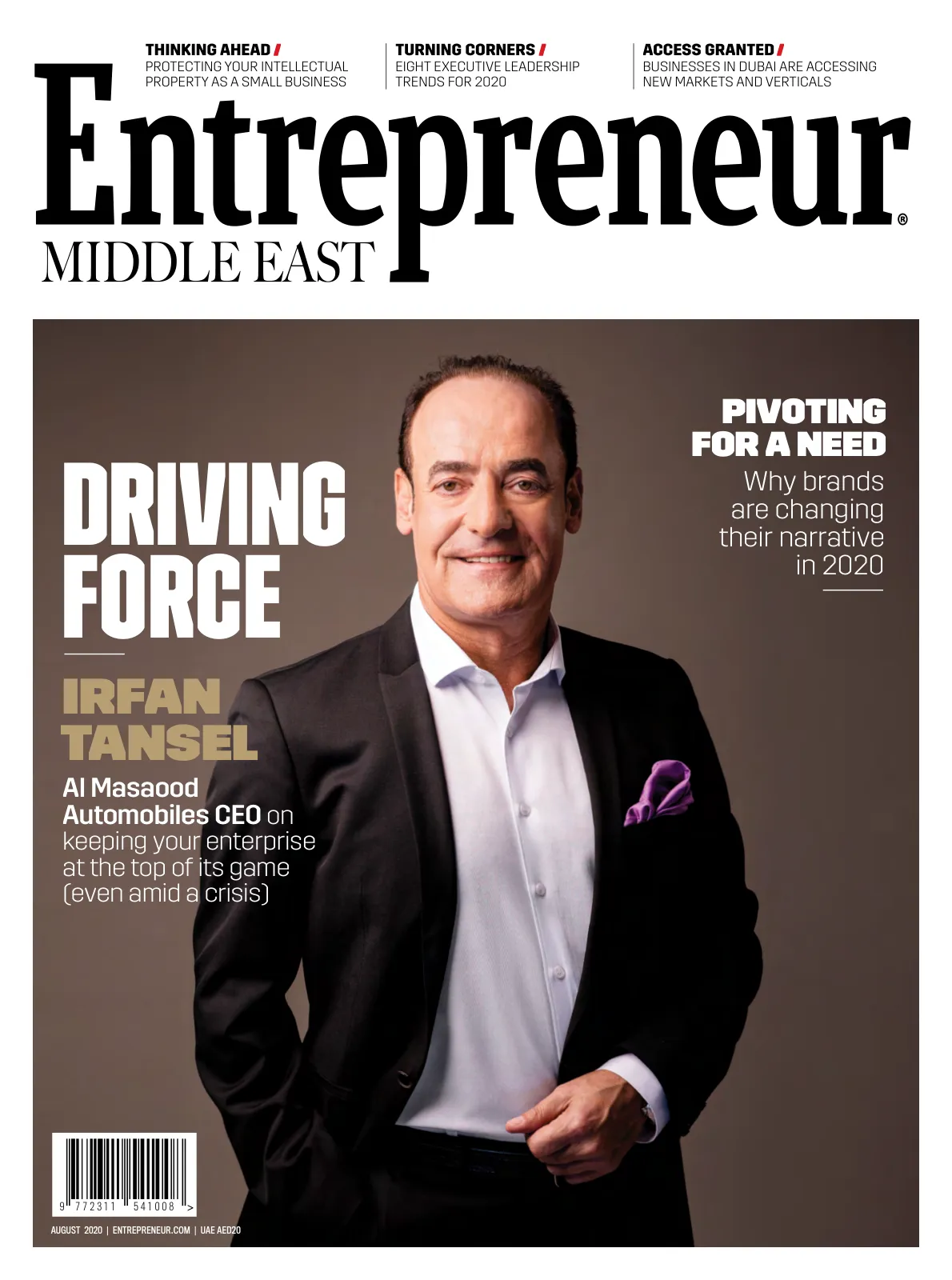
Entrepreneur Middle East, August 2020
Page 1
ACCESS GRANTED
BUSINESSES IN DUBAI ARE ACCESSING
NEW MARKETS AND VERTICALS
AUGUST 2020 | ENTREPRENEUR.COM | UAE AED20
9
7 7 2 3 1 1
5 4 1 0 0 8
>
THINKING AHEAD
PROTECTING YOUR INTELLECTUAL
PROPERTY AS A SMALL BUSINESS
TURNING CORNERS
EIGHT EXECUTIVE LEADERSHIP
TRENDS FOR 2020
DRIVING
FORCE
PIVOTING
FOR A NEED
Why brands
are changing
their narrative
in 2020
Al Masaood
Automobiles CEO on
keeping your enterprise
at the top of its game
(even amid a crisis)
IRFAN
TANSEL
Page 2
Page 3
Page 4
4 / ENTREPRENEUR.COM / August 2020
18
INNOVATOR
DRIVING FORCE
Irfan Tansel
The CEO of Al Masaood
Automobiles on keeping
your enterprise at the top
of its game (even amid a
global economic crisis).
18
26
START IT UP
ECOSYSTEM
Access granted
A look at how businesses
in Dubai are accessing
new markets and
verticals through the
COVID-19 crisis.
40
‘TREPONOMICS
PRO
Variability is here to stay
For a business to survive
the COVID-19 crisis,
flexibility is key (and that’s
not going away).
46
MONEY
ECON
Faith and finance
Zahara Malik on why
Islamic finance and impact
investing should join forces.
64
‘TREPONOMICS
PRO
Value systems
It shouldn’t take a crisis to
catalyze innovation, writes
Al Waha Fund’s Areije Al
Shakar.
30
‘TREPNOMICS
MARKETING
Pivoting for a need
Infographic.ly’s Carla Saliba
on why businesses should
prioritize on changing their
narrative in 2020.
34
‘TREPONOMICS
PRO
Turning corners
Eight executive trends you
need to keep track of this
year.
56
START IT UP
ECOSYSTEM
Move fast and fix things
Dubai startups share
insights on how they’re
stepping up with solutions
for “the new normal.”
Irfan Tansel, CEO,
Al Masaood Automobiles
37 Apple
Airpods Pro
CONTENTS AUGUST 2020
Page 5
5
August 2020 / ENTREPRENEUR.COM /
experience
downtown
living
The UAE’s most exciting new destination.
A journey of discovery for the whole family.
Where nature, fun and entertainment
come together.
800-Arada (27232)
arada.com
Page 6
Page 7
Page 8
Page 9
Page 10
10 / ENTREPRENEUR.COM / August 2020
CONTENTS AUGUST 2020
52
‘TREPONOMICS
SKILLSET
Startup camels
The entrepreneurs behind
Dubai-based startup Hopi,
on how they’re going about
growth for their enterprise.
48
‘TREPONOMICS
PRO
Thinking ahead
Amir Kanaan gives an
in-depth look to protecting
your intellectual property
as a small business.
44
CULTURE
LIFE
A strategist for success
Salma Sakhnini, founder
and CEO of ICON, a
Dubai-based business and
leadership development
advisory, on adopting a
future-ready mindset.
36
TECH
SHINY
#TamTalksTech
Gadgets and doodads
that you might’ve missed
out on, sourced by a tech
aficionado.
47
IN THE LOOP
Onward and upward
TECOM Group’s startup
incubator in5 sees its
entrepreneurs rise AED65
million in first half of
2020.
41
CULTURE
LIFE
Starting young
Helen Al Uzaizi delves
into the importance of
developing a culture of
entrepreneurship.
62
CULTURE
BUSINESS UNUSUAL
Passion project
Patrick Osman shares
how unemployment
amid COVID-19 led the
entrepreneur to launch
I’m Cartoonified.
38
CULTURE
TRAPPINGS
‘Trep gear
The executive selection for
the entrepreneur on your
list that has everything.
Okay, may-be for a little
self-reward as well.
44 Salma Sakhnini, founder and CEO of ICON, a Dubai-based business
and leadership development advisory
52
Kristian Stinson
and Charles Wright,
co-founders, Hopi
Page 11
Ready to get
rewarded?
Join Radisson Rewards
for exclusive benefits
We can’t wait to welcome you as a member across our
six hotel brands and 1,100+ locations worldwide. Thank
you for choosing Radisson Hotels.
Award Nights
Use your points for stays - it’s that simple!
Members Only Rate
Save up to 10% when you book on
radissonhotels.com/rewards
More benefits
Including savings of up to 20% on food and
beverages, room upgrades for Elite members
and more
Join today at the front desk
or on radissonhotels.com/rewards
Page 12
12 / ENTREPRENEUR.COM / August 2020
SUBSCRIBE
Contact subscriptions@bncpublishing.net to receive
Entrepreneur Middle East every issue
EDITOR IN CHIEF Aby Sam Thomas editor@bncpublishing.net
CEO Wissam Younane wissam@bncpublishing.net
DIRECTOR Rabih Najm rabih@bncpublishing.net
CREATIVE LEAD Odette Kahwagi
MANAGING EDITOR Tamara Pupic
STARTUPS SECTION EDITOR Pamella de Leon
DIGITAL SOLUTIONS DIRECTOR Mahdi Hashemi mahdi@bncpublishing.net
GROUP SALES DIRECTOR – B2B GROUP Joaquim D’Costa
COLUMNIST Tamara Clarke
INTERN Aalia Mehreen Ahmed
PO Box 502511 Dubai, United Arab Emirates
P +971 4 4200 506 | F +971 4 4200 196
For all commercial enquiries related to Entrepreneur Middle East
contact sales@bncpublishing.net
All rights reserved 2020.
Opinions expressed are solely those of the contributors.
Entrepreneur Middle East and all subsidiary publications in the
MENA region are officially licensed exclusively to BNC Publishing
in the MENA region by Entrepreneur Media Inc.
No part of this magazine may be reproduced or transmitted in any
form or by any means without written permission of the publisher.
Printed by United Printing and Publishing
upp.ae
Images used in Entrepreneur Middle East are credited when necessary. Attributed use of
copyrighted images with permission. All images not credited otherwise Shutterstock.
CONTRIBUTORS
entrepreneur.com/me
ACCESS FRESH CONTENT DAILY ON OUR WEBSITE!
MIDDLE EAST
EntMagazineME
@EntMagazineME
Entrepreneur-me
EntrepreneurMiddleEast
EntMagazineME
EntMagazineME
EntMagazineME
MIDDLE EAST
In addition to our print edition, we’re bringing
you all sorts of industry news on our web
mediums. Joining us online means getting
relevant business and startup content in
real-time, so you’re hearing about the latest
developments as soon as we do. We’re looking
forward to interacting with our readers on all of
our social media and web platforms- like any
thriving business, we’re looking to give and take.
#TrepTalkME is already happening on all of our
digi platforms, and all good conversations go
both ways. See you on the web!
Areije Al Shakar
Helen Al Uzaizi
Fida Chaaban
Gavin Cheadle
Tamara Clarke
Amir Kanaan
Zahara Malik
Carla Saliba
Kristian Stinson
Hanna VanKuiken
Charles Wright
Page 13
Page 14
14 / ENTREPRENEUR.COM / August 2020
I
t’s August 2020,
and I can’t help
but wonder: how
are we already in
this month of the
year? When they
said time flies, I
don’t think any-
one was referring
to the warped
clock that has
blurred and blended all the
days of this year so far.
If you’re waking up some
mornings unsure which day
of the week it is without
looking at a calendar, trust
me; you’re not alone. For
all its efficiencies and
conveniences, it’s safe to
say that the perks of work-
ing remotely that we used
to enjoy have waned to a
certain degree, and they are
now instead causing us to
lose all sense of balance and
time.
For me, and many I’ve
spoken to, that hardest
feeling in a work day in this
surreal crisis has been the
sense of being perpetually
stuck in the same day, ev-
eryday, without being able
to plan ahead.
So, how do we cope when
there is no perception of
hours, or days, or weeks- or
when we come to the real-
ization that half a year has
just gone by?
How do we keep track
of time in the structured,
deadline-driven way that
we’ve been programmed to
do so far, when everything
around us feels distorted?
Now, no one has the right
answers, but I’ve been
finding some inspiration
from the world of art in
this matter. To be specific,
a particular painting from
1931 called The Persistence
of Memory, by one of my fa-
vorite artists, the inimitable
Salvador Dalí.
Dalí has claimed that this
artwork, often remembered
as “the one with the melt-
ing clocks,” was actually
inspired simply by a wheel
of cheese that had melted;
however, scholars have
interpreted it to be a rumi-
nation on how time doesn’t
really factor in a dream
world.
Indeed, Dalí has been
known to have said that
time had no influence on
him while he was painting-
perhaps an indication of
how irrelevant the concept
of time is when you’re doing
something that you love.
Keeping that idea in mind,
perhaps the stock we need
to take now is not of time,
but rather of where we
place our attention. As we
rush and pressure ourselves
to keep track of hours and
days and weeks through the
times we are living through
right now, maybe what we
really need to be doing is
just tracking where we are
going with the dreams we
had made for ourselves.
After all, the Augusts
come and go- dreams, as
they say, are forever.
EDITOR'S NOTE
Keeping track of your dreams can help you maintain your balance
in an upside-down world
WHERE VS. WHEN
Aby Sam Thomas
Editor in Chief
@thisisaby
aby@bncpublishing.net
© SALVADOR DALÍ, GALA-SALVADOR DALÍ FOUNDATION/ARTISTS RIGHTS SOCIETY (ARS), NEW YORK.
Salvador Dalí, The Persistence of Memory, 1931
Page 15
BOREDOM IS
PROHIBITED
ROOFTOP SWIMMING AND
TABLE TENNIS WINNING.
NOW OPEN AT DUBAI DIGITAL PARK.
RADISSONHOTELS.COM/RED
FUN COMES
GUARANTEED
YOU DECIDE WHEN THE PARTY
STOPS WITH 24HR FOOD & DRINK.
NOW OPEN AT DUBAI DIGITAL PARK.
RADISSONHOTELS.COM/RED
Page 16
16 / ENTREPRENEUR.COM / August 2020
D
ubai’s first architecture
festival is set to make waves
this year. The inaugural d3
Architecture Festival, organized
by Dubai Design District, in
partnership with the Royal Institute of
British Architects Gulf Chapter (RIBA
Gulf Chapter), will showcase regional
architecture projects and emerging new
generation of talent and firms, but also
highlight the significance of bringing the
Middle East towards a more sustainable
future.
The event is set to run from November
11-13, 2020, on the sidelines of Dubai
Design Week, an annual festival held
under the patronage of H.H. Sheikha
Latifa bint Mohammed bin Rashid Al
Maktoum, Chairperson of Dubai Culture
& Arts Authority. Curated by Juan Roldan,
Associate Professor at the College of
Architecture, Art, and Design at the
American University of Sharjah, the
festival’s theme is “Identity, Context, and
Placemaking in the Gulf.”
The event will cater to a series of a talks
by industry experts on sustainable devel
opment, while designers, architects, and
the general public are welcomed to join
in daily workshops. As such, the festival is
aligned to d3’s priority to becoming a hub
for the Middle East’s architecture com
munity. Some of the firms and universities
that have confirmed to participate in the
event include AGi Architects, American
University of Sharjah, Dabbagh Architects,
Foster + Partners, Nyxo Visionary Design,
Woods Bagot, Zaha Hadid Architects, and
more. dubaidesignweek.ae
Dubai’s first architecture festival
in November 2020 to showcase
the Middle East’s contributions
LOOKING AHEAD
Dubai Chamber launches restaurants business group
to help unify voices of the Dubai restaurant sector
For a sustainable future
R
estaurants Business
Group, a new non-profit
body under the Dubai
Chamber of Commerce
and Industry, has been
inaugurated with an
aim to serve common interests and
tackle industry challenges of the
restaurant sector in Dubai through
cooperation with relevant authori
ties in the Emirate.
With a wide variety of restaurant
businesses in Dubai forming a part
of the member companies, the busi
ness group provides a platform to
share knowledge and make policy
recommendations while unifying
voices of member companies.
Mubarak Bin Fahad, owner of The
Tashas Group, has been appointed as
Chairman of the Restaurants Busi
ness Group. The founding Executive
Committee members were selected,
and the business group’s objectives
for 2020 were outlined, during a
recently held online meeting.
H.E. Hamad Buamim, President and
CEO of Dubai Chamber, explained
that the group will play a vital role in
addressing common issues, helping
restaurant sector players navigate
new challenges and adjust to the
“new normal,” as restaurants re-
open under new guidelines.
He further added that Dubai Cham
ber is working closely with the Res
taurant Business Group and other
sector-focused business groups to
support and enhance the develop
ment of business in Dubai, promote
constructive dialogues, and foster
public-private sector cooperation.
Mubarak Bin Fahd, Chairman of the
Dubai Restaurants Business Group,
added to the discussion, saying “The
Dubai Restaurants Business Group
will help this cause, bringing the
private and public sectors closer
together to create a sustainable and
even more positive future for the
F&B industry in the city.”
dubaichamber.com
IN THE LOOP
IMAGES COURTESY DUBAI CHAMBER | DUBAI DESIGN DISTRICT
Page 17
Page 18
18 / ENTREPRENEUR.COM / August 2020
INNOVATOR
IMAGES COURTESY AL MASAOOD AUTOMOBILES
“WHAT MAKES US SUCCESSFUL
IS THE EXPERIENCES OF
OUR CUSTOMERS, AND HOW
STRONGLY THEY BOND WITH
US. OUR REAL PRODUCT IS
SUPERIOR SERVICE, FRIENDLY
CONVERSATIONS, AND HAPPY
CUSTOMERS, STEMMING FROM
INNOVATIVE SOLUTIONS.”
Irfan Tansel, CEO,
Al Masaood Automobiles
Page 19
19
August 2020 / ENTREPRENEUR.COM /
DRIVING
FORCE
/IRFAN TANSEL
ON KEEPING YOUR ENTERPRISE AT THE TOP OF ITS GAME
(EVEN AMID A GLOBAL ECONOMIC CRISIS)
THE CEO OF AL MASAOOD AUTOMOBILES
by ABY SAM THOMAS
H
e is the CEO of a
company called
Al Masaood
Automobiles
(AMA), but Irfan
Tansel doesn’t
believe that he and
his team at the
multiple award-
winning UAE-
headquartered
enterprise are
in the business of selling cars- instead,
he says that they are actually in the
business of selling experiences. “What
makes us successful is the experiences
of our customers, and how strongly they
bond with us,” Tansel explains. “Our
real product is superior service, friendly
conversations, and happy customers,
stemming from innovative solutions.”
The conviction with which Tansel makes
this statement can be attributed to
experience- both his and of his company.
While Tansel boasts of a career that has
spanned more than 40 years and has
seen him work across three continents of
the world, AMA has been in business for
over 40 years in the UAE as the automo
tive arm of a diversified family business.
As the sole distributor of automotive
brands Nissan, Infiniti, and Renault in
Abu Dhabi, Al Ain, and the Western
region of the UAE, AMA has carved
out a space for itself in what has been
(and remains) an extremely competitive
business sector in not just the country,
but around the world as well. Indeed,
the company was recently declared the
winner of the 2019 edition of the Renault
Global Partners Award, P.A.R.I.S. Chal
lenge, which recognized it as the best
performing Renault dealership in 2019
globally, through its achievement of 40%
year-on-year sales growth, resulting
in Renault having an increased market
share in the Abu Dhabi market. This
accolade comes on the back of AMA
receiving the Nissan Global Award 2019
- National Sales Company, as well as a
host of other industry recognitions and
awards through the years it’s been in
operation.
“The business has lived through the
ups and downs of the economy, and it
has always managed to remain on top of
its game,” Tansel says. “There are many
factors that contribute to this success,
but perhaps the most prominent one is
the leadership philosophy we have at
AMA, where our people are empowered
to do their best, and to bring to the table
the best of innovations and solutions.” >>>
DRIVING FORCE | IRFAN TANSEL, CEO, AL MASAOOD AUTOMOBILES
Page 20
20 / ENTREPRENEUR.COM / August 2020
And it’s this sentiment that
Tansel credits as having helped
his enterprise make its way
through the COVID-19 crisis
that’s enveloped the world
right now. Much like every
other business out there, Tan
sel admits that AMA too has
been negatively affected by the
coronavirus pandemic. “The
COVID-19 crisis has had a
swift and severe impact on the
globally integrated automotive
industry,” Tansel says. “The
symptoms included a disrup
tion in the exports of parts,
large-scale manufacturing
interruptions, and the closure
of assembly plants abroad.
Locally, the automotive market
did also witness a harsh de
cline in the sales of passenger
vehicles. Fleet and SME sales
have plummeted, retail also
suffered due to the uncertainty
on the economic impact of the
crisis and decline in customer
sentiment. There was a strong
er decline in luxury vehicles
than in the mid-range vehicles.
We have witnessed a 50%
decline in sales locally in UAE
so far in Q2.”
These comments paint a
rather dismal state of affairs-
but Tansel notes that there are
glimmers of light showing at
the end of the tunnel as well.
“We are witnessing slow re
covery since July,” Tansel says.
“At AMA, we experienced
slower sales during the second
quarter of 2020 at the start
of the global health crisis. We
are, however, fortunate that
the impact of the crisis on
our organization was short-
lived, as we began to record
significant improvement in
our sales towards the end of
the second quarter. We have
already exceeded our forecast
ed retail sales by 22% across
all brands, and we aim to
surpass these retail forecasts
by the end of 2020. We are
confident that we can achieve
our sales targets despite the
challenging market conditions.
Our confidence stems from
the cohesive efforts of our
team, and our effective strate
gies that keep pace with the
developments in the market
and customer preferences, as
well as our innovative market
campaigns.” AMA has also
benefited from being located
in the UAE, Tansel says- not
only was the company grate
INNOVATOR
“WE HAVE ALREADY
EXCEEDED OUR
FORECASTED RETAIL
SALES BY 22% ACROSS
ALL BRANDS, AND WE
AIM TO SURPASS THESE
RETAIL FORECASTS BY
THE END OF 2020.”
Al Masaood Automobiles won the prestigious “Renault Global Partners Award,
P.A.R.I.S. Challenge” for the fiscal year 2019
MASAOOD.COM
Page 21
21
August 2020 / ENTREPRENEUR.COM /
ful for the economic stimulus measures
rolled out by the government over the
course of the coronavirus pandemic, it
was also able to support the critical need
for vehicles in industries like logistics
and mobility during this time. Tansel
also points out that while the COVID-19
crisis may have spurred many businesses
to pursue digital offerings, AMA was well
ahead of the curve in that regard- and
that has been something that’s worked to
the company’s advantage in the current
circumstances.
“Due to health and safety consid
erations, there has been an accelerated
transition to digital channels within
the automotive industry,” Tansel says.
“But our company is way ahead in this
department, as we had already begun our
digital transformation journey long be
fore the pandemic hit. We have observed
a surge in the use of our innovative
digital offerings such as the e-commerce
solution that we launched in September
2019, our online financing solution, and
the Nissan full online buying experi
ence (CLIX) during these times, and we
expect that more and more of our clients
will utilize these channels in the months
ahead. Amid the raging pandemic, the
company has emphasized more than
ever the importance of delivering virtual
services to our customers to avoid the
need to visit any of its facilities. Our
teams have been conducting live video
conferencing with potential clients, as
sisting in home test drives, and offering
our e-commerce platform and vehicle
delivery service for the convenience and
protection of our customers.” Another
initiative that AMA rolled out during
this period was Project Wiqaya (wiqaya
means “prevention” in Arabic), which
aimed to protect the health and safety of
AMA’s employees and customers, as well
as members of the communities in which
it operates in. “Under Project Wiqaya,
daily health checks, audits, safety meas
ures, and communication were initiated
across the organization,” Tansel reveals.
“Everyone was kept informed on how the
company is performing and responding
to the pandemic as it unfolded.”
At this point, it does seem like AMA
has managed to accomplish quite a lot
through the course of the coronavirus
pandemic- and one can draw it all back
to some careful strategizing done by
Tansel and his team at the onset of
this crisis. “Amidst such uncertainty,
it is critical that companies take a
comprehensive approach, and develop
a range of scenarios and robust
contingency plans to navigate through
these turbulent times,” Tansel explains.
“We met earlier in March and derived a
multi-scenario strategy for the company,
taking into consideration different
possibilities of how the pandemic
will unfold.” At the same time, AMA’s
insistence on keeping its business going
through the course of the pandemic
bodes well for the enterprise when
the COVID-19 crisis ebbs out. Tansel
predicts that as the UAE economy begins
to heal itself from the effects of the
coronavirus pandemic, the automotive
sector will see industry competition
between car dealers in the UAE return
to a healthy and robust level. “On a
personal level, the pandemic brought me
to the realization that nothing can stop
you, despite any circumstance,” Tansel
adds. “We remained open throughout the
pandemic. Our 1,000+ employees turned
into front liners risking their lives to
ensure uninterrupted service to the
public and the government. We had to
put together immediate committees and
special arrangements to ensure everyone
remained safe, including our customers.
We also ushered the teams and kept
them going with daily communication.
We launched over seven major new
solutions, and turned the business digital
within weeks, and kept very busy. It was
an eventful period, and it taught us a lot
about ourselves.” >>>
“the best visionaries don’t
live day-by-day. We must always
be re-imagining, planning, and
steering the ship.”
Irfan Tansel, CEO,
Al Masaood Automobiles
DRIVING FORCE | IRFAN TANSEL, CEO, AL MASAOOD AUTOMOBILES
Page 22
22 / ENTREPRENEUR.COM / August 2020
INNOVATOR
Al Masaood Automobiles CEO
Irfan Tansel lists four factors that
businesses need to keep in mind
to survive in a post COVID-19 world
THE ROAD AHEAD
1/ Digital preparedness
“Brands across all sectors have no choice
today but to be ready to sell their skills,
products and services online. We at AMA
have anticipated the need to be digitally
present, and we were the first regional au
tomotive dealer to launch our e-commerce
platform.”
2/ Value addition
“Customers have become more cautious
with their spending, and are now looking
for a lot more value to come with their
purchases.”
3/ Shift in priorities
“We know that the pandemic has caused a
major shift in customer priorities; however,
car ownership remains one of them. In fact,
the pandemic has discouraged customers
from sharing the ownership of vehicles.”
4/ Humanizing your presence
“We need to find creative ways to talk to
our customers from behind the screens.
There is a lot of reinvention needed to the
messaging and selling online that we must
adopt faster than ever.”
“We can achieve our sales
targets despite the challenging
market conditions.”
Page 23
23
August 2020 / ENTREPRENEUR.COM /
DRIVING FORCE | IRFAN TANSEL, CEO, AL MASAOOD AUTOMOBILES
Page 24
24 / ENTREPRENEUR.COM / August 2020
>>> While Tansel is quick to
direct any applause for AMA’s
achievements to his team at
the enterprise, one cannot
deny the important role he
himself has played at the com
pany since his appointment
as its CEO in 2017. Tansel’s
model of leadership is based
off the lessons he learned
over the course of his career,
which began when he was only
a teenager. “I started as an
apprentice to a car mechanic
when I was just 15 years old,”
Tansel reveals. “I’ve built my
self up to my current role by
working from the ground up,
persevering, and striving to the
best version of myself. I com
mitted to understanding the
industry in depth. I now have
40 years’ experience span
ning across three continents,
and I have surrounded myself
by many great mentors who
I have learnt from along the
way- and I’m still learning. By
default, I have a competitive
personality. I constantly want
to challenge the status quo,
and push the norms to create
new, disruptive strategies that
are beyond the industry scope.
It’s an exciting time to work
in the automotive industry,
as we welcome new develop
ments, autonomous technol
ogy, and ultimately, a new era
of automotive. My career has
been an exciting journey. Yes,
there have been challenges
along the way, but challenges
make us stronger and make for
an exciting life. I’ve learnt that
a positive mindset, action, and
daily perseverance towards
a clear goal goes a long way.
One of the biggest lessons I’ve
learned from my mentors is
that the best visionaries don’t
live day-by-day. We must
always be re-imagining, plan
ning, and steering the ship.”
From Tansel’s perspective,
the key to building sustain
able businesses is by build
ing “ambitious, productive,
agile, competent, and high-
performing workforces that are
focused on innovation,” and
that’s precisely the strategy
he’s put to work during his
time at AMA. “A Wall Street
Journal article suggests that
‘most innovations are created
through networks– groups of
people working in concert,’”
INNOVATOR
Al Masaood Automobiles launched the new Nissan Sunny 2020 in July
Page 25
25
August 2020 / ENTREPRENEUR.COM /
Tansel explains. “When people and
their different points of view and
experiences converge, they create the
type of innovation that could not have
been done or found alone.” Keeping
this point in mind, Tansel says that
there are three tactics he makes use of
to lead with confidence at AMA, which
he shares now in the hopes that it will
help his peers in the business arena.
“Build a diverse workforce,” he starts.
“Everyone sees the world differently,
and a diverse team will bring fresh
perspectives and creativity. Today,
our top 13 key positions are filled with
nine different nationalities, from India
to USA, and from South Africa to
Ireland, and aged between 34 to 58.”
Tansel’s next tip is to focus on build
ing a workforce that feels empowered
enough to make decisions on their
own, and also feel supported when
they lead such endeavors. “Your busi
ness won’t fail if you have a bad plan,”
he notes. “It will fail if your employees
are ‘told’ what to do- they will not put
their hearts and minds into the plan’s
execution.” Tansel follows this up with
his final pointer, which reiterates the
importance of the team in an organiza
tion’s success. “People aren’t commit
ted to companies; they are committed
to the people that they work for and
alongside,” Tansel says. “Make it your
top priority to rally your team to
gether, because when you get everyone
in the organization running with the
same passion and purpose, you will be
amazed at what you can accomplish-
just as we have been at AMA.”
THE EXECUTIVE SUMMARY
Al Masaood Automobiles CEO Irfan Tansel shares his tips
for business leaders amid the COVID-19 crisis
1/ Keep a positive outlook
“Focus on what you can change, not
what you cannot change. Al Masaood’s
operations were in full force during the
pandemic, and I didn’t miss a day of
work. I kept the team motivated with
constant visits and brainstorming
sessions. We were all in it together, and
we made it through.”
2/ Care for yourself, and care for your
team too
“Take some time to yourself, and label
your emotions that you feel. Distance
yourself from them, so that you can
make conscious and quality business
decisions. I disciplined myself enough
not to share any of my anxiety with my
team, and as hard as I could, I remained
super positive, reminding the team of
how grateful I am for their hard work.
I mean every word I tell them- I’m
genuine, transparent, and I push them
to their limits, but I’m also always there
for them. And of course, every little
accomplishment was celebrated.”
3/ Accept the new reality
“Sleep, drink lots of water, eat well, and
exercise. Encourage your team to do
the same. Don’t pretend it’s ‘business
as usual,’ and directly address the
issue head on. You are not helping in
anyone’s development if you avoid
difficult conversations. Normalize
stress by explaining that this is a
common psychological response the
body feels to uncertainty. Sure, you
might acknowledge that things seem
somewhat unpredictable now, but at
the same time, be realistic and focus on
the actions, as a team, you will take to
collaborate, and move forward together.
4/ Empower your tribe
“Giving your team autonomy and a
sense of ownership to do their jobs
goes a long way. If there is one thing
that I’ve learnt in my 40-year career, it’s
the importance of ‘putting yourself in
other people’s shoes.’ Ask them what
they need to get their job done, and
how you can be a help.”
5/ Keep the conversations flowing
“Communication is key in times of
crisis, and it restores trust and peace.
Remain humble and transparent in your
communication, share developments
with your team, be it good or not that
good- allow them the right to remain
informed.”
“When people and
their different
points of view and
experiences converge,
they create the type
of innovation that
could not have been
done or found alone.”
DRIVING FORCE | IRFAN TANSEL, CEO, AL MASAOOD AUTOMOBILES
Page 26
26 / ENTREPRENEUR.COM / August 2020
START IT UP ECOSYSTEM
“In recent months, Dubai
Chamber’s international
offices organized a series of
webinars and virtual meetings
which were joined by UAE
businessmen and counterparts
in Eurasia, Africa and Latin
America,” says Omar Khan,
Director, International Offices,
Dubai Chamber of Commerce
and Industry. “These events
provided an ideal platform
for our members to explore
attractive trade and investment
prospects abroad, while we
also used the opportunity to
promote Dubai as a global
business hub. We are very
encouraged to see strong high-
level participation, which
reflects growing confidence in
Dubai among foreign investors,
and we expect to see more
interest in the coming months
as more companies prepare for
the post COVID-19 recovery.”
Of the several virtual events
that Dubai Chamber has
hosted so far, recent ones
include an online trade mis-
sion to the China Import and
Export Fair (also known as the
Canton Fair), a discussion on
food trade between Russia and
Dubai, and an exploration of
opportunities in Mozambique’s
oil and gas sector- all of which
have been attended by busi-
nesses eager to tap into new
markets. “Businesses in Dubai
can leverage Dubai Chamber’s
network of international offices
by accessing valuable market
intelligence to make informed
business decisions, networking
with potential business part-
ners and benefiting from local
support as they expand their
footprint in new markets,”
Khan says. “At the same time,
we are assisting high-potential
companies around the world
with their entry into the Dubai
market and use the emirate as
a strategic hub to boost their
reach in this part of the world.”
One of the companies that
have taken advantage of Dubai
Chamber’s initiatives in help-
ing Dubai-based businesses
reach out to promising markets
is Tradeling. Launched in Feb-
ruary this year, Tradeling is a
digital marketplace that show-
cases products of close to 300
suppliers from more than 25
countries. Muhammad Chbib,
CEO of Tradeling, explains that
the company’s business model
-a B2B digital marketplace that
connects regional and global
suppliers to meet business
demand locally- requires the
enterprise to align its expan-
sion plans with how the busi-
ness environment evolves. For
instance, when Tradeling saw
its original verticals (food and
beverages and office supplies)
get a hit due to the COVID-19
crisis, the e-commerce startup
adapted to the situation and
quickly developed a vertical
that wasn’t part of its launch
phase: health and wellness.
ACCESS
GRANTED
by TAMARA PUPIC
O
ne of the key aspects of the support provided by the Dubai
Chamber of Commerce and Industry to businesses in the
Emirate is in enabling their access to new trade and business
opportunities not just in the UAE, but around the world. But
when the COVID-19 pandemic disrupted the global trade
landscape, the Chamber and its 245,000 members have
had to adapt to a new reality that requires them to explore those new
opportunities in a digital format.
BUSINESSES IN DUBAI ARE ACCESSING NEW MARKETS AND
VERTICALS EVEN THROUGH THE COVID-19 CRISIS
Page 27
27
August 2020 / ENTREPRENEUR.COM /
ACCESS GRANTED | NEW MARKETS AND VERTICALS THROUGH THE COVID-19 CRISIS
Agile tactics like this are integral for
businesses that want to get through this
crisis, Chbib notes. “Companies abroad
as well as here are trying to survive,” he
explains. “Learning from the experience
of launching right in the thick of a cri-
sis, we have only emerged stronger, and
with a laser-sharp focus on how we can
adapt to changing circumstances. For
many businesses today, it is a combina-
tion of reducing costs, unfortunately,
mostly by laying off people, and trying to
generate cash wherever possible, such as
by leveraging existing infrastructure to
expand the business into other regions
or product verticals.” In Tradeling’s
case, Chbib says the company’s original
plan to expand into Saudi Arabia in the
fourth quarter of 2020 is well on track
despite the crisis. “We are an agile and
flexible organization, as we have proved
through our success in the UAE, and we
are working towards our planned expan-
sions. Of course, a physical, face-to-face
supported launch during a trade show
would have been ideal as a launch-pad,
but if the current COVID-19 situation
requires something else, we will adjust
accordingly.”
Key to this, Chbib adds, is for business
owners not to be rigid when assessing
new verticals or markets. “In expanding
to any new market, especially in the post
COVID-19 world, we look at the market
opportunities by evaluating long-term
indicators, such as trade volumes per
industry, import country partner rank-
ings, export countries, number of SMEs
per segment, amount of trade transac-
tions in a specific field, and GDP growth
per sector, among others,” he notes.
“These indicators give you a theoreti-
cal perspective about whether it makes
sense to enter a specific geography, and
what industry verticals to consider. We
then look at how efficient the industry is
at the moment. We evaluate whether we
add value to the market players if we of-
fered our services in any geography. This
means, creating tools to search, find,
interact and ultimately trade directly
between international/regional suppliers
and buying businesses in a country.”
Next on Tradeling’s agenda is expanding
into Latin America, and Chbib says
Dubai Chamber’s initiatives that promote
bilateral trade with countries from the
region have proved useful for their plans
in this regard. In fact, he notes that
the Dubai Airport Freezone Authority
(DAFZA) is actively diversifying Arab-
Brazilian trade, and Tradeling is thus
seeing a promising opportunity to expand
its presence to Brazil and other LATAM
“BUSINESSES IN DUBAI CAN LEVERAGE DUBAI CHAMBER’S
NETWORK OF INTERNATIONAL OFFICES BY ACCESSING VALUABLE
MARKET INTELLIGENCE TO MAKE INFORMED BUSINESS DECISIONS,
NETWORKING WITH POTENTIAL BUSINESS PARTNERS AND
BENEFITING FROM LOCAL SUPPORT AS THEY EXPAND THEIR
FOOTPRINT IN NEW MARKETS.”
Omar Khan, Director, International Offices, Dubai Chamber
IMAGES COURTESY DUBAI CHAMBER
>>>
Page 28
28 / ENTREPRENEUR.COM / August 2020
countries. “All our partners
appreciate our continued
push to grow and support the
trade ecosystem,” Chbib says.
“We just had workshops with
Latin American companies in
partnership with the Dubai
Chamber, and the interest in
working with us was huge.
People all around the globe
see the MENA region and the
UAE specifically as a great
opportunity to grow, and
they appreciate Tradeling
as a means to simplify
and streamline access to
our region. So, there is no
one-size-fits-all formula
that guides our geographic
expansion. It is really a close
evaluation of the market,
and also our own intuitive
understanding of the business
dynamics, which we have
gained over several years of
hands-on experience.”
Quick reactions and adjust-
ments to changing market cir-
cumstances have also marked
day-to-day operations at Mr
Usta, an online marketplace for
home services. CEO Ibrahim
Colak notes that the COVID-19
crisis has had a negative ef-
fect on his company- since Mr
Usta’s services are delivered
inside houses in the UAE, cus-
tomers weren’t keen on having
strangers visit their homes un-
less they were confident that
the requisite precautionary
measures were being taken.
“Working with our service
providers on improving the
safety of their staff and the
customers they visit, as well as
communicating the details of
this plan to our customers in a
transparent way, has increased
the customer trust, helping us
to grow our business back after
a slowdown,” Colak says.
But despite these challenges,
Mr Usta also found opportuni-
ties to tap into amid the crisis-
the company created a whole
new vertical for the business:
a disinfection and sanitiza-
START IT UP ECOSYSTEM
‘TREP TALK
TRADELING CEO MUHAMMAD CHBIB ON HOW TO GET
YOUR BUSINESS THROUGH A CRISIS
“From my experience, entrepreneurs need to understand three
key ‘golden rules’ when it comes to navigating a crisis.
One, do not panic, because panic pushes you to non-diligent
measures. Staying calm is the sign of a strong leader. When
seas are rough, when visibility is limited, you need to be at your
best so that everyone can hold on to your confidence.
Two, stay humane with your team as well as your customers/
partners/suppliers. Employing a person, entering into a
partnership, are all long-term promises you make as a leader.
In a crisis, my recommendation is to reallocate salary budgets
from top-down so everyone in your team stays.
Three, be tactical- successful organizations take business
decisions for the long-term. That does not mean they are
not agile or flexible. Be tactical in your views, explore other
revenue-generating streams, have a long-term entrepreneurial
vision and execute them, because every challenge presents
a new opportunity. It is easier said than done because
oftentimes entrepreneurs face a cash constrained situation,
but still, I believe, it is very important to understand that the
crisis is just a phase and we need to navigate through it to
continue executing against our vision.”
Page 29
29
August 2020 / ENTREPRENEUR.COM /
tion service for houses and cars. “We
looked at the current service needs of the
customers, and we found out that they
wanted to have peace of mind in terms
of disinfection and sanitization of their
homes and cars,” Colak says. “We also
had an increase on house deep cleaning
and AC deep cleaning jobs. We had seen
a high demand in March, April, and May,
and focused on that and improved the
service quality and resources for these
new categories. So, instead of focusing
on our normal popular categories, we fo-
cused on the categories that have seen an
increased demand in this period.”
In June, Mr Usta also announced its
strategic partnership with UAE retail
giant Majid Al Futtaim (MAF), which al-
lows customers to benefit from a plethora
of the startup’s aftersales and home ser-
vices when they purchase products from
MAF brands like Carrefour, Crate & Bar-
rel, and Maison du Monde. The partner-
ship, which will see Mr Usta’s technology
integrated with MAF’s own web and
mobile platforms and its loyalty program,
Share, will also help the Dubai startup
growth tap into a larger audience net-
work. “For the last two years, our strat-
egy to acquire new customers has been
based on reaching them via our partners’
network,” Colak says. “We have closed
very important partnership deals during
this period, and we are planning to grow
our customer base and sell more service
via our new partners’ network online.
The high demand for buying services and
products online during this period is also
helping us as well. Therefore, our pro-
jects for the second half of the year will
be about improving our service quality in
the most demanded categories, and re-
taining our existing customers with great
customer service.”
When asked about the kind of help and
resources businesses may need to push
through this challenging period, Colak
points out that support needs to be
two-fold: decreasing business costs, and
helping them find new customers. “Office
rent and employee salaries are the high-
est expenses that businesses have right
now, and therefore, suspending rental
contracts for at least six months would
really help them to keep their operations
going on,” he says. “I believe it is very
important to keep talent and hardwork-
ing employees in the companies, and in
the country. Because if the employees
have some sort of income, instead of no
income at all, this will keep companies
operational, and these people will still be
spending that income buying products
or services for their needs. Having more
people purchasing products and services
will keep the economy and companies
alive, allowing these companies to start
hiring more people again.Thus, instead
of letting people leave, I believe that sup-
porting companies to pay at least some
part of their employees’ salaries would be
a good solution in this transition period.”
From his perspective, Tradeling’s Chbib
points out that the COVID-19 crisis has
highlighted that “the capital side of the
entrepreneurial space in MENA is still in
its infancy.” He explains, “Some investors
have continued to support their invest-
ments through the crisis, simply because
they have done a great job of sourcing
these investments- they have invested in
strong models with good teams. Others
have failed to support their businesses
and downsized tremendously. They
might as well close them. My advice to
decision-makers in UAE is to continue
supporting the ecosystem through more
liquidity, to ensure the ecosystem can
navigate through the current crisis, by
focusing on creating robust opportunities
for growth.”
‘TREP TALK
MR USTA CEO IBRAHIM COLAK
ON HOW TO GET YOUR BUSINESS
THROUGH A CRISIS
“If the main revenue stream is
impacted by the situation, it may be a
good opportunity to pivot and create
additional revenue streams. I advise
entrepreneurs to closely follow up
the new user trends and changed
purchasing decisions, and create
new revenue streams on the basis of
new trends instead of the traditional
trends. Most of the businesses delayed
their online presence or online selling
capabilities as they were still able to
make business offline. But it is proven
100% now that without an online
presence, it will not be possible to
survive in the future. There is a big
opportunity on converting traditional
offline business to the online world.”
IMAGES COURTESY TRADELING | MR USTA
ACCESS GRANTED | NEW MARKETS AND VERTICALS THROUGH THE COVID-19 CRISIS
Page 30
30 / ENTREPRENEUR.COM / August 2020
Life in these times is anything but
certain. Coupled with the latest
developments around the globe
concerning the Black Lives Mat-
ter (BLM) movement, Lebanon’s
worsening economic crisis, as
well as mounting fears of a second
outbreak, it’s becoming increasingly
clear that we’re a long way off from
what we once deemed “normal.” The
COVID-19 crisis has forced everyone
to pause and reflect for a moment,
and in doing so, it has revealed a
much larger problem, namely how
woefully uninformed/ignorant we
are as to what is going on in the
wider world.
Perhaps we needed a reality check,
something to shake us from the in-
sulation of everyday life? I wouldn’t
have chosen a global pandemic as
the catalyst for this change, but
what is done is done. We must make
the most of the cards we have been
dealt, both personally and profes-
sionally moving forward, reassess-
ing what is most important and, as
clichéd as it may sound, look to help
others, as well as ourselves.
Being an SME during this time has
been exceptionally tough. Overnight,
business has evaporated. Budg-
ets cut, and projects put on hold
indefinitely as companies look to
wait out the crisis, becoming ever
more cautious in doing so. Conse-
quently, 70% of businesses across
Dubai expect they will close in the
next six months; three-quarters of
this figure are small businesses, ac-
cording to a report by the Financial
Times. World trade is expected to
fall by between 13% and 32% in
2020, according to the World Trade
Organization.
Companies, much like Infographic.
ly, have had to diversify their of-
fering, responding to the changing
needs of clients as the situation un-
folded. I’ve spoken before about the
benefits of a remote workforce in
ensuring a nimble enterprise; how-
ever, if clients are hitting the pause
button for an indefinite amount of
time, how do you keep top of mind,
whilst finding a way to add value to
the wider world?
PIVOTING
FOR A NEED
Why brands are changing their narrative
in 2020 by CARLA SALIBA
‘TREPONOMICS MARKETING
2020. The year that the world, quite literally, stood still.
We’ve patiently (and painfully) worked through the exile of
self-isolation and come out, to some extent at least, on the
other side. Three months after the pandemic lockdowns
began, we’ve adapted. We’ve accepted life with boundaries
and restrictions, the caveat being that eventually life will
resume a sense of normalcy. But, what if it doesn’t?
INFOGRAPHICS COURTESY INFOGRAPHIC.LY
Page 31
31
August 2020 / ENTREPRENEUR.COM /
PIVOTING FOR A NEED
Businesses that didn’t have much of an
online offering prior to lockdown have
since found a way to digitize their com-
pany, whether that’s shifting to e-com-
merce, moving from a wholesale to direct-
to-consumer (DTC) model, leveraging
emerging business functions within social
media (WhatsApp and Instagram, in par-
ticular), or embracing Zoom, Microsoft
Teams, and Google Meet to stay connect-
ed to both client and consumer. GoToWe-
binar, ClickMeeting, and WebEx have
seen their platform numbers increase as
events move online and webinars become
commonplace across the world. This
shows resilience on the part of everyone
from the big corporates, to the SMEs to
the “one-man-band entrepreneur,” all
finding a way to reach clients and offer a
message of solidarity in isolation.
As a result, content, largely informa-
tive and educational became available en
masse. For free. The race, incidentally,
was no longer to convert quickly, but to
garner loyalty in the short term in the
hope that sales followed later down the
line. Of course, this is a shift that has
been coming for a while, with overt sell-
ing techniques dismissed in favor of cre-
ating useful and helpful content instead
which answers a need.
In the wake of COVID-19, this accelerat-
ed even more. Brands took their cue from
their audiences as to how and when they
wanted to interact, a first if you consider
how online advertising has evolved to
anticipate, rather than react, to a user’s
particular need. In our case, we knew that
our usual services may not be required
on a corporate level during the pandemic,
but there was still a need to serve the
wider public with accurate and easy to
understand information.
As such, we created a series of info-
graphics sourcing data from credible
sources and disseminated this content
in a visually appealing, straightforward,
and impactful way. This wasn’t a knee-
jerk reaction or calculated response to
the crisis, far from it; this was a way we
could help, and we used our skills and
experience to do so- a view echoed by
most businesses, both big and small.
For example, LVMH, Hunter, and Dyson
shifted their manufacturing to produce
hand sanitizer, personal protection
equipment (PPE), and ventilators to sup-
port hospitals around the world, whilst
activewear brand Lululemon created free
online workouts to promote self-care and
help minimize anxiety. We all had a part
to play.
Now that the economy is opening up
again, the challenge will be in turning
this community goodwill into something
that can be profitable; if not straight
away, then at least over time. Budgets
are still tight, and luxury is not a neces-
sity anymore, which means continuing
to produce content with a DIY element
that still keeps you top of mind. You may
not be servicing clients right now, but
you are passing on knowledge; a valuable
commodity as the landscape continues to
shift post COVID-19.
Ultimately, the things that consumers
engaged with and found useful during
lockdown won’t suddenly become unim-
portant. Instead we could see a similar
approach to how publishers are show-
casing their content online right now; a
pay per play service, where paywalls and
subscriptions allow you full access. Think
of it this way: the pandemic provided
consumers with a taster of what a brand
could offer; so if successful, why wouldn’t
they pay for continued use?
PIVOTING FOR A NEED | WHY BRANDS ARE CHANGING THEIR NARRATIVE IN 2020
We created a series of
infographics sourcing data
from credible sources and
disseminated this content
in a visually appealing,
straightforward, and impactful
way. This was a way we could
help, and we used our skills and
experience to do so- a view
echoed by most businesses.
>>>
Page 32
32 / ENTREPRENEUR.COM / August 2020
‘TREPONOMICS MARKETING
Carla Saliba is the founder of Infographic.ly, a data-design and visualization agency based in Dubai, supporting companies communicate data to its
stakeholders clearly and effectively. infographic.ly
INVEST NOW FOR FUTURE GROWTH
It’s so tempting to forgo investing in your
own business when times are tough.
Aiming to stay afloat is what so many
SMEs settle for, when instead we should
be fighting to stay visible amid increasing
competition. I’m not talking about spend-
ing thousands of dirhams on billboard
ads here, but rather about gravitating to
where your audience is. Even now as lock-
downs lift, and people go back to work,
behaviors have undoubtedly changed. The
online world is now more important than
ever.
Consumers are actively seeking a con-
nection right now, as they want to inter-
act with their favorite brand communities
in lieu of real life interactions. Now is the
perfect time to seize this opportunity and
capture their attention with content that
inspires and plants the seed for new busi-
ness in the future. It’s not about solicit-
ing, but about changing the narrative to
appeal during these times. Whether that’s
quick ads appearing on a social feed, or
running video tutorials and webinars to
aid struggling businesses during this time,
so be it.
Content doesn’t have to be throwaway or
designed for single use either, and if any-
thing, this pandemic has shown how we
can repurpose or repackage existing assets
to appeal to an audience now completely
captivated by video. Revisiting animation,
for example, is one way to cut through the
clutter online, cut into small snippets,
and teased across multiple platforms to
create intrigue and help you stand out
from the crowd.
There’s a lot of life lessons to be learnt
as we exit lockdown, not least in help-
ing us all reassess what’s a luxury and a
necessity in our everyday lives. As a small
business owner, I’m used to wearing many
hats, juggling everything from client ser-
vicing and project management, to project
execution and even accounting. I can learn
on the go. I can figure things out as they
come up, but for bigger enterprises, they
will have undoubtedly been caught out
and as a result, responded slower to the
crisis. It’s a trend we’re seeing emulate
itself with the BLM protests right now.
Still, if anything comes out of this
change of tone globally, it’s that things
have (finally) reached breaking point.
We needed something to stop us in our
tracks, and it just so happens that eve-
rything converged at once. Figuring out
where we all go next isn’t so clear cut.
There is a long road ahead in creating a
more inclusive world, but one thing is for
sure: businesses that keep offering solu-
tions which put people over profits will be
welcomed back with open arms, once the
dust settles and the masks come off.
We could see a similar approach to how publishers are
showcasing their content online right now; a pay per play
service, where paywalls and subscriptions allow you
full access. Think of it this way: the pandemic provided
consumers with a taster of what a brand could offer; so if
successful, why wouldn’t they pay for continued use?
Page 33
FUN COMES
GUARANTEED
YOU DECIDE WHEN THE PARTY
STOPS WITH 24HR FOOD & DRINK.
NOW OPEN AT DUBAI DIGITAL PARK.
RADISSONHOTELS.COM/RED
Page 34
34 / ENTREPRENEUR.COM / August 2020
G
lobal leadership is
answering the call of a
world that is demand-
ing change. Change
in the way business
approaches three key
things: trust, knowl-
edge transfer, and
cultural dynamics. Now
in its fifth edition, the
Eight Executive Trends
for 2020 report by Page Executive, the ex-
ecutive search arm of global recruitment
firm PageGroup, explores the new forms
of leadership that stem from the idea
of integrating transformation at every
level in business. If you’re the leader of a
business, these are the trends you need to
keep track of this year.
TREND #1/
FINANCE: THE TRANSFORMATIONAL CFO
Today’s Chief Financial Officer (CFO) is
much more than a number cruncher and
analyst. As digitalization and automation
reshape the working environment, new
skills are increasingly important, in some
cases nudging the harder edge of techni-
cal prowess to the side. CFOs are being
summoned to build trust throughout the
organization. Their transformative efforts
are a unifying force between the market
and the C-suite. Financial decision-
makers need to embrace disruption that
focuses both on the short-term impact, as
well as the long-term, to pilot companies
to success. In today’s rapidly transform-
ing environment, CFOs must go beyond
numbers to develop interpersonal skills,
strategic leadership, and digital savvy.
They must build trust, addressing current
concerns like cybersecurity, while retain-
ing their role as the “conscience” of the
business.
TREND #2/
TECHNOLOGY: THE DIGITALIZED CEO
More than sectorial knowledge and
network, adaptation and innovation can
make or break the Chief Executive Officer
(CEO) in today’s tech-torqued environ-
ment. Decision makers and recruiters
must look outside the traditional arena
for new leadership that doesn’t just fol-
low, but drives, digital transformation.
In today’s world of rapid digital transfor-
mation, a successful CEO must embrace
self-reinvention and upskilling. Shrewd
decision-makers must understand what
information is important to perform their
job– and what isn’t. Agile organization re-
lies on more than methods and processes:
investing in the right people is crucial.
Savvy executive leaders must leverage
tech to fulfil business needs, team ambi-
tions and consumer demands.
TREND #3/
CONSUMER & RETAIL: LEADERSHIP FROM
A DISTANCE
The digitalized world has provided great
opportunities to expand remote work and
give senior leaders an exciting challenge:
to create a culture and engagement from
a distance, attracting and retaining the
best talent, no matter where they are
based. Leaders must build milestones and
use key performance indicators to clarify
expectations and help their team under-
stand their roles and expectations. Regu-
lar in-person and one-to-one meetings
must be held to take the team pulse, boost
engagement, and get feedback– more
distance means heightened communica-
tions to create that team feeling. Future
leaders must strike a balance– they must
spend time with the team to understand
them, and also drive engagement from a
distance.
TREND #4/
MOBILE LEADERSHIP IS GOING LOCAL
A company’s global mobility program is
vital to support new business growth.
When combined with insightful talent
management, they can boost financial
TURNING
CORNERS
EIGHT EXECUTIVE
LEADERSHIP TRENDS
FOR 2020 by GAVIN CHEADLE
‘TREPONOMICS PRO
Page 35
35
August 2020 / ENTREPRENEUR.COM /
performance, employee en-
gagement, succession plan-
ning, and talent retention, and
bring value to companies eve-
rywhere. Recruiting globally
delivers distinctive, dynamic
leadership styles, vision, and
experience, and facilitates
vital knowledge transfer and
know-how. At the same time,
international assignments can
be a fast-track for mobile lead-
ers who want to broaden their
portfolio and horizons. Leader-
ship needs to understand and
differentiate regional business
practices and requirements to
ensure cultural fit and long-
term impact. Importantly, the
local team needs to be part
of the integration process to
ensure that members gel wher-
ever they are and wherever
they come from.
TREND #5/
INDUSTRIAL &
MANUFACTURING:
COLLABORATION IS KEY TO
GLOBALIZING SMES
To triumph in a global
economy, smart small- and
medium-sized enterprises
(SMEs) are transforming their
organizations, outlooks, and
strategies to level the playing
field with larger companies.
Partnerships and collaboration
with other enterprises and
multinational corporations
are empowering SMEs to not
only stand their ground with
heftier peers, but to lever-
age certain advantages over
them, thanks to their versatil-
ity and resourcefulness. SME
leaders must adopt a global
mindset, do their homework
on new markets, and factor in
contingency plans. They must
be prepared to make sweeping
changes to the organizational
structure, company culture,
and behavior.
TREND #6/
FINANCIAL SERVICES:
THRIVING THROUGH
ADAPTATION
All companies need to focus on
hiring future leaders, moving
towards the new world, rather
than waiting for it to come
knocking at their door. Execu-
tives in the financial services
sector must attract inquisi-
tive, insightful new hires who
bring tech know-how, people
skills, and agility to the table,
by highlighting the company’s
journey towards data and digi-
tal. Data is nothing without
interpretation and vision, so
hiring must take place across
sectors to engage financial data
scientists who can tell and sell
a story across the whole enter-
prise. Additionally, discipline
crossover must be made the
norm, not the exception: re-
ward the rebel spirit, and give
feisty finance professionals a
say in business direction, and
a chance to shine. Leadership
must focus on structure and
cohesion across time zones
and cultures, and consider
mentoring to gel a multi-fac-
eted, always-on team that can
lead from any level.
TREND #7/
TALENT HAS NO AGE IN
TODAY’S WORLD OF BUSINESS
Diversity is of far greater
benefit to a company than
generational rhetoric and
stereotyping. If recruiters and
employers can keep an open
mind and an open door, they
can harness the multiple ad-
vantages of multigenerational
leadership. Companies are
logically looking for the best
talent to fill their leadership
roles. Executive recruiters
and the businesses they work
with are making giant leaps in
enriching company cultures
and establishing diversity and
inclusion by evolving what it
means to talk about (and hire
for) leadership profiles. Suc-
cessfully integrating leaders
of different generations means
actively encouraging cross-
generational collaboration.
Multigenerational advisory
boards or resource groups
where members exchange
ideas and benefit from each
other’s unique skillsets can
help banish bias and foster
inclusivity.
TREND #8/
ARE YOU AN INCLUSIVE
CHANGEMAKER?
Without an inclusive envi-
ronment, diversity becomes
unsustainable. Leaders are
responsible for embedding ef-
fective inclusive cultures that
attract, retain and engage top
talent. An inclusive company
culture allows each individual,
regardless of background,
to use their potential in the
workplace and enable col-
leagues to do the same. Greater
diversity equals greater capac-
ity to attract and retain talent,
a competitive edge coming
through differing viewpoints,
stronger productivity– and a
better bottom line. However,
managing a high-performing
and diverse workforce requires
daily commitment from the
senior team.
TURNING CORNERS | EIGHT EXECUTIVE LEADERSHIP TRENDS FOR 2020
Gavin Cheadle is Partner at Page Executive, Middle East, which is focused on board and executive level recruitment across the region.
pageexecutive.com
EIGHT EXECUTIVE TRENDS FOR 2020
5TH EDITION
TRANSFORMATIONAL
LEADERSHIP
The digitalized world has
provided great opportunities
to expand remote work
and give senior leaders an
exciting challenge: to create
a culture and engagement
from a distance, attracting and
retaining the best talent, no
matter where they are based.
Page 36
36 / ENTREPRENEUR.COM / August 2020
GADGETS AND DOODADS THAT YOU MIGHT’VE MISSED OUT ON, SOURCED BY A TECH AFICIONADO.
YES, IT’S OKAY TO WANT THEM ALL… AND NO, IT’S NOT OUR FAULT.
GAME ON
LENOVO LEGION DUEL
IMAGES COURTESY LENOVO | SONY | APPL.E
TECH SHINY
Work hard and play hard with the
Lenovo Legion Duel smartphone.
Designed for gamers, this phone is
a mobile gaming console that fits
in your pocket. Loaded with virtual
tools and an optimized battery
with fast charging, you can get
your game on anytime. With six
customized layout themes, you can
play in landscape or portrait mode,
and cast to an external monitor
or television as well. The device
features an embedded joystick and
ultrasonic trigger buttons with dual
vibration engines, which give life-like
feedback to keep you immersed
in the action. Powered by the
Qualcomm Snapdragon 865 Plus
5G Mobile Platform, the Legion Duel
sports a 6.56 inch full HD AMOLED
glass touchscreen display. You’re in
for a good time with this device, but
it’s not just fun and games either- in
addition to its unparalleled Android
gaming experience, the Legion Duel
smartphone also lets you email and
chat without disrupting the flow.
Lenovo Legion Duel
Page 37
37
August 2020 / ENTREPRENEUR.COM /
#TAMTALKSTECH Tamara Clarke, a former software development professional, is the tech and lifestyle enthusiast behind The Global Gazette, one
of the most active blogs in the Middle East. The Global Gazette has been welcomed and lauded by some of the most influential tech brands in the
region. Clarke’s goal is to inform about technology and how it supports our lifestyles. See her work both in print regional publications and online on
her blog where she discusses everything from how a new gadget improves day-to-day life to how to coordinate your smartphone accessories.
Visit theglobalgazette.com and talk to her on Twitter @TamaraClarke.
#TAMTALKSTECH | GADGETS AND DOODADS THAT YOU MIGHT’VE MISSED OUT ON
Work hard and play hard with the
Lenovo Legion Duel smartphone.
Designed for gamers, this phone
is a mobile gaming console that
fits in your pocket. Loaded with
virtual tools and an optimized
battery with fast charging,
you can get your game on
anytime. With six customized
layout themes, you can play in
landscape or portrait mode, and
cast to an external monitor or
television as well. The device
features an embedded joystick
and ultrasonic trigger buttons
with dual vibration engines, which
give life-like feedback to keep you
immersed in the action. Powered
by the Qualcomm Snapdragon
865 Plus 5G Mobile Platform,
the Legion Duel sports a 6.56
inch full HD AMOLED glass
touchscreen display. You’re in for
a good time with this device, but
it’s not just fun and games either-
in addition to its unparalleled
Android gaming experience, the
Legion Duel smartphone also
lets you email and chat without
disrupting the flow.
LET’S CREATE
SONY ZV-1
LISTEN UP
APPLE AIRPODS PRO
Apple extends its Airpods range
with Airpods Pro, which offer active
noise cancellation for immersive
sound. Don’t worry though. You
don’t have to block out the world
if you don’t want to. Transpar-
ency mode makes it possible to
hear what’s going on around you.
You can also choose from three
sizes of soft, flexible silicone tips
that click into place. To help you
find the best fit – and get the best
sound – Apple offers an Ear Tip Fit
Test. These earbuds are small, but
mighty featuring the Apple-de-
signed H1 chip that powers every-
thing from sound to Siri. Airpods
Pro are impeccably designed with a
Wireless Charging Case that deliv-
ers more than 24 hours or battery
life to keep you powered up on the
go. Just like Airpods, Airpods Pro
connect seamlessly to your iPhone
or Apple Watch.
Huawei Sound X
Sony ZV-1
Apple
Airpods Pro
Page 38
38 / ENTREPRENEUR.COM / August 2020
CULTURE TRAPPINGS
IMAGE CREDIT PATEK PHILIPPE | DOCE&GABBANA | KARN WAZEN EYEWEAR | INSTAGLAM
‘TREP TRIMMINGS
THE EXECUTIVE SELECTION
F
rom better goods to better wardrobe bests, every issue we
choose a few items that make the approved executive selection
list. In this issue, we present a remarkable new timepiece, a
fresh scent for your collection, a distinctive grooming service for
the gents, and more.
Hendra from John Lobb SS20
ALL IN THE DETAILS
PATEK PHILIPPE
Patek Philippe is debuting
the Reference 6007A-001 as a
limited edition of just a thousand
pieces in honor of the company’s
latest new addition to its
manufacturing facility in Plan-les-
Ouates, Geneva. This new timepiece
comes in a polished stainless
steel case with a diameter of
40mm, which features the brand’s
signature gray-blue hue. The sleek,
multifaceted dial provides a great
contrast with its embossed carbon
pattern in a smaller track scale,
as well as numerals and baton-
style hands that comes with a
luminescent coating. Powered by
Patek Philippe’s Caliber 324SC,
which is visible through the
sapphire crystal open caseback,
the self-winding masterpiece is
adorned with a 21k solid gold
oscillating weight engraved with its
signature motif. patek.com
Patek Philippe
Reference 6007A-001
Patek Philippe
Reference 6007A-001
Patek Philippe
Reference 6007A-001
limited edition
Page 39
39
August 2020 / ENTREPRENEUR.COM /
Dolce&Gabbana Velvet Desert Oud
Women have long enjoyed UAE-based
startup Instaglam’s grooming services
that are administered to them at their
own homes- and now, men can take
advantage of this offering too! That’s
right; the Instaglam app now allows for
customers to select from a range of
beauty and grooming services for both
men and women, which they can enjoy
from the comfort of their own homes! With
Instaglam facilitating everything from hair
styling to manicures and pedicures no
matter where you may be located, there’s
now no reason for you to sport an unkempt
look for your next Zoom call. instaglam.co
'TREP TRIMMINGS | THE EXECUTIVE SELECTION
EDITOR’S PICK
INSTAGLAM
SUMMERTIME SCENTS
DOLCE&GABBANA
If you’re finding it hard to
get the right perfume for this
season, look no further- there’s
something for everyone’s refined
tastes in Dolce&Gabbana’s Velvet
collection. Treat yourself with
wafts evoking of a breeze through
a desert dune with the Velvet
Desert Oud, which layers notes of
incense, oud, amber, and musk for
a warm, smoky, enveloping scent.
There’s also the Sicily-inspired
scent of Velvet Oriental Musk,
as it wraps a damask rose and
cypriol at its heart and with musk
and sandalwood notes at its base.
And for a lighter scent, check out
the Velvet Vetiver, a scent for
both men and women, featuring
fresh accents of vetiver, black fig,
and galbanum to give you serious
Mediterranean summer vibes.
dolcegabbana.com
ALL EYES ON US
KAREN WAZEN EYEWEAR
Dubai-based Karen Wazen’s eponymous
eyewear brand’s new collection is a
sight for sore eyes. After all, there’s
a lot to choose from this collection
produced in Hong Kong that features
retro styles like classic cat eye frames
and round glasses reminiscent of
The Beatles, as well as fashionably
futuristic pieces in black, pink, neon,
and other colors. If you’re on the prowl
for statement pieces this summer, this
brand can certainly be worth your
while. Karenwazen.com
Karen Wazen Eyewear
Page 40
40 / ENTREPRENEUR.COM / August 2020
T
oday, business leaders are
operating under more con-
straints than they’ve expe-
rienced in recent years and
markets. The impact of the
COVID-19 crisis has caused
the confinement and lock-
down of both people and global com-
merce. Now, the outfall of those meas-
ures is a depleted global economy, which
has created more challenges for busi-
nesses to prosper.
These constraints have forced new ways
of working. Business leaders have been
required to implement new, more flex-
ible organizational measures in order to
preserve their businesses– to operate
and survive under these constraints.
Businesses and organizations have moved
to remote working from home, wherever
their industry allows. Organizations have
had to reduce their workforces, remov-
ing employees from committed payroll in
order to balance their books. They have
had to look at their people and talent
in new ways– as this time of crisis is a
shared experience that both enables and
demands empathy and reflection.
These changes have been forced by an
acute situation, and businesses and the
way that they manage their workforce
have changed quickly, because they had
to. However, many of those changes are
here to stay. This crisis caused by the
COVID-19 pandemic has proven that for
businesses to survive, they must allow
for variability– they must incorporate a
level of flexibility and slack to how they
operate, and work with their people in
order to navigate challenging times.
Many businesses that have been office-
bound for decades have now managed
remote working, as employees join
Zoom calls as the only way to connect
with their teams and clients. And to the
contradiction of the past decade of office
policies, many businesses and teams have
been successful in this model- continu-
ing meetings, progressing collaboration,
and even delivering pitches in pursuit of
new business.
Of course, this resiliency come with its
challenges, but it has also provoked con-
versations and individual reflection and
recognition of the benefits of working
from home. Remote working eliminates
a commute, saving time that individuals
have been able to repurpose for pursuing
their passions, taking care of their health,
and being with their friends and families.
Many employees have self-assessed that
they are more efficient at home, where
they are able to focus, and maintain that
focus.
The benefits of working from home,
however, do not negate the benefits of
our former ways– of being in the office
together. The office environment enables
camaraderie and human connection. It’s
a place where employees, managers, and
team members can look each other in the
eye and recognize each other as human
beings, and for their skills and expertise.
So, what do we do now? To think we
have only two options would be short-
sighted. Perhaps we don’t need to just
go to the office. Or abandon the office to
For a business to survive
the COVID-19 crisis, flexibility is key
(and that’s not going away)
by HANNA VANKUIKEN
Hanna VanKuiken is the Business Director for Rapp MENA, a global advertising agency and creative consultancy. She has over ten years of
experience leading teams in branding and design agencies as well as traditional advertising agencies. In the span of her career, she has led
work with Proctor and Gamble, Mondelez International, FedEx, Hewlett Packard Enterprise, CA Technologies and MetLife. She is passionate about
cross-functional collaboration and breaking down silos in order to achieve business goals and deliver to consumers and buyers in new and
innovative ways. Originally from the US, Hanna is currently based in Dubai. rapp.ae
Variability
is here to stay
‘TREPONOMICS PRO
Page 41
41
August 2020 / ENTREPRENEUR.COM /
stay at home. Perhaps business leaders can
decide to do both– they can embrace flex-
ibility, and offer their teams the slack that
will enable them to reap the benefits of each
working environment. By offering employees
flexibility in where they work, this then gives
employees further flexibility in how they
work, further equipping them to be able to
respond to ongoing variable market pressures
and changes that we can expect as the globe
recovers from this crisis.
While the change in the market and economy
was abrupt with the global reaction to
COVID-19 in March, the reset will be ongo-
ing. Most people and organizations will go
through extended recovery and recalibra-
tion based on the upset of the year’s second
quarter. Many businesses have not been able
to withstand the economic crisis and have
closed. Many of those businesses that remain
are a bit scarred and cautious. For some, their
safety parachute has already been deployed,
and they have no further back-up to finance
the business in lieu of revenue. They have
had to let go of staff and are operating with
a minimized workforce and limited skillsets.
The talent structures that led a successful
pre-COVID-19 businesses have now mostly
collapsed.
Business leaders must face this talent and
workforce deficit with flexibility. They must
address the needs of their business, while
also safeguarding against potential future
variability in the market for the success of
their business. For inspiration of approach,
business leaders should look to Hollywood-
not to venerate the latest blockbuster, but to
learn from how they make the blockbusters.
The workforce model in Hollywood is based
on short-term contracts, specific to a produc-
tion or a project. It is the epitome of the gig
economy in many ways (although some would
say that the gig economy is, in fact, specific to
even more contained, temporary tasks than
making a movie). The Hollywood model is
contracting workers are procured to work on
a specific and secured job, with a specific and
required set of skills or abilities.
VARIABILITY IS HERE TO STAY | FLEXIBILITY IS KEY (AND THAT’S NOT GOING AWAY)
DEVELOPING A CULTURE OF ENTREPRENEURSHIP
by HELEN AL UZAIZI
Starting young
T
he significance and impor-
tance of entrepreneurship
development is already
widely recognized, yet
even more so during these
unprecedented times. Entrepre-
neurship is emerging as one of the
fastest growing arenas across the
globe, thanks to its positive impact on
economic growth and employment
opportunities.
It is never too early to start nurtur-
ing an entrepreneurial spirit, and there
are various approaches to foster its
development. Everyone is born with
the potential to be an entrepreneur,
and the sooner we begin developing
the key traits that define a success-
ful entrepreneur, the more likely a
person will go on to make a positive
impact when they enter the work-
force, whether they pursue a career
in entrepreneurship, or follow a more
traditional path.
Teaching entrepreneurial skills is not
just about good business practices.
We should think of entrepreneur-
ship as a lens. Being an entrepreneur
means seeing things for what they
could be, not what they are. This way
of viewing the world around us is
incredibly important. It allows us to
think differently and challenge the
status quo– a staple for success.
When this lens is applied at a young
age, it ultimately shapes the surround-
ing world and encourages grit and
determination.
To teach entrepreneurial thinking,
it is important to encourage tacti-
cal steps and build a firm foundation
through example. And there are three
key components to focus on: imagina-
tion, prioritization, and resilience.
Imagination is where creativity
begins. It is the ability to take what is
at hand and believe that, by thinking
outside the box, it can be better.
FOR BUSINESSES TO SURVIVE,
THEY MUST INCORPORATE A LEVEL
OF FLEXIBILITY AND SLACK TO HOW
THEY OPERATE, AND WORK WITH
THEIR PEOPLE IN ORDER TO NAVIGATE
CHALLENGING TIMES.
>>>
>>>
Page 42
42 / ENTREPRENEUR.COM / August 2020
Applying this to ongoing business opera-
tions in a time of great economic variability
means that businesses recruit for tempo-
rary staff or expertise based on secured
revenue or projects– addressing staffing
requirements, while enabling long-term
flexibility by mitigating the risk of salary
commitments. By building a network of tal-
ent specialisms that can be engaged when
and where required, a business can avoid
the ongoing cost or liability of having that
specialty on payroll, especially if the need
for it is variable.
While this approach of tapping into
the gig economy may require a bit more
organization and planning, the benefits of
this model can be great for business lead-
ers. This model enables leaders to tap into
more specialized talent for projects that
require specific skill requirements. It allows
business leaders to utilize staffing budgets
more flexibly, so if a project demands a
more experienced or higher skilled person,
budget can be temporarily allocated to the
right talent for the job. Emulating Holly-
wood for your staffing model also expands
the talent pool by removing geographical
requirements of the worker, where avail-
able. This means that business leaders have
more options with who they choose to bring
in projects, as they look at talent globally,
knowing that the risk of a more dispersed
workforce is reduced when the engagement
is finite and focused.
Of course, this talent management and
staffing model comes with increased com-
mitment and flexibility from the business
organization to recruit, vet, and manage
incoming and outgoing workers. It also can
put workers at risk– as the gig economy
becomes more common throughout markets
and industries, it threatens job and income
stability for workers. However, as priorities
continue to change for generations entering
the workforce, and evidence of the benefits
to individual flexibility continues to come
from our current crisis recovery, that trade
off of risk may prove to be sustainable, and
even desired, by workers.
If there is one thing that business leaders
can hold tight to, as we continue to navigate
this time of recovery and move into the
post-COVID-19 era, it is that the right
amount of slack or flexibility can help your
people- and help your business perform at
its best.
>>> By encouraging imaginative
thinking, children learn to find unique
solutions and explore fields that re-
quire a more creative outlook. Tactical
steps to teaching this include artistic
activities, problem solving games, and
decision-making scenarios.
Prioritization is the first step in time
management and productivity. By
teaching children to prioritize, they
learn valuation, project management,
efficiency, and decision-making.
These are all worthwhile skills that
will prove invaluable in any child’s fu-
ture personal and professional life. To
teach prioritization, we should focus
on collaborating to create schedules,
providing more decision-making op-
portunities, and encouraging delayed
gratification.
Resilience is perhaps one of the
most important skills to teach early
in life, as it is what can make or break
success. Being resilient means get-
ting up after you’ve been knocked
down, not taking “no” for an answer,
and, ultimately, believing in yourself
even when you fail. Resilience allows
us to work for a better future, even
if that means staying in a hard place
and staying where there is ten-
sion. Teaching this foundational skill
involves showing children how to
believe in themselves, and there are
various tactical ways to teach resil-
ience, including encouraging positiv-
ity and reinforcing self-esteem.
In my work at GEMS World Acad-
emy in Dubai, the aim is to bring out
children’s entrepreneurial spirit, so
they know that starting a business
is an option for them in the future.
And when they do, they will be able
to draw on a foundation of skills and
mental preparedness for the journey
ahead. From fostering imaginative
thinking, to encouraging prioritiza-
tion, to giving kids reason to believe
in themselves, it is never too early to
teach entrepreneurship. Learning en-
trepreneurial thinking and how to see
things through this lens gives license
to creativity, an innovative mindset,
and, ultimately, future success in
career and life.
‘TREPONOMICS PRO
Helen Al Uzaizi is the Entrepreneurship, Innovation, and
Environmentalism Director at GEMS World Academy in Dubai, UAE.
gemsworldacademy-dubai.com
PRIORITIZATION IS THE FIRST
STEP IN TIME MANAGEMENT AND
PRODUCTIVITY. BY TEACHING
CHILDREN TO PRIORITIZE, THEY LEARN
VALUATION, PROJECT MANAGEMENT,
EFFICIENCY, AND DECISION-MAKING.
Page 43
Page 44
44 / ENTREPRENEUR.COM / August 2020
T
hese days, for
any kind of
motivation,
people often turn
to social media
for coaches who
claim to be able
to “transform
them,” “help them get mas
sive results,” and so on, but
few would be able to explain
how they would actually go
about doing this, as Salma
Sakhnini, founder and CEO of
ICON, a Dubai-based business
and leadership development
advisory, did when talking
with us. “I’m able to do that
not only because of my exper
tise, but also because I have
been there,” Sakhnini says.
“I made so many mistakes,
had many lows in my career,
made the wrong choices, lost
money in investments, failed,
but then, I was able to turn
things around for myself.
That’s the value of experience.
It’s not about not failing. It’s
actually exactly about that.
Failing, making mistakes, try
ing, and trying again till you
get it right. And that is why I
can give the short-cut to my
clients. They can learn from
the mistakes I made.”
After more than 15 years in
the banking industry which,
at one point, saw her join
Citibank as an assistant
manager and work her way up
to becoming a vice president
and one of the most senior
regional leaders of the bank,
Sakhnini continued her career
at Rasmala Investments in
2006 where she was appoint
ed as the Chief Operating
Officer. Fast forward several
years, she has founded and
today manages her own group
of companies that include
an industrial manufactur
ing business, a consulting
practice, and a training and
coaching firm. “Becoming
an entrepreneur after a long
corporate career in banking
had its challenges,” Sakhnini
says. “The fact that I had the
idea and the passion for start
ing ICON, and had gained the
needed skills and expertise
were definite assets; however,
they were not enough. Es
tablishing ICON was a lonely
journey. Unlike being in a
corporate, I now had to be
the finance, the IT, the sales
and marketing, the product
development, everything. So,
my first lesson was to get to
building it brick by brick,
and getting into the details of
every aspect of the business,
which is, in retrospect, so
valuable as this is what makes
entrepreneurs successful.”
Another important lesson,
Sakhnini adds, was learning
to be comfortable with ask
ing for help. “Friends and
colleagues and people who
knew me were eager to help
and support, as they were
rooting for me and proud that
I had ventured on my own;
however, I was reluctant to
ask them for referrals,” she
says. “It was a mindset for me
that I had to go it alone, so I
did not want to impose on my
network of friends and col
leagues. I later found out that
the challenge was not that
help and resources were not
available, but that it was all
in my head. My mindset was
limiting me from achieving
what I wanted.” This change
in approach led to ICON
breaking even in year one,
Sakhnini says, adding that she
has been leading its two-digit
top line growth year on year
ever since. Today, Sakhnini
advises her clients that be
coming fearless and laser-
focused on problem solving
and seeing opportunities
in every challenge is key to
finding success in their busi
ness endeavors. “If I were to
sum up one quality that sets
successful people, especially
entrepreneurs, it is the ability
to always be forward thinking,
and to be relentless in finding
opportunities, and coming up
with solutions to challenges,”
she says. “In every crisis lies
opportunity. That is not only
a saying, but a core belief that
enables success.”
Whilst managing ICON’s
both advisory services and
leadership development is a
handful, including helping
many government minis
tries in the GCC with their
strategy and delivering on
the country’s vision, as well
as advising clients such as
Mashreq, RTA DEWA, and
BIPA, Sakhnini dedicates her
time to coaching only a few
select clients. She finds the
UAE to be a very empower
ing environment for female
entrepreneurs and considers
CULTURE LIFE
SALMA SAKHNINI, FOUNDER AND CEO
OF ICON, A DUBAI-BASED BUSINESS AND
LEADERSHIP DEVELOPMENT ADVISORY, ON
ADOPTING A FUTURE-READY MINDSET
by TAMARA PUPIC
A STRATEGIST
FOR SUCCESS
IMAGE COURTESY ICON GROUP
Page 45
45
August 2020 / ENTREPRENEUR.COM /
A STRATEGIST FOR SUCCESS | SALMA SAKHINI, FOUNDER AND CEO, ICON
herself lucky to have started her busi
ness here, but advises on how to handle
potential exceptions to this rule. “I do
come across people who find it strange
to deal with a female CEO, and who are
more comfortable dealing with one of
the male partners in ICON,” she says.
“I don’t take it personally, and I have
stopped trying to prove to them that
I am as qualified, if not more so. It’s
their journey, not mine, and their own
limitation. My focus has always been and
continues to be on making an impact in
the lives and businesses of our clients,
and delivering excellent value.”
This approach to coaching has earned
her the moniker of being a “strategist for
success.” When asked about the com
mon issues that people with leadership
qualities face, Sakhnini says, “When
you are starting your career, it’s usually
about you, your accomplishments, how
hard you work, how quickly you can
climb the corporate ladder, how much
money and recognition you get, but with
leaders, it becomes less about them,
and more about the team. One of the
challenges that is common to successful
leaders is that they get into what I call
their own success trap, meaning that
they have learnt a certain approach or
set of actions and strategies that they
have utilized during their career to get
them to where they are. So, most follow
the same pattern, as it has worked for
them. But, in many cases, what got you
here will not get you there. They need to
break out of their own molds of success,
because the set of skills, strategy, mind
set that contributed to their success and
to getting them to where they are today
is frequently not enough to get them to
where they need to be.”
Another challenge for some leaders,
especially high achievers who like to do
things their own way and who may be
perfectionists in nature is making their
work their identity. “Ambitious people
are stuck in the achievement paradigm,
and align achievement on the job or in
business to personal success or failure,”
Sakhnini says. “People have a tendency
to incorporate this into their identity.
I remember a time when I was a Vice
President at Citibank that I used to in
troduce myself as Salma from Citibank.
It became part of my identity so much
so that when things went bad at work, I
would feel depressed. When things went
well, I was on a high. There is nothing
wrong with ambition and achievement,
but having it as a personal identity is ex
hausting. It became a roller coaster ride,
because I had given work power over me
and my life. I wasn’t in control anymore,
and I put what happened at work in
charge of me. That is very dangerous.”
The COVID-19 crisis will leave lasting
changes in how businesses operate,
Sakhnini says. “I don’t think we can
benchmark with the ‘normal’ anymore,”
she adds. “The future will be for busi
nesses who are rethinking their business
models, and identifying the opportuni
ties in this crisis, and acting upon it.
Becoming future-ready requires a lot
of guts. We need to move from the fear
and paralysis that I see many people
and businesses are stuck in to adapting
to this new reality, and adopting all the
changes needed.” One example is how
her team swiftly changed the way they
deliver ICON’s Accredited Leadership
Training. “When the lockdown hap
pened, that stream of revenue stopped
for us overnight, and we had quickly to
adapt to a strategy of people being at
home, and us delivering this service to
where they are,” she says. “So, we had
to work quickly on fortifying our digital
learning platform, and luckily, we had
started it a year ago, and had already
adopted tools such as Zoom and Micro
soft Teams to enable it. We have also
found that some needs are now different.
Managers now need to get equipped in
a different way, need help in other areas
like how to manage remote teams, how
to ensure people are productive and
focused while working from home, so we
have addressed the changing needs and
designed courses to help with what is ac
tually needed. That was an opportunity
for us as well to enrich our offering.”
It is with this mindset that Sakhnini
offers her advice for entrepreneurs in
these times, which is to approach life
and business anew. “People often ask
me where to invest now, and what the
sure thing is that will make them future-
ready, but my firm belief is that the best
investment we can make is in ourselves,”
she says. “We need to invest in a limit
less mindset, in the skills of the future,
in redefining our concept of work and
competition. The businesses I’m advising
know that with budget cuts, they need
to invest in re-skilling their teams. That
is the only way to get out of this crisis.
We need new thinking, innovation, and
reskilling. It starts with that. That is how
we all can contribute to designing the
future.”
“IN EVERY CRISIS
LIES OPPORTUNITY.
THAT IS NOT ONLY
A SAYING, BUT A
CORE BELIEF THAT
ENABLES SUCCESS.”
Page 46
46 / ENTREPRENEUR.COM / August 2020
MONEY ECON
T
he Islamic
finance sector is
growing, and as
the global com
munity responds
to the COVID-19
pandemic, key
stakeholders are
working together to address
the considerable challenges
the world is currently faced
with. As highlighted by the
United Nations Development
Program (UNDP), “Islamic
finance can be part of the
COVID-19 response through
a range of financing instru
ments well-suited for each
stage.” The effect of our
current global pandemic has
brought to light the need,
more so than ever, to work
towards achieving the UN
Sustainable Development
Goals (SDGs) by 2030. A case
in point is UNDP’s recently
announced partnership with
the Dubai Islamic Economy
Development Center in order
to align business activities
with the UN SDGs.
In 2003, the Islamic finance
market value was estimated
as US$200 billion, which is
further set to grow to over
$4 trillion in assets by 2030.
Islamic finance will continue
to grow over the next decade
across asset classes and mar
kets, creating a unique win
dow of opportunity to align
components of its invest
ments with the UN SDGs. All
permissible Islamic financial
products generally share four
main features: they are asset-
backed, ethical, share risks
equitably, and are subject to
good governance- all of which
give Islamic finance a suitable
alignment with achieving the
SDGs.
In my previous article on
impact investing, I had noted
that we need $7 trillion an
nually, including $4 trillion
for emerging markets alone in
order to achieve the UN SDGs.
We must therefore be in
novative in mobilizing private
capital. Having spent the last
year focused on shaping the
narrative of impact investing
in the region working with
startups, corporate institu
tions, investors, and family
offices, a reoccurring topic
of discussion has been how
the tenets of Islamic finance
coupled with impact investing
could have the potential to
raise trillions to address the
world’s most pressing devel
opment needs, allowing us to
prevent and mitigate issues
ranging from climate change,
to delivering the education
and health services needed for
lasting prosperity.
Impact investing and Islamic
finance are complementary
and compatible- each sector
plays a key role in the value
base investment universe, and
both share a broader vision
of the innate relationship
between society and capital at
large. According to the Global
Islamic Finance and Impact
Investing Platform (GIFIIP),
there are three key similari
ties between Islamic Finance
and impact investing:
1. Value-based investments
Both Islamic finance and
impact investing focus on cre
ating value-based investment
structures that allows inves
tors to align their investment
mandate with their moral
purpose and mission. The
notion of “doing good whilst
avoiding harm to others” con
stitutes as the fundamental
underlying ethical principle
of both Islamic finance and
impact investing.
2. The relationship between
business and society
Both sectors share a broader
understanding and knowledge
of the relationship between
the business world and
the global society that is
focused on harnessing human
well-being. Investors across
Islamic finance and impact in
vesting are, of course, driven
by commercial and acceptable
returns from the investments
made, but it is known that the
finance returns only consti
tute as one dimension of the
overall investment. Investors
in both sectors are seeking to
create a lasting positive social
and/or environmental impact
alongside the financial return.
Why Islamic finance and impact investing should join forces
by ZAHARA MALIK
Faith and finance
Zahara Malik is co-founder and CEO of Grosvenor Capital (GroCap), a boutique advisory company headquartered in the UAE which focuses
on providing clients with business strategies, capital introduction and advisory services across the GCC, Africa and beyond. grocap.co
Page 47
47
August 2020 / ENTREPRENEUR.COM /
FAITH AND FINANCE | WHY ISLAMIC FINANCE AND IMPACT INVESTING SHOULD JOIN FORCES
3. Building inclusive financial
systems
Both Islamic finance and impact in
vesting are driven towards building
inclusive financial systems that ac
tively incorporate the global popula
tion, which is either indirectly or
directly kept out of the formal finan
cial sectors to ensure that everyone
is accounted for. As Warren Buffet
put it: “If you’re in the luckiest
1% of humanity, you owe it to the
rest of humanity to think about the
other 99%.”
As noted above, these key simi
larities between both sectors could
potentially create a promising
avenue to effectively respond to the
growing global challenges. After all,
Islamic finance is expected to reach
$2.7 trillion in value by 2021, which
could add another significant pool of
capital and a strong potential source
of financing the UN SDGs.
The UAE and the GCC overall are
key hubs for Islamic finance, and to
date, they have played a significant
role in the creation of Islamic
financial institutions, but they can
now further the growth of the sector
across the region by joining forces
with the rapid growth of impact
investing across the region. Further
awareness is needed to make Islamic
finance leaders and GCC govern
ments to align in this movement,
and to continue to consider how
they can most effectively capitalize
on impact investing to generate
positive returns whilst making the
ongoing positive impact on society.
Impact is at the heart of the GCC’s
strategy, and sustainability is em
bedded in its values. In the midst of
a global pandemic, it is imperative
to join forces where possible, in
order to sustain our planet and its
people. Islamic finance and impact
investing could prove to be the
perfect blend.
TECOM Group’s startup incubator in5 sees its entrepreneurs
raise AED65 million in the first half of 2020
Onward and upward
M
ore than AED65 million
has been raised in
the first six months
of 2020 by entrepre
neurs falling under the
umbrella of TECOM Group’s startup
incubator in5 in Dubai, UAE.
A statement by in5 revealed that
the half-year figure is the highest
six-month cumulative investment
garnered by in5 startups since 2013.
41 new startups were reported to
have joined the startup incubator
this year as well, which brings the
total number of active startups at in5
to 216 now.
“At in5, it is our endeavor to create
a best-in-class platform for entre
preneurs and startups to launch
and scale their ventures in an agile,
business-friendly environment with
state-of-the-art infrastructure and
streamlined corporate and govern
ment services,” Majed Al Suwaidi,
Managing Director of Dubai Media
City and an in5 leader, said in the
statement. “Mentorship and network
ing opportunities are fundamental
to our operations at in5, and the
number of homegrown innovators
joining in5 year-on-year, coupled with
investment growth, demonstrates
our continued commitment to attract
and develop talent in Dubai that can
transform the technology, media, and
design landscapes.”
in5 also noted that it had concluded
320 advisory and mentorship hours
for startups and entrepreneurs work
ing across sectors like technology,
media, and design this year.
Launched in 2013 by TECOM Group,
a member of Dubai Holding, in5 has
helped over 347 entrepreneurs raise
more than AED465 million in the
years since its inception. infive.ae
IMPACT INVESTING AND ISLAMIC
FINANCE ARE COMPLEMENTARY AND
COMPATIBLE- EACH SECTOR PLAYS
A KEY ROLE IN THE VALUE BASE
INVESTMENT UNIVERSE.
IMAGES COURTESY IN5
Majed Al Suwaidi, Managing Director,
Dubai Media City
Page 48
THINKING
AHEAD
I
ntellectual property is the life blood of any organization-
and for small businesses, even more so! A strategic
handling of a company’s intangible assets (e.g. trademarks,
copyrights, trade secrets, and patents) can catapult small,
local businesses toward greater global recognition. By
developing and protecting their best-in-class technologies
and products, they can establish themselves as market
leaders and industry experts, thereby
attracting a sizeable clientele.
This is especially the case for small
businesses that rely predominantly
on the fruits of their intellectual
labor. However, innovation
forms only half the equation in
the success and growth of a
business. In today’s increasingly
digitalized market environment,
it’s becoming equally important
for small businesses to
adopt measures to protect
their intangible assets–
whether those assets are
inventions in the making,
or proprietary information
that keeps a small
business competitively fit.
As such, there are a number
of key steps that can translate
intellectual property protection
into advantages for your small
business.
PROTECTING YOUR INTELLECTUAL PROPERTY
AS A SMALL BUSINESS [THE HOW-TO]
by AMIR KANAAN
48 / ENTREPRENEUR.COM / August 2020
‘TREPONOMICS PRO
Page 49
49
August 2020 / ENTREPRENEUR.COM /
Protecting intellectual
property is essential for every
company, big or small. Why?
Firstly, cases of intellectual
property theft are too
common to ignore nowadays.
And the size of a company
never matters- startups and
small businesses are no less
affected. In fact, they may feel
the consequences of theft
even more acutely than their
larger counterparts. When
just starting out, you may
underestimate the likelihood of
someone stealing or copying
your company’s technology,
designs, and trade secrets. But
actually, it happens more often
than you might expect.
This is why it’s crucial to take
proactive steps to protect
your intellectual property,
for example by registering
your trademark, applying for
a patent, or implementing
technical and organizational
measures to safeguard your
business secrets– and to do
so as soon as possible. If you
ever need to defend or assert
your rights, as an intellectual
property owner, these steps
will have already set you on
the correct course of action.
Plus, they can give you peace
of mind, as you continue your
focus on developing your
business, growing your client
base, etc.
Of course, there are
additional benefits to reap. Not
only will you be able to better
defend your company against
cases of unfair competition,
intellectual property can
generate goodwill and
increase the appeal of your
small business, thereby
enabling your business to
thrive. For example, a patent
can demonstrate that
you’re the inventor of a new
technology. And when you
receive a patent, it means only
you can use that invention.
Generally, its validity period
is 20 years, giving a small
business ample time to take
advantage of it on the market.
Furthermore, patented
technologies offer invaluable
insight into a company’s
level of expertise. Potential
partners and clients will often
look to patents, as well as
other intellectual property,
when assessing the prospect
of future collaborations and
funding. Thus for a small
business, patents can convey
its innovative spirit not as
mere statements, but as
concrete assets of value.
This reputational boost
can open up those hard to
come by proverbial doors
of opportunities– namely,
generous investments and
profitable joint ventures.
The need for professionals
to manage your intellectual
property should never be
underestimated. Integrated
intellectual property teams,
for example, play critical roles
within their company, and
produce valuable insight into
the innovation landscape.
In particular, the profound
knowledge they hold about
the company’s assets enables
them to adopt effective
preventative measures
throughout all stages of
a company’s research
and development, thereby
substantially decreasing legal
risks. In patent suits, a keen
understanding of a patent’s
examination history, claim
language, and the applicable
legal system and procedures
will determine the strength of
a defense strategy.
In their day-to-day activities,
intellectual property teams
perform a range of tasks
central to the company’s
strategic focus, including
providing consultation
(e.g. to marketing and R&D
departments), carrying out
expert reviews and research
(e.g. prior use of marks and
prior art), drafting applications,
POTENTIAL PARTNERS AND CLIENTS
WILL OFTEN LOOK TO PATENTS, AS WELL
AS OTHER INTELLECTUAL PROPERTY,
WHEN ASSESSING THE PROSPECT OF
FUTURE COLLABORATIONS AND FUNDING.
PART 1 / THE WHY
PART 2 / THE HOW
KASPERSKY.COM
>>>
THINKING AHEAD | PROTECTING YOUR INTELLECTUAL PROPERTY AS A SMALL BUSINESS
Page 50
50 / ENTREPRENEUR.COM / August 2020
interacting with local
intellectual property agencies,
compiling and examining
licensing agreements, etc.
All of these activities add
considerable value to a
company, not only in terms
of the output of intellectual
property, but also in terms of
reducing potentially costly
risks in the first place.
However, because all
companies differ in their
capabilities, an internal
intellectual property team may
not be a realistic alternative
from the get-go. Having one is
of course the best approach,
but an alternative could be
to hire an attorney to whom
to outsource an application
or two. Sure, it’s also possible
to seek registration for
a trademark or apply for
a patent by yourself. The
risks of doing so, however,
can be as wide-ranging as
they are grave– from minor
mistakes and omissions in
descriptions or drawings
and missing deadlines, up to
serious failures in securing the
broadest rights possible (in the
case of patents, due to their
highly technical and nuanced
language). These mistakes are
sure ways to a rejection, if not
litigation. Therefore, it’s better
to delegate these tasks to
professionals with experience
in both the relevant law and
technology area.
Either way, there’ll be costs
to consider. While it can be
challenging to locate and
invest resources, business
owners should keep in
mind that intangible assets
are effective, long-term
investments. Not only can they
sustain a business for the long
haul, they can also advance
and transform it in valuable
ways. Later on as the company
grows, it may consider
forming an internal intellectual
property team, especially if
it’s strategically focused on
innovation. At Kaspersky, we
established the Department of
Intellectual Property Control
in 2005. Since then, we’ve
managed to acquire nearly
1000 patents worldwide, in
addition to winning awards
and numerous legal cases
relating to intellectual property.
Finally, our intellectual property
team at Kaspersky also works
on GDPR compliance for
products, antitrust and unfair
competition cases, and other
legal compliance matters.
PART 3 / THE WHAT
Innovation happens fast,
and you have to be first–
first to think, first to create,
first to use, and first to act.
In patenting, even though
a technology may not be
fully ready, inventors should
consider patenting it as early
as possible. Priority counts.
Being first means you get to
receive exclusive rights in
that invention. Accordingly,
they can create a competitive
advantage that is hard to
put a price on. But what
does innovating look like, for
example, patenting?
First, patenting exposes you
to a variety of technologies.
In turn it enriches your
understanding of the
technology area and industry,
enabling you to envision how
a technology will work in the
future. Second, it may point
you in certain directions to
identify key features of a
possible invention.
At Kaspersky, we often tell
our inventors not to limit
themselves to technological
parameters of today. Even if
something seems impossible
now, that may change later on.
Thinking also in terms of how
industries transform may give
inventors foresight into macro
trends, which could serve to
catalyze the generation of
entire families of lucrative
patents for a small business. In
general, it’s a good bet that the
limits you place on innovating
will usually be reflected in
the inventions you patent.
So, it’s best to think beyond
them through constant self-
awareness.
But don’t forget about
cybersecurity- it should
be part and parcel of any
company’s activities relating
to intellectual property.
EVEN THOUGH A TECHNOLOGY MAY
NOT BE FULLY READY, INVENTORS SHOULD
CONSIDER PATENTING IT AS EARLY AS
POSSIBLE. PRIORITY COUNTS.
‘TREPONOMICS PRO
Amir Kanaan,
Managing Director,
Middle East, Turkey,
and Africa at Kaspersky
Page 51
51
August 2020 / ENTREPRENEUR.COM /
Amir Kanaan is Managing Director, Middle East, Turkey, and Africa at Kaspersky, a global cybersecurity company founded in 1997. Kaspersky’s deep threat
intelligence and security expertise is constantly transforming into innovative security solutions and services to protect businesses, critical infrastructure,
governments and consumers around the globe. The company’s comprehensive security portfolio includes leading endpoint protection and a number of
specialized security solutions and services to fight sophisticated and evolving digital threats. Over 400 million users are protected by Kaspersky technologies
and it helps 270,000 corporate clients protect what matters most to them. kaspersky.com
Patentable inventions under
development, critical know-
how, early-stage mark designs,
supporting documentation,
and other forms of proprietary
information are all at risk of
theft. Today cybercriminals
are becoming more and more
interested in stealing and
selling intellectual property and
other confidential information,
leading to significant losses.
At the start of your business,
time and resources may seem
too constrained to implement
proper protection for your
infrastructure. As a result,
you may not divide sufficient
attention to IT security risks
affecting your company’s
intellectual property. In fact,
some cyberattacks may even
go unnoticed for long periods
of time, which poses ongoing
risk to future attempts to
innovate and protect your
intangible assets.
This is why it’s critical to have
a robust and comprehensive
cybersecurity solution that will
also protect your intellectual
property. For small businesses
whose resources are limited,
there are specifically tailored
security solutions on the
market that enable companies
to focus on their growth while
maintaining peace of mind
about IT security.
Besides all this, you also
need to be ready to tackle with
an NPE at some point in your
patent lifecycle. NPE is short
for “non-practicing entity,”
and there are those who refer
to them as a “patent troll.” An
NPE is someone with a patent
but does not “practice” or use
that invention, for example,
to develop and sell products.
Often their aim is to enforce
their patent by sending cease
and desist letters, at times
indiscriminately to large
numbers of companies, and/
or by filing lawsuits against
practicing companies. In many
cases, recipients of such
lawsuits choose to settle the
dispute, which can involve
large undisclosed payouts to
NPEs, or purchases of licenses
to the allegedly infringed
patent.
For a company dealing
with an NPE, it’s important
to maintain a firm stance,
as NPE cases can drain
company resources dry.
When a business is small, the
impact could be especially
hard and difficult to rebound
from. Within the cybersecurity
industry, Kaspersky is well-
known for its staunch refusal
to settle with NPE. We are
often asked why we maintain
our approach, when many
companies prefer the route
of settlement. Fortunately, our
experience has shown us that
the more you settle, the bigger
and more frequent the problem
becomes. Our history of patent
lawsuits is confirmation of this
fact. Furthermore, Kaspersky
understands that needlessly
buying high-priced license fees
or offering settlements can
impede its innovation, as those
resources could be directed
toward growing the business
instead.
NPEs know we never give in,
and as a result we’ve seen
fewer lawsuits, especially
since NPEs know we hit back.
In fact, in one case that began
in 2016, we hit back so hard
that the NPE backed down, and
paid us to dismiss the case!
Before leaves could fall the fol
lowing year, the case had been
dismissed with prejudice, and
we had extra funds sitting in
our account. Another important
outcome of maintaining a firm
stance against NPEs is that
companies can save a tremen
dous amount in the long run.
In many of our cases, potential
payouts are roughly around
millions of dollars. Being able
to defend cases successfully
means never having to put that
financial burden on the com
pany, thanks to the work done
by our patent lawyers.
Notably, the benefits aren’t
only local in scope. Taking a
stance against NPE helps the
industry overall. Whenever
a case is filed against one
company, you can expect
that many more companies in
the same industry have also
been targeted. This is why
we believe that cooperation
is beneficial in the fight to
protect innovation.
In conclusion, while all of
the above steps may seem
complicated, the protection
of your intellectual property
from both legal and cyber
risks should be given their due
attention. Not only can they
broaden your horizons in terms
of industry trends, they can
also pave the way toward new
opportunities that can sustain,
grow, and strengthen your
small business.
THINKING AHEAD | PROTECTING YOUR INTELLECTUAL PROPERTY AS A SMALL BUSINESS
Page 52
52 / ENTREPRENEUR.COM / August 2020
The entrepreneurs behind Dubai-based startup Hopi on how they’re
going about growth for their enterprise by KRISTIAN STINSON AND CHARLES WRIGHT
STARTUP/
CAMELS
‘TREPONOMICS SKILLSET
Kristian Stinson and Charles Wright
are the co-founders of Hopi,
a direct-to-consumer based brand for
contact lenses. behopi.com
Page 53
53
August 2020 / ENTREPRENEUR.COM /
B
etween
2009 and
2020,
thou-
sands of
direct-to-
consumer
(DTC)
brands
marketed
products
aimed at
getting to a consumer faster
and cheaper. Fueled by digital
advertising arbitrage, the value
proposition was simple: DTC
removes the “middle man”
from the equation. Today,
many of the biggest DTC
and digitally native vertical
brands (DNVBs) battle for the
same affluent urban millen-
nials. Silicon Valley and the
global investment phenom-
enon marches to the beat of
three words: growth, growth,
growth.
Billion-dollar brands like
Harry’s, Warby Parker, and
Bonobos pioneered today’s
venture-backed brand building
trifecta: hyper growth, quality
product, and customer data.
Thanks to the internet, these
brands can have immediate
global reach. Flushed with
scale-hungry investors and
bucket loads of venture money,
DNVBs go to war for the same
customer on the same plat-
forms- think Facebook and
Google. Acquisition costs soar
as they fight for limited ad-
vertising space. Consequently,
as companies grow, so do the
costs of acquiring each cus-
tomer.
The DNVB space wreaks of
high customer acquisition
costs and smells like a bub-
ble. As Chamath Palihapitiya,
the former VP of Growth at
Facebook, and now the CEO of
Social Capital, observed, about
US$0.4 of every VC dollar
raised goes straight to user ac-
quisition. Competitive bids for
the same inventory, address-
ing the same audience, drive
up demand for the same real
estate within a feed or a story,
causing ad prices to skyrocket.
But this bubble has got to
burst.
Take Casper for example,
the DNVB “mattress in a box”
brand. In 2018, Casper lost
$92 million on revenues of
$358 million. It has not been
able to turn a profit since it
has been in business. Speak-
ing about Casper, Jason Stof-
fer, Partner at venture capital
firm, Maveron, said, “For this
company to become sustain-
able and profitable, they either
need to become much more
efficient on the marketing side,
or they need to figure out how
to generate more lifetime value
out of their customer base.” By
September 2019, Casper spent
$423 million on marketing!
Casper is now filing for S-1 to
hopefully IPO later this year.
This creates a new argument:
are IPOs there to save compa-
nies, or are they a true state-
ment of success?
The Middle East has also
been flush for VC money over
the last few years. Buzzwords
tend to be a little different
in the region though- “tech”
startups are the hot property,
and there’s a dearth of brands.
Alas, there are parallel narra-
tives. Growth at all costs and
the celebration of raising mon-
ey seem to be the most talked
about facets of business. There
is little mention anywhere of
profitability in any business
media outlets in the region.
Even now during the COVID-19
crisis, news headlines of hyper
growth numbers abound. “We
grew 800% during COVID-19.”
Few, if any, mention sustain-
ability or paths to profitability.
TIME FOR A REALITY CHECK
The huge layoffs at tech giants
Airbnb, Uber, and, specifically
in the region, Careem, should
be a reality check. Growth at
any cost should not be cele-
brated. We need to move away
from the mentality of “We’ll
raise more money, and maybe
then we’ll try and become
profitable.” Or, “When we get
market share, we’ll try and be-
come profitable.” These should
no longer be the benchmarks.
The post COVID-19 world
should see a realignment on
how to start, build, and scale
businesses.
At our company Hopi, a
direct-to-consumer based
brand for contact lenses, we’ve
set out to be a leading DNVB.
We’re not transfixed on growth
at all costs, and we’ve not got
our steely eyes on an acquisi-
tion in order to make money-
our goal is profitability. Should
our goal be to profitably result
in an acquisition, then so be
it, but from day one, we’ve set
out to be sustainable, and the
COVID-19 crisis has empha-
sized that.
When it comes to how we
grow, Hopi is a camel; not a
unicorn. Camels have been
used in numerous wars, be-
cause of their ability to travel
long distances without water
or food, and because they can
carry heavy loads. They’re
resilient, and that’s what we
want for Hopi- to stand the
test of time, and have our cus-
tomers wear our lenses for the
next 20 or 30 years.
HOPI IS A CAMEL, NOT A UNICORN. CAMELS HAVE BEEN
USED IN NUMEROUS WARS, BECAUSE OF THEIR ABILITY
TO TRAVEL LONG DISTANCES WITHOUT WATER OR FOOD,
AND BECAUSE THEY CAN CARRY HEAVY LOADS. THEY’RE
RESILIENT, AND THAT’S WHAT WE WANT FOR HOPI- TO
STAND THE TEST OF TIME, AND HAVE OUR CUSTOMERS
WEAR OUR LENSES FOR THE NEXT 20 OR 30 YEARS.
>>>
STARTUP CAMELS | DUBAI-BASED STARTUP HOPI
Page 54
54 / ENTREPRENEUR.COM / August 2020
Fundamentally, that comes down to trust.
Morgan Housel, Partner at Collaborative
Fund and former columnist at The Motley
Fool and The Wall Street Journal once
wrote: “Marketing is increasingly cheap.
Trust is increasingly expensive… At-
tracting eyeballs no longer sets you apart.
Building trust among those who have their
eyes on you does. Getting people’s atten-
tion is no longer a skill. Keeping people’s
attention is.”
Fortunately, Hopi’s product offering is
replenishable. Our customers need a fresh
supply of lenses every month. Re-market-
ing to an existing customer is significantly
cheaper than trying to persuade a first-
time customer to buy your product- some-
times nearly 90% cheaper.
Once we have acquired a customer, we
know they have a requirement for lenses.
It’s then up to us to retain the customer
in the system and ensure they don’t go
back to their old supplier. Lifetime value
(LTV) is the key metric we track in the
business. Effectively, the total amount
of money the customer is expected to
spend in your business over time. Unlike
other consumer packaged goods, contact
lenses have huge potential for LTV- unless
the customer has laser eye surgery, they
would have a requirement for lenses for
the rest of their lives. That’s why we are
laser-focused on how we can make a new
customer a customer for life.
By focusing on our post-sales experience,
email marketing, and constant customer
dialogue, we’re able to reduce friction in
the payment process, and increase cus-
tomer loyalty. We have a unique ability
to accrue data behind customer cohorts,
leading to a customer-centric experience.
BE A CAMEL, NOT A UNICORN
“Brands are irrelevant. The users are the
brand. They are the CEO.” This state-
ment from Glossier founder Emily Weiss
really resonates with us. Roughly 80%
of Glossier’s growth comes from peer-
to-peer recommendations, and its main
retail establishment generates more sales
revenue per square foot than the average
Apple store.
Instead of blowing cash on customer
acquisition, Hopi invests in brand expe-
rience to increase customer retention,
loyalty, and peer-to-peer referral. This is
informed by data and dynamic feedback
loops between customers and the found-
ers.
Gillette famously coined and champi-
oned a sales tactic that is widely used by
brands today, and is still invoked in busi-
ness school case studies. Essentially, by
selling a base product at low prices, con-
sumers are hooked into a higher lifetime
value. Retailers that use the “razor and
blade strategy” then sell a related product
at a premium price to offset the cost of
investment (and eventually achieve profit-
ability).
Popular venture-backed brands employ
this strategy as their primary driver for
customer acquisition. For example, offer-
‘TREPONOMICS SKILLSET
INSTEAD OF BLOWING CASH ON
CUSTOMER ACQUISITION, HOPI
INVESTS IN BRAND EXPERIENCE
TO INCREASE CUSTOMER
RETENTION, LOYALTY, AND PEER-
TO-PEER REFERRAL. THIS IS
INFORMED BY DATA AND DYNAMIC
FEEDBACK LOOPS BETWEEN
CUSTOMERS AND THE FOUNDERS.
Charlie Wright, co-founder, Hopi
IMAGES COURTESY HOPI
Page 55
55
August 2020 / ENTREPRENEUR.COM /
ing a free trial on a subscrip-
tion product, and practically
giving away their product for
free. Once the customer signs
up for the “too good to be
true” offer, they automatically
sign up to a subscription, and
10 days later, the consumer
is billed the full price of the
product, and the next batch is
sent out. The key metric these
brands are focused on is new
customer acquisition, and
they’ll be going back to their
board each month reporting on
this as “growth,” with no men-
tion of churn.
At Hopi, we decided against
this selling tactic, mostly be-
cause we couldn’t afford to
give away the product. Instead
of giving away products and
tricking consumers, we remain
focused on customer centric-
ity. The other key metric we
track daily is “churn.” Churn
measures how many customers
cancel their subscription in a
given time.
The COVID-19 crisis sadly
saw a huge spike in customers
cancelling their subscriptions
to Hopi. For most companies,
founding teams would panic,
but at Hopi, our customer-
centric approach pushed us to
innovation. We looked at the
reasons why people were can-
celling, and the vast majority
were people not wearing lenses
every day, since they weren’t
going to work. The general
consensus was that a monthly
subscription wasn’t right for
everyone.
We thus adapted to suit the
needs of our customers. Al-
most overnight, we developed
a new landing page with new,
non-commitment options, and
saw a growing trend. Not eve-
ryone wanted a subscription;
people wanted access to our
lenses without being tied into
a monthly payment. We saw
some customers cancel their
monthly subscriptions, and
buy up to six months’ worth
of lenses at once. In one fell
swoop, we were able to control
our increasing churn, and, at
the same time, attract a whole
new audience to our model.
The COVID-19 crisis has thus
pushed us to make changes,
but more than anything, it’s
emphasized the importance
of our customer-centric ap-
proach. From picking up lenses
and delivering them ourselves,
to ensuring late deliveries get
a full and speedy explanation
from the founders, we believe
in always putting our cus-
tomers first. With customer
acquisition costs soaring in
this region too, we also focus
on retention and future selling
through our social pages and
email marketing.
THE RETURN OF CAPITAL
EFFICIENCY
Taking all of this into con-
sideration, the true test for a
brand like Hopi is expansion
and market penetration. We’re
not shying away from our goal
of becoming a global brand,
for which we will need to raise
another round of investment
at some point. But it will be a
growth strategy built on capi-
tal efficiency. This model is
likely to be more attractive to
investors in a post COVID-19
world. We’re about creating a
long-term profitable company
that will survive the test of
time to become one of the true
success stories in the DTC
and DNVB landscape- perhaps
even a brand and company
that acquires, rather than gets
acquired.
RE-MARKETING TO AN EXISTING CUSTOMER IS
SIGNIFICANTLY CHEAPER THAN TRYING TO PERSUADE
A FIRST-TIME CUSTOMER TO BUY YOUR PRODUCT-
SOMETIMES NEARLY 90% CHEAPER.
Kristian Stinson,
co-founder, Hopi
STARTUP CAMELS | DUBAI-BASED STARTUP HOPI
Page 56
56 / ENTREPRENEUR.COM / August 2020
START IT UP ECOSYSTEM
AND FIX THINGS
Dubai’s startups are stepping up with
solutions for “the new normal”
by AALIA MEHREEN AHMED
56 / ENTREPRENEUR.COM / August 2020
Page 57
57
August 2020 / ENTREPRENEUR.COM /
F
or many businesses,
the COVID-19 crisis has
brought to the forefront
glaring issues in their
business models and op-
erational efficiency. More
than ever, it has become
apparent that resilience
and willingness to innovate
are qualities that can help
startups navigate through
any crisis.
“Although the COVID-19 pandemic has
clearly posed challenges to businesses
worldwide, startups have a competitive
advantage over bigger companies in terms
of their flexibility to respond and adapt
quickly to changing circumstances,”
notes Natalia Sycheva, Manager of
Entrepreneurship, Dubai Chamber of
Commerce and Industry. “The uncertainty
hanging over the market has led startups
in Dubai to take practical steps to ensure
they are protected from a legal standpoint,
cut short-term costs, and maintain cash
flow.”
“In the long-term, entrepreneurs will
likely rethink their business models, shift
their focus in line with evolving consumer
needs, scale up digital solutions,
and adopt new strategies that drive
sustainable growth,” Sycheva continues.
“For example, one of our startup members
recently launched a competition to fight
the spread of COVID-19 and increase
exposure of their robotics hardware kits,
while another has diversified its offerings
of electric delivery motorcycles to SMEs,
restaurant owners, and government
hospitals in a bid to meet growing demand
for delivery services.”
Sycheva also points out that throughout
the coronavirus pandemic, Dubai Startup
Hub, the entrepreneurship initiative
by Dubai Chamber, has continued to
give the startup community access to
various programs and initiatives, such
as its MarketAccess program that pairs
corporates facing specific challenges
with innovative startups that offer the
right solutions to address them. At the
same time, Dubai has seen enterprising
entrepreneurs look at problems that have
arisen amid this period, and come up with
innovative solutions to get past them as
well.
One such enterprise that has come out of
the crisis is GoFood. Launched earlier this
month, GoFood is a food delivery app that
uses comparatively low commissions on
orders placed through it, while allowing
restaurant owners to directly run the
services. “During the global pandemic, we
realized that the existing delivery apps
weren’t being good partners by refusing to
lower exorbitant commissions,” says
CEO Naveed Dowlatshahi. “As seasoned
restaurant operators, we knew something
needed to be done, and fast, if we were
to survive in the long run. So we decided
to take our concerns and combine them
with industry experience to deliver a
tangible solution that supports restaurant
operators, and gives the customer an
ethical alternative to the current trend.”
Dowlatshahi explains that GoFood has a
far more reasonable commission structure
(2% for the first 2,000 restaurants that
registered on the platform, and 5% for
the rest, which is said to be the lowest
margins in the market), and because it
is directly run by the restaurant owners
themselves, delivery fees goes directly
MOVE FAST AND FIX THINGS | SOLUTIONS FOR “THE NEW NORMAL”
“IN THE LONG-TERM,
ENTREPRENEURS WILL LIKELY
RETHINK THEIR BUSINESS
MODELS, SHIFT THEIR FOCUS
IN LINE WITH EVOLVING
CONSUMER NEEDS, SCALE
UP DIGITAL SOLUTIONS, AND
ADOPT NEW STRATEGIES THAT
DRIVE SUSTAINABLE GROWTH.”
Natalia Sycheva, Manager of Entrepreneurship,
Dubai Chamber of Commerce and Industry
IMAGES COURTESY DUBAI CHAMBER, GOFOOD
>>>
Page 58
58 / ENTREPRENEUR.COM / August 2020
to the restaurants as well. There is no
membership or signing fees, and it gives
customers the added bonus of directly
supporting their favorite local restaurants.
In addition, GoFood also offers a last-
mile option– transportation services
to restaurants that do not have their
own drivers or when an existing service
proves to be too expensive. “We are also
in the process of kicking off a strategic
relationship with the RTA where they will
facilitate the last-mile solution on our
behalf,” adds Dowlatshahi.
But with a business model that relies so
heavily on a low-commission structure,
questions on long-term sustainability and
financial impact arise. When asked about
how he plans to keep GoFood running,
Dowlatshahi replies that there are extra
revenue streams in place to aid the firm
financially. “Naturally, the commission
structure that we have in place is not
sustainable on its own, so we do have
other revenue streams planned, which
include a B2C and B2B grocery and supply
chain option, in addition to provide value
added services to merchants that include,
but are not limited to, social media
management, website design, graphic
design, food photography, packaging,
printing, and even business audit,”
he says. The GoFood business model
thus aims to provide a more holistic,
one-stop-shop platform for the UAE’s
restaurant community, but a big part of
their success will lie in how well the app
itself performs. “Our current solution is
a white label product, and whilst a good
product, we know there’s always room
for improvement,” Dowlatshahi says.
“Continuous investment is critical for the
long-term sustainability and viability of
GoFood.”
GoFood’s business model is also largely
customer-centric- a launch offer, which
includes AED200 worth of loyalty
points for everyone who downloads
the app, is a way to build customer
loyalty, Dowlatshahi says, but he also
hopes to educate consumers about
the difficulties faced by restaurants in
the current business landscape. “The
average customer had no clue that up
to 35% of the order value was actually
being charged by these aggregators,” he
says. “Additionally, the discounts being
offered on these apps are paid for by the
restaurant operator, and not the apps,
so you can imagine the pressure that
restaurants face when they are offering
anything up to a 50% discount in
addition to the 30% commission. What’s
left for the restaurant? Restaurants today,
whether small or large, share the same
challenges, and we hope customers get
behind the cause and support GoFood, and
in turn, support local restaurants during
these challenging times.”
At the same time, the restaurants
GoFood partners up with have free access
to key customer data including mobile
numbers and email addresses. “Greed is
good, but trust is even better. By joining
the platform, these restaurants have put
their faith in us, and we are so grateful.
At the end of the day, we are merely a
facilitator, so it’s only fair that restaurants
have access to customer data.”
START IT UP ECOSYSTEM
“DURING THE GLOBAL
PANDEMIC, WE REALIZED
THAT THE EXISTING
DELIVERY APPS
WEREN’T BEING GOOD
PARTNERS BY REFUSING
TO LOWER EXORBITANT
COMMISSIONS.”
THE TRADITIONAL 8-STEP SERVICE MODEL VS THE OPAALA SERVICE MODEL
STEP 1
STEP 1
STEP 4
STEP 2
STEP 2
STEP 3
STEP 3
STEP 4
STEP 5
STEP 5
STEP 7
STEP 8
OPAALA MODEL
TRADITIONAL MODEL
Customer enters and
grabs a seat
Customer enters and
grabs a seat
Order is prepared
& delivered
Customer opens
menu on mobile,
reviews and places
order
Customer waits for staff
to bring a menu
Detailed order is instantly received at the POS,
along with table/seat number
Customer reviews
the menu
Customer waits
for staff
Customer places
order
Staff places
order in
POS before
preparing
Staff begins
order
Customer enjoys
their order
Naveed Dowlatshahi, CEO, GoFood
IMAGES COURTESY GOFOOD / OPAALA
Page 59
59
August 2020 / ENTREPRENEUR.COM /
“WE DON’T BELIEVE IN A ONE
SIZE FITS ALL, WE KNOW
VENUES HAVE THEIR OWN WAY
OF DOING THINGS, AND WE’RE
NOT THERE TO CHANGE THEM,
WE ARE THERE TO IMPROVE
THINGS, TO ANSWER ANY
SPECIFIC ISSUES THEY MIGHT
HAVE THROUGH TECHNOLOGY.”
Marwaan Saab
and Giles Wright,
founders, Opaala
MOVE FAST AND FIX THINGS | SOLUTIONS FOR “THE NEW NORMAL”
>>>
As for the future of GoFood, Dowlatshahi
is ambitious and open to collaboration.
“Essentially, we want GoFood to be the
catalyst and benchmark for other existing
or up-and-coming aggregators to follow,”
he says. “The harsh reality is that the
home delivery model is here to stay,
and it will be more significant moving
forward than ever before, as customers
with busy lifestyles demand convenience,
speed of service, and accessibility.
Competition is healthy, so we welcome
others getting on board with our
mission, thereby creating a competitive
marketplace where ultimately the
customer benefits, and one which
restaurant operators can sustain with a
viable business model.”
Another hospitality tech startup that
launched amid this crisis is Opaala,
founded by Marwaan Saab and Giles
Wright, which offers a smart service
system to boost sales and provide
contactless interaction for operators in
the hospitality industry. A cloud-based
platform, Opaala aims to provide a user-
friendly platform for customers to easily
access the menus and other services
at hospitality venues, so they can have
greater control over and personalize
their experiences, while also reducing
staff costs and service wait times for the
venue owners.
Besides pivoting away from the
eight-step service model traditionally
seen in the hospitality sector, Saab
explains that his three-pronged system
-Opaala inVenue for restaurants, Opaala
inRoom for hotels, and Opaala reMote,
a local order and delivery platform
for businesses- is foregoing the trend
toward apps and instead choosing to be
a browser-based service. “We’re not an
app- it’s a small thing, but it’s critical,”
Saab says. “We don’t take valuable real
estate on your phone, we don’t demand
your details, yet we’re available in an
instant when needed. We also wanted
to make sure it’s as easy for a regular
customer, as it is for a first-time visitor
of a venue or hotel to be able to access
the menu instantly. Having to download
something delays that experience, and
causes people to rethink the need to use
the platform.”
But how exactly do the services
provided by Opaala aid and abet
the hospitality sector during such a
particularly difficult time? “It’s well
documented the frustration the F&B
industry is having with all the delivery
apps, especially during the COVID-19
lockdowns when venues were, and still
are, suffering,” Saab says. “The financial
Page 60
60 / ENTREPRENEUR.COM / August 2020
impact has been horrible, and venues
need to find any way to save money. They
already operate at minimum margins, and
this crisis has shown how dangerous this
is. We identified the typical experience
most of us have when we walk into a
venue, where the pain points are, and
then thought about how we can make it a
smoother experience, for both the guest
and the venue.”
An important observation here is that
the Opaala services are seemingly two-
directional– every step taken towards
easing the financial and other burdens
on the hospitality sector has a directly
connected impact on the customer service
aspect of its business model. “Guests
can personalize their service, from doing
everything autonomously to using the
platform to communicate with staff, and
receive one-on-one service. For venues,
this means providing guests with a better
experience, in addition to a very tangible
financial impact. We’ve seen 20-30%
reduction in overhead costs, along with
an average of 15% -and rising- growth in
revenue due to an increase in orders.”
A particular feature of the business
model that is discussed at great length is
Opaala’s assistance in point-of-sale (POS)
integration with the venues. “Venues are
able to split their space into zones easily,
with orders from different sections going
to specific POS systems or directly to
individual staff members. They are able to
run tabs for guests, run voucher systems,
or do a pay-as-you-go ordering system.
POS integration is a key, venues have the
option to run the platform of any browser,
have it connect to a printer in the kitchen,
or to integrate directly with their POS.
Integration into the venue’s payment
gateway is another important item, this
means venues get their money instantly
without any crazy percentages added on
top of the other fees,” elaborates Saab.
In addition to overhead reduction
and cost cutting for venues, the firm
also uses ethically and environmentally
responsible methods in its quest to help
the hospitality industry find more ways
to add to their overall revenue. “Beyond
the fact that we help venues reduce cost
and increase revenue, we also help make
them more sustainable in a very literal
sense by eliminating a lot of waste in the
form of paper,” Saab says. “Menus change
often, prices change, items change, etc.
It’s amazing how often we find mistakes
in printed menus, spelling, even price
mistakes. If they have a new special,
they need to print add-ons, and in the
COVID-19 era, throw away menus are the
law. We eliminate all of that- no more
reprints, no more mistakes. That cost is
gone, and paper consumption and waste
is gone.”
Their system, Saab adds, enables a
better guest/venue connection. “We are
not there to replace the brand; we aim
to enhance it,” he says. “And we do not
charge from both ends.” However, it raises
the question of how Opaala will sustain
its own revenue streams in the long run.
Saab insists that the start to their journey
has been unexpectedly promising. “We
expected usage numbers to start off slow,
we wanted to see if there’s any frustration
from both guests and venue, but even
we’ve been surprised by the results,”
he says. “One of our partners saw an
immediate impact, with 95% of orders
coming through the platform, and because
they’re able to engineer their menu better
based on actual data, and adding images,
they saw a 20% increase in orders within
the first week of implementing Opaala.”
Saab believes that it is Opaala’s
innovative and flexible approach to the
issues at hand that will stand the startup
in good stead in the long run. “What
really sets us apart is we’re constantly
improving and adding features, from
things we already have in our pipeline,
to special request features made by our
partners and their guests,” he says. “We
don’t believe in a one-size-fits-all, we
know venues have their own way of doing
things, and we’re not there to change
them, we are there to improve things, to
answer any specific issues they might have
through technology. We work closely with
venues to understand their pain points,
and automate things for them.” While
he has plans to expand Opaala to other
areas of the GCC, Turkey, Mexico, and
Canada, Saab says that a big part of the
end result he’s aiming for is to educate
the customers on what ails the hospitality
sector, and how they can help. “We would
love for guests to be more aware of the
margins F&B and hospitality operate
under, so much time and effort is put into
creating great experiences and great food
at a direct cost to venues, and the margins
are shrinking. So please go out, enjoy the
atmosphere and food, and help these great
businesses.”
START IT UP ECOSYSTEM
“THE FINANCIAL IMPACT
HAS BEEN HORRIBLE, AND
VENUES NEED TO FIND
ANY WAY TO SAVE MONEY.
VENUES ALREADY OPERATE
AT MINIMUM MARGINS, AND
THIS CRISIS HAS SHOWN
HOW DANGEROUS THIS IS.”
Opaala app
Page 61
MIDDLE EAST
FOR THE MOST
DARING LEADERS
FOR THE MOST
DARING LEADERS
BNCPUBLISHING.NET
Page 62
62 / ENTREPRENEUR.COM / August 2020A
year ago, Patrick
Osman had moved
to the UAE to work
for the royal fam-
ily of Dubai as the
Senior Director of
their Private Office.
“I was working at
The Al Maktoum
Private Office as-
sisting their entity
in driving innovative technologies to the
UAE market, as well as rebuilding the
operational and sales infrastructure of
the business,” explains Osman. With the
appeal of a bigger salary and the hope
that he could help pay off the mortgage
loans for his father living in Australia,
his move to Dubai was a calculated one.
But the COVID-19 pandemic bore bad
news for Osman, as he lost his job at the
Private Office.
“One night I was sitting on the couch,
unemployed and down to my last
AED600. And I realized that I can’t just
sit here– I needed to do something inno-
vative. The situation really forced me to
drive creativity. It was 3 a.m., and I was
looking at my bank account, and I was
thinking, ‘Who is the richest man in the
world?’ So I started thinking about Jeff
Bezos. Then I asked myself, ‘What busi-
ness is he in?’ E-commerce. So that’s
where the idea of launching my business
online came about. I needed to launch an
e-commerce business. I didn’t want to
launch just any e-commerce business, I
wanted to sell something unique!”
Osman has always been passion-
ate about cartoons, confessing that he
enjoys drawing as a hobby. But this
predicament brought along a unique
opportunity– for him to use his artistic
skills as a source of income. This led to
the launch of his startup, I’m Cartooni-
fied– an online portal that allows for
its users to have customized cartoon-
like portraits made of themselves and
their friends and family, in any specific
cartoon format of their choice, which
can later be printed on canvases. Based
in Dubai and US, the startup takes in
the cartoon styles of The Simpsons,
Rick & Morty, Bob’s Burgers, and many
others. “Personalization appeals to any
and everyone. So, I came up with the
idea of doing family portraits in cartoon
style. While I was doing my research, I
then came across the idea of theming the
cartoon portrait into an existing cartoon
theme.”
But he did not jump into setting up
the business headfirst. Osman spent an
entire month researching the idea and
attempting to validate it. An assessment
of online competitors, and their follow-
ing on social media, made it clear that if
his services could provide more artistic
value than what was currently on offer,
the business idea he had in mind could
be successful. “I was up till 6 a.m. every
day, for over a 30-day period, mastering
my website. I built it all from scratch.
Learning this game was brand new to
me, but I believe if you have the patience
and self-discipline to learn an art, you
can master it.”
I’m Cartoonified was launched in May,
and Osman says he has already made
double the salary that he used to at his
PASSION PROJECT
How unemployment amid COVID-19 led
Patrick Osman to launch I’m Cartoonified
by AALIA MEHREEN AHMED
CULTURE BUSINESS UNUSUAL
“LEARNING THIS GAME WAS
BRAND NEW TO ME, BUT I
BELIEVE IF YOU HAVE THE
PATIENCE AND SELF-DISCIPLINE
TO LEARN AN ART, YOU CAN
MASTER IT.”
Patrick Osman
IMAGE COURTESY PATRICK OSMAN
Page 63
63
August 2020 / ENTREPRENEUR.COM /
previous job. “The traction has been outstanding!
This product appeals predominately to families,
therefore the big rush of Father’s Day has led our
business to be extensively busy throughout this
period. We have had over 700 orders just in the
last three weeks (550 UAE, 150 international),”
exclaims Osman.
The response to the business was better than
what Osman had hoped for; however, starting
a venture in the middle of a global pandemic
brought its own set of challenges- economically
and mentally. “I had to hide the whole story from
my parents, as they are heavily dependent on
me to pay the mortgage. Therefore, I started this
venture alone, learning the ins and outs of the e-
commerce world,” he says. But he also notes how
his business model is recession-proof. “As long as
there is a demand for a fun, quirky product like
this, and these specific cartoons have a following,
then we will remain in business. Artificial intel-
ligence could be a threat to our niche; but it will
never provide the personal touch and the end-to-
end experience that we provide.”
At the start of this one-man entrepreneurial
venture, Osman was assisted by a few designers
living in India, Indonesia, and the Philippines.
But over time, with increasing customer demand,
an addition of three more locally-based artists
was made to the team. Osman has also entered
into signed agreements with eight canvas paint-
ers, located in different parts of the globe, with
an express shipping option to the UAE (5-10
days). But with local demand on the rise, Osman
says he’s attempting to source more canvas print-
ers locally.
Osman encourages entrepreneurs to take the
leap, especially during the current crisis, “Stop
thinking about what could happen, and find out
what could happen!” But his advice comes with
a word of caution about not rushing towards a
business idea without ample research. “Finan-
cial efficiency is a big part of releasing your idea
into the market; let’s not forget that an idea is
one component of a business, it is not the whole
entire solution. So, you must understand the
four functions of a business (human resources,
operations, accounting and finance, and market-
ing). Have a basic understanding of the functions,
and put that alongside your idea, and you will
absolutely fly, if the market loves it.”
If I’m Cartoonified’s results so far are anything
to go by, then these are profound words of advice
for all aspiring entrepreneurs. “Invest whatever
time you have into your dream, into your passion.
But you must also understand the fundamentals
of business,” Osman concludes.
imcartoonified.com
PASSION PROJECT | HOW UNEMPLOYMENT LED PATRICK OSMAN TO LAUNCH I’M CARTOONIFIED
STEP Conference goes virtual with
STEP Anywhere 2020
IN TUNE WITH THE TIMES
STEP Conference, dubbed “the
leading technology festival
for emerging markets” in the
Middle East, is set to bring back
the experience of its annual
conference, virtually, through the
launch of STEP Anywhere, from
August 24-26, 2020.
As its first edition, STEP
Anywhere will feature talks and
panels covering the latest trends
and insights in healthcare, edu
cation, finance, last-mile delivery,
streaming, digital media and
more, which are all significant
industries with growth potential
given the current global situation.
The event will take place as a
full-fledged conference, with
multiple online stages, namely
Main Stage, STEP Money, STEP X,
STEP Digital, Wellness Stage, and
Entertainment Stage.
Highlights of the upcoming
event’s schedule include talks
and panels, workshops, virtual
networking rooms, and virtual
exhibition areas. Participants
will get to witness the latest
innovations, brand activations,
live entertainment, and also get
exclusive access to virtual one-
on-one meetings with some of
the leading, most experienced
global mentors and investors.
STEP Anywhere will also play
host to an Online Startup Base
camp, where over 200 global
startups, across a plethora of
industries including technology,
finance, and health will show
case their work, get to attend
curated investor meetings online,
and also get a chance to partake
in the STEP Anywhere Pitch
Competition.
There’s a great lineup of speak
ers too, some of which include
Christine Tsai, CEO and Founding
Partner of 500 Startups, Dr.
Graciela Chichilnisky, CEO and
co-founder of Global Thermostat,
Kalsoom Lakhani, CEO and found
er of Invest2Innovate, Jonathan
Richenthal, CEO of Human Future,
and creative entrepreneur Ron
Simpson.
Entrepreneur Middle East
readers can avail a special
community discount code
“EntrepreneursMEStep” that
gives a 20% discount on regular
tickets to access all stages,
tracks, and activities over the
three days at STEP Anywhere
2020. Get your tickets now!
anywhere.stepconference.com
Page 64
64 / ENTREPRENEUR.COM / August 2020
I
n the Middle East, the rapid growth
of regional tech and startup eco-
systems has seen a greater focus
placed on mobile technologies by
investors and governments alike.
So, it is perhaps unsurprising that
during the COVID-19 pandemic,
and the subsequent global lockdown,
companies with a strong digital-led
model –such as food delivery app Talabat
and grocery service GetBaqala– have
thrived.
Across the MENA, and particularly
the GCC, the outbreak is catalyzing a
regional uptake in technologies and new
innovations at an unprecedented rate.
Just look to the astounding surge in
e-commerce and mobile payments in a
region that is notorious for its stubborn
preference for cash. In Bahrain, for
example, electronic fund transfer systems
Fawri and Fawri+ saw transactions up by
935.7% year-on-year in May.
Conversely, companies which were
previously resistant to this way of
working have had to scramble to pivot
and ensure their businesses stay relevant
in these unprecedented times. There is
a lesson to be learned: businesses that
embraced tech and innovation from the
start have made a smooth transition
to crisis conditions with the least
disruption. Those that have had to be
dragged kicking and screaming into the
digital era are finding it is costing a lot
more to adapt by virtue of necessity.
It shouldn’t take a crisis to catalyze
innovation.
This way of thinking extends well
beyond a company’s digital capabilities.
When internet entrepreneur Marc
Benioff founded Salesforce –which is
today a multi-billion-dollar software
company– he took the unusual step
of laying down the company’s value
systems from the very earliest stages of
growth. Crucially, these had buy-in from
not just the company management, but
also from employees, clients, and other
stakeholders. In other words, from the
very beginning, Salesforce knew what
kind of people it wanted as managers,
what kind of people it wanted as
employees, and even what kind of people
it wanted as clients.
From the start, Salesforce knew –
with razor-sharp precision– what
kind of company it wanted to be.
Salesforce’s clear value systems have
been maintained by ensuring clear
communication between stakeholders
at all times. Employees, managers,
and clients alike all have a forum
where they can voice their thoughts,
concerns, and even criticism. This has
resulted in a strong culture of trust,
which has served as an engine to drive
the company through even the most
challenging of times. In short, they have
the infrastructure in place to carry them
through any crisis.
Benioff outlines these thoughts in his
book Trailblazer, which carries a special
significance in these unprecedented
times, despite being published before the
COVID-19 outbreak. Surviving a crisis as
significant and complex as the current
pandemic requires a strong culture
of trust and communication– deeply
embedded in a company’s values. This
is doubly true for major multinationals,
managing thousands of employees across
multiple jurisdictions. Just like those
companies that have invested in digital
capabilities from the start, those that
have invested in their values from the
earliest stages will be the ones that best
navigate COVID-19 and future crises.
None of this is rocket science, but
how many companies actually sit down
at the start to outline a firm values
system? When you’re a small team with
a new idea, the focus is on building
and growing, with values and identity
thought of as something that can be
figured out later. This is what sets
Salesforce and companies like it apart–
having a clear set of values from the very
beginning, a company mindset put in
place at the earliest stages that can be
turned to guide all decision-making, from
the mundane to the market changing.
This is what has kept them afloat in
difficult times. More importantly, this is
what has ensured they don’t lose their
way.
Now in 2020, we are faced with a global
pandemic, a time of great uncertainty for
the foreseeable future. Now more than
ever, a culture that can sustain itself
through the unprecedented is important.
Flexibility and adaptability are crucial
too, but it shouldn’t take a crisis to
catalyze innovation. Nor should it take a
crisis for a company to figure out its own
values.
It shouldn’t take a crisis to catalyze innovation
by AREIJE AL SHAKAR
Value systems
‘TREPONOMICS PRO
Areije Al Shakar is Director and Fund Manager at Al Waha Venture Capital Fund of Funds. alwahafund.com
Marc Benioff, founder, Salesforce
IMAGE COURTESY SALESFORCE
Page 65
Your business continuity is our top priority.
Our initiatives and remote solutions have got you
covered in all situations.
du.ae/wegotyourb
Page 66
REDISCOVER ALL POSSIBILITIES NEAR YOU
WHETHER YOU’RE LOOKING TO TAKE A TRIP CLOSE TO HOME, OR VENTURE
FURTHER AFIELD, REST ASSURED THAT YOUR SAFETY AND COMFORT IS OUR
PRIORITY. THAT’S WHY YOU’LL FIND OUR ALLSAFE MEASURES IN OUR HOTELS,
EXCLUSIVELY FOR MEMBERS OF ALL.
B O O K NOW AT A LL. COM
#ALLSAFE #ALLTOGETHER
RE
PLAY
FRESH
D I S C O V E R
ENERGISE
FRESH
ON STAYS & DINING*
50%
SIGN UP AND SAVE