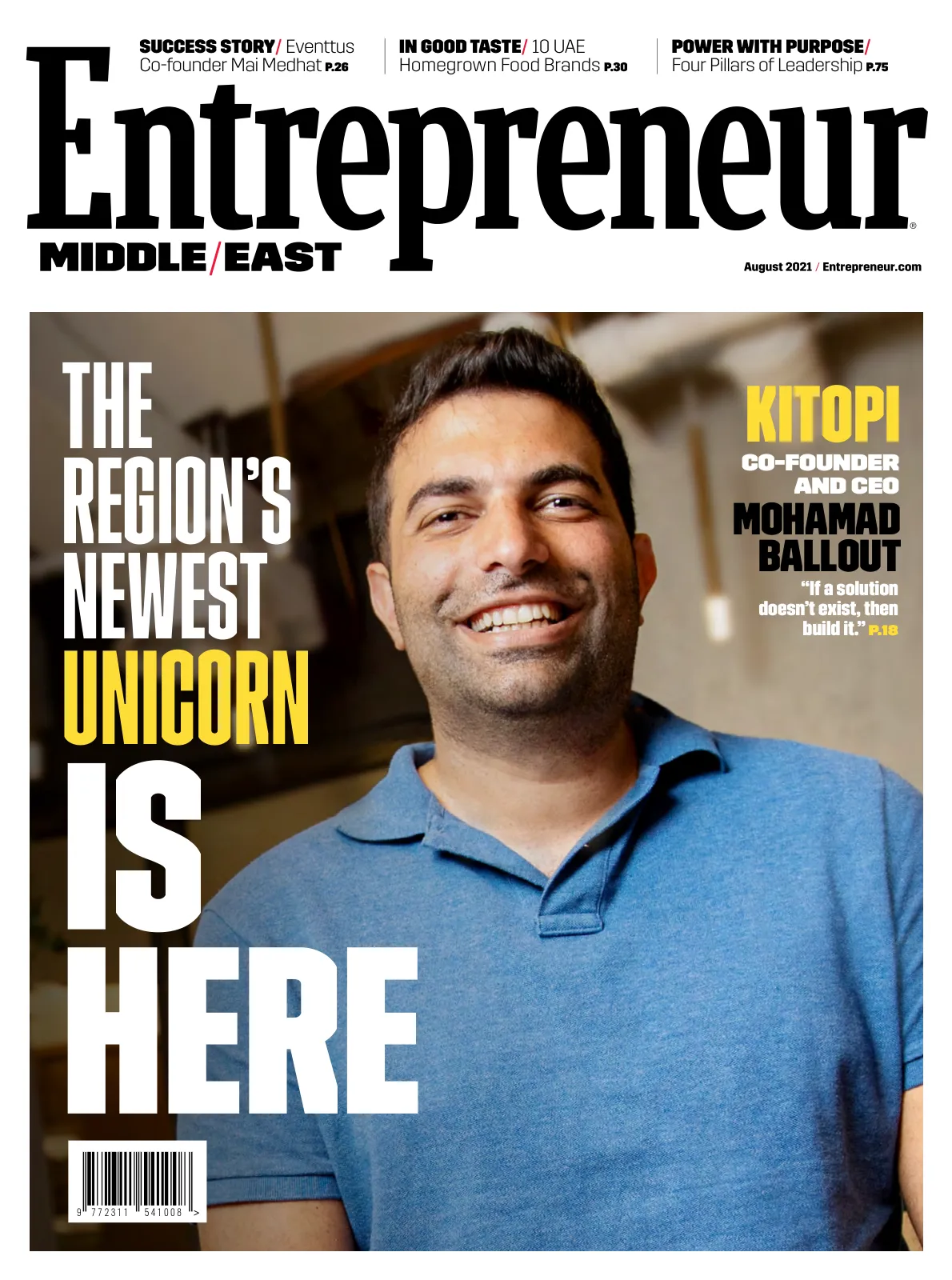
Entrepreneur Middle East, August 2021
Page 1
THE
REGION’S
NEWEST
UNICORN
IS HERE
“If a solution
doesn’t exist, then
build it.” P.18
MOHAMAD
BALLOUT
KITOPI
IN GOOD TASTE/ 10 UAE
Homegrown Food Brands P.30
POWER WITH PURPOSE/
Four Pillars of Leadership P.75
SUCCESS STORY/ Eventtus
Co-founder Mai Medhat P.26
CO-FOUNDER
AND CEO
9
7 7 2 3 1 1
5 4 1 0 0 8
>
Page 2
Page 3
Page 4
A
Page 5
sbe.com/sls-dubai
@slsdubai
blend of lifestyle & luxury in
a timeless elegant atmosphere
Page 6
6 / ENTREPRENEUR.COM / August 2021
A look at 10 of the UAE’s most
promising homegrown food
brands that are shaking up the
marketplace.
by ABY SAM THOMAS
P.30
In Good Taste
P.13
Grrrl Power
HB Investments’ seed
investment fund and
incubator, HB Angels,
announces the launch of its
first startup, Ketish, a luxury
feminine wellness brand.
by ABY SAM THOMAS
P.18
The
Region’s
Newest
Unicorn
is Here
Kitopi co-founder and CEO
Mohamad Ballout is aiming
to have the cloud kitchen
platform dominate the
region (and the world) with
a US$415 million funding
round led by SoftBank.
by PAMELLA DE LEON
P.26
Success
Story
Eventtus co-founder and
CEO Mai Medhat reflects
on her decade-long
entrepreneurial journey
that’s led to her startup’s
acquisition by Bevy, a US-
based enterprise community
event engine.
by TAMARA PUPIC
FEATURES
Contents/August 2021
→ RAMIE MURRAY
is the founder of
Dibba Bay, the first oyster
farm in the Middle East.
P.32
BUSINESS
UNUSUAL
Page 7
الشركاء االستراتيجيون
Strategic Partners
تـرشــــح اآلن
2021 سبتمبـــر15 حتـى
Nominate Now
Till 15th September, 2021
المجد
لمـن يصنعــهGlory Belongs To Those Who Make It
Page 8
8 / ENTREPRENEUR.COM / August 2021
75 Power With Purpose
VIJAY ESWARAN, founder and
Executive Chairman of the
QI Group of Companies,
shares his insights on the four
pillars of leadership.
77 Digital Transformation
Means Little Without
Leadership
As the world continues
to grapple with the challenges
of an evolving pandemic,
digital transformation presents
organizations with a historic
need for resilient leadership.
BY AMNAH AJMAL
78 Strategy Bites
RAFFAELLA CAMPAGNOLI chats
with Salman Gasim, CEO of
Swiss Hospitality Company, on
developing human capital in the
tourism and hospitality industry.
‘TREPONOMICS
EDITOR IN CHIEF Aby Sam Thomas
aby@bncpublishing.net
CEO Wissam Younane
wissam@bncpublishing.net
DIRECTOR Rabih Najm
rabih@bncpublishing.net
CREATIVE LEAD Odette Kahwagi
design@bncpublishing.net
MANAGING EDITOR Tamara Pupic
tamara@bncpublishing.net
STARTUPS SECTION EDITOR Pamella de Leon
pamella@bncpublishing.net
FEATURES WRITER Aalia Mehreen Ahmed
aalia@bncpublishing.net
DIGITAL SOLUTIONS DIRECTOR
Mahdi Hashemi mahdi@bncpublishing.net
HEAD OF INNOVATION
Sarah Saddouk sarah@bncpublishing.net
GROUP SALES DIRECTOR – B2B GROUP
Joaquim D’Costa jo@bncpublishing.net
COLUMNIST Tamara Clarke
CONTRIBUTING WRITERS
Amnah Ajmal, Fida Chaaban, Vijay Eswaran
SUBSCRIBE
Contact subscriptions@bncpublishing.net to receive
Entrepreneur Middle East every issue
COMMERCIAL ENQUIRIES
sales@bncpublishing.net
ENTREPRENEUR.COM
Access fresh content daily on our website
All Rights Reserved 2021. Opinions expressed are solely those of the contributors. Entrepreneur
Middle East and all subsidiary publications in the MENA region are officially licensed exclusively to
BNC Publishing in the MENA region by Entrepreneur Media Inc. No part of this magazine may be
reproduced or transmitted in any form or by any means without written permission of the publisher. Images
used in Entrepreneur Middle East are credited when necessary. Attributed use of copyrighted images
with permission. All images not credited otherwise Shutterstock. Printed by United Printing and Publishing.
PO BOX 502511 DUBAI, UAE
P +971 4 4200 506
Contents/August 2021
81 Championing
Change
UAE-based electric
vehicle manufacturer One Moto
is ready to take on the world.
by PAMELLA DE LEON
84 In Focus
A roundup of the up-and-
coming enterprises you should
be keeping an eye on.
by AALIA MEHREEN AHMED
88 “We Got Funded!”
Egypt-based Elmenus
has raised US$10 million in a
pre-Series C round.
STARTUP
SPOTLIGHT
↑ CRUMB & CO. is a local
home-grown small batch
bakery specializing in
creative pastry and bakes.
P.54
EntMagazineME
Entrepreneur-me
Page 9
Page 10
10 / ENTREPRENEUR.COM / August 2021
Editor’s Note/
Having said that, I’ve come to realize that
there is a definite reason for my misgivings
about delegation- and that’s perhaps
because I’ve come across way too many
people who abuse their ability to deputize
on a day-to-day basis. They do this because
they are in a position of power or privilege,
and their abject laziness or apathetic
attitudes allow them to simply dump work
on those who work under them, not because
they are too busy with other tasks or reasons
of that nature, but just because they can. I’ve
had first-hand experience working under
bosses like this, and while I was too young,
too afraid, and too inexperienced to call out
this exploitation for what it was back then, I
find myself angrily pointing out such
abdications of responsibility when I see it
around me now- and it’s also why I am
hellbent on keeping myself in check when I
am delegating to my team, perhaps almost
to a fault.
After all, I remember too well feeling
unhappy and disillusioned with the behavior
of my managers then, and how that led me
to leave those jobs eventually- and I’m keen
on making sure I never let my people feel
that way. “Delegating work works- provided
the one delegating works too,” said Robert
Half (founder of the California-headquar
tered talent solutions company that bears
his name), and that’s something all of us
-entrepreneurs included- would be wise to
keep in mind, always.
Aby Sam Thomas
Editor in Chief
@thisisaby
aby@bncpublishing.net
Delegation vs. abdication
Your Fair Share
LET ME START WITH A DISCLAIMER: when it comes to
leadership skills, I am especially bad at the art of
delegation, wherein I often find myself overloaded
with tasks just because I think, well, why should I
bother someone else to do something, when I could
just do it myself. The problem with this kind of
thought process is that it will result in me probably
getting overwhelmed and burnt out, or even just
finding myself unable to do the tasks that I
absolutely need to do, since I’ve bogged myself
down with the minutiae that could have been taken
care of by someone else on my team. The good thing
here though is that this is an issue I have indeed
identified in myself as a leader, and therefore, I’ve
been trying -albeit with limited success- to get more
comfortable with the idea of delegation.
Page 11
Page 12
Page 13
13
August 2021 / ENTREPRENEUR.COM /
GRRRL POWER
HB Investments’ seed investment fund and incubator, HB Angels, launches its first startup,
Ketish, a luxury feminine wellness brand by ABY SAM THOMAS
→ FOUNDED BY EMAAN ABBASS, a former
product developer at Huda Beauty, Ketish
-named after the ancient Egyptian
goddess of love, passion, sexuality, and
pleasure Qetesh- aims to to take feminine
and sexual wellness outside of the
pharmacy, and make it a part of women's
self-love practice.
Page 14
14 / ENTREPRENEUR.COM / August 2021
Founded by Emaan Abbass,
who was formerly a product
developer at Huda Beauty,
Ketish aims to address a gap
she found in the intimate care
and feminine wellness
industry, with the brand’s
products having been
developed by keeping women’s
needs and desires on top of
mind. The Ketish portfolio is
made up of targeted body care
and wellness products that are
“super effective, multi-benefi
cial, and have that undeniable
dope factor,” with Abbass
revealing that the brand has
been named after Qetesh, the
ancient Egyptian goddess of
love, passion, sexuality, and
pleasure. “Although some
feminine care products have
always existed, I found they
lacked credibility, or were just
low-key embarrassing to
purchase,” Abbass says. “We
want to take feminine and
sexual wellness outside of the
pharmacy- a place that’s
typically associated with
something being wrong or
feeling sick. We want to elevate
that experience and make it a
part of your self-love practice.
The products are going to be
luxurious and effective, and
developed with wellness in
mind. We’ve transformed
feminine care products visually.
We’ve made them really
beautiful, like a little secret
weapon inside your bag, so you
never have to feel embarrassed
or ashamed, when whipping it
out on a date, or on an outing
with some friends.”
B/
HB Investments, the Dubai-based private investment office chaired
by Huda Beauty founder Huda Kattan, has announced the launch
of Ketish, a luxury feminine wellness brand, which is the first
startup to come out of its seed fund and incubator, HB Angels.
B/In the Loop
→ EMAAN ABBASS,
founder of Ketish, with
Huda Beauty founder and
HB Investments Chair
HUDA KATTAN and Huda
Beauty Global President
and founder of Kayali
MONA KATTAN.
Page 15
15
August 2021 / ENTREPRENEUR.COM /
In an interview with Entrepre
neur Middle East, Abbass was
emphatic about noting the key
role HB Investments has
played in getting Ketish off the
ground as a business. In 2017,
Kattan had announced on her
social media channels that she
was starting a US$10 million
fund to invest in passionate
founders with mission-driven
business ideas, and that was
the incentive Abbass needed to
pursue her entrepreneurial
dreams. “I always had an idea
to start a feminine wellness
brand, but never thought it out
until I saw that video,” Abbass
recalls. “I was nervous to
approach Huda, not just
because it was something that
was so personal to me, but
because I was an employee, and
I wasn’t sure how she would
receive it. I finally worked up
the courage to approach Huda
with the idea for Ketish. And
after several post-pitch
conversations, the family saw
the vision really clearly, and
decided to invest in Ketish.”
As an Egyptian American
woman, Abbass was driven to
launch Ketish after her own
experiences in life in which
feminine health and sex
education were always
considered as taboo topics at
home. Having been diagnosed
with cervical cancer caused by
the human papillomavirus
when she was 21, her fear of
turning to her family for
support or comfort led her to
go through the nine-year
healing process alone. “This
experience made me realize
just how important my
intimate health was, and I
become hyper-aware of the
products I was using on my
body,” Abbass explains. “I
quickly realized that there was
a gap when it came to taboo-
free, trustworthy products in
the intimate care space. I also
went through this before the
age of social media, and so, I
felt that there weren’t enough
educational platforms or
outlets for young girls like
myself to lean on for support. I
thus wanted to create a brand
that not only provided effective,
luxurious, and powerful
products that were free from
stigma, but I also wanted to
create the community and
platform I wished I’d had
throughout my journey.”
Abbass’ personal vision for
the brand is also what led
Kattan to decide that Ketish
would be the first brand to
come out of HB Investments’
HB Angels umbrella. “The
purpose-driven brands that are
here to change things in the
industry and for consumers is
where I want to be, and Emaan
and Ketish represent this
perfectly,” Kattan says.
“Whenever we’re considering
new investments, we always
look for brands and entrepre
neurs that have a similar
vision to ours at HB Invest
ments. We want founders
that are passionate and have
purpose for their brands- and
Emaan definitely has that.
Women don’t realize how
important feminine health is.
People still don’t feel comfort
able shopping for tampons or
pads, and it’s really bizarre,
because something like this is
human nature- so, why are all
women so uncomfortable with
it? Women are really holding
themselves back, and it’s not
fair. So many women struggle
with a lot of health problems,
and some are so unaware
simply because they lack the
education. This conversation
has had so much shame and
stigma around it, and it’s time
to put a stop to it. Emaan has
educated me a lot about how to
take care of my feminine
health, and now, it’s time for
her and Ketish to share it with
the world. I really am thrilled
to be supporting and working
with someone who is so driven.
I’m so proud of her; she has
really grown as a founder, a
woman and a boss!”
With Ketish now having
become the first enterprise to
be backed by HB Angels,
Kattan says the entity will be
continuing to keep an eye out
for new investments in the
future. “We are in the process
of incubating other brands as
HB Angels, and investing in
other founders,” Kattan says.
“As part of HB Investments, we
have made a few investments in
the tech and consumer spaces
with some amazing founders,
where we’re obviously less
involved than we are with our
HB Angels arm. As for HB
Angels, our in-house seed
investment fund and incuba
tor, it’s still a small portfolio
that is growing slowly and
organically. It’s important for
us to find the right partners
with a mission that we fully
support and want to grow.
Right now, we’re exploring
partnerships around the world
to invest in the right people. }
AS A TEAM, WE FELT IT WAS IMPORTANT TO TAKE
EVERYONE’S SENSITIVITIES INTO CONSIDERATION, YET
STILL REMAIN TRUE TO OUR MISSION AND VOICE.
Page 16
16 / ENTREPRENEUR.COM / August 2021
There are a lot of categories
we’ve expressed interest in,
we’ve spoken to a lot of
different people, a lot of
different founders, but we
don’t want to just throw our
money and time around. HB
Angels is a partnership, and
we want to be able to offer our
expertise whether it’s brand
ing, marketing, or social. I
definitely see a lot of exciting
partnerships coming our way.”
When asked about the
characteristics of businesses
she’s hoping to support
through HB Investments and
HB Angels, Kattan revealed a
very particular feature she
absolutely wants to see in the
entrepreneurs and enterprises
that she’d work with. “Hands
down, the ‘human factor,’” she
declares. “That’s so important
to us at HB investments, which
is also why we have to be super
selective about our invest
ments. We care so much about
finding founders with the right
kind of passion and purpose.
When we look at investing in
someone, it’s not always about
how sexy the idea is. It’s about
the founder. Does he/she have
what it takes? Are they in this
only for the money? Is this
idea actually important to
them? Like I said before, it’s a
partnership, we are involved in
almost every aspect, working
side by side with them. They
become part of the HB
Investments family, so we
don’t want someone who just
wants our money and has an
exit strategy. We look for
people who are passionate,
have purpose, and are driven
to make their brand as
successful as possible.”
For Abbass, working with
HB Investments and HB
Angels has allowed her and her
brand to leverage the different
resources that have been built
into this particular ecosystem.
An added perk, she notes, has
been the ability to work closely
with Kattan on this enterprise.
“We are very fortunate to have
a female investor backing us as
a brand,” she says. “Huda has
always understood and seen
the Ketish vision so clearly.
She has connected with it on a
personal level, and she has
supported us in action since
day one. Huda and I have
always had a very special
relationship, but I do believe in
the case of Ketish, our investor
relationship is quite unique. I
went from being a former
employee to now a business
partner and mentee, and
throughout this experience of
building the brand, our
relationship has definitely
transformed. Huda has given
me invaluable advice based on
her own first-hand experience,
having to do with everything
from business to marketing.
She’s taught me the value of
hard work, perseverance, and
pure passion, because she
embodies all of those attri
butes. Huda believes in
celebrating and uplifting
everyone around her, but
especially women.”
But despite having her
enterprise being backed by
Kattan, Abbass admits that
starting up Ketish wasn’t a bed
of roses either. “One of the
biggest challenges we’ve faced
is simply navigating the
sensitivities that exist around
feminine and sexual wellness
category, especially in the
Middle East,” she says. “We’ve
taken the time to talk to
women from all over the
world, but specifically in this
region, in an effort to under
stand how women would
receive a brand like Ketish.
Each person we talked to had
different reactions based on
their own experiences, but one
thing remained consistent
across the board: that it’s time
for women to have a brand like
this, to feel empowered, get
educated, hear other women’s
stories, and to be a part of a
bigger community. We know
and understand that launching
a brand like this will be met
with some controversy, but the
positive feedback we received
really validated our ‘why.’ We
are fully aware of how taboo
these topics are, especially in
the Middle East, and that they
might not be received well by
those who aren’t accustomed
to them. But as a team, we felt
it was important to take
everyone’s sensitivities into
consideration, yet still remain
true to our mission and voice.
We understand that in order to
reach women, we need to
communicate in a way that
feels safe for those who want to
be a part of the dialogue, both
in public and in private. The
topic of women’s health is too
important to ignore anymore.”
B/
B/In the Loop
WE ARE FULLY AWARE OF HOW TABOO THESE TOPICS ARE,
ESPECIALLY IN THE MIDDLE EAST, AND THAT THEY MIGHT NOT BE
RECEIVED WELL BY THOSE WHO AREN’T ACCUSTOMED TO THEM.
Page 17
17
August 2021 / ENTREPRENEUR.COM /
THE TOPIC
OF WOMEN’S
HEALTH
IS TOO
IMPORTANT
TO IGNORE
ANYMORE.”
“
Page 18
18 / ENTREPRENEUR.COM / August 2021UNICORN
REGION’S
THE
KITOPI CO-FOUNDER AND CEO MOHAMAD BALLOUT
is aiming to have his cloud kitchen platform dominate the region
(and the world) with a US$415 million funding round led by SoftBank
by PAMELLA DE LEON
NEWEST
Page 19
19
August 2021 / ENTREPRENEUR.COM /
IS
HERE
Page 20
20 / ENTREPRENEUR.COM / August 2021
With a mission of “satisfying the world’s
appetite,” the enterprise founded by Mohamad
Ballout, Saman Darkan, Bader Ataya, and
Andres Arenas enables restaurants and F&B
brands to scale their reach and open delivery-
only locations by providing infrastructure and its
own proprietary software with minimal
overheads and time. Since its launched in 2018,
Kitopi has seen its entity grow at a fast-paced
rate- currently, it operates over 60 kitchens in
UAE, Saudi Arabia, Kuwait, and Bahrain, and
works with more than 200 brands, including
Shake Shack, KLC Virtual Restaurants, Luca,
Papa Johns and iHOP. It has even diversified its
offerings by utilizing its supply chain to include
subscription-based meal plans and on-demand
groceries delivery. And it’s interesting to see how
the enterprise’s plans are further unfolding- in
July this year, Kitopi announced that it has
successfully raised $415 million in a Series C led
by SoftBank Vision Fund 2, with the round also
joined by Chimera, Abu Dhabi’s DisruptAD,
Riley, Dogus Group, Next Play Capital, and
Nordstar. Though valuation details remain
undisclosed, a Bloomberg report noted that
Kitopi had crossed the $1 billion valuation mark,
which makes it the latest Middle East unicorn
and the fastest one yet.
Having SoftBank Vision Fund 2 backing
the enterprise is an achievement in itself, with it
being the first investment made by the firm in a
company homegrown in the UAE. “I think that
with SoftBank coming in here, we’re the first of
probably many more investments that they’re
going to do, and other great investors coming in
as well,” says Ballout. “It’s also great to see
sovereign wealth funds jumping in to back
homegrown concepts. You don’t see a lot of that
happening, so that’s also something we’re proud
of.” Kitopi is also lucky to have found investors
that align with its vision, he adds. “It’s not a
one-way street, and we’re fortunate to have the
support of leading international and regional
investors,” he says. “We were looking for
long-term capital investors, and what was
unique in SoftBank is their portfolio of phenom
enal companies that we can build synergies with
globally.” And the raise has also reinforced the
Kitopi team’s thoughts on the venture’s immense
potential and value. “I do think we ended up
raising more than what we initially expected to
raise,” Ballout says. “It definitely validates a lot of
things- it validates Kitopi, and the team that
Kitopi has. It validates the tech ecosystem in the
MENA region, that there’s a lot of great compa
nies over here. And it is the first, if I guess, of
many more companies that are going to cross
the billion-dollar-mark in the next two years.” }
S
haking up the
traditional brick
and mortar model
of restaurants,
the premise of a
cloud kitchen’s
ability to provide
cost-efficient
infrastructure and
offer delivery-only
services presents
a viable revenue
stream for F&B
brands. According
to Allied Market
Research, the
size of the global
cloud kitchen
market is expected
to grow at US$71 billion by
2027- a market that Dubai-
headquartered state-of-the-
art managed cloud kitchen
platform Kitopi is striving to
take a bite out of.
→ OPPOSITE PAGE
Two of Kitopi's co-founders:
SAMAN DARKAN AND MOHAMAD BALLOUT
“Cloud kitchens are the future.”
IMAGES COURTESY KITOPI
Page 21
21
August 2021 / ENTREPRENEUR.COM /
1. Keep it real.
“Be authentic and
genuine- investors can
see right through when
you’re not.”
2. It’s all about
the numbers.
“Be unit economic
obsessive- the days of
growth at any cost are
over.”
3. Trust the
process.
“Build relationships with
potential partners early
on. It’s highly unlikely a
new investor will invest
a large sum of money
when first meeting
you- trust is built over
time.”
4. Keep it
simple.
“Simplify the problem
you are solving in such
a way that a 10-year-old
can understand it.”
Kitopi
co-founder and
CEO Mohamad
Ballout’s tips for
entrepreneurs
wanting to
secure funds for
their enterprises
'TREP
TALK
Page 22
22 / ENTREPRENEUR.COM / August 2021
Looking at Kitopi’s track record, it’s easy to see the
factors that can be used to justify its current valuation.
Having launched only three years ago in the UAE, the
enterprise needed less than a year to expand to Saudi Arabia,
and in 2019, the venture started the year by closing a Series B
funding round with $60 million. It wasn’t deterred by the
onset of the COVID-19 crisis too- in fact, it thrived. Indeed, a
statement from the company noted that it had seen a 300%
growth in 2020. The team was able to introduce its groceries
vertical Shop Kitopi during the pandemic, when more than
60% of its team were working remotely. The latest cash
infusion thus comes at an opportune time, with Ballout
revealing that it will be used to channel Kitopi’s expansion
within the MENA region, particularly across Saudi Arabia,
while also supporting its entry into new markets such as
Southeast Asia. So, what makes this enterprise tick and
succeed at such a fast-paced rate? “What we always say at
Kitopi is, we’re not a family... we’re a team of super entre
preneurs,” Ballout declares. Compared to the so-called
family-like culture that we often hear touted by entrepre
neurs about their teams, this was refreshing to hear. “The
way we see ourselves is that this is a sports team winning a
massive tournament,” Ballout adds. “We are a winning
NBA-going, LA Lakers-like team, and the goal here is [for]
everyone in it to win it, but at the same time, we want to
enjoy doing it.”
According to Ballout, Kitopi strives to foster an environ
ment that’s centered on “managing a high-performance
culture and a value-add culture.” In fact, a few minutes into
our chat, Ballout is insistent on moving the focus of the
interview away from him, but instead on highlighting the
“25 strong entrepreneurs” he claims to have been leading
the company. “Kitopi is not a founder-led business,” Ballout
explains. “We’re proud founders, but this is not a founder-
led business- we have a top leadership team of 25 people,
and they’re all heavily involved with our success story. All
2,500 of us are heavily involved, but it’s a leadership-led
team, versus a founder-led business, which [has] really
allowed us to move [across our markets] much, much
faster.” Ballout believes that by cultivating the spirit of a
high-performance sports team in the enterprise, feelings of
loyalty and trust are encouraged within everyone who works
at the company. “They’re really coming into Kitopi, not just
to get a paycheck, not just because they want to hustle, but
because we would all enjoy working together, and from the
values perspective, we all have the same values, and that’s
what works for us,” Ballout explains.
Understand
what skillsets
matter most,
and when.”
“
→ In July this year, Kitopi announced that it has
successfully raised $415 MILLION IN A SERIES C
led by SoftBank Vision Fund 2, with the round also
joined by Chimera, Abu Dhabi’s DisruptAD, Riley,
Dogus Group, Next Play Capital, and Nordstar.
Page 23
23
August 2021 / ENTREPRENEUR.COM /
There seems to be little doubt that this focus on building
its culture and empowering its employees to behave like a
high-performance sports team has played a pivotal role in the
venture’s growth. But to really understand the enterprise’s
aptitude for fostering entrepreneurship-like qualities, you’ll
need to understand how it started. Ballout’s own entrepre
neurial journey started prior to Kitopi, when he co-founded
BMB, which is today seen as one of the largest confectionary
businesses in the Middle East, and that is also what sparked
his interest in the F&B industry in the first place. After
exiting BMB, he joined a private equity firm to become an
investor, wherein he found himself surrounded by the
entrepreneurial community, with ventures in the food space
constantly grabbing his attention. As an investor who was
working closely with restaurant owners, Ballout realized
scaling seemed to be the biggest issue for a majority of them.
“There had to be an easier way to allow restaurants to
increase their delivery reach, and therefore, their sales,
without them having to break the bank by opening up new
locations in traditional brick and mortar outlets,” he notes.
THIS KICKED OFF THE IDEATION PHASE
for Kitopi- starting with Ballout calling up one of his
childhood friends, Saman Darkan, who had experience in
digital transformation and starting a few startups as well.
Darkan would later join as co-founder and Chief Product and
Technology Officer, and lead Kitopi’s launch of its engineering
hub (and first tech hub outside the Middle East) in Krakow,
Poland. The two put their heads together and started to
visualize what Kitopi would end up becoming. “The concept of
cloud kitchens existed in that they were a real estate space that
were rented out as shared kitchens, but solving the end-to-end
for restaurants, in a completely managed cloud kitchen
concept was something we pioneered,” Ballout remembers.
Next, two more co-founders came on board: Bader Ataya,
former co-founder and Managing Partner of e-commerce
platform Mumzworld.com, joined as Chief Growth Officer; as
well as Andres Arenas, who brought to Kitopi his years of
operations experience of running big scale seafood export
facilities in his role as Chief Property Officer. “This is very
much four friends coming together and building something
that we were very passionate about, but more importantly, we
were working on a very complex problem,” Ballout explains.
“But if you know someone so well, you also know how to solve
problems with them very well.”
This seems to be the ethos with which Kitopi has chosen the
people to work for it in executive roles- these “Kitopians”
certainly have their own entrepreneurial flair, with that either
being shaped by their time in the corporate world, or their
work in some of the MENA’s leading startups. Some of the key
names in Kitopi’s leadership team include
Chief Financial Officer Sami Bejjani, Chief of Staff Paul
Zoghbi, and Director of Strategy Sabine El Najjar, who were
all former McKinsey executives. Jihad Bou Nasr, who was
formerly of Boston Consulting Group, is the company’s
Regional Managing Director. Pooja Vithlani, Vice President –
Product Development, Stacey Pinto, Director – Brand and
Reputation, and Aqida Kaleem, Director of Customer
Experience, formerly used to work with fellow MENA unicorn,
Careem. Ballout says that having close-knit trust amongst the
co-founders and its leadership team was essential, especially in
Kitopi’s crucial stages of learning to navigate a volatile,
uncertain, complex and ambiguous market. Early hurdles
varied from getting F&B brands to sign up, as well as embody
ing different cooking techniques (“how do you reengineer }
Page 24
24 / ENTREPRENEUR.COM / August 2021
that for scale?”), plus navigating aggrega
tor players in the multiple cities they
operate, and, of course, managing
landlords.
“There were so many mistakes, but I
believe the biggest one is not building an
operating playbook prior to expanding,”
Ballout replies, when asked to recall
some of the missteps Kitopi might have
made along its journey. “We were able to
correct that in our second year, but it
would have definitely helped to have it
from the start.” Having said that,
mistakes are supported at Kitopi, adds
Ballout. “The logic behind this is that
as long as it’s a two-way door decision,
mistakes are completely excused- this
allows us to learn from them and move
super-fast. The goal then is to identify
those one-way door decisions that need
to be closely analyzed before execut
ing.” Arenas agrees with this senti
ment- learning from mistakes fast, as
was remaining humble, was key. “As
first-movers in the space, we had to try
new things, which didn’t always work
as we planned, but it is so important to
quickly correct the direction and learn
what can be done better.” Meanwhile,
Darkan states the importance of being
attuned to various lifecycles and its
issues: “The needs of an organizations
differ from stage to stage- it’s thus
important to understand what skillsets
matter most, and when.”
As the company continues to grow,
the Kitopi team have since honed in on
their strategies to ensure growth and
stability, especially in the midst of
uncertainty. Given the enterprise’s
focus on building high-performance
teams, creating and prioritizing a
positive culture comes before every
thing else. As Darkan says: “Don’t
compromise on culture- that holds
throughout every stage of growth.”
Along with that, fostering a culture of
innovation is critical too, Ballout says.
“Our values are built on encouraging
our Kitopians to always innovate. If a
solution doesn’t exist, then build it.”
This is the mindset that brought Shop
Kitopi to the public in the midst of the
COVID-19 pandemic, when the team
realized that customers had to wait for
days to receive essentials, resulting in a
solution that offers to deliver across
Dubai in 90 minutes or less. Building
and maintaining strong partnerships is
key as well to the enterprise’s scalabil
ity, Ballout adds. “We believe our
success so far lies in the fact that our
teams invest a lot of time working
closely with these brands, to under
stand better how we can help them
grow,” he says. “We recognize every
brand is different- it’s not a one-size-
fits-all approach, and we customize as
we go.”
When asked about the steady rise of
competition in the cloud kitchen
sector, the Kitopi team say they are
choosing to focus on their competitive
advantage. Besides taking care of the
entire operations -from supply chain
and staff training, to food preparation
and delivery and customer experience-
a large part of Kitopi’s advantage is on
its proprietary Smart Kitchen Operat
ing System (SKOS). “SKOS is a suite of
applications that optimizes the
performance of its cloud kitchen
operations in real-time,” Ballout
explains. “The solution focuses on
delivering a great customer experience
across multiple brands in a single
kitchen by maximizing operational
efficiency.” Since the launch of SKOS,
Ballout says Kitopi’s kitchens have
been able to double the order volume,
while reducing preparation time by
40%. Indeed, the system makes use of
data science to predict when drivers
will arrive, and how long an item
would take to cook, then auto sequence
which items to cook first, thereby
enhancing speed.
When the coronavirus pandemic
struck in 2020, the company, like many
of its peers in the food industry, initially
saw a dip in online orders. However, the
team worked closely with brands and
delivery partners to educate consumers
on health and safety practices. As a tech
venture, the team aimed to optimize the
kitchens not only for efficiency, but for
health and safety standards too. In fact,
the team made use of artificial intelli
gence to help monitor anomalies in the
kitchens. “This tech could help ensure
our colleagues were washing their hands
for 20 seconds, wearing their masks
correctly, etc.” Ballout reveals. “If an
anomaly was identified, we’d be able to
rectify it immediately.” This period also
saw Kitopi striving to support the
ecosystem in which it operated in- the
enterprise invited small businesses and
F&B brands alike who struggling with
keeping physical outlets open to join the
platform. Kitopi also teamed up with its
delivery and brand partners, along with
the government, to distribute free meals
to communities impacted by the
pandemic. “While it continues to be a
tough time in many parts of the world,
what the pandemic has done is help the
F&B industry leapfrog to the digital age,
in what otherwise would have taken
them years to do,” Ballout notes. “Cloud
kitchens are the future, as they not only
help restaurants scale beyond borders
quickly, but provide customers access to
their favorite brands, from anywhere in
the world.”
The Kitopi team is thus making sure it
bolsters its current momentum, with
Ballout saying, “Our focus is to continue
growing what we’ve already built.”
Ballout says the plan is to continue to
innovate and expand Kitopi’s infrastruc
ture, as well as grow strategic restaurant
partnerships. With Saudi Arabia set to
be Kitopi’s Middle East headquarters,
and Dubai remaining as its global head
office, the team is steadily charting for
its regional (and global) domination.
It’s only a matter of time.
Don’t
compromise
on culture-
that holds
throughout
every stage
of growth.”
Page 25
25
August 2021 / ENTREPRENEUR.COM /
BADER ATAYA /
CO-FOUNDER AND CHIEF
GROWTH OFFICER
“Our work is infinitely
motivating and appealing
because as a team, with a
common vision, common
values, and each other’s
sincere best intentions at
heart always, we are far
more than the sum of our
parts.”
SABINE EL NAJJAR /
DIRECTOR OF STRATEGY
“I’ve learned that we don’t
always need to have the
five-year plan laid out
before taking action.
Sometimes, we have to
follow educated hunches
to leverage momentum
and be market leaders.”
SAMAN DARKAN /
CO-FOUNDER & CHIEF
TECHNOLOGY OFFICER
“We are pioneering
change in the food
ecosystem. It is a space
we can all relate to on a
personal level and one
that is evolving rapidly.
My hope for Kitopi is to
create an organization
that inspires. A brand
people identify with that
speaks louder than just
the services we offer.”
POOJA VITHLANI / VICE
PRESIDENT PRODUCT
MANAGEMENT,
CUSTOMER & BRAND
“When speed is valued and
there's so much innovation
opportunity ahead of you,
there is a natural tendency
to jump right into execution
mode. However, it's critical
to take a step back to
ensure sound strategic
alignment across key
stakeholders on what
needs to be done and why,
and ironing out any
assumptions, so that you
can ensure smoother and
more planful execution.”
ANDRES ARENAS /
CO-FOUNDER & CHIEF
PROPERTY OFFICER
“First, having amazing
colleagues to work with
and having the
opportunity to learn from
each other every day.
Second, being able to
create an amazing
concept which is
revolutionizing the F&B
ecosystem, our mission is
to satisfy the world’s
appetite, and we’re on
track to achieving this!”
PAUL ZOGHBI /
CHIEF OF STAFF
“The importance of fast
execution, learning from
our experience and being
ready to re-pivot to refine
the model, while keeping
quality and customer
experience always on top
of mind.”
MAHMOUD AWAD /
CHIEF LEGAL OFFICER
“To know that I am part of
a team dedicated to
leaving a lasting footprint
for start-up in the region
and the ‘cloud kitchen’
space internationally. My
part in that journey is to
assist in developing an
infrastructure that allows
for a quick to market
advantage and that acts
as an enabler of
innovation.”
JIHAD BOU NASR /
REGIONAL MANAGING
DIRECTOR
“It is very important for an
entrepreneur to be able to
work at two speeds
simultaneously. The slow
gear is needed in order to
build the right systems, tools,
processes and have a
smooth-functioning
organization. However, that
takes time, and hence the
fast gear is important to
ensure you are pivoting and
course-correcting quickly so
that priorities are still being
met, until the outcomes of
the slow gear kick in.”
EKTA BHOJWANI / VICE
PRESIDENT - PRODUCT
“The team is world-class-
so there is always
someone inspiring you to
push harder. We’re
disrupting a traditional
industry (F&B) and doing it
at scale. Whenever I meet
someone new, I’m always
curious if they’ve ordered
from our brands. My goal
would be us to capture (at
least) 50% of the
stomach’s market share of
a customer.”
STACEY PINTO /
DIRECTOR OF BRAND &
REPUTATION
“At Kitopi, no matter how
fast we move, and how
quickly we innovate, we
work really hard on
reminding ourselves that
we’re all unique individuals
on the same team, working
hard on bringing our best
selves to work every day.
We’ve all heard the saying:
‘Culture eats strategy for
breakfast.’ So, even though
we’ve got our eyes on the
prize, we’ve got each other's
backs getting there.”
THE FACES OF KITOPI
ON MOTIVATION
ON LESSONS LEARNED
Page 26
26 / ENTREPRENEUR.COM / August 2021
SUCCESS STORY
Eventtus co-founder and CEO Mai Medhat reflects on her
decade-long entrepreneurial journey that’s led to her startup’s
acquisition by Bevy, a US-based enterprise community event
engine by TAMARA PUPIC
→ MAI MEDHAT
AND NIHAL FARES,
co-founders of
Eventtus.
Page 27
27
August 2021 / ENTREPRENEUR.COM /
Medhat and Fares met while studying
computer engineering at Ain Shams
University in Cairo, eventually winning a
top prize at the Imagine Cup, Microsoft’s
annual competition for young engineers,
held in Egypt in 2009, for their joint
graduation project, a technology solution
to the traffic jam problem in Cairo. In
2011, the duo attended a Startup
Weekend Cairo event, where they first
developed a concept that would eventu
ally grow into Eventtus. Over the years,
Eventtus has become an all-in-one
platform that caters to events ticketing,
event management, and apps for events.
It enables event attendees to customize
their event schedule through an interac
tive agenda, and also offer them instant
updates through a social media feed and
opportunities to network with other
attendees.
With Eventtus having had such a
momentous journey over the years, it is
not surprising to hear Medhat admit to
the emotional toll of selling the business
she founded. “It was not an easy decision
at all, but it is for the best,” she says. “I
built a business for a reason. I wanted to
help event organizers to host amazing,
successful events. Joining Bevy will help
us continue our vision, and scale this even
bigger.” After a year in which most
businesses suffered a financial hit from
the COVID-19 pandemic, especially those
in the events space, Medhat is grateful for
Eventtus’ good fortune. “Finding an
acquirer who is a perfect fit for the
business, team, culture, and the growth of
everyone in the team made the decision
way easier,” she says. “We were lucky with
Bevy, and the journey of Eventtus will
continue, but on a way bigger scale.”
The US-based Bevy has been designed
as an end-to-end community event
engine that helps businesses to build a
community by enabling them to have a
360-degree view of their event attendees,
and to also measure the impact of their
efforts. “What’s unique about Bevy is how
they thread events together,” Medhat
noted, in a press release about the
acquisition. “They’ve built a powerful
community event engine that helps
enterprise teams create a sense of
community among their customers,
prospects, partners, and employees. This
is what all other event platforms are
missing. And it’s the key to unlocking
global scale and growth.” Medhat reveals
that Bevy’s conferences, Startup Grind
and CMX Summit, have been Eventtus’
customers for the past four years,
meaning that the two teams already know
and work well with each other. In
addition to having developed complimen
tary products, being aligned in terms of
values and company culture has been a
plus that contributed to concluding the
deal, Medhat adds.
“It took us two to three months to
complete the whole transaction, and the
fact that Bevy and Eventtus were not
strangers prior to the deal discussion was
very helpful and accelerated the deal a
lot,” Medhat says. “It took us couple of
weeks to ensure that we are aligned on
the vision, the opportunity ahead, and to
confirm that it’s in the best interest of
both companies to join forces and
continue working together.” However, she
highlights that proper communication
was key for ensuring that all stakeholders
were on board with the decision. “The
way it [the proposed deal] was communi
cated to the team and investors was
important,” she says. “I knew they would }
I
f you study the backstories of many of today’s successful
entrepreneurs, one pattern will emerge- it seems to take 10 years
to become a so-called “overnight success.” By the same token, it is
almost a decade -it was in 2012, to be precise- since Mai Medhat,
CEO, and Nihal Fares, Chief Product Officer, founded Eventtus,
an event management software company, in Cairo, and this year,
the MENA region is celebrating the duo’s entrepreneurial
success. Bevy, a US-based enterprise community event engine,
recently acquired Eventtus, adding more than 20 engineers to its
team, including Medhat and Fares. "I think we are still processing this,”
Medhat says with a shy smile, when asked how she felt when realizing that
her startup was indeed being acquired. "The past few months were a
rollercoaster, we didn’t have time to really realize what was happening, but it
hit me the most when I announced the news to the team, and saw their
reaction and how happy they were with the achievement of our work.”
WE HAVE MANAGED TO PUT TOGETHER A GREAT TEAM AND
RAISE THE QUALITY BAR VERY HIGH, BUT WE HAVE ALSO
ALWAYS GATHERED AROUND DIFFERENT THINGS, SUCH AS
FOOD, ACTIVITIES, FITNESS AND OF COURSE EVENTS.
Page 28
28 / ENTREPRENEUR.COM / August 2021
have a lot of questions and
being prepared with answers
makes it easier to accept and
understand such a big
change.” In acquiring
Eventtus, Bevy extends its
event technology stack with
the addition of a mobile
in-person conference app, and
several other engagement
tools for attendees. Once
Eventtus is integrated with
Bevy’s enterprise community
event engine, customers will
have the most comprehensive,
end-to-end event manage
ment solution to manage and
scale their virtual, hybrid, and
in-person event programs.
Medhat and Fares will be
joining the Bevy leadership
team- Medhat as the Vice
President of Innovation in
order to support product and
business growth across all
functions and departments,
while Fares will be Director of
Product Management and will
be responsible for growing
Bevy’s products for in-person,
hybrid, and virtual events. In
retrospect, Medhat believe
that the collaborative
company culture at Eventtus
that Fares and her nurtured
zealously over the years has
enabled them to attain this
success. “We have managed to
put together a great team and
raise the quality bar very high,
but we have also always
gathered around different
things, such as food, activities,
fitness and of course events,”
she says. “It’s hard to maintain
the company culture while
scaling, especially with diverse
teams spread across different
cities, but sticking to our
values and a good hiring
process has helped us in
maintaining our culture.”
The enforced pause faced by
event organizers, including
Eventtus, due to the COVID-
19 pandemic proved to be one
more proof that investing in
one’s team always pays off, she
says.”We had a great business,
but overnight, the whole
events market (and the world)
turned upside down,” Medhat
adds. “After one or two weeks
of panic, we had to act and act
fast. We went back to the
drawing board, all the team
was involved in brainstorm
ing, trying to figure out
different ways to keep our
customers in business, and to
help events stay connected
with their communities. We
didn’t invent virtual events,
but we reimagined what
virtual events are, how they
can work, what we can offer to
our customers, and how to
educate the community about
it. It was one of the most
challenging and interesting
phases of the Eventtus
journey, and in just a few
weeks, we hosted our first
virtual conference with 1,500+
virtual attendees and speakers
from 16 different countries. It
wouldn’t have been possible
without the team, their
innovation, and commitment.
This is the output of the great
culture we built over the years
and I’m very proud of this.”
Even before building a
company that has attracted
the attention of international
investors, and now acquirers
too, Medhat had already
established herself as one of
the symbols of the MENA
region’s renaissance in
entrepreneurship by joining a
panel discussion alongside
Facebook CEO Mark
Zuckerberg and US President
Barack Obama at the Global
Entrepreneurship Summit
2016 at Stanford University,
California. On the basis of a
decade of experience of doing
business in the MENA region,
she is confident to state that
the business climate and the
entrepreneurial ecosystem in
2021 are definitely different
than five or ten years ago due
to more support, funding, and
experienced entrepreneurs. “I
think we can do better,”
Medhat continues. “When it
comes to the ease of doing
business, it’s still difficult and
expensive to start a business,
and scale it across the borders
of each country. We still have
to register a company to do
business across the Arab
world. Then, infrastructure
and support services, like
internet stability and voice
over internet protocol (VOIP)
services, are now a necessity
for doing business specially
with remote work. Also, we
need more support for
software-as-a-service (SaaS)
businesses, which usually
need different setup and
support services, because their
financial models are different,
and we don’t have a lot of
knowledge in this space to be
shared in order to help more
of these companies to grow
and scale.”
TREP
TALK
Eventtus co-founder
and CEO Mai Medhat’s tips
for entrepreneurs
}DON’T GO AT IT ALONE
«Find yourself a co-founder, or
co-founders, to build the business with.
They will be your support system and
complete your skills. I couldn’t have
made it without my support system. My
co-founder, my family, and my husband
who understand how it is to build a
business and work around the clock,
help me deal with all the emotional
stress that comes with this package
too.”
} FIND YOURSELF A MENTOR
“A mentor is not important just for the
business, but for the growth of the
entrepreneur him/herself. It should be
someone you can trust, and with whom
you can share all your thoughts,
challenges, and fears.»
} MAKE LEARNING A PRIORITY
«Always read and educate yourself in
different topics. Being an entrepreneur
or a CEO means that you need to wear
multiple hats, so you don’t have to be
an expert on each topic but you do
need some basic knowledge in many
different areas.»
→ MAI MEDHAT AND NIHAL FARES
met while studying computer engineering at
Ain Shams University in Cairo. In 2011, the
duo attended a Startup Weekend Cairo
event, where they first developed a concept
that would eventually grow into Eventtus.
Page 29
29
August 2021 / ENTREPRENEUR.COM /
But when it comes to entrepreneurial
opportunities in the MENA region,
Medhat still considers them to be
limitless. “The majority of populations are
youth with very high internet penetration,
so it’s a heaven for internet companies and
consumer based products,” she says.
“Governments across the MENA region
are realizing the importance of startups
and small businesses and we are seeing
huge support from governments and a lot
of events and initiatives to support
entrepreneurs and startups.” In conclu
sion, Medhat’s most important piece of
advice for fellow entrepreneurs is to
always keep in mind that the startup life is
a marathon, not a sprint. “We read that a
lot in books, but I can’t stress how
accurate it is,” she says. “If the founders
burn out, they will not be able to continue
the journey and handle the never ending
startup pressure. In the early days, we
used to work around the clock, no days off,
no weekends, but this can’t go forever.
Having a healthy lifestyle and taking few
days off every now and then makes a huge
difference in keeping the momentum,
especially because of the mental roller
coaster that any entrepreneur can have.
For example, one day I was on the stage
with President Obama and Mark
Zuckerberg, but the next day I still had to
manage cashflow, fundraising, hiring,
customer satisfaction and everything else,
including all the stress and pressure that
come with that.”
However, Medhat might have had an
advantage in dealing with all this- and
that is centered on her gender, in that she
believes female entrepreneurs are
generally more compassionate. “This is a
great skill for leaders in dealing with their
teams, customers, and individuals who
work with,” she declares. “People appreci
ate this, and it turns out to create a great
culture within the team.”
STICKING TO OUR VALUES AND A GOOD
HIRING PROCESS HAS HELPED US IN
MAINTAINING OUR CULTURE.
Page 30
30 / ENTREPRENEUR.COM / August 2021
IN GOOD
TASTE
There’s a Spanish proverb that says that “the belly rules the
mind,” and I have often felt that I am a walking personification of
that particular aphorism. And that is why I have often felt that I
am particularly lucky to be able to live in the UAE, where a vibrant
food scene is just waiting to be explored and enjoyed- but only if
you know where to look. While the industry at large has had its
own share of troubles to tackle amid the ongoing coronavirus
pandemic, the period has also seen a rise of entrepreneurs in the
sector who have either launched new food brands, or doubled
down on the ones that they were running already. Indeed,
if there’s one thing that can be said about the UAE’s food
scene, it’s that it’s never static- and it’s the homegrown
heroes that are almost always shaking up the marketplace.
30 / ENTREPRENEUR.COM / August 2021
Page 31
31
August 2021 / ENTREPRENEUR.COM /
This feature aims to showcase the entrepreneurs behind just 10 of the
most promising (and popular) brands that have emerged in this
landscape- many of these are businesses that I am personally a customer
of, and I’ve also been lucky to receive a plethora of suggestions from Arva
Ahmed, co-founder of Frying Pan Adventures (fryingpanadventures.com),
which offers food and culture tours in Dubai that have become one of the
city’s must-do activities for both visitors and local residents since 2013.
Ahmed and her team of passionate storytellers and avid explorers enjoy
seeking out hidden food gems and transporting you beyond the food with
their stories, nostalgia, and insider secrets of the city- all of which made
her a great ally as I went about figuring out brands to include in this
feature. While this is definitely not an exhaustive list of all the amazing
names out there, I’d like to think that it’s a good selection to be showcased
all the same. But, of course, the proof of the pudding is in the tasting- and
so, I certainly hope you give these homegrown brands a try for yourself.
Bon appetit!
Talking
Shop
with 10 of
the UAE’s
Most
Promising
Homegrown
Food
Brands.
by ABY SAM THOMAS
Page 32
32 / ENTREPRENEUR.COM / August 2021
A
s the company behind the
Dibba Bay Oysters brand, East
Coast Shellfish LLC was
officially established in 2016,
but that doesn’t really take into
account the
years of work
done to lead up
to this particular
moment. As
founder and
CEO Ramie
Murray points
out, there was a lot of time spent in
everything from securing the right
environmental permits, to waiting for
applications for ocean concessions to be
approved, before the Middle East’s first
shellfish farm producing gourmet
oysters came into being in the waters by
the coastal town of Dibba in Fujairah,
UAE. But the hustle didn’t end there- before Dibba Bay
Oysters’ first harvest hit the market in the second quar
ter of 2017, Murray remembers having to introduce the
product in question to the UAE’s F&B scene, which
meant a number of face-to-face tastings and
explanations to convince chefs to take a locally grown
oyster seriously- after all, the norm at the time was for
restaurants to import this kind of shellfish from
abroad. “Thankfully, the quality of the product spoke
for itself,” Murray remembers. “So, it was just a matter
of putting the hard yards in visiting as many
restaurants as possible!” But this zeal showcased by
Murray and his team ended up getting the better of
them as well. “Very soon, the bottleneck became our
limited production output,” Murray explains. “And no,
contrary to what everyone says, it is not a good
problem to have! Try explaining to a chef who believes
in your product and has printed
your brand on his menu that you
can’t supply him for a few months,
as you’ve sold out and are waiting
for more oysters to grow… Not fun!”
}BUT DESPITE SUCH STRUGGLES
and strife along the way, Murray
and his team at Dibba Bay Oysters
persevered, and in 2019, the
company found itself backed by
strong financial partners to enable
its further growth- and the results
speak for themselves. The very fact
that diners can often be seen asking
for Dibba Bay Oysters by name
when they are out and about in the UAE is a sign of the
brand’s appeal, and its ubiquitous nature in restaurants
around the country (and beyond) showcases its
development and expansion as well. “Our production
capacity has rocketed from a mere average of 20,000
oysters a month two years ago, to almost 200,000 per
month today, with this expected to grow up and beyond
500,000 per month by early 2022,” Murray reveals.
“The really exciting part of our growth story is that we
are now exporting over 50% of our production to
lucrative and discerning markets such as Moscow and
Hong Kong.” }
PHOTOGRAPHY © DUNCAN CHARD | IMAGES COURTESY DIBBA BAY OYSTERS
Ramie Murray
FOUNDER AND CEO
DIBBA BAY OYSTERS
“WE HAVE
THE COMBINATION
OF A LOCALLY
SUSTAINABLY
GROWN PRODUCT
THAT IS AS GOOD
AS, IF NOT BETTER
THAN, ANYTHING
THAT HAS BEEN
TRADITIONALLY
IMPORTED HERE.”
IN
GOOD
TASTE
Page 33
33
August 2021 / ENTREPRENEUR.COM /
↓ THE UNIQUE QUALITIES
OF THE WATERS OF THE UAE,
which have been historically
showcased through the
country’s legendary white
pearls, now live on through
the Dibba Bay oyster shell.
Page 34
34 / ENTREPRENEUR.COM / August 2021
}BUT MURRAY NOTES HERE that a large part of the credit
for the success that Dibba Bay Oysters has seen in the
exporting arm of its business has to go to its location in the
UAE. “We have an amazing export advantage over most
oyster producers globally, due to the fundamental advan
tages of being in the UAE,” Murray explains. “We are able to
farm our oysters in a pristine marine environment in Dibba,
yet due to the incredible infrastructure we enjoy here, we
can harvest in the morning, be at Dubai Airports (one of the
world’s largest fresh air transport hubs) by lunch time, and
then be landed in the majority of the world’s major capitals
by the evening of the same day… I cannot overstate the
importance of this when dealing with a high value live
seafood product.”
Our
production
capacity
has
rocketed
to almost
200,000
per month
today.”
IN
GOOD
TASTE
34 / ENTREPRENEUR.COM / August 2021
Page 35
35
August 2021 / ENTREPRENEUR.COM /
}CLOSER TO HOME, while Dibba Bay Oysters continues to
supply restaurants with its products through trusted distribu
tions partners in the UAE, the brand has also been experiment
ing with developing its own direct-to-consumer channels here.
“We opened our first Oyster Box concept in Dubai’s Umm
Sequim 1 fishing harbor in early 2020, and following its success
as a specialist farm-to-table oyster venue, we are now develop
ing further locations within Dubai, Ras Al Khaimah, Fujairah,
and Abu Dhabi,” Murray says. “It has been really engaging to be
able to interact with our consumers directly and share our
brand story, and the feedback has been fantastic. There are so
few genuine farm-to-table concepts here in the UAE where
consumers can fully trust and enjoy consuming a product
directly from the people that grew it.” }
↑ DIBBA BAY OYSTERS MEAT TO SHELL
RATIO CAN VARY BETWEEN 18% TO
25%, depending on the season,
making them plump and meaty.
Page 36
36 / ENTREPRENEUR.COM / August 2021
}AND PERHAPS THEREIN LIES IN THE KEY REASON
for Dibba Bay Oysters becoming the much-loved brand that
it is today. “First and foremost, our oysters are really good,”
Murray says. “The local story is a big selling point and really
important, but Dibba Bay Oysters are a world-class product
that happens to be grown locally here in the UAE. We have
excellent growing conditions for oysters on the east coast of
the UAE, thanks to the ideal temperatures in the waters
and the rich density of food that’s available most of the year.
Our oysters have an incredibly fast growth rate, needing
only 7-9 months to reach adult size- European oysters, in
comparison, can take up to 2-3 years to grow to market
size, and you would only see growth rates peak in this way
in the summer. We are really lucky that we have the
combination of a locally sustainably grown product that is
as good as, if not better than, anything that has been
traditionally imported here.”
That said, Murray admits that it’s been quite a tortuous
road to get Dibba Bay Oysters to its current standing- it
definitely cannot have been easy to kickstart the growth of
an entirely new species and farming method in a region
with very limited projects in the aquaculture or agriculture
domain. But do the returns outweigh the risks? The answer
seems to be yes. “Dibba Bay Oysters has been, and
continues to be, an incredible journey of challenges and
accomplishments,” Murray declares. “I guess that’s what
makes it so fun and rewarding.” dibbabay.com
Dibba Bay Oysters founder
Ramie Murray shares his tips for
wannabe entrepreneurs aiming
to follow his lead.
}Do your research.
“Find out how big is the market for the product you are
thinking about introducing [whether] locally, regionally,
and internationally. Be very careful on your price data that
you are basing your financial assumptions on- just
because a restaurant sells something at a high price does
not mean the producer is getting anything close to that.”
}Be clear on the rules.
“If you are planning on growing something completely
new, make sure that the right regulation in place for this
product locally, and also for export.”
}“Being local” isn’t enough.
“If you choose to produce something locally, make sure
it’s as good as (or better than) and price competitive to
what can be easily imported. Simply having something
grown locally, but is not particularly good, is just not
going to fly with the majority of consumers.”
HARVESTING
SUCCESS
IN
GOOD
TASTE
Page 37
SUMMER SALE
VALUE-BACK
100%
Healthy eating just got more rewarding as Rayya Nutri offers a 100% value
back on experiences at the family-friendly wellness resort when you avail the
24-day meal plan.
Stay fit by choosing one of five customized meal plans, namely Slimmer,
Balanced, Athletic, Vegan, or Paleo-friendly; each comprises three meals
and two snacks daily, delivered right at your doorstep.
This summer, order your 24-day meal plan starting from AED 3,135 and
you will be rewarded with the vouchers with the same value, to be enjoyed
at The Retreat Palm Dubai MGallery by Sofitel.
The 100% value-back vouchers include a one-night staycation on Palm
Jumeirah, a 60-minute signature massage at Rayya Wellness, dining
vouchers, and free wellness and fitness sessions.
RAYYANUTRI.COM
Page 38
38 / ENTREPRENEUR.COM / August 2021
Ambika
Rajgopal
FOUNDER
HAUTE SAUCE
Haute Sauce is a
UAE-based artisanal
range of small-
batch, natural,
vegan, gluten-free
hot sauces.
IN
GOOD
TASTE
IMAGES COURTESY HAUTE SAUCE
Page 39
39
August 2021 / ENTREPRENEUR.COM /
}FOUNDED IN DECEMBER 2019, Haute Sauce
makes use of fresh ingredients that range high on
the Scoville scale to create what its website proudly
declares to be “pure fire”- and I
can personally vouch for the fact
that its sauces are certainly that,
and perhaps more. But, funnily
enough, one of the challenges that
Rajgopal has come across in her
time at Haute Sauce is describing
how hot her sauces actually are-
after all, if you’re used to making
use of those that are commer
cially available (which are quite
meek in terms of real spice
levels), you might flip out when
encountering the sauces Rajgopal
makes using habanero peppers
(100,000-350,000 on the Scoville
scale) and ghost peppers (more
than a million on the Scoville
scale). “The word ‘spicy’ is so
relative and subjective– what’s
spicy for one person can be mild
for another,” Rajgopal explains. “I think though
that over time, we’ve grown a reputation of being a
hot sauce for real spice heads.”
Indeed, it’s thanks to these “real spice heads” that
Rajgopal ended up making Haute Sauce the
business it is today. “We weren’t planning to do this
commercially,” she reveals. “Our growth was really
organic. I gave some to
friends, they ended up
taking it to work, and before
I knew it, I was getting
orders from colleagues,
friends, and friends of
friends. After that, it just felt
natural to make it official,
and expand our product
range– and since then,
there’s been no looking
back.” Haute Sauce
currently offers sauces in
four different varieties:
Original (made with
habanero peppers and
coriander), Haunting (the
hottest of the lot, thanks to
its use of ghost peppers
sourced from Northeast
India), Puckering (a
seasonal blend of habanero peppers and raw
mango), and Mellowing (made with Thai bird’s
eye chili and roasted yellow capsicum, for those
with lower spice thresholds). }
A
s far as origin stories go, Haute Sauce founder
Ambika Rajgopal’s tale of how she came to launch
her enterprise should sound quite familiar to her
peers in the startup space. To put it quite simply, she
was on the hunt for a product that wasn’t available
in the market at large, and so, she decided to fill
that gap by creating what she wanted by herself.
In Rajgopal’s particular case, what she was on
the prowl for was, as she puts it, “blow-your-
minds-spicy hot sauce.” And that is probably the
best description of what you should expect when you buy from her
UAE-based artisanal hot sauce brand.
↓ For all of November 2020,
AKIRA BACK RESTAURANT, located at
the W Hotel in the Palm Jumeirah,
served a unique starter that featured
the artisanal homegrown Haute
Sauce as one of the key ingredients.
“WE ONLY MAKE
HOT SAUCES IN
SMALL BATCHES–
SO, WE NEVER
COMPROMISE
ON FRESHNESS,
QUALITY,
OR TASTE.
THIS MAKES US
STAND OUT.”
Page 40
40 / ENTREPRENEUR.COM / August 2021
Haute Sauce founder Ambika
Rajgopal shares her tips for
wannabe entrepreneurs aiming
to follow her lead.
}Use your instinct
(and follow your gut)
“You have to learn to trust your gut, and let it lead
you into making informed choices.”
}Action your idea.
“While planning is essential and integral, too much
over-planning and over-analyzing can be
detrimental, and can waste precious time.”
}Think like the consumer.
“While it’s important to hit your targets and goals for
the business, it’s important to put yourself in the
shoes of your customers, and see every situation
from their perspective.”
}Find your niche.
“I think saturating an already oversaturated F&B
market does little to no good. It’s so important to
carve your own niche, and make your product
different to other brands in the market. It’s important
to constantly push forward your strengths and
differences as your unique selling proposition.”
}IT’S PERHAPS WORTH reiterating here that
Haute Sauce’s offerings don’t have the vinegary,
overtly acidic flavors one finds in most commer
cially available hot sauces- these have a real stab
of heat, and they are also completely natural,
vegan, and gluten-free. “All our products are
freshly produced and preservative-free, using
quality ingredients,” Rajgopal adds. “Since we are
a micro-saucery, we only make hot sauces in small
batches– so, we never compromise on freshness,
quality, or taste. This makes us stand out.” This
would explain how Haute Sauce can boast of
some amazing accomplishments while still being
a nascent brand- its very first collaboration was
with Michelin-starred Chef Akira Back’s epony
mous outpost in Dubai. “We are so grateful to
Chef Giovanni Ledon for believing in us and
pairing the flavors of one of our sauces so finely to
create a charred pineapple and enoki mushroom
ceviche that was served at Akira Back as a special
in November 2020,” Rajgopal recalls.
→ HAUTE SAUCE
WAS CHOSEN
AMONGST OTHER
BRANDS REGIONWIDE
FOR RIHANNA’S
MULTINATIONAL
COSMETICS BRAND
FENTY BEAUTY BY
- Mellowing Haute
Sauce was sent as
part of the UAE PR
campaign.
HOT TAKES
IN
GOOD
TASTE
Page 41
}BUT IT’S NOT JUST THOSE in the
F&B scene that have been
impressed by Haute Sauce. “Most
recently, we were approached by
Fenty Beauty, the international
makeup brand launched by
globally renowned popstar
Rihanna, to do a collaboration
with them,” Rajgopal reveals. “We
were one of the few brands that
was pitched to the Fenty Beauty
headquarters in California, and
we were selected by them to
collaborate with the brand for its
PR campaign to launch its new
lip gloss, Gloss Bomb Heat, in the
UAE. We are still reeling from the
excitement of it all- it’s our first
collaboration with a brand that is
both international and non-food
related, and we are very proud to
have been part of such a unique
and out-of-the-box partnership.”
As gratifying as all of these
achievements have been,
Rajgopal is also happy to admit
that as an entrepreneur, she
remains overwhelmed by the
response she has received for
Haute Sauce so far. “The
following we received for our
products has been so humbling,”
she says. “Despite not being from
the food industry, people were so
encouraging, and they gave us
incredible feedback. I have to
thank my initial supporters for
affirming their belief in a product
that was intended initially just for
myself- that’s what allowed Haute
Sauce to turn into the brand it is
today.” hautesaucery.com
WE’VE GROWN
A REPUTATION
OF BEING
A HOT SAUCE
FOR REAL SPICE
HEADS.”
“
41
August 2021 / ENTREPRENEUR.COM /
Page 42
42 / ENTREPRENEUR.COM / August 2021A
s a corporate exec, Mohammad Alhawari had
quite a high-flying job for many years in the
insurance sector in the UAE- however, that
career trajectory of his came to a halt in 2019
after he was let go from his executive position in
the corporate entity that he worked for. It wasn’t
something Alhawari was prepared for, and he
freely admits to having been hit by depression
soon after this particular episode. But after lots
of soul-searching and months of therapy,
Alhawari found himself becoming more
appreciative of the little things in life that
brought him joy- one of which was a freshly
brewed cup of tea. A passion for tea was thus
sparked, and as Alhawari dove deep into the
industry that made his favorite brew, he soon
became increasingly aware of a gap in the market for good quality specialty
tea- and that ended up triggering his entrepreneurial instincts.
Alhawari launched Feel Good Tea Co. in early 2020, with the Emirati
entrepreneur making use of research and his own travels around the world to
find the premium ingredients that make the brand’s signature tea blends. By
mixing together different kinds of organic tea leaves with herbs, spices, fruits,
and other such ingredients, Feel Good Tea Co. is able to offer a variety of
concoctions that can be enjoyed by simply tipping the contents of one of the
brand’s Tea Pods (glass tubes that keep the teas fresh) into a cup of hot water.
Mohammad
Alhawari
FOUNDER AND CEO
FEEL GOOD TEA CO.
IN
GOOD
TASTE
IMAGES COURTESY FEEL GOOD TEA CO.
Page 43
43
August 2021 / ENTREPRENEUR.COM /
BRANDING
HAS BEEN
A KEY PART
OF OUR
JOURNEY.”
“
“Feel Good Tea Co. really is about quality and
experience,” Alhawari says. “I personally select
each of our blends, which rotate seasonally,
before they are pressed into our Tea Pods. Our
products not only focus on unique blends and
flavors, but also on a unique tea experience
using loose leaf teas. The act of handling loose
tea allows customers to touch, see, and smell
the leaves, both in their dry and wet forms.
The ritual of brewing the perfect cup can be
both relaxing and contemplative, not to
mention having the ability to create a cup of
tea that perfectly suits a consumer’s personal
preferences.”
}AS AN ONLINE BUSINESS, Feel Good Tea
Co. allows customers to buy the multiple
varieties of teas the brand offers through its
website, following which personalized boxes
containing the purchased blends are then sent
to their respective addresses. The company’s
digital presence is thus something Alhawari
and his team have placed a lot of importance
on, and that seems to have translated well for
them in terms of revenue as well. “A key
objective for me was to focus on the customer
experience,” Alhawari says. “Tea is a very social
experience, and we wanted to encourage this
through the brand and our product offering.
For me, it is more about the enjoyment of my
customers, and how they interact with our
products. We harnessed the power of social
media by utilizing advertising tools on
Facebook, Google Ads, and Instagram. We
now have a following of 53,100 on Instagram
alone, something I am very proud of. During
the first year of operation, the company
generated AED4.6 million in revenue amidst
the COVID-19 pandemic, and it has continued
to grow from strength to strength.” }
← FEEL GOOD TEA CO. PACKAGING
MATERIAL IS ENVIRONMENTALLY
FRIENDLY AND RECYCLABLE.
This includes the teabags, made
from biodegradable corn fibre.
Page 44
44 / ENTREPRENEUR.COM / August 2021
↑ Feel Good Tea
Co. provides
one-of-a-kind
PERSONALIZED
GIFTS FROM DUBAI
to the rest of the
world.
Alhawari adds that as the business
picked up pace, he and his team went
on to develop a corporate gifting
package that delivers personalized
boxes to companies across all sectors,
and it’s an arm of the enterprise that
has also seen spectacular growth.
When asked about the key factors that
have allowed Feel Good Tea Co. to see
such success so early on in its business
trajectory, Alhawari points toward his
focus on the company’s branding.
“What makes us stand out is not just
the product, but also how we present
ourselves,” he explains. “Branding has
been a key part of our journey, and
from the onset, I wanted to present a
brand that was fun, and encouraged
the same. This goes right from our
digital presence across our website and
social channels, through to our
packaging. The boxes are completely
personalized, and we reach a wider
audience via Talabat, Deliveroo, and
Instashop, in addition to our extremely
user-friendly website. Through
constant exploration and research on
new trends, while also constantly
taking in customer feedback, we have
been able to build and scale the
business exponentially. With Feel Good
Tea Co. slowly becoming a household
name in the region, we continue to
drive awareness of tea rituals, and
inspire a culture of tea lovers.”
}ALHAWARI IS THUS QUITE EAGER
to take Feel Good Tea Co. on to its next
stage of growth, and he is firm in his
belief that he has built a business that
is ready to scale. “As a startup, we did
take precautionary steps with estab
lishing our back-of-house facilities, and
in the beginning, it involved many
long, long hours of personally packag
ing the tea, and preparing them to be
ready for shipment,” he notes. “With
the quick success of our online
presence, there were times when we
did look around and question how we
were going to manage. But that was the
exciting part- and we now have a great
team, and the business continues to go
from strength to strength.”
thefeelgoodtea.co
Feel Good Tea Co. founder Mohammad
Alhawari shares his tips for wannabe
entrepreneurs aiming to follow her lead.
}Do not discount the importance of
creativity, passion, and innovation.
“Taking a step back from the corporate world allowed me to truly
reflect on what would excite me. Feel Good Tea Co. was born out
of love and passion. I would advise anyone starting a business to
ensure it’s something you are truly passionate about, so that the
excitement remains throughout.”
}Use social media to your advantage.
“In this day and age, realising the power of social media is
extremely important. When we launched Feel Good Tea Co., it
was essential for us to engage with consumers authentically.
Through creative, engaging content, we’ve definitely made a
noise, and our customers are able to relate with us and feel the
human connection. For emerging brands, it’s important to have a
presence on social media, ensuring the content posted is in line
with your brands’ values, as well as relatable to your target
audience.”
}Empower your team.
“It can never be emphasized enough just how important it is to
have a strong team around you from the beginning. Make sure
you hire people that share your same passion and ambition, and
empower them to drive the business with you. By doing this, you
build the trust needed to be able to take a step back from
day-to-day operations, so you can focus on the strategy and key
areas of the business.”
WHAT'S THE T?
Page 45
45
August 2021 / ENTREPRENEUR.COM /
Elaf Patel
FOUNDER
SUGARGRAMA
s hard as it may be to
believe, I’ve come across
people who don’t like
cupcakes- but even they
couldn’t say no to the
miniature forms of these
confections as presented
by the Dubai-based
delivery-centered
bakeshop, Sugargram.
Founded by Elaf Patel in
2019, Sugargram offers
bite-sized cupcakes that
showcase both flavor
and, wait for it,
personality- that’s right,
these delectable creations
have been bestowed
names like Fudge Judy,
Jelly Jennifer, Oreona Grande, Sasha Speculoos, among
others. Fun, sweet, and just plain tasty, these cupcakes have
helped Sugargram make its way easily into people’s hearts.
“I think we tapped into something incredible with
Sugargram, where we consistently delivered something
delicious to our audiences,” Patel says. “What really sets us
apart is how much love and care we put into building a
personality for our cupcakes, and ensuring every bite is
perfectly made with the most luxurious ingredients. A lot of
people relate to food very emotionally or personally; so, I
think that’s something that really got people into the brand
with the special cupcake personalities, and the enthusiastic
ways we celebrate every occasion. Since it was the first
pastry brand to really do that in Dubai, the following grew
fairly organically.” }
IN
GOOD
TASTE
IMAGES COURTESY SUGARGRAM
Page 46
46 / ENTREPRENEUR.COM / August 2021
Hernan
& Marivic
Fuentes
P
erhaps best known for the
soft and fluffy ensaymada
that it sells, Pies Basket is a
Sharjah-based bakery
specializing in different
kinds of Filipino breads,
cakes, and pastries.
Founded by husband-and-wife duo
Hernan and Marivic Fuentes in 2006,
Pies Basket’s offerings are today seen as
a mainstay of the Filipino expat popula
tion in the UAE- but that’s not to say
that the rest of the country’s residents
aren’t catching on to this enterprise’s
delicious offerings. After all, as a
business that declares all of its products
to have been “made with love,” it’s hard
for anyone, Filipino or otherwise, to
turn away from, say, the custardy
goodness of Pies Basket’s inipit, or the
flaky flavor of its hopia monggo. “Ever
since I was a little girl, I always
dreamed of having a business, of
owning my own bakery,” Marivic says.
“Our little business started along with a
friend, who had a background in
baking, where we baked bread from our
home kitchen, until we officially
launched it on May 23, 2006. We were
the first bakery at the time to provide
ensaymada on supermarket shelves,
and since then, we’ve seen demand for
all our bread- even from non-Filipinos.”
}To understand Pies Basket’s fan
following in the UAE, a closer look at
the principles with which Marivic and
her team go about making and selling
their various products is probably
necessary. “We at Pies Basket pride
ourselves on producing quality Filipino
bread at affordable prices,” she explains.
“We are proud to say that every item
that customers purchase at the shelves
were all handmade with love. Ever
since we launched our business, we
have strived to maintain our prices,
despite the fluctuations in the economy,
because we passionately believe in our
mission to provide our bread to as
many as possible. It has not been an
easy journey, and even though we still
struggle today, we do what we can to
stay true. It’s also challenging to keep
our heads above water, due to the
growing competition in the market, so
we are constantly finding ways in order
to expand our reach.”
CO-FOUNDERS
PIES BASKET
}THE RESPONSE Patel has seen
for Sugargram explains why
consumers have been cheering the
brand on as it launched new
concepts like Candygram and
Cookie Papi. However, growth
hasn’t come without pains, with
Patel acknowledging encountering
issues along the way- including
seasonal ones. “Currently, the
biggest issue we are facing is the
heat,” she says. “While we sorted out
a way for the cupcakes to be
delivered without melting, we’ve
stopped deliveries in the afternoon,
so our drivers miss the worst of the
summer afternoon. Another thing
that is never fun is being out of
stock, so that’s something we’re
extra vigilant about now.” Of course,
the outbreak of the COVID-19 crisis
in 2020 also caused Sugargram
some trouble- but Patel notes that
the period did bring it with some
silver linings as well.
“The way the Sugargram team came
through during lockdown is one of
the things I hold really close to my
heart,” she says. “People were
looking for a way to feel more
connected to their friends and
family, and they really depended on
the brand to ‘send a little sweet
ness.’” According to Patel, the very
fact that people use Sugargram for
their celebrations is in itself
extremely gratifying for her as an
entrepreneur. “On a really personal
and emotional level, we’ve seen
people use Sugargram as part of
their weddings, proposals, baby
announcements, graduations, etc.,”
Patel says. “And it’s just so great to
be part of something so momentous
in anyone’s life.”
order.chatfood.io/sugargram/delivery
IN
GOOD
TASTE
Page 47
47
August 2021 / ENTREPRENEUR.COM /
Indeed, Pies Basket’s success in the
UAE has led to the rise of other
players in the country wanting to
copy what it does, and while that’s
resulted in a tough landscape to
navigate, the small business has
maintained its presence in the market
by staying true to the values it was
founded with. “One of the major
challenges that we face is that when
the rest of the market saw the
demand for similar bread, the bigger
bakeries were able to command larger
production, because they had the
capital for automating the processes,”
Marivic notes. “As we are a smaller
company, our production is limited,
because every single bread is
handmade. However, one thing that I
am constantly proud of is that the
quality of our bread can compete with
other well-known brands, and that
our loyal customers continue to
patronize our products- because they
recognize the difference in the quality
that we provide.”
It should be quite apparent by now
that Marivic’s personal values are a
guiding force for Pies Basket as a
business, and it’s heartening to see
how they have played a key role in her
journey as a self-made entrepreneur
as well. “Personally, I didn’t have a
background in business, so I had to
learn everything the hard way,” she
says. “We didn’t, and still don’t have, a
public relations officer (PRO) to
conduct all our legal affairs, so I am
still the one who handles all the
necessary requirements and ensures
compliance with government
regulations. As a woman, I also found
it particularly challenging when
having to deal with legal
departments, but I’m not afraid to ask
for help, especially in areas that I am
not familiar with. I firmly believe that
we are doing good and honest work,
so there is no reason to be afraid in
seeking counsel, and it just so
happens that we have always been
brought to good people who have
helped us along the way.” Marivic’s
notion, therefore, seems to be that
“good begets good,” and I guess it’s
something that more of us should
consider taking to heart, both in our
lives and our work.
piesbasket.com
}Be honest in all your
dealings.
“We believe that honesty may not always
be the quickest way to get rich, but the
rewards in knowing that there is no
deception in the products/services that you
provide is greater than anything that money
can buy.”
}Love what you do.
“I always had a love for bread, and it was a
blessing that I was able to find a way to turn
my passion into something that would
provide materially for my family. The love
that you show in your products/services will
always be seen by those who will consume
it.”
}Believe in your God-given
gifts.
“We at Pies Basket also believe that our
company is a way for us to give back to the
community. There is more value when one
creates a product that will be beneficial for
the entire community, than just for oneself.”
}Invest in quality-
especially in the F&B
industry.
“We, as a company, believe that taking
shortcuts to create profit, but sacrificing
quality, will not only hurt our brand, but will
hurt our consumers as well.”
Pies Basket co-founder Marivic
Fuentes shares her tips for
wannabe entrepreneurs aiming
to follow her lead.
BAKE UP
A STORM
We have
strived
to maintain
our prices,
despite the
fluctuations
in the
economy.”
“
→ PIES BASKET IS
A SHARJAH-BASED
FAMILY-RUN
ENTERPRISE with
the mission to
bring the cravings
of Filipino families
to every resident
of the UAE.
IMAGES COURTESY PIES BASKET
Page 48
48 / ENTREPRENEUR.COM / August 2021
F
or someone who is a law graduate with a
career in corporate communications, and
is neither a trained chef nor has had any
dealings with the world of hospitality until
now, one cannot be faulted for looking at
Nana-Serwa Mancell quite curiously in her
current role as the founder of Veghana, a
Dubai-based F&B enterprise that
specializes in serving plant-based West
African cuisine. But that doesn’t mean you
should dismiss Mancell and her endeavor
either- if anything, she’s following in the
footsteps of entrepreneurial legends like
Coco Chanel (who had no formal education to guide her way in
the fashion industry), or Ariana Huffington (who had little
experience in journalism before starting her eponymous
blog-turned-business). Indeed, it’s to her credit that Mancell is
well-aware of the odds that seem to be stacked against her- and
yet, she is not backing down from chasing her dream regardless.
“Every aspect of Veghana is a new learning and a new challenge,
from plating food to keeping up with the strict (and necessary)
municipality regulations,” she says. “I describe it as being pushed
blindfolded into a dark room filled with people, being spun
around, then told to walk to the other side of the room, and
discovering your legs are tied.”
It’s not really a pretty picture that Mancell paints- but I must
confess that it only makes me keener to understand why she
continues to do what she does at Veghana. Born and raised in
Ghana, Mancell remembers using the food she had grown up
with as a means to explore and express her identity when
pursuing her education in the United Kingdom. “Back then, I was
taken aback by the positive response to our traditional cuisine
from my fellow students from around the world,” she says. }
Nana-Serwa Mancell
FOUNDER
VEGHANA
I’m a big
fish in
a small
but
growing
pond.”
“
IN
GOOD
TASTE
Page 49
49
August 2021 / ENTREPRENEUR.COM /
↓ VEGHANA’S RECIPES
are packed with
nutritious plants and
superfoods to emulate
the aromatic flavors of
Ghana.
Page 50
50 / ENTREPRENEUR.COM / August 2021
“Decades later, when I embraced a plant-based
lifestyle, I found that our West African dishes had so
much to offer in terms of variety, taste, and nutrition-
our plants grow where ocean means rainforest. I knew
I was on to a winner.” And that’s how Mancell ended
up launching Veghana in Dubai in April this year,
which had her merge the worlds of healthy vegan food
and aromatic Ghanaian cuisine to provide a bespoke
delivery and catering service in the Emirate.
For those of you who may be unfamiliar with West
African cuisine, Mancell has a couple of stats to get
you up to speed with this particular kind of food- and
also showcase why Veghana is well-poised to make it
big as a business. “Pinterest, with 320 million users
around the world, included West African recipes in its
top 100 trends for 2020 after searches for West
African food grew by 311%,” she notes. “That’s a lot of
people who want to find out about our cuisine. Also,
American food giant Whole Foods included West
African cuisine in its top ten food trends for 2020. And
there are very few suppliers to meet this interest. Even
if you looked internationally, you would be hard-
pressed to find vegan African restaurants, so in Dubai,
we are certainly the sole occupants in our sector. What
we offer -very tasty comfort food- is something not
usually associated with vegan food, and this pushes us
further to the front.” And the reception Veghana has
received is proof of this, Mancell adds. “I am particu
larly pleased that we have built a base of repeat
customers made up of various nationalities, ages, and
backgrounds. People who order regularly don’t seem to
have much in common other than their city of
residence and ability to navigate our website- this
proves to me the popularity of our cuisine, which
makes people coming back for more.”
While it’s still early days for Veghana as an enterprise,
Mancell has been making use of the reaction she has got
to it thus far as fuel for the big dreams she has for the
brand. “Veghana officially launched in April this year,
and I’ve been overwhelmed by the positive response to
the food and the brand,” she says. “According to my
business plan, it should take another year before I could
host a pop-up restaurant in a major venue- my long-held
dream. SEVA, Dubai’s iconic vegan destination, called
me one month after launch, inviting me to host a pop-up
in their gorgeous venue- I dropped my phone in
excitement! The event was sold out and a huge success,
and we are now planning pop-up events with other
choice venues across the city.” Let it be noted here that
Mancell puts a lot of thought and effort into the events
that she hosts- and there’s a larger reason behind it than
just her business. “Veghana is not just about food, but
also art, culture, music, and conversation,” she explains.
“Our events are intentionally a sensory overload
experience in attempt to undo the negative connotations
around Africa; an explosion of sound, sight, and taste
that we know people find totally compelling.”
But it hasn’t been all smooth sailing either.
For instance, when it comes to marketing her brand,
Mancell, who has shied away from social media all her
life, has been on a learning curve in terms of using
platforms like, say, Instagram, for her brand, but again,
We are part
of a tidal wave
that may be
as yet
only just
building up
momentum.”
“
IN
GOOD
TASTE
Page 51
51
August 2021 / ENTREPRENEUR.COM /
that hasn’t stopped her from
working on it all the same- as
she puts it: “I do the posts whilst
waiting for things to boil!” But
don’t take Mancell’s unfamiliar
ity with social media to mean
that she’s a novice at marketing-
on the contrary, she’s extremely
clear on what her business needs
to win in the landscape it
operates in. “It would be a
mistake to judge your success by
the number of likes on your
posts,” she says. “Getting this
following to translate into actual
and increasing sales is a real
challenge. Luckily, for me, I have
lifelong experience in marketing,
and understand what many of
my contemporaries miss, which
is not worry about what to post,
but instead follow a strategic
path to raise your brand
awareness- and then those posts
will write themselves. We create
more content than we can share,
but I’m very strict about sticking
to our marketing strategy, no
matter how good a picture
looks.”
With ideas like these governing
how Mancell is going about
building her brand, the future
does look to be bright for the
business, and she is certainly
excited to see how things unfold
in the long term. “Launching my
West African cuisine in the
vegan space means I’m a big fish
in a small but growing pond,”
she notes. “And I would no way
would get anywhere near as
much attention, if I had to
compete in the non-vegan sector
with all the marvelous F&B
concepts popping up all the
time. But the vegan sector is
growing exponentially, and we
are part of a tidal wave that may
be as yet only just building up
momentum.” veghana.life
Veghana founder Nana-Serwa
Mancell shares her tips for
wannabe entrepreneurs aiming to
follow her lead.
}Don’t delay, do it now.
“Don’t wait to be personally ready to take the leap
to launch a product or be an entrepreneur- you
may never be ready. Do your research, of course,
but just start.”
}Don’t wait for your idea
to be 100% perfect.
“Go with your gut. You can fix the rest as
you go along- if you try to work it all out perfectly
in your head, it may never happen.”
}Ask for favors.
“People are surprisingly more generous than
you think, especially fellow entrepreneurs.”
}Network, network, network.
“There are so many untapped worlds out there
waiting to offer you so many solutions and
opportunities that you won’t even know about
until you tap.”
}Remember that social media
is a tactic and not a strategy.
“Learn about traditional marketing, understand
messaging and objective setting, focus on
your growth strategy, and not just the pretty
pictures to post.”
}Look into your red tape
before you start.
“A year comes so quickly- you will have to be
renewing that license fee sooner than you think.
I got my business license a full six months
before we could legally supply food.”
GET THE
GREEN LIGHT
IMAGES COURTESY VEGHANA
Page 52
52 / ENTREPRENEUR.COM / August 2021
FOUNDER
CURIOUS ELEPHANT
B
eing made redundant in her job in the
hospitality sector amidst the outbreak
of the COVID-19 crisis in 2020 is what
led Melody Mok to launch Curious
Elephant, a Dubai-based enterprise that
makes handcrafted, gourmet Asian
sauces that are aimed at bringing the
authentic flavors of the Far East to one’s
home kitchen in the UAE. But that’s not
to say the business she founded is
something that came up on the spur of a moment- on
the contrary, Mok says her enterprise was actually a long
while coming. “I’d always had a dream to start my own
business in the food industry, which is where my passion
lies,” Mok says. “The concept of Curious Elephant is
something that had been brewing in the back of my
mind for a few years, but I’d never taken the step to turn
it into a reality, due to my 9-5 job.”
}Curious Elephant currently sells
three different kinds of sauces:
these include the Chinese chili oil
with Sichuan pepper and peanut,
the Vietnamese chili sauce with
lemongrass and garlic, and the
Malaysian chili sambal with
shrimp and kaffir lime. All three
have their own particular
characteristics, but the one thing
uniting them all is the surety that
each of them will almost certainly
elevate whatever kind of cooking
you use them in- and that’s not me
who’s saying it, those reviews come
from Curious Elephant’s
customers. “We officially launched
on June 26, 2020 and the response
so far has been overwhelmingly
positive,” Mok says. “A lot of our
customers initially heard about us
through social media and from our
stall at Ripe Market. Our orders
continue to grow month on month,
and we are now stocked in three
retail outlets across Dubai, with a
fourth outlet imminent. We have
also done a few special
collaborations with other local
brands, and the response was so
positive that the specials have been
turned into permanent products.”
An Australian citizen, Mok admits
that the process of kicking off
Curious Elephant was quite a
strenuous one, with a lot of time
spent on research and study. “It
was very challenging in the
beginning, as setting up a
legally-operational business
obviously has significant costs
associated with it, especially when
you are starting out with a brand
new concept that doesn’t have any
established customer base at
all- so, you are starting off with
zero revenue, and some significant
setup costs,” she explains. “It’s also
not only the cost that has to be
considered, as the setup process in
the UAE is very different to back
in Australia, so a lot of hours went
into researching the processes,
legal requirements, health and
safety compliance, municipality
requirements, etc. Fortunately,
having already been working in
the industry in the UAE for six
years, I had friends that offered
their guidance on certain topics,
and also met other people along
the way that were in similar
phases of starting up, and we were
able to support each other.”
→ Each of Curious Elephant’s products
has a nostalgic story behind it, with
founder MELODY MOK RELIVING GROWING
UP IN THE DIVERSELY CUISINE-RICH
SYDNEY, to visits to her family in Hong
Kong, and traveling in Asia.
Melody
Mok
IN
GOOD
TASTE
IMAGES COURTESY CURIOUS ELEPHANT
Page 53
53
August 2021 / ENTREPRENEUR.COM /
The cooperative nature of the F&B entrepreneurial ecosystem in
the UAE is something Mok brings up again when talking about
the key accomplishments Curious Elephant has had since its
inception. “Working on collaborations with other local brands in
Dubai has been really special, and it’s really nice to see businesses
truly supporting one another during the testing times are we in,”
Mok says. “I think one positive thing to come out of the COVID-19
crisis is that we are really seeing a reversal of globalization, with
people going back to ‘supporting local.’” But Mok has also had her
work cut out in terms of getting the name of her business out
there. “I have always worked in sales management in the
hospitality sector, and I therefore understand the importance of
being customer-centric- by doing so, you organically achieve
word-of-mouth marketing through your client base, and
automatically build brand loyalty,” she explains. “It’s a crucial
aspect of starting a small business, and it has definitely supported
our other unique selling points of offering a one-of-a-kind product
in the region, produced locally in Dubai, that is fresh and
preservative-free- something that customers are becoming more
and more concerned about
these days.”
}Mok thus has had her
hands full in terms of
making sure Curious
Elephant remains at the top
of the minds of her current
clientele, while still
prospecting and attracting
new ones. “It has been a fun,
and at times challenging, journey building a following for our
new brand from nothing over the past year,” Mok says. “We’ve
had incredible support from food professionals in the industry,
and this has turned into organic brand awareness, and a
following that we call our ‘elephant herd.’ But it doesn’t stop
here, as it’s a continuous job to maintain your existing customer
base, and acquire new customers. As the saying goes, ‘out of
sight, out of mind.’” But that said, Mok makes it clear that one of
the best aspects of her time as an entrepreneur is the
interactions she gets to have with her clientele- and that seems
to make all the work with it. “I have also really enjoyed meeting
our customers in person, and it’s always rewarding when we
receive positive feedback from them,” Mok declares. “For me,
that is an accomplishment in itself when our customers are
happy.” curious-elephant.com
}Learn when to say no.
“When something doesn't feel right, it usually isn't.
Our initial plan was to launch Curious Elephant with
a different product in the range. Some people said I
should just launch it to ‘get going,’ but it just didn’t
feel 100% right. I am glad I listened to myself, went
back to the drawing board, and took some extra
time- we went on to have a really strong launch with
our first two products.”
}Be aware of your
competition, but don't be
guided by them.
“People will be drawn to your products or services
if you offer something that is unique. Don't just offer
the same product your competitor is offering just
because they appear to be successful with it– looks
can be deceiving. Think about what the gap in the
market really is, and how to do it better or differently
to your competitors.”
}Spending less can cost
you more.
“Don’t be tempted to cut every corner than you
can, as often, in the long run, it ends up costing you
more. Being efficient is very different to cutting
corners. Taking shortcuts also often has
implications on your end product, and you then risk
devaluing your product and brand, which is very
difficult to recover later.”
Curious Elephant founder
Melody Mok shares her tips for
wannabe entrepreneurs aiming
to follow her lead.
THE SECRET
SAUCE
“ONE POSITIVE
THING TO COME OUT
OF THE COVID-19
CRISIS IS THAT WE ARE
REALLY SEEING
A REVERSAL
OF GLOBALIZATION,
WITH PEOPLE
GOING BACK TO
‘SUPPORTING LOCAL.’”
Page 54
54 / ENTREPRENEUR.COM / August 2021
IN
GOOD
TASTE
Page 55
55
August 2021 / ENTREPRENEUR.COM /
}There are donuts-and then there are
Crumb & Co. donuts.
Now, I am fully aware that this may
sound like an exaggeration, but given
that there are multitudes of people in
Dubai who are repeating this particular
sentence at any given point in time, I
hope that you’ll give this statement the
benefit of the doubt, and try out the
pillowy donuts produced by this
small-batch artisanal bakery, and judge
them for yourself. Founded by long-term
Dubai resident Annika D’Souza, Crumb
& Co. has managed to gain a cult
following of sorts since it launched amid
the outbreak of the COVID-19 crisis in
2020, with its delectable creations
finding favor with anyone who has even
the hint of a sweet tooth. “What started
out as a hobby during the COVID-19
lockdowns eventually turned into a
business,” D’ Souza says. “We started out
in May 2020 at the peak of lockdown,
and we officially launched as a business
in August 2020. Our intention at the
time was not to start a business, but we
were able to do so with the feedback we
received and the popularity our products
garnered. We will soon have new
product launches, and we are excited to
see what’s in store for us.”
And if the response to whatever Crumb
& Co. has released so far is any indica
tion, then it seems fair to say anything it
announces in the future will be gleefully
and gladly received by the clientele it
enjoys today. Just consider the case of
the brand’s light, airy donuts, filled with
everything from raspberry jam to
passion fruit curd- I can personally
attest that trying to restrict yourself to
eat only one of them is often an
extremely difficult endeavor. And yes,
there’s a reason for why Crumb & Co are
so droolworthy. }
Annika
D’Souza
FOUNDER
CRUMB & CO.
What
started out
as a hobby
during
the COVID-19
lockdowns
eventually
turned into
a business.”
Page 56
56 / ENTREPRENEUR.COM / August 2021
Crumb & Co. founder Annika
D’Souza shares her tips for
wannabe entrepreneurs aiming to
follow her lead.
}Don’t follow the herd.
“Stay true to yourself. That will be your
competitive edge.”
}Collaborate and cooperate.
“Network with others in the industry- there is a lot
of support within the F&B community.”
}Always be true to what you
have built.
“Stay away from trends when it comes to the
product.”
}Consistency is key.
“Try to remain consistent. It may seem like
nothing is working out at times; however, I believe
timing is key, and consistency will get you there.”
BET YOUR
DOLLARS
TO DONUTS
“We make sure to use the best ingredients without any preser
vatives or any artificial flavorings in our products,” D’Souza
explains. “That coupled with coming up with creative
offerings sets us apart. I also believe that being an owner-
operated F&B business really helps us stand out in a sea of
F&B concepts in Dubai. We’ve been lucky to be able to build
up a following through word of mouth and social media.
People in the UAE are looking to support local talent, and we
are so thankful for that.”
}Support for Crumb & Co. has come from far and wide in the
UAE- D’Souza reveals that one of the highlights of her
entrepreneurial journey so far has been to be able to cater to
the country’s royal family. And given what D’Souza has been
able to achieve with her business in a relatively short period
of time, she can well be seen as a role model for other
budding F&B entrepreneurs in Dubai and the UAE. When
asked about any tips she’d give them, D’Souza replies by
telling them to not be disheartened by the technicalities that
may be involved in terms of them following their business
dreams. “It can be intimidating at first, when it comes to
figuring out licensing and operating requirements for a
newcomer in the F&B industry in the UAE. However, I
recommend speaking to industry professionals and business
consultants to figure out that aspect. Where there is a will,
there is always a way,” she concludes.
crumbandco.me
→ CRUMB & CO. was born out of love and
a lifetime of passion for baking and all
things sweet. Every item it releases has
its own unique journey, and the story
makes each bite more meaningful.
IN
GOOD
TASTE
IMAGES COURTESY CURIOUS CRUMB & CO.
Page 57
lyveglobal.com
E-COMMERCE
MADE EASY
Supercharge your ecommerce and online operations
with Lyve. Get fast, flexible, and full-featured delivery and
technology solutions that meet your customers’ needs
and allow you to focus on what you do best.
Go Lyve Today �
lyveglobal.com/ecommerce
#golyve
Page 58
58 / ENTREPRENEUR.COM / August 2021
IN
GOOD
TASTE
IMAGES COURTESY THE KAKAO GUY
58 / ENTREPRENEUR.COM / August 2021
Page 59
59
August 2021 / ENTREPRENEUR.COM /
FOUNDER
THE KAKAO GUYH
aving been conceptualized
in 2018, The Kakao Guy
came into being as an
enterprise that wanted to
be at the top of your
minds every
time you
needed a
sweet
treat- and
founder
Mhon Lee
chose to name it in a manner that
certainly fit that brief. And while
the Dubai-based small business
was already doing pretty well for
itself, The Kakao Guy found its
popularity surge amid the
COVID-19 crisis in June 2020-
and that can be attributed to its
launch of two new products during
that period. The first of these was
its exquisite nama chocolates- in
fact, The Kakao Guy is the first
local nama chocolate shop in Dubai. “Nama (生,
pronounced ‘na-ma’) means raw or fresh in
Japanese,” Lee explains. “It’s a type of chocolate
ganache, with three basic ingredients:
chocolates, fresh cream, and butter. It is a
velvety, indulgently rich, melt-in-your-mouth
type of chocolate. The recipe is very simple and
straightforward, but the key is using quality
ingredients to elevate the taste. When we were
doing our research, we found out that no one in
Dubai is making nama chocolates locally. We
came up with our own recipe
and started producing it, and
the reception from people for
this product has been
phenomenal.”
Another of The Kakao Guy’s
creations during this period
was its interpretation of the
San Sebastian cheesecake, also
known as the burnt Basque
cheesecake, whose origins can
be traced back to Spain three
decades ago. For those of you
who spent their time baking
through the lockdowns in the
coronavirus pandemic, you
might remember this
confection as being one of the
so-called “quarantine cakes,” and Lee admits
that The Kakao Guy’s version falls into the same
category- however, he and his team went a step
further than their peers in making this
sumptuous treat. “Unlike others, we didn’t stop
at just doing the classic flavor,” Lee reveals. }
Mhon Lee
“NAMA IS A TYPE OF
CHOCOLATE GANACHE,
WITH THREE BASIC
INGREDIENTS:
CHOCOLATES, FRESH
CREAM, AND BUTTER.
IT IS A VELVETY,
INDULGENTLY RICH TYPE
OF CHOCOLATE.”
↓ The Kakao Guy found its
popularity surge amid the COVID-19
crisis in June 2020- and that can
be attributed to its launch of two
new products during that period.
Page 60
“When we launched it, we had four flavors right away!”
The cake has since proved to be a major hit, with The
Kakao Guy having gone on to make monthly specials
featuring limited-time flavors. For instance, the company
was able to collaborate with fellow Dubai-based F&B
startup Project Chaiwala in Ramadan last year to release a
burnt cheesecake with the flavor of karak tea. (Also, heads
up: The Kakao Guy’s special for August is a luscious
peanut butter burnt cheesecake. You’re welcome.)
Now, the appeal of The Kakao Guy’s offerings can be
drawn down to just the impeccable delicacies it makes,
but that’d be taking away from one of its other key
features, which is especially important to consider in our
current circumstances where a lot of people are still
hurting from the economic repercussions of the
coronavirus pandemic. “Our product pricing is affordable,”
Lee points out, quite simply. “Our biggest break came in
during the quarantine periods of uncertainty, and we want
people to be able to celebrate small and big wins with a
box of chocolates or a cake. We want to be with people
when they feel happy, and they feel the need to share their
happiness with others.” With ideologies like these
governing the business, The Kakao Guy has thus managed
to stand out in the Dubai F&B landscape, which is no
small achievement considering how competitive the
market is. “For us, it’s about having the right product at
the right time,” Lee says. “We are an online shop, and
while all the brick-and-mortar shops are trying to move
online, we are already here. Word of mouth through Insta
gram also played a very important role in building our
following. Our customers are very engaged and are very
happy to share their feedback in social media, and we love
to think that we have built a small community with our
customers.” And this, at the end of the day, is what makes
Lee most proud about launching The Kakao Guy. “I like to
think our biggest accomplishment is that The Kakao Guy
is becoming a household name,” he says. “It feels great
that people think of The Kakao Guy when they want to
order quality sweets, without breaking the bank.”
thekakaoguy.com
The Kakao Guy founder Mhon Lee
shares his tips for wannabe
entrepreneurs aiming to follow his lead.
}Do your research.
“And this includes everything from identifying the
product you want to launch and knowing the market
players, to figuring out your targeted customers and
identifying your unique selling points. This will play a big
difference in standing out in this market.”
}Get creative with your customer
engagement.
“Be perceptive with interacting with your customers.
Every purchase is a personal experience. Take note of
what works, and take feedback seriously. Always put
yourself in your customer’s shoes.”
}Consistency is critical.
“Make sure you deliver the same quality of product,
every time. This builds your credibility and reputation,
and ultimately determines your bottom line.”
}Prioritize flexibility
and agility.
“You need to be flexible and agile on the needs of the
market and your customers. Always be on your toes, as
the market constantly changes.”
HIT
THE SWEET
SPOT
→ THE WORD NAMA 生
(raw or live) is a favorite among the
Japanese, and it implies freshness,
energy, vibrancy and strength.
IN
GOOD
TASTE
60 / ENTREPRENEUR.COM / August 2021
Page 61
61
August 2021 / ENTREPRENEUR.COM /
→ THE KAKAO GUY
IS THE FIRSTLOCAL NAMA
CHOCOLATE SHOP and the
first to make burnt
cheesecake in different
flavors in Dubai.
OUR BIGGEST
BREAK CAME IN DURING
THE QUARANTINE
PERIODS OF
UNCERTAINTY.”
“
Page 62
62 / ENTREPRENEUR.COM / August 2021
The
Viking
& Mrs.
Viking
CO-FOUNDERS
VIKING BAGERI
At Entrepreneur Middle East, we have typically shied
away from referring entrepreneurs with the pseudonyms
or nicknames they’ve either taken on or been given
through their respective business trajectories- but I’ve
decided to make an exception in the case of the
husband-and-wife duo behind Viking Bageri, the
Dubai-based bakeshop whose signature French
baguettes have become the talk of the town. And I am
doing this to give due credit to the fact that The Viking
and Mrs. Viking have built a brand that’s standing out
solely on the strength of its offerings- which, in this case,
is, quite simply, brilliantly baked bread. So, while you may
not know the real names of The Viking and Mrs. Viking
(which, by the way, are Magnus Ericsson and Maria
Svedenhov), you’ll still have no qualms about swearing by
the baguettes their bakery makes- and that’s definitely
something worth applauding.
IN
GOOD
TASTE
IMAGES COURTESY VIKING BAGERI
Page 63
63
August 2021 / ENTREPRENEUR.COM /
VIKING BAGERI STARTED OUT
amid the COVID-19 crisis in
2020 when Ericsson, who’s the
COO of a hospital group in
Ajman, found himself at home
in Dubai on a weekend,
wanting an escape from the
busy nature of the work he was
exposed to during the rest of
the week. As someone who
found the process of baking
therapeutic in nature, Ericsson
-who had grown up watching
his father make bread every
weekend at home in Sweden-
ventured into this domain
again in an attempt to
de-stress. He set a goal for
himself too- to make the one
kind of bread his father hadn’t
baked: the standard French
baguette. “After having tried a
few recipes, I found one that I
started mixing with, changing
the quantities, adding time, or
trying another temperature of
the water, and so on,” Ericsson
recalls. “Being an engineer by
trade, I found it quite
rewarding to see what
happened with the changes I
made, and I had quite soon
tried all the different flours I
could find, as well as salt and
yeast... so, yes, I was on my
way.”
THE RESULTS of Ericsson’s
efforts were beautiful,
rustic-looking, golden-brown
baguettes, with crispy crusts
and airy centers, and they
proved to be a definite hit- and
it wasn’t just him and his
family who were saying so.
Neighbors who tried his
baguettes were coming back to
him asking for more, and
Ericsson remembers a period
when his wife, Svedenhov, and
their children went to Sweden
for a holiday, and he found
himself baking every single
day that fortnight to cater to
the demand he was seeing for
his bread. But it didn’t end
there- they still wanted more.
“Once they came back again, I
said to my wife, ‘We have
people ordering the bread...
I’m not sure how to handle
this,’” Ericsson recalls. “To
which she answered: ‘Well,
we’ll have to sort out a website,
so people can order properly!’”
And that essentially is the
moment when Ericsson’s
endeavors at home turned into
the business that is Viking
Bageri today.
The name of the enterprise
came about pretty easily-
Ericsson’s heritage and height
(he’s 6”4’ tall) had already
earned him the nickname of
“The Viking” in his
neighborhood, and bageri
means “bakery” in Swedish.
While Ericsson toiled in the
kitchen making the best
baguettes he possibly could,
Svedenhov (aka Mrs. Viking)
worked with their neighbor-
cum-friend, Jennifer Bereza,
on the other aspects of the
business. “We were also able to
get the packaging done right
in a very early stage,” Ericsson
recalls. “Initially I didn’t give it
that much of a thought, but
Maria and Jennifer tried
different versions of kraft and
white paper, until they settled
for a bit more dense, white
paper. The logo type and
branding are the brainchildren
of Jennifer, and with them
sorted out, Maria stayed up
into the wee morning hours
hand stamping the papers and
ribbons that we still, to this
day, use for packaging our
bread. The perfect bread
demands the perfect
packaging- and people deserve
getting this special feeling of
unwrapping a gift when they
get our bread.”
And their customers
certainly seemed to be
appreciating everything that
Viking Bageri was doing, so
much so that at one point,
Ericsson and Svedenhov found
themselves looking at orders
for seven weeks into the
future. “We understood then
that this was more than a fling,
and we started looking to find
space in a bakery to allow us to
grow,” Ericsson says. }
Being an engineer
by trade, I found
it quite rewarding
to see what
happened with the
(recipe) changes
I made.”
“
↑ THE VIKING BAGERI
LOGO is a modern
interpretation of Viking
mythology- the symbol
is said to contain
all the ancient runes,
and for the Vikings, this
symbolized all “the
possibilities.”
Page 64
64 / ENTREPRENEUR.COM / August 2021
“Somewhere around the same time, we registered the trade
license, and signed a contract with the first bakery we were in.”
But even as things started getting formalized for it as a business,
the homely nature of Viking Bageri remained its main draw for its
clientele. “I think that one of the major things that made us stand
out was our contact with the customers,” Ericsson says. “For the
initial six months (or more, actually), the bread was picked up by
the customers, where they all got to meet Mrs. Viking. She knew
most of them by first name, and she kept in contact with them
throughout the weeks to send out reminders, checking that they
still were buying their bread, writing small notes, and so on. This
made our customers truly feel that we were a homegrown brand
for real. She is still, to this day, involved on a daily basis with our
customer relationship management and the back office- we now
offer delivery, but many of our customers still get handwritten
receipts and notes from Mrs. Viking.”
IT’S THANKS TO SUCH EFFORTS that Viking Bageri can boast
of growing organically as a business, with its marketing currently
centered on just an Instagram page with a devoted following and
a high level of interaction. The company also recently partnered
up with the UAE-based KRUSH Brands (the owner and operator
of F&B brands like Freedom Pizza, Wildflower Poke & More,
Salad Jar, and others), with Ericsson saying the joint venture has
helped his enterprise navigate the country’s F&B business
ecosystem better. At the same time, the accolades for Viking
Bageri have continued to pour in, be it with its inclusion in lists of
the UAE’s best bakeries, or with the praise it has received from
professional chefs. “But just like William Blake wrote about how
to “see a world in a grain of sand,” the true accomplishments can
sometimes be the small ones,” Ericsson adds. “These include
things like getting videos sent of children enjoying their first
baguette, or overhearing people mentioning your brand and how
they love your baguettes while you’re out shopping.” But Ericsson
says that he remains adamant that all of this doesn’t take away
from the singular mission with which he started on this endeavor
in the first place. “We have, so far, focused on one thing and one
thing only: baguettes,” Ericsson says. “That has allowed us to not
settle for anything less than perfection. I started this journey
trying to bake the best baguette in Dubai, and that goal still
stands today.” vikingbageri.com
}Find a product that is unique.
“Without a unique product, you will, for sure, struggle
with differentiating your product from the others, and
you will also have to put a lot of time, effort, and
money into doing the same.”
}Team up with a partner.
“This will allow you to further focus on the result,
rather than the paperwork needed to be able to
release your product. Sure, you'll have to give away
some equity, but if you haven't been in the business
before, it's definitely worth it.”
}Do something you like.
“You will put in a lot of hours of work, late nights, and
early mornings- so, it'd better be something you enjoy
doing. I have been up at 2.30am almost every
weekend during a full year to check that the quality is
up to standard- but I still love baking baguettes.”
}Work with good people.
“Our team is not only me and Mrs. Viking- we also
have a team of people that we are friends with, more
so now after this journey than before, and surrounding
ourselves with good people has been a clear success
factor of our ride.”
Viking Bageri co-founders
Magnus Ericsson and Maria
Svedenhov share their tips for
wannabe entrepreneurs
aiming to follow their lead.
BRING
HOME
THE BREAD
IN
GOOD
TASTE
Page 65
FUN COMES
GUARANTEED
YOU DECIDE WHEN THE PARTY
STOPS WITH 24HR FOOD & DRINK.
NOW OPEN AT DUBAI DIGITAL PARK.
RADISSONHOTELS.COM/RED
Page 66
66 / ENTREPRENEUR.COM / August 2021
Hotel&Catering
NEWSMiddle East
ON THURSDAY, JUNE 30, 2021, at Sofitel
Dubai The Obelisk, key players from the MENA
region’s foodtech ecosystem came together for
the inaugural Leaders in Foodtech Awards 2021,
an event staged by Entrepreneur Middle East to
showcase the individuals and enterprises that are
shaping the future of this dynamic industry.
With the support of Tech Partner Life On
Screen, Ecosystem Partner in5 Dubai, and Media
Partner Hotel and Catering News Middle East,
the Leaders in Foodtech Awards 2021 was able
to bring together the movers and shakers of an
industry that is predicted to be globally worth
over US$342 billion by 2027.
With the winners ranging from innovative
food delivery solutions to enterprising
entrepreneurs who have quickly pivoted to
the new highly digitized world, the awards were
a celebration of the MENA region’s foodtech
ecosystem, showcasing the individuals and
companies one needs to keep an eye on as we
move into the future.
Page 67
67
August 2021 / ENTREPRENEUR.COM /
BEST NEWCOMER KITCH-IN
MOST INNOVATIVE FOOD DELIVERY SOLUTION RADYES
MOST INNOVATIVE FOODTECH SOLUTION FOODICS
MOST INNOVATIVE AGRITECH SOLUTION FARMIN
BEST TECHNOLOGY IN DAIRY PRODUCTION MARMUM DAIRY FARM
BEST FOODTECH SOLUTION DELIVERECT
BEST HEALTHY FOODTECH SOLUTION THE BROTH LAB
BEST SOLUTION FOR F&B OUTLETS FOODICS
BEST TECHNOLOGY PROVIDER FOR F&B LYVE GLOBAL
OUTSTANDING MARKETING SOLUTION OF THE YEAR EXPIN
BEST FOODTECH CONCEPT THE CONCEPT
BEST FOOD APP OF THE YEAR MUNCH:ON
FRESH PRODUCE FOODTECH OF THE YEAR FARMBOX
FOODTECH STARTUP OF THE YEAR GRUBTECH
FOODTECH COMPANY OF THE YEAR KAYKROO
FOODTECH LEADER OF THE YEAR JIHAD EL-EIT
WISSAM YOUNANE,
CEO, BNC Publishing
WINNERS of the Leaders in Foodtech 2021
Page 68
68 / ENTREPRENEUR.COM / August 2021
Katie Overy, emcee
FOODTECH LEADER OF THE YEAR Jihad El-Eit
KATIE OVERY, EMCEE
BEST FOODTECH SOLUTION Deliverect
BEST SOLUTION FOR F&B OUTLETS | MOST INNOVATIVE FOODTECH SOLUTION Foodics
Page 69
69
August 2021 / ENTREPRENEUR.COM /
BEST TECHNOLOGY PROVIDER FOR F&B Lyve GlobaL
MOST INNOVATIVE FOOD DELIVERY SOLUTION Radyes
BEST FOODTECH CONCEPT The Concept
BEST NEWCOMER Kitch In
Page 70
70 / ENTREPRENEUR.COM / August 2021
BEST FOOD APP OF THE YEAR Munch-On
FOODTECH STARTUP OF THE YEAR Grubtech
FOODTECH COMPANY OF THE YEAR Kaykroo
MOST INNOVATIVE AGRITECH
SOLUTION Farmin
BEST TECHNOLOGY IN DAIRY PRODUCTION Marmum Dairy Farm
Page 71
71
August 2021 / ENTREPRENEUR.COM /
FRESH PRODUCE FOODTECH OF THE YEAR Farmbox
BEST HEALTHY FOODTECH SOLUTION The Broth Lab
OUTSTANDING MARKETING SOLUTION OF THE YEAR Expin
Page 72
72 / ENTREPRENEUR.COM / August 2021
Culture/Travel
Amplifying
Success
Elie Milky, Vice President – Development for
the Radisson Hotel Group in the Middle East,
Cyprus, Greece, and Pakistan, on the hotel
group’s plans for its future in the region
A
s Vice President –
Development for the
Radisson Hotel Group
in the Middle East,
Cyprus, Greece, and
Pakistan, Elie Milky
has been tasked with
growing the global
hospitality enterprise’s various
brands (i.e. Radisson Blu,
Radisson, Park Inn by Radisson,
Radisson Individuals, Radisson
RED, and Radisson Collection) in
the markets that he governs. In
an interview with Entrepreneur
Middle East, Milky offered a
glimpse into how the Group has
been navigating the business
landscape after the effects of
the global coronavirus
pandemic- and how it’s poised
to steal the show in the months
and years ahead. Excerpts from
an interview:
As Radisson Hotel Group
moves into “the new normal,”
has the recent trend of
entrepreneurship influenced
the way your business is run
today? When catering to the
market as it stands currently,
how important is innovation in
all that you do?
With daily changes, we need to
be resilient but also flexible
and open-minded to overcome
this pandemic- and these are
definitely traits of entrepre
neurship. One of Radisson
Hotel Group’s core beliefs is
“we are many minds, with one
mindset”– this time has most
certainly proven that we need
to exercise this philosophy and
stand together, as we are all
faced with common challenges.
While every industry and
every business is different, it’s
critical that organizations
reinvent and redefine
themselves and the way in
which they work in the new
world. We must change how
we think and work and adapt
to the new norm of business.
As we rethink where and how
business is done, it creates the
opportunity for organizations
of all sizes to advance and
achieve their goals while
reinventing their strategy,
looking at new innovations and
technology, experiencing a
more flexible work culture,
reducing their carbon footprint
and enhancing diverse talent
recruitment.
Being flexible and innovative
will be key moving forward.
Looking at the recent launch of
Hybrid Meetings or Radisson
Individuals, Radisson Hotel
Group has shown a readiness
to be innovative and explore
new opportunities. Through
out 2020, we have continued
investing in our systems and
increased digital infrastructure
with online and express check
in and out, and we accelerated
the launch of our new Hybrid
Meetings and Hybrid Rooms
Solutions, and we quickly put
the full infrastructure in place
to launch within a matter of
weeks.
What are some of the plans
Radisson Hotel Group has in
terms of its future offerings
within the region?
There has been a lot of talks in
the recent months about the
resilience of serviced apart
ments, amid the pandemic.
Whilst we can continue talking
about this hospitality offering
and its appeal, it is important
to remember that this product
is not new to the industry, but
rather how its success has only
been magnified by the current
situation. Serviced apartments
as a product was already
established as a mainstream
lodging proposition in its own
right for at least 10 years, and
in some markets, longer. While
serviced apartments were
previously a mainstay of the
corporate life, today’s market
has led to an increased
demand, with more and more
people exploring the long-stay
life.
Over the last 7-8 years, global
supply has increased by
approximately 20%. Looking
at other markets we can see
→ THE MIDDLE EAST
REMAINS A KEY FOCUS
FOR RADISSON HOTEL
GROUP’S GLOBAL
STRATEGY as it is set
to reinforce its position
as a global leader
across the region.
Page 73
73
August 2021 / ENTREPRENEUR.COM /
that the product is well
established in North America-
a market that features 60% of
the global supply, followed by
15% in Europe, and a small
share that stands below 5% in
the Middle East and Africa.
The Asia Pacific region holds
the remaining 20% of the
supply. Currently, the fastest
growth is taking place in
Europe with the UK, France
and Germany heading up the
continent, followed by the
Middle East region, where
UAE, Saudi Arabia and Qatar
are have taken the lead.
For investors, serviced
apartments are an exciting
product holding a lot of
promise. The main reasons for
this are the lower investment
and operational risks generated
by higher occupancy levels,
healthy average rates, and
gross operating profit (GOP)
margins that average at least 10
percentage points more than
hotel GOP levels. When
looking at it from an investor
or entrepreneurial mind, all of
these factors speak for the
hospitality real estate, making
it even more interesting.
Does the new Radisson
Individuals brand fit the
requirements of the Middle
East traveler and investor, and
what are your plans for it
within the region?
For us at Radisson Hotel
Group, our focus remains on
adjusting our short- and
long-term plans to cope with
the rapid changes, allowing us
to find proactive solutions for
our owners and investors. Over
the past months, we have
continued to work towards
becoming more relevant to
changing owner needs, and to
remaining one of the best
conversion-friendly partners in
the industry. Radisson
Individuals is our response to a
market that is becoming
relatively mature and as a
conversion solution for unique,
independent hotels and
serviced apartments looking to
benefit from a brand affilia
tion, and we are about to
announce the launch of this
brand in the region very soon.
This affiliation proposition is
also for owners looking to
brand their properties under
one of our core brands, where
they could benefit from our
affiliation while they undergo a
renovation.
How severely has the
pandemic affected Radisson’s
business within the region, and
are investors still looking at
hospitality, or has it raised
concerns?
Hospitality real estate is a
unique asset class that can be
dissected into different types of
investment models for
investors to choose from.
Investing in a luxury hotel in
Dubai or in Doha or even in
Muscat, for instance, may be
risky due to oversupply within
that category. Investors should
be able to identify gaps within
the hospitality investment
landscape such as affordable
lifestyle hotels in most markets
of the region, a scale of budget
and midscale hotels across
major cities, affordable beach
resorts in saturated markets,
branded serviced apartments
in most countries, and the list
goes on.
I personally have not seen a
drop in investor interest
overall. It may be a temporary
drop in building a new hotel in
a saturated market, or another
five-star in a market flooded
with five-star city hotels. There
may have been delays in
openings, but that is mostly
driven by airport closures
leading to supplies and
equipment not reaching the
hotels on time, and by waiting
for the lockdowns to be lifted.
What I have seen is these
investors are rushing to open
properties to benefit from the
post-pandemic boom. More
investments are going into
resorts and serviced apart
ments, as these products lead
the recovery across regions.
More independent operations
are looking now more than
ever to brand their hotels as a
result of the standards, hygiene
and distribution reach brands
offer.
What are some of the mid-long
term expansion plans that
Radisson has in the pipeline for
the Middle East?
The Middle East is a key
development area and our
ambitions across the region
have remained the same. In the
past months we have an
nounced the opening of the
Radisson Hotel Dubai Damac
Hills and the Radisson Blu
Hotel, Riyadh Qurtuba.
Looking ahead at Q3 and Q4,
we aim to open three addi
tional hotels in Riyadh, and
another recently signed
property in Jeddah, as well as
announce our entry into Ras Al
Khaimah with the 408-key
Radisson resort. We expect
2022 and 2023 to witness
more signings and openings as
we tap into various conversion
opportunities in the market,
particularly in Saudi Arabia
and the UAE.
We remain committed to our
ambitious five-year plan and
our mission to be recognized as
one of the top three hotel
companies in the world and
the group of choice for owners,
guests, and talent. Agility and
flexibility, while still delivering
the profitability needed, are
going to be critical for
everybody to succeed.
WE MUST CHANGE HOW WE THINK
AND WORK AND ADAPT TO THE NEW
NORM OF BUSINESS.
↓ THE MANSARD RIYADH, a Radisson Collection Hotel & Residences
Page 74
18TH IRF WORLD MEETING & EXHIBITION
R O A D S TO TO M O R R O W
7-10 NOVEMBER 2021 | DUBAI | www.irf2021.global
4
DAYS
CONFERENCE
TRACKS
SESSIONS
SPEAKERS
ATTENDEES
60
12
250
2500
DELIVERING SOLUTIONS TO THE WORLD’S MOBILITY CHALLENGES
FOR MORE INFORMATION VISIT
www.irf2021.global
PLATINUM
SPONSORS
BRONZE
SPONSORS
MEDIA
PARTNERS
GOLD
SPONSORS
SILVER
SPONSORS
Page 75
75
August 2021 / ENTREPRENEUR.COM /
Power With Purpose
THE FOUR PILLARS OF LEADERSHIP by VIJAY ESWARAN
LEADERSHIP IS NOT A TITLE. You can never be appointed
a leader, whatever your business card may say. Leadership
has to be earned. Certain individuals have the ability to
impact the lives of others with their action, insights and
words. The late Steve Jobs said it best: “Leadership is about
inspiring people to do things they never thought they could.”
People like Mahatma Gandhi, who led a non-violence
movement and drove the British colonizers out of India, or
Dr. Martin Luther King, who inspired an entire generation
of African Americans to march for their civil rights, did not
hold any specific leadership title or government position.
Their drive and passion for a cause bigger than themselves
inspired others to follow them.
I believe that a leader possesses four innate characteristics.
While some people are born with these traits, others take
the time to learn and apply them.
Page 76
76 / ENTREPRENEUR.COM / August 2021
1/ LEADERS TAKE OWNERSHIP
Most people settle comfortably into the lives and roles into
which they are born. They live mediocre, mundane lives,
and never get to realize their potential. Then there are
those who stand out for challenging the status quo, for
seeking to better themselves and the environment in
which they are. The ones who refused to accept the cards
they are dealt with, and seek to change the game. Real
leaders take ownership for their lives. They do not let
others define their path, or allow circumstances to prevent
them from taking the next steps in their lives. Leaders also
take ownership of the people and the environment that
they step into. But that doesn’t mean leaders do everything
themselves. Good leaders have mastered the art of
delegation. A common mistake many leaders make is to
relegate instead of delegate. When you relegate, you
abandon your responsibility. When you delegate, your help
shape the outcome, though someone else implements the
actual task. You are still accountable for the result.
Ownership is a driving force of accountability. Hence, it is
crucial to remember that the delegation is of tasks, and
not the responsibility.
2/ LEADERS EMPOWER
We, as a human race, have an innate desire to belong. To
belong to a community, a class, a culture. History shows us
that this drive to belong often manifests itself as a yearning
to be a part of something bigger than ourselves. Thus,
when a leader comes along showing us a path to being
better not just as individuals, but also as a part of some
thing greater as a group, they raise in others a sense of
self-belief. This self-belief is, in essence, true empower
ment. Self-belief helps creates that bridge from where we
are to where we could be and should be. A great leader
knows how to raise others up and empower them to
believe in themselves. A leader is not measured by how
much they have themselves advanced, but rather by how
well they have advanced the lives of others. Most often
than not, failure is simply a result of lack of self-belief. A
leader helps create that belief by challenging the standards
people are used to, and shaking them out of their comfort
zone.
3/ LEADERS ARE PURPOSE-DRIVEN
A leader is defined by a purpose that is bigger than
themselves. When that purpose serves a greater good, it
becomes the platform for great leadership. Gandhi
summed up his philosophy of life with these words: “My
life is my message.” That one statement speaks volumes
about how he chose to live his life and share his message of
non-violence, compassion, and truth with the world.
When you have a purpose that goes beyond you, people
will see it and identify with it. Being purpose-driven
defines the nobility of one’s character. It inspires others. At
its core, your leadership purpose springs from your
identity, the essence of who you are. Purpose is the
difference between a salesman and a leader, and in the
end, the leader is the one that makes the impact on the
world.
4/ LEADERS CARE
The earmark of a great leader is their care and concern for
their people. Displaying compassion towards others is not
about a photo-op, but an inherent characteristic that
others can feel and hear when they are with you. It lives in
the warmth and timbre of your voice. It shows in every
action you take. Caring leaders take a genuine interest in
others. They strive to better know the people working with
them. This is not just to make token enquiries from time
to time, but because they really want to know their people
and encourage them to be the best they can be. When care
is genuine, it is interwoven in everything that you do.
As history has shown, dictators, warlords, and conquerors
such as Alexander the Great and Genghis Khan may have
led massive armies, but upon their death, no one
remembers their life’s message. Instead, they are only
remembered by the lands they conquered. On the other
hand, historical leaders such as Mahatma Gandhi, Mother
Teresa, Dr. Martin Luther King Jr., and Nelson Mandela
were defined by the care they showed for their people.
Their legacies have impacted the belief systems through
which we operate and govern our daily lives, even today.
To me, this meaningful legacy, rooted in compassion, is
what makes a great leader.
Vijay Eswaran is the Founder and Execu
tive Chairman of the QI Group of Compa
nies, a multinational conglomerate
headquartered in Hong Kong. A well-known thought
leader and philanthropist, he has written and spoken
extensively about business, leadership, personal develop
ment, and life management. vijayeaswaran.com
‘T/Pro
Page 77
77
August 2021 / ENTREPRENEUR.COM /
T
he benefits of digital technologies
are well-documented. Yet, the
real competitive advantage for an
organization lies in how
well-equipped its people are to
get the most out of the digital
tools they are given. This journey
requires curiosity, enthusiasm,
and nuanced leadership: technology is
merely an enabler– not an end in itself.
If digital transformation is as much
about changing habits, skills, and
behaviors, it definitely also means
transforming how we engage with
employees and how we foster innovation.
A starting point must be to shift leader
ship away from a hands-off autocratic
model towards one that is hands-on,
humble, empathetic, and curious.
It is arguable that with such a sudden
and unplanned shift to remote working as
we’ve encountered, empathy and building
trust have never been so important. For
large organizations that may have been
making progress in their digital transfor
mations before the COVID-19 crisis, the
unexpected (and enforced) isolation of
employees came out of nowhere.
Adapting to a crisis
Immediate questions are raised: how do
we make sure our employees are psycho
logically happy, and in the right frame of
mind to work? How can we ensure that
the new digital tools we have invested in
are doing what they were intended to do in
the context of a pandemic? And how do
we know that our people are using them to
their own benefit: to work smarter in a
new world of professional separation?
Meeting the needs of employees in the
middle of a crisis requires, perhaps more
than anything else, agility and an
understanding that in isolation, human
beings are subject to a significant changes
in their daily circumstances and frame of
mind.
A dedicated employee may perform well
in the first week of remote working, but
how do we react by the end of week four,
or six months down the line? Do we have
the tools as leaders to deliver the nuanced
support our colleagues may need? Are we
able to guide employees through digital
transformation from afar, and can we
create new connections without physical
proximity? Are we able to challenge
ourselves and change our own modus
operandi when old ways fail? Part of the
solution lies in letting go.
If we can leave behind old ways of
working –with an open mind– we can lead
the enthusiastic adoption of new digital
tools and raise awareness of the benefits of
digital transformation. When we are
emotionally and professionally invested in
the digital tools ourselves, we can lead
their widespread adoption so that we
deliver the customer journey that our
digital strategies are intended to create.
This is crucially important.
Collaboration and inclusivity
We must establish and nurture human
connections if we are to achieve the
corporate goals we set out– and if we are
to make the social and economic impacts
that we strive to achieve. For an organiza
tion like Mastercard, this means bridging
the digital divide, and contributing to
inclusive growth through innovation,
technology, and a human-centric
approach.
However, driving this level of change in
the context of a global human crisis
requires sharp focus and dedicated
execution. If we are to guarantee that the
customer reaps the rewards of the
innovations that Mastercard delivers, we,
as leaders, have to understand our teams
and their unique circumstances and
challenges, so that they, in turn, can utilize
the tools we have created to stay close to
our customers.
This is important because when
deployed to their full potential, digital
payment solutions can instantly solve a
customer or merchant pain point and, in
doing so, unleash growth potential and
opportunities. It is clear that, as we
navigate a new world, we have a new
opportunity to spearhead inclusive growth
by reaching the financially underserved–
but this requires a collaborative and bold
approach.
By adapting how we lead, we can foster
an ecosystem that makes a measurable,
positive impact on the communities we
serve. Through partnerships, technolo
gies, and robust leadership, we can make
the digital transformation work for
everybody, help close the digital divide,
and make the world a more inclusive
place.
Amnah Ajmal is the
Executive Vice President,
Market Development,
Middle East and Africa for
Mastercard. mastercard.ae
Digital
Transformation
Means Little
Without
Leadership
As the world continues to
grapple with the challenges of
an evolving pandemic, digital
transformation presents
organizations with a historic
need for resilient leadership
by AMNAH AJMAL
Page 78
78 / ENTREPRENEUR.COM / August 2021
Tell us a little bit about yourself and
the business that you lead.
I have been CEO at the Swiss
Hospitality Company (SHC) since
2014, and I’m also a board member
of various organizations all focused
on human capital development in
Saudi Arabia. SHC, specifically, is a
leading Saudi-based firm,
specialized in advisory and
consulting in the area of tourism
and hospitality for human capital
development. We work with Saudi
government, semi-government,
and private entities to develop
human capital in tourism and
hospitality, driven by a quite
simple but powerful concept: a
development built around Swiss
hospitality standards, combined
with Saudi cultural values. Focused
on tourism and hospitality, we
support the achievement of
workforce planning and develop-
ment designed by Vision 2030.
As an enterprise in Saudi Arabia,
how are you and your entity
embracing Vision 2030?
Tourism and hospitality is indeed a
crucial aspect of Vision 2030, one
of the main pillars for the new
Saudi economy, and a fundamental
success factor for establishing a
tourism economy locally.
Strategy/Bites
Insights and inspiration from some of Saudi Arabia’s
most notable business execs by RAFFAELLA CAMPAGNOLI
Salman
Gasim
CEO / Swiss Hospitality
Company
Strategy Bites is a series
of interviews that LIRA
Strategy Partners founder and
Managing Director Raffaella
Campagnoli is conducting with
some of Saudi Arabia’s most
notable business executives
for Entrepreneur.com. In this
edition, she talks to Salman
Gasim, CEO, Swiss Hospitality
Company.
→ SWISS HOSPITALITY
COMPANY is on a
mission to upgrade the
hospitality service
quality in Saudi Arabia.
Ecosystem
‘T/
Page 79
79
August 2021 / ENTREPRENEUR.COM /
Saudi Arabia is going to need one
million people for tourism and
hospitality as a country; so far, we
are developing programs for around
100,000 of those people.
We are extremely active on a
number of different projects that
Vision 2030 boosted over the last
years thanks to Saudi Arabia Crown
Prince HRH Mohammed bin
Salman’sdirections. According to the
progression of each project, we
classify the workforce gap according
to three different layers:
}THE IMMEDIATE NEEDS, like the
tourism and hospitality projects
having human capital needs today
(such as the ones opening over the
next months in need of qualified
workforce)
}THE MID-TERM ONES, like for
example a hotel that is in a pre-
opening phase (so opening in the
next 6-12 months) and so needing to
recruit local specialized staff
}THE LONG-TERM PROJECTS, which
are mainly the Public Investment
Fund’s (PIF) gigaprojects, i.e. the
most important projects in the
Kingdom, like Qiddiya, Red Sea,
NEOM, Amaala, Diriyah Gate
Development Authority (DGDA), for
example, where we are supporting
workforce planning for the end of
2023 or 2024, designing for them a
set of programs fulfilling their
specific human capital needs.
What are the key changes you are
seeing when it comes to the business
landscape in Saudi Arabia today?
In the last 15 years, Saudi Arabia was
not embracing tourism, although,
our culture is very oriented to
hospitality. Hospitality is in our DNA
as Saudis; we are now leveraging on
our culture to make hospitality and
tourism real career paths.
One of the top priority programs
we are about to launch, for example,
is the Saudi Tourism Apprenticeship
Program. Together with Olivier
Harnisch, Head of PIF Hospitality,
we designed a six-month intensive
training dedicated to young
nationals offering them the opportu-
nity to learn front office, food and
beverage, sales and marketing,
finance and accounting in a very
practical and operational way, so as
to get the qualifications ranging
from “skilled worker” to “para
professional.”
What are the kind of opportunities you
are offering to Saudi people willing to
join the tourism and hospitality
industry?
We are in the middle of a huge
national transformation: at a
company level and at a government
level, our mission is supporting the
tourism human capital ecosystem to
grow and become a global leading
entity. The ecosystem is involving
local partners, including non-profit
organizations, and also international
ones, such as the United Nations, the
World Tourism Organization, the
Swiss Hospitality Company, and the
Ministry of Tourism.
In a nutshell, three are our
strategic objectives:
}Creating jobs by generating a local
and international professional career
journeys to our people
}Offering our female workforce
the opportunity of joining the
tourism and hospitality industry
}Generating awareness about the
image of the industry: 90% of hotel
general managers have been
reception operators or waiters at the
beginning of their careers, but that is
just a starting point.
We are, indeed, providing Saudi
nationals not only with the
opportunity of working in their own
country, but also to export, in the
long term, our hospitality values
internationally.
As the leader of a business in Saudi
Arabia, what are the things that keep
you up at night?
As I mentioned before, generating
awareness about the meaning of
creating a new industry and the
consequences of it is a significant
challenge. This means infusing the
population -kids, parents, teachers,
families, business owners, and, in
general, the citizens- that such a
huge transformation can happen
only with a significant mindset shift.
Tourism and hospitality can really
represent a great opportunity for our
people in the future– being able to
leverage on it means to learn a new
set of skills, tools, practice and
theory from scratch; something
totally new to the Kingdom’s
population.
Raffaella Campagnoli is
the founder and
Managing Director of
LIRA Strategy Partners.
With over 20 years of experience in
strategy consulting in international
firms, she was formerly the Managing
Director at Accenture Strategy Middle
East and Turkey for nine years.
Raffaella left Accenture after 13 years
at the company, during which she led
transformation programs in multiple
regions (Europe, US, Turkey,
Singapore, Middle East), specialized in
strategic planning, operating model
transformation, zero based budgeting,
digital transformation and
innovation, ecosystem strategy.
Raffaella has been leading impactful
transformations in industries like
travel and hospitality, fashion,
consumer products goods, and retail,
thereby developing a trusted network of
partners and experienced professionals.
lira.partners
Saudi Arabia is
going to need one
million people
for tourism and
hospitality as a
country; so far,
we are developing
programs for
around 100,000 of
those people.”
“
Page 80
02 – 04 NOVEMBER 2021
DUBAI EXHIBITION CENTRE
GET INVOLVED TODAY
Next generation mobility
and logistics event
3,000+ VISITORS | 200+ SPEAKERS | 100+ HOURS OF CONTENT
hypermotion@uae.messefrankfurt.com
www.hypermotiondxb.com
Page 81
81
August 2021 / ENTREPRENEUR.COM /
Championing Change
UAE-based electric vehicle manufacturer One Moto
is ready to take on the world by PAMELLA DE LEON
→ In 2018, Adam Ridgway launched One
Moto, an electric vehicle (EV)
manufacturer offering a fleet of
vehicles such as electric motorcycles,
bikes, scooters, delivery and grocery
vans, catering to the last-mile industry,
as well as urban commuters.
Page 82
82 / ENTREPRENEUR.COM / August 2021
S/Q&A
From setting up his first small
business at the age of 16 in the
UK, to stints in the broadcast
journalism world in London
and Dubai, and then onward to
launching the award-winning
creative collective group,
Mediacubed, in 2008, Ridgway
isn’t new to taking leaps into
the unknown. Imbued by the
vision of how the last-mile
industry would accelerate more
than ever (and by an innate
urge to make a social impact,
which was bolstered by the fact
that he was soon to become a
father), Ridgway was thus
driven to address issues in the
sector as an entrepreneur. In
2018, Ridgway launched One
Moto, an electric vehicle (EV)
manufacturer offering a fleet of
vehicles such as electric
motorcycles, bikes, scooters,
delivery and grocery vans,
catering to the last-mile
industry, as well as urban
commuters.
Bringing it to the market
wasn’t an easy feat- Ridgway
started by validating the
concept’s market potential, with
his efforts in this regard
including contacting MENA
ride-hailing app Careem to
discuss opportunities, asking
potential customers firsthand
what they needed from a
delivery motorcycle, as well as
collaborating with former
colleagues to develop an
electronic delivery motorcycle.
The R&D phase began in the
UK, alongside a small team of
two in the UAE, which resulted
in a “road-worthy” prototype
built for the UAE market, with
various factors considered,
such as weather conditions,
battery tech, range, speed,
safety, and telematics. The
team tested the bikes daily for
three months during the
summer, and then set out to get
the vehicles approved. “Being a
first-mover came with its
challenges, as it was the first
time Dubai’s Road and
Transport Authority (RTA) and
the UAE’s Emirates Authority
for Standardization and
Metrology (ESMA) had
undergone this implementa
tion,” Ridgway recalls. “18
months later, we were set, fully
certified to European stan
dards, then received the
certifications from the UAE
government- we were set to
champion change.”
}Ridgway’s research had
showcased the carbon footprint
that typical motorcycles leave
on the environment which was
a problem that he and his team
aimed to solve with One Moto’s
EVs. “Did you know that
motorcycles are 16 times more
harmful to the environment
than sport utility vehicles
(SUVs) or buses, and that in
their second year of usage, this
increases to 50 times?” he asks.
“Although motorcycles produce
less carbon dioxide, they
produce a thousand times more
carbon monoxide [and]
hydrocarbons… In fact, 15,000
delivery motorcycles in Dubai
produce 16,560 tons of carbon
dioxide each year, which would
take 273,000 trees grown for
10 years to sequester- that’s
over 21,000 acres of forest that
could have been saved, which is
42 times the size of Downtown
Dubai.” But it’s not just about
the environment- Ridgway and
his team are keeping an eye out
for the safety and welfare of the
riders of the company’s vehicles
too. In fact, Ridgway even took
primary research duties by
getting firsthand experience of
being a real-life delivery rider,
and interviewing delivery
riders to learn about their
numerous issues, such as how
riders pay for their own fuel,
increased working hours and
delivery targets. The results
were analyzed to showcase the
real-time cost-savings and
increased profitability with the
enterprise’s EVs, as well as to
ensure that the company’s
solutions are focused on the
riders.
Currently, One Moto has
several revenue streams,
consisting of sales, leasing, data
subscriptions, battery-as-a-
service, franchises, aftermarket
and parts. It also offers a
package of replacing the vehicle
OUR VISION IS 100 CITIES BY 2025,
ONE MILLION VEHICLES SOLD,
INVESTMENTS BACK INTO THIS WORLD.
s the demand for online delivery
gains traction, there’s a sharp
increase in the use of two-wheelers
for last-mile delivery purposes.
With that, a plethora of issues arise
too: exhausted delivery drivers,
questionable safety gear, battered
bikes, and of course, its dire impact
on the environment, among other
factors. In 2016, Adam Ridgway, a
motorcycle license holder in Dubai
for the past 13 years, saw these
problematic factors too: “I walked
out of a car garage, and I saw a
spectrum of delivery bikes awaiting
service, and I went to inspect them. Some were 4-5
years old, with several hundred thousand kilometers
on the clock, and I started wondering if anyone had an
electric delivery bike.” Ridgway started researching
online about this, including what Tesla was pioneering
in its market, and he soon ended up discovering a
potential business opportunity that he felt was worth
tapping into, both locally and globally.
Page 83
83
August 2021 / ENTREPRENEUR.COM /
for free after five years and recy
cling the replaced parts, as well
as a focus on the rider’s
well-being, with its data-driven
vehicle telemetry and ergonom
ic design to alleviate health
issues. However, Ridgway notes
that the industry is constantly
changing, and so his business
has evolved with it. “A company
driving to succeed needs agility
at all times, unrivaled focus,
and an ambitious team. One
Moto is the first to market, yet
it won’t last. We are leading a
global market with the
performance and specs of our
vehicles [and] technology
advances.” He elaborates, “Our
vision is 100 cities by 2025, one
million vehicles sold, invest
ments back into this world we
live in, bringing change (not
waiting for it to happen),
reducing fatalities, increasing
earnings, helping those who
cannot afford a vehicle own
one, and leaving this planet in a
slightly better condition than
the one we currently live in. We
can’t change the past, however,
the future [is in our hands].”
Ridgway and his team’s
hustling spirit is undeterred- so
far, the venture’s clientele has
included Jumeirah, Sarood
Hospitality, as well as other
partners, such as supermarket
chains, food delivery aggrega
tors, logistics companies, and
even a UAE ruling family
member. With its factory in
Asia, the team is exploring
manufacturing opportunities in
the UAE, India, KSA, Australia,
Africa and Europe. “[In] each
territory we operate, we will
build collaborative micro-facili
ties,” Ridgway adds.. While One
Moto is already active in the
UAE, UK, Kenya, and Saudi
Arabia, the venture also
recently announced its launch
in India. In partnership with CS
Group, the enterprise is starting
its aggressive expansion plan
with 13 territories to start, with
flagship stores in each city,
micro-dealerships, and a service
network. And that’s not all- the
venture is awaiting its debut in
Australia too.
}The past year has been
a defining year for the home
grown brand, as not only did
the team work relentlessly to
highlight opportunities to its
customers, but according to
Ridgway, it also became the
year the company entered the
“raise maze.” Ridgway was
adamant about not falling into
the trap of other EV ventures-
which were basically raising
capital and valuations, yet years
later, still not producing a
vehicle. “We did the opposite:
build, sell, prove, then raise.”
The entrepreneur made use of
equity crowdfunding platform
Eureeca to raise funds for his
business, with Ridgway saying,
“We agreed on an US$8 million
pre-money valuation, and
raised around $500,000. We
now have one team of investors
on the holding company cap
table who are supporting the
growth of the business and their
investments through referrals.”
However, Ridgway reveals that
he and his team are already
looking at fundraising again.
“We have started talks about
our pre-series A raise of $10
million at $60 million
pre-money, which will be
invested into local manufactur
ing, further accelerating the
R&D of our new (industry-
changing) EVs, and enhancing
the tech side of our operation,”
he notes.
With his eyes sets on a
potential Series A in 2022,
Ridgway believes in the power
of internally manifesting his
ambitious goals. “The next
three years will define just how
unobtainable the possibilities
were,” he declares, while noting
that he and his team are
gearing up for a long ride
ahead. “We are focused on
working with the government
of the UAE to bring change to
the last-mile industry for the
better, focus on the welfare of
the riders and drivers in the
sector, being a positive
influence on the environment,
and bring change,” he con
cludes.
What are the challenges of
being a solo entrepreneur, and
how do you go about tackling
the journey? How do you stay
passionate as an entrepreneur
and avoid burnout?
“The greatest challenge is having
to ‘solve’ the questions yourself.
Think of the entire plans and
junctions of possibilities, and this
can lead to burn out. Having the
right team around you avoids this
tremendously- but take your time
to employ slowly. If it takes
months or years to find the right
person, then welcome that.
Staying passionate isn’t in
question. If you find something
you love, something with
purpose, and give it all you’ve got
for as long as you can, you’ll be
successful. Sounds a little
romantic; however, I truly believe
this. If you are currently forcing
something to happen, think about
how long this has been the case,
then listen to a stranger- what
would they say? Don’t be afraid
of failure, or indeed change- but,
yes, it’s easier to say than
embrace. There was a quote I
heard a few years ago at a time
when I needed to hear it:
‘Sometimes a salmon needs to
stop fighting its way up the river,
and just go with the flow.’”
Adam Ridgway / Founder and CEO, One Moto
'TREP TALK
Page 84
84 / ENTREPRENEUR.COM / August 2021
IN FOCUS
W
ith arid lands and low
rainfall characterizing a
large majority of the
UAE’s terrain, the
country’s agricultural
sector has had to find
innovative and sustain
able ways to increase food production over the
years. The UAE has been noted to import around
85% of its food, with the value of food imports
reaching AED17.98 billion in the first quarter of
2020- a statistic that also highlights its depen
dence on other countries in this regard. What all of
this indicates is the UAE’s need for farming
techniques that can enable more local produce,
and thereby ensure an efficient food supply chain
in the country. One solution could be vertical
farming, a farming technique that grows crops in
vertically stacked surfaces, as opposed to the
traditional method of growing crops on a vast
open field. Vertical farming also ensures that there
is minimal to no usage of pesticides or fertilizers,
and it is carried out in indoor locations like green
houses- an alternative that is particularly helpful
for farming in challenging environmental condi
tions like that of the UAE.
Alesca /alescalife.com
Launched in 2013, Dubai-based
Alesca Life Technologies (which also
has offices located in Tokyo and
Beijing) is an agritech company that
specializes in vertical farming. “Alesca
develops precision farming solutions
and turnkey indoor vertical farms to
improve the productivity, efficiency,
and predictability of food production
by up to 10 times,” says co-founder
and CEO Stuart Oda. According to
Oda, one of the key issues his startup
is aiming to solve is a lack of
standardization in the food supply
chain. “Food production is highly
disconnected from end consumers
and lacks operational standardiza
tion, and this is leading to major
S/Q&A
A roundup of the up-and-coming enterprises you should
be keeping an eye on by AALIA MEHREEN AHMED
84 / ENTREPRENEUR.COM / August 2021
Page 85
85
August 2021 / ENTREPRENEUR.COM /
logistical, environmental,
safety, and accessibility
issues,” he explains.
“Alesca’s precision
farming solutions
significantly increase the
yield and operational
consistency of farms by
automating all critical
on-farm functions, and
our indoor vertical farms
are capable of producing
highly nutritious and
highly profitable fresh
produce and horticultural
products year-round in
any location to address
food security issues.”
There is already an
increasing focus on
sustainable industry
practices in the UAE, with
initiatives such as the
UAE Vision 2021 and the
UAE Energy Strategy
2050 setting a 50% target
for clean energy in the
nation. In light of this, it is also
important to highlight Alesca Life
Technologies’ contribution to
reducing pollution and waste.
“Alesca’s indoor vertical farms use
90-99% less water, fertilizer, and
land compared to conventional
farms and do not require any chemi
cal pesticides or GMO seeds,”
explains Oda. “All of the agricultural
inputs and environmental condi
tions are controlled in the indoor
vertical farm to ensure the best
quality product is grown every crop
cycle.” Currently, Alesca Life
Technologies has indoor farm
installations located across China,
Singapore, UAE, and Saudi Arabia.
These installations range from small
cabinet-style micro-farms that cater
to hotel groups, to large container
farms that are used for multina
tional companies and residential
real estate developers. “Agricultural
technology is one of the most
multi-disciplinary industries, and
we have team members that have
expertise in everything from
hardware and software develop
ment to plant science and farm
operations,” adds Oda.
Looking toward the future, Oda
says that his startup is on track to
announce a few important launches
soon. “Our team will be launching
mega-scale indoor farms for
government and corporate
customers across Asia, the Middle
East, and Europe over the next 12
months to enable hyper-local,
pesticide-free food production in
regions that face challenges with
food security,” he says. Wait and
watch!
TREP TALK
Stuart Oda / Co-founder
and CEO, Alesca Life
Technologies
What have been the biggest challenges
and benefits you’ve seen in doing business
in Dubai?
“Alesca’s formal engagement in the UAE
and GCC region started in 2016 through
our selection into the inaugural cohort of
the Dubai Future Accelerator (DFA)
program. The support and introductions
we received from the Dubai Future
Foundation (DFF) during the program
were instrumental in our early success,
and we’re proud to be the first global
DFA company that established an
onshore joint venture in Dubai. We’ve
actively engaged with the DFF and DFA
community over the years, and they’ve
helped amplify our message in the region
and connect us to key strategic
partnerships.
Being based in the Emirates has been
helpful from a business development
perspective. We’ve had countless
government and corporate partners from
the Middle East, Europe, and Africa visit
our operations in Dubai, and we’ve been
able to establish critical manufacturing
partnerships to serve our customers in
the GCC region. Having a strong local
presence in the Emirates has helped us
convince our customers and partners that
Alesca is committed to the region for the
long-term.”
You and your startup are a part of the
Mohammed Bin Rashid Innovation Fund
(MBRIF) accelerator program- how would
you describe your experience through it?
“Alesca joined the MBRIF program
looking to launch pilot projects with
government ministries and corporate
partners in the agriculture and food
security sectors and real estate
development, food retail/processing, and
hotel/hospitality industries. The MBRIF
program has a deep network across the
GCC region and made critical
introductions to support our regional
business development efforts. We’re
looking forward to continuing our
engagement with the MBRIF team in the
post care program to finalize pilot project
agreements with their government and
corporate partners.”
“ALESCA’S INDOOR
VERTICAL FARMS
USE 90-99% LESS
WATER, FERTILIZER,
AND LAND
compared to
conventional farms
and do not require
any chemical
pesticides or GMO
seeds.”
Page 86
86 / ENTREPRENEUR.COM / August 2021
D
eveloping an
e-commerce platform
comes with a number of
obstacles, including
how to store products
in a way that ensures
that they can be
dispatched in a timely
manner, as and when
customer orders come in. To cater to
this issue, Dubai-based startup
Shorages was created by Rayan
Osseiran in 2019. Defined as an
“e-commerce fulfillment center,”
Shorages offers on-demand
warehousing and storage services
that enable e-commerce platforms
to quickly grow and scale their
businesses in the Middle East.
Notably, the idea behind this startup
was sparked due to the struggles
Osseiran himself faced while running
an e-commerce store. “Shorages is
actually my second startup,”
Osseiran reveals. “My first startup
was Limink, which revealed to me the
problem of storage and fulfillment
services for e-commerce companies
in the UAE.”
Shorages /shorages.com
Shorages’ business model is quite
straightforward and simple to
understand. In essence, it negates
the need for any e-commerce
business, regardless of its size, to
rent out a warehouse specifically for
storing its inventory. Osseiran
further adds that his startup
provides an efficient alternative to
traditional storage options.
“Traditional distributors and
logistics warehouses are not
designed for modern day e-com
merce operations,” he says. “Brands
that want to sell online across the
GCC face the problem of setting up
a local presence for their online
operations. Not only is this expen
sive, but also time-consuming. This
is where Shorages comes into play!
We help brands and online sellers
spend less time and money in
launching, by handling the storage
and fulfillment requirements for
them.”
The products, which are sent over
by the e-commerce companies
Shorages works with, can be stored
at any of its facilities across the GCC
on a monthly payment basis. The
startup also offers services like
branded packaging, delivery to any
location worldwide, as well as
inventory count. “This enables
global and local brands to instantly
start selling online in the region
through a direct-to-consumer
approach,” adds Osseiran. “It also of
fers customers a better journey by
enabling next-day delivery, cash on
delivery, returns, and lower shipping
costs compared to orders being
shipped from abroad.” The direct-to-
consumer approach that Osseiran
alludes to is particularly interesting,
because it enables individuals who
sell through non-traditional
channels, such as Shopify or
Instagram, to also avail of these
services and scale their businesses.
Another point to be noted is that
the startup’s technology can easily
integrate with diverse storefronts
S/Q&A
→ FOUNDED BY RAYAN OSSEIRAN IN
2019, Shorages offers on-demand
warehousing and storage services that
enable e-commerce platforms to
quickly grow and scale their businesses
in the Middle East.
“Having the
right financial
controls in
place was
essential to
sustain a
business during
the economic
hardships that
plagued the
local and global
market.”
Page 87
87
August 2021 / ENTREPRENEUR.COM /
and websites, which entails that
customer orders that come in on a
particular e-commerce platform or
website are immediately linked and
updated on the Shorages platform
as well. This ensures that there is
no unnecessary time lag between
the order placement and the
delivery dispatch, and in turn
enables seamless inventory
management. “This is all made
possible through Shorages’
proprietary order fulfillment
technology which aims at central
izing orders coming through
different online channels, such as a
website or marketplaces like
Amazon and Noon,” Osseiran
explains. The startup is currently a
team of 10, and has already
serviced over 70 clients selling
items ranging from cosmetics and
fashion to electronics and home
equipment. “To date, we have been
financed by an angel investor, and
we expect 2021 to be the year
where we become profitable,”
concludes Osseiran.
TREP TALK
Rayan Osseiran / Founder,
Shorages
What have been the biggest challenges
and benefits you’ve seen in doing
business in Dubai?
“The two largest hurdles we faced while
growing the company were regulations
and access to finance. When it came to
regulations, it was very expensive for us
to set up the company and obtain the
necessary licenses, visa allocations,
leases, and other pre-approvals required
to do business in the UAE. On top of
that, lack of access to financing made it
more difficult to get these approvals and
to afford the capex that comes with
starting a business. Unfortunately, this
region lags behind when it comes to the
availability of angel and seed funds. This
is the case particularly to individuals,
such as myself, who are new to the UAE
scene and don’t have a track record or
reputed backer within the ecosystem.
This meant that we had to work twice as
hard on a fraction of the budget to grow
a sustainable business.
That said, the key benefit of working
within the UAE is the fact that it has
become the go-to hub for a lot of
brands and businesses that want to
enter the GCC/Middle East market.
Security, purchasing power, and
seamless trade have made the UAE a
primary choice for international
companies. This is great for us because
it means that there are more opportuni
ties. Additionally, the UAE recognizes its
position as a potential e-commerce
trade hub that services the region, and
is building products to accommodate for
that demand.”
You and your startup are a part of the
Mohammed Bin Rashid Innovation Fund
(MBRIF) accelerator program- how would
you describe your experience through it?
“The MBRIF accelerator program was an
eye-opening experience for us, as it
exposed us to a lot of knowledge across
several functions within the business.
We got to hear and learn from industry
experts within those functions and frame
our business strategy accordingly.
Attending these sessions was very
refreshing and certainly gave us the
helicopter view we needed to strategize
our way forward.”
Page 88
88 / ENTREPRENEUR.COM / August 2021
E
lmenus, an Egyptian food
discovery and ordering
platform, has secured US$10
million in a new funding round
from MENA- and North
America-based investors.
With its new strategy to take
minority stakes in fast-grow
ing, Egyptian technology
businesses, Fawry Group, a
digital transformation and e-payment
platform, is the lead investor in this
round raised by Elmenus. Other
investors include Marakez, an Egyptian
real estate developer, and New York-
based hedge fund Luxor Capital Group,
for whom this is the first investment in
the MENA region.
Having attracted more than 1.5 million
monthly users since launching in 2018,
Elmenus aims to personalize food
recommendations at a dish level.
Previously, the startup raised $1.5 million
in a Series A round, and $8 million in a
Series B round.
Amir Allam, CEO of Elmenus, says that
his team’s successful closure of its
previous funding rounds demonstrates
the investors’ strong belief in the startup’s
position in the Egyptian market. “More
than ever, investors want sustainable
startups,” Allam says. “You must show
how important you consider profitability
to be. You must not be perceived as a
cash burning startup, pursuing growth at
all costs.”
By the end of 2021, elmenus expects to
empower 12,000 restaurants across 20
Egyptian cities with new data and tool
offerings to help them scale their
businesses. Its digital solutions are also
expected to drive its existing database of
several million users to switch to online
ordering.
According to Allam, as the MENA
region catches up with the pace of
innovation in more developed markets, it
also offers an opportunity for local
entrepreneurs to reimagine long-standing
industries. “We are able to create solutions
and products that are better suited to local
markets, because more global companies
can’t easily adapt to that,” he notes. “We
have seen this happen in our own industry
in Egypt, and I believe it really is an
advantage. Therefore, we can see a version
of our future by looking at more devel
oped markets, but we need to digest this
and make educated decisions in order to
draw a different path that works best for
us here.”
When it comes to securing funds, Allam
advises MENA entrepreneurs not to limit
themselves to only investors present in
the region. “Look for investors who will
support you strategically and open up
new networks,” he says. “The region
might be short on founders who have
‘been there and done that,’ and taken
their startups to huge exits. However,
Elmenus has been fortunate to get
individuals on board who are more
hands-on and looking to grow their
experience with founders/startups in
markets such as ours. So, keep your eyes
open for industry leaders, who can
provide different kinds of support and
insight.”
And this remains the theme of his
response when asked to share his advice
for entrepreneurs in the region. “Always
stay true to your initial motives and trust
your instinct,” Allam says. “Approach
everything with a curious mindset and a
learning opportunity, and enjoy the ride.
Those are simple tips, but so many
people get trapped in dogma, especially
as they grow.”
S/Funding
← THE STARTUP’S FOOD ORDERING BUSINESS
has grown over 400% year-over-year
compared to 2020 and has also achieved
gross profitability.
“We Got Funded!”
Egypt-based Elmenus raises US$10 million in a pre-Series C round
Page 89
arada.com
At Arada, we build high quality communities.
Diverse neighbourhoods that come to life when
people share, exchange and celebrate.
arada.com
At Arada, we build high quality communities.
Diverse neighbourhoods that come to life when
people share, exchange and celebrate.
discover
Page 90