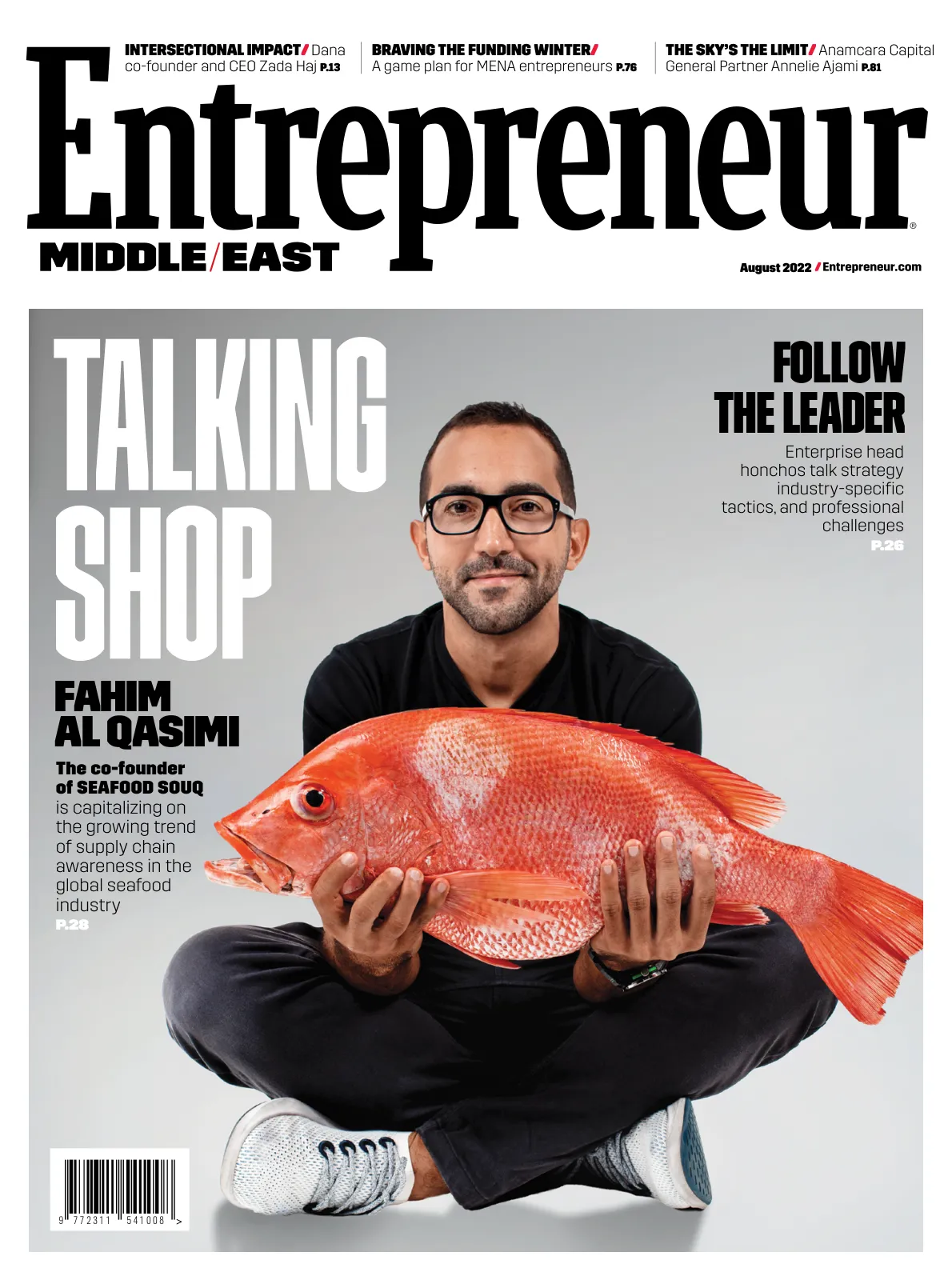
Entrepreneur Middle East, August 2022
Page 1
BRAVING THE FUNDING WINTER/
A game plan for MENA entrepreneurs P.76
9
7 7 2 3 1 1
5 4 1 0 0 8
>
August 2022
THE SKY’S THE LIMIT/ Anamcara Capital
General Partner Annelie Ajami P.81
TALKING
SHOP
FOLLOW
THE LEADER
FAHIM
AL QASIMI
Enterprise head
honchos talk strategy
industry-specific
tactics, and professional
challenges
P.26
The co-founder
of SEAFOOD SOUQ
is capitalizing on
the growing trend
of supply chain
awareness in the
global seafood
industry
P.28
INTERSECTIONAL IMPACT/ Dana
co-founder and CEO Zada Haj P.13
Page 2
SIGN UP & SAVE 30% ON STAYS WITH BREAKFAST INCLUDED
ALL.COM
SUMMER OF
Page 3
Page 4
Page 5
Page 6
6 / ENTREPRENEUR.COM / August 2022
Contents/August 2022
P.28
Follow the
Leader
Enterprise Head Honchos talk strategy
industry-specific tactics,
and professional challenges.
P.13
Intersectional
Impact
Dana co-founder and CEO Zada Haj
is addressing global issues relating to
both sustainability and diversity with
her enterprise.
by AALIA MEHREEN AHMED
P.18
Design-led
Homegrown UAE brand Kameh wants
its work (and not its founder) to be
centerstage.
by ABY SAM THOMAS
FEATURES
IMAGE COURTESY DIMA AYAD
→ Fashionable and timeless,
Dubai-based Lebanese
designer DIMA AYAD
established her namesake
label in 2010.
P.40
Page 7
Homes from
AED587,000
*
*T&C apply
Boulevard living in harmony with nature
Invest in upscale 1, 2 and 3 bedroom apartments featuring direct access to green parks
with sports facilities and a busy boulevard with retail and dining experiences. Enjoy exclusive
access to a residents’ only gym and swimming pool, and benefit from smart home features
and premium white goods included as standard with every home.
Page 8
8 / ENTREPRENEUR.COM / August 2022
EDITOR IN CHIEF Aby Sam Thomas
aby@bncpublishing.net
CEO Wissam Younane
wissam@bncpublishing.net
DIRECTOR Rabih Najm
rabih@bncpublishing.net
CREATIVE LEAD Odette Kahwagi
design@bncpublishing.net
MANAGING EDITOR Tamara Pupic
tamara@bncpublishing.net
STARTUPS SECTION EDITOR Pamella de Leon
pamella@bncpublishing.net
FEATURES WRITER Aalia Mehreen Ahmed
aalia@bncpublishing.net
DIGITAL SOLUTIONS DIRECTOR
Mahdi Hashemi mahdi@bncpublishing.net
HEAD OF INNOVATION
Sarah Saddouk sarah@bncpublishing.net
GROUP SALES DIRECTOR – B2B GROUP
Joaquim D’Costa jo@bncpublishing.net
COLUMNIST Tamara Clarke
CONTRIBUTING WRITERS
Fida Chaaban
Prashant (PK) K. Gulati
Azeem Khan
Maya Moufarek
Mary-Justine Todd
SUBSCRIBE
Contact subscriptions@bncpublishing.net to receive
Entrepreneur Middle East every issue
COMMERCIAL ENQUIRIES
sales@bncpublishing.net
ENTREPRENEUR.COM
Access fresh content daily on our website
All Rights Reserved 2022. Opinions expressed are solely those of the contributors.
Entrepreneur Middle East and all subsidiary publications in the MENA region are
officially licensed exclusively to BNC Publishing in the MENA region by Entrepreneur
Media Inc. No part of this magazine may be reproduced or transmitted in any
form or by any means without written permission of the publisher. Images used in
Entrepreneur Middle East are credited when necessary. Attributed use of copyrighted
images with permission. All images not credited otherwise Shutterstock. Printed by
United Printing and Publishing.
PO BOX 502511 DUBAI, UAE
P +971 4 4200 506
Contents
August 2022
67 The World of Web3
AZEEMA KHAN gives a beginner’s guide
to a space that’s set to change the
world as the internet once did.
70 Fueling Success
MarketingCube.co founder MAYA
MOUFAREK shares five tips for hyper
growth, learnt from working for brands
like Google and Pharmacy2U.
72 An Entrepreneurial Spirit to
Change the World
Women’s issues are human issues-
and overcoming them is good for
everyone, writes Mary-Justine Todd.
76 Braving the Funding Winter
As the global entrepreneurial
landscape faces a funding winter,
entrepreneur and mentor PRASHANT
(PK) K. GULATI gives a timely reminder
for MENA entrepreneurs.
88 Making it Big
Ziina co-founder and CEO FAISAL
TOUKAN on four tactics that enabled
a UAE-born startup to make it to Y
Combinator.
‘TREPONOMICS
81 The Sky’s the Limit
Anamcara Capital General Partner
Annelie Ajami has big dreams for
her venture capital firm (and for the
startups it supports as well).
96 In Focus
A roundup of the up-and-coming
startups in the Dubai-based
Mohammed Bin Rashid Innovation
Fund accelerator program you should
be keeping an eye on.
85 “We Got Funded!”
The stories behind the impressive
investments raised by MENA-based
startups Cartlow and Huspy.
92 Cashing In
Jonathan Lau and Armin Moradi
are dreaming big with their fintech
startup, Qashio.
STARTUP
SPOTLIGHT
EntMagazineME
Entrepreneur-me
↑ KAMEH combines craftsmanship
and complexity into original interior
home pieces where function and art
are synonymous.s P.18
Page 9
Page 10
10 / ENTREPRENEUR.COM / August 2022
Editor’s Note/
Editor’s Note/
H
omegrown doesn’t mean holy,” I said to
a friend the other day, who was using
that particular characteristic of a rather
popular business born in the UAE to
defend it from allegations that
indicated its owners may have not been
running the company in an entirely
ethical manner. After all, it’s one thing to give
a business the benefit of the doubt when it’s
accused of a misstep; it’s another thing
altogether to absolve it of any wrongdoing
simply on account of its apparent origin story.
It’s not just homegrown enterprises though-
it seems as though many among us are
disinclined to even consider the validity of
complaints made against, say, a small business
that we might have championed in the past, or
a company that’s the current darling of
venture capitalists. As much as we may like
the spectacle of whistleblowing as showcased
in Hollywood movies and television shows, it
does seem like we prefer to entertain them
only when they are far removed from us; the
ones that might be right in front of us are
brushed away without a glance.
I feel like this is a problem that’s particularly
pronounced in the Middle East- the region’s
strict defamation laws, as well as what seems
to be a general consensus against ruffling any
feathers, has caused us all to shirk away from
criticisms of anyone and anything. Add to that
our personal biases, and we often either
dismiss the possibility that gross abuses of
power might be taking place around us, or
simply just turn a blind eye to all of that
“negativity.” And while I’ll admit that it is
definitely easier to live in the bubbles of our
own making, there is also danger inherent in
choosing to stay in such echo chambers.
For one, you might actually be depriving an
entrepreneur of a much-needed criticism that
could enhance their company’s business
model, serving offering, what have you. If you
could help out your favorite startup, wouldn’t
you like to? Just because you are sharing an
“unpopular opinion” doesn’t mean you are in
the wrong. Often, it may put you in the
position of being the only right one.
Aby Sam Thomas
Editor in Chief
@thisisaby
aby@bncpublishing.net
CALL A SPADE A SPADE
Meting out a valid criticism does not make you disloyal to the spirit of entrepreneurship
Page 11
Page 12
Page 13
13
August 2022 / ENTREPRENEUR.COM /
Intersectional Impact
Dana co-founder and CEO Zada Haj is addressing global issues relating to both
sustainability and diversity with her enterprise by AALIA MEHREEN AHMED
→ ZADA HAJ, founder and CEO,
Dana. The firm’s primary aim is to
support women-led tech
startups in sectors such as
agritech, water solutions, food
security, waste management,
and renewable energy.
IMAGES COURTESY DANA
Page 14
14 / ENTREPRENEUR.COM / August 2022
Among the many sectors Dana caters to, there is one in
particular that offers great impetus for business growth:
agritech, or agrifood. In the past few years, in what has
been referred to as an “agritech boom,” methods such as
hydroponic and vertical farming have proven to be
especially advantageous to the dry and arid lands of the
Middle East. When I ask Haj how the sector could also be
pivotal in fostering greater gender inclusivity, the
co-founder has quite an interesting response. “Let me
answer this question with an Arabic quote,” she says.
“Roughly it translates to: ‘The mother is a school; when
you prepare her, you prepare a full nation to be of good
breed. The mother is a garden; if watered well, it flour
ishes for the benefit of all.’ Over the years, we have seen
higher numbers of female founders in the agrifood sector,
partly due to this sector’s impact-oriented nature. Women
in the MENA region also have a deep historic and cultural
connection with agriculture. When I was growing up, I
always tended to our agricultural land together with my
mother. It was our job at home.”
While her personal references may be an important part
of Haj’s vision, there are also plenty of hard facts that back
her statements about the agritech sector. “Creating a more
robust agrifood sector with purpose-led infrastructure and
appropriate financial backing will decidedly strengthen
gender inclusion, as one in four entrepreneurs in the
agrifood sector is female,” she points out. “Compare this to
the meager rate in other areas of tech, like fintech and
software development, where the ratio is only 1:7.” But Haj
also adds that while such statistics may paint a rosy
picture, they don’t necessarily reflect the many challenges
female tech entrepreneurs continue to face in the Middle
East. “Only 6% of MENA venture capital was invested in
women this past year,” Haj reveals.
B/Sustainability
A
t the intersection of two globally pressing issues is where you will find Abu
Dhabi-based venture builder and investment platform Dana putting in the hard
yards to address both. Founded in 2021 by three women -Zada Haj, Shirley
Shahar, and Katie Wachsberger- Dana’s primary aim is to support women-led
tech startups in sectors such as agritech, water solutions, food security, waste
management, and renewable energy, all of which are collectively referred to as “
desert tech.” The firm does this through offering opportunities for regional
business connections, innovation mentorship, and funding through its
investment arm, Dana Limited Partnership. “We envision a Middle East where the
pressing issues of climate change and food security are addressed
collaboratively, which unfortunately seems a little hard to imagine today,” says
Haj, who is the co-founder and CEO of Dana. “In fact, we imagine a region in
which these sectors will be among the most profitable, while remaining impact-driven. It is
evident to us that women entrepreneurs and innovators are the leaders to affect this change.
So, we need to put aside our differences to protect the environment and our way of life.”
→ THROUGH AN MOU WITH MASDAR
CITY, Dana will be launching its first
Abu Dhabi-based beta site which
comprises a greenhouse, shade house,
and open field areas for agritech pilots.
Page 15
15
August 2022 / ENTREPRENEUR.COM /
“So, obviously, capital is
vital for female-led startups
to get off the ground and
through the ‘valley of death.’
And this does not even start
to account for the social and
cultural hurdles many
women face throughout the
region when building their
own businesses.”
Of course, Haj isn’t
unfamiliar with the
challenges of running a
business as a female
founder. In addition, at
Dana, she also has to
manage the intricacies of
running a business with two
very different co-founders.
“Diversity is a huge
advantage, and it is also a
massive challenge,” Haj
adds. “Our leading team of
three speaks different
mother tongues, and have
different educational,
professional, and personal
backgrounds. This means
we learn a lot from each
other, but it also means we
approach tasks very
differently. The challenge is
learning to communicate
effectively and patiently
bring these perspectives
together in synergy, and I
believe nobody does this
better than women. Our
story is one of resilience in
diversity!”
At this point, it becomes
quite apparent that Haj’s
personal journey with Dana
has shaped a lot of her
business ideals, and as such,
I ask her if there have been
any lessons on leadership
that she’s picked up in her
time at the enterprise. “The
ability to work under
pressure -whether physical,
mental, or emotional- is
extremely important in
leadership, because things
will never be easy and
relaxed when you have the
responsibility of collective
successes and other peoples’
livelihood on your shoul
ders,” she replies. “In
moments of pressure, it is
crucial to exercise perspec
tive, to find balance, and to
gain a wider view of the
issue before any decision
making. Also, I believe that,
at the end of the day,
companies, corporations,
and governments are all
made up of people. So, if
you can find a way to
genuinely connect and
inspire them to share your
vision, nothing can stand in
your way.”
Under Haj’s leadership,
Dana has recently added yet
another feather to its cap- a
memorandum of under
standing (MoU) signed with
Masdar City, a hub for
technology innovation as
well as research and
development located in the
UAE capital. Through this
MoU, Dana will build its
first beta site in Masdar
City, in a bid to test the
feasibility of early-stage
agritech projects that can be
developed and piloted in
Abu Dhabi. With construc
tion already underway, the
site is scheduled to open
towards the end of 2022,
and its layout is set to offer
various agriculture-focused
infrastructure that caters to
the particular needs of
farmers from Abu Dhabi
and the wider Middle East,
including a greenhouse,
shade house, and open field
areas for pilots. “Our MoU
with Masdar City will help
us extend our reach to more
promising female founders
and innovators in the UAE
and beyond,” Haj says.
“By creating a testing facility
for desert tech solutions,
together with our venture
builder’s hands-on engage
ment with startups and our
corporate design partners,
we ensure women-led
startups have everything
they need to operate
successfully, and also offer
them attractive investment
opportunities.” }}
→ DANA FOUNDING TEAM
Left to right:
Katie Wachsberger,
Zada Haj, and Shirley Shahar
DANA HAS RECENTLY ADDED ANOTHER FEATHER TO ITS CAP-
A MEMORANDUM OF UNDERSTANDING (MOU) SIGNED WITH
MASDAR CITY, A HUB FOR TECHNOLOGY INNOVATION AS WELL AS
RESEARCH AND DEVELOPMENT LOCATED IN THE UAE CAPITAL.
Page 16
16 / ENTREPRENEUR.COM / August 2022
B/Sustainability
Having realized this
agreement with Masdar City,
Haj and her crew at Dana
believe it could open doors to
more investment-related
milestones. “For Dana, this
beta site is not only a small
ecosystem by itself as well as
a platform-enabling technol
ogy hub, but also a significant
step in our due diligence
process for investment
opportunities in the sector,”
Haj reveals. “After going
through our detailed proof of
concept process, valuation for
these early-stage startups
tends to increase significant
ly, opening doors for
investment opportunities
internationally. In the fourth
quarter of 2022, the Dana
Limited Partnership will
begin deploying capital in the
top startups from our
Venture Builder, which will
be a group selected based on
their success at our beta sites.
We are all set to become one
of few women-led funds in
the region, setting the
example for other initiatives
to invest in female leader
ship.”
As Haj now prepares for a
new phase in her enterprise’s
journey, she remains mindful
that the impact Dana hopes
to achieve, with regards to
both diversity and sustain
ability, is ultimately a
collective effort. “At Dana,
our success is based on that
of our startups,” she says.
“Every win is not just about
my own success, but about
getting one step closer to a
vision of true female
leadership, and more women
role models in our region’s
business community. I am
inspired endlessly by our
founders and the work they
do to bring groundbreaking
solutions to the market, and I
wish for their inspiration to
now be passed on.”
THE CHALLENGE IS LEARNING TO COMMUNICATE EFFECTIVELY
AND PATIENTLY BRING THESE PERSPECTIVES TOGETHER IN
SYNERGY, AND I BELIEVE NOBODY DOES THIS BETTER THAN
WOMEN. OUR STORY IS ONE OF RESILIENCE IN DIVERSITY!
→ ZADA HAJ, founder and CEO, Dana
Page 17
Join the UAE’s
First Public-Private
Health Program
DEVELOP FUTURE FORESIGHT
AND TURN YOUR IDEAS INTO ACTION.
Get equipped for a chance to help design the UAE government’s
national health programs of the future.
IMPACT
In collaboration with
#TogetherForHealthUAE
Page 18
18 / ENTREPRENEUR.COM / August 2022
DESIGN-
LED
by ABY SAM THOMAS
Homegrown UAE brand Kameh
wants its work (and not its founder)
to be centerstage
B/The Big Idea
→ Created in 2022,
DUBAI-BASED
COLLECTIBLE DESIGN
BRAND KAMEH
combines
craftsmanship and
complexity into
original interior home
pieces where function
and art are
synonymous.
IMAGES COURTESY KAMEH/NATELEE COOKS
Page 19
19
August 2022 / ENTREPRENEUR.COM /
Page 20
20 / ENTREPRENEUR.COM / August 2022I
n my time working at Entrepreneur Middle
East, I have very rarely come across
startups that didn’t wish to reveal its
founder(s), and that’s easily one of the
reasons why I was so intrigued by Kameh,
a UAE-based collectible design brand
launched earlier this year that has been
insistent on keeping the entrepreneur
behind the endeavor anonymous. While
I was told that I can refer to the founder
with the same name as that of the brand,
every other aspect of Kameh’s identity
-think age, gender, ethnicity, background, etc.- has been
strictly kept under wraps. The secrecy Kameh has sought
for themselves puzzled me- it was quite a stark departure
from the shamelessly self-promotional exercises I’ve
seen several entrepreneurs get up to in the guise of
publicizing their respective ventures. But Kameh has no
qualms whatsoever about staying in the background of
their brand- and that’s because they don’t want you to
buy into Kameh because of who came up with its one-of-
a-kind pieces; they want you to do so because you feel
a connection to the works by themselves. As per Kameh,
the art should take precedence over the artist, and
anonymity allows them to ensure that their enterprise
stands on the strength of its offering- and nothing else.
B/The Big Idea
Page 21
21
August 2022 / ENTREPRENEUR.COM /
Kameh’s mandate does set one’s
expectations high for the “objects of
design” they produce under their
banner, but I get the feeling that the
designer welcomes such a gaze on
the products they have put their
name to. Having said that, Kameh’s
origin story follows a typical
entrepreneurial motif- the founder
had purchased a new apartment for
themselves in the UAE, and when
they were unable to find furniture
that they’d personally want to have
in their new home, they decided to
make their own. “I didn’t want to
get, say, a table that is mass pro
duced, something that everyone else
would have,” Kameh says. “I wanted
to have something different in my
apartment, which I’ve envisioned as
an art gallery. You’d have pieces of
art in a gallery- and that’s the role
furniture would play in my apart
ment. And I think that’s how it all
started- I decided to create those art
pieces for my apartment-slash-gal
lery.” The first piece of furniture that
Kameh thus set out to build was a
table- their initial vision was for it to
be carved out of a massive slab of
stone, but they soon found out that
realizing this goal would be extreme
ly challenging, not least because of
the difficulties involved in
sourcing such a huge block of
rock. They then started to explore
different potential routes that
could lead them to execute at least
a version of their original dream,
and that journey is what resulted
in the Kameh Table 0.1.
Painted in white, the Kameh Table
0.1 is clearly an approximation of an
object made out of stone- its smooth,
refined top is indicative of travertine
or marble, while its lower layer
mimics the rough façades of rock
formations in nature. This visage has
been achieved thanks to Kameh
making use of a metal carcass, over
which Styrofoam has been applied
and cut to get its roughly chiseled
features, followed by cement over it
all to lock down its look and feel. In
addition, a protective matte layer on
the table’s top ensures it becomes a
functional piece of furniture- as
Kameh put it: “It’s not just a piece of
art, but a usable piece of art that can
be utilized on a daily basis.” }}
← THE KAMEH TABLE 0.1
mimics a solid stone
smoothed on the exposed
surface by unforgiving
nature but still rough and
uniquely formed on the
inside.
↓ The Kameh mirror 0.1
Page 22
22 / ENTREPRENEUR.COM / August 2022
→ THE RAWNESS OF KAMEH’S
DESIGN is aimed to be in stark
contrast to the perfect
geometry of any room,
functioning as objects for daily
use and in equal part as objects
of decorative beauty.
The table has also been characterized as a
representation of the human self- its
metal frame denotes our physical bodies,
the foam inside indicates the softness of
the emotions inside each of us, and the
cement shelling showcases the protective
guards we put on ourselves to face the
world. Meanwhile, the duality inherent in
the table’s exterior with its polished
surface and its coarse voids also suggests
elements of the Japanese aesthetic of
wabi-sabi that is centered on the
acceptance of transience and imperfec-
tion- a theme Kameh echoed in a note
they released about the product. “There is
imperfectness in the piece,” Kameh
declares. “There is no beauty in perfec-
tion, only in imperfection.”
The ethos encapsulated in the Kameh
Table 0.1 has been reflected in the rest of
the products that have since been
released as part of the brand’s debut
collection. The second drop was the
Kameh Bench 0.1, which was comple-
mentary to the table launched before it,
and that was followed up by the Kameh
Chair 0.1 and the Kameh Mirror 0.1,
which “harnesses the magic of reflection
to craft ever-revolving narratives around
our perceptions of ourselves, and our
understanding of the world around us.”
Kameh’s personal desire for statement
pieces that are one of a kind is evident all
of the three products, and that is set to be
a central theme of all the products under
their label. “All of our pieces are, in a way,
one-off pieces, because we cannot
replicate them- every cut or crack we
make on them is unique to them,” Kameh
explains. “We’re literally producing every
single piece by hand. We’re not producing
anything mass; we’re producing solely on
request.” As for the road ahead, Kameh
reveals that there are two more objects in
the debut collection that they hope to
announce over the course of this year, but
when it comes to the long term, the sky’s
the limit. Maybe it’s about working with
new materials, maybe it’s about finding
more ways to translate art into people’s
homes, maybe it’s all that and more- as
Kameh put it: “It’s unlimited potential… I
think that we are living in an age where
everything’s possible.”
B/The Big Idea
Page 23
“THERE IS NO
BEAUTY
IN PERFECTION,
ONLY IN
IMPERFECTION.”
23
August 2022 / ENTREPRENEUR.COM /
Page 24
come as
you are.
Page 25
@ / # 25hourshotels
#hellodubai
we are now open!
25% off,
book via
enjoy
25hours-hotels.com
Overlooking the museum of the future, near dubai international
financial centre, 25hours hotel one central boasts 434 rooms
and suites in addition to flexible events and co-working spaces.
A total of four characterful restaurants and bars take guests on
a culinary trip around the world from northern india to the beer
gardens of bavaria: this is where urban nomads meet desert
flowers, where local heroes meet the well-traveled. Alongside
rental of mini cars and schindelhauer bikes the hotel will also
feature the extra hour spa, rooftop pool and dubai's first
mixed-gender rooftop sauna.
434 rooms | co-working spaces | monkey bar | tandoor tina
ernst | nomad dar bar | rooftop pool & sauna | spa | gym
Page 26
26 / ENTREPRENEUR.COM / August 2022
→ FAHIM AL QASIMI is the
co-founder of Seafood Souq,
a Dubai-born startup that
aims to solve the biggest
problems in the seafood
industry by creating an
efficient, resilient, and
transparent supply chain;
tackling both fraud and the
exploitation of the world's
oceans.
26 / ENTREPRENEUR.COM / August 2022
Page 27
27
August 2022 / ENTREPRENEUR.COM /
The
Follow
Leader
Enterprise head honchos
talk strategy, industry-specific tactics,
and professional challenges
FA H I M A L Q A S I M I
PA L L AV I D E A N
A R I F A L AW I
D I M A AYA D
N ATA S H A S I D E R I S
T H O M A S F L O H R
S I N A N TA I F O U R
27
August 2022 / ENTREPRENEUR.COM /
Page 28
28 / ENTREPRENEUR.COM / August 2022
W
hen Fahim Al Qasimi
was a boy of about 11
years of age, he was cast
in his school’s produc
tion of Andrew Lloyd
Webber’s acclaimed
musical, Cats. At the
time, he was studying at
the Emirates International School in
Dubai, and in a bid to adapt Cats
better to the UAE, his music and
drama teacher then, Jenny Wilson,
decided to include locally relevant
feline roles in her version of the
show, and Al Qasimi was invited to
come up with a character true to
himself that could be a part of this
performance. That’s how Al Qasimi
ended up essaying the part of
FisherCat, which he recalls as being
a heroic Emirati moggy living by the
harbors of Deira Creek that wanted
to unite all of the region’s fishermen
with the aim “to get better fish.” Now,
Al Qasimi may have not known it
then, but the mission he chose for his
FisherCat persona was a harbinger of
what he would get up to in his adult
life- after all, getting better fish on all
of our plates is a good enough
summation of what his enterprise,
Seafood Souq, has set out to
accomplish with the digital ecosys
tem it has built for the global seafood
industry. And given that the
Dubai-headquartered startup’s
annual recurring revenue for this
year is forecasted to be US$100
million, it’s fair to say that Al Qasimi
and his team are well on their way
toward realizing that goal, and, in
the process, make their impact felt
on the international stage as well. “At
Seafood Souq today, about 80-90%
of our business is global,” Al Qasimi
reveals. “This is a UAE-born business
that will change the world.”
Seafood Souq came into being in
the UAE in 2018 after co-founders
Al Qasimi (who, by the way, is a
member of the Sharjah royal family)
and Sean Dennis (the company’s
CEO now) spotted the opportunity
in creating a digital B2B marketplace
that could connect fish buyers and
sellers from all over the world. The
appeal of this solution from Seafood
Souq can be seen in the fact that just
a few months after it was launched,
the startup was able to ink a
partnership with Emirates SkyCargo,
the freight division of Emirates (aka
the world’s largest international
airline) to transport seafood from
countries like Norway, Cyprus, Chile,
Scotland, and the USA to customers
in the UAE and the wider Middle
East. But this was just the start for
Seafood Souq- in building its
e-commerce offering, Al Qasimi and
Dennis also realized that they had an
opportunity to trace the supply
chains of all the products hosted on
their platform. As it so happens, this
The
Follow
Leader
FAHIM
AL QASIMI
The co-founder of
SEAFOOD SOUQ
is capitalizing on the growing
trend of supply chain
awareness in the global
seafood industry
IMAGE COURTESY SEAFOOD SOUQ
Page 29
29
August 2022 / ENTREPRENEUR.COM /
relates to a major problem being faced by the global
seafood industry- in 2021, The Guardian conducted
an analysis of 44 studies of more than 9,000 seafood
samples from restaurants, fishmongers, and super
markets in more than 30 nations around the world
that found 36% of these products were mislabeled.
“Unfortunately, seafood supply chains are wrought
with fraud,” Al Qasimi adds. “People swap products in
and out. They will sell you something, and give you
something else.” For instance, you could have been
told the fish you’ve bought in a fine dining restaurant
to be, say, responsibly farmed salmon, but there was
no way for you to confirm if that actually was the
case- at least not until Seafood Souq
Trace (SFS Trace) came along.
SFS Trace is a digital tool that
allows one to confirm the prov
enance of the fish they buy, and one
of its first applications was in 2021
when Seafood Souq got to ink a
partnership with Dubai-based
Jumeirah Restaurants whereby the
latter’s customers at Rockfish, the
Mediterranean F&B concept located
at the Jumeriah Al Naseem hotel,
could simply scan a QR code on
their smartphones and learn about
the journey -from sea to plate- of
their chosen seafood. But while SFS
Trace -which is now available in
supermarkets in Europe as well-
may have been initially rolled out in
this consumer-oriented manner, Al
Qasimi points out that its ability to
provide traceability found itself help solve other issues
within the ecosystem as well. “Distributors told us that
SFS Trace is great for supply chain visibility,” he
explains. “They can now, using SFS Trace, have access
to all the details of their shipments, who the providers
are, where it is in the supply chain, which flight it was
on, which ship it was on, and so forth.” Distributors
could thus make use of SFS Trace to prove to their
buyers that whatever they are buying is exactly what
they are getting- and this led to a new use case for the
company’s offering. Al Qasimi reveals that Seafood
Souq has been approached by the Mandarin Oriental
and Atlantis hotel groups to aid with their efforts at
realizing their sustainability targets by ensuring the
traceability of the seafood they serve. “We’ve thus
created a dashboard that now lets leading hotels look
at it and say, for instance, ‘In this quarter, 60% of our
fish is 100% traceable,’” Al Qasimi says. “They can say
that this is the carbon cost of the fish that we’ve
brought in, this is where it’s come from, this is the
amount that have got certification, and this is how
much can be classified as sustainable. So, it’s become
like the lifting of a lid on this previously very opaque
supply chain.”
And this is where the impact of what Seafood Souq
is doing comes into play. “Seafood is a multi-billion-
dollar industry,” Al Qasimi states. “About 200 to 300
billion dollars of that is just the production of seafood,
I’d say. About 50% of the seafood we eat today is
thanks to aquaculture- but the other 50% is the only
food source that we extract from the earth and not
farm. So, it’s more like mining- we go to the ocean
each time with only the hope that there will be fish
there to harvest again.” Now, this is clearly a perilous
approach to take, especially when you consider that
approximately three billion people around the world
rely on seafood as a primary source of protein,
according to the World Wildlife
Fund. The oceans are thus in danger
of seeing their seafood stocks
depleted, and this could have
far-reaching consequences on
humanity- and yet, solutions being
proposed and developed for this
problem have been few and far-
between. “One of our investors
helped me realize this the other
day- if you look at venture capital
funds across the world, I think you
can count them probably on two
hands, maybe three hands, the
number of them that are solely
focused on the blue economy,” Al
Qasimi notes. “And we have, in the
world today, put such a focus on
carbon that anybody interested in
safeguarding our environment is
focused on energy, and specifically on
carbon. Well, the ocean covers 70% of our globe-
there’s a disconnect between that and the number of
people actually investing in solutions for the ocean.”
This would also explain why one of the United
Nations Sustainable Development Goals is centered
on “conserving and sustainably using the oceans, seas,
and marine resources”- and it is one that Seafood
Souq has taken to heart by building tech to solve
problems inherent in the seafood industry.
An example of the kind of impact Seafood Souq can
have on the world at large can be seen in a collabora
tive endeavor it has engineered with the International
Pole And Line Foundation (IPNLF) and fishermen in
Oman. “These Omani fishermen used to go out to sea
and catch yellowfin tuna in nets,” Al Qasimi explains.
“Now, what happens when you catch fish in nets is
that they get degraded, since they aren’t treated
properly. By the time they arrived on a boat, put on
ice, and got to the factory, they were able to sell it only
for about about 75 cents a kilo. That’s tuna that’s good
enough for pet food, maybe fish food, maybe canning,
but these Omani fishermen were not making any real
money off the trade, and so, they were catching as
many tuna as they could to try to make some money.”
→ CO-FOUNDERS
FAHIM AL QASIMI
AND SEAN
DENNIS have
built Seafood
Souq to be a
digital
ecosystem that
allows users to
order seafood
from anywhere
in the world with
full supply chain
traceability.
“THIS IS A
UAE-BORN
BUSINESS
THAT WILL
CHANGE
THE WORLD.”
Page 30
30 / ENTREPRENEUR.COM / August 2022
The
Follow
Leader
Enter the IPNLF, which argues that
the only way to sustainably catch
tuna is “one-by-one,” a collective
term that incorporates pole-and-line,
handline, and troll line fishing
methods, which are regarded as
being both environmentally and
socially responsible- Al Qasimi
points out that once Omani
fishermen started making use of this
methodology, the quality of the tuna
they caught rose so much that they
were now able to sell it for up to $14
a kilo. These fishermen thus stood to
gain more income by catching less
fish and being more mindful about
how they harvest the oceans;
however, the challenge that
remained was that once their tuna
left Oman, it’d get lost in the opaque
supply chain- but Seafood Souq’s
SFS Trace can allow for that to not
happen. “SFS Trace allows us to sell
the product with full traceability of
the supply chain, and the stamp to
say that this is pole-and-line-caught
tuna, that it is sustainable, and
therefore is worth the money it is,” Al
Qasimi says. “The value transfer is
higher to the fishermen (the people
that need it the most), and the
consumers also have full traceability
on where the fish is coming from,
and that it is what it says it is.”
Seafood Souq’s work with fisher
men in Oman and other emerging
markets like it have also allowed the
startup -whose offerings are now
used in 25 countries around the
world- to explore a new avenue for
business that is centered on filling
the trade financing gap that
currently exists in the seafood
industry. “Buyers in more developed
markets ask for payment terms, and
they basically want to only pay when
they see the product and so forth-
but fishermen in emerging markets,
they need cash today,” Al Qasimi
explains. “Seafood Souq Pay (SFS
Pay) is thus the next product that
we’re building, which will be a trade
financing arm of the business that
will fund or provide financing for
only sustainable seafood sellers with
full visibility in the supply chain.”
SFS Pay is therefore set to be the
“blue financing” arm of the Seafood
Souq enterprise, and Al Qasimi adds
that much like all of the company’s
other undertakings, this too is aimed
at balancing profit with impact in
the seafood industry. “When we’re
building SFS Pay, we’re not making
any less of a return by funding what
is sustainable- all we’re doing is mak
ing sure that the value transfer
within the system is fair,” he says.
“We are ensuring that people who
are making use of sustainable
practices in emerging markets of the
world, who previously couldn’t get
access to financing, now get to sell
their products on a global scale. For
instance, a Bangladeshi prawn
farmer that we work with never had
the opportunity to have their product
end up in a Carrefour supermarket
in France- now, they do. And that’s
thanks to Seafood Souq- and that,
for us, is what impact is.”
Impact often requires investment,
and Al Qasimi says that he and his
team at Seafood Souq have been
lucky to rally partners and investors
who share the same value systems as
they do. While the startup’s initial
funding rounds were led by angel
investors mostly based in the UAE,
Seafood Souq has since received
support from investment firms like
VentureSouq and Global Ventures,
and Al Qasimi reveals that it was
recently able to secure Saudi Arabia’s
Future Investment Initiative
Institute as a partner as well. He also
adds that the groundwork is also
being laid for a $30 million Series B
funding round to be launched in the
last quarter of this year, which is set
to fuel Seafood Souq’s further
growth. “We’re setting up our
European and Asian headquarters
now, because the business is now
large enough to warrant having that
global presence,” Al Qasimi says.
“And that, for us, is a super exciting
step, because a company called
Seafood Souq, born out of the UAE,
is now operating on a global scale.
For me, as an Emirati founder, this is
something I am super proud to
showcase, not just for this country,
but also for the Arab region, in that
that you can come up with innova
tive ideas for the world from here,
and not the other way around.” But
when I note that Seafood Souq has
been relatively quiet about its
funding rounds so far, Al Qasimi
replies that that’s the case simply
because it’s not something he and his
team are excited by. “When you find
partners and investors that have the
same value systems, that honestly do
care on the impact that you’re
WE ARE ENSURING
THAT PEOPLE WHO
ARE MAKING USE OF
SUSTAINABLE
PRACTICES IN
EMERGING MARKETS
[...] NOW GET TO SELL
THEIR PRODUCTS
ON A GLOBAL SCALE.”
“
→ THE SEAFOOD SOUQ TEAM
participating in an Adidas: Run For
the Oceans event in Dubai.
Page 31
31
August 2022 / ENTREPRENEUR.COM /
making, then you’re not excited by how
much money you raised,” he says.
“You’re also not excited necessarily by
how much money you’ve made, but
you’re really excited when you find out
how much of an impact you’ve created
for the world, whether that’s jobs
created for Omani fishermen, whether
that’s helping solve food security issues
for the UAE, whether that’s reducing
the carbon cost of the seafood trade in
the UAE, or whether that’s ensuring the
value transfer of people eating
wonderful prawns in Europe is going
effectively and efficiently to the
Bangladeshi farmers that harvested
them. That’s impact.”
Incidentally, this is the mindset that
also governs Al Qasimi’s dreams for
Seafood Souq in the long term, which
includes an initial public offering (IPO)
for the startup in a couple of years’ time.
“I’ve always wanted to be a tech IPO in
the region that ‘keeps the dirham in the
room,’ as they say, bolsters our capital
markets, and proves that we can have
technology in the market cap of our
local stock markets,” Al Qasimi says.
“What that will take is continued
commitment from our fantastic team
and our great investors; above and
beyond that, excitement and commit
ment from investors in the local capital
market.” As for Al Qasimi himself, he’s
clearly in it for the long haul, and he
remains excited about the promise
Seafood Souq holds. “You know, when
you are passionate about something,
when you really care about something,
you’re going to stick it out,” he says.
“And that is something I’m very excited
about, in that Seafood Souq is going to
be a story that will be with me for the
rest of my life.” B Y A B Y S A M T H O M A S
→ SEAFOOD SOUQ is the
first collaborator in the UAE
for Friend of the Sea, the
leading international
certification standard for
products and services that
respect and protect the
marine environment.
S
ome of the seafood
sector’s issues were
brought to the
mainstream thanks to Ali
Tabrizi’s 2021 film,
Seaspiracy, which had shed light on
the global overfishing problem with
some critics claiming it was
one-sided. One of the solutions
Tabrizi proposed at the end of that
documentary was that we either
need to reduce the amount of
seafood we eat, or replace it with
plant-based alternatives, but
Seafood Souq’s Fahim Al Qasimi is
not too sure if this is a really
sustainable resolution to the
problem at hand.
“My personal viewpoint on this is
that while some people like Ali have
suggested eating less seafood and
looking for a substitution to it, there
is a carbon cost on that, which is
why I challenge that hypothesis,”
he explains. “Another solution being
proposed is lab-grown meats,
which people like KBW Ventures’
Prince Khaled bin Alwaleed have
been extremely active in investing
in, and I commend them for those
efforts. But I believe that the
problems that we have today in the
seafood industry were created by
business- and as such, they need
to be solved by business as well.”
According to Al Qasimi, the old
ethos of ‘you can’t improve what
you can’t measure’ is what one
needs to keep in mind when talking
about problems in the seafood
industry, and that, in effect, explains
how Seafood Souq’s digitization of
this ecosystem -which allows for
everything to be traceable and
transparent- allows for sustainable
harvesting of the world’s oceans. “If
Seafood Souq -hypothetically- was
adopted in every fishery and fish
farm around the world, traded on
our platform, or used SFS Trace, we
could reach a point where we could
aggregate enough data to really
understand whether fish has been
sustainably caught,” Al Qasimi says.
“We’d have data telling us whether
the catches have been registered
by the environmental agencies or
the fishery management
organizations of the countries
where it happened.”
seafoodsouq.com
ONGOING
CONTROVERSIES
IN THE SEAFOOD
SECTOR
Page 32
The
Follow
Leader
Pallavi
Dean
Founder / Roar
→ SINCE FOUNDING ROAR IN 2013,
PALLAVI DEAN HAS WON MULTIPLE
AWARDS FOR HER WORK across a
range of sectors including
commercial, hospitality, and
residential. She was born in India,
raised in Dubai, and spent years
working in London, and her designs
reflect these eclectic influences. A
former professor of design, she
strives to implement the latest
theoretical and practical research
into Roar's designs.
32 / ENTREPRENEUR.COM / August 2022
IMAGES COURTESY ROAR
Page 33
33
August 2022 / ENTREPRENEUR.COM /
T
o have multiple passions in life
isn’t unheard of. But when a
business becomes a melting
pot of two seemingly unrelated
interests, what follows could
be a success story like that of
Pallavi Dean. After all, it is by
combining her enthusiasm for
the apparently disparate subjects of
design and psychology that Dean
founded her Dubai-based boutique
architecture and interior design
studio, Roar. “You know, I always say
that designers are part lawyers, part
psychologists, and part sociologists,”
Dean says. “What do we do as
designers? We watch human
behavior, right? And then we create a
vessel or a space that supports that
behavior. So, that is the core of what
we do, very often.”
Since its launch in 2013, Roar has
been the recipient of some of the
regional industry’s most coveted
awards, which includes last year’s
Boutique Firm of the Year by Design
Middle East. But it is in Dean’s
aforementioned description of what a
designer’s job entails that you will
find the underlying philosophy that
has constantly driven the firm
forward: empathetic design. “When
you work with an architect or
someone in the design world that has
a big ego, you will see that they want
to impose their style even before
they’ve talked to the client, simply
because they want to create a
masterpiece… This flagship, kind of,
iconic legacy project that will live on
beyond them, and I’ve always found
that to be so narcissistic,” Dean says.
“I’ve also thought that that was so
bizarre, because it’s not my home, it’s
not my office. So, why would I impose
my signature style? And that’s why
when you look at Roar’s projects,
they’re so varied. When we say
‘empathy-based design,’ it’s putting
the users of the space and the client
at the center of it. So, for example, we
don’t even start our design process
unless our clients have had a
one-on-one session with an indepen
dent psychologist at our briefing
sessions. This is where I think
psychology and design come together.
We feel like we can only create a
successful design if we are empathetic
and hone our listening skills.”
Here, as if to confirm what has been
apparent all along, Dean states that
empathy is an integral part of her
leadership style. “But empathy is a
two-way street!” she adds. “So when
it comes to my employees, I’m happy
to give them flexibility and all the
trust that I have, but it goes both
ways. There will be times when an
employee will tell me, ‘Hey, listen, it’s
Monday, but I need to work from
home,’ and I’ll have no problem. But
there will also be an instance when,
on a Sunday morning, my client from
Saudi Arabia calls me and wants a
meeting with the team. And I know
it’s a weekend, but Saudi Arabia’s
open, so, I will expect my team to
show up… There’s a lot of talk about
unhappy employees, right? I feel like
there is such less material out there
on how a leader needs empathy as
well. So, I try my best to keep honing
my leadership style.” But as Dean
continued to tell me more aspects of
how she goes about managing her
enterprise, I felt like she already has a
rather compassionate understanding
of human vulnerabilities and
preferences- a lot of which appears to
have stemmed from her own
experiences. When Dean had
appeared as a guest on the Entrepre
neur Middle East Live webinar series,
Against All Odds, earlier this year,
there was a line she stated that struck
quite a chord with me personally.
“I’m a brown woman in construction,”
she had said then. “I was never a part
of the construction boys club, and I
still am a bit of an outcast, but I
celebrate that.” For anyone who has
ever had to work harder than their
peers to gain validation and accep
tance, these are words that can
provide both inspiration and
comfort- and I can certainly testify to
that.
Dean has no qualms in admitting
that that she had to contend with
quite a lot of hurdles in getting to
where she is now. But the key to
dealing with them, she says, was to
simply not focus on them. “Everybody
needs a sense of belonging, and I
think what’s really important is if you
feel like an outcast in any industry,
you have to find your people,” she
says. “And that’s what I did! I
surrounded myself with my mentors
or similar-minded people and
colleagues. But at the same time, ‘be
so good that they can’t ignore you’
has been a motto of mine. You can
forget about your gender and your
race -and I talk about this very
openly- and just focus on your craft
and what you can bring to the plate,
rather than focusing on the down
sides of things.” }}
I WAS NEVER
A PART OF
THE CONSTRUCTION
BOYS CLUB,
AND I STILL AM A BIT
OF AN OUTCAST,
BUT I CELEBRATE THAT.”
“
↑ One of Roar's recent projects
is for Mall of the Emirates-
based safety deposits vaults
renting company VINTAGE
VAULTS, which involves
creating a modern version of a
traditional vault.
Page 34
34 / ENTREPRENEUR.COM / August 2022
It’s a strategy that has worked out
well for Dean- today, with a team
that is 92% female, she’s at the helm
of a highly acclaimed enterprise that
has, over the last couple of years,
secured a string of high-profile
projects including the design of the
25,000 sq.m. commercial space at
Sharjah Research, Technology, and
Innovation Park, a hub for incuba
tors and accelerators at Abu Dhabi’s
ADQ Innovation Centre, and several
others.
As someone who has experienced
the full spectrum of the entrepre
neurial lifestyle, Dean is perhaps the
right person to ask about the pros
and cons attached to it. “I think
people should stop glorifying
entrepreneurship, right?” Dean says.
“But for me, the best thing about
being an entrepreneur is complete
flexibility, where I can choose my
clients, my colleagues, and the hours
I work. To me, that’s really impor
tant- the people I work with! I’ve
been able to curate a fantastic family
here at Roar, and it gives me a lot of
pride because they’re handpicked.
They’re the best in class!” But it is
here, for the first time in our chat,
that I find Dean struggling with an
answer to one of my questions. “The
worst part about being an entrepre
neur… I don’t know; I think there are
a lot of upsides…” she ponders. “I
guess it’s the constant worry about
making sure you have the right
people on the right seats, making
sure they’re happy, and making sure
you are all going in the right
direction, and are aligned, I suppose.
That’s tricky. So managing that, I
would say, is a downside…” Dean
seems hesitant to whine about her
job- and I get a clear understanding
of why that’s the case when she goes
on to make this statement: “I can’t
believe people actually pay me to do
what I love- I would do this for free!”
With a leadership style that
seamlessly blends passion and
psychology, Dean now looks back at
her journey thus far with fondness,
and this is perhaps most evident
when I ask her what she’s most
proud of her entrepreneurial
trajectory so far. “I think the fact that
I’ve built a very successful business,
which I thought would just be for my
spare bedroom as a freelancer, makes
me very proud,” Dean says. “And it’s
received so much international
recognition too! At first I thought
only the local magazines and
newspapers were featuring us, but
we’ve been featured in some of the
best industry publications- things
that I used to read when I was
growing up in architecture school. To
see my own journey from this very
arrogant young designer in my
twenties, to someone who was
struggling in their thirties, to now,
when I’m in my forties, it feels like
I’ve ‘arrived,’ if that makes sense. So,
I’m really proud of that.” But what’s
next for Dean and Roar? “Yeah, the
next big milestone for me is to make
sure that Roar is in the position that
we can sell it,” Dean reveals. “That’s
the moonshot! We’re also doing a lot
of work in the metaverse, which I’m
super excited about. So, for me, the
metaverse is kind of the next frontier,
and then selling Roar, eventually,
would be great!”
B Y A A L I A M E H R E E N A H M E D
YOU CAN FORGET
ABOUT YOUR GENDER AND
YOUR RACE, AND JUST
FOCUS ON YOUR CRAFT
AND WHAT YOU CAN BRING
TO THE PLATE, RATHER
THAN FOCUSING ON THE
DOWNSIDES OF THINGS.”
“
↑ PALLAVI DEAN, founder, Roar
The
Follow
Leader
Page 35
Page 36
36 / ENTREPRENEUR.COM / August 2022
D
o they have a vision, or is money
the only interest?” In his role as
the CEO of Dubai Cultiv8, this is
one of the questions that Arif
Alawi likes to ask entrepreneurs
that seek support from the
Dubai-based investment fund.
Evaluating a startup’s founding
team on everything from their vision and
passion to their experience and skills,
Alawi and his team at Dubai Cultiv8 also
consider a bunch of other factors. Those
include the solution’s differentiating
factor in a competitive market, revenues
and earnings, client acquisition costs, or
its lifetime value (“How much can the
company expect to profit from a
customer?”). Also, the Dubai Cultiv8
team looks at the company’s business
plan, growth strategy (“We project five
years into the future- when will this
project hit break even and become
profitable, and how much time will it
take?”), scalability, and exit plans.
The questions Alawi poses offer a
glimpse into the mindset with which he
leads the charge at Dubai Cultiv8, an
initiative of the Mohammed Bin Rashid
Fund for SMEs, an entity established by
H.H. Sheikh Mohammed bin Rashid Al
Maktoum, UAE Vice President and
Prime Minister and Ruler of Dubai, in
2012. Dubai Cultiv8 itself was launched
in 2018, and has been chaired by H.E.
Abdulbaset Al Janahi, CEO of Dubai
SME, an integrated division of the
Emirate’s Department of Economic
Development. Alawi describes Dubai
Cultiv8 as a Shariah-compliant invest
ment firm that offers “cutting-edge
solutions for investors,” all of which is
regulated by the Dubai Financial
Services Authority. “We define ourselves
as an investment arm providing two
services: advisory services (providing
expert advice, structuring the company,
raising capital, formulating business
plans and financial models, and guiding
through each stage), and investing in
companies through fund creation,” he
explains. Alawi also adds that his
enterprise is behind the Dubai Cultiv8
Technology Fund, a US$100 million
fund focusing on investing in growth-
stage technology companies, either locat
ed in the UAE or abroad, that aim to
shift their operation wholly or partially
in the country. As the UAE’s first
public-private partnership in the venture
capital sector, Alawi points it to being a
key advantage for the firm. “Most
companies are privately owned by
families, individuals, offices, or ex-bank
ers, but we are differentiating and
positioning ourselves as a niche
incubator,” he notes. “We clear the way
for SMEs to enter and grow in the UAE
market without financial pressure.”
For Alawi, whose career trajectory has
seen him launch multiple investment
and asset management firms across the
GCC, as well as play leadership roles at
various financial enterprises in the
region, he seems to be especially
well-suited for his role at Dubai
Cultiv8- and we can confirm this as he
tells the story of how he came to be
associated with the enterprise. It started
with a conversation he had with Dubai
SME’s Al Janahi in 2017, when he was
engaged with the latter’s enterprise as a
strategic advisor for special projects and
startups. “My thoughts were that if the
initiative wants to support SMEs that are
contributing to the UAE economy, we
have to focus on local as well as interna
tional startups,” he recalls. “Local SMEs
The
Follow
Leader
Arif
Alawi
CEO / Dubai Cultiv8
→ ARIF ALAWI is the CEO of
Dubai Cultiv8 and advisor to
Dubai SME. Having founded
multiple investment and
asset management firms
across the GCC, he served as
Managing Director, Chairman
and Board Member in various
financial institutions with
vision and success.
IMAGE COURTESY DUBAI CULTIV8
Page 37
37
August 2022 / ENTREPRENEUR.COM /
already form around 90% of companies,
especially in Dubai. Out of 100 ideas,
there are only two or three ideas being
acquired by venture capitalists or angel
investors. After presenting the idea, we
established an investment arm- any
concept with a potential for growth, we
would support and invest in, rather than
just financing it. This way, we also got
transparency of the cash flow. This is
where the idea for Dubai Cultiv8 came
from. Local SMEs who need financing
go to Dubai SME, and those who need
investment and business advice come to
Dubai Cultiv8, so, we complement each
other, and, together, we don’t miss out
on any SME that needs help.”
As the CEO of Dubai Cultiv8, Alawi is
responsible for developing the entity’s
overarching business plan, while also
ensuring it encourages and attracts
international entrepreneurs to set up
and expand their businesses in the
Emirate by offering relevant funding and
services. Of course, along with that, his
role also includes recruiting talent across
the world to position Dubai and the
UAE as the go-to hub for investors and
entrepreneurs. “Contributing to the UAE
government’s goal of launching and
assisting companies to stimulate
economic growth has been a highlight of
my career at Dubai Cultiv8,” Alawi states.
But what does it take to be part of Dubai
Cultiv8’s portfolio? “Our investment
philosophy is to focus on companies
established in the UAE and have plans to
expand worldwide, as well as companies
who are based elsewhere, but wish to
expand into the GCC, notably the UAE,
with operational branches,” replies
Alawi. The overall aim eventually, Alawi
states, is to attract more businesses to
develop in the region and attract talent
globally, while creating job opportunities
for both locals and expats in the UAE.
And Dubai Cultiv8 is certainly doing its
part- the firm has so far invested in
seven different companies, with two
headquartered in the US and having a
base in the UAE, while the other five are
based in Dubai. Its portfolio includes
startups like UAE-based car sharing
company Udrive, New York-headquar
tered online ethical investment platform
Wahed Invest, and Dubai-based
last-mile delivery startup Fodel.
Looking at the current state of the
MENA entrepreneurial ecosystem,
Alawi believes that the UAE has
definitely emerged as a preferred
location for new businesses in the
MENA region. According to him, the
sectors that have potential for further
investment include e-commerce, fintech,
healthcare and wellness, payment
gateways and wallet solutions, and
gaming platforms. Alawi adds that he
and the Dubai Cultiv8 team are also
considering nascent industries, and says
“We have our eye on crypto, which is
growing fast, and has many platforms
here for it to grow. The NFT business is
[also] just growing here; we started
with digital artists, but in the future, it
will take over the world.” And for those
of you seeking guidance to grow your
respective businesses, Alawi has plenty
of practical advice to share as well. First
off, he says, develop a clear marketing
and sales strategy. Plus, he tells
entrepreneurs to ask themselves, “If
you’re thinking of expanding and selling
the company one day, there should be
exponential growth in clients. Is the
product scalable overseas?” Other tips
include attempting to increase customer
retention through after-sales support
and loyalty programs, as well as to
develop strategic partnerships with
service providers. Seek like-minded
people around you, he adds- participat
ing in networking events is a good way
to do that, for instance. “Founders
should look for guidance right from the
set-up,” he says. “Once you have an idea,
meet with an expert for guidance on
how to develop the business. Often, I’ve
seen people develop ideas and pitch
them, but there are several gaps.” At the
end of it all, he says entrepreneurs
should just remember one thing: “Start
small, and grow slowly.”
B Y PA M E L L A D E L E O N
Dubai Cultiv8 CEO Arif Alawi
lists mistakes entrepreneurs
make when approaching
investors
}Overvaluation according to
market trends “An investor is not just
looking at market trends, but also at the
startup’s growth possibility. Some SMEs
state that the company will grow 1,000% in
one year, but this isn't possible in every
market and industry and for certain
products.”
}Lack of a clear vision “Bringing in
funding involves many people. Without a plan
of how many people a company needs
during different periods, one runs out of cash
fast, and in future rounds, the investors will
see the cash flow and refuse to invest.”
}No clear market understanding
“People come in with a great idea, but they
don't know who their clients are. Are they
focusing on B2B or B2C? Everybody cannot
be your target market. Hence, without the
client base, an accurate valuation cannot be
formed either.”
}Selecting wrong partners “Many
tend to focus on capital only, without
considering the ramifications of the wrong
investment. Nowadays, companies don’t
need $1 million in funding; $200,000-500,000
is enough to grow until the next round.”
}Giving away too much of their
company “If a founder doesn’t have
anyone to support the business, they may
give up 60-70% of the company, and once
they progress to the next round of funding,
they end up with 2-3%, and then, they won’t
have enough power to direct the company
based on the initial vision.”
}Running a one-person-show “Some
projects are started by a single person who
believes in their product, but doesn't believe
in the people around them. The founder may
not be recruiting the right people, and they
are doing everything from marketing and
sales to pitching to investors themselves.
They don’t know when to bring in investors
and at what valuation.”
}Not having an advisory board
“Often, technical experts who have little to no
knowledge of business create a business,
but they don't know how to sell it and at what
price, or how to effectively sell shares of the
company. They don't have financial or
investment advisors or experts to guide them
on the strategy around them, and they are
also unwilling to give outsiders a stake. You
need an advisory board to guide you, and
enhance the value of the company and
brand.”
THE NOT-TO-DO LIST
“We clear the way for SMEs to
enter and grow in the UAE market
without financial pressure.”
Page 38
38 / ENTREPRENEUR.COM / August 2022
O
rganized chaos: that’s how
Dima Ayad referred to herself
at one point during an
hour-long conversation she
had with me in July in Dubai,
and that, I have since
realized, may well be a fair
approximation of the fervor
and feeling that I see her use to lead
her entrepreneurial pursuits. Ayad
runs two businesses at the moment-
one is her eponymous fashion brand,
Dima Ayad, which she had launched
in 2011, and the other is DAC
Communications (formerly known as
Dima Ayad Consulting), a public
relations (PR) and marketing
consultancy that came into being in
2020. It’s in the latter role that I
came to meet Ayad for the first time
more than a year ago, and even then,
I recall being struck by this aura of
ambition and relentlessness that she
had around her, an impression that
has only grown stronger as I’ve
gotten to know her better. Given the
roles she essays on the professional
front, Ayad always seems to have her
fingers in a lot of different pies, and
while I feel like this gets the better of
her every now and then, I’ve never
ever seen her call it quits- she may
take a break, she may rethink how
she does things, but I doubt that
she’d ever even consider hanging up
her boots. And so, when I asked Ayad
about what pushes her to do what she
does on a day-to-day basis, what fuels
her “organized chaos,” I half-expected
her to tell me that she -like most of
the other entrepreneurs I’ve asked
this question to- was working toward
realizing a grandiose vision of herself
or her business. But I was taken
aback when Ayad chose to keep it
real instead- indeed, what drives her
should be relatable to anyone out
there who put in the hard yards to get
themselves ahead. “It’s my career,”
Ayad says, quite simply. “It’s my
bread and butter. I mean, there is
nothing else that is sustaining me.
I’m 42 today, I have to think of my
future, and I think having my future
in my own hands is incentive enough
for me to push forward. I am super
grateful that I’m able to do that, and
sustain my lifestyle, through my
businesses.”
Born in Lebanon, Ayad grew up in
the UAE after her parents moved to
the country when she was two years
old, and she kicked off her career in
2001 as an account director for a
regional food and hospitality
magazine called Grumpy Gourmet.
This was followed up with a nearly-
six-year stint at Dubai-based
Jumeirah Hotels, where she started
off in a PR Executive role and ended
as a F&B Marketing Manager,
overseeing over 22 restaurants and
bars. Her experience and expertise in
this domain allowed her to then take
on similar managerial roles at entities
like Dubai Holding, Raffles Dubai,
and Atlantis The Palm, all of which
she remembers as having played an
instrumental role in her understand
ing of marketing and communica
tions, especially in the realm of
hospitality. In 2010, while Ayad was
still working at Atlantis, she made
inroads into the world of fashion by
launching -and designing clothes
for- her namesake brand. The Dima
Ayad label came about after the
designer, frustrated by the lack of
The
Follow
Leader
Dima Ayad
Founder / Dima Ayad and DAC Communications
IMAGES COURTESY DIMA AYAD
Page 39
39
August 2022 / ENTREPRENEUR.COM /
clothes being made in
extended sizes to suit bodies
like hers, decided to take
matters into her own hands.
Note here that Ayad didn’t
have a formal education or
background in fashion- she
learned while she was on
the job. For instance, she
would spend hours in malls
looking at women and how
their clothes fit them. She’d
then draw up her designs
with the aid of a Fashionary
sketchbook, billed as “a
practical tool for profession
als who are working at all
levels of the fashion
industry.” She learnt about
fabrics by going in and out
of shops in Dubai’s Satwa
neighborhood (known as
the heart of the Emirate’s
textile industry), and she
followed a similar process
when seeking out tailors to
bring her designs to life. It
is thus with a combination
of pluck and perseverance
that Ayad, who was 30 years
old at the time, was able to
put together her first
collection of clothes- and it
sold out soon after it was
released. “People were very
shocked with what I came
up with,” Ayad recalls. “A lot
of the time, they’d ask me,
‘How did you come up with
that?’ And my answer was,
‘Well, I’m a woman, and a
woman knows a woman’s
body. If you want an
education, I have 30 years
of that on my body right
now.’”
As a size-inclusive brand,
the Dima Ayad label was
ahead of its time when it
launched in the UAE- the
need for inclusivity in
fashion was certainly not as
much a topic of discussion
then as it is today. For her
part, Ayad has a very simple
philosophy governing her
thoughts on this topic- ac
cording to her, you, no
matter what size you may
be, are worthy of having
stores carry clothes that are
in your size. It’s simply not
fair that people are being
excluded solely because of
the sizes of their bodies, and
it is mindboggling that this
problem continues to exist
in this day and age, Ayad
says. For her part, Ayad
remains one of the few
designers in the region that
has inclusive sizing at the
core of their brands, and it’s
a philosophy that she has
remained true to in all of
the collections she has
released in the years since
she launched her brand.
Ayad says her creations are
for any woman who wants
to feel comfortable and
effortless, and it is to her
credit that her brand has
been able to make a name
for itself with its statement
silhouettes that are almost
guaranteed to flatter anyone
who wears them. Think
metallic abayas, glittering
kaftans, tie-dye tops- the
Dima Ayad label is aimed at
celebrating you, as you are.
But Ayad’s growth as a
fashion designer hasn’t been
linear- while her first
collection was a success, her
second was “diabolically
bad,” Ayad laughs. But such
missteps didn’t stop Ayad-
she just picked herself up,
learned from her mistakes,
and then aimed to do better
the next time. It’s a strategy
that has stayed with her to
this day, and Ayad admits
that she continues to relish
opportunities where she
gets to prove people wrong.
“I’m somebody who really
loves a challenge,” Ayad
says. “Sometimes people
wonder, ‘Why don’t you just
take the easy route? And
I’m like, ‘No, that’s boring.’
Maybe that’s crazy, but I’m
like that.”
In 2016, Ayad moved out
of the hospitality realm by
leaving her job at Atlantis,
and then proceeded to get a
firmer footing in the fashion
field by becoming the
Marketing and PR Director
of The Modist, a Dubai-
headquartered e-commerce
startup focused on modest
clothing. “I learned a lot
about fashion during my
time at The Modist,” Ayad
says. “That’s where I gained
knowledge on everything
from search engine
optimization to supply
chain management, what
sells, what doesn’t, what
people gravitate toward…
All of that intel got into my
brain, and it bettered me as
a designer, and also a
marketer for my own
brand.” Two years later,
Ayad took up a new role as
a PR and marketing
consultant for size-inclusive
luxury online retailer, 11
Honoré; however, she
ended up leaving that
position once the COVID-19
crisis hit the world at large
in 2020. Her fashion label
also found itself paused }}
Sometimes,
ignorance is
bliss. I am
so happy I
didn’t listen
to anyone
who told me
not to go
into
fashion.”
“
Page 40
The
Follow
Leader
→ Fashionable and timeless,
Dubai-based Lebanese
designer Dima Ayad
established her namesake
label in 2010.
40 / ENTREPRENEUR.COM / August 2022
Page 41
41
August 2022 / ENTREPRENEUR.COM /
with the onset of the pandemic, and
Ayad suddenly found herself with
nothing to do. Ayad admits it to
having been a particularly difficult
time for her from both a professional
and personal perspective, and while
she did consider exploring job
prospects in the F&B and hospitality
domain, she was unsure if she had the
chops for it given that she had been
out of the industry for a good few
years then. But Ayad then learnt of a
friend, restaurateur Joey Ghazal, who
was, at the time, getting ready to open
up a new branch of his F&B concept,
The Maine, in Dubai’s Business Bay
neighborhood. Another friend,
Addmind Hospitality’s Tony Habre,
was working on launching the Dubai
outpost of his Beirut restaurant, Clap,
around the same time as well. Ayad
got in touch with both of them, telling
them that if they needed any help
with the marketing and PR for their
new establishments, she was
available. Both Ghazal and Habre got
her onboard as a consultant- and
while Ayad did not know it then,
these two jobs were setting her up to
eventually launch her second
entrepreneurial endeavor.
Ayad helped the two restaurants
launch to much fanfare and acclaim,
and “they gave me the boost to
remind myself that I am good at this,”
Ayad recalls. With these two success
stories behind her, Ayad found herself
securing more clients who wanted her
specific skillset and expertise in this
domain, and then, before she knew it,
she found herself at the helm of
another business, which she ended up
calling DAC Communications. While
DAC Communications has managed
to onboard several business clients (a
list that includes Michelin Bib
Gourmand 2022 Award holder Fi’lia,
as well as the Dubai outpost of the
Parisian institution, Caviar Kaspia),
Ayad is also proud to note that her
company is now also representing
Arab celebrity figures like Anas
Bukhash and Enjy Kiwan. Mean
while, Ayad also managed to get her
fashion label over the pause imposed
on it by the COVID-19 pandemic-
that resurrection started with her
creating face masks that stayed true
to the Dima Ayad aesthetic. Her latest
collection, Faith, was built as an ode
to Ayad’s mother Iman (whose name
means “faith” in Arabic, and who
passed away late last year), and it has
since become the brand’s bestselling
line ever. A collaboration with
London-based luxury footwear
designer Malone Souliers earlier this
year also proved to be a hit, with an
exclusive capsule collection that was a
joyful amalgamation of the ethos of
both brands. “Malone Souliers is a
brand that I’ve been wearing for
years, and so, to receive a call to
collaborate with it was just… I can’t
tell you what it did for me- I was just
feeling shock, disbelief, and gratitude
for that,” Ayad recalls. “That was one
amazing moment. Another amazing
moment was when I received an
email from a customer, who told me
that she met her husband wearing
one of my dresses. She said that the
dress gave her so much confidence,
and that she felt she was herself
wearing it, and her husband loved her
for being herself. I wept a lot when I
read that, because that’s exactly what
I am trying to do… If you’re yourself
in your clothes, if you’re yourself in
everything, then you as is, just being
yourself, is amazing.”
That, in effect, is the principle with
Ayad is using to move ahead in her
life and career right now, and it does
seem to help her dream big when it
comes to the future prospects of both
her businesses. For one, Ayad hopes
that DAC Communications will get to
a point one day where it is big enough
to be sold, or it gets to join forces with
a larger agency. As for Dima Ayad,
she’s currently at work building a
collection for it that will debut on
online fashion retailer Net-a-Porter in
time for Ramadan next year- some
thing she’s clearly extremely excited
about. In terms of the long term, Ayad
hopes that she will get to see her
brand in fashion stores all around the
world one day, but for the time being,
she is just happy to keep doing the
work, and keep moving ahead,
regardless of the stumbles that may
happen along the way. It may well be
“organized chaos”- but Ayad also
probably wouldn’t have it any other
way. “I am someone who needs to
learn by herself,” Ayad explains. “If I
fail, I will try again. I’m resilient. And
I know that as much as people would
perhaps advise me to do things
differently, I still would do it my way
anyway... Sometimes, ignorance is
bliss. I am so happy I didn’t listen to
anyone who told me not to go into
fashion, for instance. Because even if
it weren’t revenue-generating, it’s still
my release, it’s my joy. And I now can’t
imagine my life without it.”
B Y A B Y S A M T H O M A S
Having my
future in my
own hands is
incentive
enough for me
to push
forward.”
“
Page 42
42 / ENTREPRENEUR.COM / August 2022
I
certainly didn’t set out
to be an entrepreneur!”
confesses Thomas
Flohr, who, over the last
18 years, has success
fully transformed a
venture that started
with operating just two
aircrafts into a global private
aviation group with 350
jets flying to every continent-
and can also brag about
flying Formula One team
Scuderia Ferrari’s racers! But
Flohr, the founder and
Chairman of private aviation
firm VistaJet, says that his
decision to launch the
company was simply a
byproduct of his innate
ability to look for solutions.
“What really inspires me in
life is the challenge- if
something doesn’t make
sense, it’s my natural
inclination to change it,”
Flohr says. “That’s what
happened with private
aviation many years ago.
Prior to founding VistaJet in
2004, I was in asset finance
and flying hundreds of hours
each year. But the only way
to be in multiple meetings in
multiple countries in one day
was to fly private. However, I
was surprised by the amount
of time that business jets
would sit idle, and the lack
of consistency from one to
another, which meant that as
a customer, I didn’t know
what would be waiting for
me on the tarmac. So, I saw
an opportunity to offer an
alternative.”
In 2018, Flohr set up Vista
Global Holding in the city of
Dubai in a bid to consolidate
all of his brands that
provides a full range of
access to global business
aviation. In addition to
VistaJet, a second aviation
firm, XO, was added to
Vista, while the company
also went on a streak of
acquisitions including
Apollo Jet, Red Wing
Aviation, Talon Air and,
more recently, Air Hamburg,
and Jet Edge. VistaJet’s
story, however, began in the
small European country of
Malta, where Flohr envi
sioned the creation of “a
completely new way to fly,
with access to a global,
consistently branded fleet,
paying only for the hours you
fly, with guaranteed
availability and no asset
risk.” What Flohr alludes to
by asset risk is that, through
VistaJet’s services, clients
can enjoy the full advantage
of flying private, without
having to actually own an
aircraft. The firm offers these
perks to customers who
register with VistaJet’s
Program membership. “We
fly to 96% of the globe
-essentially anywhere in the
world where you can land an
aircraft- and offer the added
benefit of guaranteed aircraft
availability with as little as
24 hours’ notice wherever
you are in the world,” Flohr
says. “Our global infrastruc
ture is what makes this
possible. We have a floating
fleet, which means none of
our aircrafts have a ‘home’ to
fly back to– when you book
with us, we simply move the
nearest plane to pick you up.
By removing the restrictive
burden of repositioning fees,
our clients only ever pay for
the time they are in the air.
It is a feature of our Program
membership that delivers
exceptional savings for
private individuals and
resonates particularly well
with our corporate clients–
especially when compared to
the cost of ownership, which
includes steep depreciation
of the aircraft and high
maintenance costs.”
Flohr adds here that his
aviation firm has also
witnessed a record number
of bookings for its on-de
mand services feature,
adding that, over the last two
years amid the COVID-19
crisis, “a new set of clients
looked at private aviation for
the first time as a way to
keep business moving in a
disrupted world.” But in the
midst of stating VistaJet’s
progress, Flohr manages to
almost instantaneously delve
into the driving force behind
his firm’s operations. “Since
the launch of VistaJet, our
sole focus has been to make
flying private simple, and
everything we have done,
and continue to do since
then, is with that clear goal
in mind,” he explains. “For
travelers, the cabin experi
ence is the most significant
part of the journey, and this
The
Follow
Leader
Thomas Flohr
Founder and Chairman / Vista Global Holding
IMAGES COURTESY VISTA GLOBAL HOLDING
Page 43
43
August 2022 / ENTREPRENEUR.COM /
is particularly true for private travel. It is why we seek to
do things differently and take care of every detail to
ensure our members enjoy a tailored and unparalleled
experience, every time.” It is here that Flohr reflects the
kind of attention to detail one would expect from the
man behind such a successful business journey. For
starters, the firm’s fleet specifically comprises the Global
7500 aircraft, touted as the world’s largest and longest
range business jet. “VistaJet currently has 10 aircrafts in
its fleet, making it the largest operator of Global 7500
aircraft in the world,” Flohr adds. “Its record-breaking
speeds mean that, for the first time, travelers can go
from Dubai to as far afield as San Francisco, Vancouver,
or Sao Paulo in one trip– and arrive up to 21% faster
than the next fastest business jet on the market. VistaJet
is also renowned for having the only consistent fleet in
the industry. So, whatever aircraft you’re traveling in, the
interior of our aircraft -from the spacious cabins to the
elegant furnishings, with dark wood and fine Italian
leather- is identical throughout, and you know what to
expect every time you fly. We even offer a curated
library. For corporate leaders, it is business as usual
when they fly, as all cabins are equipped with the most
advanced office equipment and fastest WiFi to maximize
productivity.”
Despite a primary focus on creating memorable
on-board experiences, Flohr’s goals also transcend into
one very pivotal aspect of the private aviation industry’s
operations: sustainability. “We are already laying the
groundwork that has put us on track to achieving carbon
neutrality by 2025- 25 years ahead of current industry
goals,” Flohr says. “Since April 2021, VistaJet has worked
to make the adoption of carbon offsetting by VistaJet
members grow to over 85%, ensured single-use items are
kept to a bare minimum- having achieved an over 90%
reduction in their use, refined its fleet sharing model to
continue driving fleet efficiencies, and maximized fleet
optimization to improve fuel-efficient consumption by
8%.” Meanwhile, unlike much of the global aviation
industry, the COVID-19 crisis didn’t majorly affect
VistaJet’s operations. “Overall, private aviation was fairly
OUR SOLE FOCUS HAS BEEN
TO MAKE FLYING PRIVATE
SIMPLE, AND EVERYTHING WE
HAVE DONE, AND CONTINUE TO
DO SINCE THEN, IS WITH THAT
CLEAR GOAL IN MIND.”
“
→ FLOHR SET UP VISTA
GLOBAL HOLDING (VISTA),
which includes VistaJet, in
a bid to create a brand that
provides a full range of
access to global business
aviation.
43
August 2022 / ENTREPRENEUR.COM /
}}
Page 44
44 / ENTREPRENEUR.COM / August 2022
insulated from the chal
lenges that have beset
commercial aviation over
the past couple of years,”
Flohr reveals. “It proved to
be a pivotal moment for the
sector, with the industry
benefitting from a seismic
shift in perceptions that
came about as a direct
result of the uncertainties
caused by the pandemic.”
And as has been character
istic of Flohr throughout
his entrepreneurial journey,
the founder used this as an
opportunity to induce
further growth for his firm.
“It wasn’t a time to rest on
our laurels -if anything, the
opposite is true- and in
doing so, we had an
opportunity to show new
clients how VistaJet can be
a financially viable travel
solution for the long term
as well,” he adds. “As a
result, we have seen a
significant surge in new
corporate memberships, as
organizations came to
recognize the many benefits
we offer in terms of safety,
security, and accessibility.”
By capitalizing on the
opportunities created in the
last two years, VistaJet has
managed to sustain that
growth well into 2022 as
well, despite the resurgence
of commercial aviation. But
Flohr remembers the
period during the onset of
the pandemic as one that
allowed him to further
appreciate the capabilities
of his workforce. “What I
really discovered is how
incredible the team around
me was– the whole
company thrived thanks to
their openness to change,
their resourceful and
entrepreneurial spirit, as
well as the utmost dedica
tion to guarantee continuity
of service to our clients,” he
says. Flohr’s pride in his
team’s response during the
peak of the COVID-19 crisis
is particularly significant
when he puts into perspec
tive just how long VistaJet
has been around. “From
launching a company at the
end of the dotcom bubble
crisis, to navigating ebola,
the financial crash, the
European Union debt crisis,
Arab Spring, crash of the oil
price combined with the
ruble depreciation, Brexit, a
global pandemic, and now
the crisis in Ukraine, Vista
has proven its resilience,”
Flohr says. “Our reason for
resilience is that we operate
in the right aircraft class,
have the right business
model being asset-light,
and have the global
infrastructure and contacts
that have taken many years
to build. At Vista, we have a
startup approach, but also a
global mentality. Everyone
is responsible for driving
success, and we have always
worked as one combined
team, and we have an
internal trust across teams
that has proven itself even
more over the last year. I
might have had the initial
vision– but it is as a team
that we have made Vista
what it is today.”
B Y A A L I A M E H R E E N A H M E D
→ Since its inception in
2004, Thomas
Flohr transformed VistaJet
from a European startup
company operating two
aircraft into a leading global
aviation company with over
70 mid and long-range jets
connecting every continent.
← FLOHR’S VISION is
to create a
completely new way
to fly, with access to
a global, consistently
branded fleet, paying
only for the hours you
fly, with guaranteed
availability and no
asset risk.
What really inspires me
in life is the challenge-
if something doesn’t make
sense, it’s my natural
inclination to change it.”
“
The
Follow
Leader
Page 45
Page 46
46 / ENTREPRENEUR.COM / August 2022
The
Follow
Leader
Natasha
Sideris
Founder and CEO /
Tashas Group
← NATASHA SIDERIS
is the founder and
CEO of Tashas Group
and the maverick of
the casual dining
scene in South Africa
and now in the UAE.
IMAGES COURTESY TASHAS GROUP
P
lanning geographical
expansion is part science
and part intuition,” says
Natasha Sideris, the woman
behind the Tashas Group,
which has 15 restaurants in
South Africa and nine in the
UAE. Since she is about to
launch a few more venues in the
UAE, Saudi Arabia, South Africa,
and the UK very soon, I centered my
conversation with Sideris on how
businesses should go about geo
graphical expansion in a successful
manner. ”Keys to planning involve,
firstly, finding a partner in the region
that buys into your vision, and
secondly, spending time on the
ground getting to know the market
and assessing if your business will
thrive there,” Sideris replies. Of
course, Sideris is speaking from
experience, as this is the second big
expansion strategy that she has
implemented for her enterprise. The
first one involved expanding Tashas
Group beyond the borders of its
native South Africa by opening its
namesake restaurant’s first interna
tional outpost in the UAE a few years
back. “When we decided to expand
our business internationally, we
realized that the UAE was a natural
next step,” she explains. “It has a mall
culture like Johannesburg, and there
was a gap in the market for a concept
like Tashas.”
At this point, some of you might
wonder exactly what kind of a
concept Tashas is, and Sideris
describes her first brand under the
Tashas Group as “a simple, un-
themed, day-time concept where
customers could enjoy stunning food
in beautiful environments with
world-class service.” In 2005, Sideris
launched Tashas’ first restaurant in
Atholl, South Africa, but she has
since developed a number of F&B
brands, including fine dining
establishment Flamingo Room,
beachside restaurant Bungalo34,
food and retail emporium Le Parc,
luxury quick-service concept Nala,
and nightlife hotspot Galaxy Bar.
When asked how she manages all her
venues that involve a workforce of
Page 47
47
August 2022 / ENTREPRENEUR.COM /
about 2,000 people, Sideris points
toward the support she gets from “a
head office team of about 28 people.”
“There is no way for me to supervise
all the venues, although, I try to visit
at least a few stores every week,” she
explains. “I have an unbelievable
operations team that understands
my exacting standards, and trains
our teams at the store level. This
team are also on the floors at our
locations most of the time, working
with the teams, assuring that
everything meets these standards,
and that our customers are having
the best experience possible.”
For the international expansion of
Tashas Group, Sideris prefers two
models, the first of which is
franchising. She is well-versed in
this concept as she started her career
in the hospitality sector by working
for two different franchises- Nino’s
and FishMonger in Johannesburg.
“I learned that to be successful, a
franchisee must be completely
engaged in their business, and not
leave it to someone else to run,” she
says. “Having a passion for hospital
ity is a must. Without it, running the
business just becomes a job. As a
franchisor, every little detail needs
to be thought of, giving the franchi
see a thorough operating manual of
how to run every aspect of the
business, and they need to be held to
account. If this doesn’t happen, the
brand experience from location to
location will be different, and it will
damage your reputation.” The
second strategy that Sideries uses to
geographically expand her business
is centered on finding the right
partners, and investing time to
understand the local market. “What
I have learned is that it is important
to become immersed in the local
culture and market,” she explains.
“By understanding the people, you
have more chance of meeting their
needs, creating mutual respect, and
realizing long-term success.”
Since expanding her business into
the UAE, Sideris had made the
country her adopted home as well.
From an F&B perspective, the UAE
has proved to be an endless
inspiration, she adds. “There are so
many things that I love about the
UAE,” she says. “If you have a great
idea and are willing to work hard,
the possibilities of success are very
high in the UAE. It’s a competitive
environment that makes me want to
push the envelope. Also, I love the
warmth and hospitality of the
people. The safety, organization, and
cleanliness of the UAE make for a
fantastic lifestyle.” And when asked
about the opportunities still
available for entrepreneurs in the
UAE’s crowded F&B segment,
Sideris suggests the example of one
of her own brands that’s set to open
in Dubai soon. “I feel that there is a
tremendous opportunity in a ‘luxury
quick service.’ People are time-poor,
yet they still want to enjoy beautiful
food, in a stunning space with great
service. Our new concept Nala,
which is being launched in January
of 2023 in Alserkal Avenue, is based
on this premise,” she concludes.
B Y TA M A R A P U P I C
Tashas Group founder and
CEO Natasha Sideris shares
her tips for entrepreneurs in
the F&B domain
}Focus on what you love “As an
entrepreneur, you are going to have to
commit an extraordinary amount of time,
effort, and energy to build your business.
Make sure you are doing what you love. It
will give you the passion and the energy
to go the distance.”
}Put in the hours “The key to
achieving true expertise in any skill or
business is simply a matter of practice.
Keep focused, and keep learning.”
}Look for gaps in the market
“Take a big picture view, consider what
opportunities are available in the market,
and then design your offering around it.”
}Don’t let a lack of funds deter
you “One of the biggest challenges as
an entrepreneur is finding the money you
need to start and grow the business.
When I approached the bank in 2005 to
open Tashas, they wouldn’t lend me a
penny, as I didn’t have a proof of
concept. So, I had to be creative in how I
funded the business in the early days.”
}Choose the right people for
your business “Surround yourself
with people that share your passion,
values, and vision. I am honored to be
surrounded by an extraordinary team
who are passionate, and completely
committed to our vision as a group. We
never rest on our laurels, and we are
committed to the never-ending pursuit of
excellence.”
}Train your team “By training every
member of your team, you have a much
better chance of assuring consistency in
every expression of the brand. It is an
area where we have invested a lot of time
and resources, and we know that it is and
will always be an important ingredient in
our success.”
}Love your customers “My father
taught me that being a restaurateur is
about how you make people feel. If they
feel loved, they will always come back for
more. It is always much more enriching
for you as an entrepreneur as well.”
}Every detail matters “Being a
restaurateur is like being a conductor of
an orchestra. You must have oversight of
absolutely everything– the food, the
interiors, and the service. Every little
detail makes the bigger picture.”
‘TREP TALK
WHEN WE DECIDED
TO EXPAND OUR
BUSINESS
INTERNATIONALLY,
WE REALIZED THAT
THE UAE WAS A
NATURAL NEXT STEP.”
“
Page 48
48 / ENTREPRENEUR.COM / August 2022
O
ne business idea can lead to
another, and another, and
another again, and that seems
to be the story of how Sinan
Taifour and his team developed
Maqsam, a cloud communica
tion suite for MENA-based
SMEs that gives them an
alternative to traditional, more
expensive hardware-based solutions.
Now, if you read that Maqsam
recently won the first place at the Leap
tech expo in Saudi Arabia, or that Her
Majesty Queen Rania of Jordan
recently visited Maqsam’s office in
Amman to learn more about this
promising MENA startup, you would
think that the co-founders Sinan
Taifour and Fouad Jeryes hit the
jackpot with this business idea from
the get-go. However, the truth is that it
was a process of the two entrepreneurs
discovering and solving a series of
problems in the region’s complex
market that brought them to conceptu
alize Maqsam. “We founded our first
product together called Payhyper, a
cash collection network that solves the
problems companies faced with cash
on delivery by introducing cash before
delivery,” Taifour explains. “The
merchant works with Payhyper as if it
is any other payment method, so
through API (Application Program
ming Interfaces), and we collect cash
on behalf of the merchant from the
customer, and inform the merchant
when the payment is made. However, a
lot of merchants were interested but
not fast enough to act, so we ended up
eating our own dog food and building a
merchant on top of our service.”
That experience led to Taifour and
Jeryes’ second startup CashBasha, an
e-commerce website allowing MENA
buyers to buy from international
merchants, even when the items cannot
be shipped directly to the region. “They
would pay us with cash, and so, they
did not have to worry about all the
logistics and complications of regula
tions and customs,” explains Taifour. At
the time, while Jeryes was building the
business on the ground, Taifour was
committed to CashBasha and was
planning his exit from his Senior
Software Engineering post at Google in
Munich to join the growing team.
“While working on CashBasha, we
ourselves suffered from the gap in
infrastructure in the MENA region,
such as in communication, payments,
and logistics,” he explains. “We filled
those gaps by developing a number of
internal products. The communications
solution we created caught the eyes of
startup founders that were facing the
same exact challenges we were facing,
and that became Maqsam, dubbed the
friendliest cloud communication suite
in MENA.” In 2019, Taifour left his role
at Google and came back to lead
The
Follow
Leader
Sinan Taifour
Co-founder and CEO / Maqsam
→ SINAN TAIFOUR is the
co-founder and CEO of
Maqsam. Previously
a Google software
engineer, he was the
co-founder of CashBasha,
and the first engineer at
Jawaker that exited at
$US250 million.
IMAGES COURTESY MAQSAM
Page 49
49
August 2022 / ENTREPRENEUR.COM /
Maqsam as its CEO which he describes
as “turning our company into a
well-oiled machine.” He adds, “The
part I like the most about my job is
instilling a culture that empowers the
individual to grow and contribute in
their own way. We often find this is a
part of our company the team really
appreciates.”
The Maqsam team is currently
70-person strong and spread out
between Saudi Arabia, Egypt, UAE and
Jordan. “We started Maqsam from a
need we had inside CashBasha to
connect with our customers in a region
that is wider than where we were
physically located, and we found out
traditional legacy systems were very
costly and not flexible, and so, we built
this for ourselves,” Taifour explains.
“We understand our clients needs, so
we are continuously improving our
software with our clients’ input.” Going
forward, he aims to focus on natural
language processing technologies in
order to help Maqsam clients to better
interact with their customers. “Particu
larly, we’re working on making
leadership and management teams in a
client’s company better informed by
allowing them to learn what their
customers are explicitly saying in
existing conversations; it is achieved by
transcribing the calls (which is
challenging in Arabic), and exporting
relevant information to the manage
ment and leadership teams,” Taifour
says. “Our second goal is to turn our
clients’ agents into super agents by
shortening training time, easing
evaluation, and providing real-time
feedback to the agent while on a call.”
Once our conversation turned to
assessing the current opportunities
available to MENA-based entrepre
neurs in their own region, Taifour gives
an interesting insight into this area.
“While there are many startups whose
products purely exists in the virtual
world, most startups have a leg in
reality or require strong local cultural
relevance,, like a car hailing app or an
e-commerce website that builds
software, but also have a lot of
operations on the ground,” he says.
“Such companies typically cannot
launch all over the world at once,
which leaves a big opportunity for
regional startups in the MENA, and
examples of successes that covered
such cases would be Maktoob, Souq,
Careem, Anghami, and Jawaker.”
Another of Taifour’s tips for MENA-
based entrepreneurs is to find a way to
operate in multiple markets in order to
enlarge their business opportunities. }}
}Don’t delay, do it now.
Don't accept mediocrity “If you find that
your job or employer is not up to par,
there are a lot of companies out there
that are, and if you are good in your field,
they will be happy to have you, so never
stay in a place that isn’t helping you
grow. The culture of a company is as
important as what they do, and pay
attention to their culture.”
}You don’t need to start
a company to have the
experience of a founder.
“If you join a company early enough, your
experience will be similar, and you will
wear many hats, and get to contribute to
the future of that company and grow with
it. Many companies these days offer
stocks for employees, so you will likely
do very well. This will also help you if you
plan to start a business in the future.”
}Become a T-shaped
person. “Have depth in a few
things, but also have some breadth. If
you have a lot of breadth and you do not
have any depth, you are easily
replaceable. If you have a lot of depth in
something and not enough breadth, you
are not seeing the big picture. You have
to try to combine both. If you have a bit
of breadth across non technical topics
and depth in something technical, you’ll
be a desired part of any organization.”
}Join communities to
learn and get motivated.
“Figure out which communities you want
to be part of, whether online or offline, as
being part of them will open your eyes,
and will help you realize the available
opportunities you could join. You can
also create your own community of
similar people. Look for mentors, people
willing to help, and if you find a good
mentor, it makes a big difference in your
life.”
}As The Legend of Zelda
put it, “it's dangerous to
go alone!” Take a co-founder with
you “If you are starting a tech company,
consider having a co-founder. It's full of
ups and downs; you'll need someone to
help you, and by doing it alone, you are
less likely to succeed. Starting a
company requires a skillset that is
unlikely to be in a single person, so look
for someone who has a complimentary
skillset or a willingness to learn.”
Maqsam CEO Sinan Taifour
shares his tips for
entrepreneurs,
aspiring and otherwise
‘TREP TALK
The part I like
the most about
my job is instilling
a culture that
empowers the
individual to grow
and contribute
in their own way.”
“
Page 50
50 / ENTREPRENEUR.COM / August 2022
“It’s important to have a sizable market
when you start your business, so you
can grow fast and avoid a plateau, but
in our region, we lack such huge single
markets, like the European Union or
the US, and the closest we have are the
Kingdom of Saudi Arabia (with a lot of
buying power) and Egypt (with a huge
population),” Taifour explains. “Part of
what Maqsam is doing is to help
achieve the benefits of such single
markets in terms of communication.
Your company can be in any place in the
region, and you can serve your clients
all at once, without having to worry
about creating different setups for
different countries. This allows you to
unlock economic opportunity within a
complex region, accelerate growth and
reach new frontiers more effectively.”
Before I ask him to share more of his
tips for MENA entrepreneurs, I’m eager
to hear Taifour’s opinion on the region’s
tech talent. “Studying electrical
engineering [Taifour holds a bachelor’s
degree in the subject from Jordan
University, and a master’s degree from
the Technical University of Munich]
was useful in building sound thinking,
but I learned software outside of my
formal education through self-learning,
and by surrounding myself with people
I could learn from,” he says. “The
internet helps you to get halfway, but
you need to be part of a team to unlock
the next level. We try, at Maqsam, to
provide such internships, but also, we
see ourselves as hiring great talent, and
helping them become world-class. As
rarely as it happens, when someone
leaves us to a more prestigious or
ambitious role, we consider this a win,
unlike many companies that feel
hurt- we see it as a win since we were
able to act as a springboard for that
person. Some people leave the region
for opportunities, but end up mentoring
others or coming back later, which is a
win for the ecosystem.” Taifour adds
that in his opinion, the MENA region’s
problem is not in having enough tech
talent, but in retaining it. “For that
reason, regional tech companies should
create more interesting opportunities
for people to come back,” Taifour says.
“Really good technical talent typically
evaluate opportunities on two param
eters: whether it provides interesting
technical problems, and whether their
technical skills will grow with time. To
attract and retain technical talent, a
company has to try to hit both those
points.”
In addition to keeping local talent at
home, Taifour and the Maqsam team
are also working on building bridges
with MENA tech experts who live
abroad. “We work a lot with our
advisors who left the region and have
gained knowledge elsewhere, and now
act as advisors to us in Maqsam,” he
explains. “This is one way we can utilize
talents that left the region, and we
should also design easy ways for people
to contribute back; often, these expats
want to contribute, but don’t know
how.” MENA governments, Taifour
adds, should work together on mitigat
ing the risk of coming back to the
region, or not leaving it. “They should
lower the risk of starting a company by
creating more stable regulations and
concepts that are closer to single
markets,” he concludes.
B Y TA M A R A P U P I C
The
Follow
Leader
→ Co-founded by Sinan
Taifour and Fouad Jeryes in
2019, Masqam is a
communication solution that
allows you to erase borders
and reach your global
customers wherever they are.
You can serve
your clients
all at once,
without having
to worry about
creating
different setups
for different
countries.”
“
Page 51
Page 52
SHOOTING
FOR THE MOON
→ CARL RUNEFELT, also
known as "The Moon" on
social media, has built a
portfolio of wealth through
Bitcoin and Crypto assets.
Formerly a cashier in
Sweden, Carl Runefelt's
bullish approach to Bitcoin
has generated him millions
of dollars and over 4 million
followers across social
media.
52 / ENTREPRENEUR.COM / August 2022
Piecing together
the success formula
of Carl Runefelt,
aka The Moon
by TAMARA PUPIC | PHOTOGRAPHY FAROOQ SALIK
Page 53
53
August 2022 / ENTREPRENEUR.COM /
Page 54
54 / ENTREPRENEUR.COM / August 2022
IMAGES COURTESY METAHERO | EVERDOME
Page 55
55
August 2022 / ENTREPRENEUR.COM /
C
arl Runefelt, aka The Moon, prefers not to be
referred to as a crypto influencer, despite his
one million followers on Twitter, nearly
130,000 on Instagram, and almost 32,000
subscribers on YouTube. I find this request
particularly prudent at a time when the
crypto world is going through its latest
seismic shift, and demonstrating again and
again that it indeed cannot be influenced.
However, Runefelt claims to have enough
skin in the game that proves not only his
expertise (e.g. influence), but also the basis
for his preference to be addressed
as an entrepreneur and investor
in the fast-moving blockchain
sector. “I’ve personally invested
in almost 400 crypto startups,
because I am extremely confident
that crypto will dominate the
world in the future,” Runefelt
says. ”It may take another decade
before we see mass adoption,
which means that there is still a
unique opportunity to ‘get in
early,’ and invest in many of those
companies that will be a dominant factor in the
world in the future. That’s why I have invested
and co-founded multiple crypto entities; for me,
it’s not enough to only bet my net worth, but my
whole being is a big bet on crypto. I’m all in!”
Runefelt’s rise to crypto prominence has
corresponded with the increase of retail investors
who follow the investment tips of celebrities and
cryptocurrency holders on social media, which
remains a non-traditional and still largely
non-regulated source of advice for investments
of any kind. For Runefelt, his crypto-centric
social media fame was more a spontaneous development
than planned. ”In the beginning of my career, I started
discussing my thoughts and views on crypto over social
media, becoming one of the most followed online personali
ties in the crypto space,” Runefelt explains. “This led to me
gaining millions of followers and slowly becoming one of the
most followed key opinion leaders, creating affiliate and
sponsorship deals, which helped me build my first capital to
begin trading and investing.” Currently, Runefelt is an
affiliate with a number of cryptocurrency exchanges, such as
ByBit, Phemex, and PrimeXBT, and I therefore ask what
unique value he provides to his large online audiences. “I
believe that I’m very transparent, I don’t sugarcoat things,
and I’m not afraid to be honest and tell people the hard truth,
and I can see that people appreciate that,” Runefelt replies.
His personal story also seems to have a strong captivating
effect on people, especially youngsters- after all, it stars
Runefelt as a university drop-out and grocery store cashier in
Sweden who went on to achieve a Bugatti-driving lifestyle in
Dubai in just a few years’ time. “I had no real business
experience, or even a degree from a university, but I had the
will to be successful, and I set clear goals, researched Bitcoin,
cryptocurrencies, entrepreneurship, and how to build
successful businesses,” Runefelt recalls. “I believe that your
success is not determined by your degree or work experience,
but your mindset and belief system, whether you believe in
yourself or not. What you believe becomes your reality.” A
simple Google search on Runefelt
will reveal that he is known as a fan
of the law of attraction, and in this
interview, he shares with me a
number of mantras he used, such as
“I am happy,” “I am wealthy,” “I am
successful,” “I am an entrepreneur,”
“I have a yacht,” or “I have a private
jet,” all of which, he believes has
helped reprogram his mind and
“attract that very lifestyle.” “I truly
believe that I could have become
successful in any industry, whether
it’s the textile industry, music,
movies- it doesn’t matter,” he says.
“It’s all about the mindset and your
belief system.”
Part of Runefelt’s philosophy for
success is also that one has to seize
opportunities presented to them,
and that is the reason why he has
backed, for instance, the Solana
blockchain-based and space-
themed video game and metaverse
Star Atlas and its governnace token
Polis, Solana’s decentralized developer ecosystem SolRazr,
and Victoria Virtual Reality Metaverse, which are just a few
of his investments in the space. “I have had a few very
successful investments where I made everything from 50
times up to 300 times by putting my money only on one
single investment,” he says. “To date, I have already made
back all of the money that I put into these startups, and I
expect the rest of my investments to continue to make me a
lot of money.” Achieving high returns at an incredible rate
has inspired him to direct his new earnings into startups
and some equity investments, Runefelt adds. “I believe that
I am one of the bigger liquidity providers in the space today,
ensuring my money is always working for me, always
growing,” he says. “I never let them sit idle without making
more money for me.” }}
“LIFESTYLE ALONE
WAS A HUGE FACTOR
WHEN MOVING TO
DUBAI, NOT JUST
FOR ME, BUT FOR MY
FUTURE EMPLOYEES,
BECAUSE DUBAI IS
FILED WITH TALENT.”
← CARL RUNEFELT IS THE FOUNDER
OF THE MOON GROUP, a collection of
crypto companies ranging from peer to
peer payments, gaming and crypto
launch platforms.
Page 56
56 / ENTREPRENEUR.COM / August 2022
R
unefelt’s success formula also includes a strong
commitment to researching and learning. Back in
Sweden, he discovered Bitcoin while taking a deep
dive into the topics related to the history of the
world’s banking and monetary systems, silver and
gold investments, and so on, and he believed in this digital
gold from the get-go. “In the beginning, I was making
approximately US$1,500 per month [at a grocery store], and
one Bitcoin back then was around $3,000, and when I went
all in, everyone thought I was crazy, even my parents,” he
says. “My family had high expectations of me, and so thought
I was reckless to spend all my time and money online,
researching Bitcoin or this weird ‘internet money,’ not going
to school, and only working in a grocery store. They saw me
as a failure at that stage.” He proved them wrong, and today
Runefelt says that his company employs 150 people across
offices in Seychelles, Estonia, British Virgin Islands, as well
as Dubai. “Lifestyle alone was a huge factor when moving to
Dubai, not just for me, but for my future employees, because
Dubai is filed with talent,” he says. “If you’re a crypto investor
and business owner, this is the best place to hire. Also, it is a
city of innovation, celebrating success and entrepreneurship,
and leading the way for crypto investors and startups alike.
These opportunities unfortunately aren’t available in
Sweden. Paying little to no tax here in Dubai really helps you
scale your projects. Other countries are looking to either
restrict or tax heavily, which is why Dubai made more sense.”
To maintain the level of success he has achieved so far,
Runefelt now has wealth management and investment teams
that help him in analyzing deals and creating strategies, with
his overall philosophy in this domain centered on the belief
that blockchain and cryptocurrencies are the keystones of a
new financial infrastructure. “We strive to identify and invest
in founders that are building gamechanging business models
in the blockchain sector, and we look to support fast-execut
ing, technical teams that positively impact the crypto space
and build the decentralized web,” Runefelt says. “We also
have a thematic approach, whereby we seek exposure to the
themes/trends that are on the uptrend, such were the
metaverse and blockchain gaming in 2021.” Now, with
popular crypto tokens plummeting more than 70% in value
since November 2021, many crypto entrepreneurs and
investors have returned to their drawing boards in an
attempt to reinvent themselves. But not Runefelt- he says
that he has always been cautious, and it’s his hope that the
bear market of 2022 will teach everyone that same quality. “I
try to always advise my community to stay away from buying
certain tokens and non-fungible token (NFT) collections,
because many of them are very bad projects with very
unclear fundamentals,” he explains. “It’s very obvious in the
crypto market that people like to copy each other, because it’s
so easy to make money. I usually warn my audience to stay
away from these obviously very bad ideas, because they will
for sure fail and they will lose money.”
In Runefelt’s opinion, the crypto ecosystem might remain
fragile for the next two to three years. ”This always happens
when you have extreme euphoria, you must go into extreme
depression before the next cycle can start,” he explains. “I’ve
been very skeptical about NFTs and meme coins for two
years already, even before they started to get traction, and I
want my community to stay away from buying all of these
entities.” But from a personal perspective, Runefelt says that
he invests in a great number of new blockchain and crypto
projects in the hope that quantity will unearth quality. “I
think that at least 90% of all the tokens and coins that are
live today will go down close to 0, and I’m also aware that
maybe 90% of all the crypto startups I invested in will also
fail, but I truly believe that, if I invest in 400 probably, 10 of
them at least will be massively successful, and will pay for the
other startups,” he says. “I believe I’m already the most
aggressive investor, but I think I want to take that to the next
level and that I can easily invest in 1,000 crypto startups.”
Going forward, Runefelt aims to keep growing his team,
expanding the business, and investing aggressively, but one
→ CARL RUNEFELT’S MEDIA PRESENCE has
garnered him over 1 million followers on Twitter
and commands the largest crypto analysis
channel on YouTube with 550K+ subscribers
from around the world and transcribes in
nearly a dozen languages.
Page 57
57
August 2022 / ENTREPRENEUR.COM /
of this his goals is also to raise funds for charities that support
children with disabilities. “One of the big things I’m doing this year
is sponsoring a Formula 2 racing team, with my face, logo, and a
quick response (QR) code on the car that enables anyone to donate
Bitcoins to children with disabilities,” he says. And he aims to do all
this and more from his base in Dubai, which Runefelt believes is set
to become one of the world’s key crypto hubs. “Lately, I sat down
with some high-level insiders in the space from big exchanges who
told me that they are very interested in setting up headquarters in
Dubai, because regulators and the government is very positive
towards crypto. That’s why I personally have my headquarters here,
and I expect others to do the same very soon,” Runefelt concludes.
}ADOPT THE RIGHT MINDSET
“Don’t chase quick money, instead invest for
the long term, and believe in your goals.
Believe in yourself, visualize your goals,
visualize your dream life and your ideal
lifestyle, and you will achieve these things
whether it’s through crypto or any other
business.”
}BUY BITCOIN
“For me, it’s very hard to respect someone as
a crypto investor if they don’t even have
Bitcoin. In my opinion, you must start with
Bitcoin, and then you can move into other
coins, because going into crypto by buying
Shibu or some of those NFTs first will only
make you lose all your money.”
}FOLLOW CRYPTO ENTREPRENEURS AND
INVESTORS ON SOCIAL MEDIA
“It’s always good to get inspired by other
people who are doing well; however, do not
ever blindly follow anyone, but make sure to
always do your own research before acting
on an investment or trade.”
}DO YOUR RESEARCH
“Buying things randomly without doing any
research is the easiest way to lose money
very fast.”
}UTILIZE THE LAW OF ATTRACTION IN
ANYTHING AND EVERYTHING
“The law of attraction can help you with
friendships, relationships, happiness, health,
and really anything out there. I’m living proof
that it it’s very effective when you want to
change your lifestyle, and make a whole lot of
money, and become an entrepreneur.”
}MOVE TO DUBAI
“Dubai is the best place in the world for
crypto entrepreneurs.”
Carl Runefelt offers tips for
entrepreneurs wishing to explore
the crypto space
TREP TALK
‘
“IT’S ALL ABOUT
THE MINDSET AND YOUR
BELIEF SYSTEM.”
Page 58
58 / ENTREPRENEUR.COM / August 2022
B/Gear
From better goods to better wardrobe bests, every issue,
we choose a few items that make the approved executive selection list.
In this issue, our picks include a homegrown brand’s spring/summer
collection, a fascinating new scent for women, and lots more.
The Executive Selection
Embrace the summer with
our picks from these
sunglasses and eyeglasses
from Dolce&Gabbana and
Persol- the two Italian labels
have teamed up to offer a
four-piece collection with
fresh color combinations that
are perfect for the season.
Featuring bold square frames
that have the logos of both
brands engraved in silver, the
eyewear showcases Persol’s
minimalist style, as well as
the unmistakable flair of the
fashion powerhouse that is
Dolce&Gabbanna.
dolcegabbana.com
TWO IS BETTER THAN ONE →
Dolce&Gabbana x Persol
58 / ENTREPRENEUR.COM / August 2022
Page 59
59
August 2022 / ENTREPRENEUR.COM /
Karl Lagerfeld has collaborated with
Sustainability Ambassador Amber
Valletta to celebrate eco-conscious
style in its Spring/Summer 2022
collection. Indeed, the line reveals
ready-to-wear investment pieces
and sleek accessories made from
organic, recycled, and
environmentally conscious materials
sourced with minimal ecological and
social impact. Serving the classic,
tailored style for which the luxury
brand is known, the capsule
collection features a tailored blazer
and trouser set, a biker jacket and a
pleated bag, with neutral hues like
beige, khaki green, and classic
black. And be it with its use of
organic cotton produced without
harmful chemicals, or a cactus-
based alternative to leather designed
by Mexican startup Desserto, this
brand is clearly walking the talk
when it comes to being green.
karl.com
SUSTAINABLE STYLE →
Karl Lagerfeld
IMAGES COURTESY DOLCE&GABBANA | KARL LAGERFELD
Page 60
60 / ENTREPRENEUR.COM / August 2022
B/Gear
Founded by UAE-based entrepreneur Jessica
Usenbor in 2022, Thekür is a beauty technology
retail platform curating bespoke brands and
products specially tailored for people belonging to
underserved communities of color. Seeing the lack
of products for melanated skin and textured hair in
the Middle East, Usenbor was driven to create a
one-stop shop that spotlights brands to address
concerns that often taunt skin of color. We’re a fan
of the platform’s latest SPF summer essentials, with
a special mention for the Black Girl Sunscreen,
which is set to be a favorite for women of color for
its non-white cast formula infused with nurturing
avocado and jojoba oils, cacao, and carrot juice.
thekur.com
EDITOR’S PICK
← THEKÜR
Featured as part of Salvatore
Ferragamo’s Spring/Summer 2022
collection, the Vega Chrono is a
timepiece that certainly catches our
attention. With geometrical styles
reminiscent of the House’s
contemporary minimalism, the Vega
Chrono features a three-hand style, a
date display, and three chronograph
subdials. Powered by Swiss quartz
movement, the watch shows off the
brand’s signature Guilloché bezel, and
we also like its stainless-steel case, as
well as the array of dial options in
silver, blue, or green. Whether you use
the black rubber strap, or the bracelet
in silver and rose gold, you can rest
assured the Vega Chrono will be a
great addition to your ensemble.
ferragamo.com
↓ FOR THE MINIMALIST
Salvatore Ferragamo
Salvatore Farragamo
Vega Chrono
IMAGES COURTESY THEKÜR | SALVATORE FERRAGAMO
Page 61
61
August 2022 / ENTREPRENEUR.COM /
IMAGES COURTESY REALME | KINGSTON | HUAWEI
Let’s Get Real →
/RealMe C35
B/Gear
#TamTalksTech
Gadgets and doodads that you might’ve missed out on,
sourced by a tech aficionado. by TAMARA CLARKE
Let’s Go ←
/Kingston DataTraveler Max
Travel rarely means no-work-and-all-play, so
holiday makers need the right tools when they
are out and about. The Kingston DataTraveler
Max (DT Max) series delivers record-breaking
speeds up to 1,000MB/s read and 900MB/s
write that make them among the fastest as
well as the first of their kind USB drives on the
market. DT Max is designed with portability
and convenience in mind. DT Max Type-A
features a merlot and black design with
Type-A connector, while the original DT Max
features an all-black design with Type-C
connector to differentiate the drives at first
glance. The unique ridged casing protects the
connector when it is not in use, and it is easy
to move in a single motion. Seamlessly
transfer and store large digital files such as HD
photos, 4K/8K videos, music, and more with
top speeds and high capacities up to 1TB.
The addition of a keyring loop and LED status
indicator makes the drive ideal when you need
to do a little work while on the go.
TAMARA CLARKE, a former software development professional, is the tech and lifestyle enthusiast behind The Global Gazette, one
of the most active blogs in the Middle East. The Global Gazette has been welcomed and lauded by some of the most influential tech
brands in the region. Clarke’s goal is to inform about technology and how it supports our lifestyles.
Talk to her on Twitter @TAMARACLARKE. theglobalgazette.com
C35 is the lightest and thinnest
smartphone in the RealMe C series
weighing in at 187g and a depth of
just 8.1mm. Apart from its premium
look, the device comes with a 6.6”
FHD+ large display, a 5000mAh
battery with 18W quick charge, and
a Unisoc T616 processor, packed
into its ultra-thin body. The device
also features an AI Triple 50 MP
camera with a large area and f/1.8
aperture to help you capture
pictures in detail; plus, for portrait
shots, C35 has an f/2.8 B&W and
f/2.4 macro view from up to 4 cm.
The thin right-angle bezel gives the
device visual appeal and
comfortable handling, and in colors
of glowing black and glowing green,
C35 is a showstopper straight out of
the box.
Listen Up ↓
/Huawei FreeBuds Pro 2
Huawei FreeBuds Pro 2 packs all the
features that you would ever want in a pair of
true wireless stereo earbuds, such as
amazing sound quality, impressive active
noise cancellation, crystal clear voice clarity,
and more. Built with an ultra-hearing dual-
driver true sound system, which consists of
two built-in powerful sound units coupled
with digital dual-crossover technology, they
deliver the most powerful sound quality,
which is the result of a collaboration between
Huawei and Devialet, a high-end acoustic
technology brand from France. Huawei
FreeBuds Pro 2 also boasts of long battery
life- just ten minutes of charging allows the
headset to have up to 2.5 hours of music
playback. Meanwhile, thanks to it being
equipped with IP54 water splash resistance,
the Huawei FreeBuds Pro 2's performance is
undeterred by rain or sweat- and they
certainly look good too in colors of silver
blue, silver frost, and ceramic white.
Page 62
62 / ENTREPRENEUR.COM / August 2022
B/Gear
You’ll want to get your hands on the all-new Maserati Levante Hybrid
Style Statement
A
fter making a smashing debut with its live
presentation and virtual launch at the
Shanghai Auto Show, the Maserati Levante
Hybrid is now making its presence felt in
the Middle East. And it is doing plenty to
make it worthy of your consideration, not
least being its power-packed performance.
As the brand’s first electrified SUV, Maserati seems to be
building off the success it has seen on its Ghibli Hybrid,
and it’s doing so by designing a hybrid offering that
stays true to the ideals of the brand while making for a
very fun drive indeed. Indeed, the Levante Hybrid packs
quite a punch: it combines a four-cylinder, two-liter
engine with 48V motor delivering a total of 330HP. Add
to that the belt starter generator, e-booster, battery, and
DC convertor, and it ensures that you have the power to
push through any path.
Now, auto enthusiasts may be wondering whether the
Levanti Hybrid will be able to deliver Maserati’s signature
engine roar, and the answer is a resounding yes, with the
electrifying impact being made possible without
resorting to amplifiers and by simply tweaking the fluid
dynamics of the exhausts and adopting resonators. The
tech aficionados among you will be glad to see the new
Maserati Connect program, which allows the driver to
interact with virtual assistants like Amazon Alexa or Google
Assist and manage smart home devices from your car.
There’s also the Maserati Intelligent Assistant, which offers
navigation features with real-time traffic information and
updated maps, and, hey, you can stay connected to your
car even you are away from it through the Maserati
Connect app on your smartphone and smartwatch.
The Levante Hybrid also impresses with its striking
exterior and plush interiors, which can easily put many of
its premium rivals to shame. We especially like its light blue
side vents and calipers, along with the intricate logo details
and blue contrast stitching on its interiors- plus, if you look
closely, you’ll also see that it features a new metallic tri-
coat color dubbed as the Azzurro Astro. All said and done,
as a vehicle that fuses the aesthetics of a sports car with
the sophistication of a sedan, it’s hard to not be drawn to
the Maserati Levante Hybrid. Beast mode on!
IMAGES COURTESY MASERATI
Page 63
63
August 2022 / ENTREPRENEUR.COM /
BY THE NUMBERS
Maserati Levante Hybrid’s
performance specs at a glance
> Engine layout 2.0 liter 4-cyl, 48V hybrid
> Max speed 240 km/h
> Max power 330 HP
> Acceleration 6.0 sec
> Torque 450 Nm
63
August 2022 / ENTREPRENEUR.COM /
Page 64
64 / ENTREPRENEUR.COM / August 2022
T
he world has undergone a
major shift when it
comes to handling
finances from cash to
digital, and the UAE is
also following suit. With many tech
startups offering financial solutions
to audiences, it’s time for another
revolutionary company to join the
bandwagon. Dosh Payments is on a
mission to socialize your payment
experience.
Surprisingly, the inception of this
story did not start from a fintech
genome but from a tiny dorm
room. When co-founder and CEO
Daniel Braganza started noticing
the finance-tech space in other
countries, he realized there was a
huge gap as most of the MENA
region’s startups are cash-depen
dent, and he knew he had to do
something about it. Being part of
the Gen Z himself, he knew
peer-to-peer (P2P) payments
needed an upgrade in the region.
He, along with his co-founder and
CTO, Hamza Marrakachi, started
Dosh Payments with a vision to
make finance simplistic, fun, and
enjoyable for youth.
SOCIALIZE YOUR PAYMENT
EXPERIENCE
Digital has taken centerstage
especially since the COVID-19
pandemic, and the UAE is no
stranger to this revolution.
According to a survey by McKinsey,
58% of Middle East consumers
expressed a strong preference for
digital payment methods, while
only 10% strongly preferred cash.
While cardless payments are
penetrating APAC and other
regions, the UAE is still behind,
and Dosh has the vision of bridging
this gap.
It is nearly impossible to not
consider P2P while talking about
payments. Having apps like this in
place helps the audience go
cashless safely and effectively. Dosh
is the first application to offer
group payments. Another highly
accredited feature is split pay
ments, where users will be able to
/Advertorial
EMBARKS ON THE JOURNEY TO SOCIALIZE
YOUR PAYMENT EXPERIENCE
DOSH PAYMENTS
IMAGE COURTESY DOSH PAYMENTS
↓ DOSH PAYMENTS
CO-FOUNDERS Daniel Braganza
and Hamza Marrakachi
Page 65
65
August 2022 / ENTREPRENEUR.COM /
split payments amongst themselves.
All they need to do is make a group,
input the figures, and leave the
calculation to Dosh Payments.
Payments can be done via the app
as well. Linking your bank account
allows you to send or receive money
instantly.
The platform also comes with a
social feed, just like any other social
media platform used these days. It
means having friends, mutual
friends, suggested friends, and
knowing the financial whereabouts
of contacts. Like other media
platforms, there’s also an option to
keep it private. This is however not
just an interactive feature, but
another well-thought and planned
one. Once users link their Facebook
accounts, they get access to all the
connections to, so there’s no more
hassle of asking for numbers for
payment settlements. It can be done
on the application itself if they want
to send reminders for payments.
From settling bills to sending
payments, and from reminding
others to pay to keeping a tab on
what your friends are paying, all of
this can be done on a single
platform on your smartphone from
the comfort of your home. “Social
media plays an important role in
our daily lives, because it is
interactive, fun, and brings
communities together, and we
wanted Dosh Payments to be
similar with our social feed,”
Braganza says.
FUN, FAST, AND SECURE PAYMENTS
WITH DOSH
Convenience doesn’t mean complex,
and Dosh Payments is an exemplary
portrayal of this. As discussed, users
get a lot of features, but it will take
a few minutes to understand how
the app works. The company has
insisted on keeping its user
interface simple and easy to learn,
so that its users can navigate
everything easily. People of all ages
and backgrounds will be able to pay
easily. So, the process will be fun,
not confusing, and not scary, even
for older age groups.
Licensed under Dubai Interna
tional Financial Centre, interna
tional markets seem to be an
already conquered territory for the
company. With over 150,000
downloads across India in the first
month of its launch, Dosh has
rated 4.9 stars on the play store.
India is the world’s third largest
fintech hub, and home to more
than 2000 fintech companies. In a
very short period, Dosh has
managed to take an entry into the
Indian market efficiently.
In the future, the founder duo
plans to create an ecosystem that
will eventually support banking in
the metaverse. Web 3.0 is expected
to be the next big innovation, and
companies that are bullish on their
tech are going to emerge as
all-rounder stars without a doubt.
“We’ll introduce you to a social
banking experience, ease your
payments, and guide you to the
metaverse,” Marrakachi says.
The company is also a part of the
Microsoft for Startups MENA
program, and it’s also partnered
with aggregators Lean and
Razorpay. Currently boot
strapped, the next phase of
growth will see Dosh Payments
expanding across the entire
MENA region as well as introduc
ing some exciting new features.
The application is now available
to download on Google Play Store
and Apple App Store for UAE
customers. doshpayment.com
DOSH IS THE FIRST APPLICATION TO OFFER GROUP
PAYMENTS. ANOTHER HIGHLY ACCREDITED FEATURE IS
SPLIT PAYMENTS, WHERE USERS WILL BE ABLE TO SPLIT
PAYMENTS AMONGST THEMSELVES.
Page 66
FUN COMES
GUARANTEED
YOU DECIDE WHEN THE PARTY
STOPS WITH 24HR FOOD & DRINK.
NOW OPEN AT DUBAI DIGITAL PARK.
RADISSONHOTELS.COM/RED
Page 67
67
August 2022 / ENTREPRENEUR.COM /
U
nless you’ve been living under a rock, it would
have been difficult for you to not have heard
about Web3 yet.
Whether it was because everyone around you
was buying Dogecoin in hopes that it would soon
be valued at US$1, or hearing that the artist called
Beeple sold a jpeg for $70 million, it’s been
inescapable for the past 18 months or more.
Should you care though? Is this groundbreaking
revolutionary technology that will take over the
world tomorrow, or is it another useless thing in
the news to overlook since it’ll be gone soon?
The reality is that it’s somewhere in between. While this is
definitely going to change the world, it’s not happening
tomorrow. But the reasons for why you should care are
important enough to want to build in Web3 though.
}In order to best understand why it’s important to build in
Web3, you need to take a step back to understand public goods.
Traditional examples of public goods include clean air, libraries,
and even the electric grid. These are things that don’t exclude
anyone from using them, and that one person having access
doesn’t negatively impact someone else’s. A more recent
example in today’s knowledge-industrial age would be open-
source software, which is non-proprietary software that anyone
can modify, enhance, or simply view the source code for. This
allows software developers to work on and collaborate on
projects made by different individuals, teams, companies, and
organizations.
These public goods might be easy to think about like the
roads and bridges of the internet. However, this time, you don’t
need to spend years fighting for a permit or negotiating land
sales- you can start building in Web3 today. }}
THE WORLD OF WEB3
A beginner’s guide to a space that’s set to change the world as the internet once did by AZEEM KHAN
Page 68
68 / ENTREPRENEUR.COM / August 2022
}The dominant internet platforms of
today are built on having taken what we
in Web3 consider public goods, and
turned them into privatized products.
They aggregate users and user data,
exploit those users (i.e. you and me) for
profit, grow their platforms using
network effects, give us back none of
those profits, and continue that cycle to
reap billions in profit. This is the key
place that makes Web3 exciting,
because it’s built on the idea that there
is an alternative way companies can
make money without exploiting users
for data. Instead, we see a world
whereby building open platforms that
share profits and value with users allows
us to create more value for everyone
involved. Tell me, doesn’t that sound
amazing?
}In Web3, we strive to build messaging
apps, financial products, social media,
search engines, and so on to be public
goods. These are things that we’ve
simply come to accept as owned by
private corporations who allow us to use
their products to profit on us, while
delivering mind-numbing ads on a daily
basis. We are exposed to ads that only
seem to get creepier with each passing
day, and that no matter how much profit
they’ve already made without giving
anything substantial back, the corpora
tions will find a way to milk us for just a
bit more, and somehow make us less
happy on their platforms too. Just think
about how much worse your experience
has gotten on Instagram in the past
couple of years.
The world that Web3 builders are
creating is one where it won’t be the
platforms who have full control of the
data. It will be users who own whatever
content that they’ve created and actual
ownership of the digital assets they’ve
bought. Right now, when you buy
something like an item in a video game
or a ticket to a concert, there’s a private
server operated by the company you
purchased it from that ticks a box off
saying that the item in question is yours.
In reality, it’s not actually yours, and
they can take that away from you
whenever they want. In Web3, these
digital assets live on public blockchains,
they are portable and interoperable, and
most importantly, actually owned by the
user.
A world in which users can take their
data and assets from one platform to
the next will introduce a sense of
competitive pressure that doesn’t exist
with the companies of today who know
you have nowhere else to go. Companies
must now update how they do business
from extracting value to delivering
value, because they will know if they
aren’t creating enough value for users,
users might simply leave to another
company that will.
Digital property rights are increasingly
important as we all live in digital
worlds, and that is not something
possible with today’s technology. It’s not
impractical to think we will soon live in
a world where a majority of the things
‘T/Pro
SINCE THIS SPACE IS SO NASCENT, THERE’S NOT MUCH
INFORMATION YOU CAN’T GET FOR FREE. AND SPENDING
TIME LEARNING IS WHAT YOU NEED TO DO MORE THAN
ANYTHING ELSE.
Page 69
69
August 2022 / ENTREPRENEUR.COM /
we use paperwork for now
will all live on blockchains in
the future, like art and
music, among other things.
In order for that to happen
though, we need to actually
be able to own these digital
assets in a way that’s only
possible with Web3.
It sounds cliche to say at
this point, but the same way
that it was evident to people
that the internet was going
to change the world in ways
we knew and later in ways
we didn’t, Web3 will do the
same. The job opportunities
are endless, plus some of the
(arguably) most intelligent
people in the world today are
leaving great jobs to help
create this future. Plus, the
work is generally fully
remote, meaning we can
easily tap on talent globally-
as a result, it’s more than just
idealists working to create
something better than what
we have now, and it’s
inevitable.
}In summary, Web3 brings
the potential to unlock more
value for everyone on the
internet. Instead of plat
forms having control of the
data, users own any content
they create, any digital
objects they purchased, and
those assets are usually
portable. In order for us to
get there though, we need
more people to understand
why it’s worth working
towards it to begin with. It’s
time that we stopped letting
these billion- and trillion-
dollar companies take
advantage of us, and instead
partake in the value creation
that our being part of the
network allows. There are so
many amazing things
happening that really do go
beyond the cringe headlines
you see today. This innova
tion will revolutionize the
world the same way the
internet did, and it will allow
more people to take part in it
too.
}If, after reading this, you’re
convinced that it’s time to
start diving in to Web3, then
you’re in luck. Since this
space is so nascent, there’s
not much information you
can’t get for free. And
spending time learning is
what you need to do more
than anything else. Most
people ask me what they
should buy, but if they put
the time into learning the
things to buy, that would
make sense anyway. For
instance, I’d start with the
Bitcoin whitepaper, as well
as the Ethereum whitepaper.
Neither are very technical,
and they help explain the
core thesis of each in a
simple to understand
manner. They’re really good
starting points for any
beginner, and they remain
documents that experts in
this domain go back to from
time to time.
After that, I would take a
look at any materials
Andreessen Horowitz (a16z)
releases. It is one of the
most prestigious venture
capital companies in the
world, but given how good
the content it creates is,
many people joke that it’s
actually a media company
that does venture capital on
the side. Both the a16z
Crypto Startup School and
Crypto Canon are amazing,
and after that, you can get
into the NFT Canon, DAO
Canon, and NFT Virtual
Summit. If you exhaust
those as well, you can easily
find podcasts and newslet
ters the company has been
working on too.
Making an account on
Twitter would also be
massively helpful. A majority
of the information as to
what’s going on in the Web3
space happens in real time
there. Based on what really
piques your interest, starting
to find the founders,
investors, content creators,
and projects in the space
that intrigue you will help
you get an understanding of
things as they’re happening.
What you’ll quickly find is
that Web3 is not a monolith-
instead, it’s actually a highly
diverse ecosystem much like
any other industry, despite
the fact people may see all of
it as a big blob from the
outside.
}Another account to make
will be on Discord. The
communities for specific
projects or even groups of
likeminded people hang out
in different Discord servers.
These will become easier to
find once you spend a bit of
time on Twitter anyway, so
don’t worry if this doesn’t
make sense yet. Think of
these like new versions of
old-school chat rooms based
on different interests. And
once you get inside them,
don’t be shy. Just introduce
yourself, and start taking a
look at the conversations
happening. I promise you
that people will be way more
inviting than you can
imagine. So much education
happens in these servers that
finding the ones you like
alone can make you an
expert. Much of my learning
has taken place based on
people I’ve never met who
took time out of their day to
help me out, regardless of
how many questions I had.
And that, in effect, is really
all you need to get into
Web3, and I promise that
before you’re even at the end
of it, you’ll be in a much
better place than you could
imagine. Even if you’re not
looking to start a company,
every skillset is much needed
in the space. From video
editors and copywriters to
operations people, compa
nies willing to pay you more
than current counterparts
exist everywhere. Putting
yourself in a position where
you’ve got real world skills
and deep knowledge of
Web3 puts you ahead of
99.9% of the general
population, and it also sets
you up well for the inevitable
future that is Web3- which is
a really good place to be.
Azeem Khan is
a New York-
based entrepre
neur and Web3
native. He entered into the
crypto space in 2013 buying
and selling Bitcoin, and he
went on to write about it for
The Huffington Post. Since
then, he has tried launching
a cryptocurrency called Kim
Coindashian in early 2014,
and he then worked within
the initial coin offering space
in 2017. In 2021, he
launched a venture-backed
Web3 crowdfunding
platform, and currently, he’s
one of the leads in partner
ships at Gitcoin, a decentral
ized autonomous organiza
tion that has helped
distribute over US$65
million in grants to the Web3
ecosystem since 2017, and
helped spawn many
multi-billion dollar
companies in the web3 space
that were originally grantees
of the enterprise. gitcoin.co
Page 70
70 / ENTREPRENEUR.COM / August 2022
‘T/Growth
1/ KNOW YOUR CUSTOMER- AND UNDERSTAND THE
PROGRESS THEY ARE TRYING TO MAKE IN THEIR LIVES It
is essential to know what it is going to take to be relevant to your
customer, and how you can provide real benefits to them. Your
value exchange must be high, so make sure you do the
research and sit for a while in their shoes. Too often,
businesses are not in touch with their customers’ pain points
and anxieties, what is pushing them away from their current
solutions or lack of, and what the pull points could be towards
their products. To get into the mind of your customer, interview
them. When do they need your product, and for what purpose
would they want what you can offer? Understand where they
are, and what their considerations are around your product or
service vertical. A great tool to use is Clayton Christensen’s Jobs
To Be Done (JTBD) framework- it stops you from seeing the
customer like a strict “persona,” and let’s you start seeing the
outcomes they are looking for instead.
Fueling Success
Five tips for hyper growth (courtesy lessons learnt at Google and Pharmacy2U) by MAYA MOUFAREK
T
he holy grail of achievement for
most startups is hyper growth.
But while the journey to get there
can be exhilarating, it also entails
walking a fine line- how do you
scale up quickly without killing
the secret sauce that has brought
you to where you are? What is the
roadmap to follow to deliver the high growth you are
looking for? As someone that has invested in many
startups and worked for brands like Google and
Pharmacy2U that have seen hyper growth, here are
the top lessons I’ve learned from my work in the past
15 years:
Page 71
71
August 2022 / ENTREPRENEUR.COM /
2/ DEFINE THE MOMENT YOU
DELIVER VALUE- AND OPTIMIZE
TO THAT NORTH STAR METRIC
Understanding your customer
will enable you to define what
will deliver maximum value, as
well as what will make your
product or service more
worthwhile than your
competition or alternatives.
Now, we need to define the
moment value is delivered. For
example, for Airbnb, that may
be the number of nights
booked; for Spotify, minutes
listened to. This is what Sean
Ellis has named the North Star
metric. The North Star metric is
not a revenue metric- revenue is
only the output. Define what
your metric is, and optimize
your team’s efforts to deliver
towards it. The North Star
metric is the ultimate focus for
all your business strategy that
the full team can rally around.
3/ DEVELOP BENEFIT-LED
MESSAGING You want to build
a brand that brings to life the
difference you are making in
the world and people’s lives.
One of the ways to achieve this
is to be direct and clear in
communicating what your
product allows your customers
to do. You are not just selling
them a drill, for example, you
are selling a product that will
allow them to hang a heavy
mirror safely, so that it does
not fall and injure their
children. Make sure your
messaging both communicates
how you deliver their desired
outcomes (not a list of
features), and alleviates any
anxieties they might have
giving your product or service
a try. Understand the triggers
for your customers, and then
go and find them in these
moments; you are more likely
to convert them then. At
Pharmacy2u, we realized that
one of the best times to speak
to our audience was in the
waiting room at the general
practitioner’s practice, and so,
we started advertising on the
walls of surgeries.
4/ GET THE RIGHT PEOPLE ON
YOUR TEAM- AND CREATE AN
EMPOWERING CULTURE Hiring
is one of the most critical
elements to your business
success. Because hiring takes
quite some time, I have learned
that hiring slightly ahead of your
needs (if you can afford it) can
help you keep momentum, and,
in some cases, outpace the
competition. There are key tips
to bear in mind here- for
starters, hire the right fit for the
stage of growth your company is
in. Hire people who can
replicate at your business exactly
what they perfected somewhere
else for the next six months at
least. Don’t have more people
managers than staff doing the
tactical work. Learn to delegate
to your team early; you’ll never
scale if you try to handle
everything yourself. Trusting
your team is vital. You hired
your employees for a reason.
Trust in that decision and in
them. Create a workplace where
people have fun, support each
other, and grow together, and no
one will want to leave. Your
culture must embrace personal
growth and transparency. Align
individual team members’
successes with your objectives.
Coach them to break through
any limiting beliefs, so that all of
you conquer your shared
mission together. Magic
happens when everyone is
empowered to “own” their
journey. Give your team
permission to experiment
intentionally and celebrate
innovation, collaboration, and
failures(!) often.
5/ BUILD SCALABLE PROCESS
ES- AND FOCUS ON BELIEF AND
LEADERSHIP Scaling up a
business will require a coordi
nated set of objectives and
processes that scale the secret
sauce across departments and
initiatives. If you haven’t already
done so, now is the time to put
your thoughts and ideas into
writing and to chart the specific
courses of action that need to be
taken to grow your business. A
clear set of objectives and key
results (OKRs) popularized by
John Doerr at Google (he
borrowed them from his time at
Intel) will ensure focus,
prioritization, and collaboration.
Some prefer to use the The 4
Disciplines of Execution by
Chris McChesney, Sean Covey,
and Jim Huling, where the
organization defines wildly
important goals articulated as
“from Point A to Point B by
deadline.” Perfect your
operations with measurable,
systematic processes that you
can replicate consistently- this
will allow you to scale the secret
sauce. Understand what
contributes most to your
impact, and maximize that in
everything you do. Pushing
yourself and others to new levels
requires challenging your beliefs
about how big and impactful
you can be. Belief energizes you
and your team to work harder
and smarter. It is the catalyst to
thinking, doing, and being
more.
Taking your business to the
hyper growth stage is no mean
feat. It requires physical and
mental stamina, emotional
intelligence, and powerful
habits that are reinforced daily
across your organization. The
key ingredients to focus on are:
know your customer, hire the
right people, get out of their
way, embrace teamwork with
clear alignment around a set of
objectives and beliefs, and
become an evangelist for your
company. If you are fiercely
focused, you can realize the
power of a unified vision, and
successfully navigate the steep
journey to your growth curve.
Maya Moufarek is
a multi-cultural
and multi-lingual
Google and
American Express
marketing, product, and
partnerships professional with
15+ years of experience in tech
and direct-to-consumer
industries. Currently, as the
founder of a strategic growth
consultancy, MarketingCube.co,
her clients include portfolio
companies of Balderton, Notion,
Creandum, LocalGlobe,
amongst others. She has also
joined advisory boards and is
an active angel investor. Most
recently, in an inhouse full-time
role, she was digitizing the UK
healthcare industry at
Pharmacy2U by bringing
repeat prescription
management online. Under her
CMO leadership, Pharmacy2U
grew five-fold in revenue and
secured a brand awareness of 1
in 4. marketingcube.co
TAKING YOUR BUSINESS TO THE HYPER GROWTH STAGE IS
NO MEAN FEAT. IT REQUIRES PHYSICAL AND MENTAL STAMINA,
EMOTIONAL INTELLIGENCE, AND POWERFUL HABITS THAT ARE
REINFORCED DAILY ACROSS YOUR ORGANIZATION.
Page 72
‘T/Vision
Women's issues are human issues- and overcoming them is good
for everyone by MARY-JUSTINE TODD
AN ENTREPRENEURIAL
SPIRIT TO
CHANGE
THE WORLD
72 / ENTREPRENEUR.COM / August 2022
Page 73
73
August 2022 / ENTREPRENEUR.COM /
}SO, AS A DIRECT RESULT OF ABUSE,
eight million women will lose their jobs
or become financially dependent in the
Middle East- this year alone.
How does this affect you? Well, if eight
million people suddenly lost their jobs
this year due to some other factor, like
say, a global pandemic, the public and
private sector alike would be scrambling
to pick up the pieces. Because unemploy
ment is a drain on the economy, and it
creates a hostile environment for
entrepreneurs.
So, now what? What can we, as
entrepreneurs, do to fix this? We must
approach these sensitive issues, well,
with sensitivity. But do not confuse it
with trepidation. We must be bold, but
kind. We must insist, but not shame. We
must push forward, but also be patient.
And we must take a new approach to
charity.
}TRADITIONALLY, WOMEN’S ISSUES
ARE ADDRESSED BY LADIES-who-
lunch type of groups. Well-meaning
groups of women who want to help. They
raise money in a raffle. They hold lovely
lunches. They talk to their other
ladies-who-lunch friends, and cajole
them into donating money. And they
give some relatively small amount to
some other lovely-lady-do-gooding
organizations.
Fine. It works. A little bit. But not
really. What we need is an entrepreneur
ial, startup mentality to really fix these
tough challenges. We need smart,
energetic, young business leaders who
are willing to pound the pavement, raise
a million dollars in capital, talk to the
media, galvanize their startup col
leagues, build innovative technologies,
and once and for all, tackle the issues!
But that is not happening? Why not?
Well, because, frankly, there is no
money in it. Who wants to work that
hard, for that long, to make US$30,000
a year? Very few people.
So, that is where entrepreneurs and
big businesses can come together to
really make an impact. We need
entrepreneurs to dedicate their efforts
to these issues, but that alone is not
enough, because they need to be able to
count on corporate support. The
corporate social responsibility (CSR)
movement in the Middle East is often
stuck in old ways of doing charity.
They’re giving small amounts of cash to
their wives’ ladies-who-lunch groups,
perhaps conducting the ever-so-popular
beach cleanup, or the obligatory
Ramadan food drive.
In 2022, the combined gross domestic
product of the GCC countries alone is in
the neighborhood of $1.7 trillion. If only
0.01% of this (and let’s remember the
eight million women this year who will
lose their jobs due to violence or abuse)
went to these “women’s issues,” that
would equate to $170 million.
The point is that there is a lot of
money to go around, and if it was only
getting into the hands of the socially
conscious entrepreneurs who are
actually capable of tackling these issues
in a modern, sophisticated, and
entrepreneurial way, there could be a
viable and inspirational path forward.
Therefore I call on the corporate CEOs
and the CSR managers to challenge
their ways of doing charity.
I call on the entrepreneurs to take the
plunge.
And I call on society to recognize that
women’s issues are human issues.
And if we can tackle even just one of
them, like violence against women, we
will be taking a big step forward for not
only the economy, but for humanity as
well.
Why not let the Middle East pave the
way on this issue?
Let’s be bold and kind, insistent and
persistent, progressive and respectful.
Let’s show the rest of the world how to
do it, and together, we might just
change the world.
Mary-Justine Todd holds
an MA in international
studies, an MPH in
international public health,
and is completing her PhD in
international law. She is the founder and
executive director of Shamsaha, the Middle
East’s first and only full scale women’s
crisis response program shamsaha.org
WE MUST APPROACH THESE SENSITIVE ISSUES, WELL,
WITH SENSITIVITY. BUT DO NOT CONFUSE IT WITH
TREPIDATION. WE MUST BE BOLD, BUT KIND. WE MUST
INSIST, BUT NOT SHAME.
N
ayer Ashraf was a promising 21-year-old young woman who certainly had her own hopes and
dreams, fears, and woes, and likely faults and flaws as well, just like the rest of us. In Cairo in
June, she was murdered by a man for refusing his marriage proposal. And while we all agree
that she didn’t deserve to die, this should matter to entrepreneurs even more, because
regardless of your personal circumstances, violence against women affects everyone.
Let’s look at the economy. According to the United Nations, one in seven women will face
gender violence in the Middle East, in this year alone. Currently, there are 227 million women
living in the MENA region. That means that 32 million women in this region will be abused annually. Studies
indicate that 50% of abuse survivors will develop post traumatic stress disorder (PTSD), and 50% of PTSD
sufferers will become unemployed.
Page 74
74 / ENTREPRENEUR.COM / August 2022A
lot of people
have been
asking us as to
what has
happened to
the meeting
and events
industry in the
past two years,
and where this
sector is now
going. As such,
in this article,
I’ll walk you through a
timeline of how this sector is
evolving.
Two years ago, there
weren’t any physical
meetings or events at all. We
were living through the
COVID-19 pandemic, and we
were still pretty much in the
thick of things. For instance,
this time last year, if you
wanted to host a physical
event, you had to make sure
all your attendees were
vaccinated, and that
verification was conducted
through health regulatory
apps like Al Hosn in the
UAE. You can only imagine
the challenge this caused for
everyone who wanted to host
any sort of social or corporate
event- think of calling each
attendee and asking them if
they’re vaccinated, make sure
that they have downloaded
the app, and ensure that it’s
also up-to-date, or that they
keep their vaccination cards
handy when they arrive at
the event. Many event hosts
had to turn away attendees,
and that was a bitter pill for
many to swallow.
During the pandemic and
in its aftermath, we wit
nessed a plethora of meeting
and event space sector
innovations like virtual
conferences and even online
weddings conducted through
videotelephony software
programs like Zoom or
Microsoft Teams. While
some ideas stuck, others have
gone back to the original way.
For corporate meetings,
going virtual has become the
norm for many multinational
clients, and we foresee that
pattern to continue, if not
accelerate, as they look to
reduce their environmental
footprints from traveling.
However, for small- and
medium-sized enterprises,
virtual meetings have
transitioned back to
face-to-face encounters.
We have also seen many
trainings and conferences
that were previously online
shift back to physical
meetings, as that has been
perceived to induce positive
interaction and impact both
the quality of engagement
and comprehension of topics.
Meanwhile, when it comes to
industry and association
conferences, we’ve witnessed
many events move away from
hybrid virtual and physical
set-ups, with many discon
tinuing hosting the virtual
part of it. For instance, we
saw group incentive trips
with a large inventory of
hotel rooms and ballrooms
come back with aggression,
with a large multinational
confirming its 7000-employ
ee cycle meeting for Decem
ber 2022.
}As for social events, they
too have reverted to their
previous behaviors and
booking patterns. Engaged
couples looking for their
wedding venues have begun
their searches six months in
advance with the process
including visits, food tasting,
accommodation setting,
negotiations, and selections.
Graduations for universities
and high schools packed the
hotels in May and June this
year, which was a stark
reversal from 2021 online
/Advertorial
A look into the evolution of the meeting and events market in the Middle East
by JAREER OWEIMRIN
ONWARD AND UPWARD
Page 75
75
August 2022 / ENTREPRENEUR.COM /
graduations. Physical private
birthday parties and special events
have also increased by over 300% in
the past six months, and a preference
for outdoor event spaces has been
driving this trend.
The latest entrant to the event
space market that has come out
strongly has been restaurants. While
they have been conducting meetups
and family-and-friends gatherings
for quite some time, lately, they have
extended their services to host
weddings, engagements, anniversa
ries, and various other social events
as well. They have leveraged the
power of their F&B, interior design,
and entertainment allure for a
combination of privacy and height
ened attendee satisfaction. For those
struggling during lunch or dinner
timings, they have been quick to
convert their underutilized spaces for
private meetings and events, ready
with projectors, microphones, and
even stationery. This new trend
continues to challenge typical hotel
properties to improve and differenti
ate their services.
For many of the hotels in the
network of my company, fluidmeet,
the demand for meeting and event
spaces went through the roof in the
high season of 2021-2022. Indeed,
there was pent-up demand for social
events, and not enough event spaces
to conduct them. Sometimes, events
were happening back-to-back at the
same property. This influx of
bookings was a positive omen for the
industry hardest hit during the
pandemic. Five-star hotels led the
pack in both production and
occupancy. They, on average,
performed 30% better than their
four-star peers. They were able to
offer quality professional services,
more variety in F&B, and more
flexibility in final prices to close event
bookings at a faster pace. Four-star
properties had to adapt to intensified
competition from their five-star
peers, and that drove the continued
innovation in F&B offers and
salesforce persistency. Furthermore,
branded chains like Marriott and
Accor recorded the most meeting
and event space bookings across
fluidmeet’s 5-star category. If you
manage a hotel and you’re not
optimizing your production, it’s
never too late to start looking at ways
to improve production in that line
item.
The fluidmeet website has been
visited over a million times over the
past few years, and this analysis has
contributed to the continued
competitiveness of the UAE and
greater GCC hospitality market. As
such, fluidmeet has bolstered its
thought leadership in providing
invaluable feedback and insights to
its beneficiaries to enhance their
hotel products and services. Over the
next 1-2 years, we, at fluidmeet,
forecast strong demand as Dubai
continues to reinforce its position as
a leading hub for meetings, incen
tives, conferences, and events. We are
also aware that Saudi Arabia,
especially Riyadh, is emulating the
Dubai model in their quest to
become a new kind of travel and
tourism hub. That ripple effect from
both players strengthens the strong
case for meetings and events to
continue growing at unparalleled
rates. Our forecast shows at least a
45% increase in this market as new
hotel inventory arrives in the market,
and that the path to normalcy
continues, with further spaces being
repurposed to meet the demand.
Jareer Oweimrin is the
founder and Executive
Director of fluidmeet.
Jareer has worked in
entrepreneurial settings for most of his
professional career. He’s enthusiastic
about technology and its application on
real estate and the hospitality industry.
Previously, he led the new market
business development for a large
transnational pharmaceutical
company. He has established entrepre
neurial ventures in the UAE and USA.
Jareer has also served as a management
advisor for an entrepreneurial
consulting firm that had engagements
with government organizations,
government-related entities, and
private companies. He has led multiple
large-scale consulting engagements and
managed large teams. When he’s not
running fluidmeet, he enjoys the
company of his family and books.
fluidmeet.com
FOR MANY OF THE HOTELS IN THE NETWORK OF MY
COMPANY, FLUIDMEET, THE DEMAND FOR MEETING AND
EVENT SPACES WENT THROUGH THE ROOF IN THE HIGH
SEASON OF 2021-2022.
Page 76
76 / ENTREPRENEUR.COM / August 2022
‘T/Money
A game plan for MENA entrepreneurs by PRASHANT K. (PK) GULATI
Braving the
Funding Winter
R
ecently, Y Combinator (YC), the well-known accelerator
program from Silicon Valley, said in a letter to startup
founders: “No one can predict how bad the economy
will get, but things don’t look good.” A few days later,
Sequoia “warned of a ‘crucible moment’ of uncertainty
for the venture market due to inflation, the markets,
and geopolitical issues.”
This was followed by a series of
notes, messages, Zoom calls, and
warnings from all stakeholders,
especially investors -present and
future– calling on startups to restrict
spending, increase runway, take
whatever they can get, cut work
forces, limit experimentation, etc.
Most of the messages, while they
constituted important nudges to
founders, were late- no one had
imagined the speed with which the
guillotine fell.
The visible decline in the stock
market, and the appetite of investors
to be open to the risk of startups was
suddenly the central theme of
discussions. These messages closed
any chance of divergence of views- if
there was any!
}The funding winter is here, and
the world is shivering all over, no
exceptions.
In our part of the world, with a
relatively shallow pool of investors,
the effect is even more pronounced.
No one is writing a check, some
want a reset of a term sheet already
signed, others want to avoid the
“sector,” and follow-up rounds in
progress are caught like a deer in
your headlights– waiting for
impending impact. The relatively
small size and predictable pattern-
following investment thesis surely
does not help; in fact, it helps in
accelerating the speed at which
everyone just goes AWOL.
Now, what do these actions do to a
buzzing ecosystem, which is just
about finding its mojo –a long-
awaited coming together of essential
things– regulation, residence, cost of
doing business, government support,
mentors, and angel investors? Such
messages, while well intended,
sound a death knell to a truck full of
vibrant and promising opportunity.
The message ends up as if saying,
“Do not even try, fighting back is
futile, as the whole world has
decided to let all enterprises die.”
Personally, I believe this slowdown
(or winter) is but an essential stop in
the journey of creating great
enterprises. It comes relatively
Page 77
77
August 2022 / ENTREPRENEUR.COM /
frequently, and importantly, to
nudge us out of our status quo, to
remind us to do a status check, and
see if we are really on the path to
build what we set out to.
It will make the path to building
and funding harder, separating the
children from the adults- and
leading to a clearer line-up of
eventual winners. Startups who will
be able to define their product and
service better, build cost-effective
and economically feasible models,
and collect the most awesome talent
around their story, will not just
survive this winter but will flourish.
Indeed, this may be the best time to
find the best team, build the best
stack, and test all your wild ideas–
something a frothy market would
have not given you the chance to.
}So, the time has come to take
the layers of clothes off and just
enjoy the winter!
Frugality will be key to your
success– building more from less,
ensuring quality at less cost, and
deeper depth of talent and ideas
will be valued. Profitability, and not
unviable growth at any cost, will be
the mantra to success.
Raising cash will be more difficult
with reduced options, and valua
tions will be impacted– but then,
who said it was ever easy anyway!
Take another layer off- that of
taking no for an answer.
I would tell people to go and
check out the course on cold
calling– how to pitch to anyone,
even when you believe no one is
really interested. You will be forced
to think of more innovative ways to
raise their curiosity, become a
better storyteller, and build a
deeper association with possible
investors.
When the time comes to start
investing again, which will not be
too long in my opinion (with all the
money sitting in funds, the
deployment has to begin some
day!), who will investors think of?
The ones that diligently kept telling
their story, improving their pitch
and product, focusing on profitabil
ity, and proving to everyone that
they were in it for the long haul,
and one winter was not going to
drive them away.
Be prepared though- it will be
twice as hard and half as produc
tive. But the trudge to build a
successful startup was never for the
faint of heart any way. So, however
counterintuitive it may sound, take
off your load of clothes, as this
winter tries to set in. The lighter,
the better- you will find it easier to
prepare for the coming spring with
a great, new look, and swanky
company that everyone will want to
be a part of!
After all, when the going gets
tough... the tough ones just keep
going!.
Prashant K. Gulati
(popularly known as
PK) is an entrepre
neur, idea accelera
tor, angel investor,
mentor, and writer with interests in
innovation, startups, entrepreneur
ship, technology, mobility, wireless,
intelligent buildings, online media,
and more.
In addition to serving on boards
of several startups and community
initiatives, PK is an active angel
and early-stage investor with a nose
for fresh ideas. He is a mentor,
providing guidance and advice to
founders at various levels. He has
been associated with a large
number of successful startups and
has an active portfolio in the US,
Middle East, and India.
PK has also been an influencer in
the technology community in the
Middle East, Silicon Valley, as well
as the Indian subcontinent. He is
well connected with technology
leaders and influencers of the
region, and he is a respected voice
and a trend spotter for leading edge
technological innovation.
A post-graduate with Honors in
Computer Science and
Management, PK has been residing
in Dubai for more than 20 years.
PERSONALLY, I BELIEVE THIS SLOWDOWN (OR
WINTER) IS BUT AN ESSENTIAL STOP IN THE
JOURNEY OF CREATING GREAT ENTERPRISES.
Page 78
Page 79
Page 80
F
ounded barely 10 years ago and
now part of a larger multi-disci
plinary group dubbed Investium,
Crown Concepts Group was a
small hospitality company with no
restaurants and many big dreams.
Fast forward a decade, so much
has changed.
During its early years, Crown Concepts
quickly established itself on the regional
landscape after the rapid success of its
first brand: Logma, a modernized
Emirati and Khaleeji restaurant that
prides itself in being the first to present
this rich cuisine in a modern and
contemporary setting.
Logma’s first branch in BoxPark, Dubai
was the first step in a journey that has
taken the brand to new heights with now
locations in the Dubai Mall’s prestigious
Fashion Avenue as well as in the
Kingdom of Saudi Arabia.
Crown Concepts built on Logma’s
success and continued to roll out concept
after concept and brand after brand over
a period of four years during which many
projects flourished and some were put to
bed. However, it wasn’t until 2020 that
Crown Concepts presented Dubai and
the world with its current crown jewel:
Al Beiruti, a Lebanese restau-café
redefining the landscape of Lebanese
dining.
Shortly after its opening, and during
times of extreme uncertainty due to a
global pandemic, Al Beiruti became a
city favorite as it positioned itself as the
UAE’s favorite Lebanese restaurant.
It also didn’t take too long for this
brand to expand either: Al Beiruti now
operates two locations in Dubai and is
getting ready to open its third in Dubai
Hills Estate this November, alongside
two operational locations in Cairo,
Egypt. All in under 18 months.
The success of Crown Concepts Group’s
brands was not a child of luck. It was the
result of cutting-edge hospitality
practices and a management approach
well ahead of its year considering the
company is less than a decade old and
with a senior management team with an
average age of 33 years old. Crown
Concepts also prides itself when it comes
to an undeniable metric: consistent and
rapid return on investment for all its
projects. “Good food and beautiful
brands are one thing we can discuss
endlessly. But numbers is something no
one can deny,” stated Samer Zayat,
Crown Concepts’ CEO and Managing
Director, as he commented on Al
Beiruti’s quick success.
Looking to the near future, Crown
Concepts’ plans include continuing and
building on the growth of their existing
brands such as Al Beiruti, Logma, and
Crown Catering, with growing emphasis
on regional expansion now that the
group has presence in the UAE, Egypt,
and KSA. Additionally, the group is
currently eyeing new territories such as
Lebanon, Turkey, and more.
crownconceptsgroup.com
/Advertorial
A HOSPITALITY POWERHOUSE ON THE RISE
Regional presence in three countries, 500+ team members, 11 outlets,
and star concepts: all part of Crown Concepts Group’s swift success
in the region less than a single decade after its inception.
INVESTIUM’S
CROWN CONCEPTS GROUP
Logma
Al Beiruti
Samer Zayat,
Crown Concepts’
CEO and Managing
Director
IMAGES COURTESY CROWN CONCEPTS GROUP
80 / ENTREPRENEUR.COM / August 2022
Page 81
81
August 2022 / ENTREPRENEUR.COM /
The Sky’s the Limit
Anamcara Capital General Partner Annelie Ajami has big dreams for her venture capital firm
(and for the startups it supports as well) by TAMARA PUPIC
→ ANNELIE AJAMI is the founder
and General Partner at Anamcara Capital,
a pre-seed stage venture fund that
invests across the EMENA region in
companies focused on building
technologies that enable SMBs.
IMAGES COURTESY ANAMCARA CAPITAL
Page 82
82 / ENTREPRENEUR.COM / August 2022
}Ajami has significant experience in
finance and venture capital, having
worked for investment banks and asset
managers in the UK before moving to
Lebanon in 2016 to join early-stage ven
ture fund, B&Y Venture Partners where
she climbed the ladder to the position of
venture partner and was also instru
mental in helping it close its second
US$100 million fund. Then, in 2021,
Ajami founded Anamcara Capital with
a firm decision that respecting founders
will always top her agenda. “For
example, when we speak to founders,
we are always transparent about the
process and the likelihood of us
investing,” she says. “If we decide to pass
on an opportunity, we ensure we do this
fast, and we give honest reasons why.
Even if we decide to pass, we also talk
about how we can be helpful to them
with other firms that might be more
aligned.”
Ajami is crystal-clear about the focus
of her venture fund -pre-seed and seed
stage companies building technologies
that serve SMEs- and also about what
she needs to do for her fund to be
successful- to invest in the right people.
“The seed stage is all about the people,
and it is important to build trust and
honest connections with founders we
partner with,” she says. “I want founders
to tell me what is going well, but also
what isn’t. This level of transparency
helps us as investors to identify the
areas in which we can truly add value. I
want founders to truly believe that we
are there for them. My goal is that one
day, founders will say we went to battle
for them. This is the type of firm we
want to build.” Ajami’s high hopes for
Anamcara Capital are visible from the
branding for the enterprise, which is
centered around the work of Spanish
artist Jesús Sotés, which embraces a
touch of the surreal. “This drive to set
ourselves apart and to be unconven
tional is what we kept high on the
agenda when we worked on our
branding,” she says. “We wanted to keep
this edge alive.”
}Of course, Anamcara Capital itself is
also at a very early stage in its own
journey- where support from others
can make or break the business. “We are
fortunate that we have the capital to
continue to back exceptional founders
during these challenging times,” Ajami
admits. She adds that the type of
businesses that Anamcara Capital is
interested in -technologies that can
make SMEs more productive and
resilient- will be even more important
“as we enter a potential two- to
four-year challenging economic period.”
She says, “SMEs globally are embracing
technology solutions that address all
their needs and growth requirements,
accessing cloud-based software and
technologies, through subscription
services and easy to adopt models.
Digitization is essential in driving
resiliency, global supply-chains, and
productivity. Given the role of technol
ogy, SMBs are now able to rethink
business practices, operations and the
way they serve their customers.” The
Anamcara Capital website lists a
number of their investments so far,
which include financial management
app Viably, on-demand workspace
platform Flexspace, and restaurant
management platform Nory, to name a
S/VC
A
nnelie Ajami, General Partner at Anamcara Capital,
an Abu Dhabi-headquartered pre-seed and seed
stage venture fund investing in B2B technologies,
admits upfront that the industry she operates in is
a very competitive space. “The top investors
capture a significant proportion of value in the
industry, and they do this by having a very clear
strategy and executing relentlessly on that
strategy,” she explains. “But it all starts with a true genuine
commitment to the craft– finding the founders, winning the
founders, and then supporting the founders. And this is how and
why we are building Anamcara.”
Page 83
83
August 2022 / ENTREPRENEUR.COM /
few, with Ajami adding that its focus is
“on startups in Europe and opportu
nistically the MENA region.” “We
invest in opportunities in verticals
such as fintech, future of work, creator
economy, supply chain, logistics, and
Web3 infrastructure,” she says. “As
such, we have developed specific views
on each of these themes. In addition to
being out there with founders, we also
spend time conducting in depth
analysis, market mapping, and
customer engagement to develop
views on forces that can shape the
sector.”
}Ajami’s biography follows a typical
pattern that one would expect from a
venture capitalist, including degrees
from prestigious universities- in her
case, it’s a BA in History and Politics
from School of Oriental and African
Studies, and an MSc in Global Politics
from the London School of Economics
and Politics. However, there is also
something not quite ordinary- Ajami
is a retired two-time national boxing
champion, with medals won both in
the UK and the Netherlands. Speaking
of parallels between her time boxing
and investing, she says, “Back then,
boxing was heavily male-dominated.
We would go to sparring sessions, and
there were very few women. So, I often
trained with men. My coach never
made a distinction between men and
women. It wasn’t a case of go easy on
her because she’s a girl. I was a boxer.
And the same goes for investing. I’m a
woman, yes. But first and foremost,
I’m an investor and a builder. It is a
level playing field for everyone.”
Another similarity between boxing
and investing, Ajami adds, was that
she had to train harder than anyone
else just to show she deserved to be
there. “An investor I respect once said,
‘You are the insurgent until you are the
incumbent,’” she recalls. “I think about
this all the time. Another valuable
lesson boxing taught me is to always
be on top of your game. It starts with
eating properly, training twice a day,
and sparring. Winning two national
titles was the result of unrelenting
commitment day in and day out. It
wasn’t overnight.” She goes on to quote
Muhammad Ali –“The fight is won or
lost far away from the witnesses,
behind the lines, in the gym, and out
there on the road; long before I dance
under those lights”- to underline her
point that commitment and grit are
important in both boxing and
investing.
“It is the weekends you spend
working or the millionth flight you
take to meet that founder,” Ajami
explains. “You need to do the work to
be successful. When I boxed, I had a
brilliant coach Dave who used to come
up with classic one-liners that still
resound in my ears from time to time.
He often said, ‘Listen to me Anna, you
either do it or you don’t!’ He meant
that there is no half way of doing
things. Finally, boxing taught me quite
literally that when you fall, you need
to get back up and fight back. You
need to be flexible when things don’t
go your way, and you need to be able
to think on your feet. Boxing has made
me resilient. I have a fighter mentality,
and I put this to use when it comes to
my founders and the companies they
are building.”
}Ajami is also committed to philan
thropic causes - following the massive
explosions at the Port of Beirut on
August 4, 2020, she and her husband,
Ibrahim Ajami, co-founded the Ajami
Foundation, a private-born initiative
aimed at empowering communities in
Lebanon by supporting initiatives that
advance entrepreneurship and
education. “I lived in Lebanon for six
years and fell in love with all its
beauty, chaos, and particularities, }}
IMAGES COURTESY AWJ
MY GOAL IS THAT ONE DAY, FOUNDERS WILL
SAY WE WENT TO BATTLE FOR THEM. THIS IS
THE TYPE OF FIRM WE WANT TO BUILD.
Page 84
84 / ENTREPRENEUR.COM / August 2022
Tell me your story and your narrative “I want to
hear your personal story. What experiences have
shaped you? What is your insight? Why are you the
right person to build this particular business? At the
seed stage, we invest in founders, and as an
investor, I want to get to know you better. I want to
understand who you are, what drives you, and what
motivates you.”
Tell me why I want to commit to you and support
you “Elaborate on the type of business you are
building. What is the culture? What type of person is
successful in your team? What are his or her
behaviors? Who are you as a leader? The ability to
hire and retain top talent is core to the success of
an early-stage business.”
Tell me why this is the right time “What is different
today from yesterday? What has changed in the
market? What is enabling you to build this business
now? What resistance will you face?”
Share your bold vision, the talent required, and the
steps to get there “If all goes to plan, where do you
see this business in 10 years? I want to understand
how you think about growing and scaling your
platform. I want to know how big you think this
business can get, and whether you have thought
about the execution steps and talent required.”
Pitch Perfect
Anamcara Capital General Partner
Annelie Ajami’s directives for
entrepreneurs seeking investment for
their seed-stage enterprises
S/VC
and having experienced the explosion
and witnessed the devastation
firsthand, my husband and I wanted to
help in a more meaningful way,” she
says. “Initially, we reconstructed
homes, re-homed families, and
provided families in need with
necessities. Being on the ground in
those days was very confronting. It
forces you to think about what is
important in life. Following that time,
I spend time reprioritizing where I
devote my time and energy. Giving
back has become a much more integral
part of my life. I feel grateful that we
have the opportunity to try to make a
difference. Today, we are primarily
focused on supporting Lebanese initia
tives in areas that are close to our
heart, such as entrepreneurship and
education.”
}With women who are budding their
careers and/or businesses across the
MENA region and beyond, Ajami
wants to share a lesson she learned
from her mother which is that making
big decisions is fundamentally
important in changing one’s narrative.
“You need to unlock your own
potential,” Ajami explains. “Go after
what you believe in, be useful, and
follow your heart. For instance, when I
moved to the Middle East, I didn’t
know anyone there and didn’t speak
the language, but I wanted to see it
through. It was this place of discom
fort that ultimately made me grow. My
advice to any woman just starting her
career believe in yourself, and get
uncomfortable. Don’t let anyone tell
you you can’t do something.”All of this
can also be summed up in a tip she got
from her father, which is that the one
who perseveres is the one who wins
the game. “I live by this,” Ajami adds.
“Mind you, I haven’t ‘made it’ yet. I’m
still fighting.”
I FEEL GRATEFUL THAT WE HAVE THE OPPORTUNITY TO TRY TO
MAKE A DIFFERENCE. TODAY, WE ARE PRIMARILY FOCUSED ON
SUPPORTING LEBANESE INITIATIVES IN AREAS THAT ARE CLOSE
TO OUR HEART, SUCH AS ENTREPRENEURSHIP AND EDUCATION.
Page 85
85
August 2022 / ENTREPRENEUR.COM /
S/Startup Finance
HUSPY, A UAE-BASED PROPTECH
STARTUP, has raised US$37 million
in a round led by venture capital firm
Sequoia Capital India. Considered
one of the largest Series A rounds in
the MENA region, California-head
quartered venture capital firms
Founders Fund and Fifth Wall also
made their Middle East investment
debut in the round. Abu Dhabi-based
investment firm Chimera Capital
joined returning investors global
venture capital firm Breyer Capital,
Greece-headquartered VentureFriends,
as well as MENA venture capital firms
BY Venture Partners, COTU Ventures,
and Venture Souq.
Launched in 2020 by Jad Antoun and
Khalid Ashmawy, the duo launched
Huspy after noticing how property
transactions in the Middle East are
often fragmented. “The entire experi
ence can be very cold, challenging, and
exhausting,” CEO Antoun says. “As a
result, people just want to get the
process over with, so they end up
overpaying for mortgages, or worse, not
closing the house they want.” It is thus
to address this issue that Antoun and
his team developed Huspy to digitally
transform and ease the home buying
experience.
According to Antoun, the team were
able to validate their model fairly
quickly. “We partnered with leading
banks and empowered every stakehold
er in the transaction with our technol
ogy, including agents and brokers, and
improved the experience for homebuy
ers by closing transactions three times
faster than traditional methods,” he
says. In fact, the company states that it
has reached $2 billion in annualized
gross merchandise value (GMV) over
just two years, growing at 25%
month-on-month to become one of the
largest housing platforms in the UAE.
}Connecting potential property buyers,
banks, and private lending companies,
the platform matches mortgage plans to
users’ needs, obtains pre-approvals from
banks, and thus helps close deals. It has
also announced the launch of its
full-service property marketplace as an
added value offering, complementing its
position in the home finance segment.
“WE GOT FUNDED!”
The stories behind the impressive investments raised by MENA-based startups
Cartlow and Huspy by PAMELLA DE LEON and AALIA MEHREEN AHMED
HUSPY
huspy.com
IMAGE COURTESY HUSPY
→ THE HUSPY
LEADERSHIP TEAM
Clockwise from bottom
left: Chief Operating Officer
Murilo Marques,
Chief Product Officer Jorge
Tung, co-founder and Chief
Executive Officer Jad
Antoun, Chief Experience
Officer David Rodrigo, and
co-founder and Chief
Technology Officer Khalid
Ashmawy.
}}
Page 86
86 / ENTREPRENEUR.COM / August 2022
With its new funds, Huspy plans on
“doubling down” its presence in the
UAE and Spain, as well as additional
countries in Europe, whilst hiring
extensively across all teams and
improving its core technology. “Our
technology is built to scale across
markets, but we also want to continue
to raise the bar on the experience we
deliver,” Antoun says.
Speaking about the investment
round, Antoun notes that he and his
team sought to partner with investors
that aligned with their ambitions and
values to propel growth exponentially.
“Partnering with Sequoia is a dream
for many founders, including me,” saya
Anton, who also notes that the
company also welcomed previous
regional investors. “Founders Fund
and real-estate focused Fifth Wall both
chose this round to make their
regional debut, a privilege that we feel
responsible for.” Indeed, Antoun
believes the round is a sign of
confidence investors have in Huspy
and their business fundamentals.
“As a MENA startup expanding to
Europe, we want to inspire the entire
ecosystem to unlock their global
potential,” Antoun explains. “The
regional startup landscape has evolved
significantly over the past few years,
and opportunities will continue to
grow.” That said, Antoun claims they
didn’t set to secure this particular size
of the round. “In fact, we were
significantly oversubscribed, and some
money was left on the table,” he
reveals. “A privilege we acknowledge,
and a deliberate move we made in
order to not be distracted by valua
tions. Instead, our focus remains on
creating value, and solving real
problems in the property industry.”
}Looking ahead, the team is focusing
on growth in the UAE and Spain,
while in the long term, they are also
looking to expand further across the
EMEA region and entering new
markets in the next 12 months. “We
want to build Huspy into a category-
defining business, changing how
people buy and finance their homes,”
says Antoun. “As we shape the future
of home-buying, we are raising the bar
for the proptech ecosystem, while
making it easier for people to invest in
the world’s largest asset class. By
bringing together world-class talent
and technology to create great
experiences, we’re already making a
difference.”
OUR TECHNOLOGY IS BUILT TO SCALE ACROSS
MARKETS, BUT WE ALSO WANT TO CONTINUE TO
RAISE THE BAR ON THE EXPERIENCE WE DELIVER.
Tips on fundraising from Hupsy
co-founder and CEO Jad Antoun
It’s all about the people “As a founder, it is
sometimes easiest to take support from
whoever is willing to provide it. However,
this can be detrimental. That is why
entrepreneurs need to be very picky,
whether it’s with their initial hires or
leadership. At Huspy, even though we are a
young company, we have attracted a
world-class team of startup veterans from
the likes of Loft, QuintoAndar, Uber, Loggi,
SumUp, etc. located across Dubai and
Madrid. This has played an important role in
attracting investors. It also helps if they are
genuinely good people.”
If you want to be VC-backed, solve for very
large problems “As a founder, it’s not
enough to have a great idea. You need to
define your market. The larger the problem
you solve, the greater the returns. Metrics
such as total addressable market (TAM) and
serviceable available market (SAM), clearly
outline the opportunity for your business.
Having visibility of this data gives venture
capitalists confidence in the viability of your
idea and potential returns for them.”
Ensure product-market fit before taking on
huge investments “In the early stages of a
startup, founders have room for experimen-
tation. As you progress to larger investment
rounds, you must ensure there’s a definite
market for your product. Being
over-capitalized can destroy a
company. So, make sure that the
problem you’re solving for is meaning-
ful, and your product is the optimum
solution for that problem. In the
absence of product-market fit, you risk
running out of money very quickly, and
could be forced to shut down. The
sooner you can achieve product-mar-
ket fit, the better you’ll be positioned to
build a strong business.”
'TREP TALK
S/Startup Finance
Page 87
87
August 2022 / ENTREPRENEUR.COM /
CARTLOW, A REVERSE LOGISTICS PLATFORM with offices in
both the UAE and Saudi Arabia, has raised US$18 million in a
Series A funding round that was led by its own strategic
partner, KSA-based investment firm AlSulaiman Group
(ASG).
Launched in the UAE in 2019 as a mobile application that
enables users to browse and purchase pre-owned and
refurbished products, Cartlow was built with a vision to
“dominate the untapped multi-billion-dollar market of reverse
logistics in the region.” Today, it operates as a cloud-based
technology platform that offers software-as-a-service (SaaS) to
firms that are active within the reverse logistics ecosystem in
the UAE and KSA.
With an impressive additional amount of capital now at its
disposal, the company’s future trajectory aims to build on that
initial vision. “I believe that we are still at the start of our
journey, and we are set to focus more on enhancing our
operations and software solutions through this funding,”
Mohammad Sleiman, founder and CEO of Cartlow, said in an
exclusive interview with Entrepreneur Middle East. “Our
strategic partnership with ASG will highly support Cartlow’s
vision for the future. We will invest aggressively in technology
and focus on expanding to KSA, capturing more market share
in the region.”
But Sleiman quickly points out that his future goals are not
tethered to geographical boundaries or sectors it currently
caters to. “We have not yet seen a mature recommerce
platform in emerging markets, and hence part of Cartlow’s
vision now is also to dominate the recommerce ecosystem in
the MENA region, and eventually expand globally,” he said.
“Cartlow’s recommerce platform is focused on various
categories ranging from electronics to toys and others. We
have witnessed a steady growth in sales and believe this is due
to the extra value propositions that we provide to customers,
for example; warranty, delivery, and quality. So, buying and
selling pre-loved through Cartlow comes with ease of mind to
customers.”
However, scaling and growth aside, another facet to what
Sleiman hopes to achieve through Cartlow is one that is deeply
tied to the essence of reverse logistics itself: sustainability.
“While optimizing the recommerce model of buying and
selling pre-loved products, Cartlow is also aiming to save the
environment by reducing its carbon footprint,” he added. “The
reverse logistics sector empowers sustainable practices, and we
have now started to see more companies push into sustainabil
ity in the region. This is where Cartlow has the opportunity to
empower various partners and collaborate with them as the
industry grows.” It is worth mentioning here that, since its
inception, Cartlow has saved over 10 million tons of e-waste.
}And, according to Sleiman, this attention towards sustainabil
ity is something that Cartlow’s users themselves reflect. “Since
the COVID-19 pandemic, the focus has shifted greatly to
e-commerce due to the increased demand for convenience,
which Cartlow has been able to provide,” he said. “People are
becoming increasingly knowledgeable of the benefits that used
products provide– both from a sustainability and savings point
of view. We believe that people’s trust in used products will keep
rising to go into the future with the help of the value proposi
tions provided by Cartlow– which takes used products to higher
standards.”
As Sleiman looks to bring these goals to fruition, he admits
that he has no intention of slowing down anytime soon.
“Everything is on the table for Cartlow in 2022,” he said. “We
will be empowering more brands and vendors with the help of
our return management, buy-back, trade-in, and recycling
solutions, to help ensure a steady positive future towards saving
the environment. Cartlow also prides itself on its sustainability
practices, and will continue to ensure that the platform’s
practices are aligned with the sustainability visions of the UAE
and KSA.”
CARTLOW
cartlowstore.app
→ Cartlow founder
and CEO MOHAMMAD
SLEIMAN
WE WILL INVEST AGGRESSIVELY IN
TECHNOLOGY AND FOCUS ON EXPANDING
TO KSA, CAPTURING MORE MARKET SHARE
IN THE REGION.
→ WITH THIS LATEST ROUND OF FUNDING, Cartlow
aims to expand further into Saudi Arabia and other
emerging markets while keeping a keen focus on
ensuring greater sustainability
IMAGE COURTESY CARTLOW
Page 88
88 / ENTREPRENEUR.COM / August 2022
1/ Launch, experiment, learn, adapt “Everybody has a
plan until they get punched in the mouth.” Mike Tyson
may have been referring to the art of boxing when he said
this, but his words are also the core principle behind the
lean methodology of running a business. It’s a process
that favors experimentation over excessive planning, feed-
back over intuition, and iterative design over traditional
“big design up front” development.
The lean methodology is what defined the first few
months at Ziina. We launched our first product in just
two months. My co-founder, Sarah Toukan, designed it,
my other co-founder, Andrew Gold, engineered it, and we
hired a part-time designer (who is now our Head of
Design) to help polish it off. As can be expected, the result
was a little rough around the edges- but people still used
it! We came upon countless insights and learnings from
that first version. In fact, we discovered that although
consumers wanted our product, it was the small
A
s the co-founder and CEO of Ziina, I am
running a Dubai-based startup that is
heralding a new age of online
payments with its award-winning
digital wallet for the UAE. With a
mission to bring money online or
consumers in the Middle East, Ziina, in
2021, became the third-ever startup
from the UAE accepted into the acclaimed
accelerator program run by Silicon Valley-based Y
Combinator (YC). But how did we manage to
accomplish this feat? Here are four tactics we
employed at Ziina that I believe helped it get
recognized by YC:
↑ The Ziina team
Making It Big
Four tactics that enabled a UAE-born startup to make it to Y Combinator by FAISAL TOUKAN
S/Ecosystem
Page 89
89
August 2022 / ENTREPRENEUR.COM /
businesses that needed it. Thankfully,
YC recognized this scrappiness for
what it truly indicated: speed.
We embraced the fact that there is
much we did not know about our
potential users, and launched a
minimum viable product as quickly as
we could. When the feedback came
rolling in, we iterated. The co-founder
of LinkedIn, Reid Hoffman, has
repeated that if you’re not
embarrassed by your first product,
you’ve launched too late. We were
proudly embarrassed of ours.
2/ Craft your dream team Our hiring
process has always been selective, yet
this was even more amplified pre-YC.
We never enlisted someone new for
the sake of filling a seat, always
keeping a position open until we
found the right person. When your
team has a need, it’s very tempting to
fill it with the first qualified person
you find. But this is very dangerous.
In the early days, it’s best to have
existing team members step up until
you understand your hiring needs. If
you identify a role that appears
necessary to your company’s growth,
your current workforce can be a gold
mine for both leveraging existing
know-how and finding new talent. I
believe the best approach is to ensure
your team evolves in tandem with your
needs.
Many people think it’s easier to close
candidates if you have a relaxed hiring
process, but in fact, having an
intensive hiring process helps
demonstrate the caliber of the team to
the candidate, and build their interest
at each stage. Prospective hires have
told us that our recruitment process is
more intense than Netflix, a testament
to our belief that finding the right
people doesn’t (and shouldn’t) come
easy.
3/ Hustle, hustle, hustle In the early
days, my co-founders and I each pored
through our friends list to find any
link to YC. We reached out to friends
(and friends of friends) who had
YC-backed companies, soliciting them
to recommend Ziina even before our
application was submitted.
The team at YC wants to see that
you’re able to connect with the right
people. There’s no better person to put
your name forward than someone
who’s been through their approval
process already.
4/ Excel at the art of storytelling I
firmly believe that the number one
attribute of any successful startup is
their ability to tell a compelling story
about themselves. Our story revolved
around three plot points:
- Dubai had just witnessed a massive
exit (i.e. Careem), which proved
massive companies could be born in
the region and instilled a sense of
newfound optimism.
- The UAE was actively implementing
new regulatory structures to foster a
growing fintech ecosystem.
- International venture capitalists
were now looking to the Middle East
as an untapped investment horizon.
The conclusion? This perfect storm
created the ideal conditions for a
player like Ziina to emerge and thrive.
However, having facts, figures, and
evidence isn’t enough. You have to put
that evidence into a good story. Good
storytelling requires two elements:
high stakes and a shared experience.
With Ziina, the stakes were high
because we were trying to simplify
payments in a way the region had
never seen, which tied directly into the
shared experience: everyone in the
Middle East could relate to moving
through transactions faster than their
funds could.
For YC specifically, they want to see a
narrative of continuous improvement.
Mainly that what you’ve accomplished
over a given period of time is
substantial- whether you’ve been in
business for a week or decade. For too
long, startups could raise on hype and
user numbers, even if they weren’t
paying users. Savvy investors need to
see that at the end of the day you will
create a money-making business.
Faisal Toukan is the
co-founder and CEO of
Ziina, the UAE’s first
peer-to-peer payment app
that is on a mission to
simplify finance for everyone. ziina.com
We embraced the
fact that there
is much we did not
know about our
potential users,
and launched
a minimum viable
product as quickly
as we could.
When the feedback
came rolling in, we
iterated.
IMAGES COURTESY ZIINA
Page 90
90 / ENTREPRENEUR.COM / August 2022
S/Growth
}By making use of the
Service My Car website or
mobile app, or even simply by
calling its customer care line,
car owners can have their cars
collected (and returned) at
their preferred times and
locations, whilst staying
updated on their cars’ progress
throughout its repair process.
The website and app can also
generate free and instant
quotes for a multitude of car
repairs, and they also provide
a plethora of service packages
tailored to all types of cars.
Besides partnering with the
region’s leading workshops
and garages (which have been
vetted by the team, of course),
Service My Car also offers
on-demand roadside
assistance, although it’s only
available in the UAE at the
moment. Puda adds that a
major source of revenue for
the startup is through its
growing parts supplier
network. “We have an in-house
parts acquisition team that
establishes connections with
the region’s leading parts
suppliers, to facilitate the
distribution and utilization of
all types of original equipment
manufacturer and aftermarket
car parts, based on customers’
requirements,” he says.
Headquartered in Dubai,
Service My Car operates across
the UAE, Oman, and UK with a
combined workforce of more
than 180 employees. “Till date,
we have serviced over 20,000
cars without owning a single
workshop, and supplied over
100,000 spare parts without
holding any inventory,” Puda
declares. In 2021, it raised a
seed round of US$10 million
led by Omani business group
Bahwan, which fueled its
expansion strategy to Oman
and UK. It’s no wonder then
that it has received a slew of
accolades too, two of which
were the Fastest Growth and
All About the Endgame
Service My Car founder and CEO Ozair Puda has disrupted the
Middle East’s car servicing industry- and the rest of the world is next
by PAMELLA DE LEON
E
very great leader must
remember two main
factors of a business:
employees and custom
ers,” declares Ozair Puda,
founder and CEO of
Service My Car, as he
gives his take on what makes for
exceptional leadership. “Without
these two factors, there is no
business.” And that seems to be
the paradigm that Puda has made
use of at his own enterprise, which
has certainly showcased out
standing growth since its launch in
the UAE in 2019. Puda founded
Service My Car after witnessing
significant inefficiencies in the
non-agency car servicing and
repair market in the UAE. Having
been a tech and auto enthusiast
from a young age, Puda knew there
was definitely ways for things to be
done better, especially given his
experiences working in the
automobile industry in the UK for
several years before coming to the
UAE. Service My Car thus came into
being as an online car servicing
and repair platform that provides
car owners with a seamless digital
journey for all their car needs -think
servicing, repair, detailing, roadside
assistance, and more- without ever
having to leave one’s home or
office to get them done.
→ OZAIR PUDA,
founder and CEO,
Service My Car
IMAGES COURTESY SERVICE MY CAR
Page 91
91
August 2022 / ENTREPRENEUR.COM /
CEO of the Year titles at Entrepre
neur Middle East’s E-Business
Awards 2022. “The astounding
validation of our product-market fit,
as well as recognition within the
startup ecosystem positions us well,
as we continue our global expansion,”
Puda adds. Today, Puda and his team
are gearing up to raise a pre-Series
round to boost its expansion into
Saudi Arabia and Qatar, with India
and US on the list as well.
}Looking back on his entrepre
neurial trajectory, Puda says that he
made sure to remind himself of his
long-term vision at all stages of the
journey. “My endgame is to disrupt
the car servicing industry, which is
currently underserved with tech
innovations,” he states. But that’s not
to say Puda didn’t have to contend
with any hurdles along the way.
“There were many bumps on the
road, from bootstrapping and access
to capital all the way to balancing our
personal and business lives,” Puda
reveals. “However, a disciplined
approach with a never-say-die
attitude is what kept us going. And
we conquered one milestone after
another. It just kept growing on us,
and kept making us hungrier, and
more ambitious.” But was there ever
a time he felt actually discouraged in
his entrepreneurial pursuit? “Well, to
be honest, I have always been
encouraged rather than discouraged,
because I love the space we are in:
automobiles,” he replies. “The best
thing about waking up every day as
an entrepreneur is continuously
witnessing how far we have come
from where we started, and how far
we’ll go. I enjoy every bit of the
journey, and I cannot contemplate
anything bad or worse about being
an entrepreneur.”
According to Puda, the MENA
region, particularly the UAE,
continues to offer a plethora of
opportunities today, especially if
you’re keen to start a business. “The
UAE is well poised to becoming the
next Silicon Valley for tech startups,”
TILL DATE, WE HAVE SERVICED OVER 20,000
CARS WITHOUT OWNING A SINGLE WORKSHOP,
AND SUPPLIED OVER 100,000 SPARE PARTS
WITHOUT HOLDING ANY INVENTORY.
}Keep your eye on the endgame
“Have faith in your long-term vision.
You miss 100% of the shots you
don’t take.”
} Try, try, and try again
“Determination is the key to success.
At each step, the universe will throw
doubt your way.”
} Propagate your purpose “Make
an impact, and build your brand. The
business is as strong as its
perception.”
}Face hurdles head-on “Don’t be
scared of the storm, you should be
the storm- the sheer power of
collective will, will sail you through
the tough times.”
}Empower your people “Foster a
culture of creativity, unified goals,
and ownership throughout the
different levels of the organization.
Your workforce is the most important
asset and critical success factor.”
Service My Car founder and
CEO Ozair Puda shares his
tips for entrepreneurs
→ Launched in
2019, Service My
Car operates
across the UAE,
Oman, and the UK
with a combined
workforce of more
than 180
employees, and
has serviced over
20,000 cars.
he says. “With recent government
initiatives, procuring a business license
in the UAE has become very easy and
agile. I cannot recommend this region
enough to anyone who has innovative
and passionate ideas, and wants to
channel such ideas through the form of
an enterprise, whether it is related to
automobiles or technology, or just
about anything else.” In addition, Puda
points out that the COVID-19 crisis has
ignited a lot of opportunities for
startups seeking to provide solutions to
the need in the market for more
convenient, at-home type of services.
“And I am proud to admit that Service
My Car was one such pioneer within
our niche in that regard,” Puda
concludes.
TREP
TALK
Page 92
92 / ENTREPRENEUR.COM / August 2022
“Qashio is the MENA’s first multi-level spend
management software, which allows companies
of all sizes to instantly issue unlimited corporate
cards for their employees,” Moradi says. “We offer
companies a comprehensive solution to take
control of their company spending and offers
real-time visibility on their day-to-day employee
expenses.” Their offering includes the Qashio
Control Centre, which companies can use to
disburse budgets, issue and manage their cards,
generate reports, and collaborate on requests and
approvals. “The biggest advantage of Qashio
cards is that they are completely controlled by the
company,” Moradi adds. “Our software allows for
a range of controls to be applied to the card
including setting budgets by week or month,
restricting vendor or category usage, restricting
ATM withdrawals, setting a card suspension date,
and controlling the active status of the card.”
}The startup raised a pre-seed funding round of
US$2.5 million earlier this year, which was led by
multi-stage global venture capital fund MSA Novo
S/Q&A
T
ogether with co-founder Jonathan Lau, Armin Moradi decided to launch
fintech startup Qashio in Dubai in November 2021 to solve one of the
biggest pain points for companies in the GCC region- the lack of visibility
and control over company spending. “Currently, companies do not have
real-time insights into their actual spending, and therefore, have inaccurate
estimates on their cash flow,” Moradi says. “By removing time-consuming
manual processes and moving to an automated spend management
process, companies can free up employee time to focus on more impactful activities.”
In less than a year, Moradi and Lau have grown the Qashio team to 20 people who enable
the provision of the startup’s expense management software and programmatically
issued corporate cards to more than 100 customers in the UAE- and Saudi Arabia is next
on their list of markets to tap into.
CASHING IN
Jonathan Lau and Armin Moradi are dreaming big with their fintech startup, QASHIO
by TAMARA PUPIC
IMAGES COURTESY QASHIO
and supported by venture capital firms Rally Cap
Ventures, Palm Drive Capital, Plug and Play Ventures, as
well as strategic angel investors that include executives
from companies like Grubtech, Danske Bank, Two Sigma,
and Xiaomi, among others. When asked about how he will
use the funds, Moradi explains that he will focus on
developing cost-effective and usable solutions in the
shortest possible timeline. “We have put a strong emphasis
on product development, and have hired some top talent
to allow us to build the product as efficiently as possible,”
he says. “In terms of marketing and business develop
ment, until now, we have been quite low-key in our
activities, working on outreach within our existing
network of contacts, and have been receiving a high
volume of referrals from existing customers.” }}
THE BIGGEST ADVANTAGE OF
QASHIO CARDS IS THAT THEY ARE
COMPLETELY CONTROLLED BY THE
COMPANY.
Page 93
↓ THE QASHIO TEAM
In less than a year, the Qashio
team has grown to 20 people
who enable the provision of the
startup’s expense management
software and programmatically
issued corporate cards to more
than 100 customers in the UAE.
93
August 2022 / ENTREPRENEUR.COM /
Page 94
94 / ENTREPRENEUR.COM / August 2022
}Strategizing for perfection will never
deliver results “Making decisions and
executing them is more impactful. As soon
as I recognized the power of making a
decision, and then had the discipline to get
it done, results began to manifest faster.”
}Instill a culture of ownership in your
company “Allowing your employees to
have a meaningful impact on how the
business develops is important for
early-stage startups. You hired these
people for a reason, so take their inputs
seriously.”
}Never lose track of your finances “As
the saying goes, watch the pennies, and
the pounds will take care of themselves. It’s
easy to be led astray by seven-figure bank
balances and sleek office spaces, but
prioritizing your spending, and channeling it
into the areas that will bring you the best
return on investment will allow for a more
sustainable business model.
}Engage with your peers “Don’t
consider other fintech leaders your
enemies, but rather your allies. Engage,
share insights, and learn from them. A
fintech entrepreneur is a highly stressful
and often lonely role, so it is good to have
peers who you can relate to.”
}Be confident in yourself and your
product “It’s crucial to take feedback on
board and learn from advisors and
investors, but have the courage to push
back when you believe in something. You
will always know your product better than
anyone else, so have confidence in
yourself, when you believe you’re on the
right track. It’s better to live with the risks
you took than regret the ones you didn’t.”
Tips for entrepreneurs from Qashio
co-founder and CEO Armin Moradi
Keeping one’s head down and
remaining focused on the work
seems to be a sound strategy for
the currently volatile markets,
which, according to Moradi,
requires fintech entrepreneurs to
develop more robust go-to market
strategies and optimize the
efficiency of their operations.
“Given the recency of the majority
of fintech solutions, entrepreneurs
need to be prepared to educate and
guide their customers through the
transition to a digital solution, and
I would advise any startups in the
region to focus on providing the
tools needed to help their
customers to effectively and
efficiently manage this change,”
Moradi says. Meanwhile, the
Qashio team has also been
building relationships with both
the MENA region’s nascent B2B
fintech space as well as global
fintech giants, and Moradi believes
that this particular strategy has
enabled his team to accurately
execute its strategy locally, while
also tapping into a global pool of
experienced talent.
}“Navigating around regulations
is a challenge in the MENA
region, so fintech entrepreneurs
should keep in mind that
licensing and legal fees will take
up a considerable chunk of their
monthly expenditures as well as
your time so be prepared for that
investment,” Moradi adds. “And
from our contacts globally, we
have learned that being
headquartered in Dubai really
helps, as many skilled expat
workers are motivated to relocate
here.” Having said that, Moradi’s
plans for the future include
executing numerous geographical
expansion plans for Qashio. “We
plan to expand our footprint in the
UAE, along with launching our Bill
Pay product. We are also focusing
our efforts on launching in KSA, a
market where we see huge
potential for our solution, and
where we are currently undergoing
TREP TALK
the process of receiving the necessary
licenses and approvals. After KSA
launches, we will focus on launching the
remainder of the GCC countries, and
then take on the beast that is Egypt,” he
concludes.”
I WOULD ADVISE ANY STARTUPS IN THE REGION TO
FOCUS ON PROVIDING THE TOOLS NEEDED TO
HELP THEIR CUSTOMERS TO EFFECTIVELY AND
EFFICIENTLY MANAGE THIS CHANGE.
→ The Qashio control centre gives you complete
visibility of your spending. Get the insights you
need, at the click of a button.
S/Q&A
Page 95
lyveglobal.com
E-COMMERCE
MADE EASY
Supercharge your ecommerce and online operations
with Lyve. Get fast, flexible, and full-featured delivery and
technology solutions that meet your customers’ needs
and allow you to focus on what you do best.
Go Lyve Today �
lyveglobal.com/ecommerce
#golyve
Page 96
96 / ENTREPRENEUR.COM / August 2022
S/Q&A
T
he world at large has
become quite comfortable
with the concept of online
shopping over the course
of the last two years. “But
traditional retailers have
been left out in this
e-commerce wave, and we want to
change that,” says Ibrahim Sait,
founder of Dubai-based online
marketplace Dukkan. Sait argues
that while most of the local stores in
Dubai were able to make the digital
shift, it has also led them to have to
deal with issues like ensuring speed
of delivery and seamless logistics.
As a mobile application service that
promises to deliver items from local
stores within an hour in Dubai,
Dukkan is thus aiming to give small
and medium businesses in the
Emirate a better head start in the
online realm. “The main problem
we’re solving is the broken model of
e-commerce in its current state- we
think that e-commerce should not
compete or take over traditional
retail, rather work with and grow
together,” Sait says.
→ IBRAHIM SAIT founded Dukkan
upon the argument that while
most of the local stores in Dubai
were able to make the digital
shift, it has also led them to have
to deal with issues like ensuring
speed of delivery and seamless
logistics.
IMAGES COURTESY DUKKAN
Dukkan /dukkanapp.com /
A roundup of up-and-coming startups in the Dubai-based Mohammed Bin Rashid
Innovation Fund accelerator program that you should be keeping an eye on
by AALIA MEHREEN AHMED
IN FOCUS
Page 97
Launched in its beta stage in early 2022,
Dukkan’s founding team comprises of
Sait and co-founder Ishaaq Qureshi. In
addition to deliveries that are done
within an hour and easier access to the
local market, Dukkan also claims to offer
its clients an average savings of 8%. For
Sait, the nudge to create Dukkan came
through his own experience of working
at a local shop in the UAE for over four
years. “Most traditional retailers still
operated without any form of digitiza
tion back then,” he says. “But during the
COVID-19 crisis, I could see that over
90% of the UAE’s shops were evaluating
how to digitize themselves. I knew then
that I had an opportunity!” This would
explain why, only a few weeks after its
launch, Dukkan was able to secure local
brands like Arsolangi, Oud Khaleeji, and
Silk ‘N Sew on its app. “For our first few
vendors, we went out physically to
markets and shops, speaking to shop
owners, and pitching Dukkan,” Sait says.
“The few that trusted us are now live on
the app.” And while it is still early days
for Dukkan, Sait and his team are
making use of all the options at their
disposal to grow their user base. “As far
as our customers are concerned, we
actually grew really fast through a couple
of viral Tiktok videos made by our Chief
Marketing Officer,” he reveals. “We feel
like we’ve grown rapidly with almost a
hundred sellers registered on the app
already, and thousands of users on our
waitlist for public launch. During a pilot
launch, we generated US$10,000 in
gross merchandise value within one
week.”
}However even before launching,
when Dukkan was still in its ideation
stage, Sait and his team were able to
secure an angel investment from
Galadari Investments COO Abdulaziz
Galadari. “We have been running on that
since, but our burn is low, and our
business model is profitable, and so,
we’re making sure the model works
before raising venture funding to grow,”
Sait adds. That Dukkan was able to
receive such an investment at such an
early stage is also reflective of how Sait
has been putting in the hard yards much
in advance. “I’ve had the idea of Dukkan
for almost a year now; however, due to
lack of capital, I couldn’t actually get
started on it,” Sait says. “I had built a
couple mock apps as a minimum viable
product, but I couldn’t actually release it
due to regulatory issues. But it is
important to remember that there is
always a right time and place for when
an innovative technology disrupts a mar
ket. How we did it is we spent months in
stealth, speaking to hundreds of
customers and vendors on their pain
points and problems, and we continue to
iterate our product and model based on
the feedback we get from our users.”
}Having thus initiated the finetuning
process, joining the MBRIF accelerator
program was the next logical move to
ensure the business’ growth, according
to Sait. “My team consists of builders
who are passionate about building a
product that our users will love, but
we’re young and are not familiar with
the venture world,” he says. “Joining the
MBRIF at this stage has really helped us
become venture-ready in terms of our
pitching, financial models, data, and
more. We’ve also gotten a lot of support
from MBRIF’s partners whenever we
needed advice on technical topics such
as payments, infrastructure, and
logistics.” All of this preparation will now
be channeled towards Dukkan’s public
launch, says Sait. “We expect a lot of
demand from consumers, and we want
to be prepared for it, so we’re currently
making sure all the logistics of our
operative model is strong and resilient,”
he says. “In the coming months, we hope
to raise our official pre-seed funding
round from angels and venture inves
tors. And in the next few years, we hope
to grow and expand Dukkan across the
Middle Eastern region, redefining
e-commerce for all!”
97
August 2022 / ENTREPRENEUR.COM /
WE FEEL LIKE WE’VE GROWN RAPIDLY WITH ALMOST
A HUNDRED SELLERS REGISTERED ON THE APP ALREADY,
AND THOUSANDS OF USERS ON OUR WAITLIST FOR
PUBLIC LAUNCH.
→ AS A MOBILE
APPLICATION SERVICE that
promises to deliver items
from local stores within an
hour in Dubai, Dukkan is
aiming to give SMBs in the
Emirate a better head start
in the online realm.
Page 98
98 / ENTREPRENEUR.COM / August 2022
}“Heidron Energy Solutions was established
in 2021 with the main aim of developing the
most advanced state-of-the-art energy storage
devices and materials,” Al Nahyan explains.
“The founding team was inspired by the work
done by Dr. Choi on the development of
Li-ion batteries for space applications. What
Heidron thus aims to do is create advanced
batteries that are safer, lighter, cheaper, and
more efficient for use in EVs and other energy
storage applications.” As an enterprise that’s
thus working on cutting-edge tech that can
have global impact, Al Nahyan, who is also
the Chairman of Heidron, believes that the
UAE is the perfect launchpad for the
company. “Our inspiration comes from the
belief that the UAE is positioned with all the
resources needed to provide the world with
novel technologies that have the potential to
disrupt many sectors,” Al Nahyan says. “We
believe that all the tools required for success
are readily available, and people must take
advantage of these opportunities.”
Rechargeable Li-ion batteries, which are
often used in daily-use electrical devices such
as cellphones and computers, have become
extremely popular in the tech landscape
owing to their high energy capacities and
excellent performances at even high tempera
tures. But an issue that remains for battery
manufacturers is to ensure the longevity of
their products. It is here that Heidron aims to
bring in their expertise to produce, what is
said to be, the most promising version of
Li-ion batteries: those made out of silicon
anodes. To understand its significance, a
brush-up of high school science may be neces
sary. Batteries are made up of three parts: an
anode, a cathode, and an electrolyte. With the
claim that it offers “unique, cost-effective, less
time-consuming, and novel battery technolo
gies,” the Heidron team is aiming to enable
mass production of Li-ion batteries using its
own solid-state flexible electrolyte mem
branes. But a Li-on battery, specifically using
an anode made out of silicon, it offers plenty
of advantages over the traditionally used
graphite anodes- and that’s why Heidron
believes it’s onto a winner.
}“Heidron is currently working with Khalifa
University to further perfect its battery
technologies, particularly in the areas of
all-solid-state energy storage devices and
advanced energy materials such as silicon
anodes for applications in EVs and other
electronics,” Mohamed, who is the COO of
↑ Left to right:
Dr. Daniel Choi, Mohamed Ahmed Al Fahim, Rashed Ahmed Al Fahim, and Sheikh
Hamdan bin Isa Al Nahyan, co-founders, Heidron Energy Solutions
IMAGES COURTESY HEIDRON
S/Q&A
E
lectric vehicles (EVs) may be all the rage
nowadays, most of which are run on lithium-
ion (Li-ion) batteries. Keeping that in mind, if
we are to look at ways to enhancing these
rides of the future, we perhaps need to start
with figuring out how we can better these
energy sources- and that’s something Dr.
Daniel Choi, Assistant Professor of Mechanical
Engineering at the Khalifa University of Science and
Technology, is well-versed in. You see, Dr. Choi has
been able to garner extensive knowledge on Li-ion
batteries thanks to his work on a project sponsored
by the UAE Space Agency, and that’s also what led
him to become a co-founder alongside Sheikh
Hamdan Bin Isa Al Nahyan, Rashed Ahmed Al Fahim,
and Mohamed Ahmed Al Fahim of the Abu Dhabi-
based startup, Heidron Energy Solutions.
Heidron
/heidron.com/
Page 99
99
August 2022 / ENTREPRENEUR.COM /
Heidron, explains. “Our
solutions would make
batteries less complex and
cheaper to produce by up to
50% of current manufactur
ing methods, reduce battery
weights by around 40%, and
would also increase cyclic
stability. We are already
planning on developing our
first demonstration facility
for the production of high
energy density silicon
anodes. This would open
doors for us to partner with a
large number of sectors such
as aerospace, electric
vehicles, space, medical
devices, consumer electron
ics, and more.”
At the same time, the silicon
anode market offers a lot of
potential for growth too. “It is
interesting to know that only
three companies in the world
dominate this market,”
Mohamed says. “These
companies include BTR New
Energy Material (China) with
50% market share, Shin-Etsu
Chemical (Japan) with 30%
market share, and Daejoo
Electronic Materials (South
Korea) with a 10% market
share. Heidron believes that
its silicon anodes could
compete in many areas such
as pricing and quality with
current competitors. The
silicon anode market is
growing rapidly, and Heidron
aims to be at the forefront of
innovation within the next
five years, by partnering with
major EV battery manufac
turers in order to utilize the
benefits of silicon anodes,
such as faster charging speeds
and increased range.”
}Currently in its pre-reve
nue stage, Heidron hasn’t
gained customers yet, but it’s
already making its presence
felt in the sector it operates in,
both in the UAE and abroad.
“We are working closely with
industry partners to provide
them with solutions that meet
their own requirements,”
Mohamed says. “For example,
we are improving our
solid-state flexible batteries to
withstand extreme weather
shifts for space applications.
This is being done in
collaboration with stakehold
ers within the space sector.
Moving forward, Heidron will
also be working on licensing
some of its intellectual
properties with companies in
multiple industries.”
}Looking back on his
startup’s journey so far,
Rashed, who is the CEO of
Heidron, says that the
company has had to jump
through its fair share of
loops through the course of
its entrepreneurial trajec
tory. “These challenges
included obtaining research
and development (R&D)
grants, hiring the best
talents and access to certain
machinery for R&D work,”
Rashed says. “However,
being based in the UAE has
benefited us greatly. We
were able to utilize amazing
talent within local universi
ties that included both
Emiratis and UAE residents,
and the universities even
allowed us access to many
crucial machinery needed
for our R&D work that
would have cost us a fortune.
We were truly blessed!”
Another advantage of being
located in the UAE was
Heidron’s access to (and
acceptance in) the MBRIF
accelerator program. “The
MBRIF program has
provided us with access to
really great mentors and
solutions that have actively
assisted us in overcoming
some of the key challenges
we were facing,” Rashed
declares.
With plenty of work to do
now in terms of gaining
customers and bagging
projects, the Heidron team
aims to keep innovation at
the heart of their company’s
vision. “It takes the efforts of
hardworking individuals to
guarantee that we all have
the necessary tools we need
to be able to more effectively
operate in this day and age
of rapid technological
advancement, and we try to
work with the most innova
tive people and entities to
make sure that happens,”
Rashed says. “Collaboration
is the key to success, and we
will always be open to work
with companies that intend
to make a positive impact in
the world.”
OUR INSPIRATION COMES FROM THE BELIEF THAT THE UAE IS POSITIONED WITH ALL THE RESOURCES
NEEDED TO PROVIDE THE WORLD WITH NOVEL TECHNOLOGIES THAT HAVE THE POTENTIAL TO DISRUPT
MANY SECTORS,” AL NAHYAN SAYS. “WE BELIEVE THAT ALL THE TOOLS REQUIRED FOR SUCCESS ARE
READILY AVAILABLE, AND PEOPLE MUST TAKE ADVANTAGE OF THESE OPPORTUNITIES.”
Page 100
100 / ENTREPRENEUR.COM / August 2022
↑ DR. MOHAMED ADNAN, Founder, Frontier
Learning Solutions
Dr. Adnan launched Frontier in 2021
alongside co-founders H.E. Dr. Ali
AlHammadi and Fraih AlQubaisi with a
vision to “push the frontiers of space
science” by providing a more interactive
avenue of education on the topic. How it
aims to achieve that is by providing
children with a hybrid gamified learning
model, available in both Arabic and
English. “Science is not just a word in
the textbook, but the process of
understanding the universe through
controlled experiments,” Dr. Adnan says.
“Surely, you can’t read a textbook to
become a Formula One driver; you
become one through experience and
experiments- it’s science! So, how can
our current education system teach
science by making the next generation
read textbooks?” Dr. Adnan’s argument
makes sense in a world where edtech
has made the process of teaching solely
through textbooks slightly obsolete, and
it’s particularly true in domains like
space science, where hands-on learning
is perhaps just as important as, if not
more than, theoretical learning.
}As someone who has worked with the
US National Aeronautics and Space
Administration (aka NASA) during his
university days, Dr. Adnan doesn’t seem
to be out of place in his role at the helm
of a venture like Frontier. “I live and
breathe space!” he says. “My work over
the years has been experimental, and, in
fact, my work on neural electrodes was
once cited by Elon Musk as well. I was
inspired by the endeavors taken by the
UAE to inspire the next generation and
the Arab nation towards a space-faring
era, but the science currently taught in
schools is frankly mundane and catered
towards crossing lists in the curriculum.
I thus combined my expertise in turning
complex language simple with my
passion to teach science experientially,
and along with my friend H.E. Dr.
AlHammadi, who is also the firm’s
president now, launched Frontier
Learning Solutions.”
}When one lands (pun intended!) on
the Frontier website, the homepage will
direct them to a range of age-wise “space
camps” and “space clubs” that they can
choose from. The Astronaut Academy
for students aged 6-11, and Mars Coding
Academy for students aged 10-15 are
examples of space camps, while the
space clubs section includes an Astro
mini Space Club for students as young
as four. As for the impact these pro
grams have, Dr. Adnan has his answer
ready. “The students who successfully
completed the Hope Academy were able
to understand the functions of the
different sensors of the Emirates Mars
Mission’s Hope Probe, and combine
sensor readings to create images well
before the images of Mars were
published,” he notes. “We were delighted
to hear that our students were able to
grasp that science and math is indeed
used in the real world! This is how we
push the boundaries from the UAE
towards space.”
MY WORK OVER THE YEARS HAS BEEN
EXPERIMENTAL, AND, IN FACT, MY WORK ON
NEURAL ELECTRODES WAS ONCE CITED BY ELON
MUSK AS WELL.
S/Q&A
IMAGES COURTESY FRONTIER
T
o “make gamified learning on space sciences accessible
to a million students across the GCC for a monthly cost
equivalent to that of buying a single shawarma”- that is
the goal Abu Dhabi-based educational platform Frontier
sees itself achieving in a few years’ time. “As content
curators and publishers of true space science education
in both English and Arabic, Frontier pushes the boundar
ies of the existing education system towards space,”
co-founder Dr. Mohammed Adnan says. “Having already
catered to over 4,000 students worldwide, we provide fun,
engaging, holistic interactive experiential space education
-curated by scientists- to grow new generations of scientists.”
Frontier
/frontier-ls.com/
Page 101
101
August 2022 / ENTREPRENEUR.COM /
According to Dr. Adnan, Frontier has, as a B2C platform, so
far amassed revenues worth US$100,000, with its services
reaching more than 4,000 students within just a year of its
launch. And given its aspirations to reach more students in the
UAE and the wider region, the startup hopes to eventually
start working with schools across the Middle East. That
Frontier’s content is easy to adapt across schools of all sizes is
what truly makes the firm’s business proposition so exciting,
adds Dr. Adnan. “Our platform and content is scalable to
create competitive classes and camps for any school or school
systems who can host in both English and Arabic,” he says.
“Our science contents have also been handcrafted in house
using a hybrid model, enabling customers to access our
contents through the comfort of their schools or any device.
It’s easy for teachers to sign up, use our materials, and apply
them for space camps and courses!”
}Today, Frontier can also boast of a list of reputed local and
international partners such as the UAE Space Agency, Abu
Dhabi Department of Education and Knowledge, Abu
Dhabi-based satellite communication company Yahsat,
European multinational corporation Airbus, geospatial
solutions provider Farmin, and Abu Dhabi-headquartered
education group Aldar Education. “Now that our business has
proven to be successful, we are now scaling up to B2B2C to
integrate our contents and methods into other entities too,
which means our bespoke solution can now be used by our
partners as well,” Dr. Adnan says. “Our growth rate also
indicates that we could reach a value of at least $15 million as
our scalable platform reaches international borders. We would
love to get the word out there to like-minded investors and
partners to join us as we continue to push the frontiers of
space sciences.”
← FRONTIER
was launched in
2021 with a vision to
“push the frontiers
of space science” by
providing a more
interactive avenue of
education on the
topic. It aims to
achieve that by
providing children
with a hybrid
gamified learning
model, available in
both Arabic and
English.
Self-funded thus far, Frontier has made use of bootstrapping
to run and grow its operations. And as the company now
strives to find investors and to scale its services as well, Dr.
Adnan admits that even reaching this stage of the business
has come with its fair share of challenges. “The challenge
about a young startup ecosystem is that the infrastructure is
still going through a culture shock,” he explains. “Existing
businesses often do not see the value in supporting ambitious
startups born and raised in the UAE, despite having a
positive track record.” It is here that Dr. Adnan lauds the role
of the MBRIF accelerator program in amplifying Frontier’s
endeavors. “We are now in the MBRIF to show the world
that we are ready to scale up into schools,” Dr. Adnan says.
“But the best part of joining the MBRIF is that they will
support you post-graduation as well! Our company’s
President is a graduate of the MBRIF, and he gave me all the
reasons to join MBRIF. I have definitely gotten a better grasp
of what Frontier is selling, all thanks to the valuable sessions
hosted by the MBRIF team and its partners.”
“To infinity and beyond!” –a popular line from the Toy
Story series of movies- is perhaps a good way to describe
Frontier’s next set of goals for the future. “Space was only
reachable through innovation, and we teach students about
space using innovations built in-house,” Dr. Adnan says “We
are now developing tools using student responses to predict
questions that will provide the highest retention of learning
outcomes. We also do not want to automate the entire
process, and so, the human touch in our services will be
maintained through the teachers trained to guide and
facilitate the students. And as for what’s next, look forward to
hearing us striking deals with the network and partners of
the MBRIF in the next few months!”
Page 102
102 / ENTREPRENEUR.COM / August 2022
S/Q&A
→ SUHAIL BACHANI (LEFT),
CO-FOUNDED MERLIN FARMS
WITH ROHIT BACHANI (RIGHT)
and Hiro Bachani to address the
Middle East’s water scarcity
issues, as well as to contribute
to safeguarding the region’s food
security Merlin Farms’ farming
technique is based on the
concept of aquaponics -a
combination of aquaculture and
hydroponics- which can grow
plants without soil by utilizing
fish waste.
IMAGES COURTESY MERLIN FARMS
K
illing two birds with one
stone- that’s perhaps a good
idiom to describe Sharjah-
based agritech startup Merlin
Farms’ offering, which, besides
addressing the Middle East’s
water scarcity issues, also
contributes to safeguarding
the region’s food security as
well. “Merlin Farms’ farming technique is
based on the concept of aquaponics -a
combination of aquaculture and
hydroponics- which can grow plants
without soil by utilizing fish waste,” explains
Suhail Bachani, who co-founded Merlin
Farms with Rohit Bachani and Hiro Bachani.
“The nutrient-rich water from the fish tanks
is utilized by the vegetables that grow
directly with their roots in the water,
thereby cleansing it. This circularity of the
system saves water compared to
hydroponic and soil-based farming. We
thus have two end products for sale:
vegetables and fish.”
Merlin Farms /merlinfarms.com/
Page 103
103
August 2022 / ENTREPRENEUR.COM /
}Merlin Farms was founded in 2018 at
the Sharjah Research Technology and
Innovation Park (SRTIP), with its main
offering, the Merlin Commercial
Aquaponic System, currently enabling
the cultivation of “highly in-demand”
crops such as spinach and kale. “Our
commercial farming systems allow for
crops to be harvested daily to meet
market demand, starting from half a ton
produced per day using multiple fish
tanks,” Suhail explains. “Aquaponic
farming requires very less water as
compared to soil-based farming as well
as hydroponic farming, and our modu
lated system can be duplicated for
expansion, allowing an easy increase in
size as the business grows.” While
aquaponics remains the startup’s key
offering, it is now also tapping into other
areas of agritech as well as renewable
energy. “Merlin Farms also offers
agrotunnels, which are state-of-the-art
climate-controlled, antibacterial,
earth-sheltered structures that consume
less electricity, to create what we believe
is the highest yielding indoor cultivation
system,” Suhail says. “We also contribute
to a better environment by using Merlin’s
innovative wind and solar renewable
energy solutions to solve problems of
energy, water scarcity, and food security.”
}By introducing aquaponics to the UAE
and the wider Middle East region, one of
Merlin Farms’ key unique selling points
lies in its ability to offer chemical-free
produce, says Suhail. “We want to enable
local production of fresh food year-
round, as well as the ability to farm
anywhere, in all seasons, by using less
water, less energy, and no pesticides,
while at the same time contributing
towards the UAE’s mission towards food
security,” he explains. “Merlin Farms
intends to replace daily food and produce
that is contaminated by the conventional
use of chemicals, herbicides, and
insecticides with nutritional, non-toxic
crops, and protein. Aquaponics is the
only modern farming system that
produces pure food without any additives
or too much labor-intensive intervention.
The issues of environment, chemicals,
climate, soil, water, space, labor shortage
can thus be corrected by one solution:
aquaponics!”
According to Suhail, there is a lot of
potential for his company’s utilization of
aquaponics to be embraced by the
population at large. “Our smart aqua
ponic farms and greenhouses are
designed to be effortlessly adapted in
homes, schools, and communities,”
Suhail explains. “At home, an aquaponic
farm can easily feed a family of four
all-year-round by combining advanced
sensors and remote management to
provide a mix of over 100 herbs and
vegetables. In schools, farms can be
created using aquaponic techniques and
also be included as part of the curricu
lum to teach our promising new
generation the importance of sustainable
farming and practical life techniques.
What this does is provide an opportunity
for the wider communities to purchase
food that is grown within their own
premises, using the least amount of
resources and 90% less water but with
yields that are three to four times greater
than traditional farming methods.”
}Suhail believes joining the MBRIF
accelerator program will help Merlin
Farms in implementing its vision on a
greater scale. “The MBRIF is a great
platform to improve the overall attitude
and commitment toward caring for the
environment,” he says. “But the program
will also be very helpful in overcoming
the financial challenges we are currently
facing as a self-funded company for our
expansion.” As Merlin Farms now aims to
scale its services in a manner that aligns
with the UAE government’s initiatives to
achieve food security and sustainable
agricultural practices, the roadmap for
the journey ahead has already been laid
out. “In the next few years, we plan to
operate 50 such indoor aquaponic farms
that will cater to the market demands by
producing vegetables and fish year-
round,” Suhail says. “We are also very
excited about the farm-to-table concept
restaurant which will be adjacent to our
farm at SRTIP. Adoption of a licensing
model that will harness the power of
artificial intelligence and automation in
our services is also on the cards. And
finally, we intend to introduce training
courses for the community at large, as
well as school students- that is what we
believe will truly enhance our overall
development as a firm!”
MERLIN FARMS INTENDS TO REPLACE DAILY FOOD
AND PRODUCE THAT IS CONTAMINATED BY THE
CONVENTIONAL USE OF CHEMICALS, HERBICIDES, AND
INSECTICIDES WITH NUTRITIONAL, NON-TOXIC
CROPS, AND PROTEIN.
Page 104
104 / ENTREPRENEUR.COM / August 2022
E
nhance Ventures, a venture studio
focusing on the Middle East,
North Africa, Pakistan, Turkey
(MENAPT) region, has launched
its US$30 million Builders Fund,
which will invest exclusively in the
studio’s upcoming ventures
focused in the fintech and
commerce space.
Founded in 2016, Enhance Ventures is
led by Alper Celen, Ritesh Tilani, and
Mohammad AlHokail, and it focuses on
building and investing in digital
businesses in the MENAPT region.
Based in the UAE and KSA, it also has a
technology center in Istanbul and
satellite offices in Cairo, Amman, and
Beirut.
“We support founders materially in the
early stages of venture development,
when they need help the most,” AlHokail
says. “This dramatically increases the
success rate for startups, and makes
entrepreneurship an economic engine for
our region… We plan to expedite
ecosystem development and increase
activity between this ecosystem, starting
with Dubai and Riyadh, and other, more
developed ecosystems.”
According to a release, through the fund,
the company aims to “create 5,000
high-tech jobs, produce 500 business
leaders, train 50 capable founders, and
be the institutional co-founder of at least
five major exits in the region in the next
5-10 years.” With a focus on finance and
commerce ventures, Tilani notes that the
team are keen on following current
trends in the market, such as Web3, open
banking, the move to a cashless society,
the need for frictionless consumer and
SME finance, and the growth of B2B
commerce.
As one of the pioneers in the venture
studio space, Enhance has also devel
oped and maintains the Global Studio
Map, a comprehensive database of more
than 700 venture studios globally.
According to Celen, acting as an
institutional co-founder, the firm offers
entrepreneurs support through its tried
and tested venture building methodol
ogy, venture architects, technology
development, marketing support, human
resources capabilities, talent database,
seed and follow-on funding and office
space, among others. “This approach of
shared resources allows us to take any
given venture through the stages of
ideation, validation, creation, growth and
scale up with minimal cost and time,”
Celen adds.
One of its portfolio companies include
Joi Gifts, currently one of the region’s
largest online gifting marketplaces. The
startup had since spun off from the
studio 10 months ago after raising capital
from investors such as Knuru Capital
and Panthera Capital. Other companies
include Right Farm, a B2B agritech firm;
Clevr, a platform that offers small and
medium-sized enterprises with sales and
marketing tools; and Blue Terra, an
online marketplace that delivers
eco-friendly and organic products.
While some note how the global
entrepreneurial landscape is facing a
funding freeze, Tilani and the team share
a timely reminder for entrepreneurs to
thrive: “If you recently raised funding,
you’re in a better position than most
founders. Take advantage of it by
executing on the plan and growing the
business, but doing it sustainably, so that
you don’t have to worry if the current
conditions carry on for a while to come.”
And if you haven’t recently raised but
have the option of doing so and extend
ing your runway, take advantage of the
option, he adds.
In the meantime, Tilani advises
entrepreneurs to focus on the fundamen
tals of the business. “Optimize on unit
economics. Be frugal. Eliminate unneces
sary overhead. Improve cash manage
ment and reduce working capital
requirements. Invest more time in
collecting receivables. Renegotiate vendor
and supplier contracts. Focus your
marketing budget on the most efficient
channels. Take advantage of the fact that
others have cut their marketing budgets
and so there’s less competition, thus
bringing down your customer acquisition
cost. Cutting headcount isn’t ideal since it
hurts team morale and productivity, so it
should be considered as a last resort. But
all options should be on the table if the
survival of the company depends on it,
especially if the team is larger than it needs
to be to start off with. This approach will
not just help you get through the funding
winter, but when things turn around, you
will also be one of the first companies to
get funded.” enhance.online
In The Loop/
IMAGE COURTESY ENHANCE VENTURES
Fueling Growth
Enhance Ventures launches US$30 million
Builders Fund by PAMELLA DE LEON
→ ENHANCE VENTURES PARTNERS
Alper Celen, Mohammad AlHokail, and Ritesh Tilani
(Left to right)
Page 105
Page 106