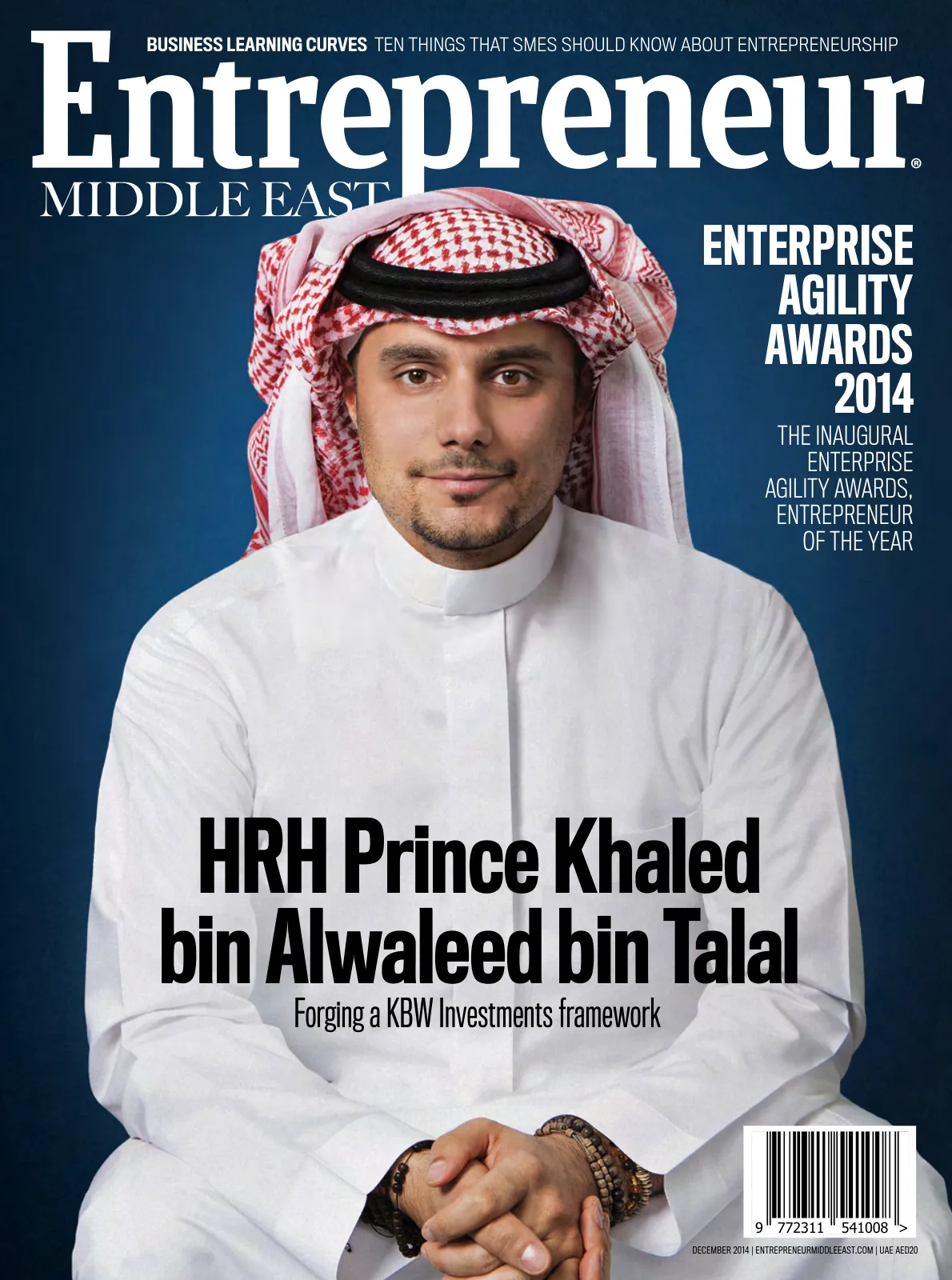
Entrepreneur Middle East, December 2014
Page 1
DECEMBER 2014 Entrepreneur
1
Business learning curves Ten things that SMEs should know about entrepreneurship
9
772311
541008 >
ENTERPRISE
AGILITY
AWARDS
2014
The inaugural
Enterprise
Agility Awards,
Entrepreneur
of the Year
DECEMBER 2014 | ENTREPRENEURMIDDLEEAST.COM | UAE AED20
HRH Prince Khaled
bin Alwaleed bin Talal
Forging a KBW Investments framework
Page 2
Entrepreneur DECEMBER 2014
2
A bonus of 250,000 Air Miles.
An opportunity for adventure. Just one
instance of how the HSBC Black Credit
Card enriches your personal economy.
With so many other great features like
a complimentary round of golf every
month, the opportunity to earn 50%
more Air Miles when you spend in a
foreign currency, unlimited access at over
500 premium airport lounges, there’s
always something special waiting.
HSBC Black Credit Card.
For a life full of stories.
Call 800 4320 or visit www.hsbc.ae/black
An annual fee applies
A historic quarter.
A sunny afternoon.
A long drive.
Issued by HSBC Bank Middle East Limited, PO Box 66, Dubai, UAE. Regulated by the Jersey Financial Services Commission and Central Bank of the United Arab Emirates. CRN 141038
The HSBC Credit Card Agreement Terms and the HSBC Black Credit Card Terms and Conditions apply. The fees and charges set out in our Schedule of Tariffs apply. Please visit www.hsbc.ae for more
details. Your 250,000 bonus Air Miles will be credited to your Air Miles account once the annual fee has been received.
Page 3
DECEMBER 2014 Entrepreneur
3
HRH Prince Khaled
bin Alwaleed bin Talal
CONTENTS
DECEMBER 2014
18
34
The Recap:
Enterprise Agility Achievers 2014
18
INNOVATORS:
Come as your are
HRH Prince Khaled bin
Alwaleed bin Talal
Forging a KBW
Investments framework
34
The Recap
Enterprise Agility
Achievers 2014
The inaugural
Pan-Arab Enterprise
Agility Awards,
Entrepreneur of the
Year presented by du
28
The Recap
Enterprise Agility Forum
2014
The first Entrepreneur
Industry Intel event, the
Enterprise Agility Forum
presented by du, and
ten things every SME
should know gleaned
from our morning of
panel discussions.
50
TECH:
ONLINE ‘TREP
Client clout
Director of Phenomena
Ahmed Dawood’s social
success depends on
being engaging and
interactive, but you
know what’s almost as
important? His client
roster.
52
SHINY
#TamTalksTech
Gadgets and doodads
that you might’ve
missed out on, sourced
by a tech aficionado.
Yes, it’s okay to want
them all… and no, it’s
not our fault.
52 #TamTalksTech
Page 4
Entrepreneur DECEMBER 2014
4
CONTENTS
DECEMBER 2014
Parrot brings you
MiniDrones- playful,
connected robots that
are piloted with a
smartphone or tablet
using the FreeFlight 3
application.
34
58
CUTURE:
LIFE
Internet intel
WCMC-Q’s Sahtak
Awalan aims to make
health education
accessible to all, and
they’ve taken to social
media to make that
happen.
76
START IT UP:
Q + A
A new way to trade
ilOsool aims to change
the way illiquid assets
are traded in the MENA
region. Founder Bdaiwi
Tubaishat brings tons of
experience to the table,
and he’s applying it to
his business model.
88
Q + A
Business is blooming!
Emirati ‘trep Moza Al
Huraiz on her brick and
mortar startup MOZ
Flowers, and what sort
of help Tejar Dubai can
give you.
78
WACKY IDEA
Keeping crafty company
Startup ideyna provides
e-commerce platform
for GCC artisans, and
founders Nafisa Rebello
and Ekta Saran couldn’t
be more proud.
70
STARTUP FINANCE
Tips when raising
the seed
Simon Hudson has been
there and done that.
This is how CEO and
founder of Brndstr got
his financial act together.
68
MONEY:
ASK THE MONEY GUY
Stock-savvy?
Before pulling for an AIM-
like exchange in the UAE,
Ziad Makhzoumi explains
why SMEs in MENA need
to weigh pros and cons.
78
Keeping crafty
company
80 How Gaza Sky Geeks increased women’s leadership in the Gaza startup sector
Page 5
DECEMBER 2014 Entrepreneur
5
BUSINESS
FINANCE SOLUTIONS
We are delighted to be recognised for helping SMEs realise their potential. This award further
strengthens our resolve to strive for greater excellence across all our products and services.
www.fgb.ae
FGB wins Enterprise Agility Achiever in the
SME Banking sector at Enterprise Agility Awards 2014
It’s rewarding
to see efforts
get recognised
Page 6
Entrepreneur DECEMBER 2014
6
CONTENTS
DECEMBER 2014
42
TREPONOMICS:
SKILLSET
Animating your
commercial presence
Tamara Bullock,
Managing Director of
Grayling Northern Gulf,
shares five foundations
of business development
for entrepreneurs.
44
MARKETING
Millennials in the
Middle East
Bayt.com’s VP Suhail
Al-Masri talks about how
upper management and
entrepreneurs can master
the generation gap.
48
ESQUIRE GUY
Handling tears at work
Ross McCammon on
what to do when the
waterworks start at
the office. Running
away is not an option,
and neither is hiding
behind your closed
office door.
64
SKILLSET
Taking your time
James Clear,
Olympian and
entrepreneur,
proposes a different
way of thinking about
productivity, and it
makes business sense.
72
ASK A PRO
Creating more
compelling content
Alexander McNabb
poses five questions
to ask your content
before you let it go into
the wild. Is it some-
thing you’d share?
If so, then you’ve
checked one box.
56
CULTURE:
TRAPPINGS
‘Trep gear
The executive selection
for the entrepreneur
on your list that has
everything. Okay,
maybe for a little self-
reward as well.
Five questions to ask your content
before you let it go into the wild
43
Sweden commissions
its own font
72
Entrepreneur DECEMBER 2014
6
Page 7
DECEMBER 2014 Entrepreneur
7
Page 8
Entrepreneur DECEMBER 2014
8
SUBSCRIBE
Contact subscriptions@bncpublishing.net to receive
Entrepreneur Middle East every issue
EDITOR IN CHIEF Fida Z. Chaaban editor@bncpublishing.net
MANAGING DIRECTOR Walid Zok walid@bncpublishing.net
DIRECTOR Rabih Najm rabih@bncpublishing.net
DIRECTOR Wissam Younane wissam@bncpublishing.net
SALES DIRECTOR Oliver Amos oliver@bncpublishing.net
PUBLISHER Nehme Abouzeid
MANAGING EDITOR Aby Sam Thomas
CREATIVE LEAD Odette Kahwagi
ONLINE LIAISON Kareem Chehayeb
COLUMNIST Pamella de Leon
PO Box 502511 Dubai, United Arab Emirates
P +971 4 4200 506 | F +971 4 4200 196
For all commercial enquiries related to
Entrepreneur Middle East contact
sales@bncpublishing.net
All rights reserved © 2014.
Opinions expressed are solely those
of the contributors.
Entrepreneur Middle East and all subsidiary
publications in the MENA region are officially licensed
exclusively to BNC Publishing in the MENA region
by Entrepreneur Media Inc.
No part of this magazine may be reproduced or
transmitted in any form or by any means without
written permission of the publisher.
www.entrepreneurmiddleeast.com
WE’RE HEAVILY INVESTED IN OUR WEB PRESENCE
IS DIGITAL
MIDDLE EAST
Printed by Raidy Emirates Printing Group LLC
www.raidy.com
EntMagazineME
@EntMagazineME | @Fida
Entrepreneur-me
EntrepreneurMiddleEast
EntMagazineME
EntMagazineME
EntMagazineME
MIDDLE EAST
Cover photography by The Factory
Images used in Entrepreneur Middle East are credited when necessary. Attributed use of
copyrighted images with permission. All images not credited otherwise Shutterstock.
Tamara Bullock
Amal Chaaban
Youmna Chagoury
Kareem Chehayeb
Tamara Clarke
James Clear
Suhail Algosaibi
Simon Hudson
Pamella de Leon
Ziad Makhzoumi
Suhail Al-Masri
Ross McCammon
Alexander McNabb
Iliana Montauk
Shoug Al Nafisi
Soukaina Rachidi
Anthony Russo
Erika Widen
CONTRIBUTING WRITERS
In addition to our print edition, we’re bringing you all sorts of
industry news on our web mediums. Joining us online means getting
relevant business and startup content in real-time, so you’re hearing
about the latest developments as soon as we do. We’re looking
forward to interacting with our readers on all of our social media and
web platforms- like any thriving business, we’re looking to give and
take. #TrepTalkME is already happening on all of our digi platforms,
and all good conversations go both ways. See you on the web!
Page 9
DECEMBER 2014 Entrepreneur
9
Page 10
Entrepreneur DECEMBER 2014
10
Page 11
DECEMBER 2014 Entrepreneur
11
Page 12
Entrepreneur DECEMBER 2014
12
We’ve gotten tons of pictures via Twitter and Instagram, and
here are a few of our favorites. If you see a copy of any edition
of Entrepreneur MENA, tweet an image our way or tag us on
Instagram. All of our reader images end up getting pinned to
our Pinterest Show & Tell board. We’re happy to see our readers
interact with us across all mediums- and we talk back!
On ISSUU you can access all of our current and past issues
complimentary, including Entrepreneur Al Arabiya, our edition
for those of you that prefer Arabic-language publications.
If you haven’t yet visited our ISSUU account, check out
issuu.com/entmagazineme
Business efficacy...
in real-time
It’s not social media if you don’t talk back
FEEDBACK
Page 13
DECEMBER 2014 Entrepreneur
13
Our robust financial performance throughout the years is a testament to our
adherence to the tenets of ambition, transparency and integrity in providing
outstanding products and superior services. To find out how we can care for
your needs, visit www.unb.ae or call 600-566-665.
I care about stability
and UNB takes care of me
With total equity exceeding AED 16 billion*
and an impressive financial track record
Total Equity in AED Millions
UNB
Foreign Currency
Long-term Ratings
Moody’s
Fitch
Ratings
Capital
Intelligence
A1
A+
A+
6,705
7,696
10,668
11,931
13,068
14,121
0
5,000
10,000
2007
2008
2009
2010
2011
2012
15,338
2013
15,000
16,521
Sept. 2014
*As at 30th September, 2014
024/COM/R021014/EN
Page 14
Entrepreneur DECEMBER 2014
14
S
elf-promotion is, I think, a
conundrum for today’s profes-
sionals. Good self-promotion
requires careful planning- if you don’t
promote your work and achieve-
ments, then how will people know
that you’re excelling in your field?
On the extreme other end of the
spectrum, you will find the relentless
spammers. Overshare your material,
and you begin to reek of desperation,
subsequently tainting the reputation
of your otherwise good work.
A few points to consider when
developing and executing your digital
footprint: vehicle (opting for suitable
mediums), positioning (personal
and professional branding), when
(frequency and timing of sharing
and re-sharing), and voice (narrative
themes). There are lots of other fac-
tors at play when analyzing the sci-
ence of social media –and it really is
a science- but the four elements I’ve
mentioned act as the primary frames
dictating your online persona. Social
media can turn ordinary people into
global sensations, literally overnight.
You’ve got tons of Insta-famous igers
who actively cultivated their user
base, and then you have tweeps like
#AlexFromTarget who didn’t ask to
become a bull’s eye of Internet fan-
dom. Some of these viral web “celeb-
rities” manage to parlay their online
popularity into successful and lucra-
tive careers as digital influencers.
My consistent online presence,
combined with the fact that I work
for a media outlet, encourages people
to tweet their news at me or tag me
in their posts. While some of these
“sharing moments” are great, other
outreach efforts –and I won’t mince
words here- border on obnoxious.
So where does one draw the line?
Ask yourself, “If Fida frequently
tweeted her images, articles, and
events directly at me, would it annoy
me?” The answer is probably yes. If
every time someone took a picture
of me, and I decided that you needed
to see it (which you fully don’t), you
would quickly tire of me and begin to
dismiss my news. I try never to ignore
anyone online, but that doesn’t mean
I want to see (and re-see) everything
that you do. In my opinion (feel
free to write in and tell me that I’m
wrong) timeliness and reasonable
frequency are two main facets of a
healthy digi-presence. Don’t spam,
don’t overshare, and don’t aggress the
influencers on your timeline. Instead,
I suggest that you be an active part
of the online community, and people
will gradually take an interest in your
news of their own accord- they might
even help you promote your work
without being coerced into doing so.
The next bit of my note is specifi-
cally for social entrepreneurs: Entre-
preneur MENA
has partnered
with The Venture
to help GCC’s
social businesses
potentially qual-
ify for mentor-
ship and capital
injections. Social
entrepreneurs
in the GCC, you
could win a portion of the global prize
pool of USD$1 million. I’m a judge for
this region’s leg of the competition,
and I encourage any social enterprise
to enter before December 15th, 2014.
The successful GCC candidates will be
sent to Silicon Valley, and be allotted
a share of the prize pool based on
relevant business projections. Visit
www.TheVenture.com to see the full
set of rules and regulations, and if
you qualify I look forward to learning
about your social enterprise. Show
the world what you’ve got, ‘treps!
EDITOR’S NOTE
“Look at me!”
The fine line between positive self-promo
and desperate pleas for attention
Fida Z. Chaaban
Editor in Chief
@fida
editor@bncpublishing.net
Page 15
DECEMBER 2014 Entrepreneur
15
INDULGE AT Grand Hyatt Doha.
Celebrate unparalleled luxury at Grand Hyatt located on the shoreline of the West Bay Lagoon.
The hotel features balconies or terraces in all rooms, suites and villas showcasing breath-taking
views of the Arabian Gulf.
The hotel offers extensive meeting and banquet facilities, a full-service business centre,
the renowned Jaula Spa, a 400-metre private beach, indoor or outdoor pools and a broad
selection of cuisines at our innovative outlets.
For reservations and more information call +974 4448 1234
Hyatt. You’re more than welcome.
GRAND HYATT DOHA
West Bay Lagoon, P.O. Box 24010
Doha, State of Qatar
Facebook.com/GrandHyattDoha | doha.grand.hyatt.com
HYATT name, design and related marks are trademarks of Hyatt Corporation. ©2014 Hyatt Corporation. All rights reserved.
Page 16
Entrepreneur DECEMBER 2014
16
A
s U.S. President Barack
Obama’s presidency
slowly comes to a close, an-
other Guantanamo prisoner
has been freed. Muhammad
al-Zahrani, a Saudi Nation-
al, ended his 12-year stay at
the controversial prison in
late November and will be
enlisted in Saudi Arabia’s
rehabilitation program.
There are only 142 men left
in Guantanamo, and the
Pentagon finds about half
of them threatening enough
to prevent transfer. The Re-
publicans are obviously not
pleased with this, calling
President Obama’s actions
dangerous and irrespon-
sible. With the Republicans
on the back of a massive
midterm elections victory,
many believe that Obama
and the Democrats are try-
ing to make their final mark
before things change; not
only is Obama transferring
Guantanamo prisoners,
but he’s also looking at
implementing immigration
reform that will burst the
Republican bubble. But
despite Republican uproar,
most Democrats who voted
for Obama back in 2008
will consider this to be a
minuscule action in com-
parison to what he initially
promised- shutting down
the entire prison.
W
hat do Ashton Kutcher,
Leonardo DiCaprio,
Stephen Hawking, and Justin
Bieber have in common?
They’ve all paid US$250,000
to take a trip into outer space
with Sir Richard Branson’s
boldest venture yet, Virgin
Galactic. That said, they
might be thinking twice about
taking a small ship 62 miles
above planet Earth after
a test flight went horribly
wrong in the Mojave Desert in
California. The plane, Space-
ShipTwo, was tested for a
35th time, only for it to catch
fire and crash after separat-
ing from a jet at 50,000 feet.
One person passed away,
and another sustained major
injuries.
Branson, who showed
extreme enthusiasm and
excitement when unveiling
the $500 million dollar air-
craft back in 2009, will most
likely hold back launching
commercial flights in early
2015 as initially planned.
At the time of writing, the
project, under a jointly owned
venture by Branson and Abu
Dhabi’s Aabar Investments
PJS had yet to release a
detailed statement regarding
the crash. Virgin Galactic
CEO George Whitesides said
in a press conference that
his thoughts are with the
crew’s families and that Sir
Richard will visit the site to
investigate the crash. Having
already made $80 million
dollars in reservations, those
who want refunds will be
disappointed; anonymous
sources on CNN said that
only a small fraction is
refundable.
The Virgin Galactic disaster doesn’t bode well
for Richard Branson’s space ambitions
Mission impossible?
Obama administration releaseS seventh
prisoner from Guantanamo in 14 days
Qatar’s all in the clear
for the FIFA World Cup,
despite never-ending
hullaballoo
GUANTANAMO DEMONSTRATION IMAGE © FRONTPAGE / SHUTTERSTOCK | PRESIDENT OBAMA IMAGE © EVERETT COLLECTION / SHUTTERSTOCK | VIRGIN GALACTIC IMAGE © steve mann / shutterstock
in the loop
C
ase closed! Qatar’s given
the green light to continue
preparing for the 2022
FIFA World Cup, after FIFA’s
report concludes that there is no
need for a revote regarding the
2022 World Cup bid. Qatar won
the vast majority of the votes
in all four rounds for the 2022
World Cup, surpassing the United
States, South Korea, Japan, and
Australia. That said, while FIFA
Vice President Jim Boyce said
that highly trained professionals
conducted the report and that we
should now look forward to the
tournament, several voices are
still refusing to tone down. Brit-
ish MP Damien Collins called the
report “a whitewash” and claims
that the investigation is not as
fully independent as FIFA claims
it to be. MP Collins has used
Parliamentary privilege to make
allegations that Qatar have used
bribes to host the tournament.
Another voice is whistleblower
Phaedra Al-Majid, who once
worked as international media
officer for Qatar’s World Cup bid
before leaving in 2010; she claims
to have received threats on her
children and fears for her safety.
Setting all this aside, for better
or for worse, it looks like FIFA
will move on and start talking
about whether to host the World
Cup in a toasty Doha summer or
reschedule it to winter.
Qatar’s Aspire Sports
Academy
The Virgin Galactic on static display at
the Farnborough International Airshow,
U.K., July 2012
Below: Demonstrators demanding the closing of Guantanamo during the
inauguration of President Barack Obama, Washington, D.C., January 2009
Page 17
DECEMBER 2014 Entrepreneur
17
UNIVERSITY CITY OF SHARJAH
Scholarships available
+971 6 5441155
admissions@skylineuniversity.ac.ae
INTERNATIONALLY ACCREDITED
PROGRAMS IN THE UAE
WITH EMPHASIS ON
E-Governance
Marketing
Finance
Human Resource Management
Strategic Management
& Leadership
NEW
WITH MAJORS IN
Public Administration
Marketing & Retail Management
Finance
Information Systems
International Business
Travel & Tourism Management
NEW
Page 18
Entrepreneur DECEMBER 2014
18
HRH Prince
Khaled
bin Alwaleed
bin Talal
INNOVATOR
COME AS YOU ARE
Forging a KBW Investments framework
By Fida Chaaban
Page 19
DECEMBER 2014 Entrepreneur
19
“H
i, we’re right here,” says HRH Prince Khaled bin
Alwaleed bin Talal while waving his iPhone 6
Plus at me from the far end of the Meydan Hotel
lobby in Dubai. Two things you need to know right off
the bat: the first is that he responded to Entrepreneur’s
interview request personally with a few members of
KBW Investment staff on CC, and the second is that he
came downstairs with KBW Investments CEO Ahmed
Alkhoshaibi to collect us, calling me from his own mobile
phone. Decked out in formal National dress, a quick look
at his feet betrays a cool factor- he’s wearing Vans. “It’s
2014,” he says, smiling when I point out his choice of
footwear. In a professional capacity, HRH doesn’t like
his formal salutation used, and offers up that it’s alright
to call him “Abu Jenna or whatever you’re comfortable
with.” Comfortable? Hardly. As royal anomalies go, he’s
for sure in the 99th percentile and at first I don’t know
what to make of the man affectionately dubbed the “Tech
Prince”. A document that I downloaded from WikiLeaks
-the URL indicates that this “intel” is part of the mass-
released Global Intelligence Files- describes 36 year-old
Prince Khaled as “business-minded like his father and
serious, but also simple and nice,” adding that “he has
kept a considerably low-profile in the media, preferring
to stay in the background.” Immediately after meeting
him, I could verify these statements to be true, especially
that the apple doesn’t fall far from the tree. When Abu
Jenna does laugh or smile, his expressions are tempered
by what I understand (perhaps incorrectly) to be shyness
and a measure of reserve. >>>
Photography by The Factory
Page 20
Entrepreneur DECEMBER 2014
20
INNOVATOR
TECHNOBUFFALO SCREENSHOT © TECHNOBUFFALO.COM
“My worst mistakes
were when I failed
to ‘Trust, but verify’
as my father always
said to do. I was a
little too trusting.
Let’s just say that the
homework I do before I
do a deal today is now
very thorough. It’s
true that you do learn
the most from your
mistakes.”
I need to explain something to you,
the reader. When I sit down to inter-
view anyone, be it a high profile celeb
or a fresh startup founder, I have to
put on a “game face”. I have to be bold
and probing, and I admit that I create
a psychological atmosphere of what
can be called “safe sharing”. I preface
questions with little anecdotes that
put the subject in a frank frame of
mind, I share personal informa-
tion that I usually never disclose to
encourage my interview subjects to
do the same, and finally, I cross lines
that I would never even toe outside
of an interview space. If my subject
happens to be a royal like Abu Jenna,
I have to force myself to forget that
he is who he is. I have to be a little
brazen (okay, a lot brazen), and I
really have to force my hand. Why?
Because no one wants to read the
same old regurgitated PR-friendly
quotes. Reader, know that Abu Jenna
fields all of my personal intrusions
like a champ- he has a great sense of
humor, and he’s a good sport. If I was
on the receiving end of that barrage of
leading questions, I have no qualms
telling you that I would’ve been indig-
nant, and maybe even a bit offended.
Director General of Abu Jenna’s
private office, Mustafa Al Ansari, and
the aforementioned Alkhosaibi both
have expressions of sheer incredulity
(and sometimes amusement) during
the course of my two-and-half-hour
conversation with the Prince. At
some point, Al Ansari laughingly tells
me that I’m “really pushing it.” The
result? An honest and surprising
discourse with one of the most private
royals in the MENA region.
Before I ask you to move past his
Prince-hood, I have one (hilarious)
royal-related factoid to share.
Abu Jenna is a partner in
TechnoBuffalo.com, a technology
enthusiast website. In 2009, Abu
Jenna emailed TechnoBuffalo.com
founder Jon Rettinger explaining that
he wanted to invest in the Internet
startup as a passion project because
he “really liked what they were doing.”
According to a vlog post by Rettinger,
he then “Googled Khaled Alwaleed”
and found him to be “a Prince in Saudi
Arabia!” Once Rettinger confirmed
that this was indeed the Khaled
Alwaleed, things moved quickly. Abu
Jenna laughs as I comment that this
story is very similar to the emails I get
from a “Nigerian Prince” who wants
to transfer me €40 million as part of
some far-fetched inheritance payout.
I can only imagine what Rettinger’s
face must’ve been like, and I would’ve
paid cold, hard cash to be a fly on the
wall of his California home that day.
TechnoBuffalo.com is laden with in-
depth product reviews (some executed
in compare and contrast style), and
reports both mainstream and obscure
tech news. It’s pretty comprehensive,
Abu Jenna often tweets their vids
from his account (@KhaledAlwaleed),
and he says that they’ll be Arabizing
their content in the near future.
Admittedly, it’s hard to forget that
Abu Jenna is the “only son of His
Royal Highness Prince AlWaleed
bin Talal Al Saud” (something the
media loves to drop in any and every
mention of him), and instead see him
as a man directly managing several
enterprises, and sitting on the board
of others as the majority shareholder.
Before we get into the nitty-gritty of
his many different business interests,
I tell him that attaching the name
of HRH Alwaleed bin Talal Al Saud
certainly ups the glam factor of
practically anything, and that these
frequent mentions of Abu Jenna are
often prefaced with HRH Alwaleed bin
Talal’s name. Abu Jenna emphatically
asserts that essentially all he is
today stems from that association:
“My success is because of this tie to
my father. Inherently, and I am very
proud of this, the only success that
I will ever have is because of being
the son of my father. Honestly, if you
step back for a second, the person
I am today is because of my father;
my success came from my father;
my success came from the education
my father gave me- it came from
the practice I’ve had watching my
father do business. I see my father
twice a week, three times a week, as
much as I can. I have an incredible
amount of respect for my father and
the success he’s achieved in business.
I have an appreciation for all that
he’s taught me, but it’s not just
business. My father is a wonderful
grandfather to my children, and that’s
something most people don’t see. Our
relationship is obviously much deeper
than business.” I read Abu Jenna
a quote from a Vanity Fair article
stating that HRH Alwaleed bin Talal’s
tech investment methodology “favors
Page 21
DECEMBER 2014 Entrepreneur
21
“Inherently, and I am very proud
of this, the only success that I
will ever have is because of being
the son OF my father.”
HRH Prince Khaled bin Alwaleed bin Talal and his father
HRH Prince Alwaleed bin Talal in Paris
high-growth, high-risk technology
companies, which he identifies with
the help of a small Riyadh-based
investment committee.” The Prince
says that while the latter is true, the
“high-risk” factor isn’t, and points
out that HRH Alwaleed bin Talal’s
investments are usually astronomical
sums in huge companies, not the
startup sort the statement suggests.
“My father has given me a lot of advice
throughout my business career- that’s
not to say I always listened. When I
was younger, I was naive and I learned
the hard way the consequences of not
always heeding my father’s advice.
Today I’d like to think I’m wiser;
before I make an important business
decision, 99% of the time I ask
myself, ‘What would my father do?’
and it’s usually the right decision. I’m
proud to say that I follow his advice.”
Now that we’ve addressed all of
that, for the rest of this article don’t
see him as a man born to extreme
privilege and eye-popping wealth.
Instead look at Abu Jenna as a self-
induced workaholic, PETA-retweeter,
Kurt Cobain style sneaker-wearer,
tech-freak who quotes Apple CEO
Tim Cook, and who spends his free
time at home chilling with his family
and playing PlayStation. Oh, and he
likes to cook. “There is only one thing
I don’t want to talk about,” says Abu
Jenna, but I never find out what that
one thing is since he answers every
question candidly with no hesitation
whatsoever (to the consternation of
both Alkhoshaibi and Al Ansari). To
sate the curiosity of those of you out
there who want to know more about
the fantastical Internet reports, here
are some fast facts: Yes, he’s met
Michael Jackson, he is indeed a huge
proponent of both the Kingdom and of
Islam, and he doesn’t eat meat as >>>
Page 22
Entrepreneur DECEMBER 2014
22
INNOVATOR
“I waited two years before I finally invested in
Raimondi Cranes, which we just closed this year.
In line with that, you need to do your homework
before you make a deal. You need to know a
company inside and out, and you need to invest in
things that matter- companies that have a solid
history, but also a clear vision for the future.”
Raimondi Cranes at work building a bridge in Nantes, the south of France. The first of two 2014 European KBW Investments acquisitions,
HRH Prince Khaled bin Alwaleed bin Talal became Chairman of the company in January of this year.
a remedy to a cholesterol issue
(thereby eschewing taking prescrip-
tion meds). Now that you’ve had your
royal intrigue fix, please consider Abu
Jenna as just Abu Jenna, and let’s get
down to business.
KBW Investments, Abu Jenna’s com-
pany, is an umbrella entity that acts
as the epicenter of his corporate eco-
system. Part of this umbrella is Italian
mainstay Raimondi Cranes SpA- the
Prince gained control of the company
in January of this year amidst heavy
publicity. Raimondi, a century and a
half old, now supplies cranes to Abu
Jenna’s other companies creating a
circular chain of business, and he
refers to Raimondi as the “jewel” of
his portfolio. “The way that Ahmed
[Alkhoshaibi] structured the company
is very innovative- we can actually
compete with the best crane com-
panies in the world, and beat them
about 30% price-wise. It’s pretty
much like the Apple model or the
Tesla model; they opened their own
stores so there’s no middleman. The
region is booming, and we can beat
anyone’s quote hands down.” Shortly
before this interview took place, KBW
Investments acquired a 50% stake in
Arcadia Engineering making him the
Chairman, and that venture in turn
will support Dorra Contracting out of
Saudi and Qatar, and Next Generation
Parking (NGP), yet another KBW en-
deavor. They’re trying to create what
Abu Jenna refers to as a “full-fledged
bouquet of companies that work well
together harmoniously.” Basically,
it’s a synergistic-style conglomerate
that makes cross-selling easy, and
not just in the MENA region. A visit
to kbw-investments.com can give you
an idea of how many pies the Group
now has their hands in. “So if there’s
a company that needs cranes, then
maybe they need architecture, project
management, and maybe construc-
Page 23
DECEMBER 2014 Entrepreneur
23
HRH Khaled bin
Alwaleed bin
Talal during the
Raimondi Cranes
acquisition in Italy
Photography by The Factory
“The way that Ahmed [Alkhoshaibi]
structured the company is very
innovative- we can actually
compete with the best crane
companies in the world, and beat
them about 30% price-wise.”
Above:
HRH Prince Khaled bin Alwaleed bin Talal
with Editor-in-Chief Fida Chaaban
tion.” An article about KBW Invest-
ments in The Wall Street Journal says
that they have interests in over 20
companies globally. One of these is
KSA-based GT Tech, and Abu Jenna
is the Chairman. GT Tech recently
partnered with SME-centric Sage
Middle East to act as the company’s
local partner in the Kingdom. At a
press conference to announce the
partnership during GITEX Tech Week
in Dubai, GT Tech CEO Mohammed Al
Mutabagani, who Abu Jenna calls “a
dear friend”, and Director and Head of
Sage Middle East Keith Fenner both
confirmed that they realize the chal-
lenges of gaining market share in KSA,
and they’ve stressed that both sides
were committed to being hands-on
with Sage business solution software
customers. “We see really expensive
enterprise software that doesn’t
really add any value, as opposed to
what Sage offers which is basically
the same thing but at a much better
price point. We rocked the boat with
Oracle, they’re on their feet in Saudi.
We’re getting good traction, and it’s
a new deal –only two months old- so
we’re just getting started,” says Abu
Jenna confidently. KSA is widely
considered the hardest MENA market
to master, and Abu Jenna admits that
old habits die hard: “People get used
to a certain product, and they hold on
to that product with both hands. It’s
very hard to come into the market,
but we see the value with the prices
that we’re offering- we’re at least
65% to 75% cheaper than any other
leading enterprise software company.
Market penetration is going to be
very slow, it’s going to take a long
time. I believe that Oracle is [in] the
lead, you have SAP and HP, Microsoft
in the third and fourth, and we’re a
distant fifth.” At this juncture, I ask
Abu Jenna if it’s actually possible
that Sage’s ‘Ajanib’ will make on-
the-ground progress in the Kingdom.
He explains that before signing with
Sage, it was stipulated that their
people had to be on the ground along-
side GT Tech’s Saudi staff, and that
having “the Saudi front, and the sup-
port from the ‘Ajanib’ so to speak is
definitely as added-value- they know
their products and they’ve all worked
in the company for years.” Abu
Jenna asserts that dedication to the
Kingdom across all levels is integral to
gaining ground: “I hear about people
who live in Dubai, but come to Saudi.
That’s a bunch of B.S.- if you work
in Saudi, you live in Saudi, and you
give me 100%. I don’t deal very well
with people like that honestly. There
are a few people, full-time employees
of Sage, who are in Saudi all of the
time.”
Another tech venture of Abu Jenna’s
“started in 2004 when I invested in
MISC, Mobile Innovative Solutions
Company. Back before there were
smartphones, people relied on SMS
services, and we started a company
around that. It’s outdated now, but
we were very successful. Now you
have push notifications, you have
Twitter, so it’s outdated. We can see
our financials tapering off slowly, but
there are people who still use it -sur-
prisingly and sadly- since I invested
in this company, but I’d rather see
more people deal with smarter phones
and be more connected.” Technology
as a solution to societal ills is a topic
that Abu Jenna warms to, and we
touch on how it facilitates areas like
citizen journalism, how social media
rectifies what he calls the “distor-
tion” between the mainstream media
and reality, and even how tech and
entrepreneurship could be a potential
answer to conflict zones. “If you have
more ways to infuse studied, positive
risk for people, it will create more op-
portunities [in the Middle East]. >>>
Page 24
Entrepreneur DECEMBER 2014
24
INNOVATOR
“VCs act like banks here- they’re
not looking into investing in people
and in the ideas. They’re looking to
protect their money and getting a
high rate of return with as much
collateral as possible.”
Photography by The Factory
It will reduce all the other garbage
they’re doing. Starting your own
business is a positive trickle-down
effect; you’re feeding your family,
you’re contributing to the economy,
and you’re employing people. I call for
their governments to give people op-
portunity to let their curative minds
thrive, and focus a lot more on inno-
vation- [startup accelerator] Gaza Sky
Geeks is a fantastic chance for people
to start something and do something
from zero.” Abu Jenna singles out Jor-
dan’s Oasis500 as a force of good, and
he’s toured ArabNet Riyadh for the
past three years getting a glimpse of
some of the participating startups. As
far as money goes, he agrees with the
somewhat unpopular industry-insider
opinion that venture capital in MENA
isn’t real VC. “VCs act like banks here-
they’re not looking into investing in
people and in the ideas. They’re look-
ing to protect their money and getting
a high rate of return with as much
collateral as possible. That’s not VC.”
While he admits that the bulk of the
region’s business is in the Kingdom,
he says UAE has undeniable commer-
cial benefits like ease of starting up,
a fact supported by the 2013 Doing
Business report co-published annually
by The World Bank and the Inter-
national Finance Corporation (IFC).
“One of the main reasons I chose
Dubai is the simplicity of transacting
business here, the simplicity of creat-
ing companies, and the legitimacy that
Dubai, DIFC, and the government give
to any business that’s headquartered
here. Honestly, with the vision of
Sheikh Mohammed bin Rashid [Al
Maktoum], and President Khalifa [bin
Zayed Al Nahyan] and Sheikh Mo-
hammed bin Zayed [Al Nahyan], it’s
one of the most active and attractive
places to come into the region and do
business in the region. We’re not just
focused on Dubai, we’re doing a lot in
Abu Dhabi that we’ll be announcing
in 2015. We’ve been very warmly wel-
comed in Dubai: Sheikh Mohammed
bin Rashid who I’ve met a few times,
and Sheikh Hamdan bin Mohammed
bin Rashid [Al Maktoum], and Sheikh
Tahnoon [bin Mohammed Al Nahyan],
and Sheikh Hazza [bin Zayed bin
Sultan Al Nahyan] of course who have
all been very supportive.” Abu Jenna
doesn’t expand upon their plans for
work in Abu Dhabi going forward,
but he does say that he’s “interested”
in hydroponics and sustainability,
mentioning another KBW entity that
trades in energy-saving LED lighting
for their construction projects.
Abu Jenna, in his capacity as Chair-
man of Levant Capital, was also a part
of the deal that saw the private equity
outfit and Citigroup’s VC segment gain
a $US100 million stake in Al-Raya
For Foodstuff Co Ltd., operators of a
popular KSA supermarket chain in
February 2012. “That year, it was one
of the largest acquisitions. It took
about a year and a half to two years;
it shouldn’t have taken that long,
but dealing with certain partners
sometimes is very difficult. When
you’re nickel-and-diming, it’s really
tough when you’re talking about big
numbers.” He seems to relish all types
of quick progress, be it in a M&A deal
or when talking about infrastructural
improvements. Where does he see
positive change happening? Abu Jen-
na has high praise for Saudi Arabian
Minister of Ministry of Commerce and
Industry, H.E. Dr. Tawfiq bin Fawzan
Al Rabiah for his work: “He’s doing
an amazing job! One of the youngest
appointed to the Ministry, and you see
his blood, his mindset, his younger-
Page 25
DECEMBER 2014 Entrepreneur
25
“It’s a relationship not unlike many fathers and sons,
the same dynamics are there. What’s different is that we
also do business together. So not only is he my father,
but my mentor in business and also in philanthropy.
We’re very open when we talk to each other, there are
not the formal boundaries you sometimes see in this
part of the world. That sense of openness has enabled
me to learn a lot from him.”
Below:
KBW Investments and Arcadia Engineering
signing ceremony in Dubai, UAE in November
2014. HRH Prince Khaled bin Alwaleed bin
Talal with Florin Nistor Chinole, founder
and partner of Arcadia Engineering. KBW’s
50% acquisition of the company, currently
operating in Romania and Brazil, will facilitate
expansion into Qatar, Saudi Arabia, and UAE.
generation style of thinking, so you’re
seeing a lot of transformation in the
Ministry of Commerce. And that
will translate into giving SMEs and
startups and VCs a start in the region.
However, you can’t start in one min-
isterial sector, it actually has to be a
fundamental change, and adopted by
other ministries. So you have the Jus-
tice and Labor Ministries, these three
main ministries, that need to work
together to create an SME foundation
and an entrepreneurial ecosystem.”
From here we discuss the evolution of
MENA’s education approach, and also
how the region is currently attempting
to shift into staffing senior ranks with
GCC Nationals, country by country. In
terms of Saudization and Emiratiza-
tion, he gives the example of Dubai.
“Look at the heads of the largest insti-
tutions, you have very smart, shrewd
businesspeople- foreigners with fine
educations running the companies.
But right under them, you have Emi-
ratis. With all due respect, they [the
foreigners] won’t be there for very
long- 10 years from now, I guarantee
you that you won’t see a lot of foreign-
ers heading [UAE] companies. The vi-
sion of Sheikh Mohammed bin Rashid
is definitely to have Emiratis running
things.” Abu Jenna doesn’t think that
Saudization should be enforced as
a blanket policy per se, but rather
adapted sector by sector, and he firmly
believes in accountability structures
put in place to ensure that if a Saudi
isn’t delivering then he or she can be
pink-slipped just like everyone else.
“I’m for Saudization, and I’m for see-
ing Saudis everywhere working, but
I want fairness, so if someone isn’t
doing their job they should be able
to get fired.” He estimates that about
40% of his overall staff are Saudi Na-
tionals, and he refuses to hire just to
fill a quota- if they don’t demonstrate
the necessary skillset, they simply
don’t get a position at KBW. He’s not
a fan of “yes-men”, and stresses that
in the past those same yes-men have
led to failure; his current team are
encouraged to contradict him and to
put the brakes on things when the
necessary due diligence hasn’t been
done to their comfort. That said, some
business mentions of Abu Jenna have
become overly-personal, and because
of that, “everything now goes through
me” in addition to vetting by his team.
I didn’t ask Abu Jenna the business-
man what it’s like to be Prince Khaled
bin Alwaleed bin Talal the royal
because they’d become very separate
people in my head, but I did ask him
what it’s like to have a great many
people who assume he doesn’t actu-
ally work at his namesake company.
“I know that people think that, and
I don’t care what people think, hon-
estly. About eight years ago, I stopped
caring about what people said, and
it’s given me more time to focus on
my family and my personal life, and
my work.” Abu Jenna’s dual identi-
ties require very different strategies
working in parallel, and to make
business a priority that’s the way he’s
going to keep it. “It is a high pressure
position: the natural continuation of
Alwaleed’s legacy is a lot of responsi-
bility, and I will never forget that it’s
a privilege. I’d like to think that my
father has been preparing me since
I was born to understand what that
responsibility means and entails.”
Like father, like son.
Page 26
Entrepreneur DECEMBER 2014
26
Page 27
DECEMBER 2014 Entrepreneur
27
Page 28
Entrepreneur DECEMBER 2014
28
The Entrepreneurial
Continuum in Perspective
Industry Intel event
An
Entrepreneur DECEMBER 2014
28
E
ntrepreneurs from all over the
MENA region came together at
the Jumeirah Beach Hotel on
November 4, 2014 for the first
Enterprise Agility Forum, which featured
some of the best minds in the region’s busi-
ness arena sharing their insights with the
300 participants that attended the half day
conference. Presented by du, the Enterprise
Agility Forum, the inaugural event held un-
der the Entrepreneur Middle East Industry
Intel banner, began with keynote speaker
H.H. Sheikh Maktoum Hasher Al Maktoum,
Executive Chairman, SHUAA Capital, who
took to the stage to highlight the important
role SMEs play in the UAE and the wider
Middle East region. According to Sheikh
Maktoum, SMEs are responsible for 80%
of all employment in the UAE. In his ad-
dress, Sheikh Maktoum also shared his tips
for entrepreneurs in the region to guaran-
tee their success. “When you choose to be
an entrepreneur, you choose to sacrifice
time you would otherwise spend [on other
activities]; you would put all your money in
your business,” he said. “Being a successful
entrepreneur is a zero-sum game: you’re
either all in, or you’re all out.”
Sheikh Maktoum’s address set the tone
for the three panel discussions planned
for the day, which focused on the various
challenges that SMEs face in the UAE.
The first of the Talking Series looked into
the types of capital injection strategies
that Dubai SMEs have at their disposal,
which had as its panelists Imad Ghan-
dour, co-founder and Managing Director,
CedarBridge, Ludmila Yamalova, founder
and manager, HPL Yamalova & Plewka
Legal Consultants, Vikram Shroff, Director,
Regal Group, and Ahmed Al Mheiri, Execu-
tive Director of Business Development and
Enterprise Agility
Forum 2014
Page 29
DECEMBER 2014 Entrepreneur
29
DECEMBER 2014 Entrepreneur
29
GOLD ALLY
GOLD ALLY
WITH THE SUPPORT OF
SILVER ALLY
SILVER ALLY
SILVER ALLY
Property Management, twofour54. Yogesh
Mehta, Managing Director of Petrochem
Middle East, then spoke at the event as
the Voice of Entrepreneurship, in which he
discussed his own career as an entrepre-
neur and his path to success in the region.
“Success comes from great motivation,
good discipline, and an intrinsic belief
in yourself,” Mehta said. “It’s all about
yourself, actually- how you rate yourself,
what do you do with yourself, how do you
deal with yourself.” The second discussion
of the day looked into the feasibility of
setting up an AIM-like exchange in Dubai,
and the benefits it could bring to SMEs
in the region. Experts debating this topic
included Ziad Makhzoumi, Group CEO,
Fakih IVF, Wassim Mourtada, founder and
Managing Director, CrystalPoint Partners,
Hans Henrik Christensen, Managing Direc-
tor, Silicon Oasis Founders, and Alexandar
Williams, Director of strategy and policy,
Dubai SME. Ambareen Musa, founder
and CEO, SouqAlMal.com, then joined
Makhzoumi, Mourtada and Ghandour on
the stage to analyze the reasons behind the
lack of interest shown by large-scale busi-
nesses to develop strategic alliances with
MENA-based SMEs, and ways in which
startups can try to bridge this divide.
Speaking about her own experience build-
ing her brand, Musa said, “We had to forge
our credibility on our own… The trick to
building relationships is to be proactive-
show them what you can do for them.”
The Enterprise Agility Forum presented
by du was conducted with the support of
Dubai Chamber of Commerce, Gold Allies
Skyline University College and
Drake & Scull International, and Silver
Allies Bayt.com, Talabat.com, and
Raging Tiger.
Enterprise Agility Forum 2014 panelists,
left to right:
Mr. Alexandar Williams, Director of Strategy and
Policy, Dubai SME,
Mr. Wassim Mourtada, Managing Director and
founder, CrystalPoint Partners,
Mr. Ziad Makhzoumi, Group CEO, Fakih IVF,
Mr. Hans Henrik Christensen, Director of DSOA,
Managing Director Silicon Oasis Founders.
Page 30
Entrepreneur DECEMBER 2014
30
Business
learning curves
Ten things that SMEs should know
about entrepreneurship By Soukaina Rachidi
According to the panelists,
success is very rare
and usually preceded
by many failures.
however, it’s important
for entrepreneurs to
understand why they have
failed, in order to be able to
modify their business plan
and head in a new direction.
Mr. Yogesh Mehta,
Managing Director of Petrochem Middle East
Enterprise Agility
Forum 2014
The Entrepreneurial Continuum in Perspective
Industry Intel event
An
I
had the great fortune
of representing Melltoo
at Entrepreneur Middle
East’s Enterprise Agility
Forum, where some of
Dubai’s most prominent
business leaders came
together to talk about
SMEs in the GCC. It was
fascinating to hear these
leaders talk about their
experiences and views on
the challenges and benefits
of SMEs in the region’s
financial ecosystem. After
listening to the panelists
speak, I came up with the
following summary of
10 things that I think all
SMEs should know about
entrepreneurship.
1. Failing does not make
you a failure
The topic of failure came up
repeatedly throughout this
event. According to the panel-
ists, success is very rare and
usually preceded by many
failures. However, it’s impor-
tant for entrepreneurs to un-
derstand why they have failed,
in order to be able to modify
their business plan and head
in a new direction. Having said
that, while there is no shame
in failing, there are some
very serious ramifications
for UAE-based entrepreneurs
who are unable to repay loans
taken out from Emirati banks.
Consequently, Imad Ghandour,
co-founder and Managing Di-
rector of CedarBridge and co-
founder of the MENA Private
Equity Association, advised all
SMEs in the UAE to include a
budget for unforeseen financial
emergencies to avoid such le-
gal penalties. SMEs shouldn’t
think of their failures as the
end of their entrepreneurial
journey, they should think of
them as teachable moments
that propel your business in a
better direction.
2. You’re never too small
to fail
Some people feel that big cor-
porations think that they’re
“too big to fail”, but is it pos-
sible that SMEs have adopted
the same attitude? While it is
true that the UAE’s business
ecosystem isn’t completely
ready to accommodate the
legal and financial needs of
the growing number of SMEs
in the country, that doesn’t
necessarily mean that they
should always receive special
treatment. At the end of the
day, a business is a business,
no matter how big or small. If
entrepreneurs are unwilling
or unable to deal with the ob-
stacles that come with entre-
preneurship, they might want
to consider a career change.
3. Not all ideas are good
business ideas
Not all good business ideas
are complicated, and not all
complicated business ideas are
good. Yogesh Mehta, the Man-
aging Director of Petrochem
Middle East, put it best when
he said that an entrepreneur
is someone who adds value to
a community with a service
or social good. If the business
you plan to launch doesn’t
bring a new idea, or a fresh
perspective on an existing one,
I
Page 31
DECEMBER 2014 Entrepreneur
31
then it is unlikely to succeed.
Understanding the needs of
your community and local
businesses is a key part of be-
ing a successful entrepreneur.
If there is no need for your
product/service, real or artifi-
cial, then it’s probably not the
best business idea to pursue.
4. Learn about success
from successful people
According to Vikram Shroff,
Director of Regal Group
and President of the UAE
Chapter of the Entrepreneurs’
Organization, the best way to
learn about business success
is to associate yourself with
successful people. While
many SMEs devote a large
part of their time network-
ing for investment purposes,
more entrepreneurs need to
pursue the real wealth that the
world’s business giants have
to offer and that is experience.
Not every businessperson is
willing to invest in an SME,
but there are many who are
willing to offer advice or
contacts that may be just as
important as a capital injec-
tion. Although there is no
dollar value for mentorship, it
is priceless for SMEs, because
they can learn valuable les-
sons from the successes of the
corporate world, all the while
circumventing their costly
failures.
5. Build your credibility
through actions not
words
Building credibility can
be very difficult for SMEs,
especially in the UAE, since
they don’t have the same
access to resources that
more established companies
do. Ironically, many of the
resources that entrepreneurs
need to grow to establish
their credibility, such as loans
from banks, capital injections
etc., are not easily available
because they don’t have cred-
ibility. How can entrepreneurs
in the UAE break this cycle?
According to Ambareen Musa,
CEO of Souqalmal, a big part
of building credibility in
the business world relies on
the way that entrepreneurs
have used previous rounds
of funding from investors. If
an SME has a history of poor
cash flow management, VCs
and banks will be hesitant
to invest in them. For many
entrepreneurs, establishing
their credibility becomes an
exercise in creativity, as they
are unable to take advantage
of the same resources that
bigger companies do. However,
as long as SMEs demonstrate
responsible cash flow manage-
ment, entrepreneurial tenacity
and continuous growth, their
credibility can be established
quite organically.
6. Plan and manage your
cash flow carefully
One of the biggest problems
that entrepreneurs face
according to Alexandar Wil-
liams, Director of Strategy
and Policy at Dubai SME, are
cash flow issues. Overzealous
spending and bloated business
costs are common causes for
failure among entrepreneurs,
however these issues are
usually symptoms of a bigger
problem: poor planning. Plan-
ning is an integral part of be-
ing successful in the business
world, regardless of whether
you are the CEO of a multi-bil-
lion dollar company or a little
enterprise. Understanding the
costs of launching, maintain-
ing and expanding a company
is essential, especially when
SMEs are in the process of
estimating how much fund-
ing they will need, because it
allows them to pinpoint how
many investors they need to
secure in order to move for-
ward with their business plan.
7. Understand your
business culture
Another issue that is often
neglected when it comes to
getting funding from investors
is the need to understand
the culture of investment
where a business is based.
Every country has a different
business culture, value and
pace. For example, if an
entrepreneur is a part of the
“Insh’Allah” business culture,
then they want to make sure
that they manage their cash
flow in such a way that allows
them to accommodate the
potential capital delays that
come with the “Insh’Allah”
business mentality. By
understanding the cultural
context of investors, SMEs can
ultimately plan their cash flow
more effectively, thus creating
a financial buffer for any
issues that may arise while
they are waiting for their next
capital injection. Being in tune
with local business culture
can also help SMEs network
and establish credibility more
quickly, which will ultimately
allow entrepreneurs more
access to resources that will
help them grow in their local
market.
8. Entrepreneurship is
more than a theory
Ziad Makhzoumi, Group CEO
of Fakih IVF, put it best when
he said that “entrepreneurship
is a spirit, an attitude, not
a theory.” When it comes to
business, nothing can beat the
real experience, even an Ivy
an entrepreneur is
someone who adds value
to a community with a
service or social good.
If the business you
plan to launch doesn’t
bring a new idea, or a
fresh perspective on an
existing one, then it is
unlikely to succeed.
According to Vikram
Shroff, Director of Regal
Group and President
of the UAE Chapter of
the Entrepreneurs’
Organization, the best
way to learn about
business success is to
associate yourself with
successful people.
Mr. Wassim
Mourtada,
Managing
Director and
founder,
CrystalPoint
Partners
Ms. Fida Chaaban,
Editor-in-Chief,
Entrepreneur
Middle East and
Entrepreneur Qatar
Above, left to right:
Mr. Imad Ghandour, Managing Director and co-founder, CedarBridge,
Mr. Ziad Makhzoumi, Group CEO, Fakih IVF,
Ms. Ambareen Musa, CEO and founder, Souqalmal.com
Page 32
Entrepreneur DECEMBER 2014
32
League education. While it is
important for entrepreneurs
to understand the theories and
mechanics of business, these
theories can never replace the
invaluable experience that an
entrepreneur gains “working
on the ground.” In a world
where technology is pervasive
in every aspect of life, it’s
important for entrepreneurs
to understand how quickly
the internet and globalization
are causing the theories they
have learned to be obsolete.
The rules of the “game” are
changing daily, and the suc-
cessful entrepreneurs are not
the most pedantic, they’re
the ones who are willing to
throw out the rule book and
go against their theoretical
knowledge when a new or a
better way of doing something
comes about.
9. Sacrifice is the name of
the game
If you’re unwilling to pour all
your heart and resources into
your business, then perhaps
entrepreneurship is not for
you. During the forum, H.H.
Sheikh Maktoum Hasher Al
Maktoum, Executive Chairman
of SHUAA Capital, discussed
entrepreneurs considering
business vs. money. When
an entrepreneur’s efforts are
based on growth rather than
profit margins, it becomes
much easier for them to make
material sacrifices to achieve
the success that they strive
for. After all, what’s the point
of driving a Mercedes if your
business is in the red? Being
an entrepreneur doesn’t mean
that a person has to give up
all of their creature comforts.
However, if pursuing a lavish
lifestyle becomes more
important to an entrepreneur
than investing in their
business, they are unlikely to
become successful.
10. Investing in
quality human capital
is essential
The UAE’s business ecosystem
is a very interesting place
because it attracts the best
and the brightest professionals
of every field from all around
the world. That being said,
the price tag for these
professionals isn’t always
cheap, but should that stop
SMEs from hiring the best?
Not necessarily. SMEs need to
look at quality employees as a
long-term investment, because
their individual experience
will add immeasurable value
to a company’s day to day
operations. While many
entrepreneurs complain
about their inability to
offer attractive salaries to
experienced professionals,
they are forgetting one crucial
point. High salaries aren’t the
only way to attract talented
professionals. Entrepreneurs
can also use various incentives
including commissions, end of
year bonuses, equity, and so
on to attract and retain talent.
Enterprise Agility
Forum 2014
The Entrepreneurial Continuum in Perspective
Industry Intel event
An
When an entrepreneur’s
efforts are based on
growth rather than
profit margins, it
becomes much easier
for them to make
material sacrifices to
achieve the success
that they strive for.
While public market
conditions are challenging
at present, it doesn’t mean
that the market is closed or
that time shouldn’t be spent
preparing to float when the
markets are more active.
His Highness Sheikh Maktoum Hasher Al Maktoum,
Executive Chairman, SHUAA Capital
Mr. Wissam Younane
and Mr. Rabih Najm,
Directors,
BNC Publishing
Page 33
DECEMBER 2014 Entrepreneur
33
His Highness Sheikh Maktoum Hasher Al Maktoum,
Executive Chairman, SHUAA Capital
Ms. Ambareen Musa,
CEO and founder,
Souqalmal.com
Ms. Ludmila
Yamalova,
Manager and
founder, HPL
Yamalova &
Plewka Legal
Consultants
Mr. Ahmed Al Mheiri,
Executive Director of
Business Development
and Property Management,
twofour54
Mr. Imad Ghandour,
Managing Director
and co-founder,
CedarBridge
Mr. Vikram Shroff,
Director,
Regal Group
Page 34
Entrepreneur DECEMBER 2014
34
Enterprise
Agility
Awards
2014
with the support of
SILVER ALLY
GOLD ALLY
Entrepreneur DECEMBER 2014
34
Page 35
DECEMBER 2014 Entrepreneur
35
BNC Publishing Director
Mr. Wissam Younane O
n the occasion of the
first annual pan-
Arab Enterprise Agility
Awards, BNC Publishing,
as part of the Entrepreneur
MENA franchise, awarded
businesses across multiple
categories on November 4th,
2014 at the Jumeirah Beach
Hotel in Dubai, United Arab
Emirates. The relevant Enter-
prise Agility Achievers have
established themselves as
clear industry innovators who
have made significant con-
tributions to the Middle East
business arena, and set the
benchmark for corporations
operating across the region.
A total of 19 awards were
presented, with all of the
winners having set them-
selves apart from their peers
in the region by showcasing
a commitment to excellence
and thereby raising the bar
of their respective industries.
With the “Green Sheikh”
H.H. Abdul Aziz bin Ali Al
Nuaimi as the chief guest for
the evening’s proceedings,
the ceremony began with a
welcome address by Mr. Ziad
Makhzoumi, Fakih IVF Group
CEO. On behalf of Entre-
preneur Middle East, Mr.
Wissam Younane, Director of
BNC Publishing, addressed
the assembly, lauding the
entrepreneurial spirit of the
business leaders present:
“Every entrepreneur envi-
sions the pinnacle of industry
achievement. Every CEO, you
the CEOs in attendance here
tonight, see your respective
companies setting a fresh
sector level of business acu-
men. Well you have, and we at
Entrepreneur MENA applaud
you, and we will continue to
shed light on the commer-
cial dexterity that you have
applied to make your specific
industries stand up and take
notice and yes, emulate your
exceptional work. Through
Entrepreneur MENA’s medi-
ums, print, web and social
media, we act as the vehicle
to convey these bold business
tactics to the right audience-
entrepreneurs and individuals
across all levels of industry,
so that they too can feel the
rush of commercial victory.”
In closing, Younane discussed
his own experiences as a
“fresh out of the gate entre-
preneur”, commended the
Agility Achievers for setting
an example for MENA’s busi-
ness community, and thanked
BNC Publishing commercial
partners for their continuous
support.
The 2014 Enterprise Agility Achievers with the “Green Sheikh”
H.H. Abdul Aziz bin Ali Al Nuaimi
DECEMBER 2014 Entrepreneur
35
Page 36
Entrepreneur DECEMBER 2014
36
Entrepreneur DECEMBER 2014
36
Lifetime Achievement Yusuffali M.A.
Emerging Emirati Entrepreneur Randa El Himyari
Retail Paris Gallery Group of Companies
Islamic Bank of the Year Dubai Islamic Bank
SME Banking Agility Achiever First Gulf Bank
Startup of the Year Jawabkom
Construction Agility Achiever Drake & Scull
Energy Agility Achiever DOW
Legal Agility Achiever Al Naqeeb & Partners
Human Capital Development EUROTECH International
Healthcare Agility Achiever Burjeel Group VPS
Real Estate Agility Achiever Asteco Property Management
Education Agility Achiever Skyline University College
Fastest Growth SellAnyCar
Property Agility Achiever Portal PropertyFinder
E-commerce Agility Achiever Mini Exchange
Transport Solution Carpool Arabia
Digital Campaign Integration Brndstr
Entrepreneur of the Year Bader Al-Darwish
Dubai Islamic Bank CEO
Dr. Adnan Chilwan
Paris Gallery Group of Companies CEO
Mr. Mohammed Abdul Rahim Al Fahim
BNC Publishing
Director Mr. Rabih Najm
Enterprise Agility
Awards 2014
Page 37
DECEMBER 2014 Entrepreneur
37
DECEMBER 2014 Entrepreneur
37
Potential
Nursery founder
Ms. Randa
El Himyari
First Gulf Bank
Head of Business Solutions
Mr. Sai Aroor
Master of Ceremonies Mr. Stephen Marney
Page 38
Entrepreneur DECEMBER 2014
38
Entrepreneur DECEMBER 2014
38
Dow Commercial
Leader for Oil and Gas
Middle East and Africa
Mr. Adriano Gentilucci
Asteco Property
Management
Managing Director
Mr. John Stevens
Al Naqeeb & Partners
Managing Partner
Ms. Faten Al Naqeeb
Ms. Fida Chaaban,
Editor-in-Chief,
Entrepreneur
Middle East and
Entrepreneur Qatar
BNC Publishing
Sales Director
Oliver Amos
Enterprise Agility
Awards 2014
Page 39
DECEMBER 2014 Entrepreneur
39
DECEMBER 2014 Entrepreneur
39
Jawabkom co-founder and
CEO Mr. Raed Malhas
Drake & Scull
International Chief
Financial Officer
Mr. Mukhtar Safi
Mr. Walid Zok,
Managing Director,
BNC Publishing
Page 40
Entrepreneur DECEMBER 2014
40
Entrepreneur DECEMBER 2014
40
Mini Exchange
founder and CEO
Ms. Sarah Appleton
VPS Healthcare
Managing Director
Dr. Shamsheer Vayalil
EUROTECH
International CEO
Mr. Fady Jawad
Brndstr founder
and CEO
Mr. Simon Hudson
Enterprise Agility
Awards 2014
Page 41
DECEMBER 2014 Entrepreneur
41
DECEMBER 2014 Entrepreneur
41
SellAnyCar founder and
CEO Mr. Saygin Yalcin
Carpool Arabia
founder
Mr. Benjamin
de Terssac
PropertyFinder founder
and CEO Mr. Michael
Lahyani
Skyline University
College Director &
Chair of the Executive
Council Mr. Nitin
Anand accepting on
behalf of Dr. Kamal
Puri Founder, President
and Chairman
Mr. Ziad Makhzoumi,
Group CEO,
Fakih IVF
Page 42
Entrepreneur DECEMBER 2014
42
Tamara Bullock, Managing Director,
Grayling Northern Gulf
Five foundations of business development for entrepreneurs
By Tamara Bullock
Animating your
commercial presence
TREPONOMICS
ETHICS | ESQUIRE GUY | SKILLSET | MARKETING | PRO
T
he best feeling in busi-
ness is when you start
your own company,
develop it to the size that suits
your own needs and make oth-
ers believe in its success just
like you do. I cannot exactly
call myself an entrepreneur
but after developing two
markets for Grayling from
scratch -Serbia and Qatar- I
can certainly claim to know
a humble bit about being
entrepreneurial. Concept,
financing, business plan- they
all matter and are a condition
sine qua non for a successful
self-created business. How-
ever, what gives us a drive to
develop and expand business
is its good reputation on the
market. Here are a few, hope-
fully useful, recommendations
on how to build a positive
reputation in a competitive
business environment:
1. Introduce
communication and
marketing as a core
business function
It is never too early to make
this step in the process of
the business establishment.
Marketing your business and
its products or services is
equally important as actually
delivering them to end
users. At the beginning your
business will be one of many-
the end goal is to become the
best of many.
2. Seek expert advice
Understandably so, your
budgets are minimal, but bad
communications or market-
ing advice could be far more
expensive than the right
strategic advice given by a
communications professional
who has done it before. The
scale of tactical communica-
tion projects should and can
be determined by your budget
and the envisaged scale of
business.
3. Choose the right
people to work with and
keep them involved
Good reputation comes from
within. As one of the pioneers
of entrepreneurship, YouTube
co-founder Chad Hurley said
recently in Doha that the right
team with a similar ambition
and work ethics is a key to a
successful startup. However,
such a team will only follow
your business idea if they are
fully engaged in its evolution,
and if they have the ability to
convey the business message
to external stakeholders with
the same passion that you do.
4. Talk to customers and
other stakeholders in a
transparent and honest
fashion
In desire to sell the product
or service we all tend to over-
promise and extend the reach
of our offering beyond what’s
possible. If you are employing
three people, refrain from
presenting the virtual team of
15 people. That mathematics
could sound impressive during
the first presentation but is
not helpful or sustainable on
a long run. And remember,
each private business is not a
sprint, but rather a marathon.
Page 43
DECEMBER 2014 Entrepreneur
43
SWEDEN SANS SCREENSHOT © soderhavet.com
Sweden commissions its own font
Typography taking over
It’s very important to be clear
about the composition of the
statement that describes your
core business. In communications
and PR business we call that the
“key message”. It should be simple
and understandable to your
senior family members.
5. Staying on-message
It’s very important to be clear
about the composition of the
statement that describes your
core business. In communica-
tions and PR business we call
that the “key message”. It should
be simple and understandable
to your senior family members.
Only if that is the case, then you
can be sure that your message
is the right one, and when it is
repeated in a consistent manner
it will penetrate down to right
audiences. Remember, the key
message is a repetitive category,
and the goal is for it to stick with
stakeholders.
At the end of the day, it is all
about your own passion for your
startup and how you project it on
others. Communication brings
your business to life, it shapes
its reputation, and affects your
employees, customers, and regu-
lators. Online or offline (through
traditional media channels), it is
simply a constituent part of your
business plan.
Tamara Bullock is the Managing Director of
Grayling Northern Gulf. One of Grayling’s
most experienced and senior public rela-
tions and public affairs consultants in the
Middle East, Bullock started her career as a
journalist. Between 2002 and 2007, Tamara
has managed Grayling’s offices in Russia,
Serbia, Croatia and Slovenia, serving as
a C-suite corporate communications and
public affairs advisor to major multinational
companies including Coca Cola, Tetra Pak,
Holcim, IBM, Samsung, SAP, Visa Inc. and
others. In 2007 and 2008, she served
as Communications Advisor to Serbia’s
Deputy Prime Minister, Bozidar Djelic, re-
sponsible for the country’s European Union
integrations and financial regulatory reform.
On behalf of the Cabinet, she acted as a
Spokesperson and oversaw relationships
with leading domestic and foreign media. In
2011, Bullock rejoined Grayling at the helm
of its Qatar operation with responsibility for
Bahrain and Kuwait as well. During the past
three years she was a lead consultant at the
Qatar Foundation, director of the opening
campaign for the Hamad International
Airport and is a Board member of the
American Chamber of Commerce in Qatar.
I
t’s just an accepted fact: Comic Sans is cringe-worthy, while Helvetica is consid-
ered alright. Typefaces are a big deal in personifying an identity for a company, a
brand, and hey… even a country. Sweden has commissioned Stockholm design
agency Söderhavet to create the Sweden Sans font. According to Söderhavet’s
website, the “nation branding” project was developed to “replace the fragmented
identities of Sweden” with a consistent brand identity that would represent the
country’s international promotions. Designed by font designer Stefan Hattenbach,
the font was created with the purpose that it would be individual yet still work well
with other typefaces, as well as capture Scandinavian concepts (Matter). Inspired by
the flag and vintage Swedish signs (Daily Mail), the font was designed as a “classic
sans serif with a Scandinavian heritage” and will appear on government ministries
and agencies. Sweden is being lavished with nationalist love these days- star foot-
baller Zlatan Ibrahimovic narrates the national anthem in a car commercial with a
“Made By Sweden” tagline.
Page 44
Entrepreneur DECEMBER 2014
44
T
he number of millennials, or
those born between 1980 and
2000, is on the rise in every
industry in the Middle East. If
your company isn’t actively re-
cruiting and developing these young talents,
then it will soon begin to do so as recent
studies have estimated that millennials
will comprise half of the global workforce
as early as 2015. By 2025, millennials will
make up 75% of all workers.
But as the number of millennials entering
the workforce is increasing, so is unemploy-
ment. In fact, unemployment in the Middle
East and North Africa (MENA) region –a
predominantly young place– has become the
highest in the world, and it is largely a youth
phenomenon. The share of youth (ages 15 to
24) in total unemployment at least doubles
the total rate. Moreover, at about 25%, the
youth unemployment rate in the MENA ex-
ceeds that of any other region in the world.
Understanding MENA Millennials
Millennials who are about to enter the
MENA workforce will fundamentally change
how business is conducted in the future. HR
practices and policies designed to attract,
develop and retain this vast cohort must
change in order to reflect this generation’s
work (and life) expectations. By all accounts,
millennials are unlike preceding generations.
They view the world differently and have
redefined the meaning of success, person-
ally and professionally. In fact, the February
2014 Bayt.com Millennials in the MENA sur-
vey, shows that the top three priorities for
Millennials in the MENA are: financial sta-
bility and independence (78%), good health
(76%), and a successful career (76%). They
find the rising cost of living (59%), the lack
of financial stability (57%) and the lack
of work-life balance (47%) to be the main
causes of stress in their daily life.
A misinterpretation of the priorities of Mil-
lennials in the MENA has led to a misunder-
standing among the different generations co-
existing in today’s workplace. For example,
only 29% of those aged 35 and above feel
that they can learn a lot from their younger
colleagues, compared to 58% of millenni-
als who feel they have much to learn from
their older colleagues. On the other hand, a
whopping 75% of millennials believe older
colleagues do not take full advantage of tech-
nology available, compared to 61% of older
professionals who think the same about
millennials at their workplace.
However, today, business leaders are
increasingly realizing the Millennial genera-
tion’s unique abilities and perspective, and
employers are looking for ways to harness
their strengths.
Adjusting to the Needs of
Millennial Talent
Despite the challenges millennials experi-
ence in today’s job market, the bad times
will not hamper this generation’s optimism.
Among the young adults surveyed in the
Bayt.com Millennials in the MENA survey,
91% said they are comfortable working with
older generations, while 78% would be will-
ing to sacrifice their personal life in order to
further their career. When asked what com-
promises they would make for a better salary
and perks, 74% would move to another
country, 61% would work longer hours, and
57% would live away from their family.
However, young adults are concerned
about their future career prospects. A third
(32%) of millennials responding to the
Bayt.com Millennials in the MENA survey
said there was a disconnect between their
education and current job profile, while
28% confirmed a lack of relevant training,
a number that could reflect millennials’
awareness of the fast-paced change inherent
Generation GAP
Millennials in the Middle East
How to understand, foster leadership,
and manage your new workforce
By Suhail Al-Masri
TREPONOMICS
ETHICS | ESQUIRE GUY | SKILLSET | MARKETING | PRO
charts © bayt.comv
Page 45
DECEMBER 2014 Entrepreneur
45
in a knowledge economy. In addition, the
survey reflected an increased level of vulner-
ability among young adults; 42% suffer from
a lack of financial support, 28% feel they do
not have the experience required to succeed
professionally, while the majority (62%)
still rely on income from their family as sup-
plementary income.
When asked about what would make them
change sectors, the majority (52%) would
leave their sector for more opportunities to
learn on the job, 46% chose more opportu-
nities for career growth, while 42% would
move jobs for a better salary.
Millennials, then, feel vulnerable about
their immediate employability and are
deeply concerned whether they have the
training and skills needed to compete in the
long-run. They also want better prospects
for professional development and a higher
salary.
With this in mind and understanding what
millennials are looking for from their em-
ployers, here are a few steps you can take to
attract, develop and retain the best talents
among this new generation:
Step one Attracting Millennials in
the Middle East
When trying to attract millennials to your
organization, make sure to communicate
what the organization does to engage work-
ers. Let them know about the organization’s
culture, open communication policy, flexible
work schedules, training and develop-
ment opportunities, etc. Companies are
increasingly using technology to deliver
this information through video streaming
on recruiting websites. Employees are often
featured in the videos, letting prospective
employees walk with them through their
day as they explain how the organizational
culture fits with their job. Technology and
e-learning opportunities can also be used in
onboarding and cross-training programs.
According to the Bayt.com Millennials in
the MENA survey, a good work-life balance
emerges as an important factor for encour-
aging loyalty within an organization. Having
friends at work is also seen as an important
loyalty factor to millennials in the region.
It may also be time to consider millennials’
compensation needs. In terms of perks and
benefits, millennials in the Middle East are
mostly looking for annual/regular bonus
(69%), health and medical insurance cover-
age for family (61%), housing allowance
(57%), and health and medical insurance
coverage for self (42%).
Compensation packages slightly above
industry averages can provide your organiza-
tion with a recruitment edge in attracting
the best and brightest of the millennial
generation.
Step two Developing Millennials in
the Middle East
In addition to the steps taken to attract
millennials, here are some tips on how to de-
velop millennials into leadership roles: de-
velop initiatives that foster mutual support
and understanding among the generations.
Training on intergenerational dynamics will
help build rapport and a stronger sense of
community. For millennials, offer soft-skills
training like how to assimilate into a new
workplace culture, how to work with team
members assertively and diplomatically,
how to process feedback, how to approach a
supervisor for coaching and mentoring, and
how to set long-term career goals.
Other measures include fostering an ap-
preciation of diversity within the organiza-
tion. This will help all generations avoid the
stereotyping that gets in the way of valuing
the skills sets of each employee. These kinds
of leadership development opportunities
will not only help minimize the mispercep-
tions that arise among generations, but will
also help prepare the Millennial generation
to assume leadership roles when older gen-
erations begin to leave the workplace.
Step three Retaining Millennials in
the Middle East
Open and honest communication is highly
valued by millennials and they expect it from
their leaders, so when focusing on creating
a comfortable culture, consider not just the
formal surroundings but also the nature and
tone of organizational communication. Cre-
ating an organizational culture that is flex-
ible and relaxed, has open communication,
encourages sharing and innovation and offers
flexibility is a good step to keeping millenni-
als engaged. Millennials want fun and a less
formal atmosphere may help foster it.
As we saw previously, millennials place a
high value on having training and develop-
ment opportunities available through their
employers and want to acquire new skills
and abilities to remain competitive, so it is
now more important than ever to reinstate
your training budgets. Training and develop-
ment opportunities can include on-the-job
training, coaching and mentoring. Some
organizations have taken coaching and men-
toring a step further by instituting reverse
mentoring programs, which allow millennials
to share their technological knowledge with
other generations in the workplace.
Suhail Al-Masri is the VP of Sales at Bayt.com.
Al-Masri has more than 20 years of experience
in sales leadership, consultative sales, account
management, marketing management, and opera-
tions management. His mission at Bayt.com goes
in line with the company’s mission to empower
people with the tools and knowledge to build their
lifestyles of choice.
Page 46
Entrepreneur DECEMBER 2014
46
TECH SHINY | WEBSITE TO WATCH | GEEK | MOBILE TECH | ONLINE ‘TREP | THE FIX
Picture perfect?
Instagram launches ads for
Canadian users
CurrentC bands together to protect
e-commerce clients
American retailers unite
against Apple Pay
| MOBILE TECH |
| THE FIX |
Get ready, get set, go!
Lexus Gets Drone-Friendly in the UAE
| geek |
LEXUS UAE YOUTUBE.COM | INSTAGRAM SCREENSHOT © INSTAGRAM.COM |
R
emember that time when
Facebook went on an ac-
quiring spree? Oh, you know,
US$1 billion for Instagram
in 2012, and in 2014 both
Whatsapp ($22 billion) and
virtual retail company Oculus
VR ($2 billion). Acquisition
for everyone! For Instagram,
it seems that Facebook wants
to get back on track with their
profit schemas. Last month,
Instagram began to roll out the
first Instagram ads in Cana-
dian user feeds. Some of the
first big names to kick off with
promoted posts? Air Canada,
Hudson’s Bay, Mercedes-Benz,
Sport Chek, Target, and Travel
Alberta. Interestingly enough,
Facebook communications
manager Meg Sinclair asserts
that companies with Instagram
profiles have users choose
to view the promotional
posts voluntarily, namely
Travel Alberta which has more
than 92,000 followers, and
Hudson’s Bay and Air Canada
who have attracted more than
24,000 users. According to
The Star, Facebook aims for
the ads to “feel as natural to
the Instagram experience”,
and that “light users” of the
platform might only see a few
to zero ads. In other parts of
the world, it’s already been
“about a year” since Instagram
ads appeared in U.S. user
feeds, followed by the U.K.
and Australia (CBC). Users can
hide a campaign by clicking
from the three dot icon at the
bottom right hand corner and
provide feedback.
A
pple recently introduced
Apple Pay, position-
ing it as the ultimate
e-commerce payment
solution. Despite some
criticism, Apple Pay won
consumer confidence after
mentioning the many large
merchants have already agreed
to bring Apple Pay to their
stores. Of course, it’s never
that simple in the world of
tech. Apple Pay faces some
competition with CurrentC- an
electronic payment system run
by some retail heavyweights in
a joint venture, including Best
Buy, Walmart, and 7-Eleven.
Perhaps these large enterprises
have the capital to have an
electronic payment system
that they find most effective
without the additional costs.
Walmart and Best Buy have
already confirmed that they
won’t have Apple Pay available
in any of their stores (and
that’s a lot of stores). The Cur-
rentC app, available as of next
year on iOS and Android plat-
forms, allows users to pay from
their cards, and you can also
use store gift cards. CurrentC
app users will also benefit from
special promotions in coupons,
so we can expect a large
American user base. With Gap,
K-Mart, and even Wendy’s as
some of CurrentC’s partners, as
well as most major gas stations
in the U.S., Apple Pay won’t be
strolling into the marketplace
as first expected. The ball’s in
your court, Apple Pay.
F
or the launch of their
new RC and RC F luxury
vehicles in the UAE, Lexus
took the UAE’s “Drones for
Good” movement to the next
level. Under the hashtag
#DroneChase, Lexus UAE
accounts along with key
invitees posted social media
campaign teasers. The big
reveal? A video showing
Lexus executing a race in the
mountainous area of Ras Al-
Khaimah between their newest
sports car and a drone flown by
a professional drone operator.
The RC F, driven by UAE Race
Car Driver Tarek Elgammal
with Dubai One TV presenter
host of Out & About Layne
Redman as his passenger,
was tasked with crossing
the finishing line first. The
YouTube #DroneChase reveal
video was recorded both inside
the vehicle using a GoPro, and
from aerial perspectives using
drone camerawork. Elgammal
and the Lexus RC F eventually
left the US$25,000 drone in
the dust, but for the first few
legs of the race it was a pretty
close call!
Page 47
DECEMBER 2014 Entrepreneur
47
Follow us on:
THE PREMIER REAL ESTATE
EVENT IN KUWAIT
7-9 December 2014,
Kuwait International Fairgrounds
KUWAIT
OF INVESTMENT
OPPORTUNITIES
70+
1
1,000s
EXHIBITORS
SUMMIT
REAL ESTATE
Organised by
Cityscape Kuwait 2014 is the premier real estate investment and development
event in the State of Kuwait. Featuring a large scale exhibition, a content driven
conference and other networking events, Cityscape Kuwait brings together key
decision-makers from the public and private sectors, supporting development,
bringing transparency and encouraging collaboration. Whether you are a large
scale real estate developer, a local architect or a private investor, Cityscape Kuwait
is your opportunity to access the Kuwaiti real estate and investment community
like no other event or platform ever has.
Register now for FREE entry!
www.cityscapekuwait.com
+971 4 336 5161
info@cityscapekuwait.com
Page 48
Entrepreneur DECEMBER 2014
48
The Esquire Guy on
handling tears at work
By Ross McCammon
KEY TECHNICAL MATTERS
If something you said
seems to have instigated
tears, immediately
stop making the point
you were making.
Then acknowledge
the obvious, if only to
mitigate embarrassment,
by saying something
that validates the
crier’s emotions- no
matter how seemingly
inappropriate.
TREPONOMICS
ETHICS | ESQUIRE GUY | SKILLSET | MARKETING | PRO
When an employee is crying at work, your main
goals are: 1. Discretion -don’t change what you’re
doing, only what you’re saying, and don’t call any
attention to the employee- and 2. Understanding-
with your words and actions, make them feel that
it’s normal to be emotional.
> Never try to stop someone from crying.
> No hugs. Stay professional.
> Composure is important.
> But there’s a difference between composure and
dispassion.
> Easy on the dispassion.
> But don’t be passionate either.
> Don’t try to fix the situation. The problem can’t
be fixed right now- only mitigated.
> Ask if they would like to talk later.
> If they want to talk now, let them.
> And listen.
> No, really, listen.
> ...
> OK, you can stop listening now.
> Seriously, say something.
F
irst, the crying isn’t happening because of that thing
you just said. The crying is happening because the
crier was ready to cry, and that thing you just said
-or that thing Kevin in accounting just said or the fact that
the Twix got stuck at the end of the vending machine coil-
triggered it.
You’ll never know what really caused the crying. Even the
crier will never fully know. Anyway, it’s irrelevant. You’re
not going to fix anything here- not as the crying is happen-
ing. But you are going to prove something. You’re going to
prove that you can be empathetic and professional at the
same time, which is a combination of virtues one should
display at all times, not just when things are emotionally
intense.
Key to this is recognizing just how emotional the work-
place can be.
“I have a lot of experience in this subject. I’ve managed
what seems like serial criers or what appears to be people
crying for no reason,” says Sarah Watson, chief strategy
officer at ad agency BBH in New York. “It’s a terrible
reflection of our society, but it’s true: Our jobs are very
deep-seated in our self-identity, our worth, our security,
our trajectory, our place in the world. It’s all very much
connected. Our dreams, our hopes, our fears. We bring all
of ourselves and our neuroses to work, whether we like it
or not.”
And we bring those neuroses to work now more than
ever, says Jodi J. De Luca, a Boulder, Colorado-based
clinical psychologist and neuropsychologist. “During the
recession, I saw an incredible increase in employees that
were sent by their companies [to specialists] for depres-
sion and anxiety,” she says. “Economic status dictates the
emotional status of the employees. It’s kind of a domino
effect. When you stop and think, a majority of us spend
the majority of our lives at work. Work becomes a major
part of our life experience, and we can’t just shut off all
the other things going on in our life, like children, bills,
foreclosure. The human thing to do is bring it to work,
whether on a subconscious or conscious level, and then
sometimes work is the catalyst for that stress. The triggers
are there.”
When confronting a crier, part of displaying profes-
sional empathy is to understand the profoundness of the
process- that the tears are one component of a complex
physical response to emotion. The good news: The other
Page 49
DECEMBER 2014 Entrepreneur
49
0
Proceed as
normal.
1
Maybe
ease up
a little on
your tone.
2
Change
the subject.
5
Ask if they
would like
to talk
tomorrow
4
Ask what
you can do
to fix the
problem.
3
Ask if
everything’s
all right.
6
Ask if there’s
someone
you should
call.
7
Ask if you’re
on one of
them prank
shows!
8
Apologize
for the
prank-show
thing.
9
Just start
crying, too.
10
Call a
doctor.
CRYING INTENSITY SCALE
parts are generally positive. A 2008 study at the University
of South Florida found that criers often experience things
that make them feel better as they cry, including more
measured breathing and improved mood. We treat it as a
symptom, but crying is often a good thing, a solution even.
What makes this so confusing for a boss is that you’re
forced to play contradictory roles: manager and consoler.
Managers are good at fixing and encouraging and leading-
all to benefit a goal. But consoling involves managing a
situation without regard to any other goal besides consola-
tion. The consolation is the goal.
Your level of consolation should match the level of crying
you’re witnessing. There are five levels. (For the purposes
of this column, let’s assume you are having a conversation
with a subordinate who wasn’t crying when the conversa-
tion began. And let’s assume you aren’t firing or even rep-
rimanding that subordinate. Let’s assume the crying comes
as a surprise to you- and possibly even to them.)
Level 1 Quivering and welling up
Of the chin and the eyes, respectively. (Note: If the eyes
are quivering, then the employee may be experiencing
a nutritional imbalance, and you might want to suggest
fewer Twix bars.)
If Level 1 is reached, continue to make your point and
wrap up the conversation quickly, but not awkwardly. But
let things play out, says Peter Handal, chairman and CEO
of global training company Dale Carnegie Training: “Don’t
try to stop someone from crying. Don’t interrupt. Don’t
say it’s terrible. Let them cry; it’s cathartic. It’s expressing
an emotion, whatever that is: anger, sadness, concern, a
whole variety of different reasons that would cause it. It’s
there, it’s real, so don’t try to suppress it.”
Level 2 Tears
If something you said seems to have instigated tears, im-
mediately stop making the point you were making. Then
acknowledge the obvious, if only to mitigate embarrass-
ment, by saying something that validates the crier’s emo-
tions- no matter how seemingly inappropriate. (This is not
the time for a furrowed brow and a “What the hell is going
on, Stan?!”)
Acknowledge, validate and assure. Never just acknowl-
edge. There’s a huge difference between “You’re clearly up-
set, Stan” and “You’re clearly upset, Stan, though I’m not
sure I understand why. Know that you can tell me, and I
want to help.” The first thing to do is stop being a superior.
Be a confidante. That is: Listen. That is: Don’t talk, except
to say, “What can I do to help?” But no touching. No hand
on the shoulder. That crosses an important line.
Level 3 Sobbing
Immediate hand on the shoulder. If you’re in an office,
close the door. If you’re in a public area of the workplace,
move to a more private location. Says Watson: “A crier
has done a private, intimate thing in a public place, and
people feel a bit embarrassed and awkward and defensive.
So give them the space to gather themselves, compose.
But then give them space to hear what’s at the root of it.
Acknowledge the validity of their feelings; allow them to
express themselves. It can go back a lot further than the
conversation that we think it has come from.”
The key to your reaction is to maintain the dignity of the
crying person. Then express empathy. When things are
more under control, relate your own experience of having
an emotional outburst at work. (“It was 2004, and the
vending machine was on the fritz again ...”)
Level 4 Flailing and wailing
You’re on your own here. Call security maybe?
Level 5 Everybody’s crying
Now, if this happens often -if there are people crying in the
stalls of the restrooms, say- then there’s a bigger problem
going on. Possibly a toxic workplace. Says Watson: “That
is a symptom of a brutal culture where people aren’t
heard, and there’s a feeling of desperation that you’re just
pushing people too hard. Endemic crying has got to be
symptomatic of something: poor leadership, understaffing,
people don’t feel they have a channel to express them-
selves.”
But if this is a rare thing, it can be handled- with empathy,
patience, kindness and discretion. All of which involve
silence, which is one of the hardest things for a manager
to practice, if only because it seems like the opposite of
leadership. It isn’t, of course. It’s a marker of leadership.
Whether comforting a crying employee or not, there is no
professional act more powerful than to shut up and listen.
Have a seat in the next stall over if you have to.
See this article in its entirety at Entrepreneur.com
Page 50
Entrepreneur DECEMBER 2014
50
TECH SHINY | WEBSITE TO WATCH | GEEK | MOBILE TECH | ONLINE ‘TREP | THE FIX
Client clout
Ahmed Dawood’s social success
the number of social media
users in the Arab world
reached 71 million by the
end of 2013, and brands are
eager to use this medium
to communicate with this
significant chunk of the
region’s population.
Ahmed
Dawood
By Aby Sam Thomas
A
s someone who
was bitten by the
entrepreneurial bug
in his teenage years
(he started a web design
company when he was only
15 years of age), Ahmed Da-
wood looks to be extremely
well-placed in his role as
the Director of Phenomena,
a UAE-based social media,
marketing and PR agency
that he founded in 2010.
And Dawood has every
right to be proud of what
he has accomplished- in
its four years of existence,
Phenomena has been able
to make its presence felt as
an agency of repute in the
region’s digital market-
ing domain, boasting of a
veritable portfolio of clients
that includes international
brands like Nikon, Esprit
and Caribou Coffee. But
the UAE’s attitude towards
and interest in social media
and other forms of digital
marketing today is a far
cry from what it used to be
when Dawood decided to
start Phenomena. “When I
moved here [from the U.S.],
the role of digital marketing
didn’t exist,” he remembers.
“There was a need, but
companies just didn’t know
how to go about it.”
And it is with social media
that Phenomena found
its niche in the market-
the company became a
medium of sorts through
which companies could get
expertise from experienced
digital media profession-
als to drive their efforts in
this particular marketing
domain. And if its list of cli-
ents today is any indication,
then Phenomena is clearly
good at what it does in this
space. “I think our client
portfolio sells our brand,”
Dawood says. “For an
agency, it’s very important
to have a strong portfolio.
Also, there were only a few
other agencies that started
about the same time we did,
and so, in our industry, we
are fairly well established
when it comes to our brand
presence and brand name.
So, we were fairly lucky
in that sense; we were an
early adopter.” That was a
move that worked out well
for Phenomena, after all
the number of social media
users in the Arab world
reached 71 million by the
end of 2013, and brands are
eager to use this medium
to communicate with this
significant chunk of the
region’s population. While
social media may not fit
into the mold of traditional
marketing, it definitely
has advantages the other
doesn’t have.
“If you’re selling [using an
ad on] a billboard, you have
no idea what your return
on investment (ROI) is,”
Dawood explains. “We actu-
ally know what the ROI is
for every post or tweet that
goes out. For every adver-
tising dollar that we spend,
we know exactly where that
has gone. If you use that for
a billboard, good luck trying
to find out what happened
there.” But Dawood also
discourages his clients from
thinking of social media as
purely a medium for selling
their products or services.
“I think a lot of clients tend
to hard sell on social media,
which is something we
constantly have to enlighten
them about,” he says. “It’s
not about hard selling-
we can try doing a little
bit of that, but that’s not
what social media is for.”
Phenomena has stressed
on getting the “social” in
social media marketing in
place for all its clients. For
instance, the Nikon Middle
East & Africa Facebook page
that Phenomena manages is
as much about building and
nurturing a community of
photography enthusiasts in
the region, as it is about the
brand’s line of products. It’s
a tactic that has worked out
well for Nikon, if the over
seven million likes it has
on its Facebook page is any
indication. A recent article
in the Harvard Business Re-
view on Gallop’s State of the
American Consumer report
had urged brands on social
media to be “authentic,
responsive and compelling,”
and that’s the paradigm
Page 51
DECEMBER 2014 Entrepreneur
51
PHENOMENA WEBSITE © phenomena.me | SKILLFEED SCREENSHOT © SKILLFEED.COM
“
that Phenomena seems to
be using for its strategies in
this sphere.
Of course, it’s one thing
for experts to spout social
media wisdom, and it’s
another thing for brands to
get that message. At Phe-
nomena, explaining such
strategies to clients is a task
that falls upon Dawood’s
shoulders. “I think the role
I play is an important one,”
he says. “Because I am the
one who goes to the clients
on day one, and sells some-
thing that they believe in,
and hence sign off. So I try
to keep the communication
gap very, very tiny, because,
at the end of the day, they
bought my service for me,
or because of me.” Dawood
adds that Phenomena’s
success wouldn’t have been
possible had it not been
for his small but talented
team. “There are six of us
in total,” he says. “I’m very
lucky to have the talent
that I have. There is hardly
ever a dull day, because we
are constantly having fun
on projects. Our clients
are fun, and they have fun
brands, and so we con-
stantly pitching new ideas
both for new, prospective
clients and our current,
existing clients.”
Getting to this stage
wasn’t an easy ride, and
much like any other entre-
preneur, Dawood has had
his own share of challenges
and pitfalls to move past
to get Phenomena up and
running. According to Da-
wood, the biggest challenge
he faced when setting up
Phenomena was, well, just
moving from the idea he
had in his head to actually
setting the company up.
“I think that’s the biggest
challenge for an entrepre-
neur—just to say, ‘Let’s do
this,’” he says. “I think, as
an entrepreneur, you just
have to take a leap of faith,
have trust in God and just
do it.” And in Dawood’s
case, good things have hap-
pened ever since he made
that first move, and so, if
his phenomenal (pardon
the pun) story were any
indication, then the rest
of us wannabe entrepre-
neurs would be wise to get
started on our ideas as soon
as possible. Onward and
upward, ‘treps!
Skill mill
Shutterstock’s Skillfeed wants
to teach you a thing or two
W
hat do you want to learn today?” This is the
optimistic question that greets you when you
visit Skillfeed’s website. It’s a “online marketplace
for learning” brought to you by the same team
behind Shutterstock. With more than 52,000
video tutorials and over 580 instructors, Skillfeed
aims to be a place for enthusiasts to nurture their
creative and technical skills in motion graphics,
audio, business, design, web development and
other subjects. And if you’re interested in honing
your skills or finally learning how to use a software
that you’ve been putting off, their how-to database
ranges from Adwords, Final Cut Pro and Excel, to
some unusual but useful ones such as copyright
laws, Kindle publishing and Virtual Private Network
(VPN). Skillfeed is offering a US$19 a month
subscription plan for an unlimited access to videos
(think of all the Photoshop tutorials you could
immerse yourself in!), and in honor of their launch,
a free one-week trial. www.skillfeed.com
Page 52
Entrepreneur DECEMBER 2014
52
TECH SHINY | WEBSITE TO WATCH | GEEK | MOBILE TECH | ONLINE ‘TREP | THE FIX
#TAMTALKSTECH
UP MOVE group clips
UP MOVE wristbands
UP3 heart
rate screen
Wearable fitness trackers continue
to grow in popularity and there
are many choices available,
so what makes the new UP3
Wristband stand out? First, its
data collection capability has been
supercharged with additional sen-
sors; one of which estimates body
composition, and two others that
measure skin and ambient tem-
perature. The powerful sensors
coupled with an improved algo-
rithm allows UP3 to automatically
classify your activities for Smart
Coach, the UP app that keeps
track of your progress. Perhaps
the most impressive feature of
the UP3 multi-sensor platform is
its ability to identify sleep stages;
REM, Light and Deep sleep are
all tracked with the new gadget.
With extensive data collection and
detailed output, UP3 is an ideal
companion to help you master
and meet your health
and fitness goals.
Step up your game
Jawbone introduces UP3 wristband
Page 53
DECEMBER 2014 Entrepreneur
53
#TAMTALKSTECH
BBM introduces new privacy and control features
Timed out
Sony Xperia C3
Ever worry about your messages being seen by someone
other than the intended receiver? BBM allows you to
communicate carefree with a lineup of new privacy fea-
tures. By setting a timer, you can now control how long
messages and pictures you share can be viewed within
BBM- it’s all ephemeral and yes, very SnapChat. Once the
timer has expired, the message is no longer visible. The
sender also receives a notification if BBM detects that the
recipient has taken a screenshot of the message. You can
also retract messages to remove them from displaying
within the BBM chat. How’s that for personal protec-
tion? Other features include high quality image transfer,
faster sticker selection and a way to see what music your
contacts are listening to. Install the latest BBM update
in BlackBerry World, Apple App Store or Google Play for
better control over your communication.
Xperia C3, dubbed the ultimate
new smartphone for selfies and
social sharing, is a slim, lightweight
smartphone putting the “selfie
experience” on your priority list.
With a wide-angle, 5MP, front-facing
PROselfie cam and dedicated selfie
apps, you can take and edit your best
portraits all by your lonesome. Sony
makes it easy for you to do so with
features like Smile Shutter and the
ability to tap the back cover to snap a
photo. They didn’t stop there- Xperia
C3 rounds out with an 8MP main
camera, 5.5 inch display, a powerful
Quad-Core processor, and dual SIM
capability. #ForeverAlone doesn’t
have to be a bad thing anymore.
Priority number one? Sony Mobile Xperia C3
Tamara Clarke,
a former software
development
professional,
is the tech and
lifestyle enthusiast
behind The Global
Gazette, one of the
most active blogs
in the Middle East. The Global Gazette
has been welcomed and lauded by some
of the most influential tech brands in
the region. Clarke’s goal is to inform
about technology and how it supports
our lifestyles. See her work both in print
regional publications and online on her
blog where she discusses everything
from how a new gadget improves day-
to-day life to how to coordinate your
smartphone accessories.
Visit www.theglobalgazette.com and
talk to her on Twitter @GlobalGazette.
Page 54
Entrepreneur DECEMBER 2014
54
CULTURE
business unusual | LIFE | TRAVEL | DESIGN | TRAPPINGS
C
orporate gifting this
holiday season? We
suggest supporting local
entrepreneurs by sending over a
lux gourmet basket guaranteed
to please your professional
associates. “Our main corporate
clients love our food hampers
as they are unique to the region.
Corporate clients can use their
own corporate branding on the
packaging, as well as using their
own promotional items inside
the hampers such as calendars,
USB sticks or pens,” says Rhian
Johnson. The co-founders of
UAE-based Heavenly Hampers
found their niche in the market,
and went with it. “It was much
to our surprise that there
wasn’t any company in Dubai
that offered gourmet hampers
of high quality. We realized that
there was a gap in the market
to provide bespoke hampers, so
this is how Heavenly Hampers
was born,” explains Johnson.
She and co-founder Earl
Johnson officially launched
their company in January of
this year, and they divvy up the
workload with Rhian looking
after the financials, and Earl
concentrating on logistics. The
idea was in development for
two years to ensure that the
quality of products were right
for what the duo wanted to
offer their clients, and their
selection ranges in price from
AED295 to 595. “We source
from companies primarily
from the U.K. that are not
readily available in Dubai.
One of the famous brands we
deal with is Mrs Darlington,
an award winning supplier
famous for her Lemon Curd
in particular, a product that
brings our customers back.”
They currently offer 22 different
hampers that range in selection
from “Gourmet Food to Baby
Hampers to Pamper Hampers
with the flexibility to work with
our clients to meet their specific
needs. Our aim is to release
three new types of unique
hamper at the start of 2015!
A hamper is a very personal
gift that touches people on a
personal level, a gift that’s given
with great thought plus great
emotion, whether it’s a gift to
friends, family members, to
treat a valued client or even a
simple thank you.” Bon appétit!
www.heavenly-hampers.com
F
or the techie on your list this holiday season,
we suggest taking a look at Dubai-based
Stash. The UAE-based artisans produce a
number of different accessories, but we’re
big fans of their Happy Bots range. The pins
and rings are made of “recycled electronics
conserved in epoxy resin. It takes a long time
for the eight-step process to convert a remote
control to a Happy Bot,” explains 31 year-old
Stasha, the entrepreneur behind the company.
“Our designer-maker-visionary Tomislav is
the inspiration behind the Happy Bot concept
that we produce and sell. We’ve been making
Happy Bots for about six years now, but in Dubai
since March.” Stasha says that they began with
recycling sculpture, and gradually the robots got
smaller and smaller in scale until Happy Bots
jewelry came to be. www.facebook.com/stash.dubai
Corporate
kudos
Heavenly hampers for your professional gift list
A.I. inspired
accessories
Happy Bots re-purpose outdated
electronics
Page 55
DECEMBER 2014 Entrepreneur
55
BALANCE. QUALITY. CONSISTENCY.
THE CAPSULE HAS IT ALL!
800 LAVAZZA
info@eurocoffee.ae
Page 56
Entrepreneur DECEMBER 2014
56
CULTURE
business unusual | LIFE | TRAVEL | DESIGN | TRAPPINGS
The executive selection
‘Trep trimmings
Keeping up appearances
Indulge yourself with
a grooming session at 1847
From better goods to boardroom wardrobe bests, each issue we choose a few items that make
the approved executive selection list. For our last issue of the year, we present Aston Martin’s
range of accessories and writing instruments. Get shopping, ‘treps!
This one’s for the gentlemen among you:
lean back, kick up your heels and indulge
yourself with an “executive grooming”
experience at 1847, which bills itself as
the first brand of dedicated grooming
lounges for men in the Middle East. With
a classic, old school feel pervading all of
1847’s five branches in Dubai, this lounge
is a great spot to unwind, relax and
treat yourself to the variety of signature
services offered here, which include tra-
ditional shaves, executive pedicures, Thai
massages and a whole lot more. We tried
it, and we’re onboard! www.1847uae.com
The leathers
For the entrepreneur on your
list that has a discerning eye,
Aston Martin’s leather goods
make a terrific gift. The durable
wallets and card carriers,
available at Paris Gallery across
the GCC, are made of fine
leathers and embellished with
sturdy stitching that adds to the
overall aesthetic of the pieces.
The metals
A hallmark pair of cufflinks
are essential for the
executive wardrobe.
The Aston Martin Power
Series range is great for
office and moves easily into
eveningwear.
Page 57
DECEMBER 2014 Entrepreneur
57
Page 58
Entrepreneur DECEMBER 2014
58
CULTURE
business unusual | LIFE | TRAVEL | DESIGN | TRAPPINGS
Internet intel
WCMC-Q’s Sahtak Awalan aims to make
health education accessible to all By Shoug Al Nafisi
Diabetes
discourse
Berkeley residents vote in favor
of taxing soda
Berkeley City Hall
L
eading the movement on
curbing the health concerns
of the Gulf, Qatar’s “Your
Health First” Sahtak Awalan
initiative has been going strong
for two years and counting. The
Weil Cornell Medical College in
Qatar (WCMC-Q) spearheaded the
high-profile initiative in association
with the Supreme Council of Health
and in partnership with the Qatar
Foundation, Qatar Petroleum,
Oxy Qatar, ExxonMobil Inc., and
the Qatar Olympic Committee.
As part of a five-year plan, the
initiative aims to provide all
Qatar foundation schools with
healthy lunch meals to ensure the
wellbeing of the entire generation.
Eyeing Qatar’s National Vision of
2030, the initiative clearly falls in
line with the health development
of human capital. The program
includes healthy lunches, nutrition
facts that are displayed in school
canteens, and for senior students,
calculating the body mass index
(BMI) along with the health
benefits of certain foods. That said,
the initiative successfully sets
an example for both the national
and international communities.
Nationwide approaches have
shown promising results, most
famously in the U.S. where the
Let’s Move! campaign is fighting
obesity by implementing a
comprehensive strategy that targets
school children. WCMC-Q has
undoubtedly taken Qatar a step in
the right direction with a changed
generation, and a great leap towards
Qatar’s human development
goals. Fancy learning a thing or
two? They’ve taken a super social
direction- all of the information is
readily available online including
cool YouTube vids.
www.youtube.com/user/SahtakAwalan
A
sound public health policy or
‘rascal government takin’ away
our freedom’? That’s the debate
going on in Berkeley, California,
whose government looks set to pass
the first soda tax in an attempt to
reduce obesity and diabetes. Over
75% of voters have voted in favor of
this law, known as Measure D, which
will tax a cent for every ounce of soda.
Will such a small increase in price
deter citizens looking for a thirst-
quenching sugary beverage? Those in
favor have referred to a 2013 Harvard
study that concluded that increasing
the cost of a 20-ounce soda by 20
cents will decrease sales by about
16%. Berkeley set a nationwide trend
of banning smoking in restaurants;
will it do the same with Measure D?
San Francisco tried to pass a similar
measure that would take 2 cents per
ounce, but that failed.
Page 59
DECEMBER 2014 Entrepreneur
59
Page 60
Entrepreneur DECEMBER 2014
60
Broadening business horizons
in a saturated market By Anthony Russo
Where do we go
from here?
FRANCHISE
I
knew that one day I
would share my passion
for Italian food with the
world. I remember shaping
cannoli around the handle
of a broomstick with
my grandmother when I
was 12 in our New Jersey
kitchen. By the time I was
18, I had earned the Chef
distinction. I founded and
currently own two restau-
rant concepts: Russo’s New
York Pizzeria and Russo’s
Coal-Fired Italian Kitchen.
The first Russo’s New York
Pizzeria opened in Houston
in 1992, and there are now
more than 40 locations
throughout the U.S. There
are four open in the UAE,
and there is currently an
agreement inked with a lo-
cal UAE franchisee to open
24 additional outlets.
I have been asked numer-
ous times why I decided to
take Russo’s overseas to the
Middle East. My response,
“Why not?” We have the
best tasting New York-style
pizza in the fast-casual
category and the rest of our
menu is filled with culinary
delights. Plus, the Russo’s
experience is like no other.
The UAE appreciates pre-
mium brands, and Russo’s
is the perfect fit. The
pizza industry in the United
States is saturated; even
though there are special-
ties that help differentiate
brands, like thin crust or
deep dish, U.S. pizza-eaters
still have many options
when deciding where to
grab their next pie. We
separate our brands as au-
thentic New York pizzerias.
When I began weighing the
idea of offering franchising
opportunities outside of
the U.S., I had multiple fac-
tors to consider.
1. Would the
restaurant concepts
work outside the
United States?
Yes. People love pizza, and
(good) pizza is not as easy
to find in many places
outside the United States.
During my international
travels, I’ve tried numerous
different versions of pizza,
some are good and others
resemble nothing close
to pizza. The UAE market
is welcoming to New
York-style pizza concepts.
When the home market is
saturated, it makes sense
to broaden horizons. Also,
the fast-casual concepts of
Russo’s New York Pizzeria
and Russo’s Coal-Fired
Italian Kitchen are easy to
replicate elsewhere. Many
other fast casual American
restaurants have seen posi-
tive results when taking
business overseas.
2. Would changes need
to be made?
The whole world doesn’t
enjoy the same foods and
flavors. The menu we of-
fer in the United States
would not be completely
compatible with the pal-
ate of Middle East diners.
Developing in a new market
would require us to make
alterations to the menus
and service. >>>
Page 61
DECEMBER 2014 Entrepreneur
61
Page 62
Entrepreneur DECEMBER 2014
62
FRANCHISE
Figuring out exactly what
would need to be changed
required thorough re-
search- unlike our locations
in the U.S., our UAE outlets
don’t serve pork or alcohol-
but they do offer options
such as eggplant pizza and
Mediterranean dips, and
other flavors comforting
and familiar to our Middle
East guests. Making small
changes to our menu didn’t
alter the essence of Russo’s.
We made sure that each
dish would be crafted
with the same attention
to freshness and taste. In-
stead, the changes allowed
us to appeal to the market.
Before brands take a busi-
ness overseas, they must
consider whether or not
they are willing to adapt.
3. What are the
legal policies? More
importantly, would
the cost and hassle be
worth it?
When thinking of develop-
ing in a new market, it
is important to be well-
informed about business
policies and regulations.
I was not familiar with res-
taurant business protocol
in the UAE, so I sought help
from local experts. Teaming
up with experienced busi-
ness leaders from the area
proved to be a game chang-
er. We quickly learned ex-
actly what it would take to
get the concepts approved
and cleared.
4. Once everything is
approved, will it be
possible to get the
restaurants up and
running smoothly?
I’ve participated in each
of our locations’ training
sessions and openings, and
not only do I enjoy being
involved, but it allows me
to share my experience and
give feedback on how the
stores will operate. When
it became time to select
staff for the first UAE loca-
tion, we realized training
the new employees would
be difficult. There was no
example for them to follow.
Plus, there was a language
barrier. Instead of trying
to use training videos, we
brought all the new man-
agement staff to the United
States for training. This
allowed them to see how
Russo’s New York Pizzeria
and Russo’s Coal-Fired
Italian Kitchen operate.
We have a chef at one of
our Houston stores who is
fluent in Arabic and played
a key role in the training
process. Now, we have
opened an office in Dubai
that provides support and
training to the locations.
This additional system of
support has led the UAE lo-
cations to greater success.
Training is a crucial step
in the process of opening a
business. From the begin-
ning, it is important to
make sure staff objectives
and standards are clearly
defined, as these individu-
als will be the leaders of
the restaurant. We had to
go the extra step of provid-
ing training in the United
States to ensure that qual-
ity training was given.
Business leaders seeking
overseas growth oppor-
tunities should consider
the steps that will need
to be made in order for
their business to operate
smoothly. This could be
anything from training to
deciding on interior and
kitchen design. These
details might seem more
minute, but they are just as
critical as meeting country
regulations. Each step
of the development and
opening processes need
to be completed properly,
otherwise, there is a higher
chance of failure. Our
restaurant concepts are
strong and provide a dif-
ferent experience to diners
in the UAE. We are willing
to adapt our menu as long
as we can maintain the es-
sence of Russo’s. Our team
is made up of talented and
experienced business lead-
ers who can help navigate
UAE regulations and poli-
cies. We always go the extra
step to ensure the highest
restaurant operation stan-
dards are met.
When your home market is
saturated, broadening your
horizons to other markets
makes sense. With specific
growth markets targeted in
the United States, we will
continue to broaden our
horizons in the UAE includ-
ing Kuwait, Iran, Egypt,
Lebanon, and as far away
as China.
You do not have to halt
your local growth initia-
tives altogether. Instead,
you can simultaneously
seek additional opportuni-
ties outside of your home
market, allowing for all
potential growth avenues to
flourish.
Anthony Russo is the founder
and CEO of Russo’s Restaurant
Group, a restaurant ownership,
operator and franchisor group
doing business under the
widely recognized Russo’s New
York Pizzeria and Russo’s Coal
Fired Italian Kitchen brands.
Russo’s rise to prominence in
the restaurant industry began
at a very early age. His passion
for cooking and creating unique
dining experiences for friends and
family started to take shape in his
very own grandmother’s kitchen.
Russo has grown his brands
to more than 40 restaurant
locations throughout the United
States and in the UAE, and
has plans to expand in existing
markets and new markets.
Page 63
DECEMBER 2014 Entrepreneur
63
Page 64
Entrepreneur DECEMBER 2014
64
Time Assets
vs. Time Debts
A different way of thinking
about productivity By James Clear
TREPONOMICS
ETHICS | ESQUIRE GUY | SKILLSET | MARKETING | PRO
Software is a classic example
of a time asset. You can write
a program one time today,
and it will run processes
for you over and over again
every day afterward. You pay
an upfront investment of
time and get a payoff each day
afterward.
L
ate in his career, Steve
Jobs famously drove his
car without a license
plate. There were all
sorts of theories about why
Jobs decided to drive without
tags. Some people said he
didn’t want to be tracked.
Others believed he was trying
to make a game of avoiding
parking tickets. Jon Callas,
a former computer security
expert who worked for Apple,
revealed a different reason.
According to Callas, Steve
Jobs discovered a loophole in
the California vehicle regis-
tration laws. Anyone with a
new car had up to six months
to get a proper license plate
for their new vehicle. During
the first six months, however,
you could simply drive the
vehicle without a license
plate. Once he realized this,
Jobs arranged a special
leasing agreement with his
Mercedes dealer so that every
six months he would drop off
his current car and receive a
new Mercedes SL55 AMG to
replace it. This meant that
he never drove a car older
than six months and he never
had to go to the Department
of Motor Vehicles to get a
license plate.1 After hearing
the story, many people re-
sponded by saying something
like, “I guess that’s what you
do when you have a lot of
money.” And, to be fair, it is
true that this license plate
strategy isn’t reasonable for
most people on the planet.
If you look deeper, however,
you’ll notice that something
else was happening: Steve
Jobs was building a Time
Asset.
Time Assets vs. Time
Debts
Most productivity strate-
gies focus on short-term
efficiency: how to manage
your to-do list effectively,
how to get more done each
morning, how to shorten
your weekly meetings, and so
on. These are all reasonable
ideas. We often fail to real-
ize, however, that there are
certain strategic choices that
impact our time on a larger
scale. These choices can be
categorized as Time Assets
or Time Debts, which are
two concepts I learned from
Patrick McKenzie.2
Time Assets are actions
or choices you make today
that will save you time in the
future. Software is a classic
example of a time asset. You
can write a program one time
today, and it will run pro-
cesses for you over and over
again every day afterward.
You pay an upfront invest-
ment of time and get a payoff
each day afterward. The car
leasing system that Steve
Jobs developed is another
example of a time asset. It
took him some time to find
a loophole and arrange a
repeatable leasing system,
but his process rewarded him
with additional time and less
hassle every six months.
Time Debts are actions
or choices you make today
that will cost you additional
time in the future. Email is a
time debt that most people
participate in each day. If
you send an email now, you
are committing to reading
the reply or responding with
an additional message later.
Every email you send creates
a small debt that you have to
pay back at a later time. This
is not to say that all time
debts are bad. Perhaps you
Page 65
DECEMBER 2014 Entrepreneur
65
James Clear writes at
JamesClear.com, where he
uses behavior science to share
ideas for mastering your habits,
improving your health, and
increasing your creativity. To get
useful ideas on improving your
mental and physical performance,
join his free newsletter
JamesClear.com/newsletter,
to have James speak at your
entrepreneurial event contact him
jamesclear.com/contact
1 Mystery solved: Why Steve Jobs’ car never had a license plate by Aayush Arya | October 27, 2011 The Next Web
2 The idea for Time Assets and Time Debts originally came from Patrick McKenzie, a programmer and friend of mine. http://www.kalzumeus.com/2010/03/20/running-a-software-business-on-5-hours-a-week/
Each Time Asset that you
create is a system that goes
to work for you day in and
day out. If your schedule is
filled with Time Debts, then
it doesn’t matter how hard
you work. Your choices
will constantly put you in a
productivity hole.
enjoy serving on your school
committee or volunteering
with a local organization.
However, when you make
these commitments, you are
also creating a time debt that
you will have to pay at some
point. Sometimes the debts
we commit to are worth
sacrificing for, many times
they are not.
Time Assets in real life
I wrote down a short list of
time assets and time debts
for my business. Here are a
few I came up with:
Speaking I can create a
speaking page on my website
that answers common
questions and qualifies the
right kind of people. This
could include a descriptive
Frequently Asked Questions
section or a better sign up
form. The goal of the system
is to set clear expectations
and answer common
questions that I usually have
to answer via email.
Accounting By setting clear
rules for my bookkeeper and
accountant, we can develop
a system for automatically
tagging certain expenses and
transactions each month,
which minimizes the need
for me to manually approve
repeated transactions.
Scheduling Booking cal-
endar appointments, calls,
and interviews requires a lot
of email. Using software like
ScheduleOnce eliminates
this problem and lets people
choose from a pre-selected
list of available times.
Time Debts in real life
Email The more email I
answer, the more email I
generate.
Comments I like the com-
ments on my site and I don’t
plan on removing them.
(I love hearing from you!)
But every time I publish an
article with a comments
section, I’m creating a time
debt that I have to pay back
by approving and moderating
comments.
Interviews At first, I said
yes to every interview that
came my way. Today, I typi-
cally do three to five every
week. Saying yes to every
interview has become a time
debt.
Low quality work If you
don’t edit your article now,
you’ll have to fix the grammar
later. If you write sloppy code
now, you’ll have to debug
it later. If you create a poor
product in the beginning,
you’ll have to service custom-
ers and process refunds later.
Every low quality piece of
work is a time debt that you
have to pay back. To quote
Jon Wooden, “If you don’t
have time to do it right, when
will you have time to do it
over?”
A system for your time
Systems are more important
than goals, and Time Assets
are a perfect example of why
this is true. Each Time Asset
that you create is a system
that goes to work for you day
in and day out. If your sched-
ule is filled with Time Debts,
then it doesn’t matter how
hard you work. Your choices
will constantly put you in a
productivity hole. However, if
you strategically build Time
Assets day after day, then you
multiply your time exponen-
tially. Driving a car without a
license plate might seem like
an extreme way to save time,
but it is also a level of strate-
gic thinking that most people
never embrace. This isn’t an
approach that only works for
Steve Jobs. It works for all
of us.
Time Debts need to be paid.
Be careful how you choose
them. Time Assets pay you
over and over again. Spend
more time creating them.
Page 66
Entrepreneur DECEMBER 2014
66
Keep you
coming back
for more
Sanjit Gill talks loyalty marketing for your business
TREPONOMICS
ETHICS | ESQUIRE GUY | SKILLSET | MARKETING | PRO
By Pamella de Leon
Each industry has its own
unique characteristics that will
influence the most appropriate
model. For example, in industries
where frequency of purchase is
low, a points based program may
not be suitable.
A
re people still loyal to brands and
companies? According to a Middle
East research by ICLP, 35% of
consumers are willing to pay a higher
price for brands they’re loyal to. With
that in mind, we can certainly learn a lot
from the people who develop corporate
loyalty programs. Sanjit Gill, General
Manager of ICLP, shares his insights
on the benefits of loyalty marketing,
surprising factors that encourage brand
loyalty, and ICLP’s tactics. Once you have
a loyalty program, how do you get your
clients to start using it? Gill says that if
it’s been properly crafted, they will on-
board easily enough. “If you have listened
to your customers and have created a
loyalty program that delivers on what
they tell you they want, getting them to
use the program should then be easy. In
addition to delivering personalization,
choice, and flexibility, ensuring that the
program is relevant, available via the ap-
propriate channels, or indeed multi-and
omni-channel, will keep your customers
continually engaged. Invest more time
and money into creating the right pro-
gram, listen to your customers and evolve
to fill the gaps,” says Gill.
How is loyalty marketing different
from having a loyalty card or having a
points or rewards system?
The concept of loyalty marketing should
also not be confused with having a card or
belonging to a point-based program. The
card and program are simply one way to
execute the loyalty marketing initiatives.
Many brands have used it successfully
as an element of their loyalty strategy,
but ultimately a program is a very proven
and successful mechanism to gain data,
enhance customer understanding and
use it to engage and reward customers
for displaying certain behaviors. Looking
beyond the program, surprisingly, few
companies have truly embraced loyalty
across the whole organization where
it is thought of as an enterprise-wide
initiative, and the collective all look for
opportunities to forge customer relation-
ships, create brand advocates, increase
customer retention and business growth.
ICLP also includes customer
relationship management in its
services. How is loyalty marketing
different or related to customer
relationship management?
Customer relationship management is
a much broader organizational strategy
that looks at all customer interactions
and ensures processes; technologies
and practices are seamless, providing an
enhanced customer experience. Loyalty
marketing, on the other hand, is much
more focused and specifically used to
enhance the emotional relationship and
bonding with the brand. We create a
journey for the customer to move them
from transactional to attitudinal loyalty
through a series of activities that make
the customer fall in love with us. In
loyalty marketing, we focus on increasing
the customer’s share of requirement,
whereas broader marketing activities look
to increase overall market share.
What are the benefits of corporate
loyalty programs?
The key benefit that organizations will
ultimately derive from a loyalty program
is an increase in profits. Research shows
that loyalty programs affect consumer
spending and that loyal customers are
willing to make a purchase from the
brand in the future, encourage their
friends and family to buy from that brand
and, as mentioned previously, more
than 35% of Middle East customers are
willing to pay a premium for products/
services they are loyal to. Especially in
retail programs: those that offer discount
or cash back vouchers as a reward in their
program actually see incremental revenue
Page 67
DECEMBER 2014 Entrepreneur
67
Gill, who has
over 18 years
of experience
in direct and
loyalty mar-
keting across
both B2C and
B2B, explains
that loyalty
marketing
is “about
nurturing and
retaining customers with the ultimate
goal of making your brand ‘the brand
of choice’. This principle is the same
for any vertical and brands that have
got it right, which see rich dividends
through brand loyalty and advocacy.
It is very important to have specific
strategies in place to nurture and grow
your customers so there is a sense
of belonging and a two-way relation-
ship.” Important factors to consider?
“Customer service, quality, recognition
and brand promise.” In relation to
how ICLP Dubai applies these tactics,
Gill explains that they “are focused on
helping clients in the region develop,
launch, and grow their programs. This
includes understanding client expecta-
tions from loyalty and their customers’
expectations to deliver a strategy that’s
right for their business. We use our
extensive multi-sector experience to
offer our clients world-class thought
leadership via full-service capabilities
such as program strategy, implemen-
tation, ongoing management, data
analytics, creative, branding and digital,
and partnerships.”
however responses to surveys don’t always
correlate with actual behavior. A slightly
better measure is using a control group
and comparing member and non-member
transaction behavior that does give a
good indication of program influence. We
believe a better way is a combination of
customer survey with member data. This
is done by filtering out all the transactions
where customer had no choice, and all
transactions where selection was not made
by the customer, then probing the buying
decision criteria survey. Finally, tying
these results back to revenue.
Being the brand
of choice
ICLP creates brand
advocates
When measuring program success
our approach is to take a holistic view
of Direct Revenue, Indirect benefits,
Direct Costs, and Indirect Costs.
Sanjit Gill,
ICLP
General
Manager
when these vouchers are redeemed. The
voucher can only be used on their next
visit, encouraging a return visit, where
the customer will spend much more than
the value of the voucher. In addition,
retaining customers is cheaper than con-
tinuously attracting new ones and this
combination of increased revenue and
lower costs enable higher profit margins
to be realized.
ICLP generates loyalty programs for
a number of industries like aviation,
healthcare, banking and FMCG.
How are various loyalty programs
determined?
We need to be clear that not all loyalty
program models will work the same for
different industries. Each industry has
its own unique characteristics that will
influence the most appropriate model.
For example, in industries where fre-
quency of purchase is low, a points based
program may not be suitable. In this
case, we would need to consider what
other opportunities exist for members to
earn sufficiently in order for the redemp-
tions to be worthwhile. Another example
is industries with low margins. Typically,
a company should give back between 0.5
and 5% of revenue to members by way
of rewards. For industries that can only
afford to give back 0.5%, the rewards of-
fered to members will be low-value and
potentially not rewarding enough to be
appreciated. Of course, there are solu-
tions to all scenarios, which are looked
at during the strategy and business case
development phase of any new program.
What are the factors that ensure
customer loyalty?
For customer loyalty to be present, it
must be earned through developing a
strong understanding of customer be-
havior, needs, and wants. You must lis-
ten to what your customers say and act
accordingly. Personalization is extremely
important and it’s surprising how many
organizations still don’t use the informa-
tion they collect on their customers to
enhance their experiences. A recent
survey ICLP undertook alongside For-
rester Research specifically looked at the
factors important to Middle Eastern cus-
tomers. Gaps were identified in the areas
of personalization, choice, and flexibility
where companies were not delivering
upon the customers’ expectations. Clos-
ing these gaps, as well as using your col-
lected data to drive the relationship will
help built the trust and satisfaction that
is essential to developing loyalty.
Apple fans are great examples of
loyal customers, if not an almost
cult-like fan base. What do you think
other companies and brands can learn
from them to derive such devotion
from their consumers?
In Apple’s case, they have created an
intense loyalty to their brand, much like
car manufacturers such as Porsche, Lam-
borghini, and Ferrari and so on. Brand
loyalty is an intense emotional connec-
tion with everything that it stands for,
which in Apple’s case is quality, innova-
tion, and passion, for example. You can
be a brand loyalist of Apple or Ferrari,
yet you may not ever own one. At ICLP,
we look specially at generating customer
loyalty to drive increased revenues and
lower costs. The two are quite different
in practice. At a customer-loyalty level,
what companies can learn from Apple is
to create an overall customer experience
that creates stickiness and repeat pur-
chase. A consistent experience delivered
across all touch-points will strengthen
the relationship and keep customers
coming back. How can companies do
that? We use data collected through
purchase transactions, surveys and other
interactions to drive a personalized and
relevant experience.
What metrics does ICLP Dubai use to
determine that loyalty programs
are on track delivering traction a
business is hoping to reach?
Any new program strategy is developed
with KPIs in mind. These are established
at the outset and monitored from launch.
When measuring program success our
approach is to take a holistic view of
Direct Revenue, Indirect Benefits, Direct
Costs, and Indirect Costs. Direct Revenue
includes looking at uplift in spend (share
of wallet, frequency, upsell/cross sell,
reduced attrition) and auxiliary revenue.
Indirect Benefits include communication
effectiveness, brand equity, net book
value, and customer satisfaction (NPS
and Advocacy). Direct Costs include the
cost of operations and rewards, and Indi-
rect Costs are dilutionary, displacement,
and opportunity costs. Measuring uplift
can be done in several ways with varying
degrees of robustness. A simple survey
can illustrate how the program has in-
fluenced a member’s purchase decision,
Page 68
Entrepreneur DECEMBER 2014
68
Stock-savvy?
SMEs in MENA need to weigh pros and cons
By Ziad Makhzoumi
SPONSORED BY CADILLAC IN THE SPIRIT OF
LINKING SUCCESS WITH POTENTIAL
INDUSTRY
KNOW-HOW
money ask the money guy | vc viewpoint | your money
While public market conditions
are challenging at present, it
doesn’t mean that the market is
closed or that time shouldn’t be
spent preparing to float when
the markets are more active. So
what are the main advantages
and disadvantages of taking this
route to market?
Dubai International Financial Centre (DIFC)
Is it time for an AIM-like
exchange IN MENA?
The advantage of a secondary market
for private companies is that it will
give liquidity and open the gates for
more companies to come out with
an Initial Public Offering (IPO) on
the stock market. Share trading of
private companies will be available
for investors and the share price will
be ascertained depending on the
company financials and supply and
demand factors. It will be for small
and medium sized companies similar
to the AIM on the London Stock Ex-
change where the seller and the buyer
can arrive at a strike price as the only
two parties involved. The arrange-
ment will allow the companies to tap
liquidity, without having to fully list
on the exchanges.
Dubai Financial Market claims to be
ready to receive these companies, of-
fering an advanced market infrastruc-
ture that uses the X-stream stock
trading platform, SMARTS, which
is used to closely monitor trading,
as well as a variety of other services
provided by DFM. It is expected that
as many as 135 private joint stock
companies will join that market with
some regional companies seeking the
service. The Abu Dhabi Securities
Exchange (ADX) and Dubai Financial
Market (DFM) this year will launch
separate screens for investors to trade
shares currently bought and sold over
the counter, according to the federal
stock market regulator.
After the global financial crisis,
many companies preferred to stay
outside the market because they
believed their valuations were much
higher than what the bourses would
offer, or because their shareholders
want to keep control.
Is the AIM the right route to
market?
Advantages and disadvantages
of listing on the Alternative
Investment Market
While public market conditions are
challenging at present, it doesn’t
mean that the market is closed or that
time shouldn’t be spent preparing to
float when the markets are more ac-
tive. So what are the main advantages
and disadvantages of taking this route
to market?
Advantages of the Alternative
Investment Market
> Mergers and acquisitions being easier
to pay for
Once shares are listed, the opportuni-
ty may exist to use the issue of shares
to fund an acquisition instead of using
cash resources or further borrowings.
> Improved opportunities for finance
raising
This can be undertaken at the time of
a flotation or at a later date by way of
subsequent share issues.
> Regulation being lighter
And therefore cheaper, for corporate
transactions compared with the Main
List.
> Greater marketability
The existence of a public market al-
lows for share transactions that had
not previously been possible, and
a flotation is likely to increase the
shareholder base.
> Higher value/improved value
Higher multiples being applied to
listed companies and improvement
through positive share price perfor-
mance.
> Enhanced corporate image
Undertaking a public listing increases
the company profile, raising public
awareness.
> Increased employee participation via
share schemes
And hence higher morale if employees
see improvement in the company’s
share price performance.
Page 69
DECEMBER 2014 Entrepreneur
69
Partnership in April. Compared to
YouTube and Groupon which peaked
to their billion-dollar valuations in
“about a year and a half” (Forbes),
it’s certainly not bad. Why is everyone
suddenly interested? The workplace
communication and collaboration
model isn’t unheard of, but unlike
its predecessors, it works on “an
actually-useful” worthy freemium
model and a $7 per month for pre-
mium features– of which 73,000
are paying users (Quartz). Besides
that, Slack has a simple and powerful
“integrations” feature, letting other
tools and apps to integrate and func-
tion on the Slack platform. This keeps
everything your team needs in one
place, meaning users can drag from
Dropbox, SoundCloud, MailChimp and
Github, among others, in one stream.
Users can also create “channels” to
discuss different topics and add team
members depending who needs to
be in on the convo, and better still it’s
all synchronized and accessible on
mobile apps and a Mac app.
Team spirit
Slack app reaches
billion-dollar valuation
after less than a year
L
earn from your mistakes, as
they say. Slack founder Stewart
Butterfield certainly took that
to heart. After hitting a dead end with
a gaming project, Butterfield and his
team pivoted, deciding instead to
focus on their internal communica-
tions software and worked on what
is now known as Slack. Less than a
year after its public launch, the San
Francisco-based startup that lets
staff communicate and collaborate,
has raised US$120 million in funding
at a $1.12 billion valuation, led by
Kleiner Perkins and Google Ventures
on their funding round (Mashable).
This comes just eight months since
the startup raised $43 million from
firms such as Andreessen Horowitz,
Aceel Partners and Social+Capital
Ziad Makhzoumi
is the Group CEO
of Fakih IVF.
Makhzoumi
joined the Fakih
Group over
a year ago,
expanding the
business from
one center in
Dubai to five in
the UAE with
further planned
growth in the
MENA region. Prior to this, Makhzoumi
was the CFO of Arabtec Holding. During his
five-year tenure with Arabtec, Makhzoumi led
the successful financial restructuring of the
Group. An engineer turned financial executive
with stints in management consultancy and
private equity, Makhzoumi was voted as 2009
Revolutionary CFO of the Year, distinguished
for Excellence in Finance in 2010, and was
2011’s Most Admired CFO in the Middle East.
Listed in 2010 by The Wall Street Journal as
one of the top 20 influential non-royal decision
makers in the UAE, Makhzoumi frequently
appears in regional power lists. Makhzoumi
was also awarded Middle East Healthcare
Sector CEO of the Year 2014.
Disadvantages of
the Alternative Investment
Market
> Loss of control
Following flotation a large proportion
of shares may be held by institutions
and not management.
> Management time
The flotation process is a time-
consuming exercise and, once listed,
the continuing obligations can seem
an onerous task, particularly for the
finance director.
> Loss of privacy
A flotation puts the company in the
spotlight and under scrutiny, and
this continues throughout a public
company’s life.
> Reporting requirements
Public companies have to report
results to a tighter timetable and to
International Financial Reporting
Standards.
> Initial and ongoing costs
Although these are much lower than
for a Main List flotation.
> Shareholders’ expectations
Independent shareholders may well
be critical of company performance if
actual trading results don’t match up
to expected levels.
> Restrictions on selling existing shares
Management will be restricted in its
dealings in the company’s shares.
Page 70
Entrepreneur DECEMBER 2014
70
start it up
Wacky idea | who’s got VC | Q&A | STARTUP FINANCE
Startup pitching
Tips when raising
the seed
By Simon Hudson
Networking is integral to your startup’s
success. People look to VCs and investors
for help because they know that these
people have a strong network. Their LinkedIn
connections are powerful, and their phone
books are full of influential people.
E
ach month you hear me talk about
my experiences as an entrepreneur
spearheading my startup Brndstr
Inc. Over the past six months, we’ve
covered a lot of the facets of managing a
new company, expansion advice, and even
how to pitch. I’ve shared my advice and
suggestions from firsthand experience. In
this piece, I wanted to go back to the very
beginning- raising the cold, hard cash! As
an entrepreneur with a killer idea, you
believe that you have all the makings for
success but you’re lacking one crucial
thing: the funds. It is common to hear
people say I want to raise $X and give
away X% -TV shows like Dragons’ Den
base their concept around such figures-
but how do you get in a position where
these negotiations can happen? I have
decided to put my suggestions into five
points of things that startups may not
think about when seeking to raise funds.
1. Who you know is as important
as what you know
Networking is integral to your startup’s
success. People look to VCs and investors
for help because they know that these
people have a strong network. Their
LinkedIn connections are powerful, and
their phone books are full of influential
people. My advice is that you too can
build your own network. If you get
yourself out there at events, meet people,
mingle with groups that you want to be
a part of, you will find that you too will
soon have a network. It may not happen
overnight, but persistence is key, and
pays off in the form of a network- poten-
tially leading you to an introduction to an
investor.
2. Perfecting your delivery
and your pitch
Although you may know your idea like the
back of your hand, you need to be able to
tell potential investors with a very simple
descriptive framework. You need to hook
the potential investors, and get them
interested in learning more. You need
to be able to explain to someone what
you do in the time it takes to travel in an
elevator- believe it or not, it’s known as
an “Elevator Pitch”.
3. Element of surprise
When speaking and pitching to inves-
tors, I always suggest having something
that they don’t expect. These guys will
see many ideas and business plans- do
something that will make them remember
you. I have said it many times before but
I always personally handwrite a note to
anyone I meet. This personal touch goes
a long way in a world where everything is
digital and online.
4. Failure is only feedback
You will almost definitely pitch to some-
one who says no. When this happens you
need to take the feedback as to why they
turned you away, and then build on it.
Something I did when I was unsuccessful:
I would email the person shortly after with
a breakdown on their feedback and discuss
ways I would overcome the problems that
they pointed out. If the case is the person
just simply didn’t get your idea, then they
are not right for you anyway.
Page 71
DECEMBER 2014 Entrepreneur
71
Candid camera…
calculator?
PhotoMath app solves math problems
Simon Hudson is the
CEO and Founder of
Brndstr.com. Having
recently closed a
large funding round,
Hudson is well versed
with the challenges
ahead of any startup.
Prior to becoming
an entrepreneur,
Hudson worked as
Marketing Director for Trump Towers in
Miami and more recently as a senior figure
at Groupon Middle East. Over the past two
years he has been busy helping to grow,
build and develop the Dubai startup circuit.
As the Founder of ThinkTank.ae, ex-Chapter
Director for Startupgrind.com, moderator
of the previous Young Arab Leaders event,
and a coach at this year’s Dubai Startup
Weekend, in addition to contributing
the monthly entrepreneur column for
newspaper 7DAYS UAE, Hudson is well
positioned to offer help and advice to any
budding entrepreneur.
5. Be realistic and fair When you sit
down and meet potential investors, you
will ultimately need to discuss equity and
investment amount. Personally, I would
never start by saying how much you need
and what you are willing to give away. In
your plan and mind, have a range- this
means you should be able to quantify the
maximum and minimum of what you’re
willing to negotiate. You may find that
from the meeting, that person has a lot
more to offer and is therefore worth hand-
ing over that extra equity that you were
reluctant to part with. Don’t get caught
up on percentages; in my opinion it’s bet-
ter to own a little of something than a lot
of nothing.
Raising money is always a huge topic of
conversation in the startup space, and
everyone has their own way and ideas on
what’s best to do. At the end of the day,
you need to make sure you not only have a
partner that can fund your idea, but also
one that you can work well with. You are
building a long-term relationship so make
sure you ultimately get on in terms on
vision cohesion and even chemistry. Good
luck raising the funds, and catch you next
month for more ‘trep talk!
S
tuck on a math equation? In our time, this
would have pushed students past all patience,
but nowadays kids have it easy. MicroBlink, a
London-based company, has released the PhotoMath
app that can end all of the frustration. Available for
iOS and Windows Phone (an Android version due in
2015), users can scan a math problem or equation in
real-time using a smartphone camera. The result? Not
only the answer itself, but also the steps involved in
solving it. According to the NY Daily News, the app
can currently solve problems from a 9th or 10th grade
level, and read printed equations (CNET). Theoreti-
cally, it’s designed to be an educational tool, aimed to
educate users to solve math problems. The catch is, of
course, it can be used as a cheat shortcut by students,
enabling them to copy answers right away without
learning the concept as the app does the grunt work.
With great power comes great responsibility, kids!
Use it well.
Page 72
Entrepreneur DECEMBER 2014
72
Five questions
to ask your content
before you let it go
into the wild
By Alexander McNabb
TREPONOMICS
ETHICS | ESQUIRE GUY | SKILLSET | MARKETING | PRO
T
he Internet these days is
getting pretty busy. There
are millions of us out there
churning out words and adding
them to the growing pile for
dumpster diver Google to sift
through and select whenever
someone has a question. How
can you ensure your words
count and aren’t just another
addition to the heap– especially
when you’re creating content
with a business objective in
mind? Here are five questions to
ask your content before you let
it go into the wild:
1. What’s the headline?
If the headline doesn’t sound great to
you, you're starting off on the wrong
foot. A headline should encapsulate
the very essence of what you’re trying
to communicate and it needs to have
impact, yet at the same time it can’t lie
about what it’s pointing people to– it
has to deliver. Ideally, it’ll make sense
from an SEO perspective so your work is
searchable, but you have to make sure
the headline isn’t already overused
by other websites, otherwise you’re
competing in a race you can’t win. At
the other end of the process, don’t forget
tags. You’d be shocked at how many
(otherwise smart) organizations don’t tag
their content effectively.
Creating
more
compelling
content
Page 73
DECEMBER 2014 Entrepreneur
73
Hungary considers taxing online data transfers
by the gigabyte
Data dollars
Content made for your
consumers to share is your
ultimate goal. You want people
talking about you, offering
your insights and experience
on to others, thereby
giving you their effective
endorsement.
Hungary
Prime Minister
Viktor Orban
2. How does this change me?
What are you offering to tell me that
is in some way different, challenging,
insightful or informative? How will it
improve me? It should really boil down
to a single, powerful thing or a small
number of things based around the same
premise that I can easily digest and get
value from. If there’s no value on offer,
it’s time to rethink your content and
what you’re trying to achieve by creating
it. Lists of stuff (yes, like this one!) are
all very well, by the way, but you can’t
overdo it. We like list posts, we all do–
but a list a day is not the well-balanced
way. Mix it up and look at different
ways to get your point across, different
viewpoints and presentations.
3. Will I share it?
Content made for your consumers to
share is your ultimate goal. You want
people talking about you, offering your
insights and experience on to others,
thereby giving you their effective
endorsement. Remember how hard PRs
used to try for endorsement in the good
old days? Well, you’re still aiming for
it, but in the form of sharing. If your
content isn’t shareable, it’s back to the
drawing board. The one question you
need to ask when you’re reviewing any
proposed content offering: “Why would
I share this?”
4. Is this the best format?
Could this be better expressed as a
video? An infographic? Even better–
could we consider versions of it across
a number of formats? Have we got
something so good we can discuss it
in more depth on video, headline it on
Twitter, outline it on Facebook and get
to grips with it in a blog post?
5. What’s the call to action here?
Whether it’s a standalone opportunistic
‘hit’ or a carefully planned part of a
series of communications, your content
needs to lead to something measurable
so there should be a call to action–
whether that be a link to further reading,
a related article or even a straight click
or call to discuss a product or service
related to the content. It could be as
simple as a plea to consider a different
behaviour, but the point is there should
be something at the end that people can
do as a result of what they’ve just learned
from you, and benefit in some way.
Alexander
McNabb is a
senior consultant
at Spot On PR,
which focuses on
building digital
communications
and content
marketing
strategies for
brands targeting
the Middle East and North Africa region. He
consults on publishing, digital media and
communication strategies and has worked
with government, technology, media and
telco enterprises in the region for over 25
years. McNabb is an experienced broadcast
presenter, public speaker, conference
chair, and workshop leader. He is a regular
commentator on marketing, communications,
media content and digital as well as emerging
technology and communications trends and
contributes to radio, television, print and
web-based media. In his spare time he writes
novels. He blogs at Fake Plastic Souks and at
the Spot On blog.
H
ungary’s economic deficit has
pushed the country’s government
to take action. Austerity measures
that swept Europe during the global
economic crisis were met with protests
and riots, so it makes sense for Hungary
to try something a little different. By
“a little different”, we mean really
different: a proposed law was tabled to
tax internet users per gigabyte of data
transfer. While ministers promised that
there would be a tax cap of some sort
(should the law pass), the proposal was
met with protests by the thousands.
Activists called this “anti-democratic”,
and many others cited that this will
impact ordinary Hungarians severely.
The European Union (EU) wasn’t
pleased to hear about this either.
European Commissioner for Digital
Agenda Neelie Kroes posted some
angry tweets, calling the proposed law a
“shame” and urging Hungarian citizens
to join the protests. From thousands
holding up their smartphones into the
night sky, to throwing their old CPUs
over to Prime Minister Viktor Orban’s
party office, one can safely say that
the Hungarian government will not be
passing the highly controversial law.
Page 74
Entrepreneur DECEMBER 2014
74
On the up and up
EO’s Accelerator initiative
to help UAE startups cross
US$1 million in sales
money ask the money guy | vc viewpoint | your money | ECON
China steadfast despite
risks to economic growth
Alibaba sells US$9 billion
on SINGLES’ Day
PRESIDENT XI JINPING IMAGE © KALIVA / SHUTTERSTOCK
Chinese President
Xi Jinping
Alibaba.com’s office in Hangzhou
L
ooking for ways to boost your business in
the UAE? Well, here’s a program that could
help. The Entrepreneurs Organization (EO)
UAE Chapter has tied up with Impact Hub Dubai
to launch its accelerator initiative in the country,
which aims to help SMEs with sales between
US$250,000 and $999,999 go beyond the $1
million mark in their sales. So, how do they do
this? Accelerator helps entrepreneurs achieve
this impressive milestone by engaging them in a
seven-month-long educational curriculum that
includes a series of learning events, mentoring,
peer-to-peer learning, and participation in
accountability groups. Basically, the program
aims to empower entrepreneurs with all the tools
and skills they need to scale up their businesses.
While the Accelerator is primarily an educational
project, there is also a deadline of sorts to keep
entrepreneurs focused on the goal they have
signed up for. Participants in the Accelerator
program are allowed to be a part of the initiative
for a maximum period of two years, during which
they must reach the $1 million threshold in sales.
Once they achieve this goal, the entrepreneurs
then graduate from the Accelerator program,
and they then also become eligible to apply for
full membership in the EO, an internationally
renowned organization that boasts of over 10,000
business owners from 46 countries around the
world as its members. Facebook.com/eouaeaccel
2
014 hasn’t been a good year
for China, and many have
been speculating about the
potential risks that its economy
currently faces. Consumer demand
has slowed down, and exports
haven’t been as steady as they’d like.
The Chinese government released
numbers in October revealing that
its growth has slowed down 7.3%
in Q3 of 2014, which hasn’t been
the case since the pinnacle of the
global financial crisis. President
Xi Jinping reassured attendees of
this year’s Asia-Pacific Economic
Cooperation (APEC) summit in
Beijing that things are only looking
good for China long-term. While
President Jinping agreed that there
are risks that are associated with
economic growth, he insisted that
the Chinese economy is stable, and
that it is still at the forefront of
economic growth internationally.
China has recently invested heavily
into infrastructural development,
and had the central bank inject
cash into banks to make sure their
credit supply is up. The Russian
Federation, currently suffering from
Western sanctions, might make the
most likely bedfellow for China- the
two countries recently signed a
memorandum of understanding to
build what they call a “western gas
route” from Russia to China.
It only gets better for Chinese
e-commerce mammoth, Alibaba.
On China’s Singles’ Day, similar to
America’s “Black Friday,” Alibaba
Holding Group Ltd announced over
US$9 billion in sales. Most will see
this as a sign of China’s growing
economy and the significant change
in consumer power, but there is
something else. Alibaba made an
interesting move by making their
financial services arm, Alipay, public.
While they’ve acknowledged the
additional pressures that they may
face going public, we wouldn’t be
surprised if they’re simply relishing
the new challenge.
Page 75
DECEMBER 2014 Entrepreneur
75
Page 76
Entrepreneur DECEMBER 2014
76
ilOsool aims to change the way
illiquid assets are traded in the MENA region
start it up
Wacky idea | who’s got VC | Q&A | STARTUP FINANCE
A new way to trade
By Aby Sam Thomas
“If you want to have a
startup in Dubai, even
just starting it costs
a couple of hundreds
of thousands, you
need a full budget. And
without any investors,
it makes you think twice
about [the venture].”
O
ne of the mantras
that wannabe
entrepreneurs are
often encouraged
to chant before starting up
a business is FANAFI: “Find
a need, and fill it.” And that
seems to have been the
principle Bdaiwi Tubaishat
followed as he went about
setting up his company,
ilOsool, an illiquid assets
trading platform for the
MENA region.
Having spent over 11
years in the finance and
investment banking sec-
tors in Dubai and Jordan,
Tubaishat, who’s the found-
er and CEO of ilOsool, saw
a big need in the market for
specialists in illiquid assets
investments- for the unini-
tiated, illiquid assets refers
to those assets that cannot
be easily sold or exchanged
for cash, such as real estate,
private equity and venture
capital. “These asset classes
are not well served in this
region,” Tubaishat says.
“People who have such as-
sets find it very difficult to
market their products, and
people who want such as-
sets find them very difficult
to find as well.”
Enter ilOsool. This online
platform wants to bridge
the gap between deal
seekers and market avail-
ability by offering a space
where illiquid assets can
be both priced and traded
in a transparent, acces-
sible manner. According
to Tubaishat, ilOsool has
been created to facilitate
a liquidity solution that is
beneficial for both parties
involved in an illiquid asset
transaction, thereby avoid-
ing the losses that are often
associated with these kinds
of deals.
While ilOsool had a beta
launch in July, Tubaishat
reveals that the platform is
to have its official launch by
the end of the year. When
asked about the reception
ilOsool has achieved so
far, Tubaishat is frank in
admitting that it has been
hard to convince people to
sign up for the same. “It’s
a new idea for people,” he
explains. “At first, you’ll
find a resistance from ev-
erybody, because there’s no
credibility, there’s no track
record… But we expected
that. When we did our busi-
ness plan and put together
our SWOT analysis, we had
said that this [reluctance]
should be expected to hap-
pen initially.”
“However, having said
that, the performance of
the site in the first three
months was better than
our estimates,” Tubaishat
declares. “We have around
40 deals listed on our
website now, and we have
more than 50 people as
unique registered inves-
tors.” While Tubaishat,
who’s also the managing
director of Ultra Frontier,
a Dubai-based financial
consulting firm, used both
his and his team’s networks
to publicize ilOsool’s of-
ferings, he noted that the
company’s social media
presence has also helped a
great deal in increasing its
brand recall- for the record,
ilOsool has 5000 plus likes
on Facebook, and 1500 plus
followers on Twitter.
Much like other startups
in the region, ilOsool has a
small team of six people-
besides Tubaishat and two
other analysts, there are
three web developers who
are based out of Jordan.
While the company has a
virtual office in Dubai, the
team is mostly based out of
Jordan as part of a strategy
to cut costs, as ilOsool,
for the moment at least, is
being funded by Tubaishat
alone. While he claims
he isn’t actively looking
Page 77
DECEMBER 2014 Entrepreneur
77
What are illiquid
assets?
Assets including real
estate, private equity and
venture capital are not
easily sold for two main
reasons. First, there is
often a lack of potential
buyers, and second,
clients rarely have access
to an established market
to help them move their
assets and securities.
One of the main chal-
lenges of illiquid assets
is their inability to be
converted into liquid
assets at a profit; in fact,
many are prone to losing
a substantial portion of
their estimated value,
consequently making
them higher risk assets.
Factors such as political
instability, economic
crises and general lack
of buyers make it more
difficult to move illiquid
assets when needed.
www.ilOsool.com
“We cut costs a lot by
going to Jordan and
building a team there,
while I stayed here
[in Dubai], where the
exposure and network
is more prominent.”
for investors for ilOsool,
Tubaishat says he is open
to interest on that front all
the same.
While becoming an en-
trepreneur was something
Tubaishat wanted to do
ever since he was in high
school, he notes that there
were quite a few challenges
he had to tackle before
starting up ilOsool, most
significant of which was
giving up his steady job for
this new enterprise. “That
period when you decide [to
become an entrepreneur],
it’s a very challenging
time, and you need a lot of
support,” Tubaishat says.
“Fortunately, my family
supported me, and so did
my friends, and I also had
ideas coming in from inves-
tors with whom I had good
relationships with.”
Another worry that
Tubaishat had when start-
ing up ilOsool was the
expenses involved in setting
up the same. “Dubai is an
expensive city,” he explains.
“If you want to have a
startup in Dubai, even just
starting it costs a couple
of hundreds of thousands,
you need a full budget.
And without any investors,
it makes you think twice
about [the venture].”
But Tubaishat managed
to get past this particular
challenge by going to Jor-
dan and building up a team
there. “The IT-literate in
Jordan is quite high, and
you get good quality pro-
grammers there,” Tubaishat
says. “We cut costs a lot
by going to Jordan and
building a team there, while
I stayed here [in Dubai],
where the exposure and
network is more promi-
nent.”
With most of the ground-
work for ilOsool now in
place, Tubaishat and his
team are currently hoping
that the website now gets
an active, interested audi-
ence. While the general
feedback about ilOsool and
its intentions have been
good, Tubaishat notes
that people may still be
reluctant to join the site,
given the novelty of it all.
But ilOsool is trying to get
past this challenge as well-
Tubaishat points toward
the free access being offered
by the website, its easy
sign-up process, and, of
course, the social media
exposure as well.
When asked about the
growth prospects he hopes
to see for ilOsool, Tubaishat
is optimistic, but wants to
remain realistic as well. “In
the initial phase, my plan
is to educate the target
market and increase its
awareness and acceptance
of the concept we are offer-
ing,” he says. “The timeline
for the first phase is set
to one year, during which
ilOsool will be consistently
supported by its sister
company, Ultra Frontier,
with regard to deal flow and
client referrals.”
“Afterwards, and dur-
ing phase two, once the
company has had enough
exposure and its concept
has been adopted, we hope
to see a substantial growth
in the users database of the
platform,” Tubaishat adds.
“We see a great growth
potential for the company,
as the service provided is
unique, and our technology
and model are scalable.”
Page 78
Entrepreneur DECEMBER 2014
78
start it up
Wacky idea | who’s got VC | Q&A | STARTUP FINANCE
Keeping crafty
company
By Pamella de Leon
Startup ideyna provides e-commerce
platform for GCC artisans
Arab boy plushie
Earphone holders
I
n a city that oozes luxury
and extravagance in mass
production, two individuals
set out to “offer something
original in the market that
wasn’t mass-produced or
available at a mall near you.”
Nafisa Rebello and Ekta Saran,
being avid travelers, would
usually bring back “something
native and with a story” for
each other. They found that
novel and creative items were
(and are still) difficult to find
in their home city of Dubai,
UAE. Although they met art-
ists who had the talent and
skills, they found that many
of them lacked the resources,
knowledge, and time to set up
their own website to promote
and sell their handmade prod-
ucts. This prompted the pair
to start e-commerce platform
ideyna: “We saw a wonderful
opportunity to do this with
handmade products,” says co-
founder Rebello. “We wanted
to build an online marketplace
for unique handmade items
that makers could not only sell
their work on, but also one
that anybody could access at
any time, buy and pay for in a
convenient way, and have their
purchases delivered to them
wherever they were.”
It wasn’t all fun and games,
because even though their ex-
citement for ideyna was brew-
ing, they underestimated how
long it would actually take.
“We needed the components
to execute it.” For the business
to be commercially viable,
they needed the right devel-
oper to build the platform,
a designer to create the look
they were after, logistics and
of course, identifying artisans
to launch with- a process that
“took a long and patient two
years.” After realizing that
e-commerce platforms with
a marketplace support were
insufficient for their business
model, the co-founders devel-
oped their own custom plat-
form. One of their key goals
was making sure that sellers
had a user-friendly admin
panel to manage their inven-
tory and accounts. Besides
spending time to test the func-
tionality of the website, ideyna
also contacted makers and
crafters to test the website, set
up shop, list items, and even
had test users play the role of
ordering customers to cement
logistics and site reporting ele-
ments. Being self-funded, they
couldn’t afford the high costs
that most banks would ask for
a local payment gateway. After
officially launching in Febru-
ary, their biggest challenge
was “getting the word out
about ideyna, our crafters, and
the wonderful things they sell
on the site.” To get potential
customers to their website, so-
cial media and how-to videos
were their marketing tools of
choice.
Both of the 32 year-old co-
founders have backgrounds in
television, photography and
filmmaking as producers, writ-
ers and copywriters. The two
peas in a pod used to “literally
sit next to each other in class”,
and the duo regard their 15
years of friendship as an
advantage since honesty isn’t
an issue. “It also helps that we
both have a terrible poker face.
So if something’s wrong, we
know right away. Even if we do
argue, we tend to talk it out.
And most importantly, forgive
each other, because at the end
of the day, we like each other.”
Their social media strategy
is product-centric; both co-
founders admit they are a “tad
introverted. Shouting from
rooftops about ourselves has
always been a very scary prop-
osition,” but telling the stories
of ideyna’s crafters is what
they find easy. It’s endearing
seeing their enthusiasm to
showcase the talent of local
hand crafters, artists and mak-
ers. Their stage-mom persona
echoes in their drive to use
their skills in photography and
video-making. “The idea was
to educate people about what
goes in the making of it and to
showcase the maker’s passion
and skill, thereby promoting
their work,” explains Rebello.
Being believers of the do-it-
yourself (DIY) culture, they
also produce DIY short vids
that teach making things in
under a minute. “People have
lost that childhood joy of mak-
ing things with their hands.
We want to reintroduce that
joy to our audience.”
The market for handmade
products is popular, and
ideyna commends Etsy for
“definitely [being] a huge
inspiration.” However, they
aim to “create a pool of small
businesses that can locally
sustain themselves” and by
using local resources, skill and
talent, they can use their plat-
form to support the “maker
movement”. They want bigger
things for their crafters too:
“We want to see that story of
a little crafter becoming an
independent entrepreneur
and support other budding
dreamers.” The duo accepts
that localizing a concept is
“horribly overused”, and
ideyna differs by arranging
its own shipping locally and
internationally. Unlike other
online marketplaces, ideyna
doesn’t charge a listing fee and
Page 79
DECEMBER 2014 Entrepreneur
79
Nadia high-low dress
Little Blank Book
STATS “We launched
with eight crafters
and around 40
products. Today,
we have around 40
crafters and more
than 500 handmade
items for sale on the
website.”
BRAND “We knew
our brand would
be about the celebration of hands. They are a
source of endless expression, and therefore the
name needed to say all of that. Also, being in a
city where even an expat uses words like ‘yallah’
and ‘habibi’ we were keen to have an Arabic word.
Brainstorming with a friend one day, we stumbled
upon ‘ideyna’, which not only means ‘our hands’,
but also suggest a coming together of hands- a
community. Bingo! We knew we had it.”
LOGO “If you look carefully, it’s actually a label. A
take on not being commercial, with a hand-stitch
that tells people ‘we were made right here with
loving hands’. “
ROI “We see our ROI coming primarily through
sales on the website. In order to achieve this we
have invested a mix of SEM and content marketing
to help drive traffic back to the website and
increase our conversion. Our initial workshops
and pop-up shop events have been profitable, it’s
something that we may do more in the future,
but we hold these events more to increase our
brand awareness and less of an ROI opportunity.
We project a return on our investment in ideyna’s
second financial year.”
FUNDING “Not at this stage of the business. Once
we’ve achieved a healthy sales threshold, there may
be an opportunity to scale the business, at which
point, we would look for further funding.”
BUYING After registering on ideyna.com, buyers
can pay for items with credit or debit cards, PayPal,
or cash-on-delivery within UAE. Delivery is within
two to three working days depending on their
location, unless an item was made to order. The
platform also has an in-built messaging system
for requests on custom-made items and other
inquiries, and buyers can also leave seller feedback.
SELLING Makers can register on ideyna.com and
send a seller request through their account. After
sending information about their work, along with
photographs, it can be determined whether the
seller is right for the platform or if a meeting is
needed. If they’re a good fit, access and space is
then given for them to personalize. In this way, they
can manage their own little business on ideyna.
only takes commission on the
sale. “We are truly invested in
our crafter’s success because
we only make money when they
do.” With e-commerce being
nascent in MENA Rebello re-
marked how many artisans still
feel the risk of selling online.
By offering free listing to their
platform, this is also their way
of encouraging MENA crafters
to sell virtually. By making
ideyna a “risk-free, creative and
collaborative marketplace,” the
duo hopes they encourage mak-
ers to join and sell with them.
What are the qualifications for
selling? Their main condition is
that though the materials could
be imported from elsewhere,
the finished product should be
made in the UAE.
Organized by The Fash Set
and alongside other startups,
ideyna recently had their first
pop-up event last month.
Describing it as their first step
“from offline to online”, this is
what the ideyna team hopes to
do more of in the future. En-
couraging crafters-to-audiences
greetings, DIY workshops and a
growing community, they want
to be the “go-to when someone
wants to learn about handmade
goods, and perhaps how to
create them too.” Aptly fitting
for their tagline of being the
‘handmade marketplace’, don’t
you think?
Page 80
Entrepreneur DECEMBER 2014
80
A light in the dark
How Gaza Sky Geeks increased women’s leadership
in the Gaza startup sector By Iliana Montauk
start it up
Wacky idea | who’s got VC | Q&A | STARTUP FINANCE
Gaza’s tech sector is still nascent,
and the biggest challenge our
founders face is their lack of
connection to other countries.
This translates to lack of
awareness of trends, lack of
mentors, difficult access to new
markets, etc.
GAZA SKY GEEKS WEBSITE
Gaza Sky Geeks (GSG) is the first startup accelerator in Gaza.
It was founded in 2011 with support from Google and is imple-
mented by Mercy Corps, an international humanitarian organiza-
tion which provides access in and out of Gaza. GSG conducts
outreach to a community that until recently was largely unaware
of startups, identifies top talent, creates a pipeline for investors,
and connects strong teams to investors. In the past year, largely
due to GSG’s work, Gaza startups obtained seed level investment
for the first time. Interest in Gaza has spiked: over 600 Gazans
applied to the most recent Startup Weekend in June 2014.
One of GSG’s biggest successes has been creating an inclusive
startup community with 50% women at the co-working space
and in the startup pipeline. In this piece, GSG’s director Iliana
Montauk describes how the accelerator grew women’s leadership
in the nascent tech sector in Gaza.
GSG runs the risk of shutting down at the end of this year due to
lack of funding. To support their crowdfunding campaign, visit
www.gazastarts.com and follow them on Twitter
@GazaSkyGeeks.
I
n April 2014, my team and I at
Gaza Sky Geeks launched a new
pipeline activity with a grant from
Google for Entrepreneurs. Our goal
was to increase the number of women
startup founders in Gaza.
We had seen a high percentage of
women’s participation in the startup
sector in Gaza since we began our
work: often, 30% of the attendees
at our events are women. But when
we first presented our startups to
investors in November 2013, only
male-led teams received investment.
It was too early to determine whether
this was a trend or not, but we had a
sense that it was , and we wanted to
nip it in the bud.
Women’s leadership in the
Gazan startup sector: a world
of opportunity
It’s easy to look at a place like Gaza
and pity those of us who work there.
It may surprise you to hear that
it’s also a place full of opportunity.
Women’s leadership in the tech
entrepreneurship sector is one of
those. Here’s why:
Page 81
DECEMBER 2014 Entrepreneur
81
in the case of women’s leadership,
the closed borders may actually
give us the upper hand. The
people we work with haven’t
been exposed to the low level of
women’s leadership elsewhere.
1. Percentage of women’s
involvement is already high
In some parts of the world, it’s normal
to see 15% women’s participation at
an event like Startup Weekend. In
Gaza, those percentages have already
been around 30%. We could settle for
that level of participation - it’s already
quite high, right? We don’t think so.
Rather, we believe that places like
Gaza can be global leaders in creating
an inclusive tech entrepreneurship
community.
2. It’s closed off from the rest
of the world
For our community who lives in
Gaza and for the business success of
our startups, Gaza’s closed borders
generally pose serious barriers. They
separate our entrepreneurs from the
startup movement around the world.
But in the case of women’s leadership,
the closed borders may actually give
us the upper hand. The people we
work with haven’t been exposed to
the low level of women’s leadership
elsewhere. Here, we can harness our
isolation to incubate a startup sector
whose faces reflect the diversity in
the broader environment. (We still
believe our startups would benefit
from having open borders, but since
this is something we are unlikely
to be able to change, we focus on
finding ways to work within these
constraints. Whenever the constraint
creates an advantage, it is our job
to identify it and harness it, as do
entrepreneurs around the world.)
3. Women know they are good
at math and science (STEM
fields)
Before moving to Gaza, I lived in
Jordan and had a Syrian roommate.
She had never heard of the stereotype
that women are worse at science,
technology, engineering, and math
(STEM fields) than men. The same
applies to Gazans. Girls generally get
the best scores in these fields in high
school. “Americans think women
are worse at math and science than
men?” a Gazan young woman once
asked me. “That’s ridiculous. We’re
better.”
4. Families are eager for
anyone to bring in income
At Yahoo’s Change Your World
conference in Amman, I learned
that some Jordanian communities
do not feel comfortable having their
daughters work in environments with
men. That may apply to some extent
to Gazan families, but overall, because
unemployment is 50%, any family
member who can bring in income
is encouraged to do so. Plus, with
high percentage of women at Startup
Weekends and the Gaza Sky Geeks
co-working space, families know that
their daughters will be in a safe place.
Women’s leadership in
the Gazan startup sector:
challenges
Of course, that does not mean there
are no challenges. When my team at
Gaza Sky Geeks decided to set a goal
to increase the number of women-
led teams securing investment or
launching their startups successfully
without investment, we ran focus
groups to find out what barriers
women were facing. Here’s what we
found:
1. Families play a larger
decision-making role for
women
Whether it’s the husband or the
father, families’ opinions matter more
when women are making choices
than when men are making choices.
That matters because of the following
points.
2. Startups hold no prestige
in Gaza
Most Gazans have never heard of
a startup. Families would prefer
that their daughters, sisters, and
wives do something prestigious or
at least something their community
understands and values. I’ve only
lived in Gaza for a year and am still
learning local culture, but from what
I have discovered, Gazans consider
it prestigious to earn income, obtain
a degree, or receive a certificate or
prize (at the end of a training course
or competition). Why someone
would want to spend each day at a
co-working space without bringing
home any immediate income (nor a
certificate) is simply confounding.
3. Resources are scarce
Families also hesitate to encourage
their daughters’ involvement in
entrepreneurship because resources
are scarce. It costs some people
half of a monthly salary (US$200)
to transport themselves to our co-
working space and back home each
day. Why spend the family’s money
on something that is not yielding a
clear return? >>>
Page 82
Entrepreneur DECEMBER 2014
82
start it up
Wacky idea | who’s got VC | Q&A | STARTUP FINANCE
4. Women have lower
confidence than men
In our focus groups, women said
over and over again that they did not
think they had the skills or knowledge
necessary to launch a startup. We
knew that their skill set was similar
to that of men in our pipeline, so we
identified this as a lack of confidence.
Women said they would eagerly
engage in a structured program
(training, coaching, milestones, etc.)
but outside of that context, they did
not know how to move forward.
That’s how we decided to launch our
solution: Intalqi. Intalqi is “Let’s
begin!” in Arabic.
Intalqi: The first program
to create women startup
founders in Gaza
Our initial design was simple. To
address families’ lack of support
for entrepreneurship, we put a few
measures into place that gradually
improved things:
1. Get families on board by
providing status symbols they
value
We gave women participants
small stipends ($100/month for
women leaders in the program,
small prizes for other women) so
that their families could see an
immediate, tangible benefit to being
an entrepreneur. Women said their
families loved this - even if it was not
much, it made them believe that their
daughters were valued.
We also sent families a text message
each week describing their daughters’
or wives’ accomplishments. We asked
the women which family member
should receive those messages. Then
we sent them: “Lina just gave one
of the best presentations we’ve ever
seen!” we wrote, or “Tala’s idea has
evolved into one with tremendous
potential!” Women said their fathers
and husbands loved this, too.
Finally, we planned to give
certificates and invite families to see
the final women’s final pitches. We
ended up stretched thin preparing
to launch Startup Weekend, and
soon after that the Israeli-Gaza 2014
conflict broke out, so we failed to
implement this piece. We still believe
it would be worthwhile in our next
round.
2. Build an alternate
community to support women
founders
We want to get families on board with
their daughters’ or wives’ dreams,
but we realize families are unlikely
to provide serious support until
launching a startup in Gaza becomes
as prestigious as launching one in
Silicon Valley. In the meantime,
launching a startup anywhere is
hard, and founders are much more
likely to be successful if they have a
community that supports them.
Thus, we decided to create one.
Intalqi was composed of 10 “Big
Sisters” (women who had already
started working on a startup) and 10
“Little Sisters” (women who showed
potential but had no experience).
Because the Big Sisters felt
responsible for their Little Sisters’
success, the Big Sisters felt pressure
to forge forward with their own
endeavors and serve as role models.
Everyone participated in bi-weekly
discussions and training, and soon,
the Big Sisters and Little Sisters were
bringing new friends to our space.
Gaza’s tech sector is still nascent, and
the biggest challenge our founders
face is their lack of connection to
other countries. This translates to
lack of awareness of trends, lack
of mentors, difficult access to new
markets, etc. Thus, a core part of
the Intalqi community we created
were our outside mentors: each Big
Sister was paired with a mentor
from abroad. This also addressed
the challenge of lack of local role
models. In general, very few women
are leaders in Gaza’s private sector.
External role models are needed to
discuss basic questions like work-life
balance, how to be a business leader
with female qualities, continuing
one’s career while having a family,
receiving respect from male business
leaders, etc.
3. Make it clear that women
are welcome
For our Startup Weekend in June
2014, we consciously targeted
women. We designed a logo and color
scheme intended to make it clear
that women were welcome. Since
then, we’ve learned from Google
for Entrepreneurs’ other partners
-especially UPGlobal, the company
that created Startup Weekend- that
simply inviting women to events
can increase women’s participation
immediately. We’ve become big
advocates of being thoughtful about
the pictures we put on our website,
the way we decorate our space, and
other symbols that communicate
unconscious or conscious messages.
We also learned through our own
Page 83
DECEMBER 2014 Entrepreneur
83
The entrepreneurship training
that exists in Gaza is sorely out of
date, so rather than replicating
it we designed our own. We were
the first to bring the Lean Startup
methodology to Gaza, the concept
of embracing failure, and more.
Iliana Montauk is
the Director of Gaza
Sky Geeks (GSG),
the first startup
accelerator in Gaza,
run by Mercy Corps
and launched in
collaboration with
Google. In Gaza,
where she and her
team have created
an inclusive startup community, half of the
startups in their pipeline are led by women.
Before arriving to Gaza, Iliana helped launch
Wamda’s Research Lab. She has previously
worked at Google, Monitor Group (now part
of Deloitte Consulting), a startup that failed,
and a microfinance nonprofit. She graduated
summa cum laude from Harvard in 2006 with
a degree in History and Literature of France
and the Middle East.
GAZA SKY GEEKS TWITTER ACCOUNT © TWITTER.COM | wasselni website
experience that it is ok to weight
participation towards women to
build an environment that is clearly
comfortable for women. For our June
2014 Startup Weekend, 30% of the
applications we received were from
women and 70% from men, but we
accepted 50% of each. We worried
how this would impact the quality of
the event. As you’ll see below, those
fears were unnecessary.
4. Give women more (and higher
quality) training
Because women said they’d continue
working on their startups if they
could participate in a structured
program, we created a structured
program. The entrepreneurship
training that exists in Gaza is sorely
out of date, so rather than replicating
it, we designed our own. We were
the first to bring the Lean Startup
methodology to Gaza, the concept of
embracing failure, and more. Mostly,
we helped participants identify a
market, iterate to create an idea that
had large potential, and find a team to
launch a prototype of the idea.
The result of our work was a
dramatic increase in women’s
leadership in the startup sector in
Gaza. We ran Intalqi for just two
months before Startup Weekend.
Over 600 people applied to the event,
and we chose 150 participants. On the
first day, 70 pitched ideas, and half
of those were women. The idea that
won the most votes was by Nalan al-
Sarraj, a Little Sister from Intalqi.
At the end of the event, two of the top
three teams were ones with women
leaders. These days, approximately
70% of the people at our co-working
space each day are women. Out of the
five most prominent startups in our
pipeline, four are led by women or
have women co-founders.
We’re proud of these achievements,
and eager to keep pushing the
envelope in this work. We believe
Gaza’s nascent and energetic
startup movement has the potential
to contribute in meaningful and
innovative ways to the global tech
sector. Women’s inclusivity is an
important one of these.
Intalqi was made possible with
generous funding from Google for
Entrepreneurs and implementation
by Mercy Corps’ Gaza Sky Geeks and
Mercy Corps’ larger team. Special
thanks to Nadine Badderedin and
Said Hassan Abdalrahim for designing
and leading Intalqi with so much
thoughtfulness and enthusiasm.
Page 84
Entrepreneur DECEMBER 2014
84
IN PICTURES
du invites SMEs to
Business Help Roadshow
Ask and ye
shall receive
I
n a bid to extend a hand to UAE businesses, du invited
SMEs to its sixth Business Help Roadshow. The
Roadshow allows attendees, small and medium enter-
prise customers, to seek advice from du’s experts. The
Business Help Roadshow brings in telecom specialists
to discuss issues on billing, technical and sales for both
mobile and fixed services in one-on-one sessions. Held
on the 12th of November at Rayhan Rotana Hotel, Al
Ghurair, the monthly roadshow aimed to tackle on chal-
lenges and even solve problems on the spot. Launched in
March 2014, the roadshow has been alternating differ-
ent emirates, having previously been held successfully in
Dubai, Sharjah, Ras Al-Khaimah and Abu Dhabi.
Page 85
DECEMBER 2014 Entrepreneur
85
JEDDAH
BEIRUT
LONDON
DUBAI
Activate
Your Events
Tel +971 4 4534033
info360@traffik360.com
www.traffik360.com
Page 86
Entrepreneur DECEMBER 2014
86
Wacky idea | who’s got VC | Q&A | STARTUP FINANCE
start it up
‘Trep-tastic!
The Entrepreneur Day hosted
by the DSOA
Below:
Shahla Ahmed Abdul Razak Deputy
CEO DSOA, Moustafa Mahmoud, CEO,
MENA Commerce
Winning idea
Young Arab Leaders stage
RAK Startup Weekend
P
arking Savior, a mobile app
envisioned to help motorists find
available parking spaces near their
current locations, was declared as the
winner of the Ras Al-Khaimah (RAK)
Startup Weekend in November, an event
that was organized by the UAE chapter
of the non-profit, Young Arab Leaders
(YAL). The Startup Weekend events,
a concept that originated in Seattle,
Washington and has since spread to over
200 cities around
the world, are 54-
hour lock-in events
where developers,
designers, marketers,
product managers
and startup
enthusiasts come
together to share
ideas, form teams
and launch startups.
In the UAE, YAL had held Startup
Weekends in Dubai and Al Ain previously,
and the Ras Al-Khaimah edition was the
latest installment of the event.
At the RAK Startup Weekend, the
winning team behind Parking Savior,
which comprised of Abdulla Mohammed
Al Muhairi, Jaber Al Zeyoudi, Faris
Abdulla Shaheen, Sheikh Mohammed
Faisal Al Qassemi, Forsan Al-Sharabati,
Shabeeb Melekalam, and Rashed Humaid
Noamani, were awarded with a variety
of prizes presented by in5, Elevision
Media, White Payments and others.
Commenting on the event, Muna Al
Gurg, Chairperson, YAL, and Director
of Retail, Al Gurg Group, said, “The
Young Arab Leaders’ mission is to enable
positive change in the Arab World by
promoting entrepreneurship. That is why
we continue to host and co-sponsor the
‘Startup Weekend’ throughout the UAE,
as we see the kind of positive impact it
brings our community. The events create
a space for people to network, exchange
ideas and meet like-minded people.”
I
t was a battle of ideas when
10 entrepreneurs from all
around the Middle East came
together in Dubai to compete in
the final round of the business
plan competition conducted
as part of The Entrepreneur
Day event hosted by the Dubai
Silicon Oasis Authority (DSOA)
in November. The finalists, who
were selected from a pool of
more than 400 applicants for
the competition, took to the
stage at the event to present
their ideas and business plans
for their respective startups to
a judging panel that consisted
of angel investors and venture
capitalists.
In the end, Irhal, a mobile app
catered toward Muslim travelers
and tourists, and MENA
Commerce, an e-commerce
consulting and training firm,
emerged victorious in the
competition, and were declared
the “Best Islamic Economy
Startup” and the “Best
Business Startup” respectively.
Besides being provided with
funding, incubation support
and a business license from
DSOA, the winning startups
will also receive office space
at the Dubai Technology
Entrepreneurship Centre
(DTEC). MENA Commerce will,
in addition, receive three weeks
of hands-on training at the
PITME Labs in Silicon Valley.
Commending the winners,
Shahla Ahmed Abdul Razzak,
Deputy CEO, DSOA, said, “I
would like to congratulate the
winners- they truly deserve this
recognition from a platform
that we anticipate will grow
over the coming years. We have
no doubt that this rewarding
educational medium will be
a stepping stone for these
young and visionary business
leaders today, and in the years
to come.”
Page 87
DECEMBER 2014 Entrepreneur
87
Page 88
Entrepreneur DECEMBER 2014
88
Everything
is coming up roses
Emirati ‘trep Moza Al Huraiz says business is blooming
certified graduate
sponsored by dubai chamber
in the spirit of facilitating emirati
achievement via entrepreneurship
start it up
Wacky idea | who’s got VC | Q&A | STARTUP FINANCE
M
oz Flowers, a brick
and mortar startup,
doesn’t shy away
from using technology to
onboard new clients. In
fact, their active and inter-
active Instagram presence
might be just the trick for
founder Moza Al Huraiz
to continue to gain market
share. The founder, to-
gether with her small team
of four, are well-versed in
multitasking: “Aside from
being the Director, I also
ensure to sketch designs
that my team of florists
develop, and ensure the
durability and shelf life of
the flower. Our manager
insures that everything
sent out is up to standards,
and she also maintains
our stock of vases as well
as flowers. We also have a
driver who conveniently as-
sists our clients by picking
up and delivering their gifts
and flowers,” explains the
24 year-old entrepreneur.
Al Huraiz, a graduate of
the American University in
Dubai with a Bachelors in
Business Administration
and a concentration in Eco-
nomics, self-funded Moz
Flowers. “Before found-
ing Moz, I had my own
perfumery lab where I had
the chance to create new
scents for myself and for
my friends. This actually
helped in the development
of our own soy wax-based
candles, which have also
been created in my own
perfumery lab and sent to
production.” Al Huraiz, a
certified Tejar Dubai gradu-
ate, says that she initially
tested out the market by
introducing contemporary
floral design, and seeing
how the public reacted to
the new bloom presenta-
tions. “To our surprise,
people were extremely
ready for that change. The
idea began with wanting
to elevate the downturn of
flower shops around the
area. Our concept was to
advance the flower stores
into a new level of retail
development in a well-
branded floral concept,”
says Al Huraiz. While Moz
Flowers is now a successful
operation, like any startup
they faced their own set of
challenges that they had to
overcome to run smoothly.
The founder says that
these minor setbacks were
something they “jumped
through”, acting as a launch
pad for the next steps in
their business growth.
Page 89
DECEMBER 2014 Entrepreneur
89
Tejar Dubai is a development program
committed to nurturing potential UAE
nationals into becoming entrepreneurs.
Launched last year under the patronage
of H.H. Sheikh Majid bin Mohammed bin
Rashid Al Maktoum, Chairman of Dubai
Culture and Arts Authority, the program
identifies, develops, and mentors
promising UAE nationals to expedite the
growth of an embryonic business idea
and advance it to the point of being ready
for immediate implementation.
www.tejardubai.ae
@TejarDubai TejarDubai
‘TREP TALK Q+A
What do you think is
the biggest challenge
facing Emirati
entrepreneurs?
There is a lot of competition es-
pecially from foreign businesses
and established businesses that
have been around for years.
We are trying to set ourselves
apart by introducing modern,
yet sophisticated, designs.
Emiratis play an important role
in contributing to the economy,
we have plans to collaborate
with local designers on future
projects within Moz. Our
long term plans for Moz is to
expand further within and into
other related areas of business.
My advice would be to find
something that can stand out
between the crowd of contes-
tants. An Emirati seeking the
help of Tejar [Dubai] should also
be confident enough that his or
her idea can make it in the real
world, and can take all the chal-
lenges that it might face.
What is Moz Flowers
marketing strategy?
Initially, we started via word of
mouth. Basically for each order
we ensured that two costumers
were aware of the brand, which
is the recipient and costumer.
We have accomplished that by
tagging every arrangement and
bouquet with a store tag with
our contact information. Apart
from setting up brand aware-
ness, it had also eliminated the
figuring our process of where
that arrangement came from.
Our main focus was to market
our concept store through so-
cial media networks, which not
only allows us to interact with
our customers, but also serves
as a genuine and a constant
means of costumer to business
communication.
How do you stay
motivated?
What keeps me motivated
is the positive reaction and
feedback I get from clients. Our
major part of business is gift
giving, and seeing those smiles
on our clients is just the biggest
joy of all. When running your
own business, you sort of lose
track of time. At some point I
realized that I have been work-
ing for a whole week without a
break, but I wouldn’t chose it to
be any other way.
What process did you
go through with Tejar
Dubai?
Tejar was my guide through
this whole process. They were
constantly guiding me with
their professional advice. Apart
from the guidance, they have
also put me in contact with
various entrepreneurs who
can benefit from our area of
business and vise versa. Tejar
is a place where entrepreneurs
like myself go to expand their
areas of expertise, in the way
that they mentor and connect
you with like-minded people
to help your business flourish
and get noticed. To secure
their assistance, Tejar took
me through various steps to
insure that my business plan
was well thought through, and
in a way made sense. I started
with pitching in my idea, which
was already in the process of
development, and then I had to
present my idea to the judges.
The team of judges was from
very established businessmen
in Dubai who have experience
in various business fields. They
weren’t hesitant to give their
honest opinions on what might
and might not succeed.
Page 90
Entrepreneur DECEMBER 2014
90
Fourth Louvre Abu
Dhabi Talking Art
Series Launched
with Discussion on
Leonardo Da Vinci’s
La Belle Ferronnière at
Manarat Al Saadiyat
Cruise control
William Ford Jr. is rooting for smart solutions
to combat global gridlock By Aby Sam Thomas
INNOVATOR
H.E. Hisham Al Shirawi,
Vice Chairman, Dubai Chamber,
presenting a memento to
William Clay Ford Jr.
William Clay Ford
Jr., Executive
Chairman, Ford
Motor Company,
at The Future of
Mobility forum
I
n his first official visit to the UAE,
William Clay Ford Jr., Executive
Chairman, Ford Motor Company, used
his speech at The Future of Mobility
forum in Dubai in November to highlight
one of the country’s (and indeed the
world’s), pressing issues of traffic
gridlock.
At the event, Ford Jr. noted gridlock as
becoming a serious issue for the world to
contend with in the near future. “Today,
there are about one billion vehicles
on the road worldwide,” he said. “But
with more people and greater global
prosperity, that number is expected to
double, and possibly double again, by
2050. This will create global gridlock
on a scale that the world has never seen
before.” But the future doesn’t have to
be a dreary one- Ford Jr. said an out-of-
the-box thinking could help solve the
world’s mobility issues. “We are building
smart cars, and they will continue to
get smarter,” he said. “But we also need
to build smart roads, smart parking,
smart transportation systems and more,
and we need to connect them all using
wireless telecommunication… To keep
traffic moving, we need an integrated
transportation network that uses real-
time data to optimize mobility on a
massive scale.”
And such solutions are already in the
works, with Ford Jr. highlighting Masdar
City’s transportation system as “an
incredibly ingenious approach that links
different mobility options together.”
Ford, for its part, has its own ‘Blueprint
for Mobility’ strategy that aims to bring
together people and industries to think of
solutions for a more sustainable future.
But that’s not all- Ford Jr. has bigger
ideas in mind for the future of mobility.
“What if we could move from solving
problems created by vehicles, to vehicles
sorting by longstanding societal issues?”
he said. “As technology quickly evolves,
we must push ourselves to look for new
opportunities to solve bigger issues. This
is the next challenge before us. We must
find ways that mobility can improve the
human condition.”
Page 91
DECEMBER 2014 Entrepreneur
91
Page 92
DECEMBER 2014 Entrepreneur
92
UNLEASHED
UNSURPASSED
THE ALL–NEW RC
Performance unlike anything you’ve seen before.
The unrestrained RC F Sport is here.
3.5L V6 ENGINE
314 HORSEPOWER
TORQUE:
F SPORT PACKAGE:
38.5kgm/4800rpm
SPORT-TUNED SUSPENSION
Call 800 LEXUS (53987) to book your test drive today
#dronechase | Lexus.ae