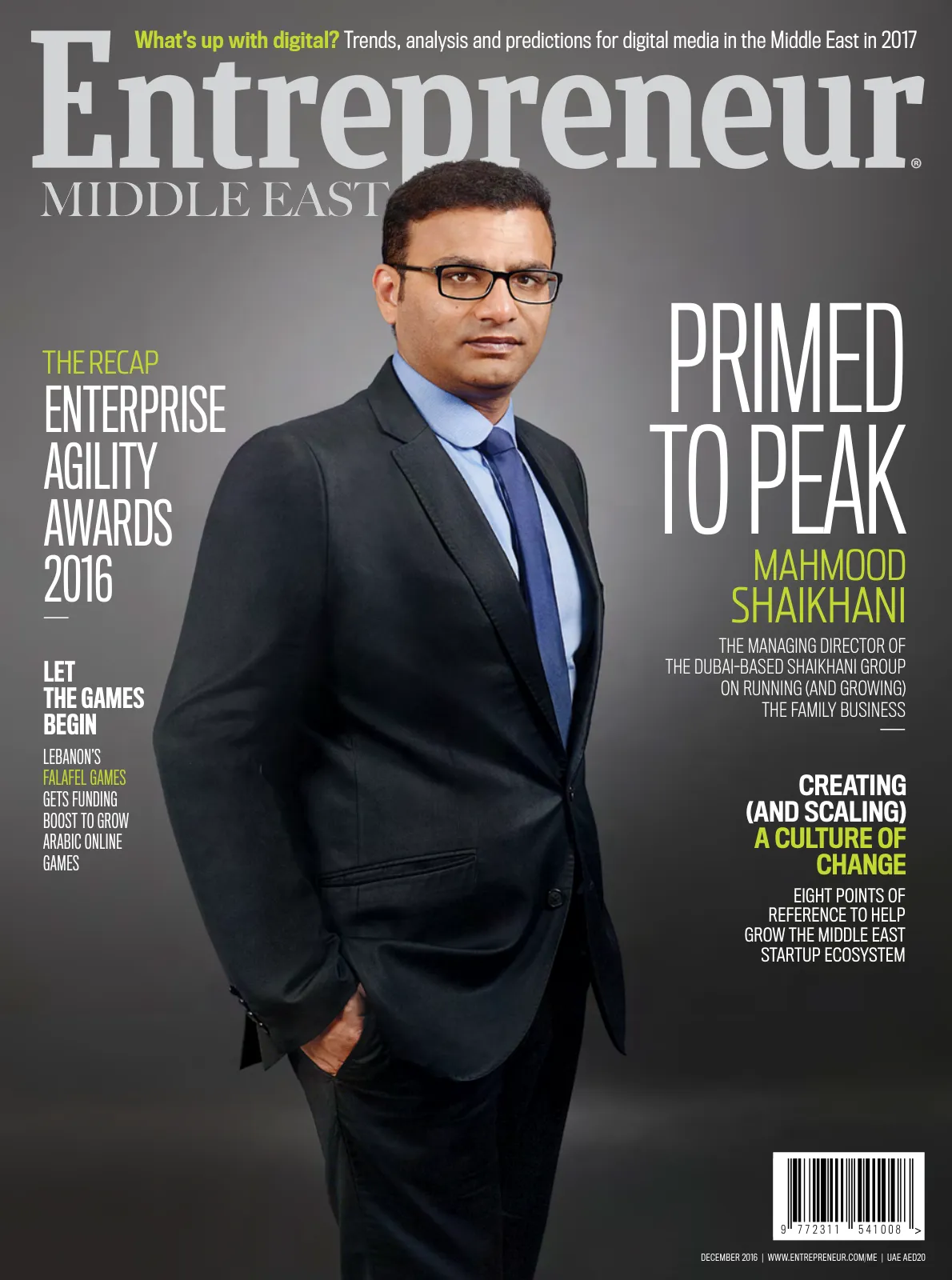
Entrepreneur Middle East, December 2016
Page 1
december 2016 | www.entrepreneur.com/me | UAE AED20
9
7 7 2 3 1 1
5 4 1 0 0 8
>
What’s up with digital? Trends, analysis and predictions for digital media in the Middle East in 2017
Mahmood
Shaikhani
Primed
to peak
The Managing Director of
the Dubai-based Shaikhani Group
on running (and growing)
the family business
The recap
Enterprise
Agility
Awards
2016
Creating
(and scaling)
a culture of
change
Let
the games
begin
Lebanon’s
Falafel Games
gets funding
boost to grow
Arabic online
games
Eight points of
reference to help
grow the Middle East
startup ecosystem
Page 2
Page 3
Page 4
Page 5
december 2016 Entrepreneur
3
33
Wissam Younane, CEO, BNC Publishing at the Entreprise Agility Awards 2016
CONTENTS
december 2016
John Backus,
co-founder
and Managing
Partner, PROOF
66
24
THE RECAP:
Enterprise Agility
Forum 2016
A round up of the topics
discussed and insights
shared at the 2016
Enterprise Agility Forum,
presented by du.
32
THE RECAP:
Enterprise Agility
Awards 2016
A look at the winners of
the third annual pan-Arab
Enterprise Agility Awards,
Entrepreneur of the Year,
presented by du.
20
INNOVATOR:
Primed to peak
Mahmood Shaikhani
The Managing Director of
the Dubai-based Shaikhani
Group on running (and
growing) his family
business.
46
TECH:
THE FIX
What’s up with digital?
Ema Linaker, Director of
Digital at Edelman, MEA,
offers her take on trends,
analysis and predictions for
digital media in the Middle
East in 2017.
66
MONEY:
VC VIEWPOINT
Investing in the hits
PROOF co-founder John
Backus explains how his
company is “a better way to
invest in the venture capital
asset class.”
50
TECH:
SHINY
#TamTalksTech
Gadgets and doodads that
you might’ve missed out on,
sourced by a tech aficionado.
Yes, it’s okay to want them
all… and no, it’s not our
fault.
Page 6
Page 7
Page 8
Page 9
Page 10
Page 11
Page 12
Entrepreneur december 2016
10
CONTENTS
24 The Enterprise Agility Forum 2016
december 2016
50
Sony MDR-
1000X
noice-canceling
headphones
Anghami founders
Elie Habib and
Eddy Maroun
72
78
START IT UP:
STARTUP FINANCE
Let the games begin
Lebanon’s Falafel Games
gets a boost of US$2.6
million in Series A funding
to grow Arabic online games
in the Middle East region.
68
TECH:
MOBILE TECH
Mobility matters
Mini Exchange founder
Sarah Jones offers
five pointers for your
business venturing into
the m-commerce arena.
54
‘TREPONOMICS:
ESQUIRE GUY
The art and science of
successful interruptions
The Esquire Guy on the
right way to interrupt
someone at work.
42
‘TREPONOMICS:
PRO
The pursuit of talent
Bayt.com’s Suhail Al Masri
lists the six HR tools that
every business needs- yes,
even your SME as well.
62
TREPONOMICS:
SKILLSET
Straight talk
Dawn Metcalfe says
it is not impossible
to have good difficult
conversations at work- but
yes, it is hard.
56
CULTURE:
LIFE
Iterate, not originate
James Clear explains why
starting from scratch is
usually a bad idea.
Page 13
BREITLING.COM
The superlative-charged chronograph. 50 mm case in Breitlight®. Exclusive Manufacture
Breitling Caliber B12 with 24-hour military-style display. Officially chronometer-certified.
Page 14
Entrepreneur december 2016
12
CONTENTS
december 2016
64
Under500
co-founders
Mahmood Bartawi
and Fadi Ghaly
46 Trends, analysis and predictions for digital media
in the Middle East in 2017
64
FRANCHISE:
Accelerating growth
Mahmood Bartawi and Fadi
Ghaly, the co-founders of
Under500, offer their five
tips for startups wanting
to expand their operations
through franchising.
52
CULTURE:
TRAPPINGS
‘Trep gear
The executive selection for
the entrepreneur on your
list that has everything.
Okay, maybe for a little
self-reward as well.
16
EDITOR’S NOTE
By Aby Sam Thomas
76
START IT UP:
Q&A
Off the shelf
Jordanian startup Jamalon
makes it easier for Arab
book lovers to find their
favorite read online.
80
START IT UP:
Q&A
Put that pen down
Stop taking notes- UAE
startup Wrappup wants
to make meetings more
efficient.
60
‘TREPONOMICS:
SKILLSET
Fatal flaws
UAE Business Solutions
Managing Partner Stephen
Armitage lists the 10 key
areas of a business, which
if ignored, will definitely
increase the likelihood
of any entrepreneurial
venture failing.
82
CULTURE:
LIFE
Clarity comes with
discipline
Mark Sephton lists
four tips to make better
decisions in 2017.
Page 15
27
Henri Asseily,
Manager Partner,
Leap Ventures
Page 16
Entrepreneur december 2016
14
SUBSCRIBE
Contact subscriptions@bncpublishing.net to receive
Entrepreneur Middle East every issue
EDITOR IN CHIEF Aby Sam Thomas editor@bncpublishing.net
CEO Wissam Younane wissam@bncpublishing.net
MANAGING DIRECTOR Walid Zok walid@bncpublishing.net
DIRECTOR Rabih Najm rabih@bncpublishing.net
CREATIVE LEAD Odette Kahwagi
STARTUPS SECTION EDITOR Pamella de Leon
COLUMNIST Sindhu Hariharan
COLUMNIST Tamara Clarke
COLUMNIST Shoug Al Nafisi
COLUMNIST Erika Widen
EVENTS LIAISON Mark Anthony Monzon
PO Box 502511 Dubai, United Arab Emirates
P +971 4 4200 506 | F +971 4 4200 196
For all commercial enquiries related to
Entrepreneur Middle East contact
sales@bncpublishing.net
All rights reserved © 2016.
Opinions expressed are solely those of the contributors.
Entrepreneur Middle East and all subsidiary
publications in the MENA region are officially licensed
exclusively to BNC Publishing in the MENA region by
Entrepreneur Media Inc.
No part of this magazine may be reproduced or
transmitted in any form or by any means without written
permission of the publisher.
Printed by Raidy Emirates Printing Group LLC
www.raidy.com
Images used in Entrepreneur Middle East are credited when necessary. Attributed use of
copyrighted images with permission. All images not credited otherwise Shutterstock.
Suhail Al Masri
Stephen Armitage
Mahmood Bartawi
James Clear
Fida Chaaban
Fadi Ghaly
Sarah Jones
Ema Linaker
Ross McCammon
Dawn Metcalfe
Mark Sephton
CONTRIBUTING WRITERS
www.entrepreneur.com/me
Access fresh content daily on our website!
MIDDLE EAST
EntMagazineME
@EntMagazineME
Entrepreneur-me
EntrepreneurMiddleEast
EntMagazineME
EntMagazineME
EntMagazineME
MIDDLE EAST
In addition to our print edition, we’re bringing
you all sorts of industry news on our web
mediums. Joining us online means getting
relevant business and startup content in
real-time, so you’re hearing about the latest
developments as soon as we do. We’re looking
forward to interacting with our readers on all of
our social media and web platforms- like any
thriving business, we’re looking to give and take.
#TrepTalkME is already happening on all of our
digi platforms, and all good conversations go
both ways. See you on the web!
Page 17
Page 18
Entrepreneur december 2016
16
EDITOR’S NOTE
Aby Sam Thomas
Editor in Chief
@thisisaby
aby@bncpublishing.net
If you build it…
Debate hour in the ecosystem:
is our e-commerce landscape about to change?
A
s any business journalist
working in the Middle
East will tell you, it’s
not uncommon for
companies in the region
to fire off press releases
that contain a lot of hy-
perbole, and so, our role as media
requires us to take everything we
are told with a pinch of salt. So,
when Emaar Properties Chairman
Mohamed Alabbar announced the
launch of his e-commerce venture
Noon in November, I admit to
have been a little taken aback by
the rather cheery response to the
enterprise.
Sure, its initial investment of
US$1 billion makes Noon worthy
of notice, but for a website that
has not even gone live yet it’s
hard to abide by the premise that
-as a press release declared- “the
online shopping experience in
the Middle East will forever be
changed with the launch of Noon
in January.” I mean- I think it’s
just too early to make those kinds
of statements! After all, there has
been steady growth in the region’s
e-commerce sector for a while
now, and it has plenty of players
in its field already, with most of
them being homegrown startups
like Souq, Namshi, JadoPado, etc.
There’s already a lot of speculation
about how these companies will
fare when Alabbar’s mammoth
enterprise enters their domain,
but then again, competition is
good- although it does seem that
the cards are now heavily stacked
in Noon’s favor simply because of
the size of the investment.
At the same time, given the
fledgling startup ecosystem we
have in this region, I also have to
wonder: why did Alabbar have to
create an entirely new e-commerce
enterprise- wouldn’t it have been
better to invest in an existing
business in this realm? After all,
there’s been reports suggesting
that Souq is being eyed by Amazon
for a potential $1 billion buyout-
while such an exit, if it happens,
will indeed be something to
celebrate about, I can’t help but
wonder if the ecosystem would be
better served if the enterprise’s
ownership would remain in
the Arab world. Much like how
America has Amazon, and China
has Alibaba, it’d have been great to
have the Middle East have a grand
e-commerce venture to its own
name as well. Let’s also not forget
that it’s very likely that an Alabbar
buyout of Souq would have also
spurred the injection of more
Arab investment into the startup
ecosystem- we absolutely need
more capital to be injected into
this region. However, this is just
speculation: perhaps Alabbar did
consider e-commerce ventures in
the region, but they were not up to
the mark that he envisioned- we’ll
have to wait for another interview
to confirm this. (For the record,
Entrepreneur’s request for a chat
with him is still outstanding.)
I am curious to hear what our
readers in the Middle East’s entre-
preneurial ecosystem think about
Noon. Did we need a whole new
e-commerce site when alternatives
exist and have demonstrated criti-
cal mass? Or, would it have been
better for the region to have Alab-
bar funding the growth of one of
the existing e-commerce startups?
Let me know your opinions via
email or Twitter.
P. S. Mr. Alabbar: if you are reading
this, I’d be happy to hear your take
on this! Just let me know when’s a
good time to chat.
Page 19
LOOKING TO SET UP YOUR BUSINESS?
Call: 800 7111 Visit: www.rakftz.com Follow:
/ rakftz
FLEXI FACILITIES
AED 13,500
AED 25,500
OFFICES
AED 205/M2
WAREHOUSES
AED 18/M2
INDUSTRIAL LAND
Ras Al Khaimah Free Trade Zone
provides the right elements for
a successful business, including
licences, visas, facilities, 100%
foreign ownership and zero
taxation. Prices start from:
Page 20
Entrepreneur december 2016
18
IN THE LOOP
Funding innovation
Flat6Labs raises a US$1 million commitment from
IFC to finance Egypt’s entrepreneurs
Flat6Labs Cairo Demo Day
Dubai’s new hub for
creativity
Mohammad Saeed Al Shehhi, COO, d3 and Malek Al Malek,
CEO, TECOM Business Parks
TECOM Group launches a new
in5 innovation center for design
and fashion ventures
flat6labs.com
S
tartup accelerator Flat-
6Labs Egypt is closing
a new venture capital
fund of EGP 50 million
(part of a US$1 million
commitment) from
International Finance Corporation
(IFC), the investment arm of the
World Bank, to support Egypt’s
entrepreneurship community. The
investment comes from IFC’s $30
million commitment towards the
Startup Catalyst initiative that
backs funds and accelerators in
emerging markets. Flat6Labs CEO
Ramez M. El-Serafy says that the
funding will be used to “accelerate
more than 100 Egyptian startups
over the next five years,” and will
help “spur a wave of innovation
in the Egyptian market” by filling
the financing gaps at seed stage.
Flat6Labs provides startups with
seed funds, mentorship, a collabo-
rative co-working environment
and connections to help them
start and scale a business venture.
For its new fund, the accelerator
aims to look at “innovative and
technology-driven companies”
across growing sectors such as
ICT, education tech, healthcare
tech, digital media, and fintech,
among others. “I [also] believe
that IFC’s contribution and sup-
port to Flat6Labs’ new fund is
a strong testament to both our
funding model and IFC’s commit-
ment to pursue economic growth
in Egypt,” says El-Serafy.
Earlier in June 2016, IFC
announced its plans to double
its portfolio of venture capital
investments to $1 billion over
the next two years to support
technology entrepreneurs and
accelerate innovation in emerging
markets. IFC’s venture capital
investments include Indian
healthcare venture Portea,
e-commerce company Souq.com,
and Turkish consumer internet
company Hepsiburada. As noted
by IFC in its website, Flat6Labs
could expect to “directly and
indirectly create 1,500 new jobs”
with the proposed financial
support to 100 enterprises.
Besides monetary support, IFC
says it will also assist Flat6Labs
on “environmental, social, and
governance frameworks,” offer
advisory services and explore
“potential co-investment”
opportunities in follow-on rounds.
With Flat6Labs’ track record
of accelerating 46 companies
in Egypt, El-Serafy is confident
that the financial boost will help
them create a thriving startup
community with a “high quality
pipeline of deal flow” for angel
investors and venture capitalists.
While Egypt’s entrepreneurship
ecosystem has seen steady growth
over the past years, availability of
funding for early-stage startups
is still a challenge, and Flat6Labs’
new fund also plans to focus on
follow-on investment, “which will
eventually catalyze the growth of
promising startups in Egypt and
scale them to profitability at a
faster pace.”
A
fter having created and grown a
technology business incubator in
Dubai, TECOM Group’s in5 network has
announced plans to launch a new innovation
center for design and fashion ventures in
Dubai’s design hub, Dubai Design District
(d3) in January 2017. With an objective
to provide access to the infrastructure
and mentorship needed to grow creative
businesses, the new in5 innovation center
will offer co-working spaces and industry-
focused training to aspiring entrepreneurs in
the design and fashion space. As part of the
specialized facilities, the in5 facility will host
a prototyping lab, and equipment including
3D printers, other machinery for designers.
In addition, members will also enjoy access
to the materials and technology needed to
develop their ideas into viable products.
Owing to its structure and location, the
incubator will also help create networking
opportunities for the entrepreneurs and give
them access to investors.
“Having started with technology, in5 has
evolved to supporting startups in the media
sector and now with our entry into design,
we will aid in setting a new benchmark in
creativity,” Malek Al Malek, CEO, TECOM
Business Parks, said in a statement. Launched
in 2013, in5’s technology innovation centre
has incubated 160 startups till date, and in5
also plans to open a media innovation centre
that’s slated to launch in the first quarter
of 2017. With the MENA’s design industry
estimated to grow to reach US$55 billion in
value by 2019, and industry reports stressing
on the need for at least 30,000 design
graduates, TECOM Group says it is keen to
help support this growth phase with the new
in5 innovation center. www.infive.ae
Page 21
Charles Blaschke and
Chris Burkhadt of Taka
Solutions, winner of The
Page 22
Entrepreneur december 2016
20
INNOVATOR
INNOVATOR
“Being an
entrepreneur means
you should be
knowing what will
happen in the
future.”
Mahmood Shaikhani,
Managing Director, Shaikhani Group
Page 23
december 2016 Entrepreneur
21
I
n a region where over
80% of businesses are
either owned or con-
trolled by families, it’s
easy to note the similari-
ties between the growth
stories of the Shaikhani
Group of Companies
and other family businesses
based here in the Middle
East. Much like its peers in
the market, Shaikhani Group
was brought into being by a
visionary entrepreneur, the
late Abu Baker Shaikhani,
who started the company
in Pakistan as a real estate
brokerage in 1978 and then
diversified its offerings by
moving into other industries
like trading and manufactur-
ing. He then followed it up
by setting up shop in a new
market- which, in this case,
was the UAE, through the
establishment of a rubber
insulation factory in 1994 in
the Emirate of Ajman. In the
years since, the Shaikhani
Group has grown and evolved
quite a bit- given that its
core business in Pakistan
was in real estate, it was only
a matter of time before the
company made its entry into
the UAE’s property develop-
ment sector as well. The
Shaikhani Group proudly
declares that it has already
been able to deliver more
than 30,000 residential
units in Pakistan and the
UAE, and given that it has
a development pipeline of
AED3.5 billion in the latter
market, it’s safe to say this
Dubai-headquartered en-
terprise is set for a lot more
growth in the near future.
Managing Director Mah-
mood Shaikhani, one of
Abu Baker Shaikhani’s four
sons, is the one in charge of
the Shaikhani Group today,
whose 12 different business
units employ more than 350
people around the world.
The company currently
boasts of an annual turnover
of over AED220 billion, a
figure that seems set to rise
given its plans for the future.
“Today, we have 11 projects
overall [in development],”
Shaikhani says, while re-
vealing that AED1.5 billion
worth of these are close to
completion, while the others
are expected to be ready by
2020. With locations like
Dubai Sports City (Frankfurt
Sports Tower, Champions
Tower I, II, III and IV), Dubai
Silicon Oasis (Cambridge
Business Center) and
Jumeirah Village Circle (Gar-
denia Residency), Shaikhani
explains that the variety of
projects that his company is
pursuing is an indication of
its growth strategy, wherein
it seeks to be in line with
the vision that H.H. Sheikh
Mohammed Bin Rashid Al
Maktoum, Vice President
and Prime Minister of the
UAE and Ruler of Dubai, has
set for the Emirate. While
it is definitely clear that the
company has grown in the
years since it set up shop
in the UAE, it seems that
Shaikhani is dreaming bigger
things for the enterprise,
and he seems to be leaving
no stone unturned to realize
his ambitions for his family
business. His current role
at the helm of the company
was one that was he was
groomed for, but Shaikhani,
a graduate in Business Ad-
ministration from London
Metropolitan University, was
clear that he’d forge his own
path when it came to leading
the business to its next stage
of growth. “I was brought
up in such a manner that [I
was told] I’d have to run the
family business, but I didn’t
have to do the same thing
as whatever my father was
doing,” he explains. “I had
to bring something new into
the business- because I was
educated in such a manner.”
Fortunately for Shaikhani,
his family has thrown their
wholehearted support
behind his ambitious plans
for the business, and it looks
like the industry at large is
also sitting up and taking no-
tice of the company’s prog-
ress as well. And the reasons
Primed
to peak
Mahmood Shaikhani
The Managing Director of the Dubai-based
Shaikhani Group on running (and growing)
the family business
INNOVATOR
www.shaikhanigroup.com
>>>
Page 24
Entrepreneur december 2016
22
INNOVATOR
REAL ESTATE
Through its group companies
based in the Middle East and
Asia, the Shaikhani Group
caters to real estate project
development, with projects
including Frankfurt Sports
Tower, Cambridge Business
Center, etc.
CONTRACTING
Shaikhani Contracting is a
subsidiary that delivers a wide
array of services, including
HVAC and MEP, glass, alumi-
num and cladding works, join-
ery, metal and cabinet, civil,
flooring works and insulation
contracting.
FACILITY MANAGEMENT
As Shaikhani Group’s facility
management arm, Takmeel
specializes in the provision
of services like design and
concept, construction and
project management, property
management, etc.
MANUFACTURING
Rubber World Industries,
the leading manufacturer of
closed-cell rubber insula-
tion Gulf-O-Flex in the Gulf
and Southeast Asia, is the
pioneering project of the Shai-
khani Group of Companies.
TRADING
Gulf-O-Flex Trading is the
trading arm of Shaikhani
Group with dealers and
distributors network across
the globe. It aims to provide
a one-window solution to all
the HVAC related material
requirements of its customers.
AUTOMOBILE
Shaikhani Autos is a key
dealer of new and used cars
from the USA. The dealership
ably offers affordably priced
automobiles for the United
States and Middle East
markets.
BPO
De-Express delivers world-
class strategic BPO services
to leading European energy
service providers and their
consumers. Based in Karachi,
Pakistan, De-Express offers
a variety of key services to a
growing customer base.
F&B
MS Britannia LTD has a series
of franchises, a food griller
chain in the UK, and the group
will be introducing 10 branches
in the UAE. MS UK Foods LTD
is another food chain of Rio
Piri Piri Chicken in London.
Portfolio check
An overview of the Shaikhani Group’s diversified
lines of businesses
Shaikhani Group won
Best Residential Project
at the 2016 Construction
Innovation Awards
Under
construction
Champions
Tower
for this are aplenty- for one,
Shaikhani Group is one of
the property development
companies that managed to
steer through the economic
recession successfully, and
is now on track to deliver all
of its other projects as well.
Shaikhani Group’s ongo-
ing real estate projects, for
instance, are targeted toward
the mid-market segment,
which is where demand is
already picking up, and set
to rise even further. Smaller
units –just like the one- and
two-bedroom apartments
Shaikhani Group are bring-
ing to the market- are seeing
a lot of interest in the Dubai
property sector today. The
company is also trying
to facilitate more buyers
for its offerings through its
payment plan- billed as the
Family Homes initiative, it
will allow for buyers to pay
50% of the price when they
sign on, and the remainder
can be paid after handover
over a 24-month-long peri-
od. But it’s not just the buy-
ers- Shaikhani Group’s proj-
ects are also getting noticed
in Dubai’s real estate busi-
ness community. Its AED220
million Gardenia Residency
project was declared as the
‘Residential Project of the
Year’ at the 2016 Construc-
tion Innovation Awards
presented by Construction
Business News Middle East
in October this year. In a
statement released after the
win, Shaikhani called the
award “a defining moment”
for his enterprise. “These
industry-leading awards re-
flect our customers’ trust on
us and the business commu-
nity’s sincere appreciation
of our works and the quality
of our works,” he says. “I
am pleased to accept these
awards, which are the results
of dedication, teamwork,
hard work and collective
efforts by my team members,
and the award goes to them.”
With his company’s foot-
print now firmly embedded
in the property develop-
ment and industry sectors,
Shaikhani aims to diversify
his family business further
in the future, by moving
into the F&B and textile
industries. With regards
to the former, Shaikhani
reveals that the company
has already signed contracts
with two franchises in the
UK, whereas for the latter,
the search is still on for good
business opportunities in
that arena. As for his exist-
ing businesses, Shaikhani is
clear that in order for them
to move forward, the inte-
gration of new innovations
and a continued emphasis on
research and development
will be essential. Shaikhani
doesn’t rule out the potential
of an IPO in the years to
come as well- he’s gauging
the state of his business and
the market at large for its
readiness in terms of such an
exposure. “Being an entre-
preneur means you should
be knowing what will happen
in the future,” he says- it is
this kind of foresight that
Shaikhani credits for the
company’s success, and it’s
what he hopes will sustain it
in the years to come as well.
Page 25
Porto Arabia Towers
Doha, Qatar
������������������������������
Hill International
The Global Leader in Managing Construction Risk
www.hillintl.com
�����������������������������������������������������������������������
���������������������������������������������������������������������
��������������������������������������������������������������������������
������������������������������������������������������������������������
�������������������������������������������������������������������������
���������������������������������������������������������������������
��������������������
����������������������������������������������������������������������������
���������������������������������������������������������������������
�������������������������������������������������������������������������
�����������������������������������������������
��������������������������
�������������������������
��������������������������
If you can imagine it, we can manage it.
��������������������
Doha, Qatar
��������������
Doha, Qatar
Viva Bahriya Towers
Doha, Qatar
Page 26
Entrepreneur december 2016
24
Enterprise
Agility Forum
2016
The Methodology
of Business
Industry Intel event
An
luxury partner
PLATINUM ALLY
PLATINUM ALLY
SUPPORTED BY
a production by
GOLD ALLY
GOLD ALLY
GOLD ALLY
GOLD ALLY
ecosystem partner
M
ore than 300 people
came together for
the third edition of
Entrepreneur Middle
East’s Enterprise
Agility Forum, pre-
sented by du, which was held
at the Westin Mina Al Seyahi
in Dubai, UAE, on November
08, 2016. The annual confer-
ence, which is staged under
Entrepreneur Middle East’s
Industry Intel banner, had
speakers from all around the
Middle East to share their
insights and expertise on the
entrepreneurial ecosystem of
the region.
Entrepreneur Middle East
Editor in Chief Aby Sam
Thomas kicked off the event
with his opening remarks,
following which the confer-
ence was co-moderated by him
and KBW Investments Chief
Communications Officer Fida
Chaaban.
The first Taking Series ses-
sion of the conference was
a panel discussion on the
topic, Walking The Talk: How
Corporates Can Better Support
The MENA Startup Ecosystem,
which was headlined by J. J.
De La Torre, Digital Trans-
formation Leader, IBM MEA,
Eman Al Mahmoud, Programs
Manager, Sheraa (Sharjah
Entrepreneurship Center), Ab-
delRahim AbuSedira, Head of
SME Marketing, du, and Jean-
Michel Gauthier, co-founder
and CEO, InternsME com.
The speakers spoke on the
need for more win-win col-
laborations between corpo-
rates and startups, as well as
services and solutions that are
especially tailored for SMEs in
the region.
This discussion was followed
by a fireside chat with Tamer
Bazzari, founder and CEO,
Genero Capital, which delved
into various aspects of the
MENA investment scene,
including angels, private
equity, etc. Over the course
of the conversation, Bazzari
also explained to the audience
the characteristics investors
look for when they consider
a startup or SME to fund,
stressing on the need for both
parties in such a partnership
to maintain an open and col-
laborative approach.
The second of the Talking
Series brought forward ideas
and strategies for small busi-
nesses wanting to scale up
their respective enterprises.
Titled Growth Hacks: Moving
Out Of Your Home Market And
Expanding Your SME’s Reach,
this discussion had as its pan-
elists Mai Medhat, co-founder
and CEO, Eventtus, Omar
Soudodi, Managing Director,
Payfort, Tarek Ghobar, Start-
ups Services Manager, 1776
Dubai, and Hala Alturki, CEO,
Kwn Education. While the
discussion focused on the im-
portance of digital media skills
to enable the building up of an
enterprise, the speakers also
underlined the significance of
having a local presence when
it comes to operating in new
markets.
The third and final discus-
sion of the day was on the
topic, Mo Money Mo Problems:
Managing Your Money (And
Your Burn Rate) After You’ve
Got Funded, which delved
into the preparatory steps
entrepreneurs need to take
when their enterprises find
investment from VCs, angels,
etc. This panel featured Dany
Farha, co-founder and CEO,
BECO Capital, Kunal Kapoor,
founder, The Luxury Closet,
Jon Richards, co-founder and
CEO, compareit4me.com and
Dr. Christiane Schloderer,
Founding Partner, Athena
CFO.
The 2016 Enterprise Agility
Forum presented by du was
conducted with the support of
the Dubai Chamber and Tejar
Dubai, Luxury Partner Cadil-
lac, Platinum Allies AJSM
Investments and Hill Interna-
tional, Gold Allies in5, RAK
Free Trade Zone, Sama Santé
Medical Center and Skyline
University College, and Eco-
system Partner The Venture.
Page 27
december 2016 Entrepreneur
25
december 2016 Entrepreneur
25
Enterprise Agility
Forum 2016
the methodology of business
Industry Intel event
An
Page 28
Entrepreneur december 2016
26
.
Creating (and
scaling) a culture
of change
Eight points of reference to help grow the Middle East
startup ecosystem By Soukaina Rachidi
Enterprise Agility
Forum 2016
the methodology of business
Industry Intel event
An
AbdelRahim AbuSedira, Head of SME
Marketing, du
Aby Sam Thomas, Editor in Chief,
Entrepreneur Middle East
Fida Chaaban, Chief Communications
Officer, KBW Investments
Brought to you by
T
he 2016 edition of
Entrepreneur Middle
East’s Enterprise
Agility Forum,
presented by du,
discussed a variety of topics
relating to the entrepreneurial
ecosystem, with the main
themes being on how corpo-
rates can support startups
better, how SMEs can grow
into new markets, and how
burn rates need to be man-
aged after an influx of funds.
While it may seem that these
topics are only linked by the
theme of entrepreneurship,
I would argue that they are
connected on a more funda-
mental level. If these factors
are not achieved correctly,
then they are symptoms of a
startup ecosystem that has not
adequately prepared its stake-
holders to work in a collabora-
tive and productive manner.
Indeed, these are symptoms
of a startup ecosystem that is
still struggling with the idea of
creating and scaling a culture
of change.
What do I mean when I say
“creating and scaling a culture
of change?” After all, doesn’t
every city, country, region
and startup ecosystem have
a unique set of problems that
require specific homegrown
solutions? Yes, this is true.
However, I am not suggesting
that they should adopt one set
of global “standard operating
procedures” to overcome their
socio-economic and cultural
problems. What I am sug-
gesting is that we globalize
the thought processes that
have been used to produce
the “ecosystems of success”
that exist in other countries.
So, what’s the big difference
between focusing on globaliz-
ing the thought processes,
versus the outcomes? Well, in
my opinion, there’s a huge dif-
ference. When you only focus
on achieving the outcomes of a
successful startup ecosystem,
you spend too much time try-
ing to replicate objectives that
are unrealistic or irrelevant for
the immediate needs of your
startup ecosystem. On the
other hand, focusing on shar-
ing successful entrepreneur-
ial thought processes allows
emerging startup ecosystems
to organically create policies
and KPIs that align with your
own development level and
value systems. We all know
that change is inevitable, but
there are ways that we can try
to ensure that the change that
does occur is in our favor, and
that is why I am a huge propo-
nent of creating and scaling a
culture of change. Or in other
words, sharing cultures that
promote a Socratic approach
to the way we develop our
respective startup ecosystems.
According to the 2016 BNP
Paribas Global Entrepreneur
report, it is estimated that the
average millennial entrepre-
neur will start a business at
the age of 27, and will launch
an average of eight businesses
in their lifetime. On the other
hand, their predecessors,
the baby boomers, started
their first business at 35, and
launched an average of four
businesses in their lifetime.
These statistics prove that
young entrepreneurs today
are ready to start, fail and
exit businesses more than
ever. Thus, emphasizing the
need for all the stakeholders
in our startup ecosystems to
integrate cultures of change
in their business practices,
so we can start to make this
concept a part of the DNA of
our global ecosystems. Here
are eight steps to developing
this culture of change that we
can start implementing in our
Middle East ecosystem today:
1. Changing the culture
of how corporates
and startups relate to
each other
When people think of the
relationship between startups
and corporates, they usually
think of it as being one defined
by contention and bitter
competition. However, this
doesn’t have to be the case.
In fact, I would even argue
that corporates and startups
need each other to thrive.
Page 29
december 2016 Entrepreneur
27
While corporations have the
money to innovate, they lack
the agility. On the other hand,
startups lack the money to be
innovative but they possess
the agility to do so. Thus,
highlighting a natural synergy
that unites these seemingly
disparate business entities.
So, how can we start chang-
ing the way that startups and
corporates view each other?
According to J. J. De La Torre,
Digital Transformation Leader
at IBM MEA, the first step is
to getting more corporates
involved in the “startup con-
versation” and ecosystem.
By attending startup events
and participating in two-way
dialogue (emphasis on the
two), both corporates and
startups can begin to explore
how each party can add value
to each other through a col-
laborative and creative process
of co-creation. On the other
hand, corporates can also get
more involved in the startup
ecosystem by collaborat-
ing with more accelerators,
incubators and co-working
spaces. But why would a cor-
porate want to do that? Well,
as Tarek Ghobar, Startups
Services Manager at 1776
Dubai, highlighted during the
forum, these spaces are where
the startup ecosystem gathers
to exchange ideas, expertise
and experiences. So, if corpo-
rates feel the need to become
more relevant in the ongoing
conversations, they need to
get involved in these spaces
so they can offer the strategic
mentorship, partnerships, fi-
nancial support, software and
hardware that entrepreneurs
need to thrive in the market.
2. Changing the
culture of how
corporates support
entrepreneurship
Once we can get corporates
and startups to view their
relationship as a symbiotic
one, the next challenge is to
change the way that they offer
and receive support. However,
in multinational companies,
where changing the standard
operating procedures needed
to make this happen is very
difficult, changing this reality
starts to feel like an impossible
task. Unfortunately, in most
countries, corporates have op-
erated with little competition
and their standard procedures
have set the tone for busi-
ness in their ecosystems for
decades.
That being said, times have
changed and corporates are no
longer the sole trendsetters
in the business world. Now,
SMEs are disrupting ecosys-
tems and finding new ways
to validate business models,
generate revenue and recruit
talent. So, if corporates want
to stay relevant they will have
to streamline their outreach
and support efforts, so they
don’t lose out on valuable in-
vestment opportunities in the
startup ecosystems. Consider
du’s recent investment in, and
collaboration with Lebanese
startup Anghami- this is a
great example of what we need
to see more of in our startup
ecosystems. As du’s Head of
SME Marketing Abdelrahim
AbuSedira indicated at the
Enterprise Agility Forum, the
telco’s efforts in catering to the
SME sector shows how corpo-
rates are slowly changing their
attitudes toward investments
in entrepreneurship, which
is ultimately also giving them
new ways to connect with their
existing and future customers.
3. Changing the culture
of how startup
ecosystems develop
entrepreneurs
Over the past couple of years,
entrepreneurship has been
marketed as a young and
“sexy” pursuit. When we say
the word startup, we usually
picture nerdy-looking hipsters
developing a new social media
app in their parent’s garage, as
they eat kale and drink organic
açaí berry smoothies. While I
am a huge proponent of bold
fashion statements, creativity
and healthy eating habits, I am
less enthusiastic about the cul-
ture of random innovation that
the “sexy” startup marketing
has promoted throughout the
world. Not all startup concepts
have to address a basic need,
but if we hope to promote
diversity in the MENA region’s
economies, then we should
encourage more entrepreneurs
to address the problems and
gaps in our current business
ecosystems.
Eman Al Mahmoud, Pro-
grams Manager of Sheraa
(Sharjah Entrepreneurship
Center), shared a perfect
example of this during the
Agility Forum. In order to solve
a problem it was facing in its
day-to-day operations, Air
Arabia, Sharjah’s low budget
airline, decided to forego the
usual corporate route of hir-
ing consultants, and instead
issued a challenge to startups
to come up with solutions
for their issue. By creating
this contest, not only has a
corporate like Air Arabia cre-
ated a space for collaborative
innovation to occur, it has
also created a unique op-
portunity for entrepreneurs
to create a business solution
that addresses a real, local
problem, thereby guarantee-
ing entrepreneurs at least
one customer, and potentially
more. Not every startup in the
MENA startup ecosystem has
to address a critical problem
in the Arab world. However, if
we foster more opportunities
for entrepreneurs to tackle the
world’s biggest challenges, we
could definitely start a trend
of hitting two birds with one
stone.
4. Changing the culture
of how startups scale
their operations
globally
Whenever I talk about the
challenges that face develop-
ment in the MENA region, I
always try to remind people
that the Arab world is made
up of 22 countries and each
country in North Africa, the
Horn of Africa, the Gulf and
the Levant reflect very differ-
ent cultures, especially when
it comes to consumer behav-
ior. So, when an entrepreneur
J.J. De La Torre, Digital Transformation
Leader, IBM MEA
Mai Medhat, co-founder and CEO, Eventtus
Tarek Ghobar, Startups Services Manager,
1776 Dubai
Eman Al Mahmoud Programs Manager,
Sheraa (Sharjah Entrepreneurship Center)
>>>
Page 30
Entrepreneur december 2016
28
is thinking of expanding into
another country, sometimes
even to another city in the
same country, they have to
be well prepared for such an
endeavor. As Mai Medhat,
co-founder and CEO of Event-
tus shared with the Agility
Forum’s audience, startups
need to scale their business
in stages.
While the scaling process
might look different for every
startup, it is vital for an en-
trepreneur to spend the first
few months (or even years)
learning about their industry,
and improving their service or
product before expanding to
new cities and countries. By
adopting a “global thinking,
local testing” growth model,
not only do entrepreneurs
give their startups the chance
to pivot and grow, they also
allow themselves to do so
in a “safe environment,”
since they can relate to their
consumer base and they
understand the obstacles and
the players in their business
ecosystem. This will thus al-
low entrepreneurs to develop,
experiment and refine stand-
ard operating procedures for
national and global expansion
that meet the specific needs
of their business model at
home and abroad.
5. Changing the culture
of how startups
globalize their teams
Once a startup has estab-
lished a strong presence in
their “home market” and cre-
ated “brand-specific standard
operating procedures” they
are ready for the next step in
initiating growth. According
to Omar Soudodi, Managing
Director of Payfort, this will
involve recruiting and hiring
talent in the market where
a startup intends to “set up
shop.” This is especially true
for a startup offering new so-
lutions, like Payfort, because
regulatory and legal frame-
works vary from country to
country, and bureaucratic
processes can be lengthy and
problematic. After all, no one
can know everything about
every market, so what better
way for an entrepreneur to
cover all their legal, financial
and cultural bases than to
localize their startup team,
and hire people who have an
inherent understanding of the
ecosystem that an entrepre-
neur is looking to expand to?
Although it might be daunt-
ing for an entrepreneur to
decentralize the decision-
making process when they
expand at first, it is necessary
for the continued growth and
prosperity of the business. As
long as a startup’s in-country
team has a thorough under-
standing of the company’s
value proposition, core values
and work culture, they should
be encouraged to implement
any measure that will make
the startup more relevant
to the consumers where it
operates. At the end of the
day, brand consistency is not
undermined by differences
in the way a startup operates
from country to country, it is
reinforced by the underlying
values that allow its global
teams to adapt and provide a
quality service or product to
their customers.
6. Changing the
culture of how our
youth are educated
and trained
During the Agility Forum,
Hala Alturki, CEO of Kwn
Education, said that though
reports suggest that only a
fraction of the Arab world’s
digital potential has been
tapped, youth in the MENA
region aren’t embracing these
opportunities as much as
they should, because they
are still chasing jobs that
won’t, well, exist in a couple
of years. However, this is not
the only problem facing our
youth. In many countries
across the Arab world, the
educational culture still heav-
ily relies on rote learning,
where teachers are teach-
ing to the test and students
are merely perfecting their
test-taking skills. As a result,
Arab youth continue to suffer
from a lack of digital training
and critical thinking skills,
especially in the Arabic lan-
guage. Having said that, Kwn
Education is making an effort
in systematically reimagining
the culture of education in
the MENA region, by provid-
ing online STEM education in
Arabic to individuals and in-
stitutions in both the public
and private sectors.
But Kwn Education isn’t
the only startup out there
looking to transform the
potential of youth in the
MENA region. Jean-Michel
Gauthier, co-founder and
CEO of InternsME, is also
trying to empower youth in
the MENA by helping them
find employment that fulfills
them personally and profes-
sionally. Although Gauthier
was specifically addressing
startups in the audience
when he said, “You shouldn’t
expect people to just want
your product, you should
talk to businesses and see
how you can add value and
change your offering,” this
message is not so different
from the one that InternsME
tries to inculcate in its users
on a daily basis. Not only is
this powerful shift in attitude
streamlining the recruitment
process for employers and job
seekers alike, it is also em-
powering young people to be
fully and positively engaged
in their respective communi-
ties and economies.
7. Changing the culture
of how startups value
and spend money
When an entrepreneur first
starts their business, spend-
ing money on anything feels
painful, because they are
usually self-funded or they
are receiving small capital
injections from the three
F’s: family, friends and fools.
Once the entrepreneur has
more confidence in their
product and team, they will
start looking to raise funding
rounds, which they usually
view as the solution to all
Omar Soudodi, Managing Director
Payfort
Hala Alturki, CEO, Kwn Education
Jean-Michel Gauthier, founder and
CEO, InternsME
Enterprise Agility
Forum 2016
the methodology of business
Industry Intel event
An
>>>
Dany Farha, co-founder and CEO,
BECO Capital
Page 31
december 2016 Entrepreneur
29
december 2016 Entrepreneur
29
Enterprise Agility
Forum 2016
the methodology of business
Industry Intel event
An
Page 32
Entrepreneur december 2016
30
Jon Richards, co-founder and CEO,
compareit4me.com
Tamer Bazzari, CEO, Genero Capital
Kunal Kapoor, CEO, The Luxury Closet
Dr. Christiane Schloderer, Founding Partner,
Athena CFO
Enterprise Agility
Forum 2016
the methodology of business
Industry Intel event
An
their problems. However, this
is almost never the case. As
Dany Farha, co-founder and
CEO of BECO Capital empha-
sized during the Agility Forum,
“planning and patience are
important in the fundrais-
ing process, because closing
investment rounds can take
a while.” Consequently, not
only do entrepreneurs need
to make sure that they are
dedicating the right amount of
time, money and manpower to
the fundraising process, they
also have to make sure that
they have a solid plan for how
they intend to use that money
once they’ve got it. After a
startup closes its round and
secures its funds, this is when
a different, dare I say, more
problematic issue arises.
When an influx of funds
comes in, many entrepreneurs
become tempted to abandon
the agile ways they operated
during their bootstrapping
days, and they stop scrutiniz-
ing the way they spend money.
While spending habits and
funding allocations might
vary from startup to startup,
it is vital that a startup makes
responsible spending hab-
its a core part of its culture.
According to Kunal Kapoor,
founder of The Luxury Closet,
the first step to establishing
this culture is to never allow
your team to underestimate
any cost, no matter how big
or small, because extravagant
spending doesn’t guarantee a
better customer experience.
The second step, according
to Dr. Christiane Schloderer,
Founding Partner of Athena
CFO, is to be clear on the
outcome of every expense, and
never fail to question every
spend on whether it is neces-
sary. Whether your parents
are giving you money to buy
new equipment, or you’re pre-
paring your startup for an IPO,
you should always be vigilant
about the fiscal culture you
develop in your startup, be-
cause it could be what makes
or breaks you.
8. Changing the culture
of how investors invest
in entrepreneurship
Not only do entrepreneurs
have to change their internal
cultures towards financial
spending, they also have
to change the nature of
the relationships that they
develop with their investors.
That being said, changing
this relationship shouldn’t be
the sole responsibility of the
entrepreneur. Investors should
also take it upon themselves
to develop more enriching and
mutually beneficial relation-
ships with entrepreneurs. For
example, when Tamer Bazzari,
founder of Genero Capital, is
looking to invest in an early-
stage startup, he spends a lot
of time asking them questions
and getting to know them. But
that’s not all he does. Once
Bazzari decides to invest in a
startup, he also actively seeks
to mentor them and establish a
good relationship with them.
Some may ask: “Who cares if
I can WhatsApp my investors
about my hopes, dreams, or
the poor life decision I made
for my startup?” Well, you
should, because an investor
should never be seen as just a
“startup ATM.” Many inves-
tors have a wealth of knowl-
edge about various industries
and business ecosystems and
entrepreneurs should use this
knowledge to help them scale
their startups. They also have
a wide network of national and
international business con-
tacts and partners, which can
help entrepreneurs add new
elements to their customer ex-
perience or, eventually, become
future investors. Entrepre-
neurs can also use investors’
commentary and feedback
as a “sense check,” like Jon
Richards, co-founder and CEO
of compareit4me, does when
he wants to understand how
an objective observer views
the progress of his business.
Ultimately, you get what you
put into a relationship. So, the
more an entrepreneur tries
to share and learn with an
investor, the higher the “ROI”
for both parties. Now, that’s a
win-win situation.
Page 33
The Regional Leaders of
Construction Evolution
Over 25 flourishing years, ACICO Group sustained a sophisticated position in GCC
& the Middle East as the ideal partner for every property owner, regardless to its type,
throughout the entire project’s life cycle, from construction to management.
00965-1888811
ACICO INDUSTRIES CO. (K.S.C) PUBLIC
www.acicogroup.com
Page 34
Enterprise
Agility
Awards
2016
luxury partner
PLATINUM ALLY
PLATINUM ALLY
SUPPORTED BY
a production by
GOLD ALLY
GOLD ALLY
GOLD ALLY
GOLD ALLY
ecosystem partner
Page 35
O
n the occasion of
the third annual
Enterprise Agility
Awards, Entrepre-
neur of the Year
presented by du, BNC Publish-
ing as part of the Entrepreneur
MENA franchise, awarded
businesses and individuals
across multiple categories
on November 08, 2016 at
The Westin Mina Al Seyahi
in Dubai, UAE. The relevant
Enterprise Agility Achievers
have established themselves as
clear industry innovators who
have made significant con-
tributions to the Middle East
business arena, and set the
benchmark for corporations
operating across the region. A
total of 24 awards were pre-
sented, with all of the winners
having set themselves apart
from their peers in the region
by showcasing a commitment
to excellence and thereby rais-
ing the bar of their respective
industries. The winners were
presented with their trophies
by H.H. Sheikh Saeed Obaid
Al Maktoum, Chairman, AJSM
Investments, Atiq Nassib,
Senior Vice President, Dubai
Chamber, and Wissam You-
nane, CEO, BNC Publishing.
In his address to the guests,
Wissam Younane, CEO, BNC
Publishing, highlighted the
growth of the Entrepreneur
brand in the Middle East over
the years, paying tribute to
the region’s ecosystem for
its support in this regard. “I
want to take this opportunity
to express my deep gratitude
and thanks to our many sup-
porters online and offline-
together, with you, we have
built something truly valuable
and worth notice,” Younane
said. “You are the base of our
support, and we support those
who have extended us their
faith and goodwill, like any
other pillar in commerce and
in enterprise. Thank you to
our allies, and we hope that
you all, like us, take pride
in what we have all accom-
plished together. We count
ourselves fortunate that the
entrepreneurial ecosystem
relies on Entrepreneur to
share successes, understand
their failures, and most of all,
impart knowledge that comes
from both scenarios.”
Organized by Entrepreneur
MENA, the 2016 Enterprise
Agility Awards recognized and
honored enterprise leaders
and individuals who have
distinguished themselves and
shown sector significance and
outstanding business conduct
across a variety of industries
that are key drivers of the
Middle East’s economies. The
Enterprise Agility Awards,
Entrepreneur of the Year seeks
to acknowledge agility across a
variety of industries including
retail, healthcare, construc-
tion, hospitality, aviation, edu-
cation, banking, and energy,
amongst other key drivers of
the Middle East’s economy.
Wissam Younane, CEO, BNC Publishing speaking at the Enterprise Agility Awards 2016
The winners of Enterprise Agility
Awards 2016
december 2016 Entrepreneur
33
Page 36
Enterprise Agility
Awards 2016
Entrepreneur december 2016
34
Outstanding
Contribution
to Business
Mohammed Abdul
Rahim Al Fahim
Market Penetration
Hypermedia
Emerging Emirati Entrepreneur Ali Abdullah Sharafi
Market Penetration Hypermedia
Education Innovation Kwn Education
Tech Innovation Yahalla
Digital Startup of the Year InternsME
Ecommerce Agility Achievement Mumzworld
Startup Brand Penetration Insydo
Fintech Company of the Year Payfort
Startup Hub of the Year Flat6Labs
Mobile App of the Year Melltoo
Retail Innovation Fifty One East
International Achievement Oswald Wong
CSR Initiative of the Year Ahmed Samerai
Fastest Growth The Luxury Closet
Entrepreneurial Ecosystem Development BECO Capital
Tech Startup of the Year Comae Technologies
F&B Concept of the Year Man’oushe Street
Homegrown Brand of the Year Last Exit by Meraas
Brokerage Firm of the Year AlRuwad Real Estate
Banking Innovation Dr. R. Seetharaman
Outstanding Contribution to Business Mohammed Abdul Rahim Al Fahim
Ecosystem Influencer H.E. Sara Al Madani
Philanthropy Achievement H.E. Tariq Al Gurg
Lifetime Achievement Dawood Bin Ozair
Startup Hub of the Year
Flat6Labs
Tech Innovation
Yahalla
Page 37
december 2016 Entrepreneur
35
Atiq Nassib, Senior Vice President, Dubai Chamber,
speaking at Enterprise Agility Awards 2016
Lifetime Achievement
Dawood Bin Ozair
Philanthropy Achievement
H.E. Tariq Al Gurg
Education Innovation
Kwn Education
Fastest Growth Enterprise of the Year
The Luxury Closet
Page 38
Enterprise Agility
Awards 2016
Entrepreneur december 2016
36
Tech Startup
of the Year
Comae
Technologies
Emerging Emirati Entrepreneur
Ali Abdullah Sharafi
CSR Initiative of the Year
Ahmed Samerai
Stephen Marney, Master of
Ceremonies, addressing the
gathering at the Enterprise Agility
Awards 2016
Retail Innovation
Fifty One East
Banking Innovation
Dr. R. Seetharaman
(accepted on his
behalf)
Mobile App of the Year
Melltoo
Page 39
37
december 2016 Entrepreneur
Stephen Marney,
Master of
Ceremonies,
addressing the
assembly
F&B Concept of the Year
Man’oushe Street
Fintech Company
of the Year
Payfort
Brokerage Firm
of the Year
AlRuwad
Real Estate
Entrepreneurial
Ecosystem
Development
BECO Capital
International Achievement
Oswald Wong
Page 40
Entrepreneur december 2016
38
Enterprise Agility
Awards 2016
Digital Startup of the Year
InternsME
Homegrown Brand of the Year
Last Exit by Meraas
E-commerce Agility
Achievement
Mumzworld
Startup Brand Penetration
Insydo
Ally Arrossi, Senior Business Strategist &
Consultant, AJSM Investments, speaking at the
Enterprise Agility Awards 2016
Page 41
Ecosystem Influencer
H. E. Sara Al Madani
Board Member, Sharjah Chamber of Commerce and Industry
Ecosystem Influencer
H.E. Sara Al Madani
december 2016 Entrepreneur
39
I
t’s not really hard to see why H.E.
Sara Al Madani was conferred
with the Ecosystem Influencer
title at the 2016 Enterprise Agility
Awards. After finding success
as an entrepreneur with her
fashion label, Rouge Couture, this
enterprising woman was then selected
by H.H. Sheikh Sultan bin Mohammed
Al Qassemi, Member of the UAE Federal
Supreme Council and Ruler of Sharjah,
to become a board member at Sharjah
Chamber of Commerce and Industry. In
this role, Al Madani is not just inspiring
and supporting other entrepreneurs in
the UAE, but her mandate also sees her
playing a key role in raising the profile
of the Emirate of Sharjah, and thereby
its economy as well. This is essentially
what is driving the recently launched
shjSEEN initiative, which aims at
strengthening “the culture of quality,
organizational excellence and innovation
in Sharjah.” While it is a fairly new
branding exercise (it was launched only in
February), Al Madani feels that shjSEEN
has already made significant headway
on its targets. “I believe shjSEEN is
slowly changing the way people think of
Sharjah- unfortunately, it has always been
stereotyped for many different reasons,”
she says. “People residing in this country
are not aware of what this Emirate can
offer, and this is exactly what we try to
highlight– the hidden possessions and the
true soul of Sharjah.”
With promoting business in Sharjah
being a key element of the shjSEEN
initiative, it should come as no surprise
that encouraging new enterprises to
set up in Sharjah is also one of the
campaign’s major directives- and this
has been realized with the launch of
shjSEEN’s incubator program called The
(W)hole. “We definitely want to focus
on startups and young entrepreneurs by
giving them the right ecosystem to start
their business, and this is exactly why the
incubation system has been put together,”
Al Madani reveals. “Prior to the launch
of our incubator program, we travelled
around the world for a year and two
months, just studying different incubator
systems. We took their success stories as
well as their failures into consideration.
All these case studies were analyzed,
after which we put together the shjSeen
incubator program called The (W)
hole. This type of program has not been
established regionally or internationally–
the benefits we offer our participants
have not been offered before. The (W)
hole is an ongoing two-year program that
prepares the incubated businesses and
shows them how business is done in the
real world. We also nurture, sustain and
grow them to ensure they are heading in
the right direction. Applicants are offered
free offices, free licensing, free access
to facilities in the Chamber, access to
database, marketing, consultation, as well
as the availability of accountants.”
The incubation program is just one
aspect of shjSEEN though- Al Madani
explains that as a brand identity, shjSEEN
seeks to encompass three particular
aspects of Sharjah: its economy, its
lifestyle and its culture. “We want to
show the existing lifestyle and culture of
Sharjah, and how it has been preserved,”
she says. “Our goal is to increase
awareness on how this city is affordable,
how easy it is to live here, and also
promote the economy by showing that the
Emirate is a very healthy place to start a
business, or to have an existing business
move or expand there. This is basically
the objective of shjSEEN.”
In focus shjSEEN
There are three pillars on which the shjSEEN
campaign is based on: Incubate, Activate, and
Award.
1. ACTIVATE
Organizes bespoke inbound and outbound
roadshow excursions to promote Sharjah’s
business, cultural, and lifestyle opportunities.
Inbound trips visit important commercial and
cultural sites in Sharjah while outbound trips
take Sharjah initiatives and achievements to
the rest of the United Arab Emirates.
2. INCUBATE
The incubate program (known as The
(W)hole) provides ongoing assistance to
startups throughout their first and second
year of operation. Every year, the shjSEEN
Incubate team selects startups from a MENA
incubation program. ShjSEEN will help
establish each startup’s operations in Sharjah
by providing work spaces for founders. The
incubation program runs for a 24-month
cycle and covers operational costs such as
office rent and licensing fees.
3. AWARD
The annual shjSEEN Award, which recognizes
outstanding business achievement, is the
most exclusive business awards program
in the Emirate of Sharjah. The five awards
that will be presented are Sharjah Top 10
Businesses Award, Sharjah UAE Startup
Award, Sharjah Entrepreneurs Award,
Sharjah Green Award and Sharjah Social
Responsibility.
www.shjseen.org
Page 42
GETTING CLOSER TO THE TOP...
Getting closer to the top of the tallest mountain in the UAE will soon be a lot easier, thanks to the fleet of
Volvo construction equipment used in the building of the road to the Jebel Jais mountain. When it’s finished,
the route will run from Ras Al-Khaimah right to the 1,910 metre summit. The road has already become a
popular destination for motoring enthusiasts, who like to show off what their machines can do. But when the
road runs out, that’s where the Volvo operators show off their machines. And it’s impressive to see what they
can do. If you want to get closer to the action, scan the code and watch the video.
Building Tomorrow.
VIDEO
http://goo.gl/FPsU43
Page 43
Page 44
Entrepreneur december 2016
42
infographics and screenshots © bayt.com
ETHICS | ESQUIRE GUY | SKILLSET | MARKETING | PRO
TREPONOMICS
The pursuit
of talent
Six HR tools and technologies
every business needs
By Suhail Al Masri
hiring managers nowadays are
able to make use of a multitude of
smart filtering tools. The CV Search
technology creates automatic,
effortless filtering, which helps
hiring managers and business
owners to devote their precious
time and effort towards the most
relevant CVs and applicants, and
avoid dealing with irrelevant ones.
I
n an environment where
technology is dictating
nearly all aspects and opera-
tions of a business, the look-
out for new tools that can
improve existing practices
and keep up with market
demand is not something to
be taken for granted. At the
end of the day, staying relevant
among competition and cater-
ing to the needs of all business
stakeholders requires embrac-
ing technological changes and
adopting them to the advan-
tage of the business.
There are many handy
technologies out there that
can make the day-to-day
operations easier, faster, and
more cost-effective. When it
comes to human resources and
talent management tools in
particular, the technologies are
wide reaching. Spanning from
talent sourcing, tracking and
decision-making, to employee
engagement, retention and
payroll, an array of state-
of-the-art technologies is
providing companies of all
sizes and maturity levels with
a breath of fresh air and is
helping them achieve much
more using much less.
It is true that employees
are one of the most valuable
assets at every company.
Finding and retaining the best
talent, therefore, is imperative
for business success and is
something to be constantly
improved and adapted based
on technological changes and
market trends. Here’s a list
of the top six HR tools and
technologies that will support
every business in their pursuit
and retention of great talent.
1. CV search tools
Simply using headhunters
or traditional paper CVs is
not sufficient to find the
type of tech-savvy, mobile
and globalized talent that
currently exists, nor to meet
the precise hiring needs of
today’s employers. Only by
accessing an amalgamated,
online talent database and
using an abundance of filters
to target specific locations,
job titles, desired salaries
and skill levels, are recruiters
and business owners able to
search for and find the best
candidates. The most advanced
and customizable talent search
tools, such as CV Search from
Bayt.com, are empowering
businesses with an array of
enhanced filtering tools and
controlled search criteria. As
matter of fact, hiring managers
nowadays are able to make
use of a multitude of smart
filtering tools. The CV Search
technology creates automatic,
effortless filtering, which
helps hiring managers and
business owners to devote
their precious time and effort
towards the most relevant
CVs and applicants, and avoid
dealing with irrelevant ones.
2. Dedicated company page
The internet has become
the ultimate destination for
millions of job seekers across
the Middle East and North
Africa (MENA). It is a widely
accessible and easy to use
tool for self-promotion and
career advancement. The
Page 45
december 2016 Entrepreneur
43
employers benefit from salary
tools by submitting their own
pay scales and benchmarking
against the market averages.
Having knowledge of salary
data is the best way to position
a company for success by
offering competitive salary
packages to job applicants. It
is also a way to ensure that a
company’s pay isn’t below or
above the market range.
the internet is a highly popular
hub not only for finding and
sourcing talent, but also for
establishing a stronger and
more favorable employer brand.
Online recruiting is certainly a
rewarding tool, but it can only
reach its full potential if time
and effort are dedicated to
building a strong employer brand.
Bayt.com Arab World Online
2014 survey showed that
the majority (78%) of Arab
professionals spend more than
two hours on the internet
every day. For businesses
across the MENA region, this
means that the internet is a
highly popular hub not only
for finding and sourcing talent,
but also for establishing a
stronger and more favorable
employer brand. Online
recruiting is certainly a
rewarding tool, but it can
only reach its full potential if
time and effort are dedicated
to building a strong employer
brand. 80% of professionals
check a company’s online
profile before applying for a
job. Having an online company
profile is the best way to
showcase what a brand is
all about while including its
values, mission, corporate
culture, updates and job
vacancies. Job seekers are
then able to follow that brand,
connect with it, and stay
updated on its latest jobs.
3. Salary comparison
tools
Whether a business is just
taking off the ground, opening
a new office in a different
city, or simply growing the
team, it is critical to stay
abreast of the salary trends in
the respective industry and
country. Today’s technology
is enabling job seekers to
confidentially submit their
salaries and review average
salaries for their intended
position. Likewise, employers
benefit from salary tools by
submitting their own pay
scales and benchmarking
against the market averages.
Having knowledge of salary
data is the best way to position
a company for success by
offering competitive salary
packages to job applicants. It
is also a way to ensure that a
company’s pay isn’t below or
above the market range. With
tools like Bayt.com Salaries,
companies big and small
can now easily analyze and
compare salaries, positions or
entire pay structures against
the market using real-time and
detailed data reports.
4. Comprehensive hiring
tools
The practice of involving
multiple team members into
the hiring process and final
hiring decision is definitely a
trend on the rise. A flagship
Bayt.com product, Talentera,
allows recruiters to share
everything that matters with
their teams, be it a CV, job
posting, note or questionnaire.
The collaborative model can
have positive effects on hiring
results, as well as, on employee
satisfaction and retention. >>>
Page 46
Entrepreneur december 2016
44
For instance, using the
Applicant Tracking System
provided by Talentera
is essential for creating
timely and accurate reports
and updates for upper
management, investors and
relevant teams regarding the
progress on hiring for vacant
positions, and consequently
making the most accurate
hiring decisions.
5. Collaboration tools
Instant collaboration is
the heartbeat of every
organization, especially for
hiring decisions that have an
impact on nearly every team
in the company. The ever-
growing mobile technology
has deeply transformed the
way people work, interact
and collaborate with each
other. The most innovative
ways to bring ideas and
people together and swiftly
make decisions are, in fact,
abundant and seamlessly
adoptable; Active Collab is
used for project management,
Slack is used for internal
communication, and Asana for
task management, just to name
a few. Indeed, it is essential
to take the time and review
as many collaboration tools
as possible in order to choose
the one that will make the HR
team, as well as other teams,
work faster and better.
6. Online virtual events
Public events, such as career
fairs, panel discussions,
and workshops, are often
imperative for certain types
of businesses. Yet, most of
the time, conducting such
events physically represents
an exclusive, often expensive,
experience addressing only
a limited number of people.
Additionally, such events
tend to be time-consuming
and demanding in terms of
manpower and resources.
Today, however, technology
has excelled once again and
made it easy to turn to the
virtual space for hosting any
professional event and reach
a global audience. Virtual
events are being done in real
time and from the comfort
of the office, or home office.
Bayt.com Virtual Fairs, or
vFairs, is an exceptional
tool that helps in breaking
boundaries and increasing
engagement, without breaking
the company’s budget. Job
fairs, trade shows, educational
conferences, and just about
every other event can now be
streamlined and conducted
virtually!
Suhail Al-Masri is the VP of Employer Solutions at Bayt.com. Al-Masri has more than 20 years of experience in sales leadership,
consultative sales, account management, marketing management, and operations management. His mission at Bayt.com goes in line with
the company’s mission to empower people with the tools and knowledge to build their lifestyles of choice.
ETHICS | ESQUIRE GUY | SKILLSET | MARKETING | PRO
TREPONOMICS
infographics and screenshots © bayt.com
A flagship Bayt.com product,
Talentera, allows recruiters
to share everything that
matters with their teams,
be it a CV, job posting,
note or questionnaire. The
collaborative model can
have positive effects on
hiring results, as well as on
employee satisfaction and
retention.
Today, technology has
excelled once again and
made it easy to turn to the
virtual space for hosting
any professional event and
reach a global audience.
Virtual events are being
done in real time and from
the comfort of the office,
or home office.
Page 47
Page 48
Entrepreneur december 2016
46
I
’ve been focused on the power of digital media for more than 12 years, and
its promise is clearly continuing to grow. There will be more change, more
disruption, more reshaping, more connecting– all of which will lead to a
broader, deeper, and more rewarding landscape for communicators than ever
before. As always, however, this growth must be tempered by careful thought,
planning, and collaboration that encompass the entire organization- from intern to
CEO, from customer to supply chain, from local to global.
What’s up with
digital?
Trends, analysis and predictions for digital media
in the Middle East in 2017
By Ema Linaker
TECH SHINY | WEBSITE TO WATCH | GEEK | MOBILE TECH | ONLINE ‘TREP | THE FIX
Entrepreneur december 2016
46
Page 49
december 2016 Entrepreneur
47
Social Network Users and Penetration Worldwide,
2014-2020
Social network users
% change
% of internet users
billions, % change and % of internet users
Note: internet users who use a social network via any device at least once per month
Source: eMarketer, June 2016
209510
1.91
66.8%
68.3%
69.2%
69.8%
70.4%
70.7%
4.7%
2020
2.95
2.82
2.67
2.51
2.34
2.14
64.8%
2019
2018
2017
2016
2015
2014
5.6%
6.2%
7.3%
9.2%
12.2%
12.5%
www.eMarketer.com
Here in the Middle East,
we’re now seeing digital
transformation really evolve
from a trend to a central
component of business strat-
egy. Any business that does
not place digital firmly at the
center of its growth strategy
runs the risk of increasing
irrelevancy in the eyes of its
customers and the market at
large. Today’s interconnected
world demands a level of
commitment to digital that
will leave laggards far behind
in the battle for the hearts
and minds of the 21st cen-
tury consumer.
The Middle East holds so
much potential for digital
transformation that I can’t
wait to get working with
clients on these- here are the
most exciting trends I see
coming to prominence over
the next 12 months.
1. Real experiences,
real-time
Social is all about sharing.
Sharing special moments
and everyday smiles with
friends and family. Accord-
ing to e-marketer’s 2016
Social Media Penetration re-
port, 40% of the time spent
by smartphone users in
MENA is social time– mainly
on Instagram and Snapchat.
It’s that spur-of-the-moment
connection that’s impor-
tant– not the perfect outfit
or the classic pose. Video is a
really important component
of the real-time experience
–it’s not just words or still
pictures, it’s gestures and
expressions– that makes
people and connections real.
Brand managers wanting to
showcase real-time content
in their communications
need to plan well in advance.
Be confident in your brand’s
personality and value propo-
sition, then match those
characteristics to the best-fit
communication channels
and content styles. Really
paying attention to these
kinds of details at the plan-
ning stage is what separates
the great marketers from the
merely competent.
According to Forrester,
consumers are being hit with
an estimated 5,000 pieces
of promotional or branded
content every single day.
While the ability to reach
consumers at such a huge
scale introduces new op-
portunities for brands to
engage and create improved
customer experiences, it
is also harder than ever to
resonate through the noise.
But make the right connec-
tion with your audience, and
your brand will stand out.
2. Going beyond reality
Immersion will be the new
consumption, asserted JR
Little, Global Director of
Strategy at Essence Digital
in a recent post on LinkedIn;
anticipating that close to 40
million people will own some
kind of virtual device by the
end of 2018, he expects the
2020s to mark the beginning
of the Age of Virtual.
If anyone still doubted the
power of augmented reality
(AR) and virtual reality (VR)
to connect with consumers,
the success of the Pokémon
GO app has laid those doubts
firmly to rest. Once the sole
province of the hardcore
gamer, these technologies
are now front and center for
mainstream consumers, pro-
viding new ways to connect
and deliver unique, memora-
ble interactions.
Marry these new oppor-
tunities with the growing
popularity of workplace
gamification, and I expect
to see gamification go from
footnote to core business
strategy. At Edelman, we’re
putting a lot of emphasis on
research in this area, so look
for a strong roadmap next
year that will bring together
workplace gaming, artificial
reality and virtual reality to
build employee engagement,
retention, and enhanced
customer experience.
3. Homegrown digital
superstars
Digital is mature enough
now to have grown beyond
the need for superstars from
afar. Ease of connectivity
plus social relationships
equals accessible influenc-
ers, and that’s a model
that’s gaining importance
in MENA. According to BPG
Cohn & Wolfe, more than
70% of UAE residents aged
18-40 will poll their circle of
influencers before making a
purchase, and up to 50% of
all purchasing decisions in-
volve word-of-mouth recom-
mendations. So identifying
and targeting those influenc-
ers with the right messages/
offerings presents a powerful
marketing opportunity.
With the huge amount of
content-based messaging
assaulting consumers from
all corners, those consum-
ers are becoming more and
more skeptical of corporate
voices in that content. They
want to hear the voices of
real people, people they
can relate to, when they’re
looking to make a purchasing >>>
Page 50
Entrepreneur december 2016
48
TECH SHINY | WEBSITE TO WATCH | GEEK | MOBILE TECH | ONLINE ‘TREP | THE FIX
paul mccartney stickers source store.line.me
decision. From fashionistas
to soccer moms, category
leaders are spreading across
the web, sharing experi-
ences and promoting brand
partnerships. These simple
personal-level recommenda-
tions and referrals can have
a huge impact on brand of-
ferings in the market.
Brand messages delivered
through these peer influenc-
ers have a 38% higher reten-
tion rate than traditional
product advertising.
4. Beating the ad-blockers
Mobile ad-blocking browser
add-ons are increasing their
market penetration as fast as
digital advertisers are filling
small screen real estate, with
more than 6.4 million in use
in UAE, Egypt, and Saudi
Arabia alone, according to
e-marketer’s 2016 Ad Block-
ing survey. So “traditional”
digital advertising isn’t going
to get businesses to where
they need to be.
It’s time to get creative and
build the kind of campaigns
that act like part of the
social conversation, not like
a hard sales pitch– another
reason that targeting peer
influencers is so important.
5. Wearing the web
Smartwatches like Apple
Watch and Pebble are just
the beginning. There are now
fitness wearables for many
different sports and activi-
ties –golf, cycling, swim-
ming, running– as well as all
kinds of gadgets to monitor
different aspects of health.
Research firm Frost & Sul-
livan is expecting wearable
shipments to double over the
next few years in MENA.
And with growing ubiquity
comes growing marketing
opportunities. Companies
can start to pick experience-
based channels to deliver
their messages. Have a new
line of running shoes? Push
the benefits through Blue-
tooth headphones designed
for runners and invite direct
feedback via an app embed-
ded in the runner’s media
player.
Banks are getting in on
the act, too. August 2015
saw The Commercial Bank
of Dubai (CBD) launch the
CBD Active Saver app, which
rewards users with higher
interest rates on their saving
accounts when linked to a
Fitbit or Jawbone activity
tracker device. Higher inter-
est rates and transaction
limits are tied to the number
of steps the user takes in
a day, set as daily goals of
between 5000 and 15,000
steps, in the app. Interest
is accrued according to the
customer’s average monthly
balance.
Calories burned are also
being used to help feed
the hungry. In February
2015, Fitbit partnered with
Feeding America to donate
1.5 million meals to the
hunger-relief charity. Using
the FitForFood program,
individuals using a Fitbit
device were encouraged to
collectively burn one billion
calories and turn them into
donated meals. Anyone with
a Fitbit could opt in to take
part at no extra cost.
India’s GOQii fitness-track-
ing wristband connects users
directly to a real-world per-
sonal trainer to push them
to reach their exercise goals.
Data from the wristband
is collected by the GOQii
mobile app and shared with
the personal trainer, who
analyses the information and
provides personalized tips
and encouragement.
6. Real- time messaging,
all the time
Thanks to the near-universal
presence of smartphones,
texting and instant mes-
saging have merged into a
seamless, all-encompassing
communication environment.
By 2020, e-Marketer expects
there to be more than 173
million mobile messaging app
users in MENA and a stagger-
ing two billion around the
world. Businesses that are
not embedded in those con-
versations will to all intents
and purposes not exist.
At this year’s F8 confer-
ence, Facebook announced
that Messenger now supports
bots. It’s easy to imagine
the potential for messaging
app bots to transform the
way brands communicate
with customers over social
networks:
> Customer service is
always a good place to start
reaching out with positive
brand messaging. Brands
can open personalized,
real-time conversations
with customers by inviting
questions and concerns.
Messaging apps can even
bolster in-store customer
service for buyers with
questions on the sales floor.
Hyatt is using WeChat to
reach customers in China- in
2015 alone, the hotel chain
received more than 50,000
WeChat messages, of which
60% was regarding on-site
stays and 40% regarding
bookings.
> Paul McCartney teamed up
with Line to release his own
collection of exclusive stick-
ers; they even come with
specially recorded sound-
bites (that can of course only
be heard on the app!)
> Personalize new product
launch announcements
Page 51
december 2016 Entrepreneur
49
Ema Linaker is the Director of Digital at Edelman, MEA. She is a digital native who has been working integrated communications for leading brands
and agencies for over 20 years. She has worked at Google, Nuance, Ogilvy & Mather, and prior to her current role at Edelman, she used to head up Leo
Burnett’s team of social, mobile and digital experts, working on multinational brands like McDonalds, Samsung and P&G.
2014
2015
2016
2017
2018
2019
2020
Mobile phone
social network
users (billions)
1.41
1.66
1.88
2.06
2.22
2.38
2.53
--- % change
--- % of social
network users
23.8%
73.6%
77.7%
80.2%
81.9%
83.3%
84.6%
85.9%
18.3%
12.8%
9.6%
8.0%
7.2%
6.2%
Mobile Phone Social Network Users and Penetration
Worldwide, 2014-2020
Note: mobile phone users of any age who use social networks via mobile phone
(browser or app) at least once per month
Source: eMarketer, June 2016
209676
www.eMarketer.com
and special offers by using
geolocation data in tandem
with bot-based messaging to
reach potential buyers when
they’re close to a participat-
ing store. Taco Bell is using
Snapchat to draw custom-
ers in; 80% of its audience
opens the snaps and 90%
watch the brand’s videos
(some of which are up to
five minutes long) in their
entirety.
> Facebook themselves
partnered with retail brands
Everlane and Zulily to test
the new messaging capabili-
ties. Using only the chat app,
customers can receive order
confirmation, track their
purchases, and even modify
and add to their order- all
without ever having to go
through the retailer’s web-
site. A similar partnership
with Uber also allows users
to order rides right on the
Messenger app.
7. Video, video,
everywhere
Over the past few years, it’s
become clear that video is
the mobile communication
platform. Sharing words is
the 21st century equivalent
of books and radio. Mobile
video is television and
Hollywood. Sharing an
experience through words
takes a little thought and
effort on the part of both
the communicator and the
recipient; real-time video, on
the other hand, can take all
participants right inside the
sharing experience. And it’s
clearly an experience that
resonates in MENA– over
310 million YouTube video
views happen everyday,
making the region second
only to the United States in
mobile video usage.
What does this mean for
businesses? Well, five years
ago, companies were spend-
ing 80% of their digital
marketing budgets on con-
tent creation and only 20%
on content promotion. Now,
those businesses’ custom-
ers are doing most of the
content creation, freeing the
business up to apply their
creative muscle to promoting
and leveraging that content
to differentiate their brands.
That’s a big switch around.
8. Seamless content
delivery
Multiple device ownership –
computers, tablets, smart-
phones, smart TVs, and the
ever-growing Internet of
Things– is ratcheting up us-
ers’ expectations of content.
According to Google, 78% of
people believe owning mul-
tiple devices has improved
their lives, but that belief is
tempered by an expectation
that the content delivered to
those devices is optimized
for quality of appearance on
each device.
If your content is not deliv-
ered through an adaptive in-
terface that tailors the user
experience for that user’s
device, it will be ignored. It’s
the 21st century equivalent
of delivering cinema-for-
matted movies to televisions
without changing the aspect
ratio, and it’s simply not ac-
ceptable for today’s users.
9. Social conscience meets
brand marketing
Simon Mainwaring noted in
a recent Forbes article that
71% of consumers would
help a brand promote its
products and services if a
socially beneficial cause or
purpose was attached to that
brand. I call this Marketing
3.0, or Know Your Why, and
one might even say it’s a first
step into a post-consumer-
driven marketplace, where
brand values become more
important than brand prod-
ucts.
Research has shown that
associating a brand with
helping a social cause like
global warming or child
hunger relief can positively
impact not just the image of
the company but the profit-
ability of that brand– even
more so if those profits are
fed back into support for
that cause. Here, again,
shared social experiences
can be beneficial– think
video-based contests to
come up with new ideas
to save energy or in-
crease food production.
10. E-commerce becomes
me-commerce
Here’s where those per-
sonal circles of influence
come back into play. The
e-commerce sector in
MENA has soared well past
the $10 billion mark, and
much of the recent growth
is coming from the influ-
ence of individual social
networks– particularly when
it comes to fashion. You just
have to look at the impact
of locally produced shows
like House of Bazaar, hosted
by Harper’s Bazaar Arabia
and Fashion Forward at d3
to see the power of “people
like me” driving the engage-
ment and ultimately sales of
brands both locally and
internationally.
So what does all this
mean?
In many ways, it’s a stark re-
minder that the customer is
still king– and a much more
powerful king than ever be-
fore. Ensuring the optimum
customer experience at any
and every touch point must
be the goal of every digital
marketer in 2017. A top-
notch customer experience is
quite simply the best way to
keep customers engaged with
a brand. And it’s no longer
a one-time experience–
anywhere and everywhere a
customer can interact with a
brand, that experience must
be consistent, it must be
appropriate, and it must be
positive.
Data and analytics are
essential keys to success on
this road– know where cus-
tomers are coming from (so-
cial media platform, blog, or
any other online experience)
and streamline the interac-
tion in those high-traffic
areas. Keep a laser focus on
removing the potential for
friction and enhancing the
experience for every custom-
er, regardless of where they
are on the journey.
So, what will you be doing
to enhance your customers’
brand experience in 2017?
Keep us posted.
Page 52
Entrepreneur december 2016
50
Sennheiser
GSP 350
TECH SHINY | WEBSITE TO WATCH | GEEK | MOBILE TECH | ONLINE ‘TREP | THE FIX
From slick smartphones to ultra-thin laptops, this month’s tech lineup showcases products that you’d
need in your day-to-day life. Yes, it’s okay to want them all… and no, it’s not our fault!
Listen Up
sony extends its range of wireless, noise-canceling headphones
Sony MDR-
1000X noice-
canceling
headphones
Sony MDR-1000X noise-
canceling headphones offer
the most responsive cancella-
tion of ambient sound range
on the market. Basically,
they amplify your listening
experience by eliminating
the sounds around you.
With three listening modes,
1000X gives you control over
what you hear and when
you hear it. Whether you
want to completely eliminate
background noise or only hear
voice announcements in the
airport, the choice is yours.
The headphones include
Quick Attention mode that
works with a gesture: simply
place the palm of your hand
on the outside of the ear cup
to have a conversation with
someone without removing
the headset. Ambient Sound
mode changes sound condi-
tions so that you can enjoy
listening to music, while still
catching ambient sound. This
allows you to stay engrossed,
yet aware of every word being
spoken around you. But how
do they sound? 1000X are
also the first headphones to
include DSEE HX, a built-in
technology that scales up
compressed music from any
source to high-resolution
audio quality. Bluetooth tech-
nology also lets you quickly
connect to your phone or
music player. These premium,
plush padded headphones
were designed for portability
with up to 20 hours of battery
life, a swivel folding structure
and durable case that fits eas-
ily into any carry-on- making
them, possibly, the best travel
companion ever.
Page 53
december 2016 Entrepreneur
51
Image courtesy sony, huawei, lenovo
#TAMTALKSTECH Tamara Clarke, a former software development professional, is the tech and lifestyle enthusiast behind The Global Gazette, one
of the most active blogs in the Middle East. The Global Gazette has been welcomed and lauded by some of the most influential tech brands in the
region. Clarke’s goal is to inform about technology and how it supports our lifestyles. See her work both in print regional publications and online on
her blog where she discusses everything from how a new gadget improves day-to-day life to how to coordinate your smartphone accessories.
Visit www.theglobalgazette.com and talk to her on Twitter @TamaraClarke.
TECH
SHINY | WEBSITE TO WATCH | GEEK | MOBILE TECH | ONLINE ‘TREP | THE FIX
Light it up
Lenovo redefines 2-in-1 category
The perfect mate
Huawei launches Mate 9 smartphone
Huawei
Mate 9
Lenovo Yoga Book
The Mate 9 is Huawei’s
newest and most powerful
release yet. It features
breakthrough, safe
SuperCharge technology that
delivers a full day’s charge
in just 20 minutes. A 4000
mAh high-density battery
coupled with the Mate 9’s
power saving technology
increases battery life to
provide over two days of
uninterrupted performance.
The device also features
the Kirin 960 chipset, the
world’s highest performing
smartphone processor. Its
signature dual-lens rear
cameras are co-engineered
with Leica Camera AGT
allowing the 12-megapixel
RGB and 20-megapixel
monochrome lenses to work
together to produce stunning
photographs and videos. The
Mate 9 is packed with other
useful features like dual-SIM
support, 4 Level Fingerprint
which includes 3D fingerprint
recognition, a 5.9 inch
FHD glass display and
four microphones for clear
conversation. Outfitted with
Android 7.0, 4 GB of RAM
and a micro-SD card slot
supporting up to 256 GB,
this device could very well be
the perfect mate for you.
Yoga Book, billed as the
world’s thinnest and lightest
2-in-1 device, is chang-
ing the game with distinct
features for both power
users and creatives. It boasts
a 10.1-inch IPS FHD screen,
high-quality sound enhanced
with Dolby Atmos, panels
that open like a notebook,
a 360-degree watchband
hinge and 64GB of memory.
But wait: there’s more. Yoga
Book also has a stunning
Halo Keyboard made of glass
with an anti-glare coating.
The Halo Keyboard comes
with built-in prediction and
artificial learning software
that optimizes productiv-
ity by trimming errors. Its
flush surface allows you to
draw flat and performs like
a classic spiral notebook
when paired with the Yoga
Book’s real-pen accessory.
It functions like a stylus and
also -you guessed it- a real
pen with real ink tips. Here’s
how it works. You can cover
the multi-use keyboard panel
with a piece of paper or
notepad. Then, using the pen
with real ink tips, write what-
ever you like on the paper.
Finally, everything you write
is instantly digitized and
saved onto the device. The
Yoga Book is rounded out
with an Intel Atom X5 pro-
cessor, 4GB of memory and
the Book UI feature which
allows multiple applications
to run seamlessly at once.
The seemingly magical Yoga
Book gives you 15 hours of
battery life, and is available
with Android or Windows 10
software.
Page 54
Entrepreneur december 2016
52
business unusual | LIFE | TRAVEL | DESIGN | TRAPPINGS
CULTURE
TWO IS BETTER THAN ONE
ERMENEGILDO ZEGNA AND MASERATI
‘Trep trimmings
The executive selection
F
rom better goods to boardroom wardrobe bests, each issue we choose a few
items that make the approved executive selection list. In this issue, we present
our picks from Ermenegildo Zegna and Maserati’s SS16 range, a new timepiece
for your collection, and a fresh addition to your skincare regime.
Images courtesy Ermenegildo Zegna
Ermenegildo
Zegna and
Maserati
SS16 Capsule
Collection
Ermenegildo
Zegna and
Maserati
SS16 Capsule
Collection
If you’re still reeling from the
Formula 1 races in Abu Dhabi
last month, here’s something for
you. Ever since their partnership
in 2013, fine tailor Ermenegildo
Zegna and luxury sports car
manufacturer Maserati have
collaborated on projects like a
limited edition of the flagship
Maserati Quattroporte with
interior fabric from Lanificio
Zegna. Now, with a new range
featuring leather goods, ready-
to-wear and accessories,
Ermenegildo Zegna has once
again teamed up with Maserati
for its Summer/Spring 2016
Capsule Collection. Along with
leather detailing, sublime fabrics
and vertical stripe patterns, the
Italian brands’ collaboration
showcases a two-button jacket for
the boardroom, premium leather
outerwear, with a few of its pieces
like the silk scarf completed by
a Maserati embroidered logo.
Those with an eye for quality and
a penchant for motoring will be
lining up to own a piece of this
range. www.zegna.com
Page 55
december 2016 Entrepreneur
53
TOUGHER THAN THE REST
BREMONT
Editor’s pick
CLINIQUE FOR MEN
Images courtesy Bremont, Clinique for Men
Bremont ALT1-C/PB
When Bremont founders Nick
and Giles English were flying
across France in a 1930s
biplane during dire weather,
they landed on a field and were
then helped by the farmer of
that plot. They promised him
that his hospitality would
be remembered. His name?
Antoine Bremont. As a brand
that certainly remembers
their roots, Bremont has now
introduced the ALT1-C/PB
timepiece, reminiscent of its
original ALT1-C model, the
first watch the brand ever
designed. The chronometer’s
jet black stainless steel case
and the golden-hued numerals
give it just enough oomph- but
don’t dismiss this timepiece as
just a good-looking wristwear,
it’s got a lot under its hood
too! Built from the Valjoux
7750 watch movement, it was
modified to the Calibre 13 ¼
BE=50AE running at a rate of
28,800 bph. The ALT1-C/PB is
presented in a polished 43mm
case encapsulated by Bremont’s
signature coating to ensure
high-impact fatigue resistance,
which, as final frontier
enthusiasts would know, is a
technique used in the aerospace
sector. Sport this fine machine
both on and off the clock, with
no worries about wear and tear.
www.bremont.com
If you’ve been pulling late
nights and long hours,
believe us, your eyes will
give you away. We’ve got
just the thing for your dark
circles and puffy, jetlagged
and swollen eyes. Gently
apply the Clinique for Men
Anti-Fatigue Eye Gel under
the eye from the inner corner,
towards the outer corner in a
gentle tapping motion. This
fresh-textured product also
hydrates, so lightly tap at any
excess with your ring finger
until the product is fully
absorbed. The packaging is
also travel-friendly: discretely
keep a second one in your
carry-on, and apply right off
a flight for an instant boost.
www.clinique.com
Page 56
Entrepreneur december 2016
54
TREPONOMICS
ETHICS | ESQUIRE GUY | SKILLSET | MARKETING | PRO
The Esquire Guy
on the right way to interrupt
someone at work
A look into the art and science of successful
interruptions By Ross McCammon
H
i! sorry, sorry, sorry. Just
want to say one thing before
you continue flipping pages!
Totally sorry for interrupting.
You look fantastic, by the way- what is
that, like, a tunic? Anyway, the thing is:
we’re always interrupting at work. We
interrupt each other. We interrupt our-
selves. An email is an interruption. An
instant message is, too. A phone call;
an office drop-by; a “Can I grab you for
a minute?” Those are all interruptions.
And they’re all (mostly) unavoidable.
Like all unavoidable problems at work,
interruption should be embraced as
an effective tool of business. And the
key to making interruption effective is
good intentions: you have a desire to
facilitate the goals of the one you’re
interrupting, even if, you know, the one
you’re interrupting doesn’t want to be
interrupted.
Now, if you don’t mind, I’d like to con-
tinue interrupting you. It’ll take, like,
three minutes and five seconds, tops.
Interruptions come at great cost.
Researchers at the University of Cali-
fornia, Irvine, found that, on average,
people spend three minutes and five
seconds (see, it’ll be fine) on an activ-
ity before switching to another task,
and 10.5 minutes before switching to
a completely new project. And, they
found, if a task is interrupted, it takes
more than 20 minutes to fully adjust
back to the task. (Which is one of the
reasons you need to stick with me
here.)
Other studies show that interrup-
tion scenarios significantly decrease
work quality. Researchers at Michigan
State University asked participants to
complete a computer-sequencing-based
task. Every so often, the participants
were interrupted with a request to
input two unrelated letters -a task of
2.8 seconds- before continuing with
the sequence. Those interruptions led
to twice as many errors in the sequenc-
ing task.
The key to a successful interruption?
Make sure you’re balancing that cost
with benefits. An interruption should
be productive, not counterproductive.
And the interruptee should understand
that right as the interruption begins.
Here are questions to ask yourself
before interrupting someone:
Are you about to…
• Suggest a way to move the task for-
ward?
• Provide relief, comic or otherwise?
• Ask for key information that seems to
be missing from the discussion?
• Defend someone who is being unfairly
maligned?
• Point out a deadline that’s about
to be missed if we don’t move things
along?
• Offer someone a doughnut?
Or are you about to…
• Make a stressful situation more
stressful?
• Speak while angry, hurt, indignant?
• Prevent a person from making a point
they’ve been leading up to for the past
five minutes? (Never deflate a col-
league’s rhetorical balloon.)
• Say, “Wake me when this is over”?
And then put your head on the table?
And then fall asleep? And then snore?
And then do the thing where you sort
of jolt awake 30 seconds later and ex-
claim, “I never loved you!” and then fall
back asleep? (Maybe that’s just me.)
• Otherwise be a jerk?
A well-received interruption is one
that places the interruption in con-
text. And that context is the goal of the
person you’re interrupting. Which is
why the interruption introduction is so
important. The following phrases are
useful for introducing an interruption:
“Excuse me; I know you’re trying to
[insert goal here], but I want to make
sure I’m clear on…”
“To your point about…”
“What you said earlier struck me as in-
structive for what we’re talking about
now…”
“Sorry to interrupt. Have you been
eating some sort of superfood the past
few weeks? I’m seeing a glow, and I
am liking that glow. Anyway, I wanted
to make sure I was clear about…” (A
compliment is a transparent attempt
to ingratiate yourself, sure, but it’s
disarming and kind, so go for it.)
Notice that “Can I ask you a quick ques-
tion?” is not on that list. And that’s
because it is an unbelievably irritating
way to interrupt someone. The problem
with “Can I ask you a quick question?”
is that “Can I ask you a quick ques-
tion?” is itself a quick question. It’s the
Page 57
december 2016 Entrepreneur
55
They say the first step to solving a
problem is to recognize that you have
one.
When contemplating the idea of
being addicted to interruptions,
many people might say, “Me? Not
possible.” They will say they have too
much work and not enough time for
it, so why would they even tolerate
interruptions, let alone develop an
addiction to them.
But when businesspeople in my
training programs are asked to do a
self-assessment about how much
time they lose to interruptions, they
routinely come up with three to five
hours a day. That’s right, roughly
half of their working day is lost to
interruptions.
So they are evidently doing
something they’re in denial about.
Check yourself for these signs:
1. Frequently scanning your usual
sources of interruptions. When
you’re stymied by your work or mildly
bored with the task at hand, do you
tend to seek out stimulation on your
phone, the Internet or email inbox?
Perhaps you think, “Maybe there’s
some major breaking news.”
Or you imagine that maybe
somebody replied to your tweet, liked
your web post or wants your opinion.
AdTruth found that smartphone
users check their phones 150 times
a day.
2. Letting your focus stray when
you closet yourself in. If you have
set aside some dedicated time (an
hour or two) for an important task,
do you start focusing on things
like “I hope this project leads to a
promotion” or do you speculate, “I
wonder if anybody is trying to reach
me?”
Or perhaps you are the type to start
ruminating on “How will I ever lose
this weight? I’m hungry.”
Many people are so accustomed
to being interrupted that even
when they have made themselves
impervious to interruptions by others,
they might interrupt themselves.
3. Welcoming someone who
wanders by. When a colleague asks,
“Got a minute?” even when you’re on
a tight, important deadline, do you
automatically respond, “Sure, what’s
up?”
Many people do so unthinkingly and
habitually even though they know the
consequences will be bad for them.
They just feel driven to make this
choice.
If you’re addicted to interruptions,
you need to embed some new
behaviors in your repertoire that
spare you disruptions to your work.
This means developing insights and
skills.
First, recognize the damage that
interruptions cause, the time they
steal from you. As I have explained in
my book, The Time Bandit Solution,
the fallout is a lot more than forfeiting
the time of the interruption itself.
That’s just the tip of the time-loss
iceberg, considering the fact you can
lose your entire train of thought.
To stave off those who would
interrupt you (“time bandits” I call
them), learn how to deter them
politely and carefully by negotiating
with them and making it in their best
interest for you to continue working
without interruption for a specified
period of time.
And to ward off your own tendency
to interrupt yourself, try some
techniques to improve your ability to
concentrate and avoid leakage in your
flow of ideas.
As a recovering interruption addict
myself, I promise you that when you
change these behaviors and find
yourself blessed with the precious gift
of time that used to be stolen by old
behaviors, your work and personal life
will prosper.
Three signs you’re addicted
to interruptions
By Edward G. Brown
See this article in its entirety at Entrepreneur.com
equivalent of saying, “I’m going to walk
now” and then walking or “I’m going to
eat this sandwich” and then eating it.
Only it’s worse because you’re forcing
someone to verbally concede to some-
thing that there is zero chance they will
not concede to. Which is an inefficient
communication approach. Just ask the
question. The real question. Quickly.
The trick is to interrupt mindfully but
authoritatively. You need to imply that
you understand you’re risking taking
the interruptee off their game but you
know it’s worth it. Reading a situation
is crucial. Which seems hard but is not
so hard. “Reading a room” is all about
rhythm. If you listen -really listen, like
you would while listening to music- you
can feel the rhythm of any discussion.
You’ll sense the upbeats and the down-
beats. You’ll know when it’s a good time
to interrupt. Interruption, which seems
like a random rhetorical burst, should be
a purposeful act.
And it should end graciously and as
suddenly as it started. Like this.
Page 58
Entrepreneur december 2016
56
Iterate, not originate
By James Clear
How innovative ideas arise
James Clear writes at JamesClear.com, where he uses behavior science to share ideas for mastering your habits, improving your
health, and increasing your creativity. To get useful ideas on improving your mental and physical performance, join his free newsletter
JamesClear.com/newsletter. To have James speak at your entrepreneurial event contact him jamesclear.com/contact
Starting from scratch is usually a bad idea.
Too often, we assume innovative ideas and
meaningful changes require a blank slate.
When business projects fail, we say things
like, “Let’s go back to the drawing board.”
When we consider the habits we would like to
change, we think, “I just need a fresh start.”
However, creative progress is rarely the
result of throwing out all previous ideas
and completely re-imagining of the world.
CULTURE
business unusual | LIFE | TRAVEL | DESIGN | TRAPPINGS
I
n 2010, Thomas Thwaites decided
he wanted to build a toaster from
scratch. He walked into a shop, pur-
chased the cheapest toaster he could
find and promptly went home and
broke it down piece by piece.
Thwaites had assumed the toaster
would be a relatively simple machine.
By the time he was finished decon-
structing it, however, there were more
than 400 components laid out on his
floor. The toaster contained over 100
different materials with three of the
primary ones being plastic, nickel and
steel.
He decided to create the steel com-
ponents first. After discovering that
iron ore was required to make steel,
Thwaites called up an iron mine in his
region and asked if they would let him
use some for the project.Surprisingly,
they agreed.
The Toaster Project
The victory was short-lived. When it
came time to create the plastic case for
his toaster, Thwaites realized he would
need crude oil to make the plastic. This
time, he called up BP and asked if they
would fly him out to an oil rig and lend
him some oil for the project.
They immediately refused. It seems oil
companies aren’t nearly as generous as
iron mines.
Thwaites had to settle for collecting
plastic scraps and melting them into
the shape of his toaster case. This is not
as easy as it sounds. The homemade
toaster ended up looking more like a
melted cake than a kitchen appliance.
This pattern continued for the entire
span of The Toaster Project. It was
nearly impossible to move forward
without the help of some previous pro-
cess. To create the nickel components,
for example, he had to resort to melting
old coins. He would later say, “I real-
ized that if you started absolutely from
scratch you could easily spend your life
making a toaster.”
Don’t start from scratch
Starting from scratch is usually a bad
idea. Too often, we assume innovative
ideas and meaningful changes require
a blank slate. When business projects
fail, we say things like, “Let’s go back to
the drawing board.” When we consider
the habits we would like to change,
we think, “I just need a fresh start.”
However, creative progress is rarely
the result of throwing out all previous
ideas and completely re-imagining of
the world.
Consider an example from nature.
Some experts believe the feathers of
Page 59
december 2016 Entrepreneur
57
‘TREP TALK ME
The Business Lunch:On
The ‘Trep Dana Baki, co-founder
and COO
q How did you evaluate various
investors before deciding whom to
approach for funds? As a founder,
what attributes do you look for, before
finalizing a deal with an investor,
especially as seed funding?
A “We took several factors into
consideration, when deciding which
investors we ultimately wanted
to work with at this stage of the
company. First, and most importantly,
it was very important to us that the
investors understood and shared our
vision for the company and could
provide strategic guidance and value
where needed. Second, we view this
as the first of hopefully many rounds
to come, so we also considered each
investor’s ability to either strategically
or financially contribute to future
rounds, when weighing our options.”
thomas thwaites toaster project by daniel alexander
LunchOn co-founders Dana Baki and Mohammad
Al Zaben
Thomas Thwaites’ Toaster Project
birds evolved from reptilian scales.
Through the forces of evolution, scales
gradually became small feathers, which
were used for warmth and insulation
at first. Eventually, these small fluffs
developed into larger feathers capable
of flight.
There wasn’t a magical moment when
the animal kingdom said, “Let’s start
from scratch and create an animal that
can fly.” The development of flying
birds was a gradual process of iterating
and expanding upon ideas that already
worked.
The process of human flight followed a
similar path. We typically credit Orville
and Wilbur Wright as the inventors
of modern flight. However, we seldom
discuss the aviation pioneers who
preceded them like Otto Lilienthal,
Samuel Langley and Octave Chanute.
The Wright brothers learned from and
built upon the work of these people
during their quest to create the world’s
first flying machine.
The most creative innovations are
often new combinations of old ideas.
Innovative thinkers don’t create, they
connect. Furthermore, the most effec-
tive way to make progress is usually by
making 1% improvements to what al-
ready works rather than breaking down
the whole system and starting over.
Iterate, don’t originate
The Toaster Project is an example of
how we often fail to notice the com-
plexity of our modern world. When you
buy a toaster, you don’t think about
everything that has to happen before it
appears in the store. You aren’t aware
of the iron being carved out of the
mountain or the oil being drawn up
from the earth.
We are mostly blind to the remarkable
interconnectedness of things. This is
important to understand because in a
complex world it is hard to see which
forces are working for you as well as
which forces are working against you.
Similar to buying a toaster, we tend to
focus on the final product and fail to
recognize the many processes leading
up to it.
When you are dealing with a complex
problem, it is usually better to build
upon what already works. Any idea that
is currently working has passed a lot
of tests. Old ideas are a secret weapon
because they have already managed to
survive in a complex world.
Iterate, don’t originate.
Page 60
Entrepreneur december 2016
58
TREPONOMICS
ETHICS | ESQUIRE GUY | SKILLSET | MARKETING | PRO
The Esquire Guy
on the right way to interrupt
someone at work
A look into the art and science of successful
interruptions By Ross McCammon
Fida Chaaban is the Chief Communications Officer of KBW Investments, a privately held Dubai-based investment concern that works across multiple sectors. Prior to
her most recent appointment, Fida was the founding Editor in Chief of Entrepreneur Middle East. She is a big believer in the Middle East North Africa (MENA) region’s
startup ecosystem, and endeavors to use both print and web to positively encourage development in various entrepreneurial spaces and across industries. Based in
Dubai, UAE, Fida is a social media enthusiast and sees it as the medium of today’s effective enterprises. Talk to her on Twitter @Fida.
Good full circle
communications strategies
start at the top (really)
Recruiting a strong corporate comms executive in-house
pays for itself By Fida Chaaban
Fida Chaaban,
Chief Communications
Officer, KBW
Investments
A
s a former journo
and editor, I
wasn’t sure what
I wanted to do
after stepping
down as the founding Editor
in Chief of Entrepreneur
Middle East. I did know that
I had already worked at a
publication that I truly loved
(and still love), so where
would I go next? A different
media outlet was a definite
no-go, as I couldn’t imagine
another medium being as
engaging.
That being said, I was
admittedly quite wary when
I was approached to help
KBW Investments build a
full circle digital and media
footprint. Why? For many
reasons that people working
in media, digital, market-
ing and public relations will
identify with. I’ve seen both
sides of the fence, and as a
journo, I experienced the
painful inertia of what hap-
pens when the sign-off levels
are too remote from the
actual execution levels.
Turnaround time on your
request for a high-resolution
image should be less than
24 hours, right? But that’s
rarely the case. A retweet or
favorite as an acknowledge-
ment of your article should
be within the hour, but does
that often happen? Not
really. The company you so
carefully profiled takes three
weeks to share the article on
its LinkedIn page- despite
the fact that you sent the
link to them the same day it
was out. Even requesting a
“quick” quote clarification
rarely receives a, well, quick
response- and sometimes
waiting for it actually delays
your print run.
CEOs, if you are wonder-
ing why it’s important to
hire a solid communica-
tions lead, you might want
to consider the fatigue and
multiple misunderstandings
that occur all too regularly
in this space. Here are a few
things that I feel are barriers
to good people joining your
corporate comms team:
1. LACK OF AWARENESS
Upper management -c-suite
especially- are often very
far removed from how and
why the internet as a whole
(and the best media outlets)
seem to prefer some com-
panies and individuals over
others. Regarding the lack
of internet engagement, it
basically boils down to what
I refer to as having good or
bad internet karma. The re-
source allocation isn’t there,
simply because the executive
level is ill-educated about
what resources are needed,
why they are needed, and
why that time and money
should even be spent in the
first place. Explaining digital
monetary spends and how
they work is very tiresome
when the other party doesn’t
want to try and understand.
That’s one factor in a myriad
of complexity, and there
are at least 30 other things
that good comms require to
make magic happen for your
company.
2. LACK OF HARD KNOWLEDGE
Upper management often
have no idea of the amount
of true ingenuity, back office
work, and time that a strong
digital footprint requires.
Upper management decides
that the cheaper options
might be the more sensible
route, when all it does is give
the company a flat and weak
online result. It can often
Page 61
december 2016 Entrepreneur
59
Seedstars World will be host-
ing its first Seedstars MENA
Regional Summit at the CH9
Hub in Manama, Bahrain on
December 15, 2016. Besides
a conference that will include
keynote addresses and panel
discussions relating to the
MENA entrepreneurial space,
the event will see winners of
this year’s Seedstars compe-
titions from the UAE, Egypt,
Lebanon, Jordan, Tunisia,
Turkey and the GCC pitch
their respective enterprises
to a 300-odd audience of
investors, media profession-
als and other representatives
from the region’s startup
space.
Speakers at the summit
include Max Gurvits, Director
for CEE, CIS and MENA,
Cross Border Angels, Sharif
El-Badawi, Partner at 500
Startups, and Alisee de
Tonnac, CEO of Seedstars
World, while mentors include
Samir Abdelkrim, founder
and Editor at StartupBRICS,
and Pierre-Alain Masson,
co-founder of Seedstars. A
two-day invite-only boot-
camp is also being organized
by Seedstars World as part
of this event, which will see
participants work with local
and international mentors
on their startups’ business
models, growth strategies
and pitch decks.
Startups presenting at the
Seedstars MENA Regional
Summit will also be traveling
in April next year to the Glob-
al Summit in Switzerland as
well, where they will compete
with 65 other startups from
around the world (all winners
of Seedstars pitch competi-
tions themselves) for invest-
ments and prizes worth over
US$500,000.
www.seedstarsworld.com/summit
Bahrain’s CH9 Hub to host Seedstars
MENA Regional Summit
Entrepreneurs, assemble!
Seedstars World CEO Alisee De Tonnac speaking at 2016 Seedstars Summit
take two to three years, liter-
ally, for a digital footprint to
start working really well. I’ve
done it from the ground up
a few times already, and by
the time upper management
appreciates the effort, I’m
usually too jaded to care that
they have finally noticed.
At that point, your comms
person is already fully
exhausted from a constant
pushback when they have
tried to explain the method
behind their madness (over
and over, and over again).
You, as a CEO, need to take
a leap of faith here, even if
you don’t understand how
exactly it works. The more
bold option would be to
actually ask how it will work,
and then decide based on
the information your comms
person is sharing.
3. DIFFERENT METRICS
Management is also often
completely disconnected
from the idea that the
ROI on things like content
marketing, digital footprint
(including social media)
and articles, isn’t measured
in direct sales. (I won’t get
started on conversion rates,
as that’s a whole other
ballgame.) The goal here is
basically ensuring that the
right information is widely
available and accessible,
sourceable, shareable, clear
and interesting, and allows
you to own your brand’s sto-
ry. That’s the measurement!
Owning the brand story is
one aspect of your ROI! For
the executives reading this,
here’s an example you can
relate to: one of KBW’s key
portfolio companies is a
crane manufacturer. Now,
when someone is looking to
spend a quarter of a million
dollars on a heavy machine,
a tweet or an Instagram post
about a Raimondi crane
isn’t going to close the sale.
But, it is going to keep that
company top of mind. And
that’s what is really hard to
explain to people who aren’t
connected to the reality of
corporate comms: the ROI
is simply about penetrating
the public consciousness,
reaching your target market,
sharing your brand story, im-
parting crucial information,
and much more. All these
things eventually translate
into dollars, but you need to
be patient.
4. COMMUNICATION SILOS
Many companies have severe
and crippling communica-
tions lags due to engaging
several different agencies for
things like advertising, digi-
tal presence, public relations,
and marketing. Sometimes
it’s a result of a combination
of outsourcing and in-house
execution, and sometimes it
isn’t. If you have one unlucky
person tasked with manag-
ing the inherited melee of
agencies and activations
that preceded their appoint-
ment, by the time they join
the company you’ve got a
very confusing portfolio that
will take months (or years)
to get sorted out properly.
When your communication
presence is being managed
by several different entities
that demonstrate difficulty
working in cohesion, you get
a mishmash of results that
can be best described as inef-
fective and fragmented. Your
new comms person comes in,
and by this time the com-
pany has already spent tons
of cash. Unfortunately, that
expenditure has convinced
you that none of it “worked.”
None of it “worked” because
it wasn’t synergistic and
objective-oriented, with each
comms segment/channel
operating in silo mode.
I was convinced that I could
add value in the role KBW
was offering me because
when I explained the ROI
issues, the silo strategies,
and the absolute stalemate
that journos often felt when
dealing with communica-
tions people for simple
requests, the Chairman and
the Group CEO got it. They
genuinely understood the is-
sues (including the metrics),
and it helps that they are
both switched-on people. As
a CEO, you should spend the
money on bringing a strong
comms person in-house: it
really does pay for itself. And
when you do, consider what
type of mess the person has
inherited before they can
do their best work. It might
take years to pay off, but
many other types of invest-
ments do too. Your human
capital investment shouldn’t
be expected to pay off any
sooner.
Page 62
Entrepreneur december 2016
60
TREPONOMICS
ETHICS | ESQUIRE GUY | SKILLSET | MARKETING | PRO
Fatal flaws
10 reasons why SMEs fail By Stephen Armitage
A failure to understand your
competition (and their products
and pricing) will impact your
business model and bottom
line. As part of your business
plan, you will hopefully have
prepared a competitor analysis
detailing their products/
services and pricing. Having
prepared your competitor
analysis, it is good practice to
update it at regular intervals to
ensure it remains relevant.
F
or those of us
who call the UAE
home, or who
service the SME
business sector,
the number and
importance of
SMEs to the
overall economy is well docu-
mented. The UAE provides a
business environment where
SMEs can thrive, and there
are many success stories that
provide tangible proof of this-
but what about those SMEs
that fail? And why does this
happen?
There are many business
experts, and a plethora of
individual schools of thought
on the areas that business
owners should focus on to
ensure their businesses survive
(and ultimately thrive). There
are, however, some key areas,
which if ignored will definitely
increase the likelihood of any
entrepreneurial venture failing.
Here are ten of them:
1. Lack of planning
Many businesses start with an
idea for a product or service,
which, in principle, seems
certain to result in commercial
success, but ultimately fails
due to lack of understanding
and a business plan.
All small businesses need
a business plan. Even those
businesses that do have a busi-
ness plan can fail if their plans
are unrealistic and not based
on accurate information.
The key components of any
business plan should be:
• Mission and strategy
• Development financing
• Financial objectives
• Sales and marketing strate-
gies
• Competitor analysis includ-
ing pricing
• Market summary
• Resource plan
• Financial forecasts (income
statement, balance sheet, cash
flow forecast, capital require-
ments, working capital)
• Keys to success and differen-
tiation
Bear in mind that financial
institutions will invariably re-
quire a business plan if you are
looking to secure additional
working capital, so the time
taken to develop a business
plan should not be seen as a
box-ticking exercise.
2. Lack of working
capital
Time after time, we see busi-
ness plans where owners
have an unrealistic expecta-
tion about revenue and cash
generation and this leads to
cash crunch and failure. Other
business plans focus on set-up
costs, but fail to factor in the
day-to-day running costs.
It is crucial to understand
that most businesses take a
year or two to establish them-
selves and during that period
they will need to keep the
lights on and staff paid. Taking
a more prudent (some might
say negative) view of your first
18-24 months of being in busi-
ness will increase your chances
of right sizing your working
capital needs.
3. Providing too much
credit to customers
All new businesses face the
quandary of wanting new cli-
ent sales, while also wanting
to get paid. Landing that big
customer order might be great
for the sales reports and profit
and loss statements, but if
you provide them with overly
generous credit terms, it could
mean your business’ demise.
Before committing to any
credit terms with new custom-
ers review your cash flow, and
build a model which factors
in late payment. If the results
mean negative cash flow,
you may need to go back to
customer and try to negotiate
more favorable terms or some
form of upfront payment. If the
customer is not open to nego-
tiation, then you may need to
think twice about going ahead.
After all, winning business
with negative cash flow impli-
cations is not good business.
4. Failure to outsource
correctly
Some entrepreneurs will iden-
tify very early on in the new
business process that certain
tasks can be outsourced, and
in general, this can be very ad-
vantageous. There are pitfalls
associated with outsourcing
that can be mitigated by keep-
ing in mind some basic keys to
an effective outsource:
• Don’t be tempted to go cheap
Page 63
december 2016 Entrepreneur
61
Meet
Team Virtuzone
Contact our team of
Company Formation
Specialists today for a
free consultation.
Offering you an entire
spectrum of license
solutions for your
business setup dreams.
STARTING YOUR OWN
BUSINESS HAS NEVER
BEEN THIS EASY!
no paid upfront share capital
no physical office space
no annual auditing
100% ownership
Tax free
License within 7 working days
P
P
P
P
P
P
Stephen Armitage is the Managing Partner of UAE Business Solutions (UBS), a
Dubai-based management consultancy providing outsourced accounting and business
consultancy. The company offers first class financial, accountancy and consulting
services to clients, delivering high-quality consultancy across various sectors.
It is crucial to understand that most
businesses take a year or two to
establish themselves and during that
period they will need to keep the
lights on and staff paid. Taking a more
prudent (some might say negative)
view of your first 18-24 months of
being in business will increase your
chances of right sizing your working
capital needs.
• Manage the outsourcing relationship
closely
• Identify the core areas that need
to be outsourced and where you lack
expertise
• Understand the true costs
• Constant communication of delivera-
bles
5. Competition (and failure to
understand the competition)
Unless you are lucky enough to have
developed a product that does not
already have a market, you will have
competition. A failure to understand
your competition (and their products
and pricing) will impact your business
model and bottom line. As part of your
business plan, you will hopefully have
prepared a competitor analysis detail-
ing their products/services and pricing.
Having prepared your competitor
analysis, it is good practice to update it
at regular intervals to ensure it remains
relevant.
6. Failure to track finances
Business owners will often focus all
their early efforts on developing and
selling their products and services
whilst failing to track spend. Account-
ing is often seen as a chore when in
actual fact it should be the basis for
running any effective business venture.
There are a number of cloud-based
accounting software solutions (Xero
and Quickbooks being two) that allow
business owners to run their accounts
easily and cheaply. You may also want
to consider outsourcing your early ac-
counting requirements to a cost effec-
tive local provider whilst your business
is in growth mode.
7. Ineffective marketing
You may have developed the best
product in the world but if people
don’t know who you are, or where to
find you, then your chances of do-
ing business decrease measurably. It
has never been easier, or more cost-
effective, to advertise. The advent of
online marketing, social media and the
now well established routes of email
and websites mean that you can place
and promote your product where your
customers are.
8. Growing too fast
Many companies have failed after
trying to grow too fast or from over-
trading. Before any kind of expansion
is considered, a detailed study with
financial projections, manpower plan-
ning, property and technology should
be prepared. Always set realistic growth
targets, and expand as the business
need dictates.
9. Poor management and
leadership
Entrepreneurs may have great ideas
but this does not always equate to good
management or leadership. Ineffective
management can lead to poor morale,
lack of focus on key deliverables and
reduced productivity. If you are not a
natural leader, there are many books
on leadership that can be referenced or
you may want to seek out the services
of a business mentor. Admitting your
deficiencies from the outset, and put-
ting a plan in place to rectify them, will
give you a better chance of business
success.
10. Lack of differentiation
USP (unique selling proposition) and
UVP (unique value proposition) are
terms that are used constantly in busi-
ness circles but there are not many
businesses that actually have either.
Business plans will often include USPs/
UVPs, but upon more detailed analy-
sis, they will not actually be unique.
Think of the product/service, quality or
particular characteristic that differen-
tiates you from your competition. In
simple terms being the only business
of your kind to sell a particular product
will differentiate you from your com-
petition. From the beginning of your
business venture, determine your value
proposition, and then communicate it
to all stakeholders.
Page 64
Entrepreneur december 2016
62
Straight talk
It is not impossible to have good difficult conversations- but it is hard
By Dawn Metcalfe
Dawn Metcalfe is the Managing Director of PDSi. Based in Dubai, she and her team of experienced facilitators and coaches help individuals, teams and
organizations get even better at what they do. Dawn’s first book, Managing the Matrix, was published in Arabic this year and her second, HardTalk, is
due in 2016. Dawn speaks regularly at events and in the media on any topic where people and business intersect. You can read more about HardTalk at
www.hardtalk.info and about PDSi at www.pds-i.com.
CULTURE
business unusual | LIFE | TRAVEL | DESIGN | TRAPPINGS
when we are faced with a
difficult conversation, it’s
a neurochemical reality
that it’s harder to behave
well. We lose bandwidth
in the higher functioning
areas of our brains if we
feel fear or distrust, and
so our ability to think and
behave rationally is really
compromised.
If difficult conversations
take place in a space where
our reptilian brain has been
turned off and our executive
brain has been turned on,
then we are far more likely
to be able to come up with
solutions and to express
these solutions well.
www.hardtalk.info
D
ifficult conversations
are, well, difficult.
Asking for a raise,
persuading some-
body that your idea
is right and/or theirs is wrong,
giving bad news to a supplier
or direct report- nobody in
their right mind enjoys these
situations.
But they shouldn’t be as
difficult as they are, because,
in fact, we all know what the
“right” thing to do is and,
if asked in advance how we
should behave in a difficult
conversation, we’d probably
get it right. And when we are
asked to observe others either
in real life or on a video in a
training environment, we can
tell them what they’ve done
right and wrong. But, in the
moment, we don’t always do
it. This isn’t entirely our fault
or, at least, it’s the fault of our
ancestors and the brains they
evolved to deal with the world.
There’s a little part of our
brain called the amygdala, and
this tiny thing is very impor-
tant, because when it per-
ceives a threat to our safety, it
releases cortisol and catecho-
lamines. When these chemicals
flood the brain, it stimulates
the primitive limbic brain -our
“lizard” or “monkey” brain- so
that we can react by either
running away or fighting back
(the flight or fight response).
This is terribly helpful if you’re
faced with an angry lion, but
not great if it’s a colleague
whose underperformance you
need to address, or a boss who
you believe is making an unin-
formed decision. When the an-
cient limbic brain is activated,
it closes down our prefrontal
cortex. And this is impor-
tant because the much more
recently developed prefrontal
cortex is sometimes called
the “executive brain” (where
executive means “having the
power to put plans, actions, or
laws into effect.”) This is what
powers creative thinking, good
judgment and empathy. It is
what we tend to think of when
we say the word “brain.”
So when we are faced with
a difficult conversation, it’s
a neurochemical reality that
it’s harder to behave well. We
lose bandwidth in the higher
functioning areas of our brains
if we feel fear or distrust, and
so our ability to think and
behave rationally is really
compromised. And, of course,
this is true for other people in
the conversation too. If your
Page 65
december 2016 Entrepreneur
63
Entrepreneurs and inves-
tors from across the Middle
East came together once
again for Endeavor Jordan’s
fourth edition of its annual
DealMakers event, which was
held this year on November
7-8, 2016 at the Grand Hyatt
Amman in Jordan. With
an agenda comprising of
everything from interactive
workshops facilitated by the
Amsterdam-based THNK
School for Creative Leader-
ship to knowledge-sharing
sessions with speakers like
Careem co-founder and
Managing Director Mudassir
Sheikha, ReserveOut founder
and CEO Khalil Shadid,
ArabiaWeather founder and
CEO Mohammed Al-Shaker
and others, DealMakers
2016 also allowed for the
entrepreneurs gathered at
the event to have one-to-one
sessions with investors, with
the former having 15 minutes
each to pitch their respec-
tive businesses. “Funding
remains a key challenge that
entrepreneurs face today,”
said Rasha Manna, Managing
Director of Endeavor Jordan,
in a statement about the
event. “For this reason, we
made sure that this year’s
program addressed funding
issues during the workshops,
speeches and panel discus-
sions. Having prominent
entrepreneurs come in and
give personal accounts of
their own journeys was
especially beneficial, and I
am sure participants walked
out with a renewed sense of
purpose and confidence in
their startups.”
www.endeavorjordan.org
MENA entrepreneurs and investors come together
in Jordan for DealMakers 2016
Making connections
You need to be able to
use the BrainTrains
(what neuroscience and
behavioral research tell
us can help us fight back
against the BrainDrains)
to ensure that you are
heard by others and can
hear them.
Careem
co-founder
and Managing
Director
Mudassir
Sheikha at
DealMakers
2016
A panel
discussion from
DealMakers
2016 in Jordan
‘Treps participate
at the DealMakers
2016 in Jordan
audience doesn’t trust you,
they can’t hear your message.
If your direct report is afraid
of you, they won’t be able to
empathize with your agenda,
or access their own “executive
brain.” Quite literally, nervous
people can’t think straight- or
fully contribute. Those lead-
ers who are proud of being
“respected or feared rather
than liked” might want to
think about the implications
of this on the performance of
those around them as making
others fearful or nervous is
rarely a productive or efficient
approach, long-term.
If difficult conversations take
place in a space where our
reptilian brain has been turned
off and our executive brain has
been turned on, then we are
far more likely to be able to
come up with solutions and to
express these solutions well.
We are also more likely to be
open to new ideas, to be crea-
tive, and innovative.
So if you want to harness all
the intellectual capital that is
available in the people around
you, and unless you really
believe you know everything
you do, then you need to
understand the BrainDrains
(the inbuilt ways our brain has
of making difficult conversa-
tions even harder), and how
they effect you. You also need
to be able to use the Brain-
Trains (what neuroscience and
behavioral research tell us can
help us fight back against the
BrainDrains) to ensure that
you are heard by others and
can hear them.
It’s not impossible to have
difficult conversations or
“hard talk” well, but it is
hard. (That’s why we called
our program dealing with this
particular issue, HardTalk!)
It means learning new things
about yourself and then moni-
toring your behavior so that
you can manage it. It won’t
work every time, and it won’t
work with every person, but
it can work a lot more often
than we think. And being the
person with more information,
or the person who can get their
point across, or the person
who can effectively hold others
accountable, is likely to make
your life -and that of the peo-
ple around you- a lot better.
Now you’re talking!
Four tips for handling
hard conversations
1. Realize that self-awareness
and self-monitoring is key. If
you aren’t aware of what you’re
doing, why you’re doing it, and
the impact it’s having, you can’t
change.
2. Keep an open mind. Learn to
separate the Truths (what you
see and hear) from the Poten-
tials (what you think about what
you see and hear), so that you
can manage your emotions and
present your point of view in a
way that reduces the likelihood of
a defensive response.
3. Acknowledge that different
words mean different things
to different people- especially
when working in multicultural
environments. Think about the
filters you and others have and
how these are likely to change
what is understood by everyday
words like “respect”, “soon” and
“punctual.”
4. Avoid using extreme words
like “always” and “never.” As
soon as you say “you never
apologize,” you can expect to be
told, “Remember, last January,
when I said sorry?” and thus see
your argument undermined.
Page 66
Entrepreneur december 2016
64
Accelerating
growth
By Mahmood Bartawi and Fadi Ghaly
franchise
Five tips for startups wanting
to expand their operations through
franchising
Under500 co-founders
Mahmood Bartawi and
Fadi Ghaly
An Under500 meal
F
adi and I started
Under500 in June
this year, as our first
venture that aimed
to bring healthy
food that also tastes
good to the UAE.
We wanted to crack
the healthy vs. tasty chal-
lenge with our concept, and
introduce fresher, healthier
dishes that are all under 500
kcals to the region. While I
am an Emirati coming from
a commercial background,
Fadi joins this venture with
years of experience in the
creative industries. Together,
we have joined forces as a
power duo ready to take
hold of the world’s health-
conscious food market, and
educate people on what it
really involves in order to eat
healthily.
We started Under500 with
a greater vision from day
one. Recognizing the need for
adults and children in the re-
gion and greater GCC market
to eat and live healthier, we
consulted with leading food
specialists from around the
world to perfect the recipes
and tastes to come up with
the perfect balance of nutri-
ents and goodness. We did
not stop there and with the
consultancy support of one
of industry’s leading fran-
chise specialists, Francorp,
we aim to take Under500 to
the world with an aggressive
growth plan of 50-70 stores
in the MENA region within
five years. For those of you
who are considering simi-
lar goals for their franchise
enterprises, here are our top
tips for our fellow startups in
this space:
1. First of all, you need to
ensure that you believe in
your concept, and know
that it can appeal to a wider
market. The major junk food
franchises around
the world have
all seen a drop in
sales, because the
world popula-
tion is shifting to
healthier foods,
and there is a vac-
uum that needs to
be filled- and we
are yet to identify
a brand that has
reached the top
with a healthy food concept.
We always wanted to set
up a franchise, and so our
business model was based
on that. We believe in our
concept and how it can have
an impact on not just peo-
ple’s diets, but also become a
lifestyle choice. With healthy
options being few and far
between in Dubai, we started
our innovative, home-style
café concept in the summer
of 2016 to bring not only
healthy food, but food that
tastes good to the region.
However, we never intended
Page 67
december 2016 Entrepreneur
65
Mahmood Bartawi and Fadi Ghaly are the co-founders of Under500, a healthy eating concept that was bought to Dubai in the summer of 2016. Each dish Under500
offers is under 500 kcals, and the homegrown company offers balanced, fresh gourmet meals that are designed to incorporate nutrient-dense ingredients. Besides
offering meal plans, Under500 currently has two restaurants in Dubai that offer dine in, take away and delivery.
Recognizing the need for adults
and children in the region and
greater GCC market to eat and
live healthier, we consulted with
leading food specialists from
around the world to perfect
the recipes and tastes to come
up with the perfect balance of
nutrients and goodness.
www.under500.com
it to stop here. Across the
world, education on healthy
eating and controlling your
calorie intake is becoming
increasingly prominent, and
so with this at the forefront
of our minds, we anticipated
that we would franchise Un-
der500 within the first year
of our opening date.
2. The second step to
being able to franchise an
operation is to make sure
it is a profitable enterprise.
Another important factor is
that the profits need to be
consistent, as opposed to
being a one-off from a couple
of transactions. Once the
process is confirmed as being
profitable, consistency can
be replicated; the operation
is then registered under a
brand name, and one can
now go down the route of
franchising. Franchising is
merely partnering up with
an investor who shares the
mutual feeling that the pro-
cess/brand name would be
profitable in a new location,
but requires the know-how
and support to compete in
the franchisee’s location of
interest.
3. Understand why you are
franchising- and know your
goal. If it’s clear that the
process is profitable, and the
founders of the concept want
to expand their business, but
have limited access to capital
(be it through equity or bank
debt), then the best way to
grow is through franchising.
The mechanism in which a
brand name, know-how and
support partners up with an
investor to open up in a new
location, is through a fran-
chise agreement. The growth
of some of the top leading
brands in the world have
been through the franchising
model, and we believe that in
a world with so much com-
petition and savvy investors,
this formula would best suit
our plans for growth.
4. Choose a reliable and
notable franchising com-
pany. We decided to part-
ner up with Francorp, who
have helped with our legal
documentation, operations
manual, and the entire
process of franchising and
finding franchisees. Francorp
is the franchising leader
in the industry around the
world, with 21 officers cover-
ing 55 countries that we
have access to. This gives us
exposure to potential fran-
chises in all the countries
that Francorp have set up in.
Their area of expertise is in
franchise development, and
so, they offer experience in
a vast variety of industries
and also guide you in your
tailor-made structure of
your franchise agreements.
They have franchised top
brands such as McDonald’s,
and this is where we aim
to see Under500 one day.
We believe that since the
world is becoming increas-
ingly health-conscious, the
concept of Under500 is going
to be sought after across
many countries- and not just
in the GCC. Francorp has an
outstanding reputation, and
thus we trust our concept
and our business with them,
in order to achieve our
target.
5. Evaluate the advantages
of engaging with the ser-
vices of a franchisee. Since
there is money involved in
franchising partnerships, we
believed that the best way to
protect the interests of our
startup and the potential
franchisee would be through
a franchise agreement. We
decided to go with Francorp
to build this, as they are the
industry leaders, they have
an excellent team, and are
reputable and renowned for
their achievements through
the companies they deal
with. Also, Francorp has
been in business for a long
time, and associating with
such a brand would further
strengthen our position in
the market for franchisees.
Page 68
Entrepreneur december 2016
66
money ask the money guy | vc viewpoint | your money | ECON
How the new PROOF VC fund aims to
invest in only the “hits”
Disrupting
venture capital
By Aby Sam Thomas
“If you run a US$50
million fund, you will
never put more than
10% -or $5 million– in
any one company. But
you have the absolute
right to keep writ-
ing checks to maintain
your percentage own-
ership interest. Once
your checkbook starts
running low, we step
in, write the check, and
share the profits.
John Backus,
co-founder
and Managing
Partner, PROOF
P
ROOF is a new
and better
way to invest
in the venture
capital (VC)
asset class.”
That’s how co-
founder and Managing Part-
ner John Backus describes
PROOF (which is an acro-
nym of sorts for “Pro-Rata
Opportunity Fund”), a new
VC fund he has set up with
co-founders John Burke and
Thanasis Delistathis. The
fund works in this manner:
PROOF will invest capital
alongside a select group of
early-stage VC firms in their
best performing companies.
While this will allow the
latter to maximize upside in
their best performing com-
panies, PROOF’s investors
will be able to gain access to
the most highly sought after
private companies out there-
which is why Backus calls
PROOF an “access fund.”
“PROOF has a very differ-
ent investing strategy than
every other venture fund,”
Backus explains. “The typical
venture fund will pick 25
companies over a three to
four year period to invest
in, and ten to 15 years later,
two to three of those 25
companies will account for
almost all of the return of
the fund. Another five to 10
companies collectively will
return the investors capital.
The remaining 10-15 com-
panies will be full or partial
write-offs. So, VC is a classic
‘hits’ business where a few
hits drive all of the return.
Our model invests only in
the hits. Of course everyone
wants to do that– because
after a company is two to
three years old, the very best
companies start rising above
the rest. Data analytics tools
let most investors know,
quickly, which companies
are breaking away from the
pack. So, the insight as to
the emerging ‘hits’ is wide-
spread- the question then
becomes how to access those
companies. Access is our
secret sauce. PROOF has ac-
cess to these top companies
through our network of 35+
seed, micro VC and early-
stage VC fund General Part-
ners (GPs), which are usually
the first investors in great
companies. PROOF partners
with these GPs to invest in
their exceptional compa-
nies when they cannot fund
their pro-rata entitlement
in a financing round, usually
around the third round of
financing or an A/B round in
today’s environment, when
the company is two to three
years old. PROOF shares
half of our profits (carried
interest) on each investment
with the GP that brought
us the investment, aligning
PROOF’s interests with those
of its network GPs, ensuring
that PROOF sees the very
best companies.”
Given its modus operandi,
it’s easy to see why PROOF
declares itself to be “dis-
rupting the landscape of
venture capital.” According
to Backus, PROOF can be
perceived as a capital partner
for smaller early-stage VC
groups. “If you run a US$50
million fund, you will never
put more than 10% -or US$5
million– in any one company.
But you have the absolute
right to keep writing checks
to maintain your percentage
ownership interest. Once
your checkbook starts run-
ning low, we step in, write
the check, and share the
profits. Our partner has a
strong incentive to show us
Page 69
december 2016 Entrepreneur
67
“The founders of PROOF are
all early stage investors– very
much like our partner HRH
Prince Khaled bin Alwaleed.
Over our years of investing,
we realized the power of
pro-rata investing to build
a ‘greatest hits’ portfolio of
companies. Had we not been
early stage VCs for 50+ years
collectively, we could have
never imagined this idea.”
The PROOF leadership team
is made up of:
• John Backus, co-founder
and Managing Partner
• John Burke, co-founder and
Managing Partner
• Thanasis Delistathis,
co-founder and Managing
Partner
• HRH Prince Khaled bin
Alwaleed, Special Advisor and
General Partner
Team
dynamics
“You cannot sell or
assign the pro-rata
right. It only belongs
to the original inves-
tor, and its affiliates,
so we structure our
fund such that it is
an affiliate, legally,
of our 35 smaller VCs.
That is complicated
of course, and a bit of
our secret sauce.”
http://proof.vc
HRH Prince Khaled
bin Alwaleed bin
Talal, founder
and Chairman, KBW
Investments
only their very best deals–
that is how they will make
the most money. Plus, our
group of 35 smaller VC firms
today has 2250 companies,
and is investing in another
300 per year. Our fund will
cherry pick the best 20-30
of those companies to invest
in.” It’s worth noting here
that PROOF’s current net-
work of firms have invested
in companies like Uber, Nest,
Google, Warby Parker and
more- so let’s just say that
these firms have a good track
record in terms of selecting
“hits.” As for the pro-rata
concept inherent to PROOF’s
strategy, Backus explains
that pro-rata is inherently
an anti-dilution right. “It is
given to every investor, so
that a later investor does
not wash out their earlier
investment, but to exer-
cise that right, you have to
write a check,” he says. “You
cannot sell or assign the pro-
rata right. It only belongs
to the original investor, and
its affiliates, so we structure
our fund such that it is an
affiliate, legally, of our 35
smaller VCs. That is compli-
cated of course, and a bit of
our secret sauce.”
It shouldn’t come as a
surprise that the USA is
currently the key market
for PROOF, with its cur-
rent portfolio of companies
including names like Moda
Operandi, Zipline, Lily
Robotics, Memebox and oth-
ers. “The USA remains the
largest market for venture-
backed companies,” Backus
highlights. “55% of global
VC dollars are deployed
there, so that is our primary
market.” Given that PROOF
has KBW Investments
founder and Chairman HRH
Prince Khaled bin Alwaleed
as its special advisor and GP,
I ask Backus if companies
in the Middle East region
would be of interest to the
fund. “For now, we see the
Middle East primarily as
an expansion market, and
we have had great success
bringing companies like
Moda Operandi to the re-
gion,” he replies. “Moda is a
great company with a terrific
customer base in the Mid-
dle East- it will do north of
$100 million in revenue this
year. We invested a few years
ago when it was doing $15
million, but it was growing
2X+ per year. We like that
kind of growth. It also has
terrific investors like LVMH
and NEA. Zipline is a very
big idea– drone delivery of
packages, but as a logistics/
services company. It also has
an all-star co-investor group
including Sequoia, Vulcan,
Andreessen Horowitz, and
Visionnaire. Lily was a very
competitive financing round
that Spark Capital ultimately
‘won.’ It’s a great product–
the first fully autonomous
camera equipped quadcop-
ter.” With companies like
these setting the standard,
and with Backus expecting
the final close of the PROOF
fund to exceed its $150 mil-
lion target, it seems safe to
say that we’ll be hearing a
lot more about PROOF in the
near future- and its “greatest
hits” portfolio of companies
will be one to watch.
Page 70
Entrepreneur december 2016
68
Mobility matters
Five tips for your business venturing
into m-commerce
By Sarah Jones
TECH SHINY | WEBSITE TO WATCH | GEEK | MOBILE TECH | ONLINE ‘TREP | THE FIX
The key to success for
online retailers is
realizing the potential
here- a smooth checkout
process, pre-populated
fields, an easy to navigate
search tool- all of these
make up what I like to call
a smart shop system.
J
ust as we got our
heads around the
abandonment of
bricks and mortar
malls for online
shopping destina-
tions, up pops
another digital phe-
nomenon which is demand-
ing our attention: the beast
of mobile commerce.
The mall culture still
thrives of course, but
there are challenges to its
supremacy from all aspects
of the online giants. The
threat, or more accurately
the advancement of mobile
commerce is nothing new- it
has been on the horizon for a
while now.
The Middle East has one
of the largest smartphone
penetration rates in the
world, after all. The exact
figure is hard to pin down,
given how quickly the market
moves and changes, but
one thing is for certain- it
will continue to rise as
e-commerce platforms fully
embrace the digital age.
Websites are becoming
more responsive and slick,
delivery is now more
streamlined, but what of
the smartphone offering?
Businesses are quick to
offer up apps as a solution,
but have they considered
the traction mobile web
currently garners?
Apps may well be the end
goal, but if you don’t have a
business model that works
across all channels (web,
mobile web and also an
app), then your customer
experience will quickly
become disjointed.
That’s why my enterprise,
Mini Exchange, is embracing
mobile commerce in its
entirety at this stage. We
haven’t rushed into building
an application just to
capitalize on the trend; we’ve
waited for the optimum time
for us as a business.
A huge portion of our
current traffic comes from
mobile users, with a very
low bounce rate, which
presents itself with a huge
opportunity for us to attract
and convert these users.
We never rest on our
laurels, which is why we
have experienced such
phenomenal growth since
our launch in 2014. We’ve
completed the transition
from a marketplace to a full
priced e-commerce platform,
and grown the team from
four to 24 in less than a year.
Being an online business
does allow us a certain
agility, meaning we can
expand at a rapid rate
without losing any of our
key functionalities and
capabilities.
Our recent closure of a
US$3 million fundraising
round makes it clear where
we stand when it comes to
development: it’s investment
in the right people with the
right skills to achieve our
ultimate aim, which is to
become a global lifestyle
destination for mums
and women to shop with
confidence daily.
New investment will allow
us to continue our expansion
into new markets and build
on our tech foundations with
a fully responsive mobile
offering. We want to perfect
all our touch points and give
the customer a seamless
multichannel experience,
whether they are at home, or
on the go.
Here are a few of our
key takeaways from our
experience working in the
mobile commerce space:
1. Test, test, and test
again
As I alluded to earlier, we
have grown rapidly but
cautiously. Ramping up our
product catalogue, refining
our website has happened in
tandem; however, we always
knew the potential mobile
commerce offered. It’s very
easy to simply take a desktop
site and migrate it onto
mobile, but as I’m sure any
other techie would tell you:
it won’t work out in the long
run! The way we handled
this change was completely
different- we managed our
expectation about how to
navigate changes: aligning
the UX and UI is key to a
smooth transition, and this
doesn’t happen overnight.
Everything needs to be
accounted for -how many
products will load before the
first scroll, what is visible
Page 71
december 2016 Entrepreneur
69
www.MINIexchange.com
Sarah Jones founded Mini Exchange at the start of 2014. Previously, she had a successful career in finance, spending four years at Deloitte in Mergers
& Acquisitions advisory, first in London and then in Dubai. After two years in the Gulf, Jones left the finance world, recognizing the potential of the
early-stage e-commerce market and the Mini Exchange business model. Mini Exchange is today the online destination for everything mums and kids in
the Middle East, with over 800 brands and 40,000 products, all available at the click of a button.
There’s nothing worse than an
unresponsive website or app,
especially when we as a gen-
eration have become incredibly
impatient when it comes to
browsing or buying online. If a
page or app doesn’t load in two
seconds or less, then our at-
tention has already wandered.
on different phone screens-
these are just for starters,
and that’s before we have
even considered an app!
It’s crucial to not rush any
decisions that your platform
may not be ready for- there
is a phase for testing, and
then testing again, because
online constantly evolves,
therefore your offering will
always be evolving as well.
2. The app question
Developing an app almost
follows the same kind of
thinking. Consider why
someone would rather use
your app than a mobile web
interface. Convenience? A
quicker load time? Easier
to navigate? Focus groups
showed us there was a real
need for us to develop an
app, as smartphone users
engage more through an
app than normal browsing.
So, demand ascertained
what we did, and next on
the agenda was considering
technological requirements,
timescale, and yes, testing
once again. You will go
through many iterations;
it’s all about thinking how
you can consistently develop
your offering to compete
with others in the market.
We are just at the start of
this journey- the key is to
have confidence in your
developers, know your
product inside out, and be
realistic with deadlines- after
all, Rome wasn’t built in a
day and neither is an app.
3. Data driven targeting
It’s crucial to know as much
about your current core
consumer as those you want
to target. Investing in a
great digital team who can
analyze patterns in behavior
and make recommendations
based on what consumers
like and shop is key to
shaping your digital strategy.
This then allows users to
be targeted with relevant
content, which not only
helps our retention rate, but
gives them a much better
experience. We want to
take this one step further
in the future and become
our consumer’s best friend,
anticipating their need in
advance, and provide an
expert quick and speedy
service.
4. A smart shop system
Consumers are demanding
more and more from their
experiences online. They
shop, stream and socialize-
all from their smartphones
and as long as there is value
to every action they do, they
will continue to favor this
over all other methods of
communication. The key to
success for online retailers is
realizing the potential here-
a smooth checkout process,
pre-populated fields, an easy
to navigate search tool- all of
these make up what I like to
call a smart shop system.
5. Be responsive
There’s nothing worse than
an unresponsive website or
app, especially when we as
a generation have become
incredibly impatient when it
comes to browsing or buying
online. If a page or app
doesn’t load in two seconds
or less, then our attention
has already wandered. We
have such a small window
to make an impression- so it
needs to be a good one!
Mini Exchange is constantly
evolving to move with
consumer demands and
technological developments.
We have seen the shift in
their behavior online- they
like to browse, be educated
and be informed, so that
when they do choose to
shop with us, the process
is seamless and most
importantly, enjoyable!
Value-added experiences
are the key to a successful
online empire across all
platforms, which is why the
next step for Mini Exchange
is to redefine exactly what
it wants to be for its user.
Expect a new website, wider
product offering and a few
surprises thrown in as well;
after all, we weren’t named
Online Business Of The Year
at the 2016 Gulf Capital SME
Awards for nothing!
Page 72
MIDDLE EAST
& AFRICA’S TOP
ENTREPRENEURSHIP
EVENT
RiseUp Summit attracts over 5000
entrepreneurs, investors, and support
organizations in Downtown Cairo.
This year’s theme, FUSION will gather the best
of Technology, Creatives and Venture Capital.
Register now: www.riseupsummit.com
DECEMBER 9TH-11TH 2016
DOWNTOWN CAIRO
Page 73
december 2016 Entrepreneur
71
BECO Capital’s BoostMENA conference throws
the spotlight on MENA’s burgeoning tech ecosystem
Ready to soar
in pictures
Hitesh Oberoi and
Deepinder Goyal
Alvaro Abella with
Mudassir Sheikha
and Bhavish
Aggarwal
Mudassir Sheikha and Bhavish Aggarwal
Dany Farha
Antoine
Massad
Ryan Leslie
W
ith an objective to
throw the spotlight
on MENA’s technol-
ogy business sector,
and highlight the
significance of venture capital
investment in the region,
BECO Capital organized its
BoostMENA conference on No-
vember 24, 2016 at the DIFC
Conference Center in Dubai.
Themed “Celebrating The
Journey Of Venture Capital
And The Future Of Technol-
ogy,” the invitation-only event
discussed the role venture
capitalists can play in driving
technology revolution in the
region, and traced the evolu-
tion of venture capital as an
asset class. BECO Capital also
collaborated with global con-
sulting firm Grant Thornton
to bring out a research report
making the case for the region
to invest in tech to adapt to
the changing economic land-
scape. Besides addresses by
BECO Capital Chairman An-
toine Massad and CEO Dany
Farha, speakers at BoostMENA
included Ryan Leslie, founder
and CEO, SuperPhone, Trevor
Loy, General Partner, Flywheel
Ventures, Hitesh Oberoi, CEO,
Info Edge, Deepinder Goyal,
founder and CEO, Zomato,
Vani Kola, MD, Kalaari Capi-
tal, and Prashanth Prakash,
Partner, Accel Partners, among
others. One of the highlights
of the event was Careem co-
founder and CEO Mudassir
Sheikha, and Bhavish Aggar-
wal, co-founder and CEO of
the India-based Ola Cabs, on
a panel together where they
shared their thoughts on being
the local “Davids” competing
with a global “Goliath”.
www.boostmena.com
www.becocapital.com
Page 74
Entrepreneur december 2016
72
Digital beats
MENA’s music streaming service Anghami
continues growth streak aided by corporate partnerships
By Sindhu Hariharan
ecosystem | who’s got VC | Q&A | STARTUP FINANCE
start it up
Left to right:
Anghami founders
Elie Habib and
Eddy Maroun
I
n what is a positive sign
of corporates contributing
to the MENA entrepre-
neurial ecosystem, digital
music streaming service
Anghami has managed to
bring one of UAE’s leading
business entities to its
investor table. Anghami
has raised an undisclosed
amount of funding in a Series
B investment round led by
private equity firm Samena
Capital, with the participa-
tion of UAE-based telecom
service provider du. Along
with an equity stake, du has
also aligned with Anghami
commercially to “actively
market Anghami to its user
base in the UAE including
bundling, data subsidization
and promotions.”
Without revealing the spe-
cifics of the investment (“to
stay clear from the hype”),
Anghami co-founder Elie
Habib states that it’s a major
step forward for Anghami as
the funding boost is “several
times what we’ve raised in
several years.” Habib adds
that Anghami has set its
sights on growth as a key
priority at this stage. “We be-
lieve we can grow as a market
leader in the music entertain-
ment [industry] in the Middle
East,” he asserts. “While in
just four years, we grew from
a small dream to over 33 mil-
lion users, we believe that in
order to assume our future,
we have to invest more in
content, product and market-
ing. Those pillars are neces-
sary to achieve our vision.”
An aspect that stands out
as key to Anghami’s growth
is its business proposition of
offering a legal alternative to
music piracy, with a model
that benefits users, artists
and music companies alike.
Launched in 2012 by Leba-
nese entrepreneurs Habib
and co-founder Eddy Maroun,
the mobile platform hosts
regional and international
music, and claims to stream
around 500 million songs per
month. And to get a sense
of its growth, consider this-
Anghami’s subscriber base
has crossed 30 million users,
with a “five-fold” increase in
monthly active user base at 6
million users.
The startup is also an ex-
ample of a business that has
figured out a revenue model
to work in its favor. Habib
says that their three revenue
segments -direct to consumer
subscriptions, B2B (deals
with telcos to offer Anghami
with their data plans), and
online advertising- are today
contributing almost equally to
their business performance.
Growing with the times, the
service also accepts bitcoin
for its subscription fees,
perhaps becoming one of the
first few new-age businesses
in the region to accept digital
currency.
Commenting on the current
funding round, the founder
draws attention to the lengthy
nature of the process, one
that they started over nine
months ago. “Having signifi-
cant growth/revenue over the
last [few] years, we already
had a list of interested parties
to meet and pitch,” he admits.
After numerous meetings and
agreements on terms such as
use of funds and valuation,
Page 75
december 2016 Entrepreneur
73
The road ahead
Anghami’s key priorities
for the future
Product “Grow Anghami
into an entertainment
product on top of music,
going deeper into video as
a format and connecting
people [as] being essential
pillars.”
Content “While we
currently have the
biggest library, Arabic
and International, legally
licensed in the Middle East,
we are still working on
holdouts to grow our library
to 30 million tracks, while
also curating music to make
it more discoverable.”
Marketing “Target 13-
35 years old via offline
and online to make sure
Anghami is part of their
daily routine.”
“in order to assume our
future, we have to invest
more in content, product
and marketing. Those pillars
are necessary to achieve
our vision.”
Elie Habib, founder, Anghami
www.anghami.com
Habib points out that the le-
gal finalization took over four
months to complete. “Having
a funding round in the sum-
mer and Ramadan definitely
took a toll on us by extending
the closing,” he recalls. With
respect to the current round,
the involvement of du is a
factor that has caught the in-
dustry’s eye. Habib notes that
Anghami already has a busi-
ness relationship with over
20 mobile operators (their
application is integrated with
operator billing systems),
and the startup’s interaction
with du started in this regard.
“Their [du’s] investment arm
had shown interest in taking
this [partnership] to the next
level when the time is right,”
he says. “Since UAE is an
important market to Anghami
on several levels, and du’s
investment would contribute
to the necessary strategy, it
made sense to us.”
Interestingly, this is not the
first time that Anghami has
managed to get an established
enterprise on board as a
strategic investor along with
financial backers. This is the
startup’s third fundraising
round, and in its earlier seed
and Series A rounds, inves-
tors including Middle East
Venture Partners (MEVP), the
region’s media major MBC
Group, and Mobily Ventures,
the investment arm of Saudi
Arabia’s telco Mobily, have
all invested in the company.
“Anghami grew because of
partnerships, we started do-
ing those even when we didn’t
have a product,” he says. “We
strongly believe that [part-
nerships are] the cornerstone
to continuous growth, while
remaining agile.”
In addition to partnerships,
Habib says that continuous
iteration, network of connec-
tions, corporate governance,
and financial experience are
also important for Anghami.
“For this round, we were
looking at parties who could
help us in all the above. This
was very different from seek-
ing investors with product
experience, as a seed com-
pany might be interested in,”
he says. “The experience of
Samena managers in private
equity, and helping multiple
companies, as well as their
passion for our product and
team sealed the deal. Of
course, du was just as pas-
sionate in investing in the
future of digital economy in
the Middle East.”
And it is the necessities of
digital economies that has
brought about a transition
in the way corporates ap-
proach innovation today- by
increasingly shedding the
conventional way of build-
ing large scale in-house R&D
systems, and engaging with
startups and entrepreneurs
through event sponsorships,
startup competitions, and ac-
celerators. It’s more common
today to hear of corporations
acquiring promising startups,
and making investments in
small businesses or showing
willingness to incorporate
their culture, as a solution to
their own business challeng-
es. Habib agrees, and notes
that having been part of the
MENA tech community for
a long time now, the startup
sees the market to be “more
evolved” than it was before.
“We’re happy to see more
engineers embracing start-
ups rather than corporate
jobs- where they can make a
difference. Consumers also
have embraced digital and
this is showing in the many
services being launched and
discussed on social networks.
Competition is very healthy
as it allows users to compare
and contrast.”
As to what is needed to
channelize these positive
developments in the right
direction, Habib believes
that what the industry now
needs is to focus on scale-ups,
which “will be boosted when
entrepreneurs themselves exit
and start funding more com-
panies, as well as educating
others.” This culture of giving
back is what he proposes as
a key to foster a close-knit
entrepreneurship community
in the region. And for that,
the MENA startup ecosystem
certainly needs to see more
partnerships like the du-An-
ghami deal, which can bring
with it synergies and mutual
benefits.
Page 76
Entrepreneur december 2016
74
Action over policy
Hany Fahmy Aly, Executive Vice President -
Enterprise Business, du
UAE telco du reiterates its commitment
to supporting SMEs
ecosystem | who’s got VC | Q&A | STARTUP FINANCE
start it up
Hany Fahmy Aly,
Executive Vice President -
Enterprise Business, du
Exec talk
Hany Fahmy Aly’s tips for
entrepreneurs
“Entrepreneurs have to find a hook for
their product, and I always say, ‘Ask
yourself what problem of pain point
your start up is solving’. When you have
a clear answer in mind, build a team
of trusted and ambitious individuals
that share your vision and goals- then
focus on growth, on getting your first
paying customer. It is also important to
have proper management of cash flow-
invest your money into areas that will
most benefit the business.”
A du outlet
Image Credit: du
A
mid calls for corporate enti-
ties to play a bigger part in
nurturing and scaling the
region’s entrepreneurship
ecosystem, here’s one enter-
prise (which is a household name in the
region) that is letting actions reflect its
policy on helping startups and SMEs.
Besides operating a separate team to
provide training and support to its SME
suppliers, UAE telco du says it also has a
procurement system in place to identify
SME partners- a system that it continu-
ously evaluates and improves. To add to
that, the company’s recent investment in
music streaming service Anghami is also
a major step towards growing the culture
of the corporate incubation model in the
region’s startup ecosystem, which, when
done right, can bring great benefits to all
stakeholders involved.
“SMEs are drivers of the economy, and
a very important business community
for any country,” says Hany Fahmy Aly,
Executive Vice President - Enterprise
Business, du. “In the UAE they account
for 90% of all businesses. As such, this
community has a variety of communi-
cations requirements that differ from
the large of government enterprises.”
This belief is one of the reasons why
du displays its commitment to support
SMEs and startups by providing a host
of customized products and services that
can help fledgling enterprises scale even
while keeping a check on their costs.
As for measures by which established
companies can foster business activity of
SMEs and startups, Aly says, “Proposi-
tions should focus on addressing remov-
ing roadblocks and pain points to let
businesses and startups to focus on their
core business.” He adds that businesses
should “consider the cash flow of SMEs,
which often adds strain especially when
it comes to large capex spend. For exam-
ple, at du, we realized that by rolling out
installment plans for device and office
equipment, we could help SMEs spread
the investment/cost out over several
years.”
And to prove that du indeed walks the
talk, Aly draws attention to its SME-
focused offerings. “A number of products
and services we offer exclusively to the
SME community include the du Business
Mobile Plan, which ensures uninter-
rupted communication and optimum
cost-savings by offering free calls with
your colleagues and flexible add-ons
to meet all your day-to-day business
requirements, as well as Broadband Pro-
fessional, which enables you to improve
your business communication and stay
in control of your budget with profes-
sionally trained consultants available
24 hours a day, 7 days a week– ensur-
ing continuity in service at all times. In
addition, we offer Business Connect to
provide the best start for a business as it
offers unlimited national calls, 1TB cloud
storage and access to business emails,
as well as a device worth up to AED
3,000, faster broadband, devices, Office
365, 24x7 support and more. To support
SMEs in their office set ups, and also
empower them to expand and grow, we
offer essential business devices including
laptops, printers, projectors, etc. with
zero upfront cost and installment options
for up to 24 months.”
Aly insists that the SME sector is not
just a customer group for their business
but a vertical that they want to engage
with to bring out its best potential.
The idea, he explains, is to ensure that
growing ventures can focus on running
their business and contributing to the
economy, while du takes care of their
telecommunication needs. “Our goal at
du is to provide for all SME communica-
tions requirements in a way that is con-
ducive to their business,” Aly explains.
“By providing products and services that
enable SMEs to enhance their communi-
cations and operations, we can directly
have a positive impact on their business
efficiencies. We continuously work to
enhance the services we offer to UAE
SMEs, empowering them to grow their
businesses as key players in growing our
country’s economy.”
Page 77
Page 78
Entrepreneur december 2016
76
Off the shelf
Jordanian startup Jamalon makes it easier for
Arab book lovers to find their favorite read online
By Sindhu Hariharan
ecosystem | who’s got VC | Q&A | STARTUP FINANCE
start it up
Ala’ Alsallal, founder,
Jamalon
Ala’ Alsallal, founder, Jamalon with Amazon
founder Jeff Bezos
“While there is still space
for lots of specialized
verticals where
entrepreneurs can work
on the whole supply-
chain for a specific niche,
similar to what we do at
Jamalon, e-commerce is
just one part of what we
do to the industry.”
Jamalon team at Amman Book Fair
O
ne has often heard
that experience,
no matter how
painful, comes
with a blessing
of some kind, and it’s up to
us to find it. Pardon the zen
talk, but that’s the first thing
that comes to mind when one
hears the entrepreneurship
story of the Jordanian founder
of Jamalon, Ala’ Alsallal. Back
in 2007, Alsallal wanted to
gift the people of his coun-
try, who couldn’t get their
hands on Harry Potter and
the Deathly Hallows, with a
translated Arabic version of
the eagerly anticipated book
by J. K. Rowling. For this, he
gathered a team of 50 persons
to help him translate the
book, and he then posted the
book online. As downloads
for his work crossed the one
million mark, Alsallal received
what is, perhaps, every
Potter fan’s dream- a letter
from Rowling herself. But
before you start gaping, you
should know that the letter
turned out to be from Rowling
and her lawyers, and it was
essentially a cease-and-desist
lawsuit. Alsallal went ahead
and complied with the legal
notice, and though shaken
and confused, he took home
a valuable lesson from the
entire ordeal: “That proved
to me that if we can make
high-quality Arabic content
available, then there is a
demand.” It was, as he calls it,
a motivation to democratize
literary content, and “en-
able readers in the region to
acquire knowledge.”
A techie by qualification
with a short corporate stint as
an engineer, it was his passion
to structure MENA’s frag-
mented publishing industry
that led the Jordanian entre-
preneur to launch an online
bookstore Jamalon.com in
2010. Since then, Jamalon has
had an explosive growth- the
e-commerce portal now hosts
over 9.5 million English titles,
and half a million Arabic
titles, and is run by a team
of 70 persons with Jamalon’s
distribution hubs located in
Amman, Beirut, Dubai and
London. Jamalon is keen to
solve the problem that the re-
gion’s readers often face- not
being able to buy a particular
book they badly want to read,
more so if it happens to be in
the regional language. Cur-
rently, 80% of the e-com-
merce company’s sales com-
prise of Arabic titles. Besides
ensuring that Jamalon is on
top of its game, empowering
the region’s publishers, SME’s
and authors, is also a priority
that Alsallal holds close. As
a step towards this objective,
Jamalon launched a Publish-
on-Demand (POD) service
earlier this year. “This [POD
service] has been the most in-
novative solution for publish-
ing industry in MENA,” says
Alsallal. “It enables publish-
ers to bring their out-of-stock
titles back in-stock (as we can
produce as low as one copy
of a book), it enables new
publishers to start businesses
easily as they don’t need to
have a warehouse or invest
up-front in printing
books,” he adds.
“They can produce
their books on de-
mand, it enables new
authors to test the
market and do self-
publishing (anyone
today can become a
publisher through
our platform).” He
explains that the
service also enables global
publishers to offer their books
in MENA “without having to
ship them from Europe or the
US. They just add their books
to our system and then it
becomes available in MENA-
this way we save shipping fees
which helps to decrease the
books costs in the region.”
At a time when e-commerce
is being spearheaded across
the MENA region, in terms of
publishing, Alsallal believes
that digital still doesn’t come
close to the demand that
continues to exist for printed
books. “Records show that
print sales had a 5% growth
last year, and e-books had a
3% decline in sales last year,”
he points out. But Alsallal is
optimistic about the future,
indicated by the fact that
Jamalon plans to launch an
e-books platform by the first
quarter of 2017. At the same
time, even as the company
expands, Alsallal also hopes
to redress the imbalance
he observes in Arabic book
publishing. “Until today, the
Arabic nations have produced
over 1 million Arabic language
books, yet only 300,000 are
available to purchase in the
Arab world, a problem that
is currently being solved by
Jamalon POD,” he notes. This
is one of the reasons why, in
the medium-term, Jamalon is
also looking to explore part-
Page 79
december 2016 Entrepreneur
77
‘TREP TALK
Ala’ Alsallal, founder and CEO,
Jamalon
On being often referred
to as the “Amazon of
the Middle East”
“We like to be called knowledge
providers, as we have a great
passion to break the barriers in
front of knowledge exchange
between individuals globally. We
love Amazon, and we are follow-
ing their steps with a localization
taste to structure the publishing
industry in our region, and
hopefully in future we expand
to more categories to become
the Amazon of the Arab World.
Jamalon is an Arabic word that
means ‘The Top of the Pyramid,’
and we aim to stay at the top in
everything we do.”
On Jordan’s entrepreneur-
ship ecosystem
“Jordan is full of affordable
resources that can empower any
venture whether you are starting
up or scaling up. We keep our
back-end operations and support
in Jordan, which helps us to cut
costs and enable us to capitalize
on our investments while pen-
etrating other countries. The ma-
jor gap is with funding and with
the supporting ecosystem. We
would love it if our government in
Jordan behaves as a startup.”
Advice for entrepreneurs
to start and scale a
business in the MENA region
“[First], start in Jordan (or a
similar country) where you
can run your company with an
affordable cost to prove your
model and attract funding. [Sec-
ond], scale in a country where
you have a supporting ecosystem
(like the UAE). [Third], build a
team culture from the beginning
and make sure to hire people
who believe in your vision, so
they become partners along the
way. [Lastly], join Endeavor.org,
a global NGO that empowers en-
trepreneurs in emerging markets
to scale.”
Jamalon team mentor
Fadi Ghandour
“[fadi Ghandour] gave me and
lots of students the hope that
we can [change our reality]
through Ruwwad, a local
community that he runs in
Jordan, which I joined in 2006.”
www.jamalon.com
nerships with printing facilities outside
the region, and is also working to launch a
new fulfillment hub in Egypt.
With such glowing endorsements to
boast of, it would not be a stretch to say
that Alsallal and his startup Jamalon are
both great examples for today’s entre-
preneurs in the Arab world (and world
over), on how to take up a real problem
and relentlessly work towards solving it.
Though Jordan and larger MENA have
seen numerous transformations since the
time he was setting up Jamalon, Alsal-
lal believes that the region’s e-commerce
ventures are still nowhere close to finding
solutions for challenges on fundraising,
logistics, and cash culture. Having said
that, for someone who considers fundrais-
ing as the region’s biggest challenge for en-
trepreneurs, it must be noted that Alsallal
has yet managed to raise around US$7.5
million in total funding till date for Jam-
alon, from investors that include Wamda
Capital, Aramex, 500Startups, ArzanVC,
Oasis500 and others. For those entrepre-
neurs eyeing the e-commerce space, this
valuable pointer offered by Alsallal would
be of great help. “Entrepreneurs need to
focus on revolutionizing specific niche
verticals in e-commerce, as it is too late
for now to launch a marketplace in MENA,
given the existence of major players such
as Souq.com,” he notes. “While there is
still space for lots of specialized verticals
where entrepreneurs can work on the
whole supply-chain for a specific niche,
similar to what we do at Jamalon; e-com-
merce is just one part of what we do to the
industry.” As Jamalon kickstarts work on
setting up what it calls the “Middle East’s
largest book warehouse” in the UAE with
a capacity of over 250,000 titles, Alsallal
says it will offer fulfillment services for
all publishers as well as offer a live stock
feed update for Jamalon.com to guarantee
“the fastest book delivery solution in the
region.” As for the road ahead, Alsallal is
clear that Jamalon’s growth will be spear-
headed through their print on-demand
strategy. “By setting up printing facilities
in our key markets and connecting them
to our POD system [we will be able to] kill
the logistics cost between countries, and
this will further reduce the cost of buying
a book and will democratize logistics for
our platform.”
A factor that has helped the company
scale its operations is a partnership
with the region’s logistics giant Aramex,
whereby Jamalon’s systems are integrated
with those of Aramex to ensure a smooth
transaction. “We can scale and expand our
logistics through them whenever we need,”
Alsallal says. Interestingly, Jamalon’s as-
sociation with Aramex goes beyond being
a business partnership- there are other
links that bind the companies as well. For
one, Aramex invested in Jamalon last year,
when the company raised a Series A fund-
ing round. As Alsallal explains the other
connection, I realize it is less to do with
business and is perhaps more personal
and closer to his heart. Aramex founder
Fadi Ghandour has been Alsallal’s mentor
for a decade now, even before the entre-
preneur launched Jamalon. “I come from a
marginalized community in Jordan, where
we used to think that we can’t change our
reality,” he remembers. “He [Ghandour]
gave me and lots of students the hope that
we can [change our reality] through Ruw-
wad, a local community that he runs in
Jordan, which I joined in 2006.” Ghan-
dour, for his part, has made no secret of
his appreciation for the Jamalon found-
er- Alsallal’s LinkedIn profile features a
September 2011 recommendation from
Ghandour saying: “Ala’ is one of the most
persistent, and creative young entrepre-
neurs I know. He knows his business well,
he works extremely hard and has built an
impressive network of friends in his field.
He is going places!” And by the looks of
how Jamalon is positioned in the market
today, Alsallal certainly seems to be fulfill-
ing Ghandour’s prediction- and is geared
for more success as well. Here’s hoping.
Page 80
Entrepreneur december 2016
78
ecosystem | who’s got VC | Q&A | STARTUP FINANCE
start it up
Lebanon’s Falafel Games gets funding boost
to grow Arabic online games
By Sindhu Hariharan
Let the games begin
“If you position yourself to
be able to negotiate for the
long haul, you get a better
valuation. If you get yourself
alternatives sources of
funding, you get a much better
valuation. If you make profits,
you get the best valuation
since you can negotiate
forever and have all the time
to get alternatives.”
Vince
Ghossoub,
co-founder
and CEO,
Falafel
Games
Falafel Games
T
he gaming industry
will remain one of
the most lucrative
industries there are,
but [it is] also one
of the most cut-
throat.” That may
be Falafel Games founder
and CEO Vincent Ghossoub’s
thoughts on the global gam-
ing industry- but his game
developing company, which
recently closed US$2.6 mil-
lion in Series A funding from
iSME Holdings (a World
Bank fund), existing inves-
tors Middle East Venture
Partners (MEVP), and others,
seems to have the financial
advantage needed to ride out
this competitive landscape.
Naming the company
“Falafel Games” as they
“started with games that are
free, appeal to masses, and
mainly of an Arabic taste”
(like a falafel), this MENA-
focused game publisher
started operations in China,
but had a homecoming
recently to establish a base
in Beirut, Lebanon. “We used
to be in China, just because
I happened to be there when
we started Falafel Games,
[but that’s] not to say that
we hadn’t extracted huge
advantages in terms of best
practices and talent by being
in this very competitive and
mature market,” Ghossoub
says.
Armed with a passion to
“create and run the best web
and mobile MMO (massively
multiplayer online] games
with deep social interac-
tion,” Falafel Games’ team
comes from more than 10
nationalities and counts
over 100 years of cumulative
gaming experience among
themselves. Claiming around
2 million users to its credit
for their strategy and role-
playing games in the MENA
region, Ghossoub adds that
the company has been able to
also convert stats to revenue,
making “almost 50 cents per
daily active user per day.”
As a self-confessed “closet
gamer,” Ghossoub admits to
have always found Arabic
games a rarity, and launch-
ing Falafel Games was thus
a “no brainer.” With Arabic
web content being hard to
find, the market gap in the
regional games space contin-
ues to be a lucrative business
opportunity for game pub-
lishers, and Falafel Games
realized this as early as 2010.
Today, the company is per-
haps best known for popular
Arabic web and mobile MMO
games such as Action Anime,
Knights of Glory and Hot
Blood, and Ghossoub reveals
that Action Anime is their
best performing game cur-
rently, “where active players
are spending an average of an
hour a day.” Crediting Falafel
Games’ strategy of distribut-
ing MMO games through lo-
cal channels as the answer to
bring back the “local flavor”
into the games, Ghossoub
says, “We hope to replicate
this in more markets, and
we have started doing so. No
matter what, this advantage
still needs to be fed with
world class titles.”
What is also perhaps
world-class is the size of
Falafel Games’ current fund-
ing round, which makes one
curious as to how the game
publishers managed to at-
tract investors to a business
not typically figuring in an
investor’s priority list. Ghos-
soub calls the fundraising as
an “extremely tough” process
that was “more of a mara-
thon than a sprint.” While
Falafel Games is backed by
VC house MEVP, media major
MBC Group, and twofour54,
the investment arm of the
Media Zone Authority of the
Abu Dhabi government, the
gaming company felt that
they needed validation from
an external investor too-
which is how iSME Holdings
came into the picture, after
a long search. “It’s a brutal
process where rejection is
the rule, especially in mobile
gaming,” he says. “It took us
more than a year from when
we started looking for inves-
tors till when we received the
cash.” And why is it that the
gaming world claims only a
small share of the investor
action? “Generalist inves-
tors shy away from games
because, primo, they don’t
distinguish the differentiat-
ing factors as game investors
(or publishers) do, as these
factors are usually related
to something in the creative
product or process (it’s kind
of like the movies business,
in this sense), and second,
games have traditionally
had the largest failure rate
despite the largest returns on
average.”
Having said that, Ghos-
soub admits to have a very
comfortable relationship
with his company’s current
investors. “Initially, we just
wanted someone who would
support but not interfere,
advice but not enforce, be
involved but not overwhelm,
be knowledgeable about our
industry but not a know-it-
all,” he says, summing up
what Falafel Games looks
for in investors. The founder
also looks at the region’s
investment scene to be quite
extreme in nature, with
investors ranging from those
who make a decision right
Page 81
december 2016 Entrepreneur
79
R
obert Kiyosaki is perhaps best known
as the author of Rich Dad Poor Dad, a
personal finance bestseller that challenges
conventional views on finance and “changed the
way tens of millions of people around the world
think about money.” Kiyosaki’s views on manag-
ing money reflects in his professional pursuits
as well, which has been all about simplifying
the complex financial world for the common
man. “All of us can benefit from becoming
smarter with our money- regardless of how old
we are, what country we live in, or the dreams
we have for our families and our futures,” says
Kiyosaki. He says that with Rich Dad Poor Dad,
he aimed to “take complex and confusing ideas
and concepts, and make them clear and easy to
understand,” and this continues to be his focus
in all his endeavors. “The most relevant message
for entrepreneurs and businesses is that the idea
of “getting out of debt” is an obsolete idea, and
learning to understand, use, and leverage debt
can make the difference between a business suc-
cess story and a business failure.” Kiyosaki was
recently in Dubai as a speaker at the National
Achievers Congress 2016, organized by Najahi
Events and Success Resources, on November
18-19, 2016. Here are excerpts from an interview
with him:
From your perspective as an entrepre-
neur, can you list a few of the mistakes
you see your peers in the field make, and
how would you suggest avoiding or cor-
recting them? What, according to you,
differentiates a successful entrepreneur
from his/her peers?
The mistake I see again and again, is entre-
preneurs who believe they need to have all the
answers. Rich Dad taught me that if you’re the
smartest person
on your team, then
your team’s in
trouble. The key to a
successful entre-
preneurial venture
is the team that
the entrepreneur
assembles. These
trusted advisors
should all bring
specific skills and
experience to the
team.
One of the common challenges entre-
preneurs face when starting a business
is the lack of finance/funds. Given your
background and experience, what would
you suggest people in this predicament
do in order to follow their passion and
dreams?
The number one skill of an entrepreneur, my
rich dad taught me, is the ability to sell. They
“sell” their ideas and their vision to investors,
their leadership and management teams, their
employees, and their customers. It’s often said
that “money follows management,” and that’s
why an entrepreneur’s team is so important. A
person may have an incredible business idea, a
product or service that truly supports a need in
the marketplace, but without a business team
that can bring it to market, capture market
share, project and manage cash flow, and sup-
port and service the sales, the business is likely
to fail. The vast majority of new business ven-
tures fail, and, very often, for good reason [due
to]- a weak team that can’t get the job done.
What are a few tips you’d like to offer en-
trepreneurs that you think are essential
for attaining success with their respec-
tive businesses?
• Learn to differentiate between good debt and
bad debt, and how to use debt to grow a busi-
ness.
• Focus on building and acquiring assets over
high income as an employee (even an employee
of your own business).
• Articulate your company’s mission and your vi-
sion for its future, so you can inspire and attract
a team that will share your vision and contribute
to your success. Don’t ever lose sight of your
mission, and those you serve and why.
• Don’t be afraid to make mistakes. Mistakes
are how we learn. And finding the lesson in our
mistakes and failures can be a fast track to mov-
ing your business fast forward.
• Be generous, and embrace the laws of com-
pensation and reciprocity.
| money |
Talking money with
Robert Kiyosaki, author,
Rich Dad Poor Dad
Cash flow
Robert Kiyosaki, author,
Rich Dad Poor Dad
Image Credit: Rich Dad Poor Dad
after the first pitch, to those
who don’t arrive at a decision
even after numerous pitches.
“The key to efficiency is to
reject the latter,” he says.
While the region’s gaming
industry is far too young to
enjoy accurate data on mar-
ket valuations, industry es-
timates peg the Middle East
gaming market to be worth
over $1 billion, which is also
reflected in the increase in
entrepreneurial action in
this space. I ask Ghossoub to
share fundraising strategies
to upcoming game develop-
ers and entrepreneurs, and
he picks “time, patience, and
alternate funding sources”
to be key things to hold on
to. “If you position your-
self to be able to negotiate
for the long haul, you get a
better valuation. If you get
yourself alternatives sources
of funding, you get a much
better valuation. If you make
profits, you get the best valu-
ation since you can negotiate
forever and have all the time
to get alternatives.”
Having received the pro-
ceeds of the current round
in full already (a rarity in the
region’s current economic
scenario), Falafel Games is
all set to grow their offerings
portfolio and enter “targeted
markets,” and also proposes
to use the funds to be ready
to “run towards what is com-
ing next in the industry (as
we see it), all while keeping
an eye on profits and cash.”
As for the entrepreneur’s
outlook on specific trends in
the gaming industry, Ghos-
soub is clear to point that
trends in the gaming world
can be as volatile as seeing
a change on a daily basis,
but offers a view that mobile
games as a category “will
continue a wave of globaliza-
tion imposed by the plat-
forms,” which will (hopeful-
ly) help level the playing field
for players across regions,
including the MENA.
Page 82
Entrepreneur december 2016
80
Put that pen down
Startup Wrappup wants to make meetings
more efficient By Pamella de Leon
ecosystem | who’s got VC | Q&A | STARTUP FINANCE
start it up
Wrappup team, left to rigth:
Rishav Jalan,
Rami Salman, and
Ayush Chordia
F
inding a particular de-
tail in your notes after
a long brainstorming
session is often like
trying to find a needle
in a haystack- and
yet, such notes are es-
sential in one’s ability to de-
liver on the important action
points from a meeting. A new
UAE-based startup Wrap-
pup is now trying to allevi-
ate this particular point for
executives. While at Bain and
Company Middle East, Wrap-
pup founder and CEO Rami
Salman -whose background is
in management and strategy
consulting- was in a meet-
ing with other execs, and he
noted how, when the CEO said
something important, every-
one struggled to pay attention
to what was being said, as
they were also trying to note
down information at the same
time. At that moment, Salman
thought: “Hasn’t technol-
ogy already solved this?
Why wasn’t there a tool that
could record discussion, flag
important moments, playback
those important moments to
write your notes [at a later
time], and send it out to all
participants for reference and
review?” With that idea in
mind, Salman decided to at-
tend Angelhack Dubai Hack-
athon 2015, which was where
he met his co-founders Lead
Back-End Developer Ayush
Chordia and Lead Front-End
Developer Rishav Jalan, and
together, they built a fully
working prototype of Wrap-
pup- in less than 24 hours.
Salman sees Wrappup as a
panacea for results-oriented
meetings, and saw its poten-
tial value as he started using
it in his own meetings at Bain:
“I was able to summarize very
complex technical discussions
in a pinch. I could summarize
a two-hour complex steer-
ing committee in 10 minutes
in the car ride back to the
airport. I figured, how many
meetings could improve if
they used this product?” The
app works by letting users
mark significant moments
instead of scribbling down
notes. These moments can be
tagged as actions or deci-
sions, letting users add quick
notes for reference. The app
then compiles these moments
into a playable minutes-of-
meeting that can be shared
with team members. Using
Wrappup’s Speech Search,
users can mark words in
discussion and the keyword
tag would categorize discus-
sion highlights.
Elaborating on the
app’s USP, Salman
says, “Wrappup is
surfacing use-
ful business data
by categorizing,
indexing and ana-
lyzing speech.” As
well as with the
app’s proprietary
speaker recogni-
tion algorithm,
Wrappup uses
machine learning
to identify who is speak-
ing throughout a meeting
based on their “voice-print,”
segmenting hours of discus-
sion by speakers, and even
lets Wrappup build efficiency
metrics based on speech
content for each person. The
team also invented a crowd-
sourced mic for the app: “In
Group Record mode, multiple
phones around a table can
match recordings from dif-
ferent locations in the same
room so precisely that they
are merged into a com-
pounded audio track, [and]
each smartphone can now be
used to extend the range and
clarity of voice recordings for
larger boardrooms.”
And Wrappup’s efforts
haven’t gone unnoticed- the
team recently raised seed
funding of US$800,000 with
quite an impressive list of
investors: BECO Capital leads
the round, joined by 500
Startups, Arzan VC, Dubai
Silicon Oasis, Dubai Angel
Network, Hala Fadel, WOM-
ENA and Odin Financial Advi-
sors. Since securing its fund-
ing in June this year, the team
has been in redesign mode,
and are currently launch-
ing their private beta app in
batches for users who signed
up for early access. Though
it’s still in pre-revenue phase,
Salman says there’s a high
demand for Wrappup’s of-
ferings, but the startup is
currently “hyper focused on
building a useful product,”
and so, for now, the team is
looking to patiently grow its
user base while listening to
customer feedback for new
iterations. Salman and the
team plan to deploy Wrappup
as a freemium SaaS product
for individuals and as for
SMEs, its core features will
be available for free, while
certain functionalities will be
available on a premium plan.
For larger enterprises, Wrap-
pup plans to create custom
solutions and licensing deals
varying the company’s needs.
Prior to its funding, Wrap-
pup was bootstrapped by
Salman for a year, and it was
after noticing that the team’s
product experience didn’t
match their expectations
from a UX perspective, and
seeing how users expected
the app as a cross-platform
experience, that the startup
decided to seek external
funds. Dubai was an obvious
choice to do this, as Salman
says that being in a close-knit
community, the opportuni-
ties of connecting with major
players is rather quick: “The
appetite to support such an
endeavor is tangible in the
region, and we want to take
advantage of that.” Monetary
value was not just the factor
they considered, but the
Page 83
december 2016 Entrepreneur
81
1. KEEP IT SIMPLE, STUPID
“Simplify your message to
start, and grow from there.
Investors get pitched wild
ideas multiple times a day- let
them grasp something simple
about you to start.”
2. KNOW WHO YOU ARE
PITCHING TO
“Learn about the people in the
room. You need to understand
what the investors are looking
for and what makes them
tick.”
3. DEMONSTRATE YOUR
DRIVE
“Don’t show them passion;
show them determination.
Determination turns passion
into reality, no matter the
obstacles and turns along the
way.”
4. WELCOME FEEDBACK
“Demonstrate awareness and
maturity during a Q&A. Don’t
defend everything, tell them
what you don’t know with
confidence, and show them
how you plan to tackle it.”
5. KEEP IT REAL
“Be yourself. If you’re funny,
crack a joke; if you’re a geek,
show them how geeky you
are. Investors can smell
ingenuity and might not like it
if you’re faking it.”
‘TREP TALK
Rami Salman, founder and CEO, Wrappup, offers his tips on
pitching to investors
“Focus on applications that
have frequent utility. Have
a clear strategy on how you
will be able to stand out from
the crowd of applications and
reach your target audience.
Don’t overthink your product,
the simpler the better. Make
sure you have the right engi-
neering and domain expertise
to execute your plan. Spend
time interacting with potential
customers to understand
their needs before building
something that they may not
use.
We chose to invest in Wrap-
pup because we believe in the
founding team and felt that
they had the focus and do-
main expertise to execute on
their plan. We resonated with
the value proposition that
they’re providing in meeting
management and think that
the application has a large
addressable market, with the
potential of being a global
solution. In addition, if done
properly, the software has
the capabilities of becoming
defensible through lock-ins
with businesses once they
are used in meetings and are
able to disseminate insights
on behavior and productiv-
ity, which will allow them to
create more efficiency in the
workplace.”
INVESTOR OUTLOOK
Amir Farha, co-founder and Managing Partner, BECO Capital has
advice for app-based startups seeking investment
Amir Farha,
co-founder
and Managing
Partner, BECO
Capital
www.WRAPPUP.CO
value investors can bring to
the company. “You need to
be able to identify what your
startup’s deficiencies will be
as you push for your ultimate
goals,” he explains. “Then,
you can look to investors and
advisors to fill those gaps, as
well as raise the bar.”
On challenges they’ve faced
developing the app, Sal-
man and Jalan agree it was
discerning what drives a
psychological habit change, to
getting users from naturally
taking notes during a meeting
to using the Wrappup app.
This pushes the team to im-
prove the product constantly,
with Jalan saying the team
has hackathons every few
weeks to test or implement
new features, and by doing so,
build an MVP and get feed-
back. Chordia adds building a
platform to use speech as data
was a hurdle, plus utilizing
AI and natural language on
speech was a nascent space
too. Salman also highlights
the team’s diverse skillset-
Jalan’s Android developer
skillset led to the team start-
ing work on that operating
system first, and Chordia’s
expertise was in machine
learning and AI, so they, as
Salman puts it, “unleashed
him” in that particular space.
They’ve also narrowed their
focus to mobile only for now,
as it’s the platform they’ve
invested in learning about.
“Technology can only be an
aid to a product, unless it
doesn’t satisfy their innate
need, people won’t come back
on the platform. This means,
we have to continue evolving
ourselves and build based on
what our customers are say-
ing,” says Chordia. A pivotal
lesson that Salman points out
of working in a startup is the
“emotional rollercoaster of
your day-to-day,” as oppor-
tunities can turn to disasters
and vice-versa as well. “You
constantly have to tap into
that initial enthusiasm to
keep yourself going, even
much later in the game. You
have to use that positive ener-
gy to push through the downs
and celebrate the ups.”
So, what’s next? Salman
says Wrappup’s end goal in
the meeting space is to incor-
porate the app as an “AI sec-
retary for meetings.” Beyond
that, Chordia adds that they
see Wrappup as a platform
that can be embedded across
many verticals, which seems
quite possible, as it is already
being used in education,
conferences and media inter-
views. “The vision is to make
Wrappup a companion in
people’s life to make their life
better by providing actionable
insights from their interac-
tion.” Hiring and growing the
startup’s private beta program
is the team’s central focus,
as they continue to look for
partners that can add value to
the app, while also accepting
applications for teams or in-
dividuals who want access to
the app. Planned beta cycles
will continue, as well as inte-
gration with other platforms
for web/online meetings and
connecting with products
like Asana and Slack. And
plans for the long term? “To
destroy meeting inefficiency
forever.” We certainly like the
sound of that.
Page 84
Entrepreneur december 2016
82
Four tips to make better decisions in 2017
By Mark Sephton
Clarity comes with
discipline
Mark Sephton is an international personal mentor to entrepreneurs, basing his program on a GPS system with eight key fundamentals.
This system reveals blind spots, efficiencies and deficiencies, and is used to find your “inner sniper” to improve your instinct, producing
devastating results in your own revolution of discovery. www.marksephton.com
CULTURE
business unusual | LIFE | TRAVEL | DESIGN | TRAPPINGS
A
ccording to re-
search at Cornell,
we make on average
3,000 decisions a
day. While some decisions
are born out of habit, oth-
ers get right up in our face,
intimidating, confusing and
unsettling us. Making sound
decisions helps us navigate
through life with more con-
fidence, while also reducing
the pain of having to deal
with mistakes. When I con-
sider the decisions I’ve made
in my life so far, and what
factors have helped shape,
govern and guide me, I find
four actionable and behavio-
ral parameters that have led
me to make some great deci-
sions, and reduce the amount
of bad decisions I’ve made.
The four principles I’ve
identified below will help you
fine tune the small, almost
meaningless, decisions we all
make every day, and heighten
your sense of direction and
purpose with the more de-
manding and scary decisions
each of us face as we journey
through life.
1. Keep good company
I have realized over time that
a big shift in my decision-
making has come down to
the company I keep. The
people with whom you spend
time really is a reflection
of who you are and what
you want to become. I don’t
know about you, but I want
to be around people who
bring out the best in me,
nurturing and encourag-
ing me. But we also need
to surround ourselves with
those who will challenge us
in love over our bad deci-
sions or tough situations
in which we find ourselves.
We need some people in our
circle who will tell us what
we need to hear and not just
what we want to hear. When
I look at my circle of influ-
ence and the people I allow
to speak into my life, they
are all conscious and self-
aware, doing what’s right
over what is easy. They see
the bigger picture and count
the cost of decisions. Being
around such people helps me
have confidence in following
my own intuition. Reflect on
the company you’re keeping
to determine if your deci-
sions are sound or, perhaps,
questionable. Finding people
who see the big picture and
weigh the costs in life are the
kind of people worth being
around.
2. Let your passion lead
you
Any good decision I’ve ever
made has always been in
line with my own passion.
Throwing yourself into op-
portunities that excite you
is paramount to owning the
decisions you make, and
often results in multiple
doors of opportunity flinging
wide in the pursuit of all you
desire. There’s no point in
ever committing to anything
for which you don’t have a
heart. Each of us is unique
with our own motivations
and things we love. We are
each beautifully different.
We each only get one shot at
this life on earth. Don’t make
decisions based on guilt or
fear. Instead, let your deci-
sions come from the heart
and your excitement about
opportunities. When a deci-
sion is morally sound, throw
yourself into it with full
gusto, and let your passion
lead you.
3. Go where the action is
What I do in my life often is
governed by three questions
I ask myself: “Am I good at
this? Does this excite me?
Will this take me to where I
want to go?” If the answer
to all three of these is “yes,”
then I throw myself into
it. This philosophy hasn’t
failed me yet. I don’t know
about you, but I love playing
soccer- I’ve played since the
age of six! Even now, at 35, I
enjoy running out onto that
football field on a Saturday
morning and getting stuck
in during the match trying
to win the ball and pass it
forward to the strikers. I
like to be where the action
is, and that’s why I love
playing defense. Sport is a
great metaphor for sound
decision-making. Often, in
a game, my decisions are
based on being in the middle
of something purposeful and
exciting. I like to test myself
and my abilities, and, most
of all, I love to contribute to
the team’s success. If the de-
cisions I make keep me in the
shadows or on the sideline,
I’m not going to enjoy myself,
and the experience won’t
fan the flame of my desire
to grow and win. Make sure
your decisions serve you and
create opportunities for you
to win.
4. Get enough sleep
We all need to come from a
place of rest. We know from
experience and research that
not having enough sleep re-
sults in poor decision-mak-
ing. We need to have clarity
of mind to make sound deci-
sions that serve us and those
around us. When we’re tired,
we lack patience and temper-
ance. I rarely function well
on limited sleep, and neither
does anyone else. When
I reflect back on the bad
decisions I’ve made, I notice
they often have come from
periods of exhaustion, where
I’ve been burning the candle
at both ends, or taking on
too much resulting in my
sleep being compromised.
Sleep is your friend. It’s good
for you, heals you and gives
you clarity. It’s important to
honestly evaluate how much
you sleep. Even if you add
only an extra 30 minutes to
the amount of sleep you’ve
been getting, it will have
a positive impact on your
decision-making ability (and
other areas of your life too).
Page 85
Page 86
etro.com