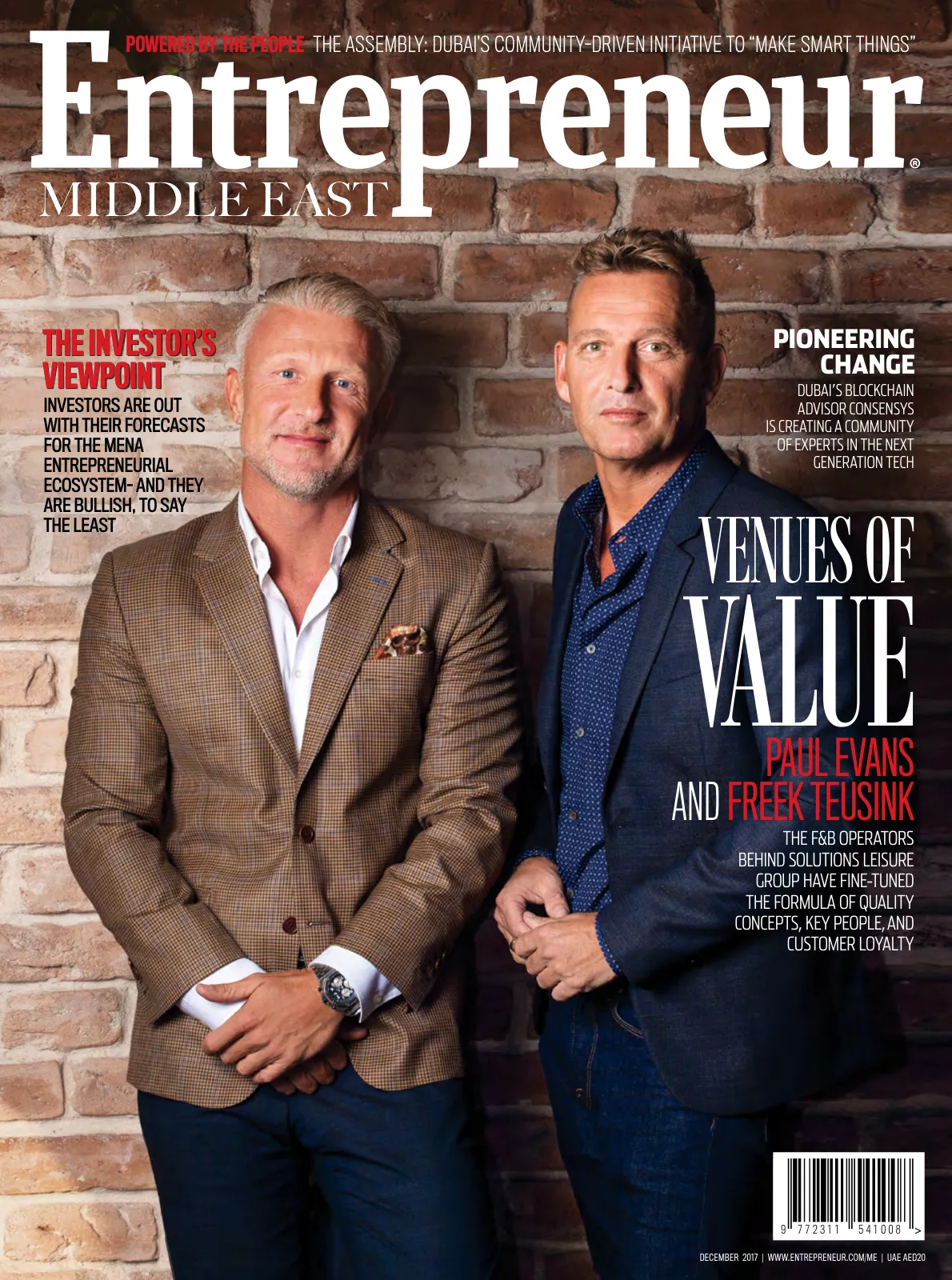
Entrepreneur Middle East, December 2017
Page 1
Powered by the people The Assembly: Dubai’s community-driven initiative to “make smart things”
december 2017 | www.entrepreneur.com/me | UAE AED20
9
7 7 2 3 1 1
5 4 1 0 0 8
>
The investor’s
viewpoint
Pioneering
change
Investors are out
with their forecasts
for the MENA
entrepreneurial
ecosystem- and they
are bullish, to say
the least
Dubai’s blockchain
advisor ConsenSys
is creating a community
of experts in the next
generation tech
value
Venues of
Paul Evans
and Freek Teusink
The F&B operators
behind Solutions Leisure
Group have fine-tuned
the formula of quality
concepts, key people, and
customer loyalty
Page 2
Higher definition.
Bentayga Black Specification.
With 22” black gloss alloy wheels and black exterior detailing, the world’s fastest and most luxurious SUV
is now even more striking. See more at BentleyMotors.com/HigherDefinition
The name ‘Bentley’ and the ‘B’ in wings device are registered trademarks. © 2017 Bentley Motors Limited. Model shown: Bentayga Black Specification.
Page 3
december 2017 Entrepreneur
3
CONTENTS
december 2017
36 Wissam Younane, CEO, BNC Publishing, giving his welcome address
at the Indian Innovator Awards 2017
28
28
INNOVATOR:
Venues of value
Paul Evans and Freek Teusink
The F&B operators behind
Solutions Leisure Group have
fine-tuned the formula of
quality concepts, key people,
and customer loyalty.
50
INNOVATOR:
Pushing
boundaries
Andrew Lipman
Cadillac Global Commu-
nications Director on how
the brand is staying at the
forefront of innovation.
36
THE RECAP:
Indian Innovator
Awards 2017
A look at the winners
of the fourth edition of
Entrepreneur Middle East’s
Indian Innovator Awards,
which recognized prominent
business leaders and
enterprises across various
sectors.
84
START IT UP
ECOSYSTEM
Powered by the people
The Assembly is Dubai’s
community-driven initiative
to “make smart things.”
72
START IT UP:
ECOSYSTEM
A roaring success
At its Entrepreneur Day
this year, Dubai Technology
Entrepreneur Centre
(DTEC) showcased why
it remains a hub for the
region’s innovative startups
and entrepreneurs.
62
‘TREPONOMICS:
PRO
The future of hiring
LinkedIn’s newest
offerings look set to make a
fundamental change in the
world of recruitment.
Solutions Leisure Group
Managing Director
Paul Evans and Creative
Director Freek Teusink
Page 4
Page 5
Page 6
Page 7
Page 8
60 YEARS OF ADVENTURE
AND DISCOVERY
Page 9
Page 10
Page 11
Page 12
681721
523966
Page 13
Page 14
Page 15
800 999 999 I sobha.com
@sobhadubai
LIVE IN THE LARGEST
TOWNHOUSES IN DUBAI
800 999 999 I sobha.com
@sobhadubai
LIVE IN THE LARGEST
TOWNHOUSES IN DUBAI
Page 16
Page 17
Page 18
Entrepreneur december 2017
18
CONTENTS
december 2017
62
66
MONEY:
VC VIEWPOINT
Investors are out with
their 2018 forecasts for
the MENA entrepreneurial
ecosystem- and they are
bullish, to say the least.
56
CULTURE:
BUSINESS UNUSUAL
Fighting the status quo
Lina Khalifeh talks
about her mission to end
violence against women
with SheFighter Academy.
46
TECH:
SHINY
#TamTalksTech
Gadgets and doodads
that you might’ve missed
out on, sourced by a tech
aficionado. Yes, it’s okay
to want them all… and no,
it’s not our fault.
42
‘TREPONOMICS:
PRO
Demonstrating value
Bayt.com’s Suhail Masri
explains three hiring KPIs
every business –small or
large- needs to master in
2018.
58
MONEY:
YOUR MONEY
Making sense of corpo-
rate venture capital
Awad Capital CEO Ziad
Awad believes that MENA
corporates and family
businesses have a lot to
gain by entering the VC
landscape.
48
CULTURE:
TRAPPINGS
‘Trep gear
The executive selection
for the entrepreneur
on your list that has
everything.
LinkedIn Talent
Intelligence Summit,
London,
November 2017
72 DSOA Deputy CEO Shahla Abdul Razak at DTEC’s
Entrepreneur Day 2017
Page 19
Page 20
Entrepreneur december 2017
20
CONTENTS
86
START IT UP:
Q&A
Farming for the future
Egypt-based Bustan
Aquaponics is taking a
socially responsible route
to help the country become
food secure.
88
TECH:
THE FIX
Harnessing momentum
In the world of technology,
you’re only as good as your
next innovation, writes
Gene Jiao, President,
Huawei Consumer Business
Group, Middle East &
Africa.
60
‘TREPONOMICS:
SKILLSET
Does your startup need
to hire a CTO?
Zach Ferres, CEO, Coplex,
offers entrepreneurs
five alternatives to
buying into the hype
surrounding CTOs in the
startup scene.
82
START IT UP:
WHO’S GOT VC
We got funded!
The entrepreneurs behind
Eventtus and Malaeb reveal
what went into securing
their latest funding rounds.
52
CULTURE:
DESIGN
Commercializing creativity
Gallery One founder Gregg
Sedgwick asserts that in
the future, the best brands
will invest in creative
minds- and marry this with
commercial thinkers.
78
START IT UP
Q&A
Pioneering change
Dubai’s blockchain advisor
ConsenSys is creating a com-
munity of experts in the next
generational technology.
56 Lina Khalifeh, founder and owner, SheFighter
51 The Huawei Mate 10
Salem Rashid Al
Noaimi, MD and CEO,
Waha Capital
26
78
ConsenSys founder
Joseph Lubin at
ConsenSys Academy
graduation
Page 21
Page 22
Entrepreneur december 2017
22
SUBSCRIBE
Contact subscriptions@bncpublishing.net to receive
Entrepreneur Middle East every issue
EDITOR IN CHIEF Aby Sam Thomas editor@bncpublishing.net
CEO Wissam Younane wissam@bncpublishing.net
DIRECTOR Rabih Najm rabih@bncpublishing.net
CREATIVE LEAD Odette Kahwagi
MANAGING EDITOR Tamara Pupic
STARTUPS SECTION EDITOR Pamella de Leon
COLUMNIST Sindhu Hariharan
COLUMNIST Tamara Clarke
EVENTS LIAISON Mark Anthony Monzon
PO Box 502511 Dubai, United Arab Emirates
P +971 4 4200 506 | F +971 4 4200 196
For all commercial enquiries related to
Entrepreneur Middle East contact
sales@bncpublishing.net
All rights reserved © 2017.
Opinions expressed are solely those of the contributors.
Entrepreneur Middle East and all subsidiary publications in the
MENA region are officially licensed exclusively to BNC Publishing
in the MENA region by Entrepreneur Media Inc.
No part of this magazine may be reproduced or transmitted in any
form or by any means without written permission of the publisher.
Printed by International Printing Press
ippuae.com
Images used in Entrepreneur Middle East are credited when necessary. Attributed use of
copyrighted images with permission. All images not credited otherwise Shutterstock.
Suhail Al-Masri
Ziad Awad
Fida Chaaban
James Clear
Zach Ferres
Gene Jiao
Gregg Sedgwick
CONTRIBUTING WRITERS
www.entrepreneur.com/me
Access fresh content daily on our website!
MIDDLE EAST
EntMagazineME
@EntMagazineME
Entrepreneur-me
EntrepreneurMiddleEast
EntMagazineME
EntMagazineME
EntMagazineME
MIDDLE EAST
In addition to our print edition, we’re bringing
you all sorts of industry news on our web
mediums. Joining us online means getting
relevant business and startup content in
real-time, so you’re hearing about the latest
developments as soon as we do. We’re looking
forward to interacting with our readers on all of
our social media and web platforms- like any
thriving business, we’re looking to give and take.
#TrepTalkME is already happening on all of our
digi platforms, and all good conversations go
both ways. See you on the web!
Page 23
Page 24
Entrepreneur december 2017
24
A
s a mentor at this year’s
edition of Startup
Weekend Dubai in No-
vember, I got a chance
to be around a bunch of
entrepreneurial teams, all of whom
were all working hard on building
their respective versions of, well,
the next big thing. When I met
them, these budding entrepreneurs
were hard at work preparing for
how they’d present their planned
projects or enterprises to a panel
of judges at the end of the 54-hour
event, and so, I went around listen-
ing to their pitches, and then giving
my two cents on how they could
probably make their case better. In
my notes for a few of them, I sug-
gested that they rethink their idea
or model, since I felt they were not
particularly strong enough in their
current formats, and so, reworking
them would probably be a better
course of action.
Now, criticism is hard to take- I
know this from first-hand experi-
ence back when I was a student
learning journalism, and my
professors, when editing the first
drafts of any of my write-ups,
wouldn’t think twice before telling
me that the pieces I wrote were
hardly as amazing as I thought
them to be, and that I needed to
rewrite them pronto. Such situ-
ations often had me shaking my
fist in the air, especially in those
cases when I particularly loved and
believed in what I had submitted,
and I’d passionately try to defend
my words- you can probably now
see why I had a déjà vu moment of
sorts when I was the one dishing
out critiques at Startup Weekend.
As a result, I decided to respond to
my entrepreneurial mentees with
the same advice I heard from my
professors back in the day, which
was: “Kill your darlings.”
This phrase comes from a quote
often attributed to American
writer William Faulkner, which
goes: “In writing, you must kill all
your darlings.” This is essentially
a piece of advice for writers, who
sometimes fall in love with some of
their words so much so that they
don’t realize or refuse to entertain
the idea that those beloved bits are
actually hampering the experience
of the reader- which is, obviously,
not a good thing when it comes
to writing. This is why Faulkner
advises scribes to kill their dar-
lings- the love writers have for
what they have created often blinds
them to their faults, and this is a
feeling that entrepreneurs should
be able to easily identify with. You
are sometimes so enamored of the
value that you believe you or your
offering has to offer, that you fail
to look at it with an objective eye,
and thus overlook what are often
rather obvious errors in your line
of thinking. And that is why you, as
entrepreneurs, should also kill your
darlings- your product or solution
must always serve a particular
purpose for your intended cus-
tomer, and if, at any point, you’re
told that it is not doing that right,
then remember first to not dismiss
such criticism blindly, and then
take it upon yourself to consider it
as dispassionately you can.
There’s a fine line between being
resolute about the idea you have in
your mind, and, well, changing or
rethinking your idea in a manner
that it suits your intended clients
better- knowing the difference
between the two is key for entre-
preneurial success.
EDITOR’S NOTE
Aby Sam Thomas
Editor in Chief
@thisisaby
aby@bncpublishing.net
Kill your darlings
No, not all ideas are good ones
Page 25
DISCOVER HOW TO ACCELERATE YOUR BUSINESS
Powered by Thomson Reuters, Accelerate SME is the gateway to the
SME ecosystem in MENA; providing access to the resources and solutions
needed to support you at any business stage.
We have joined forces with some of the region’s most powerful financial
and workflow solution providers to service and support your specific needs.
As a member of Accelerate SME you can access a wide range of business
resources including, funding, online community, industry insights, tools
and easy-to-use templates.
ACCELERATE SME
CONTRIBUTE. ENGAGE. GROW.
FIND OUT MORE AT ACCELERATESME.COM
Page 26
Entrepreneur december 2017
26
T
The MENA startup
ecosystem has a new exit
that can help inspire the
region’s aspiring entrepre-
neurs to keep persevering
toward their goals. Glam-
Box Middle East, a regional
beauty subscription e-commerce
entity, has announced that a Saudi
Arabia-based consortium of investors
-whose details remain undisclosed-
has acquired the company.
The Dubai-based startup, launched
in 2012 by co-founders Shant Oknay-
an, Fares Akkad, Christos Mastoras
and Marc Ghobriel, had previously
raised over US$4 million in venture
capital funding from regional inves-
tor bigwigs including STC Ventures,
MBC Ventures, R&R Ventures, and
other KSA investors.
“We are proud to have success-
fully completed a full lifecycle of a
startup in the Middle East- ideation,
seed funding with our own capital,
building a team, market launch in the
UAE, VC funding over two rounds,
building a great product, scaling the
business, international expansion to
KSA, and finally exit via acquisition
within five years,” the co-founders
say. “We feel that we succeeded
despite tough challenges.”
“The buyer is a KSA consortium of
investors that was an existing inves-
tor in GlamBox,” add the co-found-
ers. “Seeing the significant growth in
the company, the investors expressed
interest in acquiring the company.
While we have been approached by
numerous potential buyers in the
last few years, the current buyers
made sense from
many perspectives,
particularly, the
fact that they were
already involved in
GlamBox.”
The co-founders
mention that the
buyer investors
group has diversi-
fied interests in
media, retail and
hospitality, and
aims to drive the
company’s next phase of growth in
Saudi Arabia, the GCC, and beyond.
Without disclosing the transaction
specifics, GlamBox says the current
shareholders including the founding
team, STC Ventures, MBC Ventures
and R&R Ventures have sold their
stake to the new owners in a deal
process that is said to have “lasted
several months,” and was advised on
by Apostolos Binomakis of Iliad Part-
ners as an independent advisor.
GlamBox’s services launched at a
time when the beauty industry was
large and fast-growing in the Middle
East, but still had limited online
presence. “We saw a gap in subscrip-
tion e-commerce for women in the
region, hence, GlamBox was born to
service that need in the market,” the
co-founders recall. “Since then the
e-commerce market has developed
significantly, with competitors enter-
ing our space, but with GlamBox
being the player that emerged as the
region’s leading beauty subscription
e-commerce company with 200+
brand partners, a large and growing
subscriber base, and operations in
the UAE and KSA, there is potential
to expand geographically across GCC
and into new verticals.”
The exit may be sealed, but looks
like it’s definitely not the end for
GlamBox as an enterprise as CEO
Matthieu Guinard says in a state-
ment, “We will continue to delight
our customers and bringing them
the best of the beauty world to their
doorstep, while exploring expansion
into new markets and verticals”. On-
wards and upwards! www.glambox.me
R
ecognizing a need to support all key com-
ponents of Jordan’s startup ecosystem, be
it entrepreneurs, institutional investors, or
angel investors, Endeavor Jordan and Silicon Badia
have joined hands to launch a new investment en-
tity BeyondCapital. Launched at an event in Jordan
in November, gathering key decision makers of the
country’s entrepreneurial and investment ecosys-
tem, BeyondCapital is backed with a US$10 million
fund from USAID (as part of its MENA Initiative
II), and has a mission to provide comprehensive
support to three beneficiaries of Jordan’s business
world: entrepreneurs, investors (fund managers),
and angels.
“With BeyondCapital, we aim to closely tackle
most of the challenges faced by entrepreneurs be
it through improved access to mentors, networks
or capital,” notes Ali Al-Husry, Board Member,
BeyondCapital, in a statement. “BeyondCapital will
also be addressing the challenges faced by inves-
tors stemming mainly from weak infrastructure
and lack of training targeted at fund managers
and angel investors.” In a note on its key objectives
and strategies, BeyondCapital observes that while
Jordanian startups face considerable challenges
in reaching an optimal operational position at the
early stages, there are also infrastructural chal-
lenges for the angel investors and large funds in
the region.
Aiming to address such sectoral gaps with a
three-pronged approach, the one-of-its-kind
company offers a two-year support program
for entrepreneurs, provides fund establishment
support for investors, and will also support eager
angel investors with training and co-investment
opportunities. While the support to startups in the
form of mentorship and capital provision will be
driven with the help of Endeavor’s network, Silicon
Badia, a MENA-centric VC firm based in Jordan,
will run the investors guidance programs.
www.beyondcapital-jo.com
IN THE LOOP
images courtesy glambox middle east | beyondcapital
Hala Fadel
BeyondCapital
launches in Jordan
The new investment fund is
a partnership between Endeavor Jordan
and Silicon Badia to help develop
the local entrepreneurial ecosystem
GlamBox Middle East gets acquired by investors
consortium from Saudi Arabia
Onwards and upwards!
Glambox Middle East co-founders Christos Mastoras, Fares Akkad,
and Shant Oknayan
Page 27
Page 28
Entrepreneur december 2017
28
innovator
Venues
Entrepreneur december 2017
28
By Aby Sam Thomasof value
Paul Evans and Freek Teusink
The F&B operators behind Solutions Leisure Group have fine-tuned
the formula of quality concepts, key people, and customer loyalty
W
hen you see the co-founders of Solutions Leisure Group together,
it’s hard to miss the camaraderie and comfort that the duo, Man-
aging Director Paul Evans and Creative Director Freek Teusink,
have with each other. There’s a certain ease, if you will, between
the two, and over the course of my hour-long conversation with
the F&B operators, it was interesting to note how they seemed to
be completing each other’s sentences, or rather, thoughts- one
of them would start talking on a particular topic, and the other would add on to it -and
even complete it- without missing a beat. Now, I suppose this shouldn’t come as a sur-
prise, given that Evans and Teusink have been known each other for more than 20 years
now- but I was taken aback on learning that the duo barely knew each other when they
started out on their journey as business partners, back in 2000, in Egypt. >>>
Page 29
december 2017 Entrepreneur
29
december 2017 Entrepreneur
29
“We’re interested in
being the guys who
make a mark, the guys
who did it differently,
the guys who got
more customers
visiting their venues
than anybody else.
That shows that we’ve
landed right in the
sweet spot of the
customer demographic
we want, and [that]
we are the venue of
choice.”
Solutions Leisure Group Managing Director
Paul Evans and Creative Director Freek Teusink
Page 30
Entrepreneur december 2017
30
innovator
“Freek is able to design some of
the funkiest stuff and cutting-edge F&B,
because we have a team that will fill it.
We have a team of operators that will
execute it absolutely to the letter.”
Freek Teusink,
Creative Director,
Solution Leisures Group
Evans was on holiday there at
the time, and while he was in
the country, he found himself in
one of the nightlife venues Teu-
sink was operating then- and
that was where the two made
the fateful decision to become
business partners. “At around
four o’clock in the morning, at
some point after a good evening,
I agreed to lend Freek some
money to build a new venue,”
Evans remembers. “I woke
up the next morning, feeling
very worse for wear around 11
o’clock… I had no recollection
of the incident, but I received
an SMS [from Teusink] asking
when can he pick that money
up… 20 years on, not a single
argument, not a single [heated]
discussion, and [we’ve got] 32
venues under our belt.” Evans
pauses for a moment, before
adding: “It was clearly one of
the best decisions I’ve ever
made at four o’clock in the
morning!”
Call it karma, fate, or simply
good fortune, this fortuitous
agreement between Evans and
Teusink in the dawn led to the
establishment of the Solu-
tions Leisure Group, which,
since its launch in Egypt, has
today moved on to the UAE as
its home base, with a portfo-
lio that includes some of the
most popular (and yes, most
profitable) F&B concepts in the
country, and indeed, the wider
Middle East region as well.
For the uninitiated, Solutions
Leisure Group’s brands include
Dubai hotspots like Q43, Lock,
Stock & Barrel, Asia Asia, STK,
and others, and no, this list
of brands doesn’t include the
business that the company had
in Egypt- before they moved
to the UAE in 2011, Evans and
Teusink effectively controlled
75% of the bar and restaurant
business in the city of Hurgha-
da, their center at the time.
Did they have a goal, then, that
their business would be where
it is today, which is essentially
a hundred-million-dollar F&B
business? Both Evans and
Teusink reply no. “I think that,
back in the day, the aim was to
have a good time, if I’m honest,”
Evans says. “The aim was not
to build a global F&B business,
not even a regional [one], not
even a town F&B business. We
saw an opportunity to invest in
a couple of projects together,
put our toe in the water, and
see how that sort of partnership
would be. I had a bit of a busi-
ness acumen, and a background
in sales and marketing and
financing, and Freek had a very
large background in producing
good F&B. So, there was no real
masterplan, other than to build
one great venue. And then build
another great venue. Then,
slowly over the next sort of 18
months of being together, we
started to realize that we had
quite a good partnership, where
all of the requirements to run
a good F&B business were kind
of covered. And then a plan
started to get formulated: we
then realized that there was a
good business opportunity here;
we could become the leading
nightlife providers in Egypt. We
had some good brands under
our belt, we had great customer
loyalty, and we had a good team
of people that could execute it
properly.”
While Evans and Teusnik may
have started out without any
grand plan for their enter-
prise, the experience they had
in Egypt proved to be criti-
cal in their long-term success
game plan for the Solutions
Leisure Group. “The interest-
ing thing about Egypt is you
can most certainly cut your
teeth there,” Evans says. “We
had a transient customer base.
They would come in, we’d get
probably 12 hours to capture
them, advertise the market
to them, represent [to] them
in the airport, get in front of
them, and then, we had seven
days where they could visit
our venue. If you treat them
fantastically, they left us in
seven days. If you made lots of
mistakes, and didn’t treat them
as you intended to treat them,
they left in seven days. And in
came a new set of customers,
and you could learn again, and
you could go again, and you
could grow again. And it gave
us a great footing to come into a
city like Dubai, where you don’t
get a second chance. We didn’t
realize it then, but Egypt was
a great place to make the mis-
takes that you’re going to make
in this industry, and you can
learn quite quickly in a town
like that. Because every week,
you get the chance to do it again
with a new customer base. In
Dubai, you don’t have that. You
can’t open with mistakes.”
But while Evans and Teusink
agree that they were, during
their time in Egypt, considering
a move to Dubai, it needs to be
noted here that their eventual
migration to the UAE was es-
sentially due to circumstances
beyond their control- the
country was in the throes of a
political revolution then, and
the resulting turmoil was too
much for their enterprise to
bear. “We had a lot of circum-
stances already, where Egypt
was never a stable business,”
Teusink remembers. “It was
always ups and downs- we had
the bombings, we had 9/11, we
had a lot of things happening
that really affected the busi-
ness. If we would have stayed,
Page 31
december 2017 Entrepreneur
31
innovator
q43 image courtesy solution leisures group
Q43 restaurant,
bar and lounge
Paul Evans,
Managing Director,
Solution Leisures
Group
“We’re not building
any single venue
on a profit
and loss (P&L)
statement. We are
building every
single venue to
say what can
this bring to the
market, what can
we bring to our
customers, and
how can we make
them feel.”
>>>
we could have stayed, and we
would have done maybe okay.
But we thought then that now,
it’s really time to do it some-
where else, and do it bigger and
better.” But given that Evans
and Teusink had been working
in Egypt for more than a decade,
how did they ever get past los-
ing what was essentially their
entire business in the country?
“I recovered with a shower,”
Evans replies. “It was done.”
It may seem like a rather sim-
plistic response to a tortuous
time, but Evans and Teusink
explain that much before the is-
sues that befell them, Dubai had
already been on their agenda for
quite a while- and so, the events
leading to their move out of
Egypt allowed them to have no
regrets about their departure.
“If we’d had, still, the size of
scale of business that we had
in Egypt [without any of the
troubles], would I have actually
got on an airplane and come
to Dubai? We probably would
have,” Evans says. “So, when
it was taken away from us, we
actually lost nothing, because
it was gone. And then it gave us
the [impetus], you know: if we
leave now, we’ve left nothing
behind. If we rebuild it again,
will we build it again to the
scale where we can’t leave it be-
hind? So, it was just a mindset
change- we always wanted to go
there [to Dubai] anyway. We’ve
got nothing to lose anymore.
We’re not walking away from
a 600-person business; we’re
walking away from a business
that is depleting by the hour,
costing us money by the minute.
And we’re not sure if we’re
actually in a safe environment
any longer- so it was time for
us to go.” Teusink adds, “Don’t
forget, during [and] after the
revolution, we lost 85% of the
business in a week… When
your business drops by 85%,
it’s time to move on.”
When Evans and Teusink thus
arrived in Dubai, they had a
good track record of establish-
ing successful F&B concepts in
Egypt behind them, but that
didn’t exactly pan out into an
overwhelming welcome for
them in Dubai. The entrepre-
neurs remember having to
knock on a lot of doors just to
get hotel managers in Dubai
to hear their pitch, but their
experience did help ease up the
process- Evans and Teusink
point out by the time they got
to the Emirate, they were con-
fident about their skillsets and
offering, plus they had already
identified a gap in terms of the
F&B sector at the time. “Ever
since I’ve been here, everyone’s
told me the F&B market is
oversaturated,” Evans says. “We
built a hundred-million-dollar
business in a massively over-
saturated market, because we’ve
gone after an area that is not
oversaturated- we’ve gone after
the middle market. We’ve gone
after proving that the four-star-
plus [market] is actually the
most important sector there is.
And [in terms of] brand loyalty
and customer loyalty, [we go
about] treating our customers
like, [for] every single dirham
that they spend with us, we
say thank you for that dirham.
I think that was a huge sector
that was missing, and still, it is
not, on any level, overly satu-
rated. So, the biggest challenge
[we faced when starting up in
Dubai] was getting somebody to
say, okay guys, come and tell us
who you are, and what you can
do. We didn’t have any money.
We had to raise capital; we had
an investor that came with us
from Egypt, and then, we had
to find some investors that be-
lieved in our ability to execute
in Dubai. And 18 months into
banging on every door and any-
one that would listen, we finally
found that gentleman, and off
we went. Q43 was born, Karma
Kafé was acquired, Asia Asia
was designed and built, and
the momentum began. It’s very
different today- people try to
knock on our door these days,
so it’s been an amazing four and
a half years. It really has.”
Page 32
Entrepreneur december 2017
32
innovator
“The top priority
for [us in] 2018
would be to take
Lock, Stock & Barrel
international. So,
in the middle of
this year, we began
talking to key
partners in London,
New York, Miami,
and Las Vegas.”
Lock, Stock & Barrel
bar in Dubai
Asia Asia
restaurant and lounge
lock, stock & barrel and asia asia images courtesy solution leisures group
Q43, located on the top floors of
the Media One Tower in Dubai
Media City, proved to be quite
a hit when it launched in 2013,
and both Evans and Teusink
point toward their eagerness to
cater to the middle market as
being key to the outlet’s suc-
cess. “I think it offered extreme
value for money, in a very, very
nice setting, without charg-
ing you the earth to be there,”
Evans says. “What we tried to
do was create an environment
where everybody felt welcome,
and nobody was so busy with
what type of shoes you had on,
what watch you wore, or what
car you valet-ed. And we’ve
always said that, whether you
drive a Lamborghini, or whether
you get out of bed every morn-
ing and work hard for a small
amount of money, you’re all as
important as the rest. The only
thing that should decide the
difference between the service
level you receive is the product
that you buy. That’s the only
way that you should show any-
body that you’ve got any more
money than anybody else.”
Teusink adds that before they
started out in Dubai, the two
entrepreneurs made it a point
to visit other nightlife venues in
the city, and they soon found a
common issue in almost all of
them. “People were not smiling
[while in the venues],” Teusink
remembers. “They didn’t have
fun. And so, we then knew
already, yeah, we should be
here.” In fact, this insistence
on keeping their customers
happy –and making sure they
are having a good time while
at their establishment- is what
Evans and Teusink account for
Q43’s success, or indeed, any of
their other brands that followed
after. From Asia Asia’s welcom-
ing atmosphere as a fusion
dining destination, to the bois-
terous party mood offered by
Lock, Stock & Barrel, Evans and
Teusink say that people who
walk into an establishment run
by Solutions Leisure Group are
guaranteed to both have a fun
time, and be treated with the
best service possible. “If you
were to ask what our venues
have in common, that would
be what it has in common:
we really look what our guest
wants, and we really treat you
like a superstar,” Teusink says.
“We’re not building any single
venue on a profit and loss (P&L)
statement,” Evans adds. “We
are building every single venue
to say what can this bring to the
market, what can we bring to
our customers, and how can we
make them feel.”
This strategy essentially
explains how Evans and Teusink
have gone about building up the
Solutions Leisure Group port-
folio- and this was something
they had decided on when they
first arrived in Dubai, much
before Q43 was even built.
“Our target was to come here,
and become the premium F&B
provider in the UAE,” Evans
says. “And my terminology is
not [about being] the biggest- I
never want to be the biggest;
I’m not interested in being that.
We’re interested in being the
guys who make a mark, the guys
who did it differently, the guys
who got more customers visit-
ing their venues than anybody
else. That shows that we’ve
landed right in the sweet spot
of the customer demographic
we want, and [that] we are
the venue of choice. That’s the
most important thing for us.” In
order to do this, the company
has gone in for a portfolio that
includes both homegrown
concepts (Lock, Stock & Barrel),
and a select few franchises as
well. “Primarily, we develop
our own stuff,” Evans explains.
“We believe that we’ve got the
experience today, and the skill-
set within the group and within
the team to design, develop, and
execute homegrown stuff… But
there are occasions when cer-
tain landlords require a certain
concept or probably a certain
brand, which would then put us
out into the marketplace fish-
ing. And then, there are times
when a great brand is available
that you believe you should
go and get, because it adds
to your portfolio, it brings a
certain skillset, or concept that
you don’t have, and helps you
to market it.” That last point
explains how the internation-
ally renowned restaurant con-
cept STK landed in Solutions
Page 33
december 2017 Entrepreneur
33
Paul Evans, Managing
Director, and Freek
Teusink, Creative Director,
Solution Leisures Group
“Every single F&B
operator in Dubai
wanted STK, and it’s
extremely flattering
to myself, Freek,
and the team who
have worked with us,
that they chose us-
they could have gone
anywhere.”
>>>
Leisure Group’s portfolio in
Dubai- it already has a location
open in Dubai’s Jumeirah Beach
Residence (JBR) neighborhood,
with another one in Downtown
Dubai in the works. “Three
years, we’ve hunted those guys
down; three years, we’ve devel-
oped our business to become
an operating partner that those
guys were comfortable with,”
Evans says. “Every single F&B
operator in Dubai wanted STK,
and it’s extremely flattering
to myself, Freek, and the team
who have worked with us, that
they chose us- they could have
gone anywhere. And the CEO
was adamant, [telling us that]
‘without the shadow of a doubt,
you guys are the guys that we
want to have.’”
In terms of its homegrown
concepts, it’s easy to see that
Evans and Teusink are espe-
cially proud of Lock, Stock &
Barrel, which opened its first
location at Barsha Heights in
2016, and recently had a second
one open up at JBR. A visit to
any of the two venues makes it
clear that the Solutions Leisure
Group team have invested heav-
ily in this establishment, but,
as Teusink points out, all of its
features –be it the sound sys-
tems, or the funky lights- have
been put there solely to add to
the customer experience. “It’s
like a theater,” he says, noting
that Lock, Stock & Barrel aims
to actively discourage visitors
from leaving the establish-
ment. It’s a strategy that has
definitely worked- besides
being one of the most popular
nightlife venues in Dubai at the
moment, Lock, Stock & Barrel
has also racked up a slew of
industry awards in its relatively
short lifespan. Given these two
factors, it shouldn’t come as a
surprise that Evans and Teusink
are eager to further grow the
brand. “I think we’re going to
go with probably a Lock, Stock
& Barrel down in Business Bay-
we’re already working on that
deal,” Evans reveals. “The top
priority for [us in] 2018 would
be to take Lock, Stock & Barrel
international. So, in the middle
of this year, we began talking
to key partners in London, New
York, Miami, and Las Vegas…
We now have some bandwidth
to get on some airplanes and
go and reignite those conversa-
tions, and give those guys the
attention that they deserve. So,
as soon as we get Christmas
and New Year’s out of the way,
January will [see us] on air-
planes, and we’ll be getting two
to three leases signed for Lock,
Stock & Barrel- probably two
in America, and one in the Far
East, will be the plan for 2018.”
As should be clear by now, So-
lutions Leisure Group has had
a pretty busy year already, but
if Evans and Teusink’s future
plans are any indication, then
the new year won’t be looking
any different. “2017 has been
an astronomical year,” Evans
admits. “We have doubled the
group in a six-month period.
That has left a few marks on
a few of us- a few sleepless
weeks, months, and quarters. I
said [to my team] at the begin-
ning of the year, that some of us
will not make this year, some of
us will fall by the wayside. [But]
the team hasn’t- they’ve stood
on, and they’ve done it with
an incredible calmness, and
I’m super proud of what we’ve
achieved in 2017. I promised
them we’d do nothing in 2018…
but they also know me! So, they
also knew that was a fake prom-
ise just to get them to do 2017.
2018, we go again.” Both Evans
and Teusink are fiercely pas-
sionate about the people they
have on board, and say their
employees are the ones that are
responsible for driving Solu-
tions Leisure Group forward. “I
believe today that the team that
we have working for us is, by a
long way, the number one group
Page 34
Entrepreneur december 2017
34
innovator
Karma Kafé
restaurant
and lounge
Paul Evans, Managing
Director, and Freek
Teusink, Creative Director,
Solution Leisures Group
“What we tried to do was create an
environment where everybody felt welcome,
and nobody was so busy with what type of
shoes you had on, what watch you wore, or
what car you valet-ed.”
karma kafé image courtesy solution leisures group
of individuals ever put together
to work in this spectacular
industry,” Evans says. “I’m able
to go out and be the crazy sales
guy that I am, because I’ve got
a team that will back you up.
Freek is able to design some of
the funkiest stuff and cutting-
edge F&B, because we have a
team that will fill it. We have a
team of operators that will ex-
ecute it absolutely to the letter.”
This is also a good indication of
the dynamic Evans and Teusink
use to work with each other-
and why their partnership has
been the success it is today.
“We complete each other,”
Evans says, alluding to their
different skillsets and why they
work so well together. Teusink
nods, and adds, “We respect
each other, very, very much. We
respect what the other wants
and does… And we want the
best for each other as well. So,
I want Paul to shine, [and] he
wants me to shine.” But given
the story of how Evans and
Teusink got to work with each
other in the first place, one
can’t help but want to believe
in the idea of fate’s role in de-
termining one’s success. “We’re
just very, very lucky,” Evans
agrees. “We just got it right.
We’ve been there through the
tough days. We’ve been through
the mediocre days. We were
together in the glory days, and
if tough times come again, we’ll
be standing next to each other
just dealing with it. We’ll come
through it, and we’ll bounce
back again.”
So, what’s next for Solutions
Leisure Group? Evans and Teu-
sink explain that when it comes
to the business, they tend to
plan in three-year intervals-
and so, that’s the timeline that
they share with me now. “We
set out to become the pre-
mium F&B business in Dubai- I
believe that we have achieved
that,” Evans says. “But I [also]
believe that we’re only really
getting started. I believe that,
still, the momentum is growing
by the hour. I mean, it is so
fast paced at the moment; the
opportunities that are coming
our way, the contacts that are
growing, the people are wanting
to talk to us today- the oppor-
tunities are unlimited… Where
I want [us] to be in three years:
we want to be the premium
F&B business operating out of
Dubai, internationally. That’s
where we want to be next. So,
that’s the next sector- we want
to make sure that Lock, Stock &
Barrel gets the worldwide brand
recognition that that project
deserves, with three to five
venues opening in the next 18
to 24 months. We’d love to see
Asia Asia go [international as
well]. We’d like to solidify our
position with a few further key
establishments, and possibly,
another successful brand devel-
opment in the UAE.”
As for Evans and Teusink
themselves, they are still enjoy-
ing what they do, and that
is essentially what is driving
them ahead as entrepreneurs
building up Solutions Leisure
Group as an enterprise. “This
is very important: one of the
other factors that is binding all
of our outlets together is the
fun we have building them,”
Teusink explains. “We go to
work- we work a lot, obviously.
But I wake up every morning,
and think, yes, I can go again.
For sure, Paul feels the same.”
Evans nods, and explains why:
“Because we are doing cool
and funky stuff! We’ve got the
best job in the world- we make
120,000 people smile from
six o’clock [in the evening] till
three o’clock in the morning.
How cool is that? We’re just
(a bit) older versions of Justin
Bieber!”
Page 35
Page 36
INDIAN
INNOVATOR
AWARDS
2017
platinum ally
ecosystem partners
LUXURY PARTNER
gold ally
gold ally
A PRODUCTION BY
Entrepreneur december 2017
36
Page 37
A
t the fourth edition
of the annual
Entrepreneur
Middle East’s
Indian Innovator
Awards presented by du, BNC
Publishing, as part of the
Entrepreneur MENA franchise,
awarded prominent business
leaders and enterprises
across various sectors on
November 14, 2017 at The St.
Regis Dubai, UAE. A total of
22 awards were presented at
the ceremony, with all of the
winners having set themselves
apart from their peers in
the region by showcasing a
commitment to excellence,
and thereby raising the bar of
their respective industries.
Speaking on behalf of
Entrepreneur Middle East,
BNC Publishing CEO Wissam
Younane felicitated the
winners of the ceremony,
saying, “This is the fourth year
we at Entrepreneur Middle
East and BNC Publishing are
hosting this event, and once
again, I am feeling extremely
humbled, and at the same
time, honored, to have some of
the region’s most prominent
business men and women to
be with us here today, many of
whom are my personal heroes
as an entrepreneur.”
Commending the winners’
achievements, he added, “The
Indian business community in
the Middle East has showed
to the rest of us here in the
region (and indeed, the world)
that success will come to those
who think differently, who
work hard, and who stay true
to their ideals and principles-
and for that, I applaud you,
ladies and gentlemen, and I
wish you continued success in
the years to come.”
Organized by Entrepreneur
MENA, the 2017 Indian
Innovator Awards honored
businesses and leaders who
have distinguished themselves
and made significant business
growth across a variety of
industries that are key drivers
of respective Middle East’s
economies. The winners were
presented with their awards
by H.E. Vipul, Consul General
of India in Dubai.
Entrepreneur Middle East’s
2017 Indian Innovator Awards,
Entrepreneur of the Year, was
a BNC Publishing production,
presented by du, with the
support of Luxury Partner
Cadillac, Platinum Ally
Malabar Gold & Diamonds,
Gold Allies, Thomson
Reuters and Glenfiddich, and
Ecosystem Partners, Dubai
Technology Entrepreneur
Centre and ArabNet.
Wissam Younane, CEO, BNC Publishing
Winners of the Indian Innovator Awards 2017
december 2017 Entrepreneur
37
A scene from Indian Innovator Awards 2017
Page 38
indian innovator
awards 2017
Banking Innovation Dr. Adnan Chilwan
Construction Innovation Mohamed Jafer Musta
Communications Innovation Sunil John
Retail Innovation Nilesh Ved
Real Estate Innovation Rizwan Sajan
Education Innovation Nitin Anand
Logistics Innovation Madhav Kurup
Design Innovation Sneha Divias
Homegrown Brand of the Year Raza Beig
Market Specialization Riaz Khimani
Startup of the Year Wadi.com (Pratik Gupta, Ankit Wadhwa
and Kanwal Sarfraz)
Investments Innovation Shailesh Dash
Entrepreneurial Ecosystem Development Ramesh Jagannathan
F&B Entrepreneur of the Year Bhupender Nath
Luxury Entrepreneur of the Year Meher Mirchandani
Brand Penetration Deepinder Goyal
Diversified Portfolio Adeeb Ahamed
Responsible Leadership Tariq Chauhan
Thought Leadership Dawood Bin Ozair
Business Visionary of the Year P.N.C. Menon
Lifetime Achievement Dr. B.R. Shetty
Contribution to Business H.E. Vipul
Business
Visionary of
the Year
P.N.C. Menon
(accepted on
his behalf)
Education
Innovation
Nitin Anand
Market
Specialization
Riaz Khimani
(accepted on his
behalf)
Lifetime
Achievement
Dr. B.R. Shetty
Entrepreneur december 2017
38
H.E. Vipul,
Consul General of
India in Dubai
Page 39
Responsible Leadership
Tariq Chauhan
Ecosystem Influencer
P.K Gulati
Real Estate Innovation
Rizwan Sajan
Banking Innovation
Dr. Adnan Chilwan
Homegrown
Brand of the Year
Raza Beig
Investments
Innovation
Shailesh Dash
(accepted on
his behalf)
Startup of the Year
Wadi.com
december 2017 Entrepreneur
39
Page 40
Entrepreneur december 2017
40
indian innovator
awards 2017
F&B Entrepreneur of the Year
Bhupender Nath
Thought Leadership
Dawood Bin Ozair
Retail Innovation
Nilesh Ved
(accepted on his
behalf)
Logistics Innovation
Madhav Kurup
Contribution
to Business
H.E. Vipul
Entrepreneurial
Ecosystem
Development
Ramesh
Jagannathan
(accepted on his
behalf)
Entrepreneur december 2017
40
Page 41
Design Innovation
Sneha Divias
Construction
Innovation
Mohamed Jafer
Musthafa
Communication
Innovation
Sunil John
Brand
Penetration
Deepinder Goyal
(accepted on
his behalf)
Luxury
Entrepreneur of
the Year
Meher Mirchandani
Diversified Portfolio
Adeeb Ahamed
december 2017 Entrepreneur
41
Page 42
Entrepreneur december 2017
42
Demonstrating
value
ETHICS | ESQUIRE GUY | SKILLSET | MARKETING | PRO
TREPONOMICS
Three hiring KPIs every business -small or large-
needs to master in 2018 By Suhail Al-Masri
By calculating
your salary
competitiveness
ratio, you
maintain your
attractiveness
to candidates
and your ability
to retain
your current
employees.
Bayt.com offers a
Pay Scale Analysis
Report, which
is a customized
and detailed
report including
a breakdown of
salaries for specific
job titles, specific
industries, and
specific locations.
W
e live in an age where technology dictates nearly
all aspects of life, at both the personal and profes-
sional scales. With the proliferation of various tools
and technologies that enable startups as well as
established businesses to run their operations more
efficiently and smoothly, there are also new challenges relat-
ing to measurement and effectiveness that constantly arise.
Today, data and analytics are widely avail-
able for businesses to make well-analyzed
decisions and build strategies. From sales
and marketing to communications and
backend, all teams and departments must
be able to measure, assess, and make well-
informed decisions using “science” that
prove the desired results objectively.
Talent acquisition is not different in
this sense either. Hiring managers and HR
departments in any business should have
set expectations on what they’re meant to
achieve, such as lower hiring costs or in-
creasing relevancy of candidates. In order
to do so, they need to use what is known
as key performance indicators (KPIs).
A KPI is a measurable value that dem-
onstrates how effectively a company is
achieving its business objective. KPIs help
clarify your business goals and objec-
tives, they show how effectively you are
achieving them, they help everyone in your
company stay on track and adjust their
efforts, and they keep a record of what’s
working in your strategy and what’s not
bringing much value.
For sourcing and hiring talent specifically,
KPIs are a method for managers and HR
professionals to see what’s working best for
them, and how they can constantly improve
the outcome of their hiring efforts.
So, what KPIs do you need to track to
ensure you start 2018 with a bigger success?
Here’s a list.
1. YIELD RATIO
Yield ratio compares how many candidates
pass through each hiring/screening funnel
throughout your recruitment and selection
process, relative to the total number of can-
didates you considered for a certain vacancy.
To demonstrate, take a look at this example:
let’s say Z-Tek, an SME based in Dubai, is
hiring three web developers. They advertise
their job and begin sourcing candidates. Z-
Tek ends up receiving 90 applicants for this
position. Of these applicants, 65 CVs match
the opening requirements, and are moved
onto the “phone interview stage.” Of those
shortlisted candidates, 25 are sent assign-
ments to complete as further screening, and
seven of those were called in for face-to-
face interviews. Z-Tek ended up with five
applicants to choose from, and offered the
position to two.
Here’s where yield ratio comes in: we can
calculate it at each stage separately, choose
which hiring stages we want to compare, or
we can even calculate the total ratio. The
way to do so is by dividing the number of
candidates in one stage over the number of
applicants in the previous stage, and multi-
plying the quotient by 100%.
Yield ratio = Output/Input X 100%
But how do you interpret the number? The
higher your yield ratio, the better. This is
because higher yield ratio means you have
adopted more powerful and effective sourc-
ing, screening, and shortlisting tools. It also
means that you are ending up only with the
Page 43
december 2017 Entrepreneur
43
ETHICS | ESQUIRE GUY | SKILLSET | MARKETING | PRO TREPONOMICS
www.bayt.com
14
17
𝑌𝑌𝑌𝑌𝑌𝑌𝑌𝑌𝑌𝑌𝑅𝑅𝑅𝑅𝑅𝑅𝑅𝑅𝑅𝑅= 𝑂𝑂𝑂𝑂𝑂𝑂𝑂𝑂𝑂𝑂𝑂𝑂
𝐼𝐼𝐼𝐼𝐼𝐼𝐼𝐼𝐼𝐼
× 100%
in order to achieve
a great yield ratio,
you’ll need to optimize
your recruitment
process and there are
many tools that help
you get there.
most relevant candidates at each stage
of the hiring process.
Of course, in order to achieve a great
yield ratio, you’ll need to optimize
your recruitment process and there
are many tools that help you get there.
For example, Bayt.com’s advanced
filtration, screen out box, and au-
tomated pre-screening tests, which
are available in both job postings
and CV search, can help you improve
this metric easily. Advanced filtra-
tion gives you the option to search for
candidates according to your specific
criteria, screen out boxes automatical-
ly, filter out applicants who apply for
your job but do not meet the specific
criteria set by you, and prescreening
tests, give you the ability to add an
automatic screening questionnaire
for every job you advertise in order to
remove underqualified candidates.
By using these tools, you will
automatically eliminate candidates
who do not have the skillset you are
looking for, improving your qualified
candidate per opening ratio, increas-
ing candidate relevancy, lowering your
recruitment costs, lowering interview
time and costs, and –of course– im-
proving your overall yield ratio.
2. SALARY COMPETITIVENESS RATIO
Two-thirds (66%) of employees state
that a low base salary is their main
reason for leaving a job, according
to the Bayt.com Job Satisfaction In
The MENA Region survey. Over the
years, employers have come to realize
this fact too. In fact, the same survey
showed that 83% of employers find it
important to research market salaries
when offering jobs to candidates in
order to ensure they master this at-
tribute and maintain their competive-
ness as employers.
Without surprise, the second KPI
that every organization needs to look
at is the salary competitiveness ratio.
This KPI evaluates the competitive-
ness of the salary a company offers for
employees and potential candidates,
in comparison to other companies in
the same industry and location.
Salary Competitiveness Ratio
= Avg. company salary/Avg. Competitors
salary * 100
By calculating your salary com-
petitiveness ratio, you maintain your
attractiveness to candidates and your
ability to retain your current employ-
ees. At the same time, you will ensure
a healthy compensation level that is
within your specific market standards.
Although acquiring information
about average salaries in an entire
industry, as well as the ones offered by
competitors specifically, is not an easy
task, there are also several tools avail-
able for this metric. Bayt.com offers
a Pay Scale Analysis Report, which
is a customized and detailed report
including a breakdown of salaries for
specific job titles, specific industries,
and specific locations.
By taking this KPI into consid-
eration, you’ll be able to maintain a
healthy “average salary,” and you will
build your own pay scale within the
parameters of the salaries offered by
your competition. This will surely
increase your competitiveness as an
employer among top talent and will
also help you retain your top achiev-
ers.
3. OFFER ACCEPTANCE RATE
Another KPI, which you should defi-
nitely track as an HR professional, is
your offer acceptance rate. This metric
shows you a percentage of how many
of your offers were accepted compared
to the total number of offers you
extended.
Offer acceptance rate
= Number of accepted offer/Number of
extended offers * 100%
The higher the acceptance rate, the
less effort and money you’ve wasted
on recruiting candidates and the more
effective your recruitment strategy has
been. Because at the end of the day,
you want to ensure your entire hiring
process leads to job offers that are ac-
Page 44
Entrepreneur december 2017
44
ETHICS | ESQUIRE GUY | SKILLSET | MARKETING | PRO
TREPONOMICS
For your offer
acceptance rate,
you need to
comprehensively
measure the
effectiveness
of your talent
sourcing
efforts for your
business.
A key performance
indicator is a
measurable value that
demonstrates how
effectively a company is
achieving its business
objective. KPIs help
clarify your business
goals and objectives,
and they keep a record
of what’s working
in your strategy and
what’s not bringing
much value.
www.bayt.com
Suhail Al-Masri is the VP of Employer Solutions at Bayt.com, the #1 job site in the Middle East with more than 40,000 employers and over 29,900,000
registered job seekers from across the Middle East, North Africa and the globe, representing all industries, nationalities and career levels. Al-Masri has
more than 20 years of experience in sales leadership, consultative sales, account management, marketing management, and operations management.
His mission at Bayt.com goes in line with the company’s mission to empower people with the tools and knowledge to build their lifestyles of choice.
By using categories such as
job knowledge, communication
skills or even personality tests,
you can ensure that the candidate
is actually the perfect fit for
the job, and are much more likely
to accept your offer.
Indeed, these job attributes, among others,
need to be addressed by your job offer to
increase the acceptance rate. But in order
to make sure what you offer aligns well with
what the candidate seeks, you need to utilize
a few tools.
One of the main techniques to improve
this KPI is choosing the right candidates to
send offers to. Bayt.com tests, for instance,
helps you assess candidates based on various
factors. By using categories such as job
knowledge, communication skills or even
personality tests, you can ensure that the
candidate is actually the perfect fit for the
job, and are much more likely to accept your
offer.
Another tip is to include an “expectations”
section when setting up your job application.
This way you will have a clear idea of what
each candidate is looking for and whether or
not you are able to offer them that.
On a final note, and what the majority of
HR professionals consider to be the most
important, is the cost and time spent per
hire. These metrics are what hiring managers
and HR have to keep track of and report on a
regular basis. Why does this matter? Because
this is the sum of all of the above and it is
directly related to the success of all stages
of the recruitment process. At the end of
the day, hiring new employees must be done
within a given timeframe and a specified
budget.
But keep in mind that improving the
aforementioned KPIs will also bring down
your cost and time to hire, and prove the
effectiveness of your overall hiring strategy.
Yield ratio ensures you are not wasting time
or money on irrelevant candidates and that
you are screening very effectively. Salary
competitiveness ratio will ensure you do
not undercompensate or overcompensate
your employees and quickly attract top
talent. Offer acceptance rate will also ensure
alignment between you and the job seeker
and streamlining the final stages of hiring.
cepted by the best candidates out there.
For your offer acceptance rate, you need
to comprehensively measure the effective-
ness of your talent sourcing efforts for
your business. Always look at the bigger
picture. Do not limit your measurement
to one or two openings. Look at five or 10
positions at least at a time. Alternatively,
you can look at how many job offers you
extended in a month, a quarter, or even a
year and how many of those were ac-
cepted.
Now, to improve your offer acceptance
rate, you’ll first need to look at the factors
that affect this KPI and these include:
1. Career growth opportuni-
ties Job seekers are not just concerned
with getting a job, they also think ahead
in terms of where the job will take them
and how it will help them advance in their
career.
2. Job responsibilities If a job
seeker doesn’t feel that their job respon-
sibilities are what they expect, what they
are skilled at, or what will cater to their
future needs and career growth aspira-
tions, they are most likely going to turn
down the job offer.
3. Salary The financial aspect is always
an important one, as mentioned above in
the salary competitiveness ratio. There-
fore, you’ll need to focus on your salary of-
fer and how it compares to the job seeker’s
expectation.
Page 45
Page 46
Entrepreneur december 2017
46
Gadgets and doodads that you might have missed out on, sourced by a tech aficionado.
Yes, it’s okay to want them all… and no, it’s not our fault.
IMAGES COURTESY nokia / sony
TECH SHINY | WEBSITE TO WATCH | GEEK | MOBILE TECH | ONLINE ‘TREP | THE FIX
See the whole picture
Nokia 8
Nokia 8
Nokia 8
Nokia 8 allows you to share
both sides of the story at the
same time! With the first ever
Bothie feature, you can use
the front and rear cameras
simultaneously to capture
memories in way that’s never
been done before. Sharing is
easy too: you can live stream
using integrated Facebook
Live and YouTube Live
features, with just a press of
a button. Nokia 8 features
two 13 MP super-slim
cameras -one in the front,
and one in the back- that are
powered by ZEISS optics.
The dual image-fusion rear
camera has both color and
monochrome sensors, while
the front camera is outfitted
with a wide-angle autofocus
lens. The phone also features
OZO spatial 360 audio, 4K
video recording, and it’s
powered by the Qualcomm
Snapdragon 835 Mobile
Platform to maximize
performance. It runs
Android Nougat 7.1.1, and it’s
packaged to perfection with a
polished aluminum unibody,
and a bright 5.3-inch 2K
polarized display, protected
by sculpted Corning Gorilla
Glass 5.
Page 47
december 2017 Entrepreneur
47
Don’t stop the music
Sony WF-1000X
Square up
Sony RX0
Sony has packed the superior
image quality of its RX series
into the RX0, an ultra-compact,
square camera with advanced
photo and video capabilities.
It features a 1.0-type stacked
15.3 MP Exmor RSCMOS image
sensor, BIONZ X processor,
and a wide-angle ZEISS Tessar
T 24 mm F4 fixed lens to
deliver high resolution and
less distortion. It has an Anti-
Distortion Shutter of up to
1/32000 of a second and can
shoot at up to 16 fps, meaning
that even fast-moving objects
are beautifully and accurately
captured. Weighing in at just
110 grams and measuring 59
mm x 40.5 mm x 29.8 mm
(WxHxD), the RX0 can be used
as a standalone device, or as
part of a multi-camera set-up
to create a series of images
from different perspectives.
The RX0 is waterproof at
depths of up to 10 meters,
shockproof when dropped from
up to 2 meters, and crushproof
to 200kgf/2000N, making it
durable enough to withstand
shooting in difficult situations
where traditional cameras
simply cannot go. It’s ideal
in any shooting conditions
including rain, underwater,
or even in sandy or dusty
environments. Get clickin’!
#TAMTALKSTECH Tamara Clarke, a former software development professional, is the tech and lifestyle enthusiast behind The Global Gazette, one of
the most active blogs in the Middle East. The Global Gazette has been welcomed and lauded by some of the most influential tech brands in the region.
Clarke’s goal is to inform about technology and how it supports our lifestyles. See her work both in print regional publications and online on her blog
where she discusses everything from how a new gadget improves day-to-day life to how to coordinate your smartphone accessories.
Visit www.theglobalgazette.com and talk to her on Twitter @TamaraClarke.
TECH
SHINY | WEBSITE TO WATCH | GEEK | MOBILE TECH | ONLINE ‘TREP | THE FIX
All around you
Sony HT-RT40
Sony HT-RT40
home theatre system
Sony WF-1000X
wireless noise
cancelling
headphones
Sony RX0 series camera
Sony introduced three new
variations of wireless noise
cancelling headphones and
the standout is WF-1000X
earphones, which are
completely free of wires and
incorporates Wireless Noise
Cancelling technology. The
minimal design lets you
place the buds in your ears
comfortably to tune in to your
music, and tune out of the real
world. With a 6 mm driver,
this small device renders big
sound, and using them is
hassle-free. As soon as you
take them out of the case,
the earphones automatically
power on, and connect to the
last device they were paired
with. Simply pop them in your
ears, and you are ready to
go. WF-1000X comes with a
charging case that gives you
up to nine hours of usage, and
doubles up as a carrying case.
Using Sony’s new Headphones
Connect app, the new 1000X
headphone series allows for
more flexibility in customizing
how you want the headphones
to adjust to your surroundings.
WF-1000X is also outfitted
with the world’s first activity
recognition Adaptive Sound
Control feature, which offers
Wireless Noise Cancelling
and ambient sound
preferences to suit different
environments. This smart
listening experience, coupled
with Sony’s integrated Sense
Engine technology, provides
a personalized experience
for both music and ambient
sounds.
The Sony HT-RT40 is a
stylish 5.1 channel home
theatre system. With a total
power output of 600W, you
can enjoy a true 5.1 surround
sound experience, when
watching movies, or listening
to music. The HT-RT40 is
easy to install, and connects
to television sets via HMDI
cables, or one touch wireless
connectivity via Bluetooth or
NFC. So, what’s new? HT-
RT40 boasts a thinner sound
bar and tallboy surround
speakers with dedicated center
speakers to enhance clear
dialog. The sound system also
comes with a Music Center,
which allows you to browse
through and play music on
your smartphone using an
app powered by the Smart
Remote Commander concept.
With additional specifications
like HDMI out, optical input,
analogue input, and a USB
port, there are many ways to
play your music, and pump up
the volume.
Page 48
Entrepreneur december 2017
48
images credit Dolce & Gabbana, montblanc, la prairie
business unusual | LIFE | TRAVEL | DESIGN | TRAPPINGS
CULTURE
‘Trep trimmings
The executive
selection
From better goods to better wardrobe bests, every issue we choose
a few items that make the approved executive selection list.
In this issue, we present our selections for a worthy new chronograph
to add to your collection, a scent for the changing seasons, as well as
a beneficial addition to your skincare regime.
Kit Harington in Dolce & Gabbana’s
campaign for The One
The One Eau de
Toilette by Dolce
& Gabbana
Emilia Clarke in Dolce & Gabbana’s
campaign for The One
The One for Men
by Dolce & Gabbana
FIRE AND ICE
Dolce & Gabbana
With the final season of Game of Thrones
not back until at least as late as summer
2019, Dolce & Gabbana’s s new campaign
for The One seems to have gone all out
to quench fans’ thirst. GoT actors Emilia
Clarke and Kit Harrington front as the
brand’s new faces for The One Eau de
Toilette and The One for Men promos,
both of which were shot in the streets of
the Italian city of Naples. A classic since
2008, created by Olivier Polge, The One
for Men is an oriental, spicy fragrance
at the heart, with refined base notes of
cedar and amber. As for The One Eau de
Toilette, captured by perfumer Michel
Girerad, it’s a floral fragrance with ma-
donna lily as its key note, alongside hints
of bergamot and vanilla.
www.dolcegabbana.com
Page 49
december 2017 Entrepreneur
49
Editor’s pick
La Prairie
La Prairie Skin Caviar
Absolute Filler
Montblanc’s TimeWalker
Chronograph runs on a
Caliber MB 25.07 movement
Montblanc’s TimeWalker
Automatic Chronograph
If you’re going to splurge on a skincare product,
treat yourself to this rich, silky and hydrating
moisturizer. The La Prairie Skin Caviar Absolute
Filler promises to plump up your skin, and enrich
it much like a filler, but without the needles. The
Swiss brand uses its caviar oil and protein for-
mulation to bring firmness and moisture to the
skin. For best results, apply at night, and wake
up with supple and firm texture. www.laprairie.com
READY, SET, GO!
Montblanc
Taking in cues from vintage auto rac-
ing, be it in terms of color schemes or
design aesthetics, Montblanc’s Time-
Walker chronograph runs on a Caliber
MB 25.07 movement, with a vertically-
aligned 30-minute counter at the top,
a 12-hour counter at six o’clock, and
a second counter at nine o’clock. Of
course, this watch has plenty of other
details to relish in- we particularly like
the patterned rims on the crown and
edge of the bezel, reminiscent of the
interior lines on the body of a classic
car. Plus, check out the central red
hand that displays the second- its tip
is shaped in the form of a Minerva ar-
row, a signature look for a Montblanc
timepiece. www.montblanc.com
Page 50
Entrepreneur december 2017
50
Cadillac Global Communications Director
Andrew Lipman on how the brand is staying
at the forefront of innovation
Pushing
boundaries
images courtesy cadillac | www.cadillacarabia.com
TREPONOMICS
ETHICS | ESQUIRE GUY | SKILLSET | MARKETING | PRO
Andrew Lipman,
Global Communications
Director, Cadillac
Lauded for every-
thing from its cut-
ting-edge design to
its futuristic tech,
the Escala is yet
another indication
of how Cadillac is
staying true to its
longstanding spirit
of innovation.
Cadillac Escala debuts
at Dubai International
Motor Show 2017
T
his year’s edition
of the Dubai In-
ternational Motor
Show (DIMS) saw
iconic automotive
brand Cadillac showcase its
Escala concept car for the
first time in the Middle East,
with the sleek and sophis-
ticated vehicle providing
a peek into how the New
York-headquartered brand
is anticipating, and indeed,
shaping the future of mobil-
ity as we know it. Cadillac
has declared the Escala to be
“both a driver’s car, and an
indulgent flagship sedan,”
with Global Communications
Director Andrew Lipman,
who was here in Dubai for
DIMS 2017, noting in a
statement that the concept
car “lays the blueprint for
the future of the brand.”
Lauded for everything from
its cutting-edge design to its
futuristic tech, the Escala
is yet another indication
of how Cadillac is staying
true to its longstanding
spirit of innovation- after
all, as Lipman points out, the
115-year-old brand’s tradi-
tion of industry firsts started
out way back in 1912, when
its Delco electrical system
integrated self-starting, igni-
tion, and lighting functions
for the first time. “That was
Cadillac,” Lipman stresses.
“We’ve always been at the
forefront.”
Indeed, this has been the
message that Cadillac has
steadfastly tried to reinforce
over the last ten years or so,
when the brand started out
on its journey to rebuild and
reinvent itself and its values.
“One of the first things we
had to do was really deter-
mine what is Cadillac, what
does it stand for,” Lipman
remembers- this is what
led to the company’s “Dare
Greatly” ethos, which today
informs not just its product
portfolio, but also its com-
munications and messag-
ing- and this was essential,
Lipman says, for Cadillac to
remain relevant in today’s
market. “We had to define
what Cadillac meant- what
was [once] a traditional
expression of luxury is now a
more modern expression,” he
explains. “The booming real-
ity is that every single person
who sells any product real-
izes is that, by 2020, four
out of five luxury car buyers
will be from Generation X or
Y.” And according to Lip-
man, Cadillac’s efforts in this
regard are bearing fruit now.
“We’re really starting to see
momentum build amongst
all of our brand awareness
metrics with the younger
demographic,” he says.
Cadillac’s positioning as
being ahead of the pack was
further bolstered earlier
this the brand debuted its
Super Cruise technology,
billed as “the world’s first
true hands-free driving
system for the freeway.” The
functionality -which makes
sure that the driver is com-
pletely attentive while it’s
switched on- was tried out
by journalists along free-
ways in the United States,
and the reports that came
afterward –with phrases like
“the future of driving” and
“reinventing driving” being
freely thrown about– were
essentially a validation of
Cadillac’s prowess in the
automotive field, even as it
is in the throes of change.
“Certainly, autonomous
driving is the hot topic right
now,” Lipman says. “But a
lot of people don’t love to
dig into certain realities that
while the technology might
even be there, the legisla-
tion, the liability that’s in-
volved in that- [there’s still]
so much work to be done,
before we even really get to
fully autonomous scenario…
Cadillac -and General Mo-
Page 51
december 2017 Entrepreneur
51
images courtesy huawei
“Super Cruise was
the natural evolution,
the natural next step,
because the driver
still has to be engaged
and aware- and the
driver really becomes
the supervisor of
the car.”
Cadillac Escala concept
“Disruptive innovation often
begins with bold dreams.”
This statement is how Huawei
has characterized the launch
of its all new Mate 10 series
of smartphones, and when
one takes a closer look at the
devices –the Mate 10, the
Mate 10 Pro, and the special
edition Porsche Design Mate
10- one cannot be faulted for
nodding in agreement with the
company’s sentiment. With
the world’s first AI processor
powering it, the Mate 10
boasts of being more than
a smartphone- Huawei bills
it as an “intelligent phone,”
with a number of features
that back up this declaration.
Consider, for instance, the
Kirin 970 mobile processor-
it’s essentially a mobile AI
computing platform that
runs on a dedicated Neural
Processing Unit (NPU) which
allows the device to run 25
times better than a standard
CPU. Or check out the dual
lens camera, which Huawei
has engineered in partnership
with Leica- you are almost
guaranteed a perfect shot no
matter when (or where) you
snap it. And in case you are
not overtly concerned with
what’s going on in the inside
of the Mate 10 (which, by the
way, includes a whopping
4,000mAh battery): feast your
eyes on the aesthetics of the
device, with the 3D glass body
offering a visual experience
that will satisfy even the most
discerning of customers. Of
course, these are just a few
of the features that the Mate
10 boasts of- but it should be
clear now that Huawei has
clearly pushed its boundaries
with its latest offering in the
smartphone space. It may be
a crowded market out there-
but with the Mate 10, Huawei
looks all set to rule over it all.
www.huawei.com
The new Huawei Mate 10 series of
smartphones dazzles- and how
Standing out
The Kirin 970
processor
tors, quite honestly- are re-
ally putting the safety of the
customers at the forefront of
everything- we’re never go-
ing to beta test on a custom-
er. That’s why Super Cruise
was the natural evolution,
the natural next step, be-
cause the driver still has to
be engaged and aware- and
the driver really becomes the
supervisor of the car.”
Such achievements, which
essentially showcase how
Cadillac is really walking the
talk when it comes to being
an innovative enterprise, is
also how Lipman approaches
his role as the brand’s Global
Communications Director. “I
would say that what drives
me, by way of messaging,
positioning, when I look at
our strategic plan for next
year, it’s [all about] not
apologizing- Cadillac has
nothing to be sorry for. I
feel like there was a period
when it was like, ‘Oh, try it,
it’s actually a good car.’ But
this is a company that [has]
built cars that are the finest
in luxury automotive, and
we need to act like a leader.
So, from a communications
and messaging standpoint,
I think that is the behavior
that you’re seeing now.”
As an example, Lipman
gestures toward Cadillac’s
presence at DIMS 2017:
“This looks like a company
that’s a leader.” And Cadillac
is certainly making no apolo-
gies about it.
Page 52
Entrepreneur december 2017
52
Gregg Sedgwick is the founder and visionary behind the region’s leading cultural retailer, Gallery One. With the support of his talented team, Sedgwick is firmly
committed to developing the Middle East’s art and retail sector, with a diversity of projects and a distinctive style in branding that crosses cultures with panache.
www.g-1.com
business unusual | LIFE | TRAVEL | DESIGN | TRAPPINGS
CULTURE
In the future, the best brands will
invest in creative minds- and marry
this with commercial thinkers
Much of what we sell
is based on aesthetics–
it looks beautiful,
and will enhance a
customer’s home or
office. To further
intellectualize an
artwork is to mystify,
and often magnify, its
importance.
Unlike some traditional galleries,
Gallery One is intentionally
accessible. I dislike the elitism
associated with the “gallery
world,” and have positioned
Gallery One as a retail destination,
which is welcoming to all.
By Gregg Sedgwick
Commercializing
creativity
Gregg Sedgwick,
founder, Gallery One
W
e are prescribed,
from a very
young age, a sys-
tem of learning
which prioritizes
mathematics, languages and
sciences. Creativity, within
such a rigid structure, is
necessarily marginalized.
As children and as young
adults, the conventions of
the educational curriculum
teach us that creativity is
at best a “nice to have,” and
at worst, a distraction from
mainstream education. It’s
no wonder then that so many
young people don’t realize
their creative potential, or
even, in most cases, realize
they have a creative tal-
ent. Not surprisingly, the
commercial potential in
creativity is frequently unful-
filled– students uninformed
as to the outlets for innate
abilities.
Some 40 years ago, I was
one such victim of the tradi-
tional educational system. I
was dragged and distracted
through physics, algebra, and
biology lessons with a sense
of hopelessness and bewil-
derment. That I was “good
at drawing and painting,”
but was given little or no
attention. Needless to say, I
achieved no more than aca-
demic mediocrity at school–
it was suggested I should
become a “quantity sur-
veyor” or an “architectural
technician.” As my children
end their journey through a
school system with a British
curriculum, it’s sad to see
that the system of creative
suppression has changed lit-
tle. The priorities remain the
same, and failure to achieve
academic criteria can result
in children being marginal-
ized, or even removed from
the system.
I’ve made a career out of
commercializing creativity. I
built the largest creative and
branding consultancy in the
Middle East and successfully
sold it to WPP, the largest
media company in the world.
I am now focused on build-
ing a creative retail business
in which our mantra is “Art
in Everything”– The Daily
Telegraph has described
Gallery One as one of the top
three things to do in Dubai.
Recently, we secured funding
from boutique private equity
group Kasamar from Abu
Dhabi– this is facilitating
regional expansion, and will
eventually lead to interna-
tional growth. Headquartered
in the Dubai Design District,
we are building a unique cul-
tural retail platform, which
takes its influence from
regional and international art
and design.
In reality, my strongest abil-
ity is not as a designer or a
creative. Rather, it’s first and
foremost my ability to recog-
nize, work with, and nurture
creative talent. I’ve been
lucky enough to work with
Syrian-born Ghaith Lah-
ham for some 15 years– his
talent is a constant source of
amazement. Secondly, I am
able to articulate the value of
good design, and ultimately
to justify the fees associated
with creative solutions. I am
motivated by the intersection
of art/design with commer-
cial outcome. That’s why
we named our head office,
ArtComm– here, we are im-
mersed in great design and
beautiful artwork in order
to convert such assets into
revenue streams.
This is allowing us to work
with external clients, who
perhaps have a strong brand
or an important event, and
seek to create innovative
merchandise. At ArtComm,
I can realize such an out-
come by combining design
skills with the talents of
my commercial, retail and
financial teams. As CEO at
Gallery One, I lead a prod-
uct development team and
senior management group.
Leveraging their skills, we
are applying artworks, cal-
ligraphy, patterns, and motifs
to assemble a unique suite
of products that resonate
within the region. Our prod-
ucts are sold through over
100 retail channels, and, as a
consequence, we represent a
powerful route to market for
new talent, as well as estab-
lished artists. We constantly
Page 53
december 2017 Entrepreneur
53
images courtesy gallery one
Artwork from Gallery One
Artwork from Gallery One
seek new product ideas,
and new artistic contribu-
tors– through licensing deals,
we then remunerate these
partners with royalties.
The term “struggling art-
ists” refers to creative people
with talent, who are failing
to commercialize their abil-
ity. In a sense, my wife and
partner in Gallery One, Jane
Attwell, was one such artist.
She was a super talented
prop maker for theatre and
television– it was enjoyable
work, but not at all well paid.
She took her talent for model
making to a global market
through Getty Images in
Seattle– at the height of her
popularity, she was earn-
ing well over US$100,000
in royalties per annum, for
around 10% of the effort she
was committing to her previ-
ous full-time job. I use Jane’s
story as an example of “art
into commerce”– it illus-
trates neatly how well-struc-
tured creativity can convert
into commercial outcome.
It’s a source of frustration
for me that so many talented
creatives do not realize their
potential. It’s an innate by-
product of the creative mind
to self-doubt and question
the validity of our work.
My strong belief is that
all people are inherently
creative, and that we all have
valid artistic talent– our
system of education and the
elitism around art, perpetu-
ated by segments of “the art
world” reinforce this sense
of unworthiness. In Gal-
lery One, I would speculate
that we sell more artwork
than any other gallery in the
region. Our sister company,
The Gallery Workshop, is
currently producing over
five thousand artworks per
month. This suggests that
there is a hunger for cultural/
artistically inspired products
and an appetite for brilliant
ideas– well executed, and
nicely packaged.
Unlike some traditional
galleries, Gallery One is
intentionally accessible. I
dislike the elitism associated
with the “gallery world,” and
have positioned Gallery One
as a retail destination, which
is welcoming to all. Much
of what we sell is based on
aesthetics– it looks beautiful,
and will enhance a custom-
er’s home or office. To further
intellectualize an artwork is
to mystify, and often magnify,
its importance.
I am excited to think how
far we can take Gallery One;
I am confident that the
format can work in multiple
geographies. Our vision is
to replicate the Gallery One
format in major cities around
the world. I am particularly
focused on airports, where
travelers are eager to take
a slice of regional culture
as a memento of a visit. I’m
invariably disappointed
with the range of gifts and
souvenirs at airports, and
my mission is to establish
cultural retail as an integral
part of the airport terminal
experience. Passengers will
be offered stylish and con-
temporary gifts that exude
regional arts and design– it’s
a format that will resonate
in all continents and most
countries. Achieving such
an ambition will make us a
globally important outlet for
creative talent, as well as
a commercially significant
player. With Kasamar, our
funding partners, on board,
we have been fortunate to
find a group of brilliant indi-
viduals who share our vision
for expansion. If I am the
creative force behind Gallery
One, we now have sharehold-
ers who can, in the long-
term, realize share value.
There is a strong sense at
Gallery One that we are at an
exciting crossroads. Creativ-
ity pervades all that we do
at Gallery One. We leverage
ideas and opinions from all
segments of the business,
and don’t limit input to those
in the “creative” department.
It’s my belief that the best
companies put creativity and
superb design above all else
–it’s no surprise that Apple
is the most valuable company
in the world- their obses-
sion with design, aesthetics
and product integrity would
inevitably lead to success.
The best brands will, in the
future, invest in creative
minds, and marry this with
commercial thinkers. It may
take a long time for educa-
tional systems to shift their
focus toward the develop-
ment of creative minds, but
I trust that companies large
and small are increasingly
recognizing and rewarding
creative talent. Young people
with creative minds should
feel quietly confident that
their future can be bright-
even if they’re not so good at
physics and algebra.
Page 54
Entrepreneur december 2017
54
Mental models
How to train your brain to think in new ways
Richard Feynman
richard feynman image the commons
business unusual | LIFE | TRAVEL | DESIGN | TRAPPINGS
CULTURE
by James Clear
Y
ou can train your
brain to think bet-
ter. One of the best
ways to do this is
to expand the set
of mental models
you use to think.
Let me explain what I mean
by sharing a story about a
world-class thinker.
I first discovered what a
mental model was and how
useful the right one could be
while I was reading a story
about Richard Feynman, the
famous physicist. Feynman
received his undergraduate
degree from MIT and his PhD
from Princeton. During that
time, he developed a reputa-
tion for waltzing into the
math department and solving
problems that the brilliant
PhD students couldn’t solve.
When people asked how he
did it, Feynman claimed that
his secret weapon was not
his intelligence, but rather a
strategy he learned in high
school. According to Feyn-
man, his high school physics
teacher asked him to stay
after class one day and gave
him a challenge.
“Feynman,” the teacher said,
“you talk too much and you
make too much noise. I know
why. You’re bored. So, I’m
going to give you a book. You
go up there in the back, in the
corner, and study this book,
and when you know every-
thing that’s in this book, you
can talk again.”
So, each day, Feynman
would hide in the back of the
classroom and study the book
-Advanced Calculus by Fred-
erick Woods- while the rest
of the class continued with
their regular lessons. And it
was while studying this old
calculus textbook that Feyn-
man began to develop his own
set of mental models.
“That book showed how
to differentiate parameters
under the integral sign,”
Feynman wrote. “It turns out
that’s not taught very much
in the universities; they don’t
emphasize it. But I caught on
how to use that method, and I
used that one damn tool again
and again. So, because I was
self-taught using that book, I
had peculiar methods of doing
integrals.”
“The result was, when the
guys at MIT or Princeton
had trouble doing a certain
integral, it was because they
couldn’t do it with the stand-
ard methods they had learned
in school. If it was a contour
integration, they would have
found it; if it was a simple
series expansion, they would
have found it. Then I come
along and try differentiating
under the integral sign, and
often it worked. So, I got a
great reputation for doing in-
tegrals, only because my box
of tools was different from
everybody else’s, and they
had tried all their tools on it
before giving the problem to
me.”
Every PhD student at
Princeton and MIT is bril-
liant. What separated Feyn-
man from his peers wasn’t
necessarily raw intelligence.
It was the way he saw the
problem. He had a broader set
of mental models.
What is a mental model?
A mental model is an explana-
tion of how something works.
It is a concept, framework,
or worldview that you carry
around in your mind to help
you interpret the world and
understand the relation-
ship between things. Mental
models are deeply held beliefs
about how the world works.
For example, supply and de-
mand is a mental model that
helps you understand how the
economy works. Game theory
is a mental model that helps
you understand how relation-
ships and trust work. Entropy
is a mental model that helps
you understand how disorder
and decay work.
Mental models guide your
perception and behavior.
They are the thinking tools
that you use to understand
life, make decisions, and solve
problems. Learning a new
mental model gives you a new
way to see the world- like
Richard Feynman learning a
new math technique.
Mental models are imper-
fect, but useful. There is no
single mental model from
physics or engineering, for
example, that provides a
flawless explanation of the
entire universe, but the best
mental models from those
disciplines have allowed us to
build bridges and roads, de-
velop new technologies, and
even travel to outer space. As
historian Yuval Noah Harari
puts it, “Scientists generally
agree that no theory is 100%
correct. Thus, the real test of
knowledge is not truth, but
utility.”
The best mental models are
the ideas with the most util-
ity. They are broadly useful
in daily life. Understanding
Page 55
december 2017 Entrepreneur
55
James Clear writes at jamesclear.com, where he uses behavior science to share ideas for mastering your habits, improving your health, and
increasing your creativity. To get useful ideas on improving your mental and physical performance, join his free newsletter jamesclear.com/newsletter.
To have James speak at your entrepreneurial event contact him jamesclear.com/contact
these concepts will help you
make wiser choices and take
better actions. This is why
developing a broad base of
mental models is critical for
anyone interested in think-
ing clearly, rationally, and
effectively.
The secret to great
thinking
Expanding your set of mental
models is something experts
need to work on just as much
as novices. We all have our
favorite mental models, the
ones we naturally default to
as an explanation for how or
why something happened. As
you grow older and develop
expertise in a certain area,
you tend to favor the mental
models that are most familiar
to you.
Here’s the problem: when a
certain worldview dominates
your thinking, you’ll try to ex-
plain every problem you face
through that worldview. This
pitfall is particularly easy to
slip into when you’re smart or
talented in a given area.
The more you master a
single mental model, the more
likely it becomes that this
mental model will be your
downfall because you’ll start
applying it indiscriminately
to every problem. What
looks like expertise is often
a limitation. As the common
proverb says: “If all you have
is a hammer, everything looks
like a nail.”
When a certain worldview
dominates your thinking,
you’ll try to explain every
problem you face through that
worldview.
Consider this example from
biologist Robert Sapolsky. He
asks, “Why did the chicken
cross the road?” Then, he
provides answers from differ-
ent experts.
If you ask an evolutionary
biologist, they might say,
“The chicken crossed the road
because they saw a potential
mate on the other side.”
If you ask a kinesiologist,
they might say, “The chicken
crossed the road because the
muscles in the leg contracted
and pulled the leg bone for-
ward during each step.”
If you ask a neuroscientist,
they might say, “The chicken
crossed the road because the
neurons in the chicken’s brain
fired and triggered the move-
ment.”
Technically speaking, none
of these experts are wrong.
But nobody is seeing the
entire picture either. Each
individual mental model is
just one view of reality. The
challenges and situations we
face in life cannot be entirely
explained by one field or
industry.
All perspectives hold some
truth. None of them contain
the complete truth.
Relying on a narrow set of
thinking tools is like wearing
a mental straight jacket. Your
cognitive range of motion is
limited. When your set of
mental models is limited, so
is your potential for finding a
solution. In order to unleash
your full potential, you have
to collect a range of mental
models. You have to build
out your toolbox. Thus, the
secret to great thinking is to
learn and employ a variety of
mental models.
Expanding your set of
mental models
The process of accumulating
mental models is somewhat
like improving your vision.
Each eye can see something
on its own. But if you cover
one of them, you lose part
of the scene. It’s impossible
to see the full picture when
you’re only looking through
one eye.
Similarly, mental models
provide an internal picture
of how the world works. We
should continuously upgrade
and improve the quality of
this picture. This means read-
ing widely from good books,
studying the fundamentals
of seemingly unrelated fields,
and learning from people with
wildly different life experi-
ences.
The mind’s eye needs a vari-
ety of mental models to piece
together a complete picture
of how the world works. The
more sources you have to
draw upon, the clearer your
thinking becomes. As the
philosopher Alain de Bot-
ton notes, “The chief enemy
of good decisions is a lack of
sufficient perspectives on a
problem.”
The pursuit of liquid
knowledge
In school, we tend to sepa-
rate knowledge into different
silos: biology, economics,
history, physics, philosophy.
In the real world, informa-
tion is rarely divided into
neatly defined categories. In
the words of Charlie Munger,
“All the wisdom of the world
is not to be found in one little
academic department.”
World-class thinkers are
often silo-free thinkers. They
avoid looking at life through
the lens of one subject.
Instead, they develop “liquid
knowledge” that flows easily
from one topic to the next.
This is why it is important
to not only learn new mental
models, but to consider how
they connect with one anoth-
er. Creativity and innovation
often arise at the intersection
of ideas. By spotting the links
between various mental mod-
els, you can identify solutions
that most people overlook.
Tools for thinking better
Here’s the good news: you
don’t need to master every
detail of every subject to
become a world-class thinker.
Of all the mental models
humankind has generated
throughout history, there are
just a few dozen that you need
to learn to have a firm grasp
of how the world works.
Many of the most important
mental models are the big
ideas from disciplines like
biology, chemistry, physics,
economics, mathematics,
psychology, philosophy. Each
field has a few mental models
that form the backbone of
the topic. For example, some
of the pillar mental models
from economics include ideas
like incentives, scarcity, and
economies of scale.
If you can master the fun-
damentals of each discipline,
then you can develop a re-
markably accurate and useful
picture of life. To quote Char-
lie Munger again, “80 or 90
important models will carry
about 90% of the freight in
making you a worldly-wise
person. And, of those, only a
mere handful really carry very
heavy freight.”
I’ve made it a personal
mission to uncover the big
models that carry the heavy
freight in life. After research-
ing more than 1,000 different
mental models, I gradually
narrowed it down to a few
dozen that matter most. I’ve
written about some of them
previously, like entropy and
inversion, and I’ll be covering
more of them in the future.
If you’re interested, you can
browse my slowly expand-
ing list of mental models at
jamesclear.com.
My hope is to create a list
of the most important mental
models from a wide range
of disciplines and explain
them in a way that is not only
easy to understand, but also
meaningful and practical to
the daily life of the average
person. With any luck, we can
all learn how to think just a
little bit better.
Page 56
Entrepreneur december 2017
56
business unusual | LIFE | TRAVEL | DESIGN | TRAPPINGS
CULTURE
Lina Khalifeh sets out to end violence against
women with her SheFighter Academy
By Pamella de Leon
Fighting
the status quo
images courtesy shefighter | www.shefighter.com
“I wanted women to
stand up for themselves,
and not just to defend
themselves, [but]
also to be financially
independent, and have
better self-confidence.”
Lina Khalifeh,
founder and owner,
SheFighter
A
2016 World Health
Organization report
estimated that about
one in three (35%)
women worldwide have
experienced either
physical and/or sexual
intimate partner violence, or
non-partner sexual violence
in their lifetime. In Jordan, a
2015 project on street harass-
ment from the SIT Digital
Collections found that 72%
of women in the country
have experienced harassment
by men in a public space, at
least once during that year.
At the same time, the 2012
Jordan Population and Family
Health Survey found that over
one-third (34%) of Jordanian
women have experienced
physical violence since the age
of 15, and nearly half (47%) of
the women who have expe-
rienced physical or sexual
violence have never sought
help, or told anyone, after
the assault. In 2004, while
at university, Lina Khalifeh
came across a friend who
had bruises on her face after
suffering physical abuse from
her father and brother. It was
after seeing her friend’s state,
who, like many other abused
women, felt they couldn’t do
anything to defend them-
selves, that Khalifeh decided
to get started on a venture
that would empower women
-both physically and psycho-
logically- through self-defense
training. Khalifeh, who has
more than 17 years of training
in martial arts, has received
several awards both nation-
ally and internationally for
her skills, and armed with
that background, she started
conducting self-defense
classes from the basement of
her parents’ house to em-
power women. “I just wanted
to solve a problem,” she says.
“I wanted women to stand up
for themselves, and not just to
defend themselves, [but] also
to be financially independent,
and have better self-confi-
dence.”
As Khalifeh’s students
grew in number, she initially
considered it as a part-time
job to her marketing role that
saw her lead communications
for a manufacturing business.
Though she didn’t know a
lot about entrepreneurship
then, Khalifeh took courses
over various summers and
weekends. After two years in
development, which included
partnering with different
gyms and saving up “around
JOD4,000 (US$5,000 ap-
prox.),” Khalifeh officially
launched SheFighter in June
2012, which was the first
self-defense studio for women
in Jordan and Middle East.
“Nobody opens a self-defense
and martial arts studio
specifically for women; it’s
usually for men, and you
have women’s classes, or
you have mixed classes, but
there’s nothing specifically for
women,” Khalifeh says, recall-
ing her hesitation as the idea
didn’t receive much interest
at first, having started with
just 10 students signing up
for classes. Khalifeh created a
level system for SheFighter’s
trainees to enhance their
skills, starting from beginner
to intermediate, and all the
way to advanced and profes-
sional levels. In 2014, she
developed Training of Trainers
(ToT) courses to diversify rev-
enue streams. Training more
than 15,000 women globally,
they have given workshops
and certified ToT courses in
Canada, Washington D.C.,
US, Turkey, Czech Republic,
Switzerland, France, Pakistan,
Germany, UAE, Lebanon, Pal-
estine, and 10 other countries
across the world. It’s grown
from a studio into an acad-
emy, as SheFighter now con-
ducts lectures and workshops
on self-defense, overcoming
sexual assaults, understand-
ing body language, as well as
women empowerment. It has
even had lawyers discussing
about laws in Jordan concern-
ing women, as well as building
partnerships like its recent
one with the Hussein Council
Foundation to give free breast
cancer tests. SheFighter has
now moved into a larger space
with around 20 employees
at the studio, certified about
250 trainers, and in the
midst of all that, Khalifeh was
also declared as a “leader of
social change” by former US
President Barack Obama, at
an event focusing on emerging
global entrepreneurship at the
White House.
As a social enterprise, Khal-
ifeh says that SheFighter runs
on a hybrid business model,
balancing its social mission
and commercial profit. On the
social impact side, SheFighter
has partnered with different
NGOs in Jordan and Eu-
rope for social development
projects focusing on Syrian
refugees, orphans, women
with disabilities and rural
areas. The academy has yearly
projects with Syrian refugees,
Page 57
december 2017 Entrepreneur
57
“I always partner up with
entities, but discussing
it with the investors,
they must be open-
minded about the idea of
women empowerment.
Because, usually, they
are more concerned
with technology, and
they’re looking for fast
money- they don’t think
it’s more about spreading
awareness.”
Lina Khalifeh,
founder and owner,
SheFighter
having trained more than
2,000 Syrian refugees, with
more partnerships on the way.
As for its revenue-generating
front, besides its ToT courses,
gyms and martial arts centers
also pay a licensing fee to
utilize SheFighter’s equip-
ment, trainers, and anything
else they need. The company
has also started a franchise
system this year- with its first
branch in Ramallah, Palestine,
launched in June, and an up-
coming one in Hong Kong next
year. Given its growth trajec-
tory, when asked whether
she’s considered seeking ex-
ternal funding, Khalifeh says
that besides a “small funding”
they’ve used for marketing,
they haven’t considered it. “I
have met with many inves-
tors, but I didn’t really find
the right investor,” Khalifeh
notes. “I don’t think we only
need money to expand, we
need knowledge and informa-
tion as well… I always partner
up with entities, but discuss-
ing it with the investors, they
must be open-minded about
the idea of women empower-
ment. Because, usually, they
are more concerned with
technology, and they’re look-
ing for fast money- they don’t
think it’s more about spread-
ing awareness. It takes time,
there are a lot of challenges,
and this is a women empow-
erment business, so you have
to have the right partners.”
As SheFighter continues to
scale, Khalifeh notes that the
company has also had its fair
share of challenges. One of the
obstacles Khalifeh has been
facing are rising taxes for She-
Fighter, which are increasing
for fitness centers and educa-
tional centers in Jordan. Legal
issues are also something she
and her team have to tackle,
most of which arise because
as some of the girls and wom-
en learn self-defense, their
husbands or fathers aren’t
for it. “We’re still in a male-
dominated society,” Khalifeh
notes. “Some of the members
even lie to their parents about
training with us, they only tell
them they’re going to the gym,
but the truth is, they come to
SheFighter.” When such cases
arise, Khalifeh says that it’s
important to have an open
mind, and whenever she’d
get involved in such mat-
ters, she would often invite
the male guardian to discuss,
and get them to understand
that SheFighter provides a
safe atmosphere that allows
women to empower them-
selves. According to Khalifeh,
SheFighter is still suffering
from the notion that self-
defense classes aren’t meant
for women. At an event in Jor-
dan some time ago, Khalifeh
was told, “’you cannot solve
violence with violence.’ And I
told them: ‘This is called self-
defense! We have hundreds of
martial arts studios for boys;
nobody ever told them that
this is violence. But when you
have one studio that is just
specifically for girls, now you
tell me, [we’re teaching] girls
how to be violent?’” Khalifeh
notes that it’s often in the
Middle East that she has to
face these kind of criticisms,
which is starkly different to
the feedback SheFighter gets
in other countries, like, say,
Hong Kong, Switzerland, and
the Netherlands. And it’s the
positive feedback that makes
all the difference- especially
when she’s at the lowest of
moments, Khalifeh says. From
hearing stories of how a sev-
en-year-old girl stood up to a
bully, to teenagers and adults
who feel confident of knowing
what to do on situations that
may need them to use their
training, Khalifeh says, “I feel
really happy that these little
girls are being empowered. I’m
always happy with the impact
that I’m giving to the society.”
Looking back at her entre-
preneurial journey, Khalifeh
recalls her hesitation as she
considered the risks when
starting up SheFighter. She
was in her early 20s then,
and at the time, she felt there
wasn’t much support for
young entrepreneurs, and that
it was smarter to gain work
experience first, and then,
later on, start a venture of her
own. But a friend gave Khal-
ifeh a different perspective on
things. “He told me, ‘If you
don’t start now, you will never
start. And if you start later,
will you have the energy for
all of this? Start now in your
early 20s.’ And I told him, ‘I
don’t have enough knowledge,’
and he told me, ‘It’s okay,
start [and], you’ll get knowl-
edge later on.’ I thought about
it, [and I realized], I don’t
have anything to risk, to lose.
And if I fail, it’s fine, I’ll learn.
So that’s how I usually look at
things. You start; you’re not
perfect. You don’t even have
to have degrees in differ-
ent fields; you just start and
learn through the process.”
And this is the same phi-
losophy Khalifeh uses to grow
SheFighter. “It’s a learning
journey, and if you fail or face
challenges, it’s actually also
a learning [instance] for you
to solve that problem. There’s
always problems, and there’s
always solutions. It’s just how
to get to the right solution.”
With a mission of getting
SheFighter licensed in 5,000
locations, and a minimum of a
hundred SheFighter branches
per country, it’s clear that
Khalifeh has a grand vision for
herself and her enterprise. “I
want to train women globally,”
she declares.
Page 58
Entrepreneur december 2017
58
money
ask the money guy | vc viewpoint | your money | ECON
Corporates and family businesses have a lot
to gain by entering the VC landscape
By Ziad Awad
Making sense
of corporate
venture capital
I
n the last three years,
25% of all venture
capital (VC) investments
globally were made by
corporates. This invest-
ment activity is known as
corporate VC (CVC), and
in my opinion, may be one
of the smartest investment
avenues today.
It is no secret that tech-
nology today is one of the
most exciting asset classes.
Founders and investors in
technology companies have
generated some of the biggest
fortunes in the world. The
most significant capital ap-
preciation is enjoyed by early
investors, while those who
invest after a company goes
public also stand the chance
of making attractive returns,
as evidenced by the recent
performance of the world’s
top tech stocks. Depend-
ing on the stage they invest,
early investors are known as
seed investors, angel inves-
tors, or venture capitalists.
But as every wise investor
knows, for every winning VC
investment, there can be as
many as 10 or 20 that offer
little, if any, returns, as some
companies get sold for no
more than what the investors
put into it, or fail completely.
In order to emerge as a
winner in the face of such
challenging odds, investors
should consider applying the
following strategies:
1. Spread risk
Constructing a highly diver-
sified portfolio is key. If you
have less than 10 invest-
ments in your portfolio, the
probabilities are stacked
against you, and you could
own only losers. The larger
the number of investments,
the better. One of the most
famous global VCs, 500
Startups, has built itself up
on the basis of this invest-
ment strategy.
2. Choose deals (smartly)
Careful target selection is
likewise critical to skew the
probabilities in favor of the
investor. While the criteria
for making such selections
are vast, a good advisor will
be able to provide you with
detailed analysis, supported
by reliable facts and figures,
to help you make smart deci-
sions.
3. Filter opportunities
Just as having a very diversi-
fied portfolio of startups
reduces your risk, so is filter-
ing a substantial number of
targets increases your win-
ning chances. Such a strategy
will serve to sharpen the
expertise and the instincts
of the investor or portfolio
manager. It is routine to hear
VC investors saying that they
review three to five different
opportunities per day, while
they may only make one or
two investments per month.
Just like in house hunting,
the more you see, the more
likely you are to recognize
that rare gem.
4. Be efficient
The activity of filtering
targets and executing invest-
ments must also be per-
formed in a time and cost-
efficient manner for it not to
defy the purpose of having a
portfolio of many (generally
each of them small) invest-
ments. Doing so will help
keep costs down, and any
returns firmly intact.
5. Structure deals
Execution is, of course, key,
and structuring can be very
helpful here to reduce risks,
and increase returns for the
VC investors. After all, they
are often the only ones put-
ting actual cash into the com-
pany, while the founders are
keeping the majority of the
equity, in exchange for their
great ideas and hard efforts.
With all the excitement
around technology and VC
investing, it may come as an
actual surprise to many to
realize that the returns for
VC funds are often moderate,
since a smart diversification
strategy automatically leads
to more averaged returns.
Indeed, while one invest-
ment can return many times
the initial expenditure, this
disproportionate return
needs to pay for the many
investments that fail, and the
net result comes back closer
to the mean. This is particu-
larly the case when you take
into account the length of
time it takes for a startup
to be sold, and the fact that
VC investors often need to
participate in subsequent
rounds (which leads to lower
returns) to continue support-
ing their companies, and en-
courage additional investors
to join the cap table.
However, not all players
in the VC game are bound
by the same rules. While a
financial VC investor can only
bring cash to the company,
as well as some expertise in
the sector (subject to the VC
investors time availability to
support the company), cor-
porates or family groups with
diversified business interests
have much more to bring to
the table.
Indeed, a corporate
investing in a startup in its
sector or a related sector
can make a fundamental
change to the business plan
of the startup, and in turn,
significantly increase its
chances of success, if not
guarantee them:
1. The startup could be a
supplier to the corporate
In this scenario, the corpo-
rate can accompany its in-
vestment with a commercial
agreement where the startup
enjoys a guaranteed increase
in its revenues and profits.
The investing corporate,
in turn, reaps the benefits
through an appreciation in
the valuation of the startup,
Page 59
december 2017 Entrepreneur
59
Ziad Awad is the CEO of Awad Capital, an independent Dubai-based, DFSA-regulated financial services firm specializing in mergers and acquisitions
(M&A), corporate finance and capital markets advisory. Ziad has 23 years of investment banking experience, and has advised on around US$100
billion of M&A and half a trillion of capital markets transactions. Prior to founding Awad Capital in 2013, Awad held a number of senior positions
with Bank of America and Merrill Lynch in Dubai, and with Goldman Sachs in Dubai, London and Paris. His career spans M&A, with specializations in
technology, education, healthcare, logistics, industrials, energy and power, as well as the debt capital markets and trading businesses. Follow him on Twitter
@awad_ziad. www.awadcapital.com
as every wise investor
knows, for every winning VC
investment, there can be as
many as 10 or 20 that offer
little, if any, returns, as some
companies get sold for no
more than what the investors
put into it, or fail completely.
and the dividend flow result-
ing from the profits. This
corporate support for the
startup also has a multiplier
effect on other clients, who
are encouraged by the corpo-
rate VC’s endorsement, and
in turn become more com-
fortable in giving the young
startup more business.
2. The startup could be a
customer of the corporate
In this case, the corporate
can lock in attractive com-
mercial terms with a high
growth new customer, which
could become a significant
client relatively quickly.
By supporting the startup,
the corporate VC is helping
create new outlets for its
products and services, and
is getting embedded with
the customers of the future
ahead of its competitors.
Needless to say that the
influence that comes with
being a principal shareholder
can be leveraged to maximize
the benefits of the relation-
ship, subject of course to
the appropriate corporate
governance rules.
3. The startup could be
a potential competitor
of the corporate VC- or
even a massive disruptor
Indeed, many behemoths of
industry were taken down
by startups which grew very
fast and made past business
models obsolete. Investing
in one’s disruptors could be
an excellent hedge against
such “Black Swan” events.
The corporate could learn
from the startup, and include
some of its innovations
into its business model. It
can also remain a passive
partner, and benefit from the
startup’s success as merely
an investor. Or, it could
decide that the startup’s
technology is essential to
the corporate’s success (or
even survival), and choose to
acquire it completely, hence
completing the investing
cycle by fully integrating the
startup’s team and innova-
tions into its structure.
As you can see, in all these
scenarios, the probability
of success of the startup is
significantly increased by
receiving the investment
from the corporate VC. Not
only does the relationship
strengthen the predict-
ability of the startup’s cash
flows, but it also reinforces
its reputation in the market
overall, resulting in a virtu-
ous win-win cycle.
As such, it may be surpris-
ing that there are not more
corporate VC programs
around the world. Of course,
there are several challenges
that need to be overcome to
ensure the success of a CVC
program:
1. Management and
reportage
All the challenges faced by
the traditional financial VCs
also apply to the corporate
VC: good target selection,
portfolio diversification,
and efficient execution. But
there is an additional layer of
execution risk that refers to
the corporate VC: the com-
mercial relationship must
be managed appropriately to
ensure its success. The ben-
efits envisaged at the time
of the investment need to be
taken forward into execution
through the life of the invest-
ment and potentially beyond,
to reap the expected returns.
Such implementation is not
trivial as it requires a smooth
coordination between the
investing teams, and the
commercial and operational
teams. In large organiza-
tions, such as corporate VCs
tend to be, these can be very
disparate teams with differ-
ent cultures, not to mention
reporting lines. Getting these
various lines of business
working together requires
strong leadership, clear
strategy, and a commonality
of vision that is found in the
best in class institutions.
2. Red tape and
bureaucracy
The size of the corporate
backing the corporate VC,
while a strength can also be
a handicap. Getting a very
large, often bureaucratic,
institution, to collaborate
with a startup has many
challenges. The startup man-
agers get frustrated with the
bureaucracy and slow pace
of the corporate, and the
corporate executives baulk at
the chaos, disorganization,
and breakneck pace that are
the hallmark of successful
startups.
3. Stifling innovation
(instead of encouraging it)
There can also be the temp-
tation for the corporate to
take control, or even fully
acquire the startup. While
in some cases this has to
be done (for example if the
startup becomes indispen-
sable to the corporate), this
should only occur under
exceptional circumstances.
Corporate culture can often
stifle innovation, and it may
be impossible for the found-
ers and startup managers to
function efficiently in that
context.
In conclusion, corporates
can generate disproportion-
ate benefits and returns
by investing in technology
startups via corporate VC
programs. In addition to
the strong returns resulting
from a successful technology
investment, the corporate
can generate additional
returns on its balance sheet
via increased revenues,
reduced costs, or accelerate
innovation and early access
to new technologies. This can
only be achieved via careful
execution and strong team
work between the corporate’s
teams and their advisors.
Page 60
Entrepreneur december 2017
60
Zach Ferres is the CEO of Coplex, a startup accelerator that works with non-coding subject matter expert founders to start software companies.
He is also a founding partner at Coplex Ventures. Follow Zach on Twitter @zcferres. www.coplex.com
(Short answer: no.)
Instead of buying into the hype
surrounding CTOs and the startup scene,
consider these five alternatives to
adding a full-time executive partner
By Zach Ferres
TREPONOMICS
ETHICS | ESQUIRE GUY | SKILLSET | MARKETING | PRO
Does your
startup
need to hire
a CTO?
D
espite endless
reports that claim
every business
needs to hire a
Chief Technology
Officer, the reality
is not so simple.
Finding a qualified startup
Chief Technology Officer in
the Middle East and North
Africa has become nearly
impossible. The startup world
of the MENA region is blos-
soming, according to a report
by Bloomberg, with US$3 bil-
lion raised over the past year.
As more startups launch,
the demand for tech talent
increases- but not the supply.
A skills report conducted by
Bayt.com found that 65% of
employers and 59% of job
seekers believe a skills gap
exists in the region.
This talent gap has made it
more difficult than ever for
startups in the Middle East
to find qualified technical co-
founders. While the demand
dramatically outstrips the
supply, this doesn’t neces-
sarily mean a skilled CTO is
necessary for every company.
For many startups, alternative
solutions can be better than
bringing on a full-time CTO.
The real job of
startup CTOs
It might surprise you, but
CTOs of startups are not the
same as CTOs at larger com-
panies. In truth, they’re not
really CTOs at all. Compare
Monster.com’s sample job
description of a CTO with the
needs of most startups, and
the differences become appar-
ent. CTOs of major companies
aren’t churning out code,
and slamming energy drinks
to hit launch dates. They’re
real executives who man-
age “boring stuff,” such as
people, policies and budgets.
They’re much more likely to
sip sparkling water than chug
a Red Bull. (I’m going to guess
your startup isn’t flush with
Perrier.)
The need for someone to
code a product is not the
same as the need for a CTO or
technical co-founder. Start-
ups can build tech without a
partner dedicated to oversee-
ing that side of the business.
Instead of competing for lim-
ited high-level talent -likely
paying a hefty price along the
way- founders should take a
minute to understand their
needs and options for solving
any tech gap.
Five better ways to
meet your startup’s
tech needs
Rather than waste your time
and money chasing down the
mythical “work for equity”
technical co-founder, con-
sider these five alternatives:
1. Hire developers and pay
them
CTO-level talent might be
scarce, but developer-level
talent is much easier to find.
Hiring skilled developers
rather than adding a co-
founder allows startup teams
to retain their equity and
build culture the way they
want to. In-house developers
also make communication
easier, tightening feedback
loops, and keeping teams as
lean as necessary to make
progress.
Like any option, hiring
developers does have its
drawbacks. Managing more
employees can eat up your
time, and each new hire
needs equipment, insurance,
benefits and a consistent
paycheck- particularly the
good ones. Recruiting and
training are a significant
investment, and developers
might be more common than
CTOs, but they’re not bounti-
ful. According to the World
Economic Forum, only 13%
of MENA graduates have IT
skills. You’ll still have to do
some digging, but you should
manage to unearth some true
gems.
2. Negotiate a part-time
deal for equity
Negotiate a part-time con-
tract with someone who has
the right skills, offering cash
instead of equity. This will
allow your leadership team
to maintain control over the
business and keep cash flow
strong.
That said, there is always
the risk of part-time staffers
leaving at any moment for a
full-time gig. Most qualified
workers might also be reluc-
tant to take on this part-time
position without significant
compensation. In addi-
tion, part-timers definitely
won’t be as invested in your
company as a full-time staffer
might be. If things start to
head south, they won’t have
any problem jumping ship.
Airbnb, one of the most
successful startups in recent
times, has managed to get
along fine with a vacant CTO
slot. Its former CTO, Nathan
Blecharczyk, now works as
a Chief Security Officer, and
only puts his CTO hat on
when necessary. In other
words, it’s possible (even
for late-stage startups) to
succeed with part-time CTO
help.
3. Outsource the role
Contract labor isn’t just for
coding duties- it can also
work well for executive tasks.
Contractors, especially those
Page 61
december 2017 Entrepreneur
61
For Saudi Arabia, the past
year has been all about a
new direction, with focus on
the growth of non-oil sec-
tors and a series of efforts
to stimulate the economy
under the National Trans-
formation Program (NTP).
In line with this objective,
ArabNet Riyadh -one of the
largest digital gatherings in
the Kingdom- is now bring-
ing together Saudi Arabia’s
government, corporations,
and over 1,600 regional and
global digital profession-
als and entrepreneurs, to
discuss the opportunities
in the fast-evolving digital
economy of the Kingdom.
Set to take place on Decem-
ber 11-13, 2017 at the Burj
Rafal Hotel Kempinski in the
Saudi capital, ArabNet Ri-
yadh is being hosted by King
Abdulaziz City for Science
and Technology (KACST),
with the support of Badir
Program for Technology
Incubators, and sponsors
including Saudi Telecom
Company, InspireU, Al Ahli
Bank, and others.
Going a notch higher from
the previous editions, this
year’s ArabNet Riyadh plans
to host four forums within
the event on the themes of
Digital Transformation, Ad-
tech, Innovation and Invest-
ment, and Digital Commerce.
The Digital Transformation
track delves into the impact
of the NTP on the digital and
entrepreneurship ecosys-
tems of the nation, and the
Adtech forum tackles a me-
dium on everyone’s agen-
da- mobile video content.
Innovation and Investment
is set to be a dedicated track
focusing on the invest-
ment landscape, while the
Digital Commerce track will
highlight the latest trends
in online commerce in the
Kingdom and larger MENA.
The delegates will also get
an opportunity to connect
and learn from experts by
exhibiting their products
at ArabNet TechFair, an
accompanying exhibition to
the event, which will feature
over 60 regional and global
companies.
With ArabNet Riyadh dis-
cussing the digital future of
the nation, over 80 speakers
will join the event this year,
which includes Amjad Ah-
mad, founder and Managing
Partner, Precinct Partners,
Omar Almajdouie, Founding
Partner, Raed Ventures, Am-
bareen Musa, founder and
CEO, Souqalmal.com, among
many others.
Arabnet Riyadh will have four forums
housed within its event this year
A launchpad for
Saudi entrepreneurs
image courtesy arabnet riyadh
A scene from Arabnet Riyadh 2016
outside the country, are typi-
cally far cheaper than hired
staff members. Outsourc-
ing work allows founders to
keep their equity and most of
their cash, all while accessing
larger teams to accomplish
more in a short period of
time. Long before it reached
a $3 billion valuation, Slack
outsourced much of its design
work, finishing important
pieces such as its website and
early product prototype in
about six weeks.
However, freelancers aren’t
always the perfect solution.
Most contractors are more
transactional than visionary.
They might help founders
build specific products, but
they likely won’t contribute
a lot to your overall product
strategy. They will take your
orders and execute, but the
end product will represent
the quality of your initial
instructions. Factor in time
zone differences, and free-
lancers can pose a risky
proposition. Provided you’re
able to navigate this minefield
of potential problems, free-
lancers can be a tremendous
asset.
4. Partner with a local
agency or development
shop
As a middle ground between
hiring a freelancer and bring-
ing on a full partner, consider
partnering with a strong local
agency or dev shop. These
companies provide high-
quality code from experienced
workers, as well as pools of
resources to accomplish jobs
quickly.
They also tend to be expen-
sive and transactional, like
freelancers, often showing
more interest in getting a
predefined project from point
A to point B than seeing your
startup move to success. De-
pending on the firm, smaller
teams might have bigger cli-
ents that push lower-paying
people down the priority list.
They’re also not cheap. When
the final bill comes due,
Fueled found that startups
could spend up to $1.5 mil-
lion just to develop an app.
5. Seek out a startup
studio
Startup studios provide
one-stop shop services for en-
trepreneurs who have limited
tech experience. These stu-
dios (the good ones, at least)
understand the specific needs
of software startups, offering
product and project manage-
ment support and possibly
even investment dollars. In
addition to tech services, they
provide resources for design,
content and marketing- along
with networking opportuni-
ties.
Typically, studios ask for
some equity in return for
their services. Founders
sometimes get attached to
studio team members who
aren’t their own, which makes
it difficult down the road
when it’s time to leave the
nest. Some studios also out-
source development, so keep
tabs on how you’re working
together, as well as who is do-
ing the work.
MENA startups have more
options than ever when it
comes to accelerators- some
of which resemble the startup
studio offering. More than 15
new accelerators launched in
2016, according to Wamda,
meaning the region now has
more than 52 accelerators for
founders to consider.
Finding the sweet spot
between business vision and
technical knowledge can be
difficult. Some co-founders
ooze technical savvy but lack
business acumen- others have
the opposite problem. Instead
of buying into the hype
surrounding CTOs and the
startup scene, consider these
five alternatives to adding a
full-time executive partner.
You can save yourself from a
lengthy search process and
plenty of potential headaches
along the way.
Page 62
Entrepreneur december 2017
62
TREPONOMICS
ETHICS | ESQUIRE GUY | SKILLSET | MARKETING | PRO
images courtesy linkedin
The future of hiring
LinkedIn’s newest offerings look set to make a fundamental change
in the world of recruitment By Tamara Pupic
LinkedIn Talent Intelligence Summit, London, November 2017
LinkedIn Talent Intelligence Summit, London,
November 2017
L
inkedIn CEO Jeff
Weiner kicked off
the LinkedIn Talent
Intelligence Sum-
mit, held at London’s
Tobacco Dock in early
November, stating
that the three big trends
currently shaping the global
workforce -AI and automa-
tion, skills gaps and the rise of
independent work- are about
to dramatically transform the
way employers hire, develop,
and retain talent. And with
that in mind, it should come
as no surprise that the world’s
largest professional network
on the internet, which has
more than 530 million mem-
bers in over 200 countries
and territories (of which more
than 166 million are in the
EMEA region), will be riding
that wave. In the ensuing
series of presentations by the
company’s top executives,
including Dan Shapero, Vice
President Talent Solutions,
Careers and Learning, John
Jersin, Head of Recruiter and
Sourcing Products, and Eric
Owski, Head of Product, Tal-
ent Insights and Talent Brand,
LinkedIn, used the event to
unveil details of its new Talent
Insights product. It is a self-
service tool aimed at helping
talent professionals in analyz-
ing the activity of LinkedIn’s
more than 530 million global
members by providing two
types of insights: The Talent
Pool report, providing detailed
information on specific popu-
lations of talent hiring manag-
ers are interested in, and The
Company report, showing how
well a company is doing at at-
tracting and retaining talent.
“We think that heads of
talent in companies will be
expected to have a deeper
understanding of the market
landscape of talent around
them,” Shapero says, as I
talked with him on the side-
lines of the event. “Until now,
there wasn’t a good tool to
understand the many different
information about them-
where they work, where they
went to school, what they
expect to be paid, which com-
panies are winning or losing
with them. We believe that
this [Talent Insights product]
will be the first tool that al-
lows heads of HR and heads
of recruiting to answer the
key questions that businesses
need from them. Before, it was
a conversation of opinions,
and we believe that we can
move it to a conversation
of data. And, the holy grail
of recruiting measurement
is being able to track which
sources produce you your top
performers.” While LinkedIn’s
advanced technological solu-
tions do offer scope for a fun-
damental change in the world
of recruitment, do not fear
that a robot will soon have a
say in our career trajectory.
Indeed, the world’s largest
professional network actually
elevates the human element
crucial to making good hires
Page 63
december 2017 Entrepreneur
63
How to land your
next job on LinkedIn
1. Have a great profile
“You can start by looking at people
that have the job you want and
see what kinds of things they talk
about. You might want to talk
about the same things in order to
be found by the same recruiters.”
2. Use LinkedIn’s Open
Talent program
“There you can signal to the
recruiting community that you are
curious about new opportunities.
Ten million people around the
world have opted in this program
and they get twice as many
recruiting messages as the
average LinkedIn member. This
program allows you not only to
signal that you are open to new
job opportunities, but also to
talk about whether you are open
to relocation, to a contract work
or just full time, and so on. It is
also great for recruiters because
these candidates who signal that
they are open respond twice the
rate. So, it is a win-win for both
candidates and employers.”
3. Use your network
“Most people get jobs through
either people that they know or
the people they have met. We try
to make it easy for you to use your
network by finding jobs where you
know people and reaching out to
them to get the best chance that
you have to be found.”
Daniel Shapero,
Vice President of Talent
Solutions, Careers and
Learning, LinkedIn
“on most occasions,
recruiters focus on ‘what
to look for,’ instead of
‘who to look for,’ and
LinkedIn is happy to have
changed this thinking
with tools such as
LinkedIn Recruiter that
uses smart matching
algorithms and talent
pool matching that
highlight best matching
candidates.”
Daniel Shapero
>>>
-human instincts- by provid-
ing recruiters with relevant
data on talent pool and com-
panies to help inform their
both short- and long-term
talent decisions. LinkedIn says
that more than three million
talent professionals actively
use the network every day,
and more than 200,000 use
its recruiting tools to discover
and hire talent.
Recruiters spend the major-
ity of their time reviewing
applicants’ profiles- just on
LinkedIn, there are more than
11 million active job listings,
while the number of job view-
ers has increased 70% year-
over-year, with more than 20
million job seekers visiting
LinkedIn Jobs every week.
Of them, nearly 14 million do
submit their applications, a
30% increase year-over-year.
Little wonder then as to why a
carefully selected and invited
group of recruiters at the
LinkedIn Talent Intelligence
Summit was eager to hear how
LinkedIn can make their tasks
less tedious. “In the recruiting
process, there are usually two
steps that happen,” Shapero
explains. “There is a part
where a person that is hiring
or a recruiter has to find and
sort through a long list of
names to decide with whom
to spend time. They can have
thousands of people, of whom
some will be applicants to the
job while some will be other
people they find on LinkedIn.
Then, they need to determine
which of those people they
should really focus on. We
think we can help automate
and bring intelligence to that
step of the process. Once you
have 25 or 30 names of people
who you think are a great
fit, we think there’s a lot of
instinct required to figure out
who is going to be the perfect
person and how you are going
to persuade that person to
join your company. So, the in-
stincts that recruiters have to
figure out how to go from that
shortlist of people to the one
hire, but we can use insights
to bring the list down to a
small number, versus having
recruiters spend a lot of their
time on this.”
While such intelligent tech of-
ferings are going to definitely
help with the hiring process,
Shapero believes that recruit-
ers will still need to rely on
their instincts, which, suppos-
edly, should never lead them
astray, when making decisions
on talent. However, Shapero
points out that this is actually
a learning process, which is
enhanced with years of experi-
ence. “I think that there are
three core areas,” he explains.
“The first is being able to look
at someone’s background and
see a wider range of options
for that person, meaning
recognizing a person who has
a deeper understanding of
what it takes to be great at a
certain job. Some people can
look at talent and really see
the potential in someone, and
some people don’t have that
experience. It does come from
experience. The second thing
is how to convince a great per-
son to join that company, how
to have an instinct on what
they care about, what they
might be unhappy with, what
their current situation is, how
to read someone’s desires and
passions. The third is how to
relate to the hiring managers
in the company to help them
see the potential in a candi-
date. All three of those things
are very human skills, which
we can amplify, and make
someone more effective- but it
is not something an algorithm
is going to solve.”
In an email interview, Ali
Matar, Head of LinkedIn
EMEA Emerging Markets,
Middle East and Africa, adds
that it is important that re-
cruiters show some emotions
and praise to the applicants,
as their outreach is perceived
as a compliment, making them
more likeable. He adds that
according to LinkedIn’s annual
talent survey Inside the Mind
of Today’s Candidate, 94%
of candidates are open to new
job opportunities and 61%
of them feel flattered when
recruiters reach out. Further-
more, 58% of people are more
likely to respond to a message
if it’s coming directly from
the hiring manger, with the
report suggesting that this is
due to the increased authority
and decision-making ability of
someone in that role. “While
salary and higher compensa-
tion form key components of
a discussion with candidates,
recruiters shouldn’t over-rely
on salary to hook the right
candidate,” Matar explains.
“Finding an equilibrium
between a suitable paycheck,
opportunities for promo-
tion and growth, and a great
work-life balance is the key to
keeping that talent. If you find
that –and with it, give people
the chance to feel as though
they are appreciated and feel
a sense of purpose– then both
the candidate and the compa-
ny will be able to grow harmo-
niously together. Yet, on most
occasions, recruiters focus on
‘what to look for,’ instead of
‘who to look for,’ and LinkedIn
is happy to have changed this
thinking with tools such as
LinkedIn Recruiter that uses
smart matching algorithms
and talent pool matching
that highlight best matching
candidates.”
Page 64
Entrepreneur december 2017
64
TREPONOMICS
ETHICS | ESQUIRE GUY | SKILLSET | MARKETING | PRO
Three tips to make
your LinkedIn
profile stand out
1. Start with a
professional photo
“If you don’t have a
professional headshot, add
that to your to-do list, and
go with the cleanest, most
professional looking snapshot
you have- and upgrade as
soon as possible. And smile!
Remember that a photo is
your first handshake with a
potential employer.”
2. Make your headline
stand out “By default,
LinkedIn populates your
headline with your job title
and current company, but
you don’t have to leave it
that way. Consider listing
your specialty and speaking
directly to your audience. If
you want your profile to be
searchable, include important
keywords. If that’s not as big
of a concern for you, consider
getting away from industry
jargon to stand out. Try to
keep your headline to about
10 words.”
3. Fill out the
“summary” field with 5–6
of your biggest achievements
“Use bullets to make this
easy to read. Think about
your target reader and then
paint a picture of how you can
make that person’s life easier.
You can also add media files,
including videos, so if you are
a speaker or presenter, an
introduction video could be a
great idea. You don’t need to
list every single job you have
ever had. Instead, only list the
jobs that are relevant to your
current career goals.”
Ali Matar, Head of LinkedIn Talent Solutions,
Emerging Markets, Middle East & North Africa
1. Start with a strategy
“Incorporate a marketing plan
and strategy as you build your
business, and know what your
goals are before you begin
marketing.”
2. Tell your story “Be well
versed in telling the story of
your business, your product,
or your service in a compelling
way. Too many startups talk
about who they are in terms
of features and specifications
of the product or service
they offer. The focus, rather,
should be on why your
product/service matters.”
3. Listen and take note
of what your competitors
are doing “What is working
for them? What isn’t? What
do their customers complain
about? What are their unmet
needs? Look for ways to
incorporate this into your
product or service.”
4. Utilize social media
“Social media can help you
to share your story along
with other valuable content,
to generate awareness,
to build an audience and
to engage with them is a
strategy.”
Four tips for marketing a new business
“Some companies
we work with don’t
have ATS, or the one
they use does not
integrate well with
LinkedIn, so our
hiring platform will
be a product for
them to do end-to-
end management of
their hiring process.”
Ali Matar
In today’s economy, SMEs are
considered to be one of the
main employers as well as the
drivers of future economic
growth. However, businesses
of that size often find hiring
to be a stressful and time-
consuming task. Ironically,
for these small, dynamic
companies, sourcing and hir-
ing the right talent is crucial
for further growth. Shapero
says, “SMEs are the fastest
growing segment of compa-
nies with us. We have great
relationships with employers
around the world, but we in-
creasingly find that recruiters
at SMEs and even SMEs that
don’t have full time recruit-
ers use LinkedIn. One of the
reasons they do it is because
our products are built for
people that recruit all day,
but also don’t recruit as their
core job. If you don’t recruit
all the time, it is important
that you find a product that
can do a lot of hard work for
you, and because our product
is very automation-oriented,
it will find the candidates for
you and not require you to
search and reach out to one
person at a time.” Matar adds
that companies, especially
SMEs need to keep in mind
that a company website
is the top destination for
first-line research, followed
by LinkedIn, and the com-
pany employees- 40% use a
company’s website to garner
information before consid-
ering or applying for a job,
and 63% of people follow
companies on social media to
stay aware of jobs.
Another product to be
launched in 2018 is Linked-
In’s hiring platform- an end-
to-end hiring solution first
presented at the company’s
annual Talent Connect event
in Nashville, Tennessee, in
October. It is designed to
combine LinkedIn’s rich data
set, existing sourcing tools
and new candidate manage-
ment technology to bring
sourcing, managing and hir-
ing candidates to one place-
an option particularly needed
by SMEs worldwide. “It’s not
a service, but a piece of soft-
ware, so we will not be doing
the recruiting for companies
as they will still be doing
their own recruiting,” ex-
plains Shapero. “Many com-
panies have Applicant Track-
ing Systems (ATS), which
is where they keep track of
all the different applicants
that come from LinkedIn
or other places where they
advertise. One of the ways we
are looking at helping those
companies that have ATS is
through integration, so that if
they are looking at a candi-
date on their own system,
they can find out more about
them on LinkedIn. And then
when they hire someone, that
data can go back on LinkedIn,
where we will make sure that
next time when they try to
hire someone that we can
get them better candidates
faster. Some companies we
work with don’t have ATS,
or the one they use does not
integrate well with LinkedIn,
so our hiring platform will be
a product for them to do end-
to-end management of their
hiring process.”
In this manner, LinkedIn
continues to help SMEs
attract the right talent and
foster the right skills for
business growth, while
changing the world of talent
acquisition forever.
Page 65
T&Cs apply
Do you know anybody searching
for an opportunity to become
their own boss?
VZAE
8923
As a special thank you for every successful referral, we
will gift you up to AED 2,500.
Let us help.
For more information go to www.vz.ae/referral
Page 66
Entrepreneur december 2017
66
We picked the brains of investors looking at the Arab world for their
expectations of the MENA entrepreneurial landscape in 2018, and their
thoughts on sectors that we should keep an eye on next year.
Here’s what they told us.
THE INVESTOR’S
VIEWPOINT
Investors are out with their
forecasts for the MENA
entrepreneurial ecosystem
money
ask the money guy | vc viewpoint | your money | ECON
and they are bullish, to say the least
Entrepreneur december 2017
66
Page 67
december 2017 Entrepreneur
67
“I think Egypt is still very
much “underfunded”
based on the level of
entrepreneurial talent,
demographics, market
size, and so on. On the
heels of the successful
consumer-focused
tech businesses,
such as Souq.com,
Careem, Anghami
and Propertyfinder, I
believe that there will
very likely be a group
of very big enterprise
software, or ‘B2B’,
businesses built in
the region. Education
technology —and the
overall distribution of
knowledge (e.g. books,
publishing, school
systems)— are other
areas that are ripe for
disruption.”
Managing Director,
Endeavor Catalyst
ALLEN TAYLOR
WALID MANSOUR
Partner and Chief Investment Officer,
Middle East Venture Partners
Walid Mansour,
Partner and Chief
Investment Officer,
Middle East
Venture Partners
“The timing to invest
in MENA is promising
due to two factors:
strong demand
for technology
related products
and services, and
relatively low
competition on the
funding side.”
“the global tech
industry will
develop fueled by
higher penetration
rates for online and
software companies,
and a generally
low interest rate
landscape.”
“Our MENA region is still
underfunded, with regards to
venture capital, and this represents
a good opportunity. There are
opportunities in all sectors
provided the businesses deliver
real solutions to this region given
its challenges in a complicated
market with local needs.”
Allen Taylor, Managing Director,
Endeavor Catalyst
“I believe that 2018 in MENA
will be a good year for en-
trepreneurs– there are more
funding options available, and
a stronger demand for technol-
ogy products that will help
innovative and dynamic com-
panies raise capital and grow.
In addition, the global tech
industry will develop fueled
by higher penetration rates for
online and software compa-
nies, and a generally low inter-
est rate landscape. I wouldn’t
be surprised if we hit new re-
cord highs on global valuations
for tech companies. I also think
that e-commerce enablers, lo-
gistics-driven technologies and
fintech businesses will be more
fashionable across emerging
markets. We will still hear
about blockchain startups,
however, many will require
to figure out viable business
models in order to take their
place under the sun.
Our MENA region is still
underfunded, with regards to
venture capital, and this repre-
sents a good opportunity. The
timing to invest in MENA is
promising due to two factors:
strong demand for technology
related products and services,
and relatively low competition
on the funding side. There are
opportunities in all sec-
tors provided the businesses
deliver real solutions to this
region given its challenges in a
complicated market with local
needs. MEVP’s fifth invest-
ment fund, with a target size
of US$250 million, aims to
capture tech VC opportuni-
ties which will help accelerate
the region’s tech innovation
ecosystem. We see a sig-
nificant gap in VC funding for
later stage and growth tech
ventures– and our fund will be
an ideal fit to young entrepre-
neurs’ aspirations and help
them become market leaders
in the region. The fund will
specifically target six verticals:
content, fintech, marketplaces,
healthtech, e-education, and
online travel.”
Page 68
Entrepreneur december 2017
68
money
ask the money guy | vc viewpoint | your money | ECON
Dana Horska,
Associate Manager
- Investments,
twofour54, and Asma
Al Qaseer, Investment
Analyst, twofour54
DANA HORSKA
ASMA AL QASEER
Associate Manager - Investments, twofour54
Investment Analyst, twofour54
“There will be more late
stage funding (Series B
and beyond) as several
strong startups mature
and investor appetite
improves. The quality of
startups will improve as
stronger entrepreneurs
enter the market with
higher early-stage fund-
ing and better support.
Also, government initia-
tives across the region
will lead to a larger pool of
early-stage companies.
I believe regional
governments need to
dramatically increase
R&D and education
investments in key sec-
tors such as technology,
renewable energy, trans-
port/logistics and finan-
cial services. Significant
government backing will
lead to long-term sustain-
ability and leadership in
these sectors, which will
drive private sector devel-
opment and investment.”
Managing Partner,
Precinct Partners
AMJAD AHMAD
“regional governments
need to dramatically
increase R&D and
education investments
in key sectors such as
technology, renewable
energy, transport/
logistics and financial
services.”
Amjad Ahmad,
Managing
Partner, Precinct
Partners
“Our expectations for 2018 re-
volve around four main trends
that we predict will pick up in
the MENA region. This is based
on our analysis of the market
and the type of startups that
are approaching us for funding
at twofour54. Those are:
Video content
We are seeing more original
video content production that
has an immersive and interac-
tive format. As people already
know, the video content con-
sumption in the region is on the
rise, mainly on mobile vs linear
TV. We predict broadcasters to
partner with startups that will
co-produce content, have the
right tools and digital channels
to help with distribution. Start-
ups that will tap into this space
will try to focus on re-defining
the long format content into
short and snackable videos.
More niche verticals with spe-
cialized and targeted content
will emerge along with tools
and tech that will eventually
take out the middleman from
the supply chain and conse-
quently make distribution more
efficient and streamlined.
Conversational commerce
Although we are not seeing
any startups tapping into this
space, our prediction is that
conversational commerce
will be a trend in 2018 that
several entrepreneurs will start
to dabble with. E-commerce in
the region has never been so
mature. With the exit of Souq
to Amazon and the large fund-
ing rounds of other e-commerce
players, we believe that start-
ups will look at integrating with
them and building tools that
will enable personalized and
engaging experiences. This also
applies to retailers that are still
offline and are looking at means
of entering the digital space.
It is a new marketing era that
helps brands drive more traffic,
awareness, help with customer
conversions and eventu-
ally increase online and offline
transactions.
AI and machine learning
We at twofour54 this year
invested in Narrativa, an AI
company that turns data into
content in several languages.
There are a few companies in
our pipeline that use AI tech-
nology to enhance, curate or
transform content into different
formats. However, there is one
thing to note here, we will see
several companies emerging on
the market stating that they use
AI technology, but only a few
actually develop this without
using already existing AI tools
from Google, IBM, Microsoft or
others.
VR and AR
There is ample hardware on the
market but not enough content
developed for it yet. We will
start to see a rise in content
development for VR and AR and
believe that the initial entry to
market will be more on the B2B
side than B2C. Our prediction
is that the initial industries
that would adopt this technolo-
gy would be real estate develop-
ers, education sector, training
providers, entertainment and
e-commerce. Consumer adop-
tion will most likely catch up by
2020 in the region.
The current funding landscape
has been supporting and fund-
ing industries, like marketplac-
es, e-commerce and transporta-
tion, that does not necessarily
have a content creation angle.
The region lacks original
content, specifically Arabic
content. We will see interna-
tional companies attempting to
enter this region to fulfil this
market gap. There is also a big
focus on investing into startups
that are originating from the
region, however, we are seeing
more and more startups that
are based in the US, Asia and
Europe that cater to the MENA
market- having their client/user
base here and looking to expand
with the right partners/inves-
tors, but are being overlooked.
There is huge potential for
knowledge transfer from in-
ternational markets, attracting
top talent and opening doors to
potential M&As.”
Page 69
Page 70
Entrepreneur december 2017
70
As for the landscape here, fintech
and renewables companies in
the MENA region aren’t receiving
the investment focus that they
deserve. Part of this is due to the
complexity of fintech companies
and a deeper understanding of
current and planned regulation
that is required. Also, women-led
startups face challenges ac-
cessing capital, and it takes them
twice as long to raise funds.”
Issa Aghabi,
Investment
Officer -
Venture Capital,
International
Finance
Corporation,
World Bank
Group
Noor Shawwa,
Managing
Director,
Endeavor UAE
money
ask the money guy | vc viewpoint | your money | ECON
“In terms of predictions, I would
say expect to see the launch of
more women-run venture capital
funds globally, but especially in
the US and Europe, a continued
interest and announcement of
investment funds by the UAE and
Saudi governments in entrepre-
neurship, an increase of compa-
nies being funded by tokenized
offerings, as well as a few ICO
fraud cases, more fintech, mobil-
ity, AI and renewable startups in
MENA, and last but not least- a
Careem IPO?
Founder, WAIN,
and Investment Committee
member, Dubai Angel Investors
Heather Henyon,
founder, WAIN,
and Investment
Committee
member, Dubai
Angel Investors
HEATHER HENYON
“In terms of predictions,
I would say expect to
see the launch of more
women-run venture
capital funds globally.”
ISSA AGHABI
NOOR SHAWWA
Investment Officer - Venture Capital, International Finance Corporation,
World Bank Group
Managing Director, Endeavor UAE
“I expect more investment in certain mar-
kets in the MENA region, especially in the
UAE, Saudi Arabia, and Egypt, as well as
the stabilization of consumer tech funding
and an increase in funding in fintech and
healthtech. I see these as the two biggest
trends, both globally and in the region. In
addition, I expect to see the beginning of
the MENA region’s investment into enter-
prise software (B2B) companies, following
the trend we have seen in the US, Europe,
and other emerging/growth markets. The
VC investments in the region are likely to
start flowing more into enterprise software
models which always tend to be the second
“wave” of scale-ups that get built after the
consumer plays. Lastly, some consolida-
tion/exits in the consumer space, namely
bigger players buying smaller ones and/or
companies merging/partnering- I do expect
more of this in 2018.”
“I believe 2018 will be a record year for
early-stage VC investment in the Middle
East. This will be driven by a stronger
private sector funding landscape via the
growth of the deployable capital within
venture funds as well as the growing
involvement of family offices and gov-
ernmental funding initiatives. We should
expect a significant number of startups
getting funded across the value chain.
There will also be a strong demand from
international funds and tech players in
the region- either through mega invest-
ments in regional leaders and/or acquisi-
tions. This alongside family offices join-
ing the bandwagon to help protect their
existing traditional businesses through
an increase in direct investments and/or
acquisitions.
Secondly, we will witness a more
dynamic ecosystem characterized by
(1) Jordan and Egypt, which have been
relatively dormant for the past few years,
being put on the tech map again. This
specifically relates to entrepreneurs using
those markets to test and launch busi-
nesses -with novel/disruptive business
models/tech- that will quickly grow and
become regional relevant players, (2) the
birth of the Saudi entrepreneurs, (3) the
opening of the Moroccan and Tunisian
ecosystem leading to a strong influx of
entrepreneurial activity. Thirdly, the
need for tech talent will be on the rise,
and be the main challenge for all. I also
think that a large number of acquihires
will take place to help fuel regional
startups growing need for talent. Lastly,
strong competition amongst the various
players that will lead to an unrealistic
increase in valuations. This increase will
be short-lived, due to a push to a more
scientific process (rather than herd men-
tality) based on performance/results.
When it comes to sectors [that could be
challenging], I would say fintech’s overall
legal infrastructure is not conducive for
the growth of this space. There are a lot
of positive efforts taking place, but it will
take time for this to change. Stronger
push by entrepreneurs to break out of
the norm and find innovative solutions is
needed. Then, relating to tech innovation,
there is no R&D support in the MENA re-
gion and therefore limited disruptive tech
businesses. Support from governments
and educational institutions is needed to
catalyze the R&D space.”
Page 71
Page 72
Entrepreneur december 2017
72
start it up
ecosystem | who’s got VC | Q&A | STARTUP FINANCE
Images courtesy dtec
A roaring success
At its Entrepreneur Day this year, Dubai Technology Entrepreneur Centre
(DTEC) showcased why it remains a hub for the region’s innovative
startups and entrepreneurs By Tamara Pupic
“Dtec has evolved
into an organic hub
where companies
engage and work in
synergy to achieve
mutual goals.”
DSOA Deputy CEO Shahla Abdul Razak
at Entrepreneur Day 2017
N
ovember was a
busy month for
Dubai Technol-
ogy Entrepreneur
Centre (Dtec), a
tech startup hub developed
by Dubai Silicon Oasis Au-
thority (DSOA), the regula-
tory body for Dubai Silicon
Oasis (DSO). Following its
four-year-long tradition,
Dtec again hosted its annual
Entrepreneur Day event,
bringing together over 400
attendees and 80 exhibiting
startups. The two-day event
featured a packed agenda of
thought sessions and panel
discussions that covered a
range of topics, including in-
vestment in MENA startups,
growing e-commerce trends,
design thinking, among
other relevant subjects. The
prominent stakeholders of
the country’s ecosystem
also didn’t hesitate to show
their support- the event’s
headline speakers included
Walid Mansour, Partner and
Chief Investment Officer at
MEVP, Sirish Kumar, co-
founder and CEO of Telr,
Promoth Manghat, CEO of
UAE Exchange, Haytham El
Maayergi, Global Head of
Transaction Banking at Abu
Dhabi Islamic Bank, Wissam
Younane, CEO of BNC Pub-
lishing, and others. To Hans
Henrik Christensen, Director
of Dtec, however, the suc-
cess of the fourth edition
of Dtec’s Entrepreneur
Day came as no surprise.
“Our Entrepreneur Day has
emerged as the leading year-
end regional entrepreneurial
event for technology start-
ups,” he says. “The technol-
ogy ecosystem [here] is
growing, and Entrepreneur
Day is growing along with it
by supporting and nurturing
it. It is an event that packs
optimism and encourage-
ment, and works to position
Dubai among the top 20 cit-
ies in the world that support
startups and innovation.”
As grandiose as this vision
may seem, it surely looks
to be achievable given how
the Dtec team has put in
place a strategic plan of
action, and is making sure
to implement it every single
day. Christensen joined
DSOA more than five years
ago, bringing to Dtec his
vast entrepreneurial experi-
ence- he founded and ran
two technology companies
in South America for five
years, before serving as the
Director of the Siemens
Information Communica-
tions Networks’ incubator in
Munich, Germany, and then
Page 73
december 2017 Entrepreneur
73
The Entrepreneur
Day event featured
a packed agenda of
thought sessions and
panel discussions
Hans Henrik
Christensen,
Director of Dubai
Technology
Entrepreneur Centre
(Dtec)
“Entrepreneur Day is
the fertile ground
where businesses
and individuals can
exchange views
and best practices,
acquire new
knowledge, and keep
themselves updated
with the changes
sweeping the dynamic
tech landscape.”
>>>
joining the team of Abdul
Razak Bastaki, Deputy CEO
at DSOA, to structure and
establish this DSOA initia-
tive as a leading regional
incubator in the technol-
ogy space. This familiarity
with the needs of startup
founders has enabled him
to understand that creat-
ing valuable connections is
crucial for young businesses.
“We want to offer entre-
preneurs and investors a
sandbox where they can in-
teract and drive innovation
forward, and Entrepreneur
Day is the fertile ground
where businesses and indi-
viduals can exchange views
and best practices, acquire
new knowledge, and keep
themselves updated with
the changes sweeping the
dynamic tech landscape,”
Christensen explains. “In
addition, we also hope,
through hosting this annual
event, to allow promising
tech startups to find inves-
tors ready to fund their ven-
tures. It is about connecting,
mentally and literally, in
the broadest sense. Given
its great potential to make
a difference, we see endless
possibilities to expand this
event. And, I believe I speak
for all our members at Dtec,
when I say that the com-
munity atmosphere that per-
vaded at this year’s recently-
concluded Entrepreneur
Day was a key highlight.
We witnessed a significant
number of first-time interac-
tions and the participation
of several newcomers at
the event, although several
attendees and participants
knew one another and did
business together already.
I think it is safe to say that
Entrepreneur Day is now
among the leading
regional events for
startup technology
companies with
ambitions to soar.”
Dtec itself,
Christensen adds,
has become more
than just a co-
working space. “It
has emerged as an
entrepreneurial
ecosystem in its
own right, a fertile
ground for tech-
nology and digital
Islamic Economy
entrepreneurs
from around the
world to establish their
businesses and take them
to the next level of growth,”
he says. “Dtec was concep-
tualized as part of DSOA’s
mandate to foster innovation
and entrepreneurship. The
center’s rapid and sustain-
able growth testifies to its
solid business model and
enabling strategy of provid-
ing much-needed support
for technology startups and
entrepreneurs.” Under Abdul
Bastaki’s and Christensen’s
watchful eyes, Dtec has
grown to host over 800
startups from 70 countries
around the world today,
maintaining a consistent
upward growth trajectory.
For example, this year, it
recorded a significant
13% increase of startups
finding their home at the
center, when compared to
2016 when it housed 650
startups. Yet, Christensen is
not keen on resting on these
laurels. He explains that, as
demands and requirements
alter in the ever-changing
tech landscape, the Dtec
team looks at adopting a
strategy of sustained innova-
tion and disruption to stay
relevant. “In the early days
of Dtec, as is often the case
with new entities, the focus
was on our competition and
how to be a unique value
proposition,” Christensen
explains. “Dtec has evolved
into an organic hub where
companies engage and work
in synergy to achieve mutual
goals. Due to these success-
ful business collaborations,
Dtec has developed an
ecosystem which is differen-
tiated for its special support
to technopreneurs through
launching special accelera-
tors, such as Dubai Smart
City Accelerator and Intelak
Accelerator that specializes
in aviation and travel tech.”
Page 74
Entrepreneur december 2017
74
start it up
ecosystem | who’s got VC | Q&A | STARTUP FINANCE
“The center’s rapid
and sustainable
growth testifies to its
solid business model
and enabling strategy
of providing much-
needed support for
technology startups
and entrepreneurs.”
The two-day
Entrepreneur Day
event brought together
over 400 attendees
and 80 exhibiting
startups
Images courtesy dtec
He adds that the team is
committed to consistently
enhancing the services
offered to entrepreneurs
registered at Dtec. Towards
this priority, DSOA has
dedicated a total area of
5,000 square meters for
entrepreneurs. In addition,
they have also set internal
goals to incorporate addi-
tional accelerators and labs
that focus on different cor-
porate innovations. “Dtec is
effortlessly playing a key role
in positioning Dubai among
the top 20 global cities that
foster entrepreneurship,”
Christensen says. “Hosting
startups focused on artificial
intelligence, machine-
learning, blockchain and
digital transformation, Dtec
is instrumental in leading
the digitalization of Dubai’s
corporate and government
entities. The World Com-
petitiveness Center report
2017, compiled by Professor
Arturo Bris of IMD in Laus-
anne, notched up Dubai five
places this year, partially
due to the hundreds of tech-
nology companies driving
the digital transformation of
Dubai out of Dtec. However,
we can perfect what Dtec
does today, through boosting
the scope and scale of its
offering. Realistically, there
are promising investment
opportunities for venture
capital funding. Our work is
cut out for us quite clearly,
but we will take it step by
step. First, through focusing
on the entrepreneurs and
meeting their needs. We are
optimistic that our efforts
will lead to several of these
startup companies progress-
ing, and entering the next
growth stage, as well as ex-
panding internationally.” For
the record, the realization of
Dtec’s vision for the future
is something we at Entrepre-
neur Middle East are eagerly
looking forward to- and yes,
it cannot come fast enough.
Carpe diem, entrepreneurs!
Page 75
december 2017 Entrepreneur
75
Scenes from
Dtec’s
Entrepreneur
Day 2017
Page 76
Entrepreneur december 2017
76
start it up
ecosystem | who’s got VC | Q&A | STARTUP FINANCE
The winner of this year’s Entrepreneur Day pitch
competition, FriendyCar, wants to make car sharing easy
(and efficient) By Pamella de Leon
Reimagining
mobility
Abdelrahman Elgamal, founder, FriendyCar
H.E. Dr. Mohammed Al Zarooni, Director General of the Dubai Airport Free Zone Authority
(DAFZA), and Vice Chairman and CEO of DSOA, presenting the award to the winner,
Abdelrahman Elgamal, Founder of Friendycar.
F
rom electronic
and autonomous
cars, to hyperloop
solutions, the UAE
(and the world) has
put a heavy emphasis on
public transport solutions
and the future of mobility.
In 2016, mandated by His
Highness Sheikh Mohammed
bin Rashid Al Maktoum,
Vice-President and Prime
Minister of the UAE and
Ruler of Dubai, the Dubai
Autonomous Transporta-
tion Strategy was launched
with an aim to have “25%
of all journeys in Dubai to
be transformed into driver-
less journeys by 2030.” It
is in line with the vision for
the future of mobility that
Abdelrahman Elgamal went
about founding his startup,
FriendyCar. Launched earlier
this year, FriendyCar is a P2P
online marketplace for bor-
rowing and lending cars in
the Middle East. According
to Elgamal and his team, the
notion of people using a car
for only themselves is soon
going to be obsolete: “When
you think about the average
utilization of a private car,
it’s only 5%, which means
it’s not efficient.” Elgamal
believes that car sharing will
greatly reduce the number
of cars on the road, “One
car share can actually take
six cars out of the road,
making for less pollution,
and reduce the investment
on infrastructure and park-
ing, and ultimately, a better
economy- a win-win for
everyone.”
Elgamal, who comes from
a telecom, engineering and
financial sector background,
used to travel a lot in his
previous job, and that’s when
he noticed that while he was
out and about and not using
his car, his vehicle was still
costing him a lot, be it with
car loans, or insurance, or
maintenance, or even paying
someone to clean it. And
thus, the eureka moment
happened- he realized how
he could capitalize better
on his car by sharing it with
other people, and that’s how
Elgamal (who’s had previous
forays into entrepreneurship)
decided to launch Friendy-
Car. Elgamal sees the startup
as one of the solutions to
tackle transportation issues
in the future, by changing
how people own cars for per-
sonal use to a more efficient
time-subscription model,
where those requiring a ve-
hicle can access any desired
car whenever they need it,
generate income from sharing
his/her car, plus also sup-
port the community and the
environment. As an example,
Elgamal says, “[We see it as]
where you will be offered
insurance based on your
usage. It’s not a one-size fits
all insurance- now, if you’re
a low-mileage driver, then we
will offer you a low-mileage
insurance, based on pay-as-
you-go insurance.” Essen-
tially, using FriendyCar will
enable someone who doesn’t
own a car with an affordable
option to find and use a car
of their choice whenever they
have a need for it.
Here’s how FriendyCar
works: people start by listing
their cars on the platform’s
database. It then verifies and
screens car owners, renters,
as well as the cars them-
selves, and ensures insurance
is covered as well for these
vehicles. Elgamal asserts
the community aspect of
the platform, emphasizing
how instead of renting, they
Page 77
december 2017 Entrepreneur
77
‘TREP TALK
Abdelrahman Elgamal,
founder and CEO, FriendyCar
What are your
top three tips to
starting a business
in the Middle East?
1. Product, product, product
and user experience are all
what matters.
2. Never stop raising
money, you are raising
money at all times, when
you need and when you
don’t need it, as it takes a
long time.
3. Your team is your main
asset, choose and retain
people who have ownership
towards their tasks. Even
if they don’t have enough
skills now, they will be
learning them. Encourage
speed and mistakes over
perfection.
www.friendycar.com
call it borrowing. “It’s more
intimate,” says Elgamal.
“We are people dealing
with each other. It’s not
a financial transaction,
it’s more [about] that we
[are] helping each other
by sharing our cars.” And
it seems to resonate with
people- though it only
launched recently, as of
October, Elgamal notes that
they have more than 1,000
registrations, and around
100 cars listed on their
network. They’ve gained
recognition in the ecosystem
too- Elgamal delivered
digital trends and insights in
the automotive industry at
this year’s GITEX Technol-
ogy Week, and the startup
has won first place at the
Smartpreneur Competition,
organized by Dubai Chamber
of Commerce and Smart
Dubai Office at ArabNet
Digital Summit 2017, win-
ning AED75,000 in cash. At
Dtec’s Entrepreneur Day,
the startup was declared
the winner of the pitch
competition at the event,
organized by Dubai Silicon
Oasis Authority (DSOA).
It won a prize worth over
AED125,000, which includes
AED36,000 in cash, com-
pany setup within Dtec, the
use of an all-new Volkswa-
gen Arteon for a year and
free service license, as well
as finance advisory sessions
with The Scalable CFO, a
network of consultants pro-
viding finance management
and CFO services for SMEs.
Commenting on his win,
Elgamal said in a statement:
“I greatly appreciate the
opportunity to participate in
this stimulating competition
by DSOA that allowed me to
gain valuable insights from
renowned industry experts.
My team and I came in with
immense enthusiasm, and
were determined to make
the most of our win through
strategically adjusting our
business plan based on the
feedback received from the
judging panel. I am confident
that the enhancements will
go a long way in driving our
expansion and helping our
fledgling company achieve
its full potential.”
As for the future, Elgabal
says they’re looking at
partners to further grow
and build up FriendyCar.
The startup is eager to work
with government bodies to
help its offering get a wider
reach, and at the same time,
it is also raising funds for
its seed round. In the midst
of all that, Elgalmal is also
hopeful that his platform
will attract more users- and
we at Entrepreneur wish
him all the best in this
endeavor!
FRIENDYCAR
HOW IT WORKS
OWNER
Car owners will fill out de-
scriptions of the car, upload
pictures and choose when
it’s available to be rented.
Once a verified and screened
borrower requests a car, the
car owner will be notified to
access the borrower’s profile
and rating, before accepting
or denying the request. You’ll
then coordinate with the bor-
rowers to meet up, wherein
car owners will give them the
car keys, and generate extra
income. After they use the car,
car owners will meet up with
the borrower to pick up the
car and rate the experience.
BORROWER
Interested borrowers can
sign up, upload documents
and wait for the FriendyCar
team to verify their bor-
rower’s account. Once ap-
proved, borrowers can enter
which dates they’ll require a
car and choose a car within
FriendyCar’s database. Once
a car has been requested, the
borrower will wait for the car
owner’s approval for request,
coordinate to meet and pick
up the car keys, and after-
wards upon returning the car,
rate the experience.
Page 78
Entrepreneur december 2017
78
start it up
ecosystem | who’s got VC | Q&A | STARTUP FINANCE
Pioneering change
Dubai’s blockchain advisor ConsenSys is creating a community of experts
in the next generation tech By Sindhu Hariharan
“we basically take
very strong software
engineers and turn
them into blockchain
engineers.”
Images courtesy consensys
ConsenSys founder
Joseph Lubin at
ConsenSys Academy
graduation
A graduate displaying
his graduation certificate
delivered digitally
J
P Morgan CEO Jamie
Dimon thinks bitcoin
is a “fraud,” business
magnate Warren Buf-
fett remains skeptical
of cryptocurrency (He has
reportedly said: “You can’t
value bitcoin because it’s
not a value-producing as-
set.”), and Credit Suisse CEO
Tidjane Thiam says bitcoin
is “the very definition of a
bubble.” If these statements
are any indication, there is a
lot of skepticism in the world
today about bitcoin, but it’s
interesting to note that the
technology behind it –i.e.
blockchain- has been marked
out as the next big thing in
the digital landscape. After
all, blockchain is much more
than just a platform hosting
the polarizing cryptocur-
rency. As an incorruptible
digital ledger of economic
transactions, blockchain
is emerging as a new type
of internet innovation that
enables distribution of
digital information without
being copied. Take a look
at ethereum, for instance,
which is an open-source
blockchain-based comput-
ing platform. Invented by
programmer Vitalik Buterin,
ethereum is a decentralized
platform with capabilities
to run smart contracts- in
essence, contracts that
can be executed exactly as
programmed without possi-
bility of fraud or third-party
interference.
Among the few startups that
are working on ethereum-
focused blockchain systems
is ConsenSys, a New York-
headquartered venture
studio that offers tools
for developers to build
decentralized applications
-otherwise called as Dapps
(pronounced “dee-apps”)-
on ethereum. The company
was founded by Joseph Lu-
bin, who today functions as
its CEO- it’s interesting to
note here that Lubin was
one of the seven co-founders
who helped Buterin write up
the code for the ethereum
platform. With years of
experience in the corporate
world (including Goldman
Sachs), and stints at a few
high-tech startups after
graduating from Princeton,
Lubin got enamored by the
blockchain concept, and
thus became a banker who
defected to “the other side.”
After getting the ethereum
project off the ground, Lubin
experimented with its vari-
ous uses, and that led to the
birth of Consensys in 2014.
Growing exponentially since
then, ConsenSys is today a
leading name in the block-
chain space, with around
450 employees across the
globe. Acting as a “hub” that
nurtures various blockchain
applications, the company
and its founder are betting
on ethereum’s potential to
reshape global economic
transactions.
While all this may seem
like an indulgence of the
developed world with
emerging markets merely on
the sidelines, the Arab world
should be glad to know
that ConsenSys was in fact
lured to set up a presence
right here in Dubai, a city
that’s fast turning into a
key global center to realize
blockchain’s mainstream
applications. ConsenSys is,
in fact, the Blockchain City
Advisor of Dubai under the
Dubai Blockchain Strategy
announced by H.H. Sheikh
Hamdan bin Mohammed bin
Rashid Al Maktoum, Crown
Prince of Dubai and Chair-
man of the Dubai Executive
Council, in October 2016.
“Early on, we were happy
to speak about blockchain
to anybody interested to
listen,” Lubin remembers.
“Now, we are quite over-
whelmed with all the people
who want to hear about
blockchain. When you are
building a company in an
ecosystem that doesn’t exist
yet, you have to do a lot of
different things. You have
to do education, a lot of
hand holding in the form of
consulting. So, we started
getting calls pretty early on
from companies and other
entities, who wanted to
learn about the technology.”
This was over a year ago,
when ConsenSys was invited
to be a part of the Dubai
Future Accelerators (DFA),
given their status as global
Page 79
december 2017 Entrepreneur
79
“Our thesis is
that this trusted
infrastructure, which
enables cooperating
and competing actors
like companies to
share non-redundant
infrastructure,
enables governments
to provide much more
fluid, efficient, and
transparent services.”
The graduates of ConsenSys Academy’s
inaugral program
Nasser Alnuaimi, Information Security Officer,
Smart Dubai Government, one of the first UAE
nationals to graduate from this program
>>>
blockchain experts, and the
company has now estab-
lished itself firmly in the
city and the wider region as
well. “A significant amount
of our work has been done
with Smart Dubai Office,
where we have been helping
a number of government
entities understand how
blockchain can help create
exponential change making
government services more
effective and efficient, and
enabling them to provide
highest-quality services to
citizens,” Lubin says. “We
have also completed a proof
of concept for a land regis-
try, and are highly engaged
with the startup community
here. We are excited to see
that in the region, there are
a lot of people passionate
about cryptocurrency and
blockchain technology.”
The relationship has led to
ConsenSys working on other
projects with the Emirate,
many of which aren’t public
information yet, says Lubin.
“We are [in the process of]
building out our new d3-
based office in Dubai, in two
months or so. We’ve main-
tained a presence of around
15 to 20 people [in Dubai],
and our roadmap is to get to
around 40 people, within,
say, nine months.”
A few minutes into my con-
versation with Lubin, and
it’s easy to see the Consen-
Sys founder truly believes
that blockchain is going
to change the world as we
know it. “Our thesis is that
this trusted infrastructure,
which enables cooperating
and competing actors like
companies to share non-
redundant infrastructure,
enables governments to
provide much more fluid,
efficient, and transparent
services.” He notes that
“very few states around the
world are moving their in-
frastructure from frictional
technologies (essentially
pieces of paper and rubber
stamps and ink), to native
digital constructs,” and one
such nation with a head
start is the UAE. “[UAE] is
at the forefront because of a
royal edict, delivered in the
form of a tweet over a year
ago, specifying the Emir-
ate’s intentions to bring
all governmental trans-
actions on the block-
chain platform by 2020,”
Lubin notes. While
setting tangible goals is a
great starting point, I ask
Lubin his opinion on the
UAE’s progress in this
regard. “We are working
with the Smart Dubai
Office for different
agencies- writing RFPs,
responding to RFPs, etc.
There’s a blockchain in-
frastructure that’s being
built for the nation, which
will involve an ethereum
platform, and an IBM hy-
perledger platform. So, yes,
it [Dubai’s 2020 blockchain
target] is definitely happen-
ing,” he replies.
This steers our conversa-
tion to ConsenSys’ role in
creating a global blockchain
ecosystem, which, Lubin
says, remains the company’s
key focus. “It is challenging
to scale our business fast
enough to keep up with the
demand, which is why we
are so focused on training
the next generation of lead-
ers in the blockchain space,”
he says. Besides undertaking
this through their consult-
ing arm, ConsenSys also
launched the ConsenSys
Academy, an initiative
to bridge the ethereum
knowledge gap. “There is
a tremendous shortage of
blockchain developers on
the planet, and we figured
why not grow our own pool.
So, we basically take very
strong software engineers
and turn them into block-
chain engineers,” says Lubin.
Having launched quietly,
without much fanfare, the
program still managed to
receive over 1,300 applica-
tions for its first batch. This
list was narrowed down to
133 applicants; and around
120 of these engineers
graduated in October. And
what’s worth highlighting
is that around 25 of the
inaugural graduating class
were UAE-based. Indeed, the
graduation ceremony for the
inaugural batch took place in
Dubai with the presence of
delegates including H.E. Dr.
Aisha Bint Butti Bin Bishr,
Director General of Smart
Dubai Office, Wesam Lootah,
CEO of Smart Dubai Govern-
ment Establishment, and
other executives.
“We were very interested
[to have Middle East and
UAE participation] in this
first cohort,” Lubin says.
“We’ve got a lot of projects
going on here [in the UAE],
and are doing our best
to spin up technologists
here- both local and na-
tive- and also bring people
here.” But the Academy is
Page 80
Entrepreneur december 2017
80
start it up
ecosystem | who’s got VC | Q&A | STARTUP FINANCE
“A significant amount
of our work has been
done with Smart Dubai
Office, where we have
been helping a number
of government entities
understand how
blockchain can help
create exponential
change making
government services
more effective and
efficient.”
www.consensys.net
Joseph Lubin with Wesam Lootah, CEO, Smart Dubai Government at ConsenSys
Academy graduation
not ConsenSys’ only way
of strengthening the eco-
system. While nurturing
the ideas of blockchain
developers through their
own studio, ConsenSys real-
ized that there were projects
“implementing adjacent and
complementary tech,” that
did not fit entirely into their
scheme, but still needed
to be enabled. Thus was
born ConsenSys Ventures,
a US$50 million venture
capital fund from ConsenSys
that aims to provide pre-
seed and seed capital to
blockchain tech startups.
ConsenSys Ventures backs
startups that both “do and
don’t plan to eventually offer
digital tokens,” and Lubin
adds that Kavita Gupta (the
Founding Managing Partner)
has looked at a “shocking
number of projects” since
launch three months ago.
“We’ve just made our first
investment, and owing to
conflict issues, I wouldn’t
like to say anything publicly
about that yet,” he adds.
Whether it’s the techni-
cal prowess of the team,
or Lubin’s own formidable
experience in the world of
ethereum, it’s safe to say
that ConsenSys has now
become a magnet of sorts
when it comes to attracting
talent, and this is despite
the fact that they didn’t
recruit for a long time. “We
literally had people show
up in our office and say they
loved what we are doing;
lot of people joined us in
such a way,” says Lubin.
“As blockchain developers
in legacy organizations, it
can get a bit frustrating,
so we are getting access to
such people, as we started
recruiting recently,” he says.
According to a recent Quartz
report, three executives,
(from BNY Mellon, Deutsche
Bank, and PWC) undertaking
blockchain work at their
respective firms, are now
either directly employed
at ConsenSys, or will work
on their own projects with
ConsenSys funding. “As
we scale, we are hiring
the best and the brightest
experts in entrepreneurship,
finance, enterprise delivery,
cryptography, blockchain
development, game theory,
and more from all over the
world. Our only bottleneck
is the supply of experts in
blockchain compared to
the much higher demand,
in all parts of our business,
which is why we started the
educational hub ConsenSys
Academy.”
As ConsenSys strives to
promote the potential of de-
centralizing technologies by
building developer tools and
solutions for governments
and enterprises, it’s likely
that Dubai, as a city with
access to tap this knowledge,
will also inch closer to its
blockchain goals. Lubin
shares the sentiment. “From
what we’ve seen, it’s a very
exciting time for a technolo-
gist to be here. It’s kind of
astonishing how focused
[UAE is], compared to the
rest of the world on being
cutting-edge, and [how it]
has a strong focus on creat-
ing a context in which the
population can be better
served and happier,” he
says. “For a [blockchain]
entrepreneur, especially
developers, it’s going to be a
once-in-a-lifetime situation,
where the kind of growth
we’d see is going to create a
shocking amount of value,”
he says, to entrepreneurs
fascinated by the mysterious
growing tech, urging them to
reach out to ConsenSys for
“developer tools, resources,
and funding [you] need to
build decentralized applica-
tions that will transform the
world’s economic, social and
political systems.” In fact,
ethereum advocates envision
the creation of an Internet
2.0 that hosts “decentralized
app stores,” where anyone
can publish their Dapps that
connect users and providers
directly. And given Lubin’s
sentiment, it does make one
feel that the day is not far
when we move on from say-
ing “there’s an app for that”
to “there’s a DApp for that”
for all that we need to do-
it’s only a matter of time.
Page 81
Page 82
Entrepreneur december 2017
82
start it up
ecosystem | who’s got VC | Q&A | STARTUP FINANCE
The entrepreneurs behind Eventtus and Malaeb
reveal what went into securing their latest funding rounds
By Pamella de Leon and Sindhu Hariharan
IMAGE courtesy eventtus / malaeb
”We got funded!”
‘TREP TALK
Mai Medhat, co-founder and
CEO, Eventtus
According to you, what
are the key elements
that investors in the
MENA region look for in
a startup that they are
considering to fund?
“First and foremost, the
team. The team is the pillar
that gives investors the
confidence that the product
can be rolled out and
developed efficiently and
effectively. Complementary
to the team’s abilities, for
investors in the MENA
region- it matters a lot how
big the market is, and how
scalable the product is.”
THE INVESTOR’S
VIEWPOINT
Ziad Mokhtar, Managing
Partner, Algebra Ventures
From a financial stand-
point, what excites Alge-
bra Ventures about this
investment into Eventtus?
“Eventtus has the potential
to change the $5 billion plus
meetings, incentives, conven-
tions, and events industry in
the Arab world. They can im-
pact the way tens of millions
of event attendees interact
every year. While doing so,
they can create and capture
substantial value.
Eventtus CEO and co-founder Mai Medhat and CPO and co-founder Nihal Fares
EVENTTUS
www.eventtus.com
With the Middle East grow-
ing as a hub for global and
regional conferences, Event-
tus, an events management
platform, has managed to
successfully leverage this
momentum. It recently an-
nounced a successful raise of
US$2 million in a Series A
round from Algebra Ventures
and 500 Startups.
Founded in 2012 in Egypt
by Mai Medhat and Nihal
Fares, Eventtus has grown its
web and mobile apps into an
all-in-one platform for events
ticketing, event management
and networking. Its head-
quarters are in Dubai, and
an operations office in Cairo,
Egypt. As an events app
provider, Eventtus has served
9,000 events in 15 countries,
with clients including Dubai
Expo 2020, Informa, DMG
Events, STEP Conference,
Emirates Foundation and
ArabNet, among others.
Of late, the startup has been
working hard on improving
its offering, with new features
like social media integration
and personalization or real-
time intelligence seeing an
impact on the engagement of
attendees who use Eventtus.
Features, such as the custom-
ized event agenda, event
sharing feed, and real-time
polls, have boosted engage-
ment rate of attendees up to
91% in the past 18 months.
Co-founder and CEO Mai
Medhat notes that one of the
platform’s attributes that
attendees often miss making
use of is the networking and
in-app messaging feature,
through which attendees can
explore the guest list, and
further contact them for a
scheduled meeting directly on
the app.
“Attendees of ecosystem
events are using this feature,
but I believe they should
leverage it more,” says
Medhat, noting how during
STEP Conference 2016 and
2017, Eventtus have received
4,000 messages sent between
attendees. “The feedback we
received from a series of at-
tendees and startup founders,
who met investors or poten-
tial customers has confirmed
to us that this was an aspect
that technology truly enabled
and enhanced in comparison
to the offline experience.”
Medhat also shares that with
their new live Q&A feature,
first rolled out at the 2017
Arab Conference at Harvard,
a pan-Arab conference in
US, they’ve made asking
questions during conferences
simpler and more effective.
While a panel discussion is
ongoing, attendees can ask
questions through the app,
see what others have asked
or commented, and vote up
questions they’re curious to
know the answers to.
Eventtus had previously
raised $175,000 in November
2013 from Cairo Angels and
Vodafone Ventures, followed
by a $450,000 from Raed
Ventures and MEVP in 2016,
raising a total of $2.65 mil-
lion. With the newly acquired
investment, the Eventtus
team plans to accelerate its
expansion across the region
and introduce new products
to compete on a global scale.
In the works are features to
offer an efficient process for
lead generation for exhibitors,
as well as revenue genera-
tion options for organizers.
Eventtus is also gearing up to
launch its new AI module to
enable attendees to identify
relevant people to connect
with during events. It is
based on a machine learning
algorithm, which takes in and
understands an attendee’s
business goals better with
each interaction.
The investment also marks as
one of the biggest investment
done by Algebra Ventures, a
VC fund backed by CISCO,
EBRD and IFC in the Middle
East, to date. Ziad Mokhtar,
Managing Partner of Algebra
Ventures, says it was the
team’s “innovative product”
and tenacity of expanding
into regional markets with
minimal resources, that
caused him and his team
to sit up and take notice of
Eventtus. And with this new
investment, the company
is all set to take itself up a
notch- all the best, Eventtus!
Page 83
december 2017 Entrepreneur
83
“Malaeb is a unique
app in the way it’s been
executed in the region,
and has tremendous
potential to disrupt
an industry that still
uses paper and pens to
make bookings and keep
track of them.”
Yasser
Abdulaziz,
co-founder
and COO,
Malaeb app
Ahmed
AlRawi,
co-founder
and CEO,
Malaeb app
Hasan Haider,
Partner,
500 Startups
MALAEB
www. malaebapp.com
If you are one of those football
fans who often has an itch to
play a quality game, but just
can’t seem to find enough
people to get a match started
or a good enough space in
your city, help is at hand.
Bahrain-based Malaeb, an
app that helps you find and
book football fields and also
join matches in your area, is
keen to solve challenges the
region’s football enthusiasts
face. Positioning itself as sort
of an Airbnb for sporting ven-
ues, the app enables users to
search for and book venues/
stadiums near their location,
create teams, challenge other
users, and more. While the
app only deals with football
currently, the Malaeb team
claim to be open to the idea of
adding other kinds of sports
soon as well.
In its endeavor to promote
football (and other sports) in
the region, Malaeb recently
got a shot in the arm by rais-
ing an undisclosed amount
of seed funds from investors
including Raed Ventures, 500
Startups, Vision Ventures, In-
spire Ventures, and other an-
gels. This is Malaeb’s second
external fundraising round
after a small pre-seed round
(also of undisclosed value)
the app raised from Bahrain’s
business angels network Ten-
mou last year. While Malaeb
is active in Bahrain, Kuwait,
and a few areas of Saudi
Arabia, the startup expects
to launch in four more coun-
tries by the end of the year.
“Expansion in Saudi market is
our main focus,” says Ahmed
AlRawi, CEO, Malaeb. “We
are working on adding as
many sport venues as pos-
sible for our users to choose
from, as well as continuing
work on the main social part
of the app, where players can
join matches happening in
their area, organized by sport
enthusiasts like them.”
Of course, it shouldn’t come
as a surprise that Malaeb
co-founders AlRawi and
Yasser Abdulaziz are football
aficionados themselves, and
after connecting through
common friends, they decided
to launch Malaeb together.
“Imagine waking up one day
and wanting to play tennis,
then opening Malaeb, booking
the venue, and finding your
tennis partner,” AlRawi says.
“We want to set an uncon-
ventional social experience
to the way sports are played.”
And the app helps create this
kind of an experience with its
gamification features- each
user/player has a profile
giving details of activity,
stats, and reviews, by which
players get to know each
other better. AlRawi says, till
date, Malaeb has helped over
100,000 people play football
in four countries across 500
locations. “A social metric we
have is the number of calories
we’ve helped our community
burn, and that to date, is well
over 100 million calories,” he
adds.
Given the fairly novel con-
cept associated with the app,
AlRawi considers the fund-
raising to be “quite challeng-
ing,” in the absence of local
or global benchmark entities.
“We had our numbers to back
us, but that wasn’t enough
for some investors. We’re ex-
tremely happy with the group
of investors who believed in
us, and the concept, and now
it’s time for us to work hard
and prove our hypotheses
with 100X stronger numbers,”
he says. It’s an advice he
offers to other aspiring
entrepreneurs as well:
“Your main priorities
starting out should be
a product-market fit,
and right after that a
solid business model.
It might not be the first
thing you think of (it
usually isn’t), but you
need to experiment and
iterate until you reach
there, and you keep get-
ting a step closer to it
every day.”
The co-founders also
acknowledge that they
were introduced to the
KSA-based VC firm
Raed Ventures through
500 Startups’ Partner
Hasan Haider, who is also
one of the startup’s mentors
and an early investor through
Tenmou. Speaking about
Malaeb and its team, Haider
says, “Malaeb is a unique app
in the way it’s been executed
in the region, and has tremen-
dous potential to disrupt an
industry that still uses paper
and pens to make bookings
and keep track of them. This
offline-to-online model has
been successful in several
industries in the past, and
we look forward to it working
well to generate a community
to connect like-minded foot-
ball and sports enthusiasts
around the world.” He com-
mends the team’s focus on
execution and growth since
the launch, and adds: “We
like founders with a bias to
action, as Ahmed and Yasser
have demonstrated over and
over again.”
Page 84
Entrepreneur december 2017
84
start it up
ecosystem | who’s got VC | Q&A | STARTUP FINANCE
“We have people
from 16 to 66 coming
and sharing their
knowledge. The ideas
for the workshops
come from the
community itself.”
The Assembly: Dubai’s community-driven initiative
to “make smart things” By Tamara Pupic
Powered
by the people
Prashant K. Gulati, founder, The Assembly
A scene from one
of The Assembly’s
workshops
Images courtesy The Assembly
F
ounded in 2015 by
Prashant K. Gulati
(who is perhaps
better known in
the MENA startup
ecosystem as PK),
The Assembly is
described as the
first smart lab, maker space,
innovation training center
and collaborative workspace
of its kind in Dubai. Hosted
at in5 Innovation Hub in
Dubai Internet City, The
Assembly is open to all
members of the city’s tech
community, without any
restriction based on their
age, nationality, skills, or
educational background, and
that there’s no cost involved
to participate in its vari-
ous offerings, it has today
become an enterprise that
is driven (and run) by the
people in it.
“First of all, we built a
community,” Gulati says, as
he remembers the origins
of The Assembly. “Before
that, there was an idea
that building smart things
was not what Dubai or this
region was known for. We
had always been seen as
a consumer economy. We
talked about Smart Cities,
and becoming a leading-edge
city, but there was no way of
becoming that, if the city’s
community was not in sync
with it. With that in mind,
we realized that there was
no place where we could
go to build smart things. If
I wanted something to be
made for Dubai, I had to
wait forever for somebody in
the US to make it. The whole
idea of this [The Assembly]
is that the city’s smartness
is now defined by this com-
munity. Before, somebody
had to build something for
you, now you can build it for
yourself. That is the differ-
ence. Also, not everybody
has to learn from scratch.
Even today’s best coding
companies don’t do coding
from scratch, everybody
uses modules and so on.
The same is happening here.
New intelligence is made out
of the bricks of old intel-
ligence.”
According to Gulati (who
is also a senior advisor at
the Dubai Future Founda-
tion, a steering committee
member of in5 Innovation
Hub, the secretary general at
the Indian Business & Pro-
fessional Council Dubai, a
board member of Dubai En-
terprise Centre, a trustee on
the Global Board of TiE, and
the founder of SmartStart
Fund, among many other
roles), The Assembly has
been built to increase the
engagement of citizens with
technology, enabling them
to use it as a launch pad
for the next big innovation.
To date, The Assembly has
self-hosted over 100 work-
shops, which are held every
Saturday, and attracted
more than 1,000 members.
The workshops have covered
a range of topics, from the
Internet of Things to cloud
computing, robotics, 3D
printing, artificial intel-
ligence, augmented real-
ity, virtual reality, drones,
among others. It aims to cre-
ate engagement and mobility
around technology, with the
ultimate goal of enhancing
the quality of life, and finally
creating happy citizens.
“I’m the founder of this,
and in5 has been one of my
biggest supporters,” Gulati
says. “That’s how we became
The Assembly. We also have
corporate and institutional
membership for the people
who actually pay for this-
they are sponsors, they give
us technology, and direc-
tions, at times. We also work
with other parties, such as
government departments,
who give us challenges.
For example, with the UAE
Ministry of Climate Change
and Environment and the
Mohammed Bin Rashid
Centre of Government Inno-
vation, we ran the challenge
of air quality management.
In the Happiness City Index,
air quality is a very big part,
but there were very few air
quality measurement sta-
tions here. So, two to three
student teams were hosted
by The Assembly to develop
their ideas, and build the
products.”
“It is possible to learn
software from software
itself, but if you want to
learn hardware or the things
that are smarter, you need
to have all the pieces to
put together, and you don’t
even know where to start,”
Gulati adds. “Over the last
Page 85
december 2017 Entrepreneur
85
“We have completely
documented
and packaged
the content and
knowledge that we
have accumulated
over these few
years. Our idea is to
open source it, to
make it available to
other people.”
A scene from one
of The Assembly’s
workshops
A scene from one of The Assembly’s workshops
two years, we have been
able to find more than 1,000
people who regularly come
to learn together. When we
started, we set ourselves to
do one new workshop every
Saturday, and people didn’t
believe we could make it
happen. Even large compa-
nies are scared of doing that.
Yet, we have done it and
we don’t charge for these
workshops. The reason is
that we don’t want friction.
The great thing is that we
have people from 16 to 66
coming and sharing their
knowledge. The ideas for the
workshops come from the
community itself. We also
have an internship program,
and those who have com-
pleted it, still continue to
come.”
One of the workshop
leaders is Sheban Naim,
founder of Airspectiv Media,
a Dubai-based professional
aerial photography and
video production company.
“There has been a great
push towards entrepreneur-
ship, but in most cases,
all grassroots innovations
have started in somebody’s
garage,” he says. “What The
Assembly is doing is that it
is enabling that grassroots
innovation. If you have an
idea and you need access to
technology that you don’t
have at home, you can get
it here. It allows an indi-
vidual with an idea to create
something from scratch.
If we want to become a
knowledge-based economy
and be the country that is
leading the GCC for tech
innovation, that has to start
with supporting grassroots
movements. These guys have
fine-tuned it, and have done
it for free. That is quite rare
for Dubai and the whole
region.”
Another member of this
community, Kamal, explains
that The Assembly aids
unbiased collaboration of
talent and resources, leading
to life changing innovation
and economic impact. “The
most powerful thing in an
innovation ecosystem is
having people clustered
in one place who come
together and exchange ideas,
not knowing each other pre-
viously,” he says. “Another
thing is that when
somebody sees that
a community mem-
ber has built an app,
for example, they
immediately think
that they could do
that too. I am 44
years old, and here,
I often see a child
who builds an app
from start to finish
in just two weeks. I
immediately think
that I could do that
as well. So, there
is an element of
competition on a
very subconscious
level. So, when
people discover and
motivate each other,
they end up creating
more things togeth-
er which then leads
to people building more
things. You can’t have this if
you stay at your house, but
if you have a place like this
to come to, it can happen.”
According to Gulati, the
notion that Dubai is lack-
ing in technical talent, as
often stated in the media,
is not true. “I personally
believe that we have always
had tech talent, but it is
disbursed and very narrow,”
he says. “Secondly, since
we don’t have a very old
education system here, there
is no historical perspective.
They are still building it.
These initiatives [like The
Assembly] bring people to-
gether, and by creating this
community we have actually
increased the chances for
them to get that knowledge
quickly. We use their talent
by enabling them to share
it, and with that, we are
increasing the talent pool.”
Achieving one of the
initiative’s aims -building
a knowledge base that is
shareable, scalable, and
replicable- has enabled it to
grow further. “Our agenda
is a strategic one, not a prac-
tical one, meaning that we
tend to be a part of every-
thing from The UAE Drones
for Good Award, to taking
part in different challenges,
to running tech hack-
athons,” Gulati says. “Our
success is measured by that.
Just creating 1,000 makers
in Dubai is an achievement.
We have also created a great
knowledge base which we
can teach others and create
other similar communities
around the world, such as
starting this in Africa and
India. We have completely
documented and packaged
the content and knowledge
that we have accumulated
over these few years. Our
idea is to open source it, to
make it available to other
people, maybe in a franchise
model or something similar,
I don’t know that yet. The
point is that I am sure that
there are another thousand
people in Abu Dhabi or
Sharjah who would attend
these workshops. So, the
replication of this in other
cities and/or countries will
be our next step.” And if its
popularity in Dubai is any
indication, then it’s easy to
see people lining up for new
branches of The Assembly in
the future- here’s hoping.
Page 86
Entrepreneur december 2017
86
Egypt-based Bustan Aquaponics is taking a socially
responsible route to help the country become food secure
By Sindhu Hariharan
Farming
for the future
start it up
ecosystem | who’s got VC | Q&A | STARTUP FINANCE
Greenhouse at the Bustan
Aquaponics farm
images courtesy bustan aquaponics
A scene from the Bustan Aquaponics farm
A scene from the Bustan Aquaponics farm
E
ntrepreneurship is
often considered to be
a means to personal
wealth creation, but
then again, every once
in a while, you also
come across business
propositions that have the
potential to be considered
national assets. Consider
Egypt as an example. While
it has been historically
hailed as the “gift of the
Nile,” the country is today
facing a severe water crisis,
even as it tackles a rising
population. According to
a Guardian analysis back
in 2015, Egypt is said to be
“below the United Nations’
(UN) water poverty thresh-
old,” with the UN predicting
that by 2025, the country
may approach a state of
“absolute water crisis.” Now,
if all this is too drastic and
negative for you to handle,
here’s a ray of hope. With a
strong conviction that Egypt
is in dire need of modern
forms of agriculture that
help in water conservation,
food security, and produc-
tion of clean healthy food,
entrepreneur Faris Farrag
decided to ease the pressure
on the country’s already-
stressed natural resources
by setting up his enterprise,
Bustan Aquaponics.
In simple terms, aquapon-
ics is a farming methodology
combining the systems of
producing aquatic creatures
(aquaculture), and plants
without soil (hydroponics).
In aquaponics, plants are fed
the aquatic animals’ waste,
and in turn, the plants clean
the water that goes back to
the fish. Additionally, micro-
bial organisms also provide
nutrition for the plants- ef-
fectively ensuring a sustain-
able, quality and healthy
crop production. While it
may sound like an experi-
mental concept, its potential
in terms of commercial use
cannot be understated. “It is
my strong belief that there
is massive potential for the
expansion of aquaponics,
both regionally and in other
locations that have issues
with food security and
water,” Farrag says. “Many
island nations (Puerto
Rico as a good example)
have a natural need for these
types of systems as one of
many different approaches to
reduce their dependence on
imported food without doing
significant damage to the
very finite resource of clean
water.” Having launched
officially in 2014 (although it
had already been operating
since late 2011 as a pilot),
Bustan, which currently
only serves Egypt market, is
exploring various avenues
of partnerships and private
equity funding for expansion
into other export markets.
Farrag claims that Bustan
is today the largest bayleaf
salad producer in Egypt,
and the company’s farm,
which is located just outside
Cairo, grows a number of
other products on a seasonal
basis- basil during the sum-
mer, kale, and other leafy
greens during the cooler
winter months, herbs such
as rosemary, thyme, mint
etc., among other kinds of
produce. With sales chan-
nels that are both B2B
and B2C in nature, Bustan
counts many of the top
gourmet restaurants and
supermarkets in the country
as customers, owing to its
reputation in the market.
“Our major customer groups
are high quality restaurants
and supermarkets, while
also expanding in the home
fruit and vegetable package
delivery business, through
a partnership with another
high-quality producer,” says
Farrag. While Cairo brings
in most of the revenue for
Bustan, the company’s prod-
ucts, which are pesticide-
free and grown using 90%
less water than traditional
farming practices, are also
available in Alexandria,
Hurghada, and the North
Coast of Egypt through their
retail partners.
As an MBA from UK’s
Warwick University, having
worked in investment bank-
ing, private banking, and
having also been involved in
two architecture and design
startups, Farrag’s entrepre-
neurial move to Bustan was
largely fueled by a strong
passion to feed Egypt’s grow-
ing population sustainably.
Besides being an area that’s
quite alien to his back-
ground, Bustan is also part
of a highly capital intensive
and niche industry, which is
often not the easiest starting
point for an entrepreneur.
Farrag agrees with this
notion, and lists a few key
hurdles that he had to cross
(and still faces)
in running the
venture. “Some of
the key challenges
we face are very
tight financial
management, cost
control, logistics
management,
employee training
and retention,
and staying cur-
Page 87
december 2017 Entrepreneur
87
Based on your experi-
ence, how would you
describe the availability
of resources and support
for entrepreneurs and
startups in Egypt and the
Middle East?
“[I would say it is] improving,
with lots of room for more
development of the ecosys-
tem as whole, particularly in
the agricultural sector. Both a
challenge and an opportunity
is to convince more people
to invest in the sector. More
investors need to understand
the sector in more detail, and
this is specifically where we
can be a resource to those in-
vestors who are interested or
are looking at the sector. We
have a deep knowledge of
the pitfalls and opportunities
in the sector, and can sig-
nificantly contribute to due
diligence and understanding
of where and whether certain
projects are an opportunity.
Having a granular knowledge
of the risks and rewards
is critical, when assessing
investment opportunities and
we have that capacity.”
What are the biggest
business management
lessons you have learned
from your entrepreneurial
endeavors?
“Remain flexible in your ap-
proach to the direction of the
business while maintaining
your core values. Persevere
and keep an open mind to
changes around you. Know
all aspects of your business
well, even if you are not per-
sonally an expert in them all.”
‘TREP TALK
Bustan Aquaponics founder
Faris Farrag
“Often investors
are very interested
in the idea of
aquaponics, but
[they] have a limited
understanding of
the complexity and
need for intimate
knowledge of the
design, build, and
operate parts
of the business.
These are our core
competencies that
puts us ahead.”
rent with new technologies
that can help reduce costs
and/or increase productiv-
ity,” he says. But it’s not
just his business’ scale that
keeps Farrag awake at night.
The agri-entrepreneur is
also keen to take the concept
of a healthier, qualitative,
and more sustainable food
production (which is how
he believes food consump-
tion everywhere should be)
to a wider audience. For
this purpose, Bustan also
started providing aquaponic
farming consulting services
throughout the Middle East.
“We specialize in desert
farming solutions to help
build environmentally sus-
tainable communities and
work closely with non-profit
organizations and culinary
institutions to strengthen
our local food movement. We
have also made a significant
push into the sustainable
urban development market
with a new partnership that
is currently in the works,”
says Farrag.
Today, there is quite a bit
of action that MENA’s agri-
cultural sector is seeing with
both the government and en-
trepreneurs working towards
identifying new systems to
impact the food security con-
cerns of the region. While it
would be a tough ask for the
region to produce majority
of its food needs due to the
environment and resource
constraints, backing innova-
tion in agriculture is one way
to help mitigate vulnerability
to a large extent. However,
the difference between the
entrepreneurial action in
this sector relative to others,
is clearly the lack of buzz
around it, and consequently,
this affects the investor
interest that it attracts com-
pared to tech counterparts.
But Farrag isn’t bogged down
with this less-glamorous
state of agri-innovation. “The
tech-focused interest of in-
vestors is inevitable, whether
regionally or globally,” he
says. “Many of these inves-
tors are looking for the next
big thing at the expense of
taking a longer-term view of
the benefits that agriculture
investments provide, both
financially and socially. Even-
tually, our time will come.
Having said that, there has
been a significant increase
in interest in our sector al-
though usually in traditional
agricultural investment.” Of
course, the entrepreneur has
come to this opinion after
quite a bit of experience of
his own. While currently
self-funded -both through
an initial investment and
thereafter through retained
earnings- Bustan has been
on the look out for external
investment, he says. Speak-
ing about how fundraising
has been treating him, he
says, “Often investors are
very interested in the idea of
aquaponics, but [they] have a
limited understanding of the
complexity and need for in-
timate knowledge of the de-
sign, build, and operate parts
of the business. These are our
core competencies that puts
us ahead of many other start-
ups, as we have been in the
business for some time now,
and are constantly updating
our designs and operating
know-how.” As for specific
responses from investors he’s
pitched to, Farrag says they
vary from “deep interest, to
a fear of the unknown. We
constantly stress that at this
stage we are innovative but
not experimental as we have
operated the business for
some time now, and built
a significant brand that is
trusted and demanded by our
clients.” And Farrag is right
when he says that there are
just few direct competitors
to Bustan’s offerings, as the
growth of aquaponics, with
the current state of things,
tends to be centered around
local markets rather than
exports.
At this point, I ask him if
his almost impulsive decision
to start Bustan has served
him well. “Though one can
say that all startups are
challenging regardless of
geographic location, some of
the particular challenges we
have faced in Egypt have been
[in] finding competent and
professional staff, and a very
unstable market,” he replies,
adding that the company has
managed to convert these
challenges to opportunities
over the years. Having a small
and efficient team has been a
great advantage to Bustan, he
says. “Our team is relatively
small in view of our produc-
tion. We are a total of 15-18
employees across all aspects
of the business. The strength
of a small team is our ability
to move and react quickly to
changing market conditions.”
With a wealth of professional
experience on his side, I
reckon his words of advice
for the region’s aspiring en-
trepreneurs may be a useful
one to emulate: “Believe, and
be passionate about what you
are doing, don’t take no for
an answer, and work harder
than you’ve ever worked
before.”
Page 88
Entrepreneur december 2017
88
images © huawei
In the world of technology, you’re only as good
as your next innovation By Gene Jiao
Harnessing momentum
Gene Jiao is President, Huawei Consumer Business Group,
Middle East & Africa.
TECH SHINY | WEBSITE TO WATCH | GEEK | MOBILE TECH | ONLINE ‘TREP | THE FIX
The Huawei Mate 10
Huawei Happiness Meter
Huawei Happiness Meter
W
e live in a time
when the pace of
technological ad-
vances is increas-
ing exponentially
and overwhelmingly. Never
mind today’s groundbreak-
ing product launches- even
tomorrow’s innovations are
always en route to being
classed as soon-to-be obso-
lete, because the day after,
those inventions are already
in research and development.
Why? Because problems
that need solving are evolving
faster than the solutions to
address them. Successful
technology, at its heart, has
always been purposed to
solve problems, whether of
time, space, energy, commu-
nication or ability, and even
of the mind. Innovation has
the power to positively im-
pact economies and societies,
all in pursuit of one ultimate
common goal: happiness.
At Huawei, we understand
this velocity all too well. It’s
why we are one of the top 10
brands in global R&D invest-
ment in the world, and we
have established 15 research
centers globally. Huawei has
put more than US$45 billion
in R&D in total over the last
10 years.
As we look back on 2017
and look forward to 2018,
we predict that the rate of
innovation will accelerate
rapidly in this pursuit of
happiness, especially in the
Middle East. Over the past
year, we’ve seen the region
take three tremendous leaps
towards building a happier
future with technology in the
field of autonomous vehicles,
robots and artificial intelli-
gence (AI).
In April, the Dubai gov-
ernment announced that
25% of vehicles in the city
will be driverless by 2030.
Flying taxis have already
taken to the skies, as part of
test flights being run by the
Emirate’s Roads and Trans-
port Authority. In October,
the United Arab Emirates
appointed the world’s first
Minister for Artificial Intel-
ligence. The country has also
launched a new AI strategy to
improve government perfor-
mance and address national
concerns such as traffic
accidents, chronic diseases
and energy consumption.
Meanwhile, a robot named
Sophia made global headlines
in October after Saudi Arabia
granted her citizenship at a
summit in Riyadh, signaling
the Kingdom’s vision to in-
clude robots in its workforce.
But this is just the start.
These initiatives set the stage
for more investment, more
research, more develop-
ment, and more innovation
in 2018. Such commitment
resonates well with leading
technology companies like
Huawei that are dedicated to
creating innovative devices
that help make the lives of
their consumers easier, and
therefore ultimately happier.
The political will for techno-
logical advancement will also
continue to forge valuable
partnerships between tech
leaders and government. For
example, Huawei has estab-
lished a partnership with
Dubai Smart Government to
implement the Happiness
Meter in our service cent-
ers in Dubai and Abu Dhabi,
making it the first consumer
technology brand globally to
measure customer happiness
in real time.
As a multinational tech
company, we are also
especially excited that we
share the same vision as the
region- to continuously in-
novate. Much like the UAE’s
forward-thinking agenda, we
at Huawei are leaders in in-
novation. This past October,
we have launched our most
innovative device yet –the
Huawei Mate 10– a series of
smartphones powered by AI.
We at Huawei believe 2018
will set these plans in mo-
tion and just as the internet
revolution saw businesses
innovate to develop solutions
that improve lives, compa-
nies across the region and
globally will now venture
into the fields of AI, robotics
and autonomous vehicles, to
create a whole new wave of
possibilities and experiences.
With the launch of Hua-
wei’s newest chipset Kirin
970 -a mobile artificial intel-
ligence computing platform
that runs on a Neural Pro-
cessing Unit- it goes without
saying that AI is an area
close to our heart. Huawei is
already the fastest growing
smartphone brand in the
region, and we will continue
to invest in research and
development efforts to create
devices that understand our
customers need; that are
more human, transparent
and rapid.
After all, in the world of
technology, you’re only as
good as your next innova-
tion.
Page 89
Page 90