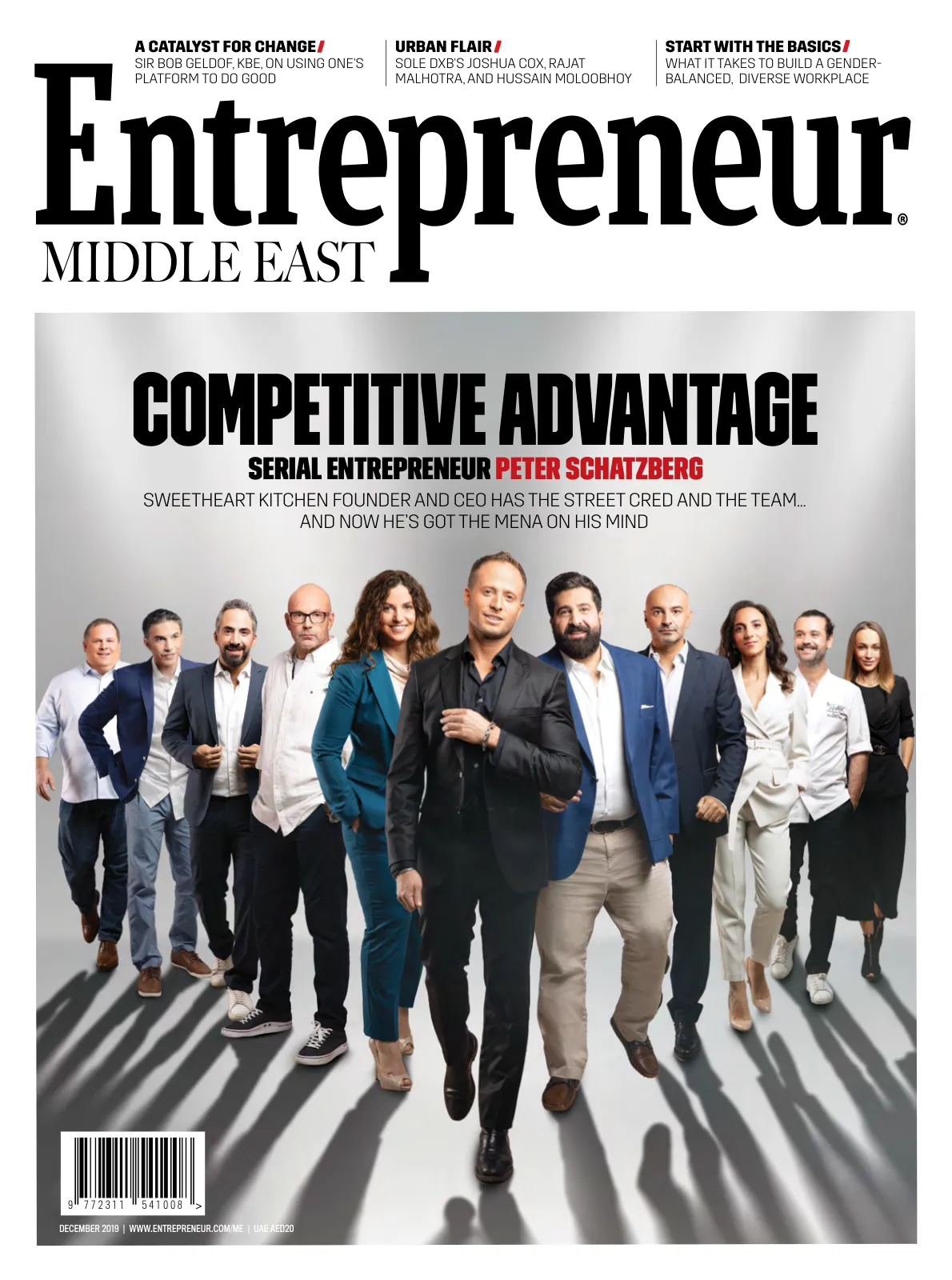
Entrepreneur Middle East, December 2019
Page 1
DECEMBER 2019 | WWW.ENTREPRENEUR.COM/ME | UAE AED20
9
7 7 2 3 1 1
5 4 1 0 0 8
>
A CATALYST FOR CHANGE
SIR BOB GELDOF, KBE, ON USING ONE'S
PLATFORM TO DO GOOD
START WITH THE BASICS
WHAT IT TAKES TO BUILD A GENDER-
BALANCED, DIVERSE WORKPLACE
URBAN FLAIR
SOLE DXB'S JOSHUA COX, RAJAT
MALHOTRA, AND HUSSAIN MOLOOBHOY
COMPETITIVE ADVANTAGE
SERIAL ENTREPRENEUR PETER SCHATZBERG
SWEETHEART KITCHEN FOUNDER AND CEO HAS THE STREET CRED AND THE TEAM…
AND NOW HE’S GOT THE MENA ON HIS MIND
Page 2
experience
downtown
living
The UAE’s most exciting new destination.
A journey of discovery for the whole family.
Where nature, fun and entertainment
come together.
800-Arada (27232)
arada.com
Page 3
3
December 2019 / ENTREPRENEUR.COM /
32
CONTENTS DECEMBER 2019
Sir Bob Geldof delivering
a keynote speech at
the UNMASK event by
EO UAE
26
INNOVATOR
COMPETITIVE ADVANTAGE
Serial entrepreneur
Peter Schatzberg
Sweetheart Kitchen
founder and CEO has the
street cred and the team…
and now he’s got the MENA
on his mind.
32
INNOVATOR
A CATALYST FOR CHANGE
Sir Bob Geldof, KBE
The Irish musical legend
used rock and roll as a
platform to do good- and he
believes entrepreneurs can
(and should) do the same
with their businesses.
36
INNOVATOR
SOLE DXB
Urban Flair
Partners Joshua Cox, Rajat
Malhorta and Hussain
Moloobhoy on launching
(and growing) Sole DXB,
a regional festival for
fashion, culture, art and
design.
46
CULTURE
BUSINESS UNUSUAL
Driven by art (and impact)
81 Designs is on a mission
to empower refugee artisan
women by providing them
with income opportunities
in the art sector.
48
CULTURE
BUSINESS UNUSUAL
Disruption by demand
ALTR Created Diamonds
founder and CEO
Amish Shah is shaking
things up in the jewelry
industry.
52
‘TREPONOMICS
PRO
Start with the basics
Melissa Whiting of Philip
Morris International
explores what it takes to
build a gender-balanced,
diverse workplace.
76
Dtec Forum,
powered by
Entrepreneur
Middle East
Page 4
du.ae/business-pos
Your window to expand.
Introducing Business POS for
cashless payments with better
transaction rates.
Page 5
Page 6
r a d i s s o n h o t e l s . c o m / b l u
Radisson Blu Hotel, Dubai Canal View
Marasi Drive, Business Dubai PO Box 16021, Dubai, United Arab Emirates
T: +971 (0)4 875 3300 info.canalview.dubai@radissonblu.com
D O W N T O W N
D U B A I ’ S
—
—
NOW OPEN
IN DOWNTOWN
DUBAI C ANAL
N E W B L U
Page 7
Page 8
Page 9
Page 10
Page 11
Page 12
Memories create a journey you can always return to
©2019 The Ritz-Carlton Hotel Company, L.L.C.
Your urban adventure in the world’s most vibrant city begins with a luxurious stay at The Ritz-Carlton, Dubai International
Financial Centre. Indulge your senses with a serene experience in the comfort of our impeccable suites, enjoy the ease
of access to a bustling downtown with innovative food and beverage offerings, unforgettable arts scene, and world-class
shopping. On the sizzling evenings, retrieve to Sunken Garden for the best taste of local cuisine and ambiance. Whether
it’s a business trip, a family reunion, or a wedding anniversary, enjoy a memorable stay, and leave the rest to us.
Enjoy your Suite Upgrade Experience today. For reservations, please call +971 4 372 2555 or visit ritzcarlton.com/difc
Page 13
Page 14
Join world class speakers discussing:
The New Face of the
Saudi Government:
Youth Leaders Helping
Drive Vision 2030
Unicorn Clubs: What it
Takes to Build a
Billion-Dollar Company
Imagining 2040:
The Impact and
Dominance of
Deep-Tech
Panel | Breaking the
Boys Club to
Empower Women
Entrepreneurs
Page 15
DISCOVER MORE & REGISTER AT arabnet.me
Nelson Gray
International Business
Angel Investor
Charmaine Hayden
Founding Partner
Good Soil VC
Michael Lints
Partner
Golden Gate Ventures
Areije Al Shakar
Senior Vice President
at Bahrain Development Bank
Director at Al Waha Venture Capital
Fund of Funds
Kareem Elsirafy
Managing Partner
Modus Capital
Ahmed Al Jabreen
Venture Partner
500 Startups MENA
JOIN WORLD CLASS SPEAKERS
Page 16
16 / ENTREPRENEUR.COM / December 2019
36
CONTENTS DECEMBER 2019
64
MONEY
VENTURE CAPITAL
Going the extra mile
Mahmoud Almarzouq,
Investment Manager of
KISP Ventures, on how his
firm encourages founder-
friendly financing terms to
give MENA entrepreneurs
a level playing field.
53
START IT UP
Q&A
A commitment to equality
Shanu S. P. Hinduja looks
into the success of women
in the UAE.
82
START IT UP
Q&A
Third time’s the charm
Having launched two
startups that didn’t work
out in the long run, Sultan
Al Masri is now aiming to
solve the issue that caused
them to fail with his newest
startup, Acquico.
86
‘TREPONOMICS
MARKETING
Leveraging trends
Five tips for improving
marketing strategies in
2020.
73
‘TREPONOMICS
SKILLSET
Make an impression
10 (little) things that can
make a huge difference to
your pitch deck.
78
START IT UP
Q&A
Bringing ethics back to
business
Alethia wants to facilitate
whistleblowing on a safe
and anonymous digital
platform.
66
START IT UP
ECOSYSTEM
Rethinking banking
Ian Dillon gives a
perspective what the
future looks like for banks
with fintech companies in
the picture.
20
EDITOR’S NOTE
By Aby Sam Thomas
72
‘TREPONOMICS
SKILLSET
Bring home the prize
Arif Saiyad of ASA Ventures
on how to win a startup pitch
competition.
56
‘TREPONOMICS
PRO
Preparing for the future of
work
Five essential steps
businesses need to take in
order to be talent-ready.
60
TECH
THE FIX
Reshaping commerce
Five predictions for the UAE’s
retail landscape.
42
TECH
SHINY
#TamTalksTech
Gadgets and doodads that
you might’ve missed out on,
sourced by a tech aficionado.
Sole DXB founders
46
81 designs
Page 17
LESS TIME ON FUEL
MORE TIME ON MOVEMENT
Innovative fuel delivery service supplying quality fuel
and smart analytics for your fleet, anytime, anywhere.
Visit enoclink.ae/businesses or dial 800-ENOCLINK
Delivering fuel. Powering possibilities.
Page 18
18 / ENTREPRENEUR.COM / December 2019
SUBSCRIBE
Contact subscriptions@bncpublishing.net to receive
Entrepreneur Middle East every issue
EDITOR IN CHIEF Aby Sam Thomas editor@bncpublishing.net
CEO Wissam Younane wissam@bncpublishing.net
DIRECTOR Rabih Najm rabih@bncpublishing.net
CREATIVE LEAD Odette Kahwagi
MANAGING EDITOR Tamara Pupic
STARTUPS SECTION EDITOR Pamella de Leon
GROUP SALES DIRECTOR – B2B GROUP Joaquim D’Costa
COLUMNIST Tamara Clarke
PO Box 502511 Dubai, United Arab Emirates
P +971 4 4200 506 | F +971 4 4200 196
For all commercial enquiries related to Entrepreneur Middle East
contact sales@bncpublishing.net
All rights reserved 2019.
Opinions expressed are solely those of the contributors.
Entrepreneur Middle East and all subsidiary publications in the
MENA region are officially licensed exclusively to BNC Publishing
in the MENA region by Entrepreneur Media Inc.
No part of this magazine may be reproduced or transmitted in any
form or by any means without written permission of the publisher.
Printed by United Printing and Publishing
upp.ae
Images used in Entrepreneur Middle East are credited when necessary. Attributed use of
copyrighted images with permission. All images not credited otherwise Shutterstock.
CONTRIBUTORS
entrepreneur.com/me
ACCESS FRESH CONTENT DAILY ON OUR WEBSITE!
MIDDLE EAST
EntMagazineME
@EntMagazineME
Entrepreneur-me
EntrepreneurMiddleEast
EntMagazineME
EntMagazineME
EntMagazineME
MIDDLE EAST
In addition to our print edition, we’re bringing
you all sorts of industry news on our web
mediums. Joining us online means getting
relevant business and startup content in
real-time, so you’re hearing about the latest
developments as soon as we do. We’re looking
forward to interacting with our readers on all of
our social media and web platforms- like any
thriving business, we’re looking to give and take.
#TrepTalkME is already happening on all of our
digi platforms, and all good conversations go
both ways. See you on the web!
Melissa Rizk
Patrick Rogers
Arif Saiyad
Omar Tahboub
Jayesh Patel
Melissa Whiting
Lama Abdelbarr
Fida Chaaban
Rabih El Chaar
Tamara Clarke
Ian Dillon
Shanoo Hinduja
Alice Klat
Alex Malouf
Mahmoud Makki
Rachel McArthur
Megha Merani
Richard Nicoll
Page 19
BUSINESS BANKING
Connect with us
EmiratesNBD.com/business
Business profit always on your mind?
Your business is your main focus, and your business is our business. Explore opportunities for
global expansion with our products, packages and solutions that are tailored to your goals.
Start your relationship with the Best Retail Bank in the Middle East.*
> FX Solutions
> Specialised Lending Programs
> Trade Solutions
> Liquidity Management Solutions
> Online Banking
> Dedicated Relationship Team & Centers
Our Business Banking Solutions:
Terms and conditions apply. *Asian Banker Awards 2019.
Emirates NBD Business Banking
Exploring Opportunities
To apply,
SMS ‘BBGN’ to 4452
Page 20
20 / ENTREPRENEUR.COM / December 2019
EDITOR'S NOTE
I
t’s that time of year again-
as we get ready to wrap up
2019, I feel it’s fair to say
that all of us are looking
back on the year gone by, and
making plans for the year
ahead of us as well.
I am no different in this case- and
having had a think about all of the
things I experienced this year, here
are four life lessons I learned in
2019 that I will be keeping on top
of my mind as we step into 2020:
1/ You need to have only one good
plan for yourself. I’ve heard this
message repeated to me several
times over the course of 2019 from
people I respect, and I do think
they’re on the right track when
they say this. Find that one goal
that you are passionate about
realizing, and then work your way
toward achieving it. Don’t bother
with a Plan B- as The Pursuit of
Happyness author Chris Gardner
puts it at the 2019 Sharjah
Entrepreneurship Festival: “If Plan
B were any good, it’d have been
Plan A.”
2/ The road to success is rarely,
if ever, linear. It’s okay if things
don’t go according to how you plan
it- roadblocks and detours are to
be expected (and perhaps even
welcomed). Not only will you learn
along the way, you might also find
yourself evolving your goals as you
go along. Sure, the hurdles you
are stumbling on at the moment
may not look like something to be
happy about today, but I’m almost
willing to bet that they are going to
have a massive positive impact on
you in the long run.
3/ Stop looking for the quick gains.
Patience is a virtue. Take the time
to do things right. Look toward
the long term when it comes to
making decisions in your career or
your business. Make the effort to
build relationships with the people
that matter around you, be it on
a personal or a professional level.
Persistence and perseverance are
really everything, and so make sure
that you have these traits instilled
in yourself as you go through your
respective lives.
4/ Kindness matters. In a world
where bad behavior by people in
the business realm is almost being
celebrated, I’m here to state that
the opposite is what really makes
an impression- the wins you get
to make for yourself by being nice,
being decent, and being genuine
are far more important than those
you make by pulling a fast one.
After all, as the saying goes, what
you put in is what you get out, and
with that in mind, it’s only in your
interest to behave and act better.
Wishing you all a splendid new
year. See you in 2020!
Aby Sam Thomas
Editor in Chief
@thisisaby
aby@bncpublishing.net
FOUR LIFE LESSONS TO KEEP IN MIND FOR 2020
New year roadmap
Page 21
CLEMENTINE MALIM
ASSOCIATE - MIDDLE EAST
clementine.malim@savills.me
+971 50 558 2853
WHY SAVILLS
INTERNATIONAL RESIDENTIAL
MIDDLE EAST
international@savills.me
+971 4 365 7700
IN-DEPTH KNOWLEDGE
AND INSIGHT OF THE
CURRENT MARKET
WE ARE ONSITE IN LONDON AND READY TO
TAKE YOU ON AN EXCLUSIVE SITE VISIT WITH
ONLY THE BEST DEVELOPMENTS
LOCALLY AVAILABLE TO HELP NAVIGATE
YOUR INVESTMENT JOURNEY FROM
THE UAE THROUGH TO LONDON
TRIPTYCH
BANKSIDE
KING’S ROAD
PARK
GRAND
UNION
LINCOLN
SQUARE
A SELECTION OF THE FINEST
NEW RESIDENTIAL HOMES
L O N D O N
BATTERSEA
POWER STATION
Page 22
22 / ENTREPRENEUR.COM / December 2019
F
olia, a plant-based
menu developed
by international
celebrity Chef Mat-
thew Kenny and HRH
Prince Khaled bin Al-
waleed’s KBW Ventures, has
now made its way to Dubai.
The conceptual menu, first
piloted at the Four Seasons
in Beverly Hills, saw its GCC
launch in Manama at the
Four Seasons Bahrain Bay.
Now, UAE residents can head
to the eponymous dedicated
venue, purpose-built for the
launch at the Four Seasons
Dubai at Jumeirah Beach.
Prince Khaled, a venture
capitalist long known to
advocate for plant-based
business models, was one of
the first investors from the
GCC to get involved in big
name alterative proteins,
including cellular agricul-
ture food tech startups out
of Silicon Valley. Until now,
Folia, a F&B consultancy, has
been rolled out in existing
restaurants, with the Dubai
launch the first-ever to have
a standalone outlet.
“The UAE’s launch of Folia
at a dedicated venue, part
of a property renowned for
its natural beauty, is a huge
milestone for our collabora-
tion with Matthew Kenney,”
Prince Khaled said. “We see
Dubai as an extremely im-
portant market for healthy
cuisine, and we’re confident
that the residents of the
Emirate will enjoy both the
experience and atmosphere
of the venue while delighting
in the meal itself.”
The major uptick of inter-
est in plant-based busi-
nesses and movements like
reducetarianism, flexitarian-
ism, and Meatless Mondays,
led The Economist to dub
2019 the “Year of the Vegan.”
The increasing success of
plant-based business models
has been partly attributed to
health and wellness cam-
paigns by private companies,
governmental campaigns
advocating for less meat and
more greens and pulses, and
plain old curiosity.
Folia’s culinary selection
includes 12 wholesome,
plant-based items including
starters, entrées and des-
serts. Four Seasons Execu-
tive Chef Gilles Arzur said
of the collaboration, “We
are noticing that our guests
are ever more interested in
the food they are consum-
ing, and the health benefits
of shifting to a plant-based
diet. We are excited to bring
this offering to our guests,
and present a menu that
puts a plant-based twist on
favorite menu staples.”
The full Folia (which
means “from the leaves” in
Latin) menu is available in
the Resort’s newly unveiled
garden oasis purpose-built
for the debut. The hotel also
confirmed that Folia will
also be presented as part of
its wellness menu, and be
available in its rooms and
suites “designed for the
health-conscious traveler.”
Folia entrées that we’re
sure hit the spot for even the
lustiest carnivore? The wild
mushroom sandwich, green
herb tacos filled with roasted
squash and king oyster
barbacoa, and the raw pizza
margherita. And for dessert?
A savory coconut cream pie
with a delectable macadamia
crust. Now dig in!
kbw-ventures.com
fourseasons.com/DubaiJB
IN THE LOOP
IMAGES COURTESY KBW VENTURES
HRH Prince Khaled bin Alwaleed bin Talal Al Saud, founder and CEO, KBW Ventures
Prince Khaled’s Folia launches at the Four Seasons Jumeirah in Dubai
A (plant-based) bite to eat
Folia at Four Seasons
Jumeirah Beach
in Dubai, UAE
Page 23
Page 24
24 / ENTREPRENEUR.COM / December 2019
A
wakening the intra
preneurial mindset in
employees within an
organization headlined
a recent session of the
Entrepreneur Middle
East Academy, conducted
at Schneider Electric’s UAE headquarters
in Dubai Technology Entrepreneurship
Centre (Dtec) at Dubai Silicon Oasis in
November.
The Entrepreneur Middle East Acad
emy, which puts together specialized
workshops and customized classes for
entities seeking to ignite the innovative
spirit in their employees, was found to
be in line with the inventive, competitive
culture that Schneider Electric has been
spearheading within its organization.
With Wissam Younane, CEO, BNC
Publishing (the media house behind
Entrepreneur Middle East) kicking off
the proceedings, the half-day session
began with a keynote address by Calvin
Hart, IBM's Partner for Global Business
Services, and Head of Digital Strategy
and IBM Design Studio in Dubai.
In his speech, Hart used his experience
of successfully setting up digital studios
and innovation labs for companies such
as Symantec, HSBC, and IBM to explain
to the audience at Schneider Electric on
what it means to have an innovation-
focused agenda for the business at large.
Hart’s session was followed by a talk by
Ahmed Khashan, Cluster President for
the Gulf countries at Schneider Electric,
who dove into why a customer-first
attitude must govern all of what the
employees of the company set out to do,
RETHINKING BUSINESS
Thinking differently was the central theme of the latest Entrepreneur Middle East Academy
session conducted at Schneider Electric’s UAE headquarters in Dubai Silicon Oasis
Calvin Hart, IBM's Partner for Global
Business Services and Head of Digital
Strategy and IBM Design Studio in Dubai
IN PICTURES
Page 25
25
December 2019 / ENTREPRENEUR.COM /
RETHINKING BUSINESS | ENTREPRENEUR MIDDLE EAST ACADEMY
To have a tailored workshop
by Entrepreneur Middle East
Academy staged at your
own enterprise, email
sarah@bncpublishing.net
for more details.
Entrepreneur Middle East
Academy workshop
Entrepreneur Middle East
Academy workshop
given the increasingly disrupted and
competitive environment the business
landscape at large is being exposed to
right now.
Khashan also used the session to
celebrate some of the employees at
Schneider Electric who had gone above
and beyond in terms of their services
and offerings to the company’s clients.
This was done through the presenta
tion of Schneider Electric’s internal
Customer Excellence Awards, with
Khashan commending the winners for
their excellent work ethic.
Following this, the Schneider Electric
employees that were a part of the
Entrepreneur Middle East Academy
audience went through a hands-on
workshop on building an intrapreneur
ial mindset, which was conducted by
Blooming Eloquence founder and Lead
Consultant Mélanie Lapointe.
Through a series of interactive les
sons and exercises led by Lapointe,
Schneider Electric’s employees got a
firsthand look into the skillsets and
talents they can develop to enable them
to have a more creative approach to
problem-solving, and how doing so can
be used to fulfil not just their personal
development goals, but also their busi
ness’ growth as well.
Ahmed Khashan,
Cluster President for
the Gulf countries at
Schneider Electric
Mélanie Lapointe,
founder and Lead
Consultant,
Blooming Eloquence
Page 26
26 / ENTREPRENEUR.COM / December 2019
INNOVATOR
Peter Schatzberg,
founder and CEO,
Sweetheart Kitchen
IMAGES COURTESY BYSWHK | BYSWHK.COM
26 / ENTREPRENEUR.COM / December 2019
Page 27
27
December 2019 / ENTREPRENEUR.COM /
COMPETITIVE ADVANTAGE | SERIAL ENTREPRENEUR PETER SCHATZBERG
COMPETITIVE
ADVANTAGE
SERIAL ENTREPRENEUR PETER SCHATZBERG
SWEETHEART KITCHEN FOUNDER AND CEO HAS THE STREET CRED
AND THE TEAM… AND NOW HE’S GOT THE MENA ON HIS MIND
by ABY SAM THOMAS
>>>
O
ne of the first things I find myself noting about Sweetheart Kitchen
(stylized as bySWHK, i.e. By Sweetheart Kitchen) founder and CEO Peter
Schatzberg as I speak with him at his offices in Dubai is how refreshingly
frank he is when it comes to talking about the failures he has had over
the course of his life as an entrepreneur. “As an adult, I have had to live
in my parents’ basement on three separate occasions as a result of my
entrepreneurial failures,” Schatzberg declares. “It is in their basement
that I recover from defeat, and prepare both mentally and physically, to repeat the
process once again, always expecting that my next venture will be a success.”
Now, this particular response is why I leaned in to hear more about Schatzberg, as
well as the venture he has just launched here in the Middle East. In a region whose
residents are notoriously known to shy away from talking about their personal
failings out of fear that it makes them look bad or weak, this American entrepreneur
made an impact on me not just by his willingness to show a very honest, human side
to his personality, but also with the perseverance and persistence he showcases
with respect to realizing the goals he sets for himself.
Page 28
28 / ENTREPRENEUR.COM / December 2019
INNOVATOR
Peter Schatzberg,
founder and CEO,
Sweetheart Kitchen
“With almost $25 million of funding, we have
built many sustainable competitive advantages
that will be rather difficult to duplicate,
particularly by virtual kitchens that have
already scaled their model, and built upon the
existing inefficiencies of a kitchen environment.”
>>>
“At first, my failures made me feel
ashamed,” he says. “Over time, I grew
to appreciate the process of rebuilding
myself from the dust with nothing but
determination. Failure became a badge of
honor, so long as my most recent failure
was a greater stretch for me than my
previous attempt. It was only a matter of
time (and effort) before I would develop
the skills required to achieve success,
and I reminded myself of that every day.
Repetitions in the gym build muscle
(and mind). Repetitions in entrepre
neurship build resiliency, wisdom, and
self-confidence. If you remain in the same
industry after each failed attempt, over
time, your repetitions add up to domain
mastery.” This sentiment would explain
the conviction with which Schatzberg
talks about bySWHK, which can perhaps
be best described as a virtual kitchen, a
concept that he is actually widely credited
with pioneering- but today, he prefers
to address his latest venture by another
nomenclature altogether.
“Our team regards bySWHK as the
first ‘six sigma kitchen,’ in that we have
totally redefined what a kitchen environ
ment and delivery product is, starting
from the very beginning of the product
and process design,” Schatzberg explains.
“First, we created a universe of ingredi
ents, cooking and assembly processes, and
cuisine categories that complemented one
another in function and design. Then, we
created a kitchen with processes that are
exceedingly more efficient than any other
in the world. Building on this foundation,
we developed proprietary technology that
results in the fastest lead times (with
least process variation) ever achieved
by a kitchen, and we possess the unique
ability to remotely manage (in real time)
all kitchen operations and functions.
Even while processing over 150 items in a
single hour, our lead times average under
five minutes, with a standard deviation of
under two minutes.”
As for how bySWHK -a portfolio that
today features 21 brands, 30 unique cui
sines, and several hundred individual food
items- actually does this all, Schatzberg
points toward the tech behind the scenes
that is powering all of it. “We have turned
food into data, by building a measure
ment system, whereby we measure the
time it takes for each customer order to
be assembled and ready for delivery, and
the time it takes for every batch of [food]
to be cooked and portioned. We measure
inventory levels and expiration dates to
ensure our food inventory is always fresh.
Our system has removed all decisions that
would ordinarily be made in the kitchen
by employees. Even our procurement
process is automated. Alerts tell us when
any kitchen process is not completed in
the allotted time, and we are working now
to incorporate machine learning into our
platform such that production yields and
inventory par levels are optimized using a
wealth of data that no human could ever
process in making a business decision.
With almost US$25 million of funding, we
have built many sustainable competitive
advantages that will be rather difficult to
duplicate, particularly by virtual kitchens
that have already scaled their model, and
built upon the existing inefficiencies of a
kitchen environment.” In effect, Schatz
berg believes bySWHK is redefining what
a kitchen environment should look like-
and that is what is going to be setting it
apart in the food tech space.
As you can probably tell from his exper
tise in the F&B and tech domains, Schatz
berg has been at the entrepreneurial game
for a while now- his first venture was an
organic café called Free Foods in New York
City in 2008, which was built with an eye
toward the growing interest in healthy
eating from the market at that point
in time. “Unfortunately, my corporate
years at General Electric, and a recently
acquired Columbia MBA proved fruitless
when navigating the deep waters of entre
preneurship,” Schatzberg recalls. “After a
Chapter 11 (restructuring under bankrupt
cy protection), and many years of trial and
error, the company stabilized. However, I
realized it was not scalable, and I wanted
to build something significant.”
Page 29
29
December 2019 / ENTREPRENEUR.COM /
COMPETITIVE ADVANTAGE | SERIAL ENTREPRENEUR PETER SCHATZBERG
The Sweetheart Kitchen Team
Brian Grieser,
Chief Financial
Officer
Karim Chouman,
CEO Kuwait & KSA
Daniel Sangareau,
Executive Chef
Elena Sias,
VP Finance
Ghassan
Shuhaibar,
External
Counsel
Michael Mammone,
Director of Operations, UAE
Alain Verhoeven,
Chief Operating
Officer
Alexandre Pecorilla,
Chief Technology
Officer
Hila Schick,
Global Business
Development
Giovanni Giura,
Global Supply Chain
& Infrastructure
Adib Samara,
Global Brand & Marketing
Page 30
30 / ENTREPRENEUR.COM / December 2019
INNOVATOR
“A strong leadership
has enabled me to step
back, and allow
the professionals
to build the company,
while I focus on our
strategy, direction,
and fundraising.”
This led him to his next venture, which
came about because of a realization he
had that 40% of his café’s sales were from
delivery- a fact that most other restaurant
operators hadn’t caught on to then. “In
fact, they were so resistant to delivery
orders that their sales stagnated prema
turely, whereas my focus on streamlin
ing processes to accommodate delivery
demand resulted in continued growth,”
Schatzberg remembers. “It was there,
dating back to 2010, where I formed a
vision for the virtual kitchen, and began
to develop the skills required to build an
innovative and scalable company. In spite
of my restaurant being one of the top 10
delivery restaurants in New York City,
the CEO of the incumbent food delivery
platform, Seamless, declined my request
to build a delivery-only restaurant. I was
not deterred, and two years later, when
GrubHub and Seamless merged (and later
IPO’ed), I requested permission from the
new CEO to experiment with a portfolio of
virtual brands, and I received his bless
ing.” This was how Schatzberg went about
launching Green Summit Group (GSG)
in 2013, a company whose LinkedIn page
characterized it as being “dedicated to
disrupting the rapidly growing online food
delivery market.”
With about $150,000 in funds (much
of that capital was his own, Schatzberg
notes), GSG started out with quite a
bang- it launched in New York City with
a run rate of $1 million in its first month.
“One might perceive this as an overnight
success, but without tech integrations
or well thought-out kitchen processes,
it was total chaos,” Schatzberg reveals.
“Slowly, our operations evolved, and just
when things were under control, I decided
to launch several more brands, leverag
ing our existing ingredient universe and
kitchen processes. We upgraded to a
much larger midtown facility, and started
opening more units (downtown Manhat
tan, Brooklyn, Chicago). This is where
the virtual kitchen model was conceived.
But back then, I didn’t have VC connec
tions, or access to funding, and certainly
no track record or reputation to speak
of. I was missing many of the essential
ingredients required for building a global
company. Eventually, I learned the hard
way just how little I knew.” Once again,
Schatzberg impresses me with his candor
in admitting how GSG, while being ahead
of the curve in terms of its concept, and
also managing to get investors on its side
over the course of its business trajectory,
ended up burning through the cash it
had raised, and eventually having to shut
down. “20 months ago, I was recovering
from my latest defeat, at the age of 41,
living once again in my parents’ base
ment,” Schatzberg says. “I had pioneered
the worlds’ first virtual kitchen with
GSG, and after achieving some accolades
in the press and within investor circles,
it crashed and burned due to unforeseen
external circumstances. With just $4 mil
lion of funding, my business had achieved
a run rate of $10 million, and was nearly
breakeven. But the US market was not
yet ready for delivery-only kitchens, and
when a few VC-funded virtual kitchens
failed, investors ran for cover. All my cash
was invested in the company, and I lost
everything. No cash and large obstacles
force your mind to expand, and your
survival instincts kick into overdrive.
I gave away my dog (miss you Brisket),
abandoned my beautiful apartment, sold
my car, and returned to my basement
dwelling, to rebuild once again.”
Note how Schatzberg finished that last
sentence: sure, he may have well been
down in the dumps at having to pull
down the shutters at his enterprise, but
he wasn’t content with only licking his
wounds either- he was already using the
lessons he had learnt from the experience
with GSG to develop and hone his next
venture, i.e. bySWHK. “Days before GSG
finally closed its doors, I was asked to
meet with investors to start a new virtual
kitchen business,” Schatzberg reveals. “I
learned that the delivery markets and in
vestor communities outside the USA were
more open-minded to my business model.
Sometimes the opportunity to achieve
your dreams requires that you uproot
yourself from all that is familiar to you.
I borrowed $10,000 from my father and
brother (that is how broke I was), bought
a plane ticket to meet my potential inves
tor, and ended up closing EUR1.5 million
of seed capital over a handshake and a
30-minute pitch (which, I will add, did
not require a deck)… Sweetheart Kitchen
was born, and to date, has raised over
EUR20 million in funding from various
strategic investors in the technology and
food industries.” This is how Schatzberg
ended up in the UAE, with him choos
ing the country (and indeed, the region)
because of how much more favorable it
was for operating a business like his, as
compared to the US business landscape-
not only was this space a fairly untapped
(and underutilized) market, the Middle
East also offered him an environment
better suited and more receptive toward a
food delivery business, which include fac
tors specific to this location, like the more
consistent weather, or the large popula
tion that relies on this service, as well as
the significant ticket size of each order
made in this regard.
Schatzberg landed in Dubai in April of
this year, which was when he got started
looking for spaces from where bySWHK
could work out of in the UAE, Saudi
Arabia, and Kuwait. At the same time, he
was also clear that he couldn’t do what he
aimed to realize with bySWHK without
the support of a high-caliber team around
him, and as such, went about this task
with a lot of care and effort. “Upon arriv
ing in Dubai, I leveraged my reputation
from General Electric to recruit several
talented executives from within the oil
and gas industry,” Schatzberg says. “I
asked one of my oldest friends (who
was an executive at Moodys in Singa
pore) to join as CFO… He has personally
witnessed my previous experiences in
virtual kitchens, and decided it was time
to make a change in his own life. His ad
dition served as the catalyst to convince
other ‘company men’ to consider joining
a startup. Other virtual kitchen compa
nies were receiving funding, and inves
tor sentiment was shifting in my favor,
which made talent acquisition a bit easier.
Soon, we had executives from Emirates,
Nestle, and Careem joining our team.”
The importance that Schatzberg places on
Page 31
31
December 2019 / ENTREPRENEUR.COM /
COMPETITIVE ADVANTAGE | SERIAL ENTREPRENEUR PETER SCHATZBERG
Peter Schatzberg,
founder and CEO,
Sweetheart Kitchen
the people he got together for bySWHK
can perhaps be discerned with the image
that is on the cover of this edition of
Entrepreneur Middle East- Schatzberg
was very emphatic that he wanted his
team to be showcased right by his side
when headlining this magazine. “It is our
team that now truly differentiates us from
other startups, in that the manufactur
ing expertise we acquired from outside of
food is being combined with our existing
appreciation of food delivery. Internally,
we joke about how the ‘old-school’ manu
facturing guys are the innovators within
our disruptive startup, but perhaps this
is a new approach to building a startup
team. A strong leadership has enabled me
to step back, and allow the professionals
to build the company, while I focus on our
strategy, direction, and fundraising.”
As for where all of this is headed,
Schatzberg has a very definitive forecast
in mind for bySWHK, which sees the en
terprise not just scaling extremely quickly
in the Middle East, but in other markets
as well. “We will end 2019 with three
units in the UAE, and by Q2 in 2020,
have 25 units live across UAE, Kuwait,
and Saudi Arabia,” he says. “By the end
of 2020, we will have over 60 units live,
including some in Asia, and possibly Latin
America.” At this point, I have to mention
that there is a certain aura of self-assur
ance with which Schatzberg reveals these
goals he has set for bySWHK, but it’s also
worth noting that he’s quite self-aware
of what he has done so far, and what he
believes he is capable for. “Within four
months of arriving in Dubai, our first unit
went live, and two months later, our sec
ond unit opened. Our third unit launched
in November, and by mid-2020, bySWHK
will have 25 units in the Middle East. We
expect to finish 2020 with 60 Sweet
heart Kitchens across two continents.
Ambitious plans for someone who had
to borrow $10,000 to meet an investor,
but once you believe in yourself, you can
control your destiny,” he declares. That
last comment is again a glimpse into how
Schatzberg goes about motivating himself
to do what he does- in fact, one of his two
favorite quotes is this anonymous one:
“Fate whispers to the warrior, ‘You cannot
withstand the storm.’ The warrior replies,
‘I am the storm.’” (His other favorite also
riffs on the storm motif- that’s a line by
Brazilian author Paulo Coelho: “Not all
storms come to disrupt
your life, some come to
clear your path.”)
When asked about the
significance of these
quotes, Schatzberg replies:
“From the above, I learned
that I control my fate, and
my inner voice. Whether I
choose to tell myself that
I can accomplish great
things (or that I cannot) is
completely within my con
trol. I see conflict, obsta
cles, and setbacks as noth
ing more than challenges
meant to be overcome.
Oftentimes, what appears
to be a devastation in the
short-term can actually
be beneficial to you in the
long run. So, make certain
that you don’t only live in
the moment, or measure
success with a short-term
horizon. Measure success
over the timeline of your
entire life. Only when it is
all over can you evaluate
whether or not you suc
ceeded, and you are the
only judge that matters.
On a daily basis, do you
respect the person you
see in the mirror? That is
truly all that counts. If you
do not respect the person
staring back at you, make the changes nec
essary in your life so that you do. I make
this evaluation of myself on a daily basis.
Some days, I do not respect the man I see,
and I act on it.”
Simultaneously, as much as he is focused
on being the best version of himself he can
be, Schatzberg is also clear that when it
comes to bySWHK as an enterprise, it is
essentially a collective effort, and that’s
what is going to make it last the long haul.
This is the ethos he uses to character
izing his relationship with his investors.
“Always show gratitude towards those
that believed in you when you were just
beginning your journey,” he says. “Your
investor(s) are like a spouse, you are
legally bound to one another the moment
you accept their money. Focus on the ben
efits and long-term value of the relation
ship rather than the day to day aggrava
tion. Most of all, remain humble as your
confidence soars, or the universe is sure to
drop you on your head to remind you that
your success can disappear in the blink of
an eye." This is the same model he uses to
pay tribute to the people he has been able
to bring aboard bySWHK. “I am humbled
by the caliber of talent bySWHK has been
able to attract in recent months, and our
rapid execution is less a demonstration
of my expertise, and more a reflection of
their experience and effort,” he says. “I am
certain there would be no company at all,
if it were not for the faith of our investors,
and the diligence of the team. One person
alone really cannot achieve all that much.”
Stronger together seems to be the
mantra here, and one can’t wait to see
how bySWHK uses that collective force to
reach for the skies- it seems to be only a
matter of time.
Page 32
32 / ENTREPRENEUR.COM / December 2019
W
e now know that economic progress without social progress is
a mean, dispiriting, self-defeating thing, so how do you make that
work? How do you give relevance beyond simply giving somebody
a paycheck?” That’s the question Irish singer, songwriter, and
author, Sir Robert Bob Geldof, Honorary Knight Commander of
the Most Excellent Order of the British Empire (KBE), raises when I talk to him
just a couple of minutes after delivering a keynote speech at UNMASK UAE,
an event organized by the UAE Chapter of Entrepreneurs’ Organization, held in
Dubai in November. “If you can make it work, if you give people added benefit to
the work that they are doing, or that they insist on added benefit like most kids
do now, then, without question, you will expand the ability of the company to
operate and to make profit too,” Geldof adds. “It is about having a business for
something other than profit, as well as profit.” >>>
The Irish musical legend used rock and roll as a platform to do good-
and he believes entrepreneurs can (and should) do the same with
their businesses by TAMARA PUPIC
SIR BOB GELDOF, KBE
A CATALYST
FOR CHANGE
IMAGE CREDIT JSTONE / SHUTTERSTOCK.COM
INNOVATOR
32 / ENTREPRENEUR.COM / December 2019
Page 33
33
December 2019 / ENTREPRENEUR.COM / 33
December 2019 / ENTREPRENEUR.COM /
Page 34
34 / ENTREPRENEUR.COM / December 2019
"IN MY TIME, LINGUA FRANCA
OF THE PLANET WAS NOT
CHINESE, ENGLISH, OR
SPANISH, BUT POP MUSIC.
THAT’S WHY IT WORKED.
I DON’T KNOW WHAT THE
COMMON LANGUAGE OF THE
WORLD IS NOW. IT SEEMS TO
BE ANGER, AND THAT’S ONLY
LEADING ONE WAY.”
INNOVATOR
Sir Bob Geldof delivering a keynote speech at the UNMASK event by EO UAE
Sir Bob Geldof in a conversation with Tamara Pupic,
Managing Editor, Entrepreneur Middle East
The essence of Geldof’s message was sim
ple: every endeavor, be it playing rock and
roll or building a business, should be used
as a catalyst for change. “Rock and roll is
finished now, but it was the central spine
of that culture, and the lesson I learned
from early rock and roll, Bob Dylan, and
others, was to use it is as a platform
[for doing good],” he says. “Also, with
business, you can use it for other things
besides making money. You can use it to
improve people’s lives, which is what eve
ryone is talking about now. That it cannot
be just about shareholders, but stakehold
ers as well. Businesses don’t work unless
they are embedded into the community.”
Ever since rising to fame with the Irish
rock band the Boomtown Rats in the late
1970s, Geldof has used his popularity for
social activism, particularly anti-poverty
efforts concerning Africa. In early 1980s,
he organized Live Aid, a charity concert
staged simultaneously in London and
Philadelphia, to raise money for famine
relief in Ethiopia. Two decades later, in
2005, it was eight simultaneous concerts
around the world -Live 8- to put pressure
on the G-8 economies to step up their
commitment to Africa. In 2008, Geldof
co-founded 8 Miles, a private equity firm
focused on supporting African businesses.
Today, Geldof also serves as an adviser to
fellow Irish rockstar Bono’s ONE Cam
paign, among other initiatives.
Forming a rock and roll band, Geldof says,
was an entrepreneurial activity in itself,
and as our conversation will show, it was
just one of the demonstrations of a mind
prone to actively seeking out change.
“Because of rock and roll, I understood
television, and I started a television
company with two friends, which was
very successful.” This was in the 90s,
when Geldof co-founded Planet 24, a TV
production company that featured the
successful early morning show called The
Big Breakfast. Next was Ten Alps, which
Geldof co-founded in 1999, and that’s the
company that created the successful real
ity TV show, Survivor. Geldof adds, “All
the time, in parallel to all of this, I’ve been
doing music, because I cannot stop that,
which is what I like doing; actually, it’s the
only thing I like doing. It’s just that I can
do this other stuff as well. So, one thing
led me to another, but I think that in my
case it was the circumstances when I was
very young that led me that I had to invent
myself all the time.”
Geldof has spoken about his lonely child
hood in Dublin on numerous occasions.
Having lost his mother when he was seven
years old, he also had to cope with his
father being physically absent from home,
due to his work as a traveling salesman.
Ever since those years, Geldof says, he has
been determined not to allow his life to be
limited by adverse circumstances. “My life
just could not be that, and I had to invent
a way to be Bob,” he says. “That -inventing
a way- is the essence of entrepreneurship.
It is inventing a way for the self to mani
fest itself economically. I had to invent a
viable life. So, you gather experience when
you are younger, and then you try to put
that into practice.”
Page 35
35
December 2019 / ENTREPRENEUR.COM /
"BOTH MUSIC AND BUSINESS
ARE EACH ENTIRELY CO-
OPERATIVE EFFORTS, AND
THAT’S WHAT WE ARE
MISSING AT THE MOMENT–
CO-OPERATION.”
A CATALYST FOR CHANGE | SIR BOB GELDOF, KBE
Sir Bob Geldof with the member of EO UAE Chapter
With our conversation about tracing back
Geldof’s entrepreneurial path having al
ready led us to him becoming a rock star,
as well as to him using his influence for a
greater good, we now talk about the mo
ment Geldof himself became aware of his
enterprising mindset. It was in his early
twenties, he says, when he worked as a
music journalist in Vancouver, Canada.
“Even trying to find a job, there was an
entrepreneurial lesson in itself,” he says.
“You are completely by yourself. You have
to learn to sell yourself, to sell your idea
of yourself, so that people would employ
you. It was in Canada really when my first
opportunity to be something came, and I
lied my way into that job. I said that I was
a writer, and I wasn’t a writer, but I said,
‘Look, you send me out, and if you don’t
like it, don’t publish it.’”
Here, Geldof tells a story about his time
at The Georgia Straight, a free Canadian
weekly news and entertainment news
paper. “For three months, I had been
the music editor, which was 50% of the
content of the paper, but I thought that
not enough people were reading my pearls
of wisdom. We were selling the paper on
the street, it was okay, but we could not
get advertising, because we didn’t have a
big enough circulation. And if we could
not get advertising, we could not get the
things that I wanted to do. I was annoyed
by the business model, so I became the
circulation manager. I persuaded the
owner to do a free version of the paper,
without a color cover, just black and
white, which we delivered free to three
universities in Vancouver. I went out, and
I drove around in a Volkswagen with my
friend, persuading news agents to take the
paper, universities to allow delivering it,
while writing and being the music editor
as well. Overnight, our circulation was
quadrupled. And because we now had a
serious circulation, albeit one that was
free in the universities, and one that was
paid for in the street, we could get serious
advertising and serious money. That’s
when I discovered that I could do this.”
Before committing our conversation to
a full stop, I find it tempting to ask about
his thoughts on the power of today’s
media, especially social media, to inspire
positive change. As I expected, Geldof
replies that “the distribution of the media
has meant the dilution of the message.”
He explains, “The global conversation is
bubbled now, it really is, but there will
be moments, just like online phenomena
(the #MeToo movement, for instance)
that we have already seen, but each one
is just a moment, just a blink, because
there is another one coming. Also, social
campaigns on digital media don’t really
have the impact, they come, they go, and
what we need is concentration. Pop music
is simply pop music, that’s all it is now,
it’s very much like the 1950s. I could be
completely wrong, but I don’t think there
is an art form around which everyone can
agree. In my time, lingua franca of the
planet was not Chinese, English, or Span
ish, but pop music. That’s why it worked.
I don’t know what the common language
of the world is now. It seems to be anger,
and that’s only leading one way.”
It is clear that Geldof has as much zeal
as when, in 1985, his Live Aid concert was
watched by 1.9 billion people across 150
nations. He still believes that empathy is
the distinguishing feature of being human,
he says. “People do care, but it is now
about how to organize it in a structure
where that care is effective,” he adds.
“It is not through preposterous childish
politics of the moment. That’s just not
viable. We need this moment of populism,
hopefully without conflict, but populism
always leads to that. But again, populism
is the function of the chaos of change. We
really do need to alter things rapidly and
now.”
By this final minute of our conversa
tion, I know that Geldof is not the type
who, if I ask about how we can make our
empathy effective, how we can make that
change happen, will leave me without an
answer. In doing so, Sir Bob Geldof shares
a piece of advice for entrepreneurs as
well. “I find business just as creative as
recording,” he says. "Where I am at my
most ‘Bob’ is standing on the stage, and
playing music. That’s when you are free,
that’s the catharsis, that’s when you don’t
have to think, but you just get it all out
of your system. But, when writing songs,
you need to stay entirely focused on how
that works, and business is no different.
To cooperate with a great guitar player,
or a piano player, or anybody whose skills
you don’t have, is so liberating. So, both
music and business are each entirely co-
operative efforts, and that’s what we are
missing at the moment– co-operation.”
Page 36
36 / ENTREPRENEUR.COM / December 2019
INNOVATOR
Partners Rajat Malhotra, Joshua Cox, and Hussain Moloobhoy
on launching (and growing) Sole DXB by ABY SAM THOMAS
URBAN FLAIR
IMAGES COURTESY SOLE DXB
Page 37
37
December 2019 / ENTREPRENEUR.COM /
URBAN FLAIR | RAJAT MALHOTRA | JOSHUA COX | | HUSSAIN MOLOOBHOY
“we knew we
weren't in a
buyer's market.
We knew that
our approach
had to be
different.”
A scene from Sole DXB 2018
F
or something that was started
out in 2010 by a group of
friends trying to find and build
a community around their
shared interests in Dubai,
it’s fair to say that Sole DXB
has come a long way since
then- it’s evolved from its beginnings
as an experimental, open event where
people could come together to talk
about urban streetwear, hip-hop
culture, and more, to becoming an
annual festival which, while still doing
all of the things it started out with, now
includes everything from live music
to art installations to film screenings,
and much, much more. With more
than 25,000 people coming through
Sole DXB’s doors last year, this year’s
instalment of what has been billed
“the premier culture + lifestyle festival”
looks set for an even bigger impact
this time around, with the three-day
event, running from December 5-9,
2019 with an all-pervading Jamaican
theme for its agenda, set to feature
performances by heavyweight names
like Wu-Tang Clan, Black Star, Burna Boy,
Wiley, and several others. At this point,
one could be wondering about how
this event got to where it is today, and
perhaps the answer to that lies in the
very entrepreneurial manner in which
Sole DXB Partners Joshua Cox, Rajat
Malhotra, and Hussain Moloobhoy got
together to build it in the first place
in 2010. “When we started, no one
knew what a sneakerhead was,” Cox
remembers. “You were weird if you
were into footwear, and if you were into
hip-hop, it wasn't really that accepted.
Brands didn't necessarily want to be
associated to it. Fast forward to today,
where it's a multi-billion dollar industry,
everyone wants a piece of it.”
As Cox notes, the landscape in
which Sole DXB operates in today
is a far cry from what it was when
the event first launched. The men
who lead Sole DXB today had
noted a lack of creative outlets or
spaces in Dubai where they could
talk and meet with like-minded
people who shared their interests
in, say, sneakers or hip-hop, and,
as Cox recalls, they went from
complaining about it, to thinking,
well, why don’t they do something
about it. That’s how a Facebook
Group page for Sole DXB came to
be in its early days, and slowly
but surely, as it grew, an event
started to get organized around
its central ethos. “We started to
put together a show,” Cox says.
“And the first event was free- the
only prerequisite was [you had]
to wear your best kicks.” With the
conversation thus being centered
on sneaker culture, the team also
went around looking for brands
in this space to collaborate with
for the event. “There were col
lectively about seven or eight
brands that came on board in that
first year,” Moloobhoy remembers
“But the pitch to them was that
it's not a chance [for them] to
shove marketing down anyone's
throats- [it was to] just come and
connect with an audience.” With
this kind of mindset pervading the
event’s agenda, Sole DXB found
itself becoming a very community-
centered initiative, and as such, it
got a bigger response that it had
anticipated. “I think in our first
year, we were expecting 300-400
people, maybe,” Cox says. “It was
in thejamjar here in Al Quoz, so,
not a massive space. And we had
over a 1,000 people turn up, and
the event was packed, with people
spilling out onto the streets.”
Besides setting the tone for the
different iterations of Sole DXB
that have followed since, the
overwhelmingly positive feedback
that first instalment of the event
received made the team behind it
realize that they had started some
thing that could become a viable
business enterprise as well. >>>
Page 38
38 / ENTREPRENEUR.COM / December 2019
INNOVATOR
“We're not
bringing
cynicism into
the equation,
and brands
do recognize
that.”
SOLEDXB.COM
“We started it with passion,
but it was very quickly that
we realized we were onto
something,” Cox explains. “For
most creatives, our dream is
to be able to make a living
doing what you love. And we
are into sneakers and foot
wear, but beyond that, into
the culture as a whole. So just
being able to create some sort
of an ecosystem where we can
flex our creative muscles in
this space was really kind of
the mandate of what we were
driving towards. But we also
knew, we weren't in a buyer's
market. We knew that our
approach had to be different.”
And to make Sole DXB stand
out, the team was clear that its
offerings had to be driven by
their consumers. “Before you
start charging for something,
you need to know who your
audience is, and then, what
are you selling,” Malhotra
explains. “You know, it really
was an experiment in the space
of, say, we think there's other
people here like us, so, what
are they wearing? What are
they listening to? How are they
showing up? And if you look
where the festival is today,
I think it's a very deliberate
evolution over that period
of time, like really making it
strong, while also not making
it inaccessible. Not trying to
price above the market, even if
we think our content sits in a
particular space. When we go
into a new space, like we did
in Cape Town earlier this year,
we didn't try and go in, like,
we're Sole, and we're going to
start with 600 people. Instead,
we said we're going to host a
party. And the party is free. We
want to meet the community,
like, come out, and let's again
find out who these people are.
So, it was a deliberate process,
where we had the comfort of
doing this on the side for a
while, where it wasn't snowed
under, or crushed creatively by
the commercial pressures of
any business.”
Now, it does seem like
the Sole DXB team’s modus
operandi has worked out well-
not only does the brand have
a significant reach and pull
within the creative community
of the region, it’s also managed
to snap up great commercial
partnerships along the way as
well. This year’s edition of the
event has brands like Cadillac,
Burberry, Farfetch, Levi’s and
several others participating
in it, with them making use of
everything from large activa
tions to exclusive retail expe
riences to connect with the au
dience at Sole DXB. In terms of
how the team goes about mak
ing decisions on which brands
to collaborate with, while also
making sure that Sole DXB’s
focus on its attendees is not
lost, Malhotra says that they
are very insistent on sticking
to the values and beliefs with
which they kicked off this
enterprise in the first place.
“We're trying our best to
program authentically- we're
not coming out and saying, we
think this is popular, let's top
that in there,” he says. “It's
like, we actually think that's
quite cool, and by sticking to
what we actually like, in terms
of taste, you know, rightly or
wrongly, at least we're be
ing genuine about it. We're
not bringing cynicism into
the equation, and brands do
recognize that. While we can
have a tendency to be seen as,
sometimes, at the beginning,
difficult to work with, once
things start rolling between
us with brands or anyone
that wants to participate, we
stay together. Like, we stick
together as a unit. As long as
we agree on, going in, what
the standards are, things run
pretty well.” At the same time,
there’s also the camaraderie
between the partners that’s
proved to be a huge advantage
for Sole DXB. “Sole wouldn't
be what it is today unless
there was a huge amount of
respect that we had for each
other,” Moloobhoy reveals.
“And we challenge each other,
but in the best of ways- that's
what helps elevates this, and
keeps it as fresh.”
As for where Sole DXB
is headed, it seems to be a
given that Cox, Malhotra, and
Moloobhoy work with the
mindset that the next edition
of Sole DXB has to be a better
version of its current state. The
team is also exploring into how
the Sole DXB model could be
applied in locations other than
Dubai, whereby they use their
expertise and learning from
Page 39
39
December 2019 / ENTREPRENEUR.COM /
JOSHUA COX/ PARTNER AND
DESIGN DIRECTOR
As Design Director at Sole DXB,
with a global outlook on street
culture, Josh established Sole
DXB to create a platform to help
revive culture and inspire the
urban fashion industry in the
region. He completed his Bach
elors of Design in Australia,
with a specialization in product
design. Being Dubai-based for
25 years, his craft is heavily
influenced by his upbringing,
which took place amidst the ur
ban community of Dubai’s art
ists, musicians, DJs, basketball,
and hip hop. Birthed through
Sole DXB, Joshua’s dedication
to parallel the global narrative
of street culture with the dia
logue happening in the region
has placed Dubai as both a
celebrator and contributor in
the conversation. He is also the
co-founder of contemporary
fashion brand, Haraamis, with
partner Hussain Moloobhoy,
launched in 2016.
soledxb.com
THE EXECUTIVE SUMMARY SOLE DXB
HUSSAIN MOLOOBHOY/
PARTNER AND CREATIVE
DIRECTOR
Having graduated from the
London Institute of Art and
Design, Hussain started his
creative career at Saatchi’s
London office where he spent
four years. In 2006, he made
the move to the Middle East,
joining Saatchi & Saatchi Dubai
as Creative Director. In 2010,
Hussain took a sabbatical to
explore the global design and
fashion industries. His ambition
to start an agency was realized
in 2012 with the launch of
Moloobhoy & Brown, an award-
winning independent design and
brand communication studio.
Set out to make an unparalleled
mark on the landscape of
Dubai since founding M&B and
Sole DXB, he now sits as their
Creative Director. He is also the
co-founder of contemporary
fashion brand, Haraamis, with
partner Joshua Cox, launched
in 2016.
RAJAT MALHOTRA/ PARTNER
A graduate of NYU, Rajat settled
in Dubai after having lived in Los
Angeles, Kuwait, India, and New
York City. In 2004, he established
a media and telecom business,
for which he served as CEO for
eight years. Rajat has previously
partnered with Third Line Gallery’s
co-founder Sunny Rahbar on a
collaborative project, hosting
multiple curated exhibitions
with NYC gallerist Candice
Madey, founder of On Stellar
Rays. More recently, Rajat has
built a recording studio in Dubai,
as a place for visiting artists to
create and connect. He is also
the co-founder of the card game,
Panda, and has been serving as a
partner in Sole DXB since 2013.
“OUR CREATIVE
CAPITAL NEEDS TO BE
UNMATCHED. AND WE
THINK WE CAN DO IT.
WE REALLY DO.”
URBAN FLAIR | RAJAT MALHOTRA | JOSHUA COX | | HUSSAIN MOLOOBHOY
here to boost another crea
tive ecosystem. “I hope that
we can look at this five years
from now, and be, like, we are
this region's chief cultural
expert,” Malhotra says. “Like,
going into another market,
where people are like, wow,
that's Sole from Dubai that's
coming out, and doing this.”
But, once again, even when it
comes to growth, the team is
clear that they are not going to
do so by compromising on the
quality that Sole DXB stands
for. “We're not the type of
people that necessarily believe
that you need to be in 20 or
30 markets for this to work
the way it works,” Malhotra
says. “There's ways to make
this richer and more profit
able, without having to take
everything that's on the table.”
As for what we can expect in
a few years from the brand,
one has to admire the team’s
mindfulness to stay atop of
their inadequacies. “It’s our
job to try to remain self-aware
of what our challenges are, and
which areas we might not be
the strongest,” Malhotra says.
“But all that being said, and all
things being equal, like, we are
talking about it internally on
how to improve those things,
how to address those things.
It's our 10-year anniversary
in 2021, and everything is
leading up to what that's going
to be. In five years, we have
to be the number one festival
in the world. And that's not
about having 200,000 people
at the door- it's that if you're
in the space of contemporary
culture, you pick up the phone
to your agent, and say, how
do I get a gig at Sole DXB? If
I'm a brand, it's like, I want to
show at Sole DXB. Our creative
capital needs to be unmatched.
And we think we can do it.
We really do. I think there's a
few things that need to come
together, but I think we have
the energy to get there.”
Page 40
40 / ENTREPRENEUR.COM / December 2019
ADVERTORIAL
7 STEPS TO AN EFFECTIVE INVESTMENT STRATEGY
Battersea Roof Gardens and Power Station
A
s global markets continue
to fluctuate, savvy inves
tors from the Middle East
are looking to diversify
spend offshore. Invest
ment in real estate allows
for a diversification of
assets and a spread of the risk, with this
sector having long been a major player for
ME investors keen to have global assets
as long-term investments.
London continues to be one of the most
popular destinations for capital invest
ment. Savills has identified that a £5m
investment into prime central London real
estate would effectively cost 40% less
today than 5 years ago (pre-tax), with
approximately 20% due to value softening
and 20% due to currency fluctuations.
Plus, as a multicultural city that thrives off
diverse nationalities and foreign invest
ment, developers in London are embracing
investors from the region, with no foreign
buying taxes or penalties in the city, and
a focus on transparency and making se
curity a priority in their developments, in
order to provide peace of mind for those
overseas.
Key London developments such as Kings
Road Park, Triptych Bankside, Grand Union
and the iconic Battersea Power Station,
provide an irresistible opportunity for
a secure investment at an accessible
price in a sustainable way, supporting the
regeneration of the city. Partnering with
the right developers and consultants
however, is essential. With experts on the
ground in London and across the Middle
East, companies like Savills offer investors
and would-be investors the security of a
strong global reputation and confidence
in well-researched high-end product of
ferings.
When it comes to developing your invest
ment strategy, Savills has some useful
advice:
1. Establish who you are!
This is key in establishing your
strategy and will help establish your
motivators for investment. Are you:
a. The owner
You are in it for the long haul. The
property is your home, a place to put
down roots, therefore your approach
is probably somewhat less about the
returns, albeit this is important, and
more about finding the right property
to suit your needs, that also matches
your budget.
b. The occupier
For you it’s about the short term, nor
mally through a transition, i.e. a work
or study assignment. You probably
want to minimise your capital outlay
risk, and align this to the time you are
expecting to sell - understanding
the pros and cons. You need to be
clear about your long term goal, i.e.
will you sell outright, or place into a
rental pool? It’ll be important that you
establish your financial and tax/ legal
obligations on these scenarios.
c. A long-term investor
You’re looking to build up, or add to an
existing, asset portfolio and diversify
risk. Again, it’s essential here that you
establish your financial and tax/ legal
obligations.
d. A small investor
You might be looking for annuity in
renting for short term gains, and
therefore placing your property into a
rental pool. As before, it’s essential to
ascertain your financial and tax/ legal
obligations.
2. Commit to a realistic timeline
How long are you in it for? How long
would you like to have the investment
for, before you start seeing returns?
You need to outline the period and
length of time you will remain commit
ted as this will obviously have a big
impact on your investment journey.
Page 41
41
December 2019 / ENTREPRENEUR.COM /
ADVERTORIAL
ABOUT THE AUTHOR
Clementine Malim
Associate, International
Residential Sales Middle East
Savills Middle East
As Associate for International Resi
dential Sales for Savills Middle East,
Clementine is responsible for advis
ing high net worth and ultra-high
net worth individuals on residential
purchases.
She handles multiple investment
property portfolios around the globe,
in prime locations, such as New York,
Paris, Berlin and London.
Originally from London and having
received her education in Edinburgh,
Clementine moved to Dubai in 2013.
She brought with her over six years
of experience both onshore and
abroad, and has been pivotal in
working with developers and in turn
acquiring new business and forging
sound relationships with her clients.
Triptych Bankside
3. Be aware of your risks and
opportunities
Don’t just rely on a few
Google searches and dinner
party conversations! Big data
analysis enables buyers and
potential buyers to consider
the risks of buying in the area,
and the local trends, as well as
predicting potential changes
in value. Partnering with a
trusted real estate advisor
with a strong research depart
ment will give you all of this
information at your fingertips,
allowing you to make a fully
informed decision, with the
support and guidance of expe
rienced professionals.
4. Know your budget!
Assess your affordability
realistically, and limit your
exposure. Be honest and clear
about what your boundaries
are.
5. Consult with real estate
experts
As we’ve mentioned, partner
ing with a credible real estate
company like Savills has
lots of benefits in terms of
research and experience, they
can also help you to assess
your motivators, in order to
position you with the right
partners and properties.
6. Get legal and taxation
advice
In the UK, there are a number
of residential taxes which may
be applicable, including Stamp
Duty Land Tax (SDLT), Annual
Tax on Enveloped Dwellings
(ATED), ATED-related Capital
Gains Tax (CGT), Non-Resident
Capital Gains Tax (NRCGT),
Corporation Tax (CT), Income
Tax (IT) and Inheritance Tax
(IHT), which is why mortgages,
life insurances and wills need
to be carefully structured. See
advice from law firms with
experience in residential UK
real estate, such as Trowers
& Hamlins, who can guide you
through local rates and taxes,
effective succession planning
and mortgage planning, as
well as advice on wills and life
insurance cover.
7. Familiarise yourself with
the area
Understand the region and
local area you wish to invest
in, and what positive factors
should be taken into account,
i.e.
a. Transportation links
In London, this would include
Crossrails projects and
the new overground and
underground lines, the most
well-known probably being the
Elizabeth Line – a high speed
rail due to open next year
which will run across London
and reduce journey times
across the city by up to 50%
- and add £42 billion to the UK
economy. Regeneration sites
in these areas have massive
potential for returns.
b. Community and amenities
Neighbourhood amenities
remain as critical a deciding
factor as ever, as the demand
for developments such as
King’s Road Park (with its
two in-house cinemas, 25m
swimming pool, gym, spa, and
golf simulator) and Triptych
Bankside (the cultural and
transport hub near to Borough
Market, Shakespeare’s Globe
Theatre, the Tate Modern and
The Shard) demonstrate.
c. Sustainability and
regeneration
Developments such as Grand
Union, which is part of a canal
side regeneration project with
11 acres of public green spac
es and waterside walks, and
the iconic Battersea Power
Station, are transforming the
local landscape and creating
thriving communities and truly
sustainable neighbourhoods
and work hubs, and are incred
ibly attractive to buyers and
renters alike.
d. Education and healthcare
services
In the UK, being within the
catchment area of a school
which has high GCSE results
and a strong Ofsted rating
greatly increases its value. For
example, Prince George being
a pupil at a Battersea prep
school has greatly increased
the demand for the Battersea
area.
e. Safety and security
Seek out data on your location
of choice – check out crime
statistics and local demo
graphics to really get a feel for
the area.
Choosing the right investment
for your situation is a science,
there’s a lot of information to
process and factors to take
into account, so always be
sure to seek out informed and
trusted partners to guide you
in this process. Read more
about investing in London and
see the stats for yourself in
Savills digital magazine, here:
http://savills.digitalmagazines.online/
international-residential/p/8
Page 42
42 / ENTREPRENEUR.COM / December 2019
GADGETS AND DOODADS THAT YOU MIGHT’VE MISSED OUT ON, SOURCED BY A TECH AFICIONADO.
YES, IT’S OKAY TO WANT THEM ALL… AND NO, IT’S NOT OUR FAULT.
FLY HIGH
DJI MAVIC MINI
IMAGES COURTESY DJI MAVIC MINI | HUAWEI
TECH SHINY
DJI Mavic Mini
DJI Mavic Mini
DJI Mavic Mini, an ultra-light folding
drone, is made for everyday use
with its easy-to-use controls and
compact design. Weighing just 249
grams, DJI Mavic Mini is portable
and easy to fly, giving its pilots
complete control. Capture high qual-
ity footage including 2.7K video at
30 frames per second, 1080p at 60
frames per second, or 12-megapixel
stills from a bird’s eye view. Don’t
let the flying shake your confidence
in capturing photographs, as there’s
a three-axis motorized gimbal that
supports and stabilizes the camera.
The Wi-Fi enabled device pairs with
the DJI Fly app, and features a vari-
ety of pre-programmed flight modes
to help you capture the world from a
new perspective.
Page 43
43
December 2019 / ENTREPRENEUR.COM /
#TAMTALKSTECH Tamara Clarke, a former software development professional, is the tech and lifestyle enthusiast behind The Global Gazette, one
of the most active blogs in the Middle East. The Global Gazette has been welcomed and lauded by some of the most influential tech brands in the
region. Clarke’s goal is to inform about technology and how it supports our lifestyles. See her work both in print regional publications and online on
her blog where she discusses everything from how a new gadget improves day-to-day life to how to coordinate your smartphone accessories.
Visit theglobalgazette.com and talk to her on Twitter @TamaraClarke.
WATCH OUT
HUAWEI WATCH GT 2
#TAMTALKSTECH | GADGETS AND DOODADS THAT YOU MIGHT’VE MISSED OUT ON
Get connected like never
before by pairing the Hua-
wei Nova 5T with the Hua-
wei Watch GT 2. Powered
by Huawei’s proprietary
wearable chip Kirin A1 with
intelligent power saving
technology, the watch
keeps you going for up to
two weeks. Although it’s
packed with technology,
Huawei Watch GT 2 looks
like a traditional timepiece
with a curved 3D bezel-less
design. Huawei Watch GT
2 is ultra-thin at just 9.4
mm, and with a plethora of
watch faces available, you
can wear your mood on
your wrist. Besides making
use of GPS and GLONASS
satellite positioning sys-
tems, the watch also offers
real-time heart rate moni-
toring as well as all-day
activity tracking to give
you better insights on your
health. With Bluetooth
calling features, sleep
monitoring, music storage,
and playback, Huawei
Watch GT 2 is the personal
assistant you never knew
you needed.
PICTURE PERFECT
HUAWEI NOVA 5T
Huawei Nova 5T
The Huawei Watch GT 2
provides professional
cycling assessments
Huawei Watch
GT 2
Huawei ups the ante with
the Nova 5T, which merges
cutting-edge camera
technology with artificial
intelligence. The power-
ful rear camera system
includes a 48MP main lens,
a 16MP wide angle lens,
a 2MP macro lens, and a
2MP bokeh lens to render
clear, crisp images in any
shooting situation. Nova
5T gives your selfie game
a boost too with its 32MP
front-facing camera with
beautification software.
The device is powered by
Huawei’s flagship Kirin 980
chipset, and features 22.5W
Huawei SuperCharge capa-
bility to refuel your battery
from zero to 50% in just
30 minutes. Looks aren’t
everything, but it’s worth
mentioning that the Nova
5T is an eye-popping device.
With a 6.26-inch full view
HD display and a reflective
3D-finish available in three
striking colors, you’ll be
proud have Nova 5T in the
palm of your hand.
Page 44
44 / ENTREPRENEUR.COM / December 2019
Brioni SS19
Brioni SS19
CULTURE TRAPPINGS
‘TREP TRIMMINGS
THE EXECUTIVE SELECTION
From better goods to better wardrobe bests,
every issue we choose a few items that
make the approved executive selection list.
In this issue, our picks include the Hackett
Autumn/Winter 2019 line, a timepiece range
worth taking a look, a bag for the holiday
getaway, and more.
Digel
Autumn/Winter
2019
Hackett Autumn/Winter 2019
Hackett Autumn/Winter 2019
Hackett Autumn/Winter 2019
Hackett
Autumn/Winter
2019
ALL IN THE DETAILS
HACKETT
Founded in 1983 in London, Hackett made an impression
with its debut by merging traditional styles with modern
cuts, inspired by the quintessential British attire of
the early 20th century. The brand is staying true to
its history with its collection for this season, taking
in hues of dark blues and beige to convey soft autumn
tones, while also featuring two-button suits with
vertical stripes for a taller and slimmer look, as well as
checkered double-breasted suits to add detail to your
wardrobe. There are also a few key pieces you’d want
like the tweed jacket, the blazer made from natural wool,
and the light down parka that you can use to layer your
ensemble. hackett.com
Page 45
45
December 2019 / ENTREPRENEUR.COM /
'TREP TRIMMINGS | THE EXECUTIVE SELECTION
IMAGE CREDIT HACKETT | CORNELIANI | GIVENCHY | BAUME & MERCIER
Corneliani
Fall/Winter 2019
Baume & Mercier
Classima Small Seconds
Baume & Mercier
Classima Chronograph
Complete Calendar
FOR THE JETSETTERS
CORNELIANI
Fresh from Corneliani’s Fall/Winter 2019 exclusive
capsule, this leather travel bag is the perfect
companion for your next holiday getaway. Designed
for comfort and style, this spacious handbag is crafted
with refined leathers, featuring a front embossed logo
stamp, a detachable and adjustable shoulder strap, and
an internal zipped pocket. corneliani.com
EDITOR’S PICK
GIVENCHY
Looking for a new signature lipstick? With a vibrant, long-
lasting color that comes with a satin finish, Givenchy’s
Rouge Interdit is the ideal lipstick for all occasions.
Available in 24 shades, the brand offers a creamy, silky
texture, and the precious oil of the black rose in its lip
beauty products, which leaves lips soft and moisturized.
Givenchybeauty.com
THREE’S COMPANY
BAUME & MERCIER
Swiss luxury watchmaker Baume & Mercier boasts three
new models in its Classima collection for everyday wear.
Encased in 42mm steel cases, they feature blue dials, along
with either a stainless-steel bracelet, or an interchangeable
leather strap. The Classima Chronograph Complete Calendar
shows off the date, week, and month, while also adding in
a moon phase, a 24-hour day/night indicator, as well as a
chronograph function- all while maintaining its clean sleek
look. Meanwhile, business travelers would find the Classima
Dual Time useful, as it displays a second time zone on the
center ring with a 24-hour indicator. And there’s the Classima
Small Seconds too, featuring a small seconds counter, Roman
numerals, and a distinct décor in the dial’s center, making it a
suitable dress watch for formal galas. baume-et-mercier.com
Page 46
46 / ENTREPRENEUR.COM / December 2019
81 Designs is on a mission to empower refugee artisan women
by providing them income opportunities in the art sector
Driven by art (and impact)
IMAGES COURTESY 81 DESIGNS
by PAMELLA DE LEON
Nesrine El Tibi Maalouf,
co-founder, 81 Designs
Palestinian women refugees embroidering
CULTURE BUSINESS UNUSUAL
D
riven by art and
social impact, 81
Designs brings
together Middle
East artists with
Palestinian women
refugees living in Lebanon to
empower them to have a sus-
tainable livelihood by making
use of their artisanal talents.
Launched in 2015, the venture
was started by mother-daugh-
ter team Nesrine El Tibi Maal-
ouf -whose background stems
in advertising- and Nadine
Y. Maalouf, who previously
worked with art education
institutions and retail groups.
The brand primarily focuses
on utilizing the art of tatreez, a
traditional Palestinian em-
broidery craft, which remains
the primary embellishment
in women’s clothing, as well
as a reflection of a woman’s
social status in Palestine. “A
part of the daily routine in
old villages [was that] women
used to work collectively on
an embroidery project, until
it has become a traditional
craft passed from generation to
generation,” explains Nesrine,
who is half Palestinian herself.
“During the political unrest,
tatreez became a coded lan-
guage used to express opinions
and share stories- a symbol of
resistance, identity, and herit-
age.”
The enterprise took two years
to establish, notes Nesrine.
Initially launched in 2015, 81
Designs now oversees a group
of refugee women as they
preserve and modernize the
craftsmanship of tatreez to
recreate the works of leading
Middle East artists in their
traditional style of cross-
stitching. In March 2017, 81
Designs kicked off a project
at Art Dubai, in collaboration
with international French-
Tunisian artist eL Seed, with
the former recreating eight of
his artworks and presenting
them during a talk between
Nadine and eL Seed. Collabo-
rations like these have allowed
the social enterprise to thrive-
in March 2018, following the
successful launch project, the
enterprise has managed to em-
ploy four more female artisans,
making a difference to the lives
of a total of 14 refugee women.
At Art Dubai, 81 Designs also
presented its recreation of
some works from the Graffix
from the Souk collection by
contemporary artist Hassan
Hajjaj, perhaps better known
in the art world as the Andy
Warhol of Marrakech. This was
followed by the addition of six
more refugee artisans into the
enterprise, which signaled the
debut of the company’s third
project in November 2018 at
Abu Dhabi Art in collaboration
with Bokja, a Lebanese-based
surface fabrication studio.
The project was titled Stand-
ing Tall, and featured five
sculptures of women with
100 embroidered fragments,
designed to pay tribute to the
UAE’s founding father, the late
H.H. Sheikh Zayed bin Sultan
Al Nahyan. The fragments,
Nesrine notes, were to mark
the 100 years of his passing,
and also were a reflection of
his poetry.
The enterprise was also
asked by Facebook to launch
their participation at Dubai
Design Week in November
2018 through an entire week
of workshop activations, which
focused on the history of
tatreez and 81 Designs’ goal of
both modernizing and preserv-
ing the traditional craft. And
Page 47
47
December 2019 / ENTREPRENEUR.COM /
DRIVEN BY ART (AND IMPACT) | 81 DESIGNS
THE ENTERPRISE PRESENTED A NEW
PROJECT CALLED THE JOURNEY AT
ABU DHABI ART. IN COLLABORATION
WITH EL SEED, THE ARTIST PAINTED
SEVEN MURALS INSIDE AIN AL-
HILWEH, ONE OF THE LARGEST AND
MOST CROWDED PALESTINIAN
REFUGEE CAMPS IN LEBANON,
ALONG WITH THE REFUGEE WOMEN
THAT 81 DESIGNS EMPLOY, AND
THEIR CHILDREN.
Refugee artisans
employed by 81 Designs
painting a mural
Refugee artisans employed by 81 Designs with eL Seed
recently, in November of this year, the
enterprise presented a new project called
The Journey at Abu Dhabi Art. In col-
laboration with eL Seed, the artist painted
seven murals inside Ain al-Hilweh, one of
the largest and most crowded Palestinian
refugee camps in Lebanon, along with the
refugee women that 81 Designs employ,
and their children. With over 35 refugee
women participating in the project, each
mural (inspired by a poem by Palestin-
ian poet Mahmoud Darwish) translated
into an artwork created in the medium
of tatreez on canvas, which was hand-
stitched by the artisans. The enterprise
also released a behind-the-scenes look of
the project with the book The Journey,
which showcased a powerful photo series
highlighting the living conditions of a dis-
placed community, and an in-depth per-
spective on the lives of refugees. It was re-
leased at this year’s Abu Dhabi Art festival
in late November, along with the framed
tapestries and figurines made in tatreez.
Besides empowering women artisans
through design and art, 81 Designs also
offers capacity building through skills and
confidence workshops in south Lebanon.
Their head artisan, Um Mahmoud, also
conducts regular trainings to build the
refugee artisans’ confidence and continu-
ously develop their technical skills. Using
their own personal funds as seed capital,
the company’s founding duo says they
generate revenue through successful sales
of their projects. “We currently do not
have any other private investors or VCs
involved in the social enterprise,” Nadine
says. Describing themselves as an enter-
prise with a social cause that is driven by
commercial strategies, Nadine says that
81 Designs uses the employment model of
a social enterprise. “We employ Palestin-
ian refugee women living in Ain al-Hilweh
refugee camp in Lebanon, and provide
them with sustainable incomes. We do
not restrict the refugees to work with us
exclusively to not limit their income that
will help support their families.” As a
venture aspiring toward making real so-
cial impact, the mother and daughter also
make it a point to ensure that the people
and entities with whom they collaborate
share similar values as 81 Designs. “They
also share the same compassion and drive
we have towards reaching our goals,” Na-
dine notes.
As entrepreneurs, every decision count,
and they can essentially make or break
your venture. When it comes to making
difficult decisions, Nesrine says transpar-
ency is a key factor in how they go about
the process. As a mother-daughter duo,
Nesrine claims that they have an open and
honest relationship. “We were both trans-
parent from the beginning on where we
see our involvement within the social en-
terprise we created,” says Nesrine, noting
how they’ve given themselves clear roles-
Nadine is the Art Director, while Nesrine
handles partnerships. As for what’s next
for the enterprise, the duo states, “Even-
tually, we hope to provide an educational
scholarship for refugee children.” And
finally, when asked for advice they’d give
other entrepreneurs, Nesrine replies:
“Stay curious and believe in yourself,
your intuition, and your vision. Most im-
portantly, know that it is okay to explore
unique ideas.”
Page 48
48 / ENTREPRENEUR.COM / December 2019
T
he diamond trade may not
be what immediately comes
to mind when we talk about
industries that are current-
ly being disrupted in the
world today, but a chat with
ALTR Created Diamonds
founder and CEO Amish
Shah makes me realize that
this business, like so many others around
it, is seeing the winds of change come
upon it as well. There was once a time
when diamonds could be sourced only
from the earth, but today, science and in-
novation has made it possible for them to
be created within a lab as well. The ad-
vent of these lab-grown diamonds -which
are also called created diamonds- have
caused quite a stir within the jewelry
industry, with detractors quick to point
out how they just don’t match the value,
rarity, or appeal of their earth-mined
counterparts. But Shah -who’s part of
a family that’s been in the jewelry busi-
ness for 85 years- believes that created
diamonds are the future of this industry,
and those who fail to get onboard this
wave of disruption in it today only stand
to lose in the long run. As for what drives
his conviction in this regard, Shah, who
has been working with created diamonds
since 2006, points toward growing
customer interest as validation for what
he preaches- according to him, there is a
demand for an alternative to earth-mined
diamonds, he says, and ALTR is simply
responding to that.
Since its launch in New York City in
2016, ALTR (a division of the R. A. Riam
Group, of which Shah is a founding
member as well) has seen its business
grow around the world, with Shah saying
that the company’s main task over the
years has been in educating customers
about the options they have in front of
them when it comes to purchasing dia-
monds. “ALTR was born with a very clear
perspective that we are going to tell the
consumer that there is a choice for you,”
Shah explains. “And then you make that
decision.” Now, there’s plenty of material
on the internet that delves into the dif-
ference between earth-mined diamonds
and created diamonds, and deciphering
differences in terms of value (a man-
made construct by itself, by the way)
between the two seems to be a largely
subjective affair. At the same time, it’s
worth noting that the US Federal Trade
Commission declared in 2018 that it
won’t be defining diamonds as “natural”
diamonds any more, because, as per its
ruling, “it is no longer accurate to define
diamonds as ‘natural,’ when it is now
possible to create products that have
essentially the same optical, physical,
and chemical properties as mined dia-
monds.” As for Shah, his answer to the
question in terms of differences between
the two kinds of diamonds is decidedly
simplistic, but, at the same time, fairly
straightforward as well. “A diamond is a
diamond is a diamond,” Shah says. “The
simplest difference, if I was telling a con-
sumer, might be that one is from below
the ground (which are the earth-mined
diamonds), and one is above the ground.”
According to Shah, ALTR has been
contracted to about 800 stores today,
and as its roll-out continues across the
globe, its offerings have been seeing in-
creased consumer traction as well. “Just
like any disruption, you know, you bring
the product to the market, and you ask
the consumer a question: ‘What do you
think?’” Shah says. “What happens after
that is the response of the consumer.
Revenue is always a result, not the cause
of growth. I think the traditional busi-
nesses see revenue as success. Success is
not revenue. Success is consumer adop-
tion. And today, we are available from
New Zealand to North America.”
ALTR Created Diamonds founder and CEO
Amish Shah is shaking things up in the jewelry
industry by ABY SAM THOMAS
CULTURE BUSINESS UNUSUAL
“ALTR was born with
a very clear perspective
that we are going to tell
the consumer that there is
a choice for you. And then
you make that decision.”
IMAGES COURTESY ALTR CREATED DIAMONDS
DISRUPTION
BY DEMAND
Page 49
49
December 2019 / ENTREPRENEUR.COM /
DISRUPTION BY DEMAND | ALTR CREATED DIAMONDS FOUNDER AND CEO AMISH SHAH
“A DIAMOND IS A DIAMOND
IS A DIAMOND. THE SIMPLEST
DIFFERENCE, IF I WAS
TELLING A CONSUMER,
MIGHT BE THAT ONE IS FROM
BELOW THE GROUND (WHICH
ARE THE EARTH-MINED
DIAMONDS), AND ONE IS
ABOVE THE GROUND.”
Amish Shah,
founder and CEO,
ALTR Created Diamonds
>>>
As for who’s the target con-
sumer for the created dia-
monds that ALTR offers, Shah
is happy to point toward just
about every woman out there,
given the value proposition
that created diamonds offer.
“Find me one girl or a lady in
any country, in any culture,
who would not want to wear
a larger and a more beautiful
diamond,” he says. “I haven’t
found one… And that is the
core proposition. So, for the
couple that gets engaged at 25,
or the couple that’s celebrating
their 25th anniversary, we are
for both of them… Because at
the end of the day, they all end
up compromising on what they
want, because it’s always the
struggle between the pocket,
and what she wants. And this
offering changes that entire
conversation. So, the world is
our playground, and every one
of them is a potential cus-
tomer.”
From a business point of
view, Shah explains that ALTR
has been built vertically,
wherein the company grows its
own diamonds in its state-of-
the-art facilities, and then goes
on to cut and polish them, and
finally designs them into jew-
elry that is taken to its retail
partners, which range from
names like Helzberg Diamonds
in the US, to W.KRUK in
Poland. It should be clear here
that Shah believes that the act
of purchasing jewelry is some-
thing that should be an in-
store experience, and as such,
Page 50
50 / ENTREPRENEUR.COM / December 2019
he has been very insistent about getting
the best of partners onboard to stand
behind ALTR’s offerings. As for market-
ing, Shah reiterates that since what
ALTR offers is a concept that might be
unfamiliar to the population at large, he
and his team have made that a core part
of their strategy to boost their traction in
the jewelry arena. “Marketing in today’s
world is not billboards; it’s education,”
Shah says. “The education required for a
consumer when you’re trying to sell them
a cell phone is to tell them about the
features, the warranties, and everything.
But when it comes to jewelry, the store
has always told customers what to do.
And that’s what we changed. We have
a training team, probably the only one
of its kind in the industry, that goes to
every single store that we deploy, to indi-
vidually train the salespeople. Because I
was very clear, if I tell the consumer what
to do, they take two steps behind. But if
I tell the consumer, you have a choice, let
me educate you about it, and please feel
free to Google it. They’ll say, okay, tell me
more about this. This very clear stance
has brought people to that point of say-
ing, okay, you’re enabling me to make a
decision, and that has been a big part [in
growing ALTR’s reach].”
When it comes to the skepticism and
criticism that created diamonds have
received from people and bodies within
the trade, Shah says that he is not too
perturbed by it, as this is a hallmark of
every industry that has got (or is being)
disrupted. But Shah urges the diamond
industry to also take a good, hard look
at the state it is in today before rail-
ing against innovations that companies
like ALTR are bringing to the market.
A report by Dubai Multi Commodities
Center (DMCC) in November noted
that the global diamond industry was
at an inflection point, with “steadily
decreasing prices, a decline in profit-
ability, and restricted access to finance”
placing the sector under severe strain.
“Diamond jewelry, in general, has lost
connect with the consumer,” Shah adds.
“When you look at marketing today,
look at how amazing the advertising by
the travel industry is- look at airlines,
look at travel. Look at what electronics
is doing. Look at what luxury brands are
doing, with clothing, or bags. But when
you look at diamond marketing, there’s
little to none. In the last 10 years, there’s
really been no conversation. So, we’re
losing consumers to these other luxury
products.” At the same time, Shah points
out that the customer profile has also
changed- something he believes that the
diamond industry hasn’t caught on to.
“The modern consumer is also a different
consumer,” he says. “They’re not only
looking for aspirational products- they’re
looking at attainable products. Created
diamonds became an opportunity to
democratize this luxury, and this is the
standard which we went to the market-
place. Today, while the first-generation
leaderships in retail are presenting this
choice to consumer, the next ones that
are still on the fence are slowly starting
to convert, because I always tell them:
it’s very simple- if you don’t offer a
choice to the consumer, tomorrow, you
might not be the consumer’s choice.”
CULTURE BUSINESS UNUSUAL
“Revenue is always a result,
not the cause of growth.
I think the traditional
businesses see revenue as
success. Success is not
revenue. Success is consumer
adoption. And today, we are
available from New Zealand
to North America.”
ALTR.NYC
Page 51
Page 52
52 / ENTREPRENEUR.COM / December 2019
What it takes to build a gender-balanced,
diverse workplace by MELISSA WHITING
Start with the basics
B
uilding a more inclusive, diverse workplace is not just a “nice to
have,” but a business imperative. Numerous studies –like Why
Diversity Matters from McKinsey- show that gender-balanced
and otherwise diverse teams, supported by an inclusive environment,
outperform their more homogenous counterparts. And importantly,
putting the business case aside, it’s also the right thing to do.
EQUALSALARY.ORG
‘TREPONOMICS PRO
As we transform our business
in pursuit of our vision of
creating a smoke-free future
at Philip Morris International
(PMI), we see inclusion and
diversity as a critical enabler
of our business transforma-
tion, for the purpose of creat-
ing a smoke-free future. And
we’re prioritizing improving
the gender balance of manage-
ment and leadership as the
area in which we can have the
greatest immediate impact.
That’s because women are half
the world’s population, and
half the world’s collective in-
telligence. That’s a global tal-
ent gap. One that is in all our
interests to close.
So, how do we close the gen-
der talent gap?
In October, I spoke at the
Women in Leadership Eco-
nomic Forum in Dubai where
this question came up. Unfor-
tunately, as we all know, there
is no silver bullet. There are
interconnected psychologi-
cal, behavioral, societal, and
structural factors to consider:
among them, bias and prefer-
ences for “masculine arche-
types” of leadership, cultural
gender norms about the ways
women and men “should” be-
have, lack of support for child-
care and parental leave for
mothers and fathers, inflexible
ways of working and career
paths, and women’s lack of ac-
cess to networks and sponsors.
To make progress, it’s neces-
sary to build an ecosystem of
interrelated actions. It starts
with making gender equality
business priority, and treat-
ing it like one– setting targets,
investing time and resources,
measuring progress, and hold-
ing leaders accountable.
And it’s critical to confirm
“the basics” like equal pay for
equal work. In building our
ecosystem for gender balance
at PMI, we chose to submit to
a rigorous third-party, equal-
pay certification process to
shore up the foundations,
and confirm that our actual
practices matched our good
intentions and commitment to
equality. Equal pay for equal
work is the most basic measure
of equality, and a tangible first
step in recognizing the value of
women’s work and contribu-
tions to society. And incredibly
this basic measure of equality
can’t be taken for granted.
Even today, leaving aside
differences in performance,
experience and qualifications,
and without questioning if
those factors are objectively
assessed, women are paid less
than men for equal work all
around the world, often be-
cause of bias.
Page 53
53
December 2019 / ENTREPRENEUR.COM /
START WITH THE BASICS | WHAT IT TAKES TO BUILD A GENDER-BALANCED, DIVERSE WORKPLACE
Polling the success of women in the UAE
by SHANU S. P. HINDUJA
A COMMITMENT TO EQUALITY
FOR THE FIRST TIME IN HISTORY, when
Emiratis cast their votes in the UAE’s
Federal National Council (FNC) elec
tions in October 2019, half of the seats
were awarded to women. They were
also equally represented in the electoral
college. These momentous elections are
a time to celebrate the achievements
and progress of women in the UAE, and
reflect on the example the Emirates can
set for the region and for the world.
My work in private banking takes me
all over the world, but I have a particular
affinity for the Gulf, where Dubai re
mains a leading hub. This sector is more
than a few years away from gender
parity, and the UAE is no exception on
that front. Yet as Chair of Hinduja Bank,
and through its subsidiary, Hinduja Bank
Middle East, I have seen firsthand the
improvements that can be made when
businesses give women a greater role. I
have been inspired by the efforts made
in the Emirates.
Better business, better world
This year, across the globe, we saw 29%
of senior management roles held by
women. Though at first glance a disap
pointing figure, this is a 5% leap from
the previous year. Yet while numbers
have risen, the top jobs are still held
by men. Women continue to fight to
be heard in the boardroom. 13% of all
global businesses still do not have even
one woman in senior management.
Women everywhere cite a lack of de
velopmental work opportunities, access
to networks, and care responsibility as
the biggest factors in the imbalance be
tween the genders. Governments and
business need to work to solve these
issues, not merely because of a com
mitment to equality, but also because
not doing so is throwing money away.
A recent survey of over 20,000 firms
from 91 countries discovered that if a
company had women at the C-suite
level, they dramatically improved their
net margins. There’s plenty of evidence
that businesses with a sensible balance
of men and women are 15% more likely
to outperform their rivals.
These statistics tell us what we
already know: refusing to hire women
means leaving some of the brightest
minds and hardest workers out in
the cold. Refusing to promote women
leaves female workers discouraged and
liable to leave for your competitor. >>>
THE EQUAL-SALARY CERTIFICATION
METHODOLOGY IS A CREDIBLE,
RECOGNIZED METHODOLOGY
UNDERPINNED BY ACADEMIC RIGOR,
DEVELOPED BY THE NON-PROFIT
EQUAL-SALARY FOUNDATION IN
COLLABORATION WITH THE UNIVERSITY
OF GENEVA, WITH FUNDING FROM THE
SWISS GOVERNMENT.
In March of this year, PMI became
the first company to obtain the global
EQUAL-SALARY certification from the
nonprofit EQUAL-SALARY Foundation.
This independent, external certifica-
tion validates that PMI pays women
and men equally for equal work eve-
rywhere we operate, from the UAE, to
Argentina, to Russia, to Indonesia, and
many more. PMI operates in more than
90 countries around the world, and the
global EQUAL-SALARY certification
covers them all.
The EQUAL-SALARY certification
methodology is a credible, recognized
methodology underpinned by academic
rigor, developed by the non-profit
EQUAL-SALARY Foundation in col-
laboration with the University of
Geneva, with funding from the Swiss
government. It has been recognized by
the European Commission, and over
the past decade, many local Swiss com-
panies and some public organizations,
such as the World Economic Forum and
Gavi, The Vaccine Alliance, have un-
dertaken EQUAL-SALARY certification
for their operations. PMI was the first
multinational to undertake a global
certification.
The EQUAL-SALARY certification
process involves four phases. First, a
statistical analysis of employee com-
pensation data to check that there are
no inexplicable differences between the
salaries of men and women for work
of equal value. Second, a qualitative
onsite audit of PMI affiliates around
the world, during which Pricewater-
houseCoopers, the auditors appointed
by the EQUAL-SALARY Foundation do
three things: one, conduct interviews
with managing directors and manage-
ment teams to confirm commitment
to gender pay equity, two, hold focus
group interviews with female employ-
ees about their perception of that com-
mitment (our focus groups included >>>
Page 54
54 / ENTREPRENEUR.COM / December 2019
A senior member of the Hinduja family, Shanu S. P. Hinduja is Chair of Hinduja Bank
(Switzerland) Ltd, Chair of the Hinduja Foundation US, and Co-Chair of the United
Nations Global Accelerator. She is a respected speaker on the world’s most pressing
issues, having notably addressed the leaders of more than 130 countries at the UN
General Assembly, and publicly discussed achievement of the UN’s gender equality
goals with former Secretary-General Ban Ki-moon in Davos.
Melissa Whiting is Vice
President - Inclusion and
Diversity at Philip Morris
International (PMI). pmi.com
EQUAL PAY FOR EQUAL WORK IS
THE MOST BASIC MEASURE OF
EQUALITY, AND A TANGIBLE FIRST
STEP IN RECOGNIZING THE VALUE OF
WOMEN’S WORK AND CONTRIBUTIONS
TO SOCIETY. AND INCREDIBLY THIS
BASIC MEASURE OF EQUALITY CAN’T
BE TAKEN FOR GRANTED.
WHILE NUMBERS HAVE RISEN,
THE TOP JOBS ARE STILL HELD
BY MEN. WOMEN CONTINUE
TO FIGHT TO BE HEARD IN THE
BOARDROOM. 13% OF ALL
GLOBAL BUSINESSES STILL DO
NOT HAVE EVEN ONE WOMAN
IN SENIOR MANAGEMENT.
‘TREPONOMICS PRO
>>> When I began my career in banking,
I was lucky that my father, S. P. Hinduja,
gave me the opportunities unavailable
to most women. If we are to see more
women in roles like mine, then firms
and government need to cut the mood
music, and start proactively encourag
ing their female employees to pursue
management positions.
This means firms making it clear to
women how they can get to the top,
challenging the old boys’ networks –
making a few old girls’ networks along
the way– and investing in the skills and
talent of our younger female employees
to show our commitment to them.
What the UAE can teach the world
The UAE is leading the way on this front,
empowering its women in a way that
can inspire the entire region. Women
lead half of all Emirati small-to-medium-
sized enterprises, and 33% of all busi
ness generating revenues greater than
US$100,000, compared with just 13% in
the US.
The government itself has been
proactive in advancing gender equality.
The introduction of quotas enabled the
advances at October’s FNC elections.
20% of the government’s current dip
lomatic corps are female. And, through
the establishment of the Dubai Women
Establishment, and the Gender Balance
Council, it has overseen a strategic
plan that includes increasing women’s
participation in the development of
the economy, improving childcare and
encouraging female leadership.
These types of initiatives have had
a real effect across the Middle East.
We’ve seen an annual 46% growth
of new startups over the past three
years– with a quarter of these new
firms led by women. This is not only an
impressive expansion of the economy,
but also a sign that gender equality is
directly linked to economic growth and
diversification.
As women increasingly take on lead
ership positions, they become economi
cally empowered, and begin to exert
their positive influence in other parts
of the economy. At Hinduja Bank, we
have seen that the younger generation
of private banking clients, in which the
women are increasingly empowered,
have brought new insights and new
priorities to their families’ investment
portfolios.
The influence of women has seen
clients increasingly focus on impact
investing, for example, and on taking an
entrepreneurial rather than a passive
role in managing family wealth. That
means a more global and socially en
gaged investment strategy, as well as a
more diverse set of investment targets.
That, in turn, is good for society and a
boon to the UAE’s economy.
There is much to do, and much to learn.
A lot of powerful women are starting to
fight, and we are making an impact. Only
by investing time, confidence, and mon
ey will we see an improvement in global
equality. The UAE is a success story, and
the whole world can learn from it.
I have always hoped and believed this
region could be a game changer on fe
male empowerment. Today, that dream
is coming true.
more than 700 women worldwide),
and three, review HR-related policies
and practices regarding performance
assessment and promotions, learning
and development, compensation and
benefits to identify potential gender
blind spots, recommending corrective
action as needed.
For the global certification, phase
two must be completed within 18
months after phase one begins, and
the currency date of the submitted
salary data. If the requirements of
phase one and phase two are met,
the EQUAL-SALARY Foundation
issues the certificate and logo. The
fourth phase is monitoring to ensure
sustainable equal-pay conditions
between men and women. The
certification is valid for three years,
provided certified companies submit
to a monitoring audit in the second
and third year to demonstrate their
ongoing commitment and continuous
improvement to ensuring sustainable
equal pay conditions.
As a multinational company with
resources and influence, PMI believes
it has an important to take a stand
for addressing global sustainability
challenges and opportunities like
gender equality- not just as a tool
for our own ability to attract the
best talent, but also in encouraging
other companies to follow suit, so
that through our collective actions,
we can achieve meaningful impact
and create better, more sustainable
futures for us all. We must value what
women contribute to the world- and
that starts with paying them equally.
Everywhere.
Page 55
Step into a space styled with comfort and convenience.
Perfect for short and long term stays, experience the pulse
of the city in proximity to shopping malls and major tourist
attractions. With stunning outdoor pools, fully-equipped
fitness center, dedicated kids club, find a reason to smile
in every moment of your stay at Millennium Place Barsha
Heights.
For reservations, please call 04 875 0000 or email
sales.mpbh@millenniumhotels.com | www.millenniumhotels.com
millenniumplacebarshaheights
Page 56
56 / ENTREPRENEUR.COM / December 2019
Five essential steps businesses need to take
in order to be talent-ready by OMAR TAHBOUB
PREPARING
FOR THE FUTURE
OF WORK
W
ith technology advancing so quickly, the future will
introduce new skill requirements for companies
around the world. This makes it essential for
organizations to constantly adapt to new market
trends to make sure they are talent-ready. What
this essentially means is adopting a future-oriented strategy
when it comes to dealing with talent and answering essential
questions, such as: what is the projected headcount growth?
Does the company currently have the type of talent that is
needed? Does it need a different skillset in the future? What is
likely to be transformed in the existing job roles, and how does
the company equip existing talent to handle such changes?
A major skill that is likely to flood future
job descriptions and requirements
is creative thinking abilities, along
with the adaptive skills. This is what
businesses need to be keeping an
eye out for, and to perhaps even
develop effective assessments tools to
measure such elements.
‘TREPONOMICS SKILLSET
With growth in mind, businesses of all siz-
es are more than likely to have pondered
such questions already, but may have been
challenged to process them and to find
the sought-after solutions. Bayt.com, the
largest job site in the Middle East, con-
ducted a recent study among thousands of
participants from across the MENA region
to depict what the future of work is going
to look like. Among the findings, it was
commonly confirmed that artificial intel-
ligence (AI), the internet of things (IoT),
and technology in general will take over in
the future, and will change how things are
done, including how the hiring process is
carried out.
Given the reported changes that will take
place regarding the future of work, here
are five essential steps businesses need to
take in order to be talent-ready.
1. KEEP AN EYE OUT FOR TOP SKILLS
The paradigm has shifted for the skills
required for work in the future. Both job
seekers and employers are increasingly
concerned with skills in which they deem
necessary for success. According to our
research, the top skills that will sky rocket
in the next 10 years are those relating to
team management, teamwork, as well as
communication.
Interestingly, the priority of skills in
the future will also expand to technical
competence and computer skills. More
than 50% of the respondents believe that
technical skills will be more important
than soft skills in 10 years. On top of that,
85% of the respondents believe that the
demand for software engineers is likely to
increase. Such sentiments are of great in-
sight to businesses who adopt a forward-
thinking talent management approach.
Employers will need to gradually begin
to hire using system analysis of the job
requirements, meaning that the align-
ment between the competencies of the job
seeker and the assigned role will become
of upmost importance. This is especially
true as the majority of employers point
out that relevant work experience will be
the most important factor in the hiring
decision.
Another major skill that is likely to flood
future job descriptions and requirements
is creative thinking abilities, along with
the adaptive skills (flexibility, change
management, etc.) And so, this is what
businesses need to be keeping an eye out
for, and to perhaps even develop effec-
tive assessments tools to measure such
elements.
With the rate of how businesses are
changing and how advancements in
technology like artificial intelligence and
machine learning are infiltrating essential
business functions, it is paramount for
employers to secure their talent needs
through an equally technology-centric and
highly efficient approach. For instance,
Bayt.com offers a comprehensive solution
with significant reduction on time, effort,
Page 57
57
December 2019 / ENTREPRENEUR.COM /
PREPARING FOR THE FUTURE OF WORK | FIVE ESSENTIAL STEPS TO BE TALENT-READY
Data and people analytics will be
one of the most common factors
that companies will work with in
the future. With an increased influx
of data, companies will need to be
able to deal with it, and analyze it
efficiently as well to improve talent
acquisition processes.
>>>
and cost needed to source can-
didates. Bayt.com’s CV search
allows employers to access a
database of more than 37 mil-
lion CVs and apply advanced
filters, boolean search, and AI-
powered algorithms for picking
the ideal candidates.
2. FILL UP THE TALENT POOL
The focus on skillset is only
one aspect that will change in
the coming years. In the next
10 years, changes to the nature
and types of jobs will also be-
come significant. For instance,
Bayt.com’s study revealed that
demand for software engineers
is likely to increase, along with
demand for directors, project
managers, system administra-
tors, and designers.
While job titles and require-
ments will progressively change
in the forthcoming years,
nearly half of the respondents
state that transferring from
less demanded job varies in
difficulty. This points out
to another critical step that
business must take in identify-
ing key processes to allow for
such transformations, perhaps
through restarting the job
design process, and identifying
training and transition require-
ments.
All industries are quickly
coming to understand the
impact that technology will
embed in the workplace. For
example, they are starting to
acknowledge the fact that cus-
tomers need to have positive
experiences across all touch
points not just relating to the
point of purchase. Therefore,
many industries are adopting
roles and titles such as chief
experience officer. Emphasis
will also be placed on employ-
ee’s well-being in the coming
years, and so, positions such
as a “Chief Happiness Officer”
and a “Chief People Officer” are
going to be prevalent. Attract-
ing young talent will be the
cornerstone of many organiza-
tions, and future job titles will
need to be more intriguing.
3. TAKE THE LEAD BY EMBRAC-
ING DIGITAL
The recruitment process can
be hectic, and it may take a
very long process if not done
correctly. However, with ongo-
ing innovation in recruitment
methods, more and more com-
panies are moving away from
traditional to more comprehen-
sive digital systems.
According to Bayt.com’s re-
port, four out of five recruiters
state that the hiring process is
likely to change. Additionally,
three in five respondents say
that in the future, online re-
cruitment will greatly facilitate
the recruiting process.
Page 58
58 / ENTREPRENEUR.COM / December 2019
Omar Tahboub is General Manager at Bayt.com, the #1 job site in the Middle East with more than 40,000 employers and over 37,000,000 registered
job seekers from across the Middle East, North Africa, and the globe, representing all industries, nationalities and career levels. bayt.com
Employers will need to gradually
begin to hire using system
analysis of the job requirements,
meaning that the alignment
between the competencies of
the job seeker and the assigned
role will become of upmost
importance. This is especially true
as the majority of employers point
out that relevant work experience
will be the most important factor
in the hiring decision.
CHARTS © BAYT.COM
‘TREPONOMICS SKILLSET
At Bayt.com, we see this every
day as more and more compa-
nies around the world use our
AI-powered products like Tal-
entera and Evalufy. It is excit-
ing to see our products being
increasingly utilized by hiring
companies to manage their
entire recruitment and assess-
ment methodology. Talentera
gives a full applicant tracking
systems, allowing them to
digitally carry out a full A-Z
recruiting process. Evalufy is
a comprehensive assessment
tool that helps make better and
faster decisions on candidates
by evaluating them via video
and text messages, along with
AI-supported features such as
emotions and tone tracking.
On top of this, data and people
analytics will be one of the
most common factors that
companies will work with in
the future. With an increased
influx of data, companies will
need to be able to deal with
it, and analyze it efficiently as
well to improve talent acquisi-
tion processes. By using a cen-
tralized recruitment system,
data management and sharing
can be centrally and efficiently
handled. Almost all (93%)
respondents agree that online
job sites as well as professional
platforms will be the most
popular sources of recruitment
in the future.
4. EMBRACE DIVERSITY WITH
OPEN ARMS
In most cases, applying a rigid
and narrow filter on the type of
candidates wanted does more
harm than good. Diversifying
talent is being seen as one of
the most effective methods to
build stronger, more creative,
and more globally-oriented
teams. Thus nowadays, com-
panies hiring executives make
it their top priority to diversify
their pool of talent within the
workplace.
In the next coming years,
more and more companies
will follow suit, and allow for
more representation of various
demographics (age groups,
gender, etc.) in their teams,
creating an overall diverse and
healthy pipeline of talent.
In order to achieve this, com-
panies will need to constantly
and rigorously track their
progress using a comprehen-
sive platform with a complete
applicant tracking system. This
way, employers can monitor
and measure the talent seg-
ments they are able to attract,
hire, and retain.
Page 59
Page 60
60 / ENTREPRENEUR.COM / December 2019
Five predictions for the UAE’s retail landscape
(based off what’s already happening in the Chinese market)
by RICHARD NICOLL
TECH THE FIX
Alibaba’s Hema Fresh
Reshaping commerce
I
have just returned
to the UAE after a
five-year retailing
re-education in China.
It’s good to be back,
because there’s just
nowhere else like Dubai
when it comes to in-store
activation. Whether at the
shelf, along the aisle, or in
the mall, this place leads the
world with in-store creativity
and communication- just vis
it Carrefour in the Mall of the
Emirates or Ibn Battuta Mall
in Dubai, and you’ll see what
I mean. In China though, I got
a glimpse of the future -our
future- that stretches beyond
simple communication and
traditional creativity. So,
here are five things that I
predict will be coming our
way, and changing the way
commerce is conducted here
in the UAE within months, if
not weeks:
1. ADDED VALUE ON
E-COMMERCE
In most parts of the world,
e-commerce is a sales channel
where shoppers go to save
time, but in China, it’s
different. It’s a place to go to
kill time- to be entertained!
Millions are logging on to
e-commerce platforms and
marketplaces looking for
entertainment experiences.
Live broadcasts, influencer
events, gaming, competitions,
you can find them all on
Tmall.com or JD.com.
For the most part, that’s not
yet the case here, despite the
internet playing a major role
during the discovery process
for both online and in-store
buyers, with 48% of UAE
consumers getting their shop
ping ideas and inspirations
online- there is still much to
do. The opportunities, how
ever, are clear for all to see.
2. TRUE OMNI-COMMERCE
RETAIL
A key driver for the devel
opment of e-commerce in
China has been the lack
of physical retail infra
structure. The increasingly
affluent Chinese shopper
needs access to the latest
products and brands, and
they don’t want to simply
just purchase, rather they
want an experience. This has
forced retailers and brands
to create shopper-centric
experiences via content and
platform innovation. Digital
experiences, CRM, chatbots,
etc.- all of them within what
is essentially a shopping
platform.
Just as online retail has
adapted to the market, of
fline retail has had to up its
game too with the same data
collection, personalized,
tailored experiences being
offered in-store and at-shelf.
Stores are portals to more
experiences. Consumers
shop via mobile devices,
with the QR code (often
sniffed at in our region) be
ing the most common bridge
to exciting new purchase
driving content.
But perhaps the most excit
ing omni-commerce develop
ment in the past year has
been Alibaba’s Hema Fresh.
An innovative O2O (online
to offline) concept which is
a platform, physical store,
restaurant, fulfilment cen
ter, and go-to e-commerce
merchant for fresh groceries.
Delivery times are usually
under 30 minutes within
a three-mile radius, and in
big urban cities where Hema
Fresh is located, this has
even had an effect on real
estate prices! Imagine if that
was to happen here.
3. JOINED UP PAYMENT
Paying for what you buy has
also seen a seismic shift in
China. Mobile payment has
Page 61
61
December 2019 / ENTREPRENEUR.COM /
RESHAPING COMMERCE | FIVE PREDICTIONS FOR THE UAE’S RETAIL LANDSCAPE
DIGITAL TRANSFORMATION IN ACTION
BY JAYESH PATEL
Geared for the future
[The how-to]
D
igital transformation can be many different things,
but the most prominent one is change. Change to
adapt faster, change to meet customers’ require
ments and needs, change to build a better and stronger
brand affinity, change to evolve. And hence, to be part of
the new world of digital and keep up with the modern-
day intelligence, every brand needs to start its journey
on digital transformation.
We have seen many different industries in which digital
transformation has reshaped and disrupted. A survey on
digital transformation by McKinsey Global Survey done
in late 2018 showed that more than eight in ten partici
pants indicated their organizations have commenced
such efforts in the past five years.
Transformations are hard, and digital ones can be even
harder. This is one of the main reasons why companies
usually decide to digitize existing products rather than
build digitally native ones. According to IDC Spending
Guide 2018, it is estimated that spending on technolo
gies and services that enable digital transformation will
reach almost US$2 trillion in 2022 worldwide.
Brands and companies have started to get a better
understanding when it comes to the benefits of digital
transformation and digitally native offerings. A few of
those benefits are worth highlighting.
The first important benefit one should highlight when it
comes to digital transformation is that it is not the same
as digital technology. The latter is more about prioritizing
IT technologies, while the first is all about the customer
as a priority. Customers, partners, vendors, and the brand
itself pays more attention towards digital transformation
rather than IT transformation, simply because it is what
pushes your company to the next step; giving you end
less options, opportunities, and ideas. >>>
JUST AS ONLINE RETAIL HAS
ADAPTED TO THE MARKET,
OFFLINE RETAIL HAS HAD TO
UP ITS GAME TOO WITH THE
SAME DATA COLLECTION,
PERSONALIZED, TAILORED
EXPERIENCES BEING
OFFERED IN-STORE AND
AT-SHELF.
>>>
exploded in the last three
years, and if cash is not
dead, it’s certainly dying,
especially in the big cities!
Paying for groceries, taxis,
your morning coffee, renting
a bike, even giving money to
friends, are now activities
almost exclusively conducted
via the payment duopoly of
WeChat Pay or Alipay digital
wallets.
When payments are con
ducted digitally, it provides a
more frictionless experience
for the shopper. Scan-and-go
in stores and facial recogni
tion payment options are
all currently in play, as well
as coupon redemption via
mobile, allowing for a much
more seamless transactional
experience.
The UAE has some of the
highest internet, smartphone
and social media penetra
tions in the world, so it’s
no surprise to see that at a
governmental level, here in
the UAE, we’re seeing mas
sive advances in the range of
payment options coming to
market. Innovations like the
Dubai Now app are putting
flexibility and convenience
front and center of the user
experience.
The truth is we are a
highly diverse consumer
community here, with all
nationalities wanting to
shop pretty much as they do
at home. So, I’d say when it
comes to innovative payment
options in-store, we still
have some catching up to do.
In the UAE, we are yet to see
homegrown tech giants dom
inating the way they are in
China. But rest assured, just
as the increase in Chinese
visitors will shape tourism
here, it’ll shape commerce
too. You may have noticed
WeChat Pay payment op
tions are now being offered
not just by tourist hotspots,
but by major supermarkets
too- so expect more ways to
pay for goods in-store to be
offered to all of us soon. This
is only the beginning.
4. SOCIAL COMMERCE
Continuing with the
digital-first theme, we
must consider the potential
power of social media to
drive purchases. Frankly,
the ubiquitous social media
platforms in China like
WeChat, QQ, and Weibo
have completely changed
the way brands bring their
products to market. All of
these platforms are now
used to drive purchases,
either directly through their
own sales functions, or more
commonly through direct
link and partnerships with
larger e-commerce players.
The model is essentially very
simple– push out content to
start a conversation, create
social buzz, pull interest and
engagement by providing
an experience, and then
provide an easy link to an
incentivized purchase on e-
commerce.
The majority of brands
and retailers in our region
have been surprisingly slow
in harnessing the power
of joining up social media
with commerce. Although
the past few years has seen
some trailblazing initiatives
such as Arla Foods’ Arabic
cookery platform Saha w
Hana, and influencers like
Page 62
62 / ENTREPRENEUR.COM / December 2019
As the Head of the fastest growing bank in the
Middle East, Jayesh Patel was responsible for
the set up and launch of Liv., the first digital-only
lifestyle bank. The mobile-only lifestyle bank is part
of a long-term strategy by Emirates NBD (the UAE’s
largest retail bank) to define the next generation of
banking by building a digitally-native bank. Focusing on zillennials
(millennials and Gen Z), Liv. helps in enhancing their finances as
well as their lifestyle in one app.
With more than 14 years of consumer-centric innovations and
changes across various industries, Patel has a strong regional
experience and is currently an active member in the fintech and
angel investment community in the Middle East and North Africa
(MENA.) Prior to launching the digital-only lifestyle bank, Patel
was Head of Retail Strategy at Emirates NBD, where he led the
development of retail and innovation strategies.
He has previously held various leadership roles across the
Middle East as well as practiced management consulting in the
US with Deloitte, focusing on bridging the gap between business
and technology. Born in Nairobi, Kenya, Patel holds an MBA from
Dartmouth College, Tuck School of Business, and has a Bachelor’s
and a Master’s Degree in Engineering from Illinois. liv.me
Richard Nicoll is the Chief Commerce Officer and Managing
Director of Liquid OmniCommerce. Having held senior
leadership roles with Saatchi & Saatchi, and more recently,
Publicis in China, Richard has returned to the Middle East
amidst a boom in e-commerce for the region. liquidretail.com
TECH THE FIX
Huda Kattan establishing
a significant presence on
YouTube with 2.4 million
subscribers and 100 million
video views, and as a result,
building a prominent beauty
brand, Huda Beauty, that
has been fueling demand
online. I think we can expect
to see more Facebook and
Instagram initiatives that
lead to purchases in the
coming months.
5. DATA AND
PERSONALIZATION DRIVING
PURCHASE
Of course, underpinning
most of the commerce
revolution in China is the
ability to collect and utilize
data to create highly targeted
and sometimes personalized
experiences. The ability
for brands and retailers to
engage in one-on-one
personalized conversations
with shoppers in real-time is
already happening, and fur
ther driving future shopper
expectations.
It is of course much easier
to do this online, but with
the explosion of omni-
commerce grocery, in-store
targeting and re-targeting
is becoming a reality too.
Predictive purchase prefer
ences, social media offers,
and even facial recognition
are enabling retailers to
meet shopper demands in
an increasingly expectant
economy.
We are yet to see much
real-time personalization
happening in stores in the
Middle East, but with the
increase of digital tactics at
the shelf, as well as the abil
ity of retailers to turn en
gagement into data, it should
make for some interesting
opportunities in the future.
In summary, it will be very
interesting to see how the
region’s historical aptitude
for combining trade and
creativity will lend itself
to these new channels and
mechanics. How we pivot
and adapt to the needs of an
increasingly demanding and
digitally savvy shopper will
be key to retail success in
the future.
>>> Another important factor about digital transformation
is that it is an ongoing process with no end. The world is
always evolving and upgrading, and so are customers. As
a brand, you need to tap into your customers’ mind, and
find new ways to disrupt and innovate. It is time to invest
in a properly customized digital transformation to secure
a place in the future. It is also important to highlight that
when you are developing a new product, you are doing it
for the customer, and not for your systems or processes.
In today’s competitive market, digital transformation
has helped tech startups to compete directly with the
bigger wolves in respective industry. If this alone is not
a good enough reason for you and your brand to begin
your digital transformation journey, then how about
better customer engagement and less cost? It is time
to break away from traditional staffing models, and start
embracing renting over building- you do not need to
spend millions to start your transformation. Embrace
different methods such as software as a service (SaaS),
which will allow you to deliver for a much cheaper price,
because you are using the service on a subscription
basis only. Be frugal!
In the middle of the chaos of your digital transforma
tion journey, do not give all your attention to tech and
processes, and then forget the most crucial part, your
customer. Make sure your customers are loving what
they are getting, and instead of having a traditional cus
tomer versus brand relationship, humanize your brand,
and make them feel like they are part of the family. Build
a brand that is real enough for them to relate to and love.
Moreover, it is important to highlight that building the
future might need some time, as it asks us to unlearn
a lot of the processes we were taught earlier. At times,
your biggest challenge could be internal blockers, those
who will fight the change you are working towards. As
such, it is important to have a balance between retaining
your digital talent that drives the future, and existing
ones who are driving current revenues.
Page 63
M E M B E R S G E T T H E B E S T R AT E S
W H E N YO U B O O K D I R E C T
radissoncollection.com
A collection of our finest hotels,
where memorable moments are made.
From Muscat to Kuwait to Riyadh.
Page 64
64 / ENTREPRENEUR.COM / December 2019
Mahmoud Almarzouq, Investment Manager,
KISP Ventures, on how his firm encourages
founder-friendly financing terms to give MENA
entrepreneurs a level playing field by TAMARA PUPIC
GOING
THE
EXTRA
MILE
>>
MONEY VC
Page 65
65
December 2019 / ENTREPRENEUR.COM /
“WE DO INVEST IN A COMPANY,
BUT WE ALSO DO OUR BEST TO
HANDLE THE BUSINESS FOR
THEM, EITHER THROUGH KFG
GROUP DIRECTLY, OR THROUGH
THE SUBSIDIARIES. 90% OF
COMPANIES IN OUR PORTFOLIO
EITHER ALL HAVE SYNERGIES
AMONGST THEMSELVES, OR WE
BRING BUSINESS TO THEM."
GOING THE EXTRA MILE | KISP VENTURES
Billy McFarland with Ja Rule at the 2016 Web Summit
IAMGE COURTESY KISP VENTURES
Mahmoud Almarzouq,
Investment Manager,
KISP Ventures
I
t has been repeated many times
that the banking industry strug-
gles with different disruptors,
be it with the advent of new
technologies, or the experience-
focused millennial generation
that demands the highest quality
service at breakneck speed. How-
ever, there are banks that are agile
and proactive enough to not only cope
with these changes, but lead the way for
others. Established back in 1977, Kuwait
Finance House (KFH) is the country’s big-
gest Sharia-compliant lender –its branch
network exceeds 509 branches around the
world– and also an example of a banking
institution capable of repeatedly reinvent-
ing itself to align with changing market
demands.
For decades, KFH has been one of the
main financiers of various mega projects
in Kuwait, mainly in the energy, water,
power, infrastructure and construction
sectors, with an aim of supporting the Na-
tional Development Plan and Kuwait Vi-
sion 2035. Similarly, the bank did not shy
away from implementing new projects in-
ternally, mainly by allowing and enabling
digital transformation across its business
areas. For example, it is the first regional
bank to implement robotic process auto-
mation systems to support customer loan
applications. Another example is that last
summer, it went live with an advanced
open banking infrastructure, which
today serves as a platform for the bank’s
partnerships with innovative fintech firms
from around the world.
In line with that, KFH has been open to
investing in new ventures, for which it
set up a dedicated investment arm, KFH
Capital, in 2005. Mahmoud Almarzouq,
a member of the executive management
team at KFH Capital, notes that while
KFH Capital had been investing heavily
in the US for a while, it was in 2016 that
they decided that it was time to open
their doors to MENA startups as well.
This resulted in KISP Ventures, which is
a Sharia-compliant venture capital firm
that manages a $US35 million fund to
invest in technology companies across
the MENA region. “In 2016, we decided
to have a MENA fund to support entre-
preneurs in the region, which has been
picking up lately,” Almarzouq says. “It’s
a fund that focuses only on growth stage,
I would say particularly Series A. We are
supporting and educating entrepreneurs
here in the region, since we have seen a
lot of very good technology companies,
and being big believers in them, we have
started investing.”
Sector-wise, KISP Ventures focuses on
e-commerce, fintech, AI, logistics, and
enterprises in the sharing economy. To
date, it has made ten investments. “Our
average ticket is $500,000, but some-
times when we find a company that we
really like, we do invest smaller amounts,
such as $250,000. For example, we have
invested in a very good growth stage
company, where we only had a chance to
invest $250,000. The reason was that the
founders had a couple of good opportuni-
ties from other investors, so we had to
split the cake with others. Those are com-
panies that are in the growth stage, and
which are not looking for investment that
much, but more for strategic partners.”
Almarzouq explains that the company’s
focus on supporting its portfolio com-
panies, rather than only injecting cash
into them, is one of the differentiating
traits of KISP Ventures. “We don’t like
the concept of investing in a company just
for the sake of making that investment,”
he says. “We do invest in a company, but
we also do our best to handle the busi-
ness for them, either through KFG Group
directly, or through the subsidiaries. 90%
of companies in our portfolio either all
have synergies amongst themselves, or we
bring business to them. It’s either that we
use their technology in the group directly,
or in our subsidiaries.” This approach is in
line with the fund’s philosophy to seek the
highest returns for its shareholders. “Fund
life is 10 years, but it can be extended,”
Almarzouq says. “It’s hard to determine
ROI on an early-stage company, but we do
seek higher returns because we want them
to do well.”
A typical due diligence process by the
KISP Ventures team lasts from one to
three months, Almarzouq says. “If we
look into a company, and we think that it
makes really good synergies within KFG
Group, we initiate a proof of concept due
diligence,” he adds. “That means that we
sit with the founder and the technology
team, and we make sure that their product
fits well with the group. This is how we
make sure that we take the company from
one level to another, and that they stay on
a really good linear growth stage.” Going
forward, he sees only one potential threat
to regional startups. “The only threat
is that big legacy companies could turn
around, and fight them back,” Almar-
zouq says. “Startups come into business
segments and markets that big legacy
companies are not looking at, so the only
threat is that they might turn around, and
look at those small corners. Usually, they
don’t have time, but acquire those smaller
companies to continue doing that under
their umbrella, but it might happen.”
In Almarzouq’s opinion, the region’s
startup and VC landscape, Almarzouq
says, is developing year by year. “It’s not
mature enough yet, but it’s growing. One
of the signs is that we’ve been seeing a
couple of mega investors from Europe and
Asia setting up offices here, and looking
at regional startups. I would say that ten
years from now, we will have a very good
VC landscape.”
Page 66
66 / ENTREPRENEUR.COM / December 2019
What the future looks like for banks with fintech companies in the picture
by IAN DILLON
Rethinking banking
START IT UP ECOSYSTEM
Ian Dillon is the co-founder of NOW Money. Ian was educated at Cambridge and Exeter Universities. Whilst at Cambridge, he started a
successful e-commerce business, which has recently been sold. Ian’s former banking career was spent at HSBC, working in retail and
corporate banking and FX, before taking a management role within investment banking capital markets. In 2015, he co-founded NOW Money,
an accounts and remittance service for the unbanked population of the Middle East. He was recently honored with the “UAE Fintech Founder”
award at the Fintech Abu Dhabi 2019 Awards. nowmoney.me
I
wrote last month about the
impact of leaving my former ca
reer in banking to run a fintech
startup. When I made the shift,
expecting a life of independence
and changing the world of
finance, I wouldn’t have envisaged that
in five years’ time, I would be spending
most of my time working with banks.
I recently came across a survey that
noted that the greatest focus of bank
ing executives at the moment was in
“investment in innovation,” though
their lowest priority was to “invest in
or partner with fintechs.” This seemed
bizarre- the banks’ own management
know fintech companies are what they
need, but they are doing nothing about
it! I shared this on LinkedIn and asked
my contacts their views, and I was del
uged with comments, from those in my
network and outside, and from those
working in fintech and other industries.
I was surprised at the obvious level
of pent-up frustration people have
with banks. The underlying reason for
all this is, I feel, is because of how dif
ficult it can be to access the simplest of
services from banks. At my company,
NOW Money, opening a simple account
to receive funds from venture capital
investors and pay our bills from took
six months. This seems ridiculous, but
we’ve been told by other companies
that have been through the same pro
cess that managing to do it in only six
months is an impressive achievement in
its own right!
I will leave it to your imagination
to think how hard getting the other
parts that allow us to operate were: for
instance, a customer funds account and
BIN sponsorship (allowing us to issue
MasterCard payment cards) took two
and a half years- and we are at the top
of our game in terms of security (we are
DSS PCI certified), regulation (Central
Bank of the UAE have been supportive
in issuing certificates explicitly permit
ting regulated firms to work with NOW
Money), money laundering controls,
as well as the “traditional” elements of
banking that are important in stopping
financial crime and other issues.
Page 67
67
December 2019 / ENTREPRENEUR.COM /
A first-hand account of having to deal with banks
as an entrepreneur in the UAE by ALEX MALOUF
IT’S TIME TO SHAKE THINGS UP
I
work with the media, and on social
media. I’d heard story after story
about banks in the country, and
how opening (and maintaining)
an SME account with them was
a constant process of follow-up and
perseverance. I thought, it couldn’t be
this bad. After all, small to medium-sized
enterprises are the UAE’s economy.
According to the country’s Ministry
of Economy, the SMEs represent
more than 94% of the total number of
companies operating in the country,
and provide jobs for more than 86% of
the private sector’s workforce. In Dubai
alone, SMEs contribute around 40% to
Dubai’s GDP.
But, hearing secondhand about an
experience is one thing; living through
it, seeing it happen before your eyes is
something else entirely.
This summer, my wife set up her own
firm. The process wasn’t without its
hiccups (she’s a Gulf national, and she
registered a company through the Tajer
program in Abu Dhabi), but she received
her two-year license after two weeks.
The next step was to open up a bank
account. We must have contacted six
banks, one of whom she was already
banking with. We approached the
others because of their SME-friendly
claims.
What first struck us were the exten
sive terms of the banking agreements.
Unless you’re putting in a significant
amount of starter money into your
account, you’d face charges for pretty
much any transaction, including simply
having the account open (for some
of the banks, it would have needed to
be seven figures). We felt that there
was little in the way of a SME-friendly
account that would help budding entre
preneurs.
Let’s leave this aside for now, and
move to the process of opening an ac
count. Of the six banks we contacted,
only two got back to us. The first was
the bank my wife was already with. The
second, I feel, happened, because I had
cc-ed a senior executive at the bank.
We heard zip from the others. Either
banks aren’t responding fast enough
to queries, maybe they have too much
business, or there’s another reason
why they weren’t interested in helping
an SME open a new bank account.
RETHINKING BANKING | WHAT THE FUTURE LOOKS LIKE FOR BANKS WITH FINTECH COMPANIES IN THE PICTURE
The UK and Europe leads the way in
fintech companies that have taken
off- some examples are Transferwise
and World Remit that have focused
on sending money abroad, which
banks offered, but the process was
slow, and was also priced too highly.
Monzo and Starling have picked
off current accounts- again, things
banks did before, but they could
focus on them with a blank sheet of
paper, and do them much better.
>>>
>>>
Given this state of affairs, the com
ments to my LinkedIn post brought to
the surface the intensity of the frustra
tion felt by others across industries,
which echo our experiences to date.
The reasons for such failings are many,
and they require a completely separate
article to go into any detail on them.
However, at its core, the issue is that
banks have to do so many things they
are not set up to do.
The historical core business model of
banking is to take deposits from cus
tomers, and lend these funds to other
customers. Profit comes from charging
customers that lend from them a higher
rate of interest, than they pay to cus
tomers that leave deposits with them.
They also provided the infrastructure
that allowed customers to transfer
money to one another, and make pay
ments for services. Historically, banks
focused on the small elite of wealthy
customers and their businesses, and
then over time, slowly added services
to create further opportunities to make
profit. However, in recent years, the
rate of change has reached break-neck
speed.
Banks are now expected to bank the
wealthiest private banking clients, as
well as the millions of lower income
customers, with equally high levels of
service. They must bank sole traders,
and provide the full range of services to
the largest corporates and governments
to compete. They must offer the latest
apps for customers to access services,
retain the highest levels of security, and
respond to a rapidly evolving regulatory
landscape, all at the same time. It is
-simply put- too many things for one
organization to do effectively. This is
why there is such a groundswell of frus
tration with the banks from across the
board- you, me, my LinkedIn contacts,
SMEs, and corporates. We’re all being
serviced by banks, but not effectively.
Fintech has given rise to companies
who pick off parts of a bank’s offering,
and do it better. They can do it bet
ter, because they have a sole focus on
one goal, which allows them to build
everything around achieving that. The
UK and Europe leads the way in fintech
companies that have taken off- some
examples are Transferwise and World
Remit that have focused on sending
money abroad, which banks offered,
but the process was slow, and was also
priced too highly. Monzo and Starling
have picked off current accounts- again,
things banks did before, but they could
focus on them with a blank sheet of pa
per, and do them much better. Nutmeg
have offered investment management
for everyone- in a cheap and easy-to-
use environment. Once again, banks of
fered this before, but they did so poorly,
and to make it break even, they had to
charge customers high fees.
The environment for fintech startups
is more difficult in the MENA than
in Europe, but we’re seeing the start
of the same phenomenon. Here at
NOW Money, we focus on low-income
workers and their remittance needs, a
forgotten segment of the population for
banks. Our counterparts in this field
include FlexxPay, which is focusing on
quick, simple salary advances, while
Beehive is tackling SME lending.
Page 68
68 / ENTREPRENEUR.COM / December 2019
THE WHOLE EXPERIENCE
HAS BEEN AN ORDEAL. AND IT
DOESN’T NEED TO BE LIKE THIS.
IT’S NOT JUST THAT THERE’S
A HUGE GAP BETWEEN WHAT
BANKS IN THE COUNTRY SAY
ABOUT HOW THEY SUPPORT
SMES, AND WHAT THEY DO.
Alex Malouf is a marketing communications executive who has spent the last
twelve years in the Middle East. Alex has lived across the region, in Saudi Arabia,
Bahrain, Lebanon, Jordan, Syria and the United Arab Emirates. He holds the
position of Corporate Communications Manager for the Arabian Peninsula at
Procter & Gamble. en-ae.pg.com
START IT UP ECOSYSTEM
>>> The initial conversation was only the
start. A process which takes minutes
in regions such as Europe took weeks
here. We had to go into the branch to
sign what felt like half a tree of paper
work, we spoke to numerous people
(none of whom apparently coordinate
with each other), and the risk manage
ment process meant that we had to
wait a week or so for our paperwork to
be approved. In total, it must have taken
a month to open up the account, a ser
vice for which we are paying monthly.
The whole experience has been an
ordeal. And it doesn’t need to be like
this. It’s not just that there’s a huge gap
between what banks in the country
say about how they support SMEs, and
what they do. I look at Europe, at what’s
happening with the wave of new digital
banks, and how a business can open
up an account in minutes, at how online
banks are offering services such as ac
counting and tax services, easy access
to finance, and even register your firm
through them.
I understand that regulation, red tape,
and other factors mean that the SME
sector can be unprofitable for banks
here. But, at the same time, if you’re
going to claim to be a supporter of this
part of the economy, banks can come
up with new products and services
that’ll both help SME owners/managers,
and they will be a revenue generator.
Banks can also lobby as an industry
for regulatory change. At the very least,
banks here can and should get their in
ternal processes in order, so that emails
are responded to, and potential custom
ers don’t have to repeat themselves
countless times.
Having a bank account today is a ne
cessity. It shouldn’t need to be this hard,
and costly, for SMEs. I, for one, cannot
wait for digital disruption in this space.
How about you?
So, are fintech companies going to
gradually eat further and further into
banks’ operating model, until banks no
longer exist? From the point of view of
a fintech founder, this feels unlikely.
A lot of the time, banks don’t actually
mind fintech companies doing things
that they service poorly, and/or don’t
make money on. This is because these
very fintech companies need the banks
to be able to operate, and the bank
often retains the valuable piece. For
example, with NOW Money, we benefit
from transactions, but we’re required
to hold funds with a bank in the UAE-
who therefore benefits from holding the
deposits of our thousands of customers
(and gaining interest on this), without
needing to do anything.
As for the future: what will banks and
fintech companies look like in 2030?
Fintech companies will continue to
take customer-facing parts that banks
are happy to give up, until there are few
areas that banks still directly interface
with customers. I spoke at the start
about the survey that suggested that
banks’ executives know they need to
embrace innovation, but are not plan
ning on investing in fintech startups-
but this will change due to market forc
es. However, I also believe the banks
will sit behind these fintech companies,
ambivalent about which succeeds or
doesn’t- if one fails, another will be
slotted in. They’ll let the fintech com
panies fight it out for the customer’s
attention, and sit behind them, provid
ing the infrastructure allowing them to
process transactions and hold deposits,
thereby retaining a large amount of the
value, and also being a necessity for
regulatory requirements.
So, will banks disappear? Almost
certainly not. Will they be just as pow
erful as they are today? Close to it- but
in a less outwardly visible way than
they are currently. Will you, I, and my
LinkedIn followers have the same levels
of frustration? No- because the fintech
companies we will be interfacing with
will be focused and give great service,
and the banks will be sat behind them,
doing what they originally set out to
do- take deposits, lend this money to
others, and provide the infrastructure
to allow payments and transfers to
happen.
Page 69
The iconic jewel of Kuwait City; Symphony Style Kuwait
commands the finest views of Kuwait’s bay.
An oasis of calm amidst the city’s vibrant energy
designed for lofty living.
Welcome to the
EXCEPTIONAL
radissoncollection.com/symphony-style-hotel
A R A D I S S O N CO L L E C T I O N H OT E L
Page 70
70 / ENTREPRENEUR.COM / December 2019
(A startup lawyer's perspective)
by PATRICK ROGERS
10 KEY CONSIDERATIONS
WHEN LAUNCHING A STARTUP
‘TREPONOMICS PRO
A
s a startup lawyer, I have helped founders exit for tens of millions
of dollars, close funding rounds, and increase valuations tenfold.
But I have also had my fair share of clients in despair over
agreements breaking down, or investments falling through. I've had
these conversations a hundred different ways, and the fundamentals
always remain the same. If you want to scale and raise capital, then
you need to be proactive, and be prepared when it comes to legal.
1. START UP RIGHT
Spend time early on getting your legal
set-up right. Sometimes, it might be bor-
ing, or it might distract you from honing
your product, but it is essential. Get past
preconceptions, and care about your legal
choices.
The right legal structure maximizes your
startup’s chances of becoming a scalable
and investable business. It is the most
straightforward way to avoid problems
later on. This avoids wasting precious
time and money. Startups with the wrong
legal structure often fail- they run out of
money when VCs won’t invest. Or they
need to fix their mistakes, and fast.
The legal paths for startups are very
similar, whatever the industry. It is your
responsibility as a founder to get your
company set up in the right place, divide
the equity sensibly, appoint the manage-
ment, and build the team. Get the legal
agreements in place from day one, with
goals, roles, and responsibilities clearly
outlined and legally enforceable. Enforce-
ability is key. For this reason, VCs prefer
to invest in common law jurisdictions.
So, say, if you're a founder in Riyadh,
your holding company should be in Abu
Dhabi Global Market (ADGM). If you’re a
founder in Jakarta, set your holding com-
pany up in Singapore. My company, Clara,
can guide you on the company set-up
process and beyond, and automate many
of these simple agreements, saving time
and money.
2. KNOW YOUR MARKET
Founders are natural-born problem-
solvers. You might have an idea for a great
product that solves a particular problem.
Your biggest challenge will be turning this
solution into a repeatable business model.
To do this, you need to know your market.
And you need to assess -and regularly re-
assess- how the market is responding to
your solution.
Don’t rely on stale market research, or
make an uninformed leap of faith. Validate
your assumptions: what problem does
your company solve? How big is this
problem? Who are your customers? What
demand is there for your solution? Who
are your competitors? Get feedback from
your early users and customers. This is
invaluable, practical knowledge that can
help you gauge if your product is actually
what your market wants.
3. EXECUTION OVER IDEAS
A good idea is just the beginning. A good
idea needs good execution to turn it into
a company that can make money. And
a good team can do this: to prove the
concept, create the product, and excite
the market. Keep up the momentum. This
is what counts. If you can’t do this, your
good idea will be just a dream.
Above all, investors are backing teams.
Your assumptions can be wrong, compa-
nies can pivot, and businesses can fail, but
good teams will be strong enough to move
onto the next challenge.
Prepare to be challenged. Listen to
feedback- and expect it to be brutal. Be
open to your ideas changing. Max Levchin
and his co-founders eventually launched
PayPal, iterating several times in response
to feedback: “You can't get married to any
one particular plan. That is the biggest
lesson I learned at PayPal.”
4. BE ORGANIZED
Founders are expected to keep critical cor-
porate information updated and available.
If you can't provide necessary financial re-
ports within 24 hours of a request, don't
expect to be taken seriously by investors.
Founders waste too much time and money
building cap tables, maintaining stake-
Page 71
71
December 2019 / ENTREPRENEUR.COM /
10 KEY CONSIDERATIONS WHEN LAUNCHING A STARTUP (A STARTUP LAWYER'S PERSPECTIVE)
DON’T RELY ON STALE MARKET
RESEARCH, OR MAKE AN UNINFORMED
LEAP OF FAITH. VALIDATE YOUR
ASSUMPTIONS: WHAT PROBLEM DOES
YOUR COMPANY SOLVE? HOW BIG
IS THIS PROBLEM? WHO ARE YOUR
CUSTOMERS?
Patrick Rogers is an entrepreneur working at the
intersection of law and technology. He is the co-founder and
CEO of Clara, a legal technology company that digitizes and
automates startup legal expertise. Clara is rewriting the rules
of startup law across the world to deliver better outcomes
for both entrepreneurs and investors and in the process
saving all parties substantial time and money.
Patrick previously co-founded Support Legal, an award winning, UAE-based
law firm that has brought some much-needed disruption to GCC’s legal
services sector with its innovative business model. Patrick also acts as a
director and advisor to a number of high growth companies, and serves as a
mentor with both Endeavor and Techstars. His thoughts on entrepreneurship
and the disruption of the legal services sector have been featured in a
range of publications including the FT, Crunchbase, The National, Forbes,
Entrepreneur, Arabian Business, and Gulf Business.
Prior to commencing his entrepreneurial journey in 2015, Patrick practiced
corporate law with two of the world’s largest law firms, DLA Piper and
Jones Day, where he advised on venture capital financings, mergers and
acquisitions and joint ventures across more than 40 countries. He holds a
B.A. from the University of British Columbia and a J.D. from Western University.
During his career he has lived and worked in Toronto, London, Hong Kong, and
Dubai. clara.co
holder agreements, and undergoing due
diligence. There is a better way, if I do
say so myself- Clara can eliminate these
repetitive tasks. With Clara, you can cre-
ate cap tables, legal health check sum-
maries, and build data rooms to present
your startup's entire legal structure in a
single visual with one click, letting you get
back to your customers, your product, and
your team. Investors can carry out their
due diligence in a fraction of the time it
currently takes.
5. SPEND THE MONEY NOW ON
PROFESSIONAL ADVICE
Know this now: skipping steps, or taking
the cheap way is going to cost you later.
Don't skimp on advice when it comes to
legal, structuring, or taxes.
Don’t struggle to answer these questions
yourself. Your scarcest resource is your
time.
Get advice, make smart decisions, and
get back to your mission. Investors will
take you more seriously if you do.
6. RAISING MONEY TAKES TIME
Finding the right investment takes time.
When you’re fundraising, founders will
need to devote energy to meeting with
lots of investors, and focus on pitching
to those who are likely to invest. Do your
research: who invests in your industry? In
your region? Can you get an introduction?
What is the investor’s reputation?
Building relationships take time. You
are looking for an investor who can bring
something valuable to your business. You
will want a partnership that will last for
years. You need to be able to speak openly
and honestly. Mutual respect, a shared
values system, and an ability to see eye-
to-eye are critical.
Negotiate to get the best deal you can
with your investor. Venture capitalists
demand high returns. They are investing
with other people's money.
If you get a “yes,” close as soon as you
can, and get the money in the bank.
Remember, a term sheet is not a binding
commitment: it doesn’t actually mean
the investor has to fund you. Sometimes
investors can be unreliable and pull out,
even if they’ve said yes. You will likely
need to fundraise several times, so be
prepared to devote time and energy to it.
Understand that you might have a few
false starts, and it can be painful.
7. YOU ARE NOT A UNICORN
And that's okay- unicorns are rare.
Investors are always looking for the
elusive startup that promises to magi-
cally turn into a unicorn. Don’t expect
investors to think you are it. Don’t expect
all investors to be interested in your
business. Understand the actual value of
your business, or risk wasting your time.
Understanding which investors are prob-
ably going to invest in your business (not
just which ones you really want to invest),
can help you build relationships with the
right people.
Be resilient. Even if an investor is not
interested in investing in your current
fundraising round, they might invest in a
later round if your company thrives.
8. BE CAREFUL ABOUT WHAT YOU GIVE
AWAY
In a fundraising round, you are giving
away ownership of your company. With
each subsequent raise, the total percent-
age you have given away becomes higher.
This can significantly dilute the founders’
ownership of the company.
How much you give away is a huge ques-
tion. Rewarding investment with a slice of
the ownership of the company is a power-
ful tool to raise money, but founders need
to retain enough to be motivated to work
hard, and be compensated for their ef-
fort. We've seen a host of up-and-coming
companies fail, because when they go to
raise their next round, they're deemed to
be un-investable, because they gave away
too much. If this is your first or second
round, remember that you will have to
raise again.
9. UNDERSTAND WHAT YOU OWN
Vesting is how investors can guarantee
a level of commitment from founders, as
founder shares are distributed incremen-
tally over period of time, rather than all at
once. It significantly increases the chances
that founders and key employees will re-
main active in the company for some time,
usually over several years.
If you are a founder, and you are not cur-
rently vesting, be prepared for investors to
require this as a condition in your initial
funding round, and to dictate the vesting
terms.
Best practice is to think about a vest-
ing schedule at an early stage when the
company is set up and the shares are
issued, rather than wait for an unwelcome
surprise when it comes to fundraising.
10. HIRE LEGAL COUNSEL
A surprising number of founders rely
on their investor's legal counsel for all
legal documentation. While it is standard
for the investor's lawyers to draft the
documentation, you need your own legal
counsel to help you navigate the process,
understand the risks, and protect your
best interests in the negotiation. It’s
worth paying for this advice.
Experienced legal counsel has been
through this process hundreds of times
before. One of the main advantages of
this is they can tell you how your terms
compare to the rest of the market.
Page 72
72 / ENTREPRENEUR.COM / December 2019
Arif Saiyad is the founder and CEO of ASA Ventures, a stage- and sector-agnostic venture capital firm operating under the VC 2.0 model,
providing both funding and operational partnership. His foray into entrepreneurship started in his native Portugal, and in the last 16 years,
he has successfully established businesses all over the world. Throughout his whole career, he has created and seed-funded companies
offering turnkey and innovative solutions tailored to small and medium enterprises (SMEs). His natural business acumen and instinctive
solution-oriented mindset have made him the perfect backstage collaborator for technology-related businesses, especially at the
conceptual level. asa.ventures
How to win a startup pitch competition
by ARIF SAIYAD
BRING HOME THE PRIZE
‘TREPONOMICS SKILLSET
IF YOU DON’T HAVE AN
ANSWER TO WHAT MAKES
YOU SO SPECIAL, THEN IT’S
ABOUT TIME TO GO BACK
TO THE DRAWING BOARD,
BECAUSE YOUR STARTUP
IS NOT GOING TO TAKE
OFF WITHOUT ONE. IT IS A
COMPETITION, AFTER ALL.
T
hanks to robust government
support that has created an
incredible infrastructure
for startups to thrive, the
startup ecosystem in the
MENA region, while still
in its nascent stage, has al-
ready produced a couple of
unicorns. Embedded in this
ecosystem is a network of incubators, ac-
celerators, and investors that are tasked
with the discovery of exciting and innova-
tive ventures. Pitch competitions are an
integral part of this discovery mechanism,
where founders are able to gain increased
visibility, mentorship, and funding. In Oc-
tober, the GITEX Future Stars Supernova
Challenge 2019 brought together some
talented founders, and I had the opportu-
nity to interact with them as a judge. The
winner brought home a US$100,000 cash
prize, and most importantly, high cred-
ibility and validation.
So, what did the winner do right that the
rest didn’t? How did they tip the scales
in their favor? Here are a few things
I’ve picked up in my time as a judge and
investor in the region. First things first,
it’s important to know how to organize
your content. The best way to make an
impact is to follow the time-tested KISS
principle: Keep It Short and Simple. Is
it a cliché? Yes. Should you eschew it?
No. All the winners were able to show
the entire picture of their startup in a
snap, which allowed the judges to make a
critical and fair assessment. Applying this
rule, the following information is a must
to impress your judges:
1/ A CRASH COURSE ON YOUR STARTUP
Bearing in mind that this might be the
first time we’re meeting each other, intro-
duce yourself and your startup in a way
that will keep me curious. To keep me or
any other judge hooked, your introduction
should be crisp and creative; comprehen-
sive, yet concise. Tell me a story, but fight
the urge to squeeze your 72-page research
into a 7-10 slide presentation. You do
have a time limit, so pack in only the es-
sentials. To do that, make sure to answer
the following basic questions in layman’s
terms because you need the audience,
aka your potential users, to understand
it, too:
> What does your company actually do,
and who is it for?
> What is your master plan to address a
specific pain point?
> How will it generate revenue?
> What is your go-to market strategy?
> What are your plans for scaling?
2/ A WELL-DEFINED USP
Take two e-commerce stores that can sell
the same exact mobile phone, but one can
deliver within half an hour, whereas the
other cannot. Who do you think will get
the customer?
Your USP is your competitive advantage;
it is what makes you irreplaceable, and
will serve you not only during the compe-
tition, but also when you go to market. If
you don’t have an answer to what makes
you so special, then it’s about time to go
back to the drawing board, because your
startup is not going to take off without
one. It is a competition, after all. Another
thing startups often just leave to me and
the rest of the judges is to read between
the lines of what they say- that’s a sure-
fire way to get a “Thank you, better luck
next time” as a response. If you already
know what you’re doing differently, then
put the spotlight on that.
Page 73
73
December 2019 / ENTREPRENEUR.COM /
L
ove it or loathe it, presenting in front
of an audience is a part and parcel
of entrepreneurship. It’s an inevitable
reality that will come sooner rather than
later, particularly if you have grand ambi-
tions about where you want to be in the
foreseeable future.
My work as a journalist has taken me to
many a startup pitch competition– rang-
ing from “for investment” and instant cash
prize events, to mentorship opportunities
and other startup support. And over the
years, I have noticed certain mistakes
made by entrepreneurs that repeatedly
crop up event to event. But I am not refer-
ring to the person presenting– today, dear
reader, I will focus on what’s showing on
the big screen behind them.
A movie isn’t a success just because of a
leading actor– there’s a whole host of indi-
viduals behind the scenes, including those
working on marketing material to support
the film. And much like a film release, an
entrepreneur –the lead actor presenting
on stage, if you will– must have the right
“marketing” materials to support their
pitch. And that includes paying attention
to the small details. It may seem so simple,
but you’d be surprised at the number of
business owners who get it wrong.
So, if you’re currently working on a deck
for a public competition or presentation,
here are 10 little things you shouldn’t
forget when building it:
1. Take your time, and don’t rush it
Sure, it’s a cliché, but if you fail to plan, you
are planning to fail. Don’t rush into finishing
your pitch deck the night before– or worse
still, on the day. I guarantee you will miss
out on including some essential supporting
info, info that you will suddenly remember
BRING HOME THE PRIZE | HOW TO WIN A STARTUP PITCH COMPETITION
10 (little) things that can make a huge difference
to your pitch deck by RACHEL MCARTHUR
Make an impression
Winners of the GITEX Future Stars Supernova Challenge 2019
>>>
3/ A SOLID SET OF UPDATED
STATISTICS
When I’m part of a judging
panel and get no response to
my questions on how much is
your burn rate, or your gross
margin year-to-date, it’s going
to go downhill from there.
People forget that at the end of
the day, entrepreneurship is a
game of numbers. There is no
better way to determine the
potential of a startup to domi-
nate the market than through
its vital statistics. You need
to know them by heart, so be
ready to answer questions
about your GMV, CAC, CLV,
etc. Flaunt the traction you’ve
gained so far, because it is an
indicator of marketability. You
also need to clearly state how
much you’ve raised, how much
you’re looking to raise in the
next round, and what you’re
raising more funds for.
BONUS: LOADS OF CONFIDENCE
I noticed that first-placers
come on stage like they have
done it a hundred times.
Coming to the arena prepared
greatly boosted their self-as-
surance, giving them a certain
ease when interacting with the
panel despite the nitpicking,
and allowing them to kick the
charm a notch higher to get
the crowd rooting for them.
They had logical answers that
were beautifully fleshed out,
showing how they took their
time to map out their respons-
es in case the question comes
up. As an investor, I would
be inspired to work with a
self-assured entrepreneur who
inspires confidence.
To sum it all up, joining a pitch
competition will give your
startup its much-needed brand
exposure, as well as a chance
to validate the strength of
your concept. Winning entails
thorough preparation, weeding
out unnecessary information
from your pitch, and sticking
to the facts and figures. You
need to clearly differentiate
yourself and your venture, so
take time to refine your most
unique aspects. You can only
get somewhere if you take that
first step, so take your starter
pack, and get yourself that
championship belt.
Page 74
74 / ENTREPRENEUR.COM / December 2019
when you’re on stage. Do you really
need that additional stress? A week be-
fore creating your deck, aim to go out and
sit in a café with some old-fashioned pen
and paper, and make a list of the things
you want to include in your presentation.
Think about the structure and the order in
which you will present, and adjust your list
accordingly.
2. Learn to trim the fat
When it comes to the number of slides
you create, the rule is, in my opinion, is
that there are no rules. You need enough
to convey your message, but you also
need to be realistic about the amount
of time you have. As a general guideline,
presentation pro Guy Kawasaki is a fan of
the 10/20/30 rule, where you should have
around 10 slides for every 20 minutes
you are presenting. Ten-minute pitch?
Then five slides are all you need. When
you revise your deck, there will always be
content you will deem unnecessary. Don’t
be afraid to leave some slides on the cut-
ting room floor.
3. Your font should always be 30 points
or more
The “30” part of Kawasaki’s 10/20/30 rule
is one I live by. Always create presenta-
tions with a font size of 30 points or larger.
I have come across a lot of presentations
created using text that’s 10, 12, and 14
points, meaning that, a) it is very difficult
to read, and b) chances are there’s too
much text on the slide. We can read faster
than we speak, so don’t let the audience
disconnect by having them just read
paragraphs on the screen, rather than
listen to you.
4. Visual aids are everything
If you are in the audience, what would you
prefer to see? Endless text on the screen,
or visual aids that convey your message
in a much more exciting way? Do not
underestimate the importance of adding
graphics and imagery to your presenta-
tions. Good design can say a lot about a
company. There are plenty of resources
online that can help you put a great
presentation together, such as Canva, for
example. There are also many websites
that offer free image downloads, such
as UnSplash and Pixabay. Please don’t
use an image from Shutterstock with a
watermark scrolled across it– that is, quite
frankly, amateur hour!
5. Know your audience
When it comes to presentations, one size
doesn’t fit all. Much like you wouldn’t use
the same letter when applying for a job
(and if you do, then naughty naughty), you
shouldn’t use a single pitch deck for multi-
ple events. Think about: what’s the prize?
Who are you pitching to? What area of the
business do you need to focus on during
this specific competition? Who’s your
audience? Pitching to an auditorium full of
medical doctors is different from pitching
to a competition attended by retail execs.
Add terms that are easily understood by
all- don’t try to come across as clever with
too many fancy terms. Authenticity wins.
6. Avoid the buzzwords
Speaking of keywords, please don’t use
the following: “Innovative,” “disruptive,”
“empowering,” and their variations. They’ve
been done to death. Find something new.
That is all. Next.
7. Do not include lots of numbers
Controversial, you say? Well, hear me out.
Do you really want a whole auditorium of
people –that might include competitors–
know your revenue, budget, or financial
projections for the next five years?
Unless it’s for a private investment pitch,
you shouldn’t have to disclose all your
numbers on the slides. If the judges want
to know about a specific area of finance,
chances are they’ll ask you during the Q&A
portion of your presentation.
8. Make people remember your company
name
Another thing I see neglected quite
often is entrepreneurs failing to add their
company logo to every slide. So, here I am
reminding you: don’t forget to add your
logo to every slide. Let the audience know/
remember who you are. Sometimes, sound
systems aren’t clear, so many might not
catch the name of the startup when it is
first introduced. Another issue we face in
the region is that a company might have
a beautiful Arabic-inspired name, but it is
introduced by the MC with a completely
different pronunciation. Let us be able to
find you online quickly.
9. Add your contact details
Simple, right? But you’d be surprised at
the number of times this gets left out. No
matter who you are pitching to, there will
be someone in the audience who wants
to connect with you afterwards. And most
of the time, it is difficult for these people
to do so there and then- perhaps you’re
busy talking to someone already, or you
have to leave quickly, etc. Sure, the judges
may have your contact details, but I can
guarantee you that the general audience
attending –who could comprise potential
investors, mentors, and journalists who
want to cover your venture– don’t have
this info. So, make sure you add your
name, position, company website, email
address and social media channels on
your concluding slide, i.e. the one that will
remain on screen while you take panel
questions.
10. And finally: create a presentation
that won’t mess you around on the day
You may love presenting with a remote
control, switching from slide to slide on
PowerPoint, but you know what, life hap-
pens, and you might be forced to present
using a PDF version instead. Also, your fan-
cy Mac might not be compatible with the
auditorium’s connections. So, always bring
a copy of your presentation with you on a
USB- one in PowerPoint, and another as a
PDF, so that you’re not forced to convert it
on the day, and worrying about it looking
messed up before your big moment. Also,
avoid presentations that require internet
access, unless you can hotspot from your
phone, and it is guaranteed to work. But
still, that can be risky. And unless abso-
lutely necessary, do not include video. Nine
times out of ten they never ever play prop-
erly in a conference hall– no matter how
many times you tested it out successfully
at the office.
‘TREPONOMICS SKILLSET
Rachel McArthur is founder and Managing Editor of Digital Ink Media, a UAE-based company that specializes in creating custom content for
media publications and brands, including editorial and copywriting, photography, videography and translation services. digitalinkdubai.com
>>>
Page 75
MIDDLE EAST
FOR THE MOST
DARING LEADERS
FOR THE MOST
DARING LEADERS
BNCPUBLISHING.NET
Page 76
76 / ENTREPRENEUR.COM / December 2019
Reaching for the stars
The latest instalment of this year’s Dtec Forum, powered by
Entrepreneur Middle East, delved into the business opportunities
presented by the UAE’s space ambitions by TAMARA PUPIC
The third Dtec Forum panelists talking about tech space startups in the UAE
Elodie Robin-Guillerm, Director at Gothams - Abu Dhabi Hub71
IN PICTURES
T
he October edi-
tion of Dtec
Forum, powered
by Entrepreneur
Middle East, held at
Dubai Technology
Entrepreneur Campus (Dtec)
in Dubai Silicon Oasis, looked
into the entrepreneurial op-
portunities presented by the
country’s space technology
sector. The event brought
together a selection of experts
from the industry, including
Abdulla Hamad Bushahab,
Manager - Business Develop-
ment Section, Mohammed Bin
Rashid Space Centre (MBR-
SC), Elodie Robin-Guillerm,
Director at Gothams, Aruba
Khalid, Senior Research Ana-
lyst at Dubai Future Founda-
tion, Rami Alkhatib, Director
at Rayatech, David Critchley,
CEO at TCarta, and Adham
Mohammad Aqil Hadi Alkhaja,
CEO at Ayn Astra and Fadaa
Space Services.
The third Dtec Forum took
place just a month after Haz-
zaa Al Mansoori, the 35-year-
old former pilot, had been
chosen among 4,022 Emi-
rati applicants to embark on
a mission to the International
Space Station (ISS), thus
becoming the first Emirati to
reach space. Speaking about
the UAE’s foray in the sector,
Bushahab said, “Our institu-
tion, MBRSC, spent a lot of
time educating the market
about this sector during this
journey. Now they [the private
sector] come to us, and they
they have specific questions
and specific requirements,
they have more passion and
awareness on how to utilize
our data to serve their needs,
for example. The result of that
is that now there are so many
projects for which we don’t
depend on the government as
much as when we started.”
The speakers also used the
Dtec Forum to share the chal-
lenges startup founders often
face in this capital-intensive
sector. Alkhatib pointed out
the lack of funding, and also
noted: “Another challenge is
that, since the space sector
value chain is run by clients
who are huge organizations,
being a startup of a small size
and positioning yourself in the
value chain is quite difficult.”
Khalid agreed, sharing stories
from working with space
Page 77
77
December 2019 / ENTREPRENEUR.COM /
REACHING FOR THE STARS | DTEC FORUM
Abdulla Hamad Bushahab,
Manager - Business
Development Section,
Mohammed Bin Rashid Space
Centre (MBRSC)
Aruba Khalid, Senior
Research Analyst at Dubai
Future Foundation
Adham Mohammad Aqil Hadi Alkhaja,
CEO at Ayn Astra and Fadaa Space Services
David Critchley, CEO at TCarta,
speaking on the panel
tech startups supported by
Dubai Future Foundation. “A
lot of times when we present
something to investors or a
larger entity, the question is
why would we work with a
small startup that has only
been around for five or ten
years,” she said. “‘We’d rather
go to a brand name,’ they say.
It’s because they are tried and
tested names, so startups do
face that challenge, and there-
fore, need to present why their
offering is different than of a
bigger company. Usually, it’s
that they offer a slightly niche
service and that’s why they
would be a better option. Their
strength really is that they can
have those customized solu-
tions, so my advice to all is to
draw attention to that– we are
younger, nimbler, and we can
tackle that one specific thing.”
Among other issues, when
it comes to the support for
startup founders in this sector,
Alkhaja said that although
there have been many pro-
grams put in place in the UAE,
there is a need to monitor the
effectiveness of that support.
Guillerm added that, in most
cases, space tech founders
need help with devising the
right business model, and
then, communicating their
pitches in an easy and under-
standable way. “The advan-
tage that small companies
have is that it will take bigger
companies ages to get back to
you or to send you proposals,”
Khalid added. “That can be
an important part of a smaller
company’s pitch.” Critchley
agreed, noting that high-qual-
ity customer service has been
TCarta’s main differentiator
among competitors. “Big com-
panies are often not as flexible
as we are,” he said. “As an
entrepreneur you have to work
every day to create respect for
your company, and customer
service being efficient and ef-
fective is important for that.”
Check out more of the insights
that were shared at this edition
of Dtec Forum on Twitter with the
hashtag #DtecForum. Also, stay
tuned to @EntMagazineME and
@dtec_dso on Twitter to learn
about the next edition of Dtec
Forum- watch this space!
Page 78
78 / ENTREPRENEUR.COM / December 2019
I
n the business world,
detecting, prevent-
ing, and remedying
compliance issues,
or a lack thereof, has
evolved from academic
research, investiga-
tive reporting, and
businesses applying
best practice initiatives, often
clumsily, into a niche sector,
regtech, where ‘treps develop
different technologies to ad-
dress challenges involving
regulations. It is considered
the most promising part of the
global enterprise governance,
risk, and compliance (EGRC)
market, whose size has grown
rapidly, from US$27.8 billion
in 2018 to an expected $64.2
billion by 2025, according to
a report by Grand View Re-
search.
In the MENA region, trans-
parency and ethical compli-
ance have been at the forefront
of shareholder and board of di-
rectors’ discussions, especially
since non-compliance cases
at leading firms have started
making headlines just about
every other week. This is
where Alethia (meaning “truth
and disclosure” in Greek)
comes into the picture as a
facilitator for whistleblow-
ing on a safe and anonymous
digital platform. Launched by
Zappapp Holdings and AQ&P,
Alethia is an integrated and
anonymous communication
app and online case manage-
ment dashboard for employees
to raise ethical concerns and
fraudulent activity to compli-
ance functions in the business.
“Ethics and compliance are
core to good governance, so
we saw a clear opportunity to
combine our corporate govern-
ance expertise with Zappapp’s
technology to form Alethia,”
says Fahim Al Qasimi, Part-
ner at AQ&P, a UAE-based
environmental, social, and
corporate governance (ESG)
advisory and investment
firm. “We firmly believe that
striving for transparency and
accountability will present sig-
nificant growth in regtech in
the region, and we are excited
to contribute to the regtech
ecosystem in the UAE.”
Zappapp Holdings, founded
by Craig Roets, co-founder
and CEO, Tom Connolly, co-
founder and COO, and Marc
De Villiers, CTO, is derived
from the co-founders’ first
project, Bravely, which is an
anti-bully application they
developed and implemented
in South Africa. “Bullying
and corporate whistleblowing
might not immediately suggest
a common technological solu-
tion,” Roets says. “But there
are enough similarities that an
app designed to prevent the
former has been adapted to
become an effective platform
for enabling the latter. Bul-
lying involves the abuse of
power to intimidate or coerce
someone, while whistleblow-
ing is a mechanism for those
without overt power to guard
against wrongdoing.” Roets
explains that South African-
based fraud prevention experts
XTND saw the potential to use
Bravely in an organizational
context as a tool to enable
robust cases to be constructed
on whistleblower evidence,
without the anonymity of the
whistleblower becoming com-
promised. The team further
developed the platform, and
implemented the app under
the name ExposeIt at Africa’s
largest tech service provider
EOH.
The results from the imple-
mentation were immediate,
with the fraud value of over
$70 million reported, investi-
gated, and uncovered within
months of the implementa-
tion. “After the successful
rollout in South Africa, we
looked to expand our territory
reach,” Roets says, which ex-
plains why the team took part
in the fourth cohort of Dubai
Future Accelerators. “After
START IT UP Q&A
Alethia wants to facilitate whistleblowing on a safe
and anonymous digital platform by TAMARA PUPIC
BRINGING ETHICS BACK TO BUSINESS
Craig Roets, co-founder
and CEO, Alethia,
and Fahim Al Qasimi,
partner at AQ&P
Page 79
79
December 2019 / ENTREPRENEUR.COM /
BRINGING ETHICS BACK TO BUSINESS | ALETHIA WANTS TO FACILITATE WHISTLEBLOWING ON A SAFE AND ANONYMOUS DIGITAL PLATFORM
Four ways to nurture entrepreneurship in the Middle East
by MAHMOUD MAKKI, RABIH EL CHAAR, ALICE KLAT, and MELISSA RIZK
Building (and boosting) an ecosystem
G
overnments in the Middle East
and North Africa (MENA) need
new approaches to stimulate
entrepreneurship and the
broader ecosystem of small- and
medium-sized enterprises (SMEs).
Across the MENA region, govern
ments are encouraging SMEs through
entrepreneurship promotion authorities.
The aim is to create jobs and diver
sify economies away from natural
resources, and although there has been
some recent growth in the number of
startups, overall SMEs remain marginal
in MENA economies. To make their SME
policies more effective, entrepreneur
ship promotion authorities need more
appropriate support, mentoring, long-
term education, and to be more careful
about what they are measuring.
While there have been some suc
cesses in recent years, the region is still
behind more developed economies. For
example, between 2013 and 2018, the
number of startups in the MENA region
grew by 48%, while the number of deals
increased 23%. There have been some
high-profile exit deals, such as Careem,
a ride sharing company, and Souq, an
electronic retailer. However, these were
exceptions, and neither was acquired
by a player from the region. Overall,
startups are just 0.3% of
all companies in the MENA
region, while the OECD
(Organization for Economic
Co-operation and Develop
ment) average is 6.9%.
The region suffers from
insufficient funding, with
venture capital (VC) worth
only 0.03% of MENA GDP in
2018, compared to 0.5% of
GDP in the United States.
So, while governments
often rightly pay attention
to structural changes, such
as ensuring more financing,
there are four ways that
their entrepreneurship
promotion authorities can
improve their SME policies.
First, entrepreneurship promotion
authorities must tailor SME support
according to where a company is in its
lifecycle. Static policies are not always
appropriate because companies can go
through periods of growth, stability, and
decline. For example, access to infra
structure is critical during the incubation
stage. Seed financing and flexible office
space are needed at the startup phase.
Access to series B-C financing, and
later-stage funding, is vital during the
growth stage. Entrepreneurship promo
tion authorities should understand the
changing needs of companies at each
stage of their lifecycle to ensure they
receive the right enabling measures. The
relevant authority should coordinate
with the different stakeholders -such as
public authorities, incubators, financial
institutions, private companies- to
ensure that their services match the
needs of each stage.
Second, entrepreneurship promotion
authorities need to activate community
support networks for SMEs. Leading
entrepreneurs often contribute to
the ecosystem through mentorship,
financing, employment and launch of
new companies. For example, Endeavor,
which assists SMEs worldwide, calcu
lates that in Buenos Aires, just seven
“ETHICS AND COMPLIANCE ARE
CORE TO GOOD GOVERNANCE,
SO WE SAW A CLEAR
OPPORTUNITY TO COMBINE
OUR CORPORATE GOVERNANCE
EXPERTISE WITH ZAPPAPP’S
TECHNOLOGY TO FORM ALETHIA.”
>>>
>>>
that, we started talking to Fahim Al
Qasimi with the aim to position the
application as an integral governance
and compliance tool to ensure busi-
ness operations meet the highest ethi-
cal and regulatory standards.” Initially
bootstrapped by the co-founders,
Alethia’s next phase of development
and rollout in the region will be fund-
ed by AQ&P, with Al Qasimi serving
as a non-executive director. The app
officially went live on October 1, 2019,
and Roets and the team already have
ambitious plans. “The app framework
has undergone two years of technical
development, fine tuning and rigorous
testing,” he says. “The results have
exceeded our expectations, and we are
ready to take the application to the
global market, deploying it carefully,
region by region, ensuring we meet the
most stringent of compliance and reg-
ulatory criteria required by each coun-
try. Currently, we are in discussions
with partners in India and the UK.”
Roets says that globally, there are a
few similar models to Alethia, but
most involve an online portal rather
than an exclusive mobile app. With
the global move to mobile app-based
communication, Alethia has been spe-
cifically designed to fall in line with
the most commonly used and popular
messaging apps on the market. In-
terested clients are offered a choice
between a SaaS (software as a service)
model and an annual subscription
package based on the number of em-
ployees. The app is applicable in dif-
ferent segments, including financial,
legal, and regulatory, management and
personnel, as well as operational and
supply chains. According to the lead-
ership team, Alethia solves several of
the main current challenges in compli-
ance. Firstly, it addresses the lack of
anonymity in traditional compliance
hotlines and emails.
Page 80
80 / ENTREPRENEUR.COM / December 2019
“People are naturally skeptical
when it comes to technology and
personal data,” Roets says. “We instill
confidence by requiring no personal
information when downloading the
app, and we don’t track IP addresses.
All interactions are protected with
SSL encryption using digitally signed
tokens to ensure 100% anonymity for
the whistleblower to safeguard against
any form of retaliation.” Secondly,
the app urges organizations to try
different reporting channels. “Most
still rely on outdated anonymous
telephone hotlines, but in a digital
world, when we think about workforce
demographics, GDPR compliance, cost
implications, and the overall decline in
telephone usage, hotlines are no longer
best practice,” Roets says. “Other
channels include intranet solutions,
cumbersome online forms, or personal
interactions with HR or ombudsmen.
Unfortunately, these offer little by way
of a follow-up feature, call handlers’
subjectivity can impact the quality of
reports, and most importantly, they
all present a real or perceived threat of
compromising the reporter’s identity.”
Alethia provides cost-effective
technology for companies to create
transparency and accountability
in an organization, and the team’s
approach to market includes direct
sales, offering a white label solution,
and forging value added reseller
partnerships mainly targeting the Big
Four in accounting, the Magic Circle
in legal, and top-level consulting
firms, which could use Alethia as
part of their suite of risk mitigation
services. However, Roets is firm that
his company’s offering can be used by
companies of all sizes, and as such,
it seems that Alethia is this market’s
opportunity to build a business
ecosystem that supports the growth of
literally everyone involved.
Alice Klat is the director of the Ideation Center, Strategy& think tank in the Middle
East. She has more than 10 years of experience working with the communications,
media, and technology practice. Her areas of focus include national sector
strategies and digital transformation road maps.
Melissa Rizk is a senior fellow with the Ideation Center at Strategy&. She has
experience in Public Sector projects, mainly in strategic planning, operating model
design and process development.
Mahmoud Makki is a Partner with Strategy& and a member of the Telecommunica
tions, Media, Technology, and Digital practice. He has over 12 years of industry and
consulting experience. Mahmoud specializes in strategic and business planning, inte
grated broadband strategy development and execution, fixed commercial turnaround,
service portfolio design and implementation, sales strategy and customer service
models, and corporate performance management for telecom operators acquired
through a multitude of engagements across North America and Middle East. Mahmoud also advises
policy makers and regulatory bodies on national broadband plan development and execution.
Rabih El Chaar is a former Principal with Strategy&, part of the PwC network.
He specializes in strategy development, integrated planning and performance
management, and operating model restructuring. strategyand.pwc.com/me
START IT UP Q&A
“ALL INTERACTIONS ARE
PROTECTED WITH SSL
ENCRYPTION USING DIGITALLY
SIGNED TOKENS TO ENSURE
100% ANONYMITY FOR
THE WHISTLEBLOWER TO
SAFEGUARD AGAINST ANY FORM
OF RETALIATION.”
Static policies are not always
appropriate because companies
can go through periods of growth,
stability, and decline.
>>> leading entrepreneurs in 1990
contributed to the creation of 146 com
panies by 2011. Chile, for instance, has
attracted startups, and then requested
them to mentor local entrepreneurs.
Entrepreneurship promotion authorities
can facilitate networking activities and
incentivize entrepreneurs to coach and
mentor others.
Third, governments need to embed
an entrepreneurial culture early on.
Although there are some changes,
the regional norm for career success
remains a stable job in a large public
or private company. Unsurprisingly, the
rate of business ownership is low- just
3.1% and 2.6% of working age adults
own a business in Saudi Arabia and
the UAE, compared to 6.4% and 7.9% in
the UK and US respectively. Singapore,
for example, has developed programs
for students to travel overseas to get
firsthand experience. By 2017, Singapore
had become one of the top 12 startup
ecosystems globally. MENA govern
ments could start by teaching school
students how to start a business, and
provide them with the opportunity to
engage with successful entrepreneurs,
and learn from their experiences.
Fourth, entrepreneurship promotion
authorities need to measure what mat
ters to give their support more impact.
For example, many authorities report
the overall number of startups and
value of funding. While such information
can raise awareness, they also need
to monitor the right key performance
indicators of companies’ progress.
Entrepreneurship promotion authorities
should analyze whether the support
that they provided to companies was
effective at helping these companies
to grow. The information is then used
to educate policy makers. For instance,
authorities in Ireland, the Netherlands,
and the UK closely monitor the sustain
ability of companies at each stage of
their lifecycle, and their impact on GDP
and jobs.
Together, these four new approaches
will enable entrepreneurship promo
tion authorities to be more effective in
providing support to SMEs. Along with
broader structural policies to provide
financing and improve the business en
vironment, these more focused policies
can help the MENA region to increase
the number of SMEs and their contribu
tion to the economy.
Page 81
Visitor Badge
Pouches Sponsor
Lanyards
Sponsor
Carrier Bags
Sponsors
Convention Gate
Registration Sponsor
Category Sponsor
(Meat & Poultry)
Gold
Sponsor
www.aljameelfood.com
Platinum
Sponsor
Main Registration
Sponsor
Silver Sponsor
Organised By
*Valid Until
31st December 2019
Register Now:
gulfood.com/RegisterNow
50% OFF
ON YOUR
TICKET
16 - 20 FEBRUARY 2020
DUBAI WORLD TRADE CENTRE
Rethinking
Food
Join us as we celebrate the 25th edition
of Gulfood with industry veterans and step
into the future of the F&B world.
Now, we at Gulfood are
Celebrate
with us!
Category Sponsor
(Beverage)
Page 82
82 / ENTREPRENEUR.COM / December 2019
THIRD TIME’S
THE CHARM
START IT UP Q&A
Having launched two startups that didn’t work out in the long
run, Sultan Al Masri is now aiming to solve the issue that
caused them to fail with his newest startup, Acquico
by TAMARA PUPIC
"WE ARE WORKING TOWARDS ACHIEVING
TRANSPARENCY IN THE DEAL FLOW
OF STARTUPS, ALLOWING MAXIMUM
EXPOSURE IN EXCHANGE OF 5-10 MINUTES
FOR EACH APPLICATION.”
IMAGES COURTESY ACQUICO | ACQUICO.COM
Sultan Al Masri,
founder, Acquico
A
cquico –an amal-
gamation of the
words “acquire”
and “company”-
is the latest in a
string of online
marketplaces
launching in the Middle East
region, with this one focus-
ing particularly on connect-
ing startups with investors.
Founder and CEO Sultan
Al Masri explains that with
Acquico, he aims to create
complete transparency in the
deal flow process, because
“entrepreneurs should focus
less on chasing investors, and
more on running their busi-
nesses.” While many market-
place entrepreneurs focus on
technology, the most difficult
part of getting these types of
businesses off the ground is
often a non-technical aspect-
which, in Acquico’s case, is
building a community. “The
way Acquico is set up guaran-
tees good value from the con-
nections to both investors and
startups,” Al Masri says. “For
investors, Acquico captures all
the necessary information they
need in order to make a solid
decision about an opportunity,
and for startups, Acquico acts
as a one-stop global stage for
exposure and valuable connec-
tions.”
Al Masri’s journey to Acquico
is conventionally linear for
today’s startup founders, as
it involves having an idea
and failing at it, then having
another idea and failing at
that too, then coming back to
solve a problem that caused
all of the previous failures.
“Acquico is the result of being
an entrepreneur that could
not connect with investors,”
Al Masri says. “And [one] who
has spent time and money to
get on stage in front of what
turned out to be a booing
crowd.” Al Masri’s first entre-
preneurial attempt happened
while he was still studying
business management at the
University of Dubai. It was a
car rental platform that he
struggled to market properly
and raise the funds to develop.
“Young age and inexperience
could be attributes as to why
I was not able to raise capital
and build this market, but I
also remember how difficult
it was for me to connect with
investors, mentors, people that
could help guide and advise me
on how to move forward.”
In 2011, he tried again with
another idea. Having realized
the potential of what near field
communication (NFC) meant
on the Blackberry Bold at the
time, he connected with a
NFC-enabled point of sale
(POS) provider called VIVOt-
ech and signed an agreement
to supply NFC-enabled POS
machines, and, later, mobile
wallets to the region. “At the
time, all the wireless payments
and mobile wallets were tech-
nologies unheard of by us. But,
as soon as I got the go-ahead
from VIVOtech, I made my way
down to the Spinneys head
office in Dubai to sell this idea
for their checkout counters,
and they were sold!” Then,
it was time to raise funds to
build the business. “I was in-
troduced to one veteran inves-
tor who was well-established,
knows the market, and has an
eye for successful ventures,”
Al Masri recalls. “I had put my
time and money into getting as
far as I could with this, to then
receive a relatively quick shut-
down by the said investor.
The amount of time put into
getting this investor’s contacts,
the effort that was made to get
him to meet me, only for him
to spend 30 minutes with me
before shutting me down, was
one of the most frustrating
Page 83
83
December 2019 / ENTREPRENEUR.COM /
THIRD TIME’S THE CHARM | ACQUICO FOUNDER SULTAN AL MASRI
"INITIALLY AS A TYPICAL
MARKETPLACE, WE WOULD
NOT DISCLOSE OUR INVESTOR
NETWORK; HOWEVER, AFTER
SOME DISCUSSIONS WITH
OUR NETWORK INVESTORS,
WE WILL NOW DISCLOSE
THE VCS IN OUR NETWORK
WHILE KEEPING THE ANGELS
ANONYMOUS.”
things I’ve been through. I re-
member having neither energy
nor drive to move forward. I
shut down the entrepreneurial
spirit in me then, and became
a corporate employee.”
Al Masri joined the financial
trading industry, first with IG
as a premium client manager
looking after high-net-worth
clients in the region, and then
with London-based One Fi-
nancial Markets. However, the
entrepreneurial urge was back
in him soon enough, and drop-
ping the comfort and support
of his job (which included sal-
ary, commission, title, paid ex-
penses, benefits, and more), he
launched Acquico in January
2019. “There is an undeniable
gap in the market, because
founders spend way too long
trying to connect and meet
investors that may not be a
match for them, and investors
are overwhelmed with funding
applications. Now, more than
ever, with all the initiatives
in the region catered towards
entrepreneurs and building a
healthy market for startups, a
streamlined service connect-
ing both is necessary. We are
working towards achieving
transparency in the deal flow
of startups, allowing maximum
exposure in exchange of 5-10
minutes for each application.”
The Acquico model charges
a one-time fee to startups
to get listed on the platform
indefinitely (“We consider this
a self-vetting process by the
startups themselves,” Al Masri
says), while they can opt to
add their profile to a special
list to be shown to investors
curated by the Acquico team
on the basis of their investor
preferences. For this, Acquico
charges a success fee percent-
age when closing a deal. On
the investor side, Acquico is
planning to charge a monthly
subscription for investor ac-
counts, which are currently
free. “We’ve created a custom-
ized profile form for startups
that captures the critical
seven to eight data points
that investors need to make a
solid decision. This eliminates
the need for a long process of
analyzing before establishing
primary interest. Our custom-
ized form is a five-minute read
to investors, and a solid source
of information directly from
the founders.” In addition,
Acquico is open to sourcing
co-investment deals (“To help
close standing deals that are
missing out by a few more
dollars,” he notes), which also
comes with charging a success
fee percentage.
There are a number of
competitors globally, Al Masri
says, but Acquico is setting
itself apart by focusing on the
value of connections made,
and on closing deals through
the standard structures,
curated lists, or co-investment
deals. “All our efforts are
catered towards enabling the
ecosystem as a whole, rather
than a primary focus on one
side of it,” he explains. Going
forward, Al Masri sees an
advantage in global investors
increasingly eyeing opportuni-
ties in the MENA region, and
to seize these future opportu-
nities, he is focused on remov-
ing obstacles as they come his
way. “The main challenge is
credibility in the market,” he
says. “Because of how Acquico
is set up, startups are reluc-
tant to add their profiles on
the platform, without knowing
who’s on the other side view-
ing them. Initially as a typical
marketplace, we would not
disclose our investor net-
work; however, after some
discussions with our network
investors, we will now disclose
the VCs in our network while
keeping the angels anony-
mous.”
As someone who is on his
third entrepreneurial attempt,
Masri shows an indefatigable
attitude that should be quite
inspirational for his peers in
the ecosystem. “Take advan-
tage of everything provided to
help you grow and succeed,”
Masri says. “If you are not
successful at your 100th time
trying to secure a contract, a
partner, an investor or what-
ever it is you’re trying to do,
then maybe 101 is your lucky
number. It’s easy to give up,
it’s hard to soldier through. Be
a soldier.”
Page 84
84 / ENTREPRENEUR.COM / December 2019
START IT UP Q&A
Chat commerce platform Zbooni enables businesses
to sell products over mobile apps by PAMELLA DE LEON
SELLING MADE EASY
IMAGES COURTESY ZBOONI | ZBOONI.COM
Left to right:
Ashraf Atia, co-founder and
Chief Commercial Officer, Zbooni
and Ramy Assaf, co-founder
and CEO, Zbooni
A
ccording to Crowd
Analyzer’s 2018
report, Instagram
reigns as the most
used social me-
dia platform by
the e-commerce
industry commanding 77% of
the market, while Global Me-
dia Insight’s 2018 report noted
that WhatsApp continues to
top the UAE’s list as its most
popular messaging applica-
tion. It’s no wonder then that
businesses in the region are
seeking more ways to engage
with customers on a personal
and social level, giving way for
the rise of chat commerce- a
process of selling and buying
goods or services over chat-
based platforms. Taking a bite
out of this opportunity is chat
commerce platform Zbooni,
which enables entrepreneurs
to manage their business
transactions over Facebook
Messenger, WhatsApp or In-
stagram, making the process
of completing a sale over chat
as seamless as possible for
both the buyer and the seller.
“When we think of how a
digital transaction can occur,
we consider a point of sale
(PoS) terminal that can read
your card in a physical format,
or an e-commerce transac-
tion wherein a customer is
interacting with a website,”
says Ramy Assaf, co-founder
and CEO of Zbooni. “The new
space we see is messaging-
based interaction, where there
is typically no way to capture
a transaction. As mobile com-
munications evolved, the idea
of a consumer and business
chatting on WhatsApp or on
any other channel has become
mainstream.” However, the
tools to empower commerce
over that channel, says Assaf,
have not become as ubiqui-
tous- and this is the problem
his startup aims to solve.
Founded in 2016, Assaf,
whose entrepreneurial and
venture capital background
stems from enterprises like
Friendshippr, Laimoon, and
Middle East Venture Part-
ners (MEVP), started the
company with Ashraf Atia,
who is Zbooni’s Chief Com-
mercial Officer and brings
his experience from years of
management and business
development roles in NetApp,
NetScout, and Accenture. The
idea for Zbooni started when
Assaf took a closer look at his
wife’s online business of sell-
ing custom-made hats, which
had developed almost solely on
Instagram. “They were able to
build up an audience interest-
ed in buying their products,”
he recalls. “However, most of
their customers were coming
through WhatsApp and Insta-
gram Direct Messages. As each
order took a bit of customiza-
tion, it seemed that the cus-
tomers were more interested in
that type of direct engagement,
instead of being sent to a web-
site. At the same time, setting
up an e-commerce site with
the ability for each customer to
make their custom order, add
payment functionality, and set
up logistics, was a barrier for
them as business operators.”
He noticed how customers
tended to be more comfortable
in dealing through chat, with
the direct engagement leading
to orders. “This was the ‘aha’
moment– the idea that com-
merce and chat had converged
onto the same channel. The
problem was clear- these or-
ders were not ‘connected’ to
any kind of system to manage
or streamline the commerce
flow for a merchant.”
That initial idea has since
evolved over two years into
Zbooni’s current state. Today,
businesses can download the
Zbooni app to set up their ac-
count, add the products avail-
able for purchase with price
and description, and then the
link with customers through
chat. Without needing to
download the app, the custom-
Page 85
85
December 2019 / ENTREPRENEUR.COM /
SELLING MADE EASY | CHAT COMMERCE PLATFORM ZBOONI
“THE NEW SPACE WE SEE IS
MESSAGING-BASED INTERACTION,
WHERE THERE IS TYPICALLY NO
WAY TO CAPTURE A TRANSACTION.
AS MOBILE COMMUNICATIONS
EVOLVED, THE IDEA OF A CONSUMER
AND BUSINESS CHATTING
ON WHATSAPP OR ON ANY
OTHER CHANNEL HAS BECOME
MAINSTREAM.”
ers can then view the item and
price, or talk over adjustments,
followed by the payment page,
which is directed to their web
browser. Both parties receive
automated invoices, as soon as
payment is processed. The app
contains various features such
as managing conversations,
sharing products, keeping
track of orders and custom-
ers, having access to shipping
tools, as well as the provision
to accept credit card payments.
Primarily targeting SMEs,
Zbooni’s key offering, says As-
saf, is that the platform has
changed how businesses accept
payment from their custom-
ers. “We’ve reduced the time
and pain it takes, for a small
business especially, to begin
accepting credit cards from
their customers.” It also caters
to two types of merchants: the
casual lifestyle user, such as
people who have a social media
following, and are looking for
a way of selling items, without
setting up their own website
or e-commerce store, as well
as those who have a primary
business, who are looking
for more convenient way of
payment with self-service
e-commerce. “The average
conversion rate is 2%- Zbooni
enables higher conversions,
with 84% of shared baskets
being converted,” Assaf states.
All of this is not to say Zboo-
ni’s launch has been easy to
begin with- Assaf recalls that
one of the team’s biggest hur-
dles was in being a new player
to the market. “We aren’t a
cut-and-paste type of model,
where we can see exactly what
an American or European
counterpart does to emulate.
We are pioneering this space,
and writing our own play-
book. This is dangerous, and
mistakes can be costly.” The
startup tackled it by remain-
ing focused on the needs of
the merchants, and matching
feedback with data to support
decisions being made, as well
as risky moves. “A few months
spent on the wrong path was
enough to wipe our business
out. Fortunately, we have made
it through our product-market
fit phase, and we’re now look-
ing at how best to scale.” The
team felt validated with Zboo-
ni’s viability as they hit a few
milestones, which included
when one of their earlier mer-
chants completed 500 suc-
cessful orders through the app.
The startup was also invited to
be incubated for five months
by Facebook at its headquar-
ters in California, where the
team participated in the ac-
celerator program FB Start
2.0, and received US$50,000
as part of it, as well as other
benefits like workshops and
mentorship opportunities.
After taking more than six
months to build the first it-
eration of Zbooni, another 10
months were needed to build
the second major iteration of
the product- a process that
has bode well for them in the
long haul. “We learned exactly
what featured mattered most
to our merchants, and have
actually spent a lot of effort on
removing features that are not
directly associated to that.”
As of writing, nearly 25,000
businesses have signed up
for Zbooni across the MENA
region, and the startup now
has a team of 14 people, plus
it also has a key partnership
with MENA online payment
gateway PayFort. The app is
free to download and use, with
its business model based on
a transaction basis, wherein
Zbooni takes a small fee on
credit card-based transactions,
making it easy for small busi-
nesses that are not able to sign
up yet. With investors includ-
ing B&Y Venture Partners,
Chalhoub Group, and MEVP,
Assaf states that he and his
team have raised “around $3.2
million” for the enterprise so
far. On their customers, the
duo says they take a lot of
pride in serving SMEs such as
bakeries, gyms, salons, dance
studios, and fashion design-
ers- which, Assaf points out,
makes Zbooni stand out from
other competitors that focus
on large clients. Assaf recalls
that for the startup’s first set
of customers, the team took an
organic approach of word-of-
mouth and direct marketing
to promote the platform. “We
literally went on Instagram,
started creating an index of
potential customers, and start-
ed contacting them directly.
It wasn’t the easiest to scale,
but it helped us reach our first
1,000 customers.” Currently,
the startup relies on tradition-
al advertising channels and key
partnerships built from strong
relationships to grow their
reach- one example is Fashion
Forward in Dubai, an entity
that represents more than
1,000 designers in the region,
with whom a partnership has
been made to extend Zbooni
as an offering to its network.
They are also working with
government entities that are
interested in supporting small
businesses in the UAE.
When asked on the Zbooni
team’s work process, Assaf
explains they focus first on
what’s best for the merchants
and what helps drive their bot-
tom line, and second, on one or
two issues at a time to create
short-term measurable goals
and working in sprints. On the
MENA’s ecosystem, Assaf says
that though there have been
improvements, there are still
prevalent issues in setting up
a small business, and finding
investors willing to take risks.
These are problems that the
Zbooni team is keen on helping
alleviate, as Assaf comments
on the startup’s role as an eco-
system enabler, which can be
from lending, to re-marketing,
or even helping them scale
by connecting merchants
together. “We see ourselves
becoming far more entrenched
in empowering SMEs to grow,”
he declares. “Our mission is
to enable other businesses to
grow and capture more cus-
tomers and sales.”
Page 86
86 / ENTREPRENEUR.COM / December 2019
Five tips for improving marketing strategies in 2020
by LAMA ABDELBARR
Lama Abdelbarr leads on digital communications for Middle East & Africa at Talkwalker, a media monitoring and analytics company that empowers over 2,000
brands and agencies to optimize the impact of their communication efforts. talkwalker.com
Leveraging trends
‘TREPONOMICS MARKETING
O
ne of the key steps for de
veloping a future-proof and
digital-forward marketing
strategy is to keep upcoming
trends at its very core. Talk
walker and Hubspot have
co-authored a report outlin
ing the key trends for 2020 by consulting
industry experts and social media gurus.
Here are five tips to help you leverage
these trends when putting together your
2020 marketing strategy:
1. Change your mindset about artificial
intelligence (AI)
The AI fearmongering is widespread.
Based on Talkwalker data, there have
been more than 4.7 million mentions of
artificial intelligence in the first half of
2019, and 50% of emotion around them
has been negative. Understandably- as
people are worried about losing their jobs
to automation. However, this challenge
presents an opportunity. If marketers
start embracing AI, and integrating it
into their marketing strategies, they
can free up their time from a lot of the
tedious tasks, and spend more time doing
what humans do best. Interpreting the
data that is collected and segmented by
AI can make or break a marketing strat
egy. By having a deep understanding of
how AI can be used to empower market
ing efforts, then adding the human touch
of leveraging data to engage communities
using human connections and emotions,
marketers can future-proof their strate
gies for 2020 and beyond.
2. Keep customer data privacy a priority
Social media has suffered a trust issue
in the last few years, due to two major
issues: data privacy and disinformation.
If your brand has suffered a similar issue,
your 2020 marketing strategy should
tackle it, and center on rebuilding brand
trust. If your brand hasn’t suffered a
data privacy issue, that certainly doesn’t
mean you shouldn’t be focusing on data
privacy either. Tread the line between
data privacy and hyper-personalization
very carefully. The privacy paradox shows
that consumers have less trust in brands
when it comes to data privacy, but are
still more likely to give companies data in
exchange for more personalized services.
Harness the power of AI and advanced
analytics when building your social me
dia strategy to select relevant data that
would resonate with your audience in a
meaningful and non-intrusive manner.
3. Boost user experience through aug
mented and virtual reality
As Mariano Bosaz, Vice President of
Digital Transformation at The Coca-Cola
Company puts it, brands need to be
relevant to a generation that doesn’t see
a line between “the online world and the
offline, the reality and the augmented
reality.” Indeed, augmented reality and
virtual reality are set to take 2020 by
storm. AR will be integral technologies
to boosting traditional retail experiences
and engaging customers on-ground and
VR will be essential for boosting these
experiences online. Definitely a technol
ogy to consider investing in- in ways that
are relevant to your brand and industry.
4. Understand that your audience
changes. (All the time.)
What worked last year, won’t necessarily
work this year. Changes in the market
and in the technological landscape are
changing the way audiences are reacting
to advertising. According to Talkwalker,
the conversational data around adver
tising has dropped significantly in net
sentiment over the past year, whereas
new methods like voice search and social
media e-commerce are driving more
conversations (172,000 and 226,000
mentions respectively). Your marketing
strategy needs to be adapting to these
changes and changing with them. That
could mean switching from search engine
advertising to more social-led market
ing or voice search. It could also mean
harnessing the latest updates that social
media platforms, such as Instagram, have
introduced to facilitate in-app shopping.
5. Incentivize your community to create
content
Building an engaged online community
is only the first step and -arguably- the
hardest one. Brands need to leverage that
hard work by incentivizing their commu
nities to create content for them. 90%
of purchasing decisions are led by user-
generated content (UGC). Consumers are
more likely to trust a regular person that
they can relate to more than the brand
itself or a celebrity endorsing the brand.
It therefore comes as no surprise that
UGC generates 6.9 times the engagement
that brand-created content does. When
putting together your marketing strategy,
think about the incentives you can
provide to your community to encourage
them to create content. Whether it’s a
product discount, a prize, an exclusive
event invitation, or just the sense of
community and belonging, make the in
centive stand out, and make it shareable!
Don’t forget to then use the content, and
share it effectively to further engage your
online audience.
Page 87
du.ae/business-pos
Your window
to expand.
Introducing Business POS for
cashless payments with better
transaction rates.
Page 88
Work closer.
We believe people should be able to work near those who matter.
That’s why we built the world’s largest workspace network.
Ready-to-use O� ce Space, Coworking, Meeting Rooms,
Virtual O� ce & Flexible Working Plans
regus.ae | +971 4 313 2472