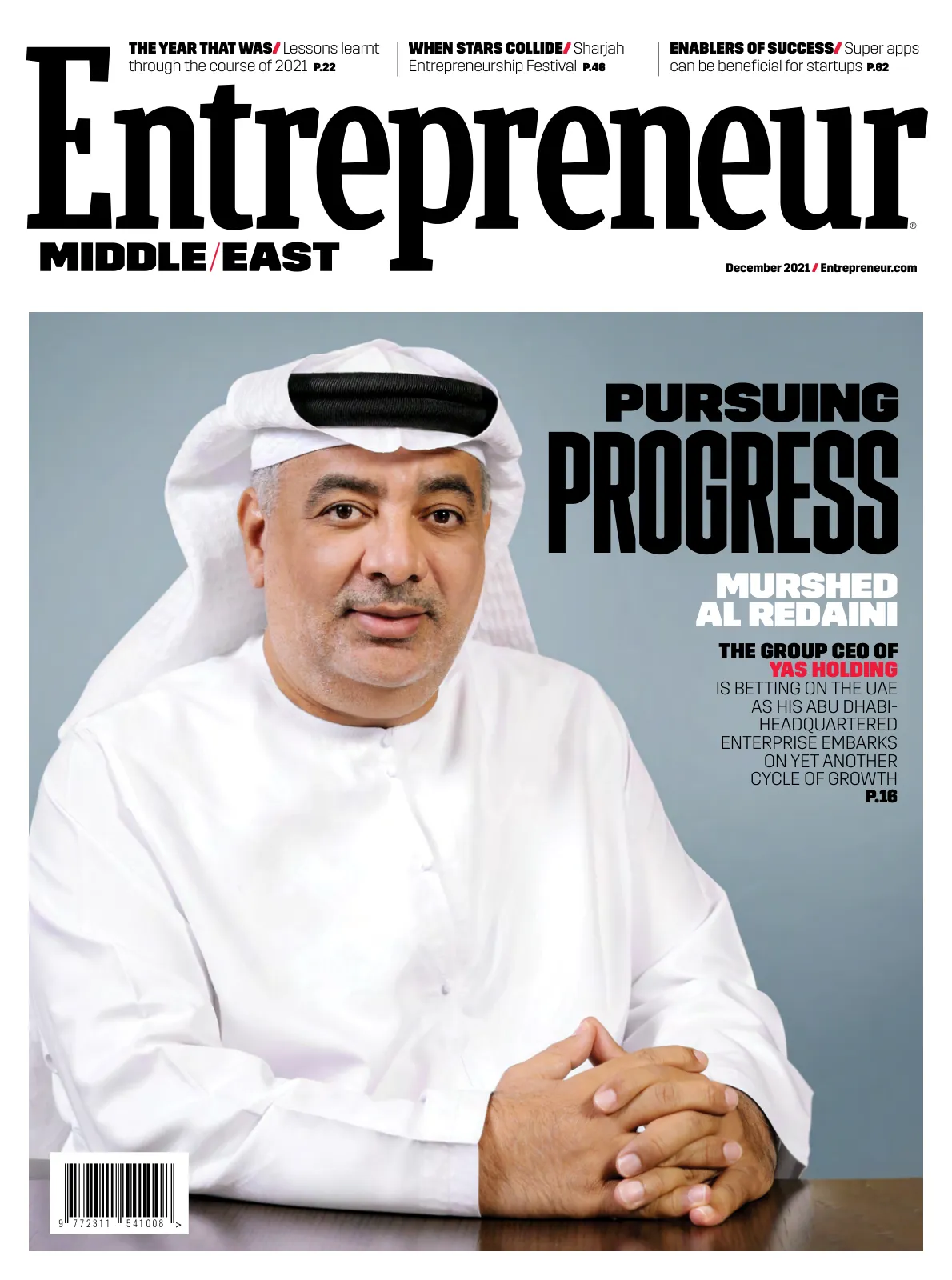
Entrepreneur Middle East, December 2021
Page 1
December 2021 Entrepreneur.com
9
7 7 2 3 1 1
5 4 1 0 0 8
>
WHEN STARS COLLIDE/ Sharjah
Entrepreneurship Festival P.46
ENABLERS OF SUCCESS/ Super apps
can be beneficial for startups P.62
THE YEAR THAT WAS/ Lessons learnt
through the course of 2021 P.22
THE GROUP CEO OF
YAS HOLDING
IS BETTING ON THE UAE
AS HIS ABU DHABI-
HEADQUARTERED
ENTERPRISE EMBARKS
ON YET ANOTHER
CYCLE OF GROWTH
P.16
MURSHED
AL REDAINI
Page 2
Page 3
Page 4
Page 5
sbe.com/sls-dubai
@slsdubai
A blend of lifestyle & luxury in
a timeless elegant atmosphere
Page 6
6 / ENTREPRENEUR.COM / December 2021
Contents/December 2021
ON THE COVER AND THIS PAGE
Photography by Farooq Salik
P.16
Pursuing
Progress
Murshed Al Redaini, Group CEO of
Yas Holding, is betting on the UAE
as his Abu Dhabi-headquartered
enterprise embarks on yet another
cycle of growth. by TAMARA PUPIC
P.22
The Year
That Was
Reflections/ 2021
Entrepreneurs reflect on lessons
and experiences in 2021.
by ABY SAM THOMAS
P.46
When Stars
Collide
A recap of the best moments of
Sharjah Entrepreneurship Festival
2021.
by PAMELLA DE LEON
P.54
Reinterpreting
Luxury
A new generation of Royal Oak
Offshore premieres in 43mm Swiss
Haute Horlogerie manufacturer
Audemars Piguet is releasing a
new Royal Oak Offshore line in
43 mm with 5 models honed from
titanium, 18-carat pink gold or
stainless steel.
FEATURES
← BINANCE FOUNDER AND
CEO CHANGPENG ZHAO
“We -Binance- are here to
stay. And we are serious
about building a lasting
brand.” P.15
→ JAMAL WICK AND AMJAD
BARAKAT, co-founders,
Innovision Holding P.36
Page 7
lyveglobal.com
E-COMMERCE
MADE EASY
Supercharge your ecommerce and online operations
with Lyve. Get fast, flexible, and full-featured delivery and
technology solutions that meet your customers’ needs
and allow you to focus on what you do best.
Go Lyve Today �
lyveglobal.com/ecommerce
#golyve
Page 8
8 / ENTREPRENEUR.COM / December 2021
59 Making Change
Happen
Feeling burnt out? Adib Samara
shares what you can do to can
reclaim your life.
62 Enablers of Success
Super apps aren’t the threat that
startups might imagine them to
be- in fact, they may actually be
able to fuel their emergence and
growth.
66 Strategy Bites
As part of a series of insights
and inspiration from some of
Saudi Arabia’s most notable
business execs, LIRA Strategy
Partners founder and Managing
Director Raffaella Campagnoli
talks to Jay Rosen, CFO, The
Red Sea Development Company
(TRSDC).
‘TREPONOMICS
EDITOR IN CHIEF Aby Sam Thomas
aby@bncpublishing.net
CEO Wissam Younane
wissam@bncpublishing.net
DIRECTOR Rabih Najm
rabih@bncpublishing.net
CREATIVE LEAD Odette Kahwagi
design@bncpublishing.net
MANAGING EDITOR Tamara Pupic
tamara@bncpublishing.net
STARTUPS SECTION EDITOR Pamella de Leon
pamella@bncpublishing.net
FEATURES WRITER Aalia Mehreen Ahmed
aalia@bncpublishing.net
DIGITAL SOLUTIONS DIRECTOR
Mahdi Hashemi mahdi@bncpublishing.net
HEAD OF INNOVATION
Sarah Saddouk sarah@bncpublishing.net
GROUP SALES DIRECTOR – B2B GROUP
Joaquim D’Costa jo@bncpublishing.net
COLUMNIST Tamara Clarke
CONTRIBUTING WRITERS
Seema Al Mansoory, Fida Chaaban,
Ihsan Eid Salhia, Adib Samara,
Dr. Fardad Zand
SUBSCRIBE
Contact subscriptions@bncpublishing.net to receive
Entrepreneur Middle East every issue
COMMERCIAL ENQUIRIES
sales@bncpublishing.net
ENTREPRENEUR.COM
Access fresh content daily on our website
All Rights Reserved 2021. Opinions expressed are solely those of the contributors. Entrepreneur
Middle East and all subsidiary publications in the MENA region are officially licensed exclusively to
BNC Publishing in the MENA region by Entrepreneur Media Inc. No part of this magazine may be
reproduced or transmitted in any form or by any means without written permission of the publisher. Images
used in Entrepreneur Middle East are credited when necessary. Attributed use of copyrighted images
with permission. All images not credited otherwise Shutterstock. Printed by United Printing and Publishing.
PO BOX 502511 DUBAI, UAE
P +971 4 4200 506
Contents/December 2021
71 Stronger Together
GCC-based doctor booking
platform Meddy gets acquired
by Nigeria-based healthtech
startup Helium Health.
73 Joining Forces
US-based property technology
company Propy enters into a
joint partnership with Saood Al
Ghurair to create Propy MENA.
74 Realty, Redefined
Tech startup hapondo aims to
revamp the way people in Qatar
search for a new home.
76 In Focus
A roundup of up-and-coming
startups you should be keeping
an eye on.
STARTUP
SPOTLIGHT
↑ FOUNDED BY SALWA RADWI,
NUQTAH plans to become the de facto
platform for the Saudi and MENA
digital creative economy. P.30
EntMagazineME
Entrepreneur-me
Page 9
Page 10
Al Habtoor City Hotel Collection is located at the crossroad of all major hot spots.
Two nearby metro stations and access to Sheikh Zayed Road rapidly connect you
to Dubai International Financial Center and downtown, while the Water Canal takes
you from Business Bay to Jumeirah with a simple stroll.
Comprising of 3 exceptional hotels, you will enjoy a vast and versatile suite of
meeting and events spaces fully equipped with state-of-the-art technology,
high-speed internet and latest audio-visual facilities.
For more information, call +971 4 435 5544 or email at
Reservations.hilton@hiltonalhabtoorcity.com
or visit alhabtoorcity.com/hotels/
EXTRAORDINARY MEETINGS
AT AL HABTOOR CITY
Page 11
Page 12
12 / ENTREPRENEUR.COM / December 2021
Editor’s Note/
THERE HAVE BEEN MANY TIMES during this year
at work, when I found myself sweating it out to
make sure something that we are doing and
releasing to the world is up to a certain degree of
quality, and someone or the other would see all of
this and then make a comment along the lines of,
“Why are you stressing yourself out so much on
this? Nobody cares!”
This kind of critique -if one can call it that- has
always been a puzzling one for me to unpack.
First, because, well, why wouldn’t anyone care-
doesn’t the quality of work matter? And, second,
how can one not care when it’s their name
attached to something that may well be seen as
sub-standard, or just plain shoddy? Those of you
who are enthusiasts of what you do, you’d get
what I am going for here- you’d know if some
thing isn’t the best shape of the work you could
put out, and you can be certain that you will not
be satisfied if you were to cut corners.
Now, I agree that it’s both unfair and impractical
to set extremely high benchmarks on everything
that comes our way in our lines of work. But on
the other hand, I fear for a world where there are
no standards to aspire to, and in which doing the
bare minimum is considered to be enough. The
answer to this conundrum lies in, of course,
finding a balance between the two extremes.
Yes, perfection may well be the enemy of
progress, but that isn’t an excuse to not strive for
excellence in whatever you set out to do. There’s a
definite value to doing something right, and the
best way you possibly can. And no, there’s nothing
wrong in caring about how you do things that
really matter to you- in fact, I’d go as far to say
that the sheer amount of effort you put in because
you care makes you the absolutely right person for
the job, as opposed to anyone else.
Having said all this, a key thing to remember
here is to not let yourself be paralyzed by the
yardsticks you measure yourself with. And the
only way to do that is to be clear, at the very
outset, about the things you want to put your
energy toward.
As we get started on a new year, and with it, the
resolutions and goals we want to work toward in
this period, I’d suggest making the effort to be
clear about the work that drives you, and then go
on to put in all the work that you feel is necessary
to make it happen.
And if someone tells you that nobody would care
about the effort you’re making, then know that’s
absolutely not true- you care, and that alone is
worth working hard for.
Good luck, and happy new year.
Aby Sam Thomas
Editor in Chief
@thisisaby
aby@bncpublishing.net
It’s Still Okay To Care
The standard that you set for yourself is the only one that matters
Page 13
Page 14
14 / ENTREPRENEUR.COM / December 2021
P
epsiCo, in
partnership with
the UAE
Ministry of
Climate Change
and Environ
ment (MOC
CAE), has
launched its first
MENA edition
of the Greenhouse Accelera
tor program to support
entrepreneurs or startups
with breakthrough packaging
technology and circular
economy solutions, keeping
sustainability at its core.
The program was launched
at a ceremony that had the
participation of government
officials, including H.E.
Mariam bint Mohammed
Saeed Hareb Almheiri, UAE
Minister of Climate Change
and Environment. Almheiri
noted her support for the
program, saying, “We are
delighted to support the
PepsiCo Greenhouse
Accelerator: MENA Sustain
ability Edition that leverages
innovation to optimize
resource utilization, reduce
waste, cut down on green
house gas emissions, and
promote environment-friend
ly and sustainable produc
tion. This way, it helps to
address the key priorities in
our fight against climate
change, one of the most
pressing challenges facing the
world.”
Eugene Willemsen, CEO,
Africa, Middle East and
South Asia, PepsiCo, said, “At
PepsiCo, we believe great
solutions can be built and
launched through open
innovation and collaboration
with changemakers, and we
look forward to supporting,
mentoring, and connecting
small startups that have big
ideas to the resources they
need to help create a more
sustainable tomorrow.”
The PepsiCo Greenhouse
Accelerator: MENA Sustain
ability Edition welcomes
companies from the MENA
region that are working on
accelerating environmental
sustainability in the food and
beverage industry. Concepts
can be new products,
technologies or services that
help to reduce, recycle or
reinvent packaging. Initially
launched in Europe in 2017,
followed by North America in
2019, and now in the MENA
region, the program has
received much global success.
In this edition, the program is
seeking for innovations
across three areas: environ
mentally sustainable
packaging alternatives,
packaging reduction and
recycling options, and
sustainable recycling
behaviors.
The theme for the 2021-
2022 PepsiCo Greenhouse
Accelerator: MENA Sustain
ability Edition will be
sustainable packaging and
circular economy solutions,
followed by other priorities in
later programs, to help
achieve a sustainable food
system. PepsiCo will choose
and support 10 companies to
be part of the program.
During the six-month
program, participants will
receive support in the form of
a $20,000 cash grant,
one-on-one mentorship via
access to PepsiCo’s experts,
market activation advice, and
business opportunities. At the
program’s closing event, a
panel of judges will award
one winning company an
additional $100,000 in
funding to further accelerate
its growth, and an opportu
nity to extend its partnership
with PepsiCo to further
expedite its growth. In
addition, the MOCCAE will
offer participants of the
program with technical and
strategic mentors, outreach
into local and regional
networks, and attendance of
key MOCCAE stakeholders at
events.
Interested in joining this
global, mentor-led accelera
tor program? Apply online
now before January 10, 2022
and for more information,
please visit the website:
greenhouseaccelerator.com/
middle-east-and-north-africa-
accelerator-program
PEPSICO LAUNCHES GREENHOUSE ACCELERATOR IN MENA TO SUPPORT STARTUPS TACKLING
SUSTAINABLE PACKAGING AND CIRCULAR ECONOMY SOLUTIONS
Innovators Welcome
↓ UAE Ministry of Climate Change and Environment & PepsiCo
In The Loop/
Page 15
Page 16
16 / ENTREPRENEUR.COM / December 2021
Page 17
17
December 2021 / ENTREPRENEUR.COM /
by TAMARA PUPIC
THE GROUP CEO OF YAS HOLDING
IS BETTING ON THE UAE AS HIS ABU DHABI-
HEADQUARTERED ENTERPRISE EMBARKS
ON YET ANOTHER CYCLE OF GROWTH
MURSHED
AL REDAINI
PURSUING
PROGRESS
← FOLLOWING 15 YEARS SPENT
IN THE UAE ARMED FORCES,
Murshed Al Redaini has blazed a trail
across a number of executive
positions, including a stint at C4
Advanced Solutions (now under the
EDGE Group, an umbrella technology
company for the defense industry),
before taking the lead at Yas Holding,
an Abu Dhabi-headquartered
investment company with a business
portfolio spanning nine sectors, 7500
employees, and more than 60
operating subsidiaries.
Page 18
18 / ENTREPRENEUR.COM / December 2021
A
s the world gets ready
to welcome a new year,
Murshed Al Redaini,
Group CEO at Yas
Holding, is unwavering
in his view that the UAE
is all set to see a period
of unprecedented
business growth, and
those who remain
focused on the job at
hand will be the ones
to gain from it. It’s a conclusion that Al Redaini
has derived from a wealth of knowledge and
experience that sets him apart from his peers-
following 15 years spent in the UAE Armed
Forces, he has blazed a trail across a number
of executive positions, including a stint at C4
Advanced Solutions (now under the EDGE
Group, an umbrella technology company for
the defense industry), before taking the lead
at Yas Holding, an Abu Dhabi-headquartered
investment company with a business portfolio
spanning nine sectors, 7500 employees,
and more than 60 operating subsidiaries.
“Under the guidance of our Board, we aim
to transform the company into an agile,
innovative, and progressive organization in
the coming years,” Al Redaini declares, before
pointing out his pride for having served the
UAE in both a military and a business capacity.
“Both of these experiences have taught me
that hard work and resilience, combined with
a very structured approach, are at the core
of the results that I have achieved. Teamwork
and leadership also must go hand in hand.
Ensuring that you are supported by a strong
leadership team, and surrounded by a strong
pool of talent, is also a key factor.”
O
ver the years, Yas
Holding has grown into
a preeminent invest
ment company that has relied
on acquisitions and invest
ments to expand into a number
of sectors that include food,
agriculture, healthcare,
education, aviation, real estate,
technology, services and others,
as well as markets like Serbia,
Morocco, Mauritania, Ethiopia,
Sierra Leone, Indonesia,
Malaysia, and Egypt. Through
out 2021, Al Redaini explains
that his team has been focused
on strengthening the Group’s
core sectors through consolida
tion and expansion. “We have
seen several of our companies
achieve cost optimization,
which led to our renewed focus
on these areas in order to
increase the market share,” he
says. “We have also been
investing in acquiring new
companies that complement
our existing value chains. Plus,
we are seeing good traction in
businesses that operate in the
critical sectors of the economy,
including food, healthcare,
← ONE OF THE OFFERINGS THAT FALLS
UNDER YAS HOLDING’S NEBRAS
EDUCATION GROUP OF ENTERPRISES
is its platform, LearningSpace, which is
working on transforming education by
enabling personalized learning
journeys.
Page 19
19
December 2021 / ENTREPRENEUR.COM /
education, technology, and
others.” As for the COVID-19
pandemic, Al Redaini credits
the supportive and enabling
environment created by the
UAE’s leadership for helping
businesses like his to tide over
the crisis. “As a matter of
pride, Yas Holding was very
active during the early days of
the crisis, working on
delivering products and
services to the country, to
avert shortages,” Al Redaini
adds.
Going forward, Al Redaini
says he will be looking to grow
the Group’s healthcare, food
and agriculture platforms. In
addition, he believes that the
Group’s technology-facing
enterprises are also primed for
rapid growth in key sectors in
the next few years. “For
instance, in edutech, we will
continue to build innovative
digital ecosystems that power
education along lifelong
journey pathways within large
communities,” he adds.
“Speaking more generally, our
team is always busy identify
ing and incubating new
investment initiatives that
expand our current product
range or potentially increase
capacity and market share in
our core verticals.” While
reiterating that Yas Holding is
always on the lookout for solid
businesses that complement
its existing focus sectors, Al
Redaini mentions a few of the
group’s success stories. In the
food sector, it is its ultra-fresh
dairy company Marmum,
which, he says, is rapidly
growing a loyal consumer
base. Meanwhile, in the space
of edutech, he points to Yas
Holding’s Nebras Education
group of enterprises, whose
platform, LearningSpace, is
working on transforming
education by enabling
personalized learning
journeys. Moving into the
healthcare industry, Al
Redaini turns our attention to
Global One Healthcare
Holding, whose operations
span biopharma, manufactur
ing, medical supply chain,
hospital and clinic manage
ment, healthcare technology,
and occupational health and
wellness. “Following the onset
of the global pandemic and
unprecedented pressures on
the healthcare system, the
industry faced huge challeng
es, but also a growth poten
tial,” Al Redaini notes. “Plus,
our nation’s strategic focus on
this sector has been a key
driver for Yas Holding’s expan
sion and recent acquisitions.
We are interested in three
different healthcare verticals-
pharma and biotech value
chain, hospital and patient
care, and global health-tech
focusing on artificial intelli
gence and telemedicine invest
ments.” In line with that, Yas
Holding completed three
strategic acquisitions in 2021:
Gulf Inject, Geltec Healthcare
FZE, and WellPharma
Medical Solutions. “Those
serve to reinforce the UAE’s
ambitions on self-sufficiency
in this vital sector,” Al Redaini
explains. “Furthermore, they
add stability to our group’s
wide distribution and supply
chain model that penetrates
across multiple channels,
reaching customers, clients
and consumers in the country,
and beyond.”
W
hen asked for his
perspective on the
MENA entrepre
neurial ecosystem, Al Redaini
describes it as an ideal launch
pad for any aspiring entrepre
neur. “The flurry of progres
sive regulations and financial
support in the recent years
clearly underline the
importance that the UAE
leadership has provided to
this field,” he says. “The UAE
is leading the way in this
respect with a focus on
innovation, new technology,
skill development, and so on.”
← MARMUM WAS BOUGHT BY YAS HOLDING’S ELITE AGRO IN 2017,
with the latter having significantly invested in farming and
processing infrastructure to build the GCC’s most modern dairy
farm and plant.
“AS A MATTER
OF PRIDE, YAS
HOLDING WAS
VERY ACTIVE
DURING THE EARLY
DAYS OF THE
CRISIS, WORKING
ON DELIVERING
PRODUCTS AND
SERVICES TO
THE COUNTRY,
TO AVERT
SHORTAGES.”
}
Page 20
20 / ENTREPRENEUR.COM / December 2021
For all of these reasons, Al Redaini states
that Yas Holding’s doors are always open
to entrepreneurs in the region whose
businesses align with the group’s growth
plans across key verticals and focus areas,
such as technology, precision agriculture,
and supply chain innovation. “One
example of a startup business that we have
invested in is our acquisition of Farmbox,
a farm-to-table specialist e-commerce
grocery business, which is now an
award-winning platform stocking a highly
specialized range of organic and fresh
farm produce,” he adds.
W
ith Yas Holding being a 100%
Emirati-owned business, Al
Redaini and his team are
naturally committed to the ongoing
development and success of the UAE. In
addition, Al Redaini considers that the
country has already placed itself at the
forefront of growth in the region. “Our
country also has a successful track record
of building some of the world’s most loved
businesses, in particular across the
e-commerce and tech space, with recent
capital raising rounds paving the way as
examples for others to follow,” he says.
Starting a business in the UAE is therefore
something that he strongly recommends,
especially in the areas of technological and
digital platforms and services, artificial
intelligence, automation, digitization, and
apps. “When starting a business, it is
important to ensure that you have a well
articulated product or service offering,
and a clear target audience whose needs
you will meet, in addition to the pains you
will address,” Al Redaini says. “Keeping
costs under control, managing cash flows,
and raising funds for growth are all
critical for survival in the longer term.”
With the UAE continuing to attract talent
who will spearhead growth across the
region, he is confident to advise that now
is a good time to start a business in the
UAE. “As we emerge from the pandemic,
customers and clients are looking for
solutions that allow them to retain the
agility and resilience built up during the
last few challenging years, whilst captur
ing growth and new revenue streams that
are emerging,” Al Redaini concludes.
KEEPING COSTS UNDER CONTROL, MANAGING CASH
FLOWS, AND RAISING FUNDS FOR GROWTH ARE ALL
CRITICAL FOR SURVIVAL IN THE LONGER TERM.
← IN THE HEALTHCARE SECTOR, Yas
Holding has interests in three different
healthcare verticals: pharma and
biotech value chain, hospital and patient
care, and global health-tech focusing on
artificial intelligence and telemedicine
investments.
} Think laterally, and
focus on the details.
"I’ve learned that no question is too
small or irrelevant to ask. By asking
simple questions, opportunities can
be accelerated, as it often provides
an opportunity to challenge the
situation."
} Focus on people.
"Build a solid bench of talent, and
support your team by clearing the
path for them. As a CEO, I see myself
as an enabler."
} Be open to changes.
"It is important to monitor all aspects
of your venture's health to make sure
adjustments can be made in as agile
a manner as possible. Learning and
adapting as a team to these
challenges as they occur will better
prepare you for unforeseen
challenges that are yet to occur."
} Control costs, and
feed growth. "Invest in
infrastructure that will lower costs
over time and automate processes.
Focus on the areas of growth that
leverage existing knowledge hubs or
the infrastructure that enables the
exploitation of your enterprise's
complete value chain and market
share, whilst keeping operations and
future investments lean and efficient.”
} Build core
competencies as well
as transferable skills
and knowledge.
"As we have a number of core skills,
competencies, and sector
capabilities, we are agile enough to
respond to challenges as well as
emerging opportunities across
multiple verticals by focusing on
innovation and technology as core
skillsets."
Yas Holding Group CEO
Murshed Al Redaini’s
tips for entrepreneurs
THE EXECUTIVE
SUMMARY
Page 21
Page 22
THE YEAR
A
s we come to the close of 2021, there’s a frantic energy that I see in the entrepreneurs and
businesses around me- they are almost desperate to end the year on a strong note, and
thus sort of ensure that they are kicking off 2022 on a solid footing.
And who can blame them? While the worst of the COVID-19 pandemic is likely (we hope)
behind us, and despite our businesses coming back on track, the trauma of the crisis is still
fresh in the minds of most, and we’re all still feeling that pressure to make up for the lost time.
But descending into such a frenzy at the end of a year often means that they are not taking
the time to ponder over what they have done over the last 12 months- there’s no recollection
of accomplishments made, nor any thought given to lessons learnt.
Now, dear reader, this is something we at Entrepreneur Middle East would like to discourage
you from doing- and this particular feature is our attempt to encourage you to pause, look
back on the year gone by, and see how your experiences in 2021 can help shape your future in 2022.
Our hope is that these insights from a variety of voices in the MENA business ecosystem will both
inform and inspire you to engage in some active reflection of your own, and then use it to manifest
your dreams for 2022. Here’s to a great year ahead!
22 / ENTREPRENEUR.COM / December 2020
Page 23
THAT WAS
REFLECTIONS
/2021
by ABY SAM THOMAS
23
December 2020 / ENTREPRENEUR.COM /
Page 24
24 / ENTREPRENEUR.COM / December 2021
hen asked how she’d
describe her
entrepreneurial endeavor
to those who may not know
it, Goshá founder Natalia
Shustova replies by saying
that she runs a designer
floral studio, but she also
quickly adds that the
definition of her enterprise isn’t set in stone
either. After all, it’s a business that has been
developing and diversifying ever since it
launched in the UAE in October 2020, and
according to Shustova, its evolution is still
ongoing. For the Belarus-born
entrepreneur, this is clearly one of the most
appealing aspects about running Goshá,
whose name is inspired by that of her
partner in the business, floral designer
Gurgen Yeritsyan, aka Gosha. While the
company first came into prominence with
its one-of-a-kind floral arrangements,
Goshá has been making waves more
recently for its work in making memorable
events and experiences for a roster of clients
that includes luxury fashion labels like
Gucci, Cartier, and others. While Shustova
readily admits that she didn’t have much
more than a passion for flowers when she
started Goshá, it’s quite apparent that it’s
her artistic vision and creative direction
that is powering all of what the company
does today- in fact, it bears all the
hallmarks of the style and sensibility that
has made her one of the most influential
figures on the Middle East’s social media
scene. “As a brand, we’ve become strong
enough for people to recognize us whenever
they see our flowers,” Shustova says. “And as
somebody who has worked with luxury
fashion for a long while, I think that’s a big
achievement.” Having started with a team
of three (Shustova recalls it as having been
made up of herself, Yeritsyan, and her
personal assistant, and that “two of us had
absolutely zero idea how to deal with
flowers”), Goshá now has nearly 40 people
working between its two studios, with the
first one located in Dubai’s Al Quoz
neighborhood, and the other at the Edition
hotel in Abu Dhabi. Shustova has nothing
but words of praise to say of her experience
starting up Goshá in the UAE- as she put it,
“The best thing about doing business in this
country is that nothing is impossible!” As
for the road ahead, Shustova believes that
Goshá is on its way to becoming an
emporium, and given that she has already
received requests for the business to be
franchised and even acquired, she’s eager to
build on its promise and potential. “I’m
looking forward to continuing our growth
and innovation journey in 2022,” Shustova
says. “Look out for us going international
and expanding our product portfolio. I also
anticipate a valuation event for our business
in the third quarter of next year.” While she
hasn’t decided whether she wishes to use
the enterprise’s positive cashflow to fuel its
further growth, or involve external parties
as investors or partners, it’s a given that
Shustova isn’t going to stop until she
conquers the world with Goshá. As for
where her indefatigable spirit comes from,
Shustova credits it to her upbringing. “I was
born in Belarus, but my character was
shaped in Siberia… Going to school in
minus 50 degrees, walking for 50 minutes,
that’s a character builder, trust me- the only
thing that would stop me from going were
bears,” she laughs.
Natalia Shustova
FOUNDER, GOSHÁ
W
Page 25
25
December 2021 / ENTREPRENEUR.COM /
}Aim big.
“When I launched Goshá, I prohibited the
words ‘flower shop’ from being used
anywhere against my business. I always
said that I'm building a flower-centric
brand that will go international, and it'll
spread around different categories, from
ceramics to design and more.”
}Brag a lot.
“When you're proud of what you do, when
you talk about what you do with so much
love and passion, people want to be
associated with that- they want to be
associated with success and happiness.
People want to be associated with the
entrepreneurial journey of somebody who
made it from scratch. Honestly, I got so
much support from people, just because
they wanted to be a part of my success
story.”
} Invest in your people.
“As an entrepreneur, your people are the
only real differentiating asset you have as
a business, and as such, it’s worth your
while to make them feel as a part of your
growth.”
“The best thing about
doing business in this
country is that
nothing is impossible!”
PHOTOGRAPHY ANASTASIIA SYDORENKO
25
December 2021 / ENTREPRENEUR.COM /
REFLECTIONS
/2021
Page 26
26 / ENTREPRENEUR.COM / December 2021
Luma
Makhlouf
CO-FOUNDER, HL FOODS
fter the chaos that the COVID-19
crisis put Dubai’s F&B industry
through in 2020, the sector was
hoping to get some much-needed
respite this year, and that wish
came true for HL Foods, an
enterprise founded by Luma
Makhlouf and Haider Al Assam that
includes popular homegrown food brands
like Maiz Tacos and Good Burger in its
portfolio. “My biggest highlight of the past
year was finding light at the end of the
tunnel, and realizing we might not only be
okay, but we are also flourishing as a whole,”
Makhlouf says. “2020 left us with so much
uncertainty and instability that we, along
with many others, didn’t know what our
future would look like, if we would even
make it. Our first Maiz Tacos restaurant in
Dubai’s Jumeirah Lakes Towers neighbor
hood had only been open for a few months
before the COVID-19 lockdowns began, so
we were not off to a great start, but because
of the great feedback of our newly launched
brand, Good Burger, we were able to bounce
back, and grow an amazingly loyal
community of foodies.”
In an ecosystem that’s almost bursting
with F&B concepts, the following that Maiz
Tacos and Good Burger have garnered in
Dubai is certainly worth cheering, with it
also being the key factor fueling their
development and growth. Maiz Tacos, for
instance, started out as a food truck before
graduating into a brick-and-mortar
restaurant. Meanwhile, Good Burger came
into being as an alternate concept operating
within Maiz Tacos amid the outbreak of the
COVID-19 crisis, and now, it’s gearing up for
its own dedicated space in Dubai. “I have
learned so much in the last year about
myself, what really matters to my business,”
Makhlouf says. “I have learned that although
your path might look different than many
others in the business, you can still achieve
your goals and remain true to your core
values. My husband is my business partner,
and we always wanted to remain boot
strapped and as organic as possible, a real
family business. At times, we didn’t know if
that was truly scalable, but now here we are,
opening up two new branches, and looking
forward to launching more exciting brands
that we are really passionate about. If you
stick to your plan, keep perfecting your
product, and invest in a strong team, it is
certainly possible to grow your small food
brand in Dubai.”
}Taking a step back and
slowing down is not always
a bad thing.
“We don’t always get the chance to slow down,
and really think of what we want to focus on, or
truly feel strong about. If the last year has
taught us anything, it’s that in those times,
magic can be created!”
}The power of saying no.
“We all know or can imagine how challenging it
can be to run and scale a business, so the
power of being able to say no to opportunities
that could be either distracting or unfit can
reduce serious stress levels and maintain
boundaries.”
}Your business values
matter.
“We have thankfully been able to stick to the
values and culture we put in place from day one
and keep them at the core of all major
decisions, such as only using 100% fresh
ingredients, or remaining very close to the
brands to still be the face of the business, no
matter how much we grow. I personally believe
that these values will help you stay focused, and
ensure you remain on track to growing your
business, just as you intended in the first place.”
A
REFLECTIONS
/2021
Page 27
27
December 2021 / ENTREPRENEUR.COM /
Omar Al Gurg
}This is your business-
so, listen to your gut.
“The reason I started Modu was because of a gut
feeling I had, and the way I make creative decisions is
by trusting my gut. I sometimes spend lots of time
thinking about a particular decision, only to realize that
my instinct probably had the best option to begin with.”
}There will be some days that
are slow, and some days that are
fast- don't let either day put you
off.
“Sometimes, there are days that have nothing to do
with Modu, and other times, I have weeks that have
everything to do with it. It's a cycle, and the most
important thing to remember is that there's always
going to be something to work on.”
}Believe in what you do, because
if you don't, nobody will.
“If you can't convince yourself that what you're doing is
right, then how can you convince others?”
mar Al Gurg characterizes his design brand, Modu Method, as being
suited “for people that like a little quirk,” and it’s thus to his credit that
one cannot deny the touch of whimsy that he has infused into the
furniture pieces he has created under the banner of his UAE-born
label. Consider, for instance, “Spike,” a wooden hanger that allows
users to move its pegs anywhere on the piece, or “Gene,” which
doubles up as both a stool and a side table, while also providing space
for storage, should the need arise. Playfulness therefore seems to be an integral
aspect of the Modu brand, but that doesn’t take away from the pragmatic nature
of its pieces either- and that’s perhaps indicative of how Al Gurg has gone about
his own entrepreneurial journey as well. “One of my biggest highlights this year
includes me leaving a job I was learning a lot from, and starting Modu with no
clue where it would take me,” Al Gurg confesses. “I had no prior knowledge of
how I could run a business properly; however, I did come specifically from a
design background, with some critical thinking skills that I learned from the
family company. It has only been around a year and a half since Modu started
taking shape, and the more it grows, the more I learn.”
Modu was one of the brands showcased at the UAE Designer Exhibition at
this year’s edition of Downtown Design, held as part of the 2021 instalment of
Dubai Design Week. Al Gurg’s pieces were -arguably- among the most
eye-catching pieces at the event, with him recounting the entire experience as
having been a rather fruitful one. “I think Design Week helped push Modu in
the direction of growth,” Al Gurg remarks. “It has been an adventure, but it’s
finally starting to be at a pace that is exciting.” 2022 thus promises to be an
eventful year for Modu, and Al Gurg is already geared up for the ride ahead.
“The part I am most excited about in the new year is to be able to form a
community,” he reveals. “I hope to be able to help influence people in a
direction, where they can be socially active, while they’re getting their work
done. The more the brand grows, the more I feel a sense of community and
support that grows along with it. The new year should be filled with plenty of
events and opportunities that Modu hopes to create, all through a platform that
encourages coming together and having discussions that can turn into
something greater. I aim to turn the brand into an entire lifestyle that will have
products, yet also help encourage convenient living.”
O
FOUNDER, MODU METHOD
REFLECTIONS
/2021
Page 28
28 / ENTREPRENEUR.COM / December 2021
or a company whose mission is
to be “the global platform for
luxury fashion,” Farfetch has
been steadfastly adhering to
this goal in 2021, and its efforts
in this regard have certainly
borne fruit for the enterprise
this year. “I am truly impressed
with the resilience of the luxury
industry, which, after an unprecedented
period, is already back to growth, with an
even stronger foundation,” says Edward
Sabbagh, VP, Marketplace, Farfetch. “I am
very proud that Farfetch was a close
partner for both retailers and brands in
this time, delivering strong growth to our
sellers, and as a result, doubling our gross
merchandise value in the last 24 months.”
Much of the success Farfetch is seeing
now can be drawn back to savvy
decisions made by the business in the past,
one of which was its 2019 acquisition of
the Milan-headquartered New Guards
Group, an enterprise that includes
world-renowned fashion brands like
Off-White c/o Virgil Abloh, Palm Angels,
Alanui, and others in its portfolio. “One of
the core strategies behind the transaction
was to create a pipeline of original content
and exclusive collaborations that would
drive buzz and a significant halo effect to
increase the engagement of our global
customers around the Farfetch brand, and
ultimately drive more organic traffic,”
Sabbagh explains. “In early October, we
launched the first brand jointly created by
Edward Sabbagh
VP, MARKETPLACE, FARFETCH
F
→ FARFETCH'S Ramadan 2021 edit
Page 29
29
December 2021 / ENTREPRENEUR.COM /
New Guards Group and Farfetch, There
Was One (TWO), which is a line of
elevated wardrobe essentials with
sustainability built in and longevity in
mind, borne from our marketplace data
insights.”
Keeping a close eye on customer trends
is thus clearly what has guided Farfetch’s
moves in this industry so far, and it
doesn’t look like that strategy is going to
change any time soon- indeed, it’s this
focus that will be fueling the platform’s
evolution in the future as well. “More and
more, customers are expecting their
shopping experiences to be really
connected, whether they are shopping
online or in-store- and this is where our
‘Luxury New Retail’ strategy comes in,”
Sabbagh says. “We’re reimagining
the luxury retail experience
through the use of technology to
create seamless, connected
customer journeys that blend the
best of online and physical
shopping. We have a vision for the
evolution of luxury retail: to drive
the transformation of the entire
industry by creating a truly
personal and personalized
shopping experience that doesn’t
separate the online and offline, but
brings the two harmoniously
together to connect with the
customer– wherever they are.”
And this proposed future bodes
well not just for Farfetch’s
customers, but for its partners as
well. “When our customers shop on
Farfetch, the items arrive from one
of 700+ boutiques in one of 50
countries around the world, or
from the stores of our many brand
partners, altogether representing
over 3000 designers, mostly small and
unique creators of fashion,” Sabbagh
notes. “I look forward to seeing this
network grow.”
}Invest in yourself.
“No matter how prepared we are in leading our
businesses and teams, we will always face
unexpected and/or uncontrollable events that
will test us as leaders. Dedicating time daily on
improving my mental and emotional health has
been my best investment to deal with the
unknown. Personally, it’s been about meditation,
controlled fasting, and exercising, which have all
become part of my daily routine, but there is no
universal playbook here. My experience above
is more about the ‘why,’ rather than the ‘how.”
}Stay incredibly curious.
“Experience is important; learning from one’s
own successes and failures is very powerful.
This said, with the rapid evolution of
technology, trends, consumer expectations
etc., relying on experience can sometimes be
the wrong approach to decision making, or can
be a blocker to innovation. There are countless
ways to ensure we always stay ‘ahead of the
curve,’ as a business and from a personal
perspective, I find curiosity to be the common
denominator in all of them.”
“In early October, we launched
the first brand jointly created by New
Guards Group and Farfetch, There
Was One (TWO), which is a line of
elevated wardrobe essentials with
sustainability built in and longevity in
mind, borne from our marketplace
data insights.”
REFLECTIONS / 2021
→ THERE WAS ONE
IMAGES COURTESY FARFETCH
Page 30
30 / ENTREPRENEUR.COM / December 2021
← NUQTAH, the Kingdom of Saudi Arabia’s first
and leading NFT marketplace, closed their
Pre-Seed round led by Shorooq Partners and
joined by strategic angel investors. The
Company founded by Salwa Radwi plans to
become the de facto platform for the Saudi
and MENA digital creative economy.
ith the non-fungible token
(NFT) market estimated to be
worth more than US$7 billion
by JP Morgan Chase in
November this year, the space
is proving to be a draw for
entrepreneurs from around
the world, and that includes Salwa Radwi,
the founder and CEO of Nuqtah, a
business that proudly declares to be Saudi
Arabia’s first NFT marketplace. Having
recently closed a pre-seed round led by
Shorooq Partners, Nuqtah, which was also
part of the Sanabil 500 MENA seed
accelerator program, aims to be “the
ultimate environment” for creatives in
Saudi Arabia. Besides offering a space for
them to sell their artworks in a safe and
secure manner, it also aims to enable a new
breed of art collectors. “We are currently
witnessing the revolution of what is known
as the internet, not only with blockchain
technology, but ownership of virtual assets
through NFTs,” Radwi says. “With the
fast-paced growth of the world wide web,
we are now recreating historical content for
our future generations to see… The creative
works we leave behind as a society will
define how future generations understand
us, and that is a crucial responsibility. What
better time to do so than now, in the midst
of the Saudi creative revolution, right from
the pulse of one of the most creative
economies the world has ever seen. How’s
that for leaving a mark!”
Radwi’s excitement about Nuqtah and the
future in general can be disconcerting for
those of us who are still cautious about
entering the NFT space, given that it still
remains largely untapped territory, and as
such, can come across as a rather scary,
risk-filled domain. But Radwi urges us to
embrace such fears, and boldly venture into
this market- the rewards are worth it, she
says, citing the “if it doesn’t scare you, it’s
not big enough” school of thought to make
her point. “Something about coming out of
a pandemic has made us all a little too
risk-centric, I believe,” Radwi says.
W
Salwa Radwi
FOUNDER, NUQTAH
}Never underestimate
the power of being genuine.
“We live in a day where we scroll and double
tap on engineered lifestyles, where we introduce
ourselves by where we work, and not who we
are as individuals. When you are true to
yourself, only then will people believe in what
you do, only then is it genuine enough to be
worthy of advocacy, or that double tap.”
}Values first.
“When we are constantly being surrounded by
noise, it can be pretty easy to lose our grounds.
Sticking to the values our families and friends
have instilled in us since day one is the only way
you can ensure prosperity. It is those same
values that keep your team happy, grow your
business, and keep the door for blessings
open.”
}“Being ready”
is overrated.
“We’ve all heard of passion being a main driver,
and 'finding just the right niche' being a key
factor to kicking off as an entrepreneur.
Although they are crucial, here is a message to
all individuals who have had their ideas locked
away in drawers, awaiting the right moment to
bring them out: there is no right moment. Bring
out those notebooks, and pitch it to the right
people, to those who believe in you, and believe
in your cause. Do it now, do it scared, and do it
well. That is the fastest way of bringing alive
your midnight thoughts, and catapulting your
journey as an entrepreneur.”
“The passion to make a change, the drive to
innovate in completely new spaces, and the
instinct to deflect comfort has been a key
factor in most of my business and personal
decisions lately, resulting in access to doors
and opportunities that I would not have
imagined. If I had one key takeaway to give
others from my experiences in 2021, it
would most definitely be to do it because it
scares you. If it doesn’t, it’s not worthy of
your time. Being a female entrepreneur in
Saudi Arabia, intersecting blockchain
technology, NFTs, and creativity in a region
that is newly flourishing these industries,
scary and excited are definitely my main
two favorite feelings!”
REFLECTIONS
/2021
Page 31
31
December 2021 / ENTREPRENEUR.COM /
Mohammad
A. Baker DEPUTY CHAIRMAN AND CEO, GMG
}Be resilient,
purpose-led, and
agile.
“The last few years brought unique
challenges to the world. But as an
entrepreneur, if you’re resilient and
keep your purpose at the forefront of
your mind, you’ll be able to navigate
anything that comes your way.
Additionally, you must keep your
finger on the pulse of the market, and
be prepared to challenge the status
quo. As a business leader, you must
be prepared to evolve with changing
situations.”
}Support your
ecosystem.
“No business can work in a silo for
long. One thrives by collaborating and
contributing to the success of a
broader ecosystem of partners, public
entities, institutions, and more. At
GMG, we have introduced more than
120 brands into our markets. We
know firsthand that investing in their
success has paved the way for our
success.”
}Be people-centric.
“Ultimately, no business can succeed
without its employees. At GMG, we
imbibe our value of winning as one
family, and we believe in the power of
investing in and nurturing our talent.”
hile GMG is today known for
being a UAE-born global
company retailing, distributing,
and manufacturing a portfolio of
leading international and
homegrown brands across the
sport, food, and health sectors in 12 countries
across the Middle East, North Africa, and
Asia, one needs to remember that the
enterprise didn’t come into being like that- in
fact, it was a single butcher’s shop founded by
Abdul Aziz Hassan Baker in 1978 that
expanded into the diversified, Dubai-head
quartered family-owned business that it is
today. It has been a spectacular transforma
tion, no doubt, and that appears to be the
spirit with which Deputy Chairman and CEO
Mohammad A. Baker led an overhaul of the
business earlier this year. “In October 2021,
we were incredibly proud to embark on a new
corporate strategy that included a restructur
ing of our existing business units, the
unveiling of a new brand identity, and a new
purpose-centric vision for GMG to inspire
people to win in ways that make the world
better,” Baker explains. “With the objective to
promote healthier and more active lifestyles,
our new business verticals are GMG Sports,
GMG Food, GMG Health, and GMG
Consumer Goods. This business shift -and
others during the year- came in part from a
recognition that communities and govern
ments around the world are striving to
progress sustainable development goals,
which are often anchored in personal
well-being.”
Baker is clearly keeping a close eye on the
forces shaping business today, and that’s
exactly what is governing his plans for GMG
in the new year. “What I’m looking forward to
the most in 2022 is exploring business
opportunities across new product categories,
markets, and sectors, strengthening our
e-commerce capabilities, and growing our
food manufacturing vertical,” he reveals. “We
are particularly excited about the latter, as our
plan is that by 2022, GMG will have six
dedicated product lines under one roof: meat,
seafood, herbs, salt, spices, and cold cuts,
including butchery and marination.”
According to Baker, such moves are in line
with GMG’s new vision and values, which are
also setting the stage for its next chapter of
growth. “We are now laser-focused on
improving people’s lives through active living,
nutritious food, and good health,” Baker says.
“We will continue to look at acquiring new
international brands, developing homegrown
concepts, entering new markets in 2022, and
growing our existing partnerships. We will
also reap the benefits of recent internal
restructuring, including the establishment of
new vertical divisions and reporting lines to
optimize performance, and explore new
synergies.”
And underlying all of these efforts will be
GMG’s ethos as a business, which, Baker
points out, is all about believing that nothing
is not achievable, and working hard to
capitalize on every opportunity that presents
itself. “Let me take you back to the end of
2020– the business sentiment was low, and
markets were down,” Baker recalls. “But we
saw an opportunity and took a bold step by
entering the Asian market, and acquired the
popular Royal Sporting House brand. When
we see an opportunity, we go after it– this is in
our DNA, this is the drive that keeps pushing
us to evolve, to be the change, and to be a
trusted partner.”
W
“When we see
an opportunity,
we go after it–
this is in our DNA,
this is the drive
that keeps
pushing us to
evolve, to be the
change, and to be
a trusted partner.”
REFLECTIONS
/2021
Page 32
32 / ENTREPRENEUR.COM / December 2021
→ NAKSHA IS AN AWARD-WINNING
DUBAI BASED F&B STARTUP. The
concept, which is a part of the London
School of Economics’ LSE Generate
Accelerator program, was launched at
the peak of the pandemic, and is now
scaling internationally.
s one of the homegrown brands
that graduated from the
Spinneys Local Business
Incubator program in the UAE
in 2020, gourmet meal kit
provider Naksha Collections has
probably had a more accelerated
path to market than most other
food brands. In fact, Nisha
Ramisetty, who co-founded the business
with Sam Williams, says that the concept
turned from being a rough idea the duo
scribbled between themselves to an actual
product on supermarket shelves in just
three months. “It was a rapid journey by
any standards, let us alone Sam and I, who
are first time entrepreneurs and had no
experience in the F&B sector,” Ramisetty
says. “Following this intense initial phase,
2021 has given us the opportunity to extend
our roots, strengthen our processes, and
explore ways to diversify, innovate, and
expand the Naksha business model.”
Naksha’s gourmet meal kits pay homage
to cuisines from different parts of the
world, with each of them containing both
the specialist ingredients and instructions a
customer would need to prepare that
particular dish. Naksha currently offers 12
different meal kits as part of its portfolio,
with the past year seeing the introduction
of a Caribbean-inspired collection, as well
as a Middle East-inspired baking line. “This
story shows a few things,” Ramisetty says.
“First, that we are eager and ambitious,
despite being small; second, that the
product concept we have pioneered has real
potential and is gradually attracting more
and more users; and third, that we have
been able to learn, adapt, and make the
changes necessary (to our products, our
operations, our marketing, etc.) to grow the
businesses relatively quickly.”
The past year has also seen Ramisetty
and Williams work on building a direct
connection between themselves and their
customers. “In 2021, we have worked hard
to get to know customers, solicit feedback,
explain how the concept works, and take
note of what they want to see in future
products,” Ramisetty explains. “Markets
have been a big part of this, and Dubai’s
vibrant market scene has given us the
chance to engage directly with customers in
an informal environment, i.e. without
having to resort to tedious surveys, etc. We
have recently started selling our gourmet
A
Nisha
Ramisetty
CO-FOUNDER,
NAKSHA COLLECTIONS
Page 33
33
December 2021 / ENTREPRENEUR.COM /
meal/baking kits directly to
customers online, and this will also
fortify our relationships and help us
tailor our products even more
closely to customer preferences.”
It’s this foundation that the
co-founders have put in place for
Naksha that they believe will help
propel the business even further in
2022, with the pipeline including
more than just new offerings in its
portfolio. “We are currently
exploring various very exciting
opportunities to take Naksha’s
gourmet meal and baking kits to
new markets,” Ramisetty reveals.
“We have been approached by
interested parties in other countries
who, having seen our product on
shelves in Spinneys and Waitrose in
the UAE, are keen to bring them
home, confident that our concept of
hassle-free exotic home-cooked
food will find a hungry consumer
market. We agree- statistics show
that since the beginning of 2021,
the number of people cooking at
home and demand for ‘world food’
has increased substantially in North
America, Europe, and many parts
of Asia, and there is no reason why
something that has worked well in
the UAE can’t be transferred to
other markets.”
Naksha’s expansion into new
markets is something that
Ramisetty and Williams are clearly
very excited about, as they knew,
from day one, that their business
wouldn’t be restricted to within the
borders of the UAE. “The UAE is a
fantastic place in which to start a
business, because it is a country of
entrepreneurs, and entrepreneur
ship is ingrained quite deeply into
culture,” Ramisetty notes.
“However, Naksha is ambitious,
and even when we started, we
didn’t see ourselves being limited to
a single country. Taking our
products to new markets will be a
challenge, of course, and a lot of
hard work will need to be invested.
But we believe it will, in the long
term, make Naksha’s operations
more efficient, forcing us to tighten
our supply chain, sharpen our
distribution mechanisms,
turbo-charge our marketing, and
maintain a laser focus on our core
brand identity.”
Ramisetty is thus hoping that
Naksha will soon serve as an
example of a UAE-founded startup
that is thriving on the international
stage. “There is no reason why the
UAE shouldn’t be a leader when it
comes to exporting cutting-edge
F&B products and ideas, given how
dynamic the local market is,” she
declares. “As we take our concept to
new places, we want Naksha to be a
testament to the dynamism of the
UAE, and to inspire consumers
around the world to recognize UAE
brands for their creativity and
innovation.”
“We are currently
exploring various very
exciting opportunities to
take Naksha’s gourmet
meal and baking kits to
new markets.”
} It is okay to be a work in
progress.
“As a startup, not everything is going to be perfect. (If it
feels perfect, then something has probably gone wrong!)
To succeed, you must be open to erring, learning, and
improving. We have experienced this directly, and it has
made Naksha a better brand. Our recipes, packaging,
marketing, and more have all gone through numerous
iterations, each version building on the last. The
products we are launching now are very different to
those we first launched in 2020, and we think they are
much better. Had we been set in our ways and refused
to evolve, these better products would not be here
today.”
}Be clear in your intentions from
the start.
“Starting and running a business is not something you
do in solitude. You share the journey with an ensemble
cast of buyers, suppliers, collaborators, business
partners, investors, and customers, all of whom are
critical to the story in different ways. To succeed over the
long term, it is essential to be honest, transparent, and
inspiring from the outset, so that your whole value chain
understands and buys into the vision of your brand, and
the big picture you are working towards. Even if you’re
just a baby brand today, you can show them where you
expect to go in the next five years, and if the vision is
persuasive, you will be able to count on them as
long-term partners, rather than just ships in the night.”
}Keep things simple.
“We started Naksha, because we, ourselves, wanted to
use the product. This was the ‘a-ha’ moment at the
origin of our journey. We realized that the product was
useful, easy-to-understand, and different to anything
else available on the market. However, because no one
else had thought of it, we had an opportunity to make it
ourselves. So, we did! In 2021, we have had several
opportunities to branch out in unrelated directions, and
we considered all of them, but we made the wise
decision to keep our eyes focused on the fact that we
have an extraordinarily powerful core idea, and that our
goal should be to develop that, rather than succumb to
distractions. If you start up a successful business, there
will always be opportunities to do whacky new things
later, but our advice in the first couple of years is to keep
it simple, focus on what you do best, and to follow your
instincts.”
REFLECTIONS
/2021
Page 34
34 / ENTREPRENEUR.COM / December 2021
hen Gabriela Cury decided to launch Intellect Coffee in
the UAE in October this year, she knew that her
homegrown coffee brand would be entering a rather
saturated market, but her belief in the strength of her
product -which has been made to cater to the specific
tastes of the MENA region’s population- is what led her
to confidently embark on this endeavor anyway. And don’t forget that
Cury has more than 10 years of experience working in this sector as
well- that was certainly something that came to her aid as she went
about her entrepreneurial pursuit in a world that’s slowly but steadily
making a recovery from the brunt of the COVID-19 crisis. “Leading
the launch of a brand-new coffee brand that encapsulates all I know
about coffee has been the highlight of my 2021,” Cury says. “It has
been the greatest challenge in my career, not only for my involvement
in product development, but also for putting together a launch
strategy under such different circumstances, which required loads of
innovative thinking.”
Besides its signature Prima, Crema, and Quattro blends, Intellect
Coffee’s portfolio also includes specialty coffee editions hailing from
Brazil, Colombia, Guatemala, Ethiopia, and other nations. According
to Cury, the products are indicative of the unique experiences she has
had building a career in this field, which include everything from
conversations with baristas and producers, to trips made to coffee
plants and trade shows. And these are the aspects that Cury thinks
will allow Intellect Coffee to carve out a niche for itself in the market
at large- and it’s something she expects to see happen in the near
future as well. “2022 will be a great year, since we will start seeing the
results of our marketing efforts, and most importantly, the real
feedback from our first-year clients,” she says. “From a business point
of view, if you have invested more in the product than the marketing,
you will see the results. The word of mouth and customer satisfaction
will compensate the marketing scales. The coffee supply industry in
the UAE is quite saturated, and we are trying to take the right
approach by collaborating with key players to help us stand out.”
But that’s not all- Cury is keeping an eye on the long term
when it comes to deciding how Intellect Coffee will develop and grow
in the months and years to come. “A major thing that we aim to
cascade to all coffee consumers is that coffee is soon to be considered
as valuable as gold, since demand for it is expected to double by
2050,” Cury says. “The problem is that suitable land to grow coffee
will decline, and we, as part of the supply industry, have a mission to
help ease up the situation. Helping coffee farmers adapt to changes,
like developing new coffee species that are more tolerant to climate
change or pests, is critical to be sustainable.” But while the future may
present challenges like these, Cury isn’t letting it dampen her
enthusiasm for the same, given how 2021 unfolded for her. “This year
has taught us adaptation,” she declares. “And now, it’s time to prosper
again.”
}Things always seem more significant in
your head.
“Don’t take things personally. No matter how good your product is, it
will never be as big in your client’s head. Remember that you are
sharing the market with other brands.”
}Learn to keep calm and carry on .
“You cannot control everything. You need to stay prepared for
unknown, even nasty, surprises. If the show of the year for which we
have been preparing for months got cancelled, it’s not the end of the
world. Sometimes, we have to simply let go.”
}Results are what really matter, not
time-measured productivity.
Like any autonomous individual, managing your time and working at a
pace that is appropriate for you is how businesses should operate.
Working from home amid the lockdowns caused by the COVID-19
crisis have taught us that it is about getting things done, and not how
long it takes.”
Gabriela
Cury
FOUNDER, INTELLECT COFFEE
W
REFLECTIONS
/2021
Page 35
35
December 2021 / ENTREPRENEUR.COM /
ounded by Tushar Jiwarajka in Mumbai
in 2009, Volte Art Projects is an
enterprise that has been steadily
building up its presence on the Indian
subcontinent’s cultural landscape, with
it representing and working with a
number of celebrated artists like Wim Delvoye,
William Kentridge, Sheba Chhachhi, and others.
So, when Jiwarajka announced in July this year
that he was shifting Volte Art Projects’ headquar
ters to Dubai with an 8000 sq. ft. gallery space at
Alserkal Avenue, it signaled the start of a new
chapter for the business, while also showcasing
the appeal of the UAE’s art scene in a global
context. “I’ve seen the region’s art scene grow
exponentially in the past decade- hubs for
contemporary art organizations have emerged,
major institutional projects have come to
fruition, and a community of collectors has
developed,” Jiwarajka said. “Combined with the
UAE’s proximity to Europe, Asia, and the
Americas, a gallery here therefore seemed the
next logical step for us.”
Volte Art Projects kicked off its innings in the
UAE with an exhibition titled Sublime
Convergence, which was described as one that
united “themes of nature and time through art
and technology,” featuring works by artists from
Europe, South Africa, India, and the US.
According to Jiwarajka, the response to Volte Art
Projects’ offerings in the UAE has been especially
promising, with him seeing the new location in
the country set to serve as a base from which he
and his team can launch global art projects. “The
response in the first two months have been
incredibly encouraging with several sales and
enquiries, as well as strong support from the
government of the UAE,” Jiwarajka reveals.
“There are a number of exciting plans we are
currently in discussion about with the
government, and we look forward to realizing
large-scale and monumental projects by artists
celebrated for their pioneering spirit of
innovation, pushing boundaries, and harnessing
latest technologies.”
F
Tushar Jiwarajka
}Be bold, and put
your best foot
forward.
“Project confidence in what you
do, so that you can move
forward and achieve greater
things.”
}Build
relationships, and
the rewards will
follow.
“We work closely with both
regional and global institutions,
and we are proud to announce
that some of our represented
artists are now included in the
collections of large museums,
including a recent Tate Modern
acquisition of work by Indian
artist, Nalini Malani. It is through
the consistent and careful
cultivation of our relationships
with our partners that we were
able to build the necessary trust
to achieve these successes.”
FOUNDER, VOLTE ART PROJECTS
REFLECTIONS
/2021
Page 36
36 / ENTREPRENEUR.COM / December 2021
he MENA region has seen quite a
few of its homegrown enterprises
get acquired by companies from
abroad; however, it’s relatively rare
to see the opposite happen, and
that in itself is a strong argument
to be made for why the latter
needs to be celebrated as much, if
not more, as the latter. As such,
UAE-based Innovision Holding’s
announcement in November this year that it
had purchased Brunch & Cake, a F&B
concept born in 2010 in Barcelona, Spain, is
deserving of applause on its own- but there’s
more to this story than just that. You see,
Brunch & Cake had been first brought to the
MENA region as a franchise in the UAE in
2019 by Flip International, an F&B
consultancy under Innovision Holding.
Starting with an outlet in Dubai’s Wasl 51
neighborhood, the brand’s warm and
welcoming vibes made it a hit rather quickly,
with it soon opening a second location in the
Emirate at The Pointe in Palm Jumeirah in
2020, followed by a third branch in Abu
Dhabi in 2021. Wins like these are thus what
paved the way for Innovision Holding’s
“reverse acquisition” of the Brunch & Cake
brand globally, and extensive expansion
plans are already underway for the same. “By
moving from franchisee to owner, I am truly
proud of the teamwork and effort that was
put into acquiring this brand, which has
become a staple of the UAE scene,” says
Amjad Barakat, co-founder, Innovision
Holding. “This past year, my team and I
devised a clear agenda to pinpoint exactly
how we were to commence with our
expansion plans, and we have gone on to do
so without a hitch.”
↓ JAMAL WICK AND
AMJAD BARAKAT,
co-founders,
Innovision Holding
CO-FOUNDER, INNOVISION HOLDING
Amjad
Barakat
T
Page 37
37
December 2021 / ENTREPRENEUR.COM /
}Look out for the long term.
“As an entrepreneur, thinking ahead of the market
situation is key. The COVID-19 crisis was the
perfect time to plan, grow, and make riskier moves.
Taking chances during a climate of high growth all
around is far more difficult. The ability to plan and
look ahead to a more profitable timeline, while
maintaining a tight grip on current circumstances
and the wellness of not only your employees, but
your own frame of mind, is all part of the
entrepreneurial spirit.”
}What you believe, you can
achieve.
“If you believe and manifest a future in which you
succeed, then you will do so. Trust your instinct as
a businessperson and choose to move forward
with your vision. This is my ethos as an
entrepreneur.”
}Culture eats strategy
(always).
“Create an environment of optimism, and your
team will not bring in the negativity of the climate
to work. This is vital in maintaining a cohesive and
thriving work culture.”
Brunch & Cake currently has 10 outlets open
around the world, and the brand expects this
number to rise to 15 by the end of next year. “As
we were able to finalize the acquisition in 2021,
2022 will be a big signing year,” Barakat reveals.
“We will have our vision of Brunch & Cake
solidified in 2022, with further global expansions
into markets like London and India. We have
been planning milestone launches in both Saudi
Arabia and Egypt in 2021, and 2022 will see
them come to life.” According to Barakat, Brunch
& Cake’s first location in Saudi Arabia is expected
to launch in Riyadh in September next year, with
more to follow across the country later on. “Our
launch in Egypt is also very important,” Barakat
adds. “The potential for brands like Brunch &
Cake is slowly but surely increasing in Egypt.
30% of the market in Egypt is middle class,
which is our target market. This indicates a
growing space for premium casual dining. It is
not yet common in Egypt, and we are excited to
make our mark in the market by being the first.
This will enable us to come in with an edge, as
the first movers in this field and remain
memorable to locals. Egypt is currently
considered a virgin market, which I find to be
quite advantageous for us.”
But it’s not just the MENA region that Barakat
and his team are eyeing- a statement from the
company had noted its interest in markets like
Switzerland, Hong Kong, and Singapore as
potential locations for Brunch & Cake in the
coming years. “2022 will set the tone for the next
five years,” Barakat declares. “All eyes will be on
Brunch & Cake, as it becomes a household name
in numerous countries.”
“We will have our
vision of Brunch & Cake
solidified in 2022, with
further global
expansions into
markets like London
and India. We have been
planning milestone
launches in both Saudi
Arabia and Egypt in
2021, and 2022 will see
them come to life.”
→ BRUNCH & CAKE
Wasl 51, Jumeirah
REFLECTIONS
/2021
Page 38
38 / ENTREPRENEUR.COM / December 2021
hile 2021 did see the
hospitality industry
inching out of what
has been a rather
crippling period owing
to the COVID-19
crisis, Tim Cordon,
Area Vice President
for the Middle East and
Africa (MEA), Radisson Hotel Group,
says that the year was still quite a
challenging one, but an eye toward the
long term is what helped his enterprise
get past all of the hurdles in its way. “I
am proud that we never lost track of
our goals and stayed committed to our
ambitious five-year development plan,
which includes the mission to be
recognized as one of the top three hotel
groups in the world,” Cordon says. “Our
strategy and ambitions ensure we are
top of mind to our guests, team
members, owners, and partners,
especially as we expand across the
MEA region. For me, it has been
wonderful to see the teamwork and
dedication in all our hotels in the
region, and remind me that the
hospitality industry is all about people,
from our teams to our guests.”
Global trends reshaping the
hospitality industry are thus what
rank highly on Radisson Hotel Group’s
radar right now, with one example
being its recent Hybrid Solutions
offering. While its Hybrid Rooms
concept combine the facilities of a
state-of-the-art office with the comforts
of a superior hotel room, Hybrid
Meetings and Events are aimed at
merging the best of virtual and
in-person gatherings. “In addition, in
2022, I believe there will be a greater
focus on sustainability than ever before
as the world looks into a greener
future,” Cordon adds. “At Radisson
Hotel Group, we recently launched, as
Tim Cordon
SENIOR AREA VICE PRESIDENT
FOR THE MIDDLE EAST AND AFRICA,
RADISSON HOTEL GROUP
W
the first hotel group in the world, Carbon Negative
meetings. This means that we will automatically
off-set the carbon footprint for every single meeting
and event worldwide, at no cost to delegates or
organizers, the carbon footprint to ensure that every
meeting has a positive impact on the environment.”
Here in the MEA region, Radisson Hotel Group has
been steadily growing its presence here through the
last couple of years, and it’s a pace that Cordon
believes will be characteristic of the business for the
foreseeable future as well. The UAE remains a key
market for the company, with its immediate pipeline
including the first Radisson beach resort, Radisson
Resort, located at Marjan Island in the Emirate of
Ras Al Khaimah, and its first property on Dubai’s
Palm Jumeirah. “The tourism sector in Dubai
continues to grow and flourish as a result of the
Emirates’ remarkable vision of creating a world-class
destination for entertainment and culture,” Cordon
notes. “We are excited to contribute to this growth,
with the UAE remaining a key market for us, with a
robust pipeline of hotels scheduled to open within
the next 24 months.”
}Always look ahead– there
are always new opportunities
that will arise.
“The hospitality industry is constantly evolving,
and it is essential to respond to consumers'
changing behaviors, which is necessary for the
recovery of the hospitality sector. Organizations
will need to reimagine the customer experience,
and re-engage with customers to build and
maintain their trust. At Radisson Hotel Group, we
launched a new brand as a result of the pandemic:
Radisson Individuals, an affiliation brand, allowing
independent hotels and small chains to become
part of the global Radisson Hotel Group platform
and benefit from international exposure, with the
freedom to maintain their unique style and
identity.”
}Always keep tabs
on customer needs in our
current circumstances.
“Safety is a priority for everyone, and we can all
accept that travelers worldwide will continue to be
much more aware and careful. We've implemented
the highest possible safety and hygiene protocols
across all our hotels in partnership with SGS, one
of the world's leading auditing and commissioning
companies, who have assured us that the
protocols we have in place can ensure a safe stay
for all of our guests.”
REFLECTIONS
/2021
Page 39
39
December 2021 / ENTREPRENEUR.COM /
FOUNDER, RE:SET
Aakanksha
Tangri
was a momentous year for Re:Set, an
enterprise that the founder
Aakanksha Tangri bills as “an online
resource of tools and stories around
education, parenting, gender,
inclusivity, mental health, and
well-being.” For starters, the year saw Re:Set cross a million
visitors to its platform, and this achievement has now gone
on to lay the foundation for its further growth and
development. “The insights from our engaged users have
been instrumental in extending our products for 2022,”
Tangri explains. “Being a non-technical founder, it has been
exciting to work closely with our new technical team
members. It has been a steep learning curve for me, as we
started working on expanding into different verticals, and I
had to deep dive into everything from product development
and design, to the tech side of things and understanding
audience behavior. Having found the product-market fit in
2021, the key lesson has been to put my business
development hat on, and work on the frontlines with
clients. One has to keep focus, but also roll with the
punches. As they say, the show must go on!”
It’s a similar kind of tenacity that characterized several
of Re:Set’s initiatives through the course of 2021. For one,
as parts of the world found themselves badly hit by the
second wave of the COVID-19 pandemic, Tangri and her
team ensured Re:Set provided people in these affected
locations access to resources that would help safeguard not
just their physical health, but their mental well-being as
well. “We stuck true to our values of helping people through
difficult times, and creating a safe space for difficult
conversations,” Tangri recalls. “I am proud of our team who
navigated these tough times and showed resilience. As a
young entrepreneur, this was unchartered territory for me,
and I am grateful for the timely mentorship and guidance
offered from my network.” The same ethos governed
another of Re:Set’s projects in the UAE, which saw it
partner with the New York University (NYU) Abu Dhabi’s
Office of Social Responsibility to provide bespoke and
multilingual mental health and COVID-19 resources for
their expat domestic staff and contract workers, whose
families and friends back home were dealing with the
impact of the pandemic’s second wave.
Such efforts, and the positive feedback Re:Set received
for them afterward, have cemented Tangri’s plans for the
platform in the new year. “As we see our efforts to normalize
mental health conversations pay dividends, 2022 is all
about giving more do-it-yourself tools and autonomy to
students and professionals to work on mental health,
beyond therapy,” she says. “Our North Star remains to make
mental health accessible and inclusive to all.”
2021
}Take risks, and get out of your comfort
zone.
“When the buck stops with you, you may be scared to venture
beyond your comfort zone. But by taking risks, and putting
ourselves out there, we embrace growth, and set ourselves up to
unlock our true potential, and what we’re capable of.”
}Failure makes you stronger.
“Being an entrepreneur certainly isn’t easy, and it takes a special
person to start something of their own. It’s a journey riddled with
challenges, but also one of immense satisfaction and success. You
will fall as you tread this path, but the learnings from the times we
stumble offer us perspective, and make us resilient as we forge
ahead in our career.”
}Hire people smarter than you.
“This is key, because a good entrepreneur is always self-aware of
their shortcomings, and learns how to surround themselves with
people who have strengths in the areas they are weak. Don’t be
afraid to hire someone smarter than you. You have to learn to set
your ego aside.”
REFLECTIONS
/2021
Page 40
40 / ENTREPRENEUR.COM / December 2021
ver since it launched in 2015
as an annual film festival
dedicated to showcasing
Palestinian cinema in the
UAE, Reel Palestine has
played an integral role in
sharing a variety of
perspectives about and stories
from Palestine to the world at
large, and this year’s instalment of the
event -its seventh edition so far- proved to
be no different.
“The energy at our 2021 festival was
amazing,” declares Nadia Rouchdy,
co-founder, Reel Palestine. “I’m always
blown away by the community we’ve built
over the last few years. We worked mostly
from home in 2020 and in isolation, so
when the festival took place in January
2021, it was such a treat to see people
coming together, discussing the films they
saw, how it changed their perspective, and
how it created empathy and awareness on
topics they hadn’t yet been exposed to.”
While this year’s event had to take a
multitude of safety measures into
consideration to safeguard attendees from
the COVID-19 pandemic, Rouchdy is glad
to note that none of them took away from
the essence of the Reel Palestine mission.
“What I loved about 2021 is that even
though the world threw us so many
challenges, we were still able to bring
Palestinian stories to the forefront, and
explore an ever-ranging world of
characters, narratives, and relationships,
in a way that isn’t done through
traditional media,” she explains. “We don’t
show one narrow perspective, but instead
many different perspectives. Every year, I
am proud that our team and partners are
able to do this.”
CO-FOUNDER, REEL PALESTINE
E
}Perseverance is key.
"The main quality I recognize our team for is
perseverance. We have a small and mighty
team that has delivered seven film festivals,
shown over 170 films, and hosted two
international collaborations. We have pushed
through years without any sponsors, and
we’ve continued to be passionate about
Palestinian film for eight years now since our
inception. We’ve evolved and grown, but we’ve
always kept the core elements of what makes
us proud of who we are: being a community-
led and community-driven festival coming from
the grassroots, and delivering what our
community needs. We’ve pushed through
difficult times, and we’re proud to be able to
continue the work we do.”
}Always, always, always
have open conversations
with your team.
“We make it a point after every film festival,
and every year, we reassess our passion, our
capacity, and the mental space we can each
give to the platform in the next 12 months.
These conversations are sometimes very
emotional, but they are honest and truthful to
what the team is feeling. The work we do can
also be highly emotional, and this year has
been heavy for many in this space, so we also
make sure we keep the concept of burnout at
the top of our mind, and make sure we always
hold space for open and transparent
conversations.”
}Tell your story and
network as much as you
can.
“It’s sometimes easy to assume people know
what you do, and why you do it. But this year
has been a lesson in making sure that we keep
advocating for our festival and the pop-up
events we put out, in order to make sure we’re
always finding collaborative spaces and
partners to help further our mission.”
Nadia
Rouchdy
REFLECTIONS
/2021
Page 41
41
December 2021 / ENTREPRENEUR.COM /
or The Luxury Network
International Global CEO Fares
Ghattas, his biggest achievement
in 2021 was launching The Luxury
Network Academy, which he says
is the the world’s first e-learning
platform centered around luxury,
with it offering those keen to join this
exclusive and lucrative sector the tools that
they need for success. “The platform offers
learners the flexibility to do this from
anywhere, and at their own pace, two very
important aspects due to the current global
situation,” Ghattas says. “Learners get
exclusive courses comprised of videos
created by iconic professionals, who share
the inner workings of their craft. Through
many different perspectives, learners will
develop critical tools to help them
appreciate and contextualize their area of
interest. Staying up-to-date with trends and
constantly enhancing and developing one’s
knowledge is more crucial than ever in these
times of global downsizing.”
The Luxury Network Academy is now live,
with it hosting a variety of courses that
feature renowned experts in the luxury field
like Sascha Lilic, Tom Meggle, Judi James,
Shanyan Koder, William Hanson, and many
others. “The courses are designed to allow
the learners to gain a valuable in-depth
understanding of their chosen topics,”
Ghattas explains. “These exclusive videos are
created to be impressive, informative,
inspirational, and impactful.” According to
him, the topics that the Academy explores
are especially important in an industry
which, while requiring extremely high
standards, is also facing the brunt of
challenges like downsizing, global
unemployment, and never-ending quality
pressures. In light of these circumstances,
Ghattas believes that The Luxury Network
Academy has an important role to play in
ensuring talent continues to flow into this
sector. “People who are willing to learn must
have access to do so, at affordable costs,” he
says. “Our objective is to make the
impossible possible for anyone with an
internet connection to be granted the
opportunity to enhance their skills, and to be
able to learn from the greatest certified
masters in the luxury industry.”
It’s this impact that Reel Palestine has
had in terms of shifting perceptions and
facilitating conversations around the
Palestinian cause that make it an
enterprise worth watching in the MENA
region’s cultural space. While it was,
until very recently, run by people on a
100% volunteer basis, Rouchdy reveals
that changes are now underway in terms
of how the enterprise is structured.
“From an organizational perspective,
I’m really excited to be pivoting the
business from a purely volunteer basis,
to a hybrid model that blends paid staff
and volunteers,” she says. “Initially to
keep our costs low, we delivered this
festival on a volunteer basis, and
bootstrapped our budget like crazy. But
as time went on, we realized that in
order to keep the quality high and to
deliver on our mandate, we need to
invest resources into hiring staff who can
dedicate their time and energy to make
sure that every festival, and all our
ongoing events outside of the festival,
maintain momentum and consistency,
and that we increase our capacity to
bring on board more like-minded
partners, and elevate our mission of
bringing independent Palestinian
cinema to the UAE.”
Reel Palestine is now gearing up for its
2022 edition, with Rouchdy saying that
its film program promises to be an
exciting one. “My co-founder, Dana Al
Sadek, has put together an eclectic mix
of feature films, documentaries,
experimental shorts, and more that will
be screened at Reel Palestine,” Rouchy
reveals. “The program is the core of our
festival and supported by our
programmatic partner, Cinema Akil, and
we will also host talks, Q&As with
directors, launch a Palestinian sound
archive and mix tape, and much more.”
At the same time, the restructuring of
the business behind the scenes promises
to make the new year an especially
noteworthy one for Reel Palestine. “2022
will be a pivotal year for Reel Palestine,”
Rouchdy says. “We’re investing in
internal resources to bring our best foot
forward, our team is growing, and we
want to provide even more digital and
physical spaces for our community.
We’re looking to bring in more creative
partnerships, and increase our overall
yearly presence outside of the festival.”
REFLECTIONS
/2021
}Learn from your
experiences- regardless
of whether they were good
or bad.
“Is 2021 a year to forget, or to remember? I am
sure we all agree that 2020 and 2021 were the
strangest years we’ve ever encountered, but it
was a year of changes in how we work, learn,
and interact, as social distancing guidelines
have led to a more virtual existence, both
personally and professionally. We all now
understand that something out there can
change the course of humanity and life, as it
was not a war, not an earthquake, not politics,
but something invisible to the human eye. At
the same time, there is good news as far as
our health is concerned. From lifestyle changes
to better eating habits, people are using this
time to get healthier in many areas. These
lessons are deeply personal and differ in each
household. Still, they speak of an experience
shared worldwide. My best wishes go to all
businesses who have taken action and
planning for the recovery to shape the future of
their industry. My last wish for the new year is
hoping that the COVID-19 pandemic will help
us achieve more meaningful goals, for our
families, for our countries, and for everyone
around us.”
GLOBAL CEO, THE LUXURY NETWORK INTERNATIONAL
Fares Ghattas
F
Page 42
42 / ENTREPRENEUR.COM / December 2021
↓ HYPERSPACE CCO Rama
Allen and COO Desi Gonzalez
with founder and CEO
Alexander Heller
Page 43
43
December 2021 / ENTREPRENEUR.COM /
uilding physical entertainment venues for
a digital world: that’s how Dubai-based
HyperSpace describes what it does as “a
future forward experiential attractions
developer.” Founded by Alexander Heller
in 2020, the company claims to be the first
in the world to build physical attractions
that are blockchain-enabled and extended
reality-native, with it making use of
cutting-edge emerging technologies, spatial compute
layers, real life virtual effects, and non-fungible token
(NFT) projects to create these purpose-built parks.
Think of them as physical front ends to the metaverse,
with visitors to these venues making use of the devel
oped technologies to access everything from surreal
istic playgrounds and immersive neighborhoods, to
virtual production stages containing holographic super
cars and high-end digital fashion.
All of this may sound remarkably futuristic, but its
realization may be happening sooner than you may
think- after all, this year saw Heller and his team were
able to secure US$11 million in equity and
development seed funding to create what they call
immersive entertainment attractions for a social media
and metaverse generation. “2021 saw HyperSpace go
from a single person operation to a team of 25
full-time employees and 17 full-time contracted
employees, saw us move into our first offices, raise $11
million of seed funding, and sign contracts on over
140,000 sq. ft. of space with some of world’s leading
property developers,” Heller says. “In a world where
blockchain, spatial computing, digital identity, and
growth in the gaming and social media sector took
meteoric steps in 2021, HyperSpace has rooted itself in
building towards a future where these trends find
place in the amusement attractions industry.”
And this is why the upcoming new year promises to
be especially exciting for HyperSpace as an enterprise.
“HyperSpace will move from concept to reality in
2022,” Heller declares. “Our business requires a
significant amount of capital to make the turn to a
revenue-generating business, and this will happen in
2022. We will be closing a significant Series A funding
in the first month of the year, and move through
production, software, and content development
through Q2 2022, when we will bring out our first
product to market at Wafi Mall (AYA, a 40,000 sq. ft.
immersive experience), followed by Dubai Mall in Q3
2022 (House of Hype, a 100,000 sq. ft. immersive
experience).” Now, Heller and his team are aware that
they are operating in a space that’s moving extremely
quickly- but they remain confident that their work will
speak for itself when their first venues open in the new
year. So, just keep your eyes on HyperSpace- all signs
point it to being worth the wait!
}Be grateful for those who
choose to work with you.
“When working with extraordinary individuals who
are willing to follow your vision, you work for them,
they do not work for you. I was blessed to have an
extraordinary group of individuals from around the
world, working at pinnacle of the experience
design and emerging technologies space, uproot
their lives to join HyperSpace in Dubai. This is the
greatest complement of my vision, the greatest
asset to the company, and the key reason why we
will succeed. As a founder, you need to keep them
believing every day that they backed the right
leader.”
}Find the right backers.
“Surround yourself with investors who are willing
to pick up your phone five times a day, and help
you grow your business. Be open for close
oversight, and know that good investors are
partners, not just means to you executing your
ideas and vision.”
FOUNDER, HYPERSPACE
Alexander
Heller
“2021 saw
HyperSpace (...) raise
$11 million
of seed funding, and
sign contracts on over
140,000 sq. ft. of
space with some of
world’s leading
property developers.”
B
REFLECTIONS
/2021
Page 44
44 / ENTREPRENEUR.COM / December 2021
aving seen success by bringing
BBLUNT, one of India’s leading
hair salon brands, to its first
international location in the UAE
in 2013 as The Hair Crafters
Company, Ruchika Singhal is no
stranger to making it big in the beauty
industry, and the development and growth
of her own brand, The Grove Salons, which
she launched in 2017, serves as further proof
of her natural instinct for this domain, as
well as her strong business acumen. While
Singhal, who used to have a career in the
tech industry, entered the beauty domain as
a relative outsider, she has proven herself to
be a leader in the field today, and it’s this
combination of innate talent and work
experience that has allowed her to navigate
her enterprise away from the negative
repercussions of the COVID-19 crisis. “‘Look
good, feel good’ is the mantra of salons; we
touch and feel to make it possible,” Singhal
explains. “Post COVID-19, our biggest
challenge was to regain the trust of our
customers to visit our salons, and
confidently experience their ‘me time.’ Our
customers have become much more
informed with health and environment
taking centerstage in everyone’s life; hence,
the services we provided had to be efficient,
sustainable, and bespoke for our customers.
We started with an inside-out approach to
meet the changing demands, and we
realized a paradigm shift in our business
model over the year.”
According to Singhal, one of the key steps
she took in this regard was to ensure that
her employees felt connected and
experienced a sense of belonging with the
company- there are tangible benefits to
having an inclusive workplace, she says.
Keeping the standards of its offerings as
high as possible, while also providing
services that especially catered to customers
in their current circumstances also helped
with keeping the business afloat. “Quality, as
a brand ethos, helped us establish renewed
trust with our patrons,” Singhal says. “That
also led us to witness repeat business and
reliability from our locally based clients.”
Looking toward the future, Singhal expects
her industry to be looking at sustainability
more closely in 2022, and that will see her
business actively looking for organic and
vegan haircare and skincare products to
offer its clientele. “My personal excitement
comes from the fact that technology is
playing a big and bigger role in the beauty
industry,” Singhal adds. “I am looking at
significant improvements in customer
touchpoints for my business, be it with the
enablement of online appointment
scheduling, accepting new and online
payment methods, as well as an e-commerce
store that is now live.” Singhal is also
following the buzz around artificial
intelligence (AI) in the world today, which
she believes can have a major impact on her
line of work as well. “In 2022, AI shall be a
game changer for the beauty industry,” she
predicts.
Ruchika
Singhal
FOUNDER, THE GROVE SALONS
}Go with the flow- be agile.
“Nothing is permanent. Things can change
anytime, be aware of the dynamics, and adapt
faster to the changing situations to be able
meet your business goals.”
}Focus on the positive, and
stay true to your values.
“Having encountered several occasions to
compromise on core values of the business for
a possible gain, it can put anyone in a dilemma.
Knowing the core values of the business, and
sticking to one’s conviction, have been my key
drivers for a sustainable and surviving
business.”
}Develop skills today that
will serve you in the future.
“While these times have forced businesses to
adapt in order to survive, it’s also given us the
opportunity to be more creative and innovative
in our approach to customer experience- skills
that will no doubt serve us well into the future.”
H
REFLECTIONS
/2021
Page 45
45
December 2021 / ENTREPRENEUR.COM /
“Even with 40,000
cars on invygo, we
are still unable to
keep up with demand.”
}Focus on customer obsession and retention.
“Tech businesses must look beyond pure sign-ups, and look at how they can have
repeat customers. At invygo, we constantly listen to our customers, while using data
and machine learning to create truly personalized experiences for them.”
}Build a team of “cultural co-founders”.
“We have a very high bar for recruiting, and we always want people better than us. In
being very exclusive, invygo hires people who truly believe in changing how the region
accesses mobility options. A company’s first 150 colleagues must be ‘cultural
co-founders.’ They should directly shape the culture and way of working, while also
having an equal voice in the business. This ensures that businesses are holding
themselves to the highest performance levels always.”
}Give back to the ecosystem.
“Through our entrepreneurial journeys, we must remember to always give back. At
invygo, we support efforts to upskill local talent as well as various entrepreneurship
programs. We have a strong belief that the ecosystem will thrive only if we give to it,
and we are committed to doing just that.”
s per Eslam Hussein, 2021 has been an
exceptionally strong year for invygo,
the Dubai-headquartered car
subscription app that he co-founded in
2018. In fact, he says that the business
has grown 9x since April 2020, which
has led to its leadership position being
solidified in the car subscription market of the
Middle East, North Africa, Pakistan, and Turkey
(MENAPT). And all signs point to the company
seeing further growth in the months and years to
come. “Even with 40,000 cars on invygo, we are
still unable to keep up with demand,” Hussein
admits. “And that is why we are working in
overdrive with our partners to ensure that
customers always get the exact car they want.”
The success invygo has seen so far is a
testament to the potential of the car subscription
market, which, globally, is expected to reach
US$12 billion by 2027. Here in the region, the
sector may still be nascent, but Hussein expects
it to see an explosion of growth in the near
future. “Because financial inclusion is not
widespread in our region, the ability to access a
high-quality car is limited for the wider
population,” Hussein explains. “Car subscription
is making mobility more inclusive than ever
before. The opportunity to not be tied down to
traditional car ownership (and the various costs
that comes with it) is fast making subscription
the preferred option for drivers.”
All of this paints a rather rosy road ahead for
invygo, and Hussein is hopeful that the
company’s offering will have a positive impact on
the region as well. “Access to cars can create
unparalleled opportunities for people and econo
mies, and through the flexibility of subscription,
the net benefit for the region will be significant,”
Hussein says. “Today, subscription is already part
of the mainstream in Europe and the US, and we
are excited about what it can unlock in the
MENAPT region.”
CO-FOUNDER, INVYGO
Eslam Hussein
REFLECTIONS
/2021
A
Page 46
46 / ENTREPRENEUR.COM / December 2021
WHEN STARS
→ NAJLA AL MIDFA,
CEO, Sheraa
46 / ENTREPRENEUR.COM / December 2021
Page 47
COLLIDE
A recap of
the best moments of
Sharjah
Entrepreneurship
Festival 2021
by TAMARA PUPIC
J
udging by the enterprising and creative
talent convened by the Sharjah
Entrepreneurship Center (Sheraa)
for the 2021 edition of the Sharjah
Entrepreneurship Festival (SEF) in late
November, it is reasonable to believe that,
in 50 years from now, entrepreneurship
will serve as the main pillar of the UAE’s
post-oil economy. And the talent needed to
make this vision a reality will find a home
at Sheraa, said CEO Najla Al Midfa, in her
opening keynote at SEF 2021. “In a world of
doubters, let us be the first believers,” she
said. “As a community, we don’t fail when a
business ceases to exist. We fail when we
stop believing in our entrepreneurs.”
HELD AT THE EXPO CENTRE SHARJAH, the
fifth annual edition of SEF was staged under the
theme of “When Stars Collide,” with the two-day
event organized in partnership with the ICT Fund,
an initiative of the Telecommunications Regulatory
Authority and the Digital Government of the United
Arab Emirates, Sharjah Media City (Shams), Alef
Group, and the Sharjah Commerce and Tourism
Development Authority. More than 4,000 people
attended the event, which had 55 business lead-
ers, experts, influencers, and cultural figures from
around the world leading nearly 60 activities
comprising keynotes, panel discussions, work-
shops, and more. }
Page 48
48 / ENTREPRENEUR.COM / December 2021
A
nd Alserkal will be
different. It is Given the
UAE’s 50th National Day
in December this year, the
first session on the SEF
2021 stage looked into how entrepre
neurship could help secure the country’s
future for the next 50 years, and more.
On this panel discussion, H.E. Dr.
Ahmad Belhoul Al Falasi, UAE Minister
of State for Entrepreneurship and SMEs,
pointed out his entity’s goals in this
regard, which is “to create a platform for
the ecosystem, by the ecosystem, as well
as to bring students in schools and
universities into the system to increase
the funnel of founders in the region.” Dr.
Al Falasi, who spoke alongside Wamda
Capital Executive Chairman Fadi
Ghandour and Careem co-founder
Magnus Olsson in a conversation
moderated by Enhance Ventures
Founding Partner Alper Celen, also
noted that the ministry had an aspira
tional target of the UAE having 20
unicorns by 2031. “Our overarching goal
is to work with entrepreneurs to help
them overcome barriers and ensure their
progression across different stages of the
journey,” he said. “We work on enabling
entrepreneurs to make the transition
from micro- to small or small-to-medi
um enterprises to maximize their
potential.”
According to Ghandour, the UAE’s
startup ecosystem has already changed
the face of the country’s economy. “The
startups here are building the future of
the country’s next 50 years, but there are
entrepreneurs in the government too,
individuals who are challenging the
status quo, looking at ways of doing
things better,” he said. “The existence of
a Ministry of Entrepreneurship in the
UAE testifies to this.” Meanwhile,
Careem’s Olsson noted that due to the
support being offered to businesses in
the UAE today, “entrepreneurs can now
focus on the problem they are solving,
and not on having to to build the rails
underneath.” He added, “The startups
here are taking on the challenges of
solving local problems, but very soon,
the UAE will be the hub that comes up
with solutions for addressing global
challenges.” However, Ghandour stressed
the need for more support from an
investment standpoint. “I urge national
investors, and especially family-run
businesses, to stop being conservative,
and reinvest their funds here,” he said.
“The UAE’s ecosystem is thriving and
happening– this is where you can make
your money grow.”
SEF 2021 also played host to a number
of globally renowned entrepreneurs this
year, one of whom was Michael Acton
Smith, co-founder and co-CEO of “the
world’s first mental health unicorn,”
Calm. In a conversation with Venture
Souq Founding Partner Sonia Wey
muller, Smith shared a few of the key
lessons he learned over the course of
launching and running Calm. “When we
started building what we called ‘the Nike
of the mind,’ we first bought our domain
name (calm.com), and that speaks
volumes about the importance of the
brand name,” Smith said. “Another good
lesson from building Calm was to use
public relations (PR) and influencers not
only to talk about our business, but to
make the topic of mental health more
acceptable in the society.” This theme
was also the highlight of another panel
discussion at SEF 2021, which had
Tuhoon co-founder Dr Naif Al Mutawa,
FlexiPark co-founder Craig McDonald,
Emirati Olympic weightlifter Amna
Al-Haddad, and Wamda Editorial
Director Triska Hamid exploring how
entrepreneurs can go about safeguarding
their mental well-being while building
their businesses. “Entrepreneurship can
get very addictive, and sometimes, you
need to step back and rethink it,” Al
Mutawa noted.
A
nother of SEF 2021’s standout
sessions was led by Pauline
Nguyen, co-founder of the
world’s most awarded Vietnamese
restaurant, Red Lantern, who is known
to be one of Australia’s most impactful
speakers and developmental coaches. In
her keynote, Nguyen dove into the topic
of personal development, which she said
is always derived out of a personal
disruption of sorts, as well as a personal
introspection that such an endeavor
demands. According to Nguyen, this is
the process one must undergo in order
to attain success, be it in a personal
capacity, or a professional one. “Mastery
in business is about mastering influence,
because people will always follow a calm,
composed, and confident leader,”
Nguyen said. “In that process, spiritual
ity should be considered as physics that
is yet to be explained. So, we don’t have
business problems, but personal
problems that reflect on business. Today,
I believe, we are in the crisis of spiritual
ity, in both business and life.”
“Our overarching
goal is to work with
entrepreneurs to
help them overcome
barriers and ensure
their progression
across different stages
of the journey.”
Page 49
49
December 2021 / ENTREPRENEUR.COM /
T
he stars of the recently released documentary, Beyond
the Raging Sea, Egyptian adventurers-cum-entrepre
neurs Omar Samra and Omar Nour used their time at
SEF 2021 to draw parallels between the journey of entrepre
neurship and their 2017 attempt to cross the Atlantic Ocean on
just a light boat. “Just as in a risky adventure, you need to take
that leap of faith in your business journey without often having
the requisite experience,” Nour said. “We had no previous
rowing experience before the Atlantic expedition, but what we
did have was plenty of heart, and the wish to raise awareness
on the plight of refugees who flee on sea.” Samra added that
while the beginning of their journey across the Atlantic was an
exciting phase, it wasn’t too long before they had to contend
with the realities of the journey they had embarked on. “We
were slumped over in exhaustion every day, with problems and
complexities thrown at us that are akin to an entrepreneur’s
journey while building their businesses,” Samra explained.
“The beauty of life, and in entrepreneurship, lies in the highs
and lows, but that is where uncertainty, loss and failure also
resides. Your failure can be extremely public, but the key thing
is to just start your journey, regardless of results.”
This year’s edition of SEF also had a variety of speakers from
the MENA region testifying to the entrepreneurial landscape
in which they operate in. In a session looking into the legacy of
Careem, one of the region’s most successful startup success
stories, Tarek Fouad, Head of Growth at Shurooq Partners,
moderated a discussion featuring former and current
employees at the unicorn, including Bassel Al Nahlaoui, MD
– Mobility, Careem, Wael Nafee, partner at Raed Ventures, and
Asma Alyamani, Head of Product at Mamo Pay. }
THE BEAUTY OF LIFE, AND IN ENTREPRENEURSHIP, LIES IN THE HIGHS AND
LOWS, BUT THAT IS WHERE UNCERTAINTY, LOSS AND FAILURE ALSO RESIDES.
YOUR FAILURE CAN BE EXTREMELY PUBLIC, BUT THE KEY THING IS TO JUST
START YOUR JOURNEY, REGARDLESS OF RESULTS.
↓ Egyptian adventurers and
entrepreneurs OMAR SAMRA AND
OMAR NOUR, who are the stars
behind the recently released
documentary Beyond the Raging Sea
IMAGES COURTESY SEF
Page 50
50 / ENTREPRENEUR.COM / December 2021
“The biggest impact it has had on the ecosystem is bringing the
belief that you can build a startup on this scale and level,” Nafee
said. “There are many ways you can help build a startup and
establish its mission and values. Already knowing the hustle, I
moved to my current role, because I want to help more startups
to do that.” Meanwhile, Alyamani advised other founders that
“recreating the success system and culture (for any startup) is
cool, but also complex, so emulating it [the Careem culture] is a
great challenge.” For his part, Al Nahlaoui noted that there is no
end in sight when it comes to Careem’s work in the ecosystem.
“At our heart, we are still about helping people with our
solutions,” he said. “This region has 700 million people, and we
still consider ourselves to be at the beginning of our journey.”
Y
outh from the MENA region also had a significant
presence on the SEF stage this year, with the audience
getting to hear from names like actor and singer Rashed
Al Nuaimi, poet and scholar Afra Atiq, pastry chef Sahar Al
Awadhi, Manar Al Hinai, co-founder, Sekka, Hayat AlHassan,
co-founder, Sweech, Maria Sobh, co-founder, The Concept,
Ihsan Al-Hayek, Regional Manager – MENA, Dapi, and many
others on the first day of the event. Trending topics in the
ecosystem also found a place at SEF 2021, one of which had
Hussein Wehbe, entrepreneur and former government advisor,
Elias Tsikhlakis, MD, eyewa, Abdul-Rahman Risilia, founder
and CEO, ARC Talent, and Saeed Al-Nofeli, Director, in5,
engaging in a discussion about attracting talent to the region’s
startup ecosystem. In another session, Morrow Collective
co-founder Anna Seaman, Jumy co-founder Anthony Mon
teard, Republic MENA Managing Director Anwaar Almah
meed, Cheeze CEO Simon Hudson, and artist Amrita Sethi
came together for an illuminating chat that was aimed at
demystifying the concept of the metaverse.
T
he second day of SEF 2021 started with a panel discus
sion moderated by Kyma co-founder and CEO Farida El
Agamy, which dove into the facets that make a great
CEO. The three panelists -Nisreen Shocair, CEO, YOOX
Net-a-Porter Middle East, Amir Farha, founder, COTU, and
Mohamad Ballout, co-founder and CEO, Kitopi- agreed that
empathy should be a key trait of any successful leader, especially
in the times of crisis. “When the COVID-19 pandemic hit, my
initial reaction was not ‘This is an amazing opportunity for
online business,” but ‘How do I take care of our people?’”
Shocair said. “We did that by creating a buddy system and
opened helplines, since everyone was working remotely and
needed an infrastructure of support, particularly for their
mental wellbeing. Our team members felt they were protected
by the company, and, as a result, surpassed their targets.”
RUNNING A BUSINESS CAN BE LIKE PARTICIPATING IN A CHAMPIONSHIP, YOU WANT THE BEST
TEAM PLAYERS AND CONTINUALLY FOCUS ON BUILDING MOMENTUM. BUT, DURING THE COVID-19
CRISIS, WHAT WE [SOMETIMES] SAW AROUND US WAS A LACK OF EMPATHY, AND WITHOUT
EMPATHETIC LEADERSHIP, YOU CANNOT GET ANYWHERE.
↓ MOHAMAD BALLOUT, co-founder
and CEO of Kitopi, NISREEN SHOCAIR,
CEO of YOOX Net-a-Porter Middle East,
AMIR FARHA, founder of COTU,
and FARIDA EL AGAMY, co-founder
and CEO of Kyma
Page 51
51
December 2021 / ENTREPRENEUR.COM /
Ballout echoed this sentiment by pointing out that leaders of
organizations need to learn to not be egoistic, and instead allow
themselves to be coached. “Running a business can be like
participating in a championship, you want the best team
players and continually focus on building momentum,” he said.
“But, during the COVID-19 crisis, what we [sometimes] saw
around us was a lack of empathy, and without empathetic
leadership, you cannot get anywhere.”
S
EF 2021 also saw Ali Tabrizi, the filmmaker behind the
hit Netflix documentary, Seaspiracy, take part in a panel
with Majid Al Futtaim-Holding Chief Sustainability
Officer Ibrahim Zu’bi and Seafood Souq co-founder and CEO
Sean Dennis on building a changemaker mindset when it
comes to topics around the environment
and sustainability. Meanwhile, serial
entrepreneur Anas Bukhash, the inter
viewer behind the hit talk show, ABtalks,
delivered a talk that offered a game plan
for people wanting to figure out how they
can go about building a meaningful life for
themselves. Another session had Tahmima
Anam, author of The Startup Wife,
discussing why an overhaul of gender
dynamics is needed in our current startup
landscape. “We are hardwired in our brains
to see men as visionaries and not women
in leadership positions in the tech culture,”
Anam said, in an on-stage conversation
with Entrepreneur Middle East Editor In
Chief Aby Sam Thomas. “To reclaim our
power and our space, women must firmly
believe that their presence in leadership
positions is beneficial to the entire
ecosystem. Women leaders are good for society, and it also
makes good economic sense to have women at the helm.”
Discussions on the startup space continued with Maha Al
Fahim, Founder, High Water Venture Partners, Ahmad Al
Naqbi, CEO, Emirates Development Bank, Samer Choucair,
Director, CE-Creates, and Noor Shawwa, Managing Director,
Endeavor UAE, sharing their insights on the myriad of
financing options that entrepreneurs can and should tap into
while building their businesses in the region. Another session
had Sarmad Al Zadjali, co-founder, Mughamer, Fatima
Showaiter, founder, Ark Coffee, Maryam Bin Al Shaikh,
Manager, Sharjah Business Women Council, and Najla Al
Ansari, founder, Not A Space, look into the particular benefits
of launching a business in Sharjah, as opposed to anywhere
else. The Emirate was also highlighted by Aida Muluneh,
founder and Director of Africa Addis Foto Fest, who noted how
it was a place that understood and appreciated the value of
culture. In a conversation that was centered on the creative
economy, Muluneh shared with Mohamed Somji, Director,
Gulf Photo Plus, offered ideas on how creatives can ensure the
sustainability of their careers by applying business principles to
organizing their work. Having said that, she also encouraged
them to have a deep-rooted purpose behind what they do-
something that has helped her in her own career. “Culture
teaches the world who we are, and it has an impact on shifting
people’s perceptions,” she said. “Africa is so underrepresented
and shown from a perspective that is not documented by us.
Through my photography, I want to share with the world my
side of the story of my country and my continent.”
S
EF 2021 continued with its annual tradition of creating
a special place for broaching on the topics of mental
wellness and self-improvement, with Mindvalley, a
learning experience platform founded by Vishen Lakhiani,
organizing a number of power-packed sessions at the Mindval
ley stage. Lakhiani himself delivered a speech that focused on
how people can tap into creative visualizations to ensure their
success in both work and life. “Using the power of our mind, we
can harness all the positives in ourselves, influence our health,
and turn on our creativity, using the right
techniques,” he said. This was followed by the
highly anticipated talk by Lewis Howes,
author of The School of Greatness, who
advised the SEF 2021 audience to stop
chasing greatness, “because that is when
greatness starts chasing you.” He also revealed
what people need to figure out if they are to
unleash their true potential: “Ask yourself
three questions. ‘What do I want? What is my
fear? What do I need to heal?’ At the core of
these lies the feeling that ‘I am not enough.’
Addressing what is holding you back and
taking action to overcome those will help you
accomplish greatness.” Howes ended his talk
with a nod to the inspiring journey that the
UAE has had to reach its golden jubilee this
year. “I am inspired by the vision, unity,
innovation and creativity that has spurred the
phenomenal growth of this country,” Howes
said. “50 years ago, this was all just a dream, but a few visionary
leaders came together to realize this dream, and committed
themselves to make it happen.” This statement marked a fitting
end to SEF 2021 as well, which, five years ago, was only just a
dream, and now, continues to grow in stature and popularity,
year after year. Watch out for SEF 2022!
Women must firmly
believe that their presence
in leadership positions
is beneficial to the entire
ecosystem. Women
leaders are good for
society, and it also makes
good economic sense to
have women at the helm.
↓ TAHMIMA ANAM, author
of The Startup Wife, along with
Entrepreneur Middle East
Editor in Chief ABY SAM THOMAS
Page 52
52 / ENTREPRENEUR.COM / December 2021
Advertorial/
I
t has been a good year for Al
Beiruti, one of Dubai’s favorite
and most renowned Lebanese
restau-cafes.
Opening its doors just over 12
months ago with an unmissable
façade on Dubai’s Sheikh Zayed
Road, it didn’t take long for Al Beiruti to
become a city staple and a favorite for
many when it comes to Lebanese cuisine
and the mesmerizing Levantine café
culture.
The cuisine, atmosphere, staff, interior
design, and more are all factors that
contributed in making Al Beiruti a
unicorn concept, which, not one year after
the opening of its flagship location, is
already gearing up for the opening of three
more in the next few weeks.
The first of Al Beiruti’s three new outlets
will be close to home, right here on
Dubai’s Palm Jumeirah island and set to
open in November 2021. This location,
branded Al Beiruti Seaside, will be just
that: a waterfront restau-café with pristine
views of the Arabian Gulf, as well as
stunning and unobstructed views of the
world’s largest dancing fountains at The
Pointe. Al Beiruti Seaside will offer the
brand’s signature dishes such as zaatar
hummus and pomegranate kibbeh to
name only a few, as well as timeless
classics executed to perfection.
The second and third outlets, set to open
in January and February 2022 respec
tively, will take Al Beiruti’s already-legend
ary cuisine and atmosphere to Cairo,
Egypt. These two locations are the first of
several outposts already planned for the
bustling Egyptian capital, where the
market is broad enough for even more Al
Beiruti locations.
“Representing Beirut and Lebanon as a
whole is the drive fueling our developmen
tal plan and the objective is to take Al
Beiruti from Dubai to the world” said
Samer Zayat, founder of Al Beiruti. “Al
Beiruti’s organic and quick growth are
testaments to the brand’s strengths,
allowing it to grow from a single-outlet
concept to a four-outlet concept in a mere
12 months, with at least two more outlets
set to open in 2022 alone” added Zayat.
Zayat had also marked another
milestone earlier this month after being
awarded the UAE Golden Visa for his
contributions in the investment category
in the country. “I am honored to be
recognized for my contributions and
achievements. This is a classic example of
a UAE success story, showing how much
an individual can thrive in an environ
ment as nurturing and catalyzing as Dubai
and the UAE. I am certain that being here
and having all that this nation has to offer
in my arsenal has helped me, every step of
the way” commented Zayat, after receiving
the UAE golden visa from official
dignitaries.
Furthering its regional expansion, the
brand is turning its sights regionally and is
exploring opportunities in the Kingdom of
Saudi Arabia, Kuwait, Qatar and Turkey
where it plans to set up shop within two
years. On the other hand, Al Beiruti is also
gearing up to establish ventures in
Europe’s major cities such as London and
Paris to name a few.
Visit Al Beiruti Seaside on Dubai’s The Palm,
opening this November 2021. albeiruti.com
AL BEIRUTI RESTAU-CAFÉ
ON TRACK FOR GLOBAL EXPANSION PLAN
→ SAMER ZAYAT, founder of Al Beiruti
Page 53
53
December 2021 / ENTREPRENEUR.COM /
↑ Stream on
Honor 50 /
Vloggers can expect to soar to new heights
with the new Honor 50 smartphone. It’s
packed with powerful features for creators
such as a quad camera setup, six multi-video
modes that provide easy-to-use settings to
shoot and edit in different scenarios, as well
as story templates for different styles of
videos. You can can simultaneously shoot and
switch between front to rear recording,
dual-view recording (front/rear), picture in
picture, fast-motion recording, slow-motion
recording, and single- to dual-view recording
modes. The handset comes with a 4300mAh
battery that delivers 10 hours and 36 minutes
of internet browsing time, 15 hours and 45
minutes of video playback, with a total
endurance of 95 hours. Add in its 6X zoom,
and you’ll be inching to start vlogging
immediately- no time like the present, after all!
#TamTalksTech
Gadgets and doodads that you might’ve missed out on,
sourced by a tech aficionado by TAMARA CLARKE
→ Be heard
Logitech Yeti /
Logitech is giving content
creators a boost with its new
range of Blue Microphones,
which include the Yeti, Yeti X,
Yeti Nano, Snowball Ice, and
Logitech StreamCam. Yeti is a
premium microphone
delivering crystal-clear audio
with Blue Voice software,
which offers a suite of
broadcast vocal effects and a
library of HD audio samples
accessible through Logitech
G HUB software. It comes
with a desktop microphone
stand, and it has easy-to-use
controls along the front of the
device. Notably, Yeti is a
side-address microphone,
which accepts sound from a
perpendicular angle to the
mic, as opposed to a front-
address mic, which accepts sound form the end of the microphone.
Not only does this help with sound capture, it also goes a long way
toward helping you maintain good posture while recording.
← Sound off
Bose QuietComfort 45 /
Bose QuietComfort 45 headphones come with
improved noise cancellation for peace and quiet
anywhere, as well as a new AWARE Mode to let
the world back in whenever you’re ready. The
headphones also feature QUIET Mode whereby
microphones inside and outside the earcups
combine with a proprietary digital chip to sense,
measure, and respond to more unwanted
sounds in mid-range frequencies. The device is
lightweight and folds flat to store in an included
compact carrying case. QC45 gives you up to
24 hours of battery life after two hours of
charging- meanwhile, a 15-minute boost will
give you three hours of playback. The Bose
QuietComfort headphones come in two timeless
colors, Triple Black and White Smoke, both with
a beautiful matte finish.
TAMARA CLARKE, a former software development professional, is the tech and lifestyle enthusiast behind The Global Gazette, one
of the most active blogs in the Middle East. The Global Gazette has been welcomed and lauded by some of the most influential tech
brands in the region. Clarke’s goal is to inform about technology and how it supports our lifestyles.
Talk to her on Twitter @TAMARACLARKE. theglobalgazette.com
IMAGES COURTESY HONOR | BOSE | LOGITECH
Tech/
Page 54
A new generation of Royal Oak Offshore premieres in 43mm
Swiss Haute Horlogerie manufacturer Audemars Piguet is
releasing a new Royal Oak Offshore line in 43 mm with 5 models
honed from titanium, 18-carat pink gold or stainless steel.
Reinterpreting
Luxury
54 / ENTREPRENEUR.COM / December 2021
Trappings/
Page 55
55
December 2021 / ENTREPRENEUR.COM /
IMAGES COURTESY AUDEMARS PIGUET
NEW ERGONOMIC 43 MM CASE
The new 43 mm Royal Oak Offshore in titanium, 18-carat pink
gold or stainless steel combines the collection’s strong
identity with a more ergonomically refined design. The case
presents larger polised chamfers on the edges, while the bezel
as well as the screw-locked crown and chronograph push-
pieces follow a slight curvature for more visual appeal. To the
exception of the all-titanium version, the other four timepieces
in the collection feature a ceramic bezel for a powerful two-
tone contrast. The glareproofed sapphire crystal curved from 6
to 12 o’clock seamlessly fits the curvature of the bezel and
completes the overall design. The Manufacture’s trademark
alternation of hand-polished chamfers and satin-brushed
finishing adorning the case and bezel furthers the watch’s
new aesthetic.
LATEST INTEGRATED FLYBACK CHRONOGRAPH
The new Royal Oak Offshore 43 mm line introduces the
Manufacture’s latest in-house integrated chronograph, Calibre
4401, in the Royal Oak Offshore collection. This selfwinding
chronograph movement is equipped with a column wheel and
the flyback function that enables to restart the chronograph
without stopping or resetting it first.
Calibre 4401 also features a vertical clutch system that
prevents hands from jumping when the chronograph is
started or stopped, as well as a patented zero resetting
mechanism ensuring that each one of the counter hands is
seamlessly reset to zero.
The movement’s dedicated blackened 22-carat pink gold
oscillating weight and refined decorations, including “Côtes de
Genève,” “traits tirés” and circular graining can be admired
through the sapphire caseback. The caseback also reveals
components usually hidden from view such as the column wheel
and the so-called “dance” of the chronograph hammers.
With its selfwinding mechanism, 70 hours of power reserve and
water resistance to 100 m, Calibre 4401 perfectly complements
the Royal Oak Offshore. }
S
wiss Haute Horlogerie
manufacturer Audemars
Piguet is releasing a new Royal
Oak Offshore line in 43 mm
with 5 models honed from
titanium, 18-carat pink gold or
stainless steel. The new
launch represents the first
redesign of the Royal Oak
Offshore since the evolution of
the 44 mm collection in the
early 2000s. While keeping the essence of
the Royal Oak Offshore’s original
characteristics, the case and dial has been
tailored to offer aesthetics and
ergonomics. These models also introduce
the manufacture’s latest integrated flyback
chronograph, Calibre 4401, in the Royal Oak
Offshore collection. Last but not least, the
new Royal Oak Offshore 43 mm is fitted
with the Manufacture’s new
interchangeable strap system that enables
wearers to change straps easily.
55
December 2021 / ENTREPRENEUR.COM /
Page 56
56 / ENTREPRENEUR.COM / December 2021
SECURE AND EFFICIENT INTERCHANGEABLE STRAPS
The Royal Oak Offshore 43 mm line is fitted with the
Manufacture’s new interchangeable strap system. The
interchangeability system has been directly integrated into the
buckle and case’s studs, in perfect harmony with the case’s
aesthetic codes.
The ease and efficiency of the new system will allow clients
to change the straps and buckles of their new timepiece
themselves with a quick click and release. The double-push
system also grants optimum security when the watch is worn
on the wrist.
In addition, the interchangeable rubber straps in black, blue,
grey and brown hues adorning the different models, as well as
the AP pin buckle, are endowed with a new design.
SPORTY DIAL WITH REFINED FINISHES
The Royal Oak Offshore’s “Méga Tapisserie” pattern
adorning the dial, available in shades of black, grey, light
brown and blue, has been newly designed to offer
enhanced contrast and high-end finishing. The pyramids
composing the stamped Tapisserie have been
sharpened and connected to one another with a raised
criss-cross pattern that adds depth to the dial. The
pyramids’ finishing gives a satin effect in an echo to the
case’s bold yet refined aesthetic. Extensive
programming and numerous prototypes were necessary
to reach the perfect balance of sportiness and
elegance.
The chronograph counters have also been rearranged
to improve legibility: the minute counter now appears at
9 o’clock, while the hour counter is positioned at 3
o’clock. In addition, the date window has been moved
closer to the inner bezel between 4 and 5 o’clock. The
small seconds counter is, for its part, at 6 o’clock.
Furthermore, the watch presents the new Royal Oak
Offshore logo adorning all new models across the
collection. The applied gold AP initials appear without the
long-form signature at 12 o’clock.
The dial also features more assertive gold Royal Oak
hands adding to the watch’s powerful identity.
THE MEGA TAPISSERIE / A ROYAL OAK OFFSHORE
TRADEMARK
Since it hit the world of fine watches in 1993, the Royal
Oak Offshore has offered a platform for innovation,
seeing a raft of new materials, case sizes, complications,
colours and dial designs.
In 1999, the Manufacture introduced a bolder guilloché
pattern – the “Grande Tapisserie” – in the Royal Oak
collection. Although produced with the same engine-
turning process as for the Royal Oak and Royal Oak
Offshore’s original “Petite Tapisserie” pattern, the base of
the pyramids composing the “Grande Tapisserie” almost
doubled in size, granting the watch a bolder look. The
“Grande Tapisserie” soon followed in the Royal Oak
Offshore 42 mm line.
In 2001, the Tapisserie pyramids saw yet another
reinterpretation within the Royal Oak Offshore collection
with the birth of the “Extra-Grande Tapisserie,” later
renamed “Méga Tapisserie.” This time, the more massive
pattern is no longer engine-turned, but stamped with
powerful presses. This dial design was quickly adopted
throughout the collection and became a key feature of
the more muscular Royal Oak Offshore in 44 mm, which
started to appear in 2010 and has evolved in parallel of
the 42 mm line ever since.
Today, the “Méga Tapisserie” undergoes a new
evolution with the release of the 43 mm size. Its criss-
cross Tapisserie pattern nods to the powerful yet
sophisticated aesthetic of the newly designed case.
56 / ENTREPRENEUR.COM / December 2021
Trappings/
Page 57
57
December 2021 / ENTREPRENEUR.COM /
ENDLESS VARIETY / STRONGLY OFFSHORE
The new 43 mm Royal Oak Offshore collection presents two
models combining a stainless steel case with a bezel, push-
pieces and a screw-locked crown, all crafted in black ceramics.
To reinforce the two-tone aesthetic, the push-piece guards
have been crafted in sandblasted stainless steel.
The first model plays with the case’s two-tone contrast. It is
adorned with a black “Méga Tapisserie” dial enriched with
rhodium-toned counters and comes with a black
interchangeable rubber strap, as well as a second brown
interchangeable calfskin strap.
The second stainless steel model presents a smoked light
brown “Méga Tapisserie” dial with black chronograph counters
and inner bezel, matched with a light brown interchangeable
rubber strap. The watch is complemented with a second black
interchangeable rubber strap.
Both models are enhanced by white gold hour-markers, Royal
Oak hands with luminescent coating and applied gold AP initials.
LIGHT AND STURDY
The Manufacture introduces two titanium models hand-
finished with satin-brushing and polished chamfered. They are
offered with dials in shade of blue or grey, both complemented
with white gold hour-markers, Royal Oak hands with
luminescent coating and applied gold AP initials.
The first model features an all-titanium case with black
ceramic push-pieces and screw-locked crown. The blue “Méga
Tapisserie” dial and inner bezel are illuminated by rhodium-
toned chronograph counters and matched with a blue
interchangeable rubber strap. A second black interchangeable
rubber strap is included.
The other titanium variant is enriched with a bezel, push-
pieces and screw-locked crown in grey ceramics. The grey
“Méga Tapisserie” dial is enhanced by blue chronograph
counters and a blue inner bezel. The watch is complemented
with a grey interchangeable rubber strap and a second blue
interchangeable rubber strap.
POWERFUL CONTRASTS
The last model of the collection brings together an 18-carat
pink gold case with a black ceramic bezel, both decorated
with satin-brushing and polished chamfers. The contrast
extends to the push-pieces and crown. The push-pieces and
screw-locked crown are crafted in black ceramics and
finished with satin-brushing, while the push-piece guards are
in sandblasted 18-carat pink gold.
The bezel is matched with a black “Méga Tapisserie” dial
adorned with rhodium-toned chronograph counters, whereas
the pink gold hour-markers, Royal Oak hands and applied gold
AP initials highlight the case’s two-tone design. The watch
comes with a black interchangeable rubber strap as well as a
black interchangeable alligator strap.
Running on a selfwinding Calibre 4401, the Royal Oak
Offshore is available with an 18-carat pink gold case, titanium
grey case, as well as with a blue, light brown or black dial.
Whether you're headed to the board room or to your next
adventure, you'll certainly find something in this new
collection that's worth taking.
Page 58
FUN COMES
GUARANTEED
YOU DECIDE WHEN THE PARTY
STOPS WITH 24HR FOOD & DRINK.
NOW OPEN AT DUBAI DIGITAL PARK.
RADISSONHOTELS.COM/RED
Page 59
59
December 2021 / ENTREPRENEUR.COM /
Making Change Happen
Feeling burnt out? Here’s how you can reclaim your life by ADIB SAMARA
HAVE YOU EVER WOKEN UP IN THE MORNING, and the first
thought that comes into your mind is how can you avoid
going into the office today? Do you call in sick- but what
excuse will you use this time around? Or should you just go in
late, and say you overslept? As you walk into the office several
hours into the day, you embarrassingly say something like,
“My alarm didn’t go off,” or that “I had some digestive
problems,” and you walk straight to your desk to avoid diving
deeper into any awkward conversations. You perhaps then
spend the next several hours doing absolutely nothing on
your computer, but pretending to read emails that you tell
yourself you will action tomorrow, just like that Monday diet
routine. You then go for a two-hour lunch break, maybe even
say you are having a business lunch, and extend it for as long
as you possibly can. Do you even go back to the office? Maybe
just for a little longer, before you set up another imaginary
meeting outside of the office, and then make your way home
early to do nothing, but stay on your couch and watch
television aimlessly. And then, hours pass, and before you
know, it’s groundhog’s day all over again. }
Page 60
60 / ENTREPRENEUR.COM / December 2021
ALL OF US HAVE BEEN, at one point in
time or the other, emotionally drained,
unmotivated, or completely burnt out at
work. And it’s ok- it’s a natural response
as human beings, and one that we all go
through. It does not make us unprofes
sional, angsty, or even weak. After all,
we have emotions, and it’s natural that
they impact our lives, either at home or
at work. But the important thing to
remember is that we shouldn’t let them
simmer for too long- instead, we should
make it a point to quickly understand
the source of the issue. Is it a result of
too much pressure at work? Maybe
you’re just exhausted? Boredom,
perhaps? A situation at home, or in your
love life? Or maybe it’s simply not the
right job for you?
Whatever the underlying reason is, if
you ever have a day like the one I
outlined above, then you need to sound
the alarm. Something needs to change,
and that’s either your mindset, or your
career.
I HAVE HAD AN INCREDIBLE 18 MONTHS,
to say the least. I lost my mother to
cancer, my grandmother to old age, a
friend to COVID-19, and a country I
love to violence and corruption. And if
that weren’t enough, the emotional
trauma of being locked up at home for
months during lockdown didn’t help
either. Given all that that has happened,
heading to work should probably be the
last thing on my mind- but today, I
wake up every morning energetic and
ready for what’s to come my way.
Indeed, I look forward to getting up
early and conquering the day. I have a
sense of clarity. I know I am where I
need to be right now.
WAS IT ALWAYS LIKE THIS? No, not at
all! In fact, there were many days where
I wasn’t able to get out of bed- maybe
too many. And it isn’t just me- over the
past few months, I have spoken to many
friends who are experiencing burnouts
at work, and have thus either decided to
quit their jobs, take long vacations and
sabbaticals, or just choose to operate on
autopilot. So, how did I manage to turn
things around for myself? Well, I’ve
realized now that there are four things I
did that have allowed me to ultimately
change my life for the better: I got a
dog, I found my way to the gym, I
learned to focus inwards, and I also
evolved my perspective on life. Let me
explain each of these points in detail.
}A dog is indeed man’s best friend
There is something that changes your
life instantly when another life is
dependent on you. For many parents
out there, it is their children that give
them this ultimate sense of responsibil
ity, and fulfilment. For me, it was
getting a puppy. I had never grown up
with a dog, and I didn’t know what I
was getting myself into that day I
brought her home. Yes, there are
learning curves, and taking care of
something as fragile as a life is intimi
dating at first. Knowing that she won’t
eat if I don’t put food out for her is a
frightening thought, and so was the
initial idea of having to potty-train her!
But the joy you bring her by your very
presence, and the unconditional love
whenever you get home is a blessing
that got me waking up early to walk her,
and making sure I come back home
from work on time to feed her. It made
me more grounded, and it also gave me
a lot more time to myself, because I
wanted to be at home more. Waking up
earlier meant I could have the whole
morning to myself, not just to get ready
for the day, but to focus on what I
needed to accomplish.
}A healthy body is a healthy mind
Now that I had more time in the
morning, I had more time to work on
myself. Instead of sitting idle at home, I
started going to the gym. At first it felt
like a challenge, but soon after, I
became excited for it. I lost weight that
I’ve been trying to lose for a while, and
it made me feel stronger and infused
with renewed energy. And that energy
carried me forward the rest of my day.
This meant that I was more focused in
the office, more productive, more
positive, and ultimately, happier as well.
Working out releases endorphins, the
mood regulator chemical that triggers
positive feelings in the body, and that
has caused a clear shift in my attitude
toward each day. Prior to going to the
gym, I remember entering the office
almost zombie-like, but now, I found
myself coming in with a deep-set
motivation to get things done. When
you feel pumped (literally), it is hard to
be down, and by some natural progres
sion, you look at your day-to-day
situations immediately with a more
positive outlook.
‘T/Pro
I TOOK IT A STEP FURTHER AND SPENT TIME WITH THE
MASAI BETWEEN THE FOOTHILLS OF MOUNT KILIMANJARO
AND MOUNT MERU, WHERE I LEARNED OF THEIR CULTURE
SAND TOOK PART IN HEALING CEREMONIES.
Page 61
61
December 2021 / ENTREPRENEUR.COM /
}Practice mindfulness: life is
in the moment As part of my
transformation, I began to
realize that I was in more
control of my life than I had
led myself to believe. With a
new positive outlook, I could
see things clearer, and I knew
I needed a reset or a reboot.
In addition to my physical
transformation, I needed to
clear my spirit, and the
emotions that had been
clouding my judgement and
behavior. I began with
introducing yoga and
breathwork into my life, and I
was surprised by the immedi
ate impact. I went to sound
emersions, bong meditations,
water baths, and several reiki
sessions. I took it a step
further and spent time with
the Masai between the
foothills of Mount Kiliman
jaro and Mount Meru, where
I learned of their culture sand
took part in healing ceremo
nies. Similarly, within the
Sacred Valley of Peru, I
learned of the Quechuan
culture and other rituals used
among various indigenous
groups of the upper Amazon.
I thus began to see the impact
of mindfulness meditation
transform not only how I
viewed myself, but, more
importantly, how I under
stood myself in the context of
my environment. We spend
so much time and energy
learning about everything
else, but rarely do we focus
that same time and energy
into learning about ourselves,
and discovering what really
drives us, motivates us, and
fills us with love and joy. To
really know oneself is to truly
find happiness. We search it
for everywhere else, but it
only exists within, when we
find peace within ourselves.
Knowing that changes how
you view your life, and what
happens in it.
}Everything in life happens
for you, not to you When you
are in more control of your
mind and your spirit, you are
able to view life with a new
light. You understand your
circumstances and how you
influence your environment
better. You no longer play the
victim when bad things arise
that are out of your control,
such as the passing of a loved
one. In fact, you begin to ask
new questions. It’s no longer
“Why do these things always
happen to me?” or “Why do I
hate my job?” or even “Why
can’t I be more successful?” In
fact, it is no longer asking
why, but asking what or how.
The questions thus change to
“What can I learn about
myself from such a situation?”
or “How do I respond better
to what’s happened?” or
“What can I do to change my
circumstances?” You begin to
see every situation in life as an
opportunity. You are no longer
dwelling on the past or fixated
on the future, but are now
focused on the present. If you
are at work and feel under
challenged, try to understand
the why, so you can create the
what or how. Take that as an
opportunity to find a new
challenge or responsibility. If
you feel like your boss doesn’t
respect your word, take it as
an opportunity to try a
different approach to speak to
him. You have to understand
that you cannot change people
or their behaviors, you can
only change how to react to
them, or how you perceive
their reactions. Instead of
getting frustrated that you
aren’t getting your way, get
motivated in trying to find a
new path. Turn it into a game,
and enjoy the process. Take
every situation as an opportu
nity to learn something new
about yourself, so that you can
grow and better yourself.
When you start thinking like
that, you will never have a bad
day in the office every again.
You will only have clarity. And
with that clarity, you will
know if you are in the right
place or not, or if you are at a
place where you need to be, in
order to get to where you
want to go.
If you are feeling lethargic,
depressed, unmotivated, or
emotional, you are not in the
best position to make any
decisions. If you are burnt out
at work, it may not necessarily
be because of work. You may
need to just take a small step
back, perhaps even a weekend
off, maybe a vacation, or
whatever is required for you
to reset. Then, go and find
something that provides you
an ultimate sense of responsi
bility, get your body healthy,
and your mind strong, so that
you that you feel better, and
with that, get the clarity you
need to make the choices you
want. Or is it the clarity you
want to make the choices you
need? Either way, you aren’t
alone. Just keep calm and
move on. You got this.
Adib Samara is currently
Vice President - Global
Brand and Marketing at
Sweetheart Kitchen. Prior to
that, he was at the Director
of Business Development at
Careem, a UAE-based
startup that sold to Uber for
US$3.1 billion, where he led
partnerships for the brand.
He was previously the Head
of Business Development at
Laundrybox, another
UAE-based startup, as well
as Salmontini, where he
established, structured, and
implemented the sales and
distribution strategies for
the brand. He is also on the
advisory board of The Box,
and he had a stint as a Sales
Advisor for SugarMoo
Desserts. Prior to that, Adib
spent his career with Nestlé,
where he gained solid
exposure to various regional
assignments in different
senior capacities, including
sales development manage
ment for the Nescafé brand.
Adib has a BA in Political
Science and a Master’s in
International Law.
byswhk.com
↑ ADIB SAMARA, Vice President - Global Brand and Marketing at
Sweetheart Kitchen
Page 62
62 / ENTREPRENEUR.COM / December 2021
I believe that most of these
consumer behavioural changes
will remain with us even when
the pandemic is a thing of the
past, and hence, startups will
evermore need to think about
their presence and traction
online. They have access to
different channels to reach and
serve their potential customers
online: business websites/
portals, online aggregator
platforms, social media, mobile
and super apps, among others.
Super apps are almost every
where these days: WeChat,
AliPay, and Meituan in China;
Grab, GoTo, and Sea in
Southeast Asia; Paytm in India;
Careem, Snapp, and Noon in
MENA; and Mercado Libre and
Rappi in LatAm, among others.
A super app offers several
services and use cases of
interest to its target customers
in a single application. This
one-stop-shop philosophy
implies that customers would
only need to install one app,
sign up once, add their
credentials a single time, and
then enjoy multiple applica
tions at their fingertips right
away, all-in-one. While super
apps came to birth to bring
convenience and value-for-
money to their customers, they
may be seen as potential threats
to early-stage businesses and
online startups. Over time,
super apps continue consolidat
ing demand, while expanding
their service portfolio. On the
other hand, they should be able
to bring down unit costs, and
pass on part of that to custom
ers in the form of lower prices.
More services and lower prices,
complemented with enhanced
experience and convenience for
customers may be understood
as leaving less room for online
micro, small, and medium
enterprises (MSMEs) and
early-stage startups to scale and
thrive.
ENABLERS OF SUCCESS
Super apps aren’t the threat that startups might imagine them to be-
in fact, they may actually be able to fuel their emergence and growth
by DR. FARDAD ZAND
S
ince the COVID-19 pandemic hit the world in 2020,
many things have changed in the way we live, work,
and do business. One stark change concerns the
importance of the online space to represent your
business and offer your services and products. If
being present and selling actively online was simply
a choice or a nice-to-have thing for many businesses
prior to the pandemic, it has become a critical must-
have now. Online sales are taking a larger share of
business sales across many industries (the so-called
offline-to-online or O2O transition), and without a
strong online presence, these businesses would have serious
problems to compete and survive post-pandemic.
IMAGES COURTESY DUBAI CHAMBER
Ecosystem
/
‘T
Page 63
63
December 2021 / ENTREPRENEUR.COM /
However, that’s not true; in contrast, I
strongly believe that super apps can
indeed fuel the emergence and growth
of online startups, especially at times
such as now that we are coming out of a
large-scale pandemic gradually. Let’s
start with a stark example. WeChat
launched its mini-programs in 2017.
These are third-party applications that
are developed and run on top of the
WeChat platform and provide a wide
variety of services and advanced
features to its native customers. In just
three years, the number of mini-pro
grams on the platform grew 5.5x, while
in the same period, the volume of
transactions on these applications has
doubled almost every year, to a point
that these mini-programs already
attract over 800 million monthly and
400 million daily active users in 2020.
I strongly believe that such quantum-
leap growth for these
apps would have not
been feasible without
the underlying
foundation of WeChat.
Let’s see why.
1/ SUBSIDIZING
CUSTOMER ACQUISITION
COST (CAC)
Customer acquisition is
probably the priority
number one for any
internet startup, being B2C or B2B; yet,
CAC figures exhibit an upward trend
across most industry verticals, meaning
it is getting increasingly expensive to
acquire new customers in most
industries. There are several salient
factors contributing to this upward
trend, but (hyper) competition in most
industries, on top of the multiplicity of
channels (online, social, mobile, offline,
hyperlocal) through which customers
are getting approached and bombarded
with ads and campaigns, are surely
important contributors to this. With
many businesses rushing online
throughout the pandemic, the upward
pressure on online customer acquisi
tion costs will only intensify. }
MORE SERVICES AND LOWER PRICES, COMPLEMENTED WITH ENHANCED
EXPERIENCE AND CONVENIENCE FOR CUSTOMERS MAY BE UNDERSTOOD AS
LEAVING LESS ROOM FOR ONLINE MICRO, SMALL, AND MEDIUM ENTERPRISES
(MSMES) AND EARLY-STAGE STARTUPS TO SCALE AND THRIVE.
SOURCE: 2019 SUBSCRIPTION CUSTOMER ACQUISITION COST (CAC) STUDY
Page 64
64 / ENTREPRENEUR.COM / December 2021
Here, super apps can help new
players with their prime magic.
They have spent quite some time
and millions of dollars to build a
healthy and sticky customer pool,
and once they open their
platform to the broader ecosys
tem, all of the third-party tenants
get access to their user base
overnight, and benefit from the
massive network effects they
have created- way much faster
and cheaper than what they
could do/have done alone on
their own. This is an indispens
able asset for any startup that
can boost its scale-up journey
massively.
2/ BUILDING FOUNDATIONS
If demand generation is critical
for early-stage businesses,
building a solid, scalable
foundation and backend
operations is probably not of less
importance. Building tech and
ops with decent quality and
reliability, especially at scale, is
neither cheap nor quick in many
parts of the world, and
particularly so in less mature
environments. When expansion
to multiple geographies is added
to this equation, the situation
becomes even more cumbersome
for startups, as they need to build
teams across different markets,
deal/integrate with several local
service providers, and comply
with multiple regulatory regimes.
Share of e-commerce in total retail sales,
United Kingdom and United States (2018-2020)
Source: Kearney analysis
Source: OECD’s elaboration based on data from the US CensusBureau, the Office for National Statistics
in the United Kingdom and Eurostat
Ecosystem
/
‘T
Page 65
65
December 2021 / ENTREPRENEUR.COM /
Super apps have already gone through
this tedious journey at scale, and can
offer many of these building blocks
such as payment, delivery, care,
location, analytics, and identity in the
form of platform-as-a-service (PaaS)
microservices to startups. This would
allow startups to focus their team-
building, product development, and
on-ground operations on their core
business (something that they are
supposed to be good at), and leave the
most of remaining building blocks to
their hosting super apps (while
benefiting from the economies-of-
scale they have captured). This can
also accelerate time-to-market (TTM)
for these startups, especially when
launching in an absurdly new territory.
3/ ENHANCING VISIBILITY
It takes a big marketing budget for
startups to create sufficient visibility
and awareness about their offerings,
and to build trust with their target
audience. It is even more challenging
and costly for them to build a strong
brand and reputation that lasts for
decades. Partnering with established
super apps is a great way for startups
to get ahead of their competition and
prove that they have already attained
the stamp of approval from these
giants. This can also improve custom
ers’ confidence in these new players
and their comfort with sharing their
data and credentials with them early
on, as the smaller players working
with or running on top of the super
apps are believed to follow their strict
security, privacy, integrity and
compliance requirements.
Super apps can also create healthy
competition in the startup ecosystem
in their dominant markets by
separating the wheat from the chaff,
and picking up the best-of-breed
startups that they want to host or part
ner with. In return, they help these
startups with demand generation,
infrastructure scaling-up, and brand
building in ways the startups cannot
think of or are not capable of. This
way, the emergence of super apps in
most markets represents a great
opportunity for startups to focus on
their core competencies, and build
long-lasting businesses for generations
to come, while they can still choose to
operate standalone and run their own
channels in parallel as well.
In short, super apps can be the
ultimate multi-purpose tool, the Swiss
army knife in business for emerging
startups, all the while turning threats
into opportunities for them to boost
their offline-to-online transition,
post-pandemic and beyond.
Dr. Fardad Zand is the Head of
Strategy and Super App Incubator at
Careem, the everyday super app for the
greater Middle East region. A pioneer
of the region’s ride-hailing economy,
Careem provides a host of daily
services that people need to move
around, order things, and transfer
money in one unified smartphone app.
Established in July 2012, Careem
operates in over 100 cities across 13
countries, and has created two million
income-generating opportunities in
the region. Careem became a wholly-
owned subsidiary of Uber Technolo
gies, Inc. in January 2020. careem.com
PARTNERING WITH ESTABLISHED SUPER APPS IS A GREAT
WAY FOR STARTUPS TO GET AHEAD OF THEIR
COMPETITION AND PROVE THAT THEY HAVE ALREADY
ATTAINED THE STAMP OF APPROVAL FROM THESE GIANTS.
→ DR. FARDAD ZAND,
Head of Strategy and
Super App Incubator
at Careem
IMAGES COURTESY DUBAI CHAMBER
Page 66
66 / ENTREPRENEUR.COM / December 2021
}Could you start by giving us an
introduction to The Red Sea Project and
its mandate?
The Red Sea Project is the world’s most
ambitious regenerative tourism project,
based on the west coast of Saudi Arabia.
Once complete, it will comprise of 50
resorts across 28,000 sq. km. along Saudi
Arabia’s pristine coast. The stunning
location includes an archipelago of more
than 90 islands, one of the few thriving
coral reefs in the world, and around 50
dormant volcanic cones. Alongside this,
the project area incorporates a diverse
ecosystem, with an abundance of flora
and fauna.
Regenerative tourism is at the heart of
The Red Sea Project, with a recognition
that nature is the destination’s greatest
asset, and it must be developed to protect
and enhance the stunning and unique
natural beauty around it. The Red Sea
Project will set new standards in sustain
able development, pioneering a new
relationship between luxury tourism and
the natural environment.
The destination forms an important part
of Saudi Arabia’s Vision 2030, an
ambition to open the Kingdom to the
world, and diversify the country’s economy
away from oil dependency. Tourism is one
of the key sectors to reaching Vision 2030
goals, and at TRSDC, we have been tasked
with leading the way in building a tourism
industry that has previously not existed on
this scale in the country. The Red Sea
Project will showcase the Kingdom’s
natural beauty, as well as regenerate the
local area and provide economic, social,
and environment benefits for generations
to come.
Offering a diverse array of seamless
personalized experiences, The Red Sea
Project will encourage visitors to explore
the wonders and rich cultural heritage of
Saudi Arabia’s Red Sea Coast according
to three key commitments: offer access to
some of Saudi Arabia’s most important
cultural treasures; protect, preserve and
enhance the local environment; and set a
new standard in sustainable develop
ment.
}As CFO of one of the largest projects
in Saudi Arabia, what can you tell us
about your role in supporting The Red
Sea Project’s objectives?
I have been CFO of The Red Sea
Development Company for the past four
years. Prior to this role, I worked
alongside the CEO John Pagno at another
large development in the Bahamas. We
have a strong working relationship, and
it’s been fantastic to work with him on
another large-scale project.
My role at The Red Sea Project is
unique, relatative to conventional CFO
mandates, given my broad background
and experience in hospitality and real
estate. Aside from driving long-term
strategic value by planning, implement
ing, managing, and controlling all
financial and investment related activities
of the company, I also oversee business
planning, feasibility, investments, capital
markets, strategic partnersihps, investor
STRATEGY BITES
Insights and inspiration from some of Saudi Arabia’s most notable business execs by RAFFAELLA CAMPAGNOLI
S
trategy Bites is a series of interviews that LIRA Strategy
Partners founder and Managing Director Raffaella
Campagnoli is conducting with some of Saudi Arabia’s
most notable business executives for Entrepreneur.com.
In this edition, she talks to Jay Rosen, CFO, The Red Sea
Development Company (TRSDC).
Ecosystem
‘T/
↑ JAY ROSEN,
CFO, The Red Sea
Development
Company (TRSDC).
Page 67
67
December 2021 / ENTREPRENEUR.COM /
relations, accounting, finance, insur
ance, and asset management.
One of the greatest achievements has
been closing a SAR14.120 billion
(US$3.76 billion) green loan facility with
four Saudi banks. Banque Saudi Fransi,
Riyad Bank, Saudi British Bank, and
Saudi National Bank acted as mandated
lead arrangers. HSBC served as the green
loan coordinator on the transaction. The
green financing accreditation was
awarded due to TRSDC’s market leading
approach to social and environmental
sustainability and the Red Sea Project’s
international recognition as a green
project. The financing is the first
riyal-denominated credit facility to
receive green financing accreditation.
This financing adds another level of
credibility for our project, as we now
have a fully committed capital structure
for the delivery of Phase One, and it
further demonstrates our ambition to
deliver on our environmental, social and
governance commitments.
}How is development proceeding on
the masterplan- did you face any
delays as a result of the COVID-19
crisis?
We have an exciting year ahead at
TRSDC as our focus shifts from design to
delivery, and we continue to move
forward with our plans to welcome the
first guests by the end of 2022. The first
few hotels will be completed by the end
of 2022 along with our dedicated
international airport, with the remainder
of Phase One completing by the end of
2023. Phase One of the project will offer
16 hotels and 3,000 rooms across five
islands and two inland resorts, as well as
commercial, retail and leisure facilities
and other infrastructure.
We have now completed the horizontal
infrastructure enablement of the
development including roads, utilities
and marine infrastructure, which
includes the construction of a 3.3km
crossing to Shaura Island, the main hub
island. Development has also begun at
the Coastal Village, which will be home
to around 14,000 people who will work
at the destination.
Despite the COVID-19 pandemic
posing a very real threat to our business,
we have made significant progress on the
ground. More than 10,000 workers are
now onsite, and we have awarded over
600 contracts to date, worth over SAR18
billion ($4.7 billion). We have been able
to maintain our workforce onsite safely,
which has allowed construction to
remain on target. To ensure that
everyone had enough space to social
distance, we moved a proportion of
workers to temporary accommodation
outside of our construction village,
including four local schools.
Many key contracts have been awarded
this year, including a substantial contract
for the airside infrastructure works to an
all-Saudi joint venture ahead of the
airport opening in 2022. We also
awarded our highest-value contract to
date to a consortium led by ACWA Power
to design, build, operate, and transfer }
WE HAVE AN EXCITING YEAR AHEAD AT TRSDC AS OUR
FOCUS SHIFTS FROM DESIGN TO DELIVERY, AND WE
CONTINUE TO MOVE FORWARD WITH OUR PLANS TO
WELCOME THE FIRST GUESTS BY THE END OF 2022.
Page 68
68 / ENTREPRENEUR.COM / December 2021
The Red Sea Project’s
utilities infrastructure. The
contract will cover the design,
construction, and operation
of the systems providing
utilities. Such monumental
contracts demonstrate that
we’ve still been able to
operate normally, despite the
turbulence of last year.
}What impresses you the
most, personally, about the
development of The Red Sea
Project?
What most impresses me
about The Red Sea Project is
the pristine, stunning, natural
surroundings. I was blown
away by its beauty the minute
I stepped foot at the destina
tion. Our unwavering
commitment to our funda
mental sustainability values
means that we haven’t cut any
corners when developing the
destination, and protecting
the natural environment
informs every decision we
make.
An example of this is the
marine spatial planning
exercise we conducted before
finalizing the master plan. In
partnership with King
Abdullah University of
Science and Technology
(KAUST), we undertook the
largest marine spatial
planning simulation ever
done. Following the simula
tion, we decided that only 22
islands would be developed,
leaving 75% of the islands
untouched, equivalent to only
1% of the entire destination.
Nine islands will be desig
nated as special conservation
zones to protect the species
that live and thrive there. As
part of the overarching plan
for the destination based on
the simulation, we are
targeting a 30% net conser
vation benefit by 2040m
which is being achieved by
enhancing biologically diverse
habitats like coral, man
groves, sea grass, and land
vegetation.
}Saudi Arabia has opened
its borders to tourism now.
What message would you
send to people who have
never visited the country?
What most impressed me
when I first visited Saudi
Arabia was the immense
sense of hospitality infused in
the Saudi culture. There
really is no where else in the
world quite like it. The
cultural heritage of the region
is rich and diverse, and the
people welcome you with
open arms.
The area where The Red
Sea Project is being devel
oped is notable for its
position on the pilgrimage
route from Egypt to the Holy
Cities of Makkah and
Madinah, with visitors able to
walk in the footsteps of the
ancient traders, and explore
the relics left behind.
Additionally, we were granted
permission to supervise the
excavation of a shipwreck
within The Red Sea Project
area. It’s the largest and most
well-preserved wooden
shipwreck anywhere in the
entire Red Sea, and it
highlights a fascinating but
little-known part of Saudi
maritime history, with the
wreck occurring between
approximately 1725-1750.
There really is so much to
see and do, from significant
ancient heritage sites that are
completely unique to the
region, to exploring vast
mountain ranges and
swimming in crystal clear
waters– I’m excited to see the
tourism industry boom here,
as more people come to
explore its wonders.
Raffaella
Campagnoli is
the founder and
Managing
Director of LIRA Strategy
Partners. With over 20 years of
experience in strategy
consulting in international
firms, she was formerly the
Managing Director at
Accenture Strategy Middle East
and Turkey for nine years.
Raffaella left Accenture after 13
years at the company, during
which she led transformation
programs in multiple regions
(Europe, US, Turkey,
Singapore, Middle East),
specialized in strategic
planning, operating model
transformation, zero based
budgeting, digital
transformation and
innovation, ecosystem strategy.
Raffaella has been leading
impactful transformations in
industries like travel and
hospitality, fashion, consumer
products goods, and retail,
thereby developing a trusted
network of partners and
experienced professionals.
lira.partners
WHAT MOST IMPRESSES ME ABOUT THE RED SEA
PROJECT IS THE PRISTINE, STUNNING, NATURAL
SURROUNDINGS.
Ecosystem
‘T/
Page 69
Page 70
Page 71
71
December 2021 / ENTREPRENEUR.COM /
Stronger Together
GCC-based doctor booking platform Meddy gets acquired by Nigeria-based
healthtech startup Helium Health by PAMELLA DE LEON
→ MEDDY was founded by
Haris Aghadi & Abdulla
Alkhenji in 2015 and is a
Silicon Valley 500 Startups
portfolio company.
M
eddy, a doctor booking platform based in Qatar and the UAE, has been acquired by
Nigeria-based healthtech startup Helium Health for an undisclosed amount.
Launched in 2015, Meddy has served more than 150 private clients in the UAE and Qatar,
and facilitated over 200,000 doctor appointments, while enabling healthcare providers
to generate approximately US$130 million in billings. It had also raised $1.8 million in a
Series A round, with participation from 212 Capital, Qatar Science & Technology Park, Kasamar
Holdings, healthtech angel investor Dharmendra Ghai, Innoway and others. }
Page 72
72 / ENTREPRENEUR.COM / December 2021
} The acquisition is part of Helium
Health’s expansion plan. Founded by
Adegoke Olubusi, Dimeji Sofowora, and
Tito Ovia in 2016, the healthtech startup
provides a suite of services for its
healthcare clients, including an electronic
medical records solution, a billing and
payment solution, and a collateral-free
loan product. With a presence in six
African countries, the startup helps over
5,000 health professionals, and serves
around 165,000 patients monthly.
} With the transaction, Helium Health
will deploy its technology and healthcare
financial solutions across the GCC region.
In addition, Meddy’s co-founder and CEO
Haris Aghadi, as well as COO Abed
Alkarim Khattab, will join Helium
Health’s leadership, and play crucial roles
in Helium Health’s execution of its GCC
strategy and operations. Meddy will also
now be known as Helium Doc.
} The acquisition has been noted to be
especially significant, given that partner
ships between West African startups and
Middle Eastern startups in the tech
ecosystem are relatively uncommon. In a
report by TechCrunch, Adegoke Olubusi,
CEO of Helium Health, noted how the
two startups shared similarities in
operations, technology execution, culture
and market price points, making it easy
for both companies to close the deal in
less than four months. “Beyond the actual
product and market opportunity, what
made this possible was really the
composition of the team, how well they
executed, [and] the fact that they share a
DNA and culture that’s very similar to
ours,” Olubusi said in the article.
Meanwhile, Aghadi believes that
Helium Health’s offering presents an
opportunity for some of Meddy’s
customers who have faced issues with
electronic medical records (EMR). “We
were always looking for ways to enhance
our product line to provide solutions to
solve those problems faced by healthcare
providers,” he says. “By combining forces,
we will be able to do that… With this
acquisition, Meddy will combine its B2C
and marketing solutions product line
with Helium Health’s clinical solutions-
making it the one-stop place for providers
to get digital solutions.”
} After joining forces, the two entities
will now be combining Meddy’s market
ing solutions with Helium’s clinical
solutions to offer a comprehensive
product suite and support healthcare
providers in the Middle East and Africa.
“We aim for our products to potentially
touch the lives of hundreds of millions of
people in GCC, Africa, and the greater
MENA region,” Aghadi concludes. “This
will scale up our impact by a factor of
20-30 times.”
↑ THE BARAKA TEAM IS ON A MISSION
to educate, enable and empower
first-time investors and those who
want to take full control of their
portfolio.
IMAGES COURTESY MEDDY
S/Ecosystem
WITH THIS ACQUISITION, MEDDY WILL COMBINE ITS B2C
AND MARKETING SOLUTIONS PRODUCT LINE WITH HELIUM
HEALTH’S CLINICAL SOLUTIONS- MAKING IT THE ONE-STOP
PLACE FOR PROVIDERS TO GET DIGITAL SOLUTIONS.
→ HARIS AGHADI,
CEO and co-founder,
Meddy
Page 73
73
December 2021 / ENTREPRENEUR.COM /
U
S-based
property
technology
enterprise
Propy has
partnered with
Emirati
businessman Saood Al Ghurair,
Vice Chairman and Chief
Executive Officer of Masafi LLC,
NED Properties LLC, Plan B
Investments, and Massar
Investments, to create Propy
MENA, which, based out of Dubai,
looks set to become the region’s
first blockchain-powered real
estate solution.
Built with the vision to enable automat
ed and self-driven real estate transac
tions with smart contracts, Propy is an
end-to-end real estate transaction
management platform that facilitates
real estate transactions online. The
company is known for being one of the
world’s leading real estate industry
innovators in transaction automation
using blockchain technology, having
successfully minted and auctioned the
first real estate non-fungible token
(NFT).
The Propy NFT Marketplace is based
on smart contracts that accept both fiat
and crypto payments. A critical facet of
the platform is its provision of know
your customer (KYC) and anti-money-
laundering (AML) protocols for each
bidder (as well as the winner) in an
auction so as to avoid any violation of
legal frameworks. While Propy MENA’s
launch is subject to proposed changes in
regulations approved by the Dubai Land
Department, the amendments are
expected to allow the company to use its
technology for land and title transfers in
Dubai.
Besides Al Ghurair, Propy MENA will
be represented in the region by Diego
Maldonado, who has over 15 years of
experience working with international
real estate brands such as Savills,
Christie’s, Sotheby’s, Engel & Völkers, and
many others. Having seen firsthand the
complexities and challenges faced by his
clients when working on real estate deals
is what led Maldonado to partner with
and become an ambassador for Propy.
Meanwhile, Al Ghurair, who has always
held a keen interest in technology in
terms of recognizing how unique
solutions drive efficiencies within his
companies, believes that his partner
ship with Propy will be a significant
disruptor in the property market.
“Technology has developed at a rate
that has outpaced the implementation
of suitable laws and regulations,” he
said. “We are leading this change using
the newest blockchain technology,
which enable the UAE to compete with
overseas markets.”
US-BASED PROPERTY TECHNOLOGY COMPANY PROPY ENTERS INTO A JOINT PARTNERSHIP WITH
SAOOD AL GHURAIR TO CREATE PROPY MENA
Joining Forces
“WE ARE LEADING THIS CHANGE USING
THE NEWEST BLOCKCHAIN TECHNOLOGY,
WHICH ENABLE THE UAE TO COMPETE
WITH OVERSEAS MARKETS.”
↑ SAOOD AL GHURAIR, Vice Chairman and
Chief Executive Officer of Masafi LLC, NED
Properties LLC, Plan B Investments, and
Massar Investments
↑ DIEGO MALDONADO
In The Loop/
Page 74
74 / ENTREPRENEUR.COM / December 2021
Realty, Redefined
S/Q&A
Tech startup hapondo aims to revamp the way people in Qatar search for a new home
by PAMELLA DE LEON
A
s anyone can account, finding a new home can be a long and stressful ordeal.
It’s an issue that Abdulla Al-Fadhala, Ahmad Al-Khanji, Haajerah Khan, and
Abdulaziz Al-Yazeedi were casually discussing at a dinner too- from the
time-consuming process of looking through unrealistic, low-quality photos, to
dealing with unknown rental properties costs, finding a new home in Qatar
wasn’t easy. This became the premise as the friends-turned-co-founders
sought to build hapondo, a homegrown real estate marketplace that helps
connect tenants and property buyers with real estate companies in Qatar.
With a mission to “make hapondo’s users happy” as its central focus, the team
asked themselves, “If we were looking to rent or buy a property in Qatar, what
will make the process easier?”
Page 75
75
December 2021 / ENTREPRENEUR.COM /
}As part of the team’s market
discovery and visibility study, they
talked to potential clients to find out if
there was indeed a need for a property
portal. Their results proved their
hypothesis- Al-Fadhala states, “We
found there was no homegrown
property portal in Qatar, and if there
was something related to real estate, it
will be part of a wider classified website
that had a property section in it.” He
continues, “Real estate companies were
excited about the idea of having a
homegrown portal, it will give them
more flexibility to where and when they
will advertise their properties online.”
The team got to work by taking a lean
startup approach and develop a product
that works and serves their clients of
real estate companies, as well as users.
Of course, they had their own bouts of
hurdles too. The biggest challenge,
according to Al-Fadhala was being a
young team of entrepreneurs and
convincing players in the real estate
industry about the true potential of the
product. “At the start, many people
thought that we might be running for a
few months and then disappear, but our
consistency has definitely helped us,” he
says. Being a homegrown venture in
Qatar helped, with Al-Fadhala noting
that they found that many people in
Qatar were keen to use and support
local products and services. In addition,
in December 2019, the team joined as
part of the incubator program of the
Qatar Science and Technology Park, a
member of Qatar Foundation. The
program helped the team with their
establishment, business facilitation, and
provided access to free offices, services,
support, training and access to a
network of mentors. Plus, Al-Fadhal
says, “If we wanted to enhance our
product, we can have access to the
product development fund (which can
cover 50% of our costs), and tech
venture funds.”
With a vision to become the leading
property rental platform in the region,
hapondo’s website went live in March
2020. The portal was niche and listed
only rental properties in Qatar. It has
since evoked a positive response from
online home seekers and real estate
brokers alike. The team offered free
trials for the first three months to gather
as much feedback as possible to improve
the product. “We were very flattered by
the support, and how much real estate
companies loved our product– we had
over 10 companies sign up to our
services in the middle of a pandemic,”
says Al-Fadhala. “This was another
strong sign for us that we had a valid
business concept.”
Besides its niche offering, the team
makes it a point to ensure the platform
is one that stands out from other players
in the ecosystem. Their first objective
was to let real estate companies know
that the quality of images is a selling
point. “We have seen on other property
portals that real estate companies were
putting their logos as watermarks and
on the middle of each property picture,”
says Al-Fadhala. “Therefore, we pointed
out that if your property has no
watermark, then it can rank higher on
the search result page. Many of the real
estate companies were excited about
this concept, which made it our first
unique selling point.” The team recently
launched its second major development
phase, which involves being able to
provide all marketing needs for real
estate companies.
}Another exciting addition to the prop
erty portal is its new negotiation
feature, which, according to Al-Fadha
la, is a first to be launched in any portal
in the MENA region. Users can look for
a property and negotiate directly on the
portal and place their bids. The real
estate company will then receive the bid,
and decide if they want to accept it or
not. “If the real estate company does not
accept it, then they would have gathered
information about the clients prior to
contacting them, such as property type,
location, or price, and can propose an
alternative similar property,” he
explains. “It’s a win-win situation, and
by this, we have remained putting our
users as our main focus.”
Running on a subscription base model,
Al-Fadhala explains that real estate
companies can list a certain number of
properties on the portal, and will then
pay a monthly fee. In terms of growth,
though the startup is still fully funded
by the co-founders, it has grown its
customer base and served over 50 real
estate companies in Qatar. With only a
team of five members, hapondo has over
80,000 monthly visits and ranks
among the top 100 websites in Qatar.
In addition, the team has gained a lot
of attraction from potential investors
too, though Al-Fadhal notes, “We are
still studying the opportunities before
jumping into anything.”
To aspiring young entrepreneurs
such as themselves, Al-Fadhal advises
the importance of putting together a
well-balanced team and building a
product catered to the market.
Describing the startup journey as
challenging and definitely not easy, he
states, “Use the lean startup approach
and create a minimum viable product.
If you find your first 10 customers who
are willing to pay for your product,
then go ahead and scale.” He ends
with a reminder not to be afraid of
failure: “There will be a lot of people
who will tell you that your product
will fail, they might be true, but don’t
give up too soon,” Al-Fadhal con
cludes. “If it does fail, then you will
have gained so much experience from
the journey, and believe me, no
full-time job will ever give you that
experience.”
WE WERE VERY FLATTERED BY THE SUPPORT, AND
HOW MUCH REAL ESTATE COMPANIES LOVED OUR
PRODUCT– WE HAD OVER 10 COMPANIES SIGN UP
TO OUR SERVICES IN THE MIDDLE OF A PANDEMIC.
← HAPONDO CO-FOUNDERS
Ahmad Al-Khanji, Abdulaziz
Al-Yazeedi, Haajerah Khan and
Abdulla Al-Fadhala
Page 76
76 / ENTREPRENEUR.COM / December 2021
Krispr/krisprfarms.com/
S/Q&A
A roundup of the up-and-coming startups you should be keeping an eye on
by AALIA MEHREEN AHMED
IN FOCUS
F
or those of us living in the Middle East,
access to fresh, locally produced
ingredients is limited, which is why
many opt for the next best option:
imported ingredients and frozen foods.
But did you know that a considerable
percentage of nutritional value is
actually lost in the imported produce that you
find in your local grocery outlets? According to
a research by the United Nations Food and
Agriculture Organization, different nutrients in
the various types of imported food produce
deteriorate at different rates. Now, for a coun
try like the UAE, which imports 85% of its food
products, this could pose grave food security
issues in the long run. “Food security is being
impacted by three key factors: climate change
and water scarcity, issues with traditional
agriculture such as soil degradation, agricul
tural runoff and pesticide-use, and a large
expected future global population of 9.5 billion
humans,” explains Khadija Hasan, founder and
CEO of Dubai-based indoor farming startup
KRISPR. And Hasan’s analysis of the situation
reflects what many studies continue to show:
imported foods are not the solution. “Imports
try to address some of these issues, but
produce is often harvested early to withstand
extended supply chains and ripened by force,”
she explains. “It can therefore be lower in
nutritional quality and flavor.”
↓ KHADIJA HASAN, founder and CEO, Krispr
IMAGE COURTESY KRISPR
Page 77
77
December 2021 / ENTREPRENEUR.COM /
} To tackle this persisting and pressing problem, Hasan
came up with a simple yet effective idea: turning warehous
es into indoor farming areas using technology and artificial
intelligence (AI). The idea eventually came to fruition, with
her enterprise, Krispr, launching in March 2021. “We are
developing a way to decouple agriculture from climate, soil,
and other factors that have traditionally chained farming,”
Hasan adds. “The thesis that one could convert a ware
house into farmland by deploying hardware and software
was what initially inspired me to explore this field further.”
While the startup is still refining its operational pilot
located at the Dubai Investment Park, Hasan’s claims of
what she and her team have set out to achieve are promis
ing. “On the product side of our business model, our unique
selling point is that our produce is hyper-local, pesticide-
free, has great taste and is nutritious, grown sustainably
using less than 80% water with minimal food miles, and
available all year round,” she explains. “But from a technol
ogy perspective, the ability to farm anywhere and in all
seasons, in or near cities, and by using less land, less water,
and no pesticides is our biggest differentiating factor.”
} KRISPR’s business model is particularly impressive when
you take into account that it aligns quite neatly with some
of the prominent food security policies in the UAE. Take,
for example, the goal of the National Food Security Strategy
2051. As per this, the UAE “aims to achieve zero hunger by
ensuring access to safe, nutritious and sufficient food, all
year round,” by specifically aiming to adopt agricultural
methods that increase productivity and production. But
even as KRISPR continues to avail the many advantages of
technological advancements, Hasan remains wary that at
the heart of all this innovation is the very visceral human
connection that is formed through producing food. “On the
growing side, innovation and continuous improvement play
a key role in everything we do,” she says. “But at the end of
the day, though, food is all about human connection.”
} With the startup currently in its pre-seed stage, Hasan
also sheds light on another human touchpoint pivotal to
scaling operations: hiring the right talent. “Our sector is
quite new, and the most challenging part for us is to be able
to attract the right talent, and the right investment
partners,” she adds. “Dubai is a great place to live, and that
certainly helps in conversations with potential hires.” That
would also explain why Hasan was so keen on KRISPR
becoming a part of the Mohammed Bin Rashid Innovation
Fund (MBRIF) accelerator program in the Emirate. “As a
young company, it’s important for us to maintain perspec
tive while brainstorming and troubleshooting our problems
with others who have walked a similar path,” Hasan says.
“The accelerator allows that exchange of ideas, and there
are also numerous opportunities for mentorship with
subject matter experts.” And given the UAE’s drive to build
a sustainable food chain system, KRISPR looks set to
positively contribute to this ecosystem as well- it seems to
be only a matter of time.
W
ith people around the world
being more conscious about
their fitness, they often worry
about the looming possibility
of unhealthy habits
permeating their day-to-day
lifestyles. In the absence of
proper guidance and mapped out goals, this
could become quite the health-related hurdle
in the long run. With this becoming a prominent
issue in the UAE as well, health and nutrition
platform Count’d has come up with a holistic
approach towards solving nutritional
challenges. According to Fadi Ghaly, co-
founder and CEO of Count’d, the inspiration
behind launching the startup arose from the
need to solve certain pain points he and his
team observed in the UAE’s meal plan industry.
“We decided to solve those challenges by
building a scalable healthy eating platform
which offers fresh food, and with lots of
variety and flexibility,” explains Ghaly.
↑ COUNT’D CO-FOUNDERS Varun Kapur and Fady Ghaly
Count’d
/countd.com/
IMAGE COURTESY COUNT'D
}
Page 78
78 / ENTREPRENEUR.COM / December 2021
This is how Ghaly ended up launching Count’d in late 2021,
alongside co-founders Ahmed Wasfie and Varun Kapur.
“Count’d is a health and nutrition platform that empowers
people to eat healthy, lose weight, and achieve their wellness
goals,” explains Ghaly. “We leverage data-driven insights to
enable behavior change and improve the overall health of our
customers. Our services include a healthy meal subscription
app, wellness and nutrition coaching, as well as health
monitoring and gamification challenges.” It is these three facets
of its business model that form the crux of Count’d operations.
From a subscription plan that offers three meals a day for a
week for AED675, to another plan that offers lunch every day
for a week for AED225, there are a variety of options for users
to choose from, depending on their schedules, as well as eating
preferences and calorie targets. “Our core target market are
busy professionals who lack time and creativity but want to eat
healthy,” he says. “Primarily, these are the health-conscious
people who use a considerable portion of their disposable
income on self-care, nutrition and wellness.”
But it is also important to note that the pricing for these meal
plans isn’t pertaining to food delivery alone- Ghaly explains
that his startup’s services have other distinguishing factors as
well. “For starters, we offer flexibility in terms of delivery
location and timing, and also the option to replace your meals
up until 10pm the previous night,” he explains. “We also offer a
large variety for every healthy meal options from leading
restaurants, and ensure your calories are counted and macros
accounted for.” This is where the startup’s next major source of
revenue comes into play: health monitoring and wellness
coaching. While the Count’d platform enables one-on-one video
calls with certified nutritionists, it also offers the option to make
use of wearable health devices and fitness trackers to map out
your progress and set health goals.
In simpler terms, this means that you can simply connect your
Apple watch or FitBit to the Count’d app to integrate your
readings into the platform’s data. “No more manual entries!”
Ghaly declares. “Count’d has been built for the busy working
professional and those who want to find a simple yet effective
way to eat healthy while having all calories automatically
tracked. We also have a software-as-a-service (SaaS) offering in
the making for our in-house coaches, nutritionists and
dieticians to manage all information on their clients using a
real-time dashboard.” Users also have the opportunity to make
use of at-home lab tests, which cover over seven different types
of blood tests offered by Count’d. Along with all of this, Count’d
also hosts gamified challenges with rewards on its platform.
“We offer engagement via educational content and gamification
strategies on an ongoing basis,” Ghaly adds. “We truly believe
we have supreme customer service and an engaging brand that
motivates our customers.”
S/Q&A
OUR SERVICES INCLUDE A HEALTHY MEAL SUBSCRIPTION APP,
WELLNESS AND NUTRITION COACHING, AS WELL AS HEALTH
MONITORING AND GAMIFICATION CHALLENGES.
Page 79
79
December 2021 / ENTREPRENEUR.COM /
These varied yet integrated offerings are what
have allowed the health and nutrition platform to
generate more than US$20,000 in revenue in just
over three months since its inception. “We are
currently raising a pre-seed round of $500,000,
and we have also raised from angel investors in
the past,” adds Ghaly. But this isn’t all that there is
to what Count’d has achieved so far though- it was
notably one of the apps selected as partners for
the 2021 Dubai Fitness Challenge. The startup
has also been making partnerships with impor
tant entities in the ecosystem, the most notable
being with cloud kitchen management platform
Grubtech. “We have completed an integration
with Grubtech, and have on-boarded over 700
meals from leading healthy standalone restau
rants and cloud kitchens including Ikcon and
Kitopi, along with our logistics partners including
Careem, Quikup, and Ahoy,” adds Ghaly.
Ghaly credits his startup’s participation in the
Mohammed Bin Rashid Innovation Fund
(MBRIF) accelerator program for a lot of these
successes. “The advisors that the MBRIF team has
connected us with have been priceless, in terms of
go-to market strategy, tech stack development,
and pricing strategies,” he says. “MBRIF has really
helped us think through some very difficult
questions!” Looking towards the future, Ghaly
claims that he and his team will continue to focus
on innovating while viewing the business through
a consumer-focused lens. “As we look to build out
our personalized nutrition offering, a lot of data
will be collected, which is where the real innova
tion will lie,” he says. “What we have set out to do
is not easy. However, where we have reached today
is a testament to our commitment to solve these
challenges.”
Q
uarterly or biannual checks for rent and/or
school fees are a huge problem for a monthly-
salaried person to budget.” In this statement,
fintech startup Direct Debit’s founder and
Managing Director Ummair Butt encapsulates
the sole reason behind the creation of the
platform. Launched in 2017, Dubai-based Direct Debit is
an online avenue that enables merchants and payers
to use a paperless system for recurring payments
such as monthly rents, school fees, utility bills, and loan
repayments. Butt’s initial statement is perhaps a
sentiment that many who depend on month-to-month
remuneration share as well. Budgeting for lump sum
payments, such as house rents and school fees, using
post-dated checks can often be burdensome. But with
Direct Debit, users can opt for monthly direct debits,
which are easier to account for, instead of using
post-dated checks. “The idea behind this originated
when I noticed that every September, I had a rather
large school fee check, going out with my quarterly
rent check,” recalls Butt. “As a monthly-salaried person,
that would push me onto using a credit card, and then
a further struggle would ensue to bring it all under
control. I decided then that a service that aligns
monthly outgoing with monthly incoming cash flows
will help the general population, as well as merchants
and landlords.”
Direct Debit
/directdebit.ae/
↑ COUNT’D CO-FOUNDERS Ahmed Wasfie,
Fady Ghaly and Varun Kapur
→ UMMAIR BUTT,
founder and
Managing Director,
Direct Debit
IMAGES COURTESY COUNT'D | DIRECT DEBIT
}
Page 80
80 / ENTREPRENEUR.COM / December 2021
Direct Debit’s offerings are
fairly straightforward. Using a
single log-in on the Direct
Debit platform, users can
ensure that they pay their
major bills and fees in
monthly instalments. The
log-in can be done directly
using the UAE PASS app,
which is the national digital
identity and signature solution
that enables users to identify
themselves to government
service providers in all the
Emirates through smart
phone-based authentication.
“With checks no longer a
security instrument by law, we
provide an efficient alternative
to both merchants and
payers,” explains Butt.
“Research also shows that, if
allowed to pay monthly,
bounced payments reduce by
41%. So, this is a win-win for
everyone!” Using Direct Debit,
users can also manage and
track past payments and plan
for future ones. The platform’s
user-centric approach is
evident in how it sends out
email and SMS alerts before
every payment’s due date.
These online transactions,
between user and merchant,
therefore form the primary
source of Direct Debit’s
revenue. “Our business model
revolves around making sure
cost savings are passed on to
merchants who are keen to
transform their businesses to
digital/paperless and at the
same time payers get to pay
monthly instead,” elaborates
Butt. “The platform will
remain free for payers, but
merchants will pay per
transaction thereby making it
a variable cost.”
It’s worth noting here that
Direct Debit has been backed
by the UAE government itself.
As a firm regulated by the
UAE Central Bank, Direct
Debit enables the majority of
banks in the UAE to offer
consumers a paperless way to
manage payment transactions.
“We host our system and
merchant/payer data in a
government-provided private
cloud, which means the data
on our platform is as secured
as of any government entity,”
adds Butt. “This also means
we are compliant with the
Dubai Electronic Security
Center. For merchants, we also
provide end-to-end automa
tion, which includes, but is not
limited, to transformation of
account receivables or bank
reconciliation functions as
well as e-contracts.” Indeed, it
is this automation service that
Direct Debit offers to
merchants that provides
another source of revenue for
the startup. “While the main
driver of our revenue remains
transactions, we also provide
end-to-end automation
services that involves
integrating merchant’s
financial systems to our
platform, which, in turn,
provide a second revenue
stream for us and also enables
investment from the mer
chant,” explains Butt. Amid all
the digital disruptions Direct
Debit professes, Butt says the
platform has a human
component as well. “We will
always make sure there’s a
phone number available to
call, and that there’s someone
on the other end to answer for
both sides of our marketplace,”
he says. “Our partners and
users will find us a brick-and-
mortar partner.”
}Having generated close to
AED1 million in revenue so far,
Direct Debit is now all set to
launch a paperless market
place in 2022. Notably, this
will also be accessible through
UAE PASS. “We have so far
raised AED1.5 million in two
funding rounds which has
helped us develop a market
place that will be launched in
January next year,” says Butt.
“We also aim to be an AED100
million company in the next
three years on the back of our
regulatory approval and
marketplace expansion into
Bahrain, Qatar, Saudi Arabia,
and Pakistan.” Being selected
to be a part of the Mohammed
Bin Rashid Innovation Fund
(MBRIF) accelerator program
has thus furthered Butt’s
ambitions for Direct Debit.
“Since our selection, we have
been taken on an amazing
journey, which included lots of
education and guidance,” he
says. “The entire group of
fellow startups, mentors, as
well as the MBRIF team, now
feel like extended family. It is
always nice to have family
around, and for us, this means
MBRIF.”
S/Q&A
OUR BUSINESS MODEL REVOLVES AROUND MAKING SURE COST
SAVINGS ARE PASSED ON TO MERCHANTS WHO ARE KEEN TO
TRANSFORM THEIR BUSINESSES TO DIGITAL/PAPERLESS AND AT
THE SAME TIME PAYERS GET TO PAY MONTHLY INSTEAD
Page 81
81
December 2021 / ENTREPRENEUR.COM /
↑ CUPMENA CO-FOUNDERS
Mahmoud Tohamy, Abdulrhman Elhalafawy
and Mohamed Abdelgawad
W
ho knew that one could use spent coffee grounds to grow organic mushrooms? Well,
Cairo-based agritech and waste management startup Cupmena did- and the
company is now proving itself to be a frontrunner in this space. Launched in February
2019, Cupmena’s main line of business is simple: use the vast amount of nutrition
available in spent/used coffee grounds to grow different types of mushrooms.
“Cupmena has built a waste collection system to collect spent coffee grounds (SCGs)
to maximize value by reusing it to develop and empower solutions for the agricultural
sector,” explains Abdulrhman Elhalafawy, co-founder and Chief Business Officer of the startup. “We
have developed a highly efficient biotechnology and agriculture methodology to cultivate mushrooms
using the SCG as the main soil. After that, we also convert the used mushroom soil into organic
fertilizers to give the land much needed elements from the coffee ground. We’ve thus built a value-
chain to help coffee chains get rid of SCG waste in a safe way to save the environment.” }
Cupmena /cupmena.com/
IMAGE COURTESY CUPMENA
Page 82
82 / ENTREPRENEUR.COM / December 2021
Through this operational setup, Cupmena’s services are also
attempting to solve some very concerning issues within the
agritech ecosystem. But before delving any further into that, it is
perhaps important to understand why the source material is so
pivotal to the entire business model in the first place. For
starters, there is the sheer volume of coffee that is produced and
sold on a global scale. “Coffee is the most consumed beverage in
the world, and the world population drinks over 2.25 billion
cups of coffee every day,” says Elhalafawy. “That, in turn,
produces over 16 million tons of coffee!” According to research
by Statista, around 166.63 million 60-kilogram bags of coffee
were consumed worldwide in 2021 alone- a considerable
increase from the 164 million bags that were consumed in the
previous year. In the Middle East and Africa (MEA) region,
specifically, there has also been a recent growing trend of
consumers opting for specialty coffee stores. To put things a little
more into perspective: in Egypt, where Cupemena is based, over
104 million people consumed coffee in 2021 alone. The figures
are similarly large for other countries in the MEA as well.
} But here’s where these statistics become worrying- and why
Cupmena’s operations become particularly significant. With the
production of such mammoth quantities of coffee, come large
used or spent coffee grounds- the source material that Elhala
fawy initially alludes to. These areas are the direct result of
brewing coffee and are usually regarded as waste. “Typically,
spent coffee grounds are dumped into general waste and sent to
landfills where they decompose to produce methane, a green
house gas with more than 20 times the global warming capacity
of carbon dioxide,” explains Elhalafawy. “Not only that, but it is
also a loss of an intensive source of nutrients and energy, as well
as a potential source of hazardous pathogens and organic
leachates that can contaminate surface and groundwater.”
Elhalafawy further explains that leaving these grounds unused
and unattended is a lost business opportunity as well. “Throwing
away this precious natural resource that still has broad and
significant value and applications across several industries is an
outrageous act of consumption that perfectly demonstrates the
‘take, make, dispose off’ approach of our current linear econom
ic structure,” he adds.
With this, it becomes obvious that Cupmena’s services are
catering to issues that go beyond just purely agricultural
purposes. “If coffee grounds are recycled, valuable organic
matter and nutrients can be recaptured as soil fertilizers,
mushroom growers, conditioners, and mulch, and the methane
it produces can be captured for electricity generation,” explains
Elhalafawy. “80% less carbon dioxide emissions can be achieved
through this methodology rather than sending grounds to
landfill. In this way we will be able to help the environment
reduce the SCG’s effects and exploit it in the right direction
while also stopping the exploitation of resources.” All of this,
according to Elhalafawy, also provides profitable advantages to
more stakeholders than one in the overall ecosystem. “We help
coffee chains save money on waste disposal costs through our
coffee recycling service, and by recycling spent coffee with us,
these companies can achieve greater sustainability,” he says.
“From a customer’s perspective, they can easily buy high-quality,
affordable mushrooms, since SCGs are full of nutrients. About
99% of coffee still exists inside these grounds, so we exploit
them to provide top quality mushrooms.”
}Some of the major coffee chains Cupmena has partnered with
include Costa, Dunkin, 30 North, Amore Perfecto, and Brown
Nose Coffee. As for the mushrooms Cupmena produces, they are
sold on both a B2C and B2B basis. At this point, you might be
wondering: “Why mushrooms?” And Elhalafawy has the answer
to that too. “The UAE market imports mushrooms worth US$15
billion every year, the Kuwait market imports mushrooms worth
$10.5 billion, and Qatar $4 billion,” he explains. “SCGs minimize
our production cycle- it does not exceed six weeks. This gives us
a competitive edge over others in the market!” Having collected
141,760 kilograms of coffee waste so far and prevented 17 tonnes
of carbon dioxide emissions from entering the atmosphere,
Elhalafawy says his startup is about to reach the breakeven
point by the end of 2022’s first quarter. “We are also planning to
close an investment round by mid-2022 for operational scaling
and research and development (R&D) and also to test new
markets,” he adds. It’s to further these goals that Cupmena
applied to be a part of the Mohammed Bin Rashid Innovation
Fund (MBRIF) accelerator program. “The GCC market is vast,
and we have been planning to start exporting and expanding
our operations, “ he says. “But our expertise regarding this area
is limited. So, we applied for MBRIF to understand the market
more and meet the relevant mentors and investors who could
support our plans.”
Elhalafawy says that Cupmena’s R&D team is now looking into
growing new mushroom strains to offer to the market. “We are
also developing new agri-solutions using SCGs for the agricul
tural and agritech sectors in Egypt, as well as the wider MENA
region,” he says. And with plans to also introduce ready and
cultivated mushroom bags for farmers in the region, as well as to
sell SCGs as well as used mushroom soil to fertilizer companies,
the Cupmena team is optimistic about the months to come.
S/Q&A
IF COFFEE GROUNDS ARE RECYCLED, VALUABLE ORGANIC MATTER
AND NUTRIENTS CAN BE RECAPTURED AS SOIL FERTILIZERS, MUSHROOM
GROWERS, CONDITIONERS, AND MULCH, AND THE METHANE IT PRODUCES
CAN BE CAPTURED FOR ELECTRICITY GENERATION.
Page 83
83
December 2021 / ENTREPRENEUR.COM /
“Everyday innovations in communication alter our lives, connect
people who are worlds apart, and help conquer distances; yet, we
are still struggling to overcome differences,” says Eman Khamis,
co-founder and Operation Manager of I Hear You, a digitally
inclusive mobile application that aims to translate written and
verbal communication to sign language and vice-versa. “I Hear You
is a translator for sign language, through which everyone can
communicate, learn, serve, and be served in sign language. Our
core belief is that everyone has the right to be heard and under
stood!”
}Launched in 2020, with bases set up in both Abu Dhabi as well
as Vancouver, I Hear You was conceptualized after one of its
co-founders, Mohamed Aboelazm, witnessed a car accident that
involved a deaf and mute individual back in 2013. “The man was in
utmost distress, as he was asking for help for his family using sign
language, but Mohamed had no prior knowledge of it at the time,”
elaborates Khamis. “As a result, he couldn’t understand or help
him in the way he needed. That experience left him with a deep
sense of defeat, and an equal determination for change. He
dedicated the next two years of his life to find a way to eliminate
this barrier that can hinder the most valuable of human interac
tions: communication.”
}While the startup is still in the midst of fine-tuning its services,
the business model set in place is quite clear. From a sign language
keyboard offering and a sign language educational platform to the
aforementioned service of translating text and voice messages to
sign language, I Hear You is looking to adopt a holistic approach to
this issue. “Monthly, annual, and course-based subscriptions for
individuals start from US$10,” elaborates Khamis. “These will
unlock various sign languages, maps, multiple sign language
categories as well as sign language courses.”
Khamis further adds that the startup is also targeting corporates
that aim to be more inclusive by hiring deaf or hard-of-hearing
individuals. “There is an insufficient number of digital platforms
that teach sign language, and there is also the existing problem of a
low number of deaf people being hired in organizations simply
because they have a different way of communication,” she adds.
“Our customized packages for corporate and government entities
start from $400, and allow corporations to be more accessible by
providing their services in sign language, and better connect with
deaf community, among other things.”
}Currently in its seed stage, the startup has already completed
over 50,000 translations and transactions that have impacted the
lives of more than 1000 users who use the I Hear You app. “We
launched our application last year, and we are currently getting
customer feedback and comments to tailor the application to their
needs,” adds Khamis. “Through this regular feedback, we are
building an artificial intelligence module to enrich the user
experience, and add a personal touch for each user. This module
will also use a motion capture system to capture the most
fascinating user details in order to provide a real and seamless
experience presented through three-dimensional animations and
avatars.”
The business clearly has a lot in the pipeline, and Khamis is quite
upbeat about the future of the startup. However, there is one
particular societal aspect that she believes still needs to be tread
upon with caution. “We have found the right business environment
in the UAE to shed light on the need for better sign language
communication, but it is changing the perception of people and
entities towards the deaf community that is still a difficult path to
clear,” she says. That would perhaps explain why the I Hear You
team found being a part of the Mohammed Bin Rashid Innovation
Fund (MBRIF) accelerator program as especially advantageous.
“We joined the MBRIF program for the same reason that we
decided to launch I Hear You here in the UAE,” Khamis says.
“Thanks to MBRIF, we have extended our innovative community
and found like-minded peers, increased our exposure to experts
and investors, and most importantly, that were aligned when it
comes to impacting people’s lives.” With this, it becomes very clear
that the I Hear You team has only one ultimate goal in mind:
empowering the deaf community to be heard, by making sign
language accessible to, and understood by, everyone.
A
2019 study by American nonprofit media
organization NPR showed that
untreated hearing loss is very often
linked to loneliness and isolation,
particularly for the elderly. Another 2014
study by UK-based charity organization
Hearing Link highlighted that 68% of
people with hearing loss or deafness sometimes
felt isolated at their workplaces. Unfortunately,
these emotions have only been exacerbated
among the deaf community by a global pandemic
that has forced social isolation and increased
digital communications.
I Hear You
/ihearyou.ae/
↑ I HEAR YOU CO-FOUNDERS
Mohammed Aboelazm and Eman Khamis
IMAGE COURTESY I HEAR YOU
Page 84
84 / ENTREPRENEUR.COM / December 2021
I
love the above image. I was in the middle of the desert early
in the morning, when a herd of camels came together and
passed by me. I was so excited to be a witness to this, and
therefore captured this image.
However, I do remember that before I got to snap this
picture, I had almost given up the idea of getting a good photo
graph on this particular morning. In fact, I had even thought of
packing up, and heading home. But I hung in there, and waited.
As 2021 draws to a close, know that if this has been a difficult year
for you, we hear you. Just remember one thing: the answer to hope
is sometimes so close that if we just hang on a little bit more, we’ll
get what we’re after. Have hope, and keep pushing.
IHSAN EID SALHIA (perhaps better known as The Guy, aka TG) is the founder and CEO of TG Media Productions LLC.
Follow him on Instagram @TGFROMDUBAI. tgmproductions.com
The Audacity of Hope
Musings on entrepreneurship
WORDS & PHOTOGRAPHY by IHSAN EID SALHIA
What Inspires Me/
IMAGE COURTESY TG MEDIA PRODUCTIONS
Page 85
arada.com
At Arada, we build high quality communities.
Diverse neighbourhoods that come to life when
people share, exchange and celebrate.
arada.com
At Arada, we build high quality communities.
Diverse neighbourhoods that come to life when
people share, exchange and celebrate.
discover
Page 86