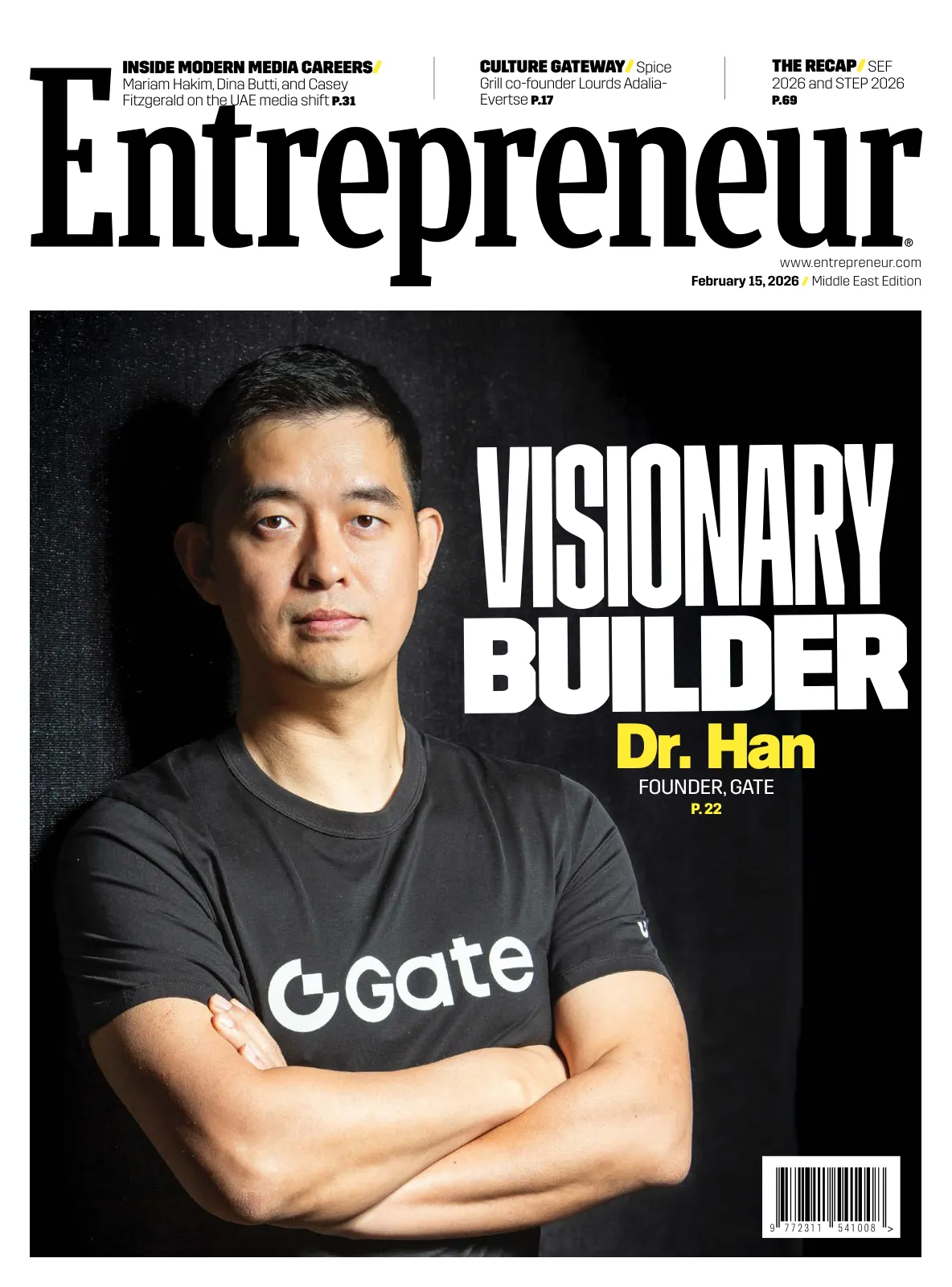
Entrepreneur Middle East, February 15, 2026
Page 1
THE RECAP/ SEF
2026 and STEP 2026
P.69
INSIDE MODERN MEDIA CAREERS/
Mariam Hakim, Dina Butti, and Casey
Fitzgerald on the UAE media shift P.31
CULTURE GATEWAY/ Spice
Grill co-founder Lourds Adalia-
Evertse P.17
www.entrepreneur.com
February 15, 2026 Middle East Edition
VISIONARY
BUILDER
FOUNDER, GATE
P. 22
Dr. Han
Page 2
Page 3
Page 4
THE ALL NEW NISSAN PATROL
BOOK NOW
Page 5
Contents/February 15, 2026
P.22
Beyond The
Noise
GATE FOUNDER DR. HAN ON
BUILDING A GLOBAL CRYPTO
EXCHANGE.
P.31
Inside
Modern
Media
Careers
VIRGIN RADIO’S MARIAM
HAKIM, DUBAI ONE’S DINA
BUTTI, AND LOVIN’ DUBAI’S
CASEY FITZGERALD
DISCUSS THE EVOLUTION
OF THE UAE’S MEDIA
LANDSCAPE.
P.17
Culture
Gateway
SPICE GRILL CO-FOUNDER
LOURDS ADALIA-EVERTSE
IS ELEVATING FILIPINO
CUISINE IN THE UAE.
FEATURES
Page 6
Page 7
Page 8
8 / ENTREPRENEUR.COM / February 15, 2026
BUILT FOR MOMENTS
THAT MATTER
EXTRAORDINARY
Escape to a home where urban sophistication
meets resort tranquility.
PRIVATE POOLS | 30+ AMENITIES | PRIME LOCATIONS
800-SAMANA | WWW.SAMANADEVELOPERS.COM
Page 9
DISCOVER REFINED living
*Ranking as per the H2025 1 sales
volume data of property monitor for Dubai
Page 10
10 / ENTREPRENEUR.COM / February 15, 2026
Page 11
11
February 15, 2026 / ENTREPRENEUR.COM /
Welcome to the
E X C E P T I O N A L
An iconic hotel featuring
luxury rooms and apartments
with trendy dining options
in the heart of Riyadh
BOOK NOW
Mansard Riyadh, A Radisson Collection Hotel
4248 Prince Mohammed Ibn Salman Ibn Abdulaziz Road, Riyadh 6721-13315, Saudi Arabia
00966118290900 info.mansard@radissoncollection.com
radissonhotels.com/collection
Page 12
12 / ENTREPRENEUR.COM / February 15, 2026
February 15, 2026
Contents
IN THE LOOP
‘TREPONOMICS
STARTUP
SPOTLIGHT
45 Momentum Shift
Ignite Training’s BEN EDWARDS
on the rise of emotionally intelligent
leadership in the UAE
48 Green Path
Ecocoast’s LACHLAN JACKON
discusses if sustainability is a strategy
or just an enabler.
50 Growth Strategies
Harris Hawkins Performance’s DR.
FAISAL TK HARRIS on why execution
risk is becoming UAE leaders’ defining
challenge.
52 Beyond the Ban
Hotpack’s DR MIKE CHEETHAM on
the UAE plastics policy’s circular reset.
54 Future Forward
SunTec Business Solutions’ AMIT DUA
says e-invoicing will test which UAE
businesses are future-ready.
61 Homegrown Flow
Water by Yara’s YARA SALMAN on
building a national Bahraini water
brand
69 Sharjah
Entrepreneurship
Festival 2026
SEBASTIAN VETTEL and
KHABIB NURMAGEDOV
headline event; SEF continues
to support local entrepreneurs
with new AED1,000 startup
licenses
76 Step Dubai 2026
Entrepreneur Middle East
Managing Editor Tamara
Pupic moderates a panel with
Amazon (MEAT) Vice President
RONALDO MOUCHAWAR
and Global Ventures founder
and Managing Partner Noor
Sweid.
CEO Wissam Younane
wissam@bncpublishing.net
MANAGING DIRECTOR Rabih Najm
rabih@bncpublishing.net
ART DIRECTOR Simona El Khoury
EDITOR IN CHIEF Anil Bhoyrul
anil@bncpublishing.net
MANAGING EDITOR Tamara Pupic
tamara@bncpublishing.net
FEATURES EDITOR Aalia Mehreen Ahmed
aalia@bncpublishing.net
DIRECTOR OF INNOVATION
Sarah Saddouk sarah@bncpublishing.net
GROUP SALES DIRECTOR – B2B GROUP
Joaquim D’Costa jo@bncpublishing.net
HEAD OF PARTNERSHIPS
Samir Glor Samir@bncpublishing.net
BUSINESS DEVELOPMENT DIRECTOR
Andy Soulahian andy.soulahian@bncpublishing.net
COMMERCIAL LEAD
Anna Chipala anna@bncpublishing.net
COLUMNIST Tamara Clarke
CONTRIBUTING WRITERS
Fida Chaaban, Ben Edwards, Lachlan Jackson,
Dr. Faisal TK Harris, Amit Dua,
and Dr. Mike Cheetham
SUBSCRIBE
Contact subscriptions@bncpublishing.net to receive
Entrepreneur Middle East every issue
COMMERCIAL ENQUIRIES
sales@bncpublishing.net
ENTREPRENEUR.COM
Access fresh content daily on our website
All Rights Reserved 2026. Opinions expressed are solely those of the contributors.
Entrepreneur Middle East and all subsidiary publications in the MENA region
are officially licensed exclusively to BNC Publishing in the MENA region by
Entrepreneur Media Inc. No part of this magazine may be reproduced or
transmitted in any form or by any means without written permission of the publisher.
Images used in Entrepreneur Middle East are credited when necessary. Attributed
use of copyrighted images with permission. All images not credited otherwise
Shutterstock. Printed by United Printing and Publishing.
PO BOX 502511 DUBAI, UAE
P +971 4 4200 506
EntMagazineME
Entrepreneur-me
↑HH Sheikha Bodour bint Sultan Al Qasimi
64 Crafting memories
How ANNA KREJCA co-
founded Ithara to reimagine
experience gifting
66 The Big Picture
Utopia Capital Management’s
and QVenture Capital
Association’s ALINA TRUHINA
on Qatar’s VC ecosystem.
Page 13
PROPERTIES
solproperties.ae
800-765-1
Learn More
Page 14
14 / ENTREPRENEUR.COM / February 15, 2026
Editor’s Note/
Editor’s Note
D
ubai has never been shy about ambition, especially
when it comes to building a future-ready economy.
But with the recent launch of DC Connect by
Dubai Chambers, the emirate has sent a clear
message to entrepreneurs everywhere: doing
business in Dubai is not just pro-growth, it’s now
fully digital, intuitive, and seamless.
DC Connect is a unified digital platform that brings all
Dubai Chambers services under one smart, user-friendly
interface. For hundreds of thousands of active
businesses, this means a fundamental shift in how they
interact with government and business support services.
Instead of navigating multiple systems or administrative
touchpoints, companies now have a single digital
gateway for everything from memberships and trade
documentation to business councils, mediation services,
and growth support.
What makes this launch particularly significant is the
emphasis on experience, not just efficiency. The platform
is designed around the needs of modern businesses,
offering real-time transaction updates, personalized
dashboards, smart notifications, and easy access to
insights and opportunities. It’s digital transformation
with purpose, focused on saving time, increasing
transparency, and enabling faster decision-making.
For entrepreneurs, this represents a meaningful
evolution in how companies are set up and managed in
Dubai. Starting a business here has already become
remarkably straightforward over the past decade. Today,
much of the journey from registration to licensing and
ongoing compliance can be completed digitally, without
paperwork or long in-person processes. DC Connect
strengthens that ecosystem, ensuring that once a
business is established, ongoing interactions are just as
smooth and efficient.
More importantly, this is about positioning. In a global
environment where founders can choose where to build,
scale, and invest, ease of doing business matters. Speed
matters. Digital access matters. Dubai understands that
competitiveness in the modern economy is increasingly
defined by how frictionless the system is.
DC Connect isn’t just a new platform, it’s a reflection of
Dubai’s broader vision. A city where government services
operate at the speed of entrepreneurs. A place where
digital infrastructure supports growth, not complexity.
And a business environment designed for the realities of
today, not the limitations of yesterday.
For anyone considering where to launch their next
venture, Dubai just made the decision even easier.
Anil Bhoyrul
Editor-in-Chief
DUBAI JUST MADE DOING BUSINESS EVEN
EASIER
With the launch of DC Connect, the emirate takes a major step toward becoming one of the
most digitally advanced places in the world
Page 15
Page 16
Enlighten Your Eternal Beauty,
Inside and Out!
info@muarjewels.com
@muarjewels
www.muarjewels.com
Page 17
Culture Gateway
Lourds Adalia-Evertse’s journey in founding Spice Grill has been a testament to the talent and
tenacity of the UAE’s growing Filipino community. With the brand now steadily expanding, the
founder hopes it can help catapult her native cuisine into mainstream F&B choices.
by AALIA MEHREEN AHMED
17
February 15, 2026 / ENTREPRENEUR.COM /
→ Lourds
Adalia-Evertse is a
UAE-based
entrepreneur,
hospitality leader,
and co-founder of
Spice Grill UAE.
Page 18
18 / ENTREPRENEUR.COM / February 15, 2026
B/Hospitality
A
nyone who steps foot in the UAE needn’t spend more than a few
hours to understand how far-reaching the Filipino expatriates’
influence is within the country. In fact, a 2025 report by Dubai-
based agency Global Media Insight shows that nearly 7% of the
UAE’s population —which is a little over 780,000 people— is made
up of this specific demographic. As such, their presence has been
significantly felt within the business ecosystem, with the Dubai
Chamber of Commerce reporting that in just the first three months of 2025, 216 new
Filipino companies registered with the governmental organization. Among the
plethora of success stories that have come out of this community, one such tale is
that of Lourds Adalia-Evertse. “I came to the UAE at 19 years old, fresh out of college,
with nothing but a dream,” she recalls. “I worked my way up the corporate ladder, took
risks, and eventually became a business owner.”
Indeed, as is the case with many founders,
Adalia-Evertse’s decision to plunge into
entrepreneurship came while working a
traditional 9-5 job. “My journey into F&B
was not something I originally planned,” she
says. “Before co-founding Spice Grill, I was a
founding member of Creative Zone [a UAE-
based business setup consultancy], and later
served as its COO. But after spending over a
decade in the corporate world, I felt ready to
take a risk and build something of my own.
As a Filipina, food has always meant more
than nourishment. Food in this context is
more of a community and cultural thing. It’s
how we connect, celebrate, and build com-
munity. That belief became the foundation
of Spice Grill. I wanted to create a space that
feels welcoming and familiar, while proudly
sharing Filipino flavours with a wider audi-
ence.”
Adalia-Evertse thus put her plans into action
in early 2020 along with Cristine Caringal
Mela, a prominent food industry figure in
the Philippines. While Mela was set to take
charge of her co-founder duties from back
home, Adalia-Evertse was to helm the busi-
ness in its entirety within the UAE, right from
operations and team leadership to partner-
ships, supplier relationships, and brand
growth.
But then came an unprecedented turn of
events that would go on to negatively affect
the F&B industry across the globe for the next
couple of years. “I had just left my corporate
role, signed the lease, and started construc-
tion for Spice Grill when the coronavirus
pandemic and lockdowns hit,” Adalia-Evertse
explains. “It was an uncertain and challeng-
ing time, but there was no turning back. But
we still moved forward with purpose, hiring
people who had lost their jobs and using food
as a way to bring comfort, rebuild livelihoods,
and create a sense of community when it was
needed most.”
↓ Spice Grill UAE is a
homegrown
restaurant brand
founded in Sharjah
that brings Filipino-
inspired flavors to a
diverse and
multicultural dining
audience across the
country.
Page 19
19
January 2025 / ENTREPRENEUR.COM /
“FILIPINO CUISINE HAS
STRONG POTENTIAL TO BECOME
MORE MAINSTREAM. THIS IS
ESPECIALLY POSSIBLE SINCE
THE PHILIPPINES IS NATURALLY
RICH IN SEAFOOD, YET VERY
FEW BRANDS ARE ACTIVELY
SHOWCASING THIS TO A GLOBAL
AUDIENCE. AT SPICE GRILL, WE
SEE OURSELVES AS A DOORWAY
FOR OTHER CULTURES TO
EXPERIENCE FILIPINO FOOD IN
A WAY THAT FEELS FAMILIAR,
ELEVATED, AND WELCOMING.”
→ Spice Grill was
co-founded
alongside Cristine
Caringal Melad,
whose culinary
vision helped shape
the brand’s creative
foundation.
Adalia-Evertse’s persistence paid
off and the first Spice Grill branch
was opened in Sharjah’s tranquil
Majaz Waterfront area in October
2020. “It has a seating capacity
of around 250 guests, with both
indoor and outdoor dining and
a waterfront view next to the
park,” the co-founder shares. “The
location performs especially well
during the winter season, when
al fresco dining is popular, and
is quieter during the summer
months. It has become a destina-
tion venue and is often described
as ‘a hidden gem’ in Sharjah, at-
tracting families and groups look-
ing for a relaxed dining experi-
ence. Following the success of our
Sharjah branch, we expanded into
Dubai with Spice Grill Express at
Flayva, Al Ghurair Centre, which
opened in March 2024. This is a
smaller, express-style format de-
signed for mall dining. Unlike our
waterfront location, this branch
sees stronger footfall during the
summer, when customers prefer
indoor venues, and slightly slower
traffic in winter. Our most recent
opening is at the Food Pavilion
in BurJuman Mall, launched in
November 2024. This outlet has a
55-seat capacity and was created
to bring the Sharjah-style dining
experience to Dubai diners in a
more curated food hall setting.
Across locations, seasonality plays
a key role in footfall and revenue,
with waterfront and outdoor
venues peaking in winter and
mall-based concepts performing
best during the hotter months.”
Having expanded the brand with
a favorable mix of locations, Spice
Grill unsurprisingly has a lot of
Filipino customers. But with op-
erating in a diverse nation, comes
the added task of properly repre-
senting the Phillipines’ culture —
a responsibility Adalia-Evertse is
all too aware of. “Our restaurants
are designed to be cozy, modern
spaces that guests feel proud
to dine in, and we are deeply
Page 20
20 / ENTREPRENEUR.COM / February 15, 2026
customer-service centric,”
she says. “Together, the
food, the space, and the
service create an experi-
ence that introduces
Filipino cuisine with con-
fidence and pride, while
inviting diners to explore
it further. In the food in-
dustry, I believe we hold
a great responsibility:
we become ambassadors
of our country’s cuisine.
Whenever people from
other nationalities try our
food, it is like opening our
culture to them. It is im-
portant that they have the
best possible experience,
because we represent our
home country. We want
to show them that the
Philippines is an excellent
country with an amazing
food culture.”
In order to make her
motherland’s food “more
approachable while
promoting unity and
inclusivity,” Adalia-Ever-
tse took the decision to
incorporate cross-cultural
dishes into the Spice Grill
menu. “This stays true
to our original mission
of using food as a bridge
and introducing Filipino
cuisine in a welcoming
way,” she says. “For ex-
ample, we have Asian and
Filipino fusion, including
our seafood feasts, along-
side approachable dishes
such as adobo birria tacos
and strawberry leche flan.
Adobo is popular, but it is
mostly known as a home-
cooked comfort food. For
the adobo birria tacos,
we wanted to elevate the
dish to appeal to a wider
range of nationalities
and to show that adobo
is an important part
of Philippine cuisine.
Happily, the fusion with
Mexican tacos is gaining
traction at Spice Grill.
Leche flan, meanwhile, is
a popular Filipino dessert
with similarities to crème
brûlée. We changed it
slightly by enhancing it
with strawberries, a fruit
that is popular in certain
regions of the Philippines.
We are happy that both
Filipinos and other na-
tionalities have received
these new dishes well.”
But curating such
amalgamations of dishes
and cultures, for Adalia-
Evertse, holds more
significance than simply
introducing Filipino
cuisine to the masses.
“Filipino cuisine has
strong potential to be-
come more mainstream,”
she remarks. “This is es-
pecially possible since the
Philippines is naturally
rich in seafood, yet very
few brands are actively
showcasing this to a
global audience. At Spice
Grill, we see ourselves as
a doorway for other cul-
tures to experience Fili-
pino food in a way that
feels familiar, elevated,
and welcoming.”
When asked which
Filipino cultural traits
best expressed through
Spice Grills’ offerings, the
co-founder picks three:
hospitality, resilience,
and community. “Filipi-
nos are naturally warm,
smiling, and welcom-
ing, and that spirit is
reflected in how our food
is prepared, served, and
BEING ONE OF THE WINNERS OF THE THE MOST INFLUENTIAL
FILIPINA WOMAN IN THE WORLD™ AWARD WAS DEEPLY
MEANINGFUL TO ME, BOTH AS A FILIPINA AND AS AN EXPAT
BUSINESS LEADER IN THE UAE. IT REPRESENTS MORE THAN
A PERSONAL MILESTONE—IT’S A REMINDER THAT IN THE UAE,
ANYTHING IS POSSIBLE IF YOU ARE WILLING TO WORK HARD AND
BELIEVE IN YOUR VISION. I HOPE MY JOURNEY CAN INSPIRE OTHERS,
ESPECIALLY WOMEN AND YOUNG EXPATS, TO PURSUE THEIR
DREAMS WITH CONFIDENCE AND COURAGE.”
B/Hospitality
“
Page 21
21
February 15, 2026 / ENTREPRENEUR.COM /
“IN TIME FOR RAMADAN, SPICE
GRILL IS CURRENTLY GIVING BACK
TO ITS ROOTS THROUGH A TIMELY
AND MEANINGFUL INITIATIVE.
HAVING OPENED ITS FIRST
BRANCH IN SHARJAH, SPICE GRILL
LAUNCHES A SHARJAH-TO-TABLE
CONCEPT, PARTNERING WITH LOCAL
FISHERFOLK TO CELEBRATE FRESH,
LOCALLY SOURCED FISH CAUGHT IN
SHARJAH. THE INITIATIVE BLENDS
EMIRATI PROVENANCE WITH A
FILIPINO CULINARY PERSPECTIVE,
REINFORCING THE ROLE OF FOOD
AS A CONNECTOR OF CULTURE AND
COMMUNITY.”
shared,” she continues. “Whenever
people dine at Spice Grill, we make
it our mission to make them feel
welcome, as if they are eating in
their families’ homes. All our staff
are friendly, which helps create a
comfortable and welcoming din-
ing experience. I also believe it is
important for all staff to feel happy
at work, because this is reflected in
how they perform their duties and
how they treat customers. Most
of our staff have been with Spice
Grill since the beginning, and we
are very proud of that. Resilience
is reflected in how our cuisine has
evolved through challenges while
remaining comforting and flavour-
ful. Community is at the heart
of Filipino dining, as meals are
meant to bring people together.
At Spice Grill, these values guide
everything, from our customer
service culture to our menus and
dining spaces. It is our way of
sharing a Filipino heart with the
world, which is essentially the core
of Spice Grill’s identity.”
Adalia-Evertse’s endeavors in
growing Spice Grill with intention
and purpose received a mam-
moth public validation when,
last year, she received the ‘Global
FWN100 Builder Architect of
Change Award’ at the annual
The Most Influential Filipina
Woman in the World™ Award (an
awards ceremony, by the US-based
Foundation for Filipina Women’s
Network, that honors Filipina
women who are creating change
and impact in their local commu-
nities). “Winning that award was
deeply meaningful to me, both as
a Filipina and as an expat business
leader in the UAE,” Adalia-Evertse
says. “This recognition represents
more than a personal milestone—
it’s a reminder that in the UAE,
anything is possible if you are willing to work hard and
believe in your vision. Another milestone I’m most proud
of is Spice Grill being awarded Highly Commendable
Restaurant 2025 in the Northern Emirates, especially
as the only Filipino-owned restaurant recognized dur-
ing the awards. It was a powerful
moment of representation and
validation for Filipino cuisine on a
wider stage. I hope my journey can
inspire others, especially women
and young expats, to pursue their
dreams with confidence and cour-
age.”
In ensuring her work creates a
positive ripple effect throughout
society, Adalia-Evertse has initi-
ated collaborations with com-
munity groups and small business
owners, by hosting events and
workshops in our restaurants.
“These partnerships have helped
us support fellow entrepreneurs,
expand our reach, and strengthen
Spice Grill’s position as a com-
munity-driven brand—sharing a
Filipino heart to the world,” she
says. “We also always want to offer
something new every year. Like
now, in time for Ramadan, Spice
Grill is currently giving back to its
roots through a timely and mean-
ingful initiative. Having opened
its first branch in Sharjah, Spice
Grill launches a Sharjah-to-Table
concept, partnering with local
fisherfolk to celebrate fresh, locally
sourced fish caught in Sharjah.
The initiative blends Emirati prov-
enance with a Filipino culinary
perspective, reinforcing the role of
food as a connector of culture and
community.”
With a steady business model and
vision in place, Adalia-Evertse is
now focused on simply amplifying
the core values that underscore her
job. “In 2026, I see the F&B space
becoming more experience-driven,
with guests seeking authenticity,
comfort, and genuine service—not
just good food,” she says. “People
want places that feel meaningful
and consistent. For Spice Grill, this
means refining our guest experience, strengthening
service standards, and continuing to present Filipino
cuisine in a way that feels accessible and proud. Our focus
is sustainable growth, community, and staying true to our
purpose of sharing a Filipino heart to the world.”
“
→ Built around the
idea of food as a
shared experience,
Spice Grill is known
for its bold yet
balanced flavors,
with a strong focus
on fresh seafood,
sizzling grills, and
comfort-driven
dishes designed for
communal dining.
Page 22
→ Dr. Han, Ph.D. is the
founder and CEO of
the leading global
cryptocurrency
exchange Gate.
22 / ENTREPRENEUR.COM / February 15, 2026
Page 23
23
February 15, 2026 / ENTREPRENEUR.COM /
BEYOND
THENOISE
ON BUILDING A GLOBAL
CRYPTO EXCHANGE.
by TAMARA PUPIC
GATE FOUNDER
DR. HAN
Page 24
24 / ENTREPRENEUR.COM / February 15, 2026
→ Gate is currently
listed as one of the
top 3 global
cryptocurrency
exchanges by most
widely tracked
industry aggregators,
based on trading
volume and related
metrics.
Page 25
I
realize that is also how he built the crypto
exchange Gate over the past 15 years: patiently,
methodically, and largely indifferent to the
fluctuating yet constant noise around and
within the crypto sector.
Gate is currently listed as one of the top global
cryptocurrency exchanges by most widely
tracked industry aggregators, based on trading
volume and related metrics. It was the first
mainstream cryptocurrency exchange to
commit to 100% reserves, which in 2020 was
ahead of the industry standard. Then, in
October 2025, Gate took it a step further by
committing to a 124% reserve ratio.
As Gate surpasses 49 million active users, Dr.
Han points to security as the single most
important factor in how those users choose a
crypto exchange. “We have extensive experience
and provide strong custody and security
measures to protect user assets,” he says.
“Transparency is also critical. We were the first
to provide proof of reserves, showing that user
assets are fully backed. We also open-sourced our
auditing system so users can verify it themselves.”
As part of its strategy to become a fully regulated
global crypto exchange, Gate has obtained regulatory
registrations, licenses, or approvals across jurisdic-
tions including Lithuania, Argentina, Malta,
Italy, Gibraltar, the Bahamas, Hong Kong, and
Japan, following the 2024 acquisition of
Japan-licensed exchange Coin Master. In
2025, Gate obtained licenses in multiple U.S.
states and launched Gate US; plus, its
subsidiary Gate Technology FZE secured a
VASP license from Dubai’s Virtual Assets
Regulatory Authority (VARA). “We started as a
one-person operation,” Dr. Han says. “Today,
we have more than 2,000 employees, including
over 1,000 developers. We have offices in
Japan, Malta, the United States, and UAE
(Dubai), but many team members work
remotely.”
Going back to the period when Gate was still a
one-person operation reveals that Dr. Han was
among the earliest builders in the global
cryptocurrency industry. With degrees in
computer software engineering and advanced
degrees in mathematics and computer science
(Peking University), Dr. Han pursued a PhD in
WE HAVE EXTENSIVE
EXPERIENCE AND PROVIDE
STRONG CUSTODY AND
SECURITY MEASURES TO
PROTECT USER ASSETS.
WE WERE THE FIRST
TO PROVIDE PROOF OF
RESERVES, SHOWING THAT
USER ASSETS ARE FULLY
BACKED. WE ALSO OPEN-
SOURCED OUR AUDITING
SYSTEM SO USERS CAN
VERIFY IT THEMSELVES.”
“
25
February 15, 2026 / ENTREPRENEUR.COM /
I
t was at the Entrepreneur
Leadership Awards 2025 by
Entrepreneur Middle East gala
dinner last December that I
was looking for the winner of
the Best Crypto Exchange
award — pushing through a
noisy crowd of people taking selfies,
shaking hands, laughing loudly, inter-
rupting each other.
I was expecting Dr. Han, Ph.D., founder
and CEO of the global cryptocurrency
exchange Gate, to fit into that picture.
But no—he met me slightly aside from
the flow of people, remaining polite,
disciplined, and focused on our conver-
sation as if no distraction or interrup-
tions were competing for our attention.
Page 26
26 / ENTREPRENEUR.COM / February 15, 2026
optics from Canada. After
completing one year of postdoc-
toral work in Canada in
optoelectronics, he returned to
China to start a business in
high-performance computing
and optoelectronic software
development. Then, in 2012,
while conducting high-perfor-
mance computing research, he
noticed graphics cards being
widely used for Bitcoin mining.
“About 12 years ago, I was trying
to find the best hardware to run
software simulations. I then
discovered that people were
using the same kind of hardware
for Bitcoin mining. That was the
first time I heard about Bitcoin,”
he says.
“I started studying what Bitcoin
was. It was easy for me to
understand because I have a
technology background. There
was a white paper, very well
written, and the code was open
source, so you could easily check
the details. That was my first
encounter with Bitcoin.”
However, intellectual curiosity
alone was not what led Dr. Han
to start Gate. In 2013, he
attempted to purchase 100
Bitcoin on an online forum but
was scammed, losing approxi-
mately CAD 2,000–3,000
(US$1,500–2,300). The
experience prompted him to
build a secure trading platform.
Gate was founded in April 2013,
originally under the name bter.
com, during a period when the
crypto industry operated largely
without regulatory frameworks.
In its first two years, Dr. Han
personally wrote much of the
platform’s core code, handling
everything from infrastructure
and application programming
interfaces (APIs) to website
development.
In 2017, when China carried
out a sweeping crackdown on
cryptocurrency activity -from
declaring Initial Coin Offerings
(ICOs) illegal to instructing
major domestic exchanges to
cease operations or relocate
overseas- Dr. Han’s platform
relocated to the Cayman
Islands and rebranded as Gate.
Today, his stance on regulation
is pragmatic. “Early on, the
lack of regulation helped the
industry grow. Today, regula-
tion is necessary to protect
users from risks like hacking
and illegal activity,” Dr. Han
says.
“Regulators should provide
clear guidelines and objectives
but avoid micromanagement.
Exchanges have the expertise
↑ Gate founder
Dr. Han with
Tamara Pupic,
Managing Editor,
Entrepreneur
Middle East.
}}
“ ON THE PRODUCT
SIDE, WE EVOLVED
FROM A CENTRALIZED
EXCHANGE TO ALSO
OFFERING DEFI
AND TOKENIZED
TRADFI PRODUCTS.
USERS WANT MORE
CONTROL OVER THEIR
ASSETS, SO WE BUILT
DECENTRALIZED
SOLUTIONS AS WELL.”
Page 27
27
February 15, 2026 / ENTREPRENEUR.COM /
Page 28
and technology to meet
compliance requirements.
Excessive micromanage-
ment wastes time and
resources, especially for
smaller companies.
Overall, regulators are
improving as they gain
more understanding of the
industry.”
Alongside the broader
expansion of the crypto
industry, Gate has
undergone its own internal
acceleration, with its
product strategy moving
well beyond only central-
ized trading. As Dr. Han
explains, “On the product
side, we evolved from a
centralized exchange to
also offering DeFi
products. Users want more
control over their assets, so
we built decentralized
solutions as well.”
That shift has recently
taken shape in Gate’s “All
in Web3” strategy, a
comprehensive on-chain
ecosystem built around
Gate Layer, its high-per-
formance Layer 2 block-
chain. Serving as the
foundation, Gate Layer
enables a new generation
of decentralized applica-
tions, including Gate Perp
DEX, a decentralized
perpetuals exchange, and
Gate Fun, a zero-code
token launchpad. Together,
these products form an
integrated on-chain
environment—unified by
GT as the native gas
token—where users can
build, trade, and create
within a single ecosystem.
“We continuously launch
new products because
crypto evolves very quickly.
We are now fully focused
on Web3, as we see strong
demand for decentralized
infrastructure and
services.”
Innovation doesn’t stop
there. Gate recently
dabbled into a new model
of on-chain TradFi by
integrating tokenized
stocks and traditional
financial instruments
directly into its crypto
ecosystem, creating a true
360-degree trading
experience. In recent
interviews, Dr. Han
emphasized how Gate is
using blockchain infra-
structure to deliver
compliant, high-liquidity
access to traditional assets
with on-chain efficiency
and seamless user
experience. This approach
bridges TradFi and crypto
into a single platform,
setting a new industry
benchmark for next-gener-
ation financial infrastruc-
ture.
Brand visibility followed
infrastructure. Starting
from the 2024/25 season,
Gate.io has become the
Official Sleeve Partner of
FC Internazionale Milano,
which will see its logo
featured on the sleeves of
the playing kits for both
the men’s and women’s
teams, as well as the club’s
U20 teams. Also in 2025,
Gate signed a multi-year
deal to become the
exclusive crypto exchange
partner of the eight-time
World Drivers’ Champion-
ship–winning team, Oracle
Red Bull Racing. Gate’s
branding is featured on the
RB21, team kit, driver and
crew suits, and Max
I ENCOURAGE FOUNDERS
TO ENTER CRYPTO EARLY.
CRYPTO WILL CHANGE
THE WORLD, AND MOST
ASSETS WILL EVENTUALLY
BE TOKENIZED AND MOVED
ON-CHAIN.”
“
28 / ENTREPRENEUR.COM / February 15, 2026
→ The Gate team received
the Best Crypto Exchange
award at the Leaders in
E-Business Awards 2025
by Entrepreneur Middle
East in Dubai in December
2025.
↑ Gate founder Dr. Han
receives the Best Crypto
Exchange Award at the
Entrepreneur Leadership
Awards 2025 in Dubai.
Page 29
29
February 15, 2026 / ENTREPRENEUR.COM /
Verstappen’s helmet. “It
significantly increased
global awareness. These
were major milestones for
us,” Dr. Han says.
Stepping back from Gate
to the crypto industry as a
whole, Dr. Han draws on
years of navigating
multiple market cycles,
treating both bull and
bear phases as exercises in
discipline.“Crypto used to
follow a four-year cycle
based on Bitcoin supply,
but today it is influenced
by the global economy.
Bull and bear markets still
exist, but the dynamics
have changed,” he
explains. “In bull markets,
hype can lead to mistakes
and bubbles. You need to
be careful not to overex-
tend or launch too many
products without disci-
pline.
“In bear markets, revenue
is lower and morale can
drop. That is the time to
reduce unnecessary
spending and focus on
product development and
long-term improvements.
Finding the balance is a
key lesson we learned.”
When it comes to the
industry’s next chapter,
Dr. Han sees stablecoins
and real-world asset
tokenization as founda-
tional. “Stablecoins are a
form of real-world assets
because they are backed
by fiat currency. Initially,
they were mainly used for
trading, but today they are
widely used for payments,”
he says. “Real-world asset
tokenization is growing
quickly. Assets like gold
and stocks can now be
traded on-chain, globally
and 24/7. This increases
accessibility, efficiency,
and liquidity. We will see
more traditional assets
move onto blockchain.”
By contrast, Dr. Han
remains cautious about
central bank digital
currencies.“CBDCs have
been discussed for years,
but I have not seen real
success yet,” he says.
“Blockchain already
provides trust through
technology and consen-
sus, so users do not
necessarily want central-
ized control. CBDCs must
compete on experience,
cost, and efficiency like
any other project. Without
clear advantages,
adoption will remain
limited.”
Looking ahead, Dr. Han
believes artificial intelli-
gence will play a decisive
role in crypto adoption.
“AI will significantly
improve user experience.
Crypto platforms are still
too complex for normal
users,” he explains. “With
AI, users won’t need to
learn complicated
interfaces. They will
simply express their
intent, and the system will
execute it for them.
“By 2026, I expect
AI-driven interfaces that
make crypto much more
accessible.”
After more than a decade
building through volatil-
ity, regulation, and
reinvention, Dr. Han’s
advice to founders—par-
ticularly those in the
UAE—is grounded in
experience. “I encourage
founders to enter crypto
early. Crypto will change
the world, and most assets
will eventually be
tokenized and moved
on-chain,” he says.
“Founders should build in
major crypto hubs like
Dubai, Abu Dhabi, Hong
Kong, or Singapore. These
ecosystems make it easier
to find capital, partners,
and talent. Starting in a
small city without an
ecosystem makes growth
much harder.”
“BY 2026, I EXPECT
AI-DRIVEN INTERFACES THAT
MAKE CRYPTO MUCH MORE
ACCESSIBLE.”
Page 30
30 / ENTREPRENEUR.COM / February 15, 2026
Into New Worlds
From 13-16 April 2026
Riyadh Exhibition and Convention
Center - Malham, Saudi Arabia
You’re One LEAP Away
Secure your pass now
Page 31
31
February 15, 2026 / ENTREPRENEUR.COM /
RADIOTV
DIGITAL
INSIDE
MODERN
Media
CAREERS
In the UAE, the media landscape has never
been defined by a single platform. Television still
commands authority, radio retains intimacy, and
digital media continues to redraw the rules of reach,
speed, and influence.
But the real story of how these mediums coexist and
evolve is best told through the people who have built
their careers inside them.
This feature brings together three women whose
professional journeys span radio, television, and
digital media, offering a grounded view of how the
UAE media landscape has transformed over the
past decade.
by TAMARA PUPIC
MARIAM (MAZ) HAKIM
PRESENTER
VIRGIN RADIO, ARABIAN RADIO NETWORK (ARN)
DINA BUTTI
TV PRESENTER
DUBAI ONE
CASEY FITZGERALD
SENIOR CONTENT DIRECTOR
LOVIN’ DUBAI, AUGUSTUS MEDIA
Page 32
32 / ENTREPRENEUR.COM / February 15, 2026
RADIOTV
DIGITAL
INSIDE
MODERN
Media
CAREERS
Page 33
33
February 15, 2026 / ENTREPRENEUR.COM /
→ MARIAM (MAZ) HAKIM is a presenter at Virgin Radio, Arabian Radio Network (ARN).
Maz Hakin’s Lessons
Across Platforms
}"In media, listening has
taught me more than talking
ever did. In podcasting, the
moments that matter most are
the ones where you stop
performing and really pay
attention. And in
entrepreneurship, discomfort
isn’t a sign you’re failing — it’s
usually a sign you’re learning.
If I could say one thing, it
would be this: try to be
excellent at what’s right in
front of you. If you can stand
by your work even when
there’s no applause, you’re
already doing something right
— and that’s usually what
lasts."
CAREER
ADVICE
R
adio’s
strength
isn’t
volume
or virality
— it’s
intima-
cy,” says
Mariam (Maz) Hakim
Presenter, Virgin
Radio, Arabian Radio
Network (ARN). “And
in a fast-growing
market like the UAE,
where communities
are still being shaped
in real time, that
intimacy remains
incredibly valuable.”
Maz Hakim has built a
long-standing radio
career in the Middle
East through her work
with Virgin Radio
Dubai 104.4 FM,
widely recognized as
the UAE’s leading
English-language hit
music station, with an
estimated weekly
audience reach of
around 1.3 million
listeners. She moved to
Dubai from Australia
in 2014 to host her
own show on the
station and has since
remained a core part
of its on-air lineup.
She currently presents
The Vibe with Maz
Hakim, which airs on
weekdays from 10am
to 2pm. “Longevity has
been one of the most
defining milestones in
my career. Spending
over a decade at Virgin
Radio in a region as
fast-moving and
competitive as the
MARIAM (MAZ)
HAKIM
PRESENTER
VIRGIN RADIO, ARABIAN RADIO NETWORK (ARN)
R A D I O ’ S E N D U R I N G I M P A C T
Middle East means you’re
constantly being challenged
to stay relevant, curious,
and adaptable. Comfort is
never really an option.”
Two key turning points have
Page 34
34 / ENTREPRENEUR.COM / February 15, 2026
RADIOTV
DIGITAL
INSIDE
MODERN
Media
CAREERS
played a defining role in shaping her professional trajectory
- moving from co-hosting to hosting solo forced her to find
her own voice very quickly, but another pivotal moment was
realizing that “radio alone was no
longer enough.” She explains, “It’s
not because radio is losing its
power, but because audiences
were changing. That awareness
pushed me to think beyond the
studio and start building a
broader personal brand, focusing
on storytelling, relevance, and
impact across multiple platforms.”
Hakim views today’s UAE media
landscape across radio, television,
and digital platforms as
“fragmented, fast-moving, and
highly competitive for audience
attention.” In this environment,
she explains consumption
patterns are “no longer defined by
distinct channels, as audiences
move fluidly between live radio,
short-form content, podcasts, social media, and video—
often within the same day.” However, in the UAE, she notes
that radio remains deeply embedded in daily life. “With
long commutes, a diverse population, and a strong culture
of live, local connection, radio here isn’t just background
noise — it’s companionship,” she says. “People still tune in
for conversation, for familiarity, and
for voices they trust. Live radio holds
a power that no other medium has
fully replicated: real-time human
connection. It’s immediate,
responsive, and shared. When
something happens — globally or
locally — radio reacts instantly. In a
region as diverse as the Middle East,
that sense of immediacy and
inclusion really matters.”
While attention has become the
scarcest currency, Hakim agrees that
new attention dynamics have
changed how audiences consume
content in the moment, but believes
that radio has retained its distinctive
power. “Some traditional platforms
are still adjusting to how quickly
attention shifts today, but radio has
quietly evolved alongside its audience. It doesn’t rely on
clicks or algorithms — it relies on presence. Being there,
every day, in real time,” she says.
“Radio’s strength
isn’t volume or
virality — it’s
intimacy. And in
a fast-growing
market like the UAE,
where communities
are still being
shaped in real
time, that intimacy
remains incredibly
valuable.”
Page 35
35
February 15, 2026 / ENTREPRENEUR.COM /
“The platforms that
continue to succeed are the
ones that respect how
people actually live their
lives — not just how they
scroll.”
Beyond radio, Hakim has
also expanded her
storytelling into podcasting
through Success Decoded
with Maz Hakim which
features a diverse lineup of
regional and international
guests, such as such as
best-selling author Roxie
Nafousi, fitness coach
Jason Grima, wellness
expert Mary Cristine,
entrepreneur Ebraheem Al
Samadi chef Mohamad
Orfali, and global media
personality Piers Morgan.
The series is distributed
across major audio
platforms, including Apple
Podcasts, Spotify and RSS
feeds through Virgin Radio
Dubai’s podcast page. “Live
radio is driven by instinct,
speed, and energy in the
moment. Podcasting, by
contrast, is slower,
deeper, and far more
intentional. With
Success Decoded, I had
to learn patience — al-
lowing conversations to
breathe, embracing
silence, and prioritizing
depth over entertain-
ment,” Hakim explains.
“The biggest lesson has
been understanding that
podcast audiences want
substance, not just
personality. They’re
choosing to spend time
with you — not catching
you in the background of
their day. That level of
attention changes how
you prepare, how you
listen, and how you tell
stories. It’s a responsibility
you can’t take lightly.”
Alongside her media career,
Hakim has also explored
entrepreneurship through
the launch of Expand By
Maz, a socially conscious
and sustainable clothing
brand focused on
celebrating her native
Afghan culture. “Exploring
entrepreneurship came
from a desire to express
identity beyond broadcast-
ing,” she says. “I was drawn
to fashion as a storytelling
medium — a way to explore
culture, heritage, and
conscious creation in a
tangible form. As an
Afghan-Australian woman
living in the Middle East, it
felt important to build
something meaningful that
reflected where I come
from and what I stand for.
That experience offered
insight into the differences
between entrepreneurship
and media, underscoring
that creativity is only the
starting point in
entrepreneurship.
“Execution, logistics,
decision-making, and
resilience are where the
real work happens,” Hakim
explains. “Building from
the ground up gave me a
deep appreciation for
sustainability, production
realities, and the discipline
required to turn ideas into
something real.”
Her journey across three
distinct avenues for
self-expression —radio,
podcasting, and entrepre-
neurship— informs her
belief that attention is
increasingly driven by
personalities rather than
platforms. “Audiences
follow people they trust —
not logos. Platforms are
vehicles; personalities are
the connection,” Hakim
concludes.
“This shift has decentral-
ized power. Broadcasters
no longer ‘own’ audiences
in the way they once did
— they collaborate with
them. For talent, that’s
empowering, but it’s also
demanding. You’re no
longer just a presenter;
you’re a brand, a strategist,
and a storyteller.
Consistency, authenticity,
and clarity of voice matter
more than ever.”
“The UAE is still a
rapidly growing
country where
radio remains
deeply embedded
in daily life. With
long commutes,
a diverse
population, and
a strong culture
of live, local
connection,
radio here isn’t
just background
noise — it’s
companionship.”
Page 36
36 / ENTREPRENEUR.COM / February 15, 2026
RADIOTV
DIGITAL
INSIDE
MODERN
Media
CAREERS
DINA
BUTTI
TV PRESENTER
DUBAI ONE
I N D E F E N S E O F
T E L E V I S I O N
Page 37
37
February 15, 2026 / ENTREPRENEUR.COM /
I
love television. I genuinely
believe it still offers something
special: surprise,” says Dina
Butti, TV presenter at Dubai
One, an English language
entertainment television
channel owned by Dubai Media
Incorporated.
“We live in an extremely curated
world where we control what we
watch, when we watch it, and how
fast we consume it. Television allows
for discovery - flipping channels,
stumbling upon a story, a film, or a
topic you didn’t even know you were
interested in.”
After co-hosting the celebrity
entertainment program That’s
Entertainment, Butti is now a part
of a team of presenters hosting DXB
Today, a daily lifestyle program on
Dubai One that highlights culture,
events, local stories and experiences
in the UAE. “For a show like ours
designed for local audiences, we
deliver news and current affairs
rooted in the city itself, while giving
talent, businesses, and personalities
a trusted platform. That communal
aspect is still awesome,” Butti says.
Egyptian-Canadian Butti began her
journey in media after studying
studio arts, journalism, and
television at Concordia University in
Montreal. Returning to Dubai for
family reasons, she entered the
industry without established
connections, but she landed an early
internship at INTV (later known as
City 7), followed by a role at a
women’s fashion and lifestylemaga-
DINA BUTTI On
Breaking Into TV
} "Create your own
opportunities and
platforms. We’re in so much
more control of our success
than ever before. Put yourself
out there. Experiment. Take
risks. Fail publicly. Get in front
of a camera and keep
posting."
}"When I started, I was
told I wasn’t pretty
enough, thin enough,
smart enough and that I
smiled too much. You have
to learn to be your own
cheerleader and lean into
what makes you thrive. The
hardest thing to be on camera
is being yourself, but like
anything else, communication
is a skill you can practice.”
}"I genuinely believe my
success has come from
being relatable. I stutter.
I’m goofy. I correct myself. I’m
not overly polished and that’s
intentional.”
}"If you want to work in
traditional media, reach
out to people who already
do. Prove your value. Get
your foot in the door. Even if it
means working for free at
first, build your reel and your
CV. Figure out what makes
you uniquely you - and spread
it like wildfire."
TREP
TALK
“
zine. Her first paid assignment at
the Dubai International Film
Festival marked a pivotal
moment- Butti conducted
celebrity interviews with A-listers
including the renowned Egyptian
actress Yousra and American
actor George Clooney. That
experience paved the way for her
first full-time position as a
production coordinator at MTV
→ Dina Butti is a part of a team of presenters hosting DXB Today, a daily lifestyle program
on Dubai One.
↓ Dina Butti and Robin Williams
Page 38
38 / ENTREPRENEUR.COM / February 15, 2026
Arabia, followed by an editorial role with
Jumeirah Group’s beauty and wellness publica-
tion.
When reflecting on the qualities that have defined
her career trajectory, Butti highlights one in
particular: resilience in the face of rejection.
“There is a lot of it,” she says. “I always knew I
wanted to be a TV presenter, and I also knew I
wasn’t going to stop until it happened. That meant
hearing ‘no’ more times than I can count.”
Butti adds that she had set her sights on Dubai
One for years, but her early attempts to secure an
on-air role proved unsuccessful. Ultimately, she
accepted a behind-the-scenes position as a
researcher and writer. From there, she continued
to show up—making her ambitions clear to
everyone around her. “I was told all kinds of things
- that it wasn’t going to happen, that maybe I
wasn’t pretty enough, didn’t have “the it factor,” or
that I was wasting people’s time by hoping for a
different result. Thankfully, I believed in myself
more than the noise,” she says.
A pivotal turning point came when Reim El
Houni, founder of Dubai-based production studio
Ti22 Films, offered her the opportunity to take on
an unpaid role as a city scout delivering short
on-camera segments each week. Butti went on to
become a reporter on Studio One, and later
stepped in as host of Out and About. The
“We live in
an extremely
curated world
where we control
what we watch,
when we watch
it, and how fast
we consume it.
Television allows
for discovery
- flipping
channels,
stumbling upon
a story, a film, or
a topic you didn’t
even know you
were interested
in.”
Page 39
39
February 15, 2026 / ENTREPRENEUR.COM /
momentum continued when she became
co-host of That’s Entertainment, where she
reported live from the red carpets of the
Oscars and the Critics’ Choice Awards.
From that point forward, her commitment
became unmistakable—rooted in a
disciplined approach to preparation and a
deep respect for her craft. For Butti, every
interview begins with thorough research
and genuine curiosity. “One thing that really
set me apart early on was finding playful,
unexpected ways to get information out of
people so they’re genuinely enjoying
themselves and want to give you something
good,” she says.
“Many celebrities are doing back-to-back
interviews all day. It gets repetitive. So I’d
ask myself: how can I spice this up for them
too? Sometimes that meant challenges,
sometimes dancing - Ranveer Singh and
Will Smith were amazing sports about that.
I’m also always surprised by how nervous
some public figures are. Taking a few
minutes before the interview to put them at
ease can completely change the energy.”
Reflecting on the conversations that have
left a lasting impression, Butti recalls the
immediate warmth of Canadian singer
Céline Dion, the joie de vivre of American
actor John Travolta, and the surprising
humility of Metallica’s lead singer James
Hetfield. “One moment that really stayed
with me was interviewing Indian actor Shah
Rukh Khan alongside a young Deepika
Padukone,” she adds. “I remember feeling
slightly frustrated because he kept
redirecting questions to her when I wanted
to hear more from him. Later, I realized he
was intentionally helping her step into the
spotlight. That generosity made me see him
as even more of a legend.”
On the region’s shifting media landscape,
Butti observes that radio has remained
remarkably resilient— by contrast,
television and print have faced steady
contraction. “Where the UAE truly shines is
in its ability to adapt. The city has done an
incredible job nurturing the content
creation industry, with initiatives like the
Billion Followers Summit. My hope is that
we continue innovating without losing sight
of traditional media and the value it still
holds,” she says.
Beyond television, Butti has built a
multifaceted media profile as an emcee and
voice-over artist, while also cultivating a
strong presence on social media. “TV
presenting has been my most consistent
anchor. Emceeing keeps me sharp as a
public speaker. Voiceover work is a
completely different art form. It’s all about
nuance and detail,” Butti says. “Social
media, though, has probably been the most
surprising. I built it from scratch, I fully
own it, and I never really know what
opportunities will come from it. Recently, it
led to me hosting a podcast series for the
BBC, which was an incredible experience.
That opportunity came purely from putting
myself out there consistently online.”
Asked which platform best understands
audience behavior today, Butti points to
digital. “I feel like digital platforms
understand audience behavior best simply
because they have the data in real time, and
they can pivot instantly,” she says. “That
said, knowing what people click on isn’t the
same as understanding why they connect.”
In the end, Butti explains, real winners will
be those who combine data with intuition—
analytics guided by humanity and purpose.
“At the end of the day, attention isn’t just
about grabbing eyeballs. It’s about holding
them for a reason, and that still comes down
to good storytelling, no matter the
platform,” Butti concludes.
Page 40
40 / ENTREPRENEUR.COM / February 15, 2026
T
raditional media
still has its place,
but digital is
where the real
breakthroughs are
happening,” says
Casey Fitzgerald,
Senior Content
Director at Lovin’ Dubai,
Augustus Media. From the
launch,
The growth of the Lovin’ brand
by Dubai-headquartered digital
media group Augustus Media
- from the launch of Lovin’ Dubai
by in 2015 to today’s network of
more than 26 city editions
reaching approximately 28
million unique users per month
across digital platforms - brings
her point into sharp focus.
“Lovin’ Dubai stands out in a
busy digital media space because
we focus on genuinely local
storytelling,” Fitzgerald explains.
“While many platforms chase
clicks or viral trends, we put the
city and its communities at the
heart of every story. As local
newspapers decline, the need for
reliable, relevant local news is
stronger than ever. Across the
Lovin’ network, we mix essential
city updates with entertaining
and positive stories that celebrate
the people and communities we
cover.”
Fitzgerald moved to the UAE in
2012 after completing a degree
in journalism and Irish in
Dublin, initially taking up a
teaching role in Abu Dhabi. In
2015, she began contributing as
a freelance writer to Lovin’
Dubai that was launched by her
brother Richard Fitzgerald.
After balancing classroom hours
with evening reporting, she
transitioned into a full-time role
once the brand’s local coverage
went viral.
CASEY
FITZGERALD
SENIOR CONTENT DIRECTOR
LOVIN’ DUBAI, AUGUSTUS MEDIA
Over this period, Fitzgerald has
witnessed the rapid transformation
of Dubai’s media landscape. “When
I first started working as a
journalist in Dubai, success was
measured by website page views,
and advertisers were mostly
focused on placing ads on
websites,” she says. “At that time,
we focused on native advertising
before it became mainstream,
encouraging clients to shelve their
press releases and allow us to adapt
their promotions with a casual,
friendly tone that would sit
naturally on Lovin’, so the content
didn’t look like a typical ad. We’ve
always aimed for clients to speak to
our audience naturally, rather than
just running a standard ad.
“Today, Dubai’s media scene has
transformed completely: digital
spend dominates, content is more
visually and authentically driven,
and the more genuine a video or
visual feels, the more naturally
people engage. The shift over the
past ten years has been dramatic.”
Her day typically begins with
hosting The Lovin’ Dubai Show, a
live news program focused on local
stories from across the city and
distributed across Lovin’ Dubai’s
social platforms (its official
Instagram account @lovindubai
alone has +1.7 million followers),
website, and app. “After the show,
my role as Senior Content Director
shifts between ensuring consis-
tency across all content in Lovin’s
22 cities, overseeing client
campaigns to ensure they meet
expectations, reviewing local news
stories, and collaborating with our
tech and commercial teams to
continuously improve the Lovin’
experience,” Fitzgerald explains.
“One current focus is expanding
our podcast network. Each Lovin’
city now produces two podcasts
daily using AI, one in Arabic and
one in English, which means we
can now deliver timely, relevant
audio content that’s available
across the region.”
D I G I T A L F I R S T S T O R Y T E L L I N G
RADIOTV
DIGITAL
INSIDE
MODERN
Media
CAREERS
Page 41
41
February 15, 2026 / ENTREPRENEUR.COM /
→ CASEY FITZGERALD is the Senior Content Director at Lovin› Dubai, Augustus Media.
Page 42
42 / ENTREPRENEUR.COM / February 15, 2026
H
er professional authority
evolved alongside the
platform’s growth, shaped by
a series of defining career milestones
- such as when, in the early days of
Lovin’, Fitzgerald was invited to take
part in a regular segment on The
Kris Fade Show to discuss their
biggest stories. “I was so nervous,
surrounded by seasoned radio
professionals and speaking live to
hundreds of thousands of listeners,”
she recalls. “But the team was
incredibly welcoming, and over time,
that bi-weekly segment became
manageable. It taught me that
confidence only comes from doing
the thing you’re afraid of, repeatedly.”
Another notable milestone in her
career came in 2025, when
Fitzgerald presented The Lovin’
Community Awards, marking the
10-year anniversary of Lovin’ Dubai.
The awards recognized individuals
highlighted through a decade of local
coverage, celebrating community
members whose contributions have
helped shape the city’s social fabric.
“Standing on stage, looking out at a
room filled with faces I’ve seen on
our platforms across a decade of
stories, was truly special,” she says.
“And it’s the reminder of why we do
what we do: to share stories that
empower, inspire, and connect the
community.”
However, working at a news desk
also presents its challenges, and for
Fitzgerald, this often means
navigating high-pressure situations
on a regular basis. “I interviewed a
doctor who recounted his experi-
ences working in life-saving trauma
situations in Rafah (Gaza),
“Dubai’s media
scene has
transformed
completely:
digital spend
dominates,
content is more
visually and
authentically
driven, and the
more genuine a
video or visual
feels, the more
naturally people
engage. The shift
over the past ten
years has been
dramatic.”
RADIOTV
DIGITAL
INSIDE
MODERN
Media
CAREERS
Page 43
43
February 15, 2026 / ENTREPRENEUR.COM /
Casey Fitzgerald on Digital-First Media
} “It is the same advice I’d give to anyone in any industry:
have passion for what you do, learn your trade, and show
up every day. Skills can be taught, platforms will change,
and trends will come and go, but consistency and
commitment are what build real careers. If you stay curious,
put in the work, and keep showing up, it will take you further
than anything else."
CAREER ADVICE
describing moments so
intense they felt almost out
of body, along with a mother
who was on the latest Gaza
Freedom Flotilla,” she says.
“Hearing these stories of
courage was truly humbling,
and it made me realize just
how important it is to
amplify voices and share the
stories that need to be told.
“Growing up in Ireland, I
don’t always have an
immediate lived understand-
ing of every regional story, so
personally, I’ve learned to
listen more closely and rely
on local voices to ensure our
coverage is informed,
balanced, and respectful.
These moments have shaped
how I lead, edit, and
approach journalism today.”
In the end, Fitzgerald’s view
reflects how digital media
now operates alongside
traditional mediums—not as
a replacement, but as a
complementary force
reshaping how audiences
consume and engage with
news and content.
“Traditional media still has
its place, but digital is where
the real breakthroughs are
happening,” she says.
When it comes to media
innovation, Fitzgerald
believes it extends beyond
any single format, emerging
instead through shifts in
platforms, technology, and
storytelling methods. “The
ever-changing digital media
landscape offers endless
opportunities for experimen-
tation, and fortunately, we’re
in a city that embraces
change,” she concludes.
“Today, our newsrooms are
evolving: AI is creating
podcasts, avatars are
delivering news stories,
and while it’s still early
days, this is the future.
These innovations will
allow us to scale output in
ways traditional media
could never match. It’s an
exciting era, and AI will
only open up even more
possibilities.”
“Lovin’ Dubai stands out in a busy digital media
space because we focus on genuinely local
storytelling. While many platforms chase
clicks or viral trends, we put the city and its
communities at the heart of every story.”
↑ CASEY FITZGERALD with her brother and founder of Augustus Media Richard Fitzgerald.
Page 44
ODE TO BAG END
Limited Edition
Make every epic writing journey a cosy one. Hobbiton handcraft from the makers of
the world’s most magical pens.
©����������������������������������������������������������������������������������������������������������������������
�������������������������������™�����������������������������������������������������������������������������������
Page 45
45
February 15, 2026 / ENTREPRENEUR.COM /
Why Emotionally Intelligent
Leadership is Outperforming
Traditionally Masculine
Command-And-Control
Models in the UAE by BEN EDWARDS
Page 46
46 / ENTREPRENEUR.COM / February 15, 2026
often encounter the same problems:
}Talented people disengage quietly
}Decision-making slows as teams
wait for permission
}Conflict goes underground instead
of being resolved
}Innovation stalls because people
don’t feel safe to challenge ideas
None of these show up immediately
on a P&L. But over time, they erode
performance.
Emotionally intelligent leadership
performs better under pressure
Emotionally intelligent leaders do
something fundamentally different.
They don’t just manage tasks; they
manage energy, attention and trust.
In complex environments like the
UAE, this has tangible advantages:
Firstly, emotionally intelligent
leaders create psychological safety.
Teams that feel safe to speak up
surface risks earlier, resolve problems
faster and make better decisions. In
fast-moving markets, that speed and
clarity matter.
Secondly, they reduce friction.
Misunderstandings in multicultural
teams are often emotional, not
technical. Leaders who can sense
tension, adapt their tone and address
issues early prevent small problems
from becoming expensive ones.
Thirdly, they build resilience at
scale. When pressure rises, emotion-
ally intelligent leaders regulate their
own responses. Calm becomes conta-
gious. That steadiness stabilises
teams and keeps performance
consistent, even during disruption.
This is why emotionally intelligent
leadership isn’t a ‘people issue’, it’s a
performance strategy.
The myth of strength in leadership
One reason command-and-control
models persist is the belief that
strength means certainty. Many
entrepreneurs feel pressure to have
answers, project confidence and
suppress doubt, but in reality, that
model creates fragility.
When leaders can’t acknowledge
uncertainty or pressure, teams learn
to hide it too. Issues surface late.
O
rganisations here are now trying to
lead through complex enviroments
and situations that traditional
command-and-control models
were never designed for. Multicul-
tural teams, rapid digital change,
heightened expectations around
wellbeing and performance, and
constant economic movement demand
a different kind of leadership muscle.
The leaders outperforming right now
are not the most dominant or directive.
They are the most emotionally
intelligent. That may sound like a soft
statement, but in reality, it’s a hard
commercial truth.
UAE leadership reality has changed
The UAE is one of the most complex
leadership environments in the world.
Teams are often made up of dozens of
nationalities, working across cultures,
languages, time zones and belief
systems. Add to that fast growth,
ambitious targets, evolving regulation
and constant transformation, and the
margin for leadership error is small.
In this environment, authority alone
doesn’t scale. What does scale is the
ability to read people, adapt communi-
cation, manage tension and create
clarity without fear. Emotional
intelligence isn’t about being ‘nice’. It’s
about understanding how humans
behave under pressure and leading
accordingly.
Entrepreneurs who rely solely on
command-and-control approaches
‘T/Leadership
A
cross the Middle East,
leadership success is
often defined by certain-
ty, authority and control.
The strongest voice in
the room wins. Decisions
are made, cascaded down-
wards and rarely questioned.
In some cases, that approach
has delivered results, but in the
region’s business landscape
nowadays, it increasingly
doesn’t.
Page 47
47
February 15, 2026 / ENTREPRENEUR.COM /
Burnout increases. Decision
quality drops.
The strongest leaders we work
with do the opposite. They
combine clarity with humility.
They set direction, but they invite
challenge. They make decisions,
but they explain their thinking.
They remain composed without
becoming distant. This doesn’t
weaken authority. It strengthens
it.
In the UAE, where leadership
presence carries cultural weight,
this balance is especially
powerful. It allows leaders to
maintain respect while fostering
openness and accountability.
Why this matters for entrepre-
neurs and founders
Entrepreneurs often sit at the
centre of everything. Vision,
growth, culture and execution
frequently rest on their shoul-
ders. As businesses scale, the
leadership habits that worked in
the early days can become
liabilities. Command-and-control
leadership might feel efficient
when teams are small. As
organisations grow, it becomes a
bottleneck.
Emotionally intelligent
leadership, by contrast, distrib-
utes capability. It builds teams
that can think, decide and act
without constant oversight. For
entrepreneurs looking to scale
sustainably, this shift is critical.
It also directly affects retention.
High-performing employees
don’t just leave for money. They
leave environments where they
don’t feel heard, trusted or
supported. In competitive UAE
talent markets, emotionally
intelligent leadership is a
differentiator.
Practical strategies:
This isn’t about personality.
Emotional intelligence is a skill
set that can be developed, and
there are a number of practical
ways leaders can start shifting
their approach immediately:
1/ Regulate before you
communicate
Under pressure, tone matters
more than content. Before
difficult conversations or
decisions, pause. Check your own
emotional state. Calm communi-
cation increases clarity and
reduces defensiveness.
2/Replace certainty with
curiosity
Instead of presenting decisions as
fixed, explain the reasoning and
invite input. Phrases like “Here’s
what I’m seeing - what am I miss-
ing?” Unlock better thinking
without undermining authority.
3/Make decision ownership
explicit
Many teams stall because they
don’t know who owns what.
Emotionally intelligent leaders
create clarity, not control. Define
decision boundaries so teams can
act confidently when leaders are
unavailable.
4/Address tension early, not
perfectly
Unresolved friction drains
performance. Leaders don’t need
perfect language; they need
timely action. Naming tension
respectfully prevents escalation
and builds trust.
5/Model healthy pressure
management
How leaders respond to stress
sets the tone. Normalising
recovery, focus and boundaries
gives teams permission to
perform sustainably, not
exhaustively.
The future of leadership
As the UAE continues to position
itself as a global hub for innova-
tion, entrepreneurship and
investment, leadership models
will continue to evolve. The next
phase of growth will favour
leaders who can integrate
performance with humanity,
speed with steadiness, and
ambition with awareness.
Emotionally intelligent
leadership is not a rejection of
strength. It’s an evolution of it. In
complex, multicultural environ-
ments like the UAE, the leaders
who outperform are those who
understand that people are not
variables to be controlled, but
systems to be understood.
For entrepreneurs building
businesses to last, that under-
standing may be the most
valuable leadership skill of all.
Ben Edwards is the
Head of Training at
Ignite Training. With
over 15 years of
experience in learning
and development in the UK and
Middle East, across corporate and
government sectors, Ben is Head of
Training, and leads the design and
delivery of Ignite’s LEAP Graduate
Trainee Program for Emirates
Global Aluminium, a flagship
initiative supporting UAE
national leadership development
aligned with Emiratisation goals.
He designs structured, high-impact
learning journeys that deliver
lasting behavioural change. He is a
qualified facilitator of the Royal
College of Psychiatrists-accredited
i-act mental health programme,
and certified Jigsaw Discovery
Tool Master Facilitator.
www.ignitetraining.com
EMOTIONAL
INTELLIGENCE
ISN’T ABOUT BEING
‘NICE’. IT’S ABOUT
UNDERSTANDING HOW
HUMANS BEHAVE
UNDER PRESSURE
AND LEADING
ACCORDINGLY.”
“
Page 48
48 / ENTREPRENEUR.COM / February 15, 2026
Is Sustainability Really a
Strategy?
E
very company talks
about sustainability
now. From airlines
to app developers,
it’s on every website,
in every investor
deck, and part of
every annual report.
Everyone mentions it, few know what
it really means, and when everyone
claims to be sustainable, does it still
mean anything?
The question is not whether sustain-
ability matters. Of course it does. The
real question is whether it should lead
your strategy or simply enable it,
because in most industries, sustain-
ability has become the new baseline,
not a differentiator.
When I founded Ecocoast in 2009,
our focus was protecting coastlines
and marine environments. At the time,
that was unusual in the region, almost
idealistic. Fast forward to today, and
sustainability is a mainstream
business theme, backed by regulation
and public sentiment. Yet despite this,
when we recently surveyed clients,
sustainability still ranked last among
the factors driving purchasing
decisions, well behind price, delivery
time and performance. That was a
confronting realization and highlights
a stark reality. Many of us want to
believe sustainability sells, but in most
markets it doesn’t. At least not yet. It’s
something akin to licence to operate,
not a strategy to win.
When we opened a new factory in
Saudi Arabia earlier this year, as part
of our business case, we calculated
that producing locally would reduce
carbon emissions by 23 percent. It was
a welcome benefit, but not in the end,
the reason for the investment. The
decision, as you would expect, was
purely commercial. Localising
production halved our delivery times
and protected one of our competitive
advantages. Speed. The sustainability
gain was the by-product of a good
decision, not the reason for it.
WHERE STRATEGY AND SUSTAINABIL-
ITY MEET
This is where many companies blur
the line. Real strategy is about making
Or is it just an enabler of one? by LACHLAN JACKSON
‘T/Sustainability
Page 49
49
February 15, 2026 / ENTREPRENEUR.COM /
choices that give you an
advantage. It’s about
trade-offs, priorities, and
focus. Sustainability can
support those choices and it
can reduce risk, improve
resilience, or build
reputation, but rarely is it
the reason a business wins.
The mistake many
companies make is treating
sustainability as a separate
playbook, rather than a
principle that shapes every
part of the business. When
it’s bolted on, it becomes
PR. When it’s built in, it
becomes useful. A sustain-
ability plan without a
commercial engine is
philanthropy, a not-for-
profit. A commercial plan
without sustainability is
short-sighted and, one
could argue, selfish for
future generations.
The real value lies some-
where in the intersection of
the two because in most
industries, sustainability
isn’t the strategy. It’s the
minimum standard.
The constant noise around
sustainability hides
something else. That many
businesses simply have
nothing new to say. You’d
be forgiven for thinking
otherwise if you scroll
through the websites of
companies in this space.
Many extol the virtues of
their products as though
they single-handedly make
the world cleaner, greener,
more pristine, just by
existing. Read a few press
releases and you’d believe
that by using their product,
we’re reversing climate
change. The sustainability
language is so inflated it
starts to feel like satire. But
behind the headlines, most
of these companies are still
chasing the same things.
Margins, market share, and
operational scale. And
that’s okay. That’s business.
What’s not okay is pretend-
ing otherwise.
When everyone uses the
same buzzwords, it starts to
feel like a substitute for
substance. You can only
talk about being respon-
sible for so long before
someone asks, “Yes, but
what are you actually
building?” Leading with
sustainability can make
sense if it’s truly your
differentiator and what
makes you commercially
competitive, but for most
companies, it’s not the
story. It’s a byproduct.
HOW FAR MARKETS HAVE
REALLY COME
That being said, some
markets are clearly further
along. In Europe, for
example, sustainability
criteria have become
embedded in tendering,
procurement, and regula-
tion. Large corporations
and government bodies
increasingly require
measurable sustainability
credentials to even qualify
for bids. It’s no longer a
differentiator there, it’s an
entry ticket. Like wheels on
a car. That shift will
inevitably reach the Middle
East in time, but for now
and potentially a decade to
come, in many sectors
across the region, it’s still
emerging. For most buyers,
the fundamentals such as
cost, quality and delivery
still remain the deciding
factors.
That doesn’t mean
companies here should
wait. The smarter approach
is to treat sustainability as a
forward-looking invest-
ment. Anticipate where
regulation and client
expectations are heading,
rather than reacting once it
arrives. Integrate it in ways
that strengthen your
existing strategic levers.
Use it to make your supply
chain more resilient, your
brand more credible, your
processes more efficient.
The companies that get this
right will find themselves
ready when sustainability
becomes a true differentia-
tor or, more likely a
regulated requirement.
MAKING SUSTAINABILITY
PART OF THE PLAN
So, the question isn’t
whether to pursue
sustainability. It’s how to do
it with intent. For founders
and leaders, the answer lies
in integration. Sustainabil-
ity should inform how you
operate, how you design,
how you measure. It should
be part of capital allocation,
not a paragraph in a report.
You can’t outsource it to the
marketing team, it has to
live in decision-making.
The real strategy is how you
create value, how you
defend it, and how you
build something that lasts.
That, in the end, might be
the most sustainable thing
of all. The companies that
win will be those that stop
treating sustainability as a
marketing spin and start
treating it like infrastruc-
ture.
“Sustainability should inform how
you operate, how you design, how
you measure. It should be part of
capital allocation, not a
paragraph in a report. You can’t
outsource it to the marketing
team, it has to live in
decision-making”
Lachlan Jackson
is the co-founder
and Director at
Ecocoast, a
company that
develops solutions for
sustainable coastal and
marine development. He is an
active member of Endeavor
Entrepreneur.
Five Questions to Test
if Sustainability Is Really
Part of Your Strategy
}1.Does it change how you
allocate capital or resources?
}2. Is it embedded in product
design, not just
communications?
}3. Would your business case
still hold if customers stopped
rewarding you for it?
}4. Are you measuring outcomes
or just intentions?
}5.Is it led by the boardroom or
the marketing team?
Page 50
50 / ENTREPRENEUR.COM / February 15, 2026
‘T/Growth
Why Execution Risk
Is Becoming the
Defining Challenge for
the UAE’s Top Leaders
T
he UAE is one of the
world’s most
ambitious business
environments. Vision,
capital, and intent are
not in short supply.
The region is now
firmly in a phase of
translating bold plans into
action. And it is precisely at
this point that one of the
UAE’s most significant
leadership challenges is
becoming clear: execution
risk.
Execution risk is the
difficulty of converting
agreed intentions into
completed actions. Talented
executives generally know
what should be done. What
they struggle with is
consistently doing it, under
pressure, at pace, and
without losing momentum.
The gap between intention
and completed action is
known as the execution gap.
Research places the UAE’s
execution gap at
approximately 53%. This
figure is not dramatically
higher than global averages,
but it is striking in a region
that otherwise delivers
world-leading performance
across infrastructure, capital
deployment, and strategic
ambition.
In simple terms, for senior
executives in the UAE, more
than half of formally agreed,
documented plans are
delayed, diluted, or
ultimately unrealised. This is
not a failure of vision or
planning. The UAE has
benefited from some of the
most coherent long-term
strategic thinking
anywhere in the world.
The risk lies squarely in
execution.
The hidden cost of failed
execution
The financial cost of
execution failure is
significant. Studies suggest
revenue losses of around
20%, alongside the waste
of nearly 60% of capital,
time, and talent invested
in initiatives that never
fully land.
But the human cost is
more corrosive.
Talented people are often
their own harshest critics.
Repeated failure to execute
erodes confidence. Leaders
become cautious,
over-controlled, and
increasingly paralysed by
fear of visible failure. Some
burn out and leave. Others
by DR FAISAL TK HARRIS
Page 51
51
February 15, 2026 / ENTREPRENEUR.COM /
remain in post but disengage,
contributing only the minimum
required to retain their role.
I refer to this as cognitive tax, the loss
incurred when people operate far
below their true capacity due to
overload, anxiety, or disengagement. A
senior executive paid USD 100,000 a
month can, under these conditions,
deliver the cognitive output of someone
earning a fraction of that. The apathy
spreads, quietly dragging down teams
and organisations if left unaddressed.
Why the pressure is intensifying
One accelerant of execution risk is
uneven AI adoption. In the Gulf,
timelines are compressed and
expectations are high. When
implemented well, AI-enabled
organisations can achieve 20–30%
productivity gains over competitors.
But many senior executives remain
under-prepared for the cognitive and
leadership demands AI introduces.
Poor AI adoption is rarely a technical
problem. It is a leadership one.
Uncertainty, anxiety, and lack of
confidence impair cognition,
narrowing attention and reducing
decision quality at precisely the
moment leaders are expected to
perform at their best.
This is occurring against a backdrop
of increasing regulatory maturity. The
UAE’s regulatory environment is no
longer permissive. It is active and
consequential. Central Bank fines
alone rose from AED 76 million in
2022 to AED 370 million in 2025. Less
confident leaders respond by
constraining growth and reducing
visibility. More capable leaders refine
their execution, train their teams, and
remain strategically visible while
managing risk.
Execution is a human capability
problem
Executives are cognitive assets. Like
any critical asset, they require
management: analysis, investment,
recovery, and review. Without this,
cognitive overload and decision fatigue
are inevitable.
When overload sets in, leaders default
to defensive or impulsive decisions
rather than composed, reflective ones.
Some cope by narrowing their field of
attention, focusing on small,
immediate crises while larger strategic
threats accumulate overhead. The
consequences are familiar to any
experienced reader.
Importantly, execution risk is not
driven solely by internal, people-centric
factors. External systems and processes
matter. Organisations that are excellent
at planning are not automatically
excellent at execution. Execution
demands different rhythms,
disciplines, and protections.
Making space for execution
One practical intervention is planning
for crisis rather than reacting to it.
Crises and interruptions pose a
disproportionate threat during
execution phases. They will occur. The
question is whether they dominate the
day.
One paradoxical strategy is to
schedule crisis time deliberately, much
like urgent care hours in a medical
practice. Crises are discussed only
within designated slots. Outside of
those windows, teams are encouraged
to resolve issues independently unless
genuinely critical. While initially
uncomfortable, this approach rapidly
builds confidence, accountability, and
execution discipline.
Execution-only time must also be
protected. Regular, non-negotiable
periods focused solely on actions that
advance strategic goals prevent
organisations from drifting into
crisis-seeking behaviour. Without this
discipline, learning, development,
reputation, and long-term
differentiation quietly wither.
The 8 Cs: reducing execution risk in
practice
At Harris Hawkins Performance, we
use the 8 Cs as a practical aide-
memoire for reducing execution risk:
}Calming – recognising and diffusing
emotional escalation
}Curating strong relationships with
trusted colleagues and allies
}Calling for advice from credible,
experienced figures
}Calculating political and
psychological risks explicitly
}Collecting facts and data rather than
relying on instinct alone
}Calendar discipline that prioritises
execution
}Catharsis through structured
self-reflection and growth
}Compassion, handling mistakes fairly,
including your own
In practice, high-performing executives
benefit from refining skills across
decision tempo, emotional regulation,
bandwidth management, execution
fluency, and succession capability.
These are not soft skills. They are
operational imperatives.
Execution improves when cognitive
considerations are treated with the
same technical competence as financial
planning or capital allocation. The
leaders who master this make
execution look effortless, not because it
is easy, but because it is practiced
deliberately.
Dr Faisal TK Harris is a
performance psychiatrist
and founder of Harris
Hawkins Performance
(HHP). Trained in medicine and
psychiatry, with postgraduate study in
leadership psychology at the University of
Oxford, he works with senior executives
and elite performers to strengthen
decision-making and performance under
sustained pressure. His work spans
business, professional sport, and complex
organisational environments globally.
IMPORTANTLY, EXECUTION
RISK IS NOT DRIVEN
SOLELY BY INTERNAL,
PEOPLE-CENTRIC FACTORS.
EXTERNAL SYSTEMS AND
PROCESSES MATTER.
Page 52
52 / ENTREPRENEUR.COM / February 15, 2026
R
egulations not
challenges, rather
opportunities to lead
in the economy. This
is what I believed
when the UAE
enforced its
nationwide ban on
single-use plastics effective
January 1, 2026. The
announcement was widely
framed as an environmental
milestone.
‘T/Sustainability
BEYOND THE BAN
How the UAE’s 2026 Plastics Policy Enforces a Circular Reset Across
Packaging and Retail by DR MIKE CHEETHAM
incentive to innovate with
purpose.
As the nation accelerates
toward its Net Zero 2050
goals, the plastics ban
reinforces a powerful message
increasingly echoed across
global markets: sustainability
is no longer a compliance
exercise. It is fast becoming a
core business strategy.
From waste to resource:
Closing the materials loop
Central to circular economy
thinking is a simple but
powerful principle: materials
should remain in productive
use for as long as possible.
When properly collected and
recycled, certain plastics can
deliver lower net emissions
than many single-use
alternatives that end up in
landfill or incineration.
In markets with strong
recovery infrastructure,
recycled plastics displace
virgin materials, reduce
energy consumption, and ease
pressure on natural
ecosystems. This is why the
UAE is increasingly
complementing product bans
with broader structural
reforms with the development
of Extended Producer
Responsibility (EPR)
frameworks.
Under EPR models,
manufacturers are
accountable for the full
lifecycle of their products,
including post-consumer
recovery and recycling. Early
pilots in the UAE already
target packaging alongside
electronics and batteries,
signalling a future where
product design and waste
management are inseparable.
The direction is
unmistakable: environmental
responsibility is shifting
upstream, embedding
But for businesses operating across packaging,
hotels, retail, and food service, this is not
regulation as restriction. It is regulation as a
roadmap. The policy signals something far more
consequential than a list of restricted items. It
represents a structural shift in how materials will
be designed, consumed, recovered, and
reintegrated into the economy.
The UAE’s phased approach, introduced
gradually from 2024 and expanding through
2026, reflects a deliberate transition toward a
fully circular economy, one where waste is
designed out of the system and materials retain
value beyond a single use. In doing so, the
country is aligning environmental ambition with
industrial transformation, offering
manufacturers and retailers clarity, time, and
Page 53
53
February 15, 2026 / ENTREPRENEUR.COM /
circularity directly into manufacturing
decisions.
A policy playbook mirroring global
trends
While the UAE’s plastics strategy is
ambitious, it is far from isolated.
Globally, advanced economies are
moving rapidly toward circular
regulation.
Innovation as the competitive
advantage
Well-designed regulation doesn’t stifle
business. It forces reinvention.
Clear timelines such as the UAE’s
2024–2026 rollout allow companies
to rethink materials, redesign
packaging formats, restructure supply
chains, and invest in technologies that
reduce waste while maintaining
performance.
One area seeing rapid progress is
high-recyclability polymer solutions
such as advanced PET variants. These
materials are compatible with existing
recycling streams, lightweight, and
capable of meeting food-grade and
durability standards while supporting
true circular recovery.
Rather than scrambling for
short-term fixes, many manufacturers
are now engineering products for
recyclability from inception,
simplifying material mixes, improving
sortability, and increasing recycled
content.
At the same time, technology is
reshaping how sustainability is
delivered at scale. Across the UAE’s
manufacturing sector, AI,
automation, and robotics are being
deployed to optimise material usage,
minimise production waste, reduce
energy consumption, and improve
quality control. These advanced
systems are not only boosting
efficiency but also strengthening
environmental performance, directly
supporting the country’s Net Zero
ambitions.
What businesses must do next
As circular regulation accelerates,
retailers, foodservice operators, and
packaging users can no longer remain
passive participants. Several practical
steps are becoming essential:
}Audit material flows across supply
chains to understand usage,
recyclability, and waste destinations.
}Demand verified recyclability and
recycled content from suppliers —
sustainability claims must be
measurable and certified.
}Design for simplicity, reducing
unnecessary components and
improving compatibility with
recycling systems.
}Use monomaterials wherever
possible, to ease single waste stream
recycling.
}Build recovery partnerships with
waste management and recycling
providers to close the loop.
}Educate consumers, because even
the best packaging fails if it is not
correctly disposed of.
}Consumer participation remains the
missing link in many circular systems.
Clear labelling, awareness campaigns,
and return incentives will be crucial in
translating policy intent into real
environmental outcomes.
Regulation as a catalyst for long-term
growth
The UAE’s 2026 plastics ban is
ultimately not about eliminating a
material. It is about redesigning an
entire economic flow. It reflects a
future where sustainability,
technology, and competitiveness move
in parallel. It boosts environmental
policy to drive innovation rather than
constrain it, and where businesses that
adapt early gain strategic advantage.
As the country continues its journey
toward a fully circular economy and
Net Zero 2050, one reality is
becoming increasingly clear: when
strong policy direction meets genuine
corporate commitment, the outcome
is not just compliance.
It is transformation. For packaging,
retail, and manufacturing industries
across the UAE and beyond, the era of
linear production is closing. The
circular economy is no longer an
aspiration. It is fast becoming the
operating system of modern business.
Dr. Mike Cheetham is the
Group Chief Sustainability
& Corporate Affairs Officer
at Hotpack. With a career
that spans Medicine, Law
Enforcement, and the global electronics
supply chain, Dr. Cheetham’s diverse
background has equipped him with a
unique perspective on problem-solving
in complex industries. A graduate of
Leeds University, Dr. Cheetham
transitioned to the UAE in 2005, and
since joining Hotpack in 2016, he has led
the company’s Global Business
Development and Sustainability efforts.
Under his guidance, Hotpack has become
a major player in the Packaging
industry with a product range exceeding
4,000 items.
THE UAE’S 2026 PLASTICS BAN IS ULTIMATELY NOT ABOUT
ELIMINATING A MATERIAL. IT IS ABOUT REDESIGNING AN ENTIRE
ECONOMIC FLOW. IT REFLECTS A FUTURE WHERE SUSTAINABILITY,
TECHNOLOGY, AND COMPETITIVENESS MOVE IN PARALLEL.”
Page 54
54 / ENTREPRENEUR.COM / February 15, 2026
F
or many business
leaders in the UAE,
e-invoicing still feels like
a regulatory obligation,
something for finance
and IT teams to prepare
for while the rest of the
business continues as
usual. That assumption is understand-
able, but it is also misleading. E-invoicing
represents a structural shift in how
commercial activity is recorded, verified,
and trusted, with implications that
extend far beyond a simple change in
invoice format.
The UAE is in the midst of an ambitious
digital transformation. The non-oil
economy has already crossed the 3 trillion
dirham mark and continues to grow
rapidly, while the government has
outlined plans for the digital economy to
account for nearly a fifth of GDP by
2030, with artificial intelligence
contributing a similar share. Within this
context, e-invoicing is a vital part of the
infrastructure that shapes growth, trust,
and operational discipline across the
economy.
Invoices have long been treated as
administrative documents, sent as PDFs
by email, reconciled manually, and stored
for audit purposes. That approach has
persisted even as businesses digitized
most other processes. E-invoicing
changes that logic. Invoices will be
structured, machine-readable, and
validated in near real time by the FTA
through accredited service providers
before they are considered tax compliant.
That shift transforms invoices from
passive records into live signals of
operational performance and financial
reality.
The implications are profound.
Structured invoices allow businesses to
see patterns in cash flow, pricing,
customer behavior, and supplier
performance much more clearly. Payment
delays, inconsistent pricing, and
recurring disputes become visible quickly.
This is not theoretical. In some Latin
American countries like Mexico and
Uruguay, where e-invoicing has been
E-Invoicing Will
Test Which UAE
Businesses Are
Ready for the Future
by AMIT DUA
‘T/Innovation
Page 55
55
February 15, 2026 / ENTREPRENEUR.COM /
mandatory for years, there
has been a sharp rise in
declared revenues and more
effective VAT collection
once electronic invoices
became the norm.
Businesses also reported
fewer disputes, better
visibility of receivables, and
lower administrative costs.
European experiences
reinforce this, with mid-
sized companies reducing
the lag in understanding
cash positions from weeks
to a few days without
changing strategy, simply by
removing manual
bottlenecks.
The operational impact
extends beyond finance.
Sales teams, procurement,
operations, and customer
service all interact with
invoices, and e-invoicing
requires these functions to
align. Manual overrides,
bespoke formats, and
ad-hoc spreadsheet
workarounds will no longer
be tolerated without
detection. Experience from
other markets shows that
human misunderstanding
and misaligned incentives
are often the biggest drivers
of delays, more than
technical issues. Preparing
teams through structured
training, scenario testing,
and cross-functional
alignment is as important as
implementing the
technology itself.
Security and governance are
also critical. Every invoice
carries sensitive information
about pricing, tax positions,
and counterparties. With
invoices moving more
frequently across systems
and networks, controls over
who can change master
data, override tax codes, or
access sensitive records
become essential.
Accredited service providers
in the UAE will meet strict
security standards, but
internal governance and
culture will determine how
well businesses manage
risks. While encryption,
access controls, and logging
are critical, strong
leadership in transparency
and accountability ensures
the integrity of invoice data.
There is a broader strategic
dimension that is often
overlooked. E-invoicing is a
source of granular, trusted
data that can inform pricing
strategies, discount policies,
procurement negotiations,
and credit management. In
an economy where capital
allocation, investment, and
competition increasingly
depend on clarity and speed,
having real-time insight into
transactional behavior
becomes a competitive
advantage rather than a
technical detail. Early
engagement enables
businesses to consolidate
systems, clean data, and
create a single, authoritative
hub for invoice generation
and reporting. Waiting until
the last-minute increases
risk and limits strategic
options.
The UAE’s phased rollout
reflects insights from Saudi
Arabia, where e-invoicing
was introduced in two
stages: first, invoice
generation, followed by full
integration with tax
platforms. Larger taxpayers
transitioned to real-time
connectivity first, with
smaller companies joining
in later phases. Companies
that engaged early navigated
the change with greater ease
and operational efficiency,
while those that delayed
faced rework, payment
delays, and disruptions
across their processes.
In practical terms,
leadership should treat
e-invoicing as core
infrastructure and a long-
term business priority.
Boards should map existing
systems, assess exceptions,
define governance policies,
train teams, and select
partners capable of evolving
with technical requirements.
Metrics such as invoice
rejection rates, days’ sales
outstanding, and dispute
frequency provide insight
into whether the system is
improving performance or
simply shifting effort
between departments.
Companies that approach
the mandate thoughtfully
will emerge with stronger
controls, faster cash
conversion, and clearer
visibility into their own
operations.
E-invoicing may not capture
headlines, yet it quietly
serves as essential
infrastructure, steadily
shaping the efficiency and
transparency of businesses.
In a rapidly growing
economy like the UAE,
these benefits compound
over time, enabling
leadership to focus on
growth, strategy, and
competitive positioning
while minimizing
compliance challenges.
Meeting compliance
requirements is just the
beginning, while clarity,
discipline, and actionable
insight are where the true
value lies. Companies that
understand this will turn a
regulatory mandate into a
lasting strategic
advantage.
Amit Dua is
the President of
SunTec
Business
Solutions.
Based in London, he leads
Sales, Business
Development, Client
Engagement, Alliances,
and Industry Solutions
functions for SunTec
globally. Prior to joining
SunTec, he served as Vice
President & Regional
Head for Europe, Americas
and Australia, New
Zealand as well as Head of
Global Alliances for the
banking product business
of Infosys Limited, a $12
billion global firm. Over
the last 26+ years, Amit
has handled all the
markets in advanced and
emerging economies –
Europe, Americas
including LATAM, Asia,
Australia, New Zealand,
the Middle East and Africa,
interacting with global and
local banks alike.
“THERE IS A BROADER STRATEGIC DIMENSION
THAT IS OFTEN OVERLOOKED. E-INVOICING IS
A SOURCE OF GRANULAR, TRUSTED DATA THAT
CAN INFORM PRICING STRATEGIES, DISCOUNT
POLICIES, PROCUREMENT NEGOTIATIONS, AND
CREDIT MANAGEMENT.”
Page 56
FUN COMES
GUARANTEED
YOU DECIDE WHEN THE PARTY
STOPS WITH 24HR FOOD & DRINK.
NOW OPEN AT DUBAI DIGITAL PARK.
RADISSONHOTELS.COM/RED
Page 57
57
February 15, 2026 / ENTREPRENEUR.COM /
B/Gear
IMAGES © WHEELY | TORY BURCH | HARVEY NICHOLS
The ‘Wheely Card’ is hand-delivered by
chauffeurs in a bespoke sandstone brown
box with a black foil logo, complete with a
leather luggage tag including an AirTag,
making it a thoughtful International Women’s
Day gift for women who value time, ease,
discretion, privacy, efficiency, and
uninterrupted moments. This International
Women’s Day, celebrate the women who do it
all by giving the gift of what is often in
shortest supply: time. Wheely, the Swiss-
founded luxury British services company, is
offering exclusive chauffeur gift cards for
premium on-demand and pre-book journeys,
with services covering everything from
impeccable journeys across the city and
country to seamless airport transfers. Every
Wheely Card includes Wheely Membership,
giving access to member-only benefits such
as Chauffeur for a Day, Wheely Concierge,
and exclusive privileges, offering flexibility,
autonomy, and ease whether gifted or self-
selected. Available in denominations of AED
5,000, AED 15,000, and AED 25,000, the
cards provide credit for premium on-demand
and pre-book journeys and are available to
pre-order, with deliveries timed for
International Women’s Day. Combining
discretion with modern technology, the
Wheely Card is presented in Wheely’s
signature sandstone brown gift box with
black foil detailing and a leather luggage tag
housing an AirTag. Designed to suit different
lifestyles, the Wheely Card caters to the
social butterfly, ensuring smooth, stylish, and
stress-free journeys between meetings and
events, redeemable across all classes
including Business Class city transfers, XL
Class group travel, and SUV Class country
escapes. For the traveler, the card takes the
stress out of airport journeys with flawless
transfers that include personal greetings,
flight tracking, and pre-scheduled rides up to
From better goods to better wardrobe bests, every issue, we choose a few items that make the approved
executive selection list. In this edition, our picks are from Wheely, Tory Burch, and Harvey Nichols.
The Executive Selection
WHEELY →
Wheely’s exclusive
chauffeur card is the
ultimate luxury gift for
International Women’s Day
three months in advance, with DXB transfers starting from AED 200. For a day designed entirely
around her, a Wheely Card can be redeemed for Chauffeur for a Day, offering half-day or full-day
access to a personal chauffeur so she can move through the city with confidence while every
detail is taken care of. Full-day options are priced at AED 1,800 in Business Class and AED 3,000
in First Class, while half-day options are AED 1,050 and AED 1,650 respectively. Luxury vehicle
options include the BMW 5 Series, the first-class Mercedes-Benz W223 S-Class with Acqua di
Parma Buongiorno diffuser, Wheely Luxe featuring the Mercedes-Maybach S-Class, as well as
SUV and XL options. This International Women’s Day, elevate gifting with a Wheely Card—a
sophisticated, thoughtful, and entirely practical way to give the gift of effortless time.
Page 58
58 / ENTREPRENEUR.COM / February 15, 2026
TORY BURCH →/
Exclusive Ramadan collection
B/Gear
Tory Burch has unveiled a Middle East–exclusive
capsule collection created especially for Ramadan.
The edit brings together a thoughtfully curated
selection of handbags, footwear, ready-to-wear,
and jewelry, available across Tory Burch boutiques
and e-commerce platforms in the United Arab
Emirates, Saudi Arabia, Kuwait, Qatar, Bahrain,
Jordan, and Egypt, as well as at select locations in
Europe and Asia.
Inspired by the refined style of Middle Eastern
women alongside the Tory Burch runway, the
collection spotlights signature pieces such as the
Mini Lee Radziwill Top-Handle Bag and the LeeLee
Skinny Mule, presented in an elegant color palette
of black, purple, and ivory. These accessories are
paired with effortless dresses, as well as a silk shirt
and matching trousers rendered in a distinctive
floral print that also extends to the collection’s
bespoke packaging. The capsule is rounded out
with a selection of jewelry in bright gold and light
brass, accented with luminous pearl details, along
with a watch featuring a soft pale pink dial and a
timeless two-tone link bracelet—considered
finishing touches suited to iftar and suhoor
occasions. This exclusive Middle East collection
underscores Tory Burch’s longstanding
commitment to the region, where the brand has
established a strong footprint with 23 standalone
stores since opening its first Dubai boutique in
2011.
Page 59
59
February 15, 2026 / ENTREPRENEUR.COM /
→ HARVEY NICHOLS
New Ramadan campaign honors devotion and the
artistry of self-expression.
This Ramadan, Al Tayer Insignia and
Harvey Nichols – Dubai unveil Threads
of Life, a seasonal campaign that
honours devotion, reflection, and the
artistry of self-expression, translating
the spirit of the holy month into a story
of light, connection, and modern
elegance rooted in authenticity.
Ramadan dressing is approached with
intention, where softened silhouettes,
muted tones, and meaningful details
create a quiet balance between
tradition and the present, designed for
moments of gathering, pause, and
celebration. Fashion narratives unfold
through refined themes, beginning
with Desert Rhythm, which draws on
movement and heat through fluid
silhouettes from COMMAS, paired
with tailored pieces by Umit Benan
and wave-printed separates from
Frescobol Carioca in calming sand
and chalk hues. 50 Shades of Blue
explores layered tones from sky to
dusk, with Stella McCartney and
ROTATE offering fluid elegance,
MCQUEEN introducing sharp
definition, and jewelry from Missoma
and Alan Crocetti adding subtle
structure. Less Is More highlights the
strength of restraint, as tonal neutrals
from LE17SEPTEMBRE allow texture
and cut to speak with quiet
confidence. As the season moves into
celebration, Eid Sparkle captures light
and joy through shimmering pieces
from ROTATE and Self-Portrait,
complemented by jewel-toned
accents from Manolo Blahnik and
Jimmy Choo. Desert Glow takes
inspiration from golden hour, with a
metallic kaftan from Taller Marmo
balanced by sculptural heels from
Malone Souliers for luminous
evenings. Beauty completes the edit
with an emphasis on radiant, hydrated
skin, defined brows, and softly
smoked eyes, led by Lancôme,
Augustinus Bader, Oribe, Prada
Beauty, and YSL Beauty, while
fragrance becomes an expression of
presence through a curated selection
from Extravaganza, Clive Christian, EX
NIHILO, Diptyque, Amouage, Maison
Crivelli, and Roja.
Page 60
60 / ENTREPRENEUR.COM / February 15, 2026
The voice of
entrepreneurship
around the world
Access fresh content daily on our website
Page 61
61
February 15, 2026 / ENTREPRENEUR.COM /
Homegrown Flow
Yara Salman on how she created Water By Yara as an amalgamation of her Bahraini
heritage, evidence-based science, and a personal passion to build products that go beyond
the status quo. by AALIA MEHREEN AHMED
→ Yara Salman is
the founder of
Water By Yara, a
national water
brand created in
partnership with
the Bahraini
government.
Page 62
62 / ENTREPRENEUR.COM / February 15, 2026
S
Bahrain
Indeed, with its BPA-free
and heat-resistant
packaging —which can
remain unaffected even in
45°C heat— Water By Yara
has been designed keeping
in mind what day-to-day
life in the humid and hot
Gulf region entails. Formu-
lating what constitutes the
brand, therefore, has been
an intentional blend of
“local heritage with global
scientific expertise,” says
the founder. “The water
itself is locally sourced
from a well with over 70
years of history and is care-
fully balanced with select
minerals sourced from
Germany, ensuring
consistency, purity, and a
mineral profile aligned
with wellness and
hydration standards,”
Salman continues.
“Regional expansion is
part of the long-term
vision, but always guided
by the same principle:
building with cultural and
environmental context
first, not scale for the sake
of scale.”
But Water By Yara isn’t
Salman’s first entrepre-
neurial rodeo. In 2016, she
launched Hospitalia By
Yara, a luxury medical and
aesthetic center which
specializes in a wide range
of fields including
dermatology, endodontics
and aesthetic dentistry,
naturopathy, hair restora-
tion, and hyperbaric
oxygen, among others. It is
one among a plethora of
health, wellness and
beauty brands that Salman
would eventually go on to
build. Currently, however,
Salman’s focus is on Hair
by Hospitalia: a pioneering
haircare technology,
offered by Hospitalia By
Yara, that merges medical-
grade science with
everyday beauty.
However the Bahraini
businesswoman notes that
plunging into entrepre-
neurship wasn’t an
overnight decision, but
more of a gradual realiza-
tion. “Coming from
healthcare, I was constant-
ly exposed to how small,
everyday decisions
compound over time,”
Salman says. “I naturally
questioned systems,
standards, and outcomes,
and I found myself
wanting to improve what
already existed rather than
simply operate within it.
Entrepreneurship, for me,
became a way to translate
that mindset into action—
building things that people
interact with daily, and
doing so with intention,
responsibility, and
long-term impact.”
Salman then notes that
both the brands she’s
currently helming were
born out of similar thought
processes. “Both brands
are rooted in the same
philosophy: elevating
everyday essentials
through science, intention,
and trust – and thereby
raising the standard of
what people consume or
interact with daily,” she
adds. “Water by Yara began
as a personal standard.
Water is something we
consume every day, yet
rarely question. The vision
was to create a hydration
brand grounded in
wellness, quality, and
scientific integrity. Hair by
Hospitalia applies the
same evidence-based
/
W
ater by Yara is not positioned as ‘just
another bottled water,’” Yara Salman,
the brand’s founder, declares off the
bat. “It is a wellness-led hydration
brand built around intentional
consumption, trusted sourcing, and
thoughtful design. What truly
differentiates the brand is that it was
created specifically for our region. The packaging
and bottle design were developed with the Middle
Eastern climate in mind—durable, practical, and
suited to extreme heat—rather than imported
formats that don’t reflect how people here
actually live or consume water.”
“
Page 63
63
February 15, 2026 / ENTREPRENEUR.COM /
mindset to hair and scalp
care, translating medical
insight and research into
safe, effective solutions for
daily use. While they serve
different needs, both
brands share one core
principle: impact before
scale.”
It is precisely this senti-
ment that Salman hopes to
build on while growing her
ventures. “Innovation, to
me, isn’t about reinventing
everything—it’s about
elevating the ordinary. My
approach is often rooted in
biohacking: closely
observing how small,
evidence-based changes in
daily habits can create
meaningful improvements
in health, performance,
and well-being. Whether
it’s healthcare or hydration,
if something is in some-
one’s hands every day, it
deserves a higher standard.
Representing Bahrain
through that lens—where
science, intention, and
lifestyle intersect—is
something I take pride in.”
Currently, a large chunk of
Salman’s focus is on scaling
Water By Yara. But the
Bahraini entrepreneur
doesn’t intend to be hasty
about the process. “Water
by Yara has been intention-
ally built with a long-term,
values-driven mindset,” she
says. “The focus has been
on foundation, quality, and
purpose rather than
aggressive fundraising. The
brand was never designed
to be a standard bottled
water business. Its social
responsibility is deeply
personal and closely tied to
my broader ecosystem of
businesses, including
Animalia by Yara, our
veterinary clinic. Through
our ongoing support of
Save-a-Stray Foundation
[a community first
non-profit initiative from
Water by Yara], a portion
of Water by Yara’s proceeds
contributes to providing
clean water for stray
animals—an extension of
the same care-driven
philosophy that guides
Animalia. Any future
fundraising will be
strategic and values-
aligned, supporting
sustainable growth without
compromising the brand’s
mission or integrity.”
In the same breath, the
founder is also quick to
note that incorporating
such a steady approach in a
hypergrowth ecosystem
has been quite challenging.
“Water is one of the most
habitual products people
buy, and changing
established behaviour –i.e.
what brand they reach
for– without thinking takes
time,” she says. “Unlike
trend-driven products,
Water by Yara is built
around trust, consistency,
and long-term wellness.
That means resisting
shortcuts, overexposure, or
rapid expansion that could
dilute the brand before
consumers fully under-
stand it. The challenge
hasn’t been demand, it’s
been pacing growth in a
way that allows the
philosophy, values, and
standards behind the
brand to mature alongside
the market’s understand-
ing. Choosing longevity
over speed is not always
the easiest path, but it’s the
one that aligns with how
the brand was designed
from the start.”
As such, Salman is ready
to move into the rest of the
year fully confident in her
vision and its scale of
impact. “2026 is about
thoughtful growth—
strengthening distribution,
deepening brand presence,
and continuing to
integrate Water by Yara
into everyday wellness rou-
tines,” she shares. “Beyond
expansion, a key focus is
education: encouraging
more intentional con-
sumption and helping
people look beyond labels
or trends when choosing
what they consume daily. I
want consumers to
understand the philoso-
phy, values, and purpose
behind the brand—not just
recognize the name. As
that understanding grows,
the next step is to move
further into sustainabil-
ity—introducing more
considered, long-term
choices that align with
both environmental
responsibility and the
brand’s core values. The
goal is to build something
people rely on daily, with
trust and longevity at its
foundation.”
UNLIKE TREND-DRIVEN PRODUCTS, WATER BY YARA IS BUILT AROUND TRUST,
CONSISTENCY, AND LONG-TERM WELLNESS. THAT MEANS RESISTING
SHORTCUTS, OVEREXPOSURE, OR RAPID EXPANSION THAT COULD DILUTE THE
BRAND BEFORE CONSUMERS FULLY UNDERSTAND IT.”
↑ Water by Yara
aims to bring
together heritage,
science, and the
founder’s personal
passion for better
health and wellness
products.
Page 64
64 / ENTREPRENEUR.COM / February 15, 2026
‘T/Innovation
B
uilt as an
experience
gifting
platform that
curates
thoughtful,
non-material
gifts, Ithara’s
offerings range
from fine dining and
culinary journeys, arts and
culture workshops,
boutique travel and
staycation experiences, as
well as intimate, occasion-
led moments designed for
birthdays, anniversaries,
and celebrations. “At its
core, Ithara.ae is a
marketplace; we connect
customers who are looking
for high-quality experi-
ences, either for themselves
or as a gift, with experience
providers across the UAE,”
Krejca adds. “Our partners
pay us a commission for
every booking we generate,
which makes the model
win-win. There are no fixed
costs or upfront invest-
ments for partners, and
they only pay when they
gain a customer. Our
primary audience is expats
living in the UAE.”
“While experiences are for
everyone, we see that some
cultures are more familiar
with experience gifting,
while others still lean
towards physical gifts and
their symbolic value,”
Krejca adds. “That is slowly
changing, and we hope
Ithara.ae can play a role in
shifting that mindset
towards collecting
memories instead.”
But regardless of who the
end-user is, the onus of
ensuring the services
spotlighted by Ithara are of
pristine quality is perhaps
the most important aspect
of Krejca’s job. “Experi-
ences are deeply personal,”
Krejca says. “Unlike
products such as electron-
ics, which can be compared
through tech specifications,
experiences are subjective.
My favorite massage place
or restaurant style may not
Crafting Memories
How Anna Krejca co-founded Ithara as an experience gifting platform that enables seamless
access to high quality wellness and self-care services across the UAE. by AALIA MEHREEN AHMED
I
t was on a flight back from Christmas
holidays four years ago when Anna Krejca
and her husband realized how complicated it
was to gift “experiences” in lieu of the more
traditional physical presents. “We spent the
whole flight talking about it, and later we
realized that many people faced the same
challenge,” Krejca recalls. “So we decided to
fix that. When it came to the name, we wanted a
word that captures the excitement and emotion
that experiences bring and that’s how we got to
‘Ithara’, the Arabic word for ‘excitement’. Even
though many of our customers today are not
Arabic speakers, I am proud that the brand
clearly reflects where the business comes from
and stays rooted in the region.”
→ Anna Krejca is the
co-founder of Ithara.
ae, a UAE-based
experience gifting
platform that curates
thoughtful, non-
material gifts
centered on
meaningful moments
rather than physical
products.
Page 65
65
February 15, 2026 / ENTREPRENEUR.COM /
appeal to someone else. That is why we
intentionally collaborate with a wide
range of partners, from luxury hotel
brands like Anantara or Kempinski to
independent art studios in Al Quoz.
What they have in common is not their
size or price point, but the quality of
the experience they deliver. We look
for partners who genuinely care about
their customers and focus on creating
something memorable, rather than
competing purely on discounts.”
Now, while one may be led to believe
that the latest online trends would
deeply influence the portfolio of
services on a platform like Ithara,
Krejca is quick to denounce that. “For
me, the only trend that matters is what
our customers and partners tell us, not
what is trending on social media,” she
declares. “We have learned this the
hard way. For example, in the past, we
tried organizing our own events. While
they were enjoyable, they were
extremely demanding operationally
and nearly stretched us too thin. That
experience was an important lesson. It
helped us clearly define who we are.
Ithara.ae is a discovery platform that
exists to provide access to premium
experiences across the UAE, and do
that with the best customer service in
the market. Staying focused on that
mission has been key.”
When asked what the most validating
aspect of her entrepreneurial mission
so far has been, Krejca says: “Knowing
that our work helps people create
happy memories, explore something
new, and spend quality time with their
loved ones is what makes the journey
worthwhile!”
Emboldened by that sentiment, Krejca
now moves into 2026 with bigger
goals. “We have a strong pipeline of
projects focused on improving the
customer experience,” she says.
“Recently, we launched features that
remind customers about expiring
vouchers and allow them to reactivate
vouchers even after they have expired.
The project I am most looking forward
to in 2026 is the introduction of our
Best Experience Awards Program. This
will create a more considered way of
identifying and highlighting truly
exceptional experiences on the
platform. By recognising outstanding
experience partners through a credible
evaluation process, we make it easier
for customers to discover quality
offerings while giving providers
meaningful recognition for the
standards they uphold.”
WHILE EXPERIENCES ARE
FOR EVERYONE, WE SEE
THAT SOME CULTURES
ARE MORE FAMILIAR
WITH EXPERIENCE
GIFTING, WHILE OTHERS
STILL LEAN TOWARDS
PHYSICAL GIFTS AND
THEIR SYMBOLIC
VALUE. THAT IS SLOWLY
CHANGING, AND WE
HOPE ITHARA.AE
CAN PLAY A ROLE IN
SHIFTING THAT MINDSET
TOWARDS COLLECTING
MEMORIES INSTEAD.”
“
Page 66
66 / ENTREPRENEUR.COM / February 15, 2026
S/Qatar
A
lina Truhina is today the Founding Partner at
Utopia Capital Management, a UK-headquar-
tered global investment management company
that operates across Southeast Asia, the GCC,
Levant, Türkiye, and Pakistan, and co-Chair and
Board Director of the QVenture Capital
Association (QVCA), a Qatar-based emerging
industry body committed to strengthening the
venture capital (VC) and private equity (PE) ecosystem in the country.
But even before Truhina had delved deep into these roles, she’d
amassed a wealth of VC experience as the co-founder of Founders
The Big Picture
Utopia Capital Management and QVenture Capital
Association’s Alina Truhina shares insights on
Qatar’s venture capital ecosystem (and what makes
an idea more “fundable” than others).
by AALIA MEHREEN AHMED
Factory Africa which
invested in early-stage
startups across Africa. It
was a tenure during
which she invested in
over 100 ventures across
fintech, healthtech, and
agritech. As such, she
doesn’t mince her words
when asked what
startup founders —par-
ticularly those in
Qatar— should avoid
while trying to raise
funds. “Too many
founders try to sound
fundable instead of
building something
exceptional and
scalable,” she says.
“Artificial intelligence
(AI) means anyone can
write a business plan or
have a fundable
concept. But do you
have an unfair
advantage, a unique
experience, network, or
technical niche? What
real world leverage sets
you apart? My advice:
Don’t copy the
playbook. Define your
edge, and build your
moat from day one.”
To ensure her work
offers better support to
entrepreneurs across
the Global South,
Truhina offers her
expertise across all
three branches of
Utopia Capital
Management: A-typical
Ventures, an early-stage
Middle East fund; The
Radical Fund, a
Southeast Asia–focused
climate-tech venture
fund; and The UTOPIA
Studio, a venture
builder creating
AI-native, AI-optimized
companies designed to
scale. “A-typical
Ventures is the Middle
East arm of UTOPIA
Capital, a fund that
backs regionally rooted,
globally relevant
ventures in sectors that
don’t fit traditional
playbooks but hold
systemic potential,”
Truhina explains. “Our
name is intentional: we
look for “atypical”
opportunities in
sovereign infrastruc-
ture, industrial
resilience, vertical AI, or
cross-border systems,
and we invest early,
often as the first
institutional check. Our
capital strategy spans
Pre-Seed to Series A
and leverages the
broader UTOPIA
platform: from
technical and go-to-
market support via the
Studio, to downstream
risk capital via
follow-on investment.
Many of our deals
emerge directly from
problem-oriented deep
dives (PODs), where we
align capital, infrastruc-
ture, and ecosystem
partners around a
defined opportunity
space. We look for
domain experts and we
aim to turn regional
complexity into
commercial advantage.”
On how this translates
into UTOPIA Capital’s
investment focus,
Truhina explains:
“UTOPIA is purpose-
built for the early stage
because that’s where
structural gaps are most
visible, and where
long-term value is
→ Alina Truhina is the
Founding Partner of
UTOPIA Capital
Management
(consisting of: A-typical
Ventures; The UTOPIA
Studio; and The Radical
Fund) as well as the
Co-Chair and Board
Director of QVenture
Capital Association
(QVCA)
Page 67
67
February 15, 2026 / ENTREPRENEUR.COM /
developed. Across A-typical
Ventures in the Middle
East, The Radical Fund in
Southeast Asia, and The
UTOPIA Studio, we invest
from Pre-Seed to Series A.
Our Studio co-builds
companies from the idea
stage, often before
incorporation, while our
funds deploy capital. We
back domain experts
sourced through curated
networks or our Fellowship,
and focus on high-leverage,
underbuilt sectors such as
infrastructure intelligence,
sovereign systems,
industrial decarbonisation,
financial rails for cross-
border economies, and
vertical AI ventures in
health, education, and food
security. Each of these sits
within a POD — a focused,
pre-researched venture
cluster with pre-aligned
partnerships and technical
infrastructure designed to
accelerate execution.”
With Utopia Capital
Management offering such
a wide-ranging suite of
services and support,
Truhina has but one
underlying criteria when it
comes to choosing startups
to invest in: “I look for
businesses that can take
advantage of our expansive
geographic and technical
capacity!”
This condition is particu-
larly applicable to her work
within Qatar, she notes. “I
believe that Qatar is not the
“middle;” but the center of
an emerging unified
venture economy across the
Global South,” Truhina
continues. “Our model
seeks out entrepreneurs
that can break through
verticals and borders to
build a new generation of
infrastructure and
innovation. By investing
early we can work
hand-in-hand to broaden
and accelerate the
entrepreneurs vision and by
providing frictionless
capital, tech stack, and
local-global network we
significantly derisk and
accelerate the time to
market.”
For Truhina, that
conviction is reflected most
clearly in the entrepreneurs
she backs. “As a passionate
embracer of fearlessness in
the face of complexity, we
seek out entrepreneurs that
have hyper technical or
jurisdictional knowledge,”
she says. “This is executed
through technical thematics
that we call ‘PODs’, as
mentioned earlier. Each
POD is a cluster of five to
seven Global South
entrepreneurial technical
experts looking to solve
problems that are often
unseen, overlooked, or
discarded. Today, we are
looking for entrepreneurs
interested infra intelli-
gence, decarbonising
industry, sovereign systems,
flow rails, and vertical AI
companies”
Moving into 2026, Truhina
advises founders and
entrepreneurs to focus on
long-term impact instead of
quick wins. “Founders
should focus on solving
structurally hard problems
with patience and depth,
rather than optimizing for
speed or short-term
traction,” she adds. “Value is
created by building real
defensibility early, through
domain expertise,
proprietary data, infra-
structure, and close
proximity to customers. In
emerging markets, success
comes from platforms and
partnerships that lower the
cost of building, scaling,
and learning, and not just
access to capital.”
VALUE IS CREATED BY BUILDING REAL DEFENSIBILITY EARLY, THROUGH
DOMAIN EXPERTISE, PROPRIETARY DATA, INFRASTRUCTURE, AND CLOSE
PROXIMITY TO CUSTOMERS. IN EMERGING MARKETS, SUCCESS COMES FROM
PLATFORMS AND PARTNERSHIPS THAT LOWER THE COST OF BUILDING,
SCALING, AND LEARNING, AND NOT JUST ACCESS TO CAPITAL.”
Investors
Insights
Alina Truhina on the
trends or
technologies that will
define the next wave
of investable startups
across Qatar and the
broader Global South
“The next generation of
Global South ventures will
embrace complexity to scale
across verticals and
geographies. At the moment,
we are excited about the
following:
}1. INFRA INTELLIGENCE:
Ventures enabling energy
grid optimisation, VPPs,
digital twins for data centres,
and intelligent retrofits for
industrial performance.
}2. DECARBONISING
INDUSTRY: Platforms
optimising cross-border
logistics, low-carbon
materials, and manufacturing
efficiency through agentic
AI.
}3. SOVEREIGN SYSTEMS:
Technologies enabling
sovereign data, disaster risk
infrastructure, national
energy stacks, and domestic
control layers.
}4. FLOW RAILS:
Infrastructure for
programmable settlements,
cross-border money flows,
tokenisation, and SME
finance layers.
}5. VERTICAL AI COMPANIES:
Domain-specific AI for health
productivity, education
infrastructure, and food
security resilience.
Each of these categories
represents a POD within
UTOPIA, and each is an
investable thesis grounded
in the real needs of the
regions we operate in.”
“AI MEANS ANYONE
CAN WRITE A
BUSINESS PLAN OR
HAVE A FUNDABLE
CONCEPT. BUT DO
YOU HAVE AN UNFAIR
ADVANTAGE, A
UNIQUE EXPERIENCE,
NETWORK, OR
TECHNICAL NICHE?
WHAT REAL WORLD
LEVERAGE SETS YOU
APART? MY ADVICE:
DON’T COPY THE
PLAYBOOK. DEFINE
YOUR EDGE, AND
BUILD YOUR MOAT
FROM DAY ONE.”
Page 68
Invests
In
Entrepreneurs
What Are
You Building?
Learn more at entrepreneur.vc
Page 69
69
February 15, 2026 / ENTREPRENEUR.COM /
In The Loop/
Sebastian Vettel and Khabib
Nurmagomedov Headline
Sharjah Entrepreneurship
Festival 2026
Event Continues to Support Local Entrepreneurs
with New AED 1,000 Startup Licenses
The ninth edition of the Sharjah Entrepreneurship Festival (SEF 2026) took place from January 31 -
February 1, 2026 at the Sharjah Research Technology and Innovation Park (SPARK) with a staggering
14,000+ attendees.
OPENING CEREMONY
Organized by Sharjah Entrepreneurship Center (Sheraa)
under the theme “Where We Belong”, the opening ceremony
was attended by Sheikh Fahim bin Sultan Al Qasimi,
Chairman of the Department of Government Relations; H.E.
Abdulla bin Touq Al Marri, UAE Minister of Economy &
Tourism; Her Excellency Dr. Amna bint Abdullah Al Dahak,
UAE Minister of Climate Change and the Environment; H.E.
Sheikha Lubna bint Khalid Al Qasimi, the UAE’s first female
minister; H.H. Sayyida Dr. Basma Al Said, Founder of
Whispers of Serenity Clinic; H.E Badr Jafar, Special Envoy
for Business and Philanthropy for the United Arab Emirates;
H.E. Najla ِِAhmed Al Midfa, Vice Chairperson of Sheraa;
and H.E. Sara Abdelaziz Al Nuaimi, CEO of Sheraa,
Page 70
70 / ENTREPRENEUR.COM / February 15, 2026
alongside government officials,
business leaders, and media
representatives.
“Sharjah measures time not in
months, but in generations; success
not in returns, but in people and
their well-being,” H.E. Al Midfa
noted in her keynote speech. “Today,
more than 17,000 SMEs serve the
city, a testament to seeds sown
decades ago, when the emirate
nurtured institutions, welcomed
enterprise, and allowed ventures to
take root and thrive. Many of those
early initiatives have since grown
into some of the region’s and the
world’s most prominent names.”
RENOWNED GLOBAL ATHLETE-PRE-
NEURS HEADLINE SEF 2026
Two names that created a buzz at
SEF 2026 much before the event
kicked off were Four-time Formula
One World Champion Sebastian
Vettel, and UFC Hall of Famer,
undefeated former UFC Lightweight
Champion (29–0) and mixed martial
artist champion Khabib Nurma-
gomedov.
In a session moderated by Emirati
racing trailblazer Amna Al Qubaisi,
Vettel drew on both his champion-
ship career and life beyond the track
to challenge conventional ideas of
achievement. He reflected that the
most meaningful lessons from
Formula One are rooted not in speed
but in purpose, noting that society’s
definition of success does not always
align with personal values. ““If you
step in the car and say, I just want to
win, of course everybody wants to
win. But how society defines success
might not be how you define success
for yourself,” he said.
Vettel also reflected on how true
success in motorsport, despite its
individual image, is built through
teamwork, clear vision, and shared
belief, noting that even the best
drivers depend on the people around
UNLIKE THE KNOWLEDGE ECONOMY, WHICH VALUES EXPERTISE AND UNIFORMITY, THE
CREATOR ECONOMY REWARDS UNIQUENESS AND EMOTIONAL CONNECTION. IN THIS SPACE,
CREATORS WHO BLEND AI WITH AUTHENTICITY TO ENHANCE THEIR UNIQUENESS STAND OUT.”
In The Loop/
Page 71
71
February 15, 2026 / ENTREPRENEUR.COM /
them — an analogy that can easily be
applied to entrepreneurs and startup
founders too. “I decide when to brake
and when to accelerate. But you need
the people around you,” he said. “If
you can explain your vision clearly,
belief becomes contagious inside the
team.”
Meanwhile, during what marked his
first visit to Sharjah, mixed martial
arts legend Nurmagomedov reflected
on the journey behind his undefeated
29–0 record, emphasizing that his
success was built on years of
discipline, sacrifice, and relentless
training that began in his childhood
and carried him to the global stage.
Speaking at a fireside chat hosted by
popular Arab podcaster Anas
Bukhash, Nurmagomedov explained
that discipline for him goes beyond
physical preparation to include
mental and emotional commitment,
with every hour of training and every
journey carefully planned with
purpose. He also added that his
motivation was never fame or money.
“Honestly, I never thought this would
happen. I was just following my
dream to show my dad that I could be
the best student he ever had,”
Nurmagomedov said.
Apart from these sessions, audi-
ences were also given an intimate
glimpse into the lives of three
trailblazing Arab female athletes—
Manal Rostom, Fatima Abdulrah-
man Al Awadhi, and Fatima
Alloghani—who have redefined
endurance, leadership, and courage
through their pioneering achieve-
ments in sport and adventure. Speak-
ing during the session “Discussion
with firsts: Pioneering in sports and
athletics,” they shared powerful
personal reflections on fear, faith,
discipline, and the emotional
resilience required behind the scenes
of their historic journeys, from
summiting Everest and Antarctica’s
highest peak to crossing thousands of
kilometres on a motorcycle across
continents.
SPEAKERS SPOTLIGHT STARTUP
FOUNDERS’ RESILIENCE
Having brought together more than
300 global and regional speakers,
SEF 2026 offered 250 talks, work-
shops, and experiential sessions
across 10 purpose-built zones focused
on entrepreneurship, investment, cre-
ativity, impact, and community.
A number of panels and fireside
chats in particular delved into the
challenges faced by entrepreneurs
and startup founders in the current
ecosystem.
Page 72
72 / ENTREPRENEUR.COM / February 15, 2026
For example, during the
session “Lessons Startups
Can Borrow from the
Giants,” speakers urged
founders to stop viewing
growth as a straight-line
race and instead approach
scale as a series of deliber-
ate, disciplined choices
grounded in what truly
works. Featuring Ryan
Restell of Yango Play,
Saman Darkan of Kitopi,
Shukri Eid of IBM, and
moderated by Olivia
Dufour, the discussion
highlighted how chasing
expansion across every part
of a business often creates
distraction rather than
progress. Restell empha-
sized that not all parts of a
company are meant to last,
and that decisions must be
driven by customer
behavior, data, and
economics rather than
emotion. On the other
hand, Darkan shared how
Kitopi’s early financial
pressure forced the team to
rethink its model, ultimate-
ly leading them to build
their own technology when
off-the-shelf systems failed
to support their complex
operations. Eid warned
that many organizations
undermine themselves by
adding layers of internal
complexity, arguing that
real scale comes from the
ability to choose and
execute priorities wisely.
The speakers also
reflected on the often-
overlooked role of
long-term relationships
between founders and
partners, before closing on
the idea that as companies
grow more woven into
people’s lives, leaders must
be ready to shoulder the
weight of that responsibil-
ity.
In a separate session
titled “Path to the Top:
Leading a Brand Into the
Future,” Rania Masri El
Khatib, CEO of The Giving
Movement, challenged
founders to rethink what
real growth looks like,
arguing that lasting
businesses are built
through patience, focus,
and local strength rather
than a rush for global
validation. Speaking
alongside Bain & Com-
pany’s Anne-Laure
Malauzat, she urged
entrepreneurs to prioritize
depth over distance, saying,
“The real value addition
and expansion is local” and
warning, “Stop trying to
win New York before you
have won your own
neighborhood.”
Masri El Khatib also
reflected on how a
purpose-driven, viral
brand becomes enduring,
questioning why home-
grown companies chase
the US before fully owning
their own region. Drawing
on her 24 years in the UAE
across luxury, media, and
transformation, she
described being local as a
competitive advantage,
“It’s never been more
powerful to be home-
grown,” she said. “No
international brand can
compete with us on our
own turf when it comes to
culture… There’s no better
place to be an entrepre-
neur. The energy of this
place is unbelievable.”
NEW LOW-COST STARTUP
LICENSE UNVEILED
SEF 2026 also announced
the launch of a new
commercial licence priced
from Dh1,000 to support
aspiring entrepreneurs and
startups, with the initiative
unveiled during the
festival’s ninth edition. The
Business Establishment
licence was introduced for
the first time and made
available exclusively
throughout the event for
eligible early-stage
companies operating
across six priority sectors—
sustainability, creative
In The Loop/
Page 73
73
February 15, 2026 / ENTREPRENEUR.COM /
industries, education technology,
advanced manufacturing, health
technology, and transport—as part
of the emirate’s broader push to
lower barriers to entry and strength-
en its innovation-driven economy.
INVESTOR INSIGHTS
In a session titled “The Hard Work
Starts After Close: Creating Value
After the Deal,” founders, investors,
and operators explored how real
value is built long before and long
after funding lands, with Carta’s Peji
Kanani setting the tone by remind-
ing the audience that “The hard work
starts after the close” and that
“Fundraising is a milestone. Not the
goal.”
Emirates Growth Fund’s Karolos
Travassaros argued that “People
think value creation is what happens
after closing” but that it actually
begins from the very first meeting,
when alignment around culture,
decisions, and partnerships is
formed. “In reality, it’s a mental shift
that starts from the first meeting,” he
said. “By the time the deal closes, you
should already have a clear roadmap
for how culture, decision-making,
and partnership will work.”#
Meanwhile, Juliet Zhu of Constella-
tion Ventures echoed this, saying,
“When I was a VC, we had a
playbook about adding value in the
first 90 days. Looking back, that was
silly. The real value creation happens
during the deal process from the first
meeting through diligence, because
that’s where you align how decisions
will be made.”
Founder Brooke Bellamy of Brooki,
whose brand recently closed a $25
million round with UAE developer
Arada, described how the shift plays
out in practice.“They spoke about
building communities,” she said of
early conversations with investors.
“And for us, we’re building a brand
people want to belong to, not just a
product they want to buy. I walked
out and told my husband: “this is it.”
That conversation took place a year
before the deal closed, when Brooki
ran a pop-up in Abu Dhabi that drew
hour-long lines. Three months after
the investment, Bellamy’s focus is
less on expansion than on discipline.
Rather than rush into permanent
stores, the company is experimenting
with pop-ups across the UAE.
“Lower spend, higher value. We’re
learning directly from customers
before we scale.”
As such, there was one warning
repeated across the panel: money in
the bank can create a dangerous
illusion of progress. “Capital
amplifies discipline,” Zhu added. “Be
very careful with money.”
SEF 2026 BRINGS AI AND DATA TO
THE FOREFRONT
Meanwhile, in a session by best-
selling author and popular Egyptian
tech entrepreneur Mo Gawdat, a
clear warning was delivered: that as
artificial intelligence moves into
emotionally intimate spaces,
founders must be fully accountable
for how these technologies are
created, controlled, and used.
Appearing on the Impact Platform in
a session moderated by Sanad Yaghi
(co-founder of DTEK.ai and emma.
love), Gawdat offered the first public
insight into Emma, an AI platform
designed to support human relation-
ships ahead of its February 14
IN ESSENCE,
CROSS-CULTURAL
COLLABORATION
DRIVES INNOVATION. IT
ALLOWS US TO BLEND
THE BEST OF BOTH
WORLDS - COMBINING
CUTTING-EDGE GLOBAL
TECHNOLOGIES WITH
INSIGHTS ROOTED
DEEPLY IN LOCAL
MARKETS.”
“
Page 74
74 / ENTREPRENEUR.COM / February 15, 2026
launch, explaining how it was
deliberately built with boundaries and
ethical safeguards.
As a four-time bestselling author and
co-founder of emma.love, Unstress-
able, and One Billion Happy, he
explored both the promise and the
dangers of emotionally aware AI,
stressing that when technology begins
to interact with people on a deeply
human level, responsibility, transpar-
ency, and careful governance become
just as important as innovation itself.
“Most people are worried about the
future of humanity in the age of
artificial intelligence. There is nothing
inherently good or evil about AI itself.
The danger comes from allowing
powerful intelligence to serve greed
and the pursuit of power. That will not
serve humanity”, Gawdat said.
In a separate session titled “WHOOP
– Building a Brand Around Commu-
nity,” John Sullivan, CMO of WHOOP,
shared how the company has grown
from a niche performance tracker into
a global, data-driven health member-
ship built around behavior change and
community. WHOOP’s performance
model is anchored by its “WHOOP
Age” metric, which combines data
from sleep, recovery, physical strain,
fitness, and daily habits to provide a
science-based picture of how healthy a
person’s body is relative to their actual
IN ESSENCE,
CROSS-CULTURAL
COLLABORATION
DRIVES INNOVATION.
IT ALLOWS US TO
BLEND THE BEST
OF BOTH WORLDS -
COMBINING CUTTING-
EDGE GLOBAL
TECHNOLOGIES WITH
INSIGHTS ROOTED
DEEPLY IN LOCAL
MARKETS.”
“
In The Loop/
Page 75
75
February 15, 2026 / ENTREPRENEUR.COM /
age, using a validated
algorithm that factors in
both environmental and
lifestyle inputs. “It’s not
about living longer. It’s
about living fuller,” Sullivan
said.
While AI and analytics
power the platform,
Sullivan emphasized that
culture fuels adoption. “You
can’t manage what you can’t
measure,” he said. “When
people see their data, they
immediately start improv-
ing outcomes. But commu-
nity, storytelling, and
self-expression are what
turn that data into a
lifestyle.”
ENTREPRENEUR MIDDLE
EAST AT SEF 2026
The SEF 2026 panel “What
Happens When Two Worlds
Collide: The Story of
Athletes Turned Founders”
offered a candid look at how
elite sports experience can
translate into entrepreneur-
ial success. In a discussion
moderated by Tamara
Pupic, Managing Editor of
Entrepreneur Middle East,
Vadim Fedotov, co-founder
and Chairman of Bioniq,
and Idriss Al Rifai,
co-founder and CEO of
Flow48, traced their
journeys from professional
sport into high-growth
business building.
Meanwhile, in a fireside
chat titled “Where Com-
merce Meets Culture: The
New Playbook for Region-
Born Global Icons,” Nadine
Kanso, founder and
Creative Director of
Bilarabi, shared her journey
from photography to
jewelry, exploring how
identity, memory, and visual
culture shaped the founda-
tions of her creative
business. Hosted by Aalia
Mehreen Ahmed, Features
Editor of Entrepreneur
Middle East, the discussion
moved through the role of
Arabic calligraphy as both a
cultural language and a
commercial design system,
before turning to the
brand’s global expansion
— including its landmark
collaboration with Berluti
— and the tensions between
scaling, capital, and cultural
perception.
Kanso reflected on the
vulnerability required to
create, the discipline
needed to run a creative
business, and the difficult
choices between commer-
cial opportunity and
artistic integrity. The
dialogue also examined
how Bil Arabi has protect-
ed Arabic calligraphy as
intellectual property while
preserving its meaning, the
milestones that affirmed
the brand’s direction, and
the lessons learned over
nearly two decades at the
intersection of art and
entrepreneurship. Finally,
the session looked to the
future, with Kanso sharing
her perspective on artificial
intelligence and how
creative founders can
navigate technological
change without losing their
distinct voice.
Page 76
Titled “20 Years of MENA Startups:
Lessons, AI Horizons, and the Next
Chapter,” the session was moderated
by Tamara Pupic, Managing Editor of
Entrepreneur Middle East.
Very early into the panel, both
panelists surmised that even as
artificial intelligence (AI) continues
to permeate through different
factions of business operations, it is
human-centricity that will create
sustainable companies.
“When I look at AI, I see another
revolution,” Sweid said. “Think about
the industrial revolution 100-plus
years ago. It shifted us from using
our bodies as our main source of
output and income to using our
minds. Our minds became our most
powerful tool. Today, AI may render
the computational use of our minds
obsolete — similar to how the
industrial revolution rendered
physical labor obsolete. So what
happens if our minds can’t generate
Amazon’s Ronaldo
Mouchawar and Global
Ventures’ Noor Sweid
Declare Human Talent Must Be Supported More Amid
AI-Driven Shifts by AALIA MEHREEN AHMED
O
n February 11, 2026, a panel
at Step Dubai 2026 saw
Noor Sweid, founder and
Managing Partner of Global
Ventures, and Ronaldo
Mouchawar, Vice President
– Middle East, Africa and Turkey
of Amazon, share insights on
how the UAE’s entrepreneurial
ecosystem has changed over
the past two decades.
In The Loop/
76 / ENTREPRENEUR.COM / February 15, 2026
Page 77
77
February 15, 2026 / ENTREPRENEUR.COM /
income because AI can do that better? Where are we going? I
want to be hopeful and say the answer is spirit. How do we
move from mind to spirit, the same way we once moved from
body to mind? At the beginning of the industrial revolution,
if you told someone they wouldn’t use their body to be
productive anymore but their mind instead, they would ask,
what could my mind possibly do? Today we ask: isn’t spirit
just something aspirational? Probably not. It’s something we
need to uncover and learn.”
When asked how she would approach launching an AI
business in today’s landscape, Sweid replied: “If I were
starting in AI today — not 20 years from now when this is
obvious — I’d begin with what all of us fundamentally are:
human. Human connectedness. Spiritual connectedness.
What makes us human — our mind, body, being. How can AI
encourage people to become more human, more connected,
more in community, and more in touch with their spirit?
That’s a company that, over the next 20 years, would have
real tailwinds and benefit society as we move from mind to
spirit.”
When posed with a similar question Mouchawarn noted that
his approach would’ve been more operational. “When I
started my first company, we hired engineers first and built
an MVP,” he recalled. “I remember here, actually. I think this
building or the building next door. I had a desk this way. My
developers were in Amman, but the customer service people
were sharing a round table. So if I’m going to start that
journey again, I think I would keep my customer service
people next to me because I feel they would give me daily
feedback on how our customers were using our product and
what was working and not working. I was hearing some of
that as I was managing the product life cycle. So I think that’s
non-negotiable — staying close to customers. Building the
core early-on customer base of any product is super
important. They’re usually early adopters. They’re very loud
in terms of their needs. And because the number is small,
you can really get the pulse of your product and how you’re
doing. AI can help accelerate product development through
prompting and automation, but I would still prioritize
human interaction early on. You can’t outsource understand-
ing your customer’s psychology to a chatbot.”
“And I wouldn’t raise money too early,” Mouchawar added.
“Today you can build cheaply. Go to your seed round with a
working product and real users. That changes everything.”
The conversation, while still rooted in addressing customer
needs and human talent, then moved towards what
constitutes a viable business idea. “When building products,
build something people want to use — not something you
personally think is cool,” Sweid advised. “It’s easy to build
what you’d use and discover no one else cares. Be attached to
the problem and the customer, not the product. Use AI for
what it does best: repetitive, menial tasks. Draft emails.
Automate workflows. Create first versions. But you still need
human quality control. AI can give you a strong first draft in
half the time, freeing you to focus on the things only you can
do.”
As such, Sweid pointed out that there are two trends she
believes will determine the business landscape for the next
10-20 years. “First is energy,” she shared. “Not just moving to
solar — but energy creation and consumption. Hundreds of
millions of people still lack reliable power, particularly in
fast-growing regions across the Middle East and Africa.
Historically, civilizations rose on the back of cheap energy.
The next era may belong to those who can democratize
access to energy, through software, hardware, and new
infrastructure. Second is the future of work. For most of
human history, people had multiple jobs. The fixed 9-to-5
model is relatively recent. Over the next decade, work will
likely fragment again. People will hold multiple roles. They
won’t be attached to one title or one company. Platforms that
enable skill development and multiple income streams
represent significant opportunity — especially in a region
where half the population is under 30.”
As the panel came to a close, Mouchawar offered his insights
on what resilience truly means for founders in the region.
“There’s a lot going on globally; you just have to be resilient,”
he said. “Trends are developing faster than ever, and the
ability to spot them early is critical. In this region, one of the
biggest challenges is fragmentation — many countries, many
currencies, many regulations. We talk about a 700-million-
person market, but it’s fragmented. Unlike China, India,
Europe, or the U.S., we don’t have unified scale. That’s still a
major issue for founders. Another challenge is the limited
collaboration between government, private sector, and
academia. In some countries it works well. Here, it’s
improving, but it’s not seamless. Talent mobility is harder.
Internship pipelines are less fluid. There’s room to improve.
In India, for example, payments are democratized through
UPI. Regulatory barriers are being lowered. That creates
scale. These are things within our control — regulators,
businesses, ecosystem players — to bring together.”
Page 78
78 / ENTREPRENEUR.COM / February 15, 2026
In The Loop/
Entrepreneur Middle East
At Step Dubai 2026
A long-time supporter of STEP
Dubai, Entrepreneur Middle East
had two dedicated booths on-site at
the 2026 edition of the annual event.
These proved to be spaces that
provided visitors with the opportu-
nity to engage directly with readers,
founders, and startups from across
the regional tech ecosystem.
Page 79
Page 80