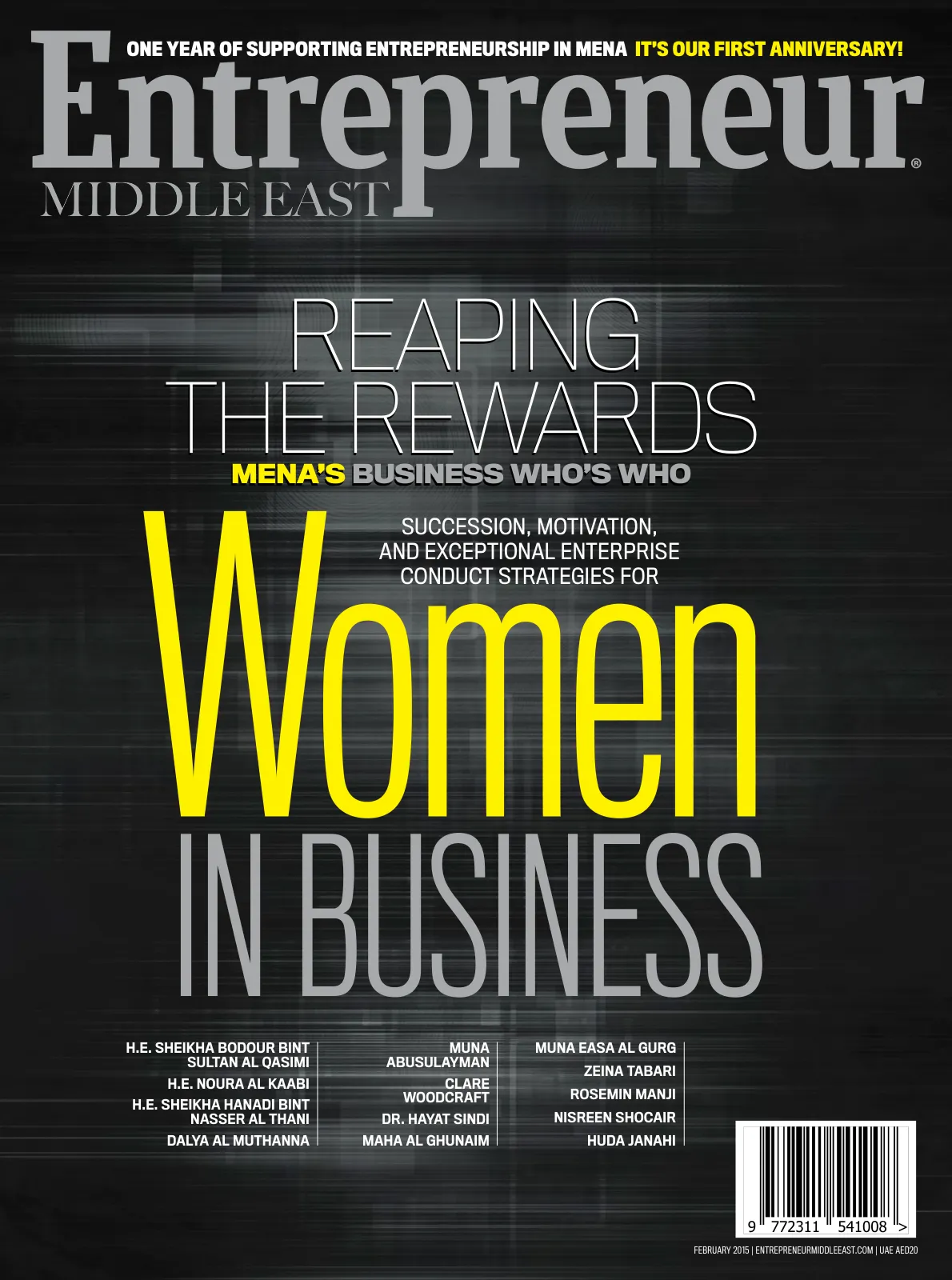
Entrepreneur Middle East, February 2015
Page 1
february 2015 Entrepreneur
1
the rewards
Reaping
Reaping
the rewards
One year of supporting entrepreneurship in MENA It’s our first anniversary!
9
772311
541008 >
FEBRUARY 2015 | ENTREPRENEURMIDDLEEAST.COM | UAE AED20
H.E. Sheikha Bodour Bint
Sultan Al Qasimi
H.E. Noura Al KaabI
H.E. Sheikha Hanadi Bint
Nasser Al Thani
Dalya Al Muthanna
Muna
AbuSulayman
Clare
Woodcraft
Dr. Hayat Sindi
Maha Al Ghunaim
Muna Easa Al Gurg
Zeina Tabari
Rosemin Manji
Nisreen Shocair
Huda Janahi
MENA’s business who’s who
MENA’s business who’s who
Women
IN BUSINESS
Succession, motivation,
and exceptional enterprise
conduct strategies for
Page 2
Entrepreneur february 2015
128
Page 3
february 2015 Entrepreneur
129
Page 4
Page 5
february 2015 Entrepreneur
3
CONTENTS
february 2015
20
INNOVATOR:
Reaping the rewards
The region’s
who’s who
Succession, motivation,
and exceptional enterprise
conduct strategies for
women in business
H.E. Sheikha Bodour Bint
Sultan Al Qasimi
H.E. Noura Al Kaabi
H.E. Sheikha Hanadi Bint
Nasser Al Thani
Dalya Al Muthanna
Muna AbuSulayman
Clare Woodcraft
Dr. Hayat Sindi
Maha Al Ghunaim
Muna Easa Al Gurg
Zeina Tabari
Rosemin Manji
Nisreen Shocair
Huda Janahi
14
EDITOR’S NOTE
By Fida Z. Chaaban
56
‘TREPONOMICS:
ASK A PRO
Teaching ‘treps
Juris Ulmanis is an
instructor of entrepreneur-
ship in post secondary, and
he thinks that to do so you
must have hard market
experience and real world
know-how. We agree.
58
SKILLSET
It’s not about the books
Imad Atwi took some time
off of work to pursue his
MBA, and he found 10
things over the course
of that year that made it
worth it.
88
MONEY
VC VIEWPOINT
Making monetary sense
One of the first things
you need to be fully
knowledgeable about as
a startup is the VC term
sheet- it’s the initial key
document that sets out
the structure of a venture
capital transaction.
The region’s who’s
who: Succession,
motivation, and
exceptional enterprise
conduct strategies for
women in business
20
H.E. Noura Al Kaabi
Muna AbuSulayman
Page 6
Entrepreneur february 2015
4
60
78
FRANCHISE:
Ins and outs
UAE-based franchise
Chez Sushi prioritizes
regional expansion, and
DineEquity’s hands-on
CEO Julia Stewart gives
credit where it’s due.
92
START IT UP:
STARTUP FINANCE
Counting on it for the year
ahead
Financials and your
business, written by
Brndstr founder and CEO
Simon Hudon. He’s been
there and done that, and
he’s got five points for
you to examine regarding
your spends.
60
WACKY IDEA
Mobilizing payment
solutions
Majid Al Futtaim
Ventures found payment
solutions startup
Beam Wallet worthy of
investment… find out
why.
84
Q + A
Finding the right fit
Startup InternsME
wants to help your
company find the
right fit, and in
the process they’re
addressing MENA’s
youth unemployment
situation.
CONTENTS
february 2015
72 Artistic inclinations
Home away from home:
Four Seasons Doha wants you to
move right in, and stay awhile
68
52
JetSmarter wants to open up private
jet travel to the masses
Page 7
february 2015 Entrepreneur
5
Page 8
Page 9
Page 10
Entrepreneur february 2015
8
CONTENTS
february 2015
62 Nissan and NASA to develop
self-driving vehicles
Erratum The December 2014 article, Client clout, incorrectly stated that Phenomena manages
the Nikon MEA Facebook page, when it is in fact managed by Illustrado Communications FZ LLC.
Entrepreneur Middle East apologizes for the error.
#TamTalksTech
The F 015 Luxury in Motion
concept car by Mercedes-Benz
has set the bar for self-driving
vehicles.
62
62
TECH:
SHINY
#TamTalksTech
Gadgets and doodads
that you might’ve
missed out on, sourced
by a tech aficionado.
Yes, it’s okay to want
them all… and no, it’s
not our fault.
66
CULTURE:
TRAPPINGS
‘Trep gear
The executive selection
for the entrepreneur
on your list that has
everything. Okay, maybe
for a little self-reward
as well.
68
TRAVEL
Home away from home
GM Rami Sayess of
the Four Seasons Doha
wants you to move right
in, and stay awhile.
They’re ready to keep
things just they that
way you like them, every
time you’re in Qatar.
70
LIFE
It’s time to chill out…
seriously
We’ve got five reasons
that you need to
schedule downtime.
Your work-life balance
affects your mental and
physical health, and this
is a scientific fact.
82
LIFE
Business book rundown
Amal Chaaban reviews
a few business books for
you before you hit the
bestseller aisle. It’s true
that not all executive
material is created
equally.
Page 11
february 2015 Entrepreneur
9
HAMRIYAH FREE ZONE AUTHORITY, SHARJAH, UAE
sales@hfza.ae - www.hfza.ae
UNPARALLELED INDUSTRIAL
LANDSCAPE
Hamriyah Free Zone houses more than 6,000 businesses from
155 countries engaged in over 500 activities; from large-scale
steel fabrication through maritime and rig maintenance to food
packaging production.
With its own deep-water port, strategic location, modern
facilities and quick setup Hamriyah Free Zone offers
unparalleled advantages.
Page 12
Entrepreneur february 2015
10
SUBSCRIBE
Contact subscriptions@bncpublishing.net to receive
Entrepreneur Middle East every issue
EDITOR IN CHIEF Fida Z. Chaaban editor@bncpublishing.net
MANAGING DIRECTOR Walid Zok walid@bncpublishing.net
DIRECTOR Rabih Najm rabih@bncpublishing.net
DIRECTOR Wissam Younane wissam@bncpublishing.net
PUBLISHER Nehme Abouzeid
MANAGING EDITOR Aby Sam Thomas
CREATIVE LEAD Odette Kahwagi
ONLINE LIAISON Kareem Chehayeb
COLUMNIST Pamella de Leon
PO Box 502511 Dubai, United Arab Emirates
P +971 4 4200 506 | F +971 4 4200 196
For all commercial enquiries related to
Entrepreneur Middle East contact
sales@bncpublishing.net
All rights reserved © 2014.
Opinions expressed are solely those
of the contributors.
Entrepreneur Middle East and all subsidiary
publications in the MENA region are officially licensed
exclusively to BNC Publishing in the MENA region
by Entrepreneur Media Inc.
No part of this magazine may be reproduced or
transmitted in any form or by any means without
written permission of the publisher.
www.entrepreneurmiddleeast.com
WE’RE HEAVILY INVESTED IN OUR WEB PRESENCE
IS DIGITAL
MIDDLE EAST
Printed by Raidy Emirates Printing Group LLC
www.raidy.com
EntMagazineME
@EntMagazineME | @Fida
Entrepreneur-me
EntrepreneurMiddleEast
EntMagazineME
EntMagazineME
EntMagazineME
MIDDLE EAST
Images used in Entrepreneur Middle East are credited when necessary. Attributed use of
copyrighted images with permission. All images not credited otherwise Shutterstock.
Imad Atwi
Amal Chaaban
Youmna Chagoury
Tamara Clarke
James Clear
Ronnie Dabbasi
Simon Hudson
Lina Hourani
Suhail Al-Masri
Ross McCammon
Shoug Al Nafisi
Kirstin Ridout
May Rostom
Shahram Safai
Kara Schoeffling
Geoff Weiss
Juris Ulmanis
Erika Widen
CONTRIBUTING WRITERS
In addition to our print edition, we’re bringing you all sorts of
industry news on our web mediums. Joining us online means getting
relevant business and startup content in real-time, so you’re hearing
about the latest developments as soon as we do. We’re looking
forward to interacting with our readers on all of our social media and
web platforms- like any thriving business, we’re looking to give and
take. #TrepTalkME is already happening on all of our digi platforms,
and all good conversations go both ways. See you on the web!
Page 13
february 2015 Entrepreneur
11
253457
507871
Page 14
Entrepreneur february 2015
12
Al-Futtaim Auto & Machinery Co. LLC
United Arab Emirates: 800 32626 Saudi Arabia: 800 1244414
e-mail: famco@alfuttaim.ae www.al-futtaim.com
It is, without doubt, one of the harshest environments on earth: the Empty Quarter in the Kingdom of Saudi Arabia – the largest and most barren sand desert in the
world, spreading itself over four Arab nations and covering 650,000 km2 which is comparable in size to France. Temperatures range from 50° to -1°C in the course
of a single day and the sand and dust are relentless. The nearest city is 1000 kilometres away. So the construction of a 256 kilometre road cutting through this
wildnerness, linking Saudi Arabia to the Sultanate of Oman, called for an extraordinary solution.
The response: a eet of 95 Volvo machines was assembled. Together, they shifted over 130 million m3 of sand just to build the bridge of the road – an extraordinary
feat in such harsh conditions, yet the quality and power of Volvo engineering was up to the challenge. The difculties created by the remote isolation of the worksite
were answered with excellent customer support from FAMCO, the authorised Volvo dealer in Saudi Arabia, which included the organisation of mobile 24/7 service
workshops that moved forward with the construction operation. Discover a new way.
www.emptyquarter.volvoce.com
Exclusive distributor of Volvo Construction Equipment in the UAE and Saudi Arabia
Page 15
february 2015 Entrepreneur
13
www.famcouae.com
www.famcosaudi.com
Watch video
Page 16
Entrepreneur february 2015
14
I
t’s probably true to say that every
regional publication has some
sort of “list” format. “Power” this,
“influence” that… Rather than just
listing the names and regurgitating the
biographies of interesting figures of
enterprise, we felt that for our “list” it
was important to find out what their
criterion for a job well done is, and
better still, what advice they have for
you as an entrepreneur or as someone
who wants to build on their corporate
accomplishments. I consider myself a
very fortunate editor indeed to have
Entrepreneur, on our one year an-
niversary, mark this occasion with the
advice of these thought leaders.
All of the businesspeople that we’ve
featured in our Achieving Women
section -led by two individuals that I
see as great role models with positive
personalities, H.E. Sheikha Bodour
Bint Sultan Al Qasimi and H.E. Noura
Al Kaabi- are doing great things,
and subsequently, they wield a lot
of well-deserved clout due to their
extraordinary workplace conduct.
Someone that you need to sit up and
pay attention to in this issue’s special
section? GE Gulf’s first ever female
President and CEO Dalya Al Muthanna
(often mentioned in the press as the
first Emirati to hold that office).
How have we tackled our version
of a “power” list? We didn’t just
list, we actually culled their areas
of expertise, and requested that
they share their knowledge with the
region’s entrepreneurs, using our
pages as their medium of choice.
We have brought you their business
know-how and their words of
encouragement, by asking them to
share advice and insights on a wide
range of topics. For instance, Saudi
Arabian TV personality, thought
leader and startup founder Muna
AbuSulayman, a big proponent of
women in entrepreneurship, talks
about the value of having women
front and center at industry events,
while Emirates Foundation CEO Clare
Woodcraft, gets you off on the right
foot for social enterprise and CSR
initiatives.
I am truly very humbled that these
women have graced the pages of
Entrepreneur’s one-year anniversary
issue with their finely-honed opinions
and actionable success strategies. We
have wonderful things for you to read
in this edition, and there could be no
better way for Entrepreneur’s MENA
print and web mediums to move
forward than with these industry
luminaries.
I look forward to
hearing which
opinion leader
most resonated
with you this
issue, and I thank
you all for your
continued support
and online en-
gagement. If you
haven’t yet joined
us online, please do reach out to us
on any of our social media platforms.
I have spent the last 12 issues asking
you to talk to us on social media, and
there is no greater reward than when
I receive terrific images of readers
with their editions of the magazine
via Twitter or Instagram. Whatever
medium you opt for, we’re going to
continue talking back in real-time.
EDITOR’S NOTE
Fida Z. Chaaban
Editor in Chief
@fida
editor@bncpublishing.net
At Entrepreneur, it’s not just about the “who,”
it’s about the “how”
Industry intel
Page 17
february 2015 Entrepreneur
15
Page 18
Entrepreneur february 2015
16
O
ver the past few years, the
world has been kept on the
edge of its seat as the Palestin-
ian Authority tried to tip the
scale of the Israeli occupation
by having its own seat in the
United Nations (UN). Most will
recall its attempt of becom-
ing a member state at the UN
General Assembly, but were only
granted the status of observer
non-member state alongside
the Holy See. Palestine also
was voted in to become the
UNESCO’s 195th member state,
the UN’s cultural arm. The
United States and Israel tried to
turn things around by not pay-
ing their UNESCO membership
dues as a result of the deci-
sion, but only ended up losing
their voting rights. Just last
December, a bid for Palestin-
ian statehood was rejected at
the UN Security Council after a
U.S. veto. Ever since, analysts
have been going on about the
prospect of Palestine joining
the International Criminal Court
(ICC), not to be mistaken with
the UN’s International Court of
Justice (ICJ).
Hoping to hold Israel account-
able for its illegal settlement
expansions and war crimes,
on January 2, 2015, Palestine
signed the Rome Statute, the
treaty that founded the ICC.
Israel and the U.S. were initial
signatories despite having their
reservations about the treaty,
but both decided to not ratify
it and opted out. UN Secretary
General Ban Ki Moon stated that
Palestine is expected to become
a member of the ICC as of April
1, 2015, despite many expecting
the ICC to reject Palestine’s
application. So what happens
next? The ICC confirmed that
Palestine has asked to exercise
its jurisdiction over crimes
committed in the Palestinian
territories of Gaza, the West
Bank, and East Jerusalem as
of June 13, 2014. That day was
when Israel started a massive
indiscriminate roundup opera-
tion in the West Bank, after the
kidnapping and killing of three
Israeli boys. Soon after, Israel
launched its latest offensive on
Gaza from July 8 until August
26: Operation Protective Edge.
According to the UN Office for
the Coordination of Humanitar-
ian Affairs (UNOCHA), 1,523
civilians were killed. This is in
an addition to illegal settlement
expansion in the West Bank and
East Jerusalem, an issue that
has been condemned by most
world powers and the UN for
years.
Of course, it’s not all that easy.
Historically, the ICC hasn’t re-
ally been proactive on handling
issues related to the occupation
of Palestine. Many analysts also
claim that the court would be
more inclined to try Hamas lead-
ers than senior Israeli officials;
it is an easier thing to do given
that most countries see Hamas
(or at least parts of it) as a ter-
rorist organization. But should
the court decide that Israel’s
crimes are grave enough, a very
long and thorough investigation
will need to be conducted on the
crimes and on the accused. And
unlike the ICJ, the ICC doesn’t
have an enforcement body, like
a police force, to implement the
court’s arrest warrants. There
are many other problems that
Palestine could face; this is just
scratching the surface. The U.S.
and Israel have also been work-
ing hard to delegitimize and
quell the situation. Firstly, Prime
Minister Benjamin Netanyahu
froze Israel’s monthly transfer of
US$125 million in tax revenues
to the Palestinian Authority
(PA), meaning that the PA will
now struggle to pay salaries to
thousands of workers. Across
the Atlantic, American Senator
Lindsey Graham stated that the
U.S. would continue to hinder
Palestine’s statehood aspira-
tions, in addition to potentially
cutting its annual $400 million
funding to the Palestinian
Authority.
Though the consequences
President Mahmoud Abbas
and the PA might face sound
immense, ICC recognition
could be a huge step forward
for Palestinian statehood and
sovereignty in the long-term.
It’s just a matter of how things
play out in the coming months…
or years.
in the loop
Palestine pursues
joining the ICC
A
lgeria’s Minister of Industry and
Mining, Abdeslam Bouchouareb,
announced that a new and effective
law on SMEs would be presented
to the parliament in Algiers “soon”.
This law couldn’t come at a better
time; an SME “upgrading program”
was launched in 2012 and hasn’t
delivered the goods as promised,
despite allocating US$4.3 billion
for 20,000 SMEs. Turns out that
only about 4,000 have signed
up for the program, according to
Algeria’s own National Agency for
SME Development (AND-SMEs). It’s
worth mentioning that AND-SMEs
was established back in 2001, which
seems slightly ahead of its time.
Various sources claim that 95% of
Algeria’s businesses fall into the SME
category, so will this new law help
AND-SMEs make some real progress
in the enterprise space? Let’s hope
talk leads to action.
Algeria to announce revitalized SME law
International
Criminal Court
(ICC), Hague,
Holland
Parliament of Algeria website
Page 19
february 2015 Entrepreneur
17
Page 20
Entrepreneur february 2015
18
Page 21
february 2015 Entrepreneur
19
Page 22
Entrepreneur february 2015
20
Success, motivation, and exceptional
enterprise conduct strategies for
women in business
Reaping
the rewards
Supported by
Connecting leadership with potential
Page 23
february 2015 Entrepreneur
21
A
huge proponent of literary initiatives
both in the UAE and abroad, H.E.
Sheikha Bodour Bint Sultan Al Qa-
simi has founded her own award-winning
publishing endeavor –centered around
Arabic language content for children- and
made literacy and learning an agenda
priority. Sheikha Bodour has been rec-
ognized consistently by many public and
private entities for her work in non-profit
spheres, in her capacity as a role model
for young GCC women, and in business
as the Chairperson of Shurooq and as a
board member of a number of other orga-
nizations. Her active online persona has
helped to give her a reputation of being
interactive, modern and youthful in her
approach to societal issues, and her work
methodology on behalf of the Emirate
of Sharjah and the UAE as a whole. She
encourages women pursuing commercial
achievements to pour their entrepreneur-
ial energy into a sphere they are excited
about, thereby fostering unwavering
strength in the face of setbacks.
Sheikha Bodour’s Tips
for entrepreneurial success
1. Passion equals perseverance “Do
something that you are passionate about.
Success doesn’t happen overnight– at
some point in time you will face obstacles
and setbacks. But if you are pursuing
your passion, you will always be able to
find the strength to keep going, because
your heart, mind, and soul are working
towards the same goal.”
2. Associate yourself with people who
share your values and vision “Pick your
friends, your partners, and your staff
carefully. Building something from the
ground up takes a lot of positive energy.
Your friends and the people you work
with are your support network– if they
have your back, there’s very little you
can’t achieve.”
3. Hone your personal definition of
success and pinpoint your goal state
“Celebrate your achievements, learn from
your mistakes, and remember that suc-
cess is measured on many levels. It’s good
to have role models, people who inspire
you, but ultimately the only yardstick
you should measure yourself against is
your own potential. Decide what success
means to you and work to make those
goals happen.”
The Motivator
H.E. Sheikha Bodour Bint Sultan Al Qasimi
Chairperson, Sharjah Investment and Development Authority (Shurooq)
Founder and CEO, Kalimat Publishing Group
The Pioneer
As the first woman to hold a federal cabinet
post in the UAE, it’s easy to see why Her
Excellency Sheikha Lubna Bint Khalid Al
Qasimi is acknowledged to be one of the
most influential (and most powerful) figures
in the Arab world today, and this includes
between the ranks of her male government
contemporaries as well. In her stints as
first the Minister of Economy, then as
the Minister of Foreign Trade, and now as
the Minister of International Cooperation
and Development, H.E. Sheikha Lubna
has been playing pivotal roles in the UAE
government, thereby breaking stereotypes
and challenging perceptions of Arab women
in the global mindset.
H.E. Sheikha Lubna Bint
Khalid Al Qasimi
Minister of International
Cooperation and Development
Above:
Dr. Fred Moavenzadeh, President, Masdar
Institute, Her Excellency Sheikha Lubna Al Qasimi,
UAE Minister for International Cooperation and
Development and His Excellency Dr. Sultan Al Jaber,
UAE Minister of State, Chief Executive Officer of
Energy at Mubadala and Chairman of Masdar, at a
Masdar Institute event in September 2014.
H.E. Sheikha Bodour
Bint Sultan Al Qasimi
speaking at the
Women in Leadership
Economic Forum
in Dubai, UAE on
November 20, 2014.
H.E. Sheikha Lubna Bint Khalid Al Qasimi Image © YouTube.com MASDAR
Reaping
the rewards
The MENA region’s
achieving women
Supported by
Page 24
Entrepreneur february 2015
22
I
was the first employee of twofour54,
having started in our partner support
services division. Witnessing the growth
of twofour54 has been the highlight since
the beginning. Growing with twofour54
and becoming its CEO has been a great
gift because I was part of paving the way
to establishing a leading media hub in the
UAE and the region’s driving force behind
media and entertainment entrepreneurs.”
H.E. Noura Al Kaabi, the CEO of what is
now one of most relevant corporate enti-
ties to come out of the United Arab Emir-
ates, says that becoming the head of the
multi-faceted hub is thus far her hallmark
career moment. For female startup found-
ers reading this, you might have already
heard that twofour54 recently partnered
with Flat6Labs that twofour54 recently
partnered with Flat6Labs to launch Flat-
6Labs Abu Dhabi, and they are welcoming
businesses from all across the MENA
region and abroad. Aiming to position
Abu Dhabi as the epicenter of the startup
ecosystem, they’re “committed to creating
a thriving entrepreneurship ecosystem
at twofour54 and through a variety of
initiatives, we have supported local talent
and helped startups fulfil their creative
potential, which is vital to building and
sustaining our media and entertainment
industries. Our current investment
portfolio includes Tahadi Games, Falafel
Games, Jawaker, SAE Institute, D1G,
PopArabia, T-Break Media, Akhtaboot,
Nibras, Istikana, as well as investments in
specific content projects,” adds Al Kaabi.
They continue to invest in media venture
SMEs and entrepreneurial projects, but
Al Kaabi is a realist and doesn’t discount
mediums outside of the digital arena not-
ing that “digital is definitely the future…
but not the only future– there will always
be a place for traditional media such as
broadcast television. Digital media is a
fast growing industry in the Middle East,
with consumers now spending more than
a quarter of their total media and enter-
tainment time on digital platforms.”
The annual Abu Dhabi Media Summit
(ADMS), a twofour54 endeavor, having
established itself as an extremely relevant
platform for entrepreneurs, businesspeo-
ple and media alike, has presented some
of the world’s biggest thinkers and sector
luminaries over the past few years.
Al Kaabi is well aware of the Summit’s
pull, and says that they’ll soon be releas-
ing the 2015 program for the highly
anticipated event: “ADMS has previously
drawn some of the industry’s biggest
names including Bill Gates, Tim Berners-
Lee, Rupert Murdoch, James Cameron and
Eric Schmidt, has grown to become one
of the world’s most preeminent events
for the media and entertainment sector.
Last year’s Summit brought together a big
number of media leaders and innovative
thinkers to stimulate the industry and
bring new ideas from the international
sector to the regional one. Some of the
speakers included Her Majesty Queen
Rania of Jordan, Mark Thompson, CEO of
The New York Times, Ahmad Abdulkarim
Julfar, CEO of Etisalat and Sam Barnett,
CEO of MBC Group. The Summit was held
under a theme highlighting the recent
developments in the media industry in
the MENA region and further afield. It
focused on the future of media and tech-
nology and discussed the impact it has on
different interactions between
As a visionary, Al Kaabi consistently looks
at the larger picture to facilitate success.
Here are five drivers that you need to ap-
ply to your business.
1. Look to fresh faces
for potential
“As a result of my role and as a result
of twofour54 being such a dynamic and
vibrant company consisting of many units
that attract talent and aspiring youth
every day, I am in a position where I meet
fresh faces and talented enthusiasts of
the industry on a regular basis. We are in
Reaping
the rewards
The MENA region’s
achieving women
Supported by
Noura Al Kaabi - Mostafa - Mubarak
“
The Visionary
H.E. Noura Al Kaabi CEO, twofour54
H.E. Noura Al Kaabi
addressing the assembly
at the Abu Dhabi Media
Summit 2014
H.E. Noura Al Kaabi and
Her Majesty Queen Rania of
Jordan at the Abu Dhabi Media
Summit 2014
Page 25
february 2015 Entrepreneur
23
a fairly new industry and because of our
newness, I am inspired by my colleagues
at twofour54 as well as the talents as
mentioned earlier. Through different
initiatives, talent development tools and
internships, we are enabling young skilled
media professionals to learn from some
of the world’s best producers, directors,
developers and other experts in the indus-
try. As we shift to the digital side of the
industry and e-commerce, following the
global trend that is especially apparent in
the Middle East, twofour54 will continue
to support many growth stage digital
businesses by providing investment fund-
ing to game developers”
2. Build foundations for
long-term benefit
“I work in an environment that is com-
mitted to creating and developing a
thriving, self-sustaining media industry
by investing in the most talented and pas-
sionate people. The ever-changing dynam-
ic environment gives me the opportunity
to also fill an important role working on a
micro managerial level. twofour54 aims to
build a strong, sustainable and private-led
media industry, in support of the capital’s
economic diversification strategy as laid
out in the Abu Dhabi Economic Vision
2030. Our aim is to create a collabora-
tive and supportive campus community
stimulating creative and professional
partnerships. We are making Abu Dhabi
a regional centre of excellence in qual-
ity content creation across all media
platforms, including film, broadcast,
music, digital media, events, gaming and
publishing.”
3. Encourage and support human
capital progress
“We have had a number of interns work-
ing with some of our leading partners,
such as Ubisoft on the development of
CSI: Hidden Crimes, the first mobile game
developed in Abu Dhabi. These initiatives
will encourage the young interns to con-
sider the media industry as a long-term
career choice. I would like to emphasize
the value of twofour54’s employees,
especially the women at twofour54 who
are committed in making a difference to
the media sector and the community as
a whole. We have always appreciated the
hard work of our employees and through
our maternity leave policy, as an example,
we convey our understanding and support
during those critical family times.”
4. Think synergistically to see
the bigger picture
“As a member of the UAE’s Federal Na-
tional Council and working on different
committees and boards, I have the op-
portunity to see the overall vision of Abu
Dhabi and UAE. As a result of filling these
roles, I am able to serve UAE on both a
local and federal level. While each entity
operates individually to develop different
parts of the chain, they also help each
other to grow the overall culture.”
5. Link up to scale your business…
and support the MENA region
“94% of the 300,000 enterprises in
the UAE are SMEs and these companies
employ 90% of the nation’s workforce
as well contributing 40% towards GDP,
which enhances the development of the
UAE. However, unemployment is current-
ly at a significant high and is considered
as a major stumbling block to regional
development. I think that entrepreneurs
in general need to work together with ac-
celerators to establish their businesses.”
Reaping
the rewards
The MENA region’s
achieving women
Supported by
A graduate of Tufts and Harvard, H.E.
Reem Ebrahim Al Hashimy first joined the
Federal Government in 2008. The Minister
of State also acts as the Chairperson of
the National Bureau of Statistics, Dubai
Cares and the Emirates Competitiveness
Council. Al Hashimy, best known as the
driving force behind Dubai’s upcoming
Expo 2020, is the Managing Director of
the executive body responsible for the
UAE’s successful bid, and the Director
General of the Expo 2020 Dubai Bureau.
With an academic background in
international relations, H.E. served the
UAE in Washington, D.C. as Deputy Chief
of Mission, and reportedly began her
career as Commercial Attaché.
The Patriot
H.E. Reem Ebrahim Al Hashimy
UAE Minister of State
Managing Director, Expo 2020
Dubai Higher Preparatory Committee
Director General, Expo 2020
Dubai Bureau
H.E. Reem Ebrahim
Al Hashimy
“E-commerce will be a critical source of digital growth.
The MENA e-commerce market was worth US$2.3 billion
in 2014 and is expected to grow 13% annually to 2019.
Saudi Arabia and the UAE are the dominant markets,
and will continue to make up almost 40% of the total
market to 2020. Mobile capabilities are increasingly
important– mobile commerce is expected to reach 20% of
e-commerce revenue in 2015, up from 7% in 2011.”
H.E. Reem Ebrahim Al Hashimy Image © YouTube.com
Page 26
Entrepreneur february 2015
24
D
alya Al Muthanna may have
made headlines in 2014 when
she became the first Emirati
to be appointed the President and
CEO of GE Gulf, but this enterprising
woman has been making waves in
the business world long before that
as well- prior to her career at GE, she
had founded and managed a multi-
million dollar international franchise
for five years. Given her career
achievements –including the note-
worthy achievement of being the first
female President and CEO of GE Gulf-
it’s no surprise that Al Muthanna has
become an inspiration for women
in the region; a responsibility that
she’s carrying off with no shortage of
enthusiasm and élan. For a woman
entrepreneur or as senior manage-
ment at a multinational corporation,
in largely male dominated industries,
it’s important to remember that you
are opening doors for more women
to achieve, and that you’re setting an
example for others as a female leader
of commerce. “With governments and
businesses in the region increasingly
focusing on women empowerment
and nurturing them for leadership
roles, you can make a tangible dif-
ference in promoting women at the
workplace. This could start with a
focus on mentoring young women
professionals and your peers.”
Al Muthanna suggests using your
experience to educate other women
and to foster more female involve-
ment in fields that are usually led
by men. Women in the GCC have the
potential to be commercial leaders,
and the environment here is very
much equal opportunity. For a woman
entrepreneur or a senior management
figure, lend whatever time you can to
mentor and help other women reach
their maximum business potential.
Even focusing on one protégé to men-
tor is a great help. “From my personal
and professional experience, I have
observed that young women join the
“My suggestion for
further energizing women
empowerment initiatives
is to promote not just
work-related skills but
also enable your team to
develop their personal
strengths. Preparing a
fantastic presentation
or preparing a well-
researched document is
all fine and a part of work.
But have you considered
evaluating and helping
your team to identify what
their true passion is? It is
important to encourage a
culture of dialogue where
you can identify latent
skills of your team and
help them hone it.”
The Corporate Titan
Dalya Al Muthanna President and CEO, GE Gulf
Dalya Al Muthanna
Reaping
the rewards
The MENA region’s
achieving women
Supported by
Page 27
february 2015 Entrepreneur
25
workplace with tremendous ambi-
tion and positive energy. Instilling in
them the confidence that they have
the ability to shine through in their
careers and achieve their dreams
must be the core of your mentoring
approach. Often, all it takes is a word
of encouragement to bring out the
best from others,” adds Al Muthanna.
Aside from mentorship, she suggests
proactively focusing on individual
growth opportunities within your
team: “My suggestion for further
energizing women empowerment
initiatives is to promote not just
work-related skills but also enable
your team to develop their per-
sonal strengths. Preparing a fantastic
presentation or preparing a well-
researched document is all fine and a
part of work. But have you considered
evaluating and helping your team to
identify what their true passion is? It
is important to encourage a culture of
dialogue where you can identify latent
skills of your team and help them
hone it.” Making a difference, accord-
ing to her, doesn’t just mean getting
the job done, it’s about carving out
a place for yourself in your industry.
“My final word of advice would be to
help women identify their goals and
bigger purpose in life. Personal and
professional fulfilment, along with
true empowerment, comes from an
individual accomplishing her goals
and working with a clear focus of her
purpose. Ultimately, women empow-
erment is about defining one’s place
in the society– and as leaders you can
make a big difference to others.”
The Believer
Leverage your resources to encourage
more youth to participate in programs
that encourage entrepreneurship, and
maybe even mentor a worthy candidate.
The economic health of the UAE,
and countries across the Arab world,
depends on sustainable businesses that
operate as part of the entrepreneurial
ecosystem. “A woman with a voice is,
essentially, a strong woman. I have made
it my mission to dedicate time and effort
through organizations such as Young
Arab Leaders (YAL) and Endeavor, to
mentoring women to be entrepreneurs
and rise to senior positions. I urge all
women in the UAE who have reached
those positions to do the same. The
economic growth of the UAE depends
on you,” says Muna Easa Al Gurg. While
her role as the Director of Retail for the
Easa Saleh Al Group is impressive in and
of itself, Al Gurg gains even more points
in our books for being the chairperson of
the UAE chapter of YAL, an independent
non-profit organization founded to
“develop and grow young Arab talent
through mentorship and education
programs.” By being a proponent of a
culture of entrepreneurship in the UAE
that includes women as a key contingent,
Al Gurg is playing a key role in the
realization of YAL’s vision to enable
positive change in the GCC specifically,
and the Arab world as a whole.
Muna Easa Al Gurg
Director of Retail, Easa Saleh Al Gurg Group
Chairperson, Young Arab Leaders
“Help women identify their goals and bigger
purpose in life. Personal and professional
fulfilment, along with true empowerment,
comes from an individual accomplishing
her goals and working with a clear
focus of her purpose. Ultimately, women
empowerment is about defining one’s place
in the society– and as leaders you can make
a big difference to others.”
“I have made it my mission to dedicate time and effort through organizations such as
Young Arab Leaders and Endeavor, to mentoring women to be entrepreneurs and rise
to senior positions. I urge all women in the UAE who have reached those positions to
do the same. The economic growth of the UAE depends on you.”
Muna Easa Al Gurg
Dalya Al Muthanna
Reaping
the rewards
The MENA region’s
achieving women
Supported by
Page 28
Entrepreneur february 2015
26
“I have worked in several industries:
media, education, philanthropy
entrepreneurship, and created my
own company, and I found some of the
biggest problems for GCC women in
growing their business is networking-
getting access to mentorship and
capital.” Muna AbuSulayman, an
active and influential Saudi national,
talks to her online audience in both
Arabic and English conveying ideas
about fairness, current events, and
expressing support for other achieving
women in the Arab world. The co-
host of Kalam Nawaem on MBC has
amassed a huge online following,
using her social media clout to draw
attention to causes like the plight of
Syrian refugees, and the importance
of accurate information about
Islam, amongst other issues that she
considers pressing. The founder of her
own company, she has a slew of NGO
affiliations, and is efficient, accessible
and professional when approached.
She’s also serious about seeing more
“All over the world, it is much
harder for women to get access to
capital. Some women are fortunate
to have the backing of their family
name, business and finances behind
them and therefore get a leg
up. The vast majority don’t. This
creates a vicious cycle where most
women become confined into micro,
small businesses. This needs to be
changed by helping women access
capital, mentorship and create more
culturally appropriate networking
opportunities such as organized
chamber of commerce trips, or
invitations to speak -not just attend-
in the usually male-dominated
conference circuit.”
The Humanitarian
Muna AbuSulayman
Co-founder Meedan.com
Co-host Kalam Nawaem, MBC
Regional Expert, United Nations World Humanitarian Summit
United Nations Office for the Coordination of Humanitarian Affairs
Muna AbuSulayman
Reaping
the rewards
The MENA region’s
achieving women
Supported by
Page 29
february 2015 Entrepreneur
27
women achieve great things in this
region, and has a few ideas about
how to make that more likely: “We
have extremely savvy, well-educated,
and well-prepared confident young
women entering the entrepreneurship
field, and most of these women
don’t have access to the informal
networking events where men create
relationships to help make the big
deal happen!” AbuSulayman adds
that the ratio disparity of female to
male mentors needs to be rectified,
and soon, if women are going to hit
the ground running. “Women also
have a lousy card in mentorship
since due to cultural taboos on
cross-gender mentorship, and lack of
enough successful female mentors,
they’re not getting the right long-
term guidance needed.”
In terms of marginalization and
how important having the right
connections can be, AbuSulayman
clearly says that some women are
more fortunate than others: “Lastly,
all over the world, it is much harder
for women to get access to capital.
Some women are fortunate to have
the backing of their family name,
business and finances behind them
and therefore get a leg up. The vast
majority don’t. This creates a vicious
cycle where most women become
confined into micro, small businesses.
This needs to be changed by helping
women access capital, mentorship
and create more culturally
appropriate networking opportunities
such as organized chamber of
commerce trips, or invitations to
speak -not just attend- in the usually
male-dominated conference circuit.”
“We have extremely savvy,
well-educated, and
well-prepared confident
young women entering
the entrepreneurship
field, and most of
these women don’t have
access to the informal
networking events where
men create relationships
to help make the big deal
happen!”
Dr. Amina Al Rustamani joined TECOM in 2001 in a project
manager capacity specifying in satellite communications. Formerly
CEO for TECOM Business Parks, she is currently the Group CEO in
what has proven to be an inspiring and meteoric rise through the
ranks. Considered an authority on wireless tech, Dr. Al Rustamani
is widely credited with the growth of the umbrella entity that
includes Dubai Studio City, Dubai Healthcare City, and Dubai
Media City amongst others. Educated at George Washington
University in Washington, D.C., Dr. Al Rustamani is considered one
of the most influential women in the Middle East, and she serves
on several public and private sector boards.
As the founding CEO of Innoventures Education, Poonam
Bhojani has played a pivotal role in the inception and leadership
of a number of schools and nurseries in the UAE. Her work in
this sector saw her become the President of the Middle East
International Baccalaureate Association of Schools in 2008, and
she continues to serve on its executive committee today. Prior to
her career as an educationalist, Bhojani worked in the technology
sector for over 16 years, with her work taking her to several
countries across three continents.
Muna AbuSulayman
Poonam Bhojani
Dr. Amina Al Rustamani
The Educator
Poonam Bhojani
Founding CEO, Innoventures Education
The Information Station
Dr. Amina Al Rustamani
Group CEO, TECOM Investments
Reaping
the rewards
The MENA region’s
achieving women
Supported by
Page 30
Entrepreneur february 2015
28
Clare Woodcraft
C
orporate social responsibility
(CSR) in the MENA region has
demonstrated results, and even
small companies should have CSR
initiatives. Not only do they prove
that you as a business leader give
back to the community, it also allows
acts as a staff binding mechanism,
and group CSR initiatives are proven
be correlated with higher loyalty and
job satisfaction- thereby increasing
and enhancing HR retention strate-
gies. Women in senior management
roles can wield their influence to
give back to the community whether
through supporting initiatives in a
CSR capacity, or in a social enterprise
capacity, or even lending their time
as mentors or serving on boards of
action-oriented organizations like
the Emirates Foundation. Clare
Woodcraft, the CEO of the Emirates
Foundation, brings over two decades
of experience to the table, specializing
in sustainability, social investment
and reputation management, having
worked across industries in public
and private sectors. The Emirates
Foundation encourages a “model of
venture philanthropy”, focusing on
encouraging long-term social invest-
ments over the method of short-term
grant bursts. Woodcraft has six sug-
gestions for female business leads to
maximize and succeed at their CSR
endeavors, no matter how large or
small your business.
1. Value assessment
“Any CSR initiative, or social
investment as I prefer to call it,
should be considered in the same
way as a commercial investment.
In other words, assess where and
how you can create most value. You
may be personally interested in
environmental issues and tempted
to engage there, but if your personal
expertise is in another area (for
example marketing skills, financial
literacy, and commercial acumen)
then you may be better off focusing
on an area such as coaching and
mentoring individuals inside
community organizations to help
them build capacity.”
2. Targeting your social
energies
“Try to ensure focus. Too much social
investment is done with a ‘spray
and pray’ mentality. In other words,
companies and individuals focus on
multiple sectors with limited impact
rather than choosing just one issue to
concentrate on. Companies that have
multiple sectors in their CSR portfo-
lio deliver less value than those that
choose one specific issue they want to
address in order to create long-term
sustainable and systemic change.”
The Tactician
Clare Woodcraft CEO, Emirates Foundation
Reaping
the rewards
The MENA region’s
achieving women
Supported by
Page 31
february 2015 Entrepreneur
29
3. Lending your skillset
“Not all social investment needs to be
about the money. Much social value
can be created through the transfer
of knowledge and skills. In MENA,
mentoring is gaining traction as a
hugely valuable way of supporting
the development of youth talent,
particularly for women who may have
limited access to the public sphere
and networks. All senior women
executives should be looking to
mentor their more junior counterparts
to help build their confidence, provide
them access to networks and job
opportunities.”
4. Coaching financial literacy
“While social enterprise is a fairly
nascent concept in the Middle East,
the sector is growing rapidly. As with
conventional enterprises, a critical
factor for their success is business
acumen and financial knowledge. A
core challenge for all small businesses
is being able to understand the
numbers, manage cash flow and access
capital. Indeed, most small businesses
fail due to a lack of capacity in these
areas. Senior female executives
who are able to provide this kind
of expertise through coaching and
mentoring can make a significant
contribution to their success.”
5. Double-time your commitment
“Giving back to the community
should also add value to the business.
If companies engage around social
issues that are relevant for their
commercial operations, they are more
likely to stay engaged. For example, a
pharmaceutical company engaged in
promoting healthy living is more likely
to add value and stay engaged in the
long-term than if it were to promote
say arts and culture where it may have
no intrinsic expertise or interest.”
6. Be risk-averse
“Community engagement is good for
businesses– understanding this is
critical if companies are to engage
all of their employees and get senior
management buy-in. Companies who
do not know, understand or engage
with the communities within which
their organization does business,
carry a much higher reputational and
non-technical risk than those that do.
Community engagement shouldn’t be
just a ‘nice to have’ but a critical com-
ponent of organizational strategy.”
Being upper management in male-
dominated industries isn’t easy, but
putting yourself on equal footing can be
achieved through direct communication,
delivery of assets, and serious attention
to detail when searching for windows
of opportunity and areas pertaining
to business development. “The most
important rule I have learned to succeed
in the professional sphere is to be
committed, passionate, and have clarity
and conviction of the desired objectives
and goals. It is essential to communicate
clearly to all stakeholders -internally and
externally- and empower your team in
order to succeed together. Motivation,
dedication and follow-up are the keys to
success,” says Zeina Tabari. She may have
started out as a human resources manager
at Drake & Scull International (DSI), but
Tabari was quick to climb the corporate
ladder at the organization, playing a major
role in its transformation from being a
private family-owned business to a public
company with an AED1.2 billion IPO.
Today, Tabari is the Chief Corporate
Affairs Officer of DSI PJ, where she is
in charge of managing the company’s
relations with its investors. Tabari, an MBA
grad of Webster Graduate School, London,
acts as one of the principal spokespeople
on behalf of DSI PJSC, and heads up the
company’s global arms of Corporate IT,
Corporate Communications, and HR.
Jasmeen Anand is the co-chairperson of
the Goldline Group business conglomerate,
but it is the organization’s education
arm that she has a particular passion
for, having played a key role in the
establishment of Springdale’s School
Dubai. Since then, Anand has continued
to actively participate in the growth and
evolution of the institution, with her focus
consistently being on bettering the quality
of education provided at the Springdale’s
enterprise.
Zeina Tabari
Jasmeen Anand
“The most important rule I
have learned to succeed in
the professional sphere is to
be committed, passionate, and
have clarity and conviction
of the desired objectives
and goals. It is essential to
communicate clearly to all
stakeholders -internally
and externally- and empower
your team in order to
succeed together. Motivation,
dedication and follow-up are
the keys to success.”
The Nurturer
Jasmeen Anand
Co-chairperson, Goldline Group
The Facilitator
Zeina Tabari
Chief Corporate Affairs Officer, Drake & Scull International
Reaping
the rewards
The MENA region’s
achieving women
Supported by
Page 32
Entrepreneur february 2015
30
By Kara Schoeffling
F
or women in the Middle East, partic-
ipation in the labor force is not just
about empowerment, it also makes
clear economic sense. The Interna-
tional Monetary Fund (IMF) indicated
that while women are more likely than
men to graduate from universities in the
MENA region, gender gaps in labor par-
ticipation are at 50%. Christine Lagarde,
Director of the IMF noted that “for the
entire Middle East and North Africa re-
gion, the gap between men and women’s
participation in the labor force over the
past decade was almost triple the average
gap in the emerging market and develop-
ing economies. If this gap had simply
been double instead of triple, the gains
for the entire region, the Gulf countries
included, would have been enormous-
almost $1 trillion in output, amounting
to annual gains of about 6% of GDP.”1
Despite these statistics and the oft-cited
barriers to entry such as access to fund-
ing, a small and determined cadre of
women are starting their own companies,
creating jobs not only for themselves, but
for countless others.
GCC women
lean in by
starting up
“We hold ourselves
back in ways both big
and small, by lacking
self-confidence, by not
raising our hands, and
by pulling back when we
should be leaning in.”
Sheryl Sandberg, Facebook COO
Qatar
Buthaina Al Ansari
Founder and Chair, Qatariat
Senior HR Director, Ooredoo Qatar
Buthaina Al Ansari is the founder and
Chairperson of Qatariat, a company that
specializes in facilitating Qatari women’s
workforce advancement with three segments:
training and development, development
consultancy, and a print publication. Al Ansari,
an ardent supporter of women’s development,
is also the Qatar Women Leading Change
ambassador. Recognized several times for her
active involvement in both commercial and
not for profit spaces, Al Ansari was chosen as
Entrepreneur Qatar’s 2014 Equality Enterprise
Achiever at the Qatar Enterprise Agility
Awards in association with Barclays, held in
September of last year in Doha.
1 Building Bridges To The Future In The Gulf, November 12, 2013, iMFdirect http://blog-imfdirect.imf.org/2013/11/12/building-bridges-to-the-future-in-the-gulf/
Buthaina Al Ansari, Equality Enterprise Achiever,
with Qatar Chamber of Commerce and Industry
Vice Chairman Muhammed Bin Ahmed Bin Towar
Al Kuwari, and William Oullin, Barclays Chairman
of Wealth Management EMEA and Barclays Bank
(Suisse) SA at the Qatar Enterprise Agility Awards
in association with Barclays, Entrepreneur of the
Year held in Doha, Qatar on September 15, 2014.
Reaping
the rewards
The MENA region’s
achieving women
Supported by
Page 33
february 2015 Entrepreneur
31
From being a homemaker to becoming
a to a successful businesswoman in the
male-dominated environment of cargo
services, Bahraini national Huda Janahi
bested the odds stacked against her as a
woman in the closed-off logistics sector.
According to Janahi, when she started
her business, “they rejected my license,”
because she was a woman. Custom’s
clearance was only granted to men when
she first put her application through,
but fortitude of personality and a desire
to succeed caused Janahi to question es-
tablished custom’s regulations. Request-
ingian explanation as to why she was
denied the necessary clearances, she
ultimately credits her persistence and
determination, enabling her to become
the first woman in Bahrain with this li-
cense- the required custom’s clearance.
“I’m proud. I changed many things in my
country, because I am insistent.”
While female entrepreneurs in the
Middle East still face big challenges in
accessing capital, the most success-
ful (like Al Ghunaim and Janahi) will
always find a way. From launching her
company with a modest $4000, Janahi
puts the current day valuation at
approximately $16 million.
“Science should become
more human,” says Dr. Hayat
Sindi, recently named as
one of the most powerful
women in Saudi Arabia, and
a frequent power-lister for
the MENA region. While
Dr. Sindi holds a PhD in
Biotechnology from Cam-
bridge University, she’d
rather be known as a social
innovator and a champion
of science and technology.
If her impressive biography
is any indication, Dr. Sindi
has done it all, but says she
aims to simply solve social
problems with science. What
social problem tops her list?
The use of science to create
alternative energy and to
make affordable diagnostic
healthcare available to all.
The entrepreneur’s big
dreams don’t seem the least
bit outlandish when you see
what she has already ac-
complished as a co-founder
of a non-profit organiza-
tion (NPO) with a team at
Harvard called Diagnostics
For All. The NPO creates in-
novative, inexpensive, point-
of-care diagnostic devices
for people in impoverished
regions. Dr. Sindi launched
i2, the Institute for Imagi-
nation and Ingenuity, to
encourage innovation among
young scientists, technolo-
gists and engineers. Through
fellowships, trainings and
mentorships, i2 inspires the
next generation of innova-
tors so that they may realize
their dreams, and ultimately
contribute to Saudi Arabia’s
growing economy. “We need
to link science to society,”
she explains, and her end
goal state includes trying
to change the way we think
about science to make it
practical, and that means
empowering women through
science and technology.
Saudi Arabia
“Science was born to solve problems.”
Biotechnologist
CEO and founder, i2 Institute for Imagination and Ingenuity
Co-founder, Diagnostics For All
Dr. Hayat Sindi
“You need
to have
confidence,
and don’t
be afraid
of making
mistakes.”
Bahrain
“I changed the rules.”
Huda Janahi Founder & CEO, Global Group
Dr. Hayat Sindi. Image credit ©Rolex Awards Jess Hoffman
Huda Janahi
Dr. Hayat Sindi
Reaping
the rewards
The MENA region’s
achieving women
Supported by
Page 34
Entrepreneur february 2015
32
Kara Schoeffling
is a public rela-
tions executive,
working with a
variety of clients
across the Middle
East. Enthusiastic
about women’s
entrepreneurship
in the Middle East, Schoeffling’s back-
ground in public policy and communica-
tions has been put to work advising start-
ups, non-profit organizations, Fortune 500
companies and governments. A graduate
of Georgetown University, Schoeffling is
based in the UAE. Talk to her on Twitter at
@Karasdxb.
Donna J. Kelley, Candida G. Brush, Patricia G. Greene and Yana Litovsky, Global Entrepreneurship Research Association
Global EntrEprEnEurship monitor
2012 Women’s Report
Statistics on women starting up
in the Middle East are difficult to
come by, but the Global Entre-
preneurship Monitor (GEM) 2012
Women’s Report states women
run only one out of every four
startups overall in the Middle
East. While women are still a
small minority in the startup cir-
cuit, their businesses are gaining
momentum proving that women
are “leaning in” in big ways all
across the globe, including the
Arab world. While the success
rate for startups is still on the
lower end of the spectrum, it
demonstrates that it is an attain-
able state despite the challenges
unique to women. A growing
number of young entrepreneurs
like Nayla Al Khaja agree that in
the Middle East,“being a woman
is a very positive thing.”
In the Middle East,
“being a womAn is a very
positive thing.”
Fifteen years before Sheryl Sandburg penned her
New York Times bestselling book promising women
worldwide that by “leaning in” they could unlock
their greatest career potential, Maha Al Ghunaim
and a handful of other trailblazing women had
already “leaned in” in one of the boldest ways pos-
sible- by starting their own companies in the Middle
East (often in male-dominated industries). Al
Ghunaim’s company, Global Investment House, later
became the very first Kuwaiti company to list on the
London Stock Exchange, and now manages a for-
midable US$4.3 billion in assets. Back then, Global
was a small startup, with only a very determined
woman at the helm. Today, the company plays a key
role promoting investment opportunities across the
Middle East through its brokerage, asset manage-
ment, and investment banking divisions.
Like Al Ghunaim’s peers and up-and-comers,
women in MENA are defying the odds stacked
against them in terms of gender, culture and indus-
try to build sustainable and profitable businesses.
Through sheer will and relentless determination,
these women blazed entirely new trails- “leaning in”
by starting up.
Kuwait
“Follow your passions and start a business
that you love, and give it all you can.”
Maha Al Ghunaim Chairperson and Group CEO, Global Investment House
“We have seen a lot of startups fail
simply due to the lack of a feasibility
study, and a clear and viable business
plan. Spend time to understand
the market, the clients, and most
importantly the competition, and
create a business idea that will give
you a competitive edge.”
The entrepre-
neurial backstory
of the UAE’s first
female filmmaker
and founder of
UAE-based film
production com-
pany D-Seven
Motion Pictures,
Nayla Al Khaja,
seems like a
thrilling scene
out of a well-scripted movie. Unconven-
tional and passionate, Al Khaja’s description
of her trek is enough to keep any audience
riveted. Unlike some of the other entre-
preneurs in the region, she believes being
one of the few women in her field is a card
played to her advantage in the UAE. The
arts-friendly UAE leadership were extremely
supportive and encouraging, according to Al
Khaja. Her interest in making movies was
sparked by a mixture of passion for telling
stories, connecting people and cultures,
and “intertwining and promoting peace
through film,” she explains. Unorthodox (ef-
fective) tactics pepper Al Khaja’s rise in the
industry, including how she overcame the
restriction placed upon her by her parents:
she was told she couldn’t study filmmaking
in Canada unless she married. “When I
asked my husband to marry me, he almost
choked at the table because I had only
known him for two weeks,” she says, calling
it the most memorable “scene” of her life
should she ever translate her adventures to
the big screen. Her proposition terms were
that she would sell her car and give him half
the money- should he consent to wed. The
Emirati artist did indeed marry for love, but
it was for the love of film. D-Seven’s impres-
sive client rosters currently lists Dubai
International Film Festival (DIFF), Cartier,
Nestlé, Nike, and Samsung amongst others.
United Arab Emirates
“A pure passion of storytelling.”
Nayla Al Khaja Founder, D-Seven Motion Pictures
Global Entrepreneurship Monitor (GEM) 2012 Women’s Report
Maha
Al Ghunaim
Nayla
Al Khaja
Reaping
the rewards
The MENA region’s
achieving women
Supported by
Page 35
february 2015 Entrepreneur
33
WHERE EAST MEETS WEST
9 - 10 FEBRUARY, 2015
AL JAWAHER RECEPTION & CONVENTION CENTRE
The World Forum for Foreign Direct Investment, the global meeting for FDI dealmakers, is coming to Sharjah,
United Arab Emirates from 9-10 February 2015, hosted by Sharjah Investment and Development Authority
(Shurooq). Held at a different global investment destination each year, the 2015 event marks the first time that
the World Forum has been held in the Middle East and North Africa (MENA).
SPACE IS LIMITED.
REGISTER TODAY.
SHUROOQ.GOV.AE
+971 6 556 0777
#SharjahFDI
@_Shurooq
ShurooqSharjah
ShurooqShj
OFFICIAL BUSINESS BROADCASTER
OFFICIAL BUSINESS MAGAZINE
ORGANISED BY
HOSTED BY
GOLD SPONSORS
TITANIUM SPONSORS
SUPPORTING PARTNER
OUTDOOR MEDIA PARTNER
OFFICE 346
Sir Tim Berners-Lee,
Inventor of the World Wide Web
The Rt Hon. the Lord Mandelson
President of Policy Network, an international policy Think Tank
Tony Fernandes,
Founder of Air Asia
Page 36
Entrepreneur february 2015
34
The Digital Influencer
I
ntegrity, loyalty and hard work are
three aspects I hold with much re-
gard, and I expect that from myself
and others who work for me,” says
Rosemin Manji, discussing her cor-
porate direction. Fashion and beauty
brands in the GCC looking to make an
impression online often turn to Manji,
hoping she’ll showcase their event or
haute design collections on her social
media platforms. As a digital influ-
encer, broadcast and print persona,
brand ambassador for Houses like
Hermès, and figure of business, Manji
has been distinguished for both her
personal style, and better still, her
work. The British Council Middle East
honored Manji in 2011 for Excellence
as an Entrepreneur in the Fashion
Industry, and she has been recognized
for her CSR work with breast cancer
awareness, and is still an active Bras
for a Cause committee member. Manji
has also acted as a face for the Dove
Real Beauty Real Women campaign
and book, executed by Unilever Mid-
dle East. Currently, she has moved
away from full-time media relations,
and is focusing on luxury brand con-
sultancy. Manji hosts niche events for
brands in an ambassador capacity, but
“with a targeted guest list to connect
the consumer with the brand to give
them a memorable experience. Two
weeks ago, I hosted a ladies breakfast
for 40 VIP ladies with Fendi’s acces-
sory designer. Guests were invited to
design their own bags. There was no
media at the event –strictly client to
brand– [giving you] access to buy and
design your own 2Jours or Peekaboo
all in a special room transformed into
the world of Fendi Rome.”
Tips for personal and
professional digital marketing
When considering social media as
a marketing tool for your personal
brand or that of your business, re-
member that the Internet is forever.
You cannot delete inappropriate
material and hope that it goes way,
so you need to be proactive rather
than reactive. Here, Rosemin Manji
gives her three tips for a positive and
productive digital footprint.
1. Strategic online release of
your material
“Social media is a great tool to
express yourself and give the client a
visual glimpse in your world. I rarely
post immediately. I usually take time
to find a photo I want to share with
the world. I never rush to upload.
Always ask yourself, ‘Does this photo
reflect me? What message am I
sending?’”
Rosemin Manji Fashion Director, RR&Co. Bespoke Luxury Management
“
Rosemin Manji
Reaping
the rewards
The MENA region’s
achieving women
Supported by
Page 37
february 2015 Entrepreneur
35
Haute horlogerie is a difficult field
to penetrate in any region, and even
more so in MENA. The Vice President
of Marketing for Ahmed Seddiqi &
Sons, Hind Seddiqi, probably knows
this better than most, simply because
she has firsthand experience in the
industry from top to bottom. Seddiqi
was the first woman in her family to
successfully join the corporate office
of Ahmed Seddiqi & Sons, entering
at the intern level and working her
way up the ladder after graduating
university in Sharjah, UAE. In addi-
tion to her current role, she is also a
board member for the Ahmed Seddiqi
& Sons Executive Committee. Seddiqi
quickly realized the value of educating
the fine timepiece client about quality
watchmaking, true craftsmanship,
nuances of creative development, and
brand history, and put that to work
to gain market share and to develop
brand loyalty. Her niche communica-
tion tactic, fine-tuned while working
in educating herself on the industry,
soon set Seddiqi apart as an influen-
tial and savvy marketeer with a knack
for capturing client attention.
Joelle Mardinian, one of the Middle East’s foremost
beauty pros, has headlined her decade-long eponymous
television show on MBC1. Her role as the Regional
Creative Director for Max Factor helped to make her a
household name across the region. In addition to all
of her public endeavors, Mardinian is also a successful
entrepreneur. She’s the founder of the chain of salons
Maison de Joelle with
locations in Dubai, Abu
Dhabi, Riyadh, Jeddah,
Qatar and Erbil, Dubai-
based Clinica Joelle,
and her line of skincare
and haircare products
under the brand Joelle
Paris. Her social media
presence has helped
connect Mardinian
to her audience in
real-time, and pushed
her beauty businesses
further.
Joelle Mardinian
Host and Executive Producer, JOELLE, MBC1
Founder, Maison de Joelle
2. Use your online influence to
support causes
“I do a lot of work with breast cancer
awareness and social media has
allowed me to share my message of
the benefits of early detection as my
mom is a survivor. Most recently,
Ralph Lauren and I teamed up for
an event where I hosted the Ralph
Lauren Ricky World Tour for my
VIPs, and Ralph Lauren generously
donated to Pink Caravan charity.”
3. Establish guidelines for
online material
“I work with high net worth clients
and VIPs, so the way I present myself
is very important and I do consider
myself a brand. I mean my name is
on my company -Rosemin Ratanshi
& Co otherwise known as RR&Co.-
so brands are investing in me to
represent them in best way possible.
I have made a conscious choice to
keep my family away from social
media; I want to separate that part
of my life and keep my private life
private. I don’t want holiday photos
of me in a swimsuit to appear online,
nor do I want personal family photos
or intimate and special memories.
Remember that not everyone wants
to be in the media or have their
images up for public display, so be
considerate as well.”
The Timekeeper
Hind Seddiqi
VP of Marketing, Ahmed Seddiqi & Sons
The Go Getter
Ingie Chalhoub springs
to mind whenever the
subject turns to the
business of fashion and
luxury. Chalhoub, the
powerhouse President
and Managing Director
of the Etoile Group,
oversees a mammoth
lineup of brands enough
to leave even the most
jaded collector starry-
eyed. Some of the global
names on the roster?
Hallmark House Chanel
and urban staple Ralph
Lauren, and wardrobe
cornerstones like
Tod’s, Hogan, and ISSA. A Creative Director
of her own made-in-France label, INGIE Paris,
she is also the founder of her own original
multi-brand fashion-forward concept, Etoile
La boutique, reining in the region’s glitterati
as key clients and self-motivated brand
ambassadors. Lauded for her creativity and
brand proliferation skills, Chalhoub is a driver
of the style segment in the region.
The Trendsetter
Ingie Chalhoub
President and Managing Director, Etoile Group
“Social media is a great tool
to express yourself and give
the client a visual glimpse
in your world. I rarely post
immediately. I usually take
time to find a photo I want to
share with the world. I never
rush to upload.”
Ingie
Chalhoub
Hind Seddiqi
Joelle
Mardinian
Reaping
the rewards
The MENA region’s
achieving women
Supported by
Page 38
Entrepreneur february 2015
36
S
upporter of women’s and youth
entrepreneurship ventures,
Amwal and INJAZ, CEO of Al
Waab City Real Estate development
project, and deputy CEO of Nasser
Bin Khaled Al Thani & Sons Group,
Sheikha Hanadi has been recognized
for positively influencing the Arab
world far beyond her home Gulf state
of Qatar. As female startup found-
ers, you are in the minority, but this
doesn’t mean you can’t take full
advantage of the programs available to
you for learning and growth purposes.
Gaza’s startup founders are over
50% female, and in Qatar, startup
female founder percentage is growing
year over year. “This year, we [INJAZ
Qatar] initiated the Start-Up Program
and the female winners are proving
to be entrepreneurs in the making-
undoubtedly, they’re on their way to
become successful examples of Qatari
businesswomen,” says Sheikha Hanadi
with pride. Extremely involved in the
startup circuit, the Sheikha actively
courts tier one partnerships for INJAZ
Qatar bringing along the much-needed
publicity and access that budding
entrepreneurs in the Gulf state truly
need. Her advice to all of the Gulf na-
tion’s youth, not just those aspiring to
start a business? To equip themselves
with knowledge in order to broaden
their horizons with global exposure,
and to build-up their traits of seeking-
success, endurance, perseverance and
discipline in pursuing their goals.
Dr. Osman, at the helm of the Saudi
German Hospital in Dubai as CEO,
often appears publicly on behalf of
the healthcare group. The staff of
the Saudi German Hospital Group is
nearly 60% female, indicating that
having a women executive in STEM
business enables more women achiev-
ers to join your company. Dr. Osman
spoke at the Dubai Health Innovation
and Investment summit in April 2013
about women as leaders in health, and
how females are driving healthcare
innovations in the Middle East.
The Startup Sage
The Caregiver
H.E. Sheikha Hanadi Bint Nasser Al Thani
Dr. Reem Osman
Board Chair, INJAZ Qatar | Founder and Chair, Amwal
CEO, Saudi German Hospital Dubai
NOVEMBER 2014
ENTREPRENEUR
1
ONLINE LEARNING
PUSHING ‘TREPS ONE
STEP FURTHER
DR. KIERAN MERVYN
BORN OR MADE?
THINGS YOU NEED
TO KNOW
WHEN STARTING
A BUSINESS
JUMANA TWAL
THE
FOUNDER’S
FOUR
HRH PRINCE FAISAL
BIN SALMAN
BIN ABDULAZIZ
AL SAUD
NAMAA AL MUNAWARA
FUELING
IN MADINAH
THE SME SPACE
SHEIKHA
HANADI
BINT NASSER
AL THANI
SUPPLYING QATAR WITH
AN ENTERPRISING POPULATION
INJAZ QATAR STOCKS THE NATION WITH
FUTURE ENTREPRENEURS
NOVEMBER 2014 | ENTREPRENEURMIDDLEEAST.COM | QAR15
IS BAHRAIN THE NEXT SINGAPORE? SUHAIL ALGOSAIBI ON DEVELOPING A NEW NATIONAL MODEL
Dr. Reem Osman
Below: An exclusive interview with H.E. Sheikha
Hanadi regarding her work with INJAZ Qatar
and the startup community was featured in the
November 2014 edition of Entrepreneur Qatar.
Reaping
the rewards
The MENA region’s
achieving women
Supported by
Page 39
february 2015 Entrepreneur
37
In her role as the CEO of Tablez Food
Company, Shafeena Yusuff Ali is on a
mission to revitalize Abu Dhabi’s F&B
scene. And she’s well on her way to
achieving her goal too- in a span of just
two years, her company has introduced
several new culinary experiences in the
UAE, which include homegrown names
like Peppermill and Bloomsbury’s, as
well as franchised concepts like London
Dairy and Galito’s. But for Yussuff Ali,
all of this marks just the beginning of
the change she wants to usher into the
market. “What’s keeping Abu Dhabi back
from being the next London or Paris in
terms of food?” she asks. “We have the
infrastructure, we have the international
crows, we have the expertise- but we
don’t seem to be implementing it. This
is what I want to change. I don’t see it
as a business- I see it as an extension of
myself, as a passion.”
Taking office as President of Virgin
Megastores MENA nearly a decade ago,
Nisreen Shocair is a familiar face on the
entrepreneurial circuit in the MENA re-
gion. Under her direction, the corporation
has grown both vertically and horizontally
throughout the Arab world. A veteran of
household names like Sony Music, Ber-
telsmann AG and Hearst Entertainment,
Shoucair’s many-tiered experience with
the music industry including publishing,
licensing, digital and retail segments has
proven invaluable to the ever-expanding
reach and influence of Virgin Megastores
in the Middle East. One tip for women
looking to climb the corporate ranks from
Shoucair centers around building your
personal and professional network: “Do
as much networking as your time allows:
within your own company, your profes-
sional network or any other network. Ask
questions, find out how others are doing
things, read up on related topics and be
the one people come to for contacts, ideas
and information.” Distinguished many
times over for her corporate work and for
her positive contribution to the Middle
East entrepreneurial ecosystem, Shocair
has lived and worked in four continents
and integrates her global perspective into
her strategic advancements. “Always take
on initiative beyond your job description
and scope of work. Don’t shy away from
responsibility. The more you take on, the
more it gives you a chance to get noticed
by upper management,” says Shocair,
explaining how junior executives can get
noticed by higher-ups.
Mogul
The Media
Nisreen Shocair
President Virgin Megastores MENA
Al Naqeeb & Partners may have
started out in 1988 as a very small
law firm in Kuwait, but today the or-
ganization is an established player in
the field, offering a variety of practic-
es that touch upon everything from
laws governing foreign direct invest-
ment, to corporate structuring and
restructuring for businesses in the
region. Headed by Faten Al Naqeeb,
featured as the November 2014
Entrepreneur Al Arabiya cover story,
Al Naqeeb & Partners has carved
out a name for itself by placing a
steadfast commitment to achieving
client satisfaction through the provi-
sion of legal services that conform to
the highest international standards.
“Our clients are our first priority,”
Al Naqeeb says, and according to her
that explains why the firm has main-
tained lasting and secure pan-Arab
commercial relationships.
The Counselor
The Tastemaker
Faten Al Naqeeb
Principal Managing Partner,
Al Naqeeb & Partners
“Always take on initiative
beyond your job description
and scope of work. Don’t shy
away from responsibility. The
more you take on, the more
it gives you a chance to get
noticed by upper management.”
Shafeena Yusuff Ali CEO, Tablez Food Company
Nisreen Shocair
Above: Faten Al Naqeeb featured as the November
2014 Entrepreneur Al Arabiya cover story
Shafeena
Yusuff Ali
Reaping
the rewards
The MENA region’s
achieving women
Supported by
Page 40
Entrepreneur february 2015
38
W
e all recognize the
fast-paced, informa-
tion driven society we
live in. In a society
where information
travels at high speed, it is now manda-
tory we all know, at all times, what is
going on around us, including the prob-
lems that our communities are facing.
By sheer dint of being aware of pressing
societal issues, we are all responsible for
addressing them, and this is as true for
entrepreneurs as it is for corporations.
It’s also a fact demanded by consumers,
and to which, fortunately, companies
now refuse to turn a blind eye, ending
up doing business while doing good.
Social commitment and responsibil-
ity has become part of many corpora-
tions’ DNA. From my own experience
as a youth developer, as well as my
professional experience at Al Ahli Hold-
ing Group (AAHG) Corporate Social
Responsibility (CSR) division, I believe
that it’s no longer business as usual. The
new generation, in particular, is eager
to learn and make a positive change by
giving back to the community. That is
why AAHG CSR chose youth as its social
cause- to train and help future leaders
and entrepreneurs put into practice
their beliefs using CSR and social entre-
preneurship skills. I have witnessed that
teaching these skills (in a fun, engaging
way) to students that aim to make a
difference in their communities as busi-
nesspeople really does work. By speaking
their language, combining education
with games, music and other methods,
we guarantee that they will enjoy and
engage with the process of learning how
to do business with social ethics.
That kind of ethical concern in corpo-
rations is, in fact, a win-win situation
since it ensures engagement with the
target audience and empowers the con-
sumer to give credibility to the company.
That’s why CSR is so important for busi-
nesses. By allocating some of the profits
to support a cause or participate as a
solution to a community problem, com-
panies that adopt CSR are giving back,
and they are sharing the responsibility
that governments shoulder with their
population. CSR presently plays a big
role in today’s corporate world, but so
does social entrepreneurship. Although
Your company
and your community
It’s no longer business as usual
By Lina Hourani
UAE is gearing up to host the
Women’s Forum in 2016, making
its debut in the Middle East
region. Founded in 2005, the
Women’s Forum for the Economy
and Society is a global platform
for women’s views on social and
economic issues, with the Forum
aimed to empower women from
their industries. Her Highness
Sheikha Manal bint Mohammed
bin Rashid Al Maktoum,
President of Dubai Women
Establishment, commented
on its importance and how the
Forum can be a discourse to
defying the misrepresentation
of Arab women. As part of the
preparations, Her Excellency
Mona Ghanem Al Marri,
Chairperson of the Board of
Dubai Women Establishment,
also met with the CEO of
Women’s Forum Jacqueline
Franjou, along with a visiting
delegation, to discuss themes
and speakers. Besides the
Women’s Forum Global Meeting
and an interactive online
community, the Women’s
Forum also formed initiatives to
encourage women from different
backgrounds, consisting of
the Cartier Women’s Initiative
Awards recognizing women
entrepreneurs, Rising Talents
connecting young women
leaders, CEO Champions
focusing on women’s corporate
empowerment, and Women In
Media strengthening women’s
voices and professional
representation in the media.
www.womens-forum.com
Dubai prepares to host the 2016 Women’s Forum
Social commitment and
responsibility has become part
of many corporations’ DNA.
From my own experience as a
youth developer, as well as
my professional experience at
Al Ahli Holding Group (AAHG)
Corporate Social Responsibility
(CSR) division, I believe that it’s
no longer business as usual.
Above: Dubai Women Establishment hosts visiting delegates of the Women’s Forum
for the Economy and Society to discuss agenda for Women’s Forum Dubai 2016.
Reaping
the rewards
The MENA region’s
achieving women
Supported by
Page 41
february 2015 Entrepreneur
39
In a bid to diminish the gender gap in STEM
fields -science, technology, engineering
and mathematics- and recognize women
in leadership roles, under the patronage of
Sheikh Mohammed Bin Maktoum Bin Juma
Al Maktoum, the Meera Kaul Foundation
organized the Women in STEM 2015
Hackathon, Conference & Awards in January.
The conference welcomed 17 speakers and
200 delegates of ‘treps and industry leaders.
With a panel of eight judges considering
almost 50 nominations from around the
world, 30 shortlisted nominees were chosen
for their significant contributions in the
STEM field. The awardees include Hewlett
Packard UAE Director of Enterprise Group
Distribution-MENA Sherifa Hady for Best
All-Round STEM Executive; Amateur
Club Training Center CEO and founder
Mai Ahmed Abualkas for Best Entry Level
STEM Executive; Enhanced Technologies
CEO Houd Chakiri for Best Middle Level
STEM Executive; Canadian International
College Vice-Dean Mona Mohamed Nasar
for Best Senior Level STEM Executive and
Niti Distributors Ltd CEO Niti Manoj Shroff
for Best STEM Business Entrepreneur.
Notable winners were Jordan-based SA3ED.
ME CEO Yara Abdelqader Alkhader awarded
with Best STEM Business Startup, and
TechWomen Zimbabwe co-founder and
Director Rumbidzayi Rosemary Mlambo,
who was also an engaging speaker at the
conference, was awarded for Best STEM
Enabler and Facilitator.
they are different concepts, social
entrepreneurship and CSR are bonded.
Every social enterprise defends a social
cause and the same happens with CSR
plans, so the two directives aren’t at
odds. There’s room for the two to coex-
ist, and even work on common projects
because both support and invest in
the same purpose. The only difference
between CSR and social entrepreneur-
ship is embedding social goals in the
organization’s core objectives. In a CSR
approach, these goals are added to the
overall corporate objectives at differ-
ent levels, while for social enterprises,
they are the primary objective. Social
enterprises are for-profit, meaning
the money is the means to the end of
serving the society. One example of how
both concepts are connected is the CSR
in Action program, created in AAHG
CSR division to promote new ideas for
CSR initiatives. What happened along
the way was that, instead, we created
social entrepreneurs. We’re living in a
knowledge economy fuelled by creativ-
ity, innovation, and like companies that
have CSR projects, social entrepreneur-
ship holds tremendous potential to help
solve some of the world’s most pressing
challenges.
One success story is the Women
to Women project in Lebanon. The
founder wanted to help unemployed
women and widows, so she picked ten
ladies from villages that had no educa-
tion, no money and needed sustainable
income. They only knew how to cook,
so she invited chefs to teach the ladies
how to plate their food, use the neces-
sary tools and brand them. After NGOs,
embassies and universities had a taste
of the healthy, clean and tasty home-
made meals cooked by the ladies, those
organizations became their clients.
Within two years, the project generated
a sustainable income of US$1,500 dol-
lars for each woman, which positively
impacted their homes, the education of
their children, their outlook and pros-
pects, and their position in the com-
munity. The woman that promoted the
initiative resigned from her full time
job and is now devoted to the project.
This means sustainability for everyone
involved, and this is exactly what social
entrepreneurship is.
Social entrepreneurship is the future
of business, and CSR has become a
part of many responsible companies
that care about their communities and
want to be sustainable. In the GCC,
acquiring more knowledge and training
about these avenues is essential and
becoming more mainstream. Nowadays,
worldwide, social entrepreneurship is
being the solution to minimize many
problems such as, unemployment,
environmental issues and waste of re-
sources. It’s important to keep investing
in this kind of solution and in the ones
that can be and want to be agents for a
positive change.
Lina Hourani is the Director of Al Ahli Holding
Group CSR Division, responsible for several
youth development programs and initiatives. The
Global Business Opportunities program (GBO)
was a major milestone in Hourani’s professional
path, helping Al Ahli Group to identify business
opportunities, develop youth entrepreneurial
skills by shifting them from being job-seekers
to becoming job-providers. Her success with the
GBO and CSR in Action programs -an initiative
that brings together students with profession-
als and CSR leaders- was spread across four
continents benefiting youth from the UAE,
Jordan, Lebanon, South Africa, Brazil, Argentina,
Colombia, the U.K., and Greece. She is frequently
invited as an expert speaker on regional and
international CSR, entrepreneurship and youth
development seminars and programs.
By allocating some of
the profits to support
a cause or participate as
a solution to a community
problem, companies that
adopt CSR are giving back,
and they are sharing
the responsibility that
governments shoulder with
their population.
Women in STEM 2015
honors contributions
Above: ‘Best All Round STEM Executive’ was
awarded to Sherifa Hady, Director Enterprise Group
Distribution-Middle East, Mediterranean and Africa
at Hewlett-Packard UAE by Anu Acharya, CEO,
mapmygenome.in
Lina Hourani
Reaping
the rewards
The MENA region’s
achieving women
Supported by
Page 42
Entrepreneur february 2015
40
The executive
summary
#TrepTalkME with women founders
Describe an entrepreneur
Describe an entrepreneur
Jill Downie & Michelle Kuehn, co-founders of
The Media Network
Traits to look for in an employee
“Energy, passion
for learning,
team player.”
Hazel Jackson, CEO of biz-group
Lubna
Al Zakwani,
co-founder
of Endemage
Tips for success
Zeina El Dana,
founder and Managing
Director of Z7
Communications
“Love what you
do, invest your
time wisely, and
build a rock-solid
reputation.”
“Driven, focused and
a risk taker.”
“Determined, innovative and
flexible.”
“Passionate, confident
and persistent.”
Reaping
the rewards
The MENA region’s
achieving women
Supported by
Page 43
february 2015 Entrepreneur
41
Page 44
Entrepreneur february 2015
42
A discussion on career standing, gender equality,
and potential solutions
I
t’s extremely obvious that women in
the MENA region have come a long
way as successful professionals. Life
in the workplace has become much
more diversified as an increased
number of women have made their
presence felt in many industries and
professions. For several decades now,
women have fought for equality in the
workplace. Today, the female workforce
has expanded with exponential strength,
and thus has extreme importance in the
professional world.
Three statistic-backed matters of
women in the workplace opinions
1. Women see equality
in employment, treatment
and rewards
The Bayt.com Status of Working Women
in the Middle East survey December
2014 has revealed that while 60% of
women in the Middle East find it hard
to find good job opportunities, 51% of
them consider recruitment and selection
opportunities to be made regardless of
gender. Similarly, 56% of female re-
spondents around the region state that
job offers are made based on experience
and qualifications, with gender playing
no role.
In terms of treatment, 51% of women
working in mixed gender environments
believe that men and women are treated
equally in their workplace, though 59%
state that some employees get prefer-
ential or better treatment than others.
When it comes to appreciation, the
majority (61%) of women working in
mixed gender workplaces believe that
recognition and rewards are handed out
based on performance, and regardless
of gender.
2. Gender pay gap still persists
Similar to their Western counterparts,
women in the Middle East have made
great strides in the workplace, but
inequality persists. Indeed, there’s still
a gender gap that needs to be recti-
fied. According to the Bayt.com Status
of Working Women in the Middle East
survey, 43% of working women in the
Middle East region believe they are paid
less than their male counterparts. >>>
Get your facts
straight
Women in the
MENA workplace
By Suhail Al-Masri
all chartS © bayt.com
TREPONOMICS
ETHICS | ESQUIRE GUY | SKILLSET | MARKETING | PRO
Over half (56%) of women surveyed believe job offers are based on experience and
qualifications and tha gender plays no role in the decision. However, one quarter (28%)
believe it is easier for one gender to get a job over the other. Opinion is split on whether this
is the case for men or women (with 14% each).
56
14
14
16
Job offers are based on
experience/qualifications and gender
plays no role
It is easier to get a job in my country of
residence if you are female
It is easier to get a job in my country
of residence if you are male
Don’t know / Can’t say
> Job Offers
Gender stereotypes in the Middle
East seem to be still hard to
break. As a society, we need to
continue to encourage people
to go beyond stereotypes and
recognize the contributions that
each individual, male or female,
can make to the workplace.
Page 45
february 2015 Entrepreneur
43
MARCH 2014 ENTREPRENEUR
55
Page 46
Entrepreneur february 2015
44
A third (34%) of working women in
the Middle East believe that women
have a lower chance of getting
promoted than men do, especially in
Saudi Arabia and Oman.
3. Women say glass ceiling ‘intact’
Gender stereotypes in the Middle East
seem to be still hard to break. As a
society, we need to continue to encour-
age people to go beyond stereotypes and
recognize the contributions that each
individual, male or female, can make to
the workplace.
The Bayt.com Status of Working
Women in the Middle East survey shows
that the majority of women – a whop-
ping 77%- in the region still report to
a male manager, with more men than
women in the workplace (according to
58% of respondents). The survey indi-
cates that only a small proportion (1%)
of respondents hold CEO/Partner/Presi-
dent/Vice President/CFO/COO/General
Manager positions.
A third (34%) of working women in the
Middle East believe that women have a
lower chance of getting promoted than
men do. Indeed, these claim that their
company favors promoting men over
women– a feeling especially strong in
Saudi Arabia and Oman.
Where does the Middle East stand
vis-à-vis Western countries?
Workplace equality is considered by
67% of women in the Middle East to
have reached the same levels as Western
countries. This is notably seen in Tuni-
sia, where 53% of women believe their
workplace is comparable to those in
Western countries, to a large extent.
MENA-wide, women believe that the
challenges they face in the workplace
are less opportunity for job promo-
tions (46%), a stressful and demanding
work environment (40%), and a lack or
insufficiency of job training and coach-
ing (34%). Their top three reasons for
wanting to change jobs are better salary
(70%), better benefits (29%), and more
opportunities for career advancement
(25%).
Four benefits of gender equality
in the workplace
Rather than telling women to be more
confident and ambitious, it is more
important to talk about how workplaces
need to adapt to achieve adequate levels
of equality. This way everyone can strike
a better balance between working and
spending time with family, friends and
their community. Generally speaking, we
can say that these are the most common
benefits of gender equality: >>>
65
60
54
51
49
46
42
14
5
9
11
9
8
10
12
19
22
23
27
31
33
8
16
15
15
15
16
14
Working hours
Training & development
Advice and support
Recruitment and selection
Benefits
Salary
Career progression
Men and women treated equally
Men treated less favorably
Women treated less favorably
Don’t know/ Can’t say
43
39
3
15
I feel I receive less pay than my male counterparts
I feel I receive the same pay as my male counterparts
I feel I receive more pay than my male counterparts
Don’t know/ Can’t say
The majority of respondents believed women and men are treated equally in the workplace
across a variety of areas, including working hours, training and development, advice and
support, and recruitment and selection. However, one third of respondents believe women are
treated less favorably in terms of career progression and 31% believe that women are treated
less favorably in terms of the salary they receive.
Despite an overall feeling of equality across many aspects, a considerable proportion of women
surveyed still feel they receive less pay than male counterparts (43%), compared to 39% who feel
they receive the same. Only 3% of respondents feel they receive more pay than male counterparts.
> TREATMENT OF MEN VERSUS WOMEN
AT THE WORLKPLACE
> SALARY COMPARED TO MALE COUNTERPARTS
MENA-wide, women believe that the chal-
lenges they face in the workplace are
less opportunity for job promotions
(46%), a stressful and demanding work
environment (40%), and a lack or insuffi-
ciency of job training and coaching (34%).
Their top three reasons for wanting to
change jobs are better salary (70%), bet-
ter benefits (29%), and more opportuni-
ties for career advancement (25%).
TREPONOMICS
ETHICS | ESQUIRE GUY | SKILLSET | MARKETING | PRO
Page 47
february 2015 Entrepreneur
45
Porto Arabia Towers
Doha, Qatar
©2014 Hill International, Inc.
Hill International
The Global Leader in Managing Construction Risk
www.hillintl.com
For nearly four decades, owners and developers in the Middle East have
turned to Hill International to manage their construction projects and
programs throughout the region. Hill is proud to have helped our clients
turn their most challenging visions into realities. We have participated
in over 10,000 projects with a total construction value in excess of $500
billion, managing all phases of the construction process from concept
through completion.
Hill is also the leading construction claims firm in the world, having helped
resolve problems on some of the most complex projects throughout the
Middle East and around the world. To minimize risk and maximize results
on your next project, turn to Hill International
Dubai Office: 971 4 227 0078
Doha Office: 974 4 435 8381
Corporate HQ: 800 283 4088
If you can imagine it, we can manage it.
Qatar National Museum
Doha, Qatar
Mall of Qatar
Doha, Qatar
Viva Bahriya Towers
Doha, Qatar
Page 48
Entrepreneur february 2015
46
1. Gender equality attracts
top talent A workplace that is
equally appealing for women and men
will provide businesses with access
to the entire talent pool. As women
are increasingly as educated as men
(sometimes even more), a workplace
that is not attractive to women risks
losing the best talents to competitors.
2. Gender equality can reduce
expenses As both women and men
are more likely to remain with an
organization they view as fair, employee
turnover for an organization offering
gender equality can be reduced,
thereby decreasing the high expense of
recruitment.
3. Companies with gender equality
perform better A considerable body of
research suggests a link between gender
equality and better organizational
performance. While there are a range of
reasons to explain this link, one factor
is that diversity brings together varied
perspectives, produces a more holistic
analysis of the issues an organization
faces, and spurs greater effort, leading to
improved decision-making.
4. Gender equality improves
national productivity and
competitiveness The World Economic
Forum has found a strong correlation
between a country’s competitiveness
and how it educates and uses its
female talent. It states: “…empowering
women means a more efficient use of
a nation’s human talent endowment
and… reducing gender inequality
enhances productivity and economic
growth. Over time, therefore, a nation’s
competitiveness depends, among other
things, on whether and how it educates
and utilizes its female talent.”
All figures are %’s
Partner/Owner
President/CEO/COO
CFO/Controller/Treasurer
Executive Vice President/Senior Vice President
Vice President/Assistant VP/Principal
General Manager
Director/Department Head
Manager/Senior Manager
Assistant Director/Assistant Manager
Account Manager/Account Director
Product Manager
Professional/Professional Specialist like medical, educator, lawyer, etc.
Technician/Tech Specialist
Supervisor/Team Leader
Administrator
Junior executive/Non-managerial role
Other
5
1
1
1
1
1
1
6
7
2
1
12
4
8
11
15
23
> DESIGNATION AT WORK
The women surveyed hold a variety of roles, including junior executive positions (15%), legal/medical/specialized
professions (12%), administrators (11%), and supervisors (8%). Only a small proportion of respondents hold CEO/Partner/
President/Vice President/CFO/COO/General Manager positions.
all chartS © bayt.com
TREPONOMICS
ETHICS | ESQUIRE GUY | SKILLSET | MARKETING | PRO
A workplace that is equally appealing
for women and men will provide
businesses with access to the entire
talent pool. As women are increasingly
as educated as men (sometimes
even more), a workplace that is not
attractive to women risks losing the
best talents to competitors.
Page 49
february 2015 Entrepreneur
47
Paths to gender equality in
the MENA region
Gender equality is achieved when people
are able to access and enjoy the same
rewards, resources and opportunities
regardless of whether they are a woman
or a man. Many countries worldwide
have made significant progress towards
gender equality in recent decades. How-
ever, women continue to earn less than
men and are less likely to advance their
careers as far as men. The aim of gender
equality in the workplace is to achieve
broadly equal outcomes for women and
men. To achieve this requires basic ele-
ments:
• workplaces to provide equal pay for
women and men for work of equal or
comparable value
• the removal of barriers to the full and
equal participation of women in the
workforce
• full and genuine access to all oc-
cupations and industries, including to
leadership roles and senior managerial
positions
Achieving gender equality is impor-
tant for workplaces not only because it
is ‘fair’ and ‘the right thing to do’, it is
also vitally important to the bottom line
of a business and to the productivity of
our region. Women and men come into
the workplace with equivalent levels of
aspiration. And today more than ever,
women are achieving their professional
goals and making vital contributions
to the successes of individual busi-
nesses and the overall economy. They are
embracing their careers wholeheartedly,
as can be seen from the high levels of en-
gagement that these women feel towards
their jobs.
The Bayt.com Status of Working
Women in the Middle East survey reveals
that women in the region consider a
lack of opportunities to improve their
professional skills (46%) and not hav-
ing enough opportunities to relax or
socialize (38%) to be challenges in their
life. It’s also considered hard to lead a
healthy lifestyle (according to 32% of
women), and many of them (30%) do
not feel connected enough within their
industry. When we know that working
women in the Middle East consider their
main source of happiness to be having a
successful career (55%), balancing the
scales of equality will offer women an
equal chance to contribute both at home
and in the workplace, thereby enhancing
their individual well-being and that of
society.
49
34
2
15
Chances of receiving a promotion depend entirely on
performance on the job and gender plays no role
Females have a lower chance of being promoted than
their male counterparts
Males have a lower chance of being promoted than their
female counterparts
Don’t know/ Can’t say
> PROMOTIONS AND CAREER GROWTH
> CURRENT WORKPLACE GENDER SCENARIO
Three quarters of respondents working in a mixed-gender environment (77%) report having a male
manager at their current organization, and 58% report having more males than females at their
workplace. Two thirds (66%) of respondents have no gender-based preference for a manager.
Suhail Al-Masri is the VP of Sales at
Bayt.com. Al-Masri has more than 20 years
of experience in sales leadership, consulta-
tive sales, account management, marketing
management, and operations management.
His mission at Bayt.com goes in line with
the company’s mission to empower people
with the tools and knowledge to build their
lifestyles of choice.
1 The Global Gender Gap Report 2014, World Economic Forum
one factor is that diversity brings
together varied perspectives,
produces a more holistic analysis
of the issues an organization faces,
and spurs greater effort, leading to
improved decision-making.
today more than ever, women are
achieving their professional goals
and making vital contributions to the
successes of individual businesses
and the overall economy.
77
20
3
Male
Female
Does
not
apply
58
15
15
12
More males than
females
Equal number of
males and females
More females than
males
Don’t know/ Can’t
say
29
5
66
Male
Female
I have no
preference
regarding
the gender
of my
Gender of current manager
Number of males versus
females at workplace
Preferred gender
for a manager
Page 50
Entrepreneur february 2015
48
T
he 39-year-old Jordanian and
Vice President of FIFA for Asia,
HRH Prince Ali Bin Al Hussein
announced his interest in ending FIFA
President Sepp Blatter’s long run of FIFA
presidency terms. First elected in 1998,
the Swiss FIFA President is closing in on
his fourth term. Prince Ali’s announce-
ment comes at an interesting time-
waves of controversy have engulfed
Blatter and FIFA in recent years, includ-
ing various allegations of corruption
within the organization, most notably
the corruption scandals in the World Cup
bidding process. The Jordanian prince
has explicitly discussed the importance
of improving FIFA’s terrible reputation,
stating that the importance of greater
transparency, ending all administrative
corruption, and bringing the focus “back
to sport” are high on his agenda.
What are the odds of Prince Ali Bin
Al Hussein making it? Asian Football
Confederation (AFC) President, Bahraini
Sheikh Salman Bin Ebrahim Al Khalifa
said that the AFC is completely behind
Blatter, and will cast their votes for a
fifth term. That said, the Union of Euro-
pean Football Associations (UEFA) and
President Michel Platini haven’t been on
the best of terms with FIFA President
Sepp Blatter for a long while, and Prince
Ali could look to UEFA for some votes.
After all, it was just last December when
UEFA President Platini suggested that
Blatter’s replacement is overdue, and
that he should step aside for a new
president at FIFA.
I
t looks like the tiny island Gulf
state is already feeling the heat
from the plummeting oil prices.
Whether one calls it an interesting
improvisation or an act of despera-
tion, Bahrain has officially opened the
sale of its government debt through
the Bahrain Bourse. This is something
that has never happened in Bahrain,
let alone the region, as the Kingdom
previously sold debts to banks that
would then sell them off to external
investors. As of January 18, local or
foreign investors can buy stock (or
sukuk if they subscribe to Islamic
banking). Interested investors will
have to subscribe a minimum of 500
dinars (US$1326), and those who go
for 10,000 dinars ($26,526) will be
guaranteed a return on that amount
plus additional returns pro rata, or on
a proportional basis. Bahrain is selling
100 million dinars ($265 million)
worth of a decade’s sukuk, with an
annual return of 5.50%. Could this
new scheme help revitalize Bahrain’s
economy during troubling times for
oil? We’ll keep our eyes peeled.
HRH Prince Ali Bin Al Hussein of Jordan twitter page © twitter.com
Bahrain sells government debt through
its stock exchange
HRH Prince Ali Bin Al Hussein of Jordan
campaigns for FIFA presidency
EU debt crisis causes
Swiss franc surge
Qatar Motor Show shifts venues
Start your engines
Director of Exhibitions at the Qatar Tourism
Authority, Hamad Al Abdan announced that
the Qatar National Convention Centre will be
hosting the fifth edition of the Qatar Motor
Show (QMS), taking place between February
6-10, 2015. Al Abdan stated that the change
in venue was to accommodate a larger
turnout from automotive enthusiasts both in
Qatar and across the region, as the exhibi-
tion’s popularity has increased dramatically.
Attendees can expect to see auto industry
leaders exhibiting their newest vehicles with
their most innovative technology to date,
including the likes of Jaguar, Mitsubishi,
Bugatti, Lamborghini, BMW, Audi, Harley
Davidson, Toyota, Ferrari, Porsche, and more.
This year’s QMC is staged in partnership with
q.media and Fira Barcelona, and sponsored by
the Commercial Bank of Qatar.
www.qatarmotorshow.gov.qa
T
he Swiss National Bank (SNB) might
as well hit the panic button, as the
Swiss franc is feeling the heat from the
Eurozone debt crisis. The Swiss franc’s
value soared, following a huge increase
in demand for the currency. A strong
franc is not in the interest in the best
interest for the Swiss simply because
Switzerland’s economy relies massively
on exports, and an expensive franc will
repel buyers. For over three years, the
Swiss National Bank has maintained a
currency cap against the euro, in order
to keep the currency from deflating and
to maintain its pivotal export economy.
All that has changed, though. While the
bank was adamant on maintaining the
cap, there have been concerns about the
costs of doing so, which requires the
SNB to buy assets in foreign currencies
leading them to put an end to it. This
problem is affecting many Europeans
outside of Switzerland too, notably in
Poland, Hungary, Croatia, and Austria.
Many people were encouraged to
take out Swiss franc mortgages. After
abandoning its currency cap, the Swiss
franc’s value increased to a value 21%
stronger than the Polish zloty. This
means that these homeowners have a
greater amount to pay in mortgage loans.
About 566,000 Poles are going through
this problem right now, with 37% of all
mortgages being Swiss franc-denominat-
ed. There is much cause for concern, and
the entire eurozone is watching.
Bahrain Financial Harbour
in the loop
Page 51
february 2015 Entrepreneur
49
Page 52
Entrepreneur february 2015
50
KEY TECHNICAL MATTERS
The Esquire Guy on
the right way to miss a deadline
By Ross McCammon
our concern here today
is not with why you’re
missing a deadline
–that’s your problem-
but how to miss it. Which
is both your problem
and the problem of the
other party. How can
you recover, apologize,
use your failure -and it
is failure- to strengthen
the relationship you’ve
injured?
TREPONOMICS
ETHICS | ESQUIRE GUY | SKILLSET | MARKETING | PRO
T
he key to missing deadlines is, first,
to miss them morally: fully aware of
the problems you’re causing other
people and generally aware of the reason
you’re missing the deadline. (Note the
active voice there. You -or your company-
are missing the deadline. The deadline
isn’t being missed. For example: I am
turning this column in late. The column
isn’t being turned in late. Responsibility
must be assumed. And you are the one to
assume it. Me, too.)
The first part is easy: However much
you think you’re negatively affecting the
party to whom you are not delivering the
work, multiply that by three. Hold yourself
accountable by recognizing your role in a
larger system of deadlines.
And you must recognize the deep psy-
chological underpinnings of your lateness.
There are lots of reasons we procrastinate.
It might be because we’re incapable of
doing the work (unlikely). Or it might be
because we think we’re incapable of doing
the work. Or it might be because we’d
rather be thought incapable than inferior,
which is a common phenomenon among
creative workers. (Megan McCardle’s book
on “failing well,” The Up Side of Down,
devotes a fascinating chapter to this
concept.)
The common thread here is image, says
Joseph R. Ferrari, a professor of psychol-
ogy at DePaul University in Chicago and
author of Still Procrastinating? The No-
Regrets Guide to Getting it Done. “We call
it social esteem in psychology,” he says.
“Self-esteem is how I feel about myself;
social esteem is how I feel about how
others view or judge me. Procrastinators
would rather give a projection of a lack of
effort than lack of ability. A lack of ability
is stable; it means no matter how much
I try, I can’t cut it. A lack of effort is not
stable; it means I might be able to really
do this.”
Procrastinators hold on to the maybe, the
possibility of success- no matter how slim.
But our concern here today is not with
why you’re missing a deadline –that’s your
problem- but how to miss it. Which is both
your problem and the problem of the other
party. How can you recover, apologize, use
your failure -and it is failure- to strengthen
the relationship you’ve injured? How can
you foster trust in a situation where your
trustworthiness is being called into ques-
tion? The rules of how:
1. Do not say why you are missing
your deadline
Because no one cares.
No one.
Not even the person who is waiting for
your work.
You don’t even care.
I certainly don’t care.
Don’t look at that guy. He doesn’t care
either.
No one cares.
> As soon as you know you’re going to miss your
deadline, apologize emphatically.
> But don’t make excuses.
> Don’t say you’re swamped.
> Or slammed.
> Or overloaded.
> Or being pulled in all directions.
> Unless of course you are literally in a swamp
or being slammed or overloaded or pulled in all
directions.
> After apologizing and not making excuses,
establish a realistic and firm new deadline.
> Meet it.
> After you have turned in your work, ask yourself
why you were late.
> Is it because you took on too much work?
> Is it because you didn’t know how to do the
work?
> Is it because you were afraid your work would
not be good enough?
> Is it because you would rather be deemed
irresponsible than incompetent?
> Is it because you are on island time?
> In any case, the key to meeting deadlines is to
understand the reason why you’re missing them.
> The key to regaining trust is to make sure the
other party knows how regretful you feel.
> Note: island time is not a thing.
Page 53
february 2015 Entrepreneur
51
So don’t mention (by phone or text or
carrier pigeon) why you’re missing your
deadline. Just acknowledge that you
missed it -or you’re about to miss it- and
when you will turn in your work. The
most useful thing for the other party:
having your work in their hands. The
second most useful thing: knowing when
that work will come in. The fact that
you’re “swamped” is the 1,432nd most
useful thing, right behind how much you
think chickpeas are underrated and the
dream you had last night about boxing
with your grandmother. (Weird, right?)
Dr. Ferrari is pretty much fed up with
all of our excuses, too. “I think people
who miss deadlines have life focused all
about themselves. Life is not about me,
life is about we, and if I delay, someone
else has to delay.”
I was saying the same thing, doc-
“It’s a snowball effect. People don’t get
that. I don’t like that, I don’t have the
time. Suck it up, we’re all busy.”
Right, but we’re so much busier than-
“Our lives aren’t busier today. What an
insult to our ancestors to say we’re busi-
er today. They had to get up and plow the
field, make sure the buggy was working,
fix the roof, get the pump working …”
What about feeding the-
“… feed the animals. You can’t man-
age time; you manage yourself. Time-
management is a misnomer. We can’t fix
the wind; but you can adjust your sails.
This notion of missing deadlines because
we’re busy: no. Because we’re creative:
no. It’s not about you, it’s about us.
When you delay, you’re impacting other
people. We are great excuse-makers.”
Thank you, doctor. We all needed-
“Reframe it, rethink it, stop the excuse
making.”
Got it.
2. Disclose your failure as soon as you
know you’ve failed.
Advice from Jeremy Conrad, co-founder
of San Francisco-based investment
group Lemnos Labs, which works with
a dozen hardware startups at any given
time. With all that time spent working
with early-stage companies, Conrad has
a good understanding of the challenges
entrepreneurs face and the best
approach for addressing delays.
“The worst thing you can ever do
is tell them at the very minute it was
due,” he says. “A single component
delivering late can cause everything
to stop. Vendors don’t want to admit
they’re going to be late, so it’s important
that we say, ‘It’s OK if it’s late -it’s not
great- but I’d much rather have you give
us notice that it’s late than just get no
product delivered at all.’” If people can’t
have the product on time, they need
information.
3. State a new deadline.
4. Stay off social media unless your
social media musings relate to how
much you’re working on the project
you’re turning in late. And even then, I
mean, come on.
5. Meet the new deadline.
6. Finally, reiterate your regret.
For example: “Here’s the column.
I want to apologize to you and anyone
else who was inconvenienced by my
lateness, which belies the respect I have
for you, the magazine and its readers.
And sorry for the tweeting.”
See this article in its entirety
at Entrepreneur.com
Time-related promises,
in descending order of vagueness
Five seconds
from now.
Later today.
At some point.
Did you know that some cultures
have no concept of time? The
Amondawa people of the
Amazonian rain forest, for instance.
Wouldn’t that be freeing?
Now.
Five minutes
from now.
In a bit.
When it’s ready.
Later
VAGUE
SPECIFIC
Page 54
Entrepreneur february 2015
52
Handling negativity
Haters and critics
How-to deal with people judging
you and your work
By James Clear
TREPONOMICS
ETHICS | ESQUIRE GUY | SKILLSET | MARKETING | PRO
The truth about criticism is
that it’s almost always in your
head. Apparently, the tendency
to hold onto negative criticism
is natural for most people.
I
t doesn’t matter how you choose to
live your life -whether you build a
business or work a corporate job;
have children or choose not to have
children; travel the world or live in
the same town all of your life; go to
the gym five times a week or sit on
the couch every night— whatever you
do, someone will judge you for it. For
one reason or another, someone will find
a reason to project their insecurities,
their negativity, and their fears onto
you and your life, and you’ll have to deal
with it. With that in mind, let’s talk
about being judged and criticized. Here’s
what I’ve learned about dealing with the
people who judge you, your work, and
your goals.
The biggest critic in your life
It’s easier to complain about the outside
critics, but the biggest critic in your life
usually lives between your own two ears.
Working up the courage to move past
your own vulnerability and uncertainty
is often the greatest challenge you’ll
face on the way to achieving your goals.
When I started my first business, it
wasn’t the criticism from outsiders
that held me back. It was my own mind
worrying that people would think I was
a loser because I skipped getting a “real
job” to “start some website.” I didn’t
tell most of my friends about what I was
doing for almost a year because I was so
worried about what they would think
about it.
When I started writing, it wasn’t the
hurtful comments from readers that pre-
vented me from getting started. It was
my own fears about what they would
think if I wrote about the things I cared
about. I wrote my ideas in a private
document for a year before I worked up
the courage to start sharing them pub-
licly. Those are just two examples of the
types of internal fears and criticism that
so often prevent us from getting started
on our goals. It can take a lifetime to
learn that just because people criticize
you doesn’t mean they really care about
your choice to do something different.
Usually, the haters simply criticize and
move on- and that means that you can
safely ignore them and continue doing
your thing, but that’s easier said than
done because we all like to be validated.
Some people like it more than others,
but everyone wants to be respected and
appreciated to some degree. I certainly
do. I know that whenever I choose to
take a risk and share my work with the
world, I wonder about what my friends
will think, what my family will think,
and how the people around me will see
me because of that choice. Will this help
my reputation? Will this hurt my repu-
tation? Should I even be worrying about
my reputation? Especially with writing,
these questions created an internal
struggle for me. On one hand, I believed
in myself and I knew that I wanted
to contribute something to the world
around me. But on the other hand, I was
scared that people wouldn’t approve of
my work and would criticize me when I
started sharing the things I cared about
or believed. I’ve written previously
about the challenge of putting yourself
out there by saying, “You can either be
judged because you created something
or ignored because you left your great-
ness inside of you.” Eventually, I decided
that it was more important to contribute
something to the world than it was to
protect myself from criticism.
Page 55
february 2015 Entrepreneur
53
James Clear writes
at JamesClear.com,
where he uses behavior
science to share ideas
for mastering your
habits, improving your
health, and increasing
your creativity. To
get useful ideas
on improving your
mental and physical
performance, join his free newsletter
JamesClear.com/newsletter. To have James
speak at your entrepreneurial event contact him
jamesclear.com/contact.
“Most people need love and acceptance a
lot more than they need advice.” Bob Goff
In rare circumstances, you may want
to respond to the people who dish
criticism your way. If that’s the case,
then I think Gary Vaynerchuk provides
a good example of how to do it. When
Vaynerchuk published his bestselling
book Crush It, he received dozens of
one-star and two-star reviews on
Amazon. Negative reviewers claimed
that the book was “absolutely awful”
and called it a “piece of crap with
no value whatsoever.” And this was
for a book that was a bestseller!
Rather than fight back and justify
his work, Gary decided to respond
to many of the negative reviews
with a sincere apology. For example,
a reader named Frank left a one-
star review for the book in which
he complained, “How did this book
ever get published?” Vaynerchuk
responded to him by saying, “Frank
I am so so sorry I under delivered for
you, I hope to meet u and spend 15
minutes apologizing and answering
any questions u may have, I guess I
needed more details in there for u, I
am so sorry.” Despite using grammar
from a high school text message,
Vaynerchuk ended up getting Frank’s
number and called him to talk things
over. After their conversation, Frank
wrote a follow-up comment on his
book review saying, “If Amazon had
a people ranking system, I’d have
to give Gary five stars. One cannot
help being impressed by someone
who gets back to you so quickly and
handles criticism so graciously.”
If you’re going to respond to your
critics, then getting a response like
that should be your goal. Rather than
beating the haters back with insults,
win them back with sincerity. Most
people don’t want to be convinced
that your work is wonderful, they just
want to know that you care.
How-to respond to haters
Mario Andretti in a CART race
at Laguna Seca in 1991
Mario Andretti image by stuart seeger / creative commons
If you’re dealing with criticism,
then don’t let the wall keep
you from seeing the road. Focus
on the path ahead. Another way
I heard it put recently, “Ignore
the boos. They usually come
from the cheap seats.”
The truth about criticism
The truth about criticism is that it’s
almost always in your head. Apparently,
the tendency to hold onto negative criti-
cism is natural for most people. Accord-
ing to Roy Baumeister and researchers
at Florida State University, we re-
member negative emotions much more
strongly and in more vivid detail. In a
research paper titled Bad Is Stronger
Than Good, Baumeister summarizes
academic studies that prove that we are
more likely to remember negative criti-
cism than praise. Baumeister found that
even happy people tend to remember
more negative events than positive ones.
In fact, Baumeister and his team say
that it when it comes to your brain, it
takes about five positive events to make
up for one negative event. The main
point: it doesn’t matter what you do,
there will always be someone who finds
fault in it. So how do you get over it and
move forward anyway? Here’s one ap-
proach that might help…
Focus on the road, not the wall
Many racing experts consider Mario
Andretti to be the most successful
and versatile racing driver of all-time.
During his career, Andretti won the In-
dianapolis 500, Daytona 500, Formula
One World Championship and the Pike’s
Peak International Hill Climb. He is one
of only two drivers in history to win
races in Formula One, IndyCar, World
Sportscar Championship, and NASCAR.
During an interview with SUCCESS
magazine, Andretti was asked for his
number one tip for success in race car
driving. He said, “Don’t look at the wall.
Your car goes where your eyes go.” When
young drivers are starting to race, this is
one of the most critical lessons that they
learn. When you’re driving at 200mph
you need to focus on the road in front of
you. If you look at the wall, then you’ll
end up hitting it. The same could be
said for your life, your work, and dealing
with critics. Criticism and negativity
from other people is like a wall. And if
you focus on it, then you’ll run right
into it. You’ll get blocked by negative
emotions, anger, and self-doubt. Your
mind will go where your attention is
focused. Criticism and negativity don’t
prevent you from reaching the finish
line, but they can certainly distract you
from it. However, if you focus on the
road in front of you and on moving for-
ward, then you can safely speed past the
walls and barriers that are nearby.
This is my preferred approach to
criticism. When someone dishes out a
negative comment, use that as a signal
to recommit to your work and to refocus
on the road ahead of you. Some people
are determined to take things personally
and tear down the work of others. Your
life is too short to worry about pleasing
those people.
Where to go from here
I’ve said this many times before, but
it bears repeating: I don’t really have
anything figured out. I’m not an expert
and I don’t have all the answers. I’m
still learning to deal with criticism like
everyone else. But in my limited experi-
ences, here’s what I can summarize
about dealing with haters.
1. First and foremost, don’t be the hater.
Don’t be the person who tears down
someone else’s hard work. The world
needs more people who contribute their
gifts and share their work and ideas.
Working up the courage to do that can
be tough. Support the people who dis-
play that courage.
2. If you’re dealing with criticism, then
don’t let the wall keep you from see-
ing the road. Focus on the path ahead.
Another way I recently heard it put,
“Ignore the boos. They usually come
from the cheap seats.”
3. If you choose to respond to the hat-
ers, then surprise them with kindness.
You might just win a new fan while
you’re at it.
4. Finally, and most importantly, make
the choices that are right for you. People
will criticize you either way.
Page 56
Entrepreneur february 2015
54
Teaching
‘treps
TREPONOMICS
ETHICS | ESQUIRE GUY | SKILLSET | MARKETING | PRO
By Juris Ulmanis
Entrepreneur february 2015
54
T
here is an old saying that “those who can’t do, teach.” This may have
sprung from a frustration with teachers not having real world experi-
ence. This may be fine for a musician who isn’t commercially successful
-he or she can still competently teach music theory- but in the business world,
I believe teaching theory without hands-on knowledge is akin to malpractice.
My firm belief is that teachers are fooling themselves (and their students) by
teaching a subject where they have limited practical experience.
Hard market experience
and real world know-how put to use
Page 57
february 2015 Entrepreneur
55
As an instructor, I try to provide
material that is relevant: how to
network, how to engage with customers,
how investments work, how not to give
up, how to gauge the other person’s
strengths and weaknesses, how to get
into someone else’s shoes.
the real light-bulb moment was when
I attended Harvard in 2007 and met
Karen Wilson of the European Forum
for Entrepreneurship Research
(EFER), whose mandate is to foster
entrepreneurship education. It was
there that I learned to use the case
method in teaching as a way to study
real world problems and solutions.
Many young people have a natural
entrepreneurial spirit, with
great ideas, great ambitions, and
idealism. What they don’t have
is the network, the connecting-
the-dots, the guidance, and the
confidence to execute.
SPONSORED BY CADILLAC IN THE SPIRIT OF
EDUCATING TOMORROW’S ENTREPRENEURIAL TALENTS
LEADERSHIP
TRAINING
>>>
I went and got an MBA, right after
my bachelors degree, and I had no
clue what my finance or accounting
course was about because I had never
encountered such things, and I really
didn’t understand the context. Doing
business is not about theory; there are
no theories that I know of other than
“buy low, sell high”. The real world is
dynamic, and if I wanted to keep up
and be of service to my students in
teaching entrepreneurship, I had to
leap right into the trenches myself.
Certainly before I began teaching
entrepreneurship, I had great business
success while working for an inter-
nationally-known company at the
cutting edge of information technol-
ogy, and then transferring those same
skills to business development in the
emerging markets of post-Soviet East-
ern Europe. When I began my career
as a professor, I was teaching as I was
taught, using textbooks and Power-
Point slides. I slowly realized that this
was an ineffective and senseless way
to conduct classes. For some reason, I
expected that in an academic setting,
students would retain a lot, but this
can only happen if the instructor lis-
tens, inspires, clearly communicates,
and respects their student body. For-
tunately, I found that I was better at
in-class exercises, leading discussions,
and having students develop projects
(including business plans), which led
to better retention of taught material.
For me personally, the real light-bulb
moment was when I attended Harvard
in 2007 and met Karen Wilson of the
European Forum for Entrepreneurship
Research (EFER), whose mandate is
to foster entrepreneurship education.
It was there that I learned to use the
case method in teaching as a way to
study real world problems and solu-
tions. I had always felt that business
was not functional, but that it was in-
terdisciplinary and that studying and
discussing cases helps people under-
stand this. When I ask my students on
the first day of class what they want
to do in five years, 60-80% respond
that they want to be their own boss. I
believe that students’ lives will greatly
be improved if they learn the true ins
and outs of launching and running an
innovative business, not just theories.
In my time at Harvard, my worldview
changed in respect to how best to fos-
ter entrepreneurship, both as a teach-
er and as a mentor. While there, I also
met Bert Twaalfhoven (now 85 years
old and one of my personal heroes),
who started EFER in 1987. His credo?
“Learn. Earn. Return.” He shared his
own story: “How I lost $55 million
with 54 startups.” By offering his own
lessons learned from 17 failures over
the course of four decades, he showed
me not only how to become a better
teacher, but also demonstrated the
importance of giving back. I think that
the ‘’return’’ part is very important,
and I’m in that phase of my life both
personally and professionally.
It is in the giving back that one
of the greatest entrepreneurship
lessons is learned. I have spent much
of my life involved in the Scouting
movement, where the key is learning
by doing. I’m a big proponent of the
master-apprentice principle, which
is manifested in the teacher-student
relationship and collaboration. This
idea has worked for thousands of
years with mentors and coaches
helping young people grow to their
greatest capacity. Many young people
have a natural entrepreneurial spirit,
with great ideas, great ambitions, and
idealism. What they don’t have is the
network, the connecting-the-dots,
the guidance, and the confidence to
execute. I try to provide this in my
classes so that their entrepreneurial
spirit and idealism does not go to
waste. As an instructor, I try to
provide material that is relevant:
how to network, how to engage with
customers, how investments work,
how not to give up, how to gauge
the other person’s strengths and
weaknesses, how to get into someone
else’s shoes. The wonderful thing
about being a teacher is that you learn
as much or more from your students
as they learn from you. Trying to be
a better teacher led me to co-found
the digital case model Experiential
Page 58
Entrepreneur february 2015
56
TREPONOMICS
ETHICS | ESQUIRE GUY | SKILLSET | MARKETING | PRO
Experien-
tial learning
advocate Juris
Ulmanis has
spent the past
decade teaching
entrepreneur-
ship, marketing,
and interna-
tional business
courses as a
professor in
universities
across Europe. A former Motorola execu-
tive for 18 years in Europe and the U.S.,
Ulmanis left the company to explore
his own entrepreneurial ideas as a co-
founder, including his latest experimental
learning and simulation company:
Experiential Simulations
www.experientialsimulations.com.
In demand as a speaker and media
commentator, Ulmanis trains, con-
sults, and mentors business leaders in
entrepreneurship. The Vice-Chairman
of the European Scout Foundation, he’s
a champion of the organization’s ability
to create creative leaders and embraces
every risk-taking opportunity to reap the
rich rewards of success.
A quarter century of
education
Skyline University College preps human capital
I’m a big proponent of the master-
apprentice principle, which is
manifested in the teacher-student
relationship and collaboration.
This idea has worked for
thousands of years with mentors
and coaches.
SPONSORED BY CADILLAC IN THE SPIRIT OF
EDUCATING TOMORROW’S ENTREPRENEURIAL TALENTS
LEADERSHIP
TRAINING
Simulations as a more refined
tool to teach entrepreneurship.
Their questions pushed me back
into an entrepreneurial role, so
that I can garner more real-world
experience to help them on their own
entrepreneurial path.
Today’s students follow
entrepreneurs like my generation
followed movie and rock stars; ‘treps
have become household names just
like athletes. I’ve seen students
become entrepreneurs- they have
a great sense of pride in their
independence, making contributions
to the economy and society at large,
all the while earning money. I want to
provide young people with exposure
and hands-on experience on what
happens in the real world, and I see
my job as helping young people to
become successful. Maybe one of my
students will become the next Mark
Zuckerberg or Steve Jobs? Just having
students think in an entrepreneurial
way is a success: seeking and seeing
opportunities where others see
failure, being autonomous, always
trying to improve on the status quo,
becoming more interesting, useful,
and curious, talking and being around
great people, being persistent and
focused, solving problems and crises
(sometimes even searching for them).
This opportunity to be part of the
process of helping to shape minds is
why I teach entrepreneurship.
F
ounder, President and Chairman of Skyline University
College (SUC), Kamal Puri, doesn’t have illusions about
the executive education debate. He just marked 25 years of
educating the UAE’s human capital, and he can give you both
the pros and cons of pursuing an MBA in the context of entre-
preneurship. Puri says that while formal education for execu-
tives isn’t a must, invaluable “characteristics of determination
and resilience, as well as positively coping with failure, and a
passion for lifelong learning are key SUC directives,” and that
they are indeed part of the rigors of a MBA- an opinion echoed
by many entrepreneurs who have undertaken executive learning
programs.
SUC recently received approval to add to their BBA and MBA
programs by the Ministry of Higher Education and Scientific
Research (MOHESR). Launched in the fall term of 2014, new
courses included business-friendly majors in marketing and
retail management and public administration at the BBA level,
and a tactical emphasis on e-governance at the MBA level. In
the fall semester of 2013, SUC launched a strategic manage-
ment and leadership MBA, and they’ve also adopted the highly
lauded gamification angle of entrepreneurial education with
their on-campus Innovation and Entrepreneurship Lab, “fully
equipped with business games and simulation exercises for
development of entrepreneurship skills among the students.”
Skyline is also looking at a DBA [Doctorate of Business Admin-
istration] program and plans for “expanding vertically in the
field of management as well as planning to expand horizontally
in the areas of computer science, law and humanities.” In tan-
dem with the growth and growing needs of the UAE’s emerging
economy, SUC took into account the need for specialized areas
like logistics and supply chain management, and the broader
overall need for management and leadership learning streams.
Page 59
february 2015 Entrepreneur
57
By the numbers
1990 The year SUC was established
40 The size of the first SUC class
6000 The number of SUC alumni
as of January 2015
40 The size in acres of the SUC campus
in Sharjah, UAE
Ten life lessons I adopted at business school
By Imad Atwi
It’s not about the books
Founder,
President and
Chairman
of Skyline
University
College (SUC),
Kamal Puri
>>>
IN BRIEF
SUC Founder, President and Chairman
Kamal Puri
What types of responsibilities fall on
institutions like SUC when educating
human capital?
“Education institutions always have responsi-
bility towards the community. Skyline carried
its responsibility seriously, by transferring a
model and scientific knowledge from experts,
academicians and practitioners from different
fields. We believe in developing human capital
for sustainable development and economic
growth of UAE. SUC in-classroom does not
just give information and knowledge, but also
teaches students to create, evaluate, analyze,
apply, understand and remember. We not only
impart education, but we also educate our
students with taking initiative, risk manage-
ment, business plan development. Committed
to stakeholders, board of governors, faculty,
students and the community as whole, SUC
is always responsible for providing human
capital on regional, national as well as global
basis. Manpower is the most important factor
for the growth of any organization, therefore
Skyline imparts skills, knowledge, creativity,
and value based education to build qualified
manpower for the future. ”
Should people consider pursuing MBA
when they know their career path will lead
them to entrepreneurship?
“This is a debatable issue: think of successful
people like Bill Gates, who never went to
study a MBA in a university. But then, a MBA
helps us to make a platform to start a busi-
ness. I personally believe that one does not
need to get a MBA degree if he or she needs
to be technically sound or intends to run or
start business related to technical fields. In
this case, you can join a university which
conducts technical courses, and then hire
MBA graduates for your business. However,
in the 21st century -in order to meet global
competition- it’s necessary to undergo a MBA
program where the right set of capabilities
are developed to build up the entrepreneur
in you. It will give you an upper hand in any
business setup, and by undergoing a MBA
or business education, your three important
capabilities -which are needed for any
business- are brushed up. First, enterprise
capabilities, this deals with the organiza-
tion and makes one an expert in handling
uncertainty; create or implement new ways
of doing business, risk and reward assess-
ment, thinking positively to amendments
and changes, and create and implement new
ideas. Second, your personal capabilities, like
fostering the habit of innovating creatively,
risk-taking and managing ability, determina-
tion, independence and responsibility to make
things happen. Third, aspects like language
management, economics, finance, marketing,
retail, sales, HR, and quality management
come via executive education.”
I
’ve spent all of 2014 in an in-
tense one-year MBA program at
INSEAD. Some say grad school
is a bubble in a mystical, magical
world with its own rules– and it’s
probably true. Underneath those
Poisson’s distributions, behind those
jokes that only grads laugh at (or
find remotely funny), above those
extravagant group excursions, and
inside those classrooms, there were
a few lessons that kept reoccurring
throughout the year. These are a list
of things that I think resonated with
every conversation, event, and discus-
sion that took place over the course of
a very eventful year.
1. From those to whom much is
given, much is expected
Being privileged to be able to attend
such a program (and probably more
than 50-75% lucky) gives us the
huge responsibility of high expecta-
tions- not only of ourselves, but to our
communities and the world at large.
We owe it to the less privileged to al-
leviate their situations- be it societal
or environmental. Live. Dream big.
And make an impact.
2. Seek failure. Plenty of it.
Failure is seen quite differently in
different parts of the world. Wherever
you are, embrace failure and even seek
it out. There’s something about the
safe environment of trial and error
inside a MBA program, and that is
found in very few places outside of
business school. No one will judge,
they will probably celebrate your
failure with a toast. A dear friend of
Page 60
Entrepreneur february 2015
58
TREPONOMICS
ETHICS | ESQUIRE GUY | SKILLSET | MARKETING | PRO
SPONSORED BY CADILLAC IN THE SPIRIT OF
EDUCATING TOMORROW’S ENTREPRENEURIAL TALENTS
LEADERSHIP
TRAINING
mine had a comfortable dragging job
for more than five years, and then
overnight he was made redundant.
There is a chance that you’ll fail doing
what you don’t like doing, so why not
take a chance on failing at what you
truly love?
3. Don’t pay a dime for (only)
education
Having spent a lot of my monetary and
other resources on school, I’ve real-
ized that paying for just knowledge is
useless. Academic information can be
found online and free of charge (start
by Googling “How to...” and “What
is...”). What is worth the investment
is having the privilege of debating
and sharing this content with more
than 70 of your peers from various
backgrounds. This is all orchestrated
by a professor who oversees things in
various capacities. These scenarios are
priceless, and that’s what you pay for,
amongst other goodies like network-
ing, access to alumni, new and benefi-
cial ways of thinking, and free-flowing
coffee fountains.
4. Well-rounded? Thanks,
I’ll pass.
There’s a lot of hype on being well-
rounded, and on focusing on those
weaknesses so that you can be all
nicely turned out. I’d venture to make
a bold statement: no one who has ever
amounted to something in history of
mankind was a generalist. Specialize.
Focus on those strengths. Show the
world both your magnificence and
your weakness in all their glories.
5. Forget about where you
came from
It’s irrelevant really. Everyone has
been everywhere, even if they haven’t.
You are the places you visited, the cul-
tures you read about, and the people
you’ve talked to and interacted with.
You’re much more international that
you think. UAE and Bahrain do not
define you, and neither does France,
Madagascar or Brazil.
6. Rise up from the dream
depression
The Great Depression happened in
1930, when the economy was at an
all-time low. We are now living in the
dream depression- we’ve depressed
our dreams to fulfill everyone else’s
consulting and banker prophecies,
except our own. Let’s dig up those
hidden dreams. Let’s be that painter,
that foodie entrepreneur, that social
impact worker, let’s disrupt the music
industry, and let’s bring healthcare to
those in need as social enterprises.
7. Invest in human capital
The biggest investment you’ll ever
make is people. You’ve probably heard
that before, but there’s no richer
investment than that of maintain-
ing and cultivating relationships.
I’ve seen great ideas fail because of
the team executing them, and on the
flipside, simple ideas disrupt because
of the people working the concept.
Decision making is solely a human
element and will continue to be;
partnerships, pivots, successes, and
failures revolve around people. Have
a good team, a good partner, and the
rest will hopefully flow.
8. Hello, shall we head to Ibiza
and talk?
Getting to know people on a personal
and professional level is no longer
only happening in the classroom or in
professional workshops. It’s happen-
ing on those weekend excursions, in
that little coffee shop in Cartagena,
or on that private island. So invest in
those treks with likeminded people.
It might seem ludicrous, but never
underestimate the power of people
thrown together to bring out their
essence– the good, the great, and the
awesome.
9. The most valuable currency
The effect that you have on others.
It’s not about you. It’s about that
new kind of legacy that gets passed
on instantly. The kind that makes
people want to present their best
selves when they’re in your presence.
When you see great people doing
awesome things in the program (and
elsewhere), that only makes you want
to go forward.
10. The road to inconvenience
Ever heard of no pain, no gain? If
you’re ever trying to decide whether
to make that next step or not,
ask yourself if you’re going to be
inconvenienced. If the answer is yes,
jump in with both feet. Prepare to
take a hit on several parts of your
life. Nothing worthwhile ever came
from sitting around and doing a cozy,
comfortable job.
The time to act has always been now.
We are the people we’ve been
waiting for. Let’s show the world
how it’s done.
Page 61
february 2015 Entrepreneur
59
Page 62
Entrepreneur february 2015
60
start it up
Wacky idea | who’s got VC | Q&A | STARTUP FINANCE
Mobilizing payment
solutions
Beam Wallet is all set to become a key player in the mobile
commerce space By Aby Sam Thomas
F
or a company that was
established only in 2012,
Beam Wallet had much to
celebrate when Majid Al
Futtaim Ventures announced
a “landmark investment” in
the UAE-based mobile com-
merce and rewards platform in
December last year. The Beam
Wallet mobile app, which is
used by more than 100,000
users at over 1,100 outlets
in the UAE, now looks set to
become a key player in the
mobile commerce space of not
just the country and the wider
Middle East, but internation-
ally as well- small wonder then
as to why the people at Majid
Al Futtaim have taken a shine
to this enterprise.
“We always believed that the
payment industry is going
through a transition,” says
Rasool Hujair, CEO, Majid Al
Futtaim Finance, noting that
the idea that mobile phones
will one day replace our credit
cards (and our wallets) has
been a topic of discussion for
quite some time now. “We
live in a different environment
[now], where mobile is becom-
ing dominant,” he explains.
“It’s really personal and it’s
so powerful that it has the
potential to change a lot of our
habits and enhance a lot of our
experiences. And so, it’s no
surprise that it has eventually
found a way into the payments
industry as well.”
But Hujair is quick to point
out that customers aren’t
going to change their pay-
ment habits (i.e. move from
their wallets to their mobiles)
unless there is a significant
advantage to them. “Payment
is boring,” Hujair admits.
“You’ll do it because you have
to. And quite honestly, there’s
nothing wrong with plastic for
that. But the consumer is be-
coming far more sophisticated.
So we were looking at how
we can enhance the customer
experience, how we can create
value, how we can make it
so powerful that consumers
would change their habits and
move from plastic to mobile.”
And that’s what makes Beam
Wallet an interesting proposi-
tion. It’s not just a payment
app- customers also get to reap
rewards for all of the shopping
that they do through it. “Beam
is a mobile wallet, a digital
wallet,” explains Shezan Amiji,
co-founder, Beam Wallet. “The
value proposition to consum-
ers is about being able to shop,
pay and earn rewards in a
single app, in a single transac-
tion, in a single step. We are
card agnostic- so you can use
[Beam Wallet with] any card
from any bank, with any telco,
on any phone, on any operat-
ing system.”
But it’s not just the consum-
ers who get to benefit from
Beam Wallet- retailers are
being given the opportunity to
make use of a powerful mobile
marketing platform for their
businesses as well. “Business-
es have realized that they have
to embrace mobile- if they
don’t embrace mobile, they
will be left behind,” Amiji says.
“But the problem with mobile
is that, for a small business,
it’s quite expensive and dif-
ficult to develop a compelling
app. The cost of developing
a website has come down
considerably, but the cost of
developing an app has still not,
because the experience is very
difficult to map on the phone
versus the desktop.”
“And that’s where someone
like us come in,” he continues.
“Because we live in that space.
Our business model is such
that the business never pays
us without a transaction. They
take no risk upfront- they only
pay us if we deliver value to
them. So enabling Beam at
their point of sale is at no cost
to them… Our model has been
[made] to completely de-risk
it for the business, in terms of
giving them this mobile mar-
keting platform that they only
pay for if they get value out of
it. And if they don’t, they don’t
pay us.” Given the features
that Beam Wallet boasts of,
it’s easy to see why Majid Al
Futtaim, a leading shopping
mall, retail and leisure pioneer
in the MENA region, decided
Page 63
february 2015 Entrepreneur
61
Beam Wallet vs.
Apple Pay
“Apple Pay is the best thing
that can happen to us,” says
Shezan Amiji, when asked
about his thoughts on Apple
Pay as competition for Beam
Wallet. “Because it accelerates
acceptance in the market, it
raises awareness about mobile
payments for everybody, it
kind of helps the consumer
overcome a number of issues
they may have [on] security and
convenience [in mobile pay-
ment]. So, in many ways, I think
Apple Pay is an opportunity for
us, rather than a threat. Apple
Pay creates an ecosystem for us
to plug into. Apple Pay only sets
the foundation, and people like
us will build value on top of the
ecosystem they create.”
Rasool Hujair, CEO,
Majid Al Futtaim Finance
Shezan Amiji,
co-founder,
Beam Wallet
to invest in the app. But this
wasn’t something that hap-
pened in a day either- on the
contrary, the entire process
took about a year, Hujair says.
It had its hurdles- for instance,
when Beam Wallet first ap-
proached him and his team,
Hujair candidly admits that he
wasn’t too taken up with its
idea and the value that it could
potentially bring to the Majid
Al Futtaim enterprise.
But the more Hujair and his
team spent time on develop-
ing their strategies and their
short-term and long-term
visions, the more they real-
ized that Beam could play an
important role in serving their
customers better. “There was
a synergy between our strategy
and what they were trying
to do,” Hujair explains. “But
obviously, for Majid Al Futtaim
to invest, we needed to be sure
that this technology and the
people behind it have what it
takes to meet our needs today,
but also to keep the product
alive and [further] develop it
as time passes. Technology is
always evolving- so we wanted
to be convinced that the app
too can evolve with time.”
Majid Al Futtaim then went
to work, doing all of the due
diligence needed to check out
Beam Wallet not just from a
technology standpoint, but
from a commercial perspec-
tive as well. They did their
research, ran the app by ex-
perts, compared it with other
similar products in the market,
and ultimately came to the
conclusion that Beam Wallet
and their “cutting-edge tech-
nology” was, indeed, a good
enterprise to partner with.
While Hujair didn’t reveal any
specifics with regards to the
actual value of the Majid Al
Futtaim investment in Beam
Wallet, he did say that that it
was a “substantial” amount,
and that it was in “the high
seven figures.”
From Amiji’s viewpoint, hav-
ing Majid Al Futtaim back his
company had an added bonus
besides the obvious boost in
resources. “You know, Majid
Al Futtaim is a great name in
this market,” Amiji says. “So
it kind of validates the busi-
ness. It validates the business
model; it validates that what
we have built has value, if
someone like MAF has decided
to invest in it.” As for what’s
next for Beam Wallet, Amiji
says that his 16-member-team
is now focusing on three
things: the expansion of the
business in the region and
beyond, the acquisition of
new users for the app, and the
addition of more functionality
to the product. With big things
being predicted for the mobile
commerce space in the upcom-
ing months, Beam Wallet looks
all set to becoming a key player
in this particular arena.
Page 64
Entrepreneur february 2015
62
TECH SHINY | WEBSITE TO WATCH | GEEK | MOBILE TECH | ONLINE ‘TREP | THE FIX
#TAMTALKSTECH
The 2015 International Consumer Electronics Show (CES 2015) is a gathering place for innovators, the who’s who of tech,
and breakthrough developments. It’s also the stage where next-generation consumer products are introduced. Check out
our roundup of some of the more attention-grabbing advancements introduced at this year’s show.
CES 2015 Automotive
Mercedes-Benz drives us cray cray
Entrepreneur february 2015
62
The F 015 Luxury in Motion
concept car by Mercedes-Benz
has set the bar for self-driving
vehicles. Two years ago, with the
S 500 INTELLIGENT DRIVE, the
company proved that it had the
technology to make autonomous
driving mainstream, and now
the F 015 does it with style. It
features a variable seating system
with four rotating lounge chairs
allowing passengers to relax,
work or communicate while sitting
face-to-face, in addition to various
technologies to facilitate the
continuous exchange of information
between vehicle, passengers and
the outside world. The vehicle
has six integrated display screens
that passengers can interact with
through gestures, eye-tracking or
touch. Although it’s currently still
a concept car, the F 015 Luxury in
Motion represents the route luxury
automotive manufacturers will take
going forward.
Page 65
february 2015 Entrepreneur
63
CES 2015 Smart Home
Blossom masters the waterworks
#TAMTALKSTECH
CES 2015 Mobile
Lenovo incites the flash… mob
Lenovo VIBE Xtension
Selfie Flash
Blossom system
Roadies
F 015 LUXURY IN MOTION CES 2015 IMAGES COURTESY MERCEDES-BENZ | NASA/NISSAN IMAGES COURTESY NISSAN
A new watering system from Blossom ex-
tends smart home reach to your backyard.
The smart sprinkler system is a first of
its kind- it conserves water (significantly
reducing bills) and can be controlled from
a smartphone, tablet or computer. Blos-
som works by leveraging the QCA7000, a
Qualcomm Inc. product, connecting over
the home’s existing electrical system and
works with an existing system’s wires,
valves and sprinklers. The Wi-Fi enabled
system is easy to install and can then
be managed remotely. Perhaps its most
impressive feature is the sprinkler’s ability
to use automated weather intelligence. By
cloud computing, Blossom can determine
an optimal irrigation schedule taking into
account rainfall and the amount of water
needed based on weather conditions. The
Blossom controller definitely up a home’s
intelligence, making it smarter from the
inside out.
Tamara Clarke, a former software
development professional, is
the tech and lifestyle enthusiast
behind The Global Gazette, one
of the most active blogs in the
Middle East. The Global Gazette
has been welcomed and lauded by
some of the most influential tech
brands in the region. Clarke’s goal
is to inform about technology and
how it supports our lifestyles.
See her work both in print
regional publications and online
on her blog where she discusses
everything from how
a new gadget improves day-to-
day life to how to coordinate your
smartphone accessories.
Visit www.theglobalgazette.com
and talk to her on Twitter
@GlobalGazette.
Nissan and NASA plan to boldly go where
no man has gone before. The two companies
have joined forces to develop and deploy
autonomous drive vehicles- cars that drive
themselves. The five-year research and
development deal will focus on autonomous
drive systems, human interface solutions
and hardware for road and space applica-
tions. Consumers are expected to use the
driverless, zero emission vehicles to transport
everything from goods to people, but not
without ample testing, of course. Research-
ers plan to be test driving the first vehicle
of the fleet by the end of this year. Beware
earthlings; self-driving vehicles could be on
the roadways beginning in 2016.
Nissan and NASA to develop self-driving vehicles
For those of you dreaming of crisp, clear,
properly-lit selfies, your mobile yearnings
have been heard! Lenovo introduced the
VIBE Xtension Selfie Flash, a pocket-sized
accessory made to improve selfie lighting
conditions. Intended for use with the VIBE
X2 Pro smartphone, it fits into the audio jack
giving you a quick and easy way to create
ideal (flattering) lighting conditions. The
flash syncs seamlessly with shutter speed
and faciliates up to 100 selfies in a single
charge. Superior selfies depend on more than
camera megapixels, as you Insta-addicts are
aware. Take better selfies in a flash!
Page 66
Entrepreneur february 2015
64
By Aby Sam Thomas
TECH SHINY | WEBSITE TO WATCH | GEEK | MOBILE TECH | ONLINE ‘TREP | THE FIX
Support system
Students create Heroes app to connect
for cancer patients and survivors
According to the World Health Organization
(WHO), cancer was the cause of 8.2 million deaths
worldwide in 2012 alone.
The new BlackBerry Classic packs a punch
Back to the future
By Pamella de Leon
F
airiha Khan shared her
experience of losing a
parent to the disease,
and how having a support
system is essential; her team
would later enter Microsoft’s
Imagine Cup competition
with what she hoped was
“something that will have a
global impact.” This is where
the Heroes app comes in, an
online community platform to
bring together cancer patients
and survivors, and their
friends and family members.
The 22-year-old project
manager is joined by fellow
University of Wollongong in
Dubai (UOWD) students and
grads: 29-year-old Abubakar
Abdulbasit as back-end de-
veloper, 23-year-old Ashiqur
Rahman as front-end devel-
oper and 22-year-old Artaza
Aziz as back-end developer.
The app encourages positive
thinking through their forums
where users are reminded to
be grateful and give back to
society, as well as a medical
updates forum. Other features
also include being able to find
other users based on the type
of cancer or by user location,
the option to add different
users as emergency contacts,
categories based on cognitive
therapy research that help to
reinforce positive behaviors,
and inspiring posts that can
be added to a scrapbook. To
get the word out, they plan to
use social media, as well as
working with hospitals and
medical practitioners “to in-
troduce us to more patients-
so they can test the app and
help us develop it according
to their needs.”
After launching in April
2014 at the Microsoft Imagine
Cup competition and securing
third place, three competi-
tions later, the app has made
its rounds placing second in
the Microsoft Hackathon,
and competing in the GITEX
Student Competition. Cur-
rently in beta phase, the
developers say that the com-
petitions have helped them
get feedback from both users
and experts about the app,
and also glean suggested app
additions. The developers are
still weighing options as how
to monetize on Heroes, and
since it currently only func-
tions on Microsoft’s platform,
their 2015 agenda is focused
on getting it on multiple
platforms.
T
he Wall Street Journal may have called it the “the best
BlackBerry ever made,” but does that mean the newly
launched BlackBerry Classic will set cash registers ringing
as well? To be fair to the device, it is indeed a delightful contrap-
tion. While it’s definitely a throwback to the BlackBerry devices of
yore such as the Bold and the Curve, the BlackBerry Classic also
boasts a number of spiffy new features that will appeal to the
smartphone user of today. For instance, alongside the time-tested
(and yes, much-loved, despite what you naysayers may say) physi-
cal keyboard and the trackpad characteristic of BlackBerry phones,
the Classic is also touchscreen-equipped. It’s great when accessing
BlackBerry OS 10’s Hub feature, which gathers all of the messages
and notifications you receive in one easy-to-navigate location.
But as appealing as the BlackBerry Classic may be as a
BlackBerry device, one can’t help comparing it to its competitors
in the smartphone arena and wonder about its chances of success
in the marketplace. There is also the problem of the smartphone’s
target audience: the company’s Executive Chairman and CEO John
Chen had referred to the BlackBerry Classic as being “the power-
ful communications tool that many Blackberry Bold and Curve
users have been waiting for,” which is curious when considering
the rather limited size of the BlackBerry user contingent today—
shouldn’t the company have focused its efforts on getting a larger
chunk of the smartphone market instead? Having said that, credit
must still be given to BlackBerry for actively listening to its current
user base, and bringing out a device that contains the features
they’re asking for.
But while BlackBerry aficionados can be reasonably expected to
take to the BlackBerry Classic quite easily, the jury is still out on
whether the same behavior can be expected of users currently on
Android and iOS platforms (that’s going to be a hard sell indeed).
For what it’s worth, the BlackBerry Classic does seem to be a great
device for business professionals- its ease of use, coupled with its
unparalleled security features, make it a great gadget for the ex-
ecutive on the move. So if you’re someone who’s been reminiscing
about the good ol’ days when phones had physical keyboards, the
Classic is the device for you.
Page 67
february 2015 Entrepreneur
65
Page 68
Entrepreneur february 2015
66
‘Trep trimmings
The executive
selection
CULTURE
business unusual | LIFE | TRAVEL | DESIGN | TRAPPINGS
CRYO Health clinic By Aby Sam Thomas
Deep freeze
| business unusual |
Making the cut
From better goods to boardroom wardrobe bests, each is-
sue we choose a few items that make the approved execu-
tive selection list. This issue, we present Tommy Hilfiger’s
Tailored Collection in slim fitting, structured lines.
We’re a bit taken with the Tommy Hilfiger SS15 Tailored
Collection. The lineup –it moves easily from daytime
boardroom to après work- is filled with versatile pieces
that help you cut a mean silhouette. The grouping of
office-appropriate attire is under the “City Prep” category
in the range, and was inspired by the cosmopolitan NYC
urban comings and goings of figures of commerce… much
like yourselves. This range of better apparel is also tex-
tured just right- without the uncomfortable weighty feel-
ing, and allows for a good variety of mixing and matching.
Fun detail? The suit linings have a spirited kick with blasts
of color to keep things interesting. Change it up, ‘treps!
GOOD Blue-gray
two-piece cotton suit, light
blue cotton shirt, blue
silk-cotton tie, midnight
kyle loafer
BETTER Light gray
two-piece wool suit, white
cotton shirt, blue and
white striped silk-cotton
tie, midnight kyle loafer
A
s someone who has always associated saunas with
heat and sweat, it was with some curiosity (and
some trepidation) that I stepped into the ultra-cool
confines of a “cryosauna” at the CRYO Health clinic at the
Jumeirah Emirates Towers Boulevard in Dubai. Once inside,
the cryosauna, which is a tall, cylindrical chamber that can
hold only one person at a time, blasted my body with icy
cold air at temperatures below -140°C for a duration of three
minutes. While the process was, despite my apprehensions,
not a painful one, it did leave me with a tingling sensation
on my skin afterward. But besides that, was there a point in
doing all of this? According to the people at CRYO Health, a
single session in their cryotherapy chamber can burn up to
800 calories from your body. The science of the matter is
that the sub-zero temperatures boost your body’s metabo-
lism, and cause the release of enhanced levels of endorphins
and adrenaline, which, besides helping you lose weight, also
leaves you, well, feeling good about yourself. How’s that for a
“cool” way to get fit? www.cryo-health.com
Page 69
february 2015 Entrepreneur
67
Rafael Nadal
IMAGES © TOMMY HILFIGER | RAFAEL NADAL ACTION SHOT © James Marvin Phelps / shutterstock
CULTURE
business unusual | LIFE | TRAVEL | DESIGN | TRAPPINGS
Tommy Hilfiger signs Rafael Nadal as
new global brand ambassador
Game, set, match
All tied up
Rafael Nadal
Global TH Brand
Ambassador
Rafael Nadal is no stranger to comebacks. After
appearing in Abu Dhabi for his Mubadala World
Tennis Championship, the world’s no. 3 is back
in the Middle East for his ATP World Tour at the
Qatar ExxonMobile Open as defending champ (The
National). We’ll be seeing a lot more of the 28-year-
old tennis pro (if you catch our drift) as he signs
on as the new global brand ambassador for Tommy
Hilfiger underwear and tailored collections. With
campaigns to be photographed early this year in
Spain, media placements will rollout globally for the
2015 fall collection. Celebrity brand endorsements
can certainly increase sales- one recent case in point
is performing artist Taylor Swift. The seven-time
Grammy award-winner has appeared in ads for
multinational brands like Subway, Target and Diet
Coke. The result?
According to
Nielsen’s Music
360 report, fans
now associate
Swift with those
brands and their
products- not a
bad move at all
since her squeaky-
clean image can
only help sales.
BEST Navy two-piece
cotton-stretch sateen
suit, denim blue cotton
shirt, multi check silk
tie, midnight kyle loafer
Tommy Hilfiger’s Tailored
Collection ties are wearing
thinner in line with their
SS15 suits. See them
paired with the full range,
and here as standalone
pieces.
Page 70
Entrepreneur february 2015
68
Four Seasons Doha wants you to move right in,
and stay awhile
Home away from home
Four Seasons Doha
CULTURE
business unusual | LIFE | TRAVEL | DESIGN | TRAPPINGS
“T
he Four Seasons Hotel Doha is
not just a place to sleep for busi-
ness travellers. We care about
our guests’ comfort, and creating
a suitable environment and amenities
that allow guests to concentrate on the
business at hand, and feel at home when
it’s time to relax. We also provide the
right service and technology that helps
business travellers to feel at ease when
they are traveling,” explains Rami Sayess,
General Manager of the Four Seasons
Doha. A large majority of the hotel’s guest
roster is business-travel related (Sayess
estimates that it goes as high as 70% to
80%), but adds that it varies depending
on the day of the week and the time of
year. When marketing to a business cli-
ent, their “strategy is to always ensure
consistency in service, and product
delivery while building an outstanding
level of recognition for guest needs. Time
is of the essence for this traveller, so we
have to also ensure that we are efficient
in our service experience.” A graduate
of Hotel Management from Les Roches
Hotel School in Switzerland, and certified
in Hospitality Management at Cornell
University, Sayess’ primary concern is
crafting an individualized environment
that each guest can call their own. When
catering to a business client, Sayess
stresses that luxury hospitality properties
must execute “personalized service with
strong guest recognition”, convenience
in terms of amenities and location, and
consistent connectivity. He also notes
that the need to dress for success is
well-noted at the hotel, encouraging their
business guests to take advantage of their
express laundry service to “look impec-
cable” for the boardroom.
A veteran of several Four Seasons
properties over a decade of service, the
GM thinks that their personalized at-
tention will help you settle in just right,
and that includes catering to your rest
preferences. “A great night’s sleep leads
to vitality and wellness to face a busy
day, and that it all starts with a luxuri-
ous and comfortable mattress. This fully
customizable collection allows guests
to choose their desired level of firmness
by selecting from one of three mattress
toppers: Signature, Signature Plush and
Signature Firm.” Once you’ve rested up
and you’re ready to start the day, before
commencing work head to their Fitness
Center (it opens at 6:00am), then speak
to your dedicated concierge for help with
reservations at any of the hotel’s seven
F&B outlets. And for your precious free
time between meetings and business en-
gagements? Sayess suggests that guests
“rejuvenate and unwind in our Spa and
Wellness Center. Our award-winning spa
has an extensive menu featuring various
treatments to relax, and also to experi-
ence a true sense of place here in Doha.
My other recommendation is to enjoy the
hotel’s innovative restaurants, and no
visit is complete without some downtime
in our beachfront grotto pool.”
Page 71
february 2015 Entrepreneur
69
Recommended by the GM
GM
Rami Sayess
CONNECTIVITY “The modern
world is always connected,
and business travellers expect
no less from their hotels.
It’s essential that we provide
complimentary Wi-Fi with fast
Internet connection for our
guests. We continually update
our audio-visual presentation
equipment, and special ar-
rangements can be made to
fulfil any request supported by
technicians onsite. The hotel
also offers state-of-the-art
audio visual equipment that in-
cludes LCD projectors, screens
and drape kits, video cameras,
video projectors, video players,
microphones, mixers, ampli-
fiers, stands, carts, easels, flip-
charts, laser pointers, speaker
timers, personal computers and
peripherals.”
CORPORATE SPECS “During
our nine years in the market,
Four Seasons’ name has been
synonymous with special
events of the highest caliber
including prominent banks,
oil and gas companies, and
companies from different
segments within the region.
We have assisted them
in organizing their events
from A to Z- from preparing
invitations, to designing
backdrops, choosing menus
and more. Our proven talent,
professionalism and artistry
assures flawless events for all
of our guests.”
CONFERENCE CAPABILITIES
“Four Seasons Hotel Doha
offers Al Mirqab Ballroom
with its own pre-function area,
as well as a large outdoor
terrace and five well-designed,
spacious conference and
banqueting venues that can
be adapted to suit gatherings
of virtually any size. In
addition, two boardrooms in
the Business Centre meet the
needs of business meetings. All
our venues are complemented
by exquisite cuisine, intuitive
service, and a sense of
elegance, providing the perfect
setting for an exclusive event.”
MUNCH “My favourite
restaurant in the hotel is
Nusantao! It specializes in
authentic pan-Asian dishes,
where the food is prepared
with theatrical flair by our
multicultural culinary team.
My all-time favourite is
charcoal grilled miso Atlantic
black cod. I’m not a spicy food
lover, but I love Asian food.”
EXEC STAY “We have a
dedicated concierge to
assist guests with travel
arrangements, car bookings,
restaurant reservations,
city recommendations, or
the unexpected. For example,
if a guest forgets a tie or
a cufflink, our team will
graciously help the guest with
the needed item.”
Page 72
Entrepreneur february 2015
70
CULTURE
business unusual | LIFE | TRAVEL | DESIGN | TRAPPINGS
It’s time to chill out...
seriously
By Shoug Al Nafisi
Five reasons you need to
schedule time off
“It’s island life, mon!”
Banana Island Resort launches in Qatar
| TRAVEL |
Banana Island Resort
Doha by Anantara
H.E. Sheikh Abdullah bin Nasser Al Thani, Prime Minister
of the State of Qatar and the Minister of Interior
B
eing an overachiever is great,
but no one is at their best
when they’re overworked and
switched on 24/7. It’s been
proven time and time again that
some downtime is better for workplace
morale, productivity, and health. If that
isn’t good enough, here are five reasons
that you should force yourself to take a
breather:
1. Burn baby burn That constant buzz
of work around the clock will very likely
wear you out. In order to handle that,
it’s best to take a break before you burn
yourself right out.
2. Power down Taking a break could
serve as forced detachment from work
and related daily stress. Good recovery
through restful sleep puts you in a much
better state to take on a productive and
demanding lifestyle once you’re back.
3. Planning prowess Time away
from work allows for space to evaluate
your workplace and career with more
perspective. You’re more likely to figure
out solutions to problems, and spot
possible opportunities and advances.
4. Tune up Self-development is
essential to personal and to professional
advancement. Consider short breaks as
regular maintenance for your sustained
productivity and work-life balance.
5. Diversify your portfolio
Cultivating different interests not only
makes you more interesting, it also
provides you with gains in your outlook.
That said, you’ll be setting yourself up
for potential career wins– interesting
people are more likeable, and potentially
able to seal more and better deals.
It’s safe to say that you’ll be missing out
on a substantial number of opportunities
if you continue to push your physical
and mental limits. Schedule a break, and
you’ll be reaping a much larger reward.
It’s a strategy backed by research time
and time again.
I
f you’re already drawing up a list
of places to visit this year, add
this to your list. Developed by Al
Rayyan Hospitality, Qatar capped
off 2014 with a new man-made is-
land, Banana Island Resort- the first
Anantara project based in Qatar.
The luxury resort and spa group
currently has properties operating in
Asia and MENA countries, such as
Cambodia, Maldives, Mozambique,
Thailand, UAE and Vietnam. Inau-
gurated by H.E. Sheikh Abdullah bin
Nasser Al Thani, Prime Minister of
Qatar and the Minister of Interior,
with Al Rayyan Hospitality President
Mohammed Al Qahtani and Banana
Island Resort Doha General Man-
ager Sami Ayari in attendance, the
crescent-shaped island boasts an
800-meter long private beach which
means… plenty of beach activities,
of course! Guests can enjoy a variety
of water sports including kayaking
and wakeboarding. Besides the luxe
Anantara signature rooms, there’s
also the Balance Wellness Centre,
and a list of can’t-believe-these-
exist facilities: an “oxygen fern
room” and a “female-only hydro
pool”. Whether you want to escape
the bustling city or if you’re just up
for exploring Doha’s cultural sights,
it’s only a 20-minute ferry trip from
Al Shyoukh Terminal downtown or
a 10-minute ride from the Hamad
International Airport- that is, if you
fancy a helicopter jaunt.
B
Page 73
february 2015 Entrepreneur
71
Page 74
Entrepreneur february 2015
72
sky high ambitions
the app’s offering of “empty
leg” flight deals allows users
to fly at rates that are up to
75% less than an ordinary
private jet charter. While that
in itself would allow more
people to experience flying in a
private jet, Petrossov wants to
further encourage the concept
of jet-sharing.
Sergey Petrossov’s
CULTURE
business unusual | LIFE | TRAVEL | DESIGN | TRAPPINGS
JetSmarter wants to open up private jet travel
to the masses By Aby Sam Thomas
JetSmarter app
P
rivate jet travel may today
seem like a luxury that’s
meant to be enjoyed only by
the world’s one percent, but
that’s a scenario that could
soon change if JetSmarter
CEO and founder Sergey
Petrossov realizes the broader vision
he has for his company. As an app
that allows its users to book private
jets to travel to destinations around
the world, JetSmarter has been
described by many as the Uber for the
private jet market- a comparison that
Petrossov claims to be pleased about,
but he admits that he’s aiming for
greater things than that. “Uber has
achieved a lot of great success, and I
think that they are a great company,”
he says. “But what we are doing at
JetSmarter is unique in its [own]
way. So it’s great to be compared but
I want to reach a point where it’s not
being compared; it’s just JetSmarter.”
Petrossov does have a point- while
Uber needs to be given credit for
being a game-changer in the taxi-
hailing business, the sheer scale,
complexity and logistics involved
in booking a private jet take what
JetSmarter does into a different
league altogether. Petrossov recalls
how in 2009, he tried to book a
private jet for himself and his friends,
and then came face-to-face with a
long, archaic process that involved
a lot of paperwork, middlemen who
were simply keen on making larger
margins for themselves, and not a lot
of transparency. It was thus in a bid
to transform, or rather, “disrupt,” the
traditional way business was done in
the private jet industry that Petrossov
and his colleagues developed
JetSmarter. Judging by the way it has
been received in the market (FYI, the
app allows a flight to be booked in
just about three minutes), JetSmarter
certainly seems to have achieved its
founding goals.
According to Petrossov, JetSmarter
has been downloaded more than
300,000 times since its launch in
March 2013, and while he wasn’t
willing to share very many figures
relating to the business, he did say
that the average price of a chartered
flight is about US$23,000, and
P
Page 75
february 2015 Entrepreneur
73
“Although we are [serving]
a niche market, what’s so unique
about our product, why we
believe that we are so far ahead,
and why we have an opportunity
to completely dominate this
space, is because there’s no one
to take example from.”
Charter Purchases
Aircraft
Operator
Automated Invoicing
Messages
Itineraries
Air Carrier
Portal
Charter Flyers
JetSmarter Members
Server Feed
Charter Fleet Distribution System
★Aircraft availability feed
★Aircraft per hour pricing
★Empty Leg availability
★Aircraft positioning notifications
★Additional Dynamic Pricing Criteria
★Other fees associated with Charter
Best Deals get preferred listing!
Fleet
Distribution
System
Availability Updates
Technological integration with air carriers
JetSmarter CEO and founder
Sergey Petrossov
that the app was used to book over
1,000 flights in 2014. While these
two nuggets of information allow us
to make our own deductions about
how well JetSmarter is doing, it’s
also worth noting that the app is the
only one of its kind in this particular
business sector. “This is an industry
that no one’s really tackled; it really
is a blank space,” Petrossov says.
“Although we are [serving] a niche
market, what’s so unique about our
product, why we believe that we are
so far ahead, and why we have an
opportunity to completely dominate
this space, is because there’s no one
to take example from.”
Just because they’re the first in
line, doesn’t mean that it’s all smooth
sailing for JetSmarter. Despite the
many benefits inherent in the app’s
disruptive nature, it can still be quite
challenging for consumers used to
an entirely different kind of service
to trust that JetSmarter can deliver
on all of what it declares it can do.
In addition, it must be noted that
the transactions that JetSmarter
facilitates are rather expensive
ones- and that can make customers
more hesitant about using the app.
And this is why Petrossov is keen on
word-of-mouth recommendations
for his app from a marketing
standpoint- their target audience
(for now at least) is, after all, a small
and privileged one. “So if we can give
one consumer an experience that he
can’t replicate anywhere else, then
he’s going to tell his friends about it,”
he explains. “And that’s trust. So we
work on that heavily.”
It must be mentioned however, that
while JetSmarter currently caters to a
market that is big in terms of revenue,
the actual number of consumers that
can afford a private jet is still quite
small. To his credit, Petrossov is
very much aware of this factor, and
he’s already thinking up of ways to
essentially “democratize this space.”
For instance, the app’s offering >>>
Page 76
Entrepreneur february 2015
74
LAS VEGAS
LONDON
MOSCOW
LOS ANGELES
NEW YORK
MIAMI
ON AVERAGE OUR PREFERRED EMPTY LEGS SELL WITHIN THE FIRST 24 HOURS OF POSTING
Empty
Leg flights
are usually
%50
cheaper!
CULTURE
business unusual | LIFE | TRAVEL | DESIGN | TRAPPINGS
“On a high level, our overall
goal is to bring aviation back to
its roots- all aviation started
out as private. And we want to
give as many people as possible
the opportunity to experience
that again. We really want to
democratize this space. How we
are going to do it is the next
question, but we are taking baby
steps to get there.”
while Uber needs to be given
credit for being a game-
changer in the taxi-hailing
business, the sheer scale,
complexity and logistics
involved in booking a private
jet take what JetSmarter
does into a different league
altogether.
of “empty leg” flight deals allows
users to fly at rates that are up to
75% less than an ordinary private
jet charter. While that in itself would
allow more people to experience
flying in a private jet, Petrossov wants
to further encourage the concept of
jet-sharing, which, much like ride-
sharing, would further allow friends
(or even strangers, for that matter)
to band together, split the cost of
the flight, and then fly in style to the
destination of their choice.
The opening up of the private
jet market to more customers is
something that Petrossov is very keen
on doing with JetSmarter. “People
might think private jet travel is
inaccessible, but it actually is really
accessible,” he says. “On a high level,
our overall goal is to bring aviation
back to its roots- all aviation started
out as private. And we want to give
as many people as possible the
opportunity to experience that again.
We really want to democratize this
space. How we are going to do it is the
next question, but we are taking baby
steps to get there.” If JetSmarter is
indeed able to make private jet travel
more affordable, then that’s going to
result in a major evolution in the way
we as ordinary consumers choose
how to travel- which is certainly
a rather exciting prospect to look
forward to.
Current residence Boca Raton, Florida
Favorite U.S. destination New York City
On the to-do list Macau, China
Countries visited Over 20
Home base “Born in Moscow, Russia, but
lived most of my life in South Florida.”
Airtime “I fly three or four times a month-
usually three domestic flights and one
international flight. For many domestic
flights I use our company’s empty leg
offerings.”
Define luxury travel “Flying on a
BBJ to the Four Seasons Maldives for
relaxation, then making a stop in Macau
to get some adrenalin, before you return
home to continue innovating.”
Goal state “JetSmarter will be the go-to
place to book private air travel on the go.
The world is getting mobile and not only
this industry, but every industry needs
a fast, secure and mobile method to get
what they want. JetSmarter does just that.
We expect to have 10,000 members by the
end of 2016 and total app user base of 10
million people.”
Best private jet travel tip “Download
JetSmarter!”
In Brief Sergey Petrossov
Page 77
february 2015 Entrepreneur
75
Page 78
Entrepreneur february 2015
76
CULTURE
business unusual | LIFE | TRAVEL | DESIGN | TRAPPINGS
Playing to her
strengths
Online retailer Nasty Gal founder
steps down
“Now you see it, now you don’t!”
Virtual reality museum is a gallery
for stolen masterpieces
The NYPL was Google, before Google
#LetMeLibrarianThatForYou
NYPL IMAGE © INSTAGRAM.COM
Question from NYPL archives
posted on Instagram
I
n true #GirlBoss spirit, entrepreneur Sophia
Amoruso is living up to her own advice of
“playing to your strengths.” The bestselling
author and Nasty Gal founder is relinquish-
ing the CEO role of the fashion retail site
and handing it over to Sheree Waterson, the
company’s President and Chief Product Of-
ficer. Waterson, who’s also joining the board
of directors, was hired in February 2014 as
a potential CEO, bringing in her experience
from Levi Strauss & Co., Lululemon and
Speedo North America. Announcing the shift
in a personal vlog and blog post statement,
Amoruso mentioned how being mentioned in
The New York Times feature America’s Next
Top Mentor -alongside Diane Von Furstenberg
and Tim Gunn- reminded her that mentorship
is a “commitment” to their online fashion
empire. Started as a vintage eBay shop eight
years ago for 20-something women seeking
affordable statement pieces, she now wishes
to focus on her customers, and said that she’s
ready for Waterson to lead the business and
“mentor” the team (herself included). There’s
speculation that it’s also in response to recent
slow growth, resulting in layoffs of 10% of
staff (TechCrunch). Online retail Modcloth is
also undergoing a CEO switch, layoffs and
decreased growth. Re/code reported that a
“sales plateau” after huge revenue increase is
normal in e-commerce. With their first shop
in Los Angeles, Amoruso, still serving as
Executive Chairman, will focus on creative and
brand marketing, while Waterson, will take
over operations and play a significant role in
the company’s offline retail growth.
S
omewhere in the world today
stolen masterpieces are making
the rounds, perhaps never to be
found. A student of New York Univer-
sity’s Interactive Telecommunications
Program (ITP) program has a solution,
and no, it isn’t about tracking down the
missing artwork. The Museum of Stolen
Art is a virtual reality museum for works
of art “that cannot be viewed physically
anywhere in the world,” according to the
explainer video.
Designed to replicate a museum experi-
ence, works “reported as missing in the
FBI and Interpol art crime databases”
are suspended on white walls and come
complete with an audio guide, to give
users contextual and realistic experience.
Three exhibitions are planned: one for
renowned stolen works which includes
pieces from the Isabella Stewart Gardner
Museum theft in 1990, and two focusing
on looted art from Iraq and Afghanistan.
It’s said that after the 2003 U.S. inva-
sion of Iraq, an astounding 14,000 works
were robbed from the Iraq Museum. The
Museum of Stolen Art’s collections aim
to reflect that art, history and culture
can be a casualty in conflict zones, too.
The project is an Oculus Rift experience,
and describes itself as “an exploration
of VR technologies both for different
purposes like education, archiving and
advocacy.” While people are still taking
an interest in virtual reality technology,
last year’s craze and quick end over
Google Glass is a sign that there’s more
work to be done before mass adoption.
www.mosa.ziv.bz
A
dam and Eve’s heights, the reason
why squirrels appear in 18th century
English paintings, the therapeutic
value of essence of pine needles, and
proper etiquette post attending a New
Year’s Eve bash. Sounds peculiar?
Between the 1940s and the 1980s,
these were some of the questions that
the New York Public Library (NYPL)
employees fielded. Before Google and
the Internet, people relied on volumes
of encyclopedias or asking their local
librarian. After finding a box of informa-
tion requests jotted down and filed by
former NYPL staff, the current NYPL
team decided to share them through
their Instagram account. The queries
are a mixture on manners, religion, and
historical facts- some of which, still get
asked since the library’s question-answer
service continues (NPR). The team
posts every Monday, with the hashtag
#letmelibrarianthatforyou, a hat-tip to
the expression “Let Me Google That
For You.” Last year, U.S. Senators Tom
Coburn and Claire McCaskill introduced
the Let me Google That For You Act to
argue that government records available
through the National Technical Informa-
tion Service –which comes at a price- can
be found via Google search for free (The
Wire). You learn something new (or old),
every day.
Page 79
february 2015 Entrepreneur
77
Page 80
Entrepreneur february 2015
78
FRANCHISE
CEO Julia Stewart
Partnering up boosts
your company’s growth...
exponentially
DineEquity credits franchisee partners
for success By Aby Sam Thomas
Julia Stewart
visits an IHOP
outlet in Dubai
“We tend to say that our
international partners are of
a different ilk. Their pristine
standards and level of excel-
lence is, for the most part,
of a different ilk, because
of the nature of the beast.
So we want [to partner with]
someone whose standards
are beyond reproach.”
A
s the purveyor of the
Applebee’s Neighborhood
Grill & Bar and IHOP
brands of restaurants,
DineEquity is one of the larg-
est full-service restaurant
companies in the world. And
for such a global company,
DineEquity is doing pretty
well for itself- its unaudited
restaurant sales for 2013
totaled approximately US$7.3
billion. Its presence in the
Middle East has been steadily
growing as well, with Dine-
Equity Chairman and CEO
Julia Stewart recently visiting
the region to meet with the
company’s franchisee partners
here and explore future strate-
gies and avenues for growth.
When asked about Dine-
Equity’s formula for success,
Stewart pointed toward the
excellent work done by their
franchise partners in the busi-
ness, noting that her Glendale,
California-based company
took a lot of care when choos-
ing partners, especially in
the case of its international
franchisees. “I think it’s fair
to say –and I can’t speak for
other brands, but certainly for
us- that when you are 15,000
miles away from corporate
headquarters, you better pick
a partner that you are going
to be married to for 25 years,
whose levels, whose values
and whose standards are
stellar,” she said. “We tend
to say that our international
partners are of a different ilk.
Their pristine standards and
level of excellence is, for the
most part, of a different ilk,
because of the nature of the
beast. So we want [to partner
with] someone whose stan-
dards are beyond reproach.”
And DineEquity’s Middle
East partners certainly fit that
particular description- for
instance, Applebee’s franchise
partner in the UAE, Jananah
Investment LLC, was recently
named the brand’s Interna-
tional Franchisee of the Year.
“I think, for me, overall, the
Middle East is a huge opportu-
nity for us, for both brands,”
Stewart said. “And I think
[that’s] one of the reasons I’ve
given this mandate [to our
partners here] about really
standing out. So it’s not take
whatever we do in the United
States, slap it in the Middle
East and call it a done deal.
It’s this notion of how do you
keep this brand fresh and dif-
ferentiate it based on the con-
sumer insights, and stay steps
ahead of the competition. I
think that is critical. And I
think we have successfully
done that with both brands,
in the process of taking it to a
whole another level.”
So, how does DineEquity
ensure that its franchises
thousands of miles away from
headquarters are working
the way that they should?
“I get that question all the
time,” Stewart replied,
smiling. “I’d like to believe
that after almost 57 years at
IHOP and at least 35 years
at Applebee’s, we’ve got this
Page 81
february 2015 Entrepreneur
79
Applebee’s interior
Applebee’s staff at the Sheikh Zayed outlet
“We have a core competency
in branding, franchising and
upholding standards. I would
say that that’s our core compe-
tency- I didn’t say it was run-
ning restaurants. So I happen
to think this business model
works best for us, because we
take so much of our resources,
and reinvest it in improving
tools, systems and processes.”
“it’s not take whatever we do
in the United States, slap it
in the Middle East and call
it a done deal. It’s this no-
tion of how do you keep this
brand fresh and differenti-
ate it based on the consumer
insights, and stay steps ahead
of the competition. I think
that is critical.”
down. But I do give us high
marks for our ability to hold
people to a standard. And I
think that’s [because of] a
couple of things- we’ve just
gotten good over the years,
[with] infrastructure, systems
and processes, holding people
accountable. We have a very
stringent process that we take
all of our franchisees through
on an ongoing basis. And then,
once we get everybody to a
pretty good standard, guess
what we do? We raise the bar.
So we are known for getting
everybody to an A or B [in
terms of grades]- we don’t
really believe in Cs, Ds, and Fs.
And once we get people there,
we raise the bar and make the
standards even higher. So I
like to believe that we have
done that very successfully.”
“Candidly, our culture is to
manage by the relationship
and not by the contract,”
Stewart added. “So we are not
known as being contractual
people; rather, we are about
the relationship. My job isn’t
to try to make you fail; it’s to
help you be successful. So we
have systems, processes, infra-
structure, tools… The idea is
to how to make it better. But
fundamentally I have to think
we are good at it… We have a
core competency in branding,
franchising and upholding
standards. I would say that
that’s our core competency- I
didn’t say it was running res-
taurants. So I happen to think
this business model works
best for us, because we take
so much of our resources, and
reinvest it in improving tools,
systems and processes.”
According to Stewart, it is
this commitment to excel-
lence that’s going to drive
DineEquity’s growth in the
future. “There’s only three
ways you really get growth:
you get it organically, that is
to say that your existing fran-
chises do more sales to drive
more traffic; you develop, you
have more restaurants, more
sites; and you extend your
capability into an area where
you are currently not… So
we think between the organic
growth that we are currently
doing successfully, developing
more restaurants and then
expanding ourselves whether
it’s into non-traditional, or
other forms, or even new
concepts, we think we have a
huge opportunity. Daniel [del
Olmo, President – Interna-
tional, DineEquity] has been
challenged with tripling the
business in the next five years
outside the U.S.; I have every
confidence that it is possible,
but I do think it comes down
to our partners.”
And as far as Stewart is
concerned, this is the best
(and perhaps, only) way to run
a business like DineEquity’s.
“We are 99% franchised,
globally- there’s only about
three people in the world that
are like that,” she said. “So,
virtually no one in the world is
99% franchised. And so when
you are 99% franchised, your
leverage isn’t your company-
operated restaurants- it’s your
partners. That makes your
leverage.” >>>
Page 82
Entrepreneur february 2015
80
On a roll
Chez Sushi prioritizes regional expansion
By Aby Sam Thomas
FRANCHISE
Below: Hiba Kosta,
co-founder and Managing
Partner, Chez Sushi
S
ince its launch in
2013, Chez Sushi, the
fast-casual Japanese
restaurant, has managed
to find a loyal following in
the country, and after hav-
ing opened three outlets in
the UAE, it’s now gearing
itself up for further growth.
“Both the loyal sushi-loving
customer and a growing
customer base have taken to
Chez Sushi’s fast-casual din-
ing concept, driving popular-
ity for the brand,” says Hiba
Kosta, Chez Sushi co-founder
and Managing Partner. “The
evidence of this is that Chez
Sushi has seen market de-
mand drive a growth rate that
has seen a new location open,
on average, every six months
since opening in 2013. There
are also a further two outlets
set to open in Q1 2015.”
But the UAE is not the only
country that Chez Sushi is
targeting as part of its expan-
sion drive- in December,
the brand launched its first
non-UAE franchise in Oman.
Kosta reveals that Chez Sushi
has partnered with Abu-Mai
LLC, a sister company of the
OHI Group, for its operations
in Oman, and even as the
first outlet secures its place in
the market, plans are already
underway for a second branch
to be opened in Muscat in the
next five months. “When we
first announced that we were
franchising, we started to get
a lot of emails from Oman
asking us to open there, [and]
we realized that the market
in Oman needed Chez Sushi,”
Kosta says. “We were ready
to open outside of the UAE.
Oman came at the right time,
[and its] geographical proxim-
ity to Dubai made it even
easier for us to set up and
allow [our partners] to send
their team to train with us in
Dubai.”
Oman just marks the begin-
ning of Chez Sushi’s regional
expansion plans. Kosta says
that plans are underway for
a presence in Bahrain in the
next two months, with the
company having signed a deal
with a local F&B manage-
ment company, Eatcorp.“The
plan is to take Chez Sushi
to markets that show a gap
in the market for the fast-
casual dining concept,” Kosta
explains. “Having started
in the UAE, the regional
markets are the more obvious
destinations to explore, as
there are certain similarities
in these markets that can be
learned from. That is not to
say, however, that we would
limit growth to the region.
We need to be assured of the
need factor and demand in
the markets we are assessing.
In fact, that will always be the
driving factor for any growth–
whether we can add value to
a given market, not growth
for growth’s sake.”
Kosta also says that while
Chez Sushi’s model for
expansion has been firmly
in place from the start, she
and her team have been
cautious about driving its
expansion as well. “In order
to look at a franchise model
for international growth, then
it is vital that you have 100%
certainty over the essence of
the brand,” she explains. “It
is only if you have that confi-
dence, backed up with guide-
lines, that you can ensure
a quality maintained to the
same level as those owned,
in the home market. I would
not have the confidence to
expand onto the international
scene without having faith
in the brand’s identity and
transferability into multiple
markets. However, I still take
a personal interest and I’m in-
volved in the launch of every
new location that opens, so I
can see for myself that every-
thing is as it should be.”
STAND AND BE COUNTED
Based in Glendale, California,
DineEquity, Inc., through its
subsidiaries, franchises and
operates restaurants under the
Applebee’s Neighborhood Grill &
Bar® and IHOP® brands.
1,841 Applebee’s U.S. Applebee’s
franchise locations
145 Applebee’s international
franchise locations
23 U.S. company-operated
Applebee’s locations
1,566 IHOP U.S. franchise
locations
168 IHOP international franchise
locations
10 U.S. company-operated
locations
3,653 Total IHOP restaurants
system-wide 1
400+ Total IHOP franchisees 2
200,000+ The approximate
number of DineEquity team
members including franchisee
and company-operated restaurant
employees
1 As of September 30, 2014
2 As of December 31, 2013
EXECUTIVE SUMMARY
CEO Julia Stewart
A nearly 40-year veteran of the
restaurant industry, Julia A.
Stewart serves as Chairman and
CEO of DineEquity, Inc, one of the
world’s largest full-service restau-
rant companies, which she led the
creation of in 2007 by merging
Applebee’s Neighborhood Grill &
Bar and IHOP Restaurants into a
$7 billion system sales company.
Prior to creating DineEquity, she
was the first female CEO of IHOP
in the chain’s 54-year history,
and before that, she served as the
President of Applebee’s. Earlier
in her career, she also held key
executive positions with Taco Bell,
Burger King, Carl’s Jr., Black An-
gus/Cattle Company and Spoons
Grill & Bar. Stewart’s lifelong
passion for the restaurant busi-
ness started with her first job as a
teenage food server at IHOP in her
native California. Stewart is also a
founding member of the Women’s
Foodservice Forum (WFF), a vital
industry organization dedicated to
the development and advancement
of women, and is the recipient of
numerous industry awards.
Page 83
february 2015 Entrepreneur
81
Page 84
Entrepreneur february 2015
82
READ BETWEEN
THE LINES
BUSINESS BOOK RUNDOWN
By Amal Chaaban
The Naked CEO
Alex Malley
Measurement Madness: Recognizing and Avoiding the Pitfalls
of Performance Measurement
Dina Gray, Pietro Micheli & Andrey Pavlov
CULTURE
business unusual | LIFE | TRAVEL | DESIGN | TRAPPINGS
J
ust because an author demonstrates great sales doesn’t
mean their business advice is applicable in the boardroom or
even good for practical application otherwise. Our reviewer
takes a look at some of the titles getting hype recently and
gives you the executive summary. Before you hit the business
bestseller aisle, read these reviews to see which of these known
books are actually worth your while.
Drawing on his many years of
experience, author Alex Malley has
penned a mixture of a self-help and
business book in one. He makes a
point of saying that it is not a book
of answers nor it is a sugar-coating
of the workplace world, but it is
a guide to help the reader move
forward and that is potentially the
most accurate description that fits
this read. The Naked CEO starts
with a piece called Dare to Dream
which discusses what he thought
was a disastrous interview early
on in his working life, and moves
forward from there. The richness in
this book is not in the platitudes or
the plentiful (and highly applicable)
advice; the real wealth is drawn
from Malley’s own experiences
that helped him move forward.
In sharing his background, he is
illustrating to the reader that all of
their collective experiences matter
in shaping the leader they will
eventually become. It’s a basic piece
of advice built cleverly into the
narrative, so that it reads as though
you’re chatting with an old friend.
This is a great read for everyone,
not just those looking for career
and leadership training.
If there is any one thing that can cause a collective
eye roll or groan in a meeting, it’s the concept of
performance measurement. That is because it’s
possibly the most misused form of improvement
tool that there is in business. It seems that com-
panies everywhere are obsessed with measuring
performance in a thousand different ways without
realizing that a) measurements can be skewed
and results played with and b) measurement for
measurement’s sake is counterproductive. This
wonderful new book points out all of the pitfalls
of over-utilizing performance measurement, and
even better it provides a correct map on how to
actually use tools to properly measure demon-
strated successes and failures. The authors create
a fictional situation right at the beginning of the
book to illustrate pitfalls and then talk about how
to fix them. There is a somewhat long explanation
of what performance measurement is, but that
is really the only flaw in Measurement Madness.
Give this a read before you assess members of
your organization.
Page 85
february 2015 Entrepreneur
83
Stuff I Wish I’d Known When I Started Working
Fergus O’Connell
Do Cool Sh*t: Quit Your Day Job, Start Your Own Business,
and Live Happily Ever After
Miki Agrawal
Facebook founder
launches virtual book club
Crowdsourced content?
Mark Zuckerberg IMAGE © CATWALKER / SHUTTERSTOCK
By Geoff Weiss
Mark Zuckerberg
M
ark Zuckerberg is pulling an Oprah
Winfrey. Days after crowdsourcing
his New Year’s resolution among
50,000 Facebook fans, the billionaire
announced a new virtual book club: A
Year of Books. The suggestion came from
Facebook user Cynthia Greco, Zuckerberg
noted, whose proposal received more
than 1,900 likes. Every two weeks for
the next year, Zuckerberg has vowed to
read a new book, “with an emphasis on
learning about different cultures, beliefs,
histories and technologies,” he wrote in a
Facebook post announcing the endeavor.
Those who wish to follow along can do
so via this dedicated Facebook page. First
up on his list will be The End of Power by
Moisés Naím, which “explores how the
world is shifting to give individual people
more power that was traditionally only
held by large governments, militaries
and other organizations.” According to
Zuckerberg, “books allow you to fully
explore a topic and immerse yourself in
a deeper way than most media today.”
Given that Facebook has become one of
the most notorious purveyors of clickbait
on the web today, it is somewhat ironic
that Zuckerberg said that he’s “looking
forward to shifting more of my media diet
towards reading books.” While reading a
new book every other week may sound
like a tall order, such personal challenges
have become an annual tradition for
Zuckerberg. In past years, he has learned
Mandarin, worn a tie to work every day,
and only eaten animals he personally
slaughtered.
See this article in its entirety at Entrepreneur.com
As people move up the corporate ladder, they take
with them their experiences, and one day look back
ruefully and think that they wish they would’ve
known at the beginning of their careers what they
do now. In Stuff I Wish I’d Known When I Started
Working, O’Connell attempts to impart informa-
tion that he wishes he would have had when he
was just starting out in his career and moving
upwards. This isn’t an easy read, nor is it a light
one; it can come off a bit preachy, but the meaning
is clear behind each chapter. Most importantly for
this reviewer, it does actually get across some real
world advice that can and should be applied to
each of our working lives as well as our personal
lives- some are obvious, others, not so much.
There are ideas in here that may be applicable to
specific scenarios, but the challenge is really about
applying the knowledge he gives in all the little and
big ways O’Connell mentions. As the author says,
“Your life will be richer for it.”
It would be a safe bet to say that each of us at
one time or another has woken up, looked at
aspects of our lives (work or personal), and
found that change is necessary. Building on
this oft-repeated thought comes Miki Agrawal
with a deceptively easy read that presents real
challenges to the reader in order to bring about
that change. At first glance, this book seems to
be the antithesis of your business read- there’s
nothing stuffy or charty about it. In fact, it might
one of those books that ‘treps overlook in search
of more instructive-looking reads, but that
would be a big mistake as Agrawal is an award-
winning entrepreneur herself who has firsthand
experience. Some of her challenges include basic
things like asking for what you want, and others
are actually quite difficult to follow through on
since most people don’t like to leave their com-
fort zones. Do Cool Sh*t is great for anyone in a
rut or anyone looking to make major changes in
their lives. Pick this up if you are serious about
evolving for the better.
Page 86
Entrepreneur february 2015
84
start it up
Wacky idea | who’s got VC | Q&A | STARTUP FINANCE
Tackling youth
unemployment
Startup InternsME wants to help your company
find the right fit By Pamella de Leon
There’s no quick fix to youth
unemployment and career portal
InternsME aims to assist in filling the
gap between education and workplace
in UAE through internships and
trainee placements with an online
platform– a cost effective solution
for companies to grow their teams.
Above: Krystel Gonzales, HR Trainee with Sephora,
with Mohamed Gdara of Sephora, and Jean-Michel
Gauthier, at the Talent Hunt
T
he reality for the youth workforce
is dire. According to the Inter-
national Labour Organization,
the Middle East has the highest
youth unemployment rate globally,
with it being 29.1% in 2013. Students
and graduates get stuck in a conundrum:
besides trying to attain wasta or con-
nections, they can’t find a job without
experience and they can’t get experience
without a job. There’s no quick fix to
youth unemployment and career portal
InternsME aims to assist in filling the
gap between education and workplace
in UAE through internships and trainee
placements with an online platform– a
cost effective solution for companies to
grow their teams. To stand out among
job seekers, the platform focuses on
video resumes, or ‘visumes’ as CEO and
co-founder Jean-Michel Gauthier calls
them. Since students and fresh grads lack
experience, CVs can seem bare: “It’s been
difficult for hiring managers or company
owners to really gauge someone based on
their CV. Visumes became the obvious
choice to help candidates highlight their
strengths, communication skills and
personalities.” Being a video-centric em-
ployment platform, InternsME found that
it’s a great way for candidates to foster
confidence and practice their personal
pitches. Gauthier says that approximately
40% users have uploaded videos, adding
that users with good visumes “tend to get
snapped up into placements very quickly.”
To further help reserved and unsure
users, the career portal is providing free
recording sessions at their office to sup-
port and guide users.
At first, attracting users to sign up
was a chicken and egg scenario. They
needed candidates to attract employers
and vice versa. The portal managed to
get candidates to sign up first by getting
support from educational institutions and
generating content -such as blog posts and
videos on interview tips, creating video
resumes, etc.- until jobs were available.
“It wasn’t easy at all, especially for the
first several hundred- early adopters
are seemingly rare in Dubai.” Besides
building partnerships with universities
through fairs, workshops, and roundtable
discussions, word-of-mouth was also a big
help. Gauthier explains that they spoke
to candidates as part of their screening
process to better understand their
strengths and job-seeking preferences. As
someone who tried out the platform in
2013, although they weren’t able to find
me a match at the time, I can attest to this
and I applaud their efforts to get to know
me and what job I was most inclined to
land. Others echo my sentiments too, as
Gautheir says users feel the difference
from other placement portals.
Regarding the current state of youth em-
ployment in the region, Gautheir admits
that most employers still aren’t providing
internships, and they “even come across
the odd employer who asks us, ‘What’s
an internship?’” There’s been positive
change, but the situation still has a long
way to go. Startups and SMEs are “eager”
to hire from the young workforce, however
some are still “reluctant” to deviate from
their established “recruiting methods
and reliance on experienced staff.” The
team often liaise with employers in a bid
to disprove misconceptions and impart
guidance. Gauthier believes there’s always
a way for them to fit in to an organization,
it’s just a case of “link[ing] it back into a
company’s needs and objectives.” >>>
Page 87
february 2015 Entrepreneur
85
Page 88
Entrepreneur february 2015
86
FOUNDERS
CEO Jean-Michel Gauthier oversees
day-to-day operations, and Elizabeth
Zeibari and Jason Mathias act
primarily in an “advisory capacity”.
The founders are aged 28, 30 and
31 respectively, with backgrounds
in pharmaceuticals, advertising and
various other commercial experience.
FUNDING
InternsME is backed by angel
investors, who also act as board
members and advisors to the startup.
BUSINESS MODEL
Companies can join the InternsME
employer network for a small fee.
The portal allows them to post jobs,
search for graduates, watch video
CVs and recruit talent.
start it up
Wacky idea | who’s got VC | Q&A | STARTUP FINANCE
Making the case for paid internships By Kareem Chehayeb
You get what you pay for
S
top groaning, entrepreneurs. You
need interns just as much as they
need you. You’re hiring them because
you need temporary help, and an extra
body in the office never hurts. In return
for their work, you’re giving them some
firsthand experience and skills they can use
later in their careers. Here’s the thing: pay-
ing interns isn’t anything new. It’s almost
standard procedure in the tech sector for
interns to receive high salaries in addition
to some money for rent (Pinterest pays in-
terns US$7500/month plus $1500/month
for rent). What’s in it for you? Believe it or
not, paying interns to make sure they can
at least handle their monthly cost of living,
and that’s incredibly beneficial for your
business.
Recruitment
Providing paid internship programs will
reap benefits as early as the HR stage. You
obviously don’t want to bring in just any-
one- you’re looking for someone with tons
of energy, enthusiasm, and a good skillset.
Providing good financial incentives will reel
in some quality applicants, who can really
kick things up a notch at the office and
be an asset, instead of being just another
body fetching coffee. Of course, that’s only
relevant if you’re looking for an intern to do
more than just photocopy paperwork and
answer phones.
Upwardly mobile
Let’s talk about money and growth (two
words that ‘treps truly love). Your interns
can play a huge role in helping you out on
those two fronts. Your skilled, enthusiastic,
and well-compensated intern will do more
than just scroll through social media feeds
during team meetings, they’ll actually con-
tribute. I can easily think of two hypotheti-
cal scenarios off of the top of my head:
1. You’re short on time and need to finish
a few major projects, and you simply can-
not disappoint your client. If you nail it,
there are many more opportunities on the
horizon. If you don’t, you can wave this
potential long-term financial relationship
goodbye. Your staff might be exhausted,
but your intern is motivated, determined,
and willing to get the job done to make an
immediate impact in the primary years of
their career. This also applies to the non-
profit sector, who need to guarantee annual
grants to keep their organizations going.
2. Situation number two revolves around
innovation. It’s hard to keep up with certain
trends when your small business consists
of 10 employees all over the age of 40 who
haven’t delved into the new marketing
strategies. Your intern on the other hand,
most likely a fresh grad out of college, is
likely very well-versed with digital trends
He asserts that for cost-conscious start-
ups, internships can help in expanding a
team, keep the cost and risks low, and it’s
an opportunity to see how possible future
hires can fit in before having them join
your team full-time. Interns help to build
a “healthy company culture, as they bring
onboard fresh perspective, ideas, drive
and diversity.”
So how can startups facilitate a good
working environment for interns, who are
usually millennials? Gauthier reminds
employers that the needs of the young
workforce varies: “They seek to be
inspired, empowered and to feel part of
something exciting.” Interns can bring
more impact if presented with opportu-
nity “to contribute their ideas and take
responsibility of tasks”. It also goes a long
way when companies are considerate ac-
cepting interns who may still be studying.
“Startups need to be able to answer, why
are we a great place to get experience,
or start your career at?” In terms of the
discourse between unpaid/paid intern-
ships, Gautheir stresses how internships
are primarily for gaining work experience,
and a small stipend to cover expenses is
recommended.
To further bolster and support their
online presence, InternsME staged The
Talent Hunt last year to gather 16 em-
ployers with more than 400 candidates
for a session of “speed interviews”; both
sides have a short (two to three minutes)
conversation to get to know one another.
The co-founder says that the event was
very successful, and that “hundreds of
applicants are now under consideration
as a direct result of the event.” Besides
planning a relaunch of their website and
grow their team, the startup also intends
to frequently host more employers-meet-
candidates sessions.
in social media and business technologies.
That intern could inspire or play a part in
an idea that could be a goldmine for your
business. Wouldn’t it be nice if you gave
that intern a “thank you” cheque for their
hard work?
R&D
Interns, being people too, also hope to
keep developing their careers. Your intern
could be a future employee- the long-term
possibilities are endless. Should your
internship program not only be a positive
growth experience for your interns, but
also be one that financially compensates
them for their hard work, you could find
yourself a dedicated employee for the fu-
ture. And why not? They’ve already spent
time working in that exact space and work
environment, and they’re already apart of
your team. Sure, that intern isn’t handling
the most complex tasks, but they’re still
working. They still commute on a daily
basis, and usually clock regular office
hours (if not putting in overtime to prove
themselves).
These days, a certificate acknowledging
an internship alone isn’t going to cut
it. The job market is terrible, and fresh
university grads are struggling to make
ends meet with many shackled by debt
incurred during their degrees. So why not
give them a salary? The amount of energy
and creativity interns bring into an office
space is second to none. It’s the least you
could do.
Page 89
february 2015 Entrepreneur
87
Gourmet coffee is our business
Coffee is our passion. Whether its green beans freshly roasted to perfection, espresso capsules
or a wide array of machines; we offer you nothing but the best. Just the way your customers like it.
For all enquiries please call 04 380 7899 or email info@eurocoffee.ae or visit eurocoffee.com
Now let it enhance yours
Page 90
Entrepreneur february 2015
88
Making
monetary
sense
Understand your VC term sheet
M
oney matters, and no one understands this more than cash-strapped
startups. During the course of startup maturation, founders seek
financing alternatives outside of banking, family, and friends. As a
result, venture capital funding has been on the rise in the Middle
East as ‘treps in this region pursue greater and more sophisticated sources of
capital, with Dubai thus far serving as the funding epicenter. When gearing up to
enter into a capital injection agreement, one of the first things you need to be fully
knowledgeable about is the term sheet- it’s the initial key document that sets out
the structure of a venture capital transaction.
money ask the money guy | vc viewpoint | your money | ECON
[The how-to]
By Shahram Safai & Ronnie Dabbasi
Entrepreneur february 2015
88
Page 91
february 2015 Entrepreneur
89
A term sheet for a venture
capital transaction in the
Middle East typically includes
four provisions: valuation,
investment and management
structures, and changes to
share capital.
The term sheet will specify the
investment structure, including
whether the investment will be
made through equity, debt, or a com-
bination of both. Most VCs prefer
to acquire convertible preferred
shares of a startup.
THE BASICS
WHAT A term sheet outlines the prin-
cipal terms and conditions that will
govern a venture capital investment.
SCOPE This document is almost
exclusively prepared by the investor,
and it will include the investor’s
pre-money valuation of the target
company. Term sheets are gener-
ally non-binding, though they often
include confidentiality provisions and
an exclusivity period for negotiations
that are binding on the parties. Term
sheets are often very detailed, and
they should be drafted and negotiated
with many considerations in mind.
In particular, the parties will need
to balance the interests of the target
company’s stakeholders. Depend-
ing on the stage of investment, there
may be stakeholders with differing
financial objectives and exit strategies
that must be reconciled for the trans-
action to proceed. Also, each round of
financing should anticipate the future
capital needs of the company.
PARTY AGENDAS Venture capitalists
(VCs) will seek rights that are com-
mensurate with their level of invest-
ment, while the company’s founders
will work to maintain capital flex-
ibility and management control and
to ensure that the VCs rights are not
too onerous.
FOUR KEY PROVISIONS
A term sheet for a venture capital
transaction in the Middle East
typically includes four provisions:
valuation, investment and manage-
ment structures, and changes to share
capital.
1. Valuation VCs will propose a
company valuation in the term sheet,
which will determine their percentage
ownership in the startup. In an ideal
scenario, it would be possible to use
certain industry metrics to determine
the value of the target company and
its expected growth.
Scenario A VC may calculate the
company’s terminal value (i.e. its an-
ticipated sale price at the end of the
investment term, which is generally
five to seven years from the date of
the financing) using a multiple of its
estimated revenue or on the basis of
a typical price-to-earnings ratio used
in the industry. The VC could then
determine the enterprise’s pre-money
valuation (i.e. its current value prior
to the investment being made) on the
basis of the proposed return on in-
vestment, which is often a very large
multiple (e.g. 20x).
Pay special attention Unfortu-
nately, new enterprises have little
to no operating history, and it’s very
difficult to estimate the future cash
flows of many businesses that seek
venture capital financing. This means
that VCs often rely on a number of
fluid factors to estimate the valua-
tion included in the term sheet. In
particular, many VCs seek to acquire
a certain ownership percentage (e.g.
20% to 30%) regardless of the type
of business involved and will calcu-
late the company’s valuation based on
that threshold ownership percent-
age and the amount of the proposed
investment. Alternatively, some deals
are priced based on industry practice
for a given stage of investment.
Scenario It may be common for an
initial financing round for a particular
type of enterprise to be around US$1
million to acquire a large minority
interest. Finally, as with any negotia-
tion, the number of participants is
important. If only one VC is interest-
ed in investing in the startup, it will
be able to set the market; however, a
company will be able to obtain more
favorable pricing if it can secure ad-
ditional offers.
2. Investment Structure: Conversion,
Liquidation, and Dividends The term
sheet will specify the investment
structure, including whether the
investment will be made through
equity, debt, or a combination of
both. Most VCs prefer to acquire
convertible preferred shares of a
startup (rather than common shares
or debt) as a condition of the invest-
ment. Such shares are convertible
into common shares in the event of
an exit transaction (i.e. a sale of all of
the shares of the company, such as in
an IPO, trade sale, or liquidation) and
entitle the holder to liquidation >>>
Page 92
Entrepreneur february 2015
90
money ask the money guy | vc viewpoint | your money | ECON
Holders of preferred shares
usually vote along with common
shareholders and have a number
of votes equal to the number of
common shares into which the
preferred shares are convertible.
Each stakeholder has its own invest-
ment timeline and accordingly seeks
to retain flexibility regarding its
exit options through each round of
funding. The term sheet must address
the parties’ rights and obligations in
respect of subsequent changes in the
company’s share capital.
and dividend preferences over the
other shareholders. Specifically,
the holders of convertible preferred
shares will receive a certain fixed
amount in the event of an exit
transaction before any profits are
distributed to the common stockhold-
ers. The fixed amount is generally the
capital invested by such shareholders;
however, VCs may seek a higher liq-
uidation payout if the founders have
negotiated a higher pre-money valua-
tion. Also, preferred shareholders are
often entitled to dividends that must
be paid before any dividend is paid in
respect of the common shares. If such
dividends are available, it is common
for such amounts to accrue and be
converted into common shares along
with the preferred stock (rather than
be paid out as cash).
3. Management Structure:
Board of Directors and Shareholder
Rights The term sheet will also set
out the management structure of
the company. In particular, it will
define the composition of the board of
directors and prescribe appointment
and removal procedures. The board
structure will depend on the amount
and stage of the investment, as well
as the background of the investor.
Scenario Strategic investors that
are investing not only to grow the
startup’s business but also their own
may take a much larger role in the
company’s management. However,
it’s worth noting that VCs and other
early stage investors may seek board
representation and veto rights over
certain issues, regardless of their in-
dustry experience. As most VCs prefer
to acquire a large minority stake in
target companies, it is common for
the post-investment board to be
comprised of representatives of the
founders, the VC, other institutional
investors (if any), and independent
industry professionals (if required)
so that no individual stakeholder will
have control.
While the board will be responsible
for the day-to-day management of
the company, any action related to
certain issues (known as reserved
matters) must be approved by the
shareholders or by a particular group
of shareholders. Holders of preferred
shares usually vote along with com-
mon shareholders and have a number
of votes equal to the number of com-
mon shares into which the preferred
shares are convertible. Preferred
shares also typically have special vot-
ing rights ascribed to them, such as
the right to elect one or more of the
company’s directors, approve changes
to the share capital, and authorize
certain corporate actions (e.g. issuing
or acquiring debt, making capital
expenditures).
4. Changes to Share Capital Each
stakeholder has its own investment
timeline and accordingly seeks to
retain flexibility regarding its exit
options through each round of fund-
ing. The term sheet must address
the parties’ rights and obligations in
respect of subsequent changes in the
company’s share capital.
> Anti-dilution Rights Anti-dilution
protection is the most important right
Page 93
february 2015 Entrepreneur
91
that a VC will seek to protect the val-
ue of its investment. The investor will
acquire preferred shares at a price
that is determined on the basis of an
enterprise valuation of the company,
and such shares will be convertible
to common shares in the event of exit
transaction. The conversion price
for the preferred shares will be the
share price at the time of purchase;
however, the investor will want the
price to be adjusted for certain events
that would otherwise dilute this
price. While certain anti-dilution
adjustments are straightforward (e.g.
adjusting for stock splits and stock
dividends), other adjustments (e.g.
for a subsequent issuance of shares
at a lower valuation) may be more
complicated. It is important that the
term sheet sets out the adjustment
mechanism for each scenario.
> Pre-emption Rights The right of
pre-emption is an important measure
used to protect the amount of a
shareholder’s investment. Holders of
preferred shares will generally have a
right to participate in any future is-
suance of securities by the company,
which would allow them to maintain
their ownership percentage. If the
company has competing stakeholders,
it is likely that many shareholders
will have pre-emptive rights; accord-
ingly, an investor will have the right
to participate in new issuances up
to its current aggregate ownership
percentage. However, if the company
is seeking early round financing and
does not have many stakeholders,
preferred shareholders may be able
to acquire a larger portion of the new
shares or debt.
> Right of First Refusal Most share-
holders will retain a right of first
refusal in respect of any proposed
transfer of shares. Specifically, a
shareholder that wishes to sell its
shares to a third party must first offer
the shares to the remaining share-
holders on the same terms and condi-
tions as those offered by the third
party. The non-selling shareholders
will have the right to participate in
the sale on pro rata basis in accor-
dance with their shareholding.
> Drag-along and Tag-along Rights
While rights of first refusal are rarely
contested for a partial divestment,
some investors may find this protec-
tion to be inadequate based on the
size of their shareholding and their
investment objectives. Accordingly, it
is common for shareholders to push
for drag-along and tag-along rights.
In the event that a large shareholder
(or, more likely, a group of sharehold-
ers holding a large portion of the
shares) wishes to sell its shares and
the remaining shareholders do not
elect to exercise their right of first
refusal, the majority shareholder may
have the right to compel the minority
shareholders to sell their shares on
the same terms. Large stakeholders
will insist on this protection, as a
third-party purchaser may require
the company to sell all of its shares
as a condition of sale. Conversely, the
minority shareholders may have the
right to participate in the majority
shareholder’s sale, in which case they
may require the majority shareholder
to arrange for the third party to
purchase the minority shares or to
purchase the shares itself on the same
terms.
The term sheet should prescribe the
ownership threshold above which the
drag-along and tag-along rights would
be triggered and should identify the
shareholders that must initiate the
proposed sale (if any) and have the
right to participate.
> Co-sale Rights and Lock-in Periods
Certain transfer rights and restric-
tions apply specifically to the shares
held by the company’s founders. For
example, an investor may also seek
co-sale rights, which would give the
investor the right to sell a portion
(rather than all) of its shares as
part of any sale involving a founder.
Also, it is common for VCs to insist
on imposing a vesting period for the
founder’s stock, during which the
company will have the right to repur-
chase a certain percentage of such
shares (which would decrease over
time) at cost (or less in the case of
misconduct) if a founder terminates
his or her employment. The vesting
period is generally tied to a lock-in
period during which the founders are
prohibited from transferring all or,
subsequently, some of their shares. In
some cases, incoming investors may
also be subject to lock-in provisions
(e.g. strategic investors).
The demand for venture capital fund-
ing in the Middle East is on the rise
as successful startups emerge from
their cocoons and seek greater capital
commitments through sophisticated
financing structures. Basically, this
has resulted in expanding oppor-
tunities available to investors and
SMEs. As a company founder looking
to secure an advantageous capital
injection, you need to know your term
sheet, and this means doing your
homework.
Afridi & Angell is the Middle East’s market
leader for providing legal advice in the ever-
evolving venture capital industry.
Shahram Safai
practices venture
capital law and
represents venture
capitalists, investors
and entrepreneurs.
Shahram is also
a professional
engineer and has previously worked in
Silicon Valley practicing venture capital law,
mergers, and acquisitions. He is a partner
at the law firm of Afridi & Angell.
Ronnie Dabbasi
is an associate in
Afridi & Angell’s
corporate group
and specializes
in venture capital
transactions.
He also has a
background in engineering and has advised
fund managers, startups, entrepreneurs,
and incubators on a broad range of deals in
the U.S. and in the Middle East.
If the company has competing
stakeholders, it is likely that many
shareholders will have pre-emptive
rights; accordingly, an investor
will have the right to participate
in new issuances up to its current
aggregate ownership percentage.
Page 94
Entrepreneur february 2015
92
Financials and your business By Simon Hudson
Counting on it for
the year ahead
start it up
Wacky idea | who’s got VC | Q&A | STARTUP FINANCE
As a startup and especially a tech
one, building a company that starts
generating revenue from day one
is highly unlikely. Many of the big
boys such as Twitter, Facebook and
Snapchat raised millions of dollars
and had thousands of employees
before even generating their first
cent of profit.
B
y now, you will all be setting
nicely into 2015, and hopefully,
you’ve redirected your focus
to the year ahead for your
enterprise. As an entrepreneur, a new
year is always a good time to reflect
and realign your road map. For this
issue’s article, I have decided to write
about the five points to consider
when reviewing your progress to date
and planning the next move in your
startup journey. My company, Brnd-
str, is now 18 months old, has raised a
total of US$1.6m in seed funding, has
more than 10 staff members, and over
30 partners across four countries. We
have discovered a lot about our com-
pany, industry and approach to the
market since we took off as a startup,
however, now that we’re a “real” com-
pany, we have to evaluate our success
and strategically plan the next move.
A lot of this has to do with when and
where you allocate your precious
company resources. It goes without
saying that each point (while not
specifically addressing amounts) is
something you need to consider when
divvying up your budgeted spends.
1. Measurement
I want to discuss how to gauge how
well you’re doing, and if your com-
pany is ‘succeeding’ not only from
a financial perspective. As a startup
and especially a tech one, building a
company that starts generating rev-
enue from day one is highly unlikely.
Many of the big boys such as Twitter,
Facebook and Snapchat raised mil-
lions of dollars and had thousands
of employees before even generating
their first cent of profit. The business
focus was more toward onboarding
platform users- you often hear people
ask incredulously how these business
models will monetize! So when look-
ing at your company take into account
your goal state: how are you doing
against your forecasted numbers? Do
you have a viable product that people
want to use? If yes, then good job.
If your numbers are way off and you
are struggling to gain users or clients,
then it’s time to reevaluate your core
business.
2. Atmosphere
My second point is about working
environment. Have you managed
to achieve a good work vibe and
enthusiasm in your work space? As
companies grow (and grow fast), it’s
always easy to overlook the actual
office décor and design. If you have
that hidden to-do list of things such
as branding on the walls, new chairs,
coffee machines etc. make sure you
get it done. An office is an extension
of the brand and attitude of the busi-
ness- don’t have this let you down.
This will cost you money, but it can
pay for itself by bringing the company
morale up, and conveying the right
image to business partners and po-
tential clients.
Page 95
february 2015 Entrepreneur
93
Simon Hudson
is the CEO and
Founder of
Brndstr.com.
Having recently
closed a large
funding round,
Hudson is well
versed with
the challenges
ahead of any
startup. Prior to
becoming an entrepreneur, Hudson worked
as Marketing Director for Trump Towers in
Miami and more recently as a senior figure
at Groupon Middle East. Over the past two
years he has been busy helping to grow,
build and develop the Dubai startup circuit.
As the Founder of ThinkTank.ae, ex-Chapter
Director for Startupgrind.com, moderator of
the previous Young Arab Leader event, and a
coach at this year’s Dubai Startup Weekend,
in addition to contributing the monthly
entrepreneur column for newspaper 7days
UAE, Hudson is well positioned to offer help
and advice to any budding entrepreneur.
The Bureau Dubai offers
SMES a new space
‘Trep hotspot
Brand guidelines are not just
for large businesses, they are
for any and every business. If
you don’t have any image control
stipulations, create them and
ensure that your company is being
presented in the best possible
light, no matter how small you
operation is presently.
If you build apps, do you have the
skills for iOS, Android, Windows?
If you sell products, do you have
a good sales structure with
market-savvy representatives?
Only once you’ve assessed your
current positions should you
then start to bring more people
into the fold.
the bureau dubai website
3. Human capital
Are your staff achieving their tar-
gets, and are they happy with their
positions at the company? Again,
when you’re in build mode, it’s easy
to panic recruit; however, you still
need to make sure each member
of staff is happy with what they’re
doing and that they are doing their
utmost to help the business grow.
You can’t afford to carry dead wood
at this stage, and as hard as it is, if
you have people like that on board,
you have to let them go. When plan-
ning your onboarding for the next
year, make sure you only hire on
a need basis. If you build apps, do
you have the skills for iOS, Android,
Windows? If you sell products, do
you have a good sales structure with
market-savvy representatives? Only
once you’ve assessed your current
positions should you then start to
bring more people into the fold.
4. Message
My fourth point is about identity.
Have you made sure that your brand
has retained its message, look and
feel? When starting a company,
it’s always exciting to create a logo,
name and identity, but as you grow
and more people become familiar
with your brand you’ll need to make
sure it keeps its cool. At Brndstr we
make sure that the message and feel
for the brand is always sharp and
on game. Brand guidelines are not
just for large businesses, they are for
any and every business. If you don’t
have any image control stipulations,
create them and ensure that your
company is being presented in the
best possible light, no matter how
small you operation is presently.
5. Bookkeeping
Finally, the last point (and perhaps
the most important) is relative to
your business’ finances. You need
money to survive, and when you
raised your initial funding you’ll
have put a finance forecast in place.
You should be constantly checking
the balance sheet, and making sure
that you are on top of your spends.
What is your runway looking like?
Do you need to raise more funds?
If so, have you achieved your initial
agreed goals? What is being done to
move toward this? When reviewing
your business, make certain that you
know at what point you have to start
the fundraising. You will know from
previous rounds that this takes time
and requires a lot of effort.
All entrepreneurs will have their
own approach to running their
business, and these are only my
views and what I’ve put in place for
Brndstr. A new year is always a great
way to assess the past plusses and
minuses, and to go ahead with plan-
ning the future of your enterprise.
From everyone at Brndstr, we wish
our fellow ‘treps success for the year
ahead, and catch you next month!
As the ‘trep spirit increases in the region,
innovation-friendly venues are popping up to
accommodate the startup community. A new
space, The Bureau Dubai, recently launched
as a social workspace offering backing on
investment and financing, trade licenses,
sponsorship, and office support. Tailored
to the essentials of budding entrepreneurs
and SME community within the city, The
Bureau Dubai is a place to work, brainstorm,
collaborate and innovate, and they’ll also
provide various packages for companies of
various sizes. Located in Downtown Dubai at
Souk Al Bahar, its launch event was attended
by business personalities and entrepreneurs,
and exhibited pop up shops and an art display
by local talent Ali Azarmi.
www.thebureaudubai.com
Page 96
Entrepreneur february 2015
94
Page 97
february 2015 Entrepreneur
95
Challenge accepted
IN PICTURES
Above, top to bottom: 1776 and Her Majesty Queen Rania of Jordan, the Jordanian startup winners
Four Jordanian startups secure positions
in global startup competition
T
he 1776 Challenge Cup, a
global startup competi-
tion taking place in 16
cities across 11 countries,
made its stop in Amman
to search for the “most promising”
companies in education, energy,
health, and cities sector. Hosted by
Oasis500, an early stage and seed
investment company influential in
Jordan’s startup scene, 27 startups
pitched their hearts out to an audi-
ence of 180 people, including an
appearance from Her Majesty Queen
Rania of Jordan, with networking and
mentor sessions at Oasis500. The
competition included two rounds-
discussing how their startups can
solve problems and facing the an-
swer-question portion from the panel
of judges including Donna Harris
from 1776, Yousef Hamidaddin from
Oasis500, Karim Kawar from Kawar
Group, Emile Cubeisy from Silicon
Badia, Rasha Manna from Endeavor
Jordan, Saeed Omar from StartupJo,
Rami Adwan from Electronic Health
Solutions, and Omar Hamarneh from
El Hassan Science City.
The result? Among the education
sector, which was the most competi-
tive as it had three companies making
it to the finals, was SheFighter, a
self-defense course for women given
in studios, workshops and individual
coaching that arose as a response
to high domestic abuse rates in
Jordan. Egyptian-based Tagaddod
was distinguished in the energy
category, making use of cooking oil
to produce biodiesel fuel. The health
category’s winner was Project X, a
mobile application using 3D imaging
as an alternative to fitting amputees
for prosthetics. In the cities category,
DigiLabrador took the lead by creat-
ing a small electronic device to detect
heroin, cocaine and other drugs from
a 2km distance. The four startups will
join winners from the other competi-
tions at the Challenge Festival in the
United States. Good luck, ‘treps!
Page 98
Entrepreneur february 2015
96
Page 99
february 2015 Entrepreneur
97
CULTURE
business unusual | LIFE | TRAVEL | DESIGN | TRAPPINGS
Reality check
I left my dream job to be more practical
By Kirstin Ridout
My plan was to make my way closer
to my home city each year and end
up on a major market station in
the city. I thought my job in a little
town nearby would be the last stop
before that end point, but it was here
that my career stalled.
I
didn’t get into broadcast journalism
right away. I dabbled in radio during
university, but I wasn’t sure that
I wanted to make a career out of the
competitive and generally low-waged
profession. Instead, my English de-
gree, student debt and I went the way
of administrative work which gave me
the financial and career stability that I
wanted. However, I could never shake
the idea of being the voice that people
would turn to for entertainment and
information. Five years after graduat-
ing university, I returned to school for
a broadcasting diploma.
It was difficult to leave a good-pay-
ing job for an industry that my class-
mates and I were told on day one was
“not the one to be in if you wanted to
make money”, but at the same time it
was exhilarating to follow my dreams.
With a few exceptions, the common
(and arguably best) career path out of
school leads to remote communities
where you practice all aspects of your
craft at small radio and television sta-
tions. I travelled to far flung, remote
locations that were anything but
urban to land the jobs I wanted. These
were difficult moves both personally
and financially, but also were amazing
and transformative experiences.
My plan was to make my way closer
to my home city each year and end up
on a major market station in the city. I
thought my job in a little town nearby
would be the last stop before that end
point, but it was here that my career
stalled. The broadcasting industry is
plagued by layoffs and cutbacks, and
is getting increasingly harder to move
forward, particularly in a timely man-
ner. While I commuted 45 minutes
along mountainous roads at four in
the morning to report the news, the
opportunities for raises and promo-
tions faded away. Two years of doing
everything I could to move up in the
company were proving fruitless.
The question then became do I
change trajectory within the indus-
try- move away or try my luck at a
different broadcasting company? But
there were so many other factors to
consider; I was now married, and my
husband would have to quit his job
and start over again, and my salary
would barely be enough to support the
two of us. I was also burnt out. The
inter-station politics, the long hours,
the huge workload had all worn me
down. It was a very difficult decision
to leave my dream career. It took me
months to accept that I needed to do
it, and a few more months before I
finally applied for a job outside the
industry. Even in the final interview
for my new job, which I was excited
about, I had to resist the temptation
to run for the door!
The day I accepted my new job, a
radio station from out of town called
to offer me a job and I declined. It
wasn’t even a hard decision to turn
them down, and it reaffirmed to me
that switching careers was the right
move for this point in my life. My
new job returns me to administrative
work, but employs some of the skills
I learned through my broadcasting
education including marketing. It feels
good to be using the skills I perfected
in my broadcasting career. It’s also in
my home city –a terrific, vibrant loca-
tion- where I’ve always wanted to be.
The best part is that I feel amazing;
I’m more energetic, healthy and hap-
pier than I have been in a long time
with the stresses of money, long hours
and commuting gone.
What I’ve learned through this
process is that you must be happy. I
don’t regret following my dreams to
become a journalist, because I would
have been unhappy had I not given it a
try. I also don’t regret throwing in the
towel after five years, because I tried
my best. I’m proud of what I’ve ac-
complished, but I also accept that the
broadcasting industry does not sup-
port what is important to me in life,
in particular financial stability and
work-life balance. It all comes down
to the fact that if you’re unhappy, you
need to figure out why and change it.
Your happiness is worth it!
Page 100
Entrepreneur february 2015
98
On the road
again
IN PICTURES
GCC Rail project call for action
GCC Rail and Metro Conference 2015
I
n a panel discussion
conducted as part of
the GCC Rail and Metro
Conference 2015 held from
January 11-12, 2015 in Oman,
the Secretary General of the
Federation of GCC Chambers
of Commerce and Industry,
H.E. Abdulrahim Hasan
Naqi, called upon the GCC’s
private sector to increase
their participation in the
GCC rail project currently
being developed in the re-
gion. “We are encouraging
entrepreneurs and SMEs to
be involved in this project,”
Naqi said. “The Saudi metro
projects, including the one in
Riyadh, are focused on being
established as public private
partnerships. We are also in-
viting the GCC private sector
to get involved in the policies
for the railway to enhance
transparency and corporate
governance.” Naqi’s state-
ment was also reflected in
the final recommendations
made by the conference,
which called for the creation
of programs to encourage
foreign companies with ex-
perience in the rail sector to
enter into partnerships with
the region’s public and pri-
vate sector companies, and
to further invest in rail and
metro projects in the GCC.
The GCC Rail project, which
is estimated to be worth a
total of US$15.5 billion, is
expected to be complete by
2018, with the 2,177km-long
network connecting six GCC
nations (Kuwait, Saudi Ara-
bia, UAE, Oman, Bahrain and
Qatar) with each other.
Page 101
february 2015 Entrepreneur
99
Page 102
february 2015 Entrepreneur
100
GEORGE CLOONEY AND
EINSTEIN’S CHOICE.
OMEGA Boutiques - Dubai: BurJuman • Deira City Centre
• Dubai Mall • Dubai Festival City • Mall of the Emirates
• Mina A'Salam • Mirdif City Centre • Sahara Centre
• Wafi and at select Rivoli Stores.
Abu Dhabi: Marina Mall • Yas Marina • Toll Free: 800-RIVOLI
Available at: