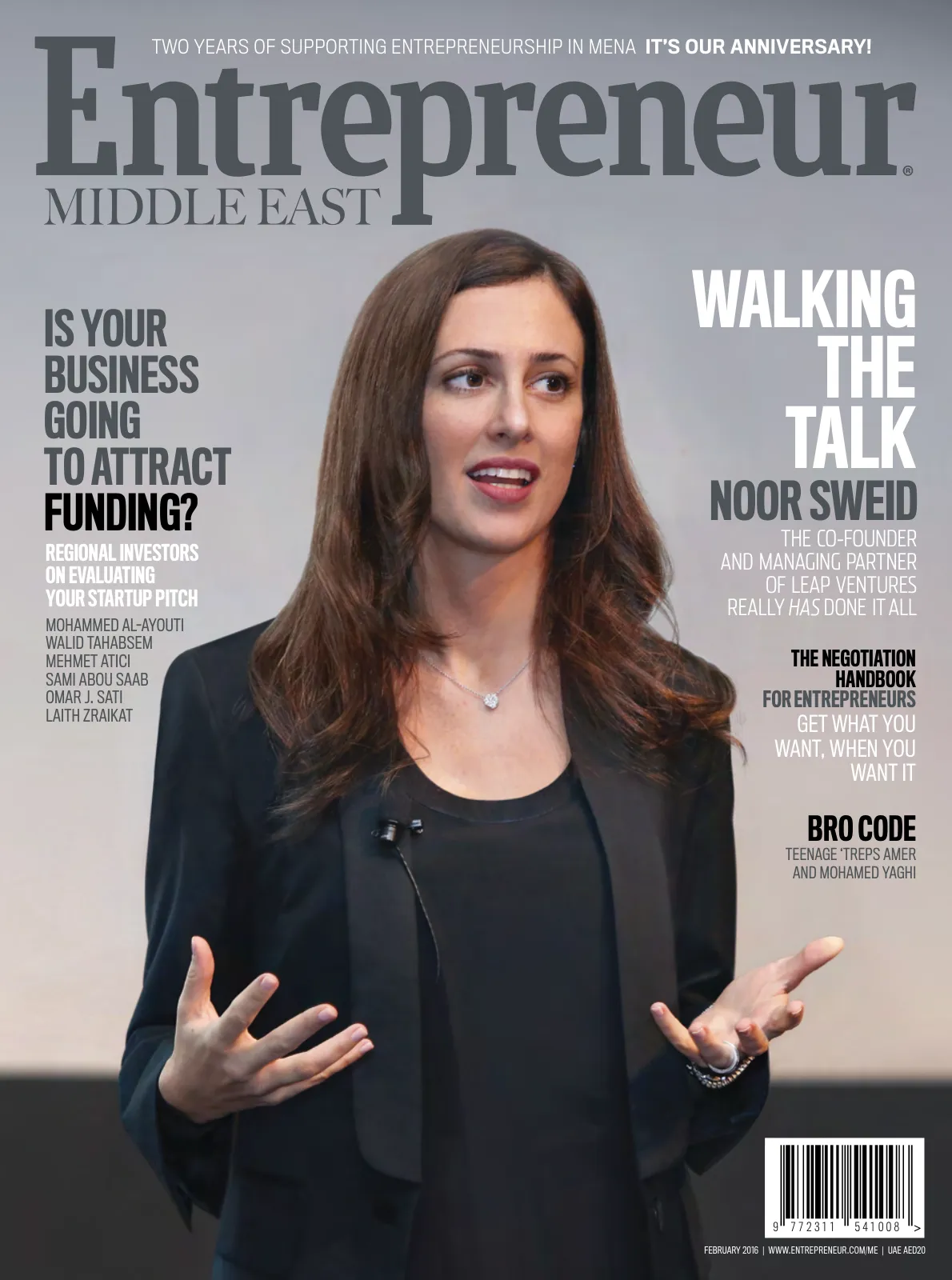
Entrepreneur Middle East, February 2016
Page 1
FEBRUARY 2016 | www.entrepreneur.com/me | UAE AED20
9
7 7 2 3 1 1
5 4 1 0 0 8
>
Two years of supporting entrepreneurship in MENA It’s our anniversary!
walking
the
talk
noor sweid
Is your
business
going
to attract
funding?
Regional investors
on evaluating
your startup pitch
Mohammed Al-Ayouti
Walid Tahabsem
Mehmet Atici
Sami Abou Saab
Omar J. Sati
Laith Zraikat
Get what you
want, when you
want it
The negotiation
handbook
for entrepreneurs
Teenage ‘treps Amer
and Mohamed Yaghi
Bro code
The co-founder
and Managing Partner
of Leap Ventures
really done it all
Page 2
Page 3
Page 4
Entrepreneur february 2016
4
CONTENTS
february 2016
72
Teach Me Now founder Thea Myhrvold meeting Microsoft CEO Satya Nadella
66
MONEY:
ASK THE MONEY GUY
Is your business going to
attract the funds you need?
Regional investors tell you
what they look for when
evaluating your pitch.
40
‘TREPONOMICS:
MARKETING
2016 heralds the new era
of content marketing
Ema Linaker on how
to make your business
messaging effective in the
age of video. It takes real
work, ‘treps!
60
SKILLSET
The Impact Bias
Olympian and
entrepreneur, James Clear,
talks about how to be
happy when everything
goes wrong.
36
ASK A PRO
Numbers don’t lie
Bayt.com’s Suhail
Al-Masri talks about
the stats that indicate
that the Middle East is
officially crazy about self-
employment.
62
ESQUIRE GUY
The power of praise in
business
Ross McCammon
discusses the plusses
of conveying positive
messages, and how to do
it right.
24
INNOVATOR:
Walking the talk
Entrepreneur and investor
Noor Sweid
Leap Ventures Managing
Director and co-founder
really has done it all
24
Entrepreneur and
investor Noor Sweid
thea myhrvold meeting satya nadella image courtesy microsoft gulf
Page 5
BIKE SPORTS
ACTION SPORTS
LIFEST YLE
A leader in sports lifestyle.
DDE is home to some of the biggest brands in the Action Sports, Lifestyle and Bicycle Sports industries.
Established in 2001, DDE has grown to become a leader in the market, and has recently sustained this achievement by
being ranked 3rd in the Top 100 SME companies of Dubai as part of the 2015 Edition of the Dubai SME100.
Not only an established industry leader in distribution, DDE proudly represents its unique retail concepts such as Rage,
Ride Bike Shop, Liv, Captiv8, Volcom and Bikini World, that are constantly excelling in the retail segment.
Dubai Desert Extreme L.L.C. | P.O.Box 125239
Dubai, U.A.E. | Tel. +971 4 336 9007 | www.dde-me.com
2015
4th
3rd
Page 6
Entrepreneur february 2016
6
CONTENTS
february 2016
Mudassir Sheikha
and Magnus Olsson,
co-founders, Careem
16
50
EHang 184, the world’s first electric, personal
Autonomous Aerial Vehicle, introduced at the 2016
International Consumer Electronics Show
42
Xiaomi smartphones
launch in Dubai
50
TECH:
SHINY
#TamTalksTech
Gadgets and doodads
that you might’ve missed
out on, sourced by a tech
aficionado. Yes, it’s okay to
want them all… and no, it’s
not our fault.
44
ONLINE ‘TREP
Bridging the gap
Attracting offline shoppers
to your e-commerce
startup can be done.
CAC isn’t as hard as one
might think if you follow
these five tips by Pricena
founder Haneen Dabain.
45
MOBILE TECH
Xiaomi launches in the
Middle East
Four devices with some
pretty interesting specs
were introduced at the
UAE launch event.
52
CULTURE:
LIFE
Action paired with
intention can make this
your year
Building an accountability
structure for achievement
can make all of the differ-
ence in your performance.
56
TRAVEL
Genuine hospitality
The Four Seasons Amman’s
Vincent Hoogewijs would
like you to get settled in
(comfortably), and he’s
executing a top-to-bottom
renovation to make that
possible.
68
Mehmet Aitici
and other regional
investors tell you
what they look for
when evaluating
your pitch
Page 7
Page 8
Entrepreneur february 2016
8
CONTENTS
february 2016
58 Rafael Nadal and Adel Ali
Bin Ali at the Richard Mille Doha
Boutique
27
Henri Asseily,
Manager Partner,
Leap Ventures
30
INNOVATORS:
The Negotiation
handbook for
entrepreneurs
Get what you want, when
you want it.
14
EDITOR’S NOTE
By Fida Z. Chaaban
73
START IT UP:
ECOSYSTEM
A congregation of
Eurasia’s entrepreneurial
world
Startup Turkey 2016
comes calling, and there
will be entrepreneurial
entities from three
continents present.
74
STARTUP FINANCE
MENA startups gets
funded
Online platform Artscoops
gets funded on equity
crowdfunding platform
Eureeca.
76
Q + A
A startup for startups
Philip Bahoshy wants
his online platform
MAGNiTT to create a
tighter knit MENA-wide
entrepreneurial
ecosystem
20
INNOVATOR:
Bro code
Teenage ‘treps Amer and
Mohamed Yaghi
58
CULTURE:
TRAPPINGS
The executive selection for
the entrepreneur on your
list that has everything.
Okay, maybe for a little
self-reward as well.
49
LIFE
Ten things not to say to
digital professionals
Our pick for the top
phrase to avoid? “So is
this social media thing
like a real job now?!?”
Yes, yes it is.
32
Dr. Kerry Healey,
President,
Babson College
Page 9
Page 10
Entrepreneur february 2016
10
SUBSCRIBE
Contact subscriptions@bncpublishing.net to receive
Entrepreneur Middle East every issue
EDITOR IN CHIEF Fida Z. Chaaban editor@bncpublishing.net
MANAGING DIRECTOR Walid Zok walid@bncpublishing.net
DIRECTOR Rabih Najm rabih@bncpublishing.net
DIRECTOR Wissam Younane wissam@bncpublishing.net
CREATIVE LEAD Odette Kahwagi
MANAGING EDITOR Aby Sam Thomas
STARTUPS SECTION EDITOR Pamella de Leon
ONLINE LIAISON Kareem Chehayeb
COLUMNIST Sindhu Hariharan
COLUMNIST Tamara Clarke
COLUMNIST Shoug Al Nafisi
COLUMNIST Erika Widen
EVENTS LIAISON Mark Anthony Monzon
PO Box 502511 Dubai, United Arab Emirates
P +971 4 4200 506 | F +971 4 4200 196
For all commercial enquiries related to
Entrepreneur Middle East contact
sales@bncpublishing.net
All rights reserved © 2016.
Opinions expressed are solely those of the contributors.
Entrepreneur Middle East and all subsidiary publications in
the MENA region are officially licensed exclusively to BNC
Publishing in the MENA region by Entrepreneur Media Inc.
No part of this magazine may be reproduced or transmitted
in any form or by any means without written permission of
the publisher.
www.entrepreneur.com/me
Access fresh content daily on our website!
MIDDLE EAST
Printed by Raidy Emirates Printing Group LLC
www.raidy.com
EntMagazineME
@EntMagazineME @Fida
Entrepreneur-me
EntrepreneurMiddleEast
EntMagazineME
EntMagazineME
EntMagazineME
MIDDLE EAST
Images used in Entrepreneur Middle East are credited when necessary. Attributed use of
copyrighted images with permission. All images not credited otherwise Shutterstock.
Lama Ataya
Abdulla Barakji
Jim Camp
Amal Chaaban
James Clear
Haneen Dabain
Con O’Donnell
Shyaire Ganglani
Ema Linaker
Suhail Masri
Ross McCammon
Rani Nasr
Neil Petch
Soukaina Rachidi
May Rostom
Mark Sephton
CONTRIBUTING WRITERS
In addition to our print edition, we’re bringing
you all sorts of industry news on our web
mediums. Joining us online means getting
relevant business and startup content in
real-time, so you’re hearing about the latest
developments as soon as we do. We’re looking
forward to interacting with our readers on all of
our social media and web platforms- like any
thriving business, we’re looking to give and take.
#TrepTalkME is already happening on all of our
digi platforms, and all good conversations go
both ways. See you on the web!
Page 11
Page 12
Page 13
Page 14
Entrepreneur february 2016
14
TREP TALK ME
THE BUSINESS
BNC Publishing
THE ‘TREP
Wissam Younane
Q What have you learned
from your clients over the
past two years?
A “First, a little extra care
in knowing what they truly
need can easily make them
continue to spend, and to
consider exploring further
opportunities with your
business. One example
is that a client of ours
wanted to fully cancel or
pay half of the previously
agreed amount for one
of the spaces booked.
With a two-minute phone
call, we understood her
concerns and managed to
save the original contract
amount. My second tip
is that listening to the
customer is essential. It’s
something I have always
done with my clients, and
that is one of the reasons
that they have never failed
to support me when I
started this venture [BNC
Publishing] along with my
partners. Third, sticking
to the truth and principles
of honesty in business is
always the best option.
This is simply that I never
want to fall short on
delivering what I say I will
do, or even what I say I’m
capable of doing in terms
of client expectations and
deliverables. Fourth, it’s
true that clients like to feel
spoiled when it comes to
rates and benefits. Like in
every relationship, there
must be a give and take-
transacting business is no
different. My fourth lesson
is about brand solvency.
If you have a solid brand,
work hard on keeping it
solid- this will ensure that
your clients are as loyal to
you as you are to your own
brand. Finally, and this
is extremely important,
if your client is today
going through a financial
shortage or facing a crisis,
support them when you
can with your rates. They
won’t forget your gesture,
and it will come back to
you in spades.”
EDITOR’S NOTE
H
appy anniversary to our
readers! We’re excited
that this edition marks
two years of us support-
ing entrepreneurship across the
MENA region. If you’re part of the
ecosystem, you know that we’re
on ground as much as possible,
and that we’re talking to you in
real-time via social media. But our
work isn’t yet done- we want to
draw in the outliers. There are tons
of entrepreneurs (both new and
seasoned) across the region who
aren’t yet part of the ecosystem,
and that means they are missing
out on valuable mentorship, cross
sector collaborations and business,
and possibly even funding oppor-
tunities (that can scale an already
profitable enterprise).
So, all that being said, you know
that by now that we apply our own
methodologies: we’re built on a
lean business model and operation,
our entire team act as generalists
wearing many different hats, and
we growth hack our way forward.
From a commercial perspective,
for our two year anniversary, I
asked the entrepreneur behind
Entrepreneur Middle East, Wissam
Younane, to talk shop (that’s him in
our Trep Talk ME box). Like all of
the entrepreneurs we feature, he’s
constantly learning and iterating
our business model as we progress.
There is, in my opinion, a lot
to be said for our valued brand
partners- MENA ecosystem entities
and pillars who have supported us
profusely by participating in our
events and who have invited us
to participate in their events over
the past two years. Accelerators,
incubators, investors, conferences,
mentoring programs: we will con-
tinue to support you to our fullest
capability across both print and
digital, and further our already
solid relationships.
Regarding our crazy level of inter-
action online, we truly appreciate
that our readers share our content
via social media platforms and
that you interact with us on those
same mediums. We’re really proud
that we’ve become the information
outlet for ‘treps in this region, and
we’re thrilled when you write to us
with your achievements and your
concerns. From our readership, the
entrepreneurs across the region, we
receive candid emails about fund-
ing struggles, funding wins, venture
scaling, and new partnerships.
Keep it up! We want to continue to
be the MENA entrepreneur’s go-to
point of contact. We’re here to get
your stories out there, and help you
get the recognition you deserve for
your enterprising spirit, and tire-
less work.
Happy anniversary, ‘treps!
Entrepreneur MENA is now two years old!
Fida Z. Chaaban
Editor in Chief
@fida | @fidazchaaban
editor@bncpublishing.net
We learn things too
Wissam Younane,
Director,
Entrepreneur
Middle East
Page 15
Page 16
Page 17
Page 18
Entrepreneur february 2016
18
L
ondon Business
School (LBS) has
released the data and
results of a survey
they conducted about
entrepreneurship and SMEs in
the Middle East. The survey,
whose results were published
in December last year, was
conducted with 500 members
of the LBS community, which
included alumni, executive
MBAs, and members of the
school’s Middle East Club.
While the survey’s participants
were from a variety of nation-
alities, it’s worth mentioning
that 33% of them originate
from Saudi Arabia, and 25%
from the UAE, which together
make up 58% of the partici-
pants. It’s also worth noting
that 89.2% of the survey’s
participants identified them-
selves as being male.
The vote of confidence is
high. Entrepreneurship
is growing in the Middle
East. Most of the survey’s
participants showed confi-
dence at the growth rate of
the region’s entrepreneurial
ecosystem. 37.7% described
growth as “fast” and 30.2%
described it as “steady”- that
said, 24.6% believe that
entrepreneurship is growing
at a “slow” rate. Of course,
it’s important to take into
consideration the diversity of
economies in the region. In the
UAE, Qatar, and Saudi Arabia,
we’ve seen long-term and ag-
gressive initiatives to improve
tech infrastructure and other
conditions that will increase
entrepreneurship. That may
not be the case in countries
such as Egypt and Jordan,
whose entrepreneurs often cite
infrastructural blockades to
innovation.
To ‘trep or not to ‘trep?
That is the question.
When asked about their “ap-
petite” for entrepreneurship,
almost half (45.4%) of the re-
spondents said that they have
considered setting up their
own business, but haven’t pur-
sued it just yet. Is it a matter of
confidence or comfort? While
23.1% of the respondents
claimed to have already set up
at least one business, 45.6%
are rather confident of start-
ing up their own enterprises
soon, and 26.9% aren’t. All in
all, it’s safe to say that most
people are just waiting for
the right time- maybe they’re
trying to garner resources, or
looking for the right partner.
SMEs are overcoming a
“less than supportive”
environment. The survey’s
participants were asked to
judge the current situation
for SMEs, and 56.3% say
that there is certainly room
for improvement, primarily
in the realm of getting more
“support.” While only 10.4%
believe that SMEs have been
doing poorly, the remaining
third of participants believe
that SMEs are doing well.
Half of that third believes that
SMEs are managing to do well
in a “less than supportive”
environment. While more
entrepreneurial ecosystems in
the GCC are becoming more
SME-friendly, some SMEs in
other countries are struggling
to reach their full potential.
It’s another case of flourishing
economics being able to pro-
vide more for their entrepre-
neurial ecosystem than others.
That being said, whether
you’re in the UAE or in Egypt,
there is always more than can
be done to give SMEs a lift.
More guardian angels
–a.k.a. investors- are
needed. Given that there’s
more that can be done for the
Middle East’s entrepreneurial
ecosystem, what are some
of the ways to do just that?
When asked to rank certain
measures that could be taken
as areas needing improvement,
the highest average went to the
need for more “private” or an-
gel investors. That said, most
of the other measures weren’t
far behind, including “more
new business incubators,” and
“more government funding,”
in addition to “private sector
mentors/guidance.” However,
“fostering female entrepre-
neurship” was at the bottom of
the list- but that might not be
surprising, given that almost
90% of the survey’s partici-
pants are male.
F&B and tech is where it’s
at. Which sector appears to
be the most promising in the
Middle East? The majority
(36.5%) claims it’s F&B, and
29.8% say IT and tech. Travel
and tourism, hospitality,
marketing and media all fall
below 10%. Whether it’s the
GCC, the Levant, or North
Africa, there always have been
many F&B ventures. We’ve
noticed some external efforts
to take them to a new level,
but not as much as tech. In
the GCC, we’ve seen Qatar,
Saudi Arabia, and the UAE
heavily prioritize creating
spaces and conditions worthy
of a flourishing tech industry.
In Lebanon, we’ve seen the
emergence of the UK Lebanon
Tech Hub, and a similar
initiative that the French
ambassador announced at
the second edition of BDL
Accelerate last December.
Despite setbacks, startups and
SMEs in the Middle East have a
bright future, says London Business
School Survey
in the loop
By Kareem Chehayeb
London Business School,
Dubai International Financial Center
Page 19
Page 20
Entrepreneur february 2016
20
M
eet Amer and Mo-
hamed Yaghi: not only
are the Jeddah-based
teens tech lovers,
they’re also among the
region’s youngest entrepre-
neurs. That’s right; the ambi-
tious Yaghi brothers are 16
and 15 years old respectively,
and they’re prepared to pitch
their ideas at you at any given
opportunity.
Before getting bit by the
entrepreneurial bug, the
Jeddah-based Jordanian ‘treps
were (and still are) working
hard at school, enjoying the
outdoors and playing sports.
What inspired them to start up
an enterprise of their own was
a combination of their pas-
sion for tech and a tiny bit of
teenage angst. The young duo
“hated the fact that our par-
ents were constantly bothering
us and invading our privacy on
social media,” so they designed
Chillax, a social network “just
for teenagers.” Unlike most
major social media platforms,
Chillax allows its users to con-
trol all sorts of privacy levels,
all the way from their parents
to potential cyber bullies.
Their passion for Chillax,
together with the support of
their forward-thinking parents,
paved the way for burning
passion for entrepreneurship,
and it became a life-changing
experience. Unfortunately,
Chillax didn’t work out in the
long run, but the tenacious
‘treps didn’t give up: “Failing
is a stepping stone to success.”
They were right, given that
they later developed a more
successful app, AidMaid. Sev-
eral experiences inspired them
to develop the app, but what
really “triggered” them to have
a go at their second venture
is a somewhat traumatizing
experience for the younger
brother. Mohamed was riding
his bike and was nearly hit by
a speeding truck driver. While
discussing the event with
Amer, they both realized the
need for “an emergency appli-
cation which would allow users
to ask for help” by pushing a
button or shaking their phone.
That’s what the AidMaid app is
all about, and it is today avail-
able for download on iOS and
Android devices.
As for co-founder dynamics,
how do Amer and Mohamad
work together on a venture as
entrepreneurs? While they
both have similar passions and
the same admirable work ethic,
they do have their differences.
Whether its “different manage-
ment styles” or whether it’s
a greater passion for tech or
business administration, the
Yaghis maintain that their dif-
ferences make them stronger
as a team. The brothers oc-
casionally need a mediator and
older mentor, and “that’s when
we go to dad for help.”
All in all, it’s rather impres-
sive that these two young
innovators are able to pursue
their enterprising inclinations
without it affecting their aca-
demic performances or nega-
tively impacting their lifestyles
in any way. According to the
Yaghi bros, the question that
most entrepreneurs, investors,
and teachers ask them is: how
do you balance time between
school and work? The brothers
believe that most people are
wrong when they “think that
it’s impossible for someone
to attend school [and get high
grades] while also working
tirelessly on a venture.” That
said, they are able to pull it
off, and give credit to two main
factors: “strategic planning
and eliminating non-essen-
tials.”
By Kareem Chehayeb
Teenage ‘treps Amer and Mohamed Yaghi
Bro code
innovator
The Yaghi brothers
with Ronaldo
Mouchawar at
Endeavor Jordan
DealMakers 2015
Yaghi brothers at Endeavor DealMakers
2015 in Amman
Page 21
Page 22
Page 23
Page 24
Entrepreneur february 2016
24
innovator
Entrepreneur february 2016
24
Page 25
february 2016 Entrepreneur
25
the talk
“
Walking
Entrepreneur and investor
Noor Sweid
The co-founder and Managing
Partner of Leap Ventures really
has done it all By Aby Sam Thomas
>>>
I
f you’re looking to
succeed, keep your
eyes and heart open
to opportunities.
You’ll miss oppor-
tunities that come
to you if you’re
not open to them. Success is
about seizing the opportuni-
ties that present themselves
to you.” This is what Noor
Sweid told the audience dur-
ing her keynote address at
the Entrepreneur Middle East
Achieving Women’s Forum in
May last year, and one look at
her impressive career graph
so far makes it clear that this
is, indeed, a woman who has
(and continues to) put into
practice what she preaches.
Sweid definitely seems to
have an uncanny eye for great
opportunities- her work pro-
file reads like that if someone
who has, really, done it all.
She’s worked for big-name
corporates (these include
Charles Schwab and Accen-
ture), she has facilitated her
family business’ (the Dubai-
headquartered global interior
contracting company, Depa)
multi-million dollar growth
and eventual US$1 billion
IPO, she’s launched and
run her own business (the
ZenYoga chain of yoga studios
in Dubai that she founded in
2006 and ran until its sale in
2014), she’s been an investor
in and mentor for several
startups in the Middle East
ecosystem (besides her own
portfolio of past investments,
Sweid is also a member of
the Board of Directors at
Endeavor UAE), and she’s
currently a Managing Partner
at Leap Ventures, a MENA-
based growth stage venture
capital firm. So yes –if that
last sentence’s length didn’t
make it clear already- Noor
Sweid does seem to have done
it all.
But for all of her wins in
the realm of business, Sweid
had no airs and graces about
her when I met her for this
interview, during which she
freewheeled on everything
from her work ethic to the re-
gion’s ecosystem. In terms of
what she’s up to these days,
Sweid’s focus is currently
on Leap, which launched a
$71 million fund for Lebanon
last year, and is now in the
process of putting together
an $80 million regional fund.
“As with any venture capital
firm, we do several things
simultaneously,” Sweid says.
“So we look at the pipeline,
we invest in companies, and
we raise our own funds. Last
year, we looked at about 200
deals, and we are hoping
that this year, we’ll look at
even more. As the pipeline
grows in the region, and more
people start companies, and
more of the companies grow,
more will filter into our pipe-
line. So, we are very active in
terms of looking at deals, and
then assessing them and see-
ing how many really fit into
our verticals and our man-
date.” It must be noted here
that Leap is solely focused on
growth stage companies- not
startups. So, of the 200 or
so enterprises Leap’s team
reviewed, Sweid reveals that
only 17% of them even quali-
fied as being in growth stage.
But while the pool of qualified
applicants may be a small
one, the need for a firm like
Leap in the Middle East can-
not be understated.
“There are a few VC firms
[here] that look at early
stage, so companies can raise
$1, $2 or $3 million from a
few different firms,” Sweid
explains. “But what happens
to companies when they actu-
ally have solid revenues, a
good team, they have growth,
and they need a $5-10 million
check? It’s that they can’t
raise that money regionally;
they have to go global to raise
money, which takes a lot of
Page 26
Entrepreneur february 2016
26
innovator
“Business has ups
and downs, but when
you become part of
people’s lives, they
want you there.”
time and energy from the
entrepreneurs. So rather than
growing their business, they
spend exorbitant amounts of
time trying to fundraise for
their growth. Globally, about
2% of entrepreneurs make
it to Series B growth fund-
ing, and these are actually
companies we find a lot less
risky than others, because
they have already overcome
that part [of the entrepre-
neurial journey]. And no one
here was doing that. So we
thought, as entrepreneurs
ourselves –the four partners
at Leap (besides Sweid, the
Leap team includes Henri
Asseily, Hala Fadel and Hervé
Cuviliez) have each started
companies, have each exited
companies- we have done the
whole entrepreneur thing,
we know how hard it is to
actually grow your company,
and we know that’s where, for
us, the ideal return profile is
in investment. We’ve all been
investors: pre-Leap, between
us, we have invested in about
50 different angel companies.
So we have looked at the dif-
ferent parts of the ecosystem,
and as ex-entrepreneurs and
savvy investors, this is prob-
ably where we can add the
most value, in terms of taking
a company from ‘I know what
I am doing; I have revenues
too’ to ‘I am a regional suc-
cess story.’”
Since its launch, Leap has
funded only a few companies-
its latest investment was a
reported $10 million in the
Saudi Arabia-based UTURN
Entertainment network. But
these are still early days for
the venture capital firm, and
if Sweid’s enthusiasm for
the region’s ecosystem is any
indication, one can certainly
expect more announcements
from Leap in the near future.
“There are so many amazing
entrepreneurs doing great
things, and enabling them
to grow into regional, global
success stories is really what
we want to do, and so, we do
get excited about the different
opportunities out there,” she
says. “So we are still closing
our first fund- it takes about
2-2.5 years to raise a fund,
so we are in that process.
We find that there is also a
high level of enthusiasm from
people around us, who under-
stand what it is exactly that
we are doing. That’s actually
going very well. I guess the
flip side of the coin is iden-
tifying the entrepreneurs,
working with them, and really
enabling the growth of their
companies, which is what
we like to spend most of our
time doing. So that’s where
most of our energy goes.” So
what are Leap’s criteria when
choosing entrepreneurs and
enterprises to fund? “We are
looking for something with
a really large market- so, it’s
great that you can grow and
you have a great team, but
if the market’s very small,
then the options are limited,”
Sweid replies. “We are [also]
looking for a leader- an entre-
preneur who can really lead
a team, and [has] a strong
value proposition.”
While Sweid may be heavily
involved with the region’s
startup ecosystem right now,
her background is from a
rather different sphere of
business. She started out her
career as a consultant for
biotech and pharmaceutical
companies in the U.S., fol-
lowing which she moved to
Dubai in 2005 and worked
with Depa, a company that
was co-founded by her father,
Mohannad Sweid. “When I
came over here, I went to help
out in the family business for
three weeks, and that turned
into eight years,” she remem-
bers. “The first three years
of that, the company went
from $60 million revenue to
$600 million revenue. And
then I ran the IPO for that,
and I continued being very
involved.” But even as Sweid
recalls the highlights of her
time at Depa, I can’t help but
wonder: despite her familial
connections, she probably
would still have been seen
as an outsider of sorts at the
company. So how did she go
about making her presence
felt, and ensure that her voice
gets heard? “I think that be-
cause I had been a consultant
before, I knew my strengths
and my limitations,” Sweid
says. “And when I joined
our family business, I didn’t
know the first thing about
the industry. It’s easy to learn
an industry, but that doesn’t
mean you have the experience
required to be a CEO in that
firm. So I never intended to
kind of take on my father’s
role as CEO, and I would be
very transparent about that:
I cannot walk on to a project
site and tell you what’s going
right, and what’s going wrong.
So I had no business telling
managing directors or project
managers how to make money
on-site, because I don’t know!
And even if I were to spend
five years learning how a
site operates, I still wouldn’t
have as much experience as
them, because I haven’t done
as many projects as them,
because some of them have
plenty of years of experience.
So I knew that was very much
my limitation and my knowl-
edge. Where my strengths
lie are in identifying our
opportunities, our strategy,
our growth, our planning,
enabling culture- and when
it comes to growth at a lot of
family businesses, culture is
what’s fundamentally impor-
tant. Because you’ve built a
culture- great; now, is that
a strength, or a weakness?
Because if it’s a weakness,
then you need to change it. If
it’s a strength, then that can
be your biggest strength. So
when I came in, I saw there
was a very strong corporate
culture, but we were lacking
in policies and processes and
systems. So how do you bring
those in without destroying
the culture? There was an
opportunity, in that there was
no dominant global player in
our niche market. How do we
become that? Why wasn’t
there one? So, my strengths
were mainly the strategic
thinking, the enablement of
the growth, the growth plan-
ning, identifying different
markets, identifying potential
partners in those markets and
structuring partnerships and
joint ventures- so I could do
all that, which is, in effect,
strategy and growth.”
But changing -or even
modifying- corporate cul-
ture, be it at a startup or a
conglomerate, is not a simple
task, and Sweid realized that
first-hand at Depa. “It’s never
easy, because human nature
is reluctant to change,”
Sweid explains. “And I got a
lot of resistance. But I think
that when you have enough
knowledge, data points, ex-
perience to convince enough
people to try something, and
put their heart in it, and
if in six months, it doesn’t
work, we can go back to do-
ing it your way. But at least,
give it six months. And so,
when they see that you’re
so convinced, but you’re not
forcing it down their throats
-you are just forcing them to
try it- then it becomes a lot
easier to convince people to
change.” And the company
did change- during her time
as Depa’s Head of Strategy,
the company grew from 1,000
employees in six countries
to 8,000 employees in 22
countries. In 2008, Sweid
Page 27
february 2016 Entrepreneur
27
Noor Sweid at
Entrepreneur’s
Achieving
Women’s Forum in
May 2015
>>>
led Depa’s IPO- it was the
first private company in the
UAE to be listed on NASDAQ
Dubai. But making the family
business a publicly listed
one- how difficult was that
decision? “I think, in our
family, we genuinely believe
that building something that
outlives you is a much larger
success than building some-
thing that needs you,” Sweid
replies. “And none of us are
very attached to anything we
build. On the contrary, it’s
about building things for the
greater ecosystem that are
successes in off themselves,
regardless of whether you
are involved or not- that
is the achievement. So, for
us getting the company to
a point where it’s publicly
listed, it continues with or
without us, it’s struggle
with or without us, it’ll then
probably, hopefully, do better
with or without us: that’s the
achievement. At some point,
you kind of have to let go of it,
and see how it does without
you.”
Sweid’s answer is indicative
of her own thought process
when it came to the lifecycle
of her own entrepreneurial
endeavor, the ZenYoga chain
of yoga studios that she
founded in Dubai in 2006.
The origin story for ZenYoga
is quite a simple one- after
she moved to Dubai, Sweid,
who calls herself “a huge be-
liever in yoga,” found the city
lacking in spaces where she
could practice the discipline-
Dubai may have yoga studios
by the dozen today, but re-
member that this was 2005,
and yoga hadn’t become as
much of a buzz as it is now.
So Sweid took it upon herself
to fill that gap in the market-
she put together a space
that had the ambience, the
qualified teachers, and the
set-up she herself was looking
for, and behold, her small
business, ZenYoga, was born.
“I started it, so that I could
practice [yoga], with the
thought that if this was good
for me, it’s probably good
for many other people,” she
remembers. “And if I person-
ally want this for the benefit
of my health, I am sure lots
of other people do as well. So
the fact that it didn’t exist
was just the reason to create
it. If it had existed, I wouldn’t
have started it- I would have
simply gone to classes!” But
while she may have started
ZenYoga out as a personal
endeavor of sorts, Sweid soon
saw that what she had creat-
ed was actually bigger –much
bigger- than that. “I was right
in that lots of people wanted
the same thing- a nice place
to practice yoga, with a quali-
fied teacher at a reasonable
price. It met everybody’s
needs, and so, demand was
huge. And so we grew as a
business; we brought in more
teachers- by the time I left
[the enterprise], we had 72
people working at ZenYoga,
and it had become the biggest
chain here.”
ZenYoga’s trajectory as
a business may be looked
upon as a startup success
story today, but much like any
entrepreneur in this region,
Sweid too had to grapple with
sleepless nights thanks to all
of the challenges she faced
when getting her business
on the road. Bureaucratic
challenges were aplenty- for
instance, given that yoga
wasn’t as prevalent then
as it is today, getting the
business registered properly
with the authorities was a
task by itself. The running
of the studios was another
major hurdle- from managing
schedules of all of ZenYoga’s
customers and ensuring they
all have a fruitful experience,
to setting out procedures,
processes and policies to
govern the studio’s day-to-
day activities, Sweid had her
hands full through all of the
years she ran the enterprise.
She thus went through all of
the oscillations one can ex-
pect to see in a startup’s jour-
ney- but in what is perhaps a
testament to the “keep-at-it”
trait consistently seen in suc-
cessful entrepreneurs around
the world, Sweid too stuck to
her vision, and kept moving
ahead with her enterprise.
“Business has ups and downs,
but when you become part of
people’s lives, they want you
there,” Sweid says. “So, creat-
ing that community and that
network is very important.
Yes, businesses have ups and
downs- but I think if you are
part of people’s lives, part of
the community, and you cre-
ate a brand and really provide
people with something they
like and they need at the same
time, it is quite resilient.”
To its credit, ZenYoga
proved to be a sustainable
business in the long run-
Sweid, however, eventually
sold it to a private equity firm
in 2014. When I asked her
why she did so, Sweid had a
rather matter-of-fact reply.
“Well, I started ZenYoga,
because there was nowhere
to practice,” she says. “So I
had achieved my goal- I had
created somewhere I could
practice. At the same time,
every time I would now walk
into the studio, I would be
inundated with business
problems. So it no longer be-
came a place I could practice-
so it ended up defeating its
purpose for me, personally.
So when one of the firms here
was consolidating wellness
concepts in the region and ap-
proached me, I thought that
made a lot more sense- they
could give it what it needed,
and I could get somewhere
to practice back!” As for
whether she had any struggles
letting go of the business she
had built up from its infancy,
Sweid dismisses the idea-
much like her thoughts on the
Page 28
Entrepreneur february 2016
28
innovator
Noor Sweid’s tips
for ‘treps
1. “Know your numbers.”
2. “Stay focused.”
3. “Create value… You
have to create value that
you can monetize. The
focus should not be on
making a profit- but if you
are creating value that
no one’s willing to pay
for, then that’s irrelevant.
Because you are not really
creating value.”
4. “Don’t confuse fame
and success.”
5. “Don’t underestimate
the value of corporate
culture- it gets you a long
way.”
public listing of Depa, Sweid
says she felt the same way
about her sale of ZenYoga as
well. “My personal philoso-
phy is that you build some-
thing that doesn’t need you,”
she explains. “You should be
there because you want to be
there- not be there, because
if you’re not, it’s not going to
do well.”
But wait- isn’t that at odds
with what industry leaders
say about entrepreneurs hav-
ing to be hands-on with their
businesses? “When they are
first starting up, yes, they
need to live and breathe the
business; everybody does. I
did for Zen Yoga, my father
did when he started our
family business- everyone
does that at the beginning.
You have a few years where
you are the business, and
the business is you. But, ul-
timately, if you want to grow
it to something sizeable, you
need to think about how you
can close your eyes, and know
that somebody else is doing
this the same way that you
would have done it, or even
better. And that’s where your
policies, processes, teams
come in, and that’s when you
really start to scale. If you are
still needed in every meeting,
you should either be in the
startup phase, at which point
that is totally okay. But if
you are a sizeable business,
and you are still needed in
every meeting, you are doing
something wrong.” Sweid
uses the example of Aramex
co-founder and Vice Chair-
man Fadi Ghandour –one of
the most vocal champions of
the region’s entrepreneurial
ecosystem- to drive her point
home. “Look at Fadi Ghan-
dour- great example. Is he
involved at all with Aramex
[today]? No. And that’s the
success of it. It’s that he
has built something that no
longer needs him. That’s the
wow. If he was still day in
and day out involved with
Aramex, he would be helping
it grow, but also stifling its
growth, because every busi-
ness needs new blood every
once in a while. The reason
Aramex will grow is because
he implemented policies,
procedures, corporate gov-
ernance, structures, so as to
make sure everything is being
done properly in the manner
that he sees fit, without him
being there.”
This drive to create a
sustainable, long-lasting
business is what Sweid en-
courages (and wants to see)
in all of the entrepreneurs
she meets in her role today
as a mentor and investor- ac-
cording to her, for a business,
being successful and being
famous are two entirely dif-
ferent things, and it’s crucial
that entrepreneurs don’t mix
the two up. “It’s important
for people to realize that
success is not starting a com-
pany- success is growing a
company,” she explains. “It’s
easy to write a business plan,
[but] it’s not going to get you
very far. It’s not worth the
paper it’s written on- because
that’s definitely not what’s
going to happen. It’s difficult
to go get your license and
registration and everything-
fine, okay, whatever, that’s
just bureaucracy and money.
Then you actually have to
build your product. Then you
have to convince people to
buy your product, at a price
that makes sense for you to
make money so that you can
grow your business. And
then, you have to do that a
thousand times. And then,
you have a company. And
then, it’s worth talking about!
I think a lot of people here
confuse fame and success.
And that’s something we see
consistently- companies that
have amazing branding, lots
of fame, but, you just peel one
layer of the onion, and you
realize that it’s much smaller
than what one would think.
There are very little revenues,
there’s almost no traction-
but the entrepreneur thinks
they are incredibly success-
ful. So confusing fame and
success is happening a lot not
just in this part of the world,
but everywhere.”
As for other faults she sees
with entrepreneurs today,
Sweid feels that they’d be
better off if they were to focus
on just one thing at time. “I
think lots of entrepreneurs
are trying to do too many
things at once. So they are
all, like, betting on several
horses- but that’s not their
job, that’s the investor’s job.
You go start one company,
and put all your eggs in one
basket- as an entrepreneur,
that’s what you are supposed
to do, so that someone comes
along and believes you. If you
believe in what you are doing,
other people will believe in
it too. If you are doing two
or three different things at
once, then that means you
don’t believe in any of them-
and lots of entrepreneurs do
that.” Sweid also wants to see
entrepreneurs talk less, and
do more. “So many times,
so many entrepreneurs, they
say, ‘I’m going to do this;
I’m going to do that.’ Well,
why haven’t you done it yet?
Don’t tell me what you are
going to do- tell me what
you have done.” Sweid also
sounds a warning note for the
die-hard networkers in the
MENA entrepreneurial eco-
system. “I think too many en-
trepreneurs spend too much
of their time in meetings,
and not enough time actually
doing stuff. So unless you are
in a meeting because you are
selling your product or ser-
vice, don’t take the meeting.
Don’t spend half your year
on conferences. I think if you
have an awesome product,
you’ll have to network half as
much. If you have a decent
product, you’ll have to net-
work twice as much. So… go
build an awesome product!”
At this point, I ask Sweid
to tell me the names of
startups or entrepreneurs in
the region that have actually
impressed her, or are worthy
enough to be considered as
role models. She takes a mo-
ment to think, before replying
with a laugh, “I’m not going
you to tell about them!”
Jokes aside though, she’s still
reluctant to name anyone in
particular (she does mention
UTURN here, but I feel that’s
a safe answer just to placate
me, than anything else), and
her reasoning for that again
is so that entrepreneurs will
avoid misconstruing fame as
success. “I find that when
people become role models,
then fame and success get
confused,” she explains. “And
I think that the ecosystem
is not yet at the stage where
we can afford that. We need
our successful entrepreneurs
to be focused on growing
their businesses and being
successful entrepreneurs, not
on being role models and on
a speaking circuit. Because
our businesses [here] are not
that strong yet- they aren’t
enough success stories here
that we can afford that.”
It may not be the answer I
was wanting to hear- but
Sweid does have a point. The
region’s ecosystem is growing,
yes- but we need it to grow
much bigger before we can
champion it to the world at
large. And with people like
Sweid along for the ride, one
hopes that it will happen
sooner than later.
Page 29
Page 30
Entrepreneur february 2016
30
innovator
PART 1
The entrepreneur’s
angle
Finding your negotiation
comfort zone
By Neil Petch
THE NEGOTIATION
HANDBOOK
FOR ENTREPRENEURS
Get what you want, when you want it
While negotiation is one of the
most crucial business skills
to develop and develop well,
it must be said that it is, for
many, a rather painful part of
the corporate world. Due to a
potentially long list of reasons,
a lot of otherwise extremely
capable business people at all
levels –from the junior sales-
person all the way up to the
CEO– simply don’t like it.
I have had many colleagues
and friends tell me over the
years they are just not good
negotiators, or “bargainers.”
You probably hear that latter
term used more often on the
personal front, like when you
are on vacation and you get to
haggle with a vendor over the
price of some souvenir– some-
thing that many people simply
dread. While it’s not quite the
same thing as being seated
opposite a potential client or
vendor in an office setting,
there are certainly some paral-
lels. And studies will tell you
this lack of comfort –or this
extreme discomfort– comes
in large part from a lack of
preparedness.
There are those who many
would call “born negotiators,”
but upon a closer look, what
the majority of those so-called
“born negotiators” possess
is simply the gift of gab. That
alone won’t actually help you
too much when it comes down
to the finer art of deal-making.
What will, however, is the
preparation. The true “born
negotiator” is, in fact, the one
who properly prepares for
every encounter. So let’s start
on that note while going into
four other essentials that will
help you find your negotiation
comfort zone:
Page 31
february 2016 Entrepreneur
31
Neil Petch is the Chairman of Virtugroup. Petch founded Virtuzone in 2009 before launching Virtugroup, a holding company that has a wider mandate of
supporting startups from establishment; to successful market entry; and all the way through to exit. Petch is also the Chairman of DIFC-regulated GMG,
established in 2010 with offices in Dubai, UAE and London, U.K., providing brokerage services for commercial and investment banks globally. His most
recent venture, PrimalMD, was launched in the health sector and focuses on helping doctors addressing the root cause of illness rather than simply treat-
ing the symptoms.
Having the “walk away” option
is one way to ensure you
don’t say yes under too much
pressure. this is not to imply
in any way that you should
be too quick to call it quits.
Negotiations will often be
drawn out and require a lot
of back and forth and will
generally have a fair number
of hurdles that need to be
overcome.
THE NEGOTIATION
HANDBOOK
FOR ENTREPRENEURS
1. Do your homework
As the old saying goes –fail
to prepare, prepare to fail–
and this is definitely true
at the negotiating table. I’m
sure these particular words
of advice will sound rather
obvious, but we often forget
that the reason something
turned out to be easier than
you thought it would be, or
worked out in your favor, is
because you prepared well
for it.
A quick diversion here to
make a point: consider the
art of public speaking. Again,
those “born public speakers”
are not actually those who
have simply mastered the ba-
sic tips and tricks, but those
who prepare well for each
speech or presentation. You
cannot, after all, be a good
public speaker by turning
up and asking what you are
supposed to talk about, then
trying to smooth talk your
way through it.
Instead, you research the
material that will go into your
presentation, pull it together
in the most logical and engag-
ing manner, then practice it
until you make it look like
there is no better authority
on the subject than you. In
other words, you worked
extremely hard to make it
look easy.
What does this mean for
the negotiation process?
Well it can be a number of
things. And how you prepare
depends on what side of the
table you are sitting at (buyer
or seller, for example), or
what the negotiations are
about.
Whatever the scenario,
you need to prepare accord-
ingly. Find out everything
you can about the person or
persons you will be holding
discussions with; get as many
details as you can about the
product or service you might
be buying and talk to others
who have purchased it to see
how much they paid; find out
what you can about the pain
points the potential buyer
of your product or service is
looking to address; and so on.
2. There doesn’t have to
be a winner and a loser
A frequent mistake people
make when it comes to ne-
gotiating is to go in with the
mindset that there has to be
a winner and a loser– or that
someone has to or will come
out with a significant ad-
vantage. The problem is that
anyone going into a negotia-
tion feeling they must win or
come out on top is unlikely to
compromise enough to seal a
fair deal; and equally, anyone
concerned about “losing” is
going to naturally be on the
defensive, and may end up
passing on a very legitimate
and fair offer.
In his book, Negotiation
Boot Camp: How to Resolve
Conflict, Satisfy Customers,
and Make Better Deals, Ed
Brodow says that he enters
every single negotiation look-
ing for a “win-win” outcome.
Go for what you want, he
says, but be prepared to give
away what the other party
wants too. Barrow says that
not only will deal success
rates improve with this
attitude, but the style is es-
sential to a positive working
relationship between both
parties long after negotiations
have finished. And this is a
very important point, because
the closing of the deal is
often just the start of a very
important working relation-
ship or partnership, and you
wouldn’t want that to begin
with one party having hard
feelings.
3. Know what you’re
worth, and then know
how to leverage it
As the seller, this one starts
by taking an honest look at
what you are bringing to
the table. If you are offering
a product or service that is
available elsewhere (which is
pretty much always the case),
then what is it that makes
your package more attractive,
and how exactly does a deal
with you bring more value
than a deal with one of your
competitors? Only by know-
ing this can you find and then
subsequently exploit any le-
verage over your competitors
who are also negotiating with
your prospect.
As buyers, we are, most of
the time, naturally skeptical,
and we are all used to
getting the same spiel from
competing vendors. How
are you truly different? Are
you, in fact, any different?
This one is very much based
in reality. That is, if you are
better than your competitors,
you should be able to show
that in the form of results,
through case studies or client
references– or with the
strong reputation you enjoy
in the market. If you are on
par with your competitors
in terms of offering, then it
quickly becomes a price war,
which is often not much of a
help to anyone’s business.
The point is this: knowing
what you are worth may be a
bit of a wakeup call for you.
You may not like what you
see. In which case, it is time
to work on that product or
service to improve it in order
to give you that leverage
next time. In other words, a
good negotiator does actually
have something of value
to negotiate over, and no
amount of smoke and mirrors
will help cover up a mediocre
offering.
4. Get the information
you require
Being a good negotiator is a
lot like being a good detec-
tive– you need to ask the right
questions, and listen carefully
to the answers for clues that
will help solve your case. Or
in this instance, help you
close a deal with favorable
terms. Call it “smart listen-
ing,” but what it is about is
uncovering what you need to
hear. And maybe you won’t
uncover it too easily, in which
case you have to probe with
more questions.
That 70/30 listening rule
is a great one (that is, listen
70% of the time and talk
30% of the time), but it
means nothing if you are
not getting the information
you need. You have to be
persistent and even dogged
here. If the conversation is
going in circles and you are
not uncovering what you need
to uncover, then you have to
keep at it. Try different ap-
proaches, ask different ques-
tions, and if needed, get much
more direct.
You will never feel as though
you are 100% informed. You
simply cannot be. As a buyer,
for example, it is only after
you start using that product
or service that you will see
what the real value is. But it is
your right and duty to get to a
fairly comfortable place with
respect to informed decision-
making, and if that involves
poking and prodding till the
cows come home, so be it. >>>
Page 32
Entrepreneur february 2016
32
“A successful entrepreneur
is by definition a successful
negotiator.”
Dr. Kerry Healey, Babson President
PART 2
The academic’s
angle
Learning the tricks
of the trade
THE NEGOTIATION
HANDBOOK
FOR ENTREPRENEURS
5. Be prepared to walk
away
Somewhat leading off from
the aforementioned point,
do always be prepared to call
quits on a negotiation. In fact,
in your mind you should be
more prepared to do this than
find a deal. Too many things
can go wrong with a purchase
or a sale or a partnership, so
without a satisfactory level
of comfort, it is not worth it.
Having the “walk away” op-
tion is one way to ensure you
don’t say yes under too much
pressure.
Now this is not to imply in
any way that you should be
too quick to call it quits. Ne-
gotiations will often be drawn
out and require a lot of back
and forth and will generally
have a fair number of hurdles
that need to be overcome.
Those win-win scenarios that
bring the most long-term
benefits are almost never
quickly and easily decided. In
fact, the bigger the deal and
the greater or more impactful
the long-term gains may be,
the more there is to discuss
through in advance. In short,
the more there is to win or
lose.
Seeking a favorable
outcome? There is
no substitute for
preparation
There are great business
lessons to be learned from
reading about Houdini. He
was known for making his
escapes look so easy and
effortless that people were
sure that he was aided by
some sort of magical power.
The truth, however, is
that his tricks were often
incredibly grueling and
required tremendous physical
ability, and Houdini practiced
and prepared until the
execution was perfect.
Negotiation is one of those
things that the more prepared
you are, the more confidence
you have, and the greater
the likelihood of a favorable
outcome. So of all the tips
presented here, I will stress
that the first point is the one
you need to keep in mind
above all others. Each and
every negotiation you go
into will be different, so you
want to exhaust yourself
with preparation to make the
discussions all that much
easier.
“Of the many public sector
negotiations I have been
involved with, the most
complex and impactful was
passing Massachusetts first-
in-the-nation healthcare
reform legislation when I
served as Lieutenant Gover-
nor with Governor Mitt Rom-
ney,” says Babson President,
Dr. Kerry Murphy Healy.
“While healthcare reform was
a broadly desired goal, there
were significant differences in
the approaches and priorities
of the numerous negotiating
parties, including the federal
government, the state legis-
lature, insurers, hospitals,
doctors, and consumer ad-
vocacy groups.” One doesn’t
need to be well-versed with
healthcare reform or with
U.S. government policy and
procedure to understand the
exceeding difficulty of the
situation Dr. Healy describes.
The latter situation, one that
occurred during her tenure as
70th Lieutenant Governor of
Massachusetts from 2003 to
2007, proved successful not
only for the state, but as a
lasting hallmark of her career
since it has since been adapt-
ed as a model for other states,
and “nationally in an effort
to strike the delicate balance
between extending coverage
to all, while engaging private
sector competition to contain
costs to both the consumer
and the government.”
People who are successful
in diplomacy while serving
governmental appointments
often carry those skills over
to the private sector before
and after careers in the public
sector. The idea that many
former statespeople later
become sought-after private
sector consultants is highly
connected to the ability to
reach advantageously-
structured agreements, and
if they’ve demonstrated
prowess at the negotiation
table. The skills required
to navigate widely different
interests and goals during ne-
gotiation periods fraught with
stressors, and the impact of
a well-negotiated deal is an
achievement in itself.
FOUR QUICK STUDY TIPS
ON NEGOTIATING AS A ‘TREP
By Dr. Kerry Healey
1. KNOW YOUR ALTERNATIVE
ROUTE, AND That of the
other party
“First, make sure to know
your alternatives (what do
you do if you walk away from
a deal?), and know the other
party’s alternatives. This type
of assessment and data gath-
ering is important to perform
before you enter into a nego-
tiation. This advice is often
what negotiation professors
will say is almost the only
advice you really need for any
negotiation.”
2. MAINTAIN YOUR
DECORUM, BUT STAND
YOUR GROUND
“Second, never confuse
being ‘nice’ with giving up
economic value. Being nice –
and striving to form positive
relationships- does not mean
you have to make monetary
concessions. As our students
are often reminded, some-
times walking away from a
deal is the best thing to do.”
“Negotiating skills are incred-
ibly important! We [at Babson]
believe that a successful
entrepreneur is by definition
a successful negotiator in the
broadest possible sense of
the term. The most successful
entrepreneurs have created
products and services that en-
gage the customer where they
are and move them to a place
that the visionary entrepreneur
can see.
The interplay between the im-
mediate needs of the customer
and the vision of the entre-
preneur is in itself a type of
negotiation. For example, Doug
Rauch, former CEO of Trader
Joe’s and CEO of Conscious
Capitalism, describes launch-
ing his newest venture, Daily
Table, as an initially very tough
negotiation between his tar-
geted customers -hard-working
people on a tight budget and
no time to cook- and his vision
of providing healthy, delicious,
nutritious food to people with
limited financial resources.
Doug needed to hear that
financial constraints were only
part of the problem his busi-
ness would need to address
if his business model were to
succeed. ‘Negotiating’ with his
customers changed the details
of his product; shifted his focus
from selling low-cost groceries
to adding affordable, healthy
pre-prepared meals, while he
held fast to his mission. It’s
been a win-win outcome for
Doug and the neighborhood!”
Page 33
february 2016 Entrepreneur
33
See this article in its entirety at Entrepreneur.com
The Negotiation Book: Your
Definitive Guide to Successful
Negotiating by Steve Gates
There is perhaps no more
important skill in business than
the art of negotiation. A good
negotiator can sculpt favourable
deals, advantageous employ-
ment contracts, or even diffuse
difficult situations using finely-
honed skills. Steve Gates has
released a second edition of his
book, updated for a world that
has changed in expectations but
still wants the best bottom line
for their dollar. He does this by
explaining how negotiation is
both an art and a science that
when practiced correctly, can
get the most out of a situation
be it for a finite contract or an
ongoing long-term partnership.
Your Definitive Guide to Success-
ful Negotiating uses the term
“Complete Skilled Negotiator”
instead of just “Successful Ne-
gotiator” in referring to some-
one who has both the abilities
and the approach. Everyone can
pick this book up as it will prove
useful in both professional and
personal situations- after all, we
will all have to wrangle terms at
some point.
The recommended read
Jim Camp is a negotiation coach with a global clientele and the creator and chief executive of Negotiator-Pro, a negotiation strategy and training platform. He is also
CEO of The Camp Negotiation Institute and author of Start with No: The Negotiating Tools that the Pros Don’t Want You to Know.
PART 3
The pro’s angle
Adjusting your
mindset to prevent
negotiation fails
By Jim Camp
By Amal Chaaban
THE NEGOTIATION
HANDBOOK
FOR ENTREPRENEURS
3. KNOW Where to draw
the line
“When I asked some current
students this question, their
response was unanimous:
don’t compromise on liquid-
ity- many young businesses
fail due to inadequate cash to
fund operations.”
4. EVALUATE YOUR
APPROACH
“Babson faculty teach
that you do not have to be
unpleasant to make your in-
terests and positions clear in
negotiations. To avoid a tense
or tough situation, we teach
that the best thing to do is
to articulate what you want
and why, and take a learning
approach to understand why
the other side may not want
a specific aspect of deal. In
these challenging situations,
we recommend adopting a
‘just want to learn’ attitude
rather than taking a ‘this is a
fight’ approach.”
The reality is most entrepre-
neurs begin to think about
negotiation (this includes the
word “negotiation,” setting
up a meeting, and the overall
negotiation process) only
when it’s time to be shown
the cash. In other words, in
the minds of just about every
small business owner, a ne-
gotiation is when the money
talks.
Nothing could be further
from the truth, and I can’t
imagine the millions of
dollars entrepreneurs have
lost, over the lifespan of
their businesses, by defining
negotiation in such a limited
way. Negotiation is the effort
to bring about agreement
between two or more parties,
with all parties having the
right to veto. True, the
topic of money is invariably
involved in this process. But
good negotiation includes
other critical components
that most entrepreneurs
either ignore or are unaware
of. Here’s what you’re
probably doing wrong, and
how to get it right.
1. You think that you’ve
told the other side
everything they need
to know.
Do the following statements
sound familiar to you?
I. “My product has organic
ingredients.”
II. “My services have a
money-back guarantee.”
III. “My customer support is
available 24/7.”
Sorry, but those are just
facts. What you must do
is provide your potential
buyer with a vision. And I’m
not talking benefits, which
are often just repackaged
facts. Here’s the sequence:
after you describe the other
person’s pain and dissatis-
faction, you present a true
picture of what his or her life
will be like after using your
products or services. In other
words, address how what
you’re selling will dramati-
cally alter the potential cus-
tomer’s problem. Then let the
person take in the specifics of
the new peace of mind they
will enjoy by doing business
with you.
2. You fail to connect
the vision with your fee.
If you know your potential
client’s pain (which could
be as simple as, say, their
current supplier’s inability
to meet the delivery target
dates) and you’ve rendered
a vision of that pain back to
them and explained how you
can take that pain away, then
it’s time to align your prom-
ise with a cost.
Many entrepreneurs regard
their good or service as
merely another product the
prospective buyer will stock,
or a service to replace the one
currently in use. However,
if what you’re offering is
unique, then you’re present-
ing to the other side not an
interchangeable offering but
an opportunity tied to the
better vision you have just
painted for the buyer. Such
opportunities often come
with higher price tags, which
you had better be prepared to
defend.
3. You fail to realize
that every moment with
a potential client is a
negotiation.
This goes back to my original
observation that most en-
trepreneurs identify a very
narrow window as the time
frame in which to discuss
money. However, if the only
time to seal the deal is when
you’re “negotiating,” then
what are you accomplishing
when you network or partici-
pate in tradeshows? If you’re
saving negotiating for some
future date, then are you
simply handing out business
cards?
Every moment you spend
with someone you might do
business with -which means
just about anyone you meet
anywhere, at any time- is a
chance to create a vision for
them. If you’re certain that
you would display a warm,
nurturing and calm demeanor
during a formal negotiation,
then convey the same traits
at a busy industry event
and see how you can make
the other person realize you
can help them achieve their
goals. Every interaction with
a potential client is a negotia-
tion. No tables or conference
rooms required.
Page 34
JOIN THE
DIGITAL GAMING
INNOVATION
LEADERS
MENA Games
Conference
Sho Sato
Chief Analyst
Media Create
Japan
Jason Della Rocca
Founder
Execution Labs
Canada
Brie Code
Former Lead
Programmer
Ubisoft
Montreal
Amir-Esmaeil
Bozorgzadeh
Cofounder
Gameguise
Dubai
Magy Seif
El-Nasr
Northeastern University
United States
Teut Weidemann
Consultant
Online Entertainment
Germany
Fawzi Mesmar
Studio Game
Design Director
King (Activision Blizzard)
Germany
Tom Crago
CEO & Owner
Tantalus
Australia
A GLIMPSE OF THE INDUSTRY LEADERS SPEAKING AT THE MEGA 2016
7 - 8 APRIL 2016
The Middle East & North Africa Region Games Conference
Register Now Online @ www.menagames.com
MAR MIKHAEL HISTORICAL TRAIN STATION,
BEIRUT – LEBANON
ORGANIZER BY
BUSINESS COMMUNITY
PARTNER
MEDIA PARTNERS
CONFERENCE
PARTNERS
OFFICIAL PARTNERS
INDY COMPETITION PARTNER
GAME COMPETITION PARTNER
LANYARD SPONSOR
SUPPORTING PARTNERS
Page 35
february 2016 Entrepreneur
35
in pictures
Coming together
The Sharakah Forum in Oman brought
together the media and SME sectors to discuss
collaboration and growth for the Sultanate’s
entrepreneurial ecosystem
Ghassan
Talhouk, Head
of MENA
Growth Markets,
LinkedIn
Hani Al Zubair,
Chairman,
Sharakah
Dr. Hadil Al
Moosa, PhD
researcher
and Oman TV
anchor
Abdullah Al Jufaili,
General Manager,
Sharakah
Entrepreneur
Middle East
Managing Editor
Aby Sam Thomas
M
ore than 200 people
came together at the
first installment of
the Sharakah Forum
in Oman, which was held at
the Shangri-La Barr Al Jissah
Resort & Spa on December 15,
2015. The event, which was
staged under the patronage of
Oman’s Minister of Informa-
tion H.E. Dr. Abdul Munim
bin Mansour Al-Hasani, was
inaugurated in the presence of
Sharakah Chairman and Board
Member Hani Al Zubair, and
saw attendees from a variety of
backgrounds- these included
entrepreneurs, SMEs, govern-
ment officials, academics,
students and more. With the
theme of the event being The
Role of Media in Supporting
SME Development, the forum
featured speakers hailing from
print, digital and broadcast
media backgrounds, all of
whom relayed their insights
on how entrepreneurs can
make best use of the various
platforms available to them.
Speakers at the event included
the Hon. Hatim Al Taie, Oman
State Council Member and
Editor-in-Chief of Al Roya
Publishing, Ghassan Talhouk,
Head of MENA Growth
Markets, LinkedIn, Turki Al
Balooshi, founder, Al Balad
Online Newspaper, and Aby
Sam Thomas, Managing Editor,
Entrepreneur Middle East.
forum.sharakah.om
Page 36
Entrepreneur february 2016
36
Total
Algeria
Bahrain
Egypt
Jordan
Kuwait
Lebanon
Morocco
Oman
Qatar
Saudi
Arabia
Syria
Tunisia
UAE
Base:
5,249
429
64
1,457
346
156
152
348
89
158
1,048
26
195
781
Personal fulfillment
54
34
45
60
57
48
50
56
55
51
58
54
48
52
Freedom to choose
work
-
life balance
40
42
39
35
43
40
34
40
45
43
42
46
43
46
Higher monetary gains
36
30
42
37
42
37
36
24
31
28
43
54
33
34
Be my own boss
35
36
42
27
38
42
39
32
38
45
37
35
45
41
Ability to give back to
the community
32
33
28
28
35
28
25
43
45
37
34
38
36
31
Freedom to choose
what to work on
30
27
33
25
32
36
28
28
33
34
34
38
28
36
Build business children
can inherit
30
18
30
34
33
29
26
20
26
30
37
35
18
28
Sense of pride
23
18
20
19
26
24
20
23
34
21
28
15
21
25
Freedom to choose
whom to work with
19
16
19
16
22
23
18
19
13
23
21
19
16
22
Avoid uncertainties
associated with
employment
12
9
13
9
13
14
13
8
16
19
11
15
6
17
Family members are
self
-
employed
3
3
2
3
3
4
7
2
4
3
3
-
3
5
charts © bayt.com
A
ccording to the Entrepreneurship in the Middle East sur-
vey, November 2015, 64% of working-age respondents
in MENA region would rather have their own business
than be employed. Yes, you’ve read that right. 64% of
people in MENA, aged 18 and above, would prefer to
be entrepreneurs according to the survey we executed on Bayt.com.
Six of every 10! Self-employment has acquired much significance in
recent years and in light of the political and economic turbulence in
the region, lack of jobs, oil price fluctuations, and a growing desire for
independence among the youth population, it is nothing but a logical
by-product of these circumstances and a (very) plausible solution to
the problem of youth unemployment in the MENA.
Numbers don’t lie
The Middle East is officially
crazy about self-employment
> Reasons for preferring to be self-employed, by country
By Suhail Al-Masri
In the MENA, both private and public sector
employees think of starting their own
business. In fact, 62% of all employees
are currently thinking of starting their
own business, while 20% have tried in the
past but cite they have failed or could not
do so for different reasons. Only 11% of the
workforce in the MENA region have never
thought of starting their own business.
TREPONOMICS
ETHICS | ESQUIRE GUY | SKILLSET | MARKETING | PRO
Indeed, in a region where about a third
of the youth population are unemployed
(the highest youth unemployment rate in
the world), the formula is quite simple: to
build jobs, encourage entrepreneurship.
To encourage entrepreneurship, reform
the regulatory framework and step out of
the way.
The facts: Middle East
millennials want to be
entrepreneurs
Our research has shown over and
over again that young people in the
region are becoming more interested in
running their own business than being
employed. And unlike their parents
and grandparents, for many millennials
climbing the corporate ladders isn’t a
Page 37
february 2016 Entrepreneur
37
7
14
5
5
5
12
7
3
22
3
26
32
25
26
37
13
23
11
23
25
34
21
21
19
31
19
31
20
20
25
24
35
14
36
10
12
9
11
10
16
3
18
5
6
6
4
2
14
Algiers
Manama
Alexandria
Cairo
Amman
Kuwait City
Beirut
Casablanca
Don't Know
Bad
Poor
Average
Good
Excellent
8
16
7
11
4
19
13
14
14
12
17
16
30
7
4
7
16
20
15
16
25
5
7
10
29
23
30
24
27
28
24
32
24
21
17
21
11
30
35
25
9
8
14
12
3
12
17
11
Muscat
Doha
Jeddah
Riyadh
Tunis
Abu Dhabi
Dubai
Sharjah
starting up a new business
All figures are %’s
> ease of starting up a new business
GCC
Levant
North Africa
KSA
UAE
Qatar
Lebanon
Jordan
Egypt
Algeria
Base: All respondents
237
155
34
34
153
202
76
Yes, with a different major
36
28
15
44
29
28
25
Yes, from a different school
15
18
29
6
10
11
12
Yes, both different major
and different school
12
19
29
15
14
23
14
No
37
34
26
35
46
39
49
All figures are %’s
> possibilities of a better job with a different major / school
The top three difficulties cited by those
who have started their own business
include the unavailability of financing
(65%); economic instability in their
country (28%); strict governmental rules
and regulations (28%); and a perceived
need for personal connections or ‘wasta’
(28%). According to the Top Cities in the
Middle East survey, October 2015, Dubai
ranks as the top city for starting a
business, followed closely by Abu Dhabi.
The craze of self-employment has just
begun and is expected to soon fuel the
next generation of jobs in the MENA region.
Entrepreneurship has a ripple effect on
societies: it leads not only to new jobs, but
also to better services and an improvement
in the standard of living, giving individuals
a greater stake in the future.
goal they are struggling to attain; in fact,
eight in 10 fresh graduates in the MENA
might be turning their backs on the
traditional career path soon and instead
become owners and runners of their
own business, as revealed in the Fresh
Graduates in the Middle East survey,
July 2015. Young people today want to be
independent, build their own futures and
have a fair chance to compete. As a matter
of fact, the Millennials in the Middle East
survey, February 2014, has shown that
financial stability and independence is the
top priority for 78% of millennials in the
MENA. The same survey has also revealed
that 66% of them want to learn and
explore new things, while 57% would like
to spend more time with their families.
Alternatively, when it comes to the
biggest causes of stress, almost half
(47%) of millennials in the region
consider the lack of work-life balance to
be a main cause of stress. Moreover, 30%
mentioned long work hours at the office
was the cause of their stress, while 25%
said that heavy workloads affected their
well-being.
Currently, a third of MENA respondents
(33%) who are self-employed are at the
startup stage of their business; 22%
said they have an established business
that is performing well, while 23% have
an established but underperforming
business.
When it comes to reasons for being
self-employed, 54% of respondents
in the Entrepreneurship in the Middle
East survey say they do it for personal
fulfillment; 40% believe it affords them
the freedom to determine their work-life
balance; and 36% do it because they
believe it brings about higher monetary
gains.
The best cities for entrepre-
neurship in the Middle East
SMEs are a pivotal force for any flour-
ishing economy and are considered one
of the main drivers for innovation and
employment generation in a country, and
according to the Entrepreneurship in
the Middle East survey, 83% of MENA
respondents personally know at least one
entrepreneur in their country of resi-
dence; 97% of whom are believed to have
been successful.
In the MENA, both private and public
sector employees think of starting
their own business. In fact, 62% of all
employees are currently thinking of >>>
Page 38
THE ALL NEW SPORT360.COM
COMPLETE
YOUR SPORTS KIT
NEWS
FIXTURES
VIDEOS
PODCASTS
FAN RATINGS
EVENTS CALENDAR
Page 39
Suhail Al-Masri is the VP of Sales at Bayt.com. Al-Masri has more than 20 years of experience in sales leadership, consultative sales, account manage-
ment, marketing management, and operations management. His mission at Bayt.com goes in line with the company’s mission to empower people with
the tools and knowledge to build their lifestyles of choice.
er Growth
6
3
4
4
4
3
1
7
25
3
21
27
27
21
31
15
28
21
30
31
30
22
39
22
30
40
25
23
26
34
18
34
7
25
16
11
10
18
8
16
3
8
4
4
3
3
3
7
Algiers
Manama
Alexandria
Cairo
Amman
Kuwait City
Beirut
Casablanca
2
5
1
2
5
4
2
4
9
7
11
13
32
4
4
5
18
15
21
18
28
11
13
12
35
36
29
26
28
37
28
42
25
23
25
29
5
32
40
21
11
15
13
12
2
12
14
17
Muscat
Doha
Jeddah
Riyadh
Tunis
Abu Dhabi
Dubai
Sharjah
Don't Know
Bad
Poor
Average
Good
Excellent
All figures are %’s
Young people today want to be
independent, build their own futures
and have a fair chance to compete. As a
matter of fact, the Millennials in the
Middle East survey, February 2014, has
shown that financial stability and
independence is the top priority for
78% of millennials in the MENA. The same
survey has also revealed that 66% of
them want to learn and explore new
things, while 57% would like to spend
more time with their families.
SMEs are a pivotal force for any
flourishing economy and are considered
one of the main drivers for innovation
and employment generation in a country,
and according to the Entrepreneurship
in the Middle East survey, 83% of MENA
respondents personally know at least
one entrepreneur in their country of
residence; 97% of whom are believed to
have been successful.
When it comes to reasons for being
self-employed, 54% of respondents in the
Entrepreneurship in the Middle East survey
say they do it for personal fulfillment;
40% believe it affords them the freedom to
determine their work-life balance; and 36%
do it because they believe it brings about
higher monetary gains.
> career growth
TREPONOMICS
ETHICS | ESQUIRE GUY | SKILLSET | MARKETING | PRO
starting their own business, while 20%
have tried in the past but cite they have
failed or could not do so for different
reasons. Only 11% of the workforce in
the MENA region have never thought of
starting their own business. Perceptions
vis-à-vis ease of starting up a business
vary, with 13% of respondents indicating
they believe that setting up their own
business is somewhat easy or even
extremely easy, while more than half
(56%) of MENA respondents believe
that entrepreneurship in the MENA is
somewhat difficult or very difficult.
The top three difficulties cited by those
who have started their own business
include the unavailability of financing
(65%); economic instability in their
country (28%); strict governmental rules
and regulations (28%); and a perceived
need for personal connections or ‘wasta’
(28%). According to the Top Cities in
the Middle East survey, October 2015,
Dubai ranks as the top city for starting a
business, followed closely by Abu Dhabi.
In fact, Dubai ranked either good or
excellent among respondents on the
following factors: the ease of starting a
new business (52%), lack of bureaucracy
in procedures and paperwork (52%), ease
of finding finances to start a business
(50%), market willingness to accept new
ideas and innovations (68%), market
saturation (55%), the ability to find
local talent to employ (52%), and the
affordability of taxes and fees (48%).
Other cities such as Manama, Sharjah,
Muscat and Doha, also emerged in the top
cities that scored extremely well on the
entrepreneurship factors used in the Top
Cities in the Middle East survey.
What’s next?
The craze of self-employment has just
begun and is expected to soon fuel the
next generation of jobs in the MENA
region. Entrepreneurship has a ripple
effect on societies: it leads not only to
new jobs, but also to better services
and an improvement in the standard of
living, giving individuals a greater stake
in the future. Fortunately, more and
more people in the MENA are looking
at entrepreneurship options. Despite
the challenges, our research indicates
that entrepreneurship has become more
popular than ever before.
Encouraging entrepreneurship should
be every country’s focus across the
region, as it bolsters the economy and
drives innovation. While young people
in the MENA are keen to start their
own business, financing is still a key
hindrance that business owners face. This
may suggest that the region needs more
investors to step in and help aspiring
entrepreneurs through funds, business
mentorship, lobbying for less bureaucratic
hurdles, micro-financing, and promoting
the spirit of entrepreneurship, among
other solutions to turn the startup dream
into a reality.
Page 40
Entrepreneur february 2016
40
TREPONOMICS
ETHICS | ESQUIRE GUY | SKILLSET | MARKETING | PRO
2016 heralds the
new era of content
marketing
www.youtube.com
Let your communication
be a reflection of your
voice and those within your
business. The adage, ‘people
buy from people,’ still
rings true, and nothing
is more effective than
watching real people with
real stories.
I
n the ever-changing fast-paced world of digital,
social and mobile communications, complete
with 24-hour news cycles and Facebook, Twitter,
Snapchat et al reinventing the publishing model,
we will see video communications for brands and
services become mission critical as newsfeeds become
overcrowded and result in reduced engagement over
time. This, combined with ad blocking in various forms,
means that businesses need to focus on quality content,
and services with “fewer, bigger, better” video-first ads
that offer a powerful combination of superior audi-
ence targeting, engaging creative, and user interaction.
Shows like CES this year have changed the game plan
again, launching new technologies and new platforms
like Peach, which means that entrepreneurs can be left
scratching their heads, wondering what this is all about,
and how they can best catch up. If you haven’t heard
already, video is the single biggest content format that
all businesses need to get familiar with in 2016.
Image still from Red Bull’s Kaleidoscope video on YouTube
How to make your business messaging effective
in the age of video By Ema Linaker
Video has become
popular with people
because it’s easy
to consume. It’s an
engaging and easily
digestible format that
comes in all shapes
and sizes. 2015 by
itself was a busy year in video
marketing: in July, YouTube
announced that 400 hours
of video were being uploaded
to the site every minute,
and in November, Facebook
announced that they are
generating eight billion video
views per day. According to
Tubular Labs, 654.7 million
videos have been uploaded
by 66.7 million creators in
the last year to more than 30
video platforms. And these
videos have 2.8 trillion views,
or an average of 4,390 views
per video. But that’s old news.
What does the future of video
marketing look like? And how
should you understand what’s
best to deliver effective video
marketing on your corporate
websites, social platforms, and
online ads?
Video consumption
in MENA
What’s driving increasing
consumption here in the
Middle East is the fact that
you can easily watch video on
the go on mobile platforms like
YouTube, Facebook, Snapchat
and Instagram, and in a
mobile-first market, this is
very important for businesses
to understand. According to
IPSOS MENA’s 2015 Digital
Audiences in MENA report,
video features in the top four
Page 41
february 2016 Entrepreneur
41
Livestreaming
Driven mainly by the
‘raw’ social platforms like
Periscope, we are seeing
some fascinating innovation
from brands on product
launches, interactive
experiences and events
using this format. Doritos
launched a new product
called “Roulette” chips
on Periscope and drove
engagement across Twitter
and Vine.
360-DEGREE VIDEO
360-degree video gives
your customers the best
immersive experience they
can have without being there.
For a great example of how
powerful this can be, check
out the wonderful Google/
Jumeirah Inside partnership
that produced the immersive
Burj Al Arab experience.
Short-form
Short-form videos are pretty
simple in their premise-
these can be of six seconds
or longer. But this form
of storytelling requires as
much planning as a three-
minute video, if they are to
be compelling. Check out
Intel’s Vine platform for a
masterclass in short-form
video storytelling.
Vloggers
If you’re looking for partners
to work with on quality video
content creation, check out
Disney’s Makers Studio local
to you. They have access to
some of the best local and
international talent who
understand the medium and
the audiences they’re trying
to reach.
User generated
content (UGC)
Users are now making and
sharing video. Savvy brands
are harnessing this behavior
and ‘raw’ talent to help shape
their own brand stories.
Burberry’s Art of the Trench
is a wonderful example of
this.
Key video formats you should know
360-degree video and
shooting in 4K might sound
scary, but there are plenty
of really fantastic agencies
(like ours) that can create
this type of video content for
you, if you feel your story
warrants the investment.
Video storytelling over time
requires thought, plan-
ning, management, creation,
production, deployment,
analysis of what is resonat-
ing, amplification through
smart media activation, and
fan/influencer programs.
It sounds daunting, but the
rewards can be huge.
Kevin Hart’s Training: Inner Strength video
Jumeirah Inside | 360 Degrees of Luxury video in collaboration with Google
activities in KSA and UAE on
desktop and mobile. YouTube
clocked in the top three
favorite websites to use on
either your phone or at home
to consume video content in
both markets. We are also
seeing a huge shift from TV
viewing to online viewing,
and from broadcast viewing to
digital viewing. Channels like
Netflix, ICFlix and StarzPlay
will only continue to grow in
the region as Smart TVs grow,
and people’s habits change to
become more dependent on
their online platforms.
However, what is surprising
is that there is such a small
pool of ‘creators’ for this
format. Video marketing in
MENA is still in its infancy in
the region, when we compare
it to developed markets like
the U.S. and Europe. Despite
the huge popularity of digital
viewing platforms like You-
Tube here in the region, there
has been very little investment
of time and effort in building
video content. We tend to see
the same handful of vloggers
in the Middle East, and not all
of them are producing quality
content. So, I predict that this
year, like Netflix, we will find a
lot of filmmakers and directors
shifting their business models
from the typical big budget
productions and cinema to
an increased focus on film-
making and then streaming
via online channels. This, of
course, will help support and
grow the premium content
side in the Middle East, which
is vital.
For me, this provides brands
and companies with a huge
opportunity. We know that
people want to consumer
digital entertainment whether
that’s music, content about
people, or blogs through
this medium. The demand is
massive on mobile video for
brands to deliver entertain-
ment through this channel.
10 key learnings to
deliver effective video
marketing for your
business
Online video has become the
new opportunity for brands
to really provide them with
what they’re looking for– be
it entertainment, information
or utility, this medium is
changing the way we engage
with customers and drive
business results. There are
a few ways that I believe >>>
Page 42
Entrepreneur february 2016
42
TREPONOMICS
ETHICS | ESQUIRE GUY | SKILLSET | MARKETING | PRO
www.youtube.com
What’s driving increasing
consumption here in the
Middle East is the fact that
you can easily watch video on
the go on mobile platforms
like YouTube, Facebook,
Snapchat and Instagram, and
in a mobile-first market,
this is very important for
businesses to understand.
Red Bull’s Kaleidoscope video
companies, whether large or
small, can become really smart
video producers. It doesn’t
necessarily require huge
production budgets (although
that is a nice to have).
1. Plan video as part of
overall communications
In the new era of video-
first where you can produce
360-degree immersive video
for your restaurant or hotel, it
is important to get the basics
right, and that means you need
to start with a plan and a plan
to invest both time, effort and
some money into this highly
effective way to sell.
Video storytelling over time
requires thought, planning,
management, creation, pro-
duction, deployment, analysis
of what is resonating, ampli-
fication through smart media
activation, and fan/influencer
programs. It sounds daunting,
but the rewards can be huge.
Find out what you want your
video stories to do for your
business, and then you can
plan more efficiently. Already
in 2016, we can see a depar-
ture from the normal strategy
of including a non-sports star
in fitness/health messaging
campaigns. The release of
Kevin Hart’s Training: Inner
Strength video is really im-
pressive, and his attitude and
his drive are very inspiring.
2. Be social
Rest assured, if you aren’t
maintaining a strong online
social presence, it’s likely
that your competitor is.
Find the websites and social
networks your audience hangs
out, and dedicate some time
(yourself or somebody else)
to developing a voice in that
arena. You don’t need to be
everywhere; you just need
to be somewhere relevant.
Choose which social networks
you plan to utilize, and then
create a library of great
content that genuinely engages
with those that matter most.
The BBC has taken this one
step further by developing
a mobile app that analyzes
music listening habits, and
asks questions about users’
personalities. Paired with age
and gender info, the
resulting personal
profile automatically
tailors the short
film to the perceived
preferences of the
viewer. For example,
the action may be dif-
ferent in some scenes,
one character may get
more screen time than
another, and certain
scenes may be cut
altogether. Storyline
and direction aside,
the whole appearance
of a shot can be altered with
different color grading, and the
film’s score takes cues from
your music tastes. I know this
might sound a bit in the realm
of Star Trek, but the principle
for you and your business
remain the same– try and
make sure you spend enough
time getting to know your
customer well enough to tailor
the content and the platform
you choose to their habits and
behaviors.
3. Have a GIGGLE- ENTERTAIN
people!
Why is Netflix one of the most
successful new brands of our
time? Because it delivers
entertaining content to us
when we want it, how we
want it, ad free! If you apply
a similar approach to your
Page 43
february 2016 Entrepreneur
43
Ema Linaker is the Director of Digital Middle East at Edelman. She is a digital native who has been working integrated communications for leading brands
and agencies for over 20 years. She has worked at Google, Nuance, Ogilvy & Mather, and prior to her current role at Edelman, she used to head up Leo
Burnett’s team of social, mobile and digital experts, working on multinational brands like McDonalds, Samsung and P&G.
According to IPSOS MENA’s
2015 Digital Audiences in MENA
report, video features in the
top four activities in KSA and
UAE on desktop and mobile.
YouTube clocked in the top
three favorite websites to use
on either your phone or at home
to consume video content in
both markets.
Emirates Benfica Safety Video campain
video content creation in
that you want to entertain,
inform, delight or excite your
viewers you won’t go wrong.
If you want some inspiration,
then the Emirates Benfica
Safety Video campaign is a
great example of how to make
people laugh.
4. Tutorials
Another way to get your
customer’s attention is by
posting tutorials. Tutorials
help viewers by offering them
valuable information, and
those who have benefited
from them will more likely
check your brand again. Over
time, it creates trust and
helps establish you as an
expert in the industry. The
secret to keep your audience
engaged? Make them wonder
what happens at the end of
the video. Look no further
than the queen of tutorials in
the UAE, Huda Kattan, for an
exemplary showcase of how
you can turn how-to’s into a
multimillion dollar business.
5. Optimize your video
for search
Don’t let your hard work go to
waste. You can make the most
out of your video marketing
campaign by optimizing
your content for search. Just
like plain text, video can be
optimized for search engines.
In fact, search engines favor
video content over written
content. The best way to
impact your search ranking
using video marketing is to use
transcriptions. You can unlock
content in videos by making
it available to search engines
using indexing and including
transcriptions in the HTML
of the pages where the videos
are on. A well-optimized
video will get people into your
channel and deliver traffic.
6. Explore app marketing
with videos
There has been a seismic shift
in the way users utilize mobile
apps. Whether it’s music,
games or entertainment,
people are spending more time
consuming content on apps,
driving superior engagement
and value for businesses. Get
the best of both worlds by
utilizing video to allow your
audience to get a glimpse of
what your app is about.
7. Experiment with new
technology
360-degree video and
shooting in 4K might sound
scary, but there are plenty
of really fantastic agencies
(like ours) that can create
this type of video content
for you, if you feel your story
warrants the investment. For
some inspiration from the
masters of video storytelling,
I would strongly recommend
you take a look at Red Bull’s
Kaleidoscope. It is literally the
best piece of film work I have
seen in over five years.
8. Be authentic to your
core business values
Let your communication be
a reflection of your voice and
those within your business.
The adage, ‘people buy from
people,’ still rings true, and
nothing is more effective than
watching real people with real
stories. Develop a content
library that helps clients
understand your business,
how you operate, what you
believe in, and meets the
people that make up your
team.
9. Budget
Remember to budget properly.
Just because it’s online doesn’t
mean it’s cheaper, or that you
can get away with a bad job
under UGC. On the contrary,
you should, wherever possible,
make significant investment in
quality production to explore
innovative methods in video
creation such as 360, VR,
interactive video.
10. Key marketing prin-
ciples remain in place
Finally, video marketing is
still marketing- the princi-
ples remain the same. Create
great ideas, which will make
people either like, comment or
share– if they don’t, then they
won’t be successful. Start with
listening, understanding, plan-
ning; develop a list of what
you want to say, decide how
best to say it (what format
you can produce and whether
the story makes sense in that
format) and finally develop a
strategy of how you intend on
getting it out there, then ask
your communications team
or PR agency to support you.
They’re the masters at story-
telling regardless of platform,
and can probably help you and
your business get started on
this front.
Page 44
Entrepreneur february 2016
44
TECH SHINY | WEBSITE TO WATCH | GEEK | MOBILE TECH | ONLINE ‘TREP | THE FIX
W
hile e-commerce startups offer some advantages to shoppers with
cheaper prices, product variety and the convenience of shopping from
home, it can arguably lag behind established offline stores and big box
retailers in branding, personalized assistance and customer service,
the ability to instantly get the product that was bought, and a showroom that
enables the shopper to try out the product before buying the same. However,
e-commerce startups can bridge these gaps and sharpen their value propositions
by focusing on five key areas of online reputation, delivery and logistics,
warranty and returns, customer service support and shopping experience. This
article discusses the online shoppers’ “concerns” in each of these areas, the
offline commerce advantage, and the practical ways e-commerce startups can
give themselves an edge and attract offline shoppers their way.
Attracting offline shoppers to your
e-commerce startup By Haneen Dabain
have a hotline available
for client queries and be
available through email,
online chat, and other
support channels. Always be
available- if you are easily
accessible, then you become
almost like a physical store.
1. BUILD YOUR ONLINE
REPUTATION
Big box retailers have worked
for years to establish a
brand that is well trusted
by consumers. While online
e-commerce companies
probably have also done
the same, the chances are
that online shoppers will
not recognize the names of
most of the online stores for
a period of time until they
actually try them out. While
building trust takes time
and cannot be rushed, online
stores should focus from
day one on building their
online brand reputation
through social media chan-
nels and providing excellent
customer service to build a
good reputation and generate
repeat purchases. Here are a
few things that you can start
doing today:
Start building your
brand reputation
online. Establish a social
media presence on Facebook,
Twitter, LinkedIn, Pinterest
and other platforms.
Customers need to be able
to easily get information
about your store and connect
with you when needed.
Page 45
february 2016 Entrepreneur
45
Make it easy for customers
to contact you. Implement
an online chat system
where shoppers can get
answers for any questions
regarding a product or
your store policies.
Shoppers should be easily
able to browse through
your site and complete
purchases on their smart-
phones. The design should
fit their phone screen, and
navigation elements and
buttons should be of the
adequate size.
>>>
Diligently reply to public
social media inquiries, be
it on your Facebook page,
Google reviews, or on
Twitter- this shows you
are active on social media
and cater to your customer
support requests. Encourage
your customers to write
reviews for your store on
marketplaces and Google
reviews.
Show a physical
address for your
company clearly on
the site. Have a physical
address and contact details
of the company clearly
mentioned on the website.
This way, customers can
rest assured that you are
a licensed company with a
local presence.
List your store with
other established
online marketplaces.
This helps you in getting
store reviews and building
your reputation, while still
building your online brand
through your own website.
Offer cash on delivery
(COD). Many people argue
whether COD is serving or
actually hurting e-commerce
in MENA. The reality is
that e-commerce is still
nascent in this region, and
there are still many areas
of improvement in getting
the right product on time
to the customer. For this
reason, shoppers prefer COD
as it’s a safer option and
provides an easier way to
cancel the order in case it is
delayed by the store, or the
product turned out to be out
of stock, without worrying
about the refunds process.
Give your customers some
time to build trust and
offer them their preferred
payment method. Once trust
is built, customers won’t
have an issue with online
payments.
2. ENHANCE LOGISTICS
AND DELIVERY
Brick and mortar stores
have instant gratification
advantage, as you buy the
product and leave the store
with it. For online shop-
ping, buyers are concerned
whether the item will be
delivered on time, and they
hate having to wait for long
periods of time. They also
expect to be updated and
assured throughout the
delivery process. Online
stores can address this by
optimizing the logistics
and delivery component of
their business. While this is
easier said than done, there
are some areas you can start
with today that do not re-
quire a sophisticated supply
chain setup:
Keep your customers
updated about their
orders. Always provide
updates about the order
status. If a customer makes
an order and they don’t
hear from you, they will
keep wondering whether the
order was received or not.
Tracking doesn’t have to
be sophisticated. An email
that confirms receiving the
order, having the product in
stock, and out for delivery
is enough to ease your
customer’s mind.
Focus on proper stock
management. Always
update your stock properly
to avoid unfulfilled orders.
In a physical store, the
product is right there and
it’s available, and this
should be the same case
for online retailers as
well. It will be hard for a
disappointed
customer to
try you again
once they find
out that there
is a 50-50
chance the
item they want
is actually in
stock.
Make fast
delivery
options available. Even
if this means extra fees, it
gives shoppers an option to
have their orders delivered
faster, and also helps your
store attract them away from
physical stores. You can offer
two delivery options with
different charges, and leave
the choice to the buyer.
3. OFFER CLEAR
WARRANTY AND RETURN
POLICIES
One of the major concerns of
online shoppers is whether
they can return the product
in case they changed their
mind, or have it fixed quick-
ly in case there was an issue
with it. Offline stores some-
times differentiate their
offerings by giving extended
warranties and generous
return policies to attract
buyers. Online stores need
to adopt a similar approach
to bridge this particular gap.
While this comes at a cost,
there are some key guide-
lines your startup should
implement that can have
almost no additional costs:
Provide clear and easy
to read policies. Avoid
saying “this is handled on
a case by case basis.” Have
a clear policy and commit
to it. If warranty varies per
product, highlight it clearly
on the product page. As a
best practice, key warranty
and return information
should be clearly highlighted
on the product page next
to the buy button, and
not within a separate FAQ
page. This also increases
conversions, especially if the
warranty or return terms are
generous.
Avoid unnecessary
delays in the return,
repair or refund
process. With physical
stores, customers can visit
them anytime to return a
product. For online stores
to match that service, you’d
need to be fast in handling
returns, otherwise the
customer will always prefer
to shop offline.
4. Provide excellent
customer support
Most offline stores try to
differentiate themselves
over online by offering
personalized assistance and
better customer support. If
you buy from the mall and
you face any issue with your
product, you can drive there
and discuss the problem
face-to-face with the cus-
tomer support staff. Online
stores cannot offer that level
of personal support. For this
reason, shoppers might be
wary about buying online-
they don’t want to have to
Page 46
Entrepreneur february 2016
46
e-commerce is still nascent in
this region, and there are still
many areas of improvement in
getting the right product on
time to the customer. For this
reason, shoppers prefer COD
as it’s a safer option and pro-
vides an easier way to cancel
the order in case it is delayed
by the store.
Task FZCO, the official
distributor of Xiaomi in the
MENA region, has launched
four new smartphones. In
the UAE, the company has
partnered exclusively with
Etisalat to bring Xiaomi’s
devices to the market. At a
launch event in Dubai, the
Redmi 2 Pro, Redmi Note
2, Mi4i, and Mi Note were
introduced by the brand. The
lineup includes trendy fea-
tures like proprietary selfie
software, and infrared re-
mote control technology. All
of the smartphones are 4G,
and come nicely equipped
with dual SIM-card support.
The hardware features lead-
ing edge components from
mainstay suppliers including
Qualcomm, Mediatek, Sharp,
Sony, Samsung, JDI, Pa-
nasonic, and Toshiba. Task
FZCO is set to launch Xiaomi
devices in Saudi Arabia next
with rollout across the re-
gion in the coming months.
-By Tamara Clarke
TECH SHINY | WEBSITE TO WATCH | GEEK | MOBILE TECH | ONLINE ‘TREP | THE FIX
Xiaomi smartphones launch
in Dubai
| MOBILE TECH |
Haneen Dabain is the founder of pricena.com, the leading price comparison website in the Middle East. In two years, Pricena has grown to serve one
million monthly visits, comparing prices of more than one million products from 150 online stores in UAE, Kuwait, Saudi Arabia, and Egypt. In 2015,
Pricena was awarded the accolade of Online Startup of the Year at Entrepreneur Middle East’s Enterprise Agility Awards. Prior to launching Pricena,
Dabain worked in web development and management of digital projects.
Xiaomi Redmi Note
Xiaomi Redmi
2 Pro
call and follow up if they
face any issue. To bridge
this gap, you can start with:
Be diligent in answering
customer service
requests. Have a hotline
available for client queries
and be available through
email, online chat, and other
support channels. Always be
available- if you are easily
accessible, then you become
almost like a physical store.
If customers cannot call
you, or have to wait to get
in touch with you for a long
time, then you might lose
their trust, which does not
bode well for repeat visits.
Train your customer
service staff on how to
handle every scenario.
Avoid saying, “We’ll call
you back.” Try to address
the issue on the spot. In
exceptional cases where you
need to check on something,
do call the customer back
on time. Nothing upsets
the customer and ruins
the trust more than not
receiving the call back!
5. Optimize your site
for a great shopping
experience
Brick and mortar stores give
shoppers the ability to ex-
perience the product, learn
about it from the customer
service staff and get per-
sonal assistance in choosing
the right product from a
large variety of offerings.
While online stores cannot
offer this level of personal-
ized service, there are a few
guidelines that can help in
bridging the gap:
Opt for a modern and
attractive design. Avoid
the 1995 web 1.0 look and
feel! More importantly,
the site should be fast
enough to provide a smooth
experience.
Optimize your site for
mobile. Shoppers should
be easily able to browse
through your site and
complete purchases on their
smartphones. The design
should fit their phone
screen, and navigation
elements and buttons
should be of the adequate
size.
Showcase all the
requisite information.
Provide full product
specifications, high quality
pictures and product
reviews to give shoppers
as much information as
possible about the product
and thus help them decide
if this is the exact product
they are looking for.
Make it easy for
customers to contact
you. Implement an
online chat system where
shoppers can get answers
for any questions regarding
a product or your store
policies.
Finally, remember to always
think from a customer
perspective, and address
all of their concerns. Stiff
competition leaves no room
for a sub-par customer
experience. Addressing the
above areas will enable
your e-commerce startup
to address the gaps and ef-
fectively compete with the
offline stores- bridge those
gaps, and they will come!
Page 47
Page 48
HACKATHON
WOMEN IN STEM
S M A R T C I T I E S F O R W O M E N
Are you a developer, an innovator, a geek?
Then join us at the All Women Hackathon
for exciting incubation opportunities!
For more information and to register visit
http://hackathon.womeninstem.com/dubai2016/
February 19 - 20, 2016
Astrolabs, Dubai
Page 49
february 2016 Entrepreneur
49
CULTURE
business unusual | LIFE | TRAVEL | DESIGN | TRAPPINGS
Shyaire Ganglani is a true digital native in the field of consultancy with a keen interest in all things technology-related. Fascinated with the
power of digital and social marketing, she is currently a Social Strategist at Social@Ogilvy. Having previously worked with recognized brands to
connect with their target audiences via community management, creative copy writing, campaign management, and visualizing key social and
mobile apps, Ganglani now works with key government clients in Dubai and Abu Dhabi and global technology clients to create brand strategies
and adventures. www.shyaireganglani.com
By Shyaire Ganglani
Ten things not to say to digital professionals
“So is this social media thing
like a real job now?!?”
we’re usually logged
into a Facebook account
linked to our company/cli-
ent or Facebook Business
Manager. Same for Twitter
and same for Instagram.
So when we haven’t heard
of the new PSY video or
what 5/7 ratings mean, it
shouldn’t come as that
much of a surprise.
february 2016 Entrepreneur
49
W
hether you’re
seated across the
table from a client,
a colleague in a different
department, or even family
and friends, the inevitable
perception of having a
career in digi is that you’re
automatically their very
own personal Facebook
guru. You’re also the go-to
person in the group for every
Instagram/Snapchat related
concern. When corporate
talk is being tossed around
the table, you’re looked at
strangely for contributing
your opinion because you
“sit on Facebook all day and
call it a job.” So, on behalf of
social media professionals
everywhere, I’d like to share
a few truths. Here are the
top 10 things that we hear
often (and that you should
never say):
1. “So do you get paid to sit on
Facebook all day?”
Just no. Why? Do engineers
get paid to play arts and
crafts? Do surgeons get paid
to play Operation? Do not
belittle somebody’s job.
2. “How do I get more
followers on my personal
Instagram?”
This may come as a surprise
to you, but major global
brands don’t pay us to get
their CEOs more followers
on pictures of their kids and
cat memes.
3. “So is this social media thing
like a real job now?”
Let’s see. Line manager-
check. Contract- check.
Salary- check. Yup, seems
like a real job to me.
4. “I could do social media. I
spend two hours a night on
Facebook and 9gag.”
I dare you to try dealing
with trolls for a day. Then
come up with a response
protocol and crisis strategy.
Get it approved. Implement
it. Go on. I dare you. Heck,
let’s just take a quick gander
at Facebook’s Power Editor
dashboard.
5. “So you’re into social media,
right?”
Please don’t ask me to do
something for you or end
this short exchange with,
“Could I pick your brain for
a few minutes?”
6. “Your job must be so much
fun. I actually have to work
all day.”
I wasn’t aware that
developing proposals,
strategies, client servicing,
team-building, and
more doesn’t qualify as
actual work. Enlighten
me, corporate Zeus of
all universes. What does
“working” entail?
7. “How do you not have the
new Snapchat [or any other
currently trending platform]
update? Don’t you work in
social media?”
Yes. And when you work
in auditing, do you have
every update and app that
functions like Excel? No?
That’s treachery!
8. “What do you mean you
haven’t seen [insert YouTube
viral video name here]? Don’t
you sit on the Internet all day
for a living?”
Let me do all social media
professionals a favor and
explain this once and for
all: we’re usually logged
into a Facebook account
linked to our company/
client or Facebook Business
Manager. Same for Twitter
and ditto for Instagram.
So when we haven’t heard
of the new PSY video or
what 5/7 ratings mean, it
shouldn’t come as that much
of a surprise. Contrary to
popular opinion, we do not
scroll through our personal
newsfeeds all day long
LOL-ing and commenting on
statuses and current events.
Also, we don’t care which
way dogs should wear pants.
9. “Could you give me a social
media strategy for my business
this week?”
“I’ll buy you lunch, in
return.” Okay, cool! And
you, Mr. Landscaper, build
my entertainment room, set
up my garden, dig the pool
and in return, I’ll buy you a
drink. Deal?
10. “How can I make it go viral?”
Unless you’re talking
about the stomach bug or
flu, please don’t use that
sentence. What makes
content go viral is a unique
connect with the audience.
So make sure your idea is
relevant to their interests,
is spontaneous and well-
crafted, and even a little
bold. If all else fails- put a
kitten in it and boom! Viral.
Page 50
Entrepreneur february 2016
50
EHang 184
Net Weight 200 KG
Average speed 100km/h
Load capacity 100 KG
Charging time 2 to 4 hrs
Cruise time 23 min
EHang 184,
personal
Autonomous
Aerial Vehicle
TECH SHINY | WEBSITE TO WATCH | GEEK | MOBILE TECH | ONLINE ‘TREP | THE FIX
The 2016 International
Consumer Electronics Show
(CES 2016) is a gathering
place for innovators, the
who’s who of tech, and
(sometimes) breakthrough
developments. It’s also
the stage where next-gen
consumer products are
introduced. Check out our
roundup of some of the
more attention-grabbing
advancements introduced at
this year’s show.
CES 2016 AVIATION Up, up and away
The world’s first electric, personal
Autonomous Aerial Vehicle
(AAV) was introduced at CES
2016. Now, enough with the
tech-speak. Ehang 184, a manned
drone capable of automatically
carrying a passenger through
the air, simply by entering a
destination into its accompanying
smartphone app now exists.
Do I have your attention? With
fully automated navigation,
made possible by EHang’s 24/7,
real-time flight command center,
passengers don’t need a pilot’s
license– they simply sit back and
let the drone take over from there.
It can fly for about 23 minutes
on a full charge at speeds of up
to 62mp. The EHang 184, which
was named for one passenger,
eight propellers, and four arms,
is the next wave of innovation in
transportation.
images courtesy: EHang, BMW, Speck, Samsung, HTC
Page 51
february 2016 Entrepreneur
51
#TAMTALKSTECH Tamara Clarke, a former software
development professional, is the tech and lifestyle enthusiast
behind The Global Gazette, one of the most active blogs in the
Middle East. The Global Gazette has been welcomed and lauded
by some of the most influential tech brands in the region.
Clarke’s goal is to inform about technology and how it supports
our lifestyles. See her work both in print regional publications and online on her
blog where she discusses everything from how a new gadget improves day-to-day
life to how to coordinate your smartphone accessories.
Visit www.theglobalgazette.com and talk to her on Twitter @GlobalGazette.
CES 2016 Mobile Pick pocket
Speck unveiled a pocket-
friendly virtual reality viewer
designed to give you a quick
and easy VR experience. The
compact headset is a Google
Cardboard-certified viewer
that works with Speck’s
CandyShell Grip smartphone
case to provide a rich viewing
experience for 3D content,
virtual and augmented
reality. When closed, retract-
able side panels fold into a
perfectly flat, self-contained
package that shields lenses
from dust and scratches, and
slides easily into a pocket
or purse for on-the-go ac-
cessibility. Pocket VR with
CandyShell Grip will be
available for iPhone 6s/6 and
Galaxy S6.
Samsung Electronics
introduced a brand new
refrigeration category. The
Family Hub Refrigerator
reconnects families, provides
entertainment, organizes
groceries and home tasks
with a digital kick. It does it all
from a 21.5 inch full HD LCD
screen located on the upper
right exterior door. The screen
allows you to post, share and
update calendars, pin photos
and leave notes– all with the
ease and convenience of your
smartphone. Outfitted with
three high quality cameras
inside which capture an
image every time the door
closes, you can keep tabs on
consumption and even peek
inside your fridge remotely
using your mobile device. Even
if you’re already at the store
and forget to check on what
you need, you can pull up the
Samsung Smart Home app
and have a look right into your
Family Hub fridge. How’s that
for making the grocery list
obsolete!
CES 2016 Smart Home
The hub spot
CES 2016 Virtual Reality
The world as you know it
HTC introduced Vive Pre with a
fresh design and new features. It’s
improved visual system has brighter
displays and an even deeper
sense of presence. Regarding the
hardware, interchangeable foam
inserts and nose gaskets make
the Vive Pre fit comfortably and
securely, and it’s easily adjusted to
suit a variety of facial shapes and
can even accommodate eyeglasses.
The newly-developed front facing
camera allows you to do more both
inside and outside your virtual world
by blending physical elements into
the virtual space. Being able to take
a seat, find your drink, and carry
on conversations without removing
your headset is only the beginning
of what’s possible with Vive Pre.
Completing the VR experience,
the Vive’s controllers have been
overhauled and enhanced with
softer edges, greater balance, new
textured buttons, and grip pads
for a more comfortable feel in the
hand. The new dual stage trigger
also makes interaction with objects
smoother, and haptic feedback
delivers vital information about your
interactions with the virtual world.
For power, the controllers now fea-
ture integrated rechargeable lithium
polymer batteries with micro-USB
charging that provides over four
hours of runtime on a single charge.
With Vive Pre, HTC’s second gen-
eration VR system for developers,
the human imagination is bound-
less; create your virtual world.
CES 2016 Automotive Get a head start
Luxury carmaker, BMW,
displayed a concept helmet
with head-up display for
motorcyclists. The intent is
to give riders a safer way to
access information while on
the road. The BMW head-up
display projects traffic or
vehicle information directly
into the rider’s field of view,
allowing you to keep your
eye on traffic. All displays
are programmable and show
safety-related information
like tire pressure, oil level and
fuel level, travel speed and
selected gear, speed limit
and road sign recognition,
plus warnings of impending
dangers. The helmet, fitted
with an integrated mini-
computer and loudspeakers,
is controlled from the
left-hand handlebar fittings
using the BMW Motorrad
multicontroller. And, there’s
more to come: BMW plans to
give purpose to the cameras
in the helmet by allowing the
rider to record journeys with
the forward-facing camera or
use the rear-facing camera
as a digital rear-view mirror.
According to BMW, the
Motorrad helmet is an early
initiative to improve road
safety for motorcycle riders.
It only gets better!
BMW head-up display
Samsung Family Hub
Refrigirator
Pocket VR
Page 52
Entrepreneur february 2016
52
Action paired with intention can make
this your year By Mark Sephton
Build an accountability structure
for achievement
business unusual | LIFE | TRAVEL | DESIGN | TRAPPINGS
CULTURE
A
s we enter the first leg of 2016, many of us, with our goals and
intentions in mind and on paper, take to the battlefield to cre-
ate a life of purpose, growth, and intention. We all start with
great intentions caught up in the euphoria of a new year. Each of us
know many men and women who start well but don’t finish strong.
Life throws us curveballs and challenges, motivation fades and, before
long, well-intended goals and desires begin to fade into the distance.
The power of why
Failing to achieve our inten-
tions happens because of two
basic elements. The first is
not knowing your why- your
purpose within your life
mission. Before I work with
clients to set their goals, we
refocus and strengthen their
deeper purpose and reason
for being alive. Once that is
established and clear, we can
build representative goals
that create a framework to
harness the right culture
to organically grow in line
with our life’s purpose and
mission. Too often, we set
goals we would like to parade
around like a badge of honor
but, fundamentally, they are
not what we are really all
about. Sometimes, we set
goals to appeal to or satisfy
others like parents or spous-
es or even our colleagues.
While there is something
honorable about wanting to
appear as a success to others,
until we have an internal
success that resonates with
our own core values and
desires we will always feel
shortchanged— even when a
goal is reached.
A great way to help find
your why is to embrace the
success formula used by the
Napoleon Hill Foundation:
Passion + Talent + Action +
Association = Success.
Write down your passion,
write down your talents,
write down the actions you
need to take in order to be
a success, write down who
you want to run with (i.e.
who you want to work with),
and let this simple and ef-
fective formula inspire you
and provide great personal
revelations.
Success requires
sacrifice
The second reason we often
fail to achieve our intentions
is passion and motivation
starts to fade with time and
people begin to second guess
their desires, as well as their
Page 53
february 2016 Entrepreneur
53
TRACK YOUR PROGRESS
We must continue to reflect
on our commitments and
performance towards the task
in hand. We must document
and journal our personal com-
mitment towards a project
or relationship. Periodically I
track what I spend within a
week. When you track what
you spend or what you eat,
you start to become conscious
and accountable. Using the
premise of tracking and meas-
uring your progress helps you
become conscious of the steps
you make; that’s a big part of
taking responsibility.
MAKE GRATITUDE A HABIT
When we focus on what we
have it creates an abundance
mindset. When we practice
gratitude, we put our minds in
the best position of achiev-
ing success. When we are so
grateful we are in a positive
frame of mind which im-
pacts on present and future
endeavors.
DEVELOP A PERSONAL
GROWTH PLAN
We must be men and women
who educate ourselves. We
educate ourselves by opening
ourselves up to knowledge and
revelations. The challenge then
is to apply that knowledge into
our life and business. Each
year, I set aside a budget of
money to invest in my self-
development. I may use this
budget to purchase books,
audio podcasts, seminars, and
attend events that are in line
with my growth objectives. I
am committed to invest in me;
the greatest investment you
will ever make is in yourself.
When we focus on our own
personal growth we will natu-
rally achieve the goals we set.
FIND YOUR SUCCESS
BUDDY
If you haven’t got a success
buddy, someone you can
check in with once each week,
I encourage you to make
finding that partner a priority.
Every Friday, I meet with my
success buddy for one hour
and we discuss our wins,
losses, and challenges that oc-
curred over the week. It builds
the accountability that we all
need to help us take respon-
sibility for our success, and
helps to cast away the habit
of making excuses we can so
easily fall into.
Mark Sephton is an international personal mentor to entrepreneurs, basing his program on a GPS system with eight key fundamentals. This system
reveals blind spots, efficiencies and deficiencies, and is used to find your “inner sniper” to improve your instinct, producing devastating results in
your own revolution of discovery. It is hard to see the picture when you’re in the frame. Changing the way you think through culture and mindset
shifts and being introduced to game-changing habits helps increase your productivity and skyrocket your personal brand. www.marksephton.com
FOUR WAYS TO TAKE RESPONSIBILITY AND HOLD
YOURSELF ACCOUNTABLE FOR SUCCESS
book cover: Inside Job by Mark Sephton
ability to maintain high
levels of focus and effort
on the desired goal. People
forget that success requires
sacrifice; it is difficult and
challenging. 80% of success
comes from religiously doing
something over and over
again— it’s often dull and
requires repetition and sac-
rifice. People forget this, so
when life stops feeling so ex-
citing, they stop doing what
they have been doing and
switch directions because
people innately are fueled
by emotions and doing what
feels good.
In my book Inside Job I
talk about how we need to
become people who don’t
just act off positive emo-
tion— sometimes we just
have to buckle down and act
first, and then the positive
emotions and excitement
come to the fore.
Manage your energy and
not your time
In order to take action and
be successful, we must know
our why. We must set goals
in accordance to our own life
purpose and mission. We do
this by managing our energy
and not our time. We must
say yes to the opportunities
that play to our strengths,
passions and life purpose.
Saying yes to such opportu-
nities creates the necessary
shifts to realize a life full of
energy and purpose.
One of the personal revela-
tions I had in 2015 was that
I must judge myself not
merely on my intentions,
but also on my actions. We
all need to take responsi-
bility for more than our
intentions. We all have good
intentions, but sometimes
people don’t see them
because they remain locked
within our own hearts and
minds. Conversely, actions
often are visible, and action
speaks to purpose and belief.
If we want 2016 to be a year
of growth and, more impor-
tantly, one of true purpose,
we must own our actions
every day. One of the key
differences between suc-
cess and failure is simply
our level of action. Success
requires action.
We must stop making
excuses for our lack of follow
through. We must measure
our life and year based on
our actions related to our
core values. It may sound
simple enough, but it can
be difficult to get started.
So, how can we stop making
excuses and start taking
action?
Own who you are When
we fully embrace who we
are and what we are about,
regardless of the good, bad
or ugly, we are confident in
our authentic self and do
what is right regardless of
the opinion of others.
Get focused When we are
fully present in thought and
deed, it leads to ownership
of not just our thoughts but
actions too.
Get serious We all need to
be mindful that if we want to
kick on this year, we need to
be intentional and commit-
ted to the duties and actions
that lie before us. That being
said, just don’t let life get too
serious that you fail to mix it
up with some humor.
Give ourselves permission
Sometimes we just need to
give ourselves permission
to make mistakes, to get it
wrong, to forgive ourselves.
Stop making excuses for why
it didn’t work and move on.
Be confident When we are
confident in our own ability,
it gives us the upright pos-
ture we need to stop hiding
and keep working toward
what we believe is true and
instinctive.
By focusing on the why
power, understanding that
success requires sacrifice
and managing your energy
and not your time, you’ll be
taking some first steps to
a positive and productive
2016.
Page 54
St. Regis Dubai Hotel
March 22-24, 2016
Retail Leaders Circle is the perfect opportunity for senior retail executives to engage and network with some
of the most recognized leaders in the industry today. Here’s what’s in store for you at RLC:
Exclusive to 100 Retail Leaders
Innovation Showcase and Inspirational Sessions
Two Retail Days of powerful networking
One Leadership Day from Cass Business School
www.RetailLeadersCircle.com/uae
Reserve your seat at:
register@innoverto.com
@
+971 4 338 5690
Entrepreneurship Partner:
RLC Strategic Partner:
Media Partners:
Official Newspaper:
Event Management Partner:
Official Host:
In association with:
Knowledge Partner:
President, Food & Beverage Division
Azadea Group
Mert
Askin
Professor of Transformational Leadership
Cass Business School, UK
Chris
Roebuck
Co-Founder
Marina Home Interiors
Khurshid
Vakil
Former Head of Corporate Strategy
Hudson's Bay Company, USA
Shirley
Romig
Head of Marketing
IKEA Asia Pacific
Ulf
Smedberg
Nisreen
Shocair
President, Virgin Megastores MENA
Chair, RLC Dubai
President, Gifts & Special Occasions
Sears Holdings Corporation, USA
Vijay
Talwar
Andrea
Bernholtz
Chief Executive Officer
Titan Industries, Inc., USA
Organized by:
Page 55
february 2016 Entrepreneur
55
business unusual | LIFE | TRAVEL | DESIGN | TRAPPINGS CULTURE
Take a breather at
the office
Still image from the
Oscar-nominated Arab
movie Theeb
Beirut-based yoga instructor and
entrepreneur Danielle Abisaab
Alternate nostril breathing
Theeb movie still image credit twofour54
T
he Middle East’s
cinema community
is celebrating one of
its own- Theeb, a
Jordanian film about
a young Bedouin boy set in
the World War I era, has been
nominated for a 2016 Academy
Award in the Foreign Lan-
guage Film category. The film,
which has been privy to praise
from Jordanian royals like Her
Majesty Queen Rania Al Abdul-
lah and HRH Prince Ali bin Al
Hussein, was backed by SANAD,
twofour54’s development and
post production fund, and Doha
Film Institute, and was also sup-
ported by the Switzerland-based
visions sud est.
Theeb features non-profes-
sional actors from the Bedouin
community as its central cast,
and has been described as a
coming-of-age film set against
the backdrop of the Ottoman
empire in 1916. In an interview
with the Film Society of Lincoln
Center, British-Jordanian
director Naji Abu Nowar re-
vealed that he was a fan of the
Western genre, and much like
how acclaimed filmmaker Akira
Kurosawa adapted it to Japanese
culture, Abu Nowar wanted to
do the same for Bedouin culture
with Theeb.
Having traversed the film
festival circuit since its world
premiere at Venice Film Festival
2014 (where Abu Nowar won the
Best Director award), the movie
has also been nominated for the
British Academy Film Awards
for the Best Film Not in the Eng-
lish Language, and Outstanding
Debut by a British Writer, Direc-
tor or Producer categories. Com-
peting against Colombia’s Em-
brace of the Serpent , France’s
Mustang, Hungary’s Son of Saul
and Denmark’s A War, if Theeb
wins at this year’s Oscars, it
will be the first Arab film to be
awarded an Academy Award.
Fingers crossed, everyone!
Oscar nominated Arab film Theeb
could make history
B
reathing is a
great way to
prep yourself for
a big meeting or
calm down after
a particularly stressful
situation. Entrepreneur
and yoga instructor
Danielle Abisaab says
that practicing alternate
nostril breathing is an
easy way to get a clear
head in the midst of a
hectic day. “Our nose
is directly linked to our
brain and nervous system.
Breathing in through the
left nostril awakens and
energizes the right ‘feel-
ing’ hemisphere of the
brain, and breathing in
through the right nostril
awakens and energizes
the left ‘thinking’ hemi-
sphere of the brain. When
we consciously alternate
our breath between either
nostril, we are actually
activating and equalizing
both opposing energies
throughout the whole
brain.”
UnionSquareYoga
@Yoga_Holic
CALM DOWN IN SIX
EASY STEPS
1. Sit in any comfortable
seated position. Relax the
body and breath naturally
for a few moments, allow-
ing your mind and body
to settle.
2. Rest your left hand on
your lap or knee. Make a
peace sign with your right
hand. Fold the two ex-
tended fingers toward the
palm or rest them lightly
on the bridge of your
nose. Place your thumb
gently onto your right
nostril. Place your ring
and little fingers gently
onto your left nostril.
3. Close your eyes and be-
gin by softly closing your
right nostril (using your
right thumb) and inhale
slowly, deeply, smoothly,
gently and without strain
through your left nostril.
4. Close your left nostril
(using your ring and little
fingers) and release clo-
sure of your right. Exhale
through your right nostril.
Inhale through your right
nostril.
5. Close your right nostril
and release closure of
your left. Exhale through
your left nostril. This
completes one round.
Continue the pattern for
as many rounds of breath
as you wish.
6. When you’re finished:
relax both arms, sit and
breathe naturally for a few
moments before opening
your eyes.
Straight outta MENA
Page 56
Entrepreneur february 2016
56
W
e are primarily a
business hotel so
most of our efforts
in our strategy is
targeted towards
the business client,” explains
Vincent Hoogewijs adding
that 70% of the Four Seasons
Amman’s guest roster are
visiting the Kingdom for
work. The General Manager
of the hotel also serves in a
dual capacity as the brand’s
Regional Vice President, and
is currently overseeing the
full top-to-bottom renovation
of the prestige property- no
mean feat. “We want to
evolve our brand in Amman,
and I’m excited to be leading
the effort. By introducing
so many new and unique
things to the experience, we
are showing guests and the
Jordanian community that
we are committed to moving
forward with the times.”
Hoogewijs, who has served
at the executive level in
more than a dozen countries
including Australia, Morocco,
and Mexico, says that the
executive guest prizes “unob-
trusive” and efficient service
above all things, followed by
constant connectivity and a
bevy of available amenities.
“Executives travelling to
Amman -or any country or
city for that matter- should
not have to worry about
anything or be afraid of the
destination, and by staying at
Four Seasons Hotel Amman
we take these worries out
of travel,” says Hoogewijs,
listing the countless perks
that the 15-storey property
offers guests and noting that
the 192 rooms have a “resi-
dential” feel that helps guests
to get settled easily. “This
appointment to [our] Amman
property was doubly satisfy-
ing for the opportunity it
gives me to finally experience
Jordanian culture. I have no
worries about relating to the
community or the hotel staff,
which is 98% Jordanian.”
As a global hospitality
expert (he first joined the
company in 2004 as the
Hotel Manager of the Four
Seasons Hotel Bangkok)
which Four Seasons does he
find a must-see destination?
“I had the opportunity to stay
at both of our properties in
the Maldives and this trip
will remain in my memory for
ever. Not only are both resorts
exceptional in design and
location and service, but the
wildlife is just spectacular:
[…] snorkel with manta rays,
dive with turtles! What else
do you need to think you
are in heaven?” And from
his career that has crossed
continents, Hoogewijs says
that one salient lesson stands
out: “I have learned over the
years that it doesn’t matter
where you are, everyone
wants to be treated with
respect. Compared to our
properties in Asia or the
Middle East, we are of course
very different, but as with all
Four Seasons properties we
pride ourselves in offering
genuine hospitality!”
The Four Seasons Amman prides itself on
genuine hospitality
Get settled in
(comfortably)
“
business unusual | LIFE | TRAVEL | DESIGN | TRAPPINGS
CULTURE
Executive Suite
Bedroom
Lobby
Indoor Pool
Four Seasons Amman General Manager and
Regional Vice President Vincent Hoogewijs
Four Seasons Amman
Lobby
Page 57
february 2016 Entrepreneur
57
RECOMMENDED BY THE GM
The Club Lounge
images courtesy Four Seasons Amman
Five Grill
Five Grill
Executive Suite
Lounge
EXEC STAY “Located on the upper
floors, the incredibly spacious
suites with views of the city are
perfect for entertaining, ideal for
business and incomparable for
longer stays. Our two-bedroom
luxury suites can be configured
as three-bedroom suites with the
addition of a connecting room
for business travelers who would
like to bring their families along.
Standard Wi-Fi is complimen-
tary throughout the hotel, and
in all rooms and suites. The Four
Seasons Executive Suite and the
Deluxe Four Seasons Executive
Suite both include an executive
desk while the two-bedroom Royal
Suite has a dining room that ac-
commodates 12 people.”
CONFERENCE CAPABILITIES
“Our Grand Ballroom -which is
11,840 sq. ft.- can easily accom-
modate large-scale conferences
and events. Holding up to 1,200
people, the Grand Ballroom is not
only soundproof, but it is divisible
into smaller ballrooms/sections:
Salon A, Salon B and Salon C as
well as the pre-function area and
the Grand Terrace. To ensure a
seamless meeting, we provide
equipment like plasma screens,
CCTV linkups, and intelligent light-
ing systems.”
MUNCH “I have a lot of favorite
dishes at our hotel restaurants,
but if I had to pick just one I’d say
our Levant cuisine restaurant Olea
is truly special. At Olea, you can
experience home-style Levant cui-
sine in an atmosphere that reflects
the renowned hospitality and
generosity of the Eastern Mediter-
ranean region. If I had to pick one
dish, I’d have to pick the Kebbeh
Neyyeh, which is raw minced lamb
with crushed wheat, onion, herbs
and that delicious garlic cream on
the side. Celebrating Amman’s
most sought-after dining experi-
ences, we are renovating our first
floor to result in the launch of a
new concept restaurant/bar that
will reposition the hotel in the Am-
man market. This French-inspired
brasserie will be the ‘place to be’
for all city guests with its fresh,
elegant and approachable atmo-
sphere. We will also be launching
an exclusive whisky and cigar bar
that will be a very unique and luxu-
rious experience for guests.”
DOWNTIME “Four Seasons Hotel
Amman is unique: we are not
only located in the capital city of
Jordan, but also very central for all
other sightseeing you wish to do
while discovering Jordan. We are a
city destination, with some great
resort and spa facilities so that
your stay for business can also be
enjoyed with the excellent leisure
facilities. The highlight of the hotel
is our intimately scaled spa, where
guests can discover the relaxing,
restorative benefits of Dead Sea
mud treatments and salt scrubs
or enjoy the healing benefits of
Balinese and Thai massages.
Working out at the Fitness Center
motivates guests with magnificent
city views, and then unwinding at
the indoor and outdoor swimming
pools makes for a perfect end to a
relaxing day.”
Page 58
Entrepreneur february 2016
58
images © RICHARD MILLE, CORTHAY
business unusual | LIFE | TRAVEL | DESIGN | TRAPPINGS
CULTURE
F
rom better goods to boardroom
wardrobe bests, each issue we choose
a few items that make the approved
executive selection list. In this issue,
we present men’s better footwear by Corthay,
a timepiece made for the best of the best
(seriously), and our suggestions for scents and
skincare to add to your grooming routine.
‘Trep trimmings
The executive
selection
Hot stepper
Corthay creates
footwear that you
can take seriously
There is almost noth-
ing better to get you
boardroom prepped than
an expertly-made shoe.
Craftsmanship and fine
design by Corthay in a
diverse range of inter-
esting hues and forms
ensures that you don’t
have to give up your
sense of individuality to
find executive wardrobe-
appropriate footwear. In
addition to the Parisan
shoemakers ready-to-
wear selection, the House
also offers a bespoke
service that guarantees
discerning clients a
100% handcrafted design
over a 50-hour develop-
ment and creation phase
on Rue Volney (situated
near the Place Vendôme).
One interesting en-
trepreneurial factoid:
the French Ministry of
Culture bestowed the
title of ‘Maitre d’Art’ on
founder Pierre Corthay,
and he’s the only men’s
shoemaker in history
to receive the honor. A
(literally) distinguished
French heritage brand for
your footwear? Mais oui,
monsieur.
www.corthay.com
Good sportsmanship
Richard Mille is made for the
best of the best
Rafael Nadal, global influencer, award
winning athlete, and dashing man
about town, was most recently seen in
Qatar wearing nothing less than a rare
Richard Mille timepiece produced in
only 50 models. The RM 27-02 Tour-
billon Rafael Nadal, a feat of engineer-
ing and industrial design, is shown
here on Nadal during his visit to the
newly launched Richard Mille Doha
boutique, having visited the luxury
brand’s Middle East outlet during
the Qatar ExxonMobil Open 2016. In
partnership with Ali Bin Ali Watches
& Jewelry, the luxury mainstay’s
newest outlet is located on The Pearl.
Tennis champion Nadal will be put-
ting his eponymous fine showpiece to
the stress test during his high impact
matches. All in good time, my friend,
all in good time.
www.richardmille.com
Rafael Nadal
The RM 27-02
Rafael Nadal and Adel Ali
Bin Ali at the Richard Mille
Doha Boutique
Corthay
Arvca Vernis
Framboise
Page 59
february 2016 Entrepreneur
59
For the select
few- Carolina
Herrera Men Privé
images © shiseido | Fragrance Images courtesy Paris Gallery
Take note
Fragrances for your
olfactory wardrobe
The fragrances you wear are
indicative of your personal-
ity- the investment you make
in purchasing the right scent
is as important as any other.
Rather than trend-shopping
(choosing the scent that a
colleague or friend is wear-
ing) opt for a fragrance that
actually works with your
body chemistry. First, ask for
the scent to be presented to
you on a blotter. If you find it
pleasing, apply a small amount
of your inner wrist of your
lead hand, meaning if you’re
left-handed then apply it on
the left inner wrist. Wear it for
a day, and if you’re still fond of
it after a few hours, then you
have a winner. Pro tip: avoid
spraying fragrance on your
clothing- not only because it
can damage a good suit but
also because you’ll never see
the real capability of the notes.
Fine fragrances are meant to
be worn on the skin, and only
then do they bloom properly.
www.parisgallery.com
The skin you’re in
Shiseido skincare
for men
You’ve already been on
and off so many flights this
year that you aren’t even
keeping count anymore.
If the constant travel is
really starting to take its
toll, combat a fatigued-face
with Shiseido for men! We
like Shiseido Men Cleans-
ing Foam for use both in
and out of the shower, fol-
lowed by the Shiseido Men
Active Energizing Concen-
trate applied in a thin, even
layer all over the face after
cleansing. For tired eyes, a
tiny amount of the Shiseido
Men Total Revitalizer Eye
applied clockwise on the
orbital bone should do the
trick.
www.shiseido.com
An evening affair-
YSL La Nuit De L’Homme
L’Intense
All black everything-
Bvlgari Man In Black EDP
For the select
few- Carolina
Herrera Men Privé
Page 60
TREPONOMICS
ETHICS | ESQUIRE GUY | SKILLSET | MARKETING | PRO
Entrepreneur february 2016
60
The Impact Bias
How to be happy when everything goes wrong
I
n the summer of 2010, Rachelle Friedman was
preparing for one of the best periods of her life.
She was recently engaged, surrounded by her
best friends, and enjoying her bachelorette party.
Friedman and her friends were spending the day at
the pool when one of them playfully pushed her into the
shallow end of the water. Friedman floated slowly to the
top of the pool until her face emerged. It was immediately
obvious that something was wrong. “This isn’t a joke,”
she said. Her head had struck the bottom of the pool
and shattered two vertebrae. In particular, the fracture
of her C6 vertebra severed her spinal cord and left her
permanently paralyzed from the chest down. She would
never walk again.
By James Clear
Page 61
february 2016 Entrepreneur
61
James Clear writes at JamesClear.com, where he uses behavior science to share ideas for mastering your habits, improving your
health, and increasing your creativity. To get useful ideas on improving your mental and physical performance, join his free newsletter
JamesClear.com/newsletter. To have James speak at your entrepreneurial event contact him jamesclear.com/contact.
Stumbling on Happiness Amazon.com
“We are just so happy…”
One year later, Rachelle Fried-
man became Rachelle Chap-
man as she married her new
husband. She decided to share
some of her own thoughts on
the whole experience during an
online question-and-answer
session in 2013. She started by
discussing some of the chal-
lenges you might expect. It was
hard to find a job that could
accommodate her physical dis-
abilities. It could be frustrating
and uncomfortable to deal with
the nerve pain.
But she also shared a variety
of surprisingly positive an-
swers. For example, when asked
if things changed for the worse
she said, “Well, things did
change, but I can’t say in a bad
way at all.” Then, when asked
about her relationship with her
husband she said, “I think we
are just so happy because my
injury could have been worse.”
How is it possible to be happy
when everything in life seems
to go wrong? As it turns out,
Rachelle’s situation can reveal
a lot about how our brains re-
spond to traumatic events and
what actually makes us happy.
THE SURPRISING TRUTH ABOUT
HAPPINESS
There is a social psychologist
at Harvard University by the
name of Dan Gilbert. Gilbert’s
bestselling book, Stumbling on
Happiness, discusses the many
ways in which we miscalculate
how situations will make us
happy or sad, and reveals some
counterintuitive insights about
what actually does make us
happy.
One of the primary discoveries
from researchers like Gilbert is
that extreme inescapable situ-
ations often trigger a response
from our brain that increases
positivity and happiness. For
example, imagine your house
is destroyed in an earthquake
or you suffer a serious injury
in a car accident and lose the
use of your legs. When asked to
describe the impact of such an
event most people talk about
how devastating it would be.
Some people even say they
would rather be dead than
never be able to walk again.
But what researchers find
is that when people actually
suffer a traumatic event like
living through an earthquake
or becoming a paraplegic, their
happiness levels are nearly
identical six months after the
event as they were the day be-
fore the event. How can this be?
THE IMPACT BIAS
Traumatic events tend to trig-
ger what Gilbert refers to as
our “psychological immune
systems.” Our psychological
immune systems promote our
brain’s ability to deliver a posi-
tive outlook and happiness from
an inescapable situation. This is
the opposite of what we would
expect when we imagine such
an event. As Gilbert says, “Peo-
ple are not aware of the fact
that their defenses are more
likely to be triggered by intense
rather than mild suffering.
Thus, they mis-predict their
own emotional reactions to mis-
fortunes of different sizes.”
This effect works in a similar
way for extremely positive
events. For example, consider
how it would feel to win the
lottery. Many people assume
that winning the lottery would
immediately deliver long-
lasting happiness, but research
has found the opposite. In a
very famous study published
by researchers at Northwest-
ern University in 1978, it was
discovered that the happiness
levels of paraplegics and lottery
winners were essentially the
same within a year after the
event occurred. You read that
correctly. One person won a
life-changing sum of money and
another person lost the use of
their limbs and within one year
the two people were equally
happy.
It is important to note this
particular study has not been
replicated in the years since
it came out, but the general
trend has been supported again
and again. We have a strong
tendency to overestimate the
impact that extreme events
will have on our lives. Extreme
positive and extreme negative
events don’t actually influence
our long-term levels of happi-
ness nearly as much as we think
they would.
Researchers refer to this as
“The Impact Bias” because we
tend to overestimate the length
or intensity of happiness that
major events will create. The
Impact Bias is one example of
affective forecasting, which is a
social psychology phenomenon
that refers to our generally
terrible ability as humans to
predict our future emotional
states.
WHERE TO GO FROM HERE
There are two primary takea-
ways I have from “The Impact
Bias.”
1. We have a tendency to
focus on the thing that
changes and forget about
the things that don’t change.
When thinking about winning
the lottery, we imagine that
event and all of the money that
it will bring in. But we forget
about the other 99% of life and
how it will remain more or less
the same.
We’ll still feel grumpy if we
don’t get enough sleep. We still
have to wait in rush hour traffic.
We still have to workout if we
want to stay in shape. We still
have to send in our taxes each
year. It will still hurt when we
lose a loved one. It will still feel
nice to relax on the porch and
watch the sunset. We imagine
the change, but we forget the
things that stay the same.
2. A challenge is an impedi-
ment to a particular thing,
not to you as a person. In
the words of Greek philosopher
Epictetus, “Going lame is an
impediment to your leg, but not
to your will.” We overestimate
how much negative events will
harm our lives for precisely the
same reason that we overvalue
how much positive events will
help our lives. We focus on the
thing that occurs (like losing a
leg), but forget about all of the
other experiences of life.
Writing thank you notes
to friends, watching football
games on the weekend, read-
ing a good book, eating a tasty
meal. These are all pieces of the
good life you can enjoy with or
without a leg. Mobility issues
represent but a small fraction
of the experiences available to
you. Negative events can create
task-specific challenges, but the
human experience is broad and
varied.
There is plenty of room for
happiness in a life that may
seem very foreign or undesira-
ble to your current imagination.
For more on the fascinating
ways in which our brain creates
happiness, read Dan Gilbert’s
book Stumbling on Happiness.
Page 62
Entrepreneur february 2016
62
It’s hard to come up with praise on
the fly. And the one being praised
knows that. If you take advantage
of a chance encounter -if the oppor-
tunity to praise someone was never
even supposed to happen- then what
you’re saying is perceived as authen-
tic. The moment is simply an outlet
for gratitude.
The Esquire Guy on
the power of praise in business
(and how to do it right) By Ross McCammon
TREPONOMICS
ETHICS | ESQUIRE GUY | SKILLSET | MARKETING | PRO
KEY TECHNICAL MATTERS
1. Praise should not begin with the
phrase “You da ….”
2. Ending an expression of praise with
“… and stuff” nullifies the praise.
3. Ending an expression of praise with
“… now get back to work” also nullifies
the praise.
4. In ascending order of forcefulness:
email, face-to-face conversation,
handwritten note, bear hug.
5. No bear hugs.
6. A handwritten note is worth more than a
$100 gift card.
7. But probably not more than a $200 gift
card.
8. Easy on the superlatives: “hardest-
working,” “most glorious,” “awesomest,”
“best-smelling,” etc.
9. Praise followed by criticism is not
praise.
10. Praise followed by praise is probably
a little too much praise.
11. Praise followed by criticism followed
by praise is a sandwich.
H
ere’s what the psychologists
think about praise: “Positive
reinforcement works better
than punishment.”
Here’s what the management
experts think: “Employee recognition
leads to profit.”
Here’s what the neurologists think:
“Dopamine, which is released in the
brain any time we hear something we
like, is a powerful chemical.”
Here’s what the psychologists, man-
agement experts and neurologists
think when someone in a position of
power tells them they’re doing a great
job: “Hell, yeah!” (That, of course, is
the dopamine talking.)
How important is praise in business?
Extremely important. Research has
been done. Analytics, even. A 2010
study published in Harvard Busi-
ness Review found that at electronics
retailer Best Buy, a 0.1% increase
in employee engagement drove
US$100,000 in operating income to
the bottom line of each store per year.
Now, employee engagement involves
lots of things, of course: personal
fulfillment, career advancement and
free coffee. But according to Chester
Elton -speaker, motivation expert
and co-author of bestselling manage-
ment book The Carrot Principle- at
Best Buy and many other businesses
the Harvard study looked at, simple
recognition was the single most im-
portant factor.
“The number one driver of engage-
ment is opportunity and well-being,”
he says. “The number one driver of
opportunity and well-being is recog-
nition and appreciation. The Harvard
study showed that you don’t just
want employees satisfied, you want
them engaged, because an engaged
employee gives you their discretion-
ary efforts.”
For psychologists, the wisdom of
that investment is obvious. “Praising
people for what they do right seems
to be more effective, regardless of
whether you think it’s nice or not,”
says Dr. Laura Carstensen, a profes-
sor of psychology at Stanford Univer-
sity whose work focuses on motiva-
tion. “People buy lottery tickets, and
mathematicians often say, ‘How can
you waste that money?’ Psycholo-
gists have a slightly different view,
and that is, if buying a ticket for a
fairly small amount of money allows
you to dream and to think you might
get to savor the anticipation of what
that reward might look like, that’s
probably worth the money.”
Praise is like that. It involves very
little effort and produces a lot in
return. It’s a no-brainer, even for
people who are otherwise ingrates.
So that’s why you should give
praise. But how?
HOW TO GIVE IT
Most management experts stress the
importance of specificity. “You want
to balance praise with construc-
tive feedback,” says psychologist Dr.
Wayne Nemeroff, CEO and co-found-
er of PsyMax Solutions, a Cleveland-
based provider of “integrated human
capital management tools.” Nemeroff
suggests, “Recall a particular situa-
tion and describe a specific behavior;
Page 63
february 2016 Entrepreneur
63
TEMPLATE FOR A CONCISE, HANDWRITTEN NOTE OF PRAISE
_______,
I couldn’t be more impressed with how you _______ the [hell/heck] out of _______.
Not only did you _______, but you _______. Beautiful.
Best,
_______
the carrot principle amazon.com
The principle of positive
reinforcement states
that behaviors that are
rewarded are behaviors
that will be repeated.
But this can be bad. If we
keep repeating behaviors,
we lose sight of the most
important part of what
we do, which is innovate.
Praise should establish
a new bar.
Here’s what the management
experts think: “Employee
recognition leads to profit.”
Here’s what the neurologists
think: “Dopamine, which is
released in the brain any time
we hear something we like, is a
powerful chemical.”
acknowledge the impact the behavior
or action had on the group or the
project or the action or on you.”
Here’s what Elton suggests in his
book: do it now. The closer the
recognition is to the behavior, the
more likely it will be repeated. Do it
often. The more you message what’s
important to you, the more people
will focus on that. And finally, be
specific.
Specificity is important, of course,
but it seems to us that everything
flows from sincerity. Sincerity will
automatically lead to praise- and,
most likely, impromptu praise.
Which is the best praise of all, be-
cause it’s automatically perceived as
sincere. It simply takes advantage of
a moment that is already happening:
an email that you’re sending anyway,
the beginning of a meeting that’s
happening anyway, a team-building
exercise. (“Bob, never has anyone
so elegantly held an orange with his
chin.”)
It’s hard to come up with praise on
the fly. And the one being praised
knows that. If you take advantage of
a chance encounter -if the oppor-
tunity to praise someone was never
even supposed to happen- then what
you’re saying is perceived as authen-
tic. The moment is simply an outlet
for gratitude. (Important note: never
use the phrase “outlet for gratitude”
when praising someone, or at any
other time.)
HOW TO RECEIVE IT
Giving praise is the easy part. You
just have to be aware of other peo-
ple’s feelings and be in tune with
what’s going on in your business.
Receiving praise is trickier- ulterior
motives and all that.
When it comes to receiving praise,
you want to subscribe to the gym-
nastics rule: throw out the highest
and lowest scores. Never put too
much stock in someone telling you
that you’re amazing, and never put
too much stock in someone telling
you that you suck. Listen to the stuff
in between. (This also works with
online hotel reviews.)
And respond like this: “Thank
you,” or something just as straight-
forward. Anything else can spoil
the moment. Praise should be as
discreetly received as it is concisely
stated.
The principle of positive reinforce-
ment states that behaviors that are
rewarded are behaviors that will be
repeated. But this can be bad. If we
keep repeating behaviors, we lose
sight of the most important part
of what we do, which is innovate.
Praise should establish a new bar.
We should accept the praise and
then try to forget about it. We
should repeat the work that was
praised, but immediately move on to
doing a better version of it.
What praise ultimately does is hold
up a mirror. It acknowledges what
people already think about them-
selves: that they’re good at what
they do. You’re making someone
happy and fulfilled and more excited
to work with you. And for almost no
effort at all.
Nice work.
See this article in its entirety at Entrepreneur.com
Page 64
Page 65
Page 66
Entrepreneur february 2016
66
money ask the money guy | vc viewpoint | your money | ECON
Regional investors in entities both big
and small tell you what they look for when
evaluating your pitch
W
hen evaluating a pitch, here are what some of the MENA region’s
investors look for in your business model, and what might sway them
in your favor. Some of these investors look at early-stage and even
ideation, others in this list only consider large-scale models. At the
core of the matter is that a pitch is a pitch, and you’ll notice that these investors
all mention a few essential points… like how much drive and motivation you and
your co-founders have to make your business work. Does your enterprise have
what (and who) it takes to secure funds?
Is your
business going
to attract
THE funds you
need?
Entrepreneur february 2016
66
Page 67
february 2016 Entrepreneur
67
“
Omar J. Sati
Director and co-founder of
DASH Ventures
www.dashventures.com
@ojsati @DASHVentures
“Building a business hinges on the
successful execution of a grand vision.
We love bold ambitious plans, but we
also like simple and realistic. I keep my
eye out for how in touch with reality
entrepreneurs are. Are they aware of
the many challenges that lie ahead?
Do they understand the assumptions
behind their numbers? Do they realize
that building and growing a business is
a marathon and not a sprint? It is a fine
balance of optimism and realism.”
Omar J. Sati,
Director and
co-founder of
DASH Ventures
“Because of our active, hands-on approach,
we cannot ignore the importance of
chemistry when evaluating an investment.
While we understand that it takes time
to build a relationship based on mutual
trust and transparency, the first meeting
or pitch can be very telling. We challenge
an entrepreneur’s assumptions, test
their hypotheses, and offer advice. How
they engage is a good indicator of the
likelihood of a productive and collaborative
relationship moving forward.”
W
hen evaluating a pitch,
investors have standard
guidelines for formulating an
investment decision. Beyond
the required basics, below are specific ele-
ments, unique to our investment philoso-
phy, that we particularly take note of.
1. FOCUS Laser-like focus, particularly
at the early stages, is critical and can
sometimes mean the difference between
survival and failure. In today’s distrac-
tion-filled world, it is very easy to lose
focus. This is easier said than done and
requires will power, mental strength, and
discipline. A lack of focus is a sign of a
weak strategy, uncertainty of where the
business is headed, and entrepreneurs
must learn to filter out noise that deviates
the company from its mission. The best
pitches paint a clear and vivid path to
success.
2. REALISM Building a business hinges
on the successful execution of a grand
vision. We love bold ambitious plans, but
we also like simple and realistic. I keep
my eye out for how in touch with reality
entrepreneurs are. Are they aware of the
many challenges that lie ahead? Do they
understand the assumptions behind their
numbers? Do they realize that building
and growing a business is a marathon
and not a sprint? It is a fine balance of
optimism and realism.
3. WELL-ROUNDED TEAM Strong, com-
plete, complementary founding teams.
Weak and incomplete teams inevitably
lead to failure. We specifically look for
complete teams where each member is
handpicked for a specific role, and has the
skills and experience to make an impact.
Great teams are complementary in skill
sets and reinforce each other’s strengths.
We look out for any signs of dysfunction
or fragility that could be detrimental in
times of difficulty.
4. BREAKTHROUGH We are looking for
indications of a breakthrough. Some call it
momentum, others use the term traction.
Whether by overcoming a challenge, prov-
ing the model works, achieving product-
market fit, or demonstrating a defensible
and sustainable competitive advantage.
5. CHEMISTRY Because of our active,
hands-on approach, we cannot ignore the
importance of chemistry when evaluat-
ing an investment. While we understand
that it takes time to build a relationship
based on mutual trust and transparency,
the first meeting or pitch can be very
telling. We challenge an entrepreneur’s
assumptions, test their hypotheses, and
offer advice. How they engage is a good
indicator of the likelihood of a productive
and collaborative relationship moving
forward.” >>>
Page 68
Entrepreneur february 2016
68
money ask the money guy | vc viewpoint | your money | ECON
Mehmet Atici
member of the founding team at Earlybird Digital East Fund | www.earlybird.com |
@ms_atici @EarlyBirdVC
Rather than long-term
financial projections, the
investor is more interested
in 6-12-18-month plans which
are naturally more realistic
and showing whether key
next steps or key hires are
already determined.”
“B
efore we invest, we’re
looking for startups
that can demonstrate
traction. Every smart inves-
tor wants to see numbers and
will be driven by the momen-
tum created by the founders.
Although the satisfying level
of traction may differ for
different types of investors,
the entrepreneur should be
able to complement his story
with convincing traction.
At Earlybird, we seek to see
product-market fit when
developing our investment
thesis. Whereas a seed/angel
investor might be satisfied
by just seeing early results
from a few number of happy
customers. Either way, it is
crucial to show your progres-
sion and the results you got
since you have started your
company.
Secondly, mostly referred as
the, ‘How big can this get?’
question, opportunity size
is one of the crucial fac-
tors. Targetable market size
should be large enough for
VC investors. In order for VC
mathematics to work, large
funds have to return huge
chunks of money to their
investors, that means every
opportunity they invest in
needs to be sizeable enough.
Third is team- includ-
ing biographies in the deck
is a must to demonstrate
relevant work experience and
education background. Every
large company built, without
an exception, has amaz-
ing people running them.
Scaling a small startup into
a sizeable business is quite
complex and requires high
caliber, right skills besides
hard work.
Fourth is value proposition,
meaning that the investor
has to be clear about what
you do, which problem you
solve, what value you provide
and how you make money.
Explaining your product at a
basic level is sufficient and,
in fact, better; if it is inter-
esting enough the investor
will always dig deeper.
Finally, we look at the raise
amount and use of proceeds.
As an entrepreneur, you have
to be sure about how much
money you want to raise
and where you will spend it
on. Rather than long-term
financial projections, the
investor is more interested in
6-12-18-month plans which
are naturally more realistic
and showing whether key
next steps or key hires are
already determined.”
Mehmet Atici, member of the founding
team at Earlybird Digital East Fund
Page 69
february 2016 Entrepreneur
69
Samih Toukan
Samih Toukan
T
he top five things I expect to see
in an investment pitch are:
1. Clarity I like to know that the
entrepreneur knows what he/she is
talking about.
2. Passion It is vitally important to
feel that the entrepreneur loves the
idea and is passionate about it.
3. Scalability Ideas should be
scalable to ensure sustainability.
4. Numbers The numbers should
add up and should be realistic.
5. Commitment This is a must, as
unfortunately it is becoming a trend
with entrepreneurs -especially the
younger ones- to ‘try’ things out to
see if it works or not!”
Walid Tahabsem
founder and CEO of ITG,
and co-founder and board
member of Oasis500
www.oasis500.com |
@wtahabsem
Walid Tahabsem, founder and CEO of ITG, and
co-founder and board member of Oasis500
Laith Zraikat
Senior Investment Manager at Arzan Venture Capital
www.arzanvc.com |
@laithz
Sami Abou Saab
CEO of Speed@BDD | www.speedlebanon.com |
@samiabs @speedlebanon
Sami Abou
Saab, CEO of
Speed@BDD
Talk about traction if you have
any. Show some usage metrics,
revenues, and explain user
behavior. If you don’t have much
traction, share some early
customer stories and prove
that at least some people love
your product.
Laith Zraika,
Senior
Investment
Manager at
Arzan Venture
Capital
“
“
“
I
prefer startups ask for help and advice as
opposed to pitching. Their questions will
hold everything I need to know: team,
product, traction, challenges, what they’ve
learned, and how I can add value. That said,
if you manage to get me to watch you do
the pitch thing, here’s what I’d be waiting
to hear:
1. INTRO Who are the team? What are
you out to solve? What do you know that
others don’t? What have you proven to be
true that others believe is false? Use simple
terms, and no buzz words.
2. TRACTION Talk about traction if you
have any. Show some usage metrics,
revenues, and explain user behavior. If you
don’t have much traction, share some early
customer stories and prove that at least
some people love your product.
3. DEMO Show me your product. Your
product demo will put everything into
perspective. It will also show that you can
execute. User experience is very important.
If you have a beautifully-built product,
you’re halfway in.
4. LEARNING PROCESS Demonstrate a
learning process. What worked, and why?
What didn’t work, and why not? Startups
usually don’t stick with the exact same idea
they set out to build on day one. Being dy-
namic and having an iterative experimental
methodology is essential.
5. VALUE ADD How can I help? Although
money is very important, team is every-
thing. A VC is part of that team. What value
can I add and why is it going to be reward-
ing to work with you?” >>>
W
e always look for
a passionate team
with the ability to
execute, commitment, and
expertise in the area of the
startup. For the technol-
ogy startups we invest in
at Speed@BDD, we look
for at least one technical
co-founder for the startup
to totally own its plat-
form and to develop it. We
look for an idea that has
a sustainable and repeat-
able business model, and
for a scalable idea that goes
beyond the initial target
geography, and that can
scale up worldwide. We
also look for realistic and
achievable financial goals
in the first two to three
years of operation. Some
red flags in startups that
we see are: non-scalable
business models, a business
model that has to change in
the future for it to remain
attractive to customers,
business models that have
very high customer acquisi-
tion cost and that require a
lot of initial investment for
proving the concept, and
business models that are
dependent on other players
in the ecosystem which have
conflicting interests.”
Page 70
Page 71
february 2016 Entrepreneur
71
ask the money guy | vc viewpoint | your money | ECON money
“
“
Mohammed
Al-Ayouti
Managing Director of
Vodafone Ventures Egypt
www.vodafone.com.eg
@Ayouti
Mohammed
Al-Ayouti,
Managing Director
of Vodafone
Ventures Egypt
Can the entrepreneurs pull
it off? This would be most
apparent by how the startup
has progressed so far, but
can also be assessed from
their track record in previous
startups, and/or their career
experience.
Are the entrepreneurs out
there to create a lifestyle
business or are they setting
out to do 100x growth? A big
watch-out here is founder
compensation: entrepreneurs
seeking large salaries imply
that they seek comfort or
aren’t confident about their
startup, and that they are
diverting a large chunk of the
investment -given that we’re in
early stage- straight to their
pockets.
W
hen considering an
investment pitch,
here are the first five
things I look for:
1.TEAM The fact that a team
exists is the first filter. I don’t
like single-founder startups,
let alone one-man shows. The
team members have to share
the same vision, both short-
term and long-term, and the
key team members have to be
dedicated to the startup- not
employed elsewhere, or even
worse, juggling other startups.
2. PROVEN ABILITY TO
EXECUTE Can the entrepre-
neurs pull it off? This would
be most apparent by how the
startup has progressed so far,
but can also be assessed from
their track record in previous
startups, and/or their career
experience.
3. MARKET UNDERSTANDING
Does the team understand
the space they’re in? Do they
know their competitors? Also,
I stay away from entrepreneurs
who say it’s an X billion dollar
market so if we get 1% we’ll be
great. The question is how will
you achieve that 1%? Bottom-
up sizing beats top-down
sizing in my book.
4. COACHABILITY From expe-
rience, the odds of success for
an entrepreneur who is always
‘right’ are very slim. It’s very
likely that the startup will
change direction a few times
along the road as it seeks its
product-market fit, and the
CEO has to show that he or
she will listen and respond to
feedback.
5. HUNGER Are the entrepre-
neurs out there to create a
lifestyle business or are they
setting out to do 100x growth?
A big watch-out here is
founder compensation: entre-
preneurs seeking large salaries
imply that they seek comfort
or aren’t confident about their
startup, and that they are
diverting a large chunk of the
investment -given that we’re
in early stage- straight to their
pockets.”
Page 72
Entrepreneur february 2016
72
Road warrior
UAE startup Teach Me Now wins Hong Kong
pitching contest By Pamella de Leon
start it up
ecosystem | who’s got VC | Q&A | STARTUP FINANCE
Teach Me Now founder Thea Myhrvold meeting Microsoft CEO Satya Nadella
Teach Me Now
founder Thea
Myhrvold at the
Infiniti Lab in
Hong Kong
Infinity Lab, Hong Kong
thea myhrvold meeting satya nadella image courtesy microsoft gulf
I
nfiniti Middle East
held its first speed
pitching session in
December last year,
which gave 30 bud-
ding entrepreneurs
seven minutes to
pitch their ideas to three
judges in an Infiniti Q70,
while being driven around
one of Dubai Autodrome’s
racetracks. Talk about a
memorable elevator pitch,
right? That was how
Teach Me Now founder
Thea Myhrvold described
the experience too. The
25-year-old founder of the
educational tech platform
was selected to represent the
GCC and Levant region along
with two other startups,
social network Fallaha and
booking appointment app
Bookr. The contest’s finish
line (excuse our pun) was
held at the Infiniti Lab in
Hong Kong, where the three
finalists received mentoring
and coaching sessions with
Infiniti and Nest executives.
Myhrvold’s startup won
the final round of the pitch
after a 10-minute presenta-
tion and a Q&A with the
panel of judges, and gained
US$40,000 in seed funding.
As a global marketplace
wherein anyone can learn
and teach with anyone on
a one-to-one basis in real
time, Teach Me Now’s busi-
ness model is as follows:
tutors can set up their
own hourly rate, with the
startup selling with a 15%
markup for access to their
virtual classrooms, and a
pay-as-you-go system, so
that students only pay for
the time they spend learning
with tutor of their choice.
With an average hourly rate
of $25 per hour, some of the
platform’s classes include
languages, math, chess the-
ory, programming and cur-
riculums for IB, GCSE, SAT,
and Ivy League graduates as
well. Myhrvold believes that
user feedback is essential in
improving their product, so
developing and creating new
features, such as launching
white-label and customized
solutions for schools, insti-
tutes and governments for
more teachers and students
to use their technology is
part of their next phase. Up
and coming partnerships
is also on Teach Me Now’s
agenda.
While Aptec founder
and CEO Dr. Ali
Baghdadi is a
mentor and chair-
man of the board
for Teach Me
Now, the startup
also boasts of
a partnership
with Microsoft’s
BizSpark, a three-
year program that
helps startups
by providing free access to
Microsoft’s cloud services,
tools and support. This
partnership with BizSpark
proved to be especially
worthwhile, because thanks
to it, Myhrvold had the
chance to meet Microsoft
CEO Satya Nadella during
his visit to Dubai in January
this year. “To have an hour
with someone of his caliber
listening to what we do,
giving us feedback and po-
tentially strengthening our
partnership beyond BizSpark
is a once-in-a-lifetime op-
portunity,” says Myhrvold.
As Teach Me Now is her
second venture in UAE
(her first was IB Smart, a
gamified app for students
with learning challenges
like ADHD and dyslexia),
Myhrvold is no stranger
to the ups and downs of
the city’s entrepreneurial
ecosystem- she mentions
how the legal and business
infrastructures can still be
improved, while commend-
ing startup hubs and incuba-
tors in5 and AstroLabs for
helping in reducing setting
up costs. “It is hard for small
tech companies -who don’t
need an office- to set up
shop and hire people to even
get to MVP,” says Myhrvold,
noting that these hurdles are
usually lower barriers to en-
try elsewhere. However, she
insists the incentives to start
up a business in Dubai and
stay here outweigh it. “There
is an amazing opportunity to
make and impact the startup
and tech space, and it is
still early days in that sense.
I am proud to be a female
entrepreneur in Dubai, and
there is nowhere else in the
region I would rather start.
I feel very encouraged and
supported by the community
and infrastructure.”
Page 73
february 2016 Entrepreneur
73
A congregation of Eurasia’s
entrepreneurial world
RAMEZ MOHAMMED
CEO, FLAT6LABS
@ramezm
start it up
ecosystem | who’s got VC | Q&A | STARTUP FINANCE
Startup Turkey 2016 comes calling
President of IDB Group Dr. Ahmed Mohammed Ali,
Mohammed Felloouse, CEO, El Wifack,
Khaled Al Aboodi, CEO, ICD
Round two!
QSTP concludes second
accelerator program with young
entrepreneurs
Ramez Mohamed, CEO, Flat6Labs
Some of the speakers at Startup Turkey 2016
Q What are the biggest red
flags you’ve seen in startup
business plans?
A “First, not doing their homework in
terms of market research, customer
discovery, and understanding competition.
Second, no coherent or fully committed
team. Third, addressing a shrinking or
dying market- especially if the product
is not scalable to other vertical or
geographical markets. We, as Flat6Labs,
usually shy away from investing in startups
whose product is not scalable beyond a
few thousand customers/users. In this
early stage we prefer to invest in startups
that have the potential to grow rapidly
at some point in the future, if provided
with the appropriate mentorship, support
and capital. The fourth set of issues we
see in startup business plans are fatal
hazards. Fatal hazards include stolen IP,
local regulatory restrictions, complicated
onshore/offshore ownership structures,
and unfamiliar jurisdictions. If a startup is
planning to use IP that is not licensed or
open source to use, this is usually a huge
red flag to us. We definitely prefer startups
that a) develop their own IP or b) use an
external party IP legally.”
W
ith 700+ invitees com-
prising of entrepreneurs,
investors, accelerators,
corporates and mentors,
the eighth edition of Startup Turkey
2016 aims to bring together members of
the entrepreneurial ecosystems of Eu-
rope, West Asia, Middle East and Africa
at Antalya this year. Besides offering
a multitude of networking opportuni-
ties through everything from dinners to
startup competitions, the event, which
is to be held from 25-27 February,
will also include training sessions for
selected seed and early stage startups
applying for the startup challenge. In
addition, attendees can expect to see
pitching sessions, and talks by relevant
investors and executives.
With a line-up of speakers including
Sebastiaan Vaessen, Head of Strategy
e-commerce, Naspers Group, Yousef
Hamidaddin, CEO, Oasis 500 and
Kıvanç Onan, General Manager Turkey,
Middle East & North Africa, PayPal, the
event is also expected to include ven-
ture capitalists and angel investors from
across MENA, Eurasia, and the U.S.
The sponsors for this year’s event
include IBM, Microsoft, Intel, PayPal
and Samsung among others.
www.startupturkey.com
N
ine aspiring entrepreneurs have
completed their three-month long
training and mentorship experi-
ence with business and technology
leaders, under Qatar Science & Technology
Park’s (QSTP) second Accelerator Program.
QSTP, headed by Managing Director Hamad
Al Kuwari, is a part of Qatar Foundation
Research and Development, and this particular
initiative, aiming to help promising entrepre-
neurs bridge gaps between inspiring ideas and
feasible businesses, offers participants a mix
of both funding and mentoring.
QSTP staged a demo day for startups on
January 18, 2016 to mark the conclusion of
the Accelerator Program. The entrepreneurs
showcased their models in sectors and
industries that included media technology,
health and fitness, education, and enter-
tainment. The nine projects graduating the
current accelerator program include V3V,
Tweet Mogaz, Aingel, Gamified Self, Metis,
EcoGym, Ergonomic T-Shirt, MaktApp, and
Braille Touch. The demo day brought to light
ideas like TweetMogaz, a news portal that
crowdsources news from social media posts of
individual users, and MaktApp, a portfolio of
all-in-one cloud solutions for SMEs. Metis, a
project by students at Carnegie Mellon Univer-
sity in Qatar, assists in academic planning for
undergraduate students, while Braille Touch
is a project that aids reading for the visually
impaired through the use of existing touch
devices.
QSTP’s Accelerator Program sets out three
clear objectives for those accepted into the
program to work on: create a conceptual
prototype, verify commercial viability, and ac-
cess potential investors. Key program partners
included Qatar Computing Research Institute
(QCRI) and the Supreme Committee for Deliv-
ery and Legacy’s Challenge 22.
www.qstp.org.qa/home/support-programs/accelerator
Page 74
Entrepreneur february 2016
74
MENA art platform
Artscoops gets
funded through equity
crowdinvesting on
Eureeca By Pamella de Leon
start it up
ecosystem | who’s got VC | Q&A | STARTUP FINANCE
Seeing
dollar
signs
Featured artworks on Artscoops’ website
www.artscoops.com
I
nstead of going for the
usual funding routes taken
by startups in the Middle
East region, Artscoops
chose another option to grow
its business: crowdinvest-
ing. The MENA art platform
specializing in buying and
selling art from MENA
artists and commercial
galleries has raised funds
through equity crowd-
funding platform Eureeca.
Commenting on the raise,
co-founder Raya Mamar-
bachi says, “We raised
US$130,000, although we
have yet to receive anything
as we are still in the process
of finalizing the shareholder
agreement and issuing the
shares, but after Eureeca’s
fees are given, I think it will
be around $105-110,000.”
Mamarbachi decided to opt
for the equity crowdfund-
ing route than traditional
means of raising capital after
reasoning that it might be
easier to gain seed money
from various smaller inves-
tors, instead of targeting just
one or two high-net-worth
individuals, or an institu-
tion. Among the factors
that influenced her choice
were the benefit of Arts-
coops getting validated by
the “crowd,” as well as the
ability to include her family
and friends who wished to
“participate in [their busi-
ness] journey.” The process
also allowed Mamarbachi
to learn how to evaluate a
business, presenting it in a
one-minute pitch, defend-
ing its financial projections,
and pitching in front of total
strangers, while being ready
to answer potential ques-
tions on the site’s live Q&A
feature.
The process
The process began with
Mamarbachi submitting her
business plan with a five
year projection to an invest-
ment committee, which de-
termines the proposal’s eligi-
bility to be on the website or
not, checking “if it is viable,
an interesting business or al-
ready has proof of concept.”
In this stage, Mamarbachi
recalls an account man-
ager was available “doing
what’s called an ‘onboard-
ing’ consultancy with us.”
It took approximately one
month to prepare require-
ments such as its executive
summary, business plan and
creating offshore company,
followed by a three-month
planning for the launch. The
Eureeca team trained them
on questions that may arise
from prospective investors,
with the Artscoops team
then given the opportunity
to pitch to a room full of
potential financial backers
in Dubai.
What happens next
Mamarbachi has planned
the funds to be divided into
two broad areas: 75% of it
will go into operations and
IT development, and 25%
in marketing and advertis-
ing. On Artscoops’ agenda is
creating an online auction
feature, a mobile application,
a design platform, and a re-
sponsive website, alongside
goals to hold a live auction
in Beirut and further work in
marketing, SEO and gallery
expansion in the GCC.
Page 75
february 2016 Entrepreneur
75
Tips for MENA startups
when pitching from an
equity crowdfunding
platform
Artscoops co-founder
Raya Mamarbachi
1. Be realistic. “Set a realistic
goal if you don’t reach 100%
proceeds. It’s better to raise
smaller amounts and use it
wisely. Then, in the following
year, raise more, [instead of]
trying to raise too much at
once. It sets a standard.”
2. Have a viable business
model. “It’s better to already
have proven sales or concept
[than] just an idea on paper,
as it’s an ‘easier sell,’ even
better [if the startup] is [al-
ready] at growth stage.”
3. Be willing to ask and
accept help. “Seek the advice
of the [platform’s] invest-
ment committee on one’s
evaluation, as they have more
knowledge of the startup
world.”
“Generating early momentum
in a campaign is important
for it to be successful, and
the best way for entrepre-
neurs to do this is to tap into
their personal networks for
investment. People who know
you and your business are
most likely to invest first.”
Sam
Quawasmi,
Co-founder
and
Managing
Director,
Eureeca
Artscoops
co-founders Raya
Mamarbachi
and May Bendki
Mamarbachi
Equity crowdinvesting:
what you need to know
Eureeca Managing Director and
co-founder Sam Quawasmi
According to Eureeca co-founder and
Managing Director Sam Quawasmi,
Artscoops’ campaign on the equity
crowdfunding platform saw a total of 49
investors from its network (incidentally,
it’s a Eureeca record) contributing to
funding the enterprise, which specializes
in buying and selling art from MENA
artists and commercial galleries. Being
a scalable business in the emerging
art market of the MENA region made
Artscoops an attractive enterprise on
Eureeca, given the potential for it to be
acquired by a larger online marketplace
in the future. For startups hoping to
replicate Artscoops’ success on Eureeca,
here are a few of Quawasmi’s pointers
on what to keep in mind when consider-
ing equity crowdinvesting as a funding
option:
1. Equity crowdinvesting requires
effort- a lot of it. “Entrepreneurs
who think they can launch a campaign,
and then check back in in a few weeks
to find that they have $300,000 in
the bank, are mistaken. A lot of effort
is required in the preparation of the
proposal and engaging with investors
during the campaign. If raising money
offline is a full-time job, equity
crowdfunding makes it a part-time job.”
2. Does your startup make the
cut? According to Quawasmi, only
businesses with two to three years of
operation and ideally generating revenue
should consider crowdinvesting as a
funding option. For a business to succeed
on a platform like Eureeca, it needs to be
scalable and also have a feasible future
exit opportunity to attract potential
investors.
3. Beware of overvaluation.
“Another pitfall is for businesses to
overvalue themselves. It is natural
for entrepreneurs to seek the highest
valuation possible, but they must
be wary of overdoing it. Over-valued
businesses won’t get funded and
entrepreneurs need to ask themselves
if they are willing to greatly delay
the capitalization process over their
valuation.”
4. Use your network effectively.
“Generating early momentum in a
campaign is important for it to be
successful, and the best way for
entrepreneurs to do this is to tap into
their personal networks for investment.
People who know you and your business
are most likely to invest first. Once
they do so, and thereby validate your
proposal, the crowd will have more
confidence to follow suit and invest.
To not tap into your networks is risky.
Eureeca works with all businesses on the
platform to build out their contact lists.
You know a lot more people than you
think!”
5. The investors’ advantage.
For investors hesitant on the ROI of
equity crowdinvesting as compared
to traditional channels, Quawasmi
points out that SME private equity, the
asset class offered on Eureeca, has the
potential to generate large returns for
investors when liquidity occurs. “We
are talking about 10, 20, 50, even 100x
multiples,” he says, adding that equity
crowdfunding has made the asset class
more accessible and not just limited
to angel investors. “Now pretty much
anyone can tap into the asset class and
invest in deals that can potentially yield
this kind of returns.”
Page 76
Entrepreneur february 2016
76
A startup for
startups
Philip Bahoshy wants his online platform
MAGNiTT to create a tighter knit MENA-wide
entrepreneurial ecosystem By Kareem Chehayeb
start it up
ecosystem | who’s got VC | Q&A | STARTUP FINANCE
In short, the founder
describes MAGNiTT as “an
online community con-
necting entrepreneurs
and their startups to
investors, mentors, and
co-founders from the
MENA region.”
Philip Bahoshy,
founder,
MAGNiTT
A
lmost all
entrepreneurs
who have com-
pleted their
MBAs want to
immediately
get the ball rolling on their
enterprise ideas once they
graduate, but many end up
struggling. Founder and CEO
of MAGNiTT, Philip Bahoshy
was one of them. This
British-Iraqi entrepreneur
has been living in Dubai for
seven years, after earning
his B.Sc. in Economics from
the London School of Eco-
nomics, and an MBA from
INSEAD. Bahoshy had many
ideas that he wanted to de-
velop after finishing business
school but “struggled with
getting concept validation,
guidance and support, and
funding opportunities.”
And it turned out that he
wasn’t the only one strug-
gling with this problem:
“The more I spoke to entre-
preneurs in the community,
I realized that this was a
similar problem for many.”
Bahoshy also mentions that
after noticing the problemat-
ic aspects of pitching events
and other challenges entre-
preneurs face to get their
ideas to development stage,
he began to notice a gap that
he could fill. All in all, the
focus was on what he calls
the “invest-ability” of the
startup, with minimal focus
on “support, mentorship and
guidance.” And that’s where
MAGNiTT comes in.
In short, the founder
describes MAGNiTT as “an
online community connect-
ing entrepreneurs and their
startups to investors, men-
tors, and co-founders from
the MENA region.” A web
directory for startups by a
startup? Sounds interesting.
While much of the focus of
the respective MENA en-
trepreneurial ecosystems is
on a local level, MAGNiTT’s
vision is broader, in that it is
regional.
But developing a MENA-
wide platform like MAGNiTT
was not an easy feat. After
designing the platform
using “lean methodology,”
Bahoshy then moved on to
two primary focuses: having
user-friendly mechanisms
to filter through startups
from the region, as well as
to funnel information in
a consistent manner. It’s
definitely no surprise that
these were priorities, as the
founder reminded me several
times that it takes a mere
15 minutes to get a startup
listed on the platform.
Not only did Bahoshy
have to develop a top-notch
product, but he is also work-
ing on bringing in all of the
actors of the MENA startup
ecosystem in: we’re talking
startups, VCs, business
founders, and more. Sounds
like a lengthy to-do list, and
it is, especially given that
the team is only Bahoshy and
“an outsourced tech devel-
oper.” That said, the founder
is focusing on raising funds
this year to grow the MAG-
NiTT team. So far, the costs
have been allocated to the
website’s development- and
it’s all been bootstrapped
to date. A beta version of
MAGNiTT was released with
limited access, something
that Philip Bahoshy found
very helpful in hindsight.
“This allowed us to improve
and tweak the platform
before opening it up to the
Page 77
february 2016 Entrepreneur
77
MAGNiTT’s marketing
game plays on several
fronts, but “social
media is key” to the
platform, according to
Bahoshy. The startup
is active on Facebook,
Twitter, and LinkedIn,
and it has used social
media to directly
interact with startups.
Not only did Bahoshy have
to develop a top-notch
product, but he is also
working on bringing in all
of the actors of the MENA
startup ecosystem in: we’re
talking startups, VCs, busi-
ness founders, and more.
public,” says Bahoshy, who
also says that it helped him
make an important decision:
MAGNiTT will be a mobile-
responsive website, rather
than a platform that’s both a
desktop website and an app.
Does MAGNiTT have the
pull needed to attract the
region’s entrepreneurial eco-
system? First impressions
appear that way. “We’ve
been able to attract more
than 110 startups,” says the
founder, adding that 300
investors have also joined
over the last few months– a
grand total of 800 users
so far. When asked about
the registered startups’
respective stages, Bahoshy
claims that 77% “are look-
ing for mentorship for their
startups.” Moreover, 19%
of registered startups are at
their prototype testing stage,
while 17% are at seed stage.
MAGNiTT is also going well
on the networking front with
“over 120 connections in the
past two months alone.”
Going forward, there is still
much more that he wants
to add to MAGNiTT. Over
the next few months, we
can expect some small but
significant tweaks, including
“improved” profile pages,
funding sections, and a
more comprehensive startup
directory as well. There are
more plans for MAGNiTT
in the long term as well:
Bahoshy wants to add more
services for startups, includ-
ing legal, marketing, and
even HR. Also, startups will
be able to pitch to VCs via
video on the platform. On
an editorial note, MAGNiTT
will launch a blog, which
Bahoshy hopes will become a
valuable resource for entre-
preneurs, as well as research
reports on the different
markets and entrepreneurial
ecosystems in the MENA
region. As for making money
off MAGNiTT, Bahoshy
says he plans on two ap-
proaches to go about that: a
subscription model for users
that charges a premium for
additional information, as
well as advertising revenue
from service providers that
can support startups based
on their specific needs and
requirements.
MAGNiTT’s marketing game
plays on several fronts,
but “social media is key”
to the platform, according
to Bahoshy. The startup is
active on Facebook, Twitter,
and LinkedIn, and it has
used social media to directly
interact with startups. The
founder also says that social
media has been a good
tool for “education,” both
for startups and other key
stakeholders in the entrepre-
neurial ecosystem. Bahoshy
has also been attending
startup conferences across
the MENA region to reach
out to startups, accelera-
tors, VCs, and incubators,
including the recent RiseUp
and STEP conferences. What
advice does he have to give
to startups? “Listen, don’t
react, take time and perse-
vere, be agile, and solve a
problem.”
And Philip Bahoshy’s take
on giving up all of his spare
time for his startup? “I’m a
firm believer that you either
give something a 110%, or
don’t bother doing it at all.”
Page 78
Entrepreneur february 2016
78
Algeria plays host to the finals of
Arab Mobile Challenge 2016
Doha Guide of Qatar
Raye7 of Egypt
Best Startup
Stage Track
with a prize of
US$20,000
won by Bookr
of Kuwait
Best Idea Stage
Track with a prize
of US$20,000
won by Vision
Geeks of Sudan
Stand out performances
at AMC 2016
Best Idea Stage Track
Vision Geeks from Sudan, an
app to aid the visually impaired
Best Startup Stage Track
Bookr from Kuwait, an app to
book any appointment-based
service
Qualified to compete at
Global Mobile Challenge
during the GSMA Mobile
World Congress at Barcelona
in February:
• Synoos from Algeria, an app to
help kids to improve their Arabic
language, math and logical skills
• Doha Guide from Qatar, an
app to find services and search
without the use of the Internet
• Raye7 from Egypt, a
carpooling mobile app tailored
for the MENA region
• MyU from Kuwait, an internal
social network for a school
• Gravilog from Palestine, an
interactive healthcare app for
pregnant women connected
with their doctors via an
electronic medical record over
the cloud
GITR KSA
in pictures
Speaking in code
Winners of the Arab Mobile Challenge on stage in Algiers, Algeria
Joseph Ged, CEO,
Ooredoo Algeria
24
teams from 10
different countries
around the Middle
East battled it
out in the regional finals of the
third cycle of the Arab Mobile
Challenge at Algiers, Algeria
in January this year, with the
competition aiming to find
mobile apps that would be
able to make a positive impact
across their respective com-
munities. While Sudan’s Vision
Geeks and Kuwait’s Bookr won
US$20,000 each to help bring
their apps to market, five other
teams –Synoos from Algeria,
Doha Guide from Qatar, Raye7
from Egypt, MyU from Kuwait
and Gravilog from Palestine-
were qualified to compete at the
Global Mobile Challenge, which
takes place at the GSMA World
Congress at Barcelona, Spain
in February. This year’s contest
saw Ooredoo acting as the tech-
nological partner for the event,
with Ooredoo Algeria CEO Jo-
seph Ged saying the company’s
support was a reiteration of
“the constant commitment of
Ooredoo to continue its policy
of encouraging national talents
and skills through its various
programs, including iStart,
tstart, Oobarmijoo and Injaz.”
Entrepreneur Middle East was
a media partner for the event,
organized annually by IM-
TIAZ MIDDLE EAST, with BNC
Publishing Director Wissam
Younane also acting as a judge
for the competition.
www.arabmobilechallenge.com
Page 79
Your Gateway
to the World of
Entrepreneurship
Take your business ideas to promising new heights and develop
your skills to become a successful entrepreneur in Dubai.
Tejar Dubai is an initiative by Dubai Chamber which aims at
qualifying and enabling creative Emirati youth to enter the world of
entrepreneurship through three key pillars: assess, assist and
attain. This program aims to raise competitiveness of national small
and medium enterprises (SME) in Dubai.
tejardubai.ae
π«é°ùàdGh äÉeƒ∏©ŸG ø`e ójõŸ
:≈`∏Y Éfƒ``©HÉ`J
@TejarDubai
Initiative by
Page 80
Entrepreneur february 2016
80
54° East founder
uses her business to build
your business
Emirati ‘trep Rafia Al Mulla on F&B, expansions,
and entrepreneurship
certified graduate
sponsored by dubai chamber
in the spirit of facilitating emirati
achievement via entrepreneurship
start it up
ecosystem | who’s got VC | Q&A | STARTUP FINANCE
F
or Roundup, making
people’s entrepre-
neurship dream a
reality has been our
goal from the very
beginning. By help-
ing them with their
food truck businesses we
achieved this goal,” explains
Rafia Al Mulla, an entrepre-
neur leveraging her own ven-
tures to allow other aspiring
‘treps do the very same thing.
Al Mulla’s impressive foray
into UAE’s F&B space began
with a now 22-strong chain
of frozen yogurt outlets, and
since then, she launched yet
another successful and grow-
ing subsidiary. The industri-
ous founder of 54º East, a
graduate of Cornell Univer-
sity’s School of Hotel Ad-
ministration in Foodservice
Management who also has a
Bachelor’s Degree in Business
Administration in Real Estate
Management and a Higher
Diploma in Marketing, has
developed a large scale enter-
prise that not only develops
homegrown brands, it actu-
ally facilitates those brands
getting out into the market
via Roundup food trucks, a
54º East company. “Roundup
handles everything from the
truck ordering, equipment fit
out, licensing, registration,
delivery and even site allow-
ance, for a monthly fee on top
of the cost of the truck. We
are a one-stop solution from
support to building up the
company with trade licenses,
customization of menus,
government approvals, and
locations.”
“The idea of Roundup is to
give those interested in F&B
access to vehicles and access
the areas they could not
enter- this is not just to make
the food truck business sus-
tainable, but also to enhance
the social activities in Dubai.
People [in UAE] socialize in
malls, bars and restaurants,
but seldom on the beach as
we do in Europe or America.
So we want to enhance, for
instance, the park experi-
ence. Our food trucks will be
fun- not just food.” Al Mulla,
active in the entrepreneurial
ecosystem as part of Tejar
Dubai and the Dubai Business
Women Council, launched
54º East with a large-scale
vision. She later created her
own festival-type atmosphere
with last year’s Roundup
Market boasting over 30,000
visitors, and she plans on
getting even more footfalls
for 2016’s edition. “Roundup
Market is the idea born in
our desire to create a food
truck village with a minimum
of six trucks on site and fur-
ther 20 F&B kiosks. Roundup
Market will come back for
another run this year, 2016.
We plan to make it bigger and
fun, and fully reach out to all
people who have been craving
to try and visit the Roundup
Market.”
Page 81
february 2016 Entrepreneur
81
Tejar Dubai is a development
program committed to nurturing
potential UAE nationals into
becoming entrepreneurs.
Launched in 2013, the
program identifies, develops,
and mentors promising UAE
nationals to expedite the growth
of an embryonic business idea
and advance it to the point
of being ready for immediate
implementation.
www.tejardubai.ae |
@TejarDubai
TejarDubai |
TejarDubai
‘TREP TALK Q+A
Become an emerging
Emirati entrepreneur
Tejar Dubai is here to help
you realize your enterprise
potential
“With the list of food truck
members that we have on our
team, we can assure that we
appeal to all demographics
and are suitable also for
catering bookings and
private events all over UAE.
It is one of OUR strategic
plans to diversify in our
product range and locations
by expanding into a wider
variety of cuisines providing
opportunity for every eating
occasion.”
Do you consider 54°
East a startup since
you’re already a large
operation?
“Yes. 54° East is a company
that is getting bigger and big-
ger every year. I want to tap in
to all F&B corners as much as
possible. This way, I am able to
reach all my market and cater
them with good and quality
service. Roundup aims to cater
different concepts to fit into
people’s ever changing taste in
food. With the list of food truck
members that we have on our
team, we can assure that we
appeal to all demographics and
are suitable also for catering
bookings and private events
all over UAE. It is one of our
strategic plans to diversify in
our product range and loca-
tions by expanding into a wider
variety of cuisines providing
opportunity for every eating
occasion.”
Where did the idea for
Roundup by 54° East
originate?
“I have been in the F&B and
catering business for more than
10 years now, and with my ex-
perience I believe that UAE is a
potent source for international
F&B ideas and concepts. The
idea of Roundup by 54° East
evolved to infuse the UAE mar-
ket with the concept of having
diverse street food with a bet-
ter international forefront. We
believe that food trucks (along
with portable food kiosks and
food carts), will be the headline
of the street food industry
in UAE which is expected to
serve an estimated 2.5 billion
people every day. Roundup
food trucks will lead the way
to the future of gastronomic
mobility in Dubai and the UAE
enriching dining experiences
with authentic food concepts.
Furthermore, our mission is to
develop and create a profes-
sional B2B network by offering
and giving support to other
F&B operations.”
Can you elaborate on
Roundup’s roster of
brands that are food
truck members?
“Roundup handles everything
from the truck ordering,
equipment fit out, licensing,
registration, delivery, and even
site allowance, for a monthly
fee on top of the cost of the
truck. Food trucks who are
proud Roundup members
includes Mastiha Shop UAE,
Calle Tacos UAE, Toasted,
Shawarma Station, Bio Bean
Coffee, Shawarmaty, The Mob
Truck, Go Bai, Kono Pizza, Fit
Truck, Fruteiro, and Mr. Brisket.
We can say that all of our food
trucks are unique and special
in their own way. All of our
food trucks offers different
and delicious menus that all
people will definitely enjoy.
From shawarma to desserts to
Mexican food to Italian cuisine
to organic specialty coffee
to gourmet grilled cheese
sandwiches to delicious wings
and burgers to bagels, and
many more.”
As an entrepreneur how
do you stay motivated?
“Passion. What matters most
is how you treat your clients
-make your clients happy and
give them what others will not-
that’s the key stepping stone.
I always love competition. This
way, I have a good perspective
on how to improve my busi-
ness, and become motivated
every day to become better
organization.”
Page 82
Entrepreneur february 2016
82
start it up
ecosystem | who’s got VC | Q&A | STARTUP FINANCE
By Con O’Donnell
Small
startups
are good
for big
business
Entrepreneur Con O’Donnell is an investor in 11 promising Egyptian tech startups. He co-founded Arabic dotcom pioneer Sarmady
Communications and was a first-mover in digital advertising for mobile apps. O’Donnell is also the co-founder of RiseUp, one of
the MENA region’s top entrepreneurship events.
W
hy are the big-
gest corpora-
tions in the
world getting
close to entrepreneur-
ship and startups? I’m not
talking about incorporating
them into some “aren’t-
those-entrepreneurs-cute”
corporate social responsi-
bility scheme. I’m talking
about a serious strategy
on the part of some of the
biggest and best-known
corporations that are tak-
ing a hard look at how to
grow their business and
transform their industries.
Here are four reasons why.
First, acquiring or invest-
ing in a startup can be
less expensive and more
effective for rapid growth
than a company’s own
research and develop-
ment. Internal R&D rarely
disrupts a company, much
less an industry; startups,
by definition, will. So
maintaining close relation-
ships to entrepreneurs and
startups that are driving
the innovation of entire
industries is key to growing
and innovating individual
businesses ahead of the
competition. This can be
done by acquiring startups
-and their talent- outright,
or by investing in them to
ensure the corporation has
a stake in their future or,
better still, partnering with
them early on.
The problem is, most cor-
porations are not struc-
tured for making multiple
small investments or rapid
acquisitions. Even venture
capitalists, whose job is to
pick winners, have a suc-
cess rate of just 20% and
many corporations don’t
have an appetite for that
kind of risk. The catch-22
is that as a disruptive
startup gains market share,
its value increases expo-
nentially, often reaching
100 times its earnings or
more. With the benefit of
hindsight, we all know the
value of Amazon, Google
and Facebook, but who
understands the value of
Slack or thousands of other
startups?
Some corporations do get
it though. Huge companies
that have successfully
taken the path of making
multiple small investments
include Google, Intuit and
General Electric. Google,
Yahoo and Facebook,
among others, adopted
early acquisition strategies,
while Barclays, Disney,
Coca-Cola and Zain have
created industry-vertical
business accelerators to
boost startups. These
big-name corporations
get it, and they have made
nurturing startups part of
their corporate DNA.
Secondly, today’s start-
ups will be tomorrow’s
Fortune 500 companies.
An analysis of the business
landscape by Innosight, a
top global consultancy, pre-
dicts that three-quarters of
current S&P 500 compa-
nies will disappear in the
next 10 years. And who
will replace them? Mostly
companies that don’t exist
today.
Then there is the restora-
tion of an entrepreneurial
mindset. As companies
grow, they typically add
layers of management, and
systems and processes
become more complex. Get-
ting close to entrepreneurs’
resilience, innovation, col-
laboration, simplicity and
fail-fast philosophy reboots
the corporate culture,
which can transform vener-
able giants of business into
something that is relatively
nimble and agile.
Finally, startups can
illuminate new ways of
doing business by identify-
ing gaps and turning them
into growth engines. This
has happened in long-
established sectors such
as telecommunications,
banking, insurance, travel,
health care, airlines, trans-
portation, retail, fashion,
media and energy... the list
is endless. These changes
are being driven mostly by
advances in technology,
coupled with new business
models.
Corporations need to be
close to startups to under-
stand how their businesses
are changing and what
is on the horizon. If they
don’t, there’s a good chance
they will be left behind.
Sadly, many big busi-
nesses in the Middle East
and North Africa region
and elsewhere are stuck in
the “look at the cute little
entrepreneurs” phase.
Creating an environment
where entrepreneurship
and innovation can thrive
should be business as
usual. With their ample
cash and know-how, large
corporations are well posi-
tioned to compete for the
best and brightest in the
entrepreneurial ecosystem.
Yet venture capitalists are
far ahead when it comes to
financing new enterprises.
For big business, opportu-
nity is knocking.
Page 83
Page 84