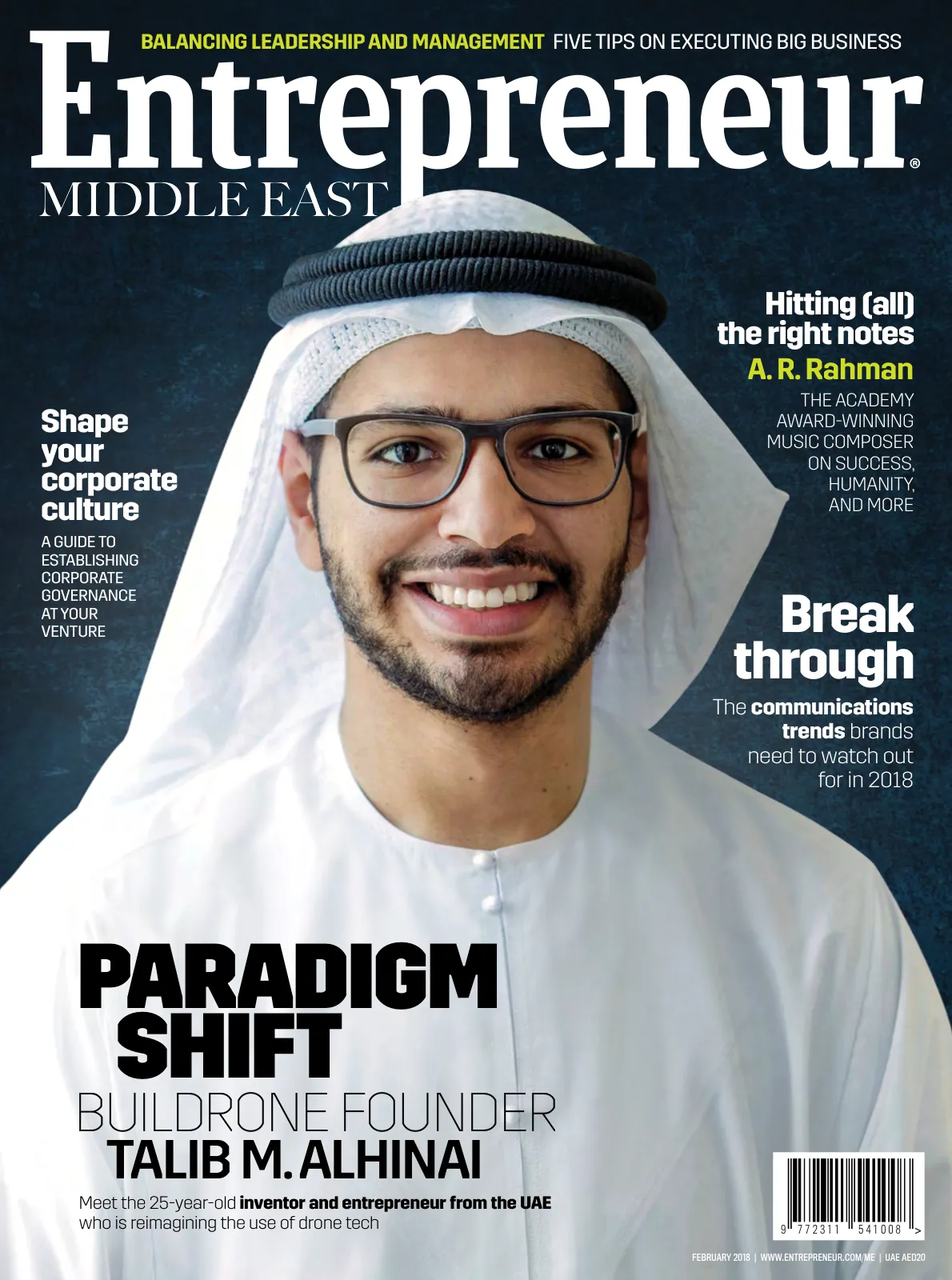
Entrepreneur Middle East, February 2018
Page 1
Balancing leadership and management Five tips on executing big business
february 2018 | www.entrepreneur.com/me | UAE AED20
9
7 7 2 3 1 1
5 4 1 0 0 8
>
Break
through
Shape
your
corporate
culture
Hitting (all)
the right notes
The communications
trends brands
need to watch out
for in 2018
The Academy
Award-winning
music composer
on success,
humanity,
and more
A guide to
establishing
corporate
governance
at your
venture
A. R. Rahman
Paradigm
shift
Buildrone founder
Talib M. Alhinai
Meet the 25-year-old inventor and entrepreneur from the UAE
who is reimagining the use of drone tech
Page 2
www.aljada.com
800-ARADA (27232)
15
min
from Dubai
International Airport
& Sharjah Corniche
5
min
from
Sharjah
International Airport
3
min
from
University
City
Apartments
available to
all nationalities
1 bedroom apartments
starting from AED 533,000*
Special prices and payment plans!
Invest in the lifestyle
destination of tomorrow!
*T&C apply
Located just minutes from Dubai, Aljada is Sharjah’s
largest and most exciting new residential address.
Developed by ARADA, under the chairmanship
of HE Sheikh Sultan bin Ahmed Al Qasimi.
Adjacent to landscaped parks & the largest
entertainment centre in the Northern Emirates.
Direct access to Al Dhaid Road, easy access
to Sheikh Mohammed bin Zayed Road.
Page 3
3
February 2018 / ENTREPRENEUR.COM /
20 H.E. Huda Al Hashimi, Assistant Director General for Strategy and Innovation
at the UAE Prime Minister’s, at the media launch of the UAE Innovation Month
22
Talib M. Alhinai,
founder, Buildrone
22
INNOVATOR:
Paradigm shift
Buildrone founder
Talib M. Alhinai
Meet the 25-year-old inventor
and entrepreneur from the
UAE who is reimagining the
use of drone tech.
70
START IT UP:
ecosystem
Unlocking potential
INJAZ Al-Arab President
and CEO Akef Aqrabawi is
on a mission to enable Arab
youth to drive the region’s
economy forward.
28
INNOVATOR:
Hitting (all) the right
notes
The Academy Award-win-
ning A. R. Rahman on suc-
cess, humanity, and more.
66
MONEY:
ASK THE MONEY GUY
Identifying potential
Kushal Shah, Managing
Partner, Roland Berger, and
one of the founders of Dubai
Angel Investors, explains
how the investment club
works (and how ‘treps can
better their chances at an
investment from it.)
52
‘TREPONOMICS:
MARKETING
Break through
Maha Abouelenein, founder of
Organizational Consultants,
explores the communications
trends brands need to watch
out for in 2018.
80
START IT UP:
Q&A
On a (high) growth trajectory
With a Dubai Expo 2020 con-
tract in the bag, Dany El Eid,
founder and CEO, Pixelbug,
is now getting set to take his
company to its next stage of
growth.
february 2018 contents
Page 4
Page 5
Page 6
Page 7
Page 8
Page 9
800 999 999 I sobha.com
@sobhadubai
LIVE IN THE LARGEST
TOWNHOUSES IN DUBAI
800 999 999 I sobha.com
@sobhadubai
LIVE IN THE LARGEST
TOWNHOUSES IN DUBAI
Page 10
Page 11
Page 12
12 / ENTREPRENEUR.COM / February 2018
78
START IT UP:
Q&A
Tapping into opportunity
Ureed founder and CEO
Nour Al Hassan aims for
her platform to be the
largest marketplace for
Arabic content writers and
translators in the world.
42
TECH:
SHINY
#TamTalksTech
Gadgets and doodads that
you might’ve missed out on,
sourced by a tech aficionado.
36
‘TREPONOMICS:
PRO
A new way to work
Bayt.com’s Suhail Al-Masri
says the work arrangements
you provide to your
employees are going to play
a huge part in their loyalty
towards you, in 2018.
48
CULTURE:
DESIGN
Designs on the future
Dubai Design District
COO Mohammad Saeed
Al-Shehhi firmly believes
that the UAE will realize
its vision to be one of the
world’s most innovative
nations by 2021 by
developing a robust
ecosystem for sustained
innovation.
18
EDITOR’S NOTE
By Aby Sam Thomas
56
‘TREPONOMICS:
PRO
Executing big business
Ahmed Alkhoshaibi, Group
CEO, KBW Investments,
writes on balancing
leadership and management
for a stronger organization.
60
‘TREPONOMICS:
SKILLSET
Happiness matters
Walid Fakih, General
Manager, McDonald’s UAE,
explains four ways to keep
your team engaged (and thus
support your business’ bot-
tom line too).
70
80 Dany El Eid, founder and CEO, Pixelbug
Akef Aqrabawi,
President and CEO,
INJAZ Al-Arab
HP Elite x2 1012 G2
february 2018
contents
Page 13
Page 14
14 / ENTREPRENEUR.COM / February 2018
40
‘TREPONOMICS:
SKILLSET
Social media for social
good
Claire Diaz-Oritz, formerly
the Social Innovation
Manager at Twitter, on
how social enterprises
can boost their digital
presence.
Mona Ataya,
founder and CEO,
Mumzworld
62
56 Ahmed Alkhoshaibi, Group CEO, KBW Investments, writes on balancing
leadership and management for a stronger organization.
50
‘TREPONOMICS:
SKILLSET
Reaching a deal
Horacio Falcão, a Senior
Affiliate Professor of
Decision Sciences at
INSEAD, lists four hurdles
to successful internal
negotiations (and how to
get past them).
32
‘TREPONOMICS:
PRO
Shape your corporate culture
Fahim Al Qasimi, Partner
at Dubai-based corporate
advisory and investment
firm AQ&P, offers a guide
to establishing corporate
governance at your startup.
58
‘TREPONOMICS:
SKILLSET
Ready for the future
Gene Jiao, President, Huawei
Consumer Business Group -
Middle East & Africa, believes
today’s success means
nothing if you’re not already
building for tomorrow (and
the day after).
74
START IT UP:
STARTUP FINANCE
We got funded!
Egyptian startups Elves
and Moneyfellows on how
they convinced investors to
support them in closing their
early-stage funding rounds.
46
CULTURE:
LIFE
A better investment
than bitcoin
If you thought bitcoin is
a hot investment right now,
business coach Murtaza
Manji writes on a better
investment, offering three
reasons backing the
assertion.
40
Claire Diaz-Ortiz at
Turkey Innovation and
Entrepreneurship Week
2017
february 2018
contents
Page 15
Page 16
16 / ENTREPRENEUR.COM / February 2018
SUBSCRIBE
Contact subscriptions@bncpublishing.net to receive
Entrepreneur Middle East every issue
EDITOR IN CHIEF Aby Sam Thomas editor@bncpublishing.net
CEO Wissam Younane wissam@bncpublishing.net
DIRECTOR Rabih Najm rabih@bncpublishing.net
CREATIVE LEAD Odette Kahwagi
MANAGING EDITOR Tamara Pupic
STARTUPS SECTION EDITOR Pamella de Leon
FEATURES EDITOR Sindhu Hariharan
COLUMNIST Tamara Clarke
EVENTS LIAISON Mark Anthony Monzon
PO Box 502511 Dubai, United Arab Emirates
P +971 4 4200 506 | F +971 4 4200 196
For all commercial enquiries related to
Entrepreneur Middle East contact
sales@bncpublishing.net
All rights reserved 2018.
Opinions expressed are solely those of the contributors.
Entrepreneur Middle East and all subsidiary publications in the
MENA region are officially licensed exclusively to BNC Publishing
in the MENA region by Entrepreneur Media Inc.
No part of this magazine may be reproduced or transmitted in any
form or by any means without written permission of the publisher.
Printed by United Printing and Publishing
www.upp.ae
Images used in Entrepreneur Middle East are credited when necessary. Attributed use of
copyrighted images with permission. All images not credited otherwise Shutterstock.
Maha Abouelenein
Ahmed Alkhoshaibi
Suhail Al-Masri
Fahim Al Qasimi
Mohammad Saeed Al-Shehhi
Fida Chaaban
Walid Fakih
Horacio Falcão
Lothar Hohmann
Gene Jiao
Dipika Mallya
Murtaza Manji
Sean McKeon
Freek Vermeulen
CONTRIBUTING WRITERS
www.entrepreneur.com/me
Access fresh content daily on our website!
MIDDLE EAST
EntMagazineME
@EntMagazineME
Entrepreneur-me
EntrepreneurMiddleEast
EntMagazineME
EntMagazineME
EntMagazineME
MIDDLE EAST
In addition to our print edition, we’re bringing
you all sorts of industry news on our web
mediums. Joining us online means getting
relevant business and startup content in
real-time, so you’re hearing about the latest
developments as soon as we do. We’re looking
forward to interacting with our readers on all of
our social media and web platforms- like any
thriving business, we’re looking to give and take.
#TrepTalkME is already happening on all of our
digi platforms, and all good conversations go
both ways. See you on the web!
Page 17
Page 18
18 / ENTREPRENEUR.COM / February 2018
The other day, I was at a startup’s
office, and overhead the CEO of
the young organization talking on
the phone with someone in the
leadership ranks of, well, a larger
and older company, which was op-
erating in the same sector that his
was. (Before any of you tell me that
it’s bad manners to listen in other
people’s phone calls, let me state
for the record that this particular
entrepreneur has a loud, bombastic
voice, and I can assure you that
every one of his employees in the
office that day could hear this con-
versation- or rather, at least one
side of it.) As I heard it, the call
consisted of essentially the entre-
preneur trying to find out why his
fledgling enterprise had been es-
sentially blocked by the larger cor-
porate from competing for a par-
ticular contract or deal from a third
party. It appeared that the older
player had pulled some strings so
as to ensure that the startup would
effectively not be allowed to even
enter the field, much less make a
play for it. Now, yes, I know it’s a
tough market out there, and one
often has to make use of every trick
in the book to gain the upper hand
over their rivals in business, but in
this particular case, I couldn’t help
but feel that the larger enterprise
was not playing fair and was being
unnecessarily petty.
But what caught my attention in
this particular conversation was
the way the entrepreneur conveyed
his feelings on the situation to
the individual on the other end
of the call. Over the course of the
conversation –which was being
done in full view and earshot of his
team- the entrepreneur told his
counterparty that he was fighting
for his chance at the deal not just
as a personal exercise, but for the
people that he had onboard his
enterprise: the deals he secured for
the company translate into salaries
and livelihoods for his small group
of employees. He then proudly
declared that he took the blockade
imposed on him as a sign of his
enterprise’s strength and standing
in the marketplace- there had to be
something he and his small team
were doing right for such a well-
established, deep-heeled company
to resort to such a mechanism to
keep their apparent place at the
helm. Remember, the entire office
was being privy to everything the
entrepreneur said- I could swear
I could see a few of the employees
there straighten up their backs,
as if to both take on their boss’s
apparent badge of honor, while also
getting themselves to work harder
and put more of themselves in to
make their fledgling enterprise soar
higher.
I’m pretty certain that the entre-
preneur didn’t realize the impact
his words were unconsciously
having on members of his team-
which is perhaps what made it
seem all the more sincere, and,
well, nice. He may have lost the
chance to secure a contract- but he
did manage to further secure his
team’s loyalty and trust. And as
we all know, deals may come and
go, but your team is what makes
your enterprise- and this particular
entrepreneur, by keeping his people
on top of all that he does, and being
respectful and conscious of the
work that they do, seems to have
got this concept right.
And the rest of you should follow
suit.
Aby Sam Thomas
Editor in Chief
@thisisaby
aby@bncpublishing.net
Deals come and go, but every lost opportunity is a lesson learned
One for the team
editor’s note
Page 19
Page 20
20 / ENTREPRENEUR.COM / February 2018
UAE Innovation Month aims to invigorate the country’s trailblazers
Fueling progress
“The UAE Innovation
Strategy clearly
defines seven main
sectors for innovation:
space, transportation,
water, renewable
energy, technology,
health and education-
so all of these main
sectors are to be key
players in this.”
H.E. Huda Al Hashimi, Assistant
Director General for Strategy
and Innovation at the UAE Prime
Minister’s, at the media launch of
the UAE Innovation Month
Media launch of the UAE
Innovation Month
IMAGE credit Mohammed Bin Rashid Centre for Government Innovation
in the loop
O
rganized by the Mo-
hammed Bin Rashid
Centre for Govern-
ment Innovation
(MBRCGI), the UAE
Innovation Month seeks to
foster innovation with more
than 1,000 activities across
the nation from February 1-28,
2018. From parks displaying
creative inventions through-
out various cities, to a Google
Innovation Hub launch, and
more, the month-long initia-
tive will hold key events and
competitions to showcase
leading ideas and innovators
across the UAE. As part of
the Year of Zayed, the initia-
tive was also inspired by the
leadership of UAE’s founder,
H.H. Sheikh Zayed bin Sultan
Al Nahyan.
On the initiative’s launch,
H.E. Huda Al Hashimi, As-
sistant Director General for
Strategy and Innovation at
the UAE Prime Minister’s
Office asserted that ow-
ing to the momentum of the
previous years’ innovation-
themed week, this year, it was
extended to a whole month to
give people more time to visit
and interact with activities.
As the event is also held to
support the National Innova-
tion Strategy, H.E. Al Hashimi
noted, “The UAE Innovation
Strategy clearly defines seven
main sectors for innovation:
space, transportation, water,
renewable energy, technology,
health and education- so all of
these main sectors are to be
key players in this.” She added
that there would be a particu-
lar focus on AI, with efforts
to bring in the involvement of
the youth, as well as how the
private sector, be it multina-
tionals or SMEs, would have
their own platforms too.
H.E. Al Hashimi explained
that each Emirate in the UAE
would have its own program,
with an Innovation Truck fol-
lowing the route, which will be
at all of the main gatherings
in each Emirate. What should
‘treps look out for? Students
and tech professionals alike
can join the UAE Hackathon,
a nationwide competition,
held in partnership with the
Telecommunications Regula-
tory Authority, which aims
to use open data to improve
UAE’s economic growth. In
Abu Dhabi, there would be an
Innovation Lab competition,
which will be announced by
H.E. Noura Al Kaabi, Minister
of Culture and Knowledge De-
velopment. In Ras Al Khaimah,
the Seaside Startup Sum-
mit will be held, welcoming
entrepreneurs from across the
world, as well across the GCC.
At the same time, Fujairah
will be holding the Innovation
Race, a competition aimed at
finding ideas to improve local
government services, open to
residents of the city, and with
a winning prize of AED20,000
for first place, AED15,000 for
second place, and AED10,000
for third place. Ajman would
be holding a series of work-
shops on programming and
robotics. In Dubai, the Aero
Innovation Summit 2018
will invite professionals and
entrepreneurs to focus on
the aviation sector, while the
Finnovate event will bring
together Middle East’s fintech
community to highlight chal-
lenges and opportunities in
the sector.
www.uaeinnovates.ae
UAE Innovation Month
Timeline
Abu Dhabi February 1-7
Ras Al Khaimah February 8-14
Fujairah February 8-14
Sharjah February 15-21
Ajman February 15-21
Umm Al Quwain February 15-21
Dubai February 22-28
Page 21
DISCOVER HOW TO ACCELERATE YOUR BUSINESS
Powered by Thomson Reuters, Accelerate SME is the gateway to the
SME ecosystem in MENA; providing access to the resources and solutions
needed to support you at any business stage.
We have joined forces with some of the region’s most powerful financial
and workflow solution providers to service and support your specific needs.
As a member of Accelerate SME you can access a wide range of business
resources including, funding, online community, industry insights, tools
and easy-to-use templates.
ACCELERATE SME
CONTRIBUTE. ENGAGE. GROW.
FIND OUT MORE AT ACCELERATESME.COM
Page 22
22 / ENTREPRENEUR.COM / February 2018
Paradigm
shift
Buildrone founder
Talib M. Alhinai
Meet the 25-year-old inventor and entrepreneur from the UAE
who is reimagining the use of drone tech by Sindhu Hariharan
image credit Talib M. Alhinai
innovator
>>>
I
f you had to name two technological advance-
ments that have radically opened up opportuni-
ties for businesses to embrace the Fourth Indus-
trial Revolution, as well as have the potential to
make a difference to the society at large, it’d be
safe to say that drone technology and 3D print-
ing would make the cut. Well, having assumed
that, what would you then say about an inven-
tion that combines the core of both these technolo-
gies? While the cynic in you may cause to roll your
eyes at the aforementioned description, you should
know that such a product actually exists, and that it
is also currently on the path toward commercializa-
tion as Buildrone, which refers to itself as “an aerial
repair service.” Buildrone is essentially a flying robot,
armed with a 3D printer, which can spot leaks and fix
pipelines from the air in hard to access or hazardous
areas, with its application ranging across sectors like
construction, oil and gas, utilities, to name a few.
But that’s just the beginning: Buildrone aims to push
forward the development of aerial robots capable of
construction-scale 3D printing of entire structures.
That is, imagine a future where a swarm of drones
build your homes and offices, block by block, from
the skies. While Buildrone’s function by itself makes
the enterprise especially relevant for the Arab world,
the region may be further invested in this venture
by learning that this breakthrough innovation that’s
reimagining the use of drone tech is the brainchild of
Emirati inventor and entrepreneur, Talib M. Alhinai.
Page 23
23
February 2018 / ENTREPRENEUR.COM /
Page 24
24 / ENTREPRENEUR.COM / February 2018
image credit Talib M. Alhinai
“The long-term
impact Buildrone
can have in the status
quo would be to
enable drones to be
flying mini-factories,
where they would
fly to a construction
site, work together
to create buildings
from scratch.”
Talib M. Alhinai and his advisor,
Dr. Mirko Kovac, Director,
Aerial Robotics Laboratory
Buildrone is essentially a flying
robot, armed with a 3D printer,
which can spot leaks and fix
pipelines from the air in hard to
access or hazardous areas, with
its application ranging across
sectors like construction, oil and
gas, and utilities.
innovator
As an undergraduate student
of mechatronic engineering (a
combination of mechanical en-
gineering, electronic engineer-
ing, and computer science),
Alhinai admits to have been
enamored with the notion of
building robots that can have a
profound impact on improving
people’s lives, for a long while
now. Raised in Abu Dhabi, and
graduated as a student of the
American International School
in Abu Dhabi in 2010, Alhinai
attributes his earliest interest
in STEM and futuristic tech
to Isaac Asimov’s I, Robot, a
work of fiction to which many
scientists across the world,
owe their initial inspiration.
During his undergrad at the
University of Manchester in
the UK, he chose to pursue his
final year research project in
the subject of haptic teleopera-
tion, a field that recreates the
sense of touch through robotic
manipulators, to aid a human
operator to carry out a task
remotely- as Alhinai puts it:
“Think, a doctor in London
performing surgery via a robot
on a patient in New York, or an
engineer in Houston remotely
controlling a robotic arm of
a rover on the moon.” Sub-
sequently, Alhinai set out to
do his PhD in robotics at the
Department of Aeronautics,
at Imperial College London in
2013. “I particularly liked the
vision that Dr. Mirko Kovac
[his advisor] had for an Aerial
Robotics Lab that he had just
started at Imperial College
London, where he was keen
on the idea of building drones
for humanitarian applications,
particularly at a time when the
word drone had a much more
stronger connotation with war
than it does today,” Alhinai
remembers.
And with its ambitions to
be an aerial robot capable
of construction-scale 3D
printing, Buildrone can well
be perceived as a humani-
tarian project that’s also an
advancement from the current
application of drones. “In
order for drones to be used for
construction tasks, they would
be required to actively interact
with the physical environment
and effectively carry out pick-
and-place tasks when needed,
dictating that the drones need
to be robust to turbulences
and external disturbances,
repetitively and accurately lay
down construction material,
and to incorporate levels of
autonomy and intelligence that
would minimize the need for
human supervision,” explains
a clear and precise Alhinai.
He’s also clearly excited about
the near-term impact of the
patent-pending Buildrone
technology in the infrastruc-
ture industry- as that of a
first-response repair service
in scenarios like leaking gas
pipelines, or to repaint large
structures, or for corrosion
treatment on offshore oil rigs,
among others. “The long-term
impact Buildrone can have in
the status quo would be to en-
able drones to be flying mini-
factories, where they would
fly to a construction site, work
together to create buildings
from scratch,” notes Alhinai,
elaborating on how the product
could be perfect for inacces-
sible sites and those dangerous
for human workers to get to,
and thus alter the state of the
construction industry in this
part of the world.
While the potential impact
of Buildrone for the region
is clearly there to see, as an
entrepreneur yourself (or as
a person closely tracking the
space), you’d agree that the life
cycle from imagining such a
hardware product to seeing it
achieve results, is well, quite
hard. Further, working on
highly technical products such
as Buildrone (the “hard tech”
sector, as it’s often called)
involves greater barriers.
From the whiteboard to the
first prototype to the proof of
concept, the process of seeing
your imagination come alive
is certainly a tedious one for
entrepreneurs, and Alhinai is
no exception. “As a hardware
startup with a goal of 3D print-
ing buildings with drones, one
of the principal challenges we
had during verbal pitches of
our business was that often
times individuals that we ap-
proached thought that we were
3D printing our own drones
rather than 3D printing build-
ings with drones, [and] that
was, and is, to be frank, always
an interesting encounter,” he
says. He also warns entre-
preneurs to accept that many
things can go wrong at any
point in the initial prototypes,
and how he “had to quickly
learn to grow thick skin, and
be patient to be able to perse-
vere in this game.”
Buildrone’s connection with
Page 25
25
February 2018 / ENTREPRENEUR.COM /
“We’re currently
on the path of
commercialization
to deliver
the product
to potential
customers in the
form of an aerial
repair service.”
Talib M. Alhinai presenting
at the 2016 Drones for Good
challenge
Buildrone
‘TREP TALK
Talib M. Alhinai,
founder, Buildrone
Q What is your advice for
aspiring entrepreneurs in
the MENA region?
A “My top three tips for
MENA’s entrepreneurs
would be first to focus on
cultivating their grit- start-
ing a venture is hard, but as
long there is passion and a
perseverance at the core of
their work ethic, then there
is always a way forward.
Second is to get out of
your comfort zone- if you
want to build the business
of your dreams you’ll have
to be willing to give up your
full-time job and putting
those hours instead into
your business.
The third tip would be to
seek out other entrepre-
neurs who are ‘ahead’ of
you (e.g. those who have
already completed their
Series A) for advice, and
as well as others who are
in the same level as you, to
keep each other motivated.”
innovator
>>>
the UAE extends beyond its
utilities or the nationality of
its creator. In February 2016,
Alhinai and his team bagged
the national category award,
winning the AED1 million prize
at the UAE Drones for Good
Award challenge in Dubai, a
forum popular in drone circles
as the “world cup for drones.”
Emerging as winners out
of over 1,000 submissions,
Alhinai’s Imperial College team
won the award for reimagining
the inspection and repair tasks
associated with construction
and oil and gas sector, while
simultaneously achieving time
and cost savings with their
drone. “It was a fantastic
experience from the making
of an entry video at the very
beginning, all the way to being
announced as winners and
meeting His Highness Sheikh
Mohammed bin Rashid Al
Maktoum, the Vice President
and Prime Minister of the
United Arab Emirates, and
being personally presented
with the award,” Alhinai says.
“It was an honor to meet him,
to have had the opportunity to
personally showcase Build-
rone, and share our vision with
him.” The award, he admits,
opened a lot of doors for his
company- from introduction to
new partners to carrying out
pilots with, to being recog-
nized on the global tech stage
as a formidable creation. And
of course, though Buildrone
continues to scale while still
being a bootstrapped enter-
prise, Alhinai says the prize
winnings from the 2016 UAE
Drones for Good Award have
significantly helped them to
keep going without having to
rely on external investors. Post
the victory in the challenge,
Alhinai’s connection with the
local ecosystem also deepened.
He worked with the Dubai
Future Foundation -a body
set up to play a pivotal role in
shaping the future of Dubai-
to help establish community
innovation centers to encour-
age the adoption of robotics
solutions and technologies.
“The involvement then transi-
tioned into joining a two-year
project in August 2016 with
The Executive Office of H.H.
Sheikh Mohammed bin Rashid
Al Maktoum, to accelerate the
entrepreneurship ecosystem in
Dubai which I am still a part
of,” he adds. Alhinai is also
playing a part in nurturing
UAE’s future change makers as
an Ambassador for Shorik, an
initiative launched by H.E. Dr.
Ahmed Belhoul Al Falasi, UAE
Minister of State for Higher
Education, that intends to
connect high school students
interested in studying abroad
with students currently study-
ing at global universities.
And very soon, just like the
Emirati entrepreneur himself,
his startup Buildrone too will
be an integral part of the local
entrepreneurial ecosystem.
The company, which is cur-
rently based in the UK, is also
being relocated to the UAE,
says Alhinai. “We’re currently
on the path of commercializa-
tion to deliver the product
to potential customers in the
form of an aerial repair service.
This service is proposed to
be a drone that would be
deployed to a remote site (e.g.
an oil refinery or steel plant) to
inspect and identify potential
weaknesses in structure
and preemptively carry out
repairs on them before a fault
even takes place,” he adds.
While two pilot projects
with established industrial
partners (“the first with a
large steel manufacturer in
Spain concerning pipeline
leak repairs and a second with
a renewable energy firm in
the UAE concerning cleaning
solar panels”) are currently
Page 26
26 / ENTREPRENEUR.COM / February 2018
underway, the Buildrone
team is also working on their
main goal of 3D printing
buildings with drones. “[We
aim] to develop swarms of
aerial robots that could be
deployed at hard-to-reach
construction sites following
natural catastrophes such as
tsunamis and earthquakes and
autonomously ‘print’ buildings
to serve as temporary housing
solutions and disaster
shelters,” he says.
Alhinai is currently in the
process of transitioning from
London, and he is clear that
he’ll be based in Abu Dhabi
“for the foreseeable future.”
This decision is also guided by
his optimism about the UAE’s
efforts to position itself as a
global hub for innovation, and
desire to be a contributor to
this ambition of his nation.
“The results of the UAE’s
leadership’s efforts to create
a knowledge economy for the
world after oil can already be
seen with a spike in children
and youth interest to take part
in STEM from an early age,
and with Dubai’s burgeoning
reputation as the world’s test
ground for attracting disrup-
tive technology,” he says. He
believes that the way things
are progressing and the en-
trepreneurial success stories
that surround us are clearly
testimonies to the role of
government-sponsored initia-
tives, and “the trickle-down
down effect [they have] on the
rest of society.”
At the same time, the timing
of Buildrone’s migration to the
UAE could not be more fortui-
tous for the country, as well.
It’s no secret that the UAE’s
policymakers harbor ambitious
goals for 3D printing technolo-
gy, and are keen to supplement
this goal with tangible results.
While in 2016, the UAE made
headlines for a 3D printed of-
fice unveiled near the Emirates
Towers in Dubai, H.H. Sheikh
Mohammed also declared at
the time that by 2030,
25% of buildings in
Dubai would be 3D
printed. And to help
the country achieve
this monumental
goal, Alhinai strongly
believes in entre-
preneurs maintain-
ing links with the
academic community,
as “that’s where most
of the innovative ideas
are nurtured.” Thus,
once he’s back in the
UAE, the entrepre-
neur’s short-term
priorities include
publishing the recent results
of his just-concluded research
part of his PhD, and to focus
on continuing to refine the
Buildrone prototype to carry
out aerial repairs.
As for what keeps him stay
steadfastly motivated and
devoted to his not-so-easy
venture, Alhinai says looking
back at the long way Buildrone
has come keeps him going. “It’s
energizing to be recognized for
an idea that was once just a
pet project, and to have seen it
blossom into a business today.
It’s motivation for us to work
even harder, given that we’re
still a long way away from
achieving our vision.” But if
the achievements Alhinai and
Buildrone have realized so far
are any indication, then it’s
safe to say that this Emirati
entrepreneur has an impres-
sive future ahead of him- and
we at Entrepreneur Middle
East are certainly looking
forward to it.
On balancing research
and product development
with the business
management, as an
entrepreneur
“Juggling a PhD at the
same time as starting and
then managing business
was an interesting learning
experience due to the large
gulf in between the two, but
the research skills I gained
during the PhD were largely
transferable which made
the shift into the product
development aspect of
Buildrone much easier. In
terms of managing the
business, those skills had
to be acquired on the go
as and when needed as
we are a team of four and
all of us are fully focused
on research and product
development, but when the
time came to focus on the
business, I was fortunate
enough that the team rallied
around me and supported
me into making that
transition while still keeping
research development
and experimentation as a
primary focus.”
“[We aim] to develop
swarms of aerial
robots that could be
deployed at hard-to-
reach construction
sites following
natural catastrophes
and autonomously
‘print’ buildings to
serve as temporary
housing solutions and
disaster shelters.”
The entrepreneur’s short-term
priorities include publishing
the recent results of his
just-concluded research part
of his PhD, and to focus
on continuing to refine the
Buildrone prototype to carry
out aerial repairs.
Talib M. Alhinai,
founder, Buildrone
Talib M. Alhinai and team winning the UAE Drones for Good challenge
innovator
Page 27
Page 28
innovator
28 / ENTREPRENEUR.COM / February 2018
Page 29
Hitting
(all)
the right
notes
A. R. RAHMAN
The Academy Award-winning music composer on success,
humanity, and more by aby sam thomas
IMAGES COURTESY A.R. RAHMAN
29
February 2018 / ENTREPRENEUR.COM /
I
’ve been an unabashed fan of A. R. Rah-
man for a long while now, and when I say,
“a long while,” I mean that quite literally- I
first came across this Indian artist’s crea-
tions back in 1992, when he composed the
soundtrack for a Tamil movie called Roja.
That album –which, by the way, is now listed
as one of TIME’s “10 best soundtracks” of
all time- signaled the start of Rahman’s journey
in the music industry, which, after more than 25
years, now sees him as an international artist
par excellence with a plethora of awards -the
list includes two Academy Awards, two Grammy
Awards, a Golden Globe, and a BAFTA Award- in
addition to a fan following spread across the
globe. No surprises then as to why I felt tongue-
tied, and quite frankly, star-struck, when I got
to meet with the man dubbed as the “Mozart of
Madras” in January, prior to his headline appear-
ance at The Journey, a concert that was organized
by Brothers Incorporated and staged at Bollywood
Parks, Dubai in the same month. I didn’t get to
spend a lot of time with Rahman, but the few min-
utes that I got to chat with him did offer, I believe,
glances into the psyche that powers this genius.
Success, to this artist extraordinaire, is something
that doesn’t come easily- but Rahman feels that
the road to it starts with one having a steadfast
belief in oneself. “You have to [hold] a mirror to
yourself,” Rahman says. “Look at yourself, and
where you stand with all these people around- are
you standing out? What will make you stick out is
your personality- and hard work. Instant success
never comes. You don’t get success in one day,
two days- it might take two years, three years, 20
years... But come out with a strong personality,
and something to contribute to humanity- and
you’ll be recognized.” >>>
Page 30
innovator
“When you have
put in so much
of your energy
into something,
then that energy
has value. You
have to have
faith, and you
have to keep at it,
consistently...
You may lose hope
[at times]- but
you’ll find a way.”
A. R. Rahman
IMAGES COURTESY A.R. RAHMAN
30 / ENTREPRENEUR.COM / February 2018
Page 31
31
February 2018 / ENTREPRENEUR.COM /
Buildrone
“What will make you
stick out is your
personality- and
hard work. Instant
success never comes.
You don’t get success
in one day [...] But
come out with a
strong personality,
and something
to contribute to
humanity- and you’ll
be recognized.”
A. R. Rahman
A. R. Rahman
innovator
Such a sentiment would
explain what has fueled Rah-
man’s meteoric rise as an
artist, along with his passion-
ate support for a number of
social causes. He started out
as a composer for movies made
in the Southern part of India
(hits include Bombay, Minsara
Kanavu, and Kandukon-
dain Kandukondain), which
eventually led him to enter the
country’s larger Hindi film in-
dustry, Bollywood, as well, and
a string of hits later (landmark
albums include Rangeela,
Taal, Dil Se, and Lagaan), he
soon had a fan following in
all corners of the country. His
success (and impact) in India
got his work to be noticed
overseas as well- the legend-
ary English composer Andrew
Lloyd Webber (of Cats and
The Phantom of the Opera
fame) commissioned him for a
theatrical production, Bombay
Dreams, in 2002, and soon,
Rahman found himself work-
ing on a number of projects in
the West as well. His music
for the Danny Boyle-directed
movie Slumdog Millionaire in
2008 saw him win a slew of
international awards, which
firmly established him as a
musical icon with a global
presence. Rahman’s music
has transcended boundaries,
and links people together in
ways that are, quite simply,
unfathomable- for a frame of
reference, know that Rahman
is the common denominator
in the rendition of an 18th
century Carnatic classic “Alai
Payuthey” (Alai Payuthey)
at, say, a pious wedding in
Chennai, India, and that sound
of Nicole Scherzinger blaring
out “Jai Ho” (Slumdog Mil-
lionaire) at a weekend party
in New York City. For what
it’s worth, his standing in the
global landscape is something
that Rahman is very aware of
(and grateful for), and he does
acknowledge the responsibility
it brings. “It seems like there’s
reason behind all of this stuff,”
Rahman reflects. “When you
see all this turmoil in the
world, you feel like you can be
a voice, like a neutral voice,
through art.”
And this statement serves as
an indication of how Rahman
approaches being a humani-
tarian as well: he has lent his
name to and partnered with a
number of social initiatives,
one of which is The Sunshine
Orchestra, a program that
takes in talented children from
underprivileged backgrounds
in India, and then trains them
in the art of music. This is
just one example though, and
regardless of whether it is a
philanthropic activity or not,
Rahman claims to be driven
by a desire to effect change (of
the good kind) in the world
around him. “What you do
is what you get,” he declares.
“Even if it’s in your mind, if
you intend to do something
good, then there’s a reward
for that. And we should never
underestimate that. Just smile
at somebody- there will be a
reward for it… So, nothing
goes to waste. For one kind
deed, there will be a reward
for that. For one kind thought
about the whole of humanity,
there’ll be a reward for that.”
This is an ethos that has obvi-
ously served Rahman well, and
the rest of us would be wise to
follow in his footsteps- regard-
less of what we set out to do
with our lives. “There should
be a purpose,” he declares.
“Money is not a purpose. Fame
is not a purpose. But humanity
is a purpose.” While Rahman’s
ideas should be inspiring for
all you creatives out there, I’d
suggest the not-so-arty among
you (wannabe entrepreneurs
with dollars in your eyes, I’m
looking at you) to also take his
words to heart. As for those
of you dreaming of replicating
the success that Rahman has
achieved, Rahman says that
your road to it begins with
you knowing yourself, and un-
derstanding what makes you,
well, unique. Of course, this is
easier said than done, and yes,
you will need a while to come
to this realization. “To get that
special instinct that you’ve got
something which nobody else
has, it takes time,” Rahman
says. “It’s a big shift. You need
to first convince yourself- you
need to deliver something, and
show yourself [that you can do
it]. When you get that internal
coin drop, then it’s easy. You
then have to show what you
have to likeminded people,
and then slowly, everything
will come together.” This may
sound simplistic, sure, but I,
for one, find it hard not to be
taken in by Rahman’s child-
like, but intense, belief in this
premise. “When you have put
in so much of your energy into
something, then that energy
has value,” he says. “You have
to have faith, and you have to
keep at it, consistently… You
may lose hope [at times]- but
you’ll find a way.”
Page 32
32 / ENTREPRENEUR.COM / February 2018
Shape
your
corporate
culture
W
e often use terms that draw parallels to sports
when discussing startups- expressions like
MVP and key man risk are commonplace in
startup spaces, for instance. With this being the case,
here’s a new sporting term we at AQ&P advocate
should feature more often in entrepreneurial
discourse: the corporate governance playbook.
by Fahim Al Qasimi
A guide to establishing corporate governance at your venture
[The how-to]
‘TREPONOMICS ETHICS | ESQUIRE GUY | SKILLSET | MARKETING | PRO
32 / ENTREPRENEUR.COM / February 2018
Page 33
33
February 2018 / ENTREPRENEUR.COM /
The structure of your board of
directors should be a core part of
your business planning process.
From the outset, you should think
about the ideal size, diversity, and
independency of your board.
‘TREPONOMICS
ETHICS | ESQUIRE GUY | SKILLSET | MARKETING | PRO
>>>
THE WHY
Three reasons why
your startup needs a
corporate governance
playbook
Corporate governance is
often misunderstood. It is
not, as most entrepreneurs
believe, a practice reserved
for large multinationals
and publicly listed firms.
It is not a science, nor is it
something that is complex to
implement.
When working with en-
trepreneurs, we describe
their corporate governance
playbook as a document
that identifies the roles,
authority, and timing in key
business decisions between
shareholders, directors and
the CEO. It is an important
aspect of your enterprise,
and here’s why you should
focus on corporate govern-
ance at the outset of any
venture:
1/ It manages complex
decision making
Startups are just as complex
as large multinational
firms, albeit in a different
fashion. Founders are often
the CEOs of their venture,
they also hold shares, and
sit on the board of directors.
Many angel investors will
also require a board seat to
oversee their investment. If
you have raised funding from
venture capital firms, then
you will need to manage their
interests in the shareholding
structure, the composition
of your board, and the role
of the CEO. As your startup
grows, the interplay between
these three levels requires
active management. The
responsibilities, authority
levels, and timing of
decision-making need
detailing. Your playbook
should outline when
meetings occur, what
decisions require board
approval, and the structure
of your board of directors.
2/ It saves you time Anyone
that has been involved in a
startup knows that decisions
need to be made quickly.
Your ability to maneuver
and take swift decisions can
make or break your strategy.
One of the hardest things to
hear from a board member
or shareholder is: “Why was
I not told about it?” Or:
“Let’s discuss this at the
next board meeting.” Clearly
laying out the authority
matrix of your business,
and the timing and subjects
of your board meetings in
advance can shape a corpo-
rate culture that not only
empowers CEOs, but deline-
ates accountability when
the tough decisions need
to be made. Sketching your
playbook and agreeing on it
in advance can save you time
in the long run.
3/ It promotes investor
confidence As an inves-
tor, a corporate govern-
ance playbook is one of the
first things I ask to see at a
startup requesting fund-
ing. Seeing a well laid out
approach to accountability,
responsibility, and timing of
decisions between share-
holders, boards of directors
and the CEO gives an inves-
tor clarity and confidence
on the structure of your
venture. Understanding how
the board is composed, the
process of appointment, and
how votes are dealt with
answers a lot of unknowns
before shareholder agree-
ments are negotiated. A clear
way to differentiate your-
selves from other startups
and impress investors is to
be proactive and share your
playbook with them.
Getting started with your
playbook is not a difficult
task. Think about the major
decisions that your startup
may face in the long run, and
highlight the way in which
the three levels will engage
to overcome challenges. Cor-
porate governance playbooks
are not static documents,
and they will continue to
evolve as your startup grows.
Liken yourself to a coach of
a sports team, and the effort
that he puts into making his
playbook. I personally often
use sailing to draw parallels
to corporate governance: if
your sailboat is your startup,
then your corporate govern-
ance playbook clearly lays
out the relationship between
your stakeholders before
race day. When you go out
onto the racecourse for your
fiscal year, you can concen-
trate on what CEOs need to
focus on, which is, steering
the ship.
THE WHAT
The basics on picking
your dream team of
directors for your board
You have a startup, you are
about to raise funding, and
now you have been told that
you need a board of direc-
tors to ensure that you have
sound corporate govern-
ance. As an advocate of good
corporate governance and
having structured boards
for many entrepreneurs in
Dubai, here is a step-by-step
guide to building a board for
your startup.
Do I need a board of direc-
tors? You need a board of
directors. Your board is
appointed to represent the
interests of the sharehold-
ers and if you are raising
funding, a prudent investor
will demand a seat at the
board level. If you structure
your board with value in
mind, you should have ac-
cess to a diversified group of
experts that guide through
your journey of building the
business.
When do I need a board?
The structure of your board
of directors should be a
core part of your business
planning process. From the
outset, you should think
about the ideal size, diversi-
ty, and independency of your
board. The way in which
you structure your board
can echo some of the values
and business aims of your
venture. An odd number of
directors is commonplace,
and we recommend five as a
minimum; so plan on filling
the seats as you get closer to
launching the business.
Who should sit on the board?
This is the hardest part of
the exercise. In AQ&P, we
use a framework to assess
the effectiveness of a board-
with three of the five tenets
focused on structure. They
are proportionality, inde-
pendency and diversity.
Proportionality encourages
a high percentage of non-ex-
ecutive directors [those that
do not have a day-to-day
role operating the business]
and the separation of roles
between the board of direc-
tors and the CEO. This is the
most basic form of checks
and balances in building an
effective board.
Independency is key to
good corporate governance,
Page 34
34 / ENTREPRENEUR.COM / February 2018
so if you fill your five seats
with investors and found-
ers, you lack an objective
viewpoint that independent
directors bring to the table.
We encourage startups to
have 80% of the board as
independent directors. In
addition, your corporate
governance playbook should
have a disclosure process for
conflicts of interest.
Diversity is something
we advocate for with pas-
sion. Gender balance and a
diverse group of skillsets can
make or break the corporate
governance effectiveness of
a business. The world’s big-
gest businesses ensure that
diversity is a key value in
their corporate governance
playbook.
How do I remunerate the
board? Remunerating the
board is important, espe-
cially with independent
directors. Not only does it
incentivize them to deliver,
but paying an independent
director can be more cost-
effective than hiring a team
of consultants to support
your strategic goals. How
much you ask? Think of the
size of your business, the
time invested and bench-
mark your peers- it is that
simple.
At AQ&P, we coach busi-
nesses on building an effec-
tive board and encourage
a comprehensive feedback
process to ensure that your
directors are delivering
what you need. If you have
decided to improve your
corporate governance prac-
tices and don’t know where
to start, seek advice or ask
other founders if they would
be interested in a board
seat; you would be surprised
at the value that can bring
to your startup. Your all-star
picks could be the entrepre-
neurs down the street.
THE HOW
Three tips to make
the most out of your
company’s board of
directors
There are two distinct
emotions associated with
board meetings- it’s either
excitement or dread. As an
entrepreneur, your board
of directors should be your
biggest asset, and prepar-
ing for a board meeting
should be an exciting time
for your business. Using
sound corporate governance
practices can create value
in your relationship with
directors. Here are a few tips
to manage this important
relationship.
1/ Meet with your board
regularly Your corporate
governance playbook (or
guidelines) should dictate
the number of board meet-
ings you have per year. I
recommend quarterly meet-
ings as a minimum, but it is
common to meet up to six
times a year for startups.
Scheduled far in advance,
this ensures that you assess
performance regularly, and
that your directors commit
their time to supporting the
business.
2/ Meet with directors
separately If you have struc-
tured your board with value
in mind, then you should
have access to a diversi-
fied group of experts to call
on. Each director should be
appointed on the value that
they bring to the business.
CEOs should make a habit of
reaching out to them sepa-
rately when their expertise
is required. Do not hesitate
to have meetings with direc-
tors individually leading
up to board meetings to
get guidance and feedback.
Some entrepreneurs have to
manage the “eager director”
that wants to meet more
regularly (such as weekly
calls, monthly catch-ups).
While this can be challeng-
ing to manage, your corpo-
rate governance playbook
should highlight the role,
authority and timing of key
decisions in the business. A
well laid out playbook can
help you respond to an eager
director by saying, “Let’s
save our discussions for the
board meeting.”
3/ Board meetings should
be quick I cannot reiterate
enough how important it
is to keep board meetings
short. By sharing the infor-
mation and presentations
in advance, directors can
review it, and their feedback
can be incorporated before
you meet with the entire
board. Your board meetings
should focus on approvals
and critical discussions.
It is common to meet with
directors individually
before board meetings to
run them through the key
points. A well-structured
agenda, briefing directors
and focusing on the key
issues will keep directors
engaged. Another important
aspect to incorporate into
your corporate governance
playbook is committees. If
certain subjects are recur-
ring themes in your board
meetings [remuneration or
audit for example], it may be
useful to establish a com-
mittee that meets more of-
ten and reports to the board.
This structure can help
manage conflicts of interest
[a managing director and re-
muneration for example], as
well as give you the ability
to bring in external support
with specific committee
requirements.
Corporate governance and
board meetings should not
be a chore, nor a box ticking
exercise. If you have selected
your directors with value
in mind, then your role
should focus on making the
most of the time you spend
with them. When time is an
increasingly expensive com-
modity, you want to wel-
come time with your board
with excitement, not dread.
Fahim Al Qasimi is a Partner at AQ&P, a Dubai-based corporate advisory and investment firm. AQ&P plays an active role in advising large
corporates and SMEs on corporate governance, market entry, mergers and acquisitions in the UAE. As an advocate for strong corporate governance
in SMEs, Fahim has spoken on the importance of addressing corporate governance at the outset of any venture. He believes that strategic advisory
is not reserved for large conglomerates, and has worked with startups and SMEs as a strategy consultant. www.aqandp.com
paying an independent
director can be
more cost-effective
than hiring a team
of consultants
to support your
strategic goals.
‘TREPONOMICS ETHICS | ESQUIRE GUY | SKILLSET | MARKETING | PRO
Page 35
Page 36
36 / ENTREPRENEUR.COM / February 2018
a new way
to work
In 2018, the work arrangements you provide to
your employees are going to play a huge part
in their loyalty towards you by Suhail Al-Masri
the days of rigid
nine-to-five
office work
are becoming
increasingly
antiquated
and flexibility
of hours and
work options is
becoming more
prevalent.
Remote work is
definitely a prevalent
trend and one of the
key characteristics of
the rapidly morphing
21st century work
environment.
‘TREPONOMICS ETHICS | ESQUIRE GUY | SKILLSET | MARKETING | PRO
I
t is a staple of this time of the year to talk about new
trends, future resolutions, and big changes. However,
preferred work arrangements require near constant
observation and care. Unhappy and unmotivated
employees are less likely to be loyal to their workplace
and seek alternative employment. Seeing as loyalty
and retention comes at a price, this is one of the most
elementary reasons for continually assuring that you, as an
employer, are doing your best to provide for your employees.
In the past decade, increased technological
penetration and the advent of social media
has hugely altered various aspects of our
daily lives. This has caused the lifestyles
and priorities of professionals to evolve
both globally and in the Middle East and
North Africa (MENA) region, and, in turn,
has morphed the professional landscape
as well. In current times, instant connec-
tivity, gratification and action is not only
possible, but expected.
Seeing as companies are always on
the lookout for the best new practices
for attracting and retaining top talent,
it is only natural that, when new
regional preferences become apparent,
reassessment and adaptation are
taking place. However, it is difficult
to pin down the collective thoughts of
millions of professionals across a vast and
culturally diverse region. Additionally,
while communication is a highly valued
aspect of every workplace, it might be
difficult for employees to reach out and
demand provisions that are still somewhat
unconventional from their employers, such
as remote work options.
For such reasons, many companies struggle
to pinpoint the most effective workplace
arrangements for their employees and could
risk being left behind as the rest of the mar-
ket gets swept up in a storm of trends. So,
what should companies be wary of as they
investigate their success at keeping existing
employees satisfied and potential employees
interested?
The big prize
When discussing the key drivers of attracting
top talent, maintaining employee engagement
and morale, and increasing employee loyalty,
there are many factors that come into play.
These factors are vital because they assist
in developing the best practices and strate-
gies to secure top talent, drive employee
engagement and ensure that every employee
is motivated enough to contribute positively
to the company. This is especially crucial
for startups that are yet to formulate their
employer brand and fully define what their
workplace and culture are all about.
In order to identify the priorities of profes-
sionals in the Middle East, a recent poll
conducted by Bayt.com entitled Preferred
Work Arrangements in the MENA, December
2017, revealed that the foremost priority
in selecting job opportunities is salary and
compensation, as cited by 41% of respond-
ents. This is unsurprising as salary is a factor
universally acknowledged to attract talent
and drive motivation. In fact, the poll further
revealed that nearly 9 in 10 respondents
claimed that they would be willing to work
beyond their prescribed work hours and
responsibilities in return for appropriate
compensation. Additionally, when asked if
they were willing to travel for work, 82.8%
of respondents stated they would do so as
long as they were compensated for it.
As such, it is evident that compensation
continues to be a remarkable motivator when
it comes to employee motivation and engage-
ment. It is also worth noting that 74.6% of
professionals would consider relocating for
employment, compared to less than a fifth
(17.4%) who claim that their willingness to
relocate is dependent on the country, while
only 6.2% of professionals are entirely un-
willing to relocate for work.
Page 37
37
February 2018 / ENTREPRENEUR.COM /
professionals in the MENA
region seem to desire the
stability of a full-time
job with a fixed-duration
contract balanced with
the independence and
freedom of flexible hours,
room for growth and
remote work options.
‘TREPONOMICS
ETHICS | ESQUIRE GUY | SKILLSET | MARKETING | PRO
>>>
Job security over company size
Besides monetary incentives, there
are other factors that were arguably
taken for granted in the past and
have recently emerged with greater
significance in the workplace. At
a cursory glance, details such as
a preference for larger or smaller
companies, full-time or part-time
work and professional benefits or
caveats may appear to boil down to
individual preference and, as such,
may sometimes exist outside the
control of companies seeking to
attract top talent.
Nonetheless, one of the key findings
of the Bayt.com poll, Preferred Work
Arrangements in the MENA, was that
a staggering majority of 74.2% of job
seekers would prefer working for a
“large or multinational” company
rather than a “small or medium-
sized” company or a startup (11.2%).
While this assertion may seem like
bad news for smaller companies and
startups, it must be remembered that
preferences for work arrangements
reflect the ever-evolving priorities of
employable adults in any given region.
Generally speaking, large or multina-
tional companies are seen as being
more established, stable and secure,
and as being equipped with the right
revenue to ensure the fulfilment of
their employees’ desires for work ar-
rangements.
However, size is only a surface issue
and employers of smaller or medium-
sized companies as well as startup
businesses can circumvent this road
block by emphasizing their ability to
provide the highly sought-after job
security and by incentivizing hir-
ing with non-monetary benefits and
compensation.
A major incentive when choosing
job opportunities is the provision
of stability and job security. When
looking at preferences in the nature
of work, the results revealed 9 in 10
respondents mostly want to have full-
time work instead of part-time (1.9%)
or freelance (1.9%) work. A trend
of preferring low-risk arrangements
with higher chances of job stability
is apparent from the aforementioned
data. This is further evidenced by the
reasons given for preferring full-time
work with nearly half (48.3%) of re-
spondents citing “job security” as the
primary advantage of full-time work.
This was followed by “better career
growth prospects” cited by 26.6%
of respondents, “stable source of
income” (15.7%) and, finally, “greater
ease in communicating and complet-
ing work” (9.4%).
In addition, career growth has been
proven to be of incredible necessity to
MENA professionals in general. In the
Bayt.com poll, On-the-Job Training
in the Middle East and North Africa,
October 2017, the findings revealed
that a majority (85%) of professionals
would leave their current jobs for bet-
ter training and career development
opportunities elsewhere. This senti-
ment is echoed once more in the
Bayt.com Preferred Work Arrange-
ments in the MENA Poll, wherein
career growth and training emerged
as the second-most valued attribute
when looking at job opportunities at
23%, right after salary. With this sta-
tistic in mind, the provision of career
growth opportunities by employers,
irrespective of the company’s size, is
an imperative incentive of attracting
and retaining top talent.
Autonomy demanded
While it is clear that the majority of
professionals in the MENA region
prefer full-time work, they are still
seeking a degree of flexibility when
it comes to their preferred work ar-
rangements. The results revealed that
more than 8 in 10 MENA professionals
would prefer to work for a company
that provides “flexible hours.” Further
cementing the observed trend of
desiring flexibility in work, 79% of
respondents stated that they would
prefer working for a company with
‘remote work’ options.
Remote work is definitely a prevalent
trend and one of the key characteristics
Page 38
38 / ENTREPRENEUR.COM / February 2018
When asked of
the advantages of
freelance work, two-
thirds of respondents
cited “flexible hours”
as the main benefit,
followed by “more
independence and
control over work”
(16.5%), the ability to
“explore more career
options,” (14.2%) and
“more control over
income” (2.5%).
Suhail Al-Masri is the VP of Employer Solutions at Bayt.com, the #1 job site in the Middle East with more than 40,000 employers and over 30,600,000
registered job seekers from across the Middle East, North Africa and the globe, representing all industries, nationalities and career levels. Masri has more
than 20 years of experience in sales leadership, consultative sales, account management, marketing management, and operations management. His
mission at Bayt.com goes in line with the company’s mission to empower people with the tools and knowledge to build their lifestyles of choice.
This shift from
working at
home being seen
as unusual to
being something
desirable tells
of the modern-
day MENA
professional’s
desire for
flexibility,
independence and
autonomy.
‘TREPONOMICS ETHICS | ESQUIRE GUY | SKILLSET | MARKETING | PRO
between the flexible and fixed in their own
companies in order to drive employee morale
and increase happiness and productivity in
the workplace.
Bear in mind that the conversation about
how the workplace will need to evolve to
make way for present and future needs is
already happening all across the working
world, and if it hasn’t happened in your
organization yet, then it probably will very
soon. It is very likely that companies that do
not get on the bandwagon of offering flexible
hours and remote work options will get left
behind and lose out on great candidates
seeing as the majority of professionals hold
flexibility in high regard.
On a final note, data on the preferences
and priorities of employable adults can and
should be armed by organizations seeking
to increase their attractiveness to potential
employees and drive employee loyalty. Many
companies have already taken steps to break
from the rigid constraints of the traditional
workplace, opting for web conferences that
do not require physical presence to partici-
pate, remote work options such as working
from home some days of the week, or flexible
hours instead of the draining nine-to-five
routine. There is no reason to stop there,
either. Technology and connectivity has
made it so that there are dozens of new ways
to perform old, routine tasks much more
effectively. By getting creative with the facts
and finding a middle ground that suits every-
one, the workplace can become tenfold more
productive and efficient.
of the rapidly morphing 21st century work
environment. It has been observed over
the past few years that the days of rigid,
nine-to-five, cubicle-constricted office
work are becoming increasingly anti-
quated and that flexibility of hours and
work options is becoming more prevalent.
This is also indicative of another current
trend, which is that in place of creating a
work-life balance, a concept which hinges
on a healthy separation of the professional
and personal aspects of an individual’s
life, more and more individuals are seek-
ing work-life integration. That is, a new
concept describing the intertwinement of
work and life, something that is projected
to be the future of the working world.
This shift from working at home being
seen as unusual to being something desir-
able tells of the modern day MENA profes-
sional’s desire for flexibility, independence
and autonomy. When asked of the ad-
vantages of freelance work, two-thirds of
respondents cited “flexible hours” as the
main benefit, followed by “more independ-
ence and control over work” (16.5%), the
ability to “explore more career options,”
(14.2%) and “more control over income”
(2.5%).
A new balance: fixed and flexible
The perceived perks of freelance work
and the observed trend of desiring flex-
ibility are contrasted by the vast major-
ity (84.4%) of professionals preferring
to have an employment contract with a
specified duration when seeking new em-
ployment. Additionally, when asked what
type of working environment they desire,
nearly two-thirds (64.9%) of respondents
reported that they prefer working indoors
at a desk, while only 14.5% claimed to
prefer working outdoors at different sites.
The remaining fifth (20.6%) cited no
preference on where they work.
What we can posit from this data is that
while flexibility is becoming increasingly
significant at a rapid rate, professionals
in the MENA region seem to desire the
stability of a full-time job with a fixed-
duration contract balanced with the inde-
pendence and freedom of flexible hours,
room for growth and remote work options.
It would appear, then, that a worthwhile
practice for employers in the region
to consider is introducing the balance
Page 39
Page 40
40 / ENTREPRENEUR.COM / February 2018
Social media for social good
Claire Diaz-Ortiz, formerly the Social Innovation Manager at Twitter,
on how social enterprises can boost their digital presence
by Pamella de Leon
Claire Diaz-Ortiz at Turkey Innovation
and Entrepreneurship Week 2017
IMAGE credit Turkey Innovation and Entrepreneurship Week
‘TREPONOMICS ETHICS | ESQUIRE GUY | SKILLSET | MARKETING | PRO
C
hange the
world with one
tweet- that was
the subject of
Claire Diaz-
Ortiz’s speech
at the Turkey Innovation
and Entrepreneurship Week
2017, which was held in
December 2017 at Istanbul.
During her talk, Diaz-Ortiz,
who was formerly the Social
Innovation Manager at Twit-
ter and currently advises
social enterprises on their
social innovation strategies,
noted how her passion for
creating social impact was
what has been driving her
career ahead- even her role
at Twitter was a result of
this. In 2005, Diaz-Ortiz
was in Kenya, where she
was looking to initiate an
after-school program for an
orphanage, which eventually
resulted in the creation of a
non-profit organization. At
the time, in her bid to help
raise funds for the orphan-
age, Diaz-Ortiz started a blog
on Blogger.com, a blog-pub-
lishing service that was co-
founded by Evan Williams,
who was then also launching
a new social media platform
called Twitter. “They found
[the] blog, started promot-
ing it, and said, ‘Hey, we’re
starting this new tool called
Twitter, why don’t you try
it?’” Diaz-Ortiz remembers.
“I tried it- it worked. I was
connected with early jour-
nalists, with early donors,
with people interested in
orphanage children in East
Africa. Twitter was my por-
tal to the world.” One thing
led to another, and Diaz-
Ortiz soon found herself
working at Twitter, where
she led initiatives like Twit-
ter for Nonprofits, and Twit-
ter Ads for Good. She has
since authored eight books
(including Twitter for Good
and One Minute Mentoring),
and following her departure
from Twitter, Diaz-Ortiz
has become an advisor for
several social enterprises
around the world.
According to Diaz-Ortiz,
social innovation is today
prevalent across the globe-
when she wrote Twitter
for Good, most of the case
stories mentioned were
US-based, as international
stories were difficult to find
at the time. That’s wholly
different to the current state
of affairs, with Diaz-Ortiz
noting that today, there
are fewer opportunities for
innovation in this space
in “developed markets,”
with emerging markets now
taking the lead in using
platforms like Twitter in in-
ventive ways. As an example,
Diaz-Ortiz points toward a
health program in Rwanda
that helps provide basic
health resources to people in
rural areas by responding to
issues, questions and medi-
cations requests through
Twitter. “In Silicon Valley,
you don’t have the same
type of need, so I think that’s
really the biggest change,”
Diaz-Ortiz says. But social
entrepreneurs in emerging
markets have challenges
unique to them as well.
“Let’s say you were in Ka-
gali, Rwanda, [so] you have
to do really well in Kagali
before you can do anything
else,” she explains. “And the
challenge is that the cultural
differences across borders
are really extreme. I think
emerging markets do have
a big challenge, because it’s
about capturing your mar-
ket, and then expanding.”
With that being the case,
the importance of social en-
trepreneurs having a digital
presence cannot be under-
stated, Diaz-Ortiz says. “The
biggest [advice I can give]
for a social entrepreneur
trying to make an impact is
to realize that you are your
brand, you are the brand,
and your brand is digital.”
For early-stage ventures,
they may not have many
marketing channels at their
disposal, but what they do
have, Diaz-Ortiz asserts, is
the opportunity to create a
blog, get on LinkedIn, create
a Twitter post, and publish
on Facebook: “They have
these abilities to create [a]
platform, and influence
[their intended audi-
ence], and they should go
do it, and go after it.” It’s a
considerable advantage for
social entrepreneurs, but
Diaz-Ortiz notes that it is
one they often miss leverag-
Page 41
41
February 2018 / ENTREPRENEUR.COM /
Does influencer
marketing actually
work? If you find yourself
asking this question often,
this recent survey of 1,000
UAE residents commissioned
by Middle East Public Rela-
tions Association (MEPRA)
and conducted by YouGov,
may offer a perspective.
Personalized word-of-mouth
still remains one of the most
valuable marketing tool
even in today’s digital age,
with 84% of those polled
saying they trusted “face-
to-face recommendations of
products and services from
friends and family.” Where
does that leave social media
influencers? Well, only 39%
of respondents said they
trust online recommenda-
tions from social media
influencers or people with
large followings. Further,
looking at the aspect of trust
in media, the survey found
that trust in print publications
(newspapers and magazines)
ranked highest at 48%, fol-
lowed by radio and television
(44% rating). Blogs emerged
as the least trusted source of
information in the survey at
39%. As for trust in advertis-
ing, the most trusted formats
were found to be television
and billboards (both at 45%),
followed by radio (41%), and
online (social media) coming
in lowest at 37%. As perhaps
one of its key finding, the
study finds that over half of
respondents (57%) said they
trust advertising less today
than they did five years ago,
leading the survey to deduce
that purchase decisions
continue to be guided by
personal relationships and
recommendations even in the
digital media age.
www.mepra.org
When it comes to branding, who do we trust?
A MEPRA survey throws some light on the topic
Trust issues
“The biggest [advice
I can give] for a
social entrepreneur
trying to make an
impact is to realize
that you are your
brand, you are the
brand, and your
brand is digital.”
IMAGE credit MEPRA, YOUGOV
ing upon. “I talk to brands
and social enterprises often
who have very little online
presence, and I just think it’s
such a waste of opportunity
[to be] a market leader in
a small niche [as] a social
enterprise. Essentially, the
first thing you should try to
capture is the online mar-
ket.” While creating content
and being on platforms such
as Twitter and Facebook is
vital, Diaz-Ortiz states that
creating long forms of con-
tent -whether on Medium or
LinkedIn or your own site-
and also video (“Snapchat is
a huge opportunity”) should
be leveraged to build one’s
influence. “Wherever you
think you can create con-
tent, you should be making
content.”
With various enterprises
trying to make a distinct
mark online, Diaz-Ortiz
observes that a common
mistake social entrepre-
neurs make is aligning
with influencers for their
brand- which Diaz-Ortiz
says is helpful over time
when you’re trying to build
a relationship; however, it’s
more indispensable to build
one’s own community who
“already care about what you
do, or active customers who
already are about what you
do, and [as you] do both of
those strategies at the same
time, the more likely you will
be [able] to build a presence
and have an impact.” On
the subject of influencers, I
asked her thoughts on how
some individuals and brands
portray influence by buying
followers to display engage-
ment. Her response: “That’s
just not the right strat-
egy- the strategy really isn’t
about followers.” Diaz-Ortiz
encourages social ‘treps to
focus on engagement than
follower numbers, keeping in
mind how every platform has
different algorithm settings.
“What happens on social
media is, we follow the peo-
ple we believe in, typically,”
she says. “Everyone’s living
in separate bubbles, thinking
that what they think is what
everyone else thinks.”
So, with such filter bubbles
in the picture, alongside
fake news, bots and pseudo
influencers, how can social
entrepreneurs go about
measuring the impact social
media has on their enter-
prises? Diaz-Ortiz maintains
that now more than ever, a
social media strategy’s KPI
has to be based on real life.
“If you’re looking at a social
enterprise trying to sell sani-
tation resources in Nairobi,
the KPI shouldn’t be about
their number of Facebook
followers, or the engagement
on a particular post,” she ex-
plains. “It needs to be about
the number of sanitation
trucks that are dispatching
each day.” But, at the end of
the day, Diaz-Ortiz remains
optimistic (and adamant)
about social media’s altru-
istic capabilities. “I know
the story of technology,
and the story of technol-
ogy is you build something,
some people use it for good,
some people use it for bad,”
Diaz-Ortiz says. “And some
people [will] keep using it
for good. So, I do think social
media is a tool for good. I
think we’re going through
[a] rough time, but we will
come out the other end, and
the truth, the good, will rise
to the top.”
Page 42
42 / ENTREPRENEUR.COM / February 2018
Gadgets and doodads that you might’ve missed out on, sourced by a tech aficionado.
Yes, it’s okay to want them all… and no, it’s not our fault.
Built for business
HP Elite x2 1012 G2
IMAGES COURTESY: hp, lg, whirlpool
HP Elite x2 1012 G2
HP Elite x2 1012 G2
Fitbit Ionic includes a new swim exercise mode as the device is water resistant up to 50 meters
tech SHINY | WEBSITE TO WATCH | GEEK | MOBILE TECH | ONLINE ‘TREP | THE FIX
HP’s new premium
commercial device, the Elite
x2 1012 G2, combines power
and portability into a sleek
2-in-1 design. It’s powered
by 7th generation Core-I
processors and has up to 16
GB of RAM, which quadruples
the storage of the first
generation Elite x2. It offers
advanced security features,
up to 10 hours of battery life
and fast charging, giving you
up to 50% battery life in just
30 minutes. The device is
both touch and tap enabled
and works with an HP Active
Pen, which allows you to
write on the device naturally
or launch an app. The Elite
x2 1012 G2 is just as beautiful
as it is functional. At about
8mm, the device is as slim
as a #2 pencil. Its sturdy and
elegant metal frame supports
a 12.3-inch display with
bonded Corning Gorilla Glass
4. Between the Collaboration
Keyboard with built-in audio
and high-resolution cameras,
there’s so much to love about
the Elite x2 1012 G2.
Page 43
43
February 2018 / ENTREPRENEUR.COM /
#TAMTALKSTECH Tamara Clarke, a former software development professional, is the tech and lifestyle enthusiast behind The Global Gazette, one of
the most active blogs in the Middle East. The Global Gazette has been welcomed and lauded by some of the most influential tech brands in the region.
Clarke’s goal is to inform about technology and how it supports our lifestyles. See her work both in print regional publications and online on her blog
where she discusses everything from how a new gadget improves day-to-day life to how to coordinate your smartphone accessories.
Visit www.theglobalgazette.com and talk to her on Twitter @TamaraClarke.
Come clean
Whirlpool 6th SENSE Dishwasher
Look smart
LG Styler
LG Styler
Whirlpool 6th SENSE
Dishwasher
LG Styler
tech
SHINY | WEBSITE TO WATCH | GEEK | MOBILE TECH | ONLINE ‘TREP | THE FIX
Smart home devices that are
truly smart, save time, money
and natural resources. Whirl-
pool masters this trifecta with
its new 6th SENSE PowerClean
Dishwasher. The appliance
makes a daily chore efficient
by cleaning more dishes at a
time using less power and wa-
ter. Its foldable racks accom-
modate any shaped dish and
up to 13 place settings. You
can also load pots and pans
vertically facing the jet sprays
to make space for 10 extra
plates. 6th SENSE has 28
powerful jet sprays and Pow-
erClean technology that uses
intelligent sensors to detect
the level of soil and adjust the
water pressure to clean dishes
with the lowest possible water
consumption. Thanks to its
revolutionary water recycling
system, 6th SENSE uses only
six liters of water per cycle
when the ECO setting is used.
And it doesn’t stop there. Once
the dishes are clean, the drying
process begins. The PowerDry
function achieves ultimate
drying results, even on plastic
items, thanks to its innovative
3D airflow drying system. It’s
a completely closed drying
circuit that works by using the
steam from inside the dish-
washer to condense and drain
away water left on dishes.
Using the Normative ECO50
setting, you can save up to
20% of energy when drying.
Whirlpool asserts that with the
6th SENSE dishwasher you
can enjoy up to 50% savings
on energy, water and time.
The new LG Styler allows you
to essentially dry clean your
clothes from the comfort of
your home. With expanded
interior space, items that were
once too bulky like down jack-
ets and padded winter coats
can be cleaned too. The Styler
is powered by LG’s innovative
TrueSteam technology, which
gently sanitizes garments and
neutralizes unpleasant odors,
removing over 99% of aller-
gens and bacteria in clothing.
The hot steam sprayed directly
onto clothes sterilizes as well
as straightens, while the
Moving Hanger, which holds
up to five items of clothing,
shakes out remaining wrinkles.
Professional pieces are usu-
ally what drive up the
laundry bill, so the Styler
has targeted technology
to launder your work
clothes. The Easy Pants
Crease Care feature
reduces behind-the-knee
creases on pants, and
can even leave a crisp line
down the center of each
leg for a sharp finish.
This process works for
pants with a waist size
up to 48 inches and leaves
a crease up to 60 centimeters
long. The Styler is also an
extension of LG’s smart home
appliances with Wi-Fi compat-
ibility. You can set various
styling courses and track en-
ergy consumption using your
smartphone. The companion
app can be set up to notify you
when the cleaning cycle done
and for clothes with NFC tags,
the app can scan the tag and
inform the Styler which course
is most effective– a smart way
to stay stylish!
Page 44
44 / ENTREPRENEUR.COM / February 2018
Editor’s pick
MONTLANC EXTREME
image credit Breitling, montblanc, missoni, eyewa
‘Trep trimmings
The executive
selection
From better goods to better wardrobe bests, every issue we
choose a few items that make the approved executive selection
list. In this issue, we present a sleek new timepiece, a fresh scent
perfect for the season, a leather piece to add to your gear, and a
UAE-based platform to look to for your next eyewear haul.
Montblanc Extreme briefcase
Montblanc
Extreme backpacks
Breitling Chronoliner B04
culture
business unusual | LIFE | TRAVEL | DESIGN | TRAPPINGS
READY FOR TAKEOFF
Breitling
Inspired by aviation enthusiasts,
Breitling brings its Chronoliner B04
to the Middle East in a 250-piece
limited edition series. The Swiss
luxury watchmaker presents a time-
piece dubbed as the flight captain’s
chronograph, with promises to “ac-
curately measure flight times while
juggling with times around the world.”
Powered by its Manufacture Breitling
Caliber B04, it features an 18k gold
case, blue dial and ceramic bezel, and
a dual time zone system. Styled in
blue and gold, from your long-haul
flight to your next meeting, it’s ready
and waiting. www.breitling.com
Looking for a change in style? Keep your
gear in order with Montblanc’s Extreme
leather collection. Combining contemporary
techniques and its traditional leather manu-
facturing processes since 1926, the collec-
tion offers leather goods with color variants
of grey, black, maroon, and deep blue. If
compartments are your essentials, then the
collection’s backpack is for you, and with its
woven-look leather construction lined with
waterproof neoprene, it’s easily paired for
your smart casual ensemble. At the same
time, pair your business suit with the collec-
tion’s minimalist briefcase, which boasts of
multiple inside pockets and adjustable and
detachable shoulder strap- it’s a wardrobe
staple built to last and worth the treat.
The functional and aesthetically pleasing
collection also comes with essential leather
goods to complement the bags, including
wallets, pocket holders, and business card
holders. And throughout the collection, the
fine leather used is water, heat and scratch
resistant, so you don’t have to fret about
damaging your valuables.
www.montblanc.com
Page 45
45
February 2018 / ENTREPRENEUR.COM /
Emporio Armani
sunglasses
Giorgio Armani
sunglasses
Fendi sunglasses
Mehdi Oudghiri & Anass Boumediene, founders, eyewa
Missoni Parfum Pour Homme
Missoni Parfum Pour Homme
after shave balm
Missoni Parfum
Pour Homme
deodorant stick
EYES ON ME
Eyewa
Ever noticed how buying new eye-
glasses can be a dreary experience?
Seeing how it’s also nonexistent
online, this inspired Mehdi Oudghiri
and Anass Boumediene -both former
co-managing directors of foodpanda-
to launch MENA e-commerce platform
eyewa in 2017. Focusing solely on cu-
rating eyewear, the platform promises
to offer versatile choices and conveni-
ence at competitive prices (plus free
shipping)- with shoppers able to try
on pieces with its web try-on tech
(similar to an Instagram or Snapchat
filter), or home try-on feature by
picking five frames and trying them on
from the convenience of your home.
As a niche e-commerce player, the
team focuses on providing the best
experience and value for customers.
And the market seems to notice too:
the platform has raised US$1.1 million
from UAE and KSA investors in a seed
round led by Equitrust, the investment
arm of Choueiri Group, which the team
plans to use for its expansion across
the GCC. With 2,000 products and
50 renowned brands including Ray-
Ban, Oakley, Emporio Armani, Police,
Prada, Marc Jacobs, Lacoste, Michael
Kors, Fendi and Chloe, you won’t run
out of choices for your eyewear needs.
www.eyewa.com
SCENT ON
Missoni
Taking its influences from the
Mediterranean landscape is this fresh
fragrance from the house of Missoni.
A woody scent full of contrasts, it
composes of lemon, grapefruit and lav-
ender as its top notes, encompassing
Mediterranean marquis herbs, ginger
fresh cut, pomarose and jasmine petals
at its heart. The dry-down is a blend of
sandalwood, with touches of oakwood,
birch, patchouli and vibrant musks.
Packing a whole lot in one spray, if
you’re seeking to make a statement,
whether for special occasions or your
day-to-day use, this scent is worth try-
ing out. And to complement your new
Eau de Toilette, the Missoni Parfum
Pour Homme also comes with a bath
and body line suitable for all skin types
for your hydrating needs.
www.parisgallery.com
Page 46
46 / ENTREPRENEUR.COM / February 2018
A better investment
than bitcoin
(And we’ve got three reasons to back that assertion up)
Murtaza Manji is an award-winning Business Coach and the founder of Kaizen
Consulting, the first ActionCOACH firm in the Middle East. In the last six years, he has
worked with over 400 successful CEOs, directors and business owners from over 15
different industries in Dubai and London to achieve higher profits, greater productivity
from their teams, and sustainable growth by creating efficient systems and structures.
Find him on Twitter @CoachMRM.
by Murtaza Manji
culture
business unusual | LIFE | TRAVEL | DESIGN | TRAPPINGS
E
ven if you were living under a
very large rock, you couldn’t
have avoided the recent
hype around cryptocurrency,
particularly around bitcoin.
From enthusiastic “experts” to
grim naysayers, it was perhaps
the most hotly debated and
discussed topic towards the end of last
year- maybe just behind the US elec-
tion! At its peak, over 100,000 people
were joining bitcoin every day, and a lot
of late-joiners regret not getting on to
the bandwagon sooner.
It made sense. bitcoin made hundreds
of people millionaires- and even made
some billionaires! It took almost zero
effort and no planning, yet the results
were fascinating. Of course, when it’s
about US$5,000 turning into $1 mil-
lion in a few months- that’s enough to
tempt someone to even borrow money
to be able to invest in bitcoin.
For all the gains it has brought,
though, bitcoin is a questionable area to
put money into today. There is no clear
path forward, no one can predict if it
will continue to rise, and it’s expensive
to get into it now. As far as investments
go, there isn’t a new one yet that can
top cryptocurrencies- or so it appears.
There is another investment, one that
has been around for a while, that -in
the long run- can outperform bitcoin
any day of the week. It’s cheaper, takes
effort and planning, but delivers con-
sistently better results. It’s even been
validated by Warren Buffett, the man
who has taken the investment world by
storm, with his advice creating billions
of dollars in returns.
I’ll let Buffett say it himself: “The best
investment you will ever make is in
yourself.”
Among others, here are three reasons
why you are the best investment you
can make.
Firstly: a real investment is something
that has intrinsic value, not just what
value the market puts on it. Buying
stock in a reliable company is a real
investment, because that will continue
to deliver results for their stakehold-
ers. Cryptocurrencies have no intrinsic
value- not yet at least. You already have
intrinsic value, but the cream is in what
you bring to the table. The sum total of
your knowledge, your experiences, your
mental and physical abilities, your so-
cial skills, your reputation and author-
ity: that is what makes you so valuable.
None of the above is determined by the
market, it is all in your control.
Secondly: all “hot” opportunities
eventually go cold and are replaced
by other equally “hot” opportunities.
You won’t. Not as long as you continue
to invest time and effort in better-
ing yourself. There are hundreds of
stories of people who changed careers
180 degrees, and continued to deliver
outstanding results in their new fields.
Bitcoin will eventually fade away; ask
any experienced investor what the
“hot” things were over the last 40 -or
even 20!- years. If you continue to work
on yourself, you will become more valu-
able with age. 40 years of experience
is something no amount of money can
buy. Beware though: don’t end up with
40 one-year experiences- that would be
a disappointment!
Lastly: while crypto doesn’t have much
practical use, you aren’t limited. If it
came to application, you’d beat any
amount of crypto hands-down. You can
apply yourself to any number of situa-
tions, and -with little effort- maximize
results, regardless of circumstance. If
Page 47
47
February 2018 / ENTREPRENEUR.COM /
the market suddenly decided
that bitcoin had no value, it’s
end of the road for bitcoin.
Conversely, if your industry
were to suddenly be made
redundant (through artificial
intelligence, for example),
you can reapply yourself in
two dozen different indus-
tries. Not without effort,
true; but by continuing to in-
vest in yourself, you become
so much more than just a job.
Terry Crews, the tough,
funny, football-player-
turned-actor is a talented
artist, and made his way
through college by painting
portraits of football players.
Snoop Dogg is a certified
football coach, and Harrison
Ford has rescued stranded
hikers thanks to his ability
to fly helicopters and planes.
All of this is to say that you
are not defined by your role,
your title, or your industry.
You are unique, special, and
worth investing time and
effort in. If you choose to not
invest your time and effort
in you, you will -by default-
spend it on someone or
something else.
Be intentional about your
choices: they will define your
future worth- and your net
worth.
by Lothar Hohmann
Finding a profitable business idea
More and more people wish to cre-
ate their own business, but struggle to
find an idea. A business idea must be
profitable and valuable. But what does
it really take to turn an idea into a busi-
ness?
My experience as an entrepreneur
and through interaction with peers at
Entrepreneurs’ Organization (EO) taught
me that it’s better to have a mediocre
idea for which you make the effort to
turn into a profitable idea, rather than an
innovative idea that you do not exploit.
Nowadays, innovation is a buzzword,
and we tend to think that we always
have to bring something new, whilst in
fact there’s no real necessity to find an
innovative idea.
What is paramount is your ability to
listen, analyze, and understand the prob-
lems of those around us. It allows you to
identify the nature of a need and thus to
anticipate a demand. For instance, some
of the biggest and most successful
companies such as Google or Facebook
were not alone in their market. You must
ask yourself if people are ready/keen to
spend money on your product or service.
Are they looking on the internet for solu-
tions to their problems? Do they have
other solutions? These are the basic
questions one should ask.
In the UAE, we already have a national
culture that encourages innovation and
entrepreneurship, since our leaders have
set this as part of the vision to strength-
en the position of the country as a global
hub for innovation. However, you should
also keep an eye on what is being done
abroad, and not hesitate to import a
concept. To find the right idea, you must
keep yourself informed of all the newest
(or latest) business ideas from across
the globe.
There are products or services that al-
ready exist in the market, but aren’t easy
to use or are just not yet successful- you
can improve it by making it simple,
quicker or more accessible. There are a
lot of businesses that strive to improve a
product or a service by just analyzing its
evolution prospects.
Distinguishing yourself from competi-
tion is one thing. However, you must
truly understand the viability of your
idea. It’s important to put it in front of
your prospective users. Most budding
entrepreneurs place a lot of value on the
idea. They end up working on their ideas
in isolation, and once they bring it to
market, they quickly realize that the pain
point is not what they understood it to
be. The idea is a small part of the overall
equation; the execution of the idea is
the most critical piece of the business
puzzle.
You have to also build a market-
ing strategy- but start by thoroughly
defining your activity, its field, the exact
nature of your product or service. Then,
define your clients. Who’s your target,
and what is the type of offer you will
be proposing? The idea is to propose
a product or service that responds to
a demand. It’s not about creating the
demand. To ensure you’re responding to
consumers’ demand, you can also carry
out a poll, a survey or a focus group.
Nowadays, the market has the right
entrepreneurial and innovation DNA
to allow for entrepreneurs to take off.
Some of us have been in the market for
a long time, and it has been a long and
challenging journey, but at the end of
the day we learned a lot, especially when
you are part of a family like EO, where
peer to peer learning is one of the most
significant benefits as a member. After
all, there’s a lot one needs to learn (and
unlearn) when one becomes an entre-
preneur- but the more you know, the
better your prospects. Good luck!
Making it Big
Lothar Hohmann is a passionate entrepreneur, leader and strategist. As the President of
PRECISE Group, he has created a million-dirham company with six business verticals that
have a MENA-wide presence. His focus is to grow PRECISE into a brand that supplies the
best of 3D printing products, 2D and 3D crystal engraving products, and develop product
concepts for clients that are unique and outstanding for their business requirements.
PRECISE Group’s clients include Dubai Municipality, Etisalat, British Aerospace, Emirates,
The Marriott, Atlantis The Palm, and many more.
all “hot” opportunities eventually go cold
and are replaced by other equally “hot”
opportunities. You won’t. Not as long as
you continue to invest time and effort in
bettering yourself.
Terry Crews
terry crews image © shutterstock
Page 48
48 / ENTREPRENEUR.COM / February 2018
It’s by developing a robust ecosystem for sustained
innovation that the UAE will realize its vision to be one of
the world’s most innovative nations by 2021
Designs on the future
Mohammad Saeed Al-Shehhi is the Chief Operating Officer of d3. Mohammad previously held a number of prominent roles in the broadcast
sector. In 2008, he was appointed Deputy CEO at Dubai Media Incorporated, where he developed corporate strategy and analyzed operational
and performance efficiencies. He also launched the first DMI native HD channels, developed technical infrastructure and led DMI’s digital offering.
Before that, Mohammad was Senior Director of Broadcast Services at du, where he managed strategy and growth plans for the broadcast
divisions, and expanded du’s media and broadcast services regionally.
by Mohammad Saeed Al-Shehhi
For the UAE to
continue its
journey to become
one of the top 10
global economies,
its continued focus
on innovation and
to nurture talent
locally to develop
a robust ecosystem
of sustained
innovation is vital.
d3 art installation
culture
business unusual | LIFE | TRAVEL | DESIGN | TRAPPINGS
O
ver the first few
decades of the
21st century,
innovation has
emerged as a
fundamental element in
the growth and develop-
ment of countries. The
UAE, a country which
was largely rural just over
half a century ago, has
taken the lead in creating a
culture of research and sci-
ence to further strengthen
its position on the global
map. It’s what its leaders
firmly believe is needed to
solve regional and global
challenges, and provide its
population with a bright
future.
And they’re probably
right.
This February marks UAE
Innovation Month, a time
of the year when we take
stock of all that’s gone
by in recent technology,
and prepare for further
scientific advances in our
nation. We anticipate
sizeable changes to our
communities in the next
50 years with popula-
tions slated to double and
urbanization reaching 70%
by 2050, according to the
World Bank. Gulf cities,
in particular, are already
heaving at over 80% ur-
banization, which directly
affects their quality of life
due to increased strain on
infrastructure, utilities and
even traffic.
The move towards
smarter urban alternatives
has rapidly become not
just a visionary directive
for the future, but a neces-
sity for many. In response
to this, Dubai has boldly
announced its desire to be-
come the world’s smartest
city via a series of initia-
tives with tight deadlines.
Dubai has planned a wide
range of activities and pro-
gramming geared towards
bringing innovation to life
across all sectors including
545 smart initiatives and
services across eight gov-
ernment entities, and two
smart districts with about
185 proposed projects in
the transport sector.
In late 2014, the UAE
government declared 2015
as the “Year of Innovation,”
and had launched a
National Innovation
Strategy with the aim of
becoming one of the most
innovative nations in the
world by 2021. In the last
few years alone, we have
seen proof of just how
serious this goal is, with
the launch of almost sci-fi
products, including flying
taxis, deploying smart bus
stations and embracing the
hyperloop concept across
the Emirate.
Page 49
49
February 2018 / ENTREPRENEUR.COM /
image credit d3
Only through persistent innovation
and design will we be able to retain
our unique dominance over artificial
intelligence (AI). This is especially
important in our region, where the
design sector is projected to increase
by 20% over the next 2-3 years.
d3 art installation
An installation at d3 Design Week
A scene from Downtown Design at d3
For the UAE to continue
its journey to become
one of the top 10 global
economies, its continued
focus on innovation and
to nurture talent locally to
develop a robust ecosystem
of sustained innovation
is vital. Dubai has gone
a long way with building
idea hubs and collaborative
workspaces for entre-
preneurs and freelancers
with places like The Cribb,
Dubai Design District’s
(d3) Co-Working Space
and Micro Offices, and
TECOM’s in5 Innovation
Centres that also provide
practical opportunities for
people with big ideas to
network, train and develop
with mentors across busi-
ness sectors.
Innovation often con-
notes just science and
technology, but design
humanizes these ideas,
making technology easier
to adapt into our daily
lives; cultivating this
community of artistic and
creative people, alongside
more business-oriented
ones, makes practical sense
today. Companies like Ap-
ple are obsessively focusing
on packaging cyber access
while purposefully appeal-
ing to early adopters and
the youth simultaneously.
Why? Because they believe
that research and design go
hand in hand.
Last summer, the Palm-
wood project, a new collab-
oration between the UAE
and US-based global design
firm IDEO, ran a camp
where kids aged 9-14 were
asked to propose ideas
on how they can improve
society through innovation.
Many of the responses
centered around designing
environmentally-friendly
and affordable community
housing, robots that alert
when someone litters and
recycling objects to create
anything from fashion
to homeware. Palmwood
regularly operates as a de-
sign consultancy working
with organizations across
sectors to shape learning
experiences, schools, and
systems that encourage
creativity and kindness at
the same time.
Only through persistent
innovation and design will
we be able to retain our
unique dominance over
artificial intelligence (AI).
This is especially impor-
tant in our region, where
the design sector is pro-
jected to increase by 20%
over the next 2-3 years,
requiring 30,000 new
design graduates by 2019.
Programs like the Industri-
al Revolution X (IR-X) rec-
ognize this and will open
with a design thinking
workshop in February this
year, which is aligned with
the UAE Artificial Intelli-
gence Strategy and the UAE
Strategy for the Fourth
Industrial Revolution to
create “a highly productive
innovative environment.”
This will require Emiratis
specialized in AI to develop
new sectors, and create op-
portunities for the national
economy.
d3 also hosts a dedi-
cated design university, the
Dubai Institute of Design
and Innovation (DIDI),
with a world-class curricu-
lum developed alongside
the Massachusetts Insti-
tute of Technology and
Parson’s School of Design
to offer a distinctive pro-
gram dedicated to inven-
tive thinking using design
and tech as tools. Accord-
ing to the President of DIDI
Mohammad Abdulla, “Our
graduates will conceive
and create sustainable
design solutions for today’s
problems for the benefit of
tomorrow’s world.” This
combined approach of
working towards ensur-
ing Emiratis and residents
alike are keeping pace with
modern technologies and
scientific advancements
through creative applica-
tion, positions Dubai well
in achieving its smart ideal
as the ultimate platform
for the future.
Page 50
50 / ENTREPRENEUR.COM / February 2018
Reaching a deal
Four hurdles to successful internal negotiations
(and how to get past them)
Horacio Falcão is a Senior Affiliate Professor of Decision Sciences at INSEAD. He is also the program director of Negotiation Dynamics, part of the
school’s suite of Executive Development Programmes. He is the author of Value Negotiation: How to Finally Get the Win-Win Right.
by Horacio Falcão
‘TREPONOMICS ETHICS | ESQUIRE GUY | SKILLSET | MARKETING | PRO
J
essica thought it would
be easy to borrow two
members of David’s
team for a four-
month project she’d
been asked to undertake on
behalf of the board. As senior
managers of similar rank and
responsibility, she thought
he’d understand her resource
constraints and the enormity
of the project at hand. She’d
also seen a lot more of David
in his office recently and put
that down to him being less
busy than usual. She set up a
coffee meeting and gave David
a brief overview of the project
before getting to the crux of
the issue. But when she asked
him if she could borrow his
resources, she was surprised
by his annoyed rejection.
David explained that he was
struggling to finish multi-
ple projects, and refused to
discuss it further. He’d been
in his office more than usual,
because he was tied down
managing multiple teams and
delegating assignments so he
could focus on reporting to
the board. It was a firm “no,”
and Jessica was back to the
drawing board, the relation-
ship slightly bruised from the
interaction.
Internal negotiations –
those between parties inside
an organization– are often
expected to be easier than ex-
ternal ones, but the reality is
that they’re often much more
difficult. An internal negotia-
tion has additional considera-
tions and challenges that are
underestimated. Colleagues
are more likely to think their
aims and objectives are simi-
lar, which will open doors for
their internal negotiations.
There are four main hurdles
to successful internal negotia-
tions, which can be overcome
by framing them differently.
Jessica made the first mis-
take of internal negotiations:
underpreparing. Most people
fail to see their internal
meetings as negotiations. She
assumed that an informal
meeting without much back-
ground research on David’s
activities or challenges would
suffice. She also assumed he
was less busy than usual, and
failed to test this assumption.
Jessica should have consid-
ered potentially conflicting
objectives. Despite being
colleagues or even work-
ing in the same department,
different parties can often be
bound by conflicting inter-
ests, or even divergent career
aspirations. If she had been
negotiating with an external
party, she would have come
prepared with an idea of her
counterparty’s objectives and
constraints. She wouldn’t
have automatically assumed
a partner’s willingness to
accept certain conditions
without first discussing their
concerns. Neither would she
have approached the matter
in such an offhand fashion.
This leads to the second
main reason why internal
negotiations often flounder,
and that’s a failure to con-
sider a stakeholder’s unique
and potentially conflict-
ing interests. Most people
assume or unconsciously
hope that their counterparty
will naturally see how their
request works for the greater
good of the organization
and quickly concede to their
request. Internal negotiators
often have conflicting views
and perspectives on the
organization, its direction and
priorities. These views are
colored by the parties’ unique
KPIs, which may be created
to generate a healthy tension
within organizations so that
different departments balance
one other out. However, such
KPIs can also be created with
a narrow view of the organi-
zation in mind; for example,
finance personnel only care
for finance-related goals,
while marketing personnel
only care for marketing-
related goals. The extent of
inter-organizational competi-
tion for resources and budget
cannot be underestimated.
Thirdly, internal negotiators
often suffer from long-term
assumptions, perceptions and
rumors about one another.
When you have been in an
organization for many years,
it is natural to have some
history with some of your
colleagues or to have heard
rumors or gossip about them.
Such previous direct or
indirect information could be:
“David always helps me get
things done.” Or “Jessica is
always asking others for extra
resources, but rarely shares
her own.” Such perceptions,
grounded or not in facts, can
create a rigid image of our
colleagues in our minds. For
example, David may have
had plenty of free time or
an ulterior motive at a time
when others asked him for
help. Jessica may have once
rejected someone’s request
only to be labelled as selfish.
As a result, we have no incen-
tive to properly invest in such
relationships. We either give
up on them or take them for
granted. Our perceptions of
others may have been fixed
at a particular time and now
they prevent us from creat-
ing new opportunities for our
colleagues to show us that
they have changed or that we
were wrong about them from
the start.
Fourth, there is often a
zero-sum mindset in internal
negotiations that stems from
parties perceiving that they
are fighting internally for
limited and thus zero-sum
internal resources, such as
status, money, attention from
management, etc. With this
mindset, it’s easy to wind up
in an “us vs. them” mental-
ity, perceiving each other as
enemies or threats, believing
value creation is not possi-
ble and adopting a win-lose
attitude. As such, it is not
uncommon that disputes are
Page 51
51
February 2018 / ENTREPRENEUR.COM /
D
ubai startup eZhire,
an app that wants to
change the way you
rent a car, has raised an undis-
closed amount of seed funding
in a round led by Jabbar
Internet Group. According to
a statement by the company,
investors Ali Al-Salim, co-
founder, Arkan Partners, and
Sahm A. Yaghi, Partner, Al Jal
Investors, were also part of the
round. With plans to utilize the
funds on marketing, expan-
sion to other UAE cities, and
to upgrade IT infrastructure,
eZhire aims to scale operations
as an on-demand car rental
app connecting renters to car
rental companies. eZhire be-
lieves this model (of partnering
with car rental companies)
allows the startup “to operate
somewhere in between an old-
school car rental company and
a peer-to-peer [tech] service.”
“Jabbar Internet Group has
a history and experience in
investing in success stories,”
notes Hassan J. Saduzai,
co-founder and CEO, eZhire.
“Aligning with them has put
us on the map; their experi-
ence and guidance will provide
additional boost to eZhire,”
he adds. Saduzai says that
Jabbar Group’s reputation, and
the “humble and very under-
standing attitude” they have
towards portfolio entrepre-
neurs, excites him about the
association. As for the inves-
tors, Samih Toukan, Chairman,
Jabbar Internet Group, says
in a statement: “We see huge
potential in eZhire, they are
truly redefining the way people
rent a car. They are the first of
its kind in the region, people
really needed an easy way to
get a car, and we believe eZhire
is the answer to it.”
Launched in 2015, eZhire
lets you register yourself on
a mobile app with required
identity credentials, request a
rental car of your choice, and
get it delivered to you, without
the conventional hassles of
paperwork. Once done with
your car, the user can also
schedule car collection from
the app, and get it picked up.
“We had domain expertise in
car rental, and we found it very
confusing and complicated to
rent a simple car. We believe
that renting a car should be
as simple as hiring a cab, and
that’s how the idea for eZhire
was born,” explains Saduzai.
As for the team’s fundraising
experience, Saduzai believes
that the founding team’s
industry expertise, and the
fact that eZhire has been
revenue generating from an
early stage, helped open doors
for them. “Within a week’s
time [of sending pitches] we
got positive responses. Also,
we didn’t dig too deep in the
negotiation process.” The
entire process went on quite
smoothly, with Saduzai noting
that in “2-3 months, the funds
were transferred eZhire’s bank
account.” The entrepreneur is
also thankful to the support
they got (and continue to get)
from regional ecosystem en-
ablers including Dubai Startup
Hub and in5 Dubai (where the
startup is incubated).
UAE car rental startup eZhire raises seed
investment from Jabbar Internet Group
Zooming ahead
Internal negotiators often have
conflicting views and perspectives
on the organization, its direction
and priorities.
www.eZhire.life
settled based on power, au-
thority arguments, coalitions
or alliances or even escala-
tion. This is quite unfortunate
since resources are gener-
ally not as limited as initially
perceived and can usually be
expanded, with the right col-
laborative strategies and value
creation techniques. But first,
negotiators need to appreciate
that the correct framing of a
negotiation can put them in a
positive-sum game and gener-
ate superior average returns.
While in external nego-
tiations there are times
that if you do not reach a
deal, you can just move on
to your alternative or best
alternative to a negotiated
agreement (BATNA), but in
internal negotiations, this is
a much harder thing to do.
Your organization is unlikely
to have two departments
responsible for the same
resource, so that if you are
denied that resource, there is
nowhere left to turn. This lack
of alternatives increases the
internal negotiation tension,
and causes mini-monopolies
to emerge inside a firm. Not
only do such monopolies
have a higher temptation to
use their power, because the
counterparty cannot walk
away, they also have rules and
regulations that diminish the
incentives to find creative
solutions. It is important
not to act like a monopoly,
but to lead by example. Also
consider what could motivate
your colleagues to help you
find creative solutions that
encompass their own inter-
ests to discourage them from
resorting to the monopoly
mindset.
Take marketing and finance
as an example. There is rarely
a marketing executive who
wants to constrain budgets,
but finance executives are
often ranked on how well they
can optimize spending. It is
hard to square the two parties
in this situation. There are
also egos to contend with.
Jeff, an engineer, wanted to
increase his development
budget for building equipment
his firm was manufacturing.
But budgets were diverted to
marketing to increase sales.
“Marketing is rubbish,” Jeff
said. “If we spent more money
on making quality products,
they’d sell themselves.” When
negotiating externally, par-
ties focus on creating value
to satisfy both sides’ unique
interests, or even to develop a
long-term partnership. They
understand that they need
to work hard to make these
happen. Although they have
different interests, time is
spent analyzing both parties’
interests and which ones align
to further the negotiation.
Internally, organizational egos
can often clash. Negotiators
often believe there can only be
one alpha.
It is easy to be lulled into
thinking that consensus
building among internal
stakeholders would be easier
when working at the same
company. It is important,
therefore, to be aware of the
internal negotiation pitfalls,
and devote the necessary
resources to these meetings.
Under-preparation, failure
to consider stakeholders’
interests, failure to reinvent
relationships with your col-
leagues, falling prey to a zero-
sum or monopoly mindset are
all surmountable hurdles.
Page 52
by Maha Abouelenein
The communications trends
brands need to watch out for in 2018
Break through
‘TREPONOMICS ETHICS | ESQUIRE GUY | SKILLSET | MARKETING | PRO
52 / ENTREPRENEUR.COM / February 2018
Page 53
53
February 2018 / ENTREPRENEUR.COM /
H
ello, 2018. Pleasure to meet you,
and we can’t wait to own you! A
new year signifies a fresh page,
a fresh calendar of days that are
overflowing with hope, exciting
unknowns, and a chance to reset
the button to get focused on big
goals. When it comes to communications, there
are some key trends to watch that will impact
how we do storytelling in 2018 in the region.
IMAGES © FIFA.COM | INSTAGRAM
The FIFA World Cup
will be hosting four
Arab nations this year
Influencer Hana Elawadi’s Instagram
1/ Local is cool.
Micro-trends and lo-
cal understanding of the
consumers and markets is
going to be essential. Local
brands, local businesses, and
homegrown ideas are the
heroes that consumers in
the Middle East are paying
attention to. Are you Team
Careem, or Team Uber? Grab
the popcorn as noon.com
takes on Souq.com after they
team up with Amazon. Up-
work or Ureed? Consumers
here support local hometown
heroes, and brands need to
tap into this- from football
clubs to local food hangouts,
localization wins. Did you
hear about the Saudi actress
Ahd Kamel taking Netflix by
storm this year? There is
also a huge rise in wearing
local brands and designers
to support the community,
our culture, and ultra-local
urban trends.
2/ Influencers will still be
influential. As annoying as
this may be for some of us,
the influencer trend is here
to stay in 2018. Some of the
influencers have become
really frustrating by hawk-
ing all kinds of brands and
unboxing endless gifts they
have been showered with-
that’s really not the point of
being an influencer. Some
really do add value and cred-
ibility to brands, and I have
learned about some really
cool products and services
because the people I was fol-
lowing shared their experi-
ence. So, yes, it does work! I
am living proof. I would have
never bought a product for
Vital Proteins if it wasn’t for
a local influencer trying it.
In 2018, brands and compa-
nies are going to use their
influencers differently- and
by this, I mean that they will
want them to experience the
brand, and take their fol-
lowers along on the journey.
A really good influencer
that I love to follow is Hana
Elawadi (@hanagoeslocal
on Instagram), and she is
a champion for all things
local. That’s a 2-for-1 trend:
#winning!
3/ 2018 is going to be
eventFUL. This is the year
of events -major events-
and this presents exciting
opportunities for brands
to boost engagement and
build customer experiences
around events that are part
of their lives. So, keep an
eye on everything from the
Royal Wedding to the Spe-
cial Olympics in Abu Dhabi,
and, as a bonus, note that
the Holy Month of Ramadan
overlaps with the World Cup
hosting four Arab nations-
your post-Iftar food coma
just got pumped up.
4/ Authenticity is key. No
fake news here; keep mov-
ing. Press releases are dead.
Nobody wants to read how
great you are. Be authentic,
tell a story about real people
and real experiences- tell a
story of your impact, your
purpose, and your added
value. No gimmicks or pub-
licity stunts, just the real
stuff please.
5/ Leverage digital for-
mats to tell fresh stories.
One of the things you should
take advantage of are the
endless possibilities to tell
fresh stories using video
and new technologies like
augmented reality. Even the
digital formats and updates
from Instagram alone can
give you opportunities to
tell fresh stories- you can
save your stories to your
page, and they are now test-
ing sharing Stories straight
to WhatsApp. Remember:
Facebook owns both Insta-
gram and WhatsApp, so look
for the integration to come
to life in 2018. The company
also owns Oculus- so look at
virtual reality as another way
to tell fresh stories. Basically,
start using the tools that are
already available to you.
6/ Personal brands mat-
ter. People behind compa-
nies are interesting, and they
are brands by themselves.
You’re going to hear about
personal branding a lot in
2018. You can take advan-
tage of this trend by focusing
on a brand called you. Yes,
you are a brand, you have in-
fluence, you have value, and
you can make solid efforts
to build your brand equity.
What’s even better? Your
brand is unique- because
there is only one you. And
the kicker? You are a brand
you can actually control.
Did you think about that?
So, start working on your
personal brand, your digital
footprint, your personal pro-
file, and what you stand for.
Make yourself heard. >>>
Page 54
54 / ENTREPRENEUR.COM / February 2018
New year, new you
Your digital (and savvy)
to-do list for 2018
The new year is a great time to start some
new habits. No, I am not talking about work-
ing out and eating healthy (which you should
do anyways)- I am talking about giving you
a doable digital to-do list that will make you
savvy and more efficient with respect to your
digital presence! The aim of this to-do list is
to give you tips that will make your life easier-
so make an effort to follow them:
1. Install Grammarly
It’s my favorite Chrome Extension. If you
write, you need this. It fixes your grammar,
your spelling, and it works on every platform
tool you use- from Facebook to your email. I
have told everyone I know about this gift from
the internet gods. Go get it!
grammarly.com
2. Get a cloud-based
password vault
Can’t remember what password is for what?
Are you using the same password everywhere
(which is a digital no-no)? If so, get password
savvy, and protect yourself. Use a cloud-
based security vault to store your passwords-
there are so many good ones out there like
Dashlane, Keeper, or Sticky Password!
dashlane.com
keepersecurity.com
stickypassword.com
3. Follow a podcast
Get on the audio train- there are so many
great podcasts out there! Use your time in the
car, at the gym, at the airport, and other wait-
ing periods to listen up and get smart! You
can listen to everything from mindfulness,
to side hustles, to cooking, to sports. I am in
love with podcasts, and you can even make
your own station which lists all your favorite
podcasts- and share playlists with friends.
One problem you will find is that not many
podcasts are from this region- so what better
motivation than to start your own!
4. Make monthly goals
This is a tip to make you more savvy. I hate
annual resolutions- they are unrealistic, and
who can plan a year in advance, let alone
keep those plans or goals intact. Instead,
I set monthly goals. Smaller increments,
achievable goals. The first day of every month
I write down some goals- personal, work,
finance, social, health goals. I then work on
them during the month, and at the end of it,
I pat myself on the back for what I achieved,
and set new goals or continue the big ones
for the next month. By setting smaller goals, I
win more, and by seeing my goals regularly, I
actually achieve them. So try making monthly
goals for yourself- and use digital apps to
keep track of your monthly goals. Try out
Evernote, Simplenote, Google Keep, Note-
book, or even the Notes app on the iPhone.
evernote.com
simplenote.com
keep.google.com
zoho.com/notebook
5. Learn one new digital skill
Never stop learning. The internet presents
thousands of opportunities and free access
to learn anything you want to know right at
your fingertips. Learn one new skill this year
that ups your digital game- these could be
anything from learning more about digital
marketing and SEO, to photo editing, or how
to record a podcast. Ever want to know what
is Reddit? Or how to use a GoPro? Do it this
year. Get digital, and get savvy. Check out
all the free options on YouTube, Udemy, and
Coursera.
youtube.com
udemy.com
coursera.org
Maha Abouelenein is one of the MENA region’s top communications executives. From working with tech giants like Google and Netflix, to homegrown
regional brands like Careem and Orascom, Maha has built her career advising Fortune 500 companies, high-growth tech startups, and top government
bodies in the USA, UAE, and Egypt. She is the founder of Organizational Consultants, and you can read all about her breadth of experience in media,
marketing, PR, events, digital communications and crisis management on her blog DigitalandSavvy.com. Raised and educated in the USA to Egyptian
parents, she is home in both West and Arab worlds. She thrives on storytelling, building scalable campaigns, and thought leadership.
Press releases
are dead.
Nobody wants
to read how
great you are.
‘TREPONOMICS ETHICS | ESQUIRE GUY | SKILLSET | MARKETING | PRO
7/ Say hello to the SEO +
PR marriage. At long last,
public relations (PR) and
search marketing are finally
coming together; the battle
between the two is over. In
fact, PR is on track to be
one of the smartest ways to
drive your SEO results, and
it will be the gold star to get
you visibility, drive traffic,
and help with lead genera-
tion for marketing. Your site
rankings will improve if you
have more stories out there
about you on big websites
from news organizations and
popular online platforms,
with links to your website
and social channels, and you
will get more traffic from
them as well. So, getting
good PR is not just going to
boost your reputation to get
you coverage; it will also im-
prove your search rankings,
search listings, and your
discoverability on the web.
And what action do people
take after they hear about
something they’re interested
in? Yes, they Google it!
8/ What’s your reputa-
tion currency worth?
Powerful storytelling isn’t
just about the message, it’s
about the reputation cur-
rency- how to spend it, and
how to earn it. Reputation
is the only currency that
matters. With real-time life
happening, thanks to social
media, reputation is the
most valuable currency a
business has. Money cannot
save your reputation, but
your actions and words can
build it, protect it, and help
you manage it. Your reputa-
tion is your most valuable
currency- without it, your
business cannot function,
not with employees, not with
stakeholders, nor your cus-
tomers. Reputation is about
trust, and no relationship or
business succeeds without
it. So, ask yourself: what’s
your reputation currency
worth- and what lengths will
you go to increase its value
every single day.
Page 55
Page 56
56 / ENTREPRENEUR.COM / February 2018
by Ahmed Alkhoshaibi
Balancing leadership and management for a stronger organization
Big Business
Five Tips on Executing
O
ver the past few years, it has become fashionable to ap-
plaud “leadership” and criticize “management.” We are
regularly exposed to the current business discourse that
lauds leaders and attacks managers– and it’s coming
from everywhere, including HR departments. What is
actually needed, based on my years of experience both
leading and managing, and appointing both leaders and
managers, is an exceptionally rare mixture of the two methodologies.
‘TREPONOMICS ETHICS | ESQUIRE GUY | SKILLSET | MARKETING | PRO
Managing, contrary to
today’s thinking, is not all
bad. In reality, I find that it’s
managers who often have
the best eye for maximizing
data, finding cost-saving
alternatives, and enforcing
due diligence and procedural
adherence. Like it or not,
these skills make a company
run and ensure that your
books balance at year end.
Leaders, also contrary to
today’s trend, are not always
the best executers. Execu-
tives are, by the very nature
of the word, meant to be
good at executing. Leaders
are big-picture thinkers,
and are often the ones that
dream and delegate the
actual execution to others.
I believe in hands-on leader-
ship, interspersed with a
healthy dose of management
expertise.
Here are five lessons that I
apply to running our group
portfolio that have served
me well throughout my
career:
1. Ask why
You may be surprised that
I bring up Enron in an ar-
ticle with this title, but the
truth is the company had
the essential idea right– it
just spiraled out of control.
Always ask why. Why can’t
this be done? Why do we do
it that way? Why haven’t
we tried this method? You
would be surprised at the
wealth of knowledge every
single team member has to
share. When I get an answer
that begins with “I can’t,”
there is always a why coming
in response. I need to know
why it can’t be done– is
there an innovative solution
hiding in there somewhere?
Is there an element or layer
of complexity to this that I
am unaware of? If so, let’s
hear it. The most effective
solutions come from picking
apart some of the most basic
barriers. The best outcome
here is that your leadership
side asks why, and your
managerial side comes up
with the solution.
2. Know your people
Know everyone’s name,
no matter how big your
organization gets. Know
what they’re good at. Know
what they’re not good at.
Know why they joined your
organization, and know
where they’ve come from. As
the CEO, I’m only personally
involved in the recruitment
of senior management, but
I am briefed by my team
on every single person who
joins us. One of our biggest
companies, ARADA, has a
Page 57
57
February 2018 / ENTREPRENEUR.COM /
The most effective solutions come
from picking apart some of the most
basic barriers. The best outcome here
is that your leadership side asks why,
and your managerial side comes up
with the solution.
Ahmed Alkhoshaibi is the Group Chief Executive Officer of KBW Investments, and the Chief Executive Officer of ARADA, the UAE’s newest
developer. Prior to the formation of KBW Investments, as a serial entrepreneur, Alkhoshaibi founded, managed, and orchestrated several profitable
exits in a number of industries with operations that varied in size and scale. With practical leadership and executive experience across a number of
sectors, Alkhoshaibi’s educational background includes a degree in business finance together with an executive MBA.
Distraction is a curse in the modern
world of business, and if there is
one salient takeaway it is that you
really need to concentrate on what
you excel at.
Ahmed Alkhoshaibi ,
Group Chief Executive
Officer, KBW Investments
large salesforce. I regularly
spend time with the sales
team at our B2B and B2C
events. Both types of events
provide valuable opportu-
nities for me to get to know
each member of the team
and discuss their strengths
and their successes. Also,
during my weekly meet-
ings with the sales team,
they are encouraged to be
vocal and put forward any
information they believe
is worth sharing. Leaders
connect on a personal level,
while your managerial side
establishes who is being
underutilized and poten-
tially, undervalued. It gives
me a lot of perspective in
more ways than human
capital, which leads to my
next point.
3. Trade in knowledge
To make informed deci-
sions for your company,
you must be well informed.
The more you know and the
more you can glean, the
better positioned you are
to execute. Of course, you
need to tap into focus
groups, and assess all of the
available market documen-
tation such as research
reports compiled by indus-
try analysts. But there’s an
even more valuable source
of intelligence that you may
not be maximizing: your
first lines of contact. This
is heavily connected to my
second suggestion, simply
because our sales team are
the people on the ground.
They are the daily recepta-
cles of market sentiment,
and they routinely hear cli-
ent opinions and concerns.
What are your customers
asking? Think of your
client-facing team as the
operators of the biggest
focus group out there. On
an average day, our sales
team might see anywhere
from 100 to 300 potential
clients. Think of all the
insight you can gather on
what your customers want,
how they perceive your
company and how they per-
ceive the industry as whole.
Based on this, you strate-
gize your next moves.
4. Pivot with purpose
This doesn’t mean lose
sight of your vision and
mission. You have company
values, and you need to
stick to them. It doesn’t
mean that you suddenly
change trajectory with
little or no thought to the
long-term impact. In fact,
the opposite is true. Study
your hard data, study your
soft data, take the numbers
into consideration, then
decide what needs to
stay and what needs to
go. If a certain product is
unpopular, determine the
factors contributing to its
lackluster performance
and make adjustments
accordingly. The finest
decision makers in the
world will tell you that
agile movement to correct
or compensate for an
inadequacy will save you
working capital now, and
opportunity cost in the
future.
5. Know your limits
Not every company is
destined to be Alibaba. You
don’t need to do everything.
You need to execute your
core competencies pro-
ficiently, and give your
clients, partners and stake-
holders a real reason to
stand behind the company–
that reason should be the
fact that your company is a
real powerhouse in the sec-
tor. I’m not talking about
scale and revenue, I’m talk-
ing about superior delivery,
quality, and truly inspired
output. Distraction is a
curse in the modern world
of business, and if there is
one salient takeaway it is
that you really need to con-
centrate on what you excel
at. If you cannot deliver
outstanding results to your
clients, then perhaps you
need to rethink your busi-
ness model. Many of the
bestsellers on big business
champion experimentation
and “branching out.” My
leadership side believes
that risk is needed, while
my managerial side advo-
cates “branching out” only
when we are sure we can
do it better and when we’ve
calculated that risk.
Managers are second to
none at ensuring that
there’s a healthy dose of
reality injected into any big
dream that comes from a
leader, so you need to be
both. Thinking big is a key
characteristic of any global
success story. That’s what
makes for a great narra-
tive- what doesn’t always
make the headlines is the
substantial amount of
managerial know-how and
grit that propelled the likes
of Jack Ma to the top.
Page 58
58 / ENTREPRENEUR.COM / February 2018
Gene Jiao is President, Huawei Consumer Business Group,
Middle East & Africa.
by Gene Jiao
Today’s success means nothing if you’re not
already building for tomorrow (and the day after)
Ready for the future
‘TREPONOMICS ETHICS | ESQUIRE GUY | SKILLSET | MARKETING | PRO
I
t may feel like it when
you’re first starting
out, but turning an idea
into a business isn’t
just about building and
selling. At the core, it’s
about building a value
system that serves your
customers, your partners,
your team, and even your
industry, in the best, most
sincere way possible. Look-
ing back at our journey, we
believe Huawei’s success
and growth from strength to
strength as a company isn’t
only about our products, but
also because of our values.
In the spirit of sharing with
the ecosystem, here are a
few tips for entrepreneurs
on how we believe they can
build for the future:
1/ Think about the human
connection When develop-
ing your idea, first be hu-
man. Really think about who
will use your product or ser-
vice, and how it will benefit
them and form meaningful
connections. This thinking
has been a core vision at
Huawei for everything we do
and is reflected in our motto
of “building a better-con-
nected world.” It is a vision
we share with all of human-
ity, because the only way
to bring about real digital
transformation is through
openness and flexibility that
fosters true collaboration
between users of your tech-
nology, and creates extraor-
dinary experiences.
2/ Don’t just think smart,
think intelligent The future
of technology isn’t just
smart- it’s intelligent. Like
it or not, artificial intel-
ligence (AI) is changing the
way both businesses and
individuals function. To
thrive in the era of artificial
intelligence, enterprises
across all industries need
to look beyond smart and
innovate to better process,
as well as leverage and learn
from big data to adapt to a
user’s behavior and needs.
Whether in the form of
intelligent chatbots, digital
assistants, targeted ads or
recommendations, busi-
nesses need to embrace the
shift from the smart to the
intelligence revolution. Hua-
wei’s Kirin 970 chipset and
AI-powered phones such as
our Mate 10 series are just
the start for us.
3/ Customers first While
it may seem like the most
obvious thing to do, you’d
be surprised at how many
businesses work on ideas
keeping in mind return on
investment, rather than
the customer. The former
is, of course, the desirable
outcome. But the latter is a
necessary purpose, because
an idea that does not focus
on creating long-term value
for customers by being re-
sponsive to their needs is
unlikely to deliver sustain-
able business success. At
Huawei, for example, we
believe customer demands
are the driving forces behind
our development, and there-
fore, we measure our work
against how much value we
bring to customers.
4/ Integrity is our most
valuable asset
Whether you’re a startup
or a 100-year-old business,
integrity is what drives us
all to behave honestly and
keep our promises, ulti-
mately winning and keeping
our trust and respect from
both customers and employ-
ees. And for entrepreneurs
and new entrants looking
to establish their name in
the market, integrity is their
only advertisement when
attracting new customers
and repeat clients, as well
as when seeking referrals.
Building a reputation of in-
tegrity is also crucial when
talking to investors, seeking
funding or forming partner-
ships.
5/ Work with the ecosystem
Businesses traditionally
view competition as threats,
but we think it’s healthier
to make the pie bigger for
everyone involved. To be a
forward-thinking business,
focus on growing the indus-
try and making the market
bigger, rather than increas-
ing the size of your own
share. Contribute to ecosys-
tem development by joining
or forming industry organi-
zations and alliances that
focus on the greater good
and success for all. There is
strength in numbers- more
players mean more inno-
vation and prosperity for
the ecosystem, ultimately
benefitting users.
6/ You’re only as good as
your next innovation The ex-
ponentially increasing pace
of technological advances
puts even the newest inno-
vations en route to becom-
ing obsolete, which makes
continuous improvement
critical for any business to
keep its heart beating. But
innovation isn’t just about
research and developing
new technology. It’s honing
the ability to actively listen
to customers and making
every facet of an organiza-
tion customer-centric. It’s
the ability to take feedback
seriously and be willing to
constantly make changes
or pivot off course in new
directions. Today’s success
means nothing if you’re not
already building for tomor-
row and the day after. At
Huawei, we are doing just
that.
Page 59
THE INNOVATION & LUXURY LIFESTYLE EXHIBITION
Sponsorship Enqiries:
info@bigboystoysuae.com | +971 56 490 5818
www.bigboystoysuae.com | www.thewomansworldexpo.com
WE SUPPORT YOUR
I N N O V A T I O N
Digital | Drive | Marine | Adventure | Fashion | Aviation
Ride | Lifestyle | Kids World | Wellness | Art | Pets World | Off-Road
22 - 24 March, 2018 | DIFC, Dubai
#BBT18
nd
th
Official Partner
Media Partner
Page 60
60 / ENTREPRENEUR.COM / February 2018
Walid Fakih is the General Manager at McDonald’s UAE.
Having been appointed in 2013, he is responsible for the day-
to-day operations of the business, and driving future growth.
With a significant number of years of both international and
regional FMCG management experience, Walid is a key asset
to the continuous growth, development and management of
McDonald’s UAE, and an important member of the management team.
by WALID FAKIH
Four ways to keep your team engaged
(and thus support your business’ bottom line too)
Company leaders across the globe know that
keeping their team happy means they can move
forward together.
Happiness
matters
R
ecent studies say there is evidence
that happier employees are more
productive in the workplace by any-
where up to 20%. Taking this into
consideration, as a business owner
it’s your job to establish procedures
that will keep your employees happy
and motivated, not only benefiting the corporate
culture, but also supporting your bottom line.
‘TREPONOMICS ETHICS | ESQUIRE GUY | SKILLSET | MARKETING | PRO
Here at McDonald’s UAE,
we were recently recognized
as the UAE Best Employer
by the prestigious AON Best
Employers Award 2017 for
the second year in a row.
We grow at an average of 12
restaurants every year, and
with an employee com-
munity growing on average
by 450 people annually,
we need to really focus on
employee satisfaction in
order to sustain this growth.
McDonald’s UAE provides
the best possible working
environments for its em-
ployees and invests heavily
in their professional and
personal growth, but each
workplace is different and
has its own dynamic, and it’s
impossible for any CEO to
know and understand all of
the interpersonal relation-
ships and goings-on amongst
employees.
While keeping an even
hand and being aware of the
general office (and in our
case, restaurant) senti-
ment, these are a few of my
tips that can help boost the
mood of the entire work-
place.
1. Celebrate success
It’s easier to notice things
done wrong rather than real-
ize the things that have been
going really well. Often, top
management are only forced
to get involved with the day-
to-day activity when tasks
are being mishandled, or a
customer or client is upset.
It is rare that a compliment
from a customer will make it
all the way to the top of the
organization, and, because
of this, a job well done flies
under the radar. A simple
fix of asking for monthly re-
ports on exceptional service
or implementing an ac-
knowledgement program will
allow for these superstar
employees to be regularly
brought to your attention,
and therefore regularly cel-
ebrated. This will not only
improve their workplace
frame of mind, but will also
incentivize others within the
company. Saying thank you
is both cost-effective and
easy, and whether delivered
verbally or through email, it
will go a long way.
2. Listen
In addition to celebrat-
ing successes, keeping an
ear out for the general
sentiment in the office or
workplace can help influence
the office dynamics, and
make sure your employees
are happy. Being available
for a conversation shows
that you’re willing to listen,
and value your employees’
thoughts and concerns. An
open inbox, or better yet an
open-door policy, provides
opportunities for employees
to be heard.
3. Encourage development
Most people, especially in
the workplace, naturally
want to better themselves
and progress. Offering train-
ing programs and providing
developmental support to
Page 61
61
February 2018 / ENTREPRENEUR.COM /
by Dipika Mallya
R
esearch shows that 8 in 10 employees
in the UAE report being bored at
work, representing one of the lowest
rates of job satisfaction worldwide.
Corporate innovation and employee engage-
ment are known to be linked to one another,
so influencing one could have a significant
positive impact on the other.
So, what can you, the mid-level manager, do
about this?
While the onus of innovation and culture
change is often pushed on higher manage-
ment or a board of directors, the power of the
individual cannot be underestimated. Here are
six strategies that can help you boost innova-
tion and creativity at work. Start small with
these simple measures to create a change in
your organization.
1. Develop a customer-centric mindset
As with most endeavors, corporate change
often starts from within. Encourage employ-
ees across business functions to develop a
mindset that focuses on customer needs,
goals and pain points. With the current state
of rapid social and technological change, em-
ployees should be focused on identifying new
trends and drivers, and adapting products to
address these needs. Use the free empathy
mapping tool from Gamestorming
(www.gamestorming.com/empathy-mapping)
to start discussions when working on compa-
ny projects to bring the customer perspective
to the forefront.
2. Set aside time for brainstorming
Stuck in the day-to-day hustle, it can often be
hard to set quality time aside to discuss new
ideas, plans or developments. However, mak-
ing a concerted effort to have a strategy or
brainstorming session can be an effective way
to start an innovation process. It’s important
to facilitate these sessions correctly to get
useful outcomes; use structured ideation tech-
niques to boost creativity and unique ideas.
Furthermore, software applications such as
Mural allow participants record ideas in real-
time and collaborate with others to build on
these ideas afterwards. Conduct a structured
brainstorming session once a month; be sure
to capture and build ideas on Mural.
3. Keep an eye out for process
improvements
Innovation doesn’t necessarily have to do
with a product, service or business model.
Changes to business processes can have a
significant impact on productivity, quality and
the financial bottom line. As a manager, keep
a watch on the way business gets done, and
map the processes with your team to discover
problem areas and potential solutions. Solicit
regular feedback from supervisors to see what
changes are working. Create a flowchart of key
business processes at your organization; keep
it visible and handy.
4. Look for value-based partnerships
Partnering with a cause, mission or organiza-
tion that complements your company’s values
could be a great way to foster change and
innovation. Try incorporating values such as
sustainability, education, technology and social
impact into your company’s product and ser-
vice offerings to bring added benefits to your
customers and stakeholders. Use the building
partnerships map to build and sustain new
relationships.
5. Encourage cross-functional teams
“Silo” is a frequently-maligned term used
to describe the lack of communication and
understanding between departments at larger
corporations. Fight back against this phenom-
enon by fostering a sense of collaboration and
solidarity. While this is easier said than done,
a helpful strategy is to develop initiatives that
require employees to understand the respon-
sibilities and value-add characteristics of the
other. Ask employees to partner with their col-
leagues to identify their top friction areas and
co-create solutions.
6. Suggest an official innovation process
While it might not always be possible for
corporations to invest in dedicated innovation
labs, it can be beneficial to have a streamlined
process to generate, select and prototype
ideas. This can help with employee engage-
ment and boost morale, in addition to harness-
ing the innovation potential within the organi-
zation. Adobe Kickbox is a great example of a
structured process that yielded positive results.
The manager’s guide to corporate innovation
Start small
Dipika Mallya is the founder of Ideation Labs, and she facilitates interactive sessions to help
incubators, accelerators and startups solve marketing and design challenges. She has worked for
leading brands in the region, including Cleartrip, YouGov and the Al-Futtaim Group. She holds a
Master’s degree in Advertising from The University of Texas at Austin, and a Bachelor’s degree in
Psychology from the University of Illinois at Urbana-Champaign. www.ideationlabs.io
employees of all levels will
not only show you an indi-
vidual’s ambition, but also
ensure they feel supported
in their personal goals and
journeys. Whether this is an
online training course or a
mentor program within the
office or on the shop floor,
better educating workers
will only help the organiza-
tion thrive. It is critical to
have regular career planning
discussions with your team
to ensure you’re support-
ing them wherever possible.
When you empower your
employees with knowledge
and skills, turnover drops,
productivity stays high, and
your employees will mean-
while feel valued; you’re in-
vesting in them, so you must
want to keep them around.
4. Give them a positive
environment and
have fun
Happy employees make for a
positive work environment,
so ultimately if morale is
high, the general corporate
culture will compare. Things
like publicly acknowledg-
ing accomplishments and
providing lunch after a good
quarter will maintain good
spirits and motivate them to
work hard.
It doesn’t matter what type
of business you’re in. Your
organization can’t function
or move forward without
people. Company lead-
ers across the globe know
that keeping their team
happy means they can move
forward together. The most
important qualities for a
business is to have a culture
where its employees feel
valued and empowered. A
culture where all levels of
the team are courageous and
generous with positive and
constructive feedback, will
not only demonstrate high
morale, but mutual respect
across the company.
Page 62
62 / ENTREPRENEUR.COM / February 2018
It’s
not
just
about
the
money
Modus Capital’s Kareem Elsirafy is on the lookout
for entrepreneurs building sound businesses that
also have a positive social impact
by Pamella de Leon
image credit kareem elsirafy
“There must be a
balance between
staying within
certain parameters
and not being too
opportunistic outside
of your core focus,
while being pliable
enough to pivot and
get on the best path
to success.”
money ask the money guy | vc viewpoint | your money | ECON
K
areem Elsirafy has
had his fair share
of struggles and
successes in the en-
trepreneurial world,
and now, in his new role as an
investor, he’s keen to support
the ecosystem. Born in Egypt,
he moved with his family at
the age of four to the US, and
later enlisted in the Marine
Corps Reserve. After being
discharged from the military,
he found himself strug-
gling to transition to civilian
life, wherein he even found
himself moving to a home-
less shelter, washing dishes
at a restaurant, and working
his way up as a waiter, and
then to an assistant manager.
Eventually, he began to study
for the General Equivalency
Development (GED) test,
and found a sales job at a car
dealership, saving enough to
become a licensed insurance
and financial services repre-
sentative, and moving on to
roles in finance services, and
leading a sales, marketing and
operations team. In 2007, he
launched M1 Marketing Firm,
which provided creative and
business solutions for small
to mid-sized companies,
while also enrolling as a stu-
dent at a community college
to study economics and po-
litical science. Excelling in his
classes, he enrolled to Colum-
bia University and graduated
in 2012 with a triple major
in Political Science, Econom-
ics and Middle Eastern and
South Asian Studies, and an
MBA in Technology Manage-
ment. After graduating, along
with fellow partners, driven
by their personal experiences,
in 2013, Elsirafy co-founded
Unite US, a SaaS platform
supporting veterans transi-
tioning from military to civil-
ian life by digitally connect-
ing health and employment
services to individuals. It has
since expanded to over 15 US
states, and to date, accord-
ing to Crunchbase, has raised
US$10.3 million in funding.
Elsirafy then moved on to
other ventures, and in 2015,
joined by his other partners,
launched Modus Capital, a
venture capital and operat-
ing firm based in New York,
with offices in Los Angeles
and Cairo. Investing in early
to mid-stage companies, the
firm asserts on its site that
its aim is to not just fund
their portfolio companies,
but also partner with them to
shape their products through
its Modus Operations arm.
Starting up Modus Capital
was, Elsirafy says, due to his
and his partners’ experiences
of building companies and
seeing how the venture capi-
tal ecosystem -specifically
the relationship between
VCs, their entrepreneurs and
LPs- had its issues, prompt-
ing them to start a novel
approach. In doing so, they
looked at the two main play-
ers in the VC relationship.
From the startup’s perspec-
tive, they found that entre-
preneurs need more than just
capital from VCs. He notes
that traditionally, VCs invest
and provide capital and
access to light mentorship
and network introductions.
This leaves ‘treps strug-
gling to find the right type
and amount of advisory for
strategic value-add, as well
as talent. While both are
available in the ecosystem,
both do come with obstacles:
“The right type of advisory
is either expensive, and/or
is difficult to acquire at the
frequency a startup needs
(which is, a lot). This is sim-
ply a consequence of a high
opportunity cost for people
with that expertise. On the
executing talent side (em-
ployees), companies compete
with ever increasing salaries
supported by the high valu-
ation startup environment
which, when combined with
the general challenges of find-
ing the right type of credible
Page 63
63
February 2018 / ENTREPRENEUR.COM /
“companies compete with ever increasing
salaries supported by the high valuation
startup environment which, when
combined with the general challenges of
finding the right type of credible talent
that is a cultural fit for the company,
presents a very challenging obstacle.”
Kareem Elsirafy,
founder and
Managing Partner,
Modus Capital
money
ask the money guy | vc viewpoint | your money | ECON
talent that is a cultural fit for
the company, presents a very
challenging obstacle.” Either
way, he notes that startups
struggle to find the right tal-
ent at an affordable rate, or
hire an agency to plug the gap.
From the VC’s perspective,
Elsirafy and his partners felt
that in addition to providing
the right type of value add
support for portfolio compa-
nies, they needed to offer a
better investment product to
their LPs. “VCs historically
engage in a framed discourse:
positioning their competitive
advantage as a sector special-
ist, or access to specific deal-
flow. In the end, and to overly
simplify, the game is making
educated bets hoping for one
or two home runs that will
carry the fund to profitability.
While this risk is inherent
to venture capital, we felt
there is a way to provide a
better de-risked investment
opportunity to LPs.” Consid-
ering both these perspectives,
they took on the challenge to
formulate a “new model of
venture capital engagement,
where you can provide not
just more but the right type of
value added to entrepreneurs,
while giving LPs a safer de-
risked investment product.”
For startups wondering
if their enterprise should
consider working with Modus
Capital, Elsirafy assures that
with his company’s opera-
tional framework, which can
provide value for early-stage
startups and SMEs alike, it
is quite industry agnostic,
although the team do have a
preference for concepts in fin-
tech, regulatory tech, block-
chain applications, SaaS,
direct-to-consumer services,
and medtech. The founder
and Managing Partner admits
Modus also tends to focus
on businesses that have the
potential for significant social
impact: “We’re looking for
companies that can have a
positive social impact en
masse, more so than as a
simple by-product of a new
successful venture.” And with
an office in Egypt, Modus has
also launched an initiative
to expand its model across
the region. Elsirafy remarks
on how the ecosystem is still
quite nascent, and has a few
major gaps that the Modus
model can help fix. When
asked if his entrepreneurial
background has affected the
way he sources deals, Elsirafy
explains that Modus’ method-
ology is centered on doing due
diligence, and having its op-
erational teams work with the
entrepreneurs, prior to being
considered for investment.
From his personal experience,
Elsirafy has learnt that even if
you’ve met the founding team
countless times and have con-
ducted due diligence, you’re
still only getting a partial per-
spective to the business. “We
all know that execution is
key, and that when challenges
arise, and stakes are high, this
provides an opportunity for
teams to either break through
successfully or let it get the
best of them.” The Modus
process thus allows Elsirafy
and his team to really see how
the startup handles hurdles,
and get a true insight to their
operational flow and in-depth
process.
As someone who assesses
startups seeking funding,
Elsirafy evaluates a startup’s
pitch based on a few particu-
lar aspects. One, is what the
startup is trying to solve and
the solution they’re offering,
plus if the demand is appar-
ent and warrants the value
proposition of their product
or service. He looks at their
approach to the solution:
from the concept of their
product-market fit, to their
product’s traction as early
validation, and its USP of
what makes their product or
service better than what the
market offers, and whether
they address the problem dis-
tinctive. Two, he focuses on
its opportunity and current
and probable future market
value. “Some companies may
be addressing today’s market,
but knowing where that mar-
ket is heading, and the un-
derlying drivers contributing
to its future development is
crucial to understanding the
long-term opportunity of the
sector.” Third, he factors in
the startup’s ability to explain
their problem, solution and
timeline with as few slides
as possible, as it indicates
that the startup has honed
on their focus. “There must
be a balance between staying
within certain parameters
and not being too opportunis-
tic outside of your core focus,
while being pliable enough
to pivot and get on the best
path to success.” Fourth, he
considers whether the found-
ing team compliments each
other’s skillset, and Elsirafy
notes how each founder con-
tributes to an overall pitch, >>>
Page 64
64 / ENTREPRENEUR.COM / February 2018
“Being yourself and
confident relays
to investors that
you understand the
value you’re bringing
to the table and
that you will be a
key contributor to
the success of the
venture.”
www.modus.vc
Kareem Elsirafy,
founder and
Managing Partner,
Modus Capital
money ask the money guy | vc viewpoint | your money | ECON
as it not only indicates how
each person brings value, but
also the synergy of the found-
ers as a team. And finally,
he examines their fit as an
entrepreneur and investor.
As they’ll be working closely,
though they would bring
value as investors, it’s essen-
tial startups would be flexible
enough to take advice, and
steadfast in maintaining their
vision for their company, so a
balance for each other’s role
is critical.
On that note, Elsirafy also
points out crucial mistakes
that entrepreneurs make
when approaching investors.
An overlooked component is
forgetting their story- Elsir-
afy emphasizes part of every
startup’s story is information
that investors are looking for:
problem, solution, experience
and expertise in that market,
the ability to speak, market
and sell it to other investors
and customers, and their per-
severance and work ethic to
make this venture successful.
He refers to his beginnings
with Unite US, wherein his
own pain points were the ide-
al use case for the company.
Using his firsthand knowl-
edge, it drove product devel-
opment, gaining buy-in from
investors and collaborating
organizations. Being mindful
of an investor’s busy schedule
can also be easily missed- it’s
vital for entrepreneurs to be
ready, organized and make it
easy for investors to have ac-
cess to everything from their
current status, to their future
plans and all due diligence
items in a packet ready for
distribution. Another mis-
take startups often fall to? “A
lot of entrepreneurs feel like
investors have all the power,
because they hold key to
their success,” which Elsirafy
informs, is far from the truth.
He advises entrepreneurs to
keep in mind that investors
are “only providing one part
of what’s needed to make
their mark on the world-
capital. Yes, it’s a critical
part, but it’s only one part,”
he stresses. “This is why you
see a lot of investors say that
they invest in people, because
they do. Being yourself and
confident relays to inves-
tors that you understand the
value you’re bringing to the
table and that you will be a
key contributor to the suc-
cess of the venture.”
Upon receiving funding,
Elsirafy reminds startups
that, yes, new-found capi-
tal can make your startup
better, but it can also easily
make it worse. He points out
various factors that need to
be properly considered- first,
having the right team: “Get-
ting capital makes it easy to
hire people to alleviate the
existing teams’ workload or
fill a long-needed position at
a company, don’t rush it.” At
the same time, when it comes
to hiring, Elsirafy suggests
keeping in mind that every-
one has their own profession-
al and personal goals outside
your company. He says it’s
essential to discuss each’s
goals and make a plan in
place to get them there: “Not
only are you being a good em-
ployer and harboring a great
company culture, but you’re
also sure to get better output
from every member of your
team since your interests are
aligned with mutually benefi-
cial goals.” Secondly, a factor
that often gets disregarded
is identifying diminishing
returns- as in, for example,
over hiring to the point
wherein bringing additional
staff would worsen issues:
“Make sure you properly as-
sess your needs and continu-
ously perform cost-benefit
analysis, so you’re aware of
when you begin to encounter
diminishing returns.” With
new capital and growth, El-
sirafy comments it becomes
harder for an entrepreneur to
keep a balance of their macro
strategy and micro execution
for it. He advises to establish
a clear internal communica-
tion framework to ensure
that even when the entre-
preneur can’t be involved in
day-to-day micro on-goings,
at least they have relevant
information from their team
that the micro is aligned with
the macro strategy. An-
other common mistake that
Elsirafy brings up is when
founders either communicate
too much or too little with
their investors. “Investors
don’t need to hear it all,” says
Elsirafy, adding that though
it’s easy to be over eager in
sharing positive information
in a long update email to your
investors (that is not only
time-consuming for entre-
preneurs to write, but for
investors to read too), this
sets a precedented for future
long updates, and when there
isn’t as much to update them
on, it might be seen as a sign
of trouble. “Don’t set the
bar unnecessarily high, but
also make sure communica-
tions are there and consist-
ent. Lastly, whatever you do,
don’t ghost!” He concludes
that he wants entrepreneurs
to find a balance between
“making the money last as
far as you can, but without
Page 65
65
February 2018 / ENTREPRENEUR.COM /
‘trep talk
Kareem Elsirafy, founder
and Managing Partner of
Modus Capital
Looking at your experience
as an entrepreneur and as an
investor, what do you think
makes a “good VC firm”?
“A good VC firm is one that can
properly manage their relation-
ship with their LPs (limited
partners) and the entrepreneurs
they invest in. I feel a significant
shortcoming of VCs is that
their focus is biased towards
portfolio performance strictly
from the lens of their LPs. We
all understand the fiduciary
duty of a venture firm’s GPs
(General Partners) is a posi-
tive return for their investors
(that’s their job after all), but
I think if more VCs provided a
better type of support to their
companies, positive returns will
be an inherent by-product of
those efforts. In the end, I don’t
think there is anything called a
‘bad VC,’ I just think there are
approaches and models that
are more beneficial than others,
in regards to what startups are
looking for or need.”
With your business growth
trajectory, how have you
experienced failure? How did
you deal with it?
“No matter how much data
you have or how well you plan
things, you’re not always right.
We’ve made mistakes by work-
ing with the wrong companies
or founders in an effort to
materialize an engagement that
had a clear economic benefit,
although our initial thoughts/
feelings were telling us it may
not be the best opportunity
from a leadership or thought
process perspective. In the
end, our instincts were right,
and the relationships were un-
sustainable, but we made sure
to disengage in the gentlest
way possible and always leave
an opportunity to re-engage
in the future. Taking the time
to digest all the information
and overcome your knee-jerk
reaction to a failure helps us
assess what we did wrong or
could have done better, while
also reacting in the most
mutually beneficial way to you
and anyone else involved be
they an internal teammate at
your organization or someone
external.”
In building up Modus Capital,
what were the biggest ob-
stacles you’ve faced and how
have you overcome it?
“Aside from fundraising which
is challenging enough itself
notwithstanding doing so with
a new model, I would say [it]
is educating. I don’t mean in
a traditional sense of ‘what
to do’ or ‘how to do it,’ but
more around ‘why.’ Everyone
has their own understanding
of things and this is not what
only drives their actions, but
also helps forms their view
of the world around them. In
such a construct, if you don’t
articulate the why behind the
what and how you do, it makes
it significantly harder for you to
get buy-in.
Attempting a new way to
deploy venture capital in a
supportive ecosystem while
also providing an alternative
investment product to LPs, is
a significant challenge not only
in educating investors and the
entrepreneurs we invest in,
but also the existing players in
the market you’re entering and
the greater ecosystem. We’ve
faced a lot of pushback when
we initially solicited our model,
but as soon as we did a better
job of explaining why it is this
way and the path that got us to
Modus, we began finding a lot
of support from both investors/
companies and others in the
market. In short, we’ve learned
that educating through com-
municating the right informa-
tion will help others see things
from our perspective which is
all we can ask of others.”
“Don’t set
the bar
unnecessarily
high, but also
make sure
communications
are there and
consistent.”
money
ask the money guy | vc viewpoint | your money | ECON
hindering the business from
growing or doing what needs
to be done.” This trait is
most often found in startups
which had bootstrapped for
quite a while, raise capital,
and continue to operate lean
and allocate resources as ef-
ficiently as possible. “If your
goal is to make a bigger fire,
pouring gas on it does the
job, but doing so without the
right controls, you can burn
everything down.”
Looking at the year ahead,
when asked about the op-
portunities and needs of the
MENA region’s entrepre-
neurial landscape, Elsirafy is
positive that the investment
area would continue to bustle
with capital and activity- he
asserts that, this, is likely
as investors would invest
more as local governments
continue to support and
fund economic diversifica-
tion initiatives and create
“diversified local markets”
for countries that tradition-
ally depended on oil or other
natural resources. “With
large labor forces in countries
such as Egypt, Morocco, and
Saudi Arabia, governments
are hard-pressed to help
cultivate an industry with
increasing job opportunities,
and inclusive for women and
youth,” says Elsirafy on how
such initiatives will increase
throughout the year (and be-
yond), which would increase
investment opportunities and
investors’ confidence for the
region. Another opportunity
unnoticed are SMEs- Elsirafy
comments on how long-
established family businesses
are having its reigns passed
to younger and increasingly
entrepreneurial generation,
and that with the right capi-
tal and advisory, could grow
to large enterprises. And to
leverage on this opportunity,
this is when investors need
to step up, to guide entrepre-
neurs on best practices, for
which investors themselves
need to be experienced in
local markets, as well as
sound business practices and
management procedures to
provide the entrepreneurs
the right type of support.
However, Elsirafy has a feel-
ing that mentorship might
struggle, at least, for now:
“There is a significant short-
age of advisors and mentors
that have gone through a full
entrepreneurship cycle (idea
to exit). I think this will con-
tinue to remain a challenge
for the next couple of years
until local entrepreneurs
have gone through enough
cycles to actually qualify as
mentors or the transfer of in-
formation and skills prolifer-
ates from developed venture
ecosystems to MENA.” But
more so, Elsirafy is adamant
on the future, he asserts that
the region would start seeing
a “reverse brain drain” with
talent and knowledge trans-
fer coming back to MENA,
particularly from local na-
tives and second generation
of those who immigrated.
“I’m also confident that it
won’t be a purely economic
driver behind this, but the
opportunity for entrepre-
neurs, highly-skilled talent,
and investors to take on the
challenge of innovating in a
relatively untapped market,
while contributing to a posi-
tive social impact.”
Page 66
66 / ENTREPRENEUR.COM / February 2018
Identifying potential
One of the founders of Dubai Angel Investors, Roland Berger Managing
Partner Kushal Shah, explains how the investment club works
(and how ‘treps can better their chances at an investment from it)
by Tamara Pupic
“Our biggest
successes are
where we are very
comfortable with
the founder, and our
failures are where
we did not assess
the full flexibility of
the founders.”
dubaiangelinvestors.me
Kushal Shah, Managing Partner at
Roland Berger, one of the founders of
Dubai Angel Investors
money ask the money guy | vc viewpoint | your money | ECON
A
s a building block
of any promising
startup ecosystem,
angel investing
has been a much
talked about topic across the
GCC region for years. The
early-stage startup fund-
ing support is vital to the
region’s successful transi-
tioning from oil-dependent
revenues to a more diversi-
fied market, and the growing
number of GCC-based angel
investment groups serves
as a testament that it is
no longer possible to hold
back the tide of change. In
the UAE, one of the more
recently established angel
groups -Dubai Angel Inves-
tors (DAI)- is a member-led
investment company made
up of around 70 members,
ranging from experienced
angel investors and partners
in venture capital funds
to executives of successful
companies. “The DAI model
is unique and innovative
for the region,” says Kushal
Shah, one of the founders of
DAI, who is also the Manag-
ing Partner at Roland Berger
in Dubai. “Firstly, most of
the DAI members are sea-
soned investors and senior
management executives
of well-known companies.
When these like-minded
investors came together to
invest, there was a natural
desire to create an exclusive
members’ club for invest-
ments. Secondly, members
do not make individual
investment decisions. Un-
like other clubs, we have a
captive fund managed by a
very diversified and talented
investment committee, with
rotating members, that drive
the decision making via
open sessions. Today, DAI
is one of the very few angel
investing clubs that allow its
members to be fully engaged,
and get heavily involved in
the club activities.”
Since its inception nearly
two years ago, DAI has re-
ceived around 500 deal pro-
posals per year, and ended
up closing approximately
10 of those per year, Shah
says. The process starts with
an interested entrepreneur
contacting a member of the
DAI’s Investment Commit-
tee to review and advise on
its application. If given the
green light, the startup’s
application is submitted to
the DAI’s Investment Com-
mittee for initial screen-
ing and selection, followed
by voting on whether the
interested startup should be
invited to one of DAI’s pitch
nights, those are usually
held on the second Tues-
day of every month. When
asked what entrepreneurs
should keep in mind when
applying to DAI, Shah says,
“There should be a market
need and customer willing-
ness to pay for their service.
That market need needs to
be tested through a market-
fit process that is iterative
and customer-led. Also, the
business proposition must
be profitable and scalable at
relatively modest volumes.
The reality is that the MENA
is made up of 22 differ-
ent countries with varying
dynamics. A business must
show that it can be profit-
Page 67
67
February 2018 / ENTREPRENEUR.COM /
Make it work
Three tips from Kushal
Shah for MENA-based
enterprises to succeed in
business
1. Improve organizational
agility “The pace of change
is fast in today’s world.
You need to keep up with
changing environment, be it
technology, political situation,
business strategies or macro-
economic changes. Scenario
planning is vital for business-
es that want to be prepared,
rather than surprised.”
2. Focus on talent “Acquir-
ing, retaining, and developing
talent is more important than
managing the digital automa-
tion alone. People ultimately
make or break a company’s
ability to compete.”
3. Work in collaboration
“Building long-term relation-
ships with all key market
players is important. Partner-
ships are extremely important
to grow in the region. Solo
business operations will not
work anymore. These include
partnerships with suppliers,
customers and in some cases
even competitors in areas like
regulations and risk manage-
ment.”
Kushal Shah at a Dubai
Angel Investors event
“To date, we’ve made investments in
companies not only in Dubai, but also
in Egypt, Lebanon, UK and USA. Our
entrepreneurs come from all around
the world since we believe that
entrepreneurship easily crosses borders,
nationalities, and personal backgrounds.”
>>>
able in each of the countries,
otherwise the scalability
is questionable. Lastly, the
team must pass the stress
test, and be able to sus-
tain themselves in a VUCA
(vulnerability, uncertainty,
complexity and ambiguity)
world. This is why investors
are more likely to back teams
and co-founders, rather than
a single entrepreneur, since
it is rare that a single person
has all the necessary skills.”
Come one of the DAI Tues-
days, and up to four startup
teams are given 20 minutes
to present their businesses,
followed by 10 minutes of
Q&A with members of the
DAI Investment Committee.
“One of the key differentia-
tors of DAI is that we look
at investments from across
the world,” Shah notes. “To
date, we’ve made invest-
ments in companies not only
in Dubai, but also in Egypt,
Lebanon, UK and USA. Our
entrepreneurs come from all
around the world since we
believe that entrepreneur-
ship easily crosses borders,
nationalities, and personal
backgrounds.” There are also
additional differences from
other region-based angel in-
vesting groups, one of which
is that DAI members commit
capital upfront, and, in most
cases, do further invest their
own money alongside the
DAI commitment, Shah says.
“DAI has already invested
several million dollars, and
in some cases, we lead the
round as well, without VC
support,” he says. “In those
cases, we complete our own
due diligence with the help
of the DAI members.” To
date, the majority of DAI’s
deals have included an
investment of US$50,000
each, which is a minimum
amount that the group
invests directly, with the
maximum being $250,000.
Furthermore, DAI team has
completely led three funding
rounds, with one investment
being of over $1 million,
and the other two of around
$500,000.
A decision to invest in
a company requires two-
thirds of the DAI Investment
Committee members who
attended the relevant pitch
night to vote in favor of the
investment. In any case, the
startup is to be informed
of the decision within 24
hours of pitching. Follow-
ing an investment in the
startup, DAI assigns one of
its members to track the
startup’s progress and offer
an assistance when and
where necessary. In addition,
DAI’s portfolio companies
are seldom invited to its
meetings and provide an
update on their activities.
From Shah’s perspective,
the DAI team hasn’t had any
major funding “misses” on
their record, but he does
point out that NOW Money,
Malaeb, and Eat are some
of the startups that DAI did
not invest in, but which did
manage to successfully raise
capital from other investors
later on. “Speed is the name
of the game for both startups
and investors,” Shah says.
“We typically move fast, but
sometimes we get dragged
into processes driven by
know your customer (KYC)
and other matters, which
are not directly relevant to
the startups. Our biggest
successes are where we are
very comfortable with the
founder, and our failures are
where we did not assess the
full flexibility of the found-
ers.”
As for the kind of ventures
that DAI members hope to
invest in the future, Shah
points out that the group is
sector agnostic, and that as
long as the startup engages
with its customers via pro-
prietary technology and has
a capital-efficient vision to
scale the business, it is good
enough to be considered for
their investment. However,
there are certain preferences
for 2018, so entrepreneurs
in the respective sectors
should take notice. “Tech-
nology service providers
that are addressing large
new trends, such as provid-
ing services to corporates to
support their blockchain or
AI activities,” he says. “Also,
we see a lot of opportunity
in logistics, be it transpor-
tation solutions, last-mile
delivery, online markets, or
long-haul carriers. Lastly, we
have been intrigued by clean
energy solution providers in
solar applications.” But what
makes for a good pitch by
Page 68
68 / ENTREPRENEUR.COM / February 2018
How investors should capitalize on a rapidly
changing Middle East by Sean McKeon
Be the first mover
Sean McKeon is an investment advisor based in London
and a passionate supporter of entrepreneurship in emerging
markets. Talk to him on Twitter @fseanmckeon.
“Be careful with
forecasting, and
present the right
balance of forecasting
and assumptions, not
too over ambitious, yet
not too conservative.”
money ask the money guy | vc viewpoint | your money | ECON
an entrepreneur to impress
DAI? Shah offers three
pointers. One, demonstrate
“use cases” with live exam-
ples, such as real customers
and scenarios. “Show real
examples on how they are
disrupting to provide better
solutions to a real problem,”
he says. Two, be realistic
about where your enterprise
is headed. “Be careful with
forecasting, and present the
right balance of forecasting
and assumptions, not too
over ambitious, yet not too
conservative,” Shah ex-
plains. “We tend to focus on
unit economics and under-
standing how much money
is a company making with
every new transaction or
incremental growth.” Three,
give the investors the full
picture. “Present a thorough
story, meaning a complete
roadmap, plans, and clear
understanding of the differ-
ent aspects of the market-
competition, barriers to
entry, and so on.” And there
you have it, ‘treps- three tips
to better your chances at an
investment from Shah and
his team at DAI. Good luck
with your pitches!
2. Understand the role of
technology underlying
the disruption. Backed
by government initiatives,
technology is increasingly
becoming an investable
sector in many Middle East
economies. The growing
popularity of technology-
enabled businesses and
growth of venture capital
ecosystems in the UAE and
Egypt was highlighted in
Christopher Schroeder’s
2013 book titled Startup
Rising. In just a few years
since publication, the region
has witnessed an increase
in tech-enabled businesses
and the region’s first two
unicorns, which includes
Amazon’s acquisition of
local e-commerce company
Souq.com. For investors
sitting in the US and Europe,
technology and tech-enabled
businesses offer a new level
of diversified access to a
region long dominated by
petrochemicals.
3. Seek out locally-
developed ideas
backed by government
initiatives. Homegrown
private sector businesses are
increasingly seen as a viable
place to invest in the region.
Investors should look for
market dislocations where
state enterprises previously
dominated. Such openness
coupled with state support
and subsidies is driving
innovation in the region.
The UAE, long a center of
technological progress in the
Middle East, continues to
sponsor new initiatives aimed
at modernizing the state’s
economy. Careem, a Dubai-
based ride sharing company,
grew to be the region’s second
unicorn following investment
by regional and international
investors. In countries
with larger population
centers, investments in local
businesses offer international
investors the added benefit of
aiding the region’s economic
development.
As the region continues to
open up politically, investors
should monitor the many
ways Middle East investments
can complement an existing
global portfolio. Among the
many reasons are diversifica-
tion, access to a region with
large youth populations, and
the dual benefit social impact
coupled with financial return.
As is the case in many emerg-
ing markets, hurdles to invest-
ment will arise; but, so long
as change in the Middle East
continues, so will the growing
number of opportunities.
F
or investors scanning the
globe in search of the
next viable opportunity,
the Middle East may seem
like an unnatural place to look.
Stories on geopolitical up-
heaval and demographic unrest
dominate headlines. At the
same time, a flight to safety
in Western markets remains a
popular trend, despite predic-
tions of a market correction.
As residents of the Middle East
know well, current headlines
overshadow an economic
transformation occurring in the
region, one that touches a wide
range of industries including
technology, finance, and retail.
With this change, comes a
growing number of opportuni-
ties for global investors willing
to invest in such emerging
markets. To better understand
the available opportunities, we
need to look closer at what is
driving the newest Middle East
business revolution and lay out
a framework for making new
investments.
1. Identify sectors
disrupted by
geopolitical and
economic shifts.
A changing geopolitical
landscape and demographics
offer new opportunities for
investors in the Middle East.
In one example, Saudi Arabia’s
push for diversification is
creating new domestic and
regional opportunities as
the Saudi government looks
for new global partners-
the diversity of such
partnerships is highlighted
in recent announcements
with Blackstone and Richard
Branson’s Virgin Galactic.
At a sector level, retail and
consumer continues to
attract private investment
as oil and gas investments
decline, according to a 2016
Deloitte report. Population
growth in countries with large
youth populations will further
highlight the importance
of other sectors like
transportation and healthcare.
Page 69
T&Cs apply
VZAE
8923
For more information visit
www.vz.ae/referral
Do you have a friend who is ready
to get started?
If you know somebody who is ready to start their own business in the
UAE, your referral could earn you up to AED3,000.
Page 70
70 / ENTREPRENEUR.COM / February 2018
IMAGE credit injaz al-arab
Unlocking potential
INJAZ Al-Arab President and CEO Akef Aqrabawi is on a mission
to enable Arab youth to drive the region’s economy forward
Akef Aqrabawi,
President and CEO,
INJAZ Al-Arab
by Aby Sam Thomas
start it up ecosystem | who’s got VC | Q&A | STARTUP FINANCE
Hearing INJAZ Al-Arab
President and CEO Akef
Aqrabawi talk about the
organization’s goal to have
its education and training
programs reach one million
students annually in the
Arab world by 2022, I’m
struck by two things: first,
the ambitious nature of this
particular objective, and
second, Aqrabawi’s reso-
lute belief that this target
can indeed be achieved- if
provided with the requisite
support. As a non-profit
entity, INJAZ -which is the
regional operating center of
the global Junior Achieve-
ment (JA) Worldwide
network- is reliant on its
partners both in the private
and public sectors to not
just provide it with financial
support, plus also provide
them with their resources to
act as volunteers to conduct
its programs for students
across the region. INJAZ’s
programs, which fall under
the domains of financial
literacy, workforce readiness,
and entrepreneurship, aim
at equipping youth with the
skills they need to succeed in
today’s world of work- these
are things that traditional
academia in the region are
(unfortunately) not teach-
ing them, but are absolutely
needed (and demanded) by
businesses in the current
market landscape. One could
say that there is thus an
urgent need for education
reform in the region- but
according to Aqrabawi, wait-
ing for that to happen –even
as the Arab world already
struggles with rising unem-
ployment figures as well a
rising youth population- is
simply not in the Middle
East’s best interests. “Every
single year we miss, there
will be massive, massive
wave of youth coming into
the private sector market-
place, seeking an opportu-
nity that does not exist,” he
notes. “And that is our role
as INJAZ Al-Arab- to provide
them with the skills they
need to enter the market-
place properly in the future.”
Indeed, that’s why an enter-
prise like INJAZ, doing what
it does, is so critical for the
Arab world, Aqrabawi points
out. “The number of youth
in this region: we are talking
about 200 million students-
65% of them are under the
age of 25,” he says. “There is
a big need for this program…
Our purpose is to equip our
young people to drive the
economy forward.”
Page 71
71
February 2018 / ENTREPRENEUR.COM /
Akef Aqrabawi,
President and CEO,
INJAZ Al-Arab
An INJAZ Al-Arab event
“There is a big need for this program…
Our purpose is to equip our young people
to drive the economy forward.”
“That is our role as
INJAZ Al-Arab- to
provide [young people]
with the skills they
need to enter the
marketplace properly
in the future.”
But while INJAZ may have a
lot more to do for the future
it seeks to realize, this or-
ganization has, in the years
it has been in the region,
managed to accomplish a lot
already. Since its launch in
1999, INJAZ has seen over
two million students from 14
countries participate (and
benefit from) its programs,
which has been backed by
government authorities from
across the region, as well as
corporate partners from a
variety of industries- the list
includes companies like Boe-
ing, J. P. Morgan, Deloitte,
McKinsey & Company, and
several others. In terms of
impact, Aqrabawi has plenty
of stories to share about
students that he personally
saw go through an INJAZ
program, and come out
as transformed individu-
als with renewed vigor and
purpose. One such INJAZ
alum he proudly points out
is the founder and CEO of
the RiseUp Summit, Abdel-
hameed Sharara, who, as
Aqrabawi fondly remembers,
went through INJAZ Egypt’s
Company Program in 2009,
which was a precursor to the
entrepreneurial endeavors
he put his name to after-
ward. While Aqrabawi is un-
derstandably exultant about
how Sharara and other
INJAZ alums like him have
progressed with their lives,
he believes that the more
important thing to consider
is the number of youth in
the region that are miss-
ing out on a better future,
simply because they haven’t
been guided to realize it for
themselves. “I do believe
that our youth, in general,
have something deep down
inside them that needs to be
discovered,” Aqrabawi says.
“They are talented, but they
need an opportunity. They
need a vehicle to get them to
the right destination.”
And INJAZ is certainly
trying to be just that. Aqra-
bawi explains that INJAZ’s
programs for students,
which are administered by
volunteers from its corpo-
rate partners, enable young
people in the region to
enhance their employability,
while also allowing them to
experiment with their en-
trepreneurial capabilities as
well. Note here that the vol-
unteers are being more than
just instructors- given that
they are professionals with
jobs and careers of their
own, they serve as much
needed models or inspira-
tion that students can aspire
to become. “The beauty of
our model is in that we bring
in those in the private sector
to tell the youth about their
journeys- they will learn a
lot from those experiences,”
Aqrabawi says. INJAZ is,
thus, essentially expanding
the horizons that the youth
can look out to- as he put it,
if one doesn’t see the pos-
sibilities, one simply won’t
know how to tap into those
opportunities. “Our youth,
in general, are not exposed
to what is available in the
marketplace,” Aqrabawi
explains. “They don’t under-
stand what are the growing
and trendy industries that
they need to look at, from
now until, say, ten years.”
Such a mindset also explains
why INJAZ has kept entre-
preneurship as one of its
core pillars for the programs
in its portfolio. “I do believe
that if you instill entrepre-
neurial thinking [in chil-
dren] from an early age, this
will definitely benefit them,
and also keep the pipeline
[of new entrepreneurs in the
marketplace] going, when
they actually grow up in
the future,” he says. “If you
look at INJAZ’s Company
Program, for example, the
journey that students in it
go through, starting from
coming up with the idea,
conducting a feasibility
study, marketing research,
even raising capital- it will
change their mindset.”
Aqrabawi speaks from
experience, of course- he’s
been working with INJAZ
for more than 17 years now,
and in this time, he has
seen first-hand the effect it
can have on students, and
the positive change that
further occurs as a result of
that. “The key point is our
youth,” he says. “When you
see them talking about their
products, the companies
that they made, the impact
you have had on them, yes,
that’s definitely something
that makes us proud.” This
is, in essence, what drives
Aqrabawi and his team at
INJAZ to do what they do-
and it’s also a pointer for the
rest of us to support them in
what they do. After all, the
future of this region is, as
Aqrabawi tells me, some-
thing that’s absolutely worth
working for.
Page 72
72 / ENTREPRENEUR.COM / February 2018
Dr. Freek Vermeulen is Professor of Strategy and
Entrepreneurship at London Business School. He is the author
of the recently published book, Breaking Bad Habits: Defy
Industry Norms And Reinvigorate Your Business, published by
Harvard Business Review Press.
by Freek Vermeulen
The ten commandments of business innovation
(Re)energize
your business
‘TREPONOMICS ETHICS | ESQUIRE GUY | SKILLSET | MARKETING | PRO
I
f you’re looking for
ideas to reinvigorate
your business –or even
start a new venture- I
would like to set you
a challenge. Begin by
picking one or two
long-established
practices -either within your
own business, or a sector
you know about- and review
their purpose. This can be a
very effective way to identify
entrepreneurial opportuni-
ties.
And if you’re considering
a sector where businesses
are relatively undifferenti-
ated, this approach can work
particularly well. It’s all too
easy to become blind to the
negative effects of long-es-
tablished practices, think-
ing, “that’s just the way it’s
done,” when the original
reason for a particular prac-
tice has long gone.
So, don’t take things for
granted. Look at the activi-
ties of some close competi-
tors. To get you started, the
ten-point plan below pro-
vides a practical framework.
Pick one or two points, such
as reverse benchmarking,
and make a start.
If you’re checking estab-
lished practices, be sure
to understand exactly why
firms are doing what they do.
If no one quite understands
the reason for a particular
activity, this could provide
an opportunity for differen-
tiation and innovation.
Let’s take the example
of broadsheet newspapers
which circulated in the UK
for so many years. Why were
they printed on large sheets
of flimsy paper when it was
cumbersome for the reader,
and more expensive than
printing on smaller sheets?
After some research, I
discovered that the practice
originated from 1712 when
the English government
started taxing newspaper
companies based on the
number of pages they
printed. In consequence,
newspaper publishing began
printing on larger sheets of
paper to manage their tax
bill.
This clearly shows why
comparing yourself or your
organization in terms of
practices or performance,
with a group of peers, and
then potentially mimicking
them, can be a recipe for
poor performance.
So, I challenge you to seek
out a source of innovation.
Here are ten ways to help
re-energize activities in your
team, your business, or even
to help identify a whole new
venture.
1/ Cut out the benchmarking
as this can prevent
innovation Comparing your-
self with others and follow-
ing their approach without
fully understanding their
chosen path can perpetuate
bad practices. (Remember
the example of broadsheet
newspapers in the UK.)
2/ Try reverse benchmarking
If there’s no clear reason
why competitors or those in
a particular sector are doing
things the way they do, then
try doing it differently.
3/ Experiment if you can,
but make sure to do it well
Change one element at a
time, and nothing else. That
way, you should be able to
distinguish the impact of
what you are doing.
4/ Monitor entrants and
companies in distress
New entrants who may be
emboldened by little to lose
or unshackled by old habits,
along with organizations
fighting for survival may be
prepared to experiment with
new ideas or dispense with
old practices.
5/ Ask insiders for concerns
Your own staff understand
the business and sector, so
ask them for their views.
6/ Ask outsiders and new
staff for suspicions
Individuals who may be
unfamiliar with your or-
ganization’s practices may
be more likely to question
long-established practices.
Talk to them, find out what
practices they query and
keep an open mind.
7/ Create bundles of
practices and a new
business model Look for
activities that fit together
and you may be able to
create a new niche business
idea.
8/ Take aim at a chunk of
the market Identify a corner
of the market where an
industry’s long-standing
conventions no longer meet
the needs of that particu-
lar market. By targeting an
under-served sector of the
market may give you a new
opportunity.
9/ Just stop a business
practice and focus on what’s
really important If most
companies in an industry
are offering something which
customers don’t really want,
you’ve probably discovered
a bad practice which can be
eliminated.
10/ Watch out for “that’s
the way we do things
round here” If you hear
people saying that, it means
they can’t identify a particu-
lar reason for the behavior.
In my view, it’s an instant
clue that you may have
found a bad habit that needs
to stop.
Page 73
The Design Forum 2018 is an exciting platform to trigger design conversations, interact with industry leaders and
network amongst peers. The forum will feature interactive panel discussions and presentations. Tapping into the
region’s current trends, the forum will include industry experts with their opinions on the topics which matter today:
To be a part of this exciting event, contact us on the details listed below
Biophilia in design
The changing design phase of education institutions
3D printing & technology in design
The growing fit-out industry
SPONSORSHIP ENQUIRIES:
CONTACT
EDITORIAL ENQUIRIES:
STEPHANIE HUGHES
SALES MANAGER
MOBILE: +971 55 725 9293
DIRECT: +971 4 420 0506
STEPHANIE@BNCPUBLISHING.NET
ROMA ARORA
DEPUTY EDITOR
MOBILE: +971 50 250 4625
DIRECT: +971 4 420 0506
ROMA@BNCPUBLISHING.NET
JOAQUIM D’COSTA
GROUP SALES DIRECTOR
MOBILE: +971 50 440 2706
DIRECT: +971 4 420 0506
JO@BNCPUBLISHING.NET
Design
Forum
The
March 14, 2018
Venue: TBC
/designmiddleeast
www.design-middleeast.com
@designmideast
@designmiddleeast
/designmiddleeast
Page 74
74 / ENTREPRENEUR.COM / February 2018
IMAGE credit elves
Karim Elsahy,
co-founder, Elves app
”We got
funded!”
Egyptian startups Elves and Moneyfellows
on how they convinced investors to support them
in closing their early-stage funding rounds
by Sindhu Hariharan
start it up ecosystem | who’s got VC | Q&A | STARTUP FINANCE
elves
www.elvesapp.com
Real innovation, they say,
lies in taking the uncharted
path. At a time when enter-
prises globally are betting
big on the power of chatbot
technology as a game-
changing customer service
tool, along comes a company
that pairs users with real
personal concierges to get
their needs met. Egypt-
based startup Elves connects
you with a human assistant
–who they call an Elf- who
chats with you, understands
what you’re looking for,
searches for options based
on your preferences, and
makes tailored recommenda-
tions for your needs. Be it
to find the perfect gift for an
occasion, book a cab, pur-
chase a particular product,
or deliver something to an
address anywhere in the
world, the Elves platform
can make it happen through
its iOS app or on Facebook
Messenger. Co-founded by
Egyptian couple Karim Elsa-
hy and Abeer Elsisi in 2016,
Elves does not make use of
any pre-defined algorithm
to do what it does; however,
the assistants do make use
of artificial intelligence (AI)
to learn about their custom-
ers, and thus offer better
recommendations over time-
which makes it, essentially,
“a human-assisted AI as-
sistant.”
The startup, with a team of
over 40 employees, has ad-
mittedly had valuable global
recognition come its way
since its launch. The startup
received an invitation by
Facebook to its F8 developer
conference, an invitation to
the World Economic Forum
where Elves was listed as
one of the 100 most influen-
tial startups, and also won
a shout-out from Facebook
COO Sheryl Sandberg on a
Facebook post. Amid this,
Elves has now successfully
raised US$2 million in its
seed round- one that the
startup terms as having been
“heavily oversubscribed.”
The investment came from
high profile investors in-
cluding Emaar Group, the
Kauffman Fellows Syndicate,
Dubai Angel Investors
(“their largest investment
thus far”) and other regional
and US-based angels.
Ask founder and CEO
Elsahy how the startup
managed to raise a seed
round of a value that’s
likely to be considered quite
substantial for the region,
and he attributes it to one
word: relevance. “Everyone
we [would] talk [to] could
find a use for Elves,” he says.
“Because the proposition is
so compelling yet versatile
and broad, everyone could
find a use for Elves. It’s
hard to argue against it,
when you see yourself use it
constantly and effectively.”
With considerable experi-
ence in managing large call
center projects as part of
their careers, Elsahy says
he and Elsisi spent a lot of
time in America’s Bay Area
observing the growth of ma-
chine learning. “We felt that
pairing our background with
machine learning could lead
to something interesting,” he
remembers.
Elves’ proprietary technol-
ogy allows the company to
address a number of con-
current live user requests,
which are handled by human
assistants. As the company’s
website declares, “Bots un-
derstand you [user] as data;
an Elf really gets to know
you,” and Elsahy describes
this as “real intelligence-
combining the empathy and
understanding of a human
with the efficiency and
scalability of a machine;
always ready, relevant, and
constantly learning and
growing.” To help them scale
such a model, the company
plans to utilize the seed
investment primarily in
“marketing our expansion to
new markets, and continue
to build our tech to enhance
Page 75
75
February 2018 / ENTREPRENEUR.COM /
“Our main goal is to
drive as much traffic as
we can to our machine
learner and recruit
the best engineers to
drive Elves forward. We
are now ready to take
Elves to the next million
users.”
IMAGE credit moneyfellows
Ahmed Wadi,
founder and CEO,
Moneyfellows
the user experience.” Elsahy
adds, “Our main goal is to
drive as much traffic as we
can to our machine learner
and recruit the best engi-
neers to drive Elves forward.
We are now ready to take
Elves to the next million
users.” Without getting into
specifics, he says that Elves
has managed to execute over
a million conversations, and
“with no marketing spend,”
it has captured over 24,000
users till date- double of
where they were in August
last year.
As for the process itself,
Elsahy calls the fundrais-
ing a “surprisingly fun”
experience for the team.
“We enjoyed going on the
road to tell people our story.
When you have a strong
and compelling proposition
that is able to capture the
imagination of smart inves-
tors, you feel validated and
encouraged,” he says. As a
serial entrepreneur with
experience in starting and
leading several success-
ful companies including
enterprise software startup
Konnecti.com, and VC firm
Genius Ventures (which was
itself acquired by Sawari
Ventures), Elsahy stresses
that the fundraising phase
should be embraced by en-
trepreneurs. “We met some
fantastic people along the
way [during fundraising],
and learned a lot about our-
selves and different oppor-
tunities we could potentially
explore,” he says, noting the
positive vibes they’ve en-
countered in raising finance
for Elves.
Interestingly, the evolution
of the startup is reflective
of the business model of
the platform that it lever-
ages the most- Facebook
Messenger. In fact, noticing
Elves’ performance on their
platform, the Facebook team
also reached out to start a
conversation with the Elves
team, and Elsahy too says
he’s met members of the
Facebook team at several
industry events throughout
the year. “Immediately, we
felt that there was a lot of
potential synergy between
us; also because a large
percentage of our users
use Facebook Messenger to
communicate with us.” He
adds that they have kept
the dialogue open with the
tech giant, and “seek their
support regularly to enhance
our user experience.”
With external support,
finance, and technology all
going in their favor, I ask
Elsahy if Elves’ “human-
assisted virtual assistant”
model could pose a
challenge to scaling the
enterprise. But Elsahy shuts
down the premise, saying
“As our user base increases
with conversations, our
machine learns more and
makes our Elves handle
more concurrent users.”
He backs it up with an in-
stance, as well. “To give you
perspective, today we have
the same number of Elves
handling more than double
the user base we had in July
[2017],” he says. “One Elf
handling many concurrent
users is important to our
business model, comparing
to a traditional customer
service center where the
model is one to one.” As for
the road ahead, Elsahy envi-
sions their strategy evolving
into a “many-to-many
model, where anyone can be
certified to become an Elf,
and share their knowledge
and experience with people
local to them and in their
language.”
Moneyfellows
moneyfellows.com
Egypt-based Moneyfellows,
a tech startup that digitizes
informal lending between
friends and family networks,
has raised US$600,000 in
an investment round led
by Dubai Angel Investors
and 500 Startups. The web
and mobile-based platform
enables individuals to access
interest-free credit under a
method of financing wherein
a community contributes
money to a common fund,
and then takes turns in
withdrawing the amount.
The fintech startup had
earlier raised capital in a
pre-seed round from Startup
Bootcamp Fintech London,
Flat6labs, and others.
Founded in 2015, the idea
for Moneyfellows hit the
startup’s founder and CEO
Ahmed Wadi in Germany,
where as a fresh graduate
with a modest pay, he was
looking to fund his own
wedding and honeymoon.
“Doing an offline money
circle with friends and fam-
ily back home was my only
resort,” Wadi recalls. “It was
extremely painful to find
a suitable one, manage it,
and keep track of it. If there
existed a digitized version
of this, I would’ve been a
frequent user myself. There
wasn’t; so, I decided to do
something about it, and do it
myself.”
Speaking about the busi-
ness model driving the
enterprise, the Egyptian
entrepreneur says that while
Moneyfellows currently
charges users a variable
fee depending on a user’s
selected slot in a money
circle, the team is also
working to launch “product-
based circles, where users
would get products they’re
looking for, rather than
cash.” At the same time,
the company is also in the
process of “validating a third
business model that, if it >>>
Page 76
76 / ENTREPRENEUR.COM / February 2018
IMAGE credit Moneyfellows, 500 Startups
Wego
office in
Dubai
“We plan to acquire more
than 45,000 paying users,
build and expand our star
team (we are currently
hiring), as well as some
initial country expan-
sion plans like obtaining
regulatory approvals,
beta launches and testing
those markets.”
Hasan Haider,
Partner,
500 Startups
start it up ecosystem | who’s got VC | Q&A | STARTUP FINANCE
works, [they] wouldn’t need
to charge our users a cent,
while still being able to make
a margin for ourselves.”
Without going into the spe-
cifics of the new offerings,
Wadi says that are aiming
to utilize the funds raised
to finance their expansion
plans. “We plan to acquire
more than 45,000 paying
users, build and expand our
star team (we are currently
hiring), as well as some ini-
tial country expansion plans
like obtaining regulatory
approvals, beta launches and
testing those markets,” he
says. The startup claims to
be gaining traction steadily
since the time it participated
in the Barclays Egypt and
Flat6labs-powered 1864 fin-
tech startup accelerator, and
it had also won first place
in the startups track at the
10th MIT Enterprise Forum
Arab Startup Competition
held in Bahrain.
Moneyfellows’ fundraising
story is certain to strike a
chord with other regional
entrepreneurs working to-
wards financing the growth
of their startup. “We’ve
probably reached out to ev-
ery single investor out there
in the region,” notes Wadi.
“Some never answered back,
others never gave us a ‘no’
(which kept us hanging out
there around them for a
while), some of which we’ve
signed term sheets with but
were never really able to
eventually close, and finally
some that offered us funding
that we were stupid enough
to reject,” Wadi remembers.
Not surprisingly, Wadi
admits that keeping the core
team focused on customer
acquisition and product
building during this period
was a tough challenge as
well. However, luckily for
Moneyfellows, this chal-
lenging phase ended by
raising what Wadi refers to
as “smart capital from some
of the bravest and smartest
angel investors out there,
while being able to maintain
close relations with some
other potential Series A, B
and C investors.”
And, as for the team’s
expectations from aligning
with their current investor
group, Wadi is excited about
the amount of confidence
and trust the investors had
in them, the additional
support they can expect to
get out of their networks, as
well as the ability for them
to continue funding the
startup in successive rounds.
Hasan Haider, Partner, 500
Startups, notes that Monye-
fellows’ innovative model,
which helps provide finance
for the unbanked, attracted
them to the startup. “[By]
leveraging traditional forms
of lending and savings, that
of Rotating Savings and
Credit Associations (ROS-
CAs), and bringing them on-
line, Moneyfellows is going
after a very large potential
market worldwide,” he says.
“We love investing in locally
developed innovations and
teams with an execution-
focused mindset like this.
We expect to see them take
traditional offline ROSCAs
into the online world, and
disrupt banking services (or
the lack thereof) for people
worldwide.”
Moneyfellows’ core busi-
ness itself is not alien to the
region. For a large popula-
tion that has no credit his-
tory, and hence can’t access
conventional financing from
banks and other institutions,
the ROSCA model of finance
(popularly known as gameya
in Egypt) is a crucial leveler.
By digitizing this process,
Moneyfellows is enabling
Egypt (and subsequently the
entire MENA region) achieve
financial inclusion quicker
and at a larger scale. And
with the region’s policymak-
ers and regulators keen to
support fintech in every
way they can, startups like
Moneyfellows may soon be
able to bring those excluded
from the region’s financial
networks into it.
Page 77
On March 6th,
2018 in Bahrain
Shaikh Ebrahim bin
Mohammed Al Khalifa Center
for Culture and Research
To register :
contact@thinkers-doers.com
Your pass
to a new world
of opportunities
in The Gulf
Boosting the start-up
ecosystem:
A Hub for Entrepreneurs
and Investors
International conference
Location
Information
In partnership with Bahrain Economic Development Board
www.thinkers-doers-bahrain.com
Page 78
78 / ENTREPRENEUR.COM / February 2018
IMAGE credit ureed
by Aby Sam Thomas
Ureed founder and CEO Nour Al Hassan aims for
her platform to be “the largest marketplace for
Arabic content writers and translators in the world.”
Tapping
into
opportunity
Nour Al Hassan,
founder and CEO,
Ureed
start it up ecosystem | who’s got VC | Q&A | STARTUP FINANCE
documentation, transla-
tion, and more. After all, for
businesses seeking to reach
online audiences in the Arab
world, the need for Arabic
content in the digital realm
cannot be understated, and
Ureed, with its network of
freelancers, seeks to capital-
ize on this opportunity.
“Ureed.com is the region’s
first marketplace focused on
editorial and linguistic ser-
vices,” Al Hassan declares.
“You can simply go online
and hire talented freelancers
to work with you, safely and
easily. Whether you’re seek-
ing creative copywriters to
write your website content,
or simply need someone to
proofread your work, Ureed
is the way to go.” Much like
Tarjama, which employs
more than 400 full-time and
part-time workers across
the Arab world, Ureed is also
focused on using talent from
the Middle East to help busi-
nesses communicate better
to their audiences in this
region. In terms of a value
proposition, Al Hassan notes
that Ureed’s offering will be
particularly of interest to
smaller-sized enterprises
like startups or e-commerce
platforms, which, while hav-
ing large volumes of editorial
work to be done, may not be
able to afford the high mar-
gins that the typical agency
model would charge for such
tasks- they now have a much
more cost-effective alterna-
tive at their disposal. As
for why she chose to launch
Ureed at this point of time,
Al Hassan points toward her
assessment of the landscape
around her. “I saw an oppor-
tunity for making the service
more accessible for a wider
audience more efficiently,”
Al Hassan explains. “I felt
that Ureed was the natural
evolution of our industry,
similarly to the evolution
we’re witnessing today with
taxi services or hotels being
disrupted, or at least com-
plemented and improved, by
their online and app-based
peers.”
Of course, the proof of the
pudding is in the eating,
and Ureed’s appeal (and
potential) as a business
can be best exemplified by
its current state of affairs.
“As of today, Ureed has 320
registered clients, and 500
completed projects,” Al Has-
san says. “The feedback we
have received so far is very
positive; clients have been
able to get jobs done at high
speed and quality, without
the hassle of signing con-
tracts, or the requirements
of going the traditional route
of working with a company,
and in many cases, for a
much more competitive
price.” From the perspec-
tive of the freelancers on
the platform, Ureed offers
them the opportunity to gain
income by working on their
own terms- you may have
a full-time job elsewhere,
or you may be making a liv-
ing by doing only freelance
work, but as Ureed’s website
proudly declares, your
paradigm can essentially be:
“your desk, your rules.” Al
Hassan also notes that such
a set-up allows for Ureed to
cater to a variety of clients-
be it your average internet
user wanting to get an
article translated for their
personal blog, or a company
seeking tens or hundreds of
articles written or created
on daily basis. “We have
different models that cater
to both types,” Al Hassan ex-
plains. “The Standard Ser-
vice is where a user, whom
we refer to as an ‘Employer’
can manage the process of
finding people and getting
the job done by themselves
on the platform, and we have
an Enterprise Service, where
companies simply commu-
nicate their requirements to
an Ureed Project Manager,
A
s the founder and
CEO of the UAE-
based translation
agency Tarjama,
Nour Al Hassan
is someone who has been
working in the linguistic and
editorial services arena of
the Arab world for over 10
years now. And it is essen-
tially because of her prolific
experience in this domain
that one is compelled to sit
up and take notice of her
newly launched enterprise,
Ureed, a digital editorial
marketplace that aims at
connecting businesses
and freelance linguists to
collaborate on a variety of
content-related tasks, which
include copywriting, editing,
Page 79
79
February 2018 / ENTREPRENEUR.COM /
“Ureed.com is
the region’s first
marketplace
focused on editorial
and linguistic
services. You can
simply go online
and hire talented
freelancers to
work with you,
safely and easily.”
Nour Al Hassan, founder, Ureed (second from left),
at the RiseUp Summit 2017 in Cairo, Egypt
who in turn takes full care
of the project(s) from start
to end.”
With Ureed being a new
entrepreneurial endeavor
for Al Hassan, I ask her how
she’s finding the startup
journey this time around,
having gone through this
process last in 2008, which
was when she launched
Tarjama. “It’s never easy
starting something new,”
Al Hassan candidly admits.
“The process and growth
are as tough as in the old
days of growing Tarjama.
But what helps Ureed is my
great team, and the experi-
ence we have in the content
and translation space.”
But have there been any
changes in the ecosystem
at large- is it at all easier to
set up (and run) a business
today in the region? “It’s
tough being a startup,” Al
Hassan replies. “Gaining
clients’ trust, [while] being
a small company, is never
easy. Clients tend to always
want to give business for the
big well-known names. It’s
changing now slowly to help
startups more. As for other
hurdles, it’s very expensive
to start a business- from
license fees and registra-
tions, and now, tax, it isn’t
a very inviting environ-
ment for business to start
and grow. Getting financial
support and loans from
banks for SMEs is almost
impossible. Access to capital
is getting better through
venture capital funds and
angel investors, but [it’s]
still not enough.” So, what
can be done to make the
landscape more welcom-
ing for entrepreneurs? Al
Hassan has one suggestion
that can be (easily) put to
practice given her personal
experience with Tarjama:
“Maybe [create] zones for
companies that are starting,
[which are] tax free, regis-
tration fees free or minimal,
discounted rent rates?” she
says. “I’ll give an example
here: twofour54 in Abu
Dhabi helped Tarjama with
discounted rent for over five
years! This was something
we couldn’t find elsewhere,
and this helped the company
with its bootstrapping, and
allowed us to grow without
the need to fundraise. [This
was] on top of [them] giving
us a monthly retainer of
their translation business
for three years.”
Such steps have helped
Tarjama to come into its own
as a regional enterprise to-
day, and indeed, its
success does bode
well for Al Hassan’s
leadership of Ureed
today. In terms of
capital, Al Hassan
says that Ureed
has had only an
initial seed round,
which was entirely
self-funded. “We
didn’t actively seek
any funding at this
stage, but we still
managed to attract
a lot of interest
from various investors,” she
says. “What we’re sure of
is that we’re very open to
building strategic partner-
ships that could expedite the
growth of Ureed.” After all,
Al Hassan sure has some big
dreams for Ureed- she aims
for it to be “the largest mar-
ketplace for Arabic content
writers and translators in
the world.” Of course, that’s
easier said than done- but
Al Hassan doesn’t seem to
be too perturbed with the
idea that Ureed may have to
tackle some tough times in
the days to come. “I don’t
think of stopping,” she says.
“It’s normal to have tough
days- they actually occur
more often than the easy
ones; it’s the nature of the
business! But the idea of
quitting doesn’t apply in our
environment as a company.
We need to keep going until
we reach our next mile-
stone- and so on…” If her
response is any indication,
then Al Hassan seems to be
quite comfortable tackling
the journey of entrepreneur-
ship one day at a time- and
it’s a modus operandi that
her peers in the ecosystem
should perhaps take to heart
as well.
Page 80
80 / ENTREPRENEUR.COM / February 2018
start it up ecosystem | who’s got VC | Q&A | STARTUP FINANCE
by Tamara Pupic
With an Expo 2020 Dubai contract
in the bag, the entrepreneur is now
getting set to take his company to
its next stage of growth
DANY EL EID
FOUNDER AND CEO,
PIXELBUG
Dany El Eid,
founder and CEO,
Pixelbug
IMAGE credit pixelbug
Being a pioneer means
leaving tradition, taking
risks, and being patient
along the way- especially
when it is in the augmented
and virtual reality space.
However, for Dany El Eid,
founder and CEO of Pixel-
bug, a AR/VR tech startup
founded in Dubai in 2012,
staying calm and quiet,
while making a trail in this
new industry has been a
challenge more often than
not. “I didn’t choose to be
an entrepreneur,” he admits.
“Entrepreneurship chose me,
but I wish I had known how
difficult it would be. Not that
I ever imagined that it would
be easy, but I also didn’t
think it would require so
much patience. The learn-
ing curve and adrenaline
rush one gets from being an
entrepreneur is incompara-
ble. However, this truly is a
marathon, not a race, so it
is important not to compare
yourself to others.” Commit-
ted to his own journey and
trajectory despite the hard-
ships, El Eid first became
known after releasing Color-
bug, a family-oriented AR
edutainment app that brings
characters in coloring books
to life, in May 2015. How-
ever, even before that, he had
already had a few wins under
his belt, such as introduc-
ing viable commercial AR
applications for multination-
als, including P&G, Nestle,
Lego, and Atlantis, or work-
ing with Dubai Properties,
a Dubai-based real estate
master developer to create
a virtual reality tour of the
company’s Bellevue Towers,
to name but a few.
Yet, recent years have
brought other notable
achievements. In a bid to
capture a larger market share
with more cost-efficient
options for companies with
smaller budgets, Pixelbug,
at the beginning of last
year, devised an innovative
business model, a hybrid of
subscription and premium
services. It helped them also
attract international inves-
tors and land high profile
long-term contracts. At
the same time, the Pixel-
bug team was selected to
join Boost VC, the world’s
leading AR/VR accelerator
that is managed by Tim and
Adam Draper, tech investors
who have desirable stakes
in companies like Tesla,
SpaceX, Skype and Baidu.
While taking part in Boost
VC’s four-month accel-
eration program in Silicon
Valley, El Eid also got invited
to participate in the Venture
Out program in New York.
“This gave us access to the
advertising and media giants
on the East coast,” he says.
“This was a major achieve-
ment for us since it exposed
us to the fast-paced mind-
sets of the Valley and the Big
Apple. As a result, we have
built a network of top tier
VCs from both the East and
West Coasts.”
Furthermore, the big suc-
cess came shortly after, in
the summer of 2017, when
Pixelbug won the contract
to become the mixed reality
provider for Expo 2020. “I’m
really proud of landing the
Expo 2020 contract. Having
a key role in the success of
this historical project is one
of those accomplishments
that will be remembered
as our legacy,” El Eid says.
With 2017 having been an
explosive year for AR and
VR, El Eid expects 2018 to be
even more exciting. “We’ve
always been more focused on
augmented reality, because I
knew early on that it would
be more scalable, since AR
experiences can be con-
sumed via smartphones that
everyone already owns. In
contrast, VR requires ad-
ditional hardware that can
be costly for mainstream
adoption. Virtual reality
is effective in certain use
cases, like trade shows and
education, but mainstream
adoption will come from
AR. We’re already seeing
convergence between AR and
VR into what’s called mixed
reality (MR) or extended
reality (XR). We’re seeing
the space fuse with other AI
technologies, such as natural
language processing (NLP)
and machine learning, to
make the human-machine
interactions more compelling
to users.”
Page 81
81
February 2018 / ENTREPRENEUR.COM /
‘TREP TALK
Three tips for
entrepreneurs from
Dany El Eid
1. Raising funds is good,
but generating revenue
is better “Focus on getting
business and generating
revenue, so you can hold off
from needing VC money.
This not only validates your
product and market strategy,
but also gets you close to
your customers, who are
most important.”
2. Start local, think global
“Use the region as a testing
ground, and set up abroad,
either North America or
Asia, as quickly as you can.
Unless, of course, you’re a
localized ‘me too’ service
or product. However, if that
is the case, keep in mind
that your market will remain
small, relatively speaking.
Not that one is better than
the other, simply depends on
one’s vision and objectives.”
3. Remember what they
say about opinions?
“Avoid opinion overload,
and stick to your guns. Have
confidence in your vision,
your purpose, and your
capabilities.”
“this truly is a marathon, not a race, so it is important
not to compare yourself to others.”
ColorBug app
While he plans to continue
his business development
efforts in the region, making
Pixelbug’s presence in North
America more permanent
is on top of his agenda for
2018, all in order to ac-
cess larger investments and
stronger talent. This state-
ment might give a window
into his past struggles with
raising funds in the region,
yet El Eid doesn’t seem to
have had any. Starting Pixel-
bug with his own funds, he
managed to capture lucrative
contracts early on due to be-
ing a first mover in the AR/
VR space. The capital was
reinvested in the business,
allowing the Pixelbug team
to forego seeking external
investors for several years.
Before long, the technology
started maturing and with it
came aspiring new entrants,
leading El Eid to double
down on building their
own B2B and B2C digital
products to scale faster, and
position the company as
a cost leader as well. This
strategy allowed him to close
a seed round last year from
leading regional and inter-
national investors. At this
point, however, El Eid opens
up on his current challenges,
which finally explains the
company’s plans to seek its
base in other parts of the
world. “Unfortunately, most
international investors are
still highly cynical of the
Middle East, and very few
actually pay attention to the
region at all,” he says. “It is
very stigmatized. Most will
demand that you have a per-
manent presence in North
America to pursue discus-
sions. On the other hand,
entrepreneurs from this re-
gion are plagued with inves-
tors who often have a clique
mentality due to how small
the ecosystem is. Most VCs
remain highly risk averse
which makes them behave
more like PE firms. A stark
contrast to the early stage
VCs in the US. For example,
the recent acquisitions of
Souq and JadoPado should
have signaled the move
towards untapped exponen-
tial technologies like AI, AR/
VR, robotics, or blockchain.
Yet, due to the region’s herd
mentality, we still witness
way too much money flowing
towards online e-commerce
portals or Uber-ized ‘me
too’ products. Recently, I
saw a Saudi firm invest in
a portal selling perfume, an
ancient dot com era type of
investment. This might be
due to the fact that VCs are
fund managers who need to
answer to their LPs and GPs,
just like startups have to
answer to their board mem-
bers. The fact of the matter
is that the regional ecosys-
tem is still very nascent,
trying to find
its footing in an
increasingly fast
paced world, and
home to a market
with inhospitable
business condi-
tions still running
on archaic trade
laws. Dubai is
the only beacon
of hope in the
region, but de-
spite its best efforts to alter
the region’s perception, it
remains too small a market
to be taken seriously by
international investors.”
Dubai setting the example
for others to follow is the
reason why most Arab entre-
preneurs flock to the Emirate
to get a chance at a secure
future, he explains, citing a
MAGNiTT report which not-
ed over 40% of MENA start-
ups are actually based in the
city. Nevertheless, setting up
in Dubai has its own chal-
lenges, El Eid adds: “Cost of
doing business here remains
highly prohibitive, and time
to setup is still long. Policies
are outdated, and have yet
to catch up with the rise of
tech startups. It no longer
makes sense to keep an office
lease tied to the number of
visas and license renewal,
when most startups operate
under a remote structure.
Companies working under
the knowledge and shared
economy should be able to
choose whether they opt for
office space, and that deci-
sion should not affect the
renewal of its commercial
license, or how many visas
are allocated, especially with
the introduction of VAT.”
But regardless of the red
tape or other problems, El
Eid points out that over-
coming such hurdles is up
to one’s entrepreneurial
skills- a good entrepreneur
will recognize mistakes, but
a great entrepreneur will
quickly act on feedback to
course correct. “One thing to
quickly learn as an entre-
preneur is that mistakes will
happen, whether you like
it or not,” he says, advising
those who are just starting
out. “I’ve had many misses,
some more critical than oth-
ers. From choosing inad-
equate co-founders, paying
attention to distractions,
focusing too much on fund-
raising, and saying yes when
I should have said no more
often than not. However, the
important thing is to focus
on successes, no matter how
small, to stay motivated.
Frankly, one of my biggest
successes is having the privi-
lege of working with some
very smart people whom I
learn a lot from. Another is
attracting great partners and
founder-friendly investors,
who keep me motivated and
accountable.”
Page 82
82 / ENTREPRENEUR.COM / February 2018
A
s 2018 emerges as
the year crypto-
currency captures
the imagination
of technologists
worldwide, initial coin offer-
ings (ICOs) too are fast gaining
traction as an attractive mode
for entrepreneurs to raise
capital. Startups globally face
a critical question today-
should they stick to pursuing
traditional venture capital
(with all its limitations), or
look at ICOs or token offerings
of the cryptocurrency world,
where money is quick though
dotted with uncertainties?
Well, as it so happens,
entrepreneurs are definitely
taking a chance on this front.
30 tech startups from over
14 countries that are part
of 500 Startups’ summer
2017 program in San Fran-
cisco have announced a ICO
called the 22X Fund, a token
offering that enables inves-
tors to invest in and own up
to 10% equity in the group of
startups. With token pre-sales
having commenced on Janu-
ary 26, 2018 at 07:00 EST,
22X is aiming to raise US$35
million, which, according to
a statement, will be deployed
immediately, and invested on
a pro-rata basis in the equity
of participating companies.
Thus, investors purchasing the
tokens issued by 22X will have
an opportunity to support the
growth of 30 participating
early-stage ventures, which
are said to have already raised
over $22 million capital in
total among themselves, from
VCs and other traditional
modes.
Interestingly, one of the 30
startups from this group of
ambitious entrepreneurs is the
Dubai-born ShortPoint, a sub-
scription software that helps
build “engaging intranets”
with no coding, which is now
based out of Silicon Valley.
ShortPoint founder and CEO
Sami AlSayyed, who is part
of the 22nd batch of the 500
Startups program, believes
that 22X Fund is an innova-
tive fundrais-
ing technique
that has a lot of
potential. “We
saw the massive
excitement that
cryptocurrency
was creating and
realized that if
we did an ICO,
we could take
more control
over our fundraising process,”
he notes. “We all wanted to
raise funds, and we had an
idea to do it all together as a
group. We think there is the
potential that we may not
have to approach the tradi-
tional route again.”
Commenting on the potential
of such security-backed ICOs
emerging as a mainstream
funding channel for upstarts,
AlSayyed says, “We believe
that VCs often do add some
value (after all, if it weren’t
for VC, we wouldn’t all be
together), but we think that
decentralizing this process
through the blockhain [tech]
will ultimately add more
value to our companies and
to investors. We all see the
future in security ICOs, which
is different than typical ICOs,”
he notes. Chris Rawlings,
founder, Judolaunch, another
participating 22X company,
said in a statement, “ICOs are
all the rage right now, but few
have a concrete offering un-
derpinning the value of their
token. Since ICOs represent
a new form of early-stage
funding, 22X is leading the
way by offering a token that
gives investors real value right
from the start.” Some of the
30 startups part of 22X Fund
are ShortPoint, Judolaunch,
OHALO, Fincheck, and Stealth
Co. among others.
AlSayyed believes that the
22X Fund also democratizes
investments in startups, giving
the opportunity to almost any-
one from all over the world “to
invest in 30 of highly vetted
startups” easily, and with ben-
efits. “No carry fees or follow-
on fees on your investment.
You do not have to wait until a
startup gets acquired because
we will issue 22X tokens for
you that you can trade after
one year [for liquidity],” he
explains. Interested investors
(satisfying required accredita-
tion criteria) can subscribe to
the 22X Fund in any currency
(conventional and crypto)
in return for regulation-
compliant 22X Token. As the
startups grow, investors earn
proceeds from either exit or
IPO or even by trading the
22X Fund token. To carry out
this token sale, 22X Fund
has engaged Securitize.io, a
startup platform by itself that
facilitates the purchase and
transfer of tokens, as invest-
ment manager. Platforms
like Securitize help tokenize
ownership, thereby allowing
enterprises to “move from the
analog world of certificates
to the digital world of the
blockchain.”
500 Startups’ alumni partner to launch 22X Fund, offering tokenized
opportunity to invest in startups
image credit shortpoint | 500 startups
Reimagining fundraising
Sami AlSayyed,
founder and CEO,
ShortPoint
“ICOs are all the rage
right now, but few have
a concrete offering
underpinning the value
of their token. Since
ICOs represent a new
form of early-stage
funding, 22X is leading
the way by offering
a token that gives
investors real value
right from the start.”
in the loop
Page 83
Page 84