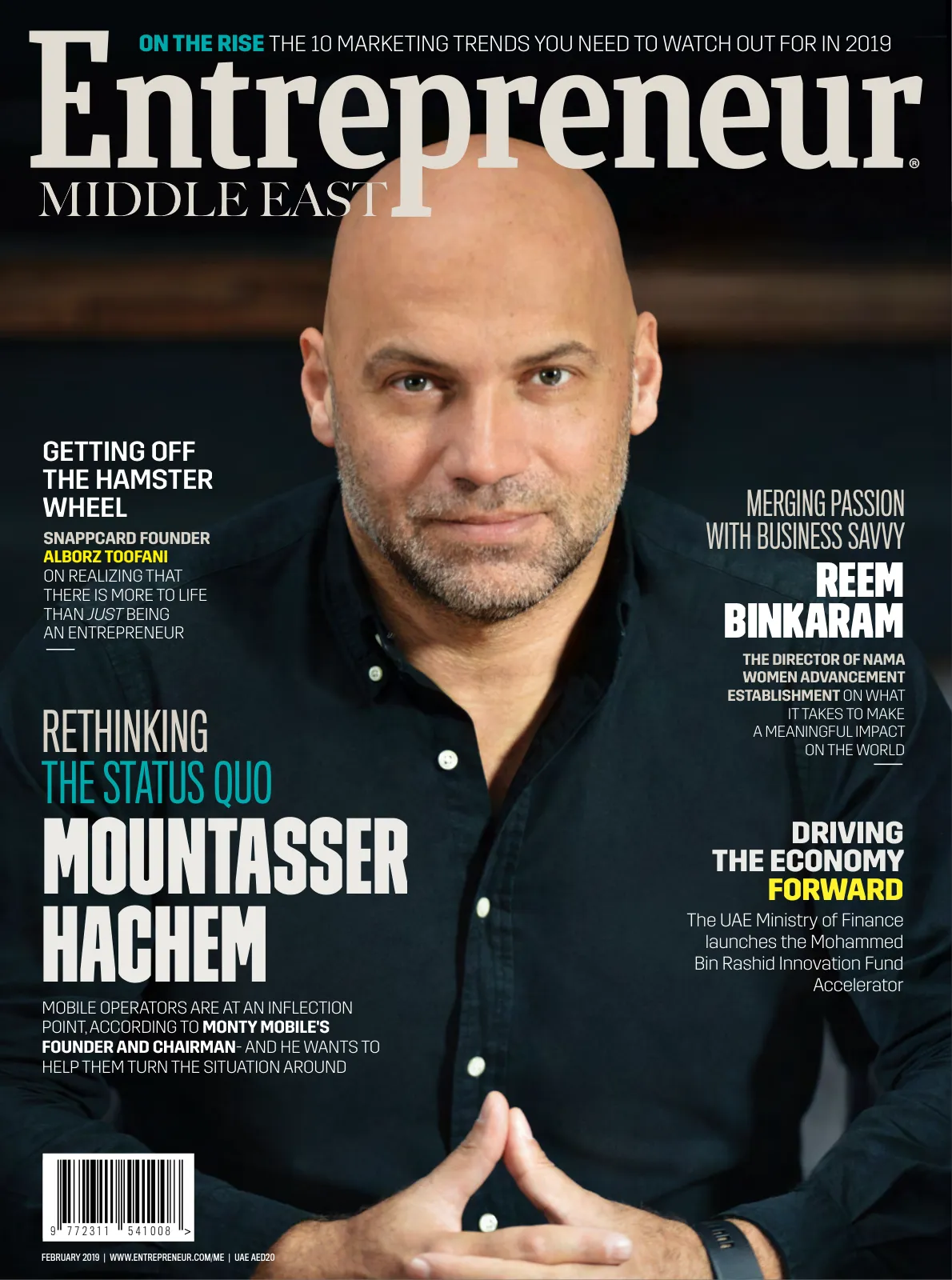
Entrepreneur Middle East, February 2019
Page 1
FEBRUARY 2019 | WWW.ENTREPRENEUR.COM/ME | UAE AED20
9
7 7 2 3 1 1
5 4 1 0 0 8
>
ON THE RISE THE 10 MARKETING TRENDS YOU NEED TO WATCH OUT FOR IN 2019
MOUNTASSER
HACHEM
RETHINKING
THE STATUS QUO
MOBILE OPERATORS ARE AT AN INFLECTION
POINT, ACCORDING TO MONTY MOBILE'S
FOUNDER AND CHAIRMAN- AND HE WANTS TO
HELP THEM TURN THE SITUATION AROUND
DRIVING
THE ECONOMY
FORWARD
The UAE Ministry of Finance
launches the Mohammed
Bin Rashid Innovation Fund
Accelerator
GETTING OFF
THE HAMSTER
WHEEL
SNAPPCARD FOUNDER
ALBORZ TOOFANI
ON REALIZING THAT
THERE IS MORE TO LIFE
THAN JUST BEING
AN ENTREPRENEUR
MERGING PASSION
WITH BUSINESS SAVVY
REEM
BINKARAM
THE DIRECTOR OF NAMA
WOMEN ADVANCEMENT
ESTABLISHMENT ON WHAT
IT TAKES TO MAKE
A MEANINGFUL IMPACT
ON THE WORLD
Page 2
Wake up to
Following outstanding sales in phases 1, 2 & 3,
ARADA presents Nasma Residences Phase 4.
Located in the lush surroundings of
a record-breaking community.
from AED 899,000
*
BAREEM TOWNHOUSES
800-ARADA (27232)
arada.com
• No service fee for life
• Pay 60% on completion
• Up to 10% ROI
Visit our Sales Office
Badriyah Ballroom,
Radisson Blu Resort, Sharjah
10am – 7pm
*T&C apply
No residency visa required to buy property
Open to all nationalities
Page 3
3
February 2019 / ENTREPRENEUR.COM /
32
28
INNOVATOR
RETHINKING THE STATUS
QUO
Mobile operators are at an
inflection point, according
to Monty Mobile founder
and Chairman Mountasser
Hachem- and he wants to
help them turn the situation
around.
32
INNOVATOR
MERGING PASSION
WITH BUSINESS SAVVY
Reem BinKaram,
Director, NAMA
Women Advancement
Establishment, on
what it takes to make a
meaningful impact on the
world.
44
CULTURE
LIFE
Getting off the hamster
wheel
Snappcard founder Alborz
Toofani on realizing that
there is more to life than just
being an entrepreneur.
50
CULTURE
LIFE
Reshaping the future
Move over, United Nations:
according to The Neutral
Group founder Karl W.
Feilder, it’s time for
entrepreneurs to save the
planet.
36
INNOVATOR
100 IS THE NEW 60
The world is edging closer
toward a dramatically
extended healthspan, says
Dr. Peter H. Diamandis,
co-founder of Singularity
University.
56
‘TREPONOMICS
MARKETING
On the rise
Deep Patel, author of
A Paperboy's Fable:
The 11 Principles of Success,
reveals the 10 marketing
trends you need to watch
out for in 2019.
72 The Waqty Fitness team with Managing Partner Kyle Jordan
Reem BinKaram,
Director, NAMA
Women Advancement
Establishment
FEBRUARY 2019 CONTENTS
Page 4
We never sleep. So you can.
24/7 service.
Our business is trust.
Page 5
Page 6
Page 7
Page 8
THE STARTUPS
DUBAI
PROGRAM
2019
START OF THE PROGRAMME JAN 20
DEMO DAY APR 18
Page 9
Clara
CEO/PRODUCT OWNER/
PROJECT MANAGER
TOGHRUL SAMADOV
CEO
PATRICK ROGERS
CEO
PARKER WELLS
CTO
HAMARZ ARYAFAR
CTO
ARTHUR GUEST
HEAD OF SALES
ONUR TIKIN
CEO & FOUNDER
LANCE LIN
CEO
OMAR GHAZZAOUI
CEO
MIRAY TAYFUN
CEO
FAYSAL AL HAMMADI
CPMO
TARIG EL SHEIKH
COO
GOZDE
BUYUKACAROGLU
CTO
ALI ATASEVER
CEO
CEDRICK TADONG
CEO
SEBASTIAN VADUVA
CTO
ANDREI MARINESCU
PLATFORM ARCHITECT
GABRIEL DOBOCAN
CFO / CIO
KEVIN WERVENBOS
CTO
JON TAYLOR
CEO
YOUSEF WADI
CTO
SHADI AL SHALABI
BD
KANAAN MANASRAH
CO-FOUNDER
HOGAN CHIANG
CO-FOUNDER
TONY WONG
Page 10
COVER THE CITY
Unlocking the Power
of Digital Signage Advertising
Page 11
WITH YOUR ADS
Visit www.lifeonscreen.com
Page 12
Page 13
Page 14
Page 15
Call: 800 UPSALE | up.ae
*Terms and conditions apply
MOTOR CITY
Own Your Dream Home In Dubai
& Move In Today
Aed 80,000*
30 months
Post-Handover Payment Plan
50% DLD
Fee Waiver
1,2,3,4
Bedroom Apartment
Page 16
A
PRIVILEGED
LIFE
Page 17
HEART OF DUBAI NOW HAS A SOUL
@ sobhahartland
Sobha Brand Studio
Umm Al Sheif
Sheikh Zayed Road
Dubai
Sobha Hartland Sales Gallery
Sobha Hartland
Mohammed Bin Rashid City
Dubai
LOCATED AT MBR CITY
ON THE DUBAI WATER CANAL
30% GREEN & OPEN SPACES
2 INTERNATIONAL SCHOOLS
HIGH-END HOSPITALITY & RETAIL OPTIONS
1.8KM CANAL BOARDWALK
The heart of Dubai is coming to life, with an 8 million sq. ft. canal-front, freehold gated
community – Sobha Hartland, now ready to welcome its first residents. Envisioned to
be the anti-thesis to urban life, this marquee development by Sobha Realty in
Mohammed Bin Rashid Al Maktoum City is located at the very epicentre of Dubai,
minutes away from iconic landmarks and business districts.
Visit us at Cityscape Global 2018 to avail exclusive privileges.
Dubai World Trade Centre | 02 - 04 October
Terms and conditions apply
800 999 999
sobhahartland.com
Rera 1544 / 1949
Page 18
18 / ENTREPRENEUR.COM / February 2019
78
24
EDITOR’S NOTE
By Aby Sam Thomas
70
START IT UP
ECOSYSTEM
Driving the economy forward
The UAE Ministry of Finance
launches the Mohammed
Bin Rashid Innovation Fund
Accelerator.
76
‘TREPONOMICS
PRO
The whole is greater than
the sum of its parts
Jack Martin St. Valery,
Managing Director of
JacksonMSV, explains
why unleashing collective
intelligence makes sense
for your entrepreneurial
endeavor.
Krypto Labs
co-working space
74
START IT UP
Q&A
The right fit
HR tech platform Bloovo
offers an AI-driven way to
better connect employers
and employees.
60
‘TREPONOMICS
PRO
Pitch perfect
Charlotte Powell, Head
of Design and Marketing
at iPresent, lists six sales
presentation techniques that
eliminate nerves.
64
FRANCHISE
Beyond borders
James Fell, Online
Business Editor at Aceville
Publications, reveals the
eight things to consider
when thinking of taking your
franchise international.
72
CULTURE
BUSINESS UNUSUAL
Just what the doctor
ordered
Kyle Jordan, Managing
Partner, Waqty Fintess, on
how his company’s expert-
led fitness coaching and
training platform can help
solve the region’s health
concerns.
74 Bloovo CEO and co-founder Ahmad Khamis and co-founder
and board member Iyad Abu Hweij
Breitling boutique in The Dubai Mall
43
41 BOOM 3 waterproof
speaker
FEBRUARY 2019
CONTENTS
Page 19
A rare jewel in the rocky contours of the vast Saiq Plateau on Oman’s fabled Green Mountain,
Anantara Al Jabal Al Akhdar Resort is the highest five star luxury resort in the Middle East.
ln this extraordinary destination, the true source of adventure is revealed through Anantara’s
distinctive natural luxury and innovative Omani hospitality.
Telephone: +968 2521 8000
Email: reservations.aaja@anantara.com
Book at anantara.com
Your #MountainEscape Awaits.
VISIT ANANTARA.COM
ASIA MIDDLE EAST AFRICA EUROPE
LIFE IS A JOURNEY
Page 20
20 / ENTREPRENEUR.COM / February 2019
62
‘TREPONOMICS
SKILLSET
Get your point across
Anna Roberts, founder and
Managing Director, Nudge,
says that you shouldn’t
wait for a keynote to
invest in public speaking
training.
66
START IT UP
ECOSYSTEM
Harnessing potential
Nitin Kaushal, President
& GM – EMEA at Capillary
Technologies, delves into
the e-commerce landscape
in the Middle East-
and how it’s all set for
growth.
52
‘TREPONOMICS
PRO
The right pick
Bayt.com’s Suhail Masri
explains how your
enterprise can sustainably
tap into qualified (and
diverse) talent pools.
48
CULTURE
LIFE
Workplace wellness
The mental health of
startup founders should
matter to investors,
says Gritti Fund founder
Marcel Muenster.
42
CULTURE
TRAPPINGS
‘Trep gear
The executive selection
for the entrepreneur
on your list that has
everything. Okay, maybe
for a little self-reward
as well.
40
TECH
SHINY
#TamTalksTech
Gadgets and doodads
that you might’ve missed
out on, sourced by a tech
aficionado. Yes, it’s okay
to want them all… and
no, it’s not our fault.
Launch of the MBR Innovation
Fund Accelerator
70
36 Longevity and healthcare technologies are working toward dramatically
extending the human lifespan
FEBRUARY 2019
CONTENTS
Page 21
M E M B E R S G E T T H E B E S T R AT E S
W H E N YO U B O O K D I R E C T
radissoncollection.com
A collection of our finest hotels,
where memorable moments are made.
From Muscat to Kuwait to Riyadh.
Page 22
22 / ENTREPRENEUR.COM / February 2019
SUBSCRIBE
Contact subscriptions@bncpublishing.net to receive
Entrepreneur Middle East every issue
EDITOR IN CHIEF Aby Sam Thomas editor@bncpublishing.net
CEO Wissam Younane wissam@bncpublishing.net
DIRECTOR Rabih Najm rabih@bncpublishing.net
CREATIVE LEAD Odette Kahwagi
MANAGING EDITOR Tamara Pupic
STARTUPS SECTION EDITOR Pamella de Leon
GROUP SALES DIRECTOR – B2B GROUP Joaquim D’Costa
COLUMNIST Tamara Clarke
EVENTS LIAISON Mark Anthony Monzon
PO Box 502511 Dubai, United Arab Emirates
P +971 4 4200 506 | F +971 4 4200 196
For all commercial enquiries related to Entrepreneur Middle East
contact sales@bncpublishing.net
All rights reserved 2019.
Opinions expressed are solely those of the contributors.
Entrepreneur Middle East and all subsidiary publications in the
MENA region are officially licensed exclusively to BNC Publishing
in the MENA region by Entrepreneur Media Inc.
No part of this magazine may be reproduced or transmitted in any
form or by any means without written permission of the publisher.
Printed by United Printing and Publishing
upp.ae
Images used in Entrepreneur Middle East are credited when necessary. Attributed use of
copyrighted images with permission. All images not credited otherwise Shutterstock.
Helen Al Uzaizi
Fida Chaaban
Karl W. Feilder
James Fell
Ramesh Jagannathan
Nitin Kaushal
Alex Malouf
Marcel Muenster
Deep Patel
Charlotte Powell
Anna Roberts
Jack Martin St. Valery
Alborz Toofani
CONTRIBUTING WRITERS
entrepreneur.com/me
ACCESS FRESH CONTENT DAILY ON OUR WEBSITE!
MIDDLE EAST
EntMagazineME
@EntMagazineME
Entrepreneur-me
EntrepreneurMiddleEast
EntMagazineME
EntMagazineME
EntMagazineME
MIDDLE EAST
In addition to our print edition, we’re bringing
you all sorts of industry news on our web
mediums. Joining us online means getting
relevant business and startup content in
real-time, so you’re hearing about the latest
developments as soon as we do. We’re looking
forward to interacting with our readers on all of
our social media and web platforms- like any
thriving business, we’re looking to give and take.
#TrepTalkME is already happening on all of our
digi platforms, and all good conversations go
both ways. See you on the web!
Page 23
Page 24
24 / ENTREPRENEUR.COM / February 2019
EDITOR’S NOTE
Aby Sam Thomas
Editor in Chief
@thisisaby
aby@bncpublishing.net
Rejecting Big Tech’s notification frenzy
Breaking free
S
o, I did it- I took some
time off work, and yes,
the experience was
absolutely as glorious
as I hoped it would
be. And if there’s one
thing I learned during
my break that I’d want to share
with everyone, it is that turning off
notifications on one’s smartphone
is an amazing life hack that I am
convinced more of us should be
doing in our day-to-day lives. In
my case, I chose to turn off noti-
fications for my work email while
on vacation, and after a few days
of doing this, it was quite amazing
to realize how, when the banners
announcing a new message stopped
slithering across my mobile screen,
I managed to get my mind freed
up, which then allowed me to rest,
reflect, and yes, recharge. After I
started reading about the rather
alarming ways in which smart-
phone notifications have been
coded (they have essentially been
designed to enable addictive expe-
riences), it was easier to see how
the deceptively simple decision to
switch off notifications on one’s
smartphone could cause a marked
improvement in one’s well-being.
After I returned to work, I did
ponder whether I wanted to
switch my notifications back on
for my work email, and after some
thought, I decided against doing
that. As someone who’s never
done this before, I’ll admit that
this is an experiment of sorts, to
see if I can indeed do my work as
efficiently and effectively as I can,
without having to be tuned in to it
all the time. I reasoned that I’ll be
having my inbox open on my com-
puter all the time while on work
hours anyway, and so, there didn’t
seem to be any reason for this to
be replicated on a second screen
too. Switching off email notifica-
tions on my mobile phone has also
made me realize that I don’t need
to check every email that comes
my way the moment it lands in my
inbox- as funny as it may seem in
hindsight, I must admit that it took
me a while to get used to this!
Now, all of this might seem
rather trivial and perhaps not
worth talking about for so long,
but once you look into the larger
discussion in the world around
workplace wellness and personal
well-being, you will see that it
is often the little things that one
ignores, which lead to bigger
problems later down the road. And
I’m glad to report that it’s not just
me waking up to this realization
though- SnappCard founder Alborz
Toofani has penned a message to
entrepreneurs in this month’s issue
of Entrepreneur Middle East, in
which he says: “Your startup is just
one part of who you are. It is not
all of who you are, and do not allow
it to become that. The better you
treat yourself, the better you will
be treating your startup. Get off the
hamster wheel, and start running
your life in its fullest form.” Well
said, Alborz- and I’m certainly
trying to follow your lead.
Page 25
Page 26
26 / ENTREPRENEUR.COM / February 2019
IN THE LOOP
UAE startup Melltoo closes pre-Series A
round with 500 Startups, Shorooq Investments,
and other investors
Onward and upward
AS A SECONDHAND
E-COMMERCE MARKETPLACE
FOR USED ELECTRONICS,
FASHION, HOME, AND KIDS’
ITEMS, MELLTOO PLANS
TO USE THE INVESTMENT
TO EXPAND OPERATIONAL
CAPACITY.
Morrad Irsane
and Sherene Lee,
co-founders,
Melltoo
IMAGE CREDIT MELLTOO
M
elltoo, a second-
hand e-com-
merce platform
launched in
Dubai in 2014,
has closed a bridge to Series
A round with the participa-
tion of 500 Startups, KISP
Ventures, Khwarizmi Ven-
tures and Shorooq Invest-
ments. The amount of fund-
ing has not been disclosed.
According to Melltoo co-
founders, Sharene Lee and
Morrad Irsane, one of the
lead investors has already
committed half of the Series
A round.
As a secondhand e-com-
merce marketplace for used
electronics, fashion, home,
and kids’ items, Melltoo
plans to use the investment
to expand operational capac-
ity, including onboarding
new dedicated couriers, and
moving to a larger fulfillment
center.
Furthermore, the new funds
will help scale up Melltoo’s
Impacter. Launched last year,
Impacter is an initiative that
allows socially conscious us-
ers to list their used items for
sale while donating sale pro-
ceeds to the charitable cause
of their choosing. Buyers can
see that the items they are
buying are for charity and
the amount that will be do-
nated, while Melltoo handles
the complete payment and
delivery process.
Melltoo also offers a free
electronics collection service
to potential donors who
prefer not to handle the sale
process themselves. Col-
lected electronics are reset,
cleaned and sold on the mar-
ketplace with half the sale
proceeds going to the cause
selected by the donor.
Speaking about Impacter,
Mahmoud Adi, Partner at
Shorooq Investments, said,
"Our region as a whole is
used to buying more than we
need and yet lack creative
solutions to properly dispose
of the excess goods in our
companies and homes. I have
used Melltoo to donate my
personal belongings ranging
from IT to general products,
and it has been an extremely
efficient and smooth process,
which is so important. I en-
courage everyone and every
company to use Melltoo, if
they have any items that
they want to throw away or
donate or sell, like unused
laptops and IT equipment.
It’s just so easy."
Melltoo partners with
multiple UAE-based chari-
ties that support a variety of
causes, from helping orphans
to supporting refugees,
including Emirates Red
Crescent, Friends of Cancer
Patients and The Big Heart
Foundation.
Beyond the social ben-
efit, the initiative has also
become a successful part
of the company’s business
model, says Irsane. “Since
we started Impacter, our
team has been reignited with
passion because we strongly
believe that what we are
doing helps those who are
in need,” Irsane said. “The
Melltoo community has also
embraced the initiative and
our user base and sales are
growing rapidly. The recent
investment allows us to ex-
pand Impacter and take it to
the next level as we gear up
for our Series A.”
In addition to potentially
closing the Series A round
in the first quarter of 2019,
Melltoo is planning to launch
the Impacter initiative in
Saudi Arabia with the sup-
port of Khwarizmi Ventures.
"We see a great scope for
Melltoo in Saudi Arabia and
we see ourselves as strategic
partners for their expansion
in the country," said Yasser
Alkadi, Founding Partner,
Khwarizmi Ventures. "We
have always been cross
border partners for startups
looking to expand in the
region. We're excited to help
them grow." melltoo.com
Page 27
Want to grow your
business in the UAE?
The Mohammed Bin Rashid Innovation Fund Accelerator gives regional
and global innovators access to world-class services and coaching to
accelerate businesses, elevate capabilities, unlock value and achieve scale.
Find out more at ia.mbrif.ae about our bi-annual applications.
Admission to the winter cohort is now closed.
Discover how your business can be a part of the summer cohort.
#MBRIF
@MBRIFund
The Mohammed Bin Rashid Innovation Fund (MBRIF) Innovation Accelerator is a federally-sponsored
initiative conceived by the Ministry of Finance and operated by EY.
Page 28
28 / ENTREPRENEUR.COM / February 2019
INNOVATOR
“OUR MAIN MISSION AT MONTY
MOBILE IS TO INCREASE
OPERATORS’ AWARENESS
OF THEIR HIDDEN TREASURES,
AND TO SUPPORT THEM ON
THE RIGHT WAY TO INVEST
IN SUCH OPPORTUNITIES TO
MAXIMIZE REVENUE.”
Mountasser Hachem,
founder and Chairman,
Monty Mobile
IMAGES COURTESY MONTY MOBILE
28 / ENTREPRENEUR.COM / February 2019
Page 29
29
February 2019 / ENTREPRENEUR.COM /
RETHINKING
THE STATUS QUO
MOBILE OPERATORS ARE AT AN INFLECTION POINT, ACCORDING
TO THIS ENTREPRENEUR- AND HE WANTS TO HELP THEM TURN
THE SITUATION AROUND by TAMARA PUPIC
Monty Mobile founder and Chairman
MOUNTASSER HACHEM
"OPERATORS OWN THE
BIGGEST POOL OF RELIABLE
CUSTOMER DATA WHICH, IF
IF MONETIZED PROPERLY
THROUGH CUSTOMER
PROFILING AND DATA
ANALYTICS, WOULD ALLOW
OPERATORS TO HAVE
THE MOST ACCURATE
CUSTOMER PROFILES."
>>>
INNOVATOR
And Hachem knows quite
a bit about the business of
mobile operators. Founded in
1998, Monty Mobile works
closely with more than 700
mobile operators around
the world to facilitate the
international flow of data,
voice, and SMS across global
markets. The company has
300 employees distributed
over nine offices in the UK,
Croatia, Belgium, Germany,
Fiji, Indonesia, India, Leba-
non, and the UAE, while 10
other offices are planned
to be opened in 2019 to
better service operators
worldwide. On the basis of
this vast experience in the
sector, Hachem says that the
expanded competition from
over-the-top (OTT) providers
and social media players, like
Facebook, Google and others,
has been causing a significant
decline in average revenue
per user (ARPU) for most
mobile operators worldwide.
According to Hachem, these
cloud-based players are of-
fering innovative services at
very attractive packages or at
no cost at all, while adapting
to the changing customer be-
havior much faster than mo-
bile operators. In addition,
the explosion of the internet
of things (IoT), smart cit-
ies, and free WiFi have also
put mobile operators under
the pressure of adapting to
changes in consumer demand.
T
oday’s mobile operators are at an inflection point, says
Mountasser Hachem, founder and Chairman of Monty Mobile,
a Beirut-headquartered GSMA-certified open connectivity
SMS hub and roaming broker. With their infrastructure, mobile
operators are one of the enablers of the digital economy, but,
paradoxically, the total consumer spend on mobile communication
services has been in decline. The reason is that consumer behavior
has changed, and consumers now prefer exploring different digital
avenues for their communication, leaving mobile incumbents in a
paradox of being replaced by many digital players, whose operations
their own networks facilitate and support. “In fact, social media players
are making billions of dollars using the operators’ networks, while
operators are making zero,” Hachem says. “We are witnessing an era
where many mobile operators are applying for loans, or requesting
banking facilities. Many of them are even undergoing changes in
management for not achieving their sales targets. I think that this
explains a lot, that they are struggling with declining revenues.”
Page 30
30 / ENTREPRENEUR.COM / February 2019
INNOVATOR
"MOST MOBILE
OPERATORS STILL
COMPETE WITH
EACH OTHER USING
THE CLASSICAL
WAY, WHICH
MAINLY DEPENDS
ON OFFERING
DATA PACKAGES
OR BUNDLES. [...]
THIS STRATEGY IS
NOT PROFITABLE
ANYMORE.”
Gary Vaynerchuk
at the 2018 Sharjah
Entrepreneurship Festival
Mountasser Hachem, founder and Chairman, Monty Mobile
However, the main problem,
Hachem explains, is in
the way in which mobile
operators approach these
big losses. “In reality, de-
spite the challenges I have
mentioned, most mobile
operators still compete with
each other using the classical
way, which mainly depends
on offering data packages or
bundles,” he says. “Whereas
in my opinion, they should
recognize that this strategy
is not profitable anymore.”
And this is where Monty
Mobile’s uniquely attractive
proposition comes into the
picture. Hachem explains
that mobile operators are
either not aware or not
utilizing some of their assets
in the right way. Those are
customer data, value-added
services, mobile advertis-
ing, mobile banking, credit
services and finance, and
other services. “For example,
while social media players
are making billions of dol-
lars, the operators are doing
nothing,” Hachem says.
“While as a matter of fact,
operators own the biggest
pool of reliable customer
data which, if monetized
properly through customer
profiling and data analyt-
ics, would allow operators
to have the most accurate
customer profiles which no
social media player can beat.
However, they are not look-
ing into this as a new source
of revenue.” To that end,
Monty Mobile has developed
an advanced data analytics
platform, in addition to its
already wide portfolio of
value-added services (VAS)
that cater for every opera-
tor’s need to survive the new
global market trends. “Our
main mission at Monty Mo-
bile is to increase operators’
awareness of their hidden
treasures, and to support
them on the right way to in-
vest in such opportunities to
maximize revenue,” Hachem
says. “We are also ready to
invest with them in some
cases. It's time for operators
to treat their subscribers as
partners, and the best way to
achieve this goal is by offer-
ing their subscribers reward-
ing incentives to encourage
their engagement, and,
thus, increase the operators’
revenue.”
More than two decades
since starting building what
is today considered one of
the MENA’s key regional
players in the telecom-
munication sector -Monty
Mobile- Hachem’s relentless
pursuit of growth oppor-
tunities continues. “All of
our services generate good
profits, and lately, we have
started diversifying into VAS
and enterprise solutions as
well,” he says. “But if I had
to choose the top, I would
say roaming, SMS gateway
management, and our wide
group of in-house solutions,
such as airtime credit loan,
mobile advertising platform,
data analytics platform,
billing solutions, Top Up+,
M-rewards and Promo
Services.” Regarding roam-
ing, Monty Mobile provides
operators with solutions to
offer their subscribers high
roaming coverage with low-
tariff packages that they can
use while roaming anywhere
in the world. “As we all
know, roaming charges are
extremely high, so roaming
subscribers are happy when
their operators give them a
solution where they can ‘go
global and pay local,’ and
still use their own SIMs
while abroad, without having
to stand in long queues at
the airports to get local SIMs
aiming to avoid the roaming
bill shock,” Hachem explains.
“And this makes our roaming
solutions a great success.”
Page 31
31
February 2019 / ENTREPRENEUR.COM /
"ROAMING CHARGES
ARE EXTREMELY
HIGH, SO ROAMING
SUBSCRIBERS ARE
HAPPY WHEN THEIR
OPERATORS GIVE THEM
A SOLUTION WHERE
THEY CAN ‘GO GLOBAL
AND PAY LOCAL’, [...]
AND THIS MAKES OUR
ROAMING SOLUTIONS
A GREAT SUCCESS.”
Gary Vaynerchuk, Chairman, VaynerX
When it comes to Monty
Mobile’s SMS gateway
management solutions, those
have proved to be of great
value to operators who suffer
from SMS leakages on their
networks, most of which
they are not aware of, and
which lead to huge losses.
Monty Mobile’s solution
guarantees a spam-free net-
work and helps the operator
to maximize its A2P SMS
revenues. Other success-
ful revenue streams which
operators should not ignore,
Hachem adds, include Monty
Mobile’s in-house solutions
designed and developed to
cater for today’s dynamic
market needs from finance,
mobile advertising, loyalty
campaigns to big data analyt-
ics. Since 2016, the company
has also been hosting one of
the largest private telecom
events called RVS (Roaming,
Value Added Services, and
SMS) Operator Event– a
semi-annual event gathering
high-profile operator execu-
tives from around the world.
And looking at the current
state of the telecommuni-
cations sector across the
region, Hachem opines that
new business opportuni-
ties are getting slimmer
day by day, advising new
entrepreneurs that “a change
is seriously needed, and in-
novation is a must.” Hachem
is as ambitious and cautious
(understandably) as you
would expect from a man
who has been wrestling with
large and powerful telecom
incumbents for decades. “It
was very hard for an entre-
preneur from the Middle
East to enter worldwide
markets, and gain the trust
of operators everywhere,”
he says of Monty Mobile’s
beginnings in 1998. “The
high level of competition was
really a challenge. On the
other hand, unfortunately,
many operators in the
Middle East area preferred to
deal with European telecom
companies back then, despite
the good deals we provided.
However, with a wisely
built product portfolio, high
quality service, and a seri-
ously dedicated team, Monty
Mobile has come a long way
in the telecom business, and
is now proudly partnering
with international operators
from all over the world and
competing amongst the top
players in the field.”
As our conversation comes
to an end, Hachem reflects
on self-confidence needed
for building a business any-
where, and especially in this
region, admitting that believ-
ing in oneself, coupled with
being patient and embracing
change should always be part
of a promising business. “It
is by having the courage to
take on big challenges, and to
never give up that I have led
the company to its current
state,” he says. “I have always
believed that a dream can
come true, and have always
motivated my team to be
part of that dream, and this
is why I apply a more human
approach to my business. I
constantly show my passion
for the brand, and want my
employees to feel just as
excited about it as I am, and
to feel empowered by my
endless will, so it is kind of
a ‘lead-by-example’ manage-
ment style. In addition to
that, I am also known as a
challenge-taker who adapts
to inevitable changes, looks
for new ways to succeed,
and leads the organization
with a transformational
mindset, accepting transi-
tions, and even modifying
the business model when
needed.” Listen up, entre-
preneurs- all of that is good
advice to take to heart.
Page 32
32 / ENTREPRENEUR.COM / February 2019
Reem BinKaram, Director, NAMA
Women Advancement Establishment,
on what it takes to make
a meaningful impact on the world
INNOVATOR
MERGING
PASSION
WITH
BUSINESS
SAVVY
by TAMARA PUPIC
"THE LACK OF FULL
SUPPORT IN TERMS OF
INVESTMENT SCHEMES,
BANKING PRODUCTS,
ACCESS TO ASSETS AND
PROPERTY, AND RULES
AND REGULATIONS
ARE AMONG THE
PRIME FACTORS THAT
HINDER WOMEN
ENTREPRENEURS.”
NAMA taking part in the 73rd
United Nations General Assembly
IMAGE CREDIT NAMA WOMEN ADVANCEMENT ESTABLISHMENT
R
eem BinKaram,
Director of
NAMA Women
Advancement
Establishment,
is a leading light
in the region’s
social responsibility move-
ment, which has moved
from the margins to the
mainstream, from being a
bullet point on a PR strategy,
to becoming a CEO’s top
priority. Those living in
the UAE will know that the
government itself has been
consistently raising the bar
of paying-it-forward initia-
tives in the country, fostering
and strengthening a sense of
social responsibility across
the public and private sec-
tors.
BinKaram manages differ-
ent entities under the NAMA
umbrella, like Sharjah Busi-
ness Women Council, Irthi
Contemporary Crafts Coun-
cil, and NAMA’s educational
and development arm Badiri
Academy, with an overarch-
ing goal to empower women
and shape an equitable world
for them. She is open and
pragmatic about the fact that
the Sharjah government has
embraced NAMA eagerly–
H.H. Sheikh Dr Sultan Bin
Muhammad Al Qasimi, UAE
Supreme Council Member
and Ruler of Sharjah, has
offered unwavering support,
while his wife, H.H. Sheikha
Jawaher Bint Mohammad Al
Qasimi chairs the organiza-
tion. However, this support,
along with BinKaram’s pas-
sion, drive, and motivation
to help advance women,
required a plan of action.
“Due to the unique op-
erational structure of this
umbrella, and the fact that
we are supported by the
government, we consider
ourselves a hybrid organiza-
tion, adapting international
standards of global NGOs,
corporations, and govern-
ment to meet our needs
and strategies,” BinKaram
explains. “However, we had
taken on a massive challenge
when NAMA was created.
Our affiliates, the Sharjah
Business Women Council
and Irthi Contemporary
Crafts Council were already
operational, and needed to be
brought under NAMA’s um-
brella. At one point, we had
four entities that needed to
work in line with each other.”
The first step she took was
to align the entities’ vi-
sions, mission statements,
and objectives, and then
build a harmonious team
across the four entities that
understood the big picture,
and how the whole organiza-
tion could work together
to achieve their goals, and
ultimately NAMA’s vision of
shaping an equitable world
for women. BinKaram adds,
“It was a great challenge
that we overcame, keeping
in mind that these entities
still have their own unique
and specialized services
and offerings as well. Today,
what we have is a group
of four organizations that
provide a holistic approach
to women’s advancement,
through comprehensive
support systems that help
women excel professionally
and economically.”
Page 33
33
February 2019 / ENTREPRENEUR.COM /
INNOVATOR
"TO BE A GREAT
LEADER, YOU NEED
TO EMPOWER
YOUR CADRE TO
BE LEADERS. GIVE
THEM THE SPACE
AND FREEDOM
WITHIN THEIR
FUNCTIONS TO
PERFORM AND BE
CREATIVE. BEING
ACCESSIBLE TO
THEM IS ALSO KEY."
Reem BinKaram,
Director, NAMA
Women Advancement
Establishment, at the
73rd United Nations
General Assembly
meetings in New York
>>>
When it comes to the UAE’s
NGO and philanthropic
sectors, BinKaram is a
woman to watch. Besides
NAMA, she is a member of
the new board of Directors
of the Sharjah Tatweer
Forum (STF), an organiza-
tion committed to youth
empowerment; a member
of the board of Rubu Qarn
(RQ), a foundation that
supports UAE future leaders
and innovators, and chairs
the Pink Caravan Ride for
Breast Cancer prevention
and awareness. Previously,
she served as Director of
Sharjah Children’s Centers
(SCC) overseeing develop-
ment of children with talent
and a desire to realize their
potential. For each of these
projects, and a family busi-
ness in which she also takes
part, BinKaram adjusts her
management styles. “The
exposure I have had, and my
experiences in the field of
NGOs, as well as running a
family business, results in
a mixed management style
influenced by both experi-
ences. My business back-
ground helps when setting
a strategic action plan that
has a clear objective, and
measurable results to help
drive the entities I manage
to sustainable growth and
continued success. However,
my management style is not
set in stone. I adapt quickly
in order to keep the wheels
moving in the right direction
towards our defined goals.”
NAMA’s unique organiza-
tional structure combines
different entities, each with
their own teams, BinKaram
explains, making teamwork
and effective collaboration
key to success within the
teams and across entities.
“The amount of work we
do, and the achievements
we have had are a result of
consolidated efforts of only
70 staff members across the
organizations,” she adds.
Page 34
34 / ENTREPRENEUR.COM / February 2019
INNOVATOR
"MY MANAGEMENT STYLE IS NOT SET
IN STONE. I I ADAPT QUICKLY IN ORDER TO
KEEP THE WHEELS MOVING IN THE RIGHT
DIRECTION TOWARDS OUR DEFINED GOALS.”
Reem BinKaram,
Director, NAMA
Women Advancement
Establishment
“And to be a great leader,
you need to empower
your cadre to be leaders.
Give them the space and
freedom within their
functions to perform
and be creative. Being
accessible to them is also
key. Open communication
channels, and support on
macro and micro levels is
paramount. For this, the
leader needs to be aware
of every little detail in
the grand structure of the
organization.”
The biggest challenge to
the NGO sector across the
GCC region, according to
BinKaram, is red tape. “I
would say one of the main
challenges NGOs focusing
on development and social
impact in the GCC face is the
complicated process of regis-
tration, mainly because they
don’t fall under ‘government’
nor ‘private’ nor are they tra-
ditional charities,” she says.
“Therefore, when applying to
register officially, they don’t
find a category that fits their
line of work, so they opt to
choose the closest option in
order to become a legal enti-
ty, and start their operations.
Another struggle for these
entities is to secure and
sustain funds. Traditionally,
they base their fiscal projects
and goals according to the
secured, or anticipated fund-
ing. This needs to be changed
in order to self-sustain. This
is where the social enterprise
model comes in.”
Globally, BinKaram adds,
the sector has evolved, and
that change has been noticed
in the region as well. She
explains that, previously, the
majority of NGOs operating
in the GCC region were char-
ity organizations that carried
their work both locally and
across the world, providing
financial or relief humanitar-
ian aid. However, in the past
decade, a new wave of NGOs
has sprung to life that has
broken the traditional man-
date. Today, those organiza-
tions are focused on develop-
ment work and social impact,
providing support services
and creating platforms to en-
able people to enhance their
lives, and develop on a per-
sonal and professional level.
This is needed especially
for the younger generations,
she says and adds, “NGOs
around the world should
not only focus on aid and
relief efforts, but also work
towards development, as
some segments of society
need more than financial
support. They need training,
capacity-building, or access
to opportunities.”
Women entrepreneurs,
she believes, face double
the amount of challenges
as men face. “They are
constantly challenging the
stereotypes to prove they
can succeed,” she says.
“Additionally, social norms
and expectations can hinder
women’s full integration
into the economy. The lack
of full support in terms of
investment schemes, banking
products, access to assets
and property, and rules and
regulations are among the
prime factors that hinder
women entrepreneurs.”
However, the UAE leadership
paved the way by believing
in the capabilities of women
and their leadership skills,
she says. “As long as there
are equitable opportunities,
we believe women can be
outstanding mothers and
successful professionals, just
like men can be great fathers
and successful profession-
als. This will allow men and
women to work together,
Page 35
35
February 2019 / ENTREPRENEUR.COM /
1. Be a leader, not
a manager. A leader
inspires his/her following
by setting an example
and provides the needed
support and backup to
move the organization
forward.
2. Know that your
position and skills
define you, not your
gender. You earned your
position because you
deserved it.
3. Support other women
to grow professionally,
and reach their
potential. You know what
is needed to make their
journey easier.
4. Keep learning. Stay
up-to-date constantly
about your sector, relevant
industries and key players.
5. Know your
organization and team.
The more you know, the
better you can steer and
utilize their skills, using the
available resources.
‘TREP TALK
REEM BINKARAM’S TIPS FOR
FEMALE ENTREPRENEURS
"I WOULD LIKE TO
SEE MORE WOMEN
TAKING A STEP
FORWARD TO REALIZE
THEIR DREAMS
AND ASPIRATIONS.
VENTURE OUT, AND
BE ENTREPRENEURS.
EVERY JOURNEY
STARTS WITH A STEP."
Reem BinKaram
launching the Badiri
E-Academy
completing each other and
supporting one another. In
2019, I hope to see more
changes in the private sec-
tor geared towards creating
a more enabling working
environment for women by
amending their regulations
even further, so women
can be the professionals
they want to be, innovate
and help build the future
of this great country. More
importantly, I would like to
see more women taking a
step forward to realize their
dreams and aspirations. Ven-
ture out, and be entrepre-
neurs. Every journey starts
with a step, and NAMA is
here to empower and provide
all that is necessary to hone
their skills and guide them
towards a successful future.”
Looking at the region’s
entrepreneurial ecosystem
as a whole, BinKaram opines
that the region is still a
fertile ground for businesses
with the right mindset and
approach, while the chal-
lenge remains in seizing op-
portunities, identifying gaps
in the market, and providing
the services or products to
fill that gap. “The main con-
siderations, in my opinion,
are having the right business
idea, and market willing-
ness to embrace it. Startups
might have a unique offering,
the first-of-its-kind product;
however, if it’s irrelevant to
the market, the entrepreneur
goes bust. Therefore, market
research is paramount when
it comes to business posi-
tioning. The hardest step for
a startup is when they take
their idea and go to market.
They need to gauge prospec-
tive clients and get feedback,
to assess, and tweak their
ideas accordingly in order to
penetrate the market. Most
importantly, they need to not
give up. Try and try again.
That’s the essence of entre-
preneurship.”
Given such comments,
once again I realize what is
so different about BinKaram
from other not-for-profit
executives: it is that she is
idealistic but pragmatic,
big-hearted but with a keen
eye for detail, and thus her
advice for those looking for
entrepreneurial direction in
2019 is that ‘emerging sec-
tors and untapped fields are
plenty and worth exploring.’
She adds, “This includes the
technology, energy, finance,
artificial intelligence, and the
environment sectors. I see
an opportunity in identifying
the crossroads among these
sectors.”
As our conversation comes
to an end, BinKaram reiter-
ates that education is at the
core of progress. “My advice
would be to invest in knowl-
edge and skills develop-
ment,” BinKaram concludes.
“Entrepreneurs need to
expand their knowledge and
stay up-to-date on all things
related to their business
in order to have an edge to
compete. Skills development
should be a habit, in order to
grow personally and profes-
sionally.”
Page 36
IS THE NEW 60
100
Longevity and healthcare technologies are working toward
dramatically extending the human lifespan
by DR. PETER H. DIAMANDIS
INNOVATOR
36 / ENTREPRENEUR.COM / February 2019
Page 37
37
February 2019 / ENTREPRENEUR.COM /
INNOVATOR
>>>
SINCE 2001, THE COST
TO SEQUENCE A WHOLE
HUMAN GENOME
HAS PLUMMETED
EXPONENTIALLY,
OUTPACING MOORE'S
LAW THREEFOLD.
H
ealthcare today
is reactive,
retrospective,
bureaucratic,
and expensive.
It's sick care, not
healthcare.
But that is radi-
cally changing at an exponen-
tial rate.
Last year alone, we saw near-
ly US$800 million invested
in longevity startups- over
double the approximate $400
million invested in 2017.
In this month’s column,
I’ll take a deep dive into the
broken healthcare system
we’re dealing with now, how
longevity and healthcare tech-
nologies are working together
to dramatically extend the
human lifespan, disrupting the
$3 trillion healthcare system
in the process. Finally, I’ll
explore the transformative
implications of dramatically
extending the human health
span. In the Middle East,
where diabetes and heart
disease are major causes of
death, this is bound to have a
game-changing impact.
In this article, I’ll cover:
• Why the healthcare system
is broken;
• Why, despite this, we live in
the healthiest time in human
history;
• Exponential technologies are
changing the game;
• Genome sequencing and
editing;
• Senolytics, nutraceuticals,
and pharmaceuticals.
Let’s dive in.
THE SYSTEM IS BROKEN
Here’s the data:
Doctors spend $210 billion per
year on procedures that aren’t
based on patient need, but
fear of liability.
Americans spend, on average,
$8,915 per person on health-
care- more than any other
country on earth.
Prescription drugs cost
around 50% more in the U.S.
than in other industrialized
countries.
At current rates, by 2025,
nearly 25% of the U.S. GDP
will be spent on healthcare.
It takes 12 years and $359
million, on average, to take
a new drug from the lab to a
patient.
Only 5 in 5,000 of these
new drugs proceed to human
testing. From there, only 1 of
those 5 is actually approved
for human use.
AND YET, WE LIVE IN
THE HEALTHIEST TIME IN
HUMAN HISTORY
Consider these insights, which
I adapted from Max Roser’s
excellent database, Our World
In Data:
Right now, the countries
with the lowest life expectancy
in the world still have higher
life expectancies than the
countries with the highest life
expectancy did in 1800.
In 1841, a five-year-old had a
life expectancy of 55 years. To-
day, a five-year old can expect
to live 82 years- an increase of
27 years.
We’re seeing a dramatic in-
crease in healthspan. In 1845,
a newborn would expect to live
to 40 years old. For a 70-year-
old, that number became 79.
Now, people of all ages can
expect to live to be 81 to 86
years old.
100 years ago, one of three
children would die before the
age of 5. As of 2015, the child
mortality rate fell to just 4.3%.
The cancer mortality rate has
declined 27% over the past 25
years.
EXPONENTIAL TECHNOLOGIES
ARE CHANGING THE GAME
Over the past 200 years, we
have seen an abundance of
healthcare technologies enable
a massive lifespan boom. Now,
exponential technologies like
artificial intelligence, 3D print-
ing, and sensors, as well as
tremendous advancements in
genomics, stem cell research,
chemistry, and many other
fields, are beginning to tackle
the fundamental issues of
why we age. And so, while the
causes of ageing are complex
and unclear, with longevity
clinical trials nearly doubling,
from 73 in 2012 to over 145
in 2018, more answers -and
questions- are emerging than
ever before.
With the dramatic demoneti-
zation of genome reading and
editing over the past decade,
and Big Pharma, startups, and
the FDA starting to face aging
as a disease, we are starting
to turn those answers into
practical ways to extend our
healthspan.
Below, I explore how genome
sequencing and editing, along
with new classes of anti-aging
drugs, are augmenting our
biology to further extend our
healthy lives.
GENOME SEQUENCING
AND EDITING
Your genome is the software
that runs your body.
A sequence of 3.2 billion
letters makes you “you.” These
base pairs of A’s, T’s, C’s, and
G’s determine your hair color,
your height, your personality,
your propensity to disease,
your lifespan, and so on. Until
recently, it's been very difficult
to rapidly and cheaply "read"
these letters- and even more
difficult to understand what
they mean.
Since 2001, the cost to se-
quence a whole human genome
has plummeted exponentially,
outpacing Moore's Law three-
fold. From an initial cost of
$3.7 billion, it dropped to $10
million in 2006, and to $5,000
in 2012.
Today, the cost of genome
sequencing has dropped
below $500, and according to
Ilumina, the world’s lead-
ing sequencing company, the
process will soon cost about
$100, and take about an hour
to complete.
Page 38
38 / ENTREPRENEUR.COM / February 2019
INNOVATOR
DR. JIANKUI HE IMAGE COURTESY THE COMMONS
IN ADDITION TO READING
THE HUMAN GENOME,
SCIENTISTS CAN NOW
EDIT A GENOME USING A
NATURALLY OCCURRING
BIOLOGICAL SYSTEM
DISCOVERED IN 1987
CALLED CRISPR/CAS9.
2012
73
101
98
136
142
139
145
2013
2014
2015
2016
2017
2018
Biomedical researcher Dr. Jiankui He
Figure: Clinical trials targeting aging have seen steady
growth over the past six years.
Source: cbninsignts.com
This represents one of the
most powerful and transforma-
tive technology revolutions in
healthcare.
When we understand your
genome, we'll be able to under-
stand how to optimize "you."
We'll know the perfect foods,
the perfect drugs, the perfect
exercise regimen, and the per-
fect supplements, just for you.
We'll understand what
microbiome types, or gut flora,
are ideal for you.
We’ll accurately predict how
specific sedatives and medi-
cines will impact you.
We’ll learn which diseases
and illnesses you’re most likely
to develop, and, more impor-
tantly, how to best prevent
them from developing in the
first place (rather than trying
to cure them after the fact).
In addition to reading the
human genome, scientists
can now edit a genome using
a naturally occurring biologi-
cal system discovered in 1987
called CRISPR/Cas9.
Here’s how it works: the
bacteria capture snippets of
DNA from invading viruses (or
bacteriophage) and use them
to create DNA segments known
as CRISPR arrays. The CRISPR
arrays allow the bacteria to
"remember" the viruses (or
closely related ones), and de-
fend against future invasions.
If the viruses attack again, the
bacteria produce RNA seg-
ments from the CRISPR arrays
to target the viruses' DNA. The
bacteria then use Cas9 to cut
the DNA apart, which disables
the virus.
Most importantly, CRISPR is
cheap, quick, easy to use, and
more accurate than all previous
gene editing methods. As a
result, CRISPR/Cas9 has swept
through labs around the world
as the way to edit a genome.
Early results are impressive.
Researchers from the
University of Chicago recently
used CRISPR to genetically
engineer cocaine resistance
into mice.
Researchers at the University
of Texas Southwestern Medical
Center used CRISPR to reverse
the gene defect causing
Duchenne muscular dystrophy
(DMD) in dogs. (DMD is the
most common fatal genetic
disease in children.)
With great power comes
great responsibility, and the
opportunity for moral and
ethical dilemmas.
In 2015, Chinese scientists
sparked global controversy
when they first edited human
embryo cells in the lab with
the goal of modifying genes
that would make the child
resistant to smallpox, HIV, and
cholera. Three years later, in
November 2018, researcher
He Jiankui informed the world
that the first set of CRISPR-
engineered female twins had
been delivered.
To accomplish his goal,
Jiankui deleted a region of
a receptor on the surface of
white blood cells known as
CCR5, introducing a rare,
natural genetic variation that
makes it more difficult for HIV
to infect its favorite target,
white blood cells.
Setting aside the significant
ethical conversations, CRISPR
will soon provide us the tools
to eliminate diseases, create
hardier offspring, produce
new environmentally resist-
ant crops, and even wipe out
pathogens.
SENOLYTICS, NUTRACEUTICALS,
AND PHARMACEUTICALS
Over the arc of your life, the
cells in your body divide until
they reach what is known as
the Hayflick limit, or the num-
ber of times a normal human
cell population will divide be-
fore cell division stops, which
is typically about 50 divisions.
What normally follows next
is programmed cell death, or
destruction by the immune
system. A very small fraction of
cells, however, become senes-
cent cells, and evade this fate
to linger indefinitely.
Page 39
39
February 2019 / ENTREPRENEUR.COM /
Dr. Peter H. Diamandis is an
international pioneer in the fields of
innovation, incentive competitions,
and commercial space. In 2014, he
was named one of “The World’s
50 Greatest Leaders” by Fortune
Magazine. In the field of innovation, Diamandis is
founder and Executive Chairman of the XPRIZE
Foundation, best known for its $10 million Ansari
XPRIZE for private spaceflight. Diamandis is also
the co-founder and Vice-Chairman of Human
Longevity Inc. (HLI), a genomics and cell therapy-
based diagnostic and therapeutic company focused
on extending the healthy human lifespan.
He is also the co-founder and Executive Chairman
of Singularity University, a graduate-level Silicon
Valley institution that studies exponentially
growing technologies, their ability to transform
industries and solve humanity’s grand challenges.
In the field of commercial space, Diamandis is
co-founder/Co-Chairman of Planetary Resources,
a company designing spacecraft to enable
the detection and prospecting of asteroid for
precious materials. He is also the co-founder of
Space Adventures and Zero-Gravity Corporation.
Diamandis is The New York Times bestselling
author of Abundance – The Future Is Better Than
You Think and BOLD – How to go Big, Create
Wealth & Impact the World.
He earned an undergraduate degree in Molecular
Genetics and a graduate degree in Aerospace
Engineering from MIT, and received his M.D. from
Harvard Medical School. diamandis.com
IN RECENT YEARS,
RESEARCHERS HAVE IDENTIFIED
OR DESIGNED A HANDFUL
OF SENOLYTIC COMPOUNDS
THAT CAN CURB AGING BY
REGULATING SENESCENT CELLS.
These lingering cells secrete a
potent mix of molecules that
triggers chronic inflammation,
damages the surrounding tis-
sue structures, and changes the
behavior of nearby cells for the
worse.
Senescent cells appear to be
one of the root causes of aging,
causing everything from fibro-
sis and blood vessel calcifica-
tion, to localized inflammatory
conditions such as osteoarthri-
tis to diminished lung function.
Fortunately, both the scien-
tific and entrepreneurial com-
munities have begun to work
on senolytic therapies, moving
the technology for selectively
destroying senescent cells out
of the laboratory, and into a
half-dozen startup companies.
In recent years, researchers
have identified or designed
a handful of senolytic com-
pounds that can curb aging by
regulating senescent cells. Two
of these drugs that have gained
mainstay research traction are
rapamycin and metformin.
Originally extracted from
bacteria found on Easter
Island, rapamycin acts on the
m-TOR (mechanistic target of
rapamycin) pathway to selec-
tively block a key protein that
facilitates cell division.
Currently, rapamycin de-
rivatives are widely used as
immunosuppression in organ
and bone marrow transplants.
Research now suggests that use
results in prolonged lifes-
pan, enhanced cognitive and
immune function. Results of
the drug’s recent clinical trial
include decreased incidence of
infection, improved influenza
vaccination response, and a
30.6% decrease in respiratory
tract infection.
Impressive, to say the least.
Metformin is a widely used
generic drug for mitigating
liver sugar production in Type
2 diabetes patients.
Researchers have found that
Metformin also reduces oxida-
tive stress and inflammation,
which otherwise increase
as we age. There is strong
evidence that Metformin can
augment cellular regeneration,
and dramatically mitigate cel-
lular senescence by reducing
both oxidative stress and
inflammation.
Over 100 studies registered
on ClinicalTrials.gov are cur-
rently following up on strong
evidence of metformin’s pro-
tective effect against cancer.
Beyond cellular senescence,
certain critical nutrients and
proteins tend to decline as a
function of age. Nutraceuticals
combat aging by supplementing
and replenishing these declin-
ing nutrient levels.
NAD+ exists in every cell,
participating in every process
from DNA repair to creating
the energy vital for cellular
processes. It’s been shown that
NAD+ levels decline as we age.
A few supplement companies
are now offering products that
increase NAD+ levels consist-
ently by a sustained 40%.
CONCLUSION
These are just a taste of the
tremendous momentum that
longevity and aging technol-
ogy has right now. As artificial
intelligence and quantum
computing transform how we
decode our DNA and how we
discover drugs, genetics and
pharmaceuticals will become
truly personalized.
Each year at Abundance 360,
I host a panel of world-class
longevity researchers and
CEOs to update our members
on the current state and near
future of these technologies.
In our forthcoming inaugural
Abundance 360 Summit being
held in Dubai, I’ll have three
rock star CEOs leading the dis-
cussion on how some of these
longevity technologies.
We are edging closer toward a
dramatically extended health-
span, where 100 is the new 60.
What will you create, where
will you explore, and how will
you spend your time, if you
are able to add an additional
40 healthy years to your life?
Personally, I’m excited for a
near-infinite lifespan to take on
moonshots, and in a region like
the Middle East, with a very
young population, that addi-
tional 40-50 years promises to
make the youth from the region
the rock star entrepreneurs and
change-makers of tomorrow.
Page 40
40 / ENTREPRENEUR.COM / February 2019
TVs have gotten bigger
and slimmer over the
years, but LG is ushering
in major change with
the new rollable LG
SIGNATURE OLED TV R.
It’s is a departure from
the rectangular box style
television that requires
mounting. This new form
factor is literally off the
wall, and gives you viewing
power like never before. LG
SIGNATURE OLED TV R
can roll into three different
viewing options, including
Full View, which delivers
a large screen view, Line
View, which allows the TV
to be partially unrolled for
tasks that do not require
the full screen, and Zero
View, which means the TV
is completely rolled up and
hidden inside the base.
And don’t fret, this is not
a gimmick. You still get
great picture quality and
smart TV functionality.
It features AI picture and
sound quality powered by
LG’s second generation
α (Alpha) 9 intelligent
processor and deep
learning algorithm. You
can use voice control via
Amazon Alexa, and support
for Apple AirPlay 2 and
HomeKit are included. LG is
pushing us into the future
with this one. Whether
you’re ready for it not, just
roll with it.
GADGETS AND DOODADS THAT YOU MIGHT’VE MISSED OUT ON, SOURCED BY A TECH AFICIONADO.
YES, IT’S OKAY TO WANT THEM ALL… AND NO, IT’S NOT OUR FAULT.
ROLL WITH IT
LG SIGNATURE ROLLABLE OLED TV R
TECH SHINY | WEBSITE TO WATCH | GEEK | MOBILE TECH | ONLINE ‘TREP | THE FIX
IMAGE CREDIT LG | ACER | ULTIMATE EARS
LG SIGNATURE OLED TV R
Page 41
41
February 2019 / ENTREPRENEUR.COM /
TECH
SHINY | WEBSITE TO WATCH | GEEK | MOBILE TECH | ONLINE ‘TREP | THE FIX
#TAMTALKSTECH Tamara Clarke, a former software development professional, is the tech and lifestyle enthusiast behind The Global Gazette, one
of the most active blogs in the Middle East. The Global Gazette has been welcomed and lauded by some of the most influential tech brands in the
region. Clarke’s goal is to inform about technology and how it supports our lifestyles. See her work both in print regional publications and online on
her blog where she discusses everything from how a new gadget improves day-to-day life to how to coordinate your smartphone accessories.
Visit theglobalgazette.com and talk to her on Twitter @TamaraClarke.
The virtually borderless
Swift 7 has a 92% screen-
to-body ratio. The 14-inch
Full HD 1920x1080 touch
display with IPS technol-
ogy allows smooth touch
interactions, and presents
vibrant, crystal-clear im-
ages. In addition, it has
an extra durable layer of
Corning Gorilla Glass 6. It’s
feather-light too, weigh-
ing in at just 890 grams,
making it easy to carry
with you. The Swift 7 is
powered by the latest 8th
Gen Intel Core i7 processor
and features up to 512GB
of SSD storage and up to
16GB of RAM, so you can
multitask smoothly. With
10 hours of battery life, the
Swift 7 is ready to work
when you are.
Acer Aspire 1
PACKING A PUNCH
ULTIMATE EARS BOOM 3
BOOM 3 packs a major
punch for its size. Featuring
Ultimate Ears’ unique audio
processing, it renders clear
and balanced audio at every
volume level, whether you like
to pump it up, or keep it low.
You can play, pause and skip
tracks directly on the speaker,
or simply set up one-touch
playlists for Apple Music and
Deezer Premium via the app.
Streaming doesn’t have to
be limited either. It has the
same battery technology
used in electronic vehicles,
and gives you more than 15
hours of playback on a single
charge. BOOM 3 is virtually
indestructible, and is built
to handle life's thrills and
spills. Made from two-toned,
waterproof fabric, it can be
submerged in water for 30
minutes, and still survive. The
speaker passed more than
25 durability tests, including
thousands of button pushes,
hundreds of tumbles, drops,
and more.
WORK IT
ACER SWIFT 7
BOOM 3 waterproof speaker
Acer Swift 7
Page 42
42 / ENTREPRENEUR.COM / February 2019
THE EXECUTIVE SELECTION
From better goods to better wardrobe bests, every issue we choose a few items
that make the approved executive selection list. In this issue, we present a
timepiece that’d suit the vintage enthusiast, leather pieces to add to your flair,
as well as a new boutique concept worth checking out.
‘TREP TRIMMINGS
CULTURE
BUSINESS UNUSUAL | LIFE | TRAVEL | DESIGN | TRAPPINGS
TAG Heuer Carrera 02
by Fragment Hiroshi Fujiwara
TAG Heuer Carrera 02
by Fragment Hiroshi Fujiwara
42 / ENTREPRENEUR.COM / February 2019
RETHINKING A CLASSIC
TAG HEUER
Taking its inspiration from a timepiece it
offered in the mid-1960s, TAG Heuer is
now launching a limited edition Carerra
in collaboration with Hiroshi Fujiwara, a
prominent Japanese streetwear designer and
founder of fashion label Fragment Design
and home goods brand retaW. Fujiwara pays
homage to the original TAG Heuer Carrera
chronograph that was inspired by motor
racing, while also tweaking the key elements
of the watch to produce an updated version
of the classic. Running on a Calibre Heuer
02 automatic manufacture movement at
its heart, and enclosed in a 38mm glassbox
case, the new Carerra exemplifies Fujiwara’s
renowned minimalist style. For vintage
watch enthusiasts looking for a new twist to
a beloved piece, there’s a lot to love in TAG
Heuer’s new Carerra. tagheuer.com
Page 43
43
February 2019 / ENTREPRENEUR.COM /
CULTURE
BUSINESS UNUSUAL | LIFE | TRAVEL | DESIGN | TRAPPINGS
IMAGE CREDIT TAG HEUER, CHRISTIAN LOUBOUTIN, SUITSUPPLY, BREITLING, RIXOS THE PALM
Christian Louboutin
Streetwall Grained Calfskin
Suitsupply
Dark Brown Oxford
Suitsupply
Dark Brown Double
Monk Strap
STYLE HAS A NEW ADDRESS
Breitling opens a new concept boutique in Dubai Mall’s Fashion Avenue
EDITOR’S PICK
ME TIME
Rixos The Palm Dubai’s Wellness Drive
Program by TAMARA PUPIC
Dr. Smita
Prabhakar
Rixos
The Palm
Making it as an entrepreneur requires
more than just having a good team and
hitting sales targets- it also requires
plenty of self-care. Yet, Dr. Smita
Prabhakar, founder of Auracle Wellness
and the Wellness Director at the Rixos
The Palm Dubai, says that most
entrepreneurs seeking her services
suffer from issues ranging from
stress, to never being able to switch
off, or to having their professional life
overstep their private one, therefore
affecting their relationships with
their loved ones, with added financial
stress that is often tied up to the
continued performance pressure in a
very competitive world. For that reason,
Rixos The Palm Dubai has continued its
Wellness Drive Program into 2019, which
focuses on promoting emotional health
and positive energy amongst its guests
and visitors with three main activities
–Wellness Consultation and Chakra
Balancing Therapy, The Miracle Zen
Grass Walk, and Meditation Session–
all designed to help one to achieve
full control over stress and personal
energy levels. My wellness experience
at the Rixos The Palm Dubai included a
hi-tech chakra analysis to evaluate my
stress index and body energy blockages,
almost an hour-long meditation and
healing session, and consultations
on how to maintain a clean energy
field– all performed by Dr. Prabhakar.
What followed was a feeling of being
lighter, sleeping well that night (which
is something I -and many who spend
hours in front of the computer screen-
often quietly struggle with) and being
told that I looked clearer and brighter for
days after. thepalmdubai.rixos.com
BAG IT
CHRISTIAN LOUBOUTIN
For the on-the-go entrepreneur looking to
make an impact in style, you can’t go wrong
with this fine selection from Christian
Louboutin. Crafted in black grain leather,
available in black and beige, its lined
leather handles and signature logo exude
finesse. christianlouboutin.com
STYLE STATEMENT
SUITSUPPLY
Struggling to find the right pair of shoes to go
with your suit? Take a look at Suitsupply’s
diverse selection. From the refined double
monk strap for a night out after a hard day’s
work, to the brown oxford to make your
presence felt in the boardroom, there are plenty
of options to choose from here. suitsupply.com
Aficionados of the Breitling brand,
here’s a new spot to flock over to. The
Swiss luxury watchmaker, known for
its aviator and diver’s watches, has
launched a new concept boutique in
Dubai Mall’s Fashion Avenue. The
boutique’s design, inspired by a mid-
20th century industrial building, is
an ode to the brand’s timepieces and
heritage, plus marks as the introduction
of Breitling’s brand new Premier
Collection timepieces in the Middle East
market. The new boutique is home to
the entire Breitling range of timepieces,
including the newly introduced
Superocean Heritage III Chronograph 44
Outerknown, as well as the Navitimer
collection. breitling.com
Page 44
44 / ENTREPRENEUR.COM / February 2019
Getting off
the hamster wheel
There is more to life than just being an entrepreneur
by ALBORZ TOOFANI
"THIS INTERNAL
STRUGGLE CAUSED ME
TO LOSE MY PASSION.
I WAS FORCING MYSELF
TO GO TO WORK, BUT
ONCE I GOT THERE,
I WAS UNPRODUCTIVE,
FELT USELESS, AND
DEMOTIVATED."
T
he intention of this article is not to tell my fellow entrepreneurs
what to do, or what not to do, because, ultimately, I have no
clue, really. My hope is that maybe, and only maybe, a small
piece of my story can inspire them to evaluate everything
that is going on at the moment in their busy lives, and make
a decision that is better for their wellbeing. Because there is
nothing more important than that.
CULTURE
BUSINESS UNUSUAL | LIFE | TRAVEL | DESIGN | TRAPPINGS
So, here is my story with
SnappCard.
I was a 23-year-old student
when I decided to move to
Dubai in 2012. Working for
an early stage investor in
Germany had given me some
experience in the tech space,
but launching something of
my own was a dream. I left
everything behind, and on
November 11, 2012, the first
version of SnappCard went
live. I will never forget that
moment, as it was the first
day of the rest of my life.
Little did I know what I
had actually signed up to.
After the switch was turned
on, it could not be turned
off anymore. For the next
five years, SnappCard be-
came my life. I raised seven
rounds of funding, a total
of US$2.5 million from 15
different non-institutional
investors, and we opened
offices in Turkey, Kuwait,
and Bahrain. Soon enough,
we had 30 staff, and were
making around $50,000+ in
monthly recurring revenue.
The business was at its peak.
But I was a hamster on a
hamster wheel. Running,
running, and running, trying
to accomplish something,
to prove myself, to build
a reputation, to grow the
business, to create value,
and all other things that I
was convinced were the most
important things in my life.
Little did I know that if you
stay on the hamster wheel
for too long without balanc-
ing your life, something will
have to give in. At first, it
was my physical health. I
was 170kg at my highest
point, and I also developed
Type 2 Diabetes. I read this
sentence now in complete
shock, but at that very
moment, these two major
things were still not strong
enough indicators for me to
re-evaluate my life. I still
kept going.
In early 2017, the business
was in need of short-term
financing, so I decided not
only to sell all my apart-
ments in Germany, but also
to raise capital from fam-
ily members to finance the
operations of the business.
I was truly all in- even more
than all in.
However, in May that
year, something unexpected
happened- my grandmother
passed away. I flew to Iran
for her funeral, feeling
the pain of loss, and truly
understood how precious
life is, and how fast it can
be over. Since then, I have
learned that we humans
Page 45
45
February 2019 / ENTREPRENEUR.COM /
"I KNEW I COULD NOT
CONTINUE LIKE THAT,
BUT I COULD NOT SIMPLY
STOP WITHOUT ANY
CONSEQUENCES. THE
PREVIOUS FIVE YEARS OF
MY LIFE HAD GONE INTO IT,
MY ENTIRE MONEY WAS
INVESTED, MY INVESTORS’
MONEY WAS IN IT, AND
MOST IMPORTANTLY, THE
JOBS OF MY TEAM."
File photo of Alborz Toofani (center) with colleagues at SnappCard
Snappcard
IMAGES COURTESY SNAPPCARD
>>>
learn the most efficient way
through direct experience,
and so, that was mine as
well. For the first time in my
life, I truly understood that
nothing matters more than
health. It was one of many
wake-up calls, but this time,
I picked up.
This was also the begin-
ning of a whole different
battle- for my mental health.
I knew I could not continue
like that, but I could not
simply stop without any
consequences. The previous
five years of my life had gone
into it, my entire money
was invested, my investors’
money was in it, and most
importantly, the jobs of my
team.
This internal struggle
caused me to lose my pas-
sion. I was forcing myself to
go to work, but once I got
there, I was unproductive,
felt useless, and demoti-
vated. All I wanted was to
stay in bed. And, when I did
stay in bed, all I could think
about was my failure, the
loss of all capital, the actions
I knew I had to take, but
without the energy to face
the consequences.
It was pretty much a down-
ward spiral until, having
received some much-needed
help, I was able to make the
decision that I had to move
on, and prioritize my health.
But at the same time, it was
important to me to keep the
business going, and set it off
on a path that it deserved.
The first stage of keeping
the business going included
making it financially sustain-
able, which meant letting
people go. The decision was
not that hard, but the execu-
tion was the hardest thing
I had ever done- letting go
of around 20 people that
were not just employees,
but family. I pushed it back
until the very last point pos-
sible, but then I had to face
the inevitable, and, thus, I
conjured a team meeting,
and shared the news with
everyone. Yes, of course, we
were all extremely upset, but
at the same time, everybody
accepted it with grace, and
we all ultimately felt grateful
for the time and experience
we had been able to share
together.
The second stage was mak-
ing sure that the day-to-day
business was still growing.
We automated many of our
services, built new tech-
nologies, and successfully
restructured our product
offering without losing any
of its value. SnappCard is
still a powerful tool for res-
taurant operators to increase
revenue, gather customer
insight, and build more
authentic relationships with
their customers.
The third stage was to find
a future for the business:
some kind of an exit or a
takeover.
We explored a merger with
another startup in depth,
but that did not work out.
Although the founders of
the startup were eager, and
we were even able to find
common terms, what we
had underestimated was the
bureaucracy and power of
their investors.
Afterwards, we decided the
best thing would be to sell
the business to a strategic
partner. We created a full
sales process, including a
fully-fledged data room, exit
presentation, and future
roadmaps, and ended up
reaching out to over 20
potential buyers, of whom
we started discussions with
more than 10, deeper discus-
sions with five, and ended
up agreeing on terms with
one. Then, we signed terms
with them, received a small
down payment, and went
into a month-long thorough
due diligence, during which
we were in touch on a
daily basis, and even hired
a renowned law firm to help
us with the transaction. On
the signature day, however,
the buyer did not show up,
and did not respond to our
calls, did not respond to our
emails. Nothing. It was as if
they had disappeared com-
pletely. For another month,
I tried to get hold of them
before I gave up.
I had already had different
experiences in business,
and had known that any-
thing could be expected,
but nevertheless, this was
beyond imagination. I did
not see this coming, and, if
I’m being completely honest,
it made me lose hope in the
system and the region, and
I was ready to give up. By
coincidence, I got connected
to a friend of a friend who
was also an entrepreneur,
Page 46
46 / ENTREPRENEUR.COM / February 2019
CULTURE
BUSINESS UNUSUAL | LIFE | TRAVEL | DESIGN | TRAPPINGS
TRY TO FIND A FORM OF
MEDITATION THAT WORKS
FOR YOU. IT CAN BE ANY
OF THE EXISTING APPS,
JUST SITTING IN YOUR
CHAIR AND COUNTING
YOUR BREATHS, OR EVEN A
MEDITATIVE ROUTINE, SUCH
AS COOKING.
Alborz Toofani is the founder of Snappcard. A dedicated entrepreneur with a passion of starting projects in the online as well as the offline space,
Alborz was born and raised in Germany, and that is where he started his entrepreneurial journey at an early age. He founded a real-estate business
before moving to Dubai to start SnappCard, a consumer engagement and customer loyalty platform. He has now moved to Lisbon, and is coaching
entrepreneurs as well as exploring his next big thing. His passions are entrepreneurship, human connection, growth, and communities. snappcard.com
and had just exited his
old startup. He had been
a SnappCard user for over
four years. He brought his
business partner onboard,
and we started discussing a
potential collaboration.
Now, four months later on,
I am happy to announce that
SnappCard has two experi-
enced serial entrepreneurs
as new co-CEOs. Two people
that are highly capable and
experienced, and who, I
believe, are a better fit than
I proved to be, to take the
business to the next level.
SnappCard, which has defi-
nitely suffered over the past
few months, is now on the
path to becoming stronger,
and better than ever before.
And I have been extremely
lucky to have been sup-
ported along the way by my
amazing investors, as well as
my employees.
Similar to the business,
I personally went through
difficult times to come out
on the other side stronger
and better than before. This
whole process of moving on
from the business has taken
me 18 months in total, but
during this time, I have been
able to prioritize my health,
to lose over 50kg, and to
reverse my diabetes. I have
learned a lot, and managed to
overcome many of my mental
limitations and barriers.
I wouldn’t have gotten to
where I am now if I had not
gone through this experi-
ence, but I do believe that
many of the dark moments
can be avoided by taking
care of yourself. Don’t forget
that your business is only
an extension of you. Below
are some of my main tips for
fellow entrepreneurs, most
of which probably seem
banal, and I am guilty of not
following them earlier, but
let me tell you that they do
make a big difference on you,
and, therefore, directly on
your business.
1. Sleep is important
Try to sleep seven hours a
day. Try to sleep at the same
time every day. Try to sleep
in full darkness, and use a
sleep tracker to wake you up
from light sleep.
2. Eat well
Take care of your eating
habits, because it makes
a big difference to your
energy levels. If you can do
just one thing, then start
with intermittent fasting
16/8. It did wonders for my
productivity.
3. Exercise
Find something that you
love, and do it regularly. For
me, it was boxing. I would
usually do it after work to
make a nice end to the day.
It allowed me to sleep better,
and increase my energy
levels for the evenings.
4. Meditate
Try to find a form of
meditation that works for
you. It can be any of the
existing apps, just sitting in
your chair and counting your
breaths, or even a meditative
routine, such as cooking. In
any case, meditation really
helps with clarifying your
mind, reducing stress levels,
and just becoming more
balanced.
5. Take time for yourself
And I mean time for yourself
only. Not with family, not
with friends, but a private
time alone to do what truly
excites you, and restore your
true self.
6. Don’t work on weekends
If you can’t take both days
off, at least force yourself
to take one day off. Your
startup is not a business,
if it cannot survive one day
without you.
7. Take time to reflect
Reflect in whatever way
works best for you. Think
before going to bed.
Journaling has done wonders
for me.
8. Spend time with people
who give you energy
Let go of people who drain
you.
9. Count your blessings
And let it become your
routine. When put into
perspective, we all have so
many things in our lives for
which we should be grateful,
and we don’t need to wait
for bad things to give us that
perspective.
10. Find mirrors
These are the people who
tell you the truth, and are
motivated to see you grow.
11. Enjoy life
All of life. The daily hustle,
but also the downtime. The
entrepreneur in you, but
also every other part of you.
They say entrepreneurship
is not a sprint, but a
marathon. They are right.
Your startup is just one
part of who you are. It is
not all of who you are, and
do not allow it to become
that. The better you treat
yourself, the better you will
be treating your startup.
Get off the hamster wheel,
and start running your life
in its fullest form.
Page 47
Page 48
48 / ENTREPRENEUR.COM / February 2019
The mental health of startup founders should matter to investors
by MARCEL MUENSTER
Workplace wellness
Marcel Muenster is a serial entrepreneur, a Johns Hopkins-trained medical doctor, public health professional, and management consultant.
He is the founder and CEO of Doctor in Your Pocket, an industry leading global digital medical concierge service, giving international travelers
access to trusted local, virtual, and house call doctors around the clock anywhere in the world. In 2015, Marcel was a finalist for Ernst &
Young’s Entrepreneur of the Year Award. His work has been featured on Forbes, TechCrunch, The New York Times, and other industry-leading
publications. Besides his CEO role, Marcel also mentors companies as part of his Entrepreneurship Unplugged World Tour and engagement with
Techstars. In his latest endeavor, Marcel founded The Gritti Fund, the world’s first purpose-drive and happiness-focused investment fund.
Talk to him on Twitter @marcelmuenster. thegrittifund.com
CULTURE
BUSINESS UNUSUAL | LIFE | TRAVEL | DESIGN | TRAPPINGS
I
n recent years, the
clinical diagnosis
of attention deficit
hyperactivity disorder
(ADHD) has grown
exponentially. But did
you know that ADHD
is prevalent among startup
entrepreneurs?
Based on my experience
working with startup found-
ers, an ADHD diagnosis is not
just commonplace, but often
considered a “status diagno-
sis.” There are two reasons
for this. First off, some of the
most creative and successful
people have the condition,
including Sir Richard Bran-
son, David Neeleman, founder
of JetBlue, Ingvar Kamprad,
founder of Ikea, and John T.
Chambers, founder of CISCO.
That’s pretty rarified com-
pany to keep. Secondly, in the
realm of entrepreneurship,
there are tangible benefits of
having ADHD- it has almost
become a credential, akin to
what a Harvard MBA was two
decades ago. In fact, many
high achievers falsely self-
diagnose themselves with
ADHD, when often they suffer
from another condition.
“About 30% of my highly
successful patients who come
into treatment incorrectly
diagnose themselves as hav-
ing ADHD,” says Dr. Paul
Hokemeyer, an internation-
ally renowned clinical and
consulting psychotherapist.
“These people typically suf-
fer from generalized anxiety,
a depressive disorder, or a
substance abuse issue. All
of these conditions can carry
symptoms of physical agita-
tion, trouble concentrating,
and disturbed sleep patterns,
the same conditions that pa-
tients who suffer from ADHD
report.”
Here’s what you need to
know about ADHD. Accord-
ing to Dr. Hokemeyer: “The
people who suffer from ADHD
have challenges focusing and
very short attention spans.
They are restless, and suffer
from poor impulse control.”
Over the last two years, he
has noticed more patients
coming through the door
diagnosing themselves. Yet,
before an ADHD diagnosis
can be given, an adult patient
must manifest at least five
of the following symptoms
consistently over a six-month
period:
• Carelessness around details.
• Difficulty holding attention
on a single matter.
• Difficulty listening when
others are speaking.
• Difficulty organizing tasks.
• Prefers ticking off tasks that
are completed quickly rather
than investing in those that
require a longer duration.
• Easily distracted.
• Frequently loses objects like
keys, mobile phones.
• Tends to be forgetful.
According to the National
Institute of Mental Health
(NIMH), ADHD affects 8.1%
of the adult population, and
29% of the entrepreneurial
population. And, in my
experience as a serial entre-
preneur, it seems like many
entrepreneurs I know suffer
from some sort of mental
health issue. I recently read
that 72% of entrepreneurs
have a self-reported mental
health condition. “Historical-
ly, the patients who I end up
treating for ADHD come into
my care through a more acute
condition like depression,
anxiety, bipolar disorder, a
relationship issue, or a drug
and alcohol problem,” ex-
plains Dr. Hokemeyer. “In the
process of working on that
issue, I discover the patient
meets the diagnostic criteria
of ADHD.”
With a proper diagnosis, a
bespoke treatment plan can
increase your probability of
channeling the condition to
success. “My work with my
Page 49
49
February 2019 / ENTREPRENEUR.COM /
“MY FIRST LINE
INTERVENTIONS HAVE
NOTHING TO DO WITH
MEDICATION. IT’S
AMAZING WHAT BENEFITS
CAN BE GAINED FROM
EVEN THE MOST SUBTLE
CHANGES IN ONE’S
DIET AND EXERCISE
ROUTINES.”
ACCORDING TO THE NATIONAL
INSTITUTE OF MENTAL
HEALTH (NIMH), ADHD
AFFECTS 8.1% OF THE ADULT
POPULATION, AND 29% OF
THE ENTREPRENEURIAL
POPULATION.
Dr. Paul Hokemeyer
patients involves explor-
ing on a cognitive level the
pluses and minuses of ADHD,
and deciding how to tweak
their neurophysiology and
physiology to accomplish
their intentions,” says Dr.
Hokemeyer. “My first line
interventions have nothing
to do with medication. It’s
amazing what benefits can be
gained from even the most
subtle changes in one’s diet
and exercise routines.”
ADHD AND ENTREPRENEURS
My discussions with Dr.
Hokemeyer got me thinking
about my own struggles and
successes. I’ve always had
trouble staying focused. I’m
easily distracted, and the rise
of smartphones and other
digital devices has made my
life even harder. I’m also
naturally impatient. In my
world, things should happen
yesterday. At the same time,
I’m quite efficient and try to
be as productive as possible.
But I always need a certain
environment and mood to
get things done or even excel
at tasks. That’s definitely a
challenge.
In entrepreneurship, I think
my impatience is a blessing
and a curse. And, my restless-
ness and natural curiosity are
a key driver of my progress
in life. “To be a successful
entrepreneur,” says Dr. Hoke-
meyer, “a person must live in
a state of constant restless-
ness and dissatisfaction. They
must be driven, and shallow
in their self-reflection. As to
the shallow self-reflections
bit, entrepreneurs are
constantly managing an unre-
lenting stream of pernicious
and hypercritical judgments
from others.”
This resonates with me
and my own entrepreneurial
path. When faced with the
decision to move out from the
traditional medical doctor
career path, and become an
entrepreneur seven years ago,
it was a natural fit. Let me ex-
plain further. I think every job
or career attracts matching
personalities. Entrepreneur-
ship as a career path was the
most attractive to me. For as
long as I can remember, I’ve
always been someone search-
ing for a greater purpose in
life by challenging the status
quo. I thrive in uncertain and
constantly changing environ-
ments. I also feel my best
work is being produced with
the right amount of pressure.
A number of articles has
addressed the mental health
crisis in startups, including
everything from substance
abuse, bipolar disorder,
depression, ADHD, and more.
I asked Dr. Hokemeyer what
the investment community
can do about this mental
health crisis, particularly
among startup founders. “I’d
look at it first through the
lens of due diligence,” he
says. “The data shows hap-
piness and mental health in-
crease financial performance
exponentially. Therefore,
responsible fiscal manage-
ment requires funds to be
allocated where these factors
are being maximized. The
second lens is through a fidu-
ciary responsibility to have a
highly developed ecosystem
that contains resources to
identify and treat the myriad
of mental health issues that
have empirically been found
to exist in the entrepreneurial
population. If we know there
are problems lurking with,
say, substance abuse and
anxiety, then we have a duty
to flesh them out and treat
them.” Lastly, when it comes
to ADHD, consider checklists,
and writing out a strategic
plan. It’s also critically im-
portant to become aware of
your optimal environment,
says Dr. Hokemeyer.
Did you know that 90%
of companies fail within the
first year? And that out of
that 90%, 65% fail because
of founder burnouts? In my
experience, most investment
funds, small or large, focus
on the obvious benefits of
money, knowledge, and net-
work. But I have never seen
one that focused on the men-
tal and physical well-being of
their founders.
In addition, happier found-
ers are 20% more productive.
Therefore, investors need
to consider the economic
benefits of healthier work
cultures. For example, a
healthy work environment
leads to higher retention of
employees, lower recruitment
cost, and cheaper office space.
And, happy employees care
more about the people than
perks.
For these reasons, the Gritti
Fund was founded with both
mental and physical well-
being in mind. For example,
our team has the world’s
leading expert, Alexander
Kjerulf, on happiness at work.
And, once we decide to invest
in a company, it’s paramount
to address the startup’s busi-
ness needs, as well as the
work culture and personal
well-being of the founders.
I know first-hand that the
pressures an early stage
entrepreneur faces. Our job
is to help founders automate
their workflow, and provide
professional and emotional
support, so that they can feel
understood and safe.
Page 50
50 / ENTREPRENEUR.COM / February 2019
Move over, United Nations:
it’s time for entrepreneurs to save the planet
by KARL W. FEILDER
Reshaping the future
Karl W. Feilder is founder, CEO, and Chairman of The Neutral
Group and Neutral Fuels. A serial tech entrepreneur and
business sustainability advocate, Karl’s direct actions to
mitigate climate change have resulted in over 10.5 million
tonnes of carbon dioxide savings from global corporations.
Karl has previously built five companies to exit via trade
sale, and taken two more to their initial public offering. In the last decade, he
has built up The Neutral Group from a two-person startup to an international
business, and is now preparing its Neutral Fuels LLC subsidiary, a company
that produces bio-fuel from waste, for an IPO on the London AIM stock
market in 2023. Simultaneously, Karl is building another subsidiary Neutral
Assets LLC into an internet of things asset management company.
Karl mentors startups across industry, and was the first Adjunct Lecturer
at the Masdar Institute in Abu Dhabi. He has worked as a Catalyst at Hult
International Business School in both Dubai and San Francisco. Karl holds
a B.Eng. (Hons.) in Industrial Engineering, an executive MBA from Henley
Management College, and is writing his PhD thesis on “psychological
optimization of innovative teams.”
CULTURE
BUSINESS UNUSUAL | LIFE | TRAVEL | DESIGN | TRAPPINGS
IT’S UP TO US, THE
ENTREPRENEURS OF
TODAY, TO INSPIRE
AND TEACH THE
ENTREPRENEURS OF
TOMORROW HOW TO
FACTOR NUMBERS
BASED SUSTAINABILITY
METRICS INTO EVERY
ASPECT OF THEIR
PRODUCT AND SALES
STRATEGY.
I
t’s now over a quarter
of a century since the
United Nations met
at the Rio de Janeiro
Earth Summit, and
pledged to reduce
global greenhouse
gas emissions. And how are
we doing? Every year since
then, global greenhouse gas
emissions have risen, and at
the end of 2018, the various
UN task forces issued a wide
range of predictions relating
to climate change, including
end-of-the-economic-world-
as-we-know-it forecasts, as
well as look-on-the-bright-
side optimistic forecasts of a
US$26 trillion new market
for clean tech products and
services before 2030.
In common with many
other serial entrepreneurs,
I sensed this global
opportunity more than
a decade ago. Any time
when an existing market is
forecast to undergo major
change, and where the
existing players seem to be
failing to either acknowledge
the need for change, or be
unable to grasp the speed of
change required, that’s when
the entrepreneurs step in.
According to a Carbon
Majors report, over the last
30 years, just 100 companies
have caused more than 71%
of the world’s greenhouse
gas emissions. According
to Sir David Attenborough,
humans also created "the
greatest threat in thousands
of years,” and if we don’t
take action, “the collapse
of our civilizations, and
the extinction of much of
the natural world, is on the
horizon.”
Just stop and think about
that for a second. “Collapse”
and “extinction”: those are
heavy words indeed.
Even framing the problem
is tricky– the United Nation
created a blueprint known
as the 17 Sustainable
Development Goals (SDGs)
with 169 targets, which
are designed to achieve a
more sustainable future
for everyone by 2030.
Broadly, they focus on
protecting the planet,
ending poverty in a variety
of ways, balancing gender
equality, and ensuring all
people enjoy peace, justice,
and prosperity. There’s no
mandatory singing, and
holding hands around the
camp fire, but you get the
idea. Of course, they are
all important– but some
of them will be pointless if
our planet is uninhabitable,
especially as climate change
intensifies and speeds up.
It may seem confusing, but
a major part of the problem,
is that despite 25 years of
educating Joe Public, climate
change hasn’t actually been
caused by consumers, it’s
been caused by business
decisions. As entrepreneurs
and the leaders of tomorrow,
it’s now up to you and me
to provide solutions to the
mega corporations, so that,
together, we can save the
planet.
Selling your products and
services
Sustainability, in terms that
businesses can understand,
is all about money. And
money is always expressed
in numbers. So, any budding
clean tech entrepreneur
needs to be very good with
numbers, both financial
and non-financial. Telling
a corporate board that
your new whizz-bang
invention will put a lot of
smiles on employee’s faces
is useless. Telling them
it will achieve a specific
increase in productive
Page 51
51
February 2019 / ENTREPRENEUR.COM /
CULTURE
BUSINESS UNUSUAL | LIFE | TRAVEL | DESIGN | TRAPPINGS
Dr. Paul Hokemeyer
WHY ENTREPRENEURSHIP EDUCATION
IS IMPORTANT FOR KIDS
(Even if they pursue a different career path
later in life) by HELEN AL UZAIZI
Helen Al Uzaizi is the CEO of BizWorld UAE and founder of the entrepreneurship education platform
for the MENA region, Future Entrepreneurs. With a 15+ year career in the corporate and startup
worlds, Helen directed her passion to the entrepreneurship education field, working to instill the
entrepreneurial mindset in the next generation of leaders. bizworlduae.org
W
hat happens when
we teach our children
a certain set of skills for a
singular career path? If your
child wants to become a
lawyer, and all they immerse
themselves in are law books,
they may be missing out on
some important life skills.
When we create limitations,
life-shaping opportunities
and skills that could be built
never come to fruition.
In January 2019, BizWorld
UAE organized its latest
Kidpreneurship Workshop
in Dubai, with the goal of
instilling children with impor-
tant entrepreneurial skills,
no matter what career path
they choose. Entrepreneur-
ship skills can be applied to
a wide range of fields. Future
doctors can benefit from
thinking like entrepreneurs.
Future accountants can also
benefit from the entrepre-
neurial mindset. Everyone
can benefit from these skills,
and the earlier they begin
developing them, the more
effective they will be in the
future.
Besides learning how to run
a business, market a product
and lead a team, entrepre-
neurship education teaches
the following skills that are
universal, and can impact
your life in a major way:
1. Resiliency
Learning to handle difficult
situations and less-than-
desirable outcomes is an
invaluable skill that will help
in future careers, as well as
in personal lives. Experienc-
ing failure is commonplace,
and how it’s handled can
make or break you as a
person. By encouraging kids
to “get back on the horse,”
and try, try, again, their con-
fidence, over time, will grow.
Increased confidence results
in a thicker skin, and a
willingness to push for what
they want. The outcome: a
generation of movers and
shakers capable of achieving
their dreams.
2. Creative thinking
Launching, expanding, and
maintaining a business is no
easy task. The inevitability of
financial stress, interference,
and relational issues comes
with the territory. To
successfully solve complex
problems, you must be
able to creatively think, and
work through multi-faceted
situations. By teaching
creative thinking early, kids
get a head start on what
it takes to successfully
problem-solve, and set
themselves apart as leaders.
With time and practice, it
becomes a nearly autonomic
function, which allows for
quick thinking and best-
scenario decision making.
Not only does this type of
free and out-of-the-box
thinking produce a positive
reputation, it also imbues
trust from others.
3. Goal-setting
Without direction, busi-
nesses, as well as endeavors
in personal life, fail. This is an
especially important skill to
learn, as goal-setting keeps
you motivated and on the
right trajectory. By teaching
kids how to set measurable
goals at a young age, they
are able to think long-term,
and make decisions based on
their future aspirations. This
type of visionary thinking fa-
cilitates delayed gratification,
which bodes well for them in
the world of business, as well
as their personal lives.
There is no age limit to
unlock the entrepreneurial
mindset and spirit. There
is no end to what can be
achieved when we support
this growth in youth. Learn-
ing these skills early builds
an invaluable tool chest of
practical ability, and encour-
ages future success in life.
Greatness can be achieved
when we strip away the
parameters of traditional
thinking, and approach
entrepreneurship with the
quantifier being uncaged
creativity, and the only quali-
fier as willingness. It’s never
too early to begin teaching
-and reaping- the benefits of
entrepreneurship.
hours of employment
would be better, but
showing an actual EBITDA
(earnings before interest,
tax, depreciation, and
amortization) improvement
will get you firmly in the
door.
Back in 2007, we provided
just such a global system
for DHL, enabling them to
accurately and frequently
(annual measurements are
basically useless) measure
their carbon footprint
efficiency, which then
allowed us to pilot new
technologies, and then
scale the most financially
impactful.
It’s up to us, the
entrepreneurs of today,
to inspire and teach the
entrepreneurs of tomorrow
how to factor numbers
based sustainability metrics
into every aspect of their
product and sales strategy.
We need to identify, coach,
and invest in startups
and scalable innovations
that actively target
environmental solutions on
mega-corporates, and we
need to quickly teach those
that don’t.
Saving the planet isn’t
a thankless task. From
personal experience, I
can tell you that your
decision to redirect your
entrepreneurial flair
and talent into scalable
low carbon products
and solutions won’t just
generate a strong financial
return. It will get you up
every morning with a real
sense of genuine purpose
and authentic pride. And
at night when you kiss your
children and grandchildren
to sleep, you will know, deep
in your heart, that your
efforts are helping their
future. Together we can
make sure the future ain’t
what it used to be.
Page 52
52 / ENTREPRENEUR.COM / February 2019
E
ver since the industrial revolution, the notion of
globalization has become exceedingly prevalent,
as a result of reduced costs of communication
and transportation. And with globalization comes
migration, and expatriation of talent looking for
better opportunities. This, as a result, facilitates truly
cosmopolitan cities, such as that of the GCC countries,
to boast very diverse workforces.
Many nationalities are compelled to move to the
GCC predominantly due to its unparalleled level of
international strategic importance, which, in one way or
another, stems from their strategic geographic location,
and the fact that they hold abundant amounts of
opportunity and high standards of living.
HERE’S HOW YOUR ENTERPRISE CAN SUSTAINABLY TAP
INTO QUALIFIED (AND DIVERSE) TALENT POOLS
BY SUHAIL MASRI
‘TREPONOMICS ETHICS | SKILLSET | MARKETING | PRO
THE RIGHT PICK
By knowing employees’
competencies,
employers can set
certain learning and
training programs that
appropriately address
the skills that they need
to be develop.
CONSTANTLY GIVING
YOUR EMPLOYEES
OPPORTUNITIES TO
LEARN NEW SKILLS IS
ONE OF THE BEST WAYS
TO INVEST IN YOUR
COMPANY’S FUTURE.
COMPANIES NEED TO LOOK AT VERY
SPECIFIC TALENT ACQUISITION
METRICS SUCH AS YIELD RATIO,
TIME-TO-HIRE, AND OFFER
ACCEPTANCE RATE IN ORDER TO HAVE
A METHODICAL APPROACH TOWARDS
TALENT MANAGEMENT.
On the positive side, this presents compa-
nies with a plethora of talent with various
backgrounds, skills, and qualifications. On
the flipside, the challenge lies in digging
deep to find and hire the best caliber, as
well as maintaining healthy balance and
diversity. Many companies nowadays
need to position themselves as an ideal
employer for national talent and expatri-
ates alike.
Now, the question is: how can employ-
ers, and even startups, sustainably tap
into qualified and diverse talent pools?
Here’s how.
1. STRATEGIC PLANNING
Talent acquisition methods in all sectors can
easily fail if they remain reactive instead of
proactive. That is to say, where activity only
starts when team managers need to fulfil a
certain quota or oblige with a particular law.
Instead of doing that, employers should take
a more proactive approach towards talent
management. This begins by acknowledging
the role of the HR department as the partner
within the organization, and by working
collaboratively to develop a conclusive talent
acquisition strategy that goes alongside the
goals of the whole organization, as well as
the broader governmental regularizations or
nationalization targets.
That being said, this talent acquisition
strategy should never lose sight of the or-
ganization’s goals and priorities. Factors like
technical requirements, desired soft skills,
culture fit, and so on, should still serve in a
fundamental way as a yardstick for fulfilling
talent needs.
2. FOCUS ON COMPETENCIES
Many employers easily fall into temptation
of galloping through the hiring process with
little to no consideration to competencies,
mainly as a result of limited funds, time, and
need. Which can easily lead to a large num-
ber of underqualified or unqualified employ-
ees who don’t have the right skills for the
jobs they hold- that is the wrong employee in
the wrong position.
Page 53
53
February 2019 / ENTREPRENEUR.COM /
‘TREPONOMICS
ETHICS | SKILLSET | MARKETING | PRO
>>>
WITH AN ORGANIZATION
CULTURE THAT FOCUSES
ON PEOPLE AND THAT
REWARDS PERFORMANCE,
EMPLOYERS CAN FACILITATE
AN EMPLOYER BRAND THAT
CAN SEEM MORE COMPELLING
TO VARIOUS NATIONALITIES
OR BACKGROUNDS.
According to the 2017 Bayt.com Middle
East Skills report, talent mismatch is a
serious concern. More than six in ten em-
ployers and five in ten job seekers believe
there is a skills gap in the Middle East and
North Africa region. This study conducted
by Bayt.com sheds light on the fact that
even with the abundance of choice, com-
panies need to adopt effective recruitment
strategies to perfect the matching process.
This also means that the development of
competency frameworks that employers
can base their talent management strate-
gies on is a must. A competency-based
strategy is much more sustainable than
going with the flow and hiring for the sake
of filling their vacancies in the shortest
amount of time and at the lowest cost pos-
sible. The benefits of having a competency
framework can include the following:
WORKFORCE MAPPING
By having a competency framework, em-
ployers can effectively develop and map
a workforce plan that is solely based on
competencies that goes alongside the or-
ganization’s demand and supply of certain
skills and predicts future needs. Employ-
ers need to know what type of skills are
required at their organization, in order
for them to know their workforce needs,
which can then aid in targeting relevant
talent pools.
AN ATS SOLUTION
When employers have an outline on
the type of competencies that they are
looking for in employees, it makes the
whole process of talent recruitment and
acquisition much easier and efficient.
This is mainly due to the fact that it can
help focus recruitment processes on job
related qualifications and base candidate
attraction, shortlisting and screening on
competencies. And what better way to
plan and organize this process than with a
fully automated applicant tracking system
(ATS) such as Bayt.com’s Talentera. By
taking advantage of this kind of technol-
ogy, employers can be sure to always
have a healthy pipeline of talent for their
workforce plan, as it can help them in
sourcing, tracking, assessing and hiring
professionals that best fit their needs.
GROWTH AND DEVELOPMENT PLAN
By knowing employees’ competencies,
employers can set certain learning and
training programs that appropriately
address the skills that they need to be
develop. Along with that, career develop-
ment and succession plans will depend
on a clearer route. Constantly giving your
employees opportunities to learn new
skills and grow is one of the best ways to
invest in your company’s future, which
can ultimately help bypass the skills gap
problem completely, as you can then build
your top talent from within, as well as
improve retention rates. You should try
to aim to form somewhat of a continuous
learning culture, where your employees
proactively strive to participate in their
own development, and feel empowered
to broaden their skillset by learning new
things, and take on new projects.
3. BUILD A PEOPLE-FOCUSED CULTURE
Acquiring diverse talent is not an easy
feat. However, these sentiments are
gradually changing. The Middle East has
a very young population, where a huge
influx of graduates enter the labor market
every year, altering such perceptions,
and redefining what makes up the ideal
workplace and the perfect job. Indeed,
employers need to accommodate mon-
etary and non-monetary expectations
Page 54
54 / ENTREPRENEUR.COM / February 2019
‘TREPONOMICS ETHICS | SKILLSET | MARKETING | PRO
Employers who take
true measures to
ensure information is
disseminated within
the company, and
transparency is seen
even to job seekers,
will have more success
in their recruitment
efforts.
Suhail Masri is the VP of Employer Solutions at Bayt.com, the #1 job site in the Middle East with more than 40,000 employers and over 31,900,000
registered job seekers from across the Middle East, North Africa and the globe, representing all industries, nationalities and career levels. Al-Masri has
more than 20 years of experience in sales leadership, consultative sales, account management, marketing management, and operations management.
His mission at Bayt.com goes in line with the company’s mission to empower people with the tools and knowledge to build their lifestyles of choice.
A COMPETENCY-
BASED STRATEGY
IS MUCH MORE
SUSTAINABLE
THAN GOING
WITH THE FLOW
AND HIRING FOR
THE SAKE OF
FILLING THEIR
VACANCIES IN
THE SHORTEST
AMOUNT OF
TIME AND AT THE
LOWEST COST
POSSIBLE.
online world to ensure they have a well-
established image among target profes-
sionals, in order to also draw a large talent
pipeline and an engaged audience.
With a comprehensive employer brand-
ing platform, employers can create their
own personalized company profiles, which
they can utilize to show off their company
culture and brand. Not to mention the fact
that they can communicate and engage
with massive talent databases, targeting
certain talent segments, and growing a
follower-base.
4. MEASURE AND ANALYZE DATA
Talent acquisition processes can vary
between different companies, where each
can have a certain objective when it comes
to overall talent management, and where
each can have a different outcome. This
emphasizes the importance of constantly
monitoring talent acquisition results as to
shed light on any possible trends, and to
identify any key areas of improvement.
Companies need to look at very specific
talent acquisition metrics such as yield
ratio, time-to-hire, and offer acceptance
rate, in order to have a methodical ap-
proach towards talent management and to
compare the effectiveness of the various
recruitment tools used. By doing this, em-
ployers can gain insights on what certain
talent groups respond to best and what
they don’t respond to at all, which can help
in adjusting their strategies to better suit
the company’s hiring goals and needs.
by revamping compensation and reward
strategies, workplace culture, learning and
development opportunities, and all other
factors impacting talent attraction and
retention.
With an organization culture that
focuses on people and that rewards
performance, employers can facilitate
an employer brand that can seem more
compelling to various nationalities or
backgrounds. According to 2018 Bayt.com
Ideal Workplace in the Middle East and
North Africa Survey, medical insurance at
38%, followed by transportation allow-
ance at 24%, and bonuses at 23% emerge
as the top compensation benefits given
by employers. The same study states that
58% of respondents feel that their poten-
tial workplace should promote flexibility
by giving employees the option to work
remotely– pinpointing to the alternative
perks and benefits an employer can offer
to increase attractiveness.
Likewise, a culture of open communica-
tion and transparency goes hand-in-hand
with the concept of people-first and
diversity targeting. Employers who take
true measures to ensure information is
disseminated within the company, and
transparency is seen even to job seekers,
will have more success in their recruit-
ment efforts.
An important step in establishing and
communicating a company’s unique
culture is engaging in employer branding.
Thousands of employers now turn to the
Page 55
Page 56
56 / ENTREPRENEUR.COM / February 2019
ON THE RISE
10 marketing trends to watch in 2019
by DEEP PATEL
Deep Patel is the author of A Paperboy’s Fable: The 11 Principles of Success. The book was dubbed the #1 best business book in 2016 by Success
Magazine, and named the best book for entrepreneurs in 2016 by Entrepreneur Magazine. deeppatel.com
I
t’s difficult to predict which methods will connect with consumers
most effectively in the ever-changing landscape of marketing.
Just when marketers believe they understand their audience, a
new technology, a new behavior, or even an entirely new audience
alters everything. That said, it’s practical to reflect on the past
year’s patterns and pay attention to growing trends that will
influence next year’s success. Here are 10 marketing trends you
would be wise to keep your eye on going into 2019.
‘TREPONOMICS ETHICS | SKILLSET | MARKETING | PRO
1. THE MARKETING FUNNEL IS
SHIFTING
The current marketing funnel
accepts anyone, assessing
them for profitability and re-
jecting them if they’re deemed
unfit. As John Hall writes in
Forbes: “Too many companies
see customers as gatekeep-
ers to wallets; meanwhile,
customers feel ignored at best
-and insulted at worst- when
the journey ends.” Rather than
opening up a marketing fun-
nel that swallows whoever it
can, businesses are starting to
efficiently leverage content to
target niche audiences.
Reaching out to people who
are more likely to be interested
in your brand is not only more
cost-efficient; it’s also more
sustainable and less time-
consuming. Consumers do not
want businesses to gloss over
them; they seek legitimate
trust and genuine relation-
ships.
2. CONTENT IS EVERYTHING.
In the current climate, content
is everything. You already know
that you need to entice your
audience: inspire them, provoke
their thoughts, excite them or
appeal to their emotions.
The goal is not to simply put
content in front of people,
and hope they respond to
it, but rather to encourage
them to share and engage
with it. Content -whether
it’s an article on an outlet,
or a video on social media-
opens the door for two-way
communication, which is
crucial for building trust and
letting customers know that
you appreciate their business.
3. CHATBOTS AREN’T GOING
ANYWHERE
Customer service is essential,
but not everyone feels
comfortable talking to a real
person on the phone, or has
the time to do it over email.
That’s what makes chatbots
so convenient. These are
little AI helpers integrated
into websites that can
answer questions and fulfill
requests quickly- and many
can accomplish this without
sacrificing personality.
Grand View Research reports
that the worldwide chatbot
market will reach US$1.25
billion by 2025, growing at
an annual rate of 24.3%.
45% of end users actually
prefer turning to chatbots for
customer service, so if you
have one, you can win the
allegiance of people who enjoy
interacting with these little
programs.
4. AI CONTINUES TO GROW
On a related note, artificial
intelligence is growing in
prominence. It makes data
analysis more efficient,
can target potential leads
rapidly and can perform
tasks that humans struggle
with. Sometimes it takes the
form of advanced machine
learning, but even Netflix’s
recommendation system that
suggests new TV shows to
watch is technically AI.
Page 57
57
February 2019 / ENTREPRENEUR.COM /
Shaping the workforce of the future
Here’s how AI can contribute to the workplace
by RAMESH JAGANNATHAN
IT IS IMPOSSIBLE TO MAKE
MONOLITHIC STATEMENTS
ABOUT MEMBERS OF
THE SECOND-YOUNGEST
GENERATION, BUT YOU
SHOULD REMEMBER A
FEW THINGS: THEY SEEK
AUTHENTICITY, AND
THEY PREFER SOCIALLY
RESPONSIBLE BUSINESSES.
>>>
AI can also monitor consum-
ers’ online patterns and help
you understand their behavior
in real time, though there are
legitimate concerns about
whether this is ethical or not.
Even if you decide not to take
advantage of AI in this way,
however, it’s smart to pay
attention to how consumers
react to it and whether your
competitors use it.
5. PEOPLE ARE CAUTIOUS
ABOUT SECURITY
Every company should ensure
that its security is thorough.
Even if customers do not no-
tice it, they deserve the utmost
respect when it comes to their
privacy, data and financial
details. Not every company
promises this, though- and
customers are starting to
notice. With the General Data
Protection Regulation (GDPR)
taking effect in Europe, con-
sumers are beginning to pay
more attention to how busi-
nesses handle their informa-
tion.
Talk about your security
with customers. What makes
it better than others? In an
economy where people are
rightfully cautious about
hacks, leaks and theft, they
will favor establishments that
can promise them the safest
business experience.
6. VOICE SEARCH IS GETTING
LOUDER
According to Search Engine
Land, voice-based commerce
sales in the United States
reached $1.8 billion in 2017
and are projected to reach $40
billion by 2022. Yep, that’s 40
billion! This trend means 2019
is the year to get ahead of the
game.
Voice searching is an ingen-
ious bit of technology. After
all, who doesn’t like being able
to simply say out loud to the
nearest smart speaker, “Place
an order for school supplies”?
Not only does voice searching
make it easier to find informa-
tion online without pulling out
a device; people love it because
it reduces their screen time.
This year, make sure you’re
optimized for voice searches.
7. VERTICAL VIDEO IS ON
THE RISE
You already know that video
is imperative. It used to be
one aspect of your marketing
strategy, but now you need an
entire strategy just for your
videos! People watch countless
hours of video every day, and
YouTube is the largest search
engine after its sibling Google.
Whether it’s on Facebook,
Instagram, or some other
platform, video is not going
anywhere.
However, people do not always
like turning their mobile
devices to the side. Instagram
-one of the most popular
social media platforms at the
moment- launched IGTV in
June for the express purpose
of watching videos in verti-
cal mode. IGTV allows longer
content, so you could publish
W
hen a country like
the UAE becomes
the only nation in the
world to have established a
dedicated ministry for artificial
intelligence (AI), it sends out
a strong indication of the
government’s confidence in
technological advancements,
and their ability to become the
catalyst that will transform the
country.
Taking this a step further, the
UAE also launched its Strategy
for Artificial Intelligence, which
plays a big role in the country’s
Centennial 2071 objectives and
future vision for the country.
It is no surprise that such
emphasis has been placed on
AI. Spearheading the fourth in-
dustrial revolution, it continues
to be a game changer, and has
the potential to significantly
raise economic growth rates
across the Middle East. In fact,
according to a report by Accen-
ture, AI will add US$182 billion
in annual gross value add to
the UAE’s economy by 2035.
On a corporate level, AI has
the power to boost business
operations, augment customer
solutions, and strengthen
growth strategies. As a result,
many of the UAE’s corporates
have been quick to rely on the
strategic advantages of AI
solutions to boost employ-
ment and business profitability
from AI integration into their
organizational structure.
While this all seems very
positive, there are underly-
ing concerns and ongoing
uncertainty around the future
of employment, and the role
that AI has to play in this. With
AI set to take over thousands
of jobs not only in the region
but across the world, many are
asking the obvious questions
of what this means for work-
ers, and if workers are at risk
of losing their job in the near
future.
Page 58
58 / ENTREPRENEUR.COM / February 2019
animated videos, demos,
interviews, case studies,
360-degree virtual reality,
live streams, and more. Your
social media strategy needs
to keep vertical-form IGTV
videos in mind.
8. IT’S TIME TO FOCUS ON GEN Z
Gen Z is getting older, which
means they are beginning to
enter the workforce and pos-
sess buying power. You might
recall how marketers scram-
bled to understand millenni-
als (there didn’t seem to be an
industry they didn’t kill- but
hey, they’re just broke and
much harder to lie to), so now
is the time to pay attention to
Gen Z.
It is impossible to make
monolithic statements about
members of the second-
youngest generation, but
you should remember a few
things: they seek authenticity,
and they prefer socially re-
sponsible businesses. They’re
growing up in a scary world,
and a struggling economy, so
they’re more likely to turn
to companies that make the
world a better place.
9. VISUAL SEARCHES ARE
TAKING OFF
Besides voice searches, can
you name another kind of
search method on the rise?
Visual. Google has long ena-
bled reverse-image searches,
but new camera technology
makes it possible for people to
take a picture of something in
the real world and find infor-
mation about it.
Pinterest launched its Lens
feature back in February, and
the social media platform re-
ports that its users conducted
over 600 million combined
monthly searches with it.
To leverage the power of im-
age searching, don’t neglect
Pinterest in your marketing
efforts, and optimize your site
(and social) images for SEO.
10. INFLUENCERS HAVE
DIFFERENT IDENTITIES
Influencer marketing is also a
classic social media strategy,
but who influencers are is be-
ginning to change. Companies
previously relied on celebri-
ties to convince people that
products are worth buying,
but consumers are now lean-
ing toward their peers.
The frozen-food retailer
Iceland, for instance, re-
cently switched from celeb-
rity marketing to partnering
with “real” people (micro-
influencers) because their
customers -mothers, in this
case- trusted other mothers
above brands and so-called
industry experts. Next year,
adjust your influencer market-
ing strategy according to who
your audience is most likely to
respond to.
Marketing is becoming
increasingly complex, so it’s
practical for marketers to
keep their eyes on emerging
technologies, methods, and
patterns.
SEE THIS ARTICLE IN ITS ENTIRETY
ON ENTREPRENEUR.COM
Ramesh Jagannathan is the Vice Provost for Innovation
and Entrepreneurship and Managing Director of startAD,
the global accelerator at NYU Abu Dhabi. Ramesh is an
entrepreneurial technologist specializing in leading global
teams, converting abstract concepts into tangible and
marketable technologies in a short time frame. He believes
in the UAE’s ability to develop into a leading innovation center in the world,
with a focus on addressing the needs of the 21st century middle class.
sites.nyuad.nyu.edu/nyuadstartad
INSTAGRAM LAUNCHED IGTV
IN JUNE FOR THE EXPRESS
PURPOSE OF WATCHING
VIDEOS IN VERTICAL MODE.
YOUR SOCIAL MEDIA
STRATEGY NEEDS TO KEEP
VERTICAL-FORM IGTV VIDEOS
IN MIND.
‘TREPONOMICS ETHICS | SKILLSET | MARKETING | PRO
The reality presents something
altogether different and
progressive. AI has the ability
to free workers from mundane
tasks. Intelligent automation
enables greater worker pro-
ductivity and innovation, which
frees workers up for new job
opportunities. Industry experts
believe that the seamless inte-
gration of human intelligence
with machine intelligence is
the key to business success.
However, this will require
a new realm of workforce
skills– one that focuses on
enhancing human expertise
in the more emotional, but
necessary, realms of empathy,
negotiation, and creative
thinking. These human at-
tributes perfectly complement
automated technologies to
give businesses an all-round
formula for success.
Corporations that wish to
adopt AI often face resistance
due to the unknown. Many feel
that it may affect their role,
or the future success of the
company. What they overlook
is that this can usually be over-
come by greater awareness
and education on the associ-
ated benefits. Over two-thirds
of workers in the Middle East
realize this, and consider it
important to develop their
own skills to work with intel-
ligent machines. While there
is still some ground to cover,
the UAE’s workers are open-
minded about adjusting their
skills to meet the needs of
the future workplace. What
is needed is for corporates to
ensure the implementation
of a rock-solid AI strategy to
maximize the opportunity it
presents.
A recent report by the Dubai
Technology Entrepreneurship
Campus (Dtec) and startAD,
prepared in collaboration
with ArabNet, found that
corporations in the UAE are
still new to experimenting with
AI implementation. However,
there are some innovative
companies who are going
ahead with experimentation
and implementation, even
though they may not have a
strategy in place.
Organizations that have yet
to deploy a formal AI strategy
usually fall into two categories.
First, companies that do not
have a formal strategy yet
are implementing AI; and
second, companies that are
implementing AI solutions
while simultaneously work-
ing on developing a formal
strategy. When considering AI,
organizations must assess the
risk and the ROI of AI adoption
through a cost-benefit analy-
sis, as well as creating clear
direction and guidelines that
take into account their value
proposition. Of course, they
must ensure that a budget is
set aside for proper AI adop-
tion.
AI will provide ample op-
portunities in shaping the
workforce of the future and
there are many organiza-
tions that are set to welcome
this change. With the UAE
government introducing
and supporting AI initiatives
rigorously, corporations will
be in the position to plan their
strategic transitionary journey
in line with new and upcoming
technological advancements
that benefit their business
operations.
Page 59
www.healthmagazine.ae/awards
415555, DIFC, Dubai, UAE,
+971 4 298 5555
+971 4 298 9555
info@healthmagazine.ae
www.healthmagazine.ae
healthmagae
THE MOST ACCLAIMED
HEALTH & LIFESTYLE
MAGAZINE IN THE REGION
For sponsorships please contact
Kirun Sudhakaran
Mob: 055 302 5857
For more details please contact
Vignesh - Secretary awards
Mob: 055 881 0655
Dubai - 18th March 2019
At Grand Hyatt
SONU SOOD
BOLLYWOOD ACTOR
Page 60
60 / ENTREPRENEUR.COM / February 2019
‘TREPONOMICS ETHICS | SKILLSET | MARKETING | PRO
Six sales presentation techniques that eliminate nerves
by CHARLOTTE POWELL
Pitch perfect
Charlotte Powell is the Head of Design and Marketing at iPresent, a UK-based sales enablement platform. Charlotte is passionate about all things
sales and she is constantly researching techniques and tools to enhance sales performance. ipresent.com
I
t’s perfectly normal to be nervous
before a sales presentation.
Whether this is your big moment,
or just another opportunity to
pitch, most people will feel some
level of anxiety before speaking
in public. In fact, it’s been shown
that as much as 75% of the population
struggles with glossophobia (a fear of
public speaking) to a certain degree, so
there’s no reason for you to feel alone.
But when it gets beyond butterflies -to
the point where you’re unable to do your
job- it’s time to consider whether you’re
using all the sales presentation tech-
niques at your disposal to tackle those
nerves, and get ahead in your career.
Here’s a primer.
1. KNOW YOUR MATERIAL
For many people, nerves will present
themselves because they simply feel
underprepared for the presentation
itself. You might have heard the old
adage “practice makes perfect,” and it’s
perfectly true. The more you practice,
the less you have to worry about, and the
more confident you will appear.
Knowing your material doesn’t just
mean knowing which slide comes next
(though this is important). It also means
understanding your offering- this is es-
sential. Plenty of salespeople don’t fully
understand how the product they are
selling actually works. This is something
they can work around, but salespeople
must understand the problem it solves
for their customers. Buyers say only 54%
of salespeople they meet with can clearly
explain how their solution impacts the
buyer’s business- which leads us on to
point two.
2. RESEARCH YOUR AUDIENCE
Being prepared isn’t just about knowing
your material. It’s also about knowing
who is going to be in the room with you,
and then adapting your material to suit
their interests. Most B2B sales these days
involve upwards of five decision makers,
meaning you need to cater to a variety of
buying influences.
This is one of the reasons we don’t rec-
ommend having a script -because you’re
unlikely to cover everything- but you do
need to be able to answer questions as
they come up. Knowing who’s going to
be in the room with you will help you
anticipate those questions, and prepare
answers. Reach out ahead of the meeting,
and ask for these kinds of details, so that
you can prepare accordingly.
3. HAVE A MAP (RATHER THAN A PLAN)
One of our top sales presentation tech-
niques is to think of our sales collateral
as a kind of map to walk the customer
around the product. A map gives you
the lay of the land, without dictating a
direction. Imagine you’re a guide at an
art gallery, taking people on a tour. You
may have a preferred route and a typical
“script,” but, ultimately, you’ll be led
by the questions your group asks, and
the specific interests they express. The
guides who can cater to a visitor’s curios-
ity are the best kind- and likewise, the
salespeople who can adapt in the same
way deliver the best sales presentations.
Again, this requires you to be familiar
enough with your product to be able to
offer this kind of personalized experience
without having an anxiety attack. It also
helps if you have a sales presentation tool
that can deliver the flexibility required.
4. CHECK ON THE TECH
Different presentation scenarios will
have different tech requirements. You
could be using someone else’s computer,
interfacing your hardware with someone
else’s projector, monitor or Smart TV, or
even sharing your screen directly to your
customers’ monitors or tablets. Every
situation has its pros and cons– and any
one of them can throw you off your game,
if you’re not prepared.
Find out in advance what the capability
is, and always use your own tech where
possible. With the software available
these days, tablets are an increasingly
popular choice for delivering sales pre-
sentations, and rightly so. No more laser
pointers and clicky mouses- just swipe
and tap for optimum control of your slide
deck.
If you do have to use the in-house
setup, request time before your
presentation to practice. There’s
absolutely no shame in wanting to be
prepared.
5. FIND YOUR CENTER
Some people tackle nerves by burning
energy at the gym. Some people prefer a
less sweaty path to find their center. If
you’re not a gym bunny, but you don’t
want to try full-on meditation, try
some gentle mindfulness exercises. A
popular (and easy) trick is the “54321”
mindfulness technique. If you’re feeling
anxiety bordering on panic right before
a meeting, it’s a good one to settle your
nerves. You simply identify:
Page 61
61
February 2019 / ENTREPRENEUR.COM /
‘TREPONOMICS
ETHICS | SKILLSET | MARKETING | PRO
Four communication tips for entrepreneurs in 2019
MAKE YOURSELF HEARD
Alex Malouf is a marketing communications executive who has spent the last twelve years in the Middle East. He holds the position of Corporate
Communications Manager for the Arabian Peninsula at Procter & Gamble. A journalist by training and with a cultural mix that is both European
and Arabic, Alex’s expertise spans communications and media, public relations and marketing for both multinationals in the energy, technology
and FMCG space as well as several Gulf-based government institutions.
5. Five things you can see.
4. Four things you can hear.
3. Three things you can feel.
2. Two things you can smell.
1. One thing you can taste.
It’s enough to bring you to the present,
hopefully bringing the anxiety tornado
whirling through your brain to a quick
stop.
6. TRY TO REMEMBER: YOU’RE A HUMAN,
TALKING TO OTHER HUMANS
There are all kinds of reasons we can
be anxious about standing in front of a
room and speaking. We might be self-
conscious about our appearance, be
worried we’ll say the wrong thing, have a
fear of being “found out” (hey there, old
friend, imposter syndrome), or be scared
about tripping over or embarrassing
ourselves in some other new and painful
way. These are all normal fears, probably
shared by at least some, if not all, of
the people you are standing in front
of. Our best tip to improve your sales
presentation technique is to remember
that you are a human speaking to other
humans.
What that means in practice is: your
prospect is a person. They don’t want
you to embarrass yourself, either. They
want to solve whatever challenge it is
you’re here to solve. Speak to that need.
Talk like a normal person having a
conversation, not like someone who
ate a product catalog for dinner, and a
thesaurus for dessert. If there’s a way to
say it in plain language, do it.
Make your presentation a dialogue.
Actively listen to your prospect’s pain
points, so that you can understand their
emotional motivations for buying.
Focus on the relationship, rather than
the deal. Relationships can last a lifetime.
Deals rarely do.
W
e all love communications– for those
without a sizable marketing budget,
communications is the best way
to get your story spread among as wide an
audience as possible. But how do you commu-
nicate clearly and effectively, especially with all
of the noise today, both online and offline?
The good news about communicating with
your customers is that you don’t need big
budgets to do that. You literally won’t need
to spend a dime to reach thousands, even
millions of people. You can communicate for
free. And here’s some tips on how you can do
it, as well as advice on a number of sessions
you can attend at EMENAComm, the region’s
largest communications event for 2019, hap-
pening in February in Bahrain.
1. Define your goals
Exposure is great, but what’s your purpose?
Where are your customers? What are they
reading, watching, listening to? Pitching takes
time, and creating content also takes time.
Know where you want to be, and what you
want to achieve. This doesn’t only save you
time, but also makes your outreach more
strategic. For example, if you’re looking to be
ranked higher on internet search, seek out
a publication with a strong Alexa ranking,
and ensure that your content is on topic,
including with keywords your customers use.
Jan Spence will be talking about goal-getting
success at EMENAComm; she will be sharing
a fresh, innovative perspective on how to de-
velop a game plan, and maintain momentum
to achieve goals and objectives.
2. Listen to your customers
It’s an obvious point, but in our eagerness
to talk, we’ve forgotten the other element
of conversation. If we’re to build trust and
communicate more effectively, we must
become better listeners (both in person and
online), and listen to hear and understand,
rather than simply to respond. It also helps us
understand what matters to our customers,
and how we can best reach them.
At EMENAComm, three leading experts
will run a workshop designed especially
for the conference. The session will help
communicators understand what listening
really means for individuals and for
organizations- why listening is a crucial
tool for the communicator and is key to
transformation, as well as tips, tools, and
ideas to improve listening, insights, and to
generate change.
3. Explain what you stand for
You’re an entrepreneur, and so? Why did
you become your own boss? What’s your
passion? In today’s world, values are more
important than ever. You need to define your
purpose in a manner that people understand
and will want to hear about. How does your
purpose help others, and how are you giving
back?
All brands are responding to shifting
demands from consumers, policymakers, and
the media. At EMENAComm, Matt Painter,
the Managing Director at Ipsos MORI’s Repu-
tation Centre, will be sharing finding from the
company’s 2018 Reputation Council study,
exploring the views and priorities of brands
from 100+ of the world’s biggest brands, in-
terviews with politicians and journalists in key
international markets, as well as influencer
and general public polls. He’ll show you what
consumers care about, and what they want
their preferred brands to do.
4. Stand up and inspire
Nothing beats addressing an audience face-
to-face. It’s your time to win over hearts and
minds, to sell yourself, and to leave a lasting
mark. And yet, speaking in public is what
most people fear more than anything else
(more than skydiving, swimming with sharks,
and getting divorced, apparently). If you want
to get noticed, both by your customers and
the media, then get ready to stand up and
inspire.
Speaking in public is like any other skill; it
can be learned and practiced. At EMENA-
Comm, former BBC journalist and media
trainer Jon Hammond will explain how you
can transform your on-stage presence. He will
talk you through how to be totally comfort-
able in front of any audience, how to captivate
and stand out from the crowd, and how to
ensure your audience walks away “doing and
thinking” what you want them to.
Remember, building a reputation in the
market with your customers takes time. If
you don’t have the resources to hire a public
relations agency, these tactics will set you up
to start earning more visibility, and create a
brand that will be trusted and sought after.
Good luck! emenacomm
Page 62
62 / ENTREPRENEUR.COM / February 2019
Award-winning broadcaster Anna Roberts saw firsthand the issue many entrepreneurs face- having a great idea but an inability to communicate
that vision with the world. Drawing from a decade in live radio and television, Anna created a global platform called Nudge to allow startups to
access communications training and resources to help them scale their ideas effectively and authentically. Born in New Zealand, Anna has lived
in the Middle East for almost 25 years, and currently co-hosts The Morning Majlis on Pulse 95 Radio. imannaroberts.com
Get your point across
‘TREPONOMICS ETHICS | SKILLSET | MARKETING | PRO
A
fter launching my communication
strategy firm, I continue to be
shocked at clients reaching out a
week before their big keynote to
get help with public speaking. It’s
not just something consistent with
entrepreneurs in the region, but
across the globe. They're all leaving it too late
to recognize when to invest in public speaking
training. Waiting for a big keynote leaves them
frantically getting help, unstructured, and nervous
before such an important opportunity.
IF YOU THINK THAT
PUBLIC SPEAKING
TRAINING IS
RESERVED FOR THOSE
PREPARING FOR
THEIR FIRST TEDX
TALK, YOU’RE WRONG.
EVERY TIME YOU HAVE
THE OPPORTUNITY
TO SHARE YOUR
MESSAGE TO A GROUP
OF PEOPLE, YOU ARE
SPEAKING IN PUBLIC.
DON’T WAIT FOR A KEYNOTE TO INVEST
IN PUBLIC SPEAKING TRAINING by ANNA ROBERTS
If you think that public
speaking training is reserved
for those preparing for their
first TEDx talk, you’re wrong.
Every time you have the
opportunity to share your
message to a group of people,
you are speaking in public. If
your job requires you to
speak to investors, clients,
and even your own team, you
should think about exploring
public speaking training. It’s
far more than just writing
a speech, and reciting it.
Effectively and consistently
crafting a message, and read-
ing your audience requires
time, emotional intelligence,
and trial-and-error. Having
worked with hundreds of en-
trepreneurs on this, here is a
quick guide to start you off.
1. Sit in your audience’s
shoes
Put yourself in the shoes
of your audience member,
and empathize with them.
Are you the first person on,
or the last? We’ve all been
there when energy levels
fade by the mid-afternoon.
Recognize how your audi-
ence will be feeling, and ask
yourself: what do you want
them to be saying to their
friends and family when they
leave the event? Knowing
exactly what information
you have to impart on them,
and what you want them to
do with that information is
called a call to action.
2. Know your messaging
Know what you’re going to
say, and say what you want
them to hear. This may mean
reworking some of your ear-
lier points with a different
turn of phrase, or a different
example, based on your audi-
ence. You may think that
winging it will be okay, but
I’ve seen many entrepre-
neurs fail to effectively com-
municate their business to
their audience, and lose their
focus. Try these sentences
out with clients, colleagues,
or friends when you’re shar-
ing what's coming up in your
business. As for feedback,
read their responses, and
assess from there.
3. Speak often
Don’t expect to jump into
1000 people, if you haven’t
yet held a presentation to
your team of five. You’ve
got to start somewhere, and
building up to large events,
and having real-life experi-
ence will prepare you for the
big moments, and make sure
that you make them count.
Furthermore, creating last-
ing connections with smaller
groups can be far more
rewarding than spreading
your energy across an entire
auditorium. You’ve got to
walk before you can run, and
respect whoever has given up
their time to listen to you.
When you broaden your un-
derstanding of public speak-
ing, you’ll find the tools and
techniques that I use when
coaching entrepreneurs
will work just as well when
speaking to an auditorium
full of people, as well as
presenting to your next big
investor. You’ll become more
attuned to when you’ve
nailed it on stage, and what
needs to be worked at, and
you’ll be far more open to
receiving feedback, a critical
part of communication. Re-
member, communication is
the most overlooked part of
doing business, and the one
place I can guarantee you’ll
see accelerated growth, both
professionally and finan-
cially, from investing in it.
Page 63
Celebrating the finest achievements in the
Kingdom’s construction and real estate industry
10 APRIL, 2019
RIYADH, SAUDI ARABIA
#CBNMEAWARDS
JO D’COSTA
JO@BNCPUBLISHING.NET
+971 50 440 2706
RABIH NADERI
RABIH.NADERI@BNCPUBLISHING.NET
+966 53 088 9199
KASUN ILLANKOON
KASUN@BNCPUBLISHING.NET
+971 4 4200 506
FOR SPONSORSHIP
FOR NOMINATIONS
VISHVANATH SHETTY
VISH@BNCPUBLISHING.NET
+971 52 674 5378
Page 64
64 / ENTREPRENEUR.COM / February 2019
Beyond borders
Eight things to consider when thinking of taking
your franchise international by JAMES FELL
IF YOU DO NOT HAVE THE
FINANCE TO OUTRIGHT BUY
PREMISES IN EACH LOCATION
YOU WISH TO ESTABLISH A
PRESENCE, RENTING MAY BE
THE OPTION. DEPENDING ON
THE GENERAL ECONOMIC
CONDITIONS, A FIVE-FIGURE
OR HIGHER FRANCHISE COST
MAY NOT BE ACHIEVABLE FOR
YOUR TARGET FRANCHISORS.
FRANCHISE
W
hat drives people to become entrepreneurs? For some, the
draw may be having ownership over one’s job and situation.
Being able to be their own boss is appealing to others, while
many feel the satisfaction of running a successful operation
from the ground up is the best reward. Increasingly, aspiring
entrepreneurs have found that franchising offers the freedom
they want with the security of a recognizable brand-name
and corporate support system. For someone with an already established brand,
perhaps in the UAE, leveraging your business’ name and success could allow you
to expand globally through an international franchise network.
If you’re thinking of taking
your business internationally
through franchising, here
are a few things you need to
consider first.
1. WHAT ARE THE LAWS
OF COUNTRIES YOU WISH
TO EXPAND TO?
If you want to enter a
new market you should
understand the conditions-
investigate whether or not
a country has a business-
friendly climate. While the
UAE ranks consistently high
for ease of doing business
-11th in the latest report
by the World Bank- it is
essential to evaluate each
of your target countries.
The three main areas you
should consider are the
level of business taxes, the
ease of registering property,
and the ease of obtaining
construction permits. These
can all affect your ability
to expand your business,
through franchising and
otherwise, and are important
to research thoroughly.
2. IS THERE A LANGUAGE
BARRIER?
If you are looking to expand
throughout the Middle East,
the issue of a language bar-
rier, with Arabic in common
among many countries,
may not arise. However, if
you are targeting expatriate
communities or tourists, you
may consider conducting
business in English, ensuring
your franchisees can speak
it too. Furthermore, if you’re
seeking to expand out of the
Middle East, depending on
where you see your business
expanding and how quickly,
it may be wise to have repre-
sentatives who speak the lan-
guages of the target countries
so assist your franchisees.
3. IS YOUR FRANCHISE
SUITABLE FOR THAT
COUNTRY?
Not all businesses can be
scalable internationally. For
example, some products may
be culturally specific and
not translate well to a global
market. Coffee franchises
are one instance where
entrepreneurs have seen
enormous success because
their products have broad
appeal. Before you consider
embarking on the franchise
model, ask yourself if your
business is too niche to
appeal outside of your home
country. If it is, see what you
could change to make it more
universal, while still keeping
an identity of its own.
4. IS THE FINANCE
AVAILABLE?
When it comes to finances,
this must be considered from
both the side of the franchi-
sor and franchisee. Some
brands charge large amounts
for interested people to
join their franchise. These
franchise costs include
administrative charges
and often costs to secure
premises to rent or buy. If
you do not have the finance
to outright buy premises in
Page 65
65
February 2019 / ENTREPRENEUR.COM /
James Fell is Online Business Editor at Aceville Publications,
overseeing digital projects for What Franchise and Global
Franchise. He’s passionate about writing about business and
the future of franchising. what-franchise.com
Route to growth
Need to make a big career decision?
Use this three-step checklist
I
f you’re at a career
crossroads, according
to Selina Tobaccowala,
all you need to do is
consider three things:
who are the people
you are going to work
with, how do you feel about
the product, and do you care
about the mission. If all those
three check out, give yourself
permission to take the leap.
It’s the checklist she used
before leaving a major role at
Ticketmaster to join Survey-
Monkey, and then again after
the unexpected passing of
her boss, SurveyMonkey CEO
Dave Goldberg, in 2015. It was
then that she launched her
second startup, Gixo.
She hadn’t worked for her-
self since she launched Evite
as a Stanford college student
in 1997. But after her losing
her mentor, Tobaccowala said
that it was important to her to
create something that would
help people focus on their
health and wellbeing.
Even though it was a risk to
leave a solid job behind at a
company that she believed
in to start something from
scratch, the prospect of
what would become Gixo
hit on all of her three require-
ments, and she knew that
she wanted to try to stretch
herself.
“I was at the point where I
had never been the CEO. I'd
never been responsible for
fundraising. And these were
all new things that I knew
I could learn,” Tobaccowala
said. “I couldn't figure out
another opportunity that
was going to be greater and
more fulfilling."
Since its launch in May of
2017, the company, a fitness
class service for smart-
phones, has raised US$3.7
million. It offers more than
180 live workout classes per
week with 24/7 access on
demand.
SEE THIS ARTICLE IN ITS ENTIRETY
ON ENTREPRENEUR.COM
Selina Tobaccowala
each location you wish to
establish a presence, renting
may be the option. Depend-
ing on the general economic
conditions, a five-figure or
higher franchise cost may not
be achievable for your target
franchisors. Many banks
offer franchise finance- this
may be something to look
into if needed.
5. DO YOU HAVE A GOOD
MANAGEMENT TEAM?
Before international expan-
sion can be considered,
things must be good on the
home front. How is your
domestic management team?
If they are efficient, great at
their jobs, and have the orga-
nizational skills you expect,
then there is no issue. If you
feel some things are lacking,
or you’re a small team, it may
be time for some upskilling
or team expansion before you
spread your business abroad.
6. WHAT ARE THE ECONOMIC
CONDITIONS?
In addition to considering
a country’s ease of doing
business, the broader eco-
nomic conditions are a major
concern to any would-be
international franchisor. I
mentioned corporate tax
rates earlier, but rates of
personal taxation are also
something to consider. In
addition to wages, taxes
determine how much dispos-
able income people have. It
would not be the best idea
to set up a luxury clothing
store franchise in a country
with low wages, for example.
Factors that may affect the
purchasing power of the local
population are important to
bear in mind. You don’t have
to be a luxury boutique to
be judged as non-essential if
wages are low. Somewhere
with consistent wage growth,
low taxation, and a healthy
tourism sector could be more
suited to your business and
your goals.
7. HOW QUICKLY -OR SLOWLY-
DO YOU WANT TO EXPAND?
The franchise model is best
suited for rapid expansion.
By passing some of the costs
and administrative burden
onto franchisees, franchisors
can watch their businesses
grow faster without the
same level of investment.
However, if you are in no
rush to expand your business
internationally, franchising
may not the best option for
you at this stage.
8. ARE THERE SUITABLE
PLACES FOR A FRANCHISE?
Even if you have now nar-
rowed down which country
you want to target for
international expansion, and
even which city, location is
still a factor. Which area of
town should your franchise
be based in? Are there any
suitable and available plots
for your franchise? Look into
up and coming developments
such as shopping malls and
enterprise zones in your tar-
get cities as potentially suit-
able spots for your brand’s
next location. As an already
experienced entrepreneur,
you will know that in order
to get enough footfall and
target the right price bracket,
location is key.
Whether you want to take
your franchise business
throughout the Middle East
or beyond, I hope these key
questions will help you to
decide your next steps.
Page 66
66 / ENTREPRENEUR.COM / February 2019
HAVING A TRUSTWORTHY, SECURE,
AND MOBILE-FRIENDLY ONLINE
ORDERING PLATFORM IS IMPORTANT
IN THE REGION. E-COMMERCE
OPERATIONS IN EMEA MUST
ALSO ADOPT CROSS-CHANNEL
ENGAGEMENT CAMPAIGNS WITH
STRONG SOCIAL MEDIA STRATEGIES.
START IT UP ECOSYSTEM | WHO’S GOT VC | Q&A | STARTUP FINANCE
HARNESSING POTENTIAL
All set for growth: the e-commerce landscape in the Middle East
by NITIN KAUSHAL
T
he MENA region is going
to be the next big growth
market for e-commerce.
The Gulf region especially is
being touted as the market
that’s set to grow exponen-
tially within the next couple
of years. In fact, according to PayFort,
the Middle East e-commerce market
would grow to US$69 billion by 2020,
almost doubling in size in just a few
years. According to Statista, overall
growth across the Middle East and
Africa would be at a CAGR of 11% in
the next four years (2018-2022).
Well, this is all good, but what’s the
current scenario of e-commerce in the
Middle East? An oft-quoted Gartner
study stated that, in 2016, only 15%
business in the Middle East had any
online commerce presence, and back
then, 90% of online purchases made
by residents were from foreign busi-
nesses. It was also publicly reported
that only 2% of retail in the Middle
East took place online, despite the
region having one of the best internet
penetration rates in the world.
The potential for e-commerce defi-
nitely exists in the Middle East. Let’s
take a closer look at the factors that
are favorable for growth, challenges
the region faces, key markets in the
region, key players in these markets,
and buying behavior of consumers in
these markets.
FUELING E-COMMERCE GROWTH
The Middle East, and especially the
Gulf region, benefits from high spend-
ing potential, as the region boasts of a
high per capita income. The fact that
the internet penetration and social
media penetration is also some of the
best in the world means that the Mid-
dle East is ripe for online business.
A 2017 We Are Social and Hootsuite
study noted that the UAE has the
world’s highest social media penetra-
tion, while Saudi Arabia had the high-
est social media user growth in the
world. Deloitte shared similar findings
in 2017, which showcased social me-
dia penetration to be 99% in the UAE,
and 73% year-on-year (YoY) growth
in Saudi Arabia.
When it comes to internet penetra-
tion, the region is, again, well above
the global average of 51.7%, with more
than 60% of the population using the
internet, according to Deloitte’s Going
Digital report. The UAE leads here as
well, with more than 80% internet
penetration in the state, which is,
again, one of the highest in the entire
world. If you look at the MENA region
as a whole, the internet penetration
there has been rising rapidly at 15%
YoY. Smartphone penetration is also
unusually high in the region. For
example, in Saudi Arabia, nine out of
10 people use a smartphone, and most
of them use it to go online. The great
cellular connectivity in the region also
helps.
High social media, internet penetra-
tion, and connectivity is only one
side of the story when it comes to the
potential of e-commerce in the Middle
East. Another side is favorable regula-
tions for online commerce, especially
in the GCC. Let’s take the case of the
UAE, where the government actively
participates in making it easier for
tech businesses to operate out of the
region. For example, in the UAE, new
e-commerce regulations from the
Dubai Free Zones Council were made
to promote more foreign direct invest-
ment into the e-commerce sector in
Dubai, and help make the Emirate
more attractive for e-commerce
companies. The city also boasts of
neighborhoods such as CommerCity,
Page 67
67
February 2019 / ENTREPRENEUR.COM /
Ahmed Wadi,
founder and CEO,
Moneyfellows
>>>
APART FROM VARIOUS
BRANDS AND THEIR
E-COMMERCE STORES,
THERE ARE A FEW
PROMINENT E-COMMERCE
MARKETPLACES IN THE
MIDDLE EAST. THE BIGGEST
IS SOUQ.COM, WHICH HAD
50 MILLION CUSTOMERS
AND OPERATED OUT OF
ALL THE COUNTRIES IN
THE GCC, WHEN AMAZON
ACQUIRED THEM IN 2017.
Middle East e-commerce market size by country
GRAPH © DELOITTE GOING DIGITAL REPORT | WWW.SOUQ.COM
43.6%
23.2%
33.2%
2021f
$48.8 bn
2016e
$22.4 bn
33.4%
33.9%
32.7%
Saudi Arabia
UAE
Source: BMI Research
which is a $735 million
project that’s dedicated to e-
commerce, and located right
next to the Dubai airport.
This is apart from Dubai
Internet City, which, accord-
ing to reports, is already full,
and is going to be expanded
soon. Such initiatives are
also under development in
other countries in the GCC.
What’s also interesting
is the growing popularity
of e-governance in these
countries, which shows how
both the government and its
citizens are very comfortable
going online to get various
tasks done.
CHALLENGES TO (AND DRIVERS
OF) E-COMMERCE
One of the primary chal-
lenges when it comes to
e-commerce in the GCC and
the Middle East is the lack
of area codes, which can
hamper last mile delivery.
The big problem to solve for
many e-commerce and lo-
gistics companies is to bring
down the time and cost to
deliver in the region, as most
consumers have also sug-
gested that the delivery time
is the biggest deal-breaker
for them when it comes to
buying online.
Digital payment is another
area where the region lags
behind when compared to
developed markets. Except
for the UAE, other countries
in the Middle East are yet
to completely adopt online
and mobile payments. Cash
on delivery is still a primary
mode of payment in the
region, which brings up
the cost of operations for
e-commerce players. It can
make up around 70% of all
e-commerce transactions
in Saudi Arabia, according
to the consultancy Hall &
Partners.
When we look at key mar-
kets in the GCC, two of them
come into the forefront. One
is the UAE, and the other
is Saudi Arabia. In North
Africa, Egypt is one of the
biggest markets that has a
huge potential for growth
in the future. Although
Bahrain, Oman, and Kuwait
also have strong e-commerce
presence and growth, the
relatively small population
in these countries means
that their contribution to
the overall region numbers
is also relatively small.
The UAE is one of the
largest and most mature
markets in the Middle East
today for e-commerce. Ac-
cording to PayFort, it was
valued at $27 billion in
2016. BMI Research states
that by 2020, the market
would be worth 45.6%
of the total Middle East
market. Great infrastructure,
ease of doing business, and
a tech-savvy, cosmopolitan
population with high spend-
ing power makes the country
very favorable for online
commerce.
Saudi Arabia is also a huge
market for e-commerce in
the Middle East, with the
same PayFort study valuing
it at $22 billion in 2016.
Growth in the market though
could be gradual, when com-
pared to the UAE and other
countries in the GCC. This
is primarily because of lack
of retail infrastructure and
government initiatives that
aim to promote e-commerce
and other tech businesses.
The Saudization scheme
by the government is also
said to make it a little more
difficult for international
brands and businesses to
make a mark in the country,
although national businesses
may get a boost due to this.
By 2020, BMI says that the
Saudi Arabian e-commerce
market could be 29.1% of
the region.
Egypt has had a storied
e-commerce history, having
established some of the
region’s firsts, such as online
food ordering way back in
1999 with Otlob. Yet, e-
commerce penetration in the
country is still at a nascent
Page 68
68 / ENTREPRENEUR.COM / February 2019
START IT UP ECOSYSTEM | WHO’S GOT VC | Q&A | STARTUP FINANCE
SAUDI ARABIA IS ALSO A HUGE
MARKET FOR E-COMMERCE IN THE
MIDDLE EAST, WITH THE SAME
PAYFORT STUDY VALUING IT AT
$22 BILLION IN 2016. GROWTH IN
THE MARKET THOUGH COULD BE
GRADUAL, WHEN COMPARED TO
THE UAE AND OTHER COUNTRIES
IN THE GCC.
By 2020, BMI says that the Saudi Arabian
e-commerce market could be 29.1% of the region.
stage. A study by the country’s Minis-
try of Communications and Informa-
tion Technology (MCIT) said that
e-commerce only comprised 0.4% of
the total retail trade in Egypt. But this
is also set to go up very quickly, as the
region has one of the largest popula-
tion of internet users in the Arab
world. The MCIT is also committed
to the growth of e-commerce in the
region, with policy and development
being focused towards this cause,
making the market very attractive for
e-commerce players.
CONSUMER BEHAVIOR
IN THE MIDDLE EAST
Apart from various brands and their
e-commerce stores, there are a few
prominent e-commerce marketplaces
in the Middle East. The biggest is
Souq.com, which had 50 million
customers and operated out of all the
countries in the GCC, when Amazon
acquired them in 2017. The same year,
another regional upstart, Noon.com,
was launched by Mohamed Alabbar,
the chairman of Emaar. Namshi, Ali
Express, and Ebay etc., are other
prominent marketplaces in the region.
When it comes to food delivery, some
of the popular players in the region
are Talabat, Deliveroo, MakeMyMeal,
Otlob, etc.
According to survey portal Statista,
e-commerce user penetration in the
Middle East and Africa region stood
at 54.6% in 2018 and would grow to
58.8% by 2022. PwC’s Total Retail
2017 survey took an in depth look
at buying trends in the Middle East.
They found out that younger people
were more likely to shop online in the
region, with 36% of those who were
aged between 18-24 shopped online,
at least once a month, when compared
to only 13% of those who were aged
55 years or more. According to Hall &
Partners, there is a significant number
of women in the UAE who prefer to
shop online, with around a third of
those surveyed buying something
online, every week. Similar stories are
reflected across the mature markets of
the Middle East.
The motivation to buy online differs
for different markets and different
demographics; however, when we look
at the broader trends, we can see that
the lower price of goods online was
the biggest driving factor towards an
online purchase, as 40% consumers
stated that as their major motivational
factor in PwC’s Total Retail 2017.
31% also said that greater product
selection was a factor towards their
purchase. Surprisingly, only 17% said
that convenience was a factor for
shopping online. This could be mainly
due to higher delivery times, and a
prevalent “mall culture” in the Middle
East, although the trend is gradually
changing, as it becomes easier to shop
online, and as the quality of service
increases.
According to PwC’s Total Retail 2017,
these were the major categories when
it comes to e-commerce in the Middle
East: books, music, movies, and video
games categories lead with 54% of
those surveyed shopping online here.
This was followed by health and beau-
ty at 48%, and consumer, electronics,
and computer at 44%. Jewelry and
watches, clothing and footwear stood
at 42% and 41% respectively, whereas
furniture and homeware, household
appliances stood at 35% and 31%
respectively. Surprisingly, online
groceries were a category that wasn’t
as popular yet in the region, with only
27% of people admitting to buying
them online.
56% of Middle Eastern shoppers
were on mobile devices while shop-
ping online, and 52% of them were
influenced by social media reviews
while making a purchase. Although
PwC states that 80% of Middle East-
ern e-commerce sales were paid for
through cash on delivery, the UAE is
again an outlier here, as, according to
Souq.com, over 60% of their transac-
tions were through credit cards.
Trust is an important factor for
consumers buying in the Middle East,
as 62% of them were concerned about
their personal information getting
leaked online. 60% of consumers were
more likely to buy from brands they
trusted, and 32% remain loyal to their
favorite retailer, because of their trust
in the brand.
48% consumers had also stated that
they were influenced to make repeat
purchases, because of the attractive
offers that were communicated to
them. Social media was another influ-
ential channel, where 48% of consum-
ers were engaged through promotions.
Having a trustworthy, secure, and
mobile-friendly online ordering plat-
form is thus important in the region.
Cross-channel engagement campaigns
with strong social media strategies is
also something e-commerce opera-
tions in EMEA must adopt.
FUTURE TRENDS
Language and localization are very
important aspects of commerce in the
Middle East, as even the Arabic dia-
lect can vary widely across markets.
Brands have slowly started to under-
Page 69
69
February 2019 / ENTREPRENEUR.COM /
Nitin Kaushal is President & GM – EMEA at Capillary Technologies. capillarytech.com
YOU MUST ENSURE YOU
ARE PROVIDING YOUR
CONSUMERS WITH
THE EASIEST POSSIBLE
PURCHASE EXPERIENCE
ONLINE. THIS MEANS FAST,
INTUITIVE, RESPONSIVE
CONSUMER WEBSITES
AND MOBILE-READY APP-
LIKE EXPERIENCES ON
PROGRESSIVE WEB APPS.
WWW.TALABAT.COM/UAE
stand this, and they have
started to model their online
presence according to each
market’s preferences.
The Middle Eastern mar-
ket is also going to reflect
similar tech trends as other
markets across the globe,
with increasing use of big
data analytics, artificial
intelligence, chatbots, faster
delivery means, mobile
payments, and omnichannel
retailing, all used to aide
commerce. With the increase
of tech companies in the
region, the sharing economy,
and subsequently, the in-
ternet economy would also
see a significant rise in the
Middle East.
With the young, tech-savvy
population, high smartphone
and internet penetration,
and well-established retail
network, we can see that
retail in Middle East is
going to grow across chan-
nels. E-commerce, as well
as brick-and-mortar retail,
would work at helping each
channel sell more, as more
mature markets across the
world have shown. Retail-
ers today must focus on
getting online, and making
consumer experience seam-
less and connected across all
channels to unlock their next
phase of growth.
As a brand, it’s important
today to have presence in the
major marketplaces in the
Middle East. Marketplaces
such as Souq, Noon, Namshi,
eBay, Amazon etc. can be
a great way to reach more
consumers and increase
sales. Marketplace enable-
ment solutions that help
you to list, sell, and process
orders across multiple
marketplaces, from a single
dashboard, can make it very
easy to do so.
E-commerce consumers
in the Middle East are not
just restricted to purchase
from online marketplaces,
but increasingly are buying
directly from the brands
that they trust. Hence, it’s
important to establish your
own brand website early, and
extend your offline business
to online channels. Today,
you could be missing out on
sales without having cross-
channel presence. Setting up
your e-commerce website
could be the first step you
take towards making your
business consumer ready
for today, and future ready
for tomorrow. Let’s see what
are some important factors
you should take into consid-
eration while choosing the
right e-commerce platform
for your website:
1. Making consumer
experience seamless
You must ensure you are
providing your consumers
with the easiest possible
purchase experience online.
This means fast, intuitive, re-
sponsive consumer websites
and mobile-ready app-like
experiences on progressive
web apps. Offering multiple
checkout options such as
click-and-collect or home de-
livery is also important, and
so are seamless payments
through the consumer’s pre-
ferred payment method.
2. Being ready to extend
and grow
Your e-commerce platform
must allow you to be agile
and extensible, so your
business is completely
future-ready. Fast go-to-
market time, multi-country,
language, and currency
support is a must-have for
running commerce in regions
as diverse as the Middle
East. Allowing business
users to easily set up and
run websites and promo-
tions without help from IT
is also a helpful addition.
Having ready integrations
with points of sales (PoS),
logistics, payment gateways,
entreprise resource planning
(ERP), etc. could go a long
way into making operations
smoother and easier.
3. Personalizing experiences,
and socializing engagement
Consumers today expect
relevant and personalized
experiences while they shop.
Your ability to deliver on
these personalized experi-
ences to your visitors, start-
ing from the look and feel of
your website, to the products
that are on display to them,
could have a dramatic effect
on conversions. Personalized
engagements and promo-
tions can also increase visits
and sales. You also need to
look into availability of ser-
vices such as conversion rate
optimization, search engine
optimization, digital and
social media marketing to
reach your consumers, and
convert them.
4. Making your business easy
to operate
An easy-to-use platform
with intuitive UI that allows
you to create, upload, and
manage product catalogs,
website content, and promo-
tions, with simple drag-and-
drop functionality can help
ease day-to-day operations
by allowing any business
user to make changes on the
website quickly. A sophis-
ticated order management
system on the other hand
can make order processing
and fulfilment quick and
efficient. The ability to easily
reconcile accounts, refunds,
and manage tax compli-
ance across regions are also
important while running an
e-commerce business across
the Middle East.
5. Ensuring consumer trust
Finally, your e-commerce
platform needs to be com-
pletely scalable, having the
ability to auto adjust to
handle any traffic or order
volume. Having good stability
and uptime is also important
to ensure your site is always
available to your consum-
ers. Speaking of consumers,
keeping private and iden-
tifiable consumer data and
payment data secure is really
important today, especially
in the Middle East where
trust is known to be a signifi-
cant aspect of loyalty when
shopping online. As a result,
you should give utmost
importance to the security
capabilities of your platform.
Page 70
70 / ENTREPRENEUR.COM / February 2019
START IT UP ECOSYSTEM | WHO’S GOT VC | Q&A | STARTUP FINANCE
Driving the economy forward
The UAE Ministry of Finance launches the Mohammed Bin Rashid Innovation Fund Accelerator
by TAMARA PUPIC
IMAGES COURTESY MBRIF
Launch of the MBR Innovation Fund Accelerator
T
he UAE Minis-
try of Finance
has launched
the Mohammed
Bin Rashid In-
novation Fund
(MBRIF) Accel-
erator, a public-private part-
nership to support local and
international innovators and
businesses with innovative
products or technology-en-
abled services that solve the
world’s biggest challenges,
or tackle conventional prob-
lems in new and innovative
ways. The eligibility for the
program encompasses four
key criteria, namely the in-
novation the business has
introduced to the market,
its corporate leadership, its
alignment with the UAE’s
innovation strategy, and the
social impact it will have on
UAE society, including its
workforce and its Emiratiza-
tion agenda. Furthermore,
the applicant must be a
UAE-based company, or have
aspirations to set up in the
UAE. “We want to support
companies whose ideas align
with the UAE Innovation
Strategy priority sectors,
such as transportation or
healthcare,” says Alex Col-
lins, Managing Director,
MBRIF Accelerator. “For
example, the development
and implementation of
eco-friendly air and sea
transportation means,
underpinned by an infra-
structure that caters for
electric vehicle charging, or
the delivery of health and
therapeutic services using
advanced technologies such
as robotic surgery and tele-
medicine techniques.”
MBRIF Accelerator’s launch
was held at the Dubai Opera
in the presence of H.E.
Obaid Humaid Al Tayer, the
UAE Minister of State for
Financial Affairs, who said
that the Mohammed Bin
Rashid Innovation Fund Ac-
celerator is aligned with the
Ministry’s efforts to support
the UAE National Innovation
Strategy and the projects
initiated by H.H. Hamdan
bin Rashid Al Maktoum, the
Deputy Ruler of Dubai and
the UAE Minister of Finance.
Previously, the Ministry
Page 71
71
February 2019 / ENTREPRENEUR.COM /
“OUR FIRST YEAR’S PLANNED ACHIEVEMENTS
INCLUDE 2000+ HOURS OF COACHING,
DEDICATED TO OVER 25 INNOVATORS
PLANNED TO BE ENROLLED IN THE PROGRAM
IN ITS FIRST YEAR. "
“WE BELIEVE THAT WE
MUST INJECT A CULTURE
OF INNOVATION INTO
THE DNA OF THE UAE,
IN ORDER TO ATTRACT
AND NURTURE THE BEST
TALENT, AND CREATE A
TANGIBLE IMPACT ON THE
UAE’S ECONOMY.”
“WE DON’T JUST WANT OUR
MEMBERS TO THRIVE WHEN
THEY ARE WITH US, BUT LOOK TO
INSTILL LASTING CHANGE AND
DEVELOPMENT SO THEY MAY
SUCCEED AFTER THEIR JOURNEY
WITH US HAS ENDED.”
H.H. Sheikh Hamdan Bin Rashid Al Maktoum
at the launch of the MBR Innovation Fund
Accelerator with other digintaries
Alex Collins,
Managing Director,
MBRIF Accelerator
of Finance had launched
the Mohammed bin Rashid
Innovation Fund with a
capital of AED2 billion to
support individuals and
companies with unique and
innovative ideas that are
based or registered in the
country. “The UAE has been
at the forefront of this year’s
Global Innovation Index
(GII) in the Arab World, and
this spurs us on to continue
to support innovation as a
key driver of the economy,
that, under an inspirational
leadership looks towards
a stable and ambitious
future,” H.H. Sheikh Ham-
dan Bin Rashid said. “The
initiative aims to explore
the future, keep abreast of
the latest developments, and
support innovative talent
who seek to establish com-
panies that contribute to the
betterment of the UAE, by
achieving the objectives of
the UAE Vision 2071.”
At this point in time, the
program is designed to be a
government-backed service
offered to the market for
free, Collins says, adding
that the accelerator is estab-
lished as a non-profit entity,
which will not mandate
equity stake, or success and
membership fees. It will be
operated by Ernst & Young
(EY), while the Ministry
of Finance will oversee the
operations. However, Collins
notes that MBRIF Accelera-
tor’s goals are ambitious.
“We believe that we must
inject a culture of innovation
into the DNA of the UAE, in
order to attract and nurture
the best talent, and create a
tangible impact on the UAE’s
economy,” he says. “The cost
of setting up a business, the
procedures that must be
taken, the knowledge needed
to navigate through cultural
differences and norms, and
the capabilities required to
create and drive business
growth in a startup are some
of the struggles that innova-
tors may go through when
they have an idea, and want
to get started. The right en-
abling environment for inno-
vation is key to the success
of innovative endeavors.”
The accelerator is based
on a member-centric model,
meaning that bespoke action
plans will be crafted for
every business that qualifies
for it. “What we do is foster
an intimate relationship
with our members to deliver
practical support to drive
their growth, capability
development, and access to
opportunities within the
UAE and abroad,” Collins
says. “We don’t just want
our members to thrive when
they are with us, but look
to instill lasting change and
development so they may
succeed after their journey
with us has ended.”
The extended partner
ecosystem, Collins adds,
goes well beyond just the
Ministry of Finance or EY,
since prominent partners in
the government, semi-gov-
ernment, private sector, and
other global multinationals
will all be contributing to
the value proposition of this
program to deliver tangible
value, access, and develop-
ment to its members. “The
Accelerator provides a broad
range of services, focuses
on tangible benefits, and is
driven by measurable out-
comes,” Collins says. “Our
first year’s planned achieve-
ments include 2000+ hours
of coaching, dedicated to
over 25 innovators planned
to be enrolled in the program
in its first year. We want our
members to thrive and suc-
ceed, and are measuring our-
selves accordingly by placing
member satisfaction at the
top of our KPI priorities,
and we’re able to measure
this through our completely
digital application and
evaluation platform. We will
measure performance of the
program, the progress of its
members, the satisfaction of
our cohorts, and our impact
periodically.”
Page 72
72 / ENTREPRENEUR.COM / February 2019
START IT UP ECOSYSTEM | WHO’S GOT VC | Q&A | STARTUP FINANCE
Just what the doctor ordered
Kyle Jordan, Managing Partner, Waqty Fintess, on how his company’s
expert-led fitness coaching and training platform can help solve the
region’s health concerns by TAMARA PUPIC
Amira Rashad,
co-founder and CEO,
BulkWhiz
“WAQTY FITNESS AIMS
TO FILL THE VOID FOR
THOSE WHO DON’T HAVE
RESOURCES AVAILABLE
IN THEIR AREA, DON’T
HAVE ACCESS TO
TRANSPORTATION,
DON’T HAVE THE TIME,
OR SIMPLY DON’T KNOW
HOW TO START THEIR
JOURNEY INTO HEALTH
AND FITNESS.”
A behind the scenes shot with Aly Mazhar
The Waqty Fitness team with Managing Partner Kyle Jordan
IMAGES COURTESY WAQTY FITNESS
F
ollowing a few suc-
cessful years as the
coach of the Dubai
Barracudas, an
American football
team competing in
the Emirates Ameri-
can Football League, Kyle Jor-
dan has now decided to apply
his coaching philosophy and
expertise to business by be-
coming the Managing Partner
of Waqty Fitness, an online
video platform dedicated to
improving health and fitness
throughout the Middle East.
Waqty Fitness, launched
by four fitness enthusiasts
and athletes, three of whom
now serve as board members,
has a three-fold target:
firstly, raising awareness on
the need to lead a healthy,
physically active lifestyle;
secondly, helping to overcome
the lack of online health and
fitness content catering for
Arabic speakers; and, lastly,
offering a fitness routine that
can fit into even the busiest
schedule.
The digital video-based
platform lists hundreds
of videos of high-quality
studio-produced beginner,
intermediate, and expert
workout videos by Arabic
and English-speaking fitness
trainers, health coaches, yoga
instructors and nutrition-
ists. Its tagline, “Anywhere,
Anytime, Any Device,” points
to an often-overlooked is-
sue that although some of
the MENA’s countries and
cities have the world’s best
fitness offerings, the access
to facilities and resources is
not universal throughout the
Middle East. “Waqty Fitness
aims to fill the void for those
who don’t have resources
available in their area, don’t
have access to transportation,
don’t have the time, or simply
don’t know how to start their
journey into health and fit-
ness,” Jordan says.
Waqty Fitness' offering has
been carefully constructed to
offer much of this content for
free, which, Jordan explains,
is possible because their
advertising video-on-demand
(AVOD) business model al-
lows them to monetize the
platform through ad revenue.
Jordan notes the company’s
key success factors as being
its ability to use “digital
marketing, SEO-friendly
content, and social media
engagement to make people in
the region aware that health
and fitness is important to
their quality of life, while
simultaneously letting them
know that Waqty Fitness is
available to them as a free
resource that speaks to them
in their language. Then, creat-
ing large quantities of diverse,
informative, entertaining, and
relevant content catered to
Arabs, along with progress-
tracking features that will
bring users back frequently,
and lastly, building an Arab
community around health and
fitness.”
Initially funded by the
four co-founders, and later
through a family-and-friends
seed round, the Waqty Fit-
ness team has now opened
a second seed round to con-
tinue funding growth, content
creation, and the platform's
technical development.
This commitment, Jordan
reiterates, is fueled by Waqty
Fitness' purpose to serve as
the go-to Arabic language re-
source for health and fitness
in the Middle East.
And this region seems to be
in need of these services now
more than ever. According to
Page 73
73
February 2019 / ENTREPRENEUR.COM /
“WE WILL ALWAYS HAVE
TO WORK TO STRIKE
THE RIGHT BALANCE OF
CONTENT COMPLEXITY
AND TONE.”
1. Adapt and adjust
quickly. “Quite often,
most of the answers
aren’t available in the early
stages of the business.
Understand and be prepared
for the reality of wrong calls
being made. When those
wrong decisions are made,
spend one minute feeling
sorry for yourself and then
exhaust the rest of your
energy towards finding
and implementing course
corrections.”
2. Raise more money
than you think you need.
“It’s rarely, if ever, enough.”
3. Work with passionate
people “Work with
people with whom you
can vehemently disagree,
and still work together
productively to get things
done.”
4. Make sure to
understand all of
your company-setup
requirements. “A big part
of this is making sure you
pick the right jurisdiction –
DED vs. free zone– based on
your operations and revenue
sources while making sure
you have all of the right
certifications and licenses
in place in order to add the
necessary activities to the
trade license that best suits
your company. This also
factors into your startup
costs and determining
where you’ll set up shop.
A strong, experienced,
and connected corporate
services company will help
you figure all of that out
and make the overall setup
process as smooth as
possible, including helping
to find a local partner if
applicable.”
‘TREP TALK
WAQTY FITNESS' KYLE
JORDAN’S TIPS FOR
ENTREPRENEURS IN DUBAI
recent reports, altered eating
patterns, more consumption
of sugar, and a sedentary
lifestyle have caused different
health concerns across the
region. A report by Colliers
International warned that the
number of diabetic patients
in the MENA region is ex-
pected to increase by 110% to
82 million by 2045, impact-
ing mortality, productivity,
and healthcare expenditure.
Furthermore, the UK insur-
ance provider Protectivity
recently stated that the UAE
is amongst the top consum-
ers of sugar, with an average
person downing 213kg per
year, which is equivalent to
53,591 teaspoons annually,
or 147 teaspoons per person
on an average– bear in mind
that the recommended daily
allowance of sugar is just 30
grams (five teaspoons).
“The biggest hurdles for
Waqty Fitness' business were
and continue to be our need
to generate awareness, and to
create content that speaks to
a target audience with a wide
variety of interest levels,”
Jordan adds. “This means
that we not only have to make
people aware of the fact that
Waqty Fitness offers free
Arabic health and fitness
videos and articles, we also
have to help make a large part
of our target audience aware
of the fact that health and
fitness are hugely important
in improving their quality of
life, confidence, and overall
happiness. When they un-
derstand that they can start
to fix some of the problems
they’re facing on their own,
Waqty becomes a part of their
solution. It’s because of this
that when we create content,
we often have to keep in mind
that for many platform visi-
tors, it may be the first time
they’ve been exposed to the
concepts Waqty focuses on.
That means speaking to them
in their language in a way that
informs, inspires, and moti-
vates them to get started. At
the same time, we also have
to speak to a smaller audience
that has some experience
and knowledge, but want to
further both with a trusted,
professional source. We will
always have to work to strike
the right balance of content
complexity and tone.”
Waqty Fitness is not
Jordan’s first foray into
entrepreneurship in the re-
gion. In 2010, he co-founded
SmartShopper.me, a grocery
store couponing company in
Dubai, and he has also been
involved in and advised start-
ups since the early 2000s
while living in San Francisco.
For anyone considering start-
ing a business in the region,
Jordan advises taking into
account a few potential
challenges, starting with
fundraising. “While there is a
developing startup ecosystem
in the region, to get funded
outside of your own money
and friends and family net-
work, you’ll need to prove
your concept and have early
revenues, and you will need
to dedicate a large amount of
time interacting with inves-
tors to procure those funds,”
he says. “When it comes to
recruiting, you will most
likely need to consider hiring
staff from more than just
the country where you are
located, which means you will
potentially face delays and
add additional costs to your
staffing budget as you inter-
view and go through the visa
system. And lastly, in order to
be thorough with your plan-
ning and funding needs, you’ll
need to understand the local
government requirements,
process, timelines, and costs
to set up a business, as well
as understanding the local
commerce and banking regu-
lations to ensure that the way
your business will operate is
feasible.”
It worth noting here that the
Waqty Fitness team seems
to have followed another
oft-repeated piece of startup
advice: respond to a burning
market need. With more than
300 million people across the
region, many of whom suffer
from obesity, diabetes, and
other health issues, and many
of whom do not have access
to, or the know-how on how
to begin, maintain, and suc-
ceed with a meaningful health
and fitness journey, Waqty
Fitness has certainly got that
point covered.
Page 74
74 / ENTREPRENEUR.COM / February 2019
START IT UP ECOSYSTEM | WHO’S GOT VC | Q&A | STARTUP FINANCE
THE RIGHT FIT
HR tech platform Bloovo offers an AI-driven way to better
connect employers and employees by PAMELLA DE LEON
Amira Rashad,
co-founder and CEO,
BulkWhiz
THE PLATFORM’S
ALGORITHMS
INDICATE “REAL-TIME
MEASURES SUCH
AS PROBABILITIES
OF SUCCESS, AND
ADVANCED APPLICANT
BENCHMARKING
ANALYSIS.”
Bloovo CEO and co-founder Ahmad Khamis and co-founder and board member Iyad Abu Hweij
IMAGES CREDIT BLOOVO
A
s AI-driven
ventures rise
up on the en-
trepreneurial
scene, Bloovo
is riding the
wave to make
its mark in the
online recruitment sector.
Leveraging data science and
AI algorithms, the startup
aims to solve the job mis-
match problem, and make
recruitment led by science
and analytics, with minimal
human intervention. CEO
and co-founder Ahmad
Khamis explains Bloovo’s
key USP is its infrastructure
that is built on data science
principles using matching al-
gorithms to do the automatic
matching, helping recruits
in shortlisting candidates.
The platform’s algorithms
indicate “real-time measures
such as probabilities of suc-
cess, and advanced applicant
benchmarking analysis,”
which means applicants can
know their real chances of
getting a job. Bloovo also has
its own virtual interview
channel, plus offers brand
employer profiles to show-
case their company culture
and other such analytics
about themslves.
For a startup with a product
that scientifically ensures
each person and company is
an appropriate fit, its start
was quite simple. During a
phone call between Khamis
and co-founder Iyad Abu
Hweij, the duo discussed
the hurdles that comes
with recruiting the right
candidates for some of their
portfolio companies. As
private equity professionals
who have helped MENA
companies in their strategic
direction, the co-founders
know firsthand about the
challenge. “We wanted
to solve this problem in a
more scientific way, as a
means of getting rid of the
classical way of uploading
CVs by candidates, and
having recruiters and HR
people go through a journey
of suffering to be able to
find the right candidates.”
And the co-founders did
so by using its proprietary
matching algorithms and
AI. Formally launching
in January 2016, Bloovo
is currently in its growth
stage, with its employer base
growing from 260 in 2016
to over 2,000 employers as
of writing in the UAE, Saudi
Arabia, and Kuwait. Khamis
notes they have a “very high
client retention rate,” with
sales growing over the past
two years, as well as growth
on traffic, user registrations,
and employers using the
platform.
Initially bootstrapped by
its co-founders, Bloovo
has since closed a US$3
million funding round led
by GCC private equity firm
Noble Partners, along with
Kuwait-based ProCapita,
Oman’s Mohamad Moosa
Abdulrahman Investment of-
fice, and the Al Shafar and Al
Serkal family offices from the
UAE. In November 2018, the
online recruitment platform
also concluded a strategic
partnership with Saudi-
based Maharah Human Re-
sources Company to further
solidify Bloovo’s expansion
in the KSA. The partnership
involves Maharah acquiring
Page 75
75
February 2019 / ENTREPRENEUR.COM /
1. Dream big You need to
have a big vision, and you
need to sincerely believe in
that vision.
2. Get the (right) people
to support you Get the
right team with you from
day one. Otherwise, failure
will be waiting for you.
3. The road ain’t easy
Fundraising is extremely
difficult- you will be doing
this every day.
4. Be prepared to hustle
Familiarize yourself to
live with frustrations, and
forget about work-life
balance!
5. It’s a long haul game
You will be working
24/7, and will be doing
everything yourself- so be
prepared.
‘TREP TALK
Bloovo co-founder and CEO
Ahmed Khamis’ tips for
entrepreneurs launching
a business
“THE PROCESS IS NOT EASY,
AND IS SOPHISTICATED,
ESPECIALLY WHEN AN
INSTITUTIONAL PARTNER
IS INVOLVED, AS THE
INVESTMENT HAS TO MAKE
A LOT OF SENSE FROM ALL
PERSPECTIVES, AND THIS IS
WHERE BLOOVO WAS THE
PERFECT STRATEGIC FIT FOR
MAHARAH AND VICE VERSA.”
The Maharah and Bloovo team
a stake and joining on board
as a strategic stakeholder
to the startup. According to
Khamis, initial discussions
with Maharah started in Oc-
tober 2017, with the process
ending after 13 months. “The
process is not easy, and is so-
phisticated, especially when
an institutional partner is in-
volved, as the investment has
to make a lot of sense from
all perspectives, and this is
where Bloovo was the perfect
strategic fit for Maharah and
vice versa.” As a renowned
company in the human
resources KSA industry, Ma-
harah CEO Yousef Alghafari
commented in a release that
the acquisition marks as a
new era for Maharah as it
enters the HR tech industry,
while giving Bloovo access
to a larger clientele and
network. Khamis calls it an
idealistic scenario, as the
partnership “combines both
the offline staffing with the
online recruitment innova-
tion, creating a recruitment
powerhouse.”
While some may be wary or
unsure about collaborations
with larger entities, Khamis
advises entrepreneurs to
“build a working model that
is attractive enough to bring
attention to it.” Also, he
points out that the “syner-
gies must be crystal clear, so
that such strategic partner-
ships can work and make
sense,” which is why Khamis
suggests that startups should
have a proven business con-
cept first, and then look for
strategic partners who can
complement their business
and have “either horizontal
or vertical integration
potential.” The partnership
signals the startup’s intent
to solidify its growth in the
KSA market, and with op-
erations in three GCC cities,
how does it cater to different
market needs? Khamis says
that will all their ideas, it’s
all about selecting the best.
“We take it through our
internal team first, and we
discuss, select, design, and
develop,” he says. “We are
always after innovative ideas
that are of great value-add.”
Khamis believes that Saudi
Arabia’s online recruitment
solutions are still under-
served- which means that
Bloovo, together with its new
partnership with Maharah,
has the potential to make a
great impact.
As a startup, Khamis also
notes the fair share of chal-
lenges Bloovo has faced,
one of which was, perhaps
unsurprisingly, fundraising,
which, the co-founder and
CEO describes as a “hectic
and lengthy exercise,” due
to lengthy processes that
can take up to weeks, and
sometimes even months,
as the probability of inves-
tors investing in you is low.
Another hurdle that Khamis
points out is managing
people, as it not only in-
volves putting the right team
in place, but also managing
various cultural differences,
which, as Khamis says, is “an
art that must be mastered,”
or else risk a high employee
turnover. Looking back,
Khamis says he and his team
have used the frustration
they felt as a reason to keep
going. He also commends
the significance of a team fo-
cused on the same long-term
vision that they -the found-
ers- had: “Your team is your
fighting muscles.” He adds
they’ve learnt that knowing
your vision and trusting your
own capabilities goes hand
in hand: “You just have to
be committed to your vision,
and [do] whatever it takes to
make it a reality- in an ethi-
cal way, of course.”
In the long run, Khamis
asserts that Bloovo’s vision
is to “create a unique and
scientifically-driven online
recruitment platform that
would make a difference in
the lives of both job seekers
and employers with great
innovations.” So, for the
next coming months, Khamis
says it’s all about growth and
impact creation at Bloovo.
Just like how the startup
supports enterprises to find
the best talent, cultivating
them and finding the best
is its prime focus too at the
moment, as that’s their main
asset to accelerate Bloovo’s
mission to be at the forefront
of online recruitment in Asia
and Europe.
Page 76
76 / ENTREPRENEUR.COM / February 2019
As Managing Director of JacksonMSV, Jack Martin St. Valery is deeply committed to offering independent professionals across the UAE
a completely unique solution, empowering them to operate self-sufficiently on-shore in Dubai, and to thrive in their respective fields with
autonomy. jacksonmsv.com
The whole is greater
than the sum of its parts
‘TREPONOMICS ETHICS | SKILLSET | MARKETING | PRO
Why unleashing collective intelligence
makes sense for your entrepreneurial endeavor
by JACK MARTIN ST. VALERY
UNLEASHING COLLECTIVE INTELLIGENCE
AND BONDING THE WORKFORCE WITH POSITIVITY
CAN ONLY ADD VALUE TO ACHIEVING
AN ENTREPRENEUR’S GOALS.
T
he whole is
greater than the
sum of its parts.”
To what was
Aristotle refer-
ring when he
uttered these oft
repeated words?
I guess that anyone who
has ever been –or is now–
involved in any team sport
will thoroughly understand
the inference. Of course, in a
team game, it would be fool-
hardy for individuals to play
in isolation. They must rely
on all the moving parts and
differing skills to take control
and win– to beat their op-
ponents.
Perhaps this is also true for
the valiant entrepreneur set-
ting out on their rollercoaster
journey. A journey full of
bright ideas, maybe matters
of secrecy or intellectual
property that are crucial to
their strategic plan?
On our own entrepreneurial
journey at our enterprise,
JacksonMSV, my colleagues
and I have deliberately set
out to collaborate with like
minds from the outset. Yes,
we have our own strategic
plan, held to account by inde-
pendence, probity, and scru-
tiny of our board, but a key
tenet of that plan is to align
ourselves with other inde-
pendent operators to form an
ecosystem of professionals,
making the collective stron-
ger than the independent.
There is much talk –and
action, to be fair– these
days on co-working spaces,
shared resources, and more,
but this tends to be on the
back of a commercial office
space model. That’s good, but
I wonder if even closer col-
laborative ties are the answer
to really bucking the trend
in the professional services
space?
Let me give a real example of
where this has worked well
for us.
A Dubai-based merger
and acquisition specialist, a
member of the JacksonMSV
ecosystem, was appointed
to the board of a local UAE
company on a fixed retainer
to prepare the company for
sale/acquisition. As it is
known, when preparing a
company for sale, it is es-
sential to perfect corporate
governance, and improve the
company’s attractiveness to
prospective buyers.
The company to which the
consultant was appointed
had been registered in the
UAE for over 20 years, and
had a complex structure
involving a number of differ-
ent individual shareholders.
So, one of the top priorities
of this project was to con-
solidate the shareholding in
a corporate wrapper, advise
on the best way to do so, and
implement these changes.
Considering the complex-
ity of structure and the
amount of work involved to
prepare the company for sale
adequately, the specialist
knew that instead of taking
on this task independently,
cross-sector collaboration
with other specialists would
significantly improve ef-
ficiency, and in turn, exceed
the expectations set by the
ultimate beneficial owners.
Rather than waste time
and unsuccessfully scour
the market for assistance,
the specialist cooperated
with other members of his
ecosystem, namely a legal
consultant and a structuring
specialist, to form a trusted
partnership with the same
objective, and successfully
prepare this company for
sale.
Some of the quick wins
of independents working
together are improved or
wider range of services for
beneficiaries, wider geo-
graphical reach or access to
new beneficiary groups, a
more integrated approach to
beneficiary needs, financial
savings and better use of
existing resources, and
knowledge-, good practice-,
and information-sharing.
Unleashing collective
intelligence and bonding the
workforce with positivity can
only add value to achieving
an entrepreneur’s goals.
We all know that going solo
takes guts –it can be a lonely
place at times- so any help
in sharing that load, whilst
maintaining independence,
seems the sensible approach
to us.
So, if you have your own
business, or are thinking
about starting out on your
own this year, consider
your environment: have you
got a wide network, and a
developed trusted ecosystem
of experienced professionals
that you would be happy
to work with? Do you have
someone to call when you
need advice, or have a dif-
ficult decision to make– or
even just when you’re feeling
lonely or overwhelmed?
If not, we would seriously
recommend making this your
top priority, so that you have
all your parts in place to
reach your goals- and make
your business (even more)
successful.
Page 77
Great starts, make great stories.
Complete business solutions.
Our business is trust.
Page 78