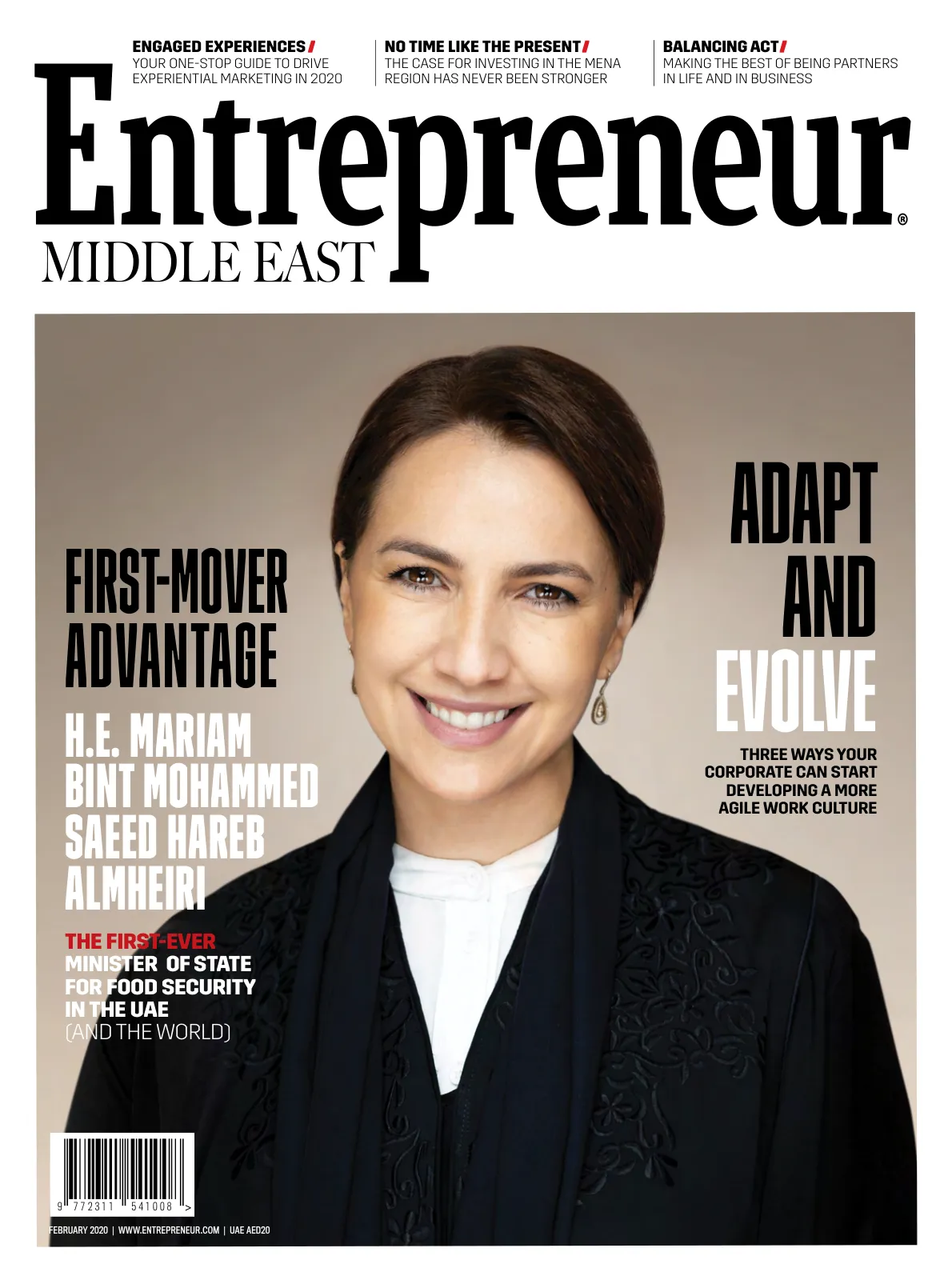
Entrepreneur Middle East, February 2020
Page 1
FEBRUARY 2020 | WWW.ENTREPRENEUR.COM | UAE AED20
9
7 7 2 3 1 1
5 4 1 0 0 8
>
ENGAGED EXPERIENCES
YOUR ONE-STOP GUIDE TO DRIVE
EXPERIENTIAL MARKETING IN 2020
BALANCING ACT
MAKING THE BEST OF BEING PARTNERS
IN LIFE AND IN BUSINESS
NO TIME LIKE THE PRESENT
THE CASE FOR INVESTING IN THE MENA
REGION HAS NEVER BEEN STRONGER
H.E. MARIAM
BINT MOHAMMED
SAEED HAREB
ALMHEIRI
FIRST-MOVER
ADVANTAGE
THE FIRST-EVER
MINISTER OF STATE
FOR FOOD SECURITY
IN THE UAE
(AND THE WORLD)
THREE WAYS YOUR
CORPORATE CAN START
DEVELOPING A MORE
AGILE WORK CULTURE
ADAPT
AND
EVOLVE
Page 2
experience
downtown
living
The UAE’s most exciting new destination.
A journey of discovery for the whole family.
Where nature, fun and entertainment
come together.
800-Arada (27232)
arada.com
Page 3
3
February 2020 / ENTREPRENEUR.COM /
20
CONTENTS FEBRUARY 2020
20
INNOVATOR
FIRST-MOVER ADVANTAGE
H.E. Mariam bint
Mohammed Saeed Hareb
Almheiri
In conversation with the
first-ever Minister of State
for Food Security in the UAE
(and the world).
26
INNOVATOR
AHEAD OF THE CURVE
Alliances for Global
Sustainability founder
and CEO Sheikha Shamma
bint Sultan bin Khalifa Al
Nahyan: “It is our collective
duty to lead responsibly to
create a better world for
future generations.”
60
START IT UP
ECOSYSTEM
No time like the present
The case for investing in
the MENA region has never
been stronger, says Youssef
Haidar, founder and CEO
of StonePine Capital
Partners.
42
CULTURE
BUSINESS UNUSUAL
Creative concepts
Having launched
businesses like Bukhash
Brothers, Buka, and Chalk,
Emirati serial entrepreneur
Anas Bukhash is definitely
clued in to the charms of
being one’s own boss.
46
‘TREPONOMICS
PRO
Adapt and evolve
Youness Yaghcha,
Partnership Manager at
Seedstars, lists three ways
your corporate can start
developing a more agile
work culture.
66
START IT UP
ECOSYSTEM
Boosting an ecosystem
NOW Money co-founder
Ian Dillon on why we need
Western venture capital
firms in the Middle
East entrepreneurial
landscape.
61
UAE Vision 2021
H.E. Mariam Bint Mohammed Saeed Hareb Almheiri
IMAGES COURTESY UAE FOOD SECURITY OFFICE | UAE VISION 2021
Page 4
du.ae/business-pos
Your window to expand.
Introducing Business POS for
cashless payments with better
transaction rates.
Page 5
Page 6
Page 7
Page 8
Page 9
Page 10
Memories create a journey you can always return to
©2019 The Ritz-Carlton Hotel Company, L.L.C.
Your urban adventure in the world’s most vibrant city begins with a luxurious stay at The Ritz-Carlton, Dubai International
Financial Centre. Indulge your senses with a serene experience in the comfort of our impeccable suites, enjoy the ease
of access to a bustling downtown with innovative food and beverage offerings, unforgettable arts scene, and world-class
shopping. On the sizzling evenings, retrieve to Sunken Garden for the best taste of local cuisine and ambiance. Whether
it’s a business trip, a family reunion, or a wedding anniversary, enjoy a memorable stay, and leave the rest to us.
Enjoy your Suite Upgrade Experience today. For reservations, please call +971 4 372 2555 or visit ritzcarlton.com/difc
Page 11
Page 12
12 / ENTREPRENEUR.COM / February 2020
40
CONTENTS FEBRUARY 2020
Concerto TIC’s Mihaela Nina
and Alex Gheordanescu on
making the best of being
partners in life and in business
68
MONEY
STARTUP FINANCE
Frontrunners
Laith Al-Qasem, CEO of the
Innovative Startups and
SMEs Fund, explains how
you can become a good lead
investor for a startup.
56
‘TREPONOMICS
MARKETING
The secret to a successful
business
[THE HOW-TO]
Priyanka Mittal, Director
at KRBL Limited, on how
you can go about building a
customer-centric strategy
for your enterprise.
78
START IT UP
Q&A
Eye on the future
Marc Ibrahim and Joseph
Hajjar are dreaming big as
the co-founders of Ashghali,
an online marketplace
connecting prospective
clients with local
professionals in Lebanon.
40
CULTURE
LIFE
Balancing act
Concerto TIC’s Mihaela
Nina and Alex Gheordanescu
on making the best of being
partners in life and in
business.
38
CULTURE
TRAPPINGS
Tapping into trends
Gary Sweeney, Brand and
Style Director at Ascots &
Chapels, offers a primer
on how you can go about
decoding the new workplace
dress code.
58
TREPONOMICS
SKILLSET
Facilitating innovation
Ideation Labs founder
Dipika Mallya on how design
thinking can help foster an
entrepreneurial mindset.
50
START IT UP
ECOSYSTEM
The changing face of
business in the Middle East
Blend Network Chief
Strategy Officer Roxana
Mohammadian-Molina
takes a look at the ways in
which forward-thinking
governments are fostering
economic development in the
MENA region.
72
TREPONOMICS
MARKETING
Engaged experiences
Stephen George, founder
and CEO of Surkus,
presents a one-stop guide
to drive experiential
marketing in 2020
(for businesses of any size).
51
TECH
THE FIX
Driving change
(through tech)
Sabine Holl, IBM’s Vice
President Technical Sales
and Chief Technology Officer
for IBM Middle East and
Africa, on empowering
women to innovate without
restrictions.
67
TREPONOMICS
PRO
Hiring (and managing) talent
as you scale
Danielle Blizzard, Director at
leap9, lists six tips to create
a winning talent strategy for
your growing enterprise.
74 Fodel, a last-mile delivery tech startup founded by Soumia Benturquia, has been allocated
a part of the US$100 million technology fund of Dubai Cultiv8 Investments Limited.
Page 13
Page 14
14 / ENTREPRENEUR.COM / February 2020
SUBSCRIBE
Contact subscriptions@bncpublishing.net to receive
Entrepreneur Middle East every issue
EDITOR IN CHIEF Aby Sam Thomas editor@bncpublishing.net
CEO Wissam Younane wissam@bncpublishing.net
DIRECTOR Rabih Najm rabih@bncpublishing.net
CREATIVE LEAD Odette Kahwagi
MANAGING EDITOR Tamara Pupic
STARTUPS SECTION EDITOR Pamella de Leon
GROUP SALES DIRECTOR – B2B GROUP Joaquim D’Costa
COLUMNIST Tamara Clarke
PO Box 502511 Dubai, United Arab Emirates
P +971 4 4200 506 | F +971 4 4200 196
For all commercial enquiries related to Entrepreneur Middle East
contact sales@bncpublishing.net
All rights reserved 2020.
Opinions expressed are solely those of the contributors.
Entrepreneur Middle East and all subsidiary publications in the
MENA region are officially licensed exclusively to BNC Publishing
in the MENA region by Entrepreneur Media Inc.
No part of this magazine may be reproduced or transmitted in any
form or by any means without written permission of the publisher.
Printed by United Printing and Publishing
upp.ae
Images used in Entrepreneur Middle East are credited when necessary. Attributed use of
copyrighted images with permission. All images not credited otherwise Shutterstock.
CONTRIBUTORS
entrepreneur.com/me
ACCESS FRESH CONTENT DAILY ON OUR WEBSITE!
MIDDLE EAST
EntMagazineME
@EntMagazineME
Entrepreneur-me
EntrepreneurMiddleEast
EntMagazineME
EntMagazineME
EntMagazineME
MIDDLE EAST
In addition to our print edition, we’re bringing
you all sorts of industry news on our web
mediums. Joining us online means getting
relevant business and startup content in
real-time, so you’re hearing about the latest
developments as soon as we do. We’re looking
forward to interacting with our readers on all of
our social media and web platforms- like any
thriving business, we’re looking to give and take.
#TrepTalkME is already happening on all of our
digi platforms, and all good conversations go
both ways. See you on the web!
Peter Abualzolof
Laith Al-Qasem
Danielle Blizzard
Fida Chaaban
Ian Dillon
Stephen George
Alex Gheordanescu
Youssef Haidar
Sabine Holl
Sarah Jones
Dipika Mallya
Priyanka Mittal
Roxana Mohammadian-Molina
Mihaela Nina
Bianca Riley
Gary Sweeney
Hanna VanKuiken
Youness Yaghcha
Page 15
Visitor Badge
Pouches Sponsor
Lanyards Sponsor
Carrier Bags Sponsors
Convention Gate
Registration Sponsor
Category Sponsor
(Meat & Poultry)
Gold Sponsor
www.aljameelfood.com
Platinum Sponsor
Main Registration
Sponsor
Silver Sponsors
Organised By
Category Sponsor (Beverage)
16 - 20 Feb 2020
Dubai World Trade Centre
Register now at www.gulfood.com/RegisterNow
Celebrate with us!
*Offer ends 15 February 2020
Get your early bird ticket
at AED 450 AED 300*
www.gulfood.com
#Gulfood25
Page 16
16 / ENTREPRENEUR.COM / February 2020
A
s someone who’s learned
to always be a little
skeptical about career
advice that I get from
people around me, there
is a certain irony in the
fact that I find myself now
contributing to this book, which has
been billed as “a young person’s guide
to career success.” After all, one of
my biggest pet peeves when growing
up was the multitude of people who
felt it was completely okay for them
to impose their views and opinions
on me, and go on to essentially tell me
what to do with my life- and here I am
doing almost exactly the same thing to
a whole new generation.
So, with that in mind, I want to lay
down some ground rules to follow as
you read the thoughts penned by me
and my fellow contributors in this
book: the ideas and insights that we
profess to have are a result of the
experiences we’ve had over the course
of our lives so far, and while there may
well be some pointers and lessons
that you can glean from them, they
shouldn’t at all be seen as directives
for how all of you should live your
lives. Because I believe that what you
do with your lives is something only
you should get to decide on- as cliché
as it may sound, you should be march-
ing to the beat of your own drum.
I say this with a lot of confidence
now, but I must admit that such a
mindset was not something I could
claim to have during my time as a stu-
dent in the UAE in the early 2000s.
At the time, I may have dreamt of
following through on my passion for
writing into a career in the journalism
and media space, but almost everyone
around me –a range of people that
includes (perhaps) well-meaning but
overbearing teachers, to (maybe)
kindly but clueless relatives of mine-
told me, in no uncertain terms, that
this was absolutely not the right way
forward for someone like me.
Their reasons for saying so were
varied. One popular contention made
by the adults around me was that a
career in the media world wouldn’t be
easy, and that journalists aren’t paid
well, and as such, those of us in this
field would be leading tough and ardu-
ous lives as a result. Another common
rejoinder I got when I said I wanted
to be a writer or a journalist was that
going down such a career path would
mean that I, as a student who got good
grades at school, would be somehow
wasting the intellect and skillsets I
was blessed with if I chose this par-
ticular profession.
Looking back on all of this now, I’m
pretty certain that all of the people
who told me the above things didn’t
EDITOR'S NOTE
Only you should dictate how your life should be lived
MARCH TO THE BEAT OF YOUR OWN DRUM
The Possibilities Project is a free handbook built
by long-time friends of Entrepreneur Middle East,
PDSi Managing Director Dawn Metcalfe and PDSi
Head of Communication and Engagement Sarah
(Hay) Bahar, aimed at helping students in the
UAE (and anywhere else, really) “on a journey
of self-discovery, independence, and career
success.” I was very glad to be asked to be a
contributor for the same, which sees me join the
likes of UAE Minister of Culture and Knowledge
Development H.E. Noura Al Kaabi, Young Arab
Leaders Chairperson Muna Al Gurg, and others
in offering insights and information that can help
guide young people as they go about deciding
on their careers and, indeed, lives. Ahead of
the book’s launch at the Emirates Airline Festival
of Literature in Dubai in February, the creators
of The Possibilities Project have graciously
allowed me to publish my contribution to it in
Entrepreneur Middle East as well, which I have
done so in lieu of my editor’s note this month.
Do check it out, and as always, let me know
your thoughts by tweeting at me on @thisisaby.
thepossibilitiesproject.co
Page 17
17
February 2020 / ENTREPRENEUR.COM /
do so with any particular malicious
intent; I feel now that their view of
the world was just too myopic to see
the future I was dreaming of for my-
self. For instance, sure, I will admit to
the notion that a journalist’s job is a
tough one- but then again, is there any
job out there that’s a joyride all the
time? Besides, just as the media sec-
tor has several challenges specific to
it, every other industry has its own set
of particular trials and tribulations-
but that doesn’t mean these fields
cannot be worthwhile and fulfilling to
those who have a passion for it.
As for the purported waste of my
talents: well, today, I could make a
concerted argument for why the media
sector offers a better workout for a
person’s mind than perhaps any other
industry- but hey, I didn’t know then
what I do now. At the time though,
given the overwhelmingly negative
feedback I got to my preferred career
choice, I put away the dreams and
aspirations I had made for myself,
and reluctantly got started on what
seemed like a more conventional
vocational path, which pretty much
everyone around me said would be
better for me and my future.
So, I finished school, and then went
on to college in India for four years to
earn a bachelor’s degree in electron-
ics and communication engineering.
Shortly after I graduated, I was hired
by Accenture as a software program-
mer, and that led me to work out
of offices in Mumbai, London, and
New York over the course of almost
five years. As I thus approached my
10-year anniversary of getting out of
school and onto this particular career
path I was on, it did seem like the job
I had was -both literally and figura-
tively- taking me places.
But while that may well have been
the perception from the outside, the
truth was that I was deeply unsatis-
fied with how my life was going. Sure,
I was good at my job, and yes, I was
climbing up the career ladder- but I
had simply no interest in what I was
doing, and as such, the perks of being
a “senior software engineer” weren’t
enough to stop me from thinking that
I was wasting away my life in this
role. I was upset and unhappy, and
I soon found myself in the throes of
a quarter-life crisis, in which I kept
wondering about how different life
could have been, had I followed my
ambition to be a journalist all those
years ago. And that’s how a new idea
sprung to my mind: “Well, why don’t I
try to become a journalist now?”
When I started to tell people that I
was thinking about changing careers,
most of them told me it was a ridicu-
lous idea- from their perspective, I
had a good job, a good salary, a good
way of life even, and so, they couldn’t
get behind why I’d want to throw all
of that away to start up a career in
a totally new industry. They’d also
point out that I had managed to find a
certain degree of success in my career
so far, and that I should be mindful of
the fact that there was no guarantee
that I’d be able to carve out something
similar in the media space. Once
again, I found myself finding it hard to
get validation for my ambition.
But this time around, I didn’t let
the naysayers squash my dreams. I
had tried to do things the way they
told me, and that was obviously not
working out for me- so, now, I wanted
to do things as I deemed fit. As for
the risk of throwing away everything
I had achieved so far for something
that may very well not pan out at all,
I decided that it’d be better for me to
have tried and failed, rather than not
trying at all. Plus, there was the inher-
ent satisfaction in the fact that I was
calling the shots now. I was deciding
what I wanted to do with my life, and
if I did stumble and fall doing that, I
was okay with that- it was definitely
better than being stuck in a life that
was, in a way, imposed on me.
So, I quit my job, got a master’s degree
in journalism from Columbia Uni-
versity in New York, and then kicked
off my career in the media space. I
had essentially been threatened that
working in journalism would see my
life upend itself, and I’ll admit here
this was exactly what happened, and
I could go on and on about all of the
twists and turns I had to deal with as I
made my way through this field. While
I am today privileged and proud to be
at the helm of a publication like Entre-
preneur Middle East, I’ll freely admit
that it has not been an easy ride to get
here. But here’s the thing: when you’re
running after a goal that you have set
for yourself, you somehow naturally
find the will to navigate all of the bar-
riers that come along the way.
In fact, I found out that I didn’t re-
ally mind any of the hurdles that were
in my path- and that was because it
was, quite simply, my path. When you
decide to be the architect of your own
life, you decide how your world looks
like, and while this is easier said than
done, my experiences have taught me
that doing so is certainly worth the ef-
fort. At the end of the day, remember
that the only person who should be
dictating how your life should be lived
is you. And that’s something I took a
while to learn- here’s hoping you don’t
take as long.
Aby Sam Thomas
Editor in Chief
@thisisaby
aby@bncpublishing.net
ONLY YOU SHOULD DICTATE HOW YOUR LIFE SHOULD BE LIVED
"AT THE TIME THOUGH, GIVEN THE OVERWHELMINGLY NEGATIVE
FEEDBACK I GOT TO MY PREFERRED CAREER CHOICE, I PUT
AWAY THE DREAMS AND ASPIRATIONS I HAD MADE FOR MYSELF,
AND RELUCTANTLY GOT STARTED ON WHAT SEEMED LIKE A
MORE CONVENTIONAL VOCATIONAL PATH."
Page 18
18 / ENTREPRENEUR.COM / February 2020
D
ubai Startup Hub,
the entrepreneur-
ship arm of Dubai
Chamber of Com-
merce and Indus-
try, has launched
the fifth cycle of its Dubai
Smartpreneur Competition,
which seeks submissions
from startups offering solu-
tions related to the Expo
2020 Dubai sub-themes of
opportunity, mobility, and
sustainability.
Open to all entrepreneurs
in the UAE and abroad, the
competition gives founders
an opportunity to become
part of Dubai Government’s
strategy to elevate the
city into a global platform
for innovative startups.
This year’s edition is also
in line with the vision of
H.H. Sheikh Mohammed
bin Rashid Al Maktoum,
Vice President and Prime
Minister of the UAE and
Ruler of Dubai, to transform
the Emirate into one of the
world’s smartest cities.
The Dubai Smartpreneur
Competition awards the top
three winners a combined
total of AED150,000 in
cash prizes, in addition to
a startup support package,
mentorship opportunities,
access to overseas trade mis-
sions, and Dubai Chamber
events and trainings.
To be eligible to partici-
pate, a startup company’s
product or service must have
launched no earlier than
2017, and be either based
in, or operate in, the UAE.
The startup needs to have a
minimum viable product and
applicants must be 21 years
of age or older. Startups
must submit their entries in
English through the Dubai
Startup Hub website by the
February 26 deadline.
H.E. Hisham Al Shirawi,
2nd Vice Chairman of Dubai
Chamber, said in a statement
that the annual competi-
tion has been one of Dubai
Startup Hub’s most suc-
cessful initiatives to date,
which has supported Dubai
Chamber’s comprehensive
entrepreneurship strategy of
empowering entrepreneurs
and providing them with the
knowledge and tools they
need to thrive and grow.
More than 1,600 smart
business ideas have been
submitted over the last four
cycles of the competition
with an increasing number
of international submis-
sions, he said, reflecting
Dubai’s status as a magnet
from promising startups.
“Startups are a key source of
innovation in Dubai as they
bring cutting-edge solutions
to the market,” Al Shirawi
said. “By aligning this year’s
competition with Expo 2020
Dubai, we are creating more
opportunities and benefits
for participating startups
and positioning Dubai as in-
novation leader.”
This year’s edition of the
competition was launched
in January at a ceremony
attended by Dubai Chamber
officials, previous competi-
tion winners and contest-
ants, members of the local
startup community, and
representatives from Expo
2020 Dubai and DP World.
Following the submission
deadline, entries will be
evaluated and shortlisted
with the selected candidates
then qualifying for the train-
ing phase of the competition.
The top 50 startups will also
get to participate in a four-
day bootcamp, and the top
10 startups will have the op-
portunity to exhibit at Expo
2020 Dubai to meet with
potential investors and busi-
ness partners. Winners will
be announced at an awards
ceremony in April 2020.
Last year’s winners includ-
ed Denarii Cash, a mobile
application helping overseas
workers to send money
to their home countries
claimed the first place prize,
Arabee, a high specification
platform providing an online
multi-format Arabic lan-
guage program, and Xpence,
a digital-only intelligent
business bank account de-
signed by entrepreneurs for
entrepreneurs.
Dubai Chamber launched
Dubai Startup Hub in 2016
as an online platform to con-
nect startups, entrepreneurs,
developers, venture capital-
ists and students, enabling
them to learn about new op-
portunities and create new
partnerships that stimulate
economic growth.
dubaichamber.com/dubaistartuphub/
smartpreneur
Dubai Startup Hub invites entries for the fifth cycle
of its Dubai Smartpreneur Competition
IN THE LOOP
IMAGE COURTESY DUBAI STARTUP HUB
Innovators welcome
A scene from the launch of the fifth cycle of the Dubai Smartpreneur Competition
“BY ALIGNING THIS
YEAR’S COMPETITION
WITH EXPO 2020 DUBAI,
WE ARE CREATING
MORE OPPORTUNITIES
AND BENEFITS FOR
PARTICIPATING STARTUPS
AND POSITIONING DUBAI
AS INNOVATION LEADER.”
Page 19
CLEMENTINE MALIM
ASSOCIATE - MIDDLE EAST
clementine.malim@savills.me
+971 50 558 2853
WHY SAVILLS
INTERNATIONAL RESIDENTIAL
MIDDLE EAST
international@savills.me
+971 4 365 7700
IN-DEPTH KNOWLEDGE
AND INSIGHT OF THE
CURRENT MARKET
WE ARE ONSITE IN LONDON AND READY TO
TAKE YOU ON AN EXCLUSIVE SITE VISIT WITH
ONLY THE BEST DEVELOPMENTS
LOCALLY AVAILABLE TO HELP NAVIGATE
YOUR INVESTMENT JOURNEY FROM
THE UAE THROUGH TO LONDON
TRIPTYCH
BANKSIDE
KING’S ROAD
PARK
GRAND
UNION
LINCOLN
SQUARE
A SELECTION OF THE FINEST
NEW RESIDENTIAL HOMES
L O N D O N
BATTERSEA
POWER STATION
Page 20
20 / ENTREPRENEUR.COM / January 2020
FIRST-MOVER
ADVANTAGE
H.E. MARIAM BINT MOHAMMED
SAEED HAREB ALMHEIRI
The first-ever Minister of State for Food Security
in the UAE (and the world) by ABY SAM THOMAS
INNOVATOR
O
ver the course of my conversation with H.E. Mariam
bint Mohammed Saeed Hareb Almheiri at Emirates
Towers in Dubai in January, there were a few traits
about the UAE Minister of State for Food Security
that especially stood out. For starters, Almheiri has
an extremely amiable personality. Besides putting me
at ease almost as soon as I met her, this resulted in
a free-flowing conversation that had her sharing not
just facts and figures relating to the UAE Food Security
Office that she leads, but also a lot of personal insights
and anecdotes from her life and career so far. Indeed,
it became quite apparent that Almheiri’s investment
in the work that she does today has been largely driven by the values and
principles that her parents had inculcated in her from a young age. A few
examples? She has essentially inherited her Emirati father’s passion for
the environment, which would explain her uninhibited desire to protect and
safeguard it today, while her German mother, who belonged to a farming
family, instilled in her a deep-rooted respect and regard for how food is
grown and made. Besides shaping her to be the person she is today, the
lessons Almheiri were taught then have proved to be especially pertinent
for her current work with the government, where her mandate for food
security is defined as “enabling all citizens and residents of the UAE to have
access to healthy, safe, nutritious and sufficient food, at reasonable prices
in all circumstances, including emergencies and crisis.” >>>
Page 21
21
February 2020 / ENTREPRENEUR.COM /
FIRST-MOVER ADVANTAGE | H.E. MARIAM BINT MOHAMMED SAEED HAREB ALMHEIRI
H.E. Mariam Bint Mohammed Saeed Hareb Almheiri
Page 22
22 / ENTREPRENEUR.COM / February 2020
As the first person ever ap
pointed to such a ministerial
post in the UAE -and in the
world- Almheiri is navigating
unchartered territories; yet,
she claims that this has been
more of a blessing for her than
anything else. “Being the first
minister responsible for this
particular file called food se
curity, it actually empowered
me a lot,” she says. “Because
no one else had that [role],
but everyone was talking
about it. Every minister of ag
riculture, every minister that
deals with food, is actually
dealing with food security. But
we were actually going right
to the specifics, and ensuring
that we're taking the holistic
approach. Because it's not
just about growing food. It's
about nutrition. It's about
strategic storage. It's about
food waste. It's about having
emergency plans in place. So,
there's so much in the whole
food security domain- there
is a clear definition, and it’s
that the country’s citizens
[should] have access to safe,
sufficient, nutritious food at
affordable prices, at all times.”
As for the fact that the UAE
government was being a global
forerunner in creating (and
appointing her to) this post
that seeks to establish the
country as “a world-leading
hub in innovation-driven food
security,” Almheiri puts it
down to yet another instance
of their visionary outlook for
the country and its future.
And the results of this
farsighted approach are show
ing in the achievements that
Almheiri and her team at the
UAE Food Security Office have
been realizing lately. When
Almheiri was appointed to
her role in 2017, the UAE was
ranked 33rd on the Global
Food Security Index, an an
nual report that assesses this
domain on “the core issues
of affordability, availability,
and quality” in 113 countries
around the world. A year later,
the UAE moved up to the 31st
place, and in December last
year, the country made a ten-
place leap to be ranked 21st.
Now, while this by itself is an
impressive showcase of the
efforts that the UAE has been
making in this arena, Almheiri
makes it clear that she and her
team have bigger goals to real
ize. “Our aim is to be among
the top 10 by 2021, and then
aim for number one by 2051,”
she reveals. “So, this is our
roadmap.” This is thus what
has been laid out in the UAE’s
National Strategy for Food
Security, which Almheiri had
presented in November 2018.
In it, the UAE Food Security
Office had listed 38 initiatives
it will embark on to realize five
strategic goals, which include
facilitating global agri-busi
ness trade and diversifying
international food sources,
enhancing sustainable
technology-enabled domestic
food supply across the value
chain, reducing food loss and
waste, sustaining food safety
and improving nutritional
intake, and, finally, enhancing
capacity to respond to food
security risks and crises.
At first glance, all of the
aforementioned aspects of
food security might seem like
things that are, well, high-
level, and, as such, not really
affect regular people like you
and me; however, it’s the op
posite that is actually true,
says Almheiri. She points out
that the UAE has been built as
a hub for food trade, with the
country currently importing
90% of its food; however,
with the way the global land
scape has been changing in
the recent past, it can be risky
for a nation to place such a
high dependence on external
sources for sustenance in the
long run. “As an example,
we know that population is
on the rise globally,” Alm
heiri explains. “We're heading
towards nine billion, which
means we will need more
food [to feed them all]- some
50% more food in the next 10
years. Traditional agriculture
is already at its limits in terms
of land, in terms of water;
climate change is making it
even harder. So, you've got
population rising fast, and
you've got traditional agricul
ture not being able to cope,
H.E. Mariam Bint Mohammed Saeed Hareb Almheiri with H.H. Sheikh Mohammed bin Rashid Al Maktoum
INNOVATOR
Oweis Zahran, founder and Chairman, OWS Auto
“it's not just about growing food. It's about nutrition.
It's about strategic storage. It's about food waste.
It's about having emergency plans in place.”
IMAGES COURTESY UAE FOOD SECURITY OFFICE
Page 23
23
February 2020 / ENTREPRENEUR.COM /
and so, a food gap is starting to grow. At
the same time, we have a lot of distribu
tion problems, like, there is enough food
for all, but there's still over 800 million
people hungry. And then on the other
extreme, there are millions who are now
obese, or have heart disease, so, we’ve
got a big distribution problem as well.”
At the same time, people’s attitudes
toward food in general are needing a
correction as well- Almheiri highlights
a United Nations study that had found
that a third of the food being produced
globally is going to waste.
With factors like these at play, the need
for a food security strategy thus becomes
more apparent, and for the UAE, this is
especially important, so that, as Almheiri
puts it, “we’re not just food secure now,
but also in the future.” Of course, this
doesn’t mean that the UAE is going to be
halting its food imports any time soon;
however, the nation is seeking to diver
sify its sources for it, and that involves
making use of technology to grow food
within the country as well. “So, with
this National Food Security Strategy,
we basically want to go from being a
hub of food trade, to becoming a hub of
knowledge about food and food innova
tions,” Almheiri says. One example of
the UAE Food Security Office’s efforts
in this regard can be seen in it teaming
up with Tamkeen (an Abu Dhabi-based
company mandated to deliver projects
to meet the UAE’s vision of knowledge-
based development) to run The Foodtech
Challenge. With US$1 million worth of
prizes up for grabs, The Foodtech Chal
lenge, which kicked off in September last
year, is a global competition that is look
ing for “innovative solutions across the
food value chain.” With the deadline for
entries slated for mid-February, Almheiri
reveals that the contest, which has been
inviting ideas relating to food produc
tion, food distribution, or food waste
management, has so far attracted more
than 1,000 submissions from around
the world, with the winners set to be
declared in April this year. >>>
“we basically want to go
from being a hub of food
trade, to becoming a hub of
knowledge about food and
food innovations.”
FIRST-MOVER ADVANTAGE | H.E. MARIAM BINT MOHAMMED SAEED HAREB ALMHEIRI
H.E. Mariam Bint Mohammed Saeed Hareb Almheiri
Page 24
24 / ENTREPRENEUR.COM / February 2020
INNOVATOR
Oweis Zahran, founder and Chairman, OWS Auto
Almheiri is visibly excited
about The Foodtech Challenge,
and it’s easy to see that the
influx of entrepreneurial ideas
the competition will bring in
ties into her dream of hav
ing the UAE become a hub for
food innovations. While the
UAE may not house the most
appropriate environment for
growing food per se, Almheiri
believes that there are still
several opportunities the
country presents in this space.
“We need to look at the posi
tive side,” she says. “The infra
structure we’ve built will en
able us and the resources that
we have to focus on technology
and innovation when it comes
to growing food. I’m sure you
have heard of meat grown in a
lab, 3D-printing of food, etc.-
these are all food innovations
that we believe, if we focus on
them, then we could become
a hub of knowledge when
it comes to food, especially
in environments such as we
have. We believe that many
countries will have this kind
of environment in the near
future- it's already happen
ing. And so, we want to make
sure we're already gaining this
knowledge, we're pushing the
boundaries on technology,
we're pushing the boundaries
on research and development,
in order to use technology to
start growing food in the UAE
in a more efficient manner.”
Of course, it’s one thing for
a country to say it welcomes
innovations; it’s another thing
altogether for it to house an
ecosystem that allows such
ideas to develop and grow. To
her credit, Almheiri seems
to be well aware of this, and
that would explain why she
and her team have made it a
priority to remove roadblocks
that businesses in this space
often have to face in the UAE.
An example of this would be
in the ten initiatives the UAE
Food Security Office launched
in partnership with the Gov
ernment Accelerators program
to boost the country’s agtech
industry, of which one was the
development of a unified agri
cultural license for enterprises
operating anywhere in the UAE
in this sector. Besides allowing
for a number of agricultural
activities to be consolidated
under a single banner, this li
cense also afforded companies
cost savings of up to 60%- a
significant impact when you
consider that these are often
young enterprises operating
in a nascent industry. “Get
ting entrepreneurs excited
about this [industry] is very
important, and I think it’s our
responsibility to devise an
ecosystem for them to actually
come, invest money, and start,”
Almheiri says. “And if they
see that there is a journey that
they can take, and that there
are opportunities for them,
then it will get them even more
excited.”
It is at this point in our
conversation that I felt that
Almheiri truly understands
what it’s like to be an entre
preneur, and so I’m elated to
find out that she actually has
first-hand experience in this
“Getting entrepreneurs excited
about this [industry] is very
important, and I think it’s our
responsibility to devise an
ecosystem for them to actually
come, invest money, and start.”
H.E. Mariam Bint Mohammed Saeed Hareb Almheiri
Page 25
25
February 2020 / ENTREPRENEUR.COM /
arena. After completing her bachelor’s
and master’s degrees in mechanical engi
neering in Germany, Almheiri had kick
started her career by working there as
well, following which she returned to the
UAE and started working with the Emir
ates Marine Environmental Group. That
led on to her starting work with the UAE
government- prior to her appointment
as the Minister of Food Security, she was
the Assistant Undersecretary for Water
Resources and Nature Conservation Af
fairs at the Ministry of Climate Change
and Environment. But in the middle of all
this, Almheiri had set out on a number
of entrepreneurial outings of her own as
well- she’s launched and run enterprises
in sectors as varied as fitness, mainte
nance, and waste management, which
she eventually ended up shutting down
when her work in the government grew.
Having said that, Almheiri acknowl
edges learning a lot in her time as an en
trepreneur, with these lessons including
everything from learning to work with
different kinds of people, to realizing the
importance of market access when you’re
a fledging startup in a well-established
industry.
When asked about advice she’d give en
trepreneurs today, Almheiri replied with
a nod to the importance of having the
right people around you as you go about
chasing your dream. “Surround yourself
with people who inspire you, and people
who bring positive feeling,” Almheiri
says. “I think this is really important. I
always feel when we were young, we find
our friends who like the same things. But
then as we get older, some of the friends
we have are, say, always complaining, and
you don't feel good around them any
more. Try and minimize how much time
you spend with these people. Try and be
with people if you learn from them, if you
get inspired by them. I think that's a big
lesson I learned- that's a personal and
a work lesson as well. Like, if my team
were not inspired by me, then how are
they going to be motivated? So, this is
something that I see as being really im
portant.” Almheiri is also insistent about
the importance of not getting complacent
in one’s careers- and that’s especially
valuable advice to take to heart if you’re
an entrepreneur. “Be a little bit of a risk
taker,” she says. “If you don’t ever go out
of your comfort zone, you’ll never learn.
Even if you fail, just get up and try again.
Our assets are our minds, and the knowl
edge we have there.” It’s clear that this
is a principle that Almheiri is personally
taking to heart as the UAE Minister of
Food Security, given the emphasis she
and her team are putting in making the
country a hub for knowledge and innova
tion- and it’s safe to say that this ethos is
something that can be put to good use in
our lives and careers as well.
Food security has been called one
of the major emerging challenges
in the world today, and that’d
explain why it has become one
of the hottest sectors in Silicon
Valley right now. Led by ambitious
entrepreneurs, there has been
a boom in the food tech startup
space since Beyond Meat
celebrated the most successful
IPO of 2019. While the West has
been seeing a slew of innovations
and startups making headlines
in this space (think everyone
from Beyond Meat to Impossible
Foods), the Middle East seems to
have only just embarked on this
road- but the potential for growth
is definitely there in this region.
An added benefit? With a reduced
environmental impact in production
phases, including the use of less
resources and arable land, these
startups are also addressing the
climate crisis. Here are some of the
companies that are currently in the
news for tackling issues around
food security:
Beyond Meat beyondmeat.com
Impossible Foods impossiblefoods.com
JUST ju.st
Miyoko’s miyokos.com
Memphis Meats memphismeats.com
BlueNalu bluenalu.com
Clara Foods clarafoods.com
Mosa Meat mosameat.com
Aleph Farms aleph-farms.com
Finless Foods finlessfoods.com
WATCH THIS SPACE
Startups around the world are
going big on food security
"WE'RE PUSHING THE
BOUNDARIES ON TECHNOLOGY,
WE'RE PUSHING THE
BOUNDARIES ON RESEARCH
AND DEVELOPMENT, IN ORDER
TO USE TECHNOLOGY TO START
GROWING FOOD IN THE UAE IN
A MORE EFFICIENT MANNER."
FIRST-MOVER ADVANTAGE | H.E. MARIAM BINT MOHAMMED SAEED HAREB ALMHEIRI
H.E. Mariam Bint Mohammed Saeed Hareb Almheiri at the Youth 4 Sustainability Hub
Page 26
26 / ENTREPRENEUR.COM / February 2020
AHEAD OF THE CURVE
ALLIANCES FOR GLOBAL SUSTAINABILITY FOUNDER AND CEO
SHEIKHA SHAMMA BINT SULTAN
BIN KHALIFA AL NAHYAN
“It is our collective duty to lead responsibly
to create a better world for future generations.”
A
s the great granddaughter of the late H.H. Sheikh Zayed bin Sultan Al Nahyan, the founding
father of the UAE, Alliances for Global Sustainability CEO Sheikha Shamma bint Sultan bin
Khalifa Al Nahyan doesn’t have to look too far from her own family when it comes to seeking
inspiration for her work in the environmental domain.
Consider, for instance, her visionary great grandfather’s words in 1998, which he said on
the occasion of the UAE’s first Environment Day: “We cherish our environment, because it
is an integral part of our country, our history, and our heritage. On land and in the sea, our
forefathers lived and survived in this environment. They were able to do so only because
they recognized the need to conserve it, to take from it only what they needed to live, and to preserve it
for succeeding generations. With God’s will, we shall continue to work to protect our environment and our
wildlife, as did our forefathers before us. It is a duty, and, if we fail, our children, rightly, will reproach us for
squandering an essential part of their inheritance, and of our heritage.”
by ABY SAM THOMAS
INNOVATOR
26 / ENTREPRENEUR.COM / February 2020
Page 27
27
February 2020 / ENTREPRENEUR.COM /
It's easy to see that these lines by Sheikh
Zayed have had an indelible impact on
Sheikha Shamma, especially when you
consider her contribution to the quotation
wall at the Møller Institute at Churchill
College, Cambridge in the UK, which goes:
“It is our collective duty to lead respon
sibly to create a better world for future
generations.” As the youngest person to
have been quoted on this particular wall
(her words are showcased alongside those
by Winston Churchill, Michelle Obama,
and others), Sheikha Shamma, who has a
master’s degree in sustainable leadership
from Cambridge University, was chosen
for this particular honor in July last year
on account of her achievements as both a
businesswoman and a philanthropist.
After all, besides her leadership of
Alliances for Global Sustainability (a for-
profit venture that facilitates projects and
partnerships across various entities and
sectors that are in line with the United
Nations Sustainable Development Goals),
Sheikha Shamma is also the founder of
a charitable foundation called Circle of
Hope, which has run initiatives like Wanna
Read? (this drive saw over 7,000 books
placed for children in hospitals in the
UAE), Beacon of Hope (this program saw
solar light resource kits supplied to chil
dren in developing countries), and More
Equity (which was formerly called Women
Empowerment and Equality Board, and is
aimed at promoting gender balance and
empowering women in the UAE’s work
places), among others.
I got to have a quick chat with Sheikha
Shamma at the 2019 Sharjah Entrepre
neurship Festival (where she was one of
the headline speakers), and that’s when
she told me about her motivations behind
the work she does as the founder and CEO
of Alliances for Global Sustainability.
“When we look at the resources of the
world, we are depleting them faster than
we can replenish them,” she noted. “We
also have a growing population, and that
equates to an unimaginable scenario.”
Her personal interest in the sustainability
domain is thus what led her to her work
ing in this space, where she aims to have
different entities work together to realize
outcomes that benefit us all. An example
of this would be the recent memorandum
of understanding that was signed between
Alliances for Global Sustainability and
the UAE Ministry of Climate Change and
Environment with Abu Dhabi-based de
veloper Imkan to announce The Guardians
Initiative, which has the real estate player
pledging “to safeguard, protect and pre
serve Abu Dhabi’s diverse heritage, nature,
wildlife and marine environments.”
While efforts like the above seek to affect
change on a macro sale, Sheikha Shamma
makes it clear that there’s a lot that one
can do (and lead) from a more personal
level as well. “When I talk about leader
ship, I’m not waiting for someone to lead,”
she explained. “I’m encouraging everyone
to take that initiative, because, everyone,
no matter how small they think they are
in the grand scheme of things, they do
have an impact on the planet. And if they
are more responsible, then it makes the
world a better place for generations to
come.” And that, in effect, sums up what
is Sheikha Shamma’s hope for the future.
“I’d like to see a more sustainable world,
a world where we’ve moved from a linear
economy to a circular economy,” she said.
“A world where our children will have the
resources and the environmental privileges
we’ve had, if not more.”
AHEAD OF THE CURVE |SHEIKHA SHAMMA BINT SULTAN BIN KHALIFA AL NAHYAN
“WHEN WE LOOK AT THE
RESOURCES OF THE WORLD,
WE ARE DEPLETING THEM
FASTER THAN WE CAN
REPLENISH THEM. WE ALSO
HAVE A GROWING POPULATION,
AND THAT EQUATES TO AN
UNIMAGINABLE SCENARIO.”
UAE Minister of Climate Change and Environment H.E. Dr Thani bin Ahmed Al Zeyoudi with Imkan CEO Walid El Hindi
on the occasion of the Ministry of Climate Change and Environment and Alliances for Global Sustainability signing a
memorandum of understanding with Imkan to announce The Guardians’ Initiative.
IMAGE COURTESY ALLIANCES FOR GLOBAL SUSTAINABILITY
Page 28
28 / ENTREPRENEUR.COM / February 2020
Insights from the latest installment of
Entrepreneur Middle East Round Table,
presented by du by PAMELLA DE LEON
M
oderated by Entrepreneur
Middle East Editor in Chief
Aby Sam Thomas, the dis-
cussion welcomed insights
from Dr. Alia Al Serkal, Vice
President, People Learning and Growth,
du; Callie Dickens, founder and CEO, Sym-
metry; Seza Vaziri, GE’s Women’s Network
Leader for MENAT, and founder and CEO
of Kandoo; Meher Mirchandani, Direc-
tor, Manrre REIT; Mona Ataya, founder
and CEO, Mumzworld; Kindah Sais,
Global Equity, Diversity and Inclusion
Leader for Middle East, Boeing; Mansoor
Habib, Head of Happiness & Tolerance,
du; Jennifer Gonzalez, Manager - Partner
Management, ICT, du; Noora Al Mansoori,
Director Corporate Communications, du;
Rana Hajr, Head of Consumer Services
Governance & Planning, du; Aisha Rawert,
Director - Organization, Capabilities and
Performance, du; Dr. Raffaella Bianchi,
Head of Consumer Experience, du; and
Mona Gulaid, Senior Manager Enterprise
Process Management, du.
Here are few vital points that were dis-
cussed on how entities in the Middle East,
whether from the corporate or the startup
world, can put in place initiatives and
practices to enable a more equitable play-
ing field for women in the workplace.
1. Set out to hire female leaders
Mona Ataya, founder and CEO of Mumz-
world, pointed out that statistics indicate
that both regionally and globally, there is
still a prevalent glass ceiling for women. As
an entrepreneur, in the early days of build-
ing Mumzworld, Ataya says that they set
out to attract women leaders, hiring them
for roles like head of technology, head of
inbound logistics, etc. “Women support-
ing women has been our approach and
our particular strategy, and it has led us
to where we are today,” she said. Though
there are limitations to this approach, and
while and it has proven to be more difficult
and time-consuming, Ataya noted that
she “set out with the mindset that you are
only as good as the effort you put out, and
that mindset has kind of blinded me to the
limitations.” >>>
presented by
ROUND TABLE
HOW ( AND WHY )
BUSINESSES
SHOULD CHAMPION
INCLUSIVE GROWTH
"AT THE END OF THE DAY, IT’S ABOUT
EQUALITY, MAKING SURE EVERYONE
HAS EQUAL OPPORTUNITIES,
REGARDLESS OF THEIR BACKGROUND.”
Dr. Alia Al Serkal, Vice President,
People Learning and Growth, du
“WOMEN SUPPORTING WOMEN
HAS BEEN OUR APPROACH AND OUR
PARTICULAR STRATEGY, AND IT HAS
LED US TO WHERE WE ARE TODAY.”
Mona Ataya, founder and CEO, Mumzworld
Page 29
29
February 2020 / ENTREPRENEUR.COM /
INCLUSIVE GROWTH| ENTREPRENEUR MIDDLE EAST ROUND TABLE PRESENTED BY DU
1. Mona Gulaid, Senior Manager, Enterprise Process Management, du
2. Jennifer Gonzalez, Manager - Partner Managaement, ICT, du
3. Kindah Sais, Global Equity, Diversity and Inclusion Leader for Middle
East, Boeing
4. Rana Hajr, Head of Consumer Services Governance & Planning, du
5. Noora Al Mansoori, Director, Corporate Communications, du
6. Left to right: Dr. Raffaella Bianchi, Head of Consumer Experience, du;
Aisha Rawert, Director - Organization, Capabilities & Performance, du
7. Speakers at the Entrepreneur Middle East round table presented by du. Left to right: Meher
Mirchandani, Director, Manrre REIT; Rana Hajr, Head of Consumer Services Governance &
Planning, du; Aby Sam Thomas, Editor in Chief, Entrepreneur Middle East, Dr. Mansoor Habib,
Head of Happiness and Tolerance, du; Dr. Raffaella Bianchi, Head of Consumer Experience,
du; Aisha Rawert, Director - Organization, Capabilities & Performance, du; Kindah Sais, Global
Equity, Diversity and Inclusion Leader for Middle East, Boeing; Mona Gulaid, Senior Manager,
Enterprise Process Management, du; Dr. Alia Al Serkal, Vice President, People Learning and
Growth, du; Callie Dickens, founder and CEO, Symmetry; Seza Vaziri, founder and CEO, Kandoo
1
5
6
7
2
3
4
29
February 2020 / ENTREPRENEUR.COM /
Page 30
30 / ENTREPRENEUR.COM / February 2020
2. Pay it forward (always)
Seza Vaziri, GE’s Women’s Network
Leader for MENAT, and founder and CEO
of Kandoo, recalled how when she first
started her career, it was a common sight
to be the only woman in a room. However,
she thought herself to be lucky in this re-
gard, as she had the privilege to have been
able to work with companies that strived
to be inclusive. “My experience actually
made me become a person to help others,
because I know that’s not the reality,”
Vaziri said. She went on to point out how
for certain industries, such as the energy,
or oil and gas sector, it’s essential to be a
catalyst for growth in everyday situa-
tions, be it through including women to
vital conversations, and giving them a fair
chance at promotions and climbing up
the career ladder.
3. Use data to drive decisions
Callie Dickens, founder and CEO, Sym-
metry, said that just because the end goal
is equality, that doesn’t necessarily mean
treating everybody equally, because every
person would have their own set of ad-
vantages and shortcomings. The process
should thus instead be about ensuring
that every person has access to all of
the opportunities, which can be evalu-
ated with previous research and data.
“Through understanding that histori-
cally women have been at a disadvantage,
we’re now able to change that through
data,” Dickens said. Dr. Raffaella Bianchi,
Head of Consumer Experience, du, agreed
with Dickens, noting the significance of
research data to showcase the existing
gender gap in companies by highlighting
the stark reality. “It’s an eyeopener for
us, [showing us that] we do have an op-
portunity to improve, and we need to do
something.”
4. Ensure growth for everyone
Kindah Sais, Global Equity, Diversity and
Inclusion Leader for Middle East, Boeing,
stressed on the importance of inclusiv-
ity, not just for women, but for men and
other minorities as well, such as people
with disabilities, women of color, etc.,
especially when you consider your com-
pany’s target market. “We [need] to have
employees reflect the diversity of our
customers, so we can know how to target
them,” Sais said. “[As a company], we
need to get to the whole population, so,
we say it’s the role of men to champion
women and every minority in the com-
pany, and vice versa… We try to push for
an inclusive culture, rather than focusing
only on one segment or minority.” Dr. Alia
Al Serkal, Vice President, People Learning
and Growth, du, added, “Not every man is
a family man or father, not every woman
is a mother. At the end of the day, it’s
about equality, making sure everyone has
equal opportunities, regardless of their
background.”
5. Normalize flexible roles in
relationships
On a cultural level, Meher Mirchan-
dani, Director, Manrre REIT, explains
that it’s often imposed on women to
take on the responsibility when it
comes to taking care of their children,
and sometimes even their parents and
in-laws. This can be changed, she said,
if we, as a community, make it normal
for partners in a relationship to share
duties and tasks. “The education needs
to be given that we’re in it together,”
Mirchandani said. “The more men see
other men understanding and respect-
ing their partners, whether that’s her
working, studying, or pursuing her
goals, I think, that’s when the differ-
ence will come.”
presented by
ROUND TABLE
Dr. Alia Al Serkal Vice President,
People Learning and Growth, du
Callie Dickens Founder and CEO,
Symmetry
Seza Vaziri GE’s Women’s Network
Leader for MENAT, and founder and
CEO of Kandoo
Meher Mirchandani Director, Manrre
REIT
Mona Ataya Founder and CEO,
Mumzworld
Kindah Sais Global Equity, Diversity
and Inclusion Leader for Middle East,
Boeing
Dr. Mansoor Habib Head of
Happiness and Tolerance, du
Jennifer Gonzalez Manager - Partner
Management, ICT, du
Noora Al Mansoori Director,
Corporate Communications, du
Rana Hajr Head of Consumer
Services Governance and Planning,
du
Aisha Rawert Director - Organization,
Capabilities, and Performance, du
Dr. Raffaella Bianchi Head of
Consumer Experience, du
Mona Gulaid Senior Manager,
Enterprise Process Management, du
STRONGER TOGETHER
A list of all of the participants in this
edition of the Entrepreneur Middle East
Round Table presented by du
“THE MORE MEN SEE OTHER MEN
UNDERSTANDING AND RESPECTING
THEIR PARTNERS, WHETHER THAT’S
HER WORKING, STUDYING, OR
PURSUING HER GOALS, I THINK,
THAT’S WHEN THE DIFFERENCE
WILL COME.”
“IT’S AN EYEOPENER FOR US,
[SHOWING US THAT] WE DO HAVE
AN OPPORTUNITY TO IMPROVE,
AND WE NEED TO DO SOMETHING.”
Meher Mirchandani, Director, Manrre REIT
Callie Dickens,
founder and CEO,
Symmetry
Page 31
Page 32
32 / ENTREPRENEUR.COM / February 2020
W
ith over 90 hotels in
operation or under
construction for
the Middle East and
North Africa, the
Radisson Hotel Group
has managed to make its presence felt
in the region by demonstrating year-on-
year growth in market share and profit
ability, despite the recent difficult market
conditions. “We have accelerated our
critical mass strategy in key markets
across the region, especially in key
capital cities in which we operate,” says
Ramsay Rankoussi, Vice President, Busi
ness Development – Middle East, North
Africa, and Turkey, Radisson Hotel Group.
“The aim is to translate our presence
into operational efficiencies through
clustering opportunities and economies
of scale. Our growth journey is inter
linked with that critical mass strategy.”
With the Group expecting to have more
than 100 properties in the region to its
name in 2020, Rankoussi reveals that
the enterprise aims to have over 150
hotels in the MENA by 2024, and a key
market it’s aiming to capitalize on as part
of this strategy is Egypt. Excerpts from
an interview with Rankoussi:
Egypt has figured prominently in
Radisson’s plans for the future- can
you talk a little bit more about this,
and your plan for the country in 2020?
What’s the current market situation,
and how do you think this will change in
the months and years to come?
Ramsay Rankoussi (RR): As we start
2020, our focus remains in key markets
which have demonstrated potential for
further growth or have now shown posi
tive rebounds and signs of recovery.
We have announced last year a strategic
transaction in Egypt with over 6 new
hotels under construction which will
translate Radisson Hotel Group into a
leadership position in Cairo with over 5
hotels in the capital and another 4 hotels
between Alexandria and the Red Sea
totalling over 9 hotels and 3,000 rooms
across the country under development
and in operation.
Egypt is in full recovery and we expect
to re-enter in key leisure destinations as
well as consolidate our presence with
our current portfolio under construction.
We have also allocated a dedicated
resource to support our expansion plans
in the country as we witness positive
rebound on the leisure side.
How much of an increase can we
expect to see in terms of Radisson’s
presence in the Egyptian market this
year? Please take us through the new
openings that are being planned, and
how much of your strategy in Egypt
also involves the conversion of already
existing hotels.
RR: Radisson Hotel Group currently oper
ates 3 hotels, all under Radisson BLU. We
have one hotel in Cairo, one hotel in Al
exandria and one hotel in El Qseir on the
Red Sea. We expect to open during 2020
our first serviced apartments offering in
the Capital along with the introduction
of the first branded Radisson hotel. Both
properties will represent a combined
additional 300 rooms which will further
translate our strategy in creating city
scale and offer clustering efficiencies.
By 2022, we expect to launch our first
Radisson Collection in Cairo but also
enter new leisure destinations such as
Ain Sokhna or Makadi Bay.
As the country witnesses positive return
of key leisure markets especially from
Europe, we expect to indeed foresee
conversion opportunities from existing
hotels looking at joining our systems and
capitalize on our distribution and global
presence. Radisson BLU is the largest
upper upscale brand in Europe and has
therefore a lot of recognition for the
feeder markets of many Egyptian coastal
destinations where we can add value
such as Sharm El Sheikh and Hurghada.
ADVERTORIAL
Accelerating growth
Egypt figures prominently in Radisson Hotel Group’s plans
to expand in the MENA
Ramsay Rankoussi,
Vice President, Business Development -
Middle East, North Africa,
and Turkey, Radisson Hotel Group
Page 33
33
February 2020 / ENTREPRENEUR.COM /
ADVERTORIAL
Lastly, what do you think are the key
factors that will lead to Radisson’s
success in the Egyptian market?
From a business point of view, how do
you think Radisson differentiates itself
from its competitors when it comes
to servicing its end customers and
owners?
RR: Egypt is truly a unique country which
has probably one of the biggest poten
tial, but which also requires continuous
improvement through public invest
ments into infrastructure and education.
The nation hosts one of the largest and
most important civilization with so many
cultural sites and museums to visit. It
offers beautiful resort locations with a
rare diversity of marine life making it a
hotspot for divers while the desert pro
vides adventurous opportunities from
camping to hiking.
We have recognized the diversity of the
clientele such as the recent increase of
Chinese travelers visiting the country
and we have been able to accommodate
not only the usual service true to our
brands but also to welcome them and
ensure we can provide every guest with
their local habits from food to native
language, creating memorable moments
and unique experiences.
More and more relevant to our invest
ment partners we have reviewed our
brand offering and have created a clean
and simple brand architecture from
economy to luxury, and from resorts
to business hotels while also offering
serviced apartments solutions. Our tech
nical team has produced comprehensive
brand guidelines allowing us to further
accelerate the speed of construction,
minimize overall time to build but we
have also considerably reduced the
cost of development of each brand,
making us one of the most competitive
companies with relevant resources
adding value to our investors.
radissonhotelgroup.com
Page 34
34 / ENTREPRENEUR.COM / February 2020
GADGETS AND DOODADS THAT YOU MIGHT’VE MISSED OUT ON, SOURCED BY A TECH AFICIONADO.
YES, IT’S OKAY TO WANT THEM ALL… AND NO, IT’S NOT OUR FAULT.
LET’S GO
ACER TRAVELMATE P6
IMAGES COURTESY ACER | HUAWEI | RING
TECH SHINY
The new Acer TravelMate P6 sports a
premium magnesium-aluminum alloy
chassis, which gives the laptop a sleek
and modern aesthetic. Weighing just
2.4 pounds (1.1 kg), and measuring only
0.6 inches (16.6 mm), it's easy to take
on the road. With up to 23 hours of
battery life, you can stay productive in
the office or on flights without having
to recharge for two full days. In the
event that you do need to power up, this
high-performance notebook can also
be charged up to 50% in less than 45
minutes. Certified for Microsoft Teams,
the TravelMate P6 delivers crystal-clear
videoconferencing via a four-mic array
that picks up vocals from up to 6.5 feet
away. The TravelMate P6 features Win-
dows 10 Pro, Windows Hello fingerprint
reader, and an IR webcam that uses bio-
metric facial recognition. An integrated
Trusted Platform Module (TPM) 2.0
chip delivers hardware-based protection
for passwords and encryption keys, and
the pre-loaded Acer ProShield software
helps safeguard sensitive data, keeping
you safe from hackers.
The new ultraweight Acer TravelMate P6
business laptop
Page 35
35
February 2020 / ENTREPRENEUR.COM /
#TAMTALKSTECH Tamara Clarke, a former software development professional, is the tech and lifestyle enthusiast behind The Global Gazette, one
of the most active blogs in the Middle East. The Global Gazette has been welcomed and lauded by some of the most influential tech brands in the
region. Clarke’s goal is to inform about technology and how it supports our lifestyles. See her work both in print regional publications and online on
her blog where she discusses everything from how a new gadget improves day-to-day life to how to coordinate your smartphone accessories.
Visit theglobalgazette.com and talk to her on Twitter @TamaraClarke.
#TAMTALKSTECH | GADGETS AND DOODADS THAT YOU MIGHT’VE MISSED OUT ON
CHECKMATE
HUAWEI MATE 30 PRO 5G
The Huawei Mate 30 Pro 5G
takes handset design in a
bold, new direction with an
integrated Halo ring design
featuring an 88-degree
ultra-curved Huawei Horizon
Display in two new striking
finishes, vegan leather orange
and emerald green. Mate 30
Pro 5G supports AI gesture
control, which allows you to
engage with the device with-
out even touching the screen.
And it doesn’t stop there.
AI Auto-Rotate detects and
measures the angle you’re
looking at, and automatically
rotates the screen vertically
or horizontally to give you the
best viewing experience. The
smartphone rounds out with
a Kirin 990 5G chipset, 40MP
SuperSensing Cine camera,
and 45,000 mAh battery.
SMART SECURITY
RING INDOOR CAM
Ring Indoor Cam keeps
your home or office in
plain sight when you aren’t
there. The company’s
first indoor-only security
camera sports a compact
design, and features up to
1080p HD video, motion
zones, night vision, two-
way talk, and motion-
activated recording. You
can disable motion and
audio recording using the
Ring app, and the device
also features a light that
displays whenever the
camera is recording.
Ring Indoor Cam relies on
plug-in power, and it can
be customized to operate
in three different modes:
home, disarm, and away.
Huawei Mate 30 Pro 5G
Ring Indoor Cam
Page 36
36 / ENTREPRENEUR.COM / February 2020
LIVING THE SUIT LIFE
SACOOR BROTHERS
The Portuguese bespoke tailoring house Sacoor Brothers
continues to prove it is both adaptable and premium, with this
season’s pieces boasting diversity and variety with various
cuts and shades. The brand’s three-piece peak lapel made-to-
measure suit takes the frontstage in the collection, which can
be paired with a single- or double-breasted waistcoat, perfect
for formal nights out. For a more reserved look, two-piece notch
lapel suits are paired with darker shades and matched with
round-neck sweaters for a more causal feel. Crafted and designed
with quality and functionality in mind, there are also checked
and striped shirts that work in harmony with the pieces. Dark
burgundy, navy and grey shades fuse closely with the pieces,
while earthy brown, beige, white and yellow brightens up every
look. sacoorbrothers.com
Brioni SS19
Brioni SS19
CULTURE TRAPPINGS
IMAGE CREDIT SACOOR BROTHERS | ZENITH | CODAGE | SO SPA
‘TREP TRIMMINGS
THE EXECUTIVE SELECTION
From better goods to better wardrobe bests,
every issue we choose a few items that make
the approved executive selection list. In this
issue, we present our picks from the Sacoor
Brothers’ collection, a skincare line worth
splurging on, and a timepiece for a night out.
Sacoor Brothers Autumn Winter 2019
Kiton Fall 2019/2020
Kiton Fall 2019/2020
Sacoor Brothers Autumn Winter 2019
Page 37
37
February 2020 / ENTREPRENEUR.COM /
'TREP TRIMMINGS | THE EXECUTIVE SELECTION
HIS AND HERS
ZENITH
Debuting at the LVMH Watch Week Dubai 2020, Swiss
watchmaker Zenith is making sure that everyone knows they
mean business. Fresh from a revamp, the Elite collection of
unisex watches is sleeker, more minimalistic, and opts for a
subtle graphic identity with distinct lines and proportions.
Available in two sizes and several case and dial combinations,
the Elite Classic and Moonphase models set the tone for the
watchmaker’s vision for refinement. Elite Classic will remind
you of rays of light darting from the sun with its sunburst
pattern, with its dial set featuring tapered hour markers
that are faceted and polished to enhance the visual depth.
There’s slim “Dauphine” shaped hands too, a nod to Zenith’s
timepieces from the mid-20th century. Meanwhile, the Elite
Moonphase portrays a whimsical tone and asymmetry, with a
midnight blue circle on the lower half on the sunburst pattern
dial, indicating an oversized display of a golden moon and
stars. With both models available in 40.5mm and 36mm case
diameters in stainless steel or rose gold, the choice is left to
the wearer. zenith-watches.com
TREAT YOURSELF SO SPA, SOFITEL THE PALM
A visit to So Spa, Sofitel The Palm begins with almonds and apricots
served alongside green tea in the spa’s reception area. It is a beautiful
vast space featuring a comfy seating area and a number of small pools
-which range from an icy cold pool to one heated at above 30 degrees-
in an idyllic Polynesian setting. A few minutes spent there can give you
a glimpse of the quality of relaxation and rejuvenation you will feel after
indulging in one of their services, and especially after the one called
So Detoxed. So Detoxed consists of several different treatments –a
seaweed bath, a stimulating body buff, an organic warm mud wrap, and
a detox massage– which are all based on Voya, a spa brand specializing
in luxury organic skincare products. The combination of treatments is
designed in a way that allows the skin-benefitting ingredients of Voya
to eliminate toxins and excess fluids from your body. The process of
detoxification and relaxation of stressed muscles is further enhanced
due to the power of heat, since the whole treatment is performed on
a quartz bed, that mimics the experience of lying on warm beach sand
(in my case, it was a heated bronze) in order to help alleviate any kind
of body pain. By the time your therapist starts massaging you, which
is the fourth and final treatment, your body will be more responsive to
the pressures into acupressure points, thus leading to immediate and
optimum results.
sofitel-dubai-thepalm.com/wellness/sofitel-spa
EDITOR’S PICK
RECHARGE AND REPLINISH
CODAGE
Founded by brother and sister
entrepreneur duo Julien and
Amandine Azencott, serum brand
Codage is all about precision
formulations for your skin
needs. And fresh from the
contemporary French label
is the Fall in Love serum,
crafted to repair your skin’s
damage from the summer,
and preparing it for the cooler months ahead. Ensuring
your skin is recharged, the formula consists of detoxifying,
energizing, and anti-blemish active ingredients that deeply
purify the skin, while also smoothing out sun-related
pigmentation worries. Apply it to targeted areas on cleansed
skin, spread the serum using upward movements, and then
apply your day/night cream to protect your skin.
codageparis.com
Zenith's Elite Classic
Page 38
38 / ENTREPRENEUR.COM / February 2020
The evolution probably began
with casual Fridays in the
West, and found itself adopted
to dress-down-Thursdays here
in the UAE. Smart casual kha-
kis and a polo shirt would have
replaced the traditional suit
and tie for the office, allow-
ing the employee to feel more
comfortable and relaxed as
they headed into the weekend.
Shortly after, we saw dress
codes shifted toward even
more relaxed standards with
the influx of millennials whose
style and demeanor were far
less formal.
The surge in popularity in the
ath-leisure trend, coupled with
the big designers (Gucci et al.)
releasing collections inspired
by 90s streetwear, alongside
the evolution of social media
and other such channels have
allowed the younger genera-
tion to further dictate what is
appropriate and what is not
in the workplace. As the older
generation of workers retire,
and younger people with less
formal styles of dressing ap-
pear, the workplace has to
evolve into something every-
one feels comfortable with. In-
deed, in 2019, Goldman Sachs
issued a company-wide memo
relaxing dress codes in their
offices, a move that was made
with the blessing of CEO David
Solomon, a long-time banker
who also DJ’s under the name
D-SOL.
Now, the argument can still
be had that dressing formally
somewhat encourages people
to behave in a certain manner,
and even think in a certain
way. In an article published by
CULTURE TRAPPINGS
TAPPING
INTO
TRENDS
Decoding the new workplace
dress code by GARY SWEENEY
O
ver the last two years, we’ve been
seeing a very big shift in dress codes
in the workplace across the world, and
even locally here in the Middle East.
This trend began in 2010, and it has
been slowly evolving, with fashion choices that
were once typically unheard of in industries now
being deemed appropriate for where we work.
IMAGES COURTESY ASCOT AND CHAPELS
Page 39
39
February 2020 / ENTREPRENEUR.COM /
TAPPING INTO TRENDS | DECODING THE NEW WORKPLACE DRESS CODE
global talent acquisition and advisory firm
GQR, Dr. Abraham Rutchick, a professor
of psychology, says, “When we’re dressed
formally (versus casually), we think more
abstractly (10,000-foot view, big ideas,
distant-future-oriented, broad principles,
why-thinking), in contrast to thinking
concretely (necessary logistics, present
and near-future oriented, narrow details,
how-thinking).” It has been claimed that
by simply slipping on a formal white shirt
and a tie, employees feel a greater sense
of authority and confidence in their work
and ability. The point here is that when
you dress professional, you are seen as a
professional, and will also ultimately feel
more professional. While this may well be
the case, I do believe that the aforemen-
tioned two very contrasting ideas can be
met somewhere in the middle.
In the Goldman Sachs memo, employees
are told “all of us know what is and what
is not appropriate for the workplace.” But
do we really? I’m not so sure we all do. I
have seen with my very own two eyes the
ideas of what some of my colleagues (past
and present, all of whom shall remain
nameless in this article) have deemed
appropriate attire. As such, my advice
to any man in deciding workwear is a
two-fold approach of building a capsule
wardrobe that would work for you, as well
as harnessing some common sense in the
form of knowing where you work, what
you do, and the clients you meet. At the
same time, a man who is unsure of what
is deemed appropriate in today’s evolving
climate should always remember that be-
ing more formally dressed is a lesser evil
than being inappropriately dressed.
Building a capsule wardrobe of eight to
12 key pieces here is important. Base your
work wardrobe around neutral colors that
can be paired well with good shoes and
a nice briefcase or bag. You should have
a minimum of two good quality, well-cut
tailored suits, in a dark navy and in a suit-
able grey. (Greys vary with skin tones; be
careful it doesn’t wash you out if you are
fair skinned). Add to that five good shirts,
three of which are formal and can be worn
with a tie, and two button-downs in an
Oxford fabric that can be paired with slim
fit chinos and a fine gauge knitted sweater.
An investment piece for every man (and
a real work horse) is a
sports jacket in a good
quality wool. This piece
can make you look smart
and well put together,
without looking stiff in
a formal suit. (PSA: we
at Ascots & Chapels can
help you craft the perfect
sports jacket!)
When choosing denim
to add in to your ward-
robe, stay away from any
bleached, stone washes, or
deliberate tears or holes.
Go instead for a dark, in-
digo wash with a straight
or slim cut- bootcuts are
dated, and super skinny
is too casual for you to be
taken seriously at work.
When it comes to shoes,
three pairs need to be
considered- one black, one
brown, and if you wish,
one pair of white trainers
(for a Scandinavian take
on smart casual), which
can be paired with tailored trousers and
a shirt. Adding your own personal style to
what you wear is a great way to not just
show off your personality, but also to add
a touch of flair to your ensemble. You can
play around with accessories such as sun-
glasses or a flashy pocket square to inject
some style into your outfit.
For times when you want a smart, so-
phisticated look, and you don’t want to
pull out your full suit), layering a fine
gauge knitted v-neck sweater, over a
poplin or Oxford button-down, paired
with chinos will allow you to look snazzy
while also feeling comfortable and not
too restricted. Speaking of suits, unless
specifically mandated from your place of
employment, a tie is not always necessary
for your ensemble. A tip to ensure that
you look smart and well-kept without a
tie is to ensure you use collar stiffeners,
which will help your collars stand straight
and upright. After all, there’s nothing
worse than seeing a man in a suit and
shirt, whose shirt collar is slipping under
his jacket lapel- it’s a very untidy look,
but it can be easily avoided.
In conclusion, when it comes to decid-
ing what to wear at work, what is most
important is using your best judgement
based on where you are going, who you are
meeting, and what sort of industry you are
placed in. You may be a graphic designer
based out of an uber-trendy office in
Dubai Design District, but your client may
be a banker based out of Dubai Interna-
tional Financial Centre, and as such, your
usual go-to outfit of a beanie hat and a
vintage Metallica tee just won’t cut it. On
the flip side, embrace the fact that you can
inject some style and personality into your
workwear wardrobe, and look sharp with-
out having to go full Wolf of Wall Street
every day. It’s all about balance.
Gary Sweeney is Brand and Style Director at Ascots & Chapels, a British luxury couturier that specializes in creating fine, personalized
and bespoke garments for discerning gentlemen. ascotsandchapels.com
A MAN WHO IS UNSURE OF
WHAT IS DEEMED APPROPRIATE
IN TODAY’S EVOLVING CLIMATE
SHOULD ALWAYS REMEMBER THAT
BEING MORE FORMALLY DRESSED
IS A LESSER EVIL THAN BEING
INAPPROPRIATELY DRESSED.
Page 40
40 / ENTREPRENEUR.COM / February 2020
1/ What comes first:
business or personal life?
Naturally, both worlds will be inter-
connected as you will need to support
one another by sharing viewpoints and
consulting on strategies, projects, and
initiatives. This could happen while
enjoying a romantic dinner, or when away
on holiday, and yet never interfere with
relaxing personal moments as a couple.
What is crucial here is to recognize when
business talk takes over your personal life
completely, particularly in the beginning
of the entrepreneurial journey, where the
passion and drive to build a solid founda-
tion can lead to a 24/7 focus on it. If you
do start to see this happen, make sure you
set aside some time to switch off, whether
that means playing a video game, being
absorbed by the storyline of a blockbuster
movie, or experiencing new cuisines
with friends. Apart from this, learning
to respect one another’s own moments,
which we all need at times, be it simply to
self-reflect, or to pursue our hobbies, is
vital in any partnership.
2/ When business gets personal
In any work environment, teams are
shaped by the bonds between their indi-
vidual members. Proper communication
is key to build a foundation of trust, and
to unleash performance. But even in the
most cohesive teams (as we all have our
personal views and ideas that are derived
from different backgrounds, career expe-
rience, and areas of expertise), disagree-
ments could arise, and if not managed
properly, they could lead to unproductive
tension. When starting up and leading
a business as a couple, the emotional
involvement is even stronger, and you will
need to learn to separate the business
emotions from your personal feelings.
This means that we need to be open to
constructive criticism, and when our
Balancing act
Making the best of being partners in life
and in business by MIHAELA NINA and ALEX GHEORDANESCU
CULTURE LIFE
Mihaela Nina is the founder of Concerto TIC, and for more
than a decade, she has been committed to building strategies
across a wide spectrum of levels, in order to enable a
transformational change both within the organizational
culture and across commercial models. Her long-term vision
supported her to lead successful projects within the MENA hospitality sector
through membership and loyalty programs, as well as for the most prominent
business club in the region, Capital Club. With a passion for the SDGs and
sustainability, Mihaela is also the host of the podcast, A Force For Good,
and engages in public speaking and moderating panels that have an aim in
changing the narrative around sustainability. Ingraining impact to the core of
business strategies, Mihaela has a knack for enabling partners to catalyze
change and innovation across all areas of the value chain, and engage with
stakeholders in order to drive long-term growth and maximize their impact.
Mihaela is also a co-founding member of Social Capital Club.
Alex Gheordanescu is the Advisor of Concerto TIC. Over the
past 13 years, he has worked in various roles, starting in
operations, moving into the commercial side of organizations,
developing and conceptualizing products, and then being
naturally drawn into the ever-evolving growth marketing
segment of businesses. Working in the UAE's dynamic market for over a
decade, he has had the opportunity to apply his knowledge and develop his
business acumen in some of the most ambitious organizations and across
a variety of projects. These including encompassing the development and
growth of IHG’s MENA loyalty programs, driving the industry-recognized IHG
Rewards Club IMEA, leading Emaar's Group Loyalty marketing strategies, and
launching the awarded Emirates NBD 'U By Emaar' Visa credit card.
A strategic thinker with entrepreneurship at the core of his heart, he joins
his wife Mihaela Nina in inspiring and empowering regional businesses via a
sustainable avenue, ethical practices and positive impact. concertotic.com
E
ntrepreneurship is equally a
wonderful and complex world,
which often resembles a roller
coaster ride that challenges
your emotions. Beyond that, it
brings to the surface a resilient
individual.
The thought of embarking on an entre
preneurial journey is in itself overwhelm
ing, since often we don’t know how the
story will unfold, and it can feel quite
intimidating when taking this leap as a
couple, because we simply don’t want to
disrupt the safe space of the relationship
with our loved one.
That being said, it certainly is not an
impossible endeavor, and starting a busi
ness together with your significant other
can prove to be an exciting and delight
ful experience, that, in turn, strengthens
the bond between the two. How can you
manage to balance both worlds? Here are
a few tips for couples that are looking to
build a business together.
Page 41
41
February 2020 / ENTREPRENEUR.COM /
opinions clash, always approach
the situation in a professional
manner. Keep pride and ego aside,
and when presenting any plan to
your partner, put it forward the
same way you would do in any
business environment or board
meeting.
3/ Business as the extension of an
already existing partnership
Partnerships revolve around
harnessing the strengths, skills,
and abilities of two different
entities, united by a common
purpose. Realize that both your
capabilities and mindsets will
complement one another, and
that they will always enable
you to improve your strategic
approaches. Laying out your
business plan and clearly defining
your roles and responsibilities,
based both on expertise and
interest, will really assist
in building on the business
partnership. The two of you will
notice that your productivity
and creativity levels function
at different paces in different
environments. For example, one of
you may work better in the early
mornings in a quiet meeting room,
while for the other, it could be
midday in a buzzing co-working
space. One can have strong
business acumen, while the other
excels in communications and
building business relationships.
Understanding and respecting
these differences will allow you
to be more efficient with your
time, more effective in making
decisions, and building on the
business progression.
Being in business together with
your life partner could add
pressures of running it to your
relationship, particularly from a
financial standpoint; hence, don’t
forget to learn how to fail together.
Any entrepreneurial journey has
its ups and downs, and so it is
important to overcome challeng-
ing moments, as it is to celebrate
achievements and milestones
along the way. Above all, have a
good laugh whenever you have a
chance to do so.
BALANCING ACT | MAKING THE BEST OF BEING PARTNERS IN LIFE AND IN BUSINESS
Want to get better? Allow yourself to be challenged
BY HANNA VANKUIKEN
CREATIVE ABRASION
G
reat minds think alike, though fools
seldom differ. Everyone knows the first,
common part of this phrase- but it’s the
latter half of the complete phrase that makes
us question the first part. How foolish it would
be to think that all great minds think alike?
The process by which to arrive to a
creatively driven outcome is many times
misunderstood. The creative industries and
agencies have romanticized that the team
that gets along perfectly, that approaches
problems similarly, that can finish each other’s
sentences, is a leading team. Organizations’
cultural standards have focused on building
cohesive, agreeable teams that all just get
along. These expectations and standards
focus on making the process easy.
But nothing truly great was ever achieved
by taking the easy way.
So, how do we challenge the easy way, to
strive for something better?
Automotive designer Jerry Hirshberg, cred
ited with design of the iconic Pontiac Firebird
in the 1960’s amongst many others, coined
the phrase “creative abrasion.” Creative
abrasion is the practice of using disagreeing
or different thinking in order to dynamically
solve creative problems. It is when each
person involved understands the landscape,
constraints or opportunity differently- leading
them to a different solution.
This approach, incorporating creative
abrasion is the challenging way. It leads to dis
putes and arguments- it can mean taking one
step backwards, for every two steps forward.
But it’s creative abrasion that has produced
some of the most stunning work and break
through innovation of the past decades. It’s by
each team member seeing things differently,
that the end product becomes more dynamic,
more error-proof, and more relevant.
It’s by disagreeing and discussing that ideas
are tested, defended, and validated. It’s by
challenging each other that every person is
held to a higher standard for delivery, for their
own thinking- to bring forth ideas that will
withstand a bit of tension and turmoil, and be
able to blossom into something even better.
But when is too much tension, well, too
much?
Many managers avoid any conflict or tension
because they are concerned that it will go too
far. They care about their employees and staff,
and fear that conflict amongst them will result
in anguish, which can also reduce productivity.
However, if there is no tension, then the quality
of the solutions and ideas suffers, the status
quo is never challenged, and clear and rapid
improvement never available. So, succumb
ing to the fear of things “going too far,” and
thereby not allowing for any tension is not
effective leadership.
Creative abrasion is ideal if and when it is
used in effort to build. Build ideas. Build solu
tions. Likewise for the people engaged- if they
are building and collaborating, then the tension
is serving its purpose. Creative abrasion should
be challenging in a way that is productive,
rather than destructive.
In the heat of conflict, it’s not unlikely for one
person to tear down an idea- to disprove its
validity or future use. This is what conflict is.
While many managers will focus on this tear
down, they are being short-sighted. Because,
it’s what happens next that is actually more
significant. If you’re going to tear it down, if you
are going to create that abrasion, you must be
ready to build it back up, better than before.
So, what does this mean for a city like Dubai,
in which over three quarters of the population
are from elsewhere?
Here in Dubai, diversity is rich, each person
with bespoke personal experiences, careers
and cultural characteristics. Each person,
hailing from different corners or the world, has
a different way of thinking, different ideas and
a different approach to get to a solution. And
with so many differences, it means that the
opportunity for creative abrasion, or a clash of
ideas is rife.
One of Hirschberg’s named types of creative
abrasion is in bringing together divergent
pairs- people that see the world differently.
Here, in Dubai, we are primed for this.
The opportunity is at hand, for Dubai’s
creative community to excel by harnessing
our divergent, expat ways to foster creative
abrasion, and to allow for tension amongst
our differences. So long as we, as Dubai has
always done- continue to build.
Hanna VanKuiken leads account management for Rapp, a global advertising agency and
creative consultancy. In the span of her career, she has led work with Proctor and Gamble,
Mondelez International, FedEx, Hewlett Packard Enterprise, CA Technologies and MetLife.
Originally from the US, Hanna is currently based in Dubai. rapp.ae
Page 42
42 / ENTREPRENEUR.COM / February 2020
‘TREPONOMICS BUSINESS UNUSUAL
CREATIVE CONCEPTS
Having launched businesses like Bukhash Brothers,
Buka, and Chalk, Emirati serial entrepreneur Anas
Bukhash is definitely clued in to the charms of being
one’s own boss by TAMARA PUPIC
Anas Bukhash
I
believe the UAE leadership
knows that entrepreneurship
is one of the most important
sectors for the development
of the UAE economy, and
recognizes this immensely;
however, when it trickles
down to organizations that are sup-
posed to support entrepreneurship
in the ‘right’ manner, there is still
a disconnect,” says Anas Bukhash,
an Emirati entrepreneur with a few
businesses under his belt. “There
are organizations that do support
SMEs in the UAE, but I still don’t
think they are at the optimum level
or that they’re doing it as efficiently
as it should be done.”
When you have done as many in-
terviews with local entrepreneurs
as I have done in the UAE, patterns
emerge. Bukhash seems to be what
we might now call the archetype of
Dubai’s entrepreneurial ecosystem:
one, he is immensely proud of his
country; two, he works on several
businesses at the same time; three,
he invests time and effort support-
ing people around him (both offline
and online); and four, he keeps
on dreaming big. If not for all, but
at least for the fourth point, con-
crete proof is in his next quote. “I
would love to see a big flourishing
of entrepreneurship, even a SME
mall that supports local startups
would be great,” he says. “Imagine
that, with feasible rents, or revenue
sharing models. I think the city re-
ally needs it, and they can be very
popular. It’s really nice to see start-
ups in the UAE that started as an
idea on Instagram or the like, and
now they’re thriving, and they have
expanded even beyond the country.
I love seeing that. So, I would love
to see more focus on entrepreneur-
ship in not only thinking locally, but
how to even export these concepts
across the world, because why not.”
After pursuing a degree in me-
chanical engineering from North-
eastern University in the United
States, Bukhash returned to the
UAE, and keeping up with the afore-
mentioned archetype, he kicked off
his career by joining the corporate
sector. This saw him work at com-
IMAGES COURTESY ANAS BUKHASH
Page 43
43
February 2020 / ENTREPRENEUR.COM /
CREATIVE CONCEPTS | ANAS BUKHASH IS DEFINITELY CLUED IN TO THE CHARMS OF BEING ONE’S OWN BOSS
panies like Abu Dhabi Com-
pany for Onshore Petroleum
Operations, Dubai Properties
Group, Dubai Cares, and Ara-
bian Gulf League. “My 12 years
of corporate life taught me a
lot about the importance of
structure, procedures, pro-
cesses, and management,” he
says. “It also taught me a lot
of what I don’t want to do,
and what I think is redundant
or inefficient. I think that is
one of the main reasons why I
wanted to be an entrepreneur,
to be able to create concepts
out of nothing. That’s why I
haven’t opened any franchises.
Of course, there is the added
charm of being your own boss;
wearing shorts, a t-shirt, and
a cap to go into work- I think
these are great pluses!”
By definition, entrepreneurs
are not afraid to express them-
selves, and that particularly
holds true for Bukhash’s busi-
nesses, which include Bukhash
Brothers, an influencer and
celebrity marketing agency
for the MENA region that
was launched in 2014; Buka,
an online fashion brand; and
Chalk, a unisex hair salon,
both of which opened last year.
However, his very first busi-
ness in 2008, Ahdaaf
Sports Club, which
was billed as the first
indoor sporting facil-
ity in the UAE, was a
demonstration of one of
the classic key success
factors in entrepre-
neurship: spotting a
gap in the market. Dur-
ing his college years in
Boston, Bukhash took
part in a match held in
an indoor football field
with artificial grass,
and that’s when he re-
alized a similar concept
with high quality and
temperature-controlled
football fields would
work well in the UAE.
Today, Bukhash is more
of a sleeping partner at that
enterprise, he says; however,
he still relies on the lessons
learnt from that period in his
career today.
“It took us years to start
something like Ahdaaf,”
Bukhash remembers. “We were
fully committed to making it
happen, and didn’t leave any
stone unturned, but it took
years just to secure funding, to
secure approvals from differ-
ent entities around the city, to
convince people of the viability
and need for such a concept.
The struggles and challenges
we faced were in a large part
due to structural inefficiencies,
and unfortunately, such un-
necessary hurdles kill the idea
of entrepreneurship and create
a huge handicap.” Learning
from that experience, Bukhash
decided to self-fund his other
businesses. “When we were
pitching to outside investors,
they would require multiple
feasibility studies, people
would criticize the concept
without adequate information,
and unfortunately, by the time
you are ready to launch, the
idea expires,” he says. “So, on
the funding front, I think one
of the most efficient ways is to
do it in-house, but if you don’t
have deep pockets or a bit of
savings, it is still quite chal-
lenging. The most important
lesson is that you need to be fi-
nancially stable, because if you
think it will take six months to
open a business, it will prob-
ably take you a year and a half
or so. You definitely require a
bit of savings to have a chance
at opening your own business.”
Bukhash Brothers, billed as
the first celebrity and influenc-
er marketing company in the
UAE, opened in 2014, before
the sector became “trendy,”
Bukhash says, noting that the
company had an organic start.
“Over time, I [had] built a very
strong network of influencers,
international celebrities, and
footballers who would come to
the UAE, and since I’m fluent
in both English and Arabic,
a few of them would consult
me for advice, and request
me to negotiate deals on their
behalf,” Bukhash says. “After
a while, I realized that there
was a big gap in the market,
and this had the potential to
grow into a formal business.
We had a very good start with
associations with Maxwell,
Will Smith, and one of our big-
gest initial projects was with
Selena Gomez, Gigi Hadid, and
Kendall Jenner. They visited
our beautiful city, and we were
“YOU NEED TO BE FINANCIALLY STABLE,
BECAUSE IF YOU THINK IT WILL TAKE
SIX MONTHS TO OPEN A BUSINESS, IT
WILL PROBABLY TAKE YOU A YEAR AND
A HALF OR SO.”
Bukhash Brothers Office
Chalk hair salon
>>>
Page 44
44 / ENTREPRENEUR.COM / February 2020
privileged enough to support that visit,
and put together their agenda and itiner
ary. All these factors played a big part in
establishing Bukhash Brothers.” Bukhash
considers the UAE as one of the leaders
in the digital marketing sector within
the region, with the country’s National
Media Council (NMC) recently deciding
to license influencer marketing being a
major game changer. “I think we’re one of
very few countries in the world that have
a formal regulatory system for influenc
ers,” he explains. “It professionalizes and
legalizes the sector. I believe influencer
marketing in the global digital sphere is
also something that we will see a lot more
focus on, as a lot of people still haven’t
figured it out yet and are learning as they
go, because it is still ‘new.’”
Bukhash Brothers has grown from an
agency into a consultancy, since the team
is now in the position to advice and offer
insights on the digital marketing sphere.
This success, Bukhash says, has been
derived from its three main strengths:
the high-quality of delivery, the slogan
‘designing meaningful relationships’ as
its brand purpose, and the local know-
how. “We are from the UAE, and we
understand its culture, idiosyncrasies,
and nuances,” he says. “The UAE is a
beautiful melting pot of cultures, and
we know what the people like, and what
the wider Gulf region will be tuned into
for campaigns, concepts and ideas; these
are all factors that give us a very strong
edge.” But while Bukhash Brothers had
a relatively smooth set-up, it has since
encountered significant obstacles during
the growth phase. “Growing the portfolio
of clients, hiring the right team, finding
the right office space, and to just have a
sustainable, stable business takes a lot
of time and effort,” he says. “The learn
ing curve with any new business is steep,
but when operating in the digital space,
it’s a constant challenge to manage client
expectations, and deliver a service that
not only meets, but exceeds, expectations,
every single time.”
Bukhash’s newest endeavors, a high-
end luxury clothing line called Buka, and
his Alserkal Avenue-based salon, Chalk,
are extensions of his passion for self-
expression, and both have brought their
own sets of hurdles as businesses. “With
Buka, the most important lesson was
about protecting your intellectual prop
erty (IP),” he says. “Creative expression
must be protected through IP, because
it’s very easy for your brand, designs, and
concepts to be copied. There are so many
other things that you wouldn’t know, un
less you go through the experience. It’s
been a crazy experience to really immerse
ourselves in the unique world of fashion.
With Chalk, it was funding. It was a huge
investment, and approvals took ages.
Contractors were a very big challenge;
it was tricky to find the right contractor
who would actually finish all the work on
time. We decided to approach family and
friends and to include Bukhash Brothers
as a part-investor.” Reflecting on all the
companies he has set up so far, Bukhash
notes that the common denominator for
their success has been having a strong
team, and that has been his main chal
lenge too. “Employees are the lifeline of
any business, so it’s critical to ensure you
hire the right people,” he says. “We have
a rigorous application process where em
ployees go through different phases. There
is an assignment given to each in order for
“WE’RE ONE OF VERY
FEW COUNTRIES
IN THE WORLD THAT
HAVE A FORMAL
REGULATORY SYSTEM
FOR INFLUENCERS.”
Buka
‘TREPONOMICS BUSINESS UNUSUAL
Page 45
45
February 2020 / ENTREPRENEUR.COM /
us to determine if they have the
right attitude and competency
that we are looking for. We
don’t accept a CV alone. We
request a video from each per-
son who applies; they have to
submit a video explaining why
they should be considered for
the role, and I think it is a very
good filter rather than receiving
hundreds of CVs. With videos,
you know who is actually seri-
ous, and you also get to know
them a bit better.”
In addition to all of this,
Bukhash is also quite an active
figure on social media chan-
nels, where he hosts #ABTalks,
aimed at showing the human
side of achievers and celebri-
ties, and #ABQuestions, which
addresses (and challenges)
different social topics and
ideas. Owing to efforts like this,
Bukhash is someone who’s been
regularly called an influencer,
and as such, he has his own
take on how to go about follow-
ing this class of people. “People
need to make informed choices
about who is serious, and who
is just riding a wave,” Bukhash
says. “There’s a trend for moti-
vational speaking and influenc-
ing, but not all of it is sustain-
able; not all of it is helpful in
the long term. There are ones
that approach it in a more real-
istic manner and more sustain-
able manner, and these are the
ones that I would support and
encourage wholeheartedly.
Motivational speakers and
influencers can affect lives, so
it is a position that bears great
responsibility. Some people just
need a glimpse of hope, so it’s
one thing to get someone excit-
ed and to get them to attend an
event, but then what happens
when it doesn’t work out in a
month or two? I support the
ones that have a more realistic
approach.”
CREATIVE CONCEPTS | ANAS BUKHASH IS DEFINITELY CLUED IN TO THE CHARMS OF BEING ONE’S OWN BOSS
1. Follow the golden rule
“Don’t do it for the money. Do it for something that
is really catching your interest. If your main driver is
money, the moment you see that you’re not making
money quickly, you will quit, because you’re not
interested in the main purpose. Ask yourself if you are
doing something you really enjoy, and that you’re good
at. It eventually brings in the money that’s important.”
2. Be honest with yourself
“What do you enjoy doing? If money was guaranteed
for the rest of your life, what job would you choose?
My honest advice would be to do something you
love, because it’s your fuel; something that you’re
passionate about, and something that you’re good at.
Secondly, a lot of people love things they are not good
at, which is a very bad combo. If you find something
that you’re passionate about, and you’re really good at
it too, then you have an above average chance at being
successful.”
3. Always be agile
“One of the biggest lessons is to be adaptable, and
always reinvent yourself. Keep evolving and revisit your
business model and core offerings to see if you are in
line with market expectations and customer demands.
Being flexible and open to change is the mark of a
successful entrepreneur.”
4. Trust your team
“It is important to trust your employees and don’t micro-
manage. Once you have hired the right ‘someone’ to do
the job, it is important to empower them, and not waste
time micro-managing.”
5. Track your time
“Lastly, efficient time management is key for the
success of any business. Time is the main challenge,
because if you want to do things properly, you need to
invest time. We all have the same number of hours per
day, so how we dissect that, and how much we give
each of the business is what matters. It’s important to
ensure that you are effectively managing your time.”
‘TREP TALK
ANAS BUKHASH’S TIPS FOR ENTREPRENEURS
Anas Bukhash
Chalk hair salon
Page 46
46 / ENTREPRENEUR.COM / February 2020
THREE WAYS YOUR CORPORATE CAN START DEVELOPING
A MORE AGILE WORK CULTURE by YOUNESS YAGHCHA
‘TREPONOMICS PRO
ADAPT
AND
EVOLVE
46 / ENTREPRENEUR.COM / February 2020
Page 47
47
February 2020 / ENTREPRENEUR.COM /
F
or decades, many of the
world’s largest corporations
have monopolized a large
share of their respective
markets. However, recently,
the internet and social
media have become agents
of democratization, and
have led to the emergence of
thousands of startups that
are quickly chipping away
at the market share of these
larger companies. This new
global startup ecosystem,
increasingly led by young
people, has completely
changed the world of
business.
On McKinsey’s Inside the Strategy Room
podcast, Julie Bashkin, a senior McKinsey
adviser based in New York, talked about
corporates’ initial attitudes towards start-
ups when they first started to surface.
“Five years ago, [corporates] were
thinking, ‘Startups? Who? We don’t care
about them.’ And now they’re calling it
the ‘bee swarm,’ or sometimes, they call
them ‘ankle biters’… They seem to have
come out of nowhere, and they seem to be
moving fast with no resources.”
Now, more than ever, it’s crucial for
large corporations and their employees
to adapt to the fast pace of our global
business ecosystem by adopting more
entrepreneurial mindsets. However,
unlike Hollywood’s dramatic portrayals,
this agility doesn’t have to be achieved
through a brutal merger or acquisition-
it can be achieved by transforming the
work culture of a corporation. Here are
three things that CEOs can do to make
their organizations function more like a
startup:
1/ Invest in establishing clear and holistic
work cultures
The era of the factory worker is no more.
In today’s global economy, hiring employ-
ees with a “cog in the machine” mentality
will only hurt an organization’s growth,
because the challenges that companies
face nowadays are constantly evolving.
Therefore, employees need to be able to
be more creative and proactive about the
way they approach their work and the
obstacles they face on a day-to-day basis.
To achieve this level of dynamism, not
only do HR personnel in corporations
have to recruit more entrepreneurial peo-
ple, but they also need to train existing
employees on how they can become more
intrapreneurial. That being said, injecting
an entrepreneurial attitude in corpora-
tions isn’t as clear cut as it might seem.
Although throwing money at the problem
might seem like the most expedient solu-
tion to solving the problem, it isn’t.
A Gartner 2017 poll found that despite
corporations’ increasing efforts to
invest in culture, “only one-third of
organizations have the culture they
actually need to drive future business
performance.” In order to build
work cultures that actually perform,
organizations need to “align the
workforce with the culture by improving
the knowledge, mindset, and behavior
simultaneously, and for the entire
workforce.”
In other words, all of a corporation’s
employees have to understand what their
leadership expects of them. They also
have to believe that the culture that the
organization’s leadership has put in place
will actually lead their organization to
success, and they have to be committed
to upholding it. Last but not the least,
they have to use the principles and values
outlined by their corporate culture to
govern the way they work, approach
troubleshooting, and resolve conflict.
By putting equal emphasis on
knowledge, mindset, and behavior
during the recruitment process and
professional development, HR personnel
in corporations should be able to
empower their employees to become more
confident decision-makers and problem-
solvers, which will inevitably result in
more creative thinking, experimentation,
and collaboration throughout the
organization. >>>
ADAPT AND EVOLVE | THREE WAYS YOUR CORPORATE CAN START DEVELOPING A MORE AGILE WORK CULTURE
INJECTING AN ENTREPRENEURIAL ATTITUDE IN CORPORATIONS
ISN’T AS CLEAR CUT AS IT MIGHT SEEM.
CHART © GARTNER
Page 48
48 / ENTREPRENEUR.COM / February 2020
2/ Understand obstacles deterring you
from achieving your desired work culture
According to Gartner’s Three Culture
Conversations Every CEO Must Have With
the Head of HR report, many CEOs believe
that their problem is “rooted in figuring
out the type of culture their organization
needs, so they [can] set out to find -or
institute- the relevant cultural attribute
or attributes.” When most people think
about startup culture, they think relaxed.
They imagine a bunch of casually-dressed
employees brainstorming in a bean bag
circle, and young CEOs working at a
standing desk sipping a kale smoothie and
eating edamame and quinoa salad.
While this might be an example of a less
structured work environment, it’s not
necessarily an example of a more efficient
or productive work culture. In fact, focus-
ing on innovation, performance, and col-
laboration in isolation doesn’t guarantee
an improvement in corporations’ perfor-
mance in relation to their financial goals,
according to the Gartner 2017 Culture
Benchmarking Survey.
So, what actually improves an organiza-
tion’s performance? Establishing a work
culture that promotes real productivity
isn’t just about introducing Skittles to
the break room, or allowing employees
to wear sneakers in the office. It’s not
about hyper-focusing on a buzzword, like
artificial intelligence (AI) or blockchain,
to give the semblance of being a modern
organization either. It’s instead about
understanding what the pain points of
your corporation are, and giving employ-
ees clear standard operating procedures
that they can use when they encounter
unexpected problems and opportunities.
When corpora-
tions struggle to
reach their desired
culture, it’s usually
because their vi-
sion of how to get
there is unclear,
or their under-
standing of their
organization’s pain
points is incor-
rect. In either case,
CEOs need to sit
down with their senior executives to get a
clear understanding of why their cultural
goal has not been met. It’s also important
for CEOs to see what obstacles employees
think are holding their organization back,
because they might be vastly different
from what the senior leadership think
they are.
3/ Collaborate with startups to boost your
productivity
There are many fallacies in the world of
business. For example, in order for your
company to succeed, you have to be the
first to market, or that you have to outdo
your competition every time. However,
no matter how big or small your company
is, or how many resources you have, you
can’t do everything, you can’t excel at
everything, and the great news is that you
don’t have to. Another unfortunate fallacy
that exists in the business world is that
corporates and startups have to be sworn
enemies, but nothing could be further
from the truth.
In this article, I’ve talked extensively
about what companies can do to think
and operate more like startups, but why
reinvent the wheel? We live in exciting
times where startups and companies are
constantly reimaging the way we do busi-
ness, and that’s why more corporations
are choosing to partner with startups to
improve different aspects of their work
culture and performance. Nevertheless,
in order for a corporate-startup partner-
ship to be sustainable in the long-term, it
must be beneficial for both parties.
So, what can a corporate offer a startup
that’s helping it develop more entrepre-
neurial work cultures and employees?
The most obvious answer is funding;
however, money isn’t the only thing that
startups need to survive and thrive. More
often than not, startup founders need
access to work spaces, financial educa-
tion, legal advice, mentorship, expensive
machinery, and so much more! As more
corporations and startups start to col-
laborate, they will soon discover that in
many ways they complement each other,
because each party has some kind of
added value to offer the other.
If you really think about it, there’s noth-
ing new about this idea. If we had to sum
it up in one word, it would be outsourc-
ing. Why struggle to do something when
you can outsource it to someone else?
After all, that’s how our global societies
have grown and developed. By outsourc-
ing farming, building, and many other
things, we’ve been able to fully dedicate
ourselves to other pursuits. So, why
should it be any different in our global
business ecosystem?
In the future, building resilient work-
forces and work cultures will require
startups and corporates to work together
in order to innovate more effectively.
With that in mind, I believe that it’s
necessary for more corporations to start
establishing more avenues to collabo-
rate with entrepreneurs in the world’s
burgeoning startup ecosystem. Many
organizations are already trying to lay the
groundwork for this new collaborative
economy by hosting hackathons, estab-
lishing startup funding competitions,
creating innovation labs, and much, much
more.
However, in order to ensure the sustain-
ability and longevity of these budding
partnerships, it will also be necessary for
corporates to create departments within
their organizations to seek out new col-
laboration opportunities, and follow up
on existing ones. This is only the begin-
ning of a new and exciting era of business
collaboration. Soon, we’ll have more and
more corporations thinking like startups,
and more and more startups becoming
corporations, thus creating an increas-
ingly diverse and strong global business
ecosystem.
‘TREPONOMICS PRO
Youness Yaghcha is Partnership Manager at Seedstars. Youness is a serial entrepreneur and an expert in growth and innovation, with a solid
consulting and private banking background exceeding a decade. He has held various advisory, management, and technical roles at prestigious
European private banks in Switzerland and boutique investor relations firm. He is an expert at communicating and managing relationships with
private investors, institutionals, and Ultra-high- and high-net-worth individualsaccording to their professional and cultural requirements, and has
made several investments of his own. His motto: disrupt the status quo, and rethink everything. seedstars.com
Page 49
Dubai World Trade Centre
6-8 April 2020
Visit the leading hospitality equipment
and gourmet food sourcing events in
Middle East, Africa and Asia
speciality.ae
gulfhost.ae
REGISTER NOW
A touch of
exclusivity
An event of
Supporting Associations
Official Courier
Handler
Official Airline
Partner
Organized by
Page 50
50 / ENTREPRENEUR.COM / February 2020
T
he economic models of many
Middle Eastern countries
have changed radically in re-
cent years. Historically, these
economies have built their
wealth on the basis of oil, but
as they have shifted their focus
away from a model built on hydrocarbons,
technology is emerging as a major prior-
ity in economic development. The Future
Investment Initiative (FII) in October last
year highlighted the growing importance
of this sector to the region, with the
summit focusing on investment to drive
growth opportunities, enable innovation,
and champion disruption. It’s a shift that
forward-thinking governments in the re-
gion are proactively fostering.
This development is still in its early
stages, but it is impossible to ignore the
huge strides that have been made across
the Middle East by countries, such as
Saudi Arabia, Jordan, Egypt, Bahrain, and
the UAE to name a few. Indeed, Western
counterparts could learn from the will,
resources, and ambition of these countries
to seize the opportunity of technology
and nurture its growth, with governments
in the region developing clear foreign
ownership laws, robust regulation,
increasing access to funding, and fostering
a world-class education system in line
with the skills required in a fast-changing
world.
Across the Middle East, foreign
ownership laws have traditionally been
relatively stringent; however, governments
in the region have started to change this,
making their economies increasingly
accessible to foreign investors. For
example, the UAE has recently announced
plans to lift its 49% ownership restriction
for foreign owners in certain industries,
allowing foreign investors to own 100% of
companies. This is also matched by Saudi
Arabia, where restrictions are being lifted
in a number of industries, and the Vision
2030 agenda is proactively opening up the
economy to foreign investment.
There is still much more to be done to
further incentivize foreign investors, but
as this develops, innovative industries
such as technology and fintech in particu-
lar are benefitting, with governments in
the region recognizing this as a core sector
of their future economies. Indeed, the
Financial Sector Development Program
under Vision 2030 aims to permit fintech
companies to provide financial services in
Saudi Arabia.
ROBUST REGULATION IN FINANCIAL
SERVICES
One of the most important measures in
both incentivizing foreign investment
but also nurturing new priority sectors
is the development of clear and robust
regulation. This is a critical step in helping
countries in the region to drive confidence
among investors, allowing for growth in
key industries. The number of specific
regulations announced as well as actively
being implemented in the Middle East
has grown rapidly over the past few years.
Roxana Mohammadian-Molina is Chief Strategy Officer and board member at Blend Network, a peer-to-peer business secured lending platform.
A former banker at Morgan Stanley in London, she now focuses on investing in, growing, and advising fintech companies. blendnetwork.com
A look at the ways in which forward-thinking
governments are fostering economic development
in the MENA region by ROXANA MOHAMMADIAN-MOLINA
THE CHANGING FACE
OF BUSINESS
IN THE MIDDLE EAST
START IT UP ECOSYSTEM
Page 51
51
February 2020 / ENTREPRENEUR.COM /
For example, the recently implemented
crowdfunding regulations in the Dubai
International Financial Centre (DIFC)
and Abu Dhabi Global Market (ADGM)
will provide companies with new forms
of operating licenses, increasing inves-
tor confidence in this industry.
These regulatory changes are being
coupled with a clear drive to help
growth companies develop without
being held back by red tape, which has
led to the establishment of a number of
regulatory sandboxes throughout the
region. For example, in 2018, the Saudi
Arabian Capital Market Authority
issued the Financial Technology Experi-
mental Permit Instructions, which cre-
ated a sandbox environment allowing
companies to apply for a permit to test
a fintech product.
BUILDING ACCESS TO FUNDING
Straightforward access to finance
is an important cornerstone of any
environment that seeks to nurture
growth industries; however, globally,
access to funding for growth companies
has been relatively constrained, and
the SME credit gap sits in excess of
US$260 billion in MENA. This is
a priority clearly recognized by the
region’s governments, which are taking
proactive steps to increase access to
various types of funding across the
region.
One example of this is Bahrain’s Al
Waha Funds of Funds, which is driv-
ing the creation of a venture capital
community in the MENA, supporting
fund managers that invest in innovative
tech entrepreneurs across the region.
In Saudi Arabia, the Public Investment
Fund (PIF) has also established a $1
billion to provide access to capital for
SMEs and growth businesses. >>>
THE RECENTLY IMPLEMENTED
CROWDFUNDING REGULATIONS
IN THE DUBAI INTERNATIONAL
FINANCIAL CENTRE (DIFC)
AND ABU DHABI GLOBAL
MARKET (ADGM) WILL PROVIDE
COMPANIES WITH NEW FORMS
OF OPERATING LICENSES,
INCREASING INVESTOR
CONFIDENCE IN THIS INDUSTRY.
EMPOWERING WOMEN TO INNOVATE WITHOUT RESTRICTIONS
by SABINE HOLL
Driving change (through tech)
THE CHANGING FACE OF BUSINESS IN THE MIDDLE EAST
W
hen I moved to Dubai in
2009, I often had friends
ask me how it was liv-
ing and working in the
Middle East as a woman.
Little did they know at the time that the
region defies preconceived notions, and
nowhere is that more striking than in
tech, where women are driving change.
It’s been wonderful to be able to witness
that transformation- and to work to sup-
port these pioneering women.
The region has seen no shortage of
trendsetters, from Dr. Amal Al Qubaisi, the
president of the UAE’s Federal National
Council, who was the first woman in the
region to lead a national assembly; to
Rania Nashar, CEO of Samba Financial
Group and the first female chief execu-
tive of a Saudi commercial bank. And in
tech, women have been joining the IBM
Saudi Arabia team for nearly a decade. In
fact, one in three startups in the region
today were founded by or are led by
women- a higher percentage than in
Silicon Valley.
According to UNESCO, women account
for more than half of the engineer-
ing student population in some Arab
states, and between 34% and 57% of
recent STEM graduates in the region are
women. That’s a much higher rate than
in universities globally, and a testament
to the change underway in the Middle
East region.
The challenge, however, is ensuring
that the talent emerging from universi-
ties find their way into the workplace.
IBM’s global study Women, Leadership
and the Priority Paradox highlights one
of the challenges impacting women in
the Middle East and around the world:
79% of organizations globally say ad-
vancing women into leadership roles is
not a formal business priority.
As an employee of IBM, I’m proud to be
part of a company that is serious about
achieving gender equality in its leader-
ship ranks and throughout the company.
The work we do is uniquely positioned to
empower women to innovate without re-
strictions, and I’ve been inspired by some
of the women doing just that at IBM.
Asna Javed works as a developer
advocacy team lead in Pakistan, and she
knows a lot about people’s preconceived
notions. Asna was born without arms,
and people often assume she can’t do
things on her own. But she’s proven
those people wrong, serving as an exam-
ple of the women I work with throughout
the Middle East: they’re super smart,
and eager to support each other as
they build a community in tech- it’s this
support system that encourages me,
as we work to bridge the gap between
academia and the industry.
“Even though I’m confident in my own
abilities, I know that not everyone in my
position feels the same way, and that
most people don’t have the support
network I have,” Asna said. “What I love
most about my role as a Cloud Developer
Advocate for IBM is that it grants me a
platform to champion technical careers
to aspiring female and differently abled
engineers.”
Asna is part of a growing ecosystem
in the Middle East region where women
support each other’s career growth,
and showcase their own paths as role
models. They’re young women building
confidence in each other and them-
selves, and creating a climate where it
is possible to grow from school to work
Asna Javed
>>>
Page 52
52 / ENTREPRENEUR.COM / February 2020
Sabine Holl is IBM’s Vice
President Technical Sales and
Chief Technology Officer for
IBM Middle East and Africa.
She is responsible for IBM’s
technical community across
the Middle East and Africa. For her, innovation
is literally driven by inclusion, across all levels
of technology, skills, and experiences, from
graduates just starting out, through to thought
leaders, specialists, architects, and advocates,
who help and advice IBM’s clients to accelerate
and transform their business across all
industries, and into the fourth, cognitive,
industrial revolution.
Early in her career in the mid 90’s, Sabine
started as a graduate herself. In IBM Austria’s
mainframe services division, she partnered
with clients to building out strategies,
modernizing their existing environment and
moving into the internet era. Impassioned
about the arising opportunities that technology
brings she quickly became a subject matter
expert teaching workshops around the world,
publishing several books, and being a trusted
advisor to large institutions across Europe. With
new markets opening up in Eastern Europe,
Russia, and the Middle East and Africa, she led
by example, introducing first of a kind, brand
new technologies, whilst transforming and
persuading minds towards the digital world. It
led her to be the first woman in IBMs software
division in CEMEA region to be certified as an IT
Specialist. ibm.com
>>> to the leadership ranks of some of
the world’s biggest companies. These
women are very strong and very power-
ful. They know what they want, and we
need to do the work to help them.
Through a recent hackathon, Asna de-
veloped a project called Be-My-Hands,
an application that integrates Watson
Speech to text-enabled voice com-
mands into actions, so that people like
her can more easily do the basic tasks
of business, like opening a new tab in a
browser or closing a folder.
Nora Al Nashwan is another good
example. Nora works on our IBM Block-
chain Services team, and has become a
role model in Saudi Arabia. She recently
used Watson Personality Insights to
establish Gifty, a web application that
personalizes gifts. She also created
an IBM Blockchain solution for date
farmers in Saudi which helps to improve
food authenticity. And away from her
day job, Nora co-founded Code for Girls,
an organization that aims to empower
girls in the tech industry by building a
community of talented girls from all
disciplines, teaching them how to code,
and develop their personal and profes-
sional skills.
“I wanted to explain to other devel-
opers -including females- the value
of blockchain, and show them how to
implement it,” Nora said. “So, I built an
application to show developers how
blockchain technology can be used to
disrupt the food trading industry.”
Before joining IBM, Nora had seen few
women working in tech industry- and
even fewer who remained in the indus-
try. Now, she wants to encourage the
next generation of women to write code
and take on the world’s challenges.
“That’s why I co-established Code for
Girls,” she said. “Our goal is for every
student to emerge with a viable project
to pursue after graduation.”
Supporting these pioneers means
identifying the blocks that keep women
from growing in these jobs and finding
their way to leadership- and then work-
ing with them to remove those blocks.
We, at IBM, have the responsibility to
work with other industry players to
establish best practices in the region,
and grow the pipeline that will produce
future leaders.
FOSTERING WORLD-CLASS AND MODERN
EDUCATION
In order for new priority sectors such
as fintech to flourish long-term, there
needs to be a strong and constant pool
of domestic talent for these industries
to leverage. Ultimately, this means con-
certed efforts are required to equip the
next generations with education in areas
that will help these industries to thrive,
and STEM education is a priority in this
effort. The Middle East is an impressive
leader in this area, outstripping Western
counterparts.
Indeed, in the Middle East, there has
been strong drive to encourage more
women to take up STEM education, and
according to UNESCO, 34-57% of STEM
graduates in Middle Eastern countries
are women, a figure much higher than
that seen in universities across the US
or Europe. The crucial next step for
Middle Eastern countries is to translate
these female STEM qualified graduates
into employees and leaders within the
industries of the future.
The FII conference was a clear example
of the incredible ambition of the Mid-
dle East and the steps made so fair in
fostering the innovative and disruptive
industries of future modern economies.
Huge strides have clearly been made in
the past decade as foreign ownership
laws have changed, regulatory frame-
works have been set, access to funding
has been increased and education has
evolved. As a result, sectors such as fin-
tech are able to flourish. As an attendee
at the FII conference, I witnessed first-
hand the ambition and drive of leaders
and youth from across the region, and
recognized the efforts to continue this
evolution. The region’s Western counter-
parts could learn from them.
“I WANTED TO EXPLAIN TO OTHER
DEVELOPERS -INCLUDING FEMALES-
THE VALUE OF BLOCKCHAIN, AND
SHOW THEM HOW TO IMPLEMENT
IT. SO, I BUILT AN APPLICATION TO
SHOW DEVELOPERS HOW BLOCKCHAIN
TECHNOLOGY CAN BE USED TO DISRUPT
THE FOOD TRADING INDUSTRY.”
ACCORDING TO UNESCO, 34-57%
OF STEM GRADUATES IN MIDDLE
EASTERN COUNTRIES ARE WOMEN,
A FIGURE MUCH HIGHER THAN THAT
SEEN IN UNIVERSITIES ACROSS
THE US OR EUROPE. THE CRUCIAL
NEXT STEP FOR MIDDLE EASTERN
COUNTRIES IS TO TRANSLATE
THESE FEMALE STEM QUALIFIED
GRADUATES INTO EMPLOYEES AND
LEADERS WITHIN THE INDUSTRIES
OF THE FUTURE.
Nora Al Nashwan
START IT UP ECOSYSTEM
Page 53
10 - 11 MARCH 2020
Healthcare | Telecom | Finance | Marketing | Transportation | Government | Retail | Education | Energy | Everything Else
AI EVERYTHING COVERS EVERY CORE INDUSTRY - DEEPER THAN BEFORE;
#AiEverything
Ai-Everything.com
#AiEverything2020
Unifying Purpose for Global Impact
FIND OUT MORE AT AI-EVERYTHING.COM
Become the next
tech giant at
Ai Everything
Featuring many of the world’s fastest-growing Startups
who are defined by Artificial Intelligence, Ai Everything is
designed to maximize your exposure, help raise capital
and facilitate interactions with other disruptors, buyers,
investors and mentors.
Enter the Supernova Challenge and vie for a $100,000 investment
that will instantly raise your profile within one of the world’s most
prestigious, targeted communities
Connect with fellow Startups who can be seen upending
the industry with unique pools of data and talent
Page 54
54 / ENTREPRENEUR.COM / February 2020
If you were to Google “company culture”
right now, your feed would be flooded in
seconds- such is its importance to the
business world today. Companies know
that in order for them to thrive, they
need to embed an element of culture into
their recruitment and retention strate-
gies to attract the kind of talent they
want. It’s no longer enough to rely on
reputation alone; the millennial and up-
coming Gen Z candidates have changed
the narrative too much. They want
culture to be the headline act, the main
reason for them to actively seek employ-
ment at the company in question.
There will always be some importance
placed on incentivizing employees today;
the “added extras” that will keep your
team engaged, on track, and of course,
happy in their employment. But build-
ing a culture from within? Well, that
is an altogether different story, and in
some ways, harder than building the
actual company. For me, it goes beyond
employee happiness, because that can
still turn out a passive, albeit content,
workforce; instead, you should look to
instill a culture of contribution in every
new and existing hire you appoint.
When we refer to organizational cul-
ture, there’s still a tendency to focus on
“fringe benefits,” such as an office full
of bean bags and pool tables, in lieu of
policies that will see your staff go the
distance alongside your business. Sure,
these things may be nice to have, but
they don’t compare to the impact that
encouraging meaningful contributions
can have instead. Remember, we have
employed these people to do a job, not
run on auto-pilot, which means engaging
them daily with what the company vision
is, how we will get there, and what’s
required as a result.
Giving your employees ownership of
something is in itself a very powerful
motivator, and will resonate what-
ever their position, creating a sense of
validation and importance accordingly.
While the flexible working model has
already been well documented as the
next frontier for organizations to adopt,
I think the future lies in the continued
removal of office silos and championing
a frictionless space instead, where eve-
ryone can come together and understand
the business motivations, objectives, and
focus.
We only need to look at how the UAE
has developed such a robust and enviable
economic model over the past 50 years to
see what is possible for us as businesses
if we set our mind to it. Pivoting away
from oil dependence hasn’t happened
overnight, yet the vision to become a hub
for innovation, making investments in
new and fledgling technology, and build-
ing an infrastructure to support this is
a feat most can only dream of. Over the
years, the UAE has nurtured both public
and private companies, carefully unpick-
ing the red tape of the past and unlocking
opportunities as a result, which in turn
has helped contribute to the country’s
economic growth. It’s a win-win; an eco-
system founded on mutual respect, and
this is the model we should all look to
emulate with our own company culture.
It’s the intersection of your people and the work that
they do that provides the key to sustainable success
by SARAH JONES
‘TREPONOMICS PRO
The culture
conundrum
H
ere’s a question for you: what’s the single biggest thing you need
in place today for your business to be a success? A solid vision
and strategy? Absolutely, that’s up there, along with ensuring a
compelling USP in a crowded market, as well as a strong tactical
sales strategy. But there is one factor that outweighs everything
else, and is critical to the health of any organization; its culture.
Sarah Jones is the founder and CEO of Sprii.com. Sarah founded Sprii at the start of 2014. Previously, she had a successful career in finance,
spending four years at Deloitte in Mergers & Acquisitions advisory, first in London and then in Dubai. After two years in the Gulf, Jones left the
finance world, recognizing the potential of the early-stage e-commerce market and the Sprii business model. Sprii is today the online destination
for everything mums and kids in the Middle East, with over 800 brands and 40,000 products, all available at the click of a button. sprii.com
Page 55
55
February 2020 / ENTREPRENEUR.COM /
Of course, cultural change doesn’t
just happen by accident; this is
something that needs to be embed-
ded from day one, and constantly
tweaked as the business scales
and objectives change. I’ve seen so
many cliched approaches in how to
go about this over the years, from
producing bland mission statements
to providing an array of “perks,” but
the truth of the matter is this: lead-
ers can’t dictate the culture; they
can only lay the groundwork for a
killer culture to take root.
It’s the intersection of your people
and the work that they do that pro-
vides the key to sustainable success,
striking the perfect balance between
productivity and profitability. This
is perhaps why so many people put
stock in employee happiness as the
best kind of barometer to measure
culture. My view is that while this is
important, especially as it impacts
every trackable business metric, it
isn’t the only factor to consider.
I touched on it earlier that happiness
can only go so far, whereas I think
instilling a sense of empowerment
can have a much more profound and
long-lasting effect. After all, we’re
creating a culture of intrapreneurs
who need guidance and mentorship
in order to reach both their per-
sonal, and by extension, professional
potential. For us as business leaders,
it’s a no-brainer to develop an envi-
ronment that promotes this kind of
thinking, not least to stand out from
the other companies fishing in the
same talent pool.
For me, company culture is not
about ticking boxes or mimicking
others in the hope that something
will stick. Rockstar teams are formed
by your example, but make no mis-
take, they are the ones that will set
the tone for your organization day-
to-day. My advice is to ensure they
are always on the same page as you.
THE CULTURE CONUNDRUM | THE KEY TO SUSTAINABLE SUCCESS
I
n a world where mental health and
personal wellbeing is at the crux of the
conversation, it’s important to look at how
companies can keep employees comfort-
able, happy, and healthy. Employers have
recognized this, as it’s pretty rare these days
to find companies that don’t profess to have
their employees’ wellbeing at heart. Most
will offer a range of policies and interven-
tions designed to support workers, whether
regarding their career, their physical and
mental health, or various other factors that
underpin their general wellbeing. However,
according to a recent survey of 2,843 pro-
fessionals by LinkedIn, half (49%) of workers
today report feeling stressed in their jobs,
meaning there is clearly a disconnect
between standardized policies and “window
dressing,” and legitimate employee support.
The report highlighted the top five issues
that are causing said stress, which included
work-life balance and workload, confidence
in their future career, a sense of purpose,
office politics, and access to tools to do their
job. These provide clear indications for the
kind of areas wellbeing managers should
focus their attention on. So, acknowledging
these are the most significant stressors for
the workforce, how do employers across the
region implement change? Here’s a four-
step guide:
1/ WORK-LIFE BALANCE
Probably the biggest topic of discussion
for decades: the mythical concept of a
balanced work-life scale. This starts with
restricting hours, and using tools that help
keep this in check. An example of this is
standing meetings- studies show that this
keeps meetings a lot more concise and
productive, leaving more time in the workday
to, you know, work. For days where keeping
to office hours is an unachievable dream,
flexibility via working remotely, or even just
a team change of scenery to a new space,
will reinvigorate team energy and creativity.
Ultimately, junior staff will never enforce
this balance, as the spotlight is really on the
seniors to spearhead this. Easier said than
done, I know, but these actionable points will
make a difference in the long run.
2/ FUTURE AT THE COMPANY
This one is the simplest to combat, but often
one of the most overlooked. Employees
rely on a schedule of feedback and
check-in meetings to feel they’re regularly
being considered as a bigger part of the
organization. Rescheduling or canceling
these meetings and check-ins tend to
send a clear message that their role and
growth are being deprioritized, so lock these
in, and be as firm as possible on keeping
to the agreed diary time. Beyond this,
nothing sends a clearer commitment to an
employee’s growth than investing in their
future. This not only increases morale, but
also productivity and profitability. Investing
in both company-wide and 1:1 training
opportunities for your team will only help
them, and the company grow.
3/ SENSE OF PURPOSE
Employees have declared their need to
make a significant contribution to society,
and are looking to use the workplace as
a vehicle for change. Choose causes that
the majority can rally around, or open up a
conversation and allow for suggestions on
how to impact the community, showing their
roles are not just about maximizing share-
holder value, but also about social purpose.
4/ OFFICE POLITICS
Nothing determines a business’s success
more than its culture. Bad culture can
sabotage even the most robust workplace
wellbeing programs, so ensuring these
core values are strong, respected, and
appreciated is so important. So many
employers expect 24/7 availability of their
team, tacitly discourage taking vacations,
and ultimately forget to care for their teams
on a deeper level than if they’re able to
meet deadlines. Conducting surveys and
having in-depth discussions through the
organization helps seniors hear from the
employees themselves on what they need
and want, helping form organizational
procedures and policies. After all, workplace
stress can affect both individual wellbeing
and organizational performance, so this is
not to be ignored.
A four-step guide to boost morale by BIANCA RILEY
BRINGING WELLBEING INTO THE WORKPLACE
Bianca Riley is a Director at Atteline. atteline.com
GIVING YOUR EMPLOYEES
OWNERSHIP OF SOMETHING
IS IN ITSELF A VERY POWERFUL
MOTIVATOR, AND WILL RESONATE
WHATEVER THEIR POSITION.
Page 56
56 / ENTREPRENEUR.COM / February 2020
UNDERSTANDING YOUR
CUSTOMERS
It’s impossible to think like a
customer without understand-
ing their preferences, habits,
and demographic details. Devel-
oping a target persona is helpful
here. Take the information you
know about your customer base,
such as their age range, gender,
location, income, education
level, and spending habits, and
use this data to build a profile of
your average customer.
Location is more than just a
hometown. The majority of
consumers are online, but
where –specifically– are your
customers? Which social media
platforms do they use, and do
they read blogs or watch videos?
Where can you reach prospec-
tive leads, and where can you in-
teract with existing customers?
Does your website accurately
reflect the brand, and provide an
enjoyable customer experience?
Customer preferences are
unique, complex, subjective,
and tend to shift over time.
Still, broad similarities can be
identified, and it’s a good idea
for businesses to invest time in
finding out what their actual
customers want. Building a
target persona is a process, so
use every snippet of information
available.
As an entirely new field of
artificial intelligence (AI), data
analytics has emerged to capture
every aspect of consumer behav-
ior. While companies in the US
have been using data analytics
for long to offer customized
solutions (for instance, Amazon
making recommendations based
on browsing history and past
purchases), latest trends on data
analytics can make recommen-
dations based on your mood,
captured by dilation of eyes,
skin temperature captured by
fingerprints on phone, or tem-
perature of skin using wearable
devices like the Apple Watch.
Knowing your customer is no
longer a subjective art, it’s a
precise science. And with the
data capture of every aspect
of our lives, the predictability
of behavior is getting stronger.
Algorithms evolve over time and
get better at telling what would
work. In USA, for example, items
such as clothing and shoes that
are part of experiential shopping
THE SECRET TO A SUCCESSFUL BUSINESS
BUILDING A CUSTOMER-CENTRIC STRATEGY
FOR YOUR ENTERPRISE by PRIYANKA MITTAL
Priyanka Mittal has been Director at KRBL Limited since April 2001. In her current role, she oversees KRBL’s offices in UAE and USA and is
responsible for international business, marketing and brand development of the KRBL product portfolio. She is also head of strategy of a new
product development and product diversification portfolio. Along with her brand management role, she oversees legal matter pertaining
to intellectual property. While at KRBL, she has spearheaded the development of the India Gate brand, which accounts for over 80% of the
company’s total revenue. krblrice.com
‘TREPONOMICS PRO
T
he most successful businesses are those that can
make a strong connection with their customers.
Successful brands have a knack for knowing what
their customers want and need before they even
know it themselves! Getting into the mindset of
their customers allows businesses to pre-empt
profitable trends, identify expansion opportuni-
ties, and ultimately provide the right solutions at the right time.
Thinking like a customer is no longer restricted to doing sur-
veys, or just simply focusing on demographics. In these changing
times, and facing increased competition, businesses need to think
differently. Customers want to know and understand the brands
they use, and what they stand for. This helps them to build trust.
Thinking like a customer is, therefore, an imperative ask today.
Page 57
57
February 2020 / ENTREPRENEUR.COM /
have had great success online where outfit
combinations, colors etc. are suggested
based on lifestyle, current wardrobe match-
es, and online fitment size suggestions like
cut, broadness of toe, etc.
The precision on offerings also makes
retention of customers easier, as well as
offers pronounced benefits of reducing
costs on experimentation either in product
offering, or in listing products in stores.
With costs to servicing customers rising,
these benefits are welcomed as, ultimately,
they are passed on to customers. Based
on demographics of area and profile of
customers visiting a supermarket, the stock
keeping unit can be rationalized. If a brand
has multi categories, accurate selection can
be made on premium, value, discount, etc.
All that will result in greater efficiency not
just for the brand, but the retailer (greater
rotation of stocks), the logistics provider
(merchandising accurately), but most
importantly, the consumer, whose needs are
serviced quicker and better.
Taking all of these factors together places
you directly in the mindset of the custom-
ers you’re trying to attract and retain. It’s
the most important tool at your disposal
when attempting to think like a customer.
WHAT CUSTOMERS WANT IN 2020
As important as it is to know your custom-
ers, there’s substantial insight to be found
in wider consumer trends. Here’s a list of
what are the most important right now:
1/ SUSTAINABILITY Consumers are influ-
enced by a wider awareness of ethical and
environmental issues. They are actively
searching for sustainable options; note the
recent trends for veganism, reduced meat
consumption, rejection of single-use plas-
tic, and demands for plastic-free packaging.
Demonstrating a genuine interest in the
welfare of customers helps to build trust in
a brand– a powerful emotion in the buying
process.
2/ VALUE-ADDED SERVICES With so much
choice available, discerning customers are
looking for something extra. Businesses
must add value that’s relevant to their cus-
tomers. Although there are as many prefer-
ences, common preferences exist amongst
a brand’s core customer base. Tapping into
that and injecting value where it is most
desired is a tangible benefit for custom-
ers. Plus, highlighting this and giving extra
value, whether that’s a community, freebie,
or even supporting services can really set
you apart from the competition in competi-
tive markets. Consistently over-delivering
on product quality and experience relative
to price is the mantra for all brands who
have mastered the art of providing value.
3/ DIGITIZATION Business intersects with
technology at every step. Digital processes
have become a key part of enterprise,
particularly in the past two decades. As
technology continues to develop, new op-
portunities have emerged for businesses.
Of particular interest are artificial intel-
ligence and automation. Both can be used
to facilitate more efficient service and
support, improving the customer experi-
ence, driving brand loyalty, and transform-
ing the prospects of businesses that might
otherwise struggle to survive. In 2020,
customers expect that brands have already
adopted new technology, and they’re not
willing to settle for antiquated processes.
Moreover, being online is not an option, it’s
a requirement. Digitally talking to consum-
ers on social media platforms, gives greater
insight, steers new product offering, and
reduces turnaround time on customer com-
plaints and builds loyalty.
4/ COMPETITIVE PRICING OF QUALITY
PRODUCTS Customers are looking for af-
fordable products, but they’re not willing
to compromise on quality to make a saving.
For businesses, the challenge is to man-
age costs in such a way that their products
are competitive, whilst simultaneously
maintaining a high standard. Again, this
ties into value, what extra does this product
provide for the same cost? It’s also impor-
tant to look at ethical economies of scale
that can allow you to use quality products
that compete at a higher base price. The
differentiation is value earlier was relegated
to mid and bottom segment. Customers are
not looking for cheap products anymore.
In fact, the demand for premium products
have never been higher. But premium does
not imply price only now. Premium implies
quality, wherein the quality (not the
marketing behind it) can justify a certain
positioning to the brand. This awareness on
product quality and relative value is highest
in today’s time than any other period in
past.
5/ FULL TRANSPARENCY Customers like to
know their brands, and like all relation-
ships, the affinity between consumer and
business is built upon trust. There are
lots of ways to prove trustworthiness,
and transparency is chief among them.
Brands that are consistently honest and
open demonstrate that they can be trusted,
and customers flock to them. Conversely,
businesses that make mistakes and fail to
recognize, apologize, and learn from them,
will not be held in high regard. Put yourself
in the place of a customer; would you trust
a company that behaved like they have
something to hide? Trust is a two-way
street; just as you hope that customers will
trust your brand, you’ve got to trust your
customer and work hard to retain it.
6/ ENGAGEMENT Consumers want to engage
with brand owners, and not just end the
relationship with a purchase. Brand own-
ers need to be ready in all aspects for it,
especially brands that have relied on a
B2B format to service customers. Speed,
earnestness, honesty, and interest in
listening determine how loyal the customer
remains to the brand. Many brands have
lost some customers simply because those
loyal customers did not find the reciproc-
ity by the brand when engaged on social
media platforms. Brands should be able to
handle extreme emotions- extreme like to
extreme dislike, genuine praise to sporadic
outbursts.
In summary, brands should know what
customers want– before they ask for it!
Using the target persona, businesses are
equipped to pre-empt what their customers
will want. Whether that’s prompted by a
hot trend, a cultural shift, or a move to the
traditional, brands can use analytic data
and their understanding of audience prefer-
ences to give customers what they want,
before they even know they want it. When
a brand can pre-empt a consumer’s needs,
there’s no need to go anywhere else.
THE SECRET TO A SUCCESSFUL BUSINESS | BUILDING A CUSTOMER-CENTRIC STRATEGY FOR YOUR ENTERPRISE
Page 58
58 / ENTREPRENEUR.COM / February 2020
O
ver the past decade,
there has been a rise
in entrepreneur-
ship education and
training programs
across the global
K-12 and higher education
landscape. Entrepreneurship is
beginning to be seen not just as
an engine of job creation and
economic growth, but also as
a mechanism to develop 21st
century skills such as creativity,
collaboration, self-efficacy, and
critical thinking. In parallel,
there has been an increased
interest in the methods, tools,
and processes of human-
centered design, and their
applications to workplace and
educational settings.
Researchers have identified
nine concepts from the design
thinking domain that can have
direct application to entrepre-
neurship education: setting
ill-defined wicked problems, in-
corporating a formalized design
thinking process model, allow-
ing divergent and convergent
thinking, building on iterations,
establishing multidisciplinary
teams, encouraging creative
confidence, relying on informed
intuition, and fostering a studio
learning environment.
So, how can you use design
thinking principles to foster an
entrepreneurial mindset within
your school, workplace, or com-
munity? Here are four ways to
do just that:
1/ SET WICKED PROBLEMS
Wicked problems are described
as issues that are complex, hard
to define, intertwined, unique,
and have unknown consequenc-
es. Examples include poverty
eradication, sustainability,
healthcare, and education; in
the corporate context, this
could include topics such as
customer research, long-term
strategy planning, and business
model generation. In the design
thinking practice, wicked prob-
lems are often phrased as “how
might we” questions to encour-
age innovative ideas at the be-
ginning of an ideation session.
Take the time to set biannual
or quarterly wicked challenges
within your organization to
encourage stakeholders across
disciplines to participate and
contribute to future planning.
2/ INCORPORATE A PROCESS
MODEL
A design thinking process
model can help track progress,
measure outcomes, and evalu-
ate feedback from entrepre-
neurial activities. While there
are multiple resources to
choose from, the foundational
five-step model of empathize,
define, ideate, prototype, and
test advocated by the Stanford
d.school is a great place to
begin. Having a process model
in place can also help with
creating a larger framework and
timeline for entrepreneurial
projects within your organiza-
tion or community.
3/ ALLOW FOR DIVERGENT AND
CONVERGENT THINKING
Design thinking follows a
double-diamond approach that
allows for both divergent and
convergent thinking styles. Di-
vergent thinking is typically as-
sociated with imagination, orig-
inality, curiosity, and exploring
multiple possibilities, whereas
convergent thinking focuses on
bringing ideas together to form
single, concrete solutions. The
key consideration is to have
separate phases for these think-
ing styles, so as to avoid overly
critical inputs at exploratory
stages that could inhibit the
creative process, or conversely,
too many open-ended options
without an actionable solution.
Tools such as empathy mapping
and customer journey mapping
are great for divergent thinking,
whereas idea selection, action
planning, and prototyping tools
are well-suited to convergent
phases.
4/ BUILD A STUDIO LEARNING
ENVIRONMENT
Experimentation, collabora-
tion, and active learning are
important principles in the
human-centered design frame-
work. Physical and psycho-
logical spaces that encourage
making, building, and team-
based interactions are key to
bringing these mindsets to life.
In practice, this could look
like anything from an online
collaboration tool to a formal
maker-space with design and
technology instruments. The
activities planned within these
environments should ideally be
flexible, iterative, and project-
based, with the focus being on
prototyping and testing multi-
ple solutions.
How design thinking can help foster
an entrepreneurial mindset by DIPIKA MALLYA
Facilitating innovation
‘TREPONOMICS SKILLSET
Dipika Mallya is the founder of Ideation Labs, a non-profit initiative to bring design thinking mindsets and tools to educational institutions, corporations,
and community organizations. She has worked for leading entities in the region, including the UAE Ministry of Education, The Al-Futtaim Group, and
Cleartrip Middle East. She holds a master’s degree in advertising from The University of Texas at Austin, and a bachelor’s degree in psychology from the
University of Illinois at Urbana-Champaign. Her areas of interest include educational design, innovation policy, and social entrepreneurship. ideationlabs.io
Page 59
W
ith industry superstars includ
ing NBA All-Star Baron Davis,
VP of Cisco Jospeh Bradley and
unicorn startup founders Jean-Francois
Gagne of Element AI and Carol Reiley
of Drive AI, Ai Everything has earned its
reputation as the world’s most compre
hensive platform for AI knowledge shar
ing and the place where more globally
renowned AI experts take to the stage
than anywhere else on the map.
Last year, its first ever edition was met
with record breaking international sup
port and a previously unseen municipal
turnout that united 10,650 visitors from
102 countries with 200 senior govern
ment representatives and ministers
from 4 continents under one roof.
With artificial intelligence prevailing
as a ‘new normal’ that all industries and
economies must embrace, the event
has become Dubai World Trade Centre’s
most talked about ever trade show
on social media, counting BBC News,
Bloomberg, CNBC, Fox News and Forbes
among its many onsite reporters.
True to its namesake, AI Everything is
open to businesses and individuals from
all industries and verticals, running dedi
cated content tracks across Healthcare,
Transportation, Finance, Government,
Retail, Education, Marketing, Energy
and Telecoms. A separate track for ‘Ev
erything Else’ is where leisure, lifestyle
and other momentous AI developments
are brought to the fore during 2 days of
networking and product unveiling.
Thanks to its diverse attendee-base,
the appeal for thousands of ambitious
GCC startups to represent the global AI
ecosystem here in Dubai is strong. Busi
ness innovators from across the region
are already planning their introductions
to government representatives and
senior business decision-makers who
are recognised among the world’s most
serious and active adopters of the latest
AI technologies.
For the most ambitious among them,
the AI Everything Supernova Awards
offers a game-changing $100,000 prize
fund to AI-focused startups who are
willing to pitch their initiatives in front of
a top level onsite jury.
Paul Barakat Diab, Co-Founder of
Lebanon’s transformational startup
Augmental, which uses AI to accelerate
learning in schools stressed the impor
tance of the competition as a vehicle to
assist the Middle East entrepreneurial
community. Speaking about his $50,000
cash prize that was awarded during the
competition’s 2019 debut, he said, “The
prize money will definitely have a signifi
cant impact on making education more
personalised and accessible.”
Held under the patronage of His High
ness Sheikh Mohammed Bin Rashid Al
Maktoum, Vice President and Prime Min
ister of the UAE and Ruler of Dubai, and
hosted by the UAE Minister of State for
AI, the 2nd edition of Ai Everything will
take place on 10th-11th March 2020 at
the Dubai World Trade Centre. The event
is proud to welcome its latest confirmed
participants including Virgin, Walmart,
HSBC, Mastercard, Goldman Sachs,
Facebook, Pfizer, American Express, RBS,
Dataiku and more.
To get your free ticket or to enter the Ai
Everything Supernova Awards please visit
ai-everything.com. Delegate Passes are
available half price until February 6, 2020
and the Supernova Award Entries are open
until February 14, 2020.
where everything AI happens
Become the next tech giant
ADVERTORIAL
59
February 2020 / ENTREPRENEUR.COM /
Page 60
60 / ENTREPRENEUR.COM / February 2020
START IT UP ECOSYSTEM
THE CASE FOR INVESTING IN THE MENA REGION
HAS NEVER BEEN STRONGER by YOUSSEF HAIDAR
NO TIME LIKE
THE PRESENT
60 / ENTREPRENEUR.COM / February 2020
Page 61
61
February 2020 / ENTREPRENEUR.COM /
NO TIME LIKE THE PRESENT | THE CASE FOR INVESTING IN THE MENA REGION HAS NEVER BEEN STRONGER
CHANGES AFOOT/
The changes that are underway can be
seen at multiple levels. Most visible are
the state-driven plans that will set the
tone for investment in the next decade.
In the Kingdom of Saudi Arabia (KSA),
for instance, the Saudi Vision 2030 plan
is nothing short of a transformation of
the economy away from its dependence
on oil, by investing in infrastructure to
support diversification into manufactur-
ing, technology, and mining, among other
sectors. At the same time, KSA seeks to
develop and grow its public service sec-
tors to ensure access and improvements
in areas like health and education, as well
as recreation and tourism.
But changes in outlook are not limited
to Saudi Arabia. In the United Arab Emir-
ates (UAE), the government has launched
the UAE Vision 2021, which focuses on
environmental sustainability, as well as
improvements to infrastructure in areas
like healthcare and education to support
a knowledge-based economy. Key emir-
ates of the UAE like Abu Dhabi and Dubai
have launched their respective strategies
spanning into 2050.
Egypt has similarly announced a plan
(Egypt Vision 2030) to revive its tra-
ditional role in regional leadership, by
promising social justice and focusing
on sustainable economic development
through creating a competitive and
diversified economy, centered around
knowledge-based innovation.
Grand visions are nice, but what im-
presses is that the talk is backed up by
action. Take for instance the giga project
currently being developed by NEOM in
KSA- a massive 26,500 sq. km. smart
city between the Jordanian and Egyptian
borders that stretches from the Red Sea to
the mountains. The city is already hosting
U
ntil quite recently, the barriers to investing
in the Middle East and North Africa (MENA)
region were effectively insurmountable.
Most attempts to break into the
marketplace were thwarted by decades-old
laws specifically designed to protect the interests of
state-owned enterprises and merchant families.
Foreign investors who managed to identify
potential footholds faced the further impediments
of, among others, prohibitively high minimum capital
requirements, combined with stringent ownership
restrictions that limited their stake in companies.
Local production rules and licensing processes were
designed to serve as an additional set of obstacles to
frustrate direct foreign investment. All these factors
allowed state-owned enterprises and merchant
families to build large uncontested conglomerates,
requiring foreign firms to partner with them, or use
them as the sole distributor.
But in 2014, the sudden and unexpected decrease
in oil prices resulted in a sea change in attitudes
towards foreign investment in the MENA region. The
Gulf countries in particular began to rethink the role
foreign direct investments could play as a means to
ease fiscal burdens and restructure local economies.
In the five years since, what has happened across
the region has been nothing short of an economic
revolution. Legislation that favored local interests
has been repealed, and, in its place, progressive
investment and corporate ownership laws have taken
root. A broad suite of reforms has been instituted
regarding capital market rules that also strengthen
the rights of minority investors.
In addition, a host of stumbling blocks that
were once deterrents to foreign investment are
progressively being addressed. Access to credit
has been eased, along with changes to insolvency
resolution, making the marketplace more hospitable
to overseas money. Business creation has been
simplified, as well as an overhaul of the tax code to
encourage investment at a variety of scales.
Indeed, one of the main things that has not changed
is the attitude of foreign investors towards the
MENA. While the transformation in the region has
been neglected in the press, resulting in a lack of
attention globally, that indifference has also resulted
in a rich array of opportunities for serious investors to
consider.
UAE Vision 2021
IMAGES COURTESY UAE VISION 2021
>>>
Page 62
62 / ENTREPRENEUR.COM / February 2020
daily flights to its airport with
the goal of attracting one mil
lion residents and five million
tourists by 2030. Nor is Saudi
Arabia alone in building new
cities- along with investments
into a new canal industrial
zone, Egypt is constructing a
new administrative capital the
size of Singapore that will be
home to five million people
and will feature the tallest
skyscraper in Africa. At the
same time, the country is busy
creating seven new tunnels
to the Sinai Peninsula, and
updating and upgrading five
separate ports.
But the ambitions in the area
go far beyond mere construc
tion projects. You can see it in
the bold steps countries like
the UAE has taken in launch
ing KhalifaSat, its first ever
satellite, and the creation of
the region’s first space ex
ploration program, including
sending its first astronaut into
outer space. But the techno
logical innovations don’t end
there- as part of its strategic
plans, the UAE appointed a
Minister of State for Artificial
Intelligence (AI), recognizing
that AI is on track to contrib
ute upwards of $96 billion to
its economy by 2030 (13.6%
of GDP). The UAE has an even
bolder published strategy to
establish the first inhabitable
human settlement on Mars by
2117.
Or consider Egypt’s moves
toward a cashless economy,
mandating that the collection
of taxes, customs, and duties
will be through cashless pay
ment methods. Coupled with
their embrace of renewable
energy (from promoting net
metering, deregulating high-
voltage transmissions, and
removing subsidies of con
ventional energy), one can see
why the region is attracting
the attention of international
investors.
NEW REFORMS AND POLICIES/
Supporting these changes
are structural reforms that
not only fundamentally alter
the way these countries do
business, but inspire investor
confidence in the region as
well. Foremost among these
are changes to the laws and le
gal systems in these countries.
Since 2017, the UAE has taken
measures to modernize its
judiciary, with better training
for judges and arbitrators, the
establishment of specialist
commercial courts, electronic
case management systems,
and the implementation of
a new insolvency regime. In
2018, Egypt implemented a
raft of business reforms rang
ing from new laws protecting
foreign investors to insolven
cy, tax, and credit reform.
The workforce itself is
changing. Whereas before
employers found roadblocks to
recruiting talented knowl
edge-based employees to the
region, now those hurdles are
being gradually removed. The
UAE recently announced a
10-year-visa for professionals
and investors, and the KSA
also removed requirements
for local sponsors, and started
offering permanent resi
dency to some expats. Social
reforms are now at forefront
of the agenda in the KSA as
well, with the relaxation of
social norms accelerating at
a very rapid pace, making the
country more hospitable for
foreign talent. Many high-
level entertainment activities
like cinemas and concerts
have been announced and are
already creating new oppor
tunities. And nowhere have
the social changes been more
visible than in the unprec
edented rate women have been
entering the GCC workforce.
The KSA lifted its long-held
ban on women driving, and
recently the President of the
UAE called for Emirati women
to occupy 50% of the coun
try’s Federal National Council,
giving women a greater say in
their country’s future.
Accompanying these reforms
are pro-business policies that
are poised to spur invest
ment. There is a widespread
realization in the region that
the path to prosperity and
development requires a move
towards privatization and
two-way trade agreements. As
the world’s top oil exporter
aims to reduce its depend
ence on hydrocarbons, Saudi
Arabia’s privatization program
is one of the most ambitious,
with entire sectors being
privatized including health
care, energy, and even basic
services like water. As part
of its Vision 2030 economic
roadmap, the KSA has plans
to eventually raise as much as
$200 billion by expanding the
private sector and diversifying
its revenue streams. Egypt has
launched its own ambitious
privatization program by float
ing several large state-owned
enterprises on the public
markets. The state named five
companies in 2018, and it is
expected to announce nine
names in the second phase
shortly. Similarly, the UAE
announced policy changes that
allow for 100% foreign owner
ship of onshore entities.
START IT UP ECOSYSTEM
NEOM.COM
Page 63
63
February 2020 / ENTREPRENEUR.COM /
THE ENVIRONMENT FOR INVESTMENT/
The news is good, and investors are start
ing to take notice. In 2018, almost $900
million was invested into over 350 differ
ent MENA-based startups, with 30% of
those investments coming from outside
the region. The entrepreneurial ecosys
tem has attracted firms such as General
Atlantic and Gobi Partners to invest in
opportunities like Property Finder and
HolidayMe respectively. Homegrown tech
startups are becoming more visible, and
they are attracting interest from foreign
strategic buyers. One of the biggest acqui
sitions of all time was Amazon’s takeover
of the e-commerce website Souq- at least
until Uber acquired Careem for $3.1 bil
lion.
Among the many attrac
tive aspects of investing
in the MENA region is
its key geographic loca
tion between two of the
largest growth markets
in the world, China
and Africa. The flow of
trade between Middle
East and China, as part
of the latter’s Belt and
Road Initiative (BRI),
has almost doubled in
the last decade from $40
billion to $80 billion,
but China’s 21st Century Maritime Silk
Road also travels through the region to
Africa, where, over the past two decades,
growth in trade between the Middle East
and Africa has seen a nine-fold increase,
with over $65 billion in bilateral trade in
2018. The influx of trade has benefitted
all the countries involved, contributing
to new investment opportunities, job
creation, GDP growth, and human capital
development.
Understanding the importance of
China’s BRI initiative for the predicted
growth in the MENA region cannot be
understated. The Middle East and North
Africa are expected to play a central role
in connecting China to the rest of the
world, in no small part because Chi
nese trade hubs such as Hong Kong and
Shenzhen run through the Suez Canal.
It’s no surprise to discover that China is
the largest investor in Egypt’s New Suez
Canal Zone initiative that covers close to
500 sq. km. and incorporates six separate
ports. But their interests in the region
extend far beyond the venerable canal,
and include support for additional trade
routes through locations like Oman’s
Duqm Special Economic Zone and the
UAE’s Jebel Ali Free Zone. >>>
THE AMBITIONS IN THE AREA GO
FAR BEYOND MERE CONSTRUCTION
PROJECTS. YOU CAN SEE IT IN
THE BOLD STEPS COUNTRIES
LIKE THE UAE HAS TAKEN IN
LAUNCHING KHALIFASAT, ITS
FIRST EVER SATELLITE, AND THE
CREATION OF THE REGION’S FIRST
SPACE EXPLORATION PROGRAM,
INCLUDING SENDING ITS FIRST
ASTRONAUT INTO OUTER SPACE.
KhalifaSat was developed
at the Mohammed
Bin Rashid Space Center
The Suez Canal
IMAGE COURTESY MOHAMMED BIN RASHID SPACE CENTER
NO TIME LIKE THE PRESENT | THE CASE FOR INVESTING IN THE MENA REGION HAS NEVER BEEN STRONGER
Page 64
64 / ENTREPRENEUR.COM / February 2020
Youssef Haidar is the founder and CEO of StonePine Capital Partners, an asset manager with a primary focus on private equity investments.
Haidar founded StonePine Capital Partners in December of 2016 as a private equity platform targeting growth capital investing in the MENA
region following a career that spanned 18 years in private equity, principal investing and advisory services in the MENA region and Europe.
Since being founded, StonePine Capital Partners has raised and is investing out of two private equity funds. The company lately announced
its latest investment alongside CI Capital in Taaleem Management Services, for a total consideration of EGP 1.2bn (c. US$73m). Reach out to
Haidar on Twitter @joehaidar. stonepine-capital.com
A closer look at the role the UAE plays as
a key transit point in this network reveals
just how crucial the region is for global
trade networks as a whole. Currently,
the UAE accounts for over 50% –$34
billion– of the Middle East’s trade with
the African continent. That amount will
only grow as more Chinese exports pass
through the region as part of the BRI
initiative. According to the UAE’s Minis
try of Economy in 2018, 30% of China’s
exports to the Arab world goes through
the UAE. Indeed, the UAE’s two biggest
trading partners are not other countries
in the Middle East, but China and India.
Nor is China or the Middle East sitting
on its hands when it comes to investing
in Africa to ensure the centrality of the
MENA region in trade flows to the con
tinent. Led by the UAE, many Gulf states
have heavily invested in ports, infra
structure, mining, agriculture and other
strategic sectors across Africa. The UAE
has deep ties to the region: Dubai-based
global ports operator DP World is a lead
ing investor in Africa, with offices in Alge
ria, Egypt, Djibouti, Somaliland, Rwanda,
Mozambique, and Senegal. Similarly, the
UAE’s largest telecommunications opera
tor Etisalat has international operations
in Egypt, Morocco, Mauritania, Mali,
Niger, Burkina Faso, Cote d’Ivoire, Togo,
Benin, Central African Republic, and Ga
bon. China has similarly invested billions
of dollars in aid, loans and investments
into Africa to strengthen trade along the
21st Century Maritime Silk Road.
THE ROAD AHEAD/
So, what does the future hold for the
Middle East? In a word: growth. Consider
just three observations of the many that
could be made:
> Governments in the
region have invested
over $2 trillion in in
frastructure upgrades.
> Population growth
in the region has in
creased by six million
in 2018 alone- twice
the rate of growth of
North America and
Europe combined.
> Dubai’s airport
experiences the high
est volume of traffic
amongst all airports
worldwide.
Economically, the region is on a strong
footing. Growth in Saudi Arabia recov
ered strongly in 2018, growing at 2.2%
versus -0.7% in 2017, with the private
sector growing at 3.2% YoY. The KSA
increased spending by 7% in 2019, and it
is expected that the surge in investment
will further boost the private sector. Real
GDP growth in the KSA is projected to hit
2.1% in 2019.
The United Arab Emirates is hosting
Expo 2020, with estimates of tourism to
the region nearly doubling, which is pro
jected to generate $9 billion of incremen
tal tourist spending (equivalent to 2.0%
of the UAE’s GDP). Close to 100,000 jobs
are expected to be created in the UAE as a
result of Expo 2020, and real GDP growth
in the UAE is projected to hit 2.4% in
2019.
Egypt even achieved a budget surplus in
FY 2018 for the first time in contempo
rary economic history, with projections to
expand that surplus by 2% in fiscal year
2020. After transitioning to a floating
currency system and driven by gains in
exports, tourism, remittances, and direct
and portfolio investments, Egypt’s inter
national reserves reached a record high
of $45 billion, 20% of GDP. Real GDP
growth in Egypt is projected to hit 5.8%
in 2019.
In short, the MENA is primed for global
investors to take a closer look at opportu
nities across all sectors in the region. The
time is now.
START IT UP ECOSYSTEM
THE UNITED ARAB EMIRATES IS
HOSTING EXPO 2020, WITH ESTIMATES
OF TOURISM TO THE REGION NEARLY
DOUBLING. CLOSE TO 100,000 JOBS
ARE EXPECTED TO BE CREATED IN
THE UAE AS A RESULT OF EXPO 2020,
AND REAL GDP GROWTH IN THE UAE IS
PROJECTED TO HIT 2.4% IN 2019.
Expo 2020
UAE Vision 2021
IMAGES COURTESY UAE VISION 2021 | EXPO 2020
Page 65
MIDDLE EAST
FOR THE MOST
DARING LEADERS
FOR THE MOST
DARING LEADERS
BNCPUBLISHING.NET
Page 66
66 / ENTREPRENEUR.COM / February 2020
MONEY VENTURE CAPITAL
T
he startup scene in the
Middle East is thriving.
2019 saw US$704 mil-
lion invested into 564
venture deals, com-
pared to $15 million
invested in five deals
just 10 years previously
in 2009. This growth
outstrips even that
seen in Silicon Valley
in the 1990s, where in
one decade, the number of venture capital
funds went from 60 to over 400.
Much of this growth has come from
homegrown venture capital funds such as
Wamda, BECO Capital, and MEVP. Lat-
terly, institutional and government money
has started to make its way in to venture
capital funds, with big commitments from
Saudi’s Public Investment Fund (PIF) and
the government of Abu Dhabi.
The local venture capital funds have had
plenty of opportunities. At first, these
have been concentrated on the low hang-
ing fruit of e-commerce and market-
places, which have resulted in big exits
for the likes of Souq.com and Careem.
However, particularly in light of these
opportunities and high returns, Western
venture capital investors have been no-
ticeable by their absence in the region.
As the co-founder of Dubai-based
fintech startup NOW Money, I worked
hard in 2017 to get the American venture
capital funds Accion and Newid Capital
to invest in us. This was the first US
venture capital investment into a fintech
company in the Middle East. It took a
long time, and a lot of work to close, but
gave us -and the fintech industry in the
region- a level of endorsement that would
be hard to replicate in any other way.
In 2019, the world-renowned UK-based
fintech venture capital fund, Anthemis,
joined our journey.
Having got these Western venture capital
funds to invest in us, and be with us for
the past few years has given me a unique
insight into how to get them comfortable
to invest into companies in the Mid-
dle East, and the role they can play for
companies and the funding ecosystem in
the region.
The thing we’ve learned about West-
ern investors investing into the Middle
East is that this is often a big step for
them. There are a lot of uncertainties and
perceived oddities about the Middle East
for an investor used to investing in the
US and Europe- the unknown political
landscape, differing company structures,
and the very different legal regimes, to
name just a few.
As a company seeking investment, this
means you have to make getting comfort-
able with investing into the Middle East
the only thing the investor has to work to
realize. They will need to be completely
comfortable with your industry, the
business opportunity, and your founding
team by default- so, the only leap of faith
they need to make is on the region. Ask-
ing them to take a leap of faith on an un-
known business model, and an unknown
region is simply too much to ask- they
won’t get comfortable, and they won’t
invest. In practice, this means targeting
only investors that are industry specific-
in our case, investors in fintech.
We’ve found that successfully bringing
in offers to invest from Western investors
often induces offers local investors too.
Local venture capital investors tend to be
generalists across industries (although
the market has grown dramatically in the
Middle East, it’s not quite big enough for
locally focused, industry-specific funds
Boosting an ecosystem
Why we need Western venture capital firms in
the Middle East entrepreneurial landscape
(and how to get them to invest in your startup)
by IAN DILLON
Ian Dillon is the co-founder of NOW Money. Ian was educated at Cambridge and Exeter Universities. Whilst at Cambridge, he started a
successful e-commerce business, which has recently been sold. Ian’s former banking career was spent at HSBC, working in retail and
corporate banking and FX, before taking a management role within investment banking capital markets. In 2015, he co-founded NOW
Money, an accounts and remittance service for the unbanked population of the Middle East. He was recently honored with the “UAE Fintech
Founder” award at the Fintech Abu Dhabi 2019 Awards. nowmoney.me
THEY WILL NEED TO BE
COMPLETELY COMFORTABLE WITH
YOUR INDUSTRY, THE BUSINESS
OPPORTUNITY, AND YOUR
FOUNDING TEAM BY DEFAULT-
SO, THE ONLY LEAP OF FAITH THEY
NEED TO MAKE IS ON THE REGION.
Page 67
67
February 2020 / ENTREPRENEUR.COM /
just yet), and as such, they are not com-
fortable with anything outside of their
comfort zone of things they’ve already
invested in and seen success in, mainly e-
commerce and marketplaces. Therefore,
the endorsement of your business model
by an international industry expert is of-
ten what is required to get local investors
comfortable.
This is something we saw as a result of
Accion’s investment- a number of local
investors have invested in us as their
first fintech investment, and others have
followed as well. The Middle East now
has a number of local investors that are
comfortable investing into local fintech
companies, driving new fintech compa-
nies to be created. This leads to a growing
and thriving fintech sector in the region.
Other industries will see similar dynam-
ics- those trailblazing companies that
introduce Western industry specialists to
the Middle East will inadvertently trigger
a wave of innovation and growth in that
industry in the region.
Now, the Middle East has enough mon-
ey to invest in its local startups. It also
increasingly has high-quality startups in
its ecosystem. So, does it need Western
venture capital investor money as a sup-
ply of capital? No. However, we do need
Western venture capital investors to help
the money invested to go into a wide
range of industries and highly innovative
companies, rather than having them all
follow the same “safe” bets. This dy-
namic will lead to the Middle East being
a powerhouse of growth and innovation
in the years to come.
BOOSTING AN ECOSYSTEM | WHY WE NEED WESTERN VENTURE CAPITAL FIRMS
I
t’s no secret that your people
are the beating heart of your
company. Whether you’re a
two-person pre-seed startup,
or a 50-person strong Series
B, a focus on people is vital.
With record-breaking FDI and
increasing levels of M&As in the
MENA region, there’s never been
a more pertinent time to invest
in your talent strategy. With that
in mind, here are a few tips to
get your talent strategy heading
in the right direction:
1. BUILD A TEAM TODAY THAT’S
FIT FOR TOMORROW The team
you put together now will be ex-
ecuting your key objectives for
the next two, six, and 12 months.
Who you hire now dictates what
your company is capable of
achieving between now and its
next significant phase of growth.
If you begin to hire incredible tal-
ent, you’re sending a signal out
that you’re ready for growth.
2. BUILD A HIGH-SPEED,
HIGH-QUALITY RECRUITMENT
OPERATION Top talent will have
offers coming from multiple
companies. Interesting startups
with strong ideas can miss out
on the best talent by making the
recruitment process too long.
Build a process that will test the
capability and compatibility of
your candidates without making
it tedious for them. In the time
you are deciding after your
fourth-round interview, your
candidate could be tempted
elsewhere.
3. LOOK BEYOND INCREASING
CAPACITY When facing the
need to hit growth targets, com-
panies can go on a hiring spree
to increase capacity. This can
help you achieve your targets
no doubt; however, you face a
battle to maintain the growth
that warrants these hires, and
the potential disruption of hav-
ing to part ways with recent
hires once you achieve your
desired growth- a real demotiva-
tor internally. Being transparent
with hires from the start is one
way to alleviate the potential
effects of such a strategy;
however, looking further than
the short-term and investing in
talent to take you beyond this is
a healthier option.
4. LOOK BEYOND THE SKILLS
GAP Look for people who will
add value to your culture. Be
honest if your team is lacking
in a certain area that you might
want to improve- for example, if
you’re naturally risk-averse, look
to bring someone who will chal-
lenge this. Look to add value in
areas important to you and your
leadership team.
5. UP-SKILL WHERE POSSIBLE
Your business will turn from
needing generalists to special-
ists. There will be tough con-
versations to have with people
who have got you to a certain
stage, but can’t take you to the
next level. Where one person
may have been wearing multiple
hats before, you will be looking
to bring in experts in these
separate areas that may make
that original person unfit fit for a
role. If you see potential in these
generalists, look to upskill them
where possible so that they can
remain in your company. These
founding people offer much
more than their skills, contribut-
ing hugely to your culture, if you
can lift them up to the level you
need, it’s a win for everyone.
6. CREATE CLEAR
PROGRESSION FRAMEWORKS
People join high-growth
businesses because they
want growth too– as such,
design scalable roles for people
capable of growing. To avoid
increasing attrition rates, make it
clear where people could get to
in your company. Making these
roles visible is a big motivator,
and it will help you retain current
staff and attract new talent.
The rewards of investing in
hiring and managing talent as
you scale are vast. With both
funding and exits on the rise in
the MENA region, the impetus
to invest in talent is clear. These
little tips outlined are part of a
larger exercise to consider your
talent strategy, and be thought-
ful when you’re looking to scale.
Six tips to create a winning talent strategy for your growing enterprise by DANIELLE BLIZZARD
Hiring (and managing) talent as you scale
Danielle Blizzard has 10 years of experience building high-performing teams for private equity and venture capital backed digital
businesses in Europe and the Middle East. She is currently a director at leap9, a talent and people science advisory designed to help
entrepreneurial companies scale, powered by a team deeply familiar with the people and cultural challenges created by high growth.
Page 68
68 / ENTREPRENEUR.COM / February 2020
T
he actual purpose
of a lead investor is
somewhat debated. A
basic understanding of
their role is that they
are the first corporates
to invest a hefty sum
in a startup’s vision,
plan, product, and/or
service. It’s risky business.
Although lead investors may
not be the largest investors
a startup encounters in its
lifetime, they play a crucial so-
cial, and obviously, economic
role for a startup’s launch into
a market.
Lead investors are social
proof that an entrepreneur’s
idea is worthy of becom-
ing a reality. In the words of
Alexander Cremades, securing
a lead investor gives a startup
and their funding request,
legitimacy, social proof, lower
perceived risk for others, and
creates confidence in their
venture.
Therefore, being good lead
investors means giving en-
trepreneurs both a financial
boost to get their plans up and
running, as well as nurturing
their vision into a structural
environment ready to attract
future sources of capital.
A lead investor’s advice
could prove invaluable when
one is at the seed stages of
running and growing a busi-
ness. They are, nonetheless,
mentors- not mothers. So,
how do you actually do your
entrepreneur justice by taking
that first step as their lead
investor, while simultaneously
getting those returns? Here
are a few ideas:
1/ Don’t lead them on with no
intention of nurturing a fulfilling
relationship. If you have no
experience, or no intention
of gaining experience, in the
startup’s field, don’t just sign
a check, and expect your new
partner to live up to your
return expectations by next
January. Lead investors should
either find the startup’s vision
relatable, or have experience in
investing in a startup at their
growth stage (e.g. seed stage)
when considering investment.
2/ Ask the right questions.
After all, you won’t just be
investing money, but also time
and expertise. How can we
make this a sustainable busi-
ness in the long-term? Are we
the right fit for their business
model and vision? How can we
advise them to meet our return
goals in 12 months’ time?
3/ Be transparent by clearly
stating your expectations from
the entrepreneur. The expected
returns, and how much time
you are willing to invest to
their cause, should be signed,
sealed, and legalized.
4/ Remember that lead
investors are a startup’s first
financial partnership. This does
not just involve money. Give
them structural advice. This
could involve hiring lawyers to
deal with paperwork, manag-
ing future investors, expanding
their network, or just negotiat-
ing the grounds for your own
relationship.
5/ Have the courage to take
the first step. Most people are
followers. First steps can be
tricky, awkward, and poten-
tially devastating. They are,
nevertheless, absolutely cru-
cial to the survival of startups,
and, well, a healthy economy.
To be frank, there is no cookie
cutter format to be a good
lead investor. Adapt this
guide to your field, economic
context, and environment.
What’s for sure is that a good
lead investor is a startup’s
personal cheerleader. They are
their #1 fans, believers, and
supporters. At the same time,
investment is a two-way rela-
tionship, and as such, lead in-
vestors get first pickings once
a startup’s vision becomes an
institutionalized business.
This can thus become a mutu-
ally beneficial partnership- so,
put in the work t make it a
strong one.
Here’s how you can become a good lead investor
for a startup by LAITH AL-QASEM
FRONTRUNNERS
MONEY STARTUP FINANCE
Laith Al-Qasem is the CEO of the Innovative Startups and SMEs Fund. Al-Qasem has over 25 years of business and development experience. He identified,
invested in and was involved in 19 startup companies, several of which have become paragons of success. Al-Qasem is a member of the Jordan
Economic and Social Council, and has led and participated in several national economic development initiatives such as the Jordan Vision 2020, the
National Agenda, and the Global Entrepreneurship Monitor. Al-Qasem is also a board member of several national associations and NGOs. issfjo.com
Page 69
Page 70
70 / ENTREPRENEUR.COM / February 2020
T
he beginning of a new year
is a time to sit down and
reminisce about what one
has achieved over the past
12 months, and where one
stands at the moment before
dividing into the new day.
This is the time to recall
both personal and profes-
sional achievements. As an entrepreneur,
at the beginning of 2020, I naturally find
myself evaluating the performance of my
startup Mashvisor, a real estate data analyt-
ics platform, not only throughout 2019 but
since we established it in 2014, as well as
my own accomplishments as the company’s
co-founder and CEO. Despite all the hard-
ships of starting and running a business
in the Middle East in general, and, more
specifically, Palestine, I can state that to-
day Mashvisor stands where I would not
have imagined it back in 2014, even in my
wildest dreams. The one lesson that I have
learnt from being an entrepreneur in this
politically, economically, and socially chal-
lenging environment is that perseverance is
the key to success.
No doubt, entrepreneurship –and espe-
cially digital entrepreneurship– in Palestine
comes with many obstacles unique to the
area. Though it might sound surprising,
one of the main challenges that we have
encountered throughout our journey (and
which we continue to face today) is find-
ing people with the right skills and talents.
Palestinian people pride themselves in the
high level of literacy and education that
they attain, particularly among youth. How-
ever, there is a major mismatch between
the skills taught at colleges and universi-
ties, and the skills required by startups and
small businesses such as Mashvisor. Pales-
tinian education is focused on traditional
subjects, programs, and capacities that are
of little or no relevance to tech startups.
Meanwhile, critical thinking, problem-
solving, innovation, and other soft skills
sought by entrepreneurs and employers are
neglected or completely ignored.
The inability to find the right talents and
skills has increased our employee turno-
ver rate immensely. And I know for a fact
that this is a challenge that is not unique
to Mashvisor, but a problem that the vast
majority of Palestinian startups face as per
my fellow entrepreneurs. Nevertheless, with
perseverance and determination to not only
succeed as a company, but to also support
local socio-economic development, we have
been able to build a small but strong and
motivated team that has turned into the
backbone of our startup. For my partner
Mohammed Jebrini and me, it is important
to hire local youth as much as possible,
because unemployment among Palestin-
ian youth is at 45%, and is even higher for
young women at 70%. In cases when we
have been fully unable to find local talent,
we have resorted to looking for qualified
employees outside Palestine, since we have
START IT UP ECOSYSTEM
Perseverance: the key to an entrepreneur’s
success in Palestine by PETER ABUALZOLOF
OPPORTUNITY
KNOCKS
THERE IS A MAJOR MISMATCH
BETWEEN THE SKILLS TAUGHT
AT PALESTINIAN COLLEGES
AND UNIVERSITIES, AND THE
SKILLS REQUIRED BY STARTUPS
AND SMALL BUSINESSES SUCH
AS MASHVISOR.
MASHVISOR.COM
Page 71
71
February 2020 / ENTREPRENEUR.COM /
START IT UP ECOSYSTEM
to move forward as a business. The geo-
graphical proximity to, and the fact that
we are in the same or a similar time zone
as the rest of Asia and Eastern Europe has
given us a major advantage in this regard.
As all entrepreneurs know, finding
funds to start and grow your business is
crucially important. Even the most genius
business idea is doomed to fail unless
one secures proper financing to develop
it. That’s yet another major challenge
that we have encountered when start-
ing a business in Palestine. While the
West Bank and Gaza are among the larg-
est recipients of foreign aid per capita,
most donor money goes to humanitarian
projects, while employment creation and
income generation initiatives are not
usually a priority. At the same time, lo-
cal capital is generally invested abroad,
where the political and social climate is
more stable, and thus more conducive to
doing business.
This reality leaves Palestinian entre-
preneurs with very limited local oppor-
tunities. Nonetheless, once again, we at
Mashvisor have been able to overcome
this obstacle by not giving up, and con-
tinuing to work on our business idea. One
of our major investors has been Ibtikar
Fund, the only major venture capital fund
supporting Palestinian startups in the
seed and early stages. This early funding
has been crucial for us to grow to a level
where we can compete in and win region-
al and international startup competitions.
Most recently, we won first place at MIT
Enterprise Forum’s 12th Arab Startup
Competition in Beirut, Lebanon in March
2019. Such prizes serve as yet another
proof that with hard work and persis-
tence, you can overcome any challenges,
including those that entrepreneurship
faces in Palestine and the rest of the Mid-
dle East.
As we welcome 2020, I am confident
that there are more exciting develop-
ments awaiting Mashvisor in the new
decade. And I encourage more and more
Palestinian entrepreneurs to look beyond
the obvious obstacles and challenges, and
instead see the endless opportunities that
one can build upon, even in an apparently
restrictive business environment.
Peter Abualzolof is the co-founder
and CEO of Mashvisor, a real
estate data analytics company.
mashvisor.com
Aside from its potential to alleviate the damage done
by the traditional milk sector, TurtleTree Labs has fantastic
market potential, notes KBW Ventures founder and CEO
HRH Prince Khaled bin Alwaleed bin Talal Al Saud
KBW VENTURES INVESTS IN SINGAPORE-BASED
BIOTECH STARTUP TURTLETREE LABS
K
BW Ventures, founded by
HRH Prince Khaled bin
Alwaleed bin Talal Al Saud,
has taken part in a pre-seed
funding round for Singa
pore-based startup, TurtleTree Labs.
TurtleTree Labs is the world’s first
cell-based milk company using
technology to create real milk from
animal cells, with no animal needed.
The pre-seed round is led by Lever VC,
a US-Hong Kong venture capital fund
specializing in alternative protein in
vestments, and includes KBW Ventures
and Silicon Valley-based K2 Global.
Co-founded by CEO Fengru Lin, Chief
Scientist Officer Rabail Toor, and Chief
Strategist Max Rye, TurtleTree Labs
has developed a unique proprietary
technology that uses mammary cells
to produce real, full milk in clean food
production facilities. The end product
allows for not just the full functional
ity of dairy milk, but is also expected
to disrupt the existing baby formula
industry.
“This is long-term investment; we’re
not in this for the quick win,” HRH
Prince Khaled bin Alwaleed bin Talal
Al Saud told Entrepreneur, noting that
investing in the development of alter
native protein sources that use less
natural resources by biotech startups
is one way to play a role in solving
“what is truly the most pressing issue
of our times: the climate crisis.”
According to Rye, the seed funding will
be used to further build out the com
pany’s scientific team and to create
additional prototypes. TurtleTree Labs
plans to publicly debut the world’s
first cultivated milk products in the
spring this year. “We believe the entire
landscape of traditional bovine milk
will be transformed as a result of our
technology,” Lin added.
Prince Khaled noted that aside from
its potential to alleviate the damage
done by the traditional milk sector,
TurtleTree Labs has fantastic market
potential. “Not all the companies KBW
Ventures invests in have a sustain
ability element; we choose good, solid
business models, and if they also have
a sustainability element, then all the
better,” Prince Khaled said. “Now is the
time of plant-based products going big,
and soon, we will be saying the same
for cellag companies. The technology
that TurtleTree is working with is pro
prietary, so much of the value of bio
tech and food tech companies is found
in their technology-based answers to
seemingly futuristic needs. The reality
is that the need is here now, and so is
the technology.” turtletreelabs.com
IMAGES COURTESY KBW VENTURES | TURTLETREE LABS
TurtleTree Labs
founding team members
HRH Prince Khaled
bin Alwaleed bin
Talal Al Saud,
founder and CEO,
KBW Ventures
Page 72
72 / ENTREPRENEUR.COM / February 2020
That, for the uninitiated, is experiential
marketing. But what does this mean for
brands or businesses? Quite simply, you
create an experience that is mutually
beneficial for both the brand and the
consumer– a principle which is very
much at the heart of the business model
of my startup, Surkus.
Through digitization, and in particular,
platforms like Surkus, experiential
marketing has now opened the doors
for businesses of all sizes, to attract
new customers, as well as reinvigorate
their connections with existing ones.
As emotive marketing, it helps tell your
brand’s story with conviction and in a
compelling and holistic manner, without
making your customer feel intruded
upon. In doing so, you don’t simply reach
out to customers– instead, they become
part of the brand journey, and look
forward to engaging with the brand. The
whole exercise enriches you with more
real and tangible insights about what
and how your customer feels about your
brand.
Here are five key considerations for
businesses to draw upon the enormous
potential -and cutting-edge value– to
be gained from experiential marketing
this year. These insights are gleaned
from first-hand experience of building
Surkus, serving as the only experiential
marketing app in the world.
1/ SLASH YOUR COSTS, RAISE YOUR
PROFILE
With large-scale experiential campaigns
making headlines around the world, it is
not uncommon for businesses to regard
this as an expensive exercise. But it’s
time to debunk that myth: experiential
marketing is rather cost agnostic. It
rides on creativity, and flies high on your
willingness to push the boundaries.
With the right mix of creativity
and planning, experiential marketing
can be successfully integrated into
your business plan at a fraction of
the perceived cost. Transparent and
with success-based pricing, emotive
marketing can –and must– be regarded
as your gateway to meaningful brand
engagement with your customers this
year.
2/ WIN OVER YOUR CUSTOMERS (AND
RETAIN THEM)
Today, marketing solutions are as
fragmented as the number of channels
that exist. A marketing plan in this day
and age is a confusing cocktail, ranging
from PR outreach and omnichannel
advertising to event discovery, market
research, and influencer campaigns.
Your brand is ultimately being pulled
in multiple directions, almost in a
desperate bid to be seen, heard, and
discussed.
But how many of these channels,
in their true essence, take into
consideration customer retention?
Very few, if any. For small or medium
businesses, investing in these multiple
channels continues to be a hope-against-
hope journey that their campaign will
hit the bull’s-eye. Experiential marketing
steps in as the game-changing platform
–because it justifies the cost associated
with measurable returns– and more
so, in its value to attract and retain
customers.
3/ ENSURE YOU ENGAGE THE EXACT
AUDIENCE YOU WANT TO TARGET
A one-size-fits-all campaign that zeroes
in on your exact target audience is still a
utopian fantasy. It comes as no surprise
then that brands need to draw upon
multiple channels to help execute their
marketing plan effectively.
This is where experiential marketing
has the power to revolutionize your
by STEPHEN GEORGE
‘TREPONOMICS MARKETING
L
et us get the facts straight: many consumers hate
advertising, and spend their time flipping between channels
and blocking pop-ups. For all the creativity that the ad
industry gloats about, the truth is that customers hate to be
interrupted with anything they perceive as commercial. They
want ad-free streaming and no ad breaks– just content, as is.
How then do you engage an increasingly elusive audience, no
matter how much digitization has disrupted media consumption,
and opened up new channels to capture eyeballs?
The answer is pretty straightforward– and buried in the question
itself: you engage them. You create a meaningful, emotional
connection that inspires them to interact with your business in the
real world. Ads and commercials, then, cease to be distractions or
intrusions, but form part of the experience.
ENGAGED
EXPERIENCES
YOUR ONE-STOP GUIDE TO DRIVE
EXPERIENTIAL MARKETING IN 2020
(FOR BUSINESSES OF ANY SIZE)
Page 73
73
February 2020 / ENTREPRENEUR.COM /
Stephen George is the founder and CEO of Surkus, a
multi-sided experiential marketing platform offering
members exclusive access to paid events and offers
from brands in exchange for engagement. Stephen firmly
believes that all businesses should have access to transparent, efficient
and measurable marketing solutions that will effectively help maximize
their growth and impact, which is why Surkus was created.
Before Surkus, Stephen started his career in 2008 launching Groupon
as one of the first five founding members and as its Head of Global
Operations, playing a key role in building the company’s foundation before
driving it from pre-revenue stage to around US$1.6 billion revenue. At just
23 years old, Stephen was overseeing a team of 11,000 employees across
500 markets around the world, and helped take the company through its
$12 billion IPO in 2011.
After the excitement of Groupon, Stephen took time out to travel 54
countries around the world before turning his attention to his own
angel investment portfolio, actively investing in startups and partnering
with entrepreneurs to guide them using his own unique insights and
expertise. Surkus launched in 2016 with Stephen at the helm. A young,
global platform with over 50 employees around the world, Surkus is now
live across North America, MENA, and Asia with new markets planned to
launch in the coming months. surkus.com
campaigns, and provide you with a
perfect window to zoom in on your
desired audience– and deliver measurable
results and tangible ROI in the process.
By making your desired customers a
part of the engagement exercise, today,
with several high-profile events across
attracting large volumes of people, such
as GITEX, Dubai Active, Cityscape, Dubai
Fashion Week, to name but a few, you
have credible avenues to successfully
drive experiential marketing campaigns.
4/ BE REAL, NOT VIRTUAL
It is human nature to seek real-world
interactions. While digital influences and
social engagement are making strides,
a large majority of people (customers
are human first) continue to prefer
the touch-and-feel over virtual/social/
digital experiences. After all, as the old
adage goes, didn’t the good ol’ telephone
unite the family, while the mobile device
divides it with distractions, even in the
most sacred spaces like the dinner table?
Experiential marketing, whatever the
platform you use to implement it, builds
a sense of real engagement– one that is
important for sustained brand recall.
Through algorithms and data-driven
insights, your customer interests
and behaviors are evaluated to tailor
experiential marketing campaigns
that make a difference to your brand.
With Surkus, for the end user, there is
practically no distraction as it guides your
desired customer to events and offers that
benefit them and their interests, in turn,
cutting down unimpactful advertising
spend.
5/ SOCIAL AMPLIFICATION
Experiential marketing does not ignore
the power of digital. It serves as the most
compelling conduit for your brand to
amplify its voice on social. It is indeed the
best of impactful role-play reversals. As
opposed to a social influencer, appealing
to the virtual world to “try this-brand-
and-that,” you have a stream of actively
engaged followers, experiencing your
brand first, and taking the message to
the wider world. That is the sort of social
amplification that your brand needs all
day, every day, to drive true brand loyalty
and long-term retention.
What’s becoming increasingly clear
is that experiential marketing breaks
many myths associated with traditional
advertising through its power to connect
customers and brands in a seamless
journey where the aspirations of both
are aligned. Overriding cost concerns,
creating target-specific channels,
magnifying your voice on social, and yet
remaining authentic, this new channel
is a powerful idea that has the ability
to radically transform how businesses
interact with consumers.
By implementing the powerful tools of
experiential marketing, and addressing
the very real disconnect between what
customers want, and what we as an
industry are giving them, advertisers
and brands can leverage these learnings
to provide meaningful campaigns that
transcend the traditional boundaries of
advertiser and consumer.
ENGAGED EXPERIENCES | YOUR ONE-STOP GUIDE TO DRIVE EXPERIENTIAL MARKETING
IT’S TIME TO DEBUNK THAT
MYTH: EXPERIENTIAL
MARKETING IS RATHER
COST AGNOSTIC. IT RIDES ON
CREATIVITY, AND FLIES HIGH ON
YOUR WILLINGNESS TO PUSH
THE BOUNDARIES.
SURKUS.COM
Page 74
74 / ENTREPRENEUR.COM / February 2020
FODEL
fodel.com
Fodel, a last-mile delivery
tech startup founded by
Soumia Benturquia, has
been allocated a part of the
US$100 million technology
fund of Dubai Cultiv8 In
vestments Limited, a wholly
owned subsidiary of the
Mohammed Bin Rashid Fund
for SMEs. In operation since
May 2018, Dubai Cultiv8
is a Sharia-compliant asset
management company regu
lated by the Dubai Financial
Services Authority. Its main
task is to manage a collective
investment fund and advise
on financial products, and
as such, the Dubai Cultiv8
team considered investing in
Fodel since the Middle East’s
delivery and transport sec
tor promises a strong growth
potential, said Arif Al Alawi,
CEO of Dubai Cultiv8, in a
statement. “Middle East-
based delivery and transport
startups rank third by
number of investment deals
they attracted during 2019,”
adds Al Alawi. “In fact, they
accounted for 19% of total
funding directed into start
ups last year, and through
our partnership with Fodel,
we contribute to the con
tinuous development of the
logistics and e-commerce
sectors in the UAE.”
Based on a new premise
within the sector, Fodel gives
online shoppers the option
to collect their parcels any
time they want, from any of
its 1,000 pick up and drop
off (PUDO) locations. The
company’s UAE-wide parcel
collection network includes
gas stations, groceries, phar
macies, and stores from oth
er retail categories that are
open until midnight or 24/7
for maximum convenience.
Therefore, its solution pro
vides significant operational
advantages to e-commerce
and logistics companies,
allowing them to massively
expand their delivery capac
ity especially during peak
seasons. The idea for Fodel
was born when Benturquia
herself searched for a better
alternative to home delivery
for her online purchases. “I
suffered from the existing
delivery limitation,” she
says. “Very simply, I ordered
online, and the delivery
company told me that they
would deliver between 9
a.m. and 6 p.m. While it took
me two minutes to make the
order online, the delivery
part required that I stayed
available for the delivery for
a whole day. It didn’t make
sense to me. I asked them to
deliver to a pick up location
near me, and they informed
me they didn’t offer this ser
vice. It was something I used
to do in France and China, as
it is a very common solution,
but it was not available in
the region.”
The model has proved suc
cessful in Europe- consider,
for instance, the Brussels-
based Kiala, which was ac
quired by UPS in 2012. Kiala
was established in 2001 and
had operations in Belgium,
France, Luxembourg, Spain,
and The Netherlands at the
time of the acquisition. Its
technology platform allowed
e-commerce retailers to of
fer consumers the option of
having goods delivered to a
convenient retail location.
The model has been tried
and tested in China too, with
Alibaba teaming up with
retail conglomerates and de
partment stores to co-found
Cainiao, Fodel’s counterpart
in China, in 2013. Last year,
Alibaba invested an ad
“WE GOT FUNDED!”
The stories behind the recent fundraising successes of MENA startups
Fodel, SpiderSilk, and Tribal Credit by TAMARA PUPIC and PAMELLA DE LEON
Soumia Benturquia, founder and CEO, Fodel
START IT UP STARTUP FINANCE
IMAGES COURTESY FODEL
Page 75
75
February 2020 / ENTREPRENEUR.COM /
ditional $3.33 billion in Cai
niao to raise its equity stake
to 63% from 51%, according
to news reports. With these
aspects in mind, it seems
pretty clear that Fodel has a
bright future ahead of it, and
that Benturquia is making it
happen- having established
its first-mover advantage in
the UAE, Fodel has already
launched in Saudi Arabia
with a network of 1,000
PUDO points strategically
spread across all main high-
density regions, but also in
remote areas.
As someone who’s
leading arguably one of
the most promising tech
startups in the region,
the question arises: who
is Benturquia, and how
has she developed such a
strong business acumen?
“When I first started my
higher education, I initially
decided to pursue a career
in law, and completed a
bachelor’s degree in this field
in France,” she says. “While
completing my degree, I
realized that I wanted to
do something more hands-
on, and decided to test
the waters in the startup
ecosystem in London. This
was when I realized that I
wanted to move my career
towards business and
startups. I decided then to
pursue a master’s degree
in business to accumulate
more theoretical knowledge,
which would complement
my hands-on knowledge. I
then started working with
HP’s e-commerce team,
and saw first-hand the
challenges that come with
the last-mile delivery. That’s
how I developed an insider’s
understanding of the issues
facing e-commerce and
logistics providers. It became
obvious to me that these
problems could be solved, so
I launched Fodel with a great
founding team in Dubai and
Shenzhen, China.”
When it comes to entre
preneurship, Benturquia
admits that one can never
be fully prepared for it, and
it is something that she has
had to learn on the job day
by day. “One of the biggest
challenges in starting a busi
ness is that in the beginning,
you have to wear multiple
hats, and do many different
things all by yourself, from
IT to sales and marketing,
from HR and admin to
operations,” she says. “You
need to build expertise in
new topics that you might
not have been exposed to
before, and take quick deci
sions that may have lasting
impact on the business.
Once our focus changed to
growth, the challenge was
to introduce the solution to
different stakeholders, be it
partners or end customers,
and explain the value of
our product, as we were the
first to introduce the PUDO
concept in the MENA region.
Thankfully, our solution was
already proven almost ev
erywhere in the world, and
already deployed in many
countries like China, UK,
France, US, or Russia.”
Going forward, Benturquia
claims that her sole focus
will be to expand Fodel’s
geographic footprint both
in terms of new markets, as
well as network locations.
“For us, the most important
thing is to make sure that in
every market we enter, we
develop the densest network
of PUDO locations to ensure
that we offer consumers
comprehensive coverage
of pick up location point,”
Benturquia declares.
Ahmed Wadi,
founder and CEO,
Moneyfellows
Right to left: Arif Al Alawi, CEO of Dubai Cultiv8, Soumia Benturquia, Founder & CEO of
FODEL and Hamdi Osman, Chairman of FODEL and one of the startup’s key investors
1. Accept that you’ll never
be fully prepared for
entrepreneurship “Don’t
be afraid of not being
prepared enough; you will
never be prepared enough
unless you start running
your company.”
2. Think big and long-term
“Entrepreneurship is not
only about quick wins;
it’s also about the lasting
impact you can have on
improving people’s lives.”
3. Expect (and accept) the
naysayers “Be prepared
to accept failure and criti-
cism, and learn from them.
It’s part of the journey to a
successful endeavor.”
‘TREP TALK
FODEL FOUNDER SOUMIA
BENTURQUIA’S ADVICE
FOR ENTREPRENEURS
WE GOT FUNDED | MENA STARTUPS FODEL, SPIDERSILK, AND TRIBAL CREDIT
Soumia Benturquia won
the Logistics awards at
the Achieving Women Award 2019
“IN THE BEGINNING, YOU
HAVE TO WEAR MULTIPLE
HATS, AND DO MANY
DIFFERENT THINGS ALL
BY YOURSELF, FROM IT TO
SALES AND MARKETING,
FROM HR AND ADMIN TO
OPERATIONS.”
Page 76
76 / ENTREPRENEUR.COM / February 2020
TRIBAL CREDIT
tribal.credit
Tribal Credit, a business
credit card designed for
SMEs and startups in
emerging markets, has raised
US$5.5 million in a seed
round led by BECO Capital
and Global Ventures, and
backed by Endure Capital,
500 Startups, Valve VC, AR
Ventures, Off The Grid Ven
tures, Rising The Tide Fund,
RiseUp, and Tribe Capital.
Founded by Amr Shady,
Prasant Sudhakaran, and
Hariraj Jayakumar, the
co-founders came up with
the idea for Tribal Credit
from their research at New
York University’s master of
science program in business
analytics, wherein they used
AI and machine learning to
analyze the startup economy.
They noticed that though
governments are investing
in the startup and SME eco
systems, the infrastructure
for banking and financial
services for a business-
friendly economy doesn’t
exist. “Traditional banks
don’t understand the startup
economy,” says Shady, who’s
the CEO of Tribal Credit. “All
existing processes, interfaces
and underwriting methods
don’t work well with this
new economy.” With this in
mind, using their research,
the co-founders started
working with various play
ers in the market, including
financial institutions in
US that provide services
specially catered to start
ups. The co-founders soon
realized that startups in
emerging markets were es
pecially disadvantaged, with
Shady noting, “A huge gap
exists between the financial
services offered in those
countries, and what startups
really need.”
The startup is in private
beta mode and is still yet
to officially launch, with its
team mainly based in San
Francisco, and remote teams
working in Cairo, Dubai,
and New York. The founding
team consists of serial en
trepreneurs, data scientists,
and fintech execs who have
had experiences in banking,
risk and compliance, regula
tions, and scaling in emerg
ing markets. Shady points
out that the startup’s main
advantage in the market
is its proprietary AI algo
rithm, which they originally
conceived based off their
research and time at NYU.
“We provide a service that
gives startups more control
and transparency over their
spend,” he notes. “Startups
gain more control through
issuing an unlimited number
of virtual corporate cards to
their employees, and setting
spending limits and instant
ability to suspend cards.”
Using AI-driven analytics,
startups can also analyze
their spend and expenditure
patterns, providing transpar
ency and insights on how to
control their spending costs.
As for the year ahead (and
with the newly acquired
capital), the startup is now
gearing up to scale and
explore partnerships, while
also expanding their teams
in development, sales, and
operations. As such, the road
ahead does look bright for
Tribal Credit- here’s hoping.
START IT UP STARTUP FINANCE
IMAGES COURTESY TRIBAL CREDIT | SPIDERSILK
Amr Shady, co-founder and CEO, Tribal Credit
“STARTUPS GAIN MORE
CONTROL THROUGH ISSUING
AN UNLIMITED NUMBER OF
VIRTUAL CORPORATE CARDS
TO THEIR EMPLOYEES, AND
SETTING SPENDING LIMITS
AND INSTANT ABILITY TO
SUSPEND CARDS.”
Page 77
77
February 2020 / ENTREPRENEUR.COM /
SPIDERSILK
spidersilk.com
Dubai-based cybersecurity
startup SpiderSilk has suc
cessfully raised US$500,000
in a seed round led by
Global Ventures, joined by
FutureTech, Xische Ventures,
and a couple of angel inves
tors, one of whom is Careem
co-founder Magnus Olsson.
Founded in 2019 by Rami El
Malak and Mosab Hussein,
SpiderSilk advises companies
on how to improve their
cybersecurity by simulating
real-life cyberattacks to un
cover threats and vulnerabili
ties, and offering advice and
support on how to protect
themselves.
The co-founders, who have
had previous forays into
entrepreneurship (El Malak
has previously founded busi
nesses, while Hussein has
had stints at startups like
Careem and TaskSpotting),
had noticed rising trends
in the cybersecurity space,
namely how complex systems
open up a company’s poten
tial vulnerabilities, as well as
how open-source tools and
malware can be bought and
used to launch attacks, and
how there aren’t many ven
dors addressing issues from
a security as a service. “We
realized that we could play a
role in protecting organiza
tions from ever-increasing
cyber-threats, especially in
light of the current geo-polit
ical climate,” says El Malak.
The young startup has
already collaborated with a
few organizations in the pub
lic and private sector both
regionally and globally, which
include Lenovo, Panasonic,
Samsung, Souq, Huawei,
NavBlue and a number of
government entities, one of
them being Dubai Police’s
cybercrime division. In 2019,
SpiderSilk was in the news
for finding data leak vulner
abilities at WeWork wherein
a GitHub repository was
found leaking confidential
contracts and other data
from its customers, as well
as for discovering an exposed
database on MoviePass’
subdomains that listed their
customers’ card numbers and
other personal details.
Having successfully raised
funds for his startup’s seed
round now, El Malak advises
entrepreneurs looking for
investment today to keep in
mind the economic climate,
and carefully choose their
investors. “Money is great,
but it’s never enough, El
Malak says. “Strategic inves
tors add significantly more
value, even if you assume
you only need money.” He
adds, “Don’t get hung up on
valuations and miss the big
picture.” From the investor’s
standpoint, Global Ventures
General Partner Noor Sweid
noted that her company’s
investment in SpiderSilk is
a nod to the growth of the
cybersecurity sector, as well
as the startup’s potential to
be a leading player in it. “The
company is leveraging propri
etary machine-driven tech
nology to simulate real-life
cyberattacks, and has already
onboarded a list of regional
and international clients
such as the Ministry of Jus
tice in KSA, the UAE Govern
ment Office, Huawei, and a
large data analytics company
in the US, amongst others,”
Sweid explains. “This truly
illustrates SpiderSilk’s ability
to scale not only regionally,
but also internationally.”
WE GOT FUNDED | MENA STARTUPS FODEL, SPIDERSILK, AND TRIBAL CREDIT
Mossab Hussein and Rami El Malak, co-founders, SpiderSilk
“WE REALIZED THAT
WE COULD PLAY
A ROLE IN PROTECTING
ORGANIZATIONS FROM
EVER-INCREASING
CYBER-THREATS,
ESPECIALLY IN LIGHT
OF THE CURRENT GEO-
POLITICAL CLIMATE.”
Page 78
78 / ENTREPRENEUR.COM / February 2020
M
arc Ibrahim and
Joseph Hajjar,
co-founders of
Ashghali, an
online market-
place connecting
prospective clients with local
professionals, could be any
other two 22-year-olds try-
ing to develop their business;
however, what’s interesting to
note about them is that they
are building their venture in
Lebanon, a country that has
gone through lots of crises al-
ready, and is currently in the
middle of a major economic
and political upheaval. “We
live in a country where we
wake up every day to some
sort of news that affects our
daily lives, and people tend to
have a pessimistic view about
the future, and do not believe
that they can take action to
improve it,” Ibrahim says.
“Therefore, entrepreneurs
are often discouraged by their
surroundings to start a new
business. The typical mindset
is to find a well-paying job,
and to get out of the country
as soon as possible. However,
entrepreneurs should make
use of this crisis to find good
opportunities by solving prob-
lems. As an entrepreneur, you
have to believe that the future
will be better, and that you
should be the one to build it.”
Ibrahim and Hajjar, gradu-
ates in computer and com-
munication engineering, and
computer science, respective-
ly, from the American Univer-
sity of Beirut (AUB), started
working on Ashghali during
their final year in college.
However, the newly launched
business is not their first
entrepreneurial endeavor-
when they were 18, the duo
developed and exited a mobile
fantasy game application
for the Lebanese Basketball
League. The idea for Ashghali
was born out of a desire to
help the increasing number
of unemployed Lebanese peo-
ple looking for work. “Their
biggest problem is finding
clients,” Ibrahim says. “Nowa-
days, instead of focusing on
what they are really good at,
professionals need to develop
their marketing skills in order
to get clients. We realized that
such a platform could help
the economic situation in the
country by helping profes-
sionals to find clients, and
by helping people find the
right professionals who are
qualified, cost-efficient, and
available just in time to help
them.”
According to Ibrahim, al-
though the Lebanese economy
relies heavily on the services
sector, the sector still has not
been disrupted by technology.
“In fact, people still ask their
friends, family, and neighbors
when they are searching for
a service provider,” he says.
Ashghali has thus been en-
visioned as a trusted online
marketplace listing the pric-
ing, ratings, reviews, and
availability of local profes-
sionals, in addition to other
criteria that are essential to
the hiring process. Ashghali
is already available on iOS,
Android, and the web, while
the team is currently working
on its WhatsApp integration.
“Building trust is our top pri-
ority, since people are going
to either invite these profes-
sionals to their homes, or are
going to let them take care of
a task that matters to them,”
Ibrahim says. “On the other
hand, we want to offer our
professionals a great platform
that allows them to market
themselves and get more cli-
ents. We plan to support a
broader type of services, so
that if you need help with an-
ything, Ashghali will be your
go-to platform.”
START IT UP Q&A
Marc Ibrahim and Joseph Hajjar are dreaming big as the
co-founders of Ashghali, an online marketplace connecting
prospective clients with local professionals in Lebanon
BY TAMARA PUPIC
EYE ON THE FUTURE
"I PERSONALLY
DO NOT BELIEVE
IN A TRADITIONAL
APPROACH TO
ANYTHING I DO IN
LIFE, AND I WANTED TO
TRANSLATE THAT IN
THE WORK WE DO AT
THE PROJECT AS WELL."
Marc Ibrahim and Joseph Hajjar, co-founders, Ashghali
IMAGES COURTESY ASHGHALI
Page 79
79
February 2020 / ENTREPRENEUR.COM /
As with any other marketplace, there are
two dimensions to it: frequency of job,
and size of job. Ashghali falls in the low
frequency, high value category- after all,
there is no guarantee that a customer
will use the platform twice, since people
tend to bypass this type of platform once
they have established a contact with a
service provider. Ibrahim explains that
their business model takes this problem
into consideration, and embraces it.
“Our business model is not the typical
commission-based model, but a fee per
introduction model that embraces the
bypassing problem,” he says. “As a lo-
cal professional, the user will have to
pay a small fee, depending on the task
valuation for every introduction to a
potential client. This will ensure that we
generate revenues for every connection
made between the professional and the
client, regardless of whether the client
hires and/or pays through the app or not.
This will also make sure that the client
receives offers from the right profession-
als for the task. The platform is free of
charge for the clients who are seeking
service providers.”
When it comes to customer acquisition,
the co-founders realized that Ashghali
is demand-constrained, unlike 80% of
the marketplaces worldwide, Ibrahim
says. Professionals have been easy to
get onboard due to the high unemploy-
ment rate in the country, but generating
demand has proved to be much more
difficult. Another hurdle is the cultural
tendency of local people to seek qualified
service providers by only word-of-mouth.
“We are using many strategies in order
to increase the number of tasks being
posted on the platform, such as direct
sales, referral system, search engine op-
timization, social media advertisements,
and many more,” Hajjar says. “My advice
to other entrepreneurs is to implement
analytics early on in order to find the
most effective channel that brings you
the biggest number of clients for the low-
est possible cost.”
However, getting funding for the
startup in Lebanon has been a much big-
ger challenge at the moment, Ibrahim
says. “With the current financial crisis,
it is becoming more and more difficult to
find investors who are willing to invest
in a startup that has started in Lebanon.
Investors are fleeing out of the country,
and high net worth individuals prefer to
earn high interest rates on their depos-
its, instead of investing in startups,” he
explains. “Unofficial capital controls on
deposits are also hurting our operations.
There are limits being imposed on cash
withdrawals and on international card
transactions. There isn’t any investor
who accepts to send money to Lebanon
due to these restrictions. Also, if you’re
lucky enough to find someone who wants
to invest, you should make sure that this
investor has the right mentality. In the
region, it is very common to stumble
upon investors who are old school and
might cause you problems later on.”
Thankfully for Ashghali, the team won
a US$5,000 prize at an accelerator pro-
gram organized by the American Univer-
sity of Beirut (AUB), which also led them
to getting their first investor on board, as
well as a space in the new AUB Innova-
tion Park at Beirut Digital District. As
for the road ahead, Ibrahim and Hajjar
are confident that entrepreneurship is
the right choice for them. “My advice to
entrepreneurs in Lebanon would be not
to listen to your parents and friends’
discouragements when you’re starting
a business,” Ibrahim says. “Our culture
encourages us to be short-term oriented,
and not to take risks. If you have a vi-
sion, then you should work hard every
day in order to achieve it, regardless of
the naysayers. The road to success is
supposed to be difficult. Otherwise, eve-
ryone would do it. After all, ‘the higher
the risk, the higher the reward.’”
EYE ON THE FUTURE | MARC IBRAHIM AND JOSEPH HAJJAR ARE DREAMING BIG AS THE CO-FOUNDERS OF ASHGHALI
1. Start small, think big
“The Lebanese market is a small
but good enough market to test
your business idea. If you’re a
Lebanese, and you’re thinking
about starting your business, it’s
a good idea to launch in Lebanon,
and refine your product based on
the feedback of your customers.
But always keep in mind that
you should work on something
that has the potential to expand
to bigger neighboring markets.
Always think about scaling up.”
2. Leverage homegrown talent
“Lebanon is an exporter of talent.
There are many great Lebanese
minds who left the country and
achieved tremendous success.
They left, because they didn’t find
any opportunity to put their talent
into use here. The educational
system in the country produces
highly qualified graduates
who are looking to work on
challenging problems. With the
high unemployment rate in the
country, it’s easy to find talented
people who can form an effective
team of A-players.”
‘TREP TALK
ASHGHALI CO-FOUNDER
MARC IBRAHIM’S TIPS FOR
ENTREPRENEURS IN LEBANON
“ENTREPRENEURS SHOULD MAKE USE OF THIS
CRISIS TO FIND GOOD OPPORTUNITIES BY SOLVING
PROBLEMS. AS AN ENTREPRENEUR, YOU HAVE TO
BELIEVE THAT THE FUTURE WILL BE BETTER, AND THAT
YOU SHOULD BE THE ONE TO BUILD IT.”
Page 80
80 / ENTREPRENEUR.COM / February 2020
F
ive UAE-based
startups –Secur-
rency, TruKKer,
Sarwa, YACOB,
and Okadoc–
have received a
total of AED60
million (US$16.3
million) from the
Abu Dhabi Investment Office
(ADIO).
It is the latest batch of
startups and fund managers
that has been supported by
ADIO’s Ventures Fund, an
initiative of the Abu Dhabi
Government’s Ghadan 21 ac-
celerator program. The fund is
supporting the growth of Abu
Dhabi’s startup and venture
capital ecosystem. ADIO also
signed its first investment in
a venture capital firm, Global
Ventures, through its Ventures
Fund’s New Fund Manager
Programme, which matches
every dirham raised by the VC
in the private market.
“The Ventures Fund was
created to deepen Abu Dhabi’s
innovation ecosystem and
ensure big thinking is not
constrained by limited capi-
tal,” said Dr. Tariq Bin Hendi,
Director General of ADIO, in a
statement. “Once a startup is
operational, Abu Dhabi is safe
ground for innovation, and a
place where entrepreneurs can
confidently take commercial
and creative risks. ADIO is
passionate about supporting
entrepreneurs, we want to give
startups the opportunity to
become the next regional, or
perhaps even global, tech suc-
cess story.”
Of the five startups that
secured investment, Sarwa, a
digital investment advisory on
optimizing personal finance,
has included its share into
its Series A round aimed at
strengthening the startup's
position in the UAE by grow-
ing its tech team in Abu
Dhabi. In a press release, the
Sarwa team stated that, in a
round led by Kuwait Projects
Company (KIPCO), they raised
$8.4 million from Dubai
International Financial Center,
Abu Dhabi Investment Office,
Vision Ventures from Saudi,
Hambro Perks from the UK,
as well as existing investors
that were part of the previous
rounds.
Comparing the lessons
learnt from all her fundraising
rounds so far for Entrepreneur
Middle East, Nadine Mezher,
co-founder and Chief Market-
ing Officer, Sarwa, says that
it was important to start the
conversation with investors
early on and keep the com-
munity around them updated
on Sarwa's progress. "Inves-
tors like to be updated on all
small milestones reached,"
Mezher says. "We make it
more personal, and try to
have them enjoy the process
of learning about us and the
industry we operate within.
Our main piece of advice is
to scan the community and
focus on investors you want to
have as strategic partners, and
ones that understand your
vertical."
Gaurav Biswas, founder
and CEO of TruKKer, an Abu
Dhabi-based logistics platform
for road-freight, explains that
his team will use the fund-
ing to invest in the overall
upgrade of the road-freight
ecosystem with the use of
advanced technologies and
innovation in traditional pro-
cesses. "It is very encouraging
to see government institutions
like ADIO investing in tech-
nology startups," he said, in a
statement. Similarly, Faisal Al
Hammadi, founder and CEO of
YACOB, a seed stage startup
helping to combat childhood
obesity rates through an oper-
ating system for youth nutri-
tion, added, “The investment
from ADIO has enabled us
to fast-track our fundraising
process which enables us to
spend more time on execu-
tion, therefore increasing our
chances of success.”
Abu Dhabi Investment Office invests US$16 million in UAE-based
startups Securrency, TruKKer, Sarwa, YACOB, and Okadoc
FUNDING THE FUTURE
IN THE LOOP
Dr. Tariq Bin Hendi, Director General,
ADIO
Page 81
du.ae/business-pos
Your window
to expand.
Introducing Business POS for
cashless payments with better
transaction rates.
Page 82