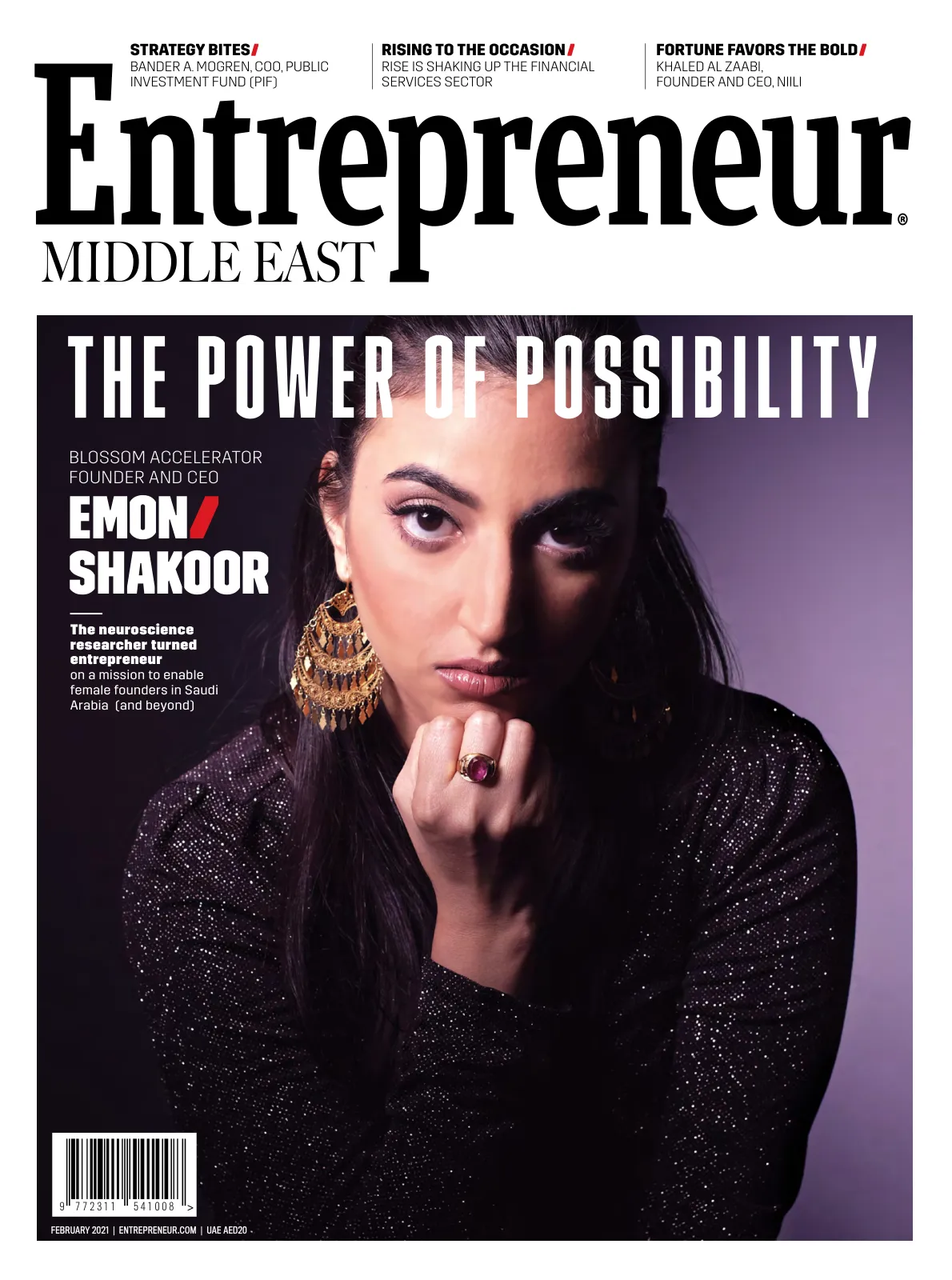
Entrepreneur Middle East, February 2021
Page 1
9
7 7 2 3 1 1
5 4 1 0 0 8
>
THE POWER OF POSSIBILITY
FEBRUARY 2021 | ENTREPRENEUR.COM | UAE AED20
9
7 7 2 3 1 1
5 4 1 0 0 8
>
STRATEGY BITES
BANDER A. MOGREN, COO, PUBLIC
INVESTMENT FUND (PIF)
RISING TO THE OCCASION
RISE IS SHAKING UP THE FINANCIAL
SERVICES SECTOR
FORTUNE FAVORS THE BOLD
KHALED AL ZAABI,
FOUNDER AND CEO, NIILI
EMON/
SHAKOOR
The neuroscience
researcher turned
entrepreneur
on a mission to enable
female founders in Saudi
Arabia (and beyond)
BLOSSOM ACCELERATOR
FOUNDER AND CEO
Page 2
D I S C O V E R
S W I M
S AV O U R
S TAY
C H I L L
SIGN UP & SAVE 30% ON STAYS, DINING & SPA WITH FREE
WINTER IS THE NEW SUMMER
Page 3
E BREAKFAST | ALL.COM
Page 4
4 / ENTREPRENEUR.COM / February 2021
18
INNOVATOR
THE POWER
OF POSSIBILITY
Emon Shakoor
The founder and CEO of
Blossom Accelerator in Saudi
Arabia is on a mission to
enable female founders in the
Kingdom (and beyond).
22
INNOVATOR
STRATEGY BITES
Raffaella Campagnoli talks
to Public Investment Fund
COO Bander A. Morgen on
what it takes to run one of
the largest sovereign wealth
funds in the world.
26
INNOVATOR
Rising to the occasion
Dubai-headquartered startup
Rise is shaking things up in
the financial services sector.
36
CULTURE
DESIGN
Fortune favors the bold
Niili founder and CEO Khaled
Al Zaabi is aiming to have
his UAE-born fashion brand
break into the US$350
billion global luxury market.
40
CULTURE
BUSINESS UNUSUAL
One of a kind
Italian coachbuilder ARES
Design brings automotive
bespoke experiences to the
Middle East.
46
START IT UP
ECOSYSTEM
From speed dating
to healthy relationships
How accelerators can be
made to be better
suited for entrepreneurs.
50
START IT UP
ECOSYSTEM
Expect the unexpected
The latest edition of
Dtec Forum, powered by
Entrepreneur Middle East,
concludes that the COVID-19
crisis was a masterclass in
risk mitigation.
54
MONEY
VC VIEWPOINT
Capital influx
Abu Dhabi-based Access
Bridge Ventures launches
with US$25 million fund to
support early-stage startups
in MENA.
56
START IT UP
Q&A
Taking the plunge
Glamazle.com founder
Neelam Keswani believes
entrepreneurship must be
experienced in order to be
fully understood.
60
IN THE LOOP
Fueling growth
The UAE’s SHUAA Capital
invests in Lebanon-
headquartered music
streaming platform Anghami.
CONTENTS FEBRUARY 2021
Niili R20 collection
Page 5
5
February 2021 / ENTREPRENEUR.COM /
experience
downtown
living
The UAE’s most exciting new destination.
A journey of discovery for the whole family.
Where nature, fun and entertainment
come together.
800-Arada (27232)
arada.com
Page 6
Page 7
Page 8
Page 9
Page 10
Timeless Elegance
Where modern French art de vivre meets ancient Egyptian charm.
Book your stay at sofitel-dubai-theobelisk.com
PARIS - LONDON - ROME - DUBAI - SYDNEY - MEXICO CITY
Page 11
Page 12
12 / ENTREPRENEUR.COM / February 2021
SUBSCRIBE
Contact subscriptions@bncpublishing.net to receive
Entrepreneur Middle East every issue
EDITOR IN CHIEF Aby Sam Thomas aby@bncpublishing.net
CEO Wissam Younane wissam@bncpublishing.net
DIRECTOR Rabih Najm rabih@bncpublishing.net
CREATIVE LEAD Odette Kahwagi
MANAGING EDITOR Tamara Pupic
STARTUPS SECTION EDITOR Pamella de Leon
EDITORIAL DESIGN Christian Harb
DIGITAL SOLUTIONS DIRECTOR Mahdi Hashemi mahdi@bncpublishing.net
GROUP SALES DIRECTOR – B2B GROUP Joaquim D’Costa
COLUMNIST Tamara Clarke
INTERN Aalia Mehreen Ahmed
PO Box 502511 Dubai, United Arab Emirates
P +971 4 4200 506 | F +971 4 4200 196
For all commercial enquiries related to Entrepreneur Middle East
contact sales@bncpublishing.net
All rights reserved 2021
Opinions expressed are solely those of the contributors.
Entrepreneur Middle East and all subsidiary publications in the
MENA region are officially licensed exclusively to BNC Publishing
in the MENA region by Entrepreneur Media Inc.
No part of this magazine may be reproduced or transmitted in any
form or by any means without written permission of the publisher.
Printed by United Printing and Publishing
upp.ae
Images used in Entrepreneur Middle East are credited when necessary. Attributed use of
copyrighted images with permission. All images not credited otherwise Shutterstock.
CONTRIBUTORS
entrepreneur.com/me
ACCESS FRESH CONTENT DAILY ON OUR WEBSITE!
MIDDLE EAST
EntMagazineME
@EntMagazineME
Entrepreneur-me
EntrepreneurMiddleEast
EntMagazineME
EntMagazineME
EntMagazineME
MIDDLE EAST
In addition to our print edition, we’re bringing
you all sorts of industry news on our web
mediums. Joining us online means getting
relevant business and startup content in
real-time, so you’re hearing about the latest
developments as soon as we do. We’re looking
forward to interacting with our readers on all of
our social media and web platforms- like any
thriving business, we’re looking to give and take.
#TrepTalkME is already happening on all of our
digi platforms, and all good conversations go
both ways. See you on the web!
Raffaella Campagnoli
Fida Chaaban
Tamara Clarke
Aya Sadder
Steven van Belleghem
Page 13
THE SAFEST AND
MOST COMPETITIVE
GLOBAL SOURCING
EVENT IS NEAR.
Get ahead of the world at the most competitive,
diverse sourcing platform for global food & beverage
Face-to-face, in a safe space
Rest assured, Gulfood 2021 takes place in accordance with all the health & safety regulations set out
by the local authorities. Only advance, online registration and Print@Home badges are issued. Strictly
no registration on-site at the event. Attendee numbers to be monitored due to social distancing
protocols, book your pass sooner to not miss out.
Organised by
Silver Sponsors
Lanyards
Sponsor
Carrier Bags
Sponsor
Headline
Media Partner
GULFOOD.COM
#GULFOOD2021
DUBAI WORLD TRADE CENTRE
21-25 FEB 2021
• 85 Countries
• 20 Halls Packed With Thousands Of New F&B Products
• Learn From Industry’s Best, Live On-Stage
• Only Place To Meet Michelin-Starred Chefs
Page 14
14 / ENTREPRENEUR.COM / February 2021
EDITOR'S NOTE
m
y fitness trainer recently told me that
I am someone who likes to complain.
Now, as someone who often looks down
on people who always moan about
the state they are in while making no
effort to change it, I’ll confess here
that I was taken aback by this asser-
tion, and I threw back a volley of reasons to justify my
whining about my exercise routine. But even as I did
so, I quickly realized everything I was saying was just a
stream of excuses- sure, there were, arguably, plenty of
valid reasons for my discontent, but I had to admit that
they could all be drawn down to my unhealthy lifestyle
choices in the first place.
Excuses are a curious little thing- sure, they offer us
some sort of respite when something doesn’t go accord-
ing to our plans, but they also keep us in our comfort
zones, holding us back from taking any action to move
past the quandary in front of us. And I’m pretty sure
that this is not an experience exclusive to me- espe-
cially in the world that we live in now. On good days,
entrepreneurs are celebrated as the go-getters, the
champions of change, the ones who dare- however, in
times of crisis, many of them can be seen resigning
themselves to the vagaries of fate.
For example, it’s one thing to claim that the market
isn’t receptive to your offering at the moment- it’s
another thing altogether to not even try to look for
alternative avenues you can explore as a business in the
current circumstances. There’s a similar complaint I
hear from people who claim to be “stuck” in their jobs,
since the environment isn’t conducive for finding new
ones- and this often means they are not making the
effort to search for any openings at all. As I said earlier,
one can always find some kind of refuge in making ex-
cuses- but that does mean that no action is being taken
in such scenarios either.
So, what is to be done when one finds themselves in
such a situation? My suggestion would be to start by
acknowledging the fact that you are indeed making ex-
cuses for your current predicament. Take a break from
blaming whoever and whatever you believe to have
caused this situation you find yourself in- and figure
out how you can get yourself out of it. Identify those
avenues that offer you at least the promise of a better
future, and then take concerted steps to follow through
on them. As the old aphorism goes, action begets ac-
tion- just make sure that you don’t fall back on the
excuses that got you here in the first place.
OWN UP IT’S TIME FOR ACTION
Aby Sam Thomas
Editor in Chief
@thisisaby
aby@bncpublishing.net
Page 15
FUN COMES
GUARANTEED
YOU DECIDE WHEN THE PARTY
STOPS WITH 24HR FOOD & DRINK.
NOW OPEN AT DUBAI DIGITAL PARK.
RADISSONHOTELS.COM/RED
Page 16
16 / ENTREPRENEUR.COM / February 2021
K
BW Ventures, the venture capital firm
founded by Saudi Arabia’s Prince
Khaled bin Alwaleed, has announced its
participation in a US$60 million debt
financing closed by San Diego-based food
tech startup, BlueNalu, from new and
existing investors.
As a company that produces a variety
of seafood products directly from fish cells,
BlueNalu’s new funding round, which follows its $20
million Series A in 2020 and its $4.5 million Series Seed
in 2018, marks the largest ever financing secured by a cell-
based seafood company in the world.
BlueNalu says the investment will enable it to achieve
“several significant milestones over the coming year,”
which include opening a nearly 40,000 sq. ft. pilot
production facility, completing the regulatory review for its
first products by the U.S. Food and Drug Administration,
and initiating marketplace testing in foodservice
establishments throughout the United States.
IN THE LOOP
Bolstering/
sustainability
Khaled Bin Alwaleed participates in US$60 million financing
for food tech startup BlueNalu by ABY SAM THOMAS
“The future of food, propelled
by technology and research, is
now on government agendas,
fueled by the need to address
food security, and even address
the concerns of widespread
immunity to antibiotics,
chemical-laden foods, and more
recently, microplastics.”
IMAGES COURTESY KBW VENTURES
Page 17
17
February 2021 / ENTREPRENEUR.COM /
Having participated in the company’s
Series A round previously, Prince
Khaled said that the decision to
inject further capital was based off
BlueNalu’s roadmap for the future,
which is in line with his company’s
ethos of aligning itself with “mis
sion-driven businesses that seek to
solve the world’s food security issues
sustainably.”
Prince Khaled, known globally for
being a keen proponent of future
food technologies, told Entrepreneur
Middle East that sustainability-
focused companies like BlueNalu
have greater significance in a world
that’s still grappling with the reper
cussions of the COVID-19 pandemic
that struck in 2020.
“I always believed these food tech
companies had enormous potential
–as did the other investors who got
behind these companies- but what
has changed is the accelerated pace
of awareness that there is a bet
ter way to source protein,” Prince
Khaled said. “The future of food,
propelled by technology and re
search, is now on government agen
das, fueled by the need to address
food security, and even address the
concerns of widespread immunity to
antibiotics, chemical-laden foods,
and more recently, microplastics.
The climate crisis and the awareness
around how much damage factory
farming is causing has also grown
exponentially due to the pandemic.
These elements all contributed to
new awareness and increasingly
warm sentiment around food tech
nology and the solutions it provides.”
Rage Capital led the $60 million
convertible note financing in Blue
Capital, and other significant partici
pants include Agronomics, Lewis &
Clark AgriFood, McWin, and Siddhi
Capital. Strategic investors in this
financing include Radicle Growth, by
way of the Radicle Protein Challenge
by Syngenta, Rich Products Corpora
tion, and Thai Union.
Besides KBW Ventures, other in
vestors include AiiM Partners, Clear
Current Capital, CPT Capital, Flat
World Partners, Losa Group, Our
Crowd, Silicon Valley Community
Foundation, and Stray Dog Ventures.
BlueNalu expects its production
facility to start producing mahi mahi
later this year, which will be fol
lowed up by the launch of a premium
bluefin tuna. The company is also
in the process of establishing joint
venture partnerships within key
markets it will operate in- it has, so
far, already inked deals with Nutreco
in the Netherlands, Pulmuone in
South Korea, Sumitomo in Japan,
and Griffith Foods and Rich Products
Corporation in the US.
When asked about if the Middle
East figures into discussions about
markets for such lab grown products,
Prince Khaled, who has also backed
other cellag startups like Memphis
Meats and TurtleTree Labs, replied
in the affirmative. “The plan is for
these lab-grown meat and seafood
startups to go global,” he said. “The
Middle East figures heavily into
those plans, as we have big popula
tions numbers who also enjoy eating
meat and seafood. There is definitely
a market, and this market’s appetite
will eclipse others, considering how
much importance families place
around mealtimes.”
Prince Khaled also pointed out the
region’s interest in this domain can
be seen in the launch of the XPRIZE
Feed The Next Billion competition,
which is being run by the XPRIZE
Foundation and sponsored by
ASPIRE, the program management
pillar of Abu Dhabi’s Advanced Tech
nology Research Council. He is one of
the official advisors of XPRIZE Feed
The Next Billion, which draws on his
knowledge and expertise in the food
tech and food security sectors.
The four-year, $15 million XPRIZE
Feed The Next Billion initiative aims
to “incentivize teams to produce
chicken breast or fish fillet alterna
tives that replicate or outperform
conventional chicken and fish in
access, environmental sustainability,
animal welfare, nutrition and health,
as well as taste and texture.”
“It is both timely and needed,”
said Prince Khaled, commenting on
XPRIZE Feed The Next Billion. “One
of the things that the Advanced
Technology Research Council does is
work toward big answers for pressing
global questions; hence the ASPIRE
tie-up with XPRIZE for this future
food tech competition.”
kbw-ventures.com
BOLSTERING SUSTAINABILITY | KHALED BIN ALWALEED
BLUENALU
WHOLE MUSCLE
CELL-BASED
YELLOW TAIL BISQUE
Page 18
18 / ENTREPRENEUR.COM / February 2021
INNOVATOR
“I recommend entrepreneurs
to get comfortable with
being uncomfortable, and
stop holding themselves
to these unrealistic ideals
of perfectionism.
Making mistakes is part of
the journey, so enjoy it.”
IMAGES COURTESY BLOSSOM ACCELERATOR
Page 19
19
February 2021 / ENTREPRENEUR.COM /
This neuroscience researcher turned entrepreneur is on a mission
to enable female founders in Saudi Arabia (and beyond) by TAMARA PUPIC
THE POWER OF POSSIBILITY | EMON SHAKOOR, FOUNDER AND CEO OF BLOSSOM ACCELERATOR
THE POWER
OF POSSIBILITY
EMON/SHAKOOR
Strength is a part of Shakoor’s
personality too. Despite battling with
dozens of epilepsy seizures a day while
growing up, Shakoor managed to get past
those hurdles and go on to earn a degree
in cognitive sciences from the University
of California, San Diego, and then work
at Parexel, a US clinical research and
biopharmaceutical company, where
she led hundreds of Pfizer clinical drug
trials across North America. Industry
accolades followed, which included
Shakoor becoming one of the Global
Shapers Community in its Jeddah
Hub, a delegate of 30 Under 30 group
at the Annual Meeting of the World
Economic Forum in Davos, as well as a
TEDx speaker on topics ranging from
neuroscience and innovation, to youth
and women’s empowerment, equity
and inclusion. The other adjectives she
used to describe her Saudi female peers
-relentless, adaptive, and innovative-
apply to her too; however, Shakoor
is not hiding a weakness that, she
believes, most women have in common.
“Perfectionism,” she explains. “I believe
this is the case for most women, not
only Saudi or Arab women. As women,
we often want things to be perfect in
our companies, especially when we first
launch. I have been guilty of this as
well. I recommend entrepreneurs to get
comfortable with being uncomfortable,
and stop holding themselves to these
unrealistic ideals of perfectionism.
Making mistakes is part of the journey,
so enjoy it.”
Shakoor is the founder and CEO of
Blossom Accelerator, Saudi Arabia’s
first tech-inclusion and female focused
accelerator that provides founders access
to community, networks, educational
resources, as well as curating investment
opportunities.
T
he growing recognition of the strength of women in
Saudi Arabia to fully step into their social and economic
power over the last few years hasn’t surprised Emon
Shakoor, a Saudi neuroscience researcher who
became a technology entrepreneur and startup
catalyst. “I see Saudi women possessing vision with
great agility,” she declares. “Saudi women are extremely resilient
and adaptive, which is a core quality for any entrepreneur.”
>>>
BLOSSOM ACCELERATOR
FOUNDER AND CEO
Page 20
20 / ENTREPRENEUR.COM / February 2021
In addition to her role at Blossom Accelerator, Emon also uses
her role as an advisory board member at OQAL, Saudi Arabia’s
largest angel investment network, to advocate for inclusivity
because, she says, it leads to not just greater innovation but
also higher economic returns. About her experiences as an
entrepreneur in the Kingdom, Shakoor says, “I believe doing
business in Saudi is always a good idea. We are an incredible
country with diversified resources and we are leading and in-
novating in so many sectors. We also have a young, innovative
and tech savvy population that is essential to our startup and
technology ecosystem.”
But Shakoor also admits to having experienced her share of
obstacles through the course of her entrepreneurial journey.
“One of the biggest challenges was being a young solo female
founder, since I had to wear so many hats at Blossom, especially
in the early days, as well as to make all the difficult decisions
myself,” she says. “Leading Blossom Accelerator was the ulti-
mate multi-tasking experience, and I often had decision-making
fatigue, but it taught me to be the fearless, confident, relentless,
and savvy business woman I am today. Today, very few things
faze me.”
Fueled by a desire to help young Saudi female founders like
herself, Shakoor launched Blossom Accelerator’s first cohort
in April 2018. The accelerator has since mentored more than
300 startup companies from at least
38 different cities and across five
countries, including the UAE, Bahrain,
Egypt, Saudi Arabia, and the USA.
“Blossom Accelerator’s mission is to
create a more innovative and inclusive
ecosystem giving entrepreneurs of
all kinds equal access to opportuni-
ties,” she proudly says. “We believe
diversity and inclusion are the pillars
of startup disruption and economic
growth.” Some of the success stories
which have sprung into life out of
the accelerator are Naseej Market, an
online fashion marketplace, Beauty
Choice, an online beauty market,
WhatsApp Digger, a mobile forensics
tool, Tabibook, a healthtech startup,
as well as Ghalia, a vegan cheese com-
pany.
Excited with the entrepreneurial ventures emerging from the
kingdom, Shakoor set a new target for herself- and, impres-
sively, achieved it quite quickly. It was recently announced that
Blossom Accelerator partnered with Female Founder School,
Silicon Valley’s premier startup school, with Shakoor’s mis-
sion being to build a bridge between Saudi Arabia and Silicon
Valley, in order to empower local entrepreneurs and build a
better connected and more collaborative world as well. “We at
Blossom Accelerator are very honored that we have partnered
with Female Founder School on the content and curriculum
that we deliver at the accelerator,” she says. “They are leaders
in their industry in Silicon Valley and beyond, and being able to
join forces with them gives our entrepreneurs and founders in
MENA region exclusive access to Silicon Valley’s best practices
and methodologies. Over the years, I’ve watched many startup
videos and have read hundreds of books, but what Female
Founder School offers is really one of a kind.”
Shakoor points out that Female Founder School’s outstanding
content has been localized for the Saudi and the MENA markets
with local case studies and examples, adding that the partner-
ship also brings in an additional benefit for female Saudi entre-
preneurs. “This partnership has now also allowed us not only to
focus on pre-seed and seed stage companies, but also founders
in their earliest stage of ideation,” she says. “We are now able
to equip female founders who have just an idea with the right
tools and resources to take their next steps in their entrepre-
neurial journey. We are very excited that we are able to focus on
founders in the ideation stage, as we believe this will help incu-
bate the next generation of female founders across the MENA,
and create a world with more women-led tech companies and
more female CEOs.”
“SAUDI WOMEN ARE EXTREMELY
RESILIENT AND ADAPTIVE,
WHICH IS A CORE QUALITY FOR
ANY ENTREPRENEUR.”
INNOVATOR
Page 21
21
February 2021 / ENTREPRENEUR.COM /
Achieving such an important milestone
raises questions about the personal
features or business strategies that
have made Shakoor persevere and
overcome any obstacles she might have
encountered through the process. “I am
incredibly relentless, and I have convic-
tion when it comes to my vision for the
company, but at the same time, I have
had to learn also to be very agile and
adaptive and open to change,” she says.
“Sometimes, I must lead with my stub-
born vision, and other times, I must
be agile in allowing for quick changes
according to market demand and need.
It’s a tough balance of knowing when to
do what. I’ve learned impeccable and
quick decision-making skills over the
years, and I have also learned to trust
my gut and allow our team to lead and
innovate more at work, and not micro-
manage.”
It is this same mindset that has gov-
erned Shakoor’s approach to the nega-
tive consequences of the COVID-19
pandemic. “2020 has taught us to be
more connected and more resilient than
ever before,”she says. “It has taught
us how strong we are as a company,
because even during the most difficult
times, we were able to rise above and
still create impact in the startup eco-
system, especially for female founders.”
2021 looks bright, she says, with Sha-
koor continuing to work on her plan “to
further enable female founders across
the MENA region to receive funding op-
portunities, and close the current gen-
der gap in venture capital funding.”
“WE BELIEVE
DIVERSITY
AND INCLUSION
ARE THE PILLARS
OF STARTUP
DISRUPTION
AND ECONOMIC
GROWTH.”
THE POWER OF POSSIBILITY | EMON SHAKOOR, FOUNDER AND CEO OF BLOSSOM ACCELERATOR
Page 22
22 / ENTREPRENEUR.COM / February 2021
STRATEGY/BITES
INSIGHTS AND INSPIRATION FROM SOME OF SAUDI ARABIA’S
MOST NOTABLE BUSINESS EXECS by RAFFAELLA CAMPAGNOLI
‘TREPONOMICS PRO
Strategy Bites is a series of interviews that LIRA Strategy Partners founder and Managing Director Raffaella Campagnoli
is conducting with some of Saudi Arabia’s most notable business executives for Entrepreneur.com. In this edition,
Bander A. Mogren, COO, Public Investment Fund, gives his take on what it means to be doing business in the Kingdom.
Can you give us an introduction to PIF, as well as its its role and
mandate in the Kingdom of Saudi Arabia?
The Public Investment Fund (PIF) is one of the largest Sovereign
Wealth Funds in the world, and one of the main pillars driving the
economic transformation envisaged as part of Saudi Arabia’s
Vision 2030.
We look at long-term investment opportunities in promising
industries that are driving both local and global economic
development: the Fund is working to diversify and enhance the
Kingdom’s wealth, help drive its economic transformation, and
support the country’s ambition to become a global investment
powerhouse. To achieve this, PIF’s strategy is designed upon two
main objectives:
> Maximizing PIF’s assets locally, launching new sectors in Saudi
Arabia, and localizing modern technologies and knowledge
> Being an international, patient, and impactful investor that aims
to drive global economies.
As the COO of one of the largest sovereign wealth funds in the
world, what can you tell us about your role in supporting the
achievements of the Fund’s goals?
As part of my role, I oversee operations in shared services
including information technology, digital transformation, human
capital, and investment operations. Being part of PIF since
2016, I have witnessed the growth of the Fund from operations,
processes, systems and employees in the past years.
I seek to enable PIF to grow internally and support PIF’s portfolio
companies and projects to run smoothly and effectively on
multiple perspectives, for example:
BANDER
A. MOGREN
COO, Public Investment Fund (PIF) pif.gov.sa
IMAGES COURTESY PIF
Page 23
23
February 2021 / ENTREPRENEUR.COM /
> As part of what we call the “PIF Way,”
ensuring that our portfolio companies
follow PIF standards and guidelines and
that the new companies and projects are
up and running in a timely manner. We act
as an incubator to upcoming companies
and projects by providing our full services
in setting up the company and helping
develop its institutional capabilities in an
expedited manner.
> Supporting the tremendous internal
growth, especially in human capital, where
our employee base grew significantly over
the last four years from approximately 40
employees in 2016, to now over 1,000 staff
members from both Saudi Arabia, and, at
last count, 33 countries from around the
world.
> We launched our Graduate Development
Program (GDP) –one of the top programs in
the country– in 2017 to develop local talent
and facilitate skills transfer for young Saudi
men and women, while creating new job
training opportunities for the next genera-
tion. We have hired around 120 candidates
across the organization since the start of
the program.
In addition to our strong support stand-
ards, PIF also ensures significant support
to employees and their families outside of
the workplace. This translates into benefits
which are benchmarked against the high-
est international standards, providing sup-
port to the whole family, employees’ parents
included.
I am very proud of PIF’s commitment in
upholding a diverse workforce of local and
global talents, which underlines the Fund’s
focus on delivering on its ambitions.
This year has been unprecedented
challenges for organizations globally-
how did you ensure operations run
smoothly despite those circumstances?
What changes have you introduced as
part of those solutions?
This year definitely saw unprecedented
circumstances with the COVID-19 pandemic
challenging local and global economies in
a way that has never been seen before. Our
hearts go out to all those individuals and
families affected by this terrible pandemic.
I am proud of how PIF was able to seam-
lessly navigate with restrictions during
lockdown, and operate in “business as
usual” fashion, without disrupting our work
and commitment to achieving our goals
and to our partners, all while upholding and
enforcing the proper measures for a safe
environment.
To ensure the Fund runs smoothly during
the pandemic, we worked with our crisis
management committee around the clock,
so work could continue as planned despite
the challenges. We actioned some contin-
gency plans offering support both to all PIF
employees to help them achieve their goals,
and with it the wider goals of the Fund. Also,
we enhanced our support to all our portfolio
companies and projects in order to make
sure that the pandemic would not affect
our strategies and development plans.
You have been a part of PIF since 2016.
What excites you most about your role?
What is most exciting about my role is the
multiple functions I oversee from differ-
ent operations such as in investment to
infrastructure and corporate functions that
provide services to upcoming companies
and projects.
We have achieved incredible outcomes
over the past four years including during
the difficult times of the pandemic. Some
examples include:
> Launched 10 new sectors and more than
30 new companies, including in real estate,
entertainment, tourism, agriculture, and
sports.
STRATEGY BITES | BANDER A. MOGREN, COO, PUBLIC INVESTMENT FUND
“Over the past four years, we’ve grown our
assets under management to nearly $400 billion,
and continue to increase this number as we
launch new sectors and companies.”
The Line, NEOM
>>>
Page 24
24 / ENTREPRENEUR.COM / February 2021
“ I am very proud of PIF’s
commitment in upholding a
diverse workforce of local
and global talents, which
underlines the Fund’s
focus on delivering on its
ambitions.”
> Continuously supporting our many
portfolio companies at all stages of their
development, to ensure they implement
global best practices around governance.
> In 2019, initiated the PIF Way to formal-
ize our approach to enhancing value in its
portfolio companies, and building on PIF’s
independent governance and operational
framework.
> Appointed well over 300 PIF Board
representatives on our portfolio compa-
nies’ boards, onboarding both local and
international according to the required
expertise.
What impresses you most about PIF’s
plans for the future?
PIF has a unique mandate that is beyond
just being a sovereign wealth fund. For
every investment, we consider its future
impact on the domestic market; for every
new global partnership, we consider the
return on our economy’s growth like new
technologies, knowledge and know-how
transfer, etc.
Over the past four years, we’ve grown
our assets under management to nearly
$400 billion, and continue to increase this
number as we launch new sectors and
companies.
PIF actively supports and
enables the development
of the private sector as it
helps build economic resil-
ience while creating new
job opportunities within
the country and benefits
the country and its people.
As Saudi recently opened
its borders to tourism,
what message would you
send to all the people who
have never visited your
country?
Saudi Arabia is an incredible
country where people are welcoming,
generous and polite. Take, for example,
this recent and humble story. The Rally
Dakar took place recently in Saudi. Racers
sometimes have challenges with their
cars as they get damaged during the
competition: one of their challenges is to
fix their cars themselves. What is happen-
ing a bit behind the scenes (also because
it’s not really allowed by the Rally’s rules)
is a high number of Saudis are actually
heading to the racers to assist and help
in fixing their cars, providing support to
the drivers, and helping them get out of
trouble. This generosity and openness is
infused in our culture: I am sure tourism
will be a great part of our future economy,
as people around the world will appreci-
ate and recognize how nice and hospita-
ble our people are.
‘TREPONOMICS PRO
Raffaella Campagnoli is the founder and Managing Director of LIRA Strategy Partners. With over 20 years of experience in strategy consulting in
international firms, she was formerly the Managing Director at Accenture Strategy Middle East and Turkey for nine years. Raffaella left Accenture after
13 years at the company, during which she led transformation programs in multiple regions (Europe, US, Turkey, Singapore, Middle East), specialized in
strategic planning, operating model transformation, zero based budgeting, digital transformation and innovation, ecosystem strategy. Raffaella has been
leading impactful transformations in industries like travel and hospitality, fashion, consumer products goods, and retail, thereby developing a trusted
network of partners and experienced professionals. lira.partners
Qiddiya is set to become the Kingdom’s capital of Entertainment,
Sports and the Arts as part of Vision 2030
PIF employee
Page 25
Always by your side
to offer your guests an extra star
Whatever happens
the #1 destination for premium entertainment
''en français''
Page 26
INNOVATOR
272 million people: as per the World Economic
Forum’s 2020 Global Migration Report, that is
the estimated number of international migrants
worldwide. The report also highlights that
migrants constitute a large majority of the
population in most GCC countries. With such
a large number of people living outside their
countries of origin, and often away from their
families, in search of better earnings, it begs the
inevitable question- how much collective money
is sent back to these nations on a yearly basis?
Remittances, which are essentially financial or
in-kind transfers made by migrants to family and
friends back home, have been empirically proven
to add monetary value to an economy.
In 2019 alone, two among the top five countries
money was remitted to were India (US$83.1
billion) and the Philippines ($35.2 billion), and an
estimated $120 billion dollars is sent from the
GCC alone to support over 150 million people
across the Asian subcontinent. However, it may
come as a surprise that migrants are often
denied the opportunity to avail basic financial
services from banks and other financial
institutions- in both, their own countries, and the
ones they reside in. Even something as simple
as a financial loan is not a viable option for most
migrant workers. The reason? They’re simply not
seen as being economically attractive, owing to
their monthly income.
RISING TO
THE OCCASION
by AALIA MEHREEN AHMED
DUBAI-HEADQUARTERED STARTUP RISE
IS SHAKING UP THE FINANCIAL SERVICES SECTOR
26 / ENTREPRENEUR.COM / February 2021
Page 27
27
February 2021 / ENTREPRENEUR.COM /
Dubai-headquartered fintech firm Rise
was created in 2017 to fill this glaring
gap in the financial sector. “What safety
net do these migrants and their families
have when they cannot get access to
basic financial products?” says Milind
Singh, co-founder and CPO of Rise. “It’s
not just a GCC story; there are over 270
million migrants globally and a billion
people who depend on remittances for
their future. Think about how that one
seventh of humanity is systemically and
structurally locked out of the global
financial services system.” Rise was
founded by Singh, who has extensive
experience in building digital banking
platforms in emerging markets, former
World Economic Forum Global Leader
ship Fellow Padmini Gupta, and serial
entrepreneur Mandeep Singh. With an
aim to create a migrant financial services
platform that democratizes access to
financial services, the firm is on a mis
sion to cater to migrants beyond the GCC
as well.
For Gupta, who was formerly a banker in
the US, the driving force behind creating
Rise stemmed from personal experience.
“When I returned to Dubai, I discovered
that many migrants were locked out of
the global financial system and this hit
home when my nanny was impacted
by the 2015 Nepal earthquake,” she
remarks. “She needed significant mon
etary support and did not have anyone
to turn to, apart from her employer
and family and friends, and that is how
Rise was conceptualized.” Rise has been
structured as a global financial services
platform which has partnerships with
multiple institutions across multiple
countries, and is available as an app
on both iOS and Android. The fintech
firm provides a plethora of seamless,
digital services for migrants, including
“no minimum balance” bank accounts
in partnership with local UAE banks,
insurance products in partnership
with global insurance leader Axa, buy-
now-pay-later plans in partnership
with UAE’s largest retailer Majid Al
Futtaim Carrefour, and cross-border
installment plans in partnership with
providers across South and South
East Asia.
“Given COVID-19 has driven the push to
e-commerce and contactless payments, we
have seen a sustained decline in cash usage this
year. This will continue next year, with more
and more transactions happening online.”
Padmini Gupta and Milind Singh,
co-founders, Rise
>>>
IMAGES COURTESY RISE
RISING TO THE OCCASION | RISE IS SHAKING UP THE FINANCIAL SERVICES SECTOR
Page 28
28 / ENTREPRENEUR.COM / February 2021
With Rise being a digital platform, the
team would have banked on an inevitable
shift to digital spending to gain more us
ers over the years. That consumer shift,
however, was hastened at the behest of
a global pandemic early last year. While
there was an obvious move globally
towards cashless, digital payments, to en
sure safety in a time of social distancing,
Gupta points out that this wasn’t neces
sarily the case with the migrant popula
tion in particular. While the Rise team
was able to adapt quickly to the work-
related effects of lockdown and remote
working, the COVID-19 crisis in 2020
opened up a Pandora’s box of shortcom
ings that traditional remittances have.
“We realized that remittances were
failing migrants, specially during the
pandemic, on two fronts,” explains Gupta.
“First was moving cash. When the pan
demic hit and exchange houses started
closing, families in home countries could
not pick-up cash or spend cash. So even
if the migrant here had a bank account
with us and could send money online, the
family did not have access to an account
or digital tools to pay… The second was
control on spending. With the pandemic,
many migrants faced a temporary reduc
tion in salaries, and they wanted to have
more control on where the money being
sent home was being spent and tradition
al remittance tools do not do that.”
In the wake of such fatal flaws being
highlighted amid the COVID-19 crisis,
the team at Rise launched a new product,
Xare (pronounced “share”), to counter
these issues. “Xare was born out of the
need to give migrants a ten times better
tool to manage cross-border spending–
why move money, when you can move
access and allow the families to spend
with full control of the migrant,” explains
Gupta. A free-to-use mobile app, Xare
enables its users to instantly share access
to their account and credit card with
friends and family, whilst maintaining
total control over how their earnings are
spent and without sharing any sensitive
information. The sole requirement for
registration is a valid phone number- a
process that “takes less than 30 seconds,”
Gupta adds. Users are then free to share
their cards with their contacts, and can
set daily/monthly monetary limits with
these contacts.
This new service by Rise bears extra
sentimental significance during the
COVID-19 crisis, as a time that has seen
millions lose their jobs and/or struggle
financially. “The pandemic accentuated
another big reality– most people in the
world borrow from a friend or family
member, not a bank,” says Gupta. “In
fact, in the MENA region, 69% of all
borrowers borrowed from a family or
friend. In India, that number is 77%, and
similarly high across emerging markets.
Xare truly brings sharing to the financial
services economy and enables people
who have always been supporting each
other to better perform roles of a bank-
extend a payment instrument or extend
INNOVATOR
“WE REALIZED THAT REMITTANCES WERE FAILING
MIGRANTS, SPECIALLY DURING THE PANDEMIC, ON TWO
FRONTS. FIRST WAS MOVING CASH. WHEN THE PANDEMIC
HIT AND EXCHANGE HOUSES STARTED CLOSING, FAMILIES
IN HOME COUNTRIES COULD NOT PICK-UP CASH OR SPEND
CASH [ ... ] THE SECOND WAS CONTROL ON SPENDING.”
Page 29
29
February 2021 / ENTREPRENEUR.COM /
credit.” Through a very basic example,
Gupta explains that the main USP
behind Xare’s services is ease and
control. “A migrant can change the
share patterns anytime, and reduce
or increase it depending on his/her
monthly budget. The migrant can also
do micro-shares. For example, he/she
can send AED10 to someone on their
birthday, and later also set it on auto-
pilot by setting a monthly recurring
share, and never have to worry about
remitting again.”
But with only a valid phone number
required for registering, and the
possibility of sharing access to your
unused credit card to a multitude
of people, one may wonder how
safe the transaction is. “Xare’s
innovative security system means
that card details are never seen by
the beneficiary and are not stored
by Xare centrally, so they cannot be
hacked or compromised,” assures
Singh. “Also, the sharer can enable
explicit authorization which ensures
that no transactions can go through
without her/him explicitly approving
the transaction on their Xare app.”
Those with a background in finance
may also wonder how the FX risk, a
common currency risk involved in
monetary transactions, is accounted
for via Xare. “There is no FX risk,
there is the conversion cost that is
charged by your bank when your
family spends in say India, with your
UAE card,” explains Singh. “What is
interesting about this is that most
people do not realize that transfer
fees make up about 75% of the cost
of sending money, the FX spread is
only about 25% of the cost. Having
said that, we are in conversations
with some banks to offer preferred
rates for Xare customers.”
RISING TO THE OCCASION | RISE IS SHAKING UP THE FINANCIAL SERVICES SECTOR
Right:
Padmini Gupta,
co-founder, Rise
>>>
Page 30
30 / ENTREPRENEUR.COM / February 2021
With the assurance of a safe and regu
lated environment to send money much
quicker, this fintech startup’s growth
-please do note that it has served over
200,000 customers across various prod
ucts and banked $300 million on its plat
form so far- alludes to another important
question: will the rise of Rise (pardon
the pun) change the future of personal
banking? According to Singh, Rise is here
to offer a common platform in a financial
sector where most people have multiple
outlets to choose from. “Finance in gen
eral has become very fragmented, mean
ing that you have an account from one
bank, credit card from another, insurance
from a third operator, investments from
forth, and loans from multiple sources,”
he explains. “The solution to this is not
you buying everything from one provider,
which never really works, but having a
platform which brings everything together
in one place– like Rise does. We focus on
migrants as the segment where we are
building this, but the basic philosophy is
the same– we need platforms in finance,
which aggregate and enhance choice.”
But despite such a strong model and
unique underlying core values, Rise
may still seem delicately poised in a
highly competitive UAE money transfer
landscape. Despite a 7.7% drop, outward
remittances settled through banks and ex
change houses in the country from July to
September 2020, still managed to reach
AED40.1 billion ($10.9 billion). The team
at Rise, however, remain dedicated only
to their own mission, and even believe
that products like Xare can eventually be
adopted by the higher-class population
as well. “As with any new product, a new
way of doing things, adoption happens
slowly and then quickly,” remarks Gupta
vigilantly. “Xare genuinely is a 10X bet
ter product than remittance. It is free,
it is instant, it gives migrants control on
where their money is spent, the money
stays with the migrant. We fundamentally
believe that sharing will replace global
remittances as the preferred solution in
the coming years. Now we do anticipate
competition to come from all types of
players, both banks and otherwise, but we
are not concerned about current remit
tance providers.”
Unsurprisingly, with such a level-headed
approach, the team at Rise is looking to
expand beyond their three current mar
kets- UAE, India, and the United States.
“As we understand how users adopt
and use Xare, which is a foundationally
disruptive product, we will start scaling it
across these three markets and intro
duce new markets,” says Gupta. “We are
uniquely poised to build a global fintech
player, and we are looking forward to an
amazing 2021.”
INNOVATOR
1/ Emergence of native
payments
“WhatsApp pay India, where
people do not have to exit
whenever they are to undertake
payments. This will significantly
disrupt the payments
ecosystem with more and more
transactions being native to the
platform you are on.”
2/ Growth of crypto
“With the imminent launch
of Libra from Facebook, plus
multiple cards which pay you
in bitcoin awards, accepting
payments in crypto will become
more mainstream– even though
it will still be small.”
3/ Sustained decline of cash
“Given COVID-19 has driven
the push to e-commerce and
contactless payments, we
have seen a sustained decline
in cash usage this year. This
will continue next year, with
more and more transactions
happening online/contactless
methods.”
‘TREP TALK
Rise co-founder Milind Singh
on the three dimensions
disrupting payments in 2021
“XARE’S INNOVATIVE
SECURITY SYSTEM MEANS
THAT CARD DETAILS
ARE NEVER SEEN BY THE
BENEFICIARY AND ARE NOT
STORED BY XARE CENTRALLY,
SO THEY CANNOT BE HACKED
OR COMPROMISED.”
Padmini Gupta and Milind Singh,
co-founders, Rise
Page 31
Page 32
32 / ENTREPRENEUR.COM / February 2021
GADGETS AND DOODADS THAT YOU MIGHT’VE MISSED OUT ON, SOURCED BY A TECH AFICIONADO.
YES, IT’S OKAY TO WANT THEM ALL… AND NO, IT’S NOT OUR FAULT.
FORM AND FUNCTION
LENOVO THINKPAD X1 TITANIUM YOGA
IMAGES COURTESY LENOVO | SHURE | SONY
TECH SHINY
The Lenovo ThinkPad X1 Titanium Yoga
is the thinnest ThinkPad ever. Its tita-
nium body measures just over 11mm thin
and features a 3:2 ratio 13.5-inch low
power display, along with Dolby Vision
HDR support and Dolby Atmos Speaker
System. Both X1 Carbon and X1 Yoga
are the world’s first laptops to support
Dolby Voice2, which delivers a supreme
conferencing experience that feels more
natural and reduces listener fatigue, and
thus makes meetings more productive.
The device gives you improved security
with the addition of Human Presence
Detection, a zero-touch log-in process,
which uses Windows Hello facial recogni-
tion- it automatically locks the system
when you walk away too. These new
features, matched with improved battery
life, optional PrivacyGuard ePrivacy dis-
play that helps protect your screen from
prying eyes, and PrivacyAlert that warns
of shoulder surfers, bring security to
new heights. Integrating the fingerprint
on the power button helps efficiency by
combining two functions into a single
action. ThinkPad X1 Titanium Yoga is a
premium, 5G-ready device that’s poised
to take enterprise computing to a whole
new level.
Page 33
33
February 2021 / ENTREPRENEUR.COM /
#TAMTALKSTECH Tamara Clarke, a former software development professional, is the tech and lifestyle enthusiast behind The Global Gazette, one
of the most active blogs in the Middle East. The Global Gazette has been welcomed and lauded by some of the most influential tech brands in the
region. Clarke’s goal is to inform about technology and how it supports our lifestyles. See her work both in print regional publications and online on
her blog where she discusses everything from how a new gadget improves day-to-day life to how to coordinate your smartphone accessories.
Visit theglobalgazette.com and talk to her on Twitter @TamaraClarke.
#TAMTALKSTECH | GADGETS AND DOODADS THAT YOU MIGHT’VE MISSED OUT ON
BE HEARD
SHURE MV7
The Shure MV7 is a dynamic microphone that renders
professional quality sound, whether you’re recording in a
studio or at home. The mic is equipped with voice isolation
technology to pick up your voice, without any background
noise. It features a built-in 3.5mm headphone jack for
sound monitoring, a built-in touch panel, and both USB
and XLR outputs making it compatible with computers
and professional interfaces. Connect via USB and explore
additional set-up features and Auto Level Mode within
the ShurePlus MOTIV app to control your vocal tone and
distance from the microphone. With Auto Level Mode, you
can essentially let the microphone do the work for you.
Whether you’re a podcaster or vocalist, MV7 is the ideal
tool to get your multimedia projects heard.
The Sony RA5000 premium wireless speaker
is equipped with Sony’s unique spatial sound
technologies to fill your room with your favorite
background music. The ambient room-filling
sound creates a calm atmosphere, allowing you to
relax as if you were at your favorite café. RA500
fits into your life seamlessly, allowing you to
choose several convenient ways to enjoy your mu-
sic. You can pair the speakers with a smartphone,
laptop, or tablet using Bluetooth technology, NFC,
or your personal Wi-Fi network. The speaker also
features built-in Chromecast and is compatible
with Amazon Alexa and Google Assist, which
allows you to control your playlist through voice
commands. RA5000 is a stylish device that looks
as good as it sounds in your space.
MOOD MANAGER
SONY RA5000
Shure
MV7
Sony RA5000
Page 34
34 / ENTREPRENEUR.COM / February 2021
CULTURE TRAPPINGS
IMAGE CREDIT ETRO | DOLCE & GABBANA | ALEXANDER MCQUEEN | AUGUSTINUS BADER
‘TREP TRIMMINGS
THE EXECUTIVE SELECTION
F
rom better goods to better wardrobe bests, every issue we choose a few
items that make the approved executive selection list. In this issue, we
present our picks from Etro’s latest menswear range, a fresh fragrance to
add to your collection, and a new essential for your skincare regimen.
HOPE SPRINGS ETERNAL
ETRO FALL/WINTER 2021
There’s an element of hope and new
beginnings in Etro’s Fall/Winter 2021
menswear collection, imbued by
Creative Director Kean Etro’s runway
that was reminiscent of a sunrise, with
garments evoking lightness, coziness,
and a touch of savoir faire. Consider,
for instance, the blazers with cadet
details, or the color-blocked anoraks
with paisley patterns- quilted jackets
crafted from Etro’s vintage upholstery
textiles make an appearance in this
line as well, alongside wool maxi
sweaters layered with shirts featuring
silk-lined collars. With a lively palette
featuring neutrals alongside bright red
and purple accents, as well as dark
shades of deep blue, black, and beige,
Etro’s new line is set to give you the
confidence you need to take to the
streets- and the boardrooms as well.
Etro.com
Etro FW21-22
Etro FW21-22
Etro FW21-22
Page 35
35
February 2021 / ENTREPRENEUR.COM /
'TREP TRIMMINGS | THE EXECUTIVE SELECTION
PUT YOUR BEST FOOT FORWARD
ALEXANDER MCQUEEN
Alexander McQueen means business with this new pair of boots.
Fresh off its SS21 menswear range, the Worker Boot was first
featured in the First Light short film by Jonathan Glazer. With
its exaggerated toe shape and combat rubber sole, the boots
clearly showcase the use of fine materials, alongside elevated
craftsmanship and functional design innovation. Unfussy but
modern, chic yet unpretentious, it’s the ideal footwear to turn
any ensemble into a look. alexandermcqueen.com
CULTURAL CONTRAST
DOLCE & GABBANA
Following the success of The One Royal Night and
The One Mysterious Night, Dolce & Gabbana has now
brought out The One Luminous Night, a new exclusive
edition that infuses Italian tradition with aromatic
masterpieces from the Arab region. As a mature scent
for special occasions, the renowned perfumer Jean
Christophe Herault has crafted The One Luminous
Night to open with Italian notes of basil and zesty
bergamot. It then meets with the sweetness of dates
blended with aromatic sage and geranium at its heart,
and it’s capped off with smoky accents of incense and
amber at its base. Dolcegabbanabeauty.com
EDITOR’S PICK
AUGUSTINUS BADER
As wearing face masks becomes the norm in the
world we live in today, so does the need to adjust
our skincare routines. For instance, given that such
facial coverings trap heat, humidity, and friction on
our visages, an unfortunate consequence could be
exceptionally dry or chapped lips. Luxury skincare
brand Augustinus Bader’s latest product offers
a deeply conditioning lip treatment that not only
leaves a subtle non-sticky sheen, but also nourishes,
protects, and improves the texture of lips. Besides its
hydrating power, it also has rejuvenating properties
thanks to the inclusion
of the brand’s signature
TFC8 formula, a complex
of amino acids and
vitamins, plus aloe, vitamin
E, and allergen-free oils.
augustinusbader.com
Alexander McQueen
Worker Boot
Page 36
36 / ENTREPRENEUR.COM / February 2021
CULTURE DESIGN
FORTUNE
FAVORS
THE/BOLD
KHALED AL ZAABI
Niili’s founder and CEO
is aiming to have his UAE-born
fashion brand break into
the US$350 billion global luxury
market by ABY SAM THOMAS
IMAGES COURTESY NIILI | NIILI.COM
Page 37
37
February 2021 / ENTREPRENEUR.COM /
W
e in the UAE redefined what luxury
means to us in aviation, hospitality, and
tourism, and we aspire to do the same
with the fashion industry.” If a singular
statement could encapsulate the vision
that Niili founder and CEO Khaled Al
Zaabi has for his enterprise, this would
probably be it- and it should therefore
come as no surprise that the Emirati entrepreneur is the one
who actually voiced these words too.
Billed as “a luxury women’s wear fashion brand rooted in
Emirati heritage,” Niili was launched by Al Zaabi along with
co-founder and Creative Director Paula Quetglas in Janu-
ary 2020, but the idea for this enterprise has been long in
the works- in fact, Al Zaabi says that he started research on
building a business in this sector when he was pursuing an
Executive Master of Business Administration degree from
INSEAD between 2017 and 2018. “Niili started as my thesis
topic during my INSEAD studies,” Al Zaabi recalls. “I wished
to understand the industry, its drivers, and the competitive
landscape. It was a great eye-opener to learn that despite
the large global industry, 100 companies control 70% of the
global market share, with only 10 conglomerates controlling
50%, the majority of whom are from the West. The industry
however is experiencing seismic shifts, and healthy growth
projections that is driven by Chinese consumers (accounting
for 32% of global sales) and millennials (accounting for 30%
of global sales). The industry is experiencing a shift of influ-
ence from the West to the East, and a change in consumer
demands and requirements.”
And the UAE is figuring heavily in this changing market land-
scape- Al Zaabi points out that the US$350 billion luxury
retail industry happens to be the second largest contributor
to Dubai’s gross domestic product. Indeed, this leads into
why Al Zaabi believes that Niili -which means “indigo” in
Arabic, a reference to the sea that has played a vital part
in the shaping of the UAE- can carve out its own space in
this dynamic sector. “I was inspired by the realization that
a major gap exists in the industry when it comes to offering
customers a luxury experience that is built on our own defi-
nition; one based on our love for culture, nature, and urban
lifestyle,” he says. “Understanding the gap, it was impera-
tive to find a partner who is a veteran of the industry, an
extremely talented designer with a strong business acumen,
who shares the same values as I do, and INSEAD was the
place to find that partner: Paula Quetglas, Niili’s co-founder
and Creative Director. With Niili, we set ourselves a target
to crack the top 100 companies ($200m/year revenue com-
pany) in the next 13-15 years.”
Now, this may sound like a lofty goal for Niili to realize, but
one can’t help but believe in the brand’s ability to do so when
one considers Al Zaabi’s zeal for the business he leads- and
let’s not also forget his impressive credentials. Besides his role
at Niili, Al Zaabi is also Vice President at Mubadala Aerospace
and Chief Commercial Officer at NIMR Automotive- that
should make it clear that this Emirati entrepreneur is a sea-
soned executive who is well-versed in the art of business. “As
the CEO, my primary focus is on the commercial, financial,
and strategic initiatives,” Al Zaabi says. “Business develop-
ment and developing sales channels consume most of my time.
“
FORTUNE FAVORS THE BOLD | KHALED AL ZAABI, FOUNDER AND CEO, NIILI
>>>
Page 38
38 / ENTREPRENEUR.COM / February 2021
CULTURE DESIGN
I take great interest in the creative aspect of the brand, yet
trust in the leadership of Paula in that aspect. To me, the Emi-
rati way is to have an ideological anchor, then attract and con-
sult the best talents and experts from around the world. We
are a nation where the nationals only account for 10% of the
population, and thus take great pride in embracing people that
share our ambitions and goals.” At this point, I ask Al Zaabi
about his personal objectives for Niili, and he replies, “The
aspiration is to be a global luxury brand that offers the indus-
try an experience that is built on our values and heritage. We
have a very rich culture and a unique taste in luxury that has
proven to be internationally appealing, and that
is what we want to share with the world.”
And it seems safe to say that Niili is certainly
delivering on that premise- distinctive by design,
the brand’s offerings are fluid and functional, and
their craftsmanship and attention to detail hasn’t
gone unnoticed by its patrons in the MENA
region and beyond. However, Al Zaabi admits
that the outbreak of the coronavirus pandemic
in 2020 did put a dent in the Niili team’s plans
for the launch and development of the brand-
but then again, it’s a testament to him and his
team that the company has managed to stay the
course through the crisis, and move on ahead
by doubling down on its online efforts. “We
launched our brand in January 2020, just prior
to the lockdowns in March, and we were forced
to change our strategy and approach,” Al Zaabi
says. “We initially wanted to introduce the brand
by hosting many intimate and private events, in
order to allow people to experience our brand
and grow brand awareness. However, we had to
shift online quickly to raise and leverage social
media, and direct traffic to our online platform.
Nonetheless, I am very optimistic that the funda-
mentals in MENA are strong, and that the future
of sustainably conscious luxury brands from the
region is bright. One advantage we had during
the COVID-19 crisis is our lean structure, which
allowed us to weather the turbulent period.”
Al Zaabi thus remains quite confident about
what the future is going to look like for Niili, es-
pecially given the fact that it’s a business based
out of the UAE, and thus part of a region that he
believes holds tremendous potential in the long
run. But for businesses to succeed in this land-
scape, Al Zaabi believes that are a couple of char-
acteristics that the entrepreneurs leading these
ventures must display. “One must have strong
values to begin with, values such as integrity
and honesty,” Al Zaabi says. “The basic central
characters for any leader are vision, passion, and
competence, but what I believe is imperative for
a leader is their capacity to listen, learn, and empathize. It is
also essential to create an environment that fosters security,
communication, and teamwork. People need to be motivated
by the knowledge of how their work contributes to the bigger
picture, and thus gain a sense of pride and ownership in their
work.” As for the MENA region itself, Al Zaabi is of the opin-
ion that this is easily a great place for anyone wanting to chase
their entrepreneurial dreams. “One thing that’s for certain
here is the abundance of opportunity,” he points out. “The re-
gion looks to the future with great optimism, and that fosters
an environment of ambitions and entrepreneurs.”
“THE
FUNDAMENTALS
IN MENA ARE
STRONG, AND
THAT THE
FUTURE OF
SUSTAINABLY
CONSCIOUS
LUXURY
BRANDS FROM
THE REGION IS
BRIGHT.”
Page 39
But given all that has happened in the region of late (and this
includes the ongoing battle with the coronavirus pandemic),
it’s pretty normal for one to wonder: is now still a good time for
people to follow through on their entrepreneurial dreams? “I
believe that now is always a good time to start a business,” Al
Zaabi replies. “However, one must not start a business for the
sake of starting a business; it is a matter of finding a niche, be-
ing passionate about it, then creating a solution that adds val-
ue. It may be easier said than done, but then again, one could
spend a lifetime waiting for the right time.”
FORTUNE FAVORS THE BOLD | KHALED AL ZAABI, FOUNDER AND CEO, NIILI
“To me, the Emirati way
is to have an ideological anchor,
then attract and consult
the best talents and experts
from around the world.”
Below: Niili R20 collection
39
February 2021 / ENTREPRENEUR.COM /
Page 40
40 / ENTREPRENEUR.COM / February 2021
L
aunched in 2015 by CEO Dany
Bahar, along with Chairman,
Waleed Al Ghafari, ARES
Design merges traditional
craftsmanship with tech to
create one-off and limited-
series vehicles for customers
across the world. The result? A fleet of
bespoke, personalized, and unique cars,
completely tailor-made for the custom-
er. Starting its roots in Modena, Italy,
known as the world’s supercar capital
and home base of Ferrari, Maserati
and Lamborghini, ARES is now poised
to make its mark in the Middle East
market.
In December last year, the contempo-
rary coachbuilder has opened its door to
an all-new 250 sq. m. showroom located
in Dubai, through which it promises
customers an immersive brand experi-
ence and exceptional customer service.
The company is also showcasing the
newly launched S1 Projects, its deluxe
ARES Coupé for Bentley Muslanne, the
ARES Ultra Eight 1.2 for the Land Rover
Defender, and its hand-crafted ARES
Scrambler for BMW R NineT motorbike.
The Dubai showroom is marked as the
first of six openings for the brand, with
showrooms also set to open in Kitz-
bühel, Zurich, Munich, St. Moritz and
its hometown of Modena, Italy.
While the Middle East is known for
having a crowded space in terms of the
automotive market, ARES’ ambitions for
the region stands undeterred. “It is like
the epicenter for high-end luxury vehi-
cles, and therefore, the obvious region
for us to go and open one of our first
showrooms in the region,” says Bahar.
He isn’t shying away from competition
in the industry either, saying, “That
is exactly my point- it is very crowded
with traditional automotive brands,
and since we believe we stand out from
the crowd by offering tailormade and
individual products to customers, we
believe it is the right playground for our
brand to attract potential clients.”
The bespoke offering at the heart of
the company is definitely worth men-
tioning. Aptly named as the business’
“Co-Create Philosophy,” customers can,
if they wish, work side by side with
designers, engineers, and artisans, to be
a part of the creative process, from the
first line of drawing, to the final product
in the company’s coachbuilding facility.
Throughout the process, customers are
presented with exquisite finishes and
palettes to choose from, as well finest
leathers and carbon fiber interiors, paint
finishes, trims and fabrics. As an entity
that caters to the lifestyles of the ultra
and high net worth individuals, Bahar
notes, “Working with our clients on
such a personal level allows us to deliver
their dreams. It is a very personal jour-
ney, which permits total understanding
of our customer’s desires, and ultimate-
ly, not disappoint them.”
Though the Dubai and Middle East
market represents “about 10%” of the
company’s sales, Bahar points out that
it’s the caliber of the market that makes
up for it. “It’s the quality of people who
are important to us, because they are
repeat customers, and very loyal to our
brand. As long as we please them and
offer highly bespoke products, we feel
Italian coachbuilder ARES Design
brings automotive bespoke experiences
to the Middle East by PAMELLA DE LEON
ONE OF A KIND
CULTURE BUSINESS UNUSUAL
“Where
other luxury
brands stop
in terms
of bespoke
options,
we start.”
ARES Design S1 Project
IMAGES COURTESY ARES DESIGN
Page 41
that this will be a long-lasting relation-
ship between the company and the cus-
tomers. Their loyalty is very important
to ARES.”
Indeed, for a niche luxury brand such
as ARES, loyalty is crucial. The Middle
East customer tends to be very loyal,
says Bahar, which can be a double-edge
sword. “If you do well, they will be very
loyal, but if you make a mistake, they
will probably never come back again.
But luckily, we have had nothing but
good experiences since we opened in
the UAE with our first showroom in
2017. All of our customers are memo-
rable.” In attracting and cultivating a
customer base, Bahar says the key ele-
ment is the same as before when they
started. “The main factor to attract
the customer base was, and still is, the
desire to create problems that you can’t
find elsewhere. I don’t mean in terms of
leather choice or color, type of stitching
or wheels, etc. It goes far beyond this.”
“Where other luxury brands stop in
terms of bespoke options, we start,” he
explains. “We offer the highly demand-
ing UAE customer a variety of personal-
ization options they probably can’t get
with other company’s bespoke services,
or for that matter even thought of yet.
At ARES, we are all about identifying
our customers’ needs and wants, even
before they know what they need or
want!” I ask if the company had ever
utilized any unconventional methods to
acquire customers, and Bahar replies,
“I would say, no limits- in terms of
what is possible to create. We create
anything, as long as it is legal and safe,
we can create it. Unlike other luxury
brands, our brand in the UAE follows
a low-key marketing strategy, which is
also highly appreciated by customers,
and therefore, I believe it is right that
we continue to operate in this fashion
and operate in a modest manner. Our
products and the delivery speak for
themselves.”
ONE OF A KIND | ARES DESIGN BRINGS AUTOMOTIVE BESPOKE EXPERIENCES
Dany Bahar, co-founder and CEO of ARES Design
ARES Design S1 Project
Waleed Al Ghafari, co-founder and Executive Chairman of ARES Design
>>>
Page 42
42 / ENTREPRENEUR.COM / February 2021
CULTURE BUSINESS UNUSUAL
Along with Ghafari and the company’s
shareholders, Bahar says it’s all about
keeping the balance between maximiz-
ing all opportunities for the company,
and at the same time, following business
ethics and principles, such as loyalty,
honesty, and transparency. “As a group,
we are very driven, and you have to
not only have passion to drive you
forward but confidence and belief in
yourself and your business, along with
the people that work for you. Person-
ally, I’ve learnt to delegate more, so I
can focus on the future, and taking the
business forward.” With the onset of
the COVID-19 pandemic, this leadership
style has proven helpful for the busi-
ness. Bahar notes that thankfully, they
have experienced more interest from
potential customers through the crisis.
“I think this is purely because they have
more time to interact with our design-
ers and engineers, which ultimately, has
resulted in more sales- making 2020 a
record year for us.”
But the pandemic also brought with
it many lessons that the ARES Design
team are taking note of as they move
into the future. “It has made us realize
that the world is far from predictable,
something which businesses rely on to a
certain extent to plan,” Bahar explains.
“So, I would say it is important to have
a contingency plan in place, a worst-
case scenario, if you wish. Now is the
time to reevaluate and reimagine your
business. Many companies will be able
to survive the pandemic, but I think it
is important that they take this time
to take a good look at all areas for their
business, how they operate, how and
where their employees work, how they
reach and service new customers, and
ultimately operate in the new normal
post-pandemic [in the] business world.
Much has already been learnt, but
companies now have the time to refine
and consolidate their learnings, and put
in place new dynamic business models
which will better protect them in the
future.”
“As a group, we are very
driven, and you have to not
only have passion to drive
you forward but confidence
and belief in yourself and
your business, along with
the people that work for
you. Personally, I’ve learnt to
delegate more, so I can focus
on the future, and taking the
business forward.”
ARES Design Scrambler Bike Project
Page 43
lyveglobal.com
E-COMMERCE
MADE EASY
Supercharge your ecommerce and online operations
with Lyve. Get fast, flexible, and full-featured delivery and
technology solutions that meet your customers’ needs
and allow you to focus on what you do best.
Go Lyve Today �
lyveglobal.com/ecommerce
#golyve
Page 44
44 / ENTREPRENEUR.COM / February 2021
O
ver the last few years, I have taken executives from different industries
on “innovation tours” to visit some of the world’s top technology
companies, but the one company that always blows visitors away
is Netflix. The company started in 1997, which may make it pretty ancient by
tech standards, but they have continually reinvented themselves to stay at
the forefront of customer experience on their journey to securing 195 million
subscribers. Netflix is one of the kings of frictionless, personalized and joyful
customer experience, and there is so much that companies in industries can
learn from them. Here are a few:
SIX CUSTOMER EXPERIENCE LESSONS
YOU CAN LEARN FROM NETFLIX by STEVEN VAN BELLEGHEM
ARE YOU STILL
WATCHING?
‘TREPONOMICS PRO
44 / ENTREPRENEUR.COM / February 2021
Page 45
1. Understand what you really sell
While we turn to Netflix for entertainment, the company
understands what they really sell is “attention.” Yes, they
are competing with other movie streaming services, but
they’re also competing with Fortnite, Spotify, Nintendo,
or anything else that takes consumers away from its
services. Their outstanding customer experience is one of
their key weapons in this constant battle for attention.
2. Test, measure, repeat
Everyone at Netflix is absolutely obsessed with custom
ers. Their team not only constantly scrutinize personal
profile data for movie recommendations, but also run
countless focus groups, usability sessions, and demo
graphic surveys before testing the assumptions again and
again. Netflix calls its approach “consumer science,” using
a scientific methodology to form hypotheses, and test
them. This culture of customer obsession is the driver be
hind their ultra-tailored experience, but it is also the key
to the success of in-house content such as Black Mirror
and The Queen’s Gambit.
3. Bring joy
A scientific approach can create a slick, efficient customer
experience, but it is the human element that can make
that experience truly outstanding. English live support is
available 24/7 (local from 8.00 till 23.00) via live chat or
phone, and customer support teams are trained to focus
on joy and proactively helping customers. If something
goes wrong, don’t wait for the customer to call to fix
it– fix it before the customer has to make an effort to
complain, and make him/her feel good in doing so.
4. Your product is serious business
Millions of people turn to Netflix when they need to
entertain their children for half an hour with a cartoon,
or when they want a comedy series to help them switch
off mentally after a busy day at work. Cartoons and family
movies might be light relief, but that shouldn’t mean the
importance of what they do should be underestimated.
Netflix themselves have always described entertainment
as a basic human need, and have made “entertaining the
world” their mission– and there is no denying that their
service has been a real lifeline for many people around the
world during lockdown periods caused as a result of the
COVID-19 crisis.
5. Hunt the friction, delete the frustration
Are you old enough to remember how video rentals used
to work? You’d travel to the store, spend time choosing
from the title that were actually in stock, and then face
the prospect of fines if you didn’t return the video in
time. Right from the start, Netflix have been obsessed by
redefining the movie experience, to remove all the friction
and frustration. It started by offering a low-cost monthly
subscription for DVDs in the mail to remove late fees and
the need to go to the store. They then saw that instant-
access entertainment could easily solve all the remaining
customer frustrations in their service– but even now,
they make chasing anger and frustration a top priority to
keep enhancing the experience.
6. Happy employees create happy customers
I have often heard people in business say that you can
either focus on happy customers or happy employees, not
both. It is certainly true that not all great customer expe
riences are rooted in great employee experiences.
Netflix, however, saw the happiness of employees as a
competitive advantage. The leadership team think just
as rigorously about people and culture as they do about
digital streaming and content, and prioritize hiring the
right people and then empowering them to make the most
creative and impactful decisions, that will always trickle
down to the customers. The Netflix culture manifesto
states: “Our core philosophy is people over process. More
specifically, we have great people working together as
a dream team. With this approach, we are a more flex
ible, fun, stimulating, creative,
collaborative and successful
organization.” One of the major
challenges businesses around
the world will face over the next
decade is the “war for talent,”
and there is a lot to learn from
Netflix in terms of employer
branding, as well as fostering
creativity, innovation, and
continuously striving to create
outstanding experiences for
customers.
IF SOMETHING GOES WRONG, DON’T WAIT FOR THE CUSTOMER
TO CALL TO FIX IT– FIX IT BEFORE THE CUSTOMER HAS TO MAKE
AN EFFORT TO COMPLAIN, AND MAKE HIM/HER FEEL GOOD IN
DOING SO.
SIX CUSTOMER EXPERIENCE LESSONS YOU CAN LEARN FROM NETFLIX
Steven van Belleghem is one of the world’s leading thought-leaders, speakers and authors on customer engagement. His new book, The Offer
You Can’t Refuse, is out now. stevenvanbelleghem.com
Page 46
46 / ENTREPRENEUR.COM / February 2021S
tartup accelerators have soared in popu-
larity in recent years, compressing years’
worth of knowledge and experience into a
few digestible months. Getting access to a
wide network of industry experts, expand-
ing knowledge through dedicated programs,
and, in some cases, getting access to funding
partnerships have made joining an accelera-
tor program an attractive starting point for a
startup. It’s been so beneficial actually that
the number of accelerators globally increased
from just a few hundred in 2013, to more than 10,000 in 2016.
If we analyze just the MENA region, it states that 50% of ac-
celerators are non-profit, unlike the rest of the world that is
around a 20% non-profit rate.
But what makes accelerators unique? After all, there are many
alternative forms of support offered through programs or by its
individual partners. The answer is simple: learning-by-doing,
combined with an access to domain experts and the right tools,
often yields positive results. According to Forbes, global surveys
show that more than 90% of startups fail within the first
three years of their life, while two out of ten fail within their
first year. It shouldn’t therefore come as a coincidence that we
see so many startups joining accelerator programs to increase
their chances of success. Though, interestingly, most startups
typically join not one accelerator program, but three, in their
lifetime.
Stephen Forte, Managing Partner of Fresco Capital, describes
this phenomenon as “accelerator hopping,” where startups
duplicate their analysis and investments for minimum incre-
mental value, while potentially diluting their financial value
(though less relevant in the MENA with its large number of
non-profit accelerators) by having multiple accelerators taking
equity. Forte also points out that if the startup did not manage
From speed dating
to healthy relationships
HOW ACCELERATORS CAN BE MADE
TO BE BETTER SUITED FOR ENTREPRENEURS by AYA SADDER
START IT UP ECOSYSTEM
“Don’t worry about failure;
you only have to be right once.”
DREW HOUSTON - CO-FOUNDER AND CEO, DROPBOX.
WHYBOLT.COM
Page 47
47
February 2021 / ENTREPRENEUR.COM /
to get access to the investors through the
first accelerator, it might not be an issue
with the accelerator, but rather with the
startup offering or market-fit. Indeed,
there are quite a few potential reasons to
explain the high chance for failure rates
between an accelerator and a startup,
which might encourage startups to go
through multiple accelerators, rather
than choosing the right one.
From a regional perspective, startups
in emerging markets benefit from
accelerators as much as those in more
developed markets. While the concept
and expectations of accelerator programs
seem to be global, each region comes with
unique, challenging, but enlightening
settings that accelerators must account
for, and the MENA region is no exception.
First, business environments in the
MENA region can be tricky and difficult
to navigate. In addition, the diversity
in cultures and languages in the region
require localizing offerings for both the
accelerators and startups. Then, while
the region is considered a rich, untapped
market with high potential, entrepreneurs
struggle due to lack of access to the
needed blend of local, regional, and
global networks to support their work.
Access to a comprehensive network of
experts, whether in the business side,
funding, expertise, or training is essential
for startups to launch and grow. While
there have been large developments that
allowed greater access in recent years,
there is still a long way to go.
At my company, BOLT, our experience
through years of extensive collabora-
tions with hundreds of entrepreneurs,
thousands of mentors and experts, and
countless projects with experienced and
accomplished accelerators or incuba-
tors in the region, gives us a unique
perspective on the needs and challenges
of startups and accelerators. We believe
that success results from providing the
right support to the right audience at the
right time. As identifying a startup is a
key step for any accelerator, BOLT defines
a successful startup as having two main
characteristics:
> A project with an innovative unique
selling proposition (USP).
> A project with the ability to scale within
a specific market, and potentially into
other markets.
At BOLT, we are keen on understanding
and providing the support that allows
the right support to the right startups
for maximum impact. Our expertise is
especially relevant to startups and ac-
celerators in the MENA region, leveraging
a tested and holistic framework based on
the four key pillars of the BOLT identity:
Business model: the scope of work/inter-
vention of the accelerator.
Operating model: the way the accelerator
interacts with the startups.
Learn and grow: the depth of products
and/or services offered by the accelerator.
Target audience: the type of startup that
the accelerator supports.
BUSINESS MODEL
The “Business Model” characterizes the
accelerator and the way it operates and
delivers its services. We here observe four
main common areas where a disconnec-
tion can happen between the accelerator
and the startup:
1/ A prerequisite for any fruitful
collaboration is to have a common
understanding of the startup set-up,
objective, and challenges. This shall
be enabled through multiple and
comprehensive discovery dialogues. The
most common obstacle arises when the
startup founder is not a domain expert,
does not acknowledge it, nor do they
receive the help they are looking for
because the accelerator did not prepare
well enough.
2/ An essential component for any
startup will be the possibility to connect
with the right mentors and experts, based
on the startup’s set-up, objectives, and
maturity stage. The prerequisite when it
comes to the selection of mentors should
consider three aspects:
> Knowledge about the industry in which
the startup is positioned and will com-
pete
> Skills brought by the mentor that will
enable the startup to reach its intended
objectives
> Legal and regulatory expertise as well as
know-how of the market
3/ Furthermore, any startup will need
to source the right talent to achieve a
successful and sustainable launch and
growth. Often, the network or reach of the
accelerator does not grant the resources
required to make the startup succeed.
FROM SPEED DATING TO HEALTHY RELASHIONSHIPS // BOLT
“Intelak was instrumental in helping DUBZ
transition from a startup to a scale-up,”
said Omar Abou Faraj, the CEO of Dubz, an
innovative baggage handling solution that
takes your bags from pick up to check-in
using their seamless LMD system. “Through
Intelak’s mentorship network, access to
aviation and travel stakeholders (Emirates,
dnata, and Dubai Tourism) we were able to
upgrade our product and successfully pursue
commercial and investment opportunities
that took DUBZ to the next level”.
>>>
Page 48
48 / ENTREPRENEUR.COM / February 2021
4/ Finally, most startups will need to
connect with potential investors early on
in order to secure funding and support
for their business. Creating a natural
chemistry between founders and inves-
tors is critical for success as well as to
increase the chances for investment.
Not doing enough speed dating between
founders and investors is a common
mistake that can result in a lack of trust
which can damage the sustainability of a
relationship.
The importance of these factors comes
from the fact that effective programs re-
quire investors and startups to trust each
other to offer the best possible value for
all stakeholders involved.
BOLT’s business model acknowledges
the above, and while having a global
reach, BOLT has its operational base in
MENA. This enables us to offer a contex-
tualized approach, while having access
to a wide pool of experts and mentors.
Through comprehensive products and
services offerings, across hackathons,
programs, or workshops, we ensure to
provide startups with the right tools and
resources to be successful.
OPERATING MODEL
The accelerator “Operating Model” is
BOLT’s second pillar, which defines the
set-up of the accelerator and its ongoing
interactions with the startups. We here
observe two main areas where accelera-
tors need to focus on:
1/ In a digital world, accelerators require
a flexible operating model that delivers
value across multi-channels, whether
digital or physical, and through a wide
and agile network. The COVID-19 pan-
demic has shown that some accelerators
were not equipped with the right technol-
ogy to offer this flexibility, nor can they
offer an international presence leveraging
a flexible and agile team. Being agile and
able to pivot in an unstable climate is
critical to ensure the current and future
success of their programs as well as their
relationships with their alumni and cur-
rent cohort.
2/ Furthermore, diversity and inclu-
sion have become essential, and being
culturally aware is no longer a question
of “why,” or “when,” but a question of
“how.” By offering courses, programs, or
workshops in multiple languages, and
with deep industry knowledge along with
cultural sensitivities, it will strengthen
the chance for more partnership opportu-
nities for the startup.
This approach to working alongside
founders has proven to be effective in
our work, and we made sure that BOLT
is able to offer its support physically or
virtually across the world, by leveraging
the most innovative tools, by leveraging
the presence of our team in multiple loca-
tions and through the availability of our
offerings in multiple languages, including
Arabic.
START IT UP ECOSYSTEM
“COVID-19 gave us the push to realize
the exponential potential of virtual
programming that actually brings the
world closer together,” said Mia Jafari,
Program Manager of Intelak.
“I see that in the post-COVID-19
era there will be a huge leap into
hybrid learning models incorporating
both virtual and physical learning
experiences.”
Page 49
49
February 2021 / ENTREPRENEUR.COM /
LEARN AND GROW
The third pillar, “Learn And Grow,”
constitutes every accelerator’s back-
bone through which they offer dedi-
cated programs to support the design,
launch and growth of startups based on
their stage of development and needs.
1/ Accelerators need to offer bespoke
programs to best support the startups.
Those can be developed using tools
such as knowledge sharing or col-
laborative partnerships with other ac-
celerator programs; locally or interna-
tionally. To tackle the issue of relevant
resources for startups, NYUAD created
a unique program to support hardware
startups. The winners of their competi-
tion are granted the opportunity to
travel to Shenzhen, China to get a first-
hand look at the hardware ecosystem,
and be considered for investment and
mentoring by startAD.
1/ Institutionalizing knowledge-sharing
with other accelerator programs can
give the accelerator an edge in terms
of understanding the latest trends and
technologies available in specific markets,
not restricted within a certain geography.
Furthermore, it enables potential cross-
country exchange of startups.
3. To ensure a smooth and successful
launch, planning the go-to-market and
commercialization strategies for the
startups, from the start, is essential. One
of the key focus areas of each startup
when joining an accelerator is to learn
how to eventually become self-sustaining
in the long-term, and to be comfortable
with a frequent pivot of their business
model.
4. Finally, getting startups in front of
customers is essential. Access to the right
stakeholders for proof of concept as well
as access to investors is critical for their
success and long-term viability.
These concepts proved valuable to us in
the past, and we made sure to integrate
them within BOLT’s Learn & Grow pillar
by offering programs, hackathons, and
workshops that can be customized to
match each team’s needs, and help them
develop their proof of concept with key
industry stakeholders.
TARGET AUDIENCE
Ultimately, an accelerator must ensure
that there is close alignment between its
offerings and the startups it will support.
The accelerator’s “target audience” is the
fourth but nonetheless extremely impor-
tant pillar of the BOLT approach.
Each accelerator shall make sure to have
a well-defined identity in order to enable
a healthy selection of the startups it will
support. An accelerator is self-defined
through three dimensions:
> Their target in terms of which startups
to attract: technology vs. product vs.
service, demographics, industry of focus,
and geography.
> The stage of development of the startup,
its maturity, and size.
> The legal structure of the startup, from
private to public or government entities.
In the end, one thing is certain;
accelerator programs can be
immensely valuable when they
offer the right help to the right
audience in the right context. These
pillars ensure that accelerators and
startups move away from “speed
dating,” i.e. giving standardized
benefits without diving deep into
the startup’s structure and local
context and helps both parties form
a healthy relationship based on
mutual understanding of business,
funding, and market-fit.
This is at the heart of our work at
BOLT, where we work with startups
and established companies from
private to public or government
sectors to ensure that we offer the
best possible support in innovation
and differentiation. Supporting
founders helps their startups,
accelerators, and society, so it is
worth keeping this relationship
healthy and inclusive.
A real believer in startups, Aya Sadder has helped bring companies to life across a range of industries, countries, and ecosystems. Aya is the founder and
CEO of Bolt, an event management company that supports startups through hackathons, workshops, and bespoke accelerator programs.
Prior to BOLT, Aya was the Incubator Manager of Intelak, the first Aviation, travel and tourism incubator in the MENA region. For her work there, she was
recognized with the Ecosystem Influencer award in 2017 from Entrepreneur Middle East. Aya also worked for over six years under the umbrella of Techstars
and Google as a globally certified facilitator for Startup Weekend. Aya graduated from Babson College, Boston and serves its alumni club in Dubai. As a
certified public speaker, Aya spoke at TEDx Rome in 2018 in front of 2,500 people with the theme Society 5.0, as well as at TEDx RIT Dubai in 2017 about the
role of startups in the experience economy. whybolt.com
FROM SPEED DATING TO HEALTHY RELASHIONSHIPS // BOLT
According to Blockbase Technologies, having
access to aviation partners like Emirates
Airline allowed for them to test their solution in
an entirely new industry. This interaction gave
them the ability to design a process flow for a
general industry and gain valuable insight.
Christina Andreassen, one of the judges
for Startup Weekend Dubai ‘s Women
edition in 2018, mentioned
the challenges in terms of finding
female-specific founders. For a woman-
focused competition in the UAE it’s a
challenge to find the level of talent we
want to have when women in the STEM
fields only account for less than 21%.
[UNESCO report (2017, p.7)]
Page 50
50 / ENTREPRENEUR.COM / February 2021
T
he COVID-19 crisis has
accelerated the growth of
online sales to approximately
30% by 2025, revising
the previously estimated
growth from 12% to 25% by
2025 that was predicted by
research in 2019, said Edward Sabbagh,
Managing Director – Middle East,
Farfetch, a British-Portuguese online
luxury fashion retail platform, at the
latest edition of the Dubai Technology
Entrepreneur Campus (Dtec) Forum,
powered by Entrepreneur Middle
East. Indeed, Sabbagh’s insights on
how the pandemic disrupted the
retail landscape, causing big brands to
reevaluate their whole supply chain,
while also making space for new and
smaller businesses in the sector, echoed
the very reason why Dtec decided to
dedicate the 38th edition of its Forum
to the topic of “Realities of Retail in
2020: Offline to Online.”
“Every Dtec Forum edition focuses on
a trending topic, and tackles issues
that are affecting technology and
entrepreneurship industries,” said
Hans Christensen, Vice President of
Dtec, a part of Dubai Silicon Oasis
Authority (DSOA), the regulatory
body for Dubai Silicon Oasis (DSO),
the integrated free zone technology
park. “We aim to explore, educate, and
provoke discussions that pave the way
for knowledge exchange and potentially
yield collaborations beyond the forum.
The year 2020 has been challenging
for everyone across the globe, and
crucial for the e-commerce industry in
the MENA region. Retailers have had
to completely rethink their reliance
on physical outlets and shift to online
platforms, as well as delivery modules,
which has unveiled substantial
data-driven insights that led to new
business strategies.” For this edition
of the Forum, the Dtec team worked
with a Dtec-based company, Outreal
XR, to utilize its Holofair platform for
the event, which, Christensen noted
was “testament to the innovation of
startups at Dtec, and our support for
DSO’s business community.”
EXPECT
THE UNEXPECTED
The latest edition of Dtec Forum, powered by
Entrepreneur Middle East, concludes that the COVID-19
crisis was a masterclass in risk mitigation
START IT UP ECOSYSTEM
by TAMARA PUPIC
Page 51
51
February 2021 / ENTREPRENEUR.COM /
This instalment of Dtec Forum saw
Sabbagh, who has been overseeing the
development of the Farfetch brand and
business in the Middle East, including
the launches of Farfetch’s Arabic site,
app, and the first local office in the
region, speaking with Entrepreneur
Middle East Managing Editor Tamara
Pupic in a session entitled “Digitizing
the Luxury Experience.” “Growth
of sales through online channels
was always predominant in the
growth factor of the whole sector, as
compared to offline sales,” Sabbagh
said. “Hence, the growth witnessed
during the COVID-19 pandemic was
not surprising,, but there definitely
was an acceleration. In 2020, online
sales in the personal luxury goods
industry is estimated to have grown to
23%, almost two-fold.” Furthermore,
Sabbagh highlighted that although
sale transactions may conclude offline,
the customer’s purchasing journey is
not exclusively offline– customers can
browse products online and complete
the purchase offline, and vice-versa.
Therefore, a brand’s online presence,
whether through a website or social
media channels, is a must.
Sabbagh quoted a recent Farfetch sur-
vey of its customers during the COV-
ID-19 pandemic aimed at understanding
whether they opted for online purchase
only because they could not go to a
neighborhood store, or for some other
reasons as well. “The findings were
really interesting because we found
that nearly half, 45% of them, said
that they would continue to do more
of their shopping online, because they
have grown accustomed to it, and 43%
said that they would do most of their
shopping online,” Sabbagh revealed.
“You can call this [COVID-19] period an
inflection point [for the growth of on-
line sales], although I personally think
it happened before.” As such, Sabbagh
advised entrepreneurs looking at open-
ing an online marketplace to discover a
unique, compelling advantage of their
platforms that would help them stand
out from the e-commerce crowd.
“Today, shopping online is just about
convenience, but when I think of online
sales, especially in the luxury sector,
I have a different opinion,” Sabbagh
said. “For example, Farfetch is not a
marketplace only for Dubai or Dubai
boutiques, because although we have
a service called F90 (meaning that we
deliver in 90 minutes if you want some-
thing urgently), we strongly believe that
convenience and shopping from home
is not necessarily our competitive ad-
vantage and what we really want to do.”
Edward Sabbagh, Managing Director - Middle East, Farfetch
Customers
need to
relate
to a brand
more than
ever.”
“
>>>
EXPECT THE UNEXPECTED | DTEC FORUM
Page 52
52 / ENTREPRENEUR.COM / February 2021
In Sabbagh’s opinion, shopping online
has to offer extra value. “When you go
to the mall, you can try your size, but
when you go online, what we want by
aggregating the world’s best boutiques,
is that you are actually able to shop the
world’s best fashion and the best cu-
rated fashion from around the world,”
he said. “That is an experience that you
cannot find offline.”
In
addition, Sabbagh cautioned new en-
trepreneurs in the retail space to be
mindful of the value they are offering
to their suppliers. “If you are just eat-
ing from their pie, at some point, a
competitor will come in and undercut
you, or they will simply stop working
with you,” he explained. “In our case,
for example, one of the biggest values
for our suppliers is that by connect-
ing to our platform, we are opening the
whole world to them. In fact, we know
that, on average, we actually represent
35-40% of our suppliers’ sales. This is
added value. So, I think that it is really
important, as the world moves online,
to go back to the sustainability of the
system.” Sabbagh also advised new re-
tail entrepreneurs to follow an organic
cycle when growing their businesses,
remaining focused on building a com-
munity and being relevant to the con-
sumer. “So, you cannot really jump the
queue, because any brand around the
world, big or small, needs to be relevant
to their customers,” he said.
In the ensuing panel discussion enti-
tled “Offline to Online – Taking Advan-
tage of the E-Commerce Boom,” Khalil
Alami, CEO of Telr, an online payment
processing gateway, Rayan Osseiran,
founder, Shorages, an on-demand
storage and fulfillment provider, and
Renaud de Gonfreville, CEO of Ziwo, a
cloud contact center software startup,
further outlined the opportunities
START IT UP ECOSYSTEM
Khalil Alami, CEO of Telr
Digital
payments are
indeed the
future. There
is no doubt
about not
going back to
cash.”
Renaud de Gonfreville, CEO of Ziwo
“MANAGING YOUR
CASH FLOW, AND
ALWAYS ANTICIPATING A
RISK OR A PROBLEM THAT
YOU MIGHT HAVE IS A
MINDSET THAT YOU NEED
TO HAVE.”
Page 53
53
February 2021 / ENTREPRENEUR.COM /
that the rapid growth of e-commerce due to the COVID-19
pandemic has brought to the sector. In Alami’s opinion, the
COVID-19 crisis had a stimulant effect on the digitalization
of industries, such as fintech and e-commerce. “From my
perspective, pandemics and crises like this are considered
authors of a new era, a major paradigm shift, and all business
sectors have to adapt to a new business model,” he said. “The
COVID-19 period has showed to the world that e-commerce
platforms and payment gateways are the backbone of any
economy. Now, there is a lot to develop in the e-commerce
world, especially in our region where it has not fully matured
yet, but digital payments are indeed the future. There is no
doubt about not going back to cash. In fact, there is a vision
set by the UAE government, and also by the millennials in the
economy, that cash is going to shrink and everything will be
digitized.”
Digitization is also at the core of Alami’s advice for other
entrepreneurs. “Focus on customer experience and user expe-
rience, so called CX and UX, and not just in terms of interac-
tions, because you will no longer need to talk with anyone, as
everything will be digitized, but in terms of how I, as a cus-
tomer, talk with your brand digitally without actually talking
to anyone,” he said. “The other advice for any entrepreneur
during these unprecedented times is that cash reserves and
maintaining your cash flow is the key of survival. We at Telr
were lucky that we were in an industry that was positively im-
pacted, but at the same time, we had to maintain that because
we didn’t know what was going to happen. So, there were so
many variables and surprises, and we made sure to handle
our cash smartly. At the same time, we needed to maintain
the sanity of our team because it is what leaves that value
proposition on the table for the customer. So, cash manage-
ment, human capital, and the overall ability to be agile as the
situation develops. There’s no doubt that digital payments are
the future.”
When giving his overview of how the COVID-19 pandemic
impacted the business sector, Osseiran stressed that it shat-
tered a list of reasons which used to prevent brands from
opening online shops, leading many of them to jump on the
e-commerce bandwagon. “For any business, COVID-19 was
a masterclass in risk mitigation,” he said. “I know many fel-
low entrepreneurs whose companies performed very poorly
overnight, not because they did something wrong, but simply
because their industries vanished, such as travel, tourism, and
the like.” Adding that the events like COVID-19 were impos-
sible to predict and plan for, Osseiran opined that the biggest
adversary for any business today was time itself. “The longer
that you survive over time, your business has a better chance
of succeeding,” he explained. “As long as you are surviving,
either the market is going to change in a way where it fits your
product or idea, or you as an entrepreneur have pivoted in
order for idea to meet what the market requires. Obviously,
surviving time is something that is easier said than done, and
it requires building a sort of business that is lean and that
does not break when put under any stress. Personally when-
ever I have to make a decision, I think of if things go wrong,
what impact this will have on my business. For example, from
the get-go, we decided to be very asset-light when building a
fulfillment center, even though it is a capital-intensive invest-
ment. But we managed to make certain decisions which have
enabled us to build it in a lean way, such as that is a crisis
happens that is similar to COVID-19 but this time we end up
at a negative side of things, that our business won’t break.
That is my main advice- to build businesses that will not
break simply due to any market crisis.”
On his part, de Gonfreville reminded the Dtec Forum audi-
ence that the COVID-19 pandemic was not the first crisis that
humanity encountered, and it certainly would not be the last
one. “My takeaway from this crisis is that at any moment
in time, you have to expect the unexpected,” de Gonfreville
concluded. “It can come from a disease, a market condition,
from a disruptor or a competitor, but you need to prepare your
organization and business model for that. The best way to do
that is to embed agility in everything that you are doing. Also,
cash is king, so managing your cash flow, and always antici-
pating a risk or a problem that you might have is a mindset
that you need to have. Hope for the best, but plan for the
worst. Lastly, always assess whether your value proposition
is still relevant to the ever-changing world. Value proposition
and product-market fit are something really important if you
want to sell something, because the world keeps on changing,
and you need to constantly validate that relevance.”
EXPECT THE UNEXPECTED | DTEC FORUM
“COVID-19 was
a masterclass
in risk mitigation.”
Rayan Osseiran,
founder, Shorages
Page 54
54 / ENTREPRENEUR.COM / February 2021
W
e are not afraid of leading
deals and setting terms, re
gardless of what’s happening
out there,” says Issa Aghabi,
co-founder and Managing
Partner of Access Bridge Ventures (ABV), a
new venture capital fund manager based in
Abu Dhabi and regulated by the Abu Dhabi
Global Market, when asked about the value
that the newly launched fund will add to
the MENA region’s investment landscape.
Aghabi’s response reveals decades of
experience in investing and exiting tech
companies in the region and beyond. It is
that same expertise on the matter (prior
to co-founding ABV, Aghabi headed the
venture capital activities of the Interna
tional Finance Corporation in the MENA
region and Pakistan) that will act as a
barrier to ABV co-founders being fearful
during any kind of market crisis, such as
the COVID-19 outbreak.
“In terms of the investment landscape,
my personal observation is that COVID-19
put a stop to things for a good six or more
months,” Aghabi says. “It has picked up
thereafter, and we are now seeing some of
those rounds being announced. A key ob
servation was that there is an availability
of capital, but a lack of solid lead inves
tors. This will surely have a hard effect on
VC funds in particular, as they would have
lost a good chunk of their investment pe
riod, pushing them to execute an acceler
ated rate to catch up– hopefully not at the
extent of terms and valuations.”
Despite these circumstances, the MENA
region has emerged stronger and more re
silient from the COVID-19 period, Aghabi
points out, listing positive developments
in a number of sectors, including edtech,
healthtech, as well as a surge in solu
tions that help disrupt the value chain
and/or take businesses online, such as
marketplaces disrupting the fast-moving
consumer goods (FMCG) value chain,
warehousing on demand, and so on.
Another positive aspect of 2020 is in
many more highly experienced individu
als seizing this moment as an opportunity
to launch their ventures. A testament
to Aghabi and his co-founder Rakan
AlRashed falling into this category is in
the fact that ABV has already made a first
close. The fund will target a final commit
ment of over US$25 million, garnering
commitments from leading regional in
stitutional investors, including Mubadala
Capital, the financial investment arm of
Mubadala Investment Company, Saudi
Venture Capital Company (SVC), Jada, and
several prominent family offices.
“We have a full cycle experience that is
hard to find in the MENA region,” Aghabi
says. “We are a value-add investor. If we
do not see ourselves contributing to a
startup’s ‘unfair advantage,’ we may not
even consider the deal. Lastly, we did three
deals only within days of launching. This
showcases our seriousness and ability to
close deals quickly and efficiently.”
MONEY VC VIEWPOINT
CAPITAL
INFLUX
Abu Dhabi-based Access Bridge Ventures launches
with US$25 million fund to support early-stage
startups in the MENA region by TAMARA PUPIC
Page 55
55
February 2021 / ENTREPRENEUR.COM /
Furthermore, CedarBridge Capital
Partners (CedarBridge), a middle market
private equity firm, has co-founded the
fund as part of its mandate to partner
with promising founders and manage
ment teams, and help them expand their
investment remit and achieve excep
tional growth, it said in a statement.
ABV aims to focus on early-stage
venture capital investments, primarily
as the first institutional investor. Its tar
gets are high-growth tech startups from
Saudi Arabia, UAE, Egypt, Pakistan, and
the wider MENA region, operating in
numerous sectors, including healthtech,
edutech, fintech, enterprise tech and
software as a service (SaaS).
The MENA startup ecosystem has
matured significantly over the years,
Aghabi says, with a noted increase in
entrepreneurship and funding in the
region both out of opportunity and ne
cessity. “The MENA region remains an
attractive destination for VC investment
due to its large and young population
(more than 40% of the population
is under 25), strong future growth
expectations, and increasingly favorable
regulatory environment,” he adds. “But
challenges still facing entrepreneurs
include obtaining the ‘missing middle’
of investment between seed and early-
stage funding. A good portion of these
startups end up dying due to the lack of
funding. It could take a founder from six
months to a year to raise a pre-seed or a
seed round in the region.”
When it comes to funding trends,
Aghabi notes more international inves
tors, from both East and West, have
been taking an interest in the region.
“That is approximately 25% of the
funding base for 2019,” he adds. “Also,
sovereign wealth funds in the region
have begun to look inwards, and have
started investing locally. Family offices
and corporates are investing in existing
funds and startups. This was not the
norm a few years back.”
In addition, Aghabi explains that,
since a majority of limited partners
and government programs have been
focusing on the A+ stage, leaving a large
gap in early-stage funds, most upcom
ing venture funds have therefore shifted
focus to addressing the seed stage due to
the lack of capital in that space. “We are
also seeing a large influx of capital from
international investors, local family
offices, large conglomerates, and retail
investors at the series B level,” he adds.
The C level management of some of
the MENA’s most successful startups
has paved the way for a new breed of
entrepreneurs in the region, Aghabi
continues. “These entrepreneurs
are building products to solve local
problems, enjoying significant scale
and sophistication because of that,” he
says. “We are witnessing a significant
increase in the speed of startup growth
and the correlated increase in the need
for funding as well as bigger round sizes.
Valuation inflation at A+ level will allow
early-stage investors to benefit from the
growth for the coming four to five years
through a healthy secondary market.
Also, there is an increase of focus on the
region/emerging market wide solutions
rather than local ones– Egypt as a prime
example.”
Aghabi concludes with an observation
that the exit landscape in the MENA
region and other emerging markets
has been changing. “Historically, the
majority of exits have been by local
and international strategic or other VC
funds, while IPOs have been less com
mon and we have yet to see that mate
rializing,” he says. “Careem exiting at
$3.1 billion is a perfect example of how
tech-based disruption is affecting ‘real
world businesses’, meaning that global
companies seeking accelerated presence
and regional footprint are doing so via
acquisitions.”
1/ If you believe in a business, lead and
set the tone.
2/ Having a partner that has direct
operational experience is extremely
important. Everyone at ABV brings that
to the table.
3/ Having subject matter experts within
the organization leads to better decision
making.
4/ Invest thinking of an exit and what
you need to get there. This should also
directly influence your price coming in.
5/ Focus on the fundamentals.
THE EXECUTIVE SUMMARY
Access Bridge Ventures co-founder
and Managing Partner Issa Aghabi’s
advice for investors
1/ Always think big picture and end goal.
Do not focus on small details that do not
shift the needle. Choose an investor that
appreciates this and works with you.
2/ Choose an investor that challenges
you not someone who just agrees to
what you want.
3/ Do not overshop and overhype your
company as it will backfire in the future.
4/ Don’t be shy to ask your investor
the hard question, “What are you going
to do to help me be #1? What is your
value add?”
ABW co-founder and Managing
Partner Issa Aghabi’s advice for
entrepreneurs
CAPITAL INFLUX | ACCESS BRIDGE VENTURES
“A GOOD PORTION OF
THESE STARTUPS END
UP DYING DUE TO THE
LACK OF FUNDING.
IT COULD TAKE A
FOUNDER FROM SIX
MONTHS TO A YEAR
TO RAISE A PRE-SEED
OR A SEED ROUND
IN THE REGION.”
Page 56
56 / ENTREPRENEUR.COM / February 2021
N
eelam Keswani, founder
of Glamazle.com, a Dubai-
based online beauty shop,
says that her morning rou-
tine is usually quite relax-
ing, in that it starts with
her having a cup of tea and
then her writing an affirmation for the
day. She would then go on to read about
new beauty launches, check her emails,
and decide on what products featured
on Glamazle need promoting, or whether
her accountant has any cash-flow re-
lated advice for her, or if her social
media intern needs a helping hand.
Now, all of this sounds as typical as
one would expect from a founder of an
e-commerce business, but it is hard to
imagine that her mornings were as calm
during the lockdown periods caused by
the coronavirus pandemic in 2020, It
was when she witnessed her business
growing by staggering 75%. Or when her
ac- countant recorded an overall upward
trend in revenue on a daily basis. Or
when her social media intern informed
her that their organic website traffic
soared by 150% (to be more precise,
the result was recorded in the period
between February 2020 and July 2020).
Or when her sales team noticed a shift
in customer purchases from make-up to
skincare, with a growth of 40% in sales
for the skincare category, or a strong de-
mand for fragrances with a 20% growth
month on month.
“I have been in the e-commerce indus-
try since 2009, and I strongly believe
that if your business is not online, you
will be outlined,” Keswani says, as she
reflects on the lessons she learnt over
the last year. “2020 did force us all to go
online, but the main lesson that I have
learnt [since founding Glamazle] is to
be extremely focused, and keep your eye
on the trophy. Competition will come
and go, but you need to run in your lane,
and look straight. I am big on profit-
ability, and I feel that if a business isn’t
making profit in the first year, then it’s
time to move on. Another important
lesson I think everyone learnt is the
importance of being flexible enough to
pivot. 2020 was a testing year, and only
because we changed our way of working
did we achieve our annual target in five
months.”
How has Keswani learnt to success-
fully navigate difficult times? Perhaps
some credit should go to the degree she
holds in marketing management from
the University of Cambridge Business
School. Maybe it’s also because she has
been raised in a city that is known for
“turning sand into gold”- Keswani has
been a witness of the ascent of Dubai
from what it used to look like in its
early days (she remembers barbecuing
at the spot where the Burj Al Arab now
stands), to the global business and fi-
nancial centre that it has become today.
“The one lesson I have learnt from the
rulers of Dubai is that ‘you are never
too small to be noticed,’” Keswani says.
“The other main lesson is the Emirate’s
bounce-back attitude. We have seen the
2008 recession from which the UAE
bounced back, and won the Expo 2020.
The current pandemic was another great
lesson to learn, because while the world
TAKING
THE PLUNGE
Glamazle.com founder Neelam Keswani
believes entrepreneurship must be
experienced in order to be fully understood
by TAMARA PUPIC
START IT UP Q&A
“2020 WAS A
TESTING YEAR,
AND ONLY BECAUSE
WE CHANGED OUR
WAY OF WORKING
DID WE ACHIEVE OUR
ANNUAL TARGET IN
FIVE MONTHS.”
IMAGES COURTESY GLAMAZLE.COM
Page 57
57
February 2021 / ENTREPRENEUR.COM /
was in lockdown for months, we stayed
in lockdown for days only, and the gov-
ernment immediately started to release
stimulus packages to help revive the
economy. I know so many businesses
which are now clocking 2019 numbers,
and we are one of them as well.”
Glamazle.com offers over 300 brands
and 10,000 stock keeping units, includ-
ing cult, niche, and much-loved brands
such as The Ordinary, Drunk Elephant,
Glow Recipe, Elf, Tata Harper and many
more. Keswani says the platform se-
cures over one million monthly unique
users, with 70% of these being repeat
customers and representing a lifetime
value of over AED10,000 per cus-
tomer to the business. Having recently
launched a men’s section on the site,
next on Keswani’s agenda is to launch
a fundraising round in order to press
ahead with her business expansion
plans. Besides the fact that her business
is doing extremely well, prospective in-
vestors will be pleased that Keswani has
a strong track record in the e-commerce
industry in the UAE, having worked for
The Entertainer, Cobone, and ALshop
prior to founding Glamazle.
“I transformed into what I am today
mainly at The Entertainer, because I
went from being a web designer and
developer, to Group Operations Director
six years later,” she says. Keswani
credits the founder of The Entertainer
Donna Benton for teaching her that
“the recipe for a successful company
is in having happy employees.” (“She
would pay everyone before she paid
herself, and I suppose that’s the reason
why she has so many people who have
worked for her for over a decade.”)
Keswani adds: “As a boss, if you are
not empathetic with your employees,
and don’t make them feel that they
are important stakeholders of your
business, it’s going to be a tough ride.”
At Cobone and Alshop, she learnt
that profitability is more important
than valuation. “When a company
is burning more revenue than it is
generating, the day of doom is very
close,” Keswani says. “I think we need
to go back to our business school
lessons to do business in a more
conservative manner. We survived
the COVID-19 pandemic due to my
conservative approach to business and
cash flow management.”
TAKING THE PLUNGE | GLAMAZLE.COM FOUNDER NEELAM KESWANI
“I THINK WE NEED TO GO BACK TO OUR
BUSINESS SCHOOL LESSONS TO DO BUSINESS
IN A MORE CONSERVATIVE MANNER. WE
SURVIVED THE COVID-19 PANDEMIC DUE TO MY
CONSERVATIVE APPROACH TO BUSINESS AND
CASH FLOW MANAGEMENT.”
>>>
Page 58
58 / ENTREPRENEUR.COM / February 2021
This business acumen,
coupled with a frustration
at the lack of options with
cosmetic retailers in the
UAE, is what resulted in her
founding Glamazle in February
2015. From then to today,
Keswani says it has only been
an upward journey for the
venture. Looking back, she
sees being an employee as a
seasoned person who has a
direction or path to follow,
while a founder of new
business is like a newborn
baby who is learning to
crawl, walk, and run at
the same time. “Unlike an
employee, the founder has
several roles to play in a
day,” she adds. “There are
no holidays, and the founder
is always working hard, not
only to earn but to survive his
company and to ensure the
employees have a job.”
In Keswani’s opinion,
e-commerce has always
been a growing sector in the
region, and the COVID-19
outbreak just fast-tracked
many small businesses to
make the switch to digital
in order to prevent the
limitations obstacles that
remote working would have
imposed on their plans. “As
a company, we were already
in the sector, so we just
needed to switch our mode
of working. I felt the team
was so much more produc-
tive while staying home. I
still ask the team to take
one day off from the office
and work from home to
refocus and come back with
fresh ideas.” The lessons
from the crisis have been
plentiful, she adds, includ-
ing insights on the purchase
cycle, or adding new catego-
ries, like health and nutrition
and men’s grooming, due to
a change in demand. “The
pandemic got people together
and inspired their empathy
towards others– for example,
I saw customers who were
more patient and understood
delays, while courier com-
panies were the heroes who
made moving shipments so
much easier,” she says. “Pivot
was the word of the sea-
son- we were able to switch
our focus and make changes
pretty quickly since we are a
small organization, but I did
see a lot of big companies
who jumped in the game late
and did lose clients.”
In spite of the COVID-19-in-
fused boom, Keswani consid-
ers the e-commerce sector in
the GCC to still be in a nascent
stage. “Customers still don’t
have confidence in ordering
online with their card, since
there is no actual informa-
tion by banks or sites about
fraud policies,” she explains.
“I noticed that all major play-
ers don’t have PayPal as a
payment option. Also, a ‘buy
now, pay later’ feature is just
entering the region, which
should really help with chang-
ing buying patterns, and more
customers getting confident to
pay online with their card.” As
for Glamazle, her eyes are set
on growing it in terms of mar-
kets covered and technologies
used, such as artificial intelli-
gence to enable the customiza-
tion of customer experiences.
In achieving that, she will fol-
low the same pieces of advice
she shares with others.
“My only advice to entrepre-
neurs is to take the plunge,”
Keswani concludes. “You
won’t know whether you are
going to sink or swim by sit-
ting on the shore. Also, don’t
abandon your traditional
business school knowledge,
because I feel that the years
such as 2020 taught us that
conservative ways of doing
business are always going to
help us survive tough times.
Plan your move, and have a
back-up ready. Failure is not
a destination, but a learning
path to success, so fail quick,
fail cheap, but fail smart.”
START IT UP Q&A
“FAILURE IS NOT A DESTINATION,
BUT A LEARNING PATH
TO SUCCESS, SO FAIL QUICK,
FAIL CHEAP, BUT FAIL SMART.”
Page 59
Page 60
60 / ENTREPRENEUR.COM / February 2021
D
ubai-headquartered asset
management and invest
ment banking platform
SHUAA Capital announced
in January that its managed
funds division has invested
in the Beirut-based music streaming
service, Anghami, as part of the lat
ter’s newest funding round.
While the size of the investment
wasn’t disclosed, SHUAA Capital CEO
Jassim Al Seddiqi told Entrepreneur
Middle East that the deal with An
ghami was in line with the entity’s
investment criteria.
“For us at SHUAA Capital, what
counts is the case for significant
value creation when it comes to our
investment decisions,” Al Seddiqi
said. “And in that context, Anghami
is an ideal match for our investment
criteria for two reasons.”
“Firstly, it is a great combination of
an excellent management team that
has built up an important streaming
service provider for the Middle East
region, which has gone to become one
of the largest and most successful
startups with a strong potential for
further growth,” he explained. “Sec
ondly, our investment in Anghami is
a continuation of the technology push
we initiated last year, which includes
an increased focus on technology
investments.”
Founded in 2012 by Elie Habib and
Eddy Maroun, Anghami is the leading
music platform in the MENA, with
its catalog (the largest in the region)
comprising of more than 50 million
songs available for more than 70
million users. The company had last
raised funds in 2016, and CEO Habib
said that its new round is meant to
fuel its further growth and boost its
profitablity as a business.
“We are thankful to all the inves
tors who believed in our vision since
inception in 2012,” Habib told
Entrepreneur Middle East, comment
ing on the latest fundraise. “Obvious
ly without the hard work of our team
and investment from the original VCs,
we wouldn’t have gotten that far.”
“However, we have been on the
lookout for an investor that can help
us move to Chapter 2, a growth chap
ter where we can boost our vision and
bold dreams,” Habib added. “Shuaa
and Jassim Al Seddiqi represented ex
actly that. From our original meeting,
we knew that we now have a partner
who believes in us, and who can
help us fuel the path we are seeking.
Nothing beats an investor who can
challenge you to execute and promise
to be next to you.”
Meanwhile, Al Seddiqi said that
his firm’s investment in Anghami
portends the kind of enterprises
and entrepreneurs that it is looking
to support in the future. “As a fund
manager, we are eager to invest in
startups where we feel we can come
in at the right time, and create more
value for our investors as well as
support the growth aspirations of
the startup– similar to what we have
done with our investment in Ang
hami,” he said.
When asked if he had any tips for
startups looking to follow Anghami’s
lead and attempt to raise funds amid
our current circumstances, Habib
revealed that he and his team started
on the fundraising process just before
the COVID-19 pandemic struck. “We
started our fundraise just as the CO
VID-19 crisis started, and I definitely
can say that, depending on what stage
an entrepreneur is at, fundraising
amid this period can be an opportu
nity or a nightmare,” he said. “While
raising money with virtual meetings
is harder, it also offers an opportunity
to pitch to more investors.”
As such, in terms of advice for en
trepreneurs, Habib listed three main
pointers. “Practice the art of story
telling,” he said. “Explain what makes
your business compelling now- telling
investors how you weathered 2020
is essential.” The CEO also cautioned
entrepreneurs from falling into ego
traps when pitching their companies-
as he put it: “It’s always about the
team, not about the founder.” Finally,
Habib says that one must learn to
not get disheartened by rejection in
such scenarios. “We all learn more
from failures than from successes,” he
pointed out. “Listen to the investors
and adapt your pitch; you’ll most
likely learn a lot, and you can get bet
ter faster.”
IN THE LOOP
The UAE’s SHUAA Capital invests in Lebanon-
headquartered music streaming platform Anghami
Fueling growth
by ABY SAM THOMAS
Page 61
Get exclusive online offers
on the latest smartphones.
Visit the small business
eShop to enjoy great value.
du.ae/BusinessPhones
Page 62
50 Years of Growing Together
From the very humble beginnings of this land, to the vibrant hub that it is today. Today’s Abu Dhabi is a
reflection of the pride of the past. The possibilities of today... a reward for the efforts of those before.
For fifty years our nation’s journey has been our own. A shared dream of making the UAE the leader that
it is today A beacon of light and opportunity for those who dare to dream
Al Masaood Group exemplifies everything that Abu Dhabi stands for. Indeed, the late Ahmed Al Masaood,
our first chairman, was the first president of the Abu Dhabi Chamber of Commerce, and Al Masaood was
registered as company number 1 by the Chamber.
For half a century Al Masaood has contributed to the emirate’s aspiration of being a modern, innovative,
and sustainable economy. Our quest is to bring home the world’s best brands that constitute essential
and commercial building blocks in the making of a nation.
Together with our nation, its leaders, and its communities, we continue to grow together, deliver value
and embrace heritage.
Through it all, Al Masaood has been there. Strong and robust. Bringing home the world’s most renowned
brands. From Automotive to Industrial.. and from Marine to Retail.
All under one home… Al Masaood.
AL MASAOOD LLC
PO Box 322, Abu Dhabi | Tel. +971 2 201 7000 | Email info@masaood.com | www.masaood.com