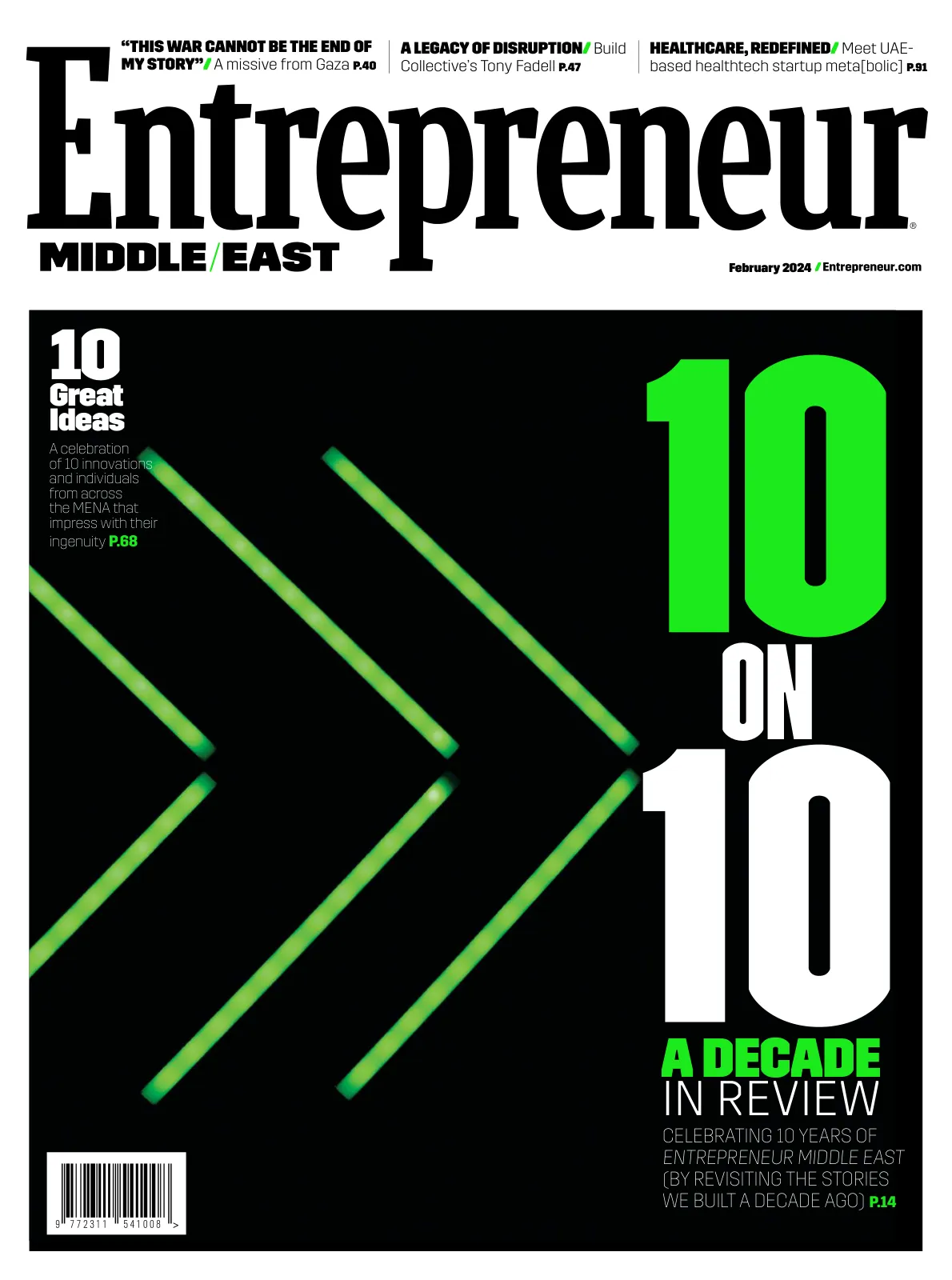
Entrepreneur Middle East, February 2024
Page 1
February 2024
10
Great
Ideas
A celebration
of 10 innovations
and individuals
from across
the MENA that
impress with their
ingenuity P.68
HEALTHCARE, REDEFINED/ Meet UAE-
based healthtech startup meta[bolic] P.91
“THIS WAR CANNOT BE THE END OF
MY STORY”/ A missive from Gaza P.40
A LEGACY OF DISRUPTION/ Build
Collective’s Tony Fadell P.47
10
ON10
A DECADE
IN REVIEW
CELEBRATING 10 YEARS OF
ENTREPRENEUR MIDDLE EAST
(BY REVISITING THE STORIES
WE BUILT A DECADE AGO) P.14
Page 2
27232
Homes from
AED 1,696,000
*
*T&C apply
Launching Sequoia,
your woodland paradise
A peaceful enclave hidden within the woodland.
Choose from a range of well-appointed homes, from
two-bedroom townhouses to six-bedroom signature villas.
Every residence at Sequoia blends nature-inspired design and
features with the latest smart home technology, bringing you
environmentally friendly convenience and comfort.
Page 3
3
February 2024 / ENTREPRENEUR.COM /
Contents/February 2024
P.14
10 On 10:
A Decade In
Review
Celebrating 10 years of
Entrepreneur Middle East by
revisiting the stories we built a
decade ago.
P.68
10 Great
Ideas
A celebration of 10 innovations
and individuals from across the
MENA that impress with their
ingenuity.
FEATURES
→ LOULOU KHAZEN BAZ
is the founder of the
podcast, Conversations
with Loulou, as well as of
the investment
syndicate, SPADE
VENTURES.
Page 4
Until 29 March 2024
SAVE
UP TO 25%
BOOK ON
FAIRMONT.COM
Page 5
Page 6
Page 7
SUITE TREAT
Step into a world of opulence when you book a Suite at Raffles Doha.
Experience the added luxury of QAR 750 credit to spend
on dining in the hotel, and QAR 500 towards any Spa treatment.
Children aged 12 and below are welcome to indulge in the
enchantment of complimentary dining.
Rates starting from QAR 3,500 per night
For reservations, please call +974 4030 7100
or email reservations.doha@raffles.com
Raffles Doha, Iconic Towers, Marina District, PO BOX 4747, Lusail, Qatar
Page 8
ELEVATING DATA SECURITY PROTOCOLS
SAFEGUARDING SENSITIVE INFORMATION
DataPatrol provides out-of-the-box solutions in order to meet your organization’s needs.
Page 9
PREVENT INTERNAL DATA LEAKS WITH
DATAPATROL SCREEN WATERMARK SOLUTION
MONITOR, ALERT
PROTECT, TRACK
Stop internal data breaches with comprehensive visibility and protection across
one of the most critical, yet overlooked areas of enterprise risk: SCREENS.
Insiders have the potential to compromise sensitive information by capturing images with their mobile
phones or cameras. A leaked photograph displaying confidential information on screens can lead to
internal data leaks within an organization. This could result in the loss of company trade secrets,
customers' personal information, and other sensitive data, causing substantial financial losses and
damage to the organization's reputation.
Easy to use Platform
Seamless Setup and integration
Customizable Watermarks
Support Microsoft, MacOS and Linux
datapatrol.com
Page 10
10 / ENTREPRENEUR.COM / February 2024
Contents
February 2024
47 A Legacy Of Disruption
Talking all things entrepreneurship
with TONY FADELL, the mind behind
multiple generations of the iPod and
iPhone, who now focuses on startups
that will change the world at Build
Collective.
56 Entrepreneur Escapes:
Radisson Red Tbilisi
Business meets pleasure in the heart
of a historic city.
110 Focused On The Future
A look at Dubai Holding’s global
sustainability challenge, Innovate for
Tomorrow.
61 “Help! I’m Burnt Out!”
DOMINIC ASHLEY-TIMMS gives you the low-
down on how you can protect your time
(and well-being) as a leader.
64 Price Wars
AHMAD NUMAN, Director of Marketing
and Corporate Communications at
Ras Al Khaimah Economic Zone, offers
a marketer’s guide to successfully
navigating what is often a race to the
bottom.
91 Healthcare, Redefined
With their UAE-born healthtech startup
meta[bolic], co-founders ALI HASHEMI
and IHSAN ALMARZOOQI are aiming to be
pioneers in the hybrid healthcare space.
96 “We Got Funded!”
The stories behind the recent
fundraising successes seen by MENA-
born startups Soum, Clinicy, and
Silkhaus.
TREPONOMICS
BUSINESS
UNUSUAL
STARTUP
SPOTLIGHT
IN THE LOOP
→ Tony Fadell is the
principal of Build
Collective, a company
that focuses on
impactful
investment.P.47
EDITOR IN CHIEF Aby Sam Thomas
aby@bncpublishing.net
CEO Wissam Younane
wissam@bncpublishing.net
DIRECTOR Rabih Najm
rabih@bncpublishing.net
ART DIRECTOR Simona El Khoury
MANAGING EDITOR Tamara Pupic
tamara@bncpublishing.net
FEATURES WRITER Aalia Mehreen Ahmed
aalia@bncpublishing.net
DIGITAL SOLUTIONS DIRECTOR
Mahdi Hashemi mahdi@bncpublishing.net
HEAD OF INNOVATION
Sarah Saddouk sarah@bncpublishing.net
GROUP SALES DIRECTOR – B2B GROUP
Joaquim D’Costa jo@bncpublishing.net
COLUMNIST Tamara Clarke
CONTRIBUTING WRITERS
Mahmoud Alwadia, Dominic Ashley-Timms,
Fida Chaaban, Devina Divecha, Ahmad Numan.
SUBSCRIBE
Contact subscriptions@bncpublishing.net to receive
Entrepreneur Middle East every issue
COMMERCIAL ENQUIRIES
sales@bncpublishing.net
ENTREPRENEUR.COM
Access fresh content daily on our website
All Rights Reserved 2024. Opinions expressed are solely those of the contributors.
Entrepreneur Middle East and all subsidiary publications in the MENA region are
officially licensed exclusively to BNC Publishing in the MENA region by Entrepreneur
Media Inc. No part of this magazine may be reproduced or transmitted in any
form or by any means without written permission of the publisher. Images used in
Entrepreneur Middle East are credited when necessary. Attributed use of copyrighted
images with permission. All images not credited otherwise Shutterstock. Printed by
United Printing and Publishing.
PO BOX 502511 DUBAI, UAE
P +971 4 4200 506
EntMagazineME
Entrepreneur-me
40 “This War Cannot Be The
End Of My Story.”
MAHMOUD ALWADIA, an aspiring
entrepreneur in Gaza, tells his tale.
Page 11
Page 12
12 / ENTREPRENEUR.COM / February 2024
Editor’s Note/
Editor’s Note/
TIME FLIES…
When you’re learning on the fly
E
ntrepreneur Middle East is celebrating its 10th
anniversary this month! As a journalist who has
now reported on entrepreneurship in the MENA
for a decade, here’s a list of 10 things that I have
learned about this domain and the people in it- I
hope that this will serve as a sort of primer for
those of you thinking of becoming entrepreneurs
in the years to come!
1/ It’s never a bad time to be an entrepreneur.
Regardless of whether the ecosystem is flush with cash,
or in the middle of a downturn, there is always
something to be gained from embarking on an
entrepreneurial journey- even if it is a lesson on what
not to do as a founder.
2/When you’re an entrepreneur, it’s never really only
about you. Be it your teams who are burning the
midnight oil, or your families who are helping you
shoulder the burden of being a founder, never dismiss
those who stick around you amid your entrepreneurial
journey- make it a point to appreciate them for
whatever it is that they do for you.
3/As an entrepreneur, you decide the parameters of
your success. Not every company can be a unicorn-
but every company can be successful all the same.
4/Always be humble (and stay that way). No, an
inflated ego is not going to work out for you in the long
run.
5/ Hold on to your ideals. I’ve yet to see an
entrepreneur who has not benefited from having
strong value systems to govern both themselves and
their business.
6/ Listen -really listen- to criticism. Don’t operate
under the fallacy that all critics are there to “simply
bring you down.”
7/Truth will out. Think that you can get away with
anything since you’re the one running the outfit? Rest
assured that people will talk- and you will eventually
face the music, one way or the other.
8/ Know when to start... Yes, you must do everything
you possibly can to prepare yourself before embarking
on an entrepreneurial endeavor, but once you’ve done
all of that (and yes, you know when you have reached
this point), you simply just need to begin.
9/ …And know when to end. Sometimes, it’s because of
the success you’ve realized, and sometimes, it’s because
of the failure you’ve encountered- either way, don’t
hold on to an undertaking when you know you’re done
with it. Move on.
10/The journey really is the reward. There is value in
the time it takes to see results emerge from an
entrepreneurial undertaking.
Here’s to 10 years of Entrepreneur Middle East!
Aby Sam Thomas
Editor in Chief
@thisisaby
aby@bncpublishing.net
Page 13
New IVECO T-WAY: high productivity and safety on off-road terrains
With a complete line-up of AWD and PWD versions and the the 16-speed HI-TRONIX automated
gearbox, the IVECO T-WAY features a host of functionalities such as Rocking Mode, Off-road Mode,
Creeping Mode and 4 reverse gears to tackle with ease the toughest off-road conditions. The new
architecture of the EBS system, combined with disc brakes on all wheels, greatly improves the vehicle’s
performance and the driver’s safety in the most demanding applications.
New IVECO S-WAY: high technology and efficiency for on-road missions
The new IVECO S-WAY, with a completely redesigned and reinforced cab, offers a wide choice of
Euro III/V diesel engines, a delivering class-leading power from 360 HP to 560 HP Euro III / 570 HP
Euro V and superior fuel-saving devices, such as anti-idling feature, Ecoswitch, Ecoroll and Smart
Alternator, 12-speed HI-TRONIX automated transmission with the most advanced technology
in its category, electronic clutch and best-in-class torque-to-weight ratio.
Drive the new way.
Page 14
14 / ENTREPRENEUR.COM / February 2024
Page 15
10
ON10
A DECADE
IN REVIEW
CELEBRATING
10 YEARS OF
ENTREPRENEUR
MIDDLE EAST
(BY REVISITING THE
STORIES WE BUILT A
DECADE AGO)
by ABY SAM THOMAS
15
February 2024 / ENTREPRENEUR.COM /
Page 16
16 / ENTREPRENEUR.COM / February 2024
W
ow, almost
everything has
changed since
then!” That’s how
HRH Prince
Khaled bin
Alwaleed bin Talal
Al Saud responds
when we tell the Saudi royal that 10 years
have passed since he was featured for the first
time in Entrepreneur Middle East as its
December 2014 cover in his role as the
founder of the Dubai-headquartered KBW
Investments. At the time, KBW Investments
had just come into its own having acquired
Italian crane manufacturer Raimondi, with
Al Saud then becoming the latter’s Chairman.
“Raimondi Cranes is still going strong,”
Prince Khaled says. “It has expanded in
terms of the amount of our machines at work
“
→ Launched in 2017 and headquartered in the UAE, Arada is the region’s fastest growing
and most progressive developer, which came into being as a partnership between HRH
Prince Khaled bin Alwaleed and H.H. Sheikh Sultan bin Ahmed Al Qasimi.
IMAGES COURTESY KBW VENTURES
10
ON10
A DECADE
IN REVIEW
HRH PRINCE KHALED
BIN ALWALEED
BIN TALAL AL SAUD
FOUNDER AND CEO
KBW VENTURES
globally, the geographies we are present in,
and the new senior leadership team, which
is bringing along an invigorated corporate
approach.”
Prince Khaled’s work has continued to
grow and diversify, with one of his most
successful ventures being Arada, billed as
“the region’s fastest growing and most
progressive developer,” which came into
being in 2017 as a partnership between him
and H.H. Sheikh Sultan bin Ahmed Al
Qasimi, who is today the Deputy Ruler of
the Emirate of Sharjah. “Arada is now what
I would call the real growth story of the
UAE real estate market of the last few
years, both in terms of numbers and our
approach,” he says. “We’ve launched
projects valued at AED52 billion in both
Sharjah and Dubai, and we have already
delivered 9,000 homes. For what is still a
In 10 years, I
want to be able
to say that the
responsibility of
my businesses
is to leave things
better than when
I started, and
keep finding new
ways to do so.”
Page 17
17
February 2024 / ENTREPRENEUR.COM /
→ As a figure of
business, technology
enthusiast, and
investor, HRH Prince
Khaled bin Alwaleed
bin Talal Al Saud is a
firm proponent of clean
energy, healthy living,
the humane treatment
of animals, and a
motivated voice for
Middle East
entrepreneurs.
“ Never let
anyone
limit your
aspirations. It’s
what I live by.
It’s how I see our
businesses too.”
Page 18
18 / ENTREPRENEUR.COM / February 2024
new developer, those numbers are impressive,
but what I’m really excited about is our long-term
approach, which is to focus on people, and
provide them with the best possible facilities and
services. Right now, about a third of all the
homes we sell are to people who have previously
bought a property with us; so, it’s great to see that
this approach is really paying off for us.”
P
rince Khaled has also leaned into his
“Tech Prince” persona that we had made
a note of in our 2014 piece- indeed, he is
perhaps best known today for being the
founder and CEO KBW Ventures, an investment
firm whose portfolio includes cutting-edge tech
startups from around the world like Mexican
fintech Kueski, San Diego-based BlueNalu,
Dubai-based Vuz, and many more. “KBW
Ventures went from an idea to an active
investment firm,” he says. “During that interview
10 years ago, my venture investments were angel
tickets, as I didn’t have a formal vehicle for that.
Now, KBW Ventures has invested in a lot of
different sectors; food technology figures
prominently, alongside other types of technolo-
gies, some B2B, and some B2C. We have a
number of mission-driven companies in our
portfolio, and we’re always looking to build on
our existing work. Going forward, we’re taking
what I term ‘a broader approach’ with our newest
capital commitments.”
This, therefore, seems to be the ethos that’s
governing Prince Khaled’s personal vision for the
future. “I’m excited to see many of the businesses
Page 19
19
February 2024 / ENTREPRENEUR.COM /
that we are involved in transform
the status quo,” he says. “Arada is
centered around providing the
best in experiential communities,
and bettering the living standard
currently available to people. We
have done this by elevating the
Sharjah living experience through
Arada’s developments.” Prince
Khaled also points to KBW
Ventures’ investments in the
foodtech arena as being especially
exciting in the long run.
“Cultivated meats and seafood is
another area where I think our
work contributes to elevating the
status quo,” he says. “You have the
option to eat meat now, but when
the negative climate consequences
are alleviated, it’s so much better
for all involved.” As he thus trains
his eyes on realizing what is
essentially a better version of the
world, he is clear about what he
wishes to be his legacy. “From
businesses to end users, there are
so many ways I think we are
participating in leveling up,” he
says. “In 10 years from now, I want
to be able to say that the
responsibility of my businesses is
to leave things better than when I
started, and keep finding new
ways to do so.” kbw-ventures.com
“ I’m excited
to see
many
of the
business
that
we are
involved in
transform
the status
quo.”
THEN-VERSUS-NOW WITH
HRH PRINCE KHALED BIN
ALWALEED BIN TALAL AL
SAUD
Looking back at the stage of
your entrepreneurial/career/
business trajectory you were
in 10 years ago, is there
anything you’d do differently
knowing what you know now?
Alternatively, what’s the
biggest lesson you wish you’d
known 10 years ago?
} “I would prioritize doing more of
my own research rather than relying
on the recommendations of others.
This is one reason why I have KBW
Ventures, and I am its CEO; I am
hands-on with the decks, the calls,
the pitch assessments. I decide what
we’re backing, and I do this after
multiple layers of assessment. Early
on, maybe 10 years ago, I was much
more impulsive and less analytical.
}Rewinding 10 years, I would invest
more time in training up weak spots
in my knowledge base. I would tell
younger me to spend more time
learning more about things that I
don’t know well that I would come
across in business some way or
another, whether it’s a type of
technology, or a nascent industry.
Now, I don’t have to actually be
interested in it to really deep dive
into the research around it; these
days, I just want to know it for the
sake of the knowledge itself. It’s
proven to be really valuable at this
stage in my career. A decade ago
(and this also goes back to
impulsiveness, and not seeing the
bigger picture), I would’ve focused
more on long term gains, not just
quick wins. This really took me
time to internalize, and the benefits
are massive and tangible, but you
have to stick it out, plan and wait
for things to mature and show their
value.
I have three lessons that everyone
can use. Lesson one: I would
definitely have listened more in
general. Listening is so important;
listen more than you talk. Wait,
internalize, and then move on it.
Lesson two: I would have
researched more and thought
more, before making
spur-of-the-moment decisions.
This goes back to bigger picture
planning and strategic long-term
gains.
Lesson three: The most important,
is to learn from people’s
experiences. I always go back to a
key example- my father would
always say, ‘I’m disciplined. I have
discipline.’ And it was kind of one
of those things, where you know, it
was like, ‘Okay, sure,’ but, now, I
know that discipline is everything.
In business, in life, in fitness, and
even in the pursuit of happiness,
and a good life. I wish I would’ve
internalized his experiences, and
other people’s so much sooner.”
HINDSIGHT IS 20/20
→ Arada’s flagship master development, Aljada, is a 24 million sq. ft. integrated lifestyle destination, and a new leisure and
entertainment hub for Sharjah.
↓ Vijay V. Vaitheeswaran, Global Energy and Climate Innovation Editor of
The Economist, and HRH Prince Khaled bin Alwaleed bin Talal Al Saud,
founder and CEO of KBW Ventures, at Abu Dhabi Finance Week 2023
Page 20
20 / ENTREPRENEUR.COM / February 2024
10
ON10
A DECADE
IN REVIEW
MUDASSIR
SHEIKHA
CO-FOUNDER AND CEO,
CAREEM
C
areem is easily one of
the MENA’s most
talked about
entrepreneurial
success stories today,
and given its aim to be
known as “the
preeminent technology platform of
our region” (as co-founder and CEO
Mudassir Sheikha told Entrepreneur
Middle East last year), it seems safe to
say that this UAE-born enterprise
-which is now “building ‘the
everything app’ for the greater Middle
East”- is set to continue to be an
integral component of the business
ecosystem here for a long while to
come.
Careem has thus clearly come a long
way from the fledgling ride-hailing
business it was when we first featured
the enterprise in 2014 in Entrepreneur
Middle East, which was just two years
→ CAREEM’S
co-founder and CEO
Mudassir Sheikha
says the company’s
original values will
continue to guide its
new Super App
ambitions
Page 21
21
February 2024 / ENTREPRENEUR.COM /
after Sheikha and Magnus
Olsson had founded the
company in Dubai. “We’ve
seen more growth and impact
since we launched in 2012
than we could have ever
imagined,” Sheikha tells us
now. “We’ve simplified the
lives of more than 50 million
people, created nearly three
million earning opportunities,
and expanded from a mobility
platform into an everything
app offering more than a
dozen digital services, and a
platform for other startups to
scale. We’ve helped push the
limits of what was thought
possible for the region,
encouraging others to dream
big too. We achieved this by
staying true to our purpose,
persevering through the
obstacles, and hiring
phenomenal colleagues that
acted as true owners.”
I
t’s principles like these that
led Careem’s ridesharing
business to be bought by
San Francisco-headquartered
Uber in 2019, which signaled
the start of Careem’s “Chapter
2.” The company’s “Chapter 3”
began in December 2023,
when UAE-based tech and
investment conglomerate e&
completed its acquisition of a
majority stake in Careem’s
non-ridesharing business,
Careem Technologies, which
essentially governs the
everything app that it is build-
ing. “With two strong
partners in e& and Uber, we
are now able to simplify the
lives of a lot more people in a
lot more ways than just
mobility,” Sheikha says. “e& is
on a journey of transforma-
tion from being one of the
region’s biggest telcos into a
global technology investment
group, and it shares our vision
of uplifting the region
through the services it
delivers, as well as the
capabilities it helps build.
Beyond funding and
commercial support, it brings
enormous value to Careem
“Thank you,
Entrepreneur
Middle East, for
drawing attention
to the region’s
entrepreneurial
stories. Sharing
these stories
gives people a
chance to learn
from others, and
gain a deeper
appreciation for
entrepreneurship
in our region.
They serve as
a testament to
the human spirit,
showcasing
the relentless
determination and
creativity that
drives founders.
There are so many
exciting regional
ventures that I’ve
been following
for years, and I’m
so excited to see
more progress and
innovation come
from our region.”
through its large customer
base, geographic footprint,
and portfolio of companies
and network.”
The road ahead thus looks
set to be an exciting one for
Careem, and for his part,
Sheikha has no qualms
about sharing his excitement
for the future that beckons.
“The opportunity for an
everything app in the wider
Middle East is huge,” he
shares. “There are so many
daily frictions across the
region that can be solved
with digital services, and
there are no dominant
players in our region
offering the convenience and
value that an everything app
like Careem can offer.”
careem.com
THEN-VERSUS-NOW
WITH MUDASSIR
SHEIKHA
Looking back at the stage of
your entrepreneurial/
career/business trajectory
you were in 10 years ago, is
there anything you’d do
differently knowing what
you know now?
Alternatively, what’s the
biggest lesson you wish
you’d known 10 years ago?
} “It’s easy to look back in
hindsight, and see where you
could have done things better. We
made many mistakes along the
way, but we survived, because
we reacted quickly, and learned
and iterated each time. Perhaps
the biggest lesson that I wish
we’d known back then was the
importance of hiring trustworthy
and dependable leaders, and
then truly letting them run. I had a
habit of staying involved with
multiple topics, and as you scale
in size and complexity, there’s just
no choice but to delegate and
trust in your team!”
HINDSIGHT
IS 20/20
IMAGES COURTESY CAREEM
Page 22
22 / ENTREPRENEUR.COM / February 2024
10
ON10
A DECADE
IN REVIEW
ELIE
HABIB
CO-FOUNDER AND CTO
ANGHAMI
→ Elie Habib is the
co-founder and CTO of
Anghami, one of the leading
music streaming platforms
in the MENA, which gives
more than 70 million users
in MENA, Europe, and USA
access to over 57 million
Arabic and international
songs to stream and
download, in addition to
around 200,000 Arabic and
international podcasts.
“10 years ago, I was often
reading stories from
distant lands that seemed
unrelatable to my own
region. The tales I came
across in all these foreign
publications were filled with
people and situations that
didn’t resonate with me, as
they focused on implausible
success stories like winning
the lottery. I struggled
to identify with these
narratives, as the economic
differences, disparities
of funding availability,
as well as research and
development hubs were
worlds apart. However, what
set Entrepreneur Middle East
apart was its focus on local
and regional entrepreneurs.
By highlighting real-
life individuals from our
area, this publication
managed to humanize
their achievements. These
founders, who possessed
world-class ambition, drive,
and determination, finally felt
relatable and inspiring. Their
stories, grounded in reality
rather than fantasy, struck
a chord, and has offered
valuable lessons for aspiring
business owners in our
community.”
Page 23
23
February 2024 / ENTREPRENEUR.COM /
I
f one were to track all of
the accomplishments that
Lebanon-born Anghami
has realized since it was
founded as a startup in
2012, it’s safe to say that it
would result in a list that’d leave
just about anyone enthralled.
Today, as one of the region’s
leading music streaming
platforms, the company’s future
is looking incredibly bright, but
it is Anghami’s steadfastness as a
business that should make it a
role model for entrepreneurial
endeavors in the region and
beyond. “Anghami started as an
application with the aim of meet-
ing a market need by providing
music content for users,” recalls
Elie Habib, co-founder and CTO
of Anghami. “However, over the
past decade, Anghami has
evolved into a platform and
entertainment ecosystem in the
MENA region. The focus has
shifted from just its product to
building a sustainable business,
resulting in the company’s
successful listing on the Nasdaq
Stock Exchange, positioning it as
the first Arab tech company to
achieve this milestone.”
A
nghami is today not just
the music service that it
was when Entrepreneur
Middle East first
featured it in February 2014; it
has expanded its offerings to
include podcasts, audiobooks,
and live radio. While it boasts of
an extensive library already,
Anghami has also launched
Anghami Studios, which aims to
link artists with brands, and
create content for Anghami and
third parties. This new entity is
also behind Anghami Spotlight,
which stages live live events and
concerts for artists, and it has
launched its first hospitality arm,
Anghami Lab, located at Riyadh
Boulevard in Saudi Arabia,
which, while being one of the
first venues in the country to
have live performances, also aims
to discover local artists and
talents. Meanwhile, Anghami is
also set to combine its business
with fellow homegrown brand
OSN+ -the region’s leading
streaming platform for premium
content- in a merger that was
famously declared to be set to
“reshape the MENA entertain-
ment landscape.”
H
abib, who has been
earmarked to lead this
new venture -which will
be the MENA region’s
first integrated music and video
streaming platform- as CEO, is
thus, quite unsurprisingly,
excited about how Anghami will
evolve as it moves into the future.
“The upcoming OSN+ merger
will allow Anghami to cater to a
larger user base, and offer series,
movies, and other forms of
content, making it a comprehen-
sive media company that can
engage users throughout the
day,” he notes. “Over its 10-year
journey, Anghami has evolved
personally and professionally,
with an open mind, low ego,
disdain for perfection, and a
focus on key business key
performance indicators being the
key elements that helped us
achieve success. Understanding
the need to change our strategy
while maintaining our vision was
not as evident at the beginning of
Anghami’s journey as it is today.”
From a personal perspective,
Habib is looking forward to his
evolution as an entrepreneur- or,
as he likes to call himself, a
“builder.” “My journey as a
builder began long before I even
knew the term ‘entrepreneur,’”
Habib says. “Fueled by
determination and creativity, I
commenced constructing my
first one-man business prior to
attending university. I remain
committed to this path,
embracing the title of a builder,
and eagerly anticipating what the
next 10 years may hold. I aspire
to perpetually stay teachable and
evolve, ensuring that each day is
filled with excitement for the
projects I’m building. I also hope
I can inspire my children to learn
from my failures, so that they can
do better in their own careers.”
With wishes and dreams like
these set to underline all of his
efforts for Anghami’s next
chapter, Habib seems eager to
simply just get going with it all.
“Today, I am extremely excited
about the future, because of the
OSN+ merger that opens up
opportunities I was yearning for,”
he says. “In fact, my goal today is
to create a media company that
is unique in the region.
Personally, I am trying to
constantly learn more, I don’t
think I ever learned as much. As
Charlie Munger said, ‘I think a
life properly lived is just to learn,
learn, learn all the time.’”
anghami.com
THEN-VERSUS-NOW
WITH ELIE HABIB
Looking back at the stage
of your entrepreneurial/
career/business trajectory
you were in 10 years ago, is
there anything you’d do
differently knowing what
you know now?
Alternatively, what’s the
biggest lesson you wish
you’d known 10 years ago?
} “Retrospectively, I recognize
that some decisions in my past
could have been approached
differently. In the realm of
building a successful media
company, I now understand the
importance of assigning equal
weight to finance, technology,
content, and distribution. Had I
known then what I know now, I
would have emphasized this
balance from the beginning. And
if I were to send myself a
message, I'd urge myself to
keep driving innovation- within
self-imposed constraints. The
term "constraints" is crucial
here- they often breed
resourcefulness, and they are
underappreciated in many
startups. Instead, an abundance
of resources can sometimes
hinder creativity and growth. By
embracing limitations early on,
we set ourselves up for
long-term success and
adaptability in today's dynamic
entrepreneurial landscape.”
HINDSIGHT
IS 20/20
IMAGE COURTESY ANGHAMI
Page 24
24 / ENTREPRENEUR.COM / February 2024
IMAGES COURTESY DIGITAL AND SAVVY
10
ON10
A DECADE
IN REVIEW
Page 25
25
February 2024 / ENTREPRENEUR.COM /
MAHA
ABOUELENEIN
FOUNDER AND CEO
DIGITAL AND SAVVY
→ As the founder and CEO of DIGITAL & SAVVY, MAHA ABOUELENEIN is an entrepreneur and strategic communications
advisor with more than 30 years of experience working with global corporate giants, high-growth tech startups, top
governments, and high-net-worth individuals.
THEN-VERSUS-NOW
WITH MAHA
ABOUELENEIN
Looking back at the stage of
your entrepreneurial/career/
business trajectory you
were in 10 years ago, is
there anything you’d do
differently knowing what
you know now?
Alternatively, what’s the
biggest lesson you wish
you’d known 10 years ago?
}“10 years ago, it was all about
the hustle and burning the
midnight oil. Today, that
behavior is a fast track to the
death of your teams, your
mental health, and your
business. We value different
things now- we value grit and
ambition, but we also value
being balanced, well-
disciplined, well-slept, and
happiness as the barometers of
success. Our relationship with
failure and fear has changed
dramatically in the past 10
years. We would never call out
our failures or shortcomings;
failing was bad. Today, failure is
how we learn, and we value the
lessons it teaches us, and we
speak about them openly, and
share them publicly with others.
We are no longer afraid to make
mistakes, or change our minds
or decisions, and pivot when
something is not working. I love
being an entrepreneur
today- we can share our
struggles with hiring talent or
demanding clients without fear,
and it's not judged negatively.”
HINDSIGHT
IS 20/20
I
quit Google to become
an entrepreneur!” It
was this proud
declaration that
headlined Maha Aboue-
lenein’s first appearance
in Entrepreneur Middle
East in its September
2014 issue, and it really is a
great indication of the
incredible savvy this
woman possesses on all
things media, communica-
tions, and public relations
(PR). It’s an expertise that
Abouelenein has garnered
over a fruitful career spent
in both corporate and
entrepreneurial realms,
and, today, as the founder
and CEO of a strategic
communications firm
called Digital and Savvy,
her record speaks for itself.
After all, the past 10 years
have seen Abouelenein
work with clients from
around the world that
include high-profile
individuals like Gary
Vaynerchuk, Deepak
Chopra, Karen Wazen, and
others, as well as
enterprising companies
like Careem, Utopia, Bedu,
and many more.
“
As a business, we’re
constantly changing
with the market,
and staying ahead of
what’s next,” Abouelenein
says. “We focus on
consumer attention, and
how it is continually
evolving. For example, the
internet has changed
significantly over the last
10 years, impacting
consumer choices, and
businesses’ growth. We
were not necessarily
thinking about artificial
intelligence and the
metaverse 10 years ago, but
we are today. What’s
important is that we are
keeping our fingers on the
pulse of emerging
technologies, because it
impacts business decisions
and consumer behavior.
You must constantly be
aware, learn new things,
relearn, and evolve to stay
relevant.” Now, Abouele-
nein clearly knows a thing
or two about staying
relevant- and so, her
insights in this regard are
definitely worth noting.
“Having smart communi-
cation strategies is more
important than ever for
Page 26
26 / ENTREPRENEUR.COM / February 2024
every business, brand, executive, entrepreneur,
and even for students,” she says. “10 years ago,
you needed an attention-grabbing PR
campaign and good key messaging you shared
through third parties. Now, you need an arsenal
of savvy communications weapons in your
toolbox that you deploy directly to consumers
to control the narrative with an integrated
storytelling approach. And if you don’t, your
reputation can be in trouble.”
W
ith this being the state of the
landscape right now, Abouelenein
is looking forward to seeing her
business grow and evolve in this
current milieu. “In terms of my goals for the
business in the next 10 years, I envision us
shifting our focus to business development and
consulting with brands, serving as a gateway for
10
ON10
A DECADE
IN REVIEW
“Entrepreneur Middle East
has been the thought leader
in the region, consistently
highlighting and promoting the
entrepreneurial ecosystem. It
is a leading voice and trusted
authority for entrepreneurs.
I really enjoy the stories and
entrepreneurs highlighted
over the last decade. I think it
brings value to the people in
the region and outside of the
region- which truly shows how
powerful and innovative the
region is! We produce unicorns,
and drive ideas that matter. I
love how Entrepreneur Middle
East paves the way for many
to build a formidable career
path as entrepreneurs. One
thing I really appreciate
is that Entrepreneur has
provided a platform for female
entrepreneurs in the region.
It’s so important to highlight
the stories and achievements
of women in entrepreneurship,
as it not only motivates and
inspires the next generation,
but also makes sure we have
diversity in the entrepreneurial
landscape. Also, the practical
tips and advice shared through
the articles have been a
great source for my personal
entrepreneurial journey as well
as the whole ecosystem in the
MENA region.”
Page 27
27
February 2024 / ENTREPRENEUR.COM /
BADR
JAFAR
CEO
CRESCENT ENTERPRISES
F
or someone we declared to be “one of the region’s thought
leaders” when we first featured him in Entrepreneur Middle
East in July 2014, Crescent Enterprises CEO Badr Jafar has
only gone on to steadfastly built on that persona in the years
since, and as such, the amount of impact he continues to
have on the Arab world -and beyond- seems almost
unparalleled. At the same time, the UAE-headquartered multinational
that he leads has grown as well- and it continues to be one of the
region’s most respected institutions. “Today, Crescent Enterprises
comprises a diversified group of over 50 subsidiaries and operations
across 15 countries, employing 1,800 dedicated women and men,” Jafar
shares, while adding that its corporate structure now comprises of four
platforms: CE-Operates, CE-Invests, CE-Ventures, and CE-Creates.
“CE-Operates, our operating business platform, focuses on smart
infrastructure for economic development and growth, and houses
operating companies like Gulftainer, our ports and logistics business
which operates across the world including through strategic ports in
the UAE, Saudi Arabia, Iraq, and the USA,” Jafar explains. “CE-Invests,
our strategic investment platform, backs late-stage businesses across
the MENA region, including the healthcare-focused fund TVM Capital
and private equity firm Growthgate Capital, spanning sectors including
green building materials, environmental services, and advanced
biometrics. CE-Ventures, our corporate venture capital platform, has
deployed over US$500 million in early-stage high-growth businesses
→ BADR JAFAR is a
businessman and social
entrepreneur from the
United Arab Emirates. He is
the CEO of Crescent
Enterprises, a diversified
business operating across
various industry sectors in
15 countries.
companies who want to invest in
the region,” she says. “We
understand the market, we have
deep relationships, and we are
poised to help them with brand
positioning and strategy at scale.
In addition, over the next 10
years, I’d love to build a platform
and wide-scale institute in the
Arab world for strategic
communications, with the
mission to train and educate
people on how to be effective
communicators.” Abouelenein
and her team are thus all set to
put the hard yards in for these
new goals for Digital and Savvy,
but it’s also worth noting that she
is getting close to realizing a
personal ambition for herself in
the near future. “I am proud to
soon become a first-time author!”
she reveals. “My first book is
coming out in October, and I
want to bring so much value to
my readers while inspiring them.
This book highlights how to
master the seven rules of
self-reliance, and shares examples
from my own life as an American-
Egyptian entrepreneur working
in the US and MENA markets.
This book also gives you a
playbook for becoming the
ultimate networker, value creator,
and powerful storyteller. I am
very excited to be able to scale
what I have learned in my
30-year career with other people,
beyond my direct clients.”
N
ow, as Abouelenein gets
set to add “author” to
her “founder and CEO”
title, it also marks a shift
in how she chooses to brand
herself today, from how she did
10 years ago. “In 2014, my title
was Managing Director,”
Abouelenein says. “Looking back,
I was playing small– it was a clear
title that demonstrated I was in
charge, but I didn’t embrace the
title of CEO. Today, I use CEO,
because, in 2024, women are
CEOs, and I should own the title!
I wish I had known then that
being your authentic self is
important, and that nobody else
will value you if you don’t value
yourself.” digitalandsavvy.com
Page 28
28 / ENTREPRENEUR.COM / February 2024
↑ In 2023, BADR JAFAR was appointed the COP28
Special Representative for Business and
Philanthropy, and he was also the Chair of the
inaugural COP28 BUSINESS and PHILANTHROPY
CLIMATE FORUM.
10
ON10
A DECADE
IN REVIEW
“It is truly remarkable how our
region’s entrepreneurial landscape
has evolved in the past decade. 10
years ago, the venture space was
nascent. Today, unicorns are being
built, billion-dollar exits are being
achieved, and most importantly
lasting societal impact is being
created. We are now seeing
entrepreneurs working on their
second and third ventures, and
teams of tech companies becoming
the founders of tomorrow. The
whole ecosystem is thriving,
thanks to multiple stakeholders
who have contributed to this
success, from angels, incubators,
and accelerators, to venture capital
firms and family offices, and a
supporting regulatory framework
in the UAE and elsewhere. As a
Founding Partner of the Sharjah
Entrepreneurship Center (Sheraa),
we are proud to have witnessed the
growth of a strong entrepreneurial
ecosystem from the Emirate that
serves the MENA region, supporting
157 amazing startups to-date.
You can’t build an ecosystem
without regularly updating its
participants on the latest news and
trends and showcasing success
stories to inspire others. All of this
must be localized, fit-for-purpose,
and highlight the challenges
and opportunities this journey
represents. For this, I congratulate
the entire Entrepreneur Middle
East team on a very successful
10 years, and on the role that you
have played in helping to shape
the entrepreneurial and startup
ecosystem in the MENA region.
Furthermore, almost half a billion
Arabic speakers worldwide, and
only just 3% of all online content
produced in Arabic, I commend
Entrepreneur Middle East’s efforts
in bridging the Arabic content gap
for the region with Entrepreneur
Al Arabiya, which represents a
need and opportunity for inclusive
participation in the digital
economy.”
and venture capital funds in the
MENA region, India, Southeast
Asia, and the US. We have
witnessed the evolution of the
venture capital ecosystem in our
region, and we were proud to have
led seed funding rounds for a num-
ber of companies that reached
unicorn status, including Kitopi,
which became the fastest growing
unicorn in the MENA region. At
the same time, CE-Creates, our
internal business incubator
platform, is building startups that
are socially and environmentally
conscious. We have successfully
launched multiple businesses in
the region including Kava & Chai,
a homegrown coffeehouse chain,
and a sustainable mobility
platform, ION, in partnership with
our fellow UAE-based company,
BEEAH Group.”
W
hen it comes to
features that
characterizes
Crescent Enterprises
today, Jafar points first to portfolio
diversification, and then to
sustainability, in which his
company and him personally have
been playing extremely significant
roles in the business ecosystem at
large. “Our corporate culture of
social and environmental
stewardship has been further
enhanced by the UAE’s many
initiatives in this space, including
most recently through its staging
of the 2023 Conference of the
Parties of the United Nations
Framework Convention on Climate
Change (COP28),” Jafar notes. “As
the appointed COP28 Special
Representative for Business and
Philanthropy, I was honored to
chair the inaugural COP28
Business and Philanthropy Climate
Forum, which convened over 1,300
business and philanthropy leaders,
providing a dedicated platform for
exchanging ideas, fostering
collaboration, and generating
action in support of the world’s
climate and nature goals. As a
strategic partner of the Forum,
Crescent Enterprises continues to
work to multiply the impact of the
initiatives unveiled during the
event and its outcomes.”
Looking to the future, Jafar is also
excited about the role that
technology is set to play in
advancing new solutions across all
the sectors his business operates
in. “For example, CE-Ventures has
launched a strategy to invest in life
sciences startups, and it has
partnered with universities in the
US and elsewhere that are working
Page 29
29
February 2024 / ENTREPRENEUR.COM /
↑ BADR JAFAR is passionate about strategic
philanthropy and is working towards nurturing
philanthropic capital that will help scale
solutions to global challenges.
IMAGES COURTESY CRESCENT ENTERPRISES
THEN-VERSUS-NOW WITH
BADR JAFAR
Looking back at the stage of your
entrepreneurial/career/business
trajectory you were in 10 years ago, is
there anything you’d do differently
knowing what you know now?
Alternatively, what’s the biggest lesson
you wish you’d known 10 years ago?
}“As Socrates said, ‘I know one thing: that I
know nothing.’ The more you grow as a
person, the more this philosophy resonates.
Everyone will need to embrace their own
journeys of learning and inspiration, but the
most important thing we can all do is accept
that we can only truly grow by learning from
each other.
}The UAE has created an immensely powerful
and varied platform for diverse voices to come
together, across geographies and sectors, and
be greater than the sum of its parts. This
model for rapid innovation is what fueled the
so-called ‘Golden Age’ in our region over
1,000 years ago, which inspired centuries of
new discovery and human advancement. I
strongly believe that if we stay the course, this
country and the Gulf region overall can be at
the epicenter of a new wave of global
innovation. A wave that is grounded in
scientific and artistic discovery, and
underpinned by social and environmental
pillars of sustainable development. Our
region’s social entrepreneurs will lead this
wave. It is upon us to do whatever we can to
support them, and nurture their dreams.”
HINDSIGHT IS
20/20
“ I strongly believe that if
we stay the course, this
country [the UAE] and the
Gulf region overall can be
at the epicenter of a new
wave of global innovation.”
on cutting-edge research in this field,”
he reveals. “A recent focus area is the
human microbiome, and the
transformative potential microbiome
therapeutics holds across a wide
spectrum of disease states. Another
focus area is deep tech, which looks to
transform global industries by
substantially improving related costs,
execution speed, and overall
capabilities of such industries
through novel solutions that disrupt
the status quo.” Meanwhile,
CE-Invests is looking to expand its
operations and investments in India
and Southeast Asia region, including
in Indonesia, the Philippines, and
Vietnam- according to Jafar, these
countries have the highest long-term
investment potential as of now.
F
rom a personal perspective,
Jafar is also looking to build
on his already strong presence
in the field of philanthropy,
and he’s putting building blocks in
place to set the domain up for success
in the years to come as well. “I am
passionate about the future of
strategic philanthropy, and its
opportunity to create the structures
and platforms needed to nurture a
new generation of philanthropist and
philanthropic capital, which can
partner with government and
business capital to rapidly scale
solutions to our most urgent global
challenges,” Jafar says. “The
results-driven and transparent
principles of strategic philanthropy,
bolstered by emerging digital tools, is
enabling the gathering, processing,
and understanding of philanthropic
data more efficiently than ever before.
This is why I have established the
Strategic Philanthropy Initiative at
the New York University Abu Dhabi
in the UAE, and I aim to soon launch
similar centers in South Africa and
Singapore.” Here, Jafar points out that
rapid economic growth and
intergenerational wealth transfer
across global growth markets of $30
trillion in the coming two decades is
set to to drive an increase in private
wealth as well as a corresponding rise
in philanthropic giving- and that only
highlights the timeliness of the
Strategic Philanthropy Initiative that
he has launched. Now, add that to the
power moves his business is making
in the world at large, and all of this
makes it clear that Jafar is set to
remain an important figure for us to
follow at Entrepreneur Middle
East- and we look forward to continue
sharing all of his exploits in the years
to come. crescententerprises.com
Page 30
30 / ENTREPRENEUR.COM / February 2024
LOULOU
KHAZEN
BAZ
FOUNDER
CONVERSATIONS WITH LOULOU
AND SPADE VENTURES
A
decade is a long time,”
says Loulou Khazen
Baz, as she reflects on
her career trajectory
from when she was
featured in
Entrepreneur Middle
East for the first time in its June 2014
issue, to her most recent appearance
in its July 2023 edition. Back then,
she was the founder of the Arab
world’s first online employment
marketplace, Nabbesh (which she
exited in 2020); today, she remains an
essential part of the region’s startup
ecosystem, be it in her role as the
founder of the investment syndicate
called Spade Ventures, or as the
creator of the popular podcast titled
Conversations with Loulou, or even as
an advisor to just about anyone
seeking to be a part of this particular
arena of business. And if all of what
she does today hasn’t made it clear
already, Khazen Baz remains as
enthralled and excited by entrepre-
neurship as she ever was. “One thing
that hasn’t changed is my passion
towards entrepreneurship, and my
access to amazing people building
great companies,” she says. “I will
continue to use that access to connect
opportunities with people who are
aspiring to be part of the startup
10
ON10
A DECADE
IN REVIEW
“
Page 31
31
February 2024 / ENTREPRENEUR.COM /
→ LOULOU KHAZEN
BAZ is the founder of
the podcast,
Conversations with
Loulou, as well as of
the investment
syndicate, Spade
Ventures.
ecosystem, not necessarily as
founders, but as supporters,
enablers, investors. I can safely say
that learning is a key driver for me,
and there is no better place to learn
than from working with or alongside
entrepreneurs.”
Of course, Khazen Baz has learnt a
lot from her own undertakings too.
“I’ve been through many ups and
downs,” she admits. “I learned a lot
from building a startup whose time
hasn’t come, but I get a lot of
satisfaction from knowing that until
today, I still meet people who have
used Nabbesh.com, and either hired
someone or found a job through it.
I’ve also learned to deal with the
dilemma of ‘moving on,’ and going
through the process of exiting my
business. I’ve learned to make hard
decisions, and then learned to live
with those decisions- the latter took
a while though! I’ve also learned to
enjoy the thrills of starting again, be
it when building Conversations with
Loulou, which continues to grow
across the region, and reach the top
10 in the business and entrepreneur-
ship segments, or when building
Spade Ventures, which has made
investments in stellar startups! I’ve
“Entrepreneur Middle East, is essential
to shed light on the great work that
entrepreneurs are doing across this region!
We need more and more people interested
in creating and/or supporting regional
entrepreneurs. We need a cultural shift when
it comes to accepting and encouraging
entrepreneurship as a career path, especially
for women and minorities. Entrepreneur
Middle East must live on to keep carrying
that mantle!”
learned to find the discipline to keep
building, the strength to do things
alone, and from scratch. And I’ve also
learned that success isn’t necessarily
measured by my bank account- un-
derstanding that has been liberat-
ing!” On a personal level, Khazen Baz
says she has chosen to become a lot
more analytical -and somewhat
cynical- about what people say. “I’ve
learned -the hard way- that we have
too many people who like to tell a
good story, but no intention to follow
through!” she explains. “So, I now put
a lot more emphasis on myself, and
much less on others. The expectation
is thus always low, and this way,
anything positive is a plus!”
I
t is thereby armed with this
knowledge that Khazen Baz has
set herself new goals to realize in
the decade to come. “I am very
excited and passionate about
building an entrepreneurship
knowledge hub through Conversa-
tions with Loulou to help entrepre-
neurs and people in other professions
understand the value that entrepre-
neurs bring, and garner more
appreciation to the role they play,”
Khazen Baz shares. “I am also very
passionate about encouraging the
middle/senior management of
corporates to participate in the
startup ecosystem by investing in
promising startups. We must learn to
support and enable local entrepre-
neurs, as they build their startups
and scale regionally and internation-
ally, and my goal is to be the conduit
that channels funds and know-how
THEN-VERSUS-NOW WITH
LOULOU KHAZEN BAZ
Looking back at the stage of
your entrepreneurial/career/
business trajectory you were in
10 years ago, is there anything
you’d do differently knowing
what you know now?
Alternatively, what’s the biggest
lesson you wish you’d known 10
years ago?
} “The biggest lesson I wish I’d known
10 years ago is to trust your gut, and
to make decisions without
overthinking- if they turn out to be the
wrong decisions, then so be it! It is still
surely a great way to learn. I will also
add to always have a bias for action,
as time is the only resource that is
depleted daily.”
HINDSIGHT
IS 20/20
into the startup ecosystem. In 10 years,
I see Spade Ventures playing a
prominent role in enabling entrepre-
neurs across multiple stages in the
lifecycles of their startups by providing
them with know-how via advisory and
investment. And I’d hopefully be
bringing top global and regional voices
on Conversations with Loulou, in
whichever format the technology
allows- the goal would be to create
knowledge, insights, and abundance for
participants!” conversationswithlou-
lou.com spade.ventures
“ I can safely say
that learning is
a key driver for
me, and there
is no better
place to learn
than from
working with
or alongside
entrepreneurs.”
Page 32
32 / ENTREPRENEUR.COM / February 2024
10
ON10
A DECADE
IN REVIEW
IMAN
BEN CHAIBAH
FOUNDER
SAIL PUBLISHING
I
man Ben Chaibah made
her debut appearance in
Entrepreneur Middle East
in May 2014 when the Emi-
rati entrepreneur penned a
piece sharing the lessons
she had learnt running her
business, which, at the
time, was a digital publication
called Sail eMagazine. That
enterprise has since evolved
into a full-fledged publishing
house called Sail Publishing,
which, after having started
out with a focus on digital
books, now counts print
books as the main source of
its bread-and-butter.
Similarly, while it started out
by publishing books for kids,
Sail’s portfolio now includes
fiction, poetry, self-help, and
more, with titles in both
Arabic and English. As Ben
Chaibah recalls the
transformation her
entrepreneurial undertaking
had had since she started out
in 2010, it seems like she too
can’t believe the growth -and
impact- Sail has had. “Back
then, Sail was just an online
magazine,” Ben Chaibah says.
“It’s been quite a journey for
us, having published about 50
books in the years since.”
According to Ben Chaibah,
Sail is what it is today owing
to one key decision that she
made when she was starting
to build the venture- and that
was to not treat it as a side
hustle, and instead give it all
of her time, attention, and
dedication. “That allowed it
to grow,” she says. “I wouldn’t
have been able to do that if I
was still in a job at the time.”
Sail has definitely come a
long way since those early
days, and Ben Chaibah hopes
for it to keep continuing with
its mission to publish quality
books for the general public.
“In 10 years’ time, I do hope
that we continue to be the
reading destination for our
community, when it comes to
contemporary local reading
material for kids books and
adult books,” Ben Chaibah
says. “Plus, I hope we can get
back to the online magazine
we started with, and expand
its content model to adapt to
the preferences of the new
generation, and provide them
with great content to
consume, in the manner that
they prefer, which, honestly,
IMAGE COURTESY SAIL PUBLISHING
“Entrepreneur Middle East was never just a magazine to
me; the entire team in it are like family to me, and any time
they organized an event back in the day with the team
and the readers, it always felt like a big family reunion
of everyone in the ecosystem that we loved and admired.
I have the utmost respect for every single team member,
both current and those who left. I think Entrepreneur
has gone beyond just content, and it has continuously
stitched the ecosystem together again and again,
constantly on the lookout for every new business, and
showcasing it to help it grow, and make it part of the big
fabric of the ecosystem. I’m forever indebted and in awe
of everything Entrepreneur does.”
can be sometimes hard to
keep up with, but I hope we
can get into that again. I
also hope that through the
expertise we built, we start
to modularize and
commercialize it in new
ways that can expand the
benefit of spreading
consumable knowledge for
the public in sustainable
ways.”
→ Iman Ben Chaibah is the founder of Sail Publishing, an Emirati
publishing house that specializes in publishing books (digitally and
in print) and producing content.
Page 33
33
February 2024 / ENTREPRENEUR.COM /
THEN-VERSUS-NOW WITH
IMAN BEN CHAIBAH
Looking back at the stage of your
entrepreneurial/career/business
trajectory you were in 10 years ago, is
there anything you’d do differently
knowing what you know now?
Alternatively, what’s the biggest lesson
you wish you’d known 10 years ago?
} “I wish I had challenged my personal
preferences more than I actually did. Because
one of the lessons I learned through my
entrepreneurial journey was to simply allow
the business to constantly pivot, and expand
beyond what I might have originally planned
for it. For instance, had I stuck with only digital
books and not go into print, merely because I
believed in only digital at the time, the
company would have struggled. Similarly, had
I stuck with only English books, and not
expand into publishing in Arabic as well, the
company would have struggled a lot as well.
So, it's been a constant realization that my
personal preferences shouldn't dictate the
company's direction; instead, I have to
continuously see how the market is changing,
and grow the business according to it.”
HINDSIGHT IS
20/20
All of this makes it clear that Ben
Chaibah is as attuned to her entrepre-
neurial enterprise as she was when she
had just launched it, and that should
make the rest of us excited about how it
is set to evolve -again- in the years to
come. “I think when it comes to content,
there is always something new,” Ben
Chaibah points out. “As such, it’s just a
matter of keeping our eyes open to the
new shifts and trends, and seeing how
can we adapt and pivot with them.”
sailpublishing.com
“I think when
it comes to
content,
there is
always
something
new.”
SOUKAINA RACHIDI
ALAOUI
FOUNDER
RISALATCOMM
S
oukaina Rachidi Alaoui remembers that as a teenager, she
always loved to write; however, she never saw herself as a
writer. But all of that changed when she graduated from
university, and began working as a media relations
coordinator for a Dubai-based startup called Melltoo in
2014. It was in this role that Alaoui attended Entrepreneur
Middle East’s first-ever event- the Enterprise Agility Forum 2014- in
November that year, and while she was still new to the local startup
scene then, she remembers feeling oddly “at home” with the community
who had come together for this particular conference. “I felt like I had
found ‘my people,’” she recalls. “During the forum, I listened intently to
the different speakers as they shared their experiences, and I studiously
took notes to make sure that I soaked in all their wisdom. The day after
the event, I remember waking up feeling so energized and inspired that
I picked up my event notes, and started furiously typing on my laptop. I
was in the zone for hours, and before I knew it, I had a full article on
my hands.” That article -a wonderfully comprehensive distillation of the
key insights shared at the Enterprise Agility Forum 2014- got published
in Entrepreneur Middle East’s December 2014 issue, and according to
Alaoui, the day that happened marked her transition “from someone
who liked to write, to a writer.”
→ SOUKAINA
RACHIDI ALAOUI is
the founder of
RisalatComm, a
social impact
communication and
consulting agency
based in Morocco
that provides
bespoke
communication,
design, project
management and
capacity-building
services to a wide
range of national and
international
stakeholders.
Page 34
34 / ENTREPRENEUR.COM / February 2024
I
t is thus that Alaoui decided to pursue a career in
writing, with one of her key undertakings in this
regard being Soukie Speaks, a platform that aimed to
reimagine the narrative of the MENA region, and
empower a new generation of leaders and entrepreneurs,
which she kicked off in 2016. “I launched the Soukie
Speaks platform for a multitude of reasons, but at its
core was my desire to reclaim my narrative, and a sense
of responsibility to empower fellow youth in the MENA
region to do the same,” the Moroccan-American says.
“The Soukie Speaks experience was transformational in
so many ways. Firstly, it helped me deconstruct the inter-
nalized oppression that had robbed me of my confidence
and agency for so many years, and it allowed me to
write a new story for myself. Secondly, it allowed me
to challenge the negative media narratives about the
MENA region by shining the spotlight on MENA
youth and entrepreneurs, who were launching
innovative businesses and inspiring initiatives in their
countries, despite all the odds. Lastly, it allowed me to
travel, expand my horizons, and build an amazing
network of global changemakers that I still draw
strength, support, and inspiration from today. While
the Soukie Speaks platform no longer exists, the
tenacity, resilience, and creativity that it cultivated in
me continue to drive so much of the social impact
work that I do. So, in a way, the Soukie Speaks spirit
lives on in everything that I do.”
It is this pluck and gumption of Alaoui that is
instantly recognizable now in her first foray as a
full-fledged entrepreneur running RisalatComm, a
social impact communication and consulting agency
that she launched in Morocco earlier this year. “Since
joining the UAE startup world in 2014, I always
dreamed of having my own business, but I wasn’t sure
10
ON10
A DECADE
IN REVIEW
what kind of business I should start,” she says. “I grew up in a
service-oriented family; so, I couldn’t imagine running a business
that wasn’t impact-driven. For a long time, I also struggled to figure
out how to leverage my skillset to develop a sustainable impact-
driven business. It took me five and a half years of freelancing and
working with civil society organizations in Morocco to develop a
deeper understanding of the pain points of Moroccan youth, leaders,
and organizations. Then it took an unexpected job loss -and a
devastating earthquake- to make me realize that life was short, and
that I didn’t want to spend another minute wishing I was doing
things when I could be doing them- and that is when I decided to
launch RisalatComm.”
R
isalatComm -which translates to “your message” in Arabic-
provides communication, design, project management, and
capacity-building services in English, Arabic, and French to
individuals and organizations in Morocco and across the
globe. In addition to providing bespoke, high-quality communica-
tions, and consultation services to a wide range of Moroccan and
international actors, RisalatComm also strives to serve Moroccan
“I wouldn’t be exaggerating if I said
that Entrepreneur Middle East and its
community have made me the writer
and the tenacious pioneer that I am
today. Many years ago, this magazine,
and its community, gave me the courage
to believe in my voice, and every day,
I try to use that courage to create
spaces and opportunities to lift
people up, and help them overcome the
self-doubt, emotional baggage, and
cultural shackles that hold them back.
As a pioneer and an entrepreneur, you
constantly have to deal with haters
and naysayers, no matter where
you go. However, the Entrepreneur
Middle East team has always had
this incredible way of making you
feel safe in an otherwise dog-eat-dog
world. Their relentless advocacy for
entrepreneurs and pioneers, their
generosity in sharing advice and
information, and their ability to turn
a region-wide startup ecosystem into
a family are just some of the reasons
why this publication and its team are
special. Thank you for letting me be
a part of your family, and I wish you
continued success and growth.”
Page 35
35
February 2024 / ENTREPRENEUR.COM /
communities by developing capacity-
building programs for local commu-
nity organizations and youth.
According to Alaoui, with Morocco set
to soon host the African Cup of
Nations in 2025 and co-host the 2030
World Cup with Spain and Portugal,
the country is thus poised to welcome
all kinds of new economic, cultural,
and sporting opportunities, and she
believes that her enterprise is
well-positioned to take advantage of
this momentum.
“
As Morocco’s popularity as a
tourist and investment
destination grows, I believe that
the multilingual services we
provide at RisalatComm will become
essential to individuals and organiza-
tions who want to contribute to and
benefit from the boom that the
Kingdom is experiencing,” Alaoui
notes. “Having said that, I’m also very
keen on making sure that everyone can
reap the benefits of Morocco’s current
and future growth. In fact, Risalat-
Comm hopes to promote more
inclusive development in Morocco by
providing innovative and relevant
capacity-building programs for youth,
women, cooperatives, non-governmen-
tal organizations (NGOs), and other
deserving groups. Not only does
RisalatComm aim to make high-quali-
ty, bespoke communication, design,
project management, and capacity-
building services accessible to all, but
it also aims to make empowering
Moroccan communities easier by
providing individuals and organiza-
tions who are interested in funding
such efforts with a wide range of
capacity-building programs at
different price points. Whether you’re
a successful freelancer, a medium-sized
plumbing company, or a big
multinational, RisalatComm believes
that anybody who wants to contribute
to building a better Morocco for all
should have the opportunity to do so.”
A
laoui is clearly dreaming big
when it comes to Risalat-
Comm- however, impact is
the name of the game for this
writer-turned-entrepreneur. “In the
next 10 years, I want to see branches of
RisalatComm open all over Morocco
and North Africa,” she declares. “In the
next 20, I would like to see branches of
THEN-VERSUS-NOW WITH
SOUKAINA RACHIDI ALAOUI
Looking back at the stage of your
entrepreneurial/career/business
trajectory you were in 10 years ago, is
there anything you’d do differently
knowing what you know now?
Alternatively, what’s the biggest lesson
you wish you’d known 10 years ago?
} “One of the biggest challenges that I’ve
faced over the past 10 years may seem
mundane on the surface; however, it was
precisely the pedestrian nature of the beast
that made it so destructive. What challenge
could be mundane and destructive at the
same time, you’re probably wondering. Well,
it’s more common than you think, and most
people aren’t even aware that they’re
struggling with it. What is it? Perfectionism.
Honestly, perfectionism has probably been the
root cause of most of the burnout, insomnia,
anxiety, self-doubt, and self-flagellation that I
have struggled with over the years. That
dogged desire to make sure that everything is
‘just so’ is so draining, and if you’re not
careful, it becomes a merciless slave master
that would have you genuinely believe that
nothing you do is ever ‘good enough.’ It also
distracts you from the important things in life,
and it robs you of the learning opportunities
that can only come from venturing outside of
your comfort zone.
}In retrospect, I feel like I could have done so
much more in the past 10 years if I had
allowed myself to act without needing
everything to be ‘perfect,’ or knowing exactly
what was going to happen at any given
moment. While I don’t want to undermine all of
the great things that I’ve been able to achieve
over the past several years, I would be lying if I
said that fighting my perfectionist urges to do
so didn’t take a toll on my mental health at
times. Learning how to navigate perfectionism
hasn’t been easy, and some days, I’m not sure
if I’ve learned anything at all. But I have
learned that the first step to dealing with it is
HINDSIGHT IS
20/20
RisalatComm open across the Middle East
and the rest of the African continent. But
even if that doesn’t happen, I hope I can
inspire more people to launch impact-
driven businesses. In a world that is
suffering from the negative impacts of
climate change and other profound global
political and socio-economic shifts, we
don’t need more businesses that are driven
to accept that most things are out of our
control. The truth of the matter is, that nobody
really knows what’s going to happen, ever.
Living through a global pandemic and the
aftermath of the 7.0-magnitude earthquake that
struck Morocco on September 8, 2023, only
served to prove that point unequivocally. Even
though most of us have been taught that we
should only act when we are ‘certain,’ I have
learned over time that true certainty is rare.
}Most of the time, our decisions are driven by
the desire to please others, or to protect
ourselves from some imagined future failure or
harm. When the truth is, most days, the best
we can do is make a calculated guess, and
pray for the wisdom to be able to ‘recalculate’
when the time is right. If I could go back 10
years, I would tell myself to not worry about
being ‘perfect,’ or doing things ‘perfectly.’ I
would tell myself to eat properly, sleep more,
exercise, and enjoy the company of my friends
as much as possible, because deadlines come
and go, but time and health don’t come back.
Reflecting on the past 20 years, I realize that
some of the best choices I ever made were
made when I decided to tackle life with
reckless abandon, and much to my
perfectionism’s chagrin, you can’t do that
without things getting a little messy or
unpredictable.
}While perfectionism has often policed my
path, I am grateful that I have always had a very
strong intuition and internal voice that have
consistently rebelled against it. It was that voice
that urged me to keep speaking my truth, even
though it felt like nobody was listening
sometimes. It was that voice that urged me to
keep writing, even though it wasn’t always
financially rewarding. It was that voice that
urged me to move back to Morocco after
spending a lifetime abroad, so I could serve
Moroccan youth and communities.
Alhamdulillah, I don’t regret any of these
decisions, I only regret that I questioned them
so much that I made myself miserable in the
process. Like I said before, true certainty is
rare, but I have always known that I needed to
live in my truth, honor my gifts, and serve my
community, and after a very long journey with
many twists and turns, my unshakeable
commitment to these three principles has led
me to launch my venture now.”
by an insatiable need for money and
power. We need businesses that are
value-driven. We need business
leaders and employees who put the
well-being of our planet and our
communities at the core of what they
do. If I can inspire just a handful of
people to make social impact a part of
the DNA of their businesses, then I
will consider myself, and Risalat-
Comm, successful.” risalatcomm.ma
Page 36
36 / ENTREPRENEUR.COM / February 2024
10
ON10
A DECADE
IN REVIEW
W
hen we
reached
out to
Cheeze
founder
and CEO
Simon
Hudson
-one of the earliest contributors to
Entrepreneur Middle East- to
participate in this feature, which
essentially tracks his career/life
between 2014 and 2024, the first
thing he tells us is that taking a
moment to rewind the clock 10
years, and really looking into his
entrepreneurial journey is
something he doesn’t do often- or
enough.
And that admission sets the tone
for Hudson’s introspection into how
much he has changed from the
“much younger, less squidgy, and
fresher-faced” entrepreneur he was
10 years ago. Back then, Hudson
was the founder of Brndstr, a digital
agency that he launched in 2013,
which built application program
interfaces (APIs) that’d result in
engaging social media campaigns
for all of its clients. “As a young
30-year-old, starting a company in
Dubai in 2013 was super exciting,
but it was also very different from
what it is now,” Hudson notes.
“Raising money was not like it is
today; co-working spaces,
networking events, startup
communities, were all very small;
and the ‘Silicon Beach,’ as I once
called it, was just getting started.”
Hudson was operating in a rather
nascent entrepreneurial ecosystem
then, and it was thus with the aim
to connect with people within it
that he worked to bring the global
startup community, Startup Grind,
to Dubai, and use its banner to
stage events in the Emirate. These
gatherings -which were open to
pretty much anyone and everyone-
would see Hudson interview
founders of local startups. “At my
first event, I interviewed J. C. Butler
and Sim Whatley, co-founders of
Dubizzle [which was the biggest
classified ads site in the UAE then],
at an event staged at an amazing
urban café called MAKE Business
Hub in Dubai’s Jumeirah Beach
Residence neighborhood,” Hudson
recalls. “Speaking in front of a
packed audience, the event led me
to find both investors and staff to
help me build my new venture.”
Hudson’s zeal is thus clearly what
SIMON
HUDSON
FOUNDER AND CEO
CHEEZE
powered Brndstr as a business- and it
achieved the desired results as well.
“From 2013 to 2017, Brndstr thrived,
and in all honesty, these were some of
the best business years of my career,” he
says. “I met the most amazing people,
and we generated millions in revenue.
We worked with some of Dubai and the
world’s most iconic brands, we built an
unbelievable office (even today, my
Brndstr office goes down in history as
one of the best ever), and as an
entrepreneur, although I was learning
as I was going, that was the best
training I could ever ask for.” However,
in 2018, Hudson saw his business start
to struggle after the Cambridge
Analytica scandal came to light- after
all, all APIs to social media networks
were shuttered for a short period, and
the fallout was especially devastating
for Brndstr. “This was like an iceberg
coming out of nowhere, and I, as
founder and CEO, was unable to keep
things afloat,” Hudson says. “And,
ultimately, Brndstr closed its doors in
2018.”
At this point, one may be inclined to
consider the Brndstr closure as a
failure- and it’s fair to say that Hudson
would have probably agreed with you
back then. But time, as they say, is the
greatest teacher, and now, Hudson
-who launched his current company,
Cheeze, armed with the lessons he
learnt from running Brndstr- has a
different perspective on all that
happened then. “I once read that
‘failure is only feedback,’ and I have to
say that is such a true saying,” he says.
“When Brndstr closed, I will be honest,
and say I was ashamed, sad to let
people go, and close the doors on what
was a dream that I was emotionally
attached to, and for a while, it certainly
felt like I had failed. However, failure
being feedback puts a whole new light
on the situation. It is like making a
delicious meal. The first attempt will
probably taste terrible, and not look at
all like what it’s supposed to- but that
was not a failure; it taught you lessons
for the next attempt. Approaching the
closing of Brndstr in that way helped
me start Cheeze on a different footing.”
Hudson launched Cheeze in 2018, and
while the enterprise has gone through
several iterations since then, today, it
calls itself “a smart scanning app that is
reimagining the QR and bar code
industry.” Cheeze is essentially a brand
Page 37
37
February 2024 / ENTREPRENEUR.COM /
“I remember reading the first edition of Entrepreneur
Middle East in 2014, and being so proud to be part of
its early days. The region has seen some mega exits
and companies over the past 10 years, and there
has been no better way to read about this than via
Entrepreneur. Thank you for being the backbone
of the startup news for the Middle East, and I look
forward to reading many more, and hopefully, one day
hitting that front cover spot when my time comes!”
37
loyalty company, and Hudson is proud
to note that his team today includes
names like Guy Kawasaki (former
Chief Evangelist of Apple), Marc
Randolph (co-founder of Netflix),
Greg Hoffman (former Chief
Marketing Officer of Nike), and Derek
Andersen (co-founder of Startup
Grind). “It is crazy to think that
Cheeze has been going now for five
years,” Hudson adds. “It is also crazy
to think that during this period, the
world faced a global pandemic, and
our ways of working, networking, and
running a business has changed
beyond recognition. With these
changes comes another learning
curve, because the 2014 Simon who
went through ‘startup academy 101’
with his previous company, well, he
didn’t have to deal with lockdowns
and working from home!”
L
ooking at the road ahead,
Hudson says that he has “a good
feeling” about Cheeze, and one
of the immediate focus areas for
the company -which was launched in
the US in Silicon Valley- is to set up
an office for it in Dubai. “Also, our
new brand loyalty platform has gone
live on cheeze.com, and I am busy
onboarding brands for that,” Hudson
adds. “We will also be launching our
own Layer 1 blockchain called Chedar
in 2024 to power a Web3 exchange for
people to trade and sell their loyalty
points- it’s a very exciting vertical, and
I am personally thrilled for it.” As for
the long term, Hudson is dreaming
big. “Anyone who knows me will know
I love Apple products, and my lifetime
goal was to build a company that
would work closely with them, or be
acquired,” he shares. “So, my goal for
the next 10 years is to make that
happen. Apart from that, I aim to be
happy, and wake up each day as
excited about working as I did on the
very first day.” cheeze.com
THEN-VERSUS-NOW
WITH SIMON HUDSON
Looking back at the stage
of your entrepreneurial/
career/business trajectory
you were in 10 years ago, is
there anything you’d do
differently knowing what
you know now?
Alternatively, what’s the
biggest lesson you wish
you’d known 10 years ago?
} “If I was to reflect on how the
past 10 years have helped me
prepare for the next 10, I think it
is hard to compare, but what is
clear is that growing the skills
needed -and being willing to
explore new opportunities- will
always work out. In fact, the very
act of giving it a go is already a
huge achievement. I can’t say I
know what lies ahead for
Cheeze, but I know that this time
round, it is more enjoyable, and I
feel more in control than when
running my previous company.”
HINDSIGHT
IS 20/20
IMAGE COURTESY CHEEZE
Page 38
38 / ENTREPRENEUR.COM / February 2024
I
n the MENA entrepreneurial
ecosystem, Morrad Irsane and
Sharene Lee are today perhaps best
known for being the husband-and-
wife duo behind the Saudi Arabia-
headquartered insurtech startup,
Takadao, which has been making a name
for itself with both its pioneering offering (a
blockchain-native, shariah-compliant
insurance alternative), as well as its
impressive list of backers, which includes
names like Tim Draper, BIM, Core Vision
Ventures, Prince Sultan bin Fahad bin
Salman Al Saud, and, most recently,
Adaverse. However, back in 2014, when we
first featured them in Entrepreneur Middle
East, Irsane and Lee were driving an
entirely different enterprise, Melltoo- a
UAE-based online marketplace for
second-hand items, which went on to be
acquired by fellow UAE-based reverse
logistics platform Cartlow in 2022.
“Time flies!” says Lee, as she recalls the
journey she and Irsane have been on since
stepping into the region’s entrepreneurial
ecosystem. “There were many ups and
downs in the past 10 years; I truly know
what it means to be a startup entrepreneur
now. Melltoo was acquired in 2022, and it
was truly a good end to an important
chapter in my life. It taught me the key
ingredient to building a startup, resilience,
and it opened my eyes to the power of
technology in shaping lives. Today, I’ve
taken those learnings, and am applying
them to Takadao, the company we founded
after the exit of Melltoo. Takadao builds
Web3 protocols for community-owned
financial services. Our flagship product is
Takasure, a shariah-compliant life
insurance fund that is owned by the
insured. Takadao feels to me like my life’s
mission; like, everything that has happened
to me has led me to this moment. I sincerely
believe that what we are doing will have an
immense impact in tipping the scales of
power, and bringing balance to the financial
lives of many billions of people worldwide.”
IMAGES COURTESY TAKADAO
10
ON10
A DECADE
IN REVIEW
MORRAD
IRSANE
&SHARENE
LEE
C0-FOUNDERS
TAKADAO
Page 39
39
February 2024 / ENTREPRENEUR.COM /
G
iven that they are operating in the
nascent but bustling space of Web3,
both Irsane and Lee are excited about
what the future holds for Takadao. “It is
an exciting new journey where everything needs
to be built,” Irsane says. “We were sick of
institutions like banks and insurance companies
taking us for a ride. Decentralization is what we
believe in, and what we are betting on. It has its
own set of challenges, and that is what we
entrepreneurs love to do- fix problems. Plus,
being in an industry that is the fastest growing
in history is exciting. We are building for now
and for the coming generations.” Lee agrees with
Irsane, noting the potentially transformative
impact of what they are building with Takadao.
“We’ve spent the last year and a half building
Takadao,” Lee shares. “Our vision is to create
alternatives to traditional financial systems that
prioritize profit over consumer well-being. A lot
of what has transpired in the world in the past
two decades has shaken my faith in the current
financial system. The majority of the world has
to contend with high inflation, high indebted-
ness, and uncertainty in our money. Add to that
the fact that I’m a Muslim, and, as such, I’m
excluded from most financial instruments due to
the banking infrastructure being based on
interest. Something’s got to give, and being an
entrepreneur, it’s my job to find solutions.”
L
ee is quite confident about the road ahead
for Takadao, and as far as she is concerned,
the future is set to be a bright one. “I
certainly believe that Takadao will be a
rousing success, and that we will be the
technology that powers the world’s largest
self-insuring communities,” she declares.
“However, even if that doesn’t transpire, if we
simply manage to lay the groundwork for other
such alternative financial products to exist, that
would be a world-changing achievement.”
takadao.io
→ The entrepreneurial duo have spent a year and a half building Takadao, an alternative to
traditional financial systems.
THEN-VERSUS-NOW WITH
MORRAD IRSANE
Looking back at the stage of your
entrepreneurial/career/business
trajectory you were in 10 years ago,
is there anything you’d do differently
knowing what you know now?
Alternatively, what’s the biggest
lesson you wish you’d known 10
years ago?
} “There are many things I would have
loved to know and do differently! For
instance, one of them is knowing that great
products don't get built in one day, and that
product-market fit takes time. Another is
knowing the importance of building an early
community, and sharing more in the open. I
would have connected with potential
investors as early as possible to build
relationships early on; even if I didn't get
their money, I would have gotten their
advice.
}The biggest lesson is knowing that you
are in this for the long run, and that applies
for everyone involved- team, customers,
investors, mentors, etc. Remember that the
first round of funding is the easiest one;
celebrate quickly, but start to build
relationships to grow your network, and
prepare for follow-on investment. Second
biggest lesson: choose your investors
carefully, and do due diligence on them by
speaking to other founders. Not all money
is good money. Look for investors that are
believers, just as you would search for team
members that are believers. Search for the
ones who understand what you are doing,
the ones who will support you through
good and especially through bad. I have
been super lucky to have had many great
investors; though not all.
}As the saying goes: alone, you go faster,
but together, you go further. Surround
yourself with the best in the industry, and
pay well- or at least try to! There are no
shortcuts in building great digital products.
Venture-backed startups are a whole other
game that both venture capitalists and
founders learn as they go along. The notion
of scaling, burning, and growing at all costs
was either the right strategy or the wrong
one, depending on market conditions. We
were working through a newfound land of
opportunities blindly, while often being led
by the blind. As such, stay true to yourself,
listen to all advice, and decide for yourself.
Once you decide, no regrets.
Alhamdulillah,we were able to get acquired
in a region where exits are rare, and for
that, we are thankful.”
HINDSIGHT
IS 20/20
THEN-VERSUS-NOW WITH
SHARENE LEE
Looking back at the stage of
your entrepreneurial/career/
business trajectory you were
in 10 years ago, is there
anything you’d do differently
knowing what you know now?
Alternatively, what’s the
biggest lesson you wish you’d
known 10 years ago?
} When we had founded Melltoo,
we were already entrepreneurs two
times over, and we had built and
exited businesses in the past.
Nonetheless, we were poorly
equipped for what lay ahead. Tech
startups are very different from
SMEs and traditional businesses.
They play by a different set of rules
that don’t always make sense in the
traditional business sense. For
example, why are the most valuable
startups the ones that burn the
most cash, and are the least
profitable? But the only way to
learn these rules is to learn them
while doing.
} However, there isn’t anything that
I would have done differently. All
the mistakes made were formative
experiences that make me who I
am today. Fortunately, I have
another go at it with my current
startup, and I’m applying the hard
lessons learned. My mental health
is also in much better shape now,
having been toughened by the
previous experiences.”
HINDSIGHT
IS 20/20
We were there right at the beginning of Entrepreneur Middle
East, and we love how it has always put entrepreneurs front
and center of everything they do. The team has consistently
supported us, even when we were nobodies just starting
out, and this is testimony to the incredible focus of the
team, and their great insight into who they are truly serving,
and the impact that they are trying to create. Cheers to the
Entrepreneur Middle East team, and to another 100 years!”
“
Page 40
40 / ENTREPRENEUR.COM / February 2024
THIS WAR
CANNOT BE
THE END OF
MY STORY”
→ MAHMOUD ALWADIA had secured a place
in the prestigious Antler entrepreneurship
accelerator program, and his edtech startup
was just about to launch, when he, while on a
visit to Gaza, got stuck in the city, as war
broke out in October 2023.
AN ASPIRING ENTREPRENEUR
IN GAZA TELLS HIS TALE
by MAHMOUD AL WADIA
“
Page 41
41
February 2024 / ENTREPRENEUR.COM /
T
wo years ago, I woke up in the middle of the
night with excitement. I had just landed my
dream job; I was working on personal
projects, living healthily, and I was in the
best shape of my life, mentally and
physically. I felt on top of the world, with a
very promising future ahead.
Four months ago, I traveled to Gaza for my
annual family visit, only to find myself trapped in a
brutal situation as the war unfolded. I experienced
the loss of family, friends, home, work, and nearly my
own life.
I tried telling myself that this period was just part of
the inconstancy of being alive today, but in truth- it
hurt deeply. I hated feeling like a victim of war and
the greed of politicians, but that is the reality.
My eyes were opened at a very young age to the violence
and misery that afflict my people. I was four years old
when my brother was injured in the second Intifada, and
my father lost his work. When I was seven, my cousin was
murdered. In 2008, when I was 12, I witnessed my first
war, and at 16, I experienced the 12-day war that took
place in 2012. At 18 years of age, after finishing high
school, a brutal 51-day war in 2014 forced my family to
flee our home under heavy bombing, and I lost many
people I cared about.
After 2014, numerous small military escalations in the
region occurred, resulting in the deaths of thousands of
Palestinians. This devastation is what prompted my
decision to leave Gaza, and establish a safer life, away
from misery. In 2020, I moved to Germany after
receiving an offer of employment from a company there.
The first couple of months I spent in Germany were an
extremely shocking experience. The stark contrast
between my home in Palestine and in Germany left me
reeling, and my brain struggled to process the differences.
Life in the West felt like a paradise compared to Gaza-
ease of movement, the constant availability of goods and
services, including water, electricity, internet, food,
opportunities, freedom, and, most importantly, no
bombings or wars.
I
built a beautiful life, met incredible people, and worked
for multiple companies. These experiences gave me the
foundation to follow my entrepreneurial dreams, and I
thus began to build my own company as well. However,
something inside me was still missing: my family were
not around. After all, I am a Middle Eastern guy, and
family is at the heart of our culture. So, I continued to
visit my family every year, undertaking an arduous trip
through the Egyptian desert. Since Gaza has no airport,
and the only entry point for me is via Egypt, I had to
travel at length through the Sinai desert until I reach the
Rafah crossing point. The journey is incredibly tough, but
I thought little of the discomfort. The opportunity to see
my family once more erased any sense of weariness.
Page 42
42 / ENTREPRENEUR.COM / February 2024
However, autumn of 2023 was
starkly different from the other
times I visited my family. I had
traveled earlier than usual this
time, because I wanted to focus
on creating my startup business
at the end of the year. However,
war erupted on October 7th
while I was in Gaza.
This war is distinct in the
intensity of its brutality. I had to
evacuate my home multiple
times, running from bombs and
a certain death. Death, however,
remained close, meters away.
New technologies of bombing,
military operations and
strategies, and more powerful
explosions than witnessed in
previous wars added to the
ordeal. However, this was not
the only challenge; all of life’s
essentials were cut off- water,
food, electricity, and the
internet. The cold weather
became a part of the struggle, as
we left in a rush under heavy
bombing, abandoning our
clothes and mattresses. Since the
beginning of the war, people
have lost everything- their
homes, their life’s work, and,
most importantly, the dignity of
living.
O
ne takeaway from this
situation I am stuck in is
that, unfortunately, despite
all the progress humans
have made, and the knowledge
and education humankind has
attained, we are still ruled by
violence. We invade, destroy, and
murder the children of others,
we engage in collective punish-
ment. This is not the civilization
we dreamed about.
But enduring these brutal wars
is not the most challenging
aspect of this experience. I have
understood such endurance as a
type of hardship, an experience
through which strength is
gained, if I survive. The true
challenge lies in the reduction of
individual life to a statistic of
death, communicated to evoke
an emotional responses on
television, or to serve as a
political cost for leaders. While
Page 43
43
February 2024 / ENTREPRENEUR.COM /
world leaders express concern about the
deaths of thousands of Palestinians,
including innocent children, their
actions are limited to providing minimal
food aid to prevent the death of people
by starvation.
H
onestly, my biggest concern is not
death; I overcame that long ago.
My concern is that the people of
Gaza may lose hope- in humanity,
in a better future, and in the hope that
this war will one day end, bringing peace
to the region. I won’t hide it; disappoint-
ment has taken over the people of Gaza.
They have experienced the most brutal
situation humanity has seen since World
War II, and so, they have the right to feel
that way. Honestly, it is sadder than one
could imagine. I hear people who wish
to be bombed, who call for their own
death, hoping it will stop the madness
and misery they have endured since the
start of the war; in some cases, since the
moment they were born.
B
ut I don’t want us to succumb to
this feeling. This is incredibly
important to me- to give people
hope for a better life, to make them
feel like they have a place in this world
where they can live peacefully. I have
been reassuring people about the future,
telling my people that the world is
vast, full of love and happiness, and
that we deserve our share of this
world. So, please, I ask them, my
family and friends, to hold strong, and
keep on surviving. I keep sharing my
experience in Europe with my
nephews and nieces, emphasizing how
beautiful life is, and how wonderful
people are. I tell them about the
acceptance I have experienced there in
Europe, and I assure them that they
can, too. Please, hold strong and
survive.
Hate has dominated the people of
the region through a 75-year cycle of
occupation and oppression. Both sides
are influenced by this hate, perhaps to
different degrees, and with different
intentions. The deaths and misery of
hundreds of thousands of innocent
people throughout the years have fed
this cycle of hate. Personally, I was not
dragged into it. Do not get me wrong;
I have tasted all kinds of pain caused
by oppression, but it did not turn into
hate, or at least, the hate did not
endure in my case. I worked hard to
let it go, and to turn my resentment
into a sense of awareness of our
I SHOULD BE PURSUING MY DREAMS OF MAKING THE WORLD A
BETTER PLACE, UNLOCKING MY POTENTIAL. AND YET, I FIND MYSELF
STUCK HERE, TRYING TO SURVIVE FROM MOMENT TO MOMENT.”
I am here to
make a dent in
the universe,
not only to
manage my
survival
within war.”
“
Page 44
44 / ENTREPRENEUR.COM / February 2024
position in the world.
Such an awareness has
helped me to endure pain
throughout the years. I am
aware that I need to struggle
10 times more than many
other people in the world,
simply because I was born in
Gaza, and I need to accept
that to be content with my
fate. Otherwise, I will be
dragged into a perpetual
state of victimhood, and
from there, I will be pulled
into the cycle of hate. I need
to take my fate as a test of
my ability to overcome
adversity. Most importantly,
I guard my awareness of the
cost of freedom, both for
society and for individuals.
This knowledge has been
shaped by my birth into an
open-air prison, by experi-
encing the strict control over
what my friends and family
could eat, how much we
could eat, through the daily
restrictions on our freedom
of movement, the limited
hours of electricity we could
access. From within these
walls of confinement, peace
has always been an exorbi-
tant expense. Awareness,
born out of this knowledge
of control and confinement,
has been my answer, and it
has helped me to act
accordingly.
T
he fact that I am stuck
here in the middle of
this brutal war hurts me
to the bone. I should be
pursuing my dreams of
making the world a better
place, unlocking my
potential. And yet, I find
myself stuck here, trying to
survive from moment to
moment. The fact that this is
not my first time to be stuck
in Gaza fuels my sense of
resentment. Since I was a
child, I have wished to escape
war. I used to go to the
beach, and dream about
standing on the other side of
the Mediterranean Sea.
When I was 24, I had the
chance to travel to Spain, to
stand on a beach in Barce-
lona, and make that dream a
reality. It was a very emo-
tional moment, a moment of
revelation.
M
y moment of revela-
tion came before, and
I am sure it will come
again. I have high
hopes that the war will end,
and people will get the
opportunity to live again.
Peace, love, and happiness
are what the people of Gaza
deserve. They have endured
enough war with endless
suffering. I am not sure how
it will happen, but I have
high hopes in humanity; the
good of humanity has
touched me on many
occasions throughout my life,
and so, I am a hopeful man.
As a wise man once said:
“Hope is a good thing, maybe
the best of things, and no
good thing ever dies.” So, our
dream of a peaceful Gaza will
not die, or, at least, that is
what I hope.
The future is exciting; I
cannot hide from you that I
have always felt like I am
meant to achieve something
meaningful for humanity. I
used to declare this feeling
loudly in my inner circles. I
always had the itch to create
something on my own,
something that people want.
But, to be honest, I am not
sure if I will make it alive
through this war. Still, I
believe this war cannot be
the end of my story. My
dreams are waiting to be
realized. I have a taste, voice,
thoughts, and dreams that I
want to share with the world.
I am here to make a dent in
the universe, not only to
manage my survival within
war.
I
n a couple of weeks, I will
close my 27th year with
the uncertainty of making
it. So, this is my story in
case you hear my name in the
future. In the event of death,
know that I was here,
nurturing dreams just like
yours- not just a number.
And in the event of success, I
want you to understand my
struggles, and recognize that
millions are enduring similar,
if not worse, challenges.
This article was facilitated
for Entrepreneur Middle East
by Manara, a social impact
startup funded by the top
investors in the world
including Y Combinator,
Seedcamp, Precursor
Ventures, Neo Capital and
angels including Reid
Hoffman, Eric Ries, Marc
Benioff, Paul Graham, and
Jessica Livingston. Manara’s
mission is to untap the full
potential of tech talent in the
Middle East and North
Africa. Manara was born in
Gaza from two female
founders. It has a social
impact commitment to
women throughout the
region, and to Palestine,
including specifically Gaza.
manara.tech
Mahmoud
Alwadia is a
software
engineer from
Gaza, Palestine.
He had studied two years of
computer science at a local
university in Gaza, but then
decided to drop out, and forge
his own way. He moved to
Germany in 2020, where he
landed his first job in Munich
with FINN Auto, and he later
joined Shopify. The 27-year-
old had secured a place in the
prestigious Antler entrepre-
neurship accelerator
program, and his edtech
startup was just about to
launch, when he, while on a
visit to Gaza, got stuck in the
city, as war broke out in
October 2023. mahmoudal-
wadia.com
“As a wise man once
said: ‘Hope is a good
thing, maybe the
best of things, and no
good thing ever dies.’
So, our dream of a
peaceful Gaza will
not die, or, at least,
that is what I hope.”
Page 45
45
February 2024 / ENTREPRENEUR.COM /
E - B U S I N E S S A W A R D S . C O M
# E N T M E A W A R D S
BY
In recognition of the MENA region digital
business landscape, the E-Business Awards by
Entrepreneur Middle East will take place at Habtoor
Palace Dubai, on March 8 2024, at 8PM
2024
MARCH 8, 2024 I Habtoor Palace Dubai
Page 46
Page 47
47
February 2024 / ENTREPRENEUR.COM /
A Legacy of Disruption
Talking all things entrepreneurship with Tony Fadell, the mind behind multiple generations of the
iPod and iPhone, who now focuses on startups that will change the world at Build Collective
by DEVINA DIVECHA
← TONY FADELL is the
principal of BUILD
COLLECTIVE, a
company that focuses
on impactful
investment.
IMAGES COURTESYT ONY FADELL
Page 48
48 / ENTREPRENEUR.COM / February 2024
I
t’s possible that you’re reading this on a descendant of the
device Tony Fadell helped design. You see, Fadell was once
Senior Vice President of Apple’s iPod Division- his team
created the first 18 generations of the iPod, as well as
the first three generations of the iPhone. After he left
the American multinational, he was the founder and
CEO of Nest Lab, the company that pioneered the
internet of things (IoT), and his career trajectory has
seen him author more than 300 patents, with him
known today for being an investor and entrepreneur
with more than 30 years of expertise. Fadell is today the
Principal at Build Collective, an investment and
advisory firm coaching deep tech startups, which is
currently coaching more than 200 startups innovating
game-changing technologies.
}So, it’s fair to say that Fadell has gathered a lot of valuable
insights from his entrepreneurial journey, and it is with one
such observation that he kicks off a conversation with me,
saying, “You can ponder stuff all the time, but you have to do
it, and that’s the only way you really learn. Do. Fail. Learn.”
He then doubles down on this premise, saying, “Most
businesses are not successful because they came up with a good
idea, and then executed it properly. They came up with an idea,
found out where it didn’t work, kept changing it, and adapted
and persevered. They understand that ‘perfect’ is the enemy of
‘great,’ and you need to keep iterating to find success. It doesn’t
just happen the first time- maybe, sometimes, that happens.
But, most of the time, it doesn’t, and you have to be ready for
that.”
}And this is perhaps why Fadell stresses the importance of
becoming entrepreneurial as soon as you possibly can in your
professional trajectory. “You should start early in your entre-
preneurial career, and not think you’re going to be an entrepre-
neur after 10 years in a larger entity,” he says. “You really need
to go from big to small to startup, and not be afraid of being on
your own. Because the biggest thing with being an entrepre-
neur is that you’re going to be on your own for a little while,
and you’re going to have a tiny team.” Note that Fadell is
speaking from experience here- he clearly isn’t one to preach
without practicing himself. “I chased all my great ideas when I
was younger,” he says. “Something that I learned very, very
early on is that it takes a team. Don’t be religious about every
idea. You need a team to help you see your idea from different
angles, and where it could break and try to make it better.”
Fadell then adds that it is essential to have a mentor to guide
you through the process, before concluding, “Those were some
very key things that I learned through my decades of building
things.”
}Now, Fadell has certainly built a lot- but not necessarily
everything worked. After working on the Magic Link (which
was essentially the predecessor to today’s smartphones) with
Japanese multinational Sony and the now-defunct US-based
General Magic, and then similar concepts like the Velo and the
Nino with Dutch multinational Philips, he ended up at Apple-
and the rest is history. So, when it comes to product develop-
ment, Fadell knows what he’s talking about when he advocates
for identifying and addressing consumer pain points first. “For
me, it all starts with the pain,” he explains. “Where is the pain?
Where is it obvious? Where is it hidden? Can you go and solve
that, and make a painkiller for it, and hopefully not just make a
painkiller, but create a superpower? Give that person a
superpower, so they can do that job in a way that makes them
“YOU CAN PONDER STUFF
ALL THE TIME, BUT YOU HAVE
TO DO IT, AND THAT’S THE
ONLY WAY YOU REALLY
LEARN. DO. FAIL. LEARN.”
B/The Big Idea
↓ In 2022, Fadell published Build: An Unorthodox Guide to Making Things
Worth Making, a book that saw him share advice and anecdotal insights
into products that made an impact in the 20th century.
Page 49
49
February 2024 / ENTREPRENEUR.COM /
feel special. Typically, the
pain gets removed because
new technology allows you to
solve the problem in a
different way than you could
previously. That’s what
happened with the iPod.
That’s what happened with
the iPhone, iTunes, and the
App Store. The same thing
happened with Nest.”
}Founded in 2010, Nest Labs
-which launched its first
product, Nest Learning
Thermostat- was eventually
acquired by Google for $3.2
billion in 2014, and Fadell
left the enterprise a couple of
years later. He is candid when
talking about exit strategies,
which can either be because
the business is getting
acquired or is going public,
and he acknowledges
acquisitions are challenging
challenges mostly due to
culture clashes. “Acquisitions
fail 80-85% of the time,
because cultures don’t align,”
he says. “It’s because the
fundamental team that is
being bought does not mesh
with the other team. Then, if
you go the initial public
offering (IPO) route, then
you have a whole new set of
masters, and a quarter-to-
quarter cycle… I wish I had
something good to tell you…
But, maybe, you could find an
acquirer who has an incred-
ible culture that you align
with perfectly. And, maybe,
you could have an IPO that,
in some way you do differ-
ently, where you’re not
subject to the quarter-to-
quarter whims of the market.”
}Today, Fadell is at the helm
of Build Collective (previ-
ously known as Future
Shape), an enterprise that’s
all about impactful invest-
ment. The company’s website
states that it “invests its
money and time to help
engineers and scientists build
a greener world, in which
every person enjoys a longer,
richer life.” As such, its
investment philosophy
centers on deep tech
innovations with the
potential to disrupt major
industries. “We are deep tech
investors, which means we
look for fundamental
technology changes at the
basic level, like quantum
computing or artificial
intelligence (AI),” Fadell
explains. “Those kinds of
things then can disrupt big
industries. So, we go for big
industries that can be
disrupted by technological
shifts, just like digital music
was a huge shift, just like
data networks were a big
shift, just like the internet
was a big shift. Those are the
kinds of businesses we really
like, and they have to be
centered around climate, or
health or society.”
}In 2022, Fadell published
Build: An Unorthodox Guide
to Making Things Worth
Making, a book that saw him
share advice and anecdotal
insights into products that
made an impact in the 20th
century. And when asked
about what will constitute an
impact in the future, Fadell
stresses the responsibility of
entrepreneurs to consider
EVERY SINGLE THING ON THIS PLANET THAT HUMANS HAVE BUILT,
EVERY NON-BIOLOGICAL THING, WE NEED TO BLOW UP AND REDO.
WHETHER IT FLIES, IT FLOATS, IT DRIVES ON THE LAND- ALL THAT IS
GOING TO GET CHANGED.”
→ Once leading the team
that designed multiple
generations of the iPod
and iPhone, Tony Fadell
is focusing on mentoring
and investing in startups
that he thinks has the
power to change the
world for the better.
Page 50
50 / ENTREPRENEUR.COM / February 2024
climate change and other
issues affecting the world
right now. “Everyone should
understand that they’re
either part of the problem,
or they’re part of the
solution,” he notes, firmly.
Here, Fadell highlights that
it doesn’t matter if the
business is not related to
climate action specifically-
but all entrepreneurs have a
part to play. “Any business
can do this- and you can do
it at home too,” he says. “It’s
not like you need to be in a
direct carbon capture
business to make changes…
You need to make changes
anyway.”
And changes are coming,
he points out. “Every single
thing on this planet that
humans have built, every
non-biological thing, we
need to blow up and redo.
Whether it flies, it floats, it
drives on the land- all that is
going to get changed. We can
already see it around us. So,
how we do agriculture, how
we create chemicals, what
chemicals we create, how we
do many of the basic things
that have been created over
the last 150 years, are all
going to change, and that
means all the companies that
are running those businesses
are going to change. We have
to; it’s an existential
problem. We need to do this,
because we need to keep
customers on this planet
buying stuff. You have got to
think about climate change
in a ‘what’s going to happen
in the business and the
business world;’ so, it’s just
pretty obvious this change is
good. We’re going to need to
do it. We have to do it. And
it’s going to be great for
business.”
}Looking ahead, Fadell
remains optimistic about the
potential of emerging
technologies like AI and
quantum computing,
particularly in sectors such as
agriculture, healthcare, and
societal needs. The entrepre-
neur says, “What I’m really
interested in is the new
technologies for agriculture,
for building materials and for
medical.” Here, Fadell shares
examples of companies he’s
working with. “I’m on the
board of a company called
Orionis, and we have a
cancer vaccine that we’ve
been building for years now,”
he shares. “It’s actually in
trials [right now], and it’s
working. We’re working with
another company called
Prenuvo which does full body
magnetic resonance imaging
(MRI) scans, reinventing the
way you do health and
wellness outside the
traditional system. That is
what I did at Apple, Nest and
even through my previous
career of devices- which is
taking technology, and
applying it to the various
fields that are outside of the
general information
technology or computing
domain like agriculture,
health, societal needs,
climate. That is what is really
interesting.”
}In terms of the future,
Fadell says that he remains
committed to supporting
impactful startups through
Build Collective, which is also
why he wrote his book to give
back to the ecosystem. “We
are going to continue
investing, and mentoring,
and helping companies that
we think are going to change
the world,” he says of the
former, while adding that the
book fulfilled a dual role of
catharsis for him, as well as
putting all his advice to
companies in one place. “It’s
just rewarding, it’s really
helping people, and that’s the
goal,” he says. “Also, every
book I sell doesn’t make any
money for me. All the books
that sell go back into a
climate change-related fund
for new startups.” For
entrepreneurs in the Middle
East who might look up to
him, Fadell offers advice
rooted in the concepts of
localization and community
engagement. “Fix local
problems,” he says. “Every-
body thinks, ‘Oh, I’m going to
run a Silicon Valley company,
and I’m going to solve Silicon
Valley problems.’ No- there
are problems all over the
region that can be solved. Go
look for those things, and
solve those issues at a grand
scale, bring technology from
other parts of the world, and
bring it there to solve the
local problems. So, look for
the pain- and bring the
painkillers to people in need
in your area.”
Devina Divecha
is an independent
writer, editor,
emcee and media
consultant,
specialising in the hospitality
and F&B industry. With
more than 10 years of
experience under her belt, her
work has appeared in a
number of publications
including Skift, SUPPER,
HOTELSmag, Destinations of
the World News, Spinneys
Magazine, Entrepreneur
Middle East, and more. She
holds a BSc in Business from
the London School of
Economics and an MA in
Magazine Journalism from
the University of Sheffield.
devinadivecha.com
B/The Big Idea
Page 51
Page 52
FUN COMES
GUARANTEED
YOU DECIDE WHEN THE PARTY
STOPS WITH 24HR FOOD & DRINK.
NOW OPEN AT DUBAI DIGITAL PARK.
RADISSONHOTELS.COM/RED
Page 53
53
February 2024 / ENTREPRENEUR.COM /
Picture Perfect →
/Oppo Reno11
B/Gear
#TamTalksTech
Gadgets and doodads that you might’ve missed out on, sourced
by a tech aficionado. by TAMARA CLARKE
Game On ←
/Acer Predator Z57
Acer’s flagship Predator Z57, which features a 57-inch dual ultra-high-definition (DUHD) resolution
(7680x2160) at 120 Hz, is for the gaming elite. The wide 32:9 aspect ratio and 1000R curvature draw
you closer to the action, and increases your field of vision when playing or working. Combined with
a wide DCI-P3 98% color gamut, the Predator Z57 creates visuals so realistic, it will thrill even the
most experienced players. The ultra-wide viewing area is ideal for multi-tasking along with
productivity-enhancing features, which include picture-by-picture that splits the screen in half to
showcase output from two different sources simultaneously, and picture-in-picture that divides the
screen with displays on the main screen and another in an inset window. Plus, by leveraging the
2304-zone MiniLED technology, it provides enhanced picture quality and brightness when showing
dark scenes and black backgrounds. Two HDMI 2.1 ports support the latest consoles (PlayStation 5
and XBOX Series X), while a DisplayPort 1.4 port also provides fast and reliable connectivity. The
Predator Z57 is also compliant to standards set by the Video Electronics Standards Association
(VESA) for hanging on a wall to save desk space, and its base is sleek, yet robust, and offers
adjustable height, tilt, and swivel to suit individual preferences. Predator Z57 also has two powerful
10W speakers to amplify sound effects for an all-around gaming experience.
TAMARA CLARKE, a former software development professional, is the tech and lifestyle enthusiast behind The Global Gazette, one
of the most active blogs in the Middle East. The Global Gazette has been welcomed and lauded by some of the most influential tech
brands in the region. Clarke’s goal is to inform about technology and how it supports our lifestyles.
Talk to her on Twitter @TAMARACLARKE. theglobalgazette.com
IMAGES © OPPO | HP | ACER
With its Ultra-Clear Portrait Camera System,
the Oppo Reno11 captures studio-grade
portrait photography. With a powerful 50MP
Ultra-Clear Main Camera with optical image
Work Hard,
Play Hard ↑
/HP Pro x360 Fortis 11-inch G11
The new HP Pro x360 Fortis 11-inch G11 laptop
meets the demand for durable, reliable devices that
can support the work of today's mobile workers, be
it business users operating in the field, or healthcare
workers and first responders on the move. The
device comes with Windows 11 Pro and an 11-inch
diagonal touch screen with tough Corning Gorilla
Glass, and it is all powered by an Intel N100 Qual
Core or Intel N200 processors. Engineered for
durability, the full-skirted anchored keyboard resists
key-picking, spills of up to 350ml, and dust. Plus,
you can get up to 11 hours of battery life, with HP
Fast Charge providing 90% charge in 90 minutes.
The laptop also maximizes connectivity with two
USB-C ports, two USB-A ports, and an additional
HDMI port. And rounding everything out is a
360-degree hinge adapting to different work styles in
laptop, tablet, tent, or stand mode.
stabilization, a fast f/1.8 lens, and Sony’s new
LYT600 sensor, expect an impressive, all-
purpose camera you can lean on. And for
expansive landscapes, Reno11’s ultra-wide
8MP camera covers an all-seeing 112-degree
field of view. Plus, you can get up close to
subjects with a 32MP telephoto camera,
matched with a 47mm-equivalent, 2x telephoto
zoom that captures with a classical point of
view for portraits, similar to the perspective of a
human eye. Reno11 goes beyond still photos
by being able to capture 4K ultra-clear video
from both the main camera and the 32MP selfie
camera; so, you can record, vlog, and post with
ease. With up to 12GB RAM as well as an
additional 12GB available with RAM Expansion,
you can work across multiple apps and games
without background apps being closed. And
with storage options of 128GB or 256GB as
well as storage expansion of up to 2TB via a
microSD card, you can enjoy a library of offline
movies and games. Go the distance with a
long-lasting, large 5000mAh battery, which
keeps you connected all day.
Page 54
54 / ENTREPRENEUR.COM / February 2024
B/Gear
Versatility seems to be the name of the game for the Fall/Winter
2024 menswear collection released by French luxury design
house Hermés. Described as “a ruckus of registers, shapes,
and figures from the menswear wardrobe,” the line features
clothing whose construction has been reinvented playfully with
shapes and counter shapes, cuts and cut-outs, and graphic
signatures. Garments are reversible, superimposable, and
transformable, with the materials used to craft them including
dipped lambskin and stirrup leather, deerskin flannel, iridescent
wool cloth, and more. Add to that a muted palette that lights up
in acid strokes and deep shimmers, and you get a
sophistication that breaks free from beneath all of the apparent
irreverence. hermes.com
From better goods to better wardrobe bests,
every issue, we choose a few items that
make the approved executive selection list.
In this edition, our picks include Hermés,
Guerlain, and more.
The Executive
Selection
STEP OUT IN STYLE →
Hermès Fall/Winter 2024
↑ Hermès Fall/Winter 2024
Page 55
55
February 2024 / ENTREPRENEUR.COM /
FRESH FACED →/
Guerlain Orchidée Impériale Gold Nobile
Italian brands Tod’s and Automobili
Lamborghini have come together to
launch a line of luxury leather goods,
shoes, apparel, and accessories.
Craftsmanship and innovation -the
values that define both companies,
each a leader in its own field- are
being celebrated in this exclusive
collaboration, and it has been kicked
off with a men’s and women’s
footwear collection featuring two
models: the iconic Tod's Gommino as
well as the sneaker, available in
yellow, green, and blue. For this line,
the Gommino is characterized by a
new design inspired by the livery of
Lamborghini's super sports cars, and
the tubular band work enhances the
aerodynamic appeal, creating
movement and elegance. Look out
for the soles too- the distinctive
rubber pebbles are larger, matching
the color of the heel or the upper
part. Suffice to say you’ll be the
cynosure of all eyes when you step
out wearing them!
automobilllamborghini.tods.com
↓ SETTING NEW STANDARDS |
Tag Heuer Carrera Date Plasma Diamant D’avant-Garde
With the new Orchidée Impériale Gold Nobile serum and cream,
Guerlain is taking a pioneering look at anti-aging. The French
Maison has made use of the Gold Nobile orchid -native to the
Himalayas- to craft with what it calls Gold Quantum technology,
which after being infused in the Orchidée Impériale Gold Nobile
line, has been found to amplify visible skin rejuvenation. Using this
Serum and Cream will thus help to revive the skin's youthful
appearance, illuminating it with new radiance, day after day.
guerlain.com
Swiss luxury watchmaker TAG Heuer is
making jaws drop with the TAG Heuer
Carrera Date Plasma Diamant d’Avant-
Garde with yellow diamonds, a
groundbreaking timepiece adorned with 4.8
carats of lab-grown diamonds, including 1.4
carats of stunning yellow Diamant d’Avant-
Garde. Building on the success of its
predecessor, the TAG Heuer Carrera Date
Plasma Diamant d’Avant-Garde with pink
diamonds, this yellow-diamond variant,
which comes in white gold with a 36mm
case, marks a pioneering move for the
brand, showcasing its commitment to
innovation, while also adding diversity and a
burst of color to its timepieces. Take special
note of its signature diamond crown- a
single, 1.3-carat, yellow lab-grown diamond,
which represents a marvel of gem-cutting
craftsmanship. tagheuer.com
EDITOR’S PICK
TOD'S FOR AUTOMOBILI
LAMBORGHINI ↓
IMAGES COURTESY HERMÈS | TAG HEUER | GUERLAIN | TOD'S
Page 56
56 / ENTREPRENEUR.COM / February 2024
}And it is in this bustling space that the Radisson RED Tbilisi started
welcoming guests in August last year. Its General Manager, Ivica Lovric,
agrees with the aforementioned healthy tourism numbers, and notes
that the Middle East and North Africa (MENA) region specifically has
been a great driver of traffic. “Georgia has made strides in welcoming
tourists, ensuring they have a comfortable and memorable experience,”
Lovric says, “The hospitality of the locals, combined with the affordabil-
ity of the destination, makes it an attractive choice for travelers seeking
unique and budget-friendly experiences. The MENA region accounts for
4% of all visitor trips to Georgia, with a significant increase compared to
2019. The increasing popularity of Tbilisi and Georgia among interna-
tional tourists suggests a growing interest from diverse regions,
including the MENA, drawn to the country’s cultural richness, natural
beauty, and warm hospitality.”
Located in a 100-year-old former post office building on the Davit
Aghmashenebeli Avenue, the Radisson RED Tbilisi features an
imposing façade with wrought iron balconies and modern, black,
Crittal-like windows. “Comprising 111 rooms across four floors, the hotel
I
t’s become rare to find someone
who hasn’t been to Georgia (the
country, not the American
state)- over the last few years,
the country has become a bit of
a hotspot, thanks to its visa-free
status for many nationalities. The
appeal shows, as the nation’s
hospitality and tourism industry has
been thriving. Figures released by the
National Statistics Office of Georgia
revealed that 7.1 million people visited
the country in 2023, marking a 30.3%
increase from the previous year.
Business meets pleasure in the heart of a historic city
Entrepreneur Escapes:
Radisson RED Tbilisi
B/Bleisure
→ IVICA LOVRIC
is the General
Manager of the
RADISSON RED
TBILISI.
Page 57
57
February 2024 / ENTREPRENEUR.COM /
offers a range of accommo-
dations, from standard
rooms to junior suites,”
Lovric adds. “Each room
showcases Radisson RED’s
distinctive design ethos,
emphasizing innovative
solutions. Guests will
discover an array of
paintings inspired by the
rich history of Tbilisi, crafted
by a local artist. The
balconies feature the unique
Tbilisi design known as
‘Shushabandi,’ while an
Italian courtyard adds a
touch of tradition. Other
distinctive Radisson RED
brand elements, like the
iconic red telephones,
contribute to the overall
aesthetic.”
While Radisson RED
Tbilisi is definitely an oasis
for leisure travelers, it also
caters to the needs of
business guests, with it offer-
ing a host of amenities
tailored for productivity.
Strategically situated in the
old town with proximity to
the city’s business hubs,
travelers can easily conduct
business here, and use it as a
hub for networking and
collaboration. “Our hotel has
three fully equipped meeting
venues with latest technol-
ogy, wonderful catering, and
a 700 sq. m. courtyard that
can accommodate 500
people for receptions, closed
parties, and big events,”
Lovric notes. “We attract
young entrepreneurs with
fresh and innovative ideas as
well as startups, and we’re
also a place where business-
people meet and network.
Recently, we successfully
hosted events for the
American Chamber of
Commerce, several pharma-
ceutical companies, software
developers, insurance
companies and many
others.”
}But, of course, when in
Tbilisi (even if you’re on a
business trip), it would be
hard to resist exploring the
vibrant city beyond the
confines of the hotel. With
its irresistible charm and a
captivating blend of history,
culture and food, there are
plenty of experiences to
indulge in when you’re not
THE HOSPITALITY OF THE LOCALS, COMBINED WITH THE
AFFORDABILITY OF THE DESTINATION, MAKES IT AN
ATTRACTIVE CHOICE FOR TRAVELERS SEEKING UNIQUE AND
BUDGET-FRIENDLY EXPERIENCES.”
IMAGES COURTESY RADISSON RED
→ Radisson RED Tbilisi is
housed in a 100-year-old
building that used to be a
post office. The décor is
distinctive, with the Italian
courtyard adding a touch
of tradition.
BUSINESS/ “Nestled within the
hotel outlet, The Posta Cafe
provides an optimal setting for
co-working. Moreover, the Posta
Cafe extends its offerings with a
dedicated business center. Visitors
have the flexibility to effortlessly
integrate work and leisure,
savoring our exclusive lunch menu
and exploring various amenities.
Radisson RED Tbilisi boasts three
well-appointed meeting spaces,
accommodating up to 65
individuals, ideal for events and
intimate gatherings. Additionally,
the courtyard can host up to 500
guests, providing a versatile
outdoor venue for various
occasions and the venue itself
already became the hot spot of the
city.”
FOOD/ “The first level of Radisson
RED Tbilisi houses the Posta
Restaurant and Bar, showcasing a
fusion of traditional Georgian and
international flavors, with a strong
focus on sharing dishes that are
very traditional and popular among
Georgians. Serving as the hotel’s
communal focal point, Posta is a
vibrant space where visitors and
locals gather to socialize,
collaborate, indulge in delicious
meals, and enjoy refreshing
beverages. On sunny days, guests
have the option to dine outdoors in
the courtyard, unwind with friends,
indulge in snacks and beverages,
and immerse themselves in the
charming local atmosphere.
Especially popular are the alia
sandwich and POSTA Ice Cream,
which truly stand out for their
richness and variety of flavors.
On the other hand, our new
concept in Posta Café offers
high-end quality coffee for coffee
lovers, a dessert bar, healthy
morning and lunch specialties,
while during the evening, guests
can enjoy our snacks selection as
well as a large variety of Georgian
wines.”
RECOMMENDED
BY THE GM
IVICA LOVRIC, General
Manager of Radisson
RED Tbilisi, gives the
low-down on what to
expect from this
property
Page 58
58 / ENTREPRENEUR.COM / February 2024
working in Tbilisi. Lovric doesn’t shy
away from singing his city’s praises,
saying, “Georgia boasts a rich history,
with Tbilisi being a city where ancient
architecture coexists with vibrant,
modern energy. Explore the charming
Old Town with its cobblestone streets,
historic churches, and sulfur baths
that have been soothing visitors for
centuries.” The General Manager also
makes a note of the food one can
experience here. “Georgia’s culinary
scene is a sensory delight, with Tbilisi
at the heart of it,” he says. “Indulge in
traditional dishes like khachapuri
(cheese-filled bread) and khinkali
(dumplings), while sipping on the
world-renowned Georgian wines,
produced in the region’s lush vine-
yards.”
}With such delights on hand, guests
at the Radisson RED Tbilisi can rest
assured about having a pleasurable
experience while staying in the
Georgian capital, and they’d also be
privy to Lovric’s characteristic
hospitality, which has been honed over
a career of many years in the industry.
“I started my career in hospitality as a
night receptionist, with a clear vision
and mission to become General
Manager of a hotel,” he reveals.
“Thankfully, Radisson Hotel Group
has supported me on this challenging
and exciting journey. All the experi-
ences that I had along the way,
travelling around the world, meeting
different people and cultures, serving
our dear guests and leading teams of
wonderful people, have made me into
the person that I’m today.” Lovric’s
career trajectory makes him seem
especially apt to be the General
Manager of Radisson RED Tbilisi-
and guests at this property can
certainly look forward to his warm
reception. radissonhotels.com
RECOMMENDED
BY THE GM
DOWNTIME/ “Georgia boasts a
reputation for its traditional
architecture, culinary delights, artistic
scene, and a breathtaking setting
where the Caucasus Mountains
converge with the Black Sea shores.
Tbilisi, the capital, mirrors the city’s
intricate and lengthy history. Its
architectural landscape spans from
Eastern Orthodox churches and
elaborate art nouveau structures, to
Soviet Modernist buildings and a
charming, cobblestoned Old Town.
Notable landmarks like the Bridge of
Peace, the Holy Trinity Cathedral of
Tbilisi, and Narikala Fortress (a
reconstructed fourth-century
stronghold overseeing the city) join
various cultural institutions: the
Georgian National Museum, National
Gallery, Lado Gudiashvili Exhibition
Hall, Marjanishvili Theatre, Vaso
Abashidze State New Theatre,
Rustaveli Theatre, and the Opera and
Ballet Theatre of Tbilisi. Explore these
attractions by day or night, as the city
illuminates with vibrant energy.
Nightclubs play a significant role in
the modern culture of Tbilisi, with the
world-famous Bassiani being a
notable example. All the mentioned
attractions and locations are
conveniently situated in close
proximity to our hotel, ensuring a
convenient experience for our
guests.”
→ The Radisson RED
Tbilisi caters to both
business and leisure
guests. Its F&B
concept, Posta Café,
serves delicious
food, but it also
serves as an
excellent co-
working spot.
B/Bleisure
Page 59
RAKCERAMICS.COM
Imagine a space where your inspiration
can run free. A world that tells
your own story, every single day.
At RAK Ceramics we help
create the perfect living space,
for you and your loved ones.
Imagine your space.
IMAGINE
YOUR
SPACE
Page 60
A new global chapter is unfolding
in the future of food. It’s time to
innovate for a more sustainable,
thoughtful, and brighter future for
the entire F&B ecosystem across
the world.
THE LARGEST
ANNUAL F&B
SOURCING EVENT
IN THE WORLD
19-23 FEB 2024
DUBAI WORLD TRADE CENTRE
A T G U L F O O D . C O M
REGISTER TODAY
REAL
TALENT
REAL
VALUE
REAL
BUSINESS
REAL
FOOD
REAL
STORIES
Page 61
61
February 2024 / ENTREPRENEUR.COM /
“Help! I’m Burnt Out!”
How to protect your time (and well-being) as a leader by DOMINIC ASHLEY-TIMMS
Page 62
62 / ENTREPRENEUR.COM / February 2024
Y
ou’re lying awake
at night again.
You’ve just seen
the big red
numbers on the
clock strike 3am
for the third time
this week- and
it’s only Tuesday.
When you wake, you’ll
spend the day in a brain fog,
battling cognitive fatigue
that only leads to decision
fatigue- it’s just fatigue all
around really. You’re
stalling when it comes to
completing tasks, snappy
with your team, and
wishing they’d all just stop
asking you question after
question.
We’re all familiar with the
commonly expressed
symptoms of burnout (“I’m
drowning!” or “I’m
slammed this week!”), but
recent statistics lend real
credence to this showing
that 50% of managers are
burnt out. That’s a shocking
figure, though perhaps not
surprising- as leaders and
managers, we operate under
a mental model where not
only are we providing the
navigation for the team, but
we’re also trying to help
everyone who asks for it,
solving every problem
brought to us, and taking
on more work than we can
cope with, which, of course,
just increases our likelihood
of burning out.
While it may be comfort-
ing to know that you’re not
alone in feeling this way,
long-term burnout can
hamper your productivity,
creativity, and communica-
tion skills. Burnt-out
managers are slow to make
decisions, can inhibit team
productivity, prevent
progress, and also damage
the team’s morale. And
that’s not to mention the
effect it can have on your
relationships at home. For
entrepreneurs and leaders
of SMEs and startups,
maintaining personal
well-being is essential to
providing the robust
leadership that growing
companies need.
But have you ever
considered that it might be
your management style
that’s contributing to your
feelings of overwhelm? If
you’re constantly
firefighting at work, making
yourself responsible for
every decision, and solving
problems before giving your
team a chance, then it
probably is. Many leaders
and managers struggle with
the people management
aspects of their roles,
having been appointed for
reasons other than their
notable people skills. When
it comes to line manage-
ment and being responsible
for the development and
productive advancement of
team members, then, at
best, they’re self-trained; at
worst, they’re ill-equipped
to get the most from people.
Within small teams, the
need for people manage-
ment skills is even more
critical, because you need to
be able to extract every
ounce of talent from the
people you’ve employed.
Growing companies that
are stepping up their hiring
should also be aware that
setting the right culture
early on is how to attract
the best talent and keep it.
Ensuring everyone can
bring their A-game to the
company is imperative,
especially as 50% of
workers report quitting
their role because of a poor
manager. It’s no longer good
enough to expect that
people will automatically
give you their best, when it
is relatively easy to vote
with their feet if they’re not
happy, and with younger
generations entering the
workforce, this is already
happening.
So, how do we begin to ad-
dress our own management
behavior? Well, we can start
by recognizing how we
usually respond to different
‘T/Skillset
ENSURING EVERYONE CAN BRING THEIR A-GAME TO THE
COMPANY IS IMPERATIVE, ESPECIALLY AS 50% OF WORKERS
REPORT QUITTING THEIR ROLE BECAUSE OF A POOR MANAGER.
Page 63
63
February 2024 / ENTREPRENEUR.COM /
situations. By habit, most of
us have evolved to respond
to different situations in a
typically directive way,
providing guidance and
support to others. But in
doing so, we risk marginal-
izing team members,
disempowering them from
showing us what they can
do, if only we had the
presence of mind to
stimulate them to step up.
To help us do that, we can
look to the STAR model:
•STOP/ Step back, and
change state.
•THINK/ Is this a coachable
moment?
•ASK/ Ask powerful
questions and actively
listen.
•RESULT/ Agree on the next
steps, and an outcome from
the conversation.
So, when a team member
comes to you with a
problem, STOP. Not every
problem needs an over-
stressed manager doing all
the thinking. Avoid
providing all the answers, or
mentally trawling your own
mind for solutions- the
mental load from constant
decision-making is im-
mense; just keep a note
every time you make a
decision during a single
day! It is mentally taxing for
you, and it also takes away a
valuable moment to help
the other person find the
answer within themselves.
Not only does this diminish
any confidence they have in
their own abilities, but it
also encourages a mindset
that they should wait for
direction from you before
attempting to solve a
problem. This inadvertent
dependence means that
more problems will be
brought to your attention.
Learning to break your
natural impulse to direct
-and literally learning to
bite your lip- wins you a
moment to THINK instead
about whether the situation
could be a coachable
moment, i.e. a time when a
deft prompt from you could
help this person explore the
situation and possible
solutions themselves. If the
person is capable, and you
think they might benefit
from wrestling with the
problem themselves (i.e. it
is a coachable moment),
then learning to ASK
authentic and powerful
questions intended to
stimulate the other person’s
thinking will help them to
consider and reflect on the
possible actions they can
take to begin to resolve the
issue.
It would be easy to move
on at this point, but unless
we’ve secured some form of
commitment from the other
person to act on one of their
ideas, then all we’ve had is a
nice conversation. To secure
a RESULT, we need to ask a
few more questions to agree
on the appropriate follow-
up, which will not only raise
the likelihood that actions
will be followed through,
but also will provide an
opportunity to give some
appreciative feedback.
Applying the STAR model
in this way helps us to break
down our habits, and draw
on the talents of team
members, helping them to
retain accountability for
resolving day-to-day issues.
Though you may be saying,
“I already ask my team
members questions when
faced with a problem,” the
key here is to ask questions
entirely for the benefit of
the other person’s thinking,
to help them shake out
possible actions they can
take, rather than using
questions as an opportunity
to gather information, so
that you can solve the
problem yourself (a typical
diagnostic questioning
approach).
Beginning to favor using
more of this enquiry-led
approach in day-to-day
situations -where you detect
that there may be a better
outcome to be had from
asking rather than telling- is
the antithesis of the
traditional command-and-
control management model.
Continued application of
the STAR model helps you
to adopt an “operational
coaching” style of manage-
ment, which can also benefit
the wider workplace culture
by underpinning an
environment that’s more
engaging, productive,
inclusive, and collaborative.
You’ll find yourself doing
less fixing and micro-man-
aging, and, instead, you will
begin to win time back to
focus on the higher-value
aspects of your role. At the
same time, these coachable
moments provide your team
with valuable learning
opportunities to do the
thinking themselves,
improving their own
problem-solving skills,
confidence levels, and
resourcefulness.
Asking powerful ques-
tions also encourages team
members to step up, and
feel trusted to share
accountability for the
workload. Enabling others
in this way is the key to
effective delegation. Of
course, adopting a new
management style isn’t
easy; it takes practice.
When the pressure builds,
you may well find yourself
reverting to firefighting
and directing. But every
time you can STOP, and
help others to do the
thinking, you’re relieved of
some of the mental burden
of day-to-day management
which is in itself a win.
Depressurizing by engaging
the fullest talents of your
team helps you to regain
some balance in your
workload, which can only
contribute to an improve-
ment in your well-being,
and help you avoid
burnout.
Dominic
Ashley-Timms is
the CEO of the
performance
consultancy
Notion, creators of the
multi-award-winning and
globally-certified STAR
Manager program being
adopted in over 40 countries.
Dominic is also the co-author
of the new management
bestseller, The Answer is a
Question. starmanager.global
↑ In The Answer Is a Question,
multi-award-winning performance
consultants Dominic and Laura
Ashley-Timms have set out a
simple approach for re-
humanizing the practice of
management.
Page 64
64 / ENTREPRENEUR.COM / February 2024
Here, we delve into the pitfalls
of price wars, as well as the
challenges they pose. We also
explore some effective
strategies for marketers to
navigate their options -and
succeed- in a price-war
environment.
UNDERSTANDING PRICE
WARS AND THEIR PERILS
Price wars come about either
as a result of a participant’s
willingness to buy market
share in exchange for their
current margins, or from a
belief that prices in a
particular market are too
high. Businesses can, by
understanding their
competitors, gain the upper
hand when it comes to
deciding how to react to a
price war.
As per an article in the
Harvard Business Review,
applying intelligent analysis to
a price war can lead to a more
accurate diagnosis, and it is
often more than half the
battle. Marketers need to
understand how to respond to
competitors’ pricing actions
based on reliable knowledge
of those competitors, and their
available resources, as well as
their own resources. “Not only
is it necessary to understand
why a price war is occurring
or may occur,” notes the
Harvard Business Review, “it
also is critical to recognize
where to look for the resources
to do battle.”
That kind of knowledge is
essential, because, on the face
of it, price wars present
marketers with an impossible
dilemma that ultimately puts
them at the mercy of others’
actions. Why? Because the
initial temptation to gain a
temporary competitive edge
through lower prices can
quickly spiral into an
uncontrollable and debilitating
‘T/Marketing
A marketer’s guide to successfully navigating what is often a race to the
bottom by AHMAD NUMAN
PRICE WARS
I
n the competitive world of business, price wars, despite their
initial appeal, are rightly seen as a race to the bottom. When
competitors are engaged in a downward spiral to offer the lowest
prices, it can be demoralizing for businesses, leading to
diminished profit margins, eroded brand value, as well as strained
customer relationships.
When marketers find themselves caught in a saturated market,
and are tricked into believing that the lowest price is the only
differentiating feature, they can become blinded to the unique selling
points (USPs) of their own products or services. As a result, marketers
will find themselves grappling with a unique set of challenges.
Page 65
65
February 2024 / ENTREPRENEUR.COM /
cycle. Competing solely on price erodes
profit margins, making it challenging for
businesses to sustain operations, protect
their brand, or invest in innovation.
PRICE WARS: WHAT TO DO (AND WHAT
NOT TO DO)
So, what can marketers do to escape the
price-war abyss? Here’s a game plan for
what to do in a price war, and what not to
do:
1/Adopt a value-based pricing strategy
Most customers understand the
difference between value and price,
especially when they factor in the total
cost of ownership, and how it relates to a
product or service they consume over
time. Rather than engaging in a race to
the lowest price, it therefore helps to
adopt a value-based pricing
strategy- marketers should identify and
communicate the unique value
propositions that set their product or
service apart from competitors, such as
superior quality, utility, innovative
features, or exceptional customer service.
Identifying customers’ varying sensitivity
to price and quality can allow businesses
to respond creatively to a competitor’s
price cut without slashing their own
prices. In short, do not allow margin
erosion without adding value to the
product or service, and understand the
value. Simply cutting prices without
addressing the reasons behind the
competition can result in a downward
spiral of diminishing returns. If you’ve
entered a price war without gaining the
necessary intelligence on your
competitors to understand how to win,
your business may not survive.
2/Alert customers to risk Companies can
also respond to price wars by alerting cus-
tomers to the risk of poor quality in
competitor’s “bargain-basement”
products. This is particularly effective
where customers put a high value on
reliability, accuracy and dependability.
Let’s take the example of a European
manufacturer of medical diagnostic
devices when faced with a price war from
a competitor. In the knowledge that
customers in this segment are risk-averse
when it comes to fluctuations in product
quality, the company responded by
pointing out the potential negative
consequences of risking an inaccurate or
incomplete medical diagnosis. By
emphasizing improved reliability over
competitors’ products, as well as better
and more reliable information gained
from the product, the company succeeded
in retaining the (majority) quality-sensi-
tive segment of its market.
3/Bundle and upsell Create bundled
offerings, or upsell complementary
products and services, to increase the
average transaction value. By providing
customers with added value, you can
justify maintaining higher prices while
offering a more comprehensive solution.
A case in point is Amazon’s Prime
membership- in the global e-commerce
space, Amazon bundles additional
services such as 24-hour shipping,
exclusive deals, and streaming services to
its Amazon Prime membership. This
allows Amazon to maintain higher prices,
whilst offering added value to its
customers.
4/Embrace selective pricing If you’re
faced with a price war, consider cutting
prices only for the segments of the
population under threat from the war,
thereby limiting your price cuts only to
areas where the business is vulnerable.
Time-of-use, quantity discounts, and
loyalty programs can help insulate a
business from a price war. As the
Harvard Business Review notes, “in this
way, managers can localize a price war to
a limited theater of operation- and cut
down the opportunities for the war to
spill into other markets.” In addition,
companies that operate across a wide
geographical base may be able to ignore
localized price wars, avoid selective
pricing in markets where they appear
vulnerable, and decide to shift supply and
sales efforts into other markets without
damaging their brand. Here’s an example
from the manufacturing sector:
UAE-based RAK Ceramics declined to
enter a price war in the GCC region in
2016 by maintaining a focus on product
innovation and quality, and by focusing
IF YOU’VE ENTERED A PRICE WAR WITHOUT GAINING
THE NECESSARY INTELLIGENCE ON YOUR
COMPETITORS TO UNDERSTAND HOW TO WIN, YOUR
BUSINESS MAY NOT SURVIVE.
Page 66
66 / ENTREPRENEUR.COM / February 2024
‘T/Marketing
on its established and trusted
global brand across its many
different markets. By focusing
sales efforts across its other
150 markets, and by
launching new, trendsetting
designs, RAK Ceramics
retained its premium image
amidst aggressive price
competition from new market
entrants by investing in
growth in a variety of
distribution channels for its
different ranges.
5/Enhance the customer
experience Invest in
enhancing and underlining
the overall customer
experience. From a seamless
online shopping interface to
exceptional after-sales
support, a positive customer
experience can be a powerful
differentiator in a
price-driven market. To give
just one example, the
ride-hailing industry in the
UAE witnessed intense price
competition in 2016,
particularly between startup
success story, Careem, and
the global conqueror of legacy
ride-hailing business models,
Uber. Although Uber bought
Careem for US$3.1 billion in
2019, it had first engaged in a
price war with the
ride-hailing startup, having
promised in 2016 to earmark
$250 million to expand into
the region. Careem
successfully differentiated
itself by focusing on superior
customer experience, with its
co-founder saying, at the time
of Uber’s expansion attempt,
“We embrace competition,
because it prompts us to
constantly improve our
services, and focus on
customers’ satisfaction.” The
key takeaway here is: do not
neglect brand differentiation.
Focusing solely on price
neglects the intangible
aspects that make a brand
unique. In this case, despite
Uber’s very deep pockets, it
eventually recognized that
Careem’s brand
differentiation, partly through
customer and employee
satisfaction, and partly
through superior deployment
of technology, was not going
to yield to Uber’s aggressive
attacks. Therefore, marketers
should emphasize and
communicate the value
proposition, concentrating on
aspects such as customer
service, quality, innovation,
and utility.
6/Fight the price war There
will be occasions when price
competition will be the smart
move, but businesses need to
understand very clearly what
they’re hoping to achieve. If a
company’s intelligence on a
competitor’s resources is
reliable, it may be necessary
to demonstrate an intention
to fight and win, with
pre-emptive or retaliatory
cuts used to show you mean
business. In addition, if that
intelligence shows a cost
advantage, and that your
resources are greater than
your competitors’, engaging
in a price war might be the
only way to wrestle a growing
market of price-sensitive
customers from your
competitor, especially if you
can take advantage of greater
economies of scale compared
to those available to
competitors.
WHETHER YOU CHOOSE TO
FIGHT OR NOT, CHOOSE
INTELLIGENTLY
In the fog of price wars,
marketers must navigate
strategically to avoid
engaging in a race to the
bottom, or at the very least,
understand the reasons for
engaging in a war.
Understanding the perils of
price wars, and steering clear
of common pitfalls, are vital
for long-term sustainability.
By adopting value-based
pricing, emphasizing brand
differentiation, and
enhancing the overall
customer experience,
businesses can not only
survive, but thrive in the face
of relentless price
competition.
As marketers navigate the
challenges of price wars, the
key lies in balancing
competitiveness with
sustainable profitability,
understanding the value of
your product or service, and
recognizing where margins
can be sacrificed in the
pursuit of market share. That
way, you will ensure that your
businesses not only weather a
price war, but can emerge
stronger and more resilient in
the aftermath of one.
Ahmad
Numan is the
Director of
Marketing and
Corporate
Communications at Ras Al
Khaimah Economic Zone
(RAKEZ). He is responsible for
the planning and
implementation of all
marketing and communica-
tion activities, overseeing the
execution of the marketing
strategy across multiple
markets, while reinforcing the
organization’s reputation.
Numan has over 17 years of
experience with various
companies in the UAE and
Saudi Arabia, and he has been
recognized as one of the
region’s most impactful
marketing and communica-
tions professionals. rakez.com
IN THE FOG OF PRICE WARS, MARKETERS MUST NAVIGATE STRATEGICALLY
TO AVOID ENGAGING IN A RACE TO THE BOTTOM, OR AT THE VERY LEAST,
UNDERSTAND THE REASONS FOR ENGAGING IN A WAR. UNDERSTANDING THE
PERILS OF PRICE WARS, AND STEERING CLEAR OF COMMON PITFALLS, ARE
VITAL FOR LONG-TERM SUSTAINABILITY.
Page 67
Page 68
68 / ENTREPRENEUR.COM / February 2024
GREAT
10
IDEAS
A CELEBRATION OF
INNOVATIONS AND
INDIVIDUALS THAT
IMPRESS WITH
THEIR INGENUITY
by AALIA MEHREEN AHMED
AND DEVINA DIVECHA
E
ver stumbled upon
something and
thought, “Wow, that’s
a great idea!” Well,
that’s the feeling we
sought to achieve
for ourselves as we
went about building
this collection of 10 great
ideas. From entrepreneurs
who are bringing
something fantastically
new to the market, to
enterprises venturing into
spaces that were hitherto
unexplored, the people
and ventures showcased
here are following through
on some pretty inventive
concepts. And while
this is by no means an
exhaustive list of all the
great ideas out there,
we’re still pretty excited to
see how our selection will
pan out in the long run.
Page 69
69
February 2024 / ENTREPRENEUR.COM /
O
ver the past few years, the
advent of new knowl-
edge-sharing avenues
such as podcasts has
imbued a palpable change
within the fabric of
traditional journalism
outlets. It was in the midst of such
transitions that Saudi Arabia-
based media company, Thmanyah,
was launched in 2016 with a
mission to reimagine the face of
Arabic journalism. The platform
was thus curated to offer Arabic
articles, documentaries, and
podcasts on all the latest news on
sociopolitics, economics, technol-
ogy and science, among others.
But in 2024, Abdulrahman Abu
Malih, founder and CEO of
Thmanyah, decided it was time for
his company to focus on another
format of information sharing:
content creation. “At the beginning
of this year, we launched an
ecosystem for content creators,
marking our transition into a
media tech company, after having
been solely a media company since
our inception in 2016,” Abu Malih
says. “As creators ourselves,
intimately acquainted with the
nuances of the global market, we
recognized a pressing need to
revolutionize the content creation
landscape. In response, we
introduced two innovative
products, Radio Thmanyah and
Thmanyah.com, designed by
content creators for content
creators, resonating profoundly
with Arabic consumers and their
unique demands.”
Now, while Thamnyah.com has
been relaunched as a destination
that can be used by content
creators to share their newsletters
and articles, Radio Thmanyah
stands out for already becoming
one of the most wide-reaching
podcast networks in the Arab
world today, with it already able to
boast of securing over 351 million
listeners and viewers. But
Thmanyah’s move comes at a time
when content creation in the
Middle East is not just receiving
high consumer demands, but also
regional government support.
Take for example, how, in }}
THMANYAH
EUREKA!
ABDULRAHMAN ABU MALIH
ON HOW TO MAKE AN IDEA A
GREAT ONE
}Find a pain point that
annoys you a lot “If you
are aware of something
that creates friction in your
personal or professional life,
you are much more likely to
be able to design a workable
solution for it that others will
also find useful. Also, your
passion and experience will
serve as fuel to drive you
farther and faster.”
}Break down the problem
“Don’t think about products;
think instead about
experiences. Put yourself
in the shoes of individual
people on all sides of the
issue, then consider what
would be ideal for each
person in each situation.
Once you have those pieces
of the puzzle, look for ways
to bring them together.”
IMAGE COURTESY THMANYAH
“Embrace the
learning curve,
and use each step
as an opportunity
to enhance and
optimize your
concept over
time. Remember,
the key is to start
and evolve, not to
wait for flawless
conditions.”
↓ ABDULRAHMAN ABU MALIH is the
founder and CEO of THMANYAH, the
MENA’s pioneering Arabic podcast
network and independent journalism
platform.
Page 70
70 / ENTREPRENEUR.COM / February 2024
January 2024, an US$41 million fund
to support content creators and
influencers in the UAE was announced
by H.H. Sheikh Mohammed bin Rashid
Al Maktoum, Vice President and Prime
Minister of the UAE and Ruler of
Dubai. Amid initiatives like these in the
region, Abu Malih is hopeful that his
company can play its part in contribut-
ing to the overall ecosystem. “We’ve
always had this question in mind: how
do we empower Arabic content creators,
be they companies or individuals?” Abu
Malih says. “The solution became
evident- we needed to establish Arab
technical platforms with superior
quality and tailored support for our
unique needs, language, and challenges.
Drawing on the lessons learned from
our experience as a media company, we
aspire to develop platforms that
seamlessly align with the way our
consumers engage with our content.”
And given its journey so far within the
realm of media creation, Abu Malih
believes Thmanyah is well-positioned to
become a force to reckon with in this
ecosystem. “What sets us apart is our
deep understanding of the market, and
our comprehensive support system,
handling hosting, marketing, and
monetization difficulties,” Abu Malih
explains. “This liberates content
creators to concentrate on refining the
caliber of their productions, and
ensuring sustainable growth. Also, our
platforms have social elements, and
encourage interactions between users.
Radio Thmanyah has been topping the
download charts. We have 20,000 users
now, and hundreds of thousands more
on the waiting list. The journey has just
begun, and we anticipate the evolution
of our platforms to be a dynamic
response to the evolving landscape, and
the enthusiastic embrace of our
community.” thmanyah.com
GREAT
10
IDEAS
70 / ENTREPRENEUR.COM / February 2024
“I’ve spent a lot of time
thinking about my own
values, my lived experiences
and the longer-term impact
I hope to have in the world.
This has informed the
creation of my foundation.”
→ MUNA AL GURG launched
the Meem Foundation in
2023. Meem Foundation’s
efforts encompass a wide
range of practices from
traditional grants to more
novel ways of generating
impact. Its focus is
evidence-based as it works
with organizations to
understand and address the
root cause of the issue it
supports.
Page 71
71
February 2024 / ENTREPRENEUR.COM /
M
eem Foundation’s
vision is a world
where all women
and girls can
achieve their
ambitions.” With
just this one line,
Muna Al Gurg encapsulates
the essence of her newest
undertaking, and given all
of the accomplishments that
this Emirati businesswoman
and philanthropist has had
in her career so far, one
cannot help but be excited
about the impact that Meem
Foundation -an entity
seeking to create sustainable
social change in the lives of
women and girls in the
MENA region- can
potentially have. However,
for those of you who might
not be as familiar with Al
Gurg and her exploits, an
introduction is in order. Al
Gurg is perhaps best
known for being the Vice
Chairperson and Director of
Retail at the UAE-born
conglomerate, Easa Saleh Al
Gurg Group, but her
interests (and reach) go far
beyond her family business.
In the realm of entrepre-
neurship, for instance, she
has actively aided the
growth of the region’s
startup ecosystem for many
years now, be it as an
investor (she was famously
the only individual Emirati
shareholder in the Dubai-
born Careem before its
acquisition in 2019), or an
enabler (she is the Chair-
woman of Young Arab
Leaders, a regional
organization that promotes
education, entrepreneur-
ship, and youth develop-
ment).
Al Gurg has also been a
passionate proponent of
women in the Arab world
for many years now- one of
her legacies is the Muna Al
Gurg Scholarship that she
rolled out in 2015 at the
London Business School in
the UK, which has since
provided over AED1.5
million in financial
assistance, enabling aspiring
women from the Middle
East to pursue their
educational goals, and
accelerate their careers.
Meem Foundation is thus
yet another initiative that Al
Gurg is pursuing to make a
meaningful impact in the
lives of women in this
region. “Our mission is to
bridge the gender gap in the
Middle East and North
Africa by creating more
economic opportunity and
greater access to healthcare
for women and girls,” Al
Gurg says. “What’s unique is
our use of data-driven
decision making, and an
emphasis on measuring and
sharing outcomes. Rather
than traditional charity, we
are focused on strategic
philanthropy that empha-
sizes accountability and
sustainability. Our approach
is to find innovative
entrepreneurial solutions to
gender inequality, and be
transparent about what
works and what doesn’t.”
Meem Foundation’s
approach to create
economic opportunities for
women, as opposed to just
monetary support, is in line
with the need of the hour. A
2021 report by UNICEF had
noted that women in the
Middle East and Africa face
gender gap issues currently
due to global and regional
shifts such as “political and
economic upheaval, conflict,
occupation, and the
COVID-19 pandemic.” It’s
against this backdrop that
Meem Foundation thus
aims to create pathways for
women and girls to achieve
economic empowerment,
while also ensuring they
receive safe healthcare
services and health
awareness. And with Al
Gurg at its helm, the
enterprise seems to be set
for success, given how she,
thanks to her family and
upbringing, has always been
keen on giving back to
society. “From an early age,
I’ve been exposed to
conversations about, and
acts of, philanthropy, as my
parents supported many
charitable causes, ranging
from healthcare and
education, to the integration
of refugees,” Al Gurg
says. ”I’ve spent a lot of time
thinking about my own
values, my lived experiences,
and the longer-term impact
I hope to have in the world.
This has informed the
creation of my foundation.
The foundation is focused
on creating more opportuni-
ties for women and girls –
creating more agency, voice,
and choice. We’ve had an
overwhelmingly positive
response and support on the
launch of the foundation, and
we are looking forward to
creating sustainable social
change in the lives of all
women and girls in the
MENA region.”
meemfoundation.org
EUREKA!
MUNA AL GURG ON HOW
TO MAKE AN IDEA A
GREAT ONE
}Progress through
iteration “I think it’s
important to spend time
understanding what
problems exist and why.
And then come up with
ideas to address them.
Research what’s failed
and what doesn’t work
in your context, market,
community or specific
setting. Then develop an
idea, test it, and repeat.”
}Create time for
ideation, and funding
for experimentation
“I believe in fostering
dialogue and discussion
in any enterprise and
creating an internal
think-tank where
employees meet
quarterly and discuss
topics unrelated to
the company which
could result in the next
big idea! Additionally
creating a small R&D
budget that provides
funding to innovative
solutions will drive a
collaborative culture
within the community.”
MEEM
FOUNDATION
Page 72
72 / ENTREPRENEUR.COM / February 2024
I
f one were to look at We Design Beirut purely in
terms of its offering, the event -a four-day experi-
ence that’s slated to run in Lebanon’s capital city
from May 23-26, 2024- looks like it will be a grand
celebration of creativity in fields ranging from
interior design and architecture, to furniture and
functional art. But there’s more to We Design Beirut
than just that- and a note of the factors that led to its
inception would let us see the bigger picture behind the
scheme.
“My partner on We Design Beirut, industrial designer
Samer Alameen, and I have had numerous conversations
on why this design week is so crucial to the creative
landscape of Lebanon and beyond,” says co-founder
Mariana Wehbe. “Since the end of 2019, our country has
suffered greatly, firstly by political strife, and the
revolution that erupted in November 2019, to be
followed, of course, by the global crisis caused by the
COVID-19 pandemic. The country was also greatly
impacted by the financial meltdown of 2020, and then
the Beirut Explosion of August 4, 2020 that we will
never forget. All these factors have negatively impacted
the design scene specifically. The artisans, craftsmen,
and women, designers both emerging and established,
have suffered immensely due to a lack of business. The
intention of We Design Beirut is thus to attract the
global design scene to come visit Lebanon during these
four days, and experience our magical city firsthand. It is
this intention that has guided the curation of the event,
ensuring that, at every step of the way, our guests are
exposed to the very best of what Lebanon has to offer.”
Now, while We Design Beirut has been formulated as a
program that celebrates design and creativity within the
Lebanese community, Wehbe believes that the event can
eventually also encourage synergies beyond boundaries.
A big part of Wehbe’s belief in the program’s potential
has to do with nation’s rich, 200-year-long history in
↓ MARIANA WEHBE is the
co-founder of We Design
Beirut.
WE DESIGN
BEIRUT
The multitude
of cultures
that have
affected
Lebanon over
the past few
centuries
has created
a very unique
design
aesthetic
that is
specific to
Lebanon.”
IMAGES COURTESY SEBASTIAN BÖTTCHER.
GREAT
10
IDEAS
“
Page 73
73
February 2024 / ENTREPRENEUR.COM /
design and art, which is known to have been an
inspiration for well-known designers such as France’s
Jean Royuere and Brazil’s Oscar Neimeyer. “Lebanese
design has always been heralded both internationally
and regionally as progressive, authentic, and original,”
Wehbe explains. “The multitude of cultures that have
affected Lebanon over the past few centuries has created
a very unique design aesthetic that is specific to
Lebanon. The Lebanese have always had the ability to
infuse their cultural treasures with external influences,
creating an amalgamation of techniques that is purely
Lebanese. And so, from the start, I knew that this would
have to be a rich and impactful program. One that would
not only showcase Lebanon, but create a global dialogue
on design and sustainability that would translate to a
design network, and, hopefully, eventually an ecosystem
that would benefit everyone involved.”
↑ The multidisciplinary event aims to celebrate and promote design and creativity through a rich program in the fields of interior design,
architecture, furniture, product design, functional art, ceramics, home accessories and rugs.
It has been a labor of
love, and a decision that
I often question, with the
same answer every time,
‘Yes, for Lebanon.’”
To achieve such a vision, Wehbe and Alameen have demar-
cated the four-day event into three discernible areas of focus:
preservation, empowerment and sustainability. “These
themes have been allocated to separate physical hubs or
spaces within the city, which are of historical or architectural
significance, and which are not usually open to the public,”
Wehbe explains. “Our mandate for We Design Beirut was to
ensure the exposure and sustainability of the different
segments of the design scene in Lebanon. And the first
among this, of course, are the centuries-old artisanal
splendors and craftsmen and women of Lebanon. A point to
keep in mind is the aging population of these sectors, and
the real fear of eradication which we believe is worth
safeguarding for the future design generations of Lebanon.
We are thus essentially activating the entire city by lighting
up -and inviting guests into- some of the most impressive
and culturally important monuments Beirut has to offer.”
The second theme of the event, which is rooted in
Lebanon’s strife-ridden past, is that of empowerment.
“According to Babylon (a design agency that will be curating
a site-specific exhibition of established designers titled, Past
Echoes; A Journey Through Middle Eastern Product Design,
in one of Beirut’s most beautiful heritage homes), a majority
of the most impressive and original work created by these
designers was birthed during these last years of hardship,”
Wehbe reveals. “This just reiterates the importance of
showcasing these talents and putting them on the interna-
tional design map.” Finally, it is through the third theme,
sustainability, that Wehbe hopes the current tapestry of
Lebanese art and design can be seamlessly woven into }}
“
Page 74
74 / ENTREPRENEUR.COM / February 2024
IMAGES COURTESY WALID RASHID
GREAT
10
IDEAS
EUREKA!
MARIANA WEHBE ON HOW TO
MAKE AN IDEA A GREAT ONE
}Your intuition knows
things “We all know that
our most important gauge
is our instinct, but with all
the stimuli we are exposed
to daily, sometimes it is
hard to hear what your
intuition has to say. We are
conditioned to learn from
others, which is of course
invaluable, but I believe that
most unique ideas come to
you when you allow your
thoughts to wander. Don’t
fear the unknown, it is often
there where you will find
your most exciting ideas.
As I always like to say, your
intuition is your compass in
life.”
}It’s in the “why” “Purpose
is the most important
element of your idea. Your
concept needs to be built
on a strong desire to make
something better; you need
to identify the issue, and do
your best to solve it. It needs
to be emotional, you have
to have passion for your
purpose, it is this element
that allows your offering
to be unique, and hopefully
create a healthy market
share. People can identify
products that have been
created with heart, and it
matters.
}The numbers need
to make sense “If your
numbers don’t work, nor
will your business. You can’t
wing it, you need to take
the time to plough through
the figures, no matter how
uncomfortable this may be.”
}Don’t overthink it
“Sometimes we overthink
ideas or things we want to
do, and they never come
to life. I believe everything
leads to something as long
as you have the courage to
try.”
Our mandate for We
Design Beirut was to
ensure the exposure and
sustainability of the
different segments of the
design scene in Lebanon.”
↑ WE DESIGN BEIRUT is a 4-day design experience in Beirut from May 23-26, 2024
offering designer showcases, installations, and talks.
what the next generation has to offer.
“The sustainability hub will explore
the future of global design,” she says.
“In collaboration with a number of
Lebanese universities and experi-
enced personalities in the field, we
hope that the younger generation of
designers in Lebanon will have the
opportunity to showcase their work,
dreams, and aspirations for a better
sustainable future.”
With such a well thought out
approach, while the intention is
certainly to showcase Lebanese art to
the world, Wehbe confirms that there
is a very specific goal at the heart of
We Design Beirut: strengthening the
sense of community. “Perhaps one of
the most important elements of We
Design Beirut is in fact the ‘We,’” she
says. “In order for it to succeed, it had
to be a group effort, and an adopted
founder’s mentality for each and
every participant. It is almost a
movement, with us all believing very
strongly in two things: the beauty,
creativity, and talent Lebanon has to offer, and the fact
that this needs to be shown to the world. Together, ‘We’ as
the We Design Beirut team, and each and every partici-
pant, donor, sponsor and volunteer have worked towards
this event with these two convictions. I genuinely believe
that this mentality will synergistically make way for an
event that will have true impact this year, and in years to
come.” And while she now puts in the hard yards for We
Design Beirut’s inaugural edition, Wehbe is clear that she
is being driven by a singular sentiment- a devotion to her
motherland. “It has been a labor of love, and a decision
that I often question,” she says. “But I respond with the
same answer every time: ‘Yes, for Lebanon.’”
wedesignbeirut.com
“
Page 75
travel.tv5monde.com
Add a touch of lifestyle to your TV network!
The #1 destination for premium entertainment
"en français"
Subtitled in Arabic
© Adobestock - Istockphoto
Page 76
76 / ENTREPRENEUR.COM / February 2024
W
hen 16-year-old
Abdulla
Al-Janahi
discovered that
he had an innate
passion for
cooking, he
decided to channel all his
energy towards improving his
culinary skills- and that’s what
led him to eventually launch
his own F&B brand, Abdul’s
BBQ, which serves Texas-style
smoked briskets. As for why
briskets, well, Al-Janahi has a
very personal reason for that.
“I always wanted to cook
something like brisket, which
is well-cooked and tender,
because I’m not a fan of rare,
cooked meat!” Al-Janahi says.
“Kids, in general, are not fans
of bloody meat or steak!”
This, in effect, is how
Al-Janahi’s interest in
Texas-style briskets began, and
his curiosity about it led him
to want to find out more about
it, watching video after video
about what he calls a
“phenomenal and beautiful”
dish. “Brisket is a dish that
needs time to be served in the
best way, and I always wished
to try it one day,” Al-Janahi
says. “But I couldn’t find a
place that sold the brisket that
would fulfill my expectations,
and so, I took it as a challenge
to create one myself. My first
attempt was at home with the
simple equipment that I had
at that time. My family were
the first people to try my dish.
They were the reason I took
this huge step, and started my
own business. I was hesitant at
first, but I am glad I got
started. In the end, everyone
encouraged me.”
Al-Janahi thus launched
Abdul’s BBQ as a drive-
through F&B concept in
December 2022 -when he was
IMAGES COURTESY ABDUL’S BBQ
GREAT
10
IDEAS
ABDUL’S BBQ
→ ABDULLA
AL-JANAHI is the
16-year-old
entrepreneur
behind the
Dubai-based F&B
concept, ABDUL’S
BBQ.
→ ABDUL’S BBQ
claims to be the
first in the local
F&B industry to
serve Grade 7
marbling Wagyu
beef.
Page 77
77
February 2024 / ENTREPRENEUR.COM /
just 15 years old- in the Al Quoz area of
Dubai. Having carried out intensive
research into the science behind the
dish, Al-Janahi says he was thrilled by
the cultural implications of him -an
Emirati teenager- trying to master the
art of an American style of cooking.
After all, the slow cooking of beef
briskets is a culinary method whose
discovery is attributed to the South
American state of Texas, and began
centuries ago in the early 19th century.
“We all know that brisket is a Texas-
style dish, but imagine a young Emirati
kid cooking brisket of authentic
quality- or maybe even better!” he says.
“This gives a message to our young gen-
eration that if others can do it, then
why shouldn’t we? It also shows that
the F&B landscape in the UAE is very
dynamic and diversified in terms of a
multicultural society, but I believe
Abdul’s BBQ stands out from the
competition, because of its quality.”
Indeed, a focus on quality has meant
that Abdul’s BBQ uses beef that has a
marbling grade of seven and above- in
beef cuts, a higher amount of marbling
(or visible white streaks of intramuscu-
lar fat) entails a higher grade, which
means that particular beef cut will be
comparatively more tender, packed
with flavors, and juicier. “The brisket
we use is a Grade 7 marbling Wagyu
beef, smoked at low temperatures,”
Al-Jahani elaborates. “I’m proud to be
the first in the industry here to serve
this product. Cooking a single brisket
takes 16 hours, and sometimes even
longer. During the smoking process, I
need to keep my eyes on the small
details, such as the seasoning that
needs to be well-balanced, so it doesn’t
become too salty, or bland with no
taste. My goal is to create the best crust
that surrounds my brisket, and serve it
with homemade sauces and sides.”
Al-Janahi’s efforts in perfecting his
briskets have certainly worked out well
so far, and the teenager now hopes to
build on his business’ momentum to
eventually launch a food truck as well
in the near future. “I can now see
myself in a place I will be proud of, and
make my family and supporters proud
too,” Al-Janahi says. “I want to own a
restaurant that serves a product every
weekend that makes you want to wait
for it the entire week!” instagram.
com/abduls.bbq
EUREKA!
ABDULLA AL-JANAHI ON HOW
TO MAKE AN IDEA A GREAT
ONE
}Great ideas happen as a
combination of creativity,
existing products, and your
own touch “Ideas come
from chasing opportunities
that others may not see.
Whatever strength you
have, no matter what it is,
it’s going to be attached
to an opportunity. Keep
your eyes open, because
we live in a world full of
opportunities. Success
won’t come easily, since
it’s a journey full of
experiments, trial and error,
and explorations. There will
also be nights with no sleep.
That’s what happens when
I want to make sure that the
next day, I am going to serve
my customers the best
brisket they ever had!”
}Get feedback from those
you trust “For Abdul’s
BBQ, the first, second, and
third brisket trials were
always done through family,
relatives, and close friends.
Such a close circle of
people will always want the
best for you, and support
you. They will give their
honest review, and they will
be the first people to clap
for you when you reach
your goal.”
}Listen to your customers
“I had to learn how to
respect and implement
customer feedback.
I once had feedback
from one of my frequent
customers about a point
that I had never noticed. He
suggested I should change
the packaging from a boring
brown box to an elegant
black box. This really helped
my product to become
more appealing. As soon as
I had different perspectives,
I was able to develop my
product, and make it more
appealing.”
OATFUL
I
n a day and age where breakfast often feels
like a rushed afterthought, 23-year-old Yara
Mersi’s concept Oatful aims to make the
morning meal great again.
Mersi, the UAE-based brand’s founder and
CEO, says, “Oatful’s innovative concept
revolves around being the GCC’s first
high-protein overnight oats. The incorporation of
over 20 grams of protein, superfoods, and fiber,
coupled with a community-driven ethos, sets
Oatful apart in the breakfast industry. We are
changing the boring old fashioned oatmeal
industry with our three product lines: protein
overnight oat mixes, ready to eat protein over-
night oats, and protein granola.” }}
↓ YARA MERSI
is the founder
and CEO of
OATFUL.
Page 78
78 / ENTREPRENEUR.COM / February 2024
Oatful’s goal is thus to
redefine breakfast by
blending exceptional taste
with health-conscious
choices. “We go beyond
artificial flavorings,
incorporating a variety of
incredible superfoods to
create a nutritious and
flavorful breakfast experi-
ence,” Mersi adds. “Oatful is
not just oatmeal; it’s a
modernized breakfast
choice crafted for the 21st
century consumer.” Mersi’s
vision for Oatful, which she
launched in 2021, was also
influenced by a desire to
offer consumers a truly
wholesome option when it
comes to food. “As I learned
more about the food
industry and nutrition, I
became vexed at society’s
approach to food,” she says.
The food industry has been
manipulating the masses,
and the global perception of
nutrition has been distorted,
becoming an unhealthy
obsession. This made me
compelled to prove that
delicious food and healthy
food do not have to be
mutually exclusive.”
Coming up with her
business idea was fueled by
Mersi’s personal journey
and passion for nutrition. “I
grew up eating overnight
oats every single day for
breakfast, which changed
my life,” she reveals. “With
all the extracurriculars I was
involved in during high
school to attending my
dream Ivy League school, I
always started each day with
a run. It became the first
positive habit that gave me
this awesome nutritional
win every single morning. It
also led me to make better
decisions throughout the
rest of the day. But the
make-it-yourself version
required too much time to
prepare. And at the
supermarket, almost every
oatmeal in the aisle is stuck
in that old paradigm of
empty carbs, sugars, and
cheap ingredients. And they
were all the same, bland
flavors.”
This would explain why
Mersi decided to make
Oatful stand out with its
commitment to quality
ingredients and flavor. “We
prioritize both protein
content and the quality of
ingredients,” Mersi says.
“For instance, our vanilla
bean overnight oats boast
the exquisite flavor of Mada-
gascar vanilla beans, while
our dark chocolate variant is
enriched with ceremonial
cacao powder, and a touch
of Himalayan pink salt.
Diving into nostalgia, our
cereal milk flavor is a
delightful journey back to
childhood.” And these
flavorful offerings are
definitely getting the brand
noticed in the local
market- Oatful also gained a
spot on the Spinneys Local
Business Incubator Program
in 2023. But the journey
Mersi has in mind for Oatful
is far from over. “I foresee
sustained growth, particu-
larly our expansion plans
extend beyond the UAE,
encompassing the GCC, and
reaching even further,
underlining our commit-
ment to making Oatful a
global presence,” she says. “I
want to bring back the
excitement to breakfast we
once had when we were
kids, and make people look
forward to breakfast waiting
for them in the morning.
There’s something very
important about starting
your morning right.”
shopoatful.com
↑ OATFUL has three product
lines: overnight oat mixes, ready
to eat overnight oats and
granola.
GREAT
10
IDEAS
“Oatful is not just oatmeal;
it’s a modernized breakfast
choice crafted for the 21st
century consumer.”
EUREKA!
YARA MERSI ON HOW TO
MAKE AN IDEA A GREAT ONE
}Start- even if you don’t
know how “Launching
into the unknown can be
daunting, but taking the
first step, even without
a clear roadmap, is
crucial. Many successful
entrepreneurs didn’t have it
all figured out initially; enjoy
the journey of discovery
one step at a time. I was
initially unfamiliar with the
intricacies of business
operations and the legal
aspects involved and
learned a lot on the way.”
Embrace passion and
purpose “Identify your
genuine interests and
discover what truly excites
you. Also find a purpose by
connecting your passion
with societal needs.
When challenges arise,
understanding your ‘why’
keeps you motivated.”
Prioritize community and
customer engagement
“Foster a network around
your idea, then understand
and engage your audience
in the development
process. Their insights are
invaluable.”
Iterate and innovate
“Cultivate a growth mindset
by embracing continuous
improvement. Learn from
feedback and adapt to
changing dynamics in the
market.”
Page 79
79
February 2024 / ENTREPRENEUR.COM /
I
n the Hawaiian language, people with
pets do not call themselves “owners”-
instead, they are the animal’s “kahu,”
which translates to guardian or
protector. Essentially, it refers to a
person who keeps something
cherished safe, and in a world where
pets are considered members of the family
and something to be loved and protected,
Carlie Leake saw an opportunity to address
a common concern among pet parents in
the UAE: the safety and well-being of their
furry companions. That’s how Where My
Paws At came into being as a pioneering
pet safety app that is changing the way pet
owners in the UAE keep their fur-kids safe.
“Where My Paws At helps solve a
problem for pet parents in the UAE,”
Leake, the founder of the company, says.
“We’re the first local pet safety app,
building a community to help dog and cat
owners in the UAE.” What sets Where My
Paws At apart is its smart yet simple
technology, which allows pet parents to
access a range of features seamlessly. From
joining a microchip platform used by
registered vets, rescuers, and charities, to
sending instant lost pet alerts and creating
automated missing pet posters, Where My
Paws At offers a one-stop solution for pet
safety. But the innovation doesn’t stop
there. Where My Paws At has also
developed two smart pet tag products that
link to the app and a user’s pet’s profile,
providing an added layer of security and
peace of mind. And that’s not all. “We
understand the cost of being a pet parent
too,” Leake adds. “So, we partner with
pet-loving businesses in the UAE to save
you money on pet-related services and
products.”
The genesis of the app came from a
harrowing personal experience, Leake
reveals. “The idea for Where My Paws At
came to me after we lost our indoor cat,
Moo,” she says. “He went missing for three
days. I’d never lost my cat before, and I
didn’t know what to do, how to get help or
who to contact to find him.” Vowing to not
let others go through a similar situation,
Leake -who previously worked in the
talent acquisition and recruitment field for
more than 16 years- went live with Where
My Paws At in February 2023. “Since
launching Where My Paws At, we have
over 1,200 pet parents using the app, we’ve
→ CARLIE LEAKE is the founder of
Where My Paws At, the UAE’s first
pet safety app.
WHERE MY
PAWS AT
EUREKA!
CARLIE LEAKE ON HOW TO MAKE AN
IDEA A GREAT ONE
}Research the size of the market “Is
it saturated? Without researching,
your idea may be a non-starter. Know
the size of your market and any
competitors.”
}Understand your niche and
demographics “By analyzing data, you
can learn more about your audience.
What are their pain points, and how
can you help solve a problem?”
}Be of value “Connect and engage
with people. Have conversations,
and learn from others. This has been
something that has been invaluable
with Where My Paws At. I’m not a
leading expert in the pet industry, but
that’s ok, I’m constantly learning. I’m
connecting with my audience and
niche, and I’m also able to share my
knowledge with others.”
helped reunite 58 missing pets, and we
have built important relationships with
vets, rescuers, and animal charities in the
UAE,” Leake says, proudly. Looking ahead,
Leake envisions the further evolution of
Where My Paws At. “The future sees us
adding more safety features to the app,
products and services such as active global
positioning system (GPS) tracking devices
to enable pet parents to see exactly where
their pets are at any given time,” Leake
says. “We’re truly connecting the UAE pet
community, and keeping pets safe.”
wheremypawsat.com
Page 80
80 / ENTREPRENEUR.COM / February 2024
K
wame Mintah is the co-founder of
Efie Gallery, a contemporary art
gallery that he launched in Dubai
with his mother, Valentina, and
brother, Kobi, which is dedicated to
exhibiting the work of artists from
Africa, particularly West Africa.
And while Efie Gallery is today a space that
brings together art lovers from both African
and Middle Eastern cultures, it actually
started out as something entirely different.
“We actually owe the genesis of Efie Gallery
to the Rekord Gallery,” Mintah reveals. “In
2021, my brother Kobi and I were exploring
the idea of exhibiting our record collection
at the All Africa Festival -an annual event
celebrating African culture in the UAE- on
GREAT
10
IDEAS
EFIE
GALLERY
the basis that these discs are one of the
richest art forms, encompassing the
artistry of the cover, the historical
specificity of the liner notes, and the
music itself. But through further
discussion, this idea evolved to a visual
art exhibition, which became Efie
Gallery’s debut exhibition in a
site-specific pavilion at the Burj Plaza
in Dubai, which was designed by
Ghanaian architect Alice Asafu-Ad-
jaye.”
Efie Gallery cemented its presence in
Dubai when it got its own permanent
location at Al Quoz Creative Zone in
March 2022- but the Rekord Gallery
remains an integral component of the
experience at this space. “The Rekord
Gallery on the first floor is where we
exhibit our permanent collection of
originally pressed rare and important
vinyl/shellac records from around the
world, dating from the 1940s, to the
present day,” Mintah says. “This has
been an innovative approach to
changing how a gallery can be both
perceived and experienced. Sterility is a
common criticism of many gallery
spaces, but we have found that in being
interdisciplinary through music and
visual art, our space feels more inviting
to visitors.” The intertwining of two
very different mediums of art,
separated by just a floor, allows visitors
to have viscerally varied experiences as
well, Mintah notes. “This is apparent in
the differing way visitors interact with
the space dependent on the floor on
which they are on; when downstairs,
often, navigation of the space is
conducted in silence, as absorption
appears to be qualitative of visual art,
and so, often visitors wish to take in
what they are seeing or experiencing,”
he says. “In contrast, when visitors
move upstairs toward the Rekord
Gallery, the space produces conversa-
tion, as we have found that in compari-
son to visual art. Visitors seem to feel
more comfortable sharing their
thoughts on a particular song/sound,
and how it relates to them. Music
appears to be a shared experience,
whilst visual art is much more
individual.”
In the three years since its launch,
Efie Gallery has gone on to exhibit the
works of a number of artists of African
“If you have an idea that you believe in, act upon it, and only
then will you find out if it is great!”
↓ EFIE GALLERY is a
contemporary art gallery
in Dubai specializing in the
representation and
advancement of artists of
African origin, both from
the African continent and
its global diaspora.
Page 81
81
February 2024 / ENTREPRENEUR.COM /
origin, both from the African nations
and its global diaspora. “We’ve featured
the likes of El Anatsui, James Barnor,
Yaw Owusu, Isshaq Ismail, Slawn,
Maggie Otieno, Theresah Ankomah,
Chrissa Amuah and many others,”
Kwame says. “And beyond displaying the
gallery’s permanent collection, we still
have the Rekord Gallery, which is a space
for record collectors in the UAE and
overseas to exhibit their own collections.”
Now, as Mintah gets ready for Efie
Gallery’s showcase at Art Dubai -one of
the Middle East’s largest international
art fairs- in March this year, visitors can
expect to lean into yet another inter-
twinement of music and visual art, with
the gallery aiming to showcase the
personal record collection of the
aforementioned Anatsui- an internation-
ally acclaimed Ghanaian artist- at the
event. As something that has never been
shown to the world, Anatsui’s collection
promises to be a revelation- make sure
you keep an eye out for it when you visit
Art Dubai! efiegallery.com
EUREKA!
KWAME MINTAH ON HOW TO
MAKE AN IDEA A GREAT ONE
}Greatness lies in
execution, not ideation
“Almost everything that has
been created once existed
in the mind of someone
else before the creator. If
you have an idea that you
believe in, act upon it, and
only then will you find out if
it is great!”
↓ KWAME MINTAH is
the co-founder of
EFIE GALLERY, a
contemporary art
gallery that he
launched in Dubai
with his mother,
Valentina, and
brother, KOBI.
Page 82
82 / ENTREPRENEUR.COM / February 2024
W
ith a wide range
of events taking
place in the
UAE every week
of every month,
you’d think it
would be hard
to find a market that wasn’t
tapped into. And yet, the All
Africa Festival, spearheaded
by co-founder and CEO Nina
Olatoke, stands out as a
symbol of diversity and
celebration. Having launched
in 2018 at Dubai’s Creek
Park, the event places the
spotlight on Africa’s culture
and heritage through a blend
of music, cuisine, art, and
fashion. As Olatoke put it:
“The All Africa Festival is a
one-of-a-kind African
community, family, and
cultural event focused on
showcasing African culture
around the world at its very
best.”
This year’s edition of the
Festival -which will take
place in November at Etihad
Park on Yas Island in Abu
Dhabi- is supported by the
Abu Dhabi Department of
Culture and Tourism (DCT)
as well as UAE Africa
Connect (which represents
the UAE Ministry of Foreign
Affairs), and it promises to be
an unforgettable experience
for residents and visitors
alike. “Here, in addition to
enjoying the rich vibrant
sound for which the
continent is known through
music, guests can immerse
themselves in diverse
offerings of pan-African
cuisine, catch a glimpse of
unique displays of live art
and creative installations,
explore the colorful flair of
African culture through
fashion exhibits from
UAE-based designers, and so
much more,” Olatoke says.
Looking back on the event’s
origins, Olatoke says that the
idea for it was born out of a
desire to showcase the
diversity and beauty of
African culture to a global
audience. “Africa, in our
definition, is not just the
continent, but her people
who are all over the world,
and in that light, we look to
showcase African continental
and diaspora culture,” she
explains. The reception to the
festival, she says, has been
positive, with support
pouring in from all corners.
“In a diverse landscape such
as the UAE, people get it,” she
says. “We have also had
support from UAE brands
that understand the full value
of the culture and people. Be
it DCT, Miral [the UAE
developer behind Yas Island],
and UAE Africa Connect -as
we have our first edition in
IMAGE COURTESY ALL AFRICA FESTIVAL
GREAT
10
IDEAS
ALL AFRICA
FESTIVAL
“Africa, in our definition, is not just
the continent, but her people who
are all over the world, and in that
light, we look to showcase African
continental and diaspora culture.”
Page 83
83
February 2024 / ENTREPRENEUR.COM /
← NINA OLATOKE
is the co-founder
and CEO of ALL
AFRICA FESTIVAL.
EUREKA!
NINA OLATOKE ON HOW TO MAKE AN
IDEA A GREAT ONE
}Greatness lies in execution,
not ideation “Take a leaf out of
Nike’s book and “just do it!” If we
overthink things sometimes, we
think ourselves out of great ideas.
The worst that can happen is that
you discover the right way to do it,
by doing it the wrong way.”
}Find the right people “Surround
yourself with people who can give
you the right input and move you in
the right direction. Sometimes, we
only attach value to those who are
investing money into ideas. But time
is the biggest and most expensive
investment as it can never return,
no matter how much money you
want to pay for it.”
}Embrace failure “We have
definitely learnt more on this
journey- for the moments that felt
like we were failing, turned out to be
our biggest wins.”
Abu Dhabi- or Emaar when we
were in Dubai, the UAE gets it.”
In terms of the road ahead,
Olatoke envisions the festival
expanding to include even more
cultural exchanges and collabora-
tions. “As we look to the future, we
need an expansion to connect the
Emirati culture to this,” she says.
“Not only because the UAE
welcomed this idea, but be it
through some of our traditional
sounds, arts or crafts like basket
weaving, there are a lot of synergies
between African culture and
Emirati culture, and we are
continuing to explore that in the
future across all our pillars of
music, food, art, and culture.”
allafricafestivwal.com
KLIPIT
W
hile holding onto payment receipts is a great way to maintain
record of expenses, cash flows and remunerations, maintain-
ing and organizing these slips of paper can often prove to be
quite a hassle. And it is to address this issue head-on, that
Klipit -a blockchain-powered digital receipt platform that
can integrate all purchase and payment receipts- was
founded in the UAE this year. }}
↓ VENKAT
REDDY is the
founder and
CEO of KLIPIT.
Page 84
84 / ENTREPRENEUR.COM / February 2024
GREAT
10
IDEAS
“I believe our solution is
groundbreaking, because it
aligns with the preferences
and behaviors of modern
consumers, specifically in
the GCC region, where [our
studies show that] 76%
show a preference for digital
receipts,” says Venkat Reddy,
founder and CEO of Klipit.
“This innovative shift from
traditional paper-based
systems to a digital
approach not only simplifies
receipt management, but it
also significantly reduces
paper waste, addressing key
environmental concerns.
Klipit fundamentally
changes how consumers and
businesses handle receipts,
shifting from paper-based
clutter to a streamlined,
digital solution. It’s
particularly innovative,
because it not only
simplifies receipt manage-
ment, but also addresses
environmental concerns by
reducing paper waste.”
Now, it is perhaps
necessary to add some
context to Klipit’s sustain-
ability-focused approach. A
2023 report by The World
Counts -a digital platform
that offers global environ-
mental awareness facts and
studies- shows that paper
accounts for around 26% of
total waste at landfills. But
more specifically, it has been
found, through research
done by the Klipit team,
that the creation of receipts
consumes a staggering 250+
million gallons of oil, 10
million trees, and one
billion gallons of water
every year- and that’s just in
the United States alone.
What’s more, receipts are
often coated with an
industrial chemical called
Bisphenol-A (BPA), which
can’t be recycled conven-
tionally, and are also known
to contaminate other
recyclables. And as per
Reddy, it is Klipit’s ability to
address such issues that
makes for its unique selling
proposition. “In the current
retail and finance sectors,
dominated by traditional
practices, Klipit stands out
as a forward-thinking
solution that merges
convenience with sustain-
ability, setting a new
standard in customer
experience and business
operations,” Reddy says. “In
fact, the idea for Klipit
emerged from a personal
pain point- managing
numerous paper receipts,
and the need for more
sustainable options. This led
to the realization of a
universal need for a more
efficient, eco-friendly
solution, especially
considering that our studies
show that 77% of people
have lost paper receipts!”
With the aim to cement a
spot for itself in the
increasingly digitized UAE
business ecosystem, Klipit is
thus hoping to become
known as a disruptor in the
space it operates in. “The
reception so far has been
very positive, with both
consumers and retailers
appreciating the conve-
nience and environmental
benefits,” Reddy says. “Look-
ing forward, we see Klipit
not just as a receipt
management system, but as
a platform that can
“In the current
retail and
finance sectors,
dominated by
traditional
practices, Klipit
stands out
as a forward-
thinking
solution
that merges
convenience
with
sustainability,
setting a new
standard in
customer
experience
and business
operations.”
EUREKA!
VENKAT REDDY ON HOW TO
MAKE AN IDEA A GREAT ONE
}Identify a common pain
point “Start by observing
everyday problems or
inefficiencies that people
face. An idea that solves a
widespread issue is more
likely to succeed.”
}Leverage technology
innovatively “Use
technology not just for
the sake of it, but to
create solutions that are
easier, faster, or more
enjoyable than the current
alternatives.”
}Focus on user experience
“Your idea should enhance
the user’s life in some
way. It should be intuitive,
easy to use, and genuinely
beneficial.”
}Think sustainability
“Consider how your idea
can contribute positively
to environmental or social
issues. Sustainable solutions
are increasingly valued by
consumers, and it can set
your idea apart.”
revolutionize customer
engagement and retail
analytics. We plan to
integrate more features, like
personalized shopping
insights and financial
management tools, making
Klipit an indispensable part
of everyday transactions.”
klipit.co
← KLIPIT is an all-in-one
digital receipt storage,
expense management
and budgeting app that
ensures you never lose
another receipt with its
100% secure,
blockchain-protected
system.
Page 85
Page 86
86 / ENTREPRENEUR.COM / February 2024
GREAT
10
IDEAS
A
s per global data and business
intelligence platform Statista, the
plant-based meat market is
expected to be worth US$33.99
billion by 2027. And while that
should be incentive enough for one
to start an enterprise in this arena,
for Edward Hamod, who founded Switch
Foods in the UAE in 2022, one of the
drivers for his foodtech startup -which
locally produces plant-based alternatives to
meat- was his personal experience working
in the F&B industry.
“I’ve been working in the food business
since 2005, and I have owned, operated,
and led many successful food companies
across the region,” Hamod reveals. “But in
2017, I started to learn more about the effect
of our food systems on the individual’s
health, and our planet as a whole. In the
years since, I have shifted my mindset from
being solely commercially-driven, to
focusing more on the purpose of what I do,
and how I can use my experience and
network within the food industry to build
something ‘good.’ I quickly understood the
severe effects our food systems have on our
health and the environment, and that
animal meat production and consumption
were a major part of the problem. I also
quickly found out that the alternative
healthy and sustainable choices to meat on
supermarket shelves did not taste good, or
provide the consumer with a seamless }}
IMAGES COURTESY SWITCH FOODS
SWITCH
FOODS
EUREKA!
EDWARD HAMOD ON HOW TO MAKE
AN IDEA A GREAT ONE
}Truly understand the problem
that you would like to solve “Most
of these problems come up in
our daily lives or through daily
experiences which we don’t really
focus on, whether at work, at
home, during travel, etc. Once the
problem or the issue is identified, an
individual should never be content
with the status quo of the current
problem, and they should never
assume that people have already
looked into it and we’re at the
maximum line. Today’s advances in
technology offer new solutions to
problems on a daily basis.”
}Don’t believe that a brilliant idea
will strike after an hour -or even
a day- of thought “Great ideas
take time to develop, articulate,
and process. An idea starts as a
thought, and one should give their
thought enough time and focus and
continue to deeply explore it, until it
really becomes an implementable
idea. This might take days, weeks,
or months, and it is important to
be patient, and do the necessary
research, first and foremost.”
An idea starts as
a thought, and one
should give their
thought enough
time and focus and
continue to deeply
explore it, until
it really becomes
an implementable
idea.”
→ EDWARD HAMOD
is the founder and
CEO of SWITCH
FOODS.
Page 87
87
February 2024 / ENTREPRENEUR.COM /
such as burgers, minced beef, kabab, and kafta. This alters
the overall landscape of the food category.”
Such a localized approach has landed Switch Foods
plenty of successes so far. April 2023 saw the enterprise
launch a 2,000 sq. m. plant-based meat production center
in Abu Dhabi, and it has since allowed for the the brand’s
offerings to make it to the shelves of various UAE-based
retail outlets such as Carrefour, Organic Food Café, Geant,
Union Coop, Sharjah Coop, and Spinneys, as well as online
platforms like Talabat, Kibsons, Careem, and Noon.
Earlier this year, Switch Foods also announced a partner-
ship with UAE-based real estate firm The First Group,
which will see the former’s sustainable plant-based options
be served across the latter’s F&B portfolio of 35 UAE-
based restaurants, which includes MasterChef, the TV
Experience, Risen, Soluna Beach, The Blacksmith Bar &
Eatery, Village Bistro, The First Collection at Jumeirah
Village Circle, and Millennium Place Marina. “We only
launched 10 months ago, and we are already in the process
of entering neighboring markets,” Hamod adds. “Having
received great consumer reviews on the quality and taste
of our products, we have found positive responses from the
industry, as leading large regional restaurant chains show
interest in partnering with us. In order to maintain our
products’ locality, sustainability, and affordability, we also
plan to build production facilities in each of the major
markets we enter.” With such plans in the offing, Switch
Foods is thus only getting started with its growth story-
and it seems safe to say that the enterprise’s future looks
bright. switchfoods.com
→ SWITCH FOODS is a UAE-based
foodtech startup dedicated to
crafting guilt-free, alternative
plant-based meats that resonate
with the local community’s
discerning palates and beloved
culinary traditions.
alternative to animal meat. That’s when the idea came to create Switch
Food’s plant-based healthy and sustainable products, which are also
delicious and affordable.”
Now, all of Hamod’s observations can be backed by multiple studies
that show the adverse effects of food production -meat, in particular- on
climate change. A 2023 article published in the MIT Technology Review
highlights that cultivated or plant-based meat production can reduce
greenhouse gas (GHG) emissions by between 78% and 96%- a stark
contrast to how traditional meat production accounts for about 15% of
overall GHG emissions. “We live in a world where health, sustainability,
and global climate change are on every government agenda, and on the
minds of most people, where immediate drastic measures are needed,”
Hamod adds. “One of the top causes of health risks, pollution, deforesta-
tion, and greenhouse gas emissions is our food systems. The energy
industry is spending billions of dollars to cut emissions and switch to
green solutions, and if we do nothing as food producers and consumers,
our food systems will soon become the biggest emitters in the world.
Plant-based alternatives and increasing consumer adoption of plant-
based foods into diets is a must if we are to improve individual health,
and slow or reverse our food systems’ impact on climate change.”
Now, while the move towards plant-based meat has been trending in
the West, it is also slowly but steadily becoming mainstream in the
Middle East as well. In fact, a 2022 report by Mordor Intelligence shows
that while the plant-based meat market concentration in the Middle
East and Africa can be described as low in comparison to the global
market, it is still expected to grow at a healthy compound annual growth
rate of 6.44% to reach a value of $412.96 million by 2027. Within such a
growing ecosystem, Hamod adds that his startup’s offerings hold
significant value, because the consumer trends are quite unique. “In a
region dominated by high meat consumption -three times the average
recommended by the United Nations’ Food and Agriculture Organiza-
tion- the plant-based meat category remains very small, when compared
to other markets such as the US, UK, and Europe,” he says. “This niche
category has witnessed a slow growth over the past few years with a
below-average global scale, due to high-priced generic imports (burgers,
sausages, and nuggets). Switch Foods thus aspires to lead and grow the
category across the region to reach global levels by offering products that
are familiar in the region, are part of everyday dishes, and adhere to the
region tastes and culinary habits. Switch thus offers a variety of unique
goods suited to local consumers’ interests. Because they are manufac-
tured locally, their prices are competitive with those of meat products,
Page 88
Page 89
Page 90
Invests
In
Entrepreneurs
What Are
You Building?
Learn more at entrepreneur.vc
Page 91
91
February 2024 / ENTREPRENEUR.COM /
Healthcare, Redefined
With his UAE-born healthtech startup meta[bolic], co-founder and CEO Ali Hashemi is aiming to be a pioneer in the
hybrid healthcare space by DEVINA DIVECHA
IMAGE CREDIT META[BOLIC]
→ Ali Hashemi is the co-founder
and CEO of meta[bolic].
Page 92
92 / ENTREPRENEUR.COM / February 2024
}The company’s evolution began with
the creation of GluCare.Health in 2019 as a
diabetes management platform, following
which Zone.Health, a weight management
platform, was launched. Both were then
absorbed under the meta[bolic] umbrella–
which essentially builds the tech that
powers both these platforms. Both of them
were created with the belief that hybrid
healthcare -marrying traditional care with
digital health and virtual care- was the
future. “This thesis gelled into a vision to
build a continuous model of care that
delivered superior outcomes by giving
agency back to our patients– where we
define agency as the ability to turn data
into knowledge, into insight, into action,
into measurable outcomes,” Hashemi, who
is also the CEO of meta[bolic], says. “What
that meant in a practical sense was
harnessing the full potential of all the
continuous forms of data we’re already
capable of producing, from wearables and
connected devices, with a hyper-personal-
ized physical footprint that served to
translate data correlations into actionable
insights for our patients. An engagement
platform, if you will, around best-in-class
clinical care, powered by data driven
insights.”
}Successful startups need to identify a
gap in the market, and the co-founders of
meta[bolic] were able to do just that.
Believing that first-generation digital
health companies already tackled meta-
bolic health, but did not manage care
S/Q&A
I
n the evolving landscape of
healthtech, innovative
startups are reshaping the
way wellbeing is approached.
A trailblazer in this field is a
company born in the UAE,
co-founded by Ali Hashemi
and Ihsan Almarzooqi: meta[bolic].
In the five years since its
inception, the startup has grown
beyond its initial remit, and has
made its impact felt in the
burgeoning wearables industry as
well.
IMAGES CREDIT META[BOLIC]
→ Collaborating
with ŌURA, the
company behind
the Oura Ring, has
let meta[bolic]
make its mark in
the wearables
industry.
Page 93
93
February 2024 / ENTREPRENEUR.COM /
provision and had also misaligned
incentives at the grassroots level, the
meta[bolic] team set out to create a way
to deal with this issue- and that’s how
GluCare.Health came into being.
“We felt that was an important gap,
and set out to build a platform that
would take the best of both worlds and
deliver a care model that was both
comprehensive and continuous,”
Hashemi says. However, Hashemi
admits doing so was a risk. “Of course,
we were going against the grain, and
when one of the ‘OG’ virtual care
startups, Livongo, was acquired by
Teladoc for over US$18 billion,
consensus would have been that we
were on the wrong track with our less
obviously scalable hybrid model,”
Hashemi recalls. “But that didn’t
discourage us.”
}In addition, being self-funded
allowed meta[bolic] to take risks and
execute decisions swiftly, Hashemi says.
“We were self-funded, and willing to
take the risk on our bet that hybrid
healthcare would ultimately earn the
right to win,” he notes. “We deconstruct-
ed every aspect of the patient journey,
both physical and virtual, and re-assem-
bled it into something that was both
seamless and magical for our patients,
but also something that within the first
year was delivering among the best
outcomes in the world. Livongo’s best
published results were a 1% reduction
in HbA1c (one’s average blood glucose
levels for the past two to three months)
in 180 days, whereas GluCare delivered
2.1% reduction in half the time- a
hugely unprecedented improvement.”
}Since the launch of GluCare and the
subsequent establishment of Zone and
meta[bolic], it’s been a period of
non-stop execution for the company,
and the last 12 months have been busier
than ever, says Hashemi. “Having
demonstrated the clinical superiority of
the model itself, we spent much of 2023
institutionalizing what we’d learned,
and templating what we had built for
replication and growth, both on the
physical footprint, as well as in the
cloud,” the CEO says. “We embarked on
a complete re-build of our tech stack to
incorporate the valuable insights our
patients shared with us about their
journeys. We continued to publish in
the world’s leading scientific journals,
and push the envelope on the introduc-
tion of hybrid care into the main-
stream.” Here, Hashemi reiterates the
advantage of being self-funded, and not
having to raise capital in what could
have otherwise been a challenging year.
“Candidly, the fact that we were
self-funded afforded us a degree of
intellectual and execution freedom to
take risks that we otherwise may not
have been able to take had we been
custodians of outside investor capital,”
he reveals. “That freedom to think,
ideate, test, fail, and iterate was
something we did to an extreme, and,
while conceptually that should
underpin every disruptive startup’s
ethos, there’s always a cloud of investor
sentiment that might guide or guardrail
a startup in a certain way– and that
might not be ideal.”
}Perhaps it’s this freedom to take
risks is what governed meta[bolic]’s
collaboration with ŌURA, the company
behind Oura Ring, the smart ring that
delivers accurate, personalized health
data, insights, and daily guidance into
sleep, activity, readiness, and recovery,
which was announced in January this
year. While historically, merging
wearables with clinical care has been a
struggle -mostly due to technology not
being at the right place- the process is
now more or less straightforward.
ŌURA data -which includes detailed
sleep analysis and daytime stress
scores- will be integrated into the
GluCare.Health platform, providing a
holistic view of individual metabolic
health. This data will be directly
accessible to healthcare professionals,
enabling them to make informed
decisions and personalize treatment
plans. Commenting on how this
partnership came to be, Hashemi says it
was a “serendipitous” occurrence. “I’d
met ŌURA’s chief scientist through a
friend and colleague at Harvard
Medical School with whom I am
engaged on clinical trials for another
portfolio company,” he shares. “In
parallel, our friends over at Jazz
Ventures (early investors in ŌURA)
thought what we were working on was
interesting, and connected us with Tom
Hale, ŌURA’s CEO. There was
immediate alignment on mission and
WE EMBARKED ON A COMPLETE RE-BUILD OF OUR
TECH STACK TO INCORPORATE THE VALUABLE
INSIGHTS OUR PATIENTS SHARED WITH US ABOUT
THEIR JOURNEYS.”
↑ Being self-funded has
allowed meta[bolic] to
take risks and execute
decisions swiftly.
As for the road ahead,
expansion into new
markets and adding
more services to its
offering is on the cards
for meta[bolic].
Page 94
94 / ENTREPRENEUR.COM / February 2024
vision, and the partnership was
cemented.”
The collaboration with ŌURA is
expected to deepen the understanding
of digital biomarkers related to sleep
and stress, contributing significantly to
metabolic dysfunction. “As far as
clientele goes, we’re very excited about
the prospect of our patients discover-
ing the power of the ŌURA Ring as
part of their clinical journey,” Hashemi
says. “We’re also equally excited about
the opportunity to serve ŌURA’s
existing clientele more broadly as we
expand into new markets. This
collaboration also serves to push
further the consolidation of what was
siloed into ‘medical/clinical’ with what
has historically considered ‘wellness/
lifestyle’ into a single multifaceted and
comprehensive service to consumers.”
}Meanwhile, in addition to the
company’s work over the last year,
Hashemi reveals that there are plans
to shift towards a business model with
GluCare where the focus is on being
rewarded for the results delivered. For
instance, GluCare’s current business
model for the care of diabetics,
Hashemi says, is the typical insurer-
driven model of reimbursement. “In
other words, we are reimbursed for the
time that we spend and the things we
do for our patients,” he explains. “This,
however, is a flawed model- we want to
move away from getting paid for the
things that we do, and rather move
toward a model where we are
rewarded for the results we deliver.
That’s a long-term disruptive goal that
we’ll need to keep chipping away at
together with partners. Our target here
will be primarily employers, as they
ultimately own the risk pool that we’re
able to effectively mitigate.” Mean-
while, for the weight loss program, the
company makes use of a different
revenue model altogether, and it is
expected to stay the same for the
foreseeable future.
}In terms of the future, while
meta[bolic] has been self-funded so
far, Hashemi admits that this may
change soon. “As we expand our
network of clinics, we’ll endeavor to
fund that growth via non-dilutive
capital,” he says. “We may, at some
point, raise strategic or venture capital
to fuel expansion of the core platform,
so we’re having early conversations
with selected investors on that front in
preparation.” The enterprise has also
growth in its sights for the next 12
months. “Expansion into new markets
is a priority for this year, as well as an
expansion of our service offering to
include more for members who are
interested in staying ahead of any
changes in their metabolic functions,”
Hashemi says. “We are enhancing our
healthspan and longevity offerings as
well, with curated peptide protocols
and regularized testing programs. But
there is still much for us to learn, and
many ways for us to improve our core
value proposition, which we will
continue to do.”
}Talking about his own career
trajectory, Hashemi views entrepre-
neurship in healthcare as “a great
privilege, as you’re able to do well and
do good simultaneously. As a second-
time founder (well, third time, if we
count my first failed startup right out
of university), the objective this time
around was to tackle a problem of
scale and consequence.” Of course, the
entrepreneurial path is not without its
challenges, and Hashemi’s journey
with meta[bolic] has been no
different. “I’ve faced quite a number of
existential challenges throughout my
life and career, from getting expelled
from medical school three times, to
having an unscrupulous competitor in
a past startup life attempt to bankrupt
and destroy our fledgling company,” he
reveals. “While some of these chal-
lenges did feel like they changed my
DNA at a molecular level, what I
ultimately learned is to have gratitude
for adversity. Only with that mindset
can one maintain the grit and
persistence to work through the
inevitable seemingly insurmountable
challenges that face entrepreneurs,
and power through -and ultimately
surpass- them. On each occasion, I
came out stronger on the other side.”
S/Q&A
}Earn the right to win “This is my
go-to phrase, and it fits the startup
mentality perfectly. Getting to the finish line
is about demonstrating a maniacal
determination to be the best at what you do,
and earning the right to serve your
customers and stakeholders.”
}Get to first principles “This one has
been circulating for quite a while, made
famous by Elon Musk’s repetitive ‘ask why’
approach to problem-solving, but it’s worth
resurfacing in the context of healthcare.
Focus on what matters most in driving
superior outcomes, stay accountable to that
outcome, and clear away the clutter that
interferes with that.”
}Be your own biggest critic “Wake
up each morning, look in the mirror, and tell
yourself that there’s likely someone out
there with more experience, a better
network, and more money than you looking
at solving the same problem you’re looking
at. Do this not with a defeatist or nihilistic
lens, but rather as an exercise of humility
that forces you to focus on #1 and #2.”
meta[bolic] co-founder Ali Hashemi
shares his tips for entrepreneurs
TREP TALK
Page 95
FACEBOOK.COM/CBNME
@CBNME
CONSTRUCTION BUSINESS NEWS ME
WWW.CBNME.COM
Recognising the
achievements of the
real estate giants in
the Middle East!
| FEBRUARY 26TH
| Habtoor
Palace Dubai
Gold Partner
FOR NOMINATIONS
VIBHA MEHTA +971 58 6314145
vibha@bncpublishing.net
FOR SPONSORSHIP OPPORTUNITIES
JOAQUIM D’COSTA +971 50 440 2706
jo@bncpublishing.net
Page 96
96 / ENTREPRENEUR.COM / February 2024
S/Startup finance
Soum, a Saudi Arabia-based platform to
buy and sell secondhand goods, has
raised US$18 million in Series A
funding round led by Jahez, a KSA-
based online food-delivery unicorn.
The round also saw the participation
of Isometry Capital, a US-
headquartered next-generation asset
management company. Some of Soum’s
existing Saudi-based investors that also
took part in the round include
Khwarizmi Ventures, a venture capital
(VC) firm, Alrajhi Partners, a multi-
asset class investment firm, and Outliers
Venture Capital, an early-stage VC fund.
Founded by Fahad Al Hassan, Bader
Almubarak, and Fahad Albassam, Soum
is a platform that allows users to
monetize their secondhand products by
selling them, while simultaneously
allowing buyers to discover high quality
pre-owned items. Since its seed round
in 2021, the startup has delivered to and
from 150+ cities in Saudi Arabia, and
has built a novel unified national
marketplace to safely buy, sell, and
discover used products within the
country.
In the past 18 months, Soum has also
witnessed its sales grow by 40x, all
while maintaining an impressive
customer satisfaction score. With the
app available on both the Apple App
Store and Google Play Store, Soum has
already achieved four million downloads
within Saudi Arabia, and it is already
seeing traction in the UAE. As per
AlHassan, a combination of consumer
and market trends have allowed Soum
to enjoy these results.
“WE GOT FUNDED!”
The stories behind the recent fundraising successes seen by MENA-born startups
Soum, Clinicy, and Silkhaus by AALIA MEHREEN AHMEDMAHDAVI
SOUM
soum.sa
IMAGES COURTESY SOUM
“Increasing prices of goods, a growing
awareness of personal financial
planning as well as awareness about
reducing waste are just some of the
consumer trends that have contributed
to Soum’s rapid growth so far,” AlHassan
says. “On the other hand, market trends
such as high adoption of e-payments
and new regulations for open banking
allowing quick and timely payouts to
sellers driven -both of which were
accelerated by the COVID-19 crisis-
have been significant driving factors.
Additionally, the recent development in
last mile delivery has also significantly
allowed for better customer experience
within the industry.”
Jahez’s investment in Soum will
certainly be seen as a move that
validates the latter’s business vision-
→ Bader AlMubarak, Fahad
AlHassan and Fahad
AlBassam are the
co-founders of Soum.
Page 97
97
February 2024 / ENTREPRENEUR.COM /
after all, having attained unicorn status
in just five years of its launch, Jahez has
been one of the biggest success stories
to come out of Saudi Arabia in recent
years. “We are impressed by the
remarkable achievements of the Soum
team, and find that their dedication to
innovation and customer satisfaction
aligns with Jahez’s vision,” says
Abdulaziz Alhouti, Chief Investment
Officer of Jahez. “This investment is a
testament to our confidence in Soum’s
potential to redefine the e-commerce
landscape in the Middle East.”
With new funds to use, the startup
will now aim to expand regionally, as
well as beyond its core vertical of
secondhand electronics. “The success of
this funding round is a testament to the
dedication of our entire team,”
AlHassan says. “With the backing of
the region’s leading investors, we are
excited to kick-off our next stage of
growth, while continuing on our
mission to transform how customers
buy and sell online. We therefore hope
to allocate these funds towards
developing new products and services
that can continue our stellar customer
experience, while also expanding into
different product categories and
geographies.”
SILKHAUS
silkhaus.com
Silkhaus, a UAE-headquartered proptech startup that focuses on short-term
rentals, has raised an undisclosed multi-million-dollar amount in a pre-Series
A funding round led by Partners for Growth (PFG), a US-based global
financing partner that provides flexible growth debt and asset-backed
financing. The agreement also entails Silkhaus receiving an additional multi-
million-dollar credit line that will be dedicated solely towards the startup’s
expansion plans.
Launched in 2021, Silkhaus operates across the MENA region -with bases in
Dubai and Abu Dhabi, and another one set to open soon in Riyadh- as well as
South Asia and Southeast Asia. Built with a vision to disrupt the short-term-
rentals market, Silkhaus adopts a tech-driven approach to provide asset owners
with infrastructure tools to manage and monetize properties, which in turn
promises them an income that is 20-40% more than what can be earned via
traditional rental models.
“Our technology empowers real estate owners with the tools they need to
succeed and thrive,” says Aahan Bhojani, founder and CEO of Silkhaus, in an
interview with Entrepreneur Middle East. “For example, our dynamic pricing
solution helps drive revenue generation and growth, by using live market rates,
optimizing occupancy and revenue. Our real estate owner portal provides
property owners with real-time insights, fostering transparency and
collaboration with our partners and educating them on the potential of the
enormous short-term rental asset class they are part of.”
But Silkhaus’ tech-driven model was built with a goal of not only aiding asset
owners in the UAE, but to also ease the many aspects involved in searching for
a short-term rental property for oneself, Bhojani adds. “Automation and
integration with major platforms -such as including Booking.com, Airbnb, and
Expedia- maximize our listing reach,” he adds. “Our corporate booking portal
↑ Aahan Bhojani is the
founder and CEO of
Silkhaus, a UAE-
headquartered proptech
startup that focuses on
short-term rentals.
→ Soum is a platform that allows users to
monetize their secondhand products by
selling them, while simultaneously
allowing buyers to discover high quality
pre-owned items.
Page 98
98 / ENTREPRENEUR.COM / February 2024
addresses corporate client needs,
allowing direct bookings at
competitive rates. We also use our
technology to elevate the Silkhaus
experience for guests and their
demand for a digital-first and
contactless stay. This includes
self-check-in with smart locks,
prioritizing guest safety, and our staff
time management. The platform
prioritizes operational efficiency of
our service teams through task
management software, guaranteeing
seamless task scheduling.”
Silkhaus’ operations thus far have
not gone unnoticed in the market,
and have held the startup in good
stead. Since its inception, Silkhaus
properties have served guests from
more than 120 countries, and in
2022, it also raised US$7.75 million
from global investors in one of the
largest seed rounds in the GCC. “Our
journey since launch has been
extremely encouraging, with
technology underpinning our growth
of 120% in the past twelve months,”
Bhojani says. “This success has
attracted collaborations with
prominent developers and real estate
industry leaders, further accelerating
our trajectory, and making us one of
the fastest growing short-term
rentals proptech firms in the region.”
It is precisely such milestones that
eventually led to PFG’s interest in
Silkhaus as well. “Through the use of
technology, Silkhaus is reinventing
how landlords and institutional
investors are able to monetize their
asset base,” says Armineh
Baghoomian, Managing Director and
Head of EMEA at PFG. “Silkhaus’
strong fundamentals have put them
on the path to success and we are
excited to be a part of their growth
story. According to Bhojani, his
startup is now poised to only grow
IMAGES COURTESY SILKHAUS
S/Startup finance
THROUGH THE USE OF TECHNOLOGY, SILKHAUS IS
REINVENTING HOW LANDLORDS AND INSTITUTIONAL
INVESTORS ARE ABLE TO MONETIZE THEIR ASSET BASE.”
Saudi Arabia-based healthtech
startup Clinicy has secured an
undisclosed seven-figure amount in a
Series A funding round led by Middle
East Venture Partners (MEVP), a
UAE-headquartered venture capital
(VC) firm that focuses on early and
growth-stage tech startups. The round
also saw the participation of Gate
Capital, a UAE-based corporate
finance and strategic advisory firm, as
well as some of Clinicy’s existing
Saudi-based investors such as Kafou
Group, a multi-sector corporate
development entity, and Fadeed
Investment, an early-stage investment
firm.
Launched by Prince Mohammed Bin
Abdulrahman Abdullah Al Faisal,
Abdullah bin Sulaiman Alobaid, and
Saud bin Sulaiman Alobaid, Clinicy is
a cloud-based software as a service
(SaaS) for medical institution
management. A big part of the
startup’s vision, therefore, has been to
reduce administrative inefficiencies
that exist within the healthcare sector.
Clinicy has aimed to achieve this by
customizing patient experience
platforms through the automation of
processes such as patient onboarding
and retention.
Speaking to Entrepreneur Middle
East, Prince Mohammed elaborated
on why such bottlenecks exist in the
first place. “One of the biggest
problems within the Saudi healthcare
sector is high no-show rates- those
missed appointments are costing the
industry upwards of SAR3 billion,
which is just shy of a US$1 billion per
year,” he explains. “Primarily the
reasons for this include patients
forgetting they have an appointment,
patients not being able to reach their
healthcare provider to update their
appointment or details, inefficient
management systems to deal with
clinicy.com.sa
CLINICY
further given the anticipated trends
within the UAE real estate sector in
2024. “The UAE real estate market
continues to grow, with home sales in
2023 setting new records,” Bhojnai
highlights. “In fact, S&P [a global
provider of credit ratings, research and
insights for various sectors]
anticipates about 40,000 new
properties will be delivered in 2024.
This means investors will have a range
of choices from studios to large
apartments when choosing a home to
invest in. We also anticipate capital to
flow in from around the world,
particularly with buyers coming in
from the UK, India, Pakistan and the
GCC. Therefore, Silkhaus’ key focus is
onboarding new supply from different
types of real estate investors. The
delivery of these new properties will
help us scale quickly, while driving
solid returns of 20-40%, which is
consistently higher than traditional
rental models.”
And with fresh capital under his belt
now, Bhojani hopes that it can
kickstart a new phase of growth for his
startup. “This is an exciting time for us
as we plan for our future growth; this
new funding is going to enable just
that,” Bhojani declares. “For starters,
we are going to double down on the
markets where we are present already.
We are amongst the market leaders in
Dubai, and we recently entered Abu
Dhabi with a strong presence. We are
going to invest in growing supply on
our platform, while catering to the
needs of guests from the 120 countries
who choose to stay in a Silkhaus
property. Additionally, this capital will
support our geographic expansion,
starting with Saudi Arabia, where we
are excited to enable the leadership’s
vision, and deliver high quality
experiences for guests coming to the
Kingdom.”
Page 99
99
February 2024 / ENTREPRENEUR.COM /
customers, and low technological
adoption and integration. At Clinicy,
we’ve already supported more than one
million patients in the Kingdom, with
medical institutions benefiting from up
to 75% reductions in missed
appointments through Clinicy’s
platform.”
In a further attempt to improve the
overall healthcare experience for
patients, Clinicy’s proprietary platform
also integrates clinics with regulatory
bodies and the broader healthcare
ecosystem. By creating a more coherent
ecosystem, Prince Mohammed believes
that his startup could create a more
digitally agile medical industry within
the Kingdom. “The key point would be
enabling doctors and healthcare
providers to communicate effectively
through digital technology,” he adds.
“With Clinicy’s existing systems and
the launch of a new patient-facing
mobile application, patients can easily
manage their appointments, update
their medical details, and see their
medical records. By bringing all this
information into digitally secure,
accessible, and cloud-based records,
medical institutions and patients alike
have all the information they need at
their fingertips. Digital solutions
provide increased accessibility and
convenience, and the increase in
automation for the healthcare provider,
allows teams to concentrate more on
patient delivery than administration.”
Of course, having locked in a
significant amount through the Series
A round (which is said to be one of the
largest in the history of the Kingdom’s
burgeoning healthtech sector), Clinicy
will now look to further expand its
solutions across the market. “Our
funding will help to scale up our
operations and ensure we can be a ‘one
stop shop’ for medical institutions,
offering a wide range of services that
cater to their daily operations in an
efficient and cost effective manner,”
Prince Mohammed says.
Clinicy’s approaches towards creating
a more efficient healthcare sector have
certainly been taken notice of by
regional investors as well. “Saudi
Arabia is witnessing a rapid adoption
of technology in the healthcare
industry which is driven by a
digitally-savvy population, continually
improving standards set by the
government, and growing
competition between healthcare
providers,” says Walid Mansour,
Co-Chief Executive at MEVP. “Clinicy
offers a seamless cloud-based
platform that enables clinics and
medical centers to offer digital
services, run a cost-effective business,
and continuously improve their
healthcare standards.” A similar
sentiment was shared by Munther
Hilal, CEO at Gate Capital, who said,
“Clinicy is well-positioned to drive the
digital transformation in the
Kingdom’s healthtech sector.”
With fresh capital at their disposal,
the Clinicy team is now eager to
implement its plans for the future.
“Firstly, we are going to scale up our
operations across the Kingdom
including investment in technology
and talent,” Prince Mohammed says.
“Secondly, we are optimizing and
launching a complete one-stop shop
solution for medical institutions and
providers, to enhance administrative
efficiency and outcomes. And, we will
be increasing our offering directly to
consumers (patients), with accessible,
digital healthcare solutions.”
→ Prince Mohammed Bin
Abdulrahman Abdullah Al Faisal,
Abdullah Bin Sulaiman Alobaid,
and Saud Bin Sulaiman Alobaid are
the co-founders of Clinicy.
IMAGES COURTESY CLINICY
CLINICY OFFERS A SEAMLESS CLOUD-BASED PLATFORM
THAT ENABLES CLINICS AND MEDICAL CENTERS TO OFFER
DIGITAL SERVICES, RUN A COST-EFFECTIVE BUSINESS, AND
CONTINUOUSLY IMPROVE THEIR HEALTHCARE STANDARDS.”
Page 100
100 / ENTREPRENEUR.COM / February 2024
}“We are determined to crush
the chronic disease epidemic
and its profound impact on the
lives of the 2.5 million sufferers
in the UAE and their families,”
says Sarah Miller, co-founder
and CEO of MDBX Health.
“Our research shows that 77%
of all deaths in the UAE are
caused by chronic disease,
despite most chronic diseases
being manageable or prevent-
able through medication and
simple lifestyle adjustments.
We also found that it costs the
country 5% of its gross
domestic product (GDP), while
also making life painful, short,
and complicated for way too
many people- one person in
every family of four, on
average.”
}To explain why the statistics
are so grave, Miller explains by
means of an example. “The
typical chronic disease sufferer
will see a physician for around
nine minutes every three
months,” she shares. “Often in
this time, they’ll receive a
diagnosis, a set of instructions,
and a carry bag full of drugs.
Add another couple of doctors,
diagnoses, another few meds,
more instructions, and any
person will be overwhelmed, let
MDBX Health /mdbx.health /
S/Q&A
A roundup of the up-and-coming startups in the Dubai-based Mohammed Bin Rashid
Innovation Fund (MBRIF) accelerator program that you should be keeping an eye on
by AALIA MEHREEN AHMED
IN FOCUS
I
f you or someone you know is suffering from a chronic illness, then
you’d know that it requires a disciplined approach towards
healthcare- right from medications to hospital appointments. After all,
a May 2023 report by the World Health Organization shows that non-
communicable diseases (NCDs) -another term for chronic diseases-
are “claiming around three-quarters of all lives lost each year.” But this
doesn’t have to be the status quo- and that’s where Abu Dhabi-
headquartered healthtech startup MDBX Health’s offering comes into play,
with its one-stop-shop digital platform for efficient chronic disease
management.
IMAGES COURTESY MDBX HEALTH
↓ Sarah Miller and Dan Kennedy are
the brother-and-sister co-founding
duo behind MDBX Health.
Page 101
101
February 2024 / ENTREPRENEUR.COM /
alone a senior citizen, or
someone already struggling
with illness. These patients
will be left alone, for the
next three months, without
health system support to
implement what can be an
exceptionally complicated
self-care plan. Almost all of
them fail, hence the 77%
mortality rate.”
}It was thus to address
such inefficiencies that
Miller founded MDBX
Health in 2022 along with
her brother, Dan Kennedy,
who is also the startup’s
Chief Technology Officer.
“Health systems every-
where are designed to treat
sick people, instead of
keeping them healthy, but
at MDBX Health, we want
to flip the script; we want
to manage health,” Miller
says. “Where 90% of
healthcare is delivered to
the patient at home, we
want to make sure that’s
where they get 90% of the
support and resources,
instead of the converse
status quo. MDBX Health
provides chronic disease
support to patients by
digitally simplifying
complex care, medications,
and care plans. And we do
this by building digital
tools and ‘bridges’ between
the strongest terrestrial
components of the health
system that already exist.”
The two main compo-
nents of MDBX Health,
therefore, are the MDBX
Smart Pharmacy and the
MDBX Digital Platform.
Through its smart phar-
macy, it works with
patients’ doctors to
organize, consolidate, and
package their medications,
while also offering monthly
delivery. The digital app, on
the other hand, helps
patients track their
medicinal intake, offers
reminders, manages
appointments and
follow-ups, and also
informs physicians about
how their patients are
faring in between check-
ups. “Our flow from
physician appointment to
medication daily schedule
and delivery currently takes
180 minutes,” Miller adds.
“Prevention and manage-
ment are key. We signifi-
cantly help patients to
manage symptoms and
disease progression, and
live longer, happier lives, as
well significantly reducing
the systemic cost of care.”
}Joining MDBX Health to
realize this goal are three
UAE-based entities acting
as partners: Reyada
Management of Medical
Facilities, a healthcare
project management
consultancy, Multiverse
Technologies, a metaverse
platform that offers
telehealth-related solu-
tions, and Medicina Online
Pharmacies, a group of
pharmacies that has a
specific focus on managing
chronic and specialty
conditions. “It is because of
the unwavering faith,
innovative services, and
exceptional support
provided by our partners
that we have been able to
progress from a very
disruptive idea, to provid-
ing an end-to-end digital
service, UAE-wide,” Miller
says. “We use the MDBX
system as well as the
tailored and integrated
processes built by Reyada,
Multiverse Technologies,
and Medicina Pharmacies
to help chronic patients
access their usual doctors,
social workers, therapists
(no matter how many they
have, and which facility
they are at) through
innovative video and
metaverse-based telehealth,
as well as the most
comprehensive inventory of
pharmaceuticals. We have
an additional feature in the
pipeline wherein all meds
are organized and packaged
into time/date stamped
sachets (no more Monday-
Friday pillboxes!), as well
as many other artificial
intelligence and machine
learning features.”
Here, as Miller continues
to list her startup’s strides
in creating a more proac-
tive healthcare ecosystem,
what becomes clear is her
propensity towards
collaborative efforts. “We‘ve
also worked with the Abu
Dhabi Public Health Center
and the Abu Dhabi
Department of Health to
pilot the People of Deter-
mination Telemedicine
Strategy, a telehealth
program that was launched
along with Zayed Higher
Organization to help
PREVENTION AND MANAGEMENT ARE KEY. WE SIGNIFICANTLY
HELP PATIENTS TO MANAGE SYMPTOMS AND DISEASE
PROGRESSION, AND LIVE LONGER, HAPPIER LIVES, AS WELL
SIGNIFICANTLY REDUCING THE SYSTEMIC COST OF CARE.”
→ MDBX empowers
patients stay connected to
their physicians and
families, track their
progress, and help them live
healthier lives.
Page 102
102 / ENTREPRENEUR.COM / February 2024
S/Q&A
various categories of people of determina-
tion in Abu Dhabi,” Miller reveals. “This
also involved improving pharmaceutical
access and medication management at the
Zayed Higher Organization. Furthermore,
our partner Reyada has also been instru-
mental in onboarding the first patients
onto the MDBX platform. Together, we
continue to develop our private and
government pipelines and partnerships to
serve the UAE’s most vulnerable, and we
are delighted to have been recognised by
Ma’an -the Authority of Social Contribution
in Abu Dhabi- for our impact.”
}It is perhaps important to mention here
that the journey in laying the foundation
for MDBX Health was one that spanned
over a decade- and it is the lessons and
experiences gained during this period that
Miller hopes to carry into the future. “Over
the past 12 years, I’ve spent thousands of
hours with the UAE’s most vulnerable
populations, trying to design a solution that
would be economically viable, that would
fit into the UAE health ecosystem, that
would keep patients alive, healthy, and
their families informed,” the co-founder
says. “I built relationships with these
people, amazing individuals, each over-
whelmed with how hard it is to manage
long-term illness. We played carrom, drank
coffee… and I watched many of them pass
away. After years of feeling helpless, we are
absolutely delighted to be empowered to be
able to deliver a pioneering solution that
will give the power back to the patient, and
provide them with the tools to effectively
manage their health and their lives!”
}Bootstrapped so far, the startup is now
aiming to keep scaling its services with its
participation in the MBRIF Innovation
Accelerator Program as well. “As the
MBRIF is a government-backed initiative,
we are closer to the heart of the country,
and as a hub to the best public and private
organizations, we get access to incredible
insight, advice, and resources,” Miller says.
“The MBRIF offers a unique program that
truly builds up the power and vision of the
founders, without taking control or equity.
The only agenda is to equip their startups
with the network, tools, and resources to
succeed - and they do this fantastically
well.”
IMAGES COURTESY OSCAR
F
ollowing the UAE’s historic hosting of the United
Nations Climate Change Conference (aka COP28)
last year, there has undoubtedly been a lot of added
conversations surrounding businesses’
environmental, sustainable and governmental (ESG)
policies. But did you know that as per the United
Nations (UN) Global Compact -a global initiative
that connects companies and the UN to advance
sustainable development goals (SDGs)- it is supply chain
practices that have proven to be the biggest challenge to
business sustainability goals?
→ Abed Shawar is
the founder and
CEO of Oscar.
Oscar
/oscarsdg.com/
}It is precisely this issue that is being tackled by Abu Dhabi-based Oscar,
a startup that allows businesses to better comply with net zero regulations
by assessing their supply chain for potential ESG risks with the help of a
standardized and automated solution. “The platform allows companies to
easily screen and score their suppliers against international and regional
best practices in sustainability,” explains Abed Shawar, founder and CEO of
Oscar. “They can then use these assessments to self-report their Scope 3
emissions [indirect emissions from upstream and downstream business
activities] impact, and take actions to reduce it. We also educate suppliers,
Page 103
103
February 2024 / ENTREPRENEUR.COM /
allowing them to increase
their performance, and
reduce the risks of working
with them. This increases the
sustainability performance of
the entire supply chain, and
reduces its environmental
and social impact. Our
protocols also help busi-
nesses track their suppliers’
performance across various
ESG topics, and enhance
decision-making.”
}Launched in 2023, Oscar’s
services promise to seam-
lessly align with any given
business’ existing procure-
ment process. UN SDGs
aside, the startup has also
committed to contribute
towards UAE Net Zero by
2050, a government initiative
that aims to achieve net zero
emissions by 2050- the first
MENA nation to do so. “In
order to meet this agenda,
the UAE is anticipated to roll
out aggressive regulations
that will impact local
businesses and corporations,”
Shawar notes. “Local
companies will struggle
initially to comply with new
or unfamiliar regulations
without support. The largest
focus area will be the supply
chain- where companies have
the most impact on people,
communities and the
environment. Most procure-
ment departments do not
screen suppliers for environ-
mental and social risks,
which greatly increases the
risk of negative environmen-
tal and societal impact.”
}Shawar’s interest in this
topic, however, dates back to
a time before ESG wasn’t as
much in the limelight as it is
now, when he was forging a
career as a sustainability,
environment, and waste
specialist. “I learnt then how
critical sustainability within
procurement is for compa-
nies in the UAE, not just to
meet incoming regulations,
but also as a standard
business practice,” he shares.
“Companies are leaving
money and credibility on the
table! As much as 90% of
your environmental and
social risks lie across your
supply chain, and emissions
across your supply chain are
11.5 times higher than those
from direct operations. In
addition, companies that
employ this simple due
diligence step can lower
procurement costs by up to
16%, increase positive brand
value by 30%, and increase
profit margins by up to 20%.
66% of MENA consumers
want to buy from companies
sourcing their goods and
services sustainably!”
Data collection is thus a
pivotal aspect of how Oscar
helps businesses transform
their procurement chains.
But the startup’s unique
selling point lies in its ability
to take a very localized
approach, explains the
founder. “Our protocols are
based on international
standards and best practices,
but tailored to local ESG
literacy and reporting
standards,” Shawar contin-
ues. “For example, we are the
only solution that has
integrated the new GCC ESG
reporting guidelines into our
protocols. Additionally, our
business model was built
using our experience and
knowledge of local business
culture to promote a quicker
go-to-market. We avoid using
the commercial approach of
international entities, which
encounter more friction in
the region.”
}But in the midst of all the
focus on businesses and
their procurement policies,
Shawar and his team have
ensured that the suppliers
themselves are included in
the bigger picture. “Sustain-
ability is a very stakeholder-
centric endeavor, so while we
seek to enhance procurement
processes and reduce costs,
we cannot forget the
suppliers whose livelihoods
we are impacting,” he
continues. “That is why
Oscar operates under a
“no-supplier-left-behind”
policy. We engage with
suppliers, providing them
with all the resources,
education, and reporting
they need to improve their
performance. The aim is not
to exclude suppliers that do
poorly; we want to build on
the performance of every
supplier in your network. We
want to ensure that this
policy and its ideals are
embedded in our fabric at
every point in our develop-
ment.”
Since launching its
minimum viable product in
January 2023, Oscar has also
secured funds totaling
COMPANIES ARE LEAVING MONEY AND CREDIBILITY ON THE TABLE! AS
MUCH AS 90% OF YOUR ENVIRONMENTAL AND SOCIAL RISKS LIE
ACROSS YOUR SUPPLY CHAIN, AND EMISSIONS ACROSS YOUR SUPPLY
CHAIN ARE 11.5 TIMES HIGHER THAN THOSE FROM DIRECT OPERATIONS.
↓Oscar is the MENA’s first automated sustainable procurement platform that helps businesses mitigate supply
chain risk and align with net zero commitments.
Page 104
104 / ENTREPRENEUR.COM / February 2024
SpaceTIS
/spacetis.space /
S/Q&A
IMAGES COURTESY SPACETIS
T
he UAE-based branch of
spacetech startup
SpaceTIS was launched
in 2022, but its story
began in 2017 when the
very first office was
launched in the USA in
2017. Since then, it has
also set up bases in
Luxembourg, Nigeria, and Saudi
Arabia. And while the startup’s
work in each of these locations
has been primarily focused on
designing and manufacturing
affordable space and terrestrial
innovative technologies,
SpaceTIS-UAE has a very
specific goal: developing an
innovative indigenous
unmanned aerial vehicle (UAV)
or drone technology.
“The key UAV challenge in the
industry that inspired this
US$110,000 raised by the startup
team’s family and friends, and it was
also invited to exhibit its services at
COP28 by the UAE Ministry of
Industry and Advanced Technology.
“We’ve also grown to a team of five
people!” Shawar adds. “Since our
launch, we’ve secured two distribution
partnerships with WSP, a leading
sustainability consultant, as well as
Procore, a project management
platform widely used in construction.
And, finally, we’re also running three
pilots concurrently with leading
clients in the UAE.”
}In the midst of all the above events,
Oscar was also accepted into the
MBRIF Innovation Accelerator
program- a move that Shawar believes
will help in navigating the rejections
and doubts that are often cast upon
young startups. “Many companies in
the UAE are not familiar with
startups, and they are unwilling to try
new solutions outside of the estab-
lished norms,” Shawar laments. “The
MBRIF program is helping us
network with potential clients to
demonstrate our value. Warm
introductions from an established
partner go a long way in facilitating
this, and the MBRIF has incredibly
strong relationships with many
UAE-based corporations. Addition-
ally, as a government initiative we
hope this allows us to meet with
government stakeholders to demon-
strate Oscar’s potential use in the
tracking of net zero initiatives.”
As Shawar and his team gear up for
their next steps, they are mindful that
while hurdles may loom ahead, there
isn’t a more ideal place for their
startup than the UAE. “Sustainable
procurement is a simple statement,
but there is quite a lot that goes into it
that is not immediately clear,” Shawar
says. “Working in Dubai, however, we
have a unique opportunity to work,
network, and meet incredibly
open-minded and forward-thinking
people. The government’s commit-
ment to Net Zero 2050 also makes us
confident that this is the right time to
be here. These combined factors allow
us to get our point across in a
supportive environment, and secure
the future success of the Oscar
platform.”
product development is the lack
of versatile and high-endurance
platforms to meet the old as
well as emerging needs of many
drone clients,” explains Hadarou
Sare, founder and CEO of
SpaceTIS-UAE. “In fact,
SpaceTIS-UAE has identified
two main problems with the
existing UAVs in the market: lack
of versatility, and lack of high-
endurance.
SpaceTIS-UAE therefore
proposes to develop an
innovative UAV that meets the
versatility issues and the lack of
endurance issues. We do this by
implementing the following
traits in our innovative UAV
technology: modular and highly
adaptable swappable
components to meet the
versatility requirements, and an
inflight battery charging system
and fuel optimization algorithms
to prolong flight time and
expand the mission envelope in
order to meet the endurance
requirements.”
↑ Hadarou Sare is the founder of SpaceTIS, a
global spacetech startup that is now making
its way to the UAE.
Page 105
105
February 2024 / ENTREPRENEUR.COM /
}Now, before attempting to under-
stand how SpaceTIS-UAE’s technology
operates, it is perhaps necessary to
understand the implications of the current
technology’s flaws. For starters, UAVs have
been often constrained by their battery
life, which, in turn, affects their range and
endurance. This can be a major obstacle
for applications that require long-duration
flights or long-distance operations.
Another issue faced by UAVs is maintain-
ing reliable communication between the
UAV and the ground control station- sig-
nal interferences and loss of connection
can render the entire operation useless.
And it is precisely these challenges -and
others- that SpaceTIS-UAE is hoping to
negate with its own UAV technology.
}“In terms of technology development,
we’ve completed the design and testing of
each component of the technology, and we
have also completed manufacturing a
prototype of the technology, with patents
already filed,” Sare says. “We believe
technology such as ours does not exist in
the current UAE market. Our products
are also more affordable than existing
UAVs on the market. And so, the product
is a milestone development in the UAV/
drone industry, as the first drone with
above 75% indigenous content in
manpower. Moreover, our UAV’s airframe
is made of light aluminum, its wingspan is
3.5 meters, it has an endurance time of
three hours minimum, and the communi-
cation is long-range (more than 50 km),
with the control system being a mobile
ground station.”
}SpaceTIS-UAE’s main source of
revenue lies, therefore, in the sales of two
primary UAV technologies: a multi-rotor
UAV, and a fixed-wing UAV. “Our revenue
model also involves selling components
we develop as part of our innovative UAV,
namely, hybrid propulsion, inflight battery
charging system, fuel optimization
algorithm, and highly adaptable and
swappable UAV components,” Sare says.
“And finally, we also offer auto starting
systems, training and human capacity
development, and onboard power
generation systems. In the long term,
SpaceTIS will be developing multiple
other space technologies and components
in the UAE.” Note here that SpaceTIS-
UAE is being supported in this regard by
the UAE Space Agency, the premier entity
tasked with shaping the UAE’s space
sector and expeditions.
}Now, as SpaceTIS-UAE works towards
creating create impact within the UAE
market, it does so with the experience of
having worked and collaborated with
renowned global entities in the spacetech
space. Indeed, over the years, it has
partnered with the National Aeronautics
and Space Administration (NASA),
Florida Space Institute, the US Depart-
ment of Defense, the King AbdulAziz City
for Science and Technology, the Nigerian
Space Agency, and the South African
Space Agency, among others. And now,
with the support of the MBRIF Innova-
tion Accelerator Program, Sare and his
team hope that their goals can be realized
effectively. “We chose the MBRIF program
due to its alignment with our vision for
pioneering UAV technology,” Sare says.
“The program offers invaluable support
and opportunities for growth, making it
an ideal fit for SpaceTIS-UAE’s aspira-
tions!”
WE BELIEVE TECHNOLOGY SUCH AS OURS DOES NOT
EXIST IN THE CURRENT UAE MARKET. OUR PRODUCTS
ARE ALSO MORE AFFORDABLE THAN EXISTING UAVS ON
THE MARKET.”
→ SPACETIS develops a range of
innovative components for space
vehicles and for space and terrestrial
applications. In the UAE, the startup is
working towards disrupting the local
UAV market.
Page 106
106 / ENTREPRENEUR.COM / February 2024
S/Q&A
IMAGES COURTESY UKTOB
I
n the conversations that revolve around
the impact of artificial intelligence (AI)
on businesses worldwide, one aspect
that most stakeholders would agree
upon is its ability to reduce mundane
and repetitive tasks. But while AI has
seeped into innumerable elements of
the business ecosystem, the use of this
technology is still relatively nascent
within Arabic-speaking entities.
It was in a bid to rectify this that Kareem
Ayyad and Emad Ayyad came up with the
idea for Uktob, a generative AI startup that
deploys AI-driven solutions to help busi-
nesses boost their operational efficiencies.
“Uktob offers a cutting-edge transformative
solution that enables businesses to create
and deploy AI agents that augment key
business functions such as sales and
customer service,” Kareem explains. “For
example, our AI agents significantly improve
median email response times -from the
standard 45 minutes, to just one minute-
and reduce operational costs by over 80%
for our customers. This results not only in
cost efficiency, but also in superior perfor-
mance outcomes for business teams. But
particularly for the MENA region, our models
are multilingual, excelling and outperforming
any other solution in Arabic.”
Uktob
/uktob.ai/
}Among the AI agents that Kareem
alludes to, there is one that is
named Faheem, an AI-powered
personal assistant that offers a
range of productivity tools and
services for day-to-day tasks. It is
through Faheem that Uktob users
can not only cut down their email
time by 80% through auto-generat-
ing draft responses, but they can
also receive text personalized to
one’s writing style and tone. “Our
approach is a blend of superior AI
infrastructure -think proprietary
datasets and deep learning
models- with a keen insight into
the Arabic language and the
MENA’s business ethos,” Kareem
adds. “We see this unified value
being unique; a purple goat in a
field of the ordinary. And at the
heart of our uniqueness is our
commitment to the MENA region,
addressing the largely untapped
market of Arabic-speaking
businesses and consumers, focusing
on a demographic that has been
↓ Kareem Ayyad and Emad Ayyad are the co-founders of Uktob
Page 107
107
February 2024 / ENTREPRENEUR.COM /
historically underserved in
the AI space. Our solution
isn’t just about the technol-
ogy; it’s about bridging a
crucial gap, and bringing
the cutting-edge advantages
of AI to the Arab world.”
}But while Uktob oversees
a wide range of business-
related operational tasks, it
appears to pay keen
attention towards the
processes of team building
as well. “As such, Uktob.ai
addresses the universal
challenge businesses face in
talent acquisition, manage-
ment, and scaling,” Kareem
says. “The conventional
process of building and
managing a team is
resource-intensive, and it is
often a bottleneck for
growth. Our AI agents offer
a solution to this problem
by enabling businesses to
scale efficiently with
minimal headcount. In fact,
the inspiration for Uktob.ai
first came from observing
these persistent challenges
across industries, and recog-
nizing the potential of AI to
empower each team
member to significantly
achieve more with less.”
}Launched in February
2023, Uktob has already
onboarded more than
350,000 users at a zero-
dollar customer acquisition
cost- the startup’s client
acquisition process has been
“purely organic,” Kareem
emphasizes. “Operating as
an enterprise software as a
service (SaaS) model, our
revenue is generated by
offering customizable AI
solutions that businesses
can deploy and embed into
their teams, enhancing their
operational capabilities,” he
adds. “This model allows us
to adapt to diverse business
needs, creating a scalable
revenue stream. We are now
expanding our team, and
we’re continuously enhanc-
ing our product offerings.
Having also raised a
pre-seed round, we are
well-positioned to expand
our market presence,
especially in the MENA
region. Our long-term
potential is anchored in our
unique AI solutions, and
our deep understanding of
the local market, with
specialized models that
outperform in Arabic across
any dialect.”
}That vision is certainly
being supported by the
startup’s enrollment in the
MBRIF Accelerator
Program as well. “The
decision to apply to MBRIF
was a no-brainer for us!”
Kareem says. “The MBRIF
is rare in the way that it
tailors its program and
support system in a
customized way, to each
startup’s specific needs by
connecting us with custom-
ers, capital, mentors, and a
network of likeminded
founders that we can rely
on. So far, the value that we
got out of the program has
been incredible, and we’re
excited and grateful to be
part of this amazing
community.” As Kareem and
his team now move swiftly
towards their future goals,
he notes that his startup’s
vision is rooted not just in
the technology it leverages,
but also in the journey of
the clients it works with.
“Innovation is at the heart
of what we do at Uktob,
especially in the fast-paced
realm of AI, where change is
the only constant,” Kareem
says. “Our team culture and
operational strategies are
deeply embedded in staying
ahead of technological
trends and executing swiftly.
Understanding and
adapting to these rapid
advancements is not just a
part of our strategy; it’s
integral to our DNA. But we
are also committed to being
a supportive partner to our
enterprise customers,
prioritizing their success,
and walking alongside them
at every step. This balance
of cutting-edge innovation
and human-centered service
is what, I believe, positions
Uktob.ai for future success
in a dynamically evolving AI
landscape.”
OUR SOLUTION ISN’T JUST ABOUT THE TECHNOLOGY; IT’S
ABOUT BRIDGING A CRUCIAL GAP, AND BRINGING THE CUTTING-
EDGE ADVANTAGES OF AI TO THE ARAB WORLD.”
↑ Uktob leverages cutting-edge generative AI to produce human-like content just by providing a text prompt.
You simply describe what you need and Uktob will generate it for you in seconds.
Page 108
108 / ENTREPRENEUR.COM / February 2024
S/Q&A
T
he high risks associated with
on-site jobs within industries
such as construction, oil and gas,
and mining are plenty. But the
repercussions of such hazards
can be avoided, says Gary Ng,
co-founder and CEO of
automated construction
management software platform viAct.
“At viAct, we use scenario-based vision
intelligence solutions for risk-prone
workplaces including construction, oil
and gas, manufacturing, facility
management, and mining to build smart
cities and nations,” Ng says. “With the
vision of making a safer and more
secure work environment in risk prone
industries, viAct has developed and
deployed over 100 pre-built artificial
intelligence (AI) modules in government,
public, and private sectors since its
inception in 2016 by transforming vision
to practical actions. This aids to reduce
the number of accidents, optimize
compensation costs and track
environmental non-compliances.”
↑ Hugo Cheuk and Gary Ng are the co-founders of viAct.
ViAct
/viact.ai/
}With a team of more than 50 members world-
wide, this Hong Kong-based startup has now
made its way to the UAE as well, and it is entering
this new market with a slew of recognitions. “Over
the years, viAct’s disruptive AI powered solution
has been trusted by Google, World Economic
Forum, Forbes, and KPMG for its one-of-a-kind
video intelligence powered surveillance approach
that manages man-made environments through
proactive detections and AI-powered solutions
facilitating real-time onsite and remote monitor-
ing in a far smarter way than humans can do
through manual means!” Ng says. “viAct has a
business-to-business (B2B) monthly subscription
model, working with international large real estate
↑ viAct enables companies to empower risk-prone jobsites with automated
construction management software powered with AI-video analytics.
IMAGES COURTESY VIACT
and construction enterprises, public transportation, and utilities. Users
can choose from different types of AI modules from our marketplace,
and simply plug-and-play these modules on their project stage as per
operational needs.”
}But as per Ng, such global validation has been a direct result of some
of the unique properties exhibited by the startup’s services. “For
starters, viAct offers over 95% accurate AI solutions, it is 10 times faster
than peers in deployment with the auto-AI pipeline, and it offers a
unique algorithm-based edge computing hub,” he continues. “We also
believe we are the world’s first scenario-based AI algorithm, and use AI
and internet of things (IoT) with a very high number of data sets- all of
WE BELIEVE WE ARE THE WORLD’S FIRST SCENARIO-
BASED AI ALGORITHM, AND USE AI AND INTERNET OF
THINGS WITH A VERY HIGH NUMBER OF DATA SETS- ALL
OF WHICH HAVE ALLOWED US TO BECOME A LEADING
COMPANY IN ASIA ALREADY.”
Page 109
109
February 2024 / ENTREPRENEUR.COM /
which have allowed us to become a leading
company in Asia already.” And while the
startup is now a part of the MBRIF Innova-
tion Accelerator program with a goal to
prepare for a Series A funding round, Ng
notes that viAct’s journey in the UAE began
through a participation in the Dubai Centre
for Artificial Intelligence’s (DCAI) accelera-
tor programs. In fact, it was that experience
that opened doors for viAct to deploy a
number of pilot projects within the country.
“viAct, with its more than seven years of
on-ground experience in developing various
AI and vision intelligence-based solutions
focused on workplace safety and sustainabil-
ity, has been selected for pilot projects with
four different governmental departments,
namely: Dubai Media Council (DMC), Dubai
Customs, Dubai Municipality, and Road and
Transportation Authority (RTA),” Ng reveals.
“These pilot projects range from computer
vision applications for DMC and Dubai
Customs, to chat -based applications for
Dubai Municipality and RTA.”
}And it is with the belief that Dubai will
prove to be a major catalyst in viAct’s growth
that Ng and his team are looking forward to
their future in the UAE. “The adaptability of
AI and vigilance about technological
advancements are the major benefits of
operating in the Emirates,” Ng says, “This
opens up viAct for global reach in new
sectors and markets, as it not just opens up
opportunities to work with Dubai’s govern-
ment entities, but also connects entrepre-
neurs to a network of experts and specialists
from across UAE and the globe.”
↓ viAct offers industry leading vision technology
that enables 24x7 remote visual monitoring on
different scenarios, and ensures usage of safety
kits and timely task completion.
CELEBRATING DIGITAL
EXCELLENCE
/Fastest Growth
/Best E-Government Solution
/Best E-Solutions Provider For SMEs
/Best Digital Transformation Of The Year
/Most Innovative Digital Healthcare
Solution Of The Year
/Most Innovative E-Solution Of The Year
/Most Innovative Blockchain Solution
Of The Year
/E-Banking Solution Of The Year
/E-Investment Solution Of The Year
/Al Solution Of The Year
/E-Payment Solution Of The Year
/Best F&B Solution Of The Year
/Best B2B Solution Of The Year
/Best Crypto Solution Of The Year
/Best Digital Customer Service
Of The Year
/Trading Platform Of The Year
/Cloud Kitchen Company Of The Year
/E-Delivery Company Of The Year
/Best E-Service Company Of The Year
/Fintech Company Of The Year
/Digital Healthcare Provider Of The Year
/Foodtech Company Of The Year
/Crypto Company Of The Year
/Proptech Company Of The Year
/Startup Of The Year
/E-Business Of The Year
/Disruptor Of The Year
/Ecosystem Enabler Of The Year
/Crypto Entrepreneur Of The Year
/E-Business Entrepreneur Of The Year
/Lifetime Achievement Award
The E-Business Awards returns for its 2024 edition
N
ominations are now open for the E-Business Awards 2024,
an annual event staged by Entrepreneur Middle East to
recognize and reward key players in the MENA region’s
digital business landscape.
The E-Business Awards 2024 will be held on March 8, 2024 in
Dubai, with the gala ceremony set to bring together -and
celebrate- the most prolific digital businesses, startups, and
SMEs in the MENA region.
The deadline for nominations is March 1, 2024, and they can be
submitted on the E-Business Awards website in the following
categories:
Page 110
110 / ENTREPRENEUR.COM / February 2024
D
ubai Holding, a UAE-based
global investment holding
company that operates across 13
countries, has opened applica-
tions for its global sustainabili-
ty-focused challenge, Innovate
for Tomorrow. Open to innovators,
entrepreneurs, and scale-up companies
across the world, the competition
invites scalable and impact-driven
solutions that can directly address
pressing sustainability issues in the
UAE.
Submitted ideas must either be in the
minimum viable product (MVP) form, a
service, or a combination of both. The
solutions must also exhibit a clear
emphasis on production practices that
are in line with United Nations
Sustainable Development Goal 12- a
policy that encourages more sustainable
consumption and production patterns
through more efficient management of
environmentally toxic materials. The
applications can thus be operational
across areas of focus such as economic
circularity, resource efficiency, supply
chain sustainability, waste reduction,
and consumer education.
“As a socially responsible business that
operates ‘for the good of tomorrow,’
sustainability is at the forefront of our
operations across Dubai Holding,” said
Huda Buhumaid, Chief Impact Officer
at Dubai Holding. “Our unwavering
commitment to deliver positive impact
and shape a better future for all our
stakeholders is grounded in a steadfast
dedication to sustainable innovation.
Through initiatives such as the
Innovate for Tomorrow Challenge, we
actively pursue transformative opportu-
nities to strengthen our contribution to
national sustainability agendas,
including reinforcing Dubai’s ambition
to reduce its environmental impact, as
well as cementing our position as a
catalyst for meaningful change in the
UAE and beyond.”
Innovate for Tomorrow has been
launched in collaboration with in5, a
Dubai-based startup incubator that
falls under UAE-based multi-sector-
focused company, TECOM Group. With
the challenge focused primarily on
sustainability development, it seeks
solutions that can further the UAE’s
goals in creating a circular economy as
well as achieving net zero. “This
challenge offers a valuable platform for
impactful collaboration with global
innovators who share a commitment to
implement scalable solutions to help
create a better, more sustainable and
inclusive future for all,” Buhumaid
added. “We look forward to seeing the
innovation the applicants will no doubt
showcase, and working alongside them
to provide the vital guidance and
support to bring their solutions to life.”
The winner and runner-up of the
challenge will be announced in May
2024, after an elaborate evaluation
process. The winner will then be given
the opportunity to implement the
solution through an exclusive pilot
program under Dubai Holding, and will
also gain access to personalized mentor-
ing by its industry experts. Both the
winner and the runner-up will receive a
set of comprehensive rewards to build
and scale their ideas, including access
to TECOM Group’s in5 business
incubator as well as cash prizes.
Additionally, the five finalists of the
challenge will get to showcase their
innovations and solutions to key
industry stakeholders at an investor
pitch event.
Interested individuals can submit
their applications by March 31, 2024 on
the Innovate for Tomorrow website. ”
innovate-for-tomorrow.dubaiholding.com
In The Loop/
IMAGES COURTESY INNOVATE FOR TOMORROW
Focused on the future
Applications are now open for Dubai Holding’s global sustainability challenge, Innovate for
Tomorrow
→ HUDA
BUHUMAID, Chief
Impact Officer,
Dubai Holding.
→ INNOVATE FOR
TOMORROW is a
pioneering
innovation
initiative, inviting
global innovators
and scaleup
companies to
conceive
impact-driven
solutions
addressing critical
sustainability
challenges in the
UAE, and help in
elevating
sustainable
practices across
the country.
Page 111
Page 112