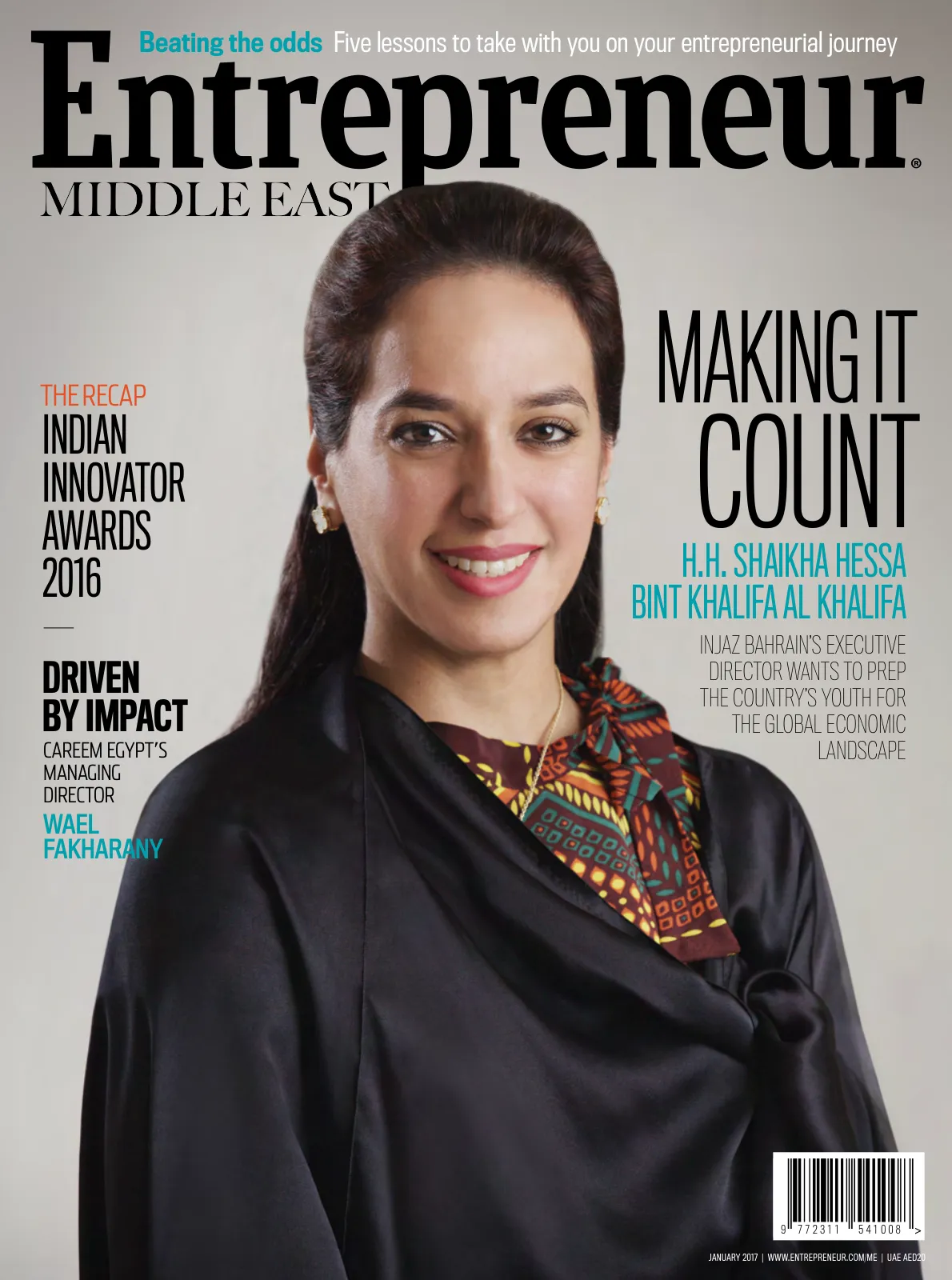
Entrepreneur Middle East, January 2017
Page 1
JANUARY 2017 | www.entrepreneur.com/me | UAE AED20
9
7 7 2 3 1 1
5 4 1 0 0 8
>
Beating the odds Five lessons to take with you on your entrepreneurial journey
H.H. Shaikha Hessa
bint Khalifa Al Khalifa
Making it
count
INJAZ Bahrain’s Executive
Director wants to prep
the country’s youth for
the global economic
landscape
Wael
Fakharany
Careem Egypt’s
Managing
Director
Driven
by impact
The recap
Indian
Innovator
Awards
2016
Page 2
Page 3
january 2017 Entrepreneur
3
26
Wissam Younane, CEO, BNC Publishing at the Indian Innovator Awards 2016
CONTENTS
january 2017
Injaz Bahrain CEO
H.H. Shaikha Hessa
bint Khalifa bin
Hamed Al-Khalifa
18
26
Indian Innovator
Awards 2016
A look at the winners of
the third annual edition of
Entrepreneur Middle East’s
Indian Innovator Awards,
Entrepreneur of the Year,
presented by du
18
INNOVATOR:
Making it count
H.H. Shaikha Hessa bint
Khalifa Al Khalifa
INJAZ Bahrain’s Executive
Director wants to prep the
country’s youth for the global
economic landscape.
22
INNOVATOR:
Driven by impact
Careem Egypt’s Managing
Director Wael Fakharany on
his transition from working
at Google to working at
the MENA region’s latest
unicorn.
64
START IT UP:
ECOSYSTEM
No time to chill in the sun
DTEC Tech Startup
Incubator’s Sirine
Fadoul explains why
it’s important for
entrepreneurs to instill a
sense of urgency in their
organizations.
52
TECH:
ONLINE ‘TREP
Design: the driver of digital
reinvention
Juan Jose De La Torre,
Digital Transformation
Leader, IBM MEA believes
that design is no longer just
an aesthetic component, but
rather an exigent driver of
human behavior.
42
TECH:
SHINY
#TamTalksTech
Gadgets and doodads
that you might’ve missed
out on, sourced by a tech
aficionado.
Page 4
Page 5
Page 6
Page 7
Page 8
Entrepreneur january 2017
8
CONTENTS
63 Careem raises US$350 million in funding to expand services
january 2017
Amr Sobhy,
co-founder and
CEO, PushBots
68
amr sobhy image credit amir makar
42
Lenovo
Phab 2 Pro
60
‘TREPONOMICS:
SKILLSET
Beating the odds
Ipsos MENA Chairman
and CEO Edouard Monin
lists five key lessons for
entrepreneurs to use in
their entrepreneurial
journeys.
46
‘treponomics:
ESQUIRE GUY
Civility matters
The Esquire Guy offers
a guide to figuring out if
you’re a bully at work, and
also explains how to get
things done without making
other people miserable.
58
‘TREPONOMICS:
MARKETING
What’s in a name?
ServiceMarket co-founder
Bana Shomali draws from
experience to offer tips
on rebranding online
businesses.
34
‘TREPONOMICS:
PRO
The future is here
Bayt.com’s Suhail Al Masri
analyzes five trends that
the recruitment industry
is likely to experience in
the year 2017.
62
MONEY:
ECON
Private equity in emerging
markets
Sean McKeon explains why
MENA investors should
look closer to home for
faster economic diversifica-
tion.
14
EDITOR’S NOTE
By Aby Sam Thomas
Page 9
BREITLING.COM
The superlative-charged chronograph. 50 mm case in Breitlight®. Exclusive Manufacture
Breitling Caliber B12 with 24-hour military-style display. Officially chronometer-certified.
Page 10
Entrepreneur january 2017
10
CONTENTS
january 2017
44
Trophy by Roderer
72 Pure Harvest founder and CEO Sky Kurtz
sky kurtz image credit devon tackels
74
START IT UP:
STARTUP FINANCE
“We got funded!”
UAE online services
marketplace mrUsta raises
AED2.75 million in a pre-
Series A funding round
from Precinct Partners,
Millennial Partners & Co.,
and other angel investors.
40
‘TREPONOMICS:
PRO
The times they are
a-changin’
Andreas Skorski, founder
and CEO, THE LIST,
highlights how the growth
of luxury e-retail is
redefining stores into just
another marketing channel.
68
START IT UP:
Q&A
Quality over quantity
Egypt-based startup
PushBots helps app
businesses improve
their reach with smarter
notifications.
72
START IT UP:
Q&A
Let it grow
Startup Pure Harvest aims
to overcome local climate
challenges and make the
region’s farming high tech
in nature.
50
TREPONOMICS:
PRO
Come together
The case for team building
efforts is stronger when
the times are tougher.
48
CULTURE:
LIFE
Stay on the bus
James Clear explains why
it’s important for a creator
to stay committed to the
cause when faced with
failure.
38
CULTURE:
LIFE
Starting early
BizWorld UAE CEO Helen
Al Uzaizi makes the case
for entrepreneurship
education- for kids.
44
CULTURE:
TRAPPINGS
‘Trep gear
The executive selection for
the entrepreneur on your
list. Okay, maybe for a little
self-reward as well.
Page 11
Can you still afford to use a printer to just print? Chances are that you can’t. Many IT departments are facing the challenge of having
to drastically cut their budgets, and yours is probably no different. Featuring exceptionally low running costs, KYOCERA all-in-one
multifunctional printers can help your company reduce output costs by up to 30%.* In addition, our printers and MFPs have got what
it takes to drive digitalization at your company, automating manual processes and turning paper into searchable and retrievable
digital data. There is a lot more to KYOCERA Managed Document Services than just hardware though. Through our customized offer
of hardware, software and professional services, KYOCERA MDS will help you add value to your role and drive innovation at your
workplace.
KYOCERA. Your Trusted Advisor.
Source: *Photizo Group
For more information please visit www.kyocera-ecosys.eu
KYOCERA Document Solutions Middle East | P. O. Box 500817, Dubai, U.A.E.
Tel: +9714 4330 412 | Fax: +9714 4231 944 | KDME-cares@deu.kyocera.com | www.facebook.com/KDMEcares
KYOCERA Document Solutions Middle East – www.kyoceradocumentsolutions.ae
KYOCERA Document Solutions Inc. – www.kyoceradocumentsolutions.com
KYOCERA. YOUR TRUSTED ADVISOR.
Page 12
Entrepreneur january 2017
12
SUBSCRIBE
Contact subscriptions@bncpublishing.net to receive
Entrepreneur Middle East every issue
EDITOR IN CHIEF Aby Sam Thomas editor@bncpublishing.net
CEO Wissam Younane wissam@bncpublishing.net
MANAGING DIRECTOR Walid Zok walid@bncpublishing.net
DIRECTOR Rabih Najm rabih@bncpublishing.net
CREATIVE LEAD Odette Kahwagi
STARTUPS SECTION EDITOR Pamella de Leon
COLUMNIST Sindhu Hariharan
COLUMNIST Tamara Clarke
COLUMNIST Shoug Al Nafisi
COLUMNIST Erika Widen
EVENTS LIAISON Mark Anthony Monzon
PO Box 502511 Dubai, United Arab Emirates
P +971 4 4200 506 | F +971 4 4200 196
For all commercial enquiries related to
Entrepreneur Middle East contact
sales@bncpublishing.net
All rights reserved © 2016.
Opinions expressed are solely those of the contributors.
Entrepreneur Middle East and all subsidiary
publications in the MENA region are officially licensed
exclusively to BNC Publishing in the MENA region by
Entrepreneur Media Inc.
No part of this magazine may be reproduced or
transmitted in any form or by any means without written
permission of the publisher.
Printed by Raidy Emirates Printing Group LLC
www.raidy.com
Images used in Entrepreneur Middle East are credited when necessary. Attributed use of
copyrighted images with permission. All images not credited otherwise Shutterstock.
Suhail Al Masri
Helen Al Uzaizi
Fida Chaaban
James Clear
Juan Jose De La Torre
Sirine Fadoul
Johan Hanekom
Adrian Hayes
Mike Hoff
Dipika Mallya
Ross McCammon
Sean McKeon
Edouard Monin
Bana Shomali
Andreas Skorski
CONTRIBUTING WRITERS
www.entrepreneur.com/me
Access fresh content daily on our website!
MIDDLE EAST
EntMagazineME
@EntMagazineME
Entrepreneur-me
EntrepreneurMiddleEast
EntMagazineME
EntMagazineME
EntMagazineME
MIDDLE EAST
In addition to our print edition, we’re bringing
you all sorts of industry news on our web
mediums. Joining us online means getting
relevant business and startup content in
real-time, so you’re hearing about the latest
developments as soon as we do. We’re looking
forward to interacting with our readers on all of
our social media and web platforms- like any
thriving business, we’re looking to give and take.
#TrepTalkME is already happening on all of our
digi platforms, and all good conversations go
both ways. See you on the web!
Page 13
Page 14
Entrepreneur january 2017
14
EDITOR’S NOTE
Aby Sam Thomas
Editor in Chief
@thisisaby
aby@bncpublishing.net
Rise to the occasion
How you respond to criticism says a lot about
your entrepreneurial skills
I
n my editor’s note last month,
I wondered aloud whether the
MENA entrepreneurial ecosys-
tem would have been better
served if Emaar Properties
Chairman Mohamed Alabbar,
who had then announced the
launch of his new US$1 billion
e-commerce venture Noon, had
invested in an existing startup in
this space instead. Some of you
responded in agreement with my
notion (Henri Asseily aka @rikkles
tweeted: “You wonder like 99.99%
of anyone in this industry”), while
there were others felt the entry
of Noon would be a positive thing
for the industry as a whole- Mo-
hamed Hamdy aka @reachhamdy
tweeted: “Having a new startup
like @noondotcom with all that $$
should bring a multiplier effect in
the regional ecosystem.”
In the midst of all these re-
sponses, I was also treated to a
reply from Alabbar himself- he
emailed me to thank me for my
comments adding that it was his
hope that Noon and other ventures
like it will “not only promote the
digital economy, but also help
motivate others to get involved.”
I’ll gladly admit here that Alab-
bar’s reply (I’m hoping to have a
longer chat with him soon) took
me by surprise. I wasn’t expecting
to hear back from him in the first
place, and so the fact that he took
the time out to draft such a polite,
elegant and appreciative response
increased my respect of him ten-
fold. Alabbar’s reply was, in my
opinion, an abject lesson for all of
us in how to deal with criticism-
while nobody likes to hear negative
feedback, one needs to learn to be
appreciative of such comments all
the same (instead of adopting a
defensive approach).
The entrepreneurs among
you need to especially take this
principle to heart: be it when a
VC rejects your funding request,
or when an editor passes on your
PR pitch, you need to be able to
react to these situations with the
right attitude. The way you reply
to these things say a lot about you,
and it’s safe to say that they play
a key role in how you get ahead in
life and business as well. As we are
at the start of 2017, let’s resolve
to take on all of the opportunities
and challenges that are going to
be thrown at us with the right
attitudes- I’m pretty certain it will
be key to making things work for
us and our businesses for the next
12 months. Happy new year!
Page 15
LOOKING TO SET UP YOUR BUSINESS?
Call: 800 7111 Visit: www.rakftz.com Follow:
/ rakftz
FLEXI FACILITIES
AED 13,500
AED 25,500
OFFICES
AED 205/M2
WAREHOUSES
AED 18/M2
INDUSTRIAL LAND
Ras Al Khaimah Free Trade Zone
provides the right elements for
a successful business, including
licences, visas, facilities, 100%
foreign ownership and zero
taxation. Prices start from:
Page 16
Entrepreneur january 2017
16
Hyperloop One is set to work with
Dubai RTA on a feasibility study for a
system that reduces travel time between
Abu Dhabi and Dubai to 12 minutes
Ecoisme is working on deploying
artificial intelligence systems around
Dubai to monitor and reduce electricity
consumption along with DEWA
Consensys is working to develop a
real estate database using Blockchain
technology
UAE-based startup Grow is working
on a prototype for a farm that reduces
the need for water and fertilizers
Comae Technologies is working
with Dubai Police to employ artificial
intelligence technology to prevent and
solve cybercrimes
Startup Medativ uses 3D printing
technology to produce replicas of
human organs and thus aid in surgical
training
A selection of the winners
IN THE LOOP
Onward and upward!
Dubai Future Accelerators invests AED120 million
in 19 graduating projects
Bring it on
Enterprise Challenge Qatar
2016 kicks off
H.H. Sheikh Mohammed bin Rashid Al Maktoum, Vice President and Prime Minister of the UAE,
and Ruler of Dubai, at Dubai Future Accelerators
A team at the Enterprise Challenge Qatar
A team at the Enterprise Challenge Qatar
image source: Dubai Future Accelerator | enterprise challenge qatar
D
ubai Future Accelerators
(DFA) has concluded the
first session of its ac-
celerator program, and
marked the milestone
with an allocation of over AED120
million (US$33.5 million) to the 19
projects that were part of the program,
collaborating with key government
entities. These projects move on to the
next phase and will work to implement
their solutions within seven key sec-
tors: health, education, energy, trans-
portation, infrastructure, technology,
and security. According to a statement
on the event, DFA expects the pilot
projects to create 135 job opportu-
nities in Dubai over the next three
months and also revealed that fourteen
of the international companies part of
the program have taken decisions to
relocate their headquarters to Dubai.
H.E. Mohammed Abdullah Al
Gergawi, Vice-Chairman of the Board
of Trustees, and MD of Dubai Future
Foundation, revealed at the event that
DFA’s second round will see five new
government and private entities join
the program- Department of Economic
Development, Dubai Smart City, the
General Directorate of Residency and
Foreigners Affairs, du, and Etisalat.
Saif Al Aleeli, CEO, Dubai Future
Foundation, pointed out that the first
round of DFA has managed to achieve
“an unprecedented success rate” of
64%, and on an average, “the rate
seldom exceeds 30%.” He also added
that the first round of the program is
said to have increased Dubai’s total
spend on research and development
efforts by 6% in three months. DFA
was launched in September, and the
program paired 28 global companies
with Dubai’s seven founding entities:
Roads and Transport Authority (RTA),
Dubai Police, Dubai Municipality,
Dubai Health Authority, Knowledge
and Human Development Authority,
Dubai Electricity and Water Authority
(DEWA), and Dubai Holding. As per a
Medium post by DFA, the accelerator’s
second round is set to begin in the first
quarter of 2017.
A
n initiative by Bedaya Centre and Qatar
Shell, the Enterprise Challenge Qatar (ECQ)
kicked off in November, bringing in over 1200
students from more than 40 schools in Qatar. Now
in its fifth year, the program has different levels
catering to high school and university students,
running until March 2017. It consists of three stages:
the Ethical Business Challenge to practice the
participants’ abilities to work with the economic,
environmental and social performance of their
company, the Business Simulation that accustoms
the students to essential business practices such as
inception, to trading, finance, sales, marketing and
production, and the Grand Finals wherein teams
present their business ideas in front a panel of
judges. Designed to encourage the entrepreneurial
drive of the youth in Qatar, the program lets
participants gain valuable business skills, with
the opportunity to learn from a team of volunteer
mentors from professional backgrounds, including
local business owners who have valuable experience
in building a business venture. It has received a
few nods of approval too- in 2014, during the UK
Mentor of the Year Awards hosted by His Royal
Highness, the Prince of Wales at the Sandringham
Palace in UK, gave recognition to the initiative. Last
year, Qatar Shell and Bedaya was recognized at
Social Development Center’s Reyada awards with
the Outstanding Entrepreneur Support Award for
their efforts in supporting the Qatar entrepreneurial
ecosystem. The Enterprise Challenge competition
was a concept by Prince’s Trust International, a UK-
based NGO established by His Royal Highness the
Prince of Wales. As the founding partner of Prince’s
Trust International in Qatar, Qatar Shell, along with
Bedaya, have brought the competition to Qatar.
Page 17
The Regional Leaders of
Construction Evolution
Over 25 flourishing years, ACICO Group sustained a sophisticated position in GCC
& the Middle East as the ideal partner for every property owner, regardless to its type,
throughout the entire project’s life cycle, from construction to management.
00965-1888811
ACICO INDUSTRIES CO. (K.S.C) PUBLIC
www.acicogroup.com
Page 18
Entrepreneur january 2017
18
INNOVATOR
INNOVATOR
Making it
count
H.H. Shaikha Hessa
bint Khalifa Al Khalifa
INJAZ Bahrain’s Executive Director wants to prep the country’s
youth for the global economic landscape
By Aby Sam Thomas
“to be honest, there has been no one targeting
younger kids. And this is where INJAZ
Bahrain comes in. We actually teach them
[entrepreneurship] at university, high school,
and intermediate levels, before they get in
to the job market. So we teach them to think
entrepreneurially, before they finish their
education.”
>>>
I
’m a Bahraini citizen, and
I firmly believe in citizen-
ship- what your country has
given to you, you have to give
back to your country.” That’s
the response I got when I
asked about what drove H.H.
Shaikha Hessa bint Khalifa Al Khalifa
to do all that she does in her role
as the Executive Director of INJAZ
Bahrain, a non-profit institution
that she founded in 2005. Since its
establishment, INJAZ Bahrain, which
is a part of the global JA Worldwide
network, has been, for more than
10 years, building on its vision “to
inspire a generation of Bahraini youth
to use their natural talents, inspira-
tions, passions, and determinations
to become the business leaders and
entrepreneurs of tomorrow.” Sure,
it’s a decidedly large undertaking to
take on- but looking at all that INJAZ
Bahrain has accomplished so far with
young people in Bahrain, it seems
fair to say that Al Khalifa and her
team are very much in line with the
realization of that vision. After all,
as Al Khalifa -who’s also a member
of Bahrain’s Supreme Council for
Women, as well as the Chairperson
of Al Salam Bank’s Board of Direc-
tors- proudly states, INJAZ Bahrain’s
programs, which has its volunteers
educate students on workforce
readiness, financial literacy and en-
trepreneurship, have, so far, reached
108,000 students in the country- and
it’s pretty certain that this number is
only set to grow in the future.
Recounting INJAZ Bahrain’s origins,
Al Khalifa says she started the orga-
nization after she started working in
Bahrain following her studies in the
UK, which was where she had got
firsthand experience of the JA World-
wide program through its branch
there, Young Enterprise. “I did the
complete program,” she remembers.
“And therefore, I’m an alumnus of
the organization.” On her return to
Bahrain, Al Khalifa found that while
the country had a strong educational
system already in place, students
weren’t being taught entrepreneur-
ship in a practical manner, which,
when considering that they were
going to be soon joining the work-
force, left them at a disadvantage.
“Bridging the gap between education
and the world of work is very impor-
tant,” Al Khalifa notes. “And the JA
Worldwide Program offers that- they
bridge the gap between the world of
work and school.” With that being
the case, Al Khalifa sought out JA
Worldwide’s regional office in Jordan
at the time, and went on to establish
a licensed branch of the organization
in Bahrain. She then approached
the country’s Ministry of Educa-
tion, which got on board with INJAZ
Bahrain, after realizing the benefits
of its offerings as an extracurricular
activity for students, and then kicked
it off on a high school level. At the
same time, Al Khalifa went about
setting up a leadership team for the
organization as well. “I approached
Page 19
january 2017 Entrepreneur
19
“I’m a Bahraini citizen,
and I firmly believe
in citizenship- what
your country has
given to you, you have
to give back to your
country.”
H.H. Shaikha Hessa bint Khalifa Al Khalifa
january 2017 Entrepreneur
19
Page 20
Entrepreneur january 2017
20
INNOVATOR
INNOVATOR
“We work with other
member nations
around the globe
to swap programs,
to learn from their
experiences, and
enhance what we can
offer our students
here in Bahrain.”
www.injazbh.org
H.H. Shaikha Hessa
bint Khalifa Al
Khalifa at an INJAZ
Bahrain event
some of the big organizations in
Bahrain, such as CitiBank, Bapco, all
large organizations in Bahrain from
the private sector, and we formed a
board of directors, comprising of 10
CEOs from the major corporations,”
she says. “And then they funded the
organization, and provided their
employees to be volunteers to teach
the program.”
Given that volunteers teach INJAZ
Bahrain’s programs, Al Khalifa is ex-
tremely cognizant of their contribu-
tions in realizing the organization’s
vision. “We tell them they are our
partners in the program,” she says.
“Without the volunteers, we cannot
open a class. So, our team -we are
a team of 10 people working in the
organization- try and outreach to as
many people in the community as
possible to join us, and support our
mission. And it’s been very good- the
board of directors has been very ef-
fective in releasing their volunteers
[from their respective companies]
during working hours, go to the
schools once a week, and teach our
program.” In terms of future plans
for INJAZ Bahrain, Al Khalifa is
keen on increasing the organiza-
tion’s reach in Bahrain. “We aim to
continue to reach as many students
as possible, to engage as many vol-
unteers as possible,
because the program
has two sides to it,”
she explains. “When
the volunteer teaches
the program, the
volunteer gains skills
as well; it’s not only
the student. So both
parties are benefit-
ing. If the volunteer
did not take the
program as a young
person, the program
itself will enhance the volunteer’s
communication, presentation, time
management skills, etc. At the same
time, the students are gaining a
lot of information, learning how to
communicate, and learning about
the global economy. So the program
has benefits to both the volunteers
and the students. So we are trying
to get as many people to volunteer
with us, as many students to join
with us... We want to train a lot of
volunteers, and we want to train a
lot of students.”
As for INJAZ Bahrain’s offerings
itself, Al Khalifa says she and her
team will continue to strive to bring
Page 21
january 2017 Entrepreneur
21
INJAZ Bahrain is a non-profit
organization that was established
in 2005 as part of JA Worldwide
with the aim of empowering young
people to own their economic
success and be prepared for today’s
business challenges. With the help
of its partners and volunteers,
INJAZ Bahrain impacts thousands
of students every year bringing
them closer to the real world and
opening their minds to their own
potential.
“At INJAZ Bahrain, infusing
entrepreneurial thinking in the
hearts and minds of young
people is our core mission. A
young person can be easily
inspired if he or she is provided
with the right environment
and motivation for success.
It is within every one of us to
strive for success; however, the
foundation for success relies on
three strong pillars of support:
motivation, encouragement and
inspiration. INJAZ Bahrain was
founded with this vision, and
since its inception in January
2005, it has reached out to more
and more students every year
with the help of volunteers from
the local business community.”
H.H. Shaikha Hessa bint Khalifa Al Khalifa
THE EXECUTIVE SUMMARY
INJAZ Bahrain www.injazbh.org
“when somebody wants
to start up their own
business, they should,
first of all, have a solid
education background
behind them. It’d be nice
to [also] have some
sort of formal work
experience as well, or
some sort of internship
training they have done”
H.H. Shaikha Hessa bint Khalifa Al Khalifa
at an INJAZ Bahrain event
the best educational programs avail-
able worldwide to Bahrain. This is
particularly important, Al Khalifa
says, because INJAZ Bahrain aims
to equip young people to succeed in
the global economy- and not just the
local one. “Bahrain has [a popula-
tion of] 1.2 million, the GCC has
less than 40 million residents,” she
notes. “You can’t think on a local
level to create a big business. For a
profitable business, you have to think
more on a global level, I think.” As a
result, INJAZ Bahrain’s offerings are
always in tune with changes in the
global economy, as they are updated
and reviewed every few years by JA
Worldwide to ensure that they are
not stagnant. “We want to keep on
offering the best programs available
globally,” Al Khalifa says. “We work
with other member nations around
the globe to swap programs, to learn
from their experiences, and enhance
what we can offer our students here
in Bahrain.” Such a mandate is in line
with the Bahrain government’s overall
policies regarding the promotion of
entrepreneurship, and it’s easy to see
that INJAZ Bahrain
is essentially
furthering the
realization of that
particular goal. “I
think the Kingdom
of Bahrain offers
a lot of support to
entrepreneurs,” Al
Khalifa says. “We
have an entrepre-
neurial society.
We have Tamkeen,
which is a part of
the government
that offers aid to
startups. We have the Bahrain Devel-
opment Bank, we have the Supreme
Council for Women, and both have
incubators to support entrepreneurs.
But, to be honest, there has been no
one targeting younger kids. And this
is where INJAZ Bahrain comes in. We
actually teach them [entrepreneur-
ship] at university, high school, and
intermediate levels, before they get in
to the job market. So we teach them
to think entrepreneurially, before
they finish their education.”
At this point, I ask Al Khalifa her
advice for young people in Bahrain
and the wider Middle East consider-
ing venturing into entrepreneurship,
the ones daring to do something
different from the norm. “I think they
shouldn’t dare, unless they have a
solid education, a solid degree behind
their back,” she replies. “I think it’s
important when somebody wants
to start up their own business, they
should, first of all, have a solid educa-
tion background behind them. It’d be
nice to [also] have some sort of for-
mal work experience as well, or some
sort of internship training they have
done, or something that had them
exposed to an actual working environ-
ment- so that they understand what
a working environment is, before they
start up their own.” Al Khalifa also
suggests that wannabe entrepreneurs
get a taste of the real deal by enrolling
in entrepreneurial courses like INJAZ,
and make it a priority to add skills
like marketing, etc. to their resume.
“I also think a knowledge of the legal
sector is very important,” she adds.
“[You need to know] what you are
allowed to do, what you are not al-
lowed to do, all the policies, all the
framework that are available in your
country.” Finally, Al Khalifa advises
entrepreneurs to lower the risk for
fledgling enterprises by researching
thoroughly- be clear about the needs
of the industry, the demands and op-
portunities available before making
inroads with respective startups, and
thereby bettering chances at success.
“I think that the goal with entre-
preneurship is to be successful,” Al
Khalifa concludes. “Entrepreneurship
is a learning curve anyway. I mean,
you have to learn it. But I think, mini-
mize your falls. If you start up with
these few tips, I think you will have a
smoother ride.”
Page 22
Entrepreneur january 2017
22
Driven by
impact
Wael Fakharany
Careem Egypt’s Managing Director on his career transition from
Google to Careem, the startup’s ambitious plans for the future,
and why he expects 2017 to be “phenomenal”
By Aby Sam Thomas
INNOVATOR
INNOVATOR
“You need to have incredible tenacity,
immense amounts of energy, the ability to
reinvent yourself every 3-4 months and push
yourself harder, and at the same time, a
meticulous level of detail. So you [have to be]
super operational, super on the ground.”
I
first met Wael Fakharany at BECO
Capital’s Boost MENA conference
in November last year, and though
we spoke for only a few minutes
then, I remember being quite
taken in by the exuberance of his
personality- it was this individu-
ality that struck me again when
I got to have a longer chat with him
in December. It’s really quite easy to
see Fakharany’s passion and drive
for his role as the Managing Director
for Careem in Egypt, and for those
of you who follow his blog posts on
Medium, I can confirm that he is
every bit as hopeful and optimistic
as his writing makes him out to be.
Fakharany joined Careem after a
nine-year stint at Google, and while
the startup’s unicorn status hadn’t
been declared at the time of our
conversation Fakharany was quite
emphatic that the four months he
had spent with his new employer had
been a “phenomenal” experience.
“When I stepped into this role, I nev-
er expected the kind of impact that I
would have, and the kind of impact I
would be able to do, you know, in [a
matter of] weeks,” he says. “But this
business keeps surprising me with
some incredible opportunities.”
Given its massive population, Egypt
is an important market for Careem in
the MENA region, and the company
has been steadily growing its brand
in the country, with its services now
available in the six cities of Cairo,
Alexandria, Damanhour, Mansoura,
Tanta and Hurghada. It hasn’t been
all smooth sailing though- Cairo, for
instance, saw drivers of the country’s
traditional “white” taxis protest
against ride hailing apps like Careem
for eating into their business. But in
September, Careem delivered a feat
of sorts when it announced the inte-
gration of 42,000 “white” taxis into
its existing fleet- it was a move that
clearly indicated Careem’s emphasis
on being a truly local institution that
is integrated with and contributes to
the development of the overall eco-
system around it. It is this mission
that is also driving Careem’s new
initiative with the country’s youth
ministry, which Fakharany reveals
will potentially see the two parties
work together on “economically
empowering 70,000 people in Egypt
in 2017.”
It’s an impressively ambitious
initiative, of course, but Fakharany
believes that it signals only the start
of the positive impact that Careem
could bring to the country’s popula-
tion. “We are not an employer- they
are not employees, they are inde-
pendent contractors,” he says. “But
having 70,000 people in the network,
who you can economically empower
and give either part-time or full-time
income, is an incredible force in 6-8
months of the operation. And I think
this is the tip of the iceberg. There
are probably nine million people in
the working age in Egypt who are
looking for opportunities. And if we
can economically empower a million
of them, it’s just an incredible feel-
ing. So, when I give you hope that
your future is going to be better, your
surroundings are going to be better.
You are going to become bankable...
You’re going to do upward mobility in
the society… There’s this incredible
virtuous circle that is created when
you give people hope. So I couldn’t
be more hopeful about 2017. I think
2017 will be a springboard for some
phenomenal activities for Careem in
Egypt, for sure.”
Page 23
january 2017 Entrepreneur
23
INNOVATOR
“two years in
a startup in a
hyper growth
mode is as good
as 12 years in a
large company.”
Wael Fakharany,
Managing Director,
Careem Egypt
Hearing Fakharany speak, it becomes
quite apparent that he shares a
lot of the same corporate ideals as
Careem co-founders Magnus Olsson,
Mudassir Sheikha and Abdullah
Elyas have professed to in the past,
and he confirms that this factor
indeed played a key role in his deci-
sion to move from Google to the
startup. “First of all, the company
has an incredible mission, which is
to facilitate the lives of people, and
build an awesome organization,” he
explains. “And these are the guys
I would like to work with, in that
they are good, ethical, hardworking,
fair, tough guys. You couldn’t expect
more from a colleague, or a partner,
or a boss… I think great leaders are
people who are just good in creating
other leaders, and [they] almost have
no control over this. So you don’t
do this by design- you do it by basi-
cally just empowering people, being
nice and civil to people, and [being]
authentic and doing the right thing…
So, Magnus, Mudassir, Abdulla, the
three co-founders, are people that
I highly respect, and you want to
be with them all the time, because
they’re just good, kind, hardworking,
tough, and fair people. You couldn’t
ask for more.”
But Fakharany also makes it clear
that working at a startup is no walk
in the park either- he admits to have
found his few months at Careem to
have been “super hard,” and claims
operating in such a tough environ-
ment is not for the fainthearted.
“You need to have incredible tenac-
ity, immense amounts of energy, the
ability to reinvent yourself every 3-4
months and push yourself harder,
and at the same time, a meticulous
level of detail,” he notes. “So you
[have to be] super operational, super
on the ground.” But for all the chal-
lenges working at a startup can pose,
the positive aspects of the experience
outweigh everything else, Fakharany
says, and given his own career transi-
tion, it’s hard to not take him at his
word. “First of all, this is something
that cannot be taught- unfortunately,
it has to be experienced,” he says.
“Second is this immense power that
you have as a startup in making
decisions and making mistakes and
correcting them, and being faced
with very tough challenges every
single day… So it grows you up. This
experience: you tinker with stuff, you
make mistakes, you move at phenom-
enal speed, but you learn every single
day. Sometimes I feel that the person
that I met a few weeks ago is very
different than the person you meet
now… With all due respect to very
large companies, you’re a small piece
of the puzzle in large companies, and
the playbook of operations, the >>>
Page 24
Entrepreneur january 2017
24
playbook of advertising, the playbook
of marketing has been written for
you. All you have to do is be a good
student, read the playbook, and
basically do a very small part of the
equation. You obviously grow when
you’re working for a large bank or a
large multinational, but the amount
of learning that you accumulate in
a startup in multiple disciplines [is
unprecedented], because everybody
is driven, challenged to grow the
company. Whether you’re marketing
or business development or social
or IT or legal or operations, you can
actually help other colleagues, and
you sometimes work like you work
in multiple organizations... So, two
years in a startup in a hyper growth
mode is as good as 12 years in a large
company.”
Fakharany’s statements make it
clear that he would like to see more
people in the MENA region work at
startups, and according to him, this
shift in thinking is already material-
izing with young graduates who are
looking to start off their professional
lives- and this will be continue to
happen in 2017. “I think we are about
to reach some really interesting scale
for local companies,” he says. ”Like,
there’s a lot of local companies that
have reached a certain scale, where
the success is very obvious, in your
face. So, if I was in university right
now, I’d think, why would I join a
large multinational company? Why
not join a Souq.com, or a Careem.
com, a local homegrown company
where I am going to be [able to re-
main] at home? My skills will be
enhanced, my ability to tackle differ-
ent parts of the ecosystem will be en-
hanced, and at the same time, I’d be
a very useful and powerful force for
my community. So, I think everyone
is watching us, all the young people
are watching our success, and 2017
will be phenomenal, for sure.” It’s a
rather optimistic statement, sure-
but Fakharany’s earnestness makes
me want to believe it too. Here’s
hoping.
INNOVATOR
1. Don’t burn
out
“Try to find a
way to renew
your energy,
because
this job is
draining. So
focus your energy on how to rebuild
it [as well], because we are all human
beings.”
2. Be detail-oriented
“You should be a subject matter
expert [in your field]. [For instance,]
if you’re a software developer, back-
end or front-end, go to the detail of
the detail of the detail... It is super,
super important.”
3. Stay on the path
“Keep on doing the right thing
always. Cutting corners and doing
wrong things will benefit you for a
few hours or few days, but it will
hurt you in the long run.”
Staying on top
Wael Fakharany on mastering
your position at a startup
www.careem.com/cairo
“the amount of learning
that you accumulate in
a startup in multiple dis-
ciplines [is unprecedent-
ed], because everybody
is driven, challenged to
grow the company.”
Page 25
Porto Arabia Towers
Doha, Qatar
������������������������������
Hill International
The Global Leader in Managing Construction Risk
www.hillintl.com
�����������������������������������������������������������������������
���������������������������������������������������������������������
��������������������������������������������������������������������������
������������������������������������������������������������������������
�������������������������������������������������������������������������
���������������������������������������������������������������������
��������������������
����������������������������������������������������������������������������
���������������������������������������������������������������������
�������������������������������������������������������������������������
�����������������������������������������������
��������������������������
�������������������������
��������������������������
If you can imagine it, we can manage it.
��������������������
Doha, Qatar
��������������
Doha, Qatar
Viva Bahriya Towers
Doha, Qatar
Page 26
INDIAN
INNOVATOR
AWARDS
2016
A PRODUCTION BY
LUXURY PARTNER
PLATINUM ALLY
Entrepreneur january 2017
26
Page 27
Wissam Younane,
CEO, BNC Publishing
Winners of the
Indian Innovator
Awards 2016
january 2017 Entrepreneur
27
>>>
A
host of established
and upcoming
Indian business
leaders in the Gulf
were honored at
the third edition of Entrepre-
neur Middle East’s Indian In-
novator Awards, Entrepreneur
of the Year, presented by du,
which took place in the UAE
on December 13, 2016 at The
St. Regis Dubai. The award
winners this year have es-
tablished themselves as clear
industry innovators who have
made significant contributions
to the Middle East business
arena, and have thus set the
benchmark for corporations
operating across the region.
A total of 19 awards were pre-
sented on the night, with all of
the winners having set them-
selves apart from their peers
in the region by showcasing a
commitment to excellence, and
thereby raising the bar of their
respective industries. Speak-
ing on behalf of Entrepreneur
Middle East, Wissam Younane,
CEO, BNC Publishing, kicked
off the event with his welcome
address, in which he felici-
tated the winners of the night,
and reiterated Entrepreneur’s
commitment to facilitating
the growth of enterprises in
the region. This was followed
by a keynote speech by H.
H. Sheikh Maktoum Hasher
Al Maktoum, President of Al
Fajer Properties, where he
commended the visionary out-
looks of the Indian business
leaders in the Gulf, as well
as their inspiring attitudes
towards entrepreneurship and
innovation.
Organized by Entrepreneur
MENA, the 2016 Indian In-
novator Awards recognized
and honored enterprise lead-
ers and individuals who have
distinguished themselves and
shown sector significance and
outstanding business conduct
across a variety of industries
that are key drivers of respec-
tive Middle East’s economies.
The Indian Innovator Awards,
Entrepreneur of the Year,
seeks to acknowledge agility
across a variety of industries
including luxury, healthcare,
construction, hospitality, edu-
cation, banking, and commu-
nications, amongst other key
drivers of the Middle East’s
economy. “For an event that’s
especially catered towards
recognizing the achievements
of the Indian business com-
munity in the Gulf, the people
in this room are a reflection of
the entrepreneurial drive, the
sheer perseverance, and the
spirit of innovation that we
need to see more of in this re-
gion,” said Younane. “The men
and women that we celebrate
here are setting the standards
for how business needs to
be done in the Middle East,
which makes all of you not just
excellent examples for others
to follow and take inspiration
from, but also great ambassa-
dors of India as well.”
Entrepreneur Middle East’s
2016 Indian Innovator Awards,
Entrepreneur of the Year, was
a BNC Publishing produc-
tion, presented by du, with
the support of Platinum Ally
AJSM Investments and Luxury
Partner Cadillac.
Page 28
indian innovator
awards 2016
Responsible Leadership L.K. Pagarani
Hospitality Innovation Adeeb Ahamed
Healthcare Innovation Dr. Azad Moopen
Retail Innovation Mushtaq Vakil
F&B Innovation Bhupender and Sakshi Nath
Real Estate Innovation Kabir Mulchandani
Education Innovation Kamal Puri
Talent Solutions Innovation Mahesh Shahdadpuri
Manufacturing Innovation Asif Sayeed Khan
Construction Innovation M. Razzaqi
Diversified Portfolio Raj Sahni
Brand Penetration Nicole Rodrigues
Homegrown Brand Of The Year Harmeek Singh
Fastest Growth Purple Honey Food Chain Group (Akshay and
Shalini Gangaramani Dosaj)
Startup Of The Year HolidayME (Geet Bhalla and Digvijay Pratap)
Ecosystem Influencer P. K. Gulati
Business Visionary Of The Year Sunil Vaswani
Contribution To Business Mohan Nambiar
Lifetime Achievement Paras Shahdadpuri
Contribution to
Business
Mohan Nambiar
Lifetime
Achievement
Paras
Shahdadpuri
Startup of
the Year
HolidayME
(Geet Bhalla and
Digvijay Pratap)
Entrepreneur january 2017
28
Page 29
H. H. Sheikh
Maktoum Hasher
Al Maktoum,
President of
Al Fajer
Properties
Construction Innovation
M. Razzaqi
Business Visionary
of the Year
Sunil Vaswani
Ecosystem Influencer
P.K Gulati
Fastest Growth
Purple Honey Food
Chain Group (Akshay
Dosaj and Shalini
Gangaramani Dosaj)
Hospitality Innovation
Adeeb Ahamed
(accepted on his
behalf)
january 2017 Entrepreneur
29
Page 30
Retail Innovation
Mushtaq Vakil
(accepted on his behalf)
indian innovator
awards 2016
Manufacturing
Innovation
Asif Sayeed
Khan
Talent Solutions
Innovation
Mahesh Shahdadpuri
Healthcare
Innovation
Dr. Azad Moopen
(accepted
on his
behalf)
Stephen Marney,
Master of Ceremonies
at Indian Innovator
Awards 2016
Entrepreneur january 2017
30
Brand
Penetration
Nicole
Rodrigues
Page 31
Homegrown Brand
of the Year
Harmeek Singh
Responsible Leadership
L.K. Pagarani
Real Estate
Innovation
Kabir Mulchandani
(accepted on his
behalf)
Education Innovation
Kamal Puri
Diversified
Portfolio
Raj Sahni
january 2017 Entrepreneur
31
Page 32
One fixed monthly payment and peace of mind that your capital expenses will not change.
3 Routine service included
3 Machine warranty protection (3 years)
3 Guaranteed trade-back value
3 CareTrack monitoring (3 years)
* Terms and conditions apply
www.famcointernational.com
WHEEL LOADERS • WHEELED EXCA
starting from
AED 12,120
per month*
Page 33
Packaged with:
3 years Service
3 years Warranty
3 years Financing
AVATORS • CRAWLER EXCAVATORS
Page 34
Entrepreneur january 2017
34
charts and screenshot © bayt.com
ETHICS | ESQUIRE GUY | SKILLSET | MARKETING | PRO
TREPONOMICS
The future
is here
Five recruitment trends we
expect to see in 2017
By Suhail Al Masri
One in two professionals
(47%) have not formally set
any development plans with
their manager in the Middle
East and North Africa. The
great majority (95%) of
those not having set any
development plan would like
to have one.
Career development plans / goals set with manager
Total
47
46
52
45
43
53
53
54
27
45
35
54
52
43
11
23
14
9
13
18
8
8
13
14
13
6
20
25
11
10
20
18
13
4
9
41
9
14
12
18
12
4
7
20
11
8
12
20
8
7
15
20
12
9
11
28
12
5
14
13
13
8
12
21
10
10
14
20
11
9
Saudi
UAE
Kuwait
Qatar
Bahrain
Oman
Lebanon
Syria
Jordan
Egypt
Morocco
Algeria
Tunisia
Arabia
Yes, for the next 5 years
Yes, for the next 2 years
Yes, for the next year
Yes, for the next 6 months
No, I have not
W
ith the prevailing
economic instability
in the Middle East
and North Africa, the
evolving labor market needs
and hiring preferences, and
the new technologies that are
constantly introduced to this
region, the business world
is definitely changing, and it
is expected that recruitment
will change as well. Without
doubt, as the year 2017 quickly
unfolds, it is highly recom-
mended that business owners,
managers, recruiters, and all
professionals remain abreast
of such trends as it will impact
what strategies and tools they
will need to utilize in order
to remain at the top of their
game. Here are five trends
that we at Bayt.com expect
the recruitment industry will
experience in the year 2017.
1. More millennials in the
workforce
Millennials will soon account
for the majority of the global
workforce and will, therefore,
be part of nearly every
company and organization
across the Middle East
and North Africa. In fact,
millennials already constitute
the majority of employees in
some companies.
Millennials are the workforce
of tomorrow; they bring
in fresh perspectives and
bold ideas, unprecedented
technology savvy-ness and
mastery, and most importantly
loads of dedication and hard
work. This group is interested
in making their workplaces
more innovative and they
are willing to learn and make
mistakes in order to grow
and develop their skills.
They are the digital media
generation and are capable
of managing social media
and other technology-heavy
roles better than any other
generation. According to
the Bayt.com Millennials in
the Middle East and North
Africa survey, millennials are
willing to sacrifice more hours
from their personal life in
order to further their career.
Organizations that wish to
attract and retain young
talent will need to recruit
this cohort of hard-working,
digital natives and ensure
that their journey throughout
hiring and onboarding
is supported by active
engagement, learning and
development opportunities, a
friendly environment, and a
distinguished employer brand
for them to associate with and
truly belong to.
2. Low-cost training
Today, employees everywhere
are eager to build solid career
trajectories and advance their
professional development.
According to the 2016 Bayticom
Career Development in the
Middle East and North
Africa survey, a lack of career
development prospects can
radically make or break
employee engagement and
retention. Many employees feel
that their company is failing
when it comes to equipping
them with the learning and
training opportunities needed
to ensure their career growth,
and this consequently leaves
them feeling stifled in their
jobs. In fact, the majority
(78%) of respondents say
that they would leave their
company for better training
opportunities.
Training and development
opportunities in the past have
not reflected what employees
actually need, according
to the Bayt.com Career
Development in the Middle
East and North Africa survey.
For instance, while considered
relatively more important,
a smaller proportion of
MENA employees received
training in management
development, leadership,
time management and foreign
languages. Designing solutions
for employee engagement
starts with listening to their
goals and needs. One in two
professionals (47%) have not
formally set any development
plans with their manager in
the Middle East and North
Africa. The great majority
(95%) of those not having set
any development plan would
like to have one. Almost one
in two current employees
state that training by external
Page 35
january 2017 Entrepreneur
35
>>>
Satisfaction with quality of orientation and training received
Many employees feel that
their company is failing when
it comes to equipping them
with the learning and training
opportunities needed to ensure
their career growth, and this
consequently leaves them
feeling stifled in their jobs.
In fact, the majority (78%) of
respondents say that they
would leave their company for
better training opportunities.
Total
Saudi
UAE
Kuwait
Qatar
Bahrain
Oman
Lebanon
Syria
Jordan
Egypt
Morocco
Algeria
Tunisia
Arabia
Very dissatisfied 0-2
3-5
6-7
8-10 Very satisfied
31
28
35
33
30
26
27
30
27
30
35
33
31
27
24
21
27
15
30
24
12
29
26
16
23
26
15
26
28
18
32
23
20
23
27
8
24
41
14
27
34
17
23
30
21
25
21
15
23
27
15
23
34
15
24
29
professional trainers (47%),
followed by seminars at
professional institutes (43%),
certified study programs
(40%) and company trainings
by internal teams (40%) are
the most preferred training
methods.
With the proliferation of
online learning and assessment
tools, businesses in 2017 no
longer have to pay exorbitant
amounts for training their
employees and expanding
their skills and knowledge
database. Companies and
professionals who are looking
for better career development
opportunities and chances
to learn and grow can now
do so cost-effectively using
learning platforms such as
Bayt.com’s online courses
and tests, many of which are
free of charge. There are also
numerous research reports and
career support articles that are
available on Bayt.com for all
professionals in the MENA to
make use of.
3. Big data
Companies that want to gain
a competitive edge and have a
more methodological approach
to talent management are more
commonly using analytics to
collect data-driven insights
and then taking action to
refine their recruitment,
compensation and retention
strategies. Companies are
now collecting all sorts of
data that come from a variety
of sources; ranging from
performance numbers and
attendance, to job satisfaction
surveys and tracking employee
life events. Today, more and
more companies are making
use of Bayt.com’s flagship
product, Talentera, and similar
breakthroughs in online
recruitment, to help them
make better sense of their data.
Such companies are aware
of the importance of using
analytics to outline trends in
the job market and improve
their recruitment and talent
retention strategies. Not only
is there a lot of employee
data that is becoming readily
available this year, but
HR teams have started to
understand what to do with
it. Indeed, collecting and
analyzing HR data requires
a deep understanding of
analytics and data science.
Not only do resources
such as Talentera provide a
comprehensive recruitment
solution, through which
employers can create branded
career channels to source,
track, assess, and hire
professionals, right through
their own websites, but
using such platforms also
enables employers to track
their applicants’ information
including skills, background as
well as previous engagements
with the recruitment team.
Such information is very
essential for taking the
right and efficient decisions
throughout the recruitment
process. Applicant tracking
is also important for
centralizing the information
and making it more accessible
for all stakeholders within
the organization, such as
hiring managers and talent
on-boarding professionals.
Applicant tracking systems
can help all constituents
share their feedback about the
applicant in real-time, greatly
expedite requisition approvals,
and generate real-time reports
and updates. Making use of
such data in 2017 will lead to
a more seamless recruitment
experience that is faster and
more reliable at the same time.
Page 36
Entrepreneur january 2017
36
Suhail Al-Masri is the VP of Employer Solutions at Bayt.com. Al-Masri has more than 20 years of experience in sales leadership,
consultative sales, account management, marketing management, and operations management. His mission at Bayt.com goes in line with
the company’s mission to empower people with the tools and knowledge to build their lifestyles of choice.
ETHICS | ESQUIRE GUY | SKILLSET | MARKETING | PRO
TREPONOMICS
infographics © bayt.com
The great majority of
professionals (82%)
would leave their current
company for better training
opportunities. The Lack of
motivation (38%), followed
by no clear objectives (31%)
are the most mentioned
internal barriers for career
development.
4. Employee engagement
Organizations are focusing
more and more on achieving
high levels of employee
engagement. The reason
for this is simple: engaged
employees drive the
innovation, growth and
revenue that companies need
in order to thrive. In fact,
engaged employees tend to be
more satisfied at their jobs and
are likely to remain in their
companies for longer periods
of time. Managers should not
only encourage transparency,
but also promote open
communication channels and
foster a feeling of corporate
citizenship across their
organizations.
According to Bayt.com Career
Development in the Middle
East and North Africa, career
development is seen as one
of the most important factors
for employee retention. The
great majority of professionals
(82%) would leave their
current company for better
training opportunities. The
lack of motivation (38%),
followed by no clear objectives
(31%) are the most mentioned
internal barriers for career
development. This is where
employee engagement comes
into effect, as employers
interested in increasing
engagement, and subsequently
satisfaction and retention, in
2017, there would be a need
to adopt open communication
practices and feedback tools.
Encourage employees to draw
their own career map; by
inputting their objectives and
painting a picture of where
they would like to take their
career in 2017 and the years
ahead.
While almost half (48%) of
those surveyed in the 2016
Bayt.com Middle East and
North Africa Salary survey,
said loyalty to their company
is linked to the salary they
receive at least to some extent,
a considerable proportion
(35%) claimed their loyalty is
not linked to the salary they
receive. Indeed, employers
are recommended to continue
navigating market averages
and salary reports for 2017
to ensure equitable salaries.
However, employers should
also explore other factors that
influence employee loyalty.
Retention may be impacted by
employee’s lack of job security.
As seen in the 2016 Bayt.com
Stress in the MENA Workplace
poll, 62.9% of professionals
are concerned they may lose
their jobs very soon. Such
insecurities are valid factors
for stress and low retention,
and employers should aim to
address them in 2017.
5. Employee health and
wellness
With the increasing
importance of healthy
lifestyles, many companies
have started offering and
investing in wellness programs
to ensure their employees
are satisfied, healthy and
productive. According to
the 2016 Bayt.com Health
and Lifestyle in the Middle
East and North Africa poll,
over 87% of professionals
in the region say they would
be more likely to exercise if
their companies offered gym
subscription. Professionals
who are happy and healthy
will exert more effort to give
back to the company, so
make sure your employees
are always well cared for.
It is not simply a wish for
employees to have company-
sponsored wellness programs.
In fact, 96% of polled
respondents believe that it is
the employer’s responsibility
to promote employees’ health
and wellness. In the upcoming
years, wellness programs will
be increasingly instrumental
in influencing employees’
happiness and performance.
Therefore, we recommend
employers to take early
advantage of this rising trend.
Page 37
Page 38
Entrepreneur january 2017
38
business unusual | LIFE | TRAVEL | DESIGN | TRAPPINGS
CULTURE
Starting early
Making the case for kids
to have an entrepreneurship education
By Helen Al Uzaizi
Helen Al Uzaizi is the CEO of BizWorld UAE and founder of the entrepreneurship education platform for the MENA region, Future Entrepreneurs.
With a 15+ year career in the corporate and startup worlds, Helen directed her passion to the entrepreneurship education field, working to instill the
entrepreneurial mindset in the next generation of leaders.
A scene from a BizWorld program
I
s there such a thing as a
natural entrepreneur?
Someone who is destined
for success, with all the
right entrepreneurial
instincts, and an eye for
spotting business opportuni-
ties years in advance, strik-
ing gold with every venture?
Ask any well-established
entrepreneur this, and
they’ll tell you what we are
describing is a unicorn.
They’ll also tell you that
entrepreneurship is part
science and part art, with
basic knowledge you need to
learn, and skills that must be
honed over time. From our
perspective, and within the
context of educating children
about entrepreneurship, we
at BizWorld UAE approach
this subject with the belief
that everyone is born an en-
trepreneur- they just need to
develop certain practical and
emotional skills to bring out
that entrepreneurial spirit.
We also believe that the
earlier this education takes
place, the more effective it
will be in not only shap-
ing future entrepreneurs
and leaders, but its overall
impact on our economy and
greater society.
Entrepreneurship educa-
tion is important for so
many reasons, and when it is
done right at an early age, its
impact can be tremendous:
1. Learning basic
business knowledge
This may sound obvious,
but it is often overlooked.
Not everyone graduates from
schools and universities
with basic business knowl-
edge. Developing a busi-
ness plan, keeping track of
finances and marketing are
all vital for any would-be en-
trepreneur, but they are not
always mandatory in school
and university curriculums.
The earlier students pick up
this basic knowledge, the
less they will have to strug-
gle with managing budgets
or creating viability studies
when they start their own
business.
2. Sparking innovation
and creativity
One hallmark of success-
ful entrepreneurs is their
ability to adapt, innovate
and come up with creative
solutions to age-old prob-
lems. These aren’t nascent
traits in people, so true
entrepreneurship educa-
tion builds critical-thinking
skills and the ability to think
creativity, the foundations
of innovation. Curiosity is
also an important trait that
entrepreneurship education
develops, because without
a sense of curiosity, there
won’t be a drive to experi-
ment and learn new things.
These are all aspects that
need to be developed at an
early age and continuously
nurtured to make a meaning-
ful impact.
3. Getting emotionally
prepared
Let’s say that in theory you
know the technical aspects
of starting a business, but
are you ready for the emo-
tional and psychological toll
that it takes to manage it?
What if things aren’t going
your way, are you ready to
deal with failure? The psy-
chology of an entrepreneur-
ial lifestyle is another vital
part that may be overlooked
in the current ecosystem.
True entrepreneurship
education works on building
up resilience and in parallel,
developing a sense of opti-
mism. These traits will help
future entrepreneurs and
leaders deal with adversity,
and if they ever get knocked
down, get back up and try
again.
Page 39
january 2017 Entrepreneur
39
Bizworld UAE offers entrepreneurship
workshops for kids
Enabling enterprise
Qatar Chamber’s 2nd SMEs conference
to kick off in Doha
Teach ‘em young
In the spirit of encourag-
ing the next generation of
entrepreneurs, BizWorld UAE
is conducting entrepreneurship
workshops for children aged 8
to 12 in the UAE. The program
is an extension of the original
BizWorld program launched 19
years ago in Silicon Valley to
teach children business skills,
which has impacted more than
600,000 children globally, with
its website stating that classes
increased their score by 63%
after attending the program.
The eight-week workshop
trains young students the ba-
sics of launching and managing
a business, including creating a
business plan, to marketing and
sales. Besides being designed
to instill entrepreneurship and
leadership skills, the program
also aims to cultivate students’
capability in teamwork, leader-
ship and creative and critical
thinking, ensuring not just
critical business skills, but es-
sential life skills that would be
beneficial in any career path.
From 10 am to 12 pm every Sat-
urday starting from January 21,
2017, the workshops would be
conducted at Impact Hub Dubai,
the workshop’s venue sponsor.
Register by emailing
info@bizworlduae.org or visiting
www.bizworlduae.org.
www.bizworlduae.org
4. Tapping into the
economy
Governments in the Mid-
dle East are looking toward
entrepreneurs to create
future jobs for their growing
populations. Entrepreneurs
are also being tapped as gen-
erators of sustainable eco-
nomic growth. Building the
capabilities of future entre-
preneurs is the foundation of
these plans since investors
consider the abilities of an
entrepreneur as closely as
they consider their business
model. More capable and
empowered entrepreneurs
create a more productive and
efficient ecosystem.
5. Building a stronger
education system
Education reform and devel-
opment tops the agenda for
countries across the region
as a means to address the
root cause of social, econom-
ic and political challenges. In
addition to the public sector,
in the highly competitive
private sector, critical think-
ing and practical applica-
tions are becoming more and
more important for parents
when it comes to choosing
a school. Entrepreneurship
education not only creates
richer curriculums, but it
provides real world and
practical applications that
will make students more
competitive when they
graduate.
6. Giving back to the
community
Being successful in business
alone does not necessarily
mean you are a well-rounded
individual. Being involved
in the community, support-
ing those around you, and a
deeper sense of responsibil-
ity, are all examples of how
entrepreneurs can create a
true and meaningful impact.
Entrepreneurship education
emphasizes the importance
of citizenship and lifting
up your community as an
integral part of being an
entrepreneur.
Entrepreneurship education
also imparts this important
idea to students: life is not
about just getting a job,
their future has options, and
entrepreneurship is one of
them. Equally important,
this kind of education also
shows students that they
are never too young to be an
entrepreneur, and that the
qualities of entrepreneurship
and leadership are already
within them.
Q
atar Chamber, in partner-
ship with The Union of
Chambers and Commodity
Exchanges of Turkey, and Inter-
national Chamber of Commerce
Qatar are organizing the 2nd
SMEs Conference at Ritz Carl-
ton in Doha on January 17-18,
2017. The second edition of the
conference –an event aiming to
promote SME growth, entrepre-
neurship and diversification of
Qatar’s economy- will be held
under the patronage of H.E.
Sheikh Abdullah Bin Nasser Bin
Khalifa Al-Thani, Prime Minister
and Minister of Interior, Qatar,
and aims at “empowering small
and medium enterprises.”
While the first edition of the
conference, held in 2015,
focused on Germany’s business
ecosystem, the 2nd SMEs
Conference will take a look at
Turkey’s best business practices
and the partnership opportuni-
ties for local SMEs and entre-
preneurs in that market. The
agenda of the two-day event
includes keynote addresses by
Qatar and Turkish
officials, sessions
on Turkey’s SME
sector, doing
business in Turkey,
access to business
resources in Qatar,
SME financing, e-
commerce growth,
and technology
innovation among
other topics, B2B
meetings, and
others. The confer-
ence is sponsored by Qatar Na-
tional Bank, Qatar Development
Bank, Doha Bank and Nasser
Bin Khaled group.
Page 40
Entrepreneur january 2017
40
TREPONOMICS
ETHICS | ESQUIRE GUY | SKILLSET | MARKETING | PRO
The times they are a-changin’
How e-commerce is turning stores into just another marketing channel
By Andreas Skorski
R
emember when a
brand’s website
was little more
than a 2.0 version
of a brochure?
In 2003, Prada’s website
featured two photos taken
from its ad campaign– noth-
ing else. Versace’s homepage
boasted more sophisticated
web design and a Flash ani-
mation, but took an annoy-
ing 97 seconds to load. With
a few exceptions –like LVMH
group’s online shop eluxury.
com– high-end brands back
then saw the internet as just
another promotion tool. The
business of selling– that was
what their exclusive, marble-
clad stores were for. “Web
selling seems more appro-
priate for basic apparel, not
high fashion,” said a Prada
spokesperson to The Wall
Street Journal in 2003. And
this way of thinking has been
hard to knock down.
But the tables are turning.
E-commerce has become the
fastest growing sales channel
in the luxury goods sector.
With the point of purchase
increasingly shifting away
from the high street and
into our living rooms, what
will the purpose of brick
and mortar stores be if not
selling things? In a David-
and-Goliath-like reversal
of roles, physical stores are
becoming a marketing chan-
nel– just another step in the
customers’ journeys towards
a purchase, not their natural
endpoint. Forward-looking
retailers, those who refuse
to see their physical stores
become skeletons of a long-
gone era, have realized this.
And this is what they’re do-
ing with their floor-space.
Customers as guests,
not buyers
Spoiled by the freedom
and convenience of buying
online, today’s time-poor
discerning consumers will
only visit a physical store
that promises an experience
they can truly enjoy- a place
where they are approached
more as a guest than as a
potential buyer.
That’s what digitally born
French fashion brand Sézane
understood when it opened
L’Appartement in Paris. Its
first physical showroom
slash hangout space mimics
a well decorated home –
albeit one with a cosy movie
theater in its basement. “I
want people to feel welcome
here, whether they buy or
not,” said Morgane Sézalory
to The New York Times. Sell-
ing is so not the focus that
it’s not even possible to walk
out with a shopping bag.
Orders must be placed on
the website.
This experiential con-
cept store model has taken
off thanks to online-first
brands such as Bonobo and
Warby Parker –where trendy
eyeglasses share shelf space
with good reads– and to
high street brands like URBN
group’s Anthropologie and
Urban Outfitters. Anthropol-
ogie’s new superstore format
takes the retailer’s already
immersive customer experi-
ence one step further, mixing
up their boho-chic fashion
and lifestyle products with
perfectly-staged living
rooms, home styling con-
sultations and atmospheric
dining options that invite
visitors to hang around, so-
cialize and get inspired.
The cultured side of
luxury
Scared of sacrificing their
exclusivity, higher-end lux-
ury retailers have been wea-
rier of turning their shops
into hangout places. But
Tesla’s showrooms, which
display the brand’s cutting-
edge technology and sustain-
ability ethos in a gallery-like
setting, are a lesson on how
luxury brands can become
more relatable while remain-
ing aspirational. Through
a combination of upscale
location, sleek ambiance,
museum-like installations,
interactive technology and
well-trained staff, Tesla’s
message is: we are not here
to sell to you; we are here to
share our vision with you.
Luxury fashion and jewelry
brands are also venturing
into the museum format to
hit that sweet spot between
nurturing their mass appeal
while guarding their exclu-
sivity. Leveraging their herit-
age, and their ties with the
Page 41
january 2017 Entrepreneur
41
Online-only Everlane -who
promises premium quality
without the premium price
tag- claims that its bestselling
cashmere sweater, which costs
$42 to make, would sell for
$210 in a traditional store. By
cutting out middlemen and the
overhead costs of a physical
venue, Everlane can sell that
sweater for $100.
Andreas Skorski is the founder and CEO of THE LIST, the Middle East’s leading marketplace for luxury goods. Currently based in Dubai, UAE, Andreas
started his first tech company in Germany at the age of 17, and has since successfully founded and invested in several lifestyle and tech startups.
www.sezane.com | www.everlane.com
equally aesthetic and allur-
ing world of art and design,
some luxury houses –Chanel,
Hermès and Alexander Mc-
Queen, among others– have
held captivating exhibitions
at major galleries, while
others, like Audemars Piguet
and Gucci, are doing the
same by investing in their
own museums.
Next-level treatment
While exhibitions and mu-
seums are usually restricted
to cosmopolitan cities or
symbolic locations, con-
cierge-style services tar-
geted towards high net worth
individuals have become
a widespread experience-
enhancing strategy among
luxury maisons and premium
department stores striving to
remain relevant.
“Customers have told us
they love going into hotels,
getting rid of everything as
they walk in and having it
all taken care of,” said Shadi
Halliwell, group market-
ing and creative director at
Harvey Nichols. The depart-
ment store is trying to rep-
licate that experience in its
revamped venues with the
addition of personal shop-
pers, valet parking, plush
private shopping lounges and
a concierge taking visitors’
coats and bags at the door.
Louis Vuitton’s ‘VICs’
(Very Important Clients) in
Beverly Hills, Paris, Singa-
pore and Shanghai can even
book lavishly-furnished
penthouse-style suites for
personal shopping parties,
where they can get styling
advice or try on shoes while
getting pampered. In an era
where the perks of going
shopping must beat the
perks of clicking away from
the comfort of your hotel’s
poolside lounge, Bain &
Company has identified en-
hanced personalized services
as a vital strategy to weather
the blow of the sector’s ‘new
normal’ of sluggish growth.
Fewer, higher-impact
locations
It’s not only customers who
are getting bored of tradi-
tional rack-and-manikin-
filled shops. For businesses,
the expensive inefficiencies
of building and running
brick-and-mortar venues are
getting harder to justify.
Sézane claims that it can
sell its shoes at one-fourth of
the price they would have to
charge if they had traditional
offline shops. Online-only
Everlane -who promises
premium quality without the
premium price tag- claims
that its bestselling cashmere
sweater, which costs US$42
to make, would sell for $210
in a traditional store. By cut-
ting out middlemen and the
overhead costs of a physical
venue, Everlane can sell that
sweater for $100.
The streamlined supply
chains of online-pure retail-
ers sound like a win-win
solution. Yet people will
always want to touch things,
try them on, travel to a far
away country and visit a
quirky boutique they saw on
someone’s Instagram feed.
The question, then, is how
lean should distribution
get? And the answer is: as
lean as possible. This means
replacing traditional stores
with no-stock showrooms,
to at least get rid of the cost
and complexity of in-store
inventory management. It
means cutting down loca-
tions and investing instead
in a few, strategically located
flagship venues with a real
‘wow’ factor. And it means
only opening stores that are
worth the pricey hassle. On-
line stores, with their 24/7
opening hours and measur-
able performance, can take
care of the rest.
Last year, Gucci shut
down five of its stores in
China. But it also opened,
in Shanghai, its first ever
branded upscale restaurant,
1921 Gucci. Like its Gucci
museum and café in Flor-
ence, it is the type of place
that luxury buyers from
around the world would
want to visit, check-in at and
upload a Snapchat story of.
(Yes, adult luxury buyers use
Snapchat too.) With tourists
accounting for an increas-
ingly large chunk of luxury
sales –up to 60% in France
and 50% in Italy, according
to a Havas LuxHub report–
it seems fitting to invest in
iconic stores that can be-
come renowned destinations
in themselves.
The technology race
Brands trying to prove their
tech savvy-ness through
clever social media and
e-commerce strategies need
to beware of yet another ele-
ment in the innovation race:
technology-enabled in-store
experiences.
From smart mirrors to
virtual reality and aug-
mented reality features, new
technologies are already
being tried and tested by
forward-thinking retailers.
Dior’s very own VR headset
transports store visitors
“behind-the-scenes” of the
Paris Fashion Week runway,
while Audi uses the same
technology to take custom-
ers on virtual test-drives. In
Ralph Lauren’s interactive
fitting rooms, a customer
who tries on two garments
and indecisively ends up
buying only one of them,
will receive a text message
with a link in case he or she
wants to order it online later
on. Remember the saying:
“Nothing haunts you like
the things you didn’t buy?”
Well, those things can track
you down now.
As technology zips forward
at a dizzying pace, and the
behaviors of discerning con-
sumers change at a similar
speed, the possible scenarios
of what ‘the stores of the fu-
ture’ will look like are limit-
less. But one thing is certain:
they will not have cashiers.
Although e-commerce still
accounts for less than one-
tenth of global luxury sales,
by forcing old-school retail
to reinvent itself, it is over-
coming Goliath.
Page 42
Entrepreneur january 2017
42
Image courtesy lenovo, samsung, epson
Sennheiser
GSP 350
TECH SHINY | WEBSITE TO WATCH | GEEK | MOBILE TECH | ONLINE ‘TREP | THE FIX
This month’s tech lineup is catered towards the executive professional always on the go-
we’ve got a smartphone, a smartwatch, and, well, a smart scanner- if we do say so ourselves.
Time for Tango
Lenovo changes the game with The Phab 2 pro
Sony MDR-
1000X noice-
canceling
headphones
Phab 2 Pro Google Tango
Phantogeist
Phab 2 Pro
camera close-up
Phab 2 Pro
powered by Tango
technology
Phab 2 Pro Fingerprint
Move over virtual real-
ity- Lenovo has introduced
augmented reality to smart-
phones. The Phab 2 Pro ,
powered by Tango technology
that senses and maps its sur-
roundings, supports motion
tracking, and thus, depth
perception is here. For the
first time ever, a smartphone
can visualize and understand
its surroundings. How is this
possible? The device has sen-
sors that capture more than
250,000 measurements per
second to map indoor spaces.
Phab 2 Pro is powered by
the Qualcomm Snapdragon
652 processor, which is op-
timally balanced for a Tango
workload and enables 3D AR
graphic overlays to render
physical surroundings more
accurately. The smartphone
is also equipped with a 6.4-
inch HD display, Dolby Audio
Capture, 64 GB onboard
storage and a fast-focusing
13 MP camera.
But wait- there’s
more. Phab 2’s AR
mode allows you to
superimpose effects
such as virtual back-
grounds or cartoons
into your pictures.
Did you get all of
that? In addition to the basics
like taking calls and sending
messages, Phab 2 Pro gives
you two ways to tango.
Page 43
january 2017 Entrepreneur
43
#TAMTALKSTECH Tamara Clarke, a former software development professional, is the tech and lifestyle enthusiast behind The Global
Gazette, one of the most active blogs in the Middle East. The Global Gazette has been welcomed and lauded by some of the most
influential tech brands in the region. Clarke’s goal is to inform about technology and how it supports our lifestyles. See her work both in
print regional publications and online on her blog where she discusses everything from how a new gadget improves day-to-day life to
how to coordinate your smartphone accessories. Visit www.theglobalgazette.com and talk to her on Twitter @TamaraClarke.
TECH
SHINY | WEBSITE TO WATCH | GEEK | MOBILE TECH | ONLINE ‘TREP | THE FIX
On the go
Epson launched portable scanners
Geared up
Samsung improves Gear smartwatch
Samsung
Gear S3
Classic
Samsung
Gear S3
Frontier
Epson
DS-360W
Samsung’s revised Gear S3
smartwatch extends the
features of its predecessors
with a twist of something
new. Available in two
styles, Frontier and Classic
versions, Gear S3 has
mass appeal. It combines
IP68 water resistance,
wireless fast-charging,
SOS and location-tracking
capabilities, and a dedicated
speaker. The smartwatch is
compatible with a range of
Samsung smartphones, and
applications from the Galaxy
store can be downloaded
directly onto the Gear S3.
The Classic edition allows
you to use any 22mm
watchstrap, so that you can
match it to your favorite
outfits. Lasting four days
on a single charge, the Gear
S3 also features a 16 million
color Super AMOLED screen
with Corning Gorilla Glass
SR+, an Always On Display
and a customizable user
interface. The Gear S3’s
signature rotating bezel
allows a range of functions,
including exercise programs,
with its alti/barometer
and speedometer tracking
everything from altitude and
atmospheric pressure to
sudden changes in weather,
distance traveled and speed.
Newly added to the Gear
S3 is a built-in speaker
that allows you to activate
voice messaging and listen
to music. Whether using it
to be connected or stay fit,
this accessory is the perfect
companion to get you in
gear.
Scanning just got easier
for busy professionals on
the go. Epson has launched
two new portable business
scanners and they boast
the fastest speeds on the
market. The WorkForce DS-
310 and DS-360W make it
easy to manage documents
quickly and effectively while
on the move. With one of the
lightest and smallest designs
in their class, they are ideal
for carrying in a bag or plac-
ing in a drawer, allowing
mobile workers to digitize
paperwork with ease. The
additional embedded battery
and wireless connectivity on
the DS-360W eliminate the
need for cables, making the
device truly portable. Both
models are capable of scan-
ning a wide range of media,
including envelopes, and
can scan cards and paper
between 52-230gsm. They
are ideal wherever there is a
need to scan and capture pa-
per documents, such as busi-
ness cards or signed forms.
The devices can be paired
with Epson’s Document
Capture Pro software, which
has a variety of “scan-to”
options like scan-to-cloud,
scan-to-email and scan-to-
SharePoint, alongside other
document imaging features
such as barcode recognition
and zonal Optical Character
Recognition support. The
WorkForce DS-310 and
DS-360W are perfect accom-
paniments for any mobile
professional.
Page 44
Entrepreneur january 2017
44
business unusual | LIFE | TRAVEL | DESIGN | TRAPPINGS
CULTURE
ALL THAT YOU NEED
business unusual | LIFE | TRAVEL | DESIGN | TRAPPINGS
CULTURE
‘Trep trimmings
The executive
selection
TROPHY BY RODERER
F
rom better goods to boardroom
wardrobe bests, each issue we
choose a few items that make the
approved executive selection list.
In this issue, we present our picks from
The Kooples SS17 range, leather goods
for a staple upgrade, and a venue that
helps to take your grooming regime to
the next level.
Entrepreneur january 2017
44
Trophy by Roderer
Trophy
by Roderer
If you’re looking to get a fresh
start this year, perhaps it’s
time to replace your bulky,
worn-out wallet with a fresh
leather piece from the Saffiano
Leather Trophy collection.
Created by Oliver Birault,
an entrepreneur much like
yourself, he was inspired to
found this homegrown brand
by his business travels and the
city’s entrepreneurial drive.
The collection features three
wallets, designed super slim for
comfortable in-pocket fit giving
you quick access and extensive
storage for your most-used
cards. Minimalists out there
will appreciate the streamlined
(and useful) designs.
www.roderer.info
Page 45
january 2017 Entrepreneur
45
Editor’s pick
1847’s VIP Room for the discerning gent
Images courtesy roderer, the kooples, 1847
Bremont ALT1-C/PB
business unusual | LIFE | TRAVEL | DESIGN | TRAPPINGS CULTURE
SUIT UP
THE KOOPLES SS17
On The Clock
The Kooples SS17
OFF The Clock
The Kooples SS17
OFF The Clock
The Kooples SS17
1847 VIP Room
Living the executive life takes
its toll… and when it’s finally
time to take a break, the hassle
of finding the right venue can
be a deterrent. We’ve taken
care of the details for you, as
we’ve already done the road
test! We suggest you consider
booking a visit to the recently
launched VIP Room at the
1847 men’s salon in Dubai.
1847 has dubbed its VIP Room
a “grooming oasis,” and the
discerning gentleman who
books it can treat himself to
everything from haircuts to
massages to pedicures- all
of which will happen in the
confines of a neatly designed
space that will be exclusive to
him. All one needs to do is to
choose from the wide variety
of services and treatments that
1847 offers, and then sit back
and allow the expert in-house
staff to offer you a personalized
pampering experience. Relax,
unwind and chill out, and up
your grooming game in the
process! www.1847uae.com
Good leaders know when it’s
time to change things up…
and the three brothers behind
this French brand certainly
demonstrate that quality with
The Kooples latest collection.
Known for its ad campaigns
of real-life couples (and even
creative duos), in the Summer/
Spring 2017 range, the creative
direction moves towards travel-
particularly Asia, ranging from
India to Japan. With designer
and actor Waris Ahluwalia as
its muse, and a collaborator
for the collection, The Kooples
incorporates subtle prints and
textures, and a respectable
color palette of dark blues and
blacks. When you’re heading to
the boardroom, we recommend
the grey suit jacket topped off
by a navy-blue tie (slinked
back with a subtle tie pin)
paired with a statement pocket
square. As for your off-the-
clock ensemble, you can’t go
wrong with a relaxed fit jacket
embellished with a fine silk
scarf. www.thekooples.com
Page 46
Entrepreneur january 2017
46
TREPONOMICS
ETHICS | ESQUIRE GUY | SKILLSET | MARKETING | PRO
Civility matters
The Esquire Guy’s guide to figuring out
if you’re a bully at work
By Ross McCammon
“Bullying can include
angry, aggressive or
hostile behavior from a
colleague or a supervisor.
But it can also be more
subtle, such as secretly
sabotaging someone’s work,
or setting them up for
failure by purposely making
unreasonable demands.”
L
ast year, I was a guest on
an NPR call-in talk show
to discuss workplace
etiquette. Most calls were
about shaking hands,
conducting meetings, asking for a
raise, recovering from calling your
boss by your wife’s name. (Maybe
that’s just me.) It was light and
funny, until one caller asked for
advice about being shunned by her
coworkers. They would gather near
her desk, talking about work she
was involved in without asking her
to weigh in. They never invited her
to lunch or after-work drinks. When
she brought up her feelings, her
colleagues dismissed and mocked
her. She felt unimportant and
ostracized. And she sounded deeply
distressed.
I felt ill equipped to answer the
question. I stammered out a reply.
I made a joke. (She didn’t laugh.)
The show’s host suggested that she
record these instances and, if they
continued, alert a supervisor. The
host labeled the behavior as “bul-
lying.” Which at first struck me as
infantilizing.
I hadn’t felt bullied since middle
school.
And I certainly had never felt
bullied at work. And I certainly
had never bullied anyone at work.
(Note: Never believe anyone who
uses italics to deny something.)
Or had I? The major problem with
the word bullying is that it seems
more tied to the playground and,
these days, social media (which is a
metaphorical playground). Walk-
ing up to a coworker and flicking an
earlobe? I think we’d all say that’s
bullying. (It is also assault- amusing
assault, but still.) But what about
rolling your eyes every time a col-
league speaks in a meeting? Gossip-
ing? Raising your voice? The things
we’ve all been guilty of doing?
The question for most of us isn’t:
are we being bullied? It is: are we
the bullies? Are we engaging in
behavior, even occasionally, that…
well, what? That hurts a colleague’s
feelings? That threatens them?
That gives them an ulcer?
The effects can be serious. Stud-
ies have linked rude behavior to
decreased performance. In one joint
study by the University of Southern
California and the University of
Florida, after a researcher belit-
tled participants, they scored 33%
worse on puzzles and came up
with 39% fewer brainstorm ideas.
Even people who simply witnessed
uncivil behavior performed 22%
worse on puzzles and had 28%
fewer ideas.
Despite that evidence, there’s
no direct line of legal liability for
workplace bullying, which means
very few employers cover bullying
behaviors in their internal em-
ployee policies, says David Yamada,
professor and director of the New
Workplace Institute at Suffolk Uni-
versity Law School. “When the U.S.
Supreme Court told employers, ‘You
could be held liable for sexual har-
assment,’ they all jumped onboard
to have educational programs,
training and workplace policies and
procedures,” he says. “With work-
place bullying, we’re where we were
maybe 30 years ago with sexual
harassment.”
So what constitutes bullying?
“Bullying can include angry, aggres-
sive or hostile behavior from a col-
league or a supervisor,” says David
Ballard, assistant executive director
for organizational excellence at
the American Psychological As-
sociation. “But it can also be more
subtle, such as secretly sabotaging
Page 47
january 2017 Entrepreneur
47
KEY TECHNICAL MATTERS
Here are five toxic personality types you should stay
away from at work:
1. Control Freaks
They hate certainty and are obsessed with control.
They love to find others with low self-esteem to boss
around. Steer clear by not recognizing their authority.
Let them know they can’t control you.
2. Show Offs
They’re always interrupting at meetings and will step
on anyone in their way. They are egomaniacs and
status seekers. Steer clear by saying no to things that
aren’t in your job description.
3. Complainers
If you let them complain to you everyday, you’ll be
lumped in with them as being negative. Steer clear by
keeping the conversation light and cordial.
4. Gossips
The constant chatter about others’ misfortunes is
poison in the workplace. Steer clear by not giving them
an audience to vent to.
5. Victims
They see others’ successes as result of opportunities
that wasn’t available to them. Steer clear by not
chiming in when they rant.
The effects can be serious.
Studies have linked rude behav-
ior to decreased performance.
In one joint study by the Uni-
versity of Southern California
and the University of Florida,
after a researcher belittled
participants, they scored 33%
worse on puzzles and came up
with 39% fewer brainstorm
ideas. Even people who simply
witnessed uncivil behavior per-
formed 22% worse on puzzles
and had 28% fewer ideas.
someone’s work, or setting them
up for failure by purposely making
unreasonable demands.” In short:
repeated, deliberate harm.
A company’s success depends
upon people trying to beat each
other as much as trying to cooper-
ate with each other. Competition in
the workplace is a given. And so are
competitive behaviors. But we can
do our work without making other
people miserable, if we understand
how our behaviors are being per-
ceived.
Do you think that anyone you work
with might go home and weep be-
cause of your behavior?
Yes No
Do you think that anyone you work
with might see a doctor about a
condition caused by your behavior?
Yes No
Did you skip over this column be-
cause you’re obviously not a bully?
Yes No
If you answered yes to any of those
questions, you may have a tendency
to occasionally engage in bullying
behaviors. (I sense you are rolling
your eyes at how unscientific that
quiz was. Stop bullying me.)
It’s OK to regress a little. It’s OK
to think about, say, middle school -
about how you felt when you were
bullied and how other children
seemed to feel when they were. In
bullying, as in so many other work-
place behavior issues, self-aware-
ness is the first step: getting out of
your own head enough that you can
see what you look like to others.
When we watch ourselves, we can
catch those behaviors, even the
seemingly harmless ones, that make
us jerks.
The sighs? Never sigh at work-
you’ll seem either tired, bored or in
respiratory distress.
The eye-rolling? When you feel
one coming on, tilt your head down;
the eye roll becomes a brief yet
sweeping examination of your sur-
roundings.
The thing where you keep typing
while someone is trying to talk to
you in your office? I happen to be
doing that at this very moment, and
it’s going to stop right now!
See this article in its entirety at Entrepreneur.com
Page 48
Entrepreneur january 2017
48
The proven path to doing unique work
By James Clear
Stay on the bus
James Clear writes at JamesClear.com, where he uses behavior science to share ideas for mastering your habits, improving your
health, and increasing your creativity. To get useful ideas on improving your mental and physical performance, join his free newsletter
JamesClear.com/newsletter. To have James speak at your entrepreneurial event contact him jamesClear.com/contact
CULTURE
business unusual | LIFE | TRAVEL | DESIGN | TRAPPINGS
“So once again, you
get off the bus, grab
the cab, race back and
find a new platform.
This goes on all your
creative life, always
showing new work,
always being compared
to others.”
I
n June of 2004, Arno
Rafael Minkkinen stepped
up to the microphone at
the New England School of
Photography to deliver the
commencement speech.
As he looked out at the
graduating students, Mink-
kinen shared a simple theory
that, in his estimation, made
all the difference between
success and failure. He called
it The Helsinki Bus Station
Theory.
The Helsinki Bus Station
Theory
Minkkinen was born in Hel-
sinki, Finland. In the center
of the city there was a large
bus station and he began his
speech by describing it to the
students.
“Some two dozen platforms
are laid out in a square at the
heart of the city,” Minkkinen
said. “At the head of each
platform is a sign posting the
numbers of the buses that
leave from that particular
platform. The bus numbers
might read as follows: 21,
71, 58, 33, and 19. Each bus
takes the same route out of
the city for at least a kilo-
meter, stopping at bus stop
intervals along the way.”
He continued, “Now let’s
say, again metaphorically
speaking, that each bus stop
represents one year in the
life of a photographer. Mean-
ing the third bus stop would
represent three years of
photographic activity. Ok, so
you have been working for
three years making platinum
studies of nudes. Call it bus
#21.”
“You take those three years
of work to the Museum of
Fine Arts in Boston and
the curator asks if you are
familiar with the nudes of
Irving Penn. His bus, 71, was
on the same line. Or you take
them to a gallery in Paris and
are reminded to check out
Bill Brandt, bus 58, and so
on. Shocked, you realize that
what you have been doing
for three years others have
already done.”
“So you hop off the bus,
grab a cab -because life is
short- and head straight
back to the bus station look-
ing for another platform.”
“This time,” he said, “you
are going to make 8×10 view
camera color snapshots of
people lying on the beach
from a cherry picker crane.
You spend three years at it
and three grand and pro-
duce a series of works that
elicit the same comment.
Haven’t you seen the work of
Richard Misrach? Or, if they
are steamy black and white
8x10s of palm trees sway-
ing off a beachfront, haven’t
you seen the work of Sally
Mann?”
“So once again, you get off
the bus, grab the cab, race
back and find a new plat-
form. This goes on all your
creative life, always show-
ing new work, always being
compared to others.”
Minkkinen paused. He
looked out at the students
and asked, “What to do?”
“It’s simple,” he said. “Stay
on the bus. Stay on the [ex-
pletive] bus. Because if you
do, in time, you will begin to
see a difference.”
“The buses that move out
of Helsinki stay on the same
line, but only for a while-
maybe a kilometer or two.
Then they begin to separate,
each number heading off to
its own unique destination.
Bus 33 suddenly goes north.
Bus 19 southwest. For a time
maybe 21 and 71 dovetail one
another, but soon they split
off as well. Irving Penn is
headed elsewhere.”
“It’s the separation that
makes all the difference,”
Minkkinen said. “And once
you start to see that differ-
ence in your work from the
work you so admire -that’s
why you chose that platform
after all- it’s time to look for
your breakthrough. Suddenly
your work starts to get no-
ticed. Now you are working
more on your own, mak-
ing more of the difference
between your work and what
influenced it. Your vision
takes off. And as the years
mount up and your work
begins to pile up, it won’t be
long before the critics be-
come very intrigued, not just
by what separates your work
from a Sally Mann or a Ralph
Gibson, but by what you did
when you first got started!”
“You regain the whole bus
route in fact. The vintage
prints made twenty years ago
are suddenly re-evaluated
and, for what it is worth,
start selling at a premium.
At the end of the line -where
the bus comes to rest and
the driver can get out for a
smoke or, better yet, a cup of
coffee- that’s when the work
Page 49
january 2017 Entrepreneur
49
outliers book cover © penguin books
CULTURE
business unusual | LIFE | TRAVEL | DESIGN | TRAPPINGS
Malcolm Gladwell’s
book Outliers popularized
The 10,000 Hour Rule,
which states that it takes
10,000 hours of deliberate
practice to become an
expert in a particular field.
I think what we often miss
is that deliberate practice
is revision. If you’re not
paying close enough
attention to revise,
then you’re not being
deliberate.
JamesClear.com
is done. It could be the end
of your career as an artist or
the end of your life for that
matter, but your total output
is now all there before you,
the early (so-called) imita-
tions, the breakthroughs, the
peaks and valleys, the closing
masterpieces, all with the
stamp of your unique vi-
sion.”
“Why? Because you stayed
on the bus.”
Does consistency lead
to success?
I write frequently about how
mastery requires consist-
ency. That includes ideas like
putting in your reps, improv-
ing your average speed, and
falling in love with boredom.
These ideas are critical, but
The Helsinki Bus Station
Theory helps to clarify and
distinguish some important
details that often get over-
looked.
Does consistency lead to
success? Consider a college
student. They have likely
spent more than 10,000
hours in a classroom by this
point in their life. Are they
an expert at learning every
piece of information thrown
at them? Not at all. Most of
what we hear in class is for-
gotten shortly thereafter.
Consider someone who
works on a computer each
day at work. If you’ve been in
your job for years, it is very
likely that you have spent
more than 10,000 hours
writing and responding to
emails. Given all of this writ-
ing, do you have the skills to
write the next great novel?
Probably not.
Consider the average
person who goes to the gym
each week. Many folks have
been doing this for years or
even decades. Are they built
like elite athletes? Do they
possess elite level strength?
Unlikely.
The key feature of The
Helsinki Bus Station Theory
is that it urges you to not
simply do more work, but to
do more re-work.
It’s not the work, it’s
the re-work
Average college students
learn ideas once. The best
college students re-learn
ideas over and over. Aver-
age employees write emails
once. Elite novelists re-write
chapters again and again.
Average fitness enthusiasts
mindlessly follow the same
workout routine each week.
The best athletes actively
critique each repetition and
constantly improve their
technique. It is the revision
that matters most.
To continue the bus
metaphor, the photographers
who get off the bus after a
few stops and then hop on a
new bus line are still doing
work the whole time. They
are putting in their 10,000
hours. What they are not
doing, however, is re-work.
They are so busy jumping
from line to line in the hopes
of finding a route nobody has
ridden before that they don’t
invest the time to re-work
their old ideas. And this, as
The Helsinki Bus Station
Theory makes clear, is the
key to producing something
unique and wonderful.
By staying on the bus, you
give yourself time to re-work
and revise until you produce
something unique, inspiring,
and great. It’s only by staying
on board that mastery re-
veals itself. Show up enough
times to get the average ideas
out of the way and every now
and then genius will reveal
itself.
Malcolm Gladwell’s book
Outliers popularized The
10,000 Hour Rule, which
states that it takes 10,000
hours of deliberate practice
to become an expert in a par-
ticular field. I think what we
often miss is that deliberate
practice is revision. If you’re
not paying close enough at-
tention to revise, then you’re
not being deliberate.
A lot of people put in
10,000 hours. Very few peo-
ple put in 10,000 hours of
revision. The only way to do
that is to stay on the bus.
Which bus will you ride?
We are all creators in some
capacity. The manager who
fights for a new initiative.
The accountant who creates
a faster process for managing
tax returns. The nurse who
thinks up a better way of
managing her patients. And,
of course, the writer, the
designer, the painter, and the
musician laboring to share
their work out to the world.
They are all creators.
Any creator who tries to
move society forward will
experience failure. Too often,
we respond to these failures
by calling a cab and getting
on another bus line. Maybe
the ride will be smoother
over there.
Instead, we should stay
on the bus and commit to
the hard work of revisiting,
rethinking, and revising our
ideas.
In order to do that, how-
ever, you must answer the
toughest decision of all.
Which bus will you ride?
What story do you want to
tell with your life? What
craft do you want to spend
your years revising and im-
proving?
How do you know the right
answer? You don’t. Nobody
knows the best bus, but
if you want to fulfill your
potential you must choose
one. This is one of the cen-
tral tensions of life. It’s your
choice, but you must choose.
And once you do, stay on
the bus.
Page 50
Entrepreneur january 2017
50
TREPONOMICS
ETHICS | ESQUIRE GUY | SKILLSET | MARKETING | PRO
TREPONOMICS
ETHICS | ESQUIRE GUY | SKILLSET | MARKETING | PRO
The case for team building efforts is stronger
when the times are tougher
By Adrian Hayes
Come together
Adrian Hayes is a British record-breaking adventurer, keynote speaker, leadership, team and executive coach, campaigner and author.
www.adrianhayes.com
A team building activity conducted by Adrian Hayes
I
t is one of the strange
anomalies and, frankly,
naiveté of businesses
today: in the sporting
world, where the stakes,
competition and money
have increased beyond all
recognition in the past
20 years, teamwork and team
building is treated with the
utmost criticality in producing
a high-performing unit. In the
expedition world, too, true
teamwork is the key factor in
achieving a major goal –and,
indeed, often staying alive–
and I give my teams weekly
“team building” training and
awareness in the months lead-
ing up to an expedition and
whilst on it. Yet, in our corpo-
rate world, where the stakes,
competition and money have
risen equally as dramatically,
team development languishes
in the dark ages.
In the first instance, 90% of
our companies will do either
no formal team building train-
ing or resort to a once a year
fun based “team building day”
in the naïve belief that this
will create a high performing
corporate team. And secondly,
when times are hard, any team
development training will
usually be scaled down or even
cut. All of this is naïve, danger-
ous and, frankly, bunk.
A “team building day” such
as a treasure hunt, building
a raft to cross a swimming
pool or embarking on a high
ropes course will bring fun,
enjoyment and camaraderie.
All good things to have in a
corporate calendar- and if you
can’t have some fun alongside
the relentless pressure of sales
targets, profit targets and
growth, then a company isn’t
putting its employees first.
But that day won’t discover or
resolve communication block-
ages in a team, silo mentality,
misunderstandings, the sup-
port each team member needs,
individual and team values,
its strengths and weaknesses,
feedback and acknowledge-
ment and many, many more
factors that go into creating a
high performing team.
And it is easy to have a rela-
tively well gelled team when
times are good, sales are flow-
ing in and prof-
its are trebling
every year– the
periods when
companies will
feel they can
spend money
on personal,
leadership and
team develop-
ment. Yet in
recessions,
challenging times and periods
of uncertainty, this is the time
when this development is
needed more than ever.
For the simple fact is that,
no matter what bonuses an
individual employee is on, the
quality and effectiveness of a
team working seamlessly to-
gether is one of the key factors
that will result in a company
overcoming major challenges–
or achieving success. For there
are very few employees in any
organization in the world who
work in a vacuum. So much of
what we do is utterly depend-
ent on a shared vision, objec-
tives and goals; true listening,
understanding and support;
and commitment, camaraderie
and cohesion of a team we are
part of.
Real team coaching and team
development, as opposed to
“team building days” provides
this. A structured program
of awareness, training and
development over the course of
a few months or a year, whose
benefits will far outweigh lost
time emptying our inboxes. In
some cases, a leader has the
skills to provide this aware-
ness, training and change.
However, there are so many
models, mantras, lessons, ex-
amples, exercises, experiential
work, tools and techniques in
the world of the real personal,
leadership and team develop-
ment that it often requires
the support of experts. That is
why top sporting teams enlist
the skills of an entire group
of coaches, psychologists and
Page 51
january 2017 Entrepreneur
51
Four ideation techniques to get your team thinking
Eureka!
| SKILLSET |
Dipika Mallya is the founder of Ideation Labs, and she facilitates interactive sessions to help
incubators, accelerators and startups solve marketing and design challenges. She has worked for
leading brands in the region, including Cleartrip, YouGov and the Al-Futtaim Group. She holds a
Master’s degree in Advertising from The University of Texas at Austin, and a Bachelor’s degree in
Psychology from the University of Illinois at Urbana-Champaign. www.ideationlabs.io
development gurus to enable
every sportsperson and their
team to reach their fullest
potential. Companies need to
have the same mindset, if not
the same scale of resources.
In a program that should run
over the course of a year, it is
impossible to give all you need
to know in a 1000-word single
article. But here are five tips:
> See formal team coaching/
team development as essential,
a part of a company’s monthly
or quarterly program, as its
sales targets.
> Have clear agreements on the
need for honest, transparency
and openness in any team.
Without this in place, any de-
velopment program will simply
not work.
> As a starter session, ask the
non-judgmental question,
“How are we doing as a team?”
If the agreements of the earlier
point are in place, it will open a
rich channel of communication
that will likely have been sub-
merged for months or years.
> Have a discovery session of
what team members’ individual
values, goals and objectives are.
Everyone has a different DNA
and are motivated by different
objectives. Contrary to common
belief, money is not the key fac-
tor in most people’s leaving of a
company.
> Enlist a professional team
coach. They have skills, tools
and techniques that most man-
agers and leaders simply do not
have either the awareness or
time to deliver.
Real teamwork, team develop-
ment and team coaching is too
critical to be left to the “nice to
haves” or a once-a-year “team
building days.” It will largely
determine your company’s
success or failure and nowhere
more vital than in challenging
times. Give it the importance it
–and your teams– deserve.
P
icture this: you’re sitting in a conference
room that’s slightly colder than you
prefer, taking a few notes, staring at a
whiteboard and listening to some ideas being
passed around. Time goes by, a few concepts
are shortlisted, and the session is dismissed.
But what if there was a better way to brain-
storm, or generate creative, actionable ideas?
When the original brainstorming technique
was introduced in 1953, it was based on four
key principles: generating a large quantity of
ideas, avoiding criticism, encouraging wild and
crazy ideas, and building on each other’s ideas.
However, advances over the past few decades
have led innovation and creativity experts to
call for a more structured approach to idea
generation, development and implementation,
all while keeping these basic principles in mind.
Hence the rise of structured ideation, or using
specific exercises, frameworks and models
to generate ideas and drive business growth.
Structured ideation can be used to solve a
variety of business challenges; from developing
a marketing strategy to redesigning a product
or service. Here are a few team-based ideation
activities that can make your brainstorms more
inclusive, engaging and effective:
1. Mission Impossible
Purpose Generate ideas using seemingly
impossible questions
“How do we build a house in a day?” Apply
this technique by framing your creative or
business challenge in a way that seems impos-
sible, and seek out a variety of ideas from your
team members. As the exercise progresses,
encourage participants to think about new
features or benefits that might emerge from
this constraint. Evaluate the core elements in
conflict, and the potential solutions that can
come out of using time, space, technology or
the environment as key factors.
2. Brainwriting
Purpose Build on each other’s ideas in
an inclusive manner
Also known as the silent brainstorm, this
technique has been lauded by practitioners and
critics alike. At the start of this exercise, pro-
vide all participants with index cards or Post-it
notes, and ask them to individually generate
three ideas related to the topic at hand. After
this phase, participants can pass their card
to the person on their right; the next person
finds a way to expand on these ideas, or add
incremental improvements. The objective is to
end up with 3x more ideas than if the session
had begun with collaborative thinking.
3. Speedboat
Purpose Identify challenges in your
product or service through visualization
Visualization has been proven to enhance
learning ability, and stimulate process-oriented
creative thought. This technique starts with
a large speedboat drawn on a whiteboard or
large sheet of paper, which is named based on
the challenge at hand. Team members work on
identifying roadblocks or variables that would
“slow down” this boat, and specify the kilo-
meters or miles by which this specific problem
would hinder progress. After all the obstacles
or “anchors” have been identified, participants
can work on resolving these issues and finding
innovative solutions.
4. Dot Voting
Purpose Choose and rank ideas based
on business impact
This technique exemplifies democracy in
action! By providing team members with five
round stickers as votes, they can actively select
ideas and concepts that resonate with them.
As a precedent to this exercise, participants
can also be given a framework to evaluate and
rank ideas based on feasibility or impact. The
session ends with a clear display of ideas that
are ranked as most effective or valuable.
Page 52
Entrepreneur january 2017
52
Design is no longer just an aesthetic component, but rather
an exigent driver of human behavior
By J. J. De La Torre
TECH SHINY | WEBSITE TO WATCH | GEEK | MOBILE TECH | ONLINE ‘TREP | THE FIX
Design
the driver of
digital reinvention
I
n a recent meeting, I was asked by a client why
there is so much focus on design, and if this was
not just another fashion trend aiming to become
a paradigm of the decade. So I decided to openly
reflect on it. Design has been an integral part
of human evolution. From the development of the
first tools by pre-historic man, to the industrial
revolution and the invention of personal computing,
design has been at the forefront of everything
we do. However, the understanding of design has
changed and evolved as our expectations and ways
to interact with artifacts, machines and tools have
also evolved from a pure functional and practical
drive to a more experiential and engaged approach.
Design today is not just about the features of a
product and how those features function, but more
on how we are able to create certain experiences
that deliver delight or joy to the user.
Entrepreneur january 2017
52
Page 53
january 2017 Entrepreneur
53
www.uber.com
>>>
Design today is not just
about the features of a
product and how those
features function, but
more on how we are
able to create certain
experiences that
deliver delight or joy
to the user.
uber successfully crafted an
experience that simplifies the
process of getting around a city.
The complexity of the solution
is completely hidden and
irrelevant, where the customer
experience is the priority and
simplicity is the key to success.
J.J. De La Torre,
Digital Transformation
Leader, IBM MEA
PART ONE
Design matters
Enabling experiences for
your customers
As the intention behind
design has changed, the
capabilities and talent in-
volved in the design process
have also evolved, moving
from a purely mechanical
and functional approach to
an experiential and human
centric one created by a pool
of experts that center their
capabilities on human under-
standing, situation analysis
and from there, to design and
experience.
In that, our approach on
how we create and design has
also evolved from a problem
to a solution-based model
where we have to focus on
experience engagement.
The user has become the
center of the experience and
understanding that becomes
paramount to the design pro-
cess, which shifts the focus
on outcome.
So how did we end up here?
Designing for experiences
was always there, however
it was not a priority as the
focus was on delivering value
through functionality. It was
all about creating robust,
strong products that deliv-
ered feature-rich capability.
This was also due to the fact
that product development
was in the hands of core IT
engineers, who approached
the process from a cost
perspective with a focus
on efficiency and building
functional solutions that
didn’t break. With marketing
departments gaining access
to development budgets and
digital presence becoming
core to the brand and sales
channel, the overall customer
experience through design
becomes integral to product
development.
A good example of this shift
can be found at Starbucks,
which changed the action of
drinking coffee (functional
and undifferentiated) to
an experience where coffee
became part of overall brand
proposition. In fact, we don’t
go to Starbucks for great
coffee, but rather for the
overall experience that we
enjoy. From entry to exit, we
experience this proposition
at every touch point; from
reaching the counter, choos-
ing and customizing our
coffee, selecting a sandwich
or cake, enjoying the atmos-
phere or catching up with
emails in one of the work
areas. The person-centric
approach to the Starbucks
brand experience is what
converts its customers to
brand advocates.
Another great example is
Uber, which successfully
crafted an experience that
simplifies the process of
getting around a city. The
complexity of the solution
is completely hidden and ir-
relevant, where the customer
experience is the priority
and simplicity is the key to
success.
So design in both examples
goes beyond just the aesthet-
ics, it becomes about encap-
sulating an experience and
being able to recreate that
experience at every interac-
tion with the customer.
In 1966, in a memo to all
IBM employees, Tomas J.
Watson Jr. carved out a sim-
ple definition about design:
“Good design is good busi-
ness.” Today, good design is
about business survival. As
companies digitally trans-
form, their first step is about
defining the customer’s need
and then build this into the
product design. The experi-
ence is a direct outcome
of the design and not only
impacts how things operate,
but also the underlying pro-
cesses that enable a certain
experience.
Mainly influenced by
digital disruptors, today’s
expectations have changed
forever, having raised the
bar on delivering compelling
experiences that are de-
signed to delight and create
moments of serendipity.
Design doesn’t need to be
static or perfect, but rather
Page 54
Entrepreneur january 2017
54
TECH SHINY | WEBSITE TO WATCH | GEEK | MOBILE TECH | ONLINE ‘TREP | THE FIX
starbucks coffee shop © real life design / shutterstock
Design became an embodiment
of empathy with users’ under-
lying emotions and motivations,
and a trigger of predicted
behaviors that ultimately drive
business outcomes.
a clear example can be drawn
from Starbucks, where design
is the driving force of its
success. The furniture, wall
art, background music, smell
of coffee, even the personal
touch of writing the custom-
er’s name on the cup and call-
ing them out on a first-name
and friendly basis, are part of
the experience design.
A Starbucks Coffee shop
a live systemic approach to
an experience. The goal is
not the design, but rather the
experience we are trying to
craft for our clients or users
through that design process.
That experience is dynamic
however, and evolves as
the user engages with the
product, leading to further
interaction, adoption and an
actual experience. Today, we
are finally designing dynamic
systemic experiences.
PART TWO
Democratic design
doctrine
Business outcomes
through experience
co-creation
So far, I have highlighted
how important design has
become in creating trans-
formative experiences. As
I mentioned before, design
has always been present, but
with different accents. Today,
the way on how design is in-
troduced and considered into
a creation process has also
changed. For many years,
design was the first iteration
of product development and
the beginning of the con-
ceptualization process, with
abrupt cut offs that passed
“design” to the implementa-
tion or manufacture of the
object or experience. Over
time, siloed design approach-
es evolved into co-creation,
which combined inputs from
multidisciplinary teams with
target customer personal
needs to synthesize the sum
of all parts that manifest into
a customer-centric value
proposition. This “Democra-
tization of Design” approach
will determine the next
generation digital
disruptors.
As design-ena-
bling technologies
evolve, it became
easier (and less
costly) to proto-
type, try, tease and
experiment, giving
design the possibil-
ity to not only be at
the very beginning
of any creation
process, but be-
come a continuous
input generator as
the execution of
the design takes
place. This is what
we call continuous
co-creation, where design
never really stops, and the
same principles of agile
iteration development get
implemented to design. De-
sign then is no longer a lin-
ear sequential process, but
rather a circular continuous
enablement of an experience
that is in the process of being
built.
Today, we are experiencing
an important paradigm shift
where design is no longer an
aesthetic component, but
rather, an exigent driver of
human behavior. Design has
transcended users’ mere
functional utility through
interaction with the designed
artifacts. Rather, it became
an embodiment of empathy
with users’ underlying emo-
tions and motivations, and a
trigger of predicted behav-
iors that ultimately drive
business outcomes. The
way we design is not only a
representation of what we
aim as a business, our values
and beliefs, but also what are
our business objectives. The
approach in which we design
and then execute changes
the behavior of our custom-
ers and employees. From a
physical layout to the latest
digital application, design is
driving behaviors and busi-
ness results across industries
and domains. Thus, design
is a hidden gem, which most
of the times is undervalued,
and one of the key success
factors of any business in to-
day’s changing environment.
Illustrations of this ap-
proach can be extracted from
several business exam-
ples across industries and
domains. In the physical
domain, a clear example can
be drawn from Starbucks,
where design is the driving
force of its success. From
the moment a patron enters
the coffee shop space, each
sensory touch point has been
carefully conceived to create
the cozy experience where
coffee (the core product) is
merely one of the elements
of the entire enjoyment
journey. The furniture, wall
art, background music, smell
of coffee, even the personal
touch of writing the cus-
tomer’s name on the cup and
calling them out on a first-
name and friendly basis, are
part of the experience design.
Whether you are a young
entrepreneur launching a
new venture, or an enter-
prise executive looking for a
new revenue source, design
needs to be at the forefront
of your aim. In this context,
the pre-requisite of design is
a desired business outcome
that is both achievable and
measurable. By adhering to
this simple concept as a first
principle, we are enabled
with a powerful founda-
tion to deliver a continuous
approach of “behavioral in-
sights driven design,” which
creates experiences that
drive behavior and business
results.
Creating these new experi-
ences requires a combina-
tion of diverse and scattered
skills. Strategy, analytics,
design and technology
capabilities are combined to
craft a customer journey that
effectively drives behaviors.
This true multidisciplinary
team operates on an itera-
tive basis, learning from the
responses that their designs
stimulate, to then adapt
and evolve the same designs
accordingly. Thus, design
becomes an organic system,
which by its nature evolves
dynamically and constantly.
Page 55
january 2017 Entrepreneur
55
www.airbnb.com
Digital services have changed
our relation and how we
relate to people, places,
companies and brands. Today,
our digital experience ex-
pectations are never ending
and they continually rise as
our favorite apps or digital
services get updated on a by-
weekly basis.
Design is no longer a driver
of utilization. Not only does
it drive our utilization and
interaction with products and
services, but also the entire
relation we have with them
outside their functional intent.
We “perceive” a brand based on
how it gets activated across its
multiple channels.
>>>
PART THREE
Design
The hidden driver of
digital reinvention
In the earlier two sections,
we first discussed the impor-
tance of design to create win-
ning value propositions, and
then how design can be used
to transform your customer
experience. In the last part
of this trilogy, we will focus
on how design can help you
transform your company and
ultimately reinvent the way
it relates with customers,
stakeholders and employees.
Yes, design is the driver of
digital reinvention.
As technology continues
to evolve, entry barriers for
most industries will continue
to fall. Traditional highly
asset intensive companies
face unprecedented compe-
tition from new ecosystem
disruptors, which appear
with simple, yet compelling
value propositions espe-
cially targeted to specific
segments. These new chal-
lengers also focus on creating
a unique relationship with
their clients, which starts
with a compelling value
proposition, gets enabled
by technology, and finally,
consumed through design.
Design, therefore, becomes
the key driver for product
and technology adoption and
the stickiness factor to any
proposition. Just ask yourself
a few simple questions:
would you be using Uber if
the interface was bulky and
complicated? Would you be
using Airbnb if the site -and
later the app- was dated and
feature focused? Would you
be shopping online under a
complicated product list base
website design?
A brand cannot live without
honoring its aesthetics and
properties through a relevant
design. Design is critical for
brand adoption and brand
stickiness. Design is no
longer a driver of utilization.
Not only does it drive our
utilization and interaction
with products and services,
but also the entire relation
we have with them outside
their functional intent. We
“perceive” a brand based
on how it gets activated
across its multiple channels.
This perception becomes
internalized as a feeling and
manifests into a memorable
experience only once it is
consumed through an inte-
grated digital and physical
continuum, with the former
serving to perpetuate the
experience ubiquitously.
When it comes to digital
services, the design-relation
with a brand is even more
dominant than on physical
interactions. Nowadays, we
extensively use digital ser-
vices in our daily life: from
messaging our friends, to
consuming the latest series,
and shopping for our grocer-
ies while on the go. Digital
services have changed our
relation and how we relate
to people, places, compa-
nies and brands. Today, our
digital experience expecta-
tions are never ending and
they continually rise as
our favorite apps or digital
services get updated on a
by-weekly basis. Governing
this relation is of course,
the design of the experience,
which gets manifested as the
design of a customer journey
and of the product or service
we consume. So, it’s evident
that companies need to pay
a critical focus on design.
We demand more, and we
expect more from our digital
providers.
However, if we examine our
relations with our traditional
service providers, we will see
that this relation has stayed
almost the same. Think
about your last interaction
with your local taxi service
or your travel agency just
around the corner where you
live. Besides the advances in
technology and the changes
in our behaviors as users,
which have been acceler-
ated over the last five years,
we continue to use almost
the same channels to deal
with our traditional service
providers. Furthermore,
the expectations we set on
our digital interaction with
these traditional service
Page 56
Entrepreneur january 2017
56
Juan Jose de la Torre is a digital, telco and media senior executive with almost two decades of experience across America, Europe, Asia, Africa and the Middle East.
His drive and expertise has led to him to hold senior positions with global multinationals including IBM, Orange, TeliaSonera, Etisalat and Booz&Company. In line with
this and by creating and successfully trading three startups, J.J. combines a unique blend of corporate, consulting and entrepreneurial experience. The founder of
afkar.me (MENA’s 360 degrees incubator and accelerator), an angel investor for 14 startups and startup mentor for more than 80 companies, he has also advised the
UN and OECD in mobility and innovation subjects. J.J. holds an MBA from INSEAD, a Masters from La Salle and an Industrial Engineer degree from Adolfo Ibanez.
Currently, J.J. is IBM’s Digital Transformation Leader for Middle East and Africa, from where he helps IBM clients to embrace digital technologies.
TECH SHINY | WEBSITE TO WATCH | GEEK | MOBILE TECH | ONLINE ‘TREP | THE FIX
Companies aiming to regain
“relevance” with their
customers, require reinventing
their relation with them. A
relation that needs to embrace
their company roots and core
services, but can be augmented
and boosted using digital
technologies.
Today, good design is about
business survival. As companies
digitally transform, their
first step is about defining
the customer’s need and then
build this into the product
design. The experience is a
direct outcome of the design
and not only impacts how
things operate, but also the
underlying processes that
enable a certain experience.
providers are far below the
expectations we set for our
new service providers. Is this
good news for the traditional
players? Of course not!
We set a lower expectation
because we label them as
“legacy.” Their brands no
longer appear as innovative
or edgy and most important-
ly, they become less relevant
in our daily life. We place
them in the commodity box
and our relation moves from
an experience one to a pure
transactional one.
But why? Why can’t the
digital interactions with our
utilities company, telecom
provider, financial institu-
tion, airline or government
entity have the same experi-
ence as when we interact
with disruptors like Uber,
Facebook, and Expedia? Why
can’t those digital interac-
tions be simple, clean and
pristine as the newcomers?
The technology, the funda-
mentals and the building
tools are the same for both
newcomers and traditional
service providers. So why
do we have these radically
different outcomes? The dif-
ference lies in the approach.
While digital disruptors
start from scratch with a
single relentless focus on a
continual state of digital re-
invention of their customers’
experience, traditional ser-
vice providers have focus on
digitalizing their physical ex-
perience through mere pro-
cess automation. Under this
approach (digitalization),
companies do not transform
or evolve due to the failure of
re-engineering the required
customer experience journey
to new technology realities.
Instead, islands of scattered
new digital initiatives arise.
These initiatives build new
channels of interactions
with customers, but mostly
based on traditional pro-
cesses. Then, the scattered
initiatives are measured with
the same focus and KPIs as
their traditional counter-
parts. Failing to demonstrate
relevant traction, most of
them are either abandoned
or remain as a separate
component of the organiza-
tion, thus creating a multi-
gear organizations, where
the physical or traditional
components straining the
ability of the new initiative
to provide a better customer
experience.
The path towards a rein-
vented customer experience,
which can lead to increasing
relevance and appeal with
your customer, requires the
company to reinvent itself.
This is where digital reinven-
tion comes into play with
design as the key component
to drive evolution. By putting
design at the center of the
reinvention of a company,
a company starts by envi-
sioning and designing a new
customer experience, to
then move into articulating
and executing this vision.
This is not about moving
physical interactions on to a
digital channel. This is about
reimagining the relation
your company can have with
a customer powered and
boosted by digital technolo-
gies, which then are articu-
lated through people and
process reinvention.
Companies aiming to regain
“relevance” with their
customers, require reinvent-
ing their relation with them.
A relation that needs to
embrace their company roots
and core services, but can
be augmented and boosted
using digital technologies. At
the center of this reinven-
tion sits design as the driving
force than can enable a com-
pany to envision this new re-
lation, and then turned into
a consumable and actionable
artifact.
Page 57
Can you still afford to use a printer to just print? Chances are that you can’t. Many IT departments are facing the challenge of having
to drastically cut their budgets, and yours is probably no different. Featuring exceptionally low running costs, KYOCERA all-in-one
multifunctional printers can help your company reduce output costs by up to 30%.* In addition, our printers and MFPs have got what
it takes to drive digitalization at your company, automating manual processes and turning paper into searchable and retrievable
digital data. There is a lot more to KYOCERA Managed Document Services than just hardware though. Through our customized offer
of hardware, software and professional services, KYOCERA MDS will help you add value to your role and drive innovation at your
workplace.
Contribute to your company’s growth with KYOCERA MDS!
Source: *Photizo Group
For more information please visit www.kyocera-ecosys.eu
KYOCERA Document Solutions Middle East | P. O. Box 500817, Dubai, U.A.E.
Tel: +9714 4330 412 | Fax: +9714 4231 944 | KDME-cares@deu.kyocera.com | www.facebook.com/KDMEcares
KYOCERA Document Solutions Middle East – www.kyoceradocumentsolutions.ae
KYOCERA Document Solutions Inc. – www.kyoceradocumentsolutions.com
A PRINTER AND A
DATA BANK
ALL-IN-ONE!
Page 58
Entrepreneur january 2017
58
TREPONOMICS
ETHICS | ESQUIRE GUY | SKILLSET | MARKETING | PRO
Bana Shomali co-founded ServiceMarket.com (formerly known as MoveSouq.com), with Wim Torfs in 2013 to innovate the home services industry
in the UAE. Realizing that many UAE residents struggled with finding and hiring professional home services companies, Bana set up ServiceMarket
to help customers get free quotes for any home service they needed, and book their service online. Before founding ServiceMarket, Bana worked as
a consultant at McKinsey & Company’s Dubai office for six years. Bana is also a Fulbright scholar, and has an MBA from Vanderbilt University, USA.
What’s in a name?
Five things to consider when rebranding
a digital company
By Bana Shomali
www.servicemarket.com
I
n 2013, Wim and I
founded MoveSouq, an
online marketplace help-
ing Dubai residents book
and get quotes for home
services. We had noticed
that there was no transparency
in the market when it came to
finding trusted home services
companies- there wasn’t a sin-
gle place then where you could
find these companies easily or
read reviews on the quality of
the services they provide. We
initially focused on moving
services, but after a very posi-
tive response from residents,
we started adding more and
more services to the site. The
website now offers 25 services,
including cleaning, painting,
maintenance, and home and
car insurance and is available
in Abu Dhabi, Sharjah and
Doha, in addition to Dubai. We
recently took the bold move to
rebrand ourselves to Service-
Market. Rebranding a digital
company is not a simple task,
but one that takes months of
research and careful planning;
we started the process over a
year ago. If you’re planning to
rebrand your online business,
then you will need to develop
a comprehensive rebranding
plan, which should include the
following five key elements:
1. Define your ambition and
brand identity
It is important to take the time
to develop the concept behind
your new brand identity- this
is not an element that you
should rush. Write down all
the reasons for doing the
rebrand and the main things
you aim to achieve, and share
these with your team. Set
aside a considerable amount of
time in your rebranding plan
to spend on developing your
new brand identity and choos-
ing a name that will reflect
it. Although brainstorming
your own ideas is a great place
to start, remember that you
need to choose a brand that
your target market will love.
Come up with a few ideas and
then test these on your target
audience through some market
research. Once you have de-
veloped your new brand, you
need to make sure all employ-
ees are familiar with it. It is
a good idea to put together a
branding guideline book for
everyone to read through.
2. Designing and planning
the change
We started the rebranding
process a year before the
actual switch. You will need to
put aside time to research each
element of the rebrand and
read through case studies. It’s
important to create a detailed
plan for absolutely everything;
from how you will transfer the
site to the new domain to how
you will manage your social
media accounts. For an online
business, some elements you
will need to consider include:
Operations You will need to
plan for a smooth transition
of all operational elements
such as: email addresses, call
center scripts, customer ser-
vice portals and any help desk
chat systems. Since you are
probably going to change staff
email addresses, all external
accounts linked to these will
also need to be updated.
On-site For the actual website,
you will need to research
and plan for the best way to
transition all site functionality
seamlessly to a new domain,
while minimizing impact to
the site traffic.
SEO and website perfor-
mance While some loss in
traffic immediately following
the rebrand is inevitable, it is
important to do your research
and take steps to ensure that
the PageRank you built up
over the years is correctly
transferred, and not lost. Part
of this is adding the correct
redirection to all pages so that
search engines recognize that
this is a migration and not
duplicated content.
Social media As part of your
rebrand strategy, you will
need to plan for the transition
of all social media accounts.
This includes changing ac-
count handles and usernames,
changing all advert assets,
and moving and reconfigur-
ing ad accounts. If you have a
social media following, then
you will not want to lose your
account history. We worked
closely with reps from Google
and Facebook so that we could
keep our account history and
suffer minimal loss in terms of
the quality scores.
3. Managing the change
It is important to realize that
rebranding is not a simple pro-
cedure. Pulling off a successful
rebrand will take months of
work and will undoubtedly
involve all employees in one
way or another. It is therefore
essential to have very close
project management and set
Page 59
january 2017 Entrepreneur
59
A
nalyze the composition
of any organization’s
marketing strategy to-
day, and you will see two tools
leading the efforts: email mar-
keting and social marketing.
A recent PayFort infographic
highlights ways in which enter-
prises can derive benefits by
combining these two market-
ing strategies (as different as
apples and oranges), instead
of utilizing them as two
distinct tools. Stressing on the
significance of email marketing
in today’s digital world with
some stats, the infographic
estimates that email market-
ing offers a massive 3800% of
average return on investment
with 82% of enterprises using
email marketing technique. The
study also reveals that email,
as a medium, has been found
to be 40 times more effective
at acquiring new custom-
ers when compared to social
networks such as Facebook
and Twitter. Offering compa-
nies a few ways to integrate
both marketing strategies, the
infographic says that incentiv-
izing newsletter readers to
share your email content on
their social networks, promot-
ing the organization’s email
marketing campaigns on their
own social media channels,
and putting out catchy content
snapshots from the newsletter
on social media, are a few ways
to derive best efforts out of the
combination of email and social
marketing. www.payfort.com/blog
How to combine the power of email and
social marketing
Dynamic duo
infographic © payfort
well-defined roles and respon-
sibilities for each department
and each employee. A project
management plan should be
one of the first things you
consider when developing
your rebranding strategy
because staying on top of all
projects and tasks is crucial to
ensure that the rebrand goes
smoothly. At ServiceMarket,
we created a detailed rebrand
tracker sheet, which everyone
in the company had access to,
to keep on top of all tasks and
monitor progress efficiently.
All tasks had set deadlines
and individual responsibilities
outlined. We also had regular
progress meetings, at least
once a week, in which we went
through the rebrand tracker
sheet to speak about how eve-
rything was progressing and
highlight and problem solve
any issues as they arose.
4. Communicating
the change
Communicating the change ef-
fectively to all stakeholders is
essential to ensure a smooth
transition. You will need to
develop a communication plan
that takes into consideration
all key stakeholders. In our
case, this included our inves-
tors, our customers and our
service partners.
Investors You will need to
make sure that your investors
are all aware of the rebrand
and understand the reasons
for doing it. This is a discus-
sion that you should have very
early on to make sure that
everyone is on the same page.
Customers A good commu-
nication plan for customers
will prevent loss of brand
recognition and retain users.
The plan will need to have a
strategy for the weeks leading
up to the rebrand and a plan
for the weeks following the
rebrand. Pre-launch you will
need to make customers aware
that there is a change coming
and, ideally, create a bit of
curiosity and excitement. Im-
mediately after the rebrand, it
is essential to make custom-
ers aware of the change as
well as the reasons behind it.
You will also need a customer
support plan in place for after
the rebrand in case of any
questions.
Service partners It is
essential that all suppliers
fully understand why you
have rebranded and the
impact this will have on
them. We recommend
discussing the rebrand
with all partners before the
launch day to ensure that
everyone is comfortable with
the change. We developed a
FAQ sheet which covered all
the main points related to
the rebrand. We also called
up our suppliers to explain
when, how and why we were
rebranding and to answer
any questions they may have.
Where possible, we met with
our top partners in person to
talk them through the rebrand
in detail.
5. Owning the brand
After the rebrand you will
need to focus on marketing
and building brand aware-
ness, and therefore, creating
a detailed plan for marketing
initiatives is essential. This
plan should include both
onsite and offsite marketing
campaigns. You will also need
to update logos and brand de-
tails on all existing marketing
materials, including business
cards, email signatures and
any live ads. It is a good idea
to create a detailed brand
guideline document to share
with everyone involved to
make sure that they are famil-
iar with how to use the new
logo and branding elements.
Although rebranding in-
volves a lot of work, creating
detailed plans for all these
elements, along with thorough
research, should ensure that
you have a smooth transition
to your new brand.
Page 60
Entrepreneur january 2017
60
Edouard Monin founded Stat S.A.L in Beirut Lebanon in 1988, which provided market research services including media and consumers research. In
1992, the company later evolved along the way to become part of the global player in the world of research, Ipsos. Monin then became the Chairman
and CEO of Ipsos in Middle East and North Africa. With this role, Monin overlooks the company in 15 different countries across the MENA region,
ensuring that all targets are met and setting new standards for research companies in the region.
ETHICS | ESQUIRE GUY | SKILLSET | MARKETING | PRO
Beating the odds
Five lessons to take with you on your entrepreneurial
journey By Edouard Monin
TREPONOMICS
I
was 25 years old when I
set up a small statistics
and research firm in
Beirut, Lebanon. It was
1988. War was unfolding
on the streets around my
family home, and I had
only a few years of experience
under my belt. But I had a
vision and a goal. A year after
founding my firm, I reached
out to the founder and CEO
of Ipsos, one of the biggest
research firms in France at the
time and soon to become one
of the top three institutions of
its kind in the world. I shared
with him my vision, my dream,
my plan- he saw the potential,
and believed in what I said and
what I promised. So he decided
to support me and embark with
me on the journey to expand
into the Middle East region.
Today, the small firm I founded
alone from my bedroom,
in front of a bulky desktop
computer, is now the leading
research firm in the Middle
East. The entrepreneurial
journey leading into a corpora-
tion was not an easy feat, and
that brought with it continu-
ous daily challenges. But along
the way, there have been many
lessons that I have learned and
experienced, which have kept
me going through all of the
challenges and growth spurs.
Here are a few of them:
LESSON ONE
You are tested the most in
times of crisis
Being a leader and heading
an organization brings with it
many challenges. At the same
time, internally, there is a
team you need to motivate to
reach their potential, targets,
business goals, KPIs, and the
like. A good manager is always
active and on the go. A good
manager should never give up,
in both crisis situations as well
as growth spurs. Persevere in
all what you do. Externally,
we have been met with many
challenges, be it from economic
fluctuation, political and social
unrest, rising competition or
a speed bump here and there.
However, it is during a crisis
situation that you need to
adapt your management skills
to navigate through it. This
is what differentiates a good
manager from a great one.
Navigating through growth is
the easiest task, as all the fac-
tors are in your favor then. It
is through the storm that you
really need to come together as
a team and take the lead.
LESSON TWO
You need to learn to delegate
However successful a manager
is, he or she always needs a
good and dedicated team. The
first layer is a solid manage-
ment team, with core skills
and a shared vision. The team,
of course, needs to be trained,
and their skills and knowledge
have to be refreshed and up
to date. All team members
need to be working with a
set framework and a defined
strategy, and coached by the
CEO. If you try to do everything
yourself, your growth will be
limited and you will burn out.
Put in place a strategy and set
the objectives, inspire them,
coach them, listen to them- but
let them do the work and give
them the credit as well.
LESSON THREE
Passion and patience are your
lifelong friends
To succeed, you need both
passion and patience- one
cannot exist without the other.
You must be passionate about
what you are doing. But that is
not enough. You must also be
patient to see results.
LESSON FOUR
You are not (and never will be)
alone
In business, you are never
alone, and there are several
dimensions to this point. If a
business leader operates as
though his company exists in
solitude, he won’t be going far.
For every action and decision,
he needs to consider:
Internal Your employees and
your team: are they welcoming
to the strategy? Can they im-
plement the decision or action
to reach the objectives? Can
they improve it? Can they sell
it to clients?
External This is related to
your audience, target markets
and clients. Are they ready for
such a step? This group must
be able to accept, believe, buy,
use, etc. the product or service
that you are putting forth.
Competition They can either
follow you or copy you, or they
have already accomplished it.
Differentiating yourself from
others is integral. Be unique
and different in what you do
and propose to clients. Be
needed.
Come first. Innovate, and find
solutions. And be ahead of the
game. There is this saying that
I will paraphrase to relate to
business: you should always
have a seat at the head table;
if not, you’ll be on the menu,
a secondary option. Make sure
you are not marginal.
LESSON FIVE
Never underestimate
You should never underesti-
mate yourself, what you are
doing, and your team. You must
always strive to find meaning in
what you are doing both inter-
nally and externally. It’s imper-
ative that you strongly believe
in what you do. In addition, you
must find opportunity in every
situation. I am aware that being
opportunistic has a negative
connotation, however, a good
leader uses every situation to
their advantage. If you do not
take the leap, others will, and
you will miss the train. There is
no mercy in business.
Page 61
january 2017 Entrepreneur
61
Mike Hoff is the founder and CEO of Mike Hoff Consultancy (MHC), a privately owned
executive consulting business in the UAE. A certified Gazelles International Coach and
certified Innermetrix Consultant by trade, Hoff helps fast-growing companies scale up
their business by developing high performing teams. Hoff has more than 30 years of
senior leadership experience across a wide spectrum of trades and professions.
ETHICS | ESQUIRE GUY | SKILLSET | MARKETING | PRO
lead the way
By Mike Hoff
Five ways to inspire your team for a successful 2017
TREPONOMICS
T
he importance of bringing a team
together to work hand-in-hand
with each other is something that is
often talked about but rarely implemented.
Strong leadership is one of the elements
that will ensure a team stays together and
continues to be efficient. By developing
good leadership skills, you will avoid issues
such as high staff turnover, micromanage-
ment, conflict in the workplace, and low
productivity. As a result, your actions and
behavior determine your team’s success.
Here are five ways to inspire your team in
2017:
1. Empower
Nobody likes to be micromanaged or left
feeling like they are not good enough to do
a certain task. Empowering your team is a
solid strategy to keep them motivated and
can also help identify key strengths that can
be used for the greater good. In the 2016
Deloitte Millennial Survey, 66% of millen-
nial employees said they would not be in
their current job by 2020, with 71% putting
this down to their dissatisfaction at how
their leadership skills are being developed.
Take time to see how you can develop each
member’s skillset and show that his or her
professional development really matters to
you and to the company.
2. Recognize and reward
In the same survey, 50% of male and 48%
of female respondents said they felt they
were being overlooked for potential leader-
ship positions. This can really affect how
productive employees are in their teams,
as they may start to feel disheartened and
demotivated if they know a promotion isn’t
in the pipeline. Take time to recognize your
team members’ efforts, and acknowledge
and reward their achievements. A 2015
study by HR firm, O.C. Tanner Co., in Har-
vard Business Review showed that a new
leader can instantly boost employee job sat-
isfaction by 31% just by recognizing those
who have never received any appreciation
from their leaders.
3. Prioritize and listen
As a leader, your number one priority is to
look after the needs of your employees. If
you see that certain members are strug-
gling or unhappy, it is your responsibility
to help change this, looking at what their
issues are and how they can be addressed.
The team always needs to come first, and
when employees feel this care and support
network, they are more likely to feel at ease
within the organization.
4. Invest and engage
According to a 2016 study by Shift Disrup-
tive Learning, one in three employees leave
their organization because they are not
engaged. By inspiring your team, investing
in training, and creating engaging opportu-
nities to learn, they are more likely to per-
form better and strive for excellence. More
importantly, make sure it’s the right training
by linking it to an objective, whether that’s
a one-on-one business coach or a group
training session on customer service.
5. Communicate and connect
Teams start to fall apart when members
stop communicating effectively. Commu-
nication is at the heart of good teamwork,
and there are various ways to facilitate this.
Organize weekly meetings or regular team
building exercises that stimulate communi-
cation and encourage people to speak up for
what they believe in. Every team member
should have a voice, and as a leader you can
provide an environment that encourages
confidence, growth, and happiness in the
workplace.
Page 62
Entrepreneur january 2017
62
money ask the money guy | vc viewpoint | your money | ECON
Why MENA investors should look closer
to home By Sean McKeon
Private equity
in emerging markets
History has shown that
private markets move faster
in creating economic growth
than public markets. To put
this into practice, GPs should
promote deals where invested
capital trickles down to local
economies and promotes
development.
F
or private eq-
uity and venture
capital inves-
tors, emerging
markets (EM)
have long felt
like the Wild
West. Many question the
model’s success in countries
where regulation is low and
leverage is hard to come by.
Sovereign wealth funds, fam-
ily offices and other institu-
tions traditionally seek a
geographically diversified
portfolio- often in devel-
oped markets. For many, the
perceived risk in emerging
markets is just too high. For
limited partners (LPs) based
in the Middle East and Af-
rica, the story is similar: LPs
would rather seek security in
the tried and tested private
equity markets of Europe
and North America. But in
doing so, they are neglect-
ing opportunities available
much closer to home. By
consistently looking towards
developed markets, inves-
tors are missing the chance
to capitalize on several
emerging market advantages:
demographic change, middle
class consumption, and sec-
tor diversification are just a
few. To better understand
the opportunities, we need
to look closer at what drives
private equity and venture
capital in so-called “emerg-
ing” markets.
1. Local knowledge is the
name of the game
As is the case in developed
markets, successful fund
managers need extensive
networks and a deep under-
standing of deal making in a
local context. Many
investors in New
York or London are
disconnected from
these markets and
are hence reluc-
tant to put capital
in unfamiliar and
sometimes un-
tested geographies.
However, sector
diversification and
financial market
development are
becoming familiar
themes. Develop-
ment Finance In-
stitutions like the IFC in the
US and CDC Group in the UK
are paving the way for this
systematic growth- private
investors should follow. In-
vestors who become familiar
with local markets will have
an early mover advantage and
should explore opportuni-
ties for local networking and
knowledge sharing in emerg-
ing markets.
2. Growing returns with
less risk
The risk in many emerging
markets has decreased over
time, as economic liberaliza-
tion grows and regulation
becomes standardized.
Nevertheless, progress has
been slow and the lack of
full open markets has put
pressure on growth capital as
the key to successful private
equity deals. For many EM
managers, revenue growth
is essential and leverage re-
mains a luxury. Investors ac-
customed to highly leveraged
deals should find comfort in
the fact that growth relies
more on fundamental perfor-
mance rather than financial
engineering. As financial
systems develop and leverage
comes into play, the sources
of growth will change and
private equity is sure to grow.
Today’s investors should re-
main conscious and creative
about the ways to facilitate
returns in emerging markets.
Page 63
january 2017 Entrepreneur
63
M
ENA-based ride-
hailing app Careem
has closed 2016
with a bang, with it becom-
ing the latest unicorn in the
Middle East tech ecosystem.
Careem announced that it
has closed US$350 million
in funding in a round co-led
by Japanese tech enterprise
Rakuten and Saudi Ara-
bian telco Saudi Telecom
Company (STC). According
to a statement by Careem,
this investment is the first
part released from a larger
$500 million round raised
from various investors, and
advised by Credit Suisse.
Careem’s announcement
follows Bloomberg reports
attributing Saudi stock
exchange filings that STC’s
board has approved a 10%
stake buy in Careem, rais-
ing the startup’s valuation
to over $1 billion. Rakuten
executive Oskar Mielczarek
de la Miel, and an unnamed
STC Group executive are set
to join Careem’s Board with
this investment.
Commenting on the us-
age of the funds, Careem
says that the funds will be
utilized to scale its transport
services in existing and new
markets, accelerate innova-
tion across its platform, and
help the company “achieve
its goal of creating one
million jobs in the region by
2018.” Mudassir Sheikha,
co-founder and CEO, Ca-
reem, expects the support of
investors such as Rakuten
and STC to bring “institu-
tional backing” for Careem’s
operations with “the global
technology leadership and
deep local experience”
enabling Careem to further
improve the ease of trans-
portation services in the
region. Careem’s investors in
previous rounds include The
Abraaj Group, STC Ventures,
Al Tayyar Group, BECO
Capital, El Sewedy Invest-
ments, and Wamda Capital
among others. Launched in
2012, Careem operates in 47
cities across 11 countries and
claims to serve over six mil-
lion users with their network
of 150,000 captains (drivers)
in the MENA and South Asia
region.
| IN THE LOOP |
Sean McKeon is an investment advisor based in London
and a passionate supporter of entrepreneurship in
emerging markets. Talk to him on Twitter @fseanmckeon.
Zooming ahead
Careem raises US$350 million in funding to
expand services and create jobs in MENA
Left to right:
Careem co-founders Magnus Olsson, Abdullah Elyas and Mudassir Sheikha
As financial systems develop
and leverage comes into
play, the sources of growth
will change and private
equity is sure to grow.
image credit careem
3. A self-fulfilling
growth cycle
Institutions considering
emerging market private
equity have the opportunity
to invest early, beating the
rush of competition in many
countries. Unlike Europe and
the US, emerging markets
still possess major inefficien-
cies, making the selection
of local partners a crucial
part of any process. Local
General Partners (GPs) in
turn, invest in projects that
contribute to economic di-
versification, growth and job
creation. The ultimate out-
come is a more developed,
and less risky ecosystem for
international investors. For
fund managers with environ-
mental, social and govern-
ance (ESG) considerations,
economic development is as
much a goal as risk-adjusted
returns. Private equity in
these markets provides an
opportunity for investors of
all types to meet these in-
terdependent goals of return
and economic development.
So, with that said, how
can MENA business owners
and fund managers convince
investors to look their way?
There is strong evidence to
support investment:
1. Consider the returns
Firstly, while many con-
sider emerging markets to be
undeveloped, returns in such
regions are anything but.
David Wilton, the former
head of private equity at the
IFC, proved this by generat-
ing returns that would be
attractive to any developed
market investor (17% IRR on
funds from 2000-09). The
IFC team boasted a consist-
ent and successful track
record investing in emerging
market fund managers that
many would have ignored as
too risky.
2. Short-term goals
A second way to attract
investment is by highlighting
the short-term benefits to
MENA investors. History has
shown that private mar-
kets move faster in creating
economic growth than public
markets. To put this into
practice, GPs should pro-
mote deals where invested
capital trickles down to local
economies and promotes
development.
3. Focus on the big
picture
Finally, managers need to
make local investing tan-
gible for investors across
the globe. Fund managers
should involve investors in
co-investment opportuni-
ties, which provide visible
examples of how improving
company operations can lead
to larger deal exits.
The ability to identify
emerging trends and capital-
ize on high growth opportu-
nities is attractive in today’s
environment where yield
is scarce and good ideas
are hard to find. For MENA
investors, local markets
provide an opportunity for
faster economic diversifica-
tion at home. Many regional
investors can manage an
added degree of risk in
the short-term in favor of
long-term performance. For
large institutions, invest-
ment mandates increasingly
require a balance between
long-term financial perfor-
mance and short-term eco-
nomic opportunity. Emerging
markets provide an opportu-
nity to achieve both.
Page 64
Entrepreneur january 2017
64
ecosystem | who’s got VC | Q&A | STARTUP FINANCE
start it up
No time to chill in the sun
Why a sense of urgency is essential for a startup
By Sirine Fadoul
Sirine Fadoul is Incubation Manager at DTEC Tech Startup Incubator, Dubai Silicon Oasis Authority. She is a founding member of Girls in Tech
Middle East and a Mentor and Coach for The Cherie Blair Foundation for Women’s Mentoring Women Program. Fadoul is also the founder of
Generation Disrupt, a nonprofit product design educational program for children.
“the role of a startup CEO
is to define the pace of the
startup. It starts with
enforcing that sense of
urgency at the top level,
knowing that it will trig-
ger down to tight dead-
lines at the lower level.”
Idriss Al Rifai,
founder and
CEO, Fetchr
E
arly-stage entrepre-
neurs run around
putting off fires day
in and day out. Some
deem every single
challenge as worthy
of their precious
limited time that they end up
losing sight of growth strate-
gies- as well as planning for
the long run. They celebrate
the small wins –the everyday
emergencies– and confuse
avoiding crises with the con-
stant urge to get things done.
To many, the sense of urgency
and the sense of emergency
are indistinguishable.
Urgency, in the words of
John Kotter, the author of A
Sense of Urgency is “not to
just have a meeting today, it’s
to have a meeting that accom-
plishes something today.” It’s
the courage to prioritize and
focus on what yields results
to achieve a certain objective,
and to fight the temptation
we all have to do everything
at the same time and treat all
challenges equally. Embrac-
ing and instilling a true sense
of urgency will allow entre-
preneurs to do things faster,
smarter, with less resources
and much less frustration.
I asked Idriss Al Rifai,
founder and CEO of Fetchr,
if, during the early days of
the startup, he was able to
run his company with a sense
of urgency. He replied, “The
way we run Fetchr, from day
one, is definitely proactive. I
really believe that the role of
a startup CEO is to define the
pace of the startup. It starts
with enforcing that sense
of urgency at the top level,
knowing that it will trigger
down to tight deadlines at the
lower level. The reactionary
part exists, but represents a
much smaller part.”
When you are an early-stage
entrepreneur, you have to run
around. But the key challenge
is to run around in a smart
way. I have seen a few early-
stage founders chilling in the
sun, and I wondered whether
they are the modern masters
of urgency, or if they suffer
from the early-stage
complacency syn-
drome, enjoying their
small wins, while the
scaling war around
them is raging. Run-
ning around franti-
cally can give a false
sense of achievement,
and the last minute
reactionary small
fixes are often ineffec-
tual in their impact
on the long term.
While reacting to
emergencies is inevi-
table, founders need
to train themselves
to keep their actions aimed at
winning, not surviving.
“When we first started, we
were more proactive than
reactive,” remembers Sharene
Lee, co-founder of Melltoo.
“In the early days of Melltoo,
we had few users, and nothing
much to react to. We had to
push and provoke things to
make them happen. As Mell-
too grew, we were constantly
switching between being
proactive and reactive. When
users and transactions started
growing rapidly, we had to be
reactive, and put a customer
service and logistics team
in place to handle incoming
queries. We built systems,
procedures, and workflows to
help customers, handling up
to 100+ new queries per day.
Once we overcame the initial
hurdles, we switched to being
proactive, anticipating prob-
lems that may crop up with
continued growth, and again
returning to pushing and
provoking things to ensure
continued growth.”
Page 65
january 2017 Entrepreneur
65
“Take a look at most of the successful startups in
our region or globally, you would find that most
of them pivoted several times before landing on a
winning formula. We can have the best ideas, but if the
market is not receptive, or we suddenly have a fierce
competitor, or we lose a key member from the team, we
then have to act reactively and adjust our strategy.”
“As Melltoo grew, we were constantly switching
between being proactive and reactive. When users and
transactions started growing rapidly, we had to be
reactive, and put a customer service and logistics team
in place to handle incoming queries. We built systems,
procedures, and workflows to help customers,
handling up to 100+ new queries per day.”
Melltoo co-founders
Morrad Irsane and
Sharene Lee
Loulou
Khazen Baz,
founder and
CEO, Nabbesh
>>>
There are many hurdles and
hazards that stall the growth
of seed-stage startups, of
which some are unpredictable
and out of the founders’ con-
trol. Instilling this “go-getter”
mindset and attitude in
each and every team mem-
ber empowers them to find
opportunity in crises. If they
shy away from challenges or
systematically delegate them,
then they are probably not
the best fit for your startup,
or perhaps need to be trained
and inspired.
When I asked Loulou Khazen
Baz, founder and CEO of Nab-
besh, her thoughts on dealing
with uncertainties, she
replied, “It’s all about trial
and error. Take a look at most
of the successful startups in
our region or globally, you
would find that most of them
pivoted several times before
landing on a winning formula.
We can have the best ideas,
but if the market is not recep-
tive, or we suddenly have a
fierce competitor, or we lose
a key member from the team,
we then have to act reactively
and adjust our strategy. At
Nabbesh, I would say we
certainly ran things with a
sense of urgency, because this
is just how startups are, you
need to grow fast and keep
moving, but by no means were
we proactive all the time.
Fundraising, for instance, is
the best example: you have a
specific runway and burn, and
you plan to raise funds within
a specific timeframe, and it
either gets delayed or doesn’t
happen. In this case, we have
no choice but to be reactive
and move to plan B. There
is a caveat though- the more
experience you have as an
entrepreneur, the more proac-
tive you can be. First-time
entrepreneurs suffer most.”
Urgency is not only about
being focused, fast and smart.
It’s about “bringing the
outside in” and breaking the
“we know best” bad habits. I
have seen founders struggling
with customer acquisition
and low retention rates, and
they often underestimate
the importance of talking
to their users or seeking
expert advice, and solely rely
on basic data or their own
observations. On this note,
Karl Naim, co-founder and
CEO of ChefXChange, shared
with me one of his insights on
this topic. “Since inception,
we have always worked with
a sense of urgency, simply
due to the fact that we always
believed in customer feedback
and iteration,” he said. “Our
first product beta was very
basic compared to our current
website: the UX and UI were
completely off and based
on our perceptions. But the
beauty was that we gathered
feedback from our customers
early on. Up to this day, and
with the introduction of new
verticals to our core offering,
we always aim at launching
in an optimized time frame
and improve based on early
user feedback (push or pull,
i.e. either they provide us that
feedback, or we ask it from
them). We leave the emer-
gency and reactionary factor
to everything that is outside
our circle of influence, and
for which we do not have real
control on.”
Urgency is, in most cases
and regardless of the size of
the company, a top-down
behavioral change. While
every team member should
be empowered to initiate
and drive change, it is the
founders’ responsibility to
lead by example. This is why
Fetchr’s Al Rifai and his core
team ensure that urgency is
a key component of how the
startup operates and grows.
“We made ‘sense of urgency’
and ‘ownership’ as two of our
three main values at the com-
pany level,” he explains. “It
means that we systematically
look for these traits across
our recruiting process. It is
actually the very key thing
to find in someone. As far
as aligning the team on this,
the key here is to have clear
objectives at the company
level, and assign clear respon-
sibilities for each director.
Each director owns his/her
department, and will need
to match the pace at which
the organization is growing.
Bottlenecks change from one
department to the other, and
it’s interesting to see how
people differently cope with
that.”
“Instilling that sense of
urgency in your team is the
toughest challenge faced
by every founder,” ChefX-
Change’s Naim added. “It is
therefore important to lead
by example and mentor each
and every one of them, shar-
ing with them successes and
failures so they are more pre-
pared to what’s coming. Sales
is the task that most team
members dread the most:
cold calling, fear of being
pushy, fear of being compared
to a used car salesman. Yet
startups only survive if they
provide an excellent customer
service. I always believed it is
more important for your first
Page 66
Entrepreneur january 2017
66
ecosystem | who’s got VC | Q&A | STARTUP FINANCE
start it up
D
isruption was the buzzword for
2016 in business schools, the me-
dia, and most social circles.
Large, bureaucratic organizations
yearned to be more agile, whilst
smaller flat organizations relished in the hope
that they might be the next Uber or Airbnb of
their industry. To disrupt was to dominate.
Amidst the hype of being anti-establish-
ment and non-conformist, it’s worthwhile to
remind ourselves that being disruptive in and
of itself offers little to no value.
Uber may have disrupted the transport
industry but they did so by creating value
to customers in the form of on-demand
transport. Airbnb likewise strived to connect
empty spaces in people’s homes with those
seeking short-term accommodation– thereby
creating value.
Likewise, if your aspiring unicorn idea wants
to disrupt for example the fast food sector,
you need to identify the value proposition to
your customer base that will lead to mass
adoption. Delivering fast food dressed as
super heroes may be disruptive but does not
really add value– albeit entertaining no doubt.
Here is a basic checklist to help guide your
disruptive spirit:
1. Who are the red herrings in my
industry It’s safe to say that the major-
ity of broad industry categories have either
seen the rise of a disruptor or experienced
the introduction of one. Determine whether
your disruption will have enough impact to
make yourself stand out as the disruptor in
your industry. Disruption is about dominating
an industry, not merely occupying a market
sector.
2. Disruption can be mainstream That’s
right. I’m sure you can think of a dozen indus-
tries in which offering exceptional customer
service will be a massive disruption to the
industry norms. Or what about offering 100%
money back guarantee– but actually offering
it? As consumers we’ve grown increasingly
skeptical of companies claiming to be the
best thing next to sliced bread. Perhaps it’s
an opportunity to disrupt by simply doing
what you promise your customers. Be fresh,
not stale.
3. If it ain’t broke, break it, and then
fix it If you’re a purist, then look at what
paradigms exits in your industry that are
ready to be challenged. Throw yourself in the
deep end with an ambitious notion, kick the
hornets’ nest and see what anomaly occurs
as a result. Don’t throw a pebble, throw a
boulder and see what ripples you create.
Perhaps it would be advisable to strip back
disruption and call it what it really is– vi-
sionary leadership guided by a spirit of true
innovation. To this end, individuals like Steve
Jobs, Elon Musk, and Jeff Bezos are the
quintessential disruptors. They were disrupt-
ing before it even had a catchy name. That is
the essence of the entrepreneur– the often
solitary voice who notices an enormous pivot
point to change the way business is done and
how we conduct our daily lives.
Johan Hanekom is the Managing Director of Hanbro, a boutique consultancy helping international companies setup and develop their UK market
presence. Johan is a lifelong entrepreneur having started his first business at age 16. A believer in social entrepreneurship, Johan helped launch
several NGO’s in South Africa, including AISEC and Enactus. His paper while at Oxford focused on the importance of developing a nation of social
entrepreneurs in South Africa. Johan can be reached via email: johan@hanbro.co
Dominate, or be deleted
A guide on how to be disruptive
By Johan Hanekom
“Sales is the task that
most team members dread
the most: cold calling,
fear of being pushy, fear
of being compared to a
used car salesman. Yet
startups only survive if
they provide an excellent
customer service.”
ChefXChange
co-founder
Karl Naïm
100 customers to love you
than just have thousands who
like you. Our biggest source
of new business comes from
referrals from existing cus-
tomers. When we lose busi-
ness, it is always important
to understand why, to whom,
what we could have done to
retain them. And this requires
picking up the phone and
daring asking for feedback
from a lost customer. And as a
founder, I do this on a weekly
basis in front of my team and
try to instill that feedback fe-
ver in them. Additionally, the
new generation prefers relying
on emails and WhatsApp,
which removes the whole per-
sonal and emotional aspect,
and more often than not, a
customer will never give you
feedback on these channels.
It is easier for them to ignore
you, than over the phone.”
Starting a business involves
having a vision first, an
aspiration to be the best at
what you do, and a mission to
win. While working towards
achieving your vision, you
need to align every helping
hand and brain, and make
every action focused on
success. Think big, feel the
urge every day and spread
a go-getter behavior across
your organization. Purge the
low impact frantic bustle, and
always reward the strategic
proactive wins. “With a grow-
ing business, you can develop
better foresight and do longer
term planning,” advised Nab-
besh’s Baz. “We were recently
testing a new service in the
Saudi market, and we man-
aged to run a pilot so smooth-
ly and efficiently, while keep-
ing the team morale very high,
despite working long hours on
sometimes agonizing tasks.
Everyone was aligned behind
a vision to reach a specific
milestone and it was executed
perfectly. The more stable the
team is, the more efficient we
become, and the higher our
chances to succeed and use
the sense of urgency to deliver
results.”
So here’s the lesson I leave
you with: instill urgency ur-
gently in your organizations.
Good luck!
Page 67
‘TREP TALK
Joss Leufrancois, co-founder & CEO,
Visage
What are a few attributes that
you look for before finalizing a
deal with an investor?
“I look for investors who understand
the problem we are trying to solve.
For us, that would be someone knows
how hard it is to recruit talent. I would
then ascertain if they are smart money
and can move quickly. Smart money
won’t have an issue in understand-
ing the principle of a convertible note,
and why you’re using one. If they ask
a more traditional equity deal or try
to negotiate the agreement, tell them
you’re happy to do that if they take
75% of the round. I also make sure
they understand [that] the money
needs to [be] wired the week after,
otherwise they won’t be onboard. I
found that investors who can comply
with the above are extremely resource-
ful and will help you going forward.”
What are your views on MENA’s
funding ecosystem? What are
your pointers for aspiring
entrepreneurs to successfully
close funding rounds in the
region?
“Raising money is tricky in MENA.
There is just not enough VC money
around and they make much less bets
than in Europe or the US. The good
thing is that MENA is full of wealthy
individuals with cash to invest. They
are used to the traditional form of
investments like real estate. When I
understood it wasn’t going to happen
with MENA VCs, I reached out to my
friends, clients, and angel investors
in the ecosystem. The story was
simple: ‘We are raising $140,000
to implement artificial intelligence
on the platform. We have already
$70,000 committed. We will close
next week and the minimum ticket is
$25,000.’ You need to create scarcity
and urgency. You do that by hav-
ing your round always 50% full and
closing the following week. The worse
enemies are the “maybes”. Once you
have more than 50%, you raise your
funding target. You need to have your
due diligence pack ready and send
your SAFE [a convertible instrument ]
asking [investors] to sign and wire the
money by next week otherwise you
can’t guarantee their spot. This shows
leadership and it works.”
“We got funded!”
Dubai-based HR tech startup Visage raises angel investment
ecosystem | who’s got VC | Q&A | STARTUP FINANCE start it up
www.visage.jobs
Left to right:
Visage CTO
Emmanuel
Marboeuf and
co-founder
Joss Leufrancois
A
re you, as an entrepreneur, looking
for a superstar hire to join your
growing team? Regardless of your
posts on various job boards and
social media channels, there is a
possibility that the perfect candidate for
the opportunity may already be happily
employed elsewhere. This is where a
need to connect with passive talent as-
sumes importance for companies, and a
Dubai-based startup Visage has managed
to raise US$420,000 (AED1.5 million)
from Dubai Angel Investors and other
UAE-based investors for its business idea
combining crowdsourcing and artificial
intelligence in a recruitment tool. Vis-
age’s fundraising comes at a time when
the startup is set to join the Alchemist
Accelerator in San Francisco for a six-
month program.
Launched in 2015 by co-founders Joss
Leufrancois and Barry Potier, along with
CTO Emmanuel Marboeuf, Visage’s cli-
ent base includes startups such as The
Luxury Closet, Careem and Fetchr, and
UAE corporations such as Etisalat and
Etihad, with the startup providing them
a curated shortlist of “warm candidates
ready to be interviewed. They [clients]
work with us when they don’t get the
results they want [by] advertising on
job boards, and yet are not ready to pay
a recruitment agency,” explains Leu-
francois. “We execute our recruitment
campaigns pretty much the same way as a
marketing campaign.” The company uses
a network of 1,000+ freelance recruiters
and an AI platform to hunt for passive
talent, which they claim make up almost
70% of the market. Clocking a monthly
growth rate of 20%, Visage says that as
a business model, the startup operates at
almost “1/10th of the cost” of a recruit-
ment agency.
The process by which Visage sealed
the investment is reflective of the MENA
funding scene, and also indicates the level
of research undertaken by the startup.
“We started by talking to VCs as they are
the easiest to identify and get meetings
with, [but] we realized late it wasn’t the
way to go,” notes Leufrancois. “Middle
East venture capitalists invest in later-
stage startups, even if they claim doing
early-stage. The startups they invest in
are usually 3+ years old with significant
traction.” Having bootstrapped for almost
18 months before this angel round,
Leufrancois draws attention to using a
convertible instrument (SAFE) for this
round, and says that the team syndicated
the deal themselves. “This instrument is
supposed to avoid negotiating back and
forth on the valuation,” he explains. Com-
menting on the deployment of the funds
raised, Leufrancois says that the capital
will be “used to progress on the artificial
intelligence [component] of the platform”
and for marketing efforts. “We are also
launching in the US market,” he adds.
Page 68
Entrepreneur january 2017
68
Quality over
quantity
Egypt-based startup PushBots wants to
make app notifications smarter
By Sindhu Hariharan
ecosystem | who’s got VC | Q&A | STARTUP FINANCE
start it up
“investors there think dif-
ferently. In Silicon Valley,
investors don’t care about
bloated business plans; they
care about what you can
control- your burn rate, how
much cash are you going to
burn, where will that get you,
and when again will you need a
cash influx.”
“The need for more advanced
tools for personalizing
and tailoring messages is
extremely high to avoid spam-
ming users with irrelevant,
dull and non-engaging
content. It’s now all about
pushing smart, not hard.”
I
magine you turn off the
notifications on your
phone. How much time do
you think you are going to
spend in each app?” This
is the key reason Egyptian
entrepreneur Amr Sobhy
decided to launch his startup
PushBots, a customer engage-
ment tool for apps, in today’s
mobile-first digital world.
With a keen interest in com-
munications technology, the
co-founders of PushBots,
Sobhy and CTO Abdullah
Diaa noted a need for a tech
tool that could push content
to app users, and also create
engagement in the process.
“In the app business, you
can assemble a great team,
build a wonderful app, put it
out there on the market, and
think this is it,” Sobhy says.
“[But] this is merely the be-
ginning. People have limited
attention and all the apps are
fighting for it.” Thus, Sobhy’s
vision for PushBots is to
solve a key dilemma that app
businesses face today. “On
one hand, everybody wants to
have [build] an app. On the
other hand, the attention of
users is limited, and you can’t
rely on users to pull content,”
he explains. He admits that
while app engagement levels
are “a proxy to monetization,”
if the notifications tool is
abused, users are going to opt
out, or worse, uninstall the
app completely. “Therefore,
the need for personalizing
notifications is of utmost im-
portance to strike the needed
balance,” he says.
PushBots can be integrated
into apps with just “a few
lines of code,” enabling app
developers to send notifica-
tions in under a few minutes,
and also helps them make
their “pushes” smart in
nature with capabilities to
segment and target users.
Other useful features include
the ability to schedule and
automate notifications, and
provide analytics about each
message sent. Having officially
launched in 2013, PushBots
claims to have delivered over
six billion notifications, on
behalf of 20,000 customers,
to 50 million end users, since
then. “We have been growing
quite fast. 20 million of those
50 million end users were
added in the past six months,
during which our monthly
volume of messages sent has
increased 60%.” Without
disclosing the number of pay-
ing customers, Sobhy adds
that PushBots is currently a
profitable business with its
customer base including the
likes of Vodafone, Al-Masry
El-Youm, Otlob, and govern-
ment entities, among others.
“Most of our customers come
from outside of MENA, which
is reflective of the market of
apps in general,” he notes.
What also stands out as an
admirable feature of Push-
Bots’ growth is its self-made
success. While operating in
the midst of startups vying
with each other to capture
investor interest and chas-
ing attractive valuations,
PushBots has bootstrapped its
way to success since it gradu-
ated from Flat6Labs Egypt
in 2012. “We are extremely
proud of what we managed
to do with zero VC funding;
by building value and raising
money from the best possible
investors- our customers.”
Based on the team’s experi-
ence with Flat6Labs, Sobhy
stresses on significance of
accelerator support for start-
ups in the early stages. “In
our experience, the perks we
got through affiliation with
Flat6Labs helped us greatly in
scaling our business. On the
other hand, the network was
of a great value.”
Like most SaaS businesses,
PushBots’ service is subscrip-
tion-based, and while Sobhy
says that their customer base
grew organically, content
marketing largely helped them
get the word across- a fact
that can help most startups
out there working on highly
technical products. “Videos,
tutorials, articles, and various
content forms that serve to
educate developers and prod-
uct owners, while promoting
a service or a tool indirectly,
was found to be very effec-
tive,” notes Sobhy.
On the other hand, the
understanding that every app
needs users to spend time on
it (be it through advertising
or in-app purchases) to be
able to monetize also helped
fuel PushBots’ growth rate. As
is often the case with success-
ful entrepreneurs, it is also
a fierce passion for problem-
solving that motivates the
PushBots team. Hailing from a
background in medical educa-
tion, both Sobhy and Diaa
are self-taught entrepreneurs
who believe that starting
PushBots was never a con-
scious decision to “abandon
[their] degrees” but rather a
“subtle process of immersion”
in what they loved doing. “I
was leaving for grad school in
2012, when I had the initial
idea and a prototype of the
product, [and that’s] when
I decided to cancel my plans
and turn this into a company,”
he says.
For those among you strug-
gling to find a right partner
to take your venture forward
with you, you should know
that Sobhy found his co-
founder in a rather unlikely
setting- the two met on social
media, with a common love
for open source bringing >>>
Page 69
ecosystem | who’s got VC | Q&A | STARTUP FINANCE start it up
www.pushbots.com | amr sobhy image credit amir makar
Amr Sobhy,
co-founder and
CEO, PushBots
january 2017 Entrepreneur
69
Page 70
Entrepreneur january 2017
70
“The ecosystem is evolving, no
doubt about this. But we can’t
deny that the region needs more
investors, especially across differ-
ent stages. While there are many
seed incubators and early-stage
accelerators, there are very few
investors in the later stages. How-
ever, with the increasing complex-
ity of this landscape, events that
help connecting all stakeholders
like RiseUp [Summit] are proving
to be of an important value.”
Tips for aspiring
entrepreneurs in the MENA
region
1. Build a SaaS product.
“SaaS is a great business and
every business on the internet
today relies on a number of micro
SaaS services to address business
needs. From collecting emails to
[sending] newsletters, to charging
customers, to giving them the
support they need.”
2. Build a global product.
“While it’s great to start a
business that serves a local need,
it’s also great to start a business
that is relevant in every country.
Building a global product has both
pros and cons. On the pros side,
when your country’s economy
is struggling, your income will
be in hard currency, which will
both protect you, and potentially
help your economy. On the cons
side, you will be competing
with different companies in
different parts of the world who
may have access to resources
unapproachable to you. And at the
end of the day, you are expected to
provide a similar quality and a user
experience.”
3. Charge from day one.
“While all of us are looking for
validation in terms of users,
signups and other KPIs, making
money is the only validation
for a business. A fact that we
sometimes become blind to, when
we give into the hype and when
we are just blindly attached to our
products.”
‘TREP TALK
Amr Sobhy, co-founder
and CEO, PushBots
“Videos, tutorials, articles,
and various content forms
that serve to educate devel-
opers and product owners,
while promoting a service or
a tool indirectly, was found
to be very effective.”
PushBots co-founders Amr Sobhy and Abdullah Diaa
ecosystem | who’s got VC | Q&A | STARTUP FINANCE
start it up
them together. “I invited
Abdullah to join me, whom
I have been in touch with
through Twitter,” Sobhy
remembers. “We lived in the
same city, we both studied
medicine related disciplines
and we both had a totally
opposite skill set which
made us a true complemen-
tary team.” In his endeavor
to grow PushBots, Sobhy
was also aided by his stint
at Silicon Valley’s Draper
University, a school that
offers a residential program
for building entrepreneurs.
Speaking about how the
program helped him in his
entrepreneurial journey, the
entrepreneur counts numer-
ous takeaways. “First, inves-
tors there think differently.
In Silicon Valley, investors
don’t care about bloated
business plans; they care
about what you can control-
your burn rate, how much
cash are you going to burn,
where will that get you, and
when again will you need
a cash influx,” he says. He
also learnt the importance of
validating one’s assumptions
from the Valley’s entrepre-
neurs. “Every business is
based on assumptions- the
faster you can validate these
assumptions, the better the
turnout.”
What’s also commendable
is the way the PushBots
team has kept a close watch
on the way the mobile app
industry is moving, and
has constantly iterated its
features to suit the market.
For instance, as early as
2013, PushBots introduced a
“tweet-to-notify” push set-
ting for its customers, which
could enable app managers
to tweet a notification and
add a specific hashtag to it,
so as to deliver it as a push
notification to the app’s
users. “The need for more
advanced tools for personal-
izing and tailoring messages
is extremely high to avoid
spamming users with irrel-
evant, dull and non-engaging
content. It’s now all about
pushing smart, not hard.” As
for the principle that keeps
him going, Sobhy says he is
a firm believer of offering
value to users, rather than
tracking numbers as a means
of success. “Sometimes you
focus too much on monetiz-
ing, without asking yourself
what value am I adding.
If you focus on building
value first, most likely,
money is bound to follow,”
says Sobhy. Keeping to the
standards they have set thus
comes first for this entrepre-
neurial duo- a strategy only
going to help push PushBots
forward.
Page 71
Dubai, 7-8 Feb 2017, Palace Downtown Dubai
See Conference Speakers and Conference
Agenda at www.prestelandpartner.com
Are you a genuine partner / supplier
to Family Offices?
Simply register online or contact ticket@prestelandpartner.com
Are you a Family Office?
We are delighted to welcome you with privileged free admission!
The Topics:
All key issues of Family
Offices are covered.
The Formula:
More Family Officers
on stage and in the
audience than solution
providers. Network with
100+ Family Offices from
all over the world.
* Our definition of a genuine Principal or Family Office is at least 150M$ in assets (usually it is much more), these assets are from
only one or few families / wealth owners, the Family Office is working for one or few (not as a solution provider to many 3rd parties).
For further information please visit www.prestelandpartner.com
Join us when *genuine Middle Eastern Principals,
Family Offices meet under one roof!
Family Office Forum
Page 72
Entrepreneur january 2017
72
Let it grow
Pure Harvest aims to overcome local climate
challenges and make farming high tech
By Pamella de Leon
ecosystem | who’s got VC | Q&A | STARTUP FINANCE
start it up
Pure Harvest
founder and CEO
Sky Kurtz
SuprimAir airhoses
sky kurtz image credit devon tackels | images source pure harvest
W
hen it comes
to commercial
farming in the
MENA region,
the months of
hot weather
here often pose
a challenge to commercial
farmers wanting to set up
shop here. A remedy to this
problem is the concept of
hydroponic farming, which
grows plants without artifi-
cial elements in soil-less or
aquatic-based environments,
using only mineral nutrient
solutions, which means crops
are no longer reliant on cli-
mate or season. Pure Harvest
founder and CEO Sky Kurtz
and his team are now aiming
to bring this farming model to
the Middle East, starting with
the UAE. Kurtz is joined by
co-founder, local partner and
Director Mahmoud Adi, with
both having extensive experi-
ence as private equity and
venture capital investment
professionals in New York,
Silicon Valley and Abu Dhabi.
Seeing as what Kurtz asserts
as the “regional vulnerabili-
ties” with water scarcity and
dependence on food import
from other countries is what
imbued the team to launch
Pure Harvest. They recognized
an opportunity to leverage
commercially proven con-
trolled environment agricul-
ture (CEA) tech for the GCC,
and were driven to pioneer a
resource to “overcome local
climate challenges (specifical-
ly, heat and hu-
midity during the
summer months)
to deliver Euro-
pean-standard
fresh produce to
customers.” The
Pure Harvest
team has an
ambitious goal:
“We are striv-
ing to transform
the agriculture
sector in the
region, result-
ing in increased
availability and
affordability of
high-quality
fresh produce, while deliver-
ing a tangible food and water
security solution and environ-
mental sustainability, [such
as] reduced food waste, water
consumption, carbon emis-
sions via both commercial air-
freight and desalination, etc.”
Quite a target- and what
do people think? Kurtz says
feedback is both excitement
and disbelief. While it took
a bit of convincing to cus-
tomers that the concept will
work and that it’s been done
successfully in similar warm
regions including Arizona,
Texas, Mexico, Australia and
the south of France, they also
feel that people are rooting for
them. There is an excitement
of having a large-scale social
impact in the region, possibly
resulting to availability and
affordability of healthy food,
food security, water conser-
vation and environmental
impact, among others. To its
credit, this support and belief
on the startup’s capabil-
ity can be seen in its recent
pre-seed angel investment
round of US$1.1 million from
Abu Dhabi-based Shorooq
Investments. It comes at an
opportune time- they started
to seek funding as they have
secured customers and an in-
terim grower/COO, and com-
pleted their feasibility study.
Using their investment back-
ground and acumen, Kurtz
and Adi delivered everything
from studies on the tech, cli-
mate, value chain, cost struc-
ture, resource consumption,
to landed cost of imports,
scalability, etc.- anything that
they themselves would want
to know to invest in a startup.
“We wouldn’t spend a dime
Page 73
january 2017 Entrepreneur
73
With hydroponic farming at
the core of your business,
what’s your advice on pitch-
ing to investors, especially
on relatively nascent con-
cepts?
“Do your homework and sell
a thesis that you fully believe.
Do everything you can to
validate that your idea meets a
real need- product-market fit
exists, but will also generate
an attractive return on in-
vested capital for the investor.
Focus on 5M’s – market,
management, model (business
model), money (unit econom-
ics, scalability, funding needs,
etc.), and milestones (what
are you going to do with the
investors’ money and how
should the investor measure
success?).
Mind the gaps- you don’t
know everything, you couldn’t
possibly. Work to understand
your blind spots and fill
those gaps with teammates,
advisors, consultants, etc. to
ensure you have the resources
needed to meet your objec-
tives.”
Challenge for entrepreneurs
in MENA
“There remains a funding gap
in the MENA startup scene-
particularly for raises above
$500,000 and below $10 mil-
lion. There’s a lack of access to
true seed and Series A capital
in favorable terms (example
use of SAFE or convertible
note), and a lack of support
from banks for SMEs.”
Advice to entrepreneurs
starting a business
“Do it. It’s an exciting experi-
ence, and there is a lot of
opportunity out there, plus re-
sources to support you. Don’t
do it alone- find partners/
co-founders that share your
vision and work together to
make it happen.”
‘TREP TALK
Sky Kurtz, founder and
CEO of Pure Harvest
“We are striving to
transform the
agriculture sector in
the region, resulting in
increased availability
and affordability of
high-quality fresh
produce, while delivering
a tangible food and
water security solution
and environmental
sustainability.”
Pure Harvest farm site
of our investors’ money if
we wouldn’t invest our own.
We have ‘put our money
where our mouth is,’ having
invested over $1 million at
a very early stage, which we
hope will provide comfort to
our investors.” Taking around
three months to close their
pre-seed funding, the capital
has been used to acquire
a 3.3 hectare farm site in
Nahel, UAE, as well as to fund
startup costs, including an
engineering and feasibility
study, a hydrogeology study,
legal and structuring costs,
and other general corporate
costs. Kurtz indicates that
the startup is now “shovel
ready” and raising money for
a seed round to begin with a
“semi-closed, overpressure
greenhouse growing system
with full climate control and
a hybrid evaporative and
mechanical cooling system,”
kicking off year-round pro-
duction that they aim to be of
affordable, premium quality
fresh produce for the region.
Their production timeline
begins this summer with a
“small-sale pilot facility” on
their farm in Nahel, contract-
ing with directly delivering
to major hypermarkets, hotel
groups and catering com-
panies- which Kurtz hopes
would also include the mili-
tary, as “food security (year-
round local supply) is critical
for the country’s soldiers.”
As for its financial model,
since their business model
is selling directly to retailers
and airliners, a partnership
with hospitality distributors
is a possibility. Running such
a business would require high
operational costs- especially
during the summer, wherein
vast energy would be con-
sumed to manage the climate
in the greenhouse. However,
Kurtz reiterates that energy
costs in the UAE are “globally
competitive and we are not
disadvantaged versus com-
peting import geographies,
including Holland, France,
Spain, etc.” That said, Kurtz
notes that in the future, they
plan to invest in improve-
ments to reduce operating
costs to include CO2 seques-
tration, injection for plant
fertilization and utilizing
concentrated solar power.
As for the hurdles they’ve
faced, besides expected fac-
tors with costs and acquir-
ing a farm suitable to their
needs, Kurtz notes that their
real challenge was identify-
ing a scalable structure to
enable international capital
to support investment in an
onshore tech-enabled farming
company. It’s proprietary, and
he commends their advisor
and legal counsel Anil Mehta
(who also advises Careem) for
building up the same. Compe-
tition-wise, Kurtz is confident
on Pure Harvest’s USP. He
says that with their climate-
controlled environment,
cultivating various fruits and
vegetables that would not be
grown profitably in the region
with lower-tech is what will
set them apart in the mar-
ket- for instance, they will be
able to grow sweeter (higher
brix content) varieties of
tomatoes, which others can’t
produce due to sensitivity
to heat and humidity. Being
able to produce crops without
pesticides and pre-packaging
their own produce is also a
part of their branding. Using
advanced growing techniques
such as inter-planting, they
expect their facility to turn
into a “precision agriculture
food factory” to guarantee
production for the year and
serve more customers, com-
pared to existing farms which,
given the harsh climate,
would usually only cover five
months a year.
Pure Harvest has a lot in
store- they want to include
other hydroponic technolo-
gies such as vertical farming
and freight height farm-
ing solutions, which will
broaden their offerings to
also lettuces, leafy greens
and herbs, and thus increase
their production portfolio. In
fact, discussions with tech
partners to move this forward
have already begun, and Kurtz
remarks that we can expect to
see these within a year from
production of its first facility.
Expansion to GCC countries
is next: “We believe that
produce grown in controlled
environments will be a key
part of the sustainable food
chain of the future, requiring
less land, water, energy and
time for transportation than
traditional agriculture. We
hope to lead the way in the
Middle East.”
Page 74
Entrepreneur january 2017
74
Startup mrUsta raises AED2.75 million
in funding round By Pamella de Leon
“We got funded!”
ecosystem | who’s got VC | Q&A | STARTUP FINANCE
start it up
‘TREP TALK
Ibrahim Colak, founder and
CEO, mrUsta, offers his take
on pitching to investors
“First, find investors in
the same field as they can
mentor you through your
entire business process;
better yet, it would be highly
beneficial if they come from
a technology and/or online
technology background.
Also, make sure that your
potential investor is in for
the long run and not in it
to make a quick buck. It is
really important that the
investor is just as excited
and passionate about
your concept as you are
and that there is a clear
understanding that you will
be working together as one
team and one entity, and not
the stereotypical ‘investor-
investee’ relationship.”
www.mrusta.com
M
ore than ever,
quality in the
service industry
is essential, and
the UAE-based
mrUsta, an online
marketplace for
consumers to find and book
service providers founded in
2013, has strived to accom-
plish this- and now, investors
have taken notice.
In a pre-Series A funding
round, mrUsta successfully
raised AED2.75 million from
investors including Pre-
cinct Partners, Millennial
Partners & Co., and angel
investors from Saudi Arabia
and Egypt. This comes after
the online service provider
raised AED1.3 million from a
seed funding round in August
2015, led by Precinct Part-
ners Managing Partner Am-
jad Ahmad- who commends
the team on their achieve-
ments within a short span of
time. While the original seed
money was used for rebrand-
ing and, as founder and CEO
Ibrahim Colak says, “estab-
lishing a foothold in the mar-
ket,” the team decided to seek
further funding to guarantee
their startup’s steady growth,
as well as benefit from the
expertise of their investors.
“We wanted our investors
to be active, and not silent
partners, those that share
our vision, provide insight
with their business acumen,
and access to their business/
partner networks.”
THE PROCESS
Colak credits their growth
to customer acquisitions,
which received a “100%
increase,” increasing from
the platform’s original 2000
Ustas, to having 300 Ustas
per month in the past nine
months and currently 6000
Ustas as of November 2016.
When they decided to seek
funding, Colak says, “Our
negotiations started shortly
before summer, so it took a
bit longer than we had had
hoped due to the break. How-
ever, it was a relatively quick
turnaround as everything
was finalized within four
months.”
WHAT HAPPENS NEXT
With the newly acquired
capital, the startup plans to
use it for their marketing
efforts, as their immediate
goal is to “reach the mass
in the UAE and acquire new
customers,” with some of the
funds set aside to finance
their regional expansion, and
hiring to support their mar-
keting and sales KPIs. On the
platform front, a seamless
UX for both customers and
service provides is still their
goal, with mrUsta in Arabic
in the works. Plus, Colak says
Microsoft is offering them
machine learning software,
“which can predict time,
cost and other metrics for
jobs that customers would
be posting.” For the service
providers, or rather, “Ustas”,
new features would soon be
offered, including a “bespoke
on-demand CRM platform
based on the SaaS model.”
How mrUsta works
With respect to mrUsta’s
business value proposition, for
clients, the platform provides a
trusted source of local service
providers based on reviews and
ratings in a convenient way,
saving users time and money.
For Ustas, it’s providing an online
presence for them, allowing for
visibility and also to generate
new client leads, plus the startup
can present them with a targeted
audience seeking their services,
which in turn, increases the
prospect of gaining customers.
According to CEO Ibrahim Colak,
compared to other local and
regional concepts, mrUsta’s
forte is that it provides different
services based on customer
ratings in an easy way and ask
quotations from a variety of
service providers.
From the Ustas side, the
startup uses various recruiting
methods- one way is physically
going to a company’s
headquarters and getting them
to visit the site, offering a
“recommend your Usta” option
for clients and online sourcing
through the startup’s interns,
with “roughly 20%” registering
themselves organically. The
main criteria that the team
ensures Ustas have is that they
are a legitimate Usta, ensuring
it by meeting them face to face,
whether they have a website, a
working phone number and if the
company has been mentioned
elsewhere online.
Page 75
Page 76