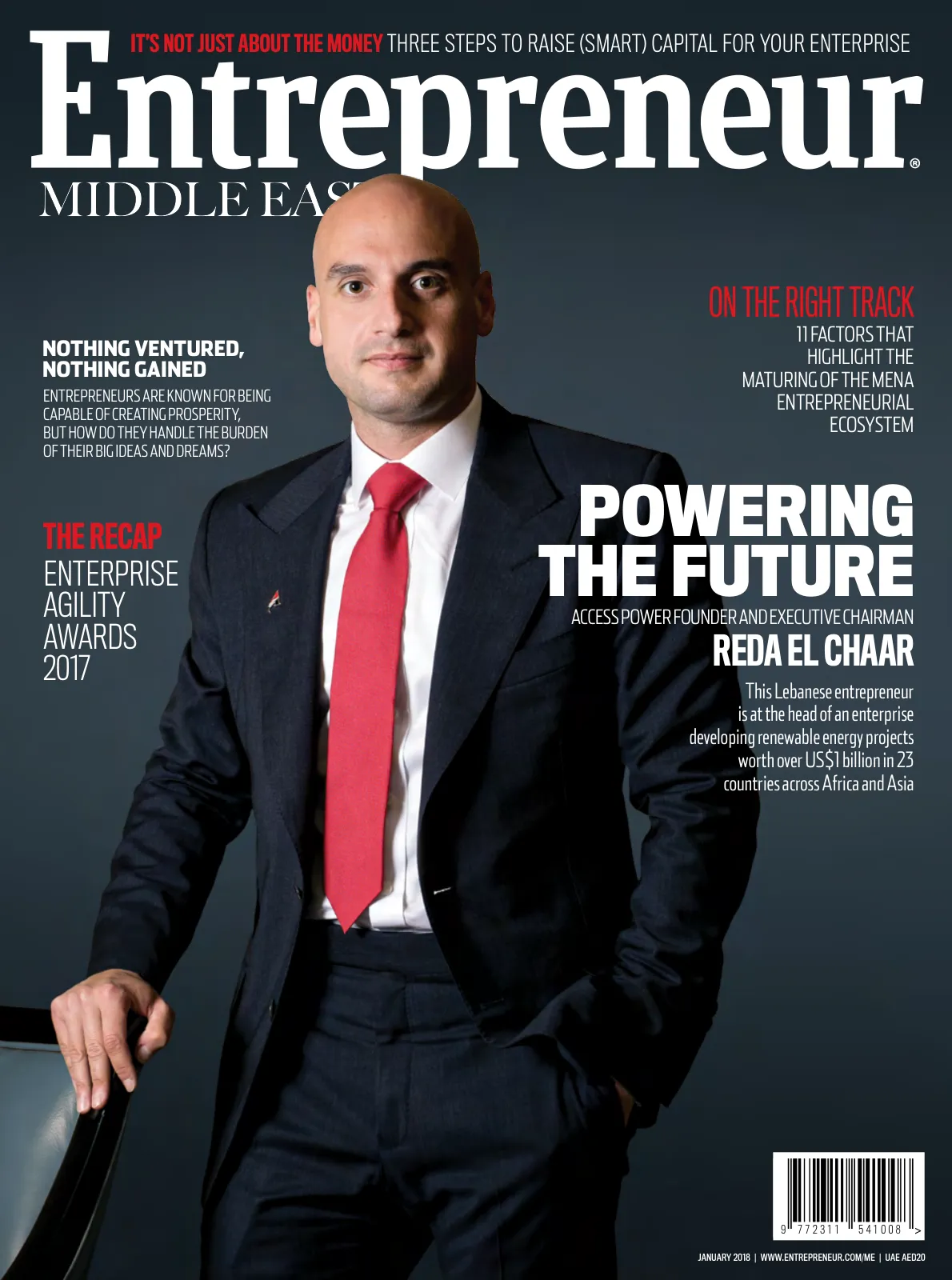
Entrepreneur Middle East, January 2018
Page 1
Nothing ventured,
nothing gained
Entrepreneurs are known for being
capable of creating prosperity,
but how do they handle the burden
of their big ideas and dreams?
It’s not just about the money Three steps to raise (smart) capital for your enterprise
january 2018 | www.entrepreneur.com/me | UAE AED20
9
7 7 2 3 1 1
5 4 1 0 0 8
>
The Recap
On the right track
11 factors that
highlight the
maturing of the MENA
entrepreneurial
ecosystem
This Lebanese entrepreneur
is at the head of an enterprise
developing renewable energy projects
worth over US$1 billion in 23
countries across Africa and Asia
Enterprise
Agility
Awards
2017
Reda El Chaar
Access Power founder and Executive Chairman
Powering
the future
Page 2
681721
523966
Page 3
Page 4
Higher definition.
Bentayga Black Specification.
With 22” black gloss alloy wheels and black exterior detailing, the world’s fastest and most luxurious SUV
is now even more striking. See more at BentleyMotors.com/HigherDefinition
The name ‘Bentley’ and the ‘B’ in wings device are registered trademarks. © 2017 Bentley Motors Limited. Model shown: Bentayga Black Specification.
Page 5
JANUARY 2018 Entrepreneur
3
CONTENTS
january 2018
45 Wissam Younane, CEO, BNC Publishing, giving his welcome address
at the Enterprise Agility Awards 2017
34
The 2017 edition of
Entrepreneur Middle East’s
Enterprise Agility Forum,
presented by du
22
INNOVATOR:
Powering the future
Reda El Chaar, founder and
Executive Chairman, Access
Power
Meet the Lebanese entrepre-
neur at the head of an enter-
prise developing renewable
energy projects worth over
US$1 billion in 23 countries
across Africa and Asia.
44
THE RECAP:
Enterprise Agility Awards
2017
A look at the winners of the
fourth edition of Entrepreneur
Middle East’s Enterprise
Agility Awards, presented
by du, which recognized
prominent business leaders
and enterprises across various
sectors.
34
THE RECAP:
Enterprise Agility Forum
2017
A round up of all the topics
discussed and insights shared
at our 2017 Enterprise Agility
Forum, presented by du.
62
CULTURE:
LIFE
Nothing ventured,
nothing gained
Entrepreneurs are known
for being capable of creating
prosperity, but how do they
handle the burden of their
big ideas and dreams?
32
INNOVATOR:
Focused on impact
Deliveroo co-founder and
CEO Will Shu
The entrepreneur behind
one of Europe’s most
successful tech startups
explains how his enter-
prise made it to where it
is today.
28
INNOVATOR:
Maximizing value
In conversation with
Monty Mobile founder and
CEO Mountasser Hachem.
Page 6
Page 7
Page 8
60 YEARS OF ADVENTURE
AND DISCOVERY
Page 9
Page 10
Page 11
Page 12
Page 13
800 999 999 I sobha.com
@sobhadubai
LIVE IN THE LARGEST
TOWNHOUSES IN DUBAI
800 999 999 I sobha.com
@sobhadubai
LIVE IN THE LARGEST
TOWNHOUSES IN DUBAI
Page 14
Entrepreneur JANUARY 2018
12
CONTENTS
january 2018
56
Cadillac’s “Letters to
Andy Warhol” exhibition
in Dubai offered visitors
a peek into the artist’s
personal experiences
22 Reda El Chaar, founder and Executive Chairman,
Access Power
72
‘TREPONOMICS:
MARKETING
Making the news
Pace Public Relations’
Meghan Powers offers
entrepreneurs five tips to
get their startups the media
love they deserve.
66
‘TREPONOMICS:
PRO
The right fit
Bayt.com’s Suhail Al-Masri
lists three steps to help you
hire someone who’s in line
with your organizational
culture.
52
TECH:
SHINY
#TamTalksTech
Gadgets and doodads
that you might’ve missed
out on, sourced by a tech
aficionado. Yes, it’s okay
to want them all… and no,
it’s not our fault.
82
START IT UP
Q&A
Catching ‘em young
UAE’s Fun Robotics
wants to help build the
region’s next generation of
inventors and innovators.
84
CULTURE:
LIFE
No island unto itself
MrUsta.com’s co-founder
and CEO Ibrahim Colak
believes it’s key for startups
to ascertain their brand’s
role in the community.
68
MONEY:
VC VIEWPOINT
It’s not just about the money
Precinct Partners co-founder
and Managing Partner
Amjad Ahmad explains three
ways to raise smart capital
for your enterprise.
Page 15
Page 16
Entrepreneur JANUARY 2018
14
CONTENTS
70
TECH:
THE FIX
Imagine the possibilities
Gene Jiao, President,
Huawei Consumer Business
Group - Middle East &
Africa explains how AI is
(already) transforming the
future of work.
74
START IT UP:
WHO’S GOT VC
We got funded!
The entrepreneurs behind
startups Justmop and
Sihatech reveal what went
into securing their latest
funding rounds.
58
CULTURE:
DESIGN
Building brand relevance
With 125 years of history
behind it, Baker Interiors
is all set to shape its next
century in business.
78
START IT UP
Q&A
Betting (big) on dreams
Chef John Buenaventura’s
Cuisinero Uno is making a
mark on Dubai’s culinary
scene.
60
CULTURE:
LIFE
First principles
James Clear writes why
Elon Musk’s success is an
example of the power of
thinking for yourself.
54
CULTURE:
TRAPPINGS
‘Trep gear
The executive selection for
the entrepreneur on your
list that has everything.
Okay, maybe for a little self-
reward as well.
58 Russell Towner, President and CEO, Baker Interiors Group
55 S. T. Dupont Picasso lighters
Mona Ataya,
founder and CEO,
Mumzworld
62
january 2018
Page 17
Page 18
Entrepreneur JANUARY 2018
16
SUBSCRIBE
Contact subscriptions@bncpublishing.net to receive
Entrepreneur Middle East every issue
EDITOR IN CHIEF Aby Sam Thomas editor@bncpublishing.net
CEO Wissam Younane wissam@bncpublishing.net
DIRECTOR Rabih Najm rabih@bncpublishing.net
CREATIVE LEAD Odette Kahwagi
MANAGING EDITOR Tamara Pupic
STARTUPS SECTION EDITOR Pamella de Leon
FEATURES EDITOR Sindhu Hariharan
COLUMNIST Tamara Clarke
EVENTS LIAISON Mark Anthony Monzon
PO Box 502511 Dubai, United Arab Emirates
P +971 4 4200 506 | F +971 4 4200 196
For all commercial enquiries related to
Entrepreneur Middle East contact
sales@bncpublishing.net
All rights reserved © 2017.
Opinions expressed are solely those of the contributors.
Entrepreneur Middle East and all subsidiary publications in the
MENA region are officially licensed exclusively to BNC Publishing
in the MENA region by Entrepreneur Media Inc.
No part of this magazine may be reproduced or transmitted in any
form or by any means without written permission of the publisher.
Printed by International Printing Press
ippuae.com
Images used in Entrepreneur Middle East are credited when necessary. Attributed use of
copyrighted images with permission. All images not credited otherwise Shutterstock.
Amjad Ahmad
Suhail Al-Masri
Fida Chaaban
James Clear
Ibrahim Colak
Gene Jiao
Dipika Mallya
Sene McKeon
Megha Merani
Meghan Powers
Soukaina Rachidi
CONTRIBUTING WRITERS
www.entrepreneur.com/me
Access fresh content daily on our website!
MIDDLE EAST
EntMagazineME
@EntMagazineME
Entrepreneur-me
EntrepreneurMiddleEast
EntMagazineME
EntMagazineME
EntMagazineME
MIDDLE EAST
In addition to our print edition, we’re bringing
you all sorts of industry news on our web
mediums. Joining us online means getting
relevant business and startup content in
real-time, so you’re hearing about the latest
developments as soon as we do. We’re looking
forward to interacting with our readers on all of
our social media and web platforms- like any
thriving business, we’re looking to give and take.
#TrepTalkME is already happening on all of our
digi platforms, and all good conversations go
both ways. See you on the web!
Page 19
Page 20
Entrepreneur JANUARY 2018
18
EDITOR’S NOTE
Aby Sam Thomas
Editor in Chief
@thisisaby
aby@bncpublishing.net
Say no to the status quo
Agility needs to be seen in everyone at an enterprise
(and not just in the people running it)
A
gility in entrepreneurs
(and in the enterprises
they run) is something
we at Entrepreneur
Middle East have al-
ways celebrated, and so, I admit to
have been a little taken aback when
I recently got to see first-hand how
certain organizations, which I had
thought of as being ahead of the
game thanks to the visionary ideas
of their leaders, were (at least in
the instances that I got to work
with them) actually grossly inef-
ficient, and, well, bogged down by a
steadfast adherence to inanities in
the name of processes.
Now, before all of you manager-
types come at me with a “processes
are there for a reason” lecture, let
me assure you that I respect rules
that allow for people at a company
to be effective and efficient- but
that doesn’t mean your employees
are to blindly follow bullet points
off a list for no other reason than,
well, because “that’s the way we do
it,” or, worse, because “that’s the
way it has always been done.”
The curious thing about the or-
ganizations where I spotted these
flaws was the disparity between
the almost idealistic paradigms the
company’s leaders told the media
they run their enterprises with,
versus what was actually happen-
ing on the ground.
Sure, every business leader out
there wants to present the best
versions of themselves and their
companies to the world, and this
is especially true of entrepreneurs
whose startups are, more often
than not, a lot more chaotic than
they are made out to be. But when
an organization’s flaws come across
rather blatantly in the public-
facing areas of the business –be it
customer service, HR, or, yes, even
media relations- then this discon-
nect between the company’s lead-
ership and its employees calls for
further scrutiny. After all, the idea
of being agile, taking ownership of
what one does, and doing things
the best way they can be done is
not something that’s restricted to
the C-suite of an organization- it
needs to be translated across all
layers of the company.
As the leader of the enterprise,
when inconsistencies within your
organization are brought to your
attention, it falls upon you, as the
captain of the ship, to ask some
tough questions of yourself, and
how you manage your people and
your business. For instance: are
you expecting your people to be
simply servient and just going
through the motions, or can you
depend on them to do their work in
the most efficient and effective way
they can? When they see a fault in
the way things are done, do your
staff feel empowered enough to call
out such mistakes, and perhaps
more importantly, are their voices
being heard? In terms of organiza-
tional structure, are the chains of
command you have in place helping
move the company forward, or are
they simply dead weight dragging
it down?
Now, yes, all of these are difficult
things to ponder upon, but as
we usher in a new year, it’s well
worth our time now to make sure
our enterprises are well-equipped
for all of the opportunities (and
challenges) that the future will
bring. And entrepreneurs, please,
remember that it’s okay to find
(or be shown) flaws within your
organization- what’s not okay is to
let them remain as such.
Make change happen in 2018!
Page 21
DISCOVER HOW TO ACCELERATE YOUR BUSINESS
Powered by Thomson Reuters, Accelerate SME is the gateway to the
SME ecosystem in MENA; providing access to the resources and solutions
needed to support you at any business stage.
We have joined forces with some of the region’s most powerful financial
and workflow solution providers to service and support your specific needs.
As a member of Accelerate SME you can access a wide range of business
resources including, funding, online community, industry insights, tools
and easy-to-use templates.
ACCELERATE SME
CONTRIBUTE. ENGAGE. GROW.
FIND OUT MORE AT ACCELERATESME.COM
Page 22
Entrepreneur JANUARY 2018
20
in pictures
images © startad
UAE’s hardware startups showcase their solutions at startAD’s
Hardware Venture Launchpad Demo Day
Innovation at work
A scene from startAD’s
Hardware Venture Launchpad
The participants at startAD’s Hardware Venture Launchpad
Ramesh Jagannathan, MD, NYUAD startAD
The winners of startAD’s Hardware Venture Launchpad
W
hile entrepreneurs in
emerging ecosystems like
the MENA need all the
support they can get for
growing their business,
those working on starting and scaling
a hardware startup do need special
assistance. Recognizing the clichéd
but true saying that “hardware is
hard,” New York University Abu Dhabi
(NYUAD’s) startAD platform recently
organized a one-of-its-kind support
program for hardware startups in the
UAE supported by IBM, GE and Cres-
cent Enterprises.
Aiming to bridge the gap between
emerging product startups and indus-
try stakeholders, startAD’s Hardware
Venture Launchpad held its Demo
Day at NYU Abu Dhabi on December
13, 2017. Over 20 teams from emerg-
ing hardware companies participated
in the program, and showcased their
solutions to investors and others
from the UAE startup community,
and at the end of the program, three
teams emerged as winners, winning a
prototyping grant that can help them
further develop their products.
“Unlike software startups, which
need little to no upfront capital
investment, hardware startups need
significant infusion of resources, and
a strong business model that has the
manufacturing details ironed out be-
fore seeing the light of day,” Ramesh
Jagannathan, Managing Director of
startAD and Vice Provost for Innova-
tion And Entrepreneurship at NYU
Abu Dhabi, noted in a statement. “It
is a challenging task, but startAD is
committed to helping to make Abu
Dhabi the global epicenter for hard-
ware innovation.”
The three winning UAE-based
teams, who received the prototyping
grant includes Maia Systems, Team
Stealthy, and SMADO. While big data
solution Maia Systems (led by CEO
Saeed Alnofeli) was recognized for its
technology that collects speed, loca-
tion, overall exertion and performance
data of racing camels, Team Stealthy’s
medtech wearable device (devised by
CEO Nadiya-Keya Siddique and team)
was rewarded for its monitoring capa-
bilities that help enhance well-being
of women pre- and post-pregnancy.
SMADO, a smart automation lock
device, spearheaded by CEO Midhun
Sankar and team, enables users to
control doors via Bluetooth.
In addition to these three winning
concepts, startAD also recognized
team Project Realise (a team that’s
working on recycling thermoplastics
into 3D printer filaments) with a trip
to China to work with startAD part-
ner labs and gain exposure for their
cutting-edge hardware solution. The
three winning teams (along with Pro-
ject Realise) were also awarded IBM
cloud credits of up to US$120,000,
and get an opportunity to be consid-
ered for mentoring and seed funding
by startAD.
www.sites.nyuad.nyu.edu/nyuadstartad
Page 23
Page 24
Entrepreneur JANUARY 2018
22
Images courtesy oln | www.oln.net
Reda El Chaar, founder and Executive
Chairman, Access Power
“our goal is to put as
many megawatts as
possible on the grind to
light up as many schools,
homes, and so on, and
later on, it is to create
the largest pan-emerging
market utility within the
renewables sector.”
Entrepreneur JANUARY 2018
22
Page 25
JANUARY 2018 Entrepreneur
23
By Tamara Pupic
innovator
This Lebanese entrepreneur is at the head of an enterprise
developing renewable energy projects worth over US$1 billion
in 23 countries across Africa and Asia
Reda El Chaar
Powering
the future
Access Power founder and Executive Chairman
“When people heard
that I was going
to start a utility
company with
AED100,000, they
thought I was mad.”
>>>
S
ince the trend
towards greener,
more sustainable
energy solutions
started quite
some time ago,
the prevalent
question has been whether
it is just a fleeting fad, or it
offers viable business oppor-
tunities for the long-term.
The public is now more
convinced of the latter, but
only due to entrepreneurial-
minded individuals willing
to take tremendous risks
related to disrupting the
utilities sector. To Reda El
Chaar, founder and Executive
Chairman of Access Power, a
developer, owner, and opera-
tor of wind and solar power
plants in Africa and Asia,
prospects for entrepreneurial
achievements in this sector
lay within his own area of
expertise. Having moved
to the UAE in 2003 from
Lebanon, El Chaar started
his career in the energy sec-
tor first at Unilever, followed
by a five-year stint at ACWA
Power, where he helped it
to become one of the largest
private power producers in
the MENA region. In 2012,
being 27 years old at the
time, he started Access Pow-
er “with two desks” (for his
wife and himself), and AED
100,000 of his own capital.
It has since grown into an
employer of more than 50
people. “We started off by
providing consultancy ser-
vices within the independent
power projects (IPP) sector,
and, very quickly, in the first
year, we became a very suc-
cessful consultancy, advising
on all IPPs from Morocco to
Oman,” he says. “The vision
has always been to become
the developer, owner, and
operator of power plants,
but the consultancy business
was a building block to ac-
crue the capital to get there.
When people heard that I
was going to start a utility
company with AED100,000,
they thought I was mad.
But I told them that I had a
plan and that was to build
my cash through consul-
tancy services, and then to
pivot and move the company
towards becoming a devel-
oper, owner, and operator of
power plants.”
A very ambitious target of
building Access Power meant
taking part in a seismic
shift to radically change the
energy sector, filled with con-
servative, well-entrenched
incumbents. Five years later,
however, Access Power has
a development pipeline of
1,000 MW in 15 African
countries, and of 500 MW
in eight countries in Central
Asia- all collectively worth
over US$1 billion. The key to
this, El Chaar explains, was
in tapping into an uncrowded
market niche. “When you
go into highly fragmented
emerging markets, it means
that there is no single mar-
ket that can deliver a high
turnover,” he says. “Instead,
you need to go to multiple
countries and do smaller size
projects, and in an aggregate,
they become big. What
happens if you are a large
utility, which are generally
extremely big companies,
is that you have heavy
overheads, and it becomes
less economical for you to do
small projects in small frag-
mented markets. You look for
big markets where you can
deploy strategies of scale.
On the other hand, we found
our niche because we limited
our overheads, and by doing
that, we were able to go into
smaller countries, do smaller
size projects, and eventually
become a very attractive
platform. We managed to
aggregate very large MWs,
and became an interesting
target for large utilities. Our
biggest USP, however, is what
I call, PowerPoint to power
plant. Many large companies
simply dismiss PowerPoints,
meaning that they don’t want
to get into a project at a Pow-
erPoint stage, but when there
is some more material behind
it. Our case is very different.
We start a project as a Pow-
erPoint, and stay with it until
it becomes a power plant.”
Page 26
Entrepreneur JANUARY 2018
24
innovator
The $19 million Soroti Solar Plant is
expected to generate clean,
low-carbon, sustainable electricity
to 40,000 homes, schools, and
businesses in the area.
www.access-power.com
One of the first wins the
company had was its official
entry into the Egyptian
market by developing two
solar PV plants with a total
capacity of 126 MWp located
in the Benban solar park in
the Aswan province of Egypt,
with its strategic partner
EREN Renewable Energy.
Another was in Uganda, last
year, when Access Power
inaugurated the country’s
first grid-connected solar
power plant- a 10 MW
utility- in Soroti. The $19
million Soroti Solar Plant is
expected to generate clean,
low-carbon, sustainable
electricity to 40,000 homes,
schools, and businesses in
the area. Yet, this is not the
only value El Chaar, being an
environmentally and socially
conscious entrepreneur, aims
to add to those less devel-
oped markets. “Doing busi-
ness in Africa takes a lot of
patience, perseverance, and
you should mix these with a
lot of passion,” he says. “If
you lose one of them, you
won’t be able to do business
there. But, beyond this, it
requires fundamental and
profound understanding of
the people and communities
that you are dealing with.
Many of our projects are in
faraway communities, so far
that you have to drive for
eight hours to get to a major
city. It is very important that
that particular community
benefits from your project, in
terms of job creation, elec-
tricity, and so on. They need
to give you, what we call, a
full buy-in, meaning to be-
lieve in it and become a part
of it. For example, in Uganda,
the people who operate our
plant there are all Ugandans.
So, there is a full Ugandan
team operating the first solar
project in East Africa. This
gives us the feeling that we
are giving back directly to the
community.”
Identifying an opportunity
that is worth investing the
time and effort that is usu-
ally needed when dealing
with the complexities of
these markets seems to be
an art to master. El Chaar
explains that the solution is
in being agile in all aspects
of the business. In Zambia,
for example, experts lined
up to propose solar power
solutions, whereas Access
Power suggested developing
the country’s first privately
financed wind farm. It is now
working on a 130 MW wind
farm concept with grant
funding from the US Trade
and Development Agency
(USTDA). “When we went
to Zambia and decided to
do a project there, we went
to one of their ministries
and proposed a wind power
plant. Their immediate ques-
tion was: ‘Is there wind in
Zambia?’ Or: ‘Can we gener-
ate power from wind in Zam-
bia?’” he remembers. “Then,
we did our PowerPoints, our
studies, and so on, and today,
everyone wants to do some-
thing with wind in Zambia.
So, everything starts with a
desktop analysis, then you
create your contacts there,
but it does take a lot of time.
From the day when we decide
that we want to approach a
country, to the day when we
get the first project, there can
sometimes take two or three
years. In general, I would say
that it can take anywhere
between eight months to two
years. It can be a very time
consuming business, but that
is exactly why we had the
niche that we have.”
Time consuming processes
aside, Access Power is en-
abling a wider social change,
and that is in addition to
providing affordable electric-
ity to a reported 600 million
Africans, who still do not
have any kind of access to
electricity, El Chaar says. For
that reason, he is not fond of
humanitarian aid, doubting
its effects on a society apart
from goodie bags donated
at official ceremonies of
bureaucrats, journalists, and
the like. “I don’t believe in
the aid approach, because
aid never builds countries,
it’s trade that does that,” he
says. “There have been many
aid-driven electrification
initiatives, and I call them
a bandage approach to aid.
For example, somebody has
cancer, and you give them a
bandage. We cannot have a
bandage approach to aid, but
a trade approach to aid. So,
aid through trade. We try to
find profitable opportunities,
to bring power to people
profitably, so that everyone
can benefit from it while
creating a sustainable eco-
system. The aid ecosystem is
not sustainable, because you
give free money, you build a
power plant to some extent,
you run out of money, you
can’t continue, people don’t
get electricity, and it’s all
gone.”
Another illustration that
he is walking the talk is the
Access Co-Development
Facility (ACF), a competition
offering technical and finan-
cial support to chosen utility
projects. Since its inception
in 2014, ACF has received
a significant number of
proposals- 55 in 2015, 96 in
2016, and 82 in 2017. The
winning projects are mainly
grassroots entrepreneur-
ship initiatives, such as this
year’s proposed energy solu-
tions for Tanzania, Ghana
and Rwanda. Some of these
Page 27
JANUARY 2018 Entrepreneur
25
innovator
Reda El Chaar,
founder and
Executive Chairman,
Access Power
Access Power and FMO
launch second edition
of Solar ‘Shark Tank’
Competition for Innovative
Solar Projects
“Development
business is one
of the riskiest
businesses, but
if you have the
right know-how,
the right people,
process and
procedures put
in place, you can
manage that risk.”
>>>
projects have already come to
fruition- one of the two first
year’s winners were a team
proposing a 50 MW Abiba
Solar project in Nigeria’s Ka-
duna State. With the support
of Access Power, the team
has secured a $1.25 million
loan from InfraCo Africa, a
multi-government funded,
privately managed company
providing early-stage devel-
opment capital and expertise
to develop infrastructure
projects in Sub-Saharan Af-
rica. Once completed, it will
be Kaduna State’s first pri-
vately developed renewable
power facility, and its first
solar project. “We provide
them [chosen applicants]
with funding and know-how,”
El Chaar says. “The entire
team will work with us and
we will help them make their
projects happen. In Nigeria,
for example, three Nigerian
guys who had worked for
big international compa-
nies abroad, decided to go
back and give back to their
country. They put together
a specific project for a spe-
cific need and then got stuck
because they didn’t have
enough money to continue.
They are exactly the type of
people we want to support
since they brought in some
knowledge, some of their
own money, and just needed
somebody to help them at
the last hurdle. That’s exactly
what we did.” Similarly, Ac-
cess Power also launched
Solar Shark Tank, a competi-
tion offering a US$100,000
grant to the projects in Asia,
Africa and Latin America,
in partnership with Dutch
development bank FMO.
El Chaar’s approach to his
business can be summed
up as descending on a new
country in anticipation of a
rush of lucrative infrastruc-
ture contracts and fewer
competitors, yet making
sure that the host country
receives not only the needed
infrastructure and jobs, but,
more importantly, technol-
ogy and skills. The strategy
is, therefore, reversing the
“no risk, only gains” busi-
ness tactic often taken by
international companies in
emerging markets. When
it comes to financing, El
Chaar’s formula is similar-
from its inception, Access
Power has been taking on
the full development risk for
its projects. “Development
business is one of the riskiest
businesses, and that is why
we have managed to bring an
entrepreneurial spirit into
a very non-entrepreneurial
industry,” El Chaar explains.
“It is risky, but if you have
the right know-how, the
right people, process and
procedures put in place,
you can manage that risk.
You cannot erase it, but you
can manage it. For the first
project, the risk was massive.
I had to put $2 million of my
own money before having
something that could even
be called a project. Then, in
Egypt we put close to $12
million of upfront money.
It is very tricky at an early-
stage, because then you have
concentration risk. At that
stage, you have one or two
projects, and if something
goes wrong with them, you
are dead. At the stage we are
at today, with projects in so
many different countries, we
have this diversification as a
backup. Initially, it is a bet. If
Uganda had failed, we would
have closed up shop. You
think about this risk every
day. Waking up in the morn-
ing and going to bed at night,
your head is all about the
risk that you’re taking. But,
it is not the thinking why
not to do it. On the contrary,
we think of that risk so that
we are aware of it and that
we are able to manage it.” By
having his skin in the game,
El Chaar has earned the
trust of Eren Development, a
French renewable energy de-
veloper. The two companies
launched a privately funded
investment vehicle —Access
Infra Africa— to build a port-
folio of power assets in Africa
worth in excess of $500 mil-
lion. The deal includes Eren
Page 28
Entrepreneur JANUARY 2018
26
innovator
“just because
timelines get
pushed you should
not decide not to
have them. To the
contrary, I believe
that an unrealistic
timeline is better
than no timeline.”
images courtesy access power
InfraCo Africa has
announced the signing of
two new Developer Services
Agreement with Access
Power and CPCS, worth up
to a total of US$30m
East Africa’s largest PV power plant in Uganda
Development taking a 20%
stake in Access Power and a
seat on the board, as well as
committing to put up 70% of
the costs to achieve the joint
venture’s African portfolio
target.
Starting a utilities busi-
ness is hard enough, but
managing it for long-term
success is often an even big-
ger hurdle to overcome. For
that reason, I enquire how he
sets deadlines for different
phases of the projects. This
has particular resonance as
the key to Access Power’s
success is bringing ideas to
market more quickly and
more affordably than ever
thought possible. El Chaar’s
answer is hardly surprising.
“It’s very simple- aim for the
stars to get to the moon,” he
says, laughing. “Deadlines
always get pushed, espe-
cially in emerging markets.
However, you should always
remember that just because
timelines get pushed you
should not decide not to
have them. To the contrary,
I believe that an unrealistic
timeline is better than no
timeline. People always say,
‘Reda wants everything to be
done yesterday.’ It is impor-
tant to stretch yourself. It’s
about both overpromising
and over-delivering. We
have managed to complete
the fastest built power plant
on the African continent
ever. It was in Uganda in
2015. From the signing of
the contracts, to delivering
the first power on the grid, it
took 12 months. Historically
in Africa, it used to take up
to five years from contract
signing to delivering power.
We did it in one year.”
Lighting up homes in un-
derserved parts of Africa and
Asia is one possible explana-
tion of the rush, and a good
one for that matter. How-
ever, El Chaar’s ultimate goal
stretches far beyond what
Access Power has achieved
so far- creating and seizing
opportunities to redevelop
other sectors and our cities/
countries along the way. “For
now, our goal is to put as
many megawatts as possible
on the grind to light up as
many schools, homes, and so
on, and later on, it is to cre-
ate the largest pan-emerging
market utility within the
renewables sector,” El Chaar
says. “My even bigger dream
is to take this outside of our
sector and to be able to build
pan-infrastructures not just
for power, but for roads,
schools, healthcare. Basical-
ly, to do pan-infrastructure
investments. So, to take this
spirit of entrepreneurship
and innovation into those
infrastructure sectors. If you
look at all of them, they all
lack entrepreneurial spirit.
As we have been successful
in the energy sector, I would
like to see this formula
replicated in other sectors.
I would like to see Access
Power, as a group, growing
into other sectors, other
than the energy sector, to
which we can bring our ex-
perience of how to originate
and develop processes and
procedures to create new
opportunities and then turn
them into investable proj-
ects. For example, we could
become a major player in the
education sector by building
schools on a PPP basis. I can
build a school and lease it to
a government, for example.
They can buy seats in it on
a yearly basis, for example.
In the healthcare sector, it’s
the same thing. I can build
hospitals, and sell them bed
spaces.”
It’s clear that El Chaar
has big dreams for the
future of his business, and
given how he has led Ac-
cess Power to its current
market standing, these goals
aren’t as far-fetched as they
may seem. After all, it’s by
fostering relationships with
entrepreneurial minds,
both upstarts and veterans,
that he has managed to
break into and thrive in a
Page 29
JANUARY 2018 Entrepreneur
27
Reda El Chaar, founder
and Executive Chairman,
Access Power
MYTH #1
Entrepreneurs should not
pay themselves “I took a
salary from day one. I’ve never
stayed a day in this company
without my salary because the
reality is that if entrepreneurs
do not value their time, which is
the only thing they have, and if
their business cannot give them
at least the reimbursement on
their time, then I don’t believe
they are building a sustainable
business. I’ve been paying my-
self from day one and in a very
disciplined manner.”
MYTH #2
Entrepreneurs work 24/7
“Another of the big myths
is when entrepreneurs say
that they work non-stop. The
reality is that no one can work
24 hours per day. And, if you
are doing that, you are doing
something wrong. For me, that
is a signal that something is go-
ing wrong because there needs
to be a balance. If you don’t
have fun, you cannot succeed
in business. My motto is: work
hard, party harder. The same
goes with not taking vacations.
Something is not right there.”
MYTH #3
Entrepreneurs need to bring
on investors “Entrepreneurs
are very stressed about bringing
in the money from investors, but
I always tell them to focus on
their idea instead. If you really
have a good, genuine idea, you
don’t need anyone. Investors will
come to you. Great ideas never
chase money but vice versa.
This is my genuine belief. If you
look at the venture capital world,
eight out of 10 ideas go bust.
Plus, that is an official number,
meaning that it [the failure
rate] must be even higher. This
proves that money does not go
to good ideas. It is good ideas
that bring in money.”
MYTH #4
Entrepreneurs do not need
sector expertise prior to
starting “Another thing that I
say to entrepreneurs is to stick
with what they know. The grass
is never greener on the other
side. You can see an entrepre-
neur who has spent many years
in a logistics company, and
then one day he comes up with
an idea to do an app that has
nothing to do with logistics. I’m
always asking why they can’t
come up with something within
a sector or an industry that they
know.”
MYTH #5
Young people make better
entrepreneurs “I appreciate
entrepreneurs who started later
in life because they have already
played with other people’s mon-
ey and they’ve got the knowl-
edge of that particular sector. It
is great that we are encouraging
youth entrepreneurship, but I
think that the world would do
better if we supported those
people who start a business at
40 or 45 when they are burnt
out from their jobs. So, that’s
another myth- an entrepreneur
doesn’t have to be an 18 or
19-year-old college dropout.”
MYTH #6
Tech entrepreneurship is the
only right route to follow
“I would love to help others un-
derstand that entrepreneurship
is not restricted to apps. Don’t
get stuck in the IT industry.
You can be an entrepreneur in
any sector as long as you have
the know-how and the passion
to do it. Also, we hear a lot
about tech entrepreneurs who
are making the money, but we
don’t hear about those who are
losing the money. There are
definitely a lot of tech entre-
preneurs who are losing a lot of
money.”
‘TREP TALK
Reda El Chaar, founder and Executive Chairman, Access
Power, busts six common myths of entrepreneurship
innovator
“I want my team to
feel that they are
both empowered
and accountable for
what they are doing.
With empowerment
comes responsibility,
and with that, my
role becomes very
simple, I become an
advisor.”
traditionally conservative
sector. El Chaar tells me that
he meets with his previous
bosses, all highly respected
experts in the energy sector,
over dinner once a month
to ensure that he remains
exposed to sound advice.
His management style is not
much different- empower
to be empowered. “I lead
by example. I lead from the
front line. I like to empower
people. I want my team
to feel that they are both
empowered and accountable
for what they are doing,” he
says. “With empowerment
comes responsibility, and
with that, my role becomes
very simple, I become an
advisor. When they have an
issue, they come to me, and
I then become a problem
solver. So, my leadership
style is one, giving respon-
sibility and ownership of
their work to our staff, two,
being a trusted advisor and a
solution provider, and three,
being the driver of all the
passion in this organization.”
And for all his dreams for
a better, cleaner, brighter
future, El Chaar is essentially
making it happen.
Page 30
Entrepreneur JANUARY 2018
28
“Basically, our
objective is to allow
the operators to
benefit from any
additional revenues.”
Monty Mobile founder and CEO
Mountasser Hachem
images courtesy monty mobile | www.montymobile.com
By Megha Merani
innovator
value
Maximizing
T
ell them how they
can make more
money, offer them
something no one
else ever has, and
be flexible– that’s
the simple secret
to Mountasser Hachem’s
success.
Them, in this case, is mobile
operators around the world.
It’s no secret that telecom-
munications companies
across the globe have been
struggling with revenue loss-
es on international calls and
roaming fees since the birth
of over-the-top (OTT) appli-
cations such as the Microsoft
Skype, Viber, Snapchat and
several others.
London-based research
and analytics firm Ovum
forecasts in its 2014 report
that the telecommunications
industry, globally, would lose
a combined US$386 billion
between 2012 and 2018 to
OTT apps. Ovum predicted
that just consumer use of
OTT VoIP (Voice Over Inter-
net Protocol) would grow at
a compounded annual rate of
20% between 2012 and 2018
to reach 1.7 trillion minutes,
translating to $63 billion in
lost income in the final year
of its forecast.
As the sector scrambles
to stop the haemorrahge in
earnings, Hachem, CEO of
Monty Mobile, has built a
business on showing opera-
tors the revenue opportuni-
ties they are missing, and
offering them services to tap
in to those avenues.
Monty Mobile, which is a
member of the Monty Hold-
ing Group, was founded by
Hachem in 1998. The parent
company started as a small
one-office operation, and
has since evolved into an in-
ternational player in mobile
messaging and transaction
services. Monty Mobile
is a GSMA certified Open
Connectivity SMS Hub and
Roaming Broker, that works
closely with mobile operators
to facilitate the international
flow of data, voice, and SMS.
That may be a complex
mouthful for those unfamil-
iar with the industry, and so,
Hachem explains, “Basically,
our objective is to allow the
operators to benefit from any
additional revenues.”
Two major avenues Hachem
sees telcos losing returns
on are SMS (Short Message
Service) and digital advertis-
ing, which are the services
Monty Mobile is focusing on.
He adds that most operators
seem oblivious to the “real
potential” they could be
achieving.
In other words, he wants
to make them an offer they
can’t refuse, with Monty
Mobile’s services.
“For them (operators), of
course, the SMS revenues
that we are committing to
give them would be consid-
ered low compared to other
revenues they collect from
many other services as a
mobile operator. But because
it (traditional SMS) is a dead
Page 31
JANUARY 2018 Entrepreneur
29
innovator
“what differentiates us from others
are the commercial offers that we are
putting in place... and to summarize it
in one word, I would say flexibility. If
you go today to a company, they might be
bigger than us, but they don’t have the
flexibility that we have.”
Mountasser Hachem,
founder and CEO,
Monty Mobile
>>>
revenue (source), of course
any revenue out of a dead op-
portunity is a really good deal
for the operator.”
While typical everyday
peer-to-peer (P2P) SMS to
family, friends and colleagues
is near obsolete since the
birth of instant messaging
applications like WhatsApp
and Facebook, Hachem
says there is still great op-
portunity to claw back lost
revenue through Application-
to-Person (A2P) SMS.
“It’s true that WhatsApp
and other applications
have taken over the SMS,
or let’s call it the chatting
business, but they still need
the operators to survive,”
Hachem says. “You need to
have a mobile number to use
WhatsApp– and the only way
to verify the user or to prove
that you own this number
is to send you a verification
through A2P SMS.”
A2P also applies to other
applications such as Skype,
Facebook, Snapchat, as well
as banks.
“So, SMS is being used
today either to notify or to
verify,” Hachem says, and
there lies the untapped op-
portunity. “The international
applications would pay more
to deliver the SMS than the
local. So, Facebook would
pay, for example, up to four
or five cents sometimes to
deliver their verification
SMS because it’s the only
way to reach their customer-
while a local A2P SMS
cannot go that far and the
average is around one cent,”
he explains.
Monty Mobile works closely
with mobile operators to
secure their networks so that
Facebook, WhatsApp and
Viber, and other OTT apps
do not find “cheap” ways
or grey routes to terminate
SMS to their networks. “So
they send it through the
Page 32
Entrepreneur JANUARY 2018
30
innovator
innovator
“today Monty Holding, especially Monty
Mobile, is the pioneer and is considered
one of the biggest players in SMS
and value-added services to mobile
operators.”
official route, which would
be Monty Mobile, and we
make them pay a higher rate
for the operators.”
A grey route is a messaging
route that is legal but takes
advantage of a loophole in
the GSM commercial frame-
work because all operators
do not have a commercial
agreement to terminate an
SMS. So, an SMS route
might be, “white” at origin,
for example, but “black” at
the destination. This makes
it impossible to bill at the
destination, resulting in loss
of revenue as well as reli-
ability.
The numbers Monty
Mobile commits to, Hachem
says, often “surprise” op-
erators– which is what has
given him the confidence to
take on bigger, and more es-
tablished global competitors.
Entering the arena to
compete with firms offering
the same service and that
have been around far longer
and hold existing agreements
with the operators didn’t
scare him, he says. On the
contrary, he adds, the chal-
lenge fueled him.
You can almost hear the
sales pitch come on when he
passionately explains, “Of
course, there is someone else
offering the same service,
but what differentiates us
from others are the com-
mercial offers that we are
putting in place... so to
summarize it in one word, I
would say flexibility. If you
go today to a company, they
might be bigger than us, but
they don’t have the flexibil-
ity that we have.”
Hachem has also analyzed
and capitalized on the mis-
takes his competitors have
made that have left the way
open for Monty Mobile and
given his team solid footing
against bigger players. “We
have a lot of people (com-
petitors) hating us because
of the business we are taking
from them, not only because
we are good, but because
they were not good as well,”
Hachem cheekily says.
But he’s factual, not cocky.
“Their mistake is that they
were not advising the opera-
tor with how they can make
more money. So, we stumped
a lot of operators when we
put our offers on the table.
Their existing partners, our
competitors, would then
propose a similar offer, but
they will not match it, of
course.”
Hachem adds that it’s also
been a disadvantage to his
competitors that, unlike
Monty Mobile, they do not
proactively approach opera-
tors to help them optimize,
and maximize their shrink-
ing revenues.
Monty Mobile’s model also
comes with the option of
prepayment and investment
that the company covers on
behalf of the operator, which
eliminates the financing risk
for the operator. In fact, so
confident is Hachem of this
model that the company
announced in September
that it plans to invest $1.8
billion to drastically increase
the operators’ revenues,
especially from interna-
tional A2P SMS as well as
in roaming and value-added
services.
“We have our own in-
vestors ready to invest,”
Hachem confirms. “What
puts us in a good position
today is our previous good
history with those investors.
The investors themselves
have felt the value of our
ideas. We never came up
with an idea that’s not logi-
cal.”
Hachem adds that the
telecom market is a booming
market and Monty Mobile’s
$1.8 billion investment is
“relatively small” when
compared to the huge poten-
tial profits.
Monty Mobile is not new to
the SMS monetizing space
either, he adds.
“Previously, before telecom
we (Monty Holding) were
into media. We had some
TV channels where people
sent SMS, for example, to
participate in games or ask
for their horoscope. At that
time, also, we were the pio-
neers in bringing that idea to
the Middle East.”
But things changed signifi-
cantly since the SMS-chat-
ting-over-TV boom around
1999, as new technologies
emerged to rattle and trans-
form the economy on all
fronts, Hachem’s company
went through a period of
major upheaval. In 2007, the
company had to downsize to
less than 10 employees and
shut down its media busi-
ness.
“We passed through very
hard times,” Hachem recalls.
“After seven years the (SMS
chat over TV) market was
very much saturated, so we
had to shift our focus to
telecommunications, even
though we have succeeded in
launching the idea of enter-
tainment TV in the region.”
He is pragmatic however,
insisting that those who
don’t make mistakes “will
never succeed in life,” and
keeping up with technology
innovation is crucial for
businesses.
“I would not call it [2007]
a mistake, but because we
like to take risks, many
times we fail to succeed,” he
says. “But we have the will,”
he insists– now evident in
the fact that the company
has about 80 employees in
www.montholding.com
Page 33
JANUARY 2018 Entrepreneur
31
Saud Al Nowais,
Commercial
Counselor for the
UAE to the USA
“What puts us in a good position today
is our previous good history with those
investors. The investors themselves have
felt the value of our ideas. We never
came up with an idea that’s not logical.”
1. Look for new ideas
that progress with the
revolution of technol-
ogy
“If you go back 20 years, a
message would take days to
be delivered in an envelope.
Today, a video can be record-
ed and sent immediately in
seconds. So, you have to keep
on track of what’s going on
in the world and always try
to think about ideas that go
along with such revolution.”
2. It’s okay to fail but
it’s not okay to give up.
“That’s the biggest lesson
I’ve learned.”
3. If your policy does
not achieve your goals,
it is time to change the
policy and take action!
“In today’s highly competitive
environment, those who can
adapt will survive and keep on
achieving financial success;
while those who cannot will
suffer the inevitable death of
their business.”
Monty Mobile’s Founder
and CEO Mountasser
Hachem’s tips for
entrepreneurs
Megha Merani is an independent journalist with more than 10 years of newspaper, magazine and web reporting experience in the United Arab Emirates,
writing hard news, investigative reports, features and opinion pieces. Her passion for storytelling coupled with a proven instinct for identifying talk-
generating issues has resulted in breaking stories and insightful features that have made local, regional and international headlines. Her work has been
published across Thomson Reuters, Zawya, Bloomberg Middle East, Gulf News, former local daily 7DAYS, and government publications.
Mountasser Hachem,
founder and CEO,
Monty Mobile
innovator
‘TREP TALK
their Beirut office, with
another 50 in India, 20 in
the United Kingdom, and
more across other locations
including Fiji and Dubai.
“If you looked at us 10
years ago, you would say that
we would never manage to
stand on our feet,” Hachem
says, with both pride and
humility. “But today Monty
Holding, especially Monty
Mobile, is the pioneer and is
considered one of the biggest
players in SMS and value-
added services by mobile
operators.”
The CEO says he believes
he had to “fail to succeed.”
“That’s the biggest lesson
I’ve learned– that it’s okay to
fail, but it’s not okay to give
up. So, we never gave up.”
And that’s one of the key
traits he looks for in his
people as well. Experience is
secondary, he says, admit-
ting that he was never big
on attending classes during
university and although he
studied finance, it was just
to make his parents happy.
Instead, he is drawn by
people who can match his
risk-taking propensity, and
those who can see the vision
in his ideas as well as adapt
to new ideas quickly.
“I try to choose people who
are convinced and ready to
take risks- even though the
risk on my team is not as big
as the risk on me,” he says.
That’s what thrills him. “We
have never entered an easy
deal. All our deals are chal-
lenging and exciting, and it’s
part of our flexibility to take
risks.” More importantly,
he looks for people who
believe in Monty’s ideas.
“Otherwise, even if we gave
the best deal but the sales
person is not convinced
with the service, he will
not manage at all to sell it
to the operator,” he says.
“Even the developers who
are developing the services
themselves, they have to
believe in the service they
are developing, otherwise
they will not manage to do it
perfectly. Whenever you go
to an operator, the first thing
they will be doing is trying
to find an excuse not to take
the service- especially the
technical people on the op-
erator’s side, they’re always
the negative people in any
discussion so you have to
be ready to clear all their
concerns.”
Hachem speaks from years
of experience going from op-
erator to operator trying to
convince them of his ideas.
“It was not easy at all and
it’s still not easy,” he says.
This is mostly because dis-
cussions with mobile opera-
tors take a lot of time, and
also because many operators
wish to keep their existing
partners on even after Monty
Mobile proposes additional
revenue opportunities. Any
negotiation with an opera-
tor takes time and it’s not
always that we succeed, but
even when we don’t succeed
we know that we have of-
fered them something that
no one else is offering.”
In some instances, he adds,
operators belong to large
groups and the decision
not to work with Monty
Mobile is due to group-wide
agreements with other
firms. But all this may be
about to change as Monty
is preparing to launch new
services in February at its
RVS4 (Roaming, VAS and
SMS) event in Dubai. The
new ideas are expected to
help operators to profit
from digital advertising.
“Today, all kinds of digital
advertising are in the market
and everybody is benefiting
from them except the mobile
operators,” Hachem says.
“No one else has put digital
advertising in the same way
we put it,” he adds, although
other services similar to
Monty Mobile’s upcoming
new offering are already
available. When asked if his
competition needs to start
worrying, Hachem laughs
and says: “They are.”
Page 34
Entrepreneur JANUARY 2018
32
The entrepreneur behind one of Europe’s most successful tech startups
explains how his enterprise made it to where it is today
Deliveroo co-founder and CEO Will Shu
By Aby Sam Thomas
Focused on impact
innovator
images courtesy deliveroo
Will Shu,
co-founder and CEO,
Deliveroo
H
ow long have you gone
about with a potential
new business idea in
your head? In the case
of Deliveroo co-found-
er and CEO Will Shu, the
period between his identifica-
tion of a particular problem
waiting to be solved to the ac-
tual launch of his enterprise
took about nine years. That’s
right: the UK-headquartered
online food delivery company
may have launched only in
2013, but Shu remembers
recognizing a gap in the food
delivery space way back
in 2004, when he had just
moved to London from New
York in his then role as an
investment banking analyst
at Morgan Stanley. As a new-
comer to the city, Shu was
annoyed by the lack of food
delivery options, and at the
same time, when he did find a
restaurant that sent food out,
the actual timing when he’d
receive his order could never
be predicted- the customer
experience he was getting
was, to put it quite simply,
horrible. “After a week, I was,
like, what is going on here?”
Shu remembers. “And people
were, like, it’s just the way it
is. And, you know, I had a job
[then], so I didn’t do anything
about it.” Now, if Shu had
stayed on with this particular
mindset, then perhaps Deliv-
eroo –which is, today, one of
Europe’s most successful tech
startups, boasting of a cool
US$2 billion valuation, and a
presence in 200 cities around
the globe- would probably
have never come to be. But
–thankfully- while it did take
quite some time, Shu did end
up doing something about
the food delivery issue he had
spotted, and the rest, as the
cliché goes, is history.
I met Shu in Dubai in late
November, which was shortly
after the company had an-
nounced raising a total of
$482 million as part of its Se-
ries F round, and the Ameri-
can entrepreneur was un-
derstandably buoyant about
his company’s achievements
in 2017. Besides its wins in
the fundraising space, the
last year also saw Deliveroo
launch its Deliveroo Editions
concept, which Shu believes
is going to be a major part of
the company’s business in the
time to come. Editions are
essentially spaces run by De-
liveroo that allow for selected
F&B establishments to oper-
ate kitchens from, with the
food being prepared at these
sites made solely for delivery
orders. With Editions, restau-
rateurs get to run their kitch-
ens at locations they weren’t
servicing earlier, and given
that these spaces are run by
Deliveroo, they don’t need to
worry about rent and other
such factors- their sole focus
will be on creating dishes that
customers will be satisfied by.
As for Deliveroo, Editions is
an extension of its premise to
“bring you the food you love,
right to your door,” with the
company using its data and
insights to identify every-
thing from cuisines missing
in a particular neighborhood
to the expected demand for
a particular F&B establish-
ment’s offerings.
“We think about the world
in regard to the customer,”
Shu explains. “It’s always
[about] price, selection,
service. Selection is para-
mount, because food is not a
commodity- well, it is, from
a macro level; on a micro
level, I would say it’s highly
emotional. You want the best
burger you can have- you
don’t want just any burger.
And so the ability to offer our
customers what this crea-
tive class of chefs come up
with [is great], (and that’s
only available on Deliveroo)-
because we built these kitch-
ens for [our] people. That’s
the number one reason-
that’s selection. Number two
is actually service level- [at
Editions,] service levels are
about five minutes faster per
delivery, because there is no
front of house- everything’s
streamlined towards delivery.
And I would say, thirdly, it’s
around thinking long-term
about price. If you think
about the restaurant margin
structure, it’s very different-
in an Editions kitchen, you
don’t have a front of house,
and [as for] the real estate
that is ultimately rented, you
don’t have to care if it’s the
highest footfall area.” As a
result, prices too can come
down- since many of the
overheads that often stress
restaurateurs out will now be
taken care of by Deliveroo.
Deliveroo Editions launched
in Dubai in October last
year, with its first site in
the Jumeirah Lakes Tow-
ers neighborhood of the city
housing kitchens for popular
Page 35
JANUARY 2018 Entrepreneur
33
restaurants like Joga, Fraiche,
Burger and Lobster, Clinton
St. Baking Company, and oth-
ers. A second Editions site is
being planned to open in the
Emirate in 2018, and even as
it gets rolled out across cities
around the world, Shu says
that Deliveroo’s latest fund-
ing round will help further
build out the concept, which
should give the rest of us an
indication of the company’s
belief in this new arm of the
online food delivery enter-
prise. “I think Editions is a
huge part of our business
that sits alongside our core
business,” Shu says. “We’re
building a huge number of
tools for the people in Edi-
tions, the restaurateurs. It’s
not just, like, hey, this is
cheaper real estate, you don’t
need a front of house- we are
building kitchen management
technology, supply chain
management technology, and
labor management technol-
ogy… We want to give our
partners the tools to succeed
the same way Amazon gives
its vendors tools to succeed
as well. We’ve begun looking
a lot into robotics as well-
how do we augment existing
labor in restaurants to make
it more efficient, are there
things we can do to automate
certain processes… At the
end of the day, I think about
chefs as a wellspring of crea-
tive talent. I think of them
as software developers- over
time, I see recipes being more
like software, in a very long
timeframe.”
Shu’s vision of the future
may take a while to be real-
ized, but Deliveroo does look
to be well on its way to pre-
paring itself for the increased
scale of operations it predicts
for the years to come. Indeed,
the company’s mastery of
scale has been one of the key
factors that has enabled it to
be the enterprise it is today-
its management prowess can
be seen in Deliveroo’s fleet of
over 35,000 freelance riders
around the globe, which allow
it to promise its customers
that their orders will reach
them “in an average of 32
minutes.” But with the com-
pany growing as massively as
it has, how has Shu managed
to maintain Deliveroo stand-
ards to the exacting levels he
set it up with? “Two ways,”
Shu replies. “One is that you
need to hire the right people.
And that’s really, really hard,
because our teams are dis-
persed, and communicating
with the teams become hard-
er and harder. But technology
can help a lot on that- we use
a tool called Workplace that
Facebook built, and I feel like
now I understand what every
market is thinking, kind of
head to the ground, which is
important. The second is our
own technology- we have a
team of data scientists every-
day trying to figure out how
we reduce delivery times to
the customer, how to reduce
the prep time in the kitch-
ens, etc. And all of this stuff,
three years ago, was pretty
much done manually- now
it’s just a machine running,
it’s machine learning. So, the
models all re-train them-
selves every single day, which
is great.” At the same time,
Shu has a personal trick up
his sleeve too- in Deliveroo’s
early days, he used to person-
ally deliver orders to custom-
ers, and this is something he
still does from time to time.
Shu says that he uses his
bicycle to make deliveries
around the neighborhood he
lives in, which, besides help-
ing him with his personal fit-
ness goals, also allows him to
talk to restaurants and riders
in the area. “It’s not repre-
sentative of the entire com-
pany, but when we roll our
new initiatives to restaurants
or riders in my neighborhood,
there’s going to be at least a
couple hundred people work-
ing with Deliveroo, and so, I
get a pretty good color [of the
situation].”
For Shu, making such
deliveries is also a good
throwback to one of his best
ever moments at Deliveroo.
“In the very beginning, my
first few customers were
just my friends- I used to
call them every day, and tell
them to order food,” Shu
remembers. “They ordered it
because they thought it was
funny that I would deliver it.
But then I realized that they
just kept ordering, without
me prompting them- so that
was [a] really happy [day
for me].” As for today, Shu
drives his happiness from
the impact he’s seen his
business makes around the
world. “Expanding into all
these countries was really,
really, really awesome,” he
says. “And just seeing how
the cohort of customers
here [in Dubai, for instance]
behave no different than the
ones in London, that it is a
global phenomenon, that we
are really solving a problem
that resonates with everyone
in different cultures- I think
that part’s really cool… On
a personal level, visiting all
these different offices [of De-
liveroo], and meeting people
from different backgrounds
focused on the same mission
is really, really awesome.
Can’t stress that enough- that
part’s great.” Given how Shu
is driven by the impact his
enterprise delivers, it should
then come as no surprise as
to what headlines his advice
for other entrepreneurs. “My
number one tip I always give
is: do something that you
actually, really care about,”
Shu says. “I started this
business I’ve been thinking
about since 2004, the second
I landed in London- I didn’t
just start a company for the
hell of it. I don’t think that’s
a good idea. It needs to be
something that you’re really
passionate about, it needs to
resonate with you person-
ally- or, you’re a veteran in an
industry, and you understand
certain inefficiencies, and you
can say, hey, I want to do this
better. But I wouldn’t recom-
mend, hey, let’s just start a
company for the hell of it.
Because it won’t work- if you
don’t care.”
innovator
“I think about chefs as a wellspring
of creative talent. I think of them
as software developers- over
time, I see recipes being more like
software, in a very long timeframe.”
Deliveroo Editions in Dubai
Page 36
Entrepreneur JANUARY 2018
34
The Entrepreneurial
Continuum in Perspective
Industry Intel event
An
Enterprise Agility
Forum 2017
Entrepreneur JANUARY 2018
34
T
he 2017 edition of Entrepreneur Middle East’s Enterprise
Agility Forum, presented by du, saw more than 300
people come together for the fourth edition of the annual
event, which was held at The St. Regis Dubai, UAE, on
December 05, 2017. The annual conference, which is staged under
Entrepreneur Middle East’s Industry Intel banner, had speakers
from across the Middle East region to share their insights and
expertise on the MENA’s entrepreneurial ecosystem.
Editor in Chief Aby Sam Thomas kicked off the event with his
opening remarks, where he reiterated Entrepreneur Middle East’s
goal of helping entrepreneurs and startups in the Middle East get
ahead, and thanked all of the publication’s supporters for their
relentless passion in helping realize this objective. “We don’t take
your support lightly,” Thomas said to the audience. “And that’s
why we remain as committed as ever to the mission with which we
launched four years ago, which is to help spur the MENA entrepre-
neurial ecosystem forward, and thus play a part -even if it is a small
part- in helping transform the narrative of the Arab world.”
The 2017 Enterprise Agility Forum was moderated by Thomas and
KBW Investments Chief Communications Officer Fida Chaaban, and
it started off with a welcome note by Essa Al Zaabi, Senior Vice-
President, Institutional Support Sector of Dubai Chamber, who
expressed Dubai Chamber’s interest in supporting entrepreneurs
with the right resources. The keynote address for the event was
delivered by Hany Fahmy Aly, Executive Vice President – Enterprise
Business, du, who spoke about some of the key principles MENA’s
entrepreneurs need to apply for greater success.
The first Talking Series session of the conference was a panel dis-
cussion on the topic, Walking The Talk: Encouraging Entrepreneur-
ship in MENA (For Real), which was headlined by Hany Fahmy Aly,
Executive Vice President - Enterprise Business, du, Ashraf Zeitoon,
Founding Partner and Chief Ideation Officer, Diplomacy Labs, Nabra
Al Busaidi, Executive Director, Young Arab Leaders, Reda El Chaar,
founder and Executive Chairman, Access Power, and Haytham
Yousef Kamhiyah, CEO, Emirates Development Bank. The speakers
stressed on the need for more funds and better market access for
the region’s SMEs, and also emphasized the need for bringing about
regulatory changes for starting and running a business.
Page 37
JANUARY 2018 Entrepreneur
35
ecosystem partners
gold ally
gold ally
LUXURY PARTNER
platinum ally
platinum ally
gold ally
supported by
a production by
JANUARY 2018 Entrepreneur
35
gold ally
>>>
This discussion was followed by the Voice
of Entrepreneurship segment, which was
headlined by entrepreneur and investor
Sabah Al-Binali, who delved into various
facets of the MENA entrepreneurship
space, including some insights by the
speaker on mistakes most commonly
made by the region’s entrepreneurs
and tips on how they can achieve their
goals. Over the course of the conversa-
tion, Al-Binali also drew upon his own
professional journey to break some myths
around entrepreneurship in the region.
The second of the Talking Series puts
forward the need to embrace failures as
an integral part of your entrepreneur-
ship journey. Titled Rolling With The
Punches: Tackling Obstacles And Failures
In Entrepreneurship, the discussion had
as its panelists Samer Hamadeh, founder,
Aegis Hospitality, Aya Sadder, Incubator
Manager, Intelak Aviation Incubator,
Hans Henrik Christensen, Director, Dubai
Technology Entrepreneur Centre, and
Ashraf Zeitoon, Founding Partner and
Chief Ideation Officer, Diplomacy Labs.
While the speakers recalled the various
roadblocks that they faced along their
personal entrepreneurial journeys, they
also underlined the significance of tak-
ing these challenges in one’s stride, and
persevering towards one’s goals.
The third and final discussion of the
day was on the topic, From MENA To The
World: Funding Innovations That Can Go
Global, which delved into the efforts that
both the investor and entrepreneur com-
munity need to undertake in order to fur-
ther grow MENA’s entrepreneurial eco-
system. Featuring Khalil Shadid, founder
and CEO, Reserveout, Zach Finkelstein,
VP – Corporate Development, Careem,
Rashid Sultan, founder, Savour Ventures,
and Lucy Chow, Director, Women Angel
Investors Network, the panel discussed
ways to transform MENA’s funding envi-
ronment into a robust one that nurtures
and supports both local innovations and
helps them go global.
The 2017 Enterprise Agility Forum,
presented by du, was conducted with the
support of Dubai Startup Hub, Luxury
Partner, Cadillac, Platinum Allies, Sobha
Hartland and AJSM Investments, Gold
Allies, Thomson Reuters, OMD MENA,
Access Power, and VentureSouq, and Eco-
system Partners, ArabNet and DTEC.
Page 38
Entrepreneur JANUARY 2018
36
.
On the right
track
11 factors that highlight the maturing of the MENA
entrepreneurial ecosystem By Soukaina Rachidi
The Entrepreneurial
Continuum in Perspective
Enterprise Agility
Forum 2017
Industry Intel event
An
Essa Al Zaabi,
Senior Vice-President,
Institutional Support Sector
of Dubai Chamber
Aby Sam Thomas, Editor in Chief,
Entrepreneur Middle East
W
hen I joined the
entrepreneurial
scene in the UAE
in the summer
of 2014, Entrepreneur Middle
East had just started out in
Dubai, and the conversation
about the MENA region’s
startup ecosystem, at the time,
was in its nascent stages. Most
of the coverage about entre-
preneurship in the region was
limited to sharing the origin
stories of various startups
and their unique selling
points, which was, in itself, an
indication of how the region’s
entrepreneurial ecosystem was
struggling to develop. However,
just three years down the line,
a lot has changed. As Essa Al-
Zaabi, Senior Vice President,
Institutional Support Sec-
tor, at the Dubai Chamber of
Commerce and Industry, said,
in his address at Entrepreneur
Middle East’s 2017 Enterprise
Agility Forum, presented
by du: “Dubai has become a
leading hub for startups and
entrepreneurs, who want to
expand their footprint in the
GCC, Middle East and North
Africa.” He also noted how the
UAE (and indeed, the wider
MENA region) has also seen
an increase in the number of
funds, accelerators, competi-
tions and training programs
that cater to the startup and
SME community.
Having said that, perhaps
one of the biggest improve-
ments that I’ve seen recently
has been in the quality of the
conversation that we’re having
about entrepreneurship in
the MENA region. Once upon
a time, I think there was a
genuine belief in the region
that if we just copy-pasted
different successful elements
and mentalities from West-
ern startup ecosystems (like
Silicon Valley), then we would
automatically create a success-
ful ecosystem in the MENA
region. If only it were that
easy- unfortunately, it’s not,
and this was confirmed by the
candid experiences that were
shared by the speakers at the
2017 Enterprise Agility Forum.
Throughout the various dis-
cussions at the event moderat-
ed by Aby Sam Thomas, Editor
in Chief, Entrepreneur Middle
East, and Fida Chaaban, Chief
Communications Officer, KBW
Investments, all of the speak-
ers seemed to share a common
theme when it came to their
insights on the ecosystem:
firstly, they were unconven-
tional, secondly, they were
nuanced, and, lastly, they were
localized.
Not only do these three
qualities indicate that our
entrepreneurs (and ecosystem
stakeholders) are becoming
more experienced, it also dem-
onstrates how they’re becom-
ing more introspective. And
perhaps, more importantly, it
shows how our ecosystem is fi-
nally finding the confidence to
develop, and begin to share its
own body of entrepreneurial
wisdom and knowledge, which
is shaped by stakeholders from
the region to empower a new
generation of entrepreneurs in
the region. Here are 11 points
that prove the increasing
maturity of the MENA region’s
startup ecosystem.
1. We’re starting to
understand that
money isn’t the only
important element of
success
According to Hans Henrik
Christensen, Director, Dubai
Technology Entrepreneur
Centre, “Out of 810 startups
in [DTEC], only 2% manage
to get VC money.” Lucy Chow,
Director of Women’s Angel
Investment Network (WAIN)
added that there’s no doubt
that “we need capital in the
region.” This is true especially
at the seed stage, since many
entrepreneurs in the MENA
region still struggle to secure
investments in the early stages
of their businesses. However,
is funding (or having the ac-
cess to funding) the only thing
that guarantees success?
Not by a long shot. Anyone
who is an entrepreneur knows
that there’s much more to
success than having money.
While being able to receive
investment from corporates,
angel investors and VCs is an
essential part to helping entre-
preneurs grow and scale their
startups, there are also other
things that these stakeholders
can give entrepreneurs that are
just as valuable- if not more.
For instance, when asked what
corporates in particular could
do to enable young entrepre-
neurs to become successful,
Page 39
JANUARY 2018 Entrepreneur
37
Fida Chaaban, Chief Communications
Officer, KBW Investments
Hans Henrik Christensen, Director,
Dubai Technology Entrepreneur Centre
>>>
if we want more young people and startups
to succeed in these unstable economic
times, then our ecosystem has to continue
“stabilizing” the idea of success by spreading
the responsibilities, risks, and benefits to
more stakeholders in our communities.
Hany Fahmy Aly, Executive Vice President – Enterprise Business, du
Nabra Al Busaidi, Executive
Director of Young Arab Lead-
ers, said that “corporates
should provide startups with
the access to larger markets
and industry-specific mentor-
ing.”
Imagine if young entrepre-
neurs in the MENA region
could have access to fund-
ing, their target market and
the knowledge that they
would need to unlock the full
potential of their startups?
They would be unstoppable.
While it’s true that the MENA
startup ecosystem has a long
way to go as far as access to
funding is concerned, it’s
a sign of maturity that our
ecosystem’s stakeholders are
starting to understand that
funding isn’t the only key to
success. Now, they understand
that funding is only one part
of a comprehensive “success
package,” which truly aims to
activate the full potential of
entrepreneurship in the region.
2. We’re decentralizing
and democratizing the
idea of organizational
success
There used to be a time when
the business scene was domi-
nated by large companies and
larger-than-life CEOs who
supposedly embodied the idea
of materialistic success, which
so many of us were taught to
pursue growing up. However,
with the increasing rates of
internet penetration and the
decreasing costs of smart
technology globally, young
people (especially millennials)
are no longer happy to accept
the status quo. Many of them
don’t feel happy or successful
with what they currently do,
because they feel that they
should be able to do better
with all the opportunities that
the current age has to offer
them.
In the MENA region, the
youth also believe, like Hany
Fahmy Aly, Executive Vice
President – Enterprise Busi-
ness at du, that the “world
cannot be dominated by one or
two global platforms,” and that
“there’s a need for platforms
that cater to the region.” Es-
sentially, young people in the
MENA are tired of feeling like
unsuccessful outsiders in their
own economic systems, and
now they’re trying to change
that. How, you ask? By try-
ing to replace our society’s
traditional idea of success with
a more nuanced and equitable
one that allows more compa-
nies and individuals to “win.”
Whether they’re using their
coding skills to build apps,
or their wallets to support
companies that are socially-
conscious, young people are
working hard to constructively
acquire more of the “success
pie.” Luckily, this socio-eco-
nomic shift hasn’t gone un-
noticed by the MENA region’s
business ecosystem. In Fahmy
Aly’s keynote address at the
2017 Enterprise Agility Forum,
he demonstrated this shift by
highlighting how important it
is for startups to define their
values, to uphold them, and
further empower their team to
be the best that they can be.
But what was truly powerful
about Aly’s keynote address
was the concluding remark:
explore where all that can take
you. This is an acknowledge-
ment of the very simple fact
that success is no longer linear.
So, if we want more young
people and startups to succeed
in these unstable economic
times, then our ecosystem has
to continue “stabilizing” the
idea of success by spreading
the responsibilities, risks, and
benefits to more stakeholders
in our communities.
3. We’re trying to
streamline the entre-
preneurial experience
and implement smart
solutions
As I mentioned before, after
several years of experience in
the world of entrepreneurship,
the MENA region’s startup
stakeholders are already mak-
ing some crucial realizations
about our ecosystem. First of
all, they’ve realized that having
all of the ingredients to create
a successful startup ecosys-
tem is useless if the different
stakeholders don’t communi-
cate and collaborate with each
other. That’s why initiatives
like the Dubai Chamber-pow-
ered Dubai Startup Hub is im-
portant, because it’s a platform
that brings together startups,
investors, trainers, govern-
ment entities, and develop-
ment programs, enabling them
to work together on removing
the obstacles that inhibit the
growth of the UAE startup
ecosystem.
Ecosystem stakeholders
have also realized that it’s not
enough to introduce incentives
for entrepreneurs to estab-
lish startups in the MENA
region- now, they realize that
the financial institutions in
the region also need to be
encouraged to play an active
role in building up the region’s
startup ecosystem. As Hay-
tham Yousef Kamhiyah, CEO of
Emirates Development Bank,
said during the forum, “Banks,
Page 40
Entrepreneur JANUARY 2018
38
Lucy Chow, Director, Women Angel
Investors Network
>>>
The Entrepreneurial
Continuum in Perspective
Enterprise Agility
Forum 2017
Industry Intel event
An
Ashraf Zeitoon, Founding Partner and
Chief Ideation Officer, Diplomacy Labs
Haytham Yousef Kamhiyah, CEO,
Emirates Development Bank
Reda El Chaar, founder and Executive
Chairman, Access Power
by definition, are risk averse,
[so they] have to be incen-
tivized to fund and support
SMEs.” But Ashraf Zeitoon,
Founding Partner and Chief
Ideation Officer at Diplomacy
Labs, also noted that it’s not
enough to tell banks that they
need to invest in SMEs. “It’s
[also]about providing infra-
structure” for such frame-
works that will give banks the
confidence to invest further
in this sector, because “given
the increased regulation and
the associated investment,
banks are becoming more
reluctant to open accounts for
startups.”
Keeping all of that in mind,
one thing become abundantly
clear: if we want to unleash
the full potential of the MENA
region’s startup ecosystem,
then we have to start focusing
on incentivizing all of the
stakeholders in the financial
sector to get on the same
page. And this means that we
also need to invest in creating
the right legal frameworks,
which will help them work in
the same literal and meta-
phoric spaces that entrepre-
neurs do.
4. We’re questioning
the narratives and
buzzwords that define
our startup ecosystem
It’s no secret that many
people in the MENA re-
gion’s startup ecosystem
keep themselves tuned into
the latest entrepreneurial
buzzwords, and then pepper
them into their professional
bios whenever possible. Now,
don’t get me wrong: I’m not
saying that using certain
buzzwords on occasion is bad,
because we can’t deny that,
for example, the Internet of
Things is a new field that’s
changing many industries
and reimagining our relation-
ship with the world, literally.
If you work in this field or
you’re passionate about it,
then it’s perfectly accept-
able for you to use this term
wherever possible. What’s not
acceptable is when you mind-
lessly, unimaginatively, and
repeatedly use such words to
grab attention in a network-
ing situation- or even in your
LinkedIn profile. We get it,
you can follow a hashtag, and
you understand the basics of
SEO. But what’s the point of
being “found” on the internet
if you lose all of your cred-
ibility in the process?
Thankfully, these days,
there’s an increasing amount
of skepticism about main-
stream (usually Western)
entrepreneurial narratives
in the MENA region, and
there’s a growing number
of people who are becom-
ing less inclined to blindly
accept them. In fact, people
like Sabah Al-Binali, an active
investor and entrepreneurial
leader in the MENA startup
ecosystem, who knows ex-
actly what it means to pitch,
fund, grow and invest in the
region, is speaking out against
these popular narratives.
Why, you ask? Well, although
these mainstream narratives
are supposed to be motiva-
tional in nature, they might
unknowingly be holding back
our startup ecosystem by
forcing entrepreneurs to feel
that they have to conform to
their, sometimes, inaccurate
and culturally irrelevant as-
sertions.
A perfect example of this is
the idea of “passion.” While
almost every motivational
startup post on Instagram will
tell you that being passionate
is the be-all and end-all of
entrepreneurship, Al-Binali
believes that “if you’re pas-
sionate about something,
you can’t make commercial
decisions.” And that’s a prob-
lem that I’m sure that many
entrepreneurs have faced
when trying to take their
entrepreneurial brain child
to the next level. So, then,
the question becomes: what
other mainstream narratives
are restricting our ecosys-
tem’s growth, and what are
we doing to counteract them?
It’s time that more people in
the MENA startup ecosystem
start questioning these narra-
tives, so we can start finding
better ones to motivate our
entrepreneurs.
5. We’re trying to
clearly articulate the
expectations of the
stakeholders in our
ecosystem
As startups, angel investors,
VCs, and governments in the
MENA gain more experience
in the realm of entrepreneur-
ship, it seems that they’re
still trying to refine what they
want and expect as individual
stakeholders in our ecosystem.
However, I don’t think that
the region’s startup ecosystem
will be able to develop into a
more mature, stronger one,
until these stakeholders are
able to share their unspoken
desires and expectations with
each other.
That being said, even when
our startup stakeholders try
to articulate their desires and
expectations of each other, I
don’t think they’re completely
forthcoming. Therefore, a lot
of time and energy is wasted
in one stakeholder trying to
figure out what the other re-
ally wants. While it can’t be
denied that there’s a substan-
tial learning curve for all of
the stakeholders in the MENA
region’s startup ecosystem,
the only way that we can re-
duce this curve is by continu-
ing to promote transparency
as a key value in our entre-
preneurial culture. During the
2017 Enterprise Agility Forum,
WAIN’s Lucy Chow demon-
strated this transparency
Page 41
JANUARY 2018 Entrepreneur
39
JANUARY 2018 Entrepreneur
39
Page 42
Entrepreneur JANUARY 2018
40
.
The Entrepreneurial
Continuum in Perspective
Enterprise Agility
Forum 2017
Industry Intel event
An
if you want to be a
successful entrepre-
neur, you have to be
receptive to con-
structive criticism,
because not every-
thing works, and you
have to listen to the
people around you to
know what to fix.
Rashid Sultan, founder,
Savour Ventures
Samer Hamadeh, founder,
Aegis Hospitality
when she explained how WAIN
looks at startup founders first,
and then expects them to re-
search their angel investors to
see if they can get some kind of
mentorship or valuable knowl-
edge from them, in addition to
any potential funding.
Having said that, just because
an angel investor or a VC, for
example, shares a certain ex-
pectation or suggests a certain
course of action it doesn’t
mean that an entrepreneur
has to follow it every time. As
Rashid Sultan, angel investor
and the founder of the Kuwait-
based Savour Ventures, billed
as the Middle East’s first
food vertical accelerator, it’s
important to “listen to your
investors, even if you don’t
necessarily take their advice,”
because this dialogue allows
you to understand what they’re
thinking, and it also gives you
an opportunity to articulate
your own thoughts and goals.
At the end of the day, our
ecosystem’s stakeholders don’t
always have to agree, but they
must engage in more dialogue,
so that they can co-create suc-
cessful businesses together.
6. We’re developing
better investor
relations and pitching
etiquette in our
ecosystem
If you talk to any entrepre-
neur in the MENA region the
first thing they’ll tell you is
that there’s “no money in
the region.” Indeed, during
the forum, Khalid Shadid,
founder and CEO of Reser-
veout, emphasized that “it’s
hard to find funding for novel
startup models in the MENA,
especially in tech,” and so,
he advised his peers in the
ecosystem to not hesitate to
look for money around the
world to fund their businesses.
That being said, while there are
unique regulatory obstacles in
the region, and less diversity
when it comes to the source of
funds in the MENA (as com-
pared to the US and Europe),
make no mistake; there’s still
a lot of money in the region. In
fact, during the Agility Forum,
a very interesting point was
highlighted that I guarantee
you very few entrepreneurs
think about. According to
Sabah Al-Binali, entrepreneurs
shouldn’t just focus on telling
investors what they want as a
startup, they should also take a
moment to ask investors what
they’re looking for in a startup
they want to invest in- or even
what kind of startups they like
to invest in.
Now, this would seem like
common sense, but alas, com-
mon sense isn’t as common as
you might think. For MENA-
based entrepreneurs who
struggle to find funding, the so-
lution to securing more fund-
ing (in their mind) might be
to follow the “pray and spray”
method. However, not only
does this approach come off as
being sloppy, it also comes off
as being inconsiderate to inves-
tors, because it reflects a lack
of research or a general lack of
common courtesy. Basically,
having a good product or ser-
vice idea doesn’t entitle you to
an investor’s money- no matter
how much you might think it
does. In fact, one question that
Savour Ventures’ Rashid Sul-
tan feels that startups aren’t
asking themselves enough is:
“What am I doing for inves-
tors?” If entrepreneurs were
able to answer this question,
then their investment pitches
might look very different.
As Diplomacy Labs’ Ashraf
Zeitoon highlighted dur-
ing the forum, “we have to
acknowledge that VCs [in the
MENA region] are startups
themselves,” and consequently,
we need to give them more
time to adjust to the realities
of the ecosystem. Until then,
startups, angel investors, and
VCs need to continue co-
creating investment etiquettes
that empower entrepreneurs to
convince more of the region’s
risk-averse to invest in start-
ups and the ecosystem as well.
7. We’re recognizing the
qualities that actually
make entrepreneurs
and startups
successful
One of the biggest problems I
have with the global culture of
entrepreneurship is the ideal-
ized perceptions it promotes
about what it means to be an
entrepreneur, or a successful
one at that. For some reason,
everything about entrepre-
neurship is overtly glamorized.
The title, the culture, even the
struggle is sensationalized. But
what most people who have
tried to do “their own thing”
will tell you is that it’s simply
not as great as it’s cracked
up to be. It’s definitely not a
popularity contest- or, at least,
it shouldn’t be. After all, if
you’re looking for some kind
of validation for yourself, they
are much easier (and cheaper)
ways of getting it than entre-
preneurship.
If you really want to be a
successful entrepreneur in the
MENA region (or anywhere
else for that matter), you have
to be ready to do the work and
most of the time you have to
do it without any apprecia-
tion or praise. You also have to
develop a thick skin, because
like Samer Hamadeh, founder
of Aegis Hospitality, said dur-
ing the forum, until people are
“paying you to give you their
opinion of you, you don’t [have
to] pay attention to them.” If
you want to be successful in
the world of entrepreneurship,
you simply cannot afford to “be
afraid to get your hands dirty”
to get your startup on track.
The interesting thing about
business is that you don’t have
to have that entrepreneurial je
ne sais quoi to be successful,
all you have to be able to do
is to see an opportunity when
it presents itself. As a writer,
semantics are everything to
me, which is why Hamadeh’s
statement, “I don’t call myself
an entrepreneur, I am an op-
portunist,” was so intriguing
to me. Why was it intriguing,
you ask? Because it cuts to
the chase. Entrepreneurship
shouldn’t be about finding
a platform to develop your
cult of personality. It’s about
identifying an opportunity and
fulfilling it in a profitable way.
Whether you do that out of a
sense of social responsibility or
Page 43
JANUARY 2018 Entrepreneur
41
>>>
Nabra Al Busaidi, Executive Director,
Young Arab Leaders
Zach Finkelstein, VP – Corporate
Development, Careem
greed is beside the point. But, I
would hope that it’s done with
a good intention in mind.
Like any trend, only time
will tell which entrepreneurs
are truly committed to doing
whatever it takes to succeed
in the MENA region’s startup
ecosystem. According to Fida
Chaaban, if you want to be a
successful entrepreneur, you
have to be receptive to con-
structive criticism, because not
everything works, and you have
to listen to the people around
you to know what to fix. You
also have to be prepared to
pivot your business model at
any point, because if you don’t
fix it, your business might
not survive. Thankfully, more
entrepreneurs in the region
are realizing that now, which
means that we’re finally mov-
ing in the right direction.
8. We’re revisiting the
stereotypical ideas
of failure in the MENA
region
Globally, the traditional idea
of success has always been a
very linear one. Regardless of
whether we’re talking about
professional success or person-
al success, global societies have
always expected young people
to achieve the same milestones
in the same way, more or less.
But, in the disruptive econom-
ic times of the 21st century,
“linear living” is going the
way of the dinosaurs, and our
communities have to be willing
to accept the non-linear styles
of thinking and living that we
need in order to thrive in this
day and age.
Many Arab communities
struggle to understand the
value of “non-linear living”
and entrepreneurship, because
they provide very little secu-
rity and even less glory. After
all, how can your parents brag
about you to the neighbors if
they don’t know what you’re
doing, and if you’re doing it
well? But, more importantly,
I believe that communities
in the MENA region dislike
entrepreneurship, because in
this sector you’re more likely
to fail than succeed, and we
simply don’t like failure. Un-
fortunately, as an ecosystem,
we don’t talk about failure
candidly enough, and if you
spend enough time on social
media, you start to believe
that giving up isn’t an option
for “real entrepreneurs.” But
perhaps knowing when to give
up is the only thing that makes
a true entrepreneur.
In the MENA region’s startup
ecosystem (and our societies
in general) it can be really
difficult to give up, because by
doing so, entrepreneurs feel
like they’re doing exactly what
everyone expected them to do:
fail. However, if you want to
succeed in the entrepreneurial
world of the Wild Wild East,
then you’re going to have to
pick your battles. The fact of
the matter is, as Hans Henrik
Christensen wisely said during
the forum, “sometimes things
won’t work out, and it’s okay
to step away,” but you need to
do it “before it wears you out,
and kills your spirit.”
As a region with the largest
youth population in the world
(and the region with the high-
est youth unemployment rate),
not only is it in our moral
obligation to encourage more
young people to engage in
positive economic activity, it’s
also in our economic benefit to
help them fail fast and cheap.
Although it’s a difficult lesson
to learn, more and more young
entrepreneurs in the region
are starting to understand that
having the courage to end a
venture is just as important as
having the courage to start one
in the first place.
9. We’re starting
to look to our own
entrepreneurial
success stories for
inspiration
As I’ve said many times before,
being an entrepreneur in the
MENA region isn’t easy. Espe-
cially when entrepreneurs feel
the need to draw inspiration
from the experience of startups
based in the US and Europe,
which have very different
regulatory frameworks, funding
landscapes, talent pools, so
on and so forth. Leading most
entrepreneurs in the region to
ask themselves the same ques-
tion: how much of this advice
can I actually implement in the
day-to-day operation of my
startup?
Now, I’m not saying that
parallels can’t be drawn to
help entrepreneurs in the
region come up with actionable
advice. But as any polyglot will
tell you, some ideas just don’t
translate in another language,
and the same goes for entrepre-
neurship. Fortunately, we don’t
have to look outside of our
ecosystem for advice as much
anymore, because we have two
startup unicorns of our own-
Careem and Souq. Not only are
these unicorns important to
our ecosystem, because they
share MENA-specific advice
that entrepreneurs in the
region can relate to, they also
serve as institutions of hope
in what can feel like a desolate
startup landscape at times.
In addition to that, these
unicorns have also whet
the appetite of national and
international investors, and
created hype around the MENA
region’s startup ecosystem,
which is essential, because in-
vestments and exits are crucial
to the growth of the fund-
ing ecosystem in the region.
That being said, that’s not the
only way that these unicorns
are creating waves. Careem’s
investment in the Egyptian
transportation startup Swvl
also shows that our unicorns
can lead the way when it comes
to investing in the abundance
of talented people in our
region. When asked what key
questions MENA-based entre-
preneurs need to ask them-
selves to expand globally, Zach
Finkelstein, Vice President of
Corporate Development at Ca-
reem, urged the entrepreneurs
in the crowd to ask themselves
the following questions: how
are you going to beat the com-
petition, and what will it take
for you to grow? Two questions
that have undoubtedly changed
Careem and our ecosystem by
association.
Page 44
Entrepreneur JANUARY 2018
42
Entrepreneur JANUARY 2018
42
The Entrepreneurial
Continuum in Perspective
Enterprise Agility
Forum 2017
Industry Intel event
An
Page 45
Soukaina “Soukie” Rachidi is the founder and author of the Soukie Speaks blog. While she was born in Morocco, she spent most of her formative
years in the United Arab Emirates. Soukaina has lived in Qatar, USA, and Argentina and her diverse work experience includes university student
recruitment, management, customer service and PR. With a B.A. in International Relations from the University of Delaware, Soukaina is passionate
about writing, global issues, entrepreneurship and sustainability.
Khalil Shadid, founder and CEO,
Reserveout
Sabah Al-Binali, entrepreneur
and investor
Aya Sadder, Incubator Manager,
Intelak Aviation Incubator
However, just because you’re
not a unicorn doesn’t mean
that you cannot inspire. Each
one of us has the ability to
inspire someone else to be bet-
ter, by always trying to strive
for excellence in our personal,
professional and community
lives.
10. We’re learning
how to create more
value for our region’s
economies by spending
wisely
During the forum, Reda El
Chaar, founder and Executive
Chairman of Access Power,
noted how his team was able
to build a multi-million dollar
renewable energy company by
disrupting the utility sector (a
traditionally non-innovative
sector) in just six years. An
achievement that makes him
believe that entrepreneurs
don’t need to “worry about
the money,” as long as they
“[they] have a good idea.” Is
that true? Not entirely, but not
for the reasons that you might
be thinking- at this juncture,
I could discuss how there’s a
frustrating lack of funding in
the MENA region, but we al-
ready know this, so there’s no
need to beat a dead horse.
Instead, I’ll talk about how
startups in our ecosystem need
to become better stewards of
their money- whether they
have it yet, or not. Unfortu-
nately, I think there’s an erro-
neous belief amongst entrepre-
neurs, in general, that makes
them think that just because
they’re not gearing up for an
IPO, that they can’t spend
their time, energy or resources
thinking about their “social
footprint.” Surprise, surprise:
I don’t agree with this belief.
Startups in the MENA region
need to start thinking about
how they’re spending their
money, where they’re spending
their money, and how they can
optimize their expenditure to
make sure that more people
are being empowered in their
value chains.
Imagine if every startup
tried to create a quota in
their company of how many
people or how much work was
outsourced to individuals with
special needs, single moth-
ers or micro-entrepreneurs
living in the MENA region with
the requisite skillsets? Not
only would these startups be
providing someone (who might
otherwise have difficulty en-
tering the labor market) a job,
they would also be giving them
a sense of self-confidence and
financial independence. This is
in addition to creating a great
buzz around their startups,
and recruiting organic brand
ambassadors for their products
and services in the future.
Isn’t that both impactful and
fiscally responsible? Actually,
it’s fiscally responsible in two
ways. Firstly, it’s maximizing
the use of the funding available
to the startups. Secondly, it’s
providing a livable wage to
someone who’s qualified, yet
unable to find work. Undoubt-
edly, there are already many
startups in the region that
outsource their tech and mar-
keting needs to countries like
Jordan or Egypt in the MENA
region, but it’s time that more
entrepreneurs started thinking
about how they can strategi-
cally outsource their needs to
empower those in need.
11. We’re learning
that nothing should
distract our entre-
preneurs from their
ultimate vision
The fastest way that a startup
can lose its agility (one of its
biggest competitive advan-
tages) is by doing something
that most of us do way too
often: overthink. As Aya Sad-
der, Incubator Manager at
Intelak, said, during the forum:
“If you have a big vision, it
doesn’t matter how you get
there,” it only matters “that
you get moving.” However, so
many entrepreneurs in the
MENA region lose sight of this
because they spend so much
time and energy trying to
achieve their vision in a logical
order, or rather, the order they
conceived it in at the beginning
of their startup journey.
However, sometimes the
logical order isn’t always the
best order to pursue success,
especially when it comes to
prototyping and beta-testing
startup products and services.
According to Sabah Al-Binali,
when it comes to your offering,
“there’s good, fast, and cheap.
You can do two out of three,
and the best is fast and cheap.
As long as what you’re offering
is better than what’s in the
market, do it.” While this ad-
vice might seem counter-intui-
tive to most entrepreneurs, it’s
the best way to validate your
idea, refine your offering, and
test the appetite of your mar-
ket before you sink your entire
life savings into a potentially
disastrous venture.
Having said that, the desire
to follow a business plan to
a tee isn’t the only thing that
will distract an entrepreneur
from hustling their way to their
ultimate vision. Well-meaning
investors who feel the need to
put entrepreneurs back on the
right track, because they’ve
made a reckless decision may
be another reason why entre-
preneurs lose confidence in
themselves, and the unconven-
tional decisions that they have
to make in order to achieve
success. When it comes to run-
ning a startup, there are only
two details that really matter.
They’re the two elements that
can break or make a startup:
the people you select to be on
your team, and the investors
that you choose to fund and
mentor your startup.
As an entrepreneur, when
you’re looking for partners in
your venture, you need to look
for people who have the cour-
age to break with the linear
thinking that so many of us
have been raised to use in our
personal and professional lives.
You need people that under-
stand that opportunities won’t
always look like opportunities
and failure doesn’t always
come from taking the path
least traveled. But most of all,
you need people who will help
you trust your instincts, so
your startup can always stay
agile.
Page 46
Enterprise
Agility
Awards
2017
ecosystem partner
gold ally
LUXURY PARTNER
platinum ally
gold ally
gold ally
supported by
a production by
Entrepreneur JANUARY 2018
44
Page 47
Wissam Younane,
CEO, BNC Publishing
The winners of Enterprise Agility Awards 2017
JANUARY 2018 Entrepreneur
45
Essa Al Zaabi, Senior Vice-President,
Institutional Support Sector
of Dubai Chamber
H
eld on December
5, 2017 at the St.
Regis Dubai, UAE,
the 2017 edition
of Entrepreneur
Middle East’s
Enterprise Agil-
ity Awards, presented by du,
recognized businesses and in-
dividuals that have established
themselves as clear industry
innovators, made significant
contributions to the Middle
East business arena, and set
the benchmark for enterprises
operating across the region.
This year’s installment of
the event, which was in its
fourth edition, saw a total of
21 awards presented at the
ceremony, with all of the win-
ners having set themselves
apart from their peers in the
region, by showcasing a com-
mitment to excellence, and
thereby raising the bar of their
respective industries. Essa Al
Zaabi, Senior Vice President,
Institutional Support Sector,
Dubai Chamber, presented the
awards to the winners, who
hailed from a variety of indus-
tries, including retail, health-
care, construction, energy, and
other key drivers of the Middle
East economy.
Speaking on behalf of Entre-
preneur Middle East, Wissam
Younane, CEO, BNC Publish-
ing, commended the winners
at the ceremony for their
outstanding achievements,
and reiterated Entrepreneur’s
commitment to helping
advance the MENA entrepre-
neurial ecosystem. “We set out
from day one not just to be a
media outlet, but to invigor-
ate the space itself,” Younane
said. “We are on the ground at
every available opportunity;
we work with the business
community to get startups
and entrepreneurs, large and
small, recognized. We are
part of this ecosystem, not on
the fringes- and this is what
makes our work worthwhile
and pivotal.”
Produced by BNC Publishing,
the 2017 Enterprise Agility
Awards, Entrepreneur of the
Year, was presented by du,
with the support of Dubai
Startup Hub, Luxury Partner,
Cadillac; Platinum Ally, Sobha
Hartland; Gold Allies, Thom-
son Reuters, OMD MENA and
VentureSouq; and Ecosystem
Partner, ArabNet.
Page 48
Enterprise Agility
Awards 2017
Entrepreneur JANUARY 2018
46
Contribution to Business -
H.H. Sheikh Saeed bin Obaid Al Maktoum Chairman, AJSM Investments
Entrepreneurial Ecosystem Development - Sheraa Sharjah
Mobile App of the Year - Now Money
Business Visionary of the Year -
Thumbay Moideen, Founder President, Thumbay Group
(collected on his behalf)
Emerging Emirati Entrepreneur -
Yousuf Al Gurg, founder,
Gravity Calisthenics Gym
Startup Hub Of The Year Dubai Technology Entrepreneurship
Centre (DTEC)
Innovation Hub Of The Year Dubai Future Accelerators
Entrepreneurial Ecosystem Development Sheraa Sharjah
Ecosystem Influencer Aya Sadder, Incubator Manager, Intelak
Startup Of The Year Eventtus
Mobile App Of The Year NOW Money
Market Penetration Yalla Compare
Fastest Growth Harmeek Singh, Founder and Chairman, Plan B
Emerging Emirati Entrepreneur Yousuf Al Gurg, founder, Gravity
Calisthenics Gym
Homegrown Brand Of The Year Al Rawabi Dairy Company
CSR Innovation Aster Volunteers
Real Estate Innovation Azizi Developments
Energy Innovation Access Power
SME Banking Innovation Mashreq Bank
Islamic Banking Innovation Dubai Islamic Bank
Excellence In Digital Transformation Roads and Transport
Authority
Excellence In Innovation Development Mohammed Bin Rashid
Innovation Fund
Contribution To Business H.H. Sheikh Saeed bin Obaid
Al Maktoum, Chairman, AJSM Investments
Business Visionary Of The Year Thumbay Moideen, Founder
President, Thumbay Group
Lifetime Achievement K. Rajaram, CEO, Al Nabooda Automobiles
Excellence In Strategic Leadership H.E. Dr. Aisha Bin Bishr,
Director General, Smart Dubai Office
Page 49
Stephen Marney,
Master of
Ceremonies,
addressing the
assembly
Fintech Company
of the Year
Payfort
JANUARY 2018 Entrepreneur
47
CSR Innovation - Aster Volunteers
Ecosystem Influencer
of the Year -
Aya Sadder,
Incubation Manager,
Intelak Aviation
incubator
Startup Hub of the Year - DTEC
Stephen Marney,
Master of Ceremonies,
addressing the gathering
at the Enterprise Agility
Awards 2017
Market Penetration - Yalla Compare
Page 50
Enterprise Agility
Awards 2017
Entrepreneur JANUARY 2018
48
Excellence In Innovation Development - Mohammed Bin Rashid Innovation Fund
Fastest Growth -
Harmeek Singh,
founder and
Chairman, Plan B
Islamic Banking Innovation - Dubai Islamic Bank
Lifetime Achievement - K Rajaram, CEO, Al Nabooda Automobiles
Startup of the Year - Eventtus
Page 51
JANUARY 2018 Entrepreneur
49
Excellence in Digital Transformation - Dubai Roads and Transport Authority
SME Banking Innovation - Mashreq Bank
Real Estate Innovation - Azizi Developers
Page 52
Entrepreneur JANUARY 2018
50
Excellence in Strategic Leadership -
H.E. Dr. Aisha Bin Bishr,
Director General, Smart Dubai Office
Homegrown Brand of the Year - Al Rawabi
Enterprise Agility
Awards 2017
Innovation Hub of the Year -
Dubai Future Accelerators
Energy Innovation - Access Power
Entrepreneur JANUARY 2018
50
Page 53
Page 54
Entrepreneur JANUARY 2018
52
TECH SHINY | WEBSITE TO WATCH | GEEK | MOBILE TECH | ONLINE ‘TREP | THE FIX
Gadgets and doodads that you might’ve missed out on, sourced by a tech aficionado.
Yes, it’s okay to want them all… and no, it’s not our fault.
New year, new you
FitBit Ionic
IMAGES COURTESY: fitbit, lg, the entertainer
Fitbit Ionic
smartwatch
Fitbit Ionic includes a new swim exercise mode as the device is water resistant up to 50 meters
Fitbit launches its first
smartwatch just in time
to help with your fitness
goals in the new year. Fitbit
Ionic runs on Fitbit OS, the
company’s new operating
system for smartwatches,
which includes the Fitbit
App Gallery, where you can
select the apps you need
and watch faces that appeal
to you. The App Gallery
offers a range of health and
fitness apps like Exercise,
Fitbit Coach, Relax, Timer,
and other smart features
like on-board music and
notifications. Everything you
need is all on one platform.
You can access workouts
or listen to Audio Coaching
sessions, store and play
more than 300 songs in 2.5
GB of storage, automatically
track your run with auto-
pause for short breaks,
and see real-time pace
and distance information
right on your wrist. Other
features include a new swim
exercise mode as the device
is water resistant up to 50
meters, improved heart
rate tracking with enhanced
PurePulse technology, and
an integrated antenna for
stronger connections to GPS
and GLONASS satellites.
Ionic also has a new relative
peripheral capillary oxygen
saturation (SpO2) sensor,
which makes it possible to
track deeper health insights
like the likelihood of having
sleep apnea in the future.
Plus, Ionic extends basic
smartphone notifications
when you receive call, text
and calendar alerts, as well
as notifications from social
apps on your smartphone like
Facebook, Gmail, Instagram,
Slack, Snapchat and more. If
you’ve resolved to get fit in
the new year, Ionic is an ideal
accessory to help you see it
through.
Page 55
JANUARY 2018 Entrepreneur
53
#TAMTALKSTECH Tamara Clarke, a former software development professional, is the tech and lifestyle enthusiast behind The Global Gazette, one of
the most active blogs in the Middle East. The Global Gazette has been welcomed and lauded by some of the most influential tech brands in the region.
Clarke’s goal is to inform about technology and how it supports our lifestyles. See her work both in print regional publications and online on her blog
where she discusses everything from how a new gadget improves day-to-day life to how to coordinate your smartphone accessories.
Visit www.theglobalgazette.com and talk to her on Twitter @TamaraClarke.
TECH
SHINY | WEBSITE TO WATCH | GEEK | MOBILE TECH | ONLINE ‘TREP | THE FIX
The ENTERTAINER
Joy, all year long
Do more, be more
LG gram
LG gram laptop
LG gram
laptop
The LG gram laptop delivers
powerful performance in a
super slim, easy-to-carry body.
The lightweight, portable
device has a 72Wh battery
which allows you to work
longer, up to almost a full day
on a single charge, without
plugging in. LG gram comes in
several models featuring the
latest 8th Intel Core i7 or i5
processor, a 13-inch or 14-inch
display, and two SSD storage
ports. According to LG, you
can boost work efficiency by as
much as 40% using the gram,
which is partly attributed to its
minimal booting time of less
than 10 seconds. Convenience
is the name of the game. You
can work late into the night
with the backlit keyboard. It
also serves as ambient light-
ing. The precision touchpad
enhances fingertip control
with a more accurate pointer
system, and the webcam is
positioned on top of the dis-
play for flattering video calls.
Optional features like touch
screen, fingerprint reader, and
Thunderbolt enhance the user
experience. With LG’s new IPS
In-cell Touch technology, the
gram maintains its compact
size, and the enhanced touch
screen allows for more deli-
cate, accurate on-screen haptic
control without color shift
when touching the display.
The fingerprint reader enables
you to log in and power on at
the same time with the press
of a single button. What’s
more, Thunderbolt allows for
compatibility with Mac prod-
ucts, supports data transfer
eight times faster than USB
Type-C, and enables seamless
transmission of 4K/5K content
to exterior displays. LG gram is
the ideal device to help you do
more in less time.
The quickest way to make more
money is to save some money,
and the ENTERTAINER is here
to make you richer in 2018. In
case you’ve been living under a
rock, the ENTERTAINER is the
leading provider of Buy One Get
One Free and discount offers
for restaurants, bars, spas,
attractions, activities, salons,
sports, fitness venues and
more across the Middle East,
Asia, Africa and Europe. Their
offers are packaged as annual
products specific to your city.
For example, ENTERTAINER
Dubai features offers for
thousands of venues across
Dubai in various categories like
restaurants, attractions, leisure,
and more. These offers used
to be presented as coupons,
but the company recently said
goodbye to the book and the
product is now completely
digital. So how do you get
it? Just download the free
ENTERTAINER app for your
iOS or Android smartphone.
You can then select products
based on your location, and
purchase and unlock offers
using the app. Going all
digital also gives you more
opportunities to save. When
you purchase a digital product,
you become an ENTERTAINER
member, which gives you
access to new venues that are
added all year long, and the
chance to earn Smile rewards
points every time you use the
app. Smiles is a virtual currency
system that works a bit like
a rewards or loyalty program.
If you own an ENTERTAINER
digital product, you can earn
Smiles in many different ways
and use them to get rewards.
For example, if you’ve used all
of the offers for your favorite
venue, you can buy back an
offer for 1,000 Smiles. Oh,
and in case you’re wondering
how to help your friends, the
ENTERTAINER can be shared
with up to 10 other people.
Simply give them the username
and password to your account,
and then they can log into and
use the app on their phones.
ENTERTAINER products are
valid for one year, starting on
January 2, and expiring on
December 30, so get yourself
started, and make this a year of
savings.
Page 56
Entrepreneur JANUARY 2018
54
images credit omega, soroci, s. t. dupont
business unusual | LIFE | TRAVEL | DESIGN | TRAPPINGS
CULTURE
‘Trep trimmings
The executive
selection
Eddie Redmayne with the Omega
Seamaster Aqua Terra
Omega Seamaster
Aqua Terra
Omega Seamaster
Aqua Terra
DEEP DIVE
OMEGA
An homage to the origins of Omega’s
Seamaster collection, the Omega Sea-
master Aqua Terra Master Chronometer
collection retains the versatility that the
Seamaster is known for- while also tak-
ing it up a notch. Featuring 40 models
in four assorted sizes of 41 mm, 38 mm,
35 mm and 28 mm, the timepiece offers
water resistance of up to 150 meters,
and runs on the Master Chronometer
Calibre 8900. While its twisted lugs
take it cues from the brand’s design of
the 1060s, the renowned teak pattern
stripes across its dial is reminiscent
from the decks of luxury yachts, and its
teak dial -a favorite among Omega en-
thusiasts- is inspired from the wooden
decks of sailboats. With its minimalistic
design, this collection is perfect for
work and play, for men and women,
whether you’re on deck, or on deadline.
www.omegawatches.com
From better goods to better wardrobe bests, every issue we choose
a few items that make the approved executive selection list. In this
issue, we present a limited edition of products from a French luxury
brand, a worthy new addition to your timepiece collection, as well as
a noteworthy new platform that can cater to your skincare needs.
Page 57
JANUARY 2018 Entrepreneur
55
Editor’s pick
MissPalettable.com
The Art of Living Well
S.T. Dupont CEO Alain Crevet
As the CEO of S. T. Dupont, Alain Crevet
sits at the helm of a boutique French luxury
brand with a history and heritage dating
all the way back to 1872. Indeed, Crevet’s
own association with the prestigious label
started long before he became its CEO- he
recalls fondly the time when he was gifted
a S. T. Dupont lighter by his father for his
18th birthday, which was the first ever
luxury product he owned. Of course, it’s
easy to see why Crevet was so joyful about
receiving a S. T. Dupont creation- this is, af-
ter all, a brand that prides itself on crafting
“exceptional products for exceptional peo-
ple.” It’s this brand ethos that has attracted
people from all around the world –including
the Middle East- to become aficionados of
the savoir flaire that S. T. Dupont espouses,
which is exemplified in everything from
the choice leather its craftsmen use, or the
lacquer finishes that are a class apart by
themselves. On a recent trip to Dubai, Cre-
vet highlighted how S. T. Dupont’s myth,
roots, and expertise have found favor with
the Middle East’s discerning clientele, with
its writing instruments and lighters being
the products of choice here. But Crevet
notes that his brand has also made it a
priority to reciprocate the interest shown
by this region- S. T. Dupont has created
products catering specifically to the Arab
world, be it with pens and lighters featuring
horse and falcon motifs, as well as, more
recently, prayer beads made of silver and
stones like amber, amethyst, malachite and
tiger eye. This is, once again, a continuation
of S. T. Dupont’s spirit of being masters in
l’art de vivre, the art of living well- and boy,
do they make it look good.
Soroci
Soothing
Skin Toner
S. T. Dupont
Picasso
wallet and
pen
S. T. Dupont
Picasso lighters
Alain Crevet,
CEO,
S. T. Dupont
S. T. Dupont
prayer beads
Founded in October 2017 by co-founders
Sameer Purain and Mukta Tewani Purain,
MissPalettable.com is a UAE-based plat-
form curating natural beauty and skincare
products from around the world, bringing it
to the GCC and South East Asian consumer.
Seeing Asia’s leanings towards niche and
clean skincare products, the husband and
wife duo decided to offer an alternative to
consumers, with a core focus on bringing
cruelty-free and eco-friendly products to the
region.
As for those who wonder whether natural
and organic beauty and skincare products
are worth trying, the co-founders have their
reply ready. “It all comes down to health. If
we can go out and join a gym to stay fit or
buy groceries that are organic, why can’t we
take care of our skin and start using natural
and organic products? Just like our gut and
our heart, our skin needs nourishment,
which is why it’s so important we start
embracing our precious skin by starting to
question what products we use and what
ingredients we are putting on our skin.”
With brands such as Mi Rebotica from
Spain, Oxymax from Australia and Abeauty
from Italy, each curated brand has its
own distinctive USP. For lightweight and
highly moisturizing products, have a look at
Korean brand Soroci’s line- its products are
packaged in sleek airless pump packaging,
making it travel friendly, and ideal to give
you hydration for a long flight ahead. With
shipping across GCC, dive into the world of
natural skincare by checking out the website.
www.misspalettable.com
ARTISTRY ON HAND
S. T. DUPONT
“The meaning of life is to find your gift.
The purpose of life is to give it away.” So
said Pablo Picasso, and French luxury
brand S. T. Dupont is paying homage
to the iconic artist’s words by creating
a limited edition of products bear-
ing his name, which would make for
exceptional gifts that testify also to your
discerning taste. This distinctive line of
products –which includes pens, light-
ers, and accessories- all feature Picasso’s
Profil de femme, made in 1965, with the
artist’s delicate lines, in the case of the
lighters, etched into the natural lacquer
work of its panels, while in the case of
the writing instruments, the drawing is
wrapped around their lids. The scribes
among you will also appreciate the black
diamond leather diary released as part of
this collection- it has Picasso’s artwork
reproduced in embossed silver, and yes,
its appeal cannot be understated.
www.st-dupont.com
Page 58
Entrepreneur JANUARY 2018
56
Cadillac’s “Letters to Andy Warhol”
exhibition in Dubai offered visitors a peek
into the artist’s personal experiences
Inspiring
innovation
in pictures
Brought to you by
image COURTESY cadillac arabia
D
ecember brought a
treat to Dubai’s pop
art aficionados, as
the travelling exhibi-
tion “Letters to Andy
Warhol,” showcasing five
rarely-seen letters from the
archives of The Andy Warhol
Museum, made its way to the
Middle East. In partnership
with Cadillac, the exhibition
was housed at Dubai Design
District, and offered a rare
opportunity for visitors to
get a glimpse of Warhol’s
personal experiences and
relationships.
“Letters to Andy Warhol”
was centered on correspond-
ence written to Warhol
by the likes of Yves Saint
Laurent, Mick Jagger, the
Museum of Modern Art, the
New York State Department
of Public Works, and others.
These letters also served
as inspiration for works
by modern-day artists like
Sean Lennon and Zac Posen,
which were also showcased
at this event. In addition,
the exhibition also featured
artworks from different
periods of Warhol’s careers,
which depicted the artist’s
close connection to the world
of fashion, media, art, and
everything pop culture, an
indication of how Warhol
embraced American brands
and culture as his muse.
In a statement about the
exhibition, Patrick Moore,
the director of The Andy
Warhol Museum, said, “This
exhibition, showing in the
Middle East for the very first
time, is an outstanding op-
portunity for us to showcase
Warhol’s life and artwork to
a whole new demographic. By
partnering with Cadillac, a
brand that is the epitome of
the American dream, we are
sharing Warhol’s legacy. Cars
are among the comparatively
unknown and unexamined
subjects of Warhol’s diverse,
vast body of work, but he
drew and painted a range of
Cadillac models, which are
now on show in Dubai.”
As an influential artist
of his time, Warhol gained
a reputation as one of the
founding fathers of the pop
art movement by his body of
work that embraced popular
culture and commerce. As
Cadillac’s video on the artist
puts it, “Warhol’s story is
a classic Americana story,”
where he drew upon his
immigrant background to
create art from the various
brands he observed emerging
around him, and the shifts
in consumerism culture
they depicted. With Cadil-
lac’s own legacy of being an
iconic American symbol, the
brand seems to have been the
perfect vehicle to bring the
“Letters to Andy Warhol” ex-
hibition to art lovers across
the region. www.cadillac.com
Page 59
JANUARY 2018 Entrepreneur
57
JANUARY 2018 Entrepreneur
57
Page 60
Entrepreneur JANUARY 2018
58
Interior works
by Baker Furniture
business unusual | LIFE | TRAVEL | DESIGN | TRAPPINGS
CULTURE
Building
brand relevance
With 125 years of history behind it, Baker Interiors
is all set to shape its next century in business
by Tamara Pupic
image COURTESY baker furniture
Interior works
by Baker Furniture
I
n recent decades, the
manufacturing sector in
Western economies has
scarcely been in the area
of envy. The reasons for
its slow and steady downfall
are plenty, but all lead to one
single outcome- many brands
have had difficulties coping
with the erratic nature of de-
cline, resulting in numerous
manufacturing factories be-
ing downsized or shut down.
However, for Baker Interiors
Group, a US luxury furniture
brand, the end game has been
starkly different.
To begin with, it is a brand
that has been around for
more than a century- Baker
Furniture, which includes the
Milling Road furniture brand,
was founded in 1890, and be-
came a part of the furniture
products division of Kohler
Company, a Wisconsin-based
American manufacturing
company, in 1986. A few
years later, in 1989, Kohler
Company added McGuire
Furniture, a casual furniture
brand founded in 1948, to its
portfolio of luxury furniture
brands. Yet, earlier this year,
the four-generation-old
Kohler family business, itself
dating back to 1873, decided
to sell those three brands
to a Chinese-owned and
US-based furniture manufac-
turer and distributor, Samson
Investment Holding Com-
pany, for reportedly US$35
million. The deal takes the
Kohler family out of furniture
manufacturing, but it is still
not time to bring the curtain
down on these furniture
brands, as explained by Rus-
sell Towner, the President
and CEO of Baker Interiors
Group, with responsibil-
ity for both Baker Furniture
and McGuire Furniture. “It
has been a challenging time,
certainly the decade after
the 2008/2009 crisis, but
the good news is that even
throughout that there were
people with the means and
interest in buying luxury
furniture,” he says. “I learnt a
long time ago that there will
always be a need for a table to
eat at, a bed to sleep in, a sofa
to sit and watch TV on, and
then the challenge becomes
how to become the best
alternative for those people. I
like that challenge. Certainly,
there are people who have
taken, I would say, a more
disposable view of furniture,
but fortunately we are at a
size and scale that if we do
our job right, if we remain
focused on design leadership
and superior craftsmanship,
there will be plenty of market
share for us to take owner-
ship of. I believe that there is
a big movement worldwide
to turn back to authenticity.
Across the luxury spectrum,
people want integrity. That
is why I feel very confident
about everything that we do,
from the way it is designed to
the way it is constructed and
finished, there is an authen-
ticity of each product. It’s
special and unique.”
A couple of years ago, Baker
Furniture made headlines
when it created custom-made
chairs for the State Dining
Room in the White House,
however its furniture can also
be found in the Oscars’ green
room, and more. Samson
Investment Holding Company
is committed to maintaining
that level of luxury position-
ing of the brands, and while
keeping some manufacturing
jobs on US soil, the acquirer
is extending its current
portfolio of middle and upper
price point segments of the
home furnishings industry
to include the upper end/
luxury niche of the market.
Towner says that laying the
groundwork for a new phase
is what they are focused on at
the moment. “We are doing
things on the cost side, in
terms of making sure that our
factories are run efficiently,
and that we have the people
who share the same passion
and love for this business,” he
says. “In the furniture busi-
ness, if you are not passion-
ate about home and design,
it’s hard to be successful. In
all our departments, I look
for people who are passionate
about the home. We have a
team of people who under-
stand our legacy, but yet have
their focus on today. One of
the interesting things which,
I think is unique about Baker
is that there is a DNA that
exists here and that you can
see throughout all of our of-
ferings. There is a thread that
has been pulled through since
the beginning to this day.”
Baker Interiors Group has
18 corporate-owned and
operated showrooms in North
America, Paris and London,
in addition to over 15 dedi-
cated showrooms operated
by carefully selected part-
ners. These showrooms are
located in Asia, Europe and
Page 61
JANUARY 2018 Entrepreneur
59
Russell Towner, President and CEO,
Baker Interiors Group
“Our plan is to grow
significantly, but we
like our positioning in
the luxury segment
of the business and
we have no intention
of trying to move our
price point down.”
Interior works
by Baker Furniture
the Middle East. In addition,
the luxurious Baker furniture
is also distributed through
select luxury furniture retail-
ers and design boutiques in
over 40 countries around
the world. What lies ahead
is strategizing and explor-
ing but, as Towner explains,
also remaining deeply rooted
into the brand’s principles
of design leadership and
superior craftsmanship. “For
now, we are focused on what
I call blocking and tackling
types of things, which is an
American football reference
to basic, fundamental things
that make our business bet-
ter, such as making sure that
we have the right customer
experience,” he says. “Our
plan is to grow significantly,
but we like our positioning
in the luxury segment of the
business and we have no
intention of trying to move
our price point down. First
and foremost, our furniture
needs to be distributed at the
right places. We are doing a
lot of work across our loca-
tions in the US and Europe
to revitalize those physical
structures to make sure that
the visual display of our
furniture is how it should
be. We are spending a lot of
time internally to make sure
that we are creating the right
experience for people. I am
a firm believer that there
are two organizational plays
right now. One is on price,
meaning you are either going
to be the lowest price in the
market and compete on that,
or you are going to provide
the experience for people
that justifies their purchase.
We believe that Baker will be
successful if we provide the
right experience.”
In line with the company’s
international expansion busi-
ness strategy, Baker Group
recently opened its flagship
showroom, and one of the
few mono-brand showrooms
in the region, at Dubai Design
District (d3), in partner-
ship with UAE-based home
furnishings dealer, Iconic
Home. “We are a 125-year-
old company founded on the
principles of design leader-
ship and superior craftsman-
ship, and those elements
appeal to people everywhere,
and if you ask how we ended
up opening a store in Dubai,
it is because here we have
people with the means to
afford luxury furniture,
but more importantly, they
have an interest in luxury
furniture and home design,”
Towner says. “Wherever
in the world we find those
people, we want to make sure
that they have access to our
furniture. There are certainly
cultural elements that influ-
ence which styles people
prefer. For example, in Asian
markets, they love round din-
ing tables. However, we lean
very much on our style that is
rooted in classicism which we
believe is still very relevant
today. If you have the atten-
tion to scale and proportion
and the understanding of the
nuances of details, as we do,
it will appeal to people every-
where. So, we don’t neces-
sarily think whether there
is a design that is specific to
Dubai since, I believe, with
the intermingling of different
styles, the world has become
smaller and we don’t tend to
look at it per region but as a
whole.”
Obviously, Baker Interiors
Group is not only remaining
relevant in a shrinking in-
dustry but reinventing itself
with a potential to usher in a
new era of furniture manu-
facturing around the world.
To achieve that, Towner says,
plotting a new direction is
based on both understand-
ing the cultural shifts taking
place in today’s world and
staying true to the company’s
rich heritage. “I would say
that my favorite period is
now. I very much view that
my responsibility at the mo-
ment is to take this company,
which has a 125-year-long
heritage and legacy, in the
direction that will build a
foundation for the next 125
years,” Towner concludes.
“When I look back, I wouldn’t
say that I have a favorite pe-
riod in the company’s history,
but I relish that fact that we
have this legacy to stand by. I
think it is important that we
draw on all of that rich herit-
age, update it, and evolve it
so that it is current today.
It is about making yourself
relevant today, without losing
the core of who you are.”
Page 62
Entrepreneur JANUARY 2018
60
First principles
Elon Musk’s success is an example
of the power of thinking for yourself
business unusual | LIFE | TRAVEL | DESIGN | TRAPPINGS
CULTURE
by James Clear
F
irst principles
thinking, which is
sometimes called
reasoning from first
principles, is one of
the most effective strategies
you can employ for breaking
down complicated problems
and generating original solu-
tions. It also might be the
single best approach to learn
how to think for yourself.
The first principles approach
has been used by many great
thinkers including inventor
Johannes Gutenberg, military
strategist John Boyd, and the
ancient philosopher Aristo-
tle, but no one embodies the
philosophy of first principles
thinking more effectively than
entrepreneur Elon Musk.
In 2002, Musk began his
quest to send the first rocket
to Mars- an idea that would
eventually become the aero-
space company SpaceX.
He ran into a major chal-
lenge right off the bat. After
visiting a number of aero-
space manufacturers around
the world, Musk discovered
the cost of purchasing a
rocket was astronomical- up
to US$65 million. Given
the high price, he began to
rethink the problem.
“I tend to approach things
from a physics framework,”
Musk said in an interview.
“Physics teaches you to
reason from first principles
rather than by analogy. So,
I said, okay, let’s look at the
first principles. What is a
rocket made of? Aerospace-
grade aluminum alloys, plus
some titanium, copper, and
carbon fiber. Then I asked,
what is the value of those
materials on the commodity
market? It turned out that
the materials cost of a rocket
was around 2% of the typical
price.”
Instead of buying a finished
rocket for tens of millions,
Musk decided to create his
own company, purchase the
raw materials for cheap, and
build the rockets himself.
SpaceX was born.
Within a few years, SpaceX
had cut the price of launching
a rocket by nearly 10x while
still making a profit. Musk
used first principles thinking
to break the situation down to
the fundamentals, bypass the
high prices of the aerospace
industry, and create a more
effective solution.
First principles thinking is
the act of boiling a process
down to the fundamental
parts that you know are true
and building up from there.
Let’s discuss how you can uti-
lize first principles thinking in
your life and work.
Defining first principles
thinking
A first principle is a basic
assumption that cannot be
deduced any further. Over
two thousand years ago, Aris-
totle defined a first principle
as “the first basis from which
a thing is known.”
First principles thinking is
a fancy way of saying “think
like a scientist.” Scientists
don’t assume anything.
They start with questions
like: What are we absolutely
sure is true? What has been
proven?
In theory, first principles
thinking requires you to dig
deeper and deeper until you
are left with only the founda-
tional truths of a situation.
Rene Descartes, the French
philosopher and scientist,
embraced this approach with
a method now called Carte-
sian Doubt in which he would
“systematically doubt every-
thing he could possibly doubt
until he was left with what
he saw as purely indubitable
truths.”
In practice, you don’t have
to simplify every problem
down to the atomic level to
get the benefits of first prin-
ciples thinking. You just need
to go one or two levels deeper
than most people. Different
solutions present themselves
at different layers of abstrac-
tion. John Boyd, the famous
fighter pilot and military
strategist, created the fol-
lowing thought experiment
which showcases how to use
first principles thinking in a
practical way.
Imagine you have three
things:
• A motorboat with a skier
behind it
• A military tank
• A bicycle
Now, let’s break these items
down into their constituent
parts:
• Motorboat: motor, the hull
of a boat, and a pair of skis.
• Tank: metal treads, steel
armor plates, and a gun.
• Bicycle: handlebars, wheels,
gears, and a seat.
What can you create from
these individual parts? One
option is to make a snow-
mobile by combining the
handlebars and seat from the
bike, the metal treads from
the tank, and the motor and
skis from the boat.
This is the process of first
principles thinking in a nut-
shell. It is a cycle of breaking
a situation down into the
Page 63
JANUARY 2018 Entrepreneur
61
James Clear writes at jamesclear.com, where he uses behavior science to share ideas for mastering your habits, improving your health, and
increasing your creativity. To get useful ideas on improving your mental and physical performance, join his free newsletter jamesclear.com/newsletter.
To have James speak at your entrepreneurial event contact him jamesclear.com/contact
Elon musk image © shutterstock
Elon Musk
core pieces and then putting
them all back together in a
more effective way. Decon-
struct then reconstruct.
How first principles drive
innovation
The snowmobile example also
highlights another hallmark
of first principles thinking,
which is the combination
of ideas from seemingly
unrelated fields. A tank and a
bicycle appear to have noth-
ing in common, but pieces of
a tank and a bicycle can be
combined to develop innova-
tions like a snowmobile.
Many of the most ground-
breaking ideas in history have
been a result of boiling things
down to the first principles
and then substituting a more
effective solution for one of
the key parts.
For instance, Johannes
Gutenberg combined the
technology of a screw press
-a device used for making
wine- with movable type,
paper, and ink to create the
printing press. Movable type
had been used for centuries,
but Gutenberg was the first
person to consider the con-
stituent parts of the process
and adapt technology from
an entirely different field to
make printing far more effi-
cient. The result was a world-
changing innovation and the
widespread distribution of
information for the first time
in history.
The best solution is not
where everyone is already
looking.
First principles thinking
helps you to cobble together
information from different
disciplines to create new
ideas and innovations. You
start by getting to the facts.
Once you have a foundation
of facts, you can make a plan
to improve each little piece.
This process naturally leads
to exploring widely for better
substitutes.
The challenge of
reasoning from first
principles
First principles thinking can
be easy to describe, but quite
difficult to practise. One of
the primary obstacles to first
principles thinking is our
tendency to optimize form
rather than function. The
story of the suitcase provides
a perfect example.
In ancient Rome, soldiers
used leather messenger bags
and satchels to carry food
while riding across the coun-
tryside. At the same time, the
Romans had many vehicles
with wheels like chariots,
carriages, and wagons. And
yet, for thousands of years,
nobody thought to combine
the bag and the wheel. The
first rolling suitcase wasn’t
invented until 1970 when
Bernard Sadow was haul-
ing his luggage through an
airport and saw a worker
rolling a heavy machine on a
wheeled skid.
Throughout the 1800s and
1900s, leather bags were
specialized for particular
uses—backpacks for school,
rucksacks for hiking, suit-
cases for travel. Zippers were
added to bags in 1938. Nylon
backpacks were first sold in
1967. Despite these improve-
ments, the form of the bag
remained largely the same.
Innovators spent all of their
time making slight iterations
on the same theme.
What looks like innova-
tion is often an iteration of
previous forms rather than
an improvement of the core
function. While everyone else
was focused on how to build
a better bag (form), Sadow
considered how to store and
move things more efficiently
(function).
How to think for yourself
The human tendency for imi-
tation is a common roadblock
to first principles thinking.
When most people envision
the future, they project the
current form forward, rather
than projecting the function
forward and abandoning the
form.
For instance, when criticiz-
ing technological progress
some people ask, “Where are
the flying cars?”
Here’s the thing: we have
flying cars. They’re called
airplanes. People who ask
this question are so focused
on form (a flying object that
looks like a car) that they
overlook the function (trans-
portation by flight). This is
what Elon Musk is referring
to when he says that people
often “live life by analogy.”
Be wary of the ideas you
inherit. Old conventions
and previous forms are often
accepted without question
and, once accepted, they set a
boundary around creativity.
This difference is one of
the key distinctions between
continuous improvement
and first principles thinking.
Continuous improvement
tends to occur within the
boundary set by the original
vision. By comparison, first
principles thinking requires
you to abandon your alle-
giance to previous forms and
put the function front and
center. What are you trying
to accomplish? What is the
functional outcome you are
looking to achieve?
Optimize the function.
Ignore the form. This is
how you learn to think for
yourself.
The power of first
principles
Ironically, perhaps the best
way to develop cutting-edge
ideas is to start by breaking
things down to the funda-
mentals. Even if you aren’t
trying to develop innovative
ideas, understanding the
first principles of your field
is a smart use of your time.
Without a firm grasp of the
basics, there is little chance
of mastering the details that
make the difference at elite
levels of competition.
Every innovation, includ-
ing the most groundbreaking
ones, requires a long period
of iteration and improvement.
The company at the begin-
ning of this article, SpaceX,
ran many simulations, made
thousands of adjustments,
and required multiple trials
before they figured out how
to build an affordable and
reusable rocket.
First principles thinking
does not remove the need for
continuous improvement,
but it does alter the direction
of improvement. Without
reasoning by first principles,
you spend your time mak-
ing small improvements
to a bicycle rather than a
snowmobile. First principles
thinking sets you on a differ-
ent trajectory.
If you want to enhance an
existing process or belief,
continuous improvement is
a great option. If you want
to learn how to think for
yourself, reasoning from first
principles is one of the best
ways to do it.
Page 64
Entrepreneur JANUARY 2018
62
“S
ome people think I be-
trayed them, but I moved
on and now I need to send
a message that Aramex
was not and is not my
life,” says Fadi Ghandour,
who last year fully exited
Aramex, the first MENA-based courier
company that he started in 1982. Over
the years, the 58-year-old Ghandour
has become a national figure for sup-
porting entrepreneurship across the
Arab world. Far from the latter being
just the storytelling, Ghandour advises
by setting a good example, and in this
case, demonstrating that entrepreneurs
should not tie their self-worth to their
net-worth. “No one should think that
their business is their life,” he says. “I
spent 35 years there and I am content
now. More than half of my life was
given to it, it is older than my children.
I compromised everything in my life for
the business.”
Veteran entrepreneurs, such as Ghan-
dour, are less likely to discuss the emo-
tional strains of running a business.
In fact, asking him to talk about the
emotional toll of pouring everything
into a company that, statistically,
might have failed, reveals that, during
his Aramex era, hardly had he ever
considered the consequences of being
an entrepreneur on his mental health.
“An entrepreneur, starting up his busi-
ness, constantly faces crisis, and that
is a never-ending process,” he explains.
“You are in the business of continuous-
ly finding solutions, continuously wor-
rying, continuously having your brain
work at a high speed to solve the daily
challenges that you face, specifically in
the region like ours where all kinds of
challenges are out of your control most
of the time. Entrepreneurs might have
insomnia, not sleeping well, and that
is all that I can remember from that
period of my life.”
However, the world of entrepreneurship
is quite different in 2018. A series of
high-profile suicides of tech entrepre-
neurs grabbed headlines a few years
ago, and have been followed by bil-
lionaire entrepreneurs tweeting about
their “great highs, terrible lows and
unrelenting stress”, or bosses publicly
commending their employees for caring
about their mental health by taking a
day off. Similar actions, I believe, are
a rebellious response to today’s pres-
sure on entrepreneurs to put forward
a picture of success- even a minor post
on social media about an entrepre-
neur’s daily struggles can quickly pile
up “the likes” by hundreds from fellow
entrepreneurs who are grateful for the
opportunity to open up about their own
stress of building a business for a living.
Mona Ataya, the founder and CEO of
Mumzworld, and co-founder of Bayt
-both of which are considered to be
among the region’s most successful
By Tamara Pupic
Entrepreneurs are known for being capable
of creating prosperity, but how do they handle
the burden of their big ideas and dreams?
Nothing
ventured,
nothing
gained
ETHICS | ESQUIRE GUY | SKILLSET | MARKETING | PRO
TREPONOMICS
“No one should think
that their business is
their life. I spent 35 years
there and I am content
now. More than half
of my life was given to
it, it is older than my
children. I compromised
everything in my life for
the business.”
Fadi Ghandour,
founder, Aramex
Page 65
JANUARY 2018 Entrepreneur
63
online businesses- is the next person
I talked to, and her opinion on the
matter can be considered somewhat
mid-way. She is willing to open up
on the sleep difficulties, irritability,
and other stress-related symptoms
entrepreneurs experience, but points
out that those fall under the weight of
the ambitions she once readily signed
up for. “Do I sleep less? 100%,” she
says. “There have been days when I
slept [for only] two hours. Since we
launched Mumzworld seven years ago,
I haven’t had a weekend when I haven’t
worked. At the same time, when I’m
home, I’m juggling things in a way that
my children don’t notice when I’m
working, such as when I’m online or
checking messages. It’s a balancing act
and I ensure that nobody around me
is impacted by it. Lack of sleep is one
[consequence] for sure, and the other
one is not being able to switch off com-
pletely. You never ever switch off, not
even for a moment. The other thing is
that my health, wellness, and physical
well-being have been impacted, and I
will say that it is completely my fault.
Yet, whenever I feel burn out, all I have
to do is meet with the members of En-
trepreneurs Organisation or Endeavor,
which I am a part of, and I’m revived
and energized because I’m constantly
learning. However, I will say that what
does get impacted is your patience,
be it with your spouse, your children,
your employees, and so on. It is because
when you are running, you can’t afford
somebody to pull you back. When you
are juggling one hundred things at the
same time, you cannot afford having pa-
tience to sit back and take it easy. But,
as long as your mindset is clear on why
you are doing what you are doing, that
is your motivation.”
Entrepreneurs having honest dis-
cussions about (only potentially)
surmountable bumps in the road to
achievement has allowed for gathering
enough data for drawing first statisti-
cal conclusions. A 2015 study by UC
Berkeley and UC San Francisco titled
Are Entrepreneurs Touched with Fire?
reveals that 49% of entrepreneurs
have a mental illness/history, including
depression (30%), attention deficit
hyperactivity disorder (29%), and
anxiety problems (27%), compared to
32% of the control group. In the MENA
region, similar research has not yet
been undertaken or published, but four
out of six entrepreneurs interviewed
by Wamda last year admitted to having
depression as a result of their startup
life. In most cases, the rare MENA-
based startup founders willing to reveal
their mental and lifestyle struggles tend
to stick to more socially acceptable
issues: burnout, anxiety and/or fear
of failure, and weight-related health
issues. Ayman Fakoussa, co-founder
and managing partner of The Qode,
and Rachel McArthur, the founder of
Digital Ink, however, add another layer.
For Fakoussa, the success of his Dubai-
based boutique luxury PR and events
agency caused him to feel emptiness
rather than elation. “There was another
time in my entrepreneurial career
where I felt my work lacked true mean-
ing,” he says. “In the kind of work that
we do, in the luxury world, you are out
on parties a lot, but above and beyond
that, you see other problems in the
world and start wondering how you can
help. Not many people spend enough
time trying to help other people. One
thing that helped me tremendously was
that we started getting very involved
with charity initiatives. We used our
contacts and relationships to help
others, which was very fulfilling and
brought meaning to our work. It really
changed things for us.”
As the founder and managing editor of
Digital Ink Media, McArthur provides
high quality content services for digital,
broadcast and print businesses. Despite
the need for this kind of content in this
part of the world, she has been facing
setbacks, especially due to being a sole
founder. “The most stressful time, in
my opinion, is about 12 months into
a company,” she says. “That’s when
you’re looking back at the last year,
seeing how you did, and looking ahead
to what’s next and planning the next
few months. I’m not going to lie; digital
“Lack of sleep is
one [consequence]
for sure, and
the other one
is not being able
to switch off
completely. You
never ever switch
off, not even for a
moment.”
“I actually am very
open about therapy,
and how it has
helped me in certain
times of my life. I
speak about it to
break the taboos in
our Arab culture.”
Mona Ataya,
founder and CEO,
Mumzworld
Ayman Fakoussa,
co-founder and
managing partner,
The Qode
>>>
Page 66
Entrepreneur JANUARY 2018
64
ETHICS | ESQUIRE GUY | SKILLSET | MARKETING | PRO
TREPONOMICS
“It’s kind of
reassuring to see
that other people
are also struggling.
I think that sense of
community in Dubai
is really integral
and it really plays
into the removal of
the existing taboos.”
“If you’re down or having a bad day,
you cannot show it, as you cannot
demoralize the people working with
you, and it would be unprofessional
to do so in front of a client. That’s
one of the biggest things I miss about
being an employee.”
Rachel McArthur, founder,
Digital Ink Media
Tahir Shah,
founder,
Moti Roti
content is still not viewed
as an essential service to
many companies, and that’s
fair enough, considering
many have only a little bit
of budget to play with. So,
there are times when you
have little idea what your
next few months are going
to look like. Also, one thing
you’re never really prepared
for when ‘going it alone’ is
how lonely it is at times.
As someone who is a solo
founder, you spend most of
your time with your team or
clients– and the majority of
that time is spent managing
or mentoring. If you’re down
or having a bad day, you can-
not show it, as you cannot
demoralize the people work-
ing with you, and it would
be unprofessional to do so in
front of a client. That’s one
of the biggest things I miss
about being an employee.”
Talking about enlisting
the help of a psychologist to
sort out their mental health
with the majority of MENA
entrepreneurs is often fol-
lowed up by a request to
remain anonymous for fear
of peer disapproval and
other social and family rea-
sons. However, Fakoussa and
McArthur neither hesitated
to seek professional help
when finding themselves
caught off-guard, nor to talk
about it. “I actually am very
open about therapy, and how
it has helped me in certain
times of my life,” says
Fakoussa. “I speak about it
to break the taboos in our
Arab culture, that something
is wrong with you if you go
to therapy. There have been
examples when I would sug-
gest to people to consider
going to therapy if they were
feeling depressed or not
okay in any way, but there
was a perception that, if that
was the case, it meant that
something was wrong with
them. I think that it is so
wrong. I grew up in Canada
where that is considered a
normal thing.” McArthur
adds that while seeking pro-
fessional help can seem like
a challenging experience,
entrepreneurs should not
rely on sunny optimism as a
defense mechanism. “Unfor-
tunately, it [seeking the help
of a psychologist] wasn’t
a pleasant experience, as
I felt that I wasn’t really
heard, and the professional’s
priority was just prescribing
medication. Nevertheless,
I think many fear that they
would look ‘weak,’ given that
they should be promoting
how well they’re doing. But
I personally think it’s also
important to show you’re
human. Take Instagram, for
example, everyone shows the
‘best self’… But, it’s all a fil-
tered, edited version of real-
ity. We have a responsibility
to lead by example and show
that, ‘Hey, it’s not all glitter
dust and unicorns!’”
A calm demeanor masking
a secret used to be a tactic of
Tahir Shah, the founder of
Moti Roti, a “Pakistani Soul
Kitchen” pop-up and food
truck. In 2012, Roti left his
IT career to create “a go-to
delivery place for Pakistani
and Indian food.” Yet, the
journey ahead included
closing the first pop-up store
due to low footfall, acquir-
ing one of the first food
trucks in Dubai, and then
selling it to pivot to a more
sustainable business model-
Moti Roti’s first bricks and
mortar outlet, which opened
in JLT in 2016. Over this
time, many self-torturing
questions gnawed at him.
“It’s just waking up in the
morning feeling like ‘I can’t
do it, I can’t get out of bed,’”
he says. “You are faced with
innumerable problems and
you think, ‘How do I solve
all of them and in a limited
amount of time?’ Then, if it
does not work out, what to
do next. In the early days,
when I took a round of fund-
ing from family and friends,
I had that pressure of the
people who had believed in
me and invested in me, and
I wanted to be able to pay
them back. I was constantly
thinking, ‘What if I don’t
make it through?’ I did think
about therapy although I
didn’t end up doing it, but
I know a lot of people who
did it and it helped them a
lot. You have to reach deep
into your mental resources
to cope with that pressure.
In that, therapy or any kind
of counselling is helpful.
You have to put your ego
aside, you can’t do all by
yourself, and you have to al-
low someone to gently steer
you in the right direction
and stabilize the way you
are thinking at the moment.
I know many entrepreneurs
who are in that dark place
and it is refreshing that the
entrepreneurial community
in Dubai is very collective,
collaborative and support-
ive. It’s kind of reassuring
to see that other people are
also struggling. I think that
sense of community in Dubai
is really integral and it really
plays into the removal of the
existing taboos.” (However,
not long after this interview
with Shah, I was informed
that Moti Roti’s outlet in JLT
had closed as well.)
Furthermore, one of the
realities of entrepreneurship
is that founders have to deal
with an often-endless series
of false promises. To Elissa
Freiha, the co-founder of
WOMENA, a Dubai-based
angel investment platform
for female investors, em-
bracing her own vulnerabil-
ity as opposed to projecting
bulletproof mentality proved
to be a valuable coping
strategy. “As we were getting
more recognition and were
celebrated for the work that
we were doing, we did not
Page 67
JANUARY 2018 Entrepreneur
65
“We would get a quick
high when people
would tell us they
wanted to be a part of
WOMENA, and then we
would immediately get
crashed when they
started avoiding our
phone calls.”
Elissa Freiha,
co-founder,
WOMENA
feel the same amount of suc-
cess behind the scenes,” she
recalls the early challenges of
building WOMENA. “There
was a lack of transparency
from people we were en-
countering in the sense that
we would get a lot of verbal
support, but when the time
came for them to actually
act on it, to sign something
or to pay us something, they
would disappear. This hap-
pened hundreds of times. We
would get a quick high when
people would tell us they
wanted to be a part of WOM-
ENA, and then we would im-
mediately get crashed when
they started avoiding our
phone calls, and so on.”
An important note here,
though. Whilst removing
some of the stigma by open-
ing up on what the life of an
entrepreneur really looks
like is publicly praised and
encouraged, their everyday
life can commonly bring
polar opposite experiences,
as McArthur explains. “Last
year, I kept on falling ill
every few weeks with what
seemed like a common cold,”
she says. “Then all of a sud-
den, one evening, I just col-
lapsed. I had developed quite
an infection that required
bed rest and antibiotics, and
my fever was 40 degrees.
I had a meeting regarding
what I thought was an
important opportunity that
week, and despite not feeling
well at all, I still made the
effort, apologized profusely
and requested we do a phone
meeting until I got better to
come in. Sadly, the reaction
I received wasn’t all that
great. Instead of postponing,
I was being told I needed to
prepare this, that, and the
other, and needed to get it
across in 48 hours. To me,
that was a huge red flag. If a
client isn’t going to forgive
a few days due to illness –
bearing in mind, the project
wasn’t time-sensitive, or
tied to an event that week–
then chances are you won’t
be treated right throughout
the entire partnership. The
lessons learned here are,
one, you can never prepare
for illness– when it strikes,
it strikes, and no project/
money in the world will
prevent it. So, you have to
accept that. And two, no
matter how big or lucrative a
project, if your client expects
you to drop everything for
them 24/7, you’re better
off without it for your own
sanity.”
Likewise, Freiha has taken
a proactive approach to
building mental strength. For
that, she has had to debunk
some of the other popular
myths of entrepreneurship,
namely that entrepreneurs
should work 24/7 in order
to succeed. “It was calming
when I finally felt that I was
receiving what I deserved,
but what was still destabiliz-
ing was going against my
better judgment in order
to follow social pressures
that I felt compelled to give
in to as an entrepreneur,”
she says. “I had a few mo-
ments when I was severely
depressed, going through
the very early challenges of
WOMENA, and not being
able to achieve balance as an
entrepreneur between life
and work. I used to sacrifice
eating healthy, seeing my
friends and family, sleeping
well, just to work a little bit
more. Entrepreneurs brag
about not going on holiday
for years. I met a female
entrepreneur a few years ago
who was highly celebrated in
the industry, and I remember
her bragging about the fact
that she started a business
while she had two children,
and that she didn’t take
a single holiday over this
time. I knew that was a lie.
That was a blatant lie, she
must have taken a day off at
least, and to tell everybody
that you didn’t have a single
day off was a lie. They think
it shows that they kind of
earned their place, but it’s
just an exaggeration. I don’t
doubt how hard they work,
but it’s about the output.
So, I started overcoming my
problems by becoming more
experienced, but also by
being fed up with feeling the
way that I felt. For me, see-
ing my family is important
to me, something that I as an
individual, a social person,
an extrovert, need. Feeling
that I was sacrificing the
success of my business by
spending an afternoon with
my father, who is 79 years
old, was unhealthy for me.
That was destabilizing for
me.”
All in all, entrepreneurs
dealing with life situations,
both draining and exhilarat-
ing, are well outside the
ordinary. For that reason,
Ghandour’s legacy -and
presence- remains with
young entrepreneurs across
the Middle East, especially
when it comes to a narra-
tive, which he is particularly
annoyed with, that Arab
entrepreneurs have a deeply
ingrained fear of failure.
“I don’t buy the story that
there is a specific fear of
failure in the Arab culture,”
he says. “No culture in the
world likes failure, but the
way you think about failure
is what matters. It is not a
cultural thing; you are not
born with it. If you appreci-
ate learning by trial and
error, then it is a journey.
Don’t think of failure as an
end. Your most important
lessons in life as an entre-
preneur, and I’ll challenge
any entrepreneur on this,
happens when you actually
face an obstacle that you
don’t overcome, when you
don’t make it. When you
make it, you don’t remember
what happened. Yet, when
you don’t make it, it is then
that you remember. And
that’s the biggest lesson in
life. The recovery happens
immediately, you have to
move on very quickly. But, if
your character says, ‘I can’t
handle failure,’ then don’t be
an entrepreneur. Therefore,
it is a character trait and not
a cultural thing.”
Ataya adds to conclude,
“There will be naysayers
around you, and the reality
is that you need to kill the
noise, and be very focused.
I’ve been blessed that I have
always been very focused on
my vision and what I want to
achieve. The entrepreneur-
ship ride is a very difficult
one, and as long as your
mindset remains positive,
and you know why you are
doing what you are doing,
the noise and the difficulties
are really irrelevant. If it
gets hard, so what? It’s part
of your journey, it’s part of
what you’ve signed up for.
It’s not a punishment, but
you [are] being blessed by an
opportunity to create some-
thing that will impact your
ecosystem. How amazing is
that?”
Page 68
Entrepreneur JANUARY 2018
66
The right fit
ETHICS | ESQUIRE GUY | SKILLSET | MARKETING | PRO
TREPONOMICS
Three steps to help you hire someone
who’s in line with your organizational culture
By Suhail Al-Masri
the more open you
are about your
culture and its
unique elements,
the easier it
will become
to connect and
communicate
with like-minded
individuals who
can smoothly join
your team and
truly help your
company grow.
Culture fit means that
a job candidate will
be able to conform,
adapt, or at least cope
with the core values,
norms, and collective
behaviors that make
up a business or an
organization.
E
xcellent time management, outstanding
communication skills in multiple languages,
several years of experience in project
management, and a proven track record of
increasing sales. That all sounds great, doesn’t
it? But what companies look for in an employee
nowadays can actually extend beyond a list of skills,
degrees, or past experiences.
As an up-and-coming business, you should
have already developed a talent acquisition
strategy to secure a steady pipeline of
potential employees and build a great
startup team. Whether you have opted for
the classic and very effective job postings
tool, a powerful CV search technology, or
even a customized talent sourcing service,
such as Source2Hire, you should already
have many tools at your discretion to get
the CVs flowing to your inbox.
Along with these talent acquisition tools,
you should have your talent screening
approach mapped out and you should be
ready to interview, shortlist, and make
your offers.
But hold on a second. Before jumping
right in, have you thought about what else
can make a job candidate ideal for your
company dynamics and environment?
What other items do you need to consider
when hiring? After all, a candidate who
looks good on paper doesn’t necessarily
translate to someone who fits well within
your team, understands your business
values and ethics, and adapts to your
unique culture easily.
Just as humans have personalities that
differentiate them from one another,
companies have personalities as well. These
“personalities” are commonly referred to as
the company culture. And when it comes to
hiring, it is the responsibility of the hiring
manager to make sure that the candidate they
plan on giving a job offer to be a good fit of
that culture.
Culture fit means that a job candidate will
be able to conform, adapt, or at least cope
with the core values, norms, and collective
behaviors that make up a business or an
organization. Employers can no longer take
a chance on someone who won’t mesh well
with the existing team, doesn’t share common
goals with their colleagues, or is not well-
aligned with the mission of the company.
But keep in mind that hiring a culture fit
doesn’t mean disregarding your initiatives
for increasing diversity and always hiring an
exact replica of your existing employees, even
if they are top performers. Finding a culture
fit simply means finding those candidates
who share your goals and values and those
who are able to assimilate to your work
environment in a productive and healthy
manner. Especially in a startup environment,
you need people who are truly aligned with
you culture, who believe in your vision, and
who are passionate enough to want to help
transform this vision into a reality.
So, how do you ensure that your next hire
fits your organizational culture? Here are
three steps from Bayt.com that will help you
to do so:
1. Define your company culture
It goes without saying that you can’t look for
something you haven’t defined. Therefore, the
first step in hiring a culture fit is determining
what your company culture is all about.
What values, norms, and practices define
your business? These could include, but
are not limited to, things such as respect,
fairness, trust, integrity, teamwork and
communication. They could also include
practices and policies such as dress code,
timing and flexibility, interpersonal
dynamics, and such elements that shape your
environment and daily dynamics.
You’ll need to fully understand what makes
your company unique as well as what makes
Page 69
JANUARY 2018 Entrepreneur
67
ETHICS | ESQUIRE GUY | SKILLSET | MARKETING | PRO TREPONOMICS
www.bayt.com
Suhail Al-Masri is the VP of Employer Solutions at Bayt.com, the #1 job site in the Middle East with more than 40,000 employers and over 29,900,000
registered job seekers from across the Middle East, North Africa and the globe, representing all industries, nationalities and career levels. Al-Masri has
more than 20 years of experience in sales leadership, consultative sales, account management, marketing management, and operations management.
His mission at Bayt.com goes in line with the company’s mission to empower people with the tools and knowledge to build their lifestyles of choice.
Finding a culture fit simply means
finding those candidates who share
your goals and values and those
who are able to assimilate to your
work environment in a productive
and healthy manner.
there are certain questions
that can be asked by the hiring
manager during an interview
that will also help determine
the culture fit of the candidate.
someone a fit or a misfit for your culture. If
you aren’t able to tackle this on your own,
it is also a common practice to survey your
employees and ask them how they perceive
the organization’s culture. This could help
you discover the positive aspects of your
organization that you may not have seen
before, or you could end up discovering
some negative aspects that require your
immediate attention and remedy. But
either way, you will come up with a basis
to help you define you culture, and screen
for culture fit accordingly.
2. Make your culture visible
Once you have determined what matters
to your company the most, it is time to
talk about it. Start with your company
website, where you can include a brief on
your organizational culture. This is not
only beneficial in the case of potential
applicants stumbling upon your website,
it will also benefit you in promoting your
culture to any website visitors. Some
companies go as far as creating a unique
employer brand for themselves using a
premium company profile, where they
highlight how their organizational culture
differentiates them from their competitors.
By explaining your company culture to
potential applicants, it is more likely that
you’ll receive candidates who truly share
your core values and principles and those
who are able to smoothly assimilate to
your company.
Just like making your culture visible to
potential candidates through your website
is important for attracting relevant talent,
outlining your culture in job postings and
all application material is just as critical.
Aside from the basic job requirements
like years of experience, education and
technical skills, you’ll need to include
other requirements such as innovation,
creativity, team mindset, leadership, or any
other elements that relate to your values
and culture. Add a blurb about who you
are and what distinguishes your company
in your job description, or talk about it
during the interview. This will provide job
seeker with some form of an introduction
as to what your company expects from its
employees.
To increase the relevancy of candidates
applying for your vacancy, and to decrease
the time it takes to hire, job sites such
as Bayt.com provide employers with a
huge platform to post their jobs and offer
precise filtration tools and questionnaires
so that the candidates they receive match
the required qualifications and culture fit
down to the smallest details.
Remember, the more open you are about
your culture and its unique elements,
the easier it will become to connect and
communicate with like-minded individuals
who can smoothly join your team and truly
help your company grow.
3. Use the interview to test
for culture fit
This is where you go beyond the papers.
The interview is your best shot at
identifying a culture fit.
Depending on your hiring practices,
several of your employees may be involved
in the interviewing process. Therefore, it
is important that they all have a firm grasp
of your company culture in order to be
capable of assessing whether the candidate
is a good fit or not.
Having said that, there are certain
questions that can be asked by the hiring
manager during an interview that will
also help determine the culture fit of
the candidate. These include asking the
candidate what they know about your
organization’s values, their familiarity
with the mission and vision that your
organization upholds, and their knowledge
about the pillars that your organization
was established upon.
An additional method that you can use
during the interview is to ask the candidate
what they would do in certain situations
or moral dilemmas and see how these
answers align with your expectations.
Since it might be challenging to contrast
and compare different candidates based on
“culture fit,” it is recommended that you:
a. involve your team or your interview
panel and hear their impression of the
candidate,
b. vary your questions to test for many
angles relating to your values and most
important cultural elements, and
c. keep a detailed list of what about the
candidate you think “fits” and what
doesn’t, so you can do some contrasting
after the interviews are done.
Another approach to discover whether
or not a candidate is a good culture fit is
to give them a small tour of your company
and introduce them to a few key members,
then follow up by asking the candidate
what form of culture they observed from
their small tour. Later on, you can also ask
your employees what they thought of the
candidate. Depending on these answers,
you’ll know if the candidate is perceived as
a good culture fit.
Today, hiring someone who fits within
your organizational culture helps to ensure
that they remain productive, honest, and
active. It also guarantees that they do not
disturb the productive rhythm and healthy
dynamics you may have already secured
for your business. So, keep the concept of
culture fit in mind to stay on top of your
hiring game and look beyond the long list
of skills and qualifications when picking
the “right” one.
Page 70
Entrepreneur JANUARY 2018
68
It’s not just about
the money
Three steps to raise (smart) capital
for your enterprise By Amjad Ahmad
Amjad Ahmad is the co-founder and Managing Partner of Precinct Partners. Talk to him on Twitter @amjad_ahmad. www.precinctpartners.com
money
ask the money guy | vc viewpoint | your money | ECON
R
aising money
doesn’t come
naturally to
most entrepre-
neurs, and it is
likely that most
have not done
it before they
actually have
to do it. It is a necessary, but,
at times, unpleasant part of
launching and growing a new
company. To make matters
worse, the process is ardu-
ous, and getting to a “yes”
can be painstakingly long. So
why make your job harder
by concerning yourself with
getting the right investors?
The fact is that investors can
either help a business succeed
or lead it to fail. Choosing the
right investors is arguably
the most important decision
an entrepreneur has to make
during their journey. I would
like to share the following
systematic approach that we
have used to raise capital for
several companies.
1. Understand your needs
and the needs of your
company
Being self-aware of your
strengths and weaknesses is
critical in building a strong
foundation for your company.
This will help you find the
right co-founders, employees,
mentors, advisors and inves-
tors. Seek investors that com-
plement your skills and close
the skills gap in your company.
Companies are living organ-
isms with various complexi-
ties and needs. Like a growing
child, companies require
different things at different
stages. Think of your company
in terms of developmental
stages and understand the
important requirements of
each stage. For example, at the
early-stages, you may require
investors with strong techni-
cal skills that will help you in
product development, while
in later stages, you may need
financial strength to help you
scale.
Important questions to ask
yourself:
> What stage of development
(seed, venture or growth
stage) is my company?
> How much money is re-
quired to achieve the next
stage of development?
> Do I need passive or active
investors?
> How involved do you I ex-
pect investors to be?
> Do I need industry or func-
tional (finance, strategy, etc.)
expertise?
> Do I need small or large
investors given the money
required?
2. Understand the inves-
tor universe in your
market
There are generally five
capital pools available for
companies at various stages
of development. As a compa-
ny matures, it will likely move
from one capital pool to
another given the amount of
money and expertise re-
quired.
Friends and family
At the earliest stages of your
development, investors are
backing you as an individual,
rather than your business
plan. Therefore, it is best
to seek funds from those that
know you best. Keep in mind
that usually the amounts are
small unless you happen to
know a couple of millionaires.
Friends and family tend to be
passive investors with limited
terms.
Angel investors
These refer to high net worth
executives who are seek-
ing private investments for
outsized returns. They are a
great source for early-stage
capital, however, amounts
usually are relatively small.
There are several networks
that consolidate investors to
pool funds to provide a more
meaningful amount. They
tend to be passive investors
with limited terms, but, in
certain cases, you may choose
to involve them as advisors or
mentors.
Family groups
Wealthy families, at times,
allocate capital for direct
investments especially in
their local markets where
they are confident about the
landscape, and believe they
can add value. Investment
amounts can vary depend-
ing on size of wealth and risk
appetite. Strategies vary,
but these are usually active
investors that require board
representation and key terms.
Venture capital
These refer to sophisti-
cated investors designed to
finance early-stage companies
from seed to growth stages
depending on fund strategy.
They provide capital as well
as expertise depending on
profile of partners and track
record. Investment amounts
can vary depending on fund
size and focus (seed versus
growth stage). These are ac-
tive investors that expect key
terms relating to key business
decisions, including strategy,
management and exit.
Private equity
These are sophisticated
investors designed to finance
established companies from
growth to mature stages
depending on fund strategy.
They provide capital as well
as expertise depending on
profile of partners and track
record. Investment amounts
can vary depending on fund
size. Besides maybe requiring
controlling or majority stake,
they are active investors that
expect key terms relating to
key business decisions in-
cluding strategy, management
and exit.
Page 71
Making a mark
UAE brand Taqado’s regular burrito
ranks fifth in Deliveroo’s 10 most popular
dishes ordered in the world for 2017
JANUARY 2018 Entrepreneur
69
A Taqado outlet
Nadine Benchaffai,
co-founder and
Managing Partner,
Taqado Mexican
Kitchen
Taqado
regular burrito
images courtesy taqado
Important questions to ask
yourself:
> Which pool of capital is
right for me given my stage of
development?
> Do I need or want passive or
active investors?
> Am I prepared to attract
money from sophisticated
investors?
> Do I understand the key
terms of term sheets to nego-
tiate effectively with sophisti-
cated investors?
> Do I have enough traction to
get a favorable valuation from
sophisticated investors?
3. Perform due diligence on
potential investors
Most entrepreneurs believe
the fundraising process ends
when an investor agrees to
invest. However, this is
only the beginning of a long
relationship that may last
longer than some marriages.
Therefore, it is critical that
entrepreneurs understand
precisely who their investors
are, and should begin the fun-
draising process by identify-
ing the right investors. Once
you understand your needs,
and choose the appropri-
ate capital pool, it is time to
prioritize the right investors
to target. You should perform
due diligence by researching,
interviewing and conducting
background checks on your
potential investors. Some
actions that you may take
include:
1. Reviewing their investment
track to understand their
preferences.
2. Talking to existing portfo-
lio companies to understand
their approach and value-add.
3. Investigating reputation
of partners through common
contacts.
4. Meeting on several occa-
sions to gauge chemistry.
5. Asking probing questions
regarding your company’s
strategy and future goals.
Important questions to ask
yourself:
> Do I have a connection with
this investor?
> Do I trust and respect this
investor’s feedback?
> Does this investor have the
complementary skills I need?
> Would this investor create
value for my company?
> Are we aligned on the com-
pany’s vision, mission and
strategy?
> Does this investor have a
time horizon and risk appetite
that is suitable for me?
When raising funds to grow
your business, you may be
tempted to accept all inves-
tors who offer you money.
However, fundraising is much
more than securing the neces-
sary capital for your company.
It is about choosing the right
investor to help you achieve
your goals and who can of-
fer you a lot more than just
money.
The UAE-born Taqado Mexican
Kitchen had always declared
itself to be the “number 1 burrito
and taco spot” in the country,
but now, it has started to make
its presence on the global
stage as well: Taqado’s regular
burrito (which, in the spirit of
full disclosure, is a particular
favorite of Entrepreneur Middle
East Editor in Chief Aby Sam
Thomas) has been ranked fifth
in online food delivery company
Deliveroo’s top 10 most popular
dishes ordered around the world
in 2017.
Commenting on the ranking,
Nadine Benchaffai, co-founder
and Managing Partner, Taqado
Mexican Kitchen, said, “I think
we knew we performed pretty
well with Deliveroo in the UAE,
but to have made it onto their
top 10 list worldwide was well
beyond our expectations, and
needless to say, we’re all pretty
ecstatic! We’ve worked really
hard on delivering fresh and
great tasting food consistently
from all our stores, and also on
our partnership with Deliveroo
themselves to address issues
and improvements to be made.
This shows us just how well
it’s all come together. It’s
also amazing to see a small
homegrown brand make its
name against some pretty
big international brands, and
certainly gives us that extra
confidence boost as we look
towards international growth in
the future.”
As for the factors that allowed
Taqado to secure this top spot
on Deliveroo’s list, Benchaffai
puts it down to the brand’s
determined focus on quality in
terms of its offerings. “Taqado’s
USP starts in the kitchens,
where we only use the highest
quality ingredients, and cook
everything from scratch every
day,” she says. Other factors
Benchaffai notes include training
and investing in staff (“because
we could never have succeeded
without them”), taking on board
customer feedback and working
hard to address it (“which at
times has meant changing the
way we operate”), selecting
a number of core partners
(“like Deliveroo!”), and never
losing sight of the basics of
the business (“not cost cutting
at the expense of quality and
consistency”).
With this achievement in the
bag, one has to wonder: what’s
next for Taqado? Benchaffai
replies: “2017 has been
challenging at times, but we’ve
kept our head down, and focused
on making ourselves better,
whether it’s in staff training
programs, improving efficiencies
on operations, or our recent Tour
Mexico with Taqado trip that
the team and prize winners just
came back from. There are many
opportunities ahead of us, as we
continue further expansion in
the UAE, and internationally in
2018. There are also some new
partnerships on the horizon, so
look out for those next year!” We
sure will, Taqado. Arriba, arriba!
www.taqado.com
Page 72
Entrepreneur JANUARY 2018
70
images © huawei
Gene Jiao is President, Huawei Consumer Business Group, Middle East & Africa.
TECH SHINY | WEBSITE TO WATCH | GEEK | MOBILE TECH | ONLINE ‘TREP | THE FIX
The Kirin 970
processor
By Gene Jiao
Imagine
the possibilities
AI is transforming the future of work
Huawei Mate 10 PRO smartphone series
I
f a machine could learn to
do some of your work and
lighten your load, would it
make you happy or afraid?
This will soon be a ques-
tion each of us will have to
address, as with the evolu-
tion of technology, machines
are now learning to do many
of our jobs. Artificial intel-
ligence (AI) is changing the
way both businesses and
individuals function.
As AI continues to domi-
nate headlines, what many
don’t realize is that although
it feels new, AI has been
present in our lives for some
time. We are already using
the technology in some way,
whether in the form of intel-
ligent chatbots, digital assis-
tants, targeted ads, or those
innocent recommendations
that appear on sites as you
browse. And now, even in
phones such as the Huawei’s
Mate 10 series. The point is,
AI isn’t coming to take over
our lives– it is already here.
The reason it’s being talked
about much more in re-
cent times is because of its
implications on the future
of work as we know it. The
ability to process, lever-
age, and learn from big data
means machines are becom-
ing more powerful in the one
area they could not compete
with humans: they can now
think, and faster. At Huawei,
we view this as an important
turning point and a shift
from the smart to the intel-
ligence revolution.
AI means some job descrip-
tions might be heading for
extinction– just as they did
during the industrial and in-
ternet era. But it also means
new jobs -less monotonous
and more creative oppor-
tunities- will come to the
front. For example, just as
social media, smartphones,
and the internet all created
new and exciting jobs, so we
believe will be the case with
AI. In fact, it’s an area we’re
most curious and excited
about.
For example, AI-powered
phones like our Mate 10 se-
ries means that app develop-
ers can now capitalize on the
power of Huawei’s Kirin 970
chipset- a mobile artificial
intelligence computing plat-
form that runs on a Neural
Processing Unit, which
performs 25 times more with
50 times more efficiency.
New game-changing AI apps
could potentially replace the
entire generation of apps we
currently use with intel-
ligent apps. We believe the
Kirin processor will play
an instrumental role in the
intelligence revolution.
Having AI do the work for
us will also increase ef-
ficiency and productivity
in the workplace, freeing
up employees to work on
more intelligent and crea-
tive tasks. It could also mean
that we’re able to alter our
lifestyles to reduced work-
ing hours with more efficient
workloads. AI-powered
ability and efficiency will
ultimately lead to better and
intelligent products and ser-
vices for consumers across
all sectors, bringing value
to people’s daily lives with
faster transactions, transla-
tion and a more enjoyable
content sharing experience.
The spirit of our Mate 10
series is built on that very
concept– to create innova-
tive devices that help make
the lives of our consum-
ers easier. Today’s users
need technology to be more
humane, transparent and
rapid, which is why the core
of our devices revolve around
intelligent power, intelligent
speed and intelligent camera.
A phone that adapts to a
user’s behavior and needs,
from auto adjusting camera
settings to optimizing bat-
tery usage, for example, is
just the start.
From the wheel, to the
printing press, to the light
bulb, automobiles, phones,
computers, mobile phones,
the internet and more... all
innovations that changed the
world also transformed the
way we live and work. Just as
we now use gadgets we once
thought were only possible
in films, AI is no longer just
the stuff of fiction from sci-fi
films and futuristic car-
toons. I, for one, am looking
forward to an AI-powered,
AI-assisted future.
Imagine the possibilities.
Page 73
Page 74
Entrepreneur JANUARY 2018
72
Meghan Powers is a Senior Account Executive at Pace Public Relations, a firm specializing in media relations. She is a former guest booker and
segment producer who has worked at CNBC Business News, FOX News, and Al Jazeera America. Meghan is a graduate of Denison University, where
she received a Bachelor’s Degree in Media Technology & Arts. She currently resides in Washington, DC. Talk to her on Twitter @MeghanP.
www.pacepublicrelations.com
Making the news
Five tips to get your startup the media love
it deserves By Meghan Powers
TREPONOMICS
ETHICS | ESQUIRE GUY | SKILLSET | MARKETING | PRO
There is a great degree of
value in understanding who
exactly you’re reaching out
to, and why they should
bother to read your email.
Journalists’ inboxes are
overflowing with pitches and
press releases, most sent
blindly.
E
ven the most ambi-
tious founders will
find it challenging
to get editors and
producers to pay
attention to their
startup’s success.
Here are five steps you can
take to catapult your com-
pany into the media spot-
light, so that investors and
consumers alike will give it
the attention it deserves.
1. Sweat the small stuff
Even if you’re captaining the
ship of the next big disrup-
tor in Silicon Valley, it’s still
difficult to grab the attention
of reporters whose inboxes
are flooded around the
clock with pitches claim-
ing as much. Often, the best
way to navigate through
uncharted media waters to
your final destination -say,
The Wall Street Journal or
Entrepreneur- is to drop
anchor at niche publications
and websites along the way.
A link to a profile piece on
a trade blog can show an
editor that your company is
legitimate, profitable, on the
radar of respected industry
experts, and, well, interest-
ing. Any well-done place-
ment can serve as leverage to
the reporter or outlet of your
dreams.
2. Know your audience,
and your audience’s
audience
There is a great degree of
value in understanding who
exactly you’re reaching out
to, and why they should
bother to read your email.
Journalists’ inboxes are
overflowing with pitches and
press releases, most sent
blindly. I’ll always remem-
ber a pitch I received as an
interview producer for a
national show covering the
global markets and economy.
The publicist who reached
out saw that I covered busi-
ness news, but didn’t take
the time to check out the
show’s website, my LinkedIn
profile, my host’s Twitter ac-
count- all resources readily
available online that made
our program’s focus clear.
His pitch was most definitely
a business story… about a
new dog food on the market.
The face of the brand -a
(very adorable) puppy- was
available for interviews.
That night, our show aired
an interview with a world
leader as part of our cover-
age of the World Economic
Forum. It was hard to take
this person’s pitches seri-
ously moving forward.
So, know your audience,
and specifics about the
content they cover. While a
reporter may on the surface
look to cover an area that
seems to be a fit for your
company’s product or ser-
vice, it isn’t always the case.
Knowing this in advance
will increase the likelihood
of both receiving a response
from the writer. A common
mistake that many found-
ers make when reaching out
directly to reporters is not
taking the time to read bios,
articles, and social media
accounts. Doing so will make
a difference, especially if you
add a personal note ref-
erencing any of the afore-
mentioned. Tell them about
the story of theirs you read
and enjoyed, or how you
noticed they were following
a relevant story on Twitter.
Genuineness, and research,
goes a long way.
3. Your weird journey
can be invaluable
Speaking of genuineness,
one way to get the media
to ignore you is by sending
them a self-promotional
pitch touting only your suc-
cesses, profits, new products.
Editors and producers at
top tier media, and their
audiences, are on the hunt
for unique narratives, not
advertisements or market-
ing materials. A story (and
email subject) detailing
a failed entrepreneurial
project that eventually led
to a multi-million-dollar
business is going to catch
a lot more eyeballs than a
generic one about an un-
known brand’s profits and
success. It humanizes your
business, which connects
with an audience. A bonus
for the reporter: your weird
path to success can make
for a catchy headline that
gets heavy pickup on social
media.
4. No news is not good
news for journalists
It’s important that your
contact with reporters have
purpose. While evergreen
profile pieces and features
aren’t out of the question,
it’s more likely that some-
thing actionable is going to
help get your foot in the pro-
verbial door of a newsroom.
Maybe you’ve just hired on a
well-known industry name,
or your company got a big
round of funding, or you’re
speaking on a cool topic at a
panel at a prominent confer-
ence. These are all headlines
that could warrant a blurb
or story on their own, or act
as a platform for a bigger
piece about your business,
mission, or you, as a thought
leader.
Page 75
OSN launches ASLI, a platform for MENA content creators
to showcase their original works
A boost for the creatives
image COURTESY OSN
ASLI Producer Ismat Abidy, freelance filmmaker Faisal
Hashmi, Halla Walla’s Yasmine Rasool, OSN CEO
Martin Stewart, and travel bloggers Jeff and Anne
Martin Stewart,
CEO, OSN
know your audience, and
specifics about the content
they cover. While a reporter
may on the surface look to
cover an area that seems to be
a fit for your company’s product
or service, it isn’t always the
case. Knowing this in advance
will increase the likelihood of
both receiving a response from
the writer.
5. Bring on the bylines
Positioning yourself as an ex-
pert can also be achieved by
writing original content that
you can post on free web-
sites like Medium, or shop
around to editors at other
websites (particularly ones
about leadership) that will
publish well-written, one-
of-a-kind bylined pieces. If
you’re aspiring toward an on-
camera interview on national
television, write on a topic
that’s hitting the front page
of the national papers, such
as tax reform or health care.
A link to your piece could
help a TV news producer
have a better and clearer
understanding of your point
of view as a business leader.
Thought leadership pieces
on broader themes -but with
very specific talking points-
can also help to establish
you as an expert, and leave
a digital trail that highlights
your expertise, background,
and success.
Engaging with the media
can be tedious and daunt-
ing. By doing your research,
“humanizing” your company,
and making sure your pitches
and pieces are timely and
relevant, you’ll have a better
chance of getting the cover-
age you desire, and likely
deserve.
P
wC’s Entertainment and Media
outlook 2014-2018 for the Middle
East and Africa region states that
digital advertising is all set to outpace
revenue from traditional entertainment
channels, and considers it imperative for
companies “to apply a digital mindset to
build the right behaviors to monetize the
digital consumer.” With media groups
across the region revamping their models
to suit consumer preferences and such
dominant industry trends, regional media
company OSN is the latest to announce
a strategic offering that is certain to
encourage regional digital content
creators.
In a huge boost for the region’s creative
community, OSN has launched a localized,
free, curated content publishing platform
called ASLI during the Dubai International
Film Festival 2017 held in December..
According to a statement on the launch,
ASLI (meaning “genuine” or “original”
in Arabic and other regional languages)
will go live in early 2018 through the
company’s existing digital streaming
platform WAVO, free for viewers, and is
expected to feature new age content on
the lines of those dominating MENA’s
web and social media in Arabic, Urdu,
Hindi, Turkish, and other regional
languages.
Speaking at the launch, OSN CEO Martin
Stewart said, “OSN is the region’s leading
entertainment network. We have been
ASLI for more than two decades, which
is why we are deeply committed and fond
of this region and its people, who like us,
love great entertainment. As we strive to
continue to reshape the entertainment
landscape in this region, home to such
amazing talent, it is with extreme pride
and excitement that we now deliver ASLI,
an online curated publishing platform,
where content creators can license and
showcase their unique work to reach a
vast audience.” OSN says that through
ASLI platform, the network has now
become “the first entertainment network
in MENA” to offer an online medium for
regional content creators to showcase
their original works. “ASLI will champion
short to medium-form content so that
in one click, viewers will be able to enjoy
diverse content across various genres
including travel and culture, adventure
and lifestyle comedy, music, art, audio
podcasts, food and sports,” reads OSN’s
statement on ASLI.
The ASLI content on WAVO will be
subtitled in both Arabic and English,
and the original works of local content
creators thus stand a chance to be
featured alongside global shows. The
creators will retain the intellectual
property rights and full creative control
of their work. Launched earlier this year
as the network’s over-the-top content
(OTT) arm, WAVO offers subscribers in
the region access to global hits including
Westworld and Game of Thrones, along
with popular Disney content. OSN also
named some of the region’s existing
content creators who will initially be
featured including Peeta Planet, Punny
Pun Times, Kerning Cultures, The Planet,
What Doesn’t Suck, Waastaa / Halla Walla
and The Scene Club.
Page 76
Entrepreneur JANUARY 2018
74
start it up
ecosystem | who’s got VC | Q&A | STARTUP FINANCE
The entrepreneurs behind startups JustMop and Sihatech
open up about their recent fundraising wins
IMAGE courtesy justmop / sihatech
”We got
funded!”
“Our biggest mistake
at the beginning
of the investment
process was to
exclusively talk to
one VC, thinking that
they would definitely
invest. However, we
learned very fast
and diversified our
portfolio of investors
to more than 10.”
The Justmop team
Justmop co-founders
Ali Cagatay Ozcan
and Kerem Kuyucu
By Sindhu Hariharan
JUSTMOP
www.justmop.com
UAE-based on-demand
home services marketplace
Justmop has announced
the completion of its Series
A round of funding. Led
by Greece-based VC fund
VentureFriends, along with
participation from existing
and new investors like OAK
Capital, the investment
vehicle of Nevzat Aydin and
500 Startups, Justmop says
the investment brings their
total funding since launch
to “more than a few million
dollars.” While the size
of the current investment
remains undisclosed, Just-
mop reported annualized
gross revenue of more than
US$10 million and over 25%
month-on-month growth
in the last six months. The
startup (that entered the
UAE market with a single
cleaning company partner)
now counts more than 60
crew members and has
partnered with over 100
companies.
“With this round, we want
to deliver a better customer
experience in our current
markets, focus on expanding
to 10 cities across GCC, and
adding different verticals to
our platform beyond cleaning
services,” says Ali Cagatay
Ozcan, co-founder and CEO,
Justmop. “We are also in the
process of enhancing our
mobile applications to make
them seamless and establish
a higher degree of trust with
the customer base. Finally,
yet importantly, we are plan-
ning to expand the team with
beautiful minds who will
break limits, and come up
with next generation innova-
tion ideas, execute them to
make people’s lives easier.
It is now time to deliver the
best of every service to every
home in the region,” he adds.
With the startup claiming a
substantial market for their
offerings in the UAE, Just-
mop has now set its sights on
opportunities in other GCC
countries like KSA, Bahrain,
and Kuwait, and Ozcan says
they are currently involved
in due diligence for other
regional markets. “We are
in talks with very valuable
potential partners in those
countries, and we are plan-
ning to expand Justmop
regionally to be able to clean
more homes and touch more
lives,” he says.
As for the marketplace
startup’s origins in the UAE,
Justmop co-founder Kerem
Kuyucu, says it all “started
with a dream” back in 2011.
“Cagatay and I met back in
Rocket Internet Turkey,”
he remembers. “After we
witnessed the company shut
down in 2012 before our
eyes, we took it as a sign
from the universe, instead
of being heartbroken. We
had to do something on our
own.” Driven by the found-
ers’ own frustrations with
finding a reliable house help
in the UAE, they realized
that the market was not
transparent about pricing,
availability and quality,
besides the herculean efforts
that went into discovering
help. “The pain point was
clear, and it was a personal
one. People looking for a
top-notch cleaning service in
their first trial were not able
to find one imminently. We
then decided we would build
an online marketplace where
we provide our customers
with five-star maid services,”
says Kuyucu, narrating the
Justmop story.
For those persevering to
raise funds from the region’s
investors, the founders’ own
fundraising efforts are likely
to be an inspiration. The
entrepreneurs emphasize
that while fundraising is
an inevitable task to tackle
as business founders, it is
also a least-liked endeavor.
“There is not a secret sauce
to raising funds,” Kuyucu
says. “It is a full-time job
without any shortcuts, and
with a lot of rejections, back-
and-forth conversations and
unknowns. It is not a math-
ematical function where if
you give an input, you get
a certain output. It takes a
thick skin to see the end of
the tunnel. Perseverance is
the key.” He also refers to
Justmop’s fundraising trajec-
tory as one with a “funnel”
perspective. “Our funnel of
raising money started with
locating potential investors
and people, who we thought
could refer us to potential
Page 77
JANUARY 2018 Entrepreneur
75
Sihatech emerging winners at ArabNet Riyadh’s startup challenge
>>>
investors. It continued with
a lot of phone calls and
emails most of which were
unanswered. Next step was
setting up meetings. From
meetings onwards, it is
all about the market size,
your metrics and the team.”
With a sizable market to
showcase in the region, the
startup says it focused on
convincing investors about
the strength of their execu-
tion, and whilst they suc-
ceeded in doing so, it wasn’t
without faults. “Our biggest
mistake at the beginning
of the investment process
was to exclusively talk to
one VC, thinking that they
would definitely invest,”
Kuyucu admits. “However,
we learned very fast and
diversified our portfolio of
investors to more than 10.
We realized that they were
going to take more than
we anticipated, when they
started asking the same
questions we answered in
our first meeting.”
If you are feeling frustrated
about the length of the pro-
cess, it’s useful to remember
that fundraising is rarely
quick- and it’s no different
in Justmop’s case. “We were
having our eighth meeting
with another potential VC,
when VentureFriends ver-
bally agreed that they would
lead the round,” recalls
Kuyucu. “As a last note, we
would like to emphasize that
starting up a company from
scratch is a long journey
with a lot of downs and
occasional ups. It is vital to
have investors that inspire
you and ours definitely do,”
he adds. On the investors
part, George Dimopoulos,
Partner at VentureFriends
commented in a statement,
“We at VentureFriends are
very happy to help Justmop
to achieve its ambitious
goals in becoming a signifi-
cant player in the Gulf area.
The Justmop team have
achieved remarkable growth
over the last 1.5 years and
with the latest financing
round on track of having a
presence in around 10 cities
till end of 2018, thus ce-
menting its leading position
in the market.”
On-demand businesses,
both globally and in the
MENA region, have a large
market, which is only get-
ting larger. According to
Harvard Business Review,
the on-demand economy is
attracting “more than 22.4
million consumers annually
and $57.6 billion in spend-
ing.” Operating in such a
fiercely competitive space,
Justmop counts two focus
areas as its differentiators-
technology and execution.
“We built a flexible and
scalable infrastructure for
our technology that gives us
a head start over any other
competitor… Second, our
founding team is stellar.
Our investors have been
part of multimillion-dollar
marketplace acquisitions.
Kerem and I managed three
international startups in
the region before starting up
Justmop. Thus, we can out-
execute any other company
with our current team and
expertise,” stresses Ozcan.
Claiming close to 250,000
cleanings and 60,000 cli-
ents to their credit till date,
Justmop does seem all set
to “out-execute” its regional
competitors. Here’s wishing
them all the best!
SIHATECH
www.sihatech.com/en
Riyadh-based healthcare
tech startup Saudi Internet
Health Application Technol-
ogy Company (Sihatech) has
closed a Series A round of
funding raising SAR5 million
(US$1.3 million) from Saudi
Aramco Entrepreneurship
Ventures (Wa’ed Ventures)
and existing investor
Waseel Application Service
Provider, a healthcare IT
firm based in KSA. Sihatech
plans to use the funds to
“improve its offering for
the Saudi healthcare sec-
tor, expand its team, hire
more local developers, and
expand its core technology
products,” aiming to drive
the healthcare goals part of
the Saudi Vision 2030.
Sihatech aims to provide
answers to a question on
most people’s minds in the
region: who’s the best doc-
tor for their ailments. The
Sihatech website and app
enables users to find doctors
from over 100 different med-
ical specialties, according
to their needs, and book an
appointment directly with
the chosen professional. On
the other hand, for hospitals
and doctors, the company
helps them address the issue
of digitization and storage of
medical records by offering a
complete Hospital Informa-
tion System (HIS) on the
cloud. “As we add more
hospitals, clinics, doctors,
insurance companies and
plans, and most importantly
patient users, we will build
a network effect that will
encourage increased quality,
accountability and transpar-
ency in the Saudi health sys-
tem,” notes Ahmed Al Bader,
founder and CEO, Sihatech.
“These economies of scale
can then help us expand
beyond KSA into the rest of
the GCC and to the rest of
the MENA region.”
Page 78
Entrepreneur JANUARY 2018
76
start it up
ecosystem | who’s got VC | Q&A | STARTUP FINANCE
The Sihatech team members
Sihatech’s stand-out suc-
cess in various regional
ecosystem challenges seems
to be a key enabler for the
current funding. Al Bader
believes the startup was
approached by investors
thanks to their victories in-
cluding Startup of the Year
at ArabNet Riyadh 2016,
Startup Championship at
ArabNet Digital Summit
2017, and finding a place in
the Top 100 MENA Startups
listing brought out by World
Economic Forum in 2017.
“We are very fortunate to
have found investors that
share our vision to improve
healthcare across the MENA
region,” Al Bader says.
“They chose us and ap-
proached us. We have high
aspirations for our partner-
ship with Wa’ed. We have
already approached John
Hopkins Aramco Healthcare
[a joint venture between
Saudi Aramco and Johns
Hopkins Medicine] with a
long list of ideas to improve
transparency and account-
ability for the 65,000 Saudi
Aramco employees and their
family members.”
As for its future priorities,
Al Bader says the startup
is keen to move beyond
basic registration and ap-
pointment booking tasks,
and develop capabilities for
telemedicine consultations,
patient procedure financing,
drug delivery, laboratory
test delivery etc. In fact,
the startup also considers
itself a fintech platform as
it’s working on building its
Jamalek product- one that
offers financing on medical
procedures costing between
SAR40,000-150,000 in a
Shariah-compliant format.
“We are now in the process
of building a payment gate-
way that will allow our us-
ers to apply for micro loans
to finance certain medical
procedures that are not typ-
ically covered by insurance
and it will also allow small
hospitals and clinics to
manage their revenue cycle
with insurance companies
and their medical supply
payments to their vendors,”
he says. Maalem Financing
Company, a leading Saudi
financial institution li-
censed by the Saudi Arabian
Monetary Agency (SAMA) is
Sihatech’s partner in its ef-
fort to bring patient/health
finance to the Kingdom.
According to the MENA
Healthcare Sector report
by Al Masah Capital, the
MENA healthcare market
is estimated to be worth
$144 billion by 2020,
and the GCC’s healthcare
market alone, covering six
countries, is projected to be
worth $69 billion. No won-
der then that the region’s
aspiring entrepreneurs con-
sider the sector lucrative for
technology-powered ideas,
despite the legal and regula-
tory constraints. And with
over 2,000 doctors repre-
senting 30 different hos-
pitals and medical centers
across KSA, Sihatech is one
of the largest health tech
providers in the Kingdom.
In such a setting, Al Bader
considers their partnership
networks and technology
as competitive advantages.
“Yes, there have been many
doctor listing and booking
websites. [But], we are
different and unique in the
following three ways: loca-
tion, integration and service
focus- keeping in mind that
we are an online service that
offers a complete Hospital
Information System (HIS)
on the cloud.”
With a business model
comprising of revenue from
SaaS software, and commis-
sions from ad-space selling,
Al Bader wishes to stress to
users that Sihatech’s ser-
vices “is and will always be
completely free for patients
and will be a mix of free-
mium/fees” for providers
(hospitals, clinics, doctors,
and insurance companies).
“Our ultimate goal is to
save lives by becoming the
backbone of the health IT
sector in the MENA, as well
as coming up with creative
payment gateway solutions
that limit the opacity of the
current medical procedure
pricing,” he says. With a
business objective that
noble and with its strategy
of diversifying into comple-
mentary areas, it’d be safe
to say that Sihatech looks
poised for greater successes.
‘TREP TALK
Ahmed Al Bader,
founder and CEO, Sihatech
What are your top tips for
entrepreneurs who are
looking to raise funds for
their enterprise?
1. Get yourself ready “Be
prepared to both explain your
core business and to answer
all the different questions
about the market, your com-
petition, your core customers,
their acquisition costs, and all
the key traction metrics.”
2. Have a targeted approach
“Be focused on both the
number of investors you
approach, and your core busi-
ness. Do not let fundraising
get in the way of running
the day-to-day operations
of your business. Focus your
energy only on smart money
investors. Top investors in
your industry that can help
not only open doors, but
guide you and hold your hand
through them, and help you
avoid common pitfalls faced
by other startups.”
3. Stay true to who you
are “Be honest. This above
all else, [be honest] to [one]
self (and to one’s investor)…
Remember, they are your
partners, and you must have
an open, honest and realistic
discussion about both your
vision, and how you want
them to share it and help you
achieve it.”
Page 79
Page 80
Entrepreneur JANUARY 2018
78
start it up
ecosystem | who’s got VC | Q&A | STARTUP FINANCE
John Buenaventura,
CEO and Culinary Director,
Cuisinero Uno
Betting (big) on dreams
Chef John Buenaventura’s Cuisinero Uno is making a mark
on Dubai’s culinary scene By Pamella de Leon
“Choose the people
who will stick by you
through thick and thin,
no questions asked.
It’s not all about the
money. Every successful
business venture was
born and developed from
passion and people.”
images courtesy Cuisinero Uno
Cuisinero Uno
L
ocated in the
Steigenberger
Hotel, Business
Bay, Dubai,
Cuisinero Uno,
a bar and res-
taurant offering
tapas-style dishes which
launched in mid-2017, is a
lifelong dream for CEO and
Culinary Director of the
enterprise, Chef John Bue-
naventura. Straight out of
high school, at 17 years old,
Buenaventura took up culi-
nary studies at the Center
for Culinary Arts in Manila,
Philippines, an affiliate
school of Le Cordon Bleu in
Paris, followed by a Master’s
in Entrepreneurship in the
Food Industry from Asian
Institute of Management.
Shortly afterwards, he
opened his first restaurant-
but it didn’t pan out as he
hoped it would. The business
failed, and with candor,
Buenaventura admits his
arrogance and lack of experi-
ence as being the reasons
for it: “I thought that I knew
everything, but apparently,
I didn’t. [However], it was a
good lesson for me.” When
he arrived in Dubai in 2007,
Buenaventura worked as a
commis chef and was part
of the pre-opening team at
the InterContinental Dubai
Festival City, and worked
his way up to eventually
becoming a chef de partie.
From there, he continued to
the Four Seasons Resort in
Maldives as the head chef,
followed by stints at the
Fire & Ice Steakhouse in
Raffles Dubai, Monte Carlo
Beach Club in Abu Dhabi,
Fairmont The Palm in Dubai,
and Seafire Steakhouse in
Atlantis The Palm, where
Buenaventura was awarded
as TimeOut Dubai’s Young
Chef of the Year in 2015. It
was during his work with
Atlantis when Buenaventura
found himself faced with
a new entrepreneurial op-
portunity- an investment
company approached him to
open his own restaurant. “I
was really scared, because
I knew how much money it
cost [to run a restaurant],”
Buenaventura remembers.
But he went ahead with
it anyway- Buenaventura
resigned from his job and
signed all of the relevant
contracts. However, once
again, he was faced with
a setback: he learned that
the capital wasn’t available
anymore for his enterprise.
“I was stuck with a contract
with the owners of the build-
ing and the hotel operators,
with zero money in the com-
pany bank account.” With
his reputation at stake, Bue-
naventura was determined
to continue pursuing the
venture with the mindset of
“charging through the fear.”
And that’s when the chef
decided to crowdfund capital
from his friends, family and
supporters around him- and,
with their help, Buenaven-
tura was able to raise almost
AED8-9 million to launch
Cuisinero Uno.
It is this comradery that
Buenaventura credits Cui-
sinero Uno’s beginnings to,
and during our conversation,
he made sure to thank a
number of people for sup-
porting him in his venture,
be it as mentors or partners-
these include Sacha Triemer,
Vice President of F&B
Atlantis, Matthew Goodlet,
Page 81
JANUARY 2018 Entrepreneur
79
>>>
Cuisinero Uno
Executive Chef at One&Only
Resorts, Adeeb Ahamed,
Managing Director of LuLu
Financial Group, Twenty14
Holdings, and others. “They
have been really backing
[me] up since day one, and I
really want to reiterate this,
because without them, I
would have not been able to
open this restaurant and put
up this place,” Buenaventura
says. “They [Lulu Financial
Group] themselves are also
entrepreneurs, [so] they
understand the struggle I’m
facing. If they were [merely]
businessmen, they would
only think about money, but
no, they are [also] really, re-
ally good entrepreneurs, and
I really look up to them.” He
also highlights the support of
his team, most of whom he
has worked with for years in
previous roles, and in fact,
points them out during our
discussion. “My team has
been with me, beside me, all
the time. I am nothing if my
team was not with me.” He
goes on to say that, besides
the food and beverage being
the main foundation of the
restaurant, it is his team
that makes for Cuisinero
Uno’s USP. “It’s not just
about me; it’s about Omar,
my operations director;
it’s about Jackie, my sous
chef- because if you actually
talk to these individuals,
they will tell you exactly
how we struggled and how
we built this restaurant.”
Buenaventura asserts that
besides himself, others take
ownership and accountabil-
ity for the brand, as they too,
in part, own the restaurant.
An indication of how much
Buenaventura values his
staff members can be seen
in the fact that each of them
gets 5% of the net income,
which, in turn, makes all of
them stakeholders in the
brand: “All of them are a
genuine part of this place,
that’s why everybody is
so engaged and concerned
about the well-being of the
place as well. More than
that, I think it’s the faith and
belief that we know that we
can make it. We have been
-all of [us], including me-
deprived of doing what we
can do, but now we have the
tools to do what we do best.”
As someone who’s this pas-
sionate about his team (and
vice versa), I ask Buenaven-
tura how he went about
selecting the people he works
with. “I hire character, and I
train skill,” he replies. “Skill
can be taught by anyone,
but character will always be
there. Choose the people who
will stick by you through
thick and thin, no questions
asked. It’s not all about the
money. Every successful
business venture was born
and developed from passion
and people. Apple, Microsoft,
Facebook, Virgin: it’s all
about passion, it’s all about
how people treat people. I’m
pretty much following the
same business model- my
team comes first, because
they are a direct reflection
(and the face) of me.”
At Cuisinero Uno, the menu
has a theme: Buenaven-
tura calls it “Dubai cuisine,”
which is a mix of Emirati,
Mediterranean, Spanish and
Asian flavors, influenced
by the city’s diverse mix of
cultural background. (In
fact, the Cuisinero Uno name
itself is derived from two
words: cuisine and kusinero,
which, in Tagalog, means
chef- “We are the chef of
our cuisine,” Buenaventura
says.) The chef adds that
though some items on the
Cuisinero Uno menu stay the
same all the while, he and
his team aim to alter their
menus every month depend-
ing on what’s in season to
keep offering customers
something new every time
they visit. According to
Buenaventura, an advantage
they have with a flexible
menu is that they are open
to people’s cravings and
suggestions. Plus, with this
approach, they source ingre-
dients locally, keep imported
ingredients low, and in turn,
keep their price points af-
fordable. “We go to the mar-
ket, we go to Carrefour, we
go to Deira fish market, we
go to Al Ain or Abu Dhabi-
let’s see what’s in season,
then we make something out
of that.” Another factor that
the chef asserts is how they
adjust with current market
trends- for example, with a
number of vegetarians and
vegans coming to the restau-
rant, they make it a priority
to ensure there are dishes
available to their liking.
“Even if you’re not a vegan
or vegetarian, I make sure
that you have it, because,
trust me, it’s something dif-
ferent,” says Buenaventura.
“I even have meat lovers eat-
ing my fake carpaccio, and
it’s 100% vegetarian, so I’m
trying to change mentalities,
and trying to educate the
public with it.” It’s worth
noting that the restaurant
is also trying its hand at the
farm-to-table concept by
having their own aquaponics
and hydroponics greenhouse
set up too. With the help
of UAE-based company
Studpac Aquatic Solutions,
they’ve been able to grow
their own lettuce, tomatoes,
herbs, and strawberries. It’s
even used for cooking classes
they host, which is one of
their business verticals,
alongside the restaurant, as
well as the hosting of private
events.
So how is the business
doing? The CEO replies that
when compared to restau-
rants around the Business
Bay area, Cuisinero Uno is
doing rather well when you
consider its cash flow and the
feedback it’s getting. In the
days since the restaurant’s
Page 82
Entrepreneur JANUARY 2018
80
start it up
ecosystem | who’s got VC | Q&A | STARTUP FINANCE
John Buenaventura, CEO and Culinary
Director, Cuisinero Uno
Cuisinero Uno culinary team
launch, Buenaventura says
that they have been looking
at “around 35-40% growth
in sales every month,” while
also sustaining steady,
organic growth on their
ratings from Zomato and
TripAdvisor. While it’s great
to see Cuisinero Uno receiv-
ing its fair share of traction
today, Buenaventura admits
that they had a lot of hurdles
getting it to open in the
first place. “Thinking back,
it was really a struggle,” he
says. “This place is very
special because when we
built it, we built it with a lot
of blood, sweat and tears-
literally. There were days
where we had no money in
the company bank account.
We were the ones lifting the
cement, building the floor,
we were the ones [buying]
the bags of cement, bags of
sand, painting the walls, and
everything. And it’s not a
joke, it’s true- because we
didn’t know otherwise what
to do, we just had to adapt to
the situation. Eventually, out
of sheer hard work, faith,
lots of prayer and belief, it
[all just] happened.” It must
be noted here that making
a mark as a homegrown
concept in Dubai’s hospital-
ity scene is an arduous task,
but Buenaventura notes
that Cuisinero Uno’s goal
isn’t to imitate and compete
with other restaurants, but
rather, to focus on its sig-
nature style. “I want to take
you out of the ‘sophistica-
tion’ of Dubai, and bring you
somewhere where you can
be yourself, have really good
food and beverages, without
ripping you off,” Buenaven-
tura explains. According
to the chef, Cuisinero
Uno’s focus is to deliver an
outstanding experience for
customers- not one where
you just try once and pay a
hefty price for, but instead
one that you keep coming
back to.
Cuisinero Uno certainly
aims for an inviting at-
mosphere: hip and retro
colors, lofty ceilings, lively
beats, LED lights illuminat-
ing the bar, plus a counter
where one can see the chefs
preparing the dishes, an
al fresco area, and a Jack
Daniel’s lounge for private
gatherings. They’re also
considering venturing into
merchandising, be it with
their own brand of spices
and sauces for customers to
use at home, or with shirts
and knives branded with the
Cuisinero Uno logo and the
chef’s signature. As for the
long-term, Buenaventura
has big plans in mind- he
reveals that Cuisinero Uno is
actually the start of a three-
restaurant project. While
Cuisinero Uno is an urban
fusion with Mediterranean
Spanish influences, the chef
also wants to open a Cui-
sinero Dos to focus on the
Pan-Asian market, followed
by a Cuisinero Tres on Indi-
an street food. An F&B con-
sultancy firm is also in the
works- but Buenaventura
isn’t going to be hasty with
respect to realizing these
dreams. He has assured his
investors that to avoid any
conflict of interest, he won’t
be opening anything new,
until he hits the targets for
his first venture. With Bue-
naventura’s single-minded
focus driving the enterprise,
Cuisinero Uno looks all set
to be a center of attraction
on Dubai’s F&B scene- food-
ies, mark this place for your
next culinary outing!
‘TREP TALK
John Buenaventura,
CEO and Culinary Director,
Cuisinero Uno
What lessons have you
learned in running a busi-
ness?
“Don’t relax, every day is always
an opportunity to make some-
thing better. Don’t be rattled by
problems; problems are created
because they have solutions and
keep believing in yourself. Get
advice from different parties of
different areas, but at the end
of the day, it’s based on your
judgement on what you need
to do. Wisdom is key. Take care
of your team, save money, plan
accordingly, and pray a lot.”
Why do you feel it’s impor-
tant to support homegrown
F&B concepts?
“I think there’s going to be a lot
of iconic restaurants coming up
[in the next few years]; Michelin-
starred restaurant franchises
coming up. But I think, in my
opinion, homegrown concepts
are going to really start to
emerge and pop up. And if
this will be a message for
everybody, I would really ask
the Dubai community to really
support homegrown concepts;
not that they [shouldn’t] sup-
port franchises, but [support]
homegrown concepts [more so]
because these are the people
who know Dubai, who’ve been
in Dubai and who are catering
to the Dubai market, and it’s
not easy to set up an F&B, let
alone, a restaurant in Dubai.
Franchises, they have lots of
financial backing and everything;
but homegrown concepts, we
are the small players who really
want to make a mark and I don’t
know if you can write this, but
we don’t do BS. We just literally
give you what good food is and
good service, and that’s about
it. I think that’s what Dubai is
missing, a lot of homegrown
concepts, not copy cats. There
are a lot of big names, but I
think homegrown concepts- we
are starting to have our grip in
[the market], and starting to
really roll with the big boys.”
Page 83
T&Cs apply
VZAE
8923
For more information visit
www.vz.ae/referral
Start 2018 off with a special gift!
Refer your friend to Virtuzone and earn up to AED 2,500
as a special thank you.
Do you know anybody who is
passionate about becoming their
own boss?
Page 84
Entrepreneur JANUARY 2018
82
start it up
ecosystem | who’s got VC | Q&A | STARTUP FINANCE
Catching ‘em young
UAE’s Fun Robotics wants to help build the region’s next generation
of inventors and innovators By Sindhu Hariharan
Images courtesy fun robotics
A Fun Robotics
course in progress
Robotics and STEM courses
at Fun Robotics
A
ccording to the
World Economic
Forum, almost
half of the MENA
region’s popula-
tion today is made up of
youth under the age of 25.
While this can be seen as a
hugely positive demographic
for a region with ambitious
plans, it also means that
what you do to shape this
population will determine
the landscape of the future
as well. For countries in the
process of transitioning to
becoming knowledge-based
economies (as many Middle
East nations are), it would
be safe to say that investing
in digital automation and
science, technology, engi-
neering, and mathematics
(STEM), and breaking down
the “geeky” stereotypes
associated with these areas
will be crucial first steps.
And this is what UAE-based
startup Fun Robotics is try-
ing to do: this enterprise,
which has been certified
by the UAE’s Knowledge
and Human Development
Authority, is on a mission to
provide the younger genera-
tion in the Middle East with
a fun and interactive learn-
ing experience in the field of
robotics and STEM.
With two major verticals-
research and development
(R&D) and robotics educa-
tion- Fun Robotics aims to
invent futuristic solutions
to life’s everyday problems,
as well as support educators
and schools to inculcate ro-
botics in their curriculums.
“Fun Robotics was launched
in 2013,” remembers founder
and CEO Lubna Taji. “And
the main motivation behind
it was an aspiration to create
the tools and the conduc-
tive environment for future
innovators and makers to
flourish, to make sure all stu-
dents have the opportunity
to be the problem solvers of
tomorrow, by giving them
the chance to design and in-
novate today.” According to
Taji, robotics is an engaging
and exciting way to make
students get fully involved in
learning STEM, and does a
lot to improve their problem
solving, teamwork, and com-
munication skills at early
stage. The startup, however,
goes beyond nurturing next
generation innovators: Fun
Robotics also facilitates team
building and design thinking
for enterprises by organizing
workshops for their employ-
ees, where they get to learn
the basics of robotics as well
as compete in engaging chal-
lenges.
With a bachelor’s education
in computer science, it was
Taji’s keen interest in robot-
ics and a passion to nurture
children gifted with STEM
skills that saw her take up
various online courses from
Carnegie Mellon University
and MIT in the US. The ad-
vanced technologies that
Taji set out to master can
hardly be considered a walk
in the park, and factor in
the matter of being a woman
in STEM in the region, and
you can’t help but applaud
Taji’s determination. “Every
thing in the beginning was
extremely difficult, and any
tiny support was very im-
portant,” she admits. What
started off as something as
casual as teaching robotics to
her own kids and her friends’
children, is now a stable
business in the form of Fun
Robotics, she says. “Then,
gradually I rented a place in
after-school clubs only once
a week… I used to put the
kits and laptops in a big suit-
case, [then when] I had more
demand, and I [conducted it
as] after school activities at
schools. My husband’s sup-
port was really important,
and my kids’ encouragement
and excitement was essen-
tial,” she adds.
Be it a result of the oil
slump or a sign of times,
there is an increased em-
phasis on creating a robust
technology ecosystem in the
region with the UAE leading
Page 85
JANUARY 2018 Entrepreneur
83
“A hands-on and
project-based
education, and keeping
students engaged in a
situation where they
work as scientists
and engineers, is the
best way to have a
generation of confident
students equipped with
21st century skills.”
Lubna Taji,
founder and CEO,
Fun Robotics
A scene from an electronics
course by Fun Robotics
the charge. The government
agencies and several private
organizations are working for
development of the ICT and
STEM sector in the Middle
East, and they are also be-
ing backed by an emerging
entrepreneurship culture.
“Six years ago when I started
[in this field], there was no
awareness about robotics
and STEM. Right now, most
schools have started to have
STEM departments, and
some schools have robotics
as a subject, where they
[conduct] exams,” notes Taji.
“I believe that a hands-on
and project-based educa-
tion, and keeping students
engaged in a situation where
they work as scientists and
engineers, is the best way to
have a generation of confi-
dent students equipped with
21st century skills.”
Fun Robotics’ offerings
include a variety of STEM
courses, with one of their
most popular being a session
where they teach students
how to build and program
robots in an interactive
environment. “Recently, we
also started a 3D printing
course, where students work
as designers to create their
fidget spinner and board
game,” says Taji. The startup
also imparts basic coding
techniques in programming
languages such as Python
and Raspberry Pi. These pro-
grams along with customized
sessions for companies and
government entities indicate
Fun Robotics’ key objective-
to create a society (in the
UAE first, and later in the
entire region) that’s not just
consumers of technology and
ICT, but also creators. “As a
computer science graduate,
robotics and STEM makes
my heart beat,” Taji exclaims.
“Our objective is to be the
leading robotics and artificial
intelligence academy in the
region, and to make STEM
education affordable for
everyone,” she adds.
And Fun Robotics is well
on its way to accomplish
that goal if you consider the
accolades it has managed to
win in the region and glob-
ally over the years. While
robotics challenges are few in
the region, the World Robot
Olympiad (WRO), the First
Lego League (FLL) and the
UAE AI & Robotics Award
for Good are among the key
ones, and Fun Robotics has
managed to make a mark at
all three forums. In 2015,
the startup bagged the first
place in the National level at
WRO Championship in the
Open Category, and second
place in Regular Category
(Junior High). The startup
also won FLL’s second place
Champions Award in 2016,
and most recently in 2017,
they won the first place
Champions Award in the FLL
competition, qualified among
the top teams in Robotics
category for the UAE AI &
Robotics Award for Good
(despite being one of the
youngest participants), and
was also awarded a special
recognition for the team’s
achievement in the field of
Sustainable Segregation of
Waste at the Emirates Energy
Award. Ask Taji the team’s
key takeaways from these
forums, and she replies,
“Hard work pays off. While
watching students work on
their projects and prepare
for the competition and see
the sparkle in their eyes,
we can see that we [are]
achieving our goal; this is the
generation that will invent
tomorrow.”
Having been a self-funded
enterprise so far, Taji and her
team are currently putting
in efforts to raise funding
from external sources. “We
are also working on opening
more branches in UAE and
in the region. [Our] R&D de-
partment is still young that
needs funds and support,
and we are currently working
on amazing projects that will
end up with strong product,”
she says. Fun Robotics’
R&D department works on
developing robotics solutions
in fields like healthcare,
sustainable energy, automa-
tion and assistive technology,
among others. Having served
customer groups including
educators, students, govern-
ment entities, companies,
and others, Fun Robotics
boasts of enviable metrics-
registering 2,400 student
learners, 380 completed
workshops, 320 courses and
four major research projects
of its own.
With more women entering
the STEM and ICT arena in
the UAE, an organization
like Fun Robotics spear-
headed by a woman techie
can certainly help lay the
groundwork to bridge the
gender gap in the region’s
tech entrepreneurship space.
While that admittedly is a
key priority for Taji in the
near future, she notes that
finding and hiring talent
for her venture is a chal-
lenging aspect she hopes to
change soon. “I can say that
I’m really lucky that I have
with me an amazing team
of engineers from electrical
and mechanical to computer
and mechatronics,” she says.
“We know for a fact that we
complete each other.” With
the UAE government intently
focused on keeping up with
the Fourth Industrial Revolu-
tion, investment and support
for robotics, AI, and related
areas can only improve from
here, perhaps translating
into lucrative times ahead for
Fun Robotics. This one’s for
the future!
Page 86
Entrepreneur JANUARY 2018
84
What is your brand’s role in your community?
By Ibrahim Colak
No island unto itself
Ibrahim Colak is the co-founder and CEO of mrUsta, an online marketplace that connects customers to trusted Ustas (services providers) efficiently,
in a transparent and convenient way. www.mrusta.com
business unusual | LIFE | TRAVEL | DESIGN | TRAPPINGS
CULTURE
your own employees are
your most important
asset, and therefore, the
most impactful in defining
your community role,
and engaging with that
community once your
actions have been decided.
I
n the middle of the 19th
century, the United
States Supreme Court
declared that a corpora-
tion is “capable of being
treated as a citizen of
[the State which cre-
ated it], as much as a natural
person,” effectively giving
companies the same consti-
tutional protections enjoyed
by American citizens. Putting
the controversy aside for a
moment (and yes, this was
highly contentious consider-
ing subsequent rulings by the
same court), the landmark
decision did bring up an inter-
esting point. We all know that
our brands have personalities,
their own tones of voice. So
why not think of our brands
as people? And as people, is it
not natural that we play a role
in our own communities?
The good news is, the fact
that you set up a business
already has positive impacts
on your community. Ramifi-
cations are felt everywhere
down the line– you need to
buy supplies, hire employ-
ees, those employees need to
eat, and so forth. And if your
business model is anything
like my company, mrUsta, an
online marketplace for profes-
sional service providers, then
you also help create value for
other businesses by driving
customers towards them. So
that’s a positive start.
But moving on from the
heart of your business, there’s
a lot more you can do. Your
brand is human, and just like
any person, you live off the
engagement and interaction
with other humans within
your community. Not neces-
sarily to make sales per say,
but to add value to yourself
as a brand and to others. You
have your own community to
thank for your successes and
growth. When you give back
to them, consider your role
as a mentor and as a teacher.
You want your business (just
as you would like as a person)
to be the agents for positive
change within your commu-
nity.
So, what steps should you
take as a business to carve out
a role in your own communi-
ty? Here are five pointers you
should consider:
1. Define your community
Narrow down what you
consider as your community.
Although there are advantages
to talking to a larger audience,
you may find that your
message and your role gets
dissipated as your target gets
larger and more diverse. As
your target gets more defined
and homogeneous, you’ll find
it much more manageable to
establish yourself within that
community. “Target small,
impact big” should be the
mantra you live by.
2. Capitalize on your
particular strengths
mrUsta, by our very nature,
is a community-building
platform. Whether it be a
community of Ustas (service
providers) or a community of
customers, our strength lies
in connecting the right people
(and services) to each other.
That’s why we, outside our
core business, focus on using
this skillset when we reach
out to the community at large.
3. Get everyone involved
Don’t forget to engage with
your own direct community
–your staff and employees–
when planning your next
activities. Remember that
your own employees are your
most important asset, and
therefore, the most impactful
in defining your community
role, and engaging with that
community once your actions
have been decided. Not only
does this give a sense of
comradery and ownership, but
it also allows you to carry out
your activities with a single,
strong, unified message.
4. Get out and talk
to people Do you truly
understand the need of your
community? At mrUsta,
we’ve basically made it a rule
that each of us should know
something personal about our
customers and Ustas that is
not related to our business.
The more you listen, the
more you have a grasp of your
community and their needs.
And if there is something
within your expertise that
allows you to jump in and fill
that gap, then it’s your time
to take advantage of that
opportunity.
5. Remember to not gloat
Of course, anything you
do for your community is
newsworthy. However, let the
story speak for itself. Your
most powerful messengers
are the members of the
community itself– let word-
of-mouth take over. The
people within your community
are your best storytellers– so,
let them do the talking. Word-
of-mouth is infinitely the most
effective and impactful type
of messaging there is. If you
want to talk about it yourself,
be aware of your tone of voice
as not to sound like you’re
bragging or boasting about
something you should be
doing in the first place.
In Devotions, a work created
by author John Donne in 1624,
a memorable line of prose is
uttered: “No man is an Island,
entire of itself; every man is a
piece of the Continent, a part
of the main.” Donne consid-
ers that we can only be at our
best when we work in tandem
with others, as we are part of
a greater whole –a community,
as one may say– as this is the
very nature of who we are.
With your brand, don’t be
an island. There should be no
waters that isolate you from
the rest– only bridges. Your
community makes you who
you are, and until you realize
and establish your role within
that very community, you
doom yourself to seclusion as
a business, and more crucially,
as a brand.
Page 87
Page 88