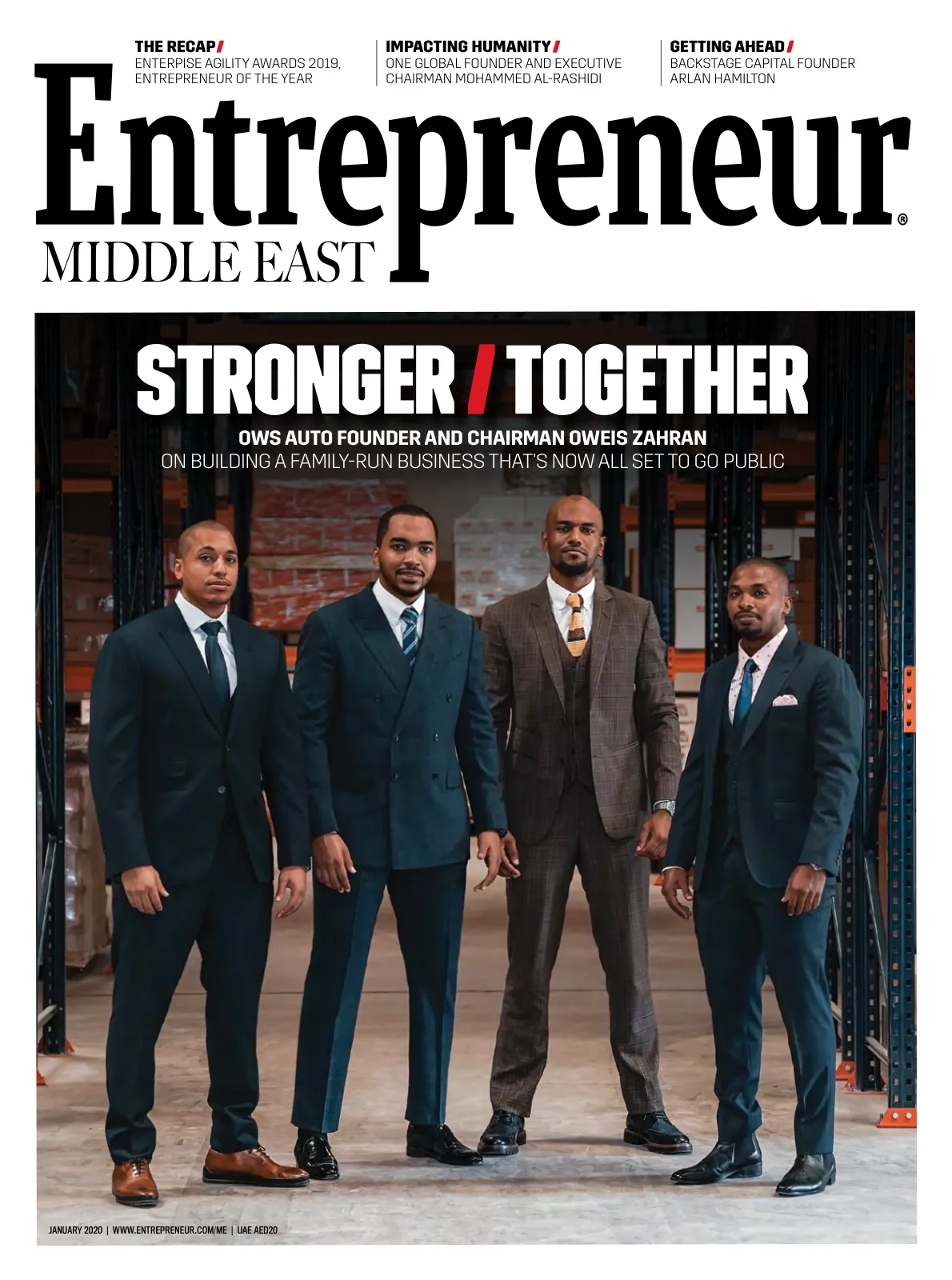
Entrepreneur Middle East, January 2020
Page 1
JANUARY 2020 | WWW.ENTREPRENEUR.COM/ME | UAE AED20
THE RECAP
ENTERPISE AGILITY AWARDS 2019,
ENTREPRENEUR OF THE YEAR
GETTING AHEAD
BACKSTAGE CAPITAL FOUNDER
ARLAN HAMILTON
IMPACTING HUMANITY
ONE GLOBAL FOUNDER AND EXECUTIVE
CHAIRMAN MOHAMMED AL-RASHIDI
STRONGER TOGETHER
OWS AUTO FOUNDER AND CHAIRMAN OWEIS ZAHRAN
ON BUILDING A FAMILY-RUN BUSINESS THAT’S NOW ALL SET TO GO PUBLIC
Page 2
experience
downtown
living
The UAE’s most exciting new destination.
A journey of discovery for the whole family.
Where nature, fun and entertainment
come together.
800-Arada (27232)
arada.com
Page 3
3
January 2020 / ENTREPRENEUR.COM /
49
CONTENTS JANUARY 2020
Vishen Lakhiani,
founder and CEO,
Mindvalley
20
INNOVATOR
STRONGER TOGETHER
Oweis Zahran
The founder and Chairman
of OWS Auto on building
a family-run business that’s
now all set to go public.
28
THE RECAP
ENTERPRISE AGILITY
AWARDS 2019
A look at the winners of
the 2019 Enterprise Agility
Awards, presented by
du, which recognized the
accomplishments made by
MENA entrepreneurs and
entities in their respective
industries.
48
CULTURE
LIFE
Turning points
As we get started on a new
a decade, here’s a look at
how lives (and businesses)
can change over a period of
10 years.
72
MONEY
VC
Getting ahead
(one day at a time)
Backstage Capital founder
Arlan Hamilton on starting
a VC firm that looks
out for underestimated
(aka underrepresented)
entrepreneurs.
56
CULTURE
LIFE
The only way is up
Life lessons from The
Pursuit Of Happyness
author, Chris Gardner,
on starting at the bottom,
and working your way to
the top.
78
START IT UP
ECOSYSTEM
Onward and upward
Abdelhameed Sharara,
founder of RiseUp
Summit, explores the
journey to growth of the
MENA entrepreneurial
ecosystem.
76
Dtec Forum,
powered by
Entrepreneur
Middle East
28
Wissam Younane, CEO, BNC Publishing,
at the Enterprise Agility Awards 2019
VISHEN LAKHIANI PHOTO BY ALLISAMAZING.COM
Page 4
du.ae/business-pos
Your window to expand.
Introducing Business POS for
cashless payments with better
transaction rates.
Page 5
Page 6
Page 7
Page 8
Page 9
Page 10
Memories create a journey you can always return to
©2019 The Ritz-Carlton Hotel Company, L.L.C.
Your urban adventure in the world’s most vibrant city begins with a luxurious stay at The Ritz-Carlton, Dubai International
Financial Centre. Indulge your senses with a serene experience in the comfort of our impeccable suites, enjoy the ease
of access to a bustling downtown with innovative food and beverage offerings, unforgettable arts scene, and world-class
shopping. On the sizzling evenings, retrieve to Sunken Garden for the best taste of local cuisine and ambiance. Whether
it’s a business trip, a family reunion, or a wedding anniversary, enjoy a memorable stay, and leave the rest to us.
Enjoy your Suite Upgrade Experience today. For reservations, please call +971 4 372 2555 or visit ritzcarlton.com/difc
Page 11
Page 12
12 / ENTREPRENEUR.COM / January 2020
56
CONTENTS JANUARY 2020
Life lessons from
The Pursuit Of Happyness
author, Chris Gardner,
on starting at the bottom,
and working your way to
the top
60
TECH
THE FIX
The next chapter
A look at the three
innovations that will shape
smart cities in 2020
(and beyond).
76
START IT UP
ECOSYSTEM
A (better) way to play
the odds
Deborah Webster on why
we need to rethink the way
we frame entrepreneurial
success stories.
70
START IT UP
ECOSYSTEM
It is time to celebrate our
true social heroes
Henrik Baerentsen makes
the case to recognize
and enable our social
entrepreneurs.
86
‘TREPONOMICS
MARKETING
Envisage the future
A new era of digital and
social communications
awaits us in 2020, writes
Gregg Fray.
54
CULTURE
LIFE
On the right track
The co-founder behind
NOW Money ME on what
you should do before you
leave your job to get going
on your startup idea.
84
START IT UP
Q&A
Distinctive by design
Faux Consultancy founder
Firras Alwahabi on paving
his own path to success.
80
START IT UP
Q&A
Smash the stress away
The Smash Room offers
an alternative approach to
have fun for your mental
health.
16
EDITOR’S NOTE
By Aby Sam Thomas
44
TECH
SHINY
#TamTalksTech
Gadgets and doodads
that you might’ve missed
out on, sourced by a tech
aficionado. Yes, it’s okay
to want them all… and
no, it’s not our fault.
18
IN THE LOOP
Disrupting the pet food
market
US-based startup Bond
Pet Foods Inc. gets a boost
from KBW Ventures and
other investors.
46
CULTURE
TRAPPINGS
‘Trep gear
The executive selection
for the entrepreneur
on your list that has
everything. Okay, maybe
for a little self-reward as
well.
46
81 designs
36 One Global founder and Executive Chairman Mohammed Al-Rashidi
is engineering a digital transformation revolution that is affecting the global landscape
Page 13
Nofa Resort Riyadh, a Radisson Collection Hotel
Radisson Blu Hotel & Residence, Riyadh Diplomatic Quarter
Radisson RED Hotel Dubai Silicon Oasis
Radisson Collection is a unique assortment
of iconic properties, allows individual identity,
limited conversion costs, fl exible terms.
Radisson Blu is the largest upper-upscale brand
in Europe. The Radisson brand leverages on
that network and off ers an urban solution for
effi cient real estate.
Radisson RED: A nimble & bold lifestyle
brand with a lean operating model at vibrant
destinations. Let’s PLAY!
radissonhotelgroup.com/development
C R E A T I N G O W N E R VA L U E
T H R O U G H E V E R Y T H I N G W E D O
GROW WITH US
Ramsay Rankoussi, Vice President
Middle East, Turkey & French Speaking Africa
ramsay.rankoussi@radissonhotels.com
Elie Milky, Vice President
Middle East, Greece & Cyprus
elie.milky@radissonhotels.com
Page 14
14 / ENTREPRENEUR.COM / January 2020
SUBSCRIBE
Contact subscriptions@bncpublishing.net to receive
Entrepreneur Middle East every issue
EDITOR IN CHIEF Aby Sam Thomas editor@bncpublishing.net
CEO Wissam Younane wissam@bncpublishing.net
DIRECTOR Rabih Najm rabih@bncpublishing.net
CREATIVE LEAD Odette Kahwagi
MANAGING EDITOR Tamara Pupic
STARTUPS SECTION EDITOR Pamella de Leon
GROUP SALES DIRECTOR – B2B GROUP Joaquim D’Costa
COLUMNIST Tamara Clarke
PO Box 502511 Dubai, United Arab Emirates
P +971 4 4200 506 | F +971 4 4200 196
For all commercial enquiries related to Entrepreneur Middle East
contact sales@bncpublishing.net
All rights reserved 2020.
Opinions expressed are solely those of the contributors.
Entrepreneur Middle East and all subsidiary publications in the
MENA region are officially licensed exclusively to BNC Publishing
in the MENA region by Entrepreneur Media Inc.
No part of this magazine may be reproduced or transmitted in any
form or by any means without written permission of the publisher.
Printed by United Printing and Publishing
upp.ae
Images used in Entrepreneur Middle East are credited when necessary. Attributed use of
copyrighted images with permission. All images not credited otherwise Shutterstock.
CONTRIBUTORS
entrepreneur.com/me
ACCESS FRESH CONTENT DAILY ON OUR WEBSITE!
MIDDLE EAST
EntMagazineME
@EntMagazineME
Entrepreneur-me
EntrepreneurMiddleEast
EntMagazineME
EntMagazineME
EntMagazineME
MIDDLE EAST
In addition to our print edition, we’re bringing
you all sorts of industry news on our web
mediums. Joining us online means getting
relevant business and startup content in
real-time, so you’re hearing about the latest
developments as soon as we do. We’re looking
forward to interacting with our readers on all of
our social media and web platforms- like any
thriving business, we’re looking to give and take.
#TrepTalkME is already happening on all of our
digi platforms, and all good conversations go
both ways. See you on the web!
Henrik Baerentsen
Marwan Bin Dalmook
Fida Chaaban
Tamara Clarke
Ian Dillon
Gregg Fray
Abdelhameed Sharara
Omar Tahboub
Deborah Webster
Page 15
CEO, ESAD MANPOWER SERVICES
AMER AL KHUSHAIL
ENTERPRISE AGILITY
AWARDS 2019
OF THE YEAR
FASTEST GROWTH AWARD
Page 16
16 / ENTREPRENEUR.COM / January 2020
I
got to chat with Backstage
Capital founder Arlan
Hamilton at the 2019
Sharjah Entrepreneurship
Festival, and one of the
things that stuck with me
following that conversa-
tion was in how the cel-
ebrated venture capitalist
described responding to
the critiques she gets for
her work. It’s a scenario that should
be familiar to all of you entrepre-
neurs out there- it can often seem
that just about everyone (and their
mothers) have a dozen thoughts
about what you’re doing with your
life and/or business, and not just
that, they are usually very eager to
share their mostly unsolicited ideas
on how you should be going about
things as well.
For Hamilton, she’s been subject
to comments that essentially tell
her how she should be going about
running her business, even though
most of the people saying these
things are basing their suggestions
on what they think is, or should be,
happening at the enterprise. But
when these kind of remarks come
her way, Hamilton has a decidedly
focused approach to dealing with
them. “The most important thing is
not what people think is happening
at Backstage, not what people think
we should be doing- it’s none of
that,” she said. “It is knowing the
North Star, knowing what’s the path
forward, in my view, and getting us
there… I'm doing what I feel is right
in the moment for the company, and
for the founders that we serve. I do
not serve the masters of opinion.”
I think Hamilton’s words struck
a chord with me because of my
propensity to take any kind of criti-
cism a bit too much to heart- I focus
so much on the apparent errors in
what I did that I forget that there is
often a purposeful reason for why
I did something a particular way.
This is not to say that I don’t get
things wrong, of course, but if Ham-
ilton’s words are any indication,
then I need to keep in mind that my
critics aren’t necessarily right all
the time either- and this applies for
entrepreneurs too. While keeping
yourself open to reactions and feed-
back is always good, at the end of
the day, only you should be deciding
what you should be doing with your
business, your career, and even your
life, for that matter.
Hamilton’s strategy to deal with
cynics thus seems worth adding to
one’s arsenal- I know I’m certainly
going to make use of it in 2020.
EDITOR'S NOTE
Aby Sam Thomas
Editor in Chief
@thisisaby
aby@bncpublishing.net
MINDING YOUR OWN BUSINESS
Tuning out
Backstage Capital founder Arlan Hamilton
Page 17
Visitor Badge
Pouches Sponsor
Lanyards
Sponsor
Carrier Bags
Sponsors
Convention Gate
Registration Sponsor
Category Sponsor
(Meat & Poultry)
Gold
Sponsor
www.aljameelfood.com
Platinum
Sponsor
Main Registration
Sponsor
Silver Sponsor
Organised By
*Valid Until
31st December 2019
Register Now:
gulfood.com/RegisterNow
50% OFF
ON YOUR
TICKET
16 - 20 FEBRUARY 2020
DUBAI WORLD TRADE CENTRE
Rethinking
Food
Join us as we celebrate the 25th edition
of Gulfood with industry veterans and step
into the future of the F&B world.
Now, we at Gulfood are
Celebrate
with us!
Category Sponsor
(Beverage)
Page 18
18 / ENTREPRENEUR.COM / January 2020
T
he lab-grown
meat industry is
getting a boost,
and this time,
even our furry
friends will feel
its impact too.
Bond Pets Foods
Inc., a US-based startup
utilizing biotechnology to
develop lab-made pro-
tein for pets, announced
the completion of its seed
funding round, totaling to
US$1.2 million. The round is
led by Lever VC, along with
Agronomics, KBW Ventures,
Plug and Play Ventures, and
Andante Asset Management.
Launched in 2017 by co-
founders Rich Kelleman and
Pernilla Audibert, the US-
based pet food manufacturer
employs the same fermenta-
tion technology that is used
to produce ingredients for
cheese making or insulin for
diabetics. Bond adjusts the
process to instead harvest
high-quality meat proteins
like chicken, turkey, beef,
and fish, but without the
animal.
With their proprietary
approach, animal muscle
protein genes are taken
from a farm animal, added
to a microbe such as yeast,
then put into a fermentation
tank, and fed simple sugars,
vitamins, and minerals.
This produces proteins that
are nutritionally identical
to their meat counterparts
without the environmental,
animal welfare, and safety
downsides. The ingredients
are then used as the foun-
dation of Bond’s complete
recipes.
With the new capital
infusion, the startup aims
to dive further into research
and development to boost
Bond’s animal production,
and also introduce its first
consumer product early next
year: a protein-packed dog
treat bar made with a pure
yeast protein. “This raise
gives us the capital to make
strides with our technology
and introduce pet parents
to a new and better way
of feeding their dogs and
cats,” said Rich Kelleman,
co-founder and CEO of Bond
Pet Foods. “We started Bond
to deliver high nutrition
to our pets without harm
to other animals or to our
planet, and we’re excited
to bring our transformative
products to the world in the
months ahead.”
Bond’s mission has got
the attention of HRH
Prince Khaled bin Alwal
bin Talal, CEO and founder
of KBW Ventures, to back
the concept. As a known
advocate for sustainability,
technology and animal
welfare, Prince Khaled
decided to join as an
investor “because we see
that their proprietary
approach to production has
far reaching implications.
The technology and science
behind Bond products is
in line with our values; we
want to back ventures that
are commercially-promising,
and that seek sustainable
solutions.”
bondpets.com | kbw-ventures.com
US-based startup Bond Pets Foods Inc. gets a boost
from KBW Ventures and other investors
IN THE LOOP
IMAGES COURTESY BOND PET FOOD | KBW VENTURES
HRH Prince Khaled bin Alwaleed bin Talal Al Saud, founder and CEO, KBW Ventures
Disrupting the pet food market
The Bond Pet Food team, left to rigth:
Co-founders Rich Kelleman, CEO, Pernilla Audibert, CTO, and Luis Brandao, Senior Research Scientist
Page 19
Page 20
20 / ENTREPRENEUR.COM / January 2020
OWS Auto team, left to right:
Hudaifa Zahran, Chief Financial Officer;
Oweis Zahran, founder and Chairman;
Mahmood Zahran, Business Development Manager;
and Talha Zahran, Rafid Operations Manager.
INNOVATOR
OWEIS ZAHRAN
The founder and Chairman of OWS Auto on building
a family-run business that’s now all set to go public
by TAMARA PUPIC
STRONGER
Page 21
21
January 2020 / ENTREPRENEUR.COM /
TOGETHER
Page 22
22 / ENTREPRENEUR.COM / January 2020
B
y the time
you read this,
OWS Auto, a
UAE-based
automotive group
consisting of
OWS Spare Parts
Sales, OWS Fleet
Maintenance,
and OWS
Automotive
Consultancy, will probably have
made its stock market debut. I had
talked to founder and Chairman
Oweis Zahran last month, which
was when he described his
company going public on Nasdaq
in January 2020 as the final leg of a
successful entrepreneurial journey.
“We are going public to confirm the
success of the company, and to
grow,” Zahran explains. “Our public
investors will enjoy a risk-free
business, because we know this
business so well that it will be very
difficult to fail. I’m very confident
in what’s next. Many people have
asked me, why share that success?
But when you go public, you are
creating very public partnerships,
and I believe that you grow through
partnerships.” One example of
this is in the joint ventures his
enterprise has formed with UAE
government entities - Rafid, AJ
Industries, and Etimad Auto. And
the measure of their significance is
in the numbers too: while his core
business employs approximately
75 people, the three joint venture
companies have 855 people on the
books. “Our joint ventures are much
larger than our own companies,”
Zahran explains. “That’s how I want
them to be because that’s smart
business. What that means is that
our heavy lifting is done on the joint
venture level. My risk is minimal.”
INNOVATOR
Oweis Zahran, founder and Chairman, OWS Auto
IMAGES COURTESY OWS AUTO | OWSAUTO.COM
Page 23
23
January 2020 / ENTREPRENEUR.COM /
It is certainly easy to get the
impression that it would be
very difficult for OWS Auto to
fail when you meet Zahran in
person. He has a calm, poised
demeanor, his answers are
self-assured and explained to
the tiniest details (he obviously
knows his business inside out);
by all means, there seems to
be no incongruity between
speech and action. Another
proof that he is wholeheart
edly committed to the concept
of partnerships is on our front
cover- forging strong bonds
starts from within the Zahran
family, and spreads throughout
all other areas of his life and
business. “When I pulled my
brothers into the business, it
was more to keep them off the
street, to make sure that eve
ryone is productive, but then
I saw something,” Zahran ex
plains. “Each and every one is
talented in different elements,
and those turned out to be all
which I myself suck in. For
example, my eldest brother is
excellent in finance, while my
youngest brother is a sucker for
details who will make sure that
we have ticked all the boxes be
fore a product is released. Very
quickly, I realized that this is a
unit that cannot be separated.
I’ve said this before, but there
really is a reason why there are
seven emirates [in the UAE].
Together, you are stronger.”
His three brothers have con
tributed to the company from
the very beginnings through
its exponential growth, with
Talha Zahran today serving
as Rafid Operations Manager,
Mahmood Zahran as OWS
Business Development Man
ager, and Hudaifa Zahran as
OWS Chief Financial Officer.
With new plans on the horizon,
Zahran says, the four of them
have already started discussing
who will be taking which new
responsibilities and where.
“Our approach is one of ‘divide
and conquer,’ born out of our
graduation from the learn
ing and growth that we have
received at OWS,” Zahran says.
“So, it’s not only me helping
them, but them helping me.”
Interestingly, it is our talk
about treating everyone with
respect, which Zahran insists
on, or a lack thereof, that shed
some light on a defining mo
ment that led to him starting
up OWS Auto in the first place.
When his Porsche broke down
some years ago, a dealer in
the UAE quoted AED9,000 to
get a starter repaired which,
Zahran explains, was hugely
overpriced. “And, the dealer
told me, ‘Toyota is cheaper.’
He looked down on me, and
made me feel cheap, and as if I
don’t matter, in a very arrogant
way.” This lack of kindness
(let’s describe it that way),
sparked the start of OWS Auto.
Zahran adds, “I went home
and removed the starter with
my own toolbox, sent it off to
the US, had it remanufactured,
and brought back here. When
the starter was installed, I took
the vehicle to the dealer who
thought it was brand new. In
fact, it was remanufactured,
but it had been done to such
a high quality that even they
could not tell the difference.
My point is that the whole ex
ercise cost me US$150, and so,
as a businessman, I saw a real
opportunity there. I started im
porting parts, and selling them
as remanufactured. Remanu
facturing will always be so dear
to my heart, because it sparked
all these other businesses.”
Before we delve deeper into
how OWS Auto expanded
into other business verticals,
Zahran explains the three
key elements that have made
it a preferred and trusted
partner of some of the UAE’s
government entities, starting
with OWS Auto’s first client-
Dubai’s Road and Transport
Authority (RTA). “Firstly, the
fact that remanufacturing
preserves the environment,” he
says. “Secondly, the fact that
our parts are higher quality
items than new ones. How this
industry works is that when
they manufacture a new vehi
cle, they make money on spare
parts, not the car. It is because
you will be buying spare parts
all your life, whereas your
car only one time. So, spare
parts are manufactured to
fail, not to last, but when they
are remanufactured, they are
designed to never fail. We give
a lifetime warranty on spare
parts. So, how we win the
business with the government,
is the environmental protec
tion, the quality, and the price,
because we are 60% cheaper
than other dealers. When we
“WHEN WE CONTROL
SPARE PARTS, WE CONTROL
EVERYTHING, BECAUSE
WE ARE NOT GOING TO THE
DEALERS, AND THUS THE
DUBAI GOVERNMENT HAS
SAVED MORE THAN AED1
BILLION OVER THE THREE
YEARS OF DEALING WITH US.”
STRONGER TOGETHER | OWEIS ZAHRAN, FOUNDER AND CHAIRMAN OF OWS AUTO, ON BUILDING A FAMILY-RUN BUSINESS
Oweis Zahran signing of contract with Omar Ahmed Bin Omair, Director General
of Ajman's Public Transportation Corporation
>>>
Page 24
24 / ENTREPRENEUR.COM / January 2020
control spare parts, we control everything,
because we are not going to the dealers,
and thus the Dubai government has saved
more than AED1 billion over the three
years of dealing with us.”
Today, OWS Auto includes OWS Spare
Parts Sales, OWS Fleet Maintenance Ser
vices, OWS Automotive Consultancy. “All
governments want one reliable partner,”
Zahran says. “The turning wheel effect on
our business was the remanufacturing ele
ment, but then it transitioned very quickly
into us becoming a full-service automo
tive solution provider for the government.
That’s what we are known for now, and no
longer spare parts, which is now just one
element. The bigger picture is that OWS
Auto is your partner to help you, as a gov
ernment, to regulate your automotive sec
tor. That will remain our ambition when
we expand into other markets. That’s what
the majority of our value is based on.”
A native New Yorker, Zahran has wit
nessed the growth of the region’s economy
from an early age, having travelled here
since the early 90s to help develop his
father’s MZ Holdings Group and its 16
subsidiaries. Over the years, he has learnt
that having a strong alliance with the
government is particularly important in
the GCC region. “The fact of the matter is
that with the region being so young, the
government is still very much hands-on
involved in almost everything,” he says.
“They do that in order to maintain a grip
over things, and make sure they don’t
lose control. To succeed as an entrepre
neur, I realized early on that you have to
team up with the government, if nothing
else, to understand the laws that are ever
changing. Also, when you partner with the
government to provide a service, you are in
a better position from a business perspec
tive to dictate the terms, and to provide
guarantees. As a government associated
entity, you will be bound to succeed.”
His respect for different cultures and
ability to build bridges with governmental
entities has remained a gift that kept on
giving. To provide an example, Zahran says
that his team is currently working on a
project which he describes as an insurance
telematics system for the local automo
tive sector. “One major advantage that
this system will add will be, for example,
when you have an accident, the telematics
system in the vehicle will communicate
directly with the first responder,” he says.
“Also, there’s a lot of insurance fraud
that we will be able to control. We will be
working along with the insurance author
ity of this country to dictate how that will
be done, and we will be the only platform
“our heavy lifting is done on the joint
venture level. My risk is minimal.”
The Zahran brothers at their No Games Crossfit gym opened
at the back of one of OWS Auto’s warehouses in the UAE
INNOVATOR
Page 25
25
January 2020 / ENTREPRENEUR.COM /
that the government is inter
facing with. So, millions of cars
on the road will have to see us.
That’s a prime example of what
I mean by how when something
does not exist, the government
is looking for a way to obtain
the right knowledge, and what
better way to do that other
than partnering with an expert,
and learning as you go.”
Year after year, Zahran says,
OWS Auto has been through
cycles of exponential growth.
Still, there have been many
painful lessons to be learnt
along the way. “Especially in
their first independent busi
ness, entrepreneurs tend to
forget that failure is okay, but
you have to know when to let
go,” he says. “I haven’t learnt
to let go yet, because instead
of letting go, and starting over
with fewer mistakes, I made
sure that this thing went
forward. Now, I’m glad I did it,
because it came back tenfold.
But if I could go back, I’m not
sure I would do that again.” In
2013, at the very start of OWS
Auto, he invested all his sav
ings into the business in order
to have it set on strong founda
tions, starting with building a
team of experts. However, not
all of it proved to be a fruit
ful endeavor. “I brought some
experts from the US, but age
and experience do not neces
sarily make you good, because
if you do something wrong for
30 years, it does not make it
right,” he says. “For example,
they were ordering spare parts
for cars that were not even
in this market. They were my
biggest downfall. What I would
do differently is letting go of
them quickly. It was not until I
took a more direct position in
the business, that the busi
ness succeeded. I rolled up
my sleeves with my brothers,
we fired all these highly paid
executives who were clueless,
and then we did it ourselves.
So, knowing when to let go of
people, relationships, even the
whole business, is important.”
However, when building a
family business, Zahran adds,
this rule has to be applied
cautiously when it comes to
the siblings involved in the
business. “Because, out of 10
family businesses, as per sta
tistics, six fail from within,” he
says. “That’s a scary number,
because your odds are to fail,
not to succeed. When you
work with people, you’ll have
problems, because people bring
problems in general. We’re
going to deal with it accord
ingly. When it’s your family,
you should give them an extra
chance, help them understand,
and learn why something is
important. It’s important to be
patient and invest more in it,
because if it works, the return
will be like nothing other.”
As for the future, OWS Auto
plans include expanding into
Saudi Arabia. “We will defi
nitely do it with the govern
ment, not privately,” Zahran
says. “We’ve been receiving
a lot of offers from people
wanting to sponsor us, or to
partner with us, but after what
we have learnt here, I like to
work in partnership with the
government. Ultimately, I want
to open a factory there, which
will supply this whole part of
the world. That’s what I mean
about not being possible for us
to fail, because I already have
a home for everything that the
factory will produce. The beau
tiful thing about our business
is that it is self-sustainable.
Everything we produce, we will
consume the majority of, and
then sell the extra, but 80% of
our success comes from within
the company.” Other expan
sion plans revolve around Asia
and South East Asia, including
China, Philippines, and Brunei.
“One of the princes of Brunei is
a very good friend of mine, and
we’ve been talking about that
market for a long time,” Zahran
says. “I think that that market
is very similar to the one here.
It’s not very large, but it’s very
important. I like the country
personally; it has a good appe
tite for our business with little
to no competition. We’ll have
a plant in the Philippines that
will support Asia and South
East Asia. The numbers there
are phenomenal, you have mil
lions of people. The Asia plans
will happen immediately after
IPO. That’s what the money
will be used for.” At the same
time, Zahran plans to also
dedicate more of his time to
his philanthropic engagements
in Africa -over the past seven
years, he has been facilitating
a provision of clean drinking
water to people in Ghana and
Nigeria- which is good enough
reason for us to wish that his
first IPO proves successful, and
helps accelerate these plans
sooner.
STRONGER TOGETHER | OWEIS ZAHRAN, FOUNDER AND CHAIRMAN OF OWS AUTO, ON BUILDING A FAMILY-RUN BUSINESS
“WHEN IT’S YOUR FAMILY,
YOU SHOULD GIVE THEM
AN EXTRA CHANCE, HELP
THEM UNDERSTAND, AND
LEARN WHY SOMETHING IS
IMPORTANT. IT’S IMPORTANT
TO BE PATIENT AND INVEST
MORE IN IT, BECAUSE IF IT
WORKS, THE RETURN WILL
BE LIKE NOTHING OTHER.”
Oweis Zahran,
founder and Chairman,
OWS Auto
Page 26
26 / ENTREPRENEUR.COM / January 2020
T
he world is in the midst of a
major transformation. Today’s
focus is on smart cities, mas
sive infrastructure projects,
higher education, the field of
healthcare, and the growth of financial
hubs. At the same time, changes to
digital infrastructure, transportation,
and government services are altering
the ways people work, live, and play in
major Middle Eastern markets. Various
stakeholders, including local government
officials, are making it their mission to
drive sustainable development forward,
whether the stakes are long-term eco
nomic transformation or modernisation
of people’s day-to-day lives.
Project professionals are essential to
this growth and transformation. Experts
with their skills, training, and vision can
help enterprises take ideas from imagi
nation and concept to execution; limit
the waste of precious resources (most
notably, human talent and money); and
help deliver value-driven outcomes that
are aligned with strategy.
The recent Dubai International Project
Management Forum (DIPMF) shined
a bright light on Dubai’s leading role
in driving the region’s development
through its successful adoption of
top-notch international standards for
a series of mega-projects that have
commanded global attention. The forum
demonstrated how smart, sustainable,
and innovative project management
practices can help bring private enter
prise and government projects alike to
successful outcomes.
As a global business hub, Dubai is a
perfect microcosm of the issues that
will shape the future of work across a
range of industries. The world at large
is increasingly becoming “projectized.”
Projects have emerged as
a key platform for deliver
ing value, and workers are
increasingly likely to take
on portfolios of projects
rather than to carry out a
static list of job responsi
bilities.
A recent study from Ac
centure found that 79
percent of executives
agreed the future of work
will be based more on
projects than on roles.
Organizations around the
world are increasingly
delivering their work and
value through projects—
and that means effective
project management
capabilities are in rising demand.
It’s little surprise, then, that people
allover the world are living and working
in The Project Economy. In The Project
Economy, individuals have the skills and
mindset to turn ideas into reality – no
matter what they’re working on. In Dubai
and elsewhere, technical skills will al
ways be indispensable to major projects.
But in The Project Economy, uniquely
human skills such as leadership, creativ
ity, empathy, and conflict resolution are
just as vital. Project professionals rely
on these so-called “soft skills” – which I
believe we should call “power skills” – to
transform strategy into reality.
Succeeding in The Project Economy
demands the following:
1/ Permission to be agile
It takes new openness, new structures,
and new skills to keep up with the way
work is being delivered in the modern
global economy. Business professionals
need unprecedented flexibility to choose
the tools and approaches that work best
in each situation. According to a recent
survey we conducted, 45 percent of
Middle East respondents confirmed that
they use an agile approach, compared to
55 percent globally.
We recognize evolving ways of working
can be challenging. That’s why the Proj
ect Management Institute (PMI) is ex
panding its offerings in the agile space.
With our recent acquisitions of Disci
plined Agile and FLEX, we are uniquely
positioned to help organizations and
individuals address new ways of work
ing by focusing on the entire spectrum:
from the process, to the team, to the
enterprise level, and to the challenge it
self. The Disciplined Agile toolkit provides
individuals, teams, and enterprises with
straightforward and practical guidance
to help choose their “way of working” to
yield the best results and achieve overall
business agility.
AS A GLOBAL BUSINESS
HUB, DUBAI IS A PERFECT
MICROCOSM OF THE ISSUES
THAT WILL SHAPE THE
FUTURE OF WORK ACROSS
A RANGE OF INDUSTRIES.
ADVERTORIAL
POWERING THE PROJECT ECONOMY
IN THE MIDDLE EAST
By Sunil Prashara, President and CEO, Project Management Institute
Page 27
27
January 2020 / ENTREPRENEUR.COM /
ADVERTORIAL
2/ Ability to bridge the gap
between strategy design
and delivery
Project management delivers
value when it successfully
implements strategic visions.
When strategy and execu
tion don’t align, there are
major business implications.
Region-specific data from our
2019 Pulse of the Profession®
survey shows that organiza
tions in the Middle East
waste an average of $104
million for every $1 billion of
project spending due to poor
project performance. That’s
better than the global aver
age of $119 million wasted for
every $1 billion invested, but
it’s still serious money.
Through our work on an initia
tive called Brightline™, we are
focused on empowering lead
ers to successfully transform
their organizations’ visions
into reality. In fact, we’ve
recently released a playbook
called the “Brightline Transfor
mation Compass” that helps
senior executives master the
challenge of transforming
organizations. It gives them a
process and the tools needed
to create a movement that
engages both internal and
external stakeholders, and it
helps deliver a better return
on their transformation
investment. The playbook
not only empowers leaders
to successfully drive their
organization’s transformation
initiatives, it will help them
inspire employees to undergo
their own transformations
and adopt a “perpetual mind
set.”
3/ Commitment to profes
sional development
As technology and automa
tion continue to accelerate,
organizations will demand
individuals with diverse abili
ties—including those with an
innovative mindset, a focus
on collaborative leadership,
and the ability to make data-
driven decisions—alongside
more specialized technical
skills in areas like data sci
ence, security and privacy
knowledge, and legal and
regulatory compliance.
To nurture both technical
skills and “power” skills, and
ensure their talent is ready to
tackle anything that comes
their way, organizations will
need to invest in training and
development. Organizations
like the Project Management
Institute are here to help. We
work with public and private
companies, government
entities, universities, youth
foundations, and more to
continuously prepare the
workforce to be able to man
age complexity, be agile, and
to develop the capabilities
they need to lead successful
projects that enable transfor
mation and success.
With rapid change and devel
opment happening all around
us, it is clear many of the
world’s toughest challenges
will only amplify the demand
for project professionals. We
know professionals in the
Middle East are ready to meet
the challenges and opportuni
ties of The Project Economy,
but we also recognize that
being able to access new
practices, resources, and
communities is critical to find
ing success in this new envi
ronment. That is why we exist:
to support project profession
als across the Middle East
and in every part of the globe.
We power the people who
power The Project Economy.
Together, we’re strengthening
society by enabling organiza
tions and helping people turn
ideas into reality.
Sunil Prashara, President and CEO, Project Management Institute
Page 28
ENTERPRISE
AGILITY
AWARDS 2019
OF THE YEAR
presented by
SUPPORTED BY
ECOSYSTEM PARTNERS
A PRODUCTION BY
TECH PARTNER
28 / ENTREPRENEUR.COM / January 2020
Page 29
H
eld on Wednesday,
December 11, 2019
at the Rixos Premi-
um Dubai, Entrepre-
neur Middle East’s
2019 Enterprise
Agility Awards, presented by
du, honored individuals and
businesses who have demon-
strated hardworking entre-
preneurial ethos, delivering
growth and prosperity for
their community.
The 2019 Enterprise Agility
Awards, presented by du,
was staged with the support
of Dubai Chamber of Com-
merce and Industry and Dubai
Startup Hub, along with Eco-
system Partners in5, Dubai
Internet City, and Dubai
Media City, and Tech Partner,
LifeOnScreen.
This year’s instalment of
the event, now in its sixth
edition, was a production of
BNC Publishing, the media
house behind Entrepreneur
Middle East, and saw a total
of 25 awards presented at
the ceremony, with all of the
winners having exhibited
outstanding business conduct
in the MENA region.
In his address to the gather-
ing, Wissam Younane, CEO,
BNC Publishing, reflected on
the twists and turns in the
business landscape over the
past year, while also reiter-
ating Entrepreneur Middle
East’s commitment to enable
and boost the entrepreneurial
ecosystem in the region.
“While we have had some
amazing highs over the course
of 2019, we’ve also had some
pretty low periods as well,”
Younane said. “And while
this is to be expected in any
business landscape, I think
you’ll all agree with me in
saying that such periods can
be incredibly tough for small,
young enterprises like ours.
During these tough times,
many have come up to me
asking if I had a backup op-
tion, and I’ve always stayed
resolute to the idea that we
are doing something good and
important with Entrepreneur
Middle East, and as such, we
are simply going to stick it
out, and find a way to make it
work.”
Wissam Younane,
CEO, BNC Publishing
The winners of Enterprise Agility Awards 2019
29
January 2020 / ENTREPRENEUR.COM /
Page 30
Human Capital
UAE Ministry of
Health and Prevention
Training And
Development Center
Presented by Adel Alrais,
Senior Director Marketing
Communications, du
ARCHITECTURE AND DESIGN INNOVATION JT + PARTNERS
EXECUTIVE OF THE YEAR JYOTSNA HEGDE, PRESIDENT, SOBHA REALTY
HUMAN CAPITAL UAE MINISTRY OF HEALTH AND PREVENTION TRAINING
AND DEVELOPMENT CENTER
INNOVATION IN ENTERTAINMENT MARKETING SARAH OMELEWU,
FOUNDER AND MANAGING PARTNER, MAVEN MARKETING AND EVENTS
DIVERSIFIED SERVICES BIZNET CONSULTING
FASTEST GROWTH AMER AL KHUSHAIL, CEO, ESAD MANPOWER SERVICES
INNOVATION IN HEALTHCARE OKADOC
SME BANK OF THE YEAR EMIRATES ISLAMIC BANK
YOUNG ENTREPRENEUR OF THE YEAR OWEIS ZAHRAN, FOUNDER AND CEO,
OWS AUTO
ISLAMIC BANK OF THE YEAR DUBAI ISLAMIC BANK
YOUNG CEO OF THE YEAR OMAR JACKSON, PARTNER, BERKELEY ASSETS
CORPORATE SERVICE PROVIDER OF THE YEAR VIRTUZONE
INNOVATION IN FOOD AND BEVERAGE PAUL EVANS, MANAGING DIRECTOR,
SOLUTIONS LEISURE GROUP
DIGITAL TRANSFORMATION EVOTEQ
FINTECH INNOVATION MOHAMMED AL-RASHIDI, EXECUTIVE CHAIRMAN,
ONE GLOBAL GROUP
REAL ESTATE COMPANY OF THE YEAR SOBHA REALTY
INNOVATION IN FACILITY MANAGEMENT TARIQ CHAUHAN,
GROUP CHIEF EXECUTIVE OFFICER, EFS FACILITIES SERVICES GROUP
INTERNATIONAL EXPANSION MANOJ SHROFF, FOUNDER AND CHAIRMAN,
NITI GROUP
CSR SHEIKH ABDUL AZIZ BIN ALI AL NUAIMI, GREEN SHEIKH
ECOSYSTEM ENABLER OF THE YEAR DUBAI TECHNOLOGY ENTREPRENEUR
CENTER (DTEC)
MENTOR OF THE YEAR PRASHANT K. GULATI, FOUNDER, THE ASSEMBLY
APP OF THE YEAR CAFU
HOMEGROWN BRAND OF THE YEAR TRESIND
DIGITAL STARTUP HUB OF THE YEAR STARTUP BAHRAIN BY THE ECONOMIC
DEVELOPMENT BOARD OF BAHRAIN
Young Entrepreneur of the Year
Oweis Zahran, founder and
CEO, OWS Auto
Presented by Wissam Younane,
CEO, BNC Publishing
Young CEO of the Year
Omar Jackson
Presented by Wissam Younane,
CEO, BNC Publishing
ENTERPRISE AGILITY
AWARDS 2019
30 / ENTREPRENEUR.COM / January 2020
Page 31
Architecture and
Design Innovation
JT + Partners
Presented by Adel Alrais,
Senior Director Marketing
Communications, du
Fastest Growth
Amer Al Khushail
Presented by Adel Alrais,
Senior Director Marketing
Communications, du
Fintech Innovation
Mohammed Al-Rashidi,
Executive Chairman,
One Global Group
Presented by Wissam Younane,
CEO, BNC Publishing
Mentor of the Year
Prashant K. Gulati
Presented by Wissam Younane,
CEO, BNC Publishing
ENTERPRISE AGILITY
AWARDS 2019
31
January 2020 / ENTREPRENEUR.COM /
Page 32
CSR Award
Sheikh Abdul Aziz
bin Ali al Nuaimi,
The Green Sheikh
(Accepted on his behalf)
Presented by Wissam
Younane, CEO,
BNC Publishing
Executive Of The Year
Jyotsna Hegde,
President, Sobha
Realty
Presented by Adel Alrais,
Senior Director Marketing
Communications, du
Islamic Bank of the Year
Dubai Islamic Bank
Presented by Wissam Younane,
CEO, BNC Publishing
SME Bank Of The Year
Emirates Islamic Bank
Presented by Wissam Younane,
CEO, BNC Publishing
ENTERPRISE AGILITY
AWARDS 2019
32 / ENTREPRENEUR.COM / January 2020
Page 33
App of the Year
CAFU
Presented by
Wissam Younane,
CEO, BNC Publishing
Diversified Services
Biznet Consulting
Presented by Adel Alrais,
Senior Director Marketing
Communications, du
Innovation
in Healthcare
Okadoc
Presented by Adel Alrais,
Senior Director Marketing
Communications, du
Real Estate
Company of the Year
Sobha Realty
Presented by Wissam Younane,
CEO, BNC Publishing
Outstanding Contribution
to Business
Sharjah Media City, Shams
Presented by Wissam Younane,
CEO, BNC Publishing
Katie Overy,
emcee
ENTERPRISE AGILITY
AWARDS 2019
33
January 2020 / ENTREPRENEUR.COM /
Page 34
Innovation in
Entertainment Marketing
Sarah Omelewu, founder and
Managing Partner, Maven
Marketing and Events
Presented by Adel Alrais,
Senior Director Marketing
Communications, du
International Expansion
Manoj Shroff, founder
and Chairman, Niti Group
Presented by Wissam
Younane, CEO, BNC Publishing
Homegrown Brand
of the Year
Tresind
Presented by Wissam
Younane, CEO,
BNC Publishing
Facility Management
Tariq Chauhan, Group Chief
Executive Officer,
EFS Facilities Services Group
Presented by Wissam Younane,
CEO, BNC Publishing
Digital Transformation
Evoteq
Presented by Wissam Younane,
CEO, BNC Publishing
ENTERPRISE AGILITY
AWARDS 2019
34 / ENTREPRENEUR.COM / January 2020
Page 35
Digital Startup Hub
of the Year
Startup Bahrain by
the Economic Development
Board of Bahrain
Presented by Wissam Younane,
CEO, BNC Publishing
Ecosystem Enabler
of the Year
Dubai Technology
Entrepreneur Center, DTEC
Presented by Wissam Younane,
CEO, BNC Publishing
Corporate Service
Provider of the Year
Virtuzone
Presented by Wissam Younane,
CEO, BNC Publishing
Food and Beverage
Paul Evans, Managing Director,
Solutions Leisure Group
Presented by Wissam Younane,
CEO, BNC Publishing
ENTERPRISE AGILITY
AWARDS 2019
35
January 2020 / ENTREPRENEUR.COM /
Page 36
36 / ENTREPRENEUR.COM / January 2020
IMAGES COURTESY ONE GLOBAL
IMPACTING
HUMANITY
ONE GLOBAL FOUNDER AND EXECUTIVE CHAIRMAN
MOHAMMED AL-RASHIDI
This Kuwaiti national is engineering a digital transformation
revolution that is affecting the global landscape
by ABY SAM THOMAS
O
nly a few minutes into my conversation with
One Global (Og) founder and Executive Chairman
Mohammed Al-Rashidi, I find myself struggling
to follow and keep track of his career so far, and
that’s because this enterprising Kuwaiti national
has accomplished and achieved so much in
so many different, diverse fields that one can’t
help but wonder what the rest of us are doing with our
lives. From working in sectors as varied as telecom, fintech,
and more, to launching and leading several startups out
of Kuwait, Al-Rashidi, the winner of the Fintech Innovation
award at Entrepreneur Middle East’s 2019 Enterprise Agility
Awards, has been tapping into the pulse of the Middle East’s
entrepreneurial arena for a long time now, and he’s showing
no signs of slowing down anytime soon.
ENTERPRISE AGILITY
AWARDS 2019
>>>
Page 37
37
January 2020 / ENTREPRENEUR.COM /
IMPACTING HUMANITY | ONE GLOBAL FOUNDER AND EXECUTIVE CHAIRMAN MOHAMMED AL-RASHIDI
Page 38
38 / ENTREPRENEUR.COM / January 2020
One Global, which Al-Rashidi charac
terizes as a digital transformation and
innovation company, kicked off operations
in 2004, and it today boasts of a global
footprint in more than 16 countries across
MENA, Europe, and North America. Its
offerings fall in the digital economy space,
which include everything from supply
chain finance and distribution, procure
ment, payment acceptance and collec
tion, automation of settlements to bank
accounts, cards, and wallets, and more. At
the same time, Og Global has also built a
marketplace that provides capabilities and
acceleration services to businesses across
the spectrum, which include startups,
SMEs, and large enterprises. With a range
of ventures like Og Money (a mobile
financial services and payment platform,
formerly known as PayIt), Og Business (a
digital payment acceptance and collection
platform), and other such digital enter
prises under One Global’s helm, it’s not
hard to see why this diversified company
bills itself as “an innovative solution
provider with its premium digital services
that elevate humanity with digital trends.”
As for Al-Rashidi himself, who also won
the Digital Transformation Leader of the
Year title at Fintech Galaxy’s 2019 FinX
Awards, he’s clearly in his element as a
forward-thinking disruptor, and that’d
explain his passion for what he does on a
day-to-day basis. He recalls how, in 2010,
he had put his company on a roadmap to
become a digitally centered enterprise
in the next 10 years, and now, as we inch
closer toward 2020, Al-Rashidi’s sense
of accomplishment is unmistakable as he
reflects on how One Global has gone above
and beyond in realizing that particular
goal. “We are proud to say that we are dig
ital natives today,” he declares, pointing
toward how One Global has carved out a
unique space for itself in the region’s tech
space by forging several of its innovations
in-house, be it with its cloud technology,
or through the slew of applications that
have been developed based off it. Today,
through his enterprise’s deep dives into
artificial intelligence and machine learn
ing, or with its experiments on block
chain and cryptocurrencies, Al-Rashidi is
making it clear that he wants One Global
to be constantly ahead of the curve when
it comes to the adoption of new tech
nologies, and thus ensure the business’
sustainability in the long term.
But it’s not just the revenue figures that
are pushing Al-Rashidi ahead with his
vision and mission of his enterprise, and
this becomes apparent when he responds
to a question about his personal driver
for all that he gets up to with One Global.
“Social impact,” he declares. “I’d like
to help people live better lives.” At first
glance, this might seem like a rather staid
statement- but looking at what Al-Rashidi
and his team at One Global have accom
“WE ARE PROUD TO SAY THAT
WE ARE DIGITAL NATIVES TODAY.”
Mohammed Al-Rashidi,
Founder And Executive Chairman,
One Global
ENTERPRISE AGILITY
AWARDS 2019
Page 39
39
January 2020 / ENTREPRENEUR.COM /
ONEGLOBAL.COM
plished over the years makes
it clear that this is not just a
throwaway reply. Consider,
for instance, the company’s
efforts (and wins) in the online
payments domain through Og
Money- Al-Rashidi and his
team have essentially managed
to change people’s behaviors in
that, where they’d once have
to physically go to a location to
pay a particular bill, they are
able to do such transactions
now through a tap on their
mobile phones. In fact, when
One Global revealed its bill
payment and top-up offering
on Blackberry devices in 2009,
it was a revolutionary concept
at the time, with the company
having been the first in the re
gion to have actually launched
this offering.
And if we are to look for
someone to whom One Global’s
forward-thinking approach
to tech can be drawn back to,
then it’d have to be Al-Rashidi
himself, as it’s clear that he is
setting the tone at the top for
how his enterprise and his em
ployees function. “It’s a good
thing we are doing something
that we are passionate about,”
Al-Rashidi says. “We are feel
ing that we are having a value
in people’s lives.” Another
example of how One Global’s
offerings have impacted
people’s lives can be seen in
its foray into Sudan, where, in
2009, it had launched a mobile
money transfer service called
Saraf Mobile. The system,
which allowed users to both
make transfers and payments
using their mobile phones,
was a gamechanger on Sudan’s
financial landscape, as the full
potential of mobile remittances
in the country hadn’t been
tapped into until Saraf Mobile
came into the picture. Not only
did the platform see itself be
ing swiftly adopted by people
in Sudan, Saraf Mobile’s policy
of hiring people from the local
communities to be its agents
also resulted in an elevation
in the standards of living for
many in the country. “It was
a totally new disruption,” Al-
Rashidi remembers. “It was a
big milestone in our company’s
journey.”
At this point, for all of the
achievements that Al-Rashidi
can profess to today, it’s im
portant to note that he has had
to navigate a lot of twists and
turns along the way. After all,
while entrepreneurs in the re
gion today can find themselves
almost bombarded with sup
port in the form of mentorship
and funds, this was certainly
not the state of the ecosystem
when Al-Rashidi got started
on his entrepreneurial journey.
He’s had to go through every
thing from seeing his opera
tions get shut down owing to
issues with regulatory bodies,
to realizing that, sometimes,
the innovations he presented
to the market were simply too
ahead of their time. Yet, it’s all
of these experiences that have
made Al-Rashidi the resilient
entrepreneur that he is today,
and they have also put him
in a place where he can offer
actionable advice to startups
that are only getting started
on their business trajecto
ries. “Believe in your talent,”
Al-Rashidi says, when asked
to share the biggest lessons he
has learned from his entrepre
neurial endeavors so far. He
follows that up with a note for
those wanting to be entre
preneurs to realize they don’t
necessarily have to go out on
their own to exercise that kind
of a mindset. “You don’t have
to be an entrepreneur- you can
be an intrapreneur,” he says.
“So, bring change inside the
organization you are in today,
so that you can find out what
you are capable of first… Being
alone out there, after all, is not
easy. It needs a lot of skill and
talent to do that.” >>>
IMPACTING HUMANITY | ONE GLOBAL FOUNDER AND EXECUTIVE CHAIRMAN MOHAMMED AL-RASHIDI
Mohammed Al-Rashidi
won the Fintech Innovation
award at the 2019
Enterprise Agility Awards
Page 40
40 / ENTREPRENEUR.COM / January 2020
Now, given the professional and personal
hurdles that entrepreneurs will have to
face while on their chosen careers, Al-
Rashidi also recommends that they make
it a point to get the right kind of support
along the way. “Pick the right partner,” he
says. “This partner is the one who will be
lifelong with you. So, you have to pick the
right partner to support you- not only to
support you financially or work-wise, he
or she will also become your coach and
mentor when you have to move through
tough times… You have to find someone
that is always trying to push you up, not
get you down.” This is the same ethos that
Al-Rashidi pushes through in his next bit
of advice, which is something all worthy
executives always mention when it comes
to explaining how they went about build
ing their successful businesses, and that
essentially comes down to making the
effort to build a strong, impactful team
for your enterprise. (“That’s an invest
ment that will pay you back in droves,”
Al-Rashidi says.) When it comes to his
final pointer for entrepreneurs in Kuwait,
the region, and beyond, Al-Rashidi looks
back at his own career trajectory, given the
number of years it has spanned, as a nod
to what his peers in the ecosystem should
gear themselves up for. “Patience,” Al-
Rashidi declares. “You need to be patient.
Success will come- despite the dark times
you may find your
selves in, despite
the fights you have
to be in, despite
the challenges you
have to face… It
will come, if you
have the right
team, if you have
the right partner, if
you believe in what
you do, and if you
are patient. It will
come.”
As for what’s next
for Al-Rashidi and
One Global, the
entrepreneur can’t seem to contain his
excitement for the next stage of evolu
tion his business is going to undertake
starting from 2020. Among the tasks lined
up is a major rebranding effort, with the
creation of a new logo for One Global,
which will then become the central theme
from which all of the entities under the
company’s banner derive their respective
identities. On the business side of things,
Al-Rashidi notes that his company, hav
ing realized the objectives laid out in its
previous ten-year plan dating from 2010
to 2020, is now embarking on a new long-
term strategy for One Global to govern
its operations until 2025. When asked
what is entailed in this new vision for One
Global, Al-Rashidi replies, “We are going
to offer smart life as a service, and that's
going to be our company's mission for the
next five years until 2025.” Al-Rashidi
also reveals that plans are already afoot
within his enterprise to launch what he
claims will be the first “super app” in the
region, much like WeChat in China. He
also adds that his company is also working
on building a first of its kind decentral
ized financial services marketplace in the
region, which, besides helping banks and
other financial institutions to digitally
transform, will also foster the growth of
startups, by allowing them to expedite the
launch of their digital financial services.
With these just being a few of the many
initiatives that Al-Rashidi is leading at
One Global, it seems like he’s once again
aiming to do a lot in a relatively short span
of time- but if the success he has seen so
far is any indication, it’s fair to say that the
prospects for his new ventures look to be
very good as well.
“WE ARE GOING TO
OFFER SMART LIFE AS
A SERVICE, AND THAT'S
GOING TO BE OUR
COMPANY'S MISSION
FOR THE NEXT FIVE
YEARS UNTIL 2025.”
ENTERPRISE AGILITY
AWARDS 2019
Mohammed Al-Rashidi,
Founder And Executive Chairman,
One Global
Mohammed Al-Rashidi won
the Digital Transformation
Leader of the Year title at Fintech
Galaxy’s 2019 FinX Awards
Page 41
Page 42
42 / ENTREPRENEUR.COM / January 2020
For someone who’s known to add an
entrepreneurial, innovative flair to eve
rything he does, it shouldn’t come as too
much of a surprise that Jackson -whose
career so far has seen him venture into
industries as varied as e-commerce,
cryptocurrency, and, now, private eq
uity- is applying that same logic to the
way he goes about managing the people
who work under him at Berkeley Assets.
“In our organization, we’ve created a
space that allows the partners to lead
in the most efficient way possible,” he
explains. “There is only one person who
reports directly to us, and they in turn
then manage the team. We believe this
is an intelligent way to work when you
have the right quality individual in place,
because they’re able to embody the
culture you set in place. A middleman
or middlewoman between you and the
rest of the team ensures the leaders can
develop the future of the business, while
the clients are all properly managed in
an ethical, efficient, and productive way.”
FOLLOW
THE LEADER
BERKELEY ASSETS PARTNER
OMAR JACKSON
H
aving won the
Young CEO of
the Year title at
Entrepreneur
Middle East’s 2019
Enterprise Agility
Awards, Berkeley Assets
Partner Omar Jackson does
seem like the right person to
go to if one were to seek out
advice on being an effective
leader, and when asked
about his particular strategy
in this regard, he replies that
he is a proponent of leading
by example. “If you’re a
good leader, your team
will follow you, and will be
influenced by your own hard
work, ethics, mindset, and
positivity,” Jackson says.
“By embodying the type of
person you want all your
members to be, there is a
natural knock-on effect that
will impact your productivity
in a positive way.”
ENTERPRISE AGILITY
AWARDS 2019
Page 43
43
January 2020 / ENTREPRENEUR.COM /
But for a structure like this to work at
an organization, Jackson makes it clear
that it falls upon the top-level leader
ship to install a company strategy that’s
translated well across all levels of the
enterprise. “If the company strategy
is communicated efficiently, it means
that operations, sales, IT, accounts
are all reading off the same script,”
Jackson explains. “Everyone is in line
with the company culture and attitude.
When someone deviates from that, it’s
important that that is recognized and
channeled, and depending on the indi
vidual, it’s important to have the right
personalities leading the team to know
how best to deal with different individu
als and personalities. This all ultimately
leads to a well-oiled machine, a team
that is functioning to their best abilities,
and the company getting the best per
formance out of them.” Now, while such
an exercise can bring with it a number of
challenges, a lot of them can be miti
gated if one has, in the first place, put in
the requisite time and effort to get the
best people to be a part of one’s team.
“Finding a good executive team comes
down to knowing what your company
culture is, and what your operational
strategies are,” Jackson says. “When you
know what direction you’re moving in as
a company, you will know what kind of
individuals you need to fit.”
When it comes to Berkeley Assets,
Jackson is clear that his enterprise is
here to shake things up in the private
equity industry, and that forward-think
ing approach is what is governing how
it acts in the business world at large, as
a multi-asset private equity firm with
a strong, diversified portfolio of invest
ments across the real estate, hospital
ity, logistics, and technologies sectors.
“Like other private equity firms, we raise
capital from our partners, from banks,
and from institutional investors, but
what makes us different is that we also
allow private individuals to place capital
with us for fixed rates of return, offering
retail clients a safe and reliable source
of income, whilst giving us access to low
cost capital,” Jackson says. He also notes
that his company differentiates itself in
the manner it works and interacts with
its clients. “One of our main business
principals in our approach to clients
is to deliver active management with
no surprises,” he explains. “We ensure
clients understand the investment, they
understand what they’re investing in,
the features, the risks, and the benefits.
We communicate with clients in advance
about what we intend to do, we tell them
when we’re doing it, and we tell them
when we’ve done it. For us, it’s about
taking care of client money, and securing
appropriate investments for their funds
which fit with their circumstances. We
invest in propositions where there are
very tangible assets and not physical
security, but a tried, tested, and proven
investment.”
When asked why Berkeley Assets is
going down what could be seen as an
arguably unconventional route for a pri
vate equity firm, Jackson points out that
he sees it simply as a means to capitalize
on a rather untapped market. “In today’s
hyper-connected world, people want
to be part of the best opportunities out
there,” Jackson says. “Private equity is
the best way of protecting and invest
ing large sums of money. It’s what the
ultra-high net worth individuals do, so
why shouldn’t it be accessible to more
people? We see this as an innovation in
the finance industry. Going back 15 or 20
years ago, the concept of trading money,
stocks and shares, was seen as ‘cool.’ It
was a fun thing to do, and a way to make
money. Today, it’s considered untrust
worthy with high fees. We’re bringing
the fun back into placing your hard-
earned capital. Our low-risk strategy,
predominantly with UK- and US-asset
backed businesses which we can see and
touch, means that we’re offering a life
style option to people who want to invest
GBP50,000 or US$50,000 or more.”
As Jackson points out, all of this is a
reflection of how Berkeley Assets strives
to do things differently from the rest of
its peers in the market, and as far as he
is concerned, this kind of innovation is
absolutely necessary in order to ensure
its long-term success. “You see case
studies all the time now of businesses
that didn’t innovate,” Jackson notes. “No
one wants to be the next Blockbuster
Video.”
FOLLOW THE LEADER | BERKELEY ASSETS PARTNER OMAR JACKSON
“WE’RE BRINGING THE FUN
BACK INTO PLACING YOUR
HARD-EARNED CAPITAL.
OUR LOW-RISK STRATEGY,
PREDOMINANTLY WITH
UK- AND US-ASSET BACKED
BUSINESSES.”
Omar Jackson won the
Young CEO of the Year title at
Entrepreneur Middle East’s 2019
Enterprise Agility Awards
Page 44
44 / ENTREPRENEUR.COM / January 2020
Fitbit Versa 2 builds on the suc-
cess of its predecessor with all
new features. Versa 2 debuts an
on-device microphone, which brings
Amazon Alexa to your wrist to help
with anything from finding the
nearest gym, to researching calorie
counts. If you depend on Spotify
to keep you moving, you’ll love the
Spotify app experience, which allows
premium subscribers to control
music, podcasts, and so much more.
If the music streaming service isn’t
your thing, don’t worry. Versa 2 can
store and play more than 300 songs
from your personal music library.
Additionally, Versa 2 works hard
while you rest with improved sleep
features. The smartwatch gives
you up to five days of battery life,
unless it’s on the “always on” mode,
which promises two days of battery
life. Fitbit Versa 2 boasts a larger
AMOLED display with crisp color
rendering, and its aluminium casing
pairs with an array of silicone bands
to keep you healthy and stylish.
GADGETS AND DOODADS THAT YOU MIGHT’VE MISSED OUT ON, SOURCED BY A TECH AFICIONADO.
YES, IT’S OKAY TO WANT THEM ALL… AND NO, IT’S NOT OUR FAULT.
GET IN GEAR
FITBIT VERSA 2
IMAGES COURTESY FITBIT | BOSE | DJI
TECH SHINY
Fitbit Versa 2
Page 45
45
January 2020 / ENTREPRENEUR.COM /
#TAMTALKSTECH Tamara Clarke, a former software development professional, is the tech and lifestyle enthusiast behind The Global Gazette, one
of the most active blogs in the Middle East. The Global Gazette has been welcomed and lauded by some of the most influential tech brands in the
region. Clarke’s goal is to inform about technology and how it supports our lifestyles. See her work both in print regional publications and online on
her blog where she discusses everything from how a new gadget improves day-to-day life to how to coordinate your smartphone accessories.
Visit theglobalgazette.com and talk to her on Twitter @TamaraClarke.
LEARN AND PLAY
DJI ROBOMASTER S1
#TAMTALKSTECH | GADGETS AND DOODADS THAT YOU MIGHT’VE MISSED OUT ON
RoboMaster S1 gives you
an easy and fun introduc-
tion to artificial intelligence
(AI), engineering, and
robotics. Simple controls,
a dedicated RoboMas-
ter app, and a wealth of
tutorials make S1 ideal for
newcomers, while more
advanced features like us-
ing Scratch 3.0 or Python
to program unique func-
tions meet the needs of
advanced users. With pow-
erful brushless motors, a
chassis that moves in all
directions, a high-precision
gimbal, and interactive
modes, the device makes
programming, playing, and
competing a snap. You
might feel a bit out of your
depth, but you’ll learn a
lot while assembling des-
ignated and custom hard-
ware, maneuvering the
rover, programming and
competing with friends in
multiplayer battle modes.
RoboMaster S1 can be
used for your own amuse-
ment, or shared with a
kid in your life who’s likely
already smarter than you.
DJI RoboMaster S1
Bose 700 noise
cancelling headphones
BLOCK IT OUT
BOSE 700 NOISE CANCELLING HEADPHONES
Bose 700 ushers in a new
generation of noise cancelling
headphones by dramatically
increasing voice pickup while
also eliminating noise at
the same time. Bose 700’s
adjustable noise cancellation
feature lets you decide how
much background noise you
want to hear, with the high-
est setting delivering total si-
lence, or Conversation Mode,
which lets in ambient noise–
ideal for times like when
you’re in the airport and you
need to hear announcements.
The headphones have touch-
enabled features for common
commands like answering
calls, pausing music, or
skipping tracks. Of course,
the basics are covered too,
as you can enjoy listening
to crystal clear music. With
a lightweight, seamless
design, and up to 20 hours
of battery, Bose 700 Noise
Cancelling Headphones are
ideal for all day use. Even
better, the headphones fold
flat and store neatly in a
thin, hard case, making it an
optimal choice for must-have
travel gear.
Bose 700
Bose 700
Page 46
46 / ENTREPRENEUR.COM / January 2020
FASHION FORWARD
KITON
Founded in Naples in the 1960s, the Italian house of
Kiton has been known for its bespoke offerings and skilled
tailoring since it launched, but the brand’s style has also
evolved to suit a more modern demographic. Kiton’s Fall
2019/2020 line showcases its made-to-order vicuña
jacquard blazers, constructed out of one of the softest
and finest of fabrics. Soft and featherlight to the touch,
the textured fabric has been cut into relaxed blazers,
matched with garment-washed denim for a luxurious
and comfortable feel, in shades of navy blue, cool grey,
and suede brown. Constructing a line that blurs the lines
between formal wear and smart casual, the new Kiton
collection is ideal for any time of the day. kiton.com
Brioni SS19
Brioni SS19
CULTURE TRAPPINGS
IMAGE CREDIT KITON | PARMIGIANI FLEURIER | WOLF | MOSCHINO
‘TREP TRIMMINGS
THE EXECUTIVE SELECTION
From better goods to better wardrobe bests,
every issue we choose a few items that make
the approved executive selection list. In this
issue, we present our picks from Kiton’s Fall
2019/2020 collection, a new scent that’s worth
the splurge, and more.
Digel
Autumn/Winter
2019
Kiton Fall 2019/2020
Kiton Fall 2019/2020
Kiton Fall 2019/2020
Page 47
47
January 2020 / ENTREPRENEUR.COM /
'TREP TRIMMINGS | THE EXECUTIVE SELECTION
MAKE EVERY MOMENT COUNT
WOLF
With its roots dating back in 1834 in Hanau, Germany,
Wolf is a family-led horology company that wants to
embody celebrating a life worth living, and that paradigm
is being exemplified in its Memento Mori (a Latin phrase
that translates to “remember death”) winders collection.
Clad with textured silk stitching in black and grey, there’s
also a hint of red in the assortment, which includes single
and double winder, along with a matching eight-piece
watch box and a single or triple watch roll. wolf1834.com
A PLAYFUL TOUCH
MOSCHINO
Moschino’s new fragrance for men, Toy Boy, is an unexpected
surprise. The brand aims to reinterpret elegance with a
touch of irony and playfulness. Concocted by perfumer
Yann Vasnier, the scent is topped with Italian bergamot, pink
pepper, Indonesian nutmeg, and green pear, with sandalwood
and ambermax as its base, and magnolia, rose absolute,
clove bud, and flex flower at its heart. With a sweet-spicy
woody rose niche quality composition, its packaging has
caused the internet to run wild with dividing views, but
regardless of whether you love it or hate it, it sure does catch
your eye, doesn’t it? moschino.com
EDITOR’S PICK
FORM AND FUNCTION
PARMIGIANI FLEURIER
Whether you’re off to the boardroom or a casual night out,
Swiss watchmaker Parmigiani Fleurier has a timepiece for any
occasion. With a hat tip to the Italian word for “round,” the
brand’s new Tonda collection (a nod to the circular canvas on
which Renaissance artists worked on) underlies the brand’s
versality. The Tonda 1950, named after the founder’s year of
birth, reminisces the brand’s roots, showing off refined lines
on a slim model, fit for a dress watch. On the other hand,
the Tonda Metrograph chronograph portrays versatility and
functionality with its dynamic features, available in blue,
white, and black dials. parmigiani.com
Parmigiani Fleurier's
Tonda 1950 reminisces the
brand’s roots, showing off
refined lines on a slim model,
fit for a dress watch.
Wolf Memento Mori
winders collection
Tonda 1950
Tonda Metrograph
Page 48
48 / ENTREPRENEUR.COM / January 2020
As we get started on a new decade,
here’s a look at how lives (and businesses)
can change over a period of ten years
by TAMARA PUPIC
TURNING
POINTS
>>
IMAGE COURTESY VISHEN LAKHIANI
I
n 2010, a talented makeup artist launched a
beauty blog out of her flat in Dubai, with the
only comments to her posts coming from
her sisters. Two years later, in the summer
months of 2012, two McKinsey & Company
colleagues decided to quit their jobs, and
start a ride-hailing digital business. Another
two years later, in February 2014, a passion-
ate publishing and sales executive gathered
a group of like-minded colleagues to create a media
publishing house that would truly deliver and cater to
the needs of the Middle East region, vowing to give a
voice to the current and future generations of busi-
ness leaders in the Arab world.
Today, as we open a new decade, it’s good to see
what the aforementioned personalities are up to today.
Huda Kattan is the founder and CEO of Huda Beauty,
one of the world’s fastest-growing beauty brands,
which is valued at US$1 billion. Magnus Olsson and
Mudassir Sheikha have already put their signature on
the largest technology sector transaction in the Middle
East, having agreed to sell the enterprise they founded,
Careem, to Uber Technologies for $3.1 billion last year.
Likewise, Wissam Younane, CEO of BNC Publishing,
the media house behind Entrepreneur Middle East,
is gearing up for the sixth anniversary of his enter-
prise’s flagship publication for the MENA region's
entrepreneurs and business-minded readership
in February 2020.
With these being just a couple of the turning
points that have characterized business and
entrepreneurship in the region over this
last decade, we asked a few enterprising
individuals to tell us more about instants
in the last 10 years that have had a
significant impact on their career
trajectories. It is our hope that these
will serve as insight and inspira-
tion for a whole new generation
of upstarts that will rise from
this region (and beyond)
over the next decade-
we’re looking forward to
the future!
CULTURE LIFE
48 / ENTREPRENEUR.COM / January 2020
Page 49
49
January 2020 / ENTREPRENEUR.COM /
TURNING POINTS
Following his successful appearance at the 2019 Sharjah Entrepreneurship
Festival, Vishen Lakhiani, founder and CEO of Mindvalley, an education move-
ment in the field of personal transformation, and author of The Code of the
Extraordinary Mind, explains that it was a successful ending of a productive
decade for the whole team. The turning point for all of them occurred in 2016,
Lakhiani says, when Mindvalley Quests, a new Mindvalley online learning
model that produces 800% better completion rates than the industry aver-
age, suddenly took off. “That transformed our company, and transformed the
personal growth industry, because so many leading authors came onto the
Mindvalley platform to create Quest,” Lakhiani says. “Today the Quest Trans-
formation Platform is taking Mindvalley to a whole new level, and we expect
to have it in almost every company in the Fortune 500, and in the world's
major schooling systems, within the next decade.”
Prior to this breakthrough, Lakhiani’s company was struggling; however, its
sudden explosion in terms of business growth had its negative side as well.
“What was bad about it is that we suddenly realized that for the last five
years, we had built a traditional learning platform that we called Mindvalley
Academy with thousands of online courses, but then we realized that in order
to truly commit to the Quest platform, we had to take down old courses,”
Lakhiani says. “So, we destroyed the old version of the company to let the
new version emerge. Sometimes, in life, I believe you have to destroy what
is nearly good, to allow what is great to come in. In January 2017, when we
saw how good Quest was working, we decided to take down a thousand
traditional courses on Mindvalley, and say that we were no longer going to be
in the online course industry, because we were going to make online courses
outdated, and instead, we were going to invest wholeheartedly and fully into
the Quest learning format. And what makes Quest different is really bite-size
learning, learning as a community, over a 30-day journey. People do not go
into a traditional online course, rather they go through a behavioral modifica-
tion system over 30 days, and 5-20 minutes a day.”
VISHEN LAKHIANI
Founder and CEO, Mindvalley
49
January 2020 / ENTREPRENEUR.COM /
Page 50
50 / ENTREPRENEUR.COM / January 2020
CULTURE LIFE
One of the biggest turning points for Huda Beauty,
Huda Kattan says, happened in 2017 when she agreed
to sell a small stake in the business to TSG Consumer
Partners, a San Francisco-headquartered private
equity firm focused exclusively on the branded con-
sumer sector. Kattan explains that it was a struggle
to find an investment partner who would take them
seriously, understand their vision, and treat them
with respect. “When the search originally began, I
could immediately tell who was in it for themselves,
and who understood us and respected our magic,”
Kattan explains. “TSG was among the very few that
felt authentic and understanding from the start. There
were so many times where we would have meetings
with people who would try to sweet-talk us into a deal,
because they thought we were naïve women who
would take anything in order to get started. That was
honestly one of the biggest learnings for us: to stay
true to the value we believe our company offers, and
to not allow people to undercut us just because we’re
women. Being women behind a massively growing
business is not an easy task, and the journey to find
the right investors and to secure true partners has
proven that. And while we’re talking about investment
partners specifically, I do want to note that this learn-
ing came from many different experiences throughout
the process of building the business– not just locking
in private funding. We experienced this same way of
doing business from certain manufacturers to retail-
ers to various stakeholders when Huda Beauty was
just getting started. Just because we wear a full face
of makeup doesn’t mean we don’t understand finance
and business.”
Learning how to be a successful woman leading
a business will remain the main lesson Huda Kattan
aims to keep in mind in the decade that has just
started. In fact, understanding how to succeed as
a woman in a business environment, and recogniz-
ing just how hard it can be is what sparked the idea
of Huda Beauty Angels, the first investment initia-
tive within the Kattan family’s investment office,
HB Investment. “This is a huge investment initiative
for us, and something that I hold really close to my
heart,” Kattan says. “With Huda Beauty Angels, we’re
investing a portion of our personal family wealth to
women-led brands that we believe in! We know what
it’s like to have a great idea, a ton of passion, and a lot
of purpose with limited resources to get you there. We
understand the struggle, and want to provide this to
people we believe in, because we know how impor-
tant funding and resources are to the success of a
budding company. We’ll be sharing more about Huda
Beauty Angels in the near future, but we’ve definitely
already gotten started on the initiative in a big way.”
HUDA KATTAN
Founder and CEO, Huda Beauty
Page 51
51
January 2020 / ENTREPRENEUR.COM /
From being an operational hotelier for about
30 years, to taking on a corporate role as the
President of Hotel Operations for Europe, Middle
East and Africa at Four Seasons Hotels and
Resorts in 2016 was a major turning point in
Simon Casson’s career trajectory. “I loved my
career and journey running hotels; it was truly a
privilege, and I thrived on the immediate human
contact, and seeing daily outcomes delivered,
however, in my then-new role, I had to learn to
'zoom out,' and lead from a different perspec-
tive and broader angle,” Casson says. “Working
from a corporate office in Dubai versus a hotel
was a sudden shift to a quiet and self-driven ap-
proach, and one that saw me travelling for over
150 days a year, which can be both exhilarating
and exhausting. Leading and affecting change
through influence versus control was an
important growth for me, and managing to stay
connected, although remotely, with the many
different stakeholders became a critical factor
to success. All in all, it was a real shift in focus,
scope and responsibility that has stretched
me personally and professionally, but one that,
I have to say, I have relished. I feel incredibly
privileged to be helping lead Four Seasons in
this current and next phase of its evolution.”
Today, Casson’s role makes him responsible for
over 40 hotels in 26 countries, and leading a
team of over 15,000 dedicated employees. As
for how he sees his career progressing in the
years ahead, he replies, “More of the same! On
the work front, we will be opening new hotels,
renovating many existing ones, and continuing
across the region to be the best we can be and
lead the market everywhere we operate. I feel
fully settled in my role as President; I’m learning
so much about myself, and feel well placed with
the many lessons I have learned to help lead
and drive Four Seasons to continued success.”
SIMON CASSON
President of Hotel Operations for Europe, Middle East and Africa,
Four Seasons Hotels and Resorts
"one of the
biggest learnings
for us: to stay
true to the value
we believe our
company offers,
and to not
allow people to
undercut us just
because we’re
women."
"MANAGING TO STAY
CONNECTED, ALTHOUGH
REMOTELY, WITH
THE MANY DIFFERENT
STAKEHOLDERS
BECAME A CRITICAL
FACTOR TO SUCCESS."
SIMON CASSON IMAGE COURTESY FOUR SEASONS HOTELS AND RESORTS
TURNING POINTS
Page 52
52 / ENTREPRENEUR.COM / January 2020
CULTURE LIFE
Canva co-founder and CEO Melanie Perkins’
intensive travelling taught her about the
needs and challenges of people across the
globe, one of them being the inaccessibil-
ity of online services because of language
barriers. “This was a key turning point for
me, as it was a motivator for us to introduce
Canva in a hundred languages.” Today, the
young entrepreneur is one of the world’s
youngest female founders to run a $1 billion
venture-backed company, Canva, an online
design startup that allows anyone to design
everything from greeting cards to calendars,
with its services currently being offered in
over 100 languages. Perkins explains that,
this past year, the Canva team also tackled
right-to-left languages, such as Arabic,
which has been a significant step forward
in their mission of empowering the world to
design. “In addition, we’ve also introduced
more diverse images into our photo library
and more inclusive templates that resonate
with different cultures and people,” Perkins
adds. “It’s incredibly important to have a
global outlook of the world we live in, and be
able to serve our community with products
that are meaningful to them.”
If you Google the name of Perkins’ startup,
you’ll quickly learn that it has become a
household name today, with people in 190
countries using the platform. To cope with
this fast-paced growth, Perkins has started
making use of a special method to guide
herself as an entrepreneur over the last
year. “I’ve started using The Five Minute
Journal, which has been a lovely way to start
the day writing what I’m grateful for, and
what I’m looking forward to throughout the
day,” she says. “It’s a much nicer alterna-
tive to emails first thing in the morning! The
first part of The Five Minute Journal is in the
morning, and the second part is just before I
go to bed which asks, ‘Three amazing things
that happened today,’ and ‘How could I have
made today even better?’ It’s nice to have a
quick moment to reflect before going to bed.
I spend a lot of my day focused on things
that could be improved, or how we should
take things to the next level, so it’s nice to
spend a moment reflecting on things that
are going well at the end of the day.”
MELANIE PERKINS
Co-founder and CEO, Canva
"It’s incredibly important to have a global outlook of
the world we live in, and be able to serve our community
with products that are meaningful to them."
IMAGE COURTESY CANVA
Page 53
CLEMENTINE MALIM
ASSOCIATE - MIDDLE EAST
clementine.malim@savills.me
+971 50 558 2853
WHY SAVILLS
INTERNATIONAL RESIDENTIAL
MIDDLE EAST
international@savills.me
+971 4 365 7700
IN-DEPTH KNOWLEDGE
AND INSIGHT OF THE
CURRENT MARKET
WE ARE ONSITE IN LONDON AND READY TO
TAKE YOU ON AN EXCLUSIVE SITE VISIT WITH
ONLY THE BEST DEVELOPMENTS
LOCALLY AVAILABLE TO HELP NAVIGATE
YOUR INVESTMENT JOURNEY FROM
THE UAE THROUGH TO LONDON
TRIPTYCH
BANKSIDE
KING’S ROAD
PARK
GRAND
UNION
LINCOLN
SQUARE
A SELECTION OF THE FINEST
NEW RESIDENTIAL HOMES
L O N D O N
BATTERSEA
POWER STATION
Page 54
54 / ENTREPRENEUR.COM / January 2020
I
t’s the start of a new year. Lots
of us are thinking 2020 will be
the year we chase our dreams. If
you’re working in a 9-5, and are
now reading Entrepreneur Middle
East, well, there’s already a high
chance that you’re thinking about
escaping your job, and starting up your own
business.
I’ve started two successful businesses.
For one, the way I started it was perfect.
For the other, I made every mistake there is
to make. The one I did perfectly? The first
one. I somehow managed to apply almost
none of the learnings from that initial
outing, and make every mistake the second
time around!
Having said that, I’m now sharing my
experiences in the hope that they will
help you with your own entrepreneurial
attempts- I hope that these can make at
least one person more likely to achieve their
dreams in 2020.
1. Find time to work on your side hustle
alongside your job
This will seem impossible. You’re super
busy already. How will you ever find time to
work on something else alongside your job?
Just do it.
I was graduating from university and
starting my career at HSBC, when I brought
back 100 red party cups from the US to the
UK for my flatmate who had asked for them.
When I got them back to the UK, everyone
seemed to want them. I gave him 50 of the
cups, and put the remaining 50 on eBay to
see if there was lots of demand for them,
or whether it was just my circle of friends
who wanted them. The cups got 54 bids,
and ended up selling for over 80 pounds.
People in the UK clearly wanted these cups.
I realized it was because they were in all
the teen movies and music videos being
released at the time, and as such, they had
a cult following- but they were unavailable
in the UK.
So, I put on a suit and tie, and went to
Solo’s -the manufacturer of the American
red cups- headquarters in Europe to ask for
distribution rights for their party cups in
the UK and Europe.
Given their only real focus at the time
was on supplying Starbucks with dispos-
able packaging and cups, Solo’s gave me the
rights I wanted for a period of six months.
I bought the domain name redcups.com for
US$400. I now -almost accidentally- had a
business.
At this point, I could have used all the
myriad of reasons I could to not pursue it
(job, time, money, etc.)- or I could just do it.
Well, I did, and I’m very glad I did it. red-
cups.com made money from day 1.
I worked on redcups.com as a side hustle
whilst working full-time by making use of
hacks like getting into work earlier than
others and going through my emails then,
or using the time on my commute back
home to go through my inbox again. At the
same time, I had a great business partner in
a similar situation who automated the sup-
ply chain, and did so much in his spare time
to fuel the success of the business.
The point is- you can find time. I found
consistency is the key- 10 minutes a day
every day is more effective than one block
of three hours a week. It’ll also teach you to
prioritize like nothing else can.
The business might not grow as fast as it
would if you were full-time, but if it’s solv-
ing a problem your customers have, it will
grow nonetheless. Of course, do remember
that redcups.com is far from the most suc-
cessful business that was started as a side
hustle- Apple, Facebook, Twitter, Insta-
gram, Uber, Gmail, Slack were all originally
started as side hustles.
2. Get your minimum viable product (MVP)
out sooner than later
My second entrepreneurial outing hap-
pened about six years after redcups.com. By
this point, I had successfully sold redcups.
com, and was well into my career in invest-
Ian Dillon is the co-founder of NOW Money. Ian was educated at Cambridge and Exeter Universities. Whilst at Cambridge, he started a
successful e-commerce business, which has recently been sold. Ian’s former banking career was spent at HSBC, working in retail and
corporate banking and FX, before taking a management role within investment banking capital markets. In 2015, he co-founded NOW
Money, an accounts and remittance service for the unbanked population of the Middle East. He was recently honored with the “UAE Fintech
Founder” award at the Fintech Abu Dhabi 2019 Awards. nowmoney.me
Learn from an entrepreneur’s mistakes-
here’s what you should do before you leave your
job to get going on your startup idea by IAN DILLON
ON THE RIGHT TRACK
CULTURE LIFE
Page 55
55
January 2020 / ENTREPRENEUR.COM /
ment banking with HSBC. I had a bit of
money behind me, a successful exit, and
was on a successful career path.
However, I had seen the mobile-only chal-
lenger banks starting in the UK (Monzo,
Atom, Starling, etc.), and seeing how
much customers loved them, I wanted to
do something similar in that space myself.
Seeing the number of unbanked people in
the Middle East, I got together with my
co-founder Katharine Budd (who I had a
good relationship with, and was in Dubai
already) to bring the same concept to the
region.
So, I left my job. In hindsight, I was bru-
tally unprepared. We had no business plan,
no real knowledge of our target market, and
little experience in the Middle East.
We worked full-time on market research,
business plan, creating an MVP, and iterat-
ing to find out exactly what our customers
needed. With redcups.com, I had done all
of this on the side. It had cost me noth-
ing, and handed me a profitable business.
This time, just to get to the stage where
we could get funding, took 15 months.
Katharine and I also burned through all of
our savings.
I could have done a lot more before I left
my job, and cut down the time without a
salary dramatically. Through hard work
and partially through luck, we had come
across a huge business opportunity- but
with a simple MVP, whilst still in our jobs,
we could have come to this point this much
more easily and less painfully!
3. Set a decision point to determine if you’ll
leave your job to work on your side hustle
full-time- write this down, and stick to it
I’ve come across lots of people with suc-
cessful side hustles that are too scared
to leave their job to pursue it full-time.
They’re always waiting for a certain mark-
er, such as hitting $X of sales, or a certain
date. As soon as these come, they just set
the marker a bit higher, or a bit further
away, and end up never leaving their job
to pursue their dream, which was the very
reason they started their side hustle in the
first place.
I did this with redcups.com. I said I’d
leave my job to work on it full-time “in six
months,” or “when we get this contract.”
I never did. I planned to buy some old
American school buses, and set up a fleet
of mobile bars going around all the festivals
and events in the summer in the UK, off the
back of the business we had. I still firmly
believe that had I done this given the base
we had, it would have become a hugely
valuable business, and my dream of being
a full-time entrepreneur would have been
realized years sooner than it was.
Once you’ve determined that your side
hustle is a viable business, decide what the
metric will be that dictates that you’ll leave
your job to work on it full-time. Write it
down, and stick to it. You won’t regret it.
4. Network, and talk about your idea
I’ve lost count of the number of people
I’ve spoken to that have an idea, but won’t
speak about it, as they’re worried someone
will steal their idea. I’ve even been asked to
sign non-disclosure agreements to be able
to have a conversation.
This is a natural human reaction when we
feel we’ve come across something valuable-
in this case, a business idea. So, if you feel
like this, I don’t blame you. However, think
about how many people will feel all of the
following: one, it’s an idea worth them giv-
ing up their career for; two, they’re able to
give up their career (mortgages, kids, etc.
get in the way of this!); and three, they’d be
able to compete against you.
It’s likely no one.
So, speak to people. Go to industry events
and networking evenings. Find like-minded
people outside of your everyday job.
I’ve found it amazing how much people
want to help entrepreneurs. They could
provide warm intros to potential custom-
ers, business partners, investors, advisors,
and many other things besides, all of which
could make a tangible difference to the
likelihood of your business succeeding at
its nascent stages.
People will also give you honest feedback
and/or validation on your business that
you will not get any other way. Get as much
of it as you can, and take it on board, as
you’ll look back, and realize it was hugely
important in determining the course your
business takes.
5. Don’t worry about the perception of your
colleagues
Your current colleagues are not going to
make you feel good about leaving your job
for the unknown. I believe this is driven
more by jealousy than anything else- you’re
doing what most people dream of feeling
able to do. You may end up being a billion-
aire, but they never will.
When I left HSBC to start NOW Money,
most of my HSBC colleagues thought I was
mad. They were probably right. However,
I let it get to me, and for a while, I started
to believe it. The problem with this is that
I was now pursuing my dream for the first
time; something that I’d been dreaming of
for years. But I wasn’t enjoying it.
Accept right from the start that unless
you’re extremely close to your colleagues
on a personal level, they aren’t going to
understand what you’re doing, and they
aren’t likely to make you feel great about it.
Don’t seek their validation. You’re on your
own path now, so go for it, and embrace it.
If this article helps at least one person
chase their dreams in 2020, I will see it as
an overwhelming success. If this person is
you, I’d love to hear from you! Here’s to a
prosperous and exciting new year.
ON THE RIGHT TRACK | LEARN FROM AN ENTREPRENEUR’S MISTAKES
WHEN I LEFT HSBC TO START NOW
MONEY, MOST OF MY HSBC
COLLEAGUES THOUGHT I WAS MAD.
THEY WERE PROBABLY RIGHT.
HOWEVER, I LET IT GET TO ME, AND FOR
A WHILE, I STARTED TO BELIEVE IT.
Now Money team
Page 56
56 / ENTREPRENEUR.COM / January 2020
CULTURE LIFE
Page 57
57
January 2020 / ENTREPRENEUR.COM /
I
n his twenties, and half-way through his years-long medical training,
Christopher Paul Gardner was advised to rethink “that whole idea of
becoming a doctor.” Ever since then, Gardner has been considering
more lucrative career options. Today, however, he finds himself as the
CEO of Happyness- in legal terms, that translates into “the founder
and CEO of Christopher Gardner International Holdings.” Reflecting
on that piece of advice he received all those years ago, and why he
followed it several times in the decades that ensued, Gardner says, “I don’t
believe that it is necessary to let go of the dream, but you might have to use
different tactics. You also have to always be mindful of, ‘Is this what I want to
do?’ Because only by doing something that you want to do, will you put your
heart and soul into it. That’s what works for me.”
Life lessons from the The Pursuit Of Happyness author
on starting at the bottom, and working your way to the top
by TAMARA PUPIC
CHRIS GARDNER
THE ONLY
WAY IS UP
THE ONLY WAY IS UP | LIFE LESSONS FROM CHRIS GARDNER
>>>
Page 58
58 / ENTREPRENEUR.COM / January 2020
I had been worried that
Gardner would be too tired for
this interview- it had been a
busy day for him at the 2019
Sharjah Entrepreneurship
Festival. He had delivered an
hour-long talk to an audience
of hundreds, he’d posed for
photos with multiple fans dur
ing a book signing (Gardner
is the author of two bestsell
ers, The Pursuit of Happyness
(2006), and Start Where You
Are (2009)), and he had to
also find some time to spare
for a dozen journalists, includ
ing myself. When most of his
official engagements were
completed, he went out for a
short walk, with his publi
cist and I waiting in front of
the event’s venue, Sharjah’s
Expo Center, but not even five
minutes later, having inhaled
enough fresh air, he sat down,
words tumbling out.
With his fans in Shar
jah, Gardner was friendly,
entertaining, and clearly still
very comfortable answering
questions about The Pursuit
of Happyness, a drama film
based on his memoir that was
released in 2006, starring Will
Smith. The movie depicts a
time in Gardner’s life when
he was not able to make ends
meet to the point of being
homeless for nearly a year. To
make matters worse, at the
time, he was a single parent
of a toddler, and an unpaid
intern at stock brokerage and
securities firm Dean Wit
ter Reynolds. As most of you
know (the movie was a box
office hit, after all), the father
and baby son spent their
nights wherever it seemed
safe, including at a toilet at
a train station, but Gardner
managed to pass all the neces
sary exams and become a full-
time employee of the company.
It certainly is a story that
bears retelling; however, I was
more interested in learn
ing what happened after. “I
spent my entire career in the
financial services business,”
Gardner says. “I started at the
absolute bottom, I scratched,
fought, and worked my way
up to the absolute top. I loved
what I was doing, and I had
an opportunity to learn from
the best in the business. I had
an opportunity to learn how
it’s done at its highest levels.
The guy in the film who kept
on saying to me, ‘Chris, go get
me a coffee,’ or ‘Chris, bring a
donut,’ that guy today is still
one of my best friends in the
whole world. He was in the
business of managing relation
ships, and he was sharing with
me the importance of having a
sphere of influence. It means
that nobody cares what you
or your business have to offer,
because everybody is good,
and even if there’s a price dif
ference between you and some
other guy, the person with the
best relationships is going to
get the business every single
time.”
Following a few years at Dean
Witter Reynolds and Bear
Stearns & Company, Gardner
established his brokerage firm
Gardner Rich & Co in Chicago
in 1987. His Wikipedia page
states that it started out of his
small flat, with US$10,000
of personal savings, and one
wooden desk “that doubled
as the family dinner table.”
From there, he built a com
pany that he would, 19 years
later, in 2006, exit with a
"MANAGING PEOPLE IS THE HARDEST
PART OF BUILDING A BUSINESS,
BECAUSE NOT EVERYONE IS GOING TO
SEE YOUR VISION."
Chris Gardner speaking at the Sharjah Entrepreneurship Festival 2019
CULTURE LIFE
Chris Gardner’s story inspired
the movie, The Pursuit of
Happyness, starring Will Smith
IMAGES COURTESY SEF | WILL SMITH AND CHIRS GARDERN IMAGE © SHUTTERSTOCK
Page 59
multimillion-dollar cheque. “I
was the best in the business,
period,” Gardner says. “The
people who worked for me, the
traders who worked for me,
had to know how. My job was
to know who, such as, ‘Who’s
going to make the phones ring,’
‘Who are our customers,’ and
in general, who was who in the
relationships. That’s a whole
different skillset. You can
put a trader, anyone of those
people, sit them at a table, and
make them work, but I was
the guy forging relationships.
I was the guy who made the
phones ring.”
I ask Gardner what he found
to be the most difficult part
of running a business in the
fiercely competitive financial
sector, and he says it was
not dealing with the people
outside, but inside the busi
ness, noting that “that he does
not miss managing people.”
Recalling the exact number,
he says that he had a staff of
56. “What you will find out
as an entrepreneur is that
everyone who works for you
has multiple personalities,”
laughs Gardner. “I have always
said that managing people is
the hardest part of building a
business, because not every
one is going to see your vision.
You spend so much of your
time selling your vision to the
people that work for you, but
that is a waste of your time.
You are supposed to be selling
your vision to your custom
ers. Every entrepreneur has to
always be mindful that for the
people that work for you, it’s
just a job, whereas for you, it’s
your life. It was my life. Those
are different mindsets and dif
ferent mentalities.”
His decision to exit that
business, Gardner says, might
have been due to following
the old piece of advice we
mentioned earlier, but the
people element had played a
big part in it too. “I would not
trade my 30-year career on
Wall Street for anything in the
world, but the business that I
was in, the brokerage busi
ness, was changing dramati
cally,” he says. “And, although
I had made a lot of money, I
got fed up with trading. It was
not necessarily something
that I wanted to do anymore,
and just as importantly, they
were not people that I wanted
to be in business with. As
far as partnerships go, one
of the most important things
that any entrepreneur should
always ask themselves is: ‘Are
these people I can live with?’
If the answer is no, don’t do
the deal, because that can
make you miserable.”
There was also a life chang
ing personal experience, he
adds, that made him wonder
about what he wanted to do
with the rest of his life. “Just
because I was good at it, just
because I was making money
doing it, and just because I
had done it throughout my en
tire professional career did not
mean I had to do it till the day
I died,” he says. This led him
to publishing The Pursuit of
Happyness, as well as launch
ing Christopher Gardner Inter
national Holdings, a company
that today roofs his different
interests, including private
equity investments and
philanthropic work. Written
by Quincy Troupe, also the au
thor of the biography of Miles
Davis (“He was using the
same microphone to interview
me that he used to interview
Miles Davis.”), The Pursuit of
Happyness memoir took two
years to be completed.
Gardner describes the pro
cess as “very cathartic.” He
says, “Let me tell you some
thing, this was not an easy
thing to do. Quincy was at
125th street in Harlem, and I
lived in Midtown Manhattan,
at 57th street. Every day, after
a day with Quincy, reliving
and going through all these
things, I had to walk home,
because I couldn’t be around
other people. I would walk
from 125th street up to the be
ginning of Central Park, 110th
street, and then I would walk
through the park, all the way
to 57th street [approximately
six kilometers]. That was a
process of decompressing and
letting go.”
As I listen to Gardner talking
about that walk from 125th
to 57th street in New York, a
metaphor seems almost too
obvious- in his life, no matter
the circumstances, Gardner
has seen nothing but the
road ahead, never the road
left behind. “All of us have
these boxes of stuff in our
heads, some of the boxes are
marked ‘fragile,’ ‘caution,’ ‘do
not touch,’” Gardner reflects.
“When you take the lid off
one box, that’s going to be
connected to another box,
and another box, and another
box. You have to be willing to
relive some things that you
would probably rather not
think about. But when you
do it, you are not just in the
process of letting these things
go, and freeing yourself, but
you learn that you are able to
free others.”
Final question: did Gardner
expect his book and the movie
based on it to be such a hit? “I
will never forget a conversa
tion with my dear friend and
mentor, Dr. Maya Angelou, at
the very beginning of this part
of my life, with the book and
everything,” Gardner replies.
“She told me, ‘Don’t worry
and think about selling books,
but think about connecting
with people, and helping to
change their lives. When you
do that, all these other things
will happen.’ She was so
right.”
1. Be passionate about what you
do “You got be doing something
you are truly passionate about.
It cannot just be about making
money, because everybody wants
to make money. Do something you
believe in.”
2. Believe in yourself “Not
everybody will dig your idea. Not
everybody will see your vision.
Not everybody will see you
accomplishing things that you
have envisioned for yourself, and
you have to be okay with that.
You have to be okay that the only
person who has got to believe in
your vision is looking at you when
you’re brushing your teeth.”
3. Use your time wisely “You
always have to be mindful of:
‘What am I doing with my time?’
Time is the ultimate asset. It’s the
one thing you can’t buy. You can
make money, you can lose money,
but you cannot add up more time
to what you’ve got left.”
‘TREP TALK
CHRIS GARDNER’S TIPS FOR
ENTREPRENEURS
THE ONLY WAY IS UP | LIFE LESSONS FROM CHRIS GARDNER
Chris Gardner speaking at the Sharjah Entrepreneurship Festival 2019
Page 60
60 / ENTREPRENEUR.COM / January 2020
A
s we reflect on the transfor-
mations that have molded
civilization into what it is
today, the decade ahead
paints an intriguing picture
of society’s impending digital
evolution.
Throughout history, cities have been
built around resources, and civiliza-
tions have emerged by making good use
of those resources. Innovation used to
be centered on natural resources like
rivers, agriculture fields, mines, ports, or
commercial routes, but today, we live a
completely new reality where technology
is another force that is deeply intertwined
with the evolution of cities.
Looking at the year gone by, 2019 has
involved a whirlwind expansion of new
and emergent technologies as the impact
of the fourth industrial revolution makes
its presence felt across all sectors. Driven
by the arrival of new technologies like 5G,
this has laid the foundation for the next
wave of innovation. In Middle Eastern
countries like the Kingdom of Saudi
Arabia and the United Arab Emirates, na-
tional transformation agendas are driving
change, as enterprises and societies con-
verge the physical and digital world. As
more businesses seek to achieve economic
prosperity and build an improved quality
of life for citizens, breakthrough solutions
in areas such as artificial intelligence
(AI), blockchain, and disruptive internet
of things (IoT) use cases, like drones as a
service (DaaS), are coming to the fore as
the emerging technologies that will define
smart city ecosystems.
A smart city is considered to be a
city that demonstrates cutting-edge
master-planning and integrates this with
data-generated insights, technological
innovation, and thought leadership to
deliver refined solutions for the urbaniza-
tion of world-class living and business
environments. At the forefront of bring-
ing these areas to life, the UAE is growing
as a hotbed for smart city success stories.
By adopting technologies that will change
the way we communicate and interact
with the word around us, the smart city
landscape is getting more intelligent and
intuitive with the introduction of digital
solutions on the pathway to establishing
a knowledge-based economy.
According to the United Nations Depart-
ment of Economic and Social Affairs, it is
projected that almost 70% of the world’s
population will live in cities by 2050.
This means that nations need to begin in-
novating now to convey impactful change
in the cities of the future. The need for
digital innovation momentum is in mo-
tion in the UAE, with the country ranking
as the top country in the Arab region and
12th globally, according to the IMD World
Digital Competitiveness Ranking 2019.
The formal smart city innovation goals
in the UAE are well-cemented with initia-
tives like Dubai Vision 2021 and UAE AI
Strategy 2031, as well as premier events
like the recent Abu Dhabi Smart City
Summit. While innovation is a broad
term, du -the enterprise I work for- is
playing an active role in enabling the
UAE’s enterprises and government enti-
ties to achieve innovative processes that
will create truly seamless smart city expe-
riences. With this in mind, here are three
innovative areas marking the next chapter
in the evolution of smart cities:
1. Disrupting IoT use cases – DaaS lifts off
Globally, the drone service market is
expected to reach US$92.52 billion
by 2026, growing at a CAGR of 53.8%
from now to 2026. From an enterprise
solutions point of view, DaaS presents a
variety of uses for end users such as law
enforcement, real estate and infrastruc-
ture, construction, logistics, agriculture,
and security to name a few.
Moreover, solutions in these cases,
could cover a range of smart city applica-
tions to enhance businesses capabilities
in the fields of surveillance and remote
monitoring, mapping, surveying, 3D mod-
elling, data acquisition, and analytics, as
well as environmental inspection.
THREE INNOVATIONS THAT WILL SHAPE SMART
CITIES IN 2020 (AND BEYOND) by MARWAN BIN DALMOOK
THE NEXT CHAPTER
Marwan Bin Dalmook is Senior Vice President, ICT, Commercial and Business Development at du. du.ae
TECH THE FIX
Page 61
61
January 2020 / ENTREPRENEUR.COM /
The essence behind DaaS
transformations centers on the
emerging smart city need for
drone-powered business solu-
tions (DPBS) to enhance the
UAE’s industries. du has re-
cently illustrated this through
a drone traffic control centre
platform. As drone solutions
are rolled out on construction
sites, and in the monitoring
of commercial and non-com-
mercial flights in Dubai, du’s
DaaS platform is powering a
new variety of applications to
ensure Dubai reaches the in-
tended milestone of becoming
the happiest and smartest city
in the world.
2. Unlocking blockchain
potential
Enriched, seamless, and con-
venient experiences in tomor-
row’s smart city landscape are
also coming to fruition with
big breakthroughs in block-
chain. Supporting the UAE’s
Blockchain Strategy, du is
powering the knowledge-based
journey by innovating block-
chain developments that will
create efficiencies for indus-
tries and governments while
enriching customer-centric
outcomes for end users.
du’s blockchain platform
as a service (BPaaS) is a
clear example of this, as
a cloud native blockchain
infrastructure that can
provision private blockchain
networks with a high level
of customization, support
multiple consensus algorithms,
with monitoring, managing
capabilities and smart contract
capabilities. This gives its
users the ability to create
blockchain networks, deploy
and run their use cases, using
intuitive user interfaces (UI).
It also allows our clients to
develop multiple blockchain
use cases without having
prior knowledge of blockchain
network configuration and
devops, with the platform
supporting multiple protocol
including ethereum and
hyperledger fabric.
du’s blockchain-powered
student passport digitizing
certificate solution is one
example of blockchain’s use in
the education sector, as is the
new enterprise-to-enterprise
solution enabling financial
institutions to streamline the
regulatory compliance, know
your customer (KYC), and
client onboarding processes
for lifecycle management of
UAE clients. Additionally,
du’s BPaaS is being used to
simplify the document attesta-
tion process for government
entities, while also enhancing
patient welfare in the health-
care sector.
3. AI in the UAE’s DNA
AI is a key area for the UAE
and for du, with the UAE AI
Strategy 2031 aiming to make
the most of AI to boost citizen,
enterprise, and government
interactions and outcomes
through better decision-
making and automation.
du is blazing a trail for AI with
a number of machine learning-
enabled e-health innovations
to increase accessibility,
affordability, and efficiency
for patients in the smart city
future. These innovations
include everything from AI-
enabled diabetic retinopathy
screening platforms, AI-driven
solutions to assist radiolo-
gists in making informative
diagnostic decisions about
tuberculosis, and an AI pri-
mary care symptom tracker
chatbot to aid patient triage
and recommend next course of
action for treatment.
As a leading ICT provider
and key digital enabler, du is
in a unique position to assist
its clients to drive AI adoption
within their respective
organizations and build trust
when onboarding this type
of disruptive technology
with a unique and common
goal, which is to improve the
quality of life of all citizens of
the UAE.
THE NEXT CHAPTER | THREE INNOVATIONS THAT WILL SHAPE SMART CITIES IN 2020 (AND BEYOND)
Page 62
62 / ENTREPRENEUR.COM / January 2020I
t has become an overused trope
in entrepreneurship-related
publications that for a business
entity to keep up with constant
disruption, and stay ahead of
the competition, it has to be ei-
ther a startup, or operating as a
startup- at least, to a certain ex-
tent, or in some of its divisions.
Therefore, it is not that common
to read about a business giant of
80,000 employees in 68 countries as one
of the most agile organizations- unless it
is Thales, a Paris-headquartered global
technology group operating in the aero-
nautics, space, transport, digital identity
and security, and defense sectors.
Historically, Thales has pursued a policy
of open innovation with some of the
world's most prestigious universities
and research institutes, such as France’s
Centre National de la Recherche Scien-
tifique and Université Paris-Saclay, the
universities of Bristol, Southampton, and
Laval, the Institute of Data Valorization
in Montreal, and many others. However,
Marko Erman, Chief Technology Officer,
Thales, explains that the last decade has
led them to a slightly different approach
in its pursuit of innovation. “It is because
of our understanding that innovation is a
story of bigger ecosystems and a variety
of actors,” he says. “You need to group
together all these competences.”
Thales has put in place systems and
procedures to regularly cooperate with
customers and end users, as well as
startups. “When it comes to cooperating
with clients, it is something the consumer
industry is very used to already,” Erman
says. “L’Oreal is testing its shampoos
IN IT TOGETHER
START IT UP ECOSYSTEM
Thales InnovDays 2019 provided interesting insights into the collaborative
approach the French global technology group uses in its pursuit of innovation
by TAMARA PUPIC
IMAGES COURTESY THALES | THALESGROUP.COM
“Nowadays, cities have
become so complex
that many customers do
not know exactly what the
solution should be. They
know what their problem is,
but not the solution.”
Thales InnovDays 2019
Page 63
63
January 2020 / ENTREPRENEUR.COM /
with its users all the time, but
experimenting on the future
of cities is a little bit more
difficult. This is B2B. In this
approach of understanding
the value for the customer, we
came to a conclusion that it is
important for us to under-
stand what the value is for
the customer of our customer.
Ultimately, what is the value
for the end user which, some-
times, is disturbing for the
customer. For instance, when
we sell a cockpit to Airbus, we
would like to know the opin-
ion of the pilot. Classically,
Aribus would tell us what
they want, but nowadays, we
ask the pilot. So, in order to
serve our customer better, we
need to understand the whole
chain.”
One of the reasons for a
change in the approach, Erman
explains, is because, tradition-
ally, the customer in defense
and telecommunications knew
exactly what they wanted,
“but, nowadays, cities have
become so complex that many
customers do not know exactly
what the solution should be.
They know what their problem
is, but not the solution.” For
that reason, Thales has been
developing advanced technolo-
gies for critical systems that
help its customers
make the right
decisions at the
right time. “One of
the most complex
cases that we’ve
had was in Mexico
City,” Erman says.
“They had no clue
what they needed,
but explained
that the problem
was a high level
of crime, mainly
gunfire, and the
rescue forces ar-
riving too late. So,
they wanted us to
diminish the crime
rate, and to make
them more agile in interven-
tions.”
In response to the Ciudad
Segura (Safe City) project,
launched in 2009 by the
Mexico City authorities,
Thales teamed up with Mexi-
can telecoms operator Telmex
to propose an integrated urban
security solution based on a
large-scale video protection
capability. Thousands of CCTV
cameras were installed in the
capital’s streets. “However,
the problem then was how
to see an incident occurring,
when you have thousands of
cameras,” Erman says. “So,
we coupled the cameras with
acoustic sensors to extract
from the urban noise the
sound of gunshots.” A decade
after the project was launched,
the city’s official figures state
that crime rate has fallen by
56%, car theft by 58%, and
average response time has
been cut from 12 minutes
to 2:09 minutes. “It was a
difficult problem for which
we didn’t have a ready-to-go
solution,” Erman says. “Since
then, we have developed a
laboratory where we can
simulate a city, put citizens
in as simulators of human
behavior, meaning to inject a
crowd and simulate different
characters and their inten-
tions. These are very advanced
simulation tools.”
A similar solution of using
video surveillance to detect
and prevent incidents as well
as to regulate people move-
ments and inform them in real
time has since been deployed
in Mecca, the seat of one of
the greatest pilgrimages in
the world, in Saudi Arabia.
“The trend in user experi-
ences in B2B is relatively rare,
so we are pioneering it, and
what makes us different is the
amount of effort we invest
internally versus externally,”
Erman explains.
“Many companies have pro-
gressively diminished what
they invest internally, for the
benefit of relying more on
external sources. This depends
on what you believe you are,
and what you want to be. The
reason why we continued
investing so much internally
is because we are in five verti-
cals, which few cover besides
us, and because we believe
that digital has transformed
them all, so to keep doing that
in time, we need to have teams
internally.”
One-third of Thales work-
force (28,000 employees) is di-
rectly involved in science, tech-
nology, and engineering. Every
year, the group invests close to
EUR3.5 billion in research and
development, financing more
than EUR1 billion themselves.
“MANY COMPANIES HAVE
PROGRESSIVELY DIMINISHED
WHAT THEY INVEST INTERNALLY,
FOR THE BENEFIT OF RELYING
MORE ON EXTERNAL SOURCES.
THIS DEPENDS ON WHAT YOU
BELIEVE YOU ARE, AND WHAT
YOU WANT TO BE."
Raphaël de Cormis, VP - Innovation, Thales Digital
Identity and Security
Marko Erman,
Chief Technology Officer, Thales
IN IT TOGETHER | THALES INNOVDAYS 2019
>>>
Page 64
64 / ENTREPRENEUR.COM / January 2020
Raphaël de Cormis, VP - Innovation,
Thales Digital Identity and Security
(formerly Gemalto), says that “there is no
magic recipe” for achieving internal inno-
vation, and that one of the main lessons
they have captured so far is not to focus
only on the technological aspect. “Innova-
tion is not a matter of technology, but of
a distance between an idea and a decision
to make it happen, and what we insist on
is that any innovation we start working
on is somehow anchored in the business,”
de Cormis says. “Otherwise, you face two
risks. The first one is doing a project just
for the pleasure of doing a project. The
second risk is to have something up and
running, and not being able to scale it.
To avoid that, we have a central team of
experts, both in developing methodologies
and accessing external networks as well
as technology, and we mix those capaci-
ties with people from the business line
with mainly business skills, in order to
make sure that we are able very quickly to
go out to the customer.”
These interviews were conducted dur-
ing the InnovDays 2019, held in the La
Défense district of Paris, which is an
annual event Thales has been organizing
since 2012 to present a vast array of new
technologies and solutions in the areas
of aerospace, transport, defense, and
digital security. This year, the guests were
presented with 70 high-tech innovations,
most of which were developed inter-
nally. Giving a glimpse into their process
of internal innovation, de Cormis says,
“Firstly, we look at the trends among
our competitors and the ecosystem in
general, and we gauge whether there is
an opportunity for the business or, on
the contrary, a risk of disruption. Then,
we talk with our business team about
whether it’s worth looking at. Afterwards,
we form a joint team very quickly, and we
go outside of the company, and analyze
who and how much cares about that
particular issue. Then, we come back to
our business team, explaining that our
customer is as worried as us, or as excited
as us. Then, we decide to
co-build something with
the customer to address
this problem or this op-
portunity.”
Launching one
particular project, de
Cormis adds, needs to
be done with enough
trust from the outset
“that it will work, and
not remain just an idea
floating in air.” He adds,
“At any point, we want
to be able to stop an
initiative, and for us, that ability to stop
a project is the most important part. We
usually stop 12 out of 13 projects, which
is the ratio between seed and Series A
for startups. In 2018, for example, we
launched 38 explorations, of which we
had three product launches.”
Another reason for their committed
and long-lasting approach to internal
innovation, Emran adds, is because
“Thales has never believed in integrated
company models.” He adds, “We believe
in verticals. We did climb the value chain,
but we never left the bottom stages. So,
we are not climbing up but extending.
That means that in every segment we
have deep technological roots, down to
equipment, sometimes even components,
which gives us competitive advantage.”
Over the last decade, Thales has been
focused on digital innovations, such as
connectivity, big data, artificial intel-
ligence and cybersecurity, or in other
words, all kinds of technologies that
support businesses, organizations, and
governments in their decisive moments.
One part of this is done by cooperating
with startups.
Among other initiatives, this approach
includes the group’s work with accelera-
tors, like the Cyber@ STATIONF program
through which Thales accelerates the
development of cybersecurity startups by
providing advice, technical expertise, and
access to its core markets. There’s also
its partnership with CENTECH to launch
AI@CENTECH, a six-month program
focused on AI startups, in Montreal,
Canada, and lastly, its commitment to
the Starburst Accelerator to help develop
early stage aerospace startups.
“There’s a momentum of startups pop-
ping up all across the world, and they
START IT UP ECOSYSTEM
IMAGES COURTESY THALES
“There’s a momentum
of startups popping up all
across the world, and
they bring innovation into
our field as well.”
Thales CEO Patrice Caine and Raphaël de Cormis, VP - Innovation, Thales Digital Identity and Security,
at InnovDays 2019
Thales InnovDays 2019
Page 65
65
January 2020 / ENTREPRENEUR.COM /
bring innovation into our
field as well,” Erman says. “At
the same time, they invent
new business models. These
business models can be an
opportunity or a threat. If it’s
a threat, it’s good to know it
in advance. If it’s an opportu-
nity, it’s good to grab it first.
Whatever the reason, we are
motivated to listen and to
learn that. There are hundreds
of thousands startups created
every year, and the problem
is not to work with startups,
but to work with the right
startups. We want to focus on
what matters, and therefore,
we have devised a methodol-
ogy to target the right ones.”
However, he points out that
working with startups has
become “a fashionable thing,”
and therefore, Thales takes a
cautious approach. “I can-
not say that we get that much
money, because we work with
startups,” he says. “It is more
about education and under-
standing where the industry
is going, which has a price,
and which then is not directly
transferable to our bottom
line. That’s why we aim that
the systems that we’ve been
developing are not too expen-
sive, but that they enable us to
focus on what matters. Other
companies embark on massive
interaction which, I think, is
too expansive for ROI.”
Frédéric Montagard, Direc-
tor - Technology Intelligence,
Assessment, and Insertion,
Thales, gives more details:
since 2014, Thales has been
in touch with approximately
1,000 to 1,200 startups per
year. Out of those, they an-
nually select around 200
startups of interest for the
group. And out of those 200,
they have signed approxi-
mately 20 contracts per year.
“We are focusing on startups
to identify innovative busi-
ness models; for example, all
kinds of disruptions of offering
a platform or a product as a
service, but also for the reason
of increasing our competitive-
ness, such as solutions capable
of accelerating our turnaround
time, our time to market,
and decreasing our internal
costs,” Montagard says. “After
the first contact, we have the
second meeting at their place,
because we like to assess their
claim that they have reached
a certain level of maturity,
because we are very selec-
tive. Once we have selected
them, we sign a confidentiality
agreement to cover them, and
to cover us. Then, we proceed
with a customized agreement.
We don’t have a standardized
approach, because we believe
that each startup is different,
and that each of our business
lines has different needs and
requirements.”
Thales’ approach to working
with startups is noteworthy,
to say the least. Montagard
explains that it is based on
three principles- selectivity,
fairness, agility. He says, “The
first concern from startups
is usually who they should
contact in Thales, since it is an
organization of thousands of
people. So, we have developed
an internal tool for everyone
to share information about
the startups that we cooperate
with. Then, startups usually
claim that it takes big groups
a long time to make decisions,
so we worked on identifying
the right person within the
group, and avoid them meeting
with people with no decision-
making power. Therefore, we
usually organize one meeting
at one place with everyone
who is in charge of deciding. In
terms of confidentiality, they
claim that they are asked to
sign too many non-disclosure
agreements (NDAs), so we
have decreased it to one NDA
for the whole Thales Group.
Regarding the payments, to
help them with the cash flow,
we do accept down payments.
We suggest paying 50% in
advance and 50% upon the
delivery.”
In conclusion, Erman
shares a piece of advice for
entrepreneurs wanting to
work with corporates like his.
“My main advice for startups
is not to go to a large industry
for the purpose of searching
for money,” he says. “If you
want to contact the industry,
it should be because you
want to become something
bigger, to have access to
markets that you don’t have,
to acquire knowledge that
you’re missing, and so on. But
if it is for money, there are
probably better addresses. It
does not mean that we prevent
ourselves from investing,
but it means that we are not
a bank. We are looking for
innovation. Industry is not
an enemy, not here to grab
their idea, not to kill them,
but to be a part of the same
ecosystem.”
IN IT TOGETHER | THALES INNOVDAYS 2019
LOCAL PLAY
THALES IN THE MIDDLE EAST
Bernard Roux, VP Country Director - UAE, Thales, explains that
the Middle East is one of the group’s strongest markets. Some of
its most successful projects here include delivering a complete
technology package for Dubai Metro for a world-class passenger
experience, or supporting the modernization program of the
Egyptian National Railway. Recently, Thales has been focused on
setting up a UAE entity that will work on localizing and transferring
technologies in the country as part of its efforts to boost the
industrial sector and support its growth. The newly formed
Thales Emarat Technologies intends to foster its contribution to
the UAE’s ambitions to become a global leader with outstanding
civil infrastructure and defense capabilities underpinned by a
strong local industrial technology base. In doing so, Thales Emarat
Technologies has committed to strongly invest in human capital
by hiring and training a highly skilled local workforce, especially
UAE nationals. thalesgroup.com
Frédéric Montagard, Director -
Technology Intelligence, Assessment,
and Insertion, Thales
Bernard Roux, VP Country
Director - UAE, Thales
Page 66
66 / ENTREPRENEUR.COM / January 2020
W
ith a range of experts from
both the corporate and start-
up world, the latest edition
of Entrepreneur Middle East
Round Table, presented by
du, looked into how different enterprises
go about innovation internally.
Moderated by Entrepreneur Middle East
Editor in Chief Aby Sam Thomas, the
round table presented insights from Dr.
Peter Stojanov, Partner, Innovation and
Future Strategy at Black; Sherief Elabd, Di-
rector, Industry, Strategy, and Innovation,
Oracle; Dr. Chris Cooper, Director, Middle
East, Turkey, and Africa, Lenovo Data
Centre Group; Hany Fahmy Aly, Executive
Vice President - Enterprise Business, du;
Daniel Gould, Deputy CEO, Anglo-Gulf
Trade Bank; Anthony Shiner, Chief Digital
Lifestyle and Innovation Officer, EITC
UAE; Kawther Bin Sulayem, founder and
CEO, KBS Communications; and Pedro S.
Pereira, Director, Strategic Innovation and
Digital Transformation, SAP.
Whether you’re a startup or a corporate,
here are a few key points we’ve learned
from this edition of #EntMERoundTable
on how you can go about fueling innova-
tion within your enterprise:
1. Engage with your people
Kawthar Bin Sulayaem, founder and CEO
of KBS Communications, noted that when
it comes to implementing an innovation
strategy, it’s vital that the leadership must
communicate their vision across all layers
of the enterprise. She explained three cru-
cial steps that every entity should make
to encourage out-of-the-box thinking:
understand the problem, provide the solu-
tion, and really engage with the people,
regardless of whether they’re consumers,
or internal employees. Often, she said,
although a company might be adept at
identifying problems and solutions, a chal-
lenge remains in engaging with people. A
piece of advice pushes towards her clients
and partners (and to herself, even) is to
“focus on identifying [a problem], finding
a solution for it, and [then] identifying
how the people engage with this- from the
grassroots level.”
presented by
ROUND TABLE
FOSTERING
INNOVATION
Insights from a new instalment of the
Entrepreneur Middle East Round Table
presented by du by PAMELLA DE LEON
“IT'S THE CONTENT OF THE MESSAGE-
MAKING PEOPLE UNDERSTAND WHY
THEY NEED TO BUY ON THIS, AND WHY
IT'S GOING TO IMPACT THEM. WHAT'S
IN IT FOR THEM?”
“FOCUS ON IDENTIFYING [A PROBLEM],
FINDING A SOLUTION FOR IT, AND
[THEN] IDENTIFYING HOW THE PEOPLE
ENGAGE WITH THIS- FROM THE
GRASSROOTS LEVEL.”
Hany Fahmy Aly,
Executive Vice
President - Enterprise
Business, du
Kawthar Bin
Sulayaem, founder
and CEO, KBS
Communications
>>>
Page 67
67
January 2020 / ENTREPRENEUR.COM /
FOSTERING INNOVATION| ENTREPRENEUR MIDDLE EAST ROUND TABLE PRESENTED BY DU
Speakers at the Entrepreneur Middle East round table presented by du.
Left to right: Dr. Chris Cooper, Director, Middle East, Turkey, and Africa of Lenovo Data Centre Group; Daniel Gould, Deputy CEO of Anglo-Gulf Trade Bank; Anthony
Shiner, Chief Digital Lifestyle and Innovation Officer of EITC UAE; Sherief Elabd, Director, Industry, Strategy, and Innovation of Oracle; Aby Sam Thomas, Editor in Chief,
Entrepreneur Middle East; Hany Fahmy Aly, Executive Vice President - Enterprise Business of du; Pedro S. Pereira, Director, Strategic Innovation and Digital Transformation
of SAP; Kawthar Bin Sulayaem, founder and CEO of KBS Communications; and Dr. Peter Stojanov, Partner, Innovation and Future Strategy at Black
Pedro S. Pereira,
Director, Strategic
Innovation and Digital
Transformation, SAP
Dr. Chris Cooper,
Director, Middle East,
Turkey, and Africa,
Lenovo Data Centre
Group
Anthony Shiner,
Chief Digital Lifestyle
and Innovation Officer,
EITC UAE
67
January 2020 / ENTREPRENEUR.COM /
Page 68
68 / ENTREPRENEUR.COM / January 2020
2. Make sure that people understand
“the why”
While Hany Fahmy Aly, Executive Vice
President - Enterprise Business of du,
wholeheartedly agreed on the significance
of engaging with people, he stressed that
it’s also about actually believing in and
following with through the action plan.
It’s essential for the entire organization
to buy into “the vision,” otherwise you’re
bound to have resistance from within. “It
doesn't mean just repeating a message, it's
the content of the message- making people
understand why they need to buy onto
this, and why it's going to impact them.
What's in it for them?” He emphasized
that not only should momentum be cre-
ated, but an enterprise needs to build on
that by making people believe that they
are part of the change.
3. Find your innovation champions
Sherief Elabd, Director, Industry, Strategy,
and Innovation of Oracle, said that he
spends time searching for the company’s
most valuable team members when it
comes to building an innovation-first
mentality. Instead of just finding someone
with “the level of the most enthusiastic
champion, [find a] person who is really
committed to answer through all the pro-
cesses.” He likens it as to when an entity
starts the journey of digital transforma-
tion, and while everyone may initially have
ideas on how to go about it, what often
happens is that motivation may falter as
you move forward. Right from the early
get-go, he advises to build a culture of
discipline in leading innovations forward
by finding your trusted players, “I really
spend time finding that person who’s re-
ally getting that commitment.”
4. Encourage small steps as part of the
progress
Daniel Gould, Deputy CEO of Anglo-Gulf
Trade Bank, said that nurturing change
doesn’t have to be just about big changes-
it can start from shifting the notion that
it isn’t a big scary process, and it can start
from making small changes every day. “If
you can get them to be comfortable with
doing something differently every day,
experiment, and if it doesn’t work, give
up, and do something different, they’re
going to be much more comfortable with
the mindset of doing things differently at
every level.”
5. Be willing to be flexible for your
customers
Dr. Chris Cooper, Director, Middle East,
Turkey, and Africa of Lenovo Data Centre
Group, said that for a business’s efforts in
innovation to succeed in today’s day and
age, it’s vital they focus on their customer
base, particularly on millennials and the
youth of today, and be willing to adjust
and change as an organization based on
their needs. “Let’s win some cornerstone
opportunities that demonstrate how wise
innovations work, and then leverage and
proliferate it.”
6. Engage with startups
If your entity is indeed striving to change
things up, Pedro S. Pereira, Director,
Strategic Innovation and Digital Transfor-
mation of SAP believes that corporations,
and the private sector in general, should
embrace startups and their offerings. “If
you really want to do something different-
ly, and if you’re looking for partners, give a
fair chance to startups,” he says. Startups
are more adept to change and are looking
for opportunities to boost themselves to
the next level, and with support, they can
receive validation and will more likely also
accelerate your transformation.
7. Accept that failures will be part of the
process
Anthony Shiner, Chief Digital Lifestyle
and Innovation Officer of EITC UAE, said
that failure is essential when going about a
process of innovation within an organiza-
tion, and as such, it should be embraced
as a strategic tool for success as an entity
goes through the journey of experimenta-
tion with new projects and processes.
“If you are not [failing], and everything
works, then you haven’t pushed it hard
enough. Failure has to become part of
your DNA. The manner in which you come
together to resolve that determines your
success.”
8. Always have a proactive mindset
to innovation
Dr. Peter Stojanov, Partner, Innovation
and Future Strategy at Black, pointed out
that it’s important to realize that the big-
gest disruptions that will happen to any
industry are manifesting outside of their
industry. With a proactive outlook that is
open to the possibility of failure, Stojanov
encouraged companies to look beyond the
current status quo. “We need to think
about the future not from a perspective of
uncertainty and trepidation, but instead
to reframe the narrative around one where
it’s more about exploration- which is the
fundamental mindset that needs to be
embraced when you’re thinking about
innovation.”
presented by
ROUND TABLE
“WE NEED TO THINK ABOUT THE
FUTURE NOT FROM A PERSPECTIVE OF
UNCERTAINTY AND TREPIDATION, BUT
INSTEAD TO REFRAME THE NARRATIVE
AROUND ONE WHERE IT’S MORE ABOUT
EXPLORATION.”
Sherief Elabd,
Director,
Industry, Strategy,
and Innovation,
Oracle
Daniel Gould,
Deputy CEO,
Anglo-Gulf
Trade Bank
Dr. Peter Stojanov,
Partner, Innovation
and Future Strategy,
Black
Page 69
Page 70
70 / ENTREPRENEUR.COM / January 2020
S
ocial entrepreneur-
ship is not a new
phenomenon, but
awareness around
its role in driv-
ing positive social
change is very lim-
ited in countries belonging to
the Gulf Cooperation Council
(GCC).
Social entrepreneurs have
long taken a back seat, be-
cause “positive change in the
community” is often per-
ceived to be the remit of “rich
philanthropists,” or, indeed,
government.
Generally speaking, social
entrepreneurs are focused on
making an impact and improv-
ing society. They are bursting
with hope and energy, em-
barking on a tough journey–
combining entrepreneurship,
and positive social impact.
Things are changing at re-
markable speed. Governments
in the region are growing
increasingly aware of the role
that social entrepreneurs play
in driving economic growth.
They’re investing in not only
building their skills, but also
accelerating a culture of social
impact.
Take The Authority for
Social Contribution, Ma’an,
the arm of the Department
of Community Development,
Abu Dhabi, which has set up
their first fully-fledged social
impact incubator in the GCC.
As H.E. Salama Al Ameemi,
Director General of Ma’an, so
eloquently put it: “It is time
we celebrate the impact mak-
ers, the social entrepreneurs,
who have set out on this jour-
ney. At Ma’an, we are working
hard to create awareness
about social entrepreneurship,
and establish an ecosystem
that will enable and support
our social entrepreneurs.”
The business landscape is
changing too, Fortune 500
companies are moving away
from a singular, profit-driven
focus. They’re growing a
conscience. Partly compelled
by customer demands, but
also amplified by employees
looking for purpose, and for
companies delivering social
impact alongside profit.
As millennials increas-
ingly focus on buying ethically
responsible products- that is
culturally, environmentally,
and socially responsible, and
reflected in the collective voice
START IT UP ECOSYSTEM
IT IS TIME TO CELEBRATE
OUR TRUE SOCIAL HEROES
Making the case to recognize (and enable)
our social entrepreneurs by HENRIK BAERENTSEN
The first cohort of Ma'an at an event in Abu Dhabi
IMAGES COURTESY MA'AN
Page 71
71
January 2020 / ENTREPRENEUR.COM /
of young people– we know
that the future of social entre-
preneurship is secure.
Social entrepreneurs inhabit
the nexus of these two waves:
corporate social responsibility
(CSR) and purpose. Together,
these two waves indicate the
dawn of a new era that has
the potential to spark great
change.
Firstly, we need to under-
stand and define what social
entrepreneurship is– and how
it differs from the regular
dialogue on entrepreneurship,
and “youth entrepreneurship.”
I would define social entrepre-
neurship as when startups or
established businesses use in-
novative solutions to address
cultural, environmental, and
social issues, making use of a
purpose- and impact-driven
approach, built on a sustain-
able business model.
However, this concept
should not be limited to young
startup firms. It is a busi-
ness model that can be rolled
out across organizations of
all sizes, and align with their
corporate purpose.
Social entrepreneurs, despite
the nobility of their cause,
have to face the same chal-
lenges all entrepreneurs face.
But they also have a more
arduous end result– the need
to ensure a positive impact on
the community, whilst main-
taining profitability.
Profit, after all, is not a bad
word. To build and sustain
growth, and contribute to the
community, businesses need
to be viable. They need to
have the bandwidth to attract
funds, and the wherewithal to
convert the funding into viable
business opportunities. The
endgame really is based on
how these profits are utilized-
and that is where social enter-
prises make real difference.
Social entrepreneurs fill the
gap between corporate CSR
and non-governmental organi-
zations (NGOs) or non-profit
organizations (NPOs). Cor-
porate CSR programs can be
seen as vanity projects, where
they take a chunk of their
profit, and use it for good.
NGO/NPOs are traditionally
supported by donations, and
as such, they are not driven by
capital or productivity. Both
fill a need, yes; however, in
order to exact real change, we
need a greater purpose.
By using innovation to trig-
ger and change the status quo,
social entrepreneurs are not
reliant on immediate profit,
nor are they held back by the
expectations that comes with
donations. They focus on
sustainability, while pursuing
purpose and impact, and focus
on social value, over personal
and shareholder value.
There are already profoundly
successful social impact
causes in play. Take TOMS for
example, a for-profit company
that thrives on a unique model
of “one for one,” whereby they
promise to deliver a pair of
free shoes to a child in need,
for every sale of their retail
product.
What I love about social
entrepreneurship is that it
doesn’t wait for an entrepre-
neur to get rich, and then turn
philanthropic; it starts with
the basic premise that the
business is for the collective
good.
If we shift the focus onto
long-term social return on
investment, we will achieve
long-lasting and sustainable
impact. By recognizing and
enabling social entrepreneurs,
we can make a real impact for
people and topics that have
traditionally been sidelined.
With initiatives under
Ghadan 21 (which translates
into Tomorrow 21, an AED50
billion investment project
featuring 50 programs focused
on four areas- business
and investment, society,
knowledge and innovation,
and lifestyle), focusing on
building this third vital sector
of social entrepreneurs,
who serve as a vital link
between governments and
communities, this is where we
see tremendous promise.
Social entrepreneurship in
the Middle East is still in its
infancy, and as such, we are
still experiencing bumps along
the way. To flourish, tangi-
ble social entrepreneurship
requires three things: a legal
and regulatory framework for
protection, a solid ecosystem
to flourish, and sufficient
available funding to grow into
social enterprises.
If we address these challenges,
we can establish a sustainable
and impactful social entrepre-
neurship sector.
In a time where we celebrate
social influencers, how about
we shift our focus and attention
-at least just a little- towards
our unsung social heroes, peo-
ple who don’t want the lime-
light, but instead focus their
energies on a social cause?
I believe that social entre-
preneurs have something
special– it goes beyond the
passion for business; they
are at the vanguard of a new
business model that not only
makes them happier as indi-
viduals (and probably makes
them sleep better at night),
but also helps make a positive
change to the community.
So, if you dream of making
an impact, consider joining the
growing social entrepreneurial
movement– it’s not just for
the mavericks, millennials,
and millionaires. It is for every
one of us, for every social hero
that is dormant in us, waiting
in the wings.
It is time we celebrate the
first movers, the social entre-
preneurs, who set out on the
journey to make a difference.
If we shift the focus onto
long-term social return on
investment, we will achieve
long-lasting and sustainable
impact. By recognizing and
enabling social entrepreneurs,
we can make a real impact for
people and topics that have
traditionally been sidelined.
IT IS TIME TO CELEBRATE OUR TRUE SOCIAL HEROES | SOCIAL ENTREPRENEURS
Henrik Baerentsen is the Managing Director for the MENA region at Duval Union Consulting. duvalunionconsulting.com
H.E. Salama Al Ameemi, Director General of Ma’an
Page 72
72 / ENTREPRENEUR.COM / January 2020
R
epresentation is vital, other-
wise the butterfly, surrounded
by a group of moths, unable to
see itself, will keep trying to
become the moth.” It is these
words by acclaimed poet Rupi
Kaur that came to my mind
when I saw Backstage Capital founder
Arlan Hamilton take centerstage at the
2019 Sharjah Entrepreneurship Festival
in November last year. Of course, it’s easy
to see why this bit of poetry resonated
with me as Hamilton both wowed and
charmed the audience at the event- as
a black woman who has built a venture
capital (VC) firm from scratch in the US
(indeed, she was homeless at one point
during her journey to launch the com-
pany), Hamilton is a welcome departure
from the legions of white men that are
particularly predominant in this space.
Add to that the mandate she has for her
enterprise, which is to invest in under-
represented founders in the States (think
women, people of color, etc.- folks like
Hamilton, to put it simply), only serves
to boost her particular appeal in the en-
trepreneurial community, and especially
so with the minorities in this realm. And
while Hamilton may have had to go down
a rocky road to start up her company, she
has since proved that she was on the right
track all along- the Backstage Capital web-
site today proudly declares that since its
launch in 2015, it has invested over US$7
million in more than 120 companies led
by underrepresented founders. Hamilton
prefers to call them “underestimated”
founders- according to her, that’s a better
description of what makes them such a
great, untapped investment opportunity.
“That’s what every investor is looking
for, something that's going to come out of
nowhere, and surprise and over-perform,”
Hamilton says. “And I think that's what
you get when you have someone who is
constantly being counted out, constantly
being judged by how they look, when they
walk in a room. We all know what that
feels like. And everybody knows what it
feels like at some point, no matter what
their privilege is. But if you have someone
who is constantly feeling that way, you
either have someone who goes inward and
kind of folds into themselves, or you find
someone (which I found over and over
again in our founders) who has something
to prove. And to me, that is an exciting
person to be behind, if they have vision,
if they have heart, if they can execute, if
they have discernment, and if they have
something to prove- you're going to have
someone that reminds you of me.”
MONEY VC
(one day at a time)
GETTING AHEAD
Backstage Capital founder Arlan Hamilton
on starting a VC firm that looks out for
underestimated (aka underrepresented)
entrepreneurs by ABY SAM THOMAS
Arlan Hamilton, founder, Backstage Capital
IMAGES COURTESY WHENWOMENWINPODCAST.COM | SEF
Page 73
73
January 2020 / ENTREPRENEUR.COM /
Hamilton’s confidence here is
radiant, and I feel it’s fair to
say that it’s a result of all the
experiences she has had on
the way to building Backstage
Capital. Note here that Ham-
ilton was an outsider to the
investing world prior to her
current role- she did, however,
have an entrepreneurial stint
as the founder and publisher
of an indie magazine, and she
also had quite a few years
of experience under her belt
as a tour manager for vari-
ous musical performers. But
she was interested in the VC
space, and as such, she taught
herself how to start a fund
of her own, especially after
she learnt about how little
funding goes to anyone in the
US who is not -to put it quite
bluntly- a white man. “My
networks have always been
broad, and I've always had all
types of people in my world,
and so it wasn't something
against white men,” Hamil-
ton recalls. “It was just that
it didn't make any sense.
So, I decided to start asking
around, getting other people's
opinions, and seeing how
founders are being treated.
And that research was enough
to let me know that a fund
that specified, as a thesis,
investing in the others would
be needed, welcomed by the
founders, and could quite
possibly give someone an edge
if they were to do it. After a
little bit of soul searching, I
decided I was going to give it
a try.” To say that Hamilton
had a tough task ahead of
her then is almost certainly
an understatement, and she
admits to having had several
days where she questioned
herself on why she was doing
all this, or whether all the
work she was doing was even
worth it. “But every time, it
always came back to the same
answer that this fund should
exist,” she remembers. “And
it was almost like a calling. It
was almost like something was
telling me to do it, and, sort
of, me grasping for it... It made
so much sense to me that a
fund like this should exist. I
had also, at the same time,
been telling other people, hey,
this fund should exist. So,
they could have started it- but
they didn't. So, I thought,
well, after all this time, maybe
I'll keep trying, and I'll do it.”
And Hamilton did just that-
Backstage Capital came into
being with its first backer
being a woman called Susan
Kimberlinn, who Hamilton
describes as “a product guru”
that used to work at places
like PayPal and Salesforce,
and is known now as a prolific
angel investor in the States.
And since then, the company’s
ascent has been palpable- to-
day, Backstage Capital counts
several noteworthy names in
its list of supporters (these
include celebrity investors like
Chris Sacca, Mark Cuban, and
Serena Williams), and besides
its investment arm that has
funded over 250 founders
so far, Hamilton points out
that it also has an accelera-
tor program that is currently
running in four cities across
two countries. “I see at least
1,000 companies a year,”
Hamilton says, before adding,
“This year, actually with the
last 12 months, with the ap-
plication process, we prob-
ably saw 2,500 companies in
a 12-month period. So, it's
growing.” With its invest-
ments having ranged from
$25,000 to $100,000, Back-
stage Capital is staying true to
Hamilton’s vision of backing
startups that are led by entre-
preneurs falling in the “under-
estimated” category, but she
also notes that they (and their
offerings) also need to have a
few choice characteristics that
she keeps a keen eye out for.
“Something that stands out
is when the thing that you're
working on feels urgent- why
you, why now, why this?”
Hamilton explains. “We've
said this word a lot, passion,
but it's more like, this is your
destiny. You're following your
destiny. You can't say that
about all the companies that I
see, and so, I'm always looking
for that magic… It's a fire
that's just right there in front
of me that's undeniable.” At
this point, I ask Hamilton for
tips she’d give entrepreneurs,
and she replies, “Stay true to
yourself. Be very authentic in
your thinking… Be very hon-
est with yourself too. Be hon-
est about your numbers, Be
honest about the potential of
the company. Be honest about
why you're doing it. Be honest
about the people you're doing
it with. Keep your mind's eye
open, and don't just kind of
settle in.”
Now, the qualities that Ham-
ilton looks out for in found-
ers are traits that she herself
possesses, and these are what
have essentially helped her
break into an industry despite
all of the hurdles (societal
and otherwise) that were in
her way. Given that Hamilton
has come from a position of
little to no privilege, she has
received a lot of praise for
her achievements today- but
she has also had to deal with
detractors who seem almost
too eager to pull her down,
for no real reason other than,
well, just personal insecuri-
ties. “When you're a person
who has privilege, and you've
had it your whole life, anytime
someone who had to overcome
more than you've had can go
further than you can, or can
do the same as you, it is a
direct attack on who you are,”
Hamilton says.
GETTING AHEAD (ONE DAY AT A TIME) | BACKSTAGE CAPITAL FOUNDER ARLAN HAMILTON
“ONE OF THE THINGS THAT KEPT ME GOING
BESIDES JUST WANTING TO BE THERE FOR
OTHER PEOPLE, WAS CURIOSITY. I WASN'T
READY TO LET THE LIGHT FADE YET.”
Arlan Hamilton, founder, Backstage Capital,
at the Sharjah Entrepreneurship Festival 2019
>>>
Page 74
74 / ENTREPRENEUR.COM / January 2020
“And there are a lot of people who can
have privilege, and see that and say, you
know, logically, that doesn't have any-
thing to do with me, and good for them,
and good for me. But [for] a lot of people,
all the tools they have in their tool shed is
to be paranoid, and to be bitter and angry.
They're going to find out what the faults
in what you're doing. It's someone who
has very low self-esteem. And it's almost
like a pattern, it's almost textbook, you
can see it. It's like someone who has to
have the last word, or someone who has
to speak over you, or someone who has
to be right all the time. It's very specific.
And you know where that comes from-
you're trying to make me smaller, in
order for you to feel bigger. And I don't
think we, the oppressed, need to allow
that. We don't allow that; we don't ac-
cept that. I say that you can send me the
package, but I'm not going to sign for it.
You can send it all day in my direction,
but I'm not accepting it. And that's what
you just have to kind of learn and under-
stand that they're probably dealing with
something themselves, and they're prob-
ably very limited [in what they can offer].
I often feel pretty bad for them, for people
who find their worth in hurting others,
downplaying others’ accomplishments,
stealing from others’ thoughts. I tend to
just kind of look over at them, and say it's
a pity to be you, you know, inside.”
Hamilton’s thoughts should resonate well
with entrepreneurs (or anyone else, really)
who have had to go through their careers
and lives in a world where the scales
are not exactly tipped in their direction.
Indeed, her whole reason for launching
Backstage Capital was to create a world
where people like her wouldn’t have to
struggle so hard to find funds to real-
ize their business dreams. (Indeed, with
that being the paradigm that is governing
Backstage Capital, Hamilton says that the
overall goal for them as an enterprise is
“to make themselves obsolete.”) At the
same time, Hamilton is clear that while
no one wants to go through tiresome chal-
lenges or unfair experiences in their lives,
there are still valuable lessons to be learnt
from these occurrences. “Sometimes, it's
going to feel bad,” she says. “But, hope-
fully, you take those moments, and you
learn from them, and you know how not
to treat someone else. There's no magic
pill for it, and you wish you could stop
someone else from feeling that bad. The
work that we do today, though, does make
it that better for them, because they will
get less of it than they would have.” And
for those of us going through the lowest of
lows, Hamilton draws on her own experi-
ence during especially difficult times in
her life to offer some respite, as well as
some advice. “There's a lot of things I
can say that are great to embroider, or
put on a wall- there's a lot of things, like,
keep going, keep striving,” she says. “But I
think when someone is that low as I have
been, one of the things that kept me going
besides just wanting to be there for other
people, was curiosity. I wasn't ready to let
the light fade yet. I wasn't ready to let the
glimmer of hope fade yet. And even in the
darkest times, if you can just keep your
eyes open long enough to find that, and
follow that, it gets you through the day.
You're not trying to get to 10 years from
now, you're not trying to get to a year
from now, you're trying to get through just
the day... And then sometimes, every once
in a while, something really beautiful hap-
pens that keeps you going.” Now, that’s
the thought process that has got Hamilton
to where she is today- and it certainly
bodes well for what the next leg of her
journey will look like. As for the rest of us,
the strategy we should adopt is clear: keep
your dreams alive, and work toward real-
izing it- just one day at a time will do.
MONEY VC
“IT WASN'T SOMETHING AGAINST WHITE MEN.
IT WAS JUST THAT IT DIDN'T MAKE ANY SENSE.”
Arlan Hamilton, founder,
Backstage Capital, at the Sharjah
Entrepreneurship Festival 2019
Page 75
Step into a space styled with comfort and convenience.
Perfect for short and long term stays, experience the pulse
of the city in proximity to shopping malls and major tourist
attractions. With stunning outdoor pools, fully-equipped
fitness center, dedicated kids club, find a reason to smile
in every moment of your stay at Millennium Place Barsha
Heights.
For reservations, please call 04 875 0000 or email
sales.mpbh@millenniumhotels.com | www.millenniumhotels.com
millenniumplacebarshaheights
Page 76
76 / ENTREPRENEUR.COM / January 2020
START IT UP ECOSYSTEM
A
nother email,
another headline
hits my inbox:
company XYZ
has raised funds
to the tune of a
million dollars or
more. Notable investors are on
board, the great -and the good-
have also invested. Sounds su-
per. The media picks it up, and
blasts the story out. Investors
follow suit, and jump on the
bandwagon. Conference organ-
izers reach out to founders to
give keynotes, and their faces
are plastered over magazines
as the shiny new toy every-
one’s talking about. The buzz
even attracts people to apply
for jobs at these enterprises.
Some of these companies go
on to greatness. Others peter
out, never to be heard of again.
A few hit the headlines as their
lights go out. The ones that fail
are marked off as part of the
70% of early-stage companies
that don’t make it . All lament
on how risky early-stage in-
vesting is.
But is this really true? Are
70% of startups doomed to
fail- or are there certain things
we can do to improve the odds
of success?
Let’s start with a rule of
thumb: the amount of money a
company raises is not a meas-
ure of success. Neither is its
supposed valuation, or the list
of investors who backed it.
All these factors do is create
an assumption that someone
somewhere has done their due
diligence, and found the idea
worthy enough to invest in.
The greater the profile of the
investor, the stronger the as-
sumption that someone knows
what they’re doing.
Even if a potential investor
had doubts, they second-guess
themselves, assuming they’ve
missed something. Not want-
ing to miss out, they defer
their thinking to the afore-
mentioned great and good, and
then follow suit as well.
However, when you ask
investors how they do due
diligence, they often say that
they look at the team first. In
people’s minds, a checkbox is
ticked if “the team is good.”
But how exactly are they
validating the team?
Some say they trust their
gut. We have found typically
that if one’s gut says “no,” it is
probably wise to step away (or
A (BETTER) WAY
TO PLAY THE ODDS
Why we need to rethink the way we frame
entrepreneurial success stories by DEBORAH WEBSTER
Deborah Webster is the founder and CEO of Amani Circle.
Deborah believes technology in the right hands can create
a more sustainable and equitable future. For that, we must
upgrade our thinking (and our actions). She developed the
AMANI™ protocol, the philosophy and practice of fair and
sustainable business practices, which encompasses leadership, sustainable
business models, and ethical use of technology.
Deborah works with and advises companies and family groups to future-
proof their business, including advising on leadership and business models
of the future, data privacy issues, and ethical use of data and technology.
She also works with investors and VCs to identify and invest in the right
innovators, entrepreneurs, and applications of technology.
Deborah visits university campuses to engage with the next generation
in shaping a vision and strategy for the future. She has spoken at several
conferences around the world and chairs discussions on a variety of topics
including, leadership, innovation, and ethical practices around data and
technology.
Clients have included Carlyle Group, Gulf Investment Corporation, Millicom,
Tigo, Women for Women International, as well as some family groups,
accelerators, and startups. amanicircle.com
RAISES NEED TO BE LED
BY THE CEO. THEY NEED
TO BE SUPPORTED BY
THE CFO. BUT FOCUSING
ON A RAISE CANNOT
DISTRACT FROM THEIR
CORE RESPONSIBILITIES IN
RUNNING THE BUSINESS.
Page 77
77
January 2020 / ENTREPRENEUR.COM /
A (BETTER) WAY TO PLAY THE ODDS | WHY WE NEED TO RETHINK THE WAY WE FRAME ENTREPRENEURIAL SUCCESS STORIES
at least proceed with caution).
If the gut says “yes,” many
conduct diligence reviews to
prove their gut right. This
however is a poor practice that
creates confirmation bias.
A better approach, if some-
what counterintuitive, and
requiring one to keep one’s
ego in check is this: if your
gut says “yes,” park it, and do
due diligence to prove your
gut wrong. If the due diligence
comes back clear, you are in a
stronger position to proceed.
With that said, the next
question thus becomes: well,
what then should investors be
looking for?
Anyone doing due dili-
gence needs to come away
with an answer to: “Do the
founder(s) and the team have
what it takes to deliver?”
For that, they need to break
down the skills and tempera-
ment required, then map the
founder(s) and the team
against these criteria.
Where we trip up is being
taken in by data points with
no correlation to success in
the role. For instance, just
because a founder worked with
a blue-chip firm or went to
(or dropped out from) an Ivy
League school, that doesn’t
mean they have what it takes
to build this business. It may
make a good story- but it
doesn’t necessarily translate to
capabilities.
It’s also worth remembering
that just because a founder
started the business, that
doesn’t mean s/he is the best
equipped to be the CEO. This
is especially the case for com-
panies that reach a certain size
and complexity. If the founder
lacks this awareness, and is
attached to being the CEO re-
gardless of what the business
needs, the company is likely
to fail. There is, after all, a fine
line between confidence and
arrogance.
Once we understand the skills
required, we need to deter-
mine the weighting and focus
of activities. It’s common to
hear the predominant reason
startups fail is they run out
of money- either because
they left their raise too late,
or failed to focus on cashflow
management.
Raises need to be led by the
CEO. They need to be support-
ed by the CFO. But focusing
on a raise cannot distract from
their core responsibilities in
running the business.
This is where a good board
is essential. At my enterprise,
AmaniCircle, we strongly rec-
ommend the separation of CEO
and Chairman roles. If a CEO is
too busy to run the business,
s/he is also unlikely to devote
the required time to organize a
board meeting. Moreover, the
CEO reports into the board,
so if s/he is the CEO and
Chairman, then s/he, in effect,
reports to themselves. This is
poor governance.
In terms of board composi-
tion, the board is not meant
to be littered with individuals
who merely lend their name
to beef up credibility. Board
members need to have the
right skills and experience to
provide the required oversight
and guidance to the CEO, and
his or her team.
As the company grows, how
the team scales, and the as-
sociated culture (or spirit)
provide tell-tale signs on how
well the company is run, and
its likelihood of success.
For instance, a company that
has negativity, disengagement,
and a poor perception of the
CEO and/or management is
going to struggle to build, and
retain high-quality people.
Symptoms such as high
turnover or negative reviews
on platforms such as Glassdoor
should be taken into consid-
eration, and not be brushed
under the carpet of “it’s hard
to find the right people.” That
said, these reviews should
be taken with a pinch -and
sometimes, a bucket- of salt,
since some reviews can reflect
personal grudges, or even
manipulated reviews to skew
perception.
Of course, vetting a company
and its likelihood of success is
part art, part science, and is
a process full of nuances. The
points above touch upon some
elements, but they are by no
means the only criteria.
Having said that, one must
remember that the ultimate
objective of a startup is to
build a company that adds
value. Raising money is not the
benchmark we should be us-
ing, but how effectively those
funds are deployed in execut-
ing the strategy.
A business is not sustain-
able if it is not profitable. The
obsession with valuations
and the hunt for unicorns is
encouraging behaviors that in-
flate the valuation, but are not
necessarily honest reflections
of value creation.
Let’s invest wisely, and en-
sure we are not lulling people
–investors and employees–
into a false sense of security on
where they are investing their
money and time.
AT MY ENTERPRISE,
AMANICIRCLE, WE STRONGLY
RECOMMEND THE SEPARATION
OF CEO AND CHAIRMAN ROLES.
IF A CEO IS TOO BUSY TO RUN
THE BUSINESS, S/HE IS ALSO
UNLIKELY TO DEVOTE THE
REQUIRED TIME TO ORGANIZE
A BOARD MEETING.
AMANICIRCLE.COM
Page 78
78 / ENTREPRENEUR.COM / January 2020
T
oday, the MENA eco-
system witnesses an
unprecedented level
of growth. More com-
panies are starting
up than ever before,
with others expanding
internationally, intro-
ducing new products, and ventur-
ing into previously unchartered
territories of scale. The startup
scene today looks drastically dif-
ferent than it did in 2013, when
I and my team launched RiseUp
with the aim of connecting lo-
cal startups with the relevant
resources from around the world.
With the first spur-of-the-mo-
ment Summit put together by a
small group of passionate indi-
viduals working against all odds,
RiseUp was born.
Let’s take a look at just a few of
2019’s inspiring growth stories:
Egyptian ride-hailing star Swvl
raised US$42 million, and has
moved beyond the traditional
model of regional expansion,
launching in markets like Pakistan
and Kenya earlier this year. Emi-
rati fund Mubadala, previously fo-
cused on investing heavily outside
of the region, launched a $250
million fund to invest in MENA
startups. Even companies in
relatively smaller ecosystems like
Kuwait are picking up their pace,
with Boutiqaat recently doubling
its valuation to $500 million.
As both a witness and a catalyst
to this current spur of entrepre-
neurship, RiseUp has worked tire-
lessly to arm as many startups as
possible with the tools they need
to succeed. Every year, our flag-
ship Summit spotlights a different
theme that reflects what we view
as the current state of regional
innovation and entrepreneurship.
It was only fitting, therefore, that
this year’s summit reflected our
regional ecosystem’s maturity.
With 2019’s theme, we shined a
bright light on various aspects of
the journey to growth: the good,
the bad, and the ugly. In trying to
grow responsibly and sustainably,
START IT UP ECOSYSTEM
ONWARD
AND UPWARD
Tracing the journey to growth of the MENA entrepreneurial
ecosystem (and what to expect from the road ahead)
by ABDELHAMEED SHARARA
Abdelhameed Sharara,
founder, RiseUp Summit
IMAGES COURTESY RISEUP SUMMIT
Page 79
79
January 2020 / ENTREPRENEUR.COM /
ONWARD AND UPWARD | TRACING THE JOURNEY TO GROWTH OF THE MENA ENTREPRENEURIAL ECOSYSTEM
what roadblocks did found-
ers face? How do you find the
investors whose vision and re-
sources align with where you
want to take your company?
Perhaps most importantly,
how do you tap into your po-
tential, and launch your own
personal journey to growth,
as an entrepreneur, a creative,
and a citizen of today’s thriv-
ing MENA region?
We too here at RiseUp have
learned the lessons of growth.
Over six years of taking risks,
breaking new ground, hus-
tling, and steadily widening
the scope of our activities,
we’ve fallen and gotten back
up, made mistakes and learned
from them. Working closely
with hundreds of regional
startups all over the region,
we’ve found four key pillars
defining any successful jour-
ney to growth:
1. THE GROWTH MINDSET
It is easier to remain comfort-
ably small, but I can’t think
of one game-changing startup
who liked staying comfortable
for too long. Walking through
the RiseUp offices on any given
day, the most common phrase
you’ll hear is “aim high, stay
grounded.” Growth for us is
not a hopeful dream, it is our
true north.
2. A CLEAR GROWTH STRATEGY
How do you want to translate
your growth mindset into
reality? What are your
priorities? How do you choose
when to scale up? Strategy
is all about making the right
choices towards the right
direction.
3. RESOURCES FOR GROWTH
Growth needs you to be
resourceful. Do you have the
right technology, money, and
know-how to help your team
thrive? Working at a startup
on its journey to growth, are
you taking care of yourself,
treating your well-being
with the same importance
you’d give other key company
assets?
4. EXECUTING GROWTH
Perhaps the most instinctual
element, which I’ve found to
be critical for any successful
journey to growth, is holding
yourself to a high standard.
Journeys to growth do not cut
corners. Growth mindsets,
strategies, and resources are
all not enough. Every single
part of your company should
be designed to accommodate
growth. Growth is not lazy,
growth is dynamic, and always
forward-thinking.
Reflecting on these lessons of
growth from MENA’s brightest
success stories, I am proud of
the companies we’ve helped
along their journey to growth
in recent years, which range
from regional ride-hailing star
Careem, to local food order-
ing giant Elmenus. Looking
towards the start of a new
decade, I have my sights set
on RiseUp playing a more
prominent role in people’s
everyday entrepreneurial lives,
feeding off of the energy of our
ecosystem.
To do just that, we plan on
innovating and diversifying
our product portfolio, expand-
ing into new countries, and
engaging with untapped com-
munities all over the region,
and scaling the scope of our
operations, growing the size of
our team and infrastructure.
Nearing the end of 2019, I
don’t think there is a better
time to celebrate our ecosys-
tem and explore innovative
ways to take the regional
entrepreneurial community
to new heights in 2020. I am
thrilled to enter a new decade
certain that it will bring more
diversity, strength, and resil-
ience to the MENA ecosystem
than ever before. Onwards on
the journey to growth!
RiseUp Summit 2019
Abdelhameed Sharara is the founder of RiseUp Summit; the biggest
entrepreneurship summit in Egypt and the Middle East. The summit
is known to be the only event to bring the entire entrepreneurship
ecosystem in Egypt and MENA together.
Before founding RiseUp, Sharara worked at INJAZ Egypt for around
two years, where he helped create the first startups pipeline in all Junior
Achievement countries. The program design was awarded the MetLife
Foundation Award for the most outstanding award in all JA countries.
Sharara had also worked as an English conversation and soft-skills
trainer at Dale Carnegie and Berlitz, and was the co-founder and business
development manager of Adams, a soft skills and training company.
He graduated from Ain Shams University’s Faculty of Law (English
Section), and was the founder of Ain Shams Model Arab League.
Sharara’s interest in leadership and entrepreneurship, along
with his background in Law, gave him the expertise to found the
Summit, be a current member of Egypt’s Technology Innovation
and Entrepreneurship Center (TIEC) Board to develop TIEC’s new
strategy for entrepreneurship and innovation, and also be a Global
Shaper, which is a network of young people (under 30 years) from
all over the world, who are selected by the World Economic Forum,
and are exceptional in their potential, achievements, and drive.
riseupsummit.com
RiseUp Summit 2019
OVER SIX YEARS OF TAKING
RISKS, BREAKING NEW
GROUND, HUSTLING, AND
STEADILY WIDENING THE
SCOPE OF OUR ACTIVITIES,
WE’VE FALLEN AND
GOTTEN BACK UP, MADE
MISTAKES AND LEARNED
FROM THEM.
Page 80
80 / ENTREPRENEUR.COM / January 2020
W
hether you’re fuming
over passive aggressive
co-workers, or unre-
solved arguments, or
even just rude people
in general, The Smash
Room wants you to let
it all out at their establishment by, as you
guessed it, smashing things up in a room
with a baseball bat, hammer, crowbar, or
even a sledgehammer. Launched in 2018
by friends turned co-founders Ibrahim
Abudyak and Hiba Balfaqih, they were
motivated to open doors to the Al-Quoz
based company during a time of strug-
gle for both of them: Balfaqih was going
through massive grief after losing her
grandmother, while Abudyak was dealing
with losing a corporate job and a divorce
at the same time. Designed to be a break
from the everyday routine, The Smash
Room is an “outlet to unleash our pent-
up frustrations, a way to place what’s
stressing us out into a lifeless object, and
then smash those stressors to bits.” As for
why one would want to do this, Abudyak
replies: “It’s hard to explain, other than it
just feels so darn good!”
Bootstrapped with their own capital,
as well as from family and friends, The
Smash Room’s initial feedback was mixed.
The duo managed a couple of pre-launch
activities digitally to create buzz and
BREAK IT
DOWN
START IT UP BUSINESS UNSUAL
Stress getting to you?
A session at The Smash Room might
just be the therapy you need
by PAMELLA DE LEON
IMAGES COURTESY THE SMASH ROOM
Page 81
81
January 2020 / ENTREPRENEUR.COM /
hype, and while some people
were anticipating its open-
ing, others weren’t so keen.
“Keeping in mind the cultural
sensitivity of this region, some
people saw The Smash Room
as a waste of energy, or [they]
recommended to pray when
someone is angry, rather break
stuff,” says Abudyak. The
co-founders brushed off these
comments, and had their PR
efforts highlight the “positive
psychological [benefits], fit-
ness, waste management, and
charity work” they aim to do,
and it turned things around, as
the reception for The Smash
Room has been warm ever
since. The startup has had over
13,000 customers in its first
year, maintained an average
of AED300 per transaction,
celebrated AED1,000,000 in
revenue in the 10th month of
operation, and are now track-
ing a 10% year-on-year growth
rate. It has since also launched
a kids-friendly smashing
package, and the startup has
managed to sign on its first
franchise agreement after
just about a year and a half of
running. Plus, the co-founders
claim that The Smash Room
was able to breakeven in the
first 10 months of opening-
which, the CEO says, is to be
credited to them implementing
the right business practices.
He advises to maintain your
gross margin as on the original
business plan, partnering up
with the right people and com-
panies, and most importantly,
having a consistent customer
experience.
What a lot of people don’t
know about The Smash Room,
says the CEO, is that under-
neath the skin, there are many
sophisticated and systematic
businesses processes and prac-
tices. For example, they have
an online inventory manage-
ment system, full standard
operating procedures, and
an operation manual. Adding
these to a simple concept was
one of their biggest challenges,
as they faced a couple of com-
plications. Abudyak empha-
sizes, “The key was to be able
to automate as many processes
as possible at the backend,
while maximizing the human
element at the front end.” For
the novel concept, the duo see
franchising as their way to
scale their venture: “I believe
that there should be a Smash
Room in every big city around
the world right now!” The
startup offers packages rang-
ing from AED99 to AED599
-which includes protective
gear and smashing equipment-
that would allow you to take
your pick from three air-con-
ditioned smashing rooms that
can accommodate two or three
people, as well as groups of up
to six. Plus, they have plenty of
add-ons to make it a distinct
BREAK IT DOWN | THE SMASH ROOM
‘TREP TALK
IBRAHIM ABUDYAK
CO-FOUNDER AND CEO,
THE SMASH ROOM
What are the factors that
entrepreneurs should keep
in mind (but often forget)?
“First, team is over
everything else. If you get
your team right, you’re
halfway through success.
Second, look for people who
compliment your skillset
rather a copy of your own.
And finally, money is an
illusion; the road is never as
rosy as it sounds these days.
Focus and perseverance are
vital if you want to make it.”
>>>
Page 82
82 / ENTREPRENEUR.COM / January 2020
experience- from smashing a
laptop, to a washing machine,
and to a printer. They also
offer corporate team building
packages that go up to 50 team
members at the same time,
plus private parties such as
birthdays, stag do’s, and even
breakup and divorce parties,
and pop up shops at outdoor
locations and events. Their
items are either bought from
different sources (90% is their
inventory), and they also wel-
come donations of unwanted
items that can be destroyed
(and which the startup aims to
recycle). Safety-wise, the duo
says they have implemented
both passive and active safety
measures- from fully protec-
tive gear, to the safety briefing
done in the rooms, all the way
to the cameras monitored by
team members to make sure
everyone is safe.
As a business that encour-
ages an alternative approach
to relieve tension and have
fun, the co-founders notes
the necessity to make time for
such activities. “Mental health
is often overlooked, yet it has
that silent effect on one’s
wellbeing,” says Abudyak. The
CEO likens the experience at
The Smash Room as a sanctu-
ary for anyone to “experience
the freeing invitation to smash
everything in sight,” including
a box of your own stuff- “or
an ex’s!” “You can come to
the Smash Room and shatter,
break, stomp, tear, yell, and
embrace an animalistic release
you can only find here- a
therapy that doesn't involve
reflection, a meditation that
doesn't involve soul searching.
The Smash Room is some sort
of badass version of a spa day,
it is the prescription you need
when you are about to ex-
plode.” Even the CEO admits to
smashing things at The Smash
Room on a regular basis. Stay-
ing passionate and healthy
while on the hustle isn’t that
easy, says, Abudyak. He points
out that people may have the
tendency to forget themselves
while trying to make things
work, which is why it’s impor-
tant to surround yourself with
people “who can push me to
the limits, and remind me that
I should always take care of my
body and soul.” On that note, I
asked how they handled rejec-
tion, to which Abudyak replies,
“Rejection is another reason
to work smarter and harder on
your idea or proposal.” And for
what they have planned for the
coming year ahead, Abudyak
says it’s all about focusing on
their franchising business.
With their first franchise se-
cured, their goal is to eventu-
ally have 40 franchises around
the globe in five years. “We do
have may creative ideas and
surprises still up our sleeves,
so you better stay tuned!”
START IT UP BUSINESS UNSUAL
Ibrahim Abudyak
and Hiba Balfaqih,
co-founders,
The Smash Room
Page 83
MIDDLE EAST
FOR THE MOST
DARING LEADERS
FOR THE MOST
DARING LEADERS
BNCPUBLISHING.NET
Page 84
84 / ENTREPRENEUR.COM / January 2020
F
irras Alwahabi is
the founder of Faux
Consultancy, an
enterprise that he
describes as a full-
service communications
and creative agency that
focuses on offering “a balanced
range of services for niche
luxury brands,” with its
offerings including public
relations (PR), events, social
media, sales, and more. As
a firm that’s largely focused
on the fashion industry, Faux
-which Alwahabi launched
in 2011, when he was only
21 years of age- has been
working with some of the
Middle East’s most celebrated
designers, as well as global
luxury brands seeking to make
a dent in the region, with its
roster of clients including
Farfetch, Carolina Herrera,
Shopbop, ASOS, AMI Paris,
and more. “Faux Consultancy
was founded on the principle
of being a positive, disruptive
force in the fashion industry,”
Alwahabi says. “We launched
with a strong focus on creating
a voice, and a platform for
representation for the leading
creative talent in the region,
and since then, the business
has naturally and organically
grown to become more focused
on global and niche luxury
brands, spanning fashion,
lifestyle, and beyond.”
Alwahabi says that Faux was
established with the intention
of championing Arab talent
in the fashion industry, while
also being a platform to help
international brands to thrive
in the region. “When Faux
was founded, the industry was
really crying out for global
standard representation,
and assistance with brand
development,” Alwahabi
recalls. “Faux very quickly
became the hub for press to
discover the best talent from
the region, and we also took
those standout designers to
the rest of the world, through
the launch of Faux’s seasonal
showroom in Paris. Over the
past eight years, Faux has
grown exponentially in terms
of our clients, capacity, and
profile, thanks to our approach
to consultancy, which is
unique in the region… The
key to success here, as it is
elsewhere, is identifying a
real need within the market,
and ensuring that what
you’re offering isn’t just a
great quality product, but
something with a real point
of difference. Faux has been
thriving, because while there
are some incredible agencies in
the region, we offer a distinctly
different approach, which has
been massively successful for
the clients that we work with.”
With offices in Dubai and
Beirut, Faux prides itself on
having a bespoke approach
to client servicing, and this
particular characteristic has
been especially evident in
the way Alwahabi has been
growing the business over the
last couple of years. “Beyond
Faux Consultancy as an agency,
it’s been an exciting couple of
years for the business, as we
also diversify into new and
exciting growth opportunities,”
he says. “The first of these was
the launch of Faux Studios,
our stand-alone, full-service
photography facility in Dubai
Design District. This has
complemented our creative
services offering at the agency
perfectly, given that we
can now offer photographic
studio, graphic design and art
direction services in-house.
The most recent launch for
the business has been Facilité,
an event and retail concept
space in Dubai Design District.
We had identified, from our
operations as a niche luxury
agency, a gap in the market for
incredible, flexible spaces that
were convertible for events,
exhibitions, performances,
and residencies, and so
we decided to create one
ourselves! Facilité has quickly
become a hub for incredible
brand activations, with Loewe,
Bottega Veneta, and Madiyah
Al Sharqi amongst the first to
take over the space for their
own concepts.”
As an entrepreneur working
in the PR and communications
space, Alwahabi has plenty
of insights to share on how
brands should be leveraging
opportunities in this particular
arena. “Without a doubt,
the major trend in PR and
communications continues to
START IT UP Q&A
Faux Consultancy founder
Firras Alwahabi on paving his own
path to success by ABY SAM THOMAS
DISTINCTIVE
BY DESIGN
Firras Alwahabi,
founder,
Faux Consultancy
IMAGES COURTESY FAUX CONSULTANCY
Page 85
85
January 2020 / ENTREPRENEUR.COM /
DISTINCTIVE BY DESIGN | FAUX CONSULTANCY FOUNDER FIRRAS ALWAHABI
be influencer engagement,” Alwahabi says.
“What is changing is the way that brands
and agencies are being forced to change
the way that they interact with influencer
talent. It’s no longer relevant to work with
influencers in a simplistic way, focused on
securing individual posts and tag. Where
Faux has really set itself apart is the
strength of our influencer relationships in
the region, allowing us to develop much
more engaging, long-term collaborations
that create real impact, engagement,
and commercial results for our clients.”
When asked about the mistakes brands
make in this domain, Alwahabi pointed
toward a lack of understanding on what
it takes to really make a splash on the
media landscape. “We have seen brands
in the past suffer due to an oversimplified
approach to PR and marketing,” he says.
“Developing great press assets and a
beautiful campaign is key, but the nuances
of PR lie in personal relationships, an
in-depth understanding of the media
landscape, and a very tailored approach
to strategy. That’s why working with an
agency can be truly transformative.”
When it comes to advice for his peers
in the entrepreneurial domain, Alwahabi
starts with a directive to be brave
and take risks. “Some of the greatest
successes in Faux’s development have
been as a result of taking strategic
risks,” he says. “Opening new offices,
making investments, and expanding
our portfolio at key moments have all
contributed to the agency building
the stature it has today.” Next comes a
warning against complacency- an issue
not just for startups, but well-established
corporates as well. “Try not to fall into
habits for the sake of it. Reassessing
supplier relationships, internal systems,
and strategies regularly help to ensure
your business stays healthy and high-
functioning- there’s always room for
improvement.” Alwahabi goes on to
then echo an oft-repeated but obviously
integral sentiment that entrepreneurs
need to always keep in mind, which is
that your business is only as strong as
your team. “Place a focus on seeking out
the best talent to build a diverse and
highly skilled team, and your capacity
will naturally grow,” he says. Finally,
Alwahabi says that entrepreneurs should
always set their own benchmarks for
success, and reach them in their own way.
“It’s too easy in any industry to look at
your competitors, and follow their lead,”
Alwahabi declares. “It’s more interesting
and rewarding to work in your own style,
and pave your own path to success.”
“DEVELOPING GREAT PRESS ASSETS
AND A BEAUTIFUL CAMPAIGN IS
KEY, BUT THE NUANCES OF PR LIE
IN PERSONAL RELATIONSHIPS, AN
IN-DEPTH UNDERSTANDING OF THE
MEDIA LANDSCAPE, AND A VERY
TAILORED APPROACH TO STRATEGY.”
Faux Consultancy
Faux Consultancy
Beirut
Page 86
86 / ENTREPRENEUR.COM / January 2020
J
ust 10 years ago when we set
up Seven Media in the UAE, the
direction of the PR industry was
starting to shift. Facebook was
evolving into a tool for corporate
communication, bloggers were
gaining prominence as storytell
ers, and the mobile phone was already
the most effective way of reaching audi
ences. Crafting a story worthy of news
paper coverage and establishing relation
ships with journalists was no longer
enough. We were seeing the emergence
of integrated campaigns that combined
digital and traditional media. Now, on
the cusp of a new decade, we once again
look ahead to future trends in arguably
the fastest evolving sector of all.
1. Time for TikTok to strike in the
Middle East
The stage is set for TikTok to explode
in the Middle East. It is already a global
phenomenon with about 500 million
active users worldwide, making it a
more popular social media form ahead of
LinkedIn, Twitter, and Snapchat.
This year, the Beijing company opened
its first Middle East-based office in Dubai,
the precursor to an industry-wide push to
incorporate it into Middle East communi
cations strategies and campaigns.
Why the hype? Its main draw is that
you can easily produce visual content
on your phone that has the potential to
reach millions of people through organic
reach, as opposed to paid promotions and
boosted posts used on other channels.
Brands are asking how young people
are spending their time, what conversa
tions they’re having, and how they can
join that spirit of fun with posts that are
easily consumed and shared. There is a
huge opportunity in the region for brands
to lead the way on this fresh and exciting
platform.
2. Focus on mental health awareness
2019 has been an important year for
shedding light on the potentially harmful
impact of social media platforms, such as
anxiety over “likes,” to the serious psy
chological effects of online trolling.
The industry is under increasing scru
tiny over how it responds. To what extent
can platforms demonstrate they are
aware of users’ well-being, and can take
concrete steps to protect them?
Instagram has already announced it is
phasing out its “Likes” function, while
Facebook has boosted security and
user controls through such features as
“Snooze.” Adverts promoting kindness
online have become more prevalent,
while body-positivity accounts have a
greater following.
In 2020, we expect to see social chan
nels making mental health a key strategy,
taking a stronger stance to eliminate
online bullying, raising awareness of sup
port groups, and investing in people and
tools to remove malicious comment.
3. Death of the influencer… as we know it
Earlier this year, a survey conducted by
YouGov in the UAE and KSA revealed
that 79% of those questioned have unfol
lowed social media influencers for inun
dating their timelines with promotional
content.
Followers aren’t fools. They know that
businesses are investing heavily to have
their products promoted, especially if the
influencer has celebrity status.
Research by HypeAuditor found that
31% of UAE social media influencers pur
chase followers, while 20% use tricks to
artificially boost their online profile. But
when the inspiration dries up, the loss of
authenticity can be smelt a mile away.
Influencers who survive this online cull
will be those who have cut their teeth as
storytellers, those who use their influ
ence as a legitimate publishing platform,
sharing authentic engaging stories with
a specific community of interested fol
lowers.
4. Return to visual storytelling
The digital media industry has seen a sig
nificant move towards automation with
software and algorithms increasingly
deciding the content we see.
While there are certain functions in
which this will be retained, I expect a
move towards creative storytelling over
the next decade, with video at its heart.
Video already has 12 times more shares
on social media than text and images
combined. Next year, we expect 82% of
internet traffic to be video-based.
A surge in content making tools means
video production is easier than ever. But
over time, the industry has largely forgot
ten what a story is- one that is relevant,
and, more crucially, is memorable. Too
often content is released for content’s
sake.
A classic case of laziness in social media
marketing is the “content calendar,” in
which 30 days of posts are pre-written,
pre-approved, and scheduled for release.
People now expect personal content and
two-way engagement with brands. Visual
storytelling is key to this engagement.
Brands that produce relevant stories that
feel natural will best connect with their
audience.
A new era of digital and social communication awaits us
in 2020 by GREGG FRAY
Gregg Fray is the co-owner of Seven Media. sevenmedia.ae
Envisage the future
‘TREPONOMICS MARKETING
Page 87
du.ae/business-pos
Your window
to expand.
Introducing Business POS for
cashless payments with better
transaction rates.
Page 88
Work closer.
We believe people should be able to work near those who matter.
That’s why we built the world’s largest workspace network.
Ready-to-use O� ce Space, Coworking, Meeting Rooms,
Virtual O� ce & Flexible Working Plans
regus.ae | +971 4 313 2472