Entrepreneur Middle East, July 1, 2025
Page 1
July 1, 2025
DRIVEN BY TOMORROW/ Jacques Brent,
Managing Director, Toyota & Lexus UAE P.40
THE RECAP/ Leaders in
Fintech Awards 2025 P.32
THE UAE ADVANTAGE/
Kevin O’Leary P.28
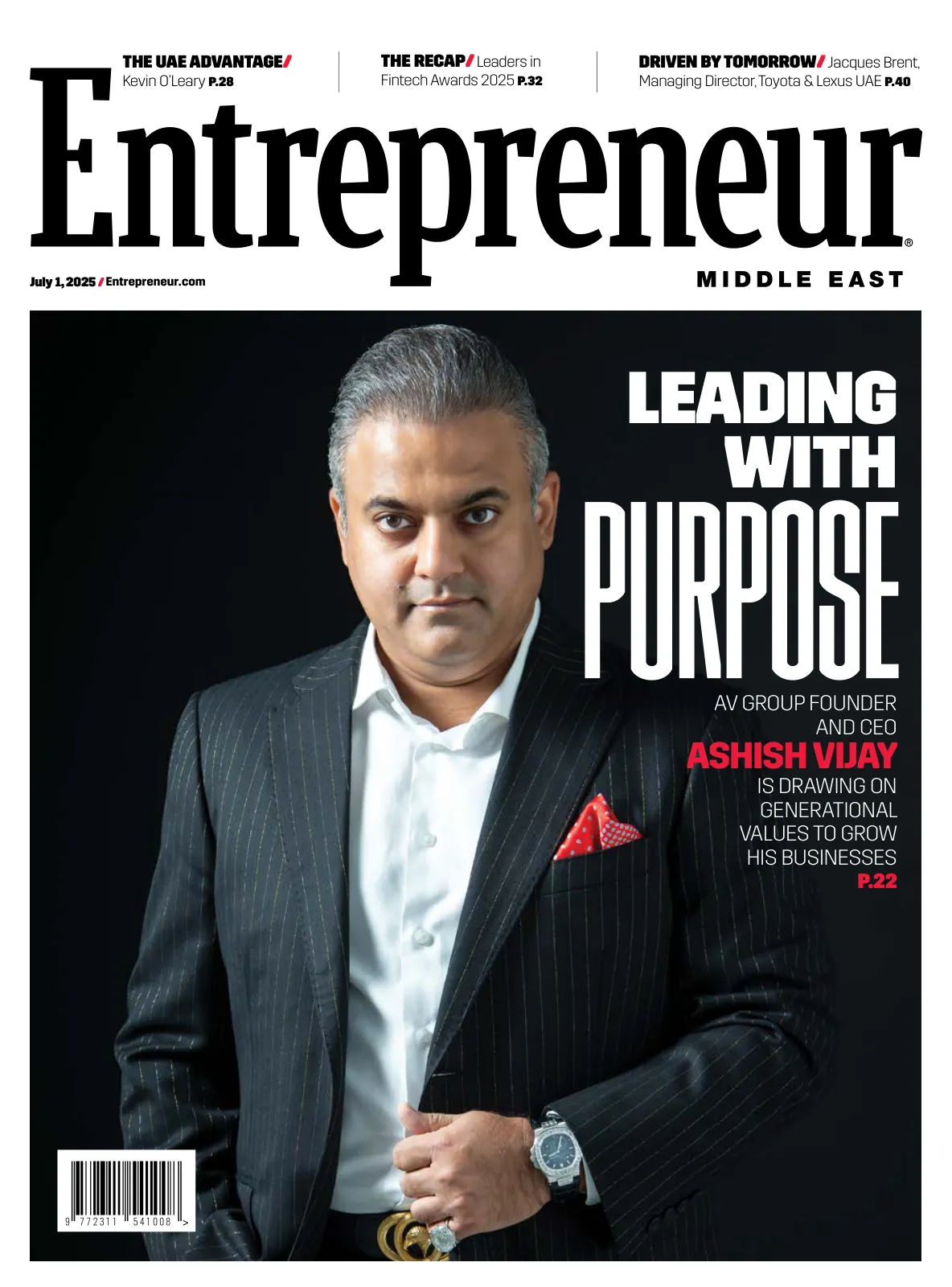
ASHISH VIJAY
AV GROUP FOUNDER
AND CEO
IS DRAWING ON
GENERATIONAL
VALUES TO GROW
HIS BUSINESSES
P.22
LEADING
WITH
PURPOSE
Page 2
THE ALL NEW NISSAN PATROL
BOOK NOW
Page 3
Contents/
July 1, 2025
P.22
Leading
with
Purpose
AV Group founder and CEO
Ashish Vijay is drawing on
generational values to grow
his businesses
FEATURES
3
July 1, 2025 / ENTREPRENEUR.COM /
Page 4
Discover homes where
A LIFESTYLE THRIVING
WITH INNOVATION.
We redefine modern living with spaces that inspire,
amenities that indulge, and locations that connect.
www.samanadevelopers.com
vacation
every day feels like a
Page 5
Page 6
Page 7
SUITE TREAT
Step into a world of opulence when you book a Suite at Raffles Doha.
Experience the added luxury of QAR 750 credit to spend
on dining in the hotel, and QAR 500 towards any Spa treatment.
Children aged 12 and below are welcome to indulge in the
enchantment of complimentary dining.
Rates starting from QAR 3,500 per night
For reservations, please call +974 4030 7100
or email reservations.doha@raffles.com
Raffles Doha, Iconic Towers, Marina District, PO BOX 4747, Lusail, Qatar
Page 8
Page 9
Welcome to the
E X C E P T I O N A L
An iconic hotel featuring
luxury rooms and apartments
with trendy dining options
in the heart of Riyadh
BOOK NOW
Mansard Riyadh, A Radisson Collection Hotel
4248 Prince Mohammed Ibn Salman Ibn Abdulaziz Road, Riyadh 6721-13315, Saudi Arabia
00966118290900 info.mansard@radissoncollection.com
radissonhotels.com/collection
Page 10
STARTUP
SPOTLIGHT
TREPONOMICS
Contents/July 1, 2025
P.64 Turning A Final Page Into A
New Chapter
How GRACE KARIM and SOMIA ANWAR’S
Bookends emerged stronger than ever
after last year’s devastating April rains.
P. 70 Unlocking Real Estate
RAMI TABBARA, Co-Founder and Co-
CEO, Stake
P.15 Fueling the Next
Wave
GAUTAM JAIN, Operating
Member at SC Ventures, on
helping accelerate the UAE’s
digital ambitions.
P.28 The UAE Advantage
In becoming a brand
ambassador of ONE
Development, KEVIN O’LEARY
reconfirms his belief that
the UAE is a hotbed for
innovation.
P.32 The Recap
Entrepreneur Middle East’s
‘LEADERS IN FINTECH’ AWARDS
2025.
P.40 Driven By Tomorrow
How JACQUES BRENT is
pioneering Toyota and Lexus
UAE’s electrification journey.
P.44 Rooted In Resilience
JASHANMAL GROUP CEO Shuja
Jashanmal shares how the
106-year-old company has
stood the test of time.
BUSINESS
UNUSUAL
CEO Wissam Younane
wissam@bncpublishing.net
MANAGING DIRECTOR Rabih Najm
rabih@bncpublishing.net
ART DIRECTOR Simona El Khoury
EDITOR IN CHIEF Anil Bhoyrul
anil@bncpublishing.net
MANAGING EDITOR Tamara Pupic
tamara@bncpublishing.net
FEATURES EDITOR Aalia Mehreen Ahmed
aalia@bncpublishing.net
REGIONAL DIRECTOR
Mahdi Hashemi mahdi@bncpublishing.net
DIRECTOR OF INNOVATION
Sarah Saddouk sarah@bncpublishing.net
GROUP SALES DIRECTOR – B2B GROUP
Joaquim D’Costa jo@bncpublishing.net
HEAD OF PARTNERSHIPS
Samir Glor Samir@bncpublishing.net
COMMERCIAL LEAD
Anna Chipala anna@bncpublishing.net
COLUMNIST Tamara Clarke
CONTRIBUTING WRITERS
Ben Corrigan, Beverley D’Cruz, James Reynolds,
Salil Kumar Malik, Sherif Foda, Tamara Clarke,
and Fida Chaaban.
SUBSCRIBE
Contact subscriptions@bncpublishing.net to receive
Entrepreneur Middle East every issue
COMMERCIAL ENQUIRIES
sales@bncpublishing.net
ENTREPRENEUR.COM
Access fresh content daily on our website
All Rights Reserved 2025. Opinions expressed are solely those of the contributors.
Entrepreneur Middle East and all subsidiary publications in the MENA region
are officially licensed exclusively to BNC Publishing in the MENA region by
Entrepreneur Media Inc. No part of this magazine may be reproduced or
transmitted in any form or by any means without written permission of the publisher.
Images used in Entrepreneur Middle East are credited when necessary. Attributed
use of copyrighted images with permission. All images not credited otherwise
Shutterstock. Printed by United Printing and Publishing.
PO BOX 502511 DUBAI, UAE
P +971 4 4200 506
EntMagazineME
Entrepreneur-me
10 / ENTREPRENEUR.COM / July 1, 2025
P.49 Future Forward
New VISA report shows GCC’s
consumers favor biometric
authentication over traditional card
payment.
P.52 Sustainability in Business
Lessons from the F&B sector from
Pizza Hut Middle East & Pakistan GM
BEVERLEY D’CRUZ.
P.54 Forging Shifts
CEOs aren’t rockstars; stop paying
them like they are, says NESR CEO
SHERIF FODA.
→ Jacques
Brent is the
Managing
Director of
Toyota and
Lexus UAE.
Page 11
Enlighten Your Eternal Beauty,
Inside and Out!
info@muarjewels.com
@muarjewels
www.muarjewels.com
Page 12
12 / ENTREPRENEUR.COM / July 1, 2025
A
s most of our readers will tell you, the
single hardest thing about starting a
new business in the UAE is opening a
business bank account. Most banks
are stuck in the 70s when it comes to
the process. Even some of the most
impressive, technologically advanced
banks (I won’t name them) find ways to
complicate the process.
It usually takes at least six weeks to do so,
an enormous amount of paperwork and
endless visits to the bank in person. Even
once set up, the process of actually activating
an account, obtaining a cheque book and
debit card, is equally horrendous.
All this can hugely complicate the workings
of any start up. Licenses need to be obtained
– which require bank guarantees. Basic
capital costs have to be met, usually through
a founder’s personal savings and then
recouped later.
WIO BANK HAS CHANGED THE GAME
FOR STARTUPS
Opening a business bank account used to be a nightmare. Until now.
Anil Bhoyrul
Editor-in-Chief
Editor’s Note/
Thankfully, this nightmare is now over
– thanks to Wio Bank. ADQ and Alpha
Dhabi are the primary shareholders with a
combined stake of 65%, while e& holds
25%, and First Abu Dhabi Bank 10%.
Between them, they have somehow
managed to totally change the game for
start-ups. The entire application process
can only be done through an app, takes
only ten minutes, and most accounts are
both approved and active in less than 30
hours. Yes, you read that right – 30 hours.
I challenge any of the traditional banks to
even get the process done in three days
– there is zero chance of them doing so.
Three weeks at absolute best.
Just to be clear, I know all this because I
recently opened a Wio business account.
Apart from the incredibly smooth opening
process, the actual operation of the
account – and small things such as
allowing multiple users that make a big
difference – has been staggeringly good.
Wio was only established with an initial
capital of US$626.7 million. In May 2024,
Wio Bank announced that it had achieved
profitability in its first full year, reporting
revenue of $72.6 million and a net profit
of $545,000 in 2023.
It already serves more than 200,000
customers across Wio Business and Wio
Personal.
More importantly, I believe it has
completely changed the game. And that
can only be a good thing.
Page 13
Page 14
Invests
In
Entrepreneurs
What Are
You Building?
Learn more at entrepreneur.vc
Page 15
Fueling the Next Wave:
SC Ventures Backs UAE’s Tech Ecosystem
Gautam Jain, Operating Member, SC Ventures, a venture capital arm of Standard Chartered Bank, on
helping accelerate the UAE’s digital ambitions. by TAMARA PUPIC
→ Veteran fintech
strategist Gautam
Jain serves as the
Operating Member
at SC Ventures, a
venture capital arm
of Standard
Chartered Bank.
15
July 1, 2025 / ENTREPRENEUR.COM /
Page 16
16 / ENTREPRENEUR.COM / July 1, 2025
B/Strategies
A
s the UAE strengthens its status as a global
financial innovation hub, SC Ventures, the
forward‑looking innovation and venture
capital arm of Standard Chartered Bank, has
made a strategic move: launching an office in
its capital, at Abu Dhabi Global Market’s Hub71.
“One year ago we set up our office in Dubai
and Abu Dhabi and we are committed to contributing to and
investing in the vibrant regional tech ecosystem – all while
supporting UAE’s National Vision,” says veteran fintech strate-
gist Gautam Jain.
Jain serves as the SC Ventures lead
for the ADGM licensed office in Abu
Dhabi located in Hub71. He also
leads SC Ventures and SBI Holdings’
Digital Asset Joint Venture invest-
ment company established in the
UAE that is aimed at tapping into the
UAE’s momentum on digital assets.
In particular, the joint venture will
focus on developing market infra-
structure, risk and compliance, DeFi,
and tokenization use cases. “Notably,
the US$100 million Global Digital
Asset Holdings JV with SBI has made
strategic investments in Twinstake,
HiddenRoad, and WalletConnect
reinforcing SC Ventures’ commitment
to regulated digital asset innovation
in the GCC,” Jain says.
As a global venture builder backed
by Standard Chartered Bank, SC
Ventures has already incubated 30
ventures, made more than 20
minority investments, attracted 20
co-investors in its ventures, served
662,000 individual and SME
customers, and more than 200
institutional and multinational
corporation clients. “SC Ventures is
rewiring the DNA in banking and
financial services to redefine
banking’s relationship with society,”
Jain explains. “We build and scale
breakthrough ventures in and
beyond banking.”
In the UAE, Jain explains, SC
Ventures will make minority
investments or build ventures under
our three high-conviction themes:
digital assets, digital banking and
lifestyle, and trade and supply chains.
The potential, Jain adds, is huge as he
expects that the digital assets market
cap will continue its growth trajec-
tory, with tokenized assets alone
growing to US$16 trillion by 2030.
“When it comes to the digital banking
and lifestyle vertical, we see that the
demand for banking and wealth
solutions is increasing with global
financial wealth up 7% and US$18
trillion wealth transfer due by 2030,”
Jain says. “Lastly, for the trade and
supply chains vertical, we see a poten-
tial GDP growth of at least US$2.5
trillion if trade financing frictions are
addressed, particularly impacting
SMEs who represent >50% of OECD
GDP but remain underserved.”
In achieving its goals, SC Ventures
relies on a unique combination of its
institution-grade processes and new
technologies to build, commercialize
and scale ventures that can succeed in
regulated environments. “We typically
build ventures when no existing
solutions are available to meet client
needs,” Jain explains. “Plus, we invest
in existing solutions that can enhance
the way financial services are
delivered. Entrepreneurs can see
problem statements on our Fintech
Bridge, our platform that serves as a
directory for fintech companies and
clients and matches connecting
relevant solutions to challenges.
Fintech Bridge also serves as a
real-time dashboard, allowing fintech
companies to identify challenges
shared in real time, enabling them to
review their strategy or even update
their solutions.”
Its operating model is backed by a
proven venture-building model and
fund investment experience refined
since 2018, unique sourcing of
original ideas through client co-cre-
ation, innovation platforms and
intrapreneurship, and a strong
network of business builders,
operators, investors, and advisors
across tech, regulation, and banking.
↓ Mohamed Fairooz, SC Ventures Lead, Middle East speaking at Dubai Fintech Summit
Page 17
“At SC Ventures we don’t
just invest, we co-design
products and run lean
incubators,” Jain says.
“Rather than passively
holding equity, SC
Ventures acts as the nexus
between Standard
Chartered Bank network,
other financial institutions,
regulators and tech innova-
tors. For example, we have
recently facilitated and
signed partnerships with
Visa, Lulu Financial & 7X
for one of our SME led
ventures. In summary, we
bundle capital, compliance
expertise, and distribution,
really supporting ventures
accelerating time-to-mar-
ket and growth. We also
ensure that our ventures
like appro, a digitized
client onboarding platform
(one of UAE’s top 100
startups) and myZoi, our
award-winning financial
inclusion and financial
literacy platform, are
scaling rapidly and sustain-
ably.”
Its impact is evident
through its partnerships in
the region- during the
2025 Dubai Fintech
Summit in Dubai, SC
Ventures announced a
partnership with the Dubai
International Financial
Centre (DIFC) to launch
the National Venture
Building Program. “As part
of this collaboration, SC
Ventures will be providing
its Venture Building as a
Service model to equip
DIFC Innovation Hub with
the tools, expertise, and
frameworks required to
operate and scale the
initiative nationally,” Jain
says. “We’ve also signed a
memorandum of under-
standing with Emirates
NBD to collectively power
innovation in MENA,
including potential
co-creation and co-invest-
ment opportunities.”
SC VENTURES IS REWIRING THE DNA IN BANKING AND FINANCIAL SERVICES TO
REDEFINE BANKING’S RELATIONSHIP WITH SOCIETY. WE BUILD AND SCALE BREAKTHROUGH
VENTURES IN AND BEYOND BANKING.”
17
July 1, 2025 / ENTREPRENEUR.COM /
} WE ARE EVOLVING HOW
WE SERVE CLIENTS TO MEET
THEIR NEEDS. With digital
adoption in society
outpacing the financial
sector, there are many
client segments to uncover
and unmet needs to serve.
}WE ARE FACILITATING
WORLD TRADES IN OUR
MARKETS. Global trade is
critical to enabling
economic development
particularly in emerging
markets, yet supply chains
and SMEs remain
underserved.
}WE ARE BUILDING DIGITAL
CAPABILITIES FOR
FINANCIAL SERVICES.
Despite innovation in
financial services, current
infrastructure does not
deliver digital assets at
institutional grade.
Gautam Jain on SC
Ventures’ work in the
UAE and beyond
'TREP
TALK
↓ Partnership
with DIFC
innovation hub
↑ SC Ventures was named “Best Digital
Venture Builder” at the Leaders in E-Business
Awards 2025 by Entrepreneur Middle East.
Page 18
18 / ENTREPRENEUR.COM / July 1, 2025
S/Fashion
B
orn from the legacy of a
humble family atelier, Sartoro
Geneve has evolved into a
globally recognized Maison of
high and fine jewelry. At the
helm are the two brothers
Arto and Saro Artinian who
have shaped it into a brand
that blends heritage
craftsmanship with
contemporary creativity. In
this conversation, Arto Artinian, co-founder
and CEO, Sartoro Geneve, reflects on their
journey from their childhood to the global
stage. “My brother and I grew up
surrounded by diamonds and
craftsmanship, so it was always part of our
DNA—but we noticed that so much of the
luxury jewelry world felt distant, almost
untouchable,” Arto says. “We wanted to
bring something different: creations that
tell a story, connect with people
emotionally, and still reflect the highest
standards of artistry and craftsmanship.”
STARTING SARTORO WAS OUR
WAY OF BUILDING ON THAT
FOUNDATION BUT ADDING OUR
OWN PERSPECTIVE TO IT. WE
WANTED TO RESPECT WHERE WE
CAME FROM WHILE CREATING
SOMETHING MODERN AND
FORWARD-LOOKING.”
“
Crafting Legacy:
The Sartoro Geneve Story
Sartoro Geneve’s co-founder and CEO Arto Artinian on turning family craftsmanship
into a global name in contemporary high and fine jewelry. by TAMARA PUPIC
The Artinian family’s legacy in high and fine jewelry
traces back to Arto and Saro’s father Souren and uncle
Yervant who established a jewelry store in Damascus,
Syria, in the 1950s, and insisted on using the world’s
finest materials and stones for their collections. Built on
these foundations, Sartoro Geneve was founded in Italy
in 2001. “It felt like a natural continuation of what we
knew - though it wasn’t without its challenges,” Arto says.
“We learned the trade and the craft from the ground
up—literally handling and sorting diamonds at a young
age, working with our father, uncle and artisans in the
family business. Starting Sartoro was our way of building
on that foundation but adding our own perspective to it.
We wanted to respect where we came from while creating
something modern and forward-looking.”
In 2023, Sartoro Geneve marked a significant milestone
in its journey as a luxury high jewelry brand: the
company relocated its headquarters to Switzerland.
Today, it has flagship boutiques in Geneva and Dubai,
and a dedicated production team of 350 skilled artisans,
conceptual artists, and designers in Le Locle, Switzer-
land, and Bangkok, Thailand. “In addition to our
Page 19
19
July 1, 2025 / ENTREPRENEUR.COM /
boutiques in Geneva and Dubai, we also have a strong
partnership in Doha with Alfardan Jewelry and their strong
client base,” Arto says. “Our upcoming boutique in Riyadh,
set to open at the end of 2025, represents a key chapter in
our continued regional expansion. Year-on-year, we’re seeing
strong performance, particularly across the Middle East
where demand for high craftsmanship and distinctive design
continues to rise.”
At the heart of Sartoro’s allure are its fine and high jewelry
collections which Arto describes as “more than jewelry but
expressions of elegance, movement, and inner radiance.” He
adds, “While our collections are inspired by the beauty of
nature, art and rhythm of life, the final chapter is always
written by the one who wears it. It is their essence, their
presence, their story that gives each creation its true
meaning.This is what makes Sartoro jewelry deeply person-
al-and profoundly timeless.”
Speaking about the Maison’s creative process, Arto says it is a
collaborative and meticulous journey. “It starts with an
idea—a form, a feeling, a spark of inspiration, or even a
client’s story,” he explains. “Our designers sketch it out, refine
it digitally, and we handpick every stone, always looking for
the best cut, color, and character. From there, our artisans—
many of whom have decades of experience—bring the piece
to life using traditional techniques with a modern twist and
the utmost precision. It’s not unusual for a single piece to
take hundreds of hours. It’s a process of patience and
creativity.”
At Sartoro Geneve, the harmony between tradition and
innovation is the brand’s defining essence which is especially
evident in its celebrated collections Trilogie, known for its
bold, architectural beauty and innovative diamond cuts, and
Dualité, beloved for its harmonious fusion of contrasting
elements. “Tradition gives us a foundation—we use tech-
niques passed down through generations—but we also
embrace modern technology and advanced setting tech-
→ Arto Artinian
is the co-
founder and
CEO of Sartoro
Geneve.
Page 20
20 / ENTREPRENEUR.COM / July 1, 2025
S/Fashion
niques. It’s not about
replacing craftsmanship, it’s
about enhancing it,” Arto
explains. “Innovation allows
us to be more daring with
design while still respecting
the art form. However,
ultimately, we always rely on
the human touch to bring
warmth and character to
each creation. That balance is
what makes Sartoro truly
stand out.”
The core philosophy of
Sartoro Geneve, Arto
continues, is to design jewelry
for confident, expressive
individuals. “It’s a matter of
nuance, not compromise.
Sometimes that means bolder
colored gemstones or more
intricate designs, but it’s
always Sartoro at the heart.”
In his opinion, today’s luxury
consumers are looking for
meaning, connection and
authenticity. “People want
more than a beautiful
product—they want to
understand the story behind
it, how it was made, and
who’s behind the brand.
There’s a shift toward
conscious luxury: quality,
transparency, storytelling and
personal relevance matter
WHILE OUR COLLECTIONS ARE
INSPIRED BY THE BEAUTY OF NATURE,
ART AND RHYTHM OF LIFE, THE FINAL
CHAPTER IS ALWAYS WRITTEN BY THE
ONE WHO WEARS IT.”
“
more than ever,” he says.
In fifty years’ time, Arto
hopes that Sartoro Geneve
will be seen as a Maison that
stayed true to its values of
craftsmanship, heritage,
creativity, and always
individuality. “We would like
to envision it as a brand that
evolved with the times but
never lost its essence. Ideally,
our creations will still be
worn, gifted, and passed
down—each one carrying
stories across generations,”
Arto Artinian concludes.
}CREATE A VISION WITH
PURPOSE. “Be clear on
why you’re doing this.
That clarity will help you
navigate tough decisions
and keep your work
authentic.”
}MASTER YOUR CRAFT.
“Understand materials,
techniques, and what
makes great and
long-lasting jewelry—
because design without
skill is just decoration.”
}BE PATIENT AND STICK
TRUE TO YOUR VALUES.
“Success doesn’t happen
overnight. So-called
trends will come and go,
but if your work is
authentic and well-
crafted, people will always
connect with it.”
Sartoro Geneve’s
co-founder and
CEO Arto Artinian
Advises
Entrepreneurs in
the Jewelry
Sector
TREP
TALK
‘
Page 21
THE ART OF ELEVATION
OMNIYAT.COM
Page 22
→ Ashish Vijay is a
Dubai-based investor,
philanthropist, entrepreneur,
and businessman with
decades of experience in the
precious gemstone and
luxury jewellery industry,
finance, and investment
sectors. He is the founder
and CEO of UAE-based
business conglomerate AV
Group.
22 / ENTREPRENEUR.COM / July 1, 2025
Page 23
With his expertise extending into the worlds
of
entrepreneurship,
investments,
and
philanthropy, AV Group Founder and CEO
Ashish Vijay is betting on the values passed
down through the generations before him to
imbue ethics and longevity in all his endeavors.
by AALIA MEHREEN AHMED
LEADING
WITH
PURPOSE
T
here seems to be a common behavioral combination that exists
among most new generation family business leaders: a deep
seated desire to honor the traditions and values that have built
the companies they helm, and a vigor to introduce the right
innovations to grow their business impact. It is this sentiment
that is evident in the work of (and, indeed, the interview
responses from) Ashish Vijay, the founder and CEO of AV
Group, a UAE-based business conglomerate primarily renowned for its luxury
jewelry products. After all, it was his grandfather who, in a newly independent
India in 1948, set up a gemstone trading business in the capital city of New
Delhi. “I’m here to protect what came before me and explore what’s possible
next,” Vijay says. “Leading a company that has a successful legacy of more than
seven decades is a big responsibility, but also something I’m proud of. The legacy
of our family, which began in 1948 when my grandfather first embarked on his
lifelong passion for gemstones, was carried forward by my visionary father, Vijay
Kumar Jain. Guided by an innate love for the craft and an unwavering commit-
ment to authenticity, my father laid the foundation for what would become a
revered name in the world of precious stones. It is this passion and dedication I
aim to honor and respect. This company was built on strong values and a long
history. My job is to respect that legacy while also taking things forward.”
23
July 1, 2025 / ENTREPRENEUR.COM /
Page 24
24 / ENTREPRENEUR.COM / July 1, 2025
“
S
o far, Vijay has stayed true to
his promise. Under his
leadership, AV Group –which
eventually shifted its headquar-
ters to the UAE over the years– has gone
on to operate in a number of other
industries including financial invest-
ment, social impact and real estate. But
for the founder, it was an imbibed love
for gemstones that marked his initiation
into the world of business. “I didn’t really
choose this path—it was always around
me,” he says. “I grew up surrounded by
colour and sparkle. For me, gemstones
weren’t just beautiful objects; they had
life, energy, and meaning. Even as a
child, I felt connected to them. So it was
never a question of “if,” just “when.” From
very early on, I knew this was what I was
meant to do.”
That initial spark of interest has
continued to ignite Vijay’s passion, with
AV Group today having three distinct
verticals for its gemstone offerings. The
first of these is Meraki by Tiara Gems, a
store that offers everyday jewelry that is
both classic and wearable. Ranging from
a modest AED600 to a high-end pricing
of AED12,900, the brand offers pieces
made of diamonds as well as precious
stones such as ruby, emerald and
sapphire. While a physical Meraki by
Tiara Gems store is located at the Dubai
International Financial Center (DIFC),
the designs can also be purchased via its
online platform. The second is AV by
Ashish Vijay. “This is our most exclusive
line, and offers one-of-a-kind pieces with
rare stones like red diamonds, Cashmere
sapphires, and more,” Vijay explains.
The third vertical is perhaps the most
pristine of the lot– AV Globale, a B2E
global auction platform that engages
gemstone enthusiasts, manufacturers as
well as producers of gems and jewels. For
its Dubai-based auctions, the entity has
forged a formidable partnership with the
Dubai Multi Commodities Centre
(DMCC). “AV Globale connects serious
collectors directly with top-tier gem-
stones and jewellery, whether rough,
polished, or custom-made,” Vijay adds.
“Our clients appreciate rarity, meaning,
and quality. They don’t just buy jewel-
lery—they invest in pieces that tell a
story.”
→ For over 77 years,
the AV family legacy
has been
synonymous with
excellence in
diamonds, fine
jewelry, and
high-value
collectibles.
Page 25
25
July 1, 2025 / ENTREPRENEUR.COM /
} My father has
had the biggest
influence on me.
He didn’t just
hand over the
business—he
passed on the
values that built
it. He always said,
“The bigger the
risk, the bigger
the reward.”
“
Now, Vijay’s belief in the ability of
ornaments to narrate a tale isn’t
some spiel to garner attention– it
clearly stems from his own connec-
tion with precious stones. So deep
rooted has his drive to curate the
best collections for AV Group been,
that the founder often gets directly
involved in the sourcing and
selecting of stones for the brand’s
designs. “I believe every gemstone
has a story, and you can only
understand that if you work closely
with it,” he says. “I personally
choose every important stone
because it’s not just about quality—
it’s about finding the right match
between the gem and the person.
That care and attention shows in
the pieces we create. It’s what
makes them special.”
Vijay’s dedication to his craft
received a major external nod of
approval when, in early 2023, he
joined the board of the Interna-
tional Colored Gemstone Associa-
tion (ICA) and was given the role of
ICA Dubai Chapter’s Director.
“Through my role at ICA, I’ve been
able to promote coloured gemstones
more widely in this region,” Vijay
notes. “We’ve built new connections
and partnerships to bring more
attention to this side of the industry.
It’s been a privilege to help position
Dubai as a hub for rare gems. Dubai
has given us the perfect foundation
to grow—great infrastructure,
strong leadership, and global reach.”
Indeed, the UAE’s gems and
jewelry market has been silently
proving its mettle as an economy
booster, with a report by US-based
management consulting platform
TechSci Research showing that the
industry stood at US$8.34 billion in
2023 and is anticipated to grow
with a compound annual growth
rate (CAGR) of 6.84% between
2025 and 2029. Vijay and his team
thus hope to create their own
distinct mark in the market through
the creation of jewelry items that
are created with intent. “We don’t
follow trends just to stay current,”
Vijay declares. “Instead, we focus on
timeless designs that connect with
people. Our work combines global
influences with rare materials. We
also use technology to improve
craftsmanship and offer a smooth
experience—but always in a way
that supports the heart of the piece,
not distracts from it.
But the same aforementioned
report —which highlights that the
UAE’s strategic location as a global
trade hub, its tax-free environment,
tourism, and multicultural popula-
tion have been key drivers in the
industry’s steady rise— also notes
that a global lack of ethical
practices has been detrimental to
achieving sustainable growth. One
such area of ethicality has been the
treatment of small-scale miners,
who face issues ranging from unfair
working treatment to lack of market
access. For Vijay, ensuring a more
equitable ecosystem in this regard
has been paramount. “At AV Group,
we work closely with small-scale
miners because they’re a crucial
Page 26
26 / ENTREPRENEUR.COM / July 1, 2025
part of the gemstone world,” he
shares. “Many of them don’t have
access to fair pricing or stable
income. So we help by offering
financial support and giving them
direct access to our Dubai auctions.
This gives them a better chance to
grow—and helps us build a more
honest and sustainable supply
chain.”
Vijay’s drive to create a more
transparent industry is deeply
interlinked with his philanthropic
efforts– something he mentions has
“always been close to my heart.” As
such, one major initiative in this
regard has been Gems of Hope- a
program that directs resources
toward critical medical aid and
research. In 2025, through a
partnership with India-based Tata
Memorial Hospital and AIIMS Delhi,
the program has also redirected its
funds specifically towards cancer
care and research. “Philanthropy is
not just something we add on—it’s
part of how we run the business,”
Vijay says. “Through Gems of Hope,
we support children’s education,
healthcare access, and environmental
efforts. It’s our way of giving back
with purpose. For me, true success
includes helping others rise with
you.”
It is perhaps this mindset that led
Vijay into the field of financial
investments as well. In 2016, he set
up Seiko Financial Services in Dubai
to support businesses ranging from
grassroots ventures to global
startups, with a special focus on
→ The UAE’s global
connectivity,
leadership, and
booming ecosystem
has enabled Vijay to
elevate AV Group to
new heights, setting
new benchmarks in
the industry.
Page 27
27
July 1, 2025 / ENTREPRENEUR.COM /
Philanthropy
is not just
something we
add on—it’s
part of how
we run the
business.
Through
Gems of Hope,
we support
children’s
education,
healthcare
access, and
environmental
efforts. It’s
our way of
giving back
with purpose.
For me, true
success
includes
helping others
rise with you.”
“
}
empowering women-
led enterprises. There is
AV Investment Funds, a
new initiative aimed at
maximizing investor
earnings while expand-
ing opportunities in
high-value assets. “AV
Investment Funds
allows people to invest
with us in a range of
areas—rare gemstones,
real estate, and
renewable energy,” he
explains. “But it’s about
more than financial
returns! It’s about
building trust, long-
term value, and creating
opportunities that
benefit everyone
involved.”
Vijay and AV Group’s
move into the booming
realm of real estate has
also led to the launch of
AV Real Properties
(AVRP), a real estate
innovation platform
aimed to cater to the
growing number of
property buyers in the
nation. “We will soon be
launching new initia-
tives through AVRP
which will focus on
fractional ownership,”
Vijay reveals. “This
model makes it possible
for more people to
invest in carefully
selected, high-value
properties. It’s a step
toward more inclusive,
transparent owner-
ship—something we
deeply believe in.”
But that isn’t all Vijay
has in the pipeline.
“We’re entering an
exciting chapter,” he
declares. “Over the next
12 to 18 months, our
focus is on expanding
AV Group across key
areas—real estate,
investment, and impact.
AV Investment Funds
will continue to grow
across sectors like clean
energy, rare gemstone
portfolios, and legacy
real estate. But for us,
it’s not just about
financial performance—
it’s about building
long-term ecosystems
built on trust and value.
On the impact side, our
Gems of Hope initiative
remains close to our
heart. The new projects
focus on cancer care
and critical treatment
access for underserved
communities—causes
we are deeply commit-
ted to. And, as always,
we’ll also be unveiling
new collections,
exploring new mines,
and investing in
technologies that help
us evolve while staying
true to who we are. The
future for us is about
more than growth—it’s
about meaning,
inclusion, and legacy.”
As Vijay gears up for
this new phase of
growth and innovation,
he remains grounded by
the advice he received
from his predecessor–
his late father, Vijay
Kumar Jain. “My father
had the biggest
influence on me and
always will,” Vijay says.
“He didn’t just hand
over the business—he
passed on the values
that built it. He always
said, “The bigger the
risk, the bigger the
reward.” But more
importantly, he believed
in trust, transparency,
and tradition. These are
the values I still follow,
and they’ve become the
foundation of how we
run AV Group today
and will continue to!”
Page 28
K
↓ Kevin O'Leary at an exclusive event organized by ONE Development in Abu Dhabi this year.
The UAE Advantage:
KEVIN
O’LEARY’S
Perspective
In becoming a brand ambassador of UAE-born
international boutique real estate company ONE
Development, Kevin O’Leary reconfirms his belief that
the UAE is a hotbed for innovation, business and global
finance.
by TAMARA PUPIC
K
evin O’Leary, known as
Mr. Wonderful, is a
Canadian entrepreneur
and international business
investor. But now, O’Leary
is also the brand ambas-
sador of UAE-born
international real estate company ONE
Development.
Forming a strategic partnership with Ali Al
Gebely, founder and Chairman of ONE
Development, O’Leary will support the
company’s international expansion
“When I met Ali [Ali Al Gebely] and learnt
28 / ENTREPRENEUR.COM / July 1, 2025
Page 29
29
July 1, 2025 / ENTREPRENEUR.COM /
about his vision for Laguna
Residence [an AED 2.4
billion real estate develop-
ment that is the UAE’s first
AI-integrated residential
community], I thought it was
such an extraordinary idea,”
O’Leary said on the sidelines
of an exclusive event orga-
nized by ONE Development.
“I’d never heard anybody
combining an AI platform
into a real estate develop-
ment. Usually AI is just a
marketing talk. We’ve talked
about smart homes for over 15
years, but they are still pretty
dumb. There are five different
apps that you have to use
when you walk into your
apartment or villa, but the
idea he’s got is to put it all into
one integrated app - ONE AI
App. In my view, that in itself
is the number one selling
feature of the whole project.”
“What sets ONE Develop-
ment apart,” O’Leary explains,
“is its unapologetic focus on
technology. This isn’t just
another real estate developer
— it’s the first of its kind to
fully integrate a tech-first
approach into every stage of
development. From AI-driven
design modeling to data-pow-
ered decision-making, they’re
not just building properties
— they’re building the future
of how real estate operates.”
O’Leary will be supporting
the remarkable growth
trajectory that is ahead of
ONE Development which
includes expansion to
international destinations,
but also developing unique
initiatives, such as DO Hotels,
the world’s first musical-
themed hotel that integrates
AI, music, and wellness. DO
Hotels launched its first
development at Dubai Islands
and second one at New Cairo
and has plans to launch in
Saudi Arabia and other
international markets soon.
“I have a very simple rule
that my mother taught me.
She said no more than 5% in
any one stock and no more
than 20% of your portfolio
diversification in any one
sector. So 5% stock, 20%
sector, except for one asset
class - real estate,” O’Leary
points out. “That’s my largest
asset class. I love real estate.
It’s always about a third of my
net worth. Why? It’s a hard
asset. It has superlative
returns, and if you have the
right vision in terms of where
you want to develop, you can
have outsized returns, because
great real estate projects, such
as ONE Development, attract
capital because they get
WHAT SETS ONE DEVELOPMENT APART IS ITS UNAPOLOGETIC FOCUS ON TECHNOLOGY. THIS ISN’T
JUST ANOTHER REAL ESTATE DEVELOPER — IT’S THE FIRST OF ITS KIND TO FULLY INTEGRATE A
TECH-FIRST APPROACH INTO EVERY STAGE OF DEVELOPMENT. FROM AI-DRIVEN DESIGN MODELING TO
DATA-POWERED DECISION-MAKING, THEY’RE NOT JUST BUILDING PROPERTIES — THEY’RE BUILDING
THE FUTURE OF HOW REAL ESTATE OPERATES.”
Page 30
30 / ENTREPRENEUR.COM / July 1, 2025
critical mass. That’s what happens.”
The partnership with ONE
Development reconfirms O’Leary’s
belief in the MENA market’s
long-term potential. “I have a
history in the Middle East because
my mother’s Lebanese, and I’ve
been coming here for decades, but I
didn’t really think much about
investing here until I started to
realize how fast the economy was
growing here,” O’Leary says. “The
key here that most investors don’t
understand, the one thing they
don’t get, is that so much growth is
not in energy. There’s been a lot of
sectoral diversifications here in all
kinds of different technologies,
advances in biotech or in AI
development or in real estate. You
want to catch the growth of all
these new sectors. A lot of people
don’t realize that, for example, if
you look at spending in AI, you’ve
got the US, China, and then UAE.
That’s what’s going on here, and if
you’re not part of that, you’re
missing out on huge growth
opportunities.”
In 2023, O’Leary announced on
his LinkedIn page that he had
become a citizen of the UAE, a
citizenship given by exception to
people who are believed to be able
to benefit the UAE economy.
“There’s a lot of disruption going on
in global trade, but that gives you a
reason to start looking at the UAE,”
O’Leary says. “You can’t understand
it unless you physically come here
and spend time here and find out
who else is here and what’s going
on. Because no brochure, no online
ad, no website is going to give you
an idea of what’s going on here- it’s
multicultural, a melting pot, a
fantastic location. And the country
is safe. I was like, why don’t I
incorporate here and start building
businesses out of here? Why not
think globally from here? Why not
set up O’Leary Global and start
doing new ideas from here and
establish myself here? That’s what I
have done over the last three years.”
He adds, ”What was really
interesting about the process is that
every single accounting firm,
consulting firm, and law firm that I
use in New York, or Boston, or
Toronto is already established here.
They’re not stupid. They know
exactly what’s going on. So I can use
the same team out of Miami and
talk to professionals here that are
part of the same group, which we’ve
done.” “I’m like everybody else,” he
continues. “You start in New York,
then you go to London, then you go
to Zurich, then you go to Geneva.
That’s the stepping stones of how
you start to develop internationally.
Then one day you get here and you
walk off the plane and go, ‘What is
this?’ Until you see it, you can’t
even envision it. I have watched the
growth of both Abu Dhabi and
Dubai in the last five years. It’s
almost geometric growth. It’s like
New York City on steroids, but safe.
“For me, I have become an
ambassador to this place by saying,
I HAVE WATCHED THE GROWTH OF BOTH ABU DHABI AND
DUBAI IN THE LAST FIVE YEARS. IT’S ALMOST GEOMETRIC
GROWTH. IT’S LIKE NEW YORK CITY ON STEROIDS, BUT
SAFE.”
FOR ME, I HAVE
BECOME AN
AMBASSADOR TO
THIS PLACE BY
SAYING, LOOK, IF
YOU’RE NOT IN
THE UAE, YOU’RE
MISSING OUT.”
“
↓ ALI AL GEBELY, founder and Chairman of ONE Development with Kevin O'Leary in Abu Dhabi.
Page 31
31
July 1, 2025 / ENTREPRENEUR.COM /
} DON’T BE AFRAID TO START
“Most entrepreneurs have a hard time
making the first step to start. They
should do it in their 20s, because that is
when you have time and you don’t have
as many responsibilities, and you can
make plenty of mistakes, which is great.
I would rather invest in an entrepreneur
that has felt the sting of failure a few
times than one who thinks they can do
it right the first time. They never can. It
is so hard.”
} PREPARE YOUR PITCH
“Learn to articulate the opportunity in
90 seconds or less, because no one is
going to give any more time than that.”
} FOCUS ON EXECUTION
“More important than a great idea is
your ability to execute on it. Because
great ideas are a dime a dozen.
Executional skills are very hard to find.
If you can find a young man or woman
who looks and has the confidence to
execute, that makes me interested in
investing.”
} KNOW YOUR NUMBERS
“You have got to know your numbers.
How fast is the market growing? What
are the gross margins? How many
competitors are there? You got to know
that stuff. That is the DNA of a great
entrepreneur. Then obviously, you want
to be in a market that is growing. It is
like all boats rise in a rising tide, and so
try and find regions of the world where
businesses are being started in a high
growth environment like here. There is a
reason entrepreneurship is so prevalent
here. The regulatory environment is very
good. The tax rates are really
competitive. The weather is great, and
the economy is growing at an
extraordinary rate because it is multi
sectoral. I predict pretty good things for
this place.”
Kevin O’Leary’s Advice for
Entrepreneurs
'TREP TALK
look, if you’re not in the UAE,
you’re missing out.”
Apart from investing in real
estate, O’Leary is bullish on new
technologies, including
cryptocurrencies. “I have been
extremely involved as an
investor in many different
crypto projects, and my thesis is
that you want to own the
infrastructure for crypto. What
are those? The exchanges. I feel
that I now have shares in every
single crypto exchange in the
world that’s going to be relevant.
After that, I have start buying
the individual assets,” O’Leary
explains. “My thesis is that you
need to own these assets
because as soon as regulation
comes in, institutional capital
will come in. Right now, it’s
mostly hedge funds, private
individuals, high net worth
family offices, but the real
money isn’t there yet. Yet, the
minute this becomes approved
by the US Securities and
Exchange Commission (SEC)
and other regulators, the real
money will come in. I’ve said
this many times before. I believe
that crypto and digital payment
systems will become the 12th
sector of the economy, because it
will service all the other sectors.”
Page 32
T
he Leaders in Fintech Awards
2025 honorees are recognized
for pushing boundaries, driving
financial inclusion, and building
technology that empowers
economies and people.
The winners of the Leaders in Fintech
Awards 2025 are redefining what it means
to lead in one of the world’s fastest-evolving
sectors.
The Leaders in Fintech Awards 2025, staged
by Entrepreneur Middle East with the support
of in5 and The Impression, was held on June
23, 2025, at the Habtoor Palace Hotel in Dubai.
The trophies were presented to the winners
by Wissam Younane, CEO of BNC Publishing,
and Rabih Najm, Managing Director of BNC
Publishing.
Check out the full list of winners at the
Leaders in Fintech Awards 2025:
32 / ENTREPRENEUR.COM / July 1, 2025
THE RECAP
Leaders in Fintech Awards 2025
Page 33
BNC PUBLISHING CEO Wissam Younane
WINNERS of the Leaders in Fintech Awards 2025
33
July 1, 2025 / ENTREPRENEUR.COM /
PAYMENT INNOVATION OF THE YEAR AWARD / Comera Pay
BEST USER EXPERIENCE IN FINTECH AWARD / Klaim
DIGITAL PAYMENT PROVIDER OF THE YEAR AWARD / Geidea
CONSULTANT OF THE YEAR AWARD / AJMS Global
BEST B2B FINTECH SOLUTION AWARD / Qashio
DIGITAL MARKETPLACE OF THE YEAR AWARD / Watermelon
PAYMENT SOLUTION OF THE YEAR AWARD / Payermax
FINTECH ENABLEMENT LEADER OF THE YEAR AWARD / Khalifa Fund
MOBILE APP OF THE YEAR AWARD / Botim
CYBERSECURITY EXCELLENCE AWARD AWARD / Cyber 50 Defense
ENTREPRENEUR OF THE YEAR AWARD / Helal Lootah, co-founder of Lune
FINTECH HUB OF THE YEAR AWARD / DMCC
STARTUP OF THE YEAR AWARD / Paylater
FINTECH COMPANY OF THE YEAR AWARD / Dupay
Page 34
34 / ENTREPRENEUR.COM / September 2024
PAYMENT SOLUTION
OF THE YEAR AWARD
- Payermax
WISSAM YOUNANE
AND RABIH NAJM,
CO-FOUNDERS OF
BNC PUBLISHING
34 / ENTREPRENEUR.COM / July 1, 2025
Page 35
35
September 2024 / ENTREPRENEUR.COM /
CONSULTANT OF THE YEAR
AWARD - AJMS GLOBAL
DIGITAL PAYMENT
PROVIDER OF THE
YEAR AWARD -
GEIDEA
MOBILE APP OF THE YEAR AWARD - BOTIM
CYBERSECURITY
EXCELLENCE AWARD
AWARD - CYBER 50
DEFENSE
July 1, 2025 / ENTREPRENEUR.COM / 35
Page 36
36 / ENTREPRENEUR.COM / September 2024
FINTECH HUB OF THE YEAR
AWARD - DMCC
PAYMENT INNOVATION
OF THE YEAR AWARD
- COMERA PAY
STARTUP OF
THE YEAR
AWARD
- PAYLATER
FINTECH
ENABLEMENT
LEADER OF THE
YEAR AWARD -
KHALIFA FUND
36 / ENTREPRENEUR.COM / July 1, 2025
Page 37
37
September 2024 / ENTREPRENEUR.COM /
ENTREPRENEUR OF THE
YEAR AWARD - HELAL
LOOTAH, CO-FOUNDER OF
LUNE
FINTECH COMPANY OF THE YEAR AWARD - DUPAY
BEST USER EXPERIENCE IN FINTECH AWARD - KLAIM
37
July 1, 2025 / ENTREPRENEUR.COM /
Page 38
38 / ENTREPRENEUR.COM / September 2024
BEST B2B FINTECH SOLUTION AWARD - QASHIO
DIGITAL MARKETPLACE OF THE YEAR - WATERMELON
38 / ENTREPRENEUR.COM / July 1, 2025
Page 39
ANANTARA SHARJAH RESIDENCES
A NEW CHAPTER OF LUXURY EXPERIENCES
BY THE SEA
Bringing luxury seaside living to Sharjah for the first time, owners at the Anantara Sharjah
Residences enjoy access to the Anantara Sharjah Resort’s world-class amenities, including an
infinity pool, five distinctive restaurants, an Anantara Spa and a state-of-the-art gym.
As an investment, owners can enjoy the benefits of a rental management scheme operated by
Anantara Hotels, Resorts & Spas, allowing them to maximize their returns when they are not
resident in the property.
To register your interest, visit arada.com
LIFE IS A JOURNEY.
Page 40
40 / ENTREPRENEUR.COM / July 1, 2025
Driven By
Tomorrow
The global automotive industry has unequivocally
embraced the demand for electric vehicles in the modern
world. But as the Managing Director for the UAE operations
of two of the most trusted brands in the world –Toyota
and Lexus– Jacques Brent sees the push for vehicle
electrification and AI integration as a means to solidify a
legacy of trust that has spanned nearly nine decades.
by AALIA MEHREEN AHMED
B/Skillset
L
egacy is earned,
but it also needs
to be nurtured
and protected
every day–for us,
that means
blending
time-tested reliability
with future-forward
innovation.” If
Jacques Brent’s
leadership style had
to be encapsulated in
one quote, it would
perhaps be this one.
Having taken on the
mantle of Managing
Director of Toyota
and Lexus UAE,
Brent has been at the
helm of both
automotive giants’
regional operations
since early 2023.
“While protecting an
established legacy is
crucial, the automo-
tive industry is under-
going massive
change, with more
expected in the next
decade than in the
last 30 or 40 years,”
he says. “As such,
innovation is not
contradictory to the
brand’s values but it is
an evolution. I believe
in pushing for
innovation while
respecting the
established culture.
My team is chal-
lenged to do things
differently and
challenge the status
quo, with my support
and guidance.
Innovation involves
challenges and risks,
including resistance
to change, where new
ideas face skepticism.
But learning happens
by making mistakes,
and these are often
the biggest lessons. I
prefer that my team
not make the same
mistake twice. In a
fast-moving environ-
ment, the ability to
react quickly is
important. A leader’s
role is removing
bureaucracy to make
it easier for the
operational teams to
function. While
strategy and ideas are
important, I believe
this should translate
into action on the
ground.”
The urgency in
Brent’s statements
isn’t without reason.
A global push for the
production of more
electric vehicles (EVs)
worldwide has meant
that automotive
brands across the
board have had to
adapt to this new
demand. The
International Energy
Agency’s “Global EV
Outlook 2025” shows
that electric car sales
topped 17 million
worldwide in 2024,
rising by more than
25%. In October
2024, American
research and advisory
firm Gartner
forecasted that 85
million EVs will be on
the road by the end of
2025, indicating a
33% growth com-
pared to last year. For
now, much of this
growth is expected to
be led by China (58%)
and Europe (24%).
But that isn’t to say
that this shift hasn’t
→ Jacques
Brent is the
Managing
Director of
Toyota and
Lexus UAE.
Page 41
41
July 1, 2025 / ENTREPRENEUR.COM /
trickled into the Middle East– it has, and Brent’s leadership
has ensured that both Toyota and Lexus are at the forefront
of driving this change forward. “The UAE’s automotive
market is unique in its expectations of both performance
and purpose,” Brent notes. “Consumers here value innova-
tion, reliability, and increasingly, sustainability. It’s also a
digitally connected population that expects technology-led
experiences across every touchpoint: from pre-purchase
research to in-car features. At Toyota and Lexus, we are
responding by embedding artificial intelligence (AI)-driven
features, advanced driver assistance systems, and seamless
connectivity into our product strategy. We’re balancing our
heritage of reliability with a bold push into electrification,
ensuring we stay relevant to evolving expectations. The
market is discerning, fast-moving, and purpose-driven.
These are qualities we’re matching through smart mobility,
hybrid leadership, and localized innovation.”
Serving as a pillar of support in this push for greater
electrification, and indeed sustainability, is Al Futtaim
Automotive– both brands’ exclusive distributor in the UAE
and other GCC countries. “At Al-Futtaim Automotive, we’ve
committed to achieving carbon-neutral manufacturing by
2035, and we’re on track to cut emissions across our
operations by 50%,” Brent declares. “In the UAE, we’ve
introduced a growing portfolio of hybrid and electric
models, with plans for further expansion aligned with the
country’s Net Zero 2050 vision. We are looking to develop
this entire new EV ecosystem in a holistic way, and pioneer
new mobility services to support the sustainable transition.”
Brent then reveals that by as early as 2030, Al-Futtaim
Automotive has plans to deliver 50% new energy vehicles
(NEVs) –vehicles that use non-traditional/non-petroleum
energy sources and are designed to reduce emissions and
reliance on fossil fuels– and install 10% of its charging
stations in the UAE. “We are also making our showrooms
and service centres more sustainable,” Brent continues. “We
are building a comprehensive EV ecosystem from electric
vehicles to a truly immersive virtual reality (VR)-based
automotive showroom, and cutting-edge electric mobility
training technologies for EV technicians. We’re also actively
investing in infrastructure, aiming to install 10% of the
UAE’s EV charging stations. These steps are about building
confidence in greener mobility, paving the way for wide-
spread electrification.”
But in all of this lies an imperative question: are the UAE
and wider region’s consumers ready to embrace the EV
storm? “The shift towards environmentally conscious
It’s honestly a privilege to lead
brands with a significant history
and reputation for high quality,
durability, and value in the region.
Toyota has a deep legacy in the
UAE, having been here since the
mid-1950s and iconic status, even
being synonymous with early
development on Sheikh Zayed Road.”
“
Page 42
42 / ENTREPRENEUR.COM / July 1, 2025
purchasing in the UAE has
been accelerating,” Brent
notes. “We see this
especially among millenni-
als and Gen Z, who are
increasingly prioritizing
sustainability, innovation,
and brand values when
making high-investment
decisions like buying a car.
At Toyota and Lexus, we
have been tracking this
evolution and leading it.
Our approach combines
advanced data analytics,
real-time consumer
insights, and a deep
commitment to sustain-
able mobility. From our
expanding range of hybrid
and electric vehicles to
AI-powered in-car
experiences that enhance
efficiency, every innovation
is designed to meet the
expectations of a more
responsible, tech-savvy
customer base, without
sacrificing performance or
the premium experience
both brands are known
for.”
Here, however, Brent
offers some important
transparency in under-
standing the regional
driver’s attitudes. “While
the most rewarding part of
this journey has certainly
been leading the transfor-
mation of two legacy
brands into future-ready,
technology-enabled
mobility partners, one
challenge has been
navigating consumer
perceptions around
electrification, particularly
range anxiety and EV
readiness in the UAE’s
climate,” he shares. “We
addressed this by position-
ing hybrids as a bridge to
EVs, backed by education,
test drive initiatives, and
localized product engi-
neering. What stands out
is the passion of the team
and the willingness of
customers to embrace new
ideas when they’re backed
by trust and value. That
trust is something we
never take for granted.”
Indeed, it is this deeply
ingrained brand trust that
Brent alludes to when
asked how he manages the
responsibilities of not just
leading two automotive
giants but also injecting
new ideas into them. “It’s
honestly a privilege to lead
brands with a significant
history and reputation for
high quality, durability,
and value in the region,” he
WE ARE BUILDING A COMPREHENSIVE EV ECOSYSTEM FROM ELECTRIC VEHICLES TO A TRULY
IMMERSIVE VIRTUAL REALITY (VR)-BASED AUTOMOTIVE SHOWROOM, AND CUTTING-EDGE ELECTRIC
MOBILITY TRAINING TECHNOLOGIES FOR EV TECHNICIANS. WE’RE ALSO ACTIVELY INVESTING IN
INFRASTRUCTURE, AIMING TO INSTALL 10% OF THE UAE’S EV CHARGING STATIONS.”
B/Skillset
→ The latest
initiatives around
hybrid, electric, and
sustainable mobility
at Toyota and Lexus
UAE have been
pioneered largely
under Brent’s
leadership.
Page 43
43
July 1, 2025 / ENTREPRENEUR.COM /
says. “Toyota has a deep
legacy in the UAE, having
been here since the
mid-1950s and iconic
status, even being synony-
mous with early develop-
ment on Sheikh Zayed
Road. Leading such brands
comes with a lot of
pressure, but the advantage
is a well-established
customer base. The core
attributes of Toyota and
Lexus products – their
durability, quality, and
reliability – are deeply
ingrained in customer
perception, leading to the
belief that if you want a
vehicle to do a million
kilometers, “it should be a
Toyota”. Trust is built
through familiarity with
the product and belief in
what it delivers. My role
involves not only managing
the product side but also
ensuring that the customer
service experience matches
the quality of the vehicles.”
Brent’s leadership at Toyota
and Lexus UAE, however,
isn’t his first rodeo in the
world of automotives. Prior
to his current role, he
enjoyed a highly successful
24-year career with Ford,
starting at the American
automobile manufacturer’s
South Africa operation in
1995, which eventually
culminated in a role as
Global Director, Product
Marketing at Ford’s
headquarters in Dearborn,
Michigan. “My first
experience in Asia Pacific
came with a move to Ford’s
Shanghai office to take on
the role of Executive
Marking Director for the
Asia Pacific and Africa
region, following a
successful term as Vice
President of Marketing,
Sales and Service for Ford
Motor Company of
Southern Africa,” he shares.
“I served as the President
of Ford Middle East and
Africa, leading the
company’s operations
across 70 markets at the
newly launched business
unit headquartered in
Dubai. I was deeply
involved in Ford’s transi-
tion to electric vehicles, an
experience that has stood
me in good stead while
negotiating Al-Futtaim
Automotive’s sustainable
mobility strategy. I have
worked globally, including
in China, the US, the
Middle East, and South
Africa. My career journey
has involved taking
opportunities and capital-
izing on them.”
Indeed, it has been this
ability to break into new
areas of innovation that has
defined his tenure at Toyota
and Lexus as well. “Our
roadmap is clear: accelerat-
ing electrification, deepen-
ing AI integration, and
localizing innovation,”
Brent says. “Smart mobility
is building intelligent
systems that anticipate user
needs, optimize perfor-
mance, and elevate safety.
We’re investing in AI-pow-
ered platforms, such as
Toyota Safety Sense, and
connectivity features that
sync with our customers’
digital lives. In parallel, our
vehicle lineup is evolving
with hybrids, BEVs, and
eventually hydrogen-pow-
ered models, all tailored for
the UAE’s unique climate
and infrastructure.”
It is with this sense of
purpose that Brent hopes
that both brands now
become “favoured partners
in mobility, sustainability,
and smart living.” “Looking
to the future, we’re
expanding our AI-led
product strategy, accelerat-
ing electrified powertrains’
rollouts, and deepening
customer personalization
across every touchpoint,” he
says. “Personally, I remain
committed to servant
leadership: listening to our
team, reducing friction in
operations, and enabling
bold ideas. The next
chapter is about transfor-
mation; with legacy as our
foundation and innovation
as our path forward.”
We’re balancing our heritage of
reliability with a bold push into
electrification, ensuring we stay
relevant to evolving expectations.
The market is discerning, fast-
moving, and purpose-driven. These
are qualities we’re matching through
smart mobility, hybrid leadership,
and localized innovation.”
“
→ Brent led the
unveiling of the
Lexus LX700h in
Dubai—Lexus’s first
electrified
LX—positioned as
“sustainable luxury.”
Under his
leadership, 40% of
Lexus sales in the
UAE are hybrid
models.
Page 44
44 / ENTREPRENEUR.COM / July 1, 2025
In the 106 years that Jashanmal Group has been operational, the
regional retail industry has seen a rollercoaster of growth and
shifts. The secret behind the company standing the test of time
lies in two simple values, says Group CEO Shuja Jashanmal.
by AALIA MEHREEN AHMED
Rooted In Resilience
S/Big Idea
A
cross the multitude of malls
and shopping complexes the
UAE has to offer, the name
“Jashanmal Group” has
become a familiar sight for
many. But while the company
has over 150 stores across
the UAE, Kuwait, Bahrain,
Oman, and India today, its
story begins in 1919 in Basra– a port city
in the south of Iraq. “Our 106-year-old
legacy is rooted in a simple principle: trust
is why we exist,” says Shuja Jashanmal,
the Group’s CEO. “From our first store in
Basra to today’s omnichannel presence,
we’ve consistently brought world-class
quality to the region, always at fair prices,
never overcharging. That consistency in
delivering on our promise is what
‘Jashanmal’ stands for - trust earned
through resilience, quality upheld across
generations, and values honored through
every evolution. We balance heritage and
innovation by embedding these principles
in a modern retail setting. True longevity
comes from honoring our past while
boldly shaping the future.”
↓ Shuja Jashanmal
is the CEO of
Jashanmal Group, a
UAE-based retail and
distribution
conglomerate in the
Middle East, known
for its premium
brand partnerships,
regional presence,
and omnichannel
innovation.
Page 45
45
July 1, 2025 / ENTREPRENEUR.COM /
While the retail industry in the UAE and the wider
region went through multiple makeovers in the past
century, the Jashanmal Group steadily cemented itself
as an avenue for affordable luxury. “Our meticulously
curated lineup features iconic global brands such as
Bally, BOSS, Brooks Brothers, MAX&Co., Reiss and
others for the GCC market, emphasizing quality and
refined aesthetics,” Shuja explains. “Our strategy
focuses on exclusivity and experiential retail. Our
stores are designed as showrooms where customers
engage deeply with products. Luxury gift cards,
featuring elegant packaging and flexibility, further
elevate the gifting experience. We aim to make luxury
attainable while driving trends like sustainable
consumption, leveraging our 20+ years of brand
partnerships to cement our leadership in this high-
growth space.”
↑ A Camel caravan passing by the Jashanmal & Sons store Dubai in
1956. Late Mr. Hiro Jashanmal's residence was on top of the shop
↑ Late H.H. Sheikh Rashid Bin Saeed Al Maktoum, the then ruler of Dubai
along with Late Mr. Hiro Jashanmal at Jashanmal store in Dubai
The secret to our 106-
year longevity lies at the
intersection of family legacy
and forward-thinking values.
At its core, we operate on a
principle instilled by my late
grandfather: “Always keep
the family together.”
“
Here, the CEO explains how measured modifications
to the Group’s operations over the years have allowed
the company to not just adapt to changes in the
ecosystem but often initiate them. “Jashanmal’s core
target audience has been Emiratis and Arabs, affluent
western and Indian expats,” Shuja says. “While their
expectations have evolved with the market, our core
demographic remains premium-focused consumers.
Today’s shoppers demand convenience, personaliza-
tion, and bespoke experiences which has driven the
launch of our digital gift cards and curated online
assortments. Factors like mobile-centricity and
cultural traditions (e.g., Ramadan gifting) have had a
huge influence on the market environment. We
respond with hyper-localized offerings, such as the
exclusive Ramadan collection across our fashion
brands, retro refrigerators designed for the Emirati
majlis, and more — ensuring we resonate across
generations and nationalities in the GCC.”
At the heart of Jashanmal Group’s ability to keep up
with shifting trends and behaviors is a strategic
approach towards consumer insights, explains Shuja.
“Our leadership team engages directly with market
data, franchise partners, and customers to anticipate
shifts,” he continues. “For example, by identifying
Ramadan gifting trends early, we drove a 50%
year-on-year (YoY) uptick in gift card sales. We also
align with macro-visionaries like the UAE’s Vision
2030, embedding sustainability and digital growth
into our strategy. Staying agile and curious ensures
we lead rather than follow.”
A 2024 report by UAE-based investment banking
advisory firm Alpen Capital showed that retail sales in
Page 46
46
the GCC are projected to
grow at a compound
annual growth rate of
4.6% to reach a whopping
US$386.9 billion in 2028.
“Moreover, the UAE’s
retail landscape stands
among the world’s most
dynamic, characterized by
rapid digital adoption,
experiential consumer
expectations, and sus-
tained growth, with sales
projected to reach $139
billion by 2028, according
to a report by Yardstick
Marketing Management,”
Shuja adds. “At Jashanmal
Group, we’ve thrived in
premium segments,
primarily fashion, curated
home solutions, premium
appliances, beauty, and
fragrances, with partner-
ships with notable brands
like MAX&Co. and Reiss,
that saw over 20% YoY
growth during Ramadan.”
In recent times, perhaps
the single most significant
shift in the retail industry
has been the shift towards
e-commerce. Identifying
it, and then transforming
Jashanmal Group into an
omnichannel business
turned out to be a
game-changer for the
company. “Our success is
anchored in recognizing
pivotal industry shifts
early,” Shuja reiterates.
“The rise of omnichannel
retail prompted our
strategic launch of
Jashanmal.com in 2020,
which now drives consis-
tent double-digit annual
growth. Meanwhile our
physical stores evolved
into experiential show-
rooms. Managing
e-commerce for presti-
gious brands like Bally and
Clarks has significantly
broadened our market
presence and deepened
our connection with
discerning customers. This
synergy between online
and offline lets customers
“touch and feel” premium
products while enjoying
seamless digital perks.
This makes omnichannel
non-negotiable for modern
retail.”
“Similarly, the demand for
sustainable luxury and
hyper-personalization has
aligned perfectly with our
expansion into digital gift
cards, a category that
surged by 50% during
Ramadan,” Shuja contin-
ues. “These trends
accelerated our vision to
transition from traditional
retail to an agile, experi-
ence-driven retail leader.
By transforming stores
into experiential hubs and
leveraging cultural
moments like Ramadan
gifting, we’ve remained
proactive in catering to
evolving consumer
expectations and contin-
ued to deepen our regional
relevance and pioneer the
future of retail.”
While it may seem evident
that a close watch on the
market and consumer
insights has led Jashanmal
S/Big Idea
/ ENTREPRENEUR.COM / July 1, 2025
→ Founded in 1919 in Iraq, Jashanmal Group
pioneered the retail landscape in the UAE
and GCC, evolving from a humble general
store selling imported lifestyle products into
a legacy brand and a market leader.
Page 47
47
July 1, 2025 / ENTREPRENEUR.COM /
Group to persist and thrive amid the
changes that have defined the
industry it operates in, Shuja
himself credits the Group’s success
to two simple factors. “The secret to
our 106-year longevity lies at the
intersection of family legacy and
forward-thinking values,” he says.
“At its core, we operate on a
principle instilled by my late
grandfather: “Always keep the
family together.” This unity,
maintained through generations
despite evolving perspectives,
creates the stability that fuels every
facet of our business. It fuels our
dual commitment to long-term
relationships and service excellence,
where every action prioritizes
enduring impact over short-term
gains. This manifests as a culture
where succession is earned, not
inherited, necessitating leaders to
prove their worth. We honor
tradition while empowering new
generations to innovate. Values such
as integrity and adaptability are
ingrained in our corporate culture,
empowering us to navigate evolving
market landscapes, from entering
e-commerce to launching our gift
card initiative. Family unity,
merit-driven evolution, and
commitment to excellence will drive
our pursuit to remain the retail
pioneers in the GCC region for
centuries to come.”
It is because of these values that
Shuja explains his aspirations for
the future in terms of a timeline that
will most certainly extend beyond
his tenure as Group CEO. “At
Jashanmal, we believe that leader-
ship is merit-based– this mindset
has taught me to value agility over
hierarchy, customer insights over
assumptions, and to empower fresh
perspectives,” he says. “It is our
succession philosophy: the next
generation will lead by demonstrat-
ing value, ensuring Jashanmal
progress without compromising the
core values that define us.”
For the moment, however, Shuja is
happy to take on the role of
helming the Group’s future goals.
“Looking forward, we’ll strengthen
our core retail and distribution
while expanding strategic partner-
ships, bringing iconic luxury brands
to the GCC,” he declares. “Digital
innovation and experiential retail
will continue to accelerate.
Sustainability will be integral
across the value chain, aligning
with the spirit of UAE Vision 2030.
Ultimately, we’re building on our
legacy to define the future of
modern retail, balancing heritage
with relentless pursuit of progress!”
Our success
is anchored in
recognizing pivotal
industry shifts
early. The rise of
omnichannel retail
prompted our
strategic launch of
Jashanmal.com in
2020, which now
drives consistent
double-digit annual
growth. Meanwhile
our physical
stores evolved
into experiential
showrooms.”
“
Page 48
October 17th 2025
Jumeirah Carlton Tower, London , United Kingdom
for more informations
Joaquim D’Costa
+971 50 440 2706
jo@bncpublishing.net
www.GlobalRELeaders.com
Page 49
49
July 1, 2025 / ENTREPRENEUR.COM /
New Visa Report Shows
GCC’s Online Consumers Favor Biometric
Authentication Over Traditional Card Payment
by AALIA MEHREEN AHMED
Page 50
50 / ENTREPRENEUR.COM / July 1, 2025
Jaffar replies that while the report
does not break down abandonment by
specific stages, the data points towards
one concrete conclusion: the payment
stage is where many consumers
encounter the most friction.
“Consider this scenario: you are
ordering a last-minute birthday gift on
your phone during a busy day; you
find the right item, add it to your cart,
and proceed to checkout, but just as
you are ready to pay, you are prompted
to manually enter your card details
and asked whether you want to save
them for future purchases,” Dr. Jaffar
explains. “You pause — not because
you changed your mind about the gift,
but because you are not comfortable
storing your card information on an
unfamiliar website. This hesitation is
common. Nearly 6 in 10 consumers
across GCC said they are concerned
about the risk of fraud or hacking
when storing card details across
multiple sites. That moment of doubt,
especially when combined with time
Speaking exclusively to Entrepreneur
Middle East, Dr. Saeeda Jaffar, Senior
Vice President and Group Country
Manager - GCC at Visa, notes that
difficult or time-consuming checkout
processes continue to be a leading
reason for cart abandonment. “Across
the GCC, 43% of respondents cited
concerns around payment security,
while 38% pointed to the inconve-
nience of manually entering card
details,” she says. “These are often
decisive moments in the online
shopping journey. If the process feels
clunky or untrustworthy, it increases
the likelihood that a customer will
leave before completing their pur-
chase.
Specificially with regards to the UAE,
the report shows that one in three
respondents (33%) in the country
shops multiple times a week for
groceries. For categories such as
fashion, entertainment, and electron-
ics, shopping frequency ranges from
once to a few times a month.
According to 40% of respondents,
the biggest frustrations with online
checkouts are security concerns,
followed by the hassle of entering card
details manually (37%). Indeed, 58%
of the surveyed consumers say they’re
worried about the risk of fraud or
hacking when storing their card
details on multiple websites, with the
report also showing that 42% of
respondents have experienced fraud or
security breaches.
By addressing these challenges,
retailers can enhance the checkout
experience which could lead to
increased customer satisfaction- a
demand that, as per the “Checkout
Friction Report,” is continually
surging. “Almost 80% of respondents
said they would be more likely to
complete their purchases with a
one-click checkout option,” Dr. Jaffar
explains. “To address this, merchants
can explore streamlined checkout
methods that reduce friction and meet
rising expectations around conve-
nience and security. Whether through
faster authentication, fewer form
fields, or one-click options, improving
this final step can help reduce
abandonment and improve overall
customer satisfaction.”
Reflecting this sentiment is a key
finding in Visa’s “Checkout Friction
Report”, which reveals a strong
preference for a more streamlined
checkout: 65% of respondents support
a single registration process for online
payments across all participating
merchants.
But all of this brings forth an
inevitable question: have there been
any statistics within the report to
suggest that users abandon checkout
at the payment entry stage compared
to other stages of purchasing? Dr.
V
isa, the global digital payments platform,
has revealed its “Checkout Friction Report”,
a new study which dissects factors that
consumers demand for a more secure and
seamless e-commerce experience.
The research is based on a survey of 2,016
online shoppers across the GCC, including the
UAE, and explores their experiences with e-com-
merce purchases. It examines common pain
points during the checkout process that affect
both consumer satisfaction and business
outcomes.
→ Dr. Saeeda
Jaffar is the
Senior Vice
President and
Group Country
Manager - GCC
at Visa.
‘T/Payments
Page 51
51
July 1, 2025 / ENTREPRENEUR.COM /
pressure or a poor mobile experience,
is often where a purchase is lost.”
The solution, Dr. Jaffar reiterates, lies
in creating trust at the checkout stage.
“When customers feel confident their
payment details are protected, they are
more likely to complete the purchase
and return again, Jaffar notes. “In
today’s digital landscape, a seamless
checkout is not just a convenience — it
is a driver of business performance.”
One particular option that has
emerged as a winning solution in this
regard is that of biometric authentica-
tion- two-thirds (67%) of Visa’s
respondents said they would use it to
check out, with many trusting
biometric authentication (fingerprint/
face ID) more than traditional
payment methods (passwords/OTP).
As such, catering to the consumer
base’s growing affinity towards this
option is Visa’s Click to Pay- a service
that streamlines online shopping by
providing advanced checkout experi-
ences, eliminating the need to
manually enter card details, thereby
making transactions significantly
faster. At participating e-commerce
platforms, consumers can simply click
the Click to Pay button to complete
their purchase quickly and easily using
their preferred Visa card and shipping
address.
For businesses, the demand for
simpler and safer checkout options is
clear. Most respondents (82%) would
shop online more frequently and be
more likely to complete their purchas-
es with a one-click checkout option.
Two-thirds of the surveyed consumers
(66%) show a high likelihood of using
Click to Pay with Biometrics if offered
by online retailers.
“Challenges in the online checkout
process have direct implications for
businesses, resulting in lost revenue,
and hampering both customer acquisi-
tion and retention,” said Salima
Gutieva, Visa’s VP and Country
Manager for UAE, added in a separate
statement. “Today’s consumers expect
– and deserve – a more seamless and
secure e-commerce experience. That’s
why Visa is working with partners to
enable solutions like Click to Pay,
which leverages biometrics and
tokenization to eliminate key pain
points and deliver a more convenient
shopping experience. Improving these
moments not only drives business
results but also builds on the UAE
government’s achievements in
building a seamless, secure digital
economy.”
Now, while Visa’s Click to Pay relies
on biometric authentication available
on the consumer’s device and does not
require transfer of biometric data,
there still exist general concerns
surrounding the use of such sensitive-
more specifically, how and where they
are stored. “These concerns are valid
and increasingly important as
biometric authentication becomes
more common in digital payments,”
Jaffar says. “How this data is handled
plays a crucial role in building and
maintaining consumer trust. That’s
why Click to Pay is designed with
security in mind. It uses biometric
authentication through Visa Payment
Passkey, allowing consumers to
approve payments just as they unlock
their phone — with a fingerprint or
face identification. Importantly, this
biometric data stays on the user’s
device and is not shared with mer-
chants or payment networks. Keeping
it local significantly reduces the risk of
misuse or interception.Tokenization
adds another layer of protection by
replacing card details with a unique,
encrypted token. This allows transac-
tions to be processed securely without
exposing actual card information.
Merchants also play a key role in
safeguarding data. Adopting standards
such as the Payment Card Industry
Data Security Standard (PCI DSS)
helps ensure secure storage, encryp-
tion, and access control within their
systems.
“Protecting sensitive information
ultimately requires a layered approach
— combining secure technology,
compliance with established stan-
dards, and a strong culture of data
responsibility across the payments
ecosystem,” Jaffar concludes.
NEARLY 6 IN 10
CONSUMERS ACROSS
GCC SAID THEY ARE
CONCERNED ABOUT
THE RISK OF FRAUD OR
HACKING WHEN STORING
CARD DETAILS ACROSS
MULTIPLE SITES. THAT
MOMENT OF DOUBT,
ESPECIALLY WHEN
COMBINED WITH TIME
PRESSURE OR A POOR
MOBILE EXPERIENCE,
IS OFTEN WHERE A
PURCHASE IS LOST.”
“
Page 52
52 / ENTREPRENEUR.COM / July 1, 2025
The food and beverage
(F&B) sector is particularly
well-positioned to lead this
change. With high energy
demands, supply chain
complexities, and
significant packaging and
food waste, the industry
carries both a large
environmental footprint
and a powerful opportunity
for impact.
Drawing from experiences
within one of the world’s
largest quick-service
restaurant brands, this
article explores how
sustainability practices can
be integrated into core
business operations in a
region as diverse and
complex as the Middle East.
The focus is not on
promotion, but on practical
strategies and challenges
— and how companies can
begin or deepen their
journey toward
environmental
responsibility.
WHY LOCAL CONTEXT
MATTERS
While global sustainability
frameworks offer a helpful
foundation, regional
adaptation is essential. In
the Middle East, climate,
infrastructure, and policy
differ widely between
countries — from water
scarcity in the Gulf to
rapidly urbanising centres
in the Levant. Businesses
must tailor their strategies
to reflect these realities.
For example, energy use is
a key area of focus,
especially in hot climates
where cooling systems are
essential. Understanding
and optimising HVAC
(heating, ventilation, and
air conditioning) systems is
not just a technical detail
— it’s a business imperative.
Similarly, innovations like
low proximity hoods in
kitchens can reduce overall
energy consumption
significantly when
implemented at scale.
Investments in
energy-efficient equipment,
such as LED lighting and
high-efficiency
refrigeration, might seem
minor in isolation. Yet,
when adopted consistently
across locations, they
contribute meaningfully to
both environmental impact
and operational cost
savings.
Three Core Pillars of
Sustainable Practice
Sustainability efforts in
the F&B industry often
centre around three main
pillars: environmental
responsibility, responsible
sourcing, and waste
reduction. Each presents its
own challenges and
opportunities in the Middle
Eastern context.
by BEVERLEY D’CRUZ
Sustainability in Business:
Lessons from the Food & Beverage Sector
I
n today’s business landscape, sustain-
ability has evolved from a corporate
buzzword into a fundamental expectation.
Across the Middle East, where economic
growth and urban development are
accelerating, businesses are re-evaluat-
ing how they operate — not only to
remain competitive, but to be responsible
stewards of the environment.
SUSTAINABILITY EFFORTS IN THE F&B INDUSTRY
OFTEN CENTRE AROUND THREE MAIN PILLARS:
ENVIRONMENTAL RESPONSIBILITY, RESPONSIBLE
SOURCING, AND WASTE REDUCTION.
‘T/Skillset
Page 53
53
July 1, 2025 / ENTREPRENEUR.COM /
1. Environmental Responsibility
Adopting energy-saving technologies,
exploring renewable energy sources
like solar (particularly in
high-insolation regions such as the
UAE and Saudi Arabia), and
conserving water through low-flow
fixtures and efficient cleaning
practices are becoming standard in
many progressive operations.
2. Responsible Sourcing
Local procurement reduces emissions
tied to transport while supporting
regional economies. Businesses are
increasingly working with suppliers
who meet standards not only for
quality, but also for ethical labour
practices and environmental impact.
Rigorous auditing and supply chain
transparency play a key role in
maintaining accountability.
3. Waste Reduction and Recycling
The F&B sector produces large
volumes of waste — food scraps,
packaging, and single-use materials
among them. Inventory control
systems, food donation programs, and
in-store recycling can help mitigate
this. In some regions, composting is
also gaining traction, despite
infrastructure challenges.
CHALLENGES AND OPPORTUNITIES IN
IMPLEMENTATION
Implementing sustainability measures in
the Middle East comes with
complexities. Regulatory environments
vary, and upfront costs for green
technologies can be a barrier.
Infrastructure for recycling and
renewable energy may be inconsistent
across markets.
Yet, these challenges also open the door
for innovation. Businesses willing to
invest in energy solutions or engage with
local suppliers to build capacity often
find long-term gains — both financially
and reputationally. Moreover, as
consumer awareness around
sustainability increases, demand is grow-
ing for businesses that can demonstrate
real action, not just intention.
LOOKING AHEAD: A CALL TO ACTION
Sustainability is not a destination but a
continuous process. As governments
across the region introduce more robust
environmental policies and incentives,
there is growing momentum for
businesses to step up. The future of
sustainable business in the Middle East
lies in partnership — with suppliers,
regulators, and communities alike.
For the F&B industry in particular, every
decision — from equipment to
packaging, sourcing to staff training —
holds the potential to shape a more
resilient, responsible business model.
The companies that succeed will be
those that not only adapt to change but
help lead it.
Beverley D’Cruz is the
General Manager of Pizza
Hut Middle East &
Pakistan, where she leads
the brand’s growth strategy and
operations across more than 550 outlets
in the region, including 160 in the UAE.
With over 18 years of experience at
Yum! Brands, Beverley has held key
leadership roles within both Pizza Hut
and KFC across Canada, the UK, and
the Middle East. Most recently, she
served as Chief Brand Officer for Pizza
Hut META, driving impactful
initiatives to elevate the brand.
Page 54
54 / ENTREPRENEUR.COM / July 1, 2025
THE NUMBERS ARE
OBSCENE
When I was younger, my
grandfather would tell me:
“If a man makes more than
100 times what the average
employee makes, he’s not a
good leader.”
Today, CEOs are pulling in
not 100 times, but
sometimes 10,000 times the
median employee pay.
Yes, we have ESG reporting,
Environmental, Social and
Governance, where
companies are required to
disclose the CEO-to-median
pay ratio. But disclosure
without accountability is
performative. The ratios are
exposed—and ignored.
The defenders of this system
will say: “But the CEO
creates value for
shareholders!”
I say, absolutely, but show
me the KPIs. Show me the
shareholder return. It
should be proportional and
we should never have a
golden parachute for failure.
If a CEO can walk away
richer while the company
lays off thousands and loses
money and value—what
exactly are we rewarding?
WALK THE TALK AND START
WITH YOURSELF
If you believe in risk and
reward, and I do, then you
should believe in earned
rewards, not unearned
windfalls.
When I started the
company, I made a simple
rule: I’ll take zero stock for
myself, or what is called
issued shares for executives,
unless I create a value to
everyone: employees and
shareholders. And since
inception for the past seven
years, I haven’t taken a single
share from the company. My
by SHERIF FODA
CEOs Aren’t Rockstars.
Stop Paying Them
Like They Are.
T
here’s a CEO I met once—let’s just say the name was well known.
What shocked me wasn’t the private jet or the outrageous
spending perks. It was the number: $140 million. That was his
annual pay package—in a year when the company lost money, its
share price tumbled, and its market cap was less than $300M.
Let that sink in.
We live in a time when the average worker is being told to tighten their belt,
accept layoffs, or “pivot” their skills. Meanwhile, the same executives who
preside over declining revenue, shrinking market share, and mass firings, are
cashing in 8-figure checks without a hint of shame or any accountability.
‘T/Management
Page 55
55
July 1, 2025 / ENTREPRENEUR.COM /
bonus is also linked to the
performance of the firm,
so when we had troubled
years, I ensured I declared
in public: zero bonus and
zero shares for myself as
the CEO, which is the
opposite to what happens
in the market.
Additionally, I ensure to
distribute all these shares
to the employees of the
firm. Why? So they feel
empowered, own part of
the company, and believe
they are equally
compensated for the value
they bring. I simply link it
to the performance of the
firm. If the company
makes money, everyone
does too!
I recall I gathered the top
40 managers of the
company one year and
told them they will all be
millionaires as we will
issue them shares that
they can cash in as the
company grows and they
will surely pass the $1M$
mark. And guess what?
That is exactly what
happened, and why?
Because I was able to give
them that percentage from
the stock pool that is
usually kept for the CEO
of a company. Sometimes
the CEO takes a
staggering 1/3 of that
pool!
Some people said what I
did was silly, and that it
would look like the board
doesn’t value the CEO.
They said no one would
care. And maybe they’re
right—externally, no one
cared. But internally?
Employees got rewarded,
and that’s what matters.
REAL LEADERSHIP ISN’T
ABOUT EXTRACTION
Let’s stop pretending that
a $50 million bonus is
what it takes to keep
talent. If your CEO’s only
motivation to stay is
money, you’ve got the
wrong person in the job.
Leadership is about
accountability. Ownership.
Vision. Not just cashing in
stock options and
delivering jargon-laced
earnings calls.
And don’t get me started
on the idea that these
compensation packages
are about “retention.”
What are we retaining?
Someone who might
otherwise go start a
business? Great. Let them.
THE SYSTEM NEEDS A
RESET
We need a hard cap—or at
the very least, hard
KPIs—on CEO
compensation. Not some
cooked metric that gets
“massaged” into
compliance. I’m talking
real performance
thresholds tied to real
shareholder and employee
value; something different
so they can get highly
compensated when
everyone, and the
company, does very well.
Make executives rich off
performance, not
presence. If they hit the
numbers, let them win
big. If they don’t, they
walk away like everyone
else—with nothing.
Because right now, the
richest people in the world
aren’t inventors. They’re
not founders. They’re not
even owners. They have
obscenely negotiated
contracts. And the rest are
paying the bill.
This isn’t about being
anti-capitalist. It’s about
capitalism with
consequences. If you want
to be paid like a genius,
you better perform like
one. And if the company
crashes under your
leadership, or even if the
market condition is bad,
you are a part of it too.
We need to stop
rewarding failure, start
aligning incentives, and
bring ethics back into
executive pay. Otherwise,
the only thing we’re
scaling is inequality—and
the only thing we’re
disrupting is trust.
Sherif Foda is
the CEO and
Chairman of
Nasdaq-listed
oilfield services
company NESR.
LEADERSHIP IS ABOUT ACCOUNTABILITY. OWNERSHIP. VISION. NOT
JUST CASHING IN STOCK OPTIONS AND DELIVERING JARGON-LACED
EARNINGS CALLS.
Page 56
56 / ENTREPRENEUR.COM / July 1, 2025
W
hen I founded Bluehaus in a
small office on Dubai’s Bank
Street in 2002, I didn’t have
an exit strategy or a
blueprint for acquisition. I
simply wanted to build a
business that mattered. One
that delivered great work, nurtured
great people, and stayed relentlessly
committed to service.
Twenty-two years later, that journey
led to Bluehaus becoming part of tp
bennett—one of the UK’s most
established architecture and design
firms. But this wasn’t a transaction
driven by spreadsheets and synergies.
It was the next step in a relationship
built on mutual respect, shared values,
and 15-plus years of collaboration.
}A long engagement: We’ve worked
with tp bennett for over 15 years.
Together, we’ve delivered projects
across the region—from commercial
workplaces to large-scale
developments. This wasn’t a deal
struck over a few conversations—it was
a long engagement, shaped by real
projects and stress tested over time.
And like all meaningful partnerships, it
came together not out of necessity but
from a belief in what we could achieve
together.
Culturally, we’re aligned. We care
deeply about quality, about people, and
about how design can shape better
outcomes. That’s what made this a
natural fit.
}Why now? As a founder, you’re
always thinking ahead. What’s the next
chapter? How do you protect your
people and give them room to grow?
For me, this wasn’t about selling a
business. It was about evolving it.
With tp bennett’s legacy in architecture
and design, and Bluehaus’ local
expertise across the Middle East, we’re
now uniquely positioned to deliver
projects that are both globally
informed and locally grounded. This
partnership brings together a
multidisciplinary approach—
architecture, interiors, masterplanning,
and engineering—under one roof,
allowing us to take on increasingly
by BEN CORRIGAN
↑ Ben Corrigan joins tp bennett’s board as a Principal Director
‘T/Interior Design
A homegrown journey:
Evolving a UAE-born design practice for the
global stage
↑ Ben Corrigan with Bluehaus senior leadership team
Page 57
57
July 1, 2025 / ENTREPRENEUR.COM /
↑ Ben Corrigan with the Bluehaus senior leadership team and tp bennett’s principals, Cornelis von
Mollendorff and Cristiano Testi
complex briefs across sectors including
workplace, hospitality, retail,
healthcare, and education.
We’re proud of what we’ve built with
clients like Emirates NBD, PIF,
Accenture, Amazon, and Jumeirah—
and now, with the backing of tp
bennett, we can bring even greater
impact to every brief, , both regionally
and globally.
}People ffirst, always: As founders, we
often talk about growth, margin, and
market share. But the real
responsibility is to your people. What’s
the next chapter for them? How do you
protect their growth, their energy, their
future?
For me, the move to tp bennett is as
much about opportunity for our team
as it is about the business. It’s about
giving them access to global projects, a
broader platform, and the chance to
evolve with a world-class team.
At Bluehaus, we’ve never seen culture
as a side project—it’s core to how we
operate. Over the years, I’ve invested
heavily in leadership development, not
just for myself, but for our senior team.
We’ve brought in business coaches and
worked with external partners like 2b
Limitless to develop leadership skills
with structure and intent.
We’ve also rolled out the Gallup
StrengthsFinder across the business,
helping every team member, starting
with leadership, identify their
strengths and lead with them. This
investment in our people has shaped
how we work, how we grow, and how
we show up for one another.
Because when your team thrives, your
business does too.
}Brand is behaviour: If there’s one
thing I’ve learned, it’s this: your brand
is not your logo. Your brand is your
behaviour. Every meeting, every
presentation, and every email adds up
to how people experience your
company.
We’ve always focused on delivering
great service, constantly improving,
and staying curious. That’s what builds
brand value. And even if you’re not
planning to sell, that mindset is
invaluable. It forces you to think in
terms of substance, not just style.
}Advice to other founders: Many
entrepreneurs in this region reach a
similar point: a strong, independent
business with a loyal client base and a
capable team. And then comes the
question—what’s next?
My advice is: start preparing long
before you think you need to.
}Build with value in mind, not just
financial, but cultural and operational.
}Invest in your team and your
leadership.
}Get your house in order—
financially, structurally, and culturally.
}Stay focused on what matters:
service, people, and reputation.
Whether your next step is growth,
succession, or a strategic partnership,
you’ll be glad you built something
resilient.
}A new chapter
My role has shifted from Managing
Director to Principal, and I now sit on
the board of tp bennett. But my focus
hasn’t changed. I’m still doing what I
love—leading teams, shaping projects,
and building something meaningful.
This partnership is not an end, it’s a
new beginning. One that brings new
energy, new opportunities, and a
shared commitment to pushing
boundaries.
And most importantly, it reminds me
that success isn’t defined by the deal.
It’s defined by the journey and the
people you bring along with you.
Ben Corrigan joins tp
bennett’s board as a
Principal Director. tp bennett
is a leading architecture and
design practice located in
London, Manchester and Leeds with
affiliate offices in more than 20 countries.
The partnership is supported by
specialists in sustainability, strategy,
design technology, town planning,
research and graphics.
Over 360 staff work across the practice
with projects covering a range of sectors
including corporate offices, datacentres,
education, health, hotels, bars &
restaurants, public/civic use, residential,
retail & leisure, student residential, and
transportation. tp bennett recently
completed the award-winning 11 & 12
Wellington Place in Leeds – one of the
UK’s most sustainable office buildings
Page 58
What It Takes to Build
a Luxury Children’s
Play Concept in Dubai T
here were, of course, plenty
of play zones across malls
and entertainment venues
— each offering its own
version of fun and
excitement. But as I observed
these spaces more closely, I
started to wonder if there was an
opportunity to reimagine what a
play environment could offer.
Could we design something that
felt more intentional — a space
that supported both imaginative
play for children and a sense of
ease and connection for parents?
That question sparked the
journey toward creating an
experience that blended
creativity, comfort, and care in a
way that reflected the values of
today’s families.
That simple question became
the foundation for Boo Boo
Laand — a luxury children’s
entertainment concept that took
two years of research and
planning before finally opening
at Dubai Mall in October 2024.
What we launched wasn’t just a
play area; it was a curated world
of imagination, where design,
education, safety, and customer
experience work in harmony. We
envisioned a space that children
would be excited to explore
— and that parents would feel
good about. Today, just over six
months later, we welcome
around 1,800 customers a day
— a number that validates not
only the concept but the growing
demand for premium,
family-first experiences.
Building a luxury concept from
the ground up requires more
than vision. It demands a
layered investment of resources,
strategy, and heart. So, what
does it really take?
}Research Before Design
Long before any drawings were
made or layouts proposed, the
journey started with research. I
dove into global trends in early
W
hen I first expanded into the GCC market in 2017, I was
struck by Dubai’s remarkable ability to blend innovation
with aspiration. This city doesn’t just follow global trends
— it redefines them. Whether in luxury fashion, hospitality,
or retail, the appetite for exceptional, world-class
experiences is insatiable. But as I immersed myself more deeply
into the regional market, I noticed an unexpected gap: while
adults had access to a variety of luxury experiences, children’s
spaces were often overlooked.
→ Salil Kumar Malik,
Managing Director,
Boo Boo Laand
58 / ENTREPRENEUR.COM / July 1, 2025
‘T/Skillset
by SALIL KUMAR MALIK
Page 59
59
July 1, 2025 / ENTREPRENEUR.COM /
childhood development, sensory play,
and emotional wellness. I studied how
colors and textures influence mood,
how children navigate spaces, and what
kinds of interactions hold their
attention. Most importantly, I spoke to
parents — not in passing, but in depth
— about what they wished existed for
their families.
The conclusion was clear: families
weren’t looking for more noise or
overstimulation. They wanted calm.
They wanted purpose. They wanted
experiences that nurtured their
children’s curiosity and imagination
without overwhelming them.
}Designing with Dual Audiences in
Mind
One of the most important things I
learned was that you’re never
designing solely for children. You’re
designing for parents too. Children
might run toward play structures —
but it’s the parents who decide
whether to return. Every element of
the space needed to resonate with
both: to excite the child, while
reassuring the adult.
That meant carefully balancing
energy and serenity. From the color
palette to lighting and layout, we
aimed to create an environment that
inspired creativity, without causing
chaos. Designing in this way became a
matter of creating moments of shared
joy — experiences that brought
families together, rather than
separating adults and children into
different zones of engagement.
}A Hospitality Mindset
Coming from a background in fashion
and customer experience, I approached
the concept not as a traditional play
space, but more like a boutique
hospitality offering. That meant putting
operational discipline front and center.
Everything — from staff training and
cleanliness to guest flow and
programming — needed to reflect a
premium standard.
Customer service, in this context,
wasn’t limited to transactions. It was
about building trust with parents,
creating emotional safety for children,
and ensuring that every visit felt
intentional and cared for. We weren’t
just welcoming guests — we were
welcoming families into a space that
needed to feel like an extension of their
own values.
}Innovation with Purpose
Dubai is a city that embraces big ideas.
But innovation for its own sake can
quickly become superficial. Instead, we
focused on purposeful innovation — el-
ements that added value to the child’s
experience, not just to the marketing
narrative.
That meant incorporating
multi-sensory elements, tactile environ-
ments, and spaces that inspired
imaginative play. It also meant drawing
inspiration from nature and real-life
experiences that children could see,
touch, and understand. The goal wasn’t
to entertain passively, but to engage
meaningfully. We weren’t building
distractions — we were building
opportunities for learning, connection,
and wonder.
}Building the Right Team
Behind any successful concept is a team
that understands the mission. And in a
space designed for children, the human
element is even more critical. We
invested in a team that wasn’t just
trained in logistics or safety, but in
empathy and emotional intelligence.
Every team member needed to
understand that they were playing a
role in shaping a child’s memory — and
a parent’s trust.
Great design can create beautiful
spaces. But great people create lasting
experiences.
}Emotional Connection as a Metric
Six months after opening, the measure
of success I return to most isn’t daily
footfall or revenue — though both are
important. It’s the look on a child’s
face when they don’t want to leave. It’s
the parent who tells us that they finally
found a space where they could relax
while their child played independently.
It’s the families who return week after
week, because they feel seen,
understood, and valued.
In a world where everything moves
fast, emotional connection is the most
powerful form of currency — and the
hardest to earn. But once you have it,
it becomes the foundation for
community, loyalty, and long-term
growth.
}A Note to Fellow Entrepreneurs
For any entrepreneur looking to build
something meaningful in Dubai
— especially something that serves
families — my advice is simple: listen
deeply before you build. Don’t be
tempted by spectacle or size. Instead,
focus on purpose. Let empathy guide
your design, let hospitality guide your
operations, and let emotional
connection guide your strategy.
This city rewards original thinking,
but only when it’s backed by intention,
insight, and care. There’s always room
in the market for ideas that meet real
emotional needs.
Ultimately, the luxury of childhood
isn’t found in themed rides or
oversized screens. It’s found in the
quiet moments — in time, in attention,
in wonder. If we can protect that
through the spaces we create, then
we’re not just building businesses.
We’re building something that truly
matters.
Salil Kumar Malik, is the Managing
Director of Boo Boo Laand.
Behind any successful concept is a team that understands
the mission. And in a space designed for children, the human
element is even more critical. We invested in a team that
wasn’t just trained in logistics or safety, but in empathy and
emotional intelligence.
Page 60
FUN COMES
GUARANTEED
YOU DECIDE WHEN THE PARTY
STOPS WITH 24HR FOOD & DRINK.
NOW OPEN AT DUBAI DIGITAL PARK.
RADISSONHOTELS.COM/RED
Page 61
Save it ↓
/SanDisk Creator Series
B/Gear
#TamTalksTech
Gadgets and doodads that you might’ve missed out on,
sourced by a tech aficionado. by TAMARA CLARKE
Level up →
/Samsung Galaxy S25 Edge
The Galaxy S25 Edge combines premium
processing and pro-level performance in a
resilient titanium body that’s only 5.8mm thick.
Weighing just 163 grams, its curved edges are
protected for everyday use with the latest
Corning Gorilla Glass Ceramic 2, a new
resilient glass ceramic. On-device AI
processing ensures data is kept secure by
Samsung Knox Vault, ensuring a personalized
mobile experience that never sacrifices
privacy. Galaxy S25 Edge is available in a
captivating range of colors, including Titanium
Silver, Titanium Jetblack and Titanium Icyblue.
TAMARA CLARKE, a former software development professional, is the tech and lifestyle enthusiast behind The Global Gazette,
one of the most active blogs in the Middle East. The Global Gazette has been welcomed and lauded by some of the most
influential tech brands in the region. Clarke’s goal is to inform about technology and how it supports our lifestyles.
Talk to her on Twitter @TAMARACLARKE. theglobalgazette.com
IMAGES © SANDISK | INSTAX WIDE EVO | SAMSUNG
The Creator Series is a range of tools
designed to help content creators easily
manage and store media files. Whether
you create using a smartphone (like me)
or camera, there’s a solution to capture,
transfer, edit and back up your work. The
Creator Phone SSD for iPhone 15 and
above does not disappoint. Designed for
producing content on-the-go, it connects
to the phone via a short USB Type-C
cable. Perhaps the most impressive
aspect of its workflow is that the drive is
MagSafe compatible and attaches to the
back of MagSafe enabled phone cases,
making it possible to record hi-res
content directly onto the drive. You can
capture stunning 4K video at 60fps in
Apple ProRes recording, which cannot
be done without an external storage
device as stated by Apple. So what’s the
upside? Saving content directly to
Creator Phone SSD eliminates the need
to transfer and possible compromise the
quality of media files. Plus, you can start
editing instantly on your drive. The
Creator Phone SSD drive is available with
1Tb or 2Tb capacities and features a
durable silicone shell that’s soft to the
touch. It offers up to three meters of drop
protection and IP65 water and dust
resistance. SanDisk also offers the
Creator Pro Portable SSD, a
professional-grade portable storage
device that allows you to save content
for later or upload it elsewhere with up to
4TB capacity and powerful NVMe speed.
The Pro edition is larger in both storage
space and form factor making the
Creator Phone SSD a fan favorite for
on-the-spot creators.
Make memories ↑
/Instax Wide Evo
The new Instax Wide Evo is hybrid -
instant camera and smartphone printer
- that gives your moments the spotlight
they deserve. Use Wide Angle Mode and
Landscape settings to include everything
and everyone in your frame. You can also
print photos from your camera roll on your
smartphone. With a suite of film styles, film
lens effects and a dedicated app, you can
get creative with your snaps. Wrapped in a
sleek black and metal finish with tactile
dials and a retro-style print crank, the Wide
Evo is ideal for capturing memories with
family and friends.
61
July 1, 2025 / ENTREPRENEUR.COM /
Page 62
62 / ENTREPRENEUR.COM / July 1, 2025
B/Gear
The UK’s award-winning
supplement brand has just
launched in the UAE - Feel is
behind the world’s first vegan
collagen range, offering a new era
of skincare and wellness support
that’s entirely plant-based,
science-backed and seriously
stylish.
Traditional collagen supplements
are usually made from bovine or
marine sources, but Feel has
flipped the script with a
groundbreaking blend of vegan
amino acids, vitamins and
botanicals that encourage your
body to produce its own collagen
– no animals involved.
“We’ve seen a huge shift in how
people across the UAE are
approaching health – there’s a
growing demand for wellness
products that are clean, effective,
and align with personal values like
sustainability and transparency,”
says Boris Hodakel, founder of
Feel. “We knew it was time to
bring Feel here.”
From better goods to better wardrobe bests, every issue, we choose a few items that make the
approved executive selection list. In this edition, our picks are from Feel and Rami Al Ali.
The Executive Selection
GLOW DIFFERENTLY
WITH FEEL →
This is the future of
supplements.
Page 63
63
July 1, 2025 / ENTREPRENEUR.COM /
↑ HISTORIC BREAKTHROUGH
Rami Al Ali Joins Official Haute Couture Calendar
Dubai-based couturier Rami Al Ali has
become the first Syrian designer to be
welcomed onto the official Haute Couture
calendar — a recognition that honors the
refinement of his vision and the growing
influence of his work on the global stage.
He will present his Autumn-Winter 2025
Couture collection in Paris, as part of the
official Haute Couture fashion show
schedule of the Fédération de la Haute
Couture et de la Mode, on July 10, 2025.
Originally from Syria, Al Ali has always
had a passion for the fine arts. He
graduated in Visual Arts from the
Damascus School of Fine Arts in 1995 and
soon began working in the fashion
industry in Dubai and Beirut. In 2001, he
founded his eponymous fashion house in
Dubai, still in full development, where he
stands out for his bold, architectural
designs and unique know-how. For
several years now, he has been presenting
his collections at fashion shows and
presentations in Paris.
Al Ali's creations quickly became a huge
hit with international celebrities, including
Beyoncé, Jennifer Lopez, Naomi
Campbell, Sharon Stone and Aishwarya
Rai Bachchan, to name a few.
The Rami Al Ali brand has diversified in
recent years with several lines, including
Couture, Ready-to-Wear, Bridal Couture,
and the White collection.
www.ramialali.com
IMAGES COURTESY FEEL| RAMI AL ALI.
Page 64
Turning A Final Page Into A
New Chapter
A little over a year ago, in the aftermath of the most devastating rains the UAE has
witnessed, UAE-based Bookends saw 14,000 of its books get destroyed. To the
co-founders themselves, the extent of the damage felt like a point of no return. But
against all odds, here’s how the little bookstore trudged on and emerged stronger
than ever. by AALIA MEHREEN AHMED
IMAGES COURTESY BOOKENDS
← Grace Chaoul Karim and
Somia Anwar are the
co-founders of Bookends, a
UAE-based online and physical
marketplace for used and
“pre-loved” books, with
shipping all over the UAE.
Page 65
S
itting across Grace Chaoul
Karim, the co-founder of
UAE-based Bookends –and
online and physical market-
place for used and
“pre-loved” books– in a
dimly lit, cosy nook of the bookstore
located in Dubai Silicon Oasis, there is a
sense of tranquility that one can
perhaps find only in spaces filled with
novels and stories. But sitting right in
the middle of the short wall that
separates Karim and I is a framed
photograph– it is one where she and
her co-founder Somia Anwar are facing
a mountainous pile of books drenched
in water; all placed haphazardly among
one another. That moment was
photographed in April 2024, when
Dubai experienced its heaviest rainfall
in 75 years, and it would later be
revealed that a devastating 14,000
destroyed books made up that pile. “I
was standing with Somia over there and
wondering, ‘Oh, my God, what are we
going to do?’ and then Abby, one of our
team members who was behind us,
said, ‘Ladies, sit down. I want to take a
picture,’” Karim recalls. “But I didn’t
imagine it would come out so
expressively like that. I love it. I get
goosebumps every time I see it. Because
when I look at this picture, it makes me
think of how our lowest moment was a
lesson towards resilience. When I look
back at it, I know we built resilience
from that. Because to stand up again is
not an easy task. At that time, our
inventory was about 30,000 books. So
almost half our inventory was gone. But
we felt we have a responsibility towards
our community, you know, and so we
had to stand up again. So I’m in love
with this picture because it speaks a
thousand words.”
That spontaneous decision to
showcase a moment of intense
vulnerability, and their internal
commitment to rebuild for the sake of
the community they’d built thus far,
culminated into an outcome neither
Karim nor Anwar even mildly expected.
“When we put up an announcement on
our social media that we are closed, you
cannot imagine…the phone never
stopped, and the messages on
Instagram were unending!” Karim
explains. “We constantly got messages
saying ‘Guys, how can we help you? We
are here for you. We want you to stand
up again.’ And I remember telling
Somia how can we consider closing if
this is our impact on people? We had to
stand up no matter what. We had
sellers telling us not to worry about
their payment balance, and also telling
us to use all of it to get back on our feet
again. And even here, at the store, when
we were taking the rainwater out from
inside, we had strangers who came to
help us and look after us. It was only
then that we realized that our impact is
huge. You know, readers…our
community is beautiful. This is
something I always talk about. If there
is something I love about the business,
it’s connecting with the people.”
When we put up an announcement on our social media that we
are closed, you cannot imagine…the phone never stopped, and
the messages on Instagram were unending! We constantly got
messages saying ‘Guys, how can we help you? We are here for
you. We want you to stand up again.’ And I remember telling
Somia how can we consider closing if this is our impact on
people? We had to stand up no matter what.”
“
↓ In April 2024, in the aftermath of Dubai’s heaviest rainfall in 75 years, Bookends faced a severe
tragedy: more than 14,000 of its books were destroyed.
Page 66
66 / ENTREPRENEUR.COM / July 1, 2025
Here, Karim reveals that although
Bookends hasn’t gotten its operations
back to optimal levels, the support it’s
received has been just enough to keep
the store up and running again. “Those
new shiny shelves you see now were
replaced only in December, because
even up until then things were quite
tough,” she adds. “Imagine, our loss was
around AED200,000 during those
floods, when we’d started Bookends
with all of just AED25,000.”
Indeed, the initial capital Karim refers
to is the amount she and her co-founder
received when the pair participated in a
Startup Weekend event staged at the
Sharjah Entrepreneurship Center
(Sheraa) in 2019, where they won third
place and received a grant of
AED25,000 to launch their business.
But the seeds of inspiration behind
Bookends had been sown much before
this competition– in 2016 to be precise.
“Grace and I are friends to begin with,”
shares Anwar via email. “So our kids
used to be in the same class, and we’d
often meet across different events like
birthday parties, coffee mornings, mom
get-togethers and so on. And every time
we met, we would discuss how
expensive books are. So around 2016,
we started a pilot– we started collecting
books from friends, other moms, and
even through school fairs. Grace even
went to different economic departments
in Sharjah, Ajman and Dubai and our
idea at the time was to do a mobile
bookstore. But we soon found out that
the ecosystem did not even have that
category in their system; they did not
understand our concept back then. But
now you can see how food trucks are
everywhere, right? So we decided that
while this idea may not be feasible, we
could instead consider having a shop.
We did a small study and found out
something interesting: the idea was
never going to make us any money! The
plan we had back then wouldn’t have
even covered the cost of running a store,
so we decided that this isn’t something
we want to continue with.”
But all that changed when the
aforementioned competition by Sheraa
came Anwar and Karim’s way in 2019.
“The premise was that Sheraa was on
the lookout for book-related ideas which
are tech enabled, and so we said ‘Why
not present Bookends as an online
platform?” recalls Karim, “At that time
obviously we were not entrepreneurs,
we were not business people, nothing. I
remember I was driving my kids to
school at seven o’clock in the morning
and Somia called me to say that we had
to present a one-minute pitch that day,
to which I said “What is a pitch?” That
was how little I knew about
entrepreneurship! I was also so worried
about how much we could talk in one
minute, you know? But now I believe
there is a lot that you can say in that one
minute. Anyway we pitched the idea on
a Thursday, and by Saturday we were
shortlisted. There were more than a
hundred ideas, they shortlisted 15 and
Bookends was one of them!”
Having thus got their first taste of
what it takes to run a business that
weekend in November 2019 –including
being introduced to concepts like
minimum viable product, business
plans, and marketing– the duo’s plunge
into entrepreneurship was thus sealed
through their third-place win. “That was
when reality hit us,” Anwar says. “The
first strike of reality was when we
realized ‘Oh my God, our idea is good; it
is validated!” The second moment of
realization was where we realized that
this idea wasn’t just talk anymore–we
had to get serious. So that was the
beginning.”
With the AED25,000 bagged through
the contest, Bookends was officially
launched in January 2020 out of one of
the rooms in Anwar’s house, with the
brand’s website serving as the main
medium of buying and selling used
When we collaborate with
hotels and cafes across
the UAE, we essentially
just have the prices at
the back of the books we
offer, and each of them
has a unique QR code. So
if your customers are
waiting to be served, for
example, they are exposed
to different types of
literature. They can simply
take a book that they like,
scan the QR code and buy
the book. So it’s based on
honesty really…For us,
it is about spreading the
love of reading across the
country.”
“
↑ Bookends' unmanned community bookshelf at Radisson RED in Dubai Silicon Oasis,
which began in February 2024, offers 1,000 pre-loved books on an honor system,
promoting trust and sustainability.
Page 67
67
July 1, 2025 / ENTREPRENEUR.COM /
books. But less than two
months later, in March
2020, the world went into
social lockdown because of
the onset of the COVID-19
pandemic. “My first thought
when that happened was
‘Oh my God, we’ve barely
begun the business!’” recalls
Karim. “Plus, at the time it
was just Somia and me
running Bookends. We were
entering books into the
system, we were fulfilling
orders and running
operations, Somia was
running the ads on
Instagram and Facebook…
we were doing all of it by
ourselves. So the lockdown
felt like a huge, huge
challenge to overcome.”
But as is often the case
with seemingly perilous situ-
ations, a sliver of hope
emerged. “What we found
was that people were very
tired of constantly using
screens at home and just
wanted an escape– and that
escape was through books,”
Karim explains. “So the
business actually started
growing, and we had the
comfort of running it from
my house. You know, for
someone like me whose
childhood was the civil war
in Lebanon, even though the
pandemic brought its
challenges, I was grateful
and counted my blessings.
Despite the lockdown, my
children could still continue
their schooling online, and it
reminded me of how there
were days I would go to
school and not know if I was
going to be able to continue
my day; if I was going to be
back home safe. I remember
there were two school years
that we did in just a few
months in summer. So with
everything happening with
Bookends, instead of
looking at the empty half of
the cup, I was looking at the
full half of the cup, you
know? I took advantage of
being in a situation like that
and we just kept moving
forward.”
The resilience shown
during those initial few
months of launching the
business resulted in
Bookends’ successful
growth– both as a business
and as a haven of book
lovers. Along the way, an
additional AED25,000 won
through a startup
competition hosted by Bank
of Sharjah, as well as a
COVID-19 grant of
US$10,000 offered by
Sheraa, helped the business
stay afloat. “Eventually the
inventory of books we had
got too big to run out of
Grace’s house, so we decided
to rent out a two bedroom
apartment which worked
both as an office and storage
space for us,” Anwar
explains through her written
responses. “Like I
mentioned earlier, the pilot
test we’d done had shown us
that running an actual
bookstore wouldn’t be
profitable for us. More
importantly, we didn’t want
to compromise on the
prices– books are the only
revenue stream for us, but
raising their prices would
have rendered our business
model meaningless. So we
were never considering
opening a physical store.”
That staunch stance
however melted away when,
following an ease in social
distancing restrictions in
mid-2022, Bookends’
customers themselves
started to express a keen
demand for a physical store.
“We kept getting constant
messages, especially in the
second half of 2022, with
customers saying they
wanted to actually actually
touch and smell these books
instead of just checking
them online,” Karim shares.
“At the same time, the flat
we were operating out of
became too small for us,
because by then we had
20,000 books on our
platform. So I told Somia, ‘I
think it’s time to consider
opening a store.’ Of course,
shifting 20,000 books that
have to be in a specific
sequence was not going to
be an easy job to do. So after
searching different
locations, we came here, to
Silicon Oasis, in July 2023
and found that they were
accommodating. So we have
at the moment four spaces
here— three of them are
used as storage facilities and
an office, and the fourth is
the main bookstore for
walk-in customers.”
The launch of a physical
location –completely
bootstrapped using the
co-founders’ own
savings– opened doors for
Bookends to widen its
community impact in more
ways than one. In February
2024, the brand was able to
set up an unmanned shelf of
books at Radisson RED
Dubai Silicon Oasis, a hotel
located just a few feet away
from the bookstore. “When
we collaborate with hotels
and cafes across the UAE,
we essentially just have the
prices at the back of the
books we offer, and each of
them has a unique QR
code,” Karim explains. “So if
your customers are waiting
to be served, for example,
↑ Somia Anwar is the co-founder of Bookends.
Page 68
68 / ENTREPRENEUR.COM / July 1, 2025
they are exposed to different
types of literature. They can
simply take a book that they
like, scan the QR code and
buy the book. So it’s based on
honesty really, and we believe
that readers will respect the
book and will pay for the
book. And if you have any
one stealing these books,
well, those people are simply
not interested in actually
reading a book. For us, it is
about spreading the love of
reading and also increasing
the exposure to different
literature, across the
country.”
But just as things started to
look up for the bookstore,
Karim and Anwar were faced
with the biggest challenge of
their entrepreneurial journey
yet– the April 2024 rains
mentioned right in the
beginning of this feature.
“The store wasn’t even a full
year old yet at the time, and
in fact, I remember we used
to have conversations about
how we should celebrate our
first anniversary– but then
the April floods happened…,”
Karim says. “In literally less
than 12 hours, we were
submerged. And I couldn’t
have imagined how awful it
would be; not until the next
day when I came and I saw
the amount of water. It was
so much that we were not
allowed to step into the store
for four days. Plus no
electricity! So just imagine
how awful the situation was.
That was when we thought,
‘This is it. This is our end,
Finished.’ Because, really,
there was no way we could
have stood up again. Every
penny Somia and I had was
in that shop, and at the time
we were still paying from our
own pocket. Because, you
know, opening the store…we
had to increase the number
of books on our shelves, we
had to increase our
manpower as well. So our
expenses increased along the
way. But we kept believing
that with time, and with
people knowing us more,
they would buy more books
and the store would keep
growing. ‘We will get there,
but we need to be patient,’ is
what we used to tell
ourselves. But before any of
that, this happens? We
considered closing for good.”
“But we didn’t realize how
great a community we had
built until we faced this huge
challenge that took us back
to zero,” Karim continues.
Indeed, the very
community whose pleas had
led to the physical bookstore
being opened in the first
place was first in line to offer
support in helping put back
Bookends little by little. Help
also came through the
tightknit team Karim and
Anwar had built at the store.
“Obviously, eventually the
shop opened up again, but
we couldn’t make any sale
and we still had to pay our
employees salaries. But it
was them who helped us to
stand back on our feet.
Having a good team around
you is amazing– they’re
happy in your happiness and
celebrate together, and when
things get rough, we cry
together. It’s amazing. They
were here from morning
until late at night just to see
the business up again. And
those shelves, you see? They
were changed only in
December last year. Because
we couldn’t do it up until
then. Somia and I also didn’t
want to take loans to rebuild
the business. So again, it was
a matter of taking it step by
step. And honestly that
photo…it always brings back
different memories. For
example, on that Sunday
after the floods, we had to
clear all the books from the
stock online. Because
although they were still
virtually available on the site,
physically they were not
available anymore at the
store. But again, when we
had to remove them, we had
our own customers come in
and help us. People brought
their own tools, we gave
them gloves, and together we
started clearing everything.
Those eventually ended up
becoming that pile you see in
the photo. And it was during
that time I realized how
beautiful our community is.
It didn’t matter how old you
are, or where someone was
from, or even if you are a
book lover or not– people
came from all over the place
just to help us out. It was
really heartwarming.”
In the little over a year
since that tragedy, Karim
and Anwar have been able to
build the store back to a
position of stability. “At the
moment we’re selling
somewhere from 2,000 to
3,000 books per month, on
an average, but we need to
sell 5,000 books to be fully
profitable,” Karim honestly
reveals. “But we’ll get there!”
In a pleasant revelation,
between the time this
interview with Karim took
place and the feature was
written, it was announced
that a second Bookends store
was finally opening– this
time in Abu Dhabi, at the
Baniyas Coop Society, a
UAE-based retail and
shopping complex. And at
the heart of this expansion
continues to be the phrase
that Karim says was
intentionally chosen to be
associated with the brand:
pre-loved books. “When you
say ‘used books,’ the
↑ Grace Chaoul Karim is the co-founder of Bookends.
Page 69
69
July 1, 2025 / ENTREPRENEUR.COM /
perception is that it’s dirty or ugly, and
that it’s not to be used again, you
know?” she says. “But when you say
pre-loved, you are highlighting that
there is a story behind that book you’re
holding. And you’d be surprised at just
how many people look for books with
annotations, or highlights, and that’s
because they want to connect with the
previous reader. It makes them wonder,
‘Why did they highlight that sentence,’
for example? Of course, at the same
time, you have people who don’t like to
have anything of the sort, so we have
books that cater to their preferences
too. But that ‘pre-loved’ name came
from that concept– that it is a book that
has been taken care of. And as you can
see around, our books are as good as
new!”
Here, Karim points out that the
sustainability impact of such a model
cannot be underestimated. “When we
encourage people to use the same book,
imagine how many trees we are
indirectly saving and how many books
are being saved from being in the
landfill,” she explains. “You know,
people think that by throwing away just
two or three books, the environmental
impact is not that much. But those two
or three books, if you’re talking about
10 million people, imagine how many
books we are throwing in that landfill!
So why not give them the chance to be
rehomed, find a new shelf, and a new
reader? The same book can have a
second home, a third home, and so on
until it is ready for recycling. At
Bookends, we make it a point to not
send any books to the landfill. The
books that are no longer able to be
rehomed, they go for recycling. So, this
is one of the main purposes of our
store.”
Amid the efforts to put back the store
at Silicon Oasis, keeping their
partnerships with hotels and other
public spaces running, and opening a
new store, Bookends’ co-founding duo
also found themselves invited to pitch
at Shark Tank Dubai. That journey,
however, did not end in the way Karim
and Anwar would’ve liked– but as has
been typical of the duo throughout their
entrepreneurial journey, they viewed
this rejection too with a glass half full
mindset. “It was a very big learning
journey that we went through because I
didn’t really consider that they would
not believe in our business,” Karim says.
“Of course I wanted each one of them
[the judges] to be a part of our brand,
so when all of them said ‘no,’ I was
shocked initially. However, the Sharks
are right as well because they’re looking
for something that is making money
very fast. With us, you need patience.
So I put myself in their shoes. At the
same time, because our operation cost
is low, you can increase your revenues
with whatever your setup is. So there is
a potential of making a good amount of
money but it needs patience.”
She adds with a wry smile, “I just
figured it was maybe it was too early for
us to get into the show. But I don’t
regret it. It was a good experience to do
a pitch being in front of the camera.
And it’s okay they didn’t believe in our
business; someone else might. Maybe
it’s not today. Maybe it’s not this year.
But it doesn’t mean we will stop there.
We will continue. 100%.”
At this point, stemming more from
personal curiosity than anything else, I
ask Karim if there’s been any fictional
character or story she’s read that has
offered her solace, and the ability to
build such resilience and empathy, over
the years. “Honestly speaking, no,” she
says. “But the books themselves, they
were a great escape for me. Like when
we were in the shelter [during the civil
war in Lebanon], when we had bombs
flying over our heads and everyone was
just sitting around, I would be reading.
I read in Arabic and French mainly
when I was a little girl. Now I read in
three languages. But I don’t have an
attachment to a specific character. I
read everything, you know? But my
most favorite book ever –one that really
made my mind shift– is ‘Start With
Why’ by Simon Sinek. But as a fiction,
no, I don’t have anything specific. I just
read a lot of different stuff because I
truly love reading.”
It is this love for books that Karim
and her co-founder Anwar now hope to
continue to spread throughout the UAE
and beyond. “My vision is that when
you think of a book, think Bookends
first,” Karim declares. “You know we
want to be on every shelf of readers in
the UAE. And after we are well known
in the UAE, we want to go to the GCC
countries. So our mission is to
encourage more reading. So we want to
have Bookends present in every home,
every shelf. And we want people to go
back to reading. Now with the fast pace
of our life, people are losing their
me-time. You cannot have your own
time without being interrupted in any
way. But if you are reading an actual
book, you are forced to put your phone
away. When you’re reading an actual
book, you’re not going to have a phone
call, or get a WhatsApp message, or
some random notification popping out.
So you’re going to enjoy your time and
this is ultimately what we want people
to have. To enjoy their time with books.”
“At this point, I don’t feel Bookends is
Somia and Grace anymore,” Karim says
on an ending note. “Bookends is about
Nora and Abby and Joy. Bookends is
about the sellers, the customers. It’s not
just us anymore, you know? It’s a
community, and this is what I love
about it. And this is why we keep going.”
We didn’t realize
how great a
community we
had built until
we faced this
huge challenge
that took us
back to zero.”
“
Page 70
70 / ENTREPRENEUR.COM / July 1, 2025
S/Tech
How Rami Tabbara Is
Unlocking Real Estate for the
Digital Age
In 2021, at the height of the Covid-19 pandemic, Tabbara
launched Stake, a real estate platform built for the digital
generation. The idea? Fractional ownership, transparency, and
accessibility, all rolled into a user-friendly interface. For as little
as 500 dirhams, anyone can now own a piece of Dubai or
Riyadh real estate and earn income from it.
As its name suggests, fractional property ownership means you
can buy a fraction of a property, rather than the whole thing.
You benefit from income once the property is rented out, along
with any capital appreciation. Stake recently crossed 1 billion
dirhams in property transactions and has over one million
users from across 210 countries.
Building in a Lockdown
Launching a property startup in the middle of a global
pandemic might seem like a gamble. For Tabbara, it was the
challenge he had been looking for. “Dubai’s market had frozen,
rents were falling, expats were leaving — it was chaos,” he
U
nder the glittering skyline of Dubai,
where property ownership often
seems reserved for the super wealthy,
one entrepreneur is dismantling the
barriers piece by piece. Rami Tabbara,
Co-Founder and Co-CEO of Stake, is
on a mission to make real estate
investing as accessible as ordering
food or hailing a ride.
“I spent nearly 20 years in real
estate, and I kept running into the same wall,” says
Tabbara, formerly a Senior Vice President at Middle
East property giant DAMAC. “The industry was
paper-heavy, expensive, and intimidating. It just
didn’t make sense that one of the most powerful
ways to build wealth remained locked behind
layers of bureaucracy.”
Page 71
71
July 1, 2025 / ENTREPRENEUR.COM /
recalls. “But that forced us to build with
discipline. We focused on trust, regula-
tion, and compliance from day one.
That’s why we’ve been able to grow
sustainably.”That foundation has paid off.
Stake is now licensed by both the Dubai
Financial Services Authority (DFSA) and
the Saudi Capital Market Authority
(CMA). It’s also Shariah-compliant — an-
other barrier removed for global
investors.
Another challenge he faced was
explaining to potential investors how
fractional ownership works. “When we
explain it to new users, we tell them it’s
like buying shares in a company - except
the company is a property,” says Tabbara.
“You earn your share of rental income,
benefit from appreciation, and you can
do it all from your phone.”
Stake’s numbers speak volumes. Over
420 properties have been funded, 35
million dirhams has been paid out in
rental income, and more than 250,000
investments have been made.
Retail investors can invest up to
$100,000 annually, with a maximum
ownership cap of 33% per property to
prevent monopolisation. Those with a
verified net worth over $1 million can
exceed that limit — and even qualify for a
UAE Golden Visa via Stake with a
minimum 2 million dirhams investment.
WE’RE GIVING
PEOPLE THE CHANCE
TO PARTICIPATE IN
MARKETS THAT WERE
ONCE ONLY
AVAILABLE TO THE
ULTRA-RICH OR BIG
INSTITUTIONS.”
“
Focused Growth, Not Just
Listings
While other platforms scale
by quantity, Stake opts for
quality. “We’re not a
traditional marketplace.
Every property we list is
handpicked, analysed, and
underwritten,” says
Tabbara. “We work with
top brokers and asset
managers to source the best
performing assets — if it
doesn’t meet our yield and
risk criteria, we don’t list it.”
In 2024, the company
introduced its highest-
yielding product to date
— the Fix n’ Lease fund
- and expanded into Saudi
Arabia, becoming the first
platform licensed by the
CMA to offer real estate
access to global investors.
Within five months, it
launched three private
funds in Riyadh, attracting
SAR 135 million in foreign
direct investment from
over 10 countries.
With its regional
footprint established,
Stake has its eyes on a
global rollout. New asset
classes, new geographies,
and crypto payments are
all on the roadmap. “We’re
working on enabling
crypto as a payment
method. Many of our
users, especially outside
the GCC, prefer it. But
we’re taking a compliance-
first approach,” Tabbara
explains.
That compliance-first
mindset has also attracted
heavyweight backers.
Stake is supported by
Aramco’s Wa’ed Ventures,
Mubadala Investment
Company, and Al Jomaih
Holding, a sign of
confidence from some of
the region’s biggest
institutional names.
Democratising Wealth,
One Stake at a Time
For Tabbara, the mission
goes beyond just property.
“We’ve democratized
access to wealth creation,”
he says. “We’re giving
people the chance to
participate in markets that
were once only available to
the ultra-rich or big
institutions. And we’re
doing it with full transpar-
ency, clarity, and accessi-
bility.”
The idea behind
fractional property
ownership has made its
way into the world of
crypto and the blockchain,
with real estate tokeniza-
tion. Dubai Land Depart-
ment and Prypco recently
launched a pilot scheme
offering stakes in proper-
ties starting at 2,000
dirhams each.
Stake has been in active
discussions with the Dubai
Land Department (DLD)
and digital assets regulator
VARA and is currently
working to align its
platform with the new
regulatory framework
around tokenized real
estate. “We expect to
participate in the second
phase of the pilot program,
which is scheduled to go
live in Q3 or Q4 this year,”
adds Tabbara.
Justin Harper
is an
award-winning
business
journalist and
editor who has worked across
four continents and for the
biggest names in media,
including the BBC, FT
Business, Daily Mail, and
others. He is the co-founder
of The Crypto Radio and an
experienced podcast host.
Page 72
Page 73
Page 74
74 / ENTREPRENEUR.COM / July 1, 2025
G
EMS Education, the
UAE-based world’s
largest private
Kindergarten-Grade
12 education
provider, has
launched the Global
Education AI Hub, a new
initiative that invites
leading minds in artificial
intelligence (AI), education
research, and edtech
innovation to help
transform how learning is
delivered across schools
worldwide.
Headquartered in Dubai
and embedded within
GEMS’ growing innovation
ecosystem, the Hub aims to
co-develop and scale
real-world, ethical, and
inclusive AI solutions from
personalised learning and
intelligent tutoring systems
to school operations,
wellbeing, and curriculum
design.
With access to GEMS
Education’s 90+ schools
around the world, 200,000
students, and 15,000
teaching staff, billions of
unique data points,
spanning multiple
curricula and geographies,
partners will have an
unprecedented opportunity
to pilot and refine their
innovations in live, diverse
classroom environments.
“AI has the power to
elevate how students learn
and how schools function
– but only if it is designed
with care, ethics, and deep
understanding of real-
world classrooms,” Sunny
Varkey, Chairman and
Founder of GEMS
Education, said. “We’re
calling on the best minds
globally to join us in
shaping a more
personalised, inclusive, and
impactful future for all
learners.”
The Global Education AI
Hub will provide:
}Secure access to
anonymised data and
insights from GEMS’
diverse education settings
}On-the-ground
collaboration with GEMS
School of Research and
Innovation, its flagship
AI-enabled school opening
in August
}Deployment and scaling
support via GEMS’
network and future
international hubs
}Ethical governance and
high-fidelity testing
infrastructure
}Recognition and
visibility as a founding
innovation partner
“AI’s potential in
education is immense but
only if built responsibly,
and evaluated where it
matters most: with
students and teachers,” Baz
Nijjar, Vice President –
Education Technology and
Digital Innovation at
GEMS, added. “Our Hub is
designed to empower the
world’s top innovators to
do just that. Whether
you’re developing a
tutoring engine, a
wellbeing algorithm, or an
operational platform, we
offer the infrastructure and
access you need to make it
real – and make it scale.”
Partners may collaborate
through either
philanthropic or
commercial pathways, with
opportunities to develop
open-access tools or
co-create proprietary
solutions with global
impact.
Those interested in
becoming a founding
partner of the GEMS
Education AI Hub, can
reach out via
aihub@gemseducation.com
GEMS Global Education AI Hub
Set to Transform the Future of Learning
In The Loop/
Dubai-based AI hub offers real-world testing ground across billions of data points, 90+ schools, and
200,000 students around the world
→ Sunny Varkey,
Chairman and
founder, GEMS
Education
Page 75
The voice of
entrepreneurship
around the world
Access fresh content daily on our website
Page 76